window.__IS_SSR__=true
window.__INITIAL_STATE__={
"attachmentsReducer": {
"audio_0": {
"type": "attachments",
"id": "audio_0",
"imgSizes": {
"kqedFullSize": {
"file": "https://ww2.kqed.org/news/wp-content/themes/KQED-unified/img/audio_bgs/background0.jpg"
}
}
},
"audio_1": {
"type": "attachments",
"id": "audio_1",
"imgSizes": {
"kqedFullSize": {
"file": "https://ww2.kqed.org/news/wp-content/themes/KQED-unified/img/audio_bgs/background1.jpg"
}
}
},
"audio_2": {
"type": "attachments",
"id": "audio_2",
"imgSizes": {
"kqedFullSize": {
"file": "https://ww2.kqed.org/news/wp-content/themes/KQED-unified/img/audio_bgs/background2.jpg"
}
}
},
"audio_3": {
"type": "attachments",
"id": "audio_3",
"imgSizes": {
"kqedFullSize": {
"file": "https://ww2.kqed.org/news/wp-content/themes/KQED-unified/img/audio_bgs/background3.jpg"
}
}
},
"audio_4": {
"type": "attachments",
"id": "audio_4",
"imgSizes": {
"kqedFullSize": {
"file": "https://ww2.kqed.org/news/wp-content/themes/KQED-unified/img/audio_bgs/background4.jpg"
}
}
},
"placeholder": {
"type": "attachments",
"id": "placeholder",
"imgSizes": {
"thumbnail": {
"file": "https://cdn.kqed.org/wp-content/uploads/2024/12/KQED-Default-Image-816638274-2000x1333-1-160x107.jpg",
"width": 160,
"height": 107,
"mimeType": "image/jpeg"
},
"medium": {
"file": "https://cdn.kqed.org/wp-content/uploads/2024/12/KQED-Default-Image-816638274-2000x1333-1-800x533.jpg",
"width": 800,
"height": 533,
"mimeType": "image/jpeg"
},
"medium_large": {
"file": "https://cdn.kqed.org/wp-content/uploads/2024/12/KQED-Default-Image-816638274-2000x1333-1-768x512.jpg",
"width": 768,
"height": 512,
"mimeType": "image/jpeg"
},
"large": {
"file": "https://cdn.kqed.org/wp-content/uploads/2024/12/KQED-Default-Image-816638274-2000x1333-1-1020x680.jpg",
"width": 1020,
"height": 680,
"mimeType": "image/jpeg"
},
"1536x1536": {
"file": "https://cdn.kqed.org/wp-content/uploads/2024/12/KQED-Default-Image-816638274-2000x1333-1-1536x1024.jpg",
"width": 1536,
"height": 1024,
"mimeType": "image/jpeg"
},
"fd-lrg": {
"file": "https://cdn.kqed.org/wp-content/uploads/2024/12/KQED-Default-Image-816638274-2000x1333-1-1536x1024.jpg",
"width": 1536,
"height": 1024,
"mimeType": "image/jpeg"
},
"fd-med": {
"file": "https://cdn.kqed.org/wp-content/uploads/2024/12/KQED-Default-Image-816638274-2000x1333-1-1020x680.jpg",
"width": 1020,
"height": 680,
"mimeType": "image/jpeg"
},
"fd-sm": {
"file": "https://cdn.kqed.org/wp-content/uploads/2024/12/KQED-Default-Image-816638274-2000x1333-1-800x533.jpg",
"width": 800,
"height": 533,
"mimeType": "image/jpeg"
},
"post-thumbnail": {
"file": "https://cdn.kqed.org/wp-content/uploads/2024/12/KQED-Default-Image-816638274-2000x1333-1-672x372.jpg",
"width": 672,
"height": 372,
"mimeType": "image/jpeg"
},
"twentyfourteen-full-width": {
"file": "https://cdn.kqed.org/wp-content/uploads/2024/12/KQED-Default-Image-816638274-2000x1333-1-1038x576.jpg",
"width": 1038,
"height": 576,
"mimeType": "image/jpeg"
},
"xxsmall": {
"file": "https://cdn.kqed.org/wp-content/uploads/2024/12/KQED-Default-Image-816638274-2000x1333-1-160x107.jpg",
"width": 160,
"height": 107,
"mimeType": "image/jpeg"
},
"xsmall": {
"file": "https://cdn.kqed.org/wp-content/uploads/2024/12/KQED-Default-Image-816638274-2000x1333-1-672x372.jpg",
"width": 672,
"height": 372,
"mimeType": "image/jpeg"
},
"small": {
"file": "https://cdn.kqed.org/wp-content/uploads/2024/12/KQED-Default-Image-816638274-2000x1333-1-672x372.jpg",
"width": 672,
"height": 372,
"mimeType": "image/jpeg"
},
"xlarge": {
"file": "https://cdn.kqed.org/wp-content/uploads/2024/12/KQED-Default-Image-816638274-2000x1333-1-1020x680.jpg",
"width": 1020,
"height": 680,
"mimeType": "image/jpeg"
},
"full-width": {
"file": "https://cdn.kqed.org/wp-content/uploads/2024/12/KQED-Default-Image-816638274-2000x1333-1-1920x1280.jpg",
"width": 1920,
"height": 1280,
"mimeType": "image/jpeg"
},
"guest-author-32": {
"file": "https://cdn.kqed.org/wp-content/uploads/2025/01/KQED-Default-Image-816638274-1333x1333-1-160x160.jpg",
"width": 32,
"height": 32,
"mimeType": "image/jpeg"
},
"guest-author-50": {
"file": "https://cdn.kqed.org/wp-content/uploads/2025/01/KQED-Default-Image-816638274-1333x1333-1-160x160.jpg",
"width": 50,
"height": 50,
"mimeType": "image/jpeg"
},
"guest-author-64": {
"file": "https://cdn.kqed.org/wp-content/uploads/2025/01/KQED-Default-Image-816638274-1333x1333-1-160x160.jpg",
"width": 64,
"height": 64,
"mimeType": "image/jpeg"
},
"guest-author-96": {
"file": "https://cdn.kqed.org/wp-content/uploads/2025/01/KQED-Default-Image-816638274-1333x1333-1-160x160.jpg",
"width": 96,
"height": 96,
"mimeType": "image/jpeg"
},
"guest-author-128": {
"file": "https://cdn.kqed.org/wp-content/uploads/2025/01/KQED-Default-Image-816638274-1333x1333-1-160x160.jpg",
"width": 128,
"height": 128,
"mimeType": "image/jpeg"
},
"detail": {
"file": "https://cdn.kqed.org/wp-content/uploads/2025/01/KQED-Default-Image-816638274-1333x1333-1-160x160.jpg",
"width": 160,
"height": 160,
"mimeType": "image/jpeg"
},
"kqedFullSize": {
"file": "https://cdn.kqed.org/wp-content/uploads/2024/12/KQED-Default-Image-816638274-2000x1333-1.jpg",
"width": 2000,
"height": 1333
}
}
},
"news_11572756": {
"type": "attachments",
"id": "news_11572756",
"meta": {
"index": "attachments_1716263798",
"site": "news",
"id": "11572756",
"found": true
},
"parent": 0,
"imgSizes": {
"small": {
"file": "https://ww2.kqed.org/app/uploads/sites/10/2017/07/tcr_archive_background-520x195.jpg",
"width": 520,
"mimeType": "image/jpeg",
"height": 195
},
"twentyfourteen-full-width": {
"file": "https://ww2.kqed.org/app/uploads/sites/10/2017/07/tcr_archive_background-1038x450.jpg",
"width": 1038,
"mimeType": "image/jpeg",
"height": 450
},
"thumbnail": {
"file": "https://ww2.kqed.org/app/uploads/sites/10/2017/07/tcr_archive_background-160x60.jpg",
"width": 160,
"mimeType": "image/jpeg",
"height": 60
},
"fd-sm": {
"file": "https://ww2.kqed.org/app/uploads/sites/10/2017/07/tcr_archive_background-960x360.jpg",
"width": 960,
"mimeType": "image/jpeg",
"height": 360
},
"post-thumbnail": {
"file": "https://ww2.kqed.org/app/uploads/sites/10/2017/07/tcr_archive_background-672x372.jpg",
"width": 672,
"mimeType": "image/jpeg",
"height": 372
},
"xsmall": {
"file": "https://ww2.kqed.org/app/uploads/sites/10/2017/07/tcr_archive_background-375x141.jpg",
"width": 375,
"mimeType": "image/jpeg",
"height": 141
},
"kqedFullSize": {
"file": "https://ww2.kqed.org/app/uploads/sites/10/2017/07/tcr_archive_background.jpg",
"width": 1200,
"height": 450
},
"large": {
"file": "https://ww2.kqed.org/app/uploads/sites/10/2017/07/tcr_archive_background-1020x383.jpg",
"width": 1020,
"mimeType": "image/jpeg",
"height": 383
},
"xlarge": {
"file": "https://ww2.kqed.org/app/uploads/sites/10/2017/07/tcr_archive_background-1180x443.jpg",
"width": 1180,
"mimeType": "image/jpeg",
"height": 443
},
"guest-author-50": {
"file": "https://ww2.kqed.org/app/uploads/sites/10/2017/07/tcr_archive_background-50x50.jpg",
"width": 50,
"mimeType": "image/jpeg",
"height": 50
},
"guest-author-96": {
"file": "https://ww2.kqed.org/app/uploads/sites/10/2017/07/tcr_archive_background-96x96.jpg",
"width": 96,
"mimeType": "image/jpeg",
"height": 96
},
"medium": {
"file": "https://ww2.kqed.org/app/uploads/sites/10/2017/07/tcr_archive_background-800x300.jpg",
"width": 800,
"mimeType": "image/jpeg",
"height": 300
},
"guest-author-64": {
"file": "https://ww2.kqed.org/app/uploads/sites/10/2017/07/tcr_archive_background-64x64.jpg",
"width": 64,
"mimeType": "image/jpeg",
"height": 64
},
"guest-author-32": {
"file": "https://ww2.kqed.org/app/uploads/sites/10/2017/07/tcr_archive_background-32x32.jpg",
"width": 32,
"mimeType": "image/jpeg",
"height": 32
},
"fd-med": {
"file": "https://ww2.kqed.org/app/uploads/sites/10/2017/07/tcr_archive_background-1180x443.jpg",
"width": 1180,
"mimeType": "image/jpeg",
"height": 443
},
"detail": {
"file": "https://ww2.kqed.org/app/uploads/sites/10/2017/07/tcr_archive_background-150x150.jpg",
"width": 150,
"mimeType": "image/jpeg",
"height": 150
},
"guest-author-128": {
"file": "https://ww2.kqed.org/app/uploads/sites/10/2017/07/tcr_archive_background-128x128.jpg",
"width": 128,
"mimeType": "image/jpeg",
"height": 128
},
"xxsmall": {
"file": "https://ww2.kqed.org/app/uploads/sites/10/2017/07/tcr_archive_background-240x90.jpg",
"width": 240,
"mimeType": "image/jpeg",
"height": 90
}
},
"publishDate": 1500316142,
"modified": 1500316142,
"caption": null,
"description": null,
"title": "tcr_archive_background",
"credit": null,
"status": "inherit",
"isLoading": false,
"fetchFailed": false
},
"news_11682931": {
"type": "attachments",
"id": "news_11682931",
"meta": {
"index": "attachments_1716263798",
"site": "news",
"id": "11682931",
"found": true
},
"parent": 11682929,
"imgSizes": {
"small": {
"file": "https://ww2.kqed.org/app/uploads/sites/10/2018/07/RS32060_GettyImages-1005586590-qut-520x362.jpg",
"width": 520,
"mimeType": "image/jpeg",
"height": 362
},
"twentyfourteen-full-width": {
"file": "https://ww2.kqed.org/app/uploads/sites/10/2018/07/RS32060_GettyImages-1005586590-qut-1038x576.jpg",
"width": 1038,
"mimeType": "image/jpeg",
"height": 576
},
"thumbnail": {
"file": "https://ww2.kqed.org/app/uploads/sites/10/2018/07/RS32060_GettyImages-1005586590-qut-160x111.jpg",
"width": 160,
"mimeType": "image/jpeg",
"height": 111
},
"fd-sm": {
"file": "https://ww2.kqed.org/app/uploads/sites/10/2018/07/RS32060_GettyImages-1005586590-qut-960x668.jpg",
"width": 960,
"mimeType": "image/jpeg",
"height": 668
},
"post-thumbnail": {
"file": "https://ww2.kqed.org/app/uploads/sites/10/2018/07/RS32060_GettyImages-1005586590-qut-672x372.jpg",
"width": 672,
"mimeType": "image/jpeg",
"height": 372
},
"xsmall": {
"file": "https://ww2.kqed.org/app/uploads/sites/10/2018/07/RS32060_GettyImages-1005586590-qut-375x261.jpg",
"width": 375,
"mimeType": "image/jpeg",
"height": 261
},
"kqedFullSize": {
"file": "https://ww2.kqed.org/app/uploads/sites/10/2018/07/RS32060_GettyImages-1005586590-qut.jpg",
"width": 1920,
"height": 1335
},
"large": {
"file": "https://ww2.kqed.org/app/uploads/sites/10/2018/07/RS32060_GettyImages-1005586590-qut-1020x709.jpg",
"width": 1020,
"mimeType": "image/jpeg",
"height": 709
},
"xlarge": {
"file": "https://ww2.kqed.org/app/uploads/sites/10/2018/07/RS32060_GettyImages-1005586590-qut-1180x820.jpg",
"width": 1180,
"mimeType": "image/jpeg",
"height": 820
},
"complete_open_graph": {
"file": "https://ww2.kqed.org/app/uploads/sites/10/2018/07/RS32060_GettyImages-1005586590-qut-1200x834.jpg",
"width": 1200,
"mimeType": "image/jpeg",
"height": 834
},
"guest-author-50": {
"file": "https://ww2.kqed.org/app/uploads/sites/10/2018/07/RS32060_GettyImages-1005586590-qut-50x50.jpg",
"width": 50,
"mimeType": "image/jpeg",
"height": 50
},
"guest-author-96": {
"file": "https://ww2.kqed.org/app/uploads/sites/10/2018/07/RS32060_GettyImages-1005586590-qut-96x96.jpg",
"width": 96,
"mimeType": "image/jpeg",
"height": 96
},
"medium": {
"file": "https://ww2.kqed.org/app/uploads/sites/10/2018/07/RS32060_GettyImages-1005586590-qut-800x556.jpg",
"width": 800,
"mimeType": "image/jpeg",
"height": 556
},
"guest-author-64": {
"file": "https://ww2.kqed.org/app/uploads/sites/10/2018/07/RS32060_GettyImages-1005586590-qut-64x64.jpg",
"width": 64,
"mimeType": "image/jpeg",
"height": 64
},
"guest-author-32": {
"file": "https://ww2.kqed.org/app/uploads/sites/10/2018/07/RS32060_GettyImages-1005586590-qut-32x32.jpg",
"width": 32,
"mimeType": "image/jpeg",
"height": 32
},
"fd-lrg": {
"file": "https://ww2.kqed.org/app/uploads/sites/10/2018/07/RS32060_GettyImages-1005586590-qut-1920x1335.jpg",
"width": 1920,
"mimeType": "image/jpeg",
"height": 1335
},
"fd-med": {
"file": "https://ww2.kqed.org/app/uploads/sites/10/2018/07/RS32060_GettyImages-1005586590-qut-1180x820.jpg",
"width": 1180,
"mimeType": "image/jpeg",
"height": 820
},
"full-width": {
"file": "https://ww2.kqed.org/app/uploads/sites/10/2018/07/RS32060_GettyImages-1005586590-qut-1920x1335.jpg",
"width": 1920,
"mimeType": "image/jpeg",
"height": 1335
},
"detail": {
"file": "https://ww2.kqed.org/app/uploads/sites/10/2018/07/RS32060_GettyImages-1005586590-qut-150x150.jpg",
"width": 150,
"mimeType": "image/jpeg",
"height": 150
},
"guest-author-128": {
"file": "https://ww2.kqed.org/app/uploads/sites/10/2018/07/RS32060_GettyImages-1005586590-qut-128x128.jpg",
"width": 128,
"mimeType": "image/jpeg",
"height": 128
},
"xxsmall": {
"file": "https://ww2.kqed.org/app/uploads/sites/10/2018/07/RS32060_GettyImages-1005586590-qut-240x167.jpg",
"width": 240,
"mimeType": "image/jpeg",
"height": 167
}
},
"publishDate": 1532643596,
"modified": 1532736572,
"caption": "Protesters and their children participate in a sit-in in the Hart Senate Office Building in Washington, D.C., on Thursday to mark the court-ordered deadline for the Trump administration to reunify thousands of families separated at the border.",
"description": "Protesters and their children participate in a sit-in in the Hart Senate Office Building in Washington D.C. on Thursday to mark the court-ordered deadline for the Trump Administration to reunify thousands of families separated at the border.",
"title": "Activists Protest In Washington DC For Immigrant Family Reunification",
"credit": "Win McNamee/Getty Images",
"status": "inherit",
"isLoading": false,
"fetchFailed": false
},
"news_11682964": {
"type": "attachments",
"id": "news_11682964",
"meta": {
"index": "attachments_1716263798",
"site": "news",
"id": "11682964",
"found": true
},
"parent": 11682958,
"imgSizes": {
"small": {
"file": "https://ww2.kqed.org/app/uploads/sites/10/2018/07/reunification_072618_final_tall-520x586.jpg",
"width": 520,
"mimeType": "image/jpeg",
"height": 586
},
"twentyfourteen-full-width": {
"file": "https://ww2.kqed.org/app/uploads/sites/10/2018/07/reunification_072618_final_tall-1038x576.jpg",
"width": 1038,
"mimeType": "image/jpeg",
"height": 576
},
"thumbnail": {
"file": "https://ww2.kqed.org/app/uploads/sites/10/2018/07/reunification_072618_final_tall-160x180.jpg",
"width": 160,
"mimeType": "image/jpeg",
"height": 180
},
"fd-sm": {
"file": "https://ww2.kqed.org/app/uploads/sites/10/2018/07/reunification_072618_final_tall-960x1082.jpg",
"width": 960,
"mimeType": "image/jpeg",
"height": 1082
},
"post-thumbnail": {
"file": "https://ww2.kqed.org/app/uploads/sites/10/2018/07/reunification_072618_final_tall-672x372.jpg",
"width": 672,
"mimeType": "image/jpeg",
"height": 372
},
"xsmall": {
"file": "https://ww2.kqed.org/app/uploads/sites/10/2018/07/reunification_072618_final_tall-375x422.jpg",
"width": 375,
"mimeType": "image/jpeg",
"height": 422
},
"kqedFullSize": {
"file": "https://ww2.kqed.org/app/uploads/sites/10/2018/07/reunification_072618_final_tall.jpg",
"width": 1920,
"height": 2163
},
"large": {
"file": "https://ww2.kqed.org/app/uploads/sites/10/2018/07/reunification_072618_final_tall-1020x1149.jpg",
"width": 1020,
"mimeType": "image/jpeg",
"height": 1149
},
"xlarge": {
"file": "https://ww2.kqed.org/app/uploads/sites/10/2018/07/reunification_072618_final_tall-1180x1329.jpg",
"width": 1180,
"mimeType": "image/jpeg",
"height": 1329
},
"complete_open_graph": {
"file": "https://ww2.kqed.org/app/uploads/sites/10/2018/07/reunification_072618_final_tall-1065x1200.jpg",
"width": 1065,
"mimeType": "image/jpeg",
"height": 1200
},
"guest-author-50": {
"file": "https://ww2.kqed.org/app/uploads/sites/10/2018/07/reunification_072618_final_tall-50x50.jpg",
"width": 50,
"mimeType": "image/jpeg",
"height": 50
},
"guest-author-96": {
"file": "https://ww2.kqed.org/app/uploads/sites/10/2018/07/reunification_072618_final_tall-96x96.jpg",
"width": 96,
"mimeType": "image/jpeg",
"height": 96
},
"medium": {
"file": "https://ww2.kqed.org/app/uploads/sites/10/2018/07/reunification_072618_final_tall-800x901.jpg",
"width": 800,
"mimeType": "image/jpeg",
"height": 901
},
"guest-author-64": {
"file": "https://ww2.kqed.org/app/uploads/sites/10/2018/07/reunification_072618_final_tall-64x64.jpg",
"width": 64,
"mimeType": "image/jpeg",
"height": 64
},
"guest-author-32": {
"file": "https://ww2.kqed.org/app/uploads/sites/10/2018/07/reunification_072618_final_tall-32x32.jpg",
"width": 32,
"mimeType": "image/jpeg",
"height": 32
},
"fd-lrg": {
"file": "https://ww2.kqed.org/app/uploads/sites/10/2018/07/reunification_072618_final_tall-1920x2163.jpg",
"width": 1920,
"mimeType": "image/jpeg",
"height": 2163
},
"fd-med": {
"file": "https://ww2.kqed.org/app/uploads/sites/10/2018/07/reunification_072618_final_tall-1180x1329.jpg",
"width": 1180,
"mimeType": "image/jpeg",
"height": 1329
},
"full-width": {
"file": "https://ww2.kqed.org/app/uploads/sites/10/2018/07/reunification_072618_final_tall-1920x2163.jpg",
"width": 1920,
"mimeType": "image/jpeg",
"height": 2163
},
"detail": {
"file": "https://ww2.kqed.org/app/uploads/sites/10/2018/07/reunification_072618_final_tall-150x150.jpg",
"width": 150,
"mimeType": "image/jpeg",
"height": 150
},
"guest-author-128": {
"file": "https://ww2.kqed.org/app/uploads/sites/10/2018/07/reunification_072618_final_tall-128x128.jpg",
"width": 128,
"mimeType": "image/jpeg",
"height": 128
},
"xxsmall": {
"file": "https://ww2.kqed.org/app/uploads/sites/10/2018/07/reunification_072618_final_tall-240x270.jpg",
"width": 240,
"mimeType": "image/jpeg",
"height": 270
}
},
"publishDate": 1532646003,
"modified": 1532646027,
"caption": null,
"description": null,
"title": "reunification_072618_final_tall",
"credit": null,
"status": "inherit",
"isLoading": false,
"fetchFailed": false
},
"news_11682937": {
"type": "attachments",
"id": "news_11682937",
"meta": {
"index": "attachments_1716263798",
"site": "news",
"id": "11682937",
"found": true
},
"parent": 11682901,
"imgSizes": {
"small": {
"file": "https://ww2.kqed.org/app/uploads/sites/10/2018/07/RS32032_IMG_1529-qut-520x347.jpg",
"width": 520,
"mimeType": "image/jpeg",
"height": 347
},
"twentyfourteen-full-width": {
"file": "https://ww2.kqed.org/app/uploads/sites/10/2018/07/RS32032_IMG_1529-qut-1038x576.jpg",
"width": 1038,
"mimeType": "image/jpeg",
"height": 576
},
"thumbnail": {
"file": "https://ww2.kqed.org/app/uploads/sites/10/2018/07/RS32032_IMG_1529-qut-160x107.jpg",
"width": 160,
"mimeType": "image/jpeg",
"height": 107
},
"fd-sm": {
"file": "https://ww2.kqed.org/app/uploads/sites/10/2018/07/RS32032_IMG_1529-qut-960x640.jpg",
"width": 960,
"mimeType": "image/jpeg",
"height": 640
},
"post-thumbnail": {
"file": "https://ww2.kqed.org/app/uploads/sites/10/2018/07/RS32032_IMG_1529-qut-672x372.jpg",
"width": 672,
"mimeType": "image/jpeg",
"height": 372
},
"xsmall": {
"file": "https://ww2.kqed.org/app/uploads/sites/10/2018/07/RS32032_IMG_1529-qut-375x250.jpg",
"width": 375,
"mimeType": "image/jpeg",
"height": 250
},
"kqedFullSize": {
"file": "https://ww2.kqed.org/app/uploads/sites/10/2018/07/RS32032_IMG_1529-qut.jpg",
"width": 1920,
"height": 1280
},
"large": {
"file": "https://ww2.kqed.org/app/uploads/sites/10/2018/07/RS32032_IMG_1529-qut-1020x680.jpg",
"width": 1020,
"mimeType": "image/jpeg",
"height": 680
},
"xlarge": {
"file": "https://ww2.kqed.org/app/uploads/sites/10/2018/07/RS32032_IMG_1529-qut-1180x787.jpg",
"width": 1180,
"mimeType": "image/jpeg",
"height": 787
},
"complete_open_graph": {
"file": "https://ww2.kqed.org/app/uploads/sites/10/2018/07/RS32032_IMG_1529-qut-1200x800.jpg",
"width": 1200,
"mimeType": "image/jpeg",
"height": 800
},
"guest-author-50": {
"file": "https://ww2.kqed.org/app/uploads/sites/10/2018/07/RS32032_IMG_1529-qut-50x50.jpg",
"width": 50,
"mimeType": "image/jpeg",
"height": 50
},
"guest-author-96": {
"file": "https://ww2.kqed.org/app/uploads/sites/10/2018/07/RS32032_IMG_1529-qut-96x96.jpg",
"width": 96,
"mimeType": "image/jpeg",
"height": 96
},
"medium": {
"file": "https://ww2.kqed.org/app/uploads/sites/10/2018/07/RS32032_IMG_1529-qut-800x533.jpg",
"width": 800,
"mimeType": "image/jpeg",
"height": 533
},
"guest-author-64": {
"file": "https://ww2.kqed.org/app/uploads/sites/10/2018/07/RS32032_IMG_1529-qut-64x64.jpg",
"width": 64,
"mimeType": "image/jpeg",
"height": 64
},
"guest-author-32": {
"file": "https://ww2.kqed.org/app/uploads/sites/10/2018/07/RS32032_IMG_1529-qut-32x32.jpg",
"width": 32,
"mimeType": "image/jpeg",
"height": 32
},
"fd-lrg": {
"file": "https://ww2.kqed.org/app/uploads/sites/10/2018/07/RS32032_IMG_1529-qut-1920x1280.jpg",
"width": 1920,
"mimeType": "image/jpeg",
"height": 1280
},
"fd-med": {
"file": "https://ww2.kqed.org/app/uploads/sites/10/2018/07/RS32032_IMG_1529-qut-1180x787.jpg",
"width": 1180,
"mimeType": "image/jpeg",
"height": 787
},
"full-width": {
"file": "https://ww2.kqed.org/app/uploads/sites/10/2018/07/RS32032_IMG_1529-qut-1920x1280.jpg",
"width": 1920,
"mimeType": "image/jpeg",
"height": 1280
},
"detail": {
"file": "https://ww2.kqed.org/app/uploads/sites/10/2018/07/RS32032_IMG_1529-qut-150x150.jpg",
"width": 150,
"mimeType": "image/jpeg",
"height": 150
},
"guest-author-128": {
"file": "https://ww2.kqed.org/app/uploads/sites/10/2018/07/RS32032_IMG_1529-qut-128x128.jpg",
"width": 128,
"mimeType": "image/jpeg",
"height": 128
},
"xxsmall": {
"file": "https://ww2.kqed.org/app/uploads/sites/10/2018/07/RS32032_IMG_1529-qut-240x160.jpg",
"width": 240,
"mimeType": "image/jpeg",
"height": 160
}
},
"publishDate": 1532644194,
"modified": 1532644552,
"caption": "U.S. Border Patrol polices Goat Canyon area near the border wall that divides the United States and Mexico.",
"description": "U.S. Border Patrol polices Goat Canyon area near the border wall that divides the United States and Mexico.",
"title": "RS32032_IMG_1529-qut",
"credit": "Ariana Drehsler",
"status": "inherit",
"isLoading": false,
"fetchFailed": false
},
"news_11682898": {
"type": "attachments",
"id": "news_11682898",
"meta": {
"index": "attachments_1716263798",
"site": "news",
"id": "11682898",
"found": true
},
"parent": 11682838,
"imgSizes": {
"small": {
"file": "https://ww2.kqed.org/app/uploads/sites/10/2018/07/SWKey-520x390.jpg",
"width": 520,
"mimeType": "image/jpeg",
"height": 390
},
"twentyfourteen-full-width": {
"file": "https://ww2.kqed.org/app/uploads/sites/10/2018/07/SWKey-1020x576.jpg",
"width": 1020,
"mimeType": "image/jpeg",
"height": 576
},
"thumbnail": {
"file": "https://ww2.kqed.org/app/uploads/sites/10/2018/07/SWKey-160x120.jpg",
"width": 160,
"mimeType": "image/jpeg",
"height": 120
},
"fd-sm": {
"file": "https://ww2.kqed.org/app/uploads/sites/10/2018/07/SWKey-960x720.jpg",
"width": 960,
"mimeType": "image/jpeg",
"height": 720
},
"post-thumbnail": {
"file": "https://ww2.kqed.org/app/uploads/sites/10/2018/07/SWKey-672x372.jpg",
"width": 672,
"mimeType": "image/jpeg",
"height": 372
},
"xsmall": {
"file": "https://ww2.kqed.org/app/uploads/sites/10/2018/07/SWKey-375x281.jpg",
"width": 375,
"mimeType": "image/jpeg",
"height": 281
},
"kqedFullSize": {
"file": "https://ww2.kqed.org/app/uploads/sites/10/2018/07/SWKey.jpg",
"width": 1020,
"height": 765
},
"large": {
"file": "https://ww2.kqed.org/app/uploads/sites/10/2018/07/SWKey-1020x765.jpg",
"width": 1020,
"mimeType": "image/jpeg",
"height": 765
},
"guest-author-50": {
"file": "https://ww2.kqed.org/app/uploads/sites/10/2018/07/SWKey-50x50.jpg",
"width": 50,
"mimeType": "image/jpeg",
"height": 50
},
"guest-author-96": {
"file": "https://ww2.kqed.org/app/uploads/sites/10/2018/07/SWKey-96x96.jpg",
"width": 96,
"mimeType": "image/jpeg",
"height": 96
},
"medium": {
"file": "https://ww2.kqed.org/app/uploads/sites/10/2018/07/SWKey-800x600.jpg",
"width": 800,
"mimeType": "image/jpeg",
"height": 600
},
"guest-author-64": {
"file": "https://ww2.kqed.org/app/uploads/sites/10/2018/07/SWKey-64x64.jpg",
"width": 64,
"mimeType": "image/jpeg",
"height": 64
},
"guest-author-32": {
"file": "https://ww2.kqed.org/app/uploads/sites/10/2018/07/SWKey-32x32.jpg",
"width": 32,
"mimeType": "image/jpeg",
"height": 32
},
"detail": {
"file": "https://ww2.kqed.org/app/uploads/sites/10/2018/07/SWKey-150x150.jpg",
"width": 150,
"mimeType": "image/jpeg",
"height": 150
},
"guest-author-128": {
"file": "https://ww2.kqed.org/app/uploads/sites/10/2018/07/SWKey-128x128.jpg",
"width": 128,
"mimeType": "image/jpeg",
"height": 128
},
"xxsmall": {
"file": "https://ww2.kqed.org/app/uploads/sites/10/2018/07/SWKey-240x180.jpg",
"width": 240,
"mimeType": "image/jpeg",
"height": 180
}
},
"publishDate": 1532636419,
"modified": 1532640672,
"caption": "At one point, the Southwest Key facility in Pleasant Hill held two migrant children separated from their parents at the border.",
"description": "At one point, the Southwest Key facility in Pleasant Hill held two migrant children separated from their parents at the border.",
"title": "SWKey",
"credit": "Guy Marzorati/KQED",
"status": "inherit",
"isLoading": false,
"fetchFailed": false
},
"news_11682732": {
"type": "attachments",
"id": "news_11682732",
"meta": {
"index": "attachments_1716263798",
"site": "news",
"id": "11682732",
"found": true
},
"parent": 11682633,
"imgSizes": {
"small": {
"file": "https://ww2.kqed.org/app/uploads/sites/10/2018/07/RS31986_GettyImages-982169256-qut-520x440.jpg",
"width": 520,
"mimeType": "image/jpeg",
"height": 440
},
"twentyfourteen-full-width": {
"file": "https://ww2.kqed.org/app/uploads/sites/10/2018/07/RS31986_GettyImages-982169256-qut-1038x576.jpg",
"width": 1038,
"mimeType": "image/jpeg",
"height": 576
},
"thumbnail": {
"file": "https://ww2.kqed.org/app/uploads/sites/10/2018/07/RS31986_GettyImages-982169256-qut-160x136.jpg",
"width": 160,
"mimeType": "image/jpeg",
"height": 136
},
"fd-sm": {
"file": "https://ww2.kqed.org/app/uploads/sites/10/2018/07/RS31986_GettyImages-982169256-qut-960x813.jpg",
"width": 960,
"mimeType": "image/jpeg",
"height": 813
},
"post-thumbnail": {
"file": "https://ww2.kqed.org/app/uploads/sites/10/2018/07/RS31986_GettyImages-982169256-qut-672x372.jpg",
"width": 672,
"mimeType": "image/jpeg",
"height": 372
},
"xsmall": {
"file": "https://ww2.kqed.org/app/uploads/sites/10/2018/07/RS31986_GettyImages-982169256-qut-375x318.jpg",
"width": 375,
"mimeType": "image/jpeg",
"height": 318
},
"kqedFullSize": {
"file": "https://ww2.kqed.org/app/uploads/sites/10/2018/07/RS31986_GettyImages-982169256-qut.jpg",
"width": 1920,
"height": 1626
},
"large": {
"file": "https://ww2.kqed.org/app/uploads/sites/10/2018/07/RS31986_GettyImages-982169256-qut-1020x864.jpg",
"width": 1020,
"mimeType": "image/jpeg",
"height": 864
},
"xlarge": {
"file": "https://ww2.kqed.org/app/uploads/sites/10/2018/07/RS31986_GettyImages-982169256-qut-1180x999.jpg",
"width": 1180,
"mimeType": "image/jpeg",
"height": 999
},
"complete_open_graph": {
"file": "https://ww2.kqed.org/app/uploads/sites/10/2018/07/RS31986_GettyImages-982169256-qut-1200x1016.jpg",
"width": 1200,
"mimeType": "image/jpeg",
"height": 1016
},
"guest-author-50": {
"file": "https://ww2.kqed.org/app/uploads/sites/10/2018/07/RS31986_GettyImages-982169256-qut-50x50.jpg",
"width": 50,
"mimeType": "image/jpeg",
"height": 50
},
"guest-author-96": {
"file": "https://ww2.kqed.org/app/uploads/sites/10/2018/07/RS31986_GettyImages-982169256-qut-96x96.jpg",
"width": 96,
"mimeType": "image/jpeg",
"height": 96
},
"medium": {
"file": "https://ww2.kqed.org/app/uploads/sites/10/2018/07/RS31986_GettyImages-982169256-qut-800x678.jpg",
"width": 800,
"mimeType": "image/jpeg",
"height": 678
},
"guest-author-64": {
"file": "https://ww2.kqed.org/app/uploads/sites/10/2018/07/RS31986_GettyImages-982169256-qut-64x64.jpg",
"width": 64,
"mimeType": "image/jpeg",
"height": 64
},
"guest-author-32": {
"file": "https://ww2.kqed.org/app/uploads/sites/10/2018/07/RS31986_GettyImages-982169256-qut-32x32.jpg",
"width": 32,
"mimeType": "image/jpeg",
"height": 32
},
"fd-lrg": {
"file": "https://ww2.kqed.org/app/uploads/sites/10/2018/07/RS31986_GettyImages-982169256-qut-1920x1626.jpg",
"width": 1920,
"mimeType": "image/jpeg",
"height": 1626
},
"fd-med": {
"file": "https://ww2.kqed.org/app/uploads/sites/10/2018/07/RS31986_GettyImages-982169256-qut-1180x999.jpg",
"width": 1180,
"mimeType": "image/jpeg",
"height": 999
},
"full-width": {
"file": "https://ww2.kqed.org/app/uploads/sites/10/2018/07/RS31986_GettyImages-982169256-qut-1920x1626.jpg",
"width": 1920,
"mimeType": "image/jpeg",
"height": 1626
},
"detail": {
"file": "https://ww2.kqed.org/app/uploads/sites/10/2018/07/RS31986_GettyImages-982169256-qut-150x150.jpg",
"width": 150,
"mimeType": "image/jpeg",
"height": 150
},
"guest-author-128": {
"file": "https://ww2.kqed.org/app/uploads/sites/10/2018/07/RS31986_GettyImages-982169256-qut-128x128.jpg",
"width": 128,
"mimeType": "image/jpeg",
"height": 128
},
"xxsmall": {
"file": "https://ww2.kqed.org/app/uploads/sites/10/2018/07/RS31986_GettyImages-982169256-qut-240x203.jpg",
"width": 240,
"mimeType": "image/jpeg",
"height": 203
}
},
"publishDate": 1532566942,
"modified": 1532640410,
"caption": "A migrant child looks out the window of a bus as protesters try to block a bus carrying migrant children out of a U.S. Customs and Border Protection Detention Center on June 23, 2018, in McAllen, Texas.",
"description": "A migrant child looks out the window of a bus as protesters try to block a bus carrying migrant children out of a U.S. Customs and Border Protection Detention Center on June 23, 2018 in McAllen, Texas.",
"title": "Despite Trump Executive Order, Over 2300 Migrant Children Still Held In Camps",
"credit": "Spencer Platt/Getty Images",
"status": "inherit",
"isLoading": false,
"fetchFailed": false
},
"news_11682818": {
"type": "attachments",
"id": "news_11682818",
"meta": {
"index": "attachments_1716263798",
"site": "news",
"id": "11682818",
"found": true
},
"parent": 11682814,
"imgSizes": {
"small": {
"file": "https://ww2.kqed.org/app/uploads/sites/10/2018/07/GettyImages-1004311102-520x360.jpg",
"width": 520,
"mimeType": "image/jpeg",
"height": 360
},
"twentyfourteen-full-width": {
"file": "https://ww2.kqed.org/app/uploads/sites/10/2018/07/GettyImages-1004311102-1038x576.jpg",
"width": 1038,
"mimeType": "image/jpeg",
"height": 576
},
"thumbnail": {
"file": "https://ww2.kqed.org/app/uploads/sites/10/2018/07/GettyImages-1004311102-160x111.jpg",
"width": 160,
"mimeType": "image/jpeg",
"height": 111
},
"fd-sm": {
"file": "https://ww2.kqed.org/app/uploads/sites/10/2018/07/GettyImages-1004311102-960x665.jpg",
"width": 960,
"mimeType": "image/jpeg",
"height": 665
},
"post-thumbnail": {
"file": "https://ww2.kqed.org/app/uploads/sites/10/2018/07/GettyImages-1004311102-672x372.jpg",
"width": 672,
"mimeType": "image/jpeg",
"height": 372
},
"xsmall": {
"file": "https://ww2.kqed.org/app/uploads/sites/10/2018/07/GettyImages-1004311102-375x260.jpg",
"width": 375,
"mimeType": "image/jpeg",
"height": 260
},
"kqedFullSize": {
"file": "https://ww2.kqed.org/app/uploads/sites/10/2018/07/GettyImages-1004311102-e1532626185142.jpg",
"width": 1920,
"height": 1330
},
"large": {
"file": "https://ww2.kqed.org/app/uploads/sites/10/2018/07/GettyImages-1004311102-1020x707.jpg",
"width": 1020,
"mimeType": "image/jpeg",
"height": 707
},
"xlarge": {
"file": "https://ww2.kqed.org/app/uploads/sites/10/2018/07/GettyImages-1004311102-1180x817.jpg",
"width": 1180,
"mimeType": "image/jpeg",
"height": 817
},
"complete_open_graph": {
"file": "https://ww2.kqed.org/app/uploads/sites/10/2018/07/GettyImages-1004311102-1200x831.jpg",
"width": 1200,
"mimeType": "image/jpeg",
"height": 831
},
"guest-author-50": {
"file": "https://ww2.kqed.org/app/uploads/sites/10/2018/07/GettyImages-1004311102-50x50.jpg",
"width": 50,
"mimeType": "image/jpeg",
"height": 50
},
"guest-author-96": {
"file": "https://ww2.kqed.org/app/uploads/sites/10/2018/07/GettyImages-1004311102-96x96.jpg",
"width": 96,
"mimeType": "image/jpeg",
"height": 96
},
"medium": {
"file": "https://ww2.kqed.org/app/uploads/sites/10/2018/07/GettyImages-1004311102-800x554.jpg",
"width": 800,
"mimeType": "image/jpeg",
"height": 554
},
"guest-author-64": {
"file": "https://ww2.kqed.org/app/uploads/sites/10/2018/07/GettyImages-1004311102-64x64.jpg",
"width": 64,
"mimeType": "image/jpeg",
"height": 64
},
"guest-author-32": {
"file": "https://ww2.kqed.org/app/uploads/sites/10/2018/07/GettyImages-1004311102-32x32.jpg",
"width": 32,
"mimeType": "image/jpeg",
"height": 32
},
"fd-lrg": {
"file": "https://ww2.kqed.org/app/uploads/sites/10/2018/07/GettyImages-1004311102-1920x1330.jpg",
"width": 1920,
"mimeType": "image/jpeg",
"height": 1330
},
"fd-med": {
"file": "https://ww2.kqed.org/app/uploads/sites/10/2018/07/GettyImages-1004311102-1180x817.jpg",
"width": 1180,
"mimeType": "image/jpeg",
"height": 817
},
"full-width": {
"file": "https://ww2.kqed.org/app/uploads/sites/10/2018/07/GettyImages-1004311102-1920x1330.jpg",
"width": 1920,
"mimeType": "image/jpeg",
"height": 1330
},
"detail": {
"file": "https://ww2.kqed.org/app/uploads/sites/10/2018/07/GettyImages-1004311102-150x150.jpg",
"width": 150,
"mimeType": "image/jpeg",
"height": 150
},
"guest-author-128": {
"file": "https://ww2.kqed.org/app/uploads/sites/10/2018/07/GettyImages-1004311102-128x128.jpg",
"width": 128,
"mimeType": "image/jpeg",
"height": 128
},
"xxsmall": {
"file": "https://ww2.kqed.org/app/uploads/sites/10/2018/07/GettyImages-1004311102-240x166.jpg",
"width": 240,
"mimeType": "image/jpeg",
"height": 166
}
},
"publishDate": 1532626127,
"modified": 1532626634,
"caption": "Seven-year-old Andy is reunited with his mother, Arely, at Baltimore-Washington International Airport July 23, 2018 in Linthicum, Maryland. Originally from El Salvador, the mother and son were separated upon entering the United States on June 13 with Arely being detained at the Port Isabel Detention Center in south Texas, and Andy being detained in New York.",
"description": "Seven-year-old Andy is reunited with his mother, Arely, at Baltimore-Washington International Airport July 23, 2018 in Linthicum, Maryland. Originally from El Salvador, the mother and son were separated upon entering the United States on June 13 with Arely being detained at the Port Isabel Detention Center in south Texas, and Andy being detained in New York.",
"title": "El Salvadoran Mother And Son Separated Since June 13 At US Border Reunited At BWI",
"credit": "Win McNamee/Getty Images",
"status": "inherit",
"isLoading": false,
"fetchFailed": false
},
"news_11682806": {
"type": "attachments",
"id": "news_11682806",
"meta": {
"index": "attachments_1716263798",
"site": "news",
"id": "11682806",
"found": true
},
"parent": 11682805,
"imgSizes": {
"small": {
"file": "https://ww2.kqed.org/app/uploads/sites/10/2018/07/img_5406_custom-c81c070c4d8399f8bef9232a783f089804c536eb-520x346.jpg",
"width": 520,
"mimeType": "image/jpeg",
"height": 346
},
"twentyfourteen-full-width": {
"file": "https://ww2.kqed.org/app/uploads/sites/10/2018/07/img_5406_custom-c81c070c4d8399f8bef9232a783f089804c536eb-1038x576.jpg",
"width": 1038,
"mimeType": "image/jpeg",
"height": 576
},
"thumbnail": {
"file": "https://ww2.kqed.org/app/uploads/sites/10/2018/07/img_5406_custom-c81c070c4d8399f8bef9232a783f089804c536eb-160x107.jpg",
"width": 160,
"mimeType": "image/jpeg",
"height": 107
},
"fd-sm": {
"file": "https://ww2.kqed.org/app/uploads/sites/10/2018/07/img_5406_custom-c81c070c4d8399f8bef9232a783f089804c536eb-960x639.jpg",
"width": 960,
"mimeType": "image/jpeg",
"height": 639
},
"post-thumbnail": {
"file": "https://ww2.kqed.org/app/uploads/sites/10/2018/07/img_5406_custom-c81c070c4d8399f8bef9232a783f089804c536eb-672x372.jpg",
"width": 672,
"mimeType": "image/jpeg",
"height": 372
},
"xsmall": {
"file": "https://ww2.kqed.org/app/uploads/sites/10/2018/07/img_5406_custom-c81c070c4d8399f8bef9232a783f089804c536eb-375x250.jpg",
"width": 375,
"mimeType": "image/jpeg",
"height": 250
},
"kqedFullSize": {
"file": "https://ww2.kqed.org/app/uploads/sites/10/2018/07/img_5406_custom-c81c070c4d8399f8bef9232a783f089804c536eb-e1532624199410.jpg",
"width": 1920,
"height": 1279
},
"large": {
"file": "https://ww2.kqed.org/app/uploads/sites/10/2018/07/img_5406_custom-c81c070c4d8399f8bef9232a783f089804c536eb-1020x679.jpg",
"width": 1020,
"mimeType": "image/jpeg",
"height": 679
},
"xlarge": {
"file": "https://ww2.kqed.org/app/uploads/sites/10/2018/07/img_5406_custom-c81c070c4d8399f8bef9232a783f089804c536eb-1180x786.jpg",
"width": 1180,
"mimeType": "image/jpeg",
"height": 786
},
"complete_open_graph": {
"file": "https://ww2.kqed.org/app/uploads/sites/10/2018/07/img_5406_custom-c81c070c4d8399f8bef9232a783f089804c536eb-1200x799.jpg",
"width": 1200,
"mimeType": "image/jpeg",
"height": 799
},
"guest-author-50": {
"file": "https://ww2.kqed.org/app/uploads/sites/10/2018/07/img_5406_custom-c81c070c4d8399f8bef9232a783f089804c536eb-50x50.jpg",
"width": 50,
"mimeType": "image/jpeg",
"height": 50
},
"guest-author-96": {
"file": "https://ww2.kqed.org/app/uploads/sites/10/2018/07/img_5406_custom-c81c070c4d8399f8bef9232a783f089804c536eb-96x96.jpg",
"width": 96,
"mimeType": "image/jpeg",
"height": 96
},
"medium": {
"file": "https://ww2.kqed.org/app/uploads/sites/10/2018/07/img_5406_custom-c81c070c4d8399f8bef9232a783f089804c536eb-800x533.jpg",
"width": 800,
"mimeType": "image/jpeg",
"height": 533
},
"guest-author-64": {
"file": "https://ww2.kqed.org/app/uploads/sites/10/2018/07/img_5406_custom-c81c070c4d8399f8bef9232a783f089804c536eb-64x64.jpg",
"width": 64,
"mimeType": "image/jpeg",
"height": 64
},
"guest-author-32": {
"file": "https://ww2.kqed.org/app/uploads/sites/10/2018/07/img_5406_custom-c81c070c4d8399f8bef9232a783f089804c536eb-32x32.jpg",
"width": 32,
"mimeType": "image/jpeg",
"height": 32
},
"fd-lrg": {
"file": "https://ww2.kqed.org/app/uploads/sites/10/2018/07/img_5406_custom-c81c070c4d8399f8bef9232a783f089804c536eb-1920x1279.jpg",
"width": 1920,
"mimeType": "image/jpeg",
"height": 1279
},
"fd-med": {
"file": "https://ww2.kqed.org/app/uploads/sites/10/2018/07/img_5406_custom-c81c070c4d8399f8bef9232a783f089804c536eb-1180x786.jpg",
"width": 1180,
"mimeType": "image/jpeg",
"height": 786
},
"full-width": {
"file": "https://ww2.kqed.org/app/uploads/sites/10/2018/07/img_5406_custom-c81c070c4d8399f8bef9232a783f089804c536eb-1920x1279.jpg",
"width": 1920,
"mimeType": "image/jpeg",
"height": 1279
},
"detail": {
"file": "https://ww2.kqed.org/app/uploads/sites/10/2018/07/img_5406_custom-c81c070c4d8399f8bef9232a783f089804c536eb-150x150.jpg",
"width": 150,
"mimeType": "image/jpeg",
"height": 150
},
"guest-author-128": {
"file": "https://ww2.kqed.org/app/uploads/sites/10/2018/07/img_5406_custom-c81c070c4d8399f8bef9232a783f089804c536eb-128x128.jpg",
"width": 128,
"mimeType": "image/jpeg",
"height": 128
},
"xxsmall": {
"file": "https://ww2.kqed.org/app/uploads/sites/10/2018/07/img_5406_custom-c81c070c4d8399f8bef9232a783f089804c536eb-240x160.jpg",
"width": 240,
"mimeType": "image/jpeg",
"height": 160
}
},
"publishDate": 1532623721,
"modified": 1532624233,
"caption": "Rep. Grace Meng, D-N.Y. (center) held a press conference earlier this month outside Manhattan federal court with Liz OuYang (left) of the New York Immigration Coalition and other critics of the new citizenship question on the 2020 census.",
"description": "Rep. Grace Meng, D-N.Y. (center) held a press conference earlier this month outside Manhattan federal court with Liz OuYang (left) of the New York Immigration Coalition and other critics of the new citizenship question on the 2020 census.",
"title": "Rep. Grace Meng, D-N.Y. (center) held a press conference earlier this month outside Manhattan federal court with Liz OuYang (left) of the New York Immigration Coalition and other critics of the new citizenship question on the 2020 census.",
"credit": "Hansi Lo Wang/NPR",
"status": "inherit",
"isLoading": false,
"fetchFailed": false
},
"news_11682568": {
"type": "attachments",
"id": "news_11682568",
"meta": {
"index": "attachments_1716263798",
"site": "news",
"id": "11682568",
"found": true
},
"parent": 11682562,
"imgSizes": {
"small": {
"file": "https://ww2.kqed.org/app/uploads/sites/10/2018/07/RefugeeFamilyMain-520x347.jpg",
"width": 520,
"mimeType": "image/jpeg",
"height": 347
},
"twentyfourteen-full-width": {
"file": "https://ww2.kqed.org/app/uploads/sites/10/2018/07/RefugeeFamilyMain-1038x576.jpg",
"width": 1038,
"mimeType": "image/jpeg",
"height": 576
},
"thumbnail": {
"file": "https://ww2.kqed.org/app/uploads/sites/10/2018/07/RefugeeFamilyMain-160x107.jpg",
"width": 160,
"mimeType": "image/jpeg",
"height": 107
},
"fd-sm": {
"file": "https://ww2.kqed.org/app/uploads/sites/10/2018/07/RefugeeFamilyMain-960x640.jpg",
"width": 960,
"mimeType": "image/jpeg",
"height": 640
},
"post-thumbnail": {
"file": "https://ww2.kqed.org/app/uploads/sites/10/2018/07/RefugeeFamilyMain-672x372.jpg",
"width": 672,
"mimeType": "image/jpeg",
"height": 372
},
"xsmall": {
"file": "https://ww2.kqed.org/app/uploads/sites/10/2018/07/RefugeeFamilyMain-375x250.jpg",
"width": 375,
"mimeType": "image/jpeg",
"height": 250
},
"kqedFullSize": {
"file": "https://ww2.kqed.org/app/uploads/sites/10/2018/07/RefugeeFamilyMain.jpg",
"width": 1920,
"height": 1280
},
"large": {
"file": "https://ww2.kqed.org/app/uploads/sites/10/2018/07/RefugeeFamilyMain-1020x680.jpg",
"width": 1020,
"mimeType": "image/jpeg",
"height": 680
},
"xlarge": {
"file": "https://ww2.kqed.org/app/uploads/sites/10/2018/07/RefugeeFamilyMain-1180x787.jpg",
"width": 1180,
"mimeType": "image/jpeg",
"height": 787
},
"complete_open_graph": {
"file": "https://ww2.kqed.org/app/uploads/sites/10/2018/07/RefugeeFamilyMain-1200x800.jpg",
"width": 1200,
"mimeType": "image/jpeg",
"height": 800
},
"guest-author-50": {
"file": "https://ww2.kqed.org/app/uploads/sites/10/2018/07/RefugeeFamilyMain-50x50.jpg",
"width": 50,
"mimeType": "image/jpeg",
"height": 50
},
"guest-author-96": {
"file": "https://ww2.kqed.org/app/uploads/sites/10/2018/07/RefugeeFamilyMain-96x96.jpg",
"width": 96,
"mimeType": "image/jpeg",
"height": 96
},
"medium": {
"file": "https://ww2.kqed.org/app/uploads/sites/10/2018/07/RefugeeFamilyMain-800x533.jpg",
"width": 800,
"mimeType": "image/jpeg",
"height": 533
},
"guest-author-64": {
"file": "https://ww2.kqed.org/app/uploads/sites/10/2018/07/RefugeeFamilyMain-64x64.jpg",
"width": 64,
"mimeType": "image/jpeg",
"height": 64
},
"guest-author-32": {
"file": "https://ww2.kqed.org/app/uploads/sites/10/2018/07/RefugeeFamilyMain-32x32.jpg",
"width": 32,
"mimeType": "image/jpeg",
"height": 32
},
"fd-lrg": {
"file": "https://ww2.kqed.org/app/uploads/sites/10/2018/07/RefugeeFamilyMain-1920x1280.jpg",
"width": 1920,
"mimeType": "image/jpeg",
"height": 1280
},
"fd-med": {
"file": "https://ww2.kqed.org/app/uploads/sites/10/2018/07/RefugeeFamilyMain-1180x787.jpg",
"width": 1180,
"mimeType": "image/jpeg",
"height": 787
},
"full-width": {
"file": "https://ww2.kqed.org/app/uploads/sites/10/2018/07/RefugeeFamilyMain-1920x1280.jpg",
"width": 1920,
"mimeType": "image/jpeg",
"height": 1280
},
"detail": {
"file": "https://ww2.kqed.org/app/uploads/sites/10/2018/07/RefugeeFamilyMain-150x150.jpg",
"width": 150,
"mimeType": "image/jpeg",
"height": 150
},
"guest-author-128": {
"file": "https://ww2.kqed.org/app/uploads/sites/10/2018/07/RefugeeFamilyMain-128x128.jpg",
"width": 128,
"mimeType": "image/jpeg",
"height": 128
},
"xxsmall": {
"file": "https://ww2.kqed.org/app/uploads/sites/10/2018/07/RefugeeFamilyMain-240x160.jpg",
"width": 240,
"mimeType": "image/jpeg",
"height": 160
}
},
"publishDate": 1532548636,
"modified": 1532548679,
"caption": "Khisrow Jan plays with children Wais, Shukula and Mirwais (left to right). Refugees from Afghanistan, the six-member family lives in a cramped apartment in Antioch.",
"description": "Khisrow Jan plays with children Wais, Shukula and Mirwais (left to right). Refugees from Afghanistan, the six-member family lives in a cramped apartment in Antioch.",
"title": "RefugeeFamilyMain",
"credit": "Robbie Short/CALmatters",
"status": "inherit",
"isLoading": false,
"fetchFailed": false
},
"news_11682269": {
"type": "attachments",
"id": "news_11682269",
"meta": {
"index": "attachments_1716263798",
"site": "news",
"id": "11682269",
"found": true
},
"parent": 11682247,
"imgSizes": {
"small": {
"file": "https://ww2.kqed.org/app/uploads/sites/10/2018/07/NapolitanoMain-520x347.jpg",
"width": 520,
"mimeType": "image/jpeg",
"height": 347
},
"twentyfourteen-full-width": {
"file": "https://ww2.kqed.org/app/uploads/sites/10/2018/07/NapolitanoMain-1038x576.jpg",
"width": 1038,
"mimeType": "image/jpeg",
"height": 576
},
"thumbnail": {
"file": "https://ww2.kqed.org/app/uploads/sites/10/2018/07/NapolitanoMain-160x107.jpg",
"width": 160,
"mimeType": "image/jpeg",
"height": 107
},
"fd-sm": {
"file": "https://ww2.kqed.org/app/uploads/sites/10/2018/07/NapolitanoMain-960x640.jpg",
"width": 960,
"mimeType": "image/jpeg",
"height": 640
},
"post-thumbnail": {
"file": "https://ww2.kqed.org/app/uploads/sites/10/2018/07/NapolitanoMain-672x372.jpg",
"width": 672,
"mimeType": "image/jpeg",
"height": 372
},
"xsmall": {
"file": "https://ww2.kqed.org/app/uploads/sites/10/2018/07/NapolitanoMain-375x250.jpg",
"width": 375,
"mimeType": "image/jpeg",
"height": 250
},
"kqedFullSize": {
"file": "https://ww2.kqed.org/app/uploads/sites/10/2018/07/NapolitanoMain.jpg",
"width": 1920,
"height": 1280
},
"large": {
"file": "https://ww2.kqed.org/app/uploads/sites/10/2018/07/NapolitanoMain-1020x680.jpg",
"width": 1020,
"mimeType": "image/jpeg",
"height": 680
},
"xlarge": {
"file": "https://ww2.kqed.org/app/uploads/sites/10/2018/07/NapolitanoMain-1180x787.jpg",
"width": 1180,
"mimeType": "image/jpeg",
"height": 787
},
"complete_open_graph": {
"file": "https://ww2.kqed.org/app/uploads/sites/10/2018/07/NapolitanoMain-1200x800.jpg",
"width": 1200,
"mimeType": "image/jpeg",
"height": 800
},
"guest-author-50": {
"file": "https://ww2.kqed.org/app/uploads/sites/10/2018/07/NapolitanoMain-50x50.jpg",
"width": 50,
"mimeType": "image/jpeg",
"height": 50
},
"guest-author-96": {
"file": "https://ww2.kqed.org/app/uploads/sites/10/2018/07/NapolitanoMain-96x96.jpg",
"width": 96,
"mimeType": "image/jpeg",
"height": 96
},
"medium": {
"file": "https://ww2.kqed.org/app/uploads/sites/10/2018/07/NapolitanoMain-800x533.jpg",
"width": 800,
"mimeType": "image/jpeg",
"height": 533
},
"guest-author-64": {
"file": "https://ww2.kqed.org/app/uploads/sites/10/2018/07/NapolitanoMain-64x64.jpg",
"width": 64,
"mimeType": "image/jpeg",
"height": 64
},
"guest-author-32": {
"file": "https://ww2.kqed.org/app/uploads/sites/10/2018/07/NapolitanoMain-32x32.jpg",
"width": 32,
"mimeType": "image/jpeg",
"height": 32
},
"fd-lrg": {
"file": "https://ww2.kqed.org/app/uploads/sites/10/2018/07/NapolitanoMain-1920x1280.jpg",
"width": 1920,
"mimeType": "image/jpeg",
"height": 1280
},
"fd-med": {
"file": "https://ww2.kqed.org/app/uploads/sites/10/2018/07/NapolitanoMain-1180x787.jpg",
"width": 1180,
"mimeType": "image/jpeg",
"height": 787
},
"full-width": {
"file": "https://ww2.kqed.org/app/uploads/sites/10/2018/07/NapolitanoMain-1920x1280.jpg",
"width": 1920,
"mimeType": "image/jpeg",
"height": 1280
},
"detail": {
"file": "https://ww2.kqed.org/app/uploads/sites/10/2018/07/NapolitanoMain-150x150.jpg",
"width": 150,
"mimeType": "image/jpeg",
"height": 150
},
"guest-author-128": {
"file": "https://ww2.kqed.org/app/uploads/sites/10/2018/07/NapolitanoMain-128x128.jpg",
"width": 128,
"mimeType": "image/jpeg",
"height": 128
},
"xxsmall": {
"file": "https://ww2.kqed.org/app/uploads/sites/10/2018/07/NapolitanoMain-240x160.jpg",
"width": 240,
"mimeType": "image/jpeg",
"height": 160
}
},
"publishDate": 1532458617,
"modified": 1589261409,
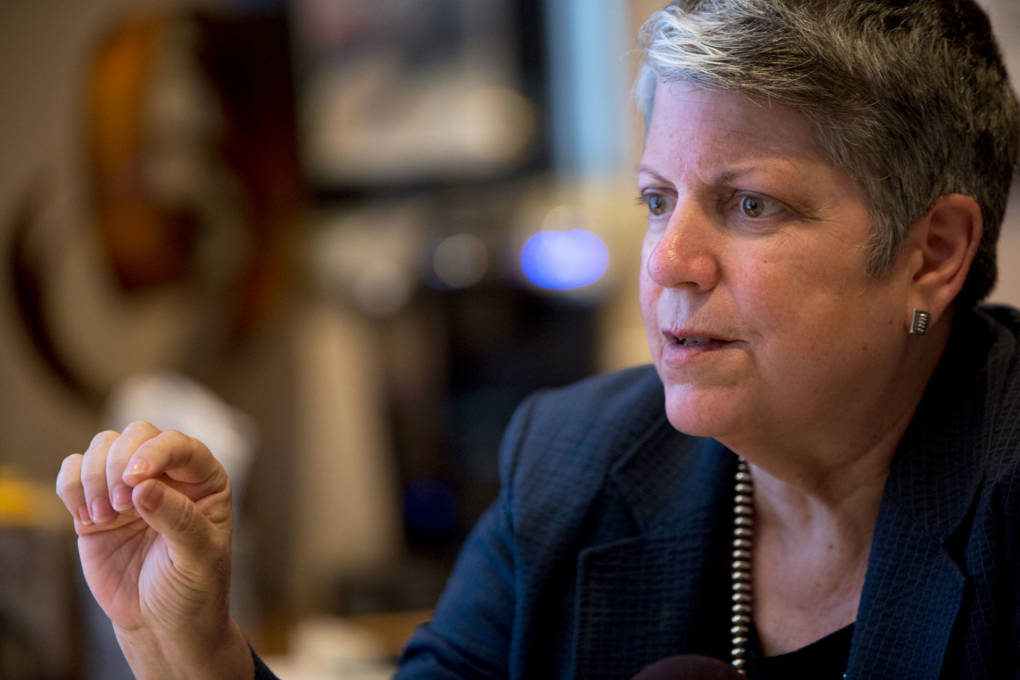
"caption": "UC President Janet Napolitano in her office in Oakland on July 17, 2018.",
"description": "UC President and former Secretary of Homeland Security Janet Napolitano talked with The California Report in her office in Oakland on July 17, 2018.",
"title": "NapolitanoMain",
"credit": "Anne Wernikoff/KQED",
"status": "inherit",
"isLoading": false,
"fetchFailed": false
}
},
"audioPlayerReducer": {
"postId": "stream_live",
"isPaused": true,
"isPlaying": false,
"pfsActive": false,
"pledgeModalIsOpen": true,
"playerDrawerIsOpen": false,
"liveAudioPlayStartedAt": 0,
"liveAudioPlayContext": ""
},
"authorsReducer": {
"byline_news_11682814": {
"type": "authors",
"id": "byline_news_11682814",
"meta": {
"override": true
},
"slug": "byline_news_11682814",
"name": "\u003cstrong>\u003ca href=\"https://www.npr.org/people/1936301/john-burnett\">John Burnett\u003c/a>\u003c/strong>",
"isLoading": false
},
"byline_news_11682805": {
"type": "authors",
"id": "byline_news_11682805",
"meta": {
"override": true
},
"slug": "byline_news_11682805",
"name": "Hansi Lo Wang",
"isLoading": false
},
"byline_news_11682562": {
"type": "authors",
"id": "byline_news_11682562",
"meta": {
"override": true
},
"slug": "byline_news_11682562",
"name": "\u003cstrong>\u003ca href=\"https://calmatters.org/articles/author/matt-levin/\">Matt Levin\u003c/a>\u003c/strong>",
"isLoading": false
},
"dmarks": {
"type": "authors",
"id": "182",
"meta": {
"index": "authors_1716337520",
"id": "182",
"found": true
},
"name": "David Marks",
"firstName": "David",
"lastName": "Marks",
"slug": "dmarks",
"email": "dmarks@kqed.org",
"display_author_email": false,
"staff_mastheads": [],
"title": "KQED Editor",
"bio": "David Marks is a senior digital editor for KQED News. \u003c/a>Reach him at dmarks@kqed.org.",
"avatar": "https://secure.gravatar.com/avatar/b88bd6227ce6cb96ae33fefaf42b2a29?s=600&d=mm&r=g",
"twitter": "divadskram",
"facebook": null,
"instagram": null,
"linkedin": null,
"sites": [
{
"site": "news",
"roles": []
},
{
"site": "science",
"roles": []
},
{
"site": "perspectives",
"roles": []
},
{
"site": "liveblog",
"roles": []
}
],
"headData": {
"title": "David Marks | KQED",
"description": "KQED Editor",
"ogImgSrc": "https://secure.gravatar.com/avatar/b88bd6227ce6cb96ae33fefaf42b2a29?s=600&d=mm&r=g",
"twImgSrc": "https://secure.gravatar.com/avatar/b88bd6227ce6cb96ae33fefaf42b2a29?s=600&d=mm&r=g"
},
"isLoading": false,
"link": "/author/dmarks"
},
"kqed": {
"type": "authors",
"id": "236",
"meta": {
"index": "authors_1716337520",
"id": "236",
"found": true
},
"name": "KQED News Staff",
"firstName": "KQED News Staff",
"lastName": null,
"slug": "kqed",
"email": "faq@kqed.org",
"display_author_email": false,
"staff_mastheads": [],
"title": null,
"bio": null,
"avatar": "https://secure.gravatar.com/avatar/ef0e801a68c4c54afa9180db14084167?s=600&d=blank&r=g",
"twitter": null,
"facebook": null,
"instagram": null,
"linkedin": null,
"sites": [
{
"site": "arts",
"roles": [
"contributor"
]
},
{
"site": "news",
"roles": [
"editor"
]
},
{
"site": "futureofyou",
"roles": [
"author"
]
}
],
"headData": {
"title": "KQED News Staff | KQED",
"description": null,
"ogImgSrc": "https://secure.gravatar.com/avatar/ef0e801a68c4c54afa9180db14084167?s=600&d=blank&r=g",
"twImgSrc": "https://secure.gravatar.com/avatar/ef0e801a68c4c54afa9180db14084167?s=600&d=blank&r=g"
},
"isLoading": false,
"link": "/author/kqed"
},
"tgoldberg": {
"type": "authors",
"id": "258",
"meta": {
"index": "authors_1716337520",
"id": "258",
"found": true
},
"name": "Ted Goldberg",
"firstName": "Ted",
"lastName": "Goldberg",
"slug": "tgoldberg",
"email": "tgoldberg@kqed.org",
"display_author_email": true,
"staff_mastheads": [
"news"
],
"title": "KQED Managing Editor, News and Newscasts",
"bio": "Ted Goldberg is Managing Editor of News and Newscasts at KQED. His main reporting beat is the Bay Area's oil refining industry.\r\n\r\nPrior to joining KQED in 2014, Ted worked at CBS News and WCBS AM in New York and Bay City News and KCBS Radio in San Francisco. He graduated from Oberlin College in Ohio in 1998.",
"avatar": "https://secure.gravatar.com/avatar/30ce2e4fe89135e104f89be2394d16225b9d36c121b5b3cb7651ce642978b96f?s=600&d=blank&r=g",
"twitter": "TedrickG",
"bluesky": null,
"facebook": null,
"instagram": null,
"linkedin": null,
"sites": [
{
"site": "news",
"roles": [
"editor"
]
},
{
"site": "science",
"roles": [
"editor"
]
}
],
"headData": {
"title": "Ted Goldberg | KQED",
"description": "KQED Managing Editor, News and Newscasts",
"ogImgSrc": "https://secure.gravatar.com/avatar/30ce2e4fe89135e104f89be2394d16225b9d36c121b5b3cb7651ce642978b96f?s=600&d=blank&r=g",
"twImgSrc": "https://secure.gravatar.com/avatar/30ce2e4fe89135e104f89be2394d16225b9d36c121b5b3cb7651ce642978b96f?s=600&d=blank&r=g"
},
"isLoading": false,
"link": "/author/tgoldberg"
},
"aemslie": {
"type": "authors",
"id": "3206",
"meta": {
"index": "authors_1716337520",
"id": "3206",
"found": true
},
"name": "Alex Emslie",
"firstName": "Alex",
"lastName": "Emslie",
"slug": "aemslie",
"email": "aemslie@kqed.org",
"display_author_email": true,
"staff_mastheads": [
"news"
],
"title": "KQED Senior Editor",
"bio": "Alex Emslie is senior editor of talent and development at KQED, where he manages dozens of early career journalists and oversees news department internships.\r\n\r\nHe is a former carpenter and proud graduate of City College of San Francisco and San Francisco State University, where he studied journalism and criminal justice before joining KQED in 2013.\r\n\r\nAlex produced investigative journalism focused on \u003ca href=\"https://www.kqed.org/news/11667594/the-trials-of-marvin-mutch-video\">criminal justice\u003c/a> and policing for most of a decade. He has broken major stories about \u003ca href=\"https://www.kqed.org/news/135682/amid-a-series-of-vallejo-police-shootings-one-officers-name-stands-out\">police use of deadly force\u003c/a>, \u003ca href=\"https://www.kqed.org/news/10454955/racist-texts-prompt-sfpd-internal-investigation\">officer misconduct\u003c/a> and \u003ca href=\"https://www.kqed.org/news/11712239/terrorist-or-troll-judge-to-weigh-whether-oakland-man-really-intended-to-attack-bay-area\">other\u003c/a> \u003ca href=\"https://www.kqed.org/news/11221414/hayward-paid-159000-to-husband-of-retired-police-chief-documents-show\">high\u003c/a>-\u003ca href=\"https://www.kqed.org/news/10622762/the-forgotten-tracking-two-homicides-in-san-francisco-public-housing\">profile\u003c/a> \u003ca href=\"https://www.kqed.org/news/11624516/federal-agency-promoted-ranger-just-months-after-his-gun-was-stolen-and-used-in-steinle-killing\">cases\u003c/a>. He co-founded the \u003ca href=\"https://projects.scpr.org/california-reporting-project/\">California Reporting Project\u003c/a> in 2019 to obtain and report on previously confidential police internal investigations. The effort produced well over 100 original stories and changed the course of multiple criminal cases.\r\n\r\nHis work has been recognized with numerous journalism awards, including a national Edward R. Murrow award for several years of \u003ca href=\"https://www.kqed.org/news/11688481/sfpd-officers-in-mario-woods-case-recount-shooting-in-newly-filed-depositions\">reporting\u003c/a> on the San Francisco Police shooting of Mario Woods. His \u003ca href=\"https://www.kqed.org/news/147854/half-of-those-killed-by-san-francisco-police-are-mentally-ill\">reporting\u003c/a> on police killings of people in psychiatric crisis was cited in amicus briefs before the U.S. Supreme Court.\r\n\r\nAlex now enjoys mentoring the next generation of journalists at KQED.",
"avatar": "https://secure.gravatar.com/avatar/e691e65209f20e9da202bd730ead5663?s=600&d=blank&r=g",
"twitter": "SFNewsReporter",
"facebook": null,
"instagram": null,
"linkedin": null,
"sites": [
{
"site": "arts",
"roles": [
"editor"
]
},
{
"site": "news",
"roles": [
"editor"
]
},
{
"site": "mindshift",
"roles": [
"editor"
]
},
{
"site": "stateofhealth",
"roles": [
"editor"
]
},
{
"site": "science",
"roles": [
"administrator"
]
}
],
"headData": {
"title": "Alex Emslie | KQED",
"description": "KQED Senior Editor",
"ogImgSrc": "https://secure.gravatar.com/avatar/e691e65209f20e9da202bd730ead5663?s=600&d=blank&r=g",
"twImgSrc": "https://secure.gravatar.com/avatar/e691e65209f20e9da202bd730ead5663?s=600&d=blank&r=g"
},
"isLoading": false,
"link": "/author/aemslie"
},
"markfiore": {
"type": "authors",
"id": "3236",
"meta": {
"index": "authors_1716337520",
"id": "3236",
"found": true
},
"name": "Mark Fiore",
"firstName": "Mark",
"lastName": "Fiore",
"slug": "markfiore",
"email": "mark@markfiore.com",
"display_author_email": false,
"staff_mastheads": [
"news"
],
"title": "KQED News Cartoonist",
"bio": "\u003ca href=\"http://www.MarkFiore.com\">MarkFiore.com\u003c/a> | \u003ca href=\"https://twitter.com/markfiore\">Follow on Twitter\u003c/a> | \u003ca href=\"https://www.facebook.com/pages/Mark-Fiore-Animated-Political-Cartoons/94451707396?ref=bookmarks\">Facebook\u003c/a> | \u003ca href=\"mailto:mark@markfiore.com\">email\u003c/a>\r\n\r\nPulitzer Prize-winner, Mark Fiore, who the Wall Street Journal has called “the undisputed guru of the form,” creates animated political cartoons in San Francisco, where his work has been featured regularly on the San Francisco Chronicle’s web site, SFGate.com. His work has appeared on Newsweek.com, Slate.com, CBSNews.com, MotherJones.com, DailyKos.com and NPR’s web site. Fiore’s political animation has appeared on CNN, Frontline, Bill Moyers Journal, Salon.com and cable and broadcast outlets across the globe.\r\n\r\nBeginning his professional life by drawing traditional political cartoons for newspapers, Fiore’s work appeared in publications ranging from the Washington Post to the Los Angeles Times. In the late 1990s, he began to experiment with animating political cartoons and, after a short stint at the San Jose Mercury News as their staff cartoonist, Fiore devoted all his energies to animation.\r\nGrowing up in California, Fiore also spent a good portion of his life in the backwoods of Idaho. It was this combination that shaped him politically. Mark majored in political science at Colorado College, where, in a perfect send-off for a cartoonist, he received his diploma in 1991 as commencement speaker Dick Cheney smiled approvingly.\r\nMark Fiore was awarded the Pulitzer Prize for political cartooning in 2010, a Robert F. Kennedy Journalism Award in 2004 and has twice received an Online Journalism Award for commentary from the Online News Association (2002, 2008). Fiore has received two awards for his work in new media from the National Cartoonists Society (2001, 2002), and in 2006 received The James Madison Freedom of Information Award from The Society of Professional Journalists.",
"avatar": "https://secure.gravatar.com/avatar/fc4e2a612b15b67bad0c6f0e1db4ca9b?s=600&d=blank&r=g",
"twitter": "MarkFiore",
"facebook": null,
"instagram": "https://www.instagram.com/markfiore/?hl=en",
"linkedin": null,
"sites": [
{
"site": "arts",
"roles": [
"contributor"
]
},
{
"site": "news",
"roles": [
"editor"
]
},
{
"site": "futureofyou",
"roles": [
"editor"
]
},
{
"site": "science",
"roles": [
"editor"
]
}
],
"headData": {
"title": "Mark Fiore | KQED",
"description": "KQED News Cartoonist",
"ogImgSrc": "https://secure.gravatar.com/avatar/fc4e2a612b15b67bad0c6f0e1db4ca9b?s=600&d=blank&r=g",
"twImgSrc": "https://secure.gravatar.com/avatar/fc4e2a612b15b67bad0c6f0e1db4ca9b?s=600&d=blank&r=g"
},
"isLoading": false,
"link": "/author/markfiore"
},
"jsepulvado": {
"type": "authors",
"id": "11298",
"meta": {
"index": "authors_1716337520",
"id": "11298",
"found": true
},
"name": "John Sepulvado",
"firstName": "John",
"lastName": "Sepulvado",
"slug": "jsepulvado",
"email": "jsepulvado@KQED.org",
"display_author_email": false,
"staff_mastheads": [],
"title": null,
"bio": "John Sepulvado is a former morning host of \u003cem>The California Report\u003c/em>. Prior to joining KQED in September 2016, John was the local host of NPR’s \u003cem>Weekend Edition\u003c/em> at Oregon Public Broadcasting (OPB). He has also served as a producer for America Public Media’s \u003cem>Marketplace Weekend\u003c/em> and worked as a national correspondent for CNN and as news director at WUSF in Tampa, Florida. John has earned prestigious RTDNA Murrow and PRNDI awards for investigative reporting, and helped CNN take home a Peabody Award for coverage of the 2010 Gulf oil spill. John attended Florida A&M in Tallahassee and is also a member of Phi Theta Kappa. He left KQED in 2019.",
"avatar": "https://secure.gravatar.com/avatar/b976d3c4cf11750a793b670e5acb7a1c?s=600&d=blank&r=g",
"twitter": null,
"facebook": null,
"instagram": null,
"linkedin": null,
"sites": [
{
"site": "news",
"roles": [
"author",
"edit_others_posts"
]
}
],
"headData": {
"title": "John Sepulvado | KQED",
"description": null,
"ogImgSrc": "https://secure.gravatar.com/avatar/b976d3c4cf11750a793b670e5acb7a1c?s=600&d=blank&r=g",
"twImgSrc": "https://secure.gravatar.com/avatar/b976d3c4cf11750a793b670e5acb7a1c?s=600&d=blank&r=g"
},
"isLoading": false,
"link": "/author/jsepulvado"
},
"scraig": {
"type": "authors",
"id": "11327",
"meta": {
"index": "authors_1716337520",
"id": "11327",
"found": true
},
"name": "Sarah Craig",
"firstName": "Sarah",
"lastName": "Craig",
"slug": "scraig",
"email": "scraig@KQED.org",
"display_author_email": false,
"staff_mastheads": [],
"title": "KQED Contributor",
"bio": "Sarah Craig is a freelance radio reporter and documentary photographer. She is currently working on \u003cem>Dreams of Dust\u003c/em>, @dreamsofdust, a multimedia project that documents stories of climate migration in California’s Central Valley, previously funded by the California Humanities. Her completed projects include \u003cem>\u003ca href=\"http://www.facesoffracking.org/\" target=\"_blank\" rel=\"nofollow noopener noreferrer\">Faces of Fracking\u003c/a>,\u003c/em> an investigation into the impact of fracking on the people and places of California, and \u003cem>\u003ca href=\"http://sarahcraig.visura.co/gulf-disaster-2\" target=\"_blank\" rel=\"nofollow noopener noreferrer\">The Gulf Disaster\u003c/a>,\u003c/em> stories on the lives of fishermen in the aftermath of the BP spill. Her work has been published by Marketplace, KQED's Bay Curious and Q'ed Up podcasts, KQED's California Report Magazine, KALW's Crosscurrents, Grist.org, High Country News, Earth Island Journal, and others. Sarah received a B.A. in Geography at Vassar College and attended the \u003ca href=\"http://www.salt.edu/\" target=\"_blank\" rel=\"nofollow noopener noreferrer\">Salt Institute of Documentary Studies\u003c/a> in Portland, ME. She recently received an Excellence in Journalism Award from the NorCal Society of Professional Journalists for her documentary radio piece, \u003ca href=\"http://kalw.org/post/215-will-water-come#stream/0\">\"Will the Water Come.\"\u003c/a> Email: scraig@kqed.org Twitter: @sarahcraigmedia Website: sarahcraigmedia.com",
"avatar": "https://secure.gravatar.com/avatar/97f17950c828429d3df9f2907412a50b?s=600&d=blank&r=g",
"twitter": null,
"facebook": null,
"instagram": null,
"linkedin": null,
"sites": [
{
"site": "news",
"roles": [
"subscriber"
]
},
{
"site": "science",
"roles": [
"editor"
]
}
],
"headData": {
"title": "Sarah Craig | KQED",
"description": "KQED Contributor",
"ogImgSrc": "https://secure.gravatar.com/avatar/97f17950c828429d3df9f2907412a50b?s=600&d=blank&r=g",
"twImgSrc": "https://secure.gravatar.com/avatar/97f17950c828429d3df9f2907412a50b?s=600&d=blank&r=g"
},
"isLoading": false,
"link": "/author/scraig"
}
},
"pagesReducer": {
"news_category_immigration": {
"type": "terms",
"id": "news_1169",
"meta": {
"index": "terms_1716263798",
"site": "news",
"id": "1169",
"score": 10.910658
},
"featImg": null,
"name": "Immigration",
"description": null,
"taxonomy": "category",
"headData": {
"twImgId": null,
"twTitle": null,
"ogTitle": null,
"ogImgId": null,
"twDescription": null,
"description": null,
"title": "Immigration Archives | KQED News",
"ogDescription": null
},
"ttid": 1180,
"slug": "immigration",
"isLoading": false,
"title": "Immigration",
"pageMeta": {
"site": "news",
"WpPageTemplate": "page-topic-editorial",
"currentPage": 124
},
"blocks": [
{
"blockName": "kqed/post-list",
"attrs": {
"layout": "cardArticle2",
"query": "posts/news?category=immigration",
"seeMore": false,
"paginated": true,
"page": 124
}
},
{
"blockName": "kqed/ad"
}
]
}
},
"pfsSessionReducer": {},
"postsReducer": {
"stream_live": {
"type": "live",
"id": "stream_live",
"audioUrl": "https://streams.kqed.org/kqedradio",
"title": "Live Stream",
"excerpt": "Live Stream information currently unavailable.",
"link": "/radio",
"featImg": "",
"label": {
"name": "KQED Live",
"link": "/"
}
},
"stream_kqedNewscast": {
"type": "posts",
"id": "stream_kqedNewscast",
"audioUrl": "https://www.kqed.org/.stream/anon/radio/RDnews/newscast.mp3?_=1",
"title": "KQED Newscast",
"featImg": "",
"label": {
"name": "88.5 FM",
"link": "/"
}
},
"news_11683061": {
"type": "posts",
"id": "news_11683061",
"meta": {
"index": "posts_1716263798",
"site": "news",
"id": "11683061",
"score": null,
"sort": [
1532700471000
]
},
"parent": 0,
"labelTerm": {},
"blocks": [],
"publishDate": 1532700471,
"format": "audio",
"disqusTitle": "Carr Fire in Shasta County Explodes Overnight",
"title": "Carr Fire in Shasta County Explodes Overnight",
"headTitle": "KQED News",
"content": "\u003ch2>\u003ca href=\"https://www.kqed.org/news/11683111/wildfire-races-to-outskirts-of-redding-firefighter-dozer-driver-killed\" target=\"_blank\" rel=\"noopener\">Fire in Shasta County Explodes Overnight, Kills 2\u003c/a>\u003c/h2>\n\u003cp>The Carr Fire in Shasta County grew 16,000 acres overnight. It has now burned more than 44,000 acres, and killed a local firefighter and a bulldozer operator working on the fire lines.\u003cbr>\n\u003cem>Guest: Action News Now Producer Cecile Juliette\u003c/em>\u003c/p>\n\u003ch2>No Immediate Plan to Reunify 430 Migrant Children, Government Says\u003c/h2>\n\u003cp>The government says it reunified all eligible migrant children by the mandated deadline of a San Diego federal judge. The government also says it has no immediate plan to reunify children with more than 430 parents who have already been deported.\u003cbr>\n\u003cem>Reporter: John Sepulvado\u003c/em>\u003c/p>\n\u003ch2>Federal Judge to Rule on Increased Oversight of Immigration Facilities\u003c/h2>\n\u003cp>On Friday morning a federal judge in Los Angeles will consider whether to increase oversight of U.S. immigration facilities that lawyers for migrant children say are substandard.\u003cbr>\n\u003cem>Reporter: Julie Small\u003c/em>\u003c/p>\n\u003ch2>Reports of Immigration Agents at Fresno Courthouse Draw Scrutiny\u003c/h2>\n\u003cp>Reports of immigration agents arresting people at the Fresno courthouse have drawn attention to the agency’s tactics.\u003cbr>\n\u003cem>Reporter: Alex Hall\u003c/em>\u003c/p>\n\u003ch2>California Lawsuit Challenges Trump Health Care Rule\u003c/h2>\n\u003cp>California Attorney General Xavier Becerra is joining 11 other states in a lawsuit challenging a Trump administration rule that he says will \"sabotage\" the Affordable Care Act.\u003cbr>\n\u003cem>Reporter: April Dembosky\u003c/em>\u003c/p>\n\u003ch2>19-year-old Uses Spoken Word to Deal with Trauma of an Incarcerated Father\u003c/h2>\n\u003cp>We’ve been bringing you stories about families separated at the border. But another kind of separation that happens every day is when parents get locked up. More than 5 million kids in the U.S. have had a parent in jail or prison. Arvaughn Williams lives in San Francisco. His dad was locked up off and on for years. Arvaughn’s 19 now. But he says that experience left him with a pain no specialist will ever be able to fix. He finds solace through writing -- mostly through spoken word.\u003cbr>\n\u003cem>Reporter: Laura Klivans\u003c/em>\u003c/p>\n\u003cp>[ad fullwidth]\u003c/p>\u003cp>\u003c/p>\n",
"disqusIdentifier": "11683061 https://ww2.kqed.org/news/?p=11683061",
"disqusUrl": "https://ww2.kqed.org/news/2018/07/27/fire-in-shasta-county-explodes-overnight/",
"stats": {
"hasVideo": false,
"hasChartOrMap": false,
"hasAudio": false,
"hasPolis": false,
"wordCount": 324,
"hasGoogleForm": false,
"hasGallery": false,
"hasHearkenModule": false,
"iframeSrcs": [],
"paragraphCount": 8
},
"modified": 1532727793,
"excerpt": null,
"headData": {
"twImgId": "",
"twTitle": "",
"ogTitle": "",
"ogImgId": "",
"twDescription": "",
"description": "Fire in Shasta County Explodes Overnight, Kills 2 The Carr Fire in Shasta County grew 16,000 acres overnight. It has now burned more than 44,000 acres, and killed a local firefighter and a bulldozer operator working on the fire lines. Guest: Action News Now Producer Cecile Juliette No Immediate Plan to Reunify 430 Migrant Children,",
"title": "Carr Fire in Shasta County Explodes Overnight | KQED",
"ogDescription": "",
"schema": {
"@context": "https://schema.org",
"@type": "NewsArticle",
"headline": "Carr Fire in Shasta County Explodes Overnight",
"datePublished": "2018-07-27T07:07:51-07:00",
"dateModified": "2018-07-27T14:43:13-07:00",
"image": "https://cdn.kqed.org/wp-content/uploads/2020/02/KQED-OG-Image@1x.png",
"isAccessibleForFree": "True",
"publisher": {
"@type": "NewsMediaOrganization",
"@id": "https://www.kqed.org/#organization",
"name": "KQED",
"logo": "https://cdn.kqed.org/wp-content/uploads/2020/02/KQED-OG-Image@1x.png",
"url": "https://www.kqed.org",
"sameAs": [
"https://www.facebook.com/KQED",
"https://twitter.com/KQED",
"https://www.instagram.com/kqed/",
"https://www.tiktok.com/@kqedofficial",
"https://www.linkedin.com/company/kqed",
"https://www.youtube.com/channel/UCeC0IOo7i1P_61zVUWbJ4nw"
]
}
}
},
"guestAuthors": [],
"slug": "fire-in-shasta-county-explodes-overnight",
"status": "publish",
"sourceUrl": "https://www.kqed.org/news/tag/tcrarchive/",
"audioUrl": "https://www.kqed.org/.stream/anon/radio/tcr/2018/07/TCRPodcast727.mp3",
"audioTrackLength": 794,
"source": "Morning Report",
"path": "/news/11683061/fire-in-shasta-county-explodes-overnight",
"audioDuration": 796000,
"parsedContent": [
{
"type": "contentString",
"content": "\u003cdiv class=\"post-body\">\u003cp>\u003ch2>\u003ca href=\"https://www.kqed.org/news/11683111/wildfire-races-to-outskirts-of-redding-firefighter-dozer-driver-killed\" target=\"_blank\" rel=\"noopener\">Fire in Shasta County Explodes Overnight, Kills 2\u003c/a>\u003c/h2>\n\u003cp>The Carr Fire in Shasta County grew 16,000 acres overnight. It has now burned more than 44,000 acres, and killed a local firefighter and a bulldozer operator working on the fire lines.\u003cbr>\n\u003cem>Guest: Action News Now Producer Cecile Juliette\u003c/em>\u003c/p>\n\u003ch2>No Immediate Plan to Reunify 430 Migrant Children, Government Says\u003c/h2>\n\u003cp>The government says it reunified all eligible migrant children by the mandated deadline of a San Diego federal judge. The government also says it has no immediate plan to reunify children with more than 430 parents who have already been deported.\u003cbr>\n\u003cem>Reporter: John Sepulvado\u003c/em>\u003c/p>\n\u003ch2>Federal Judge to Rule on Increased Oversight of Immigration Facilities\u003c/h2>\n\u003cp>On Friday morning a federal judge in Los Angeles will consider whether to increase oversight of U.S. immigration facilities that lawyers for migrant children say are substandard.\u003cbr>\n\u003cem>Reporter: Julie Small\u003c/em>\u003c/p>\n\u003ch2>Reports of Immigration Agents at Fresno Courthouse Draw Scrutiny\u003c/h2>\n\u003cp>Reports of immigration agents arresting people at the Fresno courthouse have drawn attention to the agency’s tactics.\u003cbr>\n\u003cem>Reporter: Alex Hall\u003c/em>\u003c/p>\n\u003ch2>California Lawsuit Challenges Trump Health Care Rule\u003c/h2>\n\u003cp>California Attorney General Xavier Becerra is joining 11 other states in a lawsuit challenging a Trump administration rule that he says will \"sabotage\" the Affordable Care Act.\u003cbr>\n\u003cem>Reporter: April Dembosky\u003c/em>\u003c/p>\n\u003ch2>19-year-old Uses Spoken Word to Deal with Trauma of an Incarcerated Father\u003c/h2>\n\u003cp>We’ve been bringing you stories about families separated at the border. But another kind of separation that happens every day is when parents get locked up. More than 5 million kids in the U.S. have had a parent in jail or prison. Arvaughn Williams lives in San Francisco. His dad was locked up off and on for years. Arvaughn’s 19 now. But he says that experience left him with a pain no specialist will ever be able to fix. He finds solace through writing -- mostly through spoken word.\u003cbr>\n\u003cem>Reporter: Laura Klivans\u003c/em>\u003c/p>\n\u003cp>\u003c/p>\u003c/div>",
"attributes": {
"named": {},
"numeric": []
}
},
{
"type": "component",
"content": "",
"name": "ad",
"attributes": {
"named": {
"label": "fullwidth"
},
"numeric": [
"fullwidth"
]
}
},
{
"type": "contentString",
"content": "\u003cdiv class=\"post-body\">\u003cp>\u003c/p>\u003cp>\u003c/p>\n\u003c/div>\u003c/p>",
"attributes": {
"named": {},
"numeric": []
}
}
],
"link": "/news/11683061/fire-in-shasta-county-explodes-overnight",
"authors": [
"236"
],
"categories": [
"news_457",
"news_1169",
"news_6188",
"news_13"
],
"tags": [
"news_21998",
"news_21268"
],
"featImg": "news_11572756",
"label": "source_news_11683061"
},
"news_11682929": {
"type": "posts",
"id": "news_11682929",
"meta": {
"index": "posts_1716263798",
"site": "news",
"id": "11682929",
"score": null,
"sort": [
1532648143000
]
},
"parent": 0,
"labelTerm": {
"site": "news",
"term": 72
},
"blocks": [],
"publishDate": 1532648143,
"format": "standard",
"disqusTitle": "On Deadline Day, More than 700 Migrant Children Still Separated From Parents",
"title": "On Deadline Day, More than 700 Migrant Children Still Separated From Parents",
"headTitle": "The California Report | KQED News",
"content": "\u003cp>\u003cem>Updated Thursday, 6:30 p.m. \u003c/em>\u003c/p>\n\u003cp>The U.S. government has yet to reunite at least 711 migrant children forcibly separated from their parents at the U.S.-Mexico border, according to a \u003ca href=\"https://www.documentcloud.org/documents/4619213-180726-Status-Report-Ms-L-Fam-Sep.html\" target=\"_blank\" rel=\"noopener\">status report\u003c/a> filed Thursday to a San Diego-based federal judge. Judge Dana Sabraw ordered that all the families broken apart by a Trump administration policy be reunified by the end of the day.\u003c/p>\n\u003caside class=\"pullquote alignright\">'The only deadline they met is their self-defined deadline.'\u003ccite>Lee Gelernt,\u003cbr>\nACLU Attorney\u003c/cite>\u003c/aside>\n\u003cp>Whether the government met or did not meet the court's deadline is somewhat complicated. Sabraw's June 26 order is clear that \"[d]efendants must reunify all class members ... within thirty (30) days.\" But exactly who is a member of the class-action lawsuit brought by the ACLU continues to be disputed, and the government has distinguished between families \"eligible\" and \"ineligible\" for reunification by Thursday's deadline.\u003c/p>\n\u003cp>\"The numbers really are dynamic,\" Chris Meekins, head of the office of the assistant secretary for preparedness and response for Health and Human Services, said in a conference call Thursday afternoon. \"But by this evening we believe we will meet the court deadline to reunite all children with parents who are eligible in ICE [U.S. Immigration and Customs Enforcement] custody.\"\u003c/p>\n\u003cp>Lee Gelernt, the ACLU's lead attorney on the case, said on a separate conference call that the government would not, in reality, meet the court's deadline.\u003c/p>\n\u003cp>[ad fullwidth]\u003c/p>\n\u003cp>\"The only deadline they met is their self-defined deadline,\" he said. \"They unilaterally declared who was eligible for reunification by this deadline. There's going to be a lot of work going forward.\"\u003c/p>\n\u003cp>Of the total 2,551 children identified as separated in the case, 1,820 had been discharged from the custody of the Department of Health and Human Services Office of Refugee Resettlement as of 9 a.m. Thursday:\u003c/p>\n\u003cul>\n\u003cli>\u003cstrong>1,442\u003c/strong> were reunified with parents in immigration custody.\u003c/li>\n\u003cli>\u003cstrong>378\u003c/strong> were otherwise released, including reunifications with parents out of custody, release to another family member or sponsor, previous reunifications in immigration custody or children who turned 18.\u003c/li>\n\u003c/ul>\n\u003cp>An additional 20 children were found after further review to have not been separated from their parents by immigration officials, according to the government's filing.\u003c/p>\n\u003cp>\"ICE and especially ERO [Enforcement and Removal Operations] has made a concerted effort and dedicated an inordinate amount of resources to ensure that these reunifications did occur,\" said Matthew Albence, executive associate director with U.S. Immigration and Customs Enforcement.\u003c/p>\n\u003cp>Of the 711 children who were not reunified with family or otherwise discharged by Thursday morning, the government provided the following list (in which some categories overlap and therefore add up to a larger total):\u003c/p>\n\u003cul>\n\u003cli>\u003cstrong>431\u003c/strong> children whose related adults were \u003ca href=\"https://www.kqed.org/news/11682240/deportation-detention-of-separated-migrant-families-at-center-of-legal-battle\" target=\"_blank\" rel=\"noopener\">deported without their children\u003c/a>. The filing did not explain why the number was reduced by 32 children since the government's last status report earlier this week.\u003c/li>\n\u003cli>\u003cstrong>120\u003c/strong> children's parents allegedly waived reunification. The ACLU is contesting these waivers, arguing that many parents were \u003ca href=\"https://www.kqed.org/news/11682633/chaos-coercion-alleged-as-u-s-government-prepares-to-deport-many-separated-migrant-families\" target=\"_blank\" rel=\"noopener\">confused about their rights and coerced\u003c/a> into signing them away. It's unclear why that number was reduced by approximately 87 since the government's last report.\u003c/li>\n\u003cli>\u003cstrong>94\u003c/strong> children whose related adults' locations are \"under review.\"\u003c/li>\n\u003cli>\u003cstrong>79\u003c/strong> children whose related adults were released into the interior of the United States. Attorneys with the U.S. Department of Justice said at a status hearing Tuesday that agencies had been unable to contact some released adults.\u003c/li>\n\u003cli>\u003cstrong>67\u003c/strong> children whose related adults were \"red-flagged\" during a case file review or background check. These adults may have criminal history or other reasons, such as no familial relation, that preclude them from reunification with the children.\u003c/li>\n\u003c/ul>\n\u003cp>Exactly how the parties will proceed with the largest group of still-separated families — those with deported parents — was unclear as of Thursday evening.\u003c/p>\n\u003caside class=\"alignright\">\n\u003ch4 style=\"text-align: center\">\u003ca href=\"https://www.kqed.org/news/11682633/chaos-coercion-alleged-as-u-s-government-prepares-to-deport-many-separated-migrant-families\" target=\"_blank\" rel=\"noopener\">\u003cspan style=\"color: #000000\">Chaos, Coercion Alleged as U.S. Government Prepares to Deport Many Separated Migrant Families\u003c/span>\u003c/a>\u003c/h4>\n\u003cfigure>\u003ca href=\"https://www.kqed.org/news/11682633/chaos-coercion-alleged-as-u-s-government-prepares-to-deport-many-separated-migrant-families\" target=\"_blank\" rel=\"noopener\">\u003cimg src=\"https://ww2.kqed.org/news/wp-content/uploads/sites/10/2018/07/RS31986_GettyImages-982169256-qut-1180x999.jpg\" alt=\"\">\u003c/a>\u003c/figure>\n\u003cp style=\"text-align: left\">ACLU attorneys representing parents say families need a week after being reunified to consider their legal options.\u003c/p>\n\u003c/aside>\n\u003cp>\"The reason these parents are coming here in the first place and paying smugglers $5,000, $6,000, $10,000 to make that dangerous journey across Central America and Mexico is because they want to get their children here,\" Albence said, adding that all parents were given the option to be deported with their child. \"Once their children are here, they're generally not going to want to give up the opportunity to have that child remain here in the country, which is why they frequently decline to have that child removed with them.\"\u003c/p>\n\u003cp>But Gelernt said many of those parents have likely not been informed about their rights as class members in this case. He chastised U.S. officials for creating a \"cruel, unconstitutional, inhumane policy.\"\u003c/p>\n\u003cp>He said the government's attitude should not be, \" 'We're proud we're doing the reunifications,' as if they're showing up to fix some natural disaster. This is a disaster that they created.\"\u003c/p>\n\u003cp>\u003c/p>\n\u003cp>The government is expected to provide updated numbers at a hearing Friday afternoon, and the parties are expected to argue about the ACLU's request that deportations of reunited parents be delayed until one week after their attorneys have been notified.\u003c/p>\n\n",
"disqusIdentifier": "11682929 https://ww2.kqed.org/news/?p=11682929",
"disqusUrl": "https://ww2.kqed.org/news/2018/07/26/on-deadline-day-more-than-700-migrant-children-still-separated-from-parents/",
"stats": {
"hasVideo": false,
"hasChartOrMap": false,
"hasAudio": false,
"hasPolis": false,
"wordCount": 876,
"hasGoogleForm": false,
"hasGallery": false,
"hasHearkenModule": false,
"iframeSrcs": [],
"paragraphCount": 17
},
"modified": 1532736922,
"excerpt": "The U.S. government has distinguished between parents 'eligible' and those 'ineligible' to be reunified.",
"headData": {
"twImgId": "",
"twTitle": "",
"ogTitle": "",
"ogImgId": "",
"twDescription": "",
"description": "The U.S. government has distinguished between parents 'eligible' and those 'ineligible' to be reunified.",
"title": "On Deadline Day, More than 700 Migrant Children Still Separated From Parents | KQED",
"ogDescription": "",
"schema": {
"@context": "https://schema.org",
"@type": "NewsArticle",
"headline": "On Deadline Day, More than 700 Migrant Children Still Separated From Parents",
"datePublished": "2018-07-26T16:35:43-07:00",
"dateModified": "2018-07-27T17:15:22-07:00",
"image": "https://cdn.kqed.org/wp-content/uploads/2020/02/KQED-OG-Image@1x.png",
"isAccessibleForFree": "True",
"publisher": {
"@type": "NewsMediaOrganization",
"@id": "https://www.kqed.org/#organization",
"name": "KQED",
"logo": "https://cdn.kqed.org/wp-content/uploads/2020/02/KQED-OG-Image@1x.png",
"url": "https://www.kqed.org",
"sameAs": [
"https://www.facebook.com/KQED",
"https://twitter.com/KQED",
"https://www.instagram.com/kqed/",
"https://www.tiktok.com/@kqedofficial",
"https://www.linkedin.com/company/kqed",
"https://www.youtube.com/channel/UCeC0IOo7i1P_61zVUWbJ4nw"
]
}
}
},
"guestAuthors": [],
"slug": "on-deadline-day-more-than-700-migrant-children-still-separated-from-parents",
"status": "publish",
"path": "/news/11682929/on-deadline-day-more-than-700-migrant-children-still-separated-from-parents",
"audioTrackLength": null,
"parsedContent": [
{
"type": "contentString",
"content": "\u003cdiv class=\"post-body\">\u003cp>\u003cp>\u003cem>Updated Thursday, 6:30 p.m. \u003c/em>\u003c/p>\n\u003cp>The U.S. government has yet to reunite at least 711 migrant children forcibly separated from their parents at the U.S.-Mexico border, according to a \u003ca href=\"https://www.documentcloud.org/documents/4619213-180726-Status-Report-Ms-L-Fam-Sep.html\" target=\"_blank\" rel=\"noopener\">status report\u003c/a> filed Thursday to a San Diego-based federal judge. Judge Dana Sabraw ordered that all the families broken apart by a Trump administration policy be reunified by the end of the day.\u003c/p>\n\u003caside class=\"pullquote alignright\">'The only deadline they met is their self-defined deadline.'\u003ccite>Lee Gelernt,\u003cbr>\nACLU Attorney\u003c/cite>\u003c/aside>\n\u003cp>Whether the government met or did not meet the court's deadline is somewhat complicated. Sabraw's June 26 order is clear that \"[d]efendants must reunify all class members ... within thirty (30) days.\" But exactly who is a member of the class-action lawsuit brought by the ACLU continues to be disputed, and the government has distinguished between families \"eligible\" and \"ineligible\" for reunification by Thursday's deadline.\u003c/p>\n\u003cp>\"The numbers really are dynamic,\" Chris Meekins, head of the office of the assistant secretary for preparedness and response for Health and Human Services, said in a conference call Thursday afternoon. \"But by this evening we believe we will meet the court deadline to reunite all children with parents who are eligible in ICE [U.S. Immigration and Customs Enforcement] custody.\"\u003c/p>\n\u003cp>Lee Gelernt, the ACLU's lead attorney on the case, said on a separate conference call that the government would not, in reality, meet the court's deadline.\u003c/p>\n\u003cp>\u003c/p>\u003c/div>",
"attributes": {
"named": {},
"numeric": []
}
},
{
"type": "component",
"content": "",
"name": "ad",
"attributes": {
"named": {
"label": "fullwidth"
},
"numeric": [
"fullwidth"
]
}
},
{
"type": "contentString",
"content": "\u003cdiv class=\"post-body\">\u003cp>\u003c/p>\n\u003cp>\"The only deadline they met is their self-defined deadline,\" he said. \"They unilaterally declared who was eligible for reunification by this deadline. There's going to be a lot of work going forward.\"\u003c/p>\n\u003cp>Of the total 2,551 children identified as separated in the case, 1,820 had been discharged from the custody of the Department of Health and Human Services Office of Refugee Resettlement as of 9 a.m. Thursday:\u003c/p>\n\u003cul>\n\u003cli>\u003cstrong>1,442\u003c/strong> were reunified with parents in immigration custody.\u003c/li>\n\u003cli>\u003cstrong>378\u003c/strong> were otherwise released, including reunifications with parents out of custody, release to another family member or sponsor, previous reunifications in immigration custody or children who turned 18.\u003c/li>\n\u003c/ul>\n\u003cp>An additional 20 children were found after further review to have not been separated from their parents by immigration officials, according to the government's filing.\u003c/p>\n\u003cp>\"ICE and especially ERO [Enforcement and Removal Operations] has made a concerted effort and dedicated an inordinate amount of resources to ensure that these reunifications did occur,\" said Matthew Albence, executive associate director with U.S. Immigration and Customs Enforcement.\u003c/p>\n\u003cp>Of the 711 children who were not reunified with family or otherwise discharged by Thursday morning, the government provided the following list (in which some categories overlap and therefore add up to a larger total):\u003c/p>\n\u003cul>\n\u003cli>\u003cstrong>431\u003c/strong> children whose related adults were \u003ca href=\"https://www.kqed.org/news/11682240/deportation-detention-of-separated-migrant-families-at-center-of-legal-battle\" target=\"_blank\" rel=\"noopener\">deported without their children\u003c/a>. The filing did not explain why the number was reduced by 32 children since the government's last status report earlier this week.\u003c/li>\n\u003cli>\u003cstrong>120\u003c/strong> children's parents allegedly waived reunification. The ACLU is contesting these waivers, arguing that many parents were \u003ca href=\"https://www.kqed.org/news/11682633/chaos-coercion-alleged-as-u-s-government-prepares-to-deport-many-separated-migrant-families\" target=\"_blank\" rel=\"noopener\">confused about their rights and coerced\u003c/a> into signing them away. It's unclear why that number was reduced by approximately 87 since the government's last report.\u003c/li>\n\u003cli>\u003cstrong>94\u003c/strong> children whose related adults' locations are \"under review.\"\u003c/li>\n\u003cli>\u003cstrong>79\u003c/strong> children whose related adults were released into the interior of the United States. Attorneys with the U.S. Department of Justice said at a status hearing Tuesday that agencies had been unable to contact some released adults.\u003c/li>\n\u003cli>\u003cstrong>67\u003c/strong> children whose related adults were \"red-flagged\" during a case file review or background check. These adults may have criminal history or other reasons, such as no familial relation, that preclude them from reunification with the children.\u003c/li>\n\u003c/ul>\n\u003cp>Exactly how the parties will proceed with the largest group of still-separated families — those with deported parents — was unclear as of Thursday evening.\u003c/p>\n\u003caside class=\"alignright\">\n\u003ch4 style=\"text-align: center\">\u003ca href=\"https://www.kqed.org/news/11682633/chaos-coercion-alleged-as-u-s-government-prepares-to-deport-many-separated-migrant-families\" target=\"_blank\" rel=\"noopener\">\u003cspan style=\"color: #000000\">Chaos, Coercion Alleged as U.S. Government Prepares to Deport Many Separated Migrant Families\u003c/span>\u003c/a>\u003c/h4>\n\u003cfigure>\u003ca href=\"https://www.kqed.org/news/11682633/chaos-coercion-alleged-as-u-s-government-prepares-to-deport-many-separated-migrant-families\" target=\"_blank\" rel=\"noopener\">\u003cimg src=\"https://ww2.kqed.org/news/wp-content/uploads/sites/10/2018/07/RS31986_GettyImages-982169256-qut-1180x999.jpg\" alt=\"\">\u003c/a>\u003c/figure>\n\u003cp style=\"text-align: left\">ACLU attorneys representing parents say families need a week after being reunified to consider their legal options.\u003c/p>\n\u003c/aside>\n\u003cp>\"The reason these parents are coming here in the first place and paying smugglers $5,000, $6,000, $10,000 to make that dangerous journey across Central America and Mexico is because they want to get their children here,\" Albence said, adding that all parents were given the option to be deported with their child. \"Once their children are here, they're generally not going to want to give up the opportunity to have that child remain here in the country, which is why they frequently decline to have that child removed with them.\"\u003c/p>\n\u003cp>But Gelernt said many of those parents have likely not been informed about their rights as class members in this case. He chastised U.S. officials for creating a \"cruel, unconstitutional, inhumane policy.\"\u003c/p>\n\u003cp>He said the government's attitude should not be, \" 'We're proud we're doing the reunifications,' as if they're showing up to fix some natural disaster. This is a disaster that they created.\"\u003c/p>\n\u003cp>\u003c/p>\n\u003cp>The government is expected to provide updated numbers at a hearing Friday afternoon, and the parties are expected to argue about the ACLU's request that deportations of reunited parents be delayed until one week after their attorneys have been notified.\u003c/p>\n\n\u003c/div>\u003c/p>",
"attributes": {
"named": {},
"numeric": []
}
}
],
"link": "/news/11682929/on-deadline-day-more-than-700-migrant-children-still-separated-from-parents",
"authors": [
"3206"
],
"programs": [
"news_72"
],
"categories": [
"news_1169",
"news_6188",
"news_8"
],
"tags": [
"news_23456",
"news_19542"
],
"featImg": "news_11682931",
"label": "news_72"
},
"news_11682958": {
"type": "posts",
"id": "news_11682958",
"meta": {
"index": "posts_1716263798",
"site": "news",
"id": "11682958",
"score": null,
"sort": [
1532647034000
]
},
"guestAuthors": [],
"slug": "not-quite-reunited",
"title": "Not Quite Reunited...",
"publishDate": 1532647034,
"format": "standard",
"headTitle": "Not Quite Reunited… | KQED",
"labelTerm": {
"term": 18515,
"site": "news"
},
"content": "\u003cp>Amid chaos and confusion, hundreds of migrant parents separated from their children under the Trump administration’s zero tolerance policy will \u003ca href=\"https://www.kqed.org/news/11682929/on-deadline-day-more-than-700-migrant-children-still-separated-from-parents\" target=\"_blank\" rel=\"noopener\">not be reunited\u003c/a> by Thursday’s court-ordered deadline.\u003c/p>\n\u003cp>Federal lawyers said that over 700 parents were “ineligible” to be reunited with their children for a variety of reasons.\u003c/p>\n\u003cp>Those reasons range from the fact that hundreds of parents have already been deported, to parents waiving their right to rejoin their children.\u003c/p>\n\u003cp>The American Civil Liberties Union argued in court that deportations must be delayed a week once families are reunited to give them time to discuss their case with legal counsel.\u003c/p>\n\u003cp>[ad fullwidth]\u003c/p>\u003cp>\u003c/p>\n",
"blocks": [],
"excerpt": "Amid chaos and confusion, hundreds of families will not be reunited by Thursday's court-ordered deadline.",
"status": "publish",
"parent": 0,
"modified": 1738716035,
"stats": {
"hasAudio": false,
"hasVideo": false,
"hasChartOrMap": false,
"iframeSrcs": [],
"hasGoogleForm": false,
"hasGallery": false,
"hasHearkenModule": false,
"hasPolis": false,
"paragraphCount": 6,
"wordCount": 109
},
"headData": {
"title": "Not Quite Reunited... | KQED",
"description": "Amid chaos and confusion, hundreds of families will not be reunited by Thursday's court-ordered deadline.",
"ogTitle": "",
"ogDescription": "",
"ogImgId": "",
"twTitle": "",
"twDescription": "",
"twImgId": "",
"schema": {
"@context": "https://schema.org",
"@type": "NewsArticle",
"headline": "Not Quite Reunited...",
"datePublished": "2018-07-26T16:17:14-07:00",
"dateModified": "2025-02-04T16:40:35-08:00",
"image": "https://cdn.kqed.org/wp-content/uploads/2020/02/KQED-OG-Image@1x.png",
"isAccessibleForFree": "True",
"publisher": {
"@type": "NewsMediaOrganization",
"@id": "https://www.kqed.org/#organization",
"name": "KQED",
"logo": "https://cdn.kqed.org/wp-content/uploads/2020/02/KQED-OG-Image@1x.png",
"url": "https://www.kqed.org",
"sameAs": [
"https://www.facebook.com/KQED",
"https://twitter.com/KQED",
"https://www.instagram.com/kqed/",
"https://www.tiktok.com/@kqedofficial",
"https://www.linkedin.com/company/kqed",
"https://www.youtube.com/channel/UCeC0IOo7i1P_61zVUWbJ4nw"
]
}
}
},
"sticky": false,
"path": "/news/11682958/not-quite-reunited",
"audioTrackLength": null,
"parsedContent": [
{
"type": "contentString",
"content": "\u003cdiv class=\"post-body\">\u003cp>\u003cp>Amid chaos and confusion, hundreds of migrant parents separated from their children under the Trump administration’s zero tolerance policy will \u003ca href=\"https://www.kqed.org/news/11682929/on-deadline-day-more-than-700-migrant-children-still-separated-from-parents\" target=\"_blank\" rel=\"noopener\">not be reunited\u003c/a> by Thursday’s court-ordered deadline.\u003c/p>\n\u003cp>Federal lawyers said that over 700 parents were “ineligible” to be reunited with their children for a variety of reasons.\u003c/p>\n\u003cp>Those reasons range from the fact that hundreds of parents have already been deported, to parents waiving their right to rejoin their children.\u003c/p>\n\u003cp>The American Civil Liberties Union argued in court that deportations must be delayed a week once families are reunited to give them time to discuss their case with legal counsel.\u003c/p>\n\u003cp>\u003c/p>\u003c/div>",
"attributes": {
"named": {},
"numeric": []
}
},
{
"type": "component",
"content": "",
"name": "ad",
"attributes": {
"named": {
"label": "fullwidth"
},
"numeric": [
"fullwidth"
]
}
},
{
"type": "contentString",
"content": "\u003cdiv class=\"post-body\">\u003cp>\u003c/p>\u003cp>\u003c/p>\n\u003c/div>\u003c/p>",
"attributes": {
"named": {},
"numeric": []
}
}
],
"link": "/news/11682958/not-quite-reunited",
"authors": [
"3236"
],
"series": [
"news_18515"
],
"categories": [
"news_1169",
"news_6188",
"news_8",
"news_13"
],
"tags": [
"news_23720",
"news_23456",
"news_21027",
"news_20949",
"news_23744"
],
"featImg": "news_11682964",
"label": "news_18515"
},
"news_11682901": {
"type": "posts",
"id": "news_11682901",
"meta": {
"index": "posts_1716263798",
"site": "news",
"id": "11682901",
"score": null,
"sort": [
1532646886000
]
},
"guestAuthors": [],
"slug": "photos-a-ride-with-border-patrol-along-san-diegos-border-fence",
"title": "PHOTOS: A Ride With Border Patrol Along San Diego's Border Fence",
"publishDate": 1532646886,
"format": "image",
"headTitle": "PHOTOS: A Ride With Border Patrol Along San Diego’s Border Fence | KQED",
"labelTerm": {
"term": 72,
"site": "news"
},
"content": "\u003cp>Photographer Ariana Drehsler teamed up with KQED reporter Julie Small this past Tuesday to go on a ride-along with Theron Francisco, a public affairs officer with the U.S. Border Patrol.\u003c/p>\n\u003cp>They started early in the morning in Otay Mesa, a community located at the southern edge of San Diego. The tour began at the site of eight border wall prototypes next to the U.S.-Mexico border. Then, Francisco took them to visit Smuggler’s Gulch, a section of steep terrain used as a cross-over point for drug smugglers and coyotes.\u003c/p>\n\u003cp>Their last stop was Friendship Park, a bi-national park that separates San Diego from Tijuana. Drehsler said she noticed people taking selfies and trying to get as close to the fence as possible. “If they got too close, the Border Patrol would let them know,” she said.\u003c/p>\n\u003cp>During the tour, Francisco told Drehsler and Small that his grandmother came from Tijuana when she was a little girl. “It’s a reminder that no matter what job you have, we all come from somewhere,” said Drehsler.\u003c/p>\n\u003cfigure id=\"attachment_11682936\" class=\"wp-caption aligncenter\" style=\"max-width: 800px\">\u003cimg loading=\"lazy\" decoding=\"async\" class=\"size-large wp-image-11682936\" src=\"https://ww2.kqed.org/news/wp-content/uploads/sites/10/2018/07/RS32058_IMG_1873-qut-1020x680.jpg\" alt='Friendship Park it is not nearly as colorful as it is on the Mexican side, but there is a small section of the wall where someone wrote \"God Loves Us All.\"' width=\"800\" height=\"427\">\u003cfigcaption class=\"wp-caption-text\">Friendship Park it is not nearly as colorful as it is on the Mexican side, but there is a small section of the wall where someone wrote “God Loves Us All.” \u003ccite>(Ariana Drehsler)\u003c/cite>\u003c/figcaption>\u003c/figure>\n\u003cfigure id=\"attachment_11682933\" class=\"wp-caption aligncenter\" style=\"max-width: 800px\">\u003cimg loading=\"lazy\" decoding=\"async\" class=\"size-large wp-image-11682933\" src=\"https://ww2.kqed.org/news/wp-content/uploads/sites/10/2018/07/RS32022_IMG_1307-qut-1020x680.jpg\" alt=\"Theron Francisco, the Public Affairs Officer with the U.S. Border Patrol, stands in front of the border wall prototypes in Otay Mesa, Calif. Before joining the U.S. Border Patrol, Theron worked in construction. He said his grandmother came to the United States from Tijuana when she was very young.\" width=\"800\" height=\"427\">\u003cfigcaption class=\"wp-caption-text\">Theron Francisco, the Public Affairs Officer with the U.S. Border Patrol, stands in front of the border wall prototypes in Otay Mesa, Calif. Before joining the U.S. Border Patrol, Theron worked in construction. He said his grandmother came to the United States from Tijuana when she was very young. \u003ccite>(Ariana Drehsler)\u003c/cite>\u003c/figcaption>\u003c/figure>\n\u003cfigure id=\"attachment_11682935\" class=\"wp-caption aligncenter\" style=\"max-width: 800px\">\u003cimg loading=\"lazy\" decoding=\"async\" class=\"size-large wp-image-11682935\" src=\"https://ww2.kqed.org/news/wp-content/uploads/sites/10/2018/07/RS32056_IMG_1846-qut-1020x680.jpg\" alt=\"People take a selfie outside of Friendship Park in San Ysidro, Calif. Friendship Park is open on Saturdays and Sundays for four hours. Friends and family members are able to visit one another and speak through a metal fence.\" width=\"800\" height=\"427\">\u003cfigcaption class=\"wp-caption-text\">People take a selfie outside of Friendship Park in San Ysidro, Calif. Friendship Park is open on Saturdays and Sundays for four hours. Friends and family members are able to visit one another and speak through a metal fence. \u003ccite>(Ariana Drehsler)\u003c/cite>\u003c/figcaption>\u003c/figure>\n\u003cfigure id=\"attachment_11682934\" class=\"wp-caption aligncenter\" style=\"max-width: 800px\">\u003cimg loading=\"lazy\" decoding=\"async\" class=\"size-large wp-image-11682934\" src=\"https://ww2.kqed.org/news/wp-content/uploads/sites/10/2018/07/RS32012_IMG_1229-qut-1020x680.jpg\" alt=\"Outside the gate where the 8 border wall prototypes are displayed in Otay Mesa, Ca.\" width=\"800\" height=\"427\">\u003cfigcaption class=\"wp-caption-text\">Outside the gate where the 8 border wall prototypes are displayed in Otay Mesa, Ca. \u003ccite>(Ariana Drehsler)\u003c/cite>\u003c/figcaption>\u003c/figure>\n\u003cfigure id=\"attachment_11682942\" class=\"wp-caption aligncenter\" style=\"max-width: 800px\">\u003cimg loading=\"lazy\" decoding=\"async\" class=\"size-large wp-image-11682942\" src=\"https://ww2.kqed.org/news/wp-content/uploads/sites/10/2018/07/RS32046_IMG_1726-qut-1020x680.jpg\" alt='The view from \"Bunker Hill\" where you can see Mexico on the left and the United States on the right divided by a border wall.' width=\"800\" height=\"427\">\u003cfigcaption class=\"wp-caption-text\">The view from “Bunker Hill” where you can see Mexico on the left and the United States on the right divided by a border wall. \u003ccite>(Ariana Drehsler)\u003c/cite>\u003c/figcaption>\u003c/figure>\n\u003cfigure id=\"attachment_11682945\" class=\"wp-caption aligncenter\" style=\"max-width: 800px\">\u003cimg loading=\"lazy\" decoding=\"async\" class=\"size-large wp-image-11682945\" src=\"https://ww2.kqed.org/news/wp-content/uploads/sites/10/2018/07/RS32041_IMG_1645-qut-1020x680.jpg\" alt=\"The view from the SUV of U.S. Border Patrol Agent Theron Francisco. Construction is underway to add additional vehicle inspection booths and to expand southbound Interstate-5 by adding more lanes.\" width=\"800\" height=\"427\">\u003cfigcaption class=\"wp-caption-text\">The view from the SUV of U.S. Border Patrol Agent Theron Francisco. Construction is underway to add additional vehicle inspection booths and to expand southbound Interstate-5 by adding more lanes. \u003ccite>(Ariana Drehsler)\u003c/cite>\u003c/figcaption>\u003c/figure>\n\u003cfigure id=\"attachment_11682944\" class=\"wp-caption aligncenter\" style=\"max-width: 800px\">\u003cimg loading=\"lazy\" decoding=\"async\" class=\"size-large wp-image-11682944\" src=\"https://ww2.kqed.org/news/wp-content/uploads/sites/10/2018/07/RS32052_IMG_1759-qut-1020x680.jpg\" alt=\"People outside the gate of Friendship Park looking at the border fence that goes into the Pacific Ocean in San Ysidro, Calif. Friendship Park is open on Saturdays and Sundays for four hours. Friends and family members are able to visit one another and speak through a metal fence.\" width=\"800\" height=\"427\">\u003cfigcaption class=\"wp-caption-text\">People outside the gate of Friendship Park looking at the border fence that goes into the Pacific Ocean in San Ysidro, Calif. Friendship Park is open on Saturdays and Sundays for four hours. Friends and family members are able to visit one another and speak through a metal fence. \u003ccite>(Ariana Drehsler)\u003c/cite>\u003c/figcaption>\u003c/figure>\n\u003cfigure id=\"attachment_11682941\" class=\"wp-caption aligncenter\" style=\"max-width: 800px\">\u003cimg loading=\"lazy\" decoding=\"async\" class=\"size-large wp-image-11682941\" src=\"https://ww2.kqed.org/news/wp-content/uploads/sites/10/2018/07/RS32042_IMG_1663-qut-1020x680.jpg\" alt=\"The secondary fence along the U.S.-Mexico border is near an area known as "Smuggler's Gulch".\" width=\"800\" height=\"427\">\u003cfigcaption class=\"wp-caption-text\">The secondary fence along the U.S.-Mexico border is near an area known as “Smuggler’s Gulch”. \u003ccite>(Ariana Drehsler)\u003c/cite>\u003c/figcaption>\u003c/figure>\n\u003cfigure id=\"attachment_11682943\" class=\"wp-caption aligncenter\" style=\"max-width: 800px\">\u003cimg loading=\"lazy\" decoding=\"async\" class=\"size-large wp-image-11682943\" src=\"https://ww2.kqed.org/news/wp-content/uploads/sites/10/2018/07/RS32048_IMG_1738-qut-1020x680.jpg\" alt='A Border Patrol SUV looks over the U.S.-Mexico Border in the \"Bunker Hill\" district near Tijuana, Mexico.' width=\"800\" height=\"427\">\u003cfigcaption class=\"wp-caption-text\">A Border Patrol SUV looks over the U.S.-Mexico Border in the “Bunker Hill” district near Tijuana, Mexico. \u003ccite>(Ariana Drehsler)\u003c/cite>\u003c/figcaption>\u003c/figure>\n\u003cp>[ad fullwidth]\u003c/p>\u003cp>\u003c/p>\n",
"blocks": [],
"excerpt": "Photographer Ariana Drehsler and KQED reporter Julie Small went on a ride along with a U.S. Border Patrol agent, from the new border wall prototypes to Friendship Park. ",
"status": "publish",
"parent": 0,
"modified": 1721116266,
"stats": {
"hasAudio": false,
"hasVideo": false,
"hasChartOrMap": false,
"iframeSrcs": [],
"hasGoogleForm": false,
"hasGallery": false,
"hasHearkenModule": false,
"hasPolis": false,
"paragraphCount": 6,
"wordCount": 497
},
"headData": {
"title": "PHOTOS: A Ride With Border Patrol Along San Diego's Border Fence | KQED",
"description": "Photographer Ariana Drehsler and KQED reporter Julie Small went on a ride along with a U.S. Border Patrol agent, from the new border wall prototypes to Friendship Park. ",
"ogTitle": "",
"ogDescription": "",
"ogImgId": "",
"twTitle": "",
"twDescription": "",
"twImgId": "",
"schema": {
"@context": "https://schema.org",
"@type": "NewsArticle",
"headline": "PHOTOS: A Ride With Border Patrol Along San Diego's Border Fence",
"datePublished": "2018-07-26T16:14:46-07:00",
"dateModified": "2024-07-16T00:51:06-07:00",
"image": "https://cdn.kqed.org/wp-content/uploads/2020/02/KQED-OG-Image@1x.png",
"isAccessibleForFree": "True",
"publisher": {
"@type": "NewsMediaOrganization",
"@id": "https://www.kqed.org/#organization",
"name": "KQED",
"logo": "https://cdn.kqed.org/wp-content/uploads/2020/02/KQED-OG-Image@1x.png",
"url": "https://www.kqed.org",
"sameAs": [
"https://www.facebook.com/KQED",
"https://twitter.com/KQED",
"https://www.instagram.com/kqed/",
"https://www.tiktok.com/@kqedofficial",
"https://www.linkedin.com/company/kqed",
"https://www.youtube.com/channel/UCeC0IOo7i1P_61zVUWbJ4nw"
]
}
}
},
"sticky": false,
"path": "/news/11682901/photos-a-ride-with-border-patrol-along-san-diegos-border-fence",
"audioTrackLength": null,
"parsedContent": [
{
"type": "contentString",
"content": "\u003cdiv class=\"post-body\">\u003cp>\u003cp>Photographer Ariana Drehsler teamed up with KQED reporter Julie Small this past Tuesday to go on a ride-along with Theron Francisco, a public affairs officer with the U.S. Border Patrol.\u003c/p>\n\u003cp>They started early in the morning in Otay Mesa, a community located at the southern edge of San Diego. The tour began at the site of eight border wall prototypes next to the U.S.-Mexico border. Then, Francisco took them to visit Smuggler’s Gulch, a section of steep terrain used as a cross-over point for drug smugglers and coyotes.\u003c/p>\n\u003cp>Their last stop was Friendship Park, a bi-national park that separates San Diego from Tijuana. Drehsler said she noticed people taking selfies and trying to get as close to the fence as possible. “If they got too close, the Border Patrol would let them know,” she said.\u003c/p>\n\u003cp>During the tour, Francisco told Drehsler and Small that his grandmother came from Tijuana when she was a little girl. “It’s a reminder that no matter what job you have, we all come from somewhere,” said Drehsler.\u003c/p>\n\u003cfigure id=\"attachment_11682936\" class=\"wp-caption aligncenter\" style=\"max-width: 800px\">\u003cimg loading=\"lazy\" decoding=\"async\" class=\"size-large wp-image-11682936\" src=\"https://ww2.kqed.org/news/wp-content/uploads/sites/10/2018/07/RS32058_IMG_1873-qut-1020x680.jpg\" alt='Friendship Park it is not nearly as colorful as it is on the Mexican side, but there is a small section of the wall where someone wrote \"God Loves Us All.\"' width=\"800\" height=\"427\">\u003cfigcaption class=\"wp-caption-text\">Friendship Park it is not nearly as colorful as it is on the Mexican side, but there is a small section of the wall where someone wrote “God Loves Us All.” \u003ccite>(Ariana Drehsler)\u003c/cite>\u003c/figcaption>\u003c/figure>\n\u003cfigure id=\"attachment_11682933\" class=\"wp-caption aligncenter\" style=\"max-width: 800px\">\u003cimg loading=\"lazy\" decoding=\"async\" class=\"size-large wp-image-11682933\" src=\"https://ww2.kqed.org/news/wp-content/uploads/sites/10/2018/07/RS32022_IMG_1307-qut-1020x680.jpg\" alt=\"Theron Francisco, the Public Affairs Officer with the U.S. Border Patrol, stands in front of the border wall prototypes in Otay Mesa, Calif. Before joining the U.S. Border Patrol, Theron worked in construction. He said his grandmother came to the United States from Tijuana when she was very young.\" width=\"800\" height=\"427\">\u003cfigcaption class=\"wp-caption-text\">Theron Francisco, the Public Affairs Officer with the U.S. Border Patrol, stands in front of the border wall prototypes in Otay Mesa, Calif. Before joining the U.S. Border Patrol, Theron worked in construction. He said his grandmother came to the United States from Tijuana when she was very young. \u003ccite>(Ariana Drehsler)\u003c/cite>\u003c/figcaption>\u003c/figure>\n\u003cfigure id=\"attachment_11682935\" class=\"wp-caption aligncenter\" style=\"max-width: 800px\">\u003cimg loading=\"lazy\" decoding=\"async\" class=\"size-large wp-image-11682935\" src=\"https://ww2.kqed.org/news/wp-content/uploads/sites/10/2018/07/RS32056_IMG_1846-qut-1020x680.jpg\" alt=\"People take a selfie outside of Friendship Park in San Ysidro, Calif. Friendship Park is open on Saturdays and Sundays for four hours. Friends and family members are able to visit one another and speak through a metal fence.\" width=\"800\" height=\"427\">\u003cfigcaption class=\"wp-caption-text\">People take a selfie outside of Friendship Park in San Ysidro, Calif. Friendship Park is open on Saturdays and Sundays for four hours. Friends and family members are able to visit one another and speak through a metal fence. \u003ccite>(Ariana Drehsler)\u003c/cite>\u003c/figcaption>\u003c/figure>\n\u003cfigure id=\"attachment_11682934\" class=\"wp-caption aligncenter\" style=\"max-width: 800px\">\u003cimg loading=\"lazy\" decoding=\"async\" class=\"size-large wp-image-11682934\" src=\"https://ww2.kqed.org/news/wp-content/uploads/sites/10/2018/07/RS32012_IMG_1229-qut-1020x680.jpg\" alt=\"Outside the gate where the 8 border wall prototypes are displayed in Otay Mesa, Ca.\" width=\"800\" height=\"427\">\u003cfigcaption class=\"wp-caption-text\">Outside the gate where the 8 border wall prototypes are displayed in Otay Mesa, Ca. \u003ccite>(Ariana Drehsler)\u003c/cite>\u003c/figcaption>\u003c/figure>\n\u003cfigure id=\"attachment_11682942\" class=\"wp-caption aligncenter\" style=\"max-width: 800px\">\u003cimg loading=\"lazy\" decoding=\"async\" class=\"size-large wp-image-11682942\" src=\"https://ww2.kqed.org/news/wp-content/uploads/sites/10/2018/07/RS32046_IMG_1726-qut-1020x680.jpg\" alt='The view from \"Bunker Hill\" where you can see Mexico on the left and the United States on the right divided by a border wall.' width=\"800\" height=\"427\">\u003cfigcaption class=\"wp-caption-text\">The view from “Bunker Hill” where you can see Mexico on the left and the United States on the right divided by a border wall. \u003ccite>(Ariana Drehsler)\u003c/cite>\u003c/figcaption>\u003c/figure>\n\u003cfigure id=\"attachment_11682945\" class=\"wp-caption aligncenter\" style=\"max-width: 800px\">\u003cimg loading=\"lazy\" decoding=\"async\" class=\"size-large wp-image-11682945\" src=\"https://ww2.kqed.org/news/wp-content/uploads/sites/10/2018/07/RS32041_IMG_1645-qut-1020x680.jpg\" alt=\"The view from the SUV of U.S. Border Patrol Agent Theron Francisco. Construction is underway to add additional vehicle inspection booths and to expand southbound Interstate-5 by adding more lanes.\" width=\"800\" height=\"427\">\u003cfigcaption class=\"wp-caption-text\">The view from the SUV of U.S. Border Patrol Agent Theron Francisco. Construction is underway to add additional vehicle inspection booths and to expand southbound Interstate-5 by adding more lanes. \u003ccite>(Ariana Drehsler)\u003c/cite>\u003c/figcaption>\u003c/figure>\n\u003cfigure id=\"attachment_11682944\" class=\"wp-caption aligncenter\" style=\"max-width: 800px\">\u003cimg loading=\"lazy\" decoding=\"async\" class=\"size-large wp-image-11682944\" src=\"https://ww2.kqed.org/news/wp-content/uploads/sites/10/2018/07/RS32052_IMG_1759-qut-1020x680.jpg\" alt=\"People outside the gate of Friendship Park looking at the border fence that goes into the Pacific Ocean in San Ysidro, Calif. Friendship Park is open on Saturdays and Sundays for four hours. Friends and family members are able to visit one another and speak through a metal fence.\" width=\"800\" height=\"427\">\u003cfigcaption class=\"wp-caption-text\">People outside the gate of Friendship Park looking at the border fence that goes into the Pacific Ocean in San Ysidro, Calif. Friendship Park is open on Saturdays and Sundays for four hours. Friends and family members are able to visit one another and speak through a metal fence. \u003ccite>(Ariana Drehsler)\u003c/cite>\u003c/figcaption>\u003c/figure>\n\u003cfigure id=\"attachment_11682941\" class=\"wp-caption aligncenter\" style=\"max-width: 800px\">\u003cimg loading=\"lazy\" decoding=\"async\" class=\"size-large wp-image-11682941\" src=\"https://ww2.kqed.org/news/wp-content/uploads/sites/10/2018/07/RS32042_IMG_1663-qut-1020x680.jpg\" alt=\"The secondary fence along the U.S.-Mexico border is near an area known as "Smuggler's Gulch".\" width=\"800\" height=\"427\">\u003cfigcaption class=\"wp-caption-text\">The secondary fence along the U.S.-Mexico border is near an area known as “Smuggler’s Gulch”. \u003ccite>(Ariana Drehsler)\u003c/cite>\u003c/figcaption>\u003c/figure>\n\u003cfigure id=\"attachment_11682943\" class=\"wp-caption aligncenter\" style=\"max-width: 800px\">\u003cimg loading=\"lazy\" decoding=\"async\" class=\"size-large wp-image-11682943\" src=\"https://ww2.kqed.org/news/wp-content/uploads/sites/10/2018/07/RS32048_IMG_1738-qut-1020x680.jpg\" alt='A Border Patrol SUV looks over the U.S.-Mexico Border in the \"Bunker Hill\" district near Tijuana, Mexico.' width=\"800\" height=\"427\">\u003cfigcaption class=\"wp-caption-text\">A Border Patrol SUV looks over the U.S.-Mexico Border in the “Bunker Hill” district near Tijuana, Mexico. \u003ccite>(Ariana Drehsler)\u003c/cite>\u003c/figcaption>\u003c/figure>\n\u003cp>\u003c/p>\u003c/div>",
"attributes": {
"named": {},
"numeric": []
}
},
{
"type": "component",
"content": "",
"name": "ad",
"attributes": {
"named": {
"label": "fullwidth"
},
"numeric": [
"fullwidth"
]
}
},
{
"type": "contentString",
"content": "\u003cdiv class=\"post-body\">\u003cp>\u003c/p>\u003cp>\u003c/p>\n\u003c/div>\u003c/p>",
"attributes": {
"named": {},
"numeric": []
}
}
],
"link": "/news/11682901/photos-a-ride-with-border-patrol-along-san-diegos-border-fence",
"authors": [
"11327"
],
"programs": [
"news_72"
],
"categories": [
"news_1169",
"news_6188",
"news_8",
"news_13"
],
"tags": [
"news_20446",
"news_23797",
"news_2905",
"news_23796",
"news_21038"
],
"featImg": "news_11682937",
"label": "news_72"
},
"news_11682838": {
"type": "posts",
"id": "news_11682838",
"meta": {
"index": "posts_1716263798",
"site": "news",
"id": "11682838",
"score": null,
"sort": [
1532635917000
]
},
"parent": 0,
"labelTerm": {
"site": "news",
"term": 72
},
"blocks": [],
"publishDate": 1532635917,
"format": "standard",
"disqusTitle": "Two Girls, Separated at Border and Held at Pleasant Hill Shelter, Reunite With Families",
"title": "Two Girls, Separated at Border and Held at Pleasant Hill Shelter, Reunite With Families",
"headTitle": "The California Report | KQED News",
"content": "\u003cp>Two adolescent girls -- one from Honduras and one from Guatemala -- who had been taken from their parents at the U.S.-Mexico border and held at a facility in Contra Costa County for around a month have been reunited with their families.\u003c/p>\n\u003cp>The girls, ages 13 and 17, were reunited with one parent each last Sunday and Monday, according to Pleasant Hill spokesman Martin Nelis.\u003c/p>\n\u003cp>In late June, city officials confirmed that the two children were being held at a shelter in the city run by federal contractor Southwest Key, a nonprofit agency that runs shelters for migrant children.\u003c/p>\n\u003cp>The facility was holding 25 minors at that time, with ages ranging from 12 to 17 years old, Southwest Key officials said.\u003c/p>\n\u003cp>The girls held there were among around 50 separated children who, at one point, were living in 17 state-licensed shelter facilities in California, according to the state Department of Social Services.\u003c/p>\n\u003cp>[ad fullwidth]\u003c/p>\n\u003cp>Families opposed to the Trump administration's zero tolerance immigration policy that led to the separation of migrant children from their parents held a protest in front of the Pleasant Hill facility several weeks ago.\u003c/p>\n\u003cp>Rep. Mark DeSaulnier (D-Concord) took a \u003ca href=\"https://www.mercurynews.com/2018/07/09/congressman-tours-east-bay-facility-housing-migrant-children-separated-from-parents-describes-what-he-saw/\" target=\"_blank\" rel=\"noopener\">tour\u003c/a> of the shelter, recently visited the border, and was told by the U.S. Department of Health and Human Services (HHS) that the girls were reunited with their families in the last week.\u003c/p>\n\u003cp>\"I'm relieved,\" DeSaulnier said in an interview Thursday afternoon.\u003c/p>\n\u003cp>\"But it's hard not to be troubled after visiting with them and then going down to the border and seeing what can only be described as a politically created humanitarian crisis that is done in the name of Americans by this administration,\" DeSaulnier said.\u003c/p>\n\u003caside class=\"alignright\">\n\u003ch3>\u003ca href=\"https://www.kqed.org/news/11682633/chaos-coercion-alleged-as-u-s-government-prepares-to-deport-many-separated-migrant-families\">Chaos, Coercion Alleged as U.S. Government Prepares to Deport Many Separated Migrant Families\u003c/a>\u003c/h3>\n\u003cfigure>\u003ca href=\"https://www.kqed.org/news/11682633/chaos-coercion-alleged-as-u-s-government-prepares-to-deport-many-separated-migrant-families\">\u003cimg src=\"https://ww2.kqed.org/news/wp-content/uploads/sites/10/2018/07/RS31986_GettyImages-982169256-qut-1180x999.jpg\" alt=\"\">\u003c/a>\u003c/figure>\n\u003c/aside>\n\u003cp>A Southwest Key official said the federal government prohibits the company from talking about individual children.\u003c/p>\n\u003cp>\"At the direction of the Office of Refugee Resettlement, Southwest Key has fulfilled every request to bring children under our care to designated locations for reunification. Our staff have worked hard to provide for the children's comfort and safety throughout the entire process,\" company spokesman Jeff Eller said in an emailed statement.\u003c/p>\n\u003cp>Kenneth Wolfe, a spokesman for HHS, did not respond to specific questions about the Southwest Key facility in Pleasant Hill. Instead, Wolfe pointed toward an agency \u003ca href=\"https://www.hhs.gov/programs/social-services/unaccompanied-alien-children/index.html\" target=\"_blank\" rel=\"noopener\">website\u003c/a> that includes updates on the department's plan for reunifying migrant children.\u003c/p>\n\u003cp>DeSaulnier said the two girls were most likely taken to a facility near the border, but federal officials did not brief him on their whereabouts.\u003c/p>\n\u003cp>\"I don't know why they tell us some things and hold things from us,\" DeSaulnier said. \"It's just part of this administration.\"\u003c/p>\n\u003cp>The Trump administration is facing a \u003ca href=\"https://www.kqed.org/news/11682814/under-deadline-government-scrambles-to-reunite-migrant-families\" target=\"_blank\" rel=\"noopener\">court-ordered deadline\u003c/a> Thursday to reunite migrant families separated at the border.\u003c/p>\n\u003cp>The government has identified 2,551 kids, ages 5 to 17, who were taken from their parents by immigration authorities.\u003c/p>\n\u003cp>\u003c/p>\n\u003cp>\u003cem>Correction: This post has been updated to reflect that one of the girls is from Honduras, and one from Guatemala. A previous version of this story stated that both girls were from Guatemala.\u003c/em>\u003c/p>\n\n",
"disqusIdentifier": "11682838 https://ww2.kqed.org/news/?p=11682838",
"disqusUrl": "https://ww2.kqed.org/news/2018/07/26/two-girls-separated-at-border-and-held-at-pleasant-hill-shelter-reunite-with-families/",
"stats": {
"hasVideo": false,
"hasChartOrMap": false,
"hasAudio": false,
"hasPolis": false,
"wordCount": 530,
"hasGoogleForm": false,
"hasGallery": false,
"hasHearkenModule": false,
"iframeSrcs": [],
"paragraphCount": 19
},
"modified": 1532653216,
"excerpt": "The girls were among around 50 separated children who, at one point, were living in 17 state-licensed shelter facilities in California.",
"headData": {
"twImgId": "",
"twTitle": "",
"ogTitle": "",
"ogImgId": "",
"twDescription": "",
"description": "The girls were among around 50 separated children who, at one point, were living in 17 state-licensed shelter facilities in California.",
"title": "Two Girls, Separated at Border and Held at Pleasant Hill Shelter, Reunite With Families | KQED",
"ogDescription": "",
"schema": {
"@context": "https://schema.org",
"@type": "NewsArticle",
"headline": "Two Girls, Separated at Border and Held at Pleasant Hill Shelter, Reunite With Families",
"datePublished": "2018-07-26T13:11:57-07:00",
"dateModified": "2018-07-26T18:00:16-07:00",
"image": "https://cdn.kqed.org/wp-content/uploads/2020/02/KQED-OG-Image@1x.png",
"isAccessibleForFree": "True",
"publisher": {
"@type": "NewsMediaOrganization",
"@id": "https://www.kqed.org/#organization",
"name": "KQED",
"logo": "https://cdn.kqed.org/wp-content/uploads/2020/02/KQED-OG-Image@1x.png",
"url": "https://www.kqed.org",
"sameAs": [
"https://www.facebook.com/KQED",
"https://twitter.com/KQED",
"https://www.instagram.com/kqed/",
"https://www.tiktok.com/@kqedofficial",
"https://www.linkedin.com/company/kqed",
"https://www.youtube.com/channel/UCeC0IOo7i1P_61zVUWbJ4nw"
]
}
}
},
"guestAuthors": [],
"slug": "two-girls-separated-at-border-and-held-at-pleasant-hill-shelter-reunite-with-families",
"status": "publish",
"path": "/news/11682838/two-girls-separated-at-border-and-held-at-pleasant-hill-shelter-reunite-with-families",
"audioTrackLength": null,
"parsedContent": [
{
"type": "contentString",
"content": "\u003cdiv class=\"post-body\">\u003cp>\u003cp>Two adolescent girls -- one from Honduras and one from Guatemala -- who had been taken from their parents at the U.S.-Mexico border and held at a facility in Contra Costa County for around a month have been reunited with their families.\u003c/p>\n\u003cp>The girls, ages 13 and 17, were reunited with one parent each last Sunday and Monday, according to Pleasant Hill spokesman Martin Nelis.\u003c/p>\n\u003cp>In late June, city officials confirmed that the two children were being held at a shelter in the city run by federal contractor Southwest Key, a nonprofit agency that runs shelters for migrant children.\u003c/p>\n\u003cp>The facility was holding 25 minors at that time, with ages ranging from 12 to 17 years old, Southwest Key officials said.\u003c/p>\n\u003cp>The girls held there were among around 50 separated children who, at one point, were living in 17 state-licensed shelter facilities in California, according to the state Department of Social Services.\u003c/p>\n\u003cp>\u003c/p>\u003c/div>",
"attributes": {
"named": {},
"numeric": []
}
},
{
"type": "component",
"content": "",
"name": "ad",
"attributes": {
"named": {
"label": "fullwidth"
},
"numeric": [
"fullwidth"
]
}
},
{
"type": "contentString",
"content": "\u003cdiv class=\"post-body\">\u003cp>\u003c/p>\n\u003cp>Families opposed to the Trump administration's zero tolerance immigration policy that led to the separation of migrant children from their parents held a protest in front of the Pleasant Hill facility several weeks ago.\u003c/p>\n\u003cp>Rep. Mark DeSaulnier (D-Concord) took a \u003ca href=\"https://www.mercurynews.com/2018/07/09/congressman-tours-east-bay-facility-housing-migrant-children-separated-from-parents-describes-what-he-saw/\" target=\"_blank\" rel=\"noopener\">tour\u003c/a> of the shelter, recently visited the border, and was told by the U.S. Department of Health and Human Services (HHS) that the girls were reunited with their families in the last week.\u003c/p>\n\u003cp>\"I'm relieved,\" DeSaulnier said in an interview Thursday afternoon.\u003c/p>\n\u003cp>\"But it's hard not to be troubled after visiting with them and then going down to the border and seeing what can only be described as a politically created humanitarian crisis that is done in the name of Americans by this administration,\" DeSaulnier said.\u003c/p>\n\u003caside class=\"alignright\">\n\u003ch3>\u003ca href=\"https://www.kqed.org/news/11682633/chaos-coercion-alleged-as-u-s-government-prepares-to-deport-many-separated-migrant-families\">Chaos, Coercion Alleged as U.S. Government Prepares to Deport Many Separated Migrant Families\u003c/a>\u003c/h3>\n\u003cfigure>\u003ca href=\"https://www.kqed.org/news/11682633/chaos-coercion-alleged-as-u-s-government-prepares-to-deport-many-separated-migrant-families\">\u003cimg src=\"https://ww2.kqed.org/news/wp-content/uploads/sites/10/2018/07/RS31986_GettyImages-982169256-qut-1180x999.jpg\" alt=\"\">\u003c/a>\u003c/figure>\n\u003c/aside>\n\u003cp>A Southwest Key official said the federal government prohibits the company from talking about individual children.\u003c/p>\n\u003cp>\"At the direction of the Office of Refugee Resettlement, Southwest Key has fulfilled every request to bring children under our care to designated locations for reunification. Our staff have worked hard to provide for the children's comfort and safety throughout the entire process,\" company spokesman Jeff Eller said in an emailed statement.\u003c/p>\n\u003cp>Kenneth Wolfe, a spokesman for HHS, did not respond to specific questions about the Southwest Key facility in Pleasant Hill. Instead, Wolfe pointed toward an agency \u003ca href=\"https://www.hhs.gov/programs/social-services/unaccompanied-alien-children/index.html\" target=\"_blank\" rel=\"noopener\">website\u003c/a> that includes updates on the department's plan for reunifying migrant children.\u003c/p>\n\u003cp>DeSaulnier said the two girls were most likely taken to a facility near the border, but federal officials did not brief him on their whereabouts.\u003c/p>\n\u003cp>\"I don't know why they tell us some things and hold things from us,\" DeSaulnier said. \"It's just part of this administration.\"\u003c/p>\n\u003cp>The Trump administration is facing a \u003ca href=\"https://www.kqed.org/news/11682814/under-deadline-government-scrambles-to-reunite-migrant-families\" target=\"_blank\" rel=\"noopener\">court-ordered deadline\u003c/a> Thursday to reunite migrant families separated at the border.\u003c/p>\n\u003cp>The government has identified 2,551 kids, ages 5 to 17, who were taken from their parents by immigration authorities.\u003c/p>\n\u003cp>\u003c/p>\n\u003cp>\u003cem>Correction: This post has been updated to reflect that one of the girls is from Honduras, and one from Guatemala. A previous version of this story stated that both girls were from Guatemala.\u003c/em>\u003c/p>\n\n\u003c/div>\u003c/p>",
"attributes": {
"named": {},
"numeric": []
}
}
],
"link": "/news/11682838/two-girls-separated-at-border-and-held-at-pleasant-hill-shelter-reunite-with-families",
"authors": [
"258"
],
"programs": [
"news_72"
],
"categories": [
"news_457",
"news_6266",
"news_1169",
"news_6188",
"news_8",
"news_13"
],
"tags": [
"news_1323",
"news_23456",
"news_21729",
"news_23524",
"news_23794",
"news_244"
],
"featImg": "news_11682898",
"label": "news_72"
},
"news_11682633": {
"type": "posts",
"id": "news_11682633",
"meta": {
"index": "posts_1716263798",
"site": "news",
"id": "11682633",
"score": null,
"sort": [
1532631622000
]
},
"parent": 0,
"labelTerm": {
"site": "news",
"term": 72
},
"blocks": [],
"publishDate": 1532631622,
"format": "standard",
"disqusTitle": "Chaos, Coercion Alleged as U.S. Government Prepares to Deport Many Separated Migrant Families",
"title": "Chaos, Coercion Alleged as U.S. Government Prepares to Deport Many Separated Migrant Families",
"headTitle": "The California Report | KQED News",
"content": "\u003cp>Many migrant parents \u003ca href=\"https://www.kqed.org/news/tag/family-separation\" target=\"_blank\" rel=\"noopener\">separated\u003c/a> from their children under the Trump administration's zero tolerance policy are scheduled to be deported with little or no time to discuss their cases with their families and attorneys.\u003c/p>\n\u003cp>That's according to the \u003ca href=\"https://www.documentcloud.org/documents/4618435-180725-Plaintiff-Reply-Re-Stay-of-Removal.html\" target=\"_blank\" rel=\"noopener\">latest filing\u003c/a> in the San Diego-based federal case that set a Thursday deadline for the U.S. government to reunite the bulk of 2,551 children taken from their parents.\u003c/p>\n\u003cp>To bolster their argument that deportations should be delayed for a week after families are reunited, the ACLU filed more than a dozen declarations Wednesday from lawyers working with parents in immigration custody.\u003c/p>\n\u003cp>The declarations describe the confusion of dozens of parents who say they unwittingly signed away their rights under the case, sometimes under pressure and sometimes in mass groups with no opportunity to ask questions about their options.\u003c/p>\n\u003cp>Immigration attorney Aaron Reichlin-Melnick wrote that he and other volunteer attorneys spoke to 52 parents who the government says waived reunification with their children.\u003c/p>\n\u003cp>[ad fullwidth]\u003c/p>\n\u003cp>\"Many of these individuals indicated that they felt coerced into relinquishing their rights,\" Reichlin-Melnick's declaration says. \"Still others appeared totally unaware that they had done so.\"\u003c/p>\n\u003cp>The declaration goes on to describe several cases, including that of a Guatemalan father who signed a form agreeing to have his son sent to live with other family members in the U.S.:\u003c/p>\n\u003cblockquote>\u003cp>However, he said that he signed the form under enormous amounts of stress and confusion. He is extremely worried for his son's wellbeing and burst into sobs repeatedly throughout our interview when he expressed how horrible the separation has made him feel. He wishes to be reunited with his son but indicated that he does not know his son's wishes or what options he has. Because the last time he had spoken with his son was a month ago, he is extremely afraid that he might have made the wrong decision because of lack of information.\u003c/p>\u003c/blockquote>\n\u003cp>Attorneys with the U.S. Department of Justice said in court earlier this week that parents and children have had access to phone calls with each other and with attorneys for about a month. They argue in court filings that the \u003ca href=\"https://www.documentcloud.org/documents/4617537-180724-Attached-Notice-Re-Opposition-to-Motion.html\" target=\"_blank\" rel=\"noopener\">forms\u003c/a> describing the parents' options and rights in the case are clear, and parents should not be subjected to making a difficult choice more than once. The form is written in English but must be read to the parent in their native language.\u003c/p>\n\u003cp>But the dozens of parents described in the ACLU's latest filing say they've had limited communication with their children and no contact with attorneys. Many say the form was not translated for them.\u003c/p>\n\u003cp>\"People have at some point been given a few minutes on the phone with their kid,\" ACLU attorney Spencer Amdur said in an interview. \"This is after being separated for weeks or months. All of a sudden they get a 20-minute phone call, and everybody’s crying the whole time.\"\u003c/p>\n\u003cp>The Trump administration policy that led to family separation began in early May. Judge Dana Sabraw ordered it to stop in late June. Most parents and children have been held separately for at least a month, many for two or three months.\u003c/p>\n\u003caside class=\"alignright\">\n\u003ch3>Read More of KQED's Coverage\u003c/h3>\n\u003cp> \u003c/p>\n\u003cul>\n\u003cli>\u003ca href=\"https://www.kqed.org/news/11682814/under-deadline-government-scrambles-to-reunite-migrant-families\" target=\"_blank\" rel=\"noopener\">Under Deadline, Government Scrambles to Reunite Migrant Families\u003c/a>\u003c/li>\n\u003c/ul>\n\u003c/aside>\n\u003cp>Deportations are temporarily on hold while Sabraw considers arguments for and against the ACLU's request that each parent be given a week after being reunited to get legal advice and consider the best options for themselves and their children. Many families came seeking asylum from violence in their home countries in Central America.\u003c/p>\n\u003cp>Of the 2,551 children separated from their parents as of the government's \u003ca href=\"https://www.documentcloud.org/documents/4617524-180723-Status-Report.html\" target=\"_blank\" rel=\"noopener\">latest tally\u003c/a>, more than 1,600 were eligible to be reunited with their parents by the court's Thursday deadline. Federal lawyers said slightly more than 900 parents were \"ineligible\" for the following reasons:\u003c/p>\n\u003caside class=\"alignleft\">\n\u003ch4 style=\"text-align: center\">\u003ca href=\"https://www.kqed.org/news/11682240/deportation-detention-of-separated-migrant-families-at-center-of-legal-battle\" target=\"_blank\" rel=\"noopener\">\u003cspan style=\"color: #000000\">Judge: Large Number of Migrant Parents Separated From Their Children Are Unaccounted For\u003c/span>\u003c/a>\u003c/h4>\n\u003cfigure>\u003ca href=\"https://www.kqed.org/news/11682240/deportation-detention-of-separated-migrant-families-at-center-of-legal-battle\" target=\"_blank\" rel=\"noopener\">\u003cimg src=\"https://ww2.kqed.org/news/wp-content/uploads/sites/10/2018/07/RS31977_GettyImages-988419450-qut-1180x787.jpg\" alt=\"\">\u003c/a>\u003c/figure>\n\u003c/aside>\n\u003cul>\n\u003cli>\u003cstrong>130\u003c/strong> Because the parent waived their right to rejoin their children;\u003c/li>\n\u003cli>\u003cstrong>64\u003c/strong> Because of the adult's criminal history or other red flags in their background;\u003c/li>\n\u003cli>\u003cstrong>463\u003c/strong> Because the parent is no longer in the U.S. and appears to have been deported without their child;\u003c/li>\n\u003cli>\u003cstrong>260\u003c/strong> Because the cases are still under evaluation, including parents released into the U.S. who the government has been unable to locate.\u003c/li>\n\u003c/ul>\n\u003cp>Parents of more than half of the children who are being reunified have been ordered deported.\u003c/p>\n\u003cp>\"The government’s proposal would be to give them no time at all,\" Amdur said. \"So these families would see each other for the first time and then immediately be sent to the airport and deported with no time to decide what’s the best option.\"\u003c/p>\n\u003cp>\u003c/p>\n\u003cp>The next hearing in the case is scheduled for Friday. The judge will determine whether the government has met the deadline to reunify families and also hear arguments about whether to continue blocking deportations.\u003c/p>\n\n",
"disqusIdentifier": "11682633 https://ww2.kqed.org/news/?p=11682633",
"disqusUrl": "https://ww2.kqed.org/news/2018/07/26/chaos-coercion-alleged-as-u-s-government-prepares-to-deport-many-separated-migrant-families/",
"stats": {
"hasVideo": false,
"hasChartOrMap": false,
"hasAudio": false,
"hasPolis": false,
"wordCount": 841,
"hasGoogleForm": false,
"hasGallery": false,
"hasHearkenModule": false,
"iframeSrcs": [],
"paragraphCount": 19
},
"modified": 1532640477,
"excerpt": "ACLU attorneys representing parents say families need a week after being reunified to consider their legal options.",
"headData": {
"twImgId": "",
"twTitle": "",
"ogTitle": "",
"ogImgId": "",
"twDescription": "",
"description": "ACLU attorneys representing parents say families need a week after being reunified to consider their legal options.",
"title": "Chaos, Coercion Alleged as U.S. Government Prepares to Deport Many Separated Migrant Families | KQED",
"ogDescription": "",
"schema": {
"@context": "https://schema.org",
"@type": "NewsArticle",
"headline": "Chaos, Coercion Alleged as U.S. Government Prepares to Deport Many Separated Migrant Families",
"datePublished": "2018-07-26T12:00:22-07:00",
"dateModified": "2018-07-26T14:27:57-07:00",
"image": "https://cdn.kqed.org/wp-content/uploads/2020/02/KQED-OG-Image@1x.png",
"isAccessibleForFree": "True",
"publisher": {
"@type": "NewsMediaOrganization",
"@id": "https://www.kqed.org/#organization",
"name": "KQED",
"logo": "https://cdn.kqed.org/wp-content/uploads/2020/02/KQED-OG-Image@1x.png",
"url": "https://www.kqed.org",
"sameAs": [
"https://www.facebook.com/KQED",
"https://twitter.com/KQED",
"https://www.instagram.com/kqed/",
"https://www.tiktok.com/@kqedofficial",
"https://www.linkedin.com/company/kqed",
"https://www.youtube.com/channel/UCeC0IOo7i1P_61zVUWbJ4nw"
]
}
}
},
"guestAuthors": [],
"slug": "chaos-coercion-alleged-as-u-s-government-prepares-to-deport-many-separated-migrant-families",
"status": "publish",
"path": "/news/11682633/chaos-coercion-alleged-as-u-s-government-prepares-to-deport-many-separated-migrant-families",
"audioTrackLength": null,
"parsedContent": [
{
"type": "contentString",
"content": "\u003cdiv class=\"post-body\">\u003cp>\u003cp>Many migrant parents \u003ca href=\"https://www.kqed.org/news/tag/family-separation\" target=\"_blank\" rel=\"noopener\">separated\u003c/a> from their children under the Trump administration's zero tolerance policy are scheduled to be deported with little or no time to discuss their cases with their families and attorneys.\u003c/p>\n\u003cp>That's according to the \u003ca href=\"https://www.documentcloud.org/documents/4618435-180725-Plaintiff-Reply-Re-Stay-of-Removal.html\" target=\"_blank\" rel=\"noopener\">latest filing\u003c/a> in the San Diego-based federal case that set a Thursday deadline for the U.S. government to reunite the bulk of 2,551 children taken from their parents.\u003c/p>\n\u003cp>To bolster their argument that deportations should be delayed for a week after families are reunited, the ACLU filed more than a dozen declarations Wednesday from lawyers working with parents in immigration custody.\u003c/p>\n\u003cp>The declarations describe the confusion of dozens of parents who say they unwittingly signed away their rights under the case, sometimes under pressure and sometimes in mass groups with no opportunity to ask questions about their options.\u003c/p>\n\u003cp>Immigration attorney Aaron Reichlin-Melnick wrote that he and other volunteer attorneys spoke to 52 parents who the government says waived reunification with their children.\u003c/p>\n\u003cp>\u003c/p>\u003c/div>",
"attributes": {
"named": {},
"numeric": []
}
},
{
"type": "component",
"content": "",
"name": "ad",
"attributes": {
"named": {
"label": "fullwidth"
},
"numeric": [
"fullwidth"
]
}
},
{
"type": "contentString",
"content": "\u003cdiv class=\"post-body\">\u003cp>\u003c/p>\n\u003cp>\"Many of these individuals indicated that they felt coerced into relinquishing their rights,\" Reichlin-Melnick's declaration says. \"Still others appeared totally unaware that they had done so.\"\u003c/p>\n\u003cp>The declaration goes on to describe several cases, including that of a Guatemalan father who signed a form agreeing to have his son sent to live with other family members in the U.S.:\u003c/p>\n\u003cblockquote>\u003cp>However, he said that he signed the form under enormous amounts of stress and confusion. He is extremely worried for his son's wellbeing and burst into sobs repeatedly throughout our interview when he expressed how horrible the separation has made him feel. He wishes to be reunited with his son but indicated that he does not know his son's wishes or what options he has. Because the last time he had spoken with his son was a month ago, he is extremely afraid that he might have made the wrong decision because of lack of information.\u003c/p>\u003c/blockquote>\n\u003cp>Attorneys with the U.S. Department of Justice said in court earlier this week that parents and children have had access to phone calls with each other and with attorneys for about a month. They argue in court filings that the \u003ca href=\"https://www.documentcloud.org/documents/4617537-180724-Attached-Notice-Re-Opposition-to-Motion.html\" target=\"_blank\" rel=\"noopener\">forms\u003c/a> describing the parents' options and rights in the case are clear, and parents should not be subjected to making a difficult choice more than once. The form is written in English but must be read to the parent in their native language.\u003c/p>\n\u003cp>But the dozens of parents described in the ACLU's latest filing say they've had limited communication with their children and no contact with attorneys. Many say the form was not translated for them.\u003c/p>\n\u003cp>\"People have at some point been given a few minutes on the phone with their kid,\" ACLU attorney Spencer Amdur said in an interview. \"This is after being separated for weeks or months. All of a sudden they get a 20-minute phone call, and everybody’s crying the whole time.\"\u003c/p>\n\u003cp>The Trump administration policy that led to family separation began in early May. Judge Dana Sabraw ordered it to stop in late June. Most parents and children have been held separately for at least a month, many for two or three months.\u003c/p>\n\u003caside class=\"alignright\">\n\u003ch3>Read More of KQED's Coverage\u003c/h3>\n\u003cp> \u003c/p>\n\u003cul>\n\u003cli>\u003ca href=\"https://www.kqed.org/news/11682814/under-deadline-government-scrambles-to-reunite-migrant-families\" target=\"_blank\" rel=\"noopener\">Under Deadline, Government Scrambles to Reunite Migrant Families\u003c/a>\u003c/li>\n\u003c/ul>\n\u003c/aside>\n\u003cp>Deportations are temporarily on hold while Sabraw considers arguments for and against the ACLU's request that each parent be given a week after being reunited to get legal advice and consider the best options for themselves and their children. Many families came seeking asylum from violence in their home countries in Central America.\u003c/p>\n\u003cp>Of the 2,551 children separated from their parents as of the government's \u003ca href=\"https://www.documentcloud.org/documents/4617524-180723-Status-Report.html\" target=\"_blank\" rel=\"noopener\">latest tally\u003c/a>, more than 1,600 were eligible to be reunited with their parents by the court's Thursday deadline. Federal lawyers said slightly more than 900 parents were \"ineligible\" for the following reasons:\u003c/p>\n\u003caside class=\"alignleft\">\n\u003ch4 style=\"text-align: center\">\u003ca href=\"https://www.kqed.org/news/11682240/deportation-detention-of-separated-migrant-families-at-center-of-legal-battle\" target=\"_blank\" rel=\"noopener\">\u003cspan style=\"color: #000000\">Judge: Large Number of Migrant Parents Separated From Their Children Are Unaccounted For\u003c/span>\u003c/a>\u003c/h4>\n\u003cfigure>\u003ca href=\"https://www.kqed.org/news/11682240/deportation-detention-of-separated-migrant-families-at-center-of-legal-battle\" target=\"_blank\" rel=\"noopener\">\u003cimg src=\"https://ww2.kqed.org/news/wp-content/uploads/sites/10/2018/07/RS31977_GettyImages-988419450-qut-1180x787.jpg\" alt=\"\">\u003c/a>\u003c/figure>\n\u003c/aside>\n\u003cul>\n\u003cli>\u003cstrong>130\u003c/strong> Because the parent waived their right to rejoin their children;\u003c/li>\n\u003cli>\u003cstrong>64\u003c/strong> Because of the adult's criminal history or other red flags in their background;\u003c/li>\n\u003cli>\u003cstrong>463\u003c/strong> Because the parent is no longer in the U.S. and appears to have been deported without their child;\u003c/li>\n\u003cli>\u003cstrong>260\u003c/strong> Because the cases are still under evaluation, including parents released into the U.S. who the government has been unable to locate.\u003c/li>\n\u003c/ul>\n\u003cp>Parents of more than half of the children who are being reunified have been ordered deported.\u003c/p>\n\u003cp>\"The government’s proposal would be to give them no time at all,\" Amdur said. \"So these families would see each other for the first time and then immediately be sent to the airport and deported with no time to decide what’s the best option.\"\u003c/p>\n\u003cp>\u003c/p>\n\u003cp>The next hearing in the case is scheduled for Friday. The judge will determine whether the government has met the deadline to reunify families and also hear arguments about whether to continue blocking deportations.\u003c/p>\n\n\u003c/div>\u003c/p>",
"attributes": {
"named": {},
"numeric": []
}
}
],
"link": "/news/11682633/chaos-coercion-alleged-as-u-s-government-prepares-to-deport-many-separated-migrant-families",
"authors": [
"3206"
],
"programs": [
"news_72"
],
"categories": [
"news_1169",
"news_6188",
"news_8"
],
"tags": [
"news_23456",
"news_19542",
"news_17041"
],
"featImg": "news_11682732",
"label": "news_72"
},
"news_11682814": {
"type": "posts",
"id": "news_11682814",
"meta": {
"index": "posts_1716263798",
"site": "news",
"id": "11682814",
"score": null,
"sort": [
1532626687000
]
},
"parent": 0,
"labelTerm": {},
"blocks": [],
"publishDate": 1532626687,
"format": "standard",
"disqusTitle": "Under Deadline, Government Scrambles to Reunite Migrant Families",
"title": "Under Deadline, Government Scrambles to Reunite Migrant Families",
"headTitle": "The California Report | KQED News",
"content": "\u003cp>The U.S. government is racing to meet Thursday's court-ordered deadline to reunite migrant families who were separated at the border to discourage other illegal crossings. But the government has acknowledged many parents won't be able to rejoin their children. And for those parents who do get to be with their children again, the future is uncertain.\u003c/p>\n\u003cp>The immigration bureaucracy on the border is a world of courtrooms and jail cells, asylum officers and gray-suited guards, and rarely, disorder. But no one has seen anything quite like this: immigration officials scrambling to reassemble the same families they broke up only two months ago.\u003c/p>\n\u003cp>\"It's a new set of rules, so the child advocates, the caseworkers, the immigration attorneys, we're all sort of figuring this out,\" says veteran immigration attorney Ruby Powers over a cup of coffee on her way to a detention center to see a client.\u003c/p>\n\u003cp>\"It's like we're building a plane while we're taking off. I feel like that this whole time.\"\u003c/p>\n\u003cp>All day, unmarked white vans and chartered buses carrying the migrant children released from shelters across the country roll into the parking lot of the Port Isabel Detention Center in south Texas. It's a heavily-guarded compound on the South Texas gulf coast — just across the lagoon from tourists frolicking on Padre Island.\u003c/p>\n\u003cp>[ad fullwidth]\u003c/p>\n\u003cp>Immigration and Customs Enforcement says, in a statement, these \"large-scale transfers of minors\" present \"logistical challenges.\" But the agency says it's working \"tirelessly\" to reunite eligible families by Thursday's deadline.\u003c/p>\n\u003cp>After they are reunited, some families are then taken together to be locked up in another detention center. Many are released on bonds. It's all happening so fast, some of their lawyers can't keep track of them.\u003c/p>\n\u003cp>McAllen, Texas attorney Carlos Garcia says the government deserves some credit for the hustle. On Tuesday, he called a deportation officer at Port Isabel to find out when a client from Guatemala will be reunited with her daughter, who's en route from a shelter in Arizona.\u003c/p>\n\u003cp>He was told officials were trying to make the reunification happen within the hour. \"I mean, that's awesome. Good for them,\" he said, \"The government sure is hauling trying to get these kids back with their parents. Now, it shouldn't be occurring. The government should've never have created this chaos and we wouldn't be in this situation, but I will give them credit.\"\u003c/p>\n\u003caside class=\"alignright\">\n\u003ch3>Read More of KQED's Coverage\u003c/h3>\n\u003cp>\u003c/p>\n\u003cul>\n\u003cli>\n\u003ca href=\"https://www.kqed.org/news/11682633/chaos-coercion-alleged-as-u-s-government-prepares-to-deport-many-separated-migrant-families\" target=\"_blank\">Chaos, Coercion Alleged as U.S. Government Prepares to Deport Many Separated Migrant Families\u003c/a>\n\u003c/li>\n\u003cli>\n\u003ca href=\"https://www.kqed.org/news/11682240/deportation-detention-of-separated-migrant-families-at-center-of-legal-battle\" target=\"_blank\">Judge: Large Number of Migrant Parents Separated From Their Children Are Unaccounted For\u003c/a>\n\u003c/li>\n\u003c/ul>\n\u003c/aside>\n\u003cp>A California federal judge set today as the deadline for the Trump Administration to reunite more than 2,500 children — ages five to 17. The government said in a court filing earlier this week that as many as 1,600 parents should be back together with their children by today.\u003c/p>\n\u003cp>\u003ca href=\"https://www.npr.org/2018/07/24/632146079/government-unable-to-track-hundreds-of-parents-who-were-separated-from-their-chi\" target=\"_blank\" rel=\"noopener\">But hundreds of parents won't be\u003c/a> — 463 parents are no longer in the U.S. Many were deported.\u003c/p>\n\u003cp>Lucy, a young mother from Honduras, was one of the lucky ones. Her lawyer declined to give her full name, saying she fears for her family's safety. She's back with her 6-year-old, Rudy. She's calling from her relative's house in Dallas.\u003c/p>\n\u003cp>\"I started to cry when I saw my son,\" she said in Spanish. \"We hugged. He gave me a big kiss and said, 'Mommy, I missed you! And I love you so much! Let's go, mommy!' He wanted us to get out of there fast.\"\u003c/p>\n\u003cp>Reunited families are housed on the shady campus of a religious shrine in the Rio Grande Valley owned by the local Catholic diocese before continuing their journey into the U.S. interior, with an ankle monitor and a promise to show up for their asylum hearings.\u003c/p>\n\u003cp>\u003cstrong>Unlikely to win asylum\u003c/strong>\u003c/p>\n\u003cp>While the family reunions are joyous, the harsh reality is that very few of these immigrants will be granted asylum, and be allowed to stay.\u003c/p>\n\u003cp>Under new rules adopted by the Justice Department, which runs the immigration courts, most of victims of domestic abuse and criminal gangs no longer qualify for asylum. Many Central Americans are seeking protection because they say their own governments won't help them.\u003c/p>\n\u003cp>At an immigration court inside Port Isabel Detention Center, Judge Robert Powell makes the final decision on asylum claims. He rejects eight out of 10 asylum claims.\u003c/p>\n\u003cp>In courtroom audio from earlier this month \u003ca href=\"http://www.cnn.com/TRANSCRIPTS/1807/25/nday.04.html\" target=\"_blank\" rel=\"noopener\">obtained by CNN\u003c/a>, Powell said what he often says in denying an asylum claim: \"the decision of the asylum officer is affirmed and your case is returned to the Department of Homeland Security for you to be removed from the United States.\"\u003c/p>\n\u003cp>On Tuesday, the last case of the day involved a man who says he fled Honduras after his mother was murdered in front of him by village thugs who had a vendetta against his family, and who vowed he was next.\u003c/p>\n\u003cp>\u003c/p>\n\u003cp>Powell told the man the same thing he tells other immigrants about to be deported: \"I do wish you good luck in your home country.\" The Honduran man laid his head in his arms, and sobbed loudly as a security guard cleared the courtroom.\u003c/p>\n\u003cdiv class=\"fullattribution\">Copyright 2018 NPR. To see more, visit http://www.npr.org/.\u003cimg src=\"https://www.google-analytics.com/__utm.gif?utmac=UA-5828686-4&utmdt=Under+Deadline%2C+Government+Scrambles+To+Reunite+Migrant+Families&utme=8(APIKey)9(MDAxOTAwOTE4MDEyMTkxMDAzNjczZDljZA004)\">\u003c/div>\n\n",
"disqusIdentifier": "11682814 https://ww2.kqed.org/news/?p=11682814",
"disqusUrl": "https://ww2.kqed.org/news/2018/07/26/under-deadline-government-scrambles-to-reunite-migrant-families/",
"stats": {
"hasVideo": false,
"hasChartOrMap": false,
"hasAudio": false,
"hasPolis": false,
"wordCount": 903,
"hasGoogleForm": false,
"hasGallery": false,
"hasHearkenModule": false,
"iframeSrcs": [],
"paragraphCount": 24
},
"modified": 1532632662,
"excerpt": "The immigration bureaucracy on the border is a world of courtrooms and jail cells, officers and gray-suited guards. But no one has seen anything quite like the current effort to reunite families.",
"headData": {
"twImgId": "",
"twTitle": "",
"ogTitle": "",
"ogImgId": "",
"twDescription": "",
"description": "The immigration bureaucracy on the border is a world of courtrooms and jail cells, officers and gray-suited guards. But no one has seen anything quite like the current effort to reunite families.",
"title": "Under Deadline, Government Scrambles to Reunite Migrant Families | KQED",
"ogDescription": "",
"schema": {
"@context": "https://schema.org",
"@type": "NewsArticle",
"headline": "Under Deadline, Government Scrambles to Reunite Migrant Families",
"datePublished": "2018-07-26T10:38:07-07:00",
"dateModified": "2018-07-26T12:17:42-07:00",
"image": "https://cdn.kqed.org/wp-content/uploads/2020/02/KQED-OG-Image@1x.png",
"isAccessibleForFree": "True",
"publisher": {
"@type": "NewsMediaOrganization",
"@id": "https://www.kqed.org/#organization",
"name": "KQED",
"logo": "https://cdn.kqed.org/wp-content/uploads/2020/02/KQED-OG-Image@1x.png",
"url": "https://www.kqed.org",
"sameAs": [
"https://www.facebook.com/KQED",
"https://twitter.com/KQED",
"https://www.instagram.com/kqed/",
"https://www.tiktok.com/@kqedofficial",
"https://www.linkedin.com/company/kqed",
"https://www.youtube.com/channel/UCeC0IOo7i1P_61zVUWbJ4nw"
]
}
}
},
"guestAuthors": [],
"slug": "under-deadline-government-scrambles-to-reunite-migrant-families",
"status": "publish",
"nprApiLink": "http://api.npr.org/query?id=632584180&apiKey=MDAxOTAwOTE4MDEyMTkxMDAzNjczZDljZA004",
"nprStoryDate": "Thu, 26 Jul 2018 07:22:00 -0400",
"nprLastModifiedDate": "Thu, 26 Jul 2018 10:31:23 -0400",
"nprHtmlLink": "https://www.npr.org/2018/07/26/632584180/government-officials-under-deadline-scramble-to-reunite-migrant-families?ft=nprml&f=632584180",
"nprAudio": "https://ondemand.npr.org/anon.npr-mp3/npr/me/2018/07/20180726_me_family_reunification_deadline.mp3?orgId=1&topicId=1003&d=308&p=3&story=632584180&ft=nprml&f=632584180",
"nprImageAgency": "AP",
"source": "NPR",
"nprAudioM3u": "http://api.npr.org/m3u/1632587457-690671.m3u?orgId=1&topicId=1003&d=308&p=3&story=632584180&ft=nprml&f=632584180",
"nprStoryId": "632584180",
"sourceUrl": "www.npr.org",
"nprByline": "\u003cstrong>\u003ca href=\"https://www.npr.org/people/1936301/john-burnett\">John Burnett\u003c/a>\u003c/strong>",
"audioTrackLength": 308,
"nprImageCredit": "David J. Phillip",
"nprRetrievedStory": "1",
"nprPubDate": "Thu, 26 Jul 2018 10:31:00 -0400",
"path": "/news/11682814/under-deadline-government-scrambles-to-reunite-migrant-families",
"audioUrl": "https://ondemand.npr.org/anon.npr-mp3/npr/me/2018/07/20180726_me_family_reunification_deadline.mp3?orgId=1&topicId=1003&d=308&p=3&story=632584180&ft=nprml&f=632584180",
"parsedContent": [
{
"type": "contentString",
"content": "\u003cdiv class=\"post-body\">\u003cp>\u003cp>The U.S. government is racing to meet Thursday's court-ordered deadline to reunite migrant families who were separated at the border to discourage other illegal crossings. But the government has acknowledged many parents won't be able to rejoin their children. And for those parents who do get to be with their children again, the future is uncertain.\u003c/p>\n\u003cp>The immigration bureaucracy on the border is a world of courtrooms and jail cells, asylum officers and gray-suited guards, and rarely, disorder. But no one has seen anything quite like this: immigration officials scrambling to reassemble the same families they broke up only two months ago.\u003c/p>\n\u003cp>\"It's a new set of rules, so the child advocates, the caseworkers, the immigration attorneys, we're all sort of figuring this out,\" says veteran immigration attorney Ruby Powers over a cup of coffee on her way to a detention center to see a client.\u003c/p>\n\u003cp>\"It's like we're building a plane while we're taking off. I feel like that this whole time.\"\u003c/p>\n\u003cp>All day, unmarked white vans and chartered buses carrying the migrant children released from shelters across the country roll into the parking lot of the Port Isabel Detention Center in south Texas. It's a heavily-guarded compound on the South Texas gulf coast — just across the lagoon from tourists frolicking on Padre Island.\u003c/p>\n\u003cp>\u003c/p>\u003c/div>",
"attributes": {
"named": {},
"numeric": []
}
},
{
"type": "component",
"content": "",
"name": "ad",
"attributes": {
"named": {
"label": "fullwidth"
},
"numeric": [
"fullwidth"
]
}
},
{
"type": "contentString",
"content": "\u003cdiv class=\"post-body\">\u003cp>\u003c/p>\n\u003cp>Immigration and Customs Enforcement says, in a statement, these \"large-scale transfers of minors\" present \"logistical challenges.\" But the agency says it's working \"tirelessly\" to reunite eligible families by Thursday's deadline.\u003c/p>\n\u003cp>After they are reunited, some families are then taken together to be locked up in another detention center. Many are released on bonds. It's all happening so fast, some of their lawyers can't keep track of them.\u003c/p>\n\u003cp>McAllen, Texas attorney Carlos Garcia says the government deserves some credit for the hustle. On Tuesday, he called a deportation officer at Port Isabel to find out when a client from Guatemala will be reunited with her daughter, who's en route from a shelter in Arizona.\u003c/p>\n\u003cp>He was told officials were trying to make the reunification happen within the hour. \"I mean, that's awesome. Good for them,\" he said, \"The government sure is hauling trying to get these kids back with their parents. Now, it shouldn't be occurring. The government should've never have created this chaos and we wouldn't be in this situation, but I will give them credit.\"\u003c/p>\n\u003caside class=\"alignright\">\n\u003ch3>Read More of KQED's Coverage\u003c/h3>\n\u003cp>\u003c/p>\n\u003cul>\n\u003cli>\n\u003ca href=\"https://www.kqed.org/news/11682633/chaos-coercion-alleged-as-u-s-government-prepares-to-deport-many-separated-migrant-families\" target=\"_blank\">Chaos, Coercion Alleged as U.S. Government Prepares to Deport Many Separated Migrant Families\u003c/a>\n\u003c/li>\n\u003cli>\n\u003ca href=\"https://www.kqed.org/news/11682240/deportation-detention-of-separated-migrant-families-at-center-of-legal-battle\" target=\"_blank\">Judge: Large Number of Migrant Parents Separated From Their Children Are Unaccounted For\u003c/a>\n\u003c/li>\n\u003c/ul>\n\u003c/aside>\n\u003cp>A California federal judge set today as the deadline for the Trump Administration to reunite more than 2,500 children — ages five to 17. The government said in a court filing earlier this week that as many as 1,600 parents should be back together with their children by today.\u003c/p>\n\u003cp>\u003ca href=\"https://www.npr.org/2018/07/24/632146079/government-unable-to-track-hundreds-of-parents-who-were-separated-from-their-chi\" target=\"_blank\" rel=\"noopener\">But hundreds of parents won't be\u003c/a> — 463 parents are no longer in the U.S. Many were deported.\u003c/p>\n\u003cp>Lucy, a young mother from Honduras, was one of the lucky ones. Her lawyer declined to give her full name, saying she fears for her family's safety. She's back with her 6-year-old, Rudy. She's calling from her relative's house in Dallas.\u003c/p>\n\u003cp>\"I started to cry when I saw my son,\" she said in Spanish. \"We hugged. He gave me a big kiss and said, 'Mommy, I missed you! And I love you so much! Let's go, mommy!' He wanted us to get out of there fast.\"\u003c/p>\n\u003cp>Reunited families are housed on the shady campus of a religious shrine in the Rio Grande Valley owned by the local Catholic diocese before continuing their journey into the U.S. interior, with an ankle monitor and a promise to show up for their asylum hearings.\u003c/p>\n\u003cp>\u003cstrong>Unlikely to win asylum\u003c/strong>\u003c/p>\n\u003cp>While the family reunions are joyous, the harsh reality is that very few of these immigrants will be granted asylum, and be allowed to stay.\u003c/p>\n\u003cp>Under new rules adopted by the Justice Department, which runs the immigration courts, most of victims of domestic abuse and criminal gangs no longer qualify for asylum. Many Central Americans are seeking protection because they say their own governments won't help them.\u003c/p>\n\u003cp>At an immigration court inside Port Isabel Detention Center, Judge Robert Powell makes the final decision on asylum claims. He rejects eight out of 10 asylum claims.\u003c/p>\n\u003cp>In courtroom audio from earlier this month \u003ca href=\"http://www.cnn.com/TRANSCRIPTS/1807/25/nday.04.html\" target=\"_blank\" rel=\"noopener\">obtained by CNN\u003c/a>, Powell said what he often says in denying an asylum claim: \"the decision of the asylum officer is affirmed and your case is returned to the Department of Homeland Security for you to be removed from the United States.\"\u003c/p>\n\u003cp>On Tuesday, the last case of the day involved a man who says he fled Honduras after his mother was murdered in front of him by village thugs who had a vendetta against his family, and who vowed he was next.\u003c/p>\n\u003cp>\u003c/p>\n\u003cp>Powell told the man the same thing he tells other immigrants about to be deported: \"I do wish you good luck in your home country.\" The Honduran man laid his head in his arms, and sobbed loudly as a security guard cleared the courtroom.\u003c/p>\n\u003cdiv class=\"fullattribution\">Copyright 2018 NPR. To see more, visit http://www.npr.org/.\u003cimg src=\"https://www.google-analytics.com/__utm.gif?utmac=UA-5828686-4&utmdt=Under+Deadline%2C+Government+Scrambles+To+Reunite+Migrant+Families&utme=8(APIKey)9(MDAxOTAwOTE4MDEyMTkxMDAzNjczZDljZA004)\">\u003c/div>\n\n\u003c/div>\u003c/p>",
"attributes": {
"named": {},
"numeric": []
}
}
],
"link": "/news/11682814/under-deadline-government-scrambles-to-reunite-migrant-families",
"authors": [
"byline_news_11682814"
],
"programs": [
"news_72"
],
"categories": [
"news_1169",
"news_6188",
"news_8",
"news_13"
],
"tags": [
"news_23456",
"news_23792",
"news_20529"
],
"featImg": "news_11682818",
"label": "source_news_11682814"
},
"news_11682805": {
"type": "posts",
"id": "news_11682805",
"meta": {
"index": "posts_1716263798",
"site": "news",
"id": "11682805",
"score": null,
"sort": [
1532624468000
]
},
"parent": 0,
"labelTerm": {},
"blocks": [],
"publishDate": 1532624468,
"format": "standard",
"disqusTitle": "Multi-State Lawsuit Against Census Citizenship Question To Move Ahead",
"title": "Multi-State Lawsuit Against Census Citizenship Question To Move Ahead",
"headTitle": "The California Report | KQED News",
"content": "\u003cp>A federal judge in Manhattan has ruled that the largest of the six lawsuits against the \u003ca href=\"https://apps.npr.org/documents/document.html?id=4426784-Planned-Questions-2020-Acs#document/p11/a414610\">new citizenship question on the 2020 census\u003c/a> can move forward in court.\u003c/p>\n\u003cp>More than two dozen states and cities, plus other groups and individuals, are suing the Census Bureau and the Commerce Department, which oversees the census, to get the question about U.S. citizenship status removed from forms for the 2020 census. Judges in Maryland and California are deciding whether to dismiss similar legal challenges.\u003c/p>\n\u003cp>While U.S. District Judge Jesse Furman has dismissed the plaintiffs' claim based on the Enumeration Clause — the constitutional requirement of a national head count every 10 years — Furman has ruled that other claims in the two cases before him can proceed.\u003c/p>\n\u003cp>In his opinion released on Thursday, Furman said that the plaintiffs \"plausibly allege that Secretary Ross's decision to reinstate the citizenship question was motivated at least in part by discriminatory animus and will result in a discriminatory effect.\"\u003c/p>\n\u003cp>Still, the judge noted that Commerce Secretary Wilbur Ross, who approved adding the citizenship question, has \"broad authority\" over the census. \"Plaintiffs may not ultimately be able to prove that he exercised that authority in an unlawful manner,\" Furman wrote. The\u003ca href=\"https://apps.npr.org/documents/document.html?id=4618853-July-26-2018-Opinion-amp-Order-For-State-of-New\" target=\"_blank\" rel=\"noopener\"> two cases\u003c/a> in New York City now move forward towards a potential trial that would start as early as late October.\u003c/p>\n\u003cp>[ad fullwidth]\u003c/p>\n\u003cp>In a written statement, New York State Attorney General Barbara Underwood, whose office is representing her state in the New York-led lawsuit, called the ruling \"a big win for New Yorkers and everyone across the country who cares about a fair and accurate Census.\"\u003c/p>\n\u003cp>At a hearing on July 3, Furman said it was \"unlikely\" he would dismiss the case in its entirety as the Trump administration requested. Citing \u003ca href=\"https://www.npr.org/2018/06/21/622409505/before-doj-request-commerce-secretary-considered-adding-census-citizenship-quest\">internal documents released as part of the lawsuits\u003c/a> by the Commerce Department, which oversees the Census Bureau, Furman said there was evidence suggesting the administration acted in \"bad faith\" by adding the citizenship question.\u003c/p>\n\u003cp>After the hearing, Rep. Grace Meng, D-N.Y., and members of the New York Immigration Coalition and other critics of the citizenship question gathered outside the courthouse to celebrate Furman's announcement.\u003c/p>\n\u003cp>\"Hey, Trump! We're no fools! Don't use census as your tool!\" they chanted, waving handwritten signs saying \"NO 'CITIZENSHIP QUESTION'\" and \"ALL OF OUR PEOPLE COUNT.\"\u003c/p>\n\u003cp>Commerce Secretary Wilbur Ross announced his approval of the citizenship question in March. \u003ca href=\"https://www.npr.org/2018/06/10/618567462/documents-shed-light-on-decision-to-add-census-citizenship-question\">Internal documents the Commerce Department has filed\u003c/a> in court as part of the lawsuits, however, raise questions about exactly why Ross made that decision.\u003c/p>\n\u003caside class=\"alignright\">\n\u003ch3>Read More of KQED's Coverage on the Citizenship Question\u003c/h3>\n\u003cp> \u003c/p>\n\u003cul>\n\u003cli>\u003ca href=\"https://www.kqed.org/news/11682227/commerce-secretary-grew-impatient-over-census-citizenship-question-emails-reveal\" target=\"_blank\" rel=\"noopener\">Commerce Secretary Grew Impatient Over Census Citizenship Question, Emails Reveal\u003c/a>\u003c/li>\n\u003c/ul>\n\u003c/aside>\n\u003cp>In a \u003ca href=\"https://www.npr.org/2018/06/21/622409505/before-doj-request-commerce-secretary-considered-adding-census-citizenship-quest\">memo filed last month\u003c/a>, Ross contradicted his testimony from a congressional hearing in March, when he told lawmakers that the Justice Department \"initiated\" the request for the question because the department needs a better count of voting-age citizens to enforce the Voting Rights Act's provisions against racial discrimination.\u003c/p>\n\u003cp>Ross disclosed in his latest memo, however, that before he received the DOJ's request, he and his staff asked the department if it would submit a request for a citizenship question – a request that he would later approve.\u003c/p>\n\u003cp>The commerce secretary also wrote in the memo that he began considering adding a citizenship question \"soon after\" he was confirmed for the position in February 2017. The topic, he noted, was discussed by other senior Trump administration officials.\u003c/p>\n\u003cp>In \u003ca href=\"https://apps.npr.org/documents/document.html?id=4500011-1-18-Cv-02921-Administrative-Record#document/p775/a428456\" target=\"_blank\" rel=\"noopener\">an internal email released by the Commerce Department\u003c/a>, Kris Kobach — the Kansas secretary of state who once helped lead President Trump's now-defunct commission on voter fraud – wrote that he contacted Ross about a citizenship question \"\u003ca href=\"https://apps.npr.org/documents/document.html?id=4500011-1-18-Cv-02921-Administrative-Record#document/p775/a428456\" target=\"_blank\" rel=\"noopener\">at the direction of Steve Bannon\u003c/a>,\" the former White House strategist.\u003c/p>\n\u003cp>During the July 3 hearing, Judge Furman ordered the Commerce and Justice departments to release additional internal documents related to the decision to add the citizenship question to supplement the \u003ca href=\"https://apps.npr.org/documents/document.html?id=4500011-1-18-Cv-02921-Administrative-Record\" target=\"_blank\" rel=\"noopener\">more than 1,320 pages\u003c/a> the Trump administration released in June. \u003ca href=\"https://www.npr.org/2018/07/24/631537992/commerce-secretary-grew-impatient-over-census-citizenship-question-emails-reveal\" target=\"_blank\" rel=\"noopener\">Some of those documents were released on Monday\u003c/a>. Furman is also allowing lawyers in the New York-based cases to depose up to 10 officials from the two departments.\u003c/p>\n\u003cp>The Constitution requires a head count of every person living in the U.S. every 10 years. The Census Bureau has not asked all U.S. households about citizenship status since 1950. After the Voting Rights Act was enacted in 1965, the federal government has enforced Section 2 of the law using estimates of voting-age citizens from a sample survey conducted by the Census Bureau that's now known as the American Community Survey.\u003c/p>\n\u003cp>Census Bureau researchers, including its chief scientist, have \u003ca href=\"https://apps.npr.org/documents/document.html?id=4500011-1-18-Cv-02921-Administrative-Record#document/p1289/a428453\" target=\"_blank\" rel=\"noopener\">warned against adding a citizenship question\u003c/a> to the 2020 census form because of fears of discouraging noncitizens — and any U.S. citizens living with them in the same households — from taking part in the head count. That would harm the accuracy of influential population counts that are used to reallocate seats in Congress among the states, draw legislative districts and distribute an estimated $800 billion a year in federal funds.\u003c/p>\n\u003cp>The impact of an undercount in the 2020 census would also be felt among businesses, health researchers and pollsters who rely on the federal government's demographic data.\u003c/p>\n\u003cp>\u003c/p>\n\u003cp>Copyright 2018 NPR. To see more, visit http://www.npr.org/.\u003c/p>\n\n",
"disqusIdentifier": "11682805 https://ww2.kqed.org/news/?p=11682805",
"disqusUrl": "https://ww2.kqed.org/news/2018/07/26/multi-state-lawsuit-against-census-citizenship-question-to-move-ahead/",
"stats": {
"hasVideo": false,
"hasChartOrMap": false,
"hasAudio": false,
"hasPolis": false,
"wordCount": 898,
"hasGoogleForm": false,
"hasGallery": false,
"hasHearkenModule": false,
"iframeSrcs": [],
"paragraphCount": 21
},
"modified": 1532624468,
"excerpt": "A federal judge in New York said the commerce secretary's decision to add the controversial question to the 2020 census may have been \"motivated at least in part by discriminatory animus.\"",
"headData": {
"twImgId": "",
"twTitle": "",
"ogTitle": "",
"ogImgId": "",
"twDescription": "",
"description": "A federal judge in New York said the commerce secretary's decision to add the controversial question to the 2020 census may have been "motivated at least in part by discriminatory animus."",
"title": "Multi-State Lawsuit Against Census Citizenship Question To Move Ahead | KQED",
"ogDescription": "",
"schema": {
"@context": "https://schema.org",
"@type": "NewsArticle",
"headline": "Multi-State Lawsuit Against Census Citizenship Question To Move Ahead",
"datePublished": "2018-07-26T10:01:08-07:00",
"dateModified": "2018-07-26T10:01:08-07:00",
"image": "https://cdn.kqed.org/wp-content/uploads/2020/02/KQED-OG-Image@1x.png",
"isAccessibleForFree": "True",
"publisher": {
"@type": "NewsMediaOrganization",
"@id": "https://www.kqed.org/#organization",
"name": "KQED",
"logo": "https://cdn.kqed.org/wp-content/uploads/2020/02/KQED-OG-Image@1x.png",
"url": "https://www.kqed.org",
"sameAs": [
"https://www.facebook.com/KQED",
"https://twitter.com/KQED",
"https://www.instagram.com/kqed/",
"https://www.tiktok.com/@kqedofficial",
"https://www.linkedin.com/company/kqed",
"https://www.youtube.com/channel/UCeC0IOo7i1P_61zVUWbJ4nw"
]
}
}
},
"guestAuthors": [],
"slug": "multi-state-lawsuit-against-census-citizenship-question-to-move-ahead",
"status": "publish",
"sourceUrl": "www.npr.org",
"nprApiLink": "http://api.npr.org/query?id=629773825&apiKey=MDAxOTAwOTE4MDEyMTkxMDAzNjczZDljZA004",
"nprByline": "Hansi Lo Wang",
"nprStoryDate": "Thu, 26 Jul 2018 11:06:59 -0400",
"nprLastModifiedDate": "Thu, 26 Jul 2018 11:07:30 -0400",
"nprHtmlLink": "https://www.npr.org/2018/07/26/629773825/multi-state-lawsuit-against-census-citizenship-question-to-move-ahead?ft=nprml&f=629773825",
"nprImageAgency": "NPR",
"nprImageCredit": "Hansi Lo Wang",
"source": "NPR",
"nprStoryId": "629773825",
"nprRetrievedStory": "1",
"nprPubDate": "Thu, 26 Jul 2018 11:07:00 -0400",
"path": "/news/11682805/multi-state-lawsuit-against-census-citizenship-question-to-move-ahead",
"audioTrackLength": null,
"parsedContent": [
{
"type": "contentString",
"content": "\u003cdiv class=\"post-body\">\u003cp>\u003cp>A federal judge in Manhattan has ruled that the largest of the six lawsuits against the \u003ca href=\"https://apps.npr.org/documents/document.html?id=4426784-Planned-Questions-2020-Acs#document/p11/a414610\">new citizenship question on the 2020 census\u003c/a> can move forward in court.\u003c/p>\n\u003cp>More than two dozen states and cities, plus other groups and individuals, are suing the Census Bureau and the Commerce Department, which oversees the census, to get the question about U.S. citizenship status removed from forms for the 2020 census. Judges in Maryland and California are deciding whether to dismiss similar legal challenges.\u003c/p>\n\u003cp>While U.S. District Judge Jesse Furman has dismissed the plaintiffs' claim based on the Enumeration Clause — the constitutional requirement of a national head count every 10 years — Furman has ruled that other claims in the two cases before him can proceed.\u003c/p>\n\u003cp>In his opinion released on Thursday, Furman said that the plaintiffs \"plausibly allege that Secretary Ross's decision to reinstate the citizenship question was motivated at least in part by discriminatory animus and will result in a discriminatory effect.\"\u003c/p>\n\u003cp>Still, the judge noted that Commerce Secretary Wilbur Ross, who approved adding the citizenship question, has \"broad authority\" over the census. \"Plaintiffs may not ultimately be able to prove that he exercised that authority in an unlawful manner,\" Furman wrote. The\u003ca href=\"https://apps.npr.org/documents/document.html?id=4618853-July-26-2018-Opinion-amp-Order-For-State-of-New\" target=\"_blank\" rel=\"noopener\"> two cases\u003c/a> in New York City now move forward towards a potential trial that would start as early as late October.\u003c/p>\n\u003cp>\u003c/p>\u003c/div>",
"attributes": {
"named": {},
"numeric": []
}
},
{
"type": "component",
"content": "",
"name": "ad",
"attributes": {
"named": {
"label": "fullwidth"
},
"numeric": [
"fullwidth"
]
}
},
{
"type": "contentString",
"content": "\u003cdiv class=\"post-body\">\u003cp>\u003c/p>\n\u003cp>In a written statement, New York State Attorney General Barbara Underwood, whose office is representing her state in the New York-led lawsuit, called the ruling \"a big win for New Yorkers and everyone across the country who cares about a fair and accurate Census.\"\u003c/p>\n\u003cp>At a hearing on July 3, Furman said it was \"unlikely\" he would dismiss the case in its entirety as the Trump administration requested. Citing \u003ca href=\"https://www.npr.org/2018/06/21/622409505/before-doj-request-commerce-secretary-considered-adding-census-citizenship-quest\">internal documents released as part of the lawsuits\u003c/a> by the Commerce Department, which oversees the Census Bureau, Furman said there was evidence suggesting the administration acted in \"bad faith\" by adding the citizenship question.\u003c/p>\n\u003cp>After the hearing, Rep. Grace Meng, D-N.Y., and members of the New York Immigration Coalition and other critics of the citizenship question gathered outside the courthouse to celebrate Furman's announcement.\u003c/p>\n\u003cp>\"Hey, Trump! We're no fools! Don't use census as your tool!\" they chanted, waving handwritten signs saying \"NO 'CITIZENSHIP QUESTION'\" and \"ALL OF OUR PEOPLE COUNT.\"\u003c/p>\n\u003cp>Commerce Secretary Wilbur Ross announced his approval of the citizenship question in March. \u003ca href=\"https://www.npr.org/2018/06/10/618567462/documents-shed-light-on-decision-to-add-census-citizenship-question\">Internal documents the Commerce Department has filed\u003c/a> in court as part of the lawsuits, however, raise questions about exactly why Ross made that decision.\u003c/p>\n\u003caside class=\"alignright\">\n\u003ch3>Read More of KQED's Coverage on the Citizenship Question\u003c/h3>\n\u003cp> \u003c/p>\n\u003cul>\n\u003cli>\u003ca href=\"https://www.kqed.org/news/11682227/commerce-secretary-grew-impatient-over-census-citizenship-question-emails-reveal\" target=\"_blank\" rel=\"noopener\">Commerce Secretary Grew Impatient Over Census Citizenship Question, Emails Reveal\u003c/a>\u003c/li>\n\u003c/ul>\n\u003c/aside>\n\u003cp>In a \u003ca href=\"https://www.npr.org/2018/06/21/622409505/before-doj-request-commerce-secretary-considered-adding-census-citizenship-quest\">memo filed last month\u003c/a>, Ross contradicted his testimony from a congressional hearing in March, when he told lawmakers that the Justice Department \"initiated\" the request for the question because the department needs a better count of voting-age citizens to enforce the Voting Rights Act's provisions against racial discrimination.\u003c/p>\n\u003cp>Ross disclosed in his latest memo, however, that before he received the DOJ's request, he and his staff asked the department if it would submit a request for a citizenship question – a request that he would later approve.\u003c/p>\n\u003cp>The commerce secretary also wrote in the memo that he began considering adding a citizenship question \"soon after\" he was confirmed for the position in February 2017. The topic, he noted, was discussed by other senior Trump administration officials.\u003c/p>\n\u003cp>In \u003ca href=\"https://apps.npr.org/documents/document.html?id=4500011-1-18-Cv-02921-Administrative-Record#document/p775/a428456\" target=\"_blank\" rel=\"noopener\">an internal email released by the Commerce Department\u003c/a>, Kris Kobach — the Kansas secretary of state who once helped lead President Trump's now-defunct commission on voter fraud – wrote that he contacted Ross about a citizenship question \"\u003ca href=\"https://apps.npr.org/documents/document.html?id=4500011-1-18-Cv-02921-Administrative-Record#document/p775/a428456\" target=\"_blank\" rel=\"noopener\">at the direction of Steve Bannon\u003c/a>,\" the former White House strategist.\u003c/p>\n\u003cp>During the July 3 hearing, Judge Furman ordered the Commerce and Justice departments to release additional internal documents related to the decision to add the citizenship question to supplement the \u003ca href=\"https://apps.npr.org/documents/document.html?id=4500011-1-18-Cv-02921-Administrative-Record\" target=\"_blank\" rel=\"noopener\">more than 1,320 pages\u003c/a> the Trump administration released in June. \u003ca href=\"https://www.npr.org/2018/07/24/631537992/commerce-secretary-grew-impatient-over-census-citizenship-question-emails-reveal\" target=\"_blank\" rel=\"noopener\">Some of those documents were released on Monday\u003c/a>. Furman is also allowing lawyers in the New York-based cases to depose up to 10 officials from the two departments.\u003c/p>\n\u003cp>The Constitution requires a head count of every person living in the U.S. every 10 years. The Census Bureau has not asked all U.S. households about citizenship status since 1950. After the Voting Rights Act was enacted in 1965, the federal government has enforced Section 2 of the law using estimates of voting-age citizens from a sample survey conducted by the Census Bureau that's now known as the American Community Survey.\u003c/p>\n\u003cp>Census Bureau researchers, including its chief scientist, have \u003ca href=\"https://apps.npr.org/documents/document.html?id=4500011-1-18-Cv-02921-Administrative-Record#document/p1289/a428453\" target=\"_blank\" rel=\"noopener\">warned against adding a citizenship question\u003c/a> to the 2020 census form because of fears of discouraging noncitizens — and any U.S. citizens living with them in the same households — from taking part in the head count. That would harm the accuracy of influential population counts that are used to reallocate seats in Congress among the states, draw legislative districts and distribute an estimated $800 billion a year in federal funds.\u003c/p>\n\u003cp>The impact of an undercount in the 2020 census would also be felt among businesses, health researchers and pollsters who rely on the federal government's demographic data.\u003c/p>\n\u003cp>\u003c/p>\n\u003cp>Copyright 2018 NPR. To see more, visit http://www.npr.org/.\u003c/p>\n\n\u003c/div>\u003c/p>",
"attributes": {
"named": {},
"numeric": []
}
}
],
"link": "/news/11682805/multi-state-lawsuit-against-census-citizenship-question-to-move-ahead",
"authors": [
"byline_news_11682805"
],
"programs": [
"news_72"
],
"categories": [
"news_1169",
"news_6188",
"news_8",
"news_13"
],
"tags": [
"news_5758",
"news_22883",
"news_994",
"news_22849"
],
"featImg": "news_11682806",
"label": "source_news_11682805"
},
"news_11682562": {
"type": "posts",
"id": "news_11682562",
"meta": {
"index": "posts_1716263798",
"site": "news",
"id": "11682562",
"score": null,
"sort": [
1532610015000
]
},
"parent": 0,
"labelTerm": {},
"blocks": [],
"publishDate": 1532610015,
"format": "image",
"disqusTitle": "Fleeing War-Torn Homes for Crippling Rents — California's Housing Costs Create a Harsh Reality for Refugees",
"title": "Fleeing War-Torn Homes for Crippling Rents — California's Housing Costs Create a Harsh Reality for Refugees",
"headTitle": "The California Dream | The California Report | KQED News",
"content": "\u003cp>[dropcap]K[/dropcap]hisrow Jan has $800 in the bank. Rent is $1,850, and was due four days ago. He’s late with his payment, again.\u003c/p>\n\u003cp>While Jan gets ready for work — driving an Uber in San Francisco for the next 12 hours — his 4-year-old daughter, Shukula, barricades the front door of their two-bedroom apartment in Antioch, a far-flung Bay Area suburb east of Oakland.\u003c/p>\n\u003cp>“I need to work. Need to make some money,” Jan, 34, playfully tells his daughter. “No, you cannot,” replies Shukula, an impish smile spreading across her face.\u003c/p>\n\u003cp>“Look buddy,” says Jan. “I got to go, get some money, and buy you a dress.”\u003c/p>\n\u003cp>That satisfies Shukula. She and the rest of Jan’s family — 9-year-old Sameera, 5-year old Mirwais and 9-month-old Wais, carried by his mother — follow Jan out to his car. He’ll be back at 2 or 3 a.m., long after his kids have fallen asleep.\u003c/p>\n\u003cp>[ad fullwidth]\u003c/p>\n\u003cp>When Jan and his family fled Afghanistan in 2015, he knew adjusting to a new life in California wasn’t going to be easy. His wife speaks very little English, and even after working as an interpreter with U.S. troops, his job prospects were limited.\u003c/p>\n\u003cp>But he never dreamed California was going to be this expensive.\u003c/p>\n\u003cp>The state’s skyrocketing housing costs have created a harsh new reality for refugees on the ground, many of which are going to extraordinary lengths just to afford rent. The cost of living has increased so much in recent years that refugee resettlement agencies working in California are rethinking their strategies for relocating clients — and whether the state is a good fit for some refugees in the first place.\u003c/p>\n\u003cp>“I heard a lot about California out there in Afghanistan,” says Jan, who embedded with American soldiers from the Bay Area and other parts of the state. “They were saying California is nice. But trust me, I didn’t know anything about the rent and all these bills.\"\u003c/p>\n\u003cfigure id=\"attachment_11682648\" class=\"wp-caption aligncenter\" style=\"max-width: 800px\">\u003cimg class=\"size-medium wp-image-11682648\" src=\"https://ww2.kqed.org/news/wp-content/uploads/sites/10/2018/07/FamilyDinner-800x571.jpg\" alt=\"Khisrow Jan, a refugee from Afghanistan, lives in a cramped apartment in Antioch with his wife and their four children. He drives an Uber more than 70 hours a week to make ends meet.\" width=\"800\" height=\"571\" srcset=\"https://ww2.kqed.org/app/uploads/sites/10/2018/07/FamilyDinner-800x571.jpg 800w, https://ww2.kqed.org/app/uploads/sites/10/2018/07/FamilyDinner-160x114.jpg 160w, https://ww2.kqed.org/app/uploads/sites/10/2018/07/FamilyDinner-1020x728.jpg 1020w, https://ww2.kqed.org/app/uploads/sites/10/2018/07/FamilyDinner-1200x856.jpg 1200w, https://ww2.kqed.org/app/uploads/sites/10/2018/07/FamilyDinner.jpg 1920w, https://ww2.kqed.org/app/uploads/sites/10/2018/07/FamilyDinner-1180x842.jpg 1180w, https://ww2.kqed.org/app/uploads/sites/10/2018/07/FamilyDinner-960x685.jpg 960w, https://ww2.kqed.org/app/uploads/sites/10/2018/07/FamilyDinner-240x171.jpg 240w, https://ww2.kqed.org/app/uploads/sites/10/2018/07/FamilyDinner-375x268.jpg 375w, https://ww2.kqed.org/app/uploads/sites/10/2018/07/FamilyDinner-520x371.jpg 520w\" sizes=\"(max-width: 800px) 100vw, 800px\">\u003cfigcaption class=\"wp-caption-text\">Khisrow Jan, a refugee from Afghanistan, lives in a cramped apartment in Antioch with his wife and their four children. He drives an Uber more than 70 hours a week to make ends meet. \u003ccite>(Robbie Short/CALmatters)\u003c/cite>\u003c/figcaption>\u003c/figure>\n\u003cp>California has long been a landing spot for refugees like Jan. Waves of Vietnamese, Iranian, Central American and other immigrants have resettled here over the past few decades, escaping persecution and turmoil in their home countries. More than \u003ca href=\"http://www.cdss.ca.gov/Portals/9/Refugee/Arrivals/arrivals_by_county_and_year_since_1975.pdf?ver=2018-05-23-154958-877\">700,000 refugees\u003c/a> have come to California since the mid-1970s, including more than 30,000 in the last five years, according to state statistics.\u003c/p>\n\u003cp>That history is partly why so many Californians pride themselves on their welcoming attitude toward newcomers displaced from their native countries. While refugee arrivals dipped dramatically last year under new Trump administration policies, the state’s progressive political leadership has \u003ca href=\"http://www.latimes.com/politics/essential/la-pol-ca-essential-politics-updates-california-state-senate-passes-1485824122-htmlstory.html\">repeatedly branded\u003c/a> California as the refugee-friendly antidote to Trump, challenging the president’s actions to reduce refugee admissions and passing a “California Welcomes Refugees” legislative package last year.\u003c/p>\n\u003cp>But Californians’ welcoming attitude only goes so far.\u003c/p>\n\u003cp>\"This is a really hard place to come, just because of the cost of living, especially the cost of housing,\" says Avi Rose, executive director of Jewish Family and Community Services East Bay, the nonprofit that assisted Jan.\u003c/p>\n\u003caside class=\"pullquote alignright\">'If I [had to ] do it over, I wouldn’t come to California.'\u003ccite>Khisrow Jan\u003c/cite>\u003c/aside>\n\u003cp>Most refugee resettlement agencies no longer place families in San Francisco because of the city’s high housing costs. In San Diego, long a \u003ca href=\"https://calmatters.org/articles/san-diego-welcomes-refugees-california-county/\">leading destination for refugees\u003c/a>, one resettlement agency was \u003ca href=\"http://www.kpbs.org/news/2018/feb/23/federal-monitors-warned-san-diego-refugee-nonprofi/\">accused\u003c/a> of placing families in apartments that did not have enough sleeping space and advising refugees to lie to landlords about the number of people in their family.\u003c/p>\n\u003cp>Last year, Jewish Family and Community Services East Bay resettled 183 refugees in the Bay Area, the vast majority coming from Afghanistan. Rose says his agency is moving more and more of those clients inland, away from pricier coastal cities.\u003c/p>\n\u003cp>That may mean cheaper rents, but it also means refugees may be farther from communities that share their language and culture.\u003c/p>\n\u003cp>“It’s particularly a problem with women, because the women are home usually with the kids,” says Rose. “They’re more likely to be isolated, less likely to be picking up English. It’s hard anyway, but it’s harder if you’re isolated geographically.”\u003c/p>\n\u003cp>That’s part of the reason Jan stays in the Bay Area, despite the high price tag. His brother lives close by, and there are other Afghani families in his apartment complex. That makes things easier on his wife, who doesn’t speak English very well and does not have a driver’s license.\u003c/p>\n\u003cp>“If I [had to ] do it over, I wouldn’t come to California,” says Jan. “Over here, it’s too much rent. But I’m used to it now, I can’t move.”\u003c/p>\n\u003ch2>Urinating in a Bottle to Save Money\u003c/h2>\n\u003cp>It’s the Fourth of July, and Jan is dressed for the occasion. He has a polo shirt with a small American flag embroidered on the chest.\u003c/p>\n\u003cp>The patriotism of the vehicle he drives for Uber is less subtle. It has a bald eagle decal on the top of the windshield. Another decal with the motto of one of the military units Jan worked with in Afghanistan is tacked on the back.\u003c/p>\n\u003caside class=\"alignright\">\n\u003ch3>\u003ca href=\"https://www.kqed.org/news/11670533/is-californias-expensive-housing-scaring-away-job-seekers\">Is California's Expensive Housing Scaring Away Job Seekers?\u003c/a>\u003c/h3>\n\u003cfigure>\u003ca href=\"https://www.kqed.org/news/11670533/is-californias-expensive-housing-scaring-away-job-seekers\">\u003cimg src=\"https://ww2.kqed.org/news/wp-content/uploads/sites/10/2018/05/RecruiteratDesk-1180x835.jpg\" alt=\"\">\u003c/a>\u003c/figure>\n\u003c/aside>\n\u003cp>Beneath his car seat is a large plastic bottle. Jan doesn’t have much time for bathroom breaks during his Uber rides. It’s especially difficult to find a free restroom in San Francisco, where restaurants and gas stations typically allow access only to paying customers because of the city’s large homeless population.\u003c/p>\n\u003cp>So Jan will often pee in the bottle, typically in the back seat of his car, which has tinted windows.\u003c/p>\n\u003cp>Even though he worked with American troops and says he saw live combat, Jan is not eligible for veterans’ benefits. Neither are any of the other roughly 10,000 holders of “special immigrant visas” in California, a program designed for Iraqis and Afghanis who worked with the U.S. military.\u003c/p>\n\u003cp>It is frequently not safe for natives who worked with American forces to remain in their home country.\u003c/p>\n\u003ch2>Little Support From Government, and Nothing Coming Anytime Soon\u003c/h2>\n\u003cp>Special immigrant visa-holders and other refugees don’t get much in the way of government support. The federal government provides a little more than $1,000 in one-time cash assistance for each refugee family member, regardless of where that family is resettling.\u003c/p>\n\u003cp>So an Afghani family resettling in California gets the same amount per person as another family that relocates in Idaho or Texas, which have significantly cheaper costs of living. That cash assistance is supposed to pay for a security deposit and three months of rent.\u003c/p>\n\u003cp>Refugees are also eligible for safety net programs like food stamps, welfare and free health insurance for the poor. Jan’s family is on Medi-Cal, the state’s low-income health insurance program. He says the family used to be on food stamps, but in the month his eligibility was recertified his income exceeded the program’s limit.\u003c/p>\n\u003cfigure id=\"attachment_11682663\" class=\"wp-caption aligncenter\" style=\"max-width: 800px\">\u003cimg class=\"size-medium wp-image-11682663\" src=\"https://ww2.kqed.org/news/wp-content/uploads/sites/10/2018/07/RefugeeAndBaby-800x561.jpg\" alt=\"Khisrow Jan’s youngest child, Wais, crawls on his parents’ bed.\" width=\"800\" height=\"561\" srcset=\"https://ww2.kqed.org/app/uploads/sites/10/2018/07/RefugeeAndBaby-800x561.jpg 800w, https://ww2.kqed.org/app/uploads/sites/10/2018/07/RefugeeAndBaby-160x112.jpg 160w, https://ww2.kqed.org/app/uploads/sites/10/2018/07/RefugeeAndBaby-1020x716.jpg 1020w, https://ww2.kqed.org/app/uploads/sites/10/2018/07/RefugeeAndBaby-1200x842.jpg 1200w, https://ww2.kqed.org/app/uploads/sites/10/2018/07/RefugeeAndBaby.jpg 1920w, https://ww2.kqed.org/app/uploads/sites/10/2018/07/RefugeeAndBaby-1180x828.jpg 1180w, https://ww2.kqed.org/app/uploads/sites/10/2018/07/RefugeeAndBaby-960x674.jpg 960w, https://ww2.kqed.org/app/uploads/sites/10/2018/07/RefugeeAndBaby-240x168.jpg 240w, https://ww2.kqed.org/app/uploads/sites/10/2018/07/RefugeeAndBaby-375x263.jpg 375w, https://ww2.kqed.org/app/uploads/sites/10/2018/07/RefugeeAndBaby-520x365.jpg 520w\" sizes=\"(max-width: 800px) 100vw, 800px\">\u003cfigcaption class=\"wp-caption-text\">Khisrow Jan’s youngest child, Wais, crawls on his parents’ bed. \u003ccite>(Robbie Short/CALmatters)\u003c/cite>\u003c/figcaption>\u003c/figure>\n\u003cp>Nonprofit resettlement agencies provide important support in the way of English classes, locating refugee-friendly landlords and helping navigate school and government bureaucracies. But they typically don’t provide much in the way of direct cash assistance.\u003c/p>\n\u003cp>“Housing is a crisis for everyone in California frankly — seniors, veterans, folks who are disabled,” says Kevin McCarty, a Democratic state legislator from Sacramento who says the federal refugee benefits are probably insufficient. “But it’s especially hard when these refugee families are trying to make a go of it in their first few months here.”\u003c/p>\n\u003cp>McCarty has led the charge in the state Legislature to provide more state government support for refugees.\u003c/p>\n\u003cp>Last year, his “California Welcomes Refugees” legislative package included additional funding for school districts with high refugee populations and automatic in-state tuition at state community colleges.\u003c/p>\n\u003cp>But the package contained no help for housing. A housing resource guide produced by the state’s Refugee Programs Bureau \u003ca href=\"http://www.cdss.ca.gov/refugeeprogram/res/pdf/Housing/Housing_Resources_Guide.pdf\">suggests new arrivals\u003c/a> explore single-room occupancy and shelter housing.\u003c/p>\n\u003caside class=\"alignright\">\n\u003ch3>\u003ca href=\"https://www.kqed.org/news/11682453/worst-poverty-in-california-not-where-you-might-expect-it\">Worst Poverty in California? Not Where You Might Think\u003c/a>\u003c/h3>\n\u003cfigure>\u003ca href=\"https://www.kqed.org/news/11682453/worst-poverty-in-california-not-where-you-might-expect-it\">\u003cimg src=\"https://ww2.kqed.org/news/wp-content/uploads/sites/10/2018/07/SantaCruzBeach-1038x576.jpg\" alt=\"\">\u003c/a>\u003c/figure>\n\u003c/aside>\n\u003cp>“There are so many people in California hurting for housing, I think we need to work on housing for everybody,” says McCarty. “I don’t see in the immediate future additional dollars for housing allotment for refugees.”\u003c/p>\n\u003ch2>Happy to Be Out of Danger, but a Tough Road Ahead\u003c/h2>\n\u003cp>Jan admits that every now and then, he wonders whether he made the right decision to leave Afghanistan.\u003c/p>\n\u003cp>It was never safe for him and his family. But after working with American troops for five years, he landed a pretty good job with a private security company in his homeland, where he could work from home a good amount. He had a large house, much larger than the two-bedroom, one-bathroom place in Antioch.\u003c/p>\n\u003cp>But then he thinks about the real reason he says he decided to leave Afghanistan — what happened to his newborn daughter.\u003c/p>\n\u003cp>When Jan’s 1-month-old daughter started having trouble breathing, Jan and his wife took her to a public hospital in Kabul. Jan soon became convinced his daughter was receiving poor treatment because the hospital staff knew he had worked with American forces.\u003c/p>\n\u003cp>\"I would say to the doctor, ‘Can you please tell me what’s going on with her?” says Jan. “And he was like, ‘Oh, she will be good, no problem.’ And then he would just walk away from me.\"\u003c/p>\n\u003cp>Jan said he had to bribe nurses to give his daughter medical care. After 20 days in the hospital, he got a call from his wife. His daughter had passed away.\u003c/p>\n\u003cp>\"As soon as I saw that I was like, 'I’m not staying in this country anymore.' \"\u003c/p>\n\u003cfigure id=\"attachment_11682671\" class=\"wp-caption aligncenter\" style=\"max-width: 800px\">\u003cimg class=\"size-medium wp-image-11682671\" src=\"https://ww2.kqed.org/news/wp-content/uploads/sites/10/2018/07/JanKids-800x549.jpg\" alt=\"Shukula, Sameera and Mirwais Jan (left to right) in the bedroom they share. \" width=\"800\" height=\"549\" srcset=\"https://ww2.kqed.org/app/uploads/sites/10/2018/07/JanKids-800x549.jpg 800w, https://ww2.kqed.org/app/uploads/sites/10/2018/07/JanKids-160x110.jpg 160w, https://ww2.kqed.org/app/uploads/sites/10/2018/07/JanKids-1020x700.jpg 1020w, https://ww2.kqed.org/app/uploads/sites/10/2018/07/JanKids-1200x823.jpg 1200w, https://ww2.kqed.org/app/uploads/sites/10/2018/07/JanKids.jpg 1920w, https://ww2.kqed.org/app/uploads/sites/10/2018/07/JanKids-1180x809.jpg 1180w, https://ww2.kqed.org/app/uploads/sites/10/2018/07/JanKids-960x659.jpg 960w, https://ww2.kqed.org/app/uploads/sites/10/2018/07/JanKids-240x165.jpg 240w, https://ww2.kqed.org/app/uploads/sites/10/2018/07/JanKids-375x257.jpg 375w, https://ww2.kqed.org/app/uploads/sites/10/2018/07/JanKids-520x357.jpg 520w\" sizes=\"(max-width: 800px) 100vw, 800px\">\u003cfigcaption class=\"wp-caption-text\">Shukula, Sameera and Mirwais Jan (left to right) in the bedroom they share. \u003ccite>(Robbie Short/CALmatters)\u003c/cite>\u003c/figcaption>\u003c/figure>\n\u003cp>As he drives his Uber around San Francisco on July 4, he picks up two passengers by the ferry terminal. They’re Iranian refugees who recently moved to Texas, fleeing religious persecution.\u003c/p>\n\u003cp>They’re here on vacation, and start chatting in Farsi with Jan, one of the four languages he speaks.\u003c/p>\n\u003cp>In English, they answer questions about how cheap the cost of living is in San Antonio. Jan says it’s not the first time he’s picked up fellow refugees vacationing from out of state.\u003c/p>\n\u003cp>Later that weekend, he decides not to take another day off the rest of the month. He can’t afford another penalty for paying his rent late.\u003c/p>\n\u003cp>\u003cem>\u003ca href=\"https://www.kqed.org/news/series/californiadream/\" target=\"_blank\" rel=\"noopener\">The California Dream series\u003c/a> is a statewide media collaboration of CALmatters, KPBS, KPCC, KQED and Capital Public Radio with support from the Corporation for Public Broadcasting, the James Irvine Foundation and the College Futures Foundation.\u003c/em>\u003c/p>\n\u003cp>[ad floatright]\u003c/p>\n\u003cp>\u003cimg class=\"aligncenter size-full wp-image-11660142\" src=\"https://ww2.kqed.org/news/wp-content/uploads/sites/10/2018/04/CADreamBanner.jpg\" alt=\"\" width=\"1867\" height=\"512\" srcset=\"https://ww2.kqed.org/app/uploads/sites/10/2018/04/CADreamBanner.jpg 1867w, https://ww2.kqed.org/app/uploads/sites/10/2018/04/CADreamBanner-160x44.jpg 160w, https://ww2.kqed.org/app/uploads/sites/10/2018/04/CADreamBanner-800x219.jpg 800w, https://ww2.kqed.org/app/uploads/sites/10/2018/04/CADreamBanner-1020x280.jpg 1020w, https://ww2.kqed.org/app/uploads/sites/10/2018/04/CADreamBanner-1180x324.jpg 1180w, https://ww2.kqed.org/app/uploads/sites/10/2018/04/CADreamBanner-960x263.jpg 960w, https://ww2.kqed.org/app/uploads/sites/10/2018/04/CADreamBanner-240x66.jpg 240w, https://ww2.kqed.org/app/uploads/sites/10/2018/04/CADreamBanner-375x103.jpg 375w, https://ww2.kqed.org/app/uploads/sites/10/2018/04/CADreamBanner-520x143.jpg 520w\" sizes=\"(max-width: 1867px) 100vw, 1867px\">\u003c/p>\n\n",
"disqusIdentifier": "11682562 https://ww2.kqed.org/news/?p=11682562",
"disqusUrl": "https://ww2.kqed.org/news/2018/07/26/fleeing-war-torn-homes-for-crippling-rents-californias-housing-costs-create-a-harsh-reality-for-refugees/",
"stats": {
"hasVideo": false,
"hasChartOrMap": false,
"hasAudio": false,
"hasPolis": false,
"wordCount": 1932,
"hasGoogleForm": false,
"hasGallery": false,
"hasHearkenModule": false,
"iframeSrcs": [],
"paragraphCount": 49
},
"modified": 1532652684,
"excerpt": "Seventy hours a week driving Uber, peeing in a bottle, and still late with the rent; refugee agencies are rethinking strategies in the \"resistance state.\"",
"headData": {
"twImgId": "",
"twTitle": "",
"ogTitle": "",
"ogImgId": "",
"twDescription": "",
"description": "Seventy hours a week driving Uber, peeing in a bottle, and still late with the rent; refugee agencies are rethinking strategies in the "resistance state."",
"title": "Fleeing War-Torn Homes for Crippling Rents — California's Housing Costs Create a Harsh Reality for Refugees | KQED",
"ogDescription": "",
"schema": {
"@context": "https://schema.org",
"@type": "NewsArticle",
"headline": "Fleeing War-Torn Homes for Crippling Rents — California's Housing Costs Create a Harsh Reality for Refugees",
"datePublished": "2018-07-26T06:00:15-07:00",
"dateModified": "2018-07-26T17:51:24-07:00",
"image": "https://cdn.kqed.org/wp-content/uploads/2020/02/KQED-OG-Image@1x.png",
"isAccessibleForFree": "True",
"publisher": {
"@type": "NewsMediaOrganization",
"@id": "https://www.kqed.org/#organization",
"name": "KQED",
"logo": "https://cdn.kqed.org/wp-content/uploads/2020/02/KQED-OG-Image@1x.png",
"url": "https://www.kqed.org",
"sameAs": [
"https://www.facebook.com/KQED",
"https://twitter.com/KQED",
"https://www.instagram.com/kqed/",
"https://www.tiktok.com/@kqedofficial",
"https://www.linkedin.com/company/kqed",
"https://www.youtube.com/channel/UCeC0IOo7i1P_61zVUWbJ4nw"
]
}
}
},
"guestAuthors": [],
"slug": "fleeing-war-torn-homes-for-crippling-rents-californias-housing-costs-create-a-harsh-reality-for-refugees",
"status": "publish",
"sourceUrl": "https://calmatters.org/",
"nprByline": "\u003cstrong>\u003ca href=\"https://calmatters.org/articles/author/matt-levin/\">Matt Levin\u003c/a>\u003c/strong>",
"source": "CALmatters",
"path": "/news/11682562/fleeing-war-torn-homes-for-crippling-rents-californias-housing-costs-create-a-harsh-reality-for-refugees",
"audioTrackLength": null,
"parsedContent": [
{
"type": "contentString",
"content": "\u003cdiv class=\"post-body\">\u003cp>\u003cp>\u003c/p>\u003cp>\u003cspan class=\"utils-parseShortcode-shortcodes-__dropcapShortcode__dropcap\">K\u003c/span>\u003c/p>\u003cp>hisrow Jan has $800 in the bank. Rent is $1,850, and was due four days ago. He’s late with his payment, again.\u003c/p>\n\u003cp>While Jan gets ready for work — driving an Uber in San Francisco for the next 12 hours — his 4-year-old daughter, Shukula, barricades the front door of their two-bedroom apartment in Antioch, a far-flung Bay Area suburb east of Oakland.\u003c/p>\n\u003cp>“I need to work. Need to make some money,” Jan, 34, playfully tells his daughter. “No, you cannot,” replies Shukula, an impish smile spreading across her face.\u003c/p>\n\u003cp>“Look buddy,” says Jan. “I got to go, get some money, and buy you a dress.”\u003c/p>\n\u003cp>That satisfies Shukula. She and the rest of Jan’s family — 9-year-old Sameera, 5-year old Mirwais and 9-month-old Wais, carried by his mother — follow Jan out to his car. He’ll be back at 2 or 3 a.m., long after his kids have fallen asleep.\u003c/p>\n\u003cp>\u003c/p>\u003c/div>",
"attributes": {
"named": {},
"numeric": []
}
},
{
"type": "component",
"content": "",
"name": "ad",
"attributes": {
"named": {
"label": "fullwidth"
},
"numeric": [
"fullwidth"
]
}
},
{
"type": "contentString",
"content": "\u003cdiv class=\"post-body\">\u003cp>\u003c/p>\n\u003cp>When Jan and his family fled Afghanistan in 2015, he knew adjusting to a new life in California wasn’t going to be easy. His wife speaks very little English, and even after working as an interpreter with U.S. troops, his job prospects were limited.\u003c/p>\n\u003cp>But he never dreamed California was going to be this expensive.\u003c/p>\n\u003cp>The state’s skyrocketing housing costs have created a harsh new reality for refugees on the ground, many of which are going to extraordinary lengths just to afford rent. The cost of living has increased so much in recent years that refugee resettlement agencies working in California are rethinking their strategies for relocating clients — and whether the state is a good fit for some refugees in the first place.\u003c/p>\n\u003cp>“I heard a lot about California out there in Afghanistan,” says Jan, who embedded with American soldiers from the Bay Area and other parts of the state. “They were saying California is nice. But trust me, I didn’t know anything about the rent and all these bills.\"\u003c/p>\n\u003cfigure id=\"attachment_11682648\" class=\"wp-caption aligncenter\" style=\"max-width: 800px\">\u003cimg class=\"size-medium wp-image-11682648\" src=\"https://ww2.kqed.org/news/wp-content/uploads/sites/10/2018/07/FamilyDinner-800x571.jpg\" alt=\"Khisrow Jan, a refugee from Afghanistan, lives in a cramped apartment in Antioch with his wife and their four children. He drives an Uber more than 70 hours a week to make ends meet.\" width=\"800\" height=\"571\" srcset=\"https://ww2.kqed.org/app/uploads/sites/10/2018/07/FamilyDinner-800x571.jpg 800w, https://ww2.kqed.org/app/uploads/sites/10/2018/07/FamilyDinner-160x114.jpg 160w, https://ww2.kqed.org/app/uploads/sites/10/2018/07/FamilyDinner-1020x728.jpg 1020w, https://ww2.kqed.org/app/uploads/sites/10/2018/07/FamilyDinner-1200x856.jpg 1200w, https://ww2.kqed.org/app/uploads/sites/10/2018/07/FamilyDinner.jpg 1920w, https://ww2.kqed.org/app/uploads/sites/10/2018/07/FamilyDinner-1180x842.jpg 1180w, https://ww2.kqed.org/app/uploads/sites/10/2018/07/FamilyDinner-960x685.jpg 960w, https://ww2.kqed.org/app/uploads/sites/10/2018/07/FamilyDinner-240x171.jpg 240w, https://ww2.kqed.org/app/uploads/sites/10/2018/07/FamilyDinner-375x268.jpg 375w, https://ww2.kqed.org/app/uploads/sites/10/2018/07/FamilyDinner-520x371.jpg 520w\" sizes=\"(max-width: 800px) 100vw, 800px\">\u003cfigcaption class=\"wp-caption-text\">Khisrow Jan, a refugee from Afghanistan, lives in a cramped apartment in Antioch with his wife and their four children. He drives an Uber more than 70 hours a week to make ends meet. \u003ccite>(Robbie Short/CALmatters)\u003c/cite>\u003c/figcaption>\u003c/figure>\n\u003cp>California has long been a landing spot for refugees like Jan. Waves of Vietnamese, Iranian, Central American and other immigrants have resettled here over the past few decades, escaping persecution and turmoil in their home countries. More than \u003ca href=\"http://www.cdss.ca.gov/Portals/9/Refugee/Arrivals/arrivals_by_county_and_year_since_1975.pdf?ver=2018-05-23-154958-877\">700,000 refugees\u003c/a> have come to California since the mid-1970s, including more than 30,000 in the last five years, according to state statistics.\u003c/p>\n\u003cp>That history is partly why so many Californians pride themselves on their welcoming attitude toward newcomers displaced from their native countries. While refugee arrivals dipped dramatically last year under new Trump administration policies, the state’s progressive political leadership has \u003ca href=\"http://www.latimes.com/politics/essential/la-pol-ca-essential-politics-updates-california-state-senate-passes-1485824122-htmlstory.html\">repeatedly branded\u003c/a> California as the refugee-friendly antidote to Trump, challenging the president’s actions to reduce refugee admissions and passing a “California Welcomes Refugees” legislative package last year.\u003c/p>\n\u003cp>But Californians’ welcoming attitude only goes so far.\u003c/p>\n\u003cp>\"This is a really hard place to come, just because of the cost of living, especially the cost of housing,\" says Avi Rose, executive director of Jewish Family and Community Services East Bay, the nonprofit that assisted Jan.\u003c/p>\n\u003caside class=\"pullquote alignright\">'If I [had to ] do it over, I wouldn’t come to California.'\u003ccite>Khisrow Jan\u003c/cite>\u003c/aside>\n\u003cp>Most refugee resettlement agencies no longer place families in San Francisco because of the city’s high housing costs. In San Diego, long a \u003ca href=\"https://calmatters.org/articles/san-diego-welcomes-refugees-california-county/\">leading destination for refugees\u003c/a>, one resettlement agency was \u003ca href=\"http://www.kpbs.org/news/2018/feb/23/federal-monitors-warned-san-diego-refugee-nonprofi/\">accused\u003c/a> of placing families in apartments that did not have enough sleeping space and advising refugees to lie to landlords about the number of people in their family.\u003c/p>\n\u003cp>Last year, Jewish Family and Community Services East Bay resettled 183 refugees in the Bay Area, the vast majority coming from Afghanistan. Rose says his agency is moving more and more of those clients inland, away from pricier coastal cities.\u003c/p>\n\u003cp>That may mean cheaper rents, but it also means refugees may be farther from communities that share their language and culture.\u003c/p>\n\u003cp>“It’s particularly a problem with women, because the women are home usually with the kids,” says Rose. “They’re more likely to be isolated, less likely to be picking up English. It’s hard anyway, but it’s harder if you’re isolated geographically.”\u003c/p>\n\u003cp>That’s part of the reason Jan stays in the Bay Area, despite the high price tag. His brother lives close by, and there are other Afghani families in his apartment complex. That makes things easier on his wife, who doesn’t speak English very well and does not have a driver’s license.\u003c/p>\n\u003cp>“If I [had to ] do it over, I wouldn’t come to California,” says Jan. “Over here, it’s too much rent. But I’m used to it now, I can’t move.”\u003c/p>\n\u003ch2>Urinating in a Bottle to Save Money\u003c/h2>\n\u003cp>It’s the Fourth of July, and Jan is dressed for the occasion. He has a polo shirt with a small American flag embroidered on the chest.\u003c/p>\n\u003cp>The patriotism of the vehicle he drives for Uber is less subtle. It has a bald eagle decal on the top of the windshield. Another decal with the motto of one of the military units Jan worked with in Afghanistan is tacked on the back.\u003c/p>\n\u003caside class=\"alignright\">\n\u003ch3>\u003ca href=\"https://www.kqed.org/news/11670533/is-californias-expensive-housing-scaring-away-job-seekers\">Is California's Expensive Housing Scaring Away Job Seekers?\u003c/a>\u003c/h3>\n\u003cfigure>\u003ca href=\"https://www.kqed.org/news/11670533/is-californias-expensive-housing-scaring-away-job-seekers\">\u003cimg src=\"https://ww2.kqed.org/news/wp-content/uploads/sites/10/2018/05/RecruiteratDesk-1180x835.jpg\" alt=\"\">\u003c/a>\u003c/figure>\n\u003c/aside>\n\u003cp>Beneath his car seat is a large plastic bottle. Jan doesn’t have much time for bathroom breaks during his Uber rides. It’s especially difficult to find a free restroom in San Francisco, where restaurants and gas stations typically allow access only to paying customers because of the city’s large homeless population.\u003c/p>\n\u003cp>So Jan will often pee in the bottle, typically in the back seat of his car, which has tinted windows.\u003c/p>\n\u003cp>Even though he worked with American troops and says he saw live combat, Jan is not eligible for veterans’ benefits. Neither are any of the other roughly 10,000 holders of “special immigrant visas” in California, a program designed for Iraqis and Afghanis who worked with the U.S. military.\u003c/p>\n\u003cp>It is frequently not safe for natives who worked with American forces to remain in their home country.\u003c/p>\n\u003ch2>Little Support From Government, and Nothing Coming Anytime Soon\u003c/h2>\n\u003cp>Special immigrant visa-holders and other refugees don’t get much in the way of government support. The federal government provides a little more than $1,000 in one-time cash assistance for each refugee family member, regardless of where that family is resettling.\u003c/p>\n\u003cp>So an Afghani family resettling in California gets the same amount per person as another family that relocates in Idaho or Texas, which have significantly cheaper costs of living. That cash assistance is supposed to pay for a security deposit and three months of rent.\u003c/p>\n\u003cp>Refugees are also eligible for safety net programs like food stamps, welfare and free health insurance for the poor. Jan’s family is on Medi-Cal, the state’s low-income health insurance program. He says the family used to be on food stamps, but in the month his eligibility was recertified his income exceeded the program’s limit.\u003c/p>\n\u003cfigure id=\"attachment_11682663\" class=\"wp-caption aligncenter\" style=\"max-width: 800px\">\u003cimg class=\"size-medium wp-image-11682663\" src=\"https://ww2.kqed.org/news/wp-content/uploads/sites/10/2018/07/RefugeeAndBaby-800x561.jpg\" alt=\"Khisrow Jan’s youngest child, Wais, crawls on his parents’ bed.\" width=\"800\" height=\"561\" srcset=\"https://ww2.kqed.org/app/uploads/sites/10/2018/07/RefugeeAndBaby-800x561.jpg 800w, https://ww2.kqed.org/app/uploads/sites/10/2018/07/RefugeeAndBaby-160x112.jpg 160w, https://ww2.kqed.org/app/uploads/sites/10/2018/07/RefugeeAndBaby-1020x716.jpg 1020w, https://ww2.kqed.org/app/uploads/sites/10/2018/07/RefugeeAndBaby-1200x842.jpg 1200w, https://ww2.kqed.org/app/uploads/sites/10/2018/07/RefugeeAndBaby.jpg 1920w, https://ww2.kqed.org/app/uploads/sites/10/2018/07/RefugeeAndBaby-1180x828.jpg 1180w, https://ww2.kqed.org/app/uploads/sites/10/2018/07/RefugeeAndBaby-960x674.jpg 960w, https://ww2.kqed.org/app/uploads/sites/10/2018/07/RefugeeAndBaby-240x168.jpg 240w, https://ww2.kqed.org/app/uploads/sites/10/2018/07/RefugeeAndBaby-375x263.jpg 375w, https://ww2.kqed.org/app/uploads/sites/10/2018/07/RefugeeAndBaby-520x365.jpg 520w\" sizes=\"(max-width: 800px) 100vw, 800px\">\u003cfigcaption class=\"wp-caption-text\">Khisrow Jan’s youngest child, Wais, crawls on his parents’ bed. \u003ccite>(Robbie Short/CALmatters)\u003c/cite>\u003c/figcaption>\u003c/figure>\n\u003cp>Nonprofit resettlement agencies provide important support in the way of English classes, locating refugee-friendly landlords and helping navigate school and government bureaucracies. But they typically don’t provide much in the way of direct cash assistance.\u003c/p>\n\u003cp>“Housing is a crisis for everyone in California frankly — seniors, veterans, folks who are disabled,” says Kevin McCarty, a Democratic state legislator from Sacramento who says the federal refugee benefits are probably insufficient. “But it’s especially hard when these refugee families are trying to make a go of it in their first few months here.”\u003c/p>\n\u003cp>McCarty has led the charge in the state Legislature to provide more state government support for refugees.\u003c/p>\n\u003cp>Last year, his “California Welcomes Refugees” legislative package included additional funding for school districts with high refugee populations and automatic in-state tuition at state community colleges.\u003c/p>\n\u003cp>But the package contained no help for housing. A housing resource guide produced by the state’s Refugee Programs Bureau \u003ca href=\"http://www.cdss.ca.gov/refugeeprogram/res/pdf/Housing/Housing_Resources_Guide.pdf\">suggests new arrivals\u003c/a> explore single-room occupancy and shelter housing.\u003c/p>\n\u003caside class=\"alignright\">\n\u003ch3>\u003ca href=\"https://www.kqed.org/news/11682453/worst-poverty-in-california-not-where-you-might-expect-it\">Worst Poverty in California? Not Where You Might Think\u003c/a>\u003c/h3>\n\u003cfigure>\u003ca href=\"https://www.kqed.org/news/11682453/worst-poverty-in-california-not-where-you-might-expect-it\">\u003cimg src=\"https://ww2.kqed.org/news/wp-content/uploads/sites/10/2018/07/SantaCruzBeach-1038x576.jpg\" alt=\"\">\u003c/a>\u003c/figure>\n\u003c/aside>\n\u003cp>“There are so many people in California hurting for housing, I think we need to work on housing for everybody,” says McCarty. “I don’t see in the immediate future additional dollars for housing allotment for refugees.”\u003c/p>\n\u003ch2>Happy to Be Out of Danger, but a Tough Road Ahead\u003c/h2>\n\u003cp>Jan admits that every now and then, he wonders whether he made the right decision to leave Afghanistan.\u003c/p>\n\u003cp>It was never safe for him and his family. But after working with American troops for five years, he landed a pretty good job with a private security company in his homeland, where he could work from home a good amount. He had a large house, much larger than the two-bedroom, one-bathroom place in Antioch.\u003c/p>\n\u003cp>But then he thinks about the real reason he says he decided to leave Afghanistan — what happened to his newborn daughter.\u003c/p>\n\u003cp>When Jan’s 1-month-old daughter started having trouble breathing, Jan and his wife took her to a public hospital in Kabul. Jan soon became convinced his daughter was receiving poor treatment because the hospital staff knew he had worked with American forces.\u003c/p>\n\u003cp>\"I would say to the doctor, ‘Can you please tell me what’s going on with her?” says Jan. “And he was like, ‘Oh, she will be good, no problem.’ And then he would just walk away from me.\"\u003c/p>\n\u003cp>Jan said he had to bribe nurses to give his daughter medical care. After 20 days in the hospital, he got a call from his wife. His daughter had passed away.\u003c/p>\n\u003cp>\"As soon as I saw that I was like, 'I’m not staying in this country anymore.' \"\u003c/p>\n\u003cfigure id=\"attachment_11682671\" class=\"wp-caption aligncenter\" style=\"max-width: 800px\">\u003cimg class=\"size-medium wp-image-11682671\" src=\"https://ww2.kqed.org/news/wp-content/uploads/sites/10/2018/07/JanKids-800x549.jpg\" alt=\"Shukula, Sameera and Mirwais Jan (left to right) in the bedroom they share. \" width=\"800\" height=\"549\" srcset=\"https://ww2.kqed.org/app/uploads/sites/10/2018/07/JanKids-800x549.jpg 800w, https://ww2.kqed.org/app/uploads/sites/10/2018/07/JanKids-160x110.jpg 160w, https://ww2.kqed.org/app/uploads/sites/10/2018/07/JanKids-1020x700.jpg 1020w, https://ww2.kqed.org/app/uploads/sites/10/2018/07/JanKids-1200x823.jpg 1200w, https://ww2.kqed.org/app/uploads/sites/10/2018/07/JanKids.jpg 1920w, https://ww2.kqed.org/app/uploads/sites/10/2018/07/JanKids-1180x809.jpg 1180w, https://ww2.kqed.org/app/uploads/sites/10/2018/07/JanKids-960x659.jpg 960w, https://ww2.kqed.org/app/uploads/sites/10/2018/07/JanKids-240x165.jpg 240w, https://ww2.kqed.org/app/uploads/sites/10/2018/07/JanKids-375x257.jpg 375w, https://ww2.kqed.org/app/uploads/sites/10/2018/07/JanKids-520x357.jpg 520w\" sizes=\"(max-width: 800px) 100vw, 800px\">\u003cfigcaption class=\"wp-caption-text\">Shukula, Sameera and Mirwais Jan (left to right) in the bedroom they share. \u003ccite>(Robbie Short/CALmatters)\u003c/cite>\u003c/figcaption>\u003c/figure>\n\u003cp>As he drives his Uber around San Francisco on July 4, he picks up two passengers by the ferry terminal. They’re Iranian refugees who recently moved to Texas, fleeing religious persecution.\u003c/p>\n\u003cp>They’re here on vacation, and start chatting in Farsi with Jan, one of the four languages he speaks.\u003c/p>\n\u003cp>In English, they answer questions about how cheap the cost of living is in San Antonio. Jan says it’s not the first time he’s picked up fellow refugees vacationing from out of state.\u003c/p>\n\u003cp>Later that weekend, he decides not to take another day off the rest of the month. He can’t afford another penalty for paying his rent late.\u003c/p>\n\u003cp>\u003cem>\u003ca href=\"https://www.kqed.org/news/series/californiadream/\" target=\"_blank\" rel=\"noopener\">The California Dream series\u003c/a> is a statewide media collaboration of CALmatters, KPBS, KPCC, KQED and Capital Public Radio with support from the Corporation for Public Broadcasting, the James Irvine Foundation and the College Futures Foundation.\u003c/em>\u003c/p>\n\u003cp>\u003c/p>\u003c/div>",
"attributes": {
"named": {},
"numeric": []
}
},
{
"type": "component",
"content": "",
"name": "ad",
"attributes": {
"named": {
"label": "floatright"
},
"numeric": [
"floatright"
]
}
},
{
"type": "contentString",
"content": "\u003cdiv class=\"post-body\">\u003cp>\u003c/p>\n\u003cp>\u003cimg class=\"aligncenter size-full wp-image-11660142\" src=\"https://ww2.kqed.org/news/wp-content/uploads/sites/10/2018/04/CADreamBanner.jpg\" alt=\"\" width=\"1867\" height=\"512\" srcset=\"https://ww2.kqed.org/app/uploads/sites/10/2018/04/CADreamBanner.jpg 1867w, https://ww2.kqed.org/app/uploads/sites/10/2018/04/CADreamBanner-160x44.jpg 160w, https://ww2.kqed.org/app/uploads/sites/10/2018/04/CADreamBanner-800x219.jpg 800w, https://ww2.kqed.org/app/uploads/sites/10/2018/04/CADreamBanner-1020x280.jpg 1020w, https://ww2.kqed.org/app/uploads/sites/10/2018/04/CADreamBanner-1180x324.jpg 1180w, https://ww2.kqed.org/app/uploads/sites/10/2018/04/CADreamBanner-960x263.jpg 960w, https://ww2.kqed.org/app/uploads/sites/10/2018/04/CADreamBanner-240x66.jpg 240w, https://ww2.kqed.org/app/uploads/sites/10/2018/04/CADreamBanner-375x103.jpg 375w, https://ww2.kqed.org/app/uploads/sites/10/2018/04/CADreamBanner-520x143.jpg 520w\" sizes=\"(max-width: 1867px) 100vw, 1867px\">\u003c/p>\n\n\u003c/div>\u003c/p>",
"attributes": {
"named": {},
"numeric": []
}
}
],
"link": "/news/11682562/fleeing-war-torn-homes-for-crippling-rents-californias-housing-costs-create-a-harsh-reality-for-refugees",
"authors": [
"byline_news_11682562"
],
"programs": [
"news_72"
],
"series": [
"news_21879"
],
"categories": [
"news_1758",
"news_6266",
"news_1169",
"news_8"
],
"tags": [
"news_3921",
"news_19537",
"news_19122",
"news_17994",
"news_19904",
"news_1585",
"news_19006",
"news_17041",
"news_4569"
],
"affiliates": [
"news_18481"
],
"featImg": "news_11682568",
"label": "source_news_11682562"
},
"news_11682772": {
"type": "posts",
"id": "news_11682772",
"meta": {
"index": "posts_1716263798",
"site": "news",
"id": "11682772",
"score": null,
"sort": [
1532609735000
]
},
"parent": 0,
"labelTerm": {},
"blocks": [],
"publishDate": 1532609735,
"format": "audio",
"disqusTitle": "Deadline Arrives to Reunify Migrant Families",
"title": "Deadline Arrives to Reunify Migrant Families",
"headTitle": "KQED News",
"content": "\u003ch2>Government Will Deport Hundreds of Reunified Families, Immigration Attorneys Say\u003c/h2>\n\u003cp>Attorneys for the parents of the 2,500 migrant children taken from their families at the U.S.-Mexico border say U.S. officials are poised to immediately deport hundreds of them once they’re reunified with their kids by today's deadline.\u003cbr>\n\u003cem>Reporter: Alex Emslie\u003c/em>\u003c/p>\n\u003ch2>Why Immigration Is a California Story\u003c/h2>\n\u003cp>We've been covering the border and family separation story for the past month or so. John Sepulvado, the host of \u003cem>The California Report,\u003c/em> has been all over the map covering it for the show. He tells us why this story really is a California story, and what to expect on today's reunification deadline.\u003cbr>\n\u003cem>Guest: John Sepulvado\u003c/em>\u003c/p>\n\u003ch2>Man Arrested for Starting 4,700-Acre Fire in Southern California\u003c/h2>\n\u003cp>Wildfires across California continue to burn, and Wednesday 32-year-old Brandon McGlover was arrested for starting one of them: the Cranston fire in Riverside County. It has scorched more than 4,700 acres and is only 5 percent contained.\u003c/p>\n\u003ch2>\u003ca href=\"https://www.kqed.org/news/11682596/environmental-issues-weigh-heavily-for-california-voters\" target=\"_blank\" rel=\"noopener\">Environmental Issues Weighing Heavily on Voters' Minds, Poll Finds\u003c/a>\u003c/h2>\n\u003cp>A strong majority of voters say environmental issues will help them decide between gubernatorial candidates Gavin Newsom and John Cox, according to a new poll.\u003cbr>\n\u003cem>Reporters: Katie Orr and Lesley McClurg\u003c/em>\u003c/p>\n\u003ch2>Facebook Settling an Ad Discrimination Lawsuit\u003c/h2>\n\u003cp>The social network behemoth Facebook saw its stock plunge more than 18 percent Wednesday on news that its user base and revenue grew more slowly than expected in the second quarter. The company is struggling with privacy and fake news concerns from its users -- especially since the Cambridge Analytica scandal in which millions of users had their personal data used for political purposes. Meanwhile, Facebook is settling a discrimination lawsuit over how it allows advertisers to exclude certain people from seeing certain ads.\u003cbr>\n\u003cem>Reporter: Sam Harnett\u003c/em>\u003c/p>\n\u003ch2>'Pure' Cannabis?\u003c/h2>\n\u003cp>On July 1, new regulations went into effect for cannabis sold legally in California. One of the rules says marijuana has to be tested for pesticides.\u003cbr>\n\u003cem>Guest: David Downs\u003c/em>\u003c/p>\n\u003ch2>To Fight Abuse, Bay Area Organization Teaches Developmentally Disabled Kids Boundaries\u003c/h2>\n\u003cp>People with intellectual disabilities are seven times more likely to be sexually abused compared with others, according to an NPR investigation. On Wednesday, a Bay Area family shared with us what it means to be victim to this type of abuse. And today we hear about how one organization is training young people with disabilities on how to prevent it.\u003cbr>\n\u003cem>Reporter: Peter Arcuni\u003c/em>\u003c/p>\n\u003cp>[ad fullwidth]\u003c/p>\u003cp>\u003c/p>\n",
"disqusIdentifier": "11682772 https://ww2.kqed.org/news/?p=11682772",
"disqusUrl": "https://ww2.kqed.org/news/2018/07/26/todays-deadline-to-reunify-migrant-families/",
"stats": {
"hasVideo": false,
"hasChartOrMap": false,
"hasAudio": false,
"hasPolis": false,
"wordCount": 411,
"hasGoogleForm": false,
"hasGallery": false,
"hasHearkenModule": false,
"iframeSrcs": [],
"paragraphCount": 9
},
"modified": 1532640853,
"excerpt": null,
"headData": {
"twImgId": "",
"twTitle": "",
"ogTitle": "",
"ogImgId": "",
"twDescription": "",
"description": "Government Will Deport Hundreds of Reunified Families, Immigration Attorneys Say Attorneys for the parents of the 2,500 migrant children taken from their families at the U.S.-Mexico border say U.S. officials are poised to immediately deport hundreds of them once they’re reunified with their kids by today's deadline. Reporter: Alex Emslie Why Immigration Is a California",
"title": "Deadline Arrives to Reunify Migrant Families | KQED",
"ogDescription": "",
"schema": {
"@context": "https://schema.org",
"@type": "NewsArticle",
"headline": "Deadline Arrives to Reunify Migrant Families",
"datePublished": "2018-07-26T05:55:35-07:00",
"dateModified": "2018-07-26T14:34:13-07:00",
"image": "https://cdn.kqed.org/wp-content/uploads/2020/02/KQED-OG-Image@1x.png",
"isAccessibleForFree": "True",
"publisher": {
"@type": "NewsMediaOrganization",
"@id": "https://www.kqed.org/#organization",
"name": "KQED",
"logo": "https://cdn.kqed.org/wp-content/uploads/2020/02/KQED-OG-Image@1x.png",
"url": "https://www.kqed.org",
"sameAs": [
"https://www.facebook.com/KQED",
"https://twitter.com/KQED",
"https://www.instagram.com/kqed/",
"https://www.tiktok.com/@kqedofficial",
"https://www.linkedin.com/company/kqed",
"https://www.youtube.com/channel/UCeC0IOo7i1P_61zVUWbJ4nw"
]
}
}
},
"guestAuthors": [],
"slug": "todays-deadline-to-reunify-migrant-families",
"status": "publish",
"sourceUrl": "https://www.kqed.org/news/tag/tcrarchive/",
"audioUrl": "https://www.kqed.org/.stream/anon/radio/tcr/2018/07/TCRPodcast726.mp3",
"audioTrackLength": 913,
"source": "Morning Report",
"path": "/news/11682772/todays-deadline-to-reunify-migrant-families",
"audioDuration": 914000,
"parsedContent": [
{
"type": "contentString",
"content": "\u003cdiv class=\"post-body\">\u003cp>\u003ch2>Government Will Deport Hundreds of Reunified Families, Immigration Attorneys Say\u003c/h2>\n\u003cp>Attorneys for the parents of the 2,500 migrant children taken from their families at the U.S.-Mexico border say U.S. officials are poised to immediately deport hundreds of them once they’re reunified with their kids by today's deadline.\u003cbr>\n\u003cem>Reporter: Alex Emslie\u003c/em>\u003c/p>\n\u003ch2>Why Immigration Is a California Story\u003c/h2>\n\u003cp>We've been covering the border and family separation story for the past month or so. John Sepulvado, the host of \u003cem>The California Report,\u003c/em> has been all over the map covering it for the show. He tells us why this story really is a California story, and what to expect on today's reunification deadline.\u003cbr>\n\u003cem>Guest: John Sepulvado\u003c/em>\u003c/p>\n\u003ch2>Man Arrested for Starting 4,700-Acre Fire in Southern California\u003c/h2>\n\u003cp>Wildfires across California continue to burn, and Wednesday 32-year-old Brandon McGlover was arrested for starting one of them: the Cranston fire in Riverside County. It has scorched more than 4,700 acres and is only 5 percent contained.\u003c/p>\n\u003ch2>\u003ca href=\"https://www.kqed.org/news/11682596/environmental-issues-weigh-heavily-for-california-voters\" target=\"_blank\" rel=\"noopener\">Environmental Issues Weighing Heavily on Voters' Minds, Poll Finds\u003c/a>\u003c/h2>\n\u003cp>A strong majority of voters say environmental issues will help them decide between gubernatorial candidates Gavin Newsom and John Cox, according to a new poll.\u003cbr>\n\u003cem>Reporters: Katie Orr and Lesley McClurg\u003c/em>\u003c/p>\n\u003ch2>Facebook Settling an Ad Discrimination Lawsuit\u003c/h2>\n\u003cp>The social network behemoth Facebook saw its stock plunge more than 18 percent Wednesday on news that its user base and revenue grew more slowly than expected in the second quarter. The company is struggling with privacy and fake news concerns from its users -- especially since the Cambridge Analytica scandal in which millions of users had their personal data used for political purposes. Meanwhile, Facebook is settling a discrimination lawsuit over how it allows advertisers to exclude certain people from seeing certain ads.\u003cbr>\n\u003cem>Reporter: Sam Harnett\u003c/em>\u003c/p>\n\u003ch2>'Pure' Cannabis?\u003c/h2>\n\u003cp>On July 1, new regulations went into effect for cannabis sold legally in California. One of the rules says marijuana has to be tested for pesticides.\u003cbr>\n\u003cem>Guest: David Downs\u003c/em>\u003c/p>\n\u003ch2>To Fight Abuse, Bay Area Organization Teaches Developmentally Disabled Kids Boundaries\u003c/h2>\n\u003cp>People with intellectual disabilities are seven times more likely to be sexually abused compared with others, according to an NPR investigation. On Wednesday, a Bay Area family shared with us what it means to be victim to this type of abuse. And today we hear about how one organization is training young people with disabilities on how to prevent it.\u003cbr>\n\u003cem>Reporter: Peter Arcuni\u003c/em>\u003c/p>\n\u003cp>\u003c/p>\u003c/div>",
"attributes": {
"named": {},
"numeric": []
}
},
{
"type": "component",
"content": "",
"name": "ad",
"attributes": {
"named": {
"label": "fullwidth"
},
"numeric": [
"fullwidth"
]
}
},
{
"type": "contentString",
"content": "\u003cdiv class=\"post-body\">\u003cp>\u003c/p>\u003cp>\u003c/p>\n\u003c/div>\u003c/p>",
"attributes": {
"named": {},
"numeric": []
}
}
],
"link": "/news/11682772/todays-deadline-to-reunify-migrant-families",
"authors": [
"236"
],
"categories": [
"news_1169",
"news_6188",
"news_248"
],
"tags": [
"news_21998",
"news_21268"
],
"featImg": "news_11572756",
"label": "source_news_11682772"
},
"news_11682489": {
"type": "posts",
"id": "news_11682489",
"meta": {
"index": "posts_1716263798",
"site": "news",
"id": "11682489",
"score": null,
"sort": [
1532528071000
]
},
"parent": 0,
"labelTerm": {},
"blocks": [],
"publishDate": 1532528071,
"format": "audio",
"disqusTitle": "Yosemite Valley to Evacuate Wednesday Due to Ferguson Fire",
"title": "Yosemite Valley to Evacuate Wednesday Due to Ferguson Fire",
"headTitle": "KQED News",
"content": "\u003ch2>\u003ca href=\"https://www.kqed.org/news/11682308/yosemite-valley-to-close-due-to-ferguson-fire\">Yosemite Valley to Evacuate Due to Ferguson Fire\u003c/a>\u003c/h2>\n\u003cp>Park officials are shutting down sections of Yosemite National Park due to the massive Ferguson Fire burning just miles away. The closure is set to take effect at noon Wednesday, and is expected to last through Sunday. Evacuations are forcing the cancellation of at least 1,000 hotel and camping reservations.\u003cbr>\n\u003cem>Reporter: Jeremy Siegel\u003c/em>\u003c/p>\n\u003ch2>\u003ca href=\"https://www.kqed.org/news/11682240/deportation-detention-of-separated-migrant-families-at-center-of-legal-battle\" target=\"_blank\" rel=\"noopener\">Judge: Large Number of Migrant Parents Separated From Their Children Are Unaccounted For\u003c/a>\u003c/h2>\n\u003cp>A San Diego-based federal judge says a large number of parents separated from their children at the U.S.-Mexico border appear to be unaccounted for and many have been deported.\u003cbr>\n\u003cem>Reporter: Alex Emslie\u003c/em>\u003c/p>\n\u003ch2>Children With Intellectual Disabilities More Vulnerable to Sexual Abuse\u003c/h2>\n\u003cp>People with intellectual disabilities are seven times more likely to experience sexual abuse compared with others. That finding was revealed in an investigation published by NPR earlier this year. The series showed a hidden epidemic of abuse occurring in schools, homes and treatment facilities. KQED’s Peter Arcuni sat with one California family for whom the story is all too familiar.\u003cbr>\n\u003cem>Reporter: Peter Arcuni\u003c/em>\u003c/p>\n\u003ch2>\u003ca href=\"https://www.kqed.org/news/11682453/worst-poverty-in-california-not-where-you-might-expect-it\" target=\"_blank\" rel=\"noopener\">Worst Poverty in California? Not Where You Might Think\u003c/a>\u003c/h2>\n\u003cp>Despite the booming economy, and partly because of it, a new study from the Public Policy Institute of California finds that nearly 40 percent of Californians are either poor or near-poor.\u003cbr>\n\u003cem>Reporter: Scott Shafer\u003c/em>\u003c/p>\n\u003ch2>\u003ca href=\"https://www.kqed.org/science/1927929/bay-area-water-supply-gets-billion-dollar-boost\" target=\"_blank\" rel=\"noopener\">California Spending Newly Awarded Funds For Water Supply\u003c/a>\u003c/h2>\n\u003cp>California is getting ready to write some big checks for its water supply. State officials have awarded almost $2.5 billion to new water storage projects. The money comes from a bond voters passed four years ago. KQED Science reporter Lauren Sommer tells us it’s not just for big concrete dams.\u003cbr>\n\u003cem>Reporter: Lauren Sommer\u003c/em>\u003c/p>\n\u003ch2>Lawsuit Claims California Failing to Provide Basic Education\u003c/h2>\n\u003cp>A lawsuit that claims the state of California is failing to provide its children equal access to a basic education will go forward, a Los Angeles court made public this week. Lawyers say the suit is the first to seek the right to access literacy under the state constitution.\u003cbr>\n\u003cem>Reporter: Vanessa Rancaño\u003c/em>\u003c/p>\n\u003ch2>\u003ca href=\"http://www.laist.com/2018/07/24/shot_fired_from_lapd_officer_killed_trader_joes_manager_during_shootout_in_silver_lake_chief_confirm.php?_ga=2.105414915.1467060695.1532371479-1338203424.1507589107\" target=\"_blank\" rel=\"noopener\">LAPD Releases Bodycam Footage of Officer-Involved Shooting at Trader Joe's\u003c/a>\u003c/h2>\n\u003cp>The LAPD revealed on Tuesday that it was one of their officers who shot a Trader Joe’s manager during an exchange of gunfire with an assailant in Los Angeles last weekend. The news that the bullet came from a police gun seemed to come out quickly. The department also released bodycam video from the incident.\u003cbr>\n\u003cem>Guest: KPCC's Annie Gilbertson\u003c/em>\u003c/p>\n\u003cp>[ad fullwidth]\u003c/p>\u003cp>\u003c/p>\n",
"disqusIdentifier": "11682489 https://ww2.kqed.org/news/?p=11682489",
"disqusUrl": "https://ww2.kqed.org/news/2018/07/25/yosemite-valley-to-evacuate-today-due-to-ferguson-fire/",
"stats": {
"hasVideo": false,
"hasChartOrMap": false,
"hasAudio": false,
"hasPolis": false,
"wordCount": 430,
"hasGoogleForm": false,
"hasGallery": false,
"hasHearkenModule": false,
"iframeSrcs": [],
"paragraphCount": 9
},
"modified": 1532553479,
"excerpt": null,
"headData": {
"twImgId": "",
"twTitle": "",
"ogTitle": "",
"ogImgId": "",
"twDescription": "",
"description": "Yosemite Valley to Evacuate Due to Ferguson Fire Park officials are shutting down sections of Yosemite National Park due to the massive Ferguson Fire burning just miles away. The closure is set to take effect at noon Wednesday, and is expected to last through Sunday. Evacuations are forcing the cancellation of at least 1,000 hotel",
"title": "Yosemite Valley to Evacuate Wednesday Due to Ferguson Fire | KQED",
"ogDescription": "",
"schema": {
"@context": "https://schema.org",
"@type": "NewsArticle",
"headline": "Yosemite Valley to Evacuate Wednesday Due to Ferguson Fire",
"datePublished": "2018-07-25T07:14:31-07:00",
"dateModified": "2018-07-25T14:17:59-07:00",
"image": "https://cdn.kqed.org/wp-content/uploads/2020/02/KQED-OG-Image@1x.png",
"isAccessibleForFree": "True",
"publisher": {
"@type": "NewsMediaOrganization",
"@id": "https://www.kqed.org/#organization",
"name": "KQED",
"logo": "https://cdn.kqed.org/wp-content/uploads/2020/02/KQED-OG-Image@1x.png",
"url": "https://www.kqed.org",
"sameAs": [
"https://www.facebook.com/KQED",
"https://twitter.com/KQED",
"https://www.instagram.com/kqed/",
"https://www.tiktok.com/@kqedofficial",
"https://www.linkedin.com/company/kqed",
"https://www.youtube.com/channel/UCeC0IOo7i1P_61zVUWbJ4nw"
]
}
}
},
"guestAuthors": [],
"slug": "yosemite-valley-to-evacuate-today-due-to-ferguson-fire",
"status": "publish",
"sourceUrl": "https://www.kqed.org/news/tag/tcrarchive",
"audioUrl": "https://www.kqed.org/.stream/anon/radio/tcr/2018/07/TCRAM20180725PODCAST2.mp3",
"audioTrackLength": 862,
"source": "Morning Report",
"path": "/news/11682489/yosemite-valley-to-evacuate-today-due-to-ferguson-fire",
"audioDuration": 865000,
"parsedContent": [
{
"type": "contentString",
"content": "\u003cdiv class=\"post-body\">\u003cp>\u003ch2>\u003ca href=\"https://www.kqed.org/news/11682308/yosemite-valley-to-close-due-to-ferguson-fire\">Yosemite Valley to Evacuate Due to Ferguson Fire\u003c/a>\u003c/h2>\n\u003cp>Park officials are shutting down sections of Yosemite National Park due to the massive Ferguson Fire burning just miles away. The closure is set to take effect at noon Wednesday, and is expected to last through Sunday. Evacuations are forcing the cancellation of at least 1,000 hotel and camping reservations.\u003cbr>\n\u003cem>Reporter: Jeremy Siegel\u003c/em>\u003c/p>\n\u003ch2>\u003ca href=\"https://www.kqed.org/news/11682240/deportation-detention-of-separated-migrant-families-at-center-of-legal-battle\" target=\"_blank\" rel=\"noopener\">Judge: Large Number of Migrant Parents Separated From Their Children Are Unaccounted For\u003c/a>\u003c/h2>\n\u003cp>A San Diego-based federal judge says a large number of parents separated from their children at the U.S.-Mexico border appear to be unaccounted for and many have been deported.\u003cbr>\n\u003cem>Reporter: Alex Emslie\u003c/em>\u003c/p>\n\u003ch2>Children With Intellectual Disabilities More Vulnerable to Sexual Abuse\u003c/h2>\n\u003cp>People with intellectual disabilities are seven times more likely to experience sexual abuse compared with others. That finding was revealed in an investigation published by NPR earlier this year. The series showed a hidden epidemic of abuse occurring in schools, homes and treatment facilities. KQED’s Peter Arcuni sat with one California family for whom the story is all too familiar.\u003cbr>\n\u003cem>Reporter: Peter Arcuni\u003c/em>\u003c/p>\n\u003ch2>\u003ca href=\"https://www.kqed.org/news/11682453/worst-poverty-in-california-not-where-you-might-expect-it\" target=\"_blank\" rel=\"noopener\">Worst Poverty in California? Not Where You Might Think\u003c/a>\u003c/h2>\n\u003cp>Despite the booming economy, and partly because of it, a new study from the Public Policy Institute of California finds that nearly 40 percent of Californians are either poor or near-poor.\u003cbr>\n\u003cem>Reporter: Scott Shafer\u003c/em>\u003c/p>\n\u003ch2>\u003ca href=\"https://www.kqed.org/science/1927929/bay-area-water-supply-gets-billion-dollar-boost\" target=\"_blank\" rel=\"noopener\">California Spending Newly Awarded Funds For Water Supply\u003c/a>\u003c/h2>\n\u003cp>California is getting ready to write some big checks for its water supply. State officials have awarded almost $2.5 billion to new water storage projects. The money comes from a bond voters passed four years ago. KQED Science reporter Lauren Sommer tells us it’s not just for big concrete dams.\u003cbr>\n\u003cem>Reporter: Lauren Sommer\u003c/em>\u003c/p>\n\u003ch2>Lawsuit Claims California Failing to Provide Basic Education\u003c/h2>\n\u003cp>A lawsuit that claims the state of California is failing to provide its children equal access to a basic education will go forward, a Los Angeles court made public this week. Lawyers say the suit is the first to seek the right to access literacy under the state constitution.\u003cbr>\n\u003cem>Reporter: Vanessa Rancaño\u003c/em>\u003c/p>\n\u003ch2>\u003ca href=\"http://www.laist.com/2018/07/24/shot_fired_from_lapd_officer_killed_trader_joes_manager_during_shootout_in_silver_lake_chief_confirm.php?_ga=2.105414915.1467060695.1532371479-1338203424.1507589107\" target=\"_blank\" rel=\"noopener\">LAPD Releases Bodycam Footage of Officer-Involved Shooting at Trader Joe's\u003c/a>\u003c/h2>\n\u003cp>The LAPD revealed on Tuesday that it was one of their officers who shot a Trader Joe’s manager during an exchange of gunfire with an assailant in Los Angeles last weekend. The news that the bullet came from a police gun seemed to come out quickly. The department also released bodycam video from the incident.\u003cbr>\n\u003cem>Guest: KPCC's Annie Gilbertson\u003c/em>\u003c/p>\n\u003cp>\u003c/p>\u003c/div>",
"attributes": {
"named": {},
"numeric": []
}
},
{
"type": "component",
"content": "",
"name": "ad",
"attributes": {
"named": {
"label": "fullwidth"
},
"numeric": [
"fullwidth"
]
}
},
{
"type": "contentString",
"content": "\u003cdiv class=\"post-body\">\u003cp>\u003c/p>\u003cp>\u003c/p>\n\u003c/div>\u003c/p>",
"attributes": {
"named": {},
"numeric": []
}
}
],
"link": "/news/11682489/yosemite-valley-to-evacuate-today-due-to-ferguson-fire",
"authors": [
"236"
],
"categories": [
"news_1758",
"news_19906",
"news_6266",
"news_1169",
"news_6188"
],
"tags": [
"news_21998",
"news_21268"
],
"featImg": "news_11572756",
"label": "source_news_11682489"
},
"news_11682247": {
"type": "posts",
"id": "news_11682247",
"meta": {
"index": "posts_1716263798",
"site": "news",
"id": "11682247",
"score": null,
"sort": [
1532476550000
]
},
"parent": 0,
"labelTerm": {
"site": "news",
"term": 72
},
"blocks": [],
"publishDate": 1532476550,
"format": "audio",
"disqusTitle": "Janet Napolitano on Family Separations, Border Security and DACA",
"title": "Janet Napolitano on Family Separations, Border Security and DACA",
"headTitle": "The California Report | KQED News",
"content": "\u003cp>Janet Napolitano knows a few things about immigration and border security.\u003c/p>\n\u003cp>Before she became president of the University of California in 2013, Napolitano served as secretary of the Department of Homeland Security under President Barack Obama. Before that, she governed Arizona.\u003c/p>\n\u003cp>\u003cem>The California Report\u003c/em> sat down with Napolitano in her Oakland office last week for a wide-ranging conversation, from the Trump administration's zero-tolerance migration policy to border walls and DACA.\u003c/p>\n\u003ch2>Family Separations Indicate 'No Preplanning'\u003c/h2>\n\u003cp>Napolitano confirmed that, like the Trump administration, the Obama administration also had considered separating migrant families to deter parents from crossing into the United States illegally with their children.\u003c/p>\n\u003cp>But, she said, under Obama the idea was a nonstarter.\u003c/p>\n\u003cp>[ad fullwidth]\u003c/p>\n\u003cp>\"It was quickly discarded,\" she said. \"It's just not consistent with what we thought wise immigration actions would be. And also with our values.\"\u003c/p>\n\u003cp>Napolitano admitted to being angered upon witnessing family separations taking place under the Trump administration's zero tolerance policy. But as the former head of a Cabinet department, she also noticed something else: a total lack of planning.\u003c/p>\n\u003cp>\"You could just tell that the three agencies that were involved -- the Department of Justice, the Department of Homeland Security and the Department of Health and Human Services -- had done no preplanning for this,\" Napolitano said.\u003c/p>\n\u003cp>\"[They] had no system in place for how they were going to keep families and children ... parents and children ... in touch with each other, even if they were to be separated, which they shouldn't have been separated to begin with, or how to bring them together,\" she said.\u003c/p>\n\u003cp>\"And so now they're trying frantically because the courts are making them, and the court of public opinion is making them, to knit together a system [that] at the very least should have been thought through ahead of time.\"\u003c/p>\n\u003cp>What tipped Napolitano off to the Trump administration's lack of planning?\u003c/p>\n\u003cp>\"Well, first of all the announcement by the attorney general that we're going to do zero tolerance, and the effect on law enforcement ... [was] that you've got to pull federal prosecutors off of doing serious drug smuggling, human trafficking, gunrunning cases to do what are at most federal misdemeanors.\u003c/p>\n\u003cp>\"The other thing that tipped me off was the fact that once you put the adults into the criminal justice system, the children can't go there. So that must have required separation. And yet there seemed to be no appreciation in Washington about how the one thing -- the zero tolerance policy -- led necessarily to the other.\u003c/p>\n\u003cp>\"And then the third thing was the obvious scramble to find safe, child-amenable housing for the children who were separated. So you had horrible pictures on TV of these places that were never designed to keep large numbers of children for an extended period,\" Napolitano said.\u003c/p>\n\u003cfigure id=\"attachment_11682413\" class=\"wp-caption aligncenter\" style=\"max-width: 800px\">\u003cimg class=\"size-medium wp-image-11682413\" src=\"https://ww2.kqed.org/news/wp-content/uploads/sites/10/2018/07/Napolitano2-800x533.jpg\" alt=\"UC President and former Secretary of Homeland Security Janet Napolitano talked with The California Report in her office in Oakland on July 17, 2018.\" width=\"800\" height=\"533\" srcset=\"https://ww2.kqed.org/app/uploads/sites/10/2018/07/Napolitano2-800x533.jpg 800w, https://ww2.kqed.org/app/uploads/sites/10/2018/07/Napolitano2-160x107.jpg 160w, https://ww2.kqed.org/app/uploads/sites/10/2018/07/Napolitano2-1020x680.jpg 1020w, https://ww2.kqed.org/app/uploads/sites/10/2018/07/Napolitano2-1200x800.jpg 1200w, https://ww2.kqed.org/app/uploads/sites/10/2018/07/Napolitano2.jpg 1920w, https://ww2.kqed.org/app/uploads/sites/10/2018/07/Napolitano2-1180x787.jpg 1180w, https://ww2.kqed.org/app/uploads/sites/10/2018/07/Napolitano2-960x640.jpg 960w, https://ww2.kqed.org/app/uploads/sites/10/2018/07/Napolitano2-240x160.jpg 240w, https://ww2.kqed.org/app/uploads/sites/10/2018/07/Napolitano2-375x250.jpg 375w, https://ww2.kqed.org/app/uploads/sites/10/2018/07/Napolitano2-520x347.jpg 520w\" sizes=\"(max-width: 800px) 100vw, 800px\">\u003cfigcaption class=\"wp-caption-text\">UC President and former Secretary of Homeland Security Janet Napolitano talked with The California Report in her office in Oakland on July 17, 2018. \u003ccite>(Anne Wernikoff/KQED)\u003c/cite>\u003c/figcaption>\u003c/figure>\n\u003cp>One of the goals of the Trump administration's zero tolerance policy is to deter people trying to cross into the U.S. illegally. Napolitano doesn't see that as a reasonable strategy.\u003c/p>\n\u003cp>\"I think a deterrence-based strategy when people are migrating out of desperation doesn't really work,\" Napolitano said. \"It may deter a few people at the margins, but when the factors contributing to the migration are widespread and serious, I don't think justifying a zero tolerance policy as a deterrent actually works.\"\u003c/p>\n\u003ch2>On Building a Border Wall\u003c/h2>\n\u003cp>Meanwhile, the Trump administration \u003ca href=\"https://www.usatoday.com/story/opinion/2017/08/22/homeland-security-secretary-border-walls-work-yuma-sector-proves-it-elaine-duke-column/586853001/\">has pointed to an Arizona policy\u003c/a> implemented while Napolitano was governor as a reason to build a border wall.\u003c/p>\n\u003cp>In 2005, more than 800 people were arrested crossing into Yuma, Arizona, from Mexico. Congress approved a 20-foot-high, reinforced metal fence that stretches the length of Yuma. Crime immediately fell by double-digit rates \u003ca href=\"http://www.city-data.com/crime/crime-Yuma-Arizona.html\">in the area\u003c/a>.\u003c/p>\n\u003cp>Napolitano appeared with then-President George W. Bush and \u003ca href=\"http://www.nbcnews.com/id/12851381/ns/politics/t/bush-visits-ground-zero-immigration-debate/#.W1X6kdVKjIU\">spoke in support of tough security measures\u003c/a>.\u003c/p>\n\u003cp>Since then, Napolitano has said that building a similar structure along the entire border \u003ca href=\"https://www.cnn.com/videos/world/2016/02/22/intv-amanpour-janet-napolitano-trump-wall.cnn\">would not work\u003c/a>, a position she reiterated in her conversation with us.\u003c/p>\n\u003cp>“The Yuma sector is a very small sector along the southwest border,” Napolitano said.\u003c/p>\n\u003cp>“It's much smaller than say, for example, even the Tucson sector in Arizona. And when you think in terms of just actual cost ... as I said and have said for years ... show me a 50-foot wall and I’ll show you a 51-foot ladder.”\u003c/p>\n\u003cp>Napolitano emphasized a more holistic approach to border security as one with the best chance for success.\u003c/p>\n\u003cp>\"We need to stop thinking about [border security] as simply a literal space, but really as a strategy that begins outside the borders of the United States, that includes the right level of manpower, the right kind of technology.\"\u003c/p>\n\u003ch2>On Rescinding DACA\u003c/h2>\n\u003cp>Napolitano -- who helped implement the Deferred Action for Childhood Arrivals (DACA) program as DHS secretary -- \u003ca href=\"https://www.nytimes.com/2017/09/08/us/politics/napolitano-sues-trump-to-save-daca-program-she-helped-create.html\" target=\"_blank\" rel=\"noopener\">sued President Trump\u003c/a> last year to preserve the program.\u003c/p>\n\u003cp>“I began DACA when I was secretary ... I take it personally,” she said.\u003c/p>\n\u003cp>Napolitano said she took issue with Attorney General Jeff Sessions’ announcement rescinding DACA. While Sessions said that the rescission should not be seen as meaning DACA recipients are “bad people,” he also described DACA as a failure to enforce the laws.\u003c/p>\n\u003cp>“Failure to enforce the laws in the past has put our nation at risk of crime, violence and even terrorism,” Sessions said.\u003c/p>\n\u003cp>Yet, studies of DACA and DACA-age recipients show this group commits crime at a lower rate than native-born United States citizens. These findings have held even in surveys conducted by \u003ca href=\"https://www.cato.org/publications/immigration-research-policy-brief/dreamer-incarceration-rate#full\">conservative think tanks\u003c/a>.\u003c/p>\n\u003cp>”I thought the attorney general's announcement of the decision was just over the top also because he made comments about the qualities of DACA recipients, not recognizing that they are students, that they are in the military,” Napolitano said. “They have started and owned small businesses. They can't be a known gang member or a security threat or anything of that sort.”\u003c/p>\n\u003cp>Napolitano also pushed back on Sessions' and Trump’s claim that DACA was an overreach of the Obama administration that violated the lawmaking process.\u003c/p>\n\u003cp>[ad floatright]\u003c/p>\n\u003cp>“To simply say we're going to end it and then in kind of one line say because the program is illegal. ... It's not illegal,” Napolitano said. “It was done and created very carefully with lots of input from lawyers at the Department of Justice and at the White House.”\u003c/p>\n\n",
"disqusIdentifier": "11682247 https://ww2.kqed.org/news/?p=11682247",
"disqusUrl": "https://ww2.kqed.org/news/2018/07/24/janet-napolitano-on-family-separations-border-security-and-daca/",
"stats": {
"hasVideo": false,
"hasChartOrMap": false,
"hasAudio": false,
"hasPolis": false,
"wordCount": 1114,
"hasGoogleForm": false,
"hasGallery": false,
"hasHearkenModule": false,
"iframeSrcs": [],
"paragraphCount": 34
},
"modified": 1532476550,
"excerpt": "The UC president is no stranger to immigration issues, having served as Homeland Security secretary and Arizona governor. She told us why she thinks the Trump administration did no preplanning in regard to migrant family separations.",
"headData": {
"twImgId": "",
"twTitle": "",
"ogTitle": "",
"ogImgId": "",
"twDescription": "",
"description": "The UC president is no stranger to immigration issues, having served as Homeland Security secretary and Arizona governor. She told us why she thinks the Trump administration did no preplanning in regard to migrant family separations.",
"title": "Janet Napolitano on Family Separations, Border Security and DACA | KQED",
"ogDescription": "",
"schema": {
"@context": "https://schema.org",
"@type": "NewsArticle",
"headline": "Janet Napolitano on Family Separations, Border Security and DACA",
"datePublished": "2018-07-24T16:55:50-07:00",
"dateModified": "2018-07-24T16:55:50-07:00",
"image": "https://cdn.kqed.org/wp-content/uploads/2020/02/KQED-OG-Image@1x.png",
"isAccessibleForFree": "True",
"publisher": {
"@type": "NewsMediaOrganization",
"@id": "https://www.kqed.org/#organization",
"name": "KQED",
"logo": "https://cdn.kqed.org/wp-content/uploads/2020/02/KQED-OG-Image@1x.png",
"url": "https://www.kqed.org",
"sameAs": [
"https://www.facebook.com/KQED",
"https://twitter.com/KQED",
"https://www.instagram.com/kqed/",
"https://www.tiktok.com/@kqedofficial",
"https://www.linkedin.com/company/kqed",
"https://www.youtube.com/channel/UCeC0IOo7i1P_61zVUWbJ4nw"
]
}
}
},
"guestAuthors": [],
"slug": "janet-napolitano-on-family-separations-border-security-and-daca",
"status": "publish",
"audioUrl": "https://www.kqed.org/.stream/anon/radio/tcr/2018/07/SepulvadoNapolitano2wayFULL.mp3",
"path": "/news/11682247/janet-napolitano-on-family-separations-border-security-and-daca",
"audioDuration": 579000,
"audioTrackLength": null,
"parsedContent": [
{
"type": "contentString",
"content": "\u003cdiv class=\"post-body\">\u003cp>\u003cp>Janet Napolitano knows a few things about immigration and border security.\u003c/p>\n\u003cp>Before she became president of the University of California in 2013, Napolitano served as secretary of the Department of Homeland Security under President Barack Obama. Before that, she governed Arizona.\u003c/p>\n\u003cp>\u003cem>The California Report\u003c/em> sat down with Napolitano in her Oakland office last week for a wide-ranging conversation, from the Trump administration's zero-tolerance migration policy to border walls and DACA.\u003c/p>\n\u003ch2>Family Separations Indicate 'No Preplanning'\u003c/h2>\n\u003cp>Napolitano confirmed that, like the Trump administration, the Obama administration also had considered separating migrant families to deter parents from crossing into the United States illegally with their children.\u003c/p>\n\u003cp>But, she said, under Obama the idea was a nonstarter.\u003c/p>\n\u003cp>\u003c/p>\u003c/div>",
"attributes": {
"named": {},
"numeric": []
}
},
{
"type": "component",
"content": "",
"name": "ad",
"attributes": {
"named": {
"label": "fullwidth"
},
"numeric": [
"fullwidth"
]
}
},
{
"type": "contentString",
"content": "\u003cdiv class=\"post-body\">\u003cp>\u003c/p>\n\u003cp>\"It was quickly discarded,\" she said. \"It's just not consistent with what we thought wise immigration actions would be. And also with our values.\"\u003c/p>\n\u003cp>Napolitano admitted to being angered upon witnessing family separations taking place under the Trump administration's zero tolerance policy. But as the former head of a Cabinet department, she also noticed something else: a total lack of planning.\u003c/p>\n\u003cp>\"You could just tell that the three agencies that were involved -- the Department of Justice, the Department of Homeland Security and the Department of Health and Human Services -- had done no preplanning for this,\" Napolitano said.\u003c/p>\n\u003cp>\"[They] had no system in place for how they were going to keep families and children ... parents and children ... in touch with each other, even if they were to be separated, which they shouldn't have been separated to begin with, or how to bring them together,\" she said.\u003c/p>\n\u003cp>\"And so now they're trying frantically because the courts are making them, and the court of public opinion is making them, to knit together a system [that] at the very least should have been thought through ahead of time.\"\u003c/p>\n\u003cp>What tipped Napolitano off to the Trump administration's lack of planning?\u003c/p>\n\u003cp>\"Well, first of all the announcement by the attorney general that we're going to do zero tolerance, and the effect on law enforcement ... [was] that you've got to pull federal prosecutors off of doing serious drug smuggling, human trafficking, gunrunning cases to do what are at most federal misdemeanors.\u003c/p>\n\u003cp>\"The other thing that tipped me off was the fact that once you put the adults into the criminal justice system, the children can't go there. So that must have required separation. And yet there seemed to be no appreciation in Washington about how the one thing -- the zero tolerance policy -- led necessarily to the other.\u003c/p>\n\u003cp>\"And then the third thing was the obvious scramble to find safe, child-amenable housing for the children who were separated. So you had horrible pictures on TV of these places that were never designed to keep large numbers of children for an extended period,\" Napolitano said.\u003c/p>\n\u003cfigure id=\"attachment_11682413\" class=\"wp-caption aligncenter\" style=\"max-width: 800px\">\u003cimg class=\"size-medium wp-image-11682413\" src=\"https://ww2.kqed.org/news/wp-content/uploads/sites/10/2018/07/Napolitano2-800x533.jpg\" alt=\"UC President and former Secretary of Homeland Security Janet Napolitano talked with The California Report in her office in Oakland on July 17, 2018.\" width=\"800\" height=\"533\" srcset=\"https://ww2.kqed.org/app/uploads/sites/10/2018/07/Napolitano2-800x533.jpg 800w, https://ww2.kqed.org/app/uploads/sites/10/2018/07/Napolitano2-160x107.jpg 160w, https://ww2.kqed.org/app/uploads/sites/10/2018/07/Napolitano2-1020x680.jpg 1020w, https://ww2.kqed.org/app/uploads/sites/10/2018/07/Napolitano2-1200x800.jpg 1200w, https://ww2.kqed.org/app/uploads/sites/10/2018/07/Napolitano2.jpg 1920w, https://ww2.kqed.org/app/uploads/sites/10/2018/07/Napolitano2-1180x787.jpg 1180w, https://ww2.kqed.org/app/uploads/sites/10/2018/07/Napolitano2-960x640.jpg 960w, https://ww2.kqed.org/app/uploads/sites/10/2018/07/Napolitano2-240x160.jpg 240w, https://ww2.kqed.org/app/uploads/sites/10/2018/07/Napolitano2-375x250.jpg 375w, https://ww2.kqed.org/app/uploads/sites/10/2018/07/Napolitano2-520x347.jpg 520w\" sizes=\"(max-width: 800px) 100vw, 800px\">\u003cfigcaption class=\"wp-caption-text\">UC President and former Secretary of Homeland Security Janet Napolitano talked with The California Report in her office in Oakland on July 17, 2018. \u003ccite>(Anne Wernikoff/KQED)\u003c/cite>\u003c/figcaption>\u003c/figure>\n\u003cp>One of the goals of the Trump administration's zero tolerance policy is to deter people trying to cross into the U.S. illegally. Napolitano doesn't see that as a reasonable strategy.\u003c/p>\n\u003cp>\"I think a deterrence-based strategy when people are migrating out of desperation doesn't really work,\" Napolitano said. \"It may deter a few people at the margins, but when the factors contributing to the migration are widespread and serious, I don't think justifying a zero tolerance policy as a deterrent actually works.\"\u003c/p>\n\u003ch2>On Building a Border Wall\u003c/h2>\n\u003cp>Meanwhile, the Trump administration \u003ca href=\"https://www.usatoday.com/story/opinion/2017/08/22/homeland-security-secretary-border-walls-work-yuma-sector-proves-it-elaine-duke-column/586853001/\">has pointed to an Arizona policy\u003c/a> implemented while Napolitano was governor as a reason to build a border wall.\u003c/p>\n\u003cp>In 2005, more than 800 people were arrested crossing into Yuma, Arizona, from Mexico. Congress approved a 20-foot-high, reinforced metal fence that stretches the length of Yuma. Crime immediately fell by double-digit rates \u003ca href=\"http://www.city-data.com/crime/crime-Yuma-Arizona.html\">in the area\u003c/a>.\u003c/p>\n\u003cp>Napolitano appeared with then-President George W. Bush and \u003ca href=\"http://www.nbcnews.com/id/12851381/ns/politics/t/bush-visits-ground-zero-immigration-debate/#.W1X6kdVKjIU\">spoke in support of tough security measures\u003c/a>.\u003c/p>\n\u003cp>Since then, Napolitano has said that building a similar structure along the entire border \u003ca href=\"https://www.cnn.com/videos/world/2016/02/22/intv-amanpour-janet-napolitano-trump-wall.cnn\">would not work\u003c/a>, a position she reiterated in her conversation with us.\u003c/p>\n\u003cp>“The Yuma sector is a very small sector along the southwest border,” Napolitano said.\u003c/p>\n\u003cp>“It's much smaller than say, for example, even the Tucson sector in Arizona. And when you think in terms of just actual cost ... as I said and have said for years ... show me a 50-foot wall and I’ll show you a 51-foot ladder.”\u003c/p>\n\u003cp>Napolitano emphasized a more holistic approach to border security as one with the best chance for success.\u003c/p>\n\u003cp>\"We need to stop thinking about [border security] as simply a literal space, but really as a strategy that begins outside the borders of the United States, that includes the right level of manpower, the right kind of technology.\"\u003c/p>\n\u003ch2>On Rescinding DACA\u003c/h2>\n\u003cp>Napolitano -- who helped implement the Deferred Action for Childhood Arrivals (DACA) program as DHS secretary -- \u003ca href=\"https://www.nytimes.com/2017/09/08/us/politics/napolitano-sues-trump-to-save-daca-program-she-helped-create.html\" target=\"_blank\" rel=\"noopener\">sued President Trump\u003c/a> last year to preserve the program.\u003c/p>\n\u003cp>“I began DACA when I was secretary ... I take it personally,” she said.\u003c/p>\n\u003cp>Napolitano said she took issue with Attorney General Jeff Sessions’ announcement rescinding DACA. While Sessions said that the rescission should not be seen as meaning DACA recipients are “bad people,” he also described DACA as a failure to enforce the laws.\u003c/p>\n\u003cp>“Failure to enforce the laws in the past has put our nation at risk of crime, violence and even terrorism,” Sessions said.\u003c/p>\n\u003cp>Yet, studies of DACA and DACA-age recipients show this group commits crime at a lower rate than native-born United States citizens. These findings have held even in surveys conducted by \u003ca href=\"https://www.cato.org/publications/immigration-research-policy-brief/dreamer-incarceration-rate#full\">conservative think tanks\u003c/a>.\u003c/p>\n\u003cp>”I thought the attorney general's announcement of the decision was just over the top also because he made comments about the qualities of DACA recipients, not recognizing that they are students, that they are in the military,” Napolitano said. “They have started and owned small businesses. They can't be a known gang member or a security threat or anything of that sort.”\u003c/p>\n\u003cp>Napolitano also pushed back on Sessions' and Trump’s claim that DACA was an overreach of the Obama administration that violated the lawmaking process.\u003c/p>\n\u003cp>\u003c/p>\u003c/div>",
"attributes": {
"named": {},
"numeric": []
}
},
{
"type": "component",
"content": "",
"name": "ad",
"attributes": {
"named": {
"label": "floatright"
},
"numeric": [
"floatright"
]
}
},
{
"type": "contentString",
"content": "\u003cdiv class=\"post-body\">\u003cp>\u003c/p>\n\u003cp>“To simply say we're going to end it and then in kind of one line say because the program is illegal. ... It's not illegal,” Napolitano said. “It was done and created very carefully with lots of input from lawyers at the Department of Justice and at the White House.”\u003c/p>\n\n\u003c/div>\u003c/p>",
"attributes": {
"named": {},
"numeric": []
}
}
],
"link": "/news/11682247/janet-napolitano-on-family-separations-border-security-and-daca",
"authors": [
"11298",
"182"
],
"programs": [
"news_72"
],
"categories": [
"news_1169",
"news_6188",
"news_8",
"news_13"
],
"tags": [
"news_20446",
"news_21200",
"news_20226",
"news_3716",
"news_23456",
"news_1790",
"news_21038",
"news_244",
"news_206"
],
"featImg": "news_11682269",
"label": "news_72"
}
},
"podcastsReducer": {
"isFetching": false,
"fetchFailed": false,
"hasFetched": false,
"podcasts": {}
},
"radioProgramsReducer": {
"isFetching": false,
"fetchFailed": false,
"hasFetched": false,
"radioPrograms": {}
},
"radioSearchSegmentsReducer": {},
"programsReducer": {
"all-things-considered": {
"id": "all-things-considered",
"title": "All Things Considered",
"info": "Every weekday, \u003cem>All Things Considered\u003c/em> hosts Robert Siegel, Audie Cornish, Ari Shapiro, and Kelly McEvers present the program's trademark mix of news, interviews, commentaries, reviews, and offbeat features. Michel Martin hosts on the weekends.",
"airtime": "MON-FRI 1pm-2pm, 4:30pm-6:30pm\u003cbr />SAT-SUN 5pm-6pm",
"imageSrc": "https://cdn.kqed.org/wp-content/uploads/2024/04/All-Things-Considered-Podcast-Tile-360x360-1.jpg",
"officialWebsiteLink": "https://www.npr.org/programs/all-things-considered/",
"meta": {
"site": "news",
"source": "npr"
},
"link": "/radio/program/all-things-considered"
},
"american-suburb-podcast": {
"id": "american-suburb-podcast",
"title": "American Suburb: The Podcast",
"tagline": "The flip side of gentrification, told through one town",
"info": "Gentrification is changing cities across America, forcing people from neighborhoods they have long called home. Call them the displaced. Now those priced out of the Bay Area are looking for a better life in an unlikely place. American Suburb follows this migration to one California town along the Delta, 45 miles from San Francisco. But is this once sleepy suburb ready for them?",
"imageSrc": "https://cdn.kqed.org/wp-content/uploads/2024/04/American-Suburb-Podcast-Tile-703x703-1.jpg",
"officialWebsiteLink": "/news/series/american-suburb-podcast",
"meta": {
"site": "news",
"source": "kqed",
"order": 19
},
"link": "/news/series/american-suburb-podcast/",
"subscribe": {
"npr": "https://rpb3r.app.goo.gl/RBrW",
"apple": "https://itunes.apple.com/WebObjects/MZStore.woa/wa/viewPodcast?mt=2&id=1287748328",
"tuneIn": "https://tunein.com/radio/American-Suburb-p1086805/",
"rss": "https://ww2.kqed.org/news/series/american-suburb-podcast/feed/podcast",
"google": "https://podcasts.google.com/feed/aHR0cHM6Ly9mZWVkcy5tZWdhcGhvbmUuZm0vS1FJTkMzMDExODgxNjA5"
}
},
"baycurious": {
"id": "baycurious",
"title": "Bay Curious",
"tagline": "Exploring the Bay Area, one question at a time",
"info": "KQED’s new podcast, Bay Curious, gets to the bottom of the mysteries — both profound and peculiar — that give the Bay Area its unique identity. And we’ll do it with your help! You ask the questions. You decide what Bay Curious investigates. And you join us on the journey to find the answers.",
"imageSrc": "https://cdn.kqed.org/wp-content/uploads/2024/04/Bay-Curious-Podcast-Tile-703x703-1.jpg",
"imageAlt": "KQED Bay Curious",
"officialWebsiteLink": "/news/series/baycurious",
"meta": {
"site": "news",
"source": "kqed",
"order": 3
},
"link": "/podcasts/baycurious",
"subscribe": {
"apple": "https://podcasts.apple.com/us/podcast/bay-curious/id1172473406",
"npr": "https://www.npr.org/podcasts/500557090/bay-curious",
"rss": "https://ww2.kqed.org/news/category/bay-curious-podcast/feed/podcast",
"amazon": "https://music.amazon.com/podcasts/9a90d476-aa04-455d-9a4c-0871ed6216d4/bay-curious",
"stitcher": "https://www.stitcher.com/podcast/kqed/bay-curious",
"spotify": "https://open.spotify.com/show/6O76IdmhixfijmhTZLIJ8k"
}
},
"bbc-world-service": {
"id": "bbc-world-service",
"title": "BBC World Service",
"info": "The day's top stories from BBC News compiled twice daily in the week, once at weekends.",
"airtime": "MON-FRI 9pm-10pm, TUE-FRI 1am-2am",
"imageSrc": "https://cdn.kqed.org/wp-content/uploads/2024/04/BBC-World-Service-Podcast-Tile-360x360-1.jpg",
"officialWebsiteLink": "https://www.bbc.co.uk/sounds/play/live:bbc_world_service",
"meta": {
"site": "news",
"source": "BBC World Service"
},
"link": "/radio/program/bbc-world-service",
"subscribe": {
"apple": "https://itunes.apple.com/us/podcast/global-news-podcast/id135067274?mt=2",
"tuneIn": "https://tunein.com/radio/BBC-World-Service-p455581/",
"rss": "https://podcasts.files.bbci.co.uk/p02nq0gn.rss"
}
},
"californiareport": {
"id": "californiareport",
"title": "The California Report",
"tagline": "California, day by day",
"info": "KQED’s statewide radio news program providing daily coverage of issues, trends and public policy decisions.",
"imageSrc": "https://cdn.kqed.org/wp-content/uploads/2024/04/The-California-Report-Podcast-Tile-703x703-1.jpg",
"imageAlt": "KQED The California Report",
"officialWebsiteLink": "/californiareport",
"meta": {
"site": "news",
"source": "kqed",
"order": 8
},
"link": "/californiareport",
"subscribe": {
"apple": "https://podcasts.apple.com/us/podcast/kqeds-the-california-report/id79681292",
"amazon": "https://music.amazon.com/podcasts/26099305-72af-4542-9dde-ac1807fe36d5/kqed-s-the-california-report",
"npr": "https://www.npr.org/podcasts/432285393/the-california-report",
"stitcher": "https://www.stitcher.com/podcast/kqedfm-kqeds-the-california-report-podcast-8838",
"rss": "https://ww2.kqed.org/news/tag/tcram/feed/podcast"
}
},
"californiareportmagazine": {
"id": "californiareportmagazine",
"title": "The California Report Magazine",
"tagline": "Your state, your stories",
"info": "Every week, The California Report Magazine takes you on a road trip for the ears: to visit the places and meet the people who make California unique. The in-depth storytelling podcast from the California Report.",
"airtime": "FRI 4:30pm-5pm, 6:30pm-7pm, 11pm-11:30pm",
"imageSrc": "https://cdn.kqed.org/wp-content/uploads/2024/04/The-California-Report-Magazine-Podcast-Tile-703x703-1.jpg",
"imageAlt": "KQED The California Report Magazine",
"officialWebsiteLink": "/californiareportmagazine",
"meta": {
"site": "news",
"source": "kqed",
"order": 10
},
"link": "/californiareportmagazine",
"subscribe": {
"apple": "https://podcasts.apple.com/us/podcast/the-california-report-magazine/id1314750545",
"google": "https://podcasts.google.com/feed/aHR0cHM6Ly9mZWVkcy5tZWdhcGhvbmUuZm0vS1FJTkM3NjkwNjk1OTAz",
"npr": "https://www.npr.org/podcasts/564733126/the-california-report-magazine",
"stitcher": "https://www.stitcher.com/podcast/kqed/the-california-report-magazine",
"rss": "https://ww2.kqed.org/news/tag/tcrmag/feed/podcast"
}
},
"city-arts": {
"id": "city-arts",
"title": "City Arts & Lectures",
"info": "A one-hour radio program to hear celebrated writers, artists and thinkers address contemporary ideas and values, often discussing the creative process. Please note: tapes or transcripts are not available",
"imageSrc": "https://ww2.kqed.org/radio/wp-content/uploads/sites/50/2018/05/cityartsandlecture-300x300.jpg",
"officialWebsiteLink": "https://www.cityarts.net/",
"airtime": "SUN 1pm-2pm, TUE 10pm, WED 1am",
"meta": {
"site": "news",
"source": "City Arts & Lectures"
},
"link": "https://www.cityarts.net",
"subscribe": {
"tuneIn": "https://tunein.com/radio/City-Arts-and-Lectures-p692/",
"rss": "https://www.cityarts.net/feed/"
}
},
"closealltabs": {
"id": "closealltabs",
"title": "Close All Tabs",
"tagline": "Your irreverent guide to the trends redefining our world",
"info": "Close All Tabs breaks down how digital culture shapes our world through thoughtful insights and irreverent humor.",
"imageSrc": "https://cdn.kqed.org/wp-content/uploads/2025/02/CAT_2_Tile-scaled.jpg",
"imageAlt": "KQED Close All Tabs",
"officialWebsiteLink": "/podcasts/closealltabs",
"meta": {
"site": "news",
"source": "kqed",
"order": 1
},
"link": "/podcasts/closealltabs",
"subscribe": {
"apple": "https://podcasts.apple.com/us/podcast/close-all-tabs/id214663465",
"rss": "https://feeds.megaphone.fm/KQINC6993880386",
"amazon": "https://music.amazon.com/podcasts/92d9d4ac-67a3-4eed-b10a-fb45d45b1ef2/close-all-tabs",
"spotify": "https://open.spotify.com/show/6LAJFHnGK1pYXYzv6SIol6?si=deb0cae19813417c"
}
},
"code-switch-life-kit": {
"id": "code-switch-life-kit",
"title": "Code Switch / Life Kit",
"info": "\u003cem>Code Switch\u003c/em>, which listeners will hear in the first part of the hour, has fearless and much-needed conversations about race. Hosted by journalists of color, the show tackles the subject of race head-on, exploring how it impacts every part of society — from politics and pop culture to history, sports and more.\u003cbr />\u003cbr />\u003cem>Life Kit\u003c/em>, which will be in the second part of the hour, guides you through spaces and feelings no one prepares you for — from finances to mental health, from workplace microaggressions to imposter syndrome, from relationships to parenting. The show features experts with real world experience and shares their knowledge. Because everyone needs a little help being human.\u003cbr />\u003cbr />\u003ca href=\"https://www.npr.org/podcasts/510312/codeswitch\">\u003cem>Code Switch\u003c/em> offical site and podcast\u003c/a>\u003cbr />\u003ca href=\"https://www.npr.org/lifekit\">\u003cem>Life Kit\u003c/em> offical site and podcast\u003c/a>\u003cbr />",
"airtime": "SUN 9pm-10pm",
"imageSrc": "https://cdn.kqed.org/wp-content/uploads/2024/04/Code-Switch-Life-Kit-Podcast-Tile-360x360-1.jpg",
"meta": {
"site": "radio",
"source": "npr"
},
"link": "/radio/program/code-switch-life-kit",
"subscribe": {
"apple": "https://podcasts.apple.com/podcast/1112190608?mt=2&at=11l79Y&ct=nprdirectory",
"google": "https://podcasts.google.com/feed/aHR0cHM6Ly93d3cubnByLm9yZy9yc3MvcG9kY2FzdC5waHA_aWQ9NTEwMzEy",
"spotify": "https://open.spotify.com/show/3bExJ9JQpkwNhoHvaIIuyV",
"rss": "https://feeds.npr.org/510312/podcast.xml"
}
},
"commonwealth-club": {
"id": "commonwealth-club",
"title": "Commonwealth Club of California Podcast",
"info": "The Commonwealth Club of California is the nation's oldest and largest public affairs forum. As a non-partisan forum, The Club brings to the public airwaves diverse viewpoints on important topics. The Club's weekly radio broadcast - the oldest in the U.S., dating back to 1924 - is carried across the nation on public radio stations and is now podcasting. Our website archive features audio of our recent programs, as well as selected speeches from our long and distinguished history. This podcast feed is usually updated twice a week and is always un-edited.",
"airtime": "THU 10pm, FRI 1am",
"imageSrc": "https://cdn.kqed.org/wp-content/uploads/2024/04/Commonwealth-Club-Podcast-Tile-360x360-1.jpg",
"officialWebsiteLink": "https://www.commonwealthclub.org/podcasts",
"meta": {
"site": "news",
"source": "Commonwealth Club of California"
},
"link": "/radio/program/commonwealth-club",
"subscribe": {
"apple": "https://itunes.apple.com/us/podcast/commonwealth-club-of-california-podcast/id976334034?mt=2",
"google": "https://podcasts.google.com/feed/aHR0cDovL3d3dy5jb21tb253ZWFsdGhjbHViLm9yZy9hdWRpby9wb2RjYXN0L3dlZWtseS54bWw",
"tuneIn": "https://tunein.com/radio/Commonwealth-Club-of-California-p1060/"
}
},
"forum": {
"id": "forum",
"title": "Forum",
"tagline": "The conversation starts here",
"info": "KQED’s live call-in program discussing local, state, national and international issues, as well as in-depth interviews.",
"airtime": "MON-FRI 9am-11am, 10pm-11pm",
"imageSrc": "https://cdn.kqed.org/wp-content/uploads/2024/04/Forum-Podcast-Tile-703x703-1.jpg",
"imageAlt": "KQED Forum with Mina Kim and Alexis Madrigal",
"officialWebsiteLink": "/forum",
"meta": {
"site": "news",
"source": "kqed",
"order": 9
},
"link": "/forum",
"subscribe": {
"apple": "https://podcasts.apple.com/us/podcast/kqeds-forum/id73329719",
"google": "https://podcasts.google.com/feed/aHR0cHM6Ly9mZWVkcy5tZWdhcGhvbmUuZm0vS1FJTkM5NTU3MzgxNjMz",
"npr": "https://www.npr.org/podcasts/432307980/forum",
"stitcher": "https://www.stitcher.com/podcast/kqedfm-kqeds-forum-podcast",
"rss": "https://feeds.megaphone.fm/KQINC9557381633"
}
},
"freakonomics-radio": {
"id": "freakonomics-radio",
"title": "Freakonomics Radio",
"info": "Freakonomics Radio is a one-hour award-winning podcast and public-radio project hosted by Stephen Dubner, with co-author Steve Levitt as a regular guest. It is produced in partnership with WNYC.",
"imageSrc": "https://ww2.kqed.org/news/wp-content/uploads/sites/10/2018/05/freakonomicsRadio.png",
"officialWebsiteLink": "http://freakonomics.com/",
"airtime": "SUN 1am-2am, SAT 3pm-4pm",
"meta": {
"site": "radio",
"source": "WNYC"
},
"link": "/radio/program/freakonomics-radio",
"subscribe": {
"npr": "https://rpb3r.app.goo.gl/4s8b",
"apple": "https://itunes.apple.com/us/podcast/freakonomics-radio/id354668519",
"tuneIn": "https://tunein.com/podcasts/WNYC-Podcasts/Freakonomics-Radio-p272293/",
"rss": "https://feeds.feedburner.com/freakonomicsradio"
}
},
"fresh-air": {
"id": "fresh-air",
"title": "Fresh Air",
"info": "Hosted by Terry Gross, \u003cem>Fresh Air from WHYY\u003c/em> is the Peabody Award-winning weekday magazine of contemporary arts and issues. One of public radio's most popular programs, Fresh Air features intimate conversations with today's biggest luminaries.",
"airtime": "MON-FRI 7pm-8pm",
"imageSrc": "https://cdn.kqed.org/wp-content/uploads/2024/04/Fresh-Air-Podcast-Tile-360x360-1.jpg",
"officialWebsiteLink": "https://www.npr.org/programs/fresh-air/",
"meta": {
"site": "radio",
"source": "npr"
},
"link": "/radio/program/fresh-air",
"subscribe": {
"npr": "https://rpb3r.app.goo.gl/4s8b",
"apple": "https://itunes.apple.com/WebObjects/MZStore.woa/wa/viewPodcast?s=143441&mt=2&id=214089682&at=11l79Y&ct=nprdirectory",
"tuneIn": "https://tunein.com/radio/Fresh-Air-p17/",
"rss": "https://feeds.npr.org/381444908/podcast.xml"
}
},
"here-and-now": {
"id": "here-and-now",
"title": "Here & Now",
"info": "A live production of NPR and WBUR Boston, in collaboration with stations across the country, Here & Now reflects the fluid world of news as it's happening in the middle of the day, with timely, in-depth news, interviews and conversation. Hosted by Robin Young, Jeremy Hobson and Tonya Mosley.",
"airtime": "MON-THU 11am-12pm",
"imageSrc": "https://cdn.kqed.org/wp-content/uploads/2024/04/Here-And-Now-Podcast-Tile-360x360-1.jpg",
"officialWebsiteLink": "http://www.wbur.org/hereandnow",
"meta": {
"site": "news",
"source": "npr"
},
"link": "/radio/program/here-and-now",
"subsdcribe": {
"apple": "https://itunes.apple.com/WebObjects/MZStore.woa/wa/viewPodcast?mt=2&id=426698661",
"tuneIn": "https://tunein.com/radio/Here--Now-p211/",
"rss": "https://feeds.npr.org/510051/podcast.xml"
}
},
"hidden-brain": {
"id": "hidden-brain",
"title": "Hidden Brain",
"info": "Shankar Vedantam uses science and storytelling to reveal the unconscious patterns that drive human behavior, shape our choices and direct our relationships.",
"imageSrc": "https://ww2.kqed.org/radio/wp-content/uploads/sites/50/2018/05/hiddenbrain.jpg",
"officialWebsiteLink": "https://www.npr.org/series/423302056/hidden-brain",
"airtime": "SUN 7pm-8pm",
"meta": {
"site": "news",
"source": "NPR"
},
"link": "/radio/program/hidden-brain",
"subscribe": {
"apple": "https://itunes.apple.com/us/podcast/hidden-brain/id1028908750?mt=2",
"tuneIn": "https://tunein.com/podcasts/Science-Podcasts/Hidden-Brain-p787503/",
"rss": "https://feeds.npr.org/510308/podcast.xml"
}
},
"how-i-built-this": {
"id": "how-i-built-this",
"title": "How I Built This with Guy Raz",
"info": "Guy Raz dives into the stories behind some of the world's best known companies. How I Built This weaves a narrative journey about innovators, entrepreneurs and idealists—and the movements they built.",
"imageSrc": "https://ww2.kqed.org/news/wp-content/uploads/sites/10/2018/05/howIBuiltThis.png",
"officialWebsiteLink": "https://www.npr.org/podcasts/510313/how-i-built-this",
"airtime": "SUN 7:30pm-8pm",
"meta": {
"site": "news",
"source": "npr"
},
"link": "/radio/program/how-i-built-this",
"subscribe": {
"npr": "https://rpb3r.app.goo.gl/3zxy",
"apple": "https://itunes.apple.com/us/podcast/how-i-built-this-with-guy-raz/id1150510297?mt=2",
"tuneIn": "https://tunein.com/podcasts/Arts--Culture-Podcasts/How-I-Built-This-p910896/",
"rss": "https://feeds.npr.org/510313/podcast.xml"
}
},
"hyphenacion": {
"id": "hyphenacion",
"title": "Hyphenación",
"tagline": "Where conversation and cultura meet",
"info": "What kind of no sabo word is Hyphenación? For us, it’s about living within a hyphenation. Like being a third-gen Mexican-American from the Texas border now living that Bay Area Chicano life. Like Xorje! Each week we bring together a couple of hyphenated Latinos to talk all about personal life choices: family, careers, relationships, belonging … everything is on the table. ",
"imageSrc": "https://cdn.kqed.org/wp-content/uploads/2025/03/Hyphenacion_FinalAssets_PodcastTile.png",
"imageAlt": "KQED Hyphenación",
"officialWebsiteLink": "/podcasts/hyphenacion",
"meta": {
"site": "news",
"source": "kqed",
"order": 15
},
"link": "/podcasts/hyphenacion",
"subscribe": {
"apple": "https://podcasts.apple.com/us/podcast/hyphenaci%C3%B3n/id1191591838",
"spotify": "https://open.spotify.com/show/2p3Fifq96nw9BPcmFdIq0o?si=39209f7b25774f38",
"youtube": "https://www.youtube.com/c/kqedarts",
"amazon": "https://music.amazon.com/podcasts/6c3dd23c-93fb-4aab-97ba-1725fa6315f1/hyphenaci%C3%B3n",
"rss": "https://feeds.megaphone.fm/KQINC2275451163"
}
},
"jerrybrown": {
"id": "jerrybrown",
"title": "The Political Mind of Jerry Brown",
"tagline": "Lessons from a lifetime in politics",
"info": "The Political Mind of Jerry Brown brings listeners the wisdom of the former Governor, Mayor, and presidential candidate. Scott Shafer interviewed Brown for more than 40 hours, covering the former governor's life and half-century in the political game – and Brown has some lessons he'd like to share. ",
"imageSrc": "https://cdn.kqed.org/wp-content/uploads/2024/04/The-Political-Mind-of-Jerry-Brown-Podcast-Tile-703x703-1.jpg",
"imageAlt": "KQED The Political Mind of Jerry Brown",
"officialWebsiteLink": "/podcasts/jerrybrown",
"meta": {
"site": "news",
"source": "kqed",
"order": 18
},
"link": "/podcasts/jerrybrown",
"subscribe": {
"npr": "https://www.npr.org/podcasts/790253322/the-political-mind-of-jerry-brown",
"apple": "https://itunes.apple.com/us/podcast/id1492194549",
"rss": "https://ww2.kqed.org/news/series/jerrybrown/feed/podcast/",
"tuneIn": "http://tun.in/pjGcK",
"stitcher": "https://www.stitcher.com/podcast/kqed/the-political-mind-of-jerry-brown",
"spotify": "https://open.spotify.com/show/54C1dmuyFyKMFttY6X2j6r?si=K8SgRCoISNK6ZbjpXrX5-w",
"amazon": "https://music.amazon.com/podcasts/44420f75-3b0e-4301-ab3b-16da6b09e543/the-political-mind-of-jerry-brown"
}
},
"latino-usa": {
"id": "latino-usa",
"title": "Latino USA",
"airtime": "MON 1am-2am, SUN 6pm-7pm",
"info": "Latino USA, the radio journal of news and culture, is the only national, English-language radio program produced from a Latino perspective.",
"imageSrc": "https://ww2.kqed.org/radio/wp-content/uploads/sites/50/2018/04/latinoUsa.jpg",
"officialWebsiteLink": "http://latinousa.org/",
"meta": {
"site": "news",
"source": "npr"
},
"link": "/radio/program/latino-usa",
"subscribe": {
"npr": "https://rpb3r.app.goo.gl/xtTd",
"apple": "https://itunes.apple.com/WebObjects/MZStore.woa/wa/viewPodcast?s=143441&mt=2&id=79681317&at=11l79Y&ct=nprdirectory",
"tuneIn": "https://tunein.com/radio/Latino-USA-p621/",
"rss": "https://feeds.npr.org/510016/podcast.xml"
}
},
"marketplace": {
"id": "marketplace",
"title": "Marketplace",
"info": "Our flagship program, helmed by Kai Ryssdal, examines what the day in money delivered, through stories, conversations, newsworthy numbers and more. Updated Monday through Friday at about 3:30 p.m. PT.",
"airtime": "MON-FRI 4pm-4:30pm, MON-WED 6:30pm-7pm",
"imageSrc": "https://cdn.kqed.org/wp-content/uploads/2024/04/Marketplace-Podcast-Tile-360x360-1.jpg",
"officialWebsiteLink": "https://www.marketplace.org/",
"meta": {
"site": "news",
"source": "American Public Media"
},
"link": "/radio/program/marketplace",
"subscribe": {
"apple": "https://itunes.apple.com/WebObjects/MZStore.woa/wa/viewPodcast?s=143441&mt=2&id=201853034&at=11l79Y&ct=nprdirectory",
"tuneIn": "https://tunein.com/radio/APM-Marketplace-p88/",
"rss": "https://feeds.publicradio.org/public_feeds/marketplace-pm/rss/rss"
}
},
"masters-of-scale": {
"id": "masters-of-scale",
"title": "Masters of Scale",
"info": "Masters of Scale is an original podcast in which LinkedIn co-founder and Greylock Partner Reid Hoffman sets out to describe and prove theories that explain how great entrepreneurs take their companies from zero to a gazillion in ingenious fashion.",
"airtime": "Every other Wednesday June 12 through October 16 at 8pm (repeats Thursdays at 2am)",
"imageSrc": "https://cdn.kqed.org/wp-content/uploads/2024/04/Masters-of-Scale-Podcast-Tile-360x360-1.jpg",
"officialWebsiteLink": "https://mastersofscale.com/",
"meta": {
"site": "radio",
"source": "WaitWhat"
},
"link": "/radio/program/masters-of-scale",
"subscribe": {
"apple": "http://mastersofscale.app.link/",
"rss": "https://rss.art19.com/masters-of-scale"
}
},
"mindshift": {
"id": "mindshift",
"title": "MindShift",
"tagline": "A podcast about the future of learning and how we raise our kids",
"info": "The MindShift podcast explores the innovations in education that are shaping how kids learn. Hosts Ki Sung and Katrina Schwartz introduce listeners to educators, researchers, parents and students who are developing effective ways to improve how kids learn. We cover topics like how fed-up administrators are developing surprising tactics to deal with classroom disruptions; how listening to podcasts are helping kids develop reading skills; the consequences of overparenting; and why interdisciplinary learning can engage students on all ends of the traditional achievement spectrum. This podcast is part of the MindShift education site, a division of KQED News. KQED is an NPR/PBS member station based in San Francisco. You can also visit the MindShift website for episodes and supplemental blog posts or tweet us \u003ca href=\"https://twitter.com/MindShiftKQED\">@MindShiftKQED\u003c/a> or visit us at \u003ca href=\"/mindshift\">MindShift.KQED.org\u003c/a>",
"imageSrc": "https://cdn.kqed.org/wp-content/uploads/2024/04/Mindshift-Podcast-Tile-703x703-1.jpg",
"imageAlt": "KQED MindShift: How We Will Learn",
"officialWebsiteLink": "/mindshift/",
"meta": {
"site": "news",
"source": "kqed",
"order": 12
},
"link": "/podcasts/mindshift",
"subscribe": {
"apple": "https://podcasts.apple.com/us/podcast/mindshift-podcast/id1078765985",
"google": "https://podcasts.google.com/feed/aHR0cHM6Ly9mZWVkcy5tZWdhcGhvbmUuZm0vS1FJTkM1NzY0NjAwNDI5",
"npr": "https://www.npr.org/podcasts/464615685/mind-shift-podcast",
"stitcher": "https://www.stitcher.com/podcast/kqed/stories-teachers-share",
"spotify": "https://open.spotify.com/show/0MxSpNYZKNprFLCl7eEtyx"
}
},
"morning-edition": {
"id": "morning-edition",
"title": "Morning Edition",
"info": "\u003cem>Morning Edition\u003c/em> takes listeners around the country and the world with multi-faceted stories and commentaries every weekday. Hosts Steve Inskeep, David Greene and Rachel Martin bring you the latest breaking news and features to prepare you for the day.",
"airtime": "MON-FRI 3am-9am",
"imageSrc": "https://cdn.kqed.org/wp-content/uploads/2024/04/Morning-Edition-Podcast-Tile-360x360-1.jpg",
"officialWebsiteLink": "https://www.npr.org/programs/morning-edition/",
"meta": {
"site": "news",
"source": "npr"
},
"link": "/radio/program/morning-edition"
},
"onourwatch": {
"id": "onourwatch",
"title": "On Our Watch",
"tagline": "Deeply-reported investigative journalism",
"info": "For decades, the process for how police police themselves has been inconsistent – if not opaque. In some states, like California, these proceedings were completely hidden. After a new police transparency law unsealed scores of internal affairs files, our reporters set out to examine these cases and the shadow world of police discipline. On Our Watch brings listeners into the rooms where officers are questioned and witnesses are interrogated to find out who this system is really protecting. Is it the officers, or the public they've sworn to serve?",
"imageSrc": "https://cdn.kqed.org/wp-content/uploads/2024/04/On-Our-Watch-Podcast-Tile-703x703-1.jpg",
"imageAlt": "On Our Watch from NPR and KQED",
"officialWebsiteLink": "/podcasts/onourwatch",
"meta": {
"site": "news",
"source": "kqed",
"order": 11
},
"link": "/podcasts/onourwatch",
"subscribe": {
"apple": "https://podcasts.apple.com/podcast/id1567098962",
"google": "https://podcasts.google.com/feed/aHR0cHM6Ly9mZWVkcy5ucHIub3JnLzUxMDM2MC9wb2RjYXN0LnhtbD9zYz1nb29nbGVwb2RjYXN0cw",
"npr": "https://rpb3r.app.goo.gl/onourwatch",
"spotify": "https://open.spotify.com/show/0OLWoyizopu6tY1XiuX70x",
"tuneIn": "https://tunein.com/radio/On-Our-Watch-p1436229/",
"stitcher": "https://www.stitcher.com/show/on-our-watch",
"rss": "https://feeds.npr.org/510360/podcast.xml"
}
},
"on-the-media": {
"id": "on-the-media",
"title": "On The Media",
"info": "Our weekly podcast explores how the media 'sausage' is made, casts an incisive eye on fluctuations in the marketplace of ideas, and examines threats to the freedom of information and expression in America and abroad. For one hour a week, the show tries to lift the veil from the process of \"making media,\" especially news media, because it's through that lens that we see the world and the world sees us",
"airtime": "SUN 2pm-3pm, MON 12am-1am",
"imageSrc": "https://ww2.kqed.org/radio/wp-content/uploads/sites/50/2018/04/onTheMedia.png",
"officialWebsiteLink": "https://www.wnycstudios.org/shows/otm",
"meta": {
"site": "news",
"source": "wnyc"
},
"link": "/radio/program/on-the-media",
"subscribe": {
"apple": "https://itunes.apple.com/us/podcast/on-the-media/id73330715?mt=2",
"tuneIn": "https://tunein.com/radio/On-the-Media-p69/",
"rss": "http://feeds.wnyc.org/onthemedia"
}
},
"pbs-newshour": {
"id": "pbs-newshour",
"title": "PBS NewsHour",
"info": "Analysis, background reports and updates from the PBS NewsHour putting today's news in context.",
"airtime": "MON-FRI 3pm-4pm",
"imageSrc": "https://cdn.kqed.org/wp-content/uploads/2024/04/PBS-News-Hour-Podcast-Tile-360x360-1.jpg",
"officialWebsiteLink": "https://www.pbs.org/newshour/",
"meta": {
"site": "news",
"source": "pbs"
},
"link": "/radio/program/pbs-newshour",
"subscribe": {
"apple": "https://itunes.apple.com/us/podcast/pbs-newshour-full-show/id394432287?mt=2",
"tuneIn": "https://tunein.com/radio/PBS-NewsHour---Full-Show-p425698/",
"rss": "https://www.pbs.org/newshour/feeds/rss/podcasts/show"
}
},
"perspectives": {
"id": "perspectives",
"title": "Perspectives",
"tagline": "KQED's series of daily listener commentaries since 1991",
"info": "KQED's series of daily listener commentaries since 1991.",
"imageSrc": "https://cdn.kqed.org/wp-content/uploads/2025/01/Perspectives_Tile_Final.jpg",
"imageAlt": "KQED Perspectives",
"officialWebsiteLink": "/perspectives/",
"meta": {
"site": "radio",
"source": "kqed",
"order": 14
},
"link": "/perspectives",
"subscribe": {
"apple": "https://podcasts.apple.com/us/podcast/id73801135",
"npr": "https://www.npr.org/podcasts/432309616/perspectives",
"rss": "https://ww2.kqed.org/perspectives/category/perspectives/feed/",
"google": "https://podcasts.google.com/feed/aHR0cHM6Ly93dzIua3FlZC5vcmcvcGVyc3BlY3RpdmVzL2NhdGVnb3J5L3BlcnNwZWN0aXZlcy9mZWVkLw"
}
},
"planet-money": {
"id": "planet-money",
"title": "Planet Money",
"info": "The economy explained. Imagine you could call up a friend and say, Meet me at the bar and tell me what's going on with the economy. Now imagine that's actually a fun evening.",
"airtime": "SUN 3pm-4pm",
"imageSrc": "https://ww2.kqed.org/radio/wp-content/uploads/sites/50/2018/04/planetmoney.jpg",
"officialWebsiteLink": "https://www.npr.org/sections/money/",
"meta": {
"site": "news",
"source": "npr"
},
"link": "/radio/program/planet-money",
"subscribe": {
"npr": "https://rpb3r.app.goo.gl/M4f5",
"apple": "https://itunes.apple.com/us/podcast/planet-money/id290783428?mt=2",
"tuneIn": "https://tunein.com/podcasts/Business--Economics-Podcasts/Planet-Money-p164680/",
"rss": "https://feeds.npr.org/510289/podcast.xml"
}
},
"politicalbreakdown": {
"id": "politicalbreakdown",
"title": "Political Breakdown",
"tagline": "Politics from a personal perspective",
"info": "Political Breakdown is a new series that explores the political intersection of California and the nation. Each week hosts Scott Shafer and Marisa Lagos are joined with a new special guest to unpack politics -- with personality — and offer an insider’s glimpse at how politics happens.",
"airtime": "THU 6:30pm-7pm",
"imageSrc": "https://cdn.kqed.org/wp-content/uploads/2024/04/Political-Breakdown-2024-Podcast-Tile-703x703-1.jpg",
"imageAlt": "KQED Political Breakdown",
"officialWebsiteLink": "/podcasts/politicalbreakdown",
"meta": {
"site": "radio",
"source": "kqed",
"order": 5
},
"link": "/podcasts/politicalbreakdown",
"subscribe": {
"apple": "https://podcasts.apple.com/us/podcast/political-breakdown/id1327641087",
"amazon": "https://music.amazon.com/podcasts/e0c2d153-ad36-4c8d-901d-f1da6a724824/political-breakdown",
"npr": "https://www.npr.org/podcasts/572155894/political-breakdown",
"stitcher": "https://www.stitcher.com/podcast/kqed/political-breakdown",
"spotify": "https://open.spotify.com/show/07RVyIjIdk2WDuVehvBMoN",
"rss": "https://ww2.kqed.org/news/tag/political-breakdown/feed/podcast"
}
},
"possible": {
"id": "possible",
"title": "Possible",
"info": "Possible is hosted by entrepreneur Reid Hoffman and writer Aria Finger. Together in Possible, Hoffman and Finger lead enlightening discussions about building a brighter collective future. The show features interviews with visionary guests like Trevor Noah, Sam Altman and Janette Sadik-Khan. Possible paints an optimistic portrait of the world we can create through science, policy, business, art and our shared humanity. It asks: What if everything goes right for once? How can we get there? Each episode also includes a short fiction story generated by advanced AI GPT-4, serving as a thought-provoking springboard to speculate how humanity could leverage technology for good.",
"airtime": "SUN 2pm",
"imageSrc": "https://cdn.kqed.org/wp-content/uploads/2024/04/Possible-Podcast-Tile-360x360-1.jpg",
"officialWebsiteLink": "https://www.possible.fm/",
"meta": {
"site": "news",
"source": "Possible"
},
"link": "/radio/program/possible",
"subscribe": {
"apple": "https://podcasts.apple.com/us/podcast/possible/id1677184070",
"spotify": "https://open.spotify.com/show/730YpdUSNlMyPQwNnyjp4k"
}
},
"pri-the-world": {
"id": "pri-the-world",
"title": "PRI's The World: Latest Edition",
"info": "Each weekday, host Marco Werman and his team of producers bring you the world's most interesting stories in an hour of radio that reminds us just how small our planet really is.",
"airtime": "MON-FRI 2pm-3pm",
"imageSrc": "https://cdn.kqed.org/wp-content/uploads/2024/04/The-World-Podcast-Tile-360x360-1.jpg",
"officialWebsiteLink": "https://www.pri.org/programs/the-world",
"meta": {
"site": "news",
"source": "PRI"
},
"link": "/radio/program/pri-the-world",
"subscribe": {
"apple": "https://itunes.apple.com/us/podcast/pris-the-world-latest-edition/id278196007?mt=2",
"tuneIn": "https://tunein.com/podcasts/News--Politics-Podcasts/PRIs-The-World-p24/",
"rss": "http://feeds.feedburner.com/pri/theworld"
}
},
"radiolab": {
"id": "radiolab",
"title": "Radiolab",
"info": "A two-time Peabody Award-winner, Radiolab is an investigation told through sounds and stories, and centered around one big idea. In the Radiolab world, information sounds like music and science and culture collide. Hosted by Jad Abumrad and Robert Krulwich, the show is designed for listeners who demand skepticism, but appreciate wonder. WNYC Studios is the producer of other leading podcasts including Freakonomics Radio, Death, Sex & Money, On the Media and many more.",
"airtime": "SUN 12am-1am, SAT 2pm-3pm",
"imageSrc": "https://ww2.kqed.org/radio/wp-content/uploads/sites/50/2018/04/radiolab1400.png",
"officialWebsiteLink": "https://www.wnycstudios.org/shows/radiolab/",
"meta": {
"site": "science",
"source": "WNYC"
},
"link": "/radio/program/radiolab",
"subscribe": {
"apple": "https://itunes.apple.com/us/podcast/radiolab/id152249110?mt=2",
"tuneIn": "https://tunein.com/radio/RadioLab-p68032/",
"rss": "https://feeds.wnyc.org/radiolab"
}
},
"reveal": {
"id": "reveal",
"title": "Reveal",
"info": "Created by The Center for Investigative Reporting and PRX, Reveal is public radios first one-hour weekly radio show and podcast dedicated to investigative reporting. Credible, fact based and without a partisan agenda, Reveal combines the power and artistry of driveway moment storytelling with data-rich reporting on critically important issues. The result is stories that inform and inspire, arming our listeners with information to right injustices, hold the powerful accountable and improve lives.Reveal is hosted by Al Letson and showcases the award-winning work of CIR and newsrooms large and small across the nation. In a radio and podcast market crowded with choices, Reveal focuses on important and often surprising stories that illuminate the world for our listeners.",
"airtime": "SAT 4pm-5pm",
"imageSrc": "https://ww2.kqed.org/radio/wp-content/uploads/sites/50/2018/04/reveal300px.png",
"officialWebsiteLink": "https://www.revealnews.org/episodes/",
"meta": {
"site": "news",
"source": "npr"
},
"link": "/radio/program/reveal",
"subscribe": {
"apple": "https://itunes.apple.com/us/podcast/reveal/id886009669",
"tuneIn": "https://tunein.com/radio/Reveal-p679597/",
"rss": "http://feeds.revealradio.org/revealpodcast"
}
},
"rightnowish": {
"id": "rightnowish",
"title": "Rightnowish",
"tagline": "Art is where you find it",
"info": "Rightnowish digs into life in the Bay Area right now… ish. Journalist Pendarvis Harshaw takes us to galleries painted on the sides of liquor stores in West Oakland. We'll dance in warehouses in the Bayview, make smoothies with kids in South Berkeley, and listen to classical music in a 1984 Cutlass Supreme in Richmond. Every week, Pen talks to movers and shakers about how the Bay Area shapes what they create, and how they shape the place we call home.",
"imageSrc": "https://cdn.kqed.org/wp-content/uploads/2024/04/Rightnowish-Podcast-Tile-500x500-1.jpg",
"imageAlt": "KQED Rightnowish with Pendarvis Harshaw",
"officialWebsiteLink": "/podcasts/rightnowish",
"meta": {
"site": "arts",
"source": "kqed",
"order": 16
},
"link": "/podcasts/rightnowish",
"subscribe": {
"npr": "https://www.npr.org/podcasts/721590300/rightnowish",
"rss": "https://ww2.kqed.org/arts/programs/rightnowish/feed/podcast",
"apple": "https://podcasts.apple.com/us/podcast/rightnowish/id1482187648",
"stitcher": "https://www.stitcher.com/podcast/kqed/rightnowish",
"google": "https://podcasts.google.com/feed/aHR0cHM6Ly9mZWVkcy5tZWdhcGhvbmUuZm0vS1FJTkMxMjU5MTY3NDc4",
"spotify": "https://open.spotify.com/show/7kEJuafTzTVan7B78ttz1I"
}
},
"science-friday": {
"id": "science-friday",
"title": "Science Friday",
"info": "Science Friday is a weekly science talk show, broadcast live over public radio stations nationwide. Each week, the show focuses on science topics that are in the news and tries to bring an educated, balanced discussion to bear on the scientific issues at hand. Panels of expert guests join host Ira Flatow, a veteran science journalist, to discuss science and to take questions from listeners during the call-in portion of the program.",
"airtime": "FRI 11am-1pm",
"imageSrc": "https://cdn.kqed.org/wp-content/uploads/2024/04/Science-Friday-Podcast-Tile-360x360-1.jpg",
"officialWebsiteLink": "https://www.wnycstudios.org/shows/science-friday",
"meta": {
"site": "news",
"source": "npr"
},
"link": "/radio/program/science-friday",
"subscribe": {
"apple": "https://itunes.apple.com/WebObjects/MZStore.woa/wa/viewPodcast?s=143441&mt=2&id=73329284&at=11l79Y&ct=nprdirectory",
"tuneIn": "https://tunein.com/radio/Science-Friday-p394/",
"rss": "http://feeds.wnyc.org/science-friday"
}
},
"snap-judgment": {
"id": "snap-judgment",
"title": "Snap Judgment",
"tagline": "Real stories with killer beats",
"info": "The Snap Judgment radio show and podcast mixes real stories with killer beats to produce cinematic, dramatic radio. Snap's musical brand of storytelling dares listeners to see the world through the eyes of another. This is storytelling... with a BEAT!! Snap first aired on public radio stations nationwide in July 2010. Today, Snap Judgment airs on over 450 public radio stations and is brought to the airwaves by KQED & PRX.",
"airtime": "SAT 1pm-2pm, 9pm-10pm",
"imageSrc": "https://cdn.kqed.org/wp-content/uploads/2024/05/Snap-Judgment-Podcast-Tile-703x703-1.jpg",
"imageAlt": "KQED Snap Judgment",
"officialWebsiteLink": "https://snapjudgment.org",
"meta": {
"site": "arts",
"source": "kqed",
"order": 4
},
"link": "https://snapjudgment.org",
"subscribe": {
"apple": "https://podcasts.apple.com/us/podcast/snap-judgment/id283657561",
"npr": "https://www.npr.org/podcasts/449018144/snap-judgment",
"stitcher": "https://www.pandora.com/podcast/snap-judgment/PC:241?source=stitcher-sunset",
"spotify": "https://open.spotify.com/show/3Cct7ZWmxHNAtLgBTqjC5v",
"rss": "https://snap.feed.snapjudgment.org/"
}
},
"soldout": {
"id": "soldout",
"title": "SOLD OUT: Rethinking Housing in America",
"tagline": "A new future for housing",
"info": "Sold Out: Rethinking Housing in America",
"imageSrc": "https://cdn.kqed.org/wp-content/uploads/2024/04/Sold-Out-Podcast-Tile-703x703-1.jpg",
"imageAlt": "KQED Sold Out: Rethinking Housing in America",
"officialWebsiteLink": "/podcasts/soldout",
"meta": {
"site": "news",
"source": "kqed",
"order": 13
},
"link": "/podcasts/soldout",
"subscribe": {
"npr": "https://www.npr.org/podcasts/911586047/s-o-l-d-o-u-t-a-new-future-for-housing",
"apple": "https://podcasts.apple.com/us/podcast/introducing-sold-out-rethinking-housing-in-america/id1531354937",
"rss": "https://feeds.megaphone.fm/soldout",
"spotify": "https://open.spotify.com/show/38dTBSk2ISFoPiyYNoKn1X",
"stitcher": "https://www.stitcher.com/podcast/kqed/sold-out-rethinking-housing-in-america",
"tunein": "https://tunein.com/radio/SOLD-OUT-Rethinking-Housing-in-America-p1365871/"
}
},
"spooked": {
"id": "spooked",
"title": "Spooked",
"tagline": "True-life supernatural stories",
"info": "",
"imageSrc": "https://cdn.kqed.org/wp-content/uploads/2024/10/Spooked-Podcast-Tile-703x703-1.jpg",
"imageAlt": "KQED Spooked",
"officialWebsiteLink": "https://spookedpodcast.org/",
"meta": {
"site": "news",
"source": "kqed",
"order": 7
},
"link": "https://spookedpodcast.org/",
"subscribe": {
"apple": "https://podcasts.apple.com/us/podcast/spooked/id1279361017",
"npr": "https://www.npr.org/podcasts/549547848/snap-judgment-presents-spooked",
"spotify": "https://open.spotify.com/show/76571Rfl3m7PLJQZKQIGCT",
"rss": "https://feeds.simplecast.com/TBotaapn"
}
},
"tech-nation": {
"id": "tech-nation",
"title": "Tech Nation Radio Podcast",
"info": "Tech Nation is a weekly public radio program, hosted by Dr. Moira Gunn. Founded in 1993, it has grown from a simple interview show to a multi-faceted production, featuring conversations with noted technology and science leaders, and a weekly science and technology-related commentary.",
"airtime": "FRI 10pm",
"imageSrc": "https://cdn.kqed.org/wp-content/uploads/2024/04/Tech-Nation-Radio-Podcast-Tile-360x360-1.jpg",
"officialWebsiteLink": "http://technation.podomatic.com/",
"meta": {
"site": "science",
"source": "Tech Nation Media"
},
"link": "/radio/program/tech-nation",
"subscribe": {
"rss": "https://technation.podomatic.com/rss2.xml"
}
},
"ted-radio-hour": {
"id": "ted-radio-hour",
"title": "TED Radio Hour",
"info": "The TED Radio Hour is a journey through fascinating ideas, astonishing inventions, fresh approaches to old problems, and new ways to think and create.",
"airtime": "SUN 3pm-4pm, SAT 10pm-11pm",
"imageSrc": "https://ww2.kqed.org/radio/wp-content/uploads/sites/50/2018/04/tedRadioHour.jpg",
"officialWebsiteLink": "https://www.npr.org/programs/ted-radio-hour/?showDate=2018-06-22",
"meta": {
"site": "news",
"source": "npr"
},
"link": "/radio/program/ted-radio-hour",
"subscribe": {
"npr": "https://rpb3r.app.goo.gl/8vsS",
"apple": "https://itunes.apple.com/WebObjects/MZStore.woa/wa/viewPodcast?s=143441&mt=2&id=523121474&at=11l79Y&ct=nprdirectory",
"tuneIn": "https://tunein.com/radio/TED-Radio-Hour-p418021/",
"rss": "https://feeds.npr.org/510298/podcast.xml"
}
},
"thebay": {
"id": "thebay",
"title": "The Bay",
"tagline": "Local news to keep you rooted",
"info": "Host Devin Katayama walks you through the biggest story of the day with reporters and newsmakers.",
"imageSrc": "https://cdn.kqed.org/wp-content/uploads/2024/04/The-Bay-Podcast-Tile-703x703-1.jpg",
"imageAlt": "KQED The Bay",
"officialWebsiteLink": "/podcasts/thebay",
"meta": {
"site": "radio",
"source": "kqed",
"order": 2
},
"link": "/podcasts/thebay",
"subscribe": {
"apple": "https://podcasts.apple.com/us/podcast/the-bay/id1350043452",
"amazon": "https://music.amazon.com/podcasts/d800ea4c-7a2c-42f2-b861-edaf78a5db0b/the-bay",
"npr": "https://www.npr.org/podcasts/586725995/the-bay",
"stitcher": "https://www.stitcher.com/podcast/kqed/the-bay",
"spotify": "https://open.spotify.com/show/4BIKBKIujizLHlIlBNaAqQ",
"rss": "https://feeds.megaphone.fm/KQINC8259786327"
}
},
"thelatest": {
"id": "thelatest",
"title": "The Latest",
"tagline": "Trusted local news in real time",
"info": "",
"imageSrc": "https://cdn.kqed.org/wp-content/uploads/2025/05/The-Latest-2025-Podcast-Tile-703x703-1.jpg",
"imageAlt": "KQED The Latest",
"officialWebsiteLink": "/thelatest",
"meta": {
"site": "news",
"source": "kqed",
"order": 6
},
"link": "/thelatest",
"subscribe": {
"apple": "https://podcasts.apple.com/us/podcast/the-latest-from-kqed/id1197721799",
"npr": "https://www.npr.org/podcasts/1257949365/the-latest-from-k-q-e-d",
"spotify": "https://open.spotify.com/show/5KIIXMgM9GTi5AepwOYvIZ?si=bd3053fec7244dba",
"rss": "https://feeds.megaphone.fm/KQINC9137121918"
}
},
"theleap": {
"id": "theleap",
"title": "The Leap",
"tagline": "What if you closed your eyes, and jumped?",
"info": "Stories about people making dramatic, risky changes, told by award-winning public radio reporter Judy Campbell.",
"imageSrc": "https://cdn.kqed.org/wp-content/uploads/2024/04/The-Leap-Podcast-Tile-703x703-1.jpg",
"imageAlt": "KQED The Leap",
"officialWebsiteLink": "/podcasts/theleap",
"meta": {
"site": "news",
"source": "kqed",
"order": 17
},
"link": "/podcasts/theleap",
"subscribe": {
"apple": "https://podcasts.apple.com/us/podcast/the-leap/id1046668171",
"npr": "https://www.npr.org/podcasts/447248267/the-leap",
"stitcher": "https://www.stitcher.com/podcast/kqed/the-leap",
"spotify": "https://open.spotify.com/show/3sSlVHHzU0ytLwuGs1SD1U",
"rss": "https://ww2.kqed.org/news/programs/the-leap/feed/podcast"
}
},
"the-moth-radio-hour": {
"id": "the-moth-radio-hour",
"title": "The Moth Radio Hour",
"info": "Since its launch in 1997, The Moth has presented thousands of true stories, told live and without notes, to standing-room-only crowds worldwide. Moth storytellers stand alone, under a spotlight, with only a microphone and a roomful of strangers. The storyteller and the audience embark on a high-wire act of shared experience which is both terrifying and exhilarating. Since 2008, The Moth podcast has featured many of our favorite stories told live on Moth stages around the country. For information on all of our programs and live events, visit themoth.org.",
"airtime": "SAT 8pm-9pm and SUN 11am-12pm",
"imageSrc": "https://ww2.kqed.org/radio/wp-content/uploads/sites/50/2018/04/theMoth.jpg",
"officialWebsiteLink": "https://themoth.org/",
"meta": {
"site": "arts",
"source": "prx"
},
"link": "/radio/program/the-moth-radio-hour",
"subscribe": {
"apple": "https://itunes.apple.com/us/podcast/the-moth-podcast/id275699983?mt=2",
"tuneIn": "https://tunein.com/radio/The-Moth-p273888/",
"rss": "http://feeds.themoth.org/themothpodcast"
}
},
"the-new-yorker-radio-hour": {
"id": "the-new-yorker-radio-hour",
"title": "The New Yorker Radio Hour",
"info": "The New Yorker Radio Hour is a weekly program presented by the magazine's editor, David Remnick, and produced by WNYC Studios and The New Yorker. Each episode features a diverse mix of interviews, profiles, storytelling, and an occasional burst of humor inspired by the magazine, and shaped by its writers, artists, and editors. This isn't a radio version of a magazine, but something all its own, reflecting the rich possibilities of audio storytelling and conversation. Theme music for the show was composed and performed by Merrill Garbus of tUnE-YArDs.",
"airtime": "SAT 10am-11am",
"imageSrc": "https://cdn.kqed.org/wp-content/uploads/2024/04/The-New-Yorker-Podcast-Tile-360x360-1.jpg",
"officialWebsiteLink": "https://www.wnycstudios.org/shows/tnyradiohour",
"meta": {
"site": "arts",
"source": "WNYC"
},
"link": "/radio/program/the-new-yorker-radio-hour",
"subscribe": {
"apple": "https://itunes.apple.com/us/podcast/id1050430296",
"tuneIn": "https://tunein.com/podcasts/WNYC-Podcasts/New-Yorker-Radio-Hour-p803804/",
"rss": "https://feeds.feedburner.com/newyorkerradiohour"
}
},
"the-sam-sanders-show": {
"id": "the-sam-sanders-show",
"title": "The Sam Sanders Show",
"info": "One of public radio's most dynamic voices, Sam Sanders helped launch The NPR Politics Podcast and hosted NPR's hit show It's Been A Minute. Now, the award-winning host returns with something brand new, The Sam Sanders Show. Every week, Sam Sanders and friends dig into the culture that shapes our lives: what's driving the biggest trends, how artists really think, and even the memes you can't stop scrolling past. Sam is beloved for his way of unpacking the world and bringing you up close to fresh currents and engaging conversations. The Sam Sanders Show is smart, funny and always a good time.",
"airtime": "FRI 12-1pm AND SAT 11am-12pm",
"imageSrc": "https://cdn.kqed.org/wp-content/uploads/2025/11/The-Sam-Sanders-Show-Podcast-Tile-400x400-1.jpg",
"officialWebsiteLink": "https://www.kcrw.com/shows/the-sam-sanders-show/latest",
"meta": {
"site": "arts",
"source": "KCRW"
},
"link": "https://www.kcrw.com/shows/the-sam-sanders-show/latest",
"subscribe": {
"rss": "https://feed.cdnstream1.com/zjb/feed/download/ac/28/59/ac28594c-e1d0-4231-8728-61865cdc80e8.xml"
}
},
"the-splendid-table": {
"id": "the-splendid-table",
"title": "The Splendid Table",
"info": "\u003cem>The Splendid Table\u003c/em> hosts our nation's conversations about cooking, sustainability and food culture.",
"imageSrc": "https://cdn.kqed.org/wp-content/uploads/2024/04/The-Splendid-Table-Podcast-Tile-360x360-1.jpg",
"officialWebsiteLink": "https://www.splendidtable.org/",
"airtime": "SUN 10-11 pm",
"meta": {
"site": "radio",
"source": "npr"
},
"link": "/radio/program/the-splendid-table"
},
"this-american-life": {
"id": "this-american-life",
"title": "This American Life",
"info": "This American Life is a weekly public radio show, heard by 2.2 million people on more than 500 stations. Another 2.5 million people download the weekly podcast. It is hosted by Ira Glass, produced in collaboration with Chicago Public Media, delivered to stations by PRX The Public Radio Exchange, and has won all of the major broadcasting awards.",
"airtime": "SAT 12pm-1pm, 7pm-8pm",
"imageSrc": "https://ww2.kqed.org/radio/wp-content/uploads/sites/50/2018/04/thisAmericanLife.png",
"officialWebsiteLink": "https://www.thisamericanlife.org/",
"meta": {
"site": "news",
"source": "wbez"
},
"link": "/radio/program/this-american-life",
"subscribe": {
"apple": "https://itunes.apple.com/WebObjects/MZStore.woa/wa/viewPodcast?s=143441&mt=2&id=201671138&at=11l79Y&ct=nprdirectory",
"rss": "https://www.thisamericanlife.org/podcast/rss.xml"
}
},
"tinydeskradio": {
"id": "tinydeskradio",
"title": "Tiny Desk Radio",
"info": "We're bringing the best of Tiny Desk to the airwaves, only on public radio.",
"airtime": "SUN 8pm and SAT 9pm",
"imageSrc": "https://cdn.kqed.org/wp-content/uploads/2025/04/300x300-For-Member-Station-Logo-Tiny-Desk-Radio-@2x.png",
"officialWebsiteLink": "https://www.npr.org/series/g-s1-52030/tiny-desk-radio",
"meta": {
"site": "news",
"source": "npr"
},
"link": "/radio/program/tinydeskradio",
"subscribe": {
"rss": "https://feeds.npr.org/g-s1-52030/rss.xml"
}
},
"wait-wait-dont-tell-me": {
"id": "wait-wait-dont-tell-me",
"title": "Wait Wait... Don't Tell Me!",
"info": "Peter Sagal and Bill Kurtis host the weekly NPR News quiz show alongside some of the best and brightest news and entertainment personalities.",
"airtime": "SUN 10am-11am, SAT 11am-12pm, SAT 6pm-7pm",
"imageSrc": "https://cdn.kqed.org/wp-content/uploads/2024/04/Wait-Wait-Podcast-Tile-300x300-1.jpg",
"officialWebsiteLink": "https://www.npr.org/programs/wait-wait-dont-tell-me/",
"meta": {
"site": "news",
"source": "npr"
},
"link": "/radio/program/wait-wait-dont-tell-me",
"subscribe": {
"npr": "https://rpb3r.app.goo.gl/Xogv",
"apple": "https://itunes.apple.com/WebObjects/MZStore.woa/wa/viewPodcast?s=143441&mt=2&id=121493804&at=11l79Y&ct=nprdirectory",
"tuneIn": "https://tunein.com/radio/Wait-Wait-Dont-Tell-Me-p46/",
"rss": "https://feeds.npr.org/344098539/podcast.xml"
}
},
"weekend-edition-saturday": {
"id": "weekend-edition-saturday",
"title": "Weekend Edition Saturday",
"info": "Weekend Edition Saturday wraps up the week's news and offers a mix of analysis and features on a wide range of topics, including arts, sports, entertainment, and human interest stories. The two-hour program is hosted by NPR's Peabody Award-winning Scott Simon.",
"airtime": "SAT 5am-10am",
"imageSrc": "https://cdn.kqed.org/wp-content/uploads/2024/04/Weekend-Edition-Podcast-Tile-360x360-1.jpg",
"officialWebsiteLink": "https://www.npr.org/programs/weekend-edition-saturday/",
"meta": {
"site": "news",
"source": "npr"
},
"link": "/radio/program/weekend-edition-saturday"
},
"weekend-edition-sunday": {
"id": "weekend-edition-sunday",
"title": "Weekend Edition Sunday",
"info": "Weekend Edition Sunday features interviews with newsmakers, artists, scientists, politicians, musicians, writers, theologians and historians. The program has covered news events from Nelson Mandela's 1990 release from a South African prison to the capture of Saddam Hussein.",
"airtime": "SUN 5am-10am",
"imageSrc": "https://cdn.kqed.org/wp-content/uploads/2024/04/Weekend-Edition-Podcast-Tile-360x360-1.jpg",
"officialWebsiteLink": "https://www.npr.org/programs/weekend-edition-sunday/",
"meta": {
"site": "news",
"source": "npr"
},
"link": "/radio/program/weekend-edition-sunday"
}
},
"racesReducer": {},
"racesGenElectionReducer": {},
"racesGenElection2026Reducer": {},
"racesGenElection2026PresidentialReducer": {},
"radioSchedulesReducer": {},
"listsReducer": {
"posts/news?category=immigration": {
"isFetching": false,
"latestQuery": {
"from": 1476,
"size": 12
},
"vitalsOnly": false,
"totalRequested": 12,
"isLoading": false,
"isLoadingMore": true,
"total": {
"value": 2391,
"relation": "eq"
},
"items": [
"news_11683061",
"news_11682929",
"news_11682958",
"news_11682901",
"news_11682838",
"news_11682633",
"news_11682814",
"news_11682805",
"news_11682562",
"news_11682772",
"news_11682489",
"news_11682247"
],
"complete": true
}
},
"recallGuideReducer": {
"intros": {},
"policy": {},
"candidates": {}
},
"savedArticleReducer": {
"articles": [],
"status": {}
},
"newslettersReducer": {
"isFetching": false,
"fetchFailed": false,
"hasFetched": false,
"newsletters": {},
"isSubscribing": false,
"isUnsubscribing": false,
"subscribedNewsletters": {}
},
"termsReducer": {
"about": {
"name": "About",
"type": "terms",
"id": "about",
"slug": "about",
"link": "/about",
"taxonomy": "site"
},
"arts": {
"name": "Arts & Culture",
"grouping": [
"arts",
"pop",
"trulyca"
],
"description": "KQED Arts provides daily in-depth coverage of the Bay Area's music, art, film, performing arts, literature and arts news, as well as cultural commentary and criticism.",
"type": "terms",
"id": "arts",
"slug": "arts",
"link": "/arts",
"taxonomy": "site"
},
"artschool": {
"name": "Art School",
"parent": "arts",
"type": "terms",
"id": "artschool",
"slug": "artschool",
"link": "/artschool",
"taxonomy": "site"
},
"bayareabites": {
"name": "KQED food",
"grouping": [
"food",
"bayareabites",
"checkplease"
],
"parent": "food",
"type": "terms",
"id": "bayareabites",
"slug": "bayareabites",
"link": "/food",
"taxonomy": "site"
},
"bayareahiphop": {
"name": "Bay Area Hiphop",
"type": "terms",
"id": "bayareahiphop",
"slug": "bayareahiphop",
"link": "/bayareahiphop",
"taxonomy": "site"
},
"campaign21": {
"name": "Campaign 21",
"type": "terms",
"id": "campaign21",
"slug": "campaign21",
"link": "/campaign21",
"taxonomy": "site"
},
"careers": {
"name": "Careers",
"type": "terms",
"id": "careers",
"slug": "careers",
"link": "/careers",
"taxonomy": "site"
},
"checkplease": {
"name": "KQED food",
"grouping": [
"food",
"bayareabites",
"checkplease"
],
"parent": "food",
"type": "terms",
"id": "checkplease",
"slug": "checkplease",
"link": "/food",
"taxonomy": "site"
},
"education": {
"name": "Education",
"grouping": [
"education"
],
"type": "terms",
"id": "education",
"slug": "education",
"link": "/education",
"taxonomy": "site"
},
"elections": {
"name": "Elections",
"type": "terms",
"id": "elections",
"slug": "elections",
"link": "/elections",
"taxonomy": "site"
},
"events": {
"name": "Events",
"type": "terms",
"id": "events",
"slug": "events",
"link": "/events",
"taxonomy": "site"
},
"event": {
"name": "Event",
"alias": "events",
"type": "terms",
"id": "event",
"slug": "event",
"link": "/event",
"taxonomy": "site"
},
"filmschoolshorts": {
"name": "Film School Shorts",
"type": "terms",
"id": "filmschoolshorts",
"slug": "filmschoolshorts",
"link": "/filmschoolshorts",
"taxonomy": "site"
},
"food": {
"name": "KQED food",
"grouping": [
"food",
"bayareabites",
"checkplease"
],
"type": "terms",
"id": "food",
"slug": "food",
"link": "/food",
"taxonomy": "site"
},
"forum": {
"name": "Forum",
"relatedContentQuery": "posts/forum?",
"parent": "news",
"type": "terms",
"id": "forum",
"slug": "forum",
"link": "/forum",
"taxonomy": "site"
},
"futureofyou": {
"name": "Future of You",
"grouping": [
"science",
"futureofyou"
],
"parent": "science",
"type": "terms",
"id": "futureofyou",
"slug": "futureofyou",
"link": "/futureofyou",
"taxonomy": "site"
},
"jpepinheart": {
"name": "KQED food",
"relatedContentQuery": "posts/food,bayareabites,checkplease",
"parent": "food",
"type": "terms",
"id": "jpepinheart",
"slug": "jpepinheart",
"link": "/food",
"taxonomy": "site"
},
"liveblog": {
"name": "Live Blog",
"type": "terms",
"id": "liveblog",
"slug": "liveblog",
"link": "/liveblog",
"taxonomy": "site"
},
"livetv": {
"name": "Live TV",
"parent": "tv",
"type": "terms",
"id": "livetv",
"slug": "livetv",
"link": "/livetv",
"taxonomy": "site"
},
"lowdown": {
"name": "The Lowdown",
"relatedContentQuery": "posts/lowdown?",
"parent": "news",
"type": "terms",
"id": "lowdown",
"slug": "lowdown",
"link": "/lowdown",
"taxonomy": "site"
},
"mindshift": {
"name": "Mindshift",
"parent": "news",
"description": "MindShift explores the future of education by highlighting the innovative – and sometimes counterintuitive – ways educators and parents are helping all children succeed.",
"type": "terms",
"id": "mindshift",
"slug": "mindshift",
"link": "/mindshift",
"taxonomy": "site"
},
"news": {
"name": "News",
"grouping": [
"news",
"forum"
],
"type": "terms",
"id": "news",
"slug": "news",
"link": "/news",
"taxonomy": "site"
},
"newsletters": {
"name": "newsletters",
"type": "terms",
"id": "newsletters",
"slug": "newsletters",
"link": "/newsletters",
"taxonomy": "site"
},
"perspectives": {
"name": "Perspectives",
"parent": "radio",
"type": "terms",
"id": "perspectives",
"slug": "perspectives",
"link": "/perspectives",
"taxonomy": "site"
},
"podcasts": {
"name": "Podcasts",
"type": "terms",
"id": "podcasts",
"slug": "podcasts",
"link": "/podcasts",
"taxonomy": "site"
},
"pop": {
"name": "Pop",
"parent": "arts",
"type": "terms",
"id": "pop",
"slug": "pop",
"link": "/pop",
"taxonomy": "site"
},
"pressroom": {
"name": "Pressroom",
"type": "terms",
"id": "pressroom",
"slug": "pressroom",
"link": "/pressroom",
"taxonomy": "site"
},
"quest": {
"name": "Quest",
"parent": "science",
"type": "terms",
"id": "quest",
"slug": "quest",
"link": "/quest",
"taxonomy": "site"
},
"radio": {
"name": "Radio",
"grouping": [
"forum",
"perspectives"
],
"description": "Listen to KQED Public Radio – home of Forum and The California Report – on 88.5 FM in San Francisco, 89.3 FM in Sacramento, 88.3 FM in Santa Rosa and 88.1 FM in Martinez.",
"type": "terms",
"id": "radio",
"slug": "radio",
"link": "/radio",
"taxonomy": "site"
},
"root": {
"name": "KQED",
"image": "https://ww2.kqed.org/app/uploads/2020/02/KQED-OG-Image@1x.png",
"imageWidth": 1200,
"imageHeight": 630,
"headData": {
"title": "KQED | News, Radio, Podcasts, TV | Public Media for Northern California",
"description": "KQED provides public radio, television, and independent reporting on issues that matter to the Bay Area. We’re the NPR and PBS member station for Northern California."
},
"type": "terms",
"id": "root",
"slug": "root",
"link": "/root",
"taxonomy": "site"
},
"science": {
"name": "Science",
"grouping": [
"science",
"futureofyou"
],
"description": "KQED Science brings you award-winning science and environment coverage from the Bay Area and beyond.",
"type": "terms",
"id": "science",
"slug": "science",
"link": "/science",
"taxonomy": "site"
},
"stateofhealth": {
"name": "State of Health",
"parent": "science",
"type": "terms",
"id": "stateofhealth",
"slug": "stateofhealth",
"link": "/stateofhealth",
"taxonomy": "site"
},
"support": {
"name": "Support",
"type": "terms",
"id": "support",
"slug": "support",
"link": "/support",
"taxonomy": "site"
},
"thedolist": {
"name": "The Do List",
"parent": "arts",
"type": "terms",
"id": "thedolist",
"slug": "thedolist",
"link": "/thedolist",
"taxonomy": "site"
},
"trulyca": {
"name": "Truly CA",
"grouping": [
"arts",
"pop",
"trulyca"
],
"parent": "arts",
"type": "terms",
"id": "trulyca",
"slug": "trulyca",
"link": "/trulyca",
"taxonomy": "site"
},
"tv": {
"name": "TV",
"type": "terms",
"id": "tv",
"slug": "tv",
"link": "/tv",
"taxonomy": "site"
},
"voterguide": {
"name": "Voter Guide",
"parent": "elections",
"alias": "elections",
"type": "terms",
"id": "voterguide",
"slug": "voterguide",
"link": "/voterguide",
"taxonomy": "site"
},
"guiaelectoral": {
"name": "Guia Electoral",
"parent": "elections",
"alias": "elections",
"type": "terms",
"id": "guiaelectoral",
"slug": "guiaelectoral",
"link": "/guiaelectoral",
"taxonomy": "site"
},
"news_category_immigration": {
"isLoading": true
},
"news_1169": {
"type": "terms",
"id": "news_1169",
"meta": {
"index": "terms_1716263798",
"site": "news",
"id": "1169",
"found": true
},
"relationships": {},
"featImg": null,
"name": "Immigration",
"description": null,
"taxonomy": "category",
"headData": {
"twImgId": null,
"twTitle": null,
"ogTitle": null,
"ogImgId": null,
"twDescription": null,
"description": null,
"title": "Immigration Archives | KQED News",
"ogDescription": null
},
"ttid": 1180,
"slug": "immigration",
"isLoading": false,
"link": "/news/category/immigration"
},
"source_news_11683061": {
"type": "terms",
"id": "source_news_11683061",
"meta": {
"override": true
},
"name": "Morning Report",
"link": "https://www.kqed.org/news/tag/tcrarchive/",
"isLoading": false
},
"source_news_11682814": {
"type": "terms",
"id": "source_news_11682814",
"meta": {
"override": true
},
"name": "NPR",
"link": "www.npr.org",
"isLoading": false
},
"source_news_11682805": {
"type": "terms",
"id": "source_news_11682805",
"meta": {
"override": true
},
"name": "NPR",
"link": "www.npr.org",
"isLoading": false
},
"source_news_11682562": {
"type": "terms",
"id": "source_news_11682562",
"meta": {
"override": true
},
"name": "CALmatters",
"link": "https://calmatters.org/",
"isLoading": false
},
"source_news_11682772": {
"type": "terms",
"id": "source_news_11682772",
"meta": {
"override": true
},
"name": "Morning Report",
"link": "https://www.kqed.org/news/tag/tcrarchive/",
"isLoading": false
},
"source_news_11682489": {
"type": "terms",
"id": "source_news_11682489",
"meta": {
"override": true
},
"name": "Morning Report",
"link": "https://www.kqed.org/news/tag/tcrarchive",
"isLoading": false
},
"news_457": {
"type": "terms",
"id": "news_457",
"meta": {
"index": "terms_1716263798",
"site": "news",
"id": "457",
"found": true
},
"relationships": {},
"featImg": null,
"name": "Health",
"description": null,
"taxonomy": "category",
"headData": {
"twImgId": null,
"twTitle": null,
"ogTitle": null,
"ogImgId": null,
"twDescription": null,
"description": null,
"title": "Health Archives | KQED News",
"ogDescription": null
},
"ttid": 16998,
"slug": "health",
"isLoading": false,
"link": "/news/category/health"
},
"news_6188": {
"type": "terms",
"id": "news_6188",
"meta": {
"index": "terms_1716263798",
"site": "news",
"id": "6188",
"found": true
},
"relationships": {},
"featImg": null,
"name": "Law and Justice",
"description": null,
"taxonomy": "category",
"headData": {
"twImgId": null,
"twTitle": null,
"ogTitle": null,
"ogImgId": null,
"twDescription": null,
"description": null,
"title": "Law and Justice Archives | KQED News",
"ogDescription": null
},
"ttid": 6212,
"slug": "law-and-justice",
"isLoading": false,
"link": "/news/category/law-and-justice"
},
"news_13": {
"type": "terms",
"id": "news_13",
"meta": {
"index": "terms_1716263798",
"site": "news",
"id": "13",
"found": true
},
"relationships": {},
"name": "Politics",
"slug": "politics",
"taxonomy": "category",
"description": null,
"featImg": null,
"headData": {
"title": "Politics | KQED News",
"description": null,
"ogTitle": null,
"ogDescription": null,
"ogImgId": null,
"twTitle": null,
"twDescription": null,
"twImgId": null
},
"ttid": 13,
"isLoading": false,
"link": "/news/category/politics"
},
"news_21998": {
"type": "terms",
"id": "news_21998",
"meta": {
"index": "terms_1716263798",
"site": "news",
"id": "21998",
"found": true
},
"relationships": {},
"featImg": null,
"name": "TCRAM",
"description": null,
"taxonomy": "tag",
"headData": {
"twImgId": null,
"twTitle": null,
"ogTitle": null,
"ogImgId": null,
"twDescription": null,
"description": null,
"title": "TCRAM Archives | KQED News",
"ogDescription": null
},
"ttid": 22015,
"slug": "tcram",
"isLoading": false,
"link": "/news/tag/tcram"
},
"news_21268": {
"type": "terms",
"id": "news_21268",
"meta": {
"index": "terms_1716263798",
"site": "news",
"id": "21268",
"found": true
},
"relationships": {},
"featImg": null,
"name": "tcrarchive",
"description": null,
"taxonomy": "tag",
"headData": {
"twImgId": null,
"twTitle": null,
"ogTitle": null,
"ogImgId": null,
"twDescription": null,
"description": null,
"title": "tcrarchive Archives | KQED News",
"ogDescription": null
},
"ttid": 21285,
"slug": "tcrarchive",
"isLoading": false,
"link": "/news/tag/tcrarchive"
},
"news_72": {
"type": "terms",
"id": "news_72",
"meta": {
"index": "terms_1716263798",
"site": "news",
"id": "72",
"found": true
},
"relationships": {},
"featImg": "https://ww2.kqed.org/app/uploads/sites/10/2014/10/TCR-2-Logo-Web-Banners-03.png",
"name": "The California Report",
"description": null,
"taxonomy": "program",
"headData": {
"twImgId": null,
"twTitle": null,
"ogTitle": null,
"ogImgId": null,
"twDescription": null,
"description": null,
"title": "The California Report Archives | KQED News",
"ogDescription": null
},
"ttid": 6969,
"slug": "the-california-report",
"isLoading": false,
"link": "/news/program/the-california-report"
},
"news_8": {
"type": "terms",
"id": "news_8",
"meta": {
"index": "terms_1716263798",
"site": "news",
"id": "8",
"found": true
},
"relationships": {},
"featImg": null,
"name": "News",
"description": null,
"taxonomy": "category",
"headData": {
"twImgId": null,
"twTitle": null,
"ogTitle": null,
"ogImgId": null,
"twDescription": null,
"description": null,
"title": "News Archives | KQED News",
"ogDescription": null
},
"ttid": 8,
"slug": "news",
"isLoading": false,
"link": "/news/category/news"
},
"news_23456": {
"type": "terms",
"id": "news_23456",
"meta": {
"index": "terms_1716263798",
"site": "news",
"id": "23456",
"found": true
},
"relationships": {},
"featImg": null,
"name": "family separation",
"description": null,
"taxonomy": "tag",
"headData": {
"twImgId": null,
"twTitle": null,
"ogTitle": null,
"ogImgId": null,
"twDescription": null,
"description": null,
"title": "family separation Archives | KQED News",
"ogDescription": null
},
"ttid": 23473,
"slug": "family-separation",
"isLoading": false,
"link": "/news/tag/family-separation"
},
"news_19542": {
"type": "terms",
"id": "news_19542",
"meta": {
"index": "terms_1716263798",
"site": "news",
"id": "19542",
"found": true
},
"relationships": {},
"featImg": null,
"name": "featured",
"description": null,
"taxonomy": "tag",
"headData": {
"twImgId": null,
"twTitle": null,
"ogTitle": null,
"ogImgId": null,
"twDescription": null,
"description": null,
"title": "featured Archives | KQED News",
"ogDescription": null
},
"ttid": 19559,
"slug": "featured",
"isLoading": false,
"link": "/news/tag/featured"
},
"news_18515": {
"type": "terms",
"id": "news_18515",
"meta": {
"index": "terms_1716263798",
"site": "news",
"id": "18515",
"found": true
},
"relationships": {},
"featImg": "https://ww2.kqed.org/app/uploads/sites/10/2015/09/DrawnBayHeader.jpg",
"name": "Mark Fiore: Drawn to the Bay",
"description": "\"Mark Fiore: Drawn to the Bay\" is a look at the Bay Area through the eyes of a longtime local cartoonist. Sometimes current, sometimes quirky, always interesting and engaging, you can find Drawn to the Bay here and on KQED’s Facebook, Twitter and Instagram feeds Monday through Friday. Mark Fiore is a Pulitzer Prize-winning political animator and cartoonist who hatched in California before the Intertubes were even invented.\r\n",
"taxonomy": "series",
"headData": {
"twImgId": null,
"twTitle": null,
"ogTitle": null,
"ogImgId": null,
"twDescription": null,
"description": "\"Mark Fiore: Drawn to the Bay\" is a look at the Bay Area through the eyes of a longtime local cartoonist. Sometimes current, sometimes quirky, always interesting and engaging, you can find Drawn to the Bay here and on KQED’s Facebook, Twitter and Instagram feeds Monday through Friday. Mark Fiore is a Pulitzer Prize-winning political animator and cartoonist who hatched in California before the Intertubes were even invented.",
"title": "Mark Fiore: Drawn to the Bay Archives | KQED News",
"ogDescription": null
},
"ttid": 18549,
"slug": "mark-fiore-drawn-to-the-bay",
"isLoading": false,
"link": "/news/series/mark-fiore-drawn-to-the-bay"
},
"news_23720": {
"type": "terms",
"id": "news_23720",
"meta": {
"index": "terms_1716263798",
"site": "news",
"id": "23720",
"found": true
},
"relationships": {},
"featImg": null,
"name": "family reunification",
"description": null,
"taxonomy": "tag",
"headData": {
"twImgId": null,
"twTitle": null,
"ogTitle": null,
"ogImgId": null,
"twDescription": null,
"description": null,
"title": "family reunification Archives | KQED News",
"ogDescription": null
},
"ttid": 23737,
"slug": "family-reunification",
"isLoading": false,
"link": "/news/tag/family-reunification"
},
"news_21027": {
"type": "terms",
"id": "news_21027",
"meta": {
"index": "terms_1716263798",
"site": "news",
"id": "21027",
"found": true
},
"relationships": {},
"featImg": null,
"name": "ICE",
"description": null,
"taxonomy": "tag",
"headData": {
"twImgId": null,
"twTitle": null,
"ogTitle": null,
"ogImgId": null,
"twDescription": null,
"description": null,
"title": "ICE Archives | KQED News",
"ogDescription": null
},
"ttid": 21044,
"slug": "ice",
"isLoading": false,
"link": "/news/tag/ice"
},
"news_20949": {
"type": "terms",
"id": "news_20949",
"meta": {
"index": "terms_1716263798",
"site": "news",
"id": "20949",
"found": true
},
"relationships": {},
"featImg": null,
"name": "mark-fiore-drawn-to-the-bay-featured",
"description": null,
"taxonomy": "tag",
"headData": {
"twImgId": null,
"twTitle": null,
"ogTitle": null,
"ogImgId": null,
"twDescription": null,
"description": null,
"title": "mark-fiore-drawn-to-the-bay-featured Archives | KQED News",
"ogDescription": null
},
"ttid": 20966,
"slug": "mark-fiore-drawn-to-the-bay-featured",
"isLoading": false,
"link": "/news/tag/mark-fiore-drawn-to-the-bay-featured"
},
"news_23744": {
"type": "terms",
"id": "news_23744",
"meta": {
"index": "terms_1716263798",
"site": "news",
"id": "23744",
"found": true
},
"relationships": {},
"featImg": null,
"name": "U.S. Customs and Border Enforcement",
"description": null,
"taxonomy": "tag",
"headData": {
"twImgId": null,
"twTitle": null,
"ogTitle": null,
"ogImgId": null,
"twDescription": null,
"description": null,
"title": "U.S. Customs and Border Enforcement Archives | KQED News",
"ogDescription": null
},
"ttid": 23761,
"slug": "u-s-customs-and-border-enforcement",
"isLoading": false,
"link": "/news/tag/u-s-customs-and-border-enforcement"
},
"news_20446": {
"type": "terms",
"id": "news_20446",
"meta": {
"index": "terms_1716263798",
"site": "news",
"id": "20446",
"found": true
},
"relationships": {},
"featImg": null,
"name": "Border Wall",
"description": null,
"taxonomy": "tag",
"headData": {
"twImgId": null,
"twTitle": null,
"ogTitle": null,
"ogImgId": null,
"twDescription": null,
"description": null,
"title": "Border Wall Archives | KQED News",
"ogDescription": null
},
"ttid": 20463,
"slug": "border-wall",
"isLoading": false,
"link": "/news/tag/border-wall"
},
"news_23797": {
"type": "terms",
"id": "news_23797",
"meta": {
"index": "terms_1716263798",
"site": "news",
"id": "23797",
"found": true
},
"relationships": {},
"featImg": null,
"name": "Otay Mesa",
"description": null,
"taxonomy": "tag",
"headData": {
"twImgId": null,
"twTitle": null,
"ogTitle": null,
"ogImgId": null,
"twDescription": null,
"description": null,
"title": "Otay Mesa Archives | KQED News",
"ogDescription": null
},
"ttid": 23814,
"slug": "otay-mesa",
"isLoading": false,
"link": "/news/tag/otay-mesa"
},
"news_2905": {
"type": "terms",
"id": "news_2905",
"meta": {
"index": "terms_1716263798",
"site": "news",
"id": "2905",
"found": true
},
"relationships": {},
"featImg": null,
"name": "parks",
"description": null,
"taxonomy": "tag",
"headData": {
"twImgId": null,
"twTitle": null,
"ogTitle": null,
"ogImgId": null,
"twDescription": null,
"description": null,
"title": "parks Archives | KQED News",
"ogDescription": null
},
"ttid": 2923,
"slug": "parks",
"isLoading": false,
"link": "/news/tag/parks"
},
"news_23796": {
"type": "terms",
"id": "news_23796",
"meta": {
"index": "terms_1716263798",
"site": "news",
"id": "23796",
"found": true
},
"relationships": {},
"featImg": null,
"name": "U.S. Border Patrol",
"description": null,
"taxonomy": "tag",
"headData": {
"twImgId": null,
"twTitle": null,
"ogTitle": null,
"ogImgId": null,
"twDescription": null,
"description": null,
"title": "U.S. Border Patrol Archives | KQED News",
"ogDescription": null
},
"ttid": 23813,
"slug": "u-s-border-patrol",
"isLoading": false,
"link": "/news/tag/u-s-border-patrol"
},
"news_21038": {
"type": "terms",
"id": "news_21038",
"meta": {
"index": "terms_1716263798",
"site": "news",
"id": "21038",
"found": true
},
"relationships": {},
"featImg": null,
"name": "U.S. Mexico border",
"description": null,
"taxonomy": "tag",
"headData": {
"twImgId": null,
"twTitle": null,
"ogTitle": null,
"ogImgId": null,
"twDescription": null,
"description": null,
"title": "U.S. Mexico border Archives | KQED News",
"ogDescription": null
},
"ttid": 21055,
"slug": "u-s-mexico-border",
"isLoading": false,
"link": "/news/tag/u-s-mexico-border"
},
"news_6266": {
"type": "terms",
"id": "news_6266",
"meta": {
"index": "terms_1716263798",
"site": "news",
"id": "6266",
"found": true
},
"relationships": {},
"featImg": null,
"name": "Housing",
"description": null,
"taxonomy": "category",
"headData": {
"twImgId": null,
"twTitle": null,
"ogTitle": null,
"ogImgId": null,
"twDescription": null,
"description": null,
"title": "Housing Archives | KQED News",
"ogDescription": null
},
"ttid": 6290,
"slug": "housing",
"isLoading": false,
"link": "/news/category/housing"
},
"news_1323": {
"type": "terms",
"id": "news_1323",
"meta": {
"index": "terms_1716263798",
"site": "news",
"id": "1323",
"found": true
},
"relationships": {},
"featImg": null,
"name": "Donald Trump",
"description": null,
"taxonomy": "tag",
"headData": {
"twImgId": null,
"twTitle": null,
"ogTitle": null,
"ogImgId": null,
"twDescription": null,
"description": null,
"title": "Donald Trump Archives | KQED News",
"ogDescription": null
},
"ttid": 1335,
"slug": "donald-trump",
"isLoading": false,
"link": "/news/tag/donald-trump"
},
"news_21729": {
"type": "terms",
"id": "news_21729",
"meta": {
"index": "terms_1716263798",
"site": "news",
"id": "21729",
"found": true
},
"relationships": {},
"featImg": null,
"name": "Mark DeSaulnier",
"description": null,
"taxonomy": "tag",
"headData": {
"twImgId": null,
"twTitle": null,
"ogTitle": null,
"ogImgId": null,
"twDescription": null,
"description": null,
"title": "Mark DeSaulnier Archives | KQED News",
"ogDescription": null
},
"ttid": 21746,
"slug": "mark-desaulnier",
"isLoading": false,
"link": "/news/tag/mark-desaulnier"
},
"news_23524": {
"type": "terms",
"id": "news_23524",
"meta": {
"index": "terms_1716263798",
"site": "news",
"id": "23524",
"found": true
},
"relationships": {},
"featImg": null,
"name": "migrant children",
"description": null,
"taxonomy": "tag",
"headData": {
"twImgId": null,
"twTitle": null,
"ogTitle": null,
"ogImgId": null,
"twDescription": null,
"description": null,
"title": "migrant children Archives | KQED News",
"ogDescription": null
},
"ttid": 23541,
"slug": "migrant-children",
"isLoading": false,
"link": "/news/tag/migrant-children"
},
"news_23794": {
"type": "terms",
"id": "news_23794",
"meta": {
"index": "terms_1716263798",
"site": "news",
"id": "23794",
"found": true
},
"relationships": {},
"featImg": null,
"name": "pleasant hill",
"description": null,
"taxonomy": "tag",
"headData": {
"twImgId": null,
"twTitle": null,
"ogTitle": null,
"ogImgId": null,
"twDescription": null,
"description": null,
"title": "pleasant hill Archives | KQED News",
"ogDescription": null
},
"ttid": 23811,
"slug": "pleasant-hill",
"isLoading": false,
"link": "/news/tag/pleasant-hill"
},
"news_244": {
"type": "terms",
"id": "news_244",
"meta": {
"index": "terms_1716263798",
"site": "news",
"id": "244",
"found": true
},
"relationships": {},
"featImg": null,
"name": "undocumented immigrants",
"description": null,
"taxonomy": "tag",
"headData": {
"twImgId": null,
"twTitle": null,
"ogTitle": null,
"ogImgId": null,
"twDescription": null,
"description": null,
"title": "undocumented immigrants Archives | KQED News",
"ogDescription": null
},
"ttid": 252,
"slug": "undocumented-immigrants",
"isLoading": false,
"link": "/news/tag/undocumented-immigrants"
},
"news_17041": {
"type": "terms",
"id": "news_17041",
"meta": {
"index": "terms_1716263798",
"site": "news",
"id": "17041",
"found": true
},
"relationships": {},
"featImg": null,
"name": "the-california-report-featured",
"description": null,
"taxonomy": "tag",
"headData": {
"twImgId": null,
"twTitle": null,
"ogTitle": null,
"ogImgId": null,
"twDescription": null,
"description": null,
"title": "the-california-report-featured Archives | KQED News",
"ogDescription": null
},
"ttid": 17067,
"slug": "the-california-report-featured",
"isLoading": false,
"link": "/news/tag/the-california-report-featured"
},
"news_23792": {
"type": "terms",
"id": "news_23792",
"meta": {
"index": "terms_1716263798",
"site": "news",
"id": "23792",
"found": true
},
"relationships": {},
"featImg": null,
"name": "migrant families",
"description": null,
"taxonomy": "tag",
"headData": {
"twImgId": null,
"twTitle": null,
"ogTitle": null,
"ogImgId": null,
"twDescription": null,
"description": null,
"title": "migrant families Archives | KQED News",
"ogDescription": null
},
"ttid": 23809,
"slug": "migrant-families",
"isLoading": false,
"link": "/news/tag/migrant-families"
},
"news_20529": {
"type": "terms",
"id": "news_20529",
"meta": {
"index": "terms_1716263798",
"site": "news",
"id": "20529",
"found": true
},
"relationships": {},
"featImg": null,
"name": "U.S. Immigration and Customs Enforcement",
"description": null,
"taxonomy": "tag",
"headData": {
"twImgId": null,
"twTitle": null,
"ogTitle": null,
"ogImgId": null,
"twDescription": null,
"description": null,
"title": "U.S. Immigration and Customs Enforcement Archives | KQED News",
"ogDescription": null
},
"ttid": 20546,
"slug": "u-s-immigration-and-customs-enforcement",
"isLoading": false,
"link": "/news/tag/u-s-immigration-and-customs-enforcement"
},
"news_5758": {
"type": "terms",
"id": "news_5758",
"meta": {
"index": "terms_1716263798",
"site": "news",
"id": "5758",
"found": true
},
"relationships": {},
"featImg": null,
"name": "Census Bureau",
"description": null,
"taxonomy": "tag",
"headData": {
"twImgId": null,
"twTitle": null,
"ogTitle": null,
"ogImgId": null,
"twDescription": null,
"description": null,
"title": "Census Bureau Archives | KQED News",
"ogDescription": null
},
"ttid": 5782,
"slug": "census-bureau",
"isLoading": false,
"link": "/news/tag/census-bureau"
},
"news_22883": {
"type": "terms",
"id": "news_22883",
"meta": {
"index": "terms_1716263798",
"site": "news",
"id": "22883",
"found": true
},
"relationships": {},
"featImg": null,
"name": "citizenship",
"description": null,
"taxonomy": "tag",
"headData": {
"twImgId": null,
"twTitle": null,
"ogTitle": null,
"ogImgId": null,
"twDescription": null,
"description": null,
"title": "citizenship Archives | KQED News",
"ogDescription": null
},
"ttid": 22900,
"slug": "citizenship",
"isLoading": false,
"link": "/news/tag/citizenship"
},
"news_994": {
"type": "terms",
"id": "news_994",
"meta": {
"index": "terms_1716263798",
"site": "news",
"id": "994",
"found": true
},
"relationships": {},
"featImg": null,
"name": "U.S. Census",
"description": null,
"taxonomy": "tag",
"headData": {
"twImgId": null,
"twTitle": null,
"ogTitle": null,
"ogImgId": null,
"twDescription": null,
"description": null,
"title": "U.S. Census Archives | KQED News",
"ogDescription": null
},
"ttid": 1004,
"slug": "u-s-census",
"isLoading": false,
"link": "/news/tag/u-s-census"
},
"news_22849": {
"type": "terms",
"id": "news_22849",
"meta": {
"index": "terms_1716263798",
"site": "news",
"id": "22849",
"found": true
},
"relationships": {},
"featImg": null,
"name": "Wilbur Ross",
"description": null,
"taxonomy": "tag",
"headData": {
"twImgId": null,
"twTitle": null,
"ogTitle": null,
"ogImgId": null,
"twDescription": null,
"description": null,
"title": "Wilbur Ross Archives | KQED News",
"ogDescription": null
},
"ttid": 22866,
"slug": "wilbur-ross",
"isLoading": false,
"link": "/news/tag/wilbur-ross"
},
"news_21879": {
"type": "terms",
"id": "news_21879",
"meta": {
"index": "terms_1716263798",
"site": "news",
"id": "21879",
"found": true
},
"relationships": {},
"featImg": "https://ww2.kqed.org/app/uploads/sites/10/2017/10/interstate-1920x1080-tight-crop.jpg",
"name": "The California Dream",
"description": "\u003ch1>The California Dream\u003c/h1>\r\nYou became a Californian because someone in your family believed in a dream. A strong public education. The promise of a job. The weather. (Ahhh, the weather.) In its long history, the California Dream has meant different things to different people. Today, the state’s identity is in marked contrast to the rest of the country. The dream may still be alive, but it’s challenged at every corner.\r\n\r\nWhat does it mean today?\r\n\r\nKQED and mission-driven media organizations around the state will explore the California Dream starting this year. Reporters and producers will tell the personal stories and discuss the ideas that make up the history, future and current state of the California Dream.\r\n\r\nIs the dream still attainable for most people who live here? \u003ca href=\"https://www.kqed.org/news/11671006/what-was-your-familys-california-dream\">\u003cstrong>Tell us your California Dream story\u003c/strong>\u003c/a>.\r\n\r\n\u003ca href=\"https://www.kqed.org/news/11671006/what-was-your-familys-california-dream\">\u003cimg class=\"aligncenter size-medium wp-image-11660152\" src=\"https://ww2.kqed.org/news/wp-content/uploads/sites/10/2018/04/CADreamBanner-1-800x219.jpg\" alt=\"\" width=\"800\" height=\"219\" />\u003c/a>",
"taxonomy": "series",
"headData": {
"twImgId": null,
"twTitle": null,
"ogTitle": null,
"ogImgId": null,
"twDescription": null,
"description": "The California Dream You became a Californian because someone in your family believed in a dream. A strong public education. The promise of a job. The weather. (Ahhh, the weather.) In its long history, the California Dream has meant different things to different people. Today, the state’s identity is in marked contrast to the rest of the country. The dream may still be alive, but it’s challenged at every corner. What does it mean today? KQED and mission-driven media organizations around the state will explore the California Dream starting this year. Reporters and producers will tell the personal stories and discuss the ideas that make up the history, future and current state of the California Dream. Is the dream still attainable for most people who live here? Tell us your California Dream story.",
"title": "The California Dream Archives | KQED News",
"ogDescription": null
},
"ttid": 21896,
"slug": "californiadream",
"isLoading": false,
"link": "/news/series/californiadream"
},
"news_1758": {
"type": "terms",
"id": "news_1758",
"meta": {
"index": "terms_1716263798",
"site": "news",
"id": "1758",
"found": true
},
"relationships": {},
"featImg": null,
"name": "Economy",
"description": null,
"taxonomy": "category",
"headData": {
"twImgId": null,
"twTitle": null,
"ogTitle": null,
"ogImgId": null,
"twDescription": null,
"description": "Full coverage of the economy",
"title": "Economy Archives | KQED News",
"ogDescription": null
},
"ttid": 2648,
"slug": "economy",
"isLoading": false,
"link": "/news/category/economy"
},
"news_3921": {
"type": "terms",
"id": "news_3921",
"meta": {
"index": "terms_1716263798",
"site": "news",
"id": "3921",
"found": true
},
"relationships": {},
"featImg": null,
"name": "affordable housing",
"description": null,
"taxonomy": "tag",
"headData": {
"twImgId": null,
"twTitle": null,
"ogTitle": null,
"ogImgId": null,
"twDescription": null,
"description": null,
"title": "affordable housing Archives | KQED News",
"ogDescription": null
},
"ttid": 3940,
"slug": "affordable-housing",
"isLoading": false,
"link": "/news/tag/affordable-housing"
},
"news_19537": {
"type": "terms",
"id": "news_19537",
"meta": {
"index": "terms_1716263798",
"site": "news",
"id": "19537",
"found": true
},
"relationships": {},
"featImg": null,
"name": "Afghanistan",
"description": null,
"taxonomy": "tag",
"headData": {
"twImgId": null,
"twTitle": null,
"ogTitle": null,
"ogImgId": null,
"twDescription": null,
"description": null,
"title": "Afghanistan Archives | KQED News",
"ogDescription": null
},
"ttid": 19554,
"slug": "afghanistan",
"isLoading": false,
"link": "/news/tag/afghanistan"
},
"news_19122": {
"type": "terms",
"id": "news_19122",
"meta": {
"index": "terms_1716263798",
"site": "news",
"id": "19122",
"found": true
},
"relationships": {},
"featImg": null,
"name": "Antioch",
"description": null,
"taxonomy": "tag",
"headData": {
"twImgId": null,
"twTitle": null,
"ogTitle": null,
"ogImgId": null,
"twDescription": null,
"description": null,
"title": "Antioch Archives | KQED News",
"ogDescription": null
},
"ttid": 19139,
"slug": "antioch",
"isLoading": false,
"link": "/news/tag/antioch"
},
"news_17994": {
"type": "terms",
"id": "news_17994",
"meta": {
"index": "terms_1716263798",
"site": "news",
"id": "17994",
"found": true
},
"relationships": {},
"featImg": null,
"name": "gig economy",
"description": null,
"taxonomy": "tag",
"headData": {
"twImgId": null,
"twTitle": null,
"ogTitle": null,
"ogImgId": null,
"twDescription": null,
"description": null,
"title": "gig economy Archives | KQED News",
"ogDescription": null
},
"ttid": 18028,
"slug": "gig-economy",
"isLoading": false,
"link": "/news/tag/gig-economy"
},
"news_19904": {
"type": "terms",
"id": "news_19904",
"meta": {
"index": "terms_1716263798",
"site": "news",
"id": "19904",
"found": true
},
"relationships": {},
"name": "Labor",
"slug": "labor",
"taxonomy": "tag",
"description": null,
"featImg": null,
"headData": {
"title": "Labor | KQED News",
"description": null,
"ogTitle": null,
"ogDescription": null,
"ogImgId": null,
"twTitle": null,
"twDescription": null,
"twImgId": null
},
"ttid": 19921,
"isLoading": false,
"link": "/news/tag/labor"
},
"news_1585": {
"type": "terms",
"id": "news_1585",
"meta": {
"index": "terms_1716263798",
"site": "news",
"id": "1585",
"found": true
},
"relationships": {},
"featImg": null,
"name": "poverty",
"description": null,
"taxonomy": "tag",
"headData": {
"twImgId": null,
"twTitle": null,
"ogTitle": null,
"ogImgId": null,
"twDescription": null,
"description": null,
"title": "poverty Archives | KQED News",
"ogDescription": null
},
"ttid": 1597,
"slug": "poverty",
"isLoading": false,
"link": "/news/tag/poverty"
},
"news_19006": {
"type": "terms",
"id": "news_19006",
"meta": {
"index": "terms_1716263798",
"site": "news",
"id": "19006",
"found": true
},
"relationships": {},
"featImg": null,
"name": "refugees",
"description": null,
"taxonomy": "tag",
"headData": {
"twImgId": null,
"twTitle": null,
"ogTitle": null,
"ogImgId": null,
"twDescription": null,
"description": null,
"title": "refugees Archives | KQED News",
"ogDescription": null
},
"ttid": 19023,
"slug": "refugees",
"isLoading": false,
"link": "/news/tag/refugees"
},
"news_4569": {
"type": "terms",
"id": "news_4569",
"meta": {
"index": "terms_1716263798",
"site": "news",
"id": "4569",
"found": true
},
"relationships": {},
"featImg": null,
"name": "Workers",
"description": null,
"taxonomy": "tag",
"headData": {
"twImgId": null,
"twTitle": null,
"ogTitle": null,
"ogImgId": null,
"twDescription": null,
"description": null,
"title": "Workers Archives | KQED News",
"ogDescription": null
},
"ttid": 4588,
"slug": "workers",
"isLoading": false,
"link": "/news/tag/workers"
},
"news_18481": {
"type": "terms",
"id": "news_18481",
"meta": {
"index": "terms_1716263798",
"site": "news",
"id": "18481",
"found": true
},
"relationships": {},
"featImg": null,
"name": "CALmatters",
"description": null,
"taxonomy": "affiliate",
"headData": {
"twImgId": null,
"twTitle": null,
"ogTitle": null,
"ogImgId": null,
"twDescription": null,
"description": null,
"title": "CALmatters Archives | KQED Arts",
"ogDescription": null
},
"ttid": 18515,
"slug": "calmatters",
"isLoading": false,
"link": "/news/affiliate/calmatters"
},
"news_248": {
"type": "terms",
"id": "news_248",
"meta": {
"index": "terms_1716263798",
"site": "news",
"id": "248",
"found": true
},
"relationships": {},
"featImg": null,
"name": "Technology",
"description": null,
"taxonomy": "category",
"headData": {
"twImgId": null,
"twTitle": null,
"ogTitle": null,
"ogImgId": null,
"twDescription": null,
"description": null,
"title": "Technology Archives | KQED News",
"ogDescription": null
},
"ttid": 256,
"slug": "technology",
"isLoading": false,
"link": "/news/category/technology"
},
"news_19906": {
"type": "terms",
"id": "news_19906",
"meta": {
"index": "terms_1716263798",
"site": "news",
"id": "19906",
"found": true
},
"relationships": {},
"featImg": null,
"name": "Environment",
"description": null,
"taxonomy": "category",
"headData": {
"twImgId": null,
"twTitle": null,
"ogTitle": null,
"ogImgId": null,
"twDescription": null,
"description": null,
"title": "Environment Archives | KQED News",
"ogDescription": null
},
"ttid": 19923,
"slug": "environment",
"isLoading": false,
"link": "/news/category/environment"
},
"news_21200": {
"type": "terms",
"id": "news_21200",
"meta": {
"index": "terms_1716263798",
"site": "news",
"id": "21200",
"found": true
},
"relationships": {},
"featImg": null,
"name": "Customs and Border Protection",
"description": null,
"taxonomy": "tag",
"headData": {
"twImgId": null,
"twTitle": null,
"ogTitle": null,
"ogImgId": null,
"twDescription": null,
"description": null,
"title": "Customs and Border Protection Archives | KQED News",
"ogDescription": null
},
"ttid": 21217,
"slug": "customs-and-border-protection",
"isLoading": false,
"link": "/news/tag/customs-and-border-protection"
},
"news_20226": {
"type": "terms",
"id": "news_20226",
"meta": {
"index": "terms_1716263798",
"site": "news",
"id": "20226",
"found": true
},
"relationships": {},
"featImg": null,
"name": "DACA",
"description": null,
"taxonomy": "tag",
"headData": {
"twImgId": null,
"twTitle": null,
"ogTitle": null,
"ogImgId": null,
"twDescription": null,
"description": null,
"title": "DACA Archives | KQED News",
"ogDescription": null
},
"ttid": 20243,
"slug": "daca",
"isLoading": false,
"link": "/news/tag/daca"
},
"news_3716": {
"type": "terms",
"id": "news_3716",
"meta": {
"index": "terms_1716263798",
"site": "news",
"id": "3716",
"found": true
},
"relationships": {},
"featImg": null,
"name": "Department of Homeland Security",
"description": null,
"taxonomy": "tag",
"headData": {
"twImgId": null,
"twTitle": null,
"ogTitle": null,
"ogImgId": null,
"twDescription": null,
"description": null,
"title": "Department of Homeland Security Archives | KQED News",
"ogDescription": null
},
"ttid": 3734,
"slug": "department-of-homeland-security",
"isLoading": false,
"link": "/news/tag/department-of-homeland-security"
},
"news_1790": {
"type": "terms",
"id": "news_1790",
"meta": {
"index": "terms_1716263798",
"site": "news",
"id": "1790",
"found": true
},
"relationships": {},
"featImg": null,
"name": "Janet Napolitano",
"description": null,
"taxonomy": "tag",
"headData": {
"twImgId": null,
"twTitle": null,
"ogTitle": null,
"ogImgId": null,
"twDescription": null,
"description": null,
"title": "Janet Napolitano Archives | KQED News",
"ogDescription": null
},
"ttid": 1805,
"slug": "janet-napolitano",
"isLoading": false,
"link": "/news/tag/janet-napolitano"
},
"news_206": {
"type": "terms",
"id": "news_206",
"meta": {
"index": "terms_1716263798",
"site": "news",
"id": "206",
"found": true
},
"relationships": {},
"featImg": null,
"name": "University of California",
"description": null,
"taxonomy": "tag",
"headData": {
"twImgId": null,
"twTitle": null,
"ogTitle": null,
"ogImgId": null,
"twDescription": null,
"description": null,
"title": "University of California Archives | KQED News",
"ogDescription": null
},
"ttid": 214,
"slug": "university-of-california",
"isLoading": false,
"link": "/news/tag/university-of-california"
}
},
"userPermissionsReducer": {
"wpLoggedIn": false
},
"eventsReducer": {},
"fssReducer": {},
"tvDailyScheduleReducer": {},
"tvWeeklyScheduleReducer": {},
"tvPrimetimeScheduleReducer": {},
"tvMonthlyScheduleReducer": {},
"userAccountReducer": {
"user": {
"email": null,
"emailStatus": "EMAIL_UNVALIDATED",
"loggedStatus": "LOGGED_OUT",
"loggingChecked": false,
"articles": [],
"firstName": null,
"lastName": null,
"phoneNumber": null,
"fetchingMembership": false,
"membershipError": false,
"memberships": [
{
"id": null,
"startDate": null,
"firstName": null,
"lastName": null,
"familyNumber": null,
"memberNumber": null,
"memberSince": null,
"expirationDate": null,
"pfsEligible": false,
"isSustaining": false,
"membershipLevel": "Prospect",
"membershipStatus": "Non Member",
"lastGiftDate": null,
"renewalDate": null,
"lastDonationAmount": null
}
]
},
"authModal": {
"isOpen": false,
"view": "LANDING_VIEW"
},
"error": null
},
"youthMediaReducer": {},
"checkPleaseReducer": {
"filterData": {
"region": {
"key": "Restaurant Region",
"filters": [
"Any Region"
]
},
"cuisine": {
"key": "Restaurant Cuisine",
"filters": [
"Any Cuisine"
]
}
},
"restaurantDataById": {},
"restaurantIdsSorted": [],
"error": null
},
"userAgentReducer": {
"userAgent": "Mozilla/5.0 AppleWebKit/537.36 (KHTML, like Gecko; compatible; ClaudeBot/1.0; +claudebot@anthropic.com)",
"isBot": true
},
"requestOutcomesReducer": {
"notFound": []
}
}