window.__IS_SSR__=true
window.__INITIAL_STATE__={
"attachmentsReducer": {
"audio_0": {
"type": "attachments",
"id": "audio_0",
"imgSizes": {
"kqedFullSize": {
"file": "https://ww2.kqed.org/news/wp-content/themes/KQED-unified/img/audio_bgs/background0.jpg"
}
}
},
"audio_1": {
"type": "attachments",
"id": "audio_1",
"imgSizes": {
"kqedFullSize": {
"file": "https://ww2.kqed.org/news/wp-content/themes/KQED-unified/img/audio_bgs/background1.jpg"
}
}
},
"audio_2": {
"type": "attachments",
"id": "audio_2",
"imgSizes": {
"kqedFullSize": {
"file": "https://ww2.kqed.org/news/wp-content/themes/KQED-unified/img/audio_bgs/background2.jpg"
}
}
},
"audio_3": {
"type": "attachments",
"id": "audio_3",
"imgSizes": {
"kqedFullSize": {
"file": "https://ww2.kqed.org/news/wp-content/themes/KQED-unified/img/audio_bgs/background3.jpg"
}
}
},
"audio_4": {
"type": "attachments",
"id": "audio_4",
"imgSizes": {
"kqedFullSize": {
"file": "https://ww2.kqed.org/news/wp-content/themes/KQED-unified/img/audio_bgs/background4.jpg"
}
}
},
"placeholder": {
"type": "attachments",
"id": "placeholder",
"imgSizes": {
"thumbnail": {
"file": "https://cdn.kqed.org/wp-content/uploads/2024/12/KQED-Default-Image-816638274-2000x1333-1-160x107.jpg",
"width": 160,
"height": 107,
"mimeType": "image/jpeg"
},
"medium": {
"file": "https://cdn.kqed.org/wp-content/uploads/2024/12/KQED-Default-Image-816638274-2000x1333-1-800x533.jpg",
"width": 800,
"height": 533,
"mimeType": "image/jpeg"
},
"medium_large": {
"file": "https://cdn.kqed.org/wp-content/uploads/2024/12/KQED-Default-Image-816638274-2000x1333-1-768x512.jpg",
"width": 768,
"height": 512,
"mimeType": "image/jpeg"
},
"large": {
"file": "https://cdn.kqed.org/wp-content/uploads/2024/12/KQED-Default-Image-816638274-2000x1333-1-1020x680.jpg",
"width": 1020,
"height": 680,
"mimeType": "image/jpeg"
},
"1536x1536": {
"file": "https://cdn.kqed.org/wp-content/uploads/2024/12/KQED-Default-Image-816638274-2000x1333-1-1536x1024.jpg",
"width": 1536,
"height": 1024,
"mimeType": "image/jpeg"
},
"fd-lrg": {
"file": "https://cdn.kqed.org/wp-content/uploads/2024/12/KQED-Default-Image-816638274-2000x1333-1-1536x1024.jpg",
"width": 1536,
"height": 1024,
"mimeType": "image/jpeg"
},
"fd-med": {
"file": "https://cdn.kqed.org/wp-content/uploads/2024/12/KQED-Default-Image-816638274-2000x1333-1-1020x680.jpg",
"width": 1020,
"height": 680,
"mimeType": "image/jpeg"
},
"fd-sm": {
"file": "https://cdn.kqed.org/wp-content/uploads/2024/12/KQED-Default-Image-816638274-2000x1333-1-800x533.jpg",
"width": 800,
"height": 533,
"mimeType": "image/jpeg"
},
"post-thumbnail": {
"file": "https://cdn.kqed.org/wp-content/uploads/2024/12/KQED-Default-Image-816638274-2000x1333-1-672x372.jpg",
"width": 672,
"height": 372,
"mimeType": "image/jpeg"
},
"twentyfourteen-full-width": {
"file": "https://cdn.kqed.org/wp-content/uploads/2024/12/KQED-Default-Image-816638274-2000x1333-1-1038x576.jpg",
"width": 1038,
"height": 576,
"mimeType": "image/jpeg"
},
"xxsmall": {
"file": "https://cdn.kqed.org/wp-content/uploads/2024/12/KQED-Default-Image-816638274-2000x1333-1-160x107.jpg",
"width": 160,
"height": 107,
"mimeType": "image/jpeg"
},
"xsmall": {
"file": "https://cdn.kqed.org/wp-content/uploads/2024/12/KQED-Default-Image-816638274-2000x1333-1-672x372.jpg",
"width": 672,
"height": 372,
"mimeType": "image/jpeg"
},
"small": {
"file": "https://cdn.kqed.org/wp-content/uploads/2024/12/KQED-Default-Image-816638274-2000x1333-1-672x372.jpg",
"width": 672,
"height": 372,
"mimeType": "image/jpeg"
},
"xlarge": {
"file": "https://cdn.kqed.org/wp-content/uploads/2024/12/KQED-Default-Image-816638274-2000x1333-1-1020x680.jpg",
"width": 1020,
"height": 680,
"mimeType": "image/jpeg"
},
"full-width": {
"file": "https://cdn.kqed.org/wp-content/uploads/2024/12/KQED-Default-Image-816638274-2000x1333-1-1920x1280.jpg",
"width": 1920,
"height": 1280,
"mimeType": "image/jpeg"
},
"guest-author-32": {
"file": "https://cdn.kqed.org/wp-content/uploads/2025/01/KQED-Default-Image-816638274-1333x1333-1-160x160.jpg",
"width": 32,
"height": 32,
"mimeType": "image/jpeg"
},
"guest-author-50": {
"file": "https://cdn.kqed.org/wp-content/uploads/2025/01/KQED-Default-Image-816638274-1333x1333-1-160x160.jpg",
"width": 50,
"height": 50,
"mimeType": "image/jpeg"
},
"guest-author-64": {
"file": "https://cdn.kqed.org/wp-content/uploads/2025/01/KQED-Default-Image-816638274-1333x1333-1-160x160.jpg",
"width": 64,
"height": 64,
"mimeType": "image/jpeg"
},
"guest-author-96": {
"file": "https://cdn.kqed.org/wp-content/uploads/2025/01/KQED-Default-Image-816638274-1333x1333-1-160x160.jpg",
"width": 96,
"height": 96,
"mimeType": "image/jpeg"
},
"guest-author-128": {
"file": "https://cdn.kqed.org/wp-content/uploads/2025/01/KQED-Default-Image-816638274-1333x1333-1-160x160.jpg",
"width": 128,
"height": 128,
"mimeType": "image/jpeg"
},
"detail": {
"file": "https://cdn.kqed.org/wp-content/uploads/2025/01/KQED-Default-Image-816638274-1333x1333-1-160x160.jpg",
"width": 160,
"height": 160,
"mimeType": "image/jpeg"
},
"kqedFullSize": {
"file": "https://cdn.kqed.org/wp-content/uploads/2024/12/KQED-Default-Image-816638274-2000x1333-1.jpg",
"width": 2000,
"height": 1333
}
}
},
"news_11986768": {
"type": "attachments",
"id": "news_11986768",
"meta": {
"index": "attachments_1716263798",
"site": "news",
"id": "11986768",
"found": true
},
"parent": 11986767,
"imgSizes": {
"twentyfourteen-full-width": {
"file": "https://cdn.kqed.org/wp-content/uploads/sites/10/2024/05/L1005151_qut-1038x576.jpg",
"width": 1038,
"mimeType": "image/jpeg",
"height": 576
},
"thumbnail": {
"file": "https://cdn.kqed.org/wp-content/uploads/sites/10/2024/05/L1005151_qut-160x107.jpg",
"width": 160,
"mimeType": "image/jpeg",
"height": 107
},
"post-thumbnail": {
"file": "https://cdn.kqed.org/wp-content/uploads/sites/10/2024/05/L1005151_qut-672x372.jpg",
"width": 672,
"mimeType": "image/jpeg",
"height": 372
},
"kqedFullSize": {
"file": "https://cdn.kqed.org/wp-content/uploads/sites/10/2024/05/L1005151_qut.jpg",
"width": 1920,
"height": 1280
},
"large": {
"file": "https://cdn.kqed.org/wp-content/uploads/sites/10/2024/05/L1005151_qut-1020x680.jpg",
"width": 1020,
"mimeType": "image/jpeg",
"height": 680
},
"1536x1536": {
"file": "https://cdn.kqed.org/wp-content/uploads/sites/10/2024/05/L1005151_qut-1536x1024.jpg",
"width": 1536,
"mimeType": "image/jpeg",
"height": 1024
},
"medium": {
"file": "https://cdn.kqed.org/wp-content/uploads/sites/10/2024/05/L1005151_qut-800x533.jpg",
"width": 800,
"mimeType": "image/jpeg",
"height": 533
}
},
"publishDate": 1715985070,
"modified": 1715987695,
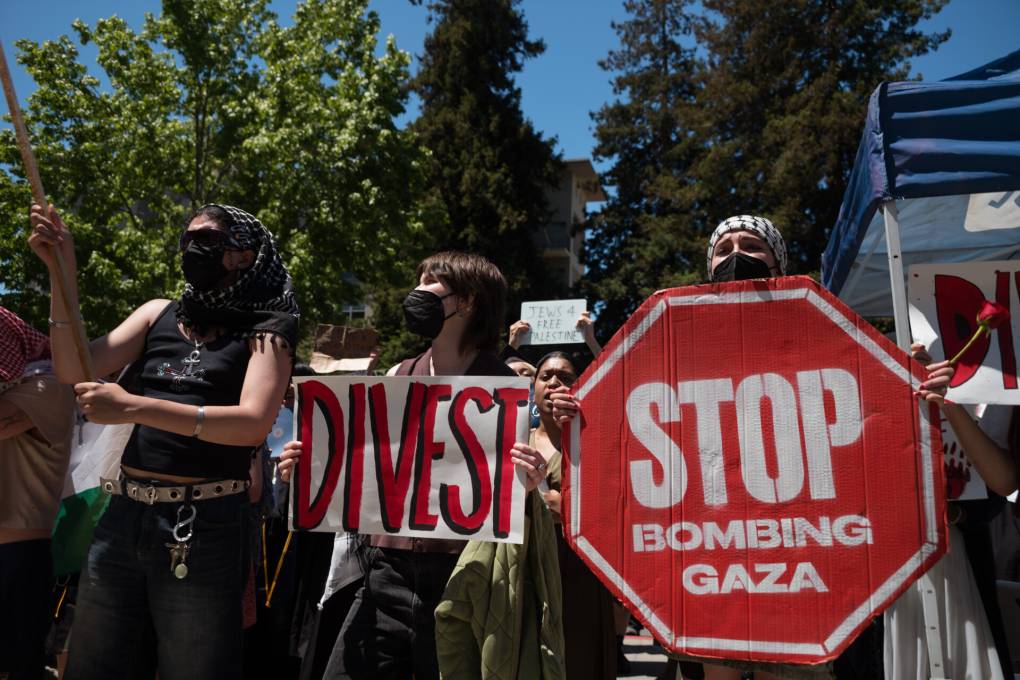
"caption": "Protesters at UC Berkeley call on the university to divest from companies supporting Israel and to support a call for a cease-fire in Gaza.",
"description": null,
"title": "L1005151_qut",
"credit": "Aryk Copley/KQED",
"status": "inherit",
"altTag": "Two college-age students hold up signs that say 'Divest' and 'stop bombing Gaza.'",
"isLoading": false,
"fetchFailed": false
},
"news_11986579": {
"type": "attachments",
"id": "news_11986579",
"meta": {
"index": "attachments_1716263798",
"site": "news",
"id": "11986579",
"found": true
},
"parent": 11986546,
"imgSizes": {
"twentyfourteen-full-width": {
"file": "https://cdn.kqed.org/wp-content/uploads/sites/10/2024/05/E08245BF-C0B5-4CAF-A719-C712141E530F_qut-1038x576.jpg",
"width": 1038,
"mimeType": "image/jpeg",
"height": 576
},
"thumbnail": {
"file": "https://cdn.kqed.org/wp-content/uploads/sites/10/2024/05/E08245BF-C0B5-4CAF-A719-C712141E530F_qut-160x107.jpg",
"width": 160,
"mimeType": "image/jpeg",
"height": 107
},
"post-thumbnail": {
"file": "https://cdn.kqed.org/wp-content/uploads/sites/10/2024/05/E08245BF-C0B5-4CAF-A719-C712141E530F_qut-672x372.jpg",
"width": 672,
"mimeType": "image/jpeg",
"height": 372
},
"kqedFullSize": {
"file": "https://cdn.kqed.org/wp-content/uploads/sites/10/2024/05/E08245BF-C0B5-4CAF-A719-C712141E530F_qut.jpg",
"width": 1920,
"height": 1280
},
"large": {
"file": "https://cdn.kqed.org/wp-content/uploads/sites/10/2024/05/E08245BF-C0B5-4CAF-A719-C712141E530F_qut-1020x680.jpg",
"width": 1020,
"mimeType": "image/jpeg",
"height": 680
},
"1536x1536": {
"file": "https://cdn.kqed.org/wp-content/uploads/sites/10/2024/05/E08245BF-C0B5-4CAF-A719-C712141E530F_qut-1536x1024.jpg",
"width": 1536,
"mimeType": "image/jpeg",
"height": 1024
},
"medium": {
"file": "https://cdn.kqed.org/wp-content/uploads/sites/10/2024/05/E08245BF-C0B5-4CAF-A719-C712141E530F_qut-800x533.jpg",
"width": 800,
"mimeType": "image/jpeg",
"height": 533
}
},
"publishDate": 1715893464,
"modified": 1715969143,
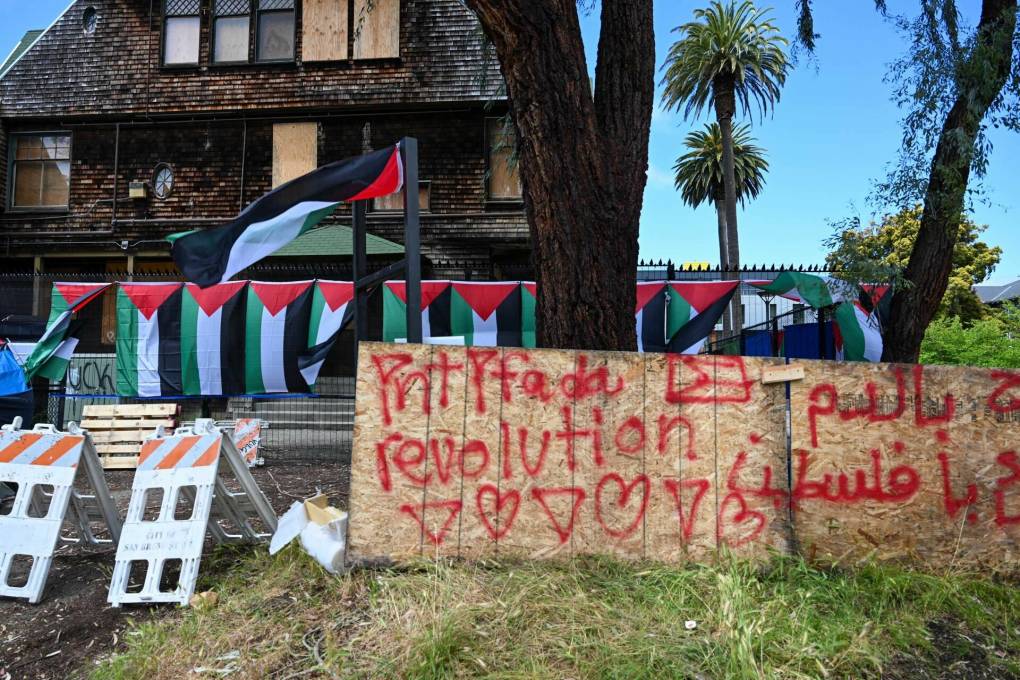
"caption": "Barricades and flags surround Anna Head Alumnae Hall in Berkeley on May 16, 2024. The building is an abandoned UC Berkeley building near People’s Park, which pro-Palestinian activists occupy.",
"description": null,
"title": "E08245BF-C0B5-4CAF-A719-C712141E530F_qut",
"credit": "Beth LaBerge/KQED",
"status": "inherit",
"altTag": null,
"isLoading": false,
"fetchFailed": false
},
"news_11986578": {
"type": "attachments",
"id": "news_11986578",
"meta": {
"index": "attachments_1716263798",
"site": "news",
"id": "11986578",
"found": true
},
"parent": 11986546,
"imgSizes": {
"twentyfourteen-full-width": {
"file": "https://cdn.kqed.org/wp-content/uploads/sites/10/2024/05/020FAA02-736A-40D4-834F-1886DEB22C6E_qut-1038x576.jpg",
"width": 1038,
"mimeType": "image/jpeg",
"height": 576
},
"thumbnail": {
"file": "https://cdn.kqed.org/wp-content/uploads/sites/10/2024/05/020FAA02-736A-40D4-834F-1886DEB22C6E_qut-160x107.jpg",
"width": 160,
"mimeType": "image/jpeg",
"height": 107
},
"post-thumbnail": {
"file": "https://cdn.kqed.org/wp-content/uploads/sites/10/2024/05/020FAA02-736A-40D4-834F-1886DEB22C6E_qut-672x372.jpg",
"width": 672,
"mimeType": "image/jpeg",
"height": 372
},
"kqedFullSize": {
"file": "https://cdn.kqed.org/wp-content/uploads/sites/10/2024/05/020FAA02-736A-40D4-834F-1886DEB22C6E_qut.jpg",
"width": 1920,
"height": 1280
},
"large": {
"file": "https://cdn.kqed.org/wp-content/uploads/sites/10/2024/05/020FAA02-736A-40D4-834F-1886DEB22C6E_qut-1020x680.jpg",
"width": 1020,
"mimeType": "image/jpeg",
"height": 680
},
"1536x1536": {
"file": "https://cdn.kqed.org/wp-content/uploads/sites/10/2024/05/020FAA02-736A-40D4-834F-1886DEB22C6E_qut-1536x1024.jpg",
"width": 1536,
"mimeType": "image/jpeg",
"height": 1024
},
"medium": {
"file": "https://cdn.kqed.org/wp-content/uploads/sites/10/2024/05/020FAA02-736A-40D4-834F-1886DEB22C6E_qut-800x533.jpg",
"width": 800,
"mimeType": "image/jpeg",
"height": 533
}
},
"publishDate": 1715893461,
"modified": 1715895988,
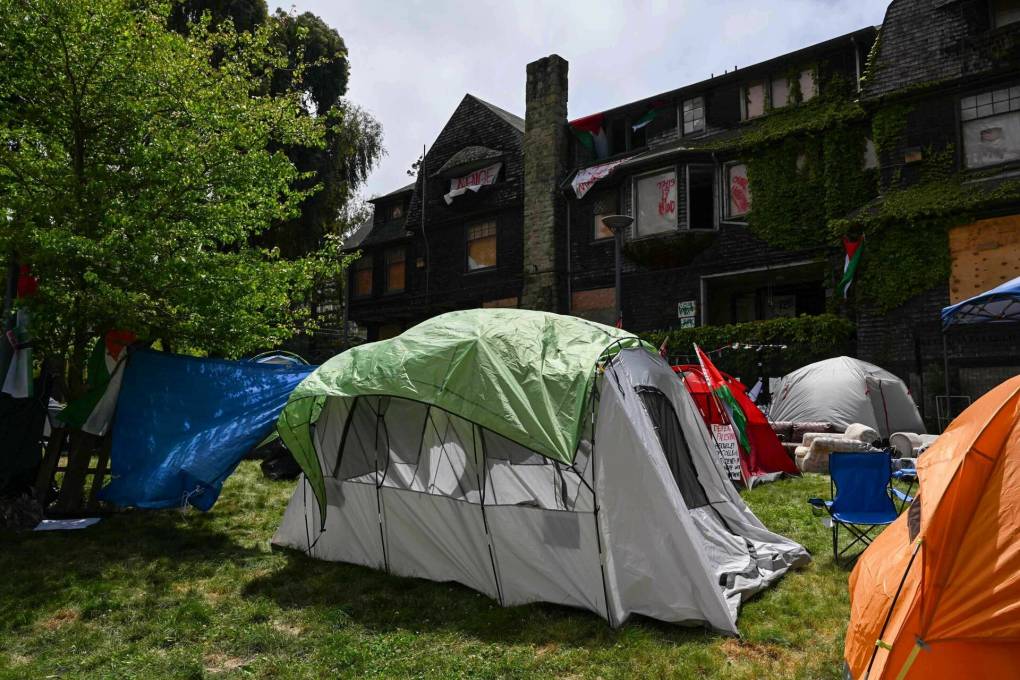
"caption": "Tents fill the yard at Anna Head Alumnae Hall in Berkeley on May 16, 2024, an abandoned UC Berkeley building near People’s Park that is occupied by pro-Palestinian activists.",
"description": null,
"title": "020FAA02-736A-40D4-834F-1886DEB22C6E_qut",
"credit": "Beth LaBerge/KQED",
"status": "inherit",
"altTag": null,
"isLoading": false,
"fetchFailed": false
},
"news_11986302": {
"type": "attachments",
"id": "news_11986302",
"meta": {
"index": "attachments_1716263798",
"site": "news",
"id": "11986302",
"found": true
},
"parent": 11986301,
"imgSizes": {
"twentyfourteen-full-width": {
"file": "https://cdn.kqed.org/wp-content/uploads/sites/10/2024/05/081922_San-Diego-State_AD_CM_01-1038x576.jpg",
"width": 1038,
"mimeType": "image/jpeg",
"height": 576
},
"thumbnail": {
"file": "https://cdn.kqed.org/wp-content/uploads/sites/10/2024/05/081922_San-Diego-State_AD_CM_01-160x107.jpg",
"width": 160,
"mimeType": "image/jpeg",
"height": 107
},
"post-thumbnail": {
"file": "https://cdn.kqed.org/wp-content/uploads/sites/10/2024/05/081922_San-Diego-State_AD_CM_01-672x372.jpg",
"width": 672,
"mimeType": "image/jpeg",
"height": 372
},
"kqedFullSize": {
"file": "https://cdn.kqed.org/wp-content/uploads/sites/10/2024/05/081922_San-Diego-State_AD_CM_01.jpg",
"width": 2000,
"height": 1333
},
"large": {
"file": "https://cdn.kqed.org/wp-content/uploads/sites/10/2024/05/081922_San-Diego-State_AD_CM_01-1020x680.jpg",
"width": 1020,
"mimeType": "image/jpeg",
"height": 680
},
"1536x1536": {
"file": "https://cdn.kqed.org/wp-content/uploads/sites/10/2024/05/081922_San-Diego-State_AD_CM_01-1536x1024.jpg",
"width": 1536,
"mimeType": "image/jpeg",
"height": 1024
},
"full-width": {
"file": "https://cdn.kqed.org/wp-content/uploads/sites/10/2024/05/081922_San-Diego-State_AD_CM_01-1920x1280.jpg",
"width": 1920,
"mimeType": "image/jpeg",
"height": 1280
},
"medium": {
"file": "https://cdn.kqed.org/wp-content/uploads/sites/10/2024/05/081922_San-Diego-State_AD_CM_01-800x533.jpg",
"width": 800,
"mimeType": "image/jpeg",
"height": 533
}
},
"publishDate": 1715794568,
"modified": 1715801286,
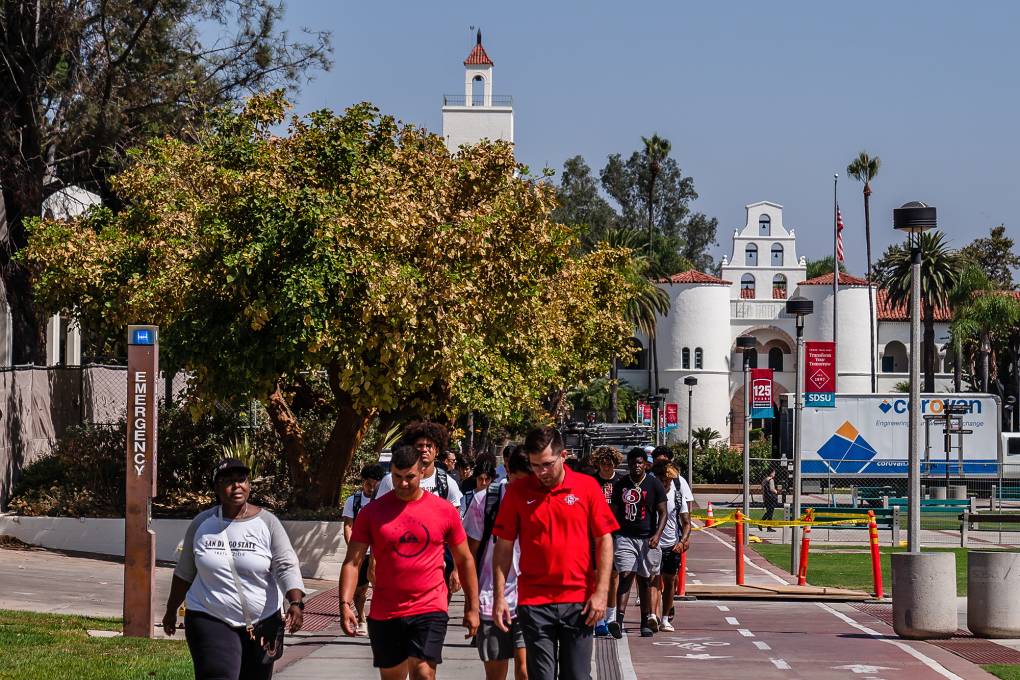
"caption": "Students walking at the San Diego State University campus on Aug. 19, 2022.",
"description": null,
"title": "Students walking at the San Diego State University campus on August 19, 2022.",
"credit": "Ariana Drehsler/CalMatters",
"status": "inherit",
"altTag": "People walk down a street with a college campus in the background.",
"isLoading": false,
"fetchFailed": false
},
"news_11986327": {
"type": "attachments",
"id": "news_11986327",
"meta": {
"index": "attachments_1716263798",
"site": "news",
"id": "11986327",
"found": true
},
"parent": 11986306,
"imgSizes": {
"twentyfourteen-full-width": {
"file": "https://cdn.kqed.org/wp-content/uploads/sites/10/2024/05/IMG_5164-MG-01-KQED-1038x576.jpg",
"width": 1038,
"mimeType": "image/jpeg",
"height": 576
},
"thumbnail": {
"file": "https://cdn.kqed.org/wp-content/uploads/sites/10/2024/05/IMG_5164-MG-01-KQED-160x107.jpg",
"width": 160,
"mimeType": "image/jpeg",
"height": 107
},
"post-thumbnail": {
"file": "https://cdn.kqed.org/wp-content/uploads/sites/10/2024/05/IMG_5164-MG-01-KQED-672x372.jpg",
"width": 672,
"mimeType": "image/jpeg",
"height": 372
},
"kqedFullSize": {
"file": "https://cdn.kqed.org/wp-content/uploads/sites/10/2024/05/IMG_5164-MG-01-KQED.jpg",
"width": 2000,
"height": 1333
},
"large": {
"file": "https://cdn.kqed.org/wp-content/uploads/sites/10/2024/05/IMG_5164-MG-01-KQED-1020x680.jpg",
"width": 1020,
"mimeType": "image/jpeg",
"height": 680
},
"1536x1536": {
"file": "https://cdn.kqed.org/wp-content/uploads/sites/10/2024/05/IMG_5164-MG-01-KQED-1536x1024.jpg",
"width": 1536,
"mimeType": "image/jpeg",
"height": 1024
},
"full-width": {
"file": "https://cdn.kqed.org/wp-content/uploads/sites/10/2024/05/IMG_5164-MG-01-KQED-1920x1280.jpg",
"width": 1920,
"mimeType": "image/jpeg",
"height": 1280
},
"medium": {
"file": "https://cdn.kqed.org/wp-content/uploads/sites/10/2024/05/IMG_5164-MG-01-KQED-800x533.jpg",
"width": 800,
"mimeType": "image/jpeg",
"height": 533
}
},
"publishDate": 1715797693,
"modified": 1715797995,
"caption": "The pro-Palestinian protest encampment on UC Berkeley's Sproul Plaza is dismantled on Tuesday, May 14, 2024, after an agreement between students and the university.",
"description": null,
"title": "IMG_5164-MG-01-KQED",
"credit": "Matthew Green/KQED",
"status": "inherit",
"altTag": null,
"isLoading": false,
"fetchFailed": false
},
"news_11984188": {
"type": "attachments",
"id": "news_11984188",
"meta": {
"index": "attachments_1716263798",
"site": "news",
"id": "11984188",
"found": true
},
"parent": 11984140,
"imgSizes": {
"twentyfourteen-full-width": {
"file": "https://cdn.kqed.org/wp-content/uploads/sites/10/2024/04/240423-BERKELEY-GAZA-ENCAMPMENT-MD-02_qut-1-1038x576.jpg",
"width": 1038,
"mimeType": "image/jpeg",
"height": 576
},
"thumbnail": {
"file": "https://cdn.kqed.org/wp-content/uploads/sites/10/2024/04/240423-BERKELEY-GAZA-ENCAMPMENT-MD-02_qut-1-160x107.jpg",
"width": 160,
"mimeType": "image/jpeg",
"height": 107
},
"post-thumbnail": {
"file": "https://cdn.kqed.org/wp-content/uploads/sites/10/2024/04/240423-BERKELEY-GAZA-ENCAMPMENT-MD-02_qut-1-672x372.jpg",
"width": 672,
"mimeType": "image/jpeg",
"height": 372
},
"kqedFullSize": {
"file": "https://cdn.kqed.org/wp-content/uploads/sites/10/2024/04/240423-BERKELEY-GAZA-ENCAMPMENT-MD-02_qut-1.jpg",
"width": 1920,
"height": 1280
},
"large": {
"file": "https://cdn.kqed.org/wp-content/uploads/sites/10/2024/04/240423-BERKELEY-GAZA-ENCAMPMENT-MD-02_qut-1-1020x680.jpg",
"width": 1020,
"mimeType": "image/jpeg",
"height": 680
},
"1536x1536": {
"file": "https://cdn.kqed.org/wp-content/uploads/sites/10/2024/04/240423-BERKELEY-GAZA-ENCAMPMENT-MD-02_qut-1-1536x1024.jpg",
"width": 1536,
"mimeType": "image/jpeg",
"height": 1024
},
"medium": {
"file": "https://cdn.kqed.org/wp-content/uploads/sites/10/2024/04/240423-BERKELEY-GAZA-ENCAMPMENT-MD-02_qut-1-800x533.jpg",
"width": 800,
"mimeType": "image/jpeg",
"height": 533
}
},
"publishDate": 1714162142,
"modified": 1715798157,
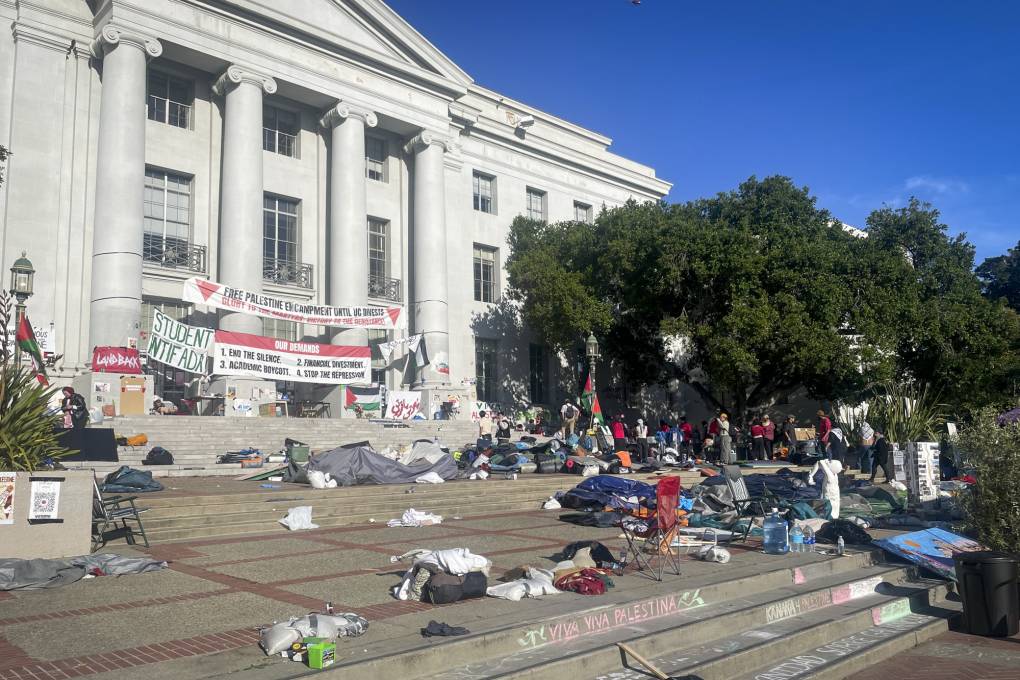
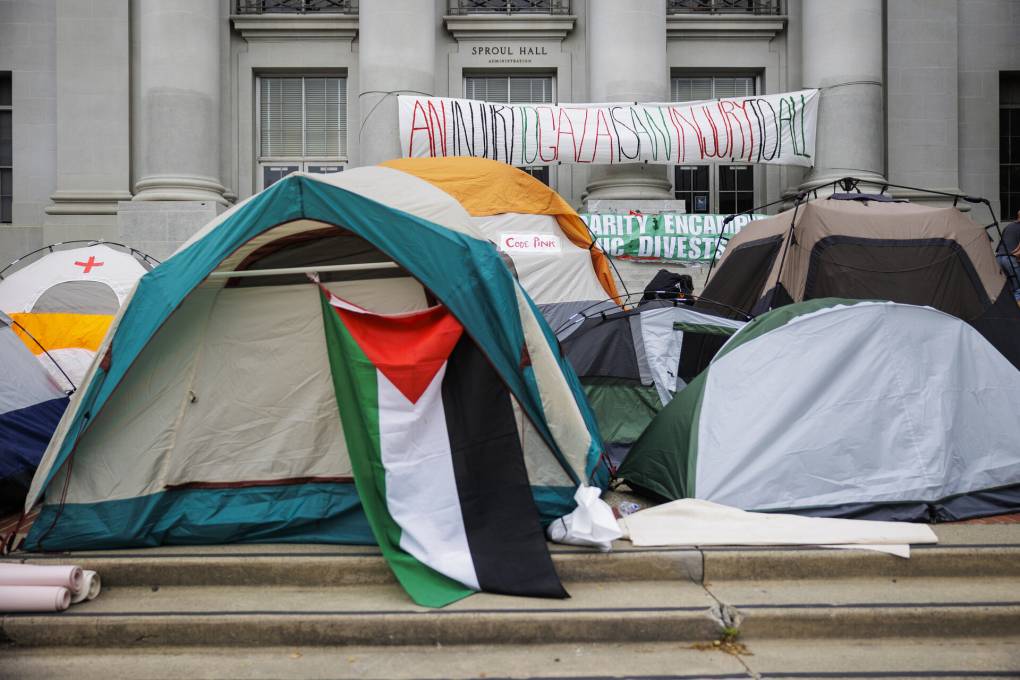
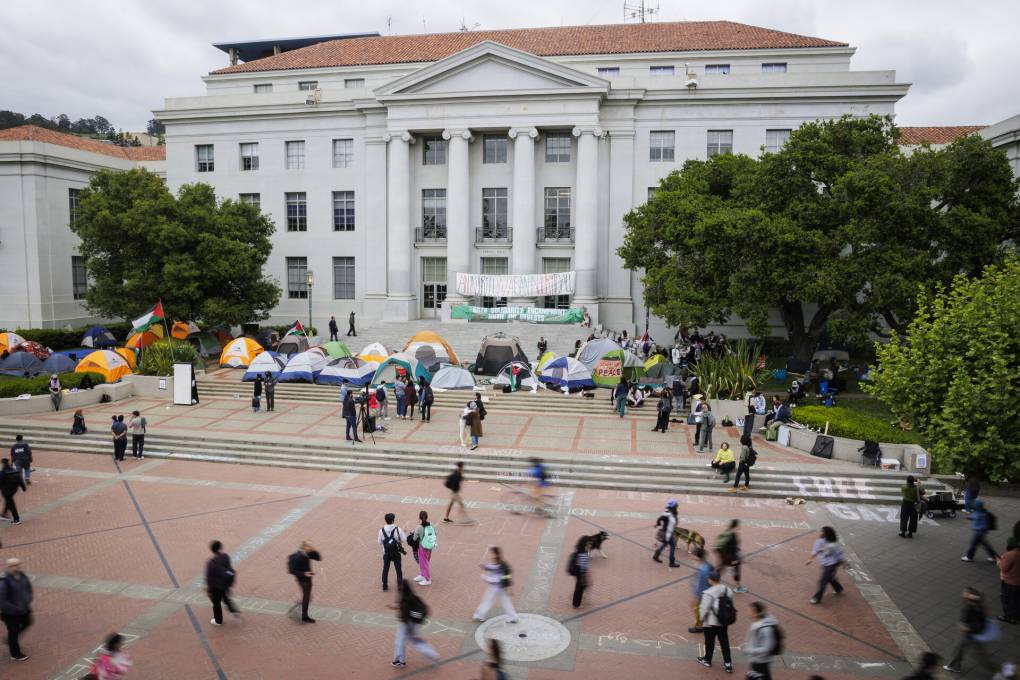
"caption": "The UC Berkeley Gaza Solidarity Encampment in front of Sproul Hall on April 23, 2024.",
"description": null,
"title": "240423-BERKELEY GAZA ENCAMPMENT-MD-02_qut (1)",
"credit": "Martin do Nascimento/KQED",
"status": "inherit",
"altTag": "Tents are set up on the steps leading up to a building. A red-white-green-black Palestinian flag hangs from one tent. One banner hung from the building in the background says: 'An injury to Gaza is an injury to us all.' Another says: 'Divest.'",
"isLoading": false,
"fetchFailed": false
},
"news_11986245": {
"type": "attachments",
"id": "news_11986245",
"meta": {
"index": "attachments_1716263798",
"site": "news",
"id": "11986245",
"found": true
},
"parent": 11986194,
"imgSizes": {
"twentyfourteen-full-width": {
"file": "https://cdn.kqed.org/wp-content/uploads/sites/10/2024/05/9AC167B8-3D82-4AF2-9121-585F5E8B99EB-e1715732459324-828x576.jpg",
"width": 828,
"mimeType": "image/jpeg",
"height": 576
},
"thumbnail": {
"file": "https://cdn.kqed.org/wp-content/uploads/sites/10/2024/05/9AC167B8-3D82-4AF2-9121-585F5E8B99EB-e1715732459324-160x125.jpg",
"width": 160,
"mimeType": "image/jpeg",
"height": 125
},
"post-thumbnail": {
"file": "https://cdn.kqed.org/wp-content/uploads/sites/10/2024/05/9AC167B8-3D82-4AF2-9121-585F5E8B99EB-e1715732459324-672x372.jpg",
"width": 672,
"mimeType": "image/jpeg",
"height": 372
},
"kqedFullSize": {
"file": "https://cdn.kqed.org/wp-content/uploads/sites/10/2024/05/9AC167B8-3D82-4AF2-9121-585F5E8B99EB-e1715732459324.jpg",
"width": 828,
"height": 649
},
"medium": {
"file": "https://cdn.kqed.org/wp-content/uploads/sites/10/2024/05/9AC167B8-3D82-4AF2-9121-585F5E8B99EB-e1715732459324-800x627.jpg",
"width": 800,
"mimeType": "image/jpeg",
"height": 627
}
},
"publishDate": 1715732428,
"modified": 1715734345,
"caption": "The student protest encampment that was set up again Tuesday outside Kalmanovitz Library at the UCSF campus, San Francisco, on May 14, 2024.",
"description": null,
"title": "9AC167B8-3D82-4AF2-9121-585F5E8B99EB",
"credit": "Courtesy of ucsf4palestine via Instagram",
"status": "inherit",
"altTag": null,
"isLoading": false,
"fetchFailed": false
},
"news_11966205": {
"type": "attachments",
"id": "news_11966205",
"meta": {
"index": "attachments_1716263798",
"site": "news",
"id": "11966205",
"found": true
},
"parent": 0,
"imgSizes": {
"twentyfourteen-full-width": {
"file": "https://cdn.kqed.org/wp-content/uploads/sites/10/2023/11/231102-CRISTINA-MORA-MD-08-KQED-1038x576.jpg",
"width": 1038,
"mimeType": "image/jpeg",
"height": 576
},
"thumbnail": {
"file": "https://cdn.kqed.org/wp-content/uploads/sites/10/2023/11/231102-CRISTINA-MORA-MD-08-KQED-160x107.jpg",
"width": 160,
"mimeType": "image/jpeg",
"height": 107
},
"post-thumbnail": {
"file": "https://cdn.kqed.org/wp-content/uploads/sites/10/2023/11/231102-CRISTINA-MORA-MD-08-KQED-672x372.jpg",
"width": 672,
"mimeType": "image/jpeg",
"height": 372
},
"kqedFullSize": {
"file": "https://cdn.kqed.org/wp-content/uploads/sites/10/2023/11/231102-CRISTINA-MORA-MD-08-KQED.jpg?ver=1698939138",
"width": 2000,
"height": 1333
},
"large": {
"file": "https://cdn.kqed.org/wp-content/uploads/sites/10/2023/11/231102-CRISTINA-MORA-MD-08-KQED-1020x680.jpg",
"width": 1020,
"mimeType": "image/jpeg",
"height": 680
},
"1536x1536": {
"file": "https://cdn.kqed.org/wp-content/uploads/sites/10/2023/11/231102-CRISTINA-MORA-MD-08-KQED-1536x1024.jpg",
"width": 1536,
"mimeType": "image/jpeg",
"height": 1024
},
"full-width": {
"file": "https://cdn.kqed.org/wp-content/uploads/sites/10/2023/11/231102-CRISTINA-MORA-MD-08-KQED-1920x1280.jpg",
"width": 1920,
"mimeType": "image/jpeg",
"height": 1280
},
"medium": {
"file": "https://cdn.kqed.org/wp-content/uploads/sites/10/2023/11/231102-CRISTINA-MORA-MD-08-KQED-800x533.jpg",
"width": 800,
"mimeType": "image/jpeg",
"height": 533
}
},
"publishDate": 1698932680,
"modified": 1715721173,
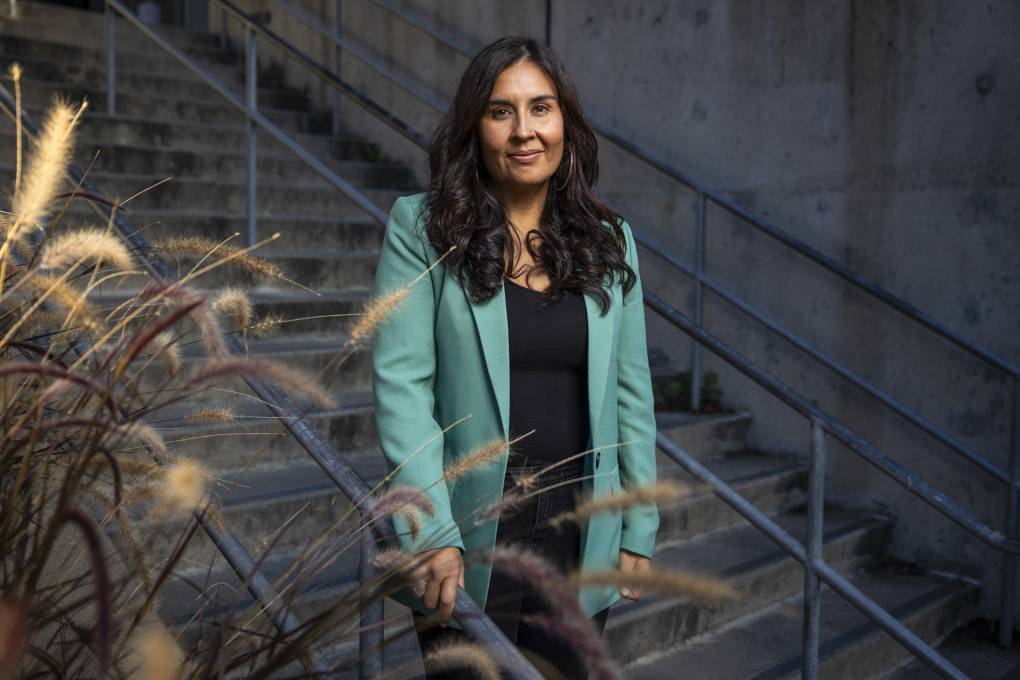
"caption": "UC Berkeley Professor G. Cristina Mora outside the Social Sciences Building on Nov. 1, 2023.",
"description": null,
"title": "231102-CRISTINA MORA-MD-08-KQED",
"credit": "Martin do Nascimento/KQED",
"status": "inherit",
"altTag": "A person with long hair in a teal sport coat stands on a cement outdoor staircase and looks at the camera.",
"isLoading": false,
"fetchFailed": false
},
"news_11985864": {
"type": "attachments",
"id": "news_11985864",
"meta": {
"index": "attachments_1716263798",
"site": "news",
"id": "11985864",
"found": true
},
"parent": 11985856,
"imgSizes": {
"twentyfourteen-full-width": {
"file": "https://cdn.kqed.org/wp-content/uploads/sites/10/2024/05/DSC8380_qut-1038x576.jpg",
"width": 1038,
"mimeType": "image/jpeg",
"height": 576
},
"thumbnail": {
"file": "https://cdn.kqed.org/wp-content/uploads/sites/10/2024/05/DSC8380_qut-160x107.jpg",
"width": 160,
"mimeType": "image/jpeg",
"height": 107
},
"post-thumbnail": {
"file": "https://cdn.kqed.org/wp-content/uploads/sites/10/2024/05/DSC8380_qut-672x372.jpg",
"width": 672,
"mimeType": "image/jpeg",
"height": 372
},
"kqedFullSize": {
"file": "https://cdn.kqed.org/wp-content/uploads/sites/10/2024/05/DSC8380_qut.jpg",
"width": 1920,
"height": 1280
},
"large": {
"file": "https://cdn.kqed.org/wp-content/uploads/sites/10/2024/05/DSC8380_qut-1020x680.jpg",
"width": 1020,
"mimeType": "image/jpeg",
"height": 680
},
"1536x1536": {
"file": "https://cdn.kqed.org/wp-content/uploads/sites/10/2024/05/DSC8380_qut-1536x1024.jpg",
"width": 1536,
"mimeType": "image/jpeg",
"height": 1024
},
"medium": {
"file": "https://cdn.kqed.org/wp-content/uploads/sites/10/2024/05/DSC8380_qut-800x533.jpg",
"width": 800,
"mimeType": "image/jpeg",
"height": 533
}
},
"publishDate": 1715475606,
"modified": 1715629227,
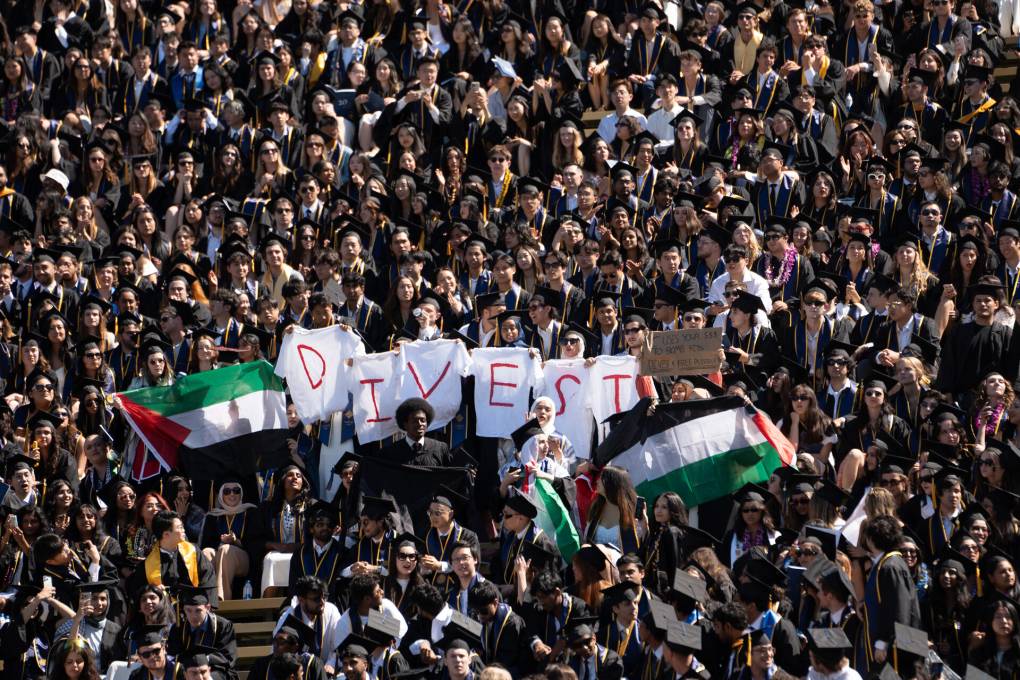
"caption": "Students hold up homemade signs and shirts to protest against UC Berkeley's links to companies in Israel or those that they say profit from Israel's war in Gaza during the 2024 commencement ceremony at the California Memorial Stadium in Berkeley on May 11, 2024.",
"description": null,
"title": "_DSC8380_qut",
"credit": "Aryk Copley/KQED",
"status": "inherit",
"altTag": null,
"isLoading": false,
"fetchFailed": false
},
"news_11984220": {
"type": "attachments",
"id": "news_11984220",
"meta": {
"index": "attachments_1716263798",
"site": "news",
"id": "11984220",
"found": true
},
"parent": 11984203,
"imgSizes": {
"twentyfourteen-full-width": {
"file": "https://cdn.kqed.org/wp-content/uploads/sites/10/2024/04/240424-BERKELEY-GAZA-ENCAMPMENT-MD-06_qut-1038x576.jpg",
"width": 1038,
"mimeType": "image/jpeg",
"height": 576
},
"thumbnail": {
"file": "https://cdn.kqed.org/wp-content/uploads/sites/10/2024/04/240424-BERKELEY-GAZA-ENCAMPMENT-MD-06_qut-160x107.jpg",
"width": 160,
"mimeType": "image/jpeg",
"height": 107
},
"post-thumbnail": {
"file": "https://cdn.kqed.org/wp-content/uploads/sites/10/2024/04/240424-BERKELEY-GAZA-ENCAMPMENT-MD-06_qut-672x372.jpg",
"width": 672,
"mimeType": "image/jpeg",
"height": 372
},
"kqedFullSize": {
"file": "https://cdn.kqed.org/wp-content/uploads/sites/10/2024/04/240424-BERKELEY-GAZA-ENCAMPMENT-MD-06_qut.jpg",
"width": 1920,
"height": 1280
},
"large": {
"file": "https://cdn.kqed.org/wp-content/uploads/sites/10/2024/04/240424-BERKELEY-GAZA-ENCAMPMENT-MD-06_qut-1020x680.jpg",
"width": 1020,
"mimeType": "image/jpeg",
"height": 680
},
"1536x1536": {
"file": "https://cdn.kqed.org/wp-content/uploads/sites/10/2024/04/240424-BERKELEY-GAZA-ENCAMPMENT-MD-06_qut-1536x1024.jpg",
"width": 1536,
"mimeType": "image/jpeg",
"height": 1024
},
"medium": {
"file": "https://cdn.kqed.org/wp-content/uploads/sites/10/2024/04/240424-BERKELEY-GAZA-ENCAMPMENT-MD-06_qut-800x533.jpg",
"width": 800,
"mimeType": "image/jpeg",
"height": 533
}
},
"publishDate": 1714165963,
"modified": 1714593047,
"caption": "The UC Berkeley Gaza Solidarity Encampment in front of Sproul Hall in Berkeley on April 24.",
"description": null,
"title": "240424-BERKELEY GAZA ENCAMPMENT-MD-06_qut",
"credit": "Martin do Nascimento/KQED",
"status": "inherit",
"altTag": null,
"isLoading": false,
"fetchFailed": false
},
"news_11985803": {
"type": "attachments",
"id": "news_11985803",
"meta": {
"index": "attachments_1716263798",
"site": "news",
"id": "11985803",
"found": true
},
"parent": 11985802,
"imgSizes": {
"twentyfourteen-full-width": {
"file": "https://cdn.kqed.org/wp-content/uploads/sites/10/2024/05/AP24131131133334-1038x576.jpg",
"width": 1038,
"mimeType": "image/jpeg",
"height": 576
},
"thumbnail": {
"file": "https://cdn.kqed.org/wp-content/uploads/sites/10/2024/05/AP24131131133334-160x107.jpg",
"width": 160,
"mimeType": "image/jpeg",
"height": 107
},
"post-thumbnail": {
"file": "https://cdn.kqed.org/wp-content/uploads/sites/10/2024/05/AP24131131133334-672x372.jpg",
"width": 672,
"mimeType": "image/jpeg",
"height": 372
},
"kqedFullSize": {
"file": "https://cdn.kqed.org/wp-content/uploads/sites/10/2024/05/AP24131131133334-scaled.jpg",
"width": 2560,
"height": 1707
},
"2048x2048": {
"file": "https://cdn.kqed.org/wp-content/uploads/sites/10/2024/05/AP24131131133334-2048x1365.jpg",
"width": 2048,
"mimeType": "image/jpeg",
"height": 1365
},
"large": {
"file": "https://cdn.kqed.org/wp-content/uploads/sites/10/2024/05/AP24131131133334-1020x680.jpg",
"width": 1020,
"mimeType": "image/jpeg",
"height": 680
},
"1536x1536": {
"file": "https://cdn.kqed.org/wp-content/uploads/sites/10/2024/05/AP24131131133334-1536x1024.jpg",
"width": 1536,
"mimeType": "image/jpeg",
"height": 1024
},
"full-width": {
"file": "https://cdn.kqed.org/wp-content/uploads/sites/10/2024/05/AP24131131133334-1920x1280.jpg",
"width": 1920,
"mimeType": "image/jpeg",
"height": 1280
},
"medium": {
"file": "https://cdn.kqed.org/wp-content/uploads/sites/10/2024/05/AP24131131133334-800x533.jpg",
"width": 800,
"mimeType": "image/jpeg",
"height": 533
}
},
"publishDate": 1715389528,
"modified": 1715389590,
"caption": "A Pac-12 logo is shown on the floor of Haas Pavilion as California forward Fardaws Aimaq (00) looks to pass while being defended by UCLA guard Brandon Williams during an NCAA college basketball game in Berkeley, Feb. 10, 2024. The University of California Board of Regents is expected to accept a recommendation that UCLA pay University of California at Berkeley $10 million a year for 6 years as a result of the Bruins’ upcoming move to the Big Ten and the demise of the Pac-12. ",
"description": null,
"title": "Fardaws AimaqBrandon Williams",
"credit": "Jeff Chiu/AP Photo",
"status": "inherit",
"altTag": null,
"isLoading": false,
"fetchFailed": false
},
"news_11985375": {
"type": "attachments",
"id": "news_11985375",
"meta": {
"index": "attachments_1716263798",
"site": "news",
"id": "11985375",
"found": true
},
"parent": 11985335,
"imgSizes": {
"twentyfourteen-full-width": {
"file": "https://cdn.kqed.org/wp-content/uploads/sites/10/2024/05/GettyImages-2152066925-1024x576.jpg",
"width": 1024,
"mimeType": "image/jpeg",
"height": 576
},
"thumbnail": {
"file": "https://cdn.kqed.org/wp-content/uploads/sites/10/2024/05/GettyImages-2152066925-160x107.jpg",
"width": 160,
"mimeType": "image/jpeg",
"height": 107
},
"post-thumbnail": {
"file": "https://cdn.kqed.org/wp-content/uploads/sites/10/2024/05/GettyImages-2152066925-672x372.jpg",
"width": 672,
"mimeType": "image/jpeg",
"height": 372
},
"kqedFullSize": {
"file": "https://cdn.kqed.org/wp-content/uploads/sites/10/2024/05/GettyImages-2152066925.jpg",
"width": 1024,
"height": 683
},
"large": {
"file": "https://cdn.kqed.org/wp-content/uploads/sites/10/2024/05/GettyImages-2152066925-1020x680.jpg",
"width": 1020,
"mimeType": "image/jpeg",
"height": 680
},
"medium": {
"file": "https://cdn.kqed.org/wp-content/uploads/sites/10/2024/05/GettyImages-2152066925-800x534.jpg",
"width": 800,
"mimeType": "image/jpeg",
"height": 534
}
},
"publishDate": 1715196832,
"modified": 1715200335,
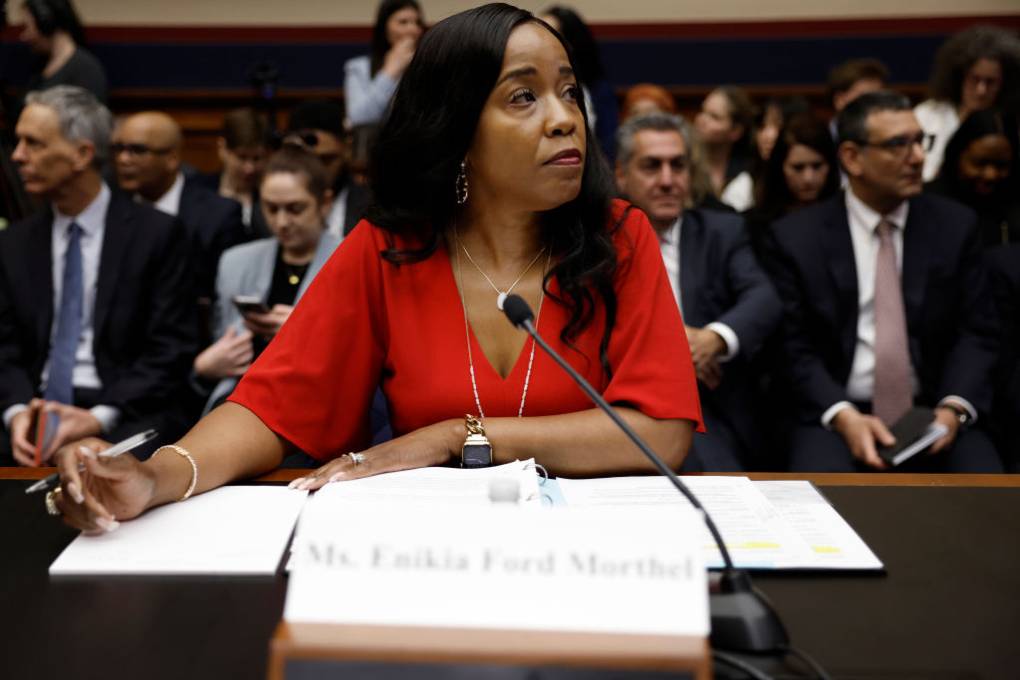
"caption": "Enikia Ford Morthel, superintendent of the Berkeley Unified School District, listens during a hearing with subcommittee members of the House Education and the Workforce Committee on May 8, 2024, in Washington, D.C.",
"description": null,
"title": "House Committee Holds Hearing Examining Antisemitism In K-12 Schools",
"credit": "Anna Moneymaker/Getty Images",
"status": "inherit",
"altTag": "A Black woman in a red dress sits in front of a microphone.",
"isLoading": false,
"fetchFailed": false
}
},
"audioPlayerReducer": {
"postId": "stream_live",
"isPaused": true,
"isPlaying": false,
"pfsActive": false,
"pledgeModalIsOpen": true,
"playerDrawerIsOpen": false,
"liveAudioPlayStartedAt": 0,
"liveAudioPlayContext": ""
},
"authorsReducer": {
"byline_news_11986301": {
"type": "authors",
"id": "byline_news_11986301",
"meta": {
"override": true
},
"slug": "byline_news_11986301",
"name": "Mikhail Zinshteyn, CalMatters",
"isLoading": false
},
"byline_news_11986280": {
"type": "authors",
"id": "byline_news_11986280",
"meta": {
"override": true
},
"slug": "byline_news_11986280",
"name": "Michael Burke, EdSource",
"isLoading": false
},
"byline_news_11985741": {
"type": "authors",
"id": "byline_news_11985741",
"meta": {
"override": true
},
"slug": "byline_news_11985741",
"name": "\u003ca href=\"https://edsource.org/author/mburke\">Michael Burke\u003c/a>",
"isLoading": false
},
"byline_news_11985802": {
"type": "authors",
"id": "byline_news_11985802",
"meta": {
"override": true
},
"slug": "byline_news_11985802",
"name": "Joe Reedy\u003cbr>Associated Press",
"isLoading": false
},
"kqednewsstaffandwires": {
"type": "authors",
"id": "237",
"meta": {
"index": "authors_1716337520",
"id": "237",
"found": true
},
"name": "KQED News Staff and Wires",
"firstName": "KQED News Staff and Wires",
"lastName": null,
"slug": "kqednewsstaffandwires",
"email": "onlinenewsstaff@kqed.org",
"display_author_email": false,
"staff_mastheads": [],
"title": null,
"bio": null,
"avatar": "https://secure.gravatar.com/avatar/72295af8ebbfbd19a4948f5271285664?s=600&d=blank&r=g",
"twitter": null,
"facebook": null,
"instagram": null,
"linkedin": null,
"sites": [
{
"site": "arts",
"roles": [
"contributor"
]
},
{
"site": "news",
"roles": [
"contributor"
]
},
{
"site": "lowdown",
"roles": [
"author"
]
},
{
"site": "stateofhealth",
"roles": [
"contributor"
]
},
{
"site": "food",
"roles": [
"author"
]
}
],
"headData": {
"title": "KQED News Staff and Wires | KQED",
"description": null,
"ogImgSrc": "https://secure.gravatar.com/avatar/72295af8ebbfbd19a4948f5271285664?s=600&d=blank&r=g",
"twImgSrc": "https://secure.gravatar.com/avatar/72295af8ebbfbd19a4948f5271285664?s=600&d=blank&r=g"
},
"isLoading": false,
"link": "/author/kqednewsstaffandwires"
},
"tarasiler": {
"type": "authors",
"id": "257",
"meta": {
"index": "authors_1716337520",
"id": "257",
"found": true
},
"name": "Tara Siler",
"firstName": "Tara",
"lastName": "Siler",
"slug": "tarasiler",
"email": "tsiler@kqed.org",
"display_author_email": false,
"staff_mastheads": [
"news"
],
"title": "KQED Contributor",
"bio": "Tara reports and anchors for KQED news. She covers a range of issues from community-police relations to local politics. Tara started out in community radio in the Bay Area, where she was raised. She eventually moved to Washington DC where she covered Congress for eight years for Pacifica and Monitor Radio. Her stories have also been heard on NPR's All Things Considered, Morning Edition and The World.\r\n\r\nTara lives with her husband in Oakland-- where they raised their two sons. She enjoys spending time with her family, gardening and hiking in the Oakland hills... and keeping up with the news.",
"avatar": "https://secure.gravatar.com/avatar/99802f9746fb80b65fd8ec6c57954450?s=600&d=blank&r=g",
"twitter": null,
"facebook": null,
"instagram": null,
"linkedin": null,
"sites": [
{
"site": "news",
"roles": [
"contributor",
"edit_others_posts"
]
},
{
"site": "stateofhealth",
"roles": [
"author"
]
}
],
"headData": {
"title": "Tara Siler | KQED",
"description": "KQED Contributor",
"ogImgSrc": "https://secure.gravatar.com/avatar/99802f9746fb80b65fd8ec6c57954450?s=600&d=blank&r=g",
"twImgSrc": "https://secure.gravatar.com/avatar/99802f9746fb80b65fd8ec6c57954450?s=600&d=blank&r=g"
},
"isLoading": false,
"link": "/author/tarasiler"
},
"kdomara": {
"type": "authors",
"id": "1459",
"meta": {
"index": "authors_1716337520",
"id": "1459",
"found": true
},
"name": "Kelly O'Mara",
"firstName": "Kelly",
"lastName": "O'Mara",
"slug": "kdomara",
"email": "komara@kqed.org",
"display_author_email": false,
"staff_mastheads": [
"news"
],
"title": "KQED Contributor",
"bio": "Kelly O'Mara is a writer and reporter in the San Francisco Bay Area. She writes about food, health, sports, travel, business and California news. Her work has appeared on KQED, online for Outside Magazine, epsnW, VICE and in Competitor Magazine, among others. Follow Kelly on Twitter \u003ca href=\"https://twitter.com/kellydomara\">@kellydomara\u003c/a>.",
"avatar": "https://secure.gravatar.com/avatar/768fec7412028b72f13bdd0f5f9d8186?s=600&d=blank&r=g",
"twitter": null,
"facebook": null,
"instagram": null,
"linkedin": null,
"sites": [
{
"site": "arts",
"roles": []
},
{
"site": "news",
"roles": []
},
{
"site": "bayareabites",
"roles": []
},
{
"site": "stateofhealth",
"roles": []
},
{
"site": "science",
"roles": []
},
{
"site": "checkplease",
"roles": [
"editor"
]
},
{
"site": "food",
"roles": []
},
{
"site": "forum",
"roles": [
"editor"
]
},
{
"site": "liveblog",
"roles": [
"editor"
]
}
],
"headData": {
"title": "Kelly O'Mara | KQED",
"description": "KQED Contributor",
"ogImgSrc": "https://secure.gravatar.com/avatar/768fec7412028b72f13bdd0f5f9d8186?s=600&d=blank&r=g",
"twImgSrc": "https://secure.gravatar.com/avatar/768fec7412028b72f13bdd0f5f9d8186?s=600&d=blank&r=g"
},
"isLoading": false,
"link": "/author/kdomara"
},
"btorres": {
"type": "authors",
"id": "11666",
"meta": {
"index": "authors_1716337520",
"id": "11666",
"found": true
},
"name": "Blanca Torres",
"firstName": "Blanca",
"lastName": "Torres",
"slug": "btorres",
"email": "btorres@kqed.org",
"display_author_email": true,
"staff_mastheads": [
"news"
],
"title": "Producer, Forum",
"bio": "Blanca Torres brings sharp news judgement and keen sense of lively conversation to her work as producer for Forum. She loves producing shows that leave listeners feeling like they heard distinctive voices, learned something new and gained a fresh perspective.\r\n\r\nShe joined KQED in January of 2020 after 16 years of working as a newspaper reporter most recently at the \u003cem>San Francisco Business Times,\u003c/em> where she wrote about real estate and economic development. Before that, she covered a variety of beats including crime, education, retail, workplace, the economy, consumer issues, and small business for the \u003cem>Contra Costa Times, Baltimore Sun\u003c/em> and\u003cem> The Seattle Times\u003c/em>. In addition to reporting, she worked as an editorial writer and columnist for the \u003cem>Seattle Times\u003c/em>. From 2017 to 2020, Blanca won a total of ten awards from the National Association of Real Estate Editors and won first place for land use reporting from the California News Publishers Association two years in a row. She is also a member and former board member for the National Association of Hispanic Journalists.\r\n\r\nA native of the Pacific Northwest, Blanca earned her bachelor's degree from Vanderbilt University in Nashville and a master's in fine arts in creative writing at Mills College. She lives in the East Bay with her family.",
"avatar": "https://secure.gravatar.com/avatar/50b49d19b14a1eed34f26ebf4681152cdd81574ed21851100871ccd29e578cdc?s=600&d=blank&r=g",
"twitter": "@blancawrites",
"bluesky": null,
"facebook": null,
"instagram": null,
"linkedin": null,
"sites": [
{
"site": "arts",
"roles": [
"editor"
]
},
{
"site": "news",
"roles": [
"editor"
]
},
{
"site": "forum",
"roles": [
"editor"
]
}
],
"headData": {
"title": "Blanca Torres | KQED",
"description": "Producer, Forum",
"ogImgSrc": "https://secure.gravatar.com/avatar/50b49d19b14a1eed34f26ebf4681152cdd81574ed21851100871ccd29e578cdc?s=600&d=blank&r=g",
"twImgSrc": "https://secure.gravatar.com/avatar/50b49d19b14a1eed34f26ebf4681152cdd81574ed21851100871ccd29e578cdc?s=600&d=blank&r=g"
},
"isLoading": false,
"link": "/author/btorres"
},
"jrodriguez": {
"type": "authors",
"id": "11690",
"meta": {
"index": "authors_1716337520",
"id": "11690",
"found": true
},
"name": "Joe Fitzgerald Rodriguez",
"firstName": "Joe",
"lastName": "Fitzgerald Rodriguez",
"slug": "jrodriguez",
"email": "jrodriguez@kqed.org",
"display_author_email": true,
"staff_mastheads": [
"news"
],
"title": "Reporter and Producer",
"bio": "Joe Fitzgerald Rodriguez is a reporter and digital producer for KQED covering politics. Joe most recently wrote for the \u003cem>San Francisco Examiner\u003c/em> as a political columnist covering The City. He was raised in San Francisco and has spent his reporting career in his beloved, foggy, city by the bay. Joe was 12-years-old when he conducted his first interview in journalism, grilling former San Francisco Mayor Willie Brown for the Marina Middle School newspaper, \u003cem>The Penguin Press, \u003c/em>and he continues to report on the San Francisco Bay Area to this day.",
"avatar": "https://secure.gravatar.com/avatar/2247beb0564c1e9c62228d5649d2edac?s=600&d=blank&r=g",
"twitter": "FitztheReporter",
"facebook": null,
"instagram": "https://www.instagram.com/fitzthereporter/",
"linkedin": null,
"sites": [
{
"site": "",
"roles": [
"editor"
]
},
{
"site": "arts",
"roles": [
"editor"
]
},
{
"site": "news",
"roles": [
"editor"
]
},
{
"site": "science",
"roles": [
"editor"
]
},
{
"site": "elections",
"roles": [
"editor"
]
},
{
"site": "liveblog",
"roles": [
"editor"
]
}
],
"headData": {
"title": "Joe Fitzgerald Rodriguez | KQED",
"description": "Reporter and Producer",
"ogImgSrc": "https://secure.gravatar.com/avatar/2247beb0564c1e9c62228d5649d2edac?s=600&d=blank&r=g",
"twImgSrc": "https://secure.gravatar.com/avatar/2247beb0564c1e9c62228d5649d2edac?s=600&d=blank&r=g"
},
"isLoading": false,
"link": "/author/jrodriguez"
},
"jlara": {
"type": "authors",
"id": "11761",
"meta": {
"index": "authors_1716337520",
"id": "11761",
"found": true
},
"name": "Juan Carlos Lara",
"firstName": "Juan Carlos",
"lastName": "Lara",
"slug": "jlara",
"email": "jlara@kqed.org",
"display_author_email": false,
"staff_mastheads": [],
"title": "KQED Contributor",
"bio": null,
"avatar": "https://secure.gravatar.com/avatar/19e2052b9b05657c5ff2af2121846e9c?s=600&d=blank&r=g",
"twitter": null,
"facebook": null,
"instagram": null,
"linkedin": null,
"sites": [
{
"site": "arts",
"roles": [
"editor"
]
},
{
"site": "news",
"roles": [
"editor"
]
},
{
"site": "forum",
"roles": [
"editor"
]
},
{
"site": "liveblog",
"roles": [
"contributor"
]
}
],
"headData": {
"title": "Juan Carlos Lara | KQED",
"description": "KQED Contributor",
"ogImgSrc": "https://secure.gravatar.com/avatar/19e2052b9b05657c5ff2af2121846e9c?s=600&d=blank&r=g",
"twImgSrc": "https://secure.gravatar.com/avatar/19e2052b9b05657c5ff2af2121846e9c?s=600&d=blank&r=g"
},
"isLoading": false,
"link": "/author/jlara"
},
"naltenberg": {
"type": "authors",
"id": "11896",
"meta": {
"index": "authors_1716337520",
"id": "11896",
"found": true
},
"name": "Nik Altenberg",
"firstName": "Nik",
"lastName": "Altenberg",
"slug": "naltenberg",
"email": "naltenberg@kqed.org",
"display_author_email": false,
"staff_mastheads": [],
"title": "KQED Contributor",
"bio": "Nik Altenberg is an on-call reporter for KQED and a copy editor and fact checker for Santa Cruz Local. Nik’s reporting interests include policing, public health, environment, immigration, housing and the places where these issues intersect.",
"avatar": "https://secure.gravatar.com/avatar/e391b3a18ce4a53a7ca3f3065c74418b?s=600&d=blank&r=g",
"twitter": null,
"facebook": null,
"instagram": "https://www.instagram.com/nikaltenberg/",
"linkedin": null,
"sites": [
{
"site": "news",
"roles": []
}
],
"headData": {
"title": "Nik Altenberg | KQED",
"description": "KQED Contributor",
"ogImgSrc": "https://secure.gravatar.com/avatar/e391b3a18ce4a53a7ca3f3065c74418b?s=600&d=blank&r=g",
"twImgSrc": "https://secure.gravatar.com/avatar/e391b3a18ce4a53a7ca3f3065c74418b?s=600&d=blank&r=g"
},
"isLoading": false,
"link": "/author/naltenberg"
},
"kdebenedetti": {
"type": "authors",
"id": "11913",
"meta": {
"index": "authors_1716337520",
"id": "11913",
"found": true
},
"name": "Katie DeBenedetti",
"firstName": "Katie",
"lastName": "DeBenedetti",
"slug": "kdebenedetti",
"email": "kdebenedetti@kqed.org",
"display_author_email": false,
"staff_mastheads": [
"news",
"science"
],
"title": "KQED Contributor",
"bio": "Katie DeBenedetti is a digital reporter covering daily news for the Express Desk. Prior to joining KQED as a culture reporting intern in January 2024, she covered education and city government for the Napa Valley Register.",
"avatar": "https://secure.gravatar.com/avatar/6e31073cb8f7e4214ab03f42771d0f45?s=600&d=blank&r=g",
"twitter": null,
"facebook": null,
"instagram": null,
"linkedin": null,
"sites": [
{
"site": "news",
"roles": [
"author"
]
},
{
"site": "science",
"roles": [
"author"
]
},
{
"site": "liveblog",
"roles": [
"author"
]
}
],
"headData": {
"title": "Katie DeBenedetti | KQED",
"description": "KQED Contributor",
"ogImgSrc": "https://secure.gravatar.com/avatar/6e31073cb8f7e4214ab03f42771d0f45?s=600&d=blank&r=g",
"twImgSrc": "https://secure.gravatar.com/avatar/6e31073cb8f7e4214ab03f42771d0f45?s=600&d=blank&r=g"
},
"isLoading": false,
"link": "/author/kdebenedetti"
}
},
"pagesReducer": {
"news_category_education": {
"type": "terms",
"id": "news_18540",
"meta": {
"index": "terms_1716263798",
"site": "news",
"id": "18540",
"score": 10.973179
},
"featImg": null,
"name": "Education",
"description": null,
"taxonomy": "category",
"headData": {
"twImgId": null,
"twTitle": null,
"ogTitle": null,
"ogImgId": null,
"twDescription": null,
"description": null,
"title": "Education Archives | KQED News",
"ogDescription": null
},
"ttid": 2595,
"slug": "education",
"isLoading": false,
"title": "Education",
"pageMeta": {
"site": "news",
"WpPageTemplate": "page-topic-editorial",
"currentPage": 50
},
"blocks": [
{
"blockName": "kqed/post-list",
"attrs": {
"layout": "cardArticle2",
"query": "posts/news?category=education",
"seeMore": false,
"paginated": true,
"page": 50
}
},
{
"blockName": "kqed/ad"
}
]
}
},
"pfsSessionReducer": {},
"postsReducer": {
"stream_live": {
"type": "live",
"id": "stream_live",
"audioUrl": "https://streams.kqed.org/kqedradio",
"title": "Live Stream",
"excerpt": "Live Stream information currently unavailable.",
"link": "/radio",
"featImg": "",
"label": {
"name": "KQED Live",
"link": "/"
}
},
"stream_kqedNewscast": {
"type": "posts",
"id": "stream_kqedNewscast",
"audioUrl": "https://www.kqed.org/.stream/anon/radio/RDnews/newscast.mp3?_=1",
"title": "KQED Newscast",
"featImg": "",
"label": {
"name": "88.5 FM",
"link": "/"
}
},
"news_11986767": {
"type": "posts",
"id": "news_11986767",
"meta": {
"index": "posts_1716263798",
"site": "news",
"id": "11986767",
"score": null,
"sort": [
1715986866000
]
},
"parent": 0,
"labelTerm": {
"site": "news"
},
"blocks": [],
"publishDate": 1715986866,
"format": "standard",
"title": "UC Santa Cruz Academic Workers to Strike Over University's Treatment of Pro-Palestinian Protesters",
"headTitle": "UC Santa Cruz Academic Workers to Strike Over University’s Treatment of Pro-Palestinian Protesters | KQED",
"content": "\u003cp>Union leaders on Friday called on academic workers and researchers at UC Santa Cruz to walk off the job starting Monday, which is likely to be the first of a series of strike actions from union workers at the University of California campuses.\u003c/p>\n\u003cp>The strike announcement comes just days after members of UAW 4811, which represents about 48,000 graduate students and academic workers across the University of California system, voted to authorize a rolling strike in response to the university system’s recent handling of pro-Palestinian protests on campuses.\u003c/p>\n\u003cp>“We’re now calling on the first UC campus to stand up,” UAW 4811 President Rafael Jaime said \u003ca href=\"https://x.com/uaw_4811/status/1791512207563583777\">in a video\u003c/a>, urging all UCSC members in the union to stop any academic teaching and research work starting Monday. He did not say how long they would be on strike, though it could last through June when the school term ends.\u003c/p>\n\u003cp>“And for everyone else across the state, stand by and prepare to stand up if your campus is called,” said Jaime, who is also a Ph.D. candidate in UCLA’s English department, at the end of the video.\u003c/p>\n\u003cp>https://twitter.com/uaw_4811/status/1791512207563583777\u003c/p>\n\u003cp>While union leaders have said they plan to “\u003ca href=\"https://www.latimes.com/california/story/2024-05-15/uc-academic-workers-strike-vote\">maximize chaos\u003c/a>” through which campuses are called on to strike when, it’s unclear whether other campuses will soon follow UC Santa Cruz.\u003c/p>\n\u003cp>Union members are alleging their rights have been violated in the crackdowns on pro-Palestinian protests on campuses. That includes at UCLA, where police earlier this month declined to intervene when counter-demonstrators attacked pro-Palestinian protesters but then proceeded to \u003ca href=\"https://www.kqed.org/news/11984636/violence-erupts-at-ucla-as-protests-over-israels-war-in-gaza-escalate-across-the-u-s\">violently break up the same encampment\u003c/a> and arrest more than 200 activists less than two days later. Most recently, another 47 pro-Palestinian protesters at an encampment \u003ca href=\"https://www.latimes.com/california/story/2024-05-15/police-converge-on-pro-palestinian-protest-at-uc-irvine-students-are-told-to-shelter-in-place\">at UC Irvine\u003c/a> were arrested this week.\u003c/p>\n\u003cp>[aside postID=news_11984845 hero='https://cdn.kqed.org/wp-content/uploads/sites/10/2024/05/240429-SFSU-GAZA-RALLY-MD-16_qut-1020x680.jpg']“The university has committed a number of unfair labor practices. At the heart of them is our right to free speech and peaceful protest,” said Tanzil Chowdhury, a graduate student instructor at UC Berkeley, who is on the union’s executive board. “We’ve seen that the university has used repressive and violent tactics to infringe on our right to free speech and the health and safety of our members.”\u003c/p>\n\u003cp>Pro-Palestinian encampments are still in place at UC Santa Cruz and several other UC campuses.\u003c/p>\n\u003cp>At UC Berkeley, however, school officials took a notably different tack, refraining from involving law enforcement in dealing with a large pro-Palestinian encampment in front of Sproul Plaza that remained in place for nearly a month. Earlier this week, organizers \u003ca href=\"https://www.kqed.org/news/11986306/uc-berkeley-encampment-is-packing-up-for-merced-heres-what-admin-agreed-to\">began dismantling the encampment\u003c/a> following a meeting and agreement with school officials. UC Berkeley Chancellor Carol Christ said, \u003ca href=\"https://chancellor.berkeley.edu/sites/default/files/encampment_letter_051424.pdf\">in a letter (PDF)\u003c/a>, that the university would take steps to review its investments to make sure they align with its “core values” and also pledged to develop a transparent process for assessing whether any of its global exchange and internship programs are out of step with the UC Anti-Discrimination Policy.\u003c/p>\n\u003cp>The strike authorization, sanctioning the union executive board to call on individual campuses to strike between now and June 30, passed with 79% of the vote, according to union representatives.\u003c/p>\n\u003cp>“Thousands of our members came out to vote,” Chowdhury said. “It’s a show of just how much energy and support there is.”\u003c/p>\n\u003cp>UC officials maintain that such a strike, however, would be unlawful because it would violate the existing contract with the union — and have warned that anyone who participates will face repercussions.\u003c/p>\n\u003cp>The University of California also filed an Unfair Labor Practice charge against the union on Friday.\u003c/p>\n\u003cp>[aside postID=news_11984636,news_11986306,news_11984762]“Given UAW’s publicly stated position and the subsequent potential impacts on our students and campuses, we are forced to take decisive action to ensure we can continue to fulfill our fundamental missions of teaching, research and public service,” Melissa Matella, UC’s associate vice president for systemwide labor relations, said in a statement.\u003c/p>\n\u003cp>Meanwhile, the Academic Senate has also provided faculty members with \u003ca href=\"https://senate.universityofcalifornia.edu/_files/reports/js-sc-faculty-strike-guidance.pdf\">guidance to minimize course disruption (PDF)\u003c/a>, according to a spokesperson for the UC Office of the President.\u003c/p>\n\u003cp>Organizers and union leaders said the UC system could stop these ongoing strikes by addressing their concerns.\u003c/p>\n\u003cp>“One of the ways that the university can achieve that is by choosing to de-escalate and instead negotiate over the urgent moral concerns that many of the protesters have brought,” Chowdhury said.\u003c/p>\n\u003cp>[ad fullwidth]\u003c/p>\n\u003cp>\u003c/p>\n",
"stats": {
"hasVideo": false,
"hasChartOrMap": false,
"hasAudio": false,
"hasPolis": false,
"wordCount": 790,
"hasGoogleForm": false,
"hasGallery": false,
"hasHearkenModule": false,
"iframeSrcs": [],
"paragraphCount": 19
},
"modified": 1716056261,
"excerpt": "The move, which UC officials call unlawful, comes after workers across the UC system authorized their union to call for 'rolling' strikes, alleging unfair labor practices.",
"headData": {
"twImgId": "",
"twTitle": "",
"ogTitle": "",
"ogImgId": "",
"twDescription": "",
"description": "The move, which UC officials call unlawful, comes after workers across the UC system authorized their union to call for 'rolling' strikes, alleging unfair labor practices.",
"title": "UC Santa Cruz Academic Workers to Strike Over University's Treatment of Pro-Palestinian Protesters | KQED",
"ogDescription": "",
"schema": {
"@context": "https://schema.org",
"@type": "NewsArticle",
"headline": "UC Santa Cruz Academic Workers to Strike Over University's Treatment of Pro-Palestinian Protesters",
"datePublished": "2024-05-17T16:01:06-07:00",
"dateModified": "2024-05-18T11:17:41-07:00",
"image": "https://cdn.kqed.org/wp-content/uploads/2020/02/KQED-OG-Image@1x.png",
"isAccessibleForFree": "True",
"publisher": {
"@type": "NewsMediaOrganization",
"@id": "https://www.kqed.org/#organization",
"name": "KQED",
"logo": "https://cdn.kqed.org/wp-content/uploads/2020/02/KQED-OG-Image@1x.png",
"url": "https://www.kqed.org",
"sameAs": [
"https://www.facebook.com/KQED",
"https://twitter.com/KQED",
"https://www.instagram.com/kqed/",
"https://www.tiktok.com/@kqedofficial",
"https://www.linkedin.com/company/kqed",
"https://www.youtube.com/channel/UCeC0IOo7i1P_61zVUWbJ4nw"
]
}
}
},
"guestAuthors": [],
"slug": "uc-santa-cruz-academic-workers-to-strike-over-universitys-treatment-of-pro-palestinian-protesters",
"status": "publish",
"excludeFromSiteSearch": "Include",
"sticky": false,
"articleAge": "0",
"nprStoryId": "kqed-11986767",
"path": "/news/11986767/uc-santa-cruz-academic-workers-to-strike-over-universitys-treatment-of-pro-palestinian-protesters",
"audioTrackLength": null,
"parsedContent": [
{
"type": "contentString",
"content": "\u003cdiv class=\"post-body\">\u003cp>\u003cp>Union leaders on Friday called on academic workers and researchers at UC Santa Cruz to walk off the job starting Monday, which is likely to be the first of a series of strike actions from union workers at the University of California campuses.\u003c/p>\n\u003cp>The strike announcement comes just days after members of UAW 4811, which represents about 48,000 graduate students and academic workers across the University of California system, voted to authorize a rolling strike in response to the university system’s recent handling of pro-Palestinian protests on campuses.\u003c/p>\n\u003cp>“We’re now calling on the first UC campus to stand up,” UAW 4811 President Rafael Jaime said \u003ca href=\"https://x.com/uaw_4811/status/1791512207563583777\">in a video\u003c/a>, urging all UCSC members in the union to stop any academic teaching and research work starting Monday. He did not say how long they would be on strike, though it could last through June when the school term ends.\u003c/p>\n\u003cp>“And for everyone else across the state, stand by and prepare to stand up if your campus is called,” said Jaime, who is also a Ph.D. candidate in UCLA’s English department, at the end of the video.\u003c/p>\u003c/p>\u003c/div>",
"attributes": {
"named": {},
"numeric": []
}
},
{
"type": "component",
"content": "",
"name": "singleTwitterStatus",
"attributes": {
"named": {
"id": "1791512207563583777"
},
"numeric": []
}
},
{
"type": "contentString",
"content": "\u003cdiv class=\"post-body\">\u003cp>\n\u003cp>While union leaders have said they plan to “\u003ca href=\"https://www.latimes.com/california/story/2024-05-15/uc-academic-workers-strike-vote\">maximize chaos\u003c/a>” through which campuses are called on to strike when, it’s unclear whether other campuses will soon follow UC Santa Cruz.\u003c/p>\n\u003cp>Union members are alleging their rights have been violated in the crackdowns on pro-Palestinian protests on campuses. That includes at UCLA, where police earlier this month declined to intervene when counter-demonstrators attacked pro-Palestinian protesters but then proceeded to \u003ca href=\"https://www.kqed.org/news/11984636/violence-erupts-at-ucla-as-protests-over-israels-war-in-gaza-escalate-across-the-u-s\">violently break up the same encampment\u003c/a> and arrest more than 200 activists less than two days later. Most recently, another 47 pro-Palestinian protesters at an encampment \u003ca href=\"https://www.latimes.com/california/story/2024-05-15/police-converge-on-pro-palestinian-protest-at-uc-irvine-students-are-told-to-shelter-in-place\">at UC Irvine\u003c/a> were arrested this week.\u003c/p>\n\u003cp>\u003c/p>\u003c/div>",
"attributes": {
"named": {},
"numeric": []
}
},
{
"type": "component",
"content": "",
"name": "aside",
"attributes": {
"named": {
"postid": "news_11984845",
"hero": "https://cdn.kqed.org/wp-content/uploads/sites/10/2024/05/240429-SFSU-GAZA-RALLY-MD-16_qut-1020x680.jpg",
"label": ""
},
"numeric": []
}
},
{
"type": "contentString",
"content": "\u003cdiv class=\"post-body\">\u003cp>“The university has committed a number of unfair labor practices. At the heart of them is our right to free speech and peaceful protest,” said Tanzil Chowdhury, a graduate student instructor at UC Berkeley, who is on the union’s executive board. “We’ve seen that the university has used repressive and violent tactics to infringe on our right to free speech and the health and safety of our members.”\u003c/p>\n\u003cp>Pro-Palestinian encampments are still in place at UC Santa Cruz and several other UC campuses.\u003c/p>\n\u003cp>At UC Berkeley, however, school officials took a notably different tack, refraining from involving law enforcement in dealing with a large pro-Palestinian encampment in front of Sproul Plaza that remained in place for nearly a month. Earlier this week, organizers \u003ca href=\"https://www.kqed.org/news/11986306/uc-berkeley-encampment-is-packing-up-for-merced-heres-what-admin-agreed-to\">began dismantling the encampment\u003c/a> following a meeting and agreement with school officials. UC Berkeley Chancellor Carol Christ said, \u003ca href=\"https://chancellor.berkeley.edu/sites/default/files/encampment_letter_051424.pdf\">in a letter (PDF)\u003c/a>, that the university would take steps to review its investments to make sure they align with its “core values” and also pledged to develop a transparent process for assessing whether any of its global exchange and internship programs are out of step with the UC Anti-Discrimination Policy.\u003c/p>\n\u003cp>The strike authorization, sanctioning the union executive board to call on individual campuses to strike between now and June 30, passed with 79% of the vote, according to union representatives.\u003c/p>\n\u003cp>“Thousands of our members came out to vote,” Chowdhury said. “It’s a show of just how much energy and support there is.”\u003c/p>\n\u003cp>UC officials maintain that such a strike, however, would be unlawful because it would violate the existing contract with the union — and have warned that anyone who participates will face repercussions.\u003c/p>\n\u003cp>The University of California also filed an Unfair Labor Practice charge against the union on Friday.\u003c/p>\n\u003cp>\u003c/p>\u003c/div>",
"attributes": {
"named": {},
"numeric": []
}
},
{
"type": "component",
"content": "",
"name": "aside",
"attributes": {
"named": {
"postid": "news_11984636,news_11986306,news_11984762",
"label": ""
},
"numeric": []
}
},
{
"type": "contentString",
"content": "\u003cdiv class=\"post-body\">\u003cp>“Given UAW’s publicly stated position and the subsequent potential impacts on our students and campuses, we are forced to take decisive action to ensure we can continue to fulfill our fundamental missions of teaching, research and public service,” Melissa Matella, UC’s associate vice president for systemwide labor relations, said in a statement.\u003c/p>\n\u003cp>Meanwhile, the Academic Senate has also provided faculty members with \u003ca href=\"https://senate.universityofcalifornia.edu/_files/reports/js-sc-faculty-strike-guidance.pdf\">guidance to minimize course disruption (PDF)\u003c/a>, according to a spokesperson for the UC Office of the President.\u003c/p>\n\u003cp>Organizers and union leaders said the UC system could stop these ongoing strikes by addressing their concerns.\u003c/p>\n\u003cp>“One of the ways that the university can achieve that is by choosing to de-escalate and instead negotiate over the urgent moral concerns that many of the protesters have brought,” Chowdhury said.\u003c/p>\n\u003cp>\u003c/p>\u003c/div>",
"attributes": {
"named": {},
"numeric": []
}
},
{
"type": "component",
"content": "",
"name": "ad",
"attributes": {
"named": {
"label": "fullwidth"
},
"numeric": [
"fullwidth"
]
}
},
{
"type": "contentString",
"content": "\u003cdiv class=\"post-body\">\u003cp>\u003c/p>\n\u003cp>\u003c/p>\n\u003c/div>\u003c/p>",
"attributes": {
"named": {},
"numeric": []
}
}
],
"link": "/news/11986767/uc-santa-cruz-academic-workers-to-strike-over-universitys-treatment-of-pro-palestinian-protesters",
"authors": [
"1459",
"257"
],
"categories": [
"news_18540",
"news_8"
],
"tags": [
"news_27626",
"news_6631",
"news_33647",
"news_25682",
"news_206"
],
"featImg": "news_11986768",
"label": "news"
},
"news_11986708": {
"type": "posts",
"id": "news_11986708",
"meta": {
"index": "posts_1716263798",
"site": "news",
"id": "11986708",
"score": null,
"sort": [
1715968076000
]
},
"parent": 0,
"labelTerm": {
"site": "news"
},
"blocks": [],
"publishDate": 1715968076,
"format": "standard",
"title": "Police Arrest Pro-Palestinian Protesters Occupying Abandoned UC Berkeley Building",
"headTitle": "Police Arrest Pro-Palestinian Protesters Occupying Abandoned UC Berkeley Building | KQED",
"content": "\u003cp>Police arrested 12 protesters occupying an abandoned UC Berkeley building on Thursday night in a reportedly violent confrontation, according to the university.\u003c/p>\n\u003cp>Only one of those arrested was an enrolled student, UC Berkeley spokesperson Dan Mogulof said. All face charges, including burglary, vandalism and conspiracy to commit a crime.\u003c/p>\n\u003cp>Some protesters swung crowbars at University of California Police Department officers who were protected from injury by helmets, Mogulof said. Protesters had blocked entrances to Anna Head Alumnae Hall with plywood assembled into a makeshift barricade.\u003c/p>\n\u003cp>“UCPD is investigating and reviewing video to see if they can ID those who attacked the officers, so more charges may be pending,” Mogulof said in a statement.\u003c/p>\n\u003cp>The arrests came after an estimated 60 pro-Palestinian protesters, including some students, on Wednesday afternoon first \u003ca href=\"https://www.kqed.org/news/11986546/pro-palestinian-activists-occupy-abandoned-uc-berkeley-building-near-peoples-park\">occupied Anna Head Alumnae Hall\u003c/a>, a historic site near People’s Park that was built in 1927 and acquired by UC Berkeley in 1964. A sprawling encampment at UC Berkeley urging university officials to divest in companies supporting Israel \u003ca href=\"https://www.kqed.org/news/11986306/uc-berkeley-encampment-is-packing-up-for-merced-heres-what-admin-agreed-to\">had just voluntarily disassembled the day before\u003c/a>. About a dozen tents sat on the boarded-up, dilapidated hall’s lawn as of Thursday afternoon.\u003c/p>\n\u003cp>[ad fullwidth]\u003c/p>\n\u003cp>More than 20 law enforcement agencies provided officers on Thursday night, including UCPD, the California Highway Patrol and the San Francisco Police Department. People outside the building on its lawn were allowed to disperse.\u003c/p>\n\u003cp>Video on the \u003ca href=\"https://www.instagram.com/peoplesparkberkeley/\">Instagram page @PeoplesParkBerkeley\u003c/a> showed dozens of protesters arm-in-arm, standing at a police barricade, facing the officers, chanting “Free, free Palestine!” and a chair being thrown at officers. The protesters estimated 50–60 officers at the scene.\u003c/p>\n\u003cp>According to Mogulof, the occupation was not initiated by the coalition that the university agreed with Tuesday to end the weeks-long encampment on campus.\u003c/p>\n\u003cp>Protesters who took the building said 18% of the university’s $32 billion California endowment is “invested in assets that support Israeli occupation.”\u003c/p>\n\u003cp>Photos of graffiti inside the building equating Zionism to Nazism and the Star of David to a swastika were shared online by the Jewish Community Relations Council Bay Area, which \u003ca href=\"https://twitter.com/SFJCRC/status/1790938003831136720\">said it was “deeply disturbed.”\u003c/a>\u003c/p>\n\u003cp>\u003c/p>\n\u003cp>Protesters had also scrawled graffiti on the outside reading “Free Gaza” and “Avenge Al Shifa,” referring to Gaza’s Al-Shifa Hospital, whose destruction significantly reduced the effectiveness of the region’s ailing health system, according to the World Health Organization.\u003c/p>\n\n",
"stats": {
"hasVideo": false,
"hasChartOrMap": false,
"hasAudio": false,
"hasPolis": false,
"wordCount": 412,
"hasGoogleForm": false,
"hasGallery": false,
"hasHearkenModule": false,
"iframeSrcs": [],
"paragraphCount": 13
},
"modified": 1715969246,
"excerpt": "Twelve were arrested near People’s Park, including one student, after a confrontation in which some swung crowbars at police, according to the university.",
"headData": {
"twImgId": "",
"twTitle": "",
"ogTitle": "",
"ogImgId": "",
"twDescription": "",
"description": "Twelve were arrested near People’s Park, including one student, after a confrontation in which some swung crowbars at police, according to the university.",
"title": "Police Arrest Pro-Palestinian Protesters Occupying Abandoned UC Berkeley Building | KQED",
"ogDescription": "",
"schema": {
"@context": "https://schema.org",
"@type": "NewsArticle",
"headline": "Police Arrest Pro-Palestinian Protesters Occupying Abandoned UC Berkeley Building",
"datePublished": "2024-05-17T10:47:56-07:00",
"dateModified": "2024-05-17T11:07:26-07:00",
"image": "https://cdn.kqed.org/wp-content/uploads/2020/02/KQED-OG-Image@1x.png",
"isAccessibleForFree": "True",
"publisher": {
"@type": "NewsMediaOrganization",
"@id": "https://www.kqed.org/#organization",
"name": "KQED",
"logo": "https://cdn.kqed.org/wp-content/uploads/2020/02/KQED-OG-Image@1x.png",
"url": "https://www.kqed.org",
"sameAs": [
"https://www.facebook.com/KQED",
"https://twitter.com/KQED",
"https://www.instagram.com/kqed/",
"https://www.tiktok.com/@kqedofficial",
"https://www.linkedin.com/company/kqed",
"https://www.youtube.com/channel/UCeC0IOo7i1P_61zVUWbJ4nw"
]
}
}
},
"guestAuthors": [],
"slug": "police-arrest-pro-palestinian-protesters-occupying-abandoned-uc-berkeley-building",
"status": "publish",
"excludeFromSiteSearch": "Include",
"sticky": false,
"articleAge": "0",
"nprStoryId": "kqed-11986708",
"path": "/news/11986708/police-arrest-pro-palestinian-protesters-occupying-abandoned-uc-berkeley-building",
"audioTrackLength": null,
"parsedContent": [
{
"type": "contentString",
"content": "\u003cdiv class=\"post-body\">\u003cp>\u003cp>Police arrested 12 protesters occupying an abandoned UC Berkeley building on Thursday night in a reportedly violent confrontation, according to the university.\u003c/p>\n\u003cp>Only one of those arrested was an enrolled student, UC Berkeley spokesperson Dan Mogulof said. All face charges, including burglary, vandalism and conspiracy to commit a crime.\u003c/p>\n\u003cp>Some protesters swung crowbars at University of California Police Department officers who were protected from injury by helmets, Mogulof said. Protesters had blocked entrances to Anna Head Alumnae Hall with plywood assembled into a makeshift barricade.\u003c/p>\n\u003cp>“UCPD is investigating and reviewing video to see if they can ID those who attacked the officers, so more charges may be pending,” Mogulof said in a statement.\u003c/p>\n\u003cp>The arrests came after an estimated 60 pro-Palestinian protesters, including some students, on Wednesday afternoon first \u003ca href=\"https://www.kqed.org/news/11986546/pro-palestinian-activists-occupy-abandoned-uc-berkeley-building-near-peoples-park\">occupied Anna Head Alumnae Hall\u003c/a>, a historic site near People’s Park that was built in 1927 and acquired by UC Berkeley in 1964. A sprawling encampment at UC Berkeley urging university officials to divest in companies supporting Israel \u003ca href=\"https://www.kqed.org/news/11986306/uc-berkeley-encampment-is-packing-up-for-merced-heres-what-admin-agreed-to\">had just voluntarily disassembled the day before\u003c/a>. About a dozen tents sat on the boarded-up, dilapidated hall’s lawn as of Thursday afternoon.\u003c/p>\n\u003cp>\u003c/p>\u003c/div>",
"attributes": {
"named": {},
"numeric": []
}
},
{
"type": "component",
"content": "",
"name": "ad",
"attributes": {
"named": {
"label": "fullwidth"
},
"numeric": [
"fullwidth"
]
}
},
{
"type": "contentString",
"content": "\u003cdiv class=\"post-body\">\u003cp>\u003c/p>\n\u003cp>More than 20 law enforcement agencies provided officers on Thursday night, including UCPD, the California Highway Patrol and the San Francisco Police Department. People outside the building on its lawn were allowed to disperse.\u003c/p>\n\u003cp>Video on the \u003ca href=\"https://www.instagram.com/peoplesparkberkeley/\">Instagram page @PeoplesParkBerkeley\u003c/a> showed dozens of protesters arm-in-arm, standing at a police barricade, facing the officers, chanting “Free, free Palestine!” and a chair being thrown at officers. The protesters estimated 50–60 officers at the scene.\u003c/p>\n\u003cp>According to Mogulof, the occupation was not initiated by the coalition that the university agreed with Tuesday to end the weeks-long encampment on campus.\u003c/p>\n\u003cp>Protesters who took the building said 18% of the university’s $32 billion California endowment is “invested in assets that support Israeli occupation.”\u003c/p>\n\u003cp>Photos of graffiti inside the building equating Zionism to Nazism and the Star of David to a swastika were shared online by the Jewish Community Relations Council Bay Area, which \u003ca href=\"https://twitter.com/SFJCRC/status/1790938003831136720\">said it was “deeply disturbed.”\u003c/a>\u003c/p>\n\u003cp>\u003c/p>\n\u003cp>Protesters had also scrawled graffiti on the outside reading “Free Gaza” and “Avenge Al Shifa,” referring to Gaza’s Al-Shifa Hospital, whose destruction significantly reduced the effectiveness of the region’s ailing health system, according to the World Health Organization.\u003c/p>\n\n\u003c/div>\u003c/p>",
"attributes": {
"named": {},
"numeric": []
}
}
],
"link": "/news/11986708/police-arrest-pro-palestinian-protesters-occupying-abandoned-uc-berkeley-building",
"authors": [
"11690"
],
"categories": [
"news_18540",
"news_8"
],
"tags": [
"news_33333",
"news_745",
"news_17597"
],
"featImg": "news_11986579",
"label": "news"
},
"news_11986546": {
"type": "posts",
"id": "news_11986546",
"meta": {
"index": "posts_1716263798",
"site": "news",
"id": "11986546",
"score": null,
"sort": [
1715885560000
]
},
"parent": 0,
"labelTerm": {
"site": "news"
},
"blocks": [],
"publishDate": 1715885560,
"format": "standard",
"title": "Pro-Palestinian Activists Occupy Abandoned UC Berkeley Building Near People’s Park",
"headTitle": "Pro-Palestinian Activists Occupy Abandoned UC Berkeley Building Near People’s Park | KQED",
"content": "\u003cp>Dozens of pro-Palestinian protesters are occupying an abandoned UC Berkeley building near People’s Park, setting up just a day after \u003ca href=\"https://www.kqed.org/news/11986306/uc-berkeley-encampment-is-packing-up-for-merced-heres-what-admin-agreed-to\">students ended a sprawling encampment on campus\u003c/a>.\u003c/p>\n\u003cp>UC Berkeley is treating the protest, which began Wednesday afternoon, as a criminal act, though no arrests have yet been made, said Dan Mogulof, a university spokesperson.\u003c/p>\n\u003cp>“We are treating the site as an active crime scene,” Mogulof said. “This is not nonviolent civil disobedience.”\u003c/p>\n\u003cp>According to the university, roughly 60 people are occupying Anna Head Alumnae Hall, a historic site built in 1927 and \u003ca href=\"https://eventservices.berkeley.edu/venues/indoor-venues/anna-head-alumnae-hall/\">acquired by UC Berkeley in 1964\u003c/a> that is now boarded up and in disrepair. Mogulof said the site is unsafe.\u003c/p>\n\u003cp>[ad fullwidth]\u003c/p>\n\u003cp>A dozen tents remained outside the building Thursday. Boards and crates were piled on the front lawn to form a makeshift fence, and on Instagram, protesters asked for more supplies to fortify the fence. Food and water were laid out on tables standing against the building, suggesting the campers intend a long stay. A dozen private security guards roamed the perimeter.\u003c/p>\n\u003cp>Signs hung by the protesters and graffiti on the building read “Free Gaza” and “Avenge Al Shifa,” referring to Gaza’s Al-Shifa Hospital, whose destruction has \u003ca href=\"https://www.who.int/news/item/06-04-2024-six-months-of-war-leave-al-shifa-hospital-in-ruins--who-mission-reports\">“broken the backbone” of the region’s ailing health system\u003c/a>, according to the World Health Organization.\u003c/p>\n\u003cp>Protesters allege 18% of the university’s $32 billion California endowment is “invested in assets that support Israeli occupation.”\u003c/p>\n\u003cp>Photos of graffiti inside the building equating Zionism to Nazism and the Star of David to a swastika were shared online by the Jewish Community Relations Council Bay Area, which \u003ca href=\"https://twitter.com/SFJCRC/status/1790938003831136720\">said it was “deeply disturbed.”\u003c/a>\u003c/p>\n\u003cfigure id=\"attachment_11986579\" class=\"wp-caption alignnone\" style=\"max-width: 1920px\">\u003cimg loading=\"lazy\" decoding=\"async\" class=\"size-full wp-image-11986579\" src=\"https://cdn.kqed.org/wp-content/uploads/sites/10/2024/05/E08245BF-C0B5-4CAF-A719-C712141E530F_qut.jpg\" alt=\"\" width=\"1920\" height=\"1280\" srcset=\"https://cdn.kqed.org/wp-content/uploads/sites/10/2024/05/E08245BF-C0B5-4CAF-A719-C712141E530F_qut.jpg 1920w, https://cdn.kqed.org/wp-content/uploads/sites/10/2024/05/E08245BF-C0B5-4CAF-A719-C712141E530F_qut-800x533.jpg 800w, https://cdn.kqed.org/wp-content/uploads/sites/10/2024/05/E08245BF-C0B5-4CAF-A719-C712141E530F_qut-1020x680.jpg 1020w, https://cdn.kqed.org/wp-content/uploads/sites/10/2024/05/E08245BF-C0B5-4CAF-A719-C712141E530F_qut-160x107.jpg 160w, https://cdn.kqed.org/wp-content/uploads/sites/10/2024/05/E08245BF-C0B5-4CAF-A719-C712141E530F_qut-1536x1024.jpg 1536w\" sizes=\"(max-width: 1920px) 100vw, 1920px\">\u003cfigcaption class=\"wp-caption-text\">Barricades and flags surround Anna Head Alumnae Hall in Berkeley on May 16, 2024, an abandoned UC Berkeley building near People’s Park that is occupied by pro-Palestinian activists. \u003ccite>(Beth LaBerge/KQED)\u003c/cite>\u003c/figcaption>\u003c/figure>\n\u003cp>According to Mogulof, the occupation was not initiated by the coalition that the university agreed with Tuesday to end the weeks-long encampment on campus. “Some portion” of the protesters occupying the building “appear to be students,” he said.\u003c/p>\n\u003cp>UC Berkeley Graduate Students for Justice in Palestine, a protest group, \u003ca href=\"https://www.instagram.com/p/C7BSv4oOyBL/?igsh=MzRlODBiNWFlZA%3D%3D&img_index=4\">pushed back against the university’s support of a police response\u003c/a> to the occupation.\u003c/p>\n\u003cp>“Let it be clear: the administration CAN NOT and MUST NOT respond to the protesters occupying Hind’s House with police violence,” the group wrote on Instagram, using a new moniker for the building from protesters. “Sanctioning police brutality will only entrench UC Berkeley further in their genocidal complicity.”\u003c/p>\n\u003cfigure id=\"attachment_11986580\" class=\"wp-caption alignnone\" style=\"max-width: 1920px\">\u003cimg loading=\"lazy\" decoding=\"async\" class=\"size-full wp-image-11986580\" src=\"https://cdn.kqed.org/wp-content/uploads/sites/10/2024/05/591D962C-935F-4A8E-8E07-25A7D95B5467_qut.jpg\" alt=\"\" width=\"1920\" height=\"1280\" srcset=\"https://cdn.kqed.org/wp-content/uploads/sites/10/2024/05/591D962C-935F-4A8E-8E07-25A7D95B5467_qut.jpg 1920w, https://cdn.kqed.org/wp-content/uploads/sites/10/2024/05/591D962C-935F-4A8E-8E07-25A7D95B5467_qut-800x533.jpg 800w, https://cdn.kqed.org/wp-content/uploads/sites/10/2024/05/591D962C-935F-4A8E-8E07-25A7D95B5467_qut-1020x680.jpg 1020w, https://cdn.kqed.org/wp-content/uploads/sites/10/2024/05/591D962C-935F-4A8E-8E07-25A7D95B5467_qut-160x107.jpg 160w, https://cdn.kqed.org/wp-content/uploads/sites/10/2024/05/591D962C-935F-4A8E-8E07-25A7D95B5467_qut-1536x1024.jpg 1536w\" sizes=\"(max-width: 1920px) 100vw, 1920px\">\u003cfigcaption class=\"wp-caption-text\">A message says, “This is 4 Hind” on a window at Anna Head Alumnae Hall in Berkeley on May 16, 2024, an abandoned UC Berkeley building near People’s Park that is occupied by pro-Palestinian activists. \u003ccite>(Beth LaBerge/KQED)\u003c/cite>\u003c/figcaption>\u003c/figure>\n\u003cp>The group critiqued Mogulof in particular, saying he is trying to divide pro-Palestinian advocates.\u003c/p>\n\u003cp>“We reject the ‘good protester’ vs ‘bad protester’ and ‘inside’ vs ‘outside’ dichotomy,” the group wrote. “We are united in this movement.”\u003c/p>\n\u003cp>The occupation of Anna Head Alumnae Hall comes as protesters continue pressuring academic institutions in California. On Wednesday, several hundred pro-Palestinian protesters entered a UC Irvine building and surrounded it, leading police to arrest 50 people, \u003ca href=\"https://abcnews.go.com/US/uc-irvine-protest-escalates-demonstrators-occupy-campus-building/story?id=110282898\">according to ABC News\u003c/a>. A UC Board of Regents’ Academic and Student Affairs Committee meeting was disrupted by pro-Palestinian protesters on UC Merced’s campus, \u003ca href=\"https://www.kvpr.org/local-news/2024-05-15/passions-flare-during-uc-regents-meeting-pro-palestine-protestors-escorted-out-of-gathering\">according to local NPR affiliate KVPR\u003c/a>.\u003c/p>\n\u003cp>\u003c/p>\n",
"stats": {
"hasVideo": false,
"hasChartOrMap": false,
"hasAudio": false,
"hasPolis": false,
"wordCount": 612,
"hasGoogleForm": false,
"hasGallery": false,
"hasHearkenModule": false,
"iframeSrcs": [],
"paragraphCount": 16
},
"modified": 1715895990,
"excerpt": "Dozens of protesters are occupying Anna Head Alumnae Hall, setting up just a day after students ended a sprawling encampment on campus.",
"headData": {
"twImgId": "",
"twTitle": "",
"ogTitle": "",
"ogImgId": "",
"twDescription": "",
"description": "Dozens of protesters are occupying Anna Head Alumnae Hall, setting up just a day after students ended a sprawling encampment on campus.",
"title": "Pro-Palestinian Activists Occupy Abandoned UC Berkeley Building Near People’s Park | KQED",
"ogDescription": "",
"schema": {
"@context": "https://schema.org",
"@type": "NewsArticle",
"headline": "Pro-Palestinian Activists Occupy Abandoned UC Berkeley Building Near People’s Park",
"datePublished": "2024-05-16T11:52:40-07:00",
"dateModified": "2024-05-16T14:46:30-07:00",
"image": "https://cdn.kqed.org/wp-content/uploads/2020/02/KQED-OG-Image@1x.png",
"isAccessibleForFree": "True",
"publisher": {
"@type": "NewsMediaOrganization",
"@id": "https://www.kqed.org/#organization",
"name": "KQED",
"logo": "https://cdn.kqed.org/wp-content/uploads/2020/02/KQED-OG-Image@1x.png",
"url": "https://www.kqed.org",
"sameAs": [
"https://www.facebook.com/KQED",
"https://twitter.com/KQED",
"https://www.instagram.com/kqed/",
"https://www.tiktok.com/@kqedofficial",
"https://www.linkedin.com/company/kqed",
"https://www.youtube.com/channel/UCeC0IOo7i1P_61zVUWbJ4nw"
]
}
}
},
"guestAuthors": [],
"slug": "pro-palestinian-activists-occupy-abandoned-uc-berkeley-building-near-peoples-park",
"status": "publish",
"excludeFromSiteSearch": "Include",
"sticky": false,
"articleAge": "0",
"nprStoryId": "kqed-11986546",
"path": "/news/11986546/pro-palestinian-activists-occupy-abandoned-uc-berkeley-building-near-peoples-park",
"audioTrackLength": null,
"parsedContent": [
{
"type": "contentString",
"content": "\u003cdiv class=\"post-body\">\u003cp>\u003cp>Dozens of pro-Palestinian protesters are occupying an abandoned UC Berkeley building near People’s Park, setting up just a day after \u003ca href=\"https://www.kqed.org/news/11986306/uc-berkeley-encampment-is-packing-up-for-merced-heres-what-admin-agreed-to\">students ended a sprawling encampment on campus\u003c/a>.\u003c/p>\n\u003cp>UC Berkeley is treating the protest, which began Wednesday afternoon, as a criminal act, though no arrests have yet been made, said Dan Mogulof, a university spokesperson.\u003c/p>\n\u003cp>“We are treating the site as an active crime scene,” Mogulof said. “This is not nonviolent civil disobedience.”\u003c/p>\n\u003cp>According to the university, roughly 60 people are occupying Anna Head Alumnae Hall, a historic site built in 1927 and \u003ca href=\"https://eventservices.berkeley.edu/venues/indoor-venues/anna-head-alumnae-hall/\">acquired by UC Berkeley in 1964\u003c/a> that is now boarded up and in disrepair. Mogulof said the site is unsafe.\u003c/p>\n\u003cp>\u003c/p>\u003c/div>",
"attributes": {
"named": {},
"numeric": []
}
},
{
"type": "component",
"content": "",
"name": "ad",
"attributes": {
"named": {
"label": "fullwidth"
},
"numeric": [
"fullwidth"
]
}
},
{
"type": "contentString",
"content": "\u003cdiv class=\"post-body\">\u003cp>\u003c/p>\n\u003cp>A dozen tents remained outside the building Thursday. Boards and crates were piled on the front lawn to form a makeshift fence, and on Instagram, protesters asked for more supplies to fortify the fence. Food and water were laid out on tables standing against the building, suggesting the campers intend a long stay. A dozen private security guards roamed the perimeter.\u003c/p>\n\u003cp>Signs hung by the protesters and graffiti on the building read “Free Gaza” and “Avenge Al Shifa,” referring to Gaza’s Al-Shifa Hospital, whose destruction has \u003ca href=\"https://www.who.int/news/item/06-04-2024-six-months-of-war-leave-al-shifa-hospital-in-ruins--who-mission-reports\">“broken the backbone” of the region’s ailing health system\u003c/a>, according to the World Health Organization.\u003c/p>\n\u003cp>Protesters allege 18% of the university’s $32 billion California endowment is “invested in assets that support Israeli occupation.”\u003c/p>\n\u003cp>Photos of graffiti inside the building equating Zionism to Nazism and the Star of David to a swastika were shared online by the Jewish Community Relations Council Bay Area, which \u003ca href=\"https://twitter.com/SFJCRC/status/1790938003831136720\">said it was “deeply disturbed.”\u003c/a>\u003c/p>\n\u003cfigure id=\"attachment_11986579\" class=\"wp-caption alignnone\" style=\"max-width: 1920px\">\u003cimg loading=\"lazy\" decoding=\"async\" class=\"size-full wp-image-11986579\" src=\"https://cdn.kqed.org/wp-content/uploads/sites/10/2024/05/E08245BF-C0B5-4CAF-A719-C712141E530F_qut.jpg\" alt=\"\" width=\"1920\" height=\"1280\" srcset=\"https://cdn.kqed.org/wp-content/uploads/sites/10/2024/05/E08245BF-C0B5-4CAF-A719-C712141E530F_qut.jpg 1920w, https://cdn.kqed.org/wp-content/uploads/sites/10/2024/05/E08245BF-C0B5-4CAF-A719-C712141E530F_qut-800x533.jpg 800w, https://cdn.kqed.org/wp-content/uploads/sites/10/2024/05/E08245BF-C0B5-4CAF-A719-C712141E530F_qut-1020x680.jpg 1020w, https://cdn.kqed.org/wp-content/uploads/sites/10/2024/05/E08245BF-C0B5-4CAF-A719-C712141E530F_qut-160x107.jpg 160w, https://cdn.kqed.org/wp-content/uploads/sites/10/2024/05/E08245BF-C0B5-4CAF-A719-C712141E530F_qut-1536x1024.jpg 1536w\" sizes=\"(max-width: 1920px) 100vw, 1920px\">\u003cfigcaption class=\"wp-caption-text\">Barricades and flags surround Anna Head Alumnae Hall in Berkeley on May 16, 2024, an abandoned UC Berkeley building near People’s Park that is occupied by pro-Palestinian activists. \u003ccite>(Beth LaBerge/KQED)\u003c/cite>\u003c/figcaption>\u003c/figure>\n\u003cp>According to Mogulof, the occupation was not initiated by the coalition that the university agreed with Tuesday to end the weeks-long encampment on campus. “Some portion” of the protesters occupying the building “appear to be students,” he said.\u003c/p>\n\u003cp>UC Berkeley Graduate Students for Justice in Palestine, a protest group, \u003ca href=\"https://www.instagram.com/p/C7BSv4oOyBL/?igsh=MzRlODBiNWFlZA%3D%3D&img_index=4\">pushed back against the university’s support of a police response\u003c/a> to the occupation.\u003c/p>\n\u003cp>“Let it be clear: the administration CAN NOT and MUST NOT respond to the protesters occupying Hind’s House with police violence,” the group wrote on Instagram, using a new moniker for the building from protesters. “Sanctioning police brutality will only entrench UC Berkeley further in their genocidal complicity.”\u003c/p>\n\u003cfigure id=\"attachment_11986580\" class=\"wp-caption alignnone\" style=\"max-width: 1920px\">\u003cimg loading=\"lazy\" decoding=\"async\" class=\"size-full wp-image-11986580\" src=\"https://cdn.kqed.org/wp-content/uploads/sites/10/2024/05/591D962C-935F-4A8E-8E07-25A7D95B5467_qut.jpg\" alt=\"\" width=\"1920\" height=\"1280\" srcset=\"https://cdn.kqed.org/wp-content/uploads/sites/10/2024/05/591D962C-935F-4A8E-8E07-25A7D95B5467_qut.jpg 1920w, https://cdn.kqed.org/wp-content/uploads/sites/10/2024/05/591D962C-935F-4A8E-8E07-25A7D95B5467_qut-800x533.jpg 800w, https://cdn.kqed.org/wp-content/uploads/sites/10/2024/05/591D962C-935F-4A8E-8E07-25A7D95B5467_qut-1020x680.jpg 1020w, https://cdn.kqed.org/wp-content/uploads/sites/10/2024/05/591D962C-935F-4A8E-8E07-25A7D95B5467_qut-160x107.jpg 160w, https://cdn.kqed.org/wp-content/uploads/sites/10/2024/05/591D962C-935F-4A8E-8E07-25A7D95B5467_qut-1536x1024.jpg 1536w\" sizes=\"(max-width: 1920px) 100vw, 1920px\">\u003cfigcaption class=\"wp-caption-text\">A message says, “This is 4 Hind” on a window at Anna Head Alumnae Hall in Berkeley on May 16, 2024, an abandoned UC Berkeley building near People’s Park that is occupied by pro-Palestinian activists. \u003ccite>(Beth LaBerge/KQED)\u003c/cite>\u003c/figcaption>\u003c/figure>\n\u003cp>The group critiqued Mogulof in particular, saying he is trying to divide pro-Palestinian advocates.\u003c/p>\n\u003cp>“We reject the ‘good protester’ vs ‘bad protester’ and ‘inside’ vs ‘outside’ dichotomy,” the group wrote. “We are united in this movement.”\u003c/p>\n\u003cp>The occupation of Anna Head Alumnae Hall comes as protesters continue pressuring academic institutions in California. On Wednesday, several hundred pro-Palestinian protesters entered a UC Irvine building and surrounded it, leading police to arrest 50 people, \u003ca href=\"https://abcnews.go.com/US/uc-irvine-protest-escalates-demonstrators-occupy-campus-building/story?id=110282898\">according to ABC News\u003c/a>. A UC Board of Regents’ Academic and Student Affairs Committee meeting was disrupted by pro-Palestinian protesters on UC Merced’s campus, \u003ca href=\"https://www.kvpr.org/local-news/2024-05-15/passions-flare-during-uc-regents-meeting-pro-palestine-protestors-escorted-out-of-gathering\">according to local NPR affiliate KVPR\u003c/a>.\u003c/p>\n\u003cp>\u003c/p>\n\u003c/div>\u003c/p>",
"attributes": {
"named": {},
"numeric": []
}
}
],
"link": "/news/11986546/pro-palestinian-activists-occupy-abandoned-uc-berkeley-building-near-peoples-park",
"authors": [
"11690"
],
"categories": [
"news_18540",
"news_8"
],
"tags": [
"news_33333",
"news_745",
"news_17597"
],
"featImg": "news_11986578",
"label": "news"
},
"news_11986301": {
"type": "posts",
"id": "news_11986301",
"meta": {
"index": "posts_1716263798",
"site": "news",
"id": "11986301",
"score": null,
"sort": [
1715799600000
]
},
"guestAuthors": [],
"slug": "newsoms-budget-proposal-cuts-200-million-from-uc-and-cal-state-funding",
"title": "Newsom's Budget Proposal Cuts $200 Million from UC and Cal State Funding",
"publishDate": 1715799600,
"format": "standard",
"headTitle": "Newsom’s Budget Proposal Cuts $200 Million from UC and Cal State Funding | KQED",
"labelTerm": {
"term": 18481,
"site": "news"
},
"content": "\u003cp>Chalk it up to California dreaming: Not even three years ago, Gov. Gavin Newsom promised California’s public universities five years of annual growth in state support totalling more than $2 billion.\u003c/p>\n\u003cp>But the governor’s updated budget plan for next year instead aims to cut the University of California and California State University by a combined $200 million in response to the \u003ca href=\"https://calmatters.org/politics/2024/05/california-budget-deficit-newsom-may-proposal/\">state’s project multi-billion-dollar budget deficit\u003c/a>.\u003c/p>\n\u003cp>The five-year compact is at risk of turning into a humbler two-year vow, underscoring the difficulty of projecting multiple years of support for California’s top generators of bachelor’s degree recipients — a state particularly at the mercy of large revenue swings.\u003c/p>\n\u003cp>[aside postID=\"news_11985798,news_11983823\" label=\"Related Stories\"]The UC would see a $125 million base funding cut in 2024-25, with plans to restore that dip in 2025-26. For Cal State, the governor’s May budget revision includes a $75 million cut that’ll be restored in 2025-26.\u003c/p>\n\u003cp>The numbers were shared with CalMatters after it sought more detail from the California Department of Finance about its higher-education plans that are part of the annual May Revise process. It’s an update to the governor’s initial January proposal and sets the stage for intense budget negotiations with the Legislature to finalize a \u003ca href=\"https://calmatters.org/tag/budget/\">state budget\u003c/a> by late June. The 2024-25 budget year begins July 1.\u003c/p>\n\u003cp>[ad fullwidth]\u003c/p>\n\u003cp>The fiscal outlook gets modestly rosier later for the two systems, which combined run 33 universities that enroll around 750,000 students.\u003c/p>\n\u003cp>Each system would receive a modest bump of 2.05% in 2025-26 — a far cry from the 10% the governor projected in his January budget proposal. That 10% itself was a compromise. Each system was supposed to see a 5% bump in 2024-25 and the same in 2025-26. But in January, Newsom called for no bump in year one and to double-up in year two as a way to manage the state deficit.\u003c/p>\n\u003cp>That 10% for the two systems would have meant $1 billion combined in 2025-26, \u003ca href=\"https://lao.ca.gov/Publications/Report/4829#:~:text=%241%C2%A0billion%20ongoing%20General%20Fund%20augmentation\">according to the Legislative Analyst’s Office\u003c/a>. A mere 2% increase would total roughly $200 million.\u003c/p>\n\u003cp>The analyst’s office basically presaged the change of fortune for the universities. When Newsom unveiled his compact plan in 2022, a promise of increased spending in exchange for improvements in student academics, \u003ca href=\"https://lao.ca.gov/Publications/Report/4499#:~:text=Compacts%20Historically%20Have%20Not%20Been%20Accurate%20Guide%20for%20the%20Future\">the office wrote\u003c/a>: “We caution the Legislature against putting too much stake in the Governor’s outyear commitments to the universities.” Previous governors have rarely “been able to sustain their compacts over time,” the office noted.\u003c/p>\n\u003cp>One reason? “In some cases, changing economic and fiscal conditions in the state have led governors to suspend their compacts,” the office wrote then.\u003c/p>\n\u003cp>Whether lawmakers fight to restore these cuts is an open question. More money for campuses means they can pay to hire more faculty and offer more classes students need to graduate. The additional state support is also a particular lifeline for Cal State, which agreed to 5% raises for its roughly 60,000 unionized workers, including the \u003ca href=\"https://calmatters.org/education/higher-education/2024/02/cal-state-faculty-contract/\">nearly 30,000 faculty who went on strike\u003c/a> late last year and early this year demanding wage and benefits gains.\u003c/p>\n\u003cp>But a dollar spent one place means it’s not spent elsewhere, and the governor is also proposing to swing his budgetary scythe at student financial aid. Under his May revision, the Middle Class Scholarship would shrink by more than $500 million to $100 million \u003ca href=\"https://dof.ca.gov/wp-content/uploads/sites/352/2024/05/2024-25-May-Revision-General-Fund-Solutions.pdf#page=8\">each of the next two years\u003c/a>.\u003c/p>\n\u003cp>Around 300,000 students received that award this year, with average amounts between $2,000 and $3,000. If the governor’s plan becomes law, \u003ca href=\"https://calmatters.org/education/higher-education/2024/05/california-financial-aid-2/\">those amounts could shrink by 80%, on average\u003c/a>.\u003c/p>\n\u003cp>One higher-education watchdog worries the cuts and limited growth will affect low-income students most.\u003c/p>\n\u003cp>\u003c/p>\n\u003cp>“With this funding being cut, I think it’s going to require a real concerted effort over multiple years to make sure that those students are brought back into higher education and have the supports that they need over multiple years to actually make it to graduation,” said Joshua Hagen, director of policy and advocacy at the Campaign for College Opportunity, a nonprofit advocacy group.\u003c/p>\n\n",
"blocks": [],
"excerpt": "The latest version of the budget cuts funding by a combined $200 million for the state’s two public university systems.",
"status": "publish",
"parent": 0,
"modified": 1722644023,
"stats": {
"hasAudio": false,
"hasVideo": false,
"hasChartOrMap": false,
"iframeSrcs": [],
"hasGoogleForm": false,
"hasGallery": false,
"hasHearkenModule": false,
"hasPolis": false,
"paragraphCount": 17,
"wordCount": 727
},
"headData": {
"title": "Newsom's Budget Proposal Cuts $200 Million from UC and Cal State Funding | KQED",
"description": "The latest version of the budget cuts funding by a combined $200 million for the state’s two public university systems.",
"ogTitle": "",
"ogDescription": "",
"ogImgId": "",
"twTitle": "",
"twDescription": "",
"twImgId": "",
"schema": {
"@context": "https://schema.org",
"@type": "NewsArticle",
"headline": "Newsom's Budget Proposal Cuts $200 Million from UC and Cal State Funding",
"datePublished": "2024-05-15T12:00:00-07:00",
"dateModified": "2024-08-02T17:13:43-07:00",
"image": "https://cdn.kqed.org/wp-content/uploads/2020/02/KQED-OG-Image@1x.png",
"isAccessibleForFree": "True",
"publisher": {
"@type": "NewsMediaOrganization",
"@id": "https://www.kqed.org/#organization",
"name": "KQED",
"logo": "https://cdn.kqed.org/wp-content/uploads/2020/02/KQED-OG-Image@1x.png",
"url": "https://www.kqed.org",
"sameAs": [
"https://www.facebook.com/KQED",
"https://twitter.com/KQED",
"https://www.instagram.com/kqed/",
"https://www.tiktok.com/@kqedofficial",
"https://www.linkedin.com/company/kqed",
"https://www.youtube.com/channel/UCeC0IOo7i1P_61zVUWbJ4nw"
]
}
}
},
"sticky": false,
"nprByline": "Mikhail Zinshteyn, CalMatters",
"nprStoryId": "kqed-11986301",
"excludeFromSiteSearch": "Include",
"showOnAuthorArchivePages": "No",
"articleAge": "0",
"path": "/news/11986301/newsoms-budget-proposal-cuts-200-million-from-uc-and-cal-state-funding",
"audioTrackLength": null,
"parsedContent": [
{
"type": "contentString",
"content": "\u003cdiv class=\"post-body\">\u003cp>\u003cp>Chalk it up to California dreaming: Not even three years ago, Gov. Gavin Newsom promised California’s public universities five years of annual growth in state support totalling more than $2 billion.\u003c/p>\n\u003cp>But the governor’s updated budget plan for next year instead aims to cut the University of California and California State University by a combined $200 million in response to the \u003ca href=\"https://calmatters.org/politics/2024/05/california-budget-deficit-newsom-may-proposal/\">state’s project multi-billion-dollar budget deficit\u003c/a>.\u003c/p>\n\u003cp>The five-year compact is at risk of turning into a humbler two-year vow, underscoring the difficulty of projecting multiple years of support for California’s top generators of bachelor’s degree recipients — a state particularly at the mercy of large revenue swings.\u003c/p>\n\u003cp>\u003c/p>\u003c/div>",
"attributes": {
"named": {},
"numeric": []
}
},
{
"type": "component",
"content": "",
"name": "aside",
"attributes": {
"named": {
"postid": "news_11985798,news_11983823",
"label": "Related Stories "
},
"numeric": []
}
},
{
"type": "contentString",
"content": "\u003cdiv class=\"post-body\">\u003cp>The UC would see a $125 million base funding cut in 2024-25, with plans to restore that dip in 2025-26. For Cal State, the governor’s May budget revision includes a $75 million cut that’ll be restored in 2025-26.\u003c/p>\n\u003cp>The numbers were shared with CalMatters after it sought more detail from the California Department of Finance about its higher-education plans that are part of the annual May Revise process. It’s an update to the governor’s initial January proposal and sets the stage for intense budget negotiations with the Legislature to finalize a \u003ca href=\"https://calmatters.org/tag/budget/\">state budget\u003c/a> by late June. The 2024-25 budget year begins July 1.\u003c/p>\n\u003cp>\u003c/p>\u003c/div>",
"attributes": {
"named": {},
"numeric": []
}
},
{
"type": "component",
"content": "",
"name": "ad",
"attributes": {
"named": {
"label": "fullwidth"
},
"numeric": [
"fullwidth"
]
}
},
{
"type": "contentString",
"content": "\u003cdiv class=\"post-body\">\u003cp>\u003c/p>\n\u003cp>The fiscal outlook gets modestly rosier later for the two systems, which combined run 33 universities that enroll around 750,000 students.\u003c/p>\n\u003cp>Each system would receive a modest bump of 2.05% in 2025-26 — a far cry from the 10% the governor projected in his January budget proposal. That 10% itself was a compromise. Each system was supposed to see a 5% bump in 2024-25 and the same in 2025-26. But in January, Newsom called for no bump in year one and to double-up in year two as a way to manage the state deficit.\u003c/p>\n\u003cp>That 10% for the two systems would have meant $1 billion combined in 2025-26, \u003ca href=\"https://lao.ca.gov/Publications/Report/4829#:~:text=%241%C2%A0billion%20ongoing%20General%20Fund%20augmentation\">according to the Legislative Analyst’s Office\u003c/a>. A mere 2% increase would total roughly $200 million.\u003c/p>\n\u003cp>The analyst’s office basically presaged the change of fortune for the universities. When Newsom unveiled his compact plan in 2022, a promise of increased spending in exchange for improvements in student academics, \u003ca href=\"https://lao.ca.gov/Publications/Report/4499#:~:text=Compacts%20Historically%20Have%20Not%20Been%20Accurate%20Guide%20for%20the%20Future\">the office wrote\u003c/a>: “We caution the Legislature against putting too much stake in the Governor’s outyear commitments to the universities.” Previous governors have rarely “been able to sustain their compacts over time,” the office noted.\u003c/p>\n\u003cp>One reason? “In some cases, changing economic and fiscal conditions in the state have led governors to suspend their compacts,” the office wrote then.\u003c/p>\n\u003cp>Whether lawmakers fight to restore these cuts is an open question. More money for campuses means they can pay to hire more faculty and offer more classes students need to graduate. The additional state support is also a particular lifeline for Cal State, which agreed to 5% raises for its roughly 60,000 unionized workers, including the \u003ca href=\"https://calmatters.org/education/higher-education/2024/02/cal-state-faculty-contract/\">nearly 30,000 faculty who went on strike\u003c/a> late last year and early this year demanding wage and benefits gains.\u003c/p>\n\u003cp>But a dollar spent one place means it’s not spent elsewhere, and the governor is also proposing to swing his budgetary scythe at student financial aid. Under his May revision, the Middle Class Scholarship would shrink by more than $500 million to $100 million \u003ca href=\"https://dof.ca.gov/wp-content/uploads/sites/352/2024/05/2024-25-May-Revision-General-Fund-Solutions.pdf#page=8\">each of the next two years\u003c/a>.\u003c/p>\n\u003cp>Around 300,000 students received that award this year, with average amounts between $2,000 and $3,000. If the governor’s plan becomes law, \u003ca href=\"https://calmatters.org/education/higher-education/2024/05/california-financial-aid-2/\">those amounts could shrink by 80%, on average\u003c/a>.\u003c/p>\n\u003cp>One higher-education watchdog worries the cuts and limited growth will affect low-income students most.\u003c/p>\n\u003cp>\u003c/p>\n\u003cp>“With this funding being cut, I think it’s going to require a real concerted effort over multiple years to make sure that those students are brought back into higher education and have the supports that they need over multiple years to actually make it to graduation,” said Joshua Hagen, director of policy and advocacy at the Campaign for College Opportunity, a nonprofit advocacy group.\u003c/p>\n\n\u003c/div>\u003c/p>",
"attributes": {
"named": {},
"numeric": []
}
}
],
"link": "/news/11986301/newsoms-budget-proposal-cuts-200-million-from-uc-and-cal-state-funding",
"authors": [
"byline_news_11986301"
],
"categories": [
"news_18540",
"news_8",
"news_13"
],
"tags": [
"news_22178",
"news_221",
"news_16"
],
"affiliates": [
"news_18481"
],
"featImg": "news_11986302",
"label": "news_18481"
},
"news_11986306": {
"type": "posts",
"id": "news_11986306",
"meta": {
"index": "posts_1716263798",
"site": "news",
"id": "11986306",
"score": null,
"sort": [
1715796671000
]
},
"guestAuthors": [],
"slug": "uc-berkeley-encampment-is-packing-up-for-merced-heres-what-admin-agreed-to",
"title": "UC Berkeley Encampment is Packing Up for Merced. Here’s What Admin Agreed To",
"publishDate": 1715796671,
"format": "standard",
"headTitle": "UC Berkeley Encampment is Packing Up for Merced. Here’s What Admin Agreed To | KQED",
"labelTerm": {
"site": "news"
},
"content": "\u003cp>Pro-Palestinian activists at UC Berkeley ended their weekslong encampment on the campus’ central plaza following last week’s commencement ceremonies and a letter from the university detailing steps it had agreed to take based on protesters’ demands.\u003c/p>\n\u003cp>Ria Raniwala, the executive news editor of the Daily Californian, told KQED that as of Wednesday morning, all that remains on Berkeley’s Sproul Plaza is a large sign reading “Off to Merced,” where Berkeley activists are gathering with \u003ca href=\"https://www.kqed.org/news/11986194/pro-palestinian-protesters-stay-put-on-ucsf-campus-a-day-after-initial-police-sweep\">other UC campus coalitions\u003c/a> to protest as the Board of Regents meets there this week.\u003c/p>\n\u003cp>University Chancellor Carol T. Christ said she was greatly relieved to “bring this protest to a peaceful end.” The camp was set up on April 22 to put pressure on the university to divest from companies with ties to Israel.\u003c/p>\n\u003cp>Christ agreed to take steps to review the campus’ investments and develop a transparent process for assessing whether any of its global exchange and internship programs are out of step with the UC’s Anti-Discrimination Policy, according to \u003ca href=\"https://chancellor.berkeley.edu/sites/default/files/encampment_letter_051424.pdf\">a letter Christ sent Tuesday\u003c/a> to the Free Palestine Encampment detailing the agreement between the university and encampment representatives.\u003c/p>\n\u003cp>[ad fullwidth]\u003c/p>\n\u003cp>Christ said in her letter that the campus is committed to ensuring investments are aligned with the UN Principles of Responsible Investments and will be “investigating the alignment of UC Berkeley’s investments with our institution’s core values,” including respect for equality, human rights, and abhorrence of war, although she noted that the University of California Office of the President has stated that “divestment from companies on the basis of whether or not they do business with or in Israel is not supported.” She also said that the decision to sell direct investments is decided by the UC regents, not the university chancellor.\u003c/p>\n\u003cp>“We realized a lot of the power lies with the regents. A lot of this … is not as local as UC Berkeley,” Yousuf, a student organizer who gave only his first name for fear of retaliation, told KQED. “These tents are going down, but, you know, people are going to be here — today, tomorrow, the next day after that, and next semester especially.”\u003c/p>\n\u003cp>As regents hold their bimonthly meetings at UC Merced — including committees related to investment and finance — activists are setting up a joint encampment on the campus, according to Raniwala.\u003c/p>\n\u003cp>“A lot of these tents have packed up and gone to Merced,” Raniwala told KQED. “The California regents have been meeting there yesterday, today and tomorrow to discuss investments, academic policy, and a lot of other things, and I guess the protests across UC campuses plan to congregate there.”\u003c/p>\n\u003cp>[aside label=\"Related Stories\" postID=\"news_11986194,news_11985856,news_11985245\"]Another of the UC Berkeley encampment’s demands was an academic boycott of Israel, which Christ said she did not support. However, the university agreed to review its global exchange and internship programs to ensure they are not violating the UC’s Anti-Discrimination Policy, Christ said in her letter, adding that any programs found in violation will be remedied or terminated.\u003c/p>\n\u003cp>Future programs will also be evaluated on a continuing basis, and the campus will develop a transparent process for reviewing complaints about academic programs by December. Christ said the UCB Divest Coalition and the Academic Senate Committee on Diversity, Equity, and Campus Climate will be invited to participate in the development of this process.\u003c/p>\n\u003cp>Christ also said she would make a public statement “by the end of the month sharing my personal support for government officials’ efforts to secure an immediate and permanent cease-fire. Such support for the plight of Palestinians, including protest, should not be conflated with hatred or antisemitism.”\u003c/p>\n\u003cp>While other universities have called in police or \u003ca href=\"https://www.kqed.org/news/11984762/ucs-campus-safety-plan-under-fire-as-violence-breaks-out-at-ucla-protest\">seen violence at similar protests\u003c/a>, Berkeley’s camp has been largely peaceful.\u003c/p>\n\u003cp>The UC Office of the President, meanwhile, confirmed that the building in Oakland was damaged by vandalism on Saturday and was working with law enforcement to investigate. According to \u003ca href=\"https://www.indybay.org/newsitems/2024/05/14/18866217.php\">an anonymous post on Indybay.org\u003c/a>, a Bay Area independent media collective, people acting “in solidarity with the Palestinian Resistance” said they smashed seven windows, used a fire extinguisher to spray red paint on the building and released hundreds of cockroaches inside.\u003c/p>\n\u003cp>\u003cem>Matthew Green of KQED News contributed to this report.\u003c/em>\u003c/p>\n\u003cp>\u003c/p>\n",
"blocks": [],
"excerpt": "The pro-Palestinian encampment at UC Berkeley is ending after an agreement with the university. Protesters plan to head to UC Merced for the regents meeting.",
"status": "publish",
"parent": 0,
"modified": 1719342940,
"stats": {
"hasAudio": false,
"hasVideo": false,
"hasChartOrMap": false,
"iframeSrcs": [],
"hasGoogleForm": false,
"hasGallery": false,
"hasHearkenModule": false,
"hasPolis": false,
"paragraphCount": 16,
"wordCount": 745
},
"headData": {
"title": "UC Berkeley Encampment is Packing Up for Merced. Here’s What Admin Agreed To | KQED",
"description": "The pro-Palestinian encampment at UC Berkeley is ending after an agreement with the university. Protesters plan to head to UC Merced for the regents meeting.",
"ogTitle": "",
"ogDescription": "",
"ogImgId": "",
"twTitle": "",
"twDescription": "",
"twImgId": "",
"schema": {
"@context": "https://schema.org",
"@type": "NewsArticle",
"headline": "UC Berkeley Encampment is Packing Up for Merced. Here’s What Admin Agreed To",
"datePublished": "2024-05-15T11:11:11-07:00",
"dateModified": "2024-06-25T12:15:40-07:00",
"image": "https://cdn.kqed.org/wp-content/uploads/2020/02/KQED-OG-Image@1x.png",
"isAccessibleForFree": "True",
"publisher": {
"@type": "NewsMediaOrganization",
"@id": "https://www.kqed.org/#organization",
"name": "KQED",
"logo": "https://cdn.kqed.org/wp-content/uploads/2020/02/KQED-OG-Image@1x.png",
"url": "https://www.kqed.org",
"sameAs": [
"https://www.facebook.com/KQED",
"https://twitter.com/KQED",
"https://www.instagram.com/kqed/",
"https://www.tiktok.com/@kqedofficial",
"https://www.linkedin.com/company/kqed",
"https://www.youtube.com/channel/UCeC0IOo7i1P_61zVUWbJ4nw"
]
}
}
},
"sticky": false,
"nprStoryId": "kqed-11986306",
"excludeFromSiteSearch": "Include",
"showOnAuthorArchivePages": "No",
"articleAge": "0",
"path": "/news/11986306/uc-berkeley-encampment-is-packing-up-for-merced-heres-what-admin-agreed-to",
"audioTrackLength": null,
"parsedContent": [
{
"type": "contentString",
"content": "\u003cdiv class=\"post-body\">\u003cp>\u003cp>Pro-Palestinian activists at UC Berkeley ended their weekslong encampment on the campus’ central plaza following last week’s commencement ceremonies and a letter from the university detailing steps it had agreed to take based on protesters’ demands.\u003c/p>\n\u003cp>Ria Raniwala, the executive news editor of the Daily Californian, told KQED that as of Wednesday morning, all that remains on Berkeley’s Sproul Plaza is a large sign reading “Off to Merced,” where Berkeley activists are gathering with \u003ca href=\"https://www.kqed.org/news/11986194/pro-palestinian-protesters-stay-put-on-ucsf-campus-a-day-after-initial-police-sweep\">other UC campus coalitions\u003c/a> to protest as the Board of Regents meets there this week.\u003c/p>\n\u003cp>University Chancellor Carol T. Christ said she was greatly relieved to “bring this protest to a peaceful end.” The camp was set up on April 22 to put pressure on the university to divest from companies with ties to Israel.\u003c/p>\n\u003cp>Christ agreed to take steps to review the campus’ investments and develop a transparent process for assessing whether any of its global exchange and internship programs are out of step with the UC’s Anti-Discrimination Policy, according to \u003ca href=\"https://chancellor.berkeley.edu/sites/default/files/encampment_letter_051424.pdf\">a letter Christ sent Tuesday\u003c/a> to the Free Palestine Encampment detailing the agreement between the university and encampment representatives.\u003c/p>\n\u003cp>\u003c/p>\u003c/div>",
"attributes": {
"named": {},
"numeric": []
}
},
{
"type": "component",
"content": "",
"name": "ad",
"attributes": {
"named": {
"label": "fullwidth"
},
"numeric": [
"fullwidth"
]
}
},
{
"type": "contentString",
"content": "\u003cdiv class=\"post-body\">\u003cp>\u003c/p>\n\u003cp>Christ said in her letter that the campus is committed to ensuring investments are aligned with the UN Principles of Responsible Investments and will be “investigating the alignment of UC Berkeley’s investments with our institution’s core values,” including respect for equality, human rights, and abhorrence of war, although she noted that the University of California Office of the President has stated that “divestment from companies on the basis of whether or not they do business with or in Israel is not supported.” She also said that the decision to sell direct investments is decided by the UC regents, not the university chancellor.\u003c/p>\n\u003cp>“We realized a lot of the power lies with the regents. A lot of this … is not as local as UC Berkeley,” Yousuf, a student organizer who gave only his first name for fear of retaliation, told KQED. “These tents are going down, but, you know, people are going to be here — today, tomorrow, the next day after that, and next semester especially.”\u003c/p>\n\u003cp>As regents hold their bimonthly meetings at UC Merced — including committees related to investment and finance — activists are setting up a joint encampment on the campus, according to Raniwala.\u003c/p>\n\u003cp>“A lot of these tents have packed up and gone to Merced,” Raniwala told KQED. “The California regents have been meeting there yesterday, today and tomorrow to discuss investments, academic policy, and a lot of other things, and I guess the protests across UC campuses plan to congregate there.”\u003c/p>\n\u003cp>\u003c/p>\u003c/div>",
"attributes": {
"named": {},
"numeric": []
}
},
{
"type": "component",
"content": "",
"name": "aside",
"attributes": {
"named": {
"label": "Related Stories ",
"postid": "news_11986194,news_11985856,news_11985245"
},
"numeric": []
}
},
{
"type": "contentString",
"content": "\u003cdiv class=\"post-body\">\u003cp>Another of the UC Berkeley encampment’s demands was an academic boycott of Israel, which Christ said she did not support. However, the university agreed to review its global exchange and internship programs to ensure they are not violating the UC’s Anti-Discrimination Policy, Christ said in her letter, adding that any programs found in violation will be remedied or terminated.\u003c/p>\n\u003cp>Future programs will also be evaluated on a continuing basis, and the campus will develop a transparent process for reviewing complaints about academic programs by December. Christ said the UCB Divest Coalition and the Academic Senate Committee on Diversity, Equity, and Campus Climate will be invited to participate in the development of this process.\u003c/p>\n\u003cp>Christ also said she would make a public statement “by the end of the month sharing my personal support for government officials’ efforts to secure an immediate and permanent cease-fire. Such support for the plight of Palestinians, including protest, should not be conflated with hatred or antisemitism.”\u003c/p>\n\u003cp>While other universities have called in police or \u003ca href=\"https://www.kqed.org/news/11984762/ucs-campus-safety-plan-under-fire-as-violence-breaks-out-at-ucla-protest\">seen violence at similar protests\u003c/a>, Berkeley’s camp has been largely peaceful.\u003c/p>\n\u003cp>The UC Office of the President, meanwhile, confirmed that the building in Oakland was damaged by vandalism on Saturday and was working with law enforcement to investigate. According to \u003ca href=\"https://www.indybay.org/newsitems/2024/05/14/18866217.php\">an anonymous post on Indybay.org\u003c/a>, a Bay Area independent media collective, people acting “in solidarity with the Palestinian Resistance” said they smashed seven windows, used a fire extinguisher to spray red paint on the building and released hundreds of cockroaches inside.\u003c/p>\n\u003cp>\u003cem>Matthew Green of KQED News contributed to this report.\u003c/em>\u003c/p>\n\u003cp>\u003c/p>\n\u003c/div>\u003c/p>",
"attributes": {
"named": {},
"numeric": []
}
}
],
"link": "/news/11986306/uc-berkeley-encampment-is-packing-up-for-merced-heres-what-admin-agreed-to",
"authors": [
"11913"
],
"categories": [
"news_18540",
"news_8"
],
"tags": [
"news_20013",
"news_27626",
"news_33333",
"news_33647",
"news_17597"
],
"featImg": "news_11986327",
"label": "news"
},
"news_11986280": {
"type": "posts",
"id": "news_11986280",
"meta": {
"index": "posts_1716263798",
"site": "news",
"id": "11986280",
"score": null,
"sort": [
1715796593000
]
},
"parent": 0,
"labelTerm": {
"site": "news",
"term": 33681
},
"blocks": [],
"publishDate": 1715796593,
"format": "standard",
"title": "UC Stands Firm on $32 Billion Investment Plans Amid Pro-Palestinian Calls for Withdrawal",
"headTitle": "UC Stands Firm on $32 Billion Investment Plans Amid Pro-Palestinian Calls for Withdrawal | KQED",
"content": "\u003cp>The University of California disclosed Tuesday that it has $32 billion invested in assets that pro-Palestinian protesters demand the university divest from, including weapons manufacturers that sell to Israel.\u003c/p>\n\u003cp>The disclosure came the same day that pro-Palestinian demonstrators at UC Berkeley, who have camped out in Sproul Plaza for nearly a month, \u003ca href=\"https://www.kqed.org/news/11986306/uc-berkeley-encampment-is-packing-up-for-merced-heres-what-admin-agreed-to\">dismantled their tents\u003c/a> after Chancellor Carol Christ met with organizers and\u003ca href=\"https://chancellor.berkeley.edu/sites/default/files/encampment_letter_051424.pdf\"> agreed to take steps\u003c/a> to review the university’s investments to make sure they align with its “core values.”\u003c/p>\n\u003cp>“Those values include a respect for equality, human rights, a commitment to fostering the conditions for human growth and development, and an abhorrence of war,” Christ wrote in a letter to demonstrators on Tuesday. ” We should examine whether UC Berkeley’s investments continue to align with our values or should be modified in order to do so.”\u003c/p>\n\u003cp>Christ added that the university will also develop a transparent process for assessing whether any of its global exchange and internship programs are out of step with the UC Anti-Discrimination Policy.\u003c/p>\n\u003cp>A number of activists who participated in the UC Berkeley encampment said they were headed to UC Merced, where the UC Board of Regents is holding its bimonthly meeting.\u003c/p>\n\u003cp>Ahead of the regents meeting, protesters at UC Merced\u003ca href=\"https://abc30.com/post/pro-palestinian-protest-underway-uc-merced-campus-encampment/14810224/\"> set up a pro-Palestinian encampment on the campus\u003c/a>, making it the latest of UC’s 10 campuses to establish such an encampment.\u003c/p>\n\u003cp>In a statement posted on Instagram, organizers of the encampment wrote that they are demanding UC to divest, call for a cease-fire in Gaza and end ties with Israel, including study-abroad programs.\u003c/p>\n\u003cp>“The UC regents are meeting on our campus. … They will hear us!” the organizers wrote.\u003c/p>\n\u003cp>UC Chief Investment Officer Jagdeep Singh Bachher outlined UC’s current investment portfolio on Tuesday, the first day of the three-day regents meeting at UC Merced.\u003c/p>\n\u003cp>Bachher’s list responded to specific demands from the protesters and included broader investments in U.S. treasuries, which he added in response to the request that UC divest from assets that support Israel. “The answer to that question is the U.S. government,” he said, referring to the aid and weapons that the government sends to Israel.\u003c/p>\n\u003cp>[ad fullwidth]\u003c/p>\n\u003cp>The full list of investments include:\u003c/p>\n\u003cul>\n\u003cli>$3.3 billion in weapons manufacturers\u003c/li>\n\u003cli>$12 billion in U.S. Treasurys\u003c/li>\n\u003cli>$163 million in BlackRock, an asset manager that owns shares of companies that support Israel\u003c/li>\n\u003cli>$2.1 billion in investments managed for UC by BlackRock\u003c/li>\n\u003cli>$8.6 billion in the investment firm Blackstone, also targeted by protesters\u003c/li>\n\u003cli>$3.2 billion in 24 other companies targeted by protesters, including Coca-Cola and Disney\u003c/li>\n\u003c/ul>\n\u003cp>“So if I interpret the questions and the responses mathematically with numbers, the letter sent to us would suggest that we should sell $32 billion of assets out of the $175 billion,” Bachher said, referring to the system’s entire investment portfolio.\u003c/p>\n\u003cp>The investments committee took no action toward divestment on Tuesday, nor did it suggest they considered doing so.\u003c/p>\n\u003cp>When reached Tuesday, a spokesperson for the system also said UC stands behind its April 26 statement opposing the idea of divestment.\u003c/p>\n\u003cp>“The University of California has consistently opposed calls for boycott against and divestment from Israel,” UC said at the time. “While the University affirms the right of our community members to express diverse viewpoints, a boycott of this sort impinges on the academic freedom of our students and faculty and the unfettered exchange of ideas on our campuses.”[aside label='Related Coverage' tag='israel-hamas-war']Demands for UC and other universities to divest from Israel have heightened in recent weeks as pro-Palestinian encampments and protests have swept the country since last month, including at UCLA and other UC campuses.\u003c/p>\n\u003cp>Driving the encampments are calls for divestment from companies doing significant business with Israel. The protesters see universities as complicit in Israel’s war in Gaza. More than 35,000 people have been killed in Gaza, including many women and children, according to health authorities. Israel’s bombardment of Gaza followed the Oct. 7 Hamas attack on Israel, which killed about 1,200 people.\u003c/p>\n\u003cp>Tuesday’s financial disclosures followed a lengthy public comment period in which many commenters called on UC to divest.\u003c/p>\n\u003cp>“I wanted to emphasize my support for the Palestinian encampment students and faculty and to strongly support their call for divestment from all investments in the military-industrial complex,” said Darlene Lee, a faculty member in UCLA’s teacher education program and a UCLA alum. “Educational funds should go towards education and community and not war.”\u003c/p>\n\u003cp>\u003cem>\u003ca href=\"https://edsource.org/2024/uc-has-32-billion-in-assets-targeted-by-pro-palestinian-protesters-but-no-plans-to-divest/711864\">This story was first published on EdSource\u003c/a>.\u003c/em>\u003c/p>\n\u003cp>\u003c/p>\n",
"stats": {
"hasVideo": false,
"hasChartOrMap": false,
"hasAudio": false,
"hasPolis": false,
"wordCount": 802,
"hasGoogleForm": false,
"hasGallery": false,
"hasHearkenModule": false,
"iframeSrcs": [],
"paragraphCount": 21
},
"modified": 1715809192,
"excerpt": "UC's chief investment officer disclosed the university's investments in assets tied to Israel during Tuesday's meeting of the system's board of regents. ",
"headData": {
"twImgId": "",
"twTitle": "",
"ogTitle": "",
"ogImgId": "",
"twDescription": "",
"description": "UC's chief investment officer disclosed the university's investments in assets tied to Israel during Tuesday's meeting of the system's board of regents. ",
"title": "UC Stands Firm on $32 Billion Investment Plans Amid Pro-Palestinian Calls for Withdrawal | KQED",
"ogDescription": "",
"schema": {
"@context": "https://schema.org",
"@type": "NewsArticle",
"headline": "UC Stands Firm on $32 Billion Investment Plans Amid Pro-Palestinian Calls for Withdrawal",
"datePublished": "2024-05-15T11:09:53-07:00",
"dateModified": "2024-05-15T14:39:52-07:00",
"image": "https://cdn.kqed.org/wp-content/uploads/2020/02/KQED-OG-Image@1x.png",
"isAccessibleForFree": "True",
"publisher": {
"@type": "NewsMediaOrganization",
"@id": "https://www.kqed.org/#organization",
"name": "KQED",
"logo": "https://cdn.kqed.org/wp-content/uploads/2020/02/KQED-OG-Image@1x.png",
"url": "https://www.kqed.org",
"sameAs": [
"https://www.facebook.com/KQED",
"https://twitter.com/KQED",
"https://www.instagram.com/kqed/",
"https://www.tiktok.com/@kqedofficial",
"https://www.linkedin.com/company/kqed",
"https://www.youtube.com/channel/UCeC0IOo7i1P_61zVUWbJ4nw"
]
}
}
},
"guestAuthors": [],
"slug": "uc-stands-firm-on-32-billion-investment-plans-amid-pro-palestinian-calls-for-withdrawal",
"status": "publish",
"nprByline": "Michael Burke, EdSource",
"excludeFromSiteSearch": "Include",
"sticky": false,
"showOnAuthorArchivePages": "No",
"articleAge": "0",
"nprStoryId": "kqed-11986280",
"path": "/news/11986280/uc-stands-firm-on-32-billion-investment-plans-amid-pro-palestinian-calls-for-withdrawal",
"audioTrackLength": null,
"parsedContent": [
{
"type": "contentString",
"content": "\u003cdiv class=\"post-body\">\u003cp>\u003cp>The University of California disclosed Tuesday that it has $32 billion invested in assets that pro-Palestinian protesters demand the university divest from, including weapons manufacturers that sell to Israel.\u003c/p>\n\u003cp>The disclosure came the same day that pro-Palestinian demonstrators at UC Berkeley, who have camped out in Sproul Plaza for nearly a month, \u003ca href=\"https://www.kqed.org/news/11986306/uc-berkeley-encampment-is-packing-up-for-merced-heres-what-admin-agreed-to\">dismantled their tents\u003c/a> after Chancellor Carol Christ met with organizers and\u003ca href=\"https://chancellor.berkeley.edu/sites/default/files/encampment_letter_051424.pdf\"> agreed to take steps\u003c/a> to review the university’s investments to make sure they align with its “core values.”\u003c/p>\n\u003cp>“Those values include a respect for equality, human rights, a commitment to fostering the conditions for human growth and development, and an abhorrence of war,” Christ wrote in a letter to demonstrators on Tuesday. ” We should examine whether UC Berkeley’s investments continue to align with our values or should be modified in order to do so.”\u003c/p>\n\u003cp>Christ added that the university will also develop a transparent process for assessing whether any of its global exchange and internship programs are out of step with the UC Anti-Discrimination Policy.\u003c/p>\n\u003cp>A number of activists who participated in the UC Berkeley encampment said they were headed to UC Merced, where the UC Board of Regents is holding its bimonthly meeting.\u003c/p>\n\u003cp>Ahead of the regents meeting, protesters at UC Merced\u003ca href=\"https://abc30.com/post/pro-palestinian-protest-underway-uc-merced-campus-encampment/14810224/\"> set up a pro-Palestinian encampment on the campus\u003c/a>, making it the latest of UC’s 10 campuses to establish such an encampment.\u003c/p>\n\u003cp>In a statement posted on Instagram, organizers of the encampment wrote that they are demanding UC to divest, call for a cease-fire in Gaza and end ties with Israel, including study-abroad programs.\u003c/p>\n\u003cp>“The UC regents are meeting on our campus. … They will hear us!” the organizers wrote.\u003c/p>\n\u003cp>UC Chief Investment Officer Jagdeep Singh Bachher outlined UC’s current investment portfolio on Tuesday, the first day of the three-day regents meeting at UC Merced.\u003c/p>\n\u003cp>Bachher’s list responded to specific demands from the protesters and included broader investments in U.S. treasuries, which he added in response to the request that UC divest from assets that support Israel. “The answer to that question is the U.S. government,” he said, referring to the aid and weapons that the government sends to Israel.\u003c/p>\n\u003cp>\u003c/p>\u003c/div>",
"attributes": {
"named": {},
"numeric": []
}
},
{
"type": "component",
"content": "",
"name": "ad",
"attributes": {
"named": {
"label": "fullwidth"
},
"numeric": [
"fullwidth"
]
}
},
{
"type": "contentString",
"content": "\u003cdiv class=\"post-body\">\u003cp>\u003c/p>\n\u003cp>The full list of investments include:\u003c/p>\n\u003cul>\n\u003cli>$3.3 billion in weapons manufacturers\u003c/li>\n\u003cli>$12 billion in U.S. Treasurys\u003c/li>\n\u003cli>$163 million in BlackRock, an asset manager that owns shares of companies that support Israel\u003c/li>\n\u003cli>$2.1 billion in investments managed for UC by BlackRock\u003c/li>\n\u003cli>$8.6 billion in the investment firm Blackstone, also targeted by protesters\u003c/li>\n\u003cli>$3.2 billion in 24 other companies targeted by protesters, including Coca-Cola and Disney\u003c/li>\n\u003c/ul>\n\u003cp>“So if I interpret the questions and the responses mathematically with numbers, the letter sent to us would suggest that we should sell $32 billion of assets out of the $175 billion,” Bachher said, referring to the system’s entire investment portfolio.\u003c/p>\n\u003cp>The investments committee took no action toward divestment on Tuesday, nor did it suggest they considered doing so.\u003c/p>\n\u003cp>When reached Tuesday, a spokesperson for the system also said UC stands behind its April 26 statement opposing the idea of divestment.\u003c/p>\n\u003cp>“The University of California has consistently opposed calls for boycott against and divestment from Israel,” UC said at the time. “While the University affirms the right of our community members to express diverse viewpoints, a boycott of this sort impinges on the academic freedom of our students and faculty and the unfettered exchange of ideas on our campuses.”\u003c/p>\u003c/div>",
"attributes": {
"named": {},
"numeric": []
}
},
{
"type": "component",
"content": "",
"name": "aside",
"attributes": {
"named": {
"label": "Related Coverage ",
"tag": "israel-hamas-war"
},
"numeric": []
}
},
{
"type": "contentString",
"content": "\u003cdiv class=\"post-body\">\u003cp>Demands for UC and other universities to divest from Israel have heightened in recent weeks as pro-Palestinian encampments and protests have swept the country since last month, including at UCLA and other UC campuses.\u003c/p>\n\u003cp>Driving the encampments are calls for divestment from companies doing significant business with Israel. The protesters see universities as complicit in Israel’s war in Gaza. More than 35,000 people have been killed in Gaza, including many women and children, according to health authorities. Israel’s bombardment of Gaza followed the Oct. 7 Hamas attack on Israel, which killed about 1,200 people.\u003c/p>\n\u003cp>Tuesday’s financial disclosures followed a lengthy public comment period in which many commenters called on UC to divest.\u003c/p>\n\u003cp>“I wanted to emphasize my support for the Palestinian encampment students and faculty and to strongly support their call for divestment from all investments in the military-industrial complex,” said Darlene Lee, a faculty member in UCLA’s teacher education program and a UCLA alum. “Educational funds should go towards education and community and not war.”\u003c/p>\n\u003cp>\u003cem>\u003ca href=\"https://edsource.org/2024/uc-has-32-billion-in-assets-targeted-by-pro-palestinian-protesters-but-no-plans-to-divest/711864\">This story was first published on EdSource\u003c/a>.\u003c/em>\u003c/p>\n\u003cp>\u003c/p>\n\u003c/div>\u003c/p>",
"attributes": {
"named": {},
"numeric": []
}
}
],
"link": "/news/11986280/uc-stands-firm-on-32-billion-investment-plans-amid-pro-palestinian-calls-for-withdrawal",
"authors": [
"byline_news_11986280"
],
"categories": [
"news_31795",
"news_18540",
"news_8"
],
"tags": [
"news_6631",
"news_33333",
"news_17597"
],
"affiliates": [
"news_33681"
],
"featImg": "news_11984188",
"label": "news_33681"
},
"news_11986194": {
"type": "posts",
"id": "news_11986194",
"meta": {
"index": "posts_1716263798",
"site": "news",
"id": "11986194",
"score": null,
"sort": [
1715728386000
]
},
"parent": 0,
"labelTerm": {
"site": "news"
},
"blocks": [],
"publishDate": 1715728386,
"format": "standard",
"title": "Pro-Palestinian Protesters Stay Put on UCSF Campus a Day After Initial Police Sweep",
"headTitle": "Pro-Palestinian Protesters Stay Put on UCSF Campus a Day After Initial Police Sweep | KQED",
"content": "\u003cp>\u003cem>Updated 5 p.m. Tuesday\u003c/em>\u003c/p>\n\u003cp>Pro-Palestinian protesters who re-established an encampment at UC San Francisco remained there Tuesday afternoon, a day after UC police took down tents and arrested one person.\u003c/p>\n\u003cp>UCSF students and faculty first set up the camp at Kalmanovitz Library on Monday morning to call for the university to disclose its investments and divest from weapons manufacturers and Israeli-affiliated organizations as the Israel-Hamas war and intense bombardment of Gaza continues into its seventh month.\u003c/p>\n\u003cp>On Monday afternoon, UC police removed tents and arrested one person who was given a citation and released, said Hadi, who shared only her first name and described herself only as “affiliated with UCSF” for fear of retaliation. After the police action, at least 20 protesters pitched tents again and stayed the night, she said.\u003c/p>\n\u003cp>[ad fullwidth]\u003c/p>\n\u003cp>“This morning, police told us that they were going to sweep us again if we didn’t take them down,” Hadi said Tuesday. Protestors complied, and removed the tents but remained at the site as of Tuesday afternoon.\u003c/p>\n\u003cp>The response from administration and campus police has been “repressive,” Hadi said, but many protesters intend to stay.\u003c/p>\n\u003cp>“As the first graduate health care institution to set up something like this, we need to show up,” Hadi told KQED. “I know we have a lot at stake but we’re hitting a sore spot and we need to keep escalating because the health care infrastructure in Palestine is being — has been — decimated.”\u003c/p>\n\u003cp>The camp is the latest to spring up at a UC campus, which have now each had a camp protesting the Israeli offensive in Gaza. UCSF’s camp is meant to be in solidarity with those at the other UC campuses and the scores of others at universities across the U.S., said Jess Ghannam, a professor of psychiatry and global health at UCSF.\u003c/p>\n\u003cp>“We’re part of a very large movement right now that is in line with our free speech and academic freedom rights to speak and to demonstrate,” said Ghannam. “What seems really different about what’s happening now is the intensity of the aggressive response, with lack of negotiation, with lack of any attempt to engage in a discussion about what the demands are.”\u003c/p>\n\u003cp>The protesters had been informed multiple times prior to Monday’s police action that their camp was in violation of fire codes and the university’s “policies governing expressive activities,” according to a UCSF statement.\u003c/p>\n\u003cp>An update posted on ucsf4palestine’s Instagram Tuesday said the university has “deep ties and allegiance” to Israel, through partnerships with Israeli-aligned organizations like the Helen Diller Foundation, which has donated at least $1 billion to UCSF, according to its website. The post also listed demands directed at the university’s chancellor including to “divest from all companies, programs, and organizations profiting from and aiding the occupation and genocide.”\u003c/p>\n\u003cp>A UCSF spokesperson declined to comment on the university’s affiliations.\u003c/p>\n\u003cp>The post also said protestors were “alarmed” that an “institution that prides itself as a leader in global health would stay silent at the utter destruction of hospitals in Gaza.”\u003c/p>\n\u003cp>Meanwhile, at the University of San Francisco, administrators gave students a 3 p.m. deadline to voluntarily leave the encampment on Welch Field without facing internal discipline for violating “time, place, and manner restrictions” on protests, university officials wrote to encampment representatives after a meeting Monday.\u003c/p>\n\u003cp>[aside label=\"Related Stories\" postID=\"news_11985856,news_11984845,news_11984914\"]“The university is continuing to look prioritize communication, dialogue, and de-escalation with the protesters. Our conversations have been shaped by the expectation that protesters recognize the need to balance free expression with safety and respectful dialogue,” the university said in a statement Tuesday. “There are no plans to involve law enforcement as long as the encampment is peaceful and nonviolent.”\u003c/p>\n\u003cp>But on Tuesday, USF student and protest organizer Susu Steyteyieh said some demonstrators had no plans to leave.\u003c/p>\n\u003cp>“We got the solid core that’s adamant on staying here indefinitely … we want stuff to get done,” Steyteyieh said. “It’s really on the school on how they’re going to respond, because we’ve been here peacefully protesting for the past 16 days.”\u003c/p>\n\u003cp>At San José State University, students started an encampment with about a dozen tents Monday ahead of graduation ceremonies next week. University officials have asked the students to take down their tents but have not set a deadline.\u003c/p>\n\u003cp>Sang Kil, a professor of justice studies and co-chair of the Palestine, Arab and Muslim Caucus of the California Faculty Association, said she is proud of the students and hopes more faculty members are inspired to join the protest.\u003c/p>\n\u003cp>“Because students are really risking themselves right now,” she said. “They risk doxing. They risk intimidation. They risk counterprotesters.”\u003c/p>\n\u003cp>\u003cem>KQED’s Christopher Alam contributed reporting to this story.\u003c/em>\u003c/p>\n\u003cp>\u003c/p>\n",
"stats": {
"hasVideo": false,
"hasChartOrMap": false,
"hasAudio": false,
"hasPolis": false,
"wordCount": 863,
"hasGoogleForm": false,
"hasGallery": false,
"hasHearkenModule": false,
"iframeSrcs": [],
"paragraphCount": 23
},
"modified": 1715742098,
"excerpt": "A day after UCSF police took down tents and made one arrest, pro-Palestinian student protesters re-encamped outside Kalmanovitz Library, calling for the university to disclose its investments and divest from weapons manufacturers and Israeli-affiliated organizations.",
"headData": {
"twImgId": "",
"twTitle": "",
"ogTitle": "",
"ogImgId": "",
"twDescription": "",
"description": "A day after UCSF police took down tents and made one arrest, pro-Palestinian student protesters re-encamped outside Kalmanovitz Library, calling for the university to disclose its investments and divest from weapons manufacturers and Israeli-affiliated organizations.",
"title": "Pro-Palestinian Protesters Stay Put on UCSF Campus a Day After Initial Police Sweep | KQED",
"ogDescription": "",
"schema": {
"@context": "https://schema.org",
"@type": "NewsArticle",
"headline": "Pro-Palestinian Protesters Stay Put on UCSF Campus a Day After Initial Police Sweep",
"datePublished": "2024-05-14T16:13:06-07:00",
"dateModified": "2024-05-14T20:01:38-07:00",
"image": "https://cdn.kqed.org/wp-content/uploads/2020/02/KQED-OG-Image@1x.png",
"isAccessibleForFree": "True",
"publisher": {
"@type": "NewsMediaOrganization",
"@id": "https://www.kqed.org/#organization",
"name": "KQED",
"logo": "https://cdn.kqed.org/wp-content/uploads/2020/02/KQED-OG-Image@1x.png",
"url": "https://www.kqed.org",
"sameAs": [
"https://www.facebook.com/KQED",
"https://twitter.com/KQED",
"https://www.instagram.com/kqed/",
"https://www.tiktok.com/@kqedofficial",
"https://www.linkedin.com/company/kqed",
"https://www.youtube.com/channel/UCeC0IOo7i1P_61zVUWbJ4nw"
]
}
}
},
"guestAuthors": [],
"slug": "pro-palestinian-protesters-stay-put-on-ucsf-campus-a-day-after-initial-police-sweep",
"status": "publish",
"excludeFromSiteSearch": "Include",
"sticky": false,
"articleAge": "0",
"nprStoryId": "kqed-11986194",
"path": "/news/11986194/pro-palestinian-protesters-stay-put-on-ucsf-campus-a-day-after-initial-police-sweep",
"audioTrackLength": null,
"parsedContent": [
{
"type": "contentString",
"content": "\u003cdiv class=\"post-body\">\u003cp>\u003cp>\u003cem>Updated 5 p.m. Tuesday\u003c/em>\u003c/p>\n\u003cp>Pro-Palestinian protesters who re-established an encampment at UC San Francisco remained there Tuesday afternoon, a day after UC police took down tents and arrested one person.\u003c/p>\n\u003cp>UCSF students and faculty first set up the camp at Kalmanovitz Library on Monday morning to call for the university to disclose its investments and divest from weapons manufacturers and Israeli-affiliated organizations as the Israel-Hamas war and intense bombardment of Gaza continues into its seventh month.\u003c/p>\n\u003cp>On Monday afternoon, UC police removed tents and arrested one person who was given a citation and released, said Hadi, who shared only her first name and described herself only as “affiliated with UCSF” for fear of retaliation. After the police action, at least 20 protesters pitched tents again and stayed the night, she said.\u003c/p>\n\u003cp>\u003c/p>\u003c/div>",
"attributes": {
"named": {},
"numeric": []
}
},
{
"type": "component",
"content": "",
"name": "ad",
"attributes": {
"named": {
"label": "fullwidth"
},
"numeric": [
"fullwidth"
]
}
},
{
"type": "contentString",
"content": "\u003cdiv class=\"post-body\">\u003cp>\u003c/p>\n\u003cp>“This morning, police told us that they were going to sweep us again if we didn’t take them down,” Hadi said Tuesday. Protestors complied, and removed the tents but remained at the site as of Tuesday afternoon.\u003c/p>\n\u003cp>The response from administration and campus police has been “repressive,” Hadi said, but many protesters intend to stay.\u003c/p>\n\u003cp>“As the first graduate health care institution to set up something like this, we need to show up,” Hadi told KQED. “I know we have a lot at stake but we’re hitting a sore spot and we need to keep escalating because the health care infrastructure in Palestine is being — has been — decimated.”\u003c/p>\n\u003cp>The camp is the latest to spring up at a UC campus, which have now each had a camp protesting the Israeli offensive in Gaza. UCSF’s camp is meant to be in solidarity with those at the other UC campuses and the scores of others at universities across the U.S., said Jess Ghannam, a professor of psychiatry and global health at UCSF.\u003c/p>\n\u003cp>“We’re part of a very large movement right now that is in line with our free speech and academic freedom rights to speak and to demonstrate,” said Ghannam. “What seems really different about what’s happening now is the intensity of the aggressive response, with lack of negotiation, with lack of any attempt to engage in a discussion about what the demands are.”\u003c/p>\n\u003cp>The protesters had been informed multiple times prior to Monday’s police action that their camp was in violation of fire codes and the university’s “policies governing expressive activities,” according to a UCSF statement.\u003c/p>\n\u003cp>An update posted on ucsf4palestine’s Instagram Tuesday said the university has “deep ties and allegiance” to Israel, through partnerships with Israeli-aligned organizations like the Helen Diller Foundation, which has donated at least $1 billion to UCSF, according to its website. The post also listed demands directed at the university’s chancellor including to “divest from all companies, programs, and organizations profiting from and aiding the occupation and genocide.”\u003c/p>\n\u003cp>A UCSF spokesperson declined to comment on the university’s affiliations.\u003c/p>\n\u003cp>The post also said protestors were “alarmed” that an “institution that prides itself as a leader in global health would stay silent at the utter destruction of hospitals in Gaza.”\u003c/p>\n\u003cp>Meanwhile, at the University of San Francisco, administrators gave students a 3 p.m. deadline to voluntarily leave the encampment on Welch Field without facing internal discipline for violating “time, place, and manner restrictions” on protests, university officials wrote to encampment representatives after a meeting Monday.\u003c/p>\n\u003cp>\u003c/p>\u003c/div>",
"attributes": {
"named": {},
"numeric": []
}
},
{
"type": "component",
"content": "",
"name": "aside",
"attributes": {
"named": {
"label": "Related Stories ",
"postid": "news_11985856,news_11984845,news_11984914"
},
"numeric": []
}
},
{
"type": "contentString",
"content": "\u003cdiv class=\"post-body\">\u003cp>“The university is continuing to look prioritize communication, dialogue, and de-escalation with the protesters. Our conversations have been shaped by the expectation that protesters recognize the need to balance free expression with safety and respectful dialogue,” the university said in a statement Tuesday. “There are no plans to involve law enforcement as long as the encampment is peaceful and nonviolent.”\u003c/p>\n\u003cp>But on Tuesday, USF student and protest organizer Susu Steyteyieh said some demonstrators had no plans to leave.\u003c/p>\n\u003cp>“We got the solid core that’s adamant on staying here indefinitely … we want stuff to get done,” Steyteyieh said. “It’s really on the school on how they’re going to respond, because we’ve been here peacefully protesting for the past 16 days.”\u003c/p>\n\u003cp>At San José State University, students started an encampment with about a dozen tents Monday ahead of graduation ceremonies next week. University officials have asked the students to take down their tents but have not set a deadline.\u003c/p>\n\u003cp>Sang Kil, a professor of justice studies and co-chair of the Palestine, Arab and Muslim Caucus of the California Faculty Association, said she is proud of the students and hopes more faculty members are inspired to join the protest.\u003c/p>\n\u003cp>“Because students are really risking themselves right now,” she said. “They risk doxing. They risk intimidation. They risk counterprotesters.”\u003c/p>\n\u003cp>\u003cem>KQED’s Christopher Alam contributed reporting to this story.\u003c/em>\u003c/p>\n\u003cp>\u003c/p>\n\u003c/div>\u003c/p>",
"attributes": {
"named": {},
"numeric": []
}
}
],
"link": "/news/11986194/pro-palestinian-protesters-stay-put-on-ucsf-campus-a-day-after-initial-police-sweep",
"authors": [
"11896"
],
"categories": [
"news_18540",
"news_8"
],
"tags": [
"news_34008",
"news_20013",
"news_33647",
"news_922"
],
"featImg": "news_11986245",
"label": "news"
},
"news_11985985": {
"type": "posts",
"id": "news_11985985",
"meta": {
"index": "posts_1716263798",
"site": "news",
"id": "11985985",
"score": null,
"sort": [
1715649799000
]
},
"parent": 0,
"labelTerm": {
"site": "news"
},
"blocks": [],
"publishDate": 1715649799,
"format": "standard",
"title": "The UC Berkeley Professor Centering the Latino Experience on Campus",
"headTitle": "The UC Berkeley Professor Centering the Latino Experience on Campus | KQED",
"content": "\u003cp>I met UC Berkeley professor G. Cristina Mora a year ago when she invited me to one of her classes about Latinos in the media.\u003c/p>\n\u003cp>She created Latino Sociology, a course that “examines the historical and contemporary experiences of Latinxs in the United States.” It’s exactly the kind of class Mora wished she had been able to take as an undergraduate at Berkeley.\u003c/p>\n\u003cp>I wanted to learn more about what she is doing to make Berkeley a place that welcomes and celebrates the Latinx experience.\u003c/p>\n\u003cp>When Mora, a UC Berkeley graduate, arrived for her freshman year, she thought she would become a teacher and maybe a principal. Growing up in Pacoima, a city in the San Fernando Valley, the only people she knew who had college degrees worked in education.\u003c/p>\n\u003cp>In her first two years at Berkeley, she took some part-time jobs working with middle school students and quickly realized she didn’t want to be a teacher. In her junior year, the ambition to become a professor materialized. She knew she was facing difficult odds. Higher education is a competitive field, especially for a first-generation college student from a working-class, Mexican American background.\u003c/p>\n\u003cp>[ad fullwidth]\u003c/p>\n\u003cp>At Berkeley and across academia, Latinx college students need institutions to recognize Latinidad as an academic discipline, Mora told me.\u003c/p>\n\u003cp>Roughly 50% of students who graduate from high school in California are Latino. Meanwhile, Latinos make up about \u003ca href=\"https://thriving.berkeley.edu/initiatives/latinx-thriving-initiatives-lti/hsi-data\">19% of Berkeley undergraduate students\u003c/a>. The university has a \u003ca href=\"https://thriving.berkeley.edu/initiatives/lti/overview\">goal of reaching 25%\u003c/a> by 2027.\u003c/p>\n\u003cp>\u003ca href=\"https://thriving.berkeley.edu/initiatives/latinx-thriving-initiatives-lti/hsi-data\">However, Latinos only make up 7% of Berkeley’s core faculty\u003c/a>. Mora recalled that when she was an undergraduate majoring in sociology, she took a lot of amazing classes that completely left out the Latinx experience.\u003c/p>\n\u003cp>“I hardly ever got to read texts about my own community,” she said. “I always remember thinking there was this huge gap. I ask myself, ‘What are the things that I can produce and do that I would have loved to read?’”\u003c/p>\n\u003cp>Mora graduated in 2003 and earned a doctorate in sociology from Princeton University. She is now a tenured professor of sociology and co-director of UC Berkeley’s Institute of Governmental Studies, which conducts research and polls on politics and policy issues. As a Latina in higher education, she feels a duty to also fight against the erasure of our value.\u003c/p>\n\u003cp>A \u003ca href=\"https://lrc.berkeley.edu/2023/04/05/latino-studies-stagnation/\">2023 report\u003c/a> she co-authored found that only 4% of colleges and universities in the U.S. offer a major centered on the Latinx experience. She and her fellow researchers scoured course catalogs for majors such as Latino Studies, Mexican American Studies, Chicano Studies and Puerto Rican Studies.\u003c/p>\n\u003cp>“It’s incredibly easy for [academia] to write off Latinos as foreigners, as newcomers, as people that live in the outside over there and to overlook the tremendous contributions of Latino communities in the founding history and development of the country,” Mora said.\u003c/p>\n\u003cp>In the Bay Area, schools such as San Francisco State University and San Jose State University were pioneers in establishing robust Chicano and Latino studies programs, whereas more prestigious schools such as Berkeley and Stanford have lagged, she said.\u003c/p>\n\u003cp>Many Latinx students go to college to land a well-paying job. So why would it matter if a school offers a Latinx-centered major, given that it may not lead directly into a career?\u003c/p>\n\u003cp>“The world is complex,” Mora said. “To really understand engineering, you probably need to know society really well, right? You probably need to understand what are the social dynamics around what happens when a freeway is constructed or a bridge is constructed.”\u003c/p>\n\u003cp>She shared her insights in her office in the social sciences building. I sat on the same couch as dozens of students who had unburdened themselves to her.\u003c/p>\n\u003cp>Even students not enrolled in her classes, who hear about her through word of mouth, seek her out for guidance and support. They see a part of themselves in her, whether because she’s a child of immigrants or because she, too, had to juggle working multiple jobs while attending Berkeley.\u003c/p>\n\u003cp>I see some of myself in Mora. We are both in our early 40s, moms and live in the East Bay. I felt like an outsider on my college campus. I want future generations of Latinx students, including my own children, to feel welcomed and represented.\u003c/p>\n\u003cp>Talking with Mora made me think of how complicated higher education is for many Latinos. On one hand, attending college allows you to access knowledge, pursue careers, achieve financial stability and become a more conscious member of society. On the other hand, you might feel like you have to find a way to blend in or constantly feel at odds with your surroundings.\u003c/p>\n\u003cp>When I attended Vanderbilt University 20 years ago, the percentage of Hispanic students was 3.4 to 4.1% (now close to 12%). I majored in English and minored in Latin American Studies, with an emphasis on Mexico.\u003c/p>\n\u003cp>The only class I took that centered on the Latino experience in the U.S., as opposed to Latin America, was a Latino literature course taught by acclaimed Puerto Rican writer Judith Ortiz Cofer, who was a visiting professor. It exposed me to a world of writers I had never encountered and showed me that Latino literature was a thriving genre.\u003c/p>\n\u003cp>Chicana writer Lorraine Lopez was the only professor who encouraged me to go to graduate school. I earned a master’s in creative writing from Mills College.\u003c/p>\n\u003cp>I mention all of this to second what Mora told me: The ability for students to see themselves reflected in faculty and course material isn’t the be-all and end-all, but it can lead to meaningful, life-altering connections.\u003c/p>\n\u003cp>What I really admire about Mora is that she is focused on changing how Latino students experience higher education in ways that benefit non-Latino students and faculty, too. Still, revamping any longstanding, powerful institution is challenging and daunting. I asked what keeps her going.\u003c/p>\n\u003cp>“I don’t have an option but to keep pushing,” Mora said. “I’ve had the chance to move to the East Coast or become a professor at an elite private school. I choose to stay here, and many of my colleagues choose to stay here.\u003c/p>\n\u003cp>“We stay here because we believe in teaching the students here. We believe in the future of California. We believe that this place can be better.”\u003c/p>\n\u003cp>[ad floatright]\u003c/p>\n\u003cp>\u003cem>This story was reported for K Onda KQED, a monthly newsletter focused on the Bay Area’s Latinx community. \u003ca href=\"https://www.kqed.org/newsletters/k-onda\">Click here to subscribe.\u003c/a>\u003c/em>\u003c/p>\n\n",
"stats": {
"hasVideo": false,
"hasChartOrMap": false,
"hasAudio": false,
"hasPolis": false,
"wordCount": 1127,
"hasGoogleForm": false,
"hasGallery": false,
"hasHearkenModule": false,
"iframeSrcs": [],
"paragraphCount": 29
},
"modified": 1715721492,
"excerpt": "Latinos are roughly 19% of UC Berkeley's undergraduate students. The university has a goal of reaching 25% in three years. \r\n",
"headData": {
"twImgId": "",
"twTitle": "",
"ogTitle": "",
"ogImgId": "",
"twDescription": "",
"description": "Latinos are roughly 19% of UC Berkeley's undergraduate students. The university has a goal of reaching 25% in three years. \r\n",
"title": "The UC Berkeley Professor Centering the Latino Experience on Campus | KQED",
"ogDescription": "",
"schema": {
"@context": "https://schema.org",
"@type": "NewsArticle",
"headline": "The UC Berkeley Professor Centering the Latino Experience on Campus",
"datePublished": "2024-05-13T18:23:19-07:00",
"dateModified": "2024-05-14T14:18:12-07:00",
"image": "https://cdn.kqed.org/wp-content/uploads/2020/02/KQED-OG-Image@1x.png",
"isAccessibleForFree": "True",
"publisher": {
"@type": "NewsMediaOrganization",
"@id": "https://www.kqed.org/#organization",
"name": "KQED",
"logo": "https://cdn.kqed.org/wp-content/uploads/2020/02/KQED-OG-Image@1x.png",
"url": "https://www.kqed.org",
"sameAs": [
"https://www.facebook.com/KQED",
"https://twitter.com/KQED",
"https://www.instagram.com/kqed/",
"https://www.tiktok.com/@kqedofficial",
"https://www.linkedin.com/company/kqed",
"https://www.youtube.com/channel/UCeC0IOo7i1P_61zVUWbJ4nw"
]
}
}
},
"guestAuthors": [],
"slug": "the-uc-berkeley-professor-centering-the-latino-experience-on-campus",
"status": "publish",
"excludeFromSiteSearch": "Include",
"sticky": false,
"articleAge": "0",
"nprStoryId": "kqed-11985985",
"path": "/news/11985985/the-uc-berkeley-professor-centering-the-latino-experience-on-campus",
"audioTrackLength": null,
"parsedContent": [
{
"type": "contentString",
"content": "\u003cdiv class=\"post-body\">\u003cp>\u003cp>I met UC Berkeley professor G. Cristina Mora a year ago when she invited me to one of her classes about Latinos in the media.\u003c/p>\n\u003cp>She created Latino Sociology, a course that “examines the historical and contemporary experiences of Latinxs in the United States.” It’s exactly the kind of class Mora wished she had been able to take as an undergraduate at Berkeley.\u003c/p>\n\u003cp>I wanted to learn more about what she is doing to make Berkeley a place that welcomes and celebrates the Latinx experience.\u003c/p>\n\u003cp>When Mora, a UC Berkeley graduate, arrived for her freshman year, she thought she would become a teacher and maybe a principal. Growing up in Pacoima, a city in the San Fernando Valley, the only people she knew who had college degrees worked in education.\u003c/p>\n\u003cp>In her first two years at Berkeley, she took some part-time jobs working with middle school students and quickly realized she didn’t want to be a teacher. In her junior year, the ambition to become a professor materialized. She knew she was facing difficult odds. Higher education is a competitive field, especially for a first-generation college student from a working-class, Mexican American background.\u003c/p>\n\u003cp>\u003c/p>\u003c/div>",
"attributes": {
"named": {},
"numeric": []
}
},
{
"type": "component",
"content": "",
"name": "ad",
"attributes": {
"named": {
"label": "fullwidth"
},
"numeric": [
"fullwidth"
]
}
},
{
"type": "contentString",
"content": "\u003cdiv class=\"post-body\">\u003cp>\u003c/p>\n\u003cp>At Berkeley and across academia, Latinx college students need institutions to recognize Latinidad as an academic discipline, Mora told me.\u003c/p>\n\u003cp>Roughly 50% of students who graduate from high school in California are Latino. Meanwhile, Latinos make up about \u003ca href=\"https://thriving.berkeley.edu/initiatives/latinx-thriving-initiatives-lti/hsi-data\">19% of Berkeley undergraduate students\u003c/a>. The university has a \u003ca href=\"https://thriving.berkeley.edu/initiatives/lti/overview\">goal of reaching 25%\u003c/a> by 2027.\u003c/p>\n\u003cp>\u003ca href=\"https://thriving.berkeley.edu/initiatives/latinx-thriving-initiatives-lti/hsi-data\">However, Latinos only make up 7% of Berkeley’s core faculty\u003c/a>. Mora recalled that when she was an undergraduate majoring in sociology, she took a lot of amazing classes that completely left out the Latinx experience.\u003c/p>\n\u003cp>“I hardly ever got to read texts about my own community,” she said. “I always remember thinking there was this huge gap. I ask myself, ‘What are the things that I can produce and do that I would have loved to read?’”\u003c/p>\n\u003cp>Mora graduated in 2003 and earned a doctorate in sociology from Princeton University. She is now a tenured professor of sociology and co-director of UC Berkeley’s Institute of Governmental Studies, which conducts research and polls on politics and policy issues. As a Latina in higher education, she feels a duty to also fight against the erasure of our value.\u003c/p>\n\u003cp>A \u003ca href=\"https://lrc.berkeley.edu/2023/04/05/latino-studies-stagnation/\">2023 report\u003c/a> she co-authored found that only 4% of colleges and universities in the U.S. offer a major centered on the Latinx experience. She and her fellow researchers scoured course catalogs for majors such as Latino Studies, Mexican American Studies, Chicano Studies and Puerto Rican Studies.\u003c/p>\n\u003cp>“It’s incredibly easy for [academia] to write off Latinos as foreigners, as newcomers, as people that live in the outside over there and to overlook the tremendous contributions of Latino communities in the founding history and development of the country,” Mora said.\u003c/p>\n\u003cp>In the Bay Area, schools such as San Francisco State University and San Jose State University were pioneers in establishing robust Chicano and Latino studies programs, whereas more prestigious schools such as Berkeley and Stanford have lagged, she said.\u003c/p>\n\u003cp>Many Latinx students go to college to land a well-paying job. So why would it matter if a school offers a Latinx-centered major, given that it may not lead directly into a career?\u003c/p>\n\u003cp>“The world is complex,” Mora said. “To really understand engineering, you probably need to know society really well, right? You probably need to understand what are the social dynamics around what happens when a freeway is constructed or a bridge is constructed.”\u003c/p>\n\u003cp>She shared her insights in her office in the social sciences building. I sat on the same couch as dozens of students who had unburdened themselves to her.\u003c/p>\n\u003cp>Even students not enrolled in her classes, who hear about her through word of mouth, seek her out for guidance and support. They see a part of themselves in her, whether because she’s a child of immigrants or because she, too, had to juggle working multiple jobs while attending Berkeley.\u003c/p>\n\u003cp>I see some of myself in Mora. We are both in our early 40s, moms and live in the East Bay. I felt like an outsider on my college campus. I want future generations of Latinx students, including my own children, to feel welcomed and represented.\u003c/p>\n\u003cp>Talking with Mora made me think of how complicated higher education is for many Latinos. On one hand, attending college allows you to access knowledge, pursue careers, achieve financial stability and become a more conscious member of society. On the other hand, you might feel like you have to find a way to blend in or constantly feel at odds with your surroundings.\u003c/p>\n\u003cp>When I attended Vanderbilt University 20 years ago, the percentage of Hispanic students was 3.4 to 4.1% (now close to 12%). I majored in English and minored in Latin American Studies, with an emphasis on Mexico.\u003c/p>\n\u003cp>The only class I took that centered on the Latino experience in the U.S., as opposed to Latin America, was a Latino literature course taught by acclaimed Puerto Rican writer Judith Ortiz Cofer, who was a visiting professor. It exposed me to a world of writers I had never encountered and showed me that Latino literature was a thriving genre.\u003c/p>\n\u003cp>Chicana writer Lorraine Lopez was the only professor who encouraged me to go to graduate school. I earned a master’s in creative writing from Mills College.\u003c/p>\n\u003cp>I mention all of this to second what Mora told me: The ability for students to see themselves reflected in faculty and course material isn’t the be-all and end-all, but it can lead to meaningful, life-altering connections.\u003c/p>\n\u003cp>What I really admire about Mora is that she is focused on changing how Latino students experience higher education in ways that benefit non-Latino students and faculty, too. Still, revamping any longstanding, powerful institution is challenging and daunting. I asked what keeps her going.\u003c/p>\n\u003cp>“I don’t have an option but to keep pushing,” Mora said. “I’ve had the chance to move to the East Coast or become a professor at an elite private school. I choose to stay here, and many of my colleagues choose to stay here.\u003c/p>\n\u003cp>“We stay here because we believe in teaching the students here. We believe in the future of California. We believe that this place can be better.”\u003c/p>\n\u003cp>\u003c/p>\u003c/div>",
"attributes": {
"named": {},
"numeric": []
}
},
{
"type": "component",
"content": "",
"name": "ad",
"attributes": {
"named": {
"label": "floatright"
},
"numeric": [
"floatright"
]
}
},
{
"type": "contentString",
"content": "\u003cdiv class=\"post-body\">\u003cp>\u003c/p>\n\u003cp>\u003cem>This story was reported for K Onda KQED, a monthly newsletter focused on the Bay Area’s Latinx community. \u003ca href=\"https://www.kqed.org/newsletters/k-onda\">Click here to subscribe.\u003c/a>\u003c/em>\u003c/p>\n\n\u003c/div>\u003c/p>",
"attributes": {
"named": {},
"numeric": []
}
}
],
"link": "/news/11985985/the-uc-berkeley-professor-centering-the-latino-experience-on-campus",
"authors": [
"11666"
],
"categories": [
"news_31795",
"news_18540",
"news_1169",
"news_8"
],
"tags": [
"news_25409",
"news_17597"
],
"featImg": "news_11966205",
"label": "news"
},
"news_11985856": {
"type": "posts",
"id": "news_11985856",
"meta": {
"index": "posts_1716263798",
"site": "news",
"id": "11985856",
"score": null,
"sort": [
1715475618000
]
},
"guestAuthors": [],
"slug": "uc-berkeley-commencement-ceremony-disrupted-by-student-protests",
"title": "UC Berkeley Commencement Ceremony Disrupted by Student Protests",
"publishDate": 1715475618,
"format": "standard",
"headTitle": "UC Berkeley Commencement Ceremony Disrupted by Student Protests | KQED",
"labelTerm": {
"site": "news"
},
"content": "\u003cp>Protesters calling for UC Berkeley to divest from companies in Israel — or those they say profit from Israel’s war in Gaza — disrupted the university’s undergraduate commencement ceremony on Saturday.\u003c/p>\n\u003cp>Minutes after the ceremony began, a few small groups of students stood up holding Palestinian flags, keffiyehs and signs reading “DIVEST.”\u003c/p>\n\u003cp>“UC Regents, what do you say? How many kids have you killed today?” Shouted students in one section.\u003c/p>\n\u003cfigure id=\"attachment_11985862\" class=\"wp-caption alignnone\" style=\"max-width: 1920px\">\u003cimg loading=\"lazy\" decoding=\"async\" class=\"size-full wp-image-11985862\" src=\"https://cdn.kqed.org/wp-content/uploads/sites/10/2024/05/L1004976_qut.jpg\" alt=\"\" width=\"1920\" height=\"1280\" srcset=\"https://cdn.kqed.org/wp-content/uploads/sites/10/2024/05/L1004976_qut.jpg 1920w, https://cdn.kqed.org/wp-content/uploads/sites/10/2024/05/L1004976_qut-800x533.jpg 800w, https://cdn.kqed.org/wp-content/uploads/sites/10/2024/05/L1004976_qut-1020x680.jpg 1020w, https://cdn.kqed.org/wp-content/uploads/sites/10/2024/05/L1004976_qut-160x107.jpg 160w, https://cdn.kqed.org/wp-content/uploads/sites/10/2024/05/L1004976_qut-1536x1024.jpg 1536w\" sizes=\"auto, (max-width: 1920px) 100vw, 1920px\">\u003cfigcaption class=\"wp-caption-text\">Pro-Palestinian protesters march down the stadium steps during UC Berkeley’s undergraduate commencement ceremony at the California Memorial Stadium in Berkeley on May 11, 2024. \u003ccite>(Aryk Copley/KQED)\u003c/cite>\u003c/figcaption>\u003c/figure>\n\u003cp>Security officials walked around and confiscated most of the flags, but the students continued undeterred and soon gathered into a larger group at a section of bleachers near the main stage.\u003c/p>\n\u003cp>The demonstration mirrored a similar event during \u003ca href=\"https://www.kqed.org/news/11982697/confrontation-at-uc-berkeley-law-school-deans-home-highlights-campus-tensions\">Friday’s law school graduation\u003c/a> at Berkeley, where students turned their back on the speakers, revealed shirts that read “DIVEST,” and chanted.\u003c/p>\n\u003cp>A student who asked not to be fully identified out of fear for their safety said that when they heard about a plan to chant and walk out of the ceremony, they immediately decided to join. “Disruption is extremely important, especially in a university institution that gets funding and funds Israel and funds the weapons that they send to bomb children in Gaza,” the student said.\u003c/p>\n\u003cfigure id=\"attachment_11985860\" class=\"wp-caption alignnone\" style=\"max-width: 1920px\">\u003cimg loading=\"lazy\" decoding=\"async\" class=\"size-full wp-image-11985860\" src=\"https://cdn.kqed.org/wp-content/uploads/sites/10/2024/05/DSC8455_qut.jpg\" alt=\"\" width=\"1920\" height=\"1280\" srcset=\"https://cdn.kqed.org/wp-content/uploads/sites/10/2024/05/DSC8455_qut.jpg 1920w, https://cdn.kqed.org/wp-content/uploads/sites/10/2024/05/DSC8455_qut-800x533.jpg 800w, https://cdn.kqed.org/wp-content/uploads/sites/10/2024/05/DSC8455_qut-1020x680.jpg 1020w, https://cdn.kqed.org/wp-content/uploads/sites/10/2024/05/DSC8455_qut-160x107.jpg 160w, https://cdn.kqed.org/wp-content/uploads/sites/10/2024/05/DSC8455_qut-1536x1024.jpg 1536w\" sizes=\"auto, (max-width: 1920px) 100vw, 1920px\">\u003cfigcaption class=\"wp-caption-text\">A protester holds up a homemade sign that reads ‘Antizionist Jews for a Free Palestine’ during the UC Berkeley commencement ceremony. \u003ccite>(Aryk Copley/KQED)\u003c/cite>\u003c/figcaption>\u003c/figure>\n\u003cp>The plan seems to have spread through word of mouth, and even those who didn’t hear the rumors said they were unsurprised, given \u003ca href=\"https://www.theguardian.com/us-news/gallery/2014/nov/15/berkeley-a-history-of-disobedience-in-pictures\">Berkeley’s decades-long history of student activism\u003c/a>.\u003c/p>\n\u003cp>Nolan Kim, an undergraduate excited to receive his degree, did not have prior knowledge of a protest happening but told KQED at the start of the event that he would not be surprised if a protest broke out.\u003c/p>\n\u003cfigure id=\"attachment_11985861\" class=\"wp-caption alignnone\" style=\"max-width: 1920px\">\u003cimg loading=\"lazy\" decoding=\"async\" class=\"size-full wp-image-11985861\" src=\"https://cdn.kqed.org/wp-content/uploads/sites/10/2024/05/L1004820_qut.jpg\" alt=\"\" width=\"1920\" height=\"1280\" srcset=\"https://cdn.kqed.org/wp-content/uploads/sites/10/2024/05/L1004820_qut.jpg 1920w, https://cdn.kqed.org/wp-content/uploads/sites/10/2024/05/L1004820_qut-800x533.jpg 800w, https://cdn.kqed.org/wp-content/uploads/sites/10/2024/05/L1004820_qut-1020x680.jpg 1020w, https://cdn.kqed.org/wp-content/uploads/sites/10/2024/05/L1004820_qut-160x107.jpg 160w, https://cdn.kqed.org/wp-content/uploads/sites/10/2024/05/L1004820_qut-1536x1024.jpg 1536w\" sizes=\"auto, (max-width: 1920px) 100vw, 1920px\">\u003cfigcaption class=\"wp-caption-text\">UC Berkeley students raise Palestinian flags to begin a protest during the 2024 commencement ceremony. \u003ccite>(Aryk Copley/KQED)\u003c/cite>\u003c/figcaption>\u003c/figure>\n\u003cp>“I was saying if there was a way to bet 50 bucks that something was going to happen, I actually would,” Kim said.\u003c/p>\n\u003cp>Kim missed his high school graduation due to the pandemic and lamented the prospect of missing a proper college commencement due to demonstrations, but he also said he understood the motivations of those seeking to disrupt the event.\u003c/p>\n\u003cp>“Obviously, what Hamas did was not right,” Kim said. “But I think what Israel is doing in retaliation to hurt the innocent Palestinian people, which is different, is crazy.”\u003c/p>\n\u003cfigure id=\"attachment_11985858\" class=\"wp-caption alignnone\" style=\"max-width: 1920px\">\u003cimg loading=\"lazy\" decoding=\"async\" class=\"size-full wp-image-11985858\" src=\"https://cdn.kqed.org/wp-content/uploads/sites/10/2024/05/DSC8405_qut.jpg\" alt=\"A young man wearing a graduation gown holds a keffiyeh over his head with a crowd of other students in academic regalia behind him.\" width=\"1920\" height=\"1280\" srcset=\"https://cdn.kqed.org/wp-content/uploads/sites/10/2024/05/DSC8405_qut.jpg 1920w, https://cdn.kqed.org/wp-content/uploads/sites/10/2024/05/DSC8405_qut-800x533.jpg 800w, https://cdn.kqed.org/wp-content/uploads/sites/10/2024/05/DSC8405_qut-1020x680.jpg 1020w, https://cdn.kqed.org/wp-content/uploads/sites/10/2024/05/DSC8405_qut-160x107.jpg 160w, https://cdn.kqed.org/wp-content/uploads/sites/10/2024/05/DSC8405_qut-1536x1024.jpg 1536w\" sizes=\"auto, (max-width: 1920px) 100vw, 1920px\">\u003cfigcaption class=\"wp-caption-text\">An anonymous protester chants along with the crowd during UC Berkeley’s commencement ceremony. \u003ccite>(Aryk Copley/KQED)\u003c/cite>\u003c/figcaption>\u003c/figure>\n\u003cp>When the first wave of protesters gathered together, they numbered in the dozens. But a steady stream of students rose from their seats to join the group until they numbered in the hundreds.\u003c/p>\n\u003cp>Several students said they felt embarrassed trying to focus on the ceremony, while others stood up for what they considered to be a worthy cause.\u003c/p>\n\u003cp>The ceremony continued, but the mass of students chanting and stomping their feet served as an effective distraction and even drowned out the speakers for those sitting nearest to the protests.\u003c/p>\n\u003cfigure id=\"attachment_11985866\" class=\"wp-caption alignnone\" style=\"max-width: 1920px\">\u003cimg loading=\"lazy\" decoding=\"async\" class=\"size-full wp-image-11985866\" src=\"https://cdn.kqed.org/wp-content/uploads/sites/10/2024/05/L1005132_qut.jpg\" alt=\"\" width=\"1920\" height=\"1280\" srcset=\"https://cdn.kqed.org/wp-content/uploads/sites/10/2024/05/L1005132_qut.jpg 1920w, https://cdn.kqed.org/wp-content/uploads/sites/10/2024/05/L1005132_qut-800x533.jpg 800w, https://cdn.kqed.org/wp-content/uploads/sites/10/2024/05/L1005132_qut-1020x680.jpg 1020w, https://cdn.kqed.org/wp-content/uploads/sites/10/2024/05/L1005132_qut-160x107.jpg 160w, https://cdn.kqed.org/wp-content/uploads/sites/10/2024/05/L1005132_qut-1536x1024.jpg 1536w\" sizes=\"auto, (max-width: 1920px) 100vw, 1920px\">\u003cfigcaption class=\"wp-caption-text\">A small crowd of pro-Palestinian protesters grew into the hundreds within 30 minutes, eventually filling an entire column of bleachers during the UC Berkeley commencement ceremony at the California Memorial Stadium in Berkeley. \u003ccite>(Aryk Copley/KQED)\u003c/cite>\u003c/figcaption>\u003c/figure>\n\u003cp>“UC Berkeley strives to celebrate the achievements of our graduates in a safe and respectful environment,” a university spokesperson said in an email. “While today’s commencement was, at times, unfortunately, disrupted, it did not prevent us from honoring the hard work and accomplishments of our students.”\u003c/p>\n\u003cp>Prior to the start of the protest, UC Berkeley Chancellor Carol Christ began her address by discussing the recent protests on the campus, including an ongoing encampment that has been up for nearly three weeks and grown continuously, now spanning dozens of tents.\u003c/p>\n\u003cfigure id=\"attachment_11985879\" class=\"wp-caption alignnone\" style=\"max-width: 1920px\">\u003cimg loading=\"lazy\" decoding=\"async\" class=\"size-full wp-image-11985879\" src=\"https://cdn.kqed.org/wp-content/uploads/sites/10/2024/05/DSC8473_qut.jpg\" alt=\"\" width=\"1920\" height=\"1280\" srcset=\"https://cdn.kqed.org/wp-content/uploads/sites/10/2024/05/DSC8473_qut.jpg 1920w, https://cdn.kqed.org/wp-content/uploads/sites/10/2024/05/DSC8473_qut-800x533.jpg 800w, https://cdn.kqed.org/wp-content/uploads/sites/10/2024/05/DSC8473_qut-1020x680.jpg 1020w, https://cdn.kqed.org/wp-content/uploads/sites/10/2024/05/DSC8473_qut-160x107.jpg 160w, https://cdn.kqed.org/wp-content/uploads/sites/10/2024/05/DSC8473_qut-1536x1024.jpg 1536w\" sizes=\"auto, (max-width: 1920px) 100vw, 1920px\">\u003cfigcaption class=\"wp-caption-text\">Christopher Ying, recipient of UC Berkeley’s 2024 University Medal, gives his commencement ceremony speech while a pro-Palestinian protest goes on in the bleachers behind him at the California Memorial Stadium. \u003ccite>(Aryk Copley/KQED)\u003c/cite>\u003c/figcaption>\u003c/figure>\n\u003cp>“They feel passionately about the brutality of the violence in Gaza. Tens of thousands of Palestinians killed, and the destruction of educational institutions and vital infrastructure. I, too, am deeply troubled by the terrible tragedy unfolding in Gaza,” Christ said to cheers from the crowd.\u003c/p>\n\u003cp>Christ went on to condemn anti-Semitism and anti-Palestinian harassment and called on attendees to “find a way to recognize our shared humanity.”\u003c/p>\n\u003cp>As the chancellor moved on to other remarks, the chants began.\u003c/p>\n\u003cfigure id=\"attachment_11985872\" class=\"wp-caption alignnone\" style=\"max-width: 1920px\">\u003cimg loading=\"lazy\" decoding=\"async\" class=\"size-full wp-image-11985872\" src=\"https://cdn.kqed.org/wp-content/uploads/sites/10/2024/05/DSC8362_qut.jpg\" alt=\"\" width=\"1920\" height=\"1280\" srcset=\"https://cdn.kqed.org/wp-content/uploads/sites/10/2024/05/DSC8362_qut.jpg 1920w, https://cdn.kqed.org/wp-content/uploads/sites/10/2024/05/DSC8362_qut-800x533.jpg 800w, https://cdn.kqed.org/wp-content/uploads/sites/10/2024/05/DSC8362_qut-1020x680.jpg 1020w, https://cdn.kqed.org/wp-content/uploads/sites/10/2024/05/DSC8362_qut-160x107.jpg 160w, https://cdn.kqed.org/wp-content/uploads/sites/10/2024/05/DSC8362_qut-1536x1024.jpg 1536w\" sizes=\"auto, (max-width: 1920px) 100vw, 1920px\">\u003cfigcaption class=\"wp-caption-text\">Chancellor Carol Christ welcomes students and faculty to the UC Berkeley commencement ceremony at the California Memorial Stadium in Berkeley on May 11, 2024. \u003ccite>(Aryk Copley/KQED)\u003c/cite>\u003c/figcaption>\u003c/figure>\n\u003cp>While some said they appreciated that Christ named Gaza, something they felt she had not done enough, others said she should have gone further.\u003c/p>\n\u003cp>The UC Berkeley Divest Coalition, the banner name for the groups operating the on-campus encampment, posted to social media on Saturday afternoon, calling for an emergency rally while referring to the chancellor as “Carol Anti-Christ.”\u003c/p>\n\u003cfigure id=\"attachment_11985873\" class=\"wp-caption alignnone\" style=\"max-width: 1920px\">\u003cimg loading=\"lazy\" decoding=\"async\" class=\"size-full wp-image-11985873\" src=\"https://cdn.kqed.org/wp-content/uploads/sites/10/2024/05/L1004753_qut-1.jpg\" alt=\"\" width=\"1920\" height=\"1280\" srcset=\"https://cdn.kqed.org/wp-content/uploads/sites/10/2024/05/L1004753_qut-1.jpg 1920w, https://cdn.kqed.org/wp-content/uploads/sites/10/2024/05/L1004753_qut-1-800x533.jpg 800w, https://cdn.kqed.org/wp-content/uploads/sites/10/2024/05/L1004753_qut-1-1020x680.jpg 1020w, https://cdn.kqed.org/wp-content/uploads/sites/10/2024/05/L1004753_qut-1-160x107.jpg 160w, https://cdn.kqed.org/wp-content/uploads/sites/10/2024/05/L1004753_qut-1-1536x1024.jpg 1536w\" sizes=\"auto, (max-width: 1920px) 100vw, 1920px\">\u003cfigcaption class=\"wp-caption-text\">Students celebrate the start of the UC Berkeley commencement ceremony at the California Memorial Stadium in Berkeley on May 11, 2024. \u003ccite>(Aryk Copley/KQED)\u003c/cite>\u003c/figcaption>\u003c/figure>\n\u003cp>In the post, the group alleges that they have tried to negotiate for their terms — primarily a disclosure of university investments and a commitment from the university to divest from the aforementioned companies — but that the university has destroyed any attempt to negotiate.\u003c/p>\n\u003cp>“They tried to sedate us, but we cannot be quelled. They tried to silence us, but our screams will not be held … Join us in making our demands as loud as the bombs that are raining down on Rafah.”\u003c/p>\n\u003cfigure id=\"attachment_11985874\" class=\"wp-caption alignnone\" style=\"max-width: 1920px\">\u003cimg loading=\"lazy\" decoding=\"async\" class=\"size-full wp-image-11985874\" src=\"https://cdn.kqed.org/wp-content/uploads/sites/10/2024/05/L1005168_qut.jpg\" alt=\"\" width=\"1920\" height=\"1280\" srcset=\"https://cdn.kqed.org/wp-content/uploads/sites/10/2024/05/L1005168_qut.jpg 1920w, https://cdn.kqed.org/wp-content/uploads/sites/10/2024/05/L1005168_qut-800x533.jpg 800w, https://cdn.kqed.org/wp-content/uploads/sites/10/2024/05/L1005168_qut-1020x680.jpg 1020w, https://cdn.kqed.org/wp-content/uploads/sites/10/2024/05/L1005168_qut-160x107.jpg 160w, https://cdn.kqed.org/wp-content/uploads/sites/10/2024/05/L1005168_qut-1536x1024.jpg 1536w\" sizes=\"auto, (max-width: 1920px) 100vw, 1920px\">\u003cfigcaption class=\"wp-caption-text\">The UC Berkeley pro-Palestinian encampment outside of Sproul Hall continues to grow in size in Berkeley on May 11, 2024. \u003ccite>(Aryk Copley/KQED)\u003c/cite>\u003c/figcaption>\u003c/figure>\n\u003cp>\u003cem>\u003cstrong>Editor’s Note:\u003c/strong> An earlier version of this story included the name of a student protester. It has been removed due to safety concerns. KQED generally does not change published stories, but we made an exception here given the extraordinary circumstances.\u003c/em>\u003c/p>\n\u003cp>[ad fullwidth]\u003c/p>\n\u003cp>[ad floatright]\u003c/p>\n",
"blocks": [],
"excerpt": "Dozens of students began chanting in protest of the university's ties to Israeli companies, their numbers eventually swelling into the hundreds through the ceremony. ",
"status": "publish",
"parent": 0,
"modified": 1758937932,
"stats": {
"hasAudio": false,
"hasVideo": false,
"hasChartOrMap": false,
"iframeSrcs": [],
"hasGoogleForm": false,
"hasGallery": false,
"hasHearkenModule": false,
"hasPolis": false,
"paragraphCount": 26,
"wordCount": 1081
},
"headData": {
"title": "UC Berkeley Commencement Ceremony Disrupted by Student Protests | KQED",
"description": "Dozens of students began chanting in protest of the university's ties to Israeli companies, their numbers eventually swelling into the hundreds through the ceremony. ",
"ogTitle": "",
"ogDescription": "",
"ogImgId": "",
"twTitle": "",
"twDescription": "",
"twImgId": "",
"schema": {
"@context": "https://schema.org",
"@type": "NewsArticle",
"headline": "UC Berkeley Commencement Ceremony Disrupted by Student Protests",
"datePublished": "2024-05-11T18:00:18-07:00",
"dateModified": "2025-09-26T18:52:12-07:00",
"image": "https://cdn.kqed.org/wp-content/uploads/2020/02/KQED-OG-Image@1x.png",
"isAccessibleForFree": "True",
"publisher": {
"@type": "NewsMediaOrganization",
"@id": "https://www.kqed.org/#organization",
"name": "KQED",
"logo": "https://cdn.kqed.org/wp-content/uploads/2020/02/KQED-OG-Image@1x.png",
"url": "https://www.kqed.org",
"sameAs": [
"https://www.facebook.com/KQED",
"https://twitter.com/KQED",
"https://www.instagram.com/kqed/",
"https://www.tiktok.com/@kqedofficial",
"https://www.linkedin.com/company/kqed",
"https://www.youtube.com/channel/UCeC0IOo7i1P_61zVUWbJ4nw"
]
}
}
},
"primaryCategory": {
"termId": 8,
"slug": "news",
"name": "News"
},
"sticky": false,
"nprStoryId": "kqed-11985856",
"templateType": "standard",
"featuredImageType": "standard",
"excludeFromSiteSearch": "Include",
"articleAge": "0",
"path": "/news/11985856/uc-berkeley-commencement-ceremony-disrupted-by-student-protests",
"audioTrackLength": null,
"parsedContent": [
{
"type": "contentString",
"content": "\u003cdiv class=\"post-body\">\u003cp>\u003cp>Protesters calling for UC Berkeley to divest from companies in Israel — or those they say profit from Israel’s war in Gaza — disrupted the university’s undergraduate commencement ceremony on Saturday.\u003c/p>\n\u003cp>Minutes after the ceremony began, a few small groups of students stood up holding Palestinian flags, keffiyehs and signs reading “DIVEST.”\u003c/p>\n\u003cp>“UC Regents, what do you say? How many kids have you killed today?” Shouted students in one section.\u003c/p>\n\u003cfigure id=\"attachment_11985862\" class=\"wp-caption alignnone\" style=\"max-width: 1920px\">\u003cimg loading=\"lazy\" decoding=\"async\" class=\"size-full wp-image-11985862\" src=\"https://cdn.kqed.org/wp-content/uploads/sites/10/2024/05/L1004976_qut.jpg\" alt=\"\" width=\"1920\" height=\"1280\" srcset=\"https://cdn.kqed.org/wp-content/uploads/sites/10/2024/05/L1004976_qut.jpg 1920w, https://cdn.kqed.org/wp-content/uploads/sites/10/2024/05/L1004976_qut-800x533.jpg 800w, https://cdn.kqed.org/wp-content/uploads/sites/10/2024/05/L1004976_qut-1020x680.jpg 1020w, https://cdn.kqed.org/wp-content/uploads/sites/10/2024/05/L1004976_qut-160x107.jpg 160w, https://cdn.kqed.org/wp-content/uploads/sites/10/2024/05/L1004976_qut-1536x1024.jpg 1536w\" sizes=\"auto, (max-width: 1920px) 100vw, 1920px\">\u003cfigcaption class=\"wp-caption-text\">Pro-Palestinian protesters march down the stadium steps during UC Berkeley’s undergraduate commencement ceremony at the California Memorial Stadium in Berkeley on May 11, 2024. \u003ccite>(Aryk Copley/KQED)\u003c/cite>\u003c/figcaption>\u003c/figure>\n\u003cp>Security officials walked around and confiscated most of the flags, but the students continued undeterred and soon gathered into a larger group at a section of bleachers near the main stage.\u003c/p>\n\u003cp>The demonstration mirrored a similar event during \u003ca href=\"https://www.kqed.org/news/11982697/confrontation-at-uc-berkeley-law-school-deans-home-highlights-campus-tensions\">Friday’s law school graduation\u003c/a> at Berkeley, where students turned their back on the speakers, revealed shirts that read “DIVEST,” and chanted.\u003c/p>\n\u003cp>A student who asked not to be fully identified out of fear for their safety said that when they heard about a plan to chant and walk out of the ceremony, they immediately decided to join. “Disruption is extremely important, especially in a university institution that gets funding and funds Israel and funds the weapons that they send to bomb children in Gaza,” the student said.\u003c/p>\n\u003cfigure id=\"attachment_11985860\" class=\"wp-caption alignnone\" style=\"max-width: 1920px\">\u003cimg loading=\"lazy\" decoding=\"async\" class=\"size-full wp-image-11985860\" src=\"https://cdn.kqed.org/wp-content/uploads/sites/10/2024/05/DSC8455_qut.jpg\" alt=\"\" width=\"1920\" height=\"1280\" srcset=\"https://cdn.kqed.org/wp-content/uploads/sites/10/2024/05/DSC8455_qut.jpg 1920w, https://cdn.kqed.org/wp-content/uploads/sites/10/2024/05/DSC8455_qut-800x533.jpg 800w, https://cdn.kqed.org/wp-content/uploads/sites/10/2024/05/DSC8455_qut-1020x680.jpg 1020w, https://cdn.kqed.org/wp-content/uploads/sites/10/2024/05/DSC8455_qut-160x107.jpg 160w, https://cdn.kqed.org/wp-content/uploads/sites/10/2024/05/DSC8455_qut-1536x1024.jpg 1536w\" sizes=\"auto, (max-width: 1920px) 100vw, 1920px\">\u003cfigcaption class=\"wp-caption-text\">A protester holds up a homemade sign that reads ‘Antizionist Jews for a Free Palestine’ during the UC Berkeley commencement ceremony. \u003ccite>(Aryk Copley/KQED)\u003c/cite>\u003c/figcaption>\u003c/figure>\n\u003cp>The plan seems to have spread through word of mouth, and even those who didn’t hear the rumors said they were unsurprised, given \u003ca href=\"https://www.theguardian.com/us-news/gallery/2014/nov/15/berkeley-a-history-of-disobedience-in-pictures\">Berkeley’s decades-long history of student activism\u003c/a>.\u003c/p>\n\u003cp>Nolan Kim, an undergraduate excited to receive his degree, did not have prior knowledge of a protest happening but told KQED at the start of the event that he would not be surprised if a protest broke out.\u003c/p>\n\u003cfigure id=\"attachment_11985861\" class=\"wp-caption alignnone\" style=\"max-width: 1920px\">\u003cimg loading=\"lazy\" decoding=\"async\" class=\"size-full wp-image-11985861\" src=\"https://cdn.kqed.org/wp-content/uploads/sites/10/2024/05/L1004820_qut.jpg\" alt=\"\" width=\"1920\" height=\"1280\" srcset=\"https://cdn.kqed.org/wp-content/uploads/sites/10/2024/05/L1004820_qut.jpg 1920w, https://cdn.kqed.org/wp-content/uploads/sites/10/2024/05/L1004820_qut-800x533.jpg 800w, https://cdn.kqed.org/wp-content/uploads/sites/10/2024/05/L1004820_qut-1020x680.jpg 1020w, https://cdn.kqed.org/wp-content/uploads/sites/10/2024/05/L1004820_qut-160x107.jpg 160w, https://cdn.kqed.org/wp-content/uploads/sites/10/2024/05/L1004820_qut-1536x1024.jpg 1536w\" sizes=\"auto, (max-width: 1920px) 100vw, 1920px\">\u003cfigcaption class=\"wp-caption-text\">UC Berkeley students raise Palestinian flags to begin a protest during the 2024 commencement ceremony. \u003ccite>(Aryk Copley/KQED)\u003c/cite>\u003c/figcaption>\u003c/figure>\n\u003cp>“I was saying if there was a way to bet 50 bucks that something was going to happen, I actually would,” Kim said.\u003c/p>\n\u003cp>Kim missed his high school graduation due to the pandemic and lamented the prospect of missing a proper college commencement due to demonstrations, but he also said he understood the motivations of those seeking to disrupt the event.\u003c/p>\n\u003cp>“Obviously, what Hamas did was not right,” Kim said. “But I think what Israel is doing in retaliation to hurt the innocent Palestinian people, which is different, is crazy.”\u003c/p>\n\u003cfigure id=\"attachment_11985858\" class=\"wp-caption alignnone\" style=\"max-width: 1920px\">\u003cimg loading=\"lazy\" decoding=\"async\" class=\"size-full wp-image-11985858\" src=\"https://cdn.kqed.org/wp-content/uploads/sites/10/2024/05/DSC8405_qut.jpg\" alt=\"A young man wearing a graduation gown holds a keffiyeh over his head with a crowd of other students in academic regalia behind him.\" width=\"1920\" height=\"1280\" srcset=\"https://cdn.kqed.org/wp-content/uploads/sites/10/2024/05/DSC8405_qut.jpg 1920w, https://cdn.kqed.org/wp-content/uploads/sites/10/2024/05/DSC8405_qut-800x533.jpg 800w, https://cdn.kqed.org/wp-content/uploads/sites/10/2024/05/DSC8405_qut-1020x680.jpg 1020w, https://cdn.kqed.org/wp-content/uploads/sites/10/2024/05/DSC8405_qut-160x107.jpg 160w, https://cdn.kqed.org/wp-content/uploads/sites/10/2024/05/DSC8405_qut-1536x1024.jpg 1536w\" sizes=\"auto, (max-width: 1920px) 100vw, 1920px\">\u003cfigcaption class=\"wp-caption-text\">An anonymous protester chants along with the crowd during UC Berkeley’s commencement ceremony. \u003ccite>(Aryk Copley/KQED)\u003c/cite>\u003c/figcaption>\u003c/figure>\n\u003cp>When the first wave of protesters gathered together, they numbered in the dozens. But a steady stream of students rose from their seats to join the group until they numbered in the hundreds.\u003c/p>\n\u003cp>Several students said they felt embarrassed trying to focus on the ceremony, while others stood up for what they considered to be a worthy cause.\u003c/p>\n\u003cp>The ceremony continued, but the mass of students chanting and stomping their feet served as an effective distraction and even drowned out the speakers for those sitting nearest to the protests.\u003c/p>\n\u003cfigure id=\"attachment_11985866\" class=\"wp-caption alignnone\" style=\"max-width: 1920px\">\u003cimg loading=\"lazy\" decoding=\"async\" class=\"size-full wp-image-11985866\" src=\"https://cdn.kqed.org/wp-content/uploads/sites/10/2024/05/L1005132_qut.jpg\" alt=\"\" width=\"1920\" height=\"1280\" srcset=\"https://cdn.kqed.org/wp-content/uploads/sites/10/2024/05/L1005132_qut.jpg 1920w, https://cdn.kqed.org/wp-content/uploads/sites/10/2024/05/L1005132_qut-800x533.jpg 800w, https://cdn.kqed.org/wp-content/uploads/sites/10/2024/05/L1005132_qut-1020x680.jpg 1020w, https://cdn.kqed.org/wp-content/uploads/sites/10/2024/05/L1005132_qut-160x107.jpg 160w, https://cdn.kqed.org/wp-content/uploads/sites/10/2024/05/L1005132_qut-1536x1024.jpg 1536w\" sizes=\"auto, (max-width: 1920px) 100vw, 1920px\">\u003cfigcaption class=\"wp-caption-text\">A small crowd of pro-Palestinian protesters grew into the hundreds within 30 minutes, eventually filling an entire column of bleachers during the UC Berkeley commencement ceremony at the California Memorial Stadium in Berkeley. \u003ccite>(Aryk Copley/KQED)\u003c/cite>\u003c/figcaption>\u003c/figure>\n\u003cp>“UC Berkeley strives to celebrate the achievements of our graduates in a safe and respectful environment,” a university spokesperson said in an email. “While today’s commencement was, at times, unfortunately, disrupted, it did not prevent us from honoring the hard work and accomplishments of our students.”\u003c/p>\n\u003cp>Prior to the start of the protest, UC Berkeley Chancellor Carol Christ began her address by discussing the recent protests on the campus, including an ongoing encampment that has been up for nearly three weeks and grown continuously, now spanning dozens of tents.\u003c/p>\n\u003cfigure id=\"attachment_11985879\" class=\"wp-caption alignnone\" style=\"max-width: 1920px\">\u003cimg loading=\"lazy\" decoding=\"async\" class=\"size-full wp-image-11985879\" src=\"https://cdn.kqed.org/wp-content/uploads/sites/10/2024/05/DSC8473_qut.jpg\" alt=\"\" width=\"1920\" height=\"1280\" srcset=\"https://cdn.kqed.org/wp-content/uploads/sites/10/2024/05/DSC8473_qut.jpg 1920w, https://cdn.kqed.org/wp-content/uploads/sites/10/2024/05/DSC8473_qut-800x533.jpg 800w, https://cdn.kqed.org/wp-content/uploads/sites/10/2024/05/DSC8473_qut-1020x680.jpg 1020w, https://cdn.kqed.org/wp-content/uploads/sites/10/2024/05/DSC8473_qut-160x107.jpg 160w, https://cdn.kqed.org/wp-content/uploads/sites/10/2024/05/DSC8473_qut-1536x1024.jpg 1536w\" sizes=\"auto, (max-width: 1920px) 100vw, 1920px\">\u003cfigcaption class=\"wp-caption-text\">Christopher Ying, recipient of UC Berkeley’s 2024 University Medal, gives his commencement ceremony speech while a pro-Palestinian protest goes on in the bleachers behind him at the California Memorial Stadium. \u003ccite>(Aryk Copley/KQED)\u003c/cite>\u003c/figcaption>\u003c/figure>\n\u003cp>“They feel passionately about the brutality of the violence in Gaza. Tens of thousands of Palestinians killed, and the destruction of educational institutions and vital infrastructure. I, too, am deeply troubled by the terrible tragedy unfolding in Gaza,” Christ said to cheers from the crowd.\u003c/p>\n\u003cp>Christ went on to condemn anti-Semitism and anti-Palestinian harassment and called on attendees to “find a way to recognize our shared humanity.”\u003c/p>\n\u003cp>As the chancellor moved on to other remarks, the chants began.\u003c/p>\n\u003cfigure id=\"attachment_11985872\" class=\"wp-caption alignnone\" style=\"max-width: 1920px\">\u003cimg loading=\"lazy\" decoding=\"async\" class=\"size-full wp-image-11985872\" src=\"https://cdn.kqed.org/wp-content/uploads/sites/10/2024/05/DSC8362_qut.jpg\" alt=\"\" width=\"1920\" height=\"1280\" srcset=\"https://cdn.kqed.org/wp-content/uploads/sites/10/2024/05/DSC8362_qut.jpg 1920w, https://cdn.kqed.org/wp-content/uploads/sites/10/2024/05/DSC8362_qut-800x533.jpg 800w, https://cdn.kqed.org/wp-content/uploads/sites/10/2024/05/DSC8362_qut-1020x680.jpg 1020w, https://cdn.kqed.org/wp-content/uploads/sites/10/2024/05/DSC8362_qut-160x107.jpg 160w, https://cdn.kqed.org/wp-content/uploads/sites/10/2024/05/DSC8362_qut-1536x1024.jpg 1536w\" sizes=\"auto, (max-width: 1920px) 100vw, 1920px\">\u003cfigcaption class=\"wp-caption-text\">Chancellor Carol Christ welcomes students and faculty to the UC Berkeley commencement ceremony at the California Memorial Stadium in Berkeley on May 11, 2024. \u003ccite>(Aryk Copley/KQED)\u003c/cite>\u003c/figcaption>\u003c/figure>\n\u003cp>While some said they appreciated that Christ named Gaza, something they felt she had not done enough, others said she should have gone further.\u003c/p>\n\u003cp>The UC Berkeley Divest Coalition, the banner name for the groups operating the on-campus encampment, posted to social media on Saturday afternoon, calling for an emergency rally while referring to the chancellor as “Carol Anti-Christ.”\u003c/p>\n\u003cfigure id=\"attachment_11985873\" class=\"wp-caption alignnone\" style=\"max-width: 1920px\">\u003cimg loading=\"lazy\" decoding=\"async\" class=\"size-full wp-image-11985873\" src=\"https://cdn.kqed.org/wp-content/uploads/sites/10/2024/05/L1004753_qut-1.jpg\" alt=\"\" width=\"1920\" height=\"1280\" srcset=\"https://cdn.kqed.org/wp-content/uploads/sites/10/2024/05/L1004753_qut-1.jpg 1920w, https://cdn.kqed.org/wp-content/uploads/sites/10/2024/05/L1004753_qut-1-800x533.jpg 800w, https://cdn.kqed.org/wp-content/uploads/sites/10/2024/05/L1004753_qut-1-1020x680.jpg 1020w, https://cdn.kqed.org/wp-content/uploads/sites/10/2024/05/L1004753_qut-1-160x107.jpg 160w, https://cdn.kqed.org/wp-content/uploads/sites/10/2024/05/L1004753_qut-1-1536x1024.jpg 1536w\" sizes=\"auto, (max-width: 1920px) 100vw, 1920px\">\u003cfigcaption class=\"wp-caption-text\">Students celebrate the start of the UC Berkeley commencement ceremony at the California Memorial Stadium in Berkeley on May 11, 2024. \u003ccite>(Aryk Copley/KQED)\u003c/cite>\u003c/figcaption>\u003c/figure>\n\u003cp>In the post, the group alleges that they have tried to negotiate for their terms — primarily a disclosure of university investments and a commitment from the university to divest from the aforementioned companies — but that the university has destroyed any attempt to negotiate.\u003c/p>\n\u003cp>“They tried to sedate us, but we cannot be quelled. They tried to silence us, but our screams will not be held … Join us in making our demands as loud as the bombs that are raining down on Rafah.”\u003c/p>\n\u003cfigure id=\"attachment_11985874\" class=\"wp-caption alignnone\" style=\"max-width: 1920px\">\u003cimg loading=\"lazy\" decoding=\"async\" class=\"size-full wp-image-11985874\" src=\"https://cdn.kqed.org/wp-content/uploads/sites/10/2024/05/L1005168_qut.jpg\" alt=\"\" width=\"1920\" height=\"1280\" srcset=\"https://cdn.kqed.org/wp-content/uploads/sites/10/2024/05/L1005168_qut.jpg 1920w, https://cdn.kqed.org/wp-content/uploads/sites/10/2024/05/L1005168_qut-800x533.jpg 800w, https://cdn.kqed.org/wp-content/uploads/sites/10/2024/05/L1005168_qut-1020x680.jpg 1020w, https://cdn.kqed.org/wp-content/uploads/sites/10/2024/05/L1005168_qut-160x107.jpg 160w, https://cdn.kqed.org/wp-content/uploads/sites/10/2024/05/L1005168_qut-1536x1024.jpg 1536w\" sizes=\"auto, (max-width: 1920px) 100vw, 1920px\">\u003cfigcaption class=\"wp-caption-text\">The UC Berkeley pro-Palestinian encampment outside of Sproul Hall continues to grow in size in Berkeley on May 11, 2024. \u003ccite>(Aryk Copley/KQED)\u003c/cite>\u003c/figcaption>\u003c/figure>\n\u003cp>\u003cem>\u003cstrong>Editor’s Note:\u003c/strong> An earlier version of this story included the name of a student protester. It has been removed due to safety concerns. KQED generally does not change published stories, but we made an exception here given the extraordinary circumstances.\u003c/em>\u003c/p>\n\u003cp>\u003c/p>\u003c/div>",
"attributes": {
"named": {},
"numeric": []
}
},
{
"type": "component",
"content": "",
"name": "ad",
"attributes": {
"named": {
"label": "fullwidth"
},
"numeric": [
"fullwidth"
]
}
},
{
"type": "contentString",
"content": "\u003cdiv class=\"post-body\">\u003cp>\u003c/p>\n\u003cp>\u003c/p>\u003c/div>",
"attributes": {
"named": {},
"numeric": []
}
},
{
"type": "component",
"content": "",
"name": "ad",
"attributes": {
"named": {
"label": "floatright"
},
"numeric": [
"floatright"
]
}
},
{
"type": "contentString",
"content": "\u003cdiv class=\"post-body\">\u003cp>\u003c/p>\n\u003c/div>\u003c/p>",
"attributes": {
"named": {},
"numeric": []
}
}
],
"link": "/news/11985856/uc-berkeley-commencement-ceremony-disrupted-by-student-protests",
"authors": [
"11761"
],
"categories": [
"news_18540",
"news_8"
],
"tags": [
"news_20013",
"news_27626",
"news_33647",
"news_17597"
],
"featImg": "news_11985864",
"label": "news"
},
"news_11985741": {
"type": "posts",
"id": "news_11985741",
"meta": {
"index": "posts_1716263798",
"site": "news",
"id": "11985741",
"score": null,
"sort": [
1715432446000
]
},
"parent": 0,
"labelTerm": {},
"blocks": [],
"publishDate": 1715432446,
"format": "standard",
"title": "College Commencements Face Disruption From Pro-Palestinian Protests",
"headTitle": "College Commencements Face Disruption From Pro-Palestinian Protests | KQED",
"content": "\u003cp>At Pomona College in eastern Los Angeles County, commencement ceremonies are scheduled for this weekend on the college’s central Marston Quad, with events planned Friday through Sunday.\u003c/p>\n\u003cp>But as of late Thursday, a pro-Palestinian encampment on the quad was growing in the exact location where commencement is supposed to be held. Dozens of students have set up tents, Palestinian flags and barricades around the college’s graduation stage, making it unclear whether the college will be able to proceed with commencement activities.\u003c/p>\n\u003cp>Protesters said Thursday that they have no plans to leave the encampment until the college meets their demands to divest its endowment funds from companies supporting Israel and its war in Gaza.\u003c/p>\n\u003cp>“These schools love their pageantry and their ceremonies, so seizing the commencement plaza was really just a strategic move to show the college that we will continue to disrupt business as usual until they divest,” said Kwame Nkrumah, a sophomore at the college studying political sociology.\u003c/p>\n\u003cp>The elite liberal arts college of about 1,700 students is one of several campuses across California with commencement events scheduled this weekend that protests could disrupt.\u003c/p>\n\u003cp>[ad fullwidth]\u003c/p>\n\u003cp>The University of Southern California canceled its main stage commencement ceremony altogether, citing security concerns. It does have other events planned, including a celebration for graduating students and their families at the Los Angeles Memorial Coliseum that was held Thursday night.\u003c/p>\n\u003cp>At UC Berkeley, which will hold its main ceremony on Saturday morning, campus officials acknowledge protests are possible but said they are moving ahead with commencement like business as usual.\u003c/p>\n\u003cp>They are some of the first graduations to be held since pro-Palestinian encampments and protests popped up last month across California and the rest of the country, sparked by the arrests of more than 100 protesters at Columbia University on April 18. Protesters have demanded their campuses divest from Israel. Protesters at one campus in California declared success earlier this week when Sacramento State changed its investment policy to state that the college will no longer invest “in corporations and funds that profit from genocide, ethnic cleansing and activities that violate fundamental human rights.”\u003c/p>\n\u003cp>At Pomona, campus officials said they remain committed to holding their commencement events this weekend. The first event scheduled to take place on the quad is Friday at 5 p.m. when the college plans to hold an induction for its chapter of Phi Beta Kappa, an honor society. On Saturday evening, the college plans to hold a celebratory dinner on the quad for graduates and their families before the main commencement ceremony on Sunday morning.\u003c/p>\n\u003cp>“Throughout the year, college leaders have offered to meet with student protesters and will continue to do so. We will promote safety for all members of our community and pursue our educational mission, considering the full range of viewpoints. We are committed to holding commencement to honor the Class of 2024 with their loved ones, and preparations are continuing,” a college spokesperson said in a statement to EdSource.\u003c/p>\n\u003cp>College officials, who were not made available for an interview, have not disclosed how or whether they plan to clear the encampment to hold the commencement activities. Nkrumah said students are prepared for the possibility that police will attempt to clear the encampment. Last month, 20 students were arrested while occupying the college president’s office.\u003c/p>\n\u003cp>Mattin Khoshzaban, a graduating senior at Pomona, said he and his classmates have heard little from administrators ahead of this weekend’s ceremonies. Khoshzaban said he supports the protesters and their message but added he’s frustrated by the possibility that commencement could be disrupted. Like many current college seniors, he graduated from high school in 2020 and didn’t get an in-person graduation ceremony because of the COVID-19 pandemic.\u003c/p>\n\u003cp>“Although they’re trying to protest the administration, it feels like a protest against the students. And especially because we didn’t get our first graduation,” he said. “We have our families flying in. We literally don’t know what’s going to happen.”\u003c/p>\n\u003cp>Khoshzaban, who is studying economics, has a dozen family members who were expected to fly into the Los Angeles area starting Thursday night from Oregon, including his parents, grandparents, siblings and even aunts and uncles.\u003c/p>\n\u003cp>“My family has protested other things at different times, but they are upset for me because they know I didn’t have a high school graduation,” said Khoshzaban, who added that it would be “very meaningful” for him to be able to walk across the commencement stage.\u003c/p>\n\u003cp>Anwar Mohamed, another graduating senior, feels differently. He also had his high school graduation in Chicago canceled because of the pandemic, but he isn’t worried about whether he walks across the stage.\u003c/p>\n\u003cp>Demanding that Pomona divest is a personal issue for Mohamed, who is one of the organizers of the encampment. Mohamed, who is Muslim, said he remembers his family talking about Palestine since he was just 3 years old.[aside label=\"More Coverage\" tag=\"israel-gaza-war\"]“Every time we were in Friday prayer, it was always like our prayers are to Palestine. Like our actions are to Palestine, our beings are for Palestine,” he said. “And I think for me as a senior, it’s realizing that I didn’t come here for walking across a stage. College was never about this degree. College was about doing this study and understanding the material world that we live in.”\u003c/p>\n\u003cp>Farther north in California, at UC Berkeley, planning for commencement is proceeding normally and will be held Saturday morning at California Memorial Stadium. College officials are not ruling out the possibility of protests but said there are no plans to change any of the usual commencement programming.\u003c/p>\n\u003cp>“Berkeley graduation ceremonies have been venues for all sorts of protests for many years. This year, like every year in the past, our efforts will focus on ensuring the ceremony can be successfully held, and on supporting the ability of graduating students, their friends and families to safely enjoy and take part in an incredibly meaningful day,” said Dan Mogulof, a spokesperson for the campus.\u003c/p>\n\u003cp>Christopher Ying, a graduating senior at UC Berkeley, said he appreciates that Berkeley is moving ahead with a typical commencement. Ying is this year’s recipient of the University Medal, Berkeley’s top honor for graduating seniors, and will give a speech at the ceremony. He received the honor in part for his work with incarcerated people, including tutoring them and helping them edit and publish news stories distributed at prisons statewide.\u003c/p>\n\u003cp>Ying doesn’t plan to address Israel’s war in Gaza during his speech, saying that it wouldn’t be genuine to talk about it because none of his extracurriculars while in college related to the conflict. But he added that the university never told him he couldn’t talk about the conflict in his speech.\u003c/p>\n\u003cp>Meanwhile, at the University of Southern California, college officials canceled the commencement speech of valedictorian Asna Tabassum before canceling the ceremony altogether. Tabassum had been attacked by pro-Israel groups over a link in her Instagram bio that led to a website supporting Palestine.\u003c/p>\n\u003cp>“I’m glad that Berkeley is not going down that same path. Berkeley obviously has a very rich history of having been involved with the free speech movement,” Ying said.\u003c/p>\n\u003cp>[ad floatright]\u003c/p>\n\u003cp>\u003ca href=\"https://edsource.org/2024/college-commencements-face-disruption-from-pro-palestinian-protests/711691\">\u003cem>This story originally appeared in EdSource.\u003c/em>\u003c/a>\u003c/p>\n\n",
"stats": {
"hasVideo": false,
"hasChartOrMap": false,
"hasAudio": false,
"hasPolis": false,
"wordCount": 1271,
"hasGoogleForm": false,
"hasGallery": false,
"hasHearkenModule": false,
"iframeSrcs": [],
"paragraphCount": 26
},
"modified": 1715451075,
"excerpt": "Graduations scheduled this weekend are some of the first to be held since pro-Palestinian encampments and protests popped up on college campuses across the country and California.",
"headData": {
"twImgId": "",
"twTitle": "",
"ogTitle": "",
"ogImgId": "",
"twDescription": "",
"description": "Graduations scheduled this weekend are some of the first to be held since pro-Palestinian encampments and protests popped up on college campuses across the country and California.",
"title": "College Commencements Face Disruption From Pro-Palestinian Protests | KQED",
"ogDescription": "",
"schema": {
"@context": "https://schema.org",
"@type": "NewsArticle",
"headline": "College Commencements Face Disruption From Pro-Palestinian Protests",
"datePublished": "2024-05-11T06:00:46-07:00",
"dateModified": "2024-05-11T11:11:15-07:00",
"image": "https://cdn.kqed.org/wp-content/uploads/2020/02/KQED-OG-Image@1x.png",
"isAccessibleForFree": "True",
"publisher": {
"@type": "NewsMediaOrganization",
"@id": "https://www.kqed.org/#organization",
"name": "KQED",
"logo": "https://cdn.kqed.org/wp-content/uploads/2020/02/KQED-OG-Image@1x.png",
"url": "https://www.kqed.org",
"sameAs": [
"https://www.facebook.com/KQED",
"https://twitter.com/KQED",
"https://www.instagram.com/kqed/",
"https://www.tiktok.com/@kqedofficial",
"https://www.linkedin.com/company/kqed",
"https://www.youtube.com/channel/UCeC0IOo7i1P_61zVUWbJ4nw"
]
}
}
},
"guestAuthors": [],
"slug": "college-commencements-face-disruption-from-pro-palestinian-protests",
"status": "publish",
"sourceUrl": "https://edsource.org/",
"nprByline": "\u003ca href=\"https://edsource.org/author/mburke\">Michael Burke\u003c/a>",
"excludeFromSiteSearch": "Include",
"sticky": false,
"source": "EdSource",
"showOnAuthorArchivePages": "No",
"articleAge": "0",
"nprStoryId": "kqed-11985741",
"path": "/news/11985741/college-commencements-face-disruption-from-pro-palestinian-protests",
"audioTrackLength": null,
"parsedContent": [
{
"type": "contentString",
"content": "\u003cdiv class=\"post-body\">\u003cp>\u003cp>At Pomona College in eastern Los Angeles County, commencement ceremonies are scheduled for this weekend on the college’s central Marston Quad, with events planned Friday through Sunday.\u003c/p>\n\u003cp>But as of late Thursday, a pro-Palestinian encampment on the quad was growing in the exact location where commencement is supposed to be held. Dozens of students have set up tents, Palestinian flags and barricades around the college’s graduation stage, making it unclear whether the college will be able to proceed with commencement activities.\u003c/p>\n\u003cp>Protesters said Thursday that they have no plans to leave the encampment until the college meets their demands to divest its endowment funds from companies supporting Israel and its war in Gaza.\u003c/p>\n\u003cp>“These schools love their pageantry and their ceremonies, so seizing the commencement plaza was really just a strategic move to show the college that we will continue to disrupt business as usual until they divest,” said Kwame Nkrumah, a sophomore at the college studying political sociology.\u003c/p>\n\u003cp>The elite liberal arts college of about 1,700 students is one of several campuses across California with commencement events scheduled this weekend that protests could disrupt.\u003c/p>\n\u003cp>\u003c/p>\u003c/div>",
"attributes": {
"named": {},
"numeric": []
}
},
{
"type": "component",
"content": "",
"name": "ad",
"attributes": {
"named": {
"label": "fullwidth"
},
"numeric": [
"fullwidth"
]
}
},
{
"type": "contentString",
"content": "\u003cdiv class=\"post-body\">\u003cp>\u003c/p>\n\u003cp>The University of Southern California canceled its main stage commencement ceremony altogether, citing security concerns. It does have other events planned, including a celebration for graduating students and their families at the Los Angeles Memorial Coliseum that was held Thursday night.\u003c/p>\n\u003cp>At UC Berkeley, which will hold its main ceremony on Saturday morning, campus officials acknowledge protests are possible but said they are moving ahead with commencement like business as usual.\u003c/p>\n\u003cp>They are some of the first graduations to be held since pro-Palestinian encampments and protests popped up last month across California and the rest of the country, sparked by the arrests of more than 100 protesters at Columbia University on April 18. Protesters have demanded their campuses divest from Israel. Protesters at one campus in California declared success earlier this week when Sacramento State changed its investment policy to state that the college will no longer invest “in corporations and funds that profit from genocide, ethnic cleansing and activities that violate fundamental human rights.”\u003c/p>\n\u003cp>At Pomona, campus officials said they remain committed to holding their commencement events this weekend. The first event scheduled to take place on the quad is Friday at 5 p.m. when the college plans to hold an induction for its chapter of Phi Beta Kappa, an honor society. On Saturday evening, the college plans to hold a celebratory dinner on the quad for graduates and their families before the main commencement ceremony on Sunday morning.\u003c/p>\n\u003cp>“Throughout the year, college leaders have offered to meet with student protesters and will continue to do so. We will promote safety for all members of our community and pursue our educational mission, considering the full range of viewpoints. We are committed to holding commencement to honor the Class of 2024 with their loved ones, and preparations are continuing,” a college spokesperson said in a statement to EdSource.\u003c/p>\n\u003cp>College officials, who were not made available for an interview, have not disclosed how or whether they plan to clear the encampment to hold the commencement activities. Nkrumah said students are prepared for the possibility that police will attempt to clear the encampment. Last month, 20 students were arrested while occupying the college president’s office.\u003c/p>\n\u003cp>Mattin Khoshzaban, a graduating senior at Pomona, said he and his classmates have heard little from administrators ahead of this weekend’s ceremonies. Khoshzaban said he supports the protesters and their message but added he’s frustrated by the possibility that commencement could be disrupted. Like many current college seniors, he graduated from high school in 2020 and didn’t get an in-person graduation ceremony because of the COVID-19 pandemic.\u003c/p>\n\u003cp>“Although they’re trying to protest the administration, it feels like a protest against the students. And especially because we didn’t get our first graduation,” he said. “We have our families flying in. We literally don’t know what’s going to happen.”\u003c/p>\n\u003cp>Khoshzaban, who is studying economics, has a dozen family members who were expected to fly into the Los Angeles area starting Thursday night from Oregon, including his parents, grandparents, siblings and even aunts and uncles.\u003c/p>\n\u003cp>“My family has protested other things at different times, but they are upset for me because they know I didn’t have a high school graduation,” said Khoshzaban, who added that it would be “very meaningful” for him to be able to walk across the commencement stage.\u003c/p>\n\u003cp>Anwar Mohamed, another graduating senior, feels differently. He also had his high school graduation in Chicago canceled because of the pandemic, but he isn’t worried about whether he walks across the stage.\u003c/p>\n\u003cp>Demanding that Pomona divest is a personal issue for Mohamed, who is one of the organizers of the encampment. Mohamed, who is Muslim, said he remembers his family talking about Palestine since he was just 3 years old.\u003c/p>\u003c/div>",
"attributes": {
"named": {},
"numeric": []
}
},
{
"type": "component",
"content": "",
"name": "aside",
"attributes": {
"named": {
"label": "More Coverage ",
"tag": "israel-gaza-war"
},
"numeric": []
}
},
{
"type": "contentString",
"content": "\u003cdiv class=\"post-body\">\u003cp>“Every time we were in Friday prayer, it was always like our prayers are to Palestine. Like our actions are to Palestine, our beings are for Palestine,” he said. “And I think for me as a senior, it’s realizing that I didn’t come here for walking across a stage. College was never about this degree. College was about doing this study and understanding the material world that we live in.”\u003c/p>\n\u003cp>Farther north in California, at UC Berkeley, planning for commencement is proceeding normally and will be held Saturday morning at California Memorial Stadium. College officials are not ruling out the possibility of protests but said there are no plans to change any of the usual commencement programming.\u003c/p>\n\u003cp>“Berkeley graduation ceremonies have been venues for all sorts of protests for many years. This year, like every year in the past, our efforts will focus on ensuring the ceremony can be successfully held, and on supporting the ability of graduating students, their friends and families to safely enjoy and take part in an incredibly meaningful day,” said Dan Mogulof, a spokesperson for the campus.\u003c/p>\n\u003cp>Christopher Ying, a graduating senior at UC Berkeley, said he appreciates that Berkeley is moving ahead with a typical commencement. Ying is this year’s recipient of the University Medal, Berkeley’s top honor for graduating seniors, and will give a speech at the ceremony. He received the honor in part for his work with incarcerated people, including tutoring them and helping them edit and publish news stories distributed at prisons statewide.\u003c/p>\n\u003cp>Ying doesn’t plan to address Israel’s war in Gaza during his speech, saying that it wouldn’t be genuine to talk about it because none of his extracurriculars while in college related to the conflict. But he added that the university never told him he couldn’t talk about the conflict in his speech.\u003c/p>\n\u003cp>Meanwhile, at the University of Southern California, college officials canceled the commencement speech of valedictorian Asna Tabassum before canceling the ceremony altogether. Tabassum had been attacked by pro-Israel groups over a link in her Instagram bio that led to a website supporting Palestine.\u003c/p>\n\u003cp>“I’m glad that Berkeley is not going down that same path. Berkeley obviously has a very rich history of having been involved with the free speech movement,” Ying said.\u003c/p>\n\u003cp>\u003c/p>\u003c/div>",
"attributes": {
"named": {},
"numeric": []
}
},
{
"type": "component",
"content": "",
"name": "ad",
"attributes": {
"named": {
"label": "floatright"
},
"numeric": [
"floatright"
]
}
},
{
"type": "contentString",
"content": "\u003cdiv class=\"post-body\">\u003cp>\u003c/p>\n\u003cp>\u003ca href=\"https://edsource.org/2024/college-commencements-face-disruption-from-pro-palestinian-protests/711691\">\u003cem>This story originally appeared in EdSource.\u003c/em>\u003c/a>\u003c/p>\n\n\u003c/div>\u003c/p>",
"attributes": {
"named": {},
"numeric": []
}
}
],
"link": "/news/11985741/college-commencements-face-disruption-from-pro-palestinian-protests",
"authors": [
"byline_news_11985741"
],
"categories": [
"news_18540",
"news_8"
],
"tags": [
"news_34008",
"news_34017",
"news_33673",
"news_33647"
],
"featImg": "news_11984220",
"label": "source_news_11985741"
},
"news_11985802": {
"type": "posts",
"id": "news_11985802",
"meta": {
"index": "posts_1716263798",
"site": "news",
"id": "11985802",
"score": null,
"sort": [
1715390063000
]
},
"parent": 0,
"labelTerm": {
"site": "news"
},
"blocks": [],
"publishDate": 1715390063,
"format": "standard",
"title": "UC President Recommends UCLA Pay Cal Berkeley $10 Million Per Year for 6 Years Over Bruins' Big Ten Move",
"headTitle": "UC President Recommends UCLA Pay Cal Berkeley $10 Million Per Year for 6 Years Over Bruins’ Big Ten Move | KQED",
"content": "\u003cp>The University of California Board of Regents is expected to accept a recommendation that UCLA pay University of California at Berkeley $10 million a year for six years as a result of the Bruins’ upcoming move to the Big Ten and the demise of the Pac-12.\u003c/p>\n\u003cp>The recommendation was made by UC president Michael Drake and will be voted on during a regents meeting Tuesday at UC Merced.\u003c/p>\n\u003cp>In order for the \u003ca href=\"https://apnews.com/article/sports-education-california-big-ten-conference-4ebdb9c736f46ca0a97610e87f08de97\">Regents to affirm UCLA’s move to the Big Ten\u003c/a> in December, 2022, the university agreed to pay UC Berkeley between $2 million and $10 million because of how the move would affect the Cal athletic program.\u003c/p>\n\u003cp>Cal agreed to join the Atlantic Coast Conference last year after the Pac-12 couldn’t negotiate a media deal, causing eight of its members to leave.\u003c/p>\n\u003cp>[ad fullwidth]\u003c/p>\n\u003cp>Besides increased travel costs, Cal will have a reduced share of the ACC’s media rights deal.\u003c/p>\n\u003cp>According to a report by UC’s president, the difference between UCLA’s annual media rights distribution from the Big Ten and UC Berkeley’s share from the ACC will be approximately $50 million per year.\u003c/p>\n\u003cp>Drake is also recommending that if there is a significant change in revenues and/or expenses for either school, exceeding 10% over 2024–25 projections, UCLA’s contribution can be reevaluated by the regents.\u003c/p>\n\u003cp>UCLA and the University of Southern California announced on June 30, 2022, that they were leaving the Pac-12 for the Big Ten. USC is private and not part of the UC system.\u003c/p>\n\u003cp>The Regents became involved shortly after the announcement when Democratic Gov. Gavin Newsom criticized UCLA’s move because chancellor Gene Block and athletic director Martin Jarmond did not give advance notice to the regents.\u003c/p>\n\u003cp>[aside label=\"Related Stories\" postID=\"forum_2010101893987,news_11959989\"]In 1991, campus chancellors were delegated authority by the UC Office of the President to execute their own contracts, including intercollegiate athletic agreements. But the regents heard during an August 2022, meeting that they retain the authority to review decisions impacting the UC system, meaning they could affirm, overturn or abstain from following up on UCLA’s decision.\u003c/p>\n\u003cp>The Regents voted four months later to let the move go ahead. Besides the payments to its sister school, UCLA agreed to make further investments for athletes, including nutritional support, mental health services, academic support while traveling and charter flights to reduce travel time.\u003c/p>\n\u003cp>“From the very beginning we said we understand we may need to help Berkeley. We’re OK with it and happy it is resolved,” Block said after the regents approved the move.\u003c/p>\n\u003cp>\u003c/p>\n",
"stats": {
"hasVideo": false,
"hasChartOrMap": false,
"hasAudio": false,
"hasPolis": false,
"wordCount": 450,
"hasGoogleForm": false,
"hasGallery": false,
"hasHearkenModule": false,
"iframeSrcs": [],
"paragraphCount": 14
},
"modified": 1715390351,
"excerpt": "UCLA agreed to pay UC Berkeley between $2 million and $10 million because of how the move would affect the Cal athletic program.",
"headData": {
"twImgId": "",
"twTitle": "",
"ogTitle": "",
"ogImgId": "",
"twDescription": "",
"description": "UCLA agreed to pay UC Berkeley between $2 million and $10 million because of how the move would affect the Cal athletic program.",
"title": "UC President Recommends UCLA Pay Cal Berkeley $10 Million Per Year for 6 Years Over Bruins' Big Ten Move | KQED",
"ogDescription": "",
"schema": {
"@context": "https://schema.org",
"@type": "NewsArticle",
"headline": "UC President Recommends UCLA Pay Cal Berkeley $10 Million Per Year for 6 Years Over Bruins' Big Ten Move",
"datePublished": "2024-05-10T18:14:23-07:00",
"dateModified": "2024-05-10T18:19:11-07:00",
"image": "https://cdn.kqed.org/wp-content/uploads/2020/02/KQED-OG-Image@1x.png",
"isAccessibleForFree": "True",
"publisher": {
"@type": "NewsMediaOrganization",
"@id": "https://www.kqed.org/#organization",
"name": "KQED",
"logo": "https://cdn.kqed.org/wp-content/uploads/2020/02/KQED-OG-Image@1x.png",
"url": "https://www.kqed.org",
"sameAs": [
"https://www.facebook.com/KQED",
"https://twitter.com/KQED",
"https://www.instagram.com/kqed/",
"https://www.tiktok.com/@kqedofficial",
"https://www.linkedin.com/company/kqed",
"https://www.youtube.com/channel/UCeC0IOo7i1P_61zVUWbJ4nw"
]
}
}
},
"guestAuthors": [],
"slug": "uc-president-recommends-ucla-pay-cal-berkeley-10-million-per-year-for-6-years-over-bruins-big-ten-move",
"status": "publish",
"nprByline": "Joe Reedy\u003cbr>Associated Press",
"excludeFromSiteSearch": "Include",
"sticky": false,
"showOnAuthorArchivePages": "No",
"articleAge": "0",
"nprStoryId": "kqed-11985802",
"path": "/news/11985802/uc-president-recommends-ucla-pay-cal-berkeley-10-million-per-year-for-6-years-over-bruins-big-ten-move",
"audioTrackLength": null,
"parsedContent": [
{
"type": "contentString",
"content": "\u003cdiv class=\"post-body\">\u003cp>\u003cp>The University of California Board of Regents is expected to accept a recommendation that UCLA pay University of California at Berkeley $10 million a year for six years as a result of the Bruins’ upcoming move to the Big Ten and the demise of the Pac-12.\u003c/p>\n\u003cp>The recommendation was made by UC president Michael Drake and will be voted on during a regents meeting Tuesday at UC Merced.\u003c/p>\n\u003cp>In order for the \u003ca href=\"https://apnews.com/article/sports-education-california-big-ten-conference-4ebdb9c736f46ca0a97610e87f08de97\">Regents to affirm UCLA’s move to the Big Ten\u003c/a> in December, 2022, the university agreed to pay UC Berkeley between $2 million and $10 million because of how the move would affect the Cal athletic program.\u003c/p>\n\u003cp>Cal agreed to join the Atlantic Coast Conference last year after the Pac-12 couldn’t negotiate a media deal, causing eight of its members to leave.\u003c/p>\n\u003cp>\u003c/p>\u003c/div>",
"attributes": {
"named": {},
"numeric": []
}
},
{
"type": "component",
"content": "",
"name": "ad",
"attributes": {
"named": {
"label": "fullwidth"
},
"numeric": [
"fullwidth"
]
}
},
{
"type": "contentString",
"content": "\u003cdiv class=\"post-body\">\u003cp>\u003c/p>\n\u003cp>Besides increased travel costs, Cal will have a reduced share of the ACC’s media rights deal.\u003c/p>\n\u003cp>According to a report by UC’s president, the difference between UCLA’s annual media rights distribution from the Big Ten and UC Berkeley’s share from the ACC will be approximately $50 million per year.\u003c/p>\n\u003cp>Drake is also recommending that if there is a significant change in revenues and/or expenses for either school, exceeding 10% over 2024–25 projections, UCLA’s contribution can be reevaluated by the regents.\u003c/p>\n\u003cp>UCLA and the University of Southern California announced on June 30, 2022, that they were leaving the Pac-12 for the Big Ten. USC is private and not part of the UC system.\u003c/p>\n\u003cp>The Regents became involved shortly after the announcement when Democratic Gov. Gavin Newsom criticized UCLA’s move because chancellor Gene Block and athletic director Martin Jarmond did not give advance notice to the regents.\u003c/p>\n\u003cp>\u003c/p>\u003c/div>",
"attributes": {
"named": {},
"numeric": []
}
},
{
"type": "component",
"content": "",
"name": "aside",
"attributes": {
"named": {
"label": "Related Stories ",
"postid": "forum_2010101893987,news_11959989"
},
"numeric": []
}
},
{
"type": "contentString",
"content": "\u003cdiv class=\"post-body\">\u003cp>In 1991, campus chancellors were delegated authority by the UC Office of the President to execute their own contracts, including intercollegiate athletic agreements. But the regents heard during an August 2022, meeting that they retain the authority to review decisions impacting the UC system, meaning they could affirm, overturn or abstain from following up on UCLA’s decision.\u003c/p>\n\u003cp>The Regents voted four months later to let the move go ahead. Besides the payments to its sister school, UCLA agreed to make further investments for athletes, including nutritional support, mental health services, academic support while traveling and charter flights to reduce travel time.\u003c/p>\n\u003cp>“From the very beginning we said we understand we may need to help Berkeley. We’re OK with it and happy it is resolved,” Block said after the regents approved the move.\u003c/p>\n\u003cp>\u003c/p>\n\u003c/div>\u003c/p>",
"attributes": {
"named": {},
"numeric": []
}
}
],
"link": "/news/11985802/uc-president-recommends-ucla-pay-cal-berkeley-10-million-per-year-for-6-years-over-bruins-big-ten-move",
"authors": [
"byline_news_11985802"
],
"categories": [
"news_18540",
"news_8",
"news_10"
],
"tags": [
"news_20013",
"news_111",
"news_17597",
"news_2792"
],
"featImg": "news_11985803",
"label": "news"
},
"news_11985335": {
"type": "posts",
"id": "news_11985335",
"meta": {
"index": "posts_1716263798",
"site": "news",
"id": "11985335",
"score": null,
"sort": [
1715200247000
]
},
"guestAuthors": [],
"slug": "berkeley-schools-chief-rejects-allegations-of-pervasive-antisemitism-in-capitol-hill-testimony",
"title": "Berkeley Schools Chief Rejects Allegations of 'Pervasive' Antisemitism in Capitol Hill Testimony",
"publishDate": 1715200247,
"format": "standard",
"headTitle": "Berkeley Schools Chief Rejects Allegations of ‘Pervasive’ Antisemitism in Capitol Hill Testimony | KQED",
"labelTerm": {
"site": "news"
},
"content": "\u003cp>The head of Berkeley public schools firmly denied accusations that antisemitism has become “pervasive” in her district, telling a congressional panel on Wednesday that any alleged incidents of discrimination were being proactively addressed through education, restorative justice and, when necessary, discipline.\u003c/p>\n\u003cp>“We take action to teach, correct and redirect our students,” Superintendent Enikia Ford Morthel told members of a House Education and Workforce subcommittee.\u003c/p>\n\u003cp>Ford Morthel testified in Washington, D.C., alongside the leaders of the New York City Public Schools and the Montgomery County Public Schools in Maryland as part of a series of Republican-led hearings on antisemitism. The first such congressional hearing to focus on K-12 education, it comes amid a wave of pro-Palestinian student protests taking place at dozens of U.S. universities and a growing number of middle and high schools.\u003c/p>\n\u003cp>The tense hearing follows a series of similar inquiries into antisemitism on university campuses, the first of which, in December, \u003ca href=\"https://apnews.com/article/ivy-league-presidents-backlash-women-021ec60af6a5a5279c644376de065738\">contributed to the resignations\u003c/a> of the presidents of Harvard University and the University of Pennsylvania. Most recently, the \u003ca href=\"https://www.cnn.com/2024/04/17/business/takeaways-columbia-antisemitism-hearing/index.html\">testimony of Columbia University’s president\u003c/a> last month precipitated weeks of escalated student protests that spread well beyond her campus.\u003c/p>\n\u003cp>In an opening statement on Wednesday, Rep. Aaron Bean, a Florida Republican who leads the subcommittee, said antisemitism has become a “dominant force” in America’s schools, with students as young as second-graders “spewing Nazi propaganda.”\u003c/p>\n\u003cp>“You’ve been accused of doing nothing and turning a blind eye,” he said.\u003c/p>\n\u003cp>All three district leaders took issue with that claim and repeatedly stressed their dedication to the education, well-being and safety of their students.\u003c/p>\n\u003cp>“We recognize the need to teach students to express themselves with respect and compassion,” said Ford Morthel, noting that her district approved a policy against hate speech last year.\u003c/p>\n\u003cp>“Our babies sometimes say hurtful things. We are mindful that all kids make mistakes,” she said. “We know that our staff are not immune to missteps either, and we don’t ignore them when they occur.”\u003c/p>\n\u003cfigure id=\"attachment_11985339\" class=\"wp-caption aligncenter\" style=\"max-width: 2000px\">\u003cimg loading=\"lazy\" decoding=\"async\" class=\"size-full wp-image-11985339\" src=\"https://cdn.kqed.org/wp-content/uploads/sites/10/2024/05/240508-BERKELEY-HIGH-FILE-MD-03-KQED.jpg\" alt=\"\" width=\"2000\" height=\"1333\" srcset=\"https://cdn.kqed.org/wp-content/uploads/sites/10/2024/05/240508-BERKELEY-HIGH-FILE-MD-03-KQED.jpg 2000w, https://cdn.kqed.org/wp-content/uploads/sites/10/2024/05/240508-BERKELEY-HIGH-FILE-MD-03-KQED-800x533.jpg 800w, https://cdn.kqed.org/wp-content/uploads/sites/10/2024/05/240508-BERKELEY-HIGH-FILE-MD-03-KQED-1020x680.jpg 1020w, https://cdn.kqed.org/wp-content/uploads/sites/10/2024/05/240508-BERKELEY-HIGH-FILE-MD-03-KQED-160x107.jpg 160w, https://cdn.kqed.org/wp-content/uploads/sites/10/2024/05/240508-BERKELEY-HIGH-FILE-MD-03-KQED-1536x1024.jpg 1536w, https://cdn.kqed.org/wp-content/uploads/sites/10/2024/05/240508-BERKELEY-HIGH-FILE-MD-03-KQED-1920x1280.jpg 1920w\" sizes=\"(max-width: 2000px) 100vw, 2000px\">\u003cfigcaption class=\"wp-caption-text\">Berkeley High School in Berkeley on May 8, 2024. \u003ccite>(Martin do Nascimento/KQED)\u003c/cite>\u003c/figcaption>\u003c/figure>\n\u003cp>\u003ca href=\"https://www.kqed.org/news/11985234/berkeley-schools-chief-set-to-testify-at-congressional-hearing-on-antisemitism\">Berkeley’s progressive school district\u003c/a> came to the attention of conservative lawmakers in February when the Louis D. Brandeis Center for Human Rights Under Law and the Anti-Defamation League \u003ca href=\"https://url.us.m.mimecastprotect.com/s/IcqICVON1KCgYly7hQ-Uf_?domain=brandeiscenter.com\">filed a federal complaint\u003c/a> with the Department of Education’s Office for Civil Rights. The groups alleged that Jewish students in Berkeley schools had been subject to “severe and persistent” discrimination, citing incidents of bullying and harassment, including one instance in which the phrase “Kill Jews” was found written in a high school bathroom. School leaders “knowingly allowed” a “viciously hostile” anti-Jewish environment and failed to respond to student and parent concerns, the complaint said.\u003c/p>\n\u003cp>The Brandeis Center, run by a former education department official under former President Trump, has filed similar complaints against several universities. It also sued the University of California and UC Berkeley officials in November \u003ca href=\"https://www.latimes.com/california/story/2023-12-01/lawsuit-accuses-uc-berkeley-of-fostering-anti-semitism-dean-calls-accusations-inaccurate\">over allegations of antisemitism on campus\u003c/a>.\u003c/p>\n\u003cp>On Tuesday, the Office for Civil Rights announced it had opened a formal investigation into the Berkeley complaint — consistent with its ongoing investigations of similar complaints at New York City and Montgomery Public Schools. The cases center on whether the districts responded to harassment of students in a manner consistent with Title VI, which prevents harassment based on shared ancestry.\u003c/p>\n\u003cp>Since the Israel-Hamas war began on Oct. 7, Berkeley Unified has received complaints of antisemitism arising from nine incidents, said Ford Morthel, who has led the district for two years.\u003c/p>\n\u003cp>“We do not publish our actions because student information is private and legally protected under federal and state law,” she said. “As a result, some believe we do nothing. This is not true.”\u003c/p>\n\u003cp>Echoing a tactic from the previous hearings, Republican lawmakers peppered the school leaders with questions about what they consider antisemitic. Asked if the phrase “from the river to the sea, Palestine will be free” is antisemitic, all three generally said yes, though with some equivocation.\u003c/p>\n\u003cp>“It is if it is calling for the elimination of the Jewish people in Israel,” Ford Morthel said. “And I will also say that I recognize that it does have different meanings.”\u003c/p>\n\u003cp>In a letter to Berkeley families, sent out just before the start of Wednesday’s hearing, Ford Morthel acknowledged that reports of antisemitism in the district have increased since Oct. 7. But she reiterated that antisemitism was by no means pervasive in Berkeley schools.\u003c/p>\n\u003cp>“Antisemitic incidents in our schools are deeply concerning and unacceptable, as are incidents of Islamophobia, racism, homophobia, bullying, othering, and all forms of hate,” she said in the letter. “As a district, and a community, we stand against hate. This is a deeply held value in Berkeley. Every student deserves to be in schools that are nurturing, responsive, and safe.”\u003c/p>\n\u003cp>[ad fullwidth]\u003c/p>\n\u003cp>All three districts, in predominantly liberal areas, have diverse student populations and a sizable Jewish American community. All three have also seen student-led pro-Palestinian protests. The demonstrations, including several at Berkeley High and some middle schools in the district, have included walkouts during school hours, in which students have chanted certain phrases — including “From the river to the sea, Palestine will be free!” — that can mean widely \u003ca href=\"https://apnews.com/article/river-sea-israel-gaza-hamas-protests-d7abbd756f481fe50b6fa5c0b907cd49\">different things\u003c/a> to different people, and that some argue, cross the line into antisemitism.\u003c/p>\n\u003cp>Throughout the hearing, Republicans demanded tougher consequences for teachers and principals accused of antisemitism. They repeatedly confronted New York City Schools Chancellor David Banks over the case of a high school principal in his district who was reassigned but not fired after a chaotic student demonstration against a pro-Israel teacher.\u003c/p>\n\u003cp>Banks said it was “clearly an act of antisemitism,” and some students were suspended. The principal was removed from the school “for a lack of leadership” and moved to an administrative role, he said.\u003c/p>\n\u003cp>Rep. Burgess Owens, R-Utah, questioned that outcome, saying, “We want results.”\u003c/p>\n\u003cp>“I’m hearing nice words, really nice words here: teaching, redirecting, directing,” Owens said. “What I’m missing is discipline, and I’m missing the word ‘fired.’”\u003c/p>\n\u003cp>Banks cited his district’s actions, including student suspensions and employee terminations. But he also emphasized the role of education, saying the district is building a new curriculum on the contributions of the Jewish community, along with separate lessons about hate crimes and bias.\u003c/p>\n\u003cp>“We cannot simply discipline our way out of this problem,” Banks said. “The true antidote to ignorance and bias is to teach.”\u003c/p>\n\u003cp>[aside label=\"Related Coverage\" postID=\"news_11985234,news_11982697,news_11969165\"]Karla Silvestre, the board president of Montgomery County Public Schools, described a similar approach in her suburban Maryland district. Classrooms have more lessons on the Jewish experience, and the district will now require “hate-based training” for all staff, she said, adding that teachers who don’t provide a safe learning environment “will not remain in Montgomery County public schools.”\u003c/p>\n\u003cp>“Let me be clear — we do not shy away from imposing consequences for hateful behavior, including antisemitism,” Silvestre said.\u003c/p>\n\u003cp>Pressed on firings and suspensions, Silvestre said Montgomery County has taken “disciplinary action” against some teachers, but none has been fired. Bean suggested that wasn’t good enough: “So you allow them to continue to teach hate,” he said.\u003c/p>\n\u003cp>Banks questioned whether the panel’s actions had brought schools any closer to addressing antisemitism on campuses.\u003c/p>\n\u003cp>“This convening feels like the ultimate ‘gotcha’ moment,” he said. “It doesn’t sound like people trying to solve for something we actually solve for.”\u003c/p>\n\u003cp>Speaking to reporters last week, Banks acknowledged that his district had not been perfect in handling issues in schools that have emerged since the start of the war in Gaza but that he was proud of how leadership had responded.\u003c/p>\n\u003cp>Banks seemed critical of how previous hearings were quickly reduced to viral moments and video clips.\u003c/p>\n\u003cp>“I fundamentally believe that if we truly care about solving for antisemitism, you don’t do it through cheap political theater and cheap soundbites,” he said. “Putting a spotlight on any particular individual and sometimes trying to create gotcha moments and viral moments is not how you ultimately solve problems you deeply care about.”\u003c/p>\n\u003cp>\u003cem>This story includes reporting from The Associated Press and KQED’s Sara Hossaini and Matthew Green.\u003c/em>\u003c/p>\n\u003cp>[ad floatright]\u003c/p>\n",
"blocks": [],
"excerpt": "Berkeley Superintendent Enikia Ford Morthel testified alongside the leaders of the New York City Public Schools and the Montgomery County Public Schools in Maryland as part of a series of Republican-led hearings on antisemitism.",
"status": "publish",
"parent": 0,
"modified": 1721146130,
"stats": {
"hasAudio": false,
"hasVideo": false,
"hasChartOrMap": false,
"iframeSrcs": [],
"hasGoogleForm": false,
"hasGallery": false,
"hasHearkenModule": false,
"hasPolis": false,
"paragraphCount": 36,
"wordCount": 1469
},
"headData": {
"title": "Berkeley Schools Chief Rejects Allegations of 'Pervasive' Antisemitism in Capitol Hill Testimony | KQED",
"description": "Berkeley Superintendent Enikia Ford Morthel testified alongside the leaders of the New York City Public Schools and the Montgomery County Public Schools in Maryland as part of a series of Republican-led hearings on antisemitism.",
"ogTitle": "",
"ogDescription": "",
"ogImgId": "",
"twTitle": "",
"twDescription": "",
"twImgId": "",
"schema": {
"@context": "https://schema.org",
"@type": "NewsArticle",
"headline": "Berkeley Schools Chief Rejects Allegations of 'Pervasive' Antisemitism in Capitol Hill Testimony",
"datePublished": "2024-05-08T13:30:47-07:00",
"dateModified": "2024-07-16T09:08:50-07:00",
"image": "https://cdn.kqed.org/wp-content/uploads/2020/02/KQED-OG-Image@1x.png",
"isAccessibleForFree": "True",
"publisher": {
"@type": "NewsMediaOrganization",
"@id": "https://www.kqed.org/#organization",
"name": "KQED",
"logo": "https://cdn.kqed.org/wp-content/uploads/2020/02/KQED-OG-Image@1x.png",
"url": "https://www.kqed.org",
"sameAs": [
"https://www.facebook.com/KQED",
"https://twitter.com/KQED",
"https://www.instagram.com/kqed/",
"https://www.tiktok.com/@kqedofficial",
"https://www.linkedin.com/company/kqed",
"https://www.youtube.com/channel/UCeC0IOo7i1P_61zVUWbJ4nw"
]
}
}
},
"sticky": false,
"nprStoryId": "kqed-11985335",
"excludeFromSiteSearch": "Include",
"articleAge": "0",
"path": "/news/11985335/berkeley-schools-chief-rejects-allegations-of-pervasive-antisemitism-in-capitol-hill-testimony",
"audioTrackLength": null,
"parsedContent": [
{
"type": "contentString",
"content": "\u003cdiv class=\"post-body\">\u003cp>\u003cp>The head of Berkeley public schools firmly denied accusations that antisemitism has become “pervasive” in her district, telling a congressional panel on Wednesday that any alleged incidents of discrimination were being proactively addressed through education, restorative justice and, when necessary, discipline.\u003c/p>\n\u003cp>“We take action to teach, correct and redirect our students,” Superintendent Enikia Ford Morthel told members of a House Education and Workforce subcommittee.\u003c/p>\n\u003cp>Ford Morthel testified in Washington, D.C., alongside the leaders of the New York City Public Schools and the Montgomery County Public Schools in Maryland as part of a series of Republican-led hearings on antisemitism. The first such congressional hearing to focus on K-12 education, it comes amid a wave of pro-Palestinian student protests taking place at dozens of U.S. universities and a growing number of middle and high schools.\u003c/p>\n\u003cp>The tense hearing follows a series of similar inquiries into antisemitism on university campuses, the first of which, in December, \u003ca href=\"https://apnews.com/article/ivy-league-presidents-backlash-women-021ec60af6a5a5279c644376de065738\">contributed to the resignations\u003c/a> of the presidents of Harvard University and the University of Pennsylvania. Most recently, the \u003ca href=\"https://www.cnn.com/2024/04/17/business/takeaways-columbia-antisemitism-hearing/index.html\">testimony of Columbia University’s president\u003c/a> last month precipitated weeks of escalated student protests that spread well beyond her campus.\u003c/p>\n\u003cp>In an opening statement on Wednesday, Rep. Aaron Bean, a Florida Republican who leads the subcommittee, said antisemitism has become a “dominant force” in America’s schools, with students as young as second-graders “spewing Nazi propaganda.”\u003c/p>\n\u003cp>“You’ve been accused of doing nothing and turning a blind eye,” he said.\u003c/p>\n\u003cp>All three district leaders took issue with that claim and repeatedly stressed their dedication to the education, well-being and safety of their students.\u003c/p>\n\u003cp>“We recognize the need to teach students to express themselves with respect and compassion,” said Ford Morthel, noting that her district approved a policy against hate speech last year.\u003c/p>\n\u003cp>“Our babies sometimes say hurtful things. We are mindful that all kids make mistakes,” she said. “We know that our staff are not immune to missteps either, and we don’t ignore them when they occur.”\u003c/p>\n\u003cfigure id=\"attachment_11985339\" class=\"wp-caption aligncenter\" style=\"max-width: 2000px\">\u003cimg loading=\"lazy\" decoding=\"async\" class=\"size-full wp-image-11985339\" src=\"https://cdn.kqed.org/wp-content/uploads/sites/10/2024/05/240508-BERKELEY-HIGH-FILE-MD-03-KQED.jpg\" alt=\"\" width=\"2000\" height=\"1333\" srcset=\"https://cdn.kqed.org/wp-content/uploads/sites/10/2024/05/240508-BERKELEY-HIGH-FILE-MD-03-KQED.jpg 2000w, https://cdn.kqed.org/wp-content/uploads/sites/10/2024/05/240508-BERKELEY-HIGH-FILE-MD-03-KQED-800x533.jpg 800w, https://cdn.kqed.org/wp-content/uploads/sites/10/2024/05/240508-BERKELEY-HIGH-FILE-MD-03-KQED-1020x680.jpg 1020w, https://cdn.kqed.org/wp-content/uploads/sites/10/2024/05/240508-BERKELEY-HIGH-FILE-MD-03-KQED-160x107.jpg 160w, https://cdn.kqed.org/wp-content/uploads/sites/10/2024/05/240508-BERKELEY-HIGH-FILE-MD-03-KQED-1536x1024.jpg 1536w, https://cdn.kqed.org/wp-content/uploads/sites/10/2024/05/240508-BERKELEY-HIGH-FILE-MD-03-KQED-1920x1280.jpg 1920w\" sizes=\"(max-width: 2000px) 100vw, 2000px\">\u003cfigcaption class=\"wp-caption-text\">Berkeley High School in Berkeley on May 8, 2024. \u003ccite>(Martin do Nascimento/KQED)\u003c/cite>\u003c/figcaption>\u003c/figure>\n\u003cp>\u003ca href=\"https://www.kqed.org/news/11985234/berkeley-schools-chief-set-to-testify-at-congressional-hearing-on-antisemitism\">Berkeley’s progressive school district\u003c/a> came to the attention of conservative lawmakers in February when the Louis D. Brandeis Center for Human Rights Under Law and the Anti-Defamation League \u003ca href=\"https://url.us.m.mimecastprotect.com/s/IcqICVON1KCgYly7hQ-Uf_?domain=brandeiscenter.com\">filed a federal complaint\u003c/a> with the Department of Education’s Office for Civil Rights. The groups alleged that Jewish students in Berkeley schools had been subject to “severe and persistent” discrimination, citing incidents of bullying and harassment, including one instance in which the phrase “Kill Jews” was found written in a high school bathroom. School leaders “knowingly allowed” a “viciously hostile” anti-Jewish environment and failed to respond to student and parent concerns, the complaint said.\u003c/p>\n\u003cp>The Brandeis Center, run by a former education department official under former President Trump, has filed similar complaints against several universities. It also sued the University of California and UC Berkeley officials in November \u003ca href=\"https://www.latimes.com/california/story/2023-12-01/lawsuit-accuses-uc-berkeley-of-fostering-anti-semitism-dean-calls-accusations-inaccurate\">over allegations of antisemitism on campus\u003c/a>.\u003c/p>\n\u003cp>On Tuesday, the Office for Civil Rights announced it had opened a formal investigation into the Berkeley complaint — consistent with its ongoing investigations of similar complaints at New York City and Montgomery Public Schools. The cases center on whether the districts responded to harassment of students in a manner consistent with Title VI, which prevents harassment based on shared ancestry.\u003c/p>\n\u003cp>Since the Israel-Hamas war began on Oct. 7, Berkeley Unified has received complaints of antisemitism arising from nine incidents, said Ford Morthel, who has led the district for two years.\u003c/p>\n\u003cp>“We do not publish our actions because student information is private and legally protected under federal and state law,” she said. “As a result, some believe we do nothing. This is not true.”\u003c/p>\n\u003cp>Echoing a tactic from the previous hearings, Republican lawmakers peppered the school leaders with questions about what they consider antisemitic. Asked if the phrase “from the river to the sea, Palestine will be free” is antisemitic, all three generally said yes, though with some equivocation.\u003c/p>\n\u003cp>“It is if it is calling for the elimination of the Jewish people in Israel,” Ford Morthel said. “And I will also say that I recognize that it does have different meanings.”\u003c/p>\n\u003cp>In a letter to Berkeley families, sent out just before the start of Wednesday’s hearing, Ford Morthel acknowledged that reports of antisemitism in the district have increased since Oct. 7. But she reiterated that antisemitism was by no means pervasive in Berkeley schools.\u003c/p>\n\u003cp>“Antisemitic incidents in our schools are deeply concerning and unacceptable, as are incidents of Islamophobia, racism, homophobia, bullying, othering, and all forms of hate,” she said in the letter. “As a district, and a community, we stand against hate. This is a deeply held value in Berkeley. Every student deserves to be in schools that are nurturing, responsive, and safe.”\u003c/p>\n\u003cp>\u003c/p>\u003c/div>",
"attributes": {
"named": {},
"numeric": []
}
},
{
"type": "component",
"content": "",
"name": "ad",
"attributes": {
"named": {
"label": "fullwidth"
},
"numeric": [
"fullwidth"
]
}
},
{
"type": "contentString",
"content": "\u003cdiv class=\"post-body\">\u003cp>\u003c/p>\n\u003cp>All three districts, in predominantly liberal areas, have diverse student populations and a sizable Jewish American community. All three have also seen student-led pro-Palestinian protests. The demonstrations, including several at Berkeley High and some middle schools in the district, have included walkouts during school hours, in which students have chanted certain phrases — including “From the river to the sea, Palestine will be free!” — that can mean widely \u003ca href=\"https://apnews.com/article/river-sea-israel-gaza-hamas-protests-d7abbd756f481fe50b6fa5c0b907cd49\">different things\u003c/a> to different people, and that some argue, cross the line into antisemitism.\u003c/p>\n\u003cp>Throughout the hearing, Republicans demanded tougher consequences for teachers and principals accused of antisemitism. They repeatedly confronted New York City Schools Chancellor David Banks over the case of a high school principal in his district who was reassigned but not fired after a chaotic student demonstration against a pro-Israel teacher.\u003c/p>\n\u003cp>Banks said it was “clearly an act of antisemitism,” and some students were suspended. The principal was removed from the school “for a lack of leadership” and moved to an administrative role, he said.\u003c/p>\n\u003cp>Rep. Burgess Owens, R-Utah, questioned that outcome, saying, “We want results.”\u003c/p>\n\u003cp>“I’m hearing nice words, really nice words here: teaching, redirecting, directing,” Owens said. “What I’m missing is discipline, and I’m missing the word ‘fired.’”\u003c/p>\n\u003cp>Banks cited his district’s actions, including student suspensions and employee terminations. But he also emphasized the role of education, saying the district is building a new curriculum on the contributions of the Jewish community, along with separate lessons about hate crimes and bias.\u003c/p>\n\u003cp>“We cannot simply discipline our way out of this problem,” Banks said. “The true antidote to ignorance and bias is to teach.”\u003c/p>\n\u003cp>\u003c/p>\u003c/div>",
"attributes": {
"named": {},
"numeric": []
}
},
{
"type": "component",
"content": "",
"name": "aside",
"attributes": {
"named": {
"label": "Related Coverage ",
"postid": "news_11985234,news_11982697,news_11969165"
},
"numeric": []
}
},
{
"type": "contentString",
"content": "\u003cdiv class=\"post-body\">\u003cp>Karla Silvestre, the board president of Montgomery County Public Schools, described a similar approach in her suburban Maryland district. Classrooms have more lessons on the Jewish experience, and the district will now require “hate-based training” for all staff, she said, adding that teachers who don’t provide a safe learning environment “will not remain in Montgomery County public schools.”\u003c/p>\n\u003cp>“Let me be clear — we do not shy away from imposing consequences for hateful behavior, including antisemitism,” Silvestre said.\u003c/p>\n\u003cp>Pressed on firings and suspensions, Silvestre said Montgomery County has taken “disciplinary action” against some teachers, but none has been fired. Bean suggested that wasn’t good enough: “So you allow them to continue to teach hate,” he said.\u003c/p>\n\u003cp>Banks questioned whether the panel’s actions had brought schools any closer to addressing antisemitism on campuses.\u003c/p>\n\u003cp>“This convening feels like the ultimate ‘gotcha’ moment,” he said. “It doesn’t sound like people trying to solve for something we actually solve for.”\u003c/p>\n\u003cp>Speaking to reporters last week, Banks acknowledged that his district had not been perfect in handling issues in schools that have emerged since the start of the war in Gaza but that he was proud of how leadership had responded.\u003c/p>\n\u003cp>Banks seemed critical of how previous hearings were quickly reduced to viral moments and video clips.\u003c/p>\n\u003cp>“I fundamentally believe that if we truly care about solving for antisemitism, you don’t do it through cheap political theater and cheap soundbites,” he said. “Putting a spotlight on any particular individual and sometimes trying to create gotcha moments and viral moments is not how you ultimately solve problems you deeply care about.”\u003c/p>\n\u003cp>\u003cem>This story includes reporting from The Associated Press and KQED’s Sara Hossaini and Matthew Green.\u003c/em>\u003c/p>\n\u003cp>\u003c/p>\u003c/div>",
"attributes": {
"named": {},
"numeric": []
}
},
{
"type": "component",
"content": "",
"name": "ad",
"attributes": {
"named": {
"label": "floatright"
},
"numeric": [
"floatright"
]
}
},
{
"type": "contentString",
"content": "\u003cdiv class=\"post-body\">\u003cp>\u003c/p>\n\u003c/div>\u003c/p>",
"attributes": {
"named": {},
"numeric": []
}
}
],
"link": "/news/11985335/berkeley-schools-chief-rejects-allegations-of-pervasive-antisemitism-in-capitol-hill-testimony",
"authors": [
"237"
],
"categories": [
"news_18540",
"news_8"
],
"tags": [
"news_129",
"news_20013",
"news_29026",
"news_27626",
"news_6631"
],
"featImg": "news_11985375",
"label": "news"
}
},
"podcastsReducer": {
"isFetching": false,
"fetchFailed": false,
"hasFetched": false,
"podcasts": {}
},
"radioProgramsReducer": {
"isFetching": false,
"fetchFailed": false,
"hasFetched": false,
"radioPrograms": {}
},
"radioSearchSegmentsReducer": {},
"programsReducer": {
"all-things-considered": {
"id": "all-things-considered",
"title": "All Things Considered",
"info": "Every weekday, \u003cem>All Things Considered\u003c/em> hosts Robert Siegel, Audie Cornish, Ari Shapiro, and Kelly McEvers present the program's trademark mix of news, interviews, commentaries, reviews, and offbeat features. Michel Martin hosts on the weekends.",
"airtime": "MON-FRI 1pm-2pm, 4:30pm-6:30pm\u003cbr />SAT-SUN 5pm-6pm",
"imageSrc": "https://cdn.kqed.org/wp-content/uploads/2024/04/All-Things-Considered-Podcast-Tile-360x360-1.jpg",
"officialWebsiteLink": "https://www.npr.org/programs/all-things-considered/",
"meta": {
"site": "news",
"source": "npr"
},
"link": "/radio/program/all-things-considered"
},
"american-suburb-podcast": {
"id": "american-suburb-podcast",
"title": "American Suburb: The Podcast",
"tagline": "The flip side of gentrification, told through one town",
"info": "Gentrification is changing cities across America, forcing people from neighborhoods they have long called home. Call them the displaced. Now those priced out of the Bay Area are looking for a better life in an unlikely place. American Suburb follows this migration to one California town along the Delta, 45 miles from San Francisco. But is this once sleepy suburb ready for them?",
"imageSrc": "https://cdn.kqed.org/wp-content/uploads/2024/04/American-Suburb-Podcast-Tile-703x703-1.jpg",
"officialWebsiteLink": "/news/series/american-suburb-podcast",
"meta": {
"site": "news",
"source": "kqed",
"order": 19
},
"link": "/news/series/american-suburb-podcast/",
"subscribe": {
"npr": "https://rpb3r.app.goo.gl/RBrW",
"apple": "https://itunes.apple.com/WebObjects/MZStore.woa/wa/viewPodcast?mt=2&id=1287748328",
"tuneIn": "https://tunein.com/radio/American-Suburb-p1086805/",
"rss": "https://ww2.kqed.org/news/series/american-suburb-podcast/feed/podcast",
"google": "https://podcasts.google.com/feed/aHR0cHM6Ly9mZWVkcy5tZWdhcGhvbmUuZm0vS1FJTkMzMDExODgxNjA5"
}
},
"baycurious": {
"id": "baycurious",
"title": "Bay Curious",
"tagline": "Exploring the Bay Area, one question at a time",
"info": "KQED’s new podcast, Bay Curious, gets to the bottom of the mysteries — both profound and peculiar — that give the Bay Area its unique identity. And we’ll do it with your help! You ask the questions. You decide what Bay Curious investigates. And you join us on the journey to find the answers.",
"imageSrc": "https://cdn.kqed.org/wp-content/uploads/2024/04/Bay-Curious-Podcast-Tile-703x703-1.jpg",
"imageAlt": "KQED Bay Curious",
"officialWebsiteLink": "/news/series/baycurious",
"meta": {
"site": "news",
"source": "kqed",
"order": 3
},
"link": "/podcasts/baycurious",
"subscribe": {
"apple": "https://podcasts.apple.com/us/podcast/bay-curious/id1172473406",
"npr": "https://www.npr.org/podcasts/500557090/bay-curious",
"rss": "https://ww2.kqed.org/news/category/bay-curious-podcast/feed/podcast",
"amazon": "https://music.amazon.com/podcasts/9a90d476-aa04-455d-9a4c-0871ed6216d4/bay-curious",
"stitcher": "https://www.stitcher.com/podcast/kqed/bay-curious",
"spotify": "https://open.spotify.com/show/6O76IdmhixfijmhTZLIJ8k"
}
},
"bbc-world-service": {
"id": "bbc-world-service",
"title": "BBC World Service",
"info": "The day's top stories from BBC News compiled twice daily in the week, once at weekends.",
"airtime": "MON-FRI 9pm-10pm, TUE-FRI 1am-2am",
"imageSrc": "https://cdn.kqed.org/wp-content/uploads/2024/04/BBC-World-Service-Podcast-Tile-360x360-1.jpg",
"officialWebsiteLink": "https://www.bbc.co.uk/sounds/play/live:bbc_world_service",
"meta": {
"site": "news",
"source": "BBC World Service"
},
"link": "/radio/program/bbc-world-service",
"subscribe": {
"apple": "https://itunes.apple.com/us/podcast/global-news-podcast/id135067274?mt=2",
"tuneIn": "https://tunein.com/radio/BBC-World-Service-p455581/",
"rss": "https://podcasts.files.bbci.co.uk/p02nq0gn.rss"
}
},
"californiareport": {
"id": "californiareport",
"title": "The California Report",
"tagline": "California, day by day",
"info": "KQED’s statewide radio news program providing daily coverage of issues, trends and public policy decisions.",
"imageSrc": "https://cdn.kqed.org/wp-content/uploads/2024/04/The-California-Report-Podcast-Tile-703x703-1.jpg",
"imageAlt": "KQED The California Report",
"officialWebsiteLink": "/californiareport",
"meta": {
"site": "news",
"source": "kqed",
"order": 8
},
"link": "/californiareport",
"subscribe": {
"apple": "https://podcasts.apple.com/us/podcast/kqeds-the-california-report/id79681292",
"amazon": "https://music.amazon.com/podcasts/26099305-72af-4542-9dde-ac1807fe36d5/kqed-s-the-california-report",
"npr": "https://www.npr.org/podcasts/432285393/the-california-report",
"stitcher": "https://www.stitcher.com/podcast/kqedfm-kqeds-the-california-report-podcast-8838",
"rss": "https://ww2.kqed.org/news/tag/tcram/feed/podcast"
}
},
"californiareportmagazine": {
"id": "californiareportmagazine",
"title": "The California Report Magazine",
"tagline": "Your state, your stories",
"info": "Every week, The California Report Magazine takes you on a road trip for the ears: to visit the places and meet the people who make California unique. The in-depth storytelling podcast from the California Report.",
"airtime": "FRI 4:30pm-5pm, 6:30pm-7pm, 11pm-11:30pm",
"imageSrc": "https://cdn.kqed.org/wp-content/uploads/2024/04/The-California-Report-Magazine-Podcast-Tile-703x703-1.jpg",
"imageAlt": "KQED The California Report Magazine",
"officialWebsiteLink": "/californiareportmagazine",
"meta": {
"site": "news",
"source": "kqed",
"order": 10
},
"link": "/californiareportmagazine",
"subscribe": {
"apple": "https://podcasts.apple.com/us/podcast/the-california-report-magazine/id1314750545",
"google": "https://podcasts.google.com/feed/aHR0cHM6Ly9mZWVkcy5tZWdhcGhvbmUuZm0vS1FJTkM3NjkwNjk1OTAz",
"npr": "https://www.npr.org/podcasts/564733126/the-california-report-magazine",
"stitcher": "https://www.stitcher.com/podcast/kqed/the-california-report-magazine",
"rss": "https://ww2.kqed.org/news/tag/tcrmag/feed/podcast"
}
},
"city-arts": {
"id": "city-arts",
"title": "City Arts & Lectures",
"info": "A one-hour radio program to hear celebrated writers, artists and thinkers address contemporary ideas and values, often discussing the creative process. Please note: tapes or transcripts are not available",
"imageSrc": "https://ww2.kqed.org/radio/wp-content/uploads/sites/50/2018/05/cityartsandlecture-300x300.jpg",
"officialWebsiteLink": "https://www.cityarts.net/",
"airtime": "SUN 1pm-2pm, TUE 10pm, WED 1am",
"meta": {
"site": "news",
"source": "City Arts & Lectures"
},
"link": "https://www.cityarts.net",
"subscribe": {
"tuneIn": "https://tunein.com/radio/City-Arts-and-Lectures-p692/",
"rss": "https://www.cityarts.net/feed/"
}
},
"closealltabs": {
"id": "closealltabs",
"title": "Close All Tabs",
"tagline": "Your irreverent guide to the trends redefining our world",
"info": "Close All Tabs breaks down how digital culture shapes our world through thoughtful insights and irreverent humor.",
"imageSrc": "https://cdn.kqed.org/wp-content/uploads/2025/02/CAT_2_Tile-scaled.jpg",
"imageAlt": "KQED Close All Tabs",
"officialWebsiteLink": "/podcasts/closealltabs",
"meta": {
"site": "news",
"source": "kqed",
"order": 1
},
"link": "/podcasts/closealltabs",
"subscribe": {
"apple": "https://podcasts.apple.com/us/podcast/close-all-tabs/id214663465",
"rss": "https://feeds.megaphone.fm/KQINC6993880386",
"amazon": "https://music.amazon.com/podcasts/92d9d4ac-67a3-4eed-b10a-fb45d45b1ef2/close-all-tabs",
"spotify": "https://open.spotify.com/show/6LAJFHnGK1pYXYzv6SIol6?si=deb0cae19813417c"
}
},
"code-switch-life-kit": {
"id": "code-switch-life-kit",
"title": "Code Switch / Life Kit",
"info": "\u003cem>Code Switch\u003c/em>, which listeners will hear in the first part of the hour, has fearless and much-needed conversations about race. Hosted by journalists of color, the show tackles the subject of race head-on, exploring how it impacts every part of society — from politics and pop culture to history, sports and more.\u003cbr />\u003cbr />\u003cem>Life Kit\u003c/em>, which will be in the second part of the hour, guides you through spaces and feelings no one prepares you for — from finances to mental health, from workplace microaggressions to imposter syndrome, from relationships to parenting. The show features experts with real world experience and shares their knowledge. Because everyone needs a little help being human.\u003cbr />\u003cbr />\u003ca href=\"https://www.npr.org/podcasts/510312/codeswitch\">\u003cem>Code Switch\u003c/em> offical site and podcast\u003c/a>\u003cbr />\u003ca href=\"https://www.npr.org/lifekit\">\u003cem>Life Kit\u003c/em> offical site and podcast\u003c/a>\u003cbr />",
"airtime": "SUN 9pm-10pm",
"imageSrc": "https://cdn.kqed.org/wp-content/uploads/2024/04/Code-Switch-Life-Kit-Podcast-Tile-360x360-1.jpg",
"meta": {
"site": "radio",
"source": "npr"
},
"link": "/radio/program/code-switch-life-kit",
"subscribe": {
"apple": "https://podcasts.apple.com/podcast/1112190608?mt=2&at=11l79Y&ct=nprdirectory",
"google": "https://podcasts.google.com/feed/aHR0cHM6Ly93d3cubnByLm9yZy9yc3MvcG9kY2FzdC5waHA_aWQ9NTEwMzEy",
"spotify": "https://open.spotify.com/show/3bExJ9JQpkwNhoHvaIIuyV",
"rss": "https://feeds.npr.org/510312/podcast.xml"
}
},
"commonwealth-club": {
"id": "commonwealth-club",
"title": "Commonwealth Club of California Podcast",
"info": "The Commonwealth Club of California is the nation's oldest and largest public affairs forum. As a non-partisan forum, The Club brings to the public airwaves diverse viewpoints on important topics. The Club's weekly radio broadcast - the oldest in the U.S., dating back to 1924 - is carried across the nation on public radio stations and is now podcasting. Our website archive features audio of our recent programs, as well as selected speeches from our long and distinguished history. This podcast feed is usually updated twice a week and is always un-edited.",
"airtime": "THU 10pm, FRI 1am",
"imageSrc": "https://cdn.kqed.org/wp-content/uploads/2024/04/Commonwealth-Club-Podcast-Tile-360x360-1.jpg",
"officialWebsiteLink": "https://www.commonwealthclub.org/podcasts",
"meta": {
"site": "news",
"source": "Commonwealth Club of California"
},
"link": "/radio/program/commonwealth-club",
"subscribe": {
"apple": "https://itunes.apple.com/us/podcast/commonwealth-club-of-california-podcast/id976334034?mt=2",
"google": "https://podcasts.google.com/feed/aHR0cDovL3d3dy5jb21tb253ZWFsdGhjbHViLm9yZy9hdWRpby9wb2RjYXN0L3dlZWtseS54bWw",
"tuneIn": "https://tunein.com/radio/Commonwealth-Club-of-California-p1060/"
}
},
"forum": {
"id": "forum",
"title": "Forum",
"tagline": "The conversation starts here",
"info": "KQED’s live call-in program discussing local, state, national and international issues, as well as in-depth interviews.",
"airtime": "MON-FRI 9am-11am, 10pm-11pm",
"imageSrc": "https://cdn.kqed.org/wp-content/uploads/2024/04/Forum-Podcast-Tile-703x703-1.jpg",
"imageAlt": "KQED Forum with Mina Kim and Alexis Madrigal",
"officialWebsiteLink": "/forum",
"meta": {
"site": "news",
"source": "kqed",
"order": 9
},
"link": "/forum",
"subscribe": {
"apple": "https://podcasts.apple.com/us/podcast/kqeds-forum/id73329719",
"google": "https://podcasts.google.com/feed/aHR0cHM6Ly9mZWVkcy5tZWdhcGhvbmUuZm0vS1FJTkM5NTU3MzgxNjMz",
"npr": "https://www.npr.org/podcasts/432307980/forum",
"stitcher": "https://www.stitcher.com/podcast/kqedfm-kqeds-forum-podcast",
"rss": "https://feeds.megaphone.fm/KQINC9557381633"
}
},
"freakonomics-radio": {
"id": "freakonomics-radio",
"title": "Freakonomics Radio",
"info": "Freakonomics Radio is a one-hour award-winning podcast and public-radio project hosted by Stephen Dubner, with co-author Steve Levitt as a regular guest. It is produced in partnership with WNYC.",
"imageSrc": "https://ww2.kqed.org/news/wp-content/uploads/sites/10/2018/05/freakonomicsRadio.png",
"officialWebsiteLink": "http://freakonomics.com/",
"airtime": "SUN 1am-2am, SAT 3pm-4pm",
"meta": {
"site": "radio",
"source": "WNYC"
},
"link": "/radio/program/freakonomics-radio",
"subscribe": {
"npr": "https://rpb3r.app.goo.gl/4s8b",
"apple": "https://itunes.apple.com/us/podcast/freakonomics-radio/id354668519",
"tuneIn": "https://tunein.com/podcasts/WNYC-Podcasts/Freakonomics-Radio-p272293/",
"rss": "https://feeds.feedburner.com/freakonomicsradio"
}
},
"fresh-air": {
"id": "fresh-air",
"title": "Fresh Air",
"info": "Hosted by Terry Gross, \u003cem>Fresh Air from WHYY\u003c/em> is the Peabody Award-winning weekday magazine of contemporary arts and issues. One of public radio's most popular programs, Fresh Air features intimate conversations with today's biggest luminaries.",
"airtime": "MON-FRI 7pm-8pm",
"imageSrc": "https://cdn.kqed.org/wp-content/uploads/2024/04/Fresh-Air-Podcast-Tile-360x360-1.jpg",
"officialWebsiteLink": "https://www.npr.org/programs/fresh-air/",
"meta": {
"site": "radio",
"source": "npr"
},
"link": "/radio/program/fresh-air",
"subscribe": {
"npr": "https://rpb3r.app.goo.gl/4s8b",
"apple": "https://itunes.apple.com/WebObjects/MZStore.woa/wa/viewPodcast?s=143441&mt=2&id=214089682&at=11l79Y&ct=nprdirectory",
"tuneIn": "https://tunein.com/radio/Fresh-Air-p17/",
"rss": "https://feeds.npr.org/381444908/podcast.xml"
}
},
"here-and-now": {
"id": "here-and-now",
"title": "Here & Now",
"info": "A live production of NPR and WBUR Boston, in collaboration with stations across the country, Here & Now reflects the fluid world of news as it's happening in the middle of the day, with timely, in-depth news, interviews and conversation. Hosted by Robin Young, Jeremy Hobson and Tonya Mosley.",
"airtime": "MON-THU 11am-12pm",
"imageSrc": "https://cdn.kqed.org/wp-content/uploads/2024/04/Here-And-Now-Podcast-Tile-360x360-1.jpg",
"officialWebsiteLink": "http://www.wbur.org/hereandnow",
"meta": {
"site": "news",
"source": "npr"
},
"link": "/radio/program/here-and-now",
"subsdcribe": {
"apple": "https://itunes.apple.com/WebObjects/MZStore.woa/wa/viewPodcast?mt=2&id=426698661",
"tuneIn": "https://tunein.com/radio/Here--Now-p211/",
"rss": "https://feeds.npr.org/510051/podcast.xml"
}
},
"hidden-brain": {
"id": "hidden-brain",
"title": "Hidden Brain",
"info": "Shankar Vedantam uses science and storytelling to reveal the unconscious patterns that drive human behavior, shape our choices and direct our relationships.",
"imageSrc": "https://ww2.kqed.org/radio/wp-content/uploads/sites/50/2018/05/hiddenbrain.jpg",
"officialWebsiteLink": "https://www.npr.org/series/423302056/hidden-brain",
"airtime": "SUN 7pm-8pm",
"meta": {
"site": "news",
"source": "NPR"
},
"link": "/radio/program/hidden-brain",
"subscribe": {
"apple": "https://itunes.apple.com/us/podcast/hidden-brain/id1028908750?mt=2",
"tuneIn": "https://tunein.com/podcasts/Science-Podcasts/Hidden-Brain-p787503/",
"rss": "https://feeds.npr.org/510308/podcast.xml"
}
},
"how-i-built-this": {
"id": "how-i-built-this",
"title": "How I Built This with Guy Raz",
"info": "Guy Raz dives into the stories behind some of the world's best known companies. How I Built This weaves a narrative journey about innovators, entrepreneurs and idealists—and the movements they built.",
"imageSrc": "https://ww2.kqed.org/news/wp-content/uploads/sites/10/2018/05/howIBuiltThis.png",
"officialWebsiteLink": "https://www.npr.org/podcasts/510313/how-i-built-this",
"airtime": "SUN 7:30pm-8pm",
"meta": {
"site": "news",
"source": "npr"
},
"link": "/radio/program/how-i-built-this",
"subscribe": {
"npr": "https://rpb3r.app.goo.gl/3zxy",
"apple": "https://itunes.apple.com/us/podcast/how-i-built-this-with-guy-raz/id1150510297?mt=2",
"tuneIn": "https://tunein.com/podcasts/Arts--Culture-Podcasts/How-I-Built-This-p910896/",
"rss": "https://feeds.npr.org/510313/podcast.xml"
}
},
"hyphenacion": {
"id": "hyphenacion",
"title": "Hyphenación",
"tagline": "Where conversation and cultura meet",
"info": "What kind of no sabo word is Hyphenación? For us, it’s about living within a hyphenation. Like being a third-gen Mexican-American from the Texas border now living that Bay Area Chicano life. Like Xorje! Each week we bring together a couple of hyphenated Latinos to talk all about personal life choices: family, careers, relationships, belonging … everything is on the table. ",
"imageSrc": "https://cdn.kqed.org/wp-content/uploads/2025/03/Hyphenacion_FinalAssets_PodcastTile.png",
"imageAlt": "KQED Hyphenación",
"officialWebsiteLink": "/podcasts/hyphenacion",
"meta": {
"site": "news",
"source": "kqed",
"order": 15
},
"link": "/podcasts/hyphenacion",
"subscribe": {
"apple": "https://podcasts.apple.com/us/podcast/hyphenaci%C3%B3n/id1191591838",
"spotify": "https://open.spotify.com/show/2p3Fifq96nw9BPcmFdIq0o?si=39209f7b25774f38",
"youtube": "https://www.youtube.com/c/kqedarts",
"amazon": "https://music.amazon.com/podcasts/6c3dd23c-93fb-4aab-97ba-1725fa6315f1/hyphenaci%C3%B3n",
"rss": "https://feeds.megaphone.fm/KQINC2275451163"
}
},
"jerrybrown": {
"id": "jerrybrown",
"title": "The Political Mind of Jerry Brown",
"tagline": "Lessons from a lifetime in politics",
"info": "The Political Mind of Jerry Brown brings listeners the wisdom of the former Governor, Mayor, and presidential candidate. Scott Shafer interviewed Brown for more than 40 hours, covering the former governor's life and half-century in the political game – and Brown has some lessons he'd like to share. ",
"imageSrc": "https://cdn.kqed.org/wp-content/uploads/2024/04/The-Political-Mind-of-Jerry-Brown-Podcast-Tile-703x703-1.jpg",
"imageAlt": "KQED The Political Mind of Jerry Brown",
"officialWebsiteLink": "/podcasts/jerrybrown",
"meta": {
"site": "news",
"source": "kqed",
"order": 18
},
"link": "/podcasts/jerrybrown",
"subscribe": {
"npr": "https://www.npr.org/podcasts/790253322/the-political-mind-of-jerry-brown",
"apple": "https://itunes.apple.com/us/podcast/id1492194549",
"rss": "https://ww2.kqed.org/news/series/jerrybrown/feed/podcast/",
"tuneIn": "http://tun.in/pjGcK",
"stitcher": "https://www.stitcher.com/podcast/kqed/the-political-mind-of-jerry-brown",
"spotify": "https://open.spotify.com/show/54C1dmuyFyKMFttY6X2j6r?si=K8SgRCoISNK6ZbjpXrX5-w",
"amazon": "https://music.amazon.com/podcasts/44420f75-3b0e-4301-ab3b-16da6b09e543/the-political-mind-of-jerry-brown"
}
},
"latino-usa": {
"id": "latino-usa",
"title": "Latino USA",
"airtime": "MON 1am-2am, SUN 6pm-7pm",
"info": "Latino USA, the radio journal of news and culture, is the only national, English-language radio program produced from a Latino perspective.",
"imageSrc": "https://ww2.kqed.org/radio/wp-content/uploads/sites/50/2018/04/latinoUsa.jpg",
"officialWebsiteLink": "http://latinousa.org/",
"meta": {
"site": "news",
"source": "npr"
},
"link": "/radio/program/latino-usa",
"subscribe": {
"npr": "https://rpb3r.app.goo.gl/xtTd",
"apple": "https://itunes.apple.com/WebObjects/MZStore.woa/wa/viewPodcast?s=143441&mt=2&id=79681317&at=11l79Y&ct=nprdirectory",
"tuneIn": "https://tunein.com/radio/Latino-USA-p621/",
"rss": "https://feeds.npr.org/510016/podcast.xml"
}
},
"marketplace": {
"id": "marketplace",
"title": "Marketplace",
"info": "Our flagship program, helmed by Kai Ryssdal, examines what the day in money delivered, through stories, conversations, newsworthy numbers and more. Updated Monday through Friday at about 3:30 p.m. PT.",
"airtime": "MON-FRI 4pm-4:30pm, MON-WED 6:30pm-7pm",
"imageSrc": "https://cdn.kqed.org/wp-content/uploads/2024/04/Marketplace-Podcast-Tile-360x360-1.jpg",
"officialWebsiteLink": "https://www.marketplace.org/",
"meta": {
"site": "news",
"source": "American Public Media"
},
"link": "/radio/program/marketplace",
"subscribe": {
"apple": "https://itunes.apple.com/WebObjects/MZStore.woa/wa/viewPodcast?s=143441&mt=2&id=201853034&at=11l79Y&ct=nprdirectory",
"tuneIn": "https://tunein.com/radio/APM-Marketplace-p88/",
"rss": "https://feeds.publicradio.org/public_feeds/marketplace-pm/rss/rss"
}
},
"masters-of-scale": {
"id": "masters-of-scale",
"title": "Masters of Scale",
"info": "Masters of Scale is an original podcast in which LinkedIn co-founder and Greylock Partner Reid Hoffman sets out to describe and prove theories that explain how great entrepreneurs take their companies from zero to a gazillion in ingenious fashion.",
"airtime": "Every other Wednesday June 12 through October 16 at 8pm (repeats Thursdays at 2am)",
"imageSrc": "https://cdn.kqed.org/wp-content/uploads/2024/04/Masters-of-Scale-Podcast-Tile-360x360-1.jpg",
"officialWebsiteLink": "https://mastersofscale.com/",
"meta": {
"site": "radio",
"source": "WaitWhat"
},
"link": "/radio/program/masters-of-scale",
"subscribe": {
"apple": "http://mastersofscale.app.link/",
"rss": "https://rss.art19.com/masters-of-scale"
}
},
"mindshift": {
"id": "mindshift",
"title": "MindShift",
"tagline": "A podcast about the future of learning and how we raise our kids",
"info": "The MindShift podcast explores the innovations in education that are shaping how kids learn. Hosts Ki Sung and Katrina Schwartz introduce listeners to educators, researchers, parents and students who are developing effective ways to improve how kids learn. We cover topics like how fed-up administrators are developing surprising tactics to deal with classroom disruptions; how listening to podcasts are helping kids develop reading skills; the consequences of overparenting; and why interdisciplinary learning can engage students on all ends of the traditional achievement spectrum. This podcast is part of the MindShift education site, a division of KQED News. KQED is an NPR/PBS member station based in San Francisco. You can also visit the MindShift website for episodes and supplemental blog posts or tweet us \u003ca href=\"https://twitter.com/MindShiftKQED\">@MindShiftKQED\u003c/a> or visit us at \u003ca href=\"/mindshift\">MindShift.KQED.org\u003c/a>",
"imageSrc": "https://cdn.kqed.org/wp-content/uploads/2024/04/Mindshift-Podcast-Tile-703x703-1.jpg",
"imageAlt": "KQED MindShift: How We Will Learn",
"officialWebsiteLink": "/mindshift/",
"meta": {
"site": "news",
"source": "kqed",
"order": 12
},
"link": "/podcasts/mindshift",
"subscribe": {
"apple": "https://podcasts.apple.com/us/podcast/mindshift-podcast/id1078765985",
"google": "https://podcasts.google.com/feed/aHR0cHM6Ly9mZWVkcy5tZWdhcGhvbmUuZm0vS1FJTkM1NzY0NjAwNDI5",
"npr": "https://www.npr.org/podcasts/464615685/mind-shift-podcast",
"stitcher": "https://www.stitcher.com/podcast/kqed/stories-teachers-share",
"spotify": "https://open.spotify.com/show/0MxSpNYZKNprFLCl7eEtyx"
}
},
"morning-edition": {
"id": "morning-edition",
"title": "Morning Edition",
"info": "\u003cem>Morning Edition\u003c/em> takes listeners around the country and the world with multi-faceted stories and commentaries every weekday. Hosts Steve Inskeep, David Greene and Rachel Martin bring you the latest breaking news and features to prepare you for the day.",
"airtime": "MON-FRI 3am-9am",
"imageSrc": "https://cdn.kqed.org/wp-content/uploads/2024/04/Morning-Edition-Podcast-Tile-360x360-1.jpg",
"officialWebsiteLink": "https://www.npr.org/programs/morning-edition/",
"meta": {
"site": "news",
"source": "npr"
},
"link": "/radio/program/morning-edition"
},
"onourwatch": {
"id": "onourwatch",
"title": "On Our Watch",
"tagline": "Deeply-reported investigative journalism",
"info": "For decades, the process for how police police themselves has been inconsistent – if not opaque. In some states, like California, these proceedings were completely hidden. After a new police transparency law unsealed scores of internal affairs files, our reporters set out to examine these cases and the shadow world of police discipline. On Our Watch brings listeners into the rooms where officers are questioned and witnesses are interrogated to find out who this system is really protecting. Is it the officers, or the public they've sworn to serve?",
"imageSrc": "https://cdn.kqed.org/wp-content/uploads/2024/04/On-Our-Watch-Podcast-Tile-703x703-1.jpg",
"imageAlt": "On Our Watch from NPR and KQED",
"officialWebsiteLink": "/podcasts/onourwatch",
"meta": {
"site": "news",
"source": "kqed",
"order": 11
},
"link": "/podcasts/onourwatch",
"subscribe": {
"apple": "https://podcasts.apple.com/podcast/id1567098962",
"google": "https://podcasts.google.com/feed/aHR0cHM6Ly9mZWVkcy5ucHIub3JnLzUxMDM2MC9wb2RjYXN0LnhtbD9zYz1nb29nbGVwb2RjYXN0cw",
"npr": "https://rpb3r.app.goo.gl/onourwatch",
"spotify": "https://open.spotify.com/show/0OLWoyizopu6tY1XiuX70x",
"tuneIn": "https://tunein.com/radio/On-Our-Watch-p1436229/",
"stitcher": "https://www.stitcher.com/show/on-our-watch",
"rss": "https://feeds.npr.org/510360/podcast.xml"
}
},
"on-the-media": {
"id": "on-the-media",
"title": "On The Media",
"info": "Our weekly podcast explores how the media 'sausage' is made, casts an incisive eye on fluctuations in the marketplace of ideas, and examines threats to the freedom of information and expression in America and abroad. For one hour a week, the show tries to lift the veil from the process of \"making media,\" especially news media, because it's through that lens that we see the world and the world sees us",
"airtime": "SUN 2pm-3pm, MON 12am-1am",
"imageSrc": "https://ww2.kqed.org/radio/wp-content/uploads/sites/50/2018/04/onTheMedia.png",
"officialWebsiteLink": "https://www.wnycstudios.org/shows/otm",
"meta": {
"site": "news",
"source": "wnyc"
},
"link": "/radio/program/on-the-media",
"subscribe": {
"apple": "https://itunes.apple.com/us/podcast/on-the-media/id73330715?mt=2",
"tuneIn": "https://tunein.com/radio/On-the-Media-p69/",
"rss": "http://feeds.wnyc.org/onthemedia"
}
},
"pbs-newshour": {
"id": "pbs-newshour",
"title": "PBS NewsHour",
"info": "Analysis, background reports and updates from the PBS NewsHour putting today's news in context.",
"airtime": "MON-FRI 3pm-4pm",
"imageSrc": "https://cdn.kqed.org/wp-content/uploads/2024/04/PBS-News-Hour-Podcast-Tile-360x360-1.jpg",
"officialWebsiteLink": "https://www.pbs.org/newshour/",
"meta": {
"site": "news",
"source": "pbs"
},
"link": "/radio/program/pbs-newshour",
"subscribe": {
"apple": "https://itunes.apple.com/us/podcast/pbs-newshour-full-show/id394432287?mt=2",
"tuneIn": "https://tunein.com/radio/PBS-NewsHour---Full-Show-p425698/",
"rss": "https://www.pbs.org/newshour/feeds/rss/podcasts/show"
}
},
"perspectives": {
"id": "perspectives",
"title": "Perspectives",
"tagline": "KQED's series of daily listener commentaries since 1991",
"info": "KQED's series of daily listener commentaries since 1991.",
"imageSrc": "https://cdn.kqed.org/wp-content/uploads/2025/01/Perspectives_Tile_Final.jpg",
"imageAlt": "KQED Perspectives",
"officialWebsiteLink": "/perspectives/",
"meta": {
"site": "radio",
"source": "kqed",
"order": 14
},
"link": "/perspectives",
"subscribe": {
"apple": "https://podcasts.apple.com/us/podcast/id73801135",
"npr": "https://www.npr.org/podcasts/432309616/perspectives",
"rss": "https://ww2.kqed.org/perspectives/category/perspectives/feed/",
"google": "https://podcasts.google.com/feed/aHR0cHM6Ly93dzIua3FlZC5vcmcvcGVyc3BlY3RpdmVzL2NhdGVnb3J5L3BlcnNwZWN0aXZlcy9mZWVkLw"
}
},
"planet-money": {
"id": "planet-money",
"title": "Planet Money",
"info": "The economy explained. Imagine you could call up a friend and say, Meet me at the bar and tell me what's going on with the economy. Now imagine that's actually a fun evening.",
"airtime": "SUN 3pm-4pm",
"imageSrc": "https://ww2.kqed.org/radio/wp-content/uploads/sites/50/2018/04/planetmoney.jpg",
"officialWebsiteLink": "https://www.npr.org/sections/money/",
"meta": {
"site": "news",
"source": "npr"
},
"link": "/radio/program/planet-money",
"subscribe": {
"npr": "https://rpb3r.app.goo.gl/M4f5",
"apple": "https://itunes.apple.com/us/podcast/planet-money/id290783428?mt=2",
"tuneIn": "https://tunein.com/podcasts/Business--Economics-Podcasts/Planet-Money-p164680/",
"rss": "https://feeds.npr.org/510289/podcast.xml"
}
},
"politicalbreakdown": {
"id": "politicalbreakdown",
"title": "Political Breakdown",
"tagline": "Politics from a personal perspective",
"info": "Political Breakdown is a new series that explores the political intersection of California and the nation. Each week hosts Scott Shafer and Marisa Lagos are joined with a new special guest to unpack politics -- with personality — and offer an insider’s glimpse at how politics happens.",
"airtime": "THU 6:30pm-7pm",
"imageSrc": "https://cdn.kqed.org/wp-content/uploads/2024/04/Political-Breakdown-2024-Podcast-Tile-703x703-1.jpg",
"imageAlt": "KQED Political Breakdown",
"officialWebsiteLink": "/podcasts/politicalbreakdown",
"meta": {
"site": "radio",
"source": "kqed",
"order": 5
},
"link": "/podcasts/politicalbreakdown",
"subscribe": {
"apple": "https://podcasts.apple.com/us/podcast/political-breakdown/id1327641087",
"amazon": "https://music.amazon.com/podcasts/e0c2d153-ad36-4c8d-901d-f1da6a724824/political-breakdown",
"npr": "https://www.npr.org/podcasts/572155894/political-breakdown",
"stitcher": "https://www.stitcher.com/podcast/kqed/political-breakdown",
"spotify": "https://open.spotify.com/show/07RVyIjIdk2WDuVehvBMoN",
"rss": "https://ww2.kqed.org/news/tag/political-breakdown/feed/podcast"
}
},
"possible": {
"id": "possible",
"title": "Possible",
"info": "Possible is hosted by entrepreneur Reid Hoffman and writer Aria Finger. Together in Possible, Hoffman and Finger lead enlightening discussions about building a brighter collective future. The show features interviews with visionary guests like Trevor Noah, Sam Altman and Janette Sadik-Khan. Possible paints an optimistic portrait of the world we can create through science, policy, business, art and our shared humanity. It asks: What if everything goes right for once? How can we get there? Each episode also includes a short fiction story generated by advanced AI GPT-4, serving as a thought-provoking springboard to speculate how humanity could leverage technology for good.",
"airtime": "SUN 2pm",
"imageSrc": "https://cdn.kqed.org/wp-content/uploads/2024/04/Possible-Podcast-Tile-360x360-1.jpg",
"officialWebsiteLink": "https://www.possible.fm/",
"meta": {
"site": "news",
"source": "Possible"
},
"link": "/radio/program/possible",
"subscribe": {
"apple": "https://podcasts.apple.com/us/podcast/possible/id1677184070",
"spotify": "https://open.spotify.com/show/730YpdUSNlMyPQwNnyjp4k"
}
},
"pri-the-world": {
"id": "pri-the-world",
"title": "PRI's The World: Latest Edition",
"info": "Each weekday, host Marco Werman and his team of producers bring you the world's most interesting stories in an hour of radio that reminds us just how small our planet really is.",
"airtime": "MON-FRI 2pm-3pm",
"imageSrc": "https://cdn.kqed.org/wp-content/uploads/2024/04/The-World-Podcast-Tile-360x360-1.jpg",
"officialWebsiteLink": "https://www.pri.org/programs/the-world",
"meta": {
"site": "news",
"source": "PRI"
},
"link": "/radio/program/pri-the-world",
"subscribe": {
"apple": "https://itunes.apple.com/us/podcast/pris-the-world-latest-edition/id278196007?mt=2",
"tuneIn": "https://tunein.com/podcasts/News--Politics-Podcasts/PRIs-The-World-p24/",
"rss": "http://feeds.feedburner.com/pri/theworld"
}
},
"radiolab": {
"id": "radiolab",
"title": "Radiolab",
"info": "A two-time Peabody Award-winner, Radiolab is an investigation told through sounds and stories, and centered around one big idea. In the Radiolab world, information sounds like music and science and culture collide. Hosted by Jad Abumrad and Robert Krulwich, the show is designed for listeners who demand skepticism, but appreciate wonder. WNYC Studios is the producer of other leading podcasts including Freakonomics Radio, Death, Sex & Money, On the Media and many more.",
"airtime": "SUN 12am-1am, SAT 2pm-3pm",
"imageSrc": "https://ww2.kqed.org/radio/wp-content/uploads/sites/50/2018/04/radiolab1400.png",
"officialWebsiteLink": "https://www.wnycstudios.org/shows/radiolab/",
"meta": {
"site": "science",
"source": "WNYC"
},
"link": "/radio/program/radiolab",
"subscribe": {
"apple": "https://itunes.apple.com/us/podcast/radiolab/id152249110?mt=2",
"tuneIn": "https://tunein.com/radio/RadioLab-p68032/",
"rss": "https://feeds.wnyc.org/radiolab"
}
},
"reveal": {
"id": "reveal",
"title": "Reveal",
"info": "Created by The Center for Investigative Reporting and PRX, Reveal is public radios first one-hour weekly radio show and podcast dedicated to investigative reporting. Credible, fact based and without a partisan agenda, Reveal combines the power and artistry of driveway moment storytelling with data-rich reporting on critically important issues. The result is stories that inform and inspire, arming our listeners with information to right injustices, hold the powerful accountable and improve lives.Reveal is hosted by Al Letson and showcases the award-winning work of CIR and newsrooms large and small across the nation. In a radio and podcast market crowded with choices, Reveal focuses on important and often surprising stories that illuminate the world for our listeners.",
"airtime": "SAT 4pm-5pm",
"imageSrc": "https://ww2.kqed.org/radio/wp-content/uploads/sites/50/2018/04/reveal300px.png",
"officialWebsiteLink": "https://www.revealnews.org/episodes/",
"meta": {
"site": "news",
"source": "npr"
},
"link": "/radio/program/reveal",
"subscribe": {
"apple": "https://itunes.apple.com/us/podcast/reveal/id886009669",
"tuneIn": "https://tunein.com/radio/Reveal-p679597/",
"rss": "http://feeds.revealradio.org/revealpodcast"
}
},
"rightnowish": {
"id": "rightnowish",
"title": "Rightnowish",
"tagline": "Art is where you find it",
"info": "Rightnowish digs into life in the Bay Area right now… ish. Journalist Pendarvis Harshaw takes us to galleries painted on the sides of liquor stores in West Oakland. We'll dance in warehouses in the Bayview, make smoothies with kids in South Berkeley, and listen to classical music in a 1984 Cutlass Supreme in Richmond. Every week, Pen talks to movers and shakers about how the Bay Area shapes what they create, and how they shape the place we call home.",
"imageSrc": "https://cdn.kqed.org/wp-content/uploads/2024/04/Rightnowish-Podcast-Tile-500x500-1.jpg",
"imageAlt": "KQED Rightnowish with Pendarvis Harshaw",
"officialWebsiteLink": "/podcasts/rightnowish",
"meta": {
"site": "arts",
"source": "kqed",
"order": 16
},
"link": "/podcasts/rightnowish",
"subscribe": {
"npr": "https://www.npr.org/podcasts/721590300/rightnowish",
"rss": "https://ww2.kqed.org/arts/programs/rightnowish/feed/podcast",
"apple": "https://podcasts.apple.com/us/podcast/rightnowish/id1482187648",
"stitcher": "https://www.stitcher.com/podcast/kqed/rightnowish",
"google": "https://podcasts.google.com/feed/aHR0cHM6Ly9mZWVkcy5tZWdhcGhvbmUuZm0vS1FJTkMxMjU5MTY3NDc4",
"spotify": "https://open.spotify.com/show/7kEJuafTzTVan7B78ttz1I"
}
},
"science-friday": {
"id": "science-friday",
"title": "Science Friday",
"info": "Science Friday is a weekly science talk show, broadcast live over public radio stations nationwide. Each week, the show focuses on science topics that are in the news and tries to bring an educated, balanced discussion to bear on the scientific issues at hand. Panels of expert guests join host Ira Flatow, a veteran science journalist, to discuss science and to take questions from listeners during the call-in portion of the program.",
"airtime": "FRI 11am-1pm",
"imageSrc": "https://cdn.kqed.org/wp-content/uploads/2024/04/Science-Friday-Podcast-Tile-360x360-1.jpg",
"officialWebsiteLink": "https://www.wnycstudios.org/shows/science-friday",
"meta": {
"site": "news",
"source": "npr"
},
"link": "/radio/program/science-friday",
"subscribe": {
"apple": "https://itunes.apple.com/WebObjects/MZStore.woa/wa/viewPodcast?s=143441&mt=2&id=73329284&at=11l79Y&ct=nprdirectory",
"tuneIn": "https://tunein.com/radio/Science-Friday-p394/",
"rss": "http://feeds.wnyc.org/science-friday"
}
},
"snap-judgment": {
"id": "snap-judgment",
"title": "Snap Judgment",
"tagline": "Real stories with killer beats",
"info": "The Snap Judgment radio show and podcast mixes real stories with killer beats to produce cinematic, dramatic radio. Snap's musical brand of storytelling dares listeners to see the world through the eyes of another. This is storytelling... with a BEAT!! Snap first aired on public radio stations nationwide in July 2010. Today, Snap Judgment airs on over 450 public radio stations and is brought to the airwaves by KQED & PRX.",
"airtime": "SAT 1pm-2pm, 9pm-10pm",
"imageSrc": "https://cdn.kqed.org/wp-content/uploads/2024/05/Snap-Judgment-Podcast-Tile-703x703-1.jpg",
"imageAlt": "KQED Snap Judgment",
"officialWebsiteLink": "https://snapjudgment.org",
"meta": {
"site": "arts",
"source": "kqed",
"order": 4
},
"link": "https://snapjudgment.org",
"subscribe": {
"apple": "https://podcasts.apple.com/us/podcast/snap-judgment/id283657561",
"npr": "https://www.npr.org/podcasts/449018144/snap-judgment",
"stitcher": "https://www.pandora.com/podcast/snap-judgment/PC:241?source=stitcher-sunset",
"spotify": "https://open.spotify.com/show/3Cct7ZWmxHNAtLgBTqjC5v",
"rss": "https://snap.feed.snapjudgment.org/"
}
},
"soldout": {
"id": "soldout",
"title": "SOLD OUT: Rethinking Housing in America",
"tagline": "A new future for housing",
"info": "Sold Out: Rethinking Housing in America",
"imageSrc": "https://cdn.kqed.org/wp-content/uploads/2024/04/Sold-Out-Podcast-Tile-703x703-1.jpg",
"imageAlt": "KQED Sold Out: Rethinking Housing in America",
"officialWebsiteLink": "/podcasts/soldout",
"meta": {
"site": "news",
"source": "kqed",
"order": 13
},
"link": "/podcasts/soldout",
"subscribe": {
"npr": "https://www.npr.org/podcasts/911586047/s-o-l-d-o-u-t-a-new-future-for-housing",
"apple": "https://podcasts.apple.com/us/podcast/introducing-sold-out-rethinking-housing-in-america/id1531354937",
"rss": "https://feeds.megaphone.fm/soldout",
"spotify": "https://open.spotify.com/show/38dTBSk2ISFoPiyYNoKn1X",
"stitcher": "https://www.stitcher.com/podcast/kqed/sold-out-rethinking-housing-in-america",
"tunein": "https://tunein.com/radio/SOLD-OUT-Rethinking-Housing-in-America-p1365871/"
}
},
"spooked": {
"id": "spooked",
"title": "Spooked",
"tagline": "True-life supernatural stories",
"info": "",
"imageSrc": "https://cdn.kqed.org/wp-content/uploads/2024/10/Spooked-Podcast-Tile-703x703-1.jpg",
"imageAlt": "KQED Spooked",
"officialWebsiteLink": "https://spookedpodcast.org/",
"meta": {
"site": "news",
"source": "kqed",
"order": 7
},
"link": "https://spookedpodcast.org/",
"subscribe": {
"apple": "https://podcasts.apple.com/us/podcast/spooked/id1279361017",
"npr": "https://www.npr.org/podcasts/549547848/snap-judgment-presents-spooked",
"spotify": "https://open.spotify.com/show/76571Rfl3m7PLJQZKQIGCT",
"rss": "https://feeds.simplecast.com/TBotaapn"
}
},
"tech-nation": {
"id": "tech-nation",
"title": "Tech Nation Radio Podcast",
"info": "Tech Nation is a weekly public radio program, hosted by Dr. Moira Gunn. Founded in 1993, it has grown from a simple interview show to a multi-faceted production, featuring conversations with noted technology and science leaders, and a weekly science and technology-related commentary.",
"airtime": "FRI 10pm",
"imageSrc": "https://cdn.kqed.org/wp-content/uploads/2024/04/Tech-Nation-Radio-Podcast-Tile-360x360-1.jpg",
"officialWebsiteLink": "http://technation.podomatic.com/",
"meta": {
"site": "science",
"source": "Tech Nation Media"
},
"link": "/radio/program/tech-nation",
"subscribe": {
"rss": "https://technation.podomatic.com/rss2.xml"
}
},
"ted-radio-hour": {
"id": "ted-radio-hour",
"title": "TED Radio Hour",
"info": "The TED Radio Hour is a journey through fascinating ideas, astonishing inventions, fresh approaches to old problems, and new ways to think and create.",
"airtime": "SUN 3pm-4pm, SAT 10pm-11pm",
"imageSrc": "https://ww2.kqed.org/radio/wp-content/uploads/sites/50/2018/04/tedRadioHour.jpg",
"officialWebsiteLink": "https://www.npr.org/programs/ted-radio-hour/?showDate=2018-06-22",
"meta": {
"site": "news",
"source": "npr"
},
"link": "/radio/program/ted-radio-hour",
"subscribe": {
"npr": "https://rpb3r.app.goo.gl/8vsS",
"apple": "https://itunes.apple.com/WebObjects/MZStore.woa/wa/viewPodcast?s=143441&mt=2&id=523121474&at=11l79Y&ct=nprdirectory",
"tuneIn": "https://tunein.com/radio/TED-Radio-Hour-p418021/",
"rss": "https://feeds.npr.org/510298/podcast.xml"
}
},
"thebay": {
"id": "thebay",
"title": "The Bay",
"tagline": "Local news to keep you rooted",
"info": "Host Devin Katayama walks you through the biggest story of the day with reporters and newsmakers.",
"imageSrc": "https://cdn.kqed.org/wp-content/uploads/2024/04/The-Bay-Podcast-Tile-703x703-1.jpg",
"imageAlt": "KQED The Bay",
"officialWebsiteLink": "/podcasts/thebay",
"meta": {
"site": "radio",
"source": "kqed",
"order": 2
},
"link": "/podcasts/thebay",
"subscribe": {
"apple": "https://podcasts.apple.com/us/podcast/the-bay/id1350043452",
"amazon": "https://music.amazon.com/podcasts/d800ea4c-7a2c-42f2-b861-edaf78a5db0b/the-bay",
"npr": "https://www.npr.org/podcasts/586725995/the-bay",
"stitcher": "https://www.stitcher.com/podcast/kqed/the-bay",
"spotify": "https://open.spotify.com/show/4BIKBKIujizLHlIlBNaAqQ",
"rss": "https://feeds.megaphone.fm/KQINC8259786327"
}
},
"thelatest": {
"id": "thelatest",
"title": "The Latest",
"tagline": "Trusted local news in real time",
"info": "",
"imageSrc": "https://cdn.kqed.org/wp-content/uploads/2025/05/The-Latest-2025-Podcast-Tile-703x703-1.jpg",
"imageAlt": "KQED The Latest",
"officialWebsiteLink": "/thelatest",
"meta": {
"site": "news",
"source": "kqed",
"order": 6
},
"link": "/thelatest",
"subscribe": {
"apple": "https://podcasts.apple.com/us/podcast/the-latest-from-kqed/id1197721799",
"npr": "https://www.npr.org/podcasts/1257949365/the-latest-from-k-q-e-d",
"spotify": "https://open.spotify.com/show/5KIIXMgM9GTi5AepwOYvIZ?si=bd3053fec7244dba",
"rss": "https://feeds.megaphone.fm/KQINC9137121918"
}
},
"theleap": {
"id": "theleap",
"title": "The Leap",
"tagline": "What if you closed your eyes, and jumped?",
"info": "Stories about people making dramatic, risky changes, told by award-winning public radio reporter Judy Campbell.",
"imageSrc": "https://cdn.kqed.org/wp-content/uploads/2024/04/The-Leap-Podcast-Tile-703x703-1.jpg",
"imageAlt": "KQED The Leap",
"officialWebsiteLink": "/podcasts/theleap",
"meta": {
"site": "news",
"source": "kqed",
"order": 17
},
"link": "/podcasts/theleap",
"subscribe": {
"apple": "https://podcasts.apple.com/us/podcast/the-leap/id1046668171",
"npr": "https://www.npr.org/podcasts/447248267/the-leap",
"stitcher": "https://www.stitcher.com/podcast/kqed/the-leap",
"spotify": "https://open.spotify.com/show/3sSlVHHzU0ytLwuGs1SD1U",
"rss": "https://ww2.kqed.org/news/programs/the-leap/feed/podcast"
}
},
"the-moth-radio-hour": {
"id": "the-moth-radio-hour",
"title": "The Moth Radio Hour",
"info": "Since its launch in 1997, The Moth has presented thousands of true stories, told live and without notes, to standing-room-only crowds worldwide. Moth storytellers stand alone, under a spotlight, with only a microphone and a roomful of strangers. The storyteller and the audience embark on a high-wire act of shared experience which is both terrifying and exhilarating. Since 2008, The Moth podcast has featured many of our favorite stories told live on Moth stages around the country. For information on all of our programs and live events, visit themoth.org.",
"airtime": "SAT 8pm-9pm and SUN 11am-12pm",
"imageSrc": "https://ww2.kqed.org/radio/wp-content/uploads/sites/50/2018/04/theMoth.jpg",
"officialWebsiteLink": "https://themoth.org/",
"meta": {
"site": "arts",
"source": "prx"
},
"link": "/radio/program/the-moth-radio-hour",
"subscribe": {
"apple": "https://itunes.apple.com/us/podcast/the-moth-podcast/id275699983?mt=2",
"tuneIn": "https://tunein.com/radio/The-Moth-p273888/",
"rss": "http://feeds.themoth.org/themothpodcast"
}
},
"the-new-yorker-radio-hour": {
"id": "the-new-yorker-radio-hour",
"title": "The New Yorker Radio Hour",
"info": "The New Yorker Radio Hour is a weekly program presented by the magazine's editor, David Remnick, and produced by WNYC Studios and The New Yorker. Each episode features a diverse mix of interviews, profiles, storytelling, and an occasional burst of humor inspired by the magazine, and shaped by its writers, artists, and editors. This isn't a radio version of a magazine, but something all its own, reflecting the rich possibilities of audio storytelling and conversation. Theme music for the show was composed and performed by Merrill Garbus of tUnE-YArDs.",
"airtime": "SAT 10am-11am",
"imageSrc": "https://cdn.kqed.org/wp-content/uploads/2024/04/The-New-Yorker-Podcast-Tile-360x360-1.jpg",
"officialWebsiteLink": "https://www.wnycstudios.org/shows/tnyradiohour",
"meta": {
"site": "arts",
"source": "WNYC"
},
"link": "/radio/program/the-new-yorker-radio-hour",
"subscribe": {
"apple": "https://itunes.apple.com/us/podcast/id1050430296",
"tuneIn": "https://tunein.com/podcasts/WNYC-Podcasts/New-Yorker-Radio-Hour-p803804/",
"rss": "https://feeds.feedburner.com/newyorkerradiohour"
}
},
"the-sam-sanders-show": {
"id": "the-sam-sanders-show",
"title": "The Sam Sanders Show",
"info": "One of public radio's most dynamic voices, Sam Sanders helped launch The NPR Politics Podcast and hosted NPR's hit show It's Been A Minute. Now, the award-winning host returns with something brand new, The Sam Sanders Show. Every week, Sam Sanders and friends dig into the culture that shapes our lives: what's driving the biggest trends, how artists really think, and even the memes you can't stop scrolling past. Sam is beloved for his way of unpacking the world and bringing you up close to fresh currents and engaging conversations. The Sam Sanders Show is smart, funny and always a good time.",
"airtime": "FRI 12-1pm AND SAT 11am-12pm",
"imageSrc": "https://cdn.kqed.org/wp-content/uploads/2025/11/The-Sam-Sanders-Show-Podcast-Tile-400x400-1.jpg",
"officialWebsiteLink": "https://www.kcrw.com/shows/the-sam-sanders-show/latest",
"meta": {
"site": "arts",
"source": "KCRW"
},
"link": "https://www.kcrw.com/shows/the-sam-sanders-show/latest",
"subscribe": {
"rss": "https://feed.cdnstream1.com/zjb/feed/download/ac/28/59/ac28594c-e1d0-4231-8728-61865cdc80e8.xml"
}
},
"the-splendid-table": {
"id": "the-splendid-table",
"title": "The Splendid Table",
"info": "\u003cem>The Splendid Table\u003c/em> hosts our nation's conversations about cooking, sustainability and food culture.",
"imageSrc": "https://cdn.kqed.org/wp-content/uploads/2024/04/The-Splendid-Table-Podcast-Tile-360x360-1.jpg",
"officialWebsiteLink": "https://www.splendidtable.org/",
"airtime": "SUN 10-11 pm",
"meta": {
"site": "radio",
"source": "npr"
},
"link": "/radio/program/the-splendid-table"
},
"this-american-life": {
"id": "this-american-life",
"title": "This American Life",
"info": "This American Life is a weekly public radio show, heard by 2.2 million people on more than 500 stations. Another 2.5 million people download the weekly podcast. It is hosted by Ira Glass, produced in collaboration with Chicago Public Media, delivered to stations by PRX The Public Radio Exchange, and has won all of the major broadcasting awards.",
"airtime": "SAT 12pm-1pm, 7pm-8pm",
"imageSrc": "https://ww2.kqed.org/radio/wp-content/uploads/sites/50/2018/04/thisAmericanLife.png",
"officialWebsiteLink": "https://www.thisamericanlife.org/",
"meta": {
"site": "news",
"source": "wbez"
},
"link": "/radio/program/this-american-life",
"subscribe": {
"apple": "https://itunes.apple.com/WebObjects/MZStore.woa/wa/viewPodcast?s=143441&mt=2&id=201671138&at=11l79Y&ct=nprdirectory",
"rss": "https://www.thisamericanlife.org/podcast/rss.xml"
}
},
"tinydeskradio": {
"id": "tinydeskradio",
"title": "Tiny Desk Radio",
"info": "We're bringing the best of Tiny Desk to the airwaves, only on public radio.",
"airtime": "SUN 8pm and SAT 9pm",
"imageSrc": "https://cdn.kqed.org/wp-content/uploads/2025/04/300x300-For-Member-Station-Logo-Tiny-Desk-Radio-@2x.png",
"officialWebsiteLink": "https://www.npr.org/series/g-s1-52030/tiny-desk-radio",
"meta": {
"site": "news",
"source": "npr"
},
"link": "/radio/program/tinydeskradio",
"subscribe": {
"rss": "https://feeds.npr.org/g-s1-52030/rss.xml"
}
},
"wait-wait-dont-tell-me": {
"id": "wait-wait-dont-tell-me",
"title": "Wait Wait... Don't Tell Me!",
"info": "Peter Sagal and Bill Kurtis host the weekly NPR News quiz show alongside some of the best and brightest news and entertainment personalities.",
"airtime": "SUN 10am-11am, SAT 11am-12pm, SAT 6pm-7pm",
"imageSrc": "https://cdn.kqed.org/wp-content/uploads/2024/04/Wait-Wait-Podcast-Tile-300x300-1.jpg",
"officialWebsiteLink": "https://www.npr.org/programs/wait-wait-dont-tell-me/",
"meta": {
"site": "news",
"source": "npr"
},
"link": "/radio/program/wait-wait-dont-tell-me",
"subscribe": {
"npr": "https://rpb3r.app.goo.gl/Xogv",
"apple": "https://itunes.apple.com/WebObjects/MZStore.woa/wa/viewPodcast?s=143441&mt=2&id=121493804&at=11l79Y&ct=nprdirectory",
"tuneIn": "https://tunein.com/radio/Wait-Wait-Dont-Tell-Me-p46/",
"rss": "https://feeds.npr.org/344098539/podcast.xml"
}
},
"weekend-edition-saturday": {
"id": "weekend-edition-saturday",
"title": "Weekend Edition Saturday",
"info": "Weekend Edition Saturday wraps up the week's news and offers a mix of analysis and features on a wide range of topics, including arts, sports, entertainment, and human interest stories. The two-hour program is hosted by NPR's Peabody Award-winning Scott Simon.",
"airtime": "SAT 5am-10am",
"imageSrc": "https://cdn.kqed.org/wp-content/uploads/2024/04/Weekend-Edition-Podcast-Tile-360x360-1.jpg",
"officialWebsiteLink": "https://www.npr.org/programs/weekend-edition-saturday/",
"meta": {
"site": "news",
"source": "npr"
},
"link": "/radio/program/weekend-edition-saturday"
},
"weekend-edition-sunday": {
"id": "weekend-edition-sunday",
"title": "Weekend Edition Sunday",
"info": "Weekend Edition Sunday features interviews with newsmakers, artists, scientists, politicians, musicians, writers, theologians and historians. The program has covered news events from Nelson Mandela's 1990 release from a South African prison to the capture of Saddam Hussein.",
"airtime": "SUN 5am-10am",
"imageSrc": "https://cdn.kqed.org/wp-content/uploads/2024/04/Weekend-Edition-Podcast-Tile-360x360-1.jpg",
"officialWebsiteLink": "https://www.npr.org/programs/weekend-edition-sunday/",
"meta": {
"site": "news",
"source": "npr"
},
"link": "/radio/program/weekend-edition-sunday"
}
},
"racesReducer": {},
"racesGenElectionReducer": {},
"racesGenElection2026Reducer": {},
"racesGenElection2026PresidentialReducer": {},
"radioSchedulesReducer": {},
"listsReducer": {
"posts/news?category=education": {
"isFetching": false,
"latestQuery": {
"from": 588,
"size": 12
},
"vitalsOnly": false,
"totalRequested": 12,
"isLoading": false,
"isLoadingMore": true,
"total": {
"value": 2621,
"relation": "eq"
},
"items": [
"news_11986767",
"news_11986708",
"news_11986546",
"news_11986301",
"news_11986306",
"news_11986280",
"news_11986194",
"news_11985985",
"news_11985856",
"news_11985741",
"news_11985802",
"news_11985335"
],
"complete": true
}
},
"recallGuideReducer": {
"intros": {},
"policy": {},
"candidates": {}
},
"savedArticleReducer": {
"articles": [],
"status": {}
},
"newslettersReducer": {
"isFetching": false,
"fetchFailed": false,
"hasFetched": false,
"newsletters": {},
"isSubscribing": false,
"isUnsubscribing": false,
"subscribedNewsletters": {}
},
"termsReducer": {
"about": {
"name": "About",
"type": "terms",
"id": "about",
"slug": "about",
"link": "/about",
"taxonomy": "site"
},
"arts": {
"name": "Arts & Culture",
"grouping": [
"arts",
"pop",
"trulyca"
],
"description": "KQED Arts provides daily in-depth coverage of the Bay Area's music, art, film, performing arts, literature and arts news, as well as cultural commentary and criticism.",
"type": "terms",
"id": "arts",
"slug": "arts",
"link": "/arts",
"taxonomy": "site"
},
"artschool": {
"name": "Art School",
"parent": "arts",
"type": "terms",
"id": "artschool",
"slug": "artschool",
"link": "/artschool",
"taxonomy": "site"
},
"bayareabites": {
"name": "KQED food",
"grouping": [
"food",
"bayareabites",
"checkplease"
],
"parent": "food",
"type": "terms",
"id": "bayareabites",
"slug": "bayareabites",
"link": "/food",
"taxonomy": "site"
},
"bayareahiphop": {
"name": "Bay Area Hiphop",
"type": "terms",
"id": "bayareahiphop",
"slug": "bayareahiphop",
"link": "/bayareahiphop",
"taxonomy": "site"
},
"campaign21": {
"name": "Campaign 21",
"type": "terms",
"id": "campaign21",
"slug": "campaign21",
"link": "/campaign21",
"taxonomy": "site"
},
"careers": {
"name": "Careers",
"type": "terms",
"id": "careers",
"slug": "careers",
"link": "/careers",
"taxonomy": "site"
},
"checkplease": {
"name": "KQED food",
"grouping": [
"food",
"bayareabites",
"checkplease"
],
"parent": "food",
"type": "terms",
"id": "checkplease",
"slug": "checkplease",
"link": "/food",
"taxonomy": "site"
},
"education": {
"name": "Education",
"grouping": [
"education"
],
"type": "terms",
"id": "education",
"slug": "education",
"link": "/education",
"taxonomy": "site"
},
"elections": {
"name": "Elections",
"type": "terms",
"id": "elections",
"slug": "elections",
"link": "/elections",
"taxonomy": "site"
},
"events": {
"name": "Events",
"type": "terms",
"id": "events",
"slug": "events",
"link": "/events",
"taxonomy": "site"
},
"event": {
"name": "Event",
"alias": "events",
"type": "terms",
"id": "event",
"slug": "event",
"link": "/event",
"taxonomy": "site"
},
"filmschoolshorts": {
"name": "Film School Shorts",
"type": "terms",
"id": "filmschoolshorts",
"slug": "filmschoolshorts",
"link": "/filmschoolshorts",
"taxonomy": "site"
},
"food": {
"name": "KQED food",
"grouping": [
"food",
"bayareabites",
"checkplease"
],
"type": "terms",
"id": "food",
"slug": "food",
"link": "/food",
"taxonomy": "site"
},
"forum": {
"name": "Forum",
"relatedContentQuery": "posts/forum?",
"parent": "news",
"type": "terms",
"id": "forum",
"slug": "forum",
"link": "/forum",
"taxonomy": "site"
},
"futureofyou": {
"name": "Future of You",
"grouping": [
"science",
"futureofyou"
],
"parent": "science",
"type": "terms",
"id": "futureofyou",
"slug": "futureofyou",
"link": "/futureofyou",
"taxonomy": "site"
},
"jpepinheart": {
"name": "KQED food",
"relatedContentQuery": "posts/food,bayareabites,checkplease",
"parent": "food",
"type": "terms",
"id": "jpepinheart",
"slug": "jpepinheart",
"link": "/food",
"taxonomy": "site"
},
"liveblog": {
"name": "Live Blog",
"type": "terms",
"id": "liveblog",
"slug": "liveblog",
"link": "/liveblog",
"taxonomy": "site"
},
"livetv": {
"name": "Live TV",
"parent": "tv",
"type": "terms",
"id": "livetv",
"slug": "livetv",
"link": "/livetv",
"taxonomy": "site"
},
"lowdown": {
"name": "The Lowdown",
"relatedContentQuery": "posts/lowdown?",
"parent": "news",
"type": "terms",
"id": "lowdown",
"slug": "lowdown",
"link": "/lowdown",
"taxonomy": "site"
},
"mindshift": {
"name": "Mindshift",
"parent": "news",
"description": "MindShift explores the future of education by highlighting the innovative – and sometimes counterintuitive – ways educators and parents are helping all children succeed.",
"type": "terms",
"id": "mindshift",
"slug": "mindshift",
"link": "/mindshift",
"taxonomy": "site"
},
"news": {
"name": "News",
"grouping": [
"news",
"forum"
],
"type": "terms",
"id": "news",
"slug": "news",
"link": "/news",
"taxonomy": "site"
},
"newsletters": {
"name": "newsletters",
"type": "terms",
"id": "newsletters",
"slug": "newsletters",
"link": "/newsletters",
"taxonomy": "site"
},
"perspectives": {
"name": "Perspectives",
"parent": "radio",
"type": "terms",
"id": "perspectives",
"slug": "perspectives",
"link": "/perspectives",
"taxonomy": "site"
},
"podcasts": {
"name": "Podcasts",
"type": "terms",
"id": "podcasts",
"slug": "podcasts",
"link": "/podcasts",
"taxonomy": "site"
},
"pop": {
"name": "Pop",
"parent": "arts",
"type": "terms",
"id": "pop",
"slug": "pop",
"link": "/pop",
"taxonomy": "site"
},
"pressroom": {
"name": "Pressroom",
"type": "terms",
"id": "pressroom",
"slug": "pressroom",
"link": "/pressroom",
"taxonomy": "site"
},
"quest": {
"name": "Quest",
"parent": "science",
"type": "terms",
"id": "quest",
"slug": "quest",
"link": "/quest",
"taxonomy": "site"
},
"radio": {
"name": "Radio",
"grouping": [
"forum",
"perspectives"
],
"description": "Listen to KQED Public Radio – home of Forum and The California Report – on 88.5 FM in San Francisco, 89.3 FM in Sacramento, 88.3 FM in Santa Rosa and 88.1 FM in Martinez.",
"type": "terms",
"id": "radio",
"slug": "radio",
"link": "/radio",
"taxonomy": "site"
},
"root": {
"name": "KQED",
"image": "https://ww2.kqed.org/app/uploads/2020/02/KQED-OG-Image@1x.png",
"imageWidth": 1200,
"imageHeight": 630,
"headData": {
"title": "KQED | News, Radio, Podcasts, TV | Public Media for Northern California",
"description": "KQED provides public radio, television, and independent reporting on issues that matter to the Bay Area. We’re the NPR and PBS member station for Northern California."
},
"type": "terms",
"id": "root",
"slug": "root",
"link": "/root",
"taxonomy": "site"
},
"science": {
"name": "Science",
"grouping": [
"science",
"futureofyou"
],
"description": "KQED Science brings you award-winning science and environment coverage from the Bay Area and beyond.",
"type": "terms",
"id": "science",
"slug": "science",
"link": "/science",
"taxonomy": "site"
},
"stateofhealth": {
"name": "State of Health",
"parent": "science",
"type": "terms",
"id": "stateofhealth",
"slug": "stateofhealth",
"link": "/stateofhealth",
"taxonomy": "site"
},
"support": {
"name": "Support",
"type": "terms",
"id": "support",
"slug": "support",
"link": "/support",
"taxonomy": "site"
},
"thedolist": {
"name": "The Do List",
"parent": "arts",
"type": "terms",
"id": "thedolist",
"slug": "thedolist",
"link": "/thedolist",
"taxonomy": "site"
},
"trulyca": {
"name": "Truly CA",
"grouping": [
"arts",
"pop",
"trulyca"
],
"parent": "arts",
"type": "terms",
"id": "trulyca",
"slug": "trulyca",
"link": "/trulyca",
"taxonomy": "site"
},
"tv": {
"name": "TV",
"type": "terms",
"id": "tv",
"slug": "tv",
"link": "/tv",
"taxonomy": "site"
},
"voterguide": {
"name": "Voter Guide",
"parent": "elections",
"alias": "elections",
"type": "terms",
"id": "voterguide",
"slug": "voterguide",
"link": "/voterguide",
"taxonomy": "site"
},
"guiaelectoral": {
"name": "Guia Electoral",
"parent": "elections",
"alias": "elections",
"type": "terms",
"id": "guiaelectoral",
"slug": "guiaelectoral",
"link": "/guiaelectoral",
"taxonomy": "site"
},
"news_category_education": {
"isLoading": true
},
"news_18540": {
"type": "terms",
"id": "news_18540",
"meta": {
"index": "terms_1716263798",
"site": "news",
"id": "18540",
"found": true
},
"relationships": {},
"featImg": null,
"name": "Education",
"description": null,
"taxonomy": "category",
"headData": {
"twImgId": null,
"twTitle": null,
"ogTitle": null,
"ogImgId": null,
"twDescription": null,
"description": null,
"title": "Education Archives | KQED News",
"ogDescription": null
},
"ttid": 2595,
"slug": "education",
"isLoading": false,
"link": "/news/category/education"
},
"source_news_11985741": {
"type": "terms",
"id": "source_news_11985741",
"meta": {
"override": true
},
"name": "EdSource",
"link": "https://edsource.org/",
"isLoading": false
},
"news_8": {
"type": "terms",
"id": "news_8",
"meta": {
"index": "terms_1716263798",
"site": "news",
"id": "8",
"found": true
},
"relationships": {},
"featImg": null,
"name": "News",
"description": null,
"taxonomy": "category",
"headData": {
"twImgId": null,
"twTitle": null,
"ogTitle": null,
"ogImgId": null,
"twDescription": null,
"description": null,
"title": "News Archives | KQED News",
"ogDescription": null
},
"ttid": 8,
"slug": "news",
"isLoading": false,
"link": "/news/category/news"
},
"news_27626": {
"type": "terms",
"id": "news_27626",
"meta": {
"index": "terms_1716263798",
"site": "news",
"id": "27626",
"found": true
},
"relationships": {},
"featImg": null,
"name": "featured-news",
"description": null,
"taxonomy": "tag",
"headData": {
"twImgId": null,
"twTitle": null,
"ogTitle": null,
"ogImgId": null,
"twDescription": null,
"description": null,
"title": "featured-news Archives | KQED News",
"ogDescription": null
},
"ttid": 27643,
"slug": "featured-news",
"isLoading": false,
"link": "/news/tag/featured-news"
},
"news_6631": {
"type": "terms",
"id": "news_6631",
"meta": {
"index": "terms_1716263798",
"site": "news",
"id": "6631",
"found": true
},
"relationships": {},
"featImg": null,
"name": "Gaza",
"description": null,
"taxonomy": "tag",
"headData": {
"twImgId": null,
"twTitle": null,
"ogTitle": null,
"ogImgId": null,
"twDescription": null,
"description": null,
"title": "Gaza Archives | KQED News",
"ogDescription": null
},
"ttid": 6655,
"slug": "gaza",
"isLoading": false,
"link": "/news/tag/gaza"
},
"news_33647": {
"type": "terms",
"id": "news_33647",
"meta": {
"index": "terms_1716263798",
"site": "news",
"id": "33647",
"found": true
},
"relationships": {},
"featImg": null,
"name": "pro-palestinian protest",
"description": null,
"taxonomy": "tag",
"headData": {
"twImgId": null,
"twTitle": null,
"ogTitle": null,
"ogImgId": null,
"twDescription": null,
"description": null,
"title": "pro-palestinian protest Archives | KQED News",
"ogDescription": null
},
"ttid": 33664,
"slug": "pro-palestinian-protest",
"isLoading": false,
"link": "/news/tag/pro-palestinian-protest"
},
"news_25682": {
"type": "terms",
"id": "news_25682",
"meta": {
"index": "terms_1716263798",
"site": "news",
"id": "25682",
"found": true
},
"relationships": {},
"featImg": null,
"name": "UC Santa Cruz",
"description": null,
"taxonomy": "tag",
"headData": {
"twImgId": null,
"twTitle": null,
"ogTitle": null,
"ogImgId": null,
"twDescription": null,
"description": null,
"title": "UC Santa Cruz Archives | KQED News",
"ogDescription": null
},
"ttid": 25699,
"slug": "uc-santa-cruz",
"isLoading": false,
"link": "/news/tag/uc-santa-cruz"
},
"news_206": {
"type": "terms",
"id": "news_206",
"meta": {
"index": "terms_1716263798",
"site": "news",
"id": "206",
"found": true
},
"relationships": {},
"featImg": null,
"name": "University of California",
"description": null,
"taxonomy": "tag",
"headData": {
"twImgId": null,
"twTitle": null,
"ogTitle": null,
"ogImgId": null,
"twDescription": null,
"description": null,
"title": "University of California Archives | KQED News",
"ogDescription": null
},
"ttid": 214,
"slug": "university-of-california",
"isLoading": false,
"link": "/news/tag/university-of-california"
},
"news_33333": {
"type": "terms",
"id": "news_33333",
"meta": {
"index": "terms_1716263798",
"site": "news",
"id": "33333",
"found": true
},
"relationships": {},
"featImg": null,
"name": "Israel-Hamas War",
"description": null,
"taxonomy": "tag",
"headData": {
"twImgId": null,
"twTitle": null,
"ogTitle": null,
"ogImgId": null,
"twDescription": null,
"description": null,
"title": "Israel-Hamas War Archives | KQED News",
"ogDescription": null
},
"ttid": 33350,
"slug": "israel-hamas-war",
"isLoading": false,
"link": "/news/tag/israel-hamas-war"
},
"news_745": {
"type": "terms",
"id": "news_745",
"meta": {
"index": "terms_1716263798",
"site": "news",
"id": "745",
"found": true
},
"relationships": {},
"featImg": null,
"name": "protests",
"description": null,
"taxonomy": "tag",
"headData": {
"twImgId": null,
"twTitle": null,
"ogTitle": null,
"ogImgId": null,
"twDescription": null,
"description": null,
"title": "protests Archives | KQED News",
"ogDescription": null
},
"ttid": 754,
"slug": "protests",
"isLoading": false,
"link": "/news/tag/protests"
},
"news_17597": {
"type": "terms",
"id": "news_17597",
"meta": {
"index": "terms_1716263798",
"site": "news",
"id": "17597",
"found": true
},
"relationships": {},
"featImg": null,
"name": "UC Berkeley",
"description": null,
"taxonomy": "tag",
"headData": {
"twImgId": null,
"twTitle": null,
"ogTitle": null,
"ogImgId": null,
"twDescription": null,
"description": null,
"title": "UC Berkeley Archives | KQED News",
"ogDescription": null
},
"ttid": 17631,
"slug": "uc-berkeley",
"isLoading": false,
"link": "/news/tag/uc-berkeley"
},
"news_33742": {
"type": "terms",
"id": "news_33742",
"meta": {
"index": "terms_1716263798",
"site": "news",
"id": "33742",
"found": true
},
"relationships": {},
"featImg": null,
"name": "Berkeley",
"description": null,
"taxonomy": "interest",
"headData": {
"twImgId": null,
"twTitle": null,
"ogTitle": null,
"ogImgId": null,
"twDescription": null,
"description": null,
"title": "Berkeley Archives | KQED News",
"ogDescription": null
},
"ttid": 33759,
"slug": "berkeley",
"isLoading": false,
"link": "/news/interest/berkeley"
},
"news_33738": {
"type": "terms",
"id": "news_33738",
"meta": {
"index": "terms_1716263798",
"site": "news",
"id": "33738",
"found": true
},
"relationships": {},
"featImg": null,
"name": "California",
"description": null,
"taxonomy": "interest",
"headData": {
"twImgId": null,
"twTitle": null,
"ogTitle": null,
"ogImgId": null,
"twDescription": null,
"description": null,
"title": "California Archives | KQED News",
"ogDescription": null
},
"ttid": 33755,
"slug": "california",
"isLoading": false,
"link": "/news/interest/california"
},
"news_33741": {
"type": "terms",
"id": "news_33741",
"meta": {
"index": "terms_1716263798",
"site": "news",
"id": "33741",
"found": true
},
"relationships": {},
"featImg": null,
"name": "East Bay",
"description": null,
"taxonomy": "interest",
"headData": {
"twImgId": null,
"twTitle": null,
"ogTitle": null,
"ogImgId": null,
"twDescription": null,
"description": null,
"title": "East Bay Archives | KQED News",
"ogDescription": null
},
"ttid": 33758,
"slug": "east-bay",
"isLoading": false,
"link": "/news/interest/east-bay"
},
"news_33746": {
"type": "terms",
"id": "news_33746",
"meta": {
"index": "terms_1716263798",
"site": "news",
"id": "33746",
"found": true
},
"relationships": {},
"featImg": null,
"name": "Education",
"description": null,
"taxonomy": "interest",
"headData": {
"twImgId": null,
"twTitle": null,
"ogTitle": null,
"ogImgId": null,
"twDescription": null,
"description": null,
"title": "Education Archives | KQED News",
"ogDescription": null
},
"ttid": 33763,
"slug": "education",
"isLoading": false,
"link": "/news/interest/education"
},
"news_33733": {
"type": "terms",
"id": "news_33733",
"meta": {
"index": "terms_1716263798",
"site": "news",
"id": "33733",
"found": true
},
"relationships": {},
"featImg": null,
"name": "News",
"description": null,
"taxonomy": "interest",
"headData": {
"twImgId": null,
"twTitle": null,
"ogTitle": null,
"ogImgId": null,
"twDescription": null,
"description": null,
"title": "News Archives | KQED News",
"ogDescription": null
},
"ttid": 33750,
"slug": "news",
"isLoading": false,
"link": "/news/interest/news"
},
"news_13": {
"type": "terms",
"id": "news_13",
"meta": {
"index": "terms_1716263798",
"site": "news",
"id": "13",
"found": true
},
"relationships": {},
"name": "Politics",
"slug": "politics",
"taxonomy": "category",
"description": null,
"featImg": null,
"headData": {
"title": "Politics | KQED News",
"description": null,
"ogTitle": null,
"ogDescription": null,
"ogImgId": null,
"twTitle": null,
"twDescription": null,
"twImgId": null
},
"ttid": 13,
"isLoading": false,
"link": "/news/category/politics"
},
"news_22178": {
"type": "terms",
"id": "news_22178",
"meta": {
"index": "terms_1716263798",
"site": "news",
"id": "22178",
"found": true
},
"relationships": {},
"featImg": null,
"name": "California State Budget",
"description": null,
"taxonomy": "tag",
"headData": {
"twImgId": null,
"twTitle": null,
"ogTitle": null,
"ogImgId": null,
"twDescription": null,
"description": null,
"title": "California State Budget Archives | KQED News",
"ogDescription": null
},
"ttid": 22195,
"slug": "california-state-budget",
"isLoading": false,
"link": "/news/tag/california-state-budget"
},
"news_221": {
"type": "terms",
"id": "news_221",
"meta": {
"index": "terms_1716263798",
"site": "news",
"id": "221",
"found": true
},
"relationships": {},
"featImg": null,
"name": "California State University",
"description": null,
"taxonomy": "tag",
"headData": {
"twImgId": null,
"twTitle": null,
"ogTitle": null,
"ogImgId": null,
"twDescription": null,
"description": null,
"title": "California State University Archives | KQED News",
"ogDescription": null
},
"ttid": 229,
"slug": "california-state-university",
"isLoading": false,
"link": "/news/tag/california-state-university"
},
"news_16": {
"type": "terms",
"id": "news_16",
"meta": {
"index": "terms_1716263798",
"site": "news",
"id": "16",
"found": true
},
"relationships": {},
"featImg": null,
"name": "Gavin Newsom",
"description": null,
"taxonomy": "tag",
"headData": {
"twImgId": null,
"twTitle": null,
"ogTitle": null,
"ogImgId": null,
"twDescription": null,
"description": null,
"title": "Gavin Newsom Archives | KQED News",
"ogDescription": null
},
"ttid": 16,
"slug": "gavin-newsom",
"isLoading": false,
"link": "/news/tag/gavin-newsom"
},
"news_18481": {
"type": "terms",
"id": "news_18481",
"meta": {
"index": "terms_1716263798",
"site": "news",
"id": "18481",
"found": true
},
"relationships": {},
"featImg": null,
"name": "CALmatters",
"description": null,
"taxonomy": "affiliate",
"headData": {
"twImgId": null,
"twTitle": null,
"ogTitle": null,
"ogImgId": null,
"twDescription": null,
"description": null,
"title": "CALmatters Archives | KQED Arts",
"ogDescription": null
},
"ttid": 18515,
"slug": "calmatters",
"isLoading": false,
"link": "/news/affiliate/calmatters"
},
"news_20013": {
"type": "terms",
"id": "news_20013",
"meta": {
"index": "terms_1716263798",
"site": "news",
"id": "20013",
"found": true
},
"relationships": {},
"featImg": null,
"name": "education",
"description": null,
"taxonomy": "tag",
"headData": {
"twImgId": null,
"twTitle": null,
"ogTitle": null,
"ogImgId": null,
"twDescription": null,
"description": null,
"title": "education Archives | KQED News",
"ogDescription": null
},
"ttid": 20030,
"slug": "education",
"isLoading": false,
"link": "/news/tag/education"
},
"news_31795": {
"type": "terms",
"id": "news_31795",
"meta": {
"index": "terms_1716263798",
"site": "news",
"id": "31795",
"found": true
},
"relationships": {},
"featImg": null,
"name": "California",
"description": null,
"taxonomy": "category",
"headData": {
"twImgId": null,
"twTitle": null,
"ogTitle": null,
"ogImgId": null,
"twDescription": null,
"description": null,
"title": "California Archives | KQED News",
"ogDescription": null
},
"ttid": 31812,
"slug": "california",
"isLoading": false,
"link": "/news/category/california"
},
"news_33681": {
"type": "terms",
"id": "news_33681",
"meta": {
"index": "terms_1716263798",
"site": "news",
"id": "33681",
"found": true
},
"relationships": {},
"featImg": null,
"name": "EdSource",
"description": null,
"taxonomy": "affiliate",
"headData": {
"twImgId": null,
"twTitle": null,
"ogTitle": null,
"ogImgId": null,
"twDescription": null,
"description": null,
"title": "EdSource Archives | KQED News",
"ogDescription": null
},
"ttid": 33698,
"slug": "edsource",
"isLoading": false,
"link": "/news/affiliate/edsource"
},
"news_34008": {
"type": "terms",
"id": "news_34008",
"meta": {
"index": "terms_1716263798",
"site": "news",
"id": "34008",
"found": true
},
"relationships": {},
"featImg": null,
"name": "campus protests",
"description": null,
"taxonomy": "tag",
"headData": {
"twImgId": null,
"twTitle": null,
"ogTitle": null,
"ogImgId": null,
"twDescription": null,
"description": null,
"title": "campus protests Archives | KQED News",
"ogDescription": null
},
"ttid": 34025,
"slug": "campus-protests",
"isLoading": false,
"link": "/news/tag/campus-protests"
},
"news_922": {
"type": "terms",
"id": "news_922",
"meta": {
"index": "terms_1716263798",
"site": "news",
"id": "922",
"found": true
},
"relationships": {},
"featImg": null,
"name": "ucsf",
"description": null,
"taxonomy": "tag",
"headData": {
"twImgId": null,
"twTitle": null,
"ogTitle": null,
"ogImgId": null,
"twDescription": null,
"description": null,
"title": "ucsf Archives | KQED News",
"ogDescription": null
},
"ttid": 932,
"slug": "ucsf",
"isLoading": false,
"link": "/news/tag/ucsf"
},
"news_33729": {
"type": "terms",
"id": "news_33729",
"meta": {
"index": "terms_1716263798",
"site": "news",
"id": "33729",
"found": true
},
"relationships": {},
"featImg": null,
"name": "San Francisco",
"description": null,
"taxonomy": "interest",
"headData": {
"twImgId": null,
"twTitle": null,
"ogTitle": null,
"ogImgId": null,
"twDescription": null,
"description": null,
"title": "San Francisco Archives | KQED News",
"ogDescription": null
},
"ttid": 33746,
"slug": "san-francisco",
"isLoading": false,
"link": "/news/interest/san-francisco"
},
"news_1169": {
"type": "terms",
"id": "news_1169",
"meta": {
"index": "terms_1716263798",
"site": "news",
"id": "1169",
"found": true
},
"relationships": {},
"featImg": null,
"name": "Immigration",
"description": null,
"taxonomy": "category",
"headData": {
"twImgId": null,
"twTitle": null,
"ogTitle": null,
"ogImgId": null,
"twDescription": null,
"description": null,
"title": "Immigration Archives | KQED News",
"ogDescription": null
},
"ttid": 1180,
"slug": "immigration",
"isLoading": false,
"link": "/news/category/immigration"
},
"news_25409": {
"type": "terms",
"id": "news_25409",
"meta": {
"index": "terms_1716263798",
"site": "news",
"id": "25409",
"found": true
},
"relationships": {},
"featImg": null,
"name": "Latinx",
"description": null,
"taxonomy": "tag",
"headData": {
"twImgId": null,
"twTitle": null,
"ogTitle": null,
"ogImgId": null,
"twDescription": null,
"description": null,
"title": "Latinx Archives | KQED News",
"ogDescription": null
},
"ttid": 25426,
"slug": "latinx",
"isLoading": false,
"link": "/news/tag/latinx"
},
"news_33748": {
"type": "terms",
"id": "news_33748",
"meta": {
"index": "terms_1716263798",
"site": "news",
"id": "33748",
"found": true
},
"relationships": {},
"featImg": null,
"name": "Immigration",
"description": null,
"taxonomy": "interest",
"headData": {
"twImgId": null,
"twTitle": null,
"ogTitle": null,
"ogImgId": null,
"twDescription": null,
"description": null,
"title": "Immigration Archives | KQED News",
"ogDescription": null
},
"ttid": 33765,
"slug": "immigration",
"isLoading": false,
"link": "/news/interest/immigration"
},
"news_33736": {
"type": "terms",
"id": "news_33736",
"meta": {
"index": "terms_1716263798",
"site": "news",
"id": "33736",
"found": true
},
"relationships": {},
"featImg": null,
"name": "Arts and Culture",
"description": null,
"taxonomy": "interest",
"headData": {
"twImgId": null,
"twTitle": null,
"ogTitle": null,
"ogImgId": null,
"twDescription": null,
"description": null,
"title": "Arts and Culture Archives | KQED News",
"ogDescription": null
},
"ttid": 33753,
"slug": "arts-and-culture",
"isLoading": false,
"link": "/news/interest/arts-and-culture"
},
"news_34017": {
"type": "terms",
"id": "news_34017",
"meta": {
"index": "terms_1716263798",
"site": "news",
"id": "34017",
"found": true
},
"relationships": {},
"featImg": null,
"name": "college protests",
"description": null,
"taxonomy": "tag",
"headData": {
"twImgId": null,
"twTitle": null,
"ogTitle": null,
"ogImgId": null,
"twDescription": null,
"description": null,
"title": "college protests Archives | KQED News",
"ogDescription": null
},
"ttid": 34034,
"slug": "college-protests",
"isLoading": false,
"link": "/news/tag/college-protests"
},
"news_33673": {
"type": "terms",
"id": "news_33673",
"meta": {
"index": "terms_1716263798",
"site": "news",
"id": "33673",
"found": true
},
"relationships": {},
"featImg": null,
"name": "israel-gaza war",
"description": null,
"taxonomy": "tag",
"headData": {
"twImgId": null,
"twTitle": null,
"ogTitle": null,
"ogImgId": null,
"twDescription": null,
"description": null,
"title": "israel-gaza war Archives | KQED News",
"ogDescription": null
},
"ttid": 33690,
"slug": "israel-gaza-war",
"isLoading": false,
"link": "/news/tag/israel-gaza-war"
},
"news_10": {
"type": "terms",
"id": "news_10",
"meta": {
"index": "terms_1716263798",
"site": "news",
"id": "10",
"found": true
},
"relationships": {},
"featImg": null,
"name": "Sports",
"description": null,
"taxonomy": "category",
"headData": {
"twImgId": null,
"twTitle": null,
"ogTitle": null,
"ogImgId": null,
"twDescription": null,
"description": null,
"title": "Sports Archives | KQED News",
"ogDescription": null
},
"ttid": 10,
"slug": "sports",
"isLoading": false,
"link": "/news/category/sports"
},
"news_2792": {
"type": "terms",
"id": "news_2792",
"meta": {
"index": "terms_1716263798",
"site": "news",
"id": "2792",
"found": true
},
"relationships": {},
"featImg": null,
"name": "UCLA",
"description": null,
"taxonomy": "tag",
"headData": {
"twImgId": null,
"twTitle": null,
"ogTitle": null,
"ogImgId": null,
"twDescription": null,
"description": null,
"title": "UCLA Archives | KQED News",
"ogDescription": null
},
"ttid": 2810,
"slug": "ucla",
"isLoading": false,
"link": "/news/tag/ucla"
},
"news_129": {
"type": "terms",
"id": "news_129",
"meta": {
"index": "terms_1716263798",
"site": "news",
"id": "129",
"found": true
},
"relationships": {},
"featImg": null,
"name": "Berkeley",
"description": null,
"taxonomy": "tag",
"headData": {
"twImgId": null,
"twTitle": null,
"ogTitle": null,
"ogImgId": null,
"twDescription": null,
"description": null,
"title": "Berkeley Archives | KQED News",
"ogDescription": null
},
"ttid": 133,
"slug": "berkeley",
"isLoading": false,
"link": "/news/tag/berkeley"
},
"news_29026": {
"type": "terms",
"id": "news_29026",
"meta": {
"index": "terms_1716263798",
"site": "news",
"id": "29026",
"found": true
},
"relationships": {},
"featImg": null,
"name": "extremism",
"description": null,
"taxonomy": "tag",
"headData": {
"twImgId": null,
"twTitle": null,
"ogTitle": null,
"ogImgId": null,
"twDescription": null,
"description": null,
"title": "extremism Archives | KQED News",
"ogDescription": null
},
"ttid": 29043,
"slug": "extremism",
"isLoading": false,
"link": "/news/tag/extremism"
}
},
"userPermissionsReducer": {
"wpLoggedIn": false
},
"eventsReducer": {},
"fssReducer": {},
"tvDailyScheduleReducer": {},
"tvWeeklyScheduleReducer": {},
"tvPrimetimeScheduleReducer": {},
"tvMonthlyScheduleReducer": {},
"userAccountReducer": {
"user": {
"email": null,
"emailStatus": "EMAIL_UNVALIDATED",
"loggedStatus": "LOGGED_OUT",
"loggingChecked": false,
"articles": [],
"firstName": null,
"lastName": null,
"phoneNumber": null,
"fetchingMembership": false,
"membershipError": false,
"memberships": [
{
"id": null,
"startDate": null,
"firstName": null,
"lastName": null,
"familyNumber": null,
"memberNumber": null,
"memberSince": null,
"expirationDate": null,
"pfsEligible": false,
"isSustaining": false,
"membershipLevel": "Prospect",
"membershipStatus": "Non Member",
"lastGiftDate": null,
"renewalDate": null,
"lastDonationAmount": null
}
]
},
"authModal": {
"isOpen": false,
"view": "LANDING_VIEW"
},
"error": null
},
"youthMediaReducer": {},
"checkPleaseReducer": {
"filterData": {
"region": {
"key": "Restaurant Region",
"filters": [
"Any Region"
]
},
"cuisine": {
"key": "Restaurant Cuisine",
"filters": [
"Any Cuisine"
]
}
},
"restaurantDataById": {},
"restaurantIdsSorted": [],
"error": null
},
"userAgentReducer": {
"userAgent": "Mozilla/5.0 AppleWebKit/537.36 (KHTML, like Gecko; compatible; ClaudeBot/1.0; +claudebot@anthropic.com)",
"isBot": true
},
"requestOutcomesReducer": {
"notFound": []
}
}