window.__IS_SSR__=true
window.__INITIAL_STATE__={
"attachmentsReducer": {
"audio_0": {
"type": "attachments",
"id": "audio_0",
"imgSizes": {
"kqedFullSize": {
"file": "https://ww2.kqed.org/news/wp-content/themes/KQED-unified/img/audio_bgs/background0.jpg"
}
}
},
"audio_1": {
"type": "attachments",
"id": "audio_1",
"imgSizes": {
"kqedFullSize": {
"file": "https://ww2.kqed.org/news/wp-content/themes/KQED-unified/img/audio_bgs/background1.jpg"
}
}
},
"audio_2": {
"type": "attachments",
"id": "audio_2",
"imgSizes": {
"kqedFullSize": {
"file": "https://ww2.kqed.org/news/wp-content/themes/KQED-unified/img/audio_bgs/background2.jpg"
}
}
},
"audio_3": {
"type": "attachments",
"id": "audio_3",
"imgSizes": {
"kqedFullSize": {
"file": "https://ww2.kqed.org/news/wp-content/themes/KQED-unified/img/audio_bgs/background3.jpg"
}
}
},
"audio_4": {
"type": "attachments",
"id": "audio_4",
"imgSizes": {
"kqedFullSize": {
"file": "https://ww2.kqed.org/news/wp-content/themes/KQED-unified/img/audio_bgs/background4.jpg"
}
}
},
"placeholder": {
"type": "attachments",
"id": "placeholder",
"imgSizes": {
"thumbnail": {
"file": "https://cdn.kqed.org/wp-content/uploads/2024/12/KQED-Default-Image-816638274-2000x1333-1-160x107.jpg",
"width": 160,
"height": 107,
"mimeType": "image/jpeg"
},
"medium": {
"file": "https://cdn.kqed.org/wp-content/uploads/2024/12/KQED-Default-Image-816638274-2000x1333-1-800x533.jpg",
"width": 800,
"height": 533,
"mimeType": "image/jpeg"
},
"medium_large": {
"file": "https://cdn.kqed.org/wp-content/uploads/2024/12/KQED-Default-Image-816638274-2000x1333-1-768x512.jpg",
"width": 768,
"height": 512,
"mimeType": "image/jpeg"
},
"large": {
"file": "https://cdn.kqed.org/wp-content/uploads/2024/12/KQED-Default-Image-816638274-2000x1333-1-1020x680.jpg",
"width": 1020,
"height": 680,
"mimeType": "image/jpeg"
},
"1536x1536": {
"file": "https://cdn.kqed.org/wp-content/uploads/2024/12/KQED-Default-Image-816638274-2000x1333-1-1536x1024.jpg",
"width": 1536,
"height": 1024,
"mimeType": "image/jpeg"
},
"fd-lrg": {
"file": "https://cdn.kqed.org/wp-content/uploads/2024/12/KQED-Default-Image-816638274-2000x1333-1-1536x1024.jpg",
"width": 1536,
"height": 1024,
"mimeType": "image/jpeg"
},
"fd-med": {
"file": "https://cdn.kqed.org/wp-content/uploads/2024/12/KQED-Default-Image-816638274-2000x1333-1-1020x680.jpg",
"width": 1020,
"height": 680,
"mimeType": "image/jpeg"
},
"fd-sm": {
"file": "https://cdn.kqed.org/wp-content/uploads/2024/12/KQED-Default-Image-816638274-2000x1333-1-800x533.jpg",
"width": 800,
"height": 533,
"mimeType": "image/jpeg"
},
"post-thumbnail": {
"file": "https://cdn.kqed.org/wp-content/uploads/2024/12/KQED-Default-Image-816638274-2000x1333-1-672x372.jpg",
"width": 672,
"height": 372,
"mimeType": "image/jpeg"
},
"twentyfourteen-full-width": {
"file": "https://cdn.kqed.org/wp-content/uploads/2024/12/KQED-Default-Image-816638274-2000x1333-1-1038x576.jpg",
"width": 1038,
"height": 576,
"mimeType": "image/jpeg"
},
"xxsmall": {
"file": "https://cdn.kqed.org/wp-content/uploads/2024/12/KQED-Default-Image-816638274-2000x1333-1-160x107.jpg",
"width": 160,
"height": 107,
"mimeType": "image/jpeg"
},
"xsmall": {
"file": "https://cdn.kqed.org/wp-content/uploads/2024/12/KQED-Default-Image-816638274-2000x1333-1-672x372.jpg",
"width": 672,
"height": 372,
"mimeType": "image/jpeg"
},
"small": {
"file": "https://cdn.kqed.org/wp-content/uploads/2024/12/KQED-Default-Image-816638274-2000x1333-1-672x372.jpg",
"width": 672,
"height": 372,
"mimeType": "image/jpeg"
},
"xlarge": {
"file": "https://cdn.kqed.org/wp-content/uploads/2024/12/KQED-Default-Image-816638274-2000x1333-1-1020x680.jpg",
"width": 1020,
"height": 680,
"mimeType": "image/jpeg"
},
"full-width": {
"file": "https://cdn.kqed.org/wp-content/uploads/2024/12/KQED-Default-Image-816638274-2000x1333-1-1920x1280.jpg",
"width": 1920,
"height": 1280,
"mimeType": "image/jpeg"
},
"guest-author-32": {
"file": "https://cdn.kqed.org/wp-content/uploads/2025/01/KQED-Default-Image-816638274-1333x1333-1-160x160.jpg",
"width": 32,
"height": 32,
"mimeType": "image/jpeg"
},
"guest-author-50": {
"file": "https://cdn.kqed.org/wp-content/uploads/2025/01/KQED-Default-Image-816638274-1333x1333-1-160x160.jpg",
"width": 50,
"height": 50,
"mimeType": "image/jpeg"
},
"guest-author-64": {
"file": "https://cdn.kqed.org/wp-content/uploads/2025/01/KQED-Default-Image-816638274-1333x1333-1-160x160.jpg",
"width": 64,
"height": 64,
"mimeType": "image/jpeg"
},
"guest-author-96": {
"file": "https://cdn.kqed.org/wp-content/uploads/2025/01/KQED-Default-Image-816638274-1333x1333-1-160x160.jpg",
"width": 96,
"height": 96,
"mimeType": "image/jpeg"
},
"guest-author-128": {
"file": "https://cdn.kqed.org/wp-content/uploads/2025/01/KQED-Default-Image-816638274-1333x1333-1-160x160.jpg",
"width": 128,
"height": 128,
"mimeType": "image/jpeg"
},
"detail": {
"file": "https://cdn.kqed.org/wp-content/uploads/2025/01/KQED-Default-Image-816638274-1333x1333-1-160x160.jpg",
"width": 160,
"height": 160,
"mimeType": "image/jpeg"
},
"kqedFullSize": {
"file": "https://cdn.kqed.org/wp-content/uploads/2024/12/KQED-Default-Image-816638274-2000x1333-1.jpg",
"width": 2000,
"height": 1333
}
}
},
"news_11989181": {
"type": "attachments",
"id": "news_11989181",
"meta": {
"index": "attachments_1716263798",
"site": "news",
"id": "11989181",
"found": true
},
"title": "Member of United Auto Workers Local 4811strike at UCLA",
"publishDate": 1717626061,
"status": "inherit",
"parent": 11989178,
"modified": 1761774399,
"caption": "Members of United Auto Workers Local 4811 strike at UCLA as academic workers and supporters walked off the job on Tuesday, May 28, 2024, in Los Angeles.",
"credit": "Brian van der Brug/Los Angeles Times via Getty Images",
"altTag": null,
"description": null,
"imgSizes": {
"medium": {
"file": "https://cdn.kqed.org/wp-content/uploads/sites/10/2024/06/GettyImages-2154565374-800x533.jpg",
"width": 800,
"height": 533,
"mimeType": "image/jpeg"
},
"large": {
"file": "https://cdn.kqed.org/wp-content/uploads/sites/10/2024/06/GettyImages-2154565374-1020x680.jpg",
"width": 1020,
"height": 680,
"mimeType": "image/jpeg"
},
"thumbnail": {
"file": "https://cdn.kqed.org/wp-content/uploads/sites/10/2024/06/GettyImages-2154565374-160x107.jpg",
"width": 160,
"height": 107,
"mimeType": "image/jpeg"
},
"1536x1536": {
"file": "https://cdn.kqed.org/wp-content/uploads/sites/10/2024/06/GettyImages-2154565374-1536x1024.jpg",
"width": 1536,
"height": 1024,
"mimeType": "image/jpeg"
},
"post-thumbnail": {
"file": "https://cdn.kqed.org/wp-content/uploads/sites/10/2024/06/GettyImages-2154565374-672x372.jpg",
"width": 672,
"height": 372,
"mimeType": "image/jpeg"
},
"twentyfourteen-full-width": {
"file": "https://cdn.kqed.org/wp-content/uploads/sites/10/2024/06/GettyImages-2154565374-1038x576.jpg",
"width": 1038,
"height": 576,
"mimeType": "image/jpeg"
},
"kqedFullSize": {
"file": "https://cdn.kqed.org/wp-content/uploads/sites/10/2024/06/GettyImages-2154565374.jpg",
"width": 1920,
"height": 1280
}
},
"isLoading": false,
"fetchFailed": false
},
"news_11989081": {
"type": "attachments",
"id": "news_11989081",
"meta": {
"index": "attachments_1716263798",
"site": "news",
"id": "11989081",
"found": true
},
"title": "Processed with VSCO with e1 preset",
"publishDate": 1717605747,
"status": "inherit",
"parent": 11989080,
"modified": 1717605973,
"caption": "At the University of California, Irvine, the basic needs center offers a food pantry, housing support and more to meet students' basic needs.",
"credit": "Courtesy of UCI Basic Needs Center",
"altTag": "Three young women sit and stand behind a table filled with brochures and papers next to a colorful wheel with a banner and sign that reads \"FRESH Basic Needs Hub.\"",
"description": null,
"imgSizes": {
"medium": {
"file": "https://cdn.kqed.org/wp-content/uploads/sites/10/2024/06/IMG_8447-2048x1536-1-800x600.jpg",
"width": 800,
"height": 600,
"mimeType": "image/jpeg"
},
"large": {
"file": "https://cdn.kqed.org/wp-content/uploads/sites/10/2024/06/IMG_8447-2048x1536-1-1020x765.jpg",
"width": 1020,
"height": 765,
"mimeType": "image/jpeg"
},
"thumbnail": {
"file": "https://cdn.kqed.org/wp-content/uploads/sites/10/2024/06/IMG_8447-2048x1536-1-160x120.jpg",
"width": 160,
"height": 120,
"mimeType": "image/jpeg"
},
"1536x1536": {
"file": "https://cdn.kqed.org/wp-content/uploads/sites/10/2024/06/IMG_8447-2048x1536-1-1536x1152.jpg",
"width": 1536,
"height": 1152,
"mimeType": "image/jpeg"
},
"post-thumbnail": {
"file": "https://cdn.kqed.org/wp-content/uploads/sites/10/2024/06/IMG_8447-2048x1536-1-672x372.jpg",
"width": 672,
"height": 372,
"mimeType": "image/jpeg"
},
"twentyfourteen-full-width": {
"file": "https://cdn.kqed.org/wp-content/uploads/sites/10/2024/06/IMG_8447-2048x1536-1-1038x576.jpg",
"width": 1038,
"height": 576,
"mimeType": "image/jpeg"
},
"full-width": {
"file": "https://cdn.kqed.org/wp-content/uploads/sites/10/2024/06/IMG_8447-2048x1536-1-1920x1440.jpg",
"width": 1920,
"height": 1440,
"mimeType": "image/jpeg"
},
"kqedFullSize": {
"file": "https://cdn.kqed.org/wp-content/uploads/sites/10/2024/06/IMG_8447-2048x1536-1.jpg",
"width": 2048,
"height": 1536
}
},
"isLoading": false,
"fetchFailed": false
},
"news_11989124": {
"type": "attachments",
"id": "news_11989124",
"meta": {
"index": "attachments_1716263798",
"site": "news",
"id": "11989124",
"found": true
},
"title": "240605-STANFORD-JG-10-KQED",
"publishDate": 1717611523,
"status": "inherit",
"parent": 12058280,
"modified": 1759358920,
"caption": "Santa Clara County Sheriff's Office Deputies stand guard outside Building 10 at Stanford University, where pro-Palestinian protesters broke into the university president's office and occupied it before being arrested on June 5, 2024.",
"credit": "Joseph Geha/KQED",
"altTag": null,
"description": null,
"imgSizes": {
"medium": {
"file": "https://cdn.kqed.org/wp-content/uploads/sites/10/2024/06/240605-STANFORD-JG-10-KQED-800x533.jpg",
"width": 800,
"height": 533,
"mimeType": "image/jpeg"
},
"large": {
"file": "https://cdn.kqed.org/wp-content/uploads/sites/10/2024/06/240605-STANFORD-JG-10-KQED-1020x680.jpg",
"width": 1020,
"height": 680,
"mimeType": "image/jpeg"
},
"thumbnail": {
"file": "https://cdn.kqed.org/wp-content/uploads/sites/10/2024/06/240605-STANFORD-JG-10-KQED-160x107.jpg",
"width": 160,
"height": 107,
"mimeType": "image/jpeg"
},
"1536x1536": {
"file": "https://cdn.kqed.org/wp-content/uploads/sites/10/2024/06/240605-STANFORD-JG-10-KQED-1536x1024.jpg",
"width": 1536,
"height": 1024,
"mimeType": "image/jpeg"
},
"post-thumbnail": {
"file": "https://cdn.kqed.org/wp-content/uploads/sites/10/2024/06/240605-STANFORD-JG-10-KQED-672x372.jpg",
"width": 672,
"height": 372,
"mimeType": "image/jpeg"
},
"twentyfourteen-full-width": {
"file": "https://cdn.kqed.org/wp-content/uploads/sites/10/2024/06/240605-STANFORD-JG-10-KQED-1038x576.jpg",
"width": 1038,
"height": 576,
"mimeType": "image/jpeg"
},
"full-width": {
"file": "https://cdn.kqed.org/wp-content/uploads/sites/10/2024/06/240605-STANFORD-JG-10-KQED-1920x1280.jpg",
"width": 1920,
"height": 1280,
"mimeType": "image/jpeg"
},
"kqedFullSize": {
"file": "https://cdn.kqed.org/wp-content/uploads/sites/10/2024/06/240605-STANFORD-JG-10-KQED.jpg",
"width": 2000,
"height": 1333
}
},
"isLoading": false,
"fetchFailed": false
},
"news_11987993": {
"type": "attachments",
"id": "news_11987993",
"meta": {
"index": "attachments_1716263798",
"site": "news",
"id": "11987993",
"found": true
},
"title": "Zum_0458_highres",
"publishDate": 1716938937,
"status": "inherit",
"parent": 11987991,
"modified": 1717480980,
"caption": "The school-transportation company Zum is providing and managing a fleet of 74 all-electric school buses and bidirectional chargers to Oakland Unified starting in August.",
"credit": "Courtesy of Zum",
"altTag": "A row of yellow school buses hooked up to charging ports.",
"description": null,
"imgSizes": {
"medium": {
"file": "https://cdn.kqed.org/wp-content/uploads/sites/10/2024/05/Zum_0458_highres-800x534.jpg",
"width": 800,
"height": 534,
"mimeType": "image/jpeg"
},
"large": {
"file": "https://cdn.kqed.org/wp-content/uploads/sites/10/2024/05/Zum_0458_highres-1020x680.jpg",
"width": 1020,
"height": 680,
"mimeType": "image/jpeg"
},
"thumbnail": {
"file": "https://cdn.kqed.org/wp-content/uploads/sites/10/2024/05/Zum_0458_highres-160x107.jpg",
"width": 160,
"height": 107,
"mimeType": "image/jpeg"
},
"1536x1536": {
"file": "https://cdn.kqed.org/wp-content/uploads/sites/10/2024/05/Zum_0458_highres-1536x1025.jpg",
"width": 1536,
"height": 1025,
"mimeType": "image/jpeg"
},
"2048x2048": {
"file": "https://cdn.kqed.org/wp-content/uploads/sites/10/2024/05/Zum_0458_highres-2048x1366.jpg",
"width": 2048,
"height": 1366,
"mimeType": "image/jpeg"
},
"post-thumbnail": {
"file": "https://cdn.kqed.org/wp-content/uploads/sites/10/2024/05/Zum_0458_highres-672x372.jpg",
"width": 672,
"height": 372,
"mimeType": "image/jpeg"
},
"twentyfourteen-full-width": {
"file": "https://cdn.kqed.org/wp-content/uploads/sites/10/2024/05/Zum_0458_highres-1038x576.jpg",
"width": 1038,
"height": 576,
"mimeType": "image/jpeg"
},
"full-width": {
"file": "https://cdn.kqed.org/wp-content/uploads/sites/10/2024/05/Zum_0458_highres-1920x1281.jpg",
"width": 1920,
"height": 1281,
"mimeType": "image/jpeg"
},
"kqedFullSize": {
"file": "https://cdn.kqed.org/wp-content/uploads/sites/10/2024/05/Zum_0458_highres-scaled.jpg",
"width": 2560,
"height": 1708
}
},
"isLoading": false,
"fetchFailed": false
},
"news_11988785": {
"type": "attachments",
"id": "news_11988785",
"meta": {
"index": "attachments_1716263798",
"site": "news",
"id": "11988785",
"found": true
},
"title": null,
"publishDate": 1717447846,
"status": "inherit",
"parent": 11988753,
"modified": 1717448078,
"caption": "Due to a shortage of SAT testing sites, Bay Area high school students have been scrambling to find seats to take the test this year.",
"credit": "Jeff Seltzer/Getty Images",
"altTag": "Colorful chairs in an empty classroom.",
"description": null,
"imgSizes": {
"medium": {
"file": "https://cdn.kqed.org/wp-content/uploads/sites/10/2024/06/GettyImages-125388341_qut-800x535.jpg",
"width": 800,
"height": 535,
"mimeType": "image/jpeg"
},
"large": {
"file": "https://cdn.kqed.org/wp-content/uploads/sites/10/2024/06/GettyImages-125388341_qut-1020x682.jpg",
"width": 1020,
"height": 682,
"mimeType": "image/jpeg"
},
"thumbnail": {
"file": "https://cdn.kqed.org/wp-content/uploads/sites/10/2024/06/GettyImages-125388341_qut-160x107.jpg",
"width": 160,
"height": 107,
"mimeType": "image/jpeg"
},
"1536x1536": {
"file": "https://cdn.kqed.org/wp-content/uploads/sites/10/2024/06/GettyImages-125388341_qut-1536x1026.jpg",
"width": 1536,
"height": 1026,
"mimeType": "image/jpeg"
},
"post-thumbnail": {
"file": "https://cdn.kqed.org/wp-content/uploads/sites/10/2024/06/GettyImages-125388341_qut-672x372.jpg",
"width": 672,
"height": 372,
"mimeType": "image/jpeg"
},
"twentyfourteen-full-width": {
"file": "https://cdn.kqed.org/wp-content/uploads/sites/10/2024/06/GettyImages-125388341_qut-1038x576.jpg",
"width": 1038,
"height": 576,
"mimeType": "image/jpeg"
},
"kqedFullSize": {
"file": "https://cdn.kqed.org/wp-content/uploads/sites/10/2024/06/GettyImages-125388341_qut.jpg",
"width": 1920,
"height": 1283
}
},
"isLoading": false,
"fetchFailed": false
},
"news_11988219": {
"type": "attachments",
"id": "news_11988219",
"meta": {
"index": "attachments_1716263798",
"site": "news",
"id": "11988219",
"found": true
},
"title": "240529-SunolSchoolBoard-05-BL_qut",
"publishDate": 1717094516,
"status": "inherit",
"parent": 0,
"modified": 1717196972,
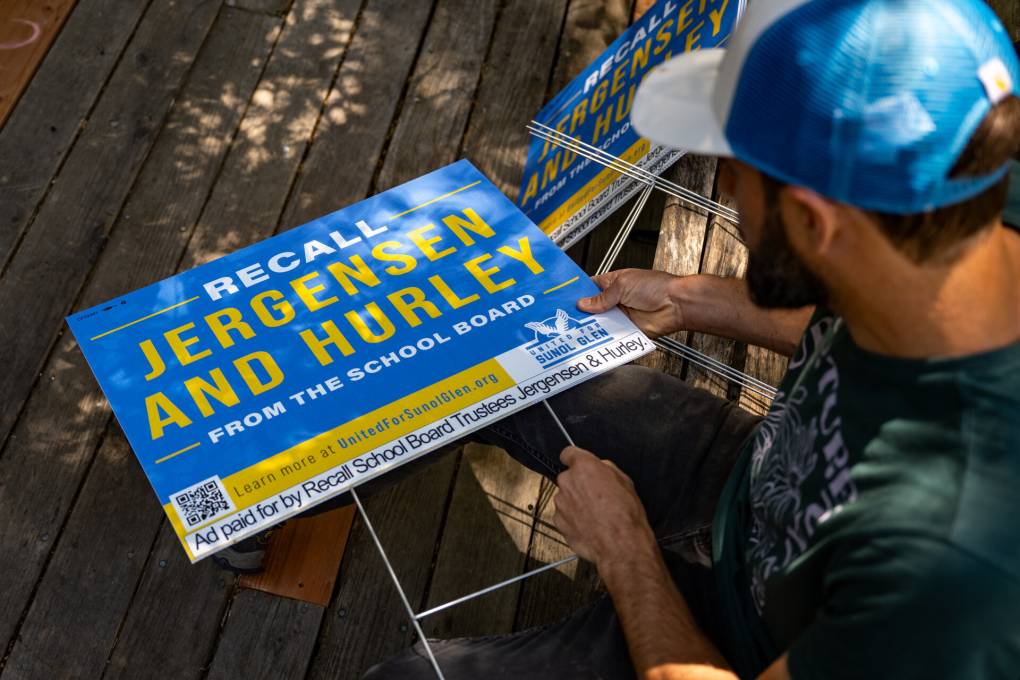
"caption": "Matthew Sylvester assembles yard signs that say, 'Recall Jergensen and Hurley from the school board' at his home in Sunol on May 29, 2024. In September, Jergensen and Hurley voted to ban all flags at Sunol Glen School beside the state and federal flags. Some saw it as an attempt to prevent a pride flag from being flown on campus.",
"credit": "Beth LaBerge/KQED",
"altTag": "A bearded man sits outside while assembling blue and yellow yard signs.",
"description": null,
"imgSizes": {
"medium": {
"file": "https://cdn.kqed.org/wp-content/uploads/sites/10/2024/05/240529-SunolSchoolBoard-05-BL_qut-800x533.jpg",
"width": 800,
"height": 533,
"mimeType": "image/jpeg"
},
"large": {
"file": "https://cdn.kqed.org/wp-content/uploads/sites/10/2024/05/240529-SunolSchoolBoard-05-BL_qut-1020x680.jpg",
"width": 1020,
"height": 680,
"mimeType": "image/jpeg"
},
"thumbnail": {
"file": "https://cdn.kqed.org/wp-content/uploads/sites/10/2024/05/240529-SunolSchoolBoard-05-BL_qut-160x107.jpg",
"width": 160,
"height": 107,
"mimeType": "image/jpeg"
},
"1536x1536": {
"file": "https://cdn.kqed.org/wp-content/uploads/sites/10/2024/05/240529-SunolSchoolBoard-05-BL_qut-1536x1024.jpg",
"width": 1536,
"height": 1024,
"mimeType": "image/jpeg"
},
"post-thumbnail": {
"file": "https://cdn.kqed.org/wp-content/uploads/sites/10/2024/05/240529-SunolSchoolBoard-05-BL_qut-672x372.jpg",
"width": 672,
"height": 372,
"mimeType": "image/jpeg"
},
"twentyfourteen-full-width": {
"file": "https://cdn.kqed.org/wp-content/uploads/sites/10/2024/05/240529-SunolSchoolBoard-05-BL_qut-1038x576.jpg",
"width": 1038,
"height": 576,
"mimeType": "image/jpeg"
},
"kqedFullSize": {
"file": "https://cdn.kqed.org/wp-content/uploads/sites/10/2024/05/240529-SunolSchoolBoard-05-BL_qut.jpg",
"width": 1920,
"height": 1280
}
},
"isLoading": false,
"fetchFailed": false
},
"news_11988478": {
"type": "attachments",
"id": "news_11988478",
"meta": {
"index": "attachments_1716263798",
"site": "news",
"id": "11988478",
"found": true
},
"title": "051824-Fresno-State-Graduation-LV_CM_18-ezgif.com-webp-to-jpg-converter",
"publishDate": 1717190872,
"status": "inherit",
"parent": 11988452,
"modified": 1717191005,
"caption": "Student graduates walk through the aisles to receive their degrees at the Fresno State Chicano/Latino Commencement Celebration in the Save Mart Center in Fresno on May 18, 2024. ",
"credit": "Larry Valenzuela/CalMatters/CatchLight Local",
"altTag": null,
"description": null,
"imgSizes": {
"medium": {
"file": "https://cdn.kqed.org/wp-content/uploads/sites/10/2024/06/051824-Fresno-State-Graduation-LV_CM_18-ezgif.com-webp-to-jpg-converter-800x533.jpg",
"width": 800,
"height": 533,
"mimeType": "image/jpeg"
},
"large": {
"file": "https://cdn.kqed.org/wp-content/uploads/sites/10/2024/06/051824-Fresno-State-Graduation-LV_CM_18-ezgif.com-webp-to-jpg-converter-1020x680.jpg",
"width": 1020,
"height": 680,
"mimeType": "image/jpeg"
},
"thumbnail": {
"file": "https://cdn.kqed.org/wp-content/uploads/sites/10/2024/06/051824-Fresno-State-Graduation-LV_CM_18-ezgif.com-webp-to-jpg-converter-160x107.jpg",
"width": 160,
"height": 107,
"mimeType": "image/jpeg"
},
"1536x1536": {
"file": "https://cdn.kqed.org/wp-content/uploads/sites/10/2024/06/051824-Fresno-State-Graduation-LV_CM_18-ezgif.com-webp-to-jpg-converter-1536x1024.jpg",
"width": 1536,
"height": 1024,
"mimeType": "image/jpeg"
},
"post-thumbnail": {
"file": "https://cdn.kqed.org/wp-content/uploads/sites/10/2024/06/051824-Fresno-State-Graduation-LV_CM_18-ezgif.com-webp-to-jpg-converter-672x372.jpg",
"width": 672,
"height": 372,
"mimeType": "image/jpeg"
},
"twentyfourteen-full-width": {
"file": "https://cdn.kqed.org/wp-content/uploads/sites/10/2024/06/051824-Fresno-State-Graduation-LV_CM_18-ezgif.com-webp-to-jpg-converter-1038x576.jpg",
"width": 1038,
"height": 576,
"mimeType": "image/jpeg"
},
"full-width": {
"file": "https://cdn.kqed.org/wp-content/uploads/sites/10/2024/06/051824-Fresno-State-Graduation-LV_CM_18-ezgif.com-webp-to-jpg-converter-1920x1280.jpg",
"width": 1920,
"height": 1280,
"mimeType": "image/jpeg"
},
"kqedFullSize": {
"file": "https://cdn.kqed.org/wp-content/uploads/sites/10/2024/06/051824-Fresno-State-Graduation-LV_CM_18-ezgif.com-webp-to-jpg-converter.jpg",
"width": 2000,
"height": 1333
}
},
"isLoading": false,
"fetchFailed": false
},
"news_11988399": {
"type": "attachments",
"id": "news_11988399",
"meta": {
"index": "attachments_1716263798",
"site": "news",
"id": "11988399",
"found": true
},
"title": "UC Santa Cruz Workers Strike Over Treatment Of Pro-Palestinian Protesters",
"publishDate": 1717177359,
"status": "inherit",
"parent": 11988397,
"modified": 1717177435,
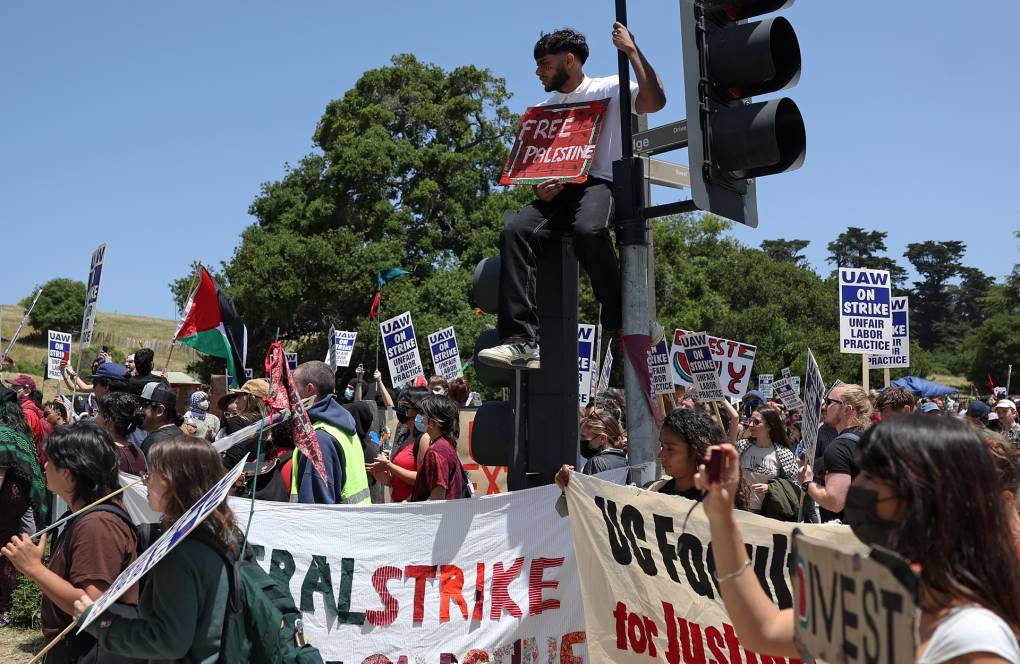
"caption": "UC Santa Cruz academic workers and pro-Palestinian protesters carry signs as they demonstrate in front of the campus on May 20, 2024, the first day of the academic workers' strike.",
"credit": "Justin Sullivan/Getty Images",
"altTag": null,
"description": null,
"imgSizes": {
"medium": {
"file": "https://cdn.kqed.org/wp-content/uploads/sites/10/2024/05/GettyImages-2153876789-800x530.jpg",
"width": 800,
"height": 530,
"mimeType": "image/jpeg"
},
"large": {
"file": "https://cdn.kqed.org/wp-content/uploads/sites/10/2024/05/GettyImages-2153876789-1020x676.jpg",
"width": 1020,
"height": 676,
"mimeType": "image/jpeg"
},
"thumbnail": {
"file": "https://cdn.kqed.org/wp-content/uploads/sites/10/2024/05/GettyImages-2153876789-160x106.jpg",
"width": 160,
"height": 106,
"mimeType": "image/jpeg"
},
"1536x1536": {
"file": "https://cdn.kqed.org/wp-content/uploads/sites/10/2024/05/GettyImages-2153876789-1536x1018.jpg",
"width": 1536,
"height": 1018,
"mimeType": "image/jpeg"
},
"post-thumbnail": {
"file": "https://cdn.kqed.org/wp-content/uploads/sites/10/2024/05/GettyImages-2153876789-672x372.jpg",
"width": 672,
"height": 372,
"mimeType": "image/jpeg"
},
"twentyfourteen-full-width": {
"file": "https://cdn.kqed.org/wp-content/uploads/sites/10/2024/05/GettyImages-2153876789-1038x576.jpg",
"width": 1038,
"height": 576,
"mimeType": "image/jpeg"
},
"kqedFullSize": {
"file": "https://cdn.kqed.org/wp-content/uploads/sites/10/2024/05/GettyImages-2153876789.jpg",
"width": 1920,
"height": 1273
}
},
"isLoading": false,
"fetchFailed": false
},
"news_11988271": {
"type": "attachments",
"id": "news_11988271",
"meta": {
"index": "attachments_1716263798",
"site": "news",
"id": "11988271",
"found": true
},
"title": "SanBrunoJail",
"publishDate": 1717102517,
"status": "inherit",
"parent": 0,
"modified": 1717104845,
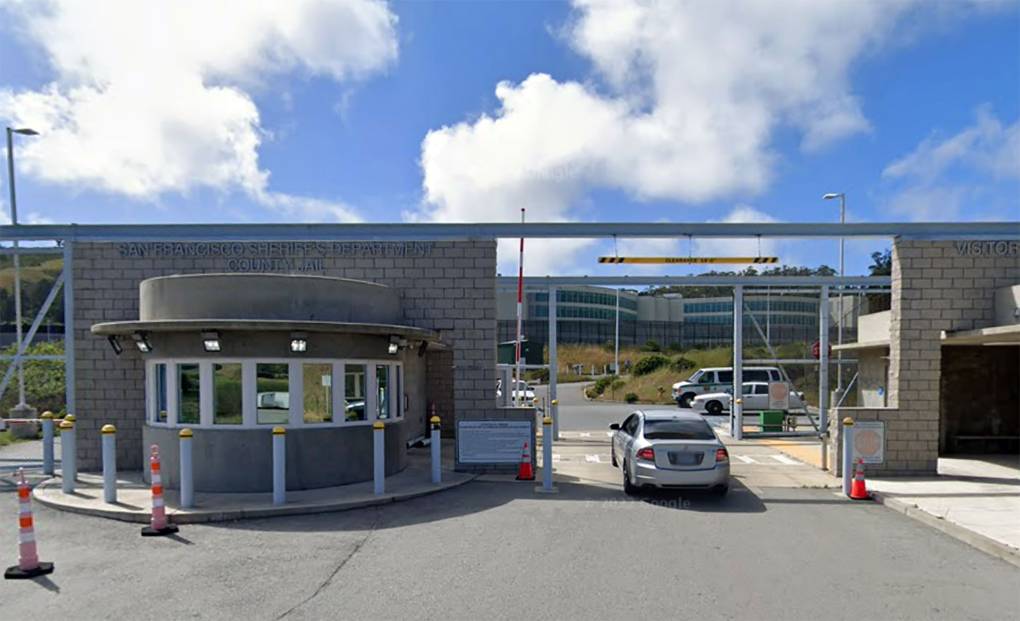
"caption": "The entrance to San Bruno Jail, the San Francisco County facility where chemical agents that affected Portola Elementary School students were released during a crowd control and intervention training exercise on May 21.",
"credit": "Google Street View",
"altTag": null,
"description": null,
"imgSizes": {
"medium": {
"file": "https://cdn.kqed.org/wp-content/uploads/sites/10/2024/05/SanBrunoJail-800x487.jpg",
"width": 800,
"height": 487,
"mimeType": "image/jpeg"
},
"large": {
"file": "https://cdn.kqed.org/wp-content/uploads/sites/10/2024/05/SanBrunoJail-1020x621.jpg",
"width": 1020,
"height": 621,
"mimeType": "image/jpeg"
},
"thumbnail": {
"file": "https://cdn.kqed.org/wp-content/uploads/sites/10/2024/05/SanBrunoJail-160x97.jpg",
"width": 160,
"height": 97,
"mimeType": "image/jpeg"
},
"1536x1536": {
"file": "https://cdn.kqed.org/wp-content/uploads/sites/10/2024/05/SanBrunoJail-1536x935.jpg",
"width": 1536,
"height": 935,
"mimeType": "image/jpeg"
},
"post-thumbnail": {
"file": "https://cdn.kqed.org/wp-content/uploads/sites/10/2024/05/SanBrunoJail-672x372.jpg",
"width": 672,
"height": 372,
"mimeType": "image/jpeg"
},
"twentyfourteen-full-width": {
"file": "https://cdn.kqed.org/wp-content/uploads/sites/10/2024/05/SanBrunoJail-1038x576.jpg",
"width": 1038,
"height": 576,
"mimeType": "image/jpeg"
},
"kqedFullSize": {
"file": "https://cdn.kqed.org/wp-content/uploads/sites/10/2024/05/SanBrunoJail.jpg",
"width": 1920,
"height": 1169
}
},
"isLoading": false,
"fetchFailed": false
},
"news_11988163": {
"type": "attachments",
"id": "news_11988163",
"meta": {
"index": "attachments_1716263798",
"site": "news",
"id": "11988163",
"found": true
},
"title": "240125-SFSUStrike-08-BL_qut",
"publishDate": 1717023045,
"status": "inherit",
"parent": 11988162,
"modified": 1782173886,
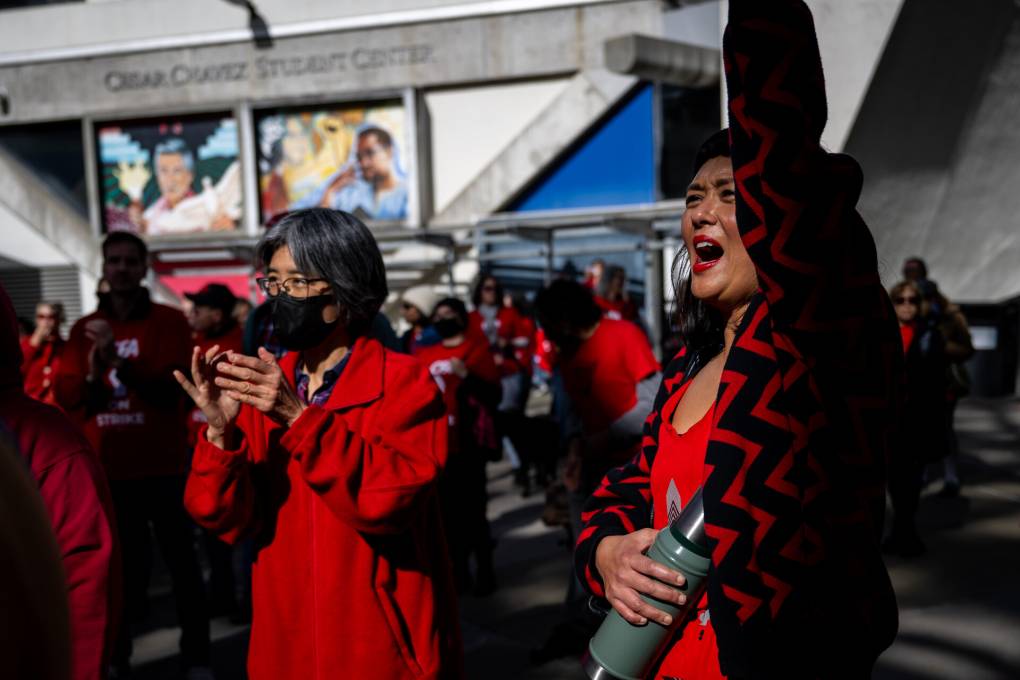
"caption": "Sang Hea Kil, San José State University professor and co-chair of the California Faculty Association's Palestine, Arab and Muslim Caucus, cheers during a rally at SFSU in San Francisco on Jan. 25, 2024, urging a no vote on the tentative deal that ended the California State University faculty strike.",
"credit": "Beth LaBerge/KQED",
"altTag": null,
"description": null,
"imgSizes": {
"medium": {
"file": "https://cdn.kqed.org/wp-content/uploads/sites/10/2024/05/240125-SFSUStrike-08-BL_qut-800x533.jpg",
"width": 800,
"height": 533,
"mimeType": "image/jpeg"
},
"large": {
"file": "https://cdn.kqed.org/wp-content/uploads/sites/10/2024/05/240125-SFSUStrike-08-BL_qut-1020x680.jpg",
"width": 1020,
"height": 680,
"mimeType": "image/jpeg"
},
"thumbnail": {
"file": "https://cdn.kqed.org/wp-content/uploads/sites/10/2024/05/240125-SFSUStrike-08-BL_qut-160x107.jpg",
"width": 160,
"height": 107,
"mimeType": "image/jpeg"
},
"1536x1536": {
"file": "https://cdn.kqed.org/wp-content/uploads/sites/10/2024/05/240125-SFSUStrike-08-BL_qut-1536x1024.jpg",
"width": 1536,
"height": 1024,
"mimeType": "image/jpeg"
},
"post-thumbnail": {
"file": "https://cdn.kqed.org/wp-content/uploads/sites/10/2024/05/240125-SFSUStrike-08-BL_qut-672x372.jpg",
"width": 672,
"height": 372,
"mimeType": "image/jpeg"
},
"twentyfourteen-full-width": {
"file": "https://cdn.kqed.org/wp-content/uploads/sites/10/2024/05/240125-SFSUStrike-08-BL_qut-1038x576.jpg",
"width": 1038,
"height": 576,
"mimeType": "image/jpeg"
},
"kqedFullSize": {
"file": "https://cdn.kqed.org/wp-content/uploads/sites/10/2024/05/240125-SFSUStrike-08-BL_qut.jpg",
"width": 1920,
"height": 1280
}
},
"isLoading": false,
"fetchFailed": false
},
"news_11988048": {
"type": "attachments",
"id": "news_11988048",
"meta": {
"index": "attachments_1716263798",
"site": "news",
"id": "11988048",
"found": true
},
"title": "UC Santa Cruz Workers Strike Over Treatment Of Pro-Palestinian Protesters",
"publishDate": 1717006217,
"status": "inherit",
"parent": 11988039,
"modified": 1717006276,
"caption": "UC Santa Cruz academic workers represented by UAW 4811 and pro-Palestinian protesters carry signs as they demonstrate in front of the campus on May 20, 2024.",
"credit": "Justin Sullivan/Getty Images",
"altTag": null,
"description": null,
"imgSizes": {
"medium": {
"file": "https://cdn.kqed.org/wp-content/uploads/sites/10/2024/05/GettyImages-2153876794-800x521.jpg",
"width": 800,
"height": 521,
"mimeType": "image/jpeg"
},
"large": {
"file": "https://cdn.kqed.org/wp-content/uploads/sites/10/2024/05/GettyImages-2153876794-1020x664.jpg",
"width": 1020,
"height": 664,
"mimeType": "image/jpeg"
},
"thumbnail": {
"file": "https://cdn.kqed.org/wp-content/uploads/sites/10/2024/05/GettyImages-2153876794-160x104.jpg",
"width": 160,
"height": 104,
"mimeType": "image/jpeg"
},
"1536x1536": {
"file": "https://cdn.kqed.org/wp-content/uploads/sites/10/2024/05/GettyImages-2153876794-1536x1000.jpg",
"width": 1536,
"height": 1000,
"mimeType": "image/jpeg"
},
"post-thumbnail": {
"file": "https://cdn.kqed.org/wp-content/uploads/sites/10/2024/05/GettyImages-2153876794-672x372.jpg",
"width": 672,
"height": 372,
"mimeType": "image/jpeg"
},
"twentyfourteen-full-width": {
"file": "https://cdn.kqed.org/wp-content/uploads/sites/10/2024/05/GettyImages-2153876794-1038x576.jpg",
"width": 1038,
"height": 576,
"mimeType": "image/jpeg"
},
"kqedFullSize": {
"file": "https://cdn.kqed.org/wp-content/uploads/sites/10/2024/05/GettyImages-2153876794.jpg",
"width": 1920,
"height": 1250
}
},
"isLoading": false,
"fetchFailed": false
},
"news_11987883": {
"type": "attachments",
"id": "news_11987883",
"meta": {
"index": "attachments_1716263798",
"site": "news",
"id": "11987883",
"found": true
},
"title": "CMEducation01",
"publishDate": 1716917670,
"status": "inherit",
"parent": 11987878,
"modified": 1716917693,
"caption": "The CSU Long Beach campus on in Long Beach April 24, 2024.",
"credit": "Jules Hotz/CalMatters",
"altTag": null,
"description": null,
"imgSizes": {
"medium": {
"file": "https://cdn.kqed.org/wp-content/uploads/sites/10/2024/05/CMEducation01-800x533.jpg",
"width": 800,
"height": 533,
"mimeType": "image/jpeg"
},
"large": {
"file": "https://cdn.kqed.org/wp-content/uploads/sites/10/2024/05/CMEducation01-1020x680.jpg",
"width": 1020,
"height": 680,
"mimeType": "image/jpeg"
},
"thumbnail": {
"file": "https://cdn.kqed.org/wp-content/uploads/sites/10/2024/05/CMEducation01-160x107.jpg",
"width": 160,
"height": 107,
"mimeType": "image/jpeg"
},
"1536x1536": {
"file": "https://cdn.kqed.org/wp-content/uploads/sites/10/2024/05/CMEducation01-1536x1024.jpg",
"width": 1536,
"height": 1024,
"mimeType": "image/jpeg"
},
"post-thumbnail": {
"file": "https://cdn.kqed.org/wp-content/uploads/sites/10/2024/05/CMEducation01-672x372.jpg",
"width": 672,
"height": 372,
"mimeType": "image/jpeg"
},
"twentyfourteen-full-width": {
"file": "https://cdn.kqed.org/wp-content/uploads/sites/10/2024/05/CMEducation01-1038x576.jpg",
"width": 1038,
"height": 576,
"mimeType": "image/jpeg"
},
"full-width": {
"file": "https://cdn.kqed.org/wp-content/uploads/sites/10/2024/05/CMEducation01-1920x1280.jpg",
"width": 1920,
"height": 1280,
"mimeType": "image/jpeg"
},
"kqedFullSize": {
"file": "https://cdn.kqed.org/wp-content/uploads/sites/10/2024/05/CMEducation01.jpg",
"width": 2000,
"height": 1333
}
},
"isLoading": false,
"fetchFailed": false
}
},
"audioPlayerReducer": {
"postId": "stream_live",
"isPaused": true,
"isPlaying": false,
"pfsActive": false,
"pledgeModalIsOpen": true,
"playerDrawerIsOpen": false,
"liveAudioPlayStartedAt": 0,
"liveAudioPlayContext": ""
},
"authorsReducer": {
"byline_news_11989080": {
"type": "authors",
"id": "byline_news_11989080",
"meta": {
"override": true
},
"slug": "byline_news_11989080",
"name": "Betty Márquez Rosales",
"isLoading": false
},
"byline_news_11989050": {
"type": "authors",
"id": "byline_news_11989050",
"meta": {
"override": true
},
"slug": "byline_news_11989050",
"name": "\u003ca href=\"https://twitter.com/katie_debe?lang=en\">Katie DeBenedetti\u003c/a>",
"isLoading": false
},
"byline_news_11988452": {
"type": "authors",
"id": "byline_news_11988452",
"meta": {
"override": true
},
"slug": "byline_news_11988452",
"name": "\u003ca href=\"https://calmatters.org/author/jacqueline-munis/\">Jacqueline Munis\u003c/a>, CalMatters",
"isLoading": false
},
"byline_news_11988293": {
"type": "authors",
"id": "byline_news_11988293",
"meta": {
"override": true
},
"slug": "byline_news_11988293",
"name": "\u003ca href=\"https://twitter.com/katie_debe?lang=en\">Katie DeBenedetti\u003c/a>",
"isLoading": false
},
"byline_news_11987878": {
"type": "authors",
"id": "byline_news_11987878",
"meta": {
"override": true
},
"slug": "byline_news_11987878",
"name": "Mikhail Zinshteyn, CalMatters",
"isLoading": false
},
"gmarzorati": {
"type": "authors",
"id": "227",
"meta": {
"index": "authors_1716337520",
"id": "227",
"found": true
},
"name": "Guy Marzorati",
"firstName": "Guy",
"lastName": "Marzorati",
"slug": "gmarzorati",
"email": "gmarzorati@KQED.org",
"display_author_email": true,
"staff_mastheads": [
"news"
],
"title": "Correspondent",
"bio": "Guy Marzorati is a correspondent on KQED's California Politics and Government Desk, based in San Jose. A graduate of Santa Clara University, Guy joined KQED in 2013. He reports on state and local politics and produces KQED's digital voter guide.",
"avatar": "https://secure.gravatar.com/avatar/e7038b8dbfd55b104369b76b1cd0b9de?s=600&d=blank&r=g",
"twitter": "guymarzorati",
"facebook": null,
"instagram": null,
"linkedin": null,
"sites": [
{
"site": "",
"roles": [
"editor"
]
},
{
"site": "news",
"roles": [
"editor"
]
},
{
"site": "science",
"roles": [
"editor"
]
},
{
"site": "forum",
"roles": [
"editor"
]
},
{
"site": "elections",
"roles": [
"editor"
]
},
{
"site": "liveblog",
"roles": [
"editor"
]
}
],
"headData": {
"title": "Guy Marzorati | KQED",
"description": "Correspondent",
"ogImgSrc": "https://secure.gravatar.com/avatar/e7038b8dbfd55b104369b76b1cd0b9de?s=600&d=blank&r=g",
"twImgSrc": "https://secure.gravatar.com/avatar/e7038b8dbfd55b104369b76b1cd0b9de?s=600&d=blank&r=g"
},
"isLoading": false,
"link": "/author/gmarzorati"
},
"jrodriguez": {
"type": "authors",
"id": "11690",
"meta": {
"index": "authors_1716337520",
"id": "11690",
"found": true
},
"name": "Joe Fitzgerald Rodriguez",
"firstName": "Joe",
"lastName": "Fitzgerald Rodriguez",
"slug": "jrodriguez",
"email": "jrodriguez@kqed.org",
"display_author_email": true,
"staff_mastheads": [
"news"
],
"title": "Reporter and Producer",
"bio": "Joe Fitzgerald Rodriguez is a reporter and digital producer for KQED covering politics. Joe most recently wrote for the \u003cem>San Francisco Examiner\u003c/em> as a political columnist covering The City. He was raised in San Francisco and has spent his reporting career in his beloved, foggy, city by the bay. Joe was 12-years-old when he conducted his first interview in journalism, grilling former San Francisco Mayor Willie Brown for the Marina Middle School newspaper, \u003cem>The Penguin Press, \u003c/em>and he continues to report on the San Francisco Bay Area to this day.",
"avatar": "https://secure.gravatar.com/avatar/2247beb0564c1e9c62228d5649d2edac?s=600&d=blank&r=g",
"twitter": "FitztheReporter",
"facebook": null,
"instagram": "https://www.instagram.com/fitzthereporter/",
"linkedin": null,
"sites": [
{
"site": "",
"roles": [
"editor"
]
},
{
"site": "arts",
"roles": [
"editor"
]
},
{
"site": "news",
"roles": [
"editor"
]
},
{
"site": "science",
"roles": [
"editor"
]
},
{
"site": "elections",
"roles": [
"editor"
]
},
{
"site": "liveblog",
"roles": [
"editor"
]
}
],
"headData": {
"title": "Joe Fitzgerald Rodriguez | KQED",
"description": "Reporter and Producer",
"ogImgSrc": "https://secure.gravatar.com/avatar/2247beb0564c1e9c62228d5649d2edac?s=600&d=blank&r=g",
"twImgSrc": "https://secure.gravatar.com/avatar/2247beb0564c1e9c62228d5649d2edac?s=600&d=blank&r=g"
},
"isLoading": false,
"link": "/author/jrodriguez"
},
"swhitney": {
"type": "authors",
"id": "11784",
"meta": {
"index": "authors_1716337520",
"id": "11784",
"found": true
},
"name": "Spencer Whitney",
"firstName": "Spencer",
"lastName": "Whitney",
"slug": "swhitney",
"email": "swhitney@kqed.org",
"display_author_email": false,
"staff_mastheads": [],
"title": "KQED Digital Editor",
"bio": "Spencer Whitney is currently a Digital Editor for KQED News. Prior to joining KQED News, Spencer worked as the Multimedia Editor at the Oakland Post and an Assistant Editor in the Editorial department at the San Francisco Chronicle. He attended Howard University as an undergraduate and interned with SiriusXM. He also attended UC Berkeley's Graduate School of Journalism and had the opportunity to write for the hyperlocal news sites Richmond Confidential and Oakland North.",
"avatar": "https://secure.gravatar.com/avatar/e33ff4fd8b8f0d2796f36472fb32607ca8fc46ef5e537dcfdbdee688d8ea5b80?s=600&d=mm&r=g",
"twitter": null,
"bluesky": null,
"facebook": null,
"instagram": null,
"linkedin": null,
"sites": [
{
"site": "arts",
"roles": [
"editor"
]
},
{
"site": "news",
"roles": [
"editor"
]
},
{
"site": "science",
"roles": [
"editor"
]
},
{
"site": "perspectives",
"roles": [
"editor"
]
}
],
"headData": {
"title": "Spencer Whitney | KQED",
"description": "KQED Digital Editor",
"ogImgSrc": "https://secure.gravatar.com/avatar/e33ff4fd8b8f0d2796f36472fb32607ca8fc46ef5e537dcfdbdee688d8ea5b80?s=600&d=mm&r=g",
"twImgSrc": "https://secure.gravatar.com/avatar/e33ff4fd8b8f0d2796f36472fb32607ca8fc46ef5e537dcfdbdee688d8ea5b80?s=600&d=mm&r=g"
},
"isLoading": false,
"link": "/author/swhitney"
},
"sjohnson": {
"type": "authors",
"id": "11840",
"meta": {
"index": "authors_1716337520",
"id": "11840",
"found": true
},
"name": "Sydney Johnson",
"firstName": "Sydney",
"lastName": "Johnson",
"slug": "sjohnson",
"email": "sjohnson@kqed.org",
"display_author_email": false,
"staff_mastheads": [
"news"
],
"title": "KQED Reporter",
"bio": "Sydney Johnson is a general assignment reporter at KQED. She previously reported on public health and city government at the San Francisco Examiner, and before that, she covered statewide education policy for EdSource. Her reporting has won multiple local, state and national awards. Sydney is a graduate of the University of California, Berkeley and lives in San Francisco.",
"avatar": "https://secure.gravatar.com/avatar/97855f2719b72ad6190b7c535fe642c8?s=600&d=blank&r=g",
"twitter": "sydneyfjohnson",
"facebook": null,
"instagram": null,
"linkedin": null,
"sites": [
{
"site": "news",
"roles": [
"editor"
]
}
],
"headData": {
"title": "Sydney Johnson | KQED",
"description": "KQED Reporter",
"ogImgSrc": "https://secure.gravatar.com/avatar/97855f2719b72ad6190b7c535fe642c8?s=600&d=blank&r=g",
"twImgSrc": "https://secure.gravatar.com/avatar/97855f2719b72ad6190b7c535fe642c8?s=600&d=blank&r=g"
},
"isLoading": false,
"link": "/author/sjohnson"
},
"kdebenedetti": {
"type": "authors",
"id": "11913",
"meta": {
"index": "authors_1716337520",
"id": "11913",
"found": true
},
"name": "Katie DeBenedetti",
"firstName": "Katie",
"lastName": "DeBenedetti",
"slug": "kdebenedetti",
"email": "kdebenedetti@kqed.org",
"display_author_email": false,
"staff_mastheads": [
"news",
"science"
],
"title": "KQED Contributor",
"bio": "Katie DeBenedetti is a digital reporter covering daily news for the Express Desk. Prior to joining KQED as a culture reporting intern in January 2024, she covered education and city government for the Napa Valley Register.",
"avatar": "https://secure.gravatar.com/avatar/6e31073cb8f7e4214ab03f42771d0f45?s=600&d=blank&r=g",
"twitter": null,
"facebook": null,
"instagram": null,
"linkedin": null,
"sites": [
{
"site": "news",
"roles": [
"author"
]
},
{
"site": "science",
"roles": [
"author"
]
},
{
"site": "liveblog",
"roles": [
"author"
]
}
],
"headData": {
"title": "Katie DeBenedetti | KQED",
"description": "KQED Contributor",
"ogImgSrc": "https://secure.gravatar.com/avatar/6e31073cb8f7e4214ab03f42771d0f45?s=600&d=blank&r=g",
"twImgSrc": "https://secure.gravatar.com/avatar/6e31073cb8f7e4214ab03f42771d0f45?s=600&d=blank&r=g"
},
"isLoading": false,
"link": "/author/kdebenedetti"
}
},
"pagesReducer": {
"news_category_education": {
"type": "terms",
"id": "news_18540",
"meta": {
"index": "terms_1716263798",
"site": "news",
"id": "18540",
"score": 10.973221
},
"featImg": null,
"name": "Education",
"description": null,
"taxonomy": "category",
"headData": {
"twImgId": null,
"twTitle": null,
"ogTitle": null,
"ogImgId": null,
"twDescription": null,
"description": null,
"title": "Education Archives | KQED News",
"ogDescription": null
},
"ttid": 2595,
"slug": "education",
"isLoading": false,
"title": "Education",
"pageMeta": {
"site": "news",
"WpPageTemplate": "page-topic-editorial",
"currentPage": 48
},
"blocks": [
{
"blockName": "kqed/post-list",
"attrs": {
"layout": "cardArticle2",
"query": "posts/news?category=education",
"seeMore": false,
"paginated": true,
"page": 48
}
},
{
"blockName": "kqed/ad"
}
]
}
},
"pfsSessionReducer": {},
"postsReducer": {
"stream_live": {
"type": "live",
"id": "stream_live",
"audioUrl": "https://streams.kqed.org/kqedradio",
"title": "Live Stream",
"excerpt": "Live Stream information currently unavailable.",
"link": "/radio",
"featImg": "",
"label": {
"name": "KQED Live",
"link": "/"
}
},
"stream_kqedNewscast": {
"type": "posts",
"id": "stream_kqedNewscast",
"audioUrl": "https://www.kqed.org/.stream/anon/radio/RDnews/newscast.mp3?_=1",
"title": "KQED Newscast",
"featImg": "",
"label": {
"name": "88.5 FM",
"link": "/"
}
},
"news_11989178": {
"type": "posts",
"id": "news_11989178",
"meta": {
"index": "posts_1716263798",
"site": "news",
"id": "11989178",
"score": null,
"sort": [
1717626153000
]
},
"guestAuthors": [],
"slug": "uc-sues-academic-workers-union-to-halt-pro-palestinian-solidarity-strikes",
"title": "UC Sues Academic Workers Union to Halt Pro-Palestinian Solidarity Strikes",
"publishDate": 1717626153,
"format": "standard",
"headTitle": "UC Sues Academic Workers Union to Halt Pro-Palestinian Solidarity Strikes | KQED",
"labelTerm": {
"site": "news"
},
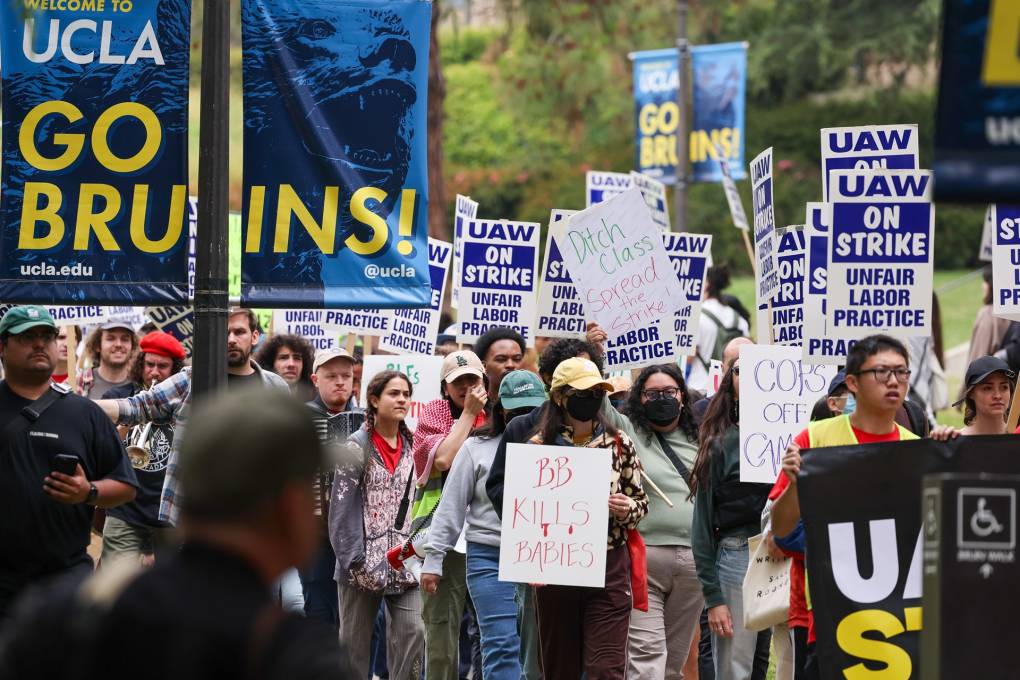
"content": "\u003cp>The University of California on Wednesday announced that it is suing the union representing its academic workers, a move that follows \u003ca href=\"https://www.kqed.org/news/11988823/state-board-upholds-uc-workers-right-to-strike-over-response-to-campus-protests\">two failed attempts\u003c/a> to have state labor regulators stop thousands of graduate teaching assistants, researchers and others from striking.\u003c/p>\n\u003cp>In its suit filed Monday in Orange County Superior Court, the university system alleges that the United Auto Workers Local 4811, which represents 48,000 academic workers across the UC, is violating the no-strike clause of its contract. The union has said its rolling walkouts are in response to campuses’ handling of pro-Palestinian protests and the police actions against them, leading UC officials to label the strike a political action, not a labor one.\u003c/p>\n\u003cp>“The blatant breach of the parties’ no-strike clauses by UAW will continue to cause irreversible harm to the University as it will disrupt the education of thousands of students in the form of canceled classes and delayed grades,” said Melissa Matella, associate vice president for systemwide labor relations, in a statement. “The breach of contract also endangers life-saving research in hundreds of laboratories across the university and will also cause the university substantial monetary damages.”\u003c/p>\n\u003cp>Striking UAW workers have blocked entrances to hospitals and childcare centers, caused \u003ca href=\"https://www.kqed.org/news/11988039/pro-palestinian-protests-block-uc-santa-cruz-entrances-pushing-classes-back-online\">disruption to operations at UC Santa Cruz\u003c/a> and \u003ca href=\"https://www.kqed.org/news/11987499/academic-workers-at-ucla-davis-are-next-to-strike-over-response-to-protests\">barricaded themselves in buildings at UCLA\u003c/a>, according to UC officials.\u003c/p>\n\u003cp>Rafael Jaime, a Ph.D. student at UCLA and president of UAW 4811, accused the UC system of ignoring the authority of the California Public Employment Relations Board, or PERB, which on Monday \u003ca href=\"https://www.kqed.org/news/11987737/academic-workers-strike-will-roll-on-as-ucs-request-for-court-order-is-denied\">declined for the second time\u003c/a> to rule the strikes illegal.\u003c/p>\n\u003cp>[ad fullwidth]\u003c/p>\n\u003cp>“UC continues to shirk accountability for the violence it has caused and allowed against union members and the campus community,” Jaime said. “UC should respect the law, return to mediation, and resolve their serious unfair labor practices instead of continuing to insist that the rules do not apply to it.”\u003c/p>\n\u003cp>About 1,500 academic workers at UC Santa Cruz walked out last month, \u003ca href=\"https://www.kqed.org/news/11987173/uc-academic-workers-strike-is-limited-to-santa-cruz-so-far-heres-why\">the first campus to go on strike\u003c/a> after an authorization vote by union members. Soon after, UCLA and UC Davis workers \u003ca href=\"https://www.kqed.org/news/11987905/following-uc-santa-cruzs-lead-academic-workers-at-uc-davis-and-ucla-join-strike-over-response-to-pro-palestinian-protests\">joined the strike\u003c/a>. UC Santa Barbara and UC San Diego workers followed suit on Monday, and UC Irvine joined the strike on Wednesday.\u003c/p>\n\u003cp>Workers want to restore their “fundamental right to protest,” UAW 4811 \u003ca href=\"https://www.uaw4811.org/ucs-u-turn\">wrote on its website\u003c/a>. UC has used force on student and worker protesters, they wrote, including allowing police to give protesters “serious injuries,” including burns and nerve damage, in an effort to clear demonstrators from public areas and an empty building.\u003c/p>\n\u003cp>This week’s decision by PERB found the UC did not demonstrate “sufficient grounds” for bringing its complaint, the second time in recent weeks that it declined to order an immediate end to the strike.\u003c/p>\n\u003cp>[aside label='Related Coverage' tag='campus-protests']J. Felix De La Torre, PERB’s general counsel, told KQED that the UC’s civil complaint could have been filed with the court without first filing an unfair practice charge with PERB unless the UC’s contract with the union has a binding arbitration provision. If so, the court will send them to arbitration.\u003c/p>\n\u003cp>After PERB’s decision, Matella had said the UC would elevate its claim in court. In \u003ca href=\"https://ucnet.universityofcalifornia.edu/wp-content/uploads/2024/06/2024-06-04-2729-xUC-filing_2.pdf\">the UC suit\u003c/a>, Matella references contract clauses that claim academic staffers cannot strike.\u003c/p>\n\u003cp>One such clause reads, “The UAW, on behalf of its officers, agents, and members agrees there shall be no strikes, including sympathy strikes, stoppages, interruptions of work, or other concerted activities which interfere directly or indirectly with University operations during the life of this Agreement or any written extension thereof.”\u003c/p>\n\u003cp>Some actions by protesting workers went beyond taking part in encampments and directly interrupted classes, Matella said.\u003c/p>\n\u003cp>At UC Davis on May 28, for instance, Matella said protesters carrying UAW signs entered classrooms and “were disruptive,” leading instructors to cancel classes, some of which were taking exams. In at least one classroom, protesters “attempted to shame students and instructors into joining the protest,” she said.\u003c/p>\n\u003cp>The exact number of classes interrupted or canceled by academic staffers isn’t known, Matella said, because they don’t inform campus administrators.\u003c/p>\n\u003cp>\u003c/p>\n\u003cp>“They just do it, again increasing the uncertainty and adding to the chaos of their unlawful strike,” Matella said.\u003c/p>\n\n",
"blocks": [],
"excerpt": "The University of California’s lawsuit comes after two failed attempts to have state labor regulators stop thousands of academic workers from striking.",
"status": "publish",
"parent": 0,
"modified": 1717627458,
"stats": {
"hasAudio": false,
"hasVideo": false,
"hasChartOrMap": false,
"iframeSrcs": [],
"hasGoogleForm": false,
"hasGallery": false,
"hasHearkenModule": false,
"hasPolis": false,
"paragraphCount": 18,
"wordCount": 741
},
"headData": {
"title": "UC Sues Academic Workers Union to Halt Pro-Palestinian Solidarity Strikes | KQED",
"description": "The University of California’s lawsuit comes after two failed attempts to have state labor regulators stop thousands of academic workers from striking.",
"ogTitle": "",
"ogDescription": "",
"ogImgId": "",
"twTitle": "",
"twDescription": "",
"twImgId": "",
"schema": {
"@context": "https://schema.org",
"@type": "NewsArticle",
"headline": "UC Sues Academic Workers Union to Halt Pro-Palestinian Solidarity Strikes",
"datePublished": "2024-06-05T15:22:33-07:00",
"dateModified": "2024-06-05T15:44:18-07:00",
"image": "https://cdn.kqed.org/wp-content/uploads/2020/02/KQED-OG-Image@1x.png",
"isAccessibleForFree": "True",
"publisher": {
"@type": "NewsMediaOrganization",
"@id": "https://www.kqed.org/#organization",
"name": "KQED",
"logo": "https://cdn.kqed.org/wp-content/uploads/2020/02/KQED-OG-Image@1x.png",
"url": "https://www.kqed.org",
"sameAs": [
"https://www.facebook.com/KQED",
"https://twitter.com/KQED",
"https://www.instagram.com/kqed/",
"https://www.tiktok.com/@kqedofficial",
"https://www.linkedin.com/company/kqed",
"https://www.youtube.com/channel/UCeC0IOo7i1P_61zVUWbJ4nw"
]
}
}
},
"sticky": false,
"nprStoryId": "kqed-11989178",
"excludeFromSiteSearch": "Include",
"articleAge": "0",
"path": "/news/11989178/uc-sues-academic-workers-union-to-halt-pro-palestinian-solidarity-strikes",
"audioTrackLength": null,
"parsedContent": [
{
"type": "contentString",
"content": "\u003cdiv class=\"post-body\">\u003cp>\u003cp>The University of California on Wednesday announced that it is suing the union representing its academic workers, a move that follows \u003ca href=\"https://www.kqed.org/news/11988823/state-board-upholds-uc-workers-right-to-strike-over-response-to-campus-protests\">two failed attempts\u003c/a> to have state labor regulators stop thousands of graduate teaching assistants, researchers and others from striking.\u003c/p>\n\u003cp>In its suit filed Monday in Orange County Superior Court, the university system alleges that the United Auto Workers Local 4811, which represents 48,000 academic workers across the UC, is violating the no-strike clause of its contract. The union has said its rolling walkouts are in response to campuses’ handling of pro-Palestinian protests and the police actions against them, leading UC officials to label the strike a political action, not a labor one.\u003c/p>\n\u003cp>“The blatant breach of the parties’ no-strike clauses by UAW will continue to cause irreversible harm to the University as it will disrupt the education of thousands of students in the form of canceled classes and delayed grades,” said Melissa Matella, associate vice president for systemwide labor relations, in a statement. “The breach of contract also endangers life-saving research in hundreds of laboratories across the university and will also cause the university substantial monetary damages.”\u003c/p>\n\u003cp>Striking UAW workers have blocked entrances to hospitals and childcare centers, caused \u003ca href=\"https://www.kqed.org/news/11988039/pro-palestinian-protests-block-uc-santa-cruz-entrances-pushing-classes-back-online\">disruption to operations at UC Santa Cruz\u003c/a> and \u003ca href=\"https://www.kqed.org/news/11987499/academic-workers-at-ucla-davis-are-next-to-strike-over-response-to-protests\">barricaded themselves in buildings at UCLA\u003c/a>, according to UC officials.\u003c/p>\n\u003cp>Rafael Jaime, a Ph.D. student at UCLA and president of UAW 4811, accused the UC system of ignoring the authority of the California Public Employment Relations Board, or PERB, which on Monday \u003ca href=\"https://www.kqed.org/news/11987737/academic-workers-strike-will-roll-on-as-ucs-request-for-court-order-is-denied\">declined for the second time\u003c/a> to rule the strikes illegal.\u003c/p>\n\u003cp>\u003c/p>\u003c/div>",
"attributes": {
"named": {},
"numeric": []
}
},
{
"type": "component",
"content": "",
"name": "ad",
"attributes": {
"named": {
"label": "fullwidth"
},
"numeric": [
"fullwidth"
]
}
},
{
"type": "contentString",
"content": "\u003cdiv class=\"post-body\">\u003cp>\u003c/p>\n\u003cp>“UC continues to shirk accountability for the violence it has caused and allowed against union members and the campus community,” Jaime said. “UC should respect the law, return to mediation, and resolve their serious unfair labor practices instead of continuing to insist that the rules do not apply to it.”\u003c/p>\n\u003cp>About 1,500 academic workers at UC Santa Cruz walked out last month, \u003ca href=\"https://www.kqed.org/news/11987173/uc-academic-workers-strike-is-limited-to-santa-cruz-so-far-heres-why\">the first campus to go on strike\u003c/a> after an authorization vote by union members. Soon after, UCLA and UC Davis workers \u003ca href=\"https://www.kqed.org/news/11987905/following-uc-santa-cruzs-lead-academic-workers-at-uc-davis-and-ucla-join-strike-over-response-to-pro-palestinian-protests\">joined the strike\u003c/a>. UC Santa Barbara and UC San Diego workers followed suit on Monday, and UC Irvine joined the strike on Wednesday.\u003c/p>\n\u003cp>Workers want to restore their “fundamental right to protest,” UAW 4811 \u003ca href=\"https://www.uaw4811.org/ucs-u-turn\">wrote on its website\u003c/a>. UC has used force on student and worker protesters, they wrote, including allowing police to give protesters “serious injuries,” including burns and nerve damage, in an effort to clear demonstrators from public areas and an empty building.\u003c/p>\n\u003cp>This week’s decision by PERB found the UC did not demonstrate “sufficient grounds” for bringing its complaint, the second time in recent weeks that it declined to order an immediate end to the strike.\u003c/p>\n\u003cp>\u003c/p>\u003c/div>",
"attributes": {
"named": {},
"numeric": []
}
},
{
"type": "component",
"content": "",
"name": "aside",
"attributes": {
"named": {
"label": "Related Coverage ",
"tag": "campus-protests"
},
"numeric": []
}
},
{
"type": "contentString",
"content": "\u003cdiv class=\"post-body\">\u003cp>J. Felix De La Torre, PERB’s general counsel, told KQED that the UC’s civil complaint could have been filed with the court without first filing an unfair practice charge with PERB unless the UC’s contract with the union has a binding arbitration provision. If so, the court will send them to arbitration.\u003c/p>\n\u003cp>After PERB’s decision, Matella had said the UC would elevate its claim in court. In \u003ca href=\"https://ucnet.universityofcalifornia.edu/wp-content/uploads/2024/06/2024-06-04-2729-xUC-filing_2.pdf\">the UC suit\u003c/a>, Matella references contract clauses that claim academic staffers cannot strike.\u003c/p>\n\u003cp>One such clause reads, “The UAW, on behalf of its officers, agents, and members agrees there shall be no strikes, including sympathy strikes, stoppages, interruptions of work, or other concerted activities which interfere directly or indirectly with University operations during the life of this Agreement or any written extension thereof.”\u003c/p>\n\u003cp>Some actions by protesting workers went beyond taking part in encampments and directly interrupted classes, Matella said.\u003c/p>\n\u003cp>At UC Davis on May 28, for instance, Matella said protesters carrying UAW signs entered classrooms and “were disruptive,” leading instructors to cancel classes, some of which were taking exams. In at least one classroom, protesters “attempted to shame students and instructors into joining the protest,” she said.\u003c/p>\n\u003cp>The exact number of classes interrupted or canceled by academic staffers isn’t known, Matella said, because they don’t inform campus administrators.\u003c/p>\n\u003cp>\u003c/p>\n\u003cp>“They just do it, again increasing the uncertainty and adding to the chaos of their unlawful strike,” Matella said.\u003c/p>\n\n\u003c/div>\u003c/p>",
"attributes": {
"named": {},
"numeric": []
}
}
],
"link": "/news/11989178/uc-sues-academic-workers-union-to-halt-pro-palestinian-solidarity-strikes",
"authors": [
"11690"
],
"categories": [
"news_18540",
"news_8"
],
"tags": [
"news_34008",
"news_27626",
"news_33647",
"news_697",
"news_25682",
"news_23180",
"news_2792",
"news_206"
],
"featImg": "news_11989181",
"label": "news"
},
"news_11989080": {
"type": "posts",
"id": "news_11989080",
"meta": {
"index": "posts_1716263798",
"site": "news",
"id": "11989080",
"score": null,
"sort": [
1717621230000
]
},
"guestAuthors": [],
"slug": "study-reveals-low-calfresh-enrollment-among-california-college-students",
"title": "Study Reveals Low CalFresh Enrollment Among California College Students",
"publishDate": 1717621230,
"format": "standard",
"headTitle": "Study Reveals Low CalFresh Enrollment Among California College Students | KQED",
"labelTerm": {},
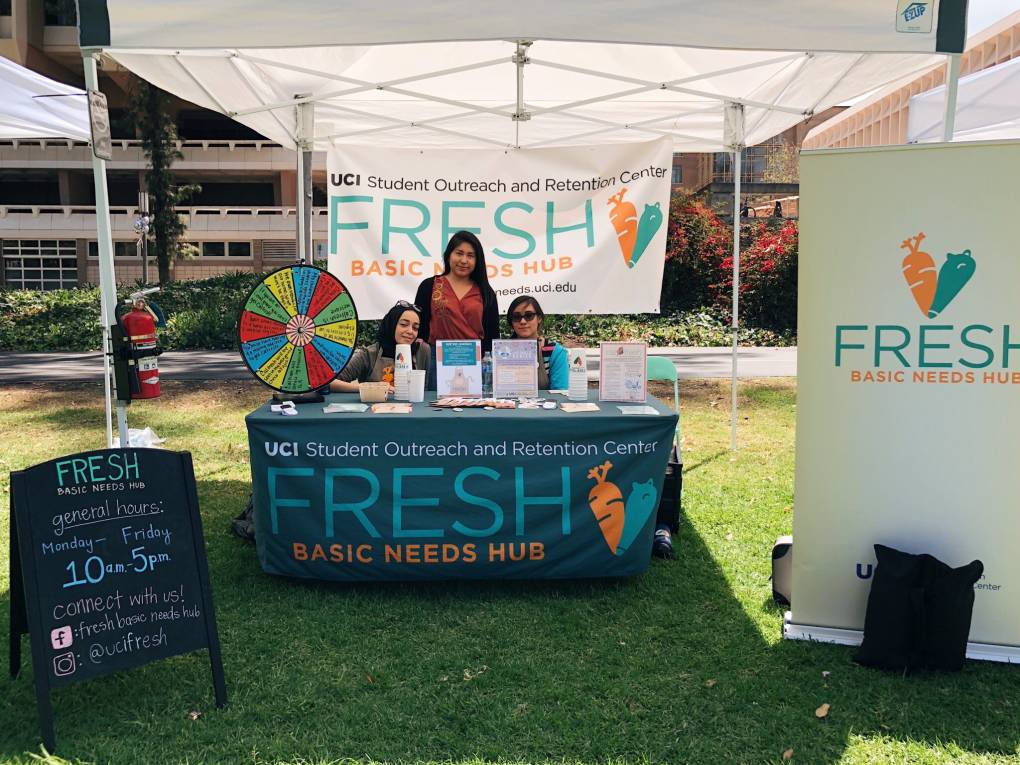
"content": "\u003cp>Few college students participate in the state’s CalFresh food program despite being eligible, according to a report published Tuesday by the University of California’s \u003ca class=\"external\" href=\"https://www.capolicylab.org/\" target=\"_blank\" rel=\"noopener\">California Policy Lab\u003c/a>.\u003c/p>\n\u003cp>The report, “\u003ca class=\"external\" href=\"https://www.capolicylab.org/news/new-report-finds-the-majority-of-california-college-students-who-are-eligible-for-calfresh-benefits-dont-participate/\" target=\"_blank\" rel=\"noopener\">Filling the Gap: CalFresh Eligibility Among University of California and California Community College Students\u003c/a>,” is the first to link together datasets that provide estimates on the number of California college students who are eligible for CalFresh, the state’s food benefits program, in addition to their take-up rate — the share of students who are eligible and also participate in the program.\u003c/p>\n\u003cp>The report’s authors found that CalFresh eligibility and students’ subsequent enrollment in the program depended significantly on which institution of higher learning they attended, age, housing situation, and other factors. The school they were enrolled in was often connected to the level of outreach they received, informing them of the food benefits program and whether they received a certain financial aid grant that made them eligible for CalFresh.\u003c/p>\n\u003cp>[aside postID=\"news_11978394,news_11974262\" label=\"Related Stories\"]“California, in the last few years, has been increasingly focused on this channel of potential support for college students. It’s one of the pieces that students can paste together to put together a financial package that allows them to go to college,” said Jesse Rothstein, report co-author, about the CalFresh program.\u003c/p>\n\u003cp>CalFresh, once known as food stamps, is designed to provide money for groceries for California residents, making it a significant support program for low-income students. College students are typically eligible for CalFresh if they meet the regular rules that everyone, whether a student or not, must meet, in addition to at least one of more than a dozen exemptions. Understanding the \u003ca class=\"external\" href=\"https://www.cdss.ca.gov/Portals/9/CalFresh/Students/CF6177.pdf\" target=\"_blank\" rel=\"noopener\">long list of eligibility criteria\u003c/a> specific to students has long been seen as a significant barrier for students, according to the report.\u003c/p>\n\u003cp>[ad fullwidth]\u003c/p>\n\u003cp>“But because CalFresh is run by a different agency — it’s not part of the education system — I think it’s hard for students to navigate,” said Rothstein, Carmel P. Friesen Professor of Public Policy and Economics at UC Berkeley and the faculty director of the California Policy Lab’s UC Berkeley site.\u003c/p>\n\u003cp>The UC’s California Policy Lab collected the data for the report from four institutions: California Community College Chancellor’s Office, University of California Office of the President, California Department of Social Services and California Student Aid Commission.\u003c/p>\n\u003cp>In gathering data from these four agencies, the authors developed a database connecting college enrollment numbers, monthly CalFresh participation records, and annual federal financial aid (FAFSA) details.\u003c/p>\n\u003cp>The data points to differences in eligibility and take-up rates between students in the California community colleges and the UC campuses, as well as which students actually enroll to receive the benefits if they are eligible.\u003c/p>\n\u003cp>Data from the fall of 2019, the semester immediately prior to the COVID-19 pandemic, provides one of the clearest examples. During that time, the data showed a significant discrepancy between students who were eligible for CalFresh versus those who applied to receive the food aid — and further disparities depending on whether students were enrolled in a community college or a UC.\u003c/p>\n\u003cp>They found that 19% of community college students, 31% of UC undergraduates and 6% of UC graduate students were likely eligible for CalFresh. Yet just 30% of eligible community college students, 22% of eligible UC undergraduates, and 29% of eligible UC graduate students actually enrolled to receive CalFresh benefits.\u003c/p>\n\u003cp>The authors suggest a few reasons for the discrepancies.\u003c/p>\n\u003cp>First, UC students are less likely to live at home with their parents, increasing their chances of being eligible for CalFresh.\u003c/p>\n\u003cp>Second, students in the community colleges are overall less likely to be eligible for CalFresh. This is because “the version of the Cal Grant given to UC students qualifies many of them for CalFresh eligibility, but the version given to CCC students does not,” per the report’s authors.\u003c/p>\n\u003cp>And, finally, the UC has increased outreach efforts to enroll more eligible students into basic needs programs like CalFresh. This would explain, the authors wrote, why the take-up rate among UC undergraduates has increased substantially since 2017, while the same rate among community college students has declined.\u003c/p>\n\u003cp>The authors note that they can only provide data estimates in the report because the multiple eligibility determination factors may be captured inaccurately, although errors were likely insignificant and “our estimates are a good approximation of the share of students who would be found eligible under individualized determinations.”\u003c/p>\n\u003cp>A deeper look into data from the fall of 2019 highlights important details, including:\u003c/p>\n\u003cul>\n\u003cli>The Central Coast’s UC Santa Barbara had the third-highest eligibility rate at 36% but the highest take-up rate at 37%\u003c/li>\n\u003cli>Of the community college regions statewide, the Central Valley had both the highest eligibility rate at 23% and the highest take-up rate at 38%, while the Bay Area had the lowest eligibility rate at 12% and the lowest take-up rate at 22%\u003c/li>\n\u003cli>Black and Latino students were more likely to be eligible than white or Asian peers regardless of the institution attended\u003c/li>\n\u003cli>When it came to actually enrolling in CalFresh, Black and Latino students were more likely to do so if attending a UC, but Latino students were less likely to enroll in the program if attending a community college\u003c/li>\n\u003cli>Students over the age of 23 had higher take-up rates than those 23 years and younger at both institutions\u003c/li>\n\u003c/ul>\n\u003cp>Some of those details were expected, given the history of outreach out of certain institutions. Santa Barbara County and UC Santa Barbara, for example, have long worked toward smoothing out the process for students to both determine their CalFresh eligibility and to apply for the program.\u003c/p>\n\u003cp>Other details, such as the low take-up rates in Los Angeles and the San Francisco Bay Area, highlight the potential need for additional outreach in regions with increasingly high housing and cost-of-living expenses. Among community college students in Los Angeles, just 4% of the population were both eligible and participating in CalFresh during the fall of 2019. That number is 3% during the same timeframe in the Bay Area.\u003c/p>\n\u003ch2>The development of a new dataset\u003c/h2>\n\u003cp>The report included data from millions of students who attended UC and community college campuses between the 2010-11 and 2021-22 school years. While the report’s authors were largely focused on the most recent data, they included previous years’ data that was consistent across the four agencies they had data-sharing agreements with — and this happened to take them as far back as the 2010-11 school year.\u003c/p>\n\u003cp>The bulk of the project took about four years to complete, according to Rothstein, who noted that this project took “longer than most” he’s worked on in his career. The team first needed to execute data-sharing agreements between each of the institutions included in the report and then clean it up to ensure accuracy.\u003c/p>\n\u003cp>“It’s really beyond the ability of the individual agencies to do this kind of project,” Rothstein said.“It just takes too long and requires too much collaboration between agencies.”\u003c/p>\n\u003cp>Notably missing from the institutions that shared their data was California State University, which is the nation’s largest four-year public university system.\u003c/p>\n\u003cp>The CSU “was more reluctant” to share their data, Rothstein said, and his team decided to move forward without that system’s information. He noted that his team plans to work on another edition of the report in which they hope to be able to include CSU data.\u003c/p>\n\u003cp>[ad floatright]\u003c/p>\n\u003cp>“Our hope is that by kind of developing long-term relationships with the agencies, we can build the trust that’s required to do this kind of project,” Rothstein said. “We can also build the kind of specialized knowledge of the individual data sets that makes it possible.”\u003c/p>\n\n",
"blocks": [],
"excerpt": "The report found that CalFresh eligibility and students’ enrollment in the program significantly depended on which school they attended, their age, their housing situation and other factors. ",
"status": "publish",
"parent": 0,
"modified": 1740612823,
"stats": {
"hasAudio": false,
"hasVideo": false,
"hasChartOrMap": false,
"iframeSrcs": [],
"hasGoogleForm": false,
"hasGallery": false,
"hasHearkenModule": false,
"hasPolis": false,
"paragraphCount": 27,
"wordCount": 1357
},
"headData": {
"title": "Study Reveals Low CalFresh Enrollment Among California College Students | KQED",
"description": "The report found that CalFresh eligibility and students’ enrollment in the program significantly depended on which school they attended, their age, their housing situation and other factors. ",
"ogTitle": "",
"ogDescription": "",
"ogImgId": "",
"twTitle": "",
"twDescription": "",
"twImgId": "",
"schema": {
"@context": "https://schema.org",
"@type": "NewsArticle",
"headline": "Study Reveals Low CalFresh Enrollment Among California College Students",
"datePublished": "2024-06-05T14:00:30-07:00",
"dateModified": "2025-02-26T15:33:43-08:00",
"image": "https://cdn.kqed.org/wp-content/uploads/2020/02/KQED-OG-Image@1x.png",
"isAccessibleForFree": "True",
"publisher": {
"@type": "NewsMediaOrganization",
"@id": "https://www.kqed.org/#organization",
"name": "KQED",
"logo": "https://cdn.kqed.org/wp-content/uploads/2020/02/KQED-OG-Image@1x.png",
"url": "https://www.kqed.org",
"sameAs": [
"https://www.facebook.com/KQED",
"https://twitter.com/KQED",
"https://www.instagram.com/kqed/",
"https://www.tiktok.com/@kqedofficial",
"https://www.linkedin.com/company/kqed",
"https://www.youtube.com/channel/UCeC0IOo7i1P_61zVUWbJ4nw"
]
}
}
},
"source": "EdSource",
"sourceUrl": "https://edsource.org",
"sticky": false,
"nprByline": "Betty Márquez Rosales",
"excludeFromSiteSearch": "Include",
"showOnAuthorArchivePages": "No",
"articleAge": "0",
"path": "/news/11989080/study-reveals-low-calfresh-enrollment-among-california-college-students",
"audioTrackLength": null,
"parsedContent": [
{
"type": "contentString",
"content": "\u003cdiv class=\"post-body\">\u003cp>\u003cp>Few college students participate in the state’s CalFresh food program despite being eligible, according to a report published Tuesday by the University of California’s \u003ca class=\"external\" href=\"https://www.capolicylab.org/\" target=\"_blank\" rel=\"noopener\">California Policy Lab\u003c/a>.\u003c/p>\n\u003cp>The report, “\u003ca class=\"external\" href=\"https://www.capolicylab.org/news/new-report-finds-the-majority-of-california-college-students-who-are-eligible-for-calfresh-benefits-dont-participate/\" target=\"_blank\" rel=\"noopener\">Filling the Gap: CalFresh Eligibility Among University of California and California Community College Students\u003c/a>,” is the first to link together datasets that provide estimates on the number of California college students who are eligible for CalFresh, the state’s food benefits program, in addition to their take-up rate — the share of students who are eligible and also participate in the program.\u003c/p>\n\u003cp>The report’s authors found that CalFresh eligibility and students’ subsequent enrollment in the program depended significantly on which institution of higher learning they attended, age, housing situation, and other factors. The school they were enrolled in was often connected to the level of outreach they received, informing them of the food benefits program and whether they received a certain financial aid grant that made them eligible for CalFresh.\u003c/p>\n\u003cp>\u003c/p>\u003c/div>",
"attributes": {
"named": {},
"numeric": []
}
},
{
"type": "component",
"content": "",
"name": "aside",
"attributes": {
"named": {
"postid": "news_11978394,news_11974262",
"label": "Related Stories "
},
"numeric": []
}
},
{
"type": "contentString",
"content": "\u003cdiv class=\"post-body\">\u003cp>“California, in the last few years, has been increasingly focused on this channel of potential support for college students. It’s one of the pieces that students can paste together to put together a financial package that allows them to go to college,” said Jesse Rothstein, report co-author, about the CalFresh program.\u003c/p>\n\u003cp>CalFresh, once known as food stamps, is designed to provide money for groceries for California residents, making it a significant support program for low-income students. College students are typically eligible for CalFresh if they meet the regular rules that everyone, whether a student or not, must meet, in addition to at least one of more than a dozen exemptions. Understanding the \u003ca class=\"external\" href=\"https://www.cdss.ca.gov/Portals/9/CalFresh/Students/CF6177.pdf\" target=\"_blank\" rel=\"noopener\">long list of eligibility criteria\u003c/a> specific to students has long been seen as a significant barrier for students, according to the report.\u003c/p>\n\u003cp>\u003c/p>\u003c/div>",
"attributes": {
"named": {},
"numeric": []
}
},
{
"type": "component",
"content": "",
"name": "ad",
"attributes": {
"named": {
"label": "fullwidth"
},
"numeric": [
"fullwidth"
]
}
},
{
"type": "contentString",
"content": "\u003cdiv class=\"post-body\">\u003cp>\u003c/p>\n\u003cp>“But because CalFresh is run by a different agency — it’s not part of the education system — I think it’s hard for students to navigate,” said Rothstein, Carmel P. Friesen Professor of Public Policy and Economics at UC Berkeley and the faculty director of the California Policy Lab’s UC Berkeley site.\u003c/p>\n\u003cp>The UC’s California Policy Lab collected the data for the report from four institutions: California Community College Chancellor’s Office, University of California Office of the President, California Department of Social Services and California Student Aid Commission.\u003c/p>\n\u003cp>In gathering data from these four agencies, the authors developed a database connecting college enrollment numbers, monthly CalFresh participation records, and annual federal financial aid (FAFSA) details.\u003c/p>\n\u003cp>The data points to differences in eligibility and take-up rates between students in the California community colleges and the UC campuses, as well as which students actually enroll to receive the benefits if they are eligible.\u003c/p>\n\u003cp>Data from the fall of 2019, the semester immediately prior to the COVID-19 pandemic, provides one of the clearest examples. During that time, the data showed a significant discrepancy between students who were eligible for CalFresh versus those who applied to receive the food aid — and further disparities depending on whether students were enrolled in a community college or a UC.\u003c/p>\n\u003cp>They found that 19% of community college students, 31% of UC undergraduates and 6% of UC graduate students were likely eligible for CalFresh. Yet just 30% of eligible community college students, 22% of eligible UC undergraduates, and 29% of eligible UC graduate students actually enrolled to receive CalFresh benefits.\u003c/p>\n\u003cp>The authors suggest a few reasons for the discrepancies.\u003c/p>\n\u003cp>First, UC students are less likely to live at home with their parents, increasing their chances of being eligible for CalFresh.\u003c/p>\n\u003cp>Second, students in the community colleges are overall less likely to be eligible for CalFresh. This is because “the version of the Cal Grant given to UC students qualifies many of them for CalFresh eligibility, but the version given to CCC students does not,” per the report’s authors.\u003c/p>\n\u003cp>And, finally, the UC has increased outreach efforts to enroll more eligible students into basic needs programs like CalFresh. This would explain, the authors wrote, why the take-up rate among UC undergraduates has increased substantially since 2017, while the same rate among community college students has declined.\u003c/p>\n\u003cp>The authors note that they can only provide data estimates in the report because the multiple eligibility determination factors may be captured inaccurately, although errors were likely insignificant and “our estimates are a good approximation of the share of students who would be found eligible under individualized determinations.”\u003c/p>\n\u003cp>A deeper look into data from the fall of 2019 highlights important details, including:\u003c/p>\n\u003cul>\n\u003cli>The Central Coast’s UC Santa Barbara had the third-highest eligibility rate at 36% but the highest take-up rate at 37%\u003c/li>\n\u003cli>Of the community college regions statewide, the Central Valley had both the highest eligibility rate at 23% and the highest take-up rate at 38%, while the Bay Area had the lowest eligibility rate at 12% and the lowest take-up rate at 22%\u003c/li>\n\u003cli>Black and Latino students were more likely to be eligible than white or Asian peers regardless of the institution attended\u003c/li>\n\u003cli>When it came to actually enrolling in CalFresh, Black and Latino students were more likely to do so if attending a UC, but Latino students were less likely to enroll in the program if attending a community college\u003c/li>\n\u003cli>Students over the age of 23 had higher take-up rates than those 23 years and younger at both institutions\u003c/li>\n\u003c/ul>\n\u003cp>Some of those details were expected, given the history of outreach out of certain institutions. Santa Barbara County and UC Santa Barbara, for example, have long worked toward smoothing out the process for students to both determine their CalFresh eligibility and to apply for the program.\u003c/p>\n\u003cp>Other details, such as the low take-up rates in Los Angeles and the San Francisco Bay Area, highlight the potential need for additional outreach in regions with increasingly high housing and cost-of-living expenses. Among community college students in Los Angeles, just 4% of the population were both eligible and participating in CalFresh during the fall of 2019. That number is 3% during the same timeframe in the Bay Area.\u003c/p>\n\u003ch2>The development of a new dataset\u003c/h2>\n\u003cp>The report included data from millions of students who attended UC and community college campuses between the 2010-11 and 2021-22 school years. While the report’s authors were largely focused on the most recent data, they included previous years’ data that was consistent across the four agencies they had data-sharing agreements with — and this happened to take them as far back as the 2010-11 school year.\u003c/p>\n\u003cp>The bulk of the project took about four years to complete, according to Rothstein, who noted that this project took “longer than most” he’s worked on in his career. The team first needed to execute data-sharing agreements between each of the institutions included in the report and then clean it up to ensure accuracy.\u003c/p>\n\u003cp>“It’s really beyond the ability of the individual agencies to do this kind of project,” Rothstein said.“It just takes too long and requires too much collaboration between agencies.”\u003c/p>\n\u003cp>Notably missing from the institutions that shared their data was California State University, which is the nation’s largest four-year public university system.\u003c/p>\n\u003cp>The CSU “was more reluctant” to share their data, Rothstein said, and his team decided to move forward without that system’s information. He noted that his team plans to work on another edition of the report in which they hope to be able to include CSU data.\u003c/p>\n\u003cp>\u003c/p>\u003c/div>",
"attributes": {
"named": {},
"numeric": []
}
},
{
"type": "component",
"content": "",
"name": "ad",
"attributes": {
"named": {
"label": "floatright"
},
"numeric": [
"floatright"
]
}
},
{
"type": "contentString",
"content": "\u003cdiv class=\"post-body\">\u003cp>\u003c/p>\n\u003cp>“Our hope is that by kind of developing long-term relationships with the agencies, we can build the trust that’s required to do this kind of project,” Rothstein said. “We can also build the kind of specialized knowledge of the individual data sets that makes it possible.”\u003c/p>\n\n\u003c/div>\u003c/p>",
"attributes": {
"named": {},
"numeric": []
}
}
],
"link": "/news/11989080/study-reveals-low-calfresh-enrollment-among-california-college-students",
"authors": [
"byline_news_11989080"
],
"categories": [
"news_18540",
"news_8"
],
"tags": [
"news_22578",
"news_18738",
"news_3457"
],
"featImg": "news_11989081",
"label": "source_news_11989080"
},
"news_11989050": {
"type": "posts",
"id": "news_11989050",
"meta": {
"index": "posts_1716263798",
"site": "news",
"id": "11989050",
"score": null,
"sort": [
1717616748000
]
},
"guestAuthors": [],
"slug": "pro-palestinian-stanford-protesters-detained-after-occupying-presidents-office",
"title": "Stanford Protest Camp Dismantled After 13 Arrests at Pro-Palestinian Occupation",
"publishDate": 1717616748,
"format": "standard",
"headTitle": "Stanford Protest Camp Dismantled After 13 Arrests at Pro-Palestinian Occupation | KQED",
"labelTerm": {
"site": "news"
},
"content": "\u003cp>\u003cem>Updated 2:35 p.m. Wednesday\u003c/em>\u003c/p>\n\u003cp>After 13 people were arrested when pro-Palestinian activists barricaded themselves inside the office of Stanford’s president Wednesday morning, campus officials cleared \u003ca href=\"https://www.kqed.org/news/11984203/pro-palestinian-protests-sweep-california-college-campuses-amid-israel-hamas-war\">a protest encampment\u003c/a> that had been set up weeks earlier on a central plaza, university officials said.\u003c/p>\n\u003cp>The protesters entered the building housing the offices of the university president and provost off the main quad early Wednesday, the final day of classes for the spring quarter, saying they planned to stay until their demands were met or they were forcibly removed.\u003c/p>\n\u003cp>Stanford police and Santa Clara County sheriff’s officials responded and began arresting people within about two hours, and by 9:45 a.m. the building was cleared, according to the university.\u003c/p>\n\u003cp>Protesters trying to interfere with a transport vehicle shoved a public safety officer, who was injured, university spokesperson Dee Mostofi said in a statement.\u003c/p>\n\u003cp>[ad fullwidth]\u003c/p>\n\u003cp>Officials said they found damage inside the building, and the sandstone exterior of the building and others around it in the main quad area were graffitied with messages including “kill cops,” “death to Israel” and “free Palestine.”\u003c/p>\n\u003cp>“This graffiti conveys vile and hateful sentiments that we condemn in the strongest terms,” President Richard Saller and Provost Jenny Martinez wrote in a statement. “Whether the graffiti was created by members of the Stanford community or outsiders, we expect that the vast majority of our community joins us in rejecting this assault on our campus.”\u003c/p>\n\u003cp>Students who were arrested will be immediately suspended, and any who are seniors will be barred from graduating, Saller and Martinez said.\u003c/p>\n\u003cfigure id=\"attachment_11989121\" class=\"wp-caption alignnone\" style=\"max-width: 2000px\">\u003cimg loading=\"lazy\" decoding=\"async\" class=\"size-full wp-image-11989121\" src=\"https://cdn.kqed.org/wp-content/uploads/sites/10/2024/06/240605-STANFORD-JG-01-KQED.jpg\" alt=\"\" width=\"2000\" height=\"1333\" srcset=\"https://cdn.kqed.org/wp-content/uploads/sites/10/2024/06/240605-STANFORD-JG-01-KQED.jpg 2000w, https://cdn.kqed.org/wp-content/uploads/sites/10/2024/06/240605-STANFORD-JG-01-KQED-800x533.jpg 800w, https://cdn.kqed.org/wp-content/uploads/sites/10/2024/06/240605-STANFORD-JG-01-KQED-1020x680.jpg 1020w, https://cdn.kqed.org/wp-content/uploads/sites/10/2024/06/240605-STANFORD-JG-01-KQED-160x107.jpg 160w, https://cdn.kqed.org/wp-content/uploads/sites/10/2024/06/240605-STANFORD-JG-01-KQED-1536x1024.jpg 1536w, https://cdn.kqed.org/wp-content/uploads/sites/10/2024/06/240605-STANFORD-JG-01-KQED-1920x1280.jpg 1920w\" sizes=\"(max-width: 2000px) 100vw, 2000px\">\u003cfigcaption class=\"wp-caption-text\">Stanford University workers remove American and Israeli flags from an installment at White Plaza on June 5, 2024. \u003ccite>(Joseph Geha/KQED)\u003c/cite>\u003c/figcaption>\u003c/figure>\n\u003cp>Among the people arrested was a \u003cem>Stanford Daily\u003c/em> reporter covering the occupation, according to a representative for the student newspaper. In a statement, the \u003cem>Daily\u003c/em> told KQED that the student was wearing \u003cem>Stanford Daily\u003c/em> attire and a press badge.\u003c/p>\n\u003cp>After the law enforcement arrests, campus officials also cleared the pro-Palestinian encampment on Stanford’s White Plaza as well as a nearby pro-Israel installation with U.S. and Israeli flags. Barricades were set up around the university’s main quad and White Plaza, where the encampment had been since early April. In a statement, the university said that the encampment violated a number of university policies but had been allowed to remain in place prior to the occupation.\u003c/p>\n\u003cp>“The situation on campus has now crossed the line from peaceful protest to actions that threaten the safety of our community,” the statement said.\u003c/p>\n\u003cfigure id=\"attachment_11989123\" class=\"wp-caption alignnone\" style=\"max-width: 2000px\">\u003cimg loading=\"lazy\" decoding=\"async\" class=\"size-full wp-image-11989123\" src=\"https://cdn.kqed.org/wp-content/uploads/sites/10/2024/06/240605-STANFORD-JG-05-KQED.jpg\" alt=\"\" width=\"2000\" height=\"1333\" srcset=\"https://cdn.kqed.org/wp-content/uploads/sites/10/2024/06/240605-STANFORD-JG-05-KQED.jpg 2000w, https://cdn.kqed.org/wp-content/uploads/sites/10/2024/06/240605-STANFORD-JG-05-KQED-800x533.jpg 800w, https://cdn.kqed.org/wp-content/uploads/sites/10/2024/06/240605-STANFORD-JG-05-KQED-1020x680.jpg 1020w, https://cdn.kqed.org/wp-content/uploads/sites/10/2024/06/240605-STANFORD-JG-05-KQED-160x107.jpg 160w, https://cdn.kqed.org/wp-content/uploads/sites/10/2024/06/240605-STANFORD-JG-05-KQED-1536x1024.jpg 1536w, https://cdn.kqed.org/wp-content/uploads/sites/10/2024/06/240605-STANFORD-JG-05-KQED-1920x1280.jpg 1920w\" sizes=\"(max-width: 2000px) 100vw, 2000px\">\u003cfigcaption class=\"wp-caption-text\">Stanford University workers break down a pro-Palestinian encampment in White Plaza on June 5, 2024. \u003ccite>(Joseph Geha/KQED)\u003c/cite>\u003c/figcaption>\u003c/figure>\n\u003cp>Aaron Schimmel, a Jewish graduate student at Stanford, said he felt the university had not taken violations of school rules by protesters seriously enough before the occupation.\u003c/p>\n\u003cp>“It’s just mob rule on campus,” Schimmel said while standing outside the president’s office Wednesday morning.\u003c/p>\n\u003cp>Tree, a 20-year-old student who declined to share her last name for fear of retaliation by the university, called the school’s decision to remove the encampment “cowardly.”\u003c/p>\n\u003cp>[aside label='Related Coverage' tag='campus-protests']“It’s more important now than ever to mobilize and keep our eyes and keep our goals towards a free Palestine, because that is ultimately what we are fighting for,” Tree told KQED. “More than divestment, more than just our right to free speech, more than more rights and protections for Muslim, Palestinian and Arab students, we want a free Palestine.”\u003c/p>\n\u003cp>The group behind the building occupation, Stanford for Palestine, wants Stanford’s Board of Trustees to consider a proposal to divest from companies tied to Israel’s military assault on the Gaza Strip and for Saller to support the bill. Activists also demand that the university drop all disciplinary action against students involved in previous pro-Palestinian protests on campus.\u003c/p>\n\u003cp>According to Emily Williams, a spokesperson for the students, they “believe that Stanford has not acted in good faith or moved in the direction of divestment, and so their demands still remain the same, which are divestment from companies that are materially and or monetarily contributing to or working with the Zionist, Israeli entity.”\u003c/p>\n\u003cp>Williams said the students who were arrested were being held at the Santa Clara County Main Jail in San Jose as of Wednesday afternoon.\u003c/p>\n\u003cp>\u003c/p>\n\u003cp>\u003cem>KQED’s Joseph Geha contributed to this report.\u003c/em>\u003c/p>\n\n",
"blocks": [],
"excerpt": "Among those arrested after pro-Palestinian activists barricaded themselves inside the office of Stanford's president Wednesday morning was a student reporter covering the occupation, the Stanford Daily said.",
"status": "publish",
"parent": 0,
"modified": 1717714619,
"stats": {
"hasAudio": false,
"hasVideo": false,
"hasChartOrMap": false,
"iframeSrcs": [],
"hasGoogleForm": false,
"hasGallery": false,
"hasHearkenModule": false,
"hasPolis": false,
"paragraphCount": 21,
"wordCount": 768
},
"headData": {
"title": "Stanford Protest Camp Dismantled After 13 Arrests at Pro-Palestinian Occupation | KQED",
"description": "Among those arrested after pro-Palestinian activists barricaded themselves inside the office of Stanford's president Wednesday morning was a student reporter covering the occupation, the Stanford Daily said.",
"ogTitle": "",
"ogDescription": "",
"ogImgId": "",
"twTitle": "",
"twDescription": "",
"twImgId": "",
"schema": {
"@context": "https://schema.org",
"@type": "NewsArticle",
"headline": "Stanford Protest Camp Dismantled After 13 Arrests at Pro-Palestinian Occupation",
"datePublished": "2024-06-05T12:45:48-07:00",
"dateModified": "2024-06-06T15:56:59-07:00",
"image": "https://cdn.kqed.org/wp-content/uploads/2020/02/KQED-OG-Image@1x.png",
"isAccessibleForFree": "True",
"publisher": {
"@type": "NewsMediaOrganization",
"@id": "https://www.kqed.org/#organization",
"name": "KQED",
"logo": "https://cdn.kqed.org/wp-content/uploads/2020/02/KQED-OG-Image@1x.png",
"url": "https://www.kqed.org",
"sameAs": [
"https://www.facebook.com/KQED",
"https://twitter.com/KQED",
"https://www.instagram.com/kqed/",
"https://www.tiktok.com/@kqedofficial",
"https://www.linkedin.com/company/kqed",
"https://www.youtube.com/channel/UCeC0IOo7i1P_61zVUWbJ4nw"
]
}
}
},
"sticky": false,
"nprByline": "\u003ca href=\"https://twitter.com/katie_debe?lang=en\">Katie DeBenedetti\u003c/a>",
"nprStoryId": "kqed-11989050",
"excludeFromSiteSearch": "Include",
"showOnAuthorArchivePages": "No",
"articleAge": "0",
"path": "/news/11989050/pro-palestinian-stanford-protesters-detained-after-occupying-presidents-office",
"audioTrackLength": null,
"parsedContent": [
{
"type": "contentString",
"content": "\u003cdiv class=\"post-body\">\u003cp>\u003cp>\u003cem>Updated 2:35 p.m. Wednesday\u003c/em>\u003c/p>\n\u003cp>After 13 people were arrested when pro-Palestinian activists barricaded themselves inside the office of Stanford’s president Wednesday morning, campus officials cleared \u003ca href=\"https://www.kqed.org/news/11984203/pro-palestinian-protests-sweep-california-college-campuses-amid-israel-hamas-war\">a protest encampment\u003c/a> that had been set up weeks earlier on a central plaza, university officials said.\u003c/p>\n\u003cp>The protesters entered the building housing the offices of the university president and provost off the main quad early Wednesday, the final day of classes for the spring quarter, saying they planned to stay until their demands were met or they were forcibly removed.\u003c/p>\n\u003cp>Stanford police and Santa Clara County sheriff’s officials responded and began arresting people within about two hours, and by 9:45 a.m. the building was cleared, according to the university.\u003c/p>\n\u003cp>Protesters trying to interfere with a transport vehicle shoved a public safety officer, who was injured, university spokesperson Dee Mostofi said in a statement.\u003c/p>\n\u003cp>\u003c/p>\u003c/div>",
"attributes": {
"named": {},
"numeric": []
}
},
{
"type": "component",
"content": "",
"name": "ad",
"attributes": {
"named": {
"label": "fullwidth"
},
"numeric": [
"fullwidth"
]
}
},
{
"type": "contentString",
"content": "\u003cdiv class=\"post-body\">\u003cp>\u003c/p>\n\u003cp>Officials said they found damage inside the building, and the sandstone exterior of the building and others around it in the main quad area were graffitied with messages including “kill cops,” “death to Israel” and “free Palestine.”\u003c/p>\n\u003cp>“This graffiti conveys vile and hateful sentiments that we condemn in the strongest terms,” President Richard Saller and Provost Jenny Martinez wrote in a statement. “Whether the graffiti was created by members of the Stanford community or outsiders, we expect that the vast majority of our community joins us in rejecting this assault on our campus.”\u003c/p>\n\u003cp>Students who were arrested will be immediately suspended, and any who are seniors will be barred from graduating, Saller and Martinez said.\u003c/p>\n\u003cfigure id=\"attachment_11989121\" class=\"wp-caption alignnone\" style=\"max-width: 2000px\">\u003cimg loading=\"lazy\" decoding=\"async\" class=\"size-full wp-image-11989121\" src=\"https://cdn.kqed.org/wp-content/uploads/sites/10/2024/06/240605-STANFORD-JG-01-KQED.jpg\" alt=\"\" width=\"2000\" height=\"1333\" srcset=\"https://cdn.kqed.org/wp-content/uploads/sites/10/2024/06/240605-STANFORD-JG-01-KQED.jpg 2000w, https://cdn.kqed.org/wp-content/uploads/sites/10/2024/06/240605-STANFORD-JG-01-KQED-800x533.jpg 800w, https://cdn.kqed.org/wp-content/uploads/sites/10/2024/06/240605-STANFORD-JG-01-KQED-1020x680.jpg 1020w, https://cdn.kqed.org/wp-content/uploads/sites/10/2024/06/240605-STANFORD-JG-01-KQED-160x107.jpg 160w, https://cdn.kqed.org/wp-content/uploads/sites/10/2024/06/240605-STANFORD-JG-01-KQED-1536x1024.jpg 1536w, https://cdn.kqed.org/wp-content/uploads/sites/10/2024/06/240605-STANFORD-JG-01-KQED-1920x1280.jpg 1920w\" sizes=\"(max-width: 2000px) 100vw, 2000px\">\u003cfigcaption class=\"wp-caption-text\">Stanford University workers remove American and Israeli flags from an installment at White Plaza on June 5, 2024. \u003ccite>(Joseph Geha/KQED)\u003c/cite>\u003c/figcaption>\u003c/figure>\n\u003cp>Among the people arrested was a \u003cem>Stanford Daily\u003c/em> reporter covering the occupation, according to a representative for the student newspaper. In a statement, the \u003cem>Daily\u003c/em> told KQED that the student was wearing \u003cem>Stanford Daily\u003c/em> attire and a press badge.\u003c/p>\n\u003cp>After the law enforcement arrests, campus officials also cleared the pro-Palestinian encampment on Stanford’s White Plaza as well as a nearby pro-Israel installation with U.S. and Israeli flags. Barricades were set up around the university’s main quad and White Plaza, where the encampment had been since early April. In a statement, the university said that the encampment violated a number of university policies but had been allowed to remain in place prior to the occupation.\u003c/p>\n\u003cp>“The situation on campus has now crossed the line from peaceful protest to actions that threaten the safety of our community,” the statement said.\u003c/p>\n\u003cfigure id=\"attachment_11989123\" class=\"wp-caption alignnone\" style=\"max-width: 2000px\">\u003cimg loading=\"lazy\" decoding=\"async\" class=\"size-full wp-image-11989123\" src=\"https://cdn.kqed.org/wp-content/uploads/sites/10/2024/06/240605-STANFORD-JG-05-KQED.jpg\" alt=\"\" width=\"2000\" height=\"1333\" srcset=\"https://cdn.kqed.org/wp-content/uploads/sites/10/2024/06/240605-STANFORD-JG-05-KQED.jpg 2000w, https://cdn.kqed.org/wp-content/uploads/sites/10/2024/06/240605-STANFORD-JG-05-KQED-800x533.jpg 800w, https://cdn.kqed.org/wp-content/uploads/sites/10/2024/06/240605-STANFORD-JG-05-KQED-1020x680.jpg 1020w, https://cdn.kqed.org/wp-content/uploads/sites/10/2024/06/240605-STANFORD-JG-05-KQED-160x107.jpg 160w, https://cdn.kqed.org/wp-content/uploads/sites/10/2024/06/240605-STANFORD-JG-05-KQED-1536x1024.jpg 1536w, https://cdn.kqed.org/wp-content/uploads/sites/10/2024/06/240605-STANFORD-JG-05-KQED-1920x1280.jpg 1920w\" sizes=\"(max-width: 2000px) 100vw, 2000px\">\u003cfigcaption class=\"wp-caption-text\">Stanford University workers break down a pro-Palestinian encampment in White Plaza on June 5, 2024. \u003ccite>(Joseph Geha/KQED)\u003c/cite>\u003c/figcaption>\u003c/figure>\n\u003cp>Aaron Schimmel, a Jewish graduate student at Stanford, said he felt the university had not taken violations of school rules by protesters seriously enough before the occupation.\u003c/p>\n\u003cp>“It’s just mob rule on campus,” Schimmel said while standing outside the president’s office Wednesday morning.\u003c/p>\n\u003cp>Tree, a 20-year-old student who declined to share her last name for fear of retaliation by the university, called the school’s decision to remove the encampment “cowardly.”\u003c/p>\n\u003cp>\u003c/p>\u003c/div>",
"attributes": {
"named": {},
"numeric": []
}
},
{
"type": "component",
"content": "",
"name": "aside",
"attributes": {
"named": {
"label": "Related Coverage ",
"tag": "campus-protests"
},
"numeric": []
}
},
{
"type": "contentString",
"content": "\u003cdiv class=\"post-body\">\u003cp>“It’s more important now than ever to mobilize and keep our eyes and keep our goals towards a free Palestine, because that is ultimately what we are fighting for,” Tree told KQED. “More than divestment, more than just our right to free speech, more than more rights and protections for Muslim, Palestinian and Arab students, we want a free Palestine.”\u003c/p>\n\u003cp>The group behind the building occupation, Stanford for Palestine, wants Stanford’s Board of Trustees to consider a proposal to divest from companies tied to Israel’s military assault on the Gaza Strip and for Saller to support the bill. Activists also demand that the university drop all disciplinary action against students involved in previous pro-Palestinian protests on campus.\u003c/p>\n\u003cp>According to Emily Williams, a spokesperson for the students, they “believe that Stanford has not acted in good faith or moved in the direction of divestment, and so their demands still remain the same, which are divestment from companies that are materially and or monetarily contributing to or working with the Zionist, Israeli entity.”\u003c/p>\n\u003cp>Williams said the students who were arrested were being held at the Santa Clara County Main Jail in San Jose as of Wednesday afternoon.\u003c/p>\n\u003cp>\u003c/p>\n\u003cp>\u003cem>KQED’s Joseph Geha contributed to this report.\u003c/em>\u003c/p>\n\n\u003c/div>\u003c/p>",
"attributes": {
"named": {},
"numeric": []
}
}
],
"link": "/news/11989050/pro-palestinian-stanford-protesters-detained-after-occupying-presidents-office",
"authors": [
"byline_news_11989050"
],
"categories": [
"news_18540",
"news_8"
],
"tags": [
"news_34008",
"news_20013",
"news_33647",
"news_178",
"news_1928"
],
"featImg": "news_11989124",
"label": "news"
},
"news_11988654": {
"type": "posts",
"id": "news_11988654",
"meta": {
"index": "posts_1716263798",
"site": "news",
"id": "11988654",
"score": null,
"sort": [
1717511451000
]
},
"guestAuthors": [],
"slug": "oakland-schools-ditch-the-diesel-with-new-all-electric-school-bus-fleet",
"title": "Oakland Schools Ditch Diesel With New All-Electric School Bus Fleet",
"publishDate": 1717511451,
"format": "standard",
"headTitle": "Oakland Schools Ditch Diesel With New All-Electric School Bus Fleet | KQED",
"labelTerm": {
"site": "news"
},
"content": "\u003cp>Oakland Unified will soon become the first major district in the country to host an all-electric fleet of school buses.\u003c/p>\n\u003cp>Some 1,300 special education students in the district, who have the option of riding the buses, can look forward to quieter and cleaner rides starting at the beginning of the next school year, in August. (Unlike some other Bay Area districts, OUSD does not offer busing for most of its students.)\u003c/p>\n\u003cp>In \u003ca href=\"https://www.facebook.com/ousdnews/posts/pfbid0KE5MdV5nv4LbQ993mYiZ7ZttedxMoJXF72n4LgaSx3ocPsneydKqp973nRiyHbwfl\">a Facebook post last month\u003c/a>, the district announced its new partnership with school transportation company Zum (pronounced ZOOM), based in Redwood City, which is providing and managing the 74-bus fleet.\u003c/p>\n\u003cp>\u003ca href=\"https://www.ridezum.com/blog/zum-launches-nations-first-100-electrified-bidirectional-v2g-school-bus-fleet-in-oakland-ca/\">Zum estimates\u003c/a> the buses will prevent about 25,000 tons of greenhouse gases from entering the environment each year — the amount it said that 74 diesel buses would likely produce.\u003c/p>\n\u003cp>The vehicles are all equipped with bidirectional chargers that replenish the buses overnight but can also enable them to serve as power sources when needed. Zum said its AI technology monitors the buses’ energy use and determines the best times to return power back to the grid while calculating the most efficient bus routes based on traffic patterns.\u003c/p>\n\u003cp>[ad fullwidth]\u003c/p>\n\u003cp>Families will also be able to use an app to track the buses their children are riding on and receive updates about delays, the company said.\u003c/p>\n\u003cp>As part of its initial five-year contract, OUSD will pay Zum $11.2 million a year to run the buses, according to Kimberly Raney, OUSD’s transportation director. About half of the district’s total costs for the service will be covered by federal, state and private grants, she said.\u003c/p>\n\u003cp>“It’s a true partnership of how we do what’s right for the kids,” Raney said. “Oakland is really the perfect place for this. We have a lot of special education kids who need to travel to school using our bus systems.”\u003c/p>\n\u003cp>Diesel exhaust is one of the main air pollutants in California and has been linked to an increased risk of lung cancer and aggravated asthma, among other negative health impacts.\u003c/p>\n\u003cp>A \u003ca href=\"https://scholarworks.sjsu.edu/cgi/viewcontent.cgi?article=1008&context=mcnair#:~:text=Visits%20in%20Oakland,-There%20is%20an&text=For%20West%20Oakland%20children%20aged,rate%20of%20421.9%20per%20100%2C000\">2017 study\u003c/a> found significantly elevated rates of asthma among children in West and East Oakland living near freeways, the port and other high-traffic corridors, with Black and Latino children making up more than 60% of Alameda County’s asthma-related hospitalizations.[aside postID=\"news_11973450,news_11980715,science_1992222\" label=\"Related Stories\"]“OUSD is the first, but there is an eagerness from federal, state, and local partners across the country to electrify their school bus fleets,” Ritu Narayan, Zum’s CEO and co-founder, said in an email. The company, she notes, already has existing contracts with smaller Southern California districts as well as contracts with San Francisco and Los Angeles school districts. “Our goal is to expand the program and have 10,000 electric school buses deployed across the country over the next several years.”\u003c/p>\n\u003cp>PG&E worked with Zum for two years to complete the large East Oakland charging site for the bus fleet, a project that required significant infrastructure upgrades, including the installation of a new transformer and 171 feet of underground infrastructure, according to Paul Doherty, a spokesperson for the utility.\u003c/p>\n\u003cp>Although OUSD is ahead of the curve in its bus electrification efforts, the district’s move marks a transition that most school districts in California will have to start making within the next decade. That’s due to \u003ca href=\"https://www.gov.ca.gov/wp-content/uploads/2023/10/AB-579-Signing-Message.pdf\">a 2023 state law\u003c/a> requiring all new or leased state school buses to be zero-emission beginning in 2035 — with extensions for rural school districts.\u003c/p>\n\u003cp>Gov. Gavin Newsom is pushing for the state to spend $1.8 billion over the next five years to help districts acquire more zero-emission buses and charging equipment.\u003c/p>\n\u003cp>The state Legislature had initially committed $500 million annually toward electric school buses for the next two school years. Newson’s budget plan would add nearly $400 million more to the pot for next year.\u003c/p>\n\u003cfigure id=\"attachment_11987992\" class=\"wp-caption alignnone\" style=\"max-width: 2560px\">\u003ca href=\"https://cdn.kqed.org/wp-content/uploads/sites/10/2024/05/Zum_0307_highres-scaled.jpg\">\u003cimg loading=\"lazy\" decoding=\"async\" class=\"size-full wp-image-11987992\" src=\"https://cdn.kqed.org/wp-content/uploads/sites/10/2024/05/Zum_0307_highres-scaled.jpg\" alt=\"A woman wearing a green shirt and a man wearing a dark shirt stand in between two school buses and a charging station.\" width=\"2560\" height=\"1708\" srcset=\"https://cdn.kqed.org/wp-content/uploads/sites/10/2024/05/Zum_0307_highres-scaled.jpg 2560w, https://cdn.kqed.org/wp-content/uploads/sites/10/2024/05/Zum_0307_highres-800x534.jpg 800w, https://cdn.kqed.org/wp-content/uploads/sites/10/2024/05/Zum_0307_highres-1020x680.jpg 1020w, https://cdn.kqed.org/wp-content/uploads/sites/10/2024/05/Zum_0307_highres-160x107.jpg 160w, https://cdn.kqed.org/wp-content/uploads/sites/10/2024/05/Zum_0307_highres-1536x1025.jpg 1536w, https://cdn.kqed.org/wp-content/uploads/sites/10/2024/05/Zum_0307_highres-2048x1366.jpg 2048w, https://cdn.kqed.org/wp-content/uploads/sites/10/2024/05/Zum_0307_highres-1920x1281.jpg 1920w\" sizes=\"auto, (max-width: 2560px) 100vw, 2560px\">\u003c/a>\u003cfigcaption class=\"wp-caption-text\">Zum CEO Ritu Narayan (front) and COO Vivek Garg pose with the first of the 74 electric school buses it will be running in Oakland. \u003ccite>(Courtesy of Zum)\u003c/cite>\u003c/figcaption>\u003c/figure>\n\u003cp>However, that \u003ca href=\"https://edsource.org/2024/newsom-prioritizes-electric-school-buses-over-preschool-for-children-with-disabilities/712445\">proposal has proven controversial\u003c/a> among some education advocates and parents, as the money would come at the expense of the state’s Inclusive Early Education Expansion Program, which helps train preschool teachers to better serve children with disabilities.\u003c/p>\n\u003cp>“As a special education administrator and somebody who’s been in the special education field, I think students with disabilities are more important than electric buses,” Anthony Rebelo, chair of the Coalition for Adequate Funding for Special Education, \u003ca href=\"https://edsource.org/2024/newsom-prioritizes-electric-school-buses-over-preschool-for-children-with-disabilities/712445\">recently told EdSource\u003c/a>.\u003c/p>\n\u003cp>School bus driver Marjorie Urbina has been picking up and dropping off students in San Francisco for decades and has experience driving more than a dozen different types of school buses. She began working in Oakland two years ago and now drives for Zum on a contract basis.\u003c/p>\n\u003cp>Urbina said the Zum buses are much quieter and easier to clean, and the driver’s seat is more comfortable than other buses she’s driven.\u003c/p>\n\u003cp>The new buses also have driver-side tablets that display navigation tools and allow drivers and dispatchers to connect in real-time.\u003c/p>\n\u003cp>\u003c/p>\n\u003cp>“With the new buses, we asked for certain things, like making the ceiling more soundproof to help diffuse the noise of the kids,” Urbina said, noting that those improvements have made her job a bit easier. “That atmosphere of having a quiet bus keeps the environment inside a little more relaxed.”\u003c/p>\n\n",
"blocks": [],
"excerpt": "Many special education students in Oakland will ride on quieter and cleaner buses starting next school year, when Oakland Unified becomes the first major district in the country to launch an all-electric fleet of school buses. ",
"status": "publish",
"parent": 0,
"modified": 1740180109,
"stats": {
"hasAudio": false,
"hasVideo": false,
"hasChartOrMap": false,
"iframeSrcs": [],
"hasGoogleForm": false,
"hasGallery": false,
"hasHearkenModule": false,
"hasPolis": false,
"paragraphCount": 22,
"wordCount": 943
},
"headData": {
"title": "Oakland Schools Ditch Diesel With New All-Electric School Bus Fleet | KQED",
"description": "Many special education students in Oakland will ride on quieter and cleaner buses starting next school year, when Oakland Unified becomes the first major district in the country to launch an all-electric fleet of school buses. ",
"ogTitle": "",
"ogDescription": "",
"ogImgId": "",
"twTitle": "",
"twDescription": "",
"twImgId": "",
"schema": {
"@context": "https://schema.org",
"@type": "NewsArticle",
"headline": "Oakland Schools Ditch Diesel With New All-Electric School Bus Fleet",
"datePublished": "2024-06-04T07:30:51-07:00",
"dateModified": "2025-02-21T15:21:49-08:00",
"image": "https://cdn.kqed.org/wp-content/uploads/2020/02/KQED-OG-Image@1x.png",
"isAccessibleForFree": "True",
"publisher": {
"@type": "NewsMediaOrganization",
"@id": "https://www.kqed.org/#organization",
"name": "KQED",
"logo": "https://cdn.kqed.org/wp-content/uploads/2020/02/KQED-OG-Image@1x.png",
"url": "https://www.kqed.org",
"sameAs": [
"https://www.facebook.com/KQED",
"https://twitter.com/KQED",
"https://www.instagram.com/kqed/",
"https://www.tiktok.com/@kqedofficial",
"https://www.linkedin.com/company/kqed",
"https://www.youtube.com/channel/UCeC0IOo7i1P_61zVUWbJ4nw"
]
}
}
},
"sticky": false,
"nprStoryId": "kqed-11988654",
"excludeFromSiteSearch": "Include",
"articleAge": "0",
"path": "/news/11988654/oakland-schools-ditch-the-diesel-with-new-all-electric-school-bus-fleet",
"audioTrackLength": null,
"parsedContent": [
{
"type": "contentString",
"content": "\u003cdiv class=\"post-body\">\u003cp>\u003cp>Oakland Unified will soon become the first major district in the country to host an all-electric fleet of school buses.\u003c/p>\n\u003cp>Some 1,300 special education students in the district, who have the option of riding the buses, can look forward to quieter and cleaner rides starting at the beginning of the next school year, in August. (Unlike some other Bay Area districts, OUSD does not offer busing for most of its students.)\u003c/p>\n\u003cp>In \u003ca href=\"https://www.facebook.com/ousdnews/posts/pfbid0KE5MdV5nv4LbQ993mYiZ7ZttedxMoJXF72n4LgaSx3ocPsneydKqp973nRiyHbwfl\">a Facebook post last month\u003c/a>, the district announced its new partnership with school transportation company Zum (pronounced ZOOM), based in Redwood City, which is providing and managing the 74-bus fleet.\u003c/p>\n\u003cp>\u003ca href=\"https://www.ridezum.com/blog/zum-launches-nations-first-100-electrified-bidirectional-v2g-school-bus-fleet-in-oakland-ca/\">Zum estimates\u003c/a> the buses will prevent about 25,000 tons of greenhouse gases from entering the environment each year — the amount it said that 74 diesel buses would likely produce.\u003c/p>\n\u003cp>The vehicles are all equipped with bidirectional chargers that replenish the buses overnight but can also enable them to serve as power sources when needed. Zum said its AI technology monitors the buses’ energy use and determines the best times to return power back to the grid while calculating the most efficient bus routes based on traffic patterns.\u003c/p>\n\u003cp>\u003c/p>\u003c/div>",
"attributes": {
"named": {},
"numeric": []
}
},
{
"type": "component",
"content": "",
"name": "ad",
"attributes": {
"named": {
"label": "fullwidth"
},
"numeric": [
"fullwidth"
]
}
},
{
"type": "contentString",
"content": "\u003cdiv class=\"post-body\">\u003cp>\u003c/p>\n\u003cp>Families will also be able to use an app to track the buses their children are riding on and receive updates about delays, the company said.\u003c/p>\n\u003cp>As part of its initial five-year contract, OUSD will pay Zum $11.2 million a year to run the buses, according to Kimberly Raney, OUSD’s transportation director. About half of the district’s total costs for the service will be covered by federal, state and private grants, she said.\u003c/p>\n\u003cp>“It’s a true partnership of how we do what’s right for the kids,” Raney said. “Oakland is really the perfect place for this. We have a lot of special education kids who need to travel to school using our bus systems.”\u003c/p>\n\u003cp>Diesel exhaust is one of the main air pollutants in California and has been linked to an increased risk of lung cancer and aggravated asthma, among other negative health impacts.\u003c/p>\n\u003cp>A \u003ca href=\"https://scholarworks.sjsu.edu/cgi/viewcontent.cgi?article=1008&context=mcnair#:~:text=Visits%20in%20Oakland,-There%20is%20an&text=For%20West%20Oakland%20children%20aged,rate%20of%20421.9%20per%20100%2C000\">2017 study\u003c/a> found significantly elevated rates of asthma among children in West and East Oakland living near freeways, the port and other high-traffic corridors, with Black and Latino children making up more than 60% of Alameda County’s asthma-related hospitalizations.\u003c/p>\u003c/div>",
"attributes": {
"named": {},
"numeric": []
}
},
{
"type": "component",
"content": "",
"name": "aside",
"attributes": {
"named": {
"postid": "news_11973450,news_11980715,science_1992222",
"label": "Related Stories "
},
"numeric": []
}
},
{
"type": "contentString",
"content": "\u003cdiv class=\"post-body\">\u003cp>“OUSD is the first, but there is an eagerness from federal, state, and local partners across the country to electrify their school bus fleets,” Ritu Narayan, Zum’s CEO and co-founder, said in an email. The company, she notes, already has existing contracts with smaller Southern California districts as well as contracts with San Francisco and Los Angeles school districts. “Our goal is to expand the program and have 10,000 electric school buses deployed across the country over the next several years.”\u003c/p>\n\u003cp>PG&E worked with Zum for two years to complete the large East Oakland charging site for the bus fleet, a project that required significant infrastructure upgrades, including the installation of a new transformer and 171 feet of underground infrastructure, according to Paul Doherty, a spokesperson for the utility.\u003c/p>\n\u003cp>Although OUSD is ahead of the curve in its bus electrification efforts, the district’s move marks a transition that most school districts in California will have to start making within the next decade. That’s due to \u003ca href=\"https://www.gov.ca.gov/wp-content/uploads/2023/10/AB-579-Signing-Message.pdf\">a 2023 state law\u003c/a> requiring all new or leased state school buses to be zero-emission beginning in 2035 — with extensions for rural school districts.\u003c/p>\n\u003cp>Gov. Gavin Newsom is pushing for the state to spend $1.8 billion over the next five years to help districts acquire more zero-emission buses and charging equipment.\u003c/p>\n\u003cp>The state Legislature had initially committed $500 million annually toward electric school buses for the next two school years. Newson’s budget plan would add nearly $400 million more to the pot for next year.\u003c/p>\n\u003cfigure id=\"attachment_11987992\" class=\"wp-caption alignnone\" style=\"max-width: 2560px\">\u003ca href=\"https://cdn.kqed.org/wp-content/uploads/sites/10/2024/05/Zum_0307_highres-scaled.jpg\">\u003cimg loading=\"lazy\" decoding=\"async\" class=\"size-full wp-image-11987992\" src=\"https://cdn.kqed.org/wp-content/uploads/sites/10/2024/05/Zum_0307_highres-scaled.jpg\" alt=\"A woman wearing a green shirt and a man wearing a dark shirt stand in between two school buses and a charging station.\" width=\"2560\" height=\"1708\" srcset=\"https://cdn.kqed.org/wp-content/uploads/sites/10/2024/05/Zum_0307_highres-scaled.jpg 2560w, https://cdn.kqed.org/wp-content/uploads/sites/10/2024/05/Zum_0307_highres-800x534.jpg 800w, https://cdn.kqed.org/wp-content/uploads/sites/10/2024/05/Zum_0307_highres-1020x680.jpg 1020w, https://cdn.kqed.org/wp-content/uploads/sites/10/2024/05/Zum_0307_highres-160x107.jpg 160w, https://cdn.kqed.org/wp-content/uploads/sites/10/2024/05/Zum_0307_highres-1536x1025.jpg 1536w, https://cdn.kqed.org/wp-content/uploads/sites/10/2024/05/Zum_0307_highres-2048x1366.jpg 2048w, https://cdn.kqed.org/wp-content/uploads/sites/10/2024/05/Zum_0307_highres-1920x1281.jpg 1920w\" sizes=\"auto, (max-width: 2560px) 100vw, 2560px\">\u003c/a>\u003cfigcaption class=\"wp-caption-text\">Zum CEO Ritu Narayan (front) and COO Vivek Garg pose with the first of the 74 electric school buses it will be running in Oakland. \u003ccite>(Courtesy of Zum)\u003c/cite>\u003c/figcaption>\u003c/figure>\n\u003cp>However, that \u003ca href=\"https://edsource.org/2024/newsom-prioritizes-electric-school-buses-over-preschool-for-children-with-disabilities/712445\">proposal has proven controversial\u003c/a> among some education advocates and parents, as the money would come at the expense of the state’s Inclusive Early Education Expansion Program, which helps train preschool teachers to better serve children with disabilities.\u003c/p>\n\u003cp>“As a special education administrator and somebody who’s been in the special education field, I think students with disabilities are more important than electric buses,” Anthony Rebelo, chair of the Coalition for Adequate Funding for Special Education, \u003ca href=\"https://edsource.org/2024/newsom-prioritizes-electric-school-buses-over-preschool-for-children-with-disabilities/712445\">recently told EdSource\u003c/a>.\u003c/p>\n\u003cp>School bus driver Marjorie Urbina has been picking up and dropping off students in San Francisco for decades and has experience driving more than a dozen different types of school buses. She began working in Oakland two years ago and now drives for Zum on a contract basis.\u003c/p>\n\u003cp>Urbina said the Zum buses are much quieter and easier to clean, and the driver’s seat is more comfortable than other buses she’s driven.\u003c/p>\n\u003cp>The new buses also have driver-side tablets that display navigation tools and allow drivers and dispatchers to connect in real-time.\u003c/p>\n\u003cp>\u003c/p>\n\u003cp>“With the new buses, we asked for certain things, like making the ceiling more soundproof to help diffuse the noise of the kids,” Urbina said, noting that those improvements have made her job a bit easier. “That atmosphere of having a quiet bus keeps the environment inside a little more relaxed.”\u003c/p>\n\n\u003c/div>\u003c/p>",
"attributes": {
"named": {},
"numeric": []
}
}
],
"link": "/news/11988654/oakland-schools-ditch-the-diesel-with-new-all-electric-school-bus-fleet",
"authors": [
"11784"
],
"categories": [
"news_18540",
"news_8",
"news_356"
],
"tags": [
"news_33200",
"news_20013",
"news_21348",
"news_30472",
"news_34146",
"news_27626",
"news_34054",
"news_1826",
"news_3366",
"news_140",
"news_20517"
],
"featImg": "news_11987993",
"label": "news"
},
"news_11988753": {
"type": "posts",
"id": "news_11988753",
"meta": {
"index": "posts_1716263798",
"site": "news",
"id": "11988753",
"score": null,
"sort": [
1717449042000
]
},
"guestAuthors": [],
"slug": "after-oakland-sat-debacle-student-petitions-east-bay-high-school-to-host-test",
"title": "After Oakland SAT Debacle, Student Petitions East Bay High School to Host Test",
"publishDate": 1717449042,
"format": "standard",
"headTitle": "After Oakland SAT Debacle, Student Petitions East Bay High School to Host Test | KQED",
"labelTerm": {
"site": "news"
},
"content": "\u003cp>After a last-minute cancellation at an SAT testing site in Oakland sent about 1,400 students scrambling over the weekend, one student is petitioning her high school to host the exam.\u003c/p>\n\u003cp>The test debacle comes as \u003ca href=\"https://www.kqed.org/news/11984551/bay-area-high-school-students-scramble-to-find-seats-to-take-the-sat-and-act\">students across the Bay Area have already been scrambling to find seats to take the SAT\u003c/a> this year, with many students traveling multiple hours to take the test, which is still required for some college admissions.\u003c/p>\n\u003cp>“I was hoping to take (the SAT) for college applications and potential scholarships and internships later,” said Emily Wagner, a junior at Granada High in Livermore, who started the petition. She has since had to reschedule that test for August. “It’s really hard for a lot of people to get slots, which is why I’m hoping that my school will open up their campus for the SAT.”\u003c/p>\n\u003cp>Wagner was one of hundreds of students sent home from Saturday’s SAT at the Oakland Marriott City Center Hotel after a Wi-Fi problem prevented the all-digital test from happening. Students were admitted to the exam around 7:45 a.m. After nearly three hours of Wi-Fi issues, which failed to connect students to the exam, students were sent home around 11:15 a.m., she said.\u003c/p>\n\u003cp>She said she started the petition to host a make-up test at her own school because finding access to a testing site has been incredibly difficult.\u003c/p>\n\u003cp>[ad fullwidth]\u003c/p>\n\u003cp>“The test is seemingly not going to be rescheduled, which I believe is quite unfair, and it will be …extremely difficult for most of those students to find a testing center to take the SAT at the next available date, August 24,” Wagner wrote in an email sharing the petition with school peers over the weekend.\u003c/p>\n\u003cp>The petition is so far limited to students at Livermore and Granada high schools, and as of Monday morning, one day after it went live, it had 30 signatures, according to Jennafer Wagner, Emily’s parent.\u003c/p>\n\u003cp>Students across the Bay Area are scrambling to secure SAT and ACT test seats this year as the number of testing sites in California dropped significantly after the COVID-19 pandemic. That’s due to several factors, including the test being entirely online for the first time this year and some sites have struggled to transition to the digital format.\u003c/p>\n\u003cp>Campuses like the University of California also no longer require the standardized test to apply, making some high schools less incentivized to host it. However, some private schools and Ivy League universities, such as Harvard, have since reversed their stance on standardized testing and are now requiring it again for applications.\u003c/p>\n\u003cp>With around half of the number of testing sites operating this year compared to just before the pandemic, students who do still wish to take the test have had to travel hours to find open seats at testing centers.\u003c/p>\n\u003cp>“The combination of being unable to offer enough seats to students and then failing to successfully administer the exam is directly harmful to Bay Area students,” Nate Slater, whose 11th-grade son was at the Oakland Marriott exam, wrote in an email. “It puts them at a disadvantage when applying to any university that requires the SAT.”\u003c/p>\n\u003cp>The issue has been particularly challenging for students who say they can’t afford to stay in a nearby hotel to get a good night’s sleep before an early morning test or who have to wake up hours before the exam to drive there.\u003c/p>\n\u003cp>[aside label='More Education Coverage' tag='education']The College Board, which administers the SAT, acknowledges that demand for the test is outstripping capacity across the Bay Area this year.\u003c/p>\n\u003cp>“Student demand has exceeded capacity for SAT Weekend administrations in California’s Bay Area because of a shortage of high schools and other institutions willing to serve as SAT Weekend test centers,” a spokesperson for the College Board said in an email.\u003c/p>\n\u003cp>To address the issue, the College Board contracted with an outside vendor this year to set up exams at high-capacity test centers such as hotels and convention centers, adding approximately 6,000 seats in the Bay Area. That included the canceled test at the Oakland Marriott.\u003c/p>\n\u003cp>“We know this was an incredibly difficult situation for students who worked hard to prepare for the test. We deeply apologize to all affected students,” the spokesperson wrote.\u003c/p>\n\u003cp>Students impacted by Saturday’s exam cancellation will receive a full refund for the test, according to the College Board.\u003c/p>\n\u003cp>However, limited spaces to take the test continue to be an issue. In August, Wagner plans to travel to a test site almost eight hours away in Henderson, Nevada, a small city near Las Vegas — the closest site she found available for the upcoming August test date.\u003c/p>\n\u003cp>“A lot of students can’t afford to travel hundreds of miles away to take the test somewhere else,” Wagner said. “There is a very limited window of time for college applications, and a lot of places are really, really full already.”\u003c/p>\n\u003cp>\u003c/p>\n\u003cp>\u003cem>This story includes reporting from KQED’s Sara Hossaini. This story has been updated.\u003c/em>\u003c/p>\n\n",
"blocks": [],
"excerpt": "About 1,400 students who signed up to take the SAT last Saturday at an Oakland hotel were sent home after Wi-Fi issues thwarted the exam.",
"status": "publish",
"parent": 0,
"modified": 1717451849,
"stats": {
"hasAudio": false,
"hasVideo": false,
"hasChartOrMap": false,
"iframeSrcs": [],
"hasGoogleForm": false,
"hasGallery": false,
"hasHearkenModule": false,
"hasPolis": false,
"paragraphCount": 22,
"wordCount": 885
},
"headData": {
"title": "After Oakland SAT Debacle, Student Petitions East Bay High School to Host Test | KQED",
"description": "About 1,400 students who signed up to take the SAT last Saturday at an Oakland hotel were sent home after Wi-Fi issues thwarted the exam.",
"ogTitle": "",
"ogDescription": "",
"ogImgId": "",
"twTitle": "",
"twDescription": "",
"twImgId": "",
"schema": {
"@context": "https://schema.org",
"@type": "NewsArticle",
"headline": "After Oakland SAT Debacle, Student Petitions East Bay High School to Host Test",
"datePublished": "2024-06-03T14:10:42-07:00",
"dateModified": "2024-06-03T14:57:29-07:00",
"image": "https://cdn.kqed.org/wp-content/uploads/2020/02/KQED-OG-Image@1x.png",
"isAccessibleForFree": "True",
"publisher": {
"@type": "NewsMediaOrganization",
"@id": "https://www.kqed.org/#organization",
"name": "KQED",
"logo": "https://cdn.kqed.org/wp-content/uploads/2020/02/KQED-OG-Image@1x.png",
"url": "https://www.kqed.org",
"sameAs": [
"https://www.facebook.com/KQED",
"https://twitter.com/KQED",
"https://www.instagram.com/kqed/",
"https://www.tiktok.com/@kqedofficial",
"https://www.linkedin.com/company/kqed",
"https://www.youtube.com/channel/UCeC0IOo7i1P_61zVUWbJ4nw"
]
}
}
},
"sticky": false,
"nprStoryId": "kqed-11988753",
"excludeFromSiteSearch": "Include",
"articleAge": "0",
"path": "/news/11988753/after-oakland-sat-debacle-student-petitions-east-bay-high-school-to-host-test",
"audioTrackLength": null,
"parsedContent": [
{
"type": "contentString",
"content": "\u003cdiv class=\"post-body\">\u003cp>\u003cp>After a last-minute cancellation at an SAT testing site in Oakland sent about 1,400 students scrambling over the weekend, one student is petitioning her high school to host the exam.\u003c/p>\n\u003cp>The test debacle comes as \u003ca href=\"https://www.kqed.org/news/11984551/bay-area-high-school-students-scramble-to-find-seats-to-take-the-sat-and-act\">students across the Bay Area have already been scrambling to find seats to take the SAT\u003c/a> this year, with many students traveling multiple hours to take the test, which is still required for some college admissions.\u003c/p>\n\u003cp>“I was hoping to take (the SAT) for college applications and potential scholarships and internships later,” said Emily Wagner, a junior at Granada High in Livermore, who started the petition. She has since had to reschedule that test for August. “It’s really hard for a lot of people to get slots, which is why I’m hoping that my school will open up their campus for the SAT.”\u003c/p>\n\u003cp>Wagner was one of hundreds of students sent home from Saturday’s SAT at the Oakland Marriott City Center Hotel after a Wi-Fi problem prevented the all-digital test from happening. Students were admitted to the exam around 7:45 a.m. After nearly three hours of Wi-Fi issues, which failed to connect students to the exam, students were sent home around 11:15 a.m., she said.\u003c/p>\n\u003cp>She said she started the petition to host a make-up test at her own school because finding access to a testing site has been incredibly difficult.\u003c/p>\n\u003cp>\u003c/p>\u003c/div>",
"attributes": {
"named": {},
"numeric": []
}
},
{
"type": "component",
"content": "",
"name": "ad",
"attributes": {
"named": {
"label": "fullwidth"
},
"numeric": [
"fullwidth"
]
}
},
{
"type": "contentString",
"content": "\u003cdiv class=\"post-body\">\u003cp>\u003c/p>\n\u003cp>“The test is seemingly not going to be rescheduled, which I believe is quite unfair, and it will be …extremely difficult for most of those students to find a testing center to take the SAT at the next available date, August 24,” Wagner wrote in an email sharing the petition with school peers over the weekend.\u003c/p>\n\u003cp>The petition is so far limited to students at Livermore and Granada high schools, and as of Monday morning, one day after it went live, it had 30 signatures, according to Jennafer Wagner, Emily’s parent.\u003c/p>\n\u003cp>Students across the Bay Area are scrambling to secure SAT and ACT test seats this year as the number of testing sites in California dropped significantly after the COVID-19 pandemic. That’s due to several factors, including the test being entirely online for the first time this year and some sites have struggled to transition to the digital format.\u003c/p>\n\u003cp>Campuses like the University of California also no longer require the standardized test to apply, making some high schools less incentivized to host it. However, some private schools and Ivy League universities, such as Harvard, have since reversed their stance on standardized testing and are now requiring it again for applications.\u003c/p>\n\u003cp>With around half of the number of testing sites operating this year compared to just before the pandemic, students who do still wish to take the test have had to travel hours to find open seats at testing centers.\u003c/p>\n\u003cp>“The combination of being unable to offer enough seats to students and then failing to successfully administer the exam is directly harmful to Bay Area students,” Nate Slater, whose 11th-grade son was at the Oakland Marriott exam, wrote in an email. “It puts them at a disadvantage when applying to any university that requires the SAT.”\u003c/p>\n\u003cp>The issue has been particularly challenging for students who say they can’t afford to stay in a nearby hotel to get a good night’s sleep before an early morning test or who have to wake up hours before the exam to drive there.\u003c/p>\n\u003cp>\u003c/p>\u003c/div>",
"attributes": {
"named": {},
"numeric": []
}
},
{
"type": "component",
"content": "",
"name": "aside",
"attributes": {
"named": {
"label": "More Education Coverage ",
"tag": "education"
},
"numeric": []
}
},
{
"type": "contentString",
"content": "\u003cdiv class=\"post-body\">\u003cp>The College Board, which administers the SAT, acknowledges that demand for the test is outstripping capacity across the Bay Area this year.\u003c/p>\n\u003cp>“Student demand has exceeded capacity for SAT Weekend administrations in California’s Bay Area because of a shortage of high schools and other institutions willing to serve as SAT Weekend test centers,” a spokesperson for the College Board said in an email.\u003c/p>\n\u003cp>To address the issue, the College Board contracted with an outside vendor this year to set up exams at high-capacity test centers such as hotels and convention centers, adding approximately 6,000 seats in the Bay Area. That included the canceled test at the Oakland Marriott.\u003c/p>\n\u003cp>“We know this was an incredibly difficult situation for students who worked hard to prepare for the test. We deeply apologize to all affected students,” the spokesperson wrote.\u003c/p>\n\u003cp>Students impacted by Saturday’s exam cancellation will receive a full refund for the test, according to the College Board.\u003c/p>\n\u003cp>However, limited spaces to take the test continue to be an issue. In August, Wagner plans to travel to a test site almost eight hours away in Henderson, Nevada, a small city near Las Vegas — the closest site she found available for the upcoming August test date.\u003c/p>\n\u003cp>“A lot of students can’t afford to travel hundreds of miles away to take the test somewhere else,” Wagner said. “There is a very limited window of time for college applications, and a lot of places are really, really full already.”\u003c/p>\n\u003cp>\u003c/p>\n\u003cp>\u003cem>This story includes reporting from KQED’s Sara Hossaini. This story has been updated.\u003c/em>\u003c/p>\n\n\u003c/div>\u003c/p>",
"attributes": {
"named": {},
"numeric": []
}
}
],
"link": "/news/11988753/after-oakland-sat-debacle-student-petitions-east-bay-high-school-to-host-test",
"authors": [
"11840"
],
"categories": [
"news_18540",
"news_8"
],
"tags": [
"news_20013",
"news_804",
"news_34054",
"news_22489"
],
"featImg": "news_11988785",
"label": "news"
},
"news_11988426": {
"type": "posts",
"id": "news_11988426",
"meta": {
"index": "posts_1716263798",
"site": "news",
"id": "11988426",
"score": null,
"sort": [
1717412443000
]
},
"guestAuthors": [],
"slug": "california-recall-elections-test-strength-of-conservative-school-board-movement",
"title": "California Recall Elections Test Strength of Conservative School Board Movement",
"publishDate": 1717412443,
"format": "standard",
"headTitle": "California Recall Elections Test Strength of Conservative School Board Movement | KQED",
"labelTerm": {
"site": "news"
},
"content": "\u003cp>A fight over control of the local school board has gripped the Bay Area community of Sunol, a small town of fewer than 1,000 people tucked in the hills between Fremont and Pleasanton.\u003c/p>\n\u003cp>A large banner \u003ca href=\"https://www.kqed.org/news/11979555/two-sunol-school-board-members-to-face-recall-in-july\">supporting the recall of two board members in a July 2 special election\u003c/a> hangs across the street from the district’s only school. Up Kilkare Road, opposing blue and yellow lawn signs for and against the recall face off on opposite sides of the street.\u003c/p>\n\u003cp>The push for a recall in this rural corner of Alameda County followed a September vote by board members Linda Hurley and Ryan Jergensen to enact a ban on flying flags other than the U.S. and California flags — after the district’s superintendent had flown the LGBTQ+ pride flag earlier in the year.\u003c/p>\n\u003cfigure id=\"attachment_11988222\" class=\"wp-caption aligncenter\" style=\"max-width: 1920px\">\u003cimg loading=\"lazy\" decoding=\"async\" class=\"size-full wp-image-11988222\" src=\"https://cdn.kqed.org/wp-content/uploads/sites/10/2024/05/240529-SunolSchoolBoard-29-BL_qut.jpg\" alt=\"\" width=\"1920\" height=\"1280\" srcset=\"https://cdn.kqed.org/wp-content/uploads/sites/10/2024/05/240529-SunolSchoolBoard-29-BL_qut.jpg 1920w, https://cdn.kqed.org/wp-content/uploads/sites/10/2024/05/240529-SunolSchoolBoard-29-BL_qut-800x533.jpg 800w, https://cdn.kqed.org/wp-content/uploads/sites/10/2024/05/240529-SunolSchoolBoard-29-BL_qut-1020x680.jpg 1020w, https://cdn.kqed.org/wp-content/uploads/sites/10/2024/05/240529-SunolSchoolBoard-29-BL_qut-160x107.jpg 160w, https://cdn.kqed.org/wp-content/uploads/sites/10/2024/05/240529-SunolSchoolBoard-29-BL_qut-1536x1024.jpg 1536w\" sizes=\"(max-width: 1920px) 100vw, 1920px\">\u003cfigcaption class=\"wp-caption-text\">Sunol Glen School in Sunol on May 29, 2024. \u003ccite>(Beth LaBerge/KQED)\u003c/cite>\u003c/figcaption>\u003c/figure>\n\u003cp>The flag dustup was just one skirmish in a year of fights over LGBTQ+ inclusion and identity, along with disputes over board management and decorum, that sparked raucous meetings and staff turnover.\u003c/p>\n\u003cp>Matthew Sylvester, a parent who is organizing to recall Hurley and Jergensen, likened the upcoming election to a “civil war” that has divided the community and reduced his relationships with his neighbors to a simple litmus test: whether they support or oppose the recall.\u003c/p>\n\u003cp>[ad fullwidth]\u003c/p>\n\u003cp>“All these things just keep adding up, and it just creates this turmoil,” Sylvester said. “This wonderful, peaceful school that was here once upon a time, not too long ago — we’re trying to get that back.”\u003c/p>\n\u003cp>Similar fights over conservative school board policies are heading to the ballot in communities across California. On Tuesday, the board president of the Temecula Valley Unified School District in Riverside County faces a recall election over policies akin to those passed in Sunol. In March, two conservative board members in Orange County were recalled — along with another trustee in Woodland, outside of Sacramento, who was criticized for anti-trans remarks.\u003c/p>\n\u003cp>The string of recalls testing the gains of \u003ca href=\"https://www.kqed.org/news/11965684/amidst-backlash-conservative-groups-target-south-bay-school-board-seats\">California conservatives on local school boards\u003c/a> represents a pivot from the recent spate of high-profile recall efforts across California — which have mostly targeted elected officials on the left: from Gov. Gavin Newsom to San Francisco District Attorney Chesa Boudin and three progressive school board members in the city.\u003c/p>\n\u003cp>These school board recalls are mostly powered by groups of parents, disgruntled by combative rhetoric and policies they view as too socially conservative, along with teachers and, in some cases, the powerful unions who represent them. Conservatives, meanwhile, see the recall elections as a series of power grabs meant to restore the supremacy of teacher unions in school politics.\u003c/p>\n\u003cp>The recalls are the latest act in a pandemic-era saga that has transformed previously sleepy school board seats \u003ca href=\"https://www.kqed.org/news/11861466/sfusd-isnt-alone-escalating-pressures-facing-lawmakers-in-school-reopening-debate-across-bay-area\">into some of the most bitterly-contested political ground\u003c/a> in California — home to fights over distanced learning, mask requirements and curriculum. Melissa Melendez, a former state senator and Assembly member representing the area in and around Temecula from 2012 to 2022, pointed to the San Francisco school board recall as an early flashpoint.\u003c/p>\n\u003cp>“I think a lot of people looked at that and said, ‘You know, I think I see an opportunity here,’” said Melendez, who is now the state director of the America First Policy Institute, a think tank aligned with former President Donald Trump.\u003c/p>\n\u003cp>“It’s not as easy to recall someone, perhaps, in state elected office,” Melendez said. “But we’ve seen some success with school boards, and I think that it has gotten people on both sides of the aisle to look at it a little differently, hence the number of recall elections we’ve seen just in the past couple of years.”\u003c/p>\n\u003ch2>Recalls in Yolo, Orange Counties in March\u003c/h2>\n\u003cp>One of the board members recalled in March, Woodland Joint Unified High School trustee Emily MacDonald, came under fire following comments she made during a June 2023 board discussion about a resolution recognizing Pride Month. MacDonald questioned why transgender Americans were grouped with gays and lesbians under the banner of LGBTQ, and she warned that “social contagion” is causing children to undergo gender-affirming surgeries.\u003c/p>\n\u003cp>MacDonald was recalled with 63.6% of the vote in a special election that was consolidated with the state’s presidential primary. That same day, recalls against two trustees in the Orange Unified School District, Rick Ledesma and Madison Miner, passed with over 53% of the vote.\u003c/p>\n\u003cfigure id=\"attachment_11988220\" class=\"wp-caption aligncenter\" style=\"max-width: 1920px\">\u003cimg loading=\"lazy\" decoding=\"async\" class=\"wp-image-11988220 size-full\" src=\"https://cdn.kqed.org/wp-content/uploads/sites/10/2024/05/240529-SunolSchoolBoard-18-BL_qut.jpg\" alt=\"\" width=\"1920\" height=\"1280\" srcset=\"https://cdn.kqed.org/wp-content/uploads/sites/10/2024/05/240529-SunolSchoolBoard-18-BL_qut.jpg 1920w, https://cdn.kqed.org/wp-content/uploads/sites/10/2024/05/240529-SunolSchoolBoard-18-BL_qut-800x533.jpg 800w, https://cdn.kqed.org/wp-content/uploads/sites/10/2024/05/240529-SunolSchoolBoard-18-BL_qut-1020x680.jpg 1020w, https://cdn.kqed.org/wp-content/uploads/sites/10/2024/05/240529-SunolSchoolBoard-18-BL_qut-160x107.jpg 160w, https://cdn.kqed.org/wp-content/uploads/sites/10/2024/05/240529-SunolSchoolBoard-18-BL_qut-1536x1024.jpg 1536w\" sizes=\"(max-width: 1920px) 100vw, 1920px\">\u003cfigcaption class=\"wp-caption-text\">A yard sign says, ‘Vote No’ in Sunol on May 29, 2024, referring to a July 2 school board recall vote for 2 Sunol Glen school board members. \u003ccite>(Beth LaBerge/KQED)\u003c/cite>\u003c/figcaption>\u003c/figure>\n\u003cp>Ledesma and Miner had \u003ca href=\"https://edsource.org/2023/orange-unified-becomes-sixth-california-district-to-adopt-transgender-parental-notification-policy/697122\">voted to ban flags other than the U.S. and California flags \u003c/a>from flying on district flag poles — a move seen by opponents as targeting the LBGTQ+ pride flag. They also approved a local transgender reporting law, requiring teachers and school staff to notify parents when their child asks to be identified as a gender other than the one listed on their birth certificate.[aside postID=news_11965684 hero='https://ww2.kqed.org/app/uploads/sites/10/2023/10/02172023_ksuzuki_tkprogress-010-qut-1020x678.jpg']Such policies have been actively shopped to districts by right-wing activists and Republican lawmakers. The state GOP, locked out of power at the state capitol, has turned its attention toward school boards, holding trainings for candidates and investing in their campaigns. Meanwhile, the state Democratic Party has historically had less interest in school board elections, in which candidates don’t run with a party affiliation.\u003c/p>\n\u003cp>As the conservative policies spread across school districts last year, \u003ca href=\"https://www.kqed.org/news/11865045/local-school-boards-have-a-lot-of-power-will-the-pandemic-change-that\">California’s decentralized system of school governance\u003c/a> created hurdles for opponents to respond.\u003c/p>\n\u003cp>A law signed by Gov. Gavin Newsom to create financial penalties against school districts for banning books was watered down amid objections from the statewide association representing school districts. And while Attorney General Rob Bonta has sued local districts to overturn transgender reporting policies, legislation to ban the policies was only introduced in the legislature a few weeks ago.\u003c/p>\n\u003cp>Statewide, these conservative policies face an uphill battle in a reliably Democratic bastion like California. A ballot measure campaign to enshrine transgender reporting along with bans on transgender sports participation and gender-affirming surgeries failed to gather enough signatures to qualify for the November ballot. Similar proposals authored by Republicans in the legislature have had no success.\u003c/p>\n\u003cp>But those same issues — inclusive curriculum, transgender protections and parental involvement — are at play locally in the recall elections.\u003c/p>\n\u003ch2>Conservative policies backlash meet in Temecula\u003c/h2>\n\u003cp>Joseph Komrosky is facing removal less than two years after he was elected to the five-member governing board of the Temecula Valley Unified School District — part of a wave of victorious school board members in Riverside County backed by a political committee organized by a local Christian pastor.\u003c/p>\n\u003cfigure id=\"attachment_11988446\" class=\"wp-caption aligncenter\" style=\"max-width: 2560px\">\u003cimg loading=\"lazy\" decoding=\"async\" class=\"size-full wp-image-11988446\" src=\"https://cdn.kqed.org/wp-content/uploads/sites/10/2024/05/IMG_4079-scaled.jpg\" alt=\"\" width=\"2560\" height=\"1920\" srcset=\"https://cdn.kqed.org/wp-content/uploads/sites/10/2024/05/IMG_4079-scaled.jpg 2560w, https://cdn.kqed.org/wp-content/uploads/sites/10/2024/05/IMG_4079-800x600.jpg 800w, https://cdn.kqed.org/wp-content/uploads/sites/10/2024/05/IMG_4079-1020x765.jpg 1020w, https://cdn.kqed.org/wp-content/uploads/sites/10/2024/05/IMG_4079-160x120.jpg 160w, https://cdn.kqed.org/wp-content/uploads/sites/10/2024/05/IMG_4079-1536x1152.jpg 1536w, https://cdn.kqed.org/wp-content/uploads/sites/10/2024/05/IMG_4079-2048x1536.jpg 2048w, https://cdn.kqed.org/wp-content/uploads/sites/10/2024/05/IMG_4079-1920x1440.jpg 1920w\" sizes=\"(max-width: 2560px) 100vw, 2560px\">\u003cfigcaption class=\"wp-caption-text\">Temecula school board president Joseph Komrosky (center), who is facing a recall election on June 4, is joined by supporters at a rally on a busy street corner in Temecula on Saturday, May 18. \u003ccite>(Madison Aument/KVCR)\u003c/cite>\u003c/figcaption>\u003c/figure>\n\u003cp>Komrosky led a board majority that enacted a transgender reporting policy, banned critical race theory (which was never taught in the district) and removed a supplemented curriculum that referenced gay rights icon Harvey Milk, who Komrosky referred to as a “pedophile.”[aside postID=news_11962571 hero='https://ww2.kqed.org/app/uploads/sites/10/2023/09/230927-CHINO-TRANSGENDER-SCHOOL-BOARD-Getty-DM-KQED-1020x680.jpg']Parents, teachers and community members with a political committee called One Temecula Valley have spent months knocking on doors to get people to mark “yes” on their recall ballots, arguing that Komrosky’s policies have had a chilling effect on classroom instruction and discussion.\u003c/p>\n\u003cp>“I worry for my teacher friends, my high school teacher friends that are looking over their shoulder or they’re afraid of what to say in their classroom,” said Susan Allen, an elementary school teacher in the district.\u003c/p>\n\u003cp>Komrosky and his supporters have argued that the board’s conservative members have simply followed through on the vision of public education they laid out in their campaigns. When Komrosky ran for office in 2022, he openly criticized critical race theory, transgender expression, and what he described as inappropriate discussion of sex in classrooms.\u003c/p>\n\u003cp>“I’ve just done what I said I was going to do,” Komrosky said. “I’m a man of my word.”\u003c/p>\n\u003ch2>Assessing the role of statewide teacher unions\u003c/h2>\n\u003cp>Fred Whitaker, chairman of the Republican Party of Orange County, said the recall elections in Orange and elsewhere are an attempt by teacher unions to orchestrate a do-over of recent school board votes.\u003c/p>\n\u003cp>“They lost regular elections and as soon as they got majorities that didn’t want what they wanted, they put a lot of money into special elections,” Whitaker said. “In a special election, you can actually motivate a targeted voter base better than you can in a general election.”\u003c/p>\n\u003cfigure id=\"attachment_11979212\" class=\"wp-caption aligncenter\" style=\"max-width: 2000px\">\u003cimg loading=\"lazy\" decoding=\"async\" class=\"size-full wp-image-11979212\" src=\"https://cdn.kqed.org/wp-content/uploads/sites/10/2024/03/240312-SUNOL-RECALL-KSM-18-KQED.jpg\" alt=\"\" width=\"2000\" height=\"1333\" srcset=\"https://cdn.kqed.org/wp-content/uploads/sites/10/2024/03/240312-SUNOL-RECALL-KSM-18-KQED.jpg 2000w, https://cdn.kqed.org/wp-content/uploads/sites/10/2024/03/240312-SUNOL-RECALL-KSM-18-KQED-800x533.jpg 800w, https://cdn.kqed.org/wp-content/uploads/sites/10/2024/03/240312-SUNOL-RECALL-KSM-18-KQED-1020x680.jpg 1020w, https://cdn.kqed.org/wp-content/uploads/sites/10/2024/03/240312-SUNOL-RECALL-KSM-18-KQED-160x107.jpg 160w, https://cdn.kqed.org/wp-content/uploads/sites/10/2024/03/240312-SUNOL-RECALL-KSM-18-KQED-1536x1024.jpg 1536w, https://cdn.kqed.org/wp-content/uploads/sites/10/2024/03/240312-SUNOL-RECALL-KSM-18-KQED-1920x1280.jpg 1920w\" sizes=\"(max-width: 2000px) 100vw, 2000px\">\u003cfigcaption class=\"wp-caption-text\">People listen at the Sunol Glen Unified School District governing board meeting in Sunol on March 12, 2024. The meeting went for at least 4 hours. \u003ccite>(Kathryn Styer Martínez/KQED)\u003c/cite>\u003c/figcaption>\u003c/figure>\n\u003cp>Unions representing educators have played a key role in financially backing the recall campaigns. The Orange Unified Education Association, a local affiliate of the California Teachers Association, was the top contributor to the recall in Orange, shelling out $58,636 in donations, supplies, office space and consultants. The CTA also contributed $38,400 to the Temecula Valley Educators political committee that is supporting the recall of Komrosky — and $1,500 toward the recall of MacDonald in Woodland.\u003c/p>\n\u003cp>In Sunol, the California Federation of Teachers has contributed the majority of the resources to remove Jergensen and Hurley, spending $22,915 on banners, signs and voter data.\u003c/p>\n\u003cp>CTA president David Goldberg called the campaign in Orange County a “great example” of educators and parents launching grassroots organizing against board members they felt had gone too far to the right.\u003c/p>\n\u003cp>“CTA’s role is there, I mean we have a statewide infrastructure,” Goldberg said. “But these local campaigns are run by the locals themselves.”\u003c/p>\n\u003cp>Goldberg said too much is at stake, both for the educators who make up the union membership and the students they teach, to wait until the next election to challenge policies they vehemently oppose.\u003c/p>\n\u003cp>“[Elections] happen every four years, right? If you’re a student in high school and you have policies actively targeting you and your humanity, that’s your entire high school career,” Goldberg said. “You don’t get to wait another four years.”\u003c/p>\n\u003ch2>‘I don’t know if our town will ever recover’\u003c/h2>\n\u003cp>Sunol school board president Ryan Jergensen said the outcry in the small Bay Area community had been misplaced. The restrictions he approved on flags were simply an attempt to avoid future fights, and even legal action, over giving preference to a specific flag, he said. Now, voting is underway in the election that could remove the father of six from office.\u003c/p>\n\u003cfigure id=\"attachment_11979211\" class=\"wp-caption aligncenter\" style=\"max-width: 2000px\">\u003cimg loading=\"lazy\" decoding=\"async\" class=\"size-full wp-image-11979211\" src=\"https://cdn.kqed.org/wp-content/uploads/sites/10/2024/03/240312-SUNOL-RECALL-KSM-15-KQED.jpg\" alt=\"School officials are sitting behind desks with a microphone in front of them.\" width=\"2000\" height=\"1333\" srcset=\"https://cdn.kqed.org/wp-content/uploads/sites/10/2024/03/240312-SUNOL-RECALL-KSM-15-KQED.jpg 2000w, https://cdn.kqed.org/wp-content/uploads/sites/10/2024/03/240312-SUNOL-RECALL-KSM-15-KQED-800x533.jpg 800w, https://cdn.kqed.org/wp-content/uploads/sites/10/2024/03/240312-SUNOL-RECALL-KSM-15-KQED-1020x680.jpg 1020w, https://cdn.kqed.org/wp-content/uploads/sites/10/2024/03/240312-SUNOL-RECALL-KSM-15-KQED-160x107.jpg 160w, https://cdn.kqed.org/wp-content/uploads/sites/10/2024/03/240312-SUNOL-RECALL-KSM-15-KQED-1536x1024.jpg 1536w, https://cdn.kqed.org/wp-content/uploads/sites/10/2024/03/240312-SUNOL-RECALL-KSM-15-KQED-1920x1280.jpg 1920w\" sizes=\"(max-width: 2000px) 100vw, 2000px\">\u003cfigcaption class=\"wp-caption-text\">Trustee Ryan Jergensen (center) listens to public comment during a Sunol Glen Unified School District governing board meeting in Sunol on March 12, 2024. Jergensen and Trustee Linda Hurley (right) will face a recall election in July. \u003ccite>(Kathryn Styer Martínez/KQED)\u003c/cite>\u003c/figcaption>\u003c/figure>\n\u003cp>“I don’t know if our town will ever recover from the all-out attacks and war that’s being thrown by the recall side, the tens of thousands of dollars thrown in by the teachers union to kind of squash two small-town community members, one who has kids in the school,” Jergensen said. “It’s going to be hard for people to want to support a school, to support the town, [to] come together.”\u003c/p>\n\u003cp>Regardless of the results in Temecula and Sunol, California’s school board fights appear unlikely to die down. Republican officials and conservative activists are determined to continue recruiting candidates and investing in school board races in hopes of regaining momentum in the fall. Many Democrats, union leaders and recall organizers said the four recall campaigns have been a wake-up call, a reminder to vigorously contest school board seats in November.\u003c/p>\n\u003cp>Ann Crosbie, a Democratic activist and former school board member in Fremont, spent the last year traveling to meetings of the state Democratic party and its local central committees, where she implored party stalwarts to pay attention to the races at the bottom of the ballot.\u003c/p>\n\u003cp>“Democrats need to be aware because recall campaigns are very expensive, and they take a lot of time and effort that could be spent on supporting students,” Crosbie said. “We all need to be paying attention the first time.”\u003c/p>\n\u003cp>\u003cem>This story included reporting from KVCR’s Madison Aument.\u003c/em>\u003c/p>\n\u003cp>[ad floatright]\u003c/p>\n",
"blocks": [],
"excerpt": "School board recall elections in Temecula and Sunol mark the culmination of fights over LGBTQ expression, parental rights and curriculum.",
"status": "publish",
"parent": 0,
"modified": 1717436216,
"stats": {
"hasAudio": false,
"hasVideo": false,
"hasChartOrMap": false,
"iframeSrcs": [],
"hasGoogleForm": false,
"hasGallery": false,
"hasHearkenModule": false,
"hasPolis": false,
"paragraphCount": 40,
"wordCount": 2203
},
"headData": {
"title": "California Recall Elections Test Strength of Conservative School Board Movement | KQED",
"description": "School board recall elections in Temecula and Sunol mark the culmination of fights over LGBTQ expression, parental rights and curriculum.",
"ogTitle": "",
"ogDescription": "",
"ogImgId": "",
"twTitle": "",
"twDescription": "",
"twImgId": "",
"schema": {
"@context": "https://schema.org",
"@type": "NewsArticle",
"headline": "California Recall Elections Test Strength of Conservative School Board Movement",
"datePublished": "2024-06-03T04:00:43-07:00",
"dateModified": "2024-06-03T10:36:56-07:00",
"image": "https://cdn.kqed.org/wp-content/uploads/2020/02/KQED-OG-Image@1x.png",
"isAccessibleForFree": "True",
"publisher": {
"@type": "NewsMediaOrganization",
"@id": "https://www.kqed.org/#organization",
"name": "KQED",
"logo": "https://cdn.kqed.org/wp-content/uploads/2020/02/KQED-OG-Image@1x.png",
"url": "https://www.kqed.org",
"sameAs": [
"https://www.facebook.com/KQED",
"https://twitter.com/KQED",
"https://www.instagram.com/kqed/",
"https://www.tiktok.com/@kqedofficial",
"https://www.linkedin.com/company/kqed",
"https://www.youtube.com/channel/UCeC0IOo7i1P_61zVUWbJ4nw"
]
}
}
},
"audioUrl": "https://traffic.omny.fm/d/clips/0af137ef-751e-4b19-a055-aaef00d2d578/ffca7e9f-6831-4[…]f-aaef00f5a073/19217a5c-5c78-489f-bbee-b18400fd513f/audio.mp3",
"sticky": false,
"nprStoryId": "kqed-11988426",
"excludeFromSiteSearch": "Include",
"articleAge": "0",
"path": "/news/11988426/california-recall-elections-test-strength-of-conservative-school-board-movement",
"audioTrackLength": null,
"parsedContent": [
{
"type": "contentString",
"content": "\u003cdiv class=\"post-body\">\u003cp>\u003cp>A fight over control of the local school board has gripped the Bay Area community of Sunol, a small town of fewer than 1,000 people tucked in the hills between Fremont and Pleasanton.\u003c/p>\n\u003cp>A large banner \u003ca href=\"https://www.kqed.org/news/11979555/two-sunol-school-board-members-to-face-recall-in-july\">supporting the recall of two board members in a July 2 special election\u003c/a> hangs across the street from the district’s only school. Up Kilkare Road, opposing blue and yellow lawn signs for and against the recall face off on opposite sides of the street.\u003c/p>\n\u003cp>The push for a recall in this rural corner of Alameda County followed a September vote by board members Linda Hurley and Ryan Jergensen to enact a ban on flying flags other than the U.S. and California flags — after the district’s superintendent had flown the LGBTQ+ pride flag earlier in the year.\u003c/p>\n\u003cfigure id=\"attachment_11988222\" class=\"wp-caption aligncenter\" style=\"max-width: 1920px\">\u003cimg loading=\"lazy\" decoding=\"async\" class=\"size-full wp-image-11988222\" src=\"https://cdn.kqed.org/wp-content/uploads/sites/10/2024/05/240529-SunolSchoolBoard-29-BL_qut.jpg\" alt=\"\" width=\"1920\" height=\"1280\" srcset=\"https://cdn.kqed.org/wp-content/uploads/sites/10/2024/05/240529-SunolSchoolBoard-29-BL_qut.jpg 1920w, https://cdn.kqed.org/wp-content/uploads/sites/10/2024/05/240529-SunolSchoolBoard-29-BL_qut-800x533.jpg 800w, https://cdn.kqed.org/wp-content/uploads/sites/10/2024/05/240529-SunolSchoolBoard-29-BL_qut-1020x680.jpg 1020w, https://cdn.kqed.org/wp-content/uploads/sites/10/2024/05/240529-SunolSchoolBoard-29-BL_qut-160x107.jpg 160w, https://cdn.kqed.org/wp-content/uploads/sites/10/2024/05/240529-SunolSchoolBoard-29-BL_qut-1536x1024.jpg 1536w\" sizes=\"(max-width: 1920px) 100vw, 1920px\">\u003cfigcaption class=\"wp-caption-text\">Sunol Glen School in Sunol on May 29, 2024. \u003ccite>(Beth LaBerge/KQED)\u003c/cite>\u003c/figcaption>\u003c/figure>\n\u003cp>The flag dustup was just one skirmish in a year of fights over LGBTQ+ inclusion and identity, along with disputes over board management and decorum, that sparked raucous meetings and staff turnover.\u003c/p>\n\u003cp>Matthew Sylvester, a parent who is organizing to recall Hurley and Jergensen, likened the upcoming election to a “civil war” that has divided the community and reduced his relationships with his neighbors to a simple litmus test: whether they support or oppose the recall.\u003c/p>\n\u003cp>\u003c/p>\u003c/div>",
"attributes": {
"named": {},
"numeric": []
}
},
{
"type": "component",
"content": "",
"name": "ad",
"attributes": {
"named": {
"label": "fullwidth"
},
"numeric": [
"fullwidth"
]
}
},
{
"type": "contentString",
"content": "\u003cdiv class=\"post-body\">\u003cp>\u003c/p>\n\u003cp>“All these things just keep adding up, and it just creates this turmoil,” Sylvester said. “This wonderful, peaceful school that was here once upon a time, not too long ago — we’re trying to get that back.”\u003c/p>\n\u003cp>Similar fights over conservative school board policies are heading to the ballot in communities across California. On Tuesday, the board president of the Temecula Valley Unified School District in Riverside County faces a recall election over policies akin to those passed in Sunol. In March, two conservative board members in Orange County were recalled — along with another trustee in Woodland, outside of Sacramento, who was criticized for anti-trans remarks.\u003c/p>\n\u003cp>The string of recalls testing the gains of \u003ca href=\"https://www.kqed.org/news/11965684/amidst-backlash-conservative-groups-target-south-bay-school-board-seats\">California conservatives on local school boards\u003c/a> represents a pivot from the recent spate of high-profile recall efforts across California — which have mostly targeted elected officials on the left: from Gov. Gavin Newsom to San Francisco District Attorney Chesa Boudin and three progressive school board members in the city.\u003c/p>\n\u003cp>These school board recalls are mostly powered by groups of parents, disgruntled by combative rhetoric and policies they view as too socially conservative, along with teachers and, in some cases, the powerful unions who represent them. Conservatives, meanwhile, see the recall elections as a series of power grabs meant to restore the supremacy of teacher unions in school politics.\u003c/p>\n\u003cp>The recalls are the latest act in a pandemic-era saga that has transformed previously sleepy school board seats \u003ca href=\"https://www.kqed.org/news/11861466/sfusd-isnt-alone-escalating-pressures-facing-lawmakers-in-school-reopening-debate-across-bay-area\">into some of the most bitterly-contested political ground\u003c/a> in California — home to fights over distanced learning, mask requirements and curriculum. Melissa Melendez, a former state senator and Assembly member representing the area in and around Temecula from 2012 to 2022, pointed to the San Francisco school board recall as an early flashpoint.\u003c/p>\n\u003cp>“I think a lot of people looked at that and said, ‘You know, I think I see an opportunity here,’” said Melendez, who is now the state director of the America First Policy Institute, a think tank aligned with former President Donald Trump.\u003c/p>\n\u003cp>“It’s not as easy to recall someone, perhaps, in state elected office,” Melendez said. “But we’ve seen some success with school boards, and I think that it has gotten people on both sides of the aisle to look at it a little differently, hence the number of recall elections we’ve seen just in the past couple of years.”\u003c/p>\n\u003ch2>Recalls in Yolo, Orange Counties in March\u003c/h2>\n\u003cp>One of the board members recalled in March, Woodland Joint Unified High School trustee Emily MacDonald, came under fire following comments she made during a June 2023 board discussion about a resolution recognizing Pride Month. MacDonald questioned why transgender Americans were grouped with gays and lesbians under the banner of LGBTQ, and she warned that “social contagion” is causing children to undergo gender-affirming surgeries.\u003c/p>\n\u003cp>MacDonald was recalled with 63.6% of the vote in a special election that was consolidated with the state’s presidential primary. That same day, recalls against two trustees in the Orange Unified School District, Rick Ledesma and Madison Miner, passed with over 53% of the vote.\u003c/p>\n\u003cfigure id=\"attachment_11988220\" class=\"wp-caption aligncenter\" style=\"max-width: 1920px\">\u003cimg loading=\"lazy\" decoding=\"async\" class=\"wp-image-11988220 size-full\" src=\"https://cdn.kqed.org/wp-content/uploads/sites/10/2024/05/240529-SunolSchoolBoard-18-BL_qut.jpg\" alt=\"\" width=\"1920\" height=\"1280\" srcset=\"https://cdn.kqed.org/wp-content/uploads/sites/10/2024/05/240529-SunolSchoolBoard-18-BL_qut.jpg 1920w, https://cdn.kqed.org/wp-content/uploads/sites/10/2024/05/240529-SunolSchoolBoard-18-BL_qut-800x533.jpg 800w, https://cdn.kqed.org/wp-content/uploads/sites/10/2024/05/240529-SunolSchoolBoard-18-BL_qut-1020x680.jpg 1020w, https://cdn.kqed.org/wp-content/uploads/sites/10/2024/05/240529-SunolSchoolBoard-18-BL_qut-160x107.jpg 160w, https://cdn.kqed.org/wp-content/uploads/sites/10/2024/05/240529-SunolSchoolBoard-18-BL_qut-1536x1024.jpg 1536w\" sizes=\"(max-width: 1920px) 100vw, 1920px\">\u003cfigcaption class=\"wp-caption-text\">A yard sign says, ‘Vote No’ in Sunol on May 29, 2024, referring to a July 2 school board recall vote for 2 Sunol Glen school board members. \u003ccite>(Beth LaBerge/KQED)\u003c/cite>\u003c/figcaption>\u003c/figure>\n\u003cp>Ledesma and Miner had \u003ca href=\"https://edsource.org/2023/orange-unified-becomes-sixth-california-district-to-adopt-transgender-parental-notification-policy/697122\">voted to ban flags other than the U.S. and California flags \u003c/a>from flying on district flag poles — a move seen by opponents as targeting the LBGTQ+ pride flag. They also approved a local transgender reporting law, requiring teachers and school staff to notify parents when their child asks to be identified as a gender other than the one listed on their birth certificate.\u003c/p>\u003c/div>",
"attributes": {
"named": {},
"numeric": []
}
},
{
"type": "component",
"content": "",
"name": "aside",
"attributes": {
"named": {
"postid": "news_11965684",
"hero": "https://ww2.kqed.org/app/uploads/sites/10/2023/10/02172023_ksuzuki_tkprogress-010-qut-1020x678.jpg",
"label": ""
},
"numeric": []
}
},
{
"type": "contentString",
"content": "\u003cdiv class=\"post-body\">\u003cp>Such policies have been actively shopped to districts by right-wing activists and Republican lawmakers. The state GOP, locked out of power at the state capitol, has turned its attention toward school boards, holding trainings for candidates and investing in their campaigns. Meanwhile, the state Democratic Party has historically had less interest in school board elections, in which candidates don’t run with a party affiliation.\u003c/p>\n\u003cp>As the conservative policies spread across school districts last year, \u003ca href=\"https://www.kqed.org/news/11865045/local-school-boards-have-a-lot-of-power-will-the-pandemic-change-that\">California’s decentralized system of school governance\u003c/a> created hurdles for opponents to respond.\u003c/p>\n\u003cp>A law signed by Gov. Gavin Newsom to create financial penalties against school districts for banning books was watered down amid objections from the statewide association representing school districts. And while Attorney General Rob Bonta has sued local districts to overturn transgender reporting policies, legislation to ban the policies was only introduced in the legislature a few weeks ago.\u003c/p>\n\u003cp>Statewide, these conservative policies face an uphill battle in a reliably Democratic bastion like California. A ballot measure campaign to enshrine transgender reporting along with bans on transgender sports participation and gender-affirming surgeries failed to gather enough signatures to qualify for the November ballot. Similar proposals authored by Republicans in the legislature have had no success.\u003c/p>\n\u003cp>But those same issues — inclusive curriculum, transgender protections and parental involvement — are at play locally in the recall elections.\u003c/p>\n\u003ch2>Conservative policies backlash meet in Temecula\u003c/h2>\n\u003cp>Joseph Komrosky is facing removal less than two years after he was elected to the five-member governing board of the Temecula Valley Unified School District — part of a wave of victorious school board members in Riverside County backed by a political committee organized by a local Christian pastor.\u003c/p>\n\u003cfigure id=\"attachment_11988446\" class=\"wp-caption aligncenter\" style=\"max-width: 2560px\">\u003cimg loading=\"lazy\" decoding=\"async\" class=\"size-full wp-image-11988446\" src=\"https://cdn.kqed.org/wp-content/uploads/sites/10/2024/05/IMG_4079-scaled.jpg\" alt=\"\" width=\"2560\" height=\"1920\" srcset=\"https://cdn.kqed.org/wp-content/uploads/sites/10/2024/05/IMG_4079-scaled.jpg 2560w, https://cdn.kqed.org/wp-content/uploads/sites/10/2024/05/IMG_4079-800x600.jpg 800w, https://cdn.kqed.org/wp-content/uploads/sites/10/2024/05/IMG_4079-1020x765.jpg 1020w, https://cdn.kqed.org/wp-content/uploads/sites/10/2024/05/IMG_4079-160x120.jpg 160w, https://cdn.kqed.org/wp-content/uploads/sites/10/2024/05/IMG_4079-1536x1152.jpg 1536w, https://cdn.kqed.org/wp-content/uploads/sites/10/2024/05/IMG_4079-2048x1536.jpg 2048w, https://cdn.kqed.org/wp-content/uploads/sites/10/2024/05/IMG_4079-1920x1440.jpg 1920w\" sizes=\"(max-width: 2560px) 100vw, 2560px\">\u003cfigcaption class=\"wp-caption-text\">Temecula school board president Joseph Komrosky (center), who is facing a recall election on June 4, is joined by supporters at a rally on a busy street corner in Temecula on Saturday, May 18. \u003ccite>(Madison Aument/KVCR)\u003c/cite>\u003c/figcaption>\u003c/figure>\n\u003cp>Komrosky led a board majority that enacted a transgender reporting policy, banned critical race theory (which was never taught in the district) and removed a supplemented curriculum that referenced gay rights icon Harvey Milk, who Komrosky referred to as a “pedophile.”\u003c/p>\u003c/div>",
"attributes": {
"named": {},
"numeric": []
}
},
{
"type": "component",
"content": "",
"name": "aside",
"attributes": {
"named": {
"postid": "news_11962571",
"hero": "https://ww2.kqed.org/app/uploads/sites/10/2023/09/230927-CHINO-TRANSGENDER-SCHOOL-BOARD-Getty-DM-KQED-1020x680.jpg",
"label": ""
},
"numeric": []
}
},
{
"type": "contentString",
"content": "\u003cdiv class=\"post-body\">\u003cp>Parents, teachers and community members with a political committee called One Temecula Valley have spent months knocking on doors to get people to mark “yes” on their recall ballots, arguing that Komrosky’s policies have had a chilling effect on classroom instruction and discussion.\u003c/p>\n\u003cp>“I worry for my teacher friends, my high school teacher friends that are looking over their shoulder or they’re afraid of what to say in their classroom,” said Susan Allen, an elementary school teacher in the district.\u003c/p>\n\u003cp>Komrosky and his supporters have argued that the board’s conservative members have simply followed through on the vision of public education they laid out in their campaigns. When Komrosky ran for office in 2022, he openly criticized critical race theory, transgender expression, and what he described as inappropriate discussion of sex in classrooms.\u003c/p>\n\u003cp>“I’ve just done what I said I was going to do,” Komrosky said. “I’m a man of my word.”\u003c/p>\n\u003ch2>Assessing the role of statewide teacher unions\u003c/h2>\n\u003cp>Fred Whitaker, chairman of the Republican Party of Orange County, said the recall elections in Orange and elsewhere are an attempt by teacher unions to orchestrate a do-over of recent school board votes.\u003c/p>\n\u003cp>“They lost regular elections and as soon as they got majorities that didn’t want what they wanted, they put a lot of money into special elections,” Whitaker said. “In a special election, you can actually motivate a targeted voter base better than you can in a general election.”\u003c/p>\n\u003cfigure id=\"attachment_11979212\" class=\"wp-caption aligncenter\" style=\"max-width: 2000px\">\u003cimg loading=\"lazy\" decoding=\"async\" class=\"size-full wp-image-11979212\" src=\"https://cdn.kqed.org/wp-content/uploads/sites/10/2024/03/240312-SUNOL-RECALL-KSM-18-KQED.jpg\" alt=\"\" width=\"2000\" height=\"1333\" srcset=\"https://cdn.kqed.org/wp-content/uploads/sites/10/2024/03/240312-SUNOL-RECALL-KSM-18-KQED.jpg 2000w, https://cdn.kqed.org/wp-content/uploads/sites/10/2024/03/240312-SUNOL-RECALL-KSM-18-KQED-800x533.jpg 800w, https://cdn.kqed.org/wp-content/uploads/sites/10/2024/03/240312-SUNOL-RECALL-KSM-18-KQED-1020x680.jpg 1020w, https://cdn.kqed.org/wp-content/uploads/sites/10/2024/03/240312-SUNOL-RECALL-KSM-18-KQED-160x107.jpg 160w, https://cdn.kqed.org/wp-content/uploads/sites/10/2024/03/240312-SUNOL-RECALL-KSM-18-KQED-1536x1024.jpg 1536w, https://cdn.kqed.org/wp-content/uploads/sites/10/2024/03/240312-SUNOL-RECALL-KSM-18-KQED-1920x1280.jpg 1920w\" sizes=\"(max-width: 2000px) 100vw, 2000px\">\u003cfigcaption class=\"wp-caption-text\">People listen at the Sunol Glen Unified School District governing board meeting in Sunol on March 12, 2024. The meeting went for at least 4 hours. \u003ccite>(Kathryn Styer Martínez/KQED)\u003c/cite>\u003c/figcaption>\u003c/figure>\n\u003cp>Unions representing educators have played a key role in financially backing the recall campaigns. The Orange Unified Education Association, a local affiliate of the California Teachers Association, was the top contributor to the recall in Orange, shelling out $58,636 in donations, supplies, office space and consultants. The CTA also contributed $38,400 to the Temecula Valley Educators political committee that is supporting the recall of Komrosky — and $1,500 toward the recall of MacDonald in Woodland.\u003c/p>\n\u003cp>In Sunol, the California Federation of Teachers has contributed the majority of the resources to remove Jergensen and Hurley, spending $22,915 on banners, signs and voter data.\u003c/p>\n\u003cp>CTA president David Goldberg called the campaign in Orange County a “great example” of educators and parents launching grassroots organizing against board members they felt had gone too far to the right.\u003c/p>\n\u003cp>“CTA’s role is there, I mean we have a statewide infrastructure,” Goldberg said. “But these local campaigns are run by the locals themselves.”\u003c/p>\n\u003cp>Goldberg said too much is at stake, both for the educators who make up the union membership and the students they teach, to wait until the next election to challenge policies they vehemently oppose.\u003c/p>\n\u003cp>“[Elections] happen every four years, right? If you’re a student in high school and you have policies actively targeting you and your humanity, that’s your entire high school career,” Goldberg said. “You don’t get to wait another four years.”\u003c/p>\n\u003ch2>‘I don’t know if our town will ever recover’\u003c/h2>\n\u003cp>Sunol school board president Ryan Jergensen said the outcry in the small Bay Area community had been misplaced. The restrictions he approved on flags were simply an attempt to avoid future fights, and even legal action, over giving preference to a specific flag, he said. Now, voting is underway in the election that could remove the father of six from office.\u003c/p>\n\u003cfigure id=\"attachment_11979211\" class=\"wp-caption aligncenter\" style=\"max-width: 2000px\">\u003cimg loading=\"lazy\" decoding=\"async\" class=\"size-full wp-image-11979211\" src=\"https://cdn.kqed.org/wp-content/uploads/sites/10/2024/03/240312-SUNOL-RECALL-KSM-15-KQED.jpg\" alt=\"School officials are sitting behind desks with a microphone in front of them.\" width=\"2000\" height=\"1333\" srcset=\"https://cdn.kqed.org/wp-content/uploads/sites/10/2024/03/240312-SUNOL-RECALL-KSM-15-KQED.jpg 2000w, https://cdn.kqed.org/wp-content/uploads/sites/10/2024/03/240312-SUNOL-RECALL-KSM-15-KQED-800x533.jpg 800w, https://cdn.kqed.org/wp-content/uploads/sites/10/2024/03/240312-SUNOL-RECALL-KSM-15-KQED-1020x680.jpg 1020w, https://cdn.kqed.org/wp-content/uploads/sites/10/2024/03/240312-SUNOL-RECALL-KSM-15-KQED-160x107.jpg 160w, https://cdn.kqed.org/wp-content/uploads/sites/10/2024/03/240312-SUNOL-RECALL-KSM-15-KQED-1536x1024.jpg 1536w, https://cdn.kqed.org/wp-content/uploads/sites/10/2024/03/240312-SUNOL-RECALL-KSM-15-KQED-1920x1280.jpg 1920w\" sizes=\"(max-width: 2000px) 100vw, 2000px\">\u003cfigcaption class=\"wp-caption-text\">Trustee Ryan Jergensen (center) listens to public comment during a Sunol Glen Unified School District governing board meeting in Sunol on March 12, 2024. Jergensen and Trustee Linda Hurley (right) will face a recall election in July. \u003ccite>(Kathryn Styer Martínez/KQED)\u003c/cite>\u003c/figcaption>\u003c/figure>\n\u003cp>“I don’t know if our town will ever recover from the all-out attacks and war that’s being thrown by the recall side, the tens of thousands of dollars thrown in by the teachers union to kind of squash two small-town community members, one who has kids in the school,” Jergensen said. “It’s going to be hard for people to want to support a school, to support the town, [to] come together.”\u003c/p>\n\u003cp>Regardless of the results in Temecula and Sunol, California’s school board fights appear unlikely to die down. Republican officials and conservative activists are determined to continue recruiting candidates and investing in school board races in hopes of regaining momentum in the fall. Many Democrats, union leaders and recall organizers said the four recall campaigns have been a wake-up call, a reminder to vigorously contest school board seats in November.\u003c/p>\n\u003cp>Ann Crosbie, a Democratic activist and former school board member in Fremont, spent the last year traveling to meetings of the state Democratic party and its local central committees, where she implored party stalwarts to pay attention to the races at the bottom of the ballot.\u003c/p>\n\u003cp>“Democrats need to be aware because recall campaigns are very expensive, and they take a lot of time and effort that could be spent on supporting students,” Crosbie said. “We all need to be paying attention the first time.”\u003c/p>\n\u003cp>\u003cem>This story included reporting from KVCR’s Madison Aument.\u003c/em>\u003c/p>\n\u003cp>\u003c/p>\u003c/div>",
"attributes": {
"named": {},
"numeric": []
}
},
{
"type": "component",
"content": "",
"name": "ad",
"attributes": {
"named": {
"label": "floatright"
},
"numeric": [
"floatright"
]
}
},
{
"type": "contentString",
"content": "\u003cdiv class=\"post-body\">\u003cp>\u003c/p>\n\u003c/div>\u003c/p>",
"attributes": {
"named": {},
"numeric": []
}
}
],
"link": "/news/11988426/california-recall-elections-test-strength-of-conservative-school-board-movement",
"authors": [
"227"
],
"categories": [
"news_18540",
"news_8"
],
"tags": [
"news_18538",
"news_20013",
"news_27626",
"news_20004",
"news_19345",
"news_32549",
"news_17968",
"news_18536"
],
"featImg": "news_11988219",
"label": "news"
},
"news_11988452": {
"type": "posts",
"id": "news_11988452",
"meta": {
"index": "posts_1716263798",
"site": "news",
"id": "11988452",
"score": null,
"sort": [
1717268405000
]
},
"guestAuthors": [],
"slug": "raising-kids-in-california-they-may-have-college-savings-accounts-you-dont-know-about",
"title": "Raising Kids in California? They May Have College Savings Accounts You Don't Know About",
"publishDate": 1717268405,
"format": "standard",
"headTitle": "Raising Kids in California? They May Have College Savings Accounts You Don’t Know About | KQED",
"labelTerm": {
"term": 18481,
"site": "news"
},
"content": "\u003cp>Nearly 3.7 million students and 667,000 newborns in California have money invested in a savings account to help pay for college. But most families don’t know the money is there.\u003c/p>\n\u003cp>Citlali Lopez, a second-year psychology student at Sacramento State, found out a few months ago she had $500 sitting in a California Kids Investment and Development Savings Program (CalKIDS) account. Although she’s been eligible to use the funds since she graduated high school in 2022, she had no idea until her sister, who works at a nonprofit that supports lower-income students with scholarships and financial aid, told her to check her eligibility. Lopez was skeptical at first, but found she was eligible and registered her account.\u003c/p>\n\u003cp>“I was just really surprised that I was able to get some extra help,” she said.\u003c/p>\n\u003cp>Financial aid had been top of mind for her and guided her decision to go to Sacramento State. She plans on using the money to finish general education classes over the summer if financial aid will not cover it.\u003c/p>\n\u003cfigure id=\"attachment_11988479\" class=\"wp-caption aligncenter\" style=\"max-width: 1568px\">\u003cimg loading=\"lazy\" decoding=\"async\" class=\"size-full wp-image-11988479\" src=\"https://cdn.kqed.org/wp-content/uploads/sites/10/2024/06/050924-Citlali-Lopez-CalKIDS-MG-CM-03-ezgif.com-webp-to-jpg-converter.jpg\" alt=\"\" width=\"1568\" height=\"1045\" srcset=\"https://cdn.kqed.org/wp-content/uploads/sites/10/2024/06/050924-Citlali-Lopez-CalKIDS-MG-CM-03-ezgif.com-webp-to-jpg-converter.jpg 1568w, https://cdn.kqed.org/wp-content/uploads/sites/10/2024/06/050924-Citlali-Lopez-CalKIDS-MG-CM-03-ezgif.com-webp-to-jpg-converter-800x533.jpg 800w, https://cdn.kqed.org/wp-content/uploads/sites/10/2024/06/050924-Citlali-Lopez-CalKIDS-MG-CM-03-ezgif.com-webp-to-jpg-converter-1020x680.jpg 1020w, https://cdn.kqed.org/wp-content/uploads/sites/10/2024/06/050924-Citlali-Lopez-CalKIDS-MG-CM-03-ezgif.com-webp-to-jpg-converter-160x107.jpg 160w, https://cdn.kqed.org/wp-content/uploads/sites/10/2024/06/050924-Citlali-Lopez-CalKIDS-MG-CM-03-ezgif.com-webp-to-jpg-converter-1536x1024.jpg 1536w\" sizes=\"(max-width: 1568px) 100vw, 1568px\">\u003cfigcaption class=\"wp-caption-text\">Citlali Lopez is a 2nd-year student at Sacramento State University and a beneficiary of the state’s CalKIDS program. May 9, 2024. \u003ccite>(Miguel Gutierrez Jr./CalMatters)\u003c/cite>\u003c/figcaption>\u003c/figure>\n\u003cp>So who gets money? Under CalKIDS, all babies born in California receive a sum. Babies born between July 1, 2022 and June 30, 2023 received $25 deposits, and all babies born after July 1, 2023 receive $100 deposits.\u003c/p>\n\u003cp>As part of the program, all first grade students with low-income receive a onetime deposit of $500. First graders who are in foster care receive an extra $500 and homeless first graders receive $500 more, totaling $1500 for some students. All the accounts are tax-free, and the money is invested whether or not families claim their accounts.\u003c/p>\n\u003cp>Additionally, the state spent $1.8 billion in the 2021–22 budget to provide a onetime deposit to all lower-income students in grades 1 through 12 in 2022.\u003c/p>\n\u003cp>Yet, of the 4.3 million student accounts created, only 313,445 accounts have been claimed by families, meaning they have \u003ca href=\"https://calkids.org/get-started/\">registered online\u003c/a> and seen the amount in their accounts. Only 6.3% of newborn accounts have been claimed and 7.4% of student accounts have been claimed as of March 2024.\u003c/p>\n\u003ch2 id=\"h-the-state-is-slowly-building-awareness-about-college-savings\" class=\"wp-block-heading\">The state is slowly building awareness about college savings\u003c/h2>\n\u003cp>CalKIDS is run by a three-person team led by Julio Martinez, the executive director of the Scholarshare Investment Board, an agency within the State Treasurer’s Office. It administers the state’s 529 college savings accounts, which allow families to invest money tax free to cover education related expenses in the future. The team is responsible for creating the accounts, notifying families about the accounts and explaining what CalKIDS can provide to families.\u003c/p>\n\u003cp>“With these programs, it takes time to kind of build brand awareness, and also to break down the skepticism that often exists when you get a letter in the mail that says you have free money,” Martinez said. CalKIDS staffers go to college fairs and financial aid nights and host \u003ca href=\"https://www.scholarshare529.com/events\">online informational sessions\u003c/a> to reach families and students.\u003c/p>\n\u003cp>The state allocated \u003ca href=\"https://abgt.assembly.ca.gov/system/files/2024-05/sub-3-may-7-agenda-final.pdf\">$22 million (PDF)\u003c/a> in the 2022 and 2023 budgets to market the program. In Los Angeles, Riverside, Fresno, and Sonoma counties, CalKIDS program info is sent to all families that request a birth certificate, according to Joe DeAnda, the director of communication at the State Treasurer’s Office. During the first three months of this year, registration in the newborn program has more than doubled, from 20,608 to 42,312 newborns.\u003c/p>\n\u003cp>[ad fullwidth]\u003c/p>\n\u003cp>In April, CalKIDS began targeting high school seniors, through social media, email and direct mail, according to DeAnda. By May, the number of claims among high school seniors increased by 74%. They have partnered with school districts, such as Hawthorne School District in Los Angeles County, where 87% of seniors have claimed their accounts.\u003c/p>\n\u003cp>Still, most of the funds for marketing CalKIDS remain unused. The 2023–24 California state budget reappropriated $8 million to CalKIDS for a statewide media campaign, and the Scholarshare Investment Board is currently soliciting proposals for marketing services, which were anticipated to start on April 1, but have not begun.\u003c/p>\n\u003cp>“If families are not aware of this program, then it’s not going to have the impact that we think it’s going to have,” Martinez said.[aside label=\"More Stories\" tag=\"financial-aid\"]The fact that many families don’t start thinking about college until high school is one cultural obstacle that college savings programs like CalKIDS run up against, says Willie Elliott, a professor of social work and founder of the Center on Assets, Education, and Inclusion at the University of Michigan.\u003c/p>\n\u003cp>“So, we can’t expect that we put one of these programs in place, and, instantly, people get it and start functioning in that way,” Elliott said.\u003c/p>\n\u003cp>Elliott has helped develop state and local college savings programs in Pennsylvania, New York City and Washington, D.C. He says that enrollment is not the best measure of success of programs like CalKIDS, especially this early on in the program.\u003c/p>\n\u003cp>“What you have in place in California is the infrastructure and now you have to do the work of making communities aware,” Elliott said.\u003c/p>\n\u003cp>He suggests that creating a culture around college savings through programs like CalKIDs will lead to positive outcomes. Those include increased account enrollment, more family conversations about going to college, and generally less stress for families who will be hopeful for their children’s future.\u003c/p>\n\u003cp>The conversations about college are as important as the amount of money actually in the account, Elliott said. Elliott’s research has shown that lower-income students with a college savings account are three times more likely to \u003ca href=\"https://www.sciencedirect.com/science/article/pii/S0190740912004379?via%3Dihub\">attend college\u003c/a> and four times more likely to graduate than students without an account.\u003c/p>\n\u003cfigure id=\"attachment_11988480\" class=\"wp-caption aligncenter\" style=\"max-width: 1568px\">\u003cimg loading=\"lazy\" decoding=\"async\" class=\"size-full wp-image-11988480\" src=\"https://cdn.kqed.org/wp-content/uploads/sites/10/2024/06/051724-CalKIDS-Website-CM-01-ezgif.com-webp-to-jpg-converter.jpg\" alt=\"\" width=\"1568\" height=\"980\" srcset=\"https://cdn.kqed.org/wp-content/uploads/sites/10/2024/06/051724-CalKIDS-Website-CM-01-ezgif.com-webp-to-jpg-converter.jpg 1568w, https://cdn.kqed.org/wp-content/uploads/sites/10/2024/06/051724-CalKIDS-Website-CM-01-ezgif.com-webp-to-jpg-converter-800x500.jpg 800w, https://cdn.kqed.org/wp-content/uploads/sites/10/2024/06/051724-CalKIDS-Website-CM-01-ezgif.com-webp-to-jpg-converter-1020x638.jpg 1020w, https://cdn.kqed.org/wp-content/uploads/sites/10/2024/06/051724-CalKIDS-Website-CM-01-ezgif.com-webp-to-jpg-converter-160x100.jpg 160w, https://cdn.kqed.org/wp-content/uploads/sites/10/2024/06/051724-CalKIDS-Website-CM-01-ezgif.com-webp-to-jpg-converter-1536x960.jpg 1536w\" sizes=\"(max-width: 1568px) 100vw, 1568px\">\u003cfigcaption class=\"wp-caption-text\">A screenshot of the CalKIDS website. \u003ccite>(CalKIDS)\u003c/cite>\u003c/figcaption>\u003c/figure>\n\u003cp>Amanda Cook, a mother of six who has four children eligible for CalKIDS, is the homeless student advocate at Marysville Joint Unified School District in Yuba County, where she works to support homeless students and help them graduate. She said a lot of the families she works with don’t have college at the top of their mind because they’re thinking about urgent concerns like where they will sleep.\u003c/p>\n\u003cp>She said if schools were able to register students, it would be helpful for the families she supports. She also said training for school staff and counselors on the program as well as outreach from California Health and Human Services would help build awareness for schools and families.\u003c/p>\n\u003ch2 id=\"h-calkids-joins-local-programs-investing-in-students-education-nbsp\" class=\"wp-block-heading\">CalKIDS joins local programs investing in students’ education\u003c/h2>\n\u003cp>For many students, CalKIDS can be coupled with one of more than a dozen local child’s savings account programs in California. Launched in 2010 by then-mayor of San Francisco Gavin Newson, Kindergarten to College was the first program in the country to include automatic and universal enrollment.\u003c/p>\n\u003cp>Over the last 14 years, the program has been able to refine its outreach efforts to meet the needs of San Franciscans, said Amanda Fried, the chief of policy and communications at the San Francisco Office of the Treasurer & Tax Collector. Students are eligible no matter their documentation status and can easily make cash deposits into their accounts.[aside label=\"Higher Education Stories\" tag=\"california-colleges\"]“People have so many things on their plate, and so many competing priorities, and I think a huge mistrust of the financial system, which is totally warranted,” Fried said. “So this program just kind of eliminates so many barriers for families.”\u003c/p>\n\u003cp>The program’s five-person team hosts weekly \u003ca href=\"https://sfgov.org/k2c/help-center\">online office hours\u003c/a> in English and Spanish, texts resources and reminders to parents and trains teachers and counselors as school ambassadors to explain the program and answer questions. Students take field trips to Citibank to make deposits into their accounts, so they can physically contribute to their futures.\u003c/p>\n\u003cp>“We really have an intentional focus on schools where typically students are much less likely to go to college. That’s where we focus our in-person resources,” Fried said. “We’re on the ground at those schools, talking to families constantly.”\u003c/p>\n\u003cp>\u003ca href=\"https://oaklandpromise.org/\">Oakland Promise\u003c/a> has a child’s savings program that starts in kindergarten, also called Kindergarten to College, alongside a program for newborns for Medi-Cal eligible families called Brilliant Baby. Veena Pawloski, the chief program officer at Oakland Promise, said they use community-based organizations to act as enrolling partners.\u003c/p>\n\u003ch2 id=\"h-can-college-savings-accounts-help-combat-poverty-nbsp-nbsp\" class=\"wp-block-heading\">Can college savings accounts help combat poverty?\u003c/h2>\n\u003cp>The aim of college savings programs like CalKIDS is not for money deposited by the state to grow enough to pay for college entirely. Rather, the program intends to ease some of the \u003ca href=\"https://calmatters.org/education/higher-education/2024/05/when-is-a-california-college-degree-worth-the-cost-a-new-study-has-answers/\">burden of college costs\u003c/a> and help students create a college-bound identity.\u003c/p>\n\u003cp>Last year, UCLA \u003ca href=\"https://seis.ucla.edu/faculty-and-research/CalKids-Institute\">opened\u003c/a> the CalKIDS Institute in partnership with the state to boost outreach as well as research the program’s reach and which demographics they should be targeting based on enrollment. The institute’s director, Nayiri Nahabedian, said that, ultimately, the point of all these programs is to make college seem like an attainable goal for students and show them that the state, their community and their family believe that they can pursue higher education.\u003c/p>\n\u003cp>“CalKIDS made me realize more how much people are willing to help students,” said Lopez, the Sacramento State student.\u003c/p>\n\u003cp>“For a lot of students [the money] can make the difference between deciding to go and not deciding to go. It can be the difference between having a laptop and not having a laptop, having WiFi at home and not having WiFi at home,” Martinez said.\u003c/p>\n\u003cp>In addition to registering, students can connect their CalKIDS account to a ScholarShare 529 account where families can contribute their own money, which is invested. Six percent of claimed student accounts and 35% of claimed newborn accounts have been connected to a ScholarShare 529 account. According to Martinez, families have, on average, $2,890 in their Scholarshare 529 account connected via their CalKIDS account.\u003c/p>\n\u003cp>Evelyn Garcia Romero, a senior at Calistoga Junior-Senior High School, did not know before talking to CalMatters that she could add her own money into a Scholarshare 529 that has accrued $32 in addition to the original $500 deposit.\u003c/p>\n\u003cp>“I feel like every cent counts and makes a difference,” said Garcia Romero, who plans on using her CalKIDS money and future savings to go to law school. “So, having an extra $500 would be so helpful and will definitely encourage me to attend college even more.”\u003c/p>\n\u003cp>[ad floatright]\u003c/p>\n",
"blocks": [],
"excerpt": "The state is directly investing money for lower-income students and all newborns to attend college. After 2 years, the program is still not widely known by the students who need the most financial assistance.",
"status": "publish",
"parent": 0,
"modified": 1717434440,
"stats": {
"hasAudio": false,
"hasVideo": false,
"hasChartOrMap": false,
"iframeSrcs": [],
"hasGoogleForm": false,
"hasGallery": false,
"hasHearkenModule": false,
"hasPolis": false,
"paragraphCount": 35,
"wordCount": 1826
},
"headData": {
"title": "Raising Kids in California? They May Have College Savings Accounts You Don't Know About | KQED",
"description": "The state is directly investing money for lower-income students and all newborns to attend college. After 2 years, the program is still not widely known by the students who need the most financial assistance.",
"ogTitle": "",
"ogDescription": "",
"ogImgId": "",
"twTitle": "",
"twDescription": "",
"twImgId": "",
"schema": {
"@context": "https://schema.org",
"@type": "NewsArticle",
"headline": "Raising Kids in California? They May Have College Savings Accounts You Don't Know About",
"datePublished": "2024-06-01T12:00:05-07:00",
"dateModified": "2024-06-03T10:07:20-07:00",
"image": "https://cdn.kqed.org/wp-content/uploads/2020/02/KQED-OG-Image@1x.png",
"isAccessibleForFree": "True",
"publisher": {
"@type": "NewsMediaOrganization",
"@id": "https://www.kqed.org/#organization",
"name": "KQED",
"logo": "https://cdn.kqed.org/wp-content/uploads/2020/02/KQED-OG-Image@1x.png",
"url": "https://www.kqed.org",
"sameAs": [
"https://www.facebook.com/KQED",
"https://twitter.com/KQED",
"https://www.instagram.com/kqed/",
"https://www.tiktok.com/@kqedofficial",
"https://www.linkedin.com/company/kqed",
"https://www.youtube.com/channel/UCeC0IOo7i1P_61zVUWbJ4nw"
]
}
}
},
"sticky": false,
"nprByline": "\u003ca href=\"https://calmatters.org/author/jacqueline-munis/\">Jacqueline Munis\u003c/a>, CalMatters",
"nprStoryId": "kqed-11988452",
"excludeFromSiteSearch": "Include",
"showOnAuthorArchivePages": "No",
"articleAge": "0",
"path": "/news/11988452/raising-kids-in-california-they-may-have-college-savings-accounts-you-dont-know-about",
"audioTrackLength": null,
"parsedContent": [
{
"type": "contentString",
"content": "\u003cdiv class=\"post-body\">\u003cp>\u003cp>Nearly 3.7 million students and 667,000 newborns in California have money invested in a savings account to help pay for college. But most families don’t know the money is there.\u003c/p>\n\u003cp>Citlali Lopez, a second-year psychology student at Sacramento State, found out a few months ago she had $500 sitting in a California Kids Investment and Development Savings Program (CalKIDS) account. Although she’s been eligible to use the funds since she graduated high school in 2022, she had no idea until her sister, who works at a nonprofit that supports lower-income students with scholarships and financial aid, told her to check her eligibility. Lopez was skeptical at first, but found she was eligible and registered her account.\u003c/p>\n\u003cp>“I was just really surprised that I was able to get some extra help,” she said.\u003c/p>\n\u003cp>Financial aid had been top of mind for her and guided her decision to go to Sacramento State. She plans on using the money to finish general education classes over the summer if financial aid will not cover it.\u003c/p>\n\u003cfigure id=\"attachment_11988479\" class=\"wp-caption aligncenter\" style=\"max-width: 1568px\">\u003cimg loading=\"lazy\" decoding=\"async\" class=\"size-full wp-image-11988479\" src=\"https://cdn.kqed.org/wp-content/uploads/sites/10/2024/06/050924-Citlali-Lopez-CalKIDS-MG-CM-03-ezgif.com-webp-to-jpg-converter.jpg\" alt=\"\" width=\"1568\" height=\"1045\" srcset=\"https://cdn.kqed.org/wp-content/uploads/sites/10/2024/06/050924-Citlali-Lopez-CalKIDS-MG-CM-03-ezgif.com-webp-to-jpg-converter.jpg 1568w, https://cdn.kqed.org/wp-content/uploads/sites/10/2024/06/050924-Citlali-Lopez-CalKIDS-MG-CM-03-ezgif.com-webp-to-jpg-converter-800x533.jpg 800w, https://cdn.kqed.org/wp-content/uploads/sites/10/2024/06/050924-Citlali-Lopez-CalKIDS-MG-CM-03-ezgif.com-webp-to-jpg-converter-1020x680.jpg 1020w, https://cdn.kqed.org/wp-content/uploads/sites/10/2024/06/050924-Citlali-Lopez-CalKIDS-MG-CM-03-ezgif.com-webp-to-jpg-converter-160x107.jpg 160w, https://cdn.kqed.org/wp-content/uploads/sites/10/2024/06/050924-Citlali-Lopez-CalKIDS-MG-CM-03-ezgif.com-webp-to-jpg-converter-1536x1024.jpg 1536w\" sizes=\"(max-width: 1568px) 100vw, 1568px\">\u003cfigcaption class=\"wp-caption-text\">Citlali Lopez is a 2nd-year student at Sacramento State University and a beneficiary of the state’s CalKIDS program. May 9, 2024. \u003ccite>(Miguel Gutierrez Jr./CalMatters)\u003c/cite>\u003c/figcaption>\u003c/figure>\n\u003cp>So who gets money? Under CalKIDS, all babies born in California receive a sum. Babies born between July 1, 2022 and June 30, 2023 received $25 deposits, and all babies born after July 1, 2023 receive $100 deposits.\u003c/p>\n\u003cp>As part of the program, all first grade students with low-income receive a onetime deposit of $500. First graders who are in foster care receive an extra $500 and homeless first graders receive $500 more, totaling $1500 for some students. All the accounts are tax-free, and the money is invested whether or not families claim their accounts.\u003c/p>\n\u003cp>Additionally, the state spent $1.8 billion in the 2021–22 budget to provide a onetime deposit to all lower-income students in grades 1 through 12 in 2022.\u003c/p>\n\u003cp>Yet, of the 4.3 million student accounts created, only 313,445 accounts have been claimed by families, meaning they have \u003ca href=\"https://calkids.org/get-started/\">registered online\u003c/a> and seen the amount in their accounts. Only 6.3% of newborn accounts have been claimed and 7.4% of student accounts have been claimed as of March 2024.\u003c/p>\n\u003ch2 id=\"h-the-state-is-slowly-building-awareness-about-college-savings\" class=\"wp-block-heading\">The state is slowly building awareness about college savings\u003c/h2>\n\u003cp>CalKIDS is run by a three-person team led by Julio Martinez, the executive director of the Scholarshare Investment Board, an agency within the State Treasurer’s Office. It administers the state’s 529 college savings accounts, which allow families to invest money tax free to cover education related expenses in the future. The team is responsible for creating the accounts, notifying families about the accounts and explaining what CalKIDS can provide to families.\u003c/p>\n\u003cp>“With these programs, it takes time to kind of build brand awareness, and also to break down the skepticism that often exists when you get a letter in the mail that says you have free money,” Martinez said. CalKIDS staffers go to college fairs and financial aid nights and host \u003ca href=\"https://www.scholarshare529.com/events\">online informational sessions\u003c/a> to reach families and students.\u003c/p>\n\u003cp>The state allocated \u003ca href=\"https://abgt.assembly.ca.gov/system/files/2024-05/sub-3-may-7-agenda-final.pdf\">$22 million (PDF)\u003c/a> in the 2022 and 2023 budgets to market the program. In Los Angeles, Riverside, Fresno, and Sonoma counties, CalKIDS program info is sent to all families that request a birth certificate, according to Joe DeAnda, the director of communication at the State Treasurer’s Office. During the first three months of this year, registration in the newborn program has more than doubled, from 20,608 to 42,312 newborns.\u003c/p>\n\u003cp>\u003c/p>\u003c/div>",
"attributes": {
"named": {},
"numeric": []
}
},
{
"type": "component",
"content": "",
"name": "ad",
"attributes": {
"named": {
"label": "fullwidth"
},
"numeric": [
"fullwidth"
]
}
},
{
"type": "contentString",
"content": "\u003cdiv class=\"post-body\">\u003cp>\u003c/p>\n\u003cp>In April, CalKIDS began targeting high school seniors, through social media, email and direct mail, according to DeAnda. By May, the number of claims among high school seniors increased by 74%. They have partnered with school districts, such as Hawthorne School District in Los Angeles County, where 87% of seniors have claimed their accounts.\u003c/p>\n\u003cp>Still, most of the funds for marketing CalKIDS remain unused. The 2023–24 California state budget reappropriated $8 million to CalKIDS for a statewide media campaign, and the Scholarshare Investment Board is currently soliciting proposals for marketing services, which were anticipated to start on April 1, but have not begun.\u003c/p>\n\u003cp>“If families are not aware of this program, then it’s not going to have the impact that we think it’s going to have,” Martinez said.\u003c/p>\u003c/div>",
"attributes": {
"named": {},
"numeric": []
}
},
{
"type": "component",
"content": "",
"name": "aside",
"attributes": {
"named": {
"label": "More Stories ",
"tag": "financial-aid"
},
"numeric": []
}
},
{
"type": "contentString",
"content": "\u003cdiv class=\"post-body\">\u003cp>The fact that many families don’t start thinking about college until high school is one cultural obstacle that college savings programs like CalKIDS run up against, says Willie Elliott, a professor of social work and founder of the Center on Assets, Education, and Inclusion at the University of Michigan.\u003c/p>\n\u003cp>“So, we can’t expect that we put one of these programs in place, and, instantly, people get it and start functioning in that way,” Elliott said.\u003c/p>\n\u003cp>Elliott has helped develop state and local college savings programs in Pennsylvania, New York City and Washington, D.C. He says that enrollment is not the best measure of success of programs like CalKIDS, especially this early on in the program.\u003c/p>\n\u003cp>“What you have in place in California is the infrastructure and now you have to do the work of making communities aware,” Elliott said.\u003c/p>\n\u003cp>He suggests that creating a culture around college savings through programs like CalKIDs will lead to positive outcomes. Those include increased account enrollment, more family conversations about going to college, and generally less stress for families who will be hopeful for their children’s future.\u003c/p>\n\u003cp>The conversations about college are as important as the amount of money actually in the account, Elliott said. Elliott’s research has shown that lower-income students with a college savings account are three times more likely to \u003ca href=\"https://www.sciencedirect.com/science/article/pii/S0190740912004379?via%3Dihub\">attend college\u003c/a> and four times more likely to graduate than students without an account.\u003c/p>\n\u003cfigure id=\"attachment_11988480\" class=\"wp-caption aligncenter\" style=\"max-width: 1568px\">\u003cimg loading=\"lazy\" decoding=\"async\" class=\"size-full wp-image-11988480\" src=\"https://cdn.kqed.org/wp-content/uploads/sites/10/2024/06/051724-CalKIDS-Website-CM-01-ezgif.com-webp-to-jpg-converter.jpg\" alt=\"\" width=\"1568\" height=\"980\" srcset=\"https://cdn.kqed.org/wp-content/uploads/sites/10/2024/06/051724-CalKIDS-Website-CM-01-ezgif.com-webp-to-jpg-converter.jpg 1568w, https://cdn.kqed.org/wp-content/uploads/sites/10/2024/06/051724-CalKIDS-Website-CM-01-ezgif.com-webp-to-jpg-converter-800x500.jpg 800w, https://cdn.kqed.org/wp-content/uploads/sites/10/2024/06/051724-CalKIDS-Website-CM-01-ezgif.com-webp-to-jpg-converter-1020x638.jpg 1020w, https://cdn.kqed.org/wp-content/uploads/sites/10/2024/06/051724-CalKIDS-Website-CM-01-ezgif.com-webp-to-jpg-converter-160x100.jpg 160w, https://cdn.kqed.org/wp-content/uploads/sites/10/2024/06/051724-CalKIDS-Website-CM-01-ezgif.com-webp-to-jpg-converter-1536x960.jpg 1536w\" sizes=\"(max-width: 1568px) 100vw, 1568px\">\u003cfigcaption class=\"wp-caption-text\">A screenshot of the CalKIDS website. \u003ccite>(CalKIDS)\u003c/cite>\u003c/figcaption>\u003c/figure>\n\u003cp>Amanda Cook, a mother of six who has four children eligible for CalKIDS, is the homeless student advocate at Marysville Joint Unified School District in Yuba County, where she works to support homeless students and help them graduate. She said a lot of the families she works with don’t have college at the top of their mind because they’re thinking about urgent concerns like where they will sleep.\u003c/p>\n\u003cp>She said if schools were able to register students, it would be helpful for the families she supports. She also said training for school staff and counselors on the program as well as outreach from California Health and Human Services would help build awareness for schools and families.\u003c/p>\n\u003ch2 id=\"h-calkids-joins-local-programs-investing-in-students-education-nbsp\" class=\"wp-block-heading\">CalKIDS joins local programs investing in students’ education\u003c/h2>\n\u003cp>For many students, CalKIDS can be coupled with one of more than a dozen local child’s savings account programs in California. Launched in 2010 by then-mayor of San Francisco Gavin Newson, Kindergarten to College was the first program in the country to include automatic and universal enrollment.\u003c/p>\n\u003cp>Over the last 14 years, the program has been able to refine its outreach efforts to meet the needs of San Franciscans, said Amanda Fried, the chief of policy and communications at the San Francisco Office of the Treasurer & Tax Collector. Students are eligible no matter their documentation status and can easily make cash deposits into their accounts.\u003c/p>\u003c/div>",
"attributes": {
"named": {},
"numeric": []
}
},
{
"type": "component",
"content": "",
"name": "aside",
"attributes": {
"named": {
"label": "Higher Education Stories ",
"tag": "california-colleges"
},
"numeric": []
}
},
{
"type": "contentString",
"content": "\u003cdiv class=\"post-body\">\u003cp>“People have so many things on their plate, and so many competing priorities, and I think a huge mistrust of the financial system, which is totally warranted,” Fried said. “So this program just kind of eliminates so many barriers for families.”\u003c/p>\n\u003cp>The program’s five-person team hosts weekly \u003ca href=\"https://sfgov.org/k2c/help-center\">online office hours\u003c/a> in English and Spanish, texts resources and reminders to parents and trains teachers and counselors as school ambassadors to explain the program and answer questions. Students take field trips to Citibank to make deposits into their accounts, so they can physically contribute to their futures.\u003c/p>\n\u003cp>“We really have an intentional focus on schools where typically students are much less likely to go to college. That’s where we focus our in-person resources,” Fried said. “We’re on the ground at those schools, talking to families constantly.”\u003c/p>\n\u003cp>\u003ca href=\"https://oaklandpromise.org/\">Oakland Promise\u003c/a> has a child’s savings program that starts in kindergarten, also called Kindergarten to College, alongside a program for newborns for Medi-Cal eligible families called Brilliant Baby. Veena Pawloski, the chief program officer at Oakland Promise, said they use community-based organizations to act as enrolling partners.\u003c/p>\n\u003ch2 id=\"h-can-college-savings-accounts-help-combat-poverty-nbsp-nbsp\" class=\"wp-block-heading\">Can college savings accounts help combat poverty?\u003c/h2>\n\u003cp>The aim of college savings programs like CalKIDS is not for money deposited by the state to grow enough to pay for college entirely. Rather, the program intends to ease some of the \u003ca href=\"https://calmatters.org/education/higher-education/2024/05/when-is-a-california-college-degree-worth-the-cost-a-new-study-has-answers/\">burden of college costs\u003c/a> and help students create a college-bound identity.\u003c/p>\n\u003cp>Last year, UCLA \u003ca href=\"https://seis.ucla.edu/faculty-and-research/CalKids-Institute\">opened\u003c/a> the CalKIDS Institute in partnership with the state to boost outreach as well as research the program’s reach and which demographics they should be targeting based on enrollment. The institute’s director, Nayiri Nahabedian, said that, ultimately, the point of all these programs is to make college seem like an attainable goal for students and show them that the state, their community and their family believe that they can pursue higher education.\u003c/p>\n\u003cp>“CalKIDS made me realize more how much people are willing to help students,” said Lopez, the Sacramento State student.\u003c/p>\n\u003cp>“For a lot of students [the money] can make the difference between deciding to go and not deciding to go. It can be the difference between having a laptop and not having a laptop, having WiFi at home and not having WiFi at home,” Martinez said.\u003c/p>\n\u003cp>In addition to registering, students can connect their CalKIDS account to a ScholarShare 529 account where families can contribute their own money, which is invested. Six percent of claimed student accounts and 35% of claimed newborn accounts have been connected to a ScholarShare 529 account. According to Martinez, families have, on average, $2,890 in their Scholarshare 529 account connected via their CalKIDS account.\u003c/p>\n\u003cp>Evelyn Garcia Romero, a senior at Calistoga Junior-Senior High School, did not know before talking to CalMatters that she could add her own money into a Scholarshare 529 that has accrued $32 in addition to the original $500 deposit.\u003c/p>\n\u003cp>“I feel like every cent counts and makes a difference,” said Garcia Romero, who plans on using her CalKIDS money and future savings to go to law school. “So, having an extra $500 would be so helpful and will definitely encourage me to attend college even more.”\u003c/p>\n\u003cp>\u003c/p>\u003c/div>",
"attributes": {
"named": {},
"numeric": []
}
},
{
"type": "component",
"content": "",
"name": "ad",
"attributes": {
"named": {
"label": "floatright"
},
"numeric": [
"floatright"
]
}
},
{
"type": "contentString",
"content": "\u003cdiv class=\"post-body\">\u003cp>\u003c/p>\n\u003c/div>\u003c/p>",
"attributes": {
"named": {},
"numeric": []
}
}
],
"link": "/news/11988452/raising-kids-in-california-they-may-have-college-savings-accounts-you-dont-know-about",
"authors": [
"byline_news_11988452"
],
"categories": [
"news_18540",
"news_8"
],
"tags": [
"news_33638",
"news_31933",
"news_22810",
"news_32239",
"news_20013",
"news_30211",
"news_22697"
],
"affiliates": [
"news_18481"
],
"featImg": "news_11988478",
"label": "news_18481"
},
"news_11988397": {
"type": "posts",
"id": "news_11988397",
"meta": {
"index": "posts_1716263798",
"site": "news",
"id": "11988397",
"score": null,
"sort": [
1717177777000
]
},
"guestAuthors": [],
"slug": "many-protesters-arrested-at-uc-santa-cruz-pro-palestinian-encampment",
"title": "About 80 Protesters Arrested at UC Santa Cruz Pro-Palestinian Encampment",
"publishDate": 1717177777,
"format": "standard",
"headTitle": "About 80 Protesters Arrested at UC Santa Cruz Pro-Palestinian Encampment | KQED",
"labelTerm": {
"site": "news"
},
"content": "\u003cp>\u003cem>Updated 2:35 p.m. Friday\u003c/em>\u003c/p>\n\u003cp>Police in riot gear arrested about 80 protesters at a pro-Palestinian encampment at UC Santa Cruz early Friday after the demonstrators had \u003ca href=\"https://www.kqed.org/news/11988039/pro-palestinian-protests-block-uc-santa-cruz-entrances-pushing-classes-back-online\">blocked campus entrances\u003c/a>, according to the university.\u003c/p>\n\u003cp>At about 11 p.m. Thursday, officers gathered near the encampment. Video \u003ca href=\"https://www.nbcbayarea.com/news/local/police-israel-hamas-war-protesters-uc-santa-cruz/3553482/\">shot by NBC Bay Area\u003c/a> shows the protesters standing in line, linking arms across the campus and facing a line of police.\u003c/p>\n\u003cp>Jamie Hindery, a student negotiator for the UC Santa Cruz Palestine Solidarity Encampment, estimated there were hundreds of protesters outnumbering the police. Within the first few hours, officers started arresting protesters, Hindery included.\u003c/p>\n\u003cp>“We felt unheard by our administration; our demands are still unmet,” Hindery said. “We see all of the attacks in Rafah over the last week, and we felt a need to make our voices a little louder in calling for divestment, boycott and disclosure.”\u003c/p>\n\u003cp>[ad fullwidth]\u003c/p>\n\u003cp>The arrests capped a chaotic few weeks for UC Santa Cruz, which was the first University of California campus to see its \u003ca href=\"https://www.kqed.org/news/11987173/uc-academic-workers-strike-is-limited-to-santa-cruz-so-far-heres-why\">unionized academic workers go on strike\u003c/a> May 20. That pushed the university to pause in-person instruction, which it had just resumed Tuesday when protesters blocked the campus’ entrances, forcing another switch to online classes.\u003c/p>\n\u003cp>The protests also come as Israel faces mounting international condemnation over its offensive in the southern Gaza Strip city of Rafah, with airstrikes Sunday killing as many as 45 people sheltering in tents for displaced Palestinians, \u003ca href=\"https://apnews.com/article/bomb-rafah-civilians-israel-us-ada219d17926a14ca8c179338d53d109\">according to the Associated Press\u003c/a>.\u003c/p>\n\u003cp>At UC Santa Cruz, encampment participants had been warned repeatedly to stop blocking access to the campus and its resources using chained barricades made of pallets and other materials, Chancellor Cynthia Larive said in a statement to the community.\u003c/p>\n\u003cp>After those warnings continued Friday morning, police cleared the barricades and the encampment, but some demonstrators remained at the campus’ main entrance, Larive said.\u003c/p>\n\u003cp>Larive said the protesters were “well-intentioned” but ultimately disrupted campus operations.\u003c/p>\n\u003cp>“Unfortunately, the disruptions we experienced these weeks were harmful to others in our community,” Larive wrote. “This decision was not made because individuals demonstrated; it was because they have chosen to do so through unlawful actions.”\u003c/p>\n\u003cp>[aside postID=news_11988039,news_11987905,news_11987737 label=\"related coverage\"]Community members were unable to leave campus to pick up their children, access medical care off campus, show up to off-campus jobs, leave campus after an early morning shift or come onto campus for an afternoon or evening shift, Larive said in an earlier statement Tuesday evening.\u003c/p>\n\u003cp>Hindery pushed back on those claims.\u003c/p>\n\u003cp>“We understand that blocking the road might be seen as not peaceful, but we had a plan to allow emergency access,” he said. “We were allowing families that lived on campus to get their kids. We were dealing with these issues.”\u003c/p>\n\u003cp>Larive also wrote that the university could not meet protesters’ demands to end its ties to organizations that “support our Jewish students” and to funders that support “important student success work and happen to be Jewish organizations,” nor to condemn the use of funding from certain federal agencies.\u003c/p>\n\u003cp>“Functionally, the encampment wanted to prevent our researchers from pursuing research related to topics with which they disagree,” Larive said, calling it a “dangerous precedent and to give in to it would undermine academic freedom.”\u003c/p>\n\u003cp>Meanwhile, the executive board of the United Auto Workers Local 4811, representing 48,000 academic workers across the UC system, called on UC Santa Barbara, UC San Diego and UC Irvine to join in solidarity strikes next week. Graduate teaching assistants, researchers and others will walk out at Santa Barbara and San Diego on Monday and Irvine on Wednesday, joining those at UC Santa Cruz, UCLA and UC Davis.\u003c/p>\n\u003cp>UAW 4811 has staged rolling strikes across the UC system since mid-May, protesting the use of police against what the union said were largely peaceful pro-Palestinian protests at UCLA, UC Irvine, and UC San Diego while also threatening the free speech rights and academic freedom of UC employees.\u003c/p>\n\u003cp>“For the last month, UC has used and condoned violence against workers and students peacefully protesting on campus for peace and freedom in Palestine,” UAW 4811 President Rafael Jaime said in a statement. “Rather than put their energies into resolution, UC is attempting to halt the strike through legal procedures. They have not been successful, and this strike will roll on.”\u003c/p>\n\u003cp>\u003c/p>\n\u003cp>The state labor board is now reviewing a complaint by the UC system alleging that UAW 4811’s strikes violate a no-strike clause in its contract. The California Public Employment Relations Board is expected to make a decision next week, according to a spokesperson.\u003c/p>\n\n",
"blocks": [],
"excerpt": "Police in riot gear arrested protesters at UC Santa Cruz early Friday after the demonstrators had blocked campus entrances, according to the university.",
"status": "publish",
"parent": 0,
"modified": 1717191459,
"stats": {
"hasAudio": false,
"hasVideo": false,
"hasChartOrMap": false,
"iframeSrcs": [],
"hasGoogleForm": false,
"hasGallery": false,
"hasHearkenModule": false,
"hasPolis": false,
"paragraphCount": 22,
"wordCount": 799
},
"headData": {
"title": "About 80 Protesters Arrested at UC Santa Cruz Pro-Palestinian Encampment | KQED",
"description": "Police in riot gear arrested protesters at UC Santa Cruz early Friday after the demonstrators had blocked campus entrances, according to the university.",
"ogTitle": "",
"ogDescription": "",
"ogImgId": "",
"twTitle": "",
"twDescription": "",
"twImgId": "",
"schema": {
"@context": "https://schema.org",
"@type": "NewsArticle",
"headline": "About 80 Protesters Arrested at UC Santa Cruz Pro-Palestinian Encampment",
"datePublished": "2024-05-31T10:49:37-07:00",
"dateModified": "2024-05-31T14:37:39-07:00",
"image": "https://cdn.kqed.org/wp-content/uploads/2020/02/KQED-OG-Image@1x.png",
"isAccessibleForFree": "True",
"publisher": {
"@type": "NewsMediaOrganization",
"@id": "https://www.kqed.org/#organization",
"name": "KQED",
"logo": "https://cdn.kqed.org/wp-content/uploads/2020/02/KQED-OG-Image@1x.png",
"url": "https://www.kqed.org",
"sameAs": [
"https://www.facebook.com/KQED",
"https://twitter.com/KQED",
"https://www.instagram.com/kqed/",
"https://www.tiktok.com/@kqedofficial",
"https://www.linkedin.com/company/kqed",
"https://www.youtube.com/channel/UCeC0IOo7i1P_61zVUWbJ4nw"
]
}
}
},
"sticky": false,
"nprStoryId": "kqed-11988397",
"excludeFromSiteSearch": "Include",
"articleAge": "0",
"path": "/news/11988397/many-protesters-arrested-at-uc-santa-cruz-pro-palestinian-encampment",
"audioTrackLength": null,
"parsedContent": [
{
"type": "contentString",
"content": "\u003cdiv class=\"post-body\">\u003cp>\u003cp>\u003cem>Updated 2:35 p.m. Friday\u003c/em>\u003c/p>\n\u003cp>Police in riot gear arrested about 80 protesters at a pro-Palestinian encampment at UC Santa Cruz early Friday after the demonstrators had \u003ca href=\"https://www.kqed.org/news/11988039/pro-palestinian-protests-block-uc-santa-cruz-entrances-pushing-classes-back-online\">blocked campus entrances\u003c/a>, according to the university.\u003c/p>\n\u003cp>At about 11 p.m. Thursday, officers gathered near the encampment. Video \u003ca href=\"https://www.nbcbayarea.com/news/local/police-israel-hamas-war-protesters-uc-santa-cruz/3553482/\">shot by NBC Bay Area\u003c/a> shows the protesters standing in line, linking arms across the campus and facing a line of police.\u003c/p>\n\u003cp>Jamie Hindery, a student negotiator for the UC Santa Cruz Palestine Solidarity Encampment, estimated there were hundreds of protesters outnumbering the police. Within the first few hours, officers started arresting protesters, Hindery included.\u003c/p>\n\u003cp>“We felt unheard by our administration; our demands are still unmet,” Hindery said. “We see all of the attacks in Rafah over the last week, and we felt a need to make our voices a little louder in calling for divestment, boycott and disclosure.”\u003c/p>\n\u003cp>\u003c/p>\u003c/div>",
"attributes": {
"named": {},
"numeric": []
}
},
{
"type": "component",
"content": "",
"name": "ad",
"attributes": {
"named": {
"label": "fullwidth"
},
"numeric": [
"fullwidth"
]
}
},
{
"type": "contentString",
"content": "\u003cdiv class=\"post-body\">\u003cp>\u003c/p>\n\u003cp>The arrests capped a chaotic few weeks for UC Santa Cruz, which was the first University of California campus to see its \u003ca href=\"https://www.kqed.org/news/11987173/uc-academic-workers-strike-is-limited-to-santa-cruz-so-far-heres-why\">unionized academic workers go on strike\u003c/a> May 20. That pushed the university to pause in-person instruction, which it had just resumed Tuesday when protesters blocked the campus’ entrances, forcing another switch to online classes.\u003c/p>\n\u003cp>The protests also come as Israel faces mounting international condemnation over its offensive in the southern Gaza Strip city of Rafah, with airstrikes Sunday killing as many as 45 people sheltering in tents for displaced Palestinians, \u003ca href=\"https://apnews.com/article/bomb-rafah-civilians-israel-us-ada219d17926a14ca8c179338d53d109\">according to the Associated Press\u003c/a>.\u003c/p>\n\u003cp>At UC Santa Cruz, encampment participants had been warned repeatedly to stop blocking access to the campus and its resources using chained barricades made of pallets and other materials, Chancellor Cynthia Larive said in a statement to the community.\u003c/p>\n\u003cp>After those warnings continued Friday morning, police cleared the barricades and the encampment, but some demonstrators remained at the campus’ main entrance, Larive said.\u003c/p>\n\u003cp>Larive said the protesters were “well-intentioned” but ultimately disrupted campus operations.\u003c/p>\n\u003cp>“Unfortunately, the disruptions we experienced these weeks were harmful to others in our community,” Larive wrote. “This decision was not made because individuals demonstrated; it was because they have chosen to do so through unlawful actions.”\u003c/p>\n\u003cp>\u003c/p>\u003c/div>",
"attributes": {
"named": {},
"numeric": []
}
},
{
"type": "component",
"content": "",
"name": "aside",
"attributes": {
"named": {
"postid": "news_11988039,news_11987905,news_11987737",
"label": "related coverage "
},
"numeric": []
}
},
{
"type": "contentString",
"content": "\u003cdiv class=\"post-body\">\u003cp>Community members were unable to leave campus to pick up their children, access medical care off campus, show up to off-campus jobs, leave campus after an early morning shift or come onto campus for an afternoon or evening shift, Larive said in an earlier statement Tuesday evening.\u003c/p>\n\u003cp>Hindery pushed back on those claims.\u003c/p>\n\u003cp>“We understand that blocking the road might be seen as not peaceful, but we had a plan to allow emergency access,” he said. “We were allowing families that lived on campus to get their kids. We were dealing with these issues.”\u003c/p>\n\u003cp>Larive also wrote that the university could not meet protesters’ demands to end its ties to organizations that “support our Jewish students” and to funders that support “important student success work and happen to be Jewish organizations,” nor to condemn the use of funding from certain federal agencies.\u003c/p>\n\u003cp>“Functionally, the encampment wanted to prevent our researchers from pursuing research related to topics with which they disagree,” Larive said, calling it a “dangerous precedent and to give in to it would undermine academic freedom.”\u003c/p>\n\u003cp>Meanwhile, the executive board of the United Auto Workers Local 4811, representing 48,000 academic workers across the UC system, called on UC Santa Barbara, UC San Diego and UC Irvine to join in solidarity strikes next week. Graduate teaching assistants, researchers and others will walk out at Santa Barbara and San Diego on Monday and Irvine on Wednesday, joining those at UC Santa Cruz, UCLA and UC Davis.\u003c/p>\n\u003cp>UAW 4811 has staged rolling strikes across the UC system since mid-May, protesting the use of police against what the union said were largely peaceful pro-Palestinian protests at UCLA, UC Irvine, and UC San Diego while also threatening the free speech rights and academic freedom of UC employees.\u003c/p>\n\u003cp>“For the last month, UC has used and condoned violence against workers and students peacefully protesting on campus for peace and freedom in Palestine,” UAW 4811 President Rafael Jaime said in a statement. “Rather than put their energies into resolution, UC is attempting to halt the strike through legal procedures. They have not been successful, and this strike will roll on.”\u003c/p>\n\u003cp>\u003c/p>\n\u003cp>The state labor board is now reviewing a complaint by the UC system alleging that UAW 4811’s strikes violate a no-strike clause in its contract. The California Public Employment Relations Board is expected to make a decision next week, according to a spokesperson.\u003c/p>\n\n\u003c/div>\u003c/p>",
"attributes": {
"named": {},
"numeric": []
}
}
],
"link": "/news/11988397/many-protesters-arrested-at-uc-santa-cruz-pro-palestinian-encampment",
"authors": [
"11690"
],
"categories": [
"news_18540",
"news_8"
],
"tags": [
"news_34008",
"news_20013",
"news_27626",
"news_33333",
"news_33647",
"news_34090",
"news_34114",
"news_25682"
],
"featImg": "news_11988399",
"label": "news"
},
"news_11988293": {
"type": "posts",
"id": "news_11988293",
"meta": {
"index": "posts_1716263798",
"site": "news",
"id": "11988293",
"score": null,
"sort": [
1717105392000
]
},
"guestAuthors": [],
"slug": "chemicals-released-from-sf-jail-left-nearby-children-sicker-than-first-reported",
"title": "Chemicals Released From SF Jail Left Nearby Children Sicker Than First Reported",
"publishDate": 1717105392,
"format": "standard",
"headTitle": "Chemicals Released From SF Jail Left Nearby Children Sicker Than First Reported | KQED",
"labelTerm": {
"site": "news"
},
"content": "\u003cp>Portola Elementary School students sickened by chemicals released during a training exercise at a nearby San Bruno jail last week experienced more severe symptoms than were initially reported, with some even requiring emergency medical care, according to the school district superintendent.\u003c/p>\n\u003cp>The chemical agents, including pepper spray and 2-chlorobenzylidene malononitrile, a common form of tear gas, were released during a crowd control and intervention training exercise on May 21 at the San Francisco County Jail in San Bruno, according to the San Francisco Sheriff’s Office. They reached Portola Elementary School, about half a mile away.\u003c/p>\n\u003cp>Officials initially reported that 20 students and one teacher were sickened. However, nearly 30 students reported symptoms such as watery eyes, coughing, wheezing and trouble breathing at the time of the incident, San Bruno Park School District Superintendent Matthew Duffy said in a statement on Thursday. The school later determined that over the following days, students experienced more severe symptoms, including upset stomach, vomiting and rashes.\u003c/p>\n\u003cp>“More than a week later, we still have some students who are suffering adverse effects from the exposure to the tear gas and pepper spray dispersed into the air that day,” Duffy said in a statement to KQED.\u003c/p>\n\u003cp>During a two-hour town hall meeting with school officials and the sheriff’s office on Tuesday night, parents criticized a lack of communication after the chemical exposure, saying they pieced together what had happened only after multiple wrote in an online forum that their children were experiencing similar symptoms, \u003ca href=\"https://www.sfchronicle.com/crime/article/chemical-exposure-school-children-san-bruno-19484750.php\">the \u003cem>San Francisco Chronicle\u003c/em> reported\u003c/a>.\u003c/p>\n\u003cp>[ad fullwidth]\u003c/p>\n\u003cp>Parents also reported that the school did not take steps to clean surfaces on the exterior of the campus for two days and only did so after parents demanded it, according to the \u003cem>Chronicle\u003c/em>.\u003c/p>\n\u003cp>Duffy said that after conversations with local law enforcement and environmental and academic agencies, the school washed down outside campus areas.\u003c/p>\n\u003cp>San Mateo County Supervisor David Canepa told KQED on Wednesday that the chemical agents released may have been expired.\u003c/p>\n\u003cp>[aside postID=news_11981516,news_11980987,news_11967985 label='related coverage']“The chemical agent we used for the training does not have an expiration date, though we do use our oldest canisters for training purposes,” Christian Kropff, acting director of communications for the San Francisco Sheriff’s Office, said in a statement.\u003c/p>\n\u003cp>Canepa is considering calling a hearing over the incident and the larger practice of gas-related training.\u003c/p>\n\u003cp>“This requires transparency. This requires acknowledging that a mistake was made, but most importantly, making sure that it doesn’t happen again by putting in the correct protocols,” he told KQED.\u003c/p>\n\u003cp>The school district plans to write a letter to the San Francisco Sheriff’s Office asking that all gas-related training at the jail stop immediately, Duffy said.\u003c/p>\n\u003cp>\u003c/p>\n\u003cp>“We appreciate the time the SF Sheriff’s department has dedicated to understanding the events of that day, and we look forward to a partnership that sheds light on any inappropriate actions taken as well as needed steps to remedy the situation,” Duffy said in his statement.\u003c/p>\n\n",
"blocks": [],
"excerpt": "After a training exercise with pepper spray and tear gas at the San Bruno jail, some students at nearby Portola Elementary School needed emergency medical care.",
"status": "publish",
"parent": 0,
"modified": 1717106588,
"stats": {
"hasAudio": false,
"hasVideo": false,
"hasChartOrMap": false,
"iframeSrcs": [],
"hasGoogleForm": false,
"hasGallery": false,
"hasHearkenModule": false,
"hasPolis": false,
"paragraphCount": 15,
"wordCount": 518
},
"headData": {
"title": "Chemicals Released From SF Jail Left Nearby Children Sicker Than First Reported | KQED",
"description": "After a training exercise with pepper spray and tear gas at the San Bruno jail, some students at nearby Portola Elementary School needed emergency medical care.",
"ogTitle": "",
"ogDescription": "",
"ogImgId": "",
"twTitle": "",
"twDescription": "",
"twImgId": "",
"schema": {
"@context": "https://schema.org",
"@type": "NewsArticle",
"headline": "Chemicals Released From SF Jail Left Nearby Children Sicker Than First Reported",
"datePublished": "2024-05-30T14:43:12-07:00",
"dateModified": "2024-05-30T15:03:08-07:00",
"image": "https://cdn.kqed.org/wp-content/uploads/2020/02/KQED-OG-Image@1x.png",
"isAccessibleForFree": "True",
"publisher": {
"@type": "NewsMediaOrganization",
"@id": "https://www.kqed.org/#organization",
"name": "KQED",
"logo": "https://cdn.kqed.org/wp-content/uploads/2020/02/KQED-OG-Image@1x.png",
"url": "https://www.kqed.org",
"sameAs": [
"https://www.facebook.com/KQED",
"https://twitter.com/KQED",
"https://www.instagram.com/kqed/",
"https://www.tiktok.com/@kqedofficial",
"https://www.linkedin.com/company/kqed",
"https://www.youtube.com/channel/UCeC0IOo7i1P_61zVUWbJ4nw"
]
}
}
},
"sticky": false,
"nprByline": "\u003ca href=\"https://twitter.com/katie_debe?lang=en\">Katie DeBenedetti\u003c/a>",
"nprStoryId": "kqed-11988293",
"excludeFromSiteSearch": "Include",
"showOnAuthorArchivePages": "No",
"articleAge": "0",
"path": "/news/11988293/chemicals-released-from-sf-jail-left-nearby-children-sicker-than-first-reported",
"audioTrackLength": null,
"parsedContent": [
{
"type": "contentString",
"content": "\u003cdiv class=\"post-body\">\u003cp>\u003cp>Portola Elementary School students sickened by chemicals released during a training exercise at a nearby San Bruno jail last week experienced more severe symptoms than were initially reported, with some even requiring emergency medical care, according to the school district superintendent.\u003c/p>\n\u003cp>The chemical agents, including pepper spray and 2-chlorobenzylidene malononitrile, a common form of tear gas, were released during a crowd control and intervention training exercise on May 21 at the San Francisco County Jail in San Bruno, according to the San Francisco Sheriff’s Office. They reached Portola Elementary School, about half a mile away.\u003c/p>\n\u003cp>Officials initially reported that 20 students and one teacher were sickened. However, nearly 30 students reported symptoms such as watery eyes, coughing, wheezing and trouble breathing at the time of the incident, San Bruno Park School District Superintendent Matthew Duffy said in a statement on Thursday. The school later determined that over the following days, students experienced more severe symptoms, including upset stomach, vomiting and rashes.\u003c/p>\n\u003cp>“More than a week later, we still have some students who are suffering adverse effects from the exposure to the tear gas and pepper spray dispersed into the air that day,” Duffy said in a statement to KQED.\u003c/p>\n\u003cp>During a two-hour town hall meeting with school officials and the sheriff’s office on Tuesday night, parents criticized a lack of communication after the chemical exposure, saying they pieced together what had happened only after multiple wrote in an online forum that their children were experiencing similar symptoms, \u003ca href=\"https://www.sfchronicle.com/crime/article/chemical-exposure-school-children-san-bruno-19484750.php\">the \u003cem>San Francisco Chronicle\u003c/em> reported\u003c/a>.\u003c/p>\n\u003cp>\u003c/p>\u003c/div>",
"attributes": {
"named": {},
"numeric": []
}
},
{
"type": "component",
"content": "",
"name": "ad",
"attributes": {
"named": {
"label": "fullwidth"
},
"numeric": [
"fullwidth"
]
}
},
{
"type": "contentString",
"content": "\u003cdiv class=\"post-body\">\u003cp>\u003c/p>\n\u003cp>Parents also reported that the school did not take steps to clean surfaces on the exterior of the campus for two days and only did so after parents demanded it, according to the \u003cem>Chronicle\u003c/em>.\u003c/p>\n\u003cp>Duffy said that after conversations with local law enforcement and environmental and academic agencies, the school washed down outside campus areas.\u003c/p>\n\u003cp>San Mateo County Supervisor David Canepa told KQED on Wednesday that the chemical agents released may have been expired.\u003c/p>\n\u003cp>\u003c/p>\u003c/div>",
"attributes": {
"named": {},
"numeric": []
}
},
{
"type": "component",
"content": "",
"name": "aside",
"attributes": {
"named": {
"postid": "news_11981516,news_11980987,news_11967985",
"label": "related coverage "
},
"numeric": []
}
},
{
"type": "contentString",
"content": "\u003cdiv class=\"post-body\">\u003cp>“The chemical agent we used for the training does not have an expiration date, though we do use our oldest canisters for training purposes,” Christian Kropff, acting director of communications for the San Francisco Sheriff’s Office, said in a statement.\u003c/p>\n\u003cp>Canepa is considering calling a hearing over the incident and the larger practice of gas-related training.\u003c/p>\n\u003cp>“This requires transparency. This requires acknowledging that a mistake was made, but most importantly, making sure that it doesn’t happen again by putting in the correct protocols,” he told KQED.\u003c/p>\n\u003cp>The school district plans to write a letter to the San Francisco Sheriff’s Office asking that all gas-related training at the jail stop immediately, Duffy said.\u003c/p>\n\u003cp>\u003c/p>\n\u003cp>“We appreciate the time the SF Sheriff’s department has dedicated to understanding the events of that day, and we look forward to a partnership that sheds light on any inappropriate actions taken as well as needed steps to remedy the situation,” Duffy said in his statement.\u003c/p>\n\n\u003c/div>\u003c/p>",
"attributes": {
"named": {},
"numeric": []
}
}
],
"link": "/news/11988293/chemicals-released-from-sf-jail-left-nearby-children-sicker-than-first-reported",
"authors": [
"byline_news_11988293"
],
"categories": [
"news_18540",
"news_6188",
"news_8"
],
"tags": [
"news_20013",
"news_2069",
"news_930",
"news_1973",
"news_2998"
],
"featImg": "news_11988271",
"label": "news"
},
"news_11988162": {
"type": "posts",
"id": "news_11988162",
"meta": {
"index": "posts_1716263798",
"site": "news",
"id": "11988162",
"score": null,
"sort": [
1717023640000
]
},
"guestAuthors": [],
"slug": "sjsu-professor-who-was-suspended-over-pro-palestinian-protests-speaks-out",
"title": "SJSU Professor Who Was Suspended Over Pro-Palestinian Protests Speaks Out",
"publishDate": 1717023640,
"format": "standard",
"headTitle": "SJSU Professor Who Was Suspended Over Pro-Palestinian Protests Speaks Out | KQED",
"labelTerm": {
"site": "news"
},
"content": "\u003cp>San Jose State University has suspended a professor who acted as a liaison between pro-Palestinian student protesters and campus administration, accusing her of harassing school officials and encouraging students to set up an encampment.\u003c/p>\n\u003cp>Sang Hea Kil was placed on administrative leave with pay and accused of “directing and encouraging” students to violate university policies as well as “harassing and offensive conduct” toward her colleagues, according to a letter administrators sent to Kil on Friday.\u003c/p>\n\u003cp>Kil, a professor of 17 years who \u003ca href=\"https://www.sjsu.edu/people/sang.kil/\">teaches in SJSU’s Justice Studies Department\u003c/a>, cannot speak to SJSU students or engage in work activities. She denied the allegations.\u003c/p>\n\u003cp>“They think that these students are some kind of empty vessel, and I’m some radical leftist professor filling them with dangerous ideas,” Kil told KQED. “I’m following the students’ lead here. The students are the ones who have the moral compass. They’re the ones who are pushing back against San Jose State University’s silence on genocide.”\u003c/p>\n\u003cp>SJSU student protesters opposing the war in Gaza dismantled their encampment last Wednesday, \u003ca href=\"https://www.mercurynews.com/2024/05/23/student-encampments-end-at-san-jose-state-university-and-university-of-san-francisco/\">according to the Bay Area News Group. However, \u003c/a>\u003ca href=\"https://www.instagram.com/p/C7S03TbRa9k/?img_index=6\">the SJSU People’s University for Gaza\u003c/a> said, “This is not the end” of the protests.\u003c/p>\n\u003cp>[ad fullwidth]\u003c/p>\n\u003cp>Kil alleges she’s being targeted for giving a May 8 speech to student protesters where she encouraged them to “follow their conscience.”\u003c/p>\n\u003cp>In an email to Kil shared with KQED, Mari Fuentes-Martin, the interim vice president for student affairs, accused Kil of instructing student protesters to march through a campus recreation center and establish an encampment on the lawn.\u003c/p>\n\u003cp>“Your role as an advisor is not to act as the group’s leader and direct specific actions,” Fuentes-Martin wrote. “Rather than encouraging violation of policies, you have the responsibility to ensure that the student organization understands university policies.”\u003c/p>\n\u003cp>Kil denies this allegation.\u003c/p>\n\u003cp>“When I gave my rally speech, there were students, there were faculty, there were community members that all heard what I said,” Kil said. “And none of the accusations they have in that email happened.”\u003c/p>\n\u003cp>[aside postID=news_11988039,news_11987905,news_11987737,news_11986812 label=\"related coverage\"]At least twice, Kil shared the public contact information of university administrators on Instagram, which she believes is the basis for the university’s allegation of “harassing and offensive conduct.” One she \u003ca href=\"https://www.instagram.com/p/C681KaRRI6M/\">accused of turning on sprinklers\u003c/a> to shower the protest encampment with water, and \u003ca href=\"https://www.instagram.com/p/C69M4d2pzG4/\">the second\u003c/a> she said told her to “order the students to take down the encampment.”\u003c/p>\n\u003cp>An SJSU spokesperson declined to comment on personnel matters but said in a statement that the university warned students about the sprinklers but could not shut them off in time.\u003c/p>\n\u003cp>Dozens of students, faculty and organizations have reached out in support after Kil’s suspension, she said. The Cal State Fullerton chapter of the Young Democratic Socialists of America is “appalled” by Kil’s suspension, \u003ca href=\"https://www.instagram.com/p/C7aaPLqxjdp/?img_index=2\">the group said in a statement\u003c/a>.\u003c/p>\n\u003cp>“We see this as direct retaliation for Dr. Kil exposing unethical and potentially illegal actions by SJSU administrators,” the group wrote, referring to Kil’s Instagram posts.\u003c/p>\n\u003cp>The SJSU student encampment also demanded “the end of SJSU’s investigative proceedings and repression campaign against Professor Sang Hea Kil for exercising her free speech in speaking out for Palestine” in an email sent to administrators earlier this month.\u003c/p>\n\u003cp>Kil said she’s concerned for her job. Even the paid suspension hurts her economically because it stops her from teaching additional summer courses for extra pay this year, she said. But the outpouring of support – especially from her students – has helped ease the sting of her suspension.\u003c/p>\n\u003cp>\u003c/p>\n\u003cp>“I really want them to know that I love and care for them very deeply,” she said. “I deeply appreciate the solidarity that they’ve given me. It means so much of the world to me.”\u003c/p>\n\n",
"blocks": [],
"excerpt": "San Jose State University accused Sang Hea Kil of directing student protesters and harassing colleagues. She denies the allegations.",
"status": "publish",
"parent": 0,
"modified": 1717027656,
"stats": {
"hasAudio": false,
"hasVideo": false,
"hasChartOrMap": false,
"iframeSrcs": [],
"hasGoogleForm": false,
"hasGallery": false,
"hasHearkenModule": false,
"hasPolis": false,
"paragraphCount": 19,
"wordCount": 686
},
"headData": {
"title": "SJSU Professor Who Was Suspended Over Pro-Palestinian Protests Speaks Out | KQED",
"description": "San Jose State University accused Sang Hea Kil of directing student protesters and harassing colleagues. She denies the allegations.",
"ogTitle": "",
"ogDescription": "",
"ogImgId": "",
"twTitle": "",
"twDescription": "",
"twImgId": "",
"schema": {
"@context": "https://schema.org",
"@type": "NewsArticle",
"headline": "SJSU Professor Who Was Suspended Over Pro-Palestinian Protests Speaks Out",
"datePublished": "2024-05-29T16:00:40-07:00",
"dateModified": "2024-05-29T17:07:36-07:00",
"image": "https://cdn.kqed.org/wp-content/uploads/2020/02/KQED-OG-Image@1x.png",
"isAccessibleForFree": "True",
"publisher": {
"@type": "NewsMediaOrganization",
"@id": "https://www.kqed.org/#organization",
"name": "KQED",
"logo": "https://cdn.kqed.org/wp-content/uploads/2020/02/KQED-OG-Image@1x.png",
"url": "https://www.kqed.org",
"sameAs": [
"https://www.facebook.com/KQED",
"https://twitter.com/KQED",
"https://www.instagram.com/kqed/",
"https://www.tiktok.com/@kqedofficial",
"https://www.linkedin.com/company/kqed",
"https://www.youtube.com/channel/UCeC0IOo7i1P_61zVUWbJ4nw"
]
}
}
},
"sticky": false,
"nprStoryId": "kqed-11988162",
"excludeFromSiteSearch": "Include",
"articleAge": "0",
"path": "/news/11988162/sjsu-professor-who-was-suspended-over-pro-palestinian-protests-speaks-out",
"audioTrackLength": null,
"parsedContent": [
{
"type": "contentString",
"content": "\u003cdiv class=\"post-body\">\u003cp>\u003cp>San Jose State University has suspended a professor who acted as a liaison between pro-Palestinian student protesters and campus administration, accusing her of harassing school officials and encouraging students to set up an encampment.\u003c/p>\n\u003cp>Sang Hea Kil was placed on administrative leave with pay and accused of “directing and encouraging” students to violate university policies as well as “harassing and offensive conduct” toward her colleagues, according to a letter administrators sent to Kil on Friday.\u003c/p>\n\u003cp>Kil, a professor of 17 years who \u003ca href=\"https://www.sjsu.edu/people/sang.kil/\">teaches in SJSU’s Justice Studies Department\u003c/a>, cannot speak to SJSU students or engage in work activities. She denied the allegations.\u003c/p>\n\u003cp>“They think that these students are some kind of empty vessel, and I’m some radical leftist professor filling them with dangerous ideas,” Kil told KQED. “I’m following the students’ lead here. The students are the ones who have the moral compass. They’re the ones who are pushing back against San Jose State University’s silence on genocide.”\u003c/p>\n\u003cp>SJSU student protesters opposing the war in Gaza dismantled their encampment last Wednesday, \u003ca href=\"https://www.mercurynews.com/2024/05/23/student-encampments-end-at-san-jose-state-university-and-university-of-san-francisco/\">according to the Bay Area News Group. However, \u003c/a>\u003ca href=\"https://www.instagram.com/p/C7S03TbRa9k/?img_index=6\">the SJSU People’s University for Gaza\u003c/a> said, “This is not the end” of the protests.\u003c/p>\n\u003cp>\u003c/p>\u003c/div>",
"attributes": {
"named": {},
"numeric": []
}
},
{
"type": "component",
"content": "",
"name": "ad",
"attributes": {
"named": {
"label": "fullwidth"
},
"numeric": [
"fullwidth"
]
}
},
{
"type": "contentString",
"content": "\u003cdiv class=\"post-body\">\u003cp>\u003c/p>\n\u003cp>Kil alleges she’s being targeted for giving a May 8 speech to student protesters where she encouraged them to “follow their conscience.”\u003c/p>\n\u003cp>In an email to Kil shared with KQED, Mari Fuentes-Martin, the interim vice president for student affairs, accused Kil of instructing student protesters to march through a campus recreation center and establish an encampment on the lawn.\u003c/p>\n\u003cp>“Your role as an advisor is not to act as the group’s leader and direct specific actions,” Fuentes-Martin wrote. “Rather than encouraging violation of policies, you have the responsibility to ensure that the student organization understands university policies.”\u003c/p>\n\u003cp>Kil denies this allegation.\u003c/p>\n\u003cp>“When I gave my rally speech, there were students, there were faculty, there were community members that all heard what I said,” Kil said. “And none of the accusations they have in that email happened.”\u003c/p>\n\u003cp>\u003c/p>\u003c/div>",
"attributes": {
"named": {},
"numeric": []
}
},
{
"type": "component",
"content": "",
"name": "aside",
"attributes": {
"named": {
"postid": "news_11988039,news_11987905,news_11987737,news_11986812",
"label": "related coverage "
},
"numeric": []
}
},
{
"type": "contentString",
"content": "\u003cdiv class=\"post-body\">\u003cp>At least twice, Kil shared the public contact information of university administrators on Instagram, which she believes is the basis for the university’s allegation of “harassing and offensive conduct.” One she \u003ca href=\"https://www.instagram.com/p/C681KaRRI6M/\">accused of turning on sprinklers\u003c/a> to shower the protest encampment with water, and \u003ca href=\"https://www.instagram.com/p/C69M4d2pzG4/\">the second\u003c/a> she said told her to “order the students to take down the encampment.”\u003c/p>\n\u003cp>An SJSU spokesperson declined to comment on personnel matters but said in a statement that the university warned students about the sprinklers but could not shut them off in time.\u003c/p>\n\u003cp>Dozens of students, faculty and organizations have reached out in support after Kil’s suspension, she said. The Cal State Fullerton chapter of the Young Democratic Socialists of America is “appalled” by Kil’s suspension, \u003ca href=\"https://www.instagram.com/p/C7aaPLqxjdp/?img_index=2\">the group said in a statement\u003c/a>.\u003c/p>\n\u003cp>“We see this as direct retaliation for Dr. Kil exposing unethical and potentially illegal actions by SJSU administrators,” the group wrote, referring to Kil’s Instagram posts.\u003c/p>\n\u003cp>The SJSU student encampment also demanded “the end of SJSU’s investigative proceedings and repression campaign against Professor Sang Hea Kil for exercising her free speech in speaking out for Palestine” in an email sent to administrators earlier this month.\u003c/p>\n\u003cp>Kil said she’s concerned for her job. Even the paid suspension hurts her economically because it stops her from teaching additional summer courses for extra pay this year, she said. But the outpouring of support – especially from her students – has helped ease the sting of her suspension.\u003c/p>\n\u003cp>\u003c/p>\n\u003cp>“I really want them to know that I love and care for them very deeply,” she said. “I deeply appreciate the solidarity that they’ve given me. It means so much of the world to me.”\u003c/p>\n\n\u003c/div>\u003c/p>",
"attributes": {
"named": {},
"numeric": []
}
}
],
"link": "/news/11988162/sjsu-professor-who-was-suspended-over-pro-palestinian-protests-speaks-out",
"authors": [
"11690"
],
"categories": [
"news_18540",
"news_8"
],
"tags": [
"news_34008",
"news_20013",
"news_33647",
"news_5711"
],
"featImg": "news_11988163",
"label": "news"
},
"news_11988039": {
"type": "posts",
"id": "news_11988039",
"meta": {
"index": "posts_1716263798",
"site": "news",
"id": "11988039",
"score": null,
"sort": [
1717006316000
]
},
"guestAuthors": [],
"slug": "pro-palestinian-protests-block-uc-santa-cruz-entrances-pushing-classes-back-online",
"title": "Pro-Palestinian Protests Block UC Santa Cruz Entrances, Pushing Classes Back Online",
"publishDate": 1717006316,
"format": "standard",
"headTitle": "Pro-Palestinian Protests Block UC Santa Cruz Entrances, Pushing Classes Back Online | KQED",
"labelTerm": {
"site": "news"
},
"content": "\u003cp>\u003cem>Updated 3:35 p.m. Wednesday\u003c/em>\u003c/p>\n\u003cp>UC Santa Cruz moved classes online through Thursday after pro-Palestinian protesters blocked the campus’ two entrances, according to campus officials.\u003c/p>\n\u003cp>The Tuesday protests came the same day the university resumed in-person instruction after a week of remote instruction prompted by \u003ca href=\"https://www.kqed.org/news/11987173/uc-academic-workers-strike-is-limited-to-santa-cruz-so-far-heres-why\">the academic workers’ strike\u003c/a> that began May 20.\u003c/p>\n\u003cp>At about 1 p.m., access to the campus via its two entrances was blocked by several hundred pro-Palestinian protesters. The blockades prevented some people from coming and going until about 5 p.m., according to \u003ca href=\"https://news.ucsc.edu/2024/05/on-blocking-access.html\">a statement\u003c/a> from Chancellor Cynthia Larive sent to the campus community on Tuesday evening.\u003c/p>\n\u003cp>Larive called the blockades “an extremely dangerous effort to cause intentional harm.”\u003c/p>\n\u003cp>[ad fullwidth]\u003c/p>\n\u003cp>“Members of our community were unable to leave campus to pick up their children, to access medical care off campus, to show up to off-campus jobs, to leave campus after an early morning shift or to come onto campus for an afternoon or evening shift,” Larive continued in the statement.\u003c/p>\n\u003cp>Some people trying to get off campus attempted to drive around the protesters, which Larive said underscored the danger of the situation. Although the university defends free speech, Larive said blocking road access is not protected, and those who take part could face consequences.\u003c/p>\n\u003cp>[aside postID=news_11987905,news_11987737,news_11987499 label=\"related coverage\"]Jess Fournier, the recording secretary for UAW 4811 at UC Santa Cruz, said the protesters blocking campus entrances were independent of the United Auto Workers Local 4811, the union representing University of California academic workers.\u003c/p>\n\u003cp>The campus’ 1,500 graduate teaching assistants, researchers and other academic workers were the first to walk off the job as part of \u003ca href=\"https://www.kqed.org/news/11987737/academic-workers-strike-will-roll-on-as-ucs-request-for-court-order-is-denied\">the union’s rolling strike\u003c/a> over the UC’s response to pro-Palestinian protests across its campuses. UCLA and UC Davis \u003ca href=\"https://www.kqed.org/news/11987905/following-uc-santa-cruzs-lead-academic-workers-at-uc-davis-and-ucla-join-strike-over-response-to-pro-palestinian-protests\">followed on Tuesday\u003c/a>.\u003c/p>\n\u003cp>UC Santa Cruz will continue to hold classes remotely at least through Thursday.\u003c/p>\n\u003cp>“We were again required to make the decision of switching to remote instruction for [Wednesday] and Thursday so that we can provide our students, faculty and staff with as much clarity and predictability as possible,” Scott Hernandez-Jason, UC Santa Cruz’s assistant vice chancellor of communications and marketing, told KQED on Wednesday.\u003c/p>\n\u003cp>\u003c/p>\n",
"blocks": [],
"excerpt": "UC Santa Cruz will hold classes remotely at least through Thursday and could discipline students who took part in the demonstration.",
"status": "publish",
"parent": 0,
"modified": 1719343298,
"stats": {
"hasAudio": false,
"hasVideo": false,
"hasChartOrMap": false,
"iframeSrcs": [],
"hasGoogleForm": false,
"hasGallery": false,
"hasHearkenModule": false,
"hasPolis": false,
"paragraphCount": 13,
"wordCount": 384
},
"headData": {
"title": "Pro-Palestinian Protests Block UC Santa Cruz Entrances, Pushing Classes Back Online | KQED",
"description": "UC Santa Cruz will hold classes remotely at least through Thursday and could discipline students who took part in the demonstration.",
"ogTitle": "",
"ogDescription": "",
"ogImgId": "",
"twTitle": "",
"twDescription": "",
"twImgId": "",
"schema": {
"@context": "https://schema.org",
"@type": "NewsArticle",
"headline": "Pro-Palestinian Protests Block UC Santa Cruz Entrances, Pushing Classes Back Online",
"datePublished": "2024-05-29T11:11:56-07:00",
"dateModified": "2024-06-25T12:21:38-07:00",
"image": "https://cdn.kqed.org/wp-content/uploads/2020/02/KQED-OG-Image@1x.png",
"isAccessibleForFree": "True",
"publisher": {
"@type": "NewsMediaOrganization",
"@id": "https://www.kqed.org/#organization",
"name": "KQED",
"logo": "https://cdn.kqed.org/wp-content/uploads/2020/02/KQED-OG-Image@1x.png",
"url": "https://www.kqed.org",
"sameAs": [
"https://www.facebook.com/KQED",
"https://twitter.com/KQED",
"https://www.instagram.com/kqed/",
"https://www.tiktok.com/@kqedofficial",
"https://www.linkedin.com/company/kqed",
"https://www.youtube.com/channel/UCeC0IOo7i1P_61zVUWbJ4nw"
]
}
}
},
"sticky": false,
"nprStoryId": "kqed-11988039",
"excludeFromSiteSearch": "Include",
"showOnAuthorArchivePages": "No",
"articleAge": "0",
"path": "/news/11988039/pro-palestinian-protests-block-uc-santa-cruz-entrances-pushing-classes-back-online",
"audioTrackLength": null,
"parsedContent": [
{
"type": "contentString",
"content": "\u003cdiv class=\"post-body\">\u003cp>\u003cp>\u003cem>Updated 3:35 p.m. Wednesday\u003c/em>\u003c/p>\n\u003cp>UC Santa Cruz moved classes online through Thursday after pro-Palestinian protesters blocked the campus’ two entrances, according to campus officials.\u003c/p>\n\u003cp>The Tuesday protests came the same day the university resumed in-person instruction after a week of remote instruction prompted by \u003ca href=\"https://www.kqed.org/news/11987173/uc-academic-workers-strike-is-limited-to-santa-cruz-so-far-heres-why\">the academic workers’ strike\u003c/a> that began May 20.\u003c/p>\n\u003cp>At about 1 p.m., access to the campus via its two entrances was blocked by several hundred pro-Palestinian protesters. The blockades prevented some people from coming and going until about 5 p.m., according to \u003ca href=\"https://news.ucsc.edu/2024/05/on-blocking-access.html\">a statement\u003c/a> from Chancellor Cynthia Larive sent to the campus community on Tuesday evening.\u003c/p>\n\u003cp>Larive called the blockades “an extremely dangerous effort to cause intentional harm.”\u003c/p>\n\u003cp>\u003c/p>\u003c/div>",
"attributes": {
"named": {},
"numeric": []
}
},
{
"type": "component",
"content": "",
"name": "ad",
"attributes": {
"named": {
"label": "fullwidth"
},
"numeric": [
"fullwidth"
]
}
},
{
"type": "contentString",
"content": "\u003cdiv class=\"post-body\">\u003cp>\u003c/p>\n\u003cp>“Members of our community were unable to leave campus to pick up their children, to access medical care off campus, to show up to off-campus jobs, to leave campus after an early morning shift or to come onto campus for an afternoon or evening shift,” Larive continued in the statement.\u003c/p>\n\u003cp>Some people trying to get off campus attempted to drive around the protesters, which Larive said underscored the danger of the situation. Although the university defends free speech, Larive said blocking road access is not protected, and those who take part could face consequences.\u003c/p>\n\u003cp>\u003c/p>\u003c/div>",
"attributes": {
"named": {},
"numeric": []
}
},
{
"type": "component",
"content": "",
"name": "aside",
"attributes": {
"named": {
"postid": "news_11987905,news_11987737,news_11987499",
"label": "related coverage "
},
"numeric": []
}
},
{
"type": "contentString",
"content": "\u003cdiv class=\"post-body\">\u003cp>Jess Fournier, the recording secretary for UAW 4811 at UC Santa Cruz, said the protesters blocking campus entrances were independent of the United Auto Workers Local 4811, the union representing University of California academic workers.\u003c/p>\n\u003cp>The campus’ 1,500 graduate teaching assistants, researchers and other academic workers were the first to walk off the job as part of \u003ca href=\"https://www.kqed.org/news/11987737/academic-workers-strike-will-roll-on-as-ucs-request-for-court-order-is-denied\">the union’s rolling strike\u003c/a> over the UC’s response to pro-Palestinian protests across its campuses. UCLA and UC Davis \u003ca href=\"https://www.kqed.org/news/11987905/following-uc-santa-cruzs-lead-academic-workers-at-uc-davis-and-ucla-join-strike-over-response-to-pro-palestinian-protests\">followed on Tuesday\u003c/a>.\u003c/p>\n\u003cp>UC Santa Cruz will continue to hold classes remotely at least through Thursday.\u003c/p>\n\u003cp>“We were again required to make the decision of switching to remote instruction for [Wednesday] and Thursday so that we can provide our students, faculty and staff with as much clarity and predictability as possible,” Scott Hernandez-Jason, UC Santa Cruz’s assistant vice chancellor of communications and marketing, told KQED on Wednesday.\u003c/p>\n\u003cp>\u003c/p>\n\u003c/div>\u003c/p>",
"attributes": {
"named": {},
"numeric": []
}
}
],
"link": "/news/11988039/pro-palestinian-protests-block-uc-santa-cruz-entrances-pushing-classes-back-online",
"authors": [
"11913"
],
"categories": [
"news_18540",
"news_8"
],
"tags": [
"news_34008",
"news_20013",
"news_27626",
"news_33647",
"news_34090",
"news_34114",
"news_697",
"news_25682",
"news_2792"
],
"featImg": "news_11988048",
"label": "news"
},
"news_11987878": {
"type": "posts",
"id": "news_11987878",
"meta": {
"index": "posts_1716263798",
"site": "news",
"id": "11987878",
"score": null,
"sort": [
1716930003000
]
},
"guestAuthors": [],
"slug": "cal-state-system-could-face-additional-500-million-deficit-amid-scaled-back-state-aid-and-salary-increases",
"title": "Cal State System Could Face Additional $500 Million Deficit Amid Scaled-Back State Aid and Salary Increases",
"publishDate": 1716930003,
"format": "standard",
"headTitle": "Cal State System Could Face Additional $500 Million Deficit Amid Scaled-Back State Aid and Salary Increases | KQED",
"labelTerm": {},
"content": "\u003cp>Half a billion dollars.\u003c/p>\n\u003cp>That’s how much more California State University’s budget gap will grow in two years under Gov. Gavin Newsom’s \u003ca href=\"https://calmatters.org/politics/2024/05/california-budget-deficit-newsom-may-proposal/\">proposed spending plan\u003c/a> for next year. This fiscal chasm may prompt hiring freezes, raid precious reserves and bring larger class sizes and fewer courses.\u003c/p>\n\u003cp>“We have to do less with less,” Cal State trustee member Christopher J. Steinhauser said. “We are going to have fewer programs, fewer positions. And anyone listening to this meeting, if they think that we can do this without doing that, they’re really kidding themselves.”\u003c/p>\n\u003cp>Senior finance officers from Cal State’s chancellor’s office debuted the sobering figures at last week’s board of trustees meeting. The forecasted deficit could change — legislators and \u003ca href=\"https://calmatters.org/tag/gavin-newsom/\">Newsom\u003c/a> have until late June to finalize a \u003ca href=\"https://calmatters.org/tag/california-budget/\">state budget\u003c/a> that could include more money for the university.\u003c/p>\n\u003cp>[ad fullwidth]\u003c/p>\n\u003cp>Protecting Cal State, community college and University of California ongoing funding from cuts \u003ca href=\"https://www.assembly.ca.gov/media/assembly-budget-subcommittee-no-3-education-finance-20240522?time%5bmedia-element-3548%5d=2205.027925\">“wherever possible” is a priority\u003c/a>, said \u003ca href=\"https://digitaldemocracy.calmatters.org/legislators/david-alvarez-112993\">David Alvarez\u003c/a>, a Democratic assembly member from Chula Vista and chair of the Assembly’s budget subcommittee on education, last week.\u003c/p>\n\u003cp>“We got to stick with the commitments we’re making to the students of California \u003ca href=\"https://digitaldemocracy.calmatters.org/hearings/257992?t=932&f=4e3a5b720eefa3f44944e5f34b23a31c\">in the budget\u003c/a>,” said \u003ca href=\"https://digitaldemocracy.calmatters.org/legislators/greg-wallis-165439\">Greg Wallis\u003c/a>, a Republican assembly member from Rancho Mirage, at the same hearing.\u003c/p>\n\u003cp>But if Newsom’s May budget update becomes law, Cal State would face a three-year operating deficit of $831 million through 2025–26 — more than $500 million greater than what was estimated last September, said Ryan Storm, an assistant vice chancellor at Cal State overseeing the system’s finances, at a trustees meeting last week.\u003c/p>\n\u003ch2>Budget math\u003c/h2>\n\u003cp>The yawning gap is the result of two forces: Newsom \u003ca href=\"https://calmatters.org/education/higher-education/2024/05/california-budget/\">heavily scaling back his promises of growing financial support\u003c/a> for Cal State due to the state’s multibillion-dollar deficit and ever-increasing labor costs fueled by \u003ca href=\"https://calmatters.org/education/higher-education/2024/02/cal-state-faculty-contract/\">recent 5% pay hikes\u003c/a> to much of the system’s roughly 60,000 unionized workers.\u003c/p>\n\u003cp>Other expenses include nearly $80 million in higher health care premiums to provide insurance to its employees in 2024–25.\u003c/p>\n\u003cp>Newsom’s May spending plans for Cal State, the UC and other state agencies are complex, prompting the Legislative Analyst’s Office\u003ca href=\"https://abgt.assembly.ca.gov/system/files/2024-05/may-22-sub-3-agenda-and-memo.pdf#page=14\"> to call them\u003c/a> “opaque and unnecessarily complicated.”\u003c/p>\n\u003cp>After a mix of cuts in 2024–25 and far less new spending in 2025–26 than initially promised, Cal State would see new state revenues that are $470 million less than they anticipated last fall, according to \u003ca href=\"https://youtu.be/US5QqNnXhac?si=IzY2Y7gLmiTmGRW8&t=2257\">summary tables Storm showed the trustees\u003c/a>. A promise to backfill faculty raises to \u003ca href=\"https://calmatters.org/education/2024/01/cal-state-strike/\">end a strike\u003c/a> earlier this year added roughly $30 million to the system’s budget gap.\u003c/p>\n\u003cp>Cal State was already projecting a three-year budget gap of more than $300 million last September. That was even with the assumption of nearly $500 million more in state support through 2026 and roughly $200 million more in new tuition revenue after the board approved tuition hikes of 34% across five years starting this fall.\u003c/p>\n\u003cp>Half a billion dollars is equivalent to the entire operating budget of San Diego State University, among the system’s largest campuses.\u003c/p>\n\u003ch2>Campus strategies\u003c/h2>\n\u003cp>Presidents of the 23 campuses at Cal State gathered in April to quantify what the budget shortfall of more than $800 million would mean for student learning and hiring decisions. It was more of a thought exercise than an implementation plan. The presidents and \u003ca href=\"https://youtu.be/US5QqNnXhac?si=Yel-gg1AimqvN0Zg&t=2491\">system leadership assumed\u003c/a> no new state spending in the next two years — despite Newsom’s May plans. It also assumed workers would get raises in 2024–25 but not in 2025–26.\u003c/p>\n\u003cp>Campuses\u003ca href=\"https://youtu.be/US5QqNnXhac?si=4rNELs6nduiwNJlr&t=2655\"> are considering\u003c/a> increasing class sizes, reducing the number of available courses to reflect student demand and bringing down the number of part-time faculty and lecturers — actions that \u003ca href=\"https://youtu.be/SK22GFX2Kkk?si=fXw8wXV-Q0LO7mol&t=3041\">some campuses undertook\u003c/a> this spring to close a combined $138 million budget gap. Other potential cost-cutting measures include leaving various positions unfilled, not replacing staff and faculty who retire and early-retirement programs at some campuses.\u003c/p>\n\u003cp>So far, the system is not recommending layoffs, but it expects the various hiring freezes and unfilled vacancies will lead to “a reduction of about 450 faculty and staff positions through 25–26,” Storm said last week.\u003c/p>\n\u003cp>The campuses also intend to use more than $500 million in reserves through 2025–26, depleting 22% of the system’s one-time funds intended for emergencies.\u003c/p>\n\u003cp>The April meeting also calculated a projected 2026–27 systemwide deficit of more than $200 million — the cost equivalent of 12,500 classes taught, 1,500 faculty or 1,100 managers, representing a quarter of all the managers at Cal State.\u003c/p>\n\u003ch2>Effect on classes\u003c/h2>\n\u003cp>Cal State trustees in March learned that campuses cut or suspended 137 academic programs and other areas of study in 2024 — a huge jump compared to 2023 and 2022, \u003ca href=\"https://www.calstate.edu/csu-system/board-of-trustees/past-meetings/2024/Documents/EDPOL-binder-Mar-24-27-2024.pdf#page=28\">when only a combined 47 were cut or put on pause\u003c/a>. This occurred “in light of changing enrollment patterns, workforce trends, and resource constraints,” staff wrote to the trustees. The number of new programs is also down. Campuses regularly create additional academic offerings in response to new industries and business trends. In 2024, central office staff projected 30 new programs — below the average of about 60 in the past two years.\u003c/p>\n\u003cp>Assembly budget staff \u003ca href=\"https://abgt.assembly.ca.gov/system/files/2024-05/may-22-sub-3-agenda-and-memo.pdf#page=15\">reported last week that Cal State officials warn\u003c/a> “that timely services for students could lessen and class sizes could grow in the next two years” if the system receives less funding than anticipated.\u003c/p>\n\u003cp>In January, when campuses were planning for a smaller budget gap in 2024–25, Long Beach State’s president, Jane Close Conoley, told CalMatters that it was planning to address its then-projected roughly $10 million deficit in various ways:\u003c/p>\n\u003cul>\n\u003cli>Not replacing its usual churn of 30 to 35 faculty retirements a year, savings of roughly $5 million\u003c/li>\n\u003cli>Not filling open staff positions — savings of roughly $2 million to $2.5 million.\u003c/li>\n\u003cli>Travel freezes, putting off purchases of equipment and pulling from reserves were other options.[aside label='Related Coverage' tag='education']In other instances, professors who’ve been running labs or research projects may be asked to drop those efforts and teach classes.\u003c/li>\n\u003c/ul>\n\u003cp>“So, another way we save money is to say, ‘It’s a great idea, but no, you have to teach,’” Conoley said.\u003c/p>\n\u003cp>A small glimmer of hope is that enrollment seems to be rebounding systemwide, which will generate more revenue for the system and help stanch the projected fiscal bleeding. The system enrolled the equivalent of 7,500 more full-time students this college year. By 2025–26, the system projects to grow its full-time enrollment by 4%, or nearly 14,000 — a change of fortune after Cal State experienced student declines the previous two years.\u003c/p>\n\u003cp>The system is also expecting one-time state money of $240 million to ride out the next few years, Storm said, part of a promise that Newsom made in January and affirmed in May.\u003c/p>\n\u003cp>But some campuses may see even less funding next year when administrators begin rerouting millions of dollars from campuses with declining enrollment to those that are growing — \u003ca href=\"https://calmatters.org/education/higher-education/2023/01/college-enrollment-decline-csu-funding-penalty/#:~:text=So%2C%20a%20new%20plan%3A%20Any,to%20plug%20their%20enrollment%20gaps.\">a plan conceived early last year\u003c/a>. Less money could further impair the ability of campuses to attract new students, some in the system fear.\u003c/p>\n\u003cp>[ad floatright]\u003c/p>\n",
"blocks": [],
"excerpt": "Under Gov. Gavin Newsom’s proposed spending plan, which scales back previously promised financial support, the university system would find itself a half a billion dollars deeper in the hole over the next two years.",
"status": "publish",
"parent": 0,
"modified": 1721151933,
"stats": {
"hasAudio": false,
"hasVideo": false,
"hasChartOrMap": false,
"iframeSrcs": [],
"hasGoogleForm": false,
"hasGallery": false,
"hasHearkenModule": false,
"hasPolis": false,
"paragraphCount": 27,
"wordCount": 1292
},
"headData": {
"title": "Cal State System Could Face Additional $500 Million Deficit Amid Scaled-Back State Aid and Salary Increases | KQED",
"description": "Under Gov. Gavin Newsom’s proposed spending plan, which scales back previously promised financial support, the university system would find itself a half a billion dollars deeper in the hole over the next two years.",
"ogTitle": "",
"ogDescription": "",
"ogImgId": "",
"twTitle": "",
"twDescription": "",
"twImgId": "",
"schema": {
"@context": "https://schema.org",
"@type": "NewsArticle",
"headline": "Cal State System Could Face Additional $500 Million Deficit Amid Scaled-Back State Aid and Salary Increases",
"datePublished": "2024-05-28T14:00:03-07:00",
"dateModified": "2024-07-16T10:45:33-07:00",
"image": "https://cdn.kqed.org/wp-content/uploads/2020/02/KQED-OG-Image@1x.png",
"isAccessibleForFree": "True",
"publisher": {
"@type": "NewsMediaOrganization",
"@id": "https://www.kqed.org/#organization",
"name": "KQED",
"logo": "https://cdn.kqed.org/wp-content/uploads/2020/02/KQED-OG-Image@1x.png",
"url": "https://www.kqed.org",
"sameAs": [
"https://www.facebook.com/KQED",
"https://twitter.com/KQED",
"https://www.instagram.com/kqed/",
"https://www.tiktok.com/@kqedofficial",
"https://www.linkedin.com/company/kqed",
"https://www.youtube.com/channel/UCeC0IOo7i1P_61zVUWbJ4nw"
]
}
}
},
"source": "CalMatters",
"sourceUrl": "https://calmatters.org/",
"sticky": false,
"nprByline": "Mikhail Zinshteyn, CalMatters",
"excludeFromSiteSearch": "Include",
"showOnAuthorArchivePages": "No",
"articleAge": "0",
"path": "/news/11987878/cal-state-system-could-face-additional-500-million-deficit-amid-scaled-back-state-aid-and-salary-increases",
"audioTrackLength": null,
"parsedContent": [
{
"type": "contentString",
"content": "\u003cdiv class=\"post-body\">\u003cp>\u003cp>Half a billion dollars.\u003c/p>\n\u003cp>That’s how much more California State University’s budget gap will grow in two years under Gov. Gavin Newsom’s \u003ca href=\"https://calmatters.org/politics/2024/05/california-budget-deficit-newsom-may-proposal/\">proposed spending plan\u003c/a> for next year. This fiscal chasm may prompt hiring freezes, raid precious reserves and bring larger class sizes and fewer courses.\u003c/p>\n\u003cp>“We have to do less with less,” Cal State trustee member Christopher J. Steinhauser said. “We are going to have fewer programs, fewer positions. And anyone listening to this meeting, if they think that we can do this without doing that, they’re really kidding themselves.”\u003c/p>\n\u003cp>Senior finance officers from Cal State’s chancellor’s office debuted the sobering figures at last week’s board of trustees meeting. The forecasted deficit could change — legislators and \u003ca href=\"https://calmatters.org/tag/gavin-newsom/\">Newsom\u003c/a> have until late June to finalize a \u003ca href=\"https://calmatters.org/tag/california-budget/\">state budget\u003c/a> that could include more money for the university.\u003c/p>\n\u003cp>\u003c/p>\u003c/div>",
"attributes": {
"named": {},
"numeric": []
}
},
{
"type": "component",
"content": "",
"name": "ad",
"attributes": {
"named": {
"label": "fullwidth"
},
"numeric": [
"fullwidth"
]
}
},
{
"type": "contentString",
"content": "\u003cdiv class=\"post-body\">\u003cp>\u003c/p>\n\u003cp>Protecting Cal State, community college and University of California ongoing funding from cuts \u003ca href=\"https://www.assembly.ca.gov/media/assembly-budget-subcommittee-no-3-education-finance-20240522?time%5bmedia-element-3548%5d=2205.027925\">“wherever possible” is a priority\u003c/a>, said \u003ca href=\"https://digitaldemocracy.calmatters.org/legislators/david-alvarez-112993\">David Alvarez\u003c/a>, a Democratic assembly member from Chula Vista and chair of the Assembly’s budget subcommittee on education, last week.\u003c/p>\n\u003cp>“We got to stick with the commitments we’re making to the students of California \u003ca href=\"https://digitaldemocracy.calmatters.org/hearings/257992?t=932&f=4e3a5b720eefa3f44944e5f34b23a31c\">in the budget\u003c/a>,” said \u003ca href=\"https://digitaldemocracy.calmatters.org/legislators/greg-wallis-165439\">Greg Wallis\u003c/a>, a Republican assembly member from Rancho Mirage, at the same hearing.\u003c/p>\n\u003cp>But if Newsom’s May budget update becomes law, Cal State would face a three-year operating deficit of $831 million through 2025–26 — more than $500 million greater than what was estimated last September, said Ryan Storm, an assistant vice chancellor at Cal State overseeing the system’s finances, at a trustees meeting last week.\u003c/p>\n\u003ch2>Budget math\u003c/h2>\n\u003cp>The yawning gap is the result of two forces: Newsom \u003ca href=\"https://calmatters.org/education/higher-education/2024/05/california-budget/\">heavily scaling back his promises of growing financial support\u003c/a> for Cal State due to the state’s multibillion-dollar deficit and ever-increasing labor costs fueled by \u003ca href=\"https://calmatters.org/education/higher-education/2024/02/cal-state-faculty-contract/\">recent 5% pay hikes\u003c/a> to much of the system’s roughly 60,000 unionized workers.\u003c/p>\n\u003cp>Other expenses include nearly $80 million in higher health care premiums to provide insurance to its employees in 2024–25.\u003c/p>\n\u003cp>Newsom’s May spending plans for Cal State, the UC and other state agencies are complex, prompting the Legislative Analyst’s Office\u003ca href=\"https://abgt.assembly.ca.gov/system/files/2024-05/may-22-sub-3-agenda-and-memo.pdf#page=14\"> to call them\u003c/a> “opaque and unnecessarily complicated.”\u003c/p>\n\u003cp>After a mix of cuts in 2024–25 and far less new spending in 2025–26 than initially promised, Cal State would see new state revenues that are $470 million less than they anticipated last fall, according to \u003ca href=\"https://youtu.be/US5QqNnXhac?si=IzY2Y7gLmiTmGRW8&t=2257\">summary tables Storm showed the trustees\u003c/a>. A promise to backfill faculty raises to \u003ca href=\"https://calmatters.org/education/2024/01/cal-state-strike/\">end a strike\u003c/a> earlier this year added roughly $30 million to the system’s budget gap.\u003c/p>\n\u003cp>Cal State was already projecting a three-year budget gap of more than $300 million last September. That was even with the assumption of nearly $500 million more in state support through 2026 and roughly $200 million more in new tuition revenue after the board approved tuition hikes of 34% across five years starting this fall.\u003c/p>\n\u003cp>Half a billion dollars is equivalent to the entire operating budget of San Diego State University, among the system’s largest campuses.\u003c/p>\n\u003ch2>Campus strategies\u003c/h2>\n\u003cp>Presidents of the 23 campuses at Cal State gathered in April to quantify what the budget shortfall of more than $800 million would mean for student learning and hiring decisions. It was more of a thought exercise than an implementation plan. The presidents and \u003ca href=\"https://youtu.be/US5QqNnXhac?si=Yel-gg1AimqvN0Zg&t=2491\">system leadership assumed\u003c/a> no new state spending in the next two years — despite Newsom’s May plans. It also assumed workers would get raises in 2024–25 but not in 2025–26.\u003c/p>\n\u003cp>Campuses\u003ca href=\"https://youtu.be/US5QqNnXhac?si=4rNELs6nduiwNJlr&t=2655\"> are considering\u003c/a> increasing class sizes, reducing the number of available courses to reflect student demand and bringing down the number of part-time faculty and lecturers — actions that \u003ca href=\"https://youtu.be/SK22GFX2Kkk?si=fXw8wXV-Q0LO7mol&t=3041\">some campuses undertook\u003c/a> this spring to close a combined $138 million budget gap. Other potential cost-cutting measures include leaving various positions unfilled, not replacing staff and faculty who retire and early-retirement programs at some campuses.\u003c/p>\n\u003cp>So far, the system is not recommending layoffs, but it expects the various hiring freezes and unfilled vacancies will lead to “a reduction of about 450 faculty and staff positions through 25–26,” Storm said last week.\u003c/p>\n\u003cp>The campuses also intend to use more than $500 million in reserves through 2025–26, depleting 22% of the system’s one-time funds intended for emergencies.\u003c/p>\n\u003cp>The April meeting also calculated a projected 2026–27 systemwide deficit of more than $200 million — the cost equivalent of 12,500 classes taught, 1,500 faculty or 1,100 managers, representing a quarter of all the managers at Cal State.\u003c/p>\n\u003ch2>Effect on classes\u003c/h2>\n\u003cp>Cal State trustees in March learned that campuses cut or suspended 137 academic programs and other areas of study in 2024 — a huge jump compared to 2023 and 2022, \u003ca href=\"https://www.calstate.edu/csu-system/board-of-trustees/past-meetings/2024/Documents/EDPOL-binder-Mar-24-27-2024.pdf#page=28\">when only a combined 47 were cut or put on pause\u003c/a>. This occurred “in light of changing enrollment patterns, workforce trends, and resource constraints,” staff wrote to the trustees. The number of new programs is also down. Campuses regularly create additional academic offerings in response to new industries and business trends. In 2024, central office staff projected 30 new programs — below the average of about 60 in the past two years.\u003c/p>\n\u003cp>Assembly budget staff \u003ca href=\"https://abgt.assembly.ca.gov/system/files/2024-05/may-22-sub-3-agenda-and-memo.pdf#page=15\">reported last week that Cal State officials warn\u003c/a> “that timely services for students could lessen and class sizes could grow in the next two years” if the system receives less funding than anticipated.\u003c/p>\n\u003cp>In January, when campuses were planning for a smaller budget gap in 2024–25, Long Beach State’s president, Jane Close Conoley, told CalMatters that it was planning to address its then-projected roughly $10 million deficit in various ways:\u003c/p>\n\u003cul>\n\u003cli>Not replacing its usual churn of 30 to 35 faculty retirements a year, savings of roughly $5 million\u003c/li>\n\u003cli>Not filling open staff positions — savings of roughly $2 million to $2.5 million.\u003c/li>\n\u003cli>Travel freezes, putting off purchases of equipment and pulling from reserves were other options.\u003c/p>\u003c/div>",
"attributes": {
"named": {},
"numeric": []
}
},
{
"type": "component",
"content": "",
"name": "aside",
"attributes": {
"named": {
"label": "Related Coverage ",
"tag": "education"
},
"numeric": []
}
},
{
"type": "contentString",
"content": "\u003cdiv class=\"post-body\">\u003cp>In other instances, professors who’ve been running labs or research projects may be asked to drop those efforts and teach classes.\u003c/li>\n\u003c/ul>\n\u003cp>“So, another way we save money is to say, ‘It’s a great idea, but no, you have to teach,’” Conoley said.\u003c/p>\n\u003cp>A small glimmer of hope is that enrollment seems to be rebounding systemwide, which will generate more revenue for the system and help stanch the projected fiscal bleeding. The system enrolled the equivalent of 7,500 more full-time students this college year. By 2025–26, the system projects to grow its full-time enrollment by 4%, or nearly 14,000 — a change of fortune after Cal State experienced student declines the previous two years.\u003c/p>\n\u003cp>The system is also expecting one-time state money of $240 million to ride out the next few years, Storm said, part of a promise that Newsom made in January and affirmed in May.\u003c/p>\n\u003cp>But some campuses may see even less funding next year when administrators begin rerouting millions of dollars from campuses with declining enrollment to those that are growing — \u003ca href=\"https://calmatters.org/education/higher-education/2023/01/college-enrollment-decline-csu-funding-penalty/#:~:text=So%2C%20a%20new%20plan%3A%20Any,to%20plug%20their%20enrollment%20gaps.\">a plan conceived early last year\u003c/a>. Less money could further impair the ability of campuses to attract new students, some in the system fear.\u003c/p>\n\u003cp>\u003c/p>\u003c/div>",
"attributes": {
"named": {},
"numeric": []
}
},
{
"type": "component",
"content": "",
"name": "ad",
"attributes": {
"named": {
"label": "floatright"
},
"numeric": [
"floatright"
]
}
},
{
"type": "contentString",
"content": "\u003cdiv class=\"post-body\">\u003cp>\u003c/p>\n\u003c/div>\u003c/p>",
"attributes": {
"named": {},
"numeric": []
}
}
],
"link": "/news/11987878/cal-state-system-could-face-additional-500-million-deficit-amid-scaled-back-state-aid-and-salary-increases",
"authors": [
"byline_news_11987878"
],
"categories": [
"news_31795",
"news_18540",
"news_8"
],
"tags": [
"news_2776",
"news_18538",
"news_20013",
"news_16",
"news_20436"
],
"affiliates": [
"news_18481"
],
"featImg": "news_11987883",
"label": "source_news_11987878"
}
},
"podcastsReducer": {
"isFetching": false,
"fetchFailed": false,
"hasFetched": false,
"podcasts": {}
},
"radioProgramsReducer": {
"isFetching": false,
"fetchFailed": false,
"hasFetched": false,
"radioPrograms": {}
},
"radioSearchSegmentsReducer": {},
"programsReducer": {
"all-things-considered": {
"id": "all-things-considered",
"title": "All Things Considered",
"info": "Every weekday, \u003cem>All Things Considered\u003c/em> hosts Robert Siegel, Audie Cornish, Ari Shapiro, and Kelly McEvers present the program's trademark mix of news, interviews, commentaries, reviews, and offbeat features. Michel Martin hosts on the weekends.",
"airtime": "MON-FRI 1pm-2pm, 4:30pm-6:30pm\u003cbr />SAT-SUN 5pm-6pm",
"imageSrc": "https://cdn.kqed.org/wp-content/uploads/2024/04/All-Things-Considered-Podcast-Tile-360x360-1.jpg",
"officialWebsiteLink": "https://www.npr.org/programs/all-things-considered/",
"meta": {
"site": "news",
"source": "npr"
},
"link": "/radio/program/all-things-considered"
},
"american-suburb-podcast": {
"id": "american-suburb-podcast",
"title": "American Suburb: The Podcast",
"tagline": "The flip side of gentrification, told through one town",
"info": "Gentrification is changing cities across America, forcing people from neighborhoods they have long called home. Call them the displaced. Now those priced out of the Bay Area are looking for a better life in an unlikely place. American Suburb follows this migration to one California town along the Delta, 45 miles from San Francisco. But is this once sleepy suburb ready for them?",
"imageSrc": "https://cdn.kqed.org/wp-content/uploads/2024/04/American-Suburb-Podcast-Tile-703x703-1.jpg",
"officialWebsiteLink": "/news/series/american-suburb-podcast",
"meta": {
"site": "news",
"source": "kqed",
"order": 19
},
"link": "/news/series/american-suburb-podcast/",
"subscribe": {
"npr": "https://rpb3r.app.goo.gl/RBrW",
"apple": "https://itunes.apple.com/WebObjects/MZStore.woa/wa/viewPodcast?mt=2&id=1287748328",
"tuneIn": "https://tunein.com/radio/American-Suburb-p1086805/",
"rss": "https://ww2.kqed.org/news/series/american-suburb-podcast/feed/podcast",
"google": "https://podcasts.google.com/feed/aHR0cHM6Ly9mZWVkcy5tZWdhcGhvbmUuZm0vS1FJTkMzMDExODgxNjA5"
}
},
"baycurious": {
"id": "baycurious",
"title": "Bay Curious",
"tagline": "Exploring the Bay Area, one question at a time",
"info": "KQED’s new podcast, Bay Curious, gets to the bottom of the mysteries — both profound and peculiar — that give the Bay Area its unique identity. And we’ll do it with your help! You ask the questions. You decide what Bay Curious investigates. And you join us on the journey to find the answers.",
"imageSrc": "https://cdn.kqed.org/wp-content/uploads/2024/04/Bay-Curious-Podcast-Tile-703x703-1.jpg",
"imageAlt": "KQED Bay Curious",
"officialWebsiteLink": "/news/series/baycurious",
"meta": {
"site": "news",
"source": "kqed",
"order": 3
},
"link": "/podcasts/baycurious",
"subscribe": {
"apple": "https://podcasts.apple.com/us/podcast/bay-curious/id1172473406",
"npr": "https://www.npr.org/podcasts/500557090/bay-curious",
"rss": "https://ww2.kqed.org/news/category/bay-curious-podcast/feed/podcast",
"amazon": "https://music.amazon.com/podcasts/9a90d476-aa04-455d-9a4c-0871ed6216d4/bay-curious",
"stitcher": "https://www.stitcher.com/podcast/kqed/bay-curious",
"spotify": "https://open.spotify.com/show/6O76IdmhixfijmhTZLIJ8k"
}
},
"bbc-world-service": {
"id": "bbc-world-service",
"title": "BBC World Service",
"info": "The day's top stories from BBC News compiled twice daily in the week, once at weekends.",
"airtime": "MON-FRI 9pm-10pm, TUE-FRI 1am-2am",
"imageSrc": "https://cdn.kqed.org/wp-content/uploads/2024/04/BBC-World-Service-Podcast-Tile-360x360-1.jpg",
"officialWebsiteLink": "https://www.bbc.co.uk/sounds/play/live:bbc_world_service",
"meta": {
"site": "news",
"source": "BBC World Service"
},
"link": "/radio/program/bbc-world-service",
"subscribe": {
"apple": "https://itunes.apple.com/us/podcast/global-news-podcast/id135067274?mt=2",
"tuneIn": "https://tunein.com/radio/BBC-World-Service-p455581/",
"rss": "https://podcasts.files.bbci.co.uk/p02nq0gn.rss"
}
},
"californiareport": {
"id": "californiareport",
"title": "The California Report",
"tagline": "California, day by day",
"info": "KQED’s statewide radio news program providing daily coverage of issues, trends and public policy decisions.",
"imageSrc": "https://cdn.kqed.org/wp-content/uploads/2024/04/The-California-Report-Podcast-Tile-703x703-1.jpg",
"imageAlt": "KQED The California Report",
"officialWebsiteLink": "/californiareport",
"meta": {
"site": "news",
"source": "kqed",
"order": 8
},
"link": "/californiareport",
"subscribe": {
"apple": "https://podcasts.apple.com/us/podcast/kqeds-the-california-report/id79681292",
"amazon": "https://music.amazon.com/podcasts/26099305-72af-4542-9dde-ac1807fe36d5/kqed-s-the-california-report",
"npr": "https://www.npr.org/podcasts/432285393/the-california-report",
"stitcher": "https://www.stitcher.com/podcast/kqedfm-kqeds-the-california-report-podcast-8838",
"rss": "https://ww2.kqed.org/news/tag/tcram/feed/podcast"
}
},
"californiareportmagazine": {
"id": "californiareportmagazine",
"title": "The California Report Magazine",
"tagline": "Your state, your stories",
"info": "Every week, The California Report Magazine takes you on a road trip for the ears: to visit the places and meet the people who make California unique. The in-depth storytelling podcast from the California Report.",
"airtime": "FRI 4:30pm-5pm, 6:30pm-7pm, 11pm-11:30pm",
"imageSrc": "https://cdn.kqed.org/wp-content/uploads/2024/04/The-California-Report-Magazine-Podcast-Tile-703x703-1.jpg",
"imageAlt": "KQED The California Report Magazine",
"officialWebsiteLink": "/californiareportmagazine",
"meta": {
"site": "news",
"source": "kqed",
"order": 10
},
"link": "/californiareportmagazine",
"subscribe": {
"apple": "https://podcasts.apple.com/us/podcast/the-california-report-magazine/id1314750545",
"google": "https://podcasts.google.com/feed/aHR0cHM6Ly9mZWVkcy5tZWdhcGhvbmUuZm0vS1FJTkM3NjkwNjk1OTAz",
"npr": "https://www.npr.org/podcasts/564733126/the-california-report-magazine",
"stitcher": "https://www.stitcher.com/podcast/kqed/the-california-report-magazine",
"rss": "https://ww2.kqed.org/news/tag/tcrmag/feed/podcast"
}
},
"city-arts": {
"id": "city-arts",
"title": "City Arts & Lectures",
"info": "A one-hour radio program to hear celebrated writers, artists and thinkers address contemporary ideas and values, often discussing the creative process. Please note: tapes or transcripts are not available",
"imageSrc": "https://ww2.kqed.org/radio/wp-content/uploads/sites/50/2018/05/cityartsandlecture-300x300.jpg",
"officialWebsiteLink": "https://www.cityarts.net/",
"airtime": "SUN 1pm-2pm, TUE 10pm, WED 1am",
"meta": {
"site": "news",
"source": "City Arts & Lectures"
},
"link": "https://www.cityarts.net",
"subscribe": {
"tuneIn": "https://tunein.com/radio/City-Arts-and-Lectures-p692/",
"rss": "https://www.cityarts.net/feed/"
}
},
"closealltabs": {
"id": "closealltabs",
"title": "Close All Tabs",
"tagline": "Your irreverent guide to the trends redefining our world",
"info": "Close All Tabs breaks down how digital culture shapes our world through thoughtful insights and irreverent humor.",
"imageSrc": "https://cdn.kqed.org/wp-content/uploads/2025/02/CAT_2_Tile-scaled.jpg",
"imageAlt": "KQED Close All Tabs",
"officialWebsiteLink": "/podcasts/closealltabs",
"meta": {
"site": "news",
"source": "kqed",
"order": 1
},
"link": "/podcasts/closealltabs",
"subscribe": {
"apple": "https://podcasts.apple.com/us/podcast/close-all-tabs/id214663465",
"rss": "https://feeds.megaphone.fm/KQINC6993880386",
"amazon": "https://music.amazon.com/podcasts/92d9d4ac-67a3-4eed-b10a-fb45d45b1ef2/close-all-tabs",
"spotify": "https://open.spotify.com/show/6LAJFHnGK1pYXYzv6SIol6?si=deb0cae19813417c"
}
},
"code-switch-life-kit": {
"id": "code-switch-life-kit",
"title": "Code Switch / Life Kit",
"info": "\u003cem>Code Switch\u003c/em>, which listeners will hear in the first part of the hour, has fearless and much-needed conversations about race. Hosted by journalists of color, the show tackles the subject of race head-on, exploring how it impacts every part of society — from politics and pop culture to history, sports and more.\u003cbr />\u003cbr />\u003cem>Life Kit\u003c/em>, which will be in the second part of the hour, guides you through spaces and feelings no one prepares you for — from finances to mental health, from workplace microaggressions to imposter syndrome, from relationships to parenting. The show features experts with real world experience and shares their knowledge. Because everyone needs a little help being human.\u003cbr />\u003cbr />\u003ca href=\"https://www.npr.org/podcasts/510312/codeswitch\">\u003cem>Code Switch\u003c/em> offical site and podcast\u003c/a>\u003cbr />\u003ca href=\"https://www.npr.org/lifekit\">\u003cem>Life Kit\u003c/em> offical site and podcast\u003c/a>\u003cbr />",
"airtime": "SUN 9pm-10pm",
"imageSrc": "https://cdn.kqed.org/wp-content/uploads/2024/04/Code-Switch-Life-Kit-Podcast-Tile-360x360-1.jpg",
"meta": {
"site": "radio",
"source": "npr"
},
"link": "/radio/program/code-switch-life-kit",
"subscribe": {
"apple": "https://podcasts.apple.com/podcast/1112190608?mt=2&at=11l79Y&ct=nprdirectory",
"google": "https://podcasts.google.com/feed/aHR0cHM6Ly93d3cubnByLm9yZy9yc3MvcG9kY2FzdC5waHA_aWQ9NTEwMzEy",
"spotify": "https://open.spotify.com/show/3bExJ9JQpkwNhoHvaIIuyV",
"rss": "https://feeds.npr.org/510312/podcast.xml"
}
},
"commonwealth-club": {
"id": "commonwealth-club",
"title": "Commonwealth Club of California Podcast",
"info": "The Commonwealth Club of California is the nation's oldest and largest public affairs forum. As a non-partisan forum, The Club brings to the public airwaves diverse viewpoints on important topics. The Club's weekly radio broadcast - the oldest in the U.S., dating back to 1924 - is carried across the nation on public radio stations and is now podcasting. Our website archive features audio of our recent programs, as well as selected speeches from our long and distinguished history. This podcast feed is usually updated twice a week and is always un-edited.",
"airtime": "THU 10pm, FRI 1am",
"imageSrc": "https://cdn.kqed.org/wp-content/uploads/2024/04/Commonwealth-Club-Podcast-Tile-360x360-1.jpg",
"officialWebsiteLink": "https://www.commonwealthclub.org/podcasts",
"meta": {
"site": "news",
"source": "Commonwealth Club of California"
},
"link": "/radio/program/commonwealth-club",
"subscribe": {
"apple": "https://itunes.apple.com/us/podcast/commonwealth-club-of-california-podcast/id976334034?mt=2",
"google": "https://podcasts.google.com/feed/aHR0cDovL3d3dy5jb21tb253ZWFsdGhjbHViLm9yZy9hdWRpby9wb2RjYXN0L3dlZWtseS54bWw",
"tuneIn": "https://tunein.com/radio/Commonwealth-Club-of-California-p1060/"
}
},
"forum": {
"id": "forum",
"title": "Forum",
"tagline": "The conversation starts here",
"info": "KQED’s live call-in program discussing local, state, national and international issues, as well as in-depth interviews.",
"airtime": "MON-FRI 9am-11am, 10pm-11pm",
"imageSrc": "https://cdn.kqed.org/wp-content/uploads/2024/04/Forum-Podcast-Tile-703x703-1.jpg",
"imageAlt": "KQED Forum with Mina Kim and Alexis Madrigal",
"officialWebsiteLink": "/forum",
"meta": {
"site": "news",
"source": "kqed",
"order": 9
},
"link": "/forum",
"subscribe": {
"apple": "https://podcasts.apple.com/us/podcast/kqeds-forum/id73329719",
"google": "https://podcasts.google.com/feed/aHR0cHM6Ly9mZWVkcy5tZWdhcGhvbmUuZm0vS1FJTkM5NTU3MzgxNjMz",
"npr": "https://www.npr.org/podcasts/432307980/forum",
"stitcher": "https://www.stitcher.com/podcast/kqedfm-kqeds-forum-podcast",
"rss": "https://feeds.megaphone.fm/KQINC9557381633"
}
},
"freakonomics-radio": {
"id": "freakonomics-radio",
"title": "Freakonomics Radio",
"info": "Freakonomics Radio is a one-hour award-winning podcast and public-radio project hosted by Stephen Dubner, with co-author Steve Levitt as a regular guest. It is produced in partnership with WNYC.",
"imageSrc": "https://ww2.kqed.org/news/wp-content/uploads/sites/10/2018/05/freakonomicsRadio.png",
"officialWebsiteLink": "http://freakonomics.com/",
"airtime": "SUN 1am-2am, SAT 3pm-4pm",
"meta": {
"site": "radio",
"source": "WNYC"
},
"link": "/radio/program/freakonomics-radio",
"subscribe": {
"npr": "https://rpb3r.app.goo.gl/4s8b",
"apple": "https://itunes.apple.com/us/podcast/freakonomics-radio/id354668519",
"tuneIn": "https://tunein.com/podcasts/WNYC-Podcasts/Freakonomics-Radio-p272293/",
"rss": "https://feeds.feedburner.com/freakonomicsradio"
}
},
"fresh-air": {
"id": "fresh-air",
"title": "Fresh Air",
"info": "Hosted by Terry Gross, \u003cem>Fresh Air from WHYY\u003c/em> is the Peabody Award-winning weekday magazine of contemporary arts and issues. One of public radio's most popular programs, Fresh Air features intimate conversations with today's biggest luminaries.",
"airtime": "MON-FRI 7pm-8pm",
"imageSrc": "https://cdn.kqed.org/wp-content/uploads/2024/04/Fresh-Air-Podcast-Tile-360x360-1.jpg",
"officialWebsiteLink": "https://www.npr.org/programs/fresh-air/",
"meta": {
"site": "radio",
"source": "npr"
},
"link": "/radio/program/fresh-air",
"subscribe": {
"npr": "https://rpb3r.app.goo.gl/4s8b",
"apple": "https://itunes.apple.com/WebObjects/MZStore.woa/wa/viewPodcast?s=143441&mt=2&id=214089682&at=11l79Y&ct=nprdirectory",
"tuneIn": "https://tunein.com/radio/Fresh-Air-p17/",
"rss": "https://feeds.npr.org/381444908/podcast.xml"
}
},
"here-and-now": {
"id": "here-and-now",
"title": "Here & Now",
"info": "A live production of NPR and WBUR Boston, in collaboration with stations across the country, Here & Now reflects the fluid world of news as it's happening in the middle of the day, with timely, in-depth news, interviews and conversation. Hosted by Robin Young, Jeremy Hobson and Tonya Mosley.",
"airtime": "MON-THU 11am-12pm",
"imageSrc": "https://cdn.kqed.org/wp-content/uploads/2024/04/Here-And-Now-Podcast-Tile-360x360-1.jpg",
"officialWebsiteLink": "http://www.wbur.org/hereandnow",
"meta": {
"site": "news",
"source": "npr"
},
"link": "/radio/program/here-and-now",
"subsdcribe": {
"apple": "https://itunes.apple.com/WebObjects/MZStore.woa/wa/viewPodcast?mt=2&id=426698661",
"tuneIn": "https://tunein.com/radio/Here--Now-p211/",
"rss": "https://feeds.npr.org/510051/podcast.xml"
}
},
"hidden-brain": {
"id": "hidden-brain",
"title": "Hidden Brain",
"info": "Shankar Vedantam uses science and storytelling to reveal the unconscious patterns that drive human behavior, shape our choices and direct our relationships.",
"imageSrc": "https://ww2.kqed.org/radio/wp-content/uploads/sites/50/2018/05/hiddenbrain.jpg",
"officialWebsiteLink": "https://www.npr.org/series/423302056/hidden-brain",
"airtime": "SUN 7pm-8pm",
"meta": {
"site": "news",
"source": "NPR"
},
"link": "/radio/program/hidden-brain",
"subscribe": {
"apple": "https://itunes.apple.com/us/podcast/hidden-brain/id1028908750?mt=2",
"tuneIn": "https://tunein.com/podcasts/Science-Podcasts/Hidden-Brain-p787503/",
"rss": "https://feeds.npr.org/510308/podcast.xml"
}
},
"how-i-built-this": {
"id": "how-i-built-this",
"title": "How I Built This with Guy Raz",
"info": "Guy Raz dives into the stories behind some of the world's best known companies. How I Built This weaves a narrative journey about innovators, entrepreneurs and idealists—and the movements they built.",
"imageSrc": "https://ww2.kqed.org/news/wp-content/uploads/sites/10/2018/05/howIBuiltThis.png",
"officialWebsiteLink": "https://www.npr.org/podcasts/510313/how-i-built-this",
"airtime": "SUN 7:30pm-8pm",
"meta": {
"site": "news",
"source": "npr"
},
"link": "/radio/program/how-i-built-this",
"subscribe": {
"npr": "https://rpb3r.app.goo.gl/3zxy",
"apple": "https://itunes.apple.com/us/podcast/how-i-built-this-with-guy-raz/id1150510297?mt=2",
"tuneIn": "https://tunein.com/podcasts/Arts--Culture-Podcasts/How-I-Built-This-p910896/",
"rss": "https://feeds.npr.org/510313/podcast.xml"
}
},
"hyphenacion": {
"id": "hyphenacion",
"title": "Hyphenación",
"tagline": "Where conversation and cultura meet",
"info": "What kind of no sabo word is Hyphenación? For us, it’s about living within a hyphenation. Like being a third-gen Mexican-American from the Texas border now living that Bay Area Chicano life. Like Xorje! Each week we bring together a couple of hyphenated Latinos to talk all about personal life choices: family, careers, relationships, belonging … everything is on the table. ",
"imageSrc": "https://cdn.kqed.org/wp-content/uploads/2025/03/Hyphenacion_FinalAssets_PodcastTile.png",
"imageAlt": "KQED Hyphenación",
"officialWebsiteLink": "/podcasts/hyphenacion",
"meta": {
"site": "news",
"source": "kqed",
"order": 15
},
"link": "/podcasts/hyphenacion",
"subscribe": {
"apple": "https://podcasts.apple.com/us/podcast/hyphenaci%C3%B3n/id1191591838",
"spotify": "https://open.spotify.com/show/2p3Fifq96nw9BPcmFdIq0o?si=39209f7b25774f38",
"youtube": "https://www.youtube.com/c/kqedarts",
"amazon": "https://music.amazon.com/podcasts/6c3dd23c-93fb-4aab-97ba-1725fa6315f1/hyphenaci%C3%B3n",
"rss": "https://feeds.megaphone.fm/KQINC2275451163"
}
},
"jerrybrown": {
"id": "jerrybrown",
"title": "The Political Mind of Jerry Brown",
"tagline": "Lessons from a lifetime in politics",
"info": "The Political Mind of Jerry Brown brings listeners the wisdom of the former Governor, Mayor, and presidential candidate. Scott Shafer interviewed Brown for more than 40 hours, covering the former governor's life and half-century in the political game – and Brown has some lessons he'd like to share. ",
"imageSrc": "https://cdn.kqed.org/wp-content/uploads/2024/04/The-Political-Mind-of-Jerry-Brown-Podcast-Tile-703x703-1.jpg",
"imageAlt": "KQED The Political Mind of Jerry Brown",
"officialWebsiteLink": "/podcasts/jerrybrown",
"meta": {
"site": "news",
"source": "kqed",
"order": 18
},
"link": "/podcasts/jerrybrown",
"subscribe": {
"npr": "https://www.npr.org/podcasts/790253322/the-political-mind-of-jerry-brown",
"apple": "https://itunes.apple.com/us/podcast/id1492194549",
"rss": "https://ww2.kqed.org/news/series/jerrybrown/feed/podcast/",
"tuneIn": "http://tun.in/pjGcK",
"stitcher": "https://www.stitcher.com/podcast/kqed/the-political-mind-of-jerry-brown",
"spotify": "https://open.spotify.com/show/54C1dmuyFyKMFttY6X2j6r?si=K8SgRCoISNK6ZbjpXrX5-w",
"amazon": "https://music.amazon.com/podcasts/44420f75-3b0e-4301-ab3b-16da6b09e543/the-political-mind-of-jerry-brown"
}
},
"latino-usa": {
"id": "latino-usa",
"title": "Latino USA",
"airtime": "MON 1am-2am, SUN 6pm-7pm",
"info": "Latino USA, the radio journal of news and culture, is the only national, English-language radio program produced from a Latino perspective.",
"imageSrc": "https://ww2.kqed.org/radio/wp-content/uploads/sites/50/2018/04/latinoUsa.jpg",
"officialWebsiteLink": "http://latinousa.org/",
"meta": {
"site": "news",
"source": "npr"
},
"link": "/radio/program/latino-usa",
"subscribe": {
"npr": "https://rpb3r.app.goo.gl/xtTd",
"apple": "https://itunes.apple.com/WebObjects/MZStore.woa/wa/viewPodcast?s=143441&mt=2&id=79681317&at=11l79Y&ct=nprdirectory",
"tuneIn": "https://tunein.com/radio/Latino-USA-p621/",
"rss": "https://feeds.npr.org/510016/podcast.xml"
}
},
"marketplace": {
"id": "marketplace",
"title": "Marketplace",
"info": "Our flagship program, helmed by Kai Ryssdal, examines what the day in money delivered, through stories, conversations, newsworthy numbers and more. Updated Monday through Friday at about 3:30 p.m. PT.",
"airtime": "MON-FRI 4pm-4:30pm, MON-WED 6:30pm-7pm",
"imageSrc": "https://cdn.kqed.org/wp-content/uploads/2024/04/Marketplace-Podcast-Tile-360x360-1.jpg",
"officialWebsiteLink": "https://www.marketplace.org/",
"meta": {
"site": "news",
"source": "American Public Media"
},
"link": "/radio/program/marketplace",
"subscribe": {
"apple": "https://itunes.apple.com/WebObjects/MZStore.woa/wa/viewPodcast?s=143441&mt=2&id=201853034&at=11l79Y&ct=nprdirectory",
"tuneIn": "https://tunein.com/radio/APM-Marketplace-p88/",
"rss": "https://feeds.publicradio.org/public_feeds/marketplace-pm/rss/rss"
}
},
"masters-of-scale": {
"id": "masters-of-scale",
"title": "Masters of Scale",
"info": "Masters of Scale is an original podcast in which LinkedIn co-founder and Greylock Partner Reid Hoffman sets out to describe and prove theories that explain how great entrepreneurs take their companies from zero to a gazillion in ingenious fashion.",
"airtime": "Every other Wednesday June 12 through October 16 at 8pm (repeats Thursdays at 2am)",
"imageSrc": "https://cdn.kqed.org/wp-content/uploads/2024/04/Masters-of-Scale-Podcast-Tile-360x360-1.jpg",
"officialWebsiteLink": "https://mastersofscale.com/",
"meta": {
"site": "radio",
"source": "WaitWhat"
},
"link": "/radio/program/masters-of-scale",
"subscribe": {
"apple": "http://mastersofscale.app.link/",
"rss": "https://rss.art19.com/masters-of-scale"
}
},
"mindshift": {
"id": "mindshift",
"title": "MindShift",
"tagline": "A podcast about the future of learning and how we raise our kids",
"info": "The MindShift podcast explores the innovations in education that are shaping how kids learn. Hosts Ki Sung and Katrina Schwartz introduce listeners to educators, researchers, parents and students who are developing effective ways to improve how kids learn. We cover topics like how fed-up administrators are developing surprising tactics to deal with classroom disruptions; how listening to podcasts are helping kids develop reading skills; the consequences of overparenting; and why interdisciplinary learning can engage students on all ends of the traditional achievement spectrum. This podcast is part of the MindShift education site, a division of KQED News. KQED is an NPR/PBS member station based in San Francisco. You can also visit the MindShift website for episodes and supplemental blog posts or tweet us \u003ca href=\"https://twitter.com/MindShiftKQED\">@MindShiftKQED\u003c/a> or visit us at \u003ca href=\"/mindshift\">MindShift.KQED.org\u003c/a>",
"imageSrc": "https://cdn.kqed.org/wp-content/uploads/2024/04/Mindshift-Podcast-Tile-703x703-1.jpg",
"imageAlt": "KQED MindShift: How We Will Learn",
"officialWebsiteLink": "/mindshift/",
"meta": {
"site": "news",
"source": "kqed",
"order": 12
},
"link": "/podcasts/mindshift",
"subscribe": {
"apple": "https://podcasts.apple.com/us/podcast/mindshift-podcast/id1078765985",
"google": "https://podcasts.google.com/feed/aHR0cHM6Ly9mZWVkcy5tZWdhcGhvbmUuZm0vS1FJTkM1NzY0NjAwNDI5",
"npr": "https://www.npr.org/podcasts/464615685/mind-shift-podcast",
"stitcher": "https://www.stitcher.com/podcast/kqed/stories-teachers-share",
"spotify": "https://open.spotify.com/show/0MxSpNYZKNprFLCl7eEtyx"
}
},
"morning-edition": {
"id": "morning-edition",
"title": "Morning Edition",
"info": "\u003cem>Morning Edition\u003c/em> takes listeners around the country and the world with multi-faceted stories and commentaries every weekday. Hosts Steve Inskeep, David Greene and Rachel Martin bring you the latest breaking news and features to prepare you for the day.",
"airtime": "MON-FRI 3am-9am",
"imageSrc": "https://cdn.kqed.org/wp-content/uploads/2024/04/Morning-Edition-Podcast-Tile-360x360-1.jpg",
"officialWebsiteLink": "https://www.npr.org/programs/morning-edition/",
"meta": {
"site": "news",
"source": "npr"
},
"link": "/radio/program/morning-edition"
},
"onourwatch": {
"id": "onourwatch",
"title": "On Our Watch",
"tagline": "Deeply-reported investigative journalism",
"info": "For decades, the process for how police police themselves has been inconsistent – if not opaque. In some states, like California, these proceedings were completely hidden. After a new police transparency law unsealed scores of internal affairs files, our reporters set out to examine these cases and the shadow world of police discipline. On Our Watch brings listeners into the rooms where officers are questioned and witnesses are interrogated to find out who this system is really protecting. Is it the officers, or the public they've sworn to serve?",
"imageSrc": "https://cdn.kqed.org/wp-content/uploads/2024/04/On-Our-Watch-Podcast-Tile-703x703-1.jpg",
"imageAlt": "On Our Watch from NPR and KQED",
"officialWebsiteLink": "/podcasts/onourwatch",
"meta": {
"site": "news",
"source": "kqed",
"order": 11
},
"link": "/podcasts/onourwatch",
"subscribe": {
"apple": "https://podcasts.apple.com/podcast/id1567098962",
"google": "https://podcasts.google.com/feed/aHR0cHM6Ly9mZWVkcy5ucHIub3JnLzUxMDM2MC9wb2RjYXN0LnhtbD9zYz1nb29nbGVwb2RjYXN0cw",
"npr": "https://rpb3r.app.goo.gl/onourwatch",
"spotify": "https://open.spotify.com/show/0OLWoyizopu6tY1XiuX70x",
"tuneIn": "https://tunein.com/radio/On-Our-Watch-p1436229/",
"stitcher": "https://www.stitcher.com/show/on-our-watch",
"rss": "https://feeds.npr.org/510360/podcast.xml"
}
},
"on-the-media": {
"id": "on-the-media",
"title": "On The Media",
"info": "Our weekly podcast explores how the media 'sausage' is made, casts an incisive eye on fluctuations in the marketplace of ideas, and examines threats to the freedom of information and expression in America and abroad. For one hour a week, the show tries to lift the veil from the process of \"making media,\" especially news media, because it's through that lens that we see the world and the world sees us",
"airtime": "SUN 2pm-3pm, MON 12am-1am",
"imageSrc": "https://ww2.kqed.org/radio/wp-content/uploads/sites/50/2018/04/onTheMedia.png",
"officialWebsiteLink": "https://www.wnycstudios.org/shows/otm",
"meta": {
"site": "news",
"source": "wnyc"
},
"link": "/radio/program/on-the-media",
"subscribe": {
"apple": "https://itunes.apple.com/us/podcast/on-the-media/id73330715?mt=2",
"tuneIn": "https://tunein.com/radio/On-the-Media-p69/",
"rss": "http://feeds.wnyc.org/onthemedia"
}
},
"pbs-newshour": {
"id": "pbs-newshour",
"title": "PBS NewsHour",
"info": "Analysis, background reports and updates from the PBS NewsHour putting today's news in context.",
"airtime": "MON-FRI 3pm-4pm",
"imageSrc": "https://cdn.kqed.org/wp-content/uploads/2024/04/PBS-News-Hour-Podcast-Tile-360x360-1.jpg",
"officialWebsiteLink": "https://www.pbs.org/newshour/",
"meta": {
"site": "news",
"source": "pbs"
},
"link": "/radio/program/pbs-newshour",
"subscribe": {
"apple": "https://itunes.apple.com/us/podcast/pbs-newshour-full-show/id394432287?mt=2",
"tuneIn": "https://tunein.com/radio/PBS-NewsHour---Full-Show-p425698/",
"rss": "https://www.pbs.org/newshour/feeds/rss/podcasts/show"
}
},
"perspectives": {
"id": "perspectives",
"title": "Perspectives",
"tagline": "KQED's series of daily listener commentaries since 1991",
"info": "KQED's series of daily listener commentaries since 1991.",
"imageSrc": "https://cdn.kqed.org/wp-content/uploads/2025/01/Perspectives_Tile_Final.jpg",
"imageAlt": "KQED Perspectives",
"officialWebsiteLink": "/perspectives/",
"meta": {
"site": "radio",
"source": "kqed",
"order": 14
},
"link": "/perspectives",
"subscribe": {
"apple": "https://podcasts.apple.com/us/podcast/id73801135",
"npr": "https://www.npr.org/podcasts/432309616/perspectives",
"rss": "https://ww2.kqed.org/perspectives/category/perspectives/feed/",
"google": "https://podcasts.google.com/feed/aHR0cHM6Ly93dzIua3FlZC5vcmcvcGVyc3BlY3RpdmVzL2NhdGVnb3J5L3BlcnNwZWN0aXZlcy9mZWVkLw"
}
},
"planet-money": {
"id": "planet-money",
"title": "Planet Money",
"info": "The economy explained. Imagine you could call up a friend and say, Meet me at the bar and tell me what's going on with the economy. Now imagine that's actually a fun evening.",
"airtime": "SUN 3pm-4pm",
"imageSrc": "https://ww2.kqed.org/radio/wp-content/uploads/sites/50/2018/04/planetmoney.jpg",
"officialWebsiteLink": "https://www.npr.org/sections/money/",
"meta": {
"site": "news",
"source": "npr"
},
"link": "/radio/program/planet-money",
"subscribe": {
"npr": "https://rpb3r.app.goo.gl/M4f5",
"apple": "https://itunes.apple.com/us/podcast/planet-money/id290783428?mt=2",
"tuneIn": "https://tunein.com/podcasts/Business--Economics-Podcasts/Planet-Money-p164680/",
"rss": "https://feeds.npr.org/510289/podcast.xml"
}
},
"politicalbreakdown": {
"id": "politicalbreakdown",
"title": "Political Breakdown",
"tagline": "Politics from a personal perspective",
"info": "Political Breakdown is a new series that explores the political intersection of California and the nation. Each week hosts Scott Shafer and Marisa Lagos are joined with a new special guest to unpack politics -- with personality — and offer an insider’s glimpse at how politics happens.",
"airtime": "THU 6:30pm-7pm",
"imageSrc": "https://cdn.kqed.org/wp-content/uploads/2024/04/Political-Breakdown-2024-Podcast-Tile-703x703-1.jpg",
"imageAlt": "KQED Political Breakdown",
"officialWebsiteLink": "/podcasts/politicalbreakdown",
"meta": {
"site": "radio",
"source": "kqed",
"order": 5
},
"link": "/podcasts/politicalbreakdown",
"subscribe": {
"apple": "https://podcasts.apple.com/us/podcast/political-breakdown/id1327641087",
"amazon": "https://music.amazon.com/podcasts/e0c2d153-ad36-4c8d-901d-f1da6a724824/political-breakdown",
"npr": "https://www.npr.org/podcasts/572155894/political-breakdown",
"stitcher": "https://www.stitcher.com/podcast/kqed/political-breakdown",
"spotify": "https://open.spotify.com/show/07RVyIjIdk2WDuVehvBMoN",
"rss": "https://ww2.kqed.org/news/tag/political-breakdown/feed/podcast"
}
},
"possible": {
"id": "possible",
"title": "Possible",
"info": "Possible is hosted by entrepreneur Reid Hoffman and writer Aria Finger. Together in Possible, Hoffman and Finger lead enlightening discussions about building a brighter collective future. The show features interviews with visionary guests like Trevor Noah, Sam Altman and Janette Sadik-Khan. Possible paints an optimistic portrait of the world we can create through science, policy, business, art and our shared humanity. It asks: What if everything goes right for once? How can we get there? Each episode also includes a short fiction story generated by advanced AI GPT-4, serving as a thought-provoking springboard to speculate how humanity could leverage technology for good.",
"airtime": "SUN 2pm",
"imageSrc": "https://cdn.kqed.org/wp-content/uploads/2024/04/Possible-Podcast-Tile-360x360-1.jpg",
"officialWebsiteLink": "https://www.possible.fm/",
"meta": {
"site": "news",
"source": "Possible"
},
"link": "/radio/program/possible",
"subscribe": {
"apple": "https://podcasts.apple.com/us/podcast/possible/id1677184070",
"spotify": "https://open.spotify.com/show/730YpdUSNlMyPQwNnyjp4k"
}
},
"pri-the-world": {
"id": "pri-the-world",
"title": "PRI's The World: Latest Edition",
"info": "Each weekday, host Marco Werman and his team of producers bring you the world's most interesting stories in an hour of radio that reminds us just how small our planet really is.",
"airtime": "MON-FRI 2pm-3pm",
"imageSrc": "https://cdn.kqed.org/wp-content/uploads/2024/04/The-World-Podcast-Tile-360x360-1.jpg",
"officialWebsiteLink": "https://www.pri.org/programs/the-world",
"meta": {
"site": "news",
"source": "PRI"
},
"link": "/radio/program/pri-the-world",
"subscribe": {
"apple": "https://itunes.apple.com/us/podcast/pris-the-world-latest-edition/id278196007?mt=2",
"tuneIn": "https://tunein.com/podcasts/News--Politics-Podcasts/PRIs-The-World-p24/",
"rss": "http://feeds.feedburner.com/pri/theworld"
}
},
"radiolab": {
"id": "radiolab",
"title": "Radiolab",
"info": "A two-time Peabody Award-winner, Radiolab is an investigation told through sounds and stories, and centered around one big idea. In the Radiolab world, information sounds like music and science and culture collide. Hosted by Jad Abumrad and Robert Krulwich, the show is designed for listeners who demand skepticism, but appreciate wonder. WNYC Studios is the producer of other leading podcasts including Freakonomics Radio, Death, Sex & Money, On the Media and many more.",
"airtime": "SUN 12am-1am, SAT 2pm-3pm",
"imageSrc": "https://ww2.kqed.org/radio/wp-content/uploads/sites/50/2018/04/radiolab1400.png",
"officialWebsiteLink": "https://www.wnycstudios.org/shows/radiolab/",
"meta": {
"site": "science",
"source": "WNYC"
},
"link": "/radio/program/radiolab",
"subscribe": {
"apple": "https://itunes.apple.com/us/podcast/radiolab/id152249110?mt=2",
"tuneIn": "https://tunein.com/radio/RadioLab-p68032/",
"rss": "https://feeds.wnyc.org/radiolab"
}
},
"reveal": {
"id": "reveal",
"title": "Reveal",
"info": "Created by The Center for Investigative Reporting and PRX, Reveal is public radios first one-hour weekly radio show and podcast dedicated to investigative reporting. Credible, fact based and without a partisan agenda, Reveal combines the power and artistry of driveway moment storytelling with data-rich reporting on critically important issues. The result is stories that inform and inspire, arming our listeners with information to right injustices, hold the powerful accountable and improve lives.Reveal is hosted by Al Letson and showcases the award-winning work of CIR and newsrooms large and small across the nation. In a radio and podcast market crowded with choices, Reveal focuses on important and often surprising stories that illuminate the world for our listeners.",
"airtime": "SAT 4pm-5pm",
"imageSrc": "https://ww2.kqed.org/radio/wp-content/uploads/sites/50/2018/04/reveal300px.png",
"officialWebsiteLink": "https://www.revealnews.org/episodes/",
"meta": {
"site": "news",
"source": "npr"
},
"link": "/radio/program/reveal",
"subscribe": {
"apple": "https://itunes.apple.com/us/podcast/reveal/id886009669",
"tuneIn": "https://tunein.com/radio/Reveal-p679597/",
"rss": "http://feeds.revealradio.org/revealpodcast"
}
},
"rightnowish": {
"id": "rightnowish",
"title": "Rightnowish",
"tagline": "Art is where you find it",
"info": "Rightnowish digs into life in the Bay Area right now… ish. Journalist Pendarvis Harshaw takes us to galleries painted on the sides of liquor stores in West Oakland. We'll dance in warehouses in the Bayview, make smoothies with kids in South Berkeley, and listen to classical music in a 1984 Cutlass Supreme in Richmond. Every week, Pen talks to movers and shakers about how the Bay Area shapes what they create, and how they shape the place we call home.",
"imageSrc": "https://cdn.kqed.org/wp-content/uploads/2024/04/Rightnowish-Podcast-Tile-500x500-1.jpg",
"imageAlt": "KQED Rightnowish with Pendarvis Harshaw",
"officialWebsiteLink": "/podcasts/rightnowish",
"meta": {
"site": "arts",
"source": "kqed",
"order": 16
},
"link": "/podcasts/rightnowish",
"subscribe": {
"npr": "https://www.npr.org/podcasts/721590300/rightnowish",
"rss": "https://ww2.kqed.org/arts/programs/rightnowish/feed/podcast",
"apple": "https://podcasts.apple.com/us/podcast/rightnowish/id1482187648",
"stitcher": "https://www.stitcher.com/podcast/kqed/rightnowish",
"google": "https://podcasts.google.com/feed/aHR0cHM6Ly9mZWVkcy5tZWdhcGhvbmUuZm0vS1FJTkMxMjU5MTY3NDc4",
"spotify": "https://open.spotify.com/show/7kEJuafTzTVan7B78ttz1I"
}
},
"science-friday": {
"id": "science-friday",
"title": "Science Friday",
"info": "Science Friday is a weekly science talk show, broadcast live over public radio stations nationwide. Each week, the show focuses on science topics that are in the news and tries to bring an educated, balanced discussion to bear on the scientific issues at hand. Panels of expert guests join host Ira Flatow, a veteran science journalist, to discuss science and to take questions from listeners during the call-in portion of the program.",
"airtime": "FRI 11am-1pm",
"imageSrc": "https://cdn.kqed.org/wp-content/uploads/2024/04/Science-Friday-Podcast-Tile-360x360-1.jpg",
"officialWebsiteLink": "https://www.wnycstudios.org/shows/science-friday",
"meta": {
"site": "news",
"source": "npr"
},
"link": "/radio/program/science-friday",
"subscribe": {
"apple": "https://itunes.apple.com/WebObjects/MZStore.woa/wa/viewPodcast?s=143441&mt=2&id=73329284&at=11l79Y&ct=nprdirectory",
"tuneIn": "https://tunein.com/radio/Science-Friday-p394/",
"rss": "http://feeds.wnyc.org/science-friday"
}
},
"snap-judgment": {
"id": "snap-judgment",
"title": "Snap Judgment",
"tagline": "Real stories with killer beats",
"info": "The Snap Judgment radio show and podcast mixes real stories with killer beats to produce cinematic, dramatic radio. Snap's musical brand of storytelling dares listeners to see the world through the eyes of another. This is storytelling... with a BEAT!! Snap first aired on public radio stations nationwide in July 2010. Today, Snap Judgment airs on over 450 public radio stations and is brought to the airwaves by KQED & PRX.",
"airtime": "SAT 1pm-2pm, 9pm-10pm",
"imageSrc": "https://cdn.kqed.org/wp-content/uploads/2024/05/Snap-Judgment-Podcast-Tile-703x703-1.jpg",
"imageAlt": "KQED Snap Judgment",
"officialWebsiteLink": "https://snapjudgment.org",
"meta": {
"site": "arts",
"source": "kqed",
"order": 4
},
"link": "https://snapjudgment.org",
"subscribe": {
"apple": "https://podcasts.apple.com/us/podcast/snap-judgment/id283657561",
"npr": "https://www.npr.org/podcasts/449018144/snap-judgment",
"stitcher": "https://www.pandora.com/podcast/snap-judgment/PC:241?source=stitcher-sunset",
"spotify": "https://open.spotify.com/show/3Cct7ZWmxHNAtLgBTqjC5v",
"rss": "https://snap.feed.snapjudgment.org/"
}
},
"soldout": {
"id": "soldout",
"title": "SOLD OUT: Rethinking Housing in America",
"tagline": "A new future for housing",
"info": "Sold Out: Rethinking Housing in America",
"imageSrc": "https://cdn.kqed.org/wp-content/uploads/2024/04/Sold-Out-Podcast-Tile-703x703-1.jpg",
"imageAlt": "KQED Sold Out: Rethinking Housing in America",
"officialWebsiteLink": "/podcasts/soldout",
"meta": {
"site": "news",
"source": "kqed",
"order": 13
},
"link": "/podcasts/soldout",
"subscribe": {
"npr": "https://www.npr.org/podcasts/911586047/s-o-l-d-o-u-t-a-new-future-for-housing",
"apple": "https://podcasts.apple.com/us/podcast/introducing-sold-out-rethinking-housing-in-america/id1531354937",
"rss": "https://feeds.megaphone.fm/soldout",
"spotify": "https://open.spotify.com/show/38dTBSk2ISFoPiyYNoKn1X",
"stitcher": "https://www.stitcher.com/podcast/kqed/sold-out-rethinking-housing-in-america",
"tunein": "https://tunein.com/radio/SOLD-OUT-Rethinking-Housing-in-America-p1365871/"
}
},
"spooked": {
"id": "spooked",
"title": "Spooked",
"tagline": "True-life supernatural stories",
"info": "",
"imageSrc": "https://cdn.kqed.org/wp-content/uploads/2024/10/Spooked-Podcast-Tile-703x703-1.jpg",
"imageAlt": "KQED Spooked",
"officialWebsiteLink": "https://spookedpodcast.org/",
"meta": {
"site": "news",
"source": "kqed",
"order": 7
},
"link": "https://spookedpodcast.org/",
"subscribe": {
"apple": "https://podcasts.apple.com/us/podcast/spooked/id1279361017",
"npr": "https://www.npr.org/podcasts/549547848/snap-judgment-presents-spooked",
"spotify": "https://open.spotify.com/show/76571Rfl3m7PLJQZKQIGCT",
"rss": "https://feeds.simplecast.com/TBotaapn"
}
},
"tech-nation": {
"id": "tech-nation",
"title": "Tech Nation Radio Podcast",
"info": "Tech Nation is a weekly public radio program, hosted by Dr. Moira Gunn. Founded in 1993, it has grown from a simple interview show to a multi-faceted production, featuring conversations with noted technology and science leaders, and a weekly science and technology-related commentary.",
"airtime": "FRI 10pm",
"imageSrc": "https://cdn.kqed.org/wp-content/uploads/2024/04/Tech-Nation-Radio-Podcast-Tile-360x360-1.jpg",
"officialWebsiteLink": "http://technation.podomatic.com/",
"meta": {
"site": "science",
"source": "Tech Nation Media"
},
"link": "/radio/program/tech-nation",
"subscribe": {
"rss": "https://technation.podomatic.com/rss2.xml"
}
},
"ted-radio-hour": {
"id": "ted-radio-hour",
"title": "TED Radio Hour",
"info": "The TED Radio Hour is a journey through fascinating ideas, astonishing inventions, fresh approaches to old problems, and new ways to think and create.",
"airtime": "SUN 3pm-4pm, SAT 10pm-11pm",
"imageSrc": "https://ww2.kqed.org/radio/wp-content/uploads/sites/50/2018/04/tedRadioHour.jpg",
"officialWebsiteLink": "https://www.npr.org/programs/ted-radio-hour/?showDate=2018-06-22",
"meta": {
"site": "news",
"source": "npr"
},
"link": "/radio/program/ted-radio-hour",
"subscribe": {
"npr": "https://rpb3r.app.goo.gl/8vsS",
"apple": "https://itunes.apple.com/WebObjects/MZStore.woa/wa/viewPodcast?s=143441&mt=2&id=523121474&at=11l79Y&ct=nprdirectory",
"tuneIn": "https://tunein.com/radio/TED-Radio-Hour-p418021/",
"rss": "https://feeds.npr.org/510298/podcast.xml"
}
},
"thebay": {
"id": "thebay",
"title": "The Bay",
"tagline": "Local news to keep you rooted",
"info": "Host Devin Katayama walks you through the biggest story of the day with reporters and newsmakers.",
"imageSrc": "https://cdn.kqed.org/wp-content/uploads/2024/04/The-Bay-Podcast-Tile-703x703-1.jpg",
"imageAlt": "KQED The Bay",
"officialWebsiteLink": "/podcasts/thebay",
"meta": {
"site": "radio",
"source": "kqed",
"order": 2
},
"link": "/podcasts/thebay",
"subscribe": {
"apple": "https://podcasts.apple.com/us/podcast/the-bay/id1350043452",
"amazon": "https://music.amazon.com/podcasts/d800ea4c-7a2c-42f2-b861-edaf78a5db0b/the-bay",
"npr": "https://www.npr.org/podcasts/586725995/the-bay",
"stitcher": "https://www.stitcher.com/podcast/kqed/the-bay",
"spotify": "https://open.spotify.com/show/4BIKBKIujizLHlIlBNaAqQ",
"rss": "https://feeds.megaphone.fm/KQINC8259786327"
}
},
"thelatest": {
"id": "thelatest",
"title": "The Latest",
"tagline": "Trusted local news in real time",
"info": "",
"imageSrc": "https://cdn.kqed.org/wp-content/uploads/2025/05/The-Latest-2025-Podcast-Tile-703x703-1.jpg",
"imageAlt": "KQED The Latest",
"officialWebsiteLink": "/thelatest",
"meta": {
"site": "news",
"source": "kqed",
"order": 6
},
"link": "/thelatest",
"subscribe": {
"apple": "https://podcasts.apple.com/us/podcast/the-latest-from-kqed/id1197721799",
"npr": "https://www.npr.org/podcasts/1257949365/the-latest-from-k-q-e-d",
"spotify": "https://open.spotify.com/show/5KIIXMgM9GTi5AepwOYvIZ?si=bd3053fec7244dba",
"rss": "https://feeds.megaphone.fm/KQINC9137121918"
}
},
"theleap": {
"id": "theleap",
"title": "The Leap",
"tagline": "What if you closed your eyes, and jumped?",
"info": "Stories about people making dramatic, risky changes, told by award-winning public radio reporter Judy Campbell.",
"imageSrc": "https://cdn.kqed.org/wp-content/uploads/2024/04/The-Leap-Podcast-Tile-703x703-1.jpg",
"imageAlt": "KQED The Leap",
"officialWebsiteLink": "/podcasts/theleap",
"meta": {
"site": "news",
"source": "kqed",
"order": 17
},
"link": "/podcasts/theleap",
"subscribe": {
"apple": "https://podcasts.apple.com/us/podcast/the-leap/id1046668171",
"npr": "https://www.npr.org/podcasts/447248267/the-leap",
"stitcher": "https://www.stitcher.com/podcast/kqed/the-leap",
"spotify": "https://open.spotify.com/show/3sSlVHHzU0ytLwuGs1SD1U",
"rss": "https://ww2.kqed.org/news/programs/the-leap/feed/podcast"
}
},
"the-moth-radio-hour": {
"id": "the-moth-radio-hour",
"title": "The Moth Radio Hour",
"info": "Since its launch in 1997, The Moth has presented thousands of true stories, told live and without notes, to standing-room-only crowds worldwide. Moth storytellers stand alone, under a spotlight, with only a microphone and a roomful of strangers. The storyteller and the audience embark on a high-wire act of shared experience which is both terrifying and exhilarating. Since 2008, The Moth podcast has featured many of our favorite stories told live on Moth stages around the country. For information on all of our programs and live events, visit themoth.org.",
"airtime": "SAT 8pm-9pm and SUN 11am-12pm",
"imageSrc": "https://ww2.kqed.org/radio/wp-content/uploads/sites/50/2018/04/theMoth.jpg",
"officialWebsiteLink": "https://themoth.org/",
"meta": {
"site": "arts",
"source": "prx"
},
"link": "/radio/program/the-moth-radio-hour",
"subscribe": {
"apple": "https://itunes.apple.com/us/podcast/the-moth-podcast/id275699983?mt=2",
"tuneIn": "https://tunein.com/radio/The-Moth-p273888/",
"rss": "http://feeds.themoth.org/themothpodcast"
}
},
"the-new-yorker-radio-hour": {
"id": "the-new-yorker-radio-hour",
"title": "The New Yorker Radio Hour",
"info": "The New Yorker Radio Hour is a weekly program presented by the magazine's editor, David Remnick, and produced by WNYC Studios and The New Yorker. Each episode features a diverse mix of interviews, profiles, storytelling, and an occasional burst of humor inspired by the magazine, and shaped by its writers, artists, and editors. This isn't a radio version of a magazine, but something all its own, reflecting the rich possibilities of audio storytelling and conversation. Theme music for the show was composed and performed by Merrill Garbus of tUnE-YArDs.",
"airtime": "SAT 10am-11am",
"imageSrc": "https://cdn.kqed.org/wp-content/uploads/2024/04/The-New-Yorker-Podcast-Tile-360x360-1.jpg",
"officialWebsiteLink": "https://www.wnycstudios.org/shows/tnyradiohour",
"meta": {
"site": "arts",
"source": "WNYC"
},
"link": "/radio/program/the-new-yorker-radio-hour",
"subscribe": {
"apple": "https://itunes.apple.com/us/podcast/id1050430296",
"tuneIn": "https://tunein.com/podcasts/WNYC-Podcasts/New-Yorker-Radio-Hour-p803804/",
"rss": "https://feeds.feedburner.com/newyorkerradiohour"
}
},
"the-sam-sanders-show": {
"id": "the-sam-sanders-show",
"title": "The Sam Sanders Show",
"info": "One of public radio's most dynamic voices, Sam Sanders helped launch The NPR Politics Podcast and hosted NPR's hit show It's Been A Minute. Now, the award-winning host returns with something brand new, The Sam Sanders Show. Every week, Sam Sanders and friends dig into the culture that shapes our lives: what's driving the biggest trends, how artists really think, and even the memes you can't stop scrolling past. Sam is beloved for his way of unpacking the world and bringing you up close to fresh currents and engaging conversations. The Sam Sanders Show is smart, funny and always a good time.",
"airtime": "FRI 12-1pm AND SAT 11am-12pm",
"imageSrc": "https://cdn.kqed.org/wp-content/uploads/2025/11/The-Sam-Sanders-Show-Podcast-Tile-400x400-1.jpg",
"officialWebsiteLink": "https://www.kcrw.com/shows/the-sam-sanders-show/latest",
"meta": {
"site": "arts",
"source": "KCRW"
},
"link": "https://www.kcrw.com/shows/the-sam-sanders-show/latest",
"subscribe": {
"rss": "https://feed.cdnstream1.com/zjb/feed/download/ac/28/59/ac28594c-e1d0-4231-8728-61865cdc80e8.xml"
}
},
"the-splendid-table": {
"id": "the-splendid-table",
"title": "The Splendid Table",
"info": "\u003cem>The Splendid Table\u003c/em> hosts our nation's conversations about cooking, sustainability and food culture.",
"imageSrc": "https://cdn.kqed.org/wp-content/uploads/2024/04/The-Splendid-Table-Podcast-Tile-360x360-1.jpg",
"officialWebsiteLink": "https://www.splendidtable.org/",
"airtime": "SUN 10-11 pm",
"meta": {
"site": "radio",
"source": "npr"
},
"link": "/radio/program/the-splendid-table"
},
"this-american-life": {
"id": "this-american-life",
"title": "This American Life",
"info": "This American Life is a weekly public radio show, heard by 2.2 million people on more than 500 stations. Another 2.5 million people download the weekly podcast. It is hosted by Ira Glass, produced in collaboration with Chicago Public Media, delivered to stations by PRX The Public Radio Exchange, and has won all of the major broadcasting awards.",
"airtime": "SAT 12pm-1pm, 7pm-8pm",
"imageSrc": "https://ww2.kqed.org/radio/wp-content/uploads/sites/50/2018/04/thisAmericanLife.png",
"officialWebsiteLink": "https://www.thisamericanlife.org/",
"meta": {
"site": "news",
"source": "wbez"
},
"link": "/radio/program/this-american-life",
"subscribe": {
"apple": "https://itunes.apple.com/WebObjects/MZStore.woa/wa/viewPodcast?s=143441&mt=2&id=201671138&at=11l79Y&ct=nprdirectory",
"rss": "https://www.thisamericanlife.org/podcast/rss.xml"
}
},
"tinydeskradio": {
"id": "tinydeskradio",
"title": "Tiny Desk Radio",
"info": "We're bringing the best of Tiny Desk to the airwaves, only on public radio.",
"airtime": "SUN 8pm and SAT 9pm",
"imageSrc": "https://cdn.kqed.org/wp-content/uploads/2025/04/300x300-For-Member-Station-Logo-Tiny-Desk-Radio-@2x.png",
"officialWebsiteLink": "https://www.npr.org/series/g-s1-52030/tiny-desk-radio",
"meta": {
"site": "news",
"source": "npr"
},
"link": "/radio/program/tinydeskradio",
"subscribe": {
"rss": "https://feeds.npr.org/g-s1-52030/rss.xml"
}
},
"wait-wait-dont-tell-me": {
"id": "wait-wait-dont-tell-me",
"title": "Wait Wait... Don't Tell Me!",
"info": "Peter Sagal and Bill Kurtis host the weekly NPR News quiz show alongside some of the best and brightest news and entertainment personalities.",
"airtime": "SUN 10am-11am, SAT 11am-12pm, SAT 6pm-7pm",
"imageSrc": "https://cdn.kqed.org/wp-content/uploads/2024/04/Wait-Wait-Podcast-Tile-300x300-1.jpg",
"officialWebsiteLink": "https://www.npr.org/programs/wait-wait-dont-tell-me/",
"meta": {
"site": "news",
"source": "npr"
},
"link": "/radio/program/wait-wait-dont-tell-me",
"subscribe": {
"npr": "https://rpb3r.app.goo.gl/Xogv",
"apple": "https://itunes.apple.com/WebObjects/MZStore.woa/wa/viewPodcast?s=143441&mt=2&id=121493804&at=11l79Y&ct=nprdirectory",
"tuneIn": "https://tunein.com/radio/Wait-Wait-Dont-Tell-Me-p46/",
"rss": "https://feeds.npr.org/344098539/podcast.xml"
}
},
"weekend-edition-saturday": {
"id": "weekend-edition-saturday",
"title": "Weekend Edition Saturday",
"info": "Weekend Edition Saturday wraps up the week's news and offers a mix of analysis and features on a wide range of topics, including arts, sports, entertainment, and human interest stories. The two-hour program is hosted by NPR's Peabody Award-winning Scott Simon.",
"airtime": "SAT 5am-10am",
"imageSrc": "https://cdn.kqed.org/wp-content/uploads/2024/04/Weekend-Edition-Podcast-Tile-360x360-1.jpg",
"officialWebsiteLink": "https://www.npr.org/programs/weekend-edition-saturday/",
"meta": {
"site": "news",
"source": "npr"
},
"link": "/radio/program/weekend-edition-saturday"
},
"weekend-edition-sunday": {
"id": "weekend-edition-sunday",
"title": "Weekend Edition Sunday",
"info": "Weekend Edition Sunday features interviews with newsmakers, artists, scientists, politicians, musicians, writers, theologians and historians. The program has covered news events from Nelson Mandela's 1990 release from a South African prison to the capture of Saddam Hussein.",
"airtime": "SUN 5am-10am",
"imageSrc": "https://cdn.kqed.org/wp-content/uploads/2024/04/Weekend-Edition-Podcast-Tile-360x360-1.jpg",
"officialWebsiteLink": "https://www.npr.org/programs/weekend-edition-sunday/",
"meta": {
"site": "news",
"source": "npr"
},
"link": "/radio/program/weekend-edition-sunday"
}
},
"racesReducer": {},
"racesGenElectionReducer": {},
"racesGenElection2026Reducer": {},
"racesGenElection2026PresidentialReducer": {},
"radioSchedulesReducer": {},
"listsReducer": {
"posts/news?category=education": {
"isFetching": false,
"latestQuery": {
"from": 564,
"size": 12
},
"vitalsOnly": false,
"totalRequested": 12,
"isLoading": false,
"isLoadingMore": true,
"total": {
"value": 2621,
"relation": "eq"
},
"items": [
"news_11989178",
"news_11989080",
"news_11989050",
"news_11988654",
"news_11988753",
"news_11988426",
"news_11988452",
"news_11988397",
"news_11988293",
"news_11988162",
"news_11988039",
"news_11987878"
],
"complete": true
}
},
"recallGuideReducer": {
"intros": {},
"policy": {},
"candidates": {}
},
"savedArticleReducer": {
"articles": [],
"status": {}
},
"newslettersReducer": {
"isFetching": false,
"fetchFailed": false,
"hasFetched": false,
"newsletters": {},
"isSubscribing": false,
"isUnsubscribing": false,
"subscribedNewsletters": {}
},
"termsReducer": {
"about": {
"name": "About",
"type": "terms",
"id": "about",
"slug": "about",
"link": "/about",
"taxonomy": "site"
},
"arts": {
"name": "Arts & Culture",
"grouping": [
"arts",
"pop",
"trulyca"
],
"description": "KQED Arts provides daily in-depth coverage of the Bay Area's music, art, film, performing arts, literature and arts news, as well as cultural commentary and criticism.",
"type": "terms",
"id": "arts",
"slug": "arts",
"link": "/arts",
"taxonomy": "site"
},
"artschool": {
"name": "Art School",
"parent": "arts",
"type": "terms",
"id": "artschool",
"slug": "artschool",
"link": "/artschool",
"taxonomy": "site"
},
"bayareabites": {
"name": "KQED food",
"grouping": [
"food",
"bayareabites",
"checkplease"
],
"parent": "food",
"type": "terms",
"id": "bayareabites",
"slug": "bayareabites",
"link": "/food",
"taxonomy": "site"
},
"bayareahiphop": {
"name": "Bay Area Hiphop",
"type": "terms",
"id": "bayareahiphop",
"slug": "bayareahiphop",
"link": "/bayareahiphop",
"taxonomy": "site"
},
"campaign21": {
"name": "Campaign 21",
"type": "terms",
"id": "campaign21",
"slug": "campaign21",
"link": "/campaign21",
"taxonomy": "site"
},
"careers": {
"name": "Careers",
"type": "terms",
"id": "careers",
"slug": "careers",
"link": "/careers",
"taxonomy": "site"
},
"checkplease": {
"name": "KQED food",
"grouping": [
"food",
"bayareabites",
"checkplease"
],
"parent": "food",
"type": "terms",
"id": "checkplease",
"slug": "checkplease",
"link": "/food",
"taxonomy": "site"
},
"education": {
"name": "Education",
"grouping": [
"education"
],
"type": "terms",
"id": "education",
"slug": "education",
"link": "/education",
"taxonomy": "site"
},
"elections": {
"name": "Elections",
"type": "terms",
"id": "elections",
"slug": "elections",
"link": "/elections",
"taxonomy": "site"
},
"events": {
"name": "Events",
"type": "terms",
"id": "events",
"slug": "events",
"link": "/events",
"taxonomy": "site"
},
"event": {
"name": "Event",
"alias": "events",
"type": "terms",
"id": "event",
"slug": "event",
"link": "/event",
"taxonomy": "site"
},
"filmschoolshorts": {
"name": "Film School Shorts",
"type": "terms",
"id": "filmschoolshorts",
"slug": "filmschoolshorts",
"link": "/filmschoolshorts",
"taxonomy": "site"
},
"food": {
"name": "KQED food",
"grouping": [
"food",
"bayareabites",
"checkplease"
],
"type": "terms",
"id": "food",
"slug": "food",
"link": "/food",
"taxonomy": "site"
},
"forum": {
"name": "Forum",
"relatedContentQuery": "posts/forum?",
"parent": "news",
"type": "terms",
"id": "forum",
"slug": "forum",
"link": "/forum",
"taxonomy": "site"
},
"futureofyou": {
"name": "Future of You",
"grouping": [
"science",
"futureofyou"
],
"parent": "science",
"type": "terms",
"id": "futureofyou",
"slug": "futureofyou",
"link": "/futureofyou",
"taxonomy": "site"
},
"jpepinheart": {
"name": "KQED food",
"relatedContentQuery": "posts/food,bayareabites,checkplease",
"parent": "food",
"type": "terms",
"id": "jpepinheart",
"slug": "jpepinheart",
"link": "/food",
"taxonomy": "site"
},
"liveblog": {
"name": "Live Blog",
"type": "terms",
"id": "liveblog",
"slug": "liveblog",
"link": "/liveblog",
"taxonomy": "site"
},
"livetv": {
"name": "Live TV",
"parent": "tv",
"type": "terms",
"id": "livetv",
"slug": "livetv",
"link": "/livetv",
"taxonomy": "site"
},
"lowdown": {
"name": "The Lowdown",
"relatedContentQuery": "posts/lowdown?",
"parent": "news",
"type": "terms",
"id": "lowdown",
"slug": "lowdown",
"link": "/lowdown",
"taxonomy": "site"
},
"mindshift": {
"name": "Mindshift",
"parent": "news",
"description": "MindShift explores the future of education by highlighting the innovative – and sometimes counterintuitive – ways educators and parents are helping all children succeed.",
"type": "terms",
"id": "mindshift",
"slug": "mindshift",
"link": "/mindshift",
"taxonomy": "site"
},
"news": {
"name": "News",
"grouping": [
"news",
"forum"
],
"type": "terms",
"id": "news",
"slug": "news",
"link": "/news",
"taxonomy": "site"
},
"newsletters": {
"name": "newsletters",
"type": "terms",
"id": "newsletters",
"slug": "newsletters",
"link": "/newsletters",
"taxonomy": "site"
},
"perspectives": {
"name": "Perspectives",
"parent": "radio",
"type": "terms",
"id": "perspectives",
"slug": "perspectives",
"link": "/perspectives",
"taxonomy": "site"
},
"podcasts": {
"name": "Podcasts",
"type": "terms",
"id": "podcasts",
"slug": "podcasts",
"link": "/podcasts",
"taxonomy": "site"
},
"pop": {
"name": "Pop",
"parent": "arts",
"type": "terms",
"id": "pop",
"slug": "pop",
"link": "/pop",
"taxonomy": "site"
},
"pressroom": {
"name": "Pressroom",
"type": "terms",
"id": "pressroom",
"slug": "pressroom",
"link": "/pressroom",
"taxonomy": "site"
},
"quest": {
"name": "Quest",
"parent": "science",
"type": "terms",
"id": "quest",
"slug": "quest",
"link": "/quest",
"taxonomy": "site"
},
"radio": {
"name": "Radio",
"grouping": [
"forum",
"perspectives"
],
"description": "Listen to KQED Public Radio – home of Forum and The California Report – on 88.5 FM in San Francisco, 89.3 FM in Sacramento, 88.3 FM in Santa Rosa and 88.1 FM in Martinez.",
"type": "terms",
"id": "radio",
"slug": "radio",
"link": "/radio",
"taxonomy": "site"
},
"root": {
"name": "KQED",
"image": "https://ww2.kqed.org/app/uploads/2020/02/KQED-OG-Image@1x.png",
"imageWidth": 1200,
"imageHeight": 630,
"headData": {
"title": "KQED | News, Radio, Podcasts, TV | Public Media for Northern California",
"description": "KQED provides public radio, television, and independent reporting on issues that matter to the Bay Area. We’re the NPR and PBS member station for Northern California."
},
"type": "terms",
"id": "root",
"slug": "root",
"link": "/root",
"taxonomy": "site"
},
"science": {
"name": "Science",
"grouping": [
"science",
"futureofyou"
],
"description": "KQED Science brings you award-winning science and environment coverage from the Bay Area and beyond.",
"type": "terms",
"id": "science",
"slug": "science",
"link": "/science",
"taxonomy": "site"
},
"stateofhealth": {
"name": "State of Health",
"parent": "science",
"type": "terms",
"id": "stateofhealth",
"slug": "stateofhealth",
"link": "/stateofhealth",
"taxonomy": "site"
},
"support": {
"name": "Support",
"type": "terms",
"id": "support",
"slug": "support",
"link": "/support",
"taxonomy": "site"
},
"thedolist": {
"name": "The Do List",
"parent": "arts",
"type": "terms",
"id": "thedolist",
"slug": "thedolist",
"link": "/thedolist",
"taxonomy": "site"
},
"trulyca": {
"name": "Truly CA",
"grouping": [
"arts",
"pop",
"trulyca"
],
"parent": "arts",
"type": "terms",
"id": "trulyca",
"slug": "trulyca",
"link": "/trulyca",
"taxonomy": "site"
},
"tv": {
"name": "TV",
"type": "terms",
"id": "tv",
"slug": "tv",
"link": "/tv",
"taxonomy": "site"
},
"voterguide": {
"name": "Voter Guide",
"parent": "elections",
"alias": "elections",
"type": "terms",
"id": "voterguide",
"slug": "voterguide",
"link": "/voterguide",
"taxonomy": "site"
},
"guiaelectoral": {
"name": "Guia Electoral",
"parent": "elections",
"alias": "elections",
"type": "terms",
"id": "guiaelectoral",
"slug": "guiaelectoral",
"link": "/guiaelectoral",
"taxonomy": "site"
},
"news_category_education": {
"isLoading": true
},
"news_18540": {
"type": "terms",
"id": "news_18540",
"meta": {
"index": "terms_1716263798",
"site": "news",
"id": "18540",
"found": true
},
"relationships": {},
"featImg": null,
"name": "Education",
"description": null,
"taxonomy": "category",
"headData": {
"twImgId": null,
"twTitle": null,
"ogTitle": null,
"ogImgId": null,
"twDescription": null,
"description": null,
"title": "Education Archives | KQED News",
"ogDescription": null
},
"ttid": 2595,
"slug": "education",
"isLoading": false,
"link": "/news/category/education"
},
"source_news_11989080": {
"type": "terms",
"id": "source_news_11989080",
"meta": {
"override": true
},
"name": "EdSource",
"link": "https://edsource.org",
"isLoading": false
},
"source_news_11987878": {
"type": "terms",
"id": "source_news_11987878",
"meta": {
"override": true
},
"name": "CalMatters",
"link": "https://calmatters.org/",
"isLoading": false
},
"news_8": {
"type": "terms",
"id": "news_8",
"meta": {
"index": "terms_1716263798",
"site": "news",
"id": "8",
"found": true
},
"relationships": {},
"featImg": null,
"name": "News",
"description": null,
"taxonomy": "category",
"headData": {
"twImgId": null,
"twTitle": null,
"ogTitle": null,
"ogImgId": null,
"twDescription": null,
"description": null,
"title": "News Archives | KQED News",
"ogDescription": null
},
"ttid": 8,
"slug": "news",
"isLoading": false,
"link": "/news/category/news"
},
"news_34008": {
"type": "terms",
"id": "news_34008",
"meta": {
"index": "terms_1716263798",
"site": "news",
"id": "34008",
"found": true
},
"relationships": {},
"featImg": null,
"name": "campus protests",
"description": null,
"taxonomy": "tag",
"headData": {
"twImgId": null,
"twTitle": null,
"ogTitle": null,
"ogImgId": null,
"twDescription": null,
"description": null,
"title": "campus protests Archives | KQED News",
"ogDescription": null
},
"ttid": 34025,
"slug": "campus-protests",
"isLoading": false,
"link": "/news/tag/campus-protests"
},
"news_27626": {
"type": "terms",
"id": "news_27626",
"meta": {
"index": "terms_1716263798",
"site": "news",
"id": "27626",
"found": true
},
"relationships": {},
"featImg": null,
"name": "featured-news",
"description": null,
"taxonomy": "tag",
"headData": {
"twImgId": null,
"twTitle": null,
"ogTitle": null,
"ogImgId": null,
"twDescription": null,
"description": null,
"title": "featured-news Archives | KQED News",
"ogDescription": null
},
"ttid": 27643,
"slug": "featured-news",
"isLoading": false,
"link": "/news/tag/featured-news"
},
"news_33647": {
"type": "terms",
"id": "news_33647",
"meta": {
"index": "terms_1716263798",
"site": "news",
"id": "33647",
"found": true
},
"relationships": {},
"featImg": null,
"name": "pro-palestinian protest",
"description": null,
"taxonomy": "tag",
"headData": {
"twImgId": null,
"twTitle": null,
"ogTitle": null,
"ogImgId": null,
"twDescription": null,
"description": null,
"title": "pro-palestinian protest Archives | KQED News",
"ogDescription": null
},
"ttid": 33664,
"slug": "pro-palestinian-protest",
"isLoading": false,
"link": "/news/tag/pro-palestinian-protest"
},
"news_697": {
"type": "terms",
"id": "news_697",
"meta": {
"index": "terms_1716263798",
"site": "news",
"id": "697",
"found": true
},
"relationships": {},
"featImg": null,
"name": "UC Davis",
"description": null,
"taxonomy": "tag",
"headData": {
"twImgId": null,
"twTitle": null,
"ogTitle": null,
"ogImgId": null,
"twDescription": null,
"description": null,
"title": "UC Davis Archives | KQED News",
"ogDescription": null
},
"ttid": 706,
"slug": "uc-davis",
"isLoading": false,
"link": "/news/tag/uc-davis"
},
"news_25682": {
"type": "terms",
"id": "news_25682",
"meta": {
"index": "terms_1716263798",
"site": "news",
"id": "25682",
"found": true
},
"relationships": {},
"featImg": null,
"name": "UC Santa Cruz",
"description": null,
"taxonomy": "tag",
"headData": {
"twImgId": null,
"twTitle": null,
"ogTitle": null,
"ogImgId": null,
"twDescription": null,
"description": null,
"title": "UC Santa Cruz Archives | KQED News",
"ogDescription": null
},
"ttid": 25699,
"slug": "uc-santa-cruz",
"isLoading": false,
"link": "/news/tag/uc-santa-cruz"
},
"news_23180": {
"type": "terms",
"id": "news_23180",
"meta": {
"index": "terms_1716263798",
"site": "news",
"id": "23180",
"found": true
},
"relationships": {},
"featImg": null,
"name": "UC strike",
"description": null,
"taxonomy": "tag",
"headData": {
"twImgId": null,
"twTitle": null,
"ogTitle": null,
"ogImgId": null,
"twDescription": null,
"description": null,
"title": "UC strike Archives | KQED News",
"ogDescription": null
},
"ttid": 23197,
"slug": "uc-strike",
"isLoading": false,
"link": "/news/tag/uc-strike"
},
"news_2792": {
"type": "terms",
"id": "news_2792",
"meta": {
"index": "terms_1716263798",
"site": "news",
"id": "2792",
"found": true
},
"relationships": {},
"featImg": null,
"name": "UCLA",
"description": null,
"taxonomy": "tag",
"headData": {
"twImgId": null,
"twTitle": null,
"ogTitle": null,
"ogImgId": null,
"twDescription": null,
"description": null,
"title": "UCLA Archives | KQED News",
"ogDescription": null
},
"ttid": 2810,
"slug": "ucla",
"isLoading": false,
"link": "/news/tag/ucla"
},
"news_206": {
"type": "terms",
"id": "news_206",
"meta": {
"index": "terms_1716263798",
"site": "news",
"id": "206",
"found": true
},
"relationships": {},
"featImg": null,
"name": "University of California",
"description": null,
"taxonomy": "tag",
"headData": {
"twImgId": null,
"twTitle": null,
"ogTitle": null,
"ogImgId": null,
"twDescription": null,
"description": null,
"title": "University of California Archives | KQED News",
"ogDescription": null
},
"ttid": 214,
"slug": "university-of-california",
"isLoading": false,
"link": "/news/tag/university-of-california"
},
"news_33738": {
"type": "terms",
"id": "news_33738",
"meta": {
"index": "terms_1716263798",
"site": "news",
"id": "33738",
"found": true
},
"relationships": {},
"featImg": null,
"name": "California",
"description": null,
"taxonomy": "interest",
"headData": {
"twImgId": null,
"twTitle": null,
"ogTitle": null,
"ogImgId": null,
"twDescription": null,
"description": null,
"title": "California Archives | KQED News",
"ogDescription": null
},
"ttid": 33755,
"slug": "california",
"isLoading": false,
"link": "/news/interest/california"
},
"news_33746": {
"type": "terms",
"id": "news_33746",
"meta": {
"index": "terms_1716263798",
"site": "news",
"id": "33746",
"found": true
},
"relationships": {},
"featImg": null,
"name": "Education",
"description": null,
"taxonomy": "interest",
"headData": {
"twImgId": null,
"twTitle": null,
"ogTitle": null,
"ogImgId": null,
"twDescription": null,
"description": null,
"title": "Education Archives | KQED News",
"ogDescription": null
},
"ttid": 33763,
"slug": "education",
"isLoading": false,
"link": "/news/interest/education"
},
"news_33733": {
"type": "terms",
"id": "news_33733",
"meta": {
"index": "terms_1716263798",
"site": "news",
"id": "33733",
"found": true
},
"relationships": {},
"featImg": null,
"name": "News",
"description": null,
"taxonomy": "interest",
"headData": {
"twImgId": null,
"twTitle": null,
"ogTitle": null,
"ogImgId": null,
"twDescription": null,
"description": null,
"title": "News Archives | KQED News",
"ogDescription": null
},
"ttid": 33750,
"slug": "news",
"isLoading": false,
"link": "/news/interest/news"
},
"news_22578": {
"type": "terms",
"id": "news_22578",
"meta": {
"index": "terms_1716263798",
"site": "news",
"id": "22578",
"found": true
},
"relationships": {},
"featImg": null,
"name": "CalFresh",
"description": null,
"taxonomy": "tag",
"headData": {
"twImgId": null,
"twTitle": null,
"ogTitle": null,
"ogImgId": null,
"twDescription": null,
"description": null,
"title": "CalFresh Archives | KQED News",
"ogDescription": null
},
"ttid": 22595,
"slug": "calfresh",
"isLoading": false,
"link": "/news/tag/calfresh"
},
"news_18738": {
"type": "terms",
"id": "news_18738",
"meta": {
"index": "terms_1716263798",
"site": "news",
"id": "18738",
"found": true
},
"relationships": {},
"featImg": null,
"name": "CSU",
"description": null,
"taxonomy": "tag",
"headData": {
"twImgId": null,
"twTitle": null,
"ogTitle": null,
"ogImgId": null,
"twDescription": null,
"description": null,
"title": "CSU Archives | KQED News",
"ogDescription": null
},
"ttid": 18755,
"slug": "csu",
"isLoading": false,
"link": "/news/tag/csu"
},
"news_3457": {
"type": "terms",
"id": "news_3457",
"meta": {
"index": "terms_1716263798",
"site": "news",
"id": "3457",
"found": true
},
"relationships": {},
"name": "Students",
"slug": "students",
"taxonomy": "tag",
"description": null,
"featImg": null,
"headData": {
"title": "Students | KQED News",
"description": null,
"ogTitle": null,
"ogDescription": null,
"ogImgId": null,
"twTitle": null,
"twDescription": null,
"twImgId": null
},
"ttid": 3475,
"isLoading": false,
"link": "/news/tag/students"
},
"news_20013": {
"type": "terms",
"id": "news_20013",
"meta": {
"index": "terms_1716263798",
"site": "news",
"id": "20013",
"found": true
},
"relationships": {},
"featImg": null,
"name": "education",
"description": null,
"taxonomy": "tag",
"headData": {
"twImgId": null,
"twTitle": null,
"ogTitle": null,
"ogImgId": null,
"twDescription": null,
"description": null,
"title": "education Archives | KQED News",
"ogDescription": null
},
"ttid": 20030,
"slug": "education",
"isLoading": false,
"link": "/news/tag/education"
},
"news_178": {
"type": "terms",
"id": "news_178",
"meta": {
"index": "terms_1716263798",
"site": "news",
"id": "178",
"found": true
},
"relationships": {},
"featImg": null,
"name": "Stanford",
"description": null,
"taxonomy": "tag",
"headData": {
"twImgId": null,
"twTitle": null,
"ogTitle": null,
"ogImgId": null,
"twDescription": null,
"description": null,
"title": "Stanford Archives | KQED News",
"ogDescription": null
},
"ttid": 185,
"slug": "stanford",
"isLoading": false,
"link": "/news/tag/stanford"
},
"news_1928": {
"type": "terms",
"id": "news_1928",
"meta": {
"index": "terms_1716263798",
"site": "news",
"id": "1928",
"found": true
},
"relationships": {},
"featImg": null,
"name": "Stanford University",
"description": null,
"taxonomy": "tag",
"headData": {
"twImgId": null,
"twTitle": null,
"ogTitle": null,
"ogImgId": null,
"twDescription": null,
"description": null,
"title": "Stanford University Archives | KQED News",
"ogDescription": null
},
"ttid": 1943,
"slug": "stanford-university",
"isLoading": false,
"link": "/news/tag/stanford-university"
},
"news_33744": {
"type": "terms",
"id": "news_33744",
"meta": {
"index": "terms_1716263798",
"site": "news",
"id": "33744",
"found": true
},
"relationships": {},
"featImg": null,
"name": "Peninsula",
"description": null,
"taxonomy": "interest",
"headData": {
"twImgId": null,
"twTitle": null,
"ogTitle": null,
"ogImgId": null,
"twDescription": null,
"description": null,
"title": "Peninsula Archives | KQED News",
"ogDescription": null
},
"ttid": 33761,
"slug": "peninsula",
"isLoading": false,
"link": "/news/interest/peninsula"
},
"news_356": {
"type": "terms",
"id": "news_356",
"meta": {
"index": "terms_1716263798",
"site": "news",
"id": "356",
"found": true
},
"relationships": {},
"featImg": null,
"name": "Science",
"description": null,
"taxonomy": "category",
"headData": {
"twImgId": null,
"twTitle": null,
"ogTitle": null,
"ogImgId": null,
"twDescription": null,
"description": null,
"title": "Science Archives | KQED News",
"ogDescription": null
},
"ttid": 364,
"slug": "science",
"isLoading": false,
"link": "/news/category/science"
},
"news_33200": {
"type": "terms",
"id": "news_33200",
"meta": {
"index": "terms_1716263798",
"site": "news",
"id": "33200",
"found": true
},
"relationships": {},
"name": "clean power",
"slug": "clean-power",
"taxonomy": "tag",
"description": null,
"featImg": null,
"headData": {
"title": "clean power | KQED News",
"description": null,
"ogTitle": null,
"ogDescription": null,
"ogImgId": null,
"twTitle": null,
"twDescription": null,
"twImgId": null,
"metaRobotsNoIndex": "noindex"
},
"ttid": 33217,
"isLoading": false,
"link": "/news/tag/clean-power"
},
"news_21348": {
"type": "terms",
"id": "news_21348",
"meta": {
"index": "terms_1716263798",
"site": "news",
"id": "21348",
"found": true
},
"relationships": {},
"featImg": null,
"name": "electric vehicles;",
"description": null,
"taxonomy": "tag",
"headData": {
"twImgId": null,
"twTitle": null,
"ogTitle": null,
"ogImgId": null,
"twDescription": null,
"description": null,
"title": "electric vehicles; Archives | KQED News",
"ogDescription": null
},
"ttid": 21365,
"slug": "electric-vehicles",
"isLoading": false,
"link": "/news/tag/electric-vehicles"
},
"news_30472": {
"type": "terms",
"id": "news_30472",
"meta": {
"index": "terms_1716263798",
"site": "news",
"id": "30472",
"found": true
},
"relationships": {},
"featImg": null,
"name": "electrical grid",
"description": null,
"taxonomy": "tag",
"headData": {
"twImgId": null,
"twTitle": null,
"ogTitle": null,
"ogImgId": null,
"twDescription": null,
"description": null,
"title": "electrical grid Archives | KQED News",
"ogDescription": null
},
"ttid": 30489,
"slug": "electrical-grid",
"isLoading": false,
"link": "/news/tag/electrical-grid"
},
"news_34146": {
"type": "terms",
"id": "news_34146",
"meta": {
"index": "terms_1716263798",
"site": "news",
"id": "34146",
"found": true
},
"relationships": {},
"name": "EVs",
"slug": "evs",
"taxonomy": "tag",
"description": null,
"featImg": null,
"headData": {
"title": "EVs Archives | KQED News",
"description": null,
"ogTitle": null,
"ogDescription": null,
"ogImgId": null,
"twTitle": null,
"twDescription": null,
"twImgId": null
},
"ttid": 34163,
"isLoading": false,
"link": "/news/tag/evs"
},
"news_34054": {
"type": "terms",
"id": "news_34054",
"meta": {
"index": "terms_1716263798",
"site": "news",
"id": "34054",
"found": true
},
"relationships": {},
"featImg": null,
"name": "oakland",
"description": null,
"taxonomy": "tag",
"headData": {
"twImgId": null,
"twTitle": null,
"ogTitle": null,
"ogImgId": null,
"twDescription": null,
"description": null,
"title": "oakland Archives | KQED News",
"ogDescription": null
},
"ttid": 34071,
"slug": "oakland",
"isLoading": false,
"link": "/news/tag/oakland"
},
"news_1826": {
"type": "terms",
"id": "news_1826",
"meta": {
"index": "terms_1716263798",
"site": "news",
"id": "1826",
"found": true
},
"relationships": {},
"featImg": null,
"name": "Oakland Unified School District",
"description": null,
"taxonomy": "tag",
"headData": {
"twImgId": null,
"twTitle": null,
"ogTitle": null,
"ogImgId": null,
"twDescription": null,
"description": null,
"title": "Oakland Unified School District Archives | KQED News",
"ogDescription": null
},
"ttid": 1841,
"slug": "oakland-unified-school-district",
"isLoading": false,
"link": "/news/tag/oakland-unified-school-district"
},
"news_3366": {
"type": "terms",
"id": "news_3366",
"meta": {
"index": "terms_1716263798",
"site": "news",
"id": "3366",
"found": true
},
"relationships": {},
"featImg": null,
"name": "OUSD",
"description": null,
"taxonomy": "tag",
"headData": {
"twImgId": null,
"twTitle": null,
"ogTitle": null,
"ogImgId": null,
"twDescription": null,
"description": null,
"title": "OUSD Archives | KQED News",
"ogDescription": null
},
"ttid": 3384,
"slug": "ousd",
"isLoading": false,
"link": "/news/tag/ousd"
},
"news_140": {
"type": "terms",
"id": "news_140",
"meta": {
"index": "terms_1716263798",
"site": "news",
"id": "140",
"found": true
},
"relationships": {},
"featImg": null,
"name": "PG&E",
"description": null,
"taxonomy": "tag",
"headData": {
"twImgId": null,
"twTitle": null,
"ogTitle": null,
"ogImgId": null,
"twDescription": null,
"description": null,
"title": "PG&E Archives | KQED News",
"ogDescription": null
},
"ttid": 144,
"slug": "pge",
"isLoading": false,
"link": "/news/tag/pge"
},
"news_20517": {
"type": "terms",
"id": "news_20517",
"meta": {
"index": "terms_1716263798",
"site": "news",
"id": "20517",
"found": true
},
"relationships": {},
"featImg": null,
"name": "transportation",
"description": null,
"taxonomy": "tag",
"headData": {
"twImgId": null,
"twTitle": null,
"ogTitle": null,
"ogImgId": null,
"twDescription": null,
"description": null,
"title": "transportation Archives | KQED News",
"ogDescription": null
},
"ttid": 20534,
"slug": "transportation",
"isLoading": false,
"link": "/news/tag/transportation"
},
"news_804": {
"type": "terms",
"id": "news_804",
"meta": {
"index": "terms_1716263798",
"site": "news",
"id": "804",
"found": true
},
"relationships": {},
"featImg": null,
"name": "Livermore",
"description": null,
"taxonomy": "tag",
"headData": {
"twImgId": null,
"twTitle": null,
"ogTitle": null,
"ogImgId": null,
"twDescription": null,
"description": null,
"title": "Livermore Archives | KQED News",
"ogDescription": null
},
"ttid": 814,
"slug": "livermore",
"isLoading": false,
"link": "/news/tag/livermore"
},
"news_22489": {
"type": "terms",
"id": "news_22489",
"meta": {
"index": "terms_1716263798",
"site": "news",
"id": "22489",
"found": true
},
"relationships": {},
"featImg": null,
"name": "SAT",
"description": null,
"taxonomy": "tag",
"headData": {
"twImgId": null,
"twTitle": null,
"ogTitle": null,
"ogImgId": null,
"twDescription": null,
"description": null,
"title": "SAT Archives | KQED News",
"ogDescription": null
},
"ttid": 22506,
"slug": "sat",
"isLoading": false,
"link": "/news/tag/sat"
},
"news_33741": {
"type": "terms",
"id": "news_33741",
"meta": {
"index": "terms_1716263798",
"site": "news",
"id": "33741",
"found": true
},
"relationships": {},
"featImg": null,
"name": "East Bay",
"description": null,
"taxonomy": "interest",
"headData": {
"twImgId": null,
"twTitle": null,
"ogTitle": null,
"ogImgId": null,
"twDescription": null,
"description": null,
"title": "East Bay Archives | KQED News",
"ogDescription": null
},
"ttid": 33758,
"slug": "east-bay",
"isLoading": false,
"link": "/news/interest/east-bay"
},
"news_18538": {
"type": "terms",
"id": "news_18538",
"meta": {
"index": "terms_1716263798",
"site": "news",
"id": "18538",
"found": true
},
"relationships": {},
"featImg": null,
"name": "California",
"description": null,
"taxonomy": "tag",
"headData": {
"twImgId": null,
"twTitle": null,
"ogTitle": null,
"ogImgId": null,
"twDescription": null,
"description": null,
"title": "California Archives | KQED News",
"ogDescription": null
},
"ttid": 31,
"slug": "california",
"isLoading": false,
"link": "/news/tag/california"
},
"news_20004": {
"type": "terms",
"id": "news_20004",
"meta": {
"index": "terms_1716263798",
"site": "news",
"id": "20004",
"found": true
},
"relationships": {},
"featImg": null,
"name": "LGBTQ",
"description": null,
"taxonomy": "tag",
"headData": {
"twImgId": null,
"twTitle": null,
"ogTitle": null,
"ogImgId": null,
"twDescription": null,
"description": null,
"title": "LGBTQ Archives | KQED News",
"ogDescription": null
},
"ttid": 20021,
"slug": "lgbtq",
"isLoading": false,
"link": "/news/tag/lgbtq"
},
"news_19345": {
"type": "terms",
"id": "news_19345",
"meta": {
"index": "terms_1716263798",
"site": "news",
"id": "19345",
"found": true
},
"relationships": {},
"featImg": null,
"name": "LGBTQ rights",
"description": null,
"taxonomy": "tag",
"headData": {
"twImgId": null,
"twTitle": null,
"ogTitle": null,
"ogImgId": null,
"twDescription": null,
"description": null,
"title": "LGBTQ rights Archives | KQED News",
"ogDescription": null
},
"ttid": 19362,
"slug": "lgbtq-rights",
"isLoading": false,
"link": "/news/tag/lgbtq-rights"
},
"news_32549": {
"type": "terms",
"id": "news_32549",
"meta": {
"index": "terms_1716263798",
"site": "news",
"id": "32549",
"found": true
},
"relationships": {},
"featImg": null,
"name": "LGBTQ youth",
"description": null,
"taxonomy": "tag",
"headData": {
"twImgId": null,
"twTitle": null,
"ogTitle": null,
"ogImgId": null,
"twDescription": null,
"description": null,
"title": "LGBTQ youth Archives | KQED News",
"ogDescription": null
},
"ttid": 32566,
"slug": "lgbtq-youth",
"isLoading": false,
"link": "/news/tag/lgbtq-youth"
},
"news_17968": {
"type": "terms",
"id": "news_17968",
"meta": {
"index": "terms_1716263798",
"site": "news",
"id": "17968",
"found": true
},
"relationships": {},
"name": "Politics",
"slug": "politics",
"taxonomy": "tag",
"description": null,
"featImg": null,
"headData": {
"title": "Politics | KQED News",
"description": null,
"ogTitle": null,
"ogDescription": null,
"ogImgId": null,
"twTitle": null,
"twDescription": null,
"twImgId": null
},
"ttid": 18002,
"isLoading": false,
"link": "/news/tag/politics"
},
"news_33638": {
"type": "terms",
"id": "news_33638",
"meta": {
"index": "terms_1716263798",
"site": "news",
"id": "33638",
"found": true
},
"relationships": {},
"featImg": null,
"name": "california colleges",
"description": null,
"taxonomy": "tag",
"headData": {
"twImgId": null,
"twTitle": null,
"ogTitle": null,
"ogImgId": null,
"twDescription": null,
"description": null,
"title": "california colleges Archives | KQED News",
"ogDescription": null
},
"ttid": 33655,
"slug": "california-colleges",
"isLoading": false,
"link": "/news/tag/california-colleges"
},
"news_31933": {
"type": "terms",
"id": "news_31933",
"meta": {
"index": "terms_1716263798",
"site": "news",
"id": "31933",
"found": true
},
"relationships": {},
"featImg": null,
"name": "California education",
"description": null,
"taxonomy": "tag",
"headData": {
"twImgId": null,
"twTitle": null,
"ogTitle": null,
"ogImgId": null,
"twDescription": null,
"description": null,
"title": "California education Archives | KQED News",
"ogDescription": null
},
"ttid": 31950,
"slug": "california-education",
"isLoading": false,
"link": "/news/tag/california-education"
},
"news_22810": {
"type": "terms",
"id": "news_22810",
"meta": {
"index": "terms_1716263798",
"site": "news",
"id": "22810",
"found": true
},
"relationships": {},
"featImg": null,
"name": "college access",
"description": null,
"taxonomy": "tag",
"headData": {
"twImgId": null,
"twTitle": null,
"ogTitle": null,
"ogImgId": null,
"twDescription": null,
"description": null,
"title": "college access Archives | KQED News",
"ogDescription": null
},
"ttid": 22827,
"slug": "college-access",
"isLoading": false,
"link": "/news/tag/college-access"
},
"news_32239": {
"type": "terms",
"id": "news_32239",
"meta": {
"index": "terms_1716263798",
"site": "news",
"id": "32239",
"found": true
},
"relationships": {},
"featImg": null,
"name": "colleges",
"description": null,
"taxonomy": "tag",
"headData": {
"twImgId": null,
"twTitle": null,
"ogTitle": null,
"ogImgId": null,
"twDescription": null,
"description": null,
"title": "colleges Archives | KQED News",
"ogDescription": null
},
"ttid": 32256,
"slug": "colleges",
"isLoading": false,
"link": "/news/tag/colleges"
},
"news_30211": {
"type": "terms",
"id": "news_30211",
"meta": {
"index": "terms_1716263798",
"site": "news",
"id": "30211",
"found": true
},
"relationships": {},
"featImg": null,
"name": "education equity",
"description": null,
"taxonomy": "tag",
"headData": {
"twImgId": null,
"twTitle": null,
"ogTitle": null,
"ogImgId": null,
"twDescription": null,
"description": null,
"title": "education equity Archives | KQED News",
"ogDescription": null
},
"ttid": 30228,
"slug": "education-equity",
"isLoading": false,
"link": "/news/tag/education-equity"
},
"news_22697": {
"type": "terms",
"id": "news_22697",
"meta": {
"index": "terms_1716263798",
"site": "news",
"id": "22697",
"found": true
},
"relationships": {},
"featImg": null,
"name": "financial aid",
"description": null,
"taxonomy": "tag",
"headData": {
"twImgId": null,
"twTitle": null,
"ogTitle": null,
"ogImgId": null,
"twDescription": null,
"description": null,
"title": "financial aid Archives | KQED News",
"ogDescription": null
},
"ttid": 22714,
"slug": "financial-aid",
"isLoading": false,
"link": "/news/tag/financial-aid"
},
"news_18481": {
"type": "terms",
"id": "news_18481",
"meta": {
"index": "terms_1716263798",
"site": "news",
"id": "18481",
"found": true
},
"relationships": {},
"featImg": null,
"name": "CALmatters",
"description": null,
"taxonomy": "affiliate",
"headData": {
"twImgId": null,
"twTitle": null,
"ogTitle": null,
"ogImgId": null,
"twDescription": null,
"description": null,
"title": "CALmatters Archives | KQED Arts",
"ogDescription": null
},
"ttid": 18515,
"slug": "calmatters",
"isLoading": false,
"link": "/news/affiliate/calmatters"
},
"news_33333": {
"type": "terms",
"id": "news_33333",
"meta": {
"index": "terms_1716263798",
"site": "news",
"id": "33333",
"found": true
},
"relationships": {},
"featImg": null,
"name": "Israel-Hamas War",
"description": null,
"taxonomy": "tag",
"headData": {
"twImgId": null,
"twTitle": null,
"ogTitle": null,
"ogImgId": null,
"twDescription": null,
"description": null,
"title": "Israel-Hamas War Archives | KQED News",
"ogDescription": null
},
"ttid": 33350,
"slug": "israel-hamas-war",
"isLoading": false,
"link": "/news/tag/israel-hamas-war"
},
"news_34090": {
"type": "terms",
"id": "news_34090",
"meta": {
"index": "terms_1716263798",
"site": "news",
"id": "34090",
"found": true
},
"relationships": {},
"name": "UAW",
"slug": "uaw",
"taxonomy": "tag",
"description": null,
"featImg": null,
"headData": {
"title": "UAW | KQED News",
"description": null,
"ogTitle": null,
"ogDescription": null,
"ogImgId": null,
"twTitle": null,
"twDescription": null,
"twImgId": null,
"metaRobotsNoIndex": "noindex"
},
"ttid": 34107,
"isLoading": false,
"link": "/news/tag/uaw"
},
"news_34114": {
"type": "terms",
"id": "news_34114",
"meta": {
"index": "terms_1716263798",
"site": "news",
"id": "34114",
"found": true
},
"relationships": {},
"name": "UAW 4811",
"slug": "uaw-4811",
"taxonomy": "tag",
"description": null,
"featImg": null,
"headData": {
"title": "UAW 4811 | KQED News",
"description": null,
"ogTitle": null,
"ogDescription": null,
"ogImgId": null,
"twTitle": null,
"twDescription": null,
"twImgId": null,
"metaRobotsNoIndex": "noindex"
},
"ttid": 34131,
"isLoading": false,
"link": "/news/tag/uaw-4811"
},
"news_6188": {
"type": "terms",
"id": "news_6188",
"meta": {
"index": "terms_1716263798",
"site": "news",
"id": "6188",
"found": true
},
"relationships": {},
"featImg": null,
"name": "Law and Justice",
"description": null,
"taxonomy": "category",
"headData": {
"twImgId": null,
"twTitle": null,
"ogTitle": null,
"ogImgId": null,
"twDescription": null,
"description": null,
"title": "Law and Justice Archives | KQED News",
"ogDescription": null
},
"ttid": 6212,
"slug": "law-and-justice",
"isLoading": false,
"link": "/news/category/law-and-justice"
},
"news_2069": {
"type": "terms",
"id": "news_2069",
"meta": {
"index": "terms_1716263798",
"site": "news",
"id": "2069",
"found": true
},
"relationships": {},
"featImg": null,
"name": "Jails",
"description": null,
"taxonomy": "tag",
"headData": {
"twImgId": null,
"twTitle": null,
"ogTitle": null,
"ogImgId": null,
"twDescription": null,
"description": null,
"title": "Jails Archives | KQED News",
"ogDescription": null
},
"ttid": 2084,
"slug": "jails",
"isLoading": false,
"link": "/news/tag/jails"
},
"news_930": {
"type": "terms",
"id": "news_930",
"meta": {
"index": "terms_1716263798",
"site": "news",
"id": "930",
"found": true
},
"relationships": {},
"featImg": null,
"name": "san bruno",
"description": null,
"taxonomy": "tag",
"headData": {
"twImgId": null,
"twTitle": null,
"ogTitle": null,
"ogImgId": null,
"twDescription": null,
"description": null,
"title": "san bruno Archives | KQED News",
"ogDescription": null
},
"ttid": 940,
"slug": "san-bruno",
"isLoading": false,
"link": "/news/tag/san-bruno"
},
"news_1973": {
"type": "terms",
"id": "news_1973",
"meta": {
"index": "terms_1716263798",
"site": "news",
"id": "1973",
"found": true
},
"relationships": {},
"featImg": null,
"name": "San Francisco Sheriff",
"description": null,
"taxonomy": "tag",
"headData": {
"twImgId": null,
"twTitle": null,
"ogTitle": null,
"ogImgId": null,
"twDescription": null,
"description": null,
"title": "San Francisco Sheriff Archives | KQED News",
"ogDescription": null
},
"ttid": 1988,
"slug": "san-francisco-sheriff",
"isLoading": false,
"link": "/news/tag/san-francisco-sheriff"
},
"news_2998": {
"type": "terms",
"id": "news_2998",
"meta": {
"index": "terms_1716263798",
"site": "news",
"id": "2998",
"found": true
},
"relationships": {},
"featImg": null,
"name": "schools",
"description": null,
"taxonomy": "tag",
"headData": {
"twImgId": null,
"twTitle": null,
"ogTitle": null,
"ogImgId": null,
"twDescription": null,
"description": null,
"title": "schools Archives | KQED News",
"ogDescription": null
},
"ttid": 3016,
"slug": "schools",
"isLoading": false,
"link": "/news/tag/schools"
},
"news_33745": {
"type": "terms",
"id": "news_33745",
"meta": {
"index": "terms_1716263798",
"site": "news",
"id": "33745",
"found": true
},
"relationships": {},
"featImg": null,
"name": "Criminal Justice",
"description": null,
"taxonomy": "interest",
"headData": {
"twImgId": null,
"twTitle": null,
"ogTitle": null,
"ogImgId": null,
"twDescription": null,
"description": null,
"title": "Criminal Justice Archives | KQED News",
"ogDescription": null
},
"ttid": 33762,
"slug": "criminal-justice",
"isLoading": false,
"link": "/news/interest/criminal-justice"
},
"news_33729": {
"type": "terms",
"id": "news_33729",
"meta": {
"index": "terms_1716263798",
"site": "news",
"id": "33729",
"found": true
},
"relationships": {},
"featImg": null,
"name": "San Francisco",
"description": null,
"taxonomy": "interest",
"headData": {
"twImgId": null,
"twTitle": null,
"ogTitle": null,
"ogImgId": null,
"twDescription": null,
"description": null,
"title": "San Francisco Archives | KQED News",
"ogDescription": null
},
"ttid": 33746,
"slug": "san-francisco",
"isLoading": false,
"link": "/news/interest/san-francisco"
},
"news_5711": {
"type": "terms",
"id": "news_5711",
"meta": {
"index": "terms_1716263798",
"site": "news",
"id": "5711",
"found": true
},
"relationships": {},
"featImg": null,
"name": "San Jose State University",
"description": null,
"taxonomy": "tag",
"headData": {
"twImgId": null,
"twTitle": null,
"ogTitle": null,
"ogImgId": null,
"twDescription": null,
"description": null,
"title": "San Jose State University Archives | KQED News",
"ogDescription": null
},
"ttid": 5735,
"slug": "san-jose-state-university",
"isLoading": false,
"link": "/news/tag/san-jose-state-university"
},
"news_33731": {
"type": "terms",
"id": "news_33731",
"meta": {
"index": "terms_1716263798",
"site": "news",
"id": "33731",
"found": true
},
"relationships": {},
"featImg": null,
"name": "South Bay",
"description": null,
"taxonomy": "interest",
"headData": {
"twImgId": null,
"twTitle": null,
"ogTitle": null,
"ogImgId": null,
"twDescription": null,
"description": null,
"title": "South Bay Archives | KQED News",
"ogDescription": null
},
"ttid": 33748,
"slug": "south-bay",
"isLoading": false,
"link": "/news/interest/south-bay"
},
"news_31795": {
"type": "terms",
"id": "news_31795",
"meta": {
"index": "terms_1716263798",
"site": "news",
"id": "31795",
"found": true
},
"relationships": {},
"featImg": null,
"name": "California",
"description": null,
"taxonomy": "category",
"headData": {
"twImgId": null,
"twTitle": null,
"ogTitle": null,
"ogImgId": null,
"twDescription": null,
"description": null,
"title": "California Archives | KQED News",
"ogDescription": null
},
"ttid": 31812,
"slug": "california",
"isLoading": false,
"link": "/news/category/california"
},
"news_2776": {
"type": "terms",
"id": "news_2776",
"meta": {
"index": "terms_1716263798",
"site": "news",
"id": "2776",
"found": true
},
"relationships": {},
"featImg": null,
"name": "Cal State",
"description": null,
"taxonomy": "tag",
"headData": {
"twImgId": null,
"twTitle": null,
"ogTitle": null,
"ogImgId": null,
"twDescription": null,
"description": null,
"title": "Cal State Archives | KQED News",
"ogDescription": null
},
"ttid": 2794,
"slug": "cal-state",
"isLoading": false,
"link": "/news/tag/cal-state"
},
"news_16": {
"type": "terms",
"id": "news_16",
"meta": {
"index": "terms_1716263798",
"site": "news",
"id": "16",
"found": true
},
"relationships": {},
"featImg": null,
"name": "Gavin Newsom",
"description": null,
"taxonomy": "tag",
"headData": {
"twImgId": null,
"twTitle": null,
"ogTitle": null,
"ogImgId": null,
"twDescription": null,
"description": null,
"title": "Gavin Newsom Archives | KQED News",
"ogDescription": null
},
"ttid": 16,
"slug": "gavin-newsom",
"isLoading": false,
"link": "/news/tag/gavin-newsom"
},
"news_20436": {
"type": "terms",
"id": "news_20436",
"meta": {
"index": "terms_1716263798",
"site": "news",
"id": "20436",
"found": true
},
"relationships": {},
"name": "long beach",
"slug": "long-beach",
"taxonomy": "tag",
"description": null,
"featImg": null,
"headData": {
"title": "long beach | KQED News",
"description": null,
"ogTitle": null,
"ogDescription": null,
"ogImgId": null,
"twTitle": null,
"twDescription": null,
"twImgId": null,
"metaRobotsNoIndex": "noindex"
},
"ttid": 20453,
"isLoading": false,
"link": "/news/tag/long-beach"
}
},
"userPermissionsReducer": {
"wpLoggedIn": false
},
"eventsReducer": {},
"fssReducer": {},
"tvDailyScheduleReducer": {},
"tvWeeklyScheduleReducer": {},
"tvPrimetimeScheduleReducer": {},
"tvMonthlyScheduleReducer": {},
"userAccountReducer": {
"user": {
"email": null,
"emailStatus": "EMAIL_UNVALIDATED",
"loggedStatus": "LOGGED_OUT",
"loggingChecked": false,
"articles": [],
"firstName": null,
"lastName": null,
"phoneNumber": null,
"fetchingMembership": false,
"membershipError": false,
"memberships": [
{
"id": null,
"startDate": null,
"firstName": null,
"lastName": null,
"familyNumber": null,
"memberNumber": null,
"memberSince": null,
"expirationDate": null,
"pfsEligible": false,
"isSustaining": false,
"membershipLevel": "Prospect",
"membershipStatus": "Non Member",
"lastGiftDate": null,
"renewalDate": null,
"lastDonationAmount": null
}
]
},
"authModal": {
"isOpen": false,
"view": "LANDING_VIEW"
},
"error": null
},
"youthMediaReducer": {},
"checkPleaseReducer": {
"filterData": {
"region": {
"key": "Restaurant Region",
"filters": [
"Any Region"
]
},
"cuisine": {
"key": "Restaurant Cuisine",
"filters": [
"Any Cuisine"
]
}
},
"restaurantDataById": {},
"restaurantIdsSorted": [],
"error": null
},
"userAgentReducer": {
"userAgent": "Mozilla/5.0 AppleWebKit/537.36 (KHTML, like Gecko; compatible; ClaudeBot/1.0; +claudebot@anthropic.com)",
"isBot": true
},
"requestOutcomesReducer": {
"notFound": []
}
}