window.__IS_SSR__=true
window.__INITIAL_STATE__={
"attachmentsReducer": {
"audio_0": {
"type": "attachments",
"id": "audio_0",
"imgSizes": {
"kqedFullSize": {
"file": "https://ww2.kqed.org/news/wp-content/themes/KQED-unified/img/audio_bgs/background0.jpg"
}
}
},
"audio_1": {
"type": "attachments",
"id": "audio_1",
"imgSizes": {
"kqedFullSize": {
"file": "https://ww2.kqed.org/news/wp-content/themes/KQED-unified/img/audio_bgs/background1.jpg"
}
}
},
"audio_2": {
"type": "attachments",
"id": "audio_2",
"imgSizes": {
"kqedFullSize": {
"file": "https://ww2.kqed.org/news/wp-content/themes/KQED-unified/img/audio_bgs/background2.jpg"
}
}
},
"audio_3": {
"type": "attachments",
"id": "audio_3",
"imgSizes": {
"kqedFullSize": {
"file": "https://ww2.kqed.org/news/wp-content/themes/KQED-unified/img/audio_bgs/background3.jpg"
}
}
},
"audio_4": {
"type": "attachments",
"id": "audio_4",
"imgSizes": {
"kqedFullSize": {
"file": "https://ww2.kqed.org/news/wp-content/themes/KQED-unified/img/audio_bgs/background4.jpg"
}
}
},
"placeholder": {
"type": "attachments",
"id": "placeholder",
"imgSizes": {
"thumbnail": {
"file": "https://cdn.kqed.org/wp-content/uploads/2024/12/KQED-Default-Image-816638274-2000x1333-1-160x107.jpg",
"width": 160,
"height": 107,
"mimeType": "image/jpeg"
},
"medium": {
"file": "https://cdn.kqed.org/wp-content/uploads/2024/12/KQED-Default-Image-816638274-2000x1333-1-800x533.jpg",
"width": 800,
"height": 533,
"mimeType": "image/jpeg"
},
"medium_large": {
"file": "https://cdn.kqed.org/wp-content/uploads/2024/12/KQED-Default-Image-816638274-2000x1333-1-768x512.jpg",
"width": 768,
"height": 512,
"mimeType": "image/jpeg"
},
"large": {
"file": "https://cdn.kqed.org/wp-content/uploads/2024/12/KQED-Default-Image-816638274-2000x1333-1-1020x680.jpg",
"width": 1020,
"height": 680,
"mimeType": "image/jpeg"
},
"1536x1536": {
"file": "https://cdn.kqed.org/wp-content/uploads/2024/12/KQED-Default-Image-816638274-2000x1333-1-1536x1024.jpg",
"width": 1536,
"height": 1024,
"mimeType": "image/jpeg"
},
"fd-lrg": {
"file": "https://cdn.kqed.org/wp-content/uploads/2024/12/KQED-Default-Image-816638274-2000x1333-1-1536x1024.jpg",
"width": 1536,
"height": 1024,
"mimeType": "image/jpeg"
},
"fd-med": {
"file": "https://cdn.kqed.org/wp-content/uploads/2024/12/KQED-Default-Image-816638274-2000x1333-1-1020x680.jpg",
"width": 1020,
"height": 680,
"mimeType": "image/jpeg"
},
"fd-sm": {
"file": "https://cdn.kqed.org/wp-content/uploads/2024/12/KQED-Default-Image-816638274-2000x1333-1-800x533.jpg",
"width": 800,
"height": 533,
"mimeType": "image/jpeg"
},
"post-thumbnail": {
"file": "https://cdn.kqed.org/wp-content/uploads/2024/12/KQED-Default-Image-816638274-2000x1333-1-672x372.jpg",
"width": 672,
"height": 372,
"mimeType": "image/jpeg"
},
"twentyfourteen-full-width": {
"file": "https://cdn.kqed.org/wp-content/uploads/2024/12/KQED-Default-Image-816638274-2000x1333-1-1038x576.jpg",
"width": 1038,
"height": 576,
"mimeType": "image/jpeg"
},
"xxsmall": {
"file": "https://cdn.kqed.org/wp-content/uploads/2024/12/KQED-Default-Image-816638274-2000x1333-1-160x107.jpg",
"width": 160,
"height": 107,
"mimeType": "image/jpeg"
},
"xsmall": {
"file": "https://cdn.kqed.org/wp-content/uploads/2024/12/KQED-Default-Image-816638274-2000x1333-1-672x372.jpg",
"width": 672,
"height": 372,
"mimeType": "image/jpeg"
},
"small": {
"file": "https://cdn.kqed.org/wp-content/uploads/2024/12/KQED-Default-Image-816638274-2000x1333-1-672x372.jpg",
"width": 672,
"height": 372,
"mimeType": "image/jpeg"
},
"xlarge": {
"file": "https://cdn.kqed.org/wp-content/uploads/2024/12/KQED-Default-Image-816638274-2000x1333-1-1020x680.jpg",
"width": 1020,
"height": 680,
"mimeType": "image/jpeg"
},
"full-width": {
"file": "https://cdn.kqed.org/wp-content/uploads/2024/12/KQED-Default-Image-816638274-2000x1333-1-1920x1280.jpg",
"width": 1920,
"height": 1280,
"mimeType": "image/jpeg"
},
"guest-author-32": {
"file": "https://cdn.kqed.org/wp-content/uploads/2025/01/KQED-Default-Image-816638274-1333x1333-1-160x160.jpg",
"width": 32,
"height": 32,
"mimeType": "image/jpeg"
},
"guest-author-50": {
"file": "https://cdn.kqed.org/wp-content/uploads/2025/01/KQED-Default-Image-816638274-1333x1333-1-160x160.jpg",
"width": 50,
"height": 50,
"mimeType": "image/jpeg"
},
"guest-author-64": {
"file": "https://cdn.kqed.org/wp-content/uploads/2025/01/KQED-Default-Image-816638274-1333x1333-1-160x160.jpg",
"width": 64,
"height": 64,
"mimeType": "image/jpeg"
},
"guest-author-96": {
"file": "https://cdn.kqed.org/wp-content/uploads/2025/01/KQED-Default-Image-816638274-1333x1333-1-160x160.jpg",
"width": 96,
"height": 96,
"mimeType": "image/jpeg"
},
"guest-author-128": {
"file": "https://cdn.kqed.org/wp-content/uploads/2025/01/KQED-Default-Image-816638274-1333x1333-1-160x160.jpg",
"width": 128,
"height": 128,
"mimeType": "image/jpeg"
},
"detail": {
"file": "https://cdn.kqed.org/wp-content/uploads/2025/01/KQED-Default-Image-816638274-1333x1333-1-160x160.jpg",
"width": 160,
"height": 160,
"mimeType": "image/jpeg"
},
"kqedFullSize": {
"file": "https://cdn.kqed.org/wp-content/uploads/2024/12/KQED-Default-Image-816638274-2000x1333-1.jpg",
"width": 2000,
"height": 1333
}
}
},
"news_12027071": {
"type": "attachments",
"id": "news_12027071",
"meta": {
"index": "attachments_1716263798",
"site": "news",
"id": "12027071",
"found": true
},
"title": "250213-HEADSTARTFUNDINGINTERRUPTION-03-BL-KQED",
"publishDate": 1739492811,
"status": "inherit",
"parent": 0,
"modified": 1740104236,
"caption": "Lead teacher Retchel Armas works with children ages 3 to 5 at Vineyard Crossings Head Start in American Canyon, California, on Feb. 13. It's one of 17 child care and early education centers in Napa and Solano counties operated by Child Start Inc., which is trying to figure out how to ensure the centers keep running amid the Trump administration's federal funding disruptions. ",
"credit": "Beth LaBerge/KQED",
"altTag": null,
"description": null,
"imgSizes": {
"medium": {
"file": "https://cdn.kqed.org/wp-content/uploads/sites/10/2025/02/250213-HEADSTARTFUNDINGINTERRUPTION-03-BL-KQED-800x533.jpg",
"width": 800,
"height": 533,
"mimeType": "image/jpeg"
},
"large": {
"file": "https://cdn.kqed.org/wp-content/uploads/sites/10/2025/02/250213-HEADSTARTFUNDINGINTERRUPTION-03-BL-KQED-1020x680.jpg",
"width": 1020,
"height": 680,
"mimeType": "image/jpeg"
},
"thumbnail": {
"file": "https://cdn.kqed.org/wp-content/uploads/sites/10/2025/02/250213-HEADSTARTFUNDINGINTERRUPTION-03-BL-KQED-160x107.jpg",
"width": 160,
"height": 107,
"mimeType": "image/jpeg"
},
"1536x1536": {
"file": "https://cdn.kqed.org/wp-content/uploads/sites/10/2025/02/250213-HEADSTARTFUNDINGINTERRUPTION-03-BL-KQED-1536x1024.jpg",
"width": 1536,
"height": 1024,
"mimeType": "image/jpeg"
},
"post-thumbnail": {
"file": "https://cdn.kqed.org/wp-content/uploads/sites/10/2025/02/250213-HEADSTARTFUNDINGINTERRUPTION-03-BL-KQED-672x372.jpg",
"width": 672,
"height": 372,
"mimeType": "image/jpeg"
},
"twentyfourteen-full-width": {
"file": "https://cdn.kqed.org/wp-content/uploads/sites/10/2025/02/250213-HEADSTARTFUNDINGINTERRUPTION-03-BL-KQED-1038x576.jpg",
"width": 1038,
"height": 576,
"mimeType": "image/jpeg"
},
"full-width": {
"file": "https://cdn.kqed.org/wp-content/uploads/sites/10/2025/02/250213-HEADSTARTFUNDINGINTERRUPTION-03-BL-KQED-1920x1280.jpg",
"width": 1920,
"height": 1280,
"mimeType": "image/jpeg"
},
"kqedFullSize": {
"file": "https://cdn.kqed.org/wp-content/uploads/sites/10/2025/02/250213-HEADSTARTFUNDINGINTERRUPTION-03-BL-KQED.jpg",
"width": 2000,
"height": 1333
}
},
"isLoading": false,
"fetchFailed": false
},
"news_12027221": {
"type": "attachments",
"id": "news_12027221",
"meta": {
"index": "attachments_1716263798",
"site": "news",
"id": "12027221",
"found": true
},
"title": "02282023_COLISEUMELEMENTARY_CM_PU23-CM copy",
"publishDate": 1739565416,
"status": "inherit",
"parent": 12027218,
"modified": 1739565448,
"caption": "Students collaborate on solving addition problems inside Bridgette Donald-Blue’s classroom at Coliseum Street Elementary in Los Angeles on Feb. 28, 2023.\n",
"credit": "Pablo Unzueta for CalMatters",
"altTag": null,
"description": null,
"imgSizes": {
"medium": {
"file": "https://cdn.kqed.org/wp-content/uploads/sites/10/2025/02/02282023_COLISEUMELEMENTARY_CM_PU23-CM-copy-800x533.jpg",
"width": 800,
"height": 533,
"mimeType": "image/jpeg"
},
"large": {
"file": "https://cdn.kqed.org/wp-content/uploads/sites/10/2025/02/02282023_COLISEUMELEMENTARY_CM_PU23-CM-copy-1020x680.jpg",
"width": 1020,
"height": 680,
"mimeType": "image/jpeg"
},
"thumbnail": {
"file": "https://cdn.kqed.org/wp-content/uploads/sites/10/2025/02/02282023_COLISEUMELEMENTARY_CM_PU23-CM-copy-160x107.jpg",
"width": 160,
"height": 107,
"mimeType": "image/jpeg"
},
"1536x1536": {
"file": "https://cdn.kqed.org/wp-content/uploads/sites/10/2025/02/02282023_COLISEUMELEMENTARY_CM_PU23-CM-copy-1536x1024.jpg",
"width": 1536,
"height": 1024,
"mimeType": "image/jpeg"
},
"post-thumbnail": {
"file": "https://cdn.kqed.org/wp-content/uploads/sites/10/2025/02/02282023_COLISEUMELEMENTARY_CM_PU23-CM-copy-672x372.jpg",
"width": 672,
"height": 372,
"mimeType": "image/jpeg"
},
"twentyfourteen-full-width": {
"file": "https://cdn.kqed.org/wp-content/uploads/sites/10/2025/02/02282023_COLISEUMELEMENTARY_CM_PU23-CM-copy-1038x576.jpg",
"width": 1038,
"height": 576,
"mimeType": "image/jpeg"
},
"full-width": {
"file": "https://cdn.kqed.org/wp-content/uploads/sites/10/2025/02/02282023_COLISEUMELEMENTARY_CM_PU23-CM-copy-1920x1280.jpg",
"width": 1920,
"height": 1280,
"mimeType": "image/jpeg"
},
"kqedFullSize": {
"file": "https://cdn.kqed.org/wp-content/uploads/sites/10/2025/02/02282023_COLISEUMELEMENTARY_CM_PU23-CM-copy.jpg",
"width": 2000,
"height": 1333
}
},
"isLoading": false,
"fetchFailed": false
},
"news_12008939": {
"type": "attachments",
"id": "news_12008939",
"meta": {
"index": "attachments_1716263798",
"site": "news",
"id": "12008939",
"found": true
},
"title": "241010-SFUSDClosures-11-BL_qed",
"publishDate": 1728593726,
"status": "inherit",
"parent": 12025440,
"modified": 1739393473,
"caption": "Signs cover the fence in front of Spring Valley Science Elementary School in San Francisco during a press conference on Oct. 10, 2024, to push for city intervention in SFUSD’s school closure plans.",
"credit": "Beth LaBerge/KQED",
"altTag": null,
"description": null,
"imgSizes": {
"medium": {
"file": "https://cdn.kqed.org/wp-content/uploads/sites/10/2024/10/241010-SFUSDClosures-11-BL_qed-800x533.jpg",
"width": 800,
"height": 533,
"mimeType": "image/jpeg"
},
"large": {
"file": "https://cdn.kqed.org/wp-content/uploads/sites/10/2024/10/241010-SFUSDClosures-11-BL_qed-1020x680.jpg",
"width": 1020,
"height": 680,
"mimeType": "image/jpeg"
},
"thumbnail": {
"file": "https://cdn.kqed.org/wp-content/uploads/sites/10/2024/10/241010-SFUSDClosures-11-BL_qed-160x107.jpg",
"width": 160,
"height": 107,
"mimeType": "image/jpeg"
},
"1536x1536": {
"file": "https://cdn.kqed.org/wp-content/uploads/sites/10/2024/10/241010-SFUSDClosures-11-BL_qed-1536x1024.jpg",
"width": 1536,
"height": 1024,
"mimeType": "image/jpeg"
},
"post-thumbnail": {
"file": "https://cdn.kqed.org/wp-content/uploads/sites/10/2024/10/241010-SFUSDClosures-11-BL_qed-672x372.jpg",
"width": 672,
"height": 372,
"mimeType": "image/jpeg"
},
"twentyfourteen-full-width": {
"file": "https://cdn.kqed.org/wp-content/uploads/sites/10/2024/10/241010-SFUSDClosures-11-BL_qed-1038x576.jpg",
"width": 1038,
"height": 576,
"mimeType": "image/jpeg"
},
"full-width": {
"file": "https://cdn.kqed.org/wp-content/uploads/sites/10/2024/10/241010-SFUSDClosures-11-BL_qed-1920x1280.jpg",
"width": 1920,
"height": 1280,
"mimeType": "image/jpeg"
},
"kqedFullSize": {
"file": "https://cdn.kqed.org/wp-content/uploads/sites/10/2024/10/241010-SFUSDClosures-11-BL_qed.jpg",
"width": 2000,
"height": 1333
}
},
"isLoading": false,
"fetchFailed": false
},
"news_12011589": {
"type": "attachments",
"id": "news_12011589",
"meta": {
"index": "attachments_1716263798",
"site": "news",
"id": "12011589",
"found": true
},
"title": "241029-OAKLANDSCHOLARSHIPSTUDENTS-26-BL-KQED",
"publishDate": 1730242137,
"status": "inherit",
"parent": 0,
"modified": 1730419640,
"caption": "The Northeastern University campus in Oakland on Oct. 29, 2024, formerly Mills College.",
"credit": "Beth LaBerge/KQED",
"altTag": null,
"description": null,
"imgSizes": {
"medium": {
"file": "https://cdn.kqed.org/wp-content/uploads/sites/10/2024/10/241029-OAKLANDSCHOLARSHIPSTUDENTS-26-BL-KQED-800x533.jpg",
"width": 800,
"height": 533,
"mimeType": "image/jpeg"
},
"large": {
"file": "https://cdn.kqed.org/wp-content/uploads/sites/10/2024/10/241029-OAKLANDSCHOLARSHIPSTUDENTS-26-BL-KQED-1020x680.jpg",
"width": 1020,
"height": 680,
"mimeType": "image/jpeg"
},
"thumbnail": {
"file": "https://cdn.kqed.org/wp-content/uploads/sites/10/2024/10/241029-OAKLANDSCHOLARSHIPSTUDENTS-26-BL-KQED-160x107.jpg",
"width": 160,
"height": 107,
"mimeType": "image/jpeg"
},
"1536x1536": {
"file": "https://cdn.kqed.org/wp-content/uploads/sites/10/2024/10/241029-OAKLANDSCHOLARSHIPSTUDENTS-26-BL-KQED-1536x1024.jpg",
"width": 1536,
"height": 1024,
"mimeType": "image/jpeg"
},
"post-thumbnail": {
"file": "https://cdn.kqed.org/wp-content/uploads/sites/10/2024/10/241029-OAKLANDSCHOLARSHIPSTUDENTS-26-BL-KQED-672x372.jpg",
"width": 672,
"height": 372,
"mimeType": "image/jpeg"
},
"twentyfourteen-full-width": {
"file": "https://cdn.kqed.org/wp-content/uploads/sites/10/2024/10/241029-OAKLANDSCHOLARSHIPSTUDENTS-26-BL-KQED-1038x576.jpg",
"width": 1038,
"height": 576,
"mimeType": "image/jpeg"
},
"full-width": {
"file": "https://cdn.kqed.org/wp-content/uploads/sites/10/2024/10/241029-OAKLANDSCHOLARSHIPSTUDENTS-26-BL-KQED-1920x1280.jpg",
"width": 1920,
"height": 1280,
"mimeType": "image/jpeg"
},
"kqedFullSize": {
"file": "https://cdn.kqed.org/wp-content/uploads/sites/10/2024/10/241029-OAKLANDSCHOLARSHIPSTUDENTS-26-BL-KQED.jpg",
"width": 2000,
"height": 1333
}
},
"isLoading": false,
"fetchFailed": false
},
"news_12026238": {
"type": "attachments",
"id": "news_12026238",
"meta": {
"index": "attachments_1716263798",
"site": "news",
"id": "12026238",
"found": true
},
"title": "CHRIS_MOSIER_048 (1)",
"publishDate": 1738963330,
"status": "inherit",
"parent": 12026189,
"modified": 1738963569,
"caption": "Chris Mosier (center), an athlete with Team USA and an advocate for transgender rights, competed in the U.S. Olympic Team Trials on Jan. 25, 2020 as the first transgender athlete to compete in a category different than their sex assigned at birth.",
"credit": "Courtesy of Javier Dias Martos",
"altTag": null,
"description": null,
"imgSizes": {
"medium": {
"file": "https://cdn.kqed.org/wp-content/uploads/sites/10/2025/02/CHRIS_MOSIER_048-1-800x533.jpg",
"width": 800,
"height": 533,
"mimeType": "image/jpeg"
},
"large": {
"file": "https://cdn.kqed.org/wp-content/uploads/sites/10/2025/02/CHRIS_MOSIER_048-1-1020x680.jpg",
"width": 1020,
"height": 680,
"mimeType": "image/jpeg"
},
"thumbnail": {
"file": "https://cdn.kqed.org/wp-content/uploads/sites/10/2025/02/CHRIS_MOSIER_048-1-160x107.jpg",
"width": 160,
"height": 107,
"mimeType": "image/jpeg"
},
"1536x1536": {
"file": "https://cdn.kqed.org/wp-content/uploads/sites/10/2025/02/CHRIS_MOSIER_048-1-1536x1024.jpg",
"width": 1536,
"height": 1024,
"mimeType": "image/jpeg"
},
"2048x2048": {
"file": "https://cdn.kqed.org/wp-content/uploads/sites/10/2025/02/CHRIS_MOSIER_048-1-2048x1365.jpg",
"width": 2048,
"height": 1365,
"mimeType": "image/jpeg"
},
"post-thumbnail": {
"file": "https://cdn.kqed.org/wp-content/uploads/sites/10/2025/02/CHRIS_MOSIER_048-1-672x372.jpg",
"width": 672,
"height": 372,
"mimeType": "image/jpeg"
},
"twentyfourteen-full-width": {
"file": "https://cdn.kqed.org/wp-content/uploads/sites/10/2025/02/CHRIS_MOSIER_048-1-1038x576.jpg",
"width": 1038,
"height": 576,
"mimeType": "image/jpeg"
},
"full-width": {
"file": "https://cdn.kqed.org/wp-content/uploads/sites/10/2025/02/CHRIS_MOSIER_048-1-1920x1280.jpg",
"width": 1920,
"height": 1280,
"mimeType": "image/jpeg"
},
"kqedFullSize": {
"file": "https://cdn.kqed.org/wp-content/uploads/sites/10/2025/02/CHRIS_MOSIER_048-1-scaled-e1738963423362.jpg",
"width": 2000,
"height": 1334
}
},
"isLoading": false,
"fetchFailed": false
},
"news_12026008": {
"type": "attachments",
"id": "news_12026008",
"meta": {
"index": "attachments_1716263798",
"site": "news",
"id": "12026008",
"found": true
},
"title": "IMG_6303",
"publishDate": 1738874080,
"status": "inherit",
"parent": 0,
"modified": 1738874322,
"caption": "Maile, 11, views her home for the first time since it was destroyed by the Eaton Fire.",
"credit": "Courtesy of Chumi Paul ",
"altTag": null,
"description": null,
"imgSizes": {
"medium": {
"file": "https://cdn.kqed.org/wp-content/uploads/sites/10/2025/02/IMG_6303-800x600.jpg",
"width": 800,
"height": 600,
"mimeType": "image/jpeg"
},
"large": {
"file": "https://cdn.kqed.org/wp-content/uploads/sites/10/2025/02/IMG_6303-1020x765.jpg",
"width": 1020,
"height": 765,
"mimeType": "image/jpeg"
},
"thumbnail": {
"file": "https://cdn.kqed.org/wp-content/uploads/sites/10/2025/02/IMG_6303-160x120.jpg",
"width": 160,
"height": 120,
"mimeType": "image/jpeg"
},
"1536x1536": {
"file": "https://cdn.kqed.org/wp-content/uploads/sites/10/2025/02/IMG_6303-1536x1152.jpg",
"width": 1536,
"height": 1152,
"mimeType": "image/jpeg"
},
"post-thumbnail": {
"file": "https://cdn.kqed.org/wp-content/uploads/sites/10/2025/02/IMG_6303-672x372.jpg",
"width": 672,
"height": 372,
"mimeType": "image/jpeg"
},
"twentyfourteen-full-width": {
"file": "https://cdn.kqed.org/wp-content/uploads/sites/10/2025/02/IMG_6303-1038x576.jpg",
"width": 1038,
"height": 576,
"mimeType": "image/jpeg"
},
"full-width": {
"file": "https://cdn.kqed.org/wp-content/uploads/sites/10/2025/02/IMG_6303-1920x1440.jpg",
"width": 1920,
"height": 1440,
"mimeType": "image/jpeg"
},
"kqedFullSize": {
"file": "https://cdn.kqed.org/wp-content/uploads/sites/10/2025/02/IMG_6303.jpg",
"width": 2000,
"height": 1500
}
},
"isLoading": false,
"fetchFailed": false
},
"news_12024992": {
"type": "attachments",
"id": "news_12024992",
"meta": {
"index": "attachments_1716263798",
"site": "news",
"id": "12024992",
"found": true
},
"title": "20250130_SSUTownHall_GC-41",
"publishDate": 1738284666,
"status": "inherit",
"parent": 0,
"modified": 1738954547,
"caption": "From left, students Sophia MacAller and Devyn Lyon, chant during a rally and virtual town hall at Sonoma State’s Seawolf Plaza, to protest against the school’s budget cuts, in Rohnert Park, California, on Jan 30, 2025.",
"credit": "Gina Castro/KQED",
"altTag": null,
"description": null,
"imgSizes": {
"medium": {
"file": "https://cdn.kqed.org/wp-content/uploads/sites/10/2025/01/20250130_SSUTownHall_GC-41-800x533.jpg",
"width": 800,
"height": 533,
"mimeType": "image/jpeg"
},
"large": {
"file": "https://cdn.kqed.org/wp-content/uploads/sites/10/2025/01/20250130_SSUTownHall_GC-41-1020x680.jpg",
"width": 1020,
"height": 680,
"mimeType": "image/jpeg"
},
"thumbnail": {
"file": "https://cdn.kqed.org/wp-content/uploads/sites/10/2025/01/20250130_SSUTownHall_GC-41-160x107.jpg",
"width": 160,
"height": 107,
"mimeType": "image/jpeg"
},
"1536x1536": {
"file": "https://cdn.kqed.org/wp-content/uploads/sites/10/2025/01/20250130_SSUTownHall_GC-41-1536x1024.jpg",
"width": 1536,
"height": 1024,
"mimeType": "image/jpeg"
},
"post-thumbnail": {
"file": "https://cdn.kqed.org/wp-content/uploads/sites/10/2025/01/20250130_SSUTownHall_GC-41-672x372.jpg",
"width": 672,
"height": 372,
"mimeType": "image/jpeg"
},
"twentyfourteen-full-width": {
"file": "https://cdn.kqed.org/wp-content/uploads/sites/10/2025/01/20250130_SSUTownHall_GC-41-1038x576.jpg",
"width": 1038,
"height": 576,
"mimeType": "image/jpeg"
},
"full-width": {
"file": "https://cdn.kqed.org/wp-content/uploads/sites/10/2025/01/20250130_SSUTownHall_GC-41-1920x1280.jpg",
"width": 1920,
"height": 1280,
"mimeType": "image/jpeg"
},
"kqedFullSize": {
"file": "https://cdn.kqed.org/wp-content/uploads/sites/10/2025/01/20250130_SSUTownHall_GC-41.jpg",
"width": 2000,
"height": 1333
}
},
"isLoading": false,
"fetchFailed": false
},
"news_12025675": {
"type": "attachments",
"id": "news_12025675",
"meta": {
"index": "attachments_1716263798",
"site": "news",
"id": "12025675",
"found": true
},
"title": "20250204_Post-Fire-Child-Care_DMB_00647",
"publishDate": 1738710972,
"status": "inherit",
"parent": 0,
"modified": 1738882012,
"caption": "Joshua plays on 'woodchip mountain' at Fulton Community School & Farm, a preschool in Santa Rosa, Sonoma County, on Tuesday, Feb. 4, 2025. The school reopened after the 2017 Tubbs fire with the support of city policies that prioritized adding more child care spaces.",
"credit": "David M. Barreda/KQED",
"altTag": null,
"description": null,
"imgSizes": {
"medium": {
"file": "https://cdn.kqed.org/wp-content/uploads/sites/10/2025/02/20250204_Post-Fire-Child-Care_DMB_00647-800x533.jpg",
"width": 800,
"height": 533,
"mimeType": "image/jpeg"
},
"large": {
"file": "https://cdn.kqed.org/wp-content/uploads/sites/10/2025/02/20250204_Post-Fire-Child-Care_DMB_00647-1020x680.jpg",
"width": 1020,
"height": 680,
"mimeType": "image/jpeg"
},
"thumbnail": {
"file": "https://cdn.kqed.org/wp-content/uploads/sites/10/2025/02/20250204_Post-Fire-Child-Care_DMB_00647-160x107.jpg",
"width": 160,
"height": 107,
"mimeType": "image/jpeg"
},
"1536x1536": {
"file": "https://cdn.kqed.org/wp-content/uploads/sites/10/2025/02/20250204_Post-Fire-Child-Care_DMB_00647-1536x1024.jpg",
"width": 1536,
"height": 1024,
"mimeType": "image/jpeg"
},
"post-thumbnail": {
"file": "https://cdn.kqed.org/wp-content/uploads/sites/10/2025/02/20250204_Post-Fire-Child-Care_DMB_00647-672x372.jpg",
"width": 672,
"height": 372,
"mimeType": "image/jpeg"
},
"twentyfourteen-full-width": {
"file": "https://cdn.kqed.org/wp-content/uploads/sites/10/2025/02/20250204_Post-Fire-Child-Care_DMB_00647-1038x576.jpg",
"width": 1038,
"height": 576,
"mimeType": "image/jpeg"
},
"full-width": {
"file": "https://cdn.kqed.org/wp-content/uploads/sites/10/2025/02/20250204_Post-Fire-Child-Care_DMB_00647-1920x1280.jpg",
"width": 1920,
"height": 1280,
"mimeType": "image/jpeg"
},
"kqedFullSize": {
"file": "https://cdn.kqed.org/wp-content/uploads/sites/10/2025/02/20250204_Post-Fire-Child-Care_DMB_00647.jpg",
"width": 2000,
"height": 1333
}
},
"isLoading": false,
"fetchFailed": false
},
"news_12024755": {
"type": "attachments",
"id": "news_12024755",
"meta": {
"index": "attachments_1716263798",
"site": "news",
"id": "12024755",
"found": true
},
"title": "20250125_Immigration-Forum_DB_00822",
"publishDate": 1738208185,
"status": "inherit",
"parent": 0,
"modified": 1738872612,
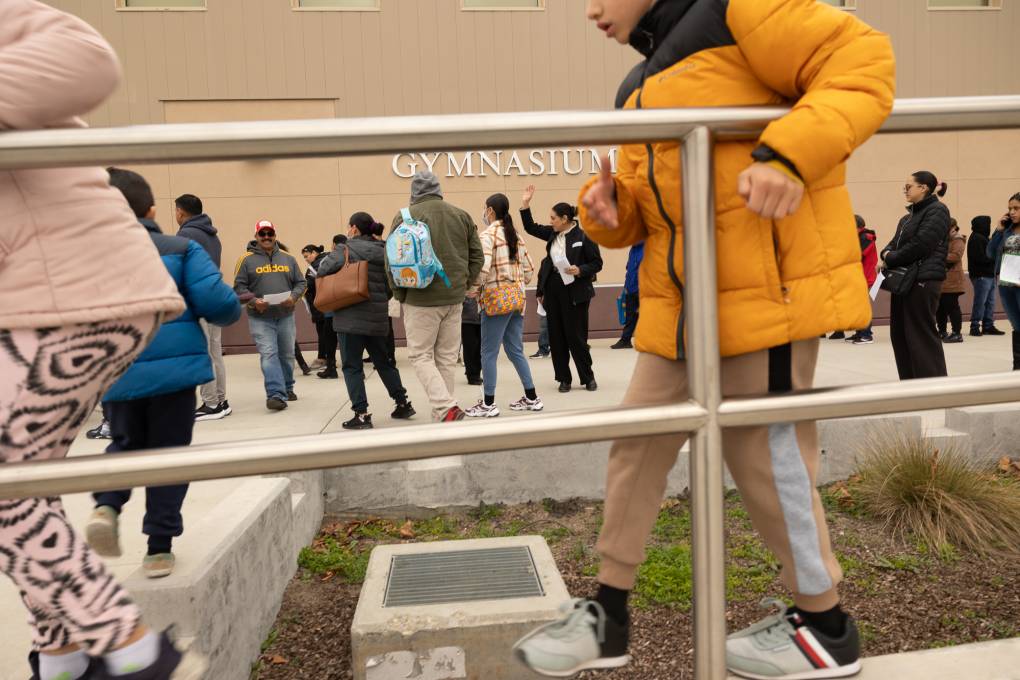
"caption": "People wait in line to register and enter an informational session about immigration services at Willow Cove Elementary in Pittsburg, California, on Jan. 29, 2025. More than 300 people attended the event organized by Stand Together Contra Costa and the Pittsburg Unified School District, which offered free, private consultation with immigration attorneys, along with medical services and a resource fair.",
"credit": "David M. Barreda/KQED",
"altTag": "People stand in line outside a school building.",
"description": null,
"imgSizes": {
"medium": {
"file": "https://cdn.kqed.org/wp-content/uploads/sites/10/2025/01/20250125_Immigration-Forum_DB_00822-800x533.jpg",
"width": 800,
"height": 533,
"mimeType": "image/jpeg"
},
"large": {
"file": "https://cdn.kqed.org/wp-content/uploads/sites/10/2025/01/20250125_Immigration-Forum_DB_00822-1020x680.jpg",
"width": 1020,
"height": 680,
"mimeType": "image/jpeg"
},
"thumbnail": {
"file": "https://cdn.kqed.org/wp-content/uploads/sites/10/2025/01/20250125_Immigration-Forum_DB_00822-160x107.jpg",
"width": 160,
"height": 107,
"mimeType": "image/jpeg"
},
"1536x1536": {
"file": "https://cdn.kqed.org/wp-content/uploads/sites/10/2025/01/20250125_Immigration-Forum_DB_00822-1536x1024.jpg",
"width": 1536,
"height": 1024,
"mimeType": "image/jpeg"
},
"post-thumbnail": {
"file": "https://cdn.kqed.org/wp-content/uploads/sites/10/2025/01/20250125_Immigration-Forum_DB_00822-672x372.jpg",
"width": 672,
"height": 372,
"mimeType": "image/jpeg"
},
"twentyfourteen-full-width": {
"file": "https://cdn.kqed.org/wp-content/uploads/sites/10/2025/01/20250125_Immigration-Forum_DB_00822-1038x576.jpg",
"width": 1038,
"height": 576,
"mimeType": "image/jpeg"
},
"full-width": {
"file": "https://cdn.kqed.org/wp-content/uploads/sites/10/2025/01/20250125_Immigration-Forum_DB_00822-1920x1280.jpg",
"width": 1920,
"height": 1280,
"mimeType": "image/jpeg"
},
"kqedFullSize": {
"file": "https://cdn.kqed.org/wp-content/uploads/sites/10/2025/01/20250125_Immigration-Forum_DB_00822.jpg",
"width": 2000,
"height": 1333
}
},
"isLoading": false,
"fetchFailed": false
},
"news_12024991": {
"type": "attachments",
"id": "news_12024991",
"meta": {
"index": "attachments_1716263798",
"site": "news",
"id": "12024991",
"found": true
},
"title": "20250130_SSUTownHall_GC-35",
"publishDate": 1738284661,
"status": "inherit",
"parent": 0,
"modified": 1738693943,
"caption": "Hundreds of students, alumni and faculty gather for a rally and virtual town hall, protesting against the school’s budget cuts, at Sonoma State’s Seawolf Plaza, in Rohnert Park, California, on Thursday, Jan 30, 2025.",
"credit": "Gina Castro/KQED",
"altTag": null,
"description": null,
"imgSizes": {
"medium": {
"file": "https://cdn.kqed.org/wp-content/uploads/sites/10/2025/01/20250130_SSUTownHall_GC-35-800x533.jpg",
"width": 800,
"height": 533,
"mimeType": "image/jpeg"
},
"large": {
"file": "https://cdn.kqed.org/wp-content/uploads/sites/10/2025/01/20250130_SSUTownHall_GC-35-1020x680.jpg",
"width": 1020,
"height": 680,
"mimeType": "image/jpeg"
},
"thumbnail": {
"file": "https://cdn.kqed.org/wp-content/uploads/sites/10/2025/01/20250130_SSUTownHall_GC-35-160x107.jpg",
"width": 160,
"height": 107,
"mimeType": "image/jpeg"
},
"1536x1536": {
"file": "https://cdn.kqed.org/wp-content/uploads/sites/10/2025/01/20250130_SSUTownHall_GC-35-1536x1024.jpg",
"width": 1536,
"height": 1024,
"mimeType": "image/jpeg"
},
"post-thumbnail": {
"file": "https://cdn.kqed.org/wp-content/uploads/sites/10/2025/01/20250130_SSUTownHall_GC-35-672x372.jpg",
"width": 672,
"height": 372,
"mimeType": "image/jpeg"
},
"twentyfourteen-full-width": {
"file": "https://cdn.kqed.org/wp-content/uploads/sites/10/2025/01/20250130_SSUTownHall_GC-35-1038x576.jpg",
"width": 1038,
"height": 576,
"mimeType": "image/jpeg"
},
"full-width": {
"file": "https://cdn.kqed.org/wp-content/uploads/sites/10/2025/01/20250130_SSUTownHall_GC-35-1920x1280.jpg",
"width": 1920,
"height": 1280,
"mimeType": "image/jpeg"
},
"kqedFullSize": {
"file": "https://cdn.kqed.org/wp-content/uploads/sites/10/2025/01/20250130_SSUTownHall_GC-35.jpg",
"width": 2000,
"height": 1333
}
},
"isLoading": false,
"fetchFailed": false
},
"news_12025663": {
"type": "attachments",
"id": "news_12025663",
"meta": {
"index": "attachments_1716263798",
"site": "news",
"id": "12025663",
"found": true
},
"title": "250204-WeCantWait-04-BL",
"publishDate": 1738707441,
"status": "inherit",
"parent": 12026596,
"modified": 1739392435,
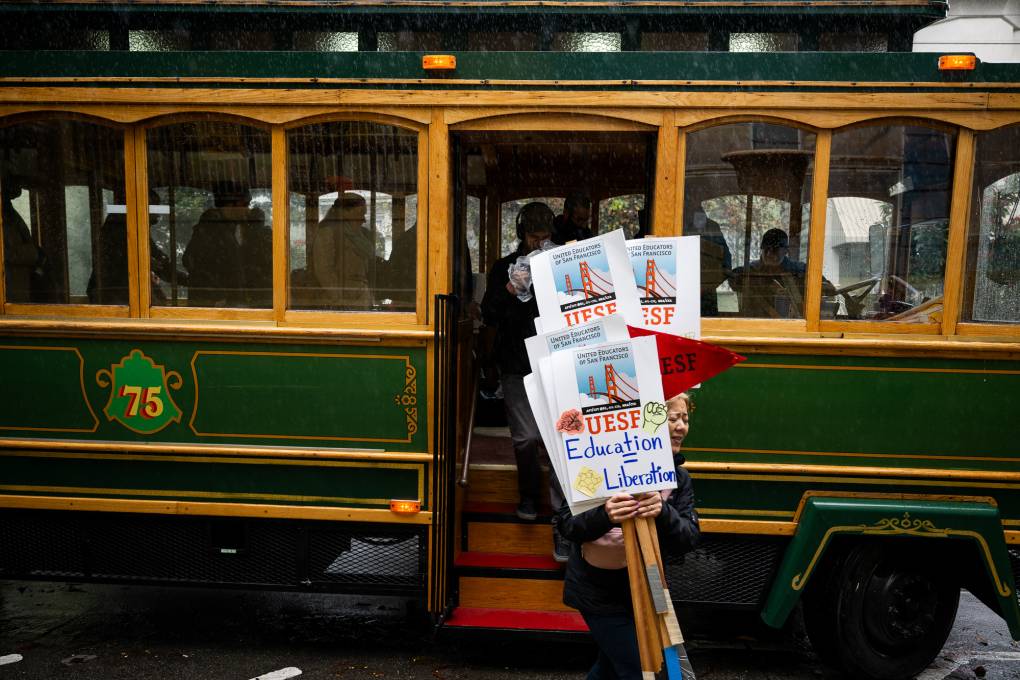
"caption": "Educators and union leaders ride on a trolley car from Malcolm X Academy Elementary School to Buena Vista Horace Mann K-8 Community School in San Francisco’s Mission District on Tuesday, Feb. 4, 2025. The groups held a press conference to announce the launch of the \"We Can’t Wait\" campaign, a statewide effort advocating for improved class sizes, better wages and safer schools for educators and students.",
"credit": "Beth LaBerge/KQED",
"altTag": null,
"description": null,
"imgSizes": {
"medium": {
"file": "https://cdn.kqed.org/wp-content/uploads/sites/10/2025/02/250204-WeCantWait-04-BL-800x533.jpg",
"width": 800,
"height": 533,
"mimeType": "image/jpeg"
},
"large": {
"file": "https://cdn.kqed.org/wp-content/uploads/sites/10/2025/02/250204-WeCantWait-04-BL-1020x680.jpg",
"width": 1020,
"height": 680,
"mimeType": "image/jpeg"
},
"thumbnail": {
"file": "https://cdn.kqed.org/wp-content/uploads/sites/10/2025/02/250204-WeCantWait-04-BL-160x107.jpg",
"width": 160,
"height": 107,
"mimeType": "image/jpeg"
},
"1536x1536": {
"file": "https://cdn.kqed.org/wp-content/uploads/sites/10/2025/02/250204-WeCantWait-04-BL-1536x1024.jpg",
"width": 1536,
"height": 1024,
"mimeType": "image/jpeg"
},
"post-thumbnail": {
"file": "https://cdn.kqed.org/wp-content/uploads/sites/10/2025/02/250204-WeCantWait-04-BL-672x372.jpg",
"width": 672,
"height": 372,
"mimeType": "image/jpeg"
},
"twentyfourteen-full-width": {
"file": "https://cdn.kqed.org/wp-content/uploads/sites/10/2025/02/250204-WeCantWait-04-BL-1038x576.jpg",
"width": 1038,
"height": 576,
"mimeType": "image/jpeg"
},
"full-width": {
"file": "https://cdn.kqed.org/wp-content/uploads/sites/10/2025/02/250204-WeCantWait-04-BL-1920x1280.jpg",
"width": 1920,
"height": 1280,
"mimeType": "image/jpeg"
},
"kqedFullSize": {
"file": "https://cdn.kqed.org/wp-content/uploads/sites/10/2025/02/250204-WeCantWait-04-BL.jpg",
"width": 2000,
"height": 1333
}
},
"isLoading": false,
"fetchFailed": false
}
},
"audioPlayerReducer": {
"postId": "stream_live",
"isPaused": true,
"isPlaying": false,
"pfsActive": false,
"pledgeModalIsOpen": true,
"playerDrawerIsOpen": false,
"liveAudioPlayStartedAt": 0,
"liveAudioPlayContext": ""
},
"authorsReducer": {
"byline_news_12027218": {
"type": "authors",
"id": "byline_news_12027218",
"meta": {
"override": true
},
"slug": "byline_news_12027218",
"name": "\u003ca href=\"https://calmatters.org/author/carolyn-jones/\">Carolyn Jones\u003c/a>, CalMatters",
"isLoading": false
},
"rachael-myrow": {
"type": "authors",
"id": "251",
"meta": {
"index": "authors_1716337520",
"id": "251",
"found": true
},
"name": "Rachael Myrow",
"firstName": "Rachael",
"lastName": "Myrow",
"slug": "rachael-myrow",
"email": "rmyrow@kqed.org",
"display_author_email": true,
"staff_mastheads": [
"news"
],
"title": "Senior Editor of KQED's Silicon Valley News Desk",
"bio": "• I write and edit stories about how Silicon Valley power and policies shape everyday life in California. I’m also passionate about making Bay Area history and culture more accessible to a broad public. • I’ve been a journalist for most of my life, starting in high school with The Franklin Press in Los Angeles, where I grew up. While earning my first degree in English at UC Berkeley, I got my start in public radio at KALX-FM. After completing a second degree in journalism at Cal, I landed my first professional job at Marketplace, then moved on to KPCC (now LAist), and then KQED, where I hosted The California Report for more than seven years. • My reporting has appeared on NPR, The World, WBUR’s \u003ci>Here & Now\u003c/i>, and the BBC. I also guest host for KQED’s \u003ci>Forum\u003c/i>, as well as the Commonwealth Club in San Francisco. • I speak periodically on media, democracy and technology issues, and do voiceover work for documentaries and educational video projects. • Outside of the studio, you'll find me hiking Bay Area trails and whipping up Insta-ready meals in my kitchen. • I do not accept gifts, money, or favors from anyone connected to my reporting, I don't pay people for information, and I do not support or donate to political causes. • I strive to treat the people I report on with fairness, honesty, and respect. I also recognize there are often multiple sides to a story and work to verify information through multiple sources and documentation. If I get something wrong, I correct it.",
"avatar": "https://secure.gravatar.com/avatar/3ed8a3c5f26025e4a805ba634cda8cd764906b97438a6d9ce216b044e340da4e?s=600&d=blank&r=g",
"twitter": "rachaelmyrow",
"bluesky": null,
"facebook": null,
"instagram": null,
"linkedin": "https://www.linkedin.com/in/rachaelmyrow/",
"sites": [
{
"site": "arts",
"roles": [
"administrator"
]
},
{
"site": "news",
"roles": [
"edit_others_posts",
"editor"
]
},
{
"site": "futureofyou",
"roles": [
"editor"
]
},
{
"site": "bayareabites",
"roles": [
"editor"
]
},
{
"site": "stateofhealth",
"roles": [
"editor"
]
},
{
"site": "science",
"roles": [
"editor"
]
},
{
"site": "food",
"roles": [
"editor"
]
},
{
"site": "forum",
"roles": [
"editor"
]
},
{
"site": "liveblog",
"roles": [
"author"
]
}
],
"headData": {
"title": "Rachael Myrow | KQED",
"description": "Senior Editor of KQED's Silicon Valley News Desk",
"ogImgSrc": "https://secure.gravatar.com/avatar/3ed8a3c5f26025e4a805ba634cda8cd764906b97438a6d9ce216b044e340da4e?s=600&d=blank&r=g",
"twImgSrc": "https://secure.gravatar.com/avatar/3ed8a3c5f26025e4a805ba634cda8cd764906b97438a6d9ce216b044e340da4e?s=600&d=blank&r=g"
},
"isLoading": false,
"link": "/author/rachael-myrow"
},
"tychehendricks": {
"type": "authors",
"id": "259",
"meta": {
"index": "authors_1716337520",
"id": "259",
"found": true
},
"name": "Tyche Hendricks",
"firstName": "Tyche",
"lastName": "Hendricks",
"slug": "tychehendricks",
"email": "thendricks@kqed.org",
"display_author_email": true,
"staff_mastheads": [
"news"
],
"title": "KQED Senior Editor, Immigration",
"bio": "\u003cspan style=\"font-weight: 400;\">Tyche Hendricks is KQED’s senior editor for immigration, leading coverage of the policy and politics that affect California’s immigrant communities. Her work for KQED’s radio and online audiences is also carried on NPR and other national outlets. She has been recognized with awards from the Radio and Television News Directors Association, the Society for Professional Journalists; the Education Writers Association; the Best of the West and the National Federation of Community Broadcasters. Before joining KQED in 2010, Tyche spent more than a dozen years as a newspaper reporter, notably at the \u003c/span>\u003ci>\u003cspan style=\"font-weight: 400;\">San Francisco Chronicle\u003c/span>\u003c/i>\u003cspan style=\"font-weight: 400;\">. At different times she has covered criminal justice, government and politics and urban planning. Tyche has taught in the MFA Creative Writing program at the University of San Francisco and at UC Berkeley’s Graduate School of Journalism, where she was co-director of a national immigration symposium for professional journalists. She is the author of \u003c/span>\u003ci>\u003cspan style=\"font-weight: 400;\">The Wind Doesn't Need a Passport: Stories from the U.S.-Mexico Borderlands\u003c/span>\u003c/i>\u003cspan style=\"font-weight: 400;\"> (University of California Press). \u003c/span>",
"avatar": "https://secure.gravatar.com/avatar/b8ee458e2731c2d43df86882ce17267e?s=600&d=blank&r=g",
"twitter": "tychehendricks",
"facebook": null,
"instagram": null,
"linkedin": null,
"sites": [
{
"site": "news",
"roles": [
"editor"
]
},
{
"site": "stateofhealth",
"roles": [
"editor"
]
}
],
"headData": {
"title": "Tyche Hendricks | KQED",
"description": "KQED Senior Editor, Immigration",
"ogImgSrc": "https://secure.gravatar.com/avatar/b8ee458e2731c2d43df86882ce17267e?s=600&d=blank&r=g",
"twImgSrc": "https://secure.gravatar.com/avatar/b8ee458e2731c2d43df86882ce17267e?s=600&d=blank&r=g"
},
"isLoading": false,
"link": "/author/tychehendricks"
},
"daisynguyen": {
"type": "authors",
"id": "11829",
"meta": {
"index": "authors_1716337520",
"id": "11829",
"found": true
},
"name": "Daisy Nguyen",
"firstName": "Daisy",
"lastName": "Nguyen",
"slug": "daisynguyen",
"email": "daisynguyen@kqed.org",
"display_author_email": true,
"staff_mastheads": [
"news"
],
"title": "KQED Contributor",
"bio": "I have covered early childhood education and child care for KQED since 2022. I focus on policies aimed at increasing access to early care and education and how they shape individual lives. I've been a journalist for more than two decades, with most of that time devoted to covering breaking news throughout California for The Associated Press. I grew up in San Francisco and studied at UC Davis and Columbia University's Graduate School of Journalism. I live in Oakland with my husband and two kids.",
"avatar": "https://secure.gravatar.com/avatar/2da2127c27f7143b53ebd419800fd55f?s=600&d=blank&r=g",
"twitter": null,
"facebook": null,
"instagram": null,
"linkedin": "https://www.linkedin.com/in/daisynguyen/",
"sites": [
{
"site": "news",
"roles": [
"author"
]
},
{
"site": "liveblog",
"roles": [
"author"
]
}
],
"headData": {
"title": "Daisy Nguyen | KQED",
"description": "KQED Contributor",
"ogImgSrc": "https://secure.gravatar.com/avatar/2da2127c27f7143b53ebd419800fd55f?s=600&d=blank&r=g",
"twImgSrc": "https://secure.gravatar.com/avatar/2da2127c27f7143b53ebd419800fd55f?s=600&d=blank&r=g"
},
"isLoading": false,
"link": "/author/daisynguyen"
},
"kdebenedetti": {
"type": "authors",
"id": "11913",
"meta": {
"index": "authors_1716337520",
"id": "11913",
"found": true
},
"name": "Katie DeBenedetti",
"firstName": "Katie",
"lastName": "DeBenedetti",
"slug": "kdebenedetti",
"email": "kdebenedetti@kqed.org",
"display_author_email": false,
"staff_mastheads": [
"news",
"science"
],
"title": "KQED Contributor",
"bio": "Katie DeBenedetti is a digital reporter covering daily news for the Express Desk. Prior to joining KQED as a culture reporting intern in January 2024, she covered education and city government for the Napa Valley Register.",
"avatar": "https://secure.gravatar.com/avatar/6e31073cb8f7e4214ab03f42771d0f45?s=600&d=blank&r=g",
"twitter": null,
"facebook": null,
"instagram": null,
"linkedin": null,
"sites": [
{
"site": "news",
"roles": [
"author"
]
},
{
"site": "science",
"roles": [
"author"
]
},
{
"site": "liveblog",
"roles": [
"author"
]
}
],
"headData": {
"title": "Katie DeBenedetti | KQED",
"description": "KQED Contributor",
"ogImgSrc": "https://secure.gravatar.com/avatar/6e31073cb8f7e4214ab03f42771d0f45?s=600&d=blank&r=g",
"twImgSrc": "https://secure.gravatar.com/avatar/6e31073cb8f7e4214ab03f42771d0f45?s=600&d=blank&r=g"
},
"isLoading": false,
"link": "/author/kdebenedetti"
},
"slim": {
"type": "authors",
"id": "11920",
"meta": {
"index": "authors_1716337520",
"id": "11920",
"found": true
},
"name": "Samantha Lim",
"firstName": "Samantha",
"lastName": "Lim",
"slug": "slim",
"email": "slim@KQED.org",
"display_author_email": false,
"staff_mastheads": [],
"title": "KQED Contributor",
"bio": null,
"avatar": "https://secure.gravatar.com/avatar/82e592e6c15fe1a04d385e8ad0fb0b4e?s=600&d=blank&r=g",
"twitter": null,
"facebook": null,
"instagram": null,
"linkedin": null,
"sites": [
{
"site": "news",
"roles": []
}
],
"headData": {
"title": "Samantha Lim | KQED",
"description": "KQED Contributor",
"ogImgSrc": "https://secure.gravatar.com/avatar/82e592e6c15fe1a04d385e8ad0fb0b4e?s=600&d=blank&r=g",
"twImgSrc": "https://secure.gravatar.com/avatar/82e592e6c15fe1a04d385e8ad0fb0b4e?s=600&d=blank&r=g"
},
"isLoading": false,
"link": "/author/slim"
}
},
"pagesReducer": {
"news_category_education": {
"type": "terms",
"id": "news_18540",
"meta": {
"index": "terms_1716263798",
"site": "news",
"id": "18540",
"score": 10.973095
},
"featImg": null,
"name": "Education",
"description": null,
"taxonomy": "category",
"headData": {
"twImgId": null,
"twTitle": null,
"ogTitle": null,
"ogImgId": null,
"twDescription": null,
"description": null,
"title": "Education Archives | KQED News",
"ogDescription": null
},
"ttid": 2595,
"slug": "education",
"isLoading": false,
"title": "Education",
"pageMeta": {
"site": "news",
"WpPageTemplate": "page-topic-editorial",
"currentPage": 32
},
"blocks": [
{
"blockName": "kqed/post-list",
"attrs": {
"layout": "cardArticle2",
"query": "posts/news?category=education",
"seeMore": false,
"paginated": true,
"page": 32
}
},
{
"blockName": "kqed/ad"
}
]
}
},
"pfsSessionReducer": {},
"postsReducer": {
"stream_live": {
"type": "live",
"id": "stream_live",
"audioUrl": "https://streams.kqed.org/kqedradio",
"title": "Live Stream",
"excerpt": "Live Stream information currently unavailable.",
"link": "/radio",
"featImg": "",
"label": {
"name": "KQED Live",
"link": "/"
}
},
"stream_kqedNewscast": {
"type": "posts",
"id": "stream_kqedNewscast",
"audioUrl": "https://www.kqed.org/.stream/anon/radio/RDnews/newscast.mp3?_=1",
"title": "KQED Newscast",
"featImg": "",
"label": {
"name": "88.5 FM",
"link": "/"
}
},
"news_12027906": {
"type": "posts",
"id": "news_12027906",
"meta": {
"index": "posts_1716263798",
"site": "news",
"id": "12027906",
"score": null,
"sort": [
1740084023000
]
},
"guestAuthors": [],
"slug": "local-head-start-program-scrambles-to-keep-supporting-kids-amid-trumps-funding-freezes",
"title": "Local Head Start Program Scrambles to Keep Supporting Kids Amid Trump's Funding Freezes",
"publishDate": 1740084023,
"format": "standard",
"headTitle": "Local Head Start Program Scrambles to Keep Supporting Kids Amid Trump’s Funding Freezes | KQED",
"labelTerm": {
"site": "news"
},
"content": "\u003cp>On the morning he learned the Trump administration had \u003ca href=\"https://www.kqed.org/news/12026245/can-trump-actually-change-federal-funding-rules-through-executive-orders\">ordered a freeze on federal grant funding\u003c/a>, Juan Cisneros called an emergency meeting with the staff at Child Start Inc., which serves 800 Head Start children in Napa and Solano counties.\u003c/p>\n\u003cp>The end of January was approaching, and the nonprofit agency needed to recoup money it just spent to pay its 230 employees. However, when a fiscal officer tried several times to request reimbursements from a payment portal run by the U.S. Department of Health and Human Services, \u003ca href=\"https://www.kqed.org/news/12024321/california-head-start-programs-caught-up-in-trumps-funding-freeze\">they were blocked from accessing the system\u003c/a>.\u003c/p>\n\u003cp>Cisneros, Child Start’s executive director, said he had never experienced a funding disruption like this in his 27 years working with Head Start.\u003c/p>\n\u003cp>“It seemed like an overnight implementation of an order that we just had no control over,” Cisneros said. “We had no backup plan. It just happened so suddenly.”\u003c/p>\n\u003cp>[ad fullwidth]\u003c/p>\n\u003cp>A White House memo announcing a funding pause to federal grants, loans and programs sparked worry that Child Start Inc. would have to close classrooms.\u003c/p>\n\u003cp>A payment came a day after a federal judge \u003ca href=\"https://www.kqed.org/news/12024387/california-22-other-states-sue-to-block-trumps-federal-funding-freeze\">temporarily blocked the funding freeze\u003c/a>, Cisneros said, but he’s worried about future funding delays because at least 45 Head Start grant recipients in other parts of California and states reported \u003ca href=\"https://nhsa.org/press_release/ongoing-issues-accessing-federal-grant-funds-continue-to-impact-head-start-programs/\">payment delays\u003c/a> more than a week after the judge’s order.\u003c/p>\n\u003cp>The Department of Health and Human Services blamed the problem on “technical issues” with the payment portal, which has been fixed.\u003c/p>\n\u003cp>There have been no additional reports of payment delays among members of Head Start California, said the association’s executive director, Melanee Cottrill. However, she’s concerned that the firing of several dozen federal employees at the Administration for Children and Families, which oversees Head Start grants, will affect local programs.\u003c/p>\n\u003cfigure id=\"attachment_12027073\" class=\"wp-caption aligncenter\" style=\"max-width: 2000px\">\u003cimg loading=\"lazy\" decoding=\"async\" class=\"size-full wp-image-12027073\" src=\"https://cdn.kqed.org/wp-content/uploads/sites/10/2025/02/250213-HEADSTARTFUNDINGINTERRUPTION-09-BL-KQED.jpg\" alt=\"\" width=\"2000\" height=\"1333\" srcset=\"https://cdn.kqed.org/wp-content/uploads/sites/10/2025/02/250213-HEADSTARTFUNDINGINTERRUPTION-09-BL-KQED.jpg 2000w, https://cdn.kqed.org/wp-content/uploads/sites/10/2025/02/250213-HEADSTARTFUNDINGINTERRUPTION-09-BL-KQED-800x533.jpg 800w, https://cdn.kqed.org/wp-content/uploads/sites/10/2025/02/250213-HEADSTARTFUNDINGINTERRUPTION-09-BL-KQED-1020x680.jpg 1020w, https://cdn.kqed.org/wp-content/uploads/sites/10/2025/02/250213-HEADSTARTFUNDINGINTERRUPTION-09-BL-KQED-160x107.jpg 160w, https://cdn.kqed.org/wp-content/uploads/sites/10/2025/02/250213-HEADSTARTFUNDINGINTERRUPTION-09-BL-KQED-1536x1024.jpg 1536w, https://cdn.kqed.org/wp-content/uploads/sites/10/2025/02/250213-HEADSTARTFUNDINGINTERRUPTION-09-BL-KQED-1920x1280.jpg 1920w\" sizes=\"auto, (max-width: 2000px) 100vw, 2000px\">\u003cfigcaption class=\"wp-caption-text\">Caregiver Briggit Cervantes works with children ages two to three at Vineyard Crossings Head Start in American Canyon on Feb. 13. Lower-income families rely on the center for child care while they work or look for a job. \u003ccite>(Beth LaBerge/KQED)\u003c/cite>\u003c/figcaption>\u003c/figure>\n\u003cp>“This will mean delays in processing applications and providing technical assistance, which will impede our ability to serve children and families,” Cottrill said.\u003c/p>\n\u003cp>The uncertainty prompted Cisneros to think about how to keep services going in the event of another funding disruption. He said he lost confidence in the payment system and thinks the Trump administration may make cuts to early childhood education programs.\u003c/p>\n\u003cp>“We expect that there’s going to be more, so we’re just trying to prepare and have a Plan B should something else happen,” he said.\u003c/p>\n\u003cp>Child Start receives an annual $19 million grant to operate 17 child care and early education centers, but the grant is not paid out in a lump sum. Instead, it draws down about $800,000 from a federal account two times per month in order to pay rent, payroll, food and other operating expenses. Receiving those funds on time is important because it does not have a lot of reserve funds and isn’t allowed to use federal funds to pay late fees.\u003c/p>\n\u003cp>“We need a system that’s up and running and reliable to be able to access those funds when we need them,” Cisneros said. “This is really the first time that the [payment] system wasn’t available, and it just felt like we were intentionally being denied access.”\u003c/p>\n\u003cfigure id=\"attachment_12027072\" class=\"wp-caption aligncenter\" style=\"max-width: 2000px\">\u003cimg loading=\"lazy\" decoding=\"async\" class=\"size-full wp-image-12027072\" src=\"https://cdn.kqed.org/wp-content/uploads/sites/10/2025/02/250213-HEADSTARTFUNDINGINTERRUPTION-04-BL-KQED.jpg\" alt=\"\" width=\"2000\" height=\"1333\" srcset=\"https://cdn.kqed.org/wp-content/uploads/sites/10/2025/02/250213-HEADSTARTFUNDINGINTERRUPTION-04-BL-KQED.jpg 2000w, https://cdn.kqed.org/wp-content/uploads/sites/10/2025/02/250213-HEADSTARTFUNDINGINTERRUPTION-04-BL-KQED-800x533.jpg 800w, https://cdn.kqed.org/wp-content/uploads/sites/10/2025/02/250213-HEADSTARTFUNDINGINTERRUPTION-04-BL-KQED-1020x680.jpg 1020w, https://cdn.kqed.org/wp-content/uploads/sites/10/2025/02/250213-HEADSTARTFUNDINGINTERRUPTION-04-BL-KQED-160x107.jpg 160w, https://cdn.kqed.org/wp-content/uploads/sites/10/2025/02/250213-HEADSTARTFUNDINGINTERRUPTION-04-BL-KQED-1536x1024.jpg 1536w, https://cdn.kqed.org/wp-content/uploads/sites/10/2025/02/250213-HEADSTARTFUNDINGINTERRUPTION-04-BL-KQED-1920x1280.jpg 1920w\" sizes=\"auto, (max-width: 2000px) 100vw, 2000px\">\u003cfigcaption class=\"wp-caption-text\">Lead teacher Retchel Armas leads children in a painting exercise at Vineyard Crossings Head Start in American Canyon. \u003ccite>(Beth LaBerge/KQED)\u003c/cite>\u003c/figcaption>\u003c/figure>\n\u003cp>News of the funding pause prompted board members of Child Start Inc. to consider spending cuts and work with local nonprofits to figure out how to leverage other sources of funding.\u003c/p>\n\u003cp>Employees and parents said they didn’t know how federal grants work until they were suddenly confronted with the prospect of losing their jobs and access to Head Start services.\u003c/p>\n\u003cp>“I didn’t know the logistics,” said Neale Losito, who directs one of Child Start’s early learning centers in American Canyon, a suburb located between Vallejo and Napa. “I thought we’re granted this much money, and we get it all at once. I didn’t know that we don’t have it, really.”[aside label='Related Coverage' tag='early-childhood-education-and-care']She said she’s worried about what might happen to the lower-income or homeless families who rely on her center for child care while they work or look for a job.\u003c/p>\n\u003cp>“We have to stay open so that the child can come to preschool, so mom can go to work. And if we’re suddenly cut off, there’s just a domino effect for everyone,” Losito said.\u003c/p>\n\u003cp>Parents like Jovan Polk said the eight hours of care his 3-year-old son, Jayce, receives at the center each day enables him to work a full shift as a security guard. Polk said he and his wife don’t have relatives nearby to help with child care, and they can’t afford a babysitter.\u003c/p>\n\u003cp>“The hours are perfect. We can go to work and don’t have to worry about him,” Polk said.\u003c/p>\n\u003cp>Polk said his son’s social skills and speech have improved since he has been at the center.\u003c/p>\n\u003cp>It’s the kind of support that Cisneros — himself a product of a Head Start program for the children of migrant farm workers — said can make a huge difference for working-class families.\u003c/p>\n\u003cp>\u003c/p>\n",
"blocks": [],
"excerpt": "The Trump administration’s crackdown on federal spending is causing one Bay Area Head Start program to think about how to keep the early childhood education program going in the event of another funding disruption.",
"status": "publish",
"parent": 0,
"modified": 1743789500,
"stats": {
"hasAudio": false,
"hasVideo": false,
"hasChartOrMap": false,
"iframeSrcs": [],
"hasGoogleForm": false,
"hasGallery": false,
"hasHearkenModule": false,
"hasPolis": false,
"paragraphCount": 23,
"wordCount": 950
},
"headData": {
"title": "Local Head Start Program Scrambles to Keep Supporting Kids Amid Trump's Funding Freezes | KQED",
"description": "The Trump administration’s crackdown on federal spending is causing one Bay Area Head Start program to think about how to keep the early childhood education program going in the event of another funding disruption.",
"ogTitle": "",
"ogDescription": "",
"ogImgId": "",
"twTitle": "",
"twDescription": "",
"twImgId": "",
"schema": {
"@context": "https://schema.org",
"@type": "NewsArticle",
"headline": "Local Head Start Program Scrambles to Keep Supporting Kids Amid Trump's Funding Freezes",
"datePublished": "2025-02-20T12:40:23-08:00",
"dateModified": "2025-04-04T10:58:20-07:00",
"image": "https://cdn.kqed.org/wp-content/uploads/2020/02/KQED-OG-Image@1x.png",
"isAccessibleForFree": "True",
"publisher": {
"@type": "NewsMediaOrganization",
"@id": "https://www.kqed.org/#organization",
"name": "KQED",
"logo": "https://cdn.kqed.org/wp-content/uploads/2020/02/KQED-OG-Image@1x.png",
"url": "https://www.kqed.org",
"sameAs": [
"https://www.facebook.com/KQED",
"https://twitter.com/KQED",
"https://www.instagram.com/kqed/",
"https://www.tiktok.com/@kqedofficial",
"https://www.linkedin.com/company/kqed",
"https://www.youtube.com/channel/UCeC0IOo7i1P_61zVUWbJ4nw"
]
}
}
},
"audioUrl": "https://traffic.omny.fm/d/clips/0af137ef-751e-4b19-a055-aaef00d2d578/ffca7e9f-6831-41c5-bcaf-aaef00f5a073/4ce7a6fb-05d3-4a41-ac5a-b28f0111cd1e/audio.mp3",
"sticky": false,
"nprStoryId": "kqed-12027906",
"templateType": "standard",
"featuredImageType": "standard",
"excludeFromSiteSearch": "Include",
"articleAge": "0",
"path": "/news/12027906/local-head-start-program-scrambles-to-keep-supporting-kids-amid-trumps-funding-freezes",
"audioTrackLength": null,
"parsedContent": [
{
"type": "contentString",
"content": "\u003cdiv class=\"post-body\">\u003cp>\u003cp>On the morning he learned the Trump administration had \u003ca href=\"https://www.kqed.org/news/12026245/can-trump-actually-change-federal-funding-rules-through-executive-orders\">ordered a freeze on federal grant funding\u003c/a>, Juan Cisneros called an emergency meeting with the staff at Child Start Inc., which serves 800 Head Start children in Napa and Solano counties.\u003c/p>\n\u003cp>The end of January was approaching, and the nonprofit agency needed to recoup money it just spent to pay its 230 employees. However, when a fiscal officer tried several times to request reimbursements from a payment portal run by the U.S. Department of Health and Human Services, \u003ca href=\"https://www.kqed.org/news/12024321/california-head-start-programs-caught-up-in-trumps-funding-freeze\">they were blocked from accessing the system\u003c/a>.\u003c/p>\n\u003cp>Cisneros, Child Start’s executive director, said he had never experienced a funding disruption like this in his 27 years working with Head Start.\u003c/p>\n\u003cp>“It seemed like an overnight implementation of an order that we just had no control over,” Cisneros said. “We had no backup plan. It just happened so suddenly.”\u003c/p>\n\u003cp>\u003c/p>\u003c/div>",
"attributes": {
"named": {},
"numeric": []
}
},
{
"type": "component",
"content": "",
"name": "ad",
"attributes": {
"named": {
"label": "fullwidth"
},
"numeric": [
"fullwidth"
]
}
},
{
"type": "contentString",
"content": "\u003cdiv class=\"post-body\">\u003cp>\u003c/p>\n\u003cp>A White House memo announcing a funding pause to federal grants, loans and programs sparked worry that Child Start Inc. would have to close classrooms.\u003c/p>\n\u003cp>A payment came a day after a federal judge \u003ca href=\"https://www.kqed.org/news/12024387/california-22-other-states-sue-to-block-trumps-federal-funding-freeze\">temporarily blocked the funding freeze\u003c/a>, Cisneros said, but he’s worried about future funding delays because at least 45 Head Start grant recipients in other parts of California and states reported \u003ca href=\"https://nhsa.org/press_release/ongoing-issues-accessing-federal-grant-funds-continue-to-impact-head-start-programs/\">payment delays\u003c/a> more than a week after the judge’s order.\u003c/p>\n\u003cp>The Department of Health and Human Services blamed the problem on “technical issues” with the payment portal, which has been fixed.\u003c/p>\n\u003cp>There have been no additional reports of payment delays among members of Head Start California, said the association’s executive director, Melanee Cottrill. However, she’s concerned that the firing of several dozen federal employees at the Administration for Children and Families, which oversees Head Start grants, will affect local programs.\u003c/p>\n\u003cfigure id=\"attachment_12027073\" class=\"wp-caption aligncenter\" style=\"max-width: 2000px\">\u003cimg loading=\"lazy\" decoding=\"async\" class=\"size-full wp-image-12027073\" src=\"https://cdn.kqed.org/wp-content/uploads/sites/10/2025/02/250213-HEADSTARTFUNDINGINTERRUPTION-09-BL-KQED.jpg\" alt=\"\" width=\"2000\" height=\"1333\" srcset=\"https://cdn.kqed.org/wp-content/uploads/sites/10/2025/02/250213-HEADSTARTFUNDINGINTERRUPTION-09-BL-KQED.jpg 2000w, https://cdn.kqed.org/wp-content/uploads/sites/10/2025/02/250213-HEADSTARTFUNDINGINTERRUPTION-09-BL-KQED-800x533.jpg 800w, https://cdn.kqed.org/wp-content/uploads/sites/10/2025/02/250213-HEADSTARTFUNDINGINTERRUPTION-09-BL-KQED-1020x680.jpg 1020w, https://cdn.kqed.org/wp-content/uploads/sites/10/2025/02/250213-HEADSTARTFUNDINGINTERRUPTION-09-BL-KQED-160x107.jpg 160w, https://cdn.kqed.org/wp-content/uploads/sites/10/2025/02/250213-HEADSTARTFUNDINGINTERRUPTION-09-BL-KQED-1536x1024.jpg 1536w, https://cdn.kqed.org/wp-content/uploads/sites/10/2025/02/250213-HEADSTARTFUNDINGINTERRUPTION-09-BL-KQED-1920x1280.jpg 1920w\" sizes=\"auto, (max-width: 2000px) 100vw, 2000px\">\u003cfigcaption class=\"wp-caption-text\">Caregiver Briggit Cervantes works with children ages two to three at Vineyard Crossings Head Start in American Canyon on Feb. 13. Lower-income families rely on the center for child care while they work or look for a job. \u003ccite>(Beth LaBerge/KQED)\u003c/cite>\u003c/figcaption>\u003c/figure>\n\u003cp>“This will mean delays in processing applications and providing technical assistance, which will impede our ability to serve children and families,” Cottrill said.\u003c/p>\n\u003cp>The uncertainty prompted Cisneros to think about how to keep services going in the event of another funding disruption. He said he lost confidence in the payment system and thinks the Trump administration may make cuts to early childhood education programs.\u003c/p>\n\u003cp>“We expect that there’s going to be more, so we’re just trying to prepare and have a Plan B should something else happen,” he said.\u003c/p>\n\u003cp>Child Start receives an annual $19 million grant to operate 17 child care and early education centers, but the grant is not paid out in a lump sum. Instead, it draws down about $800,000 from a federal account two times per month in order to pay rent, payroll, food and other operating expenses. Receiving those funds on time is important because it does not have a lot of reserve funds and isn’t allowed to use federal funds to pay late fees.\u003c/p>\n\u003cp>“We need a system that’s up and running and reliable to be able to access those funds when we need them,” Cisneros said. “This is really the first time that the [payment] system wasn’t available, and it just felt like we were intentionally being denied access.”\u003c/p>\n\u003cfigure id=\"attachment_12027072\" class=\"wp-caption aligncenter\" style=\"max-width: 2000px\">\u003cimg loading=\"lazy\" decoding=\"async\" class=\"size-full wp-image-12027072\" src=\"https://cdn.kqed.org/wp-content/uploads/sites/10/2025/02/250213-HEADSTARTFUNDINGINTERRUPTION-04-BL-KQED.jpg\" alt=\"\" width=\"2000\" height=\"1333\" srcset=\"https://cdn.kqed.org/wp-content/uploads/sites/10/2025/02/250213-HEADSTARTFUNDINGINTERRUPTION-04-BL-KQED.jpg 2000w, https://cdn.kqed.org/wp-content/uploads/sites/10/2025/02/250213-HEADSTARTFUNDINGINTERRUPTION-04-BL-KQED-800x533.jpg 800w, https://cdn.kqed.org/wp-content/uploads/sites/10/2025/02/250213-HEADSTARTFUNDINGINTERRUPTION-04-BL-KQED-1020x680.jpg 1020w, https://cdn.kqed.org/wp-content/uploads/sites/10/2025/02/250213-HEADSTARTFUNDINGINTERRUPTION-04-BL-KQED-160x107.jpg 160w, https://cdn.kqed.org/wp-content/uploads/sites/10/2025/02/250213-HEADSTARTFUNDINGINTERRUPTION-04-BL-KQED-1536x1024.jpg 1536w, https://cdn.kqed.org/wp-content/uploads/sites/10/2025/02/250213-HEADSTARTFUNDINGINTERRUPTION-04-BL-KQED-1920x1280.jpg 1920w\" sizes=\"auto, (max-width: 2000px) 100vw, 2000px\">\u003cfigcaption class=\"wp-caption-text\">Lead teacher Retchel Armas leads children in a painting exercise at Vineyard Crossings Head Start in American Canyon. \u003ccite>(Beth LaBerge/KQED)\u003c/cite>\u003c/figcaption>\u003c/figure>\n\u003cp>News of the funding pause prompted board members of Child Start Inc. to consider spending cuts and work with local nonprofits to figure out how to leverage other sources of funding.\u003c/p>\n\u003cp>Employees and parents said they didn’t know how federal grants work until they were suddenly confronted with the prospect of losing their jobs and access to Head Start services.\u003c/p>\n\u003cp>“I didn’t know the logistics,” said Neale Losito, who directs one of Child Start’s early learning centers in American Canyon, a suburb located between Vallejo and Napa. “I thought we’re granted this much money, and we get it all at once. I didn’t know that we don’t have it, really.”\u003c/p>\u003c/div>",
"attributes": {
"named": {},
"numeric": []
}
},
{
"type": "component",
"content": "",
"name": "aside",
"attributes": {
"named": {
"label": "Related Coverage ",
"tag": "early-childhood-education-and-care"
},
"numeric": []
}
},
{
"type": "contentString",
"content": "\u003cdiv class=\"post-body\">\u003cp>She said she’s worried about what might happen to the lower-income or homeless families who rely on her center for child care while they work or look for a job.\u003c/p>\n\u003cp>“We have to stay open so that the child can come to preschool, so mom can go to work. And if we’re suddenly cut off, there’s just a domino effect for everyone,” Losito said.\u003c/p>\n\u003cp>Parents like Jovan Polk said the eight hours of care his 3-year-old son, Jayce, receives at the center each day enables him to work a full shift as a security guard. Polk said he and his wife don’t have relatives nearby to help with child care, and they can’t afford a babysitter.\u003c/p>\n\u003cp>“The hours are perfect. We can go to work and don’t have to worry about him,” Polk said.\u003c/p>\n\u003cp>Polk said his son’s social skills and speech have improved since he has been at the center.\u003c/p>\n\u003cp>It’s the kind of support that Cisneros — himself a product of a Head Start program for the children of migrant farm workers — said can make a huge difference for working-class families.\u003c/p>\n\u003cp>\u003c/p>\n\u003c/div>\u003c/p>",
"attributes": {
"named": {},
"numeric": []
}
}
],
"link": "/news/12027906/local-head-start-program-scrambles-to-keep-supporting-kids-amid-trumps-funding-freezes",
"authors": [
"11829"
],
"categories": [
"news_18540",
"news_8",
"news_13"
],
"tags": [
"news_1323",
"news_32102",
"news_20013",
"news_27626",
"news_33388",
"news_17968"
],
"featImg": "news_12027071",
"label": "news"
},
"news_12027218": {
"type": "posts",
"id": "news_12027218",
"meta": {
"index": "posts_1716263798",
"site": "news",
"id": "12027218",
"score": null,
"sort": [
1739806220000
]
},
"guestAuthors": [],
"slug": "how-trumps-drastic-k-12-plans-will-and-wont-change-california-schools",
"title": "How Trump’s Drastic K–12 Plans Will — and Won’t — Affect California Schools",
"publishDate": 1739806220,
"format": "standard",
"headTitle": "How Trump’s Drastic K–12 Plans Will — and Won’t — Affect California Schools | KQED",
"labelTerm": {
"term": 18481,
"site": "news"
},
"content": "\u003cp>From private school vouchers to threats over “woke” curriculum, the Trump administration has launched a slew of reforms intended to reshape K–12 schools. But it’s still too soon to determine how — or if — those efforts will play out in California, experts say.\u003c/p>\n\u003cp>“There’s been a strategy of rapid-fire change, and Trump is very publicly testing his authority,” said Julie Marsh, executive faculty director at Policy Analysis for California Education. “That’s led to a lot of anxiety and uncertainty. But the state still makes most decisions about what happens in schools.”\u003c/p>\n\u003cp>In a barrage of executive orders and promises since he was inaugurated, President Donald Trump has said he wants to:\u003c/p>\n\u003cul class=\"wp-block-list\">\n\u003cli>Dismantle the U.S. Department of Education, transferring its duties to other departments;\u003c/li>\n\u003cli>Legalize school vouchers for parents to send their children to private and religious schools;\u003c/li>\n\u003cli>Withhold funding from schools that use curriculum focused on race or ethnicity, or offer protections for transgender students;\u003c/li>\n\u003cli>Overhaul Title IX, which prohibits against discrimination based on gender.\u003c/li>\n\u003c/ul>\n\u003cp>Conservatives are celebrating Trump’s efforts to reshape education. Joseph Komrosky, a member of the Temecula Valley Unified school board who was recalled in June and re-elected in November, said Trump’s orders, particularly those related to “woke” curriculum, will “protect innocent students and empower parents.”\u003c/p>\n\u003cp>“The hyper-sensitivity to LGBT issues, race, social justice — those days are over,” Komrosky said. “We need a return to common sense and a focus on the basics of reading, writing and math.”\u003c/p>\n\u003cp>[ad fullwidth]\u003c/p>\n\u003cp>Last year, Temecula’s school board was among a handful statewide to adopt a policy requiring school staff to notify parents if a student identifies as transgender. The policy was later \u003ca href=\"https://calmatters.org/education/k-12-education/2024/12/california-forced-outing-lgbtq-new-laws-2025/\">struck down by the courts\u003c/a>.\u003c/p>\n\u003cp>“This feels like vindication from the top down,” Komrosky said. “I don’t know how it’s going to play out in California, but I’m optimistic.”\u003c/p>\n\u003cp>Some of Trump’s plans have already come to pass, such as eliminating a ban on\u003ca href=\"https://calmatters.org/california-divide/2025/02/trump-executive-orders-immigration/\"> immigration raids at so-called sensitive locations\u003c/a>, including schools. Although there have been few reports of federal agents entering schools, the possibility has led to panic in many parts of California, with parents keeping their children home from school for fear of getting deported. In some areas, superintendents say attendance has declined significantly, a blow to school funding and student learning.\u003c/p>\n\u003ch2>Immigration and symbolism\u003c/h2>\n\u003cp>In Ventura County, the threat of deportation has been a top concern about the Trump presidency, said County Superintendent Cesar Morales. Schools throughout the county have seen drops in attendance over the past few weeks, and school districts are taking steps to reassure families. They’ve held community meetings and set up resource websites, and Morales has done interviews in Spanish on local radio stations.\u003c/p>\n\u003cp>But the other threats may also have equally serious consequences, particularly for the most vulnerable students, Morales said. With the proposed elimination of the Department of Education, Morales worries about disruptions to special education and Title I funding for students with low income. Special education would likely move to another federal agency, but Project 2025, the conservative policy roadmap, calls for \u003ca href=\"https://static.project2025.org/2025_MandateForLeadership_CHAPTER-11.pdf\">phasing out Title I (PDF)\u003c/a>.\u003c/p>\n\u003cp>Typically, districts use their Title I money to hire tutors, classroom aides and counselors; train teachers; and provide other services to students who need extra help. Morales fears that Title I cuts will lead to layoffs, at a time when schools are already grappling with budget uncertainty due to the end of COVID-19 relief grants.\u003c/p>\n\u003cp>But perhaps the biggest impact of Trump’s actions is symbolic, Morales said.\u003c/p>\n\u003cp>“When you have the most powerful country in the world dismantling its Department of Education, it means the interest is not there,” he said. “At a time when we need a renaissance in public education to meet the rapidly changing needs of society, we need to fortify public education, not tear it down.”\u003c/p>\n\u003ch2>Budget may be a bigger concern\u003c/h2>\n\u003cp>Andy Rotherham, a senior partner at Bellwether, an educational consulting organization, noted that most of Trump’s proposals have not happened, and may never happen. States make most decisions about schools, and receive relatively little federal funding — about 8% of their overall education budgets, even though much of that money goes to districts with high poverty.\u003c/p>\n\u003cp>A more urgent concern, he said, is whether — and how — the Republican-controlled Congress will reach a budget agreement before the mid-March deadline. A budget deal could include cuts to education, reflecting Trump’s desire to slash federal spending. That could affect everything from student loans to \u003ca href=\"https://calmatters.org/education/k-12-education/2025/01/rural-schools-2/\">funding for rural schools\u003c/a>. This week, Trump cut nearly \u003ca href=\"https://www.chalkbeat.org/2025/02/11/elon-musk-and-doge-cancel-education-department-research-contracts/\">$900 million\u003c/a> in contracts at the U.S. Department of Education, affecting research and program evaluation.\u003c/p>\n\u003cp>Curriculum changes are a little more nuanced, Rotherham said. Activists from both sides have long lobbied for curriculum changes, especially in history and social studies. In California’s ethnic studies curriculum, for example, some want lessons that include the plight of Palestinians, while others want that topic excluded because they say it could be construed as antisemitic. Other fights center on how teachers cover subjects like colonialism, segregation, slavery and capitalism.\u003c/p>\n\u003cp>Rotherham suspects those fights will continue in California and elsewhere. Also, he said, how much those arguments affect what happens in classrooms varies, because teachers have a lot of leeway in what they teach.\u003c/p>\n\u003cp>Regardless, it’s too early to predict the impacts from Trump’s proposals, he said.\u003c/p>\n\u003cp>“Although there’s a lot of chaos, many of the big-picture ideas are still outstanding,” Rotherham said.\u003c/p>\n\u003ch2>‘Hatred feels normalized’\u003c/h2>\n\u003cp>That’s not much comfort for students. Some said they’re already experiencing the aftershocks of Trump’s attacks on immigrants and transgender youth, even if the policies haven’t taken effect yet. They also worry about their futures, especially in light of Trump’s pushback against environmental policies.\u003c/p>\n\u003cp>Kayla Houston, a senior at Luther Burbank High School in Sacramento, said that since Trump was elected in November, she’s seen an uptick in racist and homophobic bullying at her school. She’s even seen swastika graffiti on the walls, she said.[aside label=\"Related Stories\" postID=\"news_12021521,news_12020519,news_12013686\"]“It affects how people feel at school,” she said. “Students need to feel safe. … Now hatred feels normalized.”\u003c/p>\n\u003cp>Damian Martinez, a sophomore at Fowler High School in Fowler, south of Fresno, said he has friends who are afraid to leave their homes, even to go to the store, for fear of being deported. The threat of immigration raids has overwhelmed the entire community, a quiet farming town known for its grapes and citrus.\u003c/p>\n\u003cp>Beyond deportations, Martinez worries about the local economy. He wonders who will pick the crops if immigrants are afraid to show up for work, and whether the upheaval in the agricultural industry will drag down the local economy.\u003c/p>\n\u003cp>“This isn’t just stuff on the news. It’s affecting the people around me,” Martinez said. “It makes me sad because it feels like we’re going in the wrong direction.”\u003c/p>\n\u003cp>Another Trump proposal is expanding school vouchers and school choice. School vouchers, which \u003ca href=\"https://www.edweek.org/policy-politics/which-states-have-private-school-choice/2024/01\">already exist in 28 states\u003c/a>, provide tax credits or other incentives for parents to send their children to private schools.\u003c/p>\n\u003cp>Vouchers, which teachers unions strongly oppose, have never been popular in California. In 2000, a ballot initiative that would have legalized vouchers \u003ca href=\"https://ballotpedia.org/California_Proposition_38,_School_Vouchers_Initiative_(2000)\">lost by 70%\u003c/a>. But school choice — families’ right to send children to schools other than their locally assigned school, including charter or magnet schools — has been legal for decades. In fact, California has more charter schools than any other state, and one of the \u003ca href=\"https://nces.ed.gov/fastfacts/display.asp?id=30\">highest enrollment percentages\u003c/a>.\u003c/p>\n\u003ch2>Confusion and resistance\u003c/h2>\n\u003cp>California officials are fighting back against many of Trump’s proposals. Attorney General Rob Bonta has \u003ca href=\"https://oag.ca.gov/news/press-releases/attorney-general-bonta-california-schools-will-remain-welcoming-inclusive-safe\">vowed to sue the federal government\u003c/a> if it interferes with the state’s protections for transgender and immigrant students, and issued guidelines for schools on how to handle potential immigration raids and attacks on LGBTQ students.\u003c/p>\n\u003cp>The Association of California School Administrators pledged its “unwavering support” for transgender students and recently urged its members to uphold state laws protecting them. The California School Boards Association recently hosted a webinar on how schools should handle immigration threats, and it was among its most well-attended ever.\u003c/p>\n\u003cp>But plenty of school board members in California support Trump’s moves to overhaul K–12 education. School boards in Chino Valley, Temecula, Roseville and a dozen other districts have voted in the past year or two to require school staff to “out” transgender students to their parents. The policies were struck down by courts, but advocates \u003ca href=\"https://calmatters.org/education/k-12-education/2024/12/california-forced-outing-lgbtq-new-laws-2025/\">vowed to continue to fight\u003c/a>.\u003c/p>\n\u003cp>“We have communities that will be enraged at what’s happening, and some that will be enthusiastic, and everything in between,” said Troy Flint, spokesperson for the school boards association. “It’s a difficult time for school boards because traditionally the federal government has stayed out of local school decisions. It adds a layer of complexity, and there’s some confusion about that.”\u003c/p>\n\u003cp>Marsh, at Policy Analysis for California Education, echoed the sentiment about confusion. Some of Trump’s policy ideas are contradictory — for example, his belief that the federal government should have a reduced role in education, while he also wants to dictate curriculum.\u003c/p>\n\u003cp>“Right now, we don’t know how this will work out,” Marsh said. “Still, it’s a lot to deal with.”\u003c/p>\n\u003cp>[ad floatright]\u003c/p>\n",
"blocks": [],
"excerpt": "Despite Trump’s plans, federal funding is a small part of California’s education budget and the state oversees curriculum.",
"status": "publish",
"parent": 0,
"modified": 1739574002,
"stats": {
"hasAudio": false,
"hasVideo": false,
"hasChartOrMap": false,
"iframeSrcs": [],
"hasGoogleForm": false,
"hasGallery": false,
"hasHearkenModule": false,
"hasPolis": false,
"paragraphCount": 34,
"wordCount": 1670
},
"headData": {
"title": "How Trump’s Drastic K–12 Plans Will — and Won’t — Affect California Schools | KQED",
"description": "Despite Trump’s plans, federal funding is a small part of California’s education budget and the state oversees curriculum.",
"ogTitle": "",
"ogDescription": "",
"ogImgId": "",
"twTitle": "",
"twDescription": "",
"twImgId": "",
"schema": {
"@context": "https://schema.org",
"@type": "NewsArticle",
"headline": "How Trump’s Drastic K–12 Plans Will — and Won’t — Affect California Schools",
"datePublished": "2025-02-17T07:30:20-08:00",
"dateModified": "2025-02-14T15:00:02-08:00",
"image": "https://cdn.kqed.org/wp-content/uploads/2020/02/KQED-OG-Image@1x.png",
"isAccessibleForFree": "True",
"publisher": {
"@type": "NewsMediaOrganization",
"@id": "https://www.kqed.org/#organization",
"name": "KQED",
"logo": "https://cdn.kqed.org/wp-content/uploads/2020/02/KQED-OG-Image@1x.png",
"url": "https://www.kqed.org",
"sameAs": [
"https://www.facebook.com/KQED",
"https://twitter.com/KQED",
"https://www.instagram.com/kqed/",
"https://www.tiktok.com/@kqedofficial",
"https://www.linkedin.com/company/kqed",
"https://www.youtube.com/channel/UCeC0IOo7i1P_61zVUWbJ4nw"
]
}
}
},
"sticky": false,
"nprByline": "\u003ca href=\"https://calmatters.org/author/carolyn-jones/\">Carolyn Jones\u003c/a>, CalMatters",
"excludeFromSiteSearch": "Include",
"showOnAuthorArchivePages": "No",
"articleAge": "0",
"path": "/news/12027218/how-trumps-drastic-k-12-plans-will-and-wont-change-california-schools",
"audioTrackLength": null,
"parsedContent": [
{
"type": "contentString",
"content": "\u003cdiv class=\"post-body\">\u003cp>\u003cp>From private school vouchers to threats over “woke” curriculum, the Trump administration has launched a slew of reforms intended to reshape K–12 schools. But it’s still too soon to determine how — or if — those efforts will play out in California, experts say.\u003c/p>\n\u003cp>“There’s been a strategy of rapid-fire change, and Trump is very publicly testing his authority,” said Julie Marsh, executive faculty director at Policy Analysis for California Education. “That’s led to a lot of anxiety and uncertainty. But the state still makes most decisions about what happens in schools.”\u003c/p>\n\u003cp>In a barrage of executive orders and promises since he was inaugurated, President Donald Trump has said he wants to:\u003c/p>\n\u003cul class=\"wp-block-list\">\n\u003cli>Dismantle the U.S. Department of Education, transferring its duties to other departments;\u003c/li>\n\u003cli>Legalize school vouchers for parents to send their children to private and religious schools;\u003c/li>\n\u003cli>Withhold funding from schools that use curriculum focused on race or ethnicity, or offer protections for transgender students;\u003c/li>\n\u003cli>Overhaul Title IX, which prohibits against discrimination based on gender.\u003c/li>\n\u003c/ul>\n\u003cp>Conservatives are celebrating Trump’s efforts to reshape education. Joseph Komrosky, a member of the Temecula Valley Unified school board who was recalled in June and re-elected in November, said Trump’s orders, particularly those related to “woke” curriculum, will “protect innocent students and empower parents.”\u003c/p>\n\u003cp>“The hyper-sensitivity to LGBT issues, race, social justice — those days are over,” Komrosky said. “We need a return to common sense and a focus on the basics of reading, writing and math.”\u003c/p>\n\u003cp>\u003c/p>\u003c/div>",
"attributes": {
"named": {},
"numeric": []
}
},
{
"type": "component",
"content": "",
"name": "ad",
"attributes": {
"named": {
"label": "fullwidth"
},
"numeric": [
"fullwidth"
]
}
},
{
"type": "contentString",
"content": "\u003cdiv class=\"post-body\">\u003cp>\u003c/p>\n\u003cp>Last year, Temecula’s school board was among a handful statewide to adopt a policy requiring school staff to notify parents if a student identifies as transgender. The policy was later \u003ca href=\"https://calmatters.org/education/k-12-education/2024/12/california-forced-outing-lgbtq-new-laws-2025/\">struck down by the courts\u003c/a>.\u003c/p>\n\u003cp>“This feels like vindication from the top down,” Komrosky said. “I don’t know how it’s going to play out in California, but I’m optimistic.”\u003c/p>\n\u003cp>Some of Trump’s plans have already come to pass, such as eliminating a ban on\u003ca href=\"https://calmatters.org/california-divide/2025/02/trump-executive-orders-immigration/\"> immigration raids at so-called sensitive locations\u003c/a>, including schools. Although there have been few reports of federal agents entering schools, the possibility has led to panic in many parts of California, with parents keeping their children home from school for fear of getting deported. In some areas, superintendents say attendance has declined significantly, a blow to school funding and student learning.\u003c/p>\n\u003ch2>Immigration and symbolism\u003c/h2>\n\u003cp>In Ventura County, the threat of deportation has been a top concern about the Trump presidency, said County Superintendent Cesar Morales. Schools throughout the county have seen drops in attendance over the past few weeks, and school districts are taking steps to reassure families. They’ve held community meetings and set up resource websites, and Morales has done interviews in Spanish on local radio stations.\u003c/p>\n\u003cp>But the other threats may also have equally serious consequences, particularly for the most vulnerable students, Morales said. With the proposed elimination of the Department of Education, Morales worries about disruptions to special education and Title I funding for students with low income. Special education would likely move to another federal agency, but Project 2025, the conservative policy roadmap, calls for \u003ca href=\"https://static.project2025.org/2025_MandateForLeadership_CHAPTER-11.pdf\">phasing out Title I (PDF)\u003c/a>.\u003c/p>\n\u003cp>Typically, districts use their Title I money to hire tutors, classroom aides and counselors; train teachers; and provide other services to students who need extra help. Morales fears that Title I cuts will lead to layoffs, at a time when schools are already grappling with budget uncertainty due to the end of COVID-19 relief grants.\u003c/p>\n\u003cp>But perhaps the biggest impact of Trump’s actions is symbolic, Morales said.\u003c/p>\n\u003cp>“When you have the most powerful country in the world dismantling its Department of Education, it means the interest is not there,” he said. “At a time when we need a renaissance in public education to meet the rapidly changing needs of society, we need to fortify public education, not tear it down.”\u003c/p>\n\u003ch2>Budget may be a bigger concern\u003c/h2>\n\u003cp>Andy Rotherham, a senior partner at Bellwether, an educational consulting organization, noted that most of Trump’s proposals have not happened, and may never happen. States make most decisions about schools, and receive relatively little federal funding — about 8% of their overall education budgets, even though much of that money goes to districts with high poverty.\u003c/p>\n\u003cp>A more urgent concern, he said, is whether — and how — the Republican-controlled Congress will reach a budget agreement before the mid-March deadline. A budget deal could include cuts to education, reflecting Trump’s desire to slash federal spending. That could affect everything from student loans to \u003ca href=\"https://calmatters.org/education/k-12-education/2025/01/rural-schools-2/\">funding for rural schools\u003c/a>. This week, Trump cut nearly \u003ca href=\"https://www.chalkbeat.org/2025/02/11/elon-musk-and-doge-cancel-education-department-research-contracts/\">$900 million\u003c/a> in contracts at the U.S. Department of Education, affecting research and program evaluation.\u003c/p>\n\u003cp>Curriculum changes are a little more nuanced, Rotherham said. Activists from both sides have long lobbied for curriculum changes, especially in history and social studies. In California’s ethnic studies curriculum, for example, some want lessons that include the plight of Palestinians, while others want that topic excluded because they say it could be construed as antisemitic. Other fights center on how teachers cover subjects like colonialism, segregation, slavery and capitalism.\u003c/p>\n\u003cp>Rotherham suspects those fights will continue in California and elsewhere. Also, he said, how much those arguments affect what happens in classrooms varies, because teachers have a lot of leeway in what they teach.\u003c/p>\n\u003cp>Regardless, it’s too early to predict the impacts from Trump’s proposals, he said.\u003c/p>\n\u003cp>“Although there’s a lot of chaos, many of the big-picture ideas are still outstanding,” Rotherham said.\u003c/p>\n\u003ch2>‘Hatred feels normalized’\u003c/h2>\n\u003cp>That’s not much comfort for students. Some said they’re already experiencing the aftershocks of Trump’s attacks on immigrants and transgender youth, even if the policies haven’t taken effect yet. They also worry about their futures, especially in light of Trump’s pushback against environmental policies.\u003c/p>\n\u003cp>Kayla Houston, a senior at Luther Burbank High School in Sacramento, said that since Trump was elected in November, she’s seen an uptick in racist and homophobic bullying at her school. She’s even seen swastika graffiti on the walls, she said.\u003c/p>\u003c/div>",
"attributes": {
"named": {},
"numeric": []
}
},
{
"type": "component",
"content": "",
"name": "aside",
"attributes": {
"named": {
"label": "Related Stories ",
"postid": "news_12021521,news_12020519,news_12013686"
},
"numeric": []
}
},
{
"type": "contentString",
"content": "\u003cdiv class=\"post-body\">\u003cp>“It affects how people feel at school,” she said. “Students need to feel safe. … Now hatred feels normalized.”\u003c/p>\n\u003cp>Damian Martinez, a sophomore at Fowler High School in Fowler, south of Fresno, said he has friends who are afraid to leave their homes, even to go to the store, for fear of being deported. The threat of immigration raids has overwhelmed the entire community, a quiet farming town known for its grapes and citrus.\u003c/p>\n\u003cp>Beyond deportations, Martinez worries about the local economy. He wonders who will pick the crops if immigrants are afraid to show up for work, and whether the upheaval in the agricultural industry will drag down the local economy.\u003c/p>\n\u003cp>“This isn’t just stuff on the news. It’s affecting the people around me,” Martinez said. “It makes me sad because it feels like we’re going in the wrong direction.”\u003c/p>\n\u003cp>Another Trump proposal is expanding school vouchers and school choice. School vouchers, which \u003ca href=\"https://www.edweek.org/policy-politics/which-states-have-private-school-choice/2024/01\">already exist in 28 states\u003c/a>, provide tax credits or other incentives for parents to send their children to private schools.\u003c/p>\n\u003cp>Vouchers, which teachers unions strongly oppose, have never been popular in California. In 2000, a ballot initiative that would have legalized vouchers \u003ca href=\"https://ballotpedia.org/California_Proposition_38,_School_Vouchers_Initiative_(2000)\">lost by 70%\u003c/a>. But school choice — families’ right to send children to schools other than their locally assigned school, including charter or magnet schools — has been legal for decades. In fact, California has more charter schools than any other state, and one of the \u003ca href=\"https://nces.ed.gov/fastfacts/display.asp?id=30\">highest enrollment percentages\u003c/a>.\u003c/p>\n\u003ch2>Confusion and resistance\u003c/h2>\n\u003cp>California officials are fighting back against many of Trump’s proposals. Attorney General Rob Bonta has \u003ca href=\"https://oag.ca.gov/news/press-releases/attorney-general-bonta-california-schools-will-remain-welcoming-inclusive-safe\">vowed to sue the federal government\u003c/a> if it interferes with the state’s protections for transgender and immigrant students, and issued guidelines for schools on how to handle potential immigration raids and attacks on LGBTQ students.\u003c/p>\n\u003cp>The Association of California School Administrators pledged its “unwavering support” for transgender students and recently urged its members to uphold state laws protecting them. The California School Boards Association recently hosted a webinar on how schools should handle immigration threats, and it was among its most well-attended ever.\u003c/p>\n\u003cp>But plenty of school board members in California support Trump’s moves to overhaul K–12 education. School boards in Chino Valley, Temecula, Roseville and a dozen other districts have voted in the past year or two to require school staff to “out” transgender students to their parents. The policies were struck down by courts, but advocates \u003ca href=\"https://calmatters.org/education/k-12-education/2024/12/california-forced-outing-lgbtq-new-laws-2025/\">vowed to continue to fight\u003c/a>.\u003c/p>\n\u003cp>“We have communities that will be enraged at what’s happening, and some that will be enthusiastic, and everything in between,” said Troy Flint, spokesperson for the school boards association. “It’s a difficult time for school boards because traditionally the federal government has stayed out of local school decisions. It adds a layer of complexity, and there’s some confusion about that.”\u003c/p>\n\u003cp>Marsh, at Policy Analysis for California Education, echoed the sentiment about confusion. Some of Trump’s policy ideas are contradictory — for example, his belief that the federal government should have a reduced role in education, while he also wants to dictate curriculum.\u003c/p>\n\u003cp>“Right now, we don’t know how this will work out,” Marsh said. “Still, it’s a lot to deal with.”\u003c/p>\n\u003cp>\u003c/p>\u003c/div>",
"attributes": {
"named": {},
"numeric": []
}
},
{
"type": "component",
"content": "",
"name": "ad",
"attributes": {
"named": {
"label": "floatright"
},
"numeric": [
"floatright"
]
}
},
{
"type": "contentString",
"content": "\u003cdiv class=\"post-body\">\u003cp>\u003c/p>\n\u003c/div>\u003c/p>",
"attributes": {
"named": {},
"numeric": []
}
}
],
"link": "/news/12027218/how-trumps-drastic-k-12-plans-will-and-wont-change-california-schools",
"authors": [
"byline_news_12027218"
],
"categories": [
"news_31795",
"news_18540",
"news_8",
"news_13"
],
"tags": [
"news_25612",
"news_30911",
"news_1323",
"news_20013",
"news_34927"
],
"affiliates": [
"news_18481"
],
"featImg": "news_12027221",
"label": "news_18481"
},
"news_12027158": {
"type": "posts",
"id": "news_12027158",
"meta": {
"index": "posts_1716263798",
"site": "news",
"id": "12027158",
"score": null,
"sort": [
1739719858000
]
},
"guestAuthors": [],
"slug": "how-oakland-and-sf-ended-up-among-7-ca-school-districts-who-cant-pay-their-bills",
"title": "How Oakland and SF Ended Up Among 7 CA School Districts Who Can’t Pay Their Bills",
"publishDate": 1739719858,
"format": "standard",
"headTitle": "How Oakland and SF Ended Up Among 7 CA School Districts Who Can’t Pay Their Bills | KQED",
"labelTerm": {
"site": "news"
},
"content": "\u003cp>\u003cem>Updated 9 a.m. Tuesday, Feb. 18\u003c/em>\u003c/p>\n\u003cp>\u003ca href=\"https://www.kqed.org/news/tag/oakland-unified-school-district\">Oakland public school\u003c/a> parents, teachers and students packed La Escuelita Elementary School’s gym in December, \u003ca href=\"https://www.kqed.org/news/12017719/oaklands-school-merger-plan-stalled-districts-huge-deficit-remains\">ready for a fight\u003c/a>. The district’s board was set to vote on a \u003ca href=\"https://www.kqed.org/news/12013739/oakland-school-board-spurns-campus-closures-plans-merge-some-schools-instead\">plan to merge 10 schools\u003c/a> — a modest proposal compared to the number recommended by an efficiency study to align Oakland’s campuses with enrollment but a nonstarter for school communities.\u003c/p>\n\u003cp>After about 30 minutes of pleas from a long line of emotional students who shuffled to the podium, former board President Sam Davis paused the public comment period.\u003c/p>\n\u003cp>“I was like, ‘Do we still want to hear public comment given that the guy whose idea this was isn’t even here?’” Davis recalled referring to board Vice President Mike Hutchinson, who had left his seat at the dais during the comment period after no motion was made. \u003c/p>\n\u003cp>[ad fullwidth]\u003c/p>\n\u003cp>Davis and Hutchinson sparred all fall about how to address the district’s massive — and growing — budget crisis. Davis believed the district needed to close schools while Hutchinson, who originally supported voting on the merger plan, pushed back against more drastic consolidations, saying there hadn’t been sufficient community engagement to do so. \u003c/p>\n\u003cp>“We’re sitting in the meeting, and I’m like, ‘OK, is there a motion for this plan? And nobody makes a motion,” Davis said. “It’s not my place. I’m not going to make the motion.\u003c/p>\n\u003cp>“We basically didn’t vote.”\u003c/p>\n\u003cfigure id=\"attachment_12017852\" class=\"wp-caption alignnone\" style=\"max-width: 2000px\">\u003ca href=\"https://cdn.kqed.org/wp-content/uploads/sites/10/2024/12/20241211-OUSDMergerVote-JY-033.jpg\">\u003cimg loading=\"lazy\" decoding=\"async\" class=\"size-full wp-image-12017852\" src=\"https://cdn.kqed.org/wp-content/uploads/sites/10/2024/12/20241211-OUSDMergerVote-JY-033.jpg\" alt=\"\" width=\"2000\" height=\"1332\" srcset=\"https://cdn.kqed.org/wp-content/uploads/sites/10/2024/12/20241211-OUSDMergerVote-JY-033.jpg 2000w, https://cdn.kqed.org/wp-content/uploads/sites/10/2024/12/20241211-OUSDMergerVote-JY-033-800x533.jpg 800w, https://cdn.kqed.org/wp-content/uploads/sites/10/2024/12/20241211-OUSDMergerVote-JY-033-1020x679.jpg 1020w, https://cdn.kqed.org/wp-content/uploads/sites/10/2024/12/20241211-OUSDMergerVote-JY-033-160x107.jpg 160w, https://cdn.kqed.org/wp-content/uploads/sites/10/2024/12/20241211-OUSDMergerVote-JY-033-1536x1023.jpg 1536w, https://cdn.kqed.org/wp-content/uploads/sites/10/2024/12/20241211-OUSDMergerVote-JY-033-1920x1279.jpg 1920w\" sizes=\"auto, (max-width: 2000px) 100vw, 2000px\">\u003c/a>\u003cfigcaption class=\"wp-caption-text\">The Oakland Unified School District Board listens to public comment during a meeting at La Escuelita Elementary School in Oakland, California, on Wednesday, Dec. 11, 2024. Students, families, educators, and community members raised their concerns about a proposed merger of their schools. \u003ccite>(Juliana Yamada/KQED)\u003c/cite>\u003c/figcaption>\u003c/figure>\n\u003cp>The anticlimactic finale of the school closure proposal is nothing new. Oakland’s school board has \u003ca href=\"https://www.kqed.org/news/11905982/how-dare-you-oakland-school-closure-decision-inspires-new-opposition-efforts\">repeatedly floated, then backed off\u003c/a>, plans to close schools and impose other “draconian” cuts in the name of budget balancing. Lisa Grant-Dawson, the district’s chief budget officer, described it as a pattern.\u003c/p>\n\u003cp>“It’s been decades of not dealing with systemic issues and ultimately asking the superintendent … and the staff to make it work for the year with some commitment that ‘We’ll do something in the future,’” she told KQED. “That doesn’t happen, and we just reach the place where we’ve run out of space for us to be able to make amends as we have historically.”\u003c/p>\n\u003cp>Oakland — under state receivership since 2003 but now less than two years from regaining control — \u003ca href=\"https://www.kqed.org/news/12023461/ousd-on-track-run-out-of-cash-after-avoiding-hard-decisions-scathing-letter-says\">certified a negative interim budget\u003c/a> in December. That designation puts it among just seven of nearly 1,000 California school districts that see no clear path to meeting their financial obligations over the next three years. \u003ca href=\"https://www.kqed.org/news/tag/san-francisco-unified-school-district\">San Francisco’s school district\u003c/a> is \u003ca href=\"https://www.kqed.org/news/12017631/embattled-sf-school-district-offer-hundreds-buyouts-potential-layoffs\">also on the list\u003c/a>.\u003c/p>\n\u003cp>[aside postID=news_12017631 hero='https://cdn.kqed.org/wp-content/uploads/sites/10/2024/10/SFUSDStudentsFamiliesGetty.jpg']\u003c/p>\n\u003cp>The two urban, considerably well-resourced districts are outliers among California’s districts with severe financial struggles. Their budgets are hundreds of millions larger. Mike Fine, the executive director of FCMAT, the financial company tasked with assisting California districts with financial management, said the reason they find themselves at the bottom is because of this skittish pattern.\u003c/p>\n\u003cp>“Districts all over the state are dealing with many of the same issues,” he said. “What distinguishes the districts on the negative list from others is the districts on the negative list aren’t really dealing with their problem in a timely way. Oakland, San Francisco have [spent] lots of years of ignoring, of not dealing with the problem at hand. Of having the same conversation year over year over year.”\u003c/p>\n\u003ch2>A series of rolled-back plans\u003c/h2>\n\u003cp>Last fall, rumors and fears about \u003ca href=\"https://www.kqed.org/news/12002125/as-san-francisco-school-closures-loom-frustrated-teachers-say-hiring-has-hit-a-wall\">looming school closures\u003c/a> and budget cuts swirled through Oakland and San Francisco’s schoolyards and board meetings. Like many districts across the state, both have experienced \u003ca href=\"https://www.kqed.org/news/12014795/fewer-kids-are-going-to-california-public-schools-is-there-a-right-way-to-close-campuses\">declining enrollment\u003c/a>, shrinking the per-pupil funding they receive. COVID-19 relief money, which buoyed districts throughout the pandemic, is drying up.\u003c/p>\n\u003cp>In October, SFUSD released a plan to \u003ca href=\"https://www.kqed.org/news/12008405/these-san-francisco-schools-could-close-list-isnt-final\">close three schools and merge another eight\u003c/a>. After massive blowback, it was shelved, and the superintendent who proposed it \u003ca href=\"https://www.kqed.org/news/12010008/sf-schools-crisis-is-spiraling-with-top-official-to-resign-heres-all-thats-happened\">was ousted\u003c/a>. Weeks later, Oakland \u003ca href=\"https://www.kqed.org/news/12013739/oakland-school-board-spurns-campus-closures-plans-merge-some-schools-instead\">announced its more modest merger plan\u003c/a> — combining 10 schools that already share five campuses. Davis said this replaced a proposition to close a larger number of campuses that didn’t curry enough board support.\u003c/p>\n\u003cp>Both districts have skirted around unpopular school closures for years. In 2006, SFUSD drastically scaled back a plan to close schools and abandoned another push for consolidations just before the pandemic. After opening more than 40 small schools in the early 2000s amid declining enrollment, Oakland \u003ca href=\"https://www.kqed.org/news/11937906/oakland-school-board-halts-controversial-closure-plan-sparing-5-elementary-schools\">approved five closures\u003c/a> in 2022. The board reversed them before they took effect in 2023.\u003c/p>\n\u003cp>“We should have emerged from [state] receivership at some point recently, and the fact that we’re still kind of eking along in receivership, why? Why haven’t we made the progress to get out of it?” Davis said. “It’s because we’ll be like, ‘OK, we’re going to close schools. No, we’re not going to close schools. OK, we’re going to make a plan. And then, what’s the plan?’”\u003c/p>\n\u003cfigure id=\"attachment_12008830\" class=\"wp-caption alignnone\" style=\"max-width: 2000px\">\u003ca href=\"https://cdn.kqed.org/wp-content/uploads/sites/10/2024/10/241009-SFUSDCLOSURESMARCH-07-BL-KQED.jpg\">\u003cimg loading=\"lazy\" decoding=\"async\" class=\"size-full wp-image-12008830\" src=\"https://cdn.kqed.org/wp-content/uploads/sites/10/2024/10/241009-SFUSDCLOSURESMARCH-07-BL-KQED.jpg\" alt=\"\" width=\"2000\" height=\"1333\" srcset=\"https://cdn.kqed.org/wp-content/uploads/sites/10/2024/10/241009-SFUSDCLOSURESMARCH-07-BL-KQED.jpg 2000w, https://cdn.kqed.org/wp-content/uploads/sites/10/2024/10/241009-SFUSDCLOSURESMARCH-07-BL-KQED-800x533.jpg 800w, https://cdn.kqed.org/wp-content/uploads/sites/10/2024/10/241009-SFUSDCLOSURESMARCH-07-BL-KQED-1020x680.jpg 1020w, https://cdn.kqed.org/wp-content/uploads/sites/10/2024/10/241009-SFUSDCLOSURESMARCH-07-BL-KQED-160x107.jpg 160w, https://cdn.kqed.org/wp-content/uploads/sites/10/2024/10/241009-SFUSDCLOSURESMARCH-07-BL-KQED-1536x1024.jpg 1536w, https://cdn.kqed.org/wp-content/uploads/sites/10/2024/10/241009-SFUSDCLOSURESMARCH-07-BL-KQED-1920x1280.jpg 1920w\" sizes=\"auto, (max-width: 2000px) 100vw, 2000px\">\u003c/a>\u003cfigcaption class=\"wp-caption-text\">Teachers, K-5 students, families, and community members leave Harvey Milk Civil Rights Academy to march to Harvey Milk Plaza in the Castro neighborhood of San Francisco on Oct. 9, 2024, to protest against the potential closure of the school. The school is on the list of 11 San Francisco campuses that could close after this academic year as the district grapples with declining enrollment and a budget deficit. \u003ccite>(Beth LaBerge/KQED)\u003c/cite>\u003c/figcaption>\u003c/figure>\n\u003cp>Fine said that closures are happening across the state and that, while painful, most boards approve and implement the plans without much squabbling. He said what eases the transitions is the way they’re usually rolled out. Most include at least a year of lead time and provide next steps for staff and students all at once.\u003c/p>\n\u003cp>“The parents already know exactly where their kids are going, all questions are answered,” he told KQED. “They probably have already hosted some open houses at the receiving schools so that the kids and families can start to be comfortable and meet people and integrate.”\u003c/p>\n\u003cp>Oakland and San Francisco’s school boards have said the plans they’ve been presented disproportionately affect minority groups and don’t present clear pathways for students. Past board members argued that small school environments are good for student outcomes, and closing schools is painful for families who have built community.\u003c/p>\n\u003ch2>The majority of districts follow through\u003c/h2>\n\u003cp>“Do we want a community school manager and a restorative justice coordinator at every school?” asked new OUSD board member Patrice Berry. “I do. I think that’s important.”\u003c/p>\n\u003cp>Those aren’t positions that the state covers in its base funding, though.\u003c/p>\n\u003cp>“The hard part about this is you are used to a lot of resources at your schools,” Elliott Duchon, SFUSD’s state-appointed advisor, said to the board at last week’s meeting. “Social workers are wonderful, but they are not generally part of the school allocation. It’s not really something that’s covered in your base expenditures.”\u003c/p>\n\u003cp>[aside postID=news_12025440 hero='https://cdn.kqed.org/wp-content/uploads/sites/10/2025/02/250204-WeCantWait-04-BL.jpg']\u003c/p>\n\u003cp>Even paying for the positions California does require to “keep the lights on” — a principal, classroom teachers, clerks and janitors — at every SFUSD school will exceed the district’s unrestricted budget by more than $57 million next year.\u003c/p>\n\u003cp>One of the main arguments for consolidating school sites last fall was to free up funds to support auxiliary positions — such as counselors, social workers and specialists — that parents say are needs, not wants.\u003c/p>\n\u003cp>“We need a smaller number of schools that keep better promises to kids,” Alameda County Superintendent Alysse Castro, who stepped up oversight in Oakland after the negative budget certification, said.\u003c/p>\n\u003cp>While Oakland’s negative budget certification is its first in more than 20 years, it hasn’t been skating by financially.\u003c/p>\n\u003cp>The district’s budget had been categorized as qualified — the equivalent of a maintenance warning light in your car — for seven years.\u003c/p>\n\u003cp>“We adapt and balance a budget year by year, make cuts mid-year to get through the year,” Grant-Dawson told KQED last month. “What we’ve not done is not created a comprehensive plan for it to be sustainable.”\u003c/p>\n\u003cp>In 2023, Oakland \u003ca href=\"https://www.kqed.org/news/11949458/oakland-teachers-strike-ends-as-union-reaches-agreement-with-school-district\">gave teachers a 10% raise\u003c/a> after a tense, weeklong strike. The raise was paid for, in part, with COVID-19 relief money, Davis said.\u003c/p>\n\u003cfigure id=\"attachment_12017856\" class=\"wp-caption alignnone\" style=\"max-width: 2000px\">\u003ca href=\"https://cdn.kqed.org/wp-content/uploads/sites/10/2024/12/20241211-OUSDMergerVote-JY-007.jpg\">\u003cimg loading=\"lazy\" decoding=\"async\" class=\"size-full wp-image-12017856\" src=\"https://cdn.kqed.org/wp-content/uploads/sites/10/2024/12/20241211-OUSDMergerVote-JY-007.jpg\" alt=\"\" width=\"2000\" height=\"1332\" srcset=\"https://cdn.kqed.org/wp-content/uploads/sites/10/2024/12/20241211-OUSDMergerVote-JY-007.jpg 2000w, https://cdn.kqed.org/wp-content/uploads/sites/10/2024/12/20241211-OUSDMergerVote-JY-007-800x533.jpg 800w, https://cdn.kqed.org/wp-content/uploads/sites/10/2024/12/20241211-OUSDMergerVote-JY-007-1020x679.jpg 1020w, https://cdn.kqed.org/wp-content/uploads/sites/10/2024/12/20241211-OUSDMergerVote-JY-007-160x107.jpg 160w, https://cdn.kqed.org/wp-content/uploads/sites/10/2024/12/20241211-OUSDMergerVote-JY-007-1536x1023.jpg 1536w, https://cdn.kqed.org/wp-content/uploads/sites/10/2024/12/20241211-OUSDMergerVote-JY-007-1920x1279.jpg 1920w\" sizes=\"auto, (max-width: 2000px) 100vw, 2000px\">\u003c/a>\u003cfigcaption class=\"wp-caption-text\">Sahaana Garg, center, attends the Oakland Unified School District Board Meeting with her mom, Medha, right, and sister Naija, left, at La Escuelita Elementary School in Oakland on Wednesday, Dec. 11, 2024. The School Board took public comment on a proposed merger of ten different schools. \u003ccite>(Juliana Yamada/KQED)\u003c/cite>\u003c/figcaption>\u003c/figure>\n\u003cp>San Francisco covered overspending with pandemic funding as well, and its current three-year budget dips into reserves.\u003c/p>\n\u003cp>“For many years, SFUSD has relied on one-time funds to help us carry ourselves from year to year,” Su told the board last week. “If we make these cuts [to expenditures] now, we will be in a much better place in two years’ time where this district will be fully solvent.\u003c/p>\n\u003cp>“We will be able to give our teachers and educators and staff a level of stability and predictability that they need, which then translates to a level of stability and predictability that our students need, but we have to do this really hard thing now.”\u003c/p>\n\u003cp>For the two decades Oakland has been in receivership, its school boards have come up with fiscal plans meant to set the district on a sustainable path, but they haven’t held up. The current iteration, dubbed the Re-Envision, Redesign, and Restructure plan, includes centralizing contracts for supplies and programs and potential staffing cuts. It’s been preliminarily approved but faces a final test next week.\u003c/p>\n\u003cp>San Francisco said it’s currently engaged in conversations to build its fiscal sustainability plan, which started under former superintendent Matt Wayne’s leadership and was mostly redone from scratch by Su last fall. Su is set to give insight into the staffing portion of the plan on Feb. 25.\u003c/p>\n\u003cp>Fine said whether the districts are able to get out of the red depends on if they commit to pushing budget cuts and possibly moving forward on site closures.\u003c/p>\n\u003cp>“The majority of [districts] follow through on their plans. The board adopts a plan and the board follows through on what’s required to implement the plan. The exceptions are the ones that we’re talking about,” he said. “Oakland is notorious for taking a plan and naming it five different times. All they do is change the name of the plan but never fully implement the plan. San Francisco has yet to come up with a plan, in my opinion.”\u003c/p>\n\u003cp>\u003cem>KQED’s \u003c/em>\u003ca href=\"https://www.kqed.org/author/shossaini\">\u003cem>Sara Hossaini\u003c/em>\u003c/a>\u003cem> contributed to this report.\u003c/em>\u003c/p>\n\u003cp>\u003cem>Feb. 18: This story was updated to clarify that Mike Hutchinson, who was not present for public comment during the Oakland school board meeting in December, left his seat at the dais only after no motion had been made for a vote on the school closures.\u003c/em>\u003c/p>\n\u003cp>[ad floatright]\u003c/p>\n",
"blocks": [],
"excerpt": " San Francisco and Oakland school districts continue to face severe budget challenges, struggling with declining enrollment, rising costs and financial instability statewide. ",
"status": "publish",
"parent": 0,
"modified": 1740766237,
"stats": {
"hasAudio": false,
"hasVideo": false,
"hasChartOrMap": false,
"iframeSrcs": [],
"hasGoogleForm": false,
"hasGallery": false,
"hasHearkenModule": false,
"hasPolis": false,
"paragraphCount": 42,
"wordCount": 2006
},
"headData": {
"title": "How Oakland and SF Ended Up Among 7 CA School Districts Who Can’t Pay Their Bills | KQED",
"description": " San Francisco and Oakland school districts continue to face severe budget challenges, struggling with declining enrollment, rising costs and financial instability statewide. ",
"ogTitle": "",
"ogDescription": "",
"ogImgId": "",
"twTitle": "",
"twDescription": "",
"twImgId": "",
"schema": {
"@context": "https://schema.org",
"@type": "NewsArticle",
"headline": "How Oakland and SF Ended Up Among 7 CA School Districts Who Can’t Pay Their Bills",
"datePublished": "2025-02-16T07:30:58-08:00",
"dateModified": "2025-02-28T10:10:37-08:00",
"image": "https://cdn.kqed.org/wp-content/uploads/2020/02/KQED-OG-Image@1x.png",
"isAccessibleForFree": "True",
"publisher": {
"@type": "NewsMediaOrganization",
"@id": "https://www.kqed.org/#organization",
"name": "KQED",
"logo": "https://cdn.kqed.org/wp-content/uploads/2020/02/KQED-OG-Image@1x.png",
"url": "https://www.kqed.org",
"sameAs": [
"https://www.facebook.com/KQED",
"https://twitter.com/KQED",
"https://www.instagram.com/kqed/",
"https://www.tiktok.com/@kqedofficial",
"https://www.linkedin.com/company/kqed",
"https://www.youtube.com/channel/UCeC0IOo7i1P_61zVUWbJ4nw"
]
}
}
},
"sticky": false,
"nprStoryId": "kqed-12027158",
"templateType": "standard",
"featuredImageType": "standard",
"excludeFromSiteSearch": "Include",
"articleAge": "0",
"path": "/news/12027158/how-oakland-and-sf-ended-up-among-7-ca-school-districts-who-cant-pay-their-bills",
"audioTrackLength": null,
"parsedContent": [
{
"type": "contentString",
"content": "\u003cdiv class=\"post-body\">\u003cp>\u003cp>\u003cem>Updated 9 a.m. Tuesday, Feb. 18\u003c/em>\u003c/p>\n\u003cp>\u003ca href=\"https://www.kqed.org/news/tag/oakland-unified-school-district\">Oakland public school\u003c/a> parents, teachers and students packed La Escuelita Elementary School’s gym in December, \u003ca href=\"https://www.kqed.org/news/12017719/oaklands-school-merger-plan-stalled-districts-huge-deficit-remains\">ready for a fight\u003c/a>. The district’s board was set to vote on a \u003ca href=\"https://www.kqed.org/news/12013739/oakland-school-board-spurns-campus-closures-plans-merge-some-schools-instead\">plan to merge 10 schools\u003c/a> — a modest proposal compared to the number recommended by an efficiency study to align Oakland’s campuses with enrollment but a nonstarter for school communities.\u003c/p>\n\u003cp>After about 30 minutes of pleas from a long line of emotional students who shuffled to the podium, former board President Sam Davis paused the public comment period.\u003c/p>\n\u003cp>“I was like, ‘Do we still want to hear public comment given that the guy whose idea this was isn’t even here?’” Davis recalled referring to board Vice President Mike Hutchinson, who had left his seat at the dais during the comment period after no motion was made. \u003c/p>\n\u003cp>\u003c/p>\u003c/div>",
"attributes": {
"named": {},
"numeric": []
}
},
{
"type": "component",
"content": "",
"name": "ad",
"attributes": {
"named": {
"label": "fullwidth"
},
"numeric": [
"fullwidth"
]
}
},
{
"type": "contentString",
"content": "\u003cdiv class=\"post-body\">\u003cp>\u003c/p>\n\u003cp>Davis and Hutchinson sparred all fall about how to address the district’s massive — and growing — budget crisis. Davis believed the district needed to close schools while Hutchinson, who originally supported voting on the merger plan, pushed back against more drastic consolidations, saying there hadn’t been sufficient community engagement to do so. \u003c/p>\n\u003cp>“We’re sitting in the meeting, and I’m like, ‘OK, is there a motion for this plan? And nobody makes a motion,” Davis said. “It’s not my place. I’m not going to make the motion.\u003c/p>\n\u003cp>“We basically didn’t vote.”\u003c/p>\n\u003cfigure id=\"attachment_12017852\" class=\"wp-caption alignnone\" style=\"max-width: 2000px\">\u003ca href=\"https://cdn.kqed.org/wp-content/uploads/sites/10/2024/12/20241211-OUSDMergerVote-JY-033.jpg\">\u003cimg loading=\"lazy\" decoding=\"async\" class=\"size-full wp-image-12017852\" src=\"https://cdn.kqed.org/wp-content/uploads/sites/10/2024/12/20241211-OUSDMergerVote-JY-033.jpg\" alt=\"\" width=\"2000\" height=\"1332\" srcset=\"https://cdn.kqed.org/wp-content/uploads/sites/10/2024/12/20241211-OUSDMergerVote-JY-033.jpg 2000w, https://cdn.kqed.org/wp-content/uploads/sites/10/2024/12/20241211-OUSDMergerVote-JY-033-800x533.jpg 800w, https://cdn.kqed.org/wp-content/uploads/sites/10/2024/12/20241211-OUSDMergerVote-JY-033-1020x679.jpg 1020w, https://cdn.kqed.org/wp-content/uploads/sites/10/2024/12/20241211-OUSDMergerVote-JY-033-160x107.jpg 160w, https://cdn.kqed.org/wp-content/uploads/sites/10/2024/12/20241211-OUSDMergerVote-JY-033-1536x1023.jpg 1536w, https://cdn.kqed.org/wp-content/uploads/sites/10/2024/12/20241211-OUSDMergerVote-JY-033-1920x1279.jpg 1920w\" sizes=\"auto, (max-width: 2000px) 100vw, 2000px\">\u003c/a>\u003cfigcaption class=\"wp-caption-text\">The Oakland Unified School District Board listens to public comment during a meeting at La Escuelita Elementary School in Oakland, California, on Wednesday, Dec. 11, 2024. Students, families, educators, and community members raised their concerns about a proposed merger of their schools. \u003ccite>(Juliana Yamada/KQED)\u003c/cite>\u003c/figcaption>\u003c/figure>\n\u003cp>The anticlimactic finale of the school closure proposal is nothing new. Oakland’s school board has \u003ca href=\"https://www.kqed.org/news/11905982/how-dare-you-oakland-school-closure-decision-inspires-new-opposition-efforts\">repeatedly floated, then backed off\u003c/a>, plans to close schools and impose other “draconian” cuts in the name of budget balancing. Lisa Grant-Dawson, the district’s chief budget officer, described it as a pattern.\u003c/p>\n\u003cp>“It’s been decades of not dealing with systemic issues and ultimately asking the superintendent … and the staff to make it work for the year with some commitment that ‘We’ll do something in the future,’” she told KQED. “That doesn’t happen, and we just reach the place where we’ve run out of space for us to be able to make amends as we have historically.”\u003c/p>\n\u003cp>Oakland — under state receivership since 2003 but now less than two years from regaining control — \u003ca href=\"https://www.kqed.org/news/12023461/ousd-on-track-run-out-of-cash-after-avoiding-hard-decisions-scathing-letter-says\">certified a negative interim budget\u003c/a> in December. That designation puts it among just seven of nearly 1,000 California school districts that see no clear path to meeting their financial obligations over the next three years. \u003ca href=\"https://www.kqed.org/news/tag/san-francisco-unified-school-district\">San Francisco’s school district\u003c/a> is \u003ca href=\"https://www.kqed.org/news/12017631/embattled-sf-school-district-offer-hundreds-buyouts-potential-layoffs\">also on the list\u003c/a>.\u003c/p>\n\u003cp>\u003c/p>\u003c/div>",
"attributes": {
"named": {},
"numeric": []
}
},
{
"type": "component",
"content": "",
"name": "aside",
"attributes": {
"named": {
"postid": "news_12017631",
"hero": "https://cdn.kqed.org/wp-content/uploads/sites/10/2024/10/SFUSDStudentsFamiliesGetty.jpg",
"label": ""
},
"numeric": []
}
},
{
"type": "contentString",
"content": "\u003cdiv class=\"post-body\">\u003cp>\u003c/p>\n\u003cp>The two urban, considerably well-resourced districts are outliers among California’s districts with severe financial struggles. Their budgets are hundreds of millions larger. Mike Fine, the executive director of FCMAT, the financial company tasked with assisting California districts with financial management, said the reason they find themselves at the bottom is because of this skittish pattern.\u003c/p>\n\u003cp>“Districts all over the state are dealing with many of the same issues,” he said. “What distinguishes the districts on the negative list from others is the districts on the negative list aren’t really dealing with their problem in a timely way. Oakland, San Francisco have [spent] lots of years of ignoring, of not dealing with the problem at hand. Of having the same conversation year over year over year.”\u003c/p>\n\u003ch2>A series of rolled-back plans\u003c/h2>\n\u003cp>Last fall, rumors and fears about \u003ca href=\"https://www.kqed.org/news/12002125/as-san-francisco-school-closures-loom-frustrated-teachers-say-hiring-has-hit-a-wall\">looming school closures\u003c/a> and budget cuts swirled through Oakland and San Francisco’s schoolyards and board meetings. Like many districts across the state, both have experienced \u003ca href=\"https://www.kqed.org/news/12014795/fewer-kids-are-going-to-california-public-schools-is-there-a-right-way-to-close-campuses\">declining enrollment\u003c/a>, shrinking the per-pupil funding they receive. COVID-19 relief money, which buoyed districts throughout the pandemic, is drying up.\u003c/p>\n\u003cp>In October, SFUSD released a plan to \u003ca href=\"https://www.kqed.org/news/12008405/these-san-francisco-schools-could-close-list-isnt-final\">close three schools and merge another eight\u003c/a>. After massive blowback, it was shelved, and the superintendent who proposed it \u003ca href=\"https://www.kqed.org/news/12010008/sf-schools-crisis-is-spiraling-with-top-official-to-resign-heres-all-thats-happened\">was ousted\u003c/a>. Weeks later, Oakland \u003ca href=\"https://www.kqed.org/news/12013739/oakland-school-board-spurns-campus-closures-plans-merge-some-schools-instead\">announced its more modest merger plan\u003c/a> — combining 10 schools that already share five campuses. Davis said this replaced a proposition to close a larger number of campuses that didn’t curry enough board support.\u003c/p>\n\u003cp>Both districts have skirted around unpopular school closures for years. In 2006, SFUSD drastically scaled back a plan to close schools and abandoned another push for consolidations just before the pandemic. After opening more than 40 small schools in the early 2000s amid declining enrollment, Oakland \u003ca href=\"https://www.kqed.org/news/11937906/oakland-school-board-halts-controversial-closure-plan-sparing-5-elementary-schools\">approved five closures\u003c/a> in 2022. The board reversed them before they took effect in 2023.\u003c/p>\n\u003cp>“We should have emerged from [state] receivership at some point recently, and the fact that we’re still kind of eking along in receivership, why? Why haven’t we made the progress to get out of it?” Davis said. “It’s because we’ll be like, ‘OK, we’re going to close schools. No, we’re not going to close schools. OK, we’re going to make a plan. And then, what’s the plan?’”\u003c/p>\n\u003cfigure id=\"attachment_12008830\" class=\"wp-caption alignnone\" style=\"max-width: 2000px\">\u003ca href=\"https://cdn.kqed.org/wp-content/uploads/sites/10/2024/10/241009-SFUSDCLOSURESMARCH-07-BL-KQED.jpg\">\u003cimg loading=\"lazy\" decoding=\"async\" class=\"size-full wp-image-12008830\" src=\"https://cdn.kqed.org/wp-content/uploads/sites/10/2024/10/241009-SFUSDCLOSURESMARCH-07-BL-KQED.jpg\" alt=\"\" width=\"2000\" height=\"1333\" srcset=\"https://cdn.kqed.org/wp-content/uploads/sites/10/2024/10/241009-SFUSDCLOSURESMARCH-07-BL-KQED.jpg 2000w, https://cdn.kqed.org/wp-content/uploads/sites/10/2024/10/241009-SFUSDCLOSURESMARCH-07-BL-KQED-800x533.jpg 800w, https://cdn.kqed.org/wp-content/uploads/sites/10/2024/10/241009-SFUSDCLOSURESMARCH-07-BL-KQED-1020x680.jpg 1020w, https://cdn.kqed.org/wp-content/uploads/sites/10/2024/10/241009-SFUSDCLOSURESMARCH-07-BL-KQED-160x107.jpg 160w, https://cdn.kqed.org/wp-content/uploads/sites/10/2024/10/241009-SFUSDCLOSURESMARCH-07-BL-KQED-1536x1024.jpg 1536w, https://cdn.kqed.org/wp-content/uploads/sites/10/2024/10/241009-SFUSDCLOSURESMARCH-07-BL-KQED-1920x1280.jpg 1920w\" sizes=\"auto, (max-width: 2000px) 100vw, 2000px\">\u003c/a>\u003cfigcaption class=\"wp-caption-text\">Teachers, K-5 students, families, and community members leave Harvey Milk Civil Rights Academy to march to Harvey Milk Plaza in the Castro neighborhood of San Francisco on Oct. 9, 2024, to protest against the potential closure of the school. The school is on the list of 11 San Francisco campuses that could close after this academic year as the district grapples with declining enrollment and a budget deficit. \u003ccite>(Beth LaBerge/KQED)\u003c/cite>\u003c/figcaption>\u003c/figure>\n\u003cp>Fine said that closures are happening across the state and that, while painful, most boards approve and implement the plans without much squabbling. He said what eases the transitions is the way they’re usually rolled out. Most include at least a year of lead time and provide next steps for staff and students all at once.\u003c/p>\n\u003cp>“The parents already know exactly where their kids are going, all questions are answered,” he told KQED. “They probably have already hosted some open houses at the receiving schools so that the kids and families can start to be comfortable and meet people and integrate.”\u003c/p>\n\u003cp>Oakland and San Francisco’s school boards have said the plans they’ve been presented disproportionately affect minority groups and don’t present clear pathways for students. Past board members argued that small school environments are good for student outcomes, and closing schools is painful for families who have built community.\u003c/p>\n\u003ch2>The majority of districts follow through\u003c/h2>\n\u003cp>“Do we want a community school manager and a restorative justice coordinator at every school?” asked new OUSD board member Patrice Berry. “I do. I think that’s important.”\u003c/p>\n\u003cp>Those aren’t positions that the state covers in its base funding, though.\u003c/p>\n\u003cp>“The hard part about this is you are used to a lot of resources at your schools,” Elliott Duchon, SFUSD’s state-appointed advisor, said to the board at last week’s meeting. “Social workers are wonderful, but they are not generally part of the school allocation. It’s not really something that’s covered in your base expenditures.”\u003c/p>\n\u003cp>\u003c/p>\u003c/div>",
"attributes": {
"named": {},
"numeric": []
}
},
{
"type": "component",
"content": "",
"name": "aside",
"attributes": {
"named": {
"postid": "news_12025440",
"hero": "https://cdn.kqed.org/wp-content/uploads/sites/10/2025/02/250204-WeCantWait-04-BL.jpg",
"label": ""
},
"numeric": []
}
},
{
"type": "contentString",
"content": "\u003cdiv class=\"post-body\">\u003cp>\u003c/p>\n\u003cp>Even paying for the positions California does require to “keep the lights on” — a principal, classroom teachers, clerks and janitors — at every SFUSD school will exceed the district’s unrestricted budget by more than $57 million next year.\u003c/p>\n\u003cp>One of the main arguments for consolidating school sites last fall was to free up funds to support auxiliary positions — such as counselors, social workers and specialists — that parents say are needs, not wants.\u003c/p>\n\u003cp>“We need a smaller number of schools that keep better promises to kids,” Alameda County Superintendent Alysse Castro, who stepped up oversight in Oakland after the negative budget certification, said.\u003c/p>\n\u003cp>While Oakland’s negative budget certification is its first in more than 20 years, it hasn’t been skating by financially.\u003c/p>\n\u003cp>The district’s budget had been categorized as qualified — the equivalent of a maintenance warning light in your car — for seven years.\u003c/p>\n\u003cp>“We adapt and balance a budget year by year, make cuts mid-year to get through the year,” Grant-Dawson told KQED last month. “What we’ve not done is not created a comprehensive plan for it to be sustainable.”\u003c/p>\n\u003cp>In 2023, Oakland \u003ca href=\"https://www.kqed.org/news/11949458/oakland-teachers-strike-ends-as-union-reaches-agreement-with-school-district\">gave teachers a 10% raise\u003c/a> after a tense, weeklong strike. The raise was paid for, in part, with COVID-19 relief money, Davis said.\u003c/p>\n\u003cfigure id=\"attachment_12017856\" class=\"wp-caption alignnone\" style=\"max-width: 2000px\">\u003ca href=\"https://cdn.kqed.org/wp-content/uploads/sites/10/2024/12/20241211-OUSDMergerVote-JY-007.jpg\">\u003cimg loading=\"lazy\" decoding=\"async\" class=\"size-full wp-image-12017856\" src=\"https://cdn.kqed.org/wp-content/uploads/sites/10/2024/12/20241211-OUSDMergerVote-JY-007.jpg\" alt=\"\" width=\"2000\" height=\"1332\" srcset=\"https://cdn.kqed.org/wp-content/uploads/sites/10/2024/12/20241211-OUSDMergerVote-JY-007.jpg 2000w, https://cdn.kqed.org/wp-content/uploads/sites/10/2024/12/20241211-OUSDMergerVote-JY-007-800x533.jpg 800w, https://cdn.kqed.org/wp-content/uploads/sites/10/2024/12/20241211-OUSDMergerVote-JY-007-1020x679.jpg 1020w, https://cdn.kqed.org/wp-content/uploads/sites/10/2024/12/20241211-OUSDMergerVote-JY-007-160x107.jpg 160w, https://cdn.kqed.org/wp-content/uploads/sites/10/2024/12/20241211-OUSDMergerVote-JY-007-1536x1023.jpg 1536w, https://cdn.kqed.org/wp-content/uploads/sites/10/2024/12/20241211-OUSDMergerVote-JY-007-1920x1279.jpg 1920w\" sizes=\"auto, (max-width: 2000px) 100vw, 2000px\">\u003c/a>\u003cfigcaption class=\"wp-caption-text\">Sahaana Garg, center, attends the Oakland Unified School District Board Meeting with her mom, Medha, right, and sister Naija, left, at La Escuelita Elementary School in Oakland on Wednesday, Dec. 11, 2024. The School Board took public comment on a proposed merger of ten different schools. \u003ccite>(Juliana Yamada/KQED)\u003c/cite>\u003c/figcaption>\u003c/figure>\n\u003cp>San Francisco covered overspending with pandemic funding as well, and its current three-year budget dips into reserves.\u003c/p>\n\u003cp>“For many years, SFUSD has relied on one-time funds to help us carry ourselves from year to year,” Su told the board last week. “If we make these cuts [to expenditures] now, we will be in a much better place in two years’ time where this district will be fully solvent.\u003c/p>\n\u003cp>“We will be able to give our teachers and educators and staff a level of stability and predictability that they need, which then translates to a level of stability and predictability that our students need, but we have to do this really hard thing now.”\u003c/p>\n\u003cp>For the two decades Oakland has been in receivership, its school boards have come up with fiscal plans meant to set the district on a sustainable path, but they haven’t held up. The current iteration, dubbed the Re-Envision, Redesign, and Restructure plan, includes centralizing contracts for supplies and programs and potential staffing cuts. It’s been preliminarily approved but faces a final test next week.\u003c/p>\n\u003cp>San Francisco said it’s currently engaged in conversations to build its fiscal sustainability plan, which started under former superintendent Matt Wayne’s leadership and was mostly redone from scratch by Su last fall. Su is set to give insight into the staffing portion of the plan on Feb. 25.\u003c/p>\n\u003cp>Fine said whether the districts are able to get out of the red depends on if they commit to pushing budget cuts and possibly moving forward on site closures.\u003c/p>\n\u003cp>“The majority of [districts] follow through on their plans. The board adopts a plan and the board follows through on what’s required to implement the plan. The exceptions are the ones that we’re talking about,” he said. “Oakland is notorious for taking a plan and naming it five different times. All they do is change the name of the plan but never fully implement the plan. San Francisco has yet to come up with a plan, in my opinion.”\u003c/p>\n\u003cp>\u003cem>KQED’s \u003c/em>\u003ca href=\"https://www.kqed.org/author/shossaini\">\u003cem>Sara Hossaini\u003c/em>\u003c/a>\u003cem> contributed to this report.\u003c/em>\u003c/p>\n\u003cp>\u003cem>Feb. 18: This story was updated to clarify that Mike Hutchinson, who was not present for public comment during the Oakland school board meeting in December, left his seat at the dais only after no motion had been made for a vote on the school closures.\u003c/em>\u003c/p>\n\u003cp>\u003c/p>\u003c/div>",
"attributes": {
"named": {},
"numeric": []
}
},
{
"type": "component",
"content": "",
"name": "ad",
"attributes": {
"named": {
"label": "floatright"
},
"numeric": [
"floatright"
]
}
},
{
"type": "contentString",
"content": "\u003cdiv class=\"post-body\">\u003cp>\u003c/p>\n\u003c/div>\u003c/p>",
"attributes": {
"named": {},
"numeric": []
}
}
],
"link": "/news/12027158/how-oakland-and-sf-ended-up-among-7-ca-school-districts-who-cant-pay-their-bills",
"authors": [
"11913"
],
"categories": [
"news_31795",
"news_18540",
"news_8"
],
"tags": [
"news_1386",
"news_35038",
"news_1761",
"news_20013",
"news_1826",
"news_3366",
"news_17968",
"news_3946",
"news_1290",
"news_30789"
],
"featImg": "news_12008939",
"label": "news"
},
"news_12026593": {
"type": "posts",
"id": "news_12026593",
"meta": {
"index": "posts_1716263798",
"site": "news",
"id": "12026593",
"score": null,
"sort": [
1739534431000
]
},
"guestAuthors": [],
"slug": "this-group-wants-private-university-police-in-east-oakland-its-stirred-controversy",
"title": "This Group Wants Private University Police in East Oakland. It’s Stirred Controversy",
"publishDate": 1739534431,
"format": "standard",
"headTitle": "This Group Wants Private University Police in East Oakland. It’s Stirred Controversy | KQED",
"labelTerm": {
"site": "news"
},
"content": "\u003cp>As \u003ca href=\"https://www.kqed.org/news/tag/oakland\">Oakland\u003c/a> continues to grapple with concerns about public safety, \u003ca href=\"https://www.kqed.org/news/12026938/oakland-leaders-propose-plan-reopen-fire-stations-budget-crisis-threatens-more-closures\">a budget crisis\u003c/a> and a beleaguered police department, community organizers launched a campaign this week to revive the idea of creating an independent Northeastern University police force that would also patrol parts of the city.\u003c/p>\n\u003cp>Conflicting reports on the grassroots initiative, however, have led to widespread concern and confusion among students and community members.\u003c/p>\n\u003cp>East Oakland Neighbors, an organization led by current and former city residents, is behind the latest campaign pushing for a police department that the private Northeastern University Oakland would operate. The organization said it did so after it was notified that the Oakland City Attorney’s Office rejected an original proposal from the university.\u003c/p>\n\u003cp>[ad fullwidth]\u003c/p>\n\u003cp>Clay Burch, the university’s regional security director and a former Oakland police captain, submitted that draft memorandum of understanding to the city last year to create an independent university police department that would function alongside but separate from the Oakland Police Department.\u003c/p>\n\u003cp>Its officers would possess the same powers as those in city police departments, such as the ability to carry a weapon and to use lethal force when necessary, and the department would share jurisdiction with OPD over East Oakland neighborhoods outside of campus, according to the MOU, which was rejected in January.\u003c/p>\n\u003cfigure id=\"attachment_12011586\" class=\"wp-caption alignnone\" style=\"max-width: 2000px\">\u003ca href=\"https://cdn.kqed.org/wp-content/uploads/sites/10/2024/10/241029-OAKLANDSCHOLARSHIPSTUDENTS-01-BL-KQED.jpg\">\u003cimg loading=\"lazy\" decoding=\"async\" class=\"size-full wp-image-12011586\" src=\"https://cdn.kqed.org/wp-content/uploads/sites/10/2024/10/241029-OAKLANDSCHOLARSHIPSTUDENTS-01-BL-KQED.jpg\" alt=\"\" width=\"2000\" height=\"1333\" srcset=\"https://cdn.kqed.org/wp-content/uploads/sites/10/2024/10/241029-OAKLANDSCHOLARSHIPSTUDENTS-01-BL-KQED.jpg 2000w, https://cdn.kqed.org/wp-content/uploads/sites/10/2024/10/241029-OAKLANDSCHOLARSHIPSTUDENTS-01-BL-KQED-800x533.jpg 800w, https://cdn.kqed.org/wp-content/uploads/sites/10/2024/10/241029-OAKLANDSCHOLARSHIPSTUDENTS-01-BL-KQED-1020x680.jpg 1020w, https://cdn.kqed.org/wp-content/uploads/sites/10/2024/10/241029-OAKLANDSCHOLARSHIPSTUDENTS-01-BL-KQED-160x107.jpg 160w, https://cdn.kqed.org/wp-content/uploads/sites/10/2024/10/241029-OAKLANDSCHOLARSHIPSTUDENTS-01-BL-KQED-1536x1024.jpg 1536w, https://cdn.kqed.org/wp-content/uploads/sites/10/2024/10/241029-OAKLANDSCHOLARSHIPSTUDENTS-01-BL-KQED-1920x1280.jpg 1920w\" sizes=\"auto, (max-width: 2000px) 100vw, 2000px\">\u003c/a>\u003cfigcaption class=\"wp-caption-text\">The Northeastern University campus in Oakland on Oct. 29, 2024, formerly Mills College. \u003ccite>(Beth LaBerge/KQED)\u003c/cite>\u003c/figcaption>\u003c/figure>\n\u003cp>“For Oakland specifically, first and foremost, the campus and its surroundings must be safe and inviting,” Burch said in a \u003ca href=\"https://www.eastoaklandneighbors.org/eon-blog-specialelection2025/clay-burch-letter-to-east-oaklanders\">“letter to East Oaklanders”\u003c/a> posted on the East Oakland Neighbors’ website last week. “This town needs a procedurally just, constitutional police force that not only enforces the law — actually enforces the law — but also incorporates robust community outreach.”\u003c/p>\n\u003cp>Although Burch is a Northeastern University employee and was cited as such in an \u003cem>Oaklandside\u003c/em> article that reported on the campaign on Monday, he told KQED that community members are leading the newest campaign, and a university spokesperson said that article “does not represent the facts.”\u003c/p>\n\u003cp>“Although much of the information was attributed to a Northeastern employee, none of it has been fact-checked with university leaders,” spokesperson Renata Nyul said in a statement. She did not specify what, if anything, was incorrect but said that the school has been in talks with the city about partnering in student safety initiatives.\u003c/p>\n\u003cp>Burch said in a statement to KQED that he is not leading the campaign run by East Oakland Neighbors and that his involvement has been misrepresented. He did not give further comments.\u003c/p>\n\u003cp>Stephanie Hayden, a Las Vegas resident who founded East Oakland Neighbors and used to live in Oakland, said the organization’s community outreach campaign will allow East Oakland residents to be a part of the conversation around new public safety ideas, with the goal of encouraging the city and Northeastern University to consider a revised version of the police proposal.\u003c/p>\n\u003cp>[aside postID=news_12011539 hero='https://cdn.kqed.org/wp-content/uploads/sites/10/2024/10/241029-OAKLANDSCHOLARSHIPSTUDENTS-17-BL-KQED.jpg']\u003c/p>\n\u003cp>“There’s no government involved in this, and Northeastern doesn’t have anything to do with us,” Hayden said.\u003c/p>\n\u003cp>Northeastern University’s California-based campus is \u003ca href=\"https://www.kqed.org/news/12011539/many-oakland-students-dont-go-to-college-this-new-scholarship-gives-some-a-chance\">located at the site of Mills College\u003c/a>, a former women’s liberal arts school in East Oakland. While the university itself is relatively secluded, rising crime rates in the area have led school officials to brainstorm ways of improving campus security and safety for the wider community.\u003c/p>\n\u003cp>However, several Oakland residents and students don’t believe that bringing in more officers will improve public safety and are worried that a police force operating outside of federal oversight and jurisdictional safeguards would pose a threat to the community.\u003c/p>\n\u003cp>“This lack of accountability is particularly alarming in a city like Oakland, where our police department \u003ca href=\"https://www.kqed.org/forum/2010101891855/oakland-police-departments-brutality-corruption-and-cover-up-and-long-road-toward-reform\">remains under federal oversight\u003c/a> after decades of violence, corruption and harm to our communities,” said Cat Brooks, co-founder of the Anti Police-Terror Project. “This new force would operate without those same checks, granting them even greater impunity to racially profile, assault and brutalize residents.”\u003c/p>\n\u003cp>Brooks added that if the university really wanted to support the Oakland community, it would invest in affordable housing, job training programs and mental health services for residents.\u003c/p>\n\u003cp>The potential cost of a university police force has also spurred backlash from students since this week’s campaign was publicized.\u003c/p>\n\u003cp>According to Michael Ford, a manager in the city’s Department of Transportation who volunteers with East Oakland Neighbors as a private citizen, Burch told him that the university would cover the total cost of the new police department, starting with $20 million for 20 officers.\u003c/p>\n\u003cfigure id=\"attachment_11855899\" class=\"wp-caption alignnone\" style=\"max-width: 1920px\">\u003ca href=\"https://cdn.kqed.org/wp-content/uploads/sites/10/2021/01/018_Oakland_MLKCarCaravan_01182021.jpg\">\u003cimg loading=\"lazy\" decoding=\"async\" class=\"size-full wp-image-11855899\" src=\"https://cdn.kqed.org/wp-content/uploads/sites/10/2021/01/018_Oakland_MLKCarCaravan_01182021.jpg\" alt=\"Cat Brooks, co-founder of Anti Police-Terror Project, speaks before a Martin Luther King Day car caravan starting at Middle Harbor Shoreline Park near the Port of Oakland on Jan. 18, 2021.\" width=\"1920\" height=\"1278\" srcset=\"https://cdn.kqed.org/wp-content/uploads/sites/10/2021/01/018_Oakland_MLKCarCaravan_01182021.jpg 1920w, https://cdn.kqed.org/wp-content/uploads/sites/10/2021/01/018_Oakland_MLKCarCaravan_01182021-800x533.jpg 800w, https://cdn.kqed.org/wp-content/uploads/sites/10/2021/01/018_Oakland_MLKCarCaravan_01182021-1020x679.jpg 1020w, https://cdn.kqed.org/wp-content/uploads/sites/10/2021/01/018_Oakland_MLKCarCaravan_01182021-160x107.jpg 160w, https://cdn.kqed.org/wp-content/uploads/sites/10/2021/01/018_Oakland_MLKCarCaravan_01182021-1536x1022.jpg 1536w\" sizes=\"auto, (max-width: 1920px) 100vw, 1920px\">\u003c/a>\u003cfigcaption class=\"wp-caption-text\">Cat Brooks, co-founder of Anti Police-Terror Project, speaks before a Martin Luther King Day car caravan leaves Middle Harbor Shoreline Park near the Port of Oakland on Jan. 18, 2021. \u003ccite>(BethLaBerge/KQED)\u003c/cite>\u003c/figcaption>\u003c/figure>\n\u003cp>“That’s not necessarily where I want to see my tuition go,” said William Holloway, a first-year student.\u003c/p>\n\u003cp>Several students are petitioning against the proposal after this week’s news was shared in a student and alumni group chat. One student who chose to remain anonymous out of fear of retribution from the university said many of them are concerned that an independent police department will further the strain between students and locals.\u003c/p>\n\u003cp>“A police force of this nature has no interest in improving East Oakland,” a petition addressed to Burch and Daniel Sachs, dean of Northeastern University’s Oakland campus, states. The petition specifically names Burch and East Oakland Neighbors as the driving forces behind the renewed push for the police department rather than the university itself.\u003c/p>\n\u003cp>“More police isn’t always the answer to societal issues, and it largely fuels tensions between locals and governing bodies,” said Holloway, who is not involved in the petition. “The addition of more rather than a change of how is not something that’s necessarily going to fix things.”\u003c/p>\n\u003cp>Some city officials support the idea of a Northeastern University police department. Councilmember Noel Gallo, who is interim City Council president, said he understands the school’s desire for improved safety, especially as the campus community grows.\u003c/p>\n\u003cp>[aside postID=news_12017244 hero='https://cdn.kqed.org/wp-content/uploads/sites/10/2024/09/04052023_downtownoaklandreactivation-181_qed.jpg']\u003c/p>\n\u003cp>Oakland does not have enough police officers and \u003ca href=\"https://www.kqed.org/news/12018688/oakland-broad-cuts-public-safety-city-agencies-amid-massive-deficit\">is facing a major budget crisis\u003c/a>, and the proposal is an opportunity to fix that, he said.\u003c/p>\n\u003cp>City Attorney Ryan Richardson, who helped review the original proposal by Burch, said a private university having its own peace officers is not unheard of. The University of the Pacific, the University of Southern California and Stanford University have done it before.\u003c/p>\n\u003cp>In the case of Northeastern University, however, the model Burch proposed isn’t authorized by California law, Richardson said, because it would create an independent, fully authorized police force outside of the local police department’s chain of command — which he called unprecedented in California. The city of Oakland would also be liable for everything the university police department does, according to the original MOU.\u003c/p>\n\u003cp>One option for private universities is to employ fully fledged peace officers who are working in the local jurisdiction’s police department as reserve officers, Richardson said. The other option is to hire officers who are not considered California peace officers and are limited in their scope of powers.\u003c/p>\n\u003cp>“It would be good to have some higher-level discussions about alternative pathways that we can all agree on and that will be upheld and are legal,” he said.\u003c/p>\n\u003cp>[ad floatright]\u003c/p>\n",
"blocks": [],
"excerpt": "Oakland community organizers launched a campaign to revive the idea of an independent Northeastern University police force that would also patrol much of East Oakland.",
"status": "publish",
"parent": 0,
"modified": 1739498906,
"stats": {
"hasAudio": false,
"hasVideo": false,
"hasChartOrMap": false,
"iframeSrcs": [],
"hasGoogleForm": false,
"hasGallery": false,
"hasHearkenModule": false,
"hasPolis": false,
"paragraphCount": 31,
"wordCount": 1301
},
"headData": {
"title": "This Group Wants Private University Police in East Oakland. It’s Stirred Controversy | KQED",
"description": "Oakland community organizers launched a campaign to revive the idea of an independent Northeastern University police force that would also patrol much of East Oakland.",
"ogTitle": "",
"ogDescription": "",
"ogImgId": "",
"twTitle": "",
"twDescription": "",
"twImgId": "",
"schema": {
"@context": "https://schema.org",
"@type": "NewsArticle",
"headline": "This Group Wants Private University Police in East Oakland. It’s Stirred Controversy",
"datePublished": "2025-02-14T04:00:31-08:00",
"dateModified": "2025-02-13T18:08:26-08:00",
"image": "https://cdn.kqed.org/wp-content/uploads/2020/02/KQED-OG-Image@1x.png",
"isAccessibleForFree": "True",
"publisher": {
"@type": "NewsMediaOrganization",
"@id": "https://www.kqed.org/#organization",
"name": "KQED",
"logo": "https://cdn.kqed.org/wp-content/uploads/2020/02/KQED-OG-Image@1x.png",
"url": "https://www.kqed.org",
"sameAs": [
"https://www.facebook.com/KQED",
"https://twitter.com/KQED",
"https://www.instagram.com/kqed/",
"https://www.tiktok.com/@kqedofficial",
"https://www.linkedin.com/company/kqed",
"https://www.youtube.com/channel/UCeC0IOo7i1P_61zVUWbJ4nw"
]
}
}
},
"sticky": false,
"excludeFromSiteSearch": "Include",
"articleAge": "0",
"path": "/news/12026593/this-group-wants-private-university-police-in-east-oakland-its-stirred-controversy",
"audioTrackLength": null,
"parsedContent": [
{
"type": "contentString",
"content": "\u003cdiv class=\"post-body\">\u003cp>\u003cp>As \u003ca href=\"https://www.kqed.org/news/tag/oakland\">Oakland\u003c/a> continues to grapple with concerns about public safety, \u003ca href=\"https://www.kqed.org/news/12026938/oakland-leaders-propose-plan-reopen-fire-stations-budget-crisis-threatens-more-closures\">a budget crisis\u003c/a> and a beleaguered police department, community organizers launched a campaign this week to revive the idea of creating an independent Northeastern University police force that would also patrol parts of the city.\u003c/p>\n\u003cp>Conflicting reports on the grassroots initiative, however, have led to widespread concern and confusion among students and community members.\u003c/p>\n\u003cp>East Oakland Neighbors, an organization led by current and former city residents, is behind the latest campaign pushing for a police department that the private Northeastern University Oakland would operate. The organization said it did so after it was notified that the Oakland City Attorney’s Office rejected an original proposal from the university.\u003c/p>\n\u003cp>\u003c/p>\u003c/div>",
"attributes": {
"named": {},
"numeric": []
}
},
{
"type": "component",
"content": "",
"name": "ad",
"attributes": {
"named": {
"label": "fullwidth"
},
"numeric": [
"fullwidth"
]
}
},
{
"type": "contentString",
"content": "\u003cdiv class=\"post-body\">\u003cp>\u003c/p>\n\u003cp>Clay Burch, the university’s regional security director and a former Oakland police captain, submitted that draft memorandum of understanding to the city last year to create an independent university police department that would function alongside but separate from the Oakland Police Department.\u003c/p>\n\u003cp>Its officers would possess the same powers as those in city police departments, such as the ability to carry a weapon and to use lethal force when necessary, and the department would share jurisdiction with OPD over East Oakland neighborhoods outside of campus, according to the MOU, which was rejected in January.\u003c/p>\n\u003cfigure id=\"attachment_12011586\" class=\"wp-caption alignnone\" style=\"max-width: 2000px\">\u003ca href=\"https://cdn.kqed.org/wp-content/uploads/sites/10/2024/10/241029-OAKLANDSCHOLARSHIPSTUDENTS-01-BL-KQED.jpg\">\u003cimg loading=\"lazy\" decoding=\"async\" class=\"size-full wp-image-12011586\" src=\"https://cdn.kqed.org/wp-content/uploads/sites/10/2024/10/241029-OAKLANDSCHOLARSHIPSTUDENTS-01-BL-KQED.jpg\" alt=\"\" width=\"2000\" height=\"1333\" srcset=\"https://cdn.kqed.org/wp-content/uploads/sites/10/2024/10/241029-OAKLANDSCHOLARSHIPSTUDENTS-01-BL-KQED.jpg 2000w, https://cdn.kqed.org/wp-content/uploads/sites/10/2024/10/241029-OAKLANDSCHOLARSHIPSTUDENTS-01-BL-KQED-800x533.jpg 800w, https://cdn.kqed.org/wp-content/uploads/sites/10/2024/10/241029-OAKLANDSCHOLARSHIPSTUDENTS-01-BL-KQED-1020x680.jpg 1020w, https://cdn.kqed.org/wp-content/uploads/sites/10/2024/10/241029-OAKLANDSCHOLARSHIPSTUDENTS-01-BL-KQED-160x107.jpg 160w, https://cdn.kqed.org/wp-content/uploads/sites/10/2024/10/241029-OAKLANDSCHOLARSHIPSTUDENTS-01-BL-KQED-1536x1024.jpg 1536w, https://cdn.kqed.org/wp-content/uploads/sites/10/2024/10/241029-OAKLANDSCHOLARSHIPSTUDENTS-01-BL-KQED-1920x1280.jpg 1920w\" sizes=\"auto, (max-width: 2000px) 100vw, 2000px\">\u003c/a>\u003cfigcaption class=\"wp-caption-text\">The Northeastern University campus in Oakland on Oct. 29, 2024, formerly Mills College. \u003ccite>(Beth LaBerge/KQED)\u003c/cite>\u003c/figcaption>\u003c/figure>\n\u003cp>“For Oakland specifically, first and foremost, the campus and its surroundings must be safe and inviting,” Burch said in a \u003ca href=\"https://www.eastoaklandneighbors.org/eon-blog-specialelection2025/clay-burch-letter-to-east-oaklanders\">“letter to East Oaklanders”\u003c/a> posted on the East Oakland Neighbors’ website last week. “This town needs a procedurally just, constitutional police force that not only enforces the law — actually enforces the law — but also incorporates robust community outreach.”\u003c/p>\n\u003cp>Although Burch is a Northeastern University employee and was cited as such in an \u003cem>Oaklandside\u003c/em> article that reported on the campaign on Monday, he told KQED that community members are leading the newest campaign, and a university spokesperson said that article “does not represent the facts.”\u003c/p>\n\u003cp>“Although much of the information was attributed to a Northeastern employee, none of it has been fact-checked with university leaders,” spokesperson Renata Nyul said in a statement. She did not specify what, if anything, was incorrect but said that the school has been in talks with the city about partnering in student safety initiatives.\u003c/p>\n\u003cp>Burch said in a statement to KQED that he is not leading the campaign run by East Oakland Neighbors and that his involvement has been misrepresented. He did not give further comments.\u003c/p>\n\u003cp>Stephanie Hayden, a Las Vegas resident who founded East Oakland Neighbors and used to live in Oakland, said the organization’s community outreach campaign will allow East Oakland residents to be a part of the conversation around new public safety ideas, with the goal of encouraging the city and Northeastern University to consider a revised version of the police proposal.\u003c/p>\n\u003cp>\u003c/p>\u003c/div>",
"attributes": {
"named": {},
"numeric": []
}
},
{
"type": "component",
"content": "",
"name": "aside",
"attributes": {
"named": {
"postid": "news_12011539",
"hero": "https://cdn.kqed.org/wp-content/uploads/sites/10/2024/10/241029-OAKLANDSCHOLARSHIPSTUDENTS-17-BL-KQED.jpg",
"label": ""
},
"numeric": []
}
},
{
"type": "contentString",
"content": "\u003cdiv class=\"post-body\">\u003cp>\u003c/p>\n\u003cp>“There’s no government involved in this, and Northeastern doesn’t have anything to do with us,” Hayden said.\u003c/p>\n\u003cp>Northeastern University’s California-based campus is \u003ca href=\"https://www.kqed.org/news/12011539/many-oakland-students-dont-go-to-college-this-new-scholarship-gives-some-a-chance\">located at the site of Mills College\u003c/a>, a former women’s liberal arts school in East Oakland. While the university itself is relatively secluded, rising crime rates in the area have led school officials to brainstorm ways of improving campus security and safety for the wider community.\u003c/p>\n\u003cp>However, several Oakland residents and students don’t believe that bringing in more officers will improve public safety and are worried that a police force operating outside of federal oversight and jurisdictional safeguards would pose a threat to the community.\u003c/p>\n\u003cp>“This lack of accountability is particularly alarming in a city like Oakland, where our police department \u003ca href=\"https://www.kqed.org/forum/2010101891855/oakland-police-departments-brutality-corruption-and-cover-up-and-long-road-toward-reform\">remains under federal oversight\u003c/a> after decades of violence, corruption and harm to our communities,” said Cat Brooks, co-founder of the Anti Police-Terror Project. “This new force would operate without those same checks, granting them even greater impunity to racially profile, assault and brutalize residents.”\u003c/p>\n\u003cp>Brooks added that if the university really wanted to support the Oakland community, it would invest in affordable housing, job training programs and mental health services for residents.\u003c/p>\n\u003cp>The potential cost of a university police force has also spurred backlash from students since this week’s campaign was publicized.\u003c/p>\n\u003cp>According to Michael Ford, a manager in the city’s Department of Transportation who volunteers with East Oakland Neighbors as a private citizen, Burch told him that the university would cover the total cost of the new police department, starting with $20 million for 20 officers.\u003c/p>\n\u003cfigure id=\"attachment_11855899\" class=\"wp-caption alignnone\" style=\"max-width: 1920px\">\u003ca href=\"https://cdn.kqed.org/wp-content/uploads/sites/10/2021/01/018_Oakland_MLKCarCaravan_01182021.jpg\">\u003cimg loading=\"lazy\" decoding=\"async\" class=\"size-full wp-image-11855899\" src=\"https://cdn.kqed.org/wp-content/uploads/sites/10/2021/01/018_Oakland_MLKCarCaravan_01182021.jpg\" alt=\"Cat Brooks, co-founder of Anti Police-Terror Project, speaks before a Martin Luther King Day car caravan starting at Middle Harbor Shoreline Park near the Port of Oakland on Jan. 18, 2021.\" width=\"1920\" height=\"1278\" srcset=\"https://cdn.kqed.org/wp-content/uploads/sites/10/2021/01/018_Oakland_MLKCarCaravan_01182021.jpg 1920w, https://cdn.kqed.org/wp-content/uploads/sites/10/2021/01/018_Oakland_MLKCarCaravan_01182021-800x533.jpg 800w, https://cdn.kqed.org/wp-content/uploads/sites/10/2021/01/018_Oakland_MLKCarCaravan_01182021-1020x679.jpg 1020w, https://cdn.kqed.org/wp-content/uploads/sites/10/2021/01/018_Oakland_MLKCarCaravan_01182021-160x107.jpg 160w, https://cdn.kqed.org/wp-content/uploads/sites/10/2021/01/018_Oakland_MLKCarCaravan_01182021-1536x1022.jpg 1536w\" sizes=\"auto, (max-width: 1920px) 100vw, 1920px\">\u003c/a>\u003cfigcaption class=\"wp-caption-text\">Cat Brooks, co-founder of Anti Police-Terror Project, speaks before a Martin Luther King Day car caravan leaves Middle Harbor Shoreline Park near the Port of Oakland on Jan. 18, 2021. \u003ccite>(BethLaBerge/KQED)\u003c/cite>\u003c/figcaption>\u003c/figure>\n\u003cp>“That’s not necessarily where I want to see my tuition go,” said William Holloway, a first-year student.\u003c/p>\n\u003cp>Several students are petitioning against the proposal after this week’s news was shared in a student and alumni group chat. One student who chose to remain anonymous out of fear of retribution from the university said many of them are concerned that an independent police department will further the strain between students and locals.\u003c/p>\n\u003cp>“A police force of this nature has no interest in improving East Oakland,” a petition addressed to Burch and Daniel Sachs, dean of Northeastern University’s Oakland campus, states. The petition specifically names Burch and East Oakland Neighbors as the driving forces behind the renewed push for the police department rather than the university itself.\u003c/p>\n\u003cp>“More police isn’t always the answer to societal issues, and it largely fuels tensions between locals and governing bodies,” said Holloway, who is not involved in the petition. “The addition of more rather than a change of how is not something that’s necessarily going to fix things.”\u003c/p>\n\u003cp>Some city officials support the idea of a Northeastern University police department. Councilmember Noel Gallo, who is interim City Council president, said he understands the school’s desire for improved safety, especially as the campus community grows.\u003c/p>\n\u003cp>\u003c/p>\u003c/div>",
"attributes": {
"named": {},
"numeric": []
}
},
{
"type": "component",
"content": "",
"name": "aside",
"attributes": {
"named": {
"postid": "news_12017244",
"hero": "https://cdn.kqed.org/wp-content/uploads/sites/10/2024/09/04052023_downtownoaklandreactivation-181_qed.jpg",
"label": ""
},
"numeric": []
}
},
{
"type": "contentString",
"content": "\u003cdiv class=\"post-body\">\u003cp>\u003c/p>\n\u003cp>Oakland does not have enough police officers and \u003ca href=\"https://www.kqed.org/news/12018688/oakland-broad-cuts-public-safety-city-agencies-amid-massive-deficit\">is facing a major budget crisis\u003c/a>, and the proposal is an opportunity to fix that, he said.\u003c/p>\n\u003cp>City Attorney Ryan Richardson, who helped review the original proposal by Burch, said a private university having its own peace officers is not unheard of. The University of the Pacific, the University of Southern California and Stanford University have done it before.\u003c/p>\n\u003cp>In the case of Northeastern University, however, the model Burch proposed isn’t authorized by California law, Richardson said, because it would create an independent, fully authorized police force outside of the local police department’s chain of command — which he called unprecedented in California. The city of Oakland would also be liable for everything the university police department does, according to the original MOU.\u003c/p>\n\u003cp>One option for private universities is to employ fully fledged peace officers who are working in the local jurisdiction’s police department as reserve officers, Richardson said. The other option is to hire officers who are not considered California peace officers and are limited in their scope of powers.\u003c/p>\n\u003cp>“It would be good to have some higher-level discussions about alternative pathways that we can all agree on and that will be upheld and are legal,” he said.\u003c/p>\n\u003cp>\u003c/p>\u003c/div>",
"attributes": {
"named": {},
"numeric": []
}
},
{
"type": "component",
"content": "",
"name": "ad",
"attributes": {
"named": {
"label": "floatright"
},
"numeric": [
"floatright"
]
}
},
{
"type": "contentString",
"content": "\u003cdiv class=\"post-body\">\u003cp>\u003c/p>\n\u003c/div>\u003c/p>",
"attributes": {
"named": {},
"numeric": []
}
}
],
"link": "/news/12026593/this-group-wants-private-university-police-in-east-oakland-its-stirred-controversy",
"authors": [
"11920"
],
"categories": [
"news_31795",
"news_18540",
"news_8"
],
"tags": [
"news_18538",
"news_18066",
"news_20013",
"news_27626",
"news_6200",
"news_34054",
"news_412",
"news_1526"
],
"featImg": "news_12011589",
"label": "news"
},
"news_12026596": {
"type": "posts",
"id": "news_12026596",
"meta": {
"index": "posts_1716263798",
"site": "news",
"id": "12026596",
"score": null,
"sort": [
1739392929000
]
},
"guestAuthors": [],
"slug": "sf-school-staffing-cuts-leave-counselors-social-workers-on-the-chopping-block",
"title": "SF School Staffing Cuts Leave Counselors, Social Workers on the Chopping Block",
"publishDate": 1739392929,
"format": "standard",
"headTitle": "SF School Staffing Cuts Leave Counselors, Social Workers on the Chopping Block | KQED",
"labelTerm": {
"site": "news"
},
"content": "\u003cp>After an \u003ca href=\"https://www.kqed.org/news/12010008/sf-schools-crisis-is-spiraling-with-top-official-to-resign-heres-all-thats-happened\">unpopular campus closure plan\u003c/a> was put on ice last fall, San Francisco’s public schools chief is poised to issue an only slightly less controversial cost-cutting demand — \u003ca href=\"https://www.kqed.org/news/12017631/embattled-sf-school-district-offer-hundreds-buyouts-potential-layoffs\">layoffs\u003c/a>.\u003c/p>\n\u003cp>Superintendent Maria Su presented a sparse base staffing model for school sites at Tuesday night’s Board of Education meeting, telling commissioners it was first and foremost aimed at “keeping the lights on” amid a huge budget shortfall for the \u003ca href=\"https://www.kqed.org/news/tag/san-francisco-unified-school-district\">San Francisco Unified School District\u003c/a>.\u003c/p>\n\u003cp>“We are, at this moment in time, facing a very large deficit,” she said, noting that the $113 million gap that must be closed “represents 10% of our budget, and it requires us to make really difficult decisions.”\u003c/p>\n\u003cp>[ad fullwidth]\u003c/p>\n\u003cp>The staffing model allocates funding for state-required positions, which include principals, clerks, classroom teachers and a few auxiliary roles — but even just covering those expenses puts the district almost $58 million over budget, state adviser Elliott Duchon said. That would require SFUSD to dip into funds that are supposed to be targeted toward low-income and foster youth.\u003c/p>\n\u003cp>It’s not clear exactly how many positions will be funded at each school, but in January, Su said about 535 staffers would need to be cut since personnel makes up the “bulk” of the district’s ongoing costs.\u003c/p>\n\u003cp>“We are going to put in front of you in a few short months a list of people that are our colleagues, our friends, our neighbors, our kid’s favorite teacher,” Su told the board in January. “It is going to be awful.”\u003c/p>\n\u003cp>Supplemental roles, like counselors, social workers and assistant principals, won’t be a given. Whether schools can pay for those positions will depend on how statewide, restricted and grant funding shake out in the spring — much to the ire of parents, staff and board commissioners.\u003c/p>\n\u003cp>“What we say as a district is sufficient for our students in our schools may just be different than what the state defines as a base allocation,” Board President Phil Kim shot back after Duchon, who has veto power over district spending, said staffing expectations might need to change.\u003c/p>\n\u003cp>“The hard part about this is you are used to a lot of resources at your schools,” Duchon told the board. “Social workers are wonderful, but they are not generally part of the school allocation.”\u003c/p>\n\u003cfigure id=\"attachment_12025663\" class=\"wp-caption aligncenter\" style=\"max-width: 2000px\">\u003cimg loading=\"lazy\" decoding=\"async\" class=\"size-full wp-image-12025663\" src=\"https://cdn.kqed.org/wp-content/uploads/sites/10/2025/02/250204-WeCantWait-04-BL.jpg\" alt=\"\" width=\"2000\" height=\"1333\" srcset=\"https://cdn.kqed.org/wp-content/uploads/sites/10/2025/02/250204-WeCantWait-04-BL.jpg 2000w, https://cdn.kqed.org/wp-content/uploads/sites/10/2025/02/250204-WeCantWait-04-BL-800x533.jpg 800w, https://cdn.kqed.org/wp-content/uploads/sites/10/2025/02/250204-WeCantWait-04-BL-1020x680.jpg 1020w, https://cdn.kqed.org/wp-content/uploads/sites/10/2025/02/250204-WeCantWait-04-BL-160x107.jpg 160w, https://cdn.kqed.org/wp-content/uploads/sites/10/2025/02/250204-WeCantWait-04-BL-1536x1024.jpg 1536w, https://cdn.kqed.org/wp-content/uploads/sites/10/2025/02/250204-WeCantWait-04-BL-1920x1280.jpg 1920w\" sizes=\"auto, (max-width: 2000px) 100vw, 2000px\">\u003cfigcaption class=\"wp-caption-text\">Educators and union leaders ride on a trolley car from Malcolm X Academy Elementary School to Buena Vista Horace Mann K–8 Community School in San Francisco’s Mission District on Feb. 4, 2025. The groups held a press conference to announce the launch of the “We Can’t Wait” campaign, a statewide effort advocating for improved class sizes, better wages and safer schools for educators and students. \u003ccite>(Beth LaBerge/KQED)\u003c/cite>\u003c/figcaption>\u003c/figure>\n\u003cp>The staffing cuts will affect both the district’s central office and school sites, though officials have not specified how they will be split.\u003c/p>\n\u003cp>In the central office, Su has classified departments under two umbrellas: districtwide school supports and operations. Each department head has been instructed to make recommendations to cut anywhere from 20% to 100% of their budgets.\u003c/p>\n\u003cp>So far, the central office has committed to cutting $20 million in unrestricted funds, while other positions and services will likely be cut when restricted dollars are distributed.\u003c/p>\n\u003cp>“There are certain programs or initiatives within central office and within divisions that we’re asking folks to completely eliminate because we do not have the luxury of dollars to do it,” Su told the board on Tuesday night.\u003c/p>\n\u003cp>The other positions will be cut from school sites. Layoff notices have to go out by mid-March and will primarily affect staff who are not in the state’s definition of “base” funding. Parents and educators say many of these roles deemed “supplemental” are essential for their children.\u003c/p>\n\u003cp>SFUSD isn’t planning to eliminate all social work positions or the other supplemental roles that parents say are needs, not wants. However, Su said any of the funding for such educators is going to have to come out of the district’s restricted money, which has stricter use parameters and is more variable since the state and federal governments allocate some. Duchon noted that the district won’t know exactly how much is available until Gov. Gavin Newsom’s budget revision in May.\u003c/p>\n\u003cp>More precise numbers for layoffs also depend on how many veteran educators take a \u003ca href=\"https://www.kqed.org/news/12017631/embattled-sf-school-district-offer-hundreds-buyouts-potential-layoffs\">buyout SFUSD offered in December\u003c/a>. It would be reversed if at least 314 didn’t take the deal.\u003c/p>\n\u003cp>Site staffing models haven’t been presented publicly, but school principals and leaders have gotten drafts, according to Cassondra Curiel, president of United Educators of San Francisco.\u003c/p>\n\u003cp>That roll-out hasn’t gone smoothly. While some schools found out they might lose staff and be forced to combine more classes, Curiel said administrators have not been able to get answers to clarifying questions nor sustain much communication with the central office at all.\u003c/p>\n\u003cp>“While we didn’t always agree with [former Superintendent Matt] Wayne, at least he communicated with us,” she told KQED last week.\u003c/p>\n\u003cfigure id=\"attachment_12010449\" class=\"wp-caption aligncenter\" style=\"max-width: 2000px\">\u003cimg loading=\"lazy\" decoding=\"async\" class=\"size-full wp-image-12010449\" src=\"https://cdn.kqed.org/wp-content/uploads/sites/10/2024/10/241021-SFUSD-BREED-STATE-PRESSER-MD-08-KQED.jpg\" alt=\"\" width=\"2000\" height=\"1333\" srcset=\"https://cdn.kqed.org/wp-content/uploads/sites/10/2024/10/241021-SFUSD-BREED-STATE-PRESSER-MD-08-KQED.jpg 2000w, https://cdn.kqed.org/wp-content/uploads/sites/10/2024/10/241021-SFUSD-BREED-STATE-PRESSER-MD-08-KQED-800x533.jpg 800w, https://cdn.kqed.org/wp-content/uploads/sites/10/2024/10/241021-SFUSD-BREED-STATE-PRESSER-MD-08-KQED-1020x680.jpg 1020w, https://cdn.kqed.org/wp-content/uploads/sites/10/2024/10/241021-SFUSD-BREED-STATE-PRESSER-MD-08-KQED-160x107.jpg 160w, https://cdn.kqed.org/wp-content/uploads/sites/10/2024/10/241021-SFUSD-BREED-STATE-PRESSER-MD-08-KQED-1536x1024.jpg 1536w, https://cdn.kqed.org/wp-content/uploads/sites/10/2024/10/241021-SFUSD-BREED-STATE-PRESSER-MD-08-KQED-1920x1280.jpg 1920w\" sizes=\"auto, (max-width: 2000px) 100vw, 2000px\">\u003cfigcaption class=\"wp-caption-text\">Maria Su laughs during a press event in front of the SFUSD offices in San Francisco on Oct. 21, 2024. \u003ccite>(Martin do Nascimento/KQED)\u003c/cite>\u003c/figcaption>\u003c/figure>\n\u003cp>Su did not respond to a request for comment on Wednesday, but she acknowledged last month that she did not meet the district’s expectation to have “deep conversations” with labor partners related to significant decisions like the staffing model.\u003c/p>\n\u003cp>UESF has also joined a \u003ca href=\"https://www.kqed.org/news/12025440/schools-face-cuts-california-teachers-unions-band-together-demands\">statewide union bargaining effort\u003c/a> calling for fully staffed schools. It delivered a petition with its demands and more than 3,000 signatures to the board on Tuesday night.\u003c/p>\n\u003cp>The union noted that some classroom teachers would likely get pink slips since senior educators who have moved to support roles targeted for layoff, like English learning specialists, would have the option to go back to the classroom, bumping a newer employee.\u003c/p>\n\u003cp>Parents and students also pushed back against the sparse staffing plan.\u003c/p>\n\u003cp>“What happens when dedicated social workers like Ms. Carrie Tanabi at McKinley Elementary are potentially eliminated? The plan, as it is presented to us, does not seem to keep the lights on. It keeps it dim for our children’s future,” parent Rasheq Zarif said at Tuesday’s meeting.\u003c/p>\n\u003cp>“Why are school counselors — who constantly support students in their success goals, whether it is to advance, catch up or be on track — classified under pending available funding?” student board delegate Yzabel Lam said.[aside postID=news_12017631 hero='https://cdn.kqed.org/wp-content/uploads/sites/10/2024/10/SFUSDStudentsFamiliesGetty.jpg']\u003c/p>\n\u003cp>Duchon, the state adviser assigned to SFUSD, said that as enrollment decreases, realigning staffing levels is a prerequisite for getting the district out of a year-over-year budget hole, which would balloon to $127 million by 2027 if no changes are made.\u003c/p>\n\u003cp>“Until you do that, you will really not have and be able to utilize the resources that are available to you from a very generous city,” he told board members at the January meeting. The district is under a hiring freeze enforced by the state, which won’t be reversed until it stops overspending.\u003c/p>\n\u003cp>As district staff turns to evaluate what restricted funding sources could be used to pay for supplemental positions and programs, unprecedented expenses like the Los Angeles wildfires and federal changes since Newsom’s January budget proposal could affect public school spending by the state.\u003c/p>\n\u003cp>There are also new questions around federal dollars under the Trump administration, which has promised to cut funding to \u003ca href=\"https://www.kqed.org/news/12025068/sf-leaders-vow-to-protect-transgender-students-after-latest-trump-threat-to-withhold-funding\">schools that support transgender students\u003c/a> and suggested drastic \u003ca href=\"https://www.kqed.org/mindshift/65195/trump-administration-targets-education-department-research-arm-in-latest-cuts\">cuts to the Department of Education\u003c/a>. SFUSD relies on around $50 million per year from the federal government for special education and supplemental academic resources.\u003c/p>\n\u003cp>“If we have to make additional cuts … because of certain policies that’s happening at the federal level, I don’t even know how we can sustain that,” Su told the board. “It would devastate this district.”\u003c/p>\n\u003cp>[ad floatright]\u003c/p>\n",
"blocks": [],
"excerpt": "San Francisco’s public schools chief presented a sparse base staffing model that could include hundreds of layoffs and leave supplemental roles in limbo, depending on further funding.",
"status": "publish",
"parent": 0,
"modified": 1739394740,
"stats": {
"hasAudio": false,
"hasVideo": false,
"hasChartOrMap": false,
"iframeSrcs": [],
"hasGoogleForm": false,
"hasGallery": false,
"hasHearkenModule": false,
"hasPolis": false,
"paragraphCount": 32,
"wordCount": 1398
},
"headData": {
"title": "SF School Staffing Cuts Leave Counselors, Social Workers on the Chopping Block | KQED",
"description": "San Francisco’s public schools chief presented a sparse base staffing model that could include hundreds of layoffs and leave supplemental roles in limbo, depending on further funding.",
"ogTitle": "",
"ogDescription": "",
"ogImgId": "",
"twTitle": "",
"twDescription": "",
"twImgId": "",
"schema": {
"@context": "https://schema.org",
"@type": "NewsArticle",
"headline": "SF School Staffing Cuts Leave Counselors, Social Workers on the Chopping Block",
"datePublished": "2025-02-12T12:42:09-08:00",
"dateModified": "2025-02-12T13:12:20-08:00",
"image": "https://cdn.kqed.org/wp-content/uploads/2020/02/KQED-OG-Image@1x.png",
"isAccessibleForFree": "True",
"publisher": {
"@type": "NewsMediaOrganization",
"@id": "https://www.kqed.org/#organization",
"name": "KQED",
"logo": "https://cdn.kqed.org/wp-content/uploads/2020/02/KQED-OG-Image@1x.png",
"url": "https://www.kqed.org",
"sameAs": [
"https://www.facebook.com/KQED",
"https://twitter.com/KQED",
"https://www.instagram.com/kqed/",
"https://www.tiktok.com/@kqedofficial",
"https://www.linkedin.com/company/kqed",
"https://www.youtube.com/channel/UCeC0IOo7i1P_61zVUWbJ4nw"
]
}
}
},
"sticky": false,
"nprStoryId": "kqed-12026596",
"excludeFromSiteSearch": "Include",
"articleAge": "0",
"path": "/news/12026596/sf-school-staffing-cuts-leave-counselors-social-workers-on-the-chopping-block",
"audioTrackLength": null,
"parsedContent": [
{
"type": "contentString",
"content": "\u003cdiv class=\"post-body\">\u003cp>\u003cp>After an \u003ca href=\"https://www.kqed.org/news/12010008/sf-schools-crisis-is-spiraling-with-top-official-to-resign-heres-all-thats-happened\">unpopular campus closure plan\u003c/a> was put on ice last fall, San Francisco’s public schools chief is poised to issue an only slightly less controversial cost-cutting demand — \u003ca href=\"https://www.kqed.org/news/12017631/embattled-sf-school-district-offer-hundreds-buyouts-potential-layoffs\">layoffs\u003c/a>.\u003c/p>\n\u003cp>Superintendent Maria Su presented a sparse base staffing model for school sites at Tuesday night’s Board of Education meeting, telling commissioners it was first and foremost aimed at “keeping the lights on” amid a huge budget shortfall for the \u003ca href=\"https://www.kqed.org/news/tag/san-francisco-unified-school-district\">San Francisco Unified School District\u003c/a>.\u003c/p>\n\u003cp>“We are, at this moment in time, facing a very large deficit,” she said, noting that the $113 million gap that must be closed “represents 10% of our budget, and it requires us to make really difficult decisions.”\u003c/p>\n\u003cp>\u003c/p>\u003c/div>",
"attributes": {
"named": {},
"numeric": []
}
},
{
"type": "component",
"content": "",
"name": "ad",
"attributes": {
"named": {
"label": "fullwidth"
},
"numeric": [
"fullwidth"
]
}
},
{
"type": "contentString",
"content": "\u003cdiv class=\"post-body\">\u003cp>\u003c/p>\n\u003cp>The staffing model allocates funding for state-required positions, which include principals, clerks, classroom teachers and a few auxiliary roles — but even just covering those expenses puts the district almost $58 million over budget, state adviser Elliott Duchon said. That would require SFUSD to dip into funds that are supposed to be targeted toward low-income and foster youth.\u003c/p>\n\u003cp>It’s not clear exactly how many positions will be funded at each school, but in January, Su said about 535 staffers would need to be cut since personnel makes up the “bulk” of the district’s ongoing costs.\u003c/p>\n\u003cp>“We are going to put in front of you in a few short months a list of people that are our colleagues, our friends, our neighbors, our kid’s favorite teacher,” Su told the board in January. “It is going to be awful.”\u003c/p>\n\u003cp>Supplemental roles, like counselors, social workers and assistant principals, won’t be a given. Whether schools can pay for those positions will depend on how statewide, restricted and grant funding shake out in the spring — much to the ire of parents, staff and board commissioners.\u003c/p>\n\u003cp>“What we say as a district is sufficient for our students in our schools may just be different than what the state defines as a base allocation,” Board President Phil Kim shot back after Duchon, who has veto power over district spending, said staffing expectations might need to change.\u003c/p>\n\u003cp>“The hard part about this is you are used to a lot of resources at your schools,” Duchon told the board. “Social workers are wonderful, but they are not generally part of the school allocation.”\u003c/p>\n\u003cfigure id=\"attachment_12025663\" class=\"wp-caption aligncenter\" style=\"max-width: 2000px\">\u003cimg loading=\"lazy\" decoding=\"async\" class=\"size-full wp-image-12025663\" src=\"https://cdn.kqed.org/wp-content/uploads/sites/10/2025/02/250204-WeCantWait-04-BL.jpg\" alt=\"\" width=\"2000\" height=\"1333\" srcset=\"https://cdn.kqed.org/wp-content/uploads/sites/10/2025/02/250204-WeCantWait-04-BL.jpg 2000w, https://cdn.kqed.org/wp-content/uploads/sites/10/2025/02/250204-WeCantWait-04-BL-800x533.jpg 800w, https://cdn.kqed.org/wp-content/uploads/sites/10/2025/02/250204-WeCantWait-04-BL-1020x680.jpg 1020w, https://cdn.kqed.org/wp-content/uploads/sites/10/2025/02/250204-WeCantWait-04-BL-160x107.jpg 160w, https://cdn.kqed.org/wp-content/uploads/sites/10/2025/02/250204-WeCantWait-04-BL-1536x1024.jpg 1536w, https://cdn.kqed.org/wp-content/uploads/sites/10/2025/02/250204-WeCantWait-04-BL-1920x1280.jpg 1920w\" sizes=\"auto, (max-width: 2000px) 100vw, 2000px\">\u003cfigcaption class=\"wp-caption-text\">Educators and union leaders ride on a trolley car from Malcolm X Academy Elementary School to Buena Vista Horace Mann K–8 Community School in San Francisco’s Mission District on Feb. 4, 2025. The groups held a press conference to announce the launch of the “We Can’t Wait” campaign, a statewide effort advocating for improved class sizes, better wages and safer schools for educators and students. \u003ccite>(Beth LaBerge/KQED)\u003c/cite>\u003c/figcaption>\u003c/figure>\n\u003cp>The staffing cuts will affect both the district’s central office and school sites, though officials have not specified how they will be split.\u003c/p>\n\u003cp>In the central office, Su has classified departments under two umbrellas: districtwide school supports and operations. Each department head has been instructed to make recommendations to cut anywhere from 20% to 100% of their budgets.\u003c/p>\n\u003cp>So far, the central office has committed to cutting $20 million in unrestricted funds, while other positions and services will likely be cut when restricted dollars are distributed.\u003c/p>\n\u003cp>“There are certain programs or initiatives within central office and within divisions that we’re asking folks to completely eliminate because we do not have the luxury of dollars to do it,” Su told the board on Tuesday night.\u003c/p>\n\u003cp>The other positions will be cut from school sites. Layoff notices have to go out by mid-March and will primarily affect staff who are not in the state’s definition of “base” funding. Parents and educators say many of these roles deemed “supplemental” are essential for their children.\u003c/p>\n\u003cp>SFUSD isn’t planning to eliminate all social work positions or the other supplemental roles that parents say are needs, not wants. However, Su said any of the funding for such educators is going to have to come out of the district’s restricted money, which has stricter use parameters and is more variable since the state and federal governments allocate some. Duchon noted that the district won’t know exactly how much is available until Gov. Gavin Newsom’s budget revision in May.\u003c/p>\n\u003cp>More precise numbers for layoffs also depend on how many veteran educators take a \u003ca href=\"https://www.kqed.org/news/12017631/embattled-sf-school-district-offer-hundreds-buyouts-potential-layoffs\">buyout SFUSD offered in December\u003c/a>. It would be reversed if at least 314 didn’t take the deal.\u003c/p>\n\u003cp>Site staffing models haven’t been presented publicly, but school principals and leaders have gotten drafts, according to Cassondra Curiel, president of United Educators of San Francisco.\u003c/p>\n\u003cp>That roll-out hasn’t gone smoothly. While some schools found out they might lose staff and be forced to combine more classes, Curiel said administrators have not been able to get answers to clarifying questions nor sustain much communication with the central office at all.\u003c/p>\n\u003cp>“While we didn’t always agree with [former Superintendent Matt] Wayne, at least he communicated with us,” she told KQED last week.\u003c/p>\n\u003cfigure id=\"attachment_12010449\" class=\"wp-caption aligncenter\" style=\"max-width: 2000px\">\u003cimg loading=\"lazy\" decoding=\"async\" class=\"size-full wp-image-12010449\" src=\"https://cdn.kqed.org/wp-content/uploads/sites/10/2024/10/241021-SFUSD-BREED-STATE-PRESSER-MD-08-KQED.jpg\" alt=\"\" width=\"2000\" height=\"1333\" srcset=\"https://cdn.kqed.org/wp-content/uploads/sites/10/2024/10/241021-SFUSD-BREED-STATE-PRESSER-MD-08-KQED.jpg 2000w, https://cdn.kqed.org/wp-content/uploads/sites/10/2024/10/241021-SFUSD-BREED-STATE-PRESSER-MD-08-KQED-800x533.jpg 800w, https://cdn.kqed.org/wp-content/uploads/sites/10/2024/10/241021-SFUSD-BREED-STATE-PRESSER-MD-08-KQED-1020x680.jpg 1020w, https://cdn.kqed.org/wp-content/uploads/sites/10/2024/10/241021-SFUSD-BREED-STATE-PRESSER-MD-08-KQED-160x107.jpg 160w, https://cdn.kqed.org/wp-content/uploads/sites/10/2024/10/241021-SFUSD-BREED-STATE-PRESSER-MD-08-KQED-1536x1024.jpg 1536w, https://cdn.kqed.org/wp-content/uploads/sites/10/2024/10/241021-SFUSD-BREED-STATE-PRESSER-MD-08-KQED-1920x1280.jpg 1920w\" sizes=\"auto, (max-width: 2000px) 100vw, 2000px\">\u003cfigcaption class=\"wp-caption-text\">Maria Su laughs during a press event in front of the SFUSD offices in San Francisco on Oct. 21, 2024. \u003ccite>(Martin do Nascimento/KQED)\u003c/cite>\u003c/figcaption>\u003c/figure>\n\u003cp>Su did not respond to a request for comment on Wednesday, but she acknowledged last month that she did not meet the district’s expectation to have “deep conversations” with labor partners related to significant decisions like the staffing model.\u003c/p>\n\u003cp>UESF has also joined a \u003ca href=\"https://www.kqed.org/news/12025440/schools-face-cuts-california-teachers-unions-band-together-demands\">statewide union bargaining effort\u003c/a> calling for fully staffed schools. It delivered a petition with its demands and more than 3,000 signatures to the board on Tuesday night.\u003c/p>\n\u003cp>The union noted that some classroom teachers would likely get pink slips since senior educators who have moved to support roles targeted for layoff, like English learning specialists, would have the option to go back to the classroom, bumping a newer employee.\u003c/p>\n\u003cp>Parents and students also pushed back against the sparse staffing plan.\u003c/p>\n\u003cp>“What happens when dedicated social workers like Ms. Carrie Tanabi at McKinley Elementary are potentially eliminated? The plan, as it is presented to us, does not seem to keep the lights on. It keeps it dim for our children’s future,” parent Rasheq Zarif said at Tuesday’s meeting.\u003c/p>\n\u003cp>“Why are school counselors — who constantly support students in their success goals, whether it is to advance, catch up or be on track — classified under pending available funding?” student board delegate Yzabel Lam said.\u003c/p>\u003c/div>",
"attributes": {
"named": {},
"numeric": []
}
},
{
"type": "component",
"content": "",
"name": "aside",
"attributes": {
"named": {
"postid": "news_12017631",
"hero": "https://cdn.kqed.org/wp-content/uploads/sites/10/2024/10/SFUSDStudentsFamiliesGetty.jpg",
"label": ""
},
"numeric": []
}
},
{
"type": "contentString",
"content": "\u003cdiv class=\"post-body\">\u003cp>\u003c/p>\n\u003cp>Duchon, the state adviser assigned to SFUSD, said that as enrollment decreases, realigning staffing levels is a prerequisite for getting the district out of a year-over-year budget hole, which would balloon to $127 million by 2027 if no changes are made.\u003c/p>\n\u003cp>“Until you do that, you will really not have and be able to utilize the resources that are available to you from a very generous city,” he told board members at the January meeting. The district is under a hiring freeze enforced by the state, which won’t be reversed until it stops overspending.\u003c/p>\n\u003cp>As district staff turns to evaluate what restricted funding sources could be used to pay for supplemental positions and programs, unprecedented expenses like the Los Angeles wildfires and federal changes since Newsom’s January budget proposal could affect public school spending by the state.\u003c/p>\n\u003cp>There are also new questions around federal dollars under the Trump administration, which has promised to cut funding to \u003ca href=\"https://www.kqed.org/news/12025068/sf-leaders-vow-to-protect-transgender-students-after-latest-trump-threat-to-withhold-funding\">schools that support transgender students\u003c/a> and suggested drastic \u003ca href=\"https://www.kqed.org/mindshift/65195/trump-administration-targets-education-department-research-arm-in-latest-cuts\">cuts to the Department of Education\u003c/a>. SFUSD relies on around $50 million per year from the federal government for special education and supplemental academic resources.\u003c/p>\n\u003cp>“If we have to make additional cuts … because of certain policies that’s happening at the federal level, I don’t even know how we can sustain that,” Su told the board. “It would devastate this district.”\u003c/p>\n\u003cp>\u003c/p>\u003c/div>",
"attributes": {
"named": {},
"numeric": []
}
},
{
"type": "component",
"content": "",
"name": "ad",
"attributes": {
"named": {
"label": "floatright"
},
"numeric": [
"floatright"
]
}
},
{
"type": "contentString",
"content": "\u003cdiv class=\"post-body\">\u003cp>\u003c/p>\n\u003c/div>\u003c/p>",
"attributes": {
"named": {},
"numeric": []
}
}
],
"link": "/news/12026596/sf-school-staffing-cuts-leave-counselors-social-workers-on-the-chopping-block",
"authors": [
"11913"
],
"categories": [
"news_31795",
"news_18540",
"news_8"
],
"tags": [
"news_32983",
"news_20013",
"news_38",
"news_3946",
"news_1290"
],
"featImg": "news_12008939",
"label": "news"
},
"news_12026189": {
"type": "posts",
"id": "news_12026189",
"meta": {
"index": "posts_1716263798",
"site": "news",
"id": "12026189",
"score": null,
"sort": [
1739109642000
]
},
"guestAuthors": [],
"slug": "transgender-athletes-face-new-hurdles-as-ncaa-adopts-stricter-policy-citing-trump-order",
"title": "Transgender Athletes Face New Hurdles as NCAA Adopts Stricter Policy, Citing Trump Order",
"publishDate": 1739109642,
"format": "standard",
"headTitle": "Transgender Athletes Face New Hurdles as NCAA Adopts Stricter Policy, Citing Trump Order | KQED",
"labelTerm": {
"site": "news"
},
"content": "\u003cp>As the first transgender athlete to compete for Team USA, Chris Mosier credits his confidence as a professional athlete and trans man to his participation in sports since childhood.\u003c/p>\n\u003cp>The NCAA announced Thursday that \u003ca href=\"https://www.kqed.org/news/12025974/federal-officials-investigate-san-jose-state-under-trumps-order-trans-athletes\">it will no longer allow transgender athletes to compete\u003c/a> on women’s sports teams, and Mosier worries that transgender youth will no longer feel welcomed in athletics.\u003c/p>\n\u003cp>“There is no opportunity now for some young persons who love sports to be themselves and play the sports that they love at the university level,” Mosier said. “It’s deeply disappointing, and while it’s going to impact just a handful of athletes, it’s going to impact them and their teams profoundly.”\u003c/p>\n\u003cp>[ad fullwidth]\u003c/p>\n\u003cp>One day after \u003ca href=\"https://www.kqed.org/news/tag/donald-trump\">President Donald Trump\u003c/a> signed an executive order seeking to bar transgender athletes from participating in school sports, the organization that regulates college sports changed its participation policy to align with Trump’s directive. Transgender advocates warn the changes could have serious repercussions for both transgender youth and cisgender women.\u003c/p>\n\u003cp>Under the NCAA’s new policy, athletes assigned male at birth or those receiving testosterone treatment are barred from competing on women’s teams. However, all athletes may practice with teams that align with their gender identity. The policy for men’s sports remains unchanged.\u003c/p>\n\u003cp>“We strongly believe that clear, consistent, and uniform eligibility standards would best serve today’s student-athletes instead of a patchwork of conflicting state laws and court decisions,” NCAA President Charlie Baker said in a \u003ca href=\"https://www.ncaa.org/news/2025/2/5/media-center-ncaa-president-charlie-baker-issues-statement-regarding-trump-administration-executive-order.aspx\">statement\u003c/a> last week. “To that end, President Trump’s order provides a clear, national standard.”\u003c/p>\n\u003cp>Mosier, a competitive runner who first competed for Team USA in 2015, said it’s frustrating that the NCAA was so quick to comply with Trump’s order when it could have found other ways to continue allowing transgender students to participate, especially when the trans community is underrepresented in sports.\u003c/p>\n\u003cp>During a Senate Judiciary Committee hearing last year, Baker testified that there are only 10 transgender athletes that he was aware of in the NCAA. He noted that there are over 500,000 athletes in the association. Mosier said the decision to target transgender athletes despite their small numbers was a political one that hurts both the transgender community and other marginalized groups looking to participate in college athletics.\u003c/p>\n\u003cp>“This is not about banning a handful of trans athletes from participating in sports,” Mosier said. “Trans identity has been politicized and weaponized… It’s a strategy to try to legislate away transgender people from public life. Sports is just one of the pieces of that.”\u003c/p>\n\u003cfigure id=\"attachment_12015199\" class=\"wp-caption aligncenter\" style=\"max-width: 2000px\">\u003cimg loading=\"lazy\" decoding=\"async\" class=\"size-full wp-image-12015199\" src=\"https://cdn.kqed.org/wp-content/uploads/sites/10/2024/11/241120-TransgenderAthletes-03.jpg\" alt=\"People wearing volleyball uniforms shake hands near the volleyball net.\" width=\"2000\" height=\"1333\" srcset=\"https://cdn.kqed.org/wp-content/uploads/sites/10/2024/11/241120-TransgenderAthletes-03.jpg 2000w, https://cdn.kqed.org/wp-content/uploads/sites/10/2024/11/241120-TransgenderAthletes-03-800x533.jpg 800w, https://cdn.kqed.org/wp-content/uploads/sites/10/2024/11/241120-TransgenderAthletes-03-1020x680.jpg 1020w, https://cdn.kqed.org/wp-content/uploads/sites/10/2024/11/241120-TransgenderAthletes-03-160x107.jpg 160w, https://cdn.kqed.org/wp-content/uploads/sites/10/2024/11/241120-TransgenderAthletes-03-1536x1024.jpg 1536w, https://cdn.kqed.org/wp-content/uploads/sites/10/2024/11/241120-TransgenderAthletes-03-1920x1280.jpg 1920w\" sizes=\"auto, (max-width: 2000px) 100vw, 2000px\">\u003cfigcaption class=\"wp-caption-text\">The San José State Spartans volleyball team greets their opponents, the University of New Mexico Lobos, before playing their home game on Nov. 2, 2024. \u003ccite>(Natalia Navarro/KQED)\u003c/cite>\u003c/figcaption>\u003c/figure>\n\u003cp>Female athletes face many barriers to success, but transgender people being allowed to participate in women’s sports is not one of them, said A.T. Furuya, director of education at nonprofit Athlete Ally. In the NCAA, there have been zero reports of transgender women assaulting teammates in locker rooms or bathrooms, and it’s been proven that transgender women do not have a considerable advantage over their cisgender counterparts, Furuya said.\u003c/p>\n\u003cp>“Sports were created to build community and foster social growth and a better sense of self worth,” they said. “To take those opportunities away from transgender kids — it says if you don’t fit and follow the guidelines we create, you will be bullied and harassed, and we will celebrate that harm to you.”\u003c/p>\n\u003cp>The NCAA already enforces strict policies for transgender athletes in women’s sports, including requiring them to undergo testosterone testing before competing, Furuya said. With the new policy, Furuya noted even more women and girls will be vulnerable to invasive scrutiny when it comes to their sex, whether they’re transgender or not.\u003c/p>\n\u003cp>“It’s a major loss for everybody, and we will continue to see the impact for years,” Furuya said.\u003c/p>\n\u003cp>Eliza Brown, an associate professor of sociology at UC Berkeley, said policies restricting transgender athletes assume sex and gender are binary categories, which can create challenges for women and girls who do not conform to traditional expectations, regardless of their sex at birth. Some cisgender women take testosterone treatments to address medical conditions that have nothing to do with a gender transition, and the NCAA’s policy could affect them as well, she said.\u003c/p>\n\u003cp>“If you see somebody who has a naturally higher level of testosterone, which has happened for decades in terms of Olympic investigations, there’s suspicion,” Brown said. “There is a broader goal here to terrify queer and transgender people, and to police women more broadly.”\u003c/p>\n\u003cp>[aside postID=news_12025974 hero='https://cdn.kqed.org/wp-content/uploads/sites/10/2024/11/241120-TransgenderAthletes-12.jpg']\u003c/p>\n\u003cp>The California Interscholastic Federation, which governs high school athletics, said it follows state law allowing students to compete on sports teams that align with their gender identity.\u003c/p>\n\u003cp>The NCAA has faced public backlash for allowing transgender athletes to compete alongside cisgender women and access facilities such as women’s bathrooms and locker rooms.\u003c/p>\n\u003cp>\u003ca href=\"https://www.kqed.org/news/tag/san-jose-state-university\">San José State University\u003c/a> has been at the center of a nationwide debate since a women’s volleyball player and others sued last year, seeking to \u003ca href=\"https://www.kqed.org/news/12015114/anti-trans-lawsuit-seeks-ban-san-jose-state-volleyball-player-tournament\">bar a player they said was transgender\u003c/a>. Federal officials are looking into whether the school discriminated against female athletes, and the lawsuit is still ongoing. The Department of Education also announced Thursday that it is investigating San Jose State University and two other institutions for alleged Title IX violations.\u003c/p>\n\u003cp>Several athletes and coaches, including those from the University of Pennsylvania, have sued the NCAA over alleged Title IX violations related to transgender women in sports.\u003c/p>\n\u003cp>Mosier, who helped change the International Olympic Committee’s policy on transgender athletes, said he wants to see more transgender youth participate in sports because it can be an affirming experience. He said it is heartbreaking that new policies and federal orders could make it even more difficult for transgender people to thrive in athletics.\u003c/p>\n\u003cp>“I am being who I needed when I was younger so that young people can look at me and see that it is possible to be your authentic self, to play the sports that you love and to live a happy and awesome life” Mosier said. “Our greatest form of resistance is to remain joyful.”\u003c/p>\n\u003cp>[ad floatright]\u003c/p>\n",
"blocks": [],
"excerpt": "The NCAA ban comes after federal education officials announced an investigation into San José State University for alleged Title IX violations.",
"status": "publish",
"parent": 0,
"modified": 1739073585,
"stats": {
"hasAudio": false,
"hasVideo": false,
"hasChartOrMap": false,
"iframeSrcs": [],
"hasGoogleForm": false,
"hasGallery": false,
"hasHearkenModule": false,
"hasPolis": false,
"paragraphCount": 24,
"wordCount": 1114
},
"headData": {
"title": "Transgender Athletes Face New Hurdles as NCAA Adopts Stricter Policy, Citing Trump Order | KQED",
"description": "The NCAA ban comes after federal education officials announced an investigation into San José State University for alleged Title IX violations.",
"ogTitle": "",
"ogDescription": "",
"ogImgId": "",
"twTitle": "",
"twDescription": "",
"twImgId": "",
"schema": {
"@context": "https://schema.org",
"@type": "NewsArticle",
"headline": "Transgender Athletes Face New Hurdles as NCAA Adopts Stricter Policy, Citing Trump Order",
"datePublished": "2025-02-09T06:00:42-08:00",
"dateModified": "2025-02-08T19:59:45-08:00",
"image": "https://cdn.kqed.org/wp-content/uploads/2020/02/KQED-OG-Image@1x.png",
"isAccessibleForFree": "True",
"publisher": {
"@type": "NewsMediaOrganization",
"@id": "https://www.kqed.org/#organization",
"name": "KQED",
"logo": "https://cdn.kqed.org/wp-content/uploads/2020/02/KQED-OG-Image@1x.png",
"url": "https://www.kqed.org",
"sameAs": [
"https://www.facebook.com/KQED",
"https://twitter.com/KQED",
"https://www.instagram.com/kqed/",
"https://www.tiktok.com/@kqedofficial",
"https://www.linkedin.com/company/kqed",
"https://www.youtube.com/channel/UCeC0IOo7i1P_61zVUWbJ4nw"
]
}
}
},
"sticky": false,
"excludeFromSiteSearch": "Include",
"articleAge": "0",
"path": "/news/12026189/transgender-athletes-face-new-hurdles-as-ncaa-adopts-stricter-policy-citing-trump-order",
"audioTrackLength": null,
"parsedContent": [
{
"type": "contentString",
"content": "\u003cdiv class=\"post-body\">\u003cp>\u003cp>As the first transgender athlete to compete for Team USA, Chris Mosier credits his confidence as a professional athlete and trans man to his participation in sports since childhood.\u003c/p>\n\u003cp>The NCAA announced Thursday that \u003ca href=\"https://www.kqed.org/news/12025974/federal-officials-investigate-san-jose-state-under-trumps-order-trans-athletes\">it will no longer allow transgender athletes to compete\u003c/a> on women’s sports teams, and Mosier worries that transgender youth will no longer feel welcomed in athletics.\u003c/p>\n\u003cp>“There is no opportunity now for some young persons who love sports to be themselves and play the sports that they love at the university level,” Mosier said. “It’s deeply disappointing, and while it’s going to impact just a handful of athletes, it’s going to impact them and their teams profoundly.”\u003c/p>\n\u003cp>\u003c/p>\u003c/div>",
"attributes": {
"named": {},
"numeric": []
}
},
{
"type": "component",
"content": "",
"name": "ad",
"attributes": {
"named": {
"label": "fullwidth"
},
"numeric": [
"fullwidth"
]
}
},
{
"type": "contentString",
"content": "\u003cdiv class=\"post-body\">\u003cp>\u003c/p>\n\u003cp>One day after \u003ca href=\"https://www.kqed.org/news/tag/donald-trump\">President Donald Trump\u003c/a> signed an executive order seeking to bar transgender athletes from participating in school sports, the organization that regulates college sports changed its participation policy to align with Trump’s directive. Transgender advocates warn the changes could have serious repercussions for both transgender youth and cisgender women.\u003c/p>\n\u003cp>Under the NCAA’s new policy, athletes assigned male at birth or those receiving testosterone treatment are barred from competing on women’s teams. However, all athletes may practice with teams that align with their gender identity. The policy for men’s sports remains unchanged.\u003c/p>\n\u003cp>“We strongly believe that clear, consistent, and uniform eligibility standards would best serve today’s student-athletes instead of a patchwork of conflicting state laws and court decisions,” NCAA President Charlie Baker said in a \u003ca href=\"https://www.ncaa.org/news/2025/2/5/media-center-ncaa-president-charlie-baker-issues-statement-regarding-trump-administration-executive-order.aspx\">statement\u003c/a> last week. “To that end, President Trump’s order provides a clear, national standard.”\u003c/p>\n\u003cp>Mosier, a competitive runner who first competed for Team USA in 2015, said it’s frustrating that the NCAA was so quick to comply with Trump’s order when it could have found other ways to continue allowing transgender students to participate, especially when the trans community is underrepresented in sports.\u003c/p>\n\u003cp>During a Senate Judiciary Committee hearing last year, Baker testified that there are only 10 transgender athletes that he was aware of in the NCAA. He noted that there are over 500,000 athletes in the association. Mosier said the decision to target transgender athletes despite their small numbers was a political one that hurts both the transgender community and other marginalized groups looking to participate in college athletics.\u003c/p>\n\u003cp>“This is not about banning a handful of trans athletes from participating in sports,” Mosier said. “Trans identity has been politicized and weaponized… It’s a strategy to try to legislate away transgender people from public life. Sports is just one of the pieces of that.”\u003c/p>\n\u003cfigure id=\"attachment_12015199\" class=\"wp-caption aligncenter\" style=\"max-width: 2000px\">\u003cimg loading=\"lazy\" decoding=\"async\" class=\"size-full wp-image-12015199\" src=\"https://cdn.kqed.org/wp-content/uploads/sites/10/2024/11/241120-TransgenderAthletes-03.jpg\" alt=\"People wearing volleyball uniforms shake hands near the volleyball net.\" width=\"2000\" height=\"1333\" srcset=\"https://cdn.kqed.org/wp-content/uploads/sites/10/2024/11/241120-TransgenderAthletes-03.jpg 2000w, https://cdn.kqed.org/wp-content/uploads/sites/10/2024/11/241120-TransgenderAthletes-03-800x533.jpg 800w, https://cdn.kqed.org/wp-content/uploads/sites/10/2024/11/241120-TransgenderAthletes-03-1020x680.jpg 1020w, https://cdn.kqed.org/wp-content/uploads/sites/10/2024/11/241120-TransgenderAthletes-03-160x107.jpg 160w, https://cdn.kqed.org/wp-content/uploads/sites/10/2024/11/241120-TransgenderAthletes-03-1536x1024.jpg 1536w, https://cdn.kqed.org/wp-content/uploads/sites/10/2024/11/241120-TransgenderAthletes-03-1920x1280.jpg 1920w\" sizes=\"auto, (max-width: 2000px) 100vw, 2000px\">\u003cfigcaption class=\"wp-caption-text\">The San José State Spartans volleyball team greets their opponents, the University of New Mexico Lobos, before playing their home game on Nov. 2, 2024. \u003ccite>(Natalia Navarro/KQED)\u003c/cite>\u003c/figcaption>\u003c/figure>\n\u003cp>Female athletes face many barriers to success, but transgender people being allowed to participate in women’s sports is not one of them, said A.T. Furuya, director of education at nonprofit Athlete Ally. In the NCAA, there have been zero reports of transgender women assaulting teammates in locker rooms or bathrooms, and it’s been proven that transgender women do not have a considerable advantage over their cisgender counterparts, Furuya said.\u003c/p>\n\u003cp>“Sports were created to build community and foster social growth and a better sense of self worth,” they said. “To take those opportunities away from transgender kids — it says if you don’t fit and follow the guidelines we create, you will be bullied and harassed, and we will celebrate that harm to you.”\u003c/p>\n\u003cp>The NCAA already enforces strict policies for transgender athletes in women’s sports, including requiring them to undergo testosterone testing before competing, Furuya said. With the new policy, Furuya noted even more women and girls will be vulnerable to invasive scrutiny when it comes to their sex, whether they’re transgender or not.\u003c/p>\n\u003cp>“It’s a major loss for everybody, and we will continue to see the impact for years,” Furuya said.\u003c/p>\n\u003cp>Eliza Brown, an associate professor of sociology at UC Berkeley, said policies restricting transgender athletes assume sex and gender are binary categories, which can create challenges for women and girls who do not conform to traditional expectations, regardless of their sex at birth. Some cisgender women take testosterone treatments to address medical conditions that have nothing to do with a gender transition, and the NCAA’s policy could affect them as well, she said.\u003c/p>\n\u003cp>“If you see somebody who has a naturally higher level of testosterone, which has happened for decades in terms of Olympic investigations, there’s suspicion,” Brown said. “There is a broader goal here to terrify queer and transgender people, and to police women more broadly.”\u003c/p>\n\u003cp>\u003c/p>\u003c/div>",
"attributes": {
"named": {},
"numeric": []
}
},
{
"type": "component",
"content": "",
"name": "aside",
"attributes": {
"named": {
"postid": "news_12025974",
"hero": "https://cdn.kqed.org/wp-content/uploads/sites/10/2024/11/241120-TransgenderAthletes-12.jpg",
"label": ""
},
"numeric": []
}
},
{
"type": "contentString",
"content": "\u003cdiv class=\"post-body\">\u003cp>\u003c/p>\n\u003cp>The California Interscholastic Federation, which governs high school athletics, said it follows state law allowing students to compete on sports teams that align with their gender identity.\u003c/p>\n\u003cp>The NCAA has faced public backlash for allowing transgender athletes to compete alongside cisgender women and access facilities such as women’s bathrooms and locker rooms.\u003c/p>\n\u003cp>\u003ca href=\"https://www.kqed.org/news/tag/san-jose-state-university\">San José State University\u003c/a> has been at the center of a nationwide debate since a women’s volleyball player and others sued last year, seeking to \u003ca href=\"https://www.kqed.org/news/12015114/anti-trans-lawsuit-seeks-ban-san-jose-state-volleyball-player-tournament\">bar a player they said was transgender\u003c/a>. Federal officials are looking into whether the school discriminated against female athletes, and the lawsuit is still ongoing. The Department of Education also announced Thursday that it is investigating San Jose State University and two other institutions for alleged Title IX violations.\u003c/p>\n\u003cp>Several athletes and coaches, including those from the University of Pennsylvania, have sued the NCAA over alleged Title IX violations related to transgender women in sports.\u003c/p>\n\u003cp>Mosier, who helped change the International Olympic Committee’s policy on transgender athletes, said he wants to see more transgender youth participate in sports because it can be an affirming experience. He said it is heartbreaking that new policies and federal orders could make it even more difficult for transgender people to thrive in athletics.\u003c/p>\n\u003cp>“I am being who I needed when I was younger so that young people can look at me and see that it is possible to be your authentic self, to play the sports that you love and to live a happy and awesome life” Mosier said. “Our greatest form of resistance is to remain joyful.”\u003c/p>\n\u003cp>\u003c/p>\u003c/div>",
"attributes": {
"named": {},
"numeric": []
}
},
{
"type": "component",
"content": "",
"name": "ad",
"attributes": {
"named": {
"label": "floatright"
},
"numeric": [
"floatright"
]
}
},
{
"type": "contentString",
"content": "\u003cdiv class=\"post-body\">\u003cp>\u003c/p>\n\u003c/div>\u003c/p>",
"attributes": {
"named": {},
"numeric": []
}
}
],
"link": "/news/12026189/transgender-athletes-face-new-hurdles-as-ncaa-adopts-stricter-policy-citing-trump-order",
"authors": [
"11920"
],
"categories": [
"news_31795",
"news_18540",
"news_8",
"news_13",
"news_10"
],
"tags": [
"news_29692",
"news_1323",
"news_20013",
"news_27626",
"news_34948",
"news_2399",
"news_1405",
"news_2486"
],
"featImg": "news_12026238",
"label": "news"
},
"news_12026093": {
"type": "posts",
"id": "news_12026093",
"meta": {
"index": "posts_1716263798",
"site": "news",
"id": "12026093",
"score": null,
"sort": [
1738953036000
]
},
"guestAuthors": [],
"slug": "they-want-to-rebuild-after-the-eaton-fire-but-first-comes-the-struggle-to-survive",
"title": "They Want to Rebuild After the Eaton Fire, but First Comes the Struggle to Survive",
"publishDate": 1738953036,
"format": "standard",
"headTitle": "They Want to Rebuild After the Eaton Fire, but First Comes the Struggle to Survive | KQED",
"labelTerm": {
"term": 26731,
"site": "news"
},
"content": "\u003cp>Chumi Paul rehabilitates bats for a living. She co-founded a nonprofit called \u003ca href=\"https://www.losangelesbatrescue.org\">Los Angeles Bat Rescue\u003c/a>. Her love of the local environment dictated where she chose to buy a house in 2011, in a cul de sac in Altadena that butts up against the \u003ca href=\"https://www.fs.usda.gov/visit/national-monuments/san-gabriel-mountains-national-monument\">San Gabriel Mountains National Monument\u003c/a>. Her home, in a neighborhood nicknamed “The Villas,” wasn’t big, “but it was beautiful,” Paul said.\u003c/p>\n\u003cp>It was 1,200 square feet in size, built in 1951 with old-growth redwood and 26 windows.\u003c/p>\n\u003cp>“One of the things I’ll miss most about our house — apart from how pretty it was — is how big the windows were,” said Paul’s 11-year-old daughter Maile. The two of them could see Canyon bats at dusk in the summer, as well as birds, squirrels, chipmunks, rabbits, bobcats and mule deer all year round, traveling in and out of the parkland nearby.\u003c/p>\n\u003cfigure id=\"attachment_12026028\" class=\"wp-caption aligncenter\" style=\"max-width: 1600px\">\u003cimg loading=\"lazy\" decoding=\"async\" class=\"size-full wp-image-12026028\" src=\"https://cdn.kqed.org/wp-content/uploads/sites/10/2025/02/IMG_6093-e1738888198580.jpg\" alt=\"\" width=\"1600\" height=\"1140\" srcset=\"https://cdn.kqed.org/wp-content/uploads/sites/10/2025/02/IMG_6093-e1738888198580.jpg 1600w, https://cdn.kqed.org/wp-content/uploads/sites/10/2025/02/IMG_6093-e1738888198580-800x570.jpg 800w, https://cdn.kqed.org/wp-content/uploads/sites/10/2025/02/IMG_6093-e1738888198580-1020x727.jpg 1020w, https://cdn.kqed.org/wp-content/uploads/sites/10/2025/02/IMG_6093-e1738888198580-160x114.jpg 160w, https://cdn.kqed.org/wp-content/uploads/sites/10/2025/02/IMG_6093-e1738888198580-1536x1094.jpg 1536w\" sizes=\"auto, (max-width: 1600px) 100vw, 1600px\">\u003cfigcaption class=\"wp-caption-text\">Long before the Eaton Fire destroyed her house in 2025, Maile enjoys Christmas in 2019, when she was 7 years old. \u003ccite>(Courtesy of Chumi Paul)\u003c/cite>\u003c/figcaption>\u003c/figure>\n\u003cp>Paul was close with the human neighbors, too, especially since the pandemic, which encouraged them to talk to each other and band together as a community. “We all help each other. We all feel — felt,” she said, correcting her verb tense mid-sentence, “so lucky to live where we lived in Altadena, but also, in our neighborhood,” Paul said.\u003c/p>\n\u003cp>Three days after the Eaton fire destroyed their home, Paul and Maile were holed up in a Pasadena hotel room. They were still in shock then, full of grief and exhausted, glued to their devices, checking in with friends from the neighborhood and from Maile’s school to see who had also lost their homes. “We’re all just completely shattered, and we’re all in a group chat text chatting every day, processing what has happened,” Paul said.\u003c/p>\n\u003cfigure id=\"attachment_12026009\" class=\"wp-caption aligncenter\" style=\"max-width: 1170px\">\u003cimg loading=\"lazy\" decoding=\"async\" class=\"size-full wp-image-12026009\" src=\"https://cdn.kqed.org/wp-content/uploads/sites/10/2025/02/Text-thread.jpg\" alt=\"\" width=\"1170\" height=\"1853\" srcset=\"https://cdn.kqed.org/wp-content/uploads/sites/10/2025/02/Text-thread.jpg 1170w, https://cdn.kqed.org/wp-content/uploads/sites/10/2025/02/Text-thread-800x1267.jpg 800w, https://cdn.kqed.org/wp-content/uploads/sites/10/2025/02/Text-thread-1020x1615.jpg 1020w, https://cdn.kqed.org/wp-content/uploads/sites/10/2025/02/Text-thread-160x253.jpg 160w, https://cdn.kqed.org/wp-content/uploads/sites/10/2025/02/Text-thread-970x1536.jpg 970w\" sizes=\"auto, (max-width: 1170px) 100vw, 1170px\">\u003cfigcaption class=\"wp-caption-text\">A screenshot of the group text where Chumi Paul and her neighbors have been supporting each other emotionally and practically since the Eaton Fire tore through their neighborhood. \u003ccite>(Courtesy of Chumi Paul)\u003c/cite>\u003c/figcaption>\u003c/figure>\n\u003cp>The Eaton Fire has catapulted Paul, Maile, and their neighbors in The Villas into what promises to be a years-long odyssey. They want to rebuild, but first, they have to find another place to live, work, go to school and plan their return to Altadena.\u003c/p>\n\u003cp>Maile’s in a group chat with 10 close friends, seven of whom have lost their homes. They renamed that chat “70% homeless.” Early hopes of returning to sixth grade at Odyssey Charter Schools’ \u003ca href=\"https://www.bgcpasadena.org/Odyssey-north\">North Campus in Altadena\u003c/a> evaporated because of regional contamination from the Eaton Fire. “I don’t know how they plan on sustaining the school when everybody in Altadena lost their houses. I don’t know how that will work. But we really like our school, so we hope we can go back,” Maile said.\u003c/p>\n\u003cfigure id=\"attachment_12026011\" class=\"wp-caption aligncenter\" style=\"max-width: 2000px\">\u003cimg loading=\"lazy\" decoding=\"async\" class=\"size-full wp-image-12026011\" src=\"https://cdn.kqed.org/wp-content/uploads/sites/10/2025/02/IMG_9386.jpg\" alt=\"\" width=\"2000\" height=\"1500\" srcset=\"https://cdn.kqed.org/wp-content/uploads/sites/10/2025/02/IMG_9386.jpg 2000w, https://cdn.kqed.org/wp-content/uploads/sites/10/2025/02/IMG_9386-800x600.jpg 800w, https://cdn.kqed.org/wp-content/uploads/sites/10/2025/02/IMG_9386-1020x765.jpg 1020w, https://cdn.kqed.org/wp-content/uploads/sites/10/2025/02/IMG_9386-160x120.jpg 160w, https://cdn.kqed.org/wp-content/uploads/sites/10/2025/02/IMG_9386-1536x1152.jpg 1536w, https://cdn.kqed.org/wp-content/uploads/sites/10/2025/02/IMG_9386-1920x1440.jpg 1920w\" sizes=\"auto, (max-width: 2000px) 100vw, 2000px\">\u003cfigcaption class=\"wp-caption-text\">These two stuffed animals, photographed in a hotel room in Pasadena where the family is staying, are all that remain of Maile’s stuffed animal collection. \u003ccite>(Rachael Myrow/KQED)\u003c/cite>\u003c/figcaption>\u003c/figure>\n\u003cp>The community the school served — the students and the teachers and staff — has been scattered to the four winds. Odyssey just found another location for middle schoolers in Pasadena, but Maile wants to go to the new school in Thousand Oaks instead. “There’s not exactly a place to go back to. There aren’t any houses in Altadena to buy. And if there were, the prices would probably go really up because everybody wants to grab a house,” Maile said, sighing. “So I don’t know what’s going to happen.”\u003c/p>\n\u003cp>At least Maile and her mom have each other and their communities of friends on the group chats. A friend has set up a \u003ca href=\"https://www.gofundme.com/f/help-chumi-and-maile-after-the-loss-of-their-altadena-home?attribution_id=sl:cec8c9e3-6c02-4a94-927c-b6b9ca3a6496&utm_campaign=fp_sharesheet&utm_medium=customer&utm_source=copy_link\">GoFundMe for Paul and Maile\u003c/a>, as so many have for their fire-afflicted friends. “There’s so much love coming to the surface. So many people are offering to help. People that I don’t even know, and it’s kind of restored my faith in humanity, in a way,” Paul said.\u003c/p>\n\u003cp>[ad fullwidth]\u003c/p>\n\u003cp>\u003c/p>\n",
"blocks": [],
"excerpt": "A single mom and her 11-year-old daughter are refugees from the Eaton Fire after their home of 10 years burned. ",
"status": "publish",
"parent": 0,
"modified": 1738956771,
"stats": {
"hasAudio": false,
"hasVideo": false,
"hasChartOrMap": false,
"iframeSrcs": [],
"hasGoogleForm": false,
"hasGallery": false,
"hasHearkenModule": false,
"hasPolis": false,
"paragraphCount": 11,
"wordCount": 724
},
"headData": {
"title": "They Want to Rebuild After the Eaton Fire, but First Comes the Struggle to Survive | KQED",
"description": "A single mom and her 11-year-old daughter are refugees from the Eaton Fire after their home of 10 years burned. ",
"ogTitle": "",
"ogDescription": "",
"ogImgId": "",
"twTitle": "",
"twDescription": "",
"twImgId": "",
"schema": {
"@context": "https://schema.org",
"@type": "NewsArticle",
"headline": "They Want to Rebuild After the Eaton Fire, but First Comes the Struggle to Survive",
"datePublished": "2025-02-07T10:30:36-08:00",
"dateModified": "2025-02-07T11:32:51-08:00",
"image": "https://cdn.kqed.org/wp-content/uploads/2020/02/KQED-OG-Image@1x.png",
"isAccessibleForFree": "True",
"publisher": {
"@type": "NewsMediaOrganization",
"@id": "https://www.kqed.org/#organization",
"name": "KQED",
"logo": "https://cdn.kqed.org/wp-content/uploads/2020/02/KQED-OG-Image@1x.png",
"url": "https://www.kqed.org",
"sameAs": [
"https://www.facebook.com/KQED",
"https://twitter.com/KQED",
"https://www.instagram.com/kqed/",
"https://www.tiktok.com/@kqedofficial",
"https://www.linkedin.com/company/kqed",
"https://www.youtube.com/channel/UCeC0IOo7i1P_61zVUWbJ4nw"
]
}
}
},
"audioUrl": "https://cdn.kqed.org/wp-content/uploads/sites/10/2025/02/Mother-and-Daughter-Navigate-Life-After-Losing-Their-Altadena-Home.mp3",
"sticky": false,
"nprStoryId": "kqed-12026093",
"excludeFromSiteSearch": "Include",
"articleAge": "0",
"path": "/news/12026093/they-want-to-rebuild-after-the-eaton-fire-but-first-comes-the-struggle-to-survive",
"audioTrackLength": null,
"parsedContent": [
{
"type": "contentString",
"content": "\u003cdiv class=\"post-body\">\u003cp>\u003cp>Chumi Paul rehabilitates bats for a living. She co-founded a nonprofit called \u003ca href=\"https://www.losangelesbatrescue.org\">Los Angeles Bat Rescue\u003c/a>. Her love of the local environment dictated where she chose to buy a house in 2011, in a cul de sac in Altadena that butts up against the \u003ca href=\"https://www.fs.usda.gov/visit/national-monuments/san-gabriel-mountains-national-monument\">San Gabriel Mountains National Monument\u003c/a>. Her home, in a neighborhood nicknamed “The Villas,” wasn’t big, “but it was beautiful,” Paul said.\u003c/p>\n\u003cp>It was 1,200 square feet in size, built in 1951 with old-growth redwood and 26 windows.\u003c/p>\n\u003cp>“One of the things I’ll miss most about our house — apart from how pretty it was — is how big the windows were,” said Paul’s 11-year-old daughter Maile. The two of them could see Canyon bats at dusk in the summer, as well as birds, squirrels, chipmunks, rabbits, bobcats and mule deer all year round, traveling in and out of the parkland nearby.\u003c/p>\n\u003cfigure id=\"attachment_12026028\" class=\"wp-caption aligncenter\" style=\"max-width: 1600px\">\u003cimg loading=\"lazy\" decoding=\"async\" class=\"size-full wp-image-12026028\" src=\"https://cdn.kqed.org/wp-content/uploads/sites/10/2025/02/IMG_6093-e1738888198580.jpg\" alt=\"\" width=\"1600\" height=\"1140\" srcset=\"https://cdn.kqed.org/wp-content/uploads/sites/10/2025/02/IMG_6093-e1738888198580.jpg 1600w, https://cdn.kqed.org/wp-content/uploads/sites/10/2025/02/IMG_6093-e1738888198580-800x570.jpg 800w, https://cdn.kqed.org/wp-content/uploads/sites/10/2025/02/IMG_6093-e1738888198580-1020x727.jpg 1020w, https://cdn.kqed.org/wp-content/uploads/sites/10/2025/02/IMG_6093-e1738888198580-160x114.jpg 160w, https://cdn.kqed.org/wp-content/uploads/sites/10/2025/02/IMG_6093-e1738888198580-1536x1094.jpg 1536w\" sizes=\"auto, (max-width: 1600px) 100vw, 1600px\">\u003cfigcaption class=\"wp-caption-text\">Long before the Eaton Fire destroyed her house in 2025, Maile enjoys Christmas in 2019, when she was 7 years old. \u003ccite>(Courtesy of Chumi Paul)\u003c/cite>\u003c/figcaption>\u003c/figure>\n\u003cp>Paul was close with the human neighbors, too, especially since the pandemic, which encouraged them to talk to each other and band together as a community. “We all help each other. We all feel — felt,” she said, correcting her verb tense mid-sentence, “so lucky to live where we lived in Altadena, but also, in our neighborhood,” Paul said.\u003c/p>\n\u003cp>Three days after the Eaton fire destroyed their home, Paul and Maile were holed up in a Pasadena hotel room. They were still in shock then, full of grief and exhausted, glued to their devices, checking in with friends from the neighborhood and from Maile’s school to see who had also lost their homes. “We’re all just completely shattered, and we’re all in a group chat text chatting every day, processing what has happened,” Paul said.\u003c/p>\n\u003cfigure id=\"attachment_12026009\" class=\"wp-caption aligncenter\" style=\"max-width: 1170px\">\u003cimg loading=\"lazy\" decoding=\"async\" class=\"size-full wp-image-12026009\" src=\"https://cdn.kqed.org/wp-content/uploads/sites/10/2025/02/Text-thread.jpg\" alt=\"\" width=\"1170\" height=\"1853\" srcset=\"https://cdn.kqed.org/wp-content/uploads/sites/10/2025/02/Text-thread.jpg 1170w, https://cdn.kqed.org/wp-content/uploads/sites/10/2025/02/Text-thread-800x1267.jpg 800w, https://cdn.kqed.org/wp-content/uploads/sites/10/2025/02/Text-thread-1020x1615.jpg 1020w, https://cdn.kqed.org/wp-content/uploads/sites/10/2025/02/Text-thread-160x253.jpg 160w, https://cdn.kqed.org/wp-content/uploads/sites/10/2025/02/Text-thread-970x1536.jpg 970w\" sizes=\"auto, (max-width: 1170px) 100vw, 1170px\">\u003cfigcaption class=\"wp-caption-text\">A screenshot of the group text where Chumi Paul and her neighbors have been supporting each other emotionally and practically since the Eaton Fire tore through their neighborhood. \u003ccite>(Courtesy of Chumi Paul)\u003c/cite>\u003c/figcaption>\u003c/figure>\n\u003cp>The Eaton Fire has catapulted Paul, Maile, and their neighbors in The Villas into what promises to be a years-long odyssey. They want to rebuild, but first, they have to find another place to live, work, go to school and plan their return to Altadena.\u003c/p>\n\u003cp>Maile’s in a group chat with 10 close friends, seven of whom have lost their homes. They renamed that chat “70% homeless.” Early hopes of returning to sixth grade at Odyssey Charter Schools’ \u003ca href=\"https://www.bgcpasadena.org/Odyssey-north\">North Campus in Altadena\u003c/a> evaporated because of regional contamination from the Eaton Fire. “I don’t know how they plan on sustaining the school when everybody in Altadena lost their houses. I don’t know how that will work. But we really like our school, so we hope we can go back,” Maile said.\u003c/p>\n\u003cfigure id=\"attachment_12026011\" class=\"wp-caption aligncenter\" style=\"max-width: 2000px\">\u003cimg loading=\"lazy\" decoding=\"async\" class=\"size-full wp-image-12026011\" src=\"https://cdn.kqed.org/wp-content/uploads/sites/10/2025/02/IMG_9386.jpg\" alt=\"\" width=\"2000\" height=\"1500\" srcset=\"https://cdn.kqed.org/wp-content/uploads/sites/10/2025/02/IMG_9386.jpg 2000w, https://cdn.kqed.org/wp-content/uploads/sites/10/2025/02/IMG_9386-800x600.jpg 800w, https://cdn.kqed.org/wp-content/uploads/sites/10/2025/02/IMG_9386-1020x765.jpg 1020w, https://cdn.kqed.org/wp-content/uploads/sites/10/2025/02/IMG_9386-160x120.jpg 160w, https://cdn.kqed.org/wp-content/uploads/sites/10/2025/02/IMG_9386-1536x1152.jpg 1536w, https://cdn.kqed.org/wp-content/uploads/sites/10/2025/02/IMG_9386-1920x1440.jpg 1920w\" sizes=\"auto, (max-width: 2000px) 100vw, 2000px\">\u003cfigcaption class=\"wp-caption-text\">These two stuffed animals, photographed in a hotel room in Pasadena where the family is staying, are all that remain of Maile’s stuffed animal collection. \u003ccite>(Rachael Myrow/KQED)\u003c/cite>\u003c/figcaption>\u003c/figure>\n\u003cp>The community the school served — the students and the teachers and staff — has been scattered to the four winds. Odyssey just found another location for middle schoolers in Pasadena, but Maile wants to go to the new school in Thousand Oaks instead. “There’s not exactly a place to go back to. There aren’t any houses in Altadena to buy. And if there were, the prices would probably go really up because everybody wants to grab a house,” Maile said, sighing. “So I don’t know what’s going to happen.”\u003c/p>\n\u003cp>At least Maile and her mom have each other and their communities of friends on the group chats. A friend has set up a \u003ca href=\"https://www.gofundme.com/f/help-chumi-and-maile-after-the-loss-of-their-altadena-home?attribution_id=sl:cec8c9e3-6c02-4a94-927c-b6b9ca3a6496&utm_campaign=fp_sharesheet&utm_medium=customer&utm_source=copy_link\">GoFundMe for Paul and Maile\u003c/a>, as so many have for their fire-afflicted friends. “There’s so much love coming to the surface. So many people are offering to help. People that I don’t even know, and it’s kind of restored my faith in humanity, in a way,” Paul said.\u003c/p>\n\u003cp>\u003c/p>\u003c/div>",
"attributes": {
"named": {},
"numeric": []
}
},
{
"type": "component",
"content": "",
"name": "ad",
"attributes": {
"named": {
"label": "fullwidth"
},
"numeric": [
"fullwidth"
]
}
},
{
"type": "contentString",
"content": "\u003cdiv class=\"post-body\">\u003cp>\u003c/p>\n\u003cp>\u003c/p>\n\u003c/div>\u003c/p>",
"attributes": {
"named": {},
"numeric": []
}
}
],
"link": "/news/12026093/they-want-to-rebuild-after-the-eaton-fire-but-first-comes-the-struggle-to-survive",
"authors": [
"251"
],
"programs": [
"news_33522",
"news_72",
"news_26731"
],
"categories": [
"news_34165",
"news_18540",
"news_19906",
"news_6266",
"news_8"
],
"tags": [
"news_34878",
"news_20013",
"news_1775",
"news_34868",
"news_28541",
"news_22018",
"news_4463"
],
"featImg": "news_12026008",
"label": "news_26731"
},
"news_12025961": {
"type": "posts",
"id": "news_12025961",
"meta": {
"index": "posts_1716263798",
"site": "news",
"id": "12025961",
"score": null,
"sort": [
1738936857000
]
},
"guestAuthors": [],
"slug": "sonoma-state-1st-csu-slash-programs-likely-wont-be-last",
"title": "Sonoma State Was 1st CSU to Slash Programs. It Likely Won’t Be the Last",
"publishDate": 1738936857,
"format": "standard",
"headTitle": "Sonoma State Was 1st CSU to Slash Programs. It Likely Won’t Be the Last | KQED",
"labelTerm": {
"site": "news"
},
"content": "\u003cp>The significant cuts announced by \u003ca href=\"https://www.kqed.org/news/tag/sonoma-state\">Sonoma State University\u003c/a> are not likely to be a one-off, interim President Emily Cutrer warned — other \u003ca href=\"https://www.kqed.org/news/tag/california-state-university\">California State University\u003c/a> campuses in the Bay Area are facing similar budget deficits and might have to take the same drastic steps as enrollment and statewide funding decline.\u003c/p>\n\u003cp>“We may be the first, but we’re not the last CSU where you are going to see issues,” Cutrer said Thursday morning \u003ca href=\"https://www.kqed.org/forum/2010101908804/what-sonoma-states-massive-budget-cuts-mean-for-the-universitys-future\">on KQED’s Forum\u003c/a>.\u003c/p>\n\u003cp>Sonoma State is \u003ca href=\"https://www.kqed.org/news/12024772/angry-sonoma-state-university-community-protests-wide-cuts\">eliminating 20 degree programs, six departments and all NCAA Division II athletics\u003c/a> at the end of the academic year to stave off a $24 million budget shortfall — worsened by a 38% decline in enrollment over the last decade. That shrinking student body affects two of the university’s major funding streams: tuition dollars and CSU funding, which the system announced in 2023 that it would reallocate away from campuses that don’t meet enrollment goals.\u003c/p>\n\u003cp>[ad fullwidth]\u003c/p>\n\u003cp>Other CSUs in Northern California — including Cal State East Bay and \u003ca href=\"https://www.kqed.org/news/tag/san-francisco-state-university\">San Francisco State University\u003c/a> — have also faced declining enrollment, saddling them with significant deficits as well.\u003c/p>\n\u003cp>In San Francisco, university President Lynn Mahoney \u003ca href=\"https://www.kqed.org/news/12016316/sf-state-lecturers-rattled-by-looming-job-cuts-enrollment-slides\">announced a fiscal emergency\u003c/a> in December, which she told KQED at the time was “just the language that [she] had to use based on a very old [Academic] Senate policy.”\u003c/p>\n\u003cfigure id=\"attachment_12024212\" class=\"wp-caption aligncenter\" style=\"max-width: 2000px\">\u003cimg loading=\"lazy\" decoding=\"async\" class=\"size-full wp-image-12024212\" src=\"https://cdn.kqed.org/wp-content/uploads/sites/10/2025/01/20230822-SFSU-35-JY_qed.jpg\" alt=\"\" width=\"2000\" height=\"1333\" srcset=\"https://cdn.kqed.org/wp-content/uploads/sites/10/2025/01/20230822-SFSU-35-JY_qed.jpg 2000w, https://cdn.kqed.org/wp-content/uploads/sites/10/2025/01/20230822-SFSU-35-JY_qed-800x533.jpg 800w, https://cdn.kqed.org/wp-content/uploads/sites/10/2025/01/20230822-SFSU-35-JY_qed-1020x680.jpg 1020w, https://cdn.kqed.org/wp-content/uploads/sites/10/2025/01/20230822-SFSU-35-JY_qed-160x107.jpg 160w, https://cdn.kqed.org/wp-content/uploads/sites/10/2025/01/20230822-SFSU-35-JY_qed-1536x1024.jpg 1536w, https://cdn.kqed.org/wp-content/uploads/sites/10/2025/01/20230822-SFSU-35-JY_qed-1920x1280.jpg 1920w\" sizes=\"auto, (max-width: 2000px) 100vw, 2000px\">\u003cfigcaption class=\"wp-caption-text\">Students walk up to the top of San Francisco State University’s campus in San Francisco, California, on Aug. 22, 2023. \u003ccite>(Juliana Yamada/KQED)\u003c/cite>\u003c/figcaption>\u003c/figure>\n\u003cp>Still, she said in a message to staff that month that the policy allows programs to “be reduced, phased out, reorganized or discontinued.” She also said the university would cut back on hiring staff and administrators.\u003c/p>\n\u003cp>SF State’s student body has been decreasing since the fall of 2019, and this year, its first-year class was 20% to 25% smaller than anticipated. A \u003ca href=\"https://www.kqed.org/news/12018149/san-francisco-state-students-faculty-mourn-job-cuts-funeral-march\">number of faculty lecturers\u003c/a> were informed in the fall that they wouldn’t be teaching classes this semester, and next year, sections of some courses, like introductory writing, will be significantly reduced.\u003c/p>\n\u003cp>University spokesperson Bobby King said the campus is just beginning to budget for next year, but he expects it to have to make $25 million in reductions based on a 5% decrease in enrollment-based funding and dwindling tuition dollars.\u003c/p>\n\u003cp>“SFSU has been working to align budgets with current enrollment trends for several years. But with the additional cuts that appear to be on the horizon, we — unfortunately — will have a lot more work to do,” King told KQED.\u003c/p>\n\u003cp>[aside postID=news_12025974 hero='https://cdn.kqed.org/wp-content/uploads/sites/10/2024/11/AP24306173842056_qed-1020x680.jpg']\u003c/p>\n\u003cp>More details will emerge in the coming months, he said.\u003c/p>\n\u003cp>This week, the university announced that it was beginning to phase out the use of its Romberg Tiburon Campus in Marin County, which has been a research location since 1978. It’s housed the Estuary and Ocean Science Center — which employs three tenure-track faculty members, 11 faculty researchers and nine state-funded employees — since 2017.\u003c/p>\n\u003cp>Students haven’t taken courses there since a master’s program in estuary science was discontinued last year, but about 40 conduct research onsite.\u003c/p>\n\u003cp>“The closure of RTC will allow SFSU to redirect critical funding into the main campus during a challenging period for the University, CSU and the state,” Mahoney said in a statement on Tuesday.\u003c/p>\n\u003cp>SF State faculty roles won’t be cut and will be relocated to the main campus. It’s unclear what will happen to the nine state-funded positions.\u003c/p>\n\u003cp>Cal State East Bay is also phasing out use of one of its satellite campuses, the Oakland Center, for ongoing “significant savings.” It will terminate its lease at the end of June.\u003c/p>\n\u003cfigure id=\"attachment_12026122\" class=\"wp-caption aligncenter\" style=\"max-width: 2000px\">\u003cimg loading=\"lazy\" decoding=\"async\" class=\"size-full wp-image-12026122\" src=\"https://cdn.kqed.org/wp-content/uploads/sites/10/2025/02/240205-CalStateEastBayFile-KSM-24_qed.jpg\" alt=\"\" width=\"2000\" height=\"1333\" srcset=\"https://cdn.kqed.org/wp-content/uploads/sites/10/2025/02/240205-CalStateEastBayFile-KSM-24_qed.jpg 2000w, https://cdn.kqed.org/wp-content/uploads/sites/10/2025/02/240205-CalStateEastBayFile-KSM-24_qed-800x533.jpg 800w, https://cdn.kqed.org/wp-content/uploads/sites/10/2025/02/240205-CalStateEastBayFile-KSM-24_qed-1020x680.jpg 1020w, https://cdn.kqed.org/wp-content/uploads/sites/10/2025/02/240205-CalStateEastBayFile-KSM-24_qed-160x107.jpg 160w, https://cdn.kqed.org/wp-content/uploads/sites/10/2025/02/240205-CalStateEastBayFile-KSM-24_qed-1536x1024.jpg 1536w, https://cdn.kqed.org/wp-content/uploads/sites/10/2025/02/240205-CalStateEastBayFile-KSM-24_qed-1920x1280.jpg 1920w\" sizes=\"auto, (max-width: 2000px) 100vw, 2000px\">\u003cfigcaption class=\"wp-caption-text\">A student walks past the East Bay sign at Cal State East Bay in Hayward on Feb. 12, 2024. \u003ccite>(Kathryn Styer Martínez/KQED)\u003c/cite>\u003c/figcaption>\u003c/figure>\n\u003cp>“We are projecting a significant structural deficit,” campus President Cathy Sandeen said in a message to the school community in September. The deficit was around $14 million after enrollment fell further at the start of the fall semester.\u003c/p>\n\u003cp>A spokesperson said Thursday that the campus has been able to save $10 million throughout this budget year but was still looking at discontinuing low-enrolled programs while prioritizing required courses and ensuring faculty assignments align with enrollment demand.\u003c/p>\n\u003cp>“We will continue to closely review all degree programs, minors, and concentrations that have consistently low enrollments, and we will recommend a path forward for those programs,” Sandeen said in a budget update last month.\u003c/p>\n\u003cp>Eleven degree programs were identified for discontinuation at the beginning of the 2024–25 academic year and women’s water polo was cut last spring.\u003c/p>\n\u003cp>In the last 18 months, 165 lecturers, who taught part-time or up to four classes in a semester, lost their appointments. Jeff Newcomb, the president of Cal State East Bay’s faculty union, said the union was warned that layoffs might still be coming.\u003c/p>\n\u003cp>“It’s like the other shoe hasn’t dropped yet,” he told KQED.\u003c/p>\n\u003cp>Sandeen said at the beginning of the year that administrators were working with the faculty union since some represented positions might be eliminated and was forming an Academic Senate Layoff Committee to advise on the job cuts.\u003c/p>\n\u003cfigure id=\"attachment_12007557\" class=\"wp-caption aligncenter\" style=\"max-width: 2000px\">\u003cimg loading=\"lazy\" decoding=\"async\" class=\"size-full wp-image-12007557\" src=\"https://cdn.kqed.org/wp-content/uploads/sites/10/2024/10/SanJoseStateUniversityGetty1.jpg\" alt=\"\" width=\"2000\" height=\"1124\" srcset=\"https://cdn.kqed.org/wp-content/uploads/sites/10/2024/10/SanJoseStateUniversityGetty1.jpg 2000w, https://cdn.kqed.org/wp-content/uploads/sites/10/2024/10/SanJoseStateUniversityGetty1-800x450.jpg 800w, https://cdn.kqed.org/wp-content/uploads/sites/10/2024/10/SanJoseStateUniversityGetty1-1020x573.jpg 1020w, https://cdn.kqed.org/wp-content/uploads/sites/10/2024/10/SanJoseStateUniversityGetty1-160x90.jpg 160w, https://cdn.kqed.org/wp-content/uploads/sites/10/2024/10/SanJoseStateUniversityGetty1-1536x863.jpg 1536w, https://cdn.kqed.org/wp-content/uploads/sites/10/2024/10/SanJoseStateUniversityGetty1-1920x1079.jpg 1920w\" sizes=\"auto, (max-width: 2000px) 100vw, 2000px\">\u003cfigcaption class=\"wp-caption-text\">San José State University’s Washington Square Hall located in downtown San José. \u003ccite>(Sundry Photography via Getty Images)\u003c/cite>\u003c/figcaption>\u003c/figure>\n\u003cp>All of the CSU system’s 23 campuses will also be hit by \u003ca href=\"https://edsource.org/2025/uc-csu-face-cuts-under-newsoms-proposed-budget/724947\">a 7.95% state funding cut\u003c/a>, based on \u003ca href=\"https://www.kqed.org/news/12020389/newsom-projects-slight-budget-surplus-with-focus-on-saving-accountability\">Gov. Gavin Newson’s proposed budget\u003c/a>, released in January.\u003c/p>\n\u003cp>“The impact of such deep funding cuts will have significant real-world consequences, both in and out of the classroom,” CSU Chancellor Mildred García said in a statement at the time. “Larger class sizes, fewer course offerings and a reduced workforce will hinder students’ ability to graduate on time and weaken California’s ability to meet its increasing demands for a diverse and highly educated workforce.”\u003c/p>\n\u003cp>The state cuts would cost SF State $20.7 million and Cal State East Bay $11 million next year.\u003c/p>\n\u003cp>San José State, which saw a 3.5% increase in its student body this year, will see enrollment-based funding go up instead of being trimmed, but spokesperson Michelle Smith McDonald called the state’s financial outlook “challenging” for the university. Between the enrollment-based increase and the overall state funding cut, SJSU expects a net reduction of 2.5% to 4%, McDonald said.\u003c/p>\n\u003cp>Those cuts won’t be finalized until June, when the California Legislature approves a final budget. All of the universities have expressed hope that the state — which has a $363 million budget surplus — will reinstate school funding.\u003c/p>\n\u003cp>Don Romesburg, the Sonoma State Women and Gender Studies department chair who is set to be laid off at the end of the year when his department closes, said the state should be stepping up to fund the CSU system, especially as President Trump’s administration targets public institutions and social welfare programs.\u003c/p>\n\u003cp>“They need to recognize that doing so is a way of pushing back against all of the ways in which we are being besieged by the federal government and its politics right now,” he said on Forum. “Reinvest in a California-style, quality public higher education system that creates the engines of change and social justice and prosperity and purpose for all of us.”\u003c/p>\n\u003cp>[ad floatright]\u003c/p>\n",
"blocks": [],
"excerpt": "With other Northern California campuses facing declining enrollment and state funding, Sonoma State University’s cuts are not likely to be a one-off, an official warned on KQED’s Forum.",
"status": "publish",
"parent": 0,
"modified": 1738955693,
"stats": {
"hasAudio": false,
"hasVideo": false,
"hasChartOrMap": false,
"iframeSrcs": [],
"hasGoogleForm": false,
"hasGallery": false,
"hasHearkenModule": false,
"hasPolis": false,
"paragraphCount": 32,
"wordCount": 1299
},
"headData": {
"title": "Sonoma State Was 1st CSU to Slash Programs. It Likely Won’t Be the Last | KQED",
"description": "With other Northern California campuses facing declining enrollment and state funding, Sonoma State University’s cuts are not likely to be a one-off, an official warned on KQED’s Forum.",
"ogTitle": "",
"ogDescription": "",
"ogImgId": "",
"twTitle": "",
"twDescription": "",
"twImgId": "",
"schema": {
"@context": "https://schema.org",
"@type": "NewsArticle",
"headline": "Sonoma State Was 1st CSU to Slash Programs. It Likely Won’t Be the Last",
"datePublished": "2025-02-07T06:00:57-08:00",
"dateModified": "2025-02-07T11:14:53-08:00",
"image": "https://cdn.kqed.org/wp-content/uploads/2020/02/KQED-OG-Image@1x.png",
"isAccessibleForFree": "True",
"publisher": {
"@type": "NewsMediaOrganization",
"@id": "https://www.kqed.org/#organization",
"name": "KQED",
"logo": "https://cdn.kqed.org/wp-content/uploads/2020/02/KQED-OG-Image@1x.png",
"url": "https://www.kqed.org",
"sameAs": [
"https://www.facebook.com/KQED",
"https://twitter.com/KQED",
"https://www.instagram.com/kqed/",
"https://www.tiktok.com/@kqedofficial",
"https://www.linkedin.com/company/kqed",
"https://www.youtube.com/channel/UCeC0IOo7i1P_61zVUWbJ4nw"
]
}
}
},
"sticky": false,
"nprStoryId": "kqed-12025961",
"excludeFromSiteSearch": "Include",
"articleAge": "0",
"path": "/news/12025961/sonoma-state-1st-csu-slash-programs-likely-wont-be-last",
"audioTrackLength": null,
"parsedContent": [
{
"type": "contentString",
"content": "\u003cdiv class=\"post-body\">\u003cp>\u003cp>The significant cuts announced by \u003ca href=\"https://www.kqed.org/news/tag/sonoma-state\">Sonoma State University\u003c/a> are not likely to be a one-off, interim President Emily Cutrer warned — other \u003ca href=\"https://www.kqed.org/news/tag/california-state-university\">California State University\u003c/a> campuses in the Bay Area are facing similar budget deficits and might have to take the same drastic steps as enrollment and statewide funding decline.\u003c/p>\n\u003cp>“We may be the first, but we’re not the last CSU where you are going to see issues,” Cutrer said Thursday morning \u003ca href=\"https://www.kqed.org/forum/2010101908804/what-sonoma-states-massive-budget-cuts-mean-for-the-universitys-future\">on KQED’s Forum\u003c/a>.\u003c/p>\n\u003cp>Sonoma State is \u003ca href=\"https://www.kqed.org/news/12024772/angry-sonoma-state-university-community-protests-wide-cuts\">eliminating 20 degree programs, six departments and all NCAA Division II athletics\u003c/a> at the end of the academic year to stave off a $24 million budget shortfall — worsened by a 38% decline in enrollment over the last decade. That shrinking student body affects two of the university’s major funding streams: tuition dollars and CSU funding, which the system announced in 2023 that it would reallocate away from campuses that don’t meet enrollment goals.\u003c/p>\n\u003cp>\u003c/p>\u003c/div>",
"attributes": {
"named": {},
"numeric": []
}
},
{
"type": "component",
"content": "",
"name": "ad",
"attributes": {
"named": {
"label": "fullwidth"
},
"numeric": [
"fullwidth"
]
}
},
{
"type": "contentString",
"content": "\u003cdiv class=\"post-body\">\u003cp>\u003c/p>\n\u003cp>Other CSUs in Northern California — including Cal State East Bay and \u003ca href=\"https://www.kqed.org/news/tag/san-francisco-state-university\">San Francisco State University\u003c/a> — have also faced declining enrollment, saddling them with significant deficits as well.\u003c/p>\n\u003cp>In San Francisco, university President Lynn Mahoney \u003ca href=\"https://www.kqed.org/news/12016316/sf-state-lecturers-rattled-by-looming-job-cuts-enrollment-slides\">announced a fiscal emergency\u003c/a> in December, which she told KQED at the time was “just the language that [she] had to use based on a very old [Academic] Senate policy.”\u003c/p>\n\u003cfigure id=\"attachment_12024212\" class=\"wp-caption aligncenter\" style=\"max-width: 2000px\">\u003cimg loading=\"lazy\" decoding=\"async\" class=\"size-full wp-image-12024212\" src=\"https://cdn.kqed.org/wp-content/uploads/sites/10/2025/01/20230822-SFSU-35-JY_qed.jpg\" alt=\"\" width=\"2000\" height=\"1333\" srcset=\"https://cdn.kqed.org/wp-content/uploads/sites/10/2025/01/20230822-SFSU-35-JY_qed.jpg 2000w, https://cdn.kqed.org/wp-content/uploads/sites/10/2025/01/20230822-SFSU-35-JY_qed-800x533.jpg 800w, https://cdn.kqed.org/wp-content/uploads/sites/10/2025/01/20230822-SFSU-35-JY_qed-1020x680.jpg 1020w, https://cdn.kqed.org/wp-content/uploads/sites/10/2025/01/20230822-SFSU-35-JY_qed-160x107.jpg 160w, https://cdn.kqed.org/wp-content/uploads/sites/10/2025/01/20230822-SFSU-35-JY_qed-1536x1024.jpg 1536w, https://cdn.kqed.org/wp-content/uploads/sites/10/2025/01/20230822-SFSU-35-JY_qed-1920x1280.jpg 1920w\" sizes=\"auto, (max-width: 2000px) 100vw, 2000px\">\u003cfigcaption class=\"wp-caption-text\">Students walk up to the top of San Francisco State University’s campus in San Francisco, California, on Aug. 22, 2023. \u003ccite>(Juliana Yamada/KQED)\u003c/cite>\u003c/figcaption>\u003c/figure>\n\u003cp>Still, she said in a message to staff that month that the policy allows programs to “be reduced, phased out, reorganized or discontinued.” She also said the university would cut back on hiring staff and administrators.\u003c/p>\n\u003cp>SF State’s student body has been decreasing since the fall of 2019, and this year, its first-year class was 20% to 25% smaller than anticipated. A \u003ca href=\"https://www.kqed.org/news/12018149/san-francisco-state-students-faculty-mourn-job-cuts-funeral-march\">number of faculty lecturers\u003c/a> were informed in the fall that they wouldn’t be teaching classes this semester, and next year, sections of some courses, like introductory writing, will be significantly reduced.\u003c/p>\n\u003cp>University spokesperson Bobby King said the campus is just beginning to budget for next year, but he expects it to have to make $25 million in reductions based on a 5% decrease in enrollment-based funding and dwindling tuition dollars.\u003c/p>\n\u003cp>“SFSU has been working to align budgets with current enrollment trends for several years. But with the additional cuts that appear to be on the horizon, we — unfortunately — will have a lot more work to do,” King told KQED.\u003c/p>\n\u003cp>\u003c/p>\u003c/div>",
"attributes": {
"named": {},
"numeric": []
}
},
{
"type": "component",
"content": "",
"name": "aside",
"attributes": {
"named": {
"postid": "news_12025974",
"hero": "https://cdn.kqed.org/wp-content/uploads/sites/10/2024/11/AP24306173842056_qed-1020x680.jpg",
"label": ""
},
"numeric": []
}
},
{
"type": "contentString",
"content": "\u003cdiv class=\"post-body\">\u003cp>\u003c/p>\n\u003cp>More details will emerge in the coming months, he said.\u003c/p>\n\u003cp>This week, the university announced that it was beginning to phase out the use of its Romberg Tiburon Campus in Marin County, which has been a research location since 1978. It’s housed the Estuary and Ocean Science Center — which employs three tenure-track faculty members, 11 faculty researchers and nine state-funded employees — since 2017.\u003c/p>\n\u003cp>Students haven’t taken courses there since a master’s program in estuary science was discontinued last year, but about 40 conduct research onsite.\u003c/p>\n\u003cp>“The closure of RTC will allow SFSU to redirect critical funding into the main campus during a challenging period for the University, CSU and the state,” Mahoney said in a statement on Tuesday.\u003c/p>\n\u003cp>SF State faculty roles won’t be cut and will be relocated to the main campus. It’s unclear what will happen to the nine state-funded positions.\u003c/p>\n\u003cp>Cal State East Bay is also phasing out use of one of its satellite campuses, the Oakland Center, for ongoing “significant savings.” It will terminate its lease at the end of June.\u003c/p>\n\u003cfigure id=\"attachment_12026122\" class=\"wp-caption aligncenter\" style=\"max-width: 2000px\">\u003cimg loading=\"lazy\" decoding=\"async\" class=\"size-full wp-image-12026122\" src=\"https://cdn.kqed.org/wp-content/uploads/sites/10/2025/02/240205-CalStateEastBayFile-KSM-24_qed.jpg\" alt=\"\" width=\"2000\" height=\"1333\" srcset=\"https://cdn.kqed.org/wp-content/uploads/sites/10/2025/02/240205-CalStateEastBayFile-KSM-24_qed.jpg 2000w, https://cdn.kqed.org/wp-content/uploads/sites/10/2025/02/240205-CalStateEastBayFile-KSM-24_qed-800x533.jpg 800w, https://cdn.kqed.org/wp-content/uploads/sites/10/2025/02/240205-CalStateEastBayFile-KSM-24_qed-1020x680.jpg 1020w, https://cdn.kqed.org/wp-content/uploads/sites/10/2025/02/240205-CalStateEastBayFile-KSM-24_qed-160x107.jpg 160w, https://cdn.kqed.org/wp-content/uploads/sites/10/2025/02/240205-CalStateEastBayFile-KSM-24_qed-1536x1024.jpg 1536w, https://cdn.kqed.org/wp-content/uploads/sites/10/2025/02/240205-CalStateEastBayFile-KSM-24_qed-1920x1280.jpg 1920w\" sizes=\"auto, (max-width: 2000px) 100vw, 2000px\">\u003cfigcaption class=\"wp-caption-text\">A student walks past the East Bay sign at Cal State East Bay in Hayward on Feb. 12, 2024. \u003ccite>(Kathryn Styer Martínez/KQED)\u003c/cite>\u003c/figcaption>\u003c/figure>\n\u003cp>“We are projecting a significant structural deficit,” campus President Cathy Sandeen said in a message to the school community in September. The deficit was around $14 million after enrollment fell further at the start of the fall semester.\u003c/p>\n\u003cp>A spokesperson said Thursday that the campus has been able to save $10 million throughout this budget year but was still looking at discontinuing low-enrolled programs while prioritizing required courses and ensuring faculty assignments align with enrollment demand.\u003c/p>\n\u003cp>“We will continue to closely review all degree programs, minors, and concentrations that have consistently low enrollments, and we will recommend a path forward for those programs,” Sandeen said in a budget update last month.\u003c/p>\n\u003cp>Eleven degree programs were identified for discontinuation at the beginning of the 2024–25 academic year and women’s water polo was cut last spring.\u003c/p>\n\u003cp>In the last 18 months, 165 lecturers, who taught part-time or up to four classes in a semester, lost their appointments. Jeff Newcomb, the president of Cal State East Bay’s faculty union, said the union was warned that layoffs might still be coming.\u003c/p>\n\u003cp>“It’s like the other shoe hasn’t dropped yet,” he told KQED.\u003c/p>\n\u003cp>Sandeen said at the beginning of the year that administrators were working with the faculty union since some represented positions might be eliminated and was forming an Academic Senate Layoff Committee to advise on the job cuts.\u003c/p>\n\u003cfigure id=\"attachment_12007557\" class=\"wp-caption aligncenter\" style=\"max-width: 2000px\">\u003cimg loading=\"lazy\" decoding=\"async\" class=\"size-full wp-image-12007557\" src=\"https://cdn.kqed.org/wp-content/uploads/sites/10/2024/10/SanJoseStateUniversityGetty1.jpg\" alt=\"\" width=\"2000\" height=\"1124\" srcset=\"https://cdn.kqed.org/wp-content/uploads/sites/10/2024/10/SanJoseStateUniversityGetty1.jpg 2000w, https://cdn.kqed.org/wp-content/uploads/sites/10/2024/10/SanJoseStateUniversityGetty1-800x450.jpg 800w, https://cdn.kqed.org/wp-content/uploads/sites/10/2024/10/SanJoseStateUniversityGetty1-1020x573.jpg 1020w, https://cdn.kqed.org/wp-content/uploads/sites/10/2024/10/SanJoseStateUniversityGetty1-160x90.jpg 160w, https://cdn.kqed.org/wp-content/uploads/sites/10/2024/10/SanJoseStateUniversityGetty1-1536x863.jpg 1536w, https://cdn.kqed.org/wp-content/uploads/sites/10/2024/10/SanJoseStateUniversityGetty1-1920x1079.jpg 1920w\" sizes=\"auto, (max-width: 2000px) 100vw, 2000px\">\u003cfigcaption class=\"wp-caption-text\">San José State University’s Washington Square Hall located in downtown San José. \u003ccite>(Sundry Photography via Getty Images)\u003c/cite>\u003c/figcaption>\u003c/figure>\n\u003cp>All of the CSU system’s 23 campuses will also be hit by \u003ca href=\"https://edsource.org/2025/uc-csu-face-cuts-under-newsoms-proposed-budget/724947\">a 7.95% state funding cut\u003c/a>, based on \u003ca href=\"https://www.kqed.org/news/12020389/newsom-projects-slight-budget-surplus-with-focus-on-saving-accountability\">Gov. Gavin Newson’s proposed budget\u003c/a>, released in January.\u003c/p>\n\u003cp>“The impact of such deep funding cuts will have significant real-world consequences, both in and out of the classroom,” CSU Chancellor Mildred García said in a statement at the time. “Larger class sizes, fewer course offerings and a reduced workforce will hinder students’ ability to graduate on time and weaken California’s ability to meet its increasing demands for a diverse and highly educated workforce.”\u003c/p>\n\u003cp>The state cuts would cost SF State $20.7 million and Cal State East Bay $11 million next year.\u003c/p>\n\u003cp>San José State, which saw a 3.5% increase in its student body this year, will see enrollment-based funding go up instead of being trimmed, but spokesperson Michelle Smith McDonald called the state’s financial outlook “challenging” for the university. Between the enrollment-based increase and the overall state funding cut, SJSU expects a net reduction of 2.5% to 4%, McDonald said.\u003c/p>\n\u003cp>Those cuts won’t be finalized until June, when the California Legislature approves a final budget. All of the universities have expressed hope that the state — which has a $363 million budget surplus — will reinstate school funding.\u003c/p>\n\u003cp>Don Romesburg, the Sonoma State Women and Gender Studies department chair who is set to be laid off at the end of the year when his department closes, said the state should be stepping up to fund the CSU system, especially as President Trump’s administration targets public institutions and social welfare programs.\u003c/p>\n\u003cp>“They need to recognize that doing so is a way of pushing back against all of the ways in which we are being besieged by the federal government and its politics right now,” he said on Forum. “Reinvest in a California-style, quality public higher education system that creates the engines of change and social justice and prosperity and purpose for all of us.”\u003c/p>\n\u003cp>\u003c/p>\u003c/div>",
"attributes": {
"named": {},
"numeric": []
}
},
{
"type": "component",
"content": "",
"name": "ad",
"attributes": {
"named": {
"label": "floatright"
},
"numeric": [
"floatright"
]
}
},
{
"type": "contentString",
"content": "\u003cdiv class=\"post-body\">\u003cp>\u003c/p>\n\u003c/div>\u003c/p>",
"attributes": {
"named": {},
"numeric": []
}
}
],
"link": "/news/12025961/sonoma-state-1st-csu-slash-programs-likely-wont-be-last",
"authors": [
"11913"
],
"categories": [
"news_31795",
"news_18540",
"news_8"
],
"tags": [
"news_3854",
"news_34186",
"news_18538",
"news_33638",
"news_34547",
"news_18738",
"news_18352",
"news_20013",
"news_1260",
"news_2200",
"news_5711",
"news_34058",
"news_34078"
],
"featImg": "news_12024992",
"label": "news"
},
"news_12026039": {
"type": "posts",
"id": "news_12026039",
"meta": {
"index": "posts_1716263798",
"site": "news",
"id": "12026039",
"score": null,
"sort": [
1738929601000
]
},
"guestAuthors": [],
"slug": "from-sonoma-to-los-angeles-wildfires-hit-child-care-industry-hard",
"title": "From Sonoma to Los Angeles, Wildfires Hit Child Care Industry Hard",
"publishDate": 1738929601,
"format": "image",
"headTitle": "From Sonoma to Los Angeles, Wildfires Hit Child Care Industry Hard | KQED",
"labelTerm": {
"site": "news"
},
"content": "\u003cp>After the 2017 Tubbs wildfire destroyed the Santa Rosa preschool Renee Whitlock-Hemsouvanh had opened three years earlier, she felt desperate and hopeless and uncertain of the school’s future.\u003c/p>\n\u003cp>Many of the school’s families had also lost their homes, and she didn’t think she could recuperate enough insurance money to rebuild.\u003c/p>\n\u003cp>“There was just a lot of disbelief because whoever thinks that you’re going to lose everything, like it’s just gonna burn to the ground?” she said.\u003c/p>\n\u003cp>She eventually reestablished her preschool at another site, but the recovery took years. Lately, Whitlock-Hemsouvanh finds herself playing the role of wildfire survivor, giving advice to early educators in Los Angeles County figuring out how to move forward after last month’s devastating wildfires.\u003c/p>\n\u003cfigure id=\"attachment_12025677\" class=\"wp-caption aligncenter\" style=\"max-width: 2000px\">\u003ca href=\"https://cdn.kqed.org/wp-content/uploads/sites/10/2025/02/20250204_Post-Fire-Child-Care_DMB_01420.jpg\">\u003cimg loading=\"lazy\" decoding=\"async\" class=\"size-full wp-image-12025677\" src=\"https://cdn.kqed.org/wp-content/uploads/sites/10/2025/02/20250204_Post-Fire-Child-Care_DMB_01420.jpg\" alt=\"\" width=\"2000\" height=\"1333\" srcset=\"https://cdn.kqed.org/wp-content/uploads/sites/10/2025/02/20250204_Post-Fire-Child-Care_DMB_01420.jpg 2000w, https://cdn.kqed.org/wp-content/uploads/sites/10/2025/02/20250204_Post-Fire-Child-Care_DMB_01420-800x533.jpg 800w, https://cdn.kqed.org/wp-content/uploads/sites/10/2025/02/20250204_Post-Fire-Child-Care_DMB_01420-1020x680.jpg 1020w, https://cdn.kqed.org/wp-content/uploads/sites/10/2025/02/20250204_Post-Fire-Child-Care_DMB_01420-160x107.jpg 160w, https://cdn.kqed.org/wp-content/uploads/sites/10/2025/02/20250204_Post-Fire-Child-Care_DMB_01420-1536x1024.jpg 1536w, https://cdn.kqed.org/wp-content/uploads/sites/10/2025/02/20250204_Post-Fire-Child-Care_DMB_01420-1920x1280.jpg 1920w\" sizes=\"auto, (max-width: 2000px) 100vw, 2000px\">\u003c/a>\u003cfigcaption class=\"wp-caption-text\">Kauai, a preschool student, puts on dry socks after coming in from outdoor play at Fulton Community School & Farm. \u003ccite>(David M. Barreda/KQED)\u003c/cite>\u003c/figcaption>\u003c/figure>\n\u003cp>Forty licensed centers or homes that provide child care in Altadena and Pacific Palisades were destroyed, and about 240 others remain closed because of smoke damage or lack of power and water, according to the California Department of Social Services.\u003c/p>\n\u003cp>Family child care providers who lost their homes also lost their livelihoods. A coalition of childcare advocates, along with state and local agencies, are helping providers prepare for reopening and displaced families find child care wherever they land.\u003c/p>\n\u003cp>“A lot of folks are just getting to the point where they’ve been able to see what’s left, if anything is left, and starting to make plans for their next steps,” said Donna Sneeringer, chief strategy officer for Child Care Resource Center, based in L.A.’s San Fernando Valley.\u003c/p>\n\u003cfigure id=\"attachment_12025682\" class=\"wp-caption aligncenter\" style=\"max-width: 2000px\">\u003ca href=\"https://cdn.kqed.org/wp-content/uploads/sites/10/2025/02/20250204_Post-Fire-Child-Care_DMB_02636.jpg\">\u003cimg loading=\"lazy\" decoding=\"async\" class=\"size-full wp-image-12025682\" src=\"https://cdn.kqed.org/wp-content/uploads/sites/10/2025/02/20250204_Post-Fire-Child-Care_DMB_02636.jpg\" alt=\"\" width=\"2000\" height=\"1333\" srcset=\"https://cdn.kqed.org/wp-content/uploads/sites/10/2025/02/20250204_Post-Fire-Child-Care_DMB_02636.jpg 2000w, https://cdn.kqed.org/wp-content/uploads/sites/10/2025/02/20250204_Post-Fire-Child-Care_DMB_02636-800x533.jpg 800w, https://cdn.kqed.org/wp-content/uploads/sites/10/2025/02/20250204_Post-Fire-Child-Care_DMB_02636-1020x680.jpg 1020w, https://cdn.kqed.org/wp-content/uploads/sites/10/2025/02/20250204_Post-Fire-Child-Care_DMB_02636-160x107.jpg 160w, https://cdn.kqed.org/wp-content/uploads/sites/10/2025/02/20250204_Post-Fire-Child-Care_DMB_02636-1536x1024.jpg 1536w, https://cdn.kqed.org/wp-content/uploads/sites/10/2025/02/20250204_Post-Fire-Child-Care_DMB_02636-1920x1280.jpg 1920w\" sizes=\"auto, (max-width: 2000px) 100vw, 2000px\">\u003c/a>\u003cfigcaption class=\"wp-caption-text\">Renee Whitlock-Hemsouvanh is the director of Fulton Community School & Farm in Santa Rosa. \u003ccite>(David M. Barreda/KQED)\u003c/cite>\u003c/figcaption>\u003c/figure>\n\u003cp>Whitlock-Hemsouvanh advises program directors like Alana Levitt, whose preschool sustained smoke damage in the Palisades fire, how to mitigate that damage, how to deep clean playgrounds and how to support families whose lives were upended by the fires.\u003c/p>\n\u003cp>Levitt, director of Kehillat Israel’s Early Childhood Center, said enrollment had been cut in half because families scattered to other parts of California or even other states.\u003c/p>\n\u003cp>She temporarily moved to another preschool building in nearby Santa Monica that had space for the remaining children.\u003c/p>\n\u003cp>“We acted fast because the lesson that we learned from COVID is that we have to adapt really quickly,” Levitt said.\u003c/p>\n\u003cfigure id=\"attachment_12025683\" class=\"wp-caption aligncenter\" style=\"max-width: 2000px\">\u003ca href=\"https://cdn.kqed.org/wp-content/uploads/sites/10/2025/02/20250204_Post-Fire-Child-Care_DMB_02693.jpg\">\u003cimg loading=\"lazy\" decoding=\"async\" class=\"size-full wp-image-12025683\" src=\"https://cdn.kqed.org/wp-content/uploads/sites/10/2025/02/20250204_Post-Fire-Child-Care_DMB_02693.jpg\" alt=\"\" width=\"2000\" height=\"1333\" srcset=\"https://cdn.kqed.org/wp-content/uploads/sites/10/2025/02/20250204_Post-Fire-Child-Care_DMB_02693.jpg 2000w, https://cdn.kqed.org/wp-content/uploads/sites/10/2025/02/20250204_Post-Fire-Child-Care_DMB_02693-800x533.jpg 800w, https://cdn.kqed.org/wp-content/uploads/sites/10/2025/02/20250204_Post-Fire-Child-Care_DMB_02693-1020x680.jpg 1020w, https://cdn.kqed.org/wp-content/uploads/sites/10/2025/02/20250204_Post-Fire-Child-Care_DMB_02693-160x107.jpg 160w, https://cdn.kqed.org/wp-content/uploads/sites/10/2025/02/20250204_Post-Fire-Child-Care_DMB_02693-1536x1024.jpg 1536w, https://cdn.kqed.org/wp-content/uploads/sites/10/2025/02/20250204_Post-Fire-Child-Care_DMB_02693-1920x1280.jpg 1920w\" sizes=\"auto, (max-width: 2000px) 100vw, 2000px\">\u003c/a>\u003cfigcaption class=\"wp-caption-text\">Fulton Community School & Farm in Santa Rosa was once a Lutheran church. \u003ccite>(David M. Barreda/KQED)\u003c/cite>\u003c/figcaption>\u003c/figure>\n\u003cp>She was able to do that because the state is granting\u003ca href=\"https://url.us.m.mimecastprotect.com/s/meTVCkRozNIr6xKjTkCyTGeHqZ?domain=cdss.ca.gov\"> licensed child care providers some flexibility\u003c/a> in where they can relocate and how many children they can admit so they can continue their work in the aftermath of a disaster. Los Angeles Mayor Karen Bass also issued \u003ca href=\"https://mayor.lacity.gov/sites/g/files/wph2066/files/2025-02/EO%204%20-%20Emergency%20Executive%20Order%20-%20Temporary%20School%20and%20Child%20Care%20Facility%20Use.pdf\">an executive order\u003c/a> this week to speed up the process of opening new child care facilities in the city.\u003c/p>\n\u003cp>Levitt’s experience parallels what Whitlock-Hemsouvanh went through seven years ago. Two weeks after the Tubbs fire killed 22 people and destroyed 4,600 homes — the most destructive in state history at the time — her preschool moved to a temporary site and relied on donated books and supplies. Parents pitched in to spruce up the classrooms and outdoor play area.\u003c/p>\n\u003cp>She then caught a break when the city of Santa Rosa decided to lease a former church on city-owned land at a fair market value.\u003c/p>\n\u003cfigure id=\"attachment_12026087\" class=\"wp-caption aligncenter\" style=\"max-width: 2000px\">\u003ca href=\"https://cdn.kqed.org/wp-content/uploads/sites/10/2025/02/20250204_Post-Fire-Child-Care_DMB_02015_duo.jpg\">\u003cimg loading=\"lazy\" decoding=\"async\" class=\"wp-image-12026087 size-full\" src=\"https://cdn.kqed.org/wp-content/uploads/sites/10/2025/02/20250204_Post-Fire-Child-Care_DMB_02015_duo.jpg\" alt=\"\" width=\"2000\" height=\"660\" srcset=\"https://cdn.kqed.org/wp-content/uploads/sites/10/2025/02/20250204_Post-Fire-Child-Care_DMB_02015_duo.jpg 2000w, https://cdn.kqed.org/wp-content/uploads/sites/10/2025/02/20250204_Post-Fire-Child-Care_DMB_02015_duo-800x264.jpg 800w, https://cdn.kqed.org/wp-content/uploads/sites/10/2025/02/20250204_Post-Fire-Child-Care_DMB_02015_duo-1020x337.jpg 1020w, https://cdn.kqed.org/wp-content/uploads/sites/10/2025/02/20250204_Post-Fire-Child-Care_DMB_02015_duo-160x53.jpg 160w, https://cdn.kqed.org/wp-content/uploads/sites/10/2025/02/20250204_Post-Fire-Child-Care_DMB_02015_duo-1536x507.jpg 1536w, https://cdn.kqed.org/wp-content/uploads/sites/10/2025/02/20250204_Post-Fire-Child-Care_DMB_02015_duo-1920x634.jpg 1920w\" sizes=\"auto, (max-width: 2000px) 100vw, 2000px\">\u003c/a>\u003cfigcaption class=\"wp-caption-text\">Preschooler Joshua plays with a set of toys and (right) changes socks with the direction of his teacher, Yuka Morris, at Fulton Community School & Farm. \u003ccite>(David M. Barreda/KQED)\u003c/cite>\u003c/figcaption>\u003c/figure>\n\u003cp>\u003ca href=\"https://www.pressdemocrat.com/article/news/santa-rosa-to-lease-former-church-to-day-care-company-that-lost-facility-in/\">City officials chose the preschool over other proposals to\u003c/a> convert the property into transitional housing or a hospice facility after deciding to make affordable child care a priority.\u003c/p>\n\u003cp>In all, Sonoma County \u003ca href=\"https://upstreaminvestments.org/Microsites/Upstream%20Investments/Documents/READY/READY-Annual-Report-23-24.pdf\">lost 450 child care slots to the 2017 fires and\u003c/a> about 50% of its remaining licensed child care capacity after the COVID-19 pandemic gutted the early education workforce, according to a county report.\u003c/p>\n\u003cp>Experts say that because the sector already struggles with low profit margins, any additional costs brought on by events like the Sonoma and Los Angeles fires can destabilize providers and lead to closures.\u003c/p>\n\u003cp>[ad fullwidth]\u003c/p>\n\u003cp>“There’s already this lack of quality, accessible child care and when you add in an extreme weather event or natural disaster, it just kind of multiplies and exacerbates those existing problems,” said Ariel Ford, senior vice president of program impact at Child Care Aware of America, which offers \u003ca href=\"https://www.childcareaware.org/our-issues/crisis-and-disaster-resources/\">emergency preparedness, response and recovery tips\u003c/a> to its national network of child care resource organizations.\u003c/p>\n\u003cp>Child care is often an afterthought following a disaster, Ford said, “even though the parents are scrambling to find [it] because when you have little ones, you can’t do the work of recovery while you also have a baby on your hip.”\u003c/p>\n\u003cfigure id=\"attachment_12025681\" class=\"wp-caption aligncenter\" style=\"max-width: 2000px\">\u003ca href=\"https://cdn.kqed.org/wp-content/uploads/sites/10/2025/02/20250204_Post-Fire-Child-Care_DMB_02536.jpg\">\u003cimg loading=\"lazy\" decoding=\"async\" class=\"size-full wp-image-12025681\" src=\"https://cdn.kqed.org/wp-content/uploads/sites/10/2025/02/20250204_Post-Fire-Child-Care_DMB_02536.jpg\" alt=\"\" width=\"2000\" height=\"1333\" srcset=\"https://cdn.kqed.org/wp-content/uploads/sites/10/2025/02/20250204_Post-Fire-Child-Care_DMB_02536.jpg 2000w, https://cdn.kqed.org/wp-content/uploads/sites/10/2025/02/20250204_Post-Fire-Child-Care_DMB_02536-800x533.jpg 800w, https://cdn.kqed.org/wp-content/uploads/sites/10/2025/02/20250204_Post-Fire-Child-Care_DMB_02536-1020x680.jpg 1020w, https://cdn.kqed.org/wp-content/uploads/sites/10/2025/02/20250204_Post-Fire-Child-Care_DMB_02536-160x107.jpg 160w, https://cdn.kqed.org/wp-content/uploads/sites/10/2025/02/20250204_Post-Fire-Child-Care_DMB_02536-1536x1024.jpg 1536w, https://cdn.kqed.org/wp-content/uploads/sites/10/2025/02/20250204_Post-Fire-Child-Care_DMB_02536-1920x1280.jpg 1920w\" sizes=\"auto, (max-width: 2000px) 100vw, 2000px\">\u003c/a>\u003cfigcaption class=\"wp-caption-text\">Sally Soundara prepares lunch for the students at Fulton Community School & Farm. Soundara was on staff at the Mark West Community Preschool before fire destroyed it. \u003ccite>(David M. Barreda/KQED)\u003c/cite>\u003c/figcaption>\u003c/figure>\n\u003cp>For Whitlock-Hemsouvanh, community support was instrumental in helping her recover from her loss.\u003c/p>\n\u003cp>Changes in zoning regulations and reductions in red tape allowed her to reestablish her business. She abandoned plans to rebuild the burned preschool and used money raised for that project to convert the church into a spacious preschool named \u003ca href=\"https://fultoncommunityschool.com/\">Fulton Community School & Farm\u003c/a>. Contributions from United Way Wine Country and First 5 Sonoma County helped cover the $100,000 cost of installing a fire sprinkler system to bring it up to licensing standards.\u003c/p>\n\u003cfigure id=\"attachment_12025674\" class=\"wp-caption aligncenter\" style=\"max-width: 2000px\">\u003ca href=\"https://cdn.kqed.org/wp-content/uploads/sites/10/2025/02/20250204_Post-Fire-Child-Care_DMB_00170.jpg\">\u003cimg loading=\"lazy\" decoding=\"async\" class=\"size-full wp-image-12025674\" src=\"https://cdn.kqed.org/wp-content/uploads/sites/10/2025/02/20250204_Post-Fire-Child-Care_DMB_00170.jpg\" alt=\"\" width=\"2000\" height=\"1333\" srcset=\"https://cdn.kqed.org/wp-content/uploads/sites/10/2025/02/20250204_Post-Fire-Child-Care_DMB_00170.jpg 2000w, https://cdn.kqed.org/wp-content/uploads/sites/10/2025/02/20250204_Post-Fire-Child-Care_DMB_00170-800x533.jpg 800w, https://cdn.kqed.org/wp-content/uploads/sites/10/2025/02/20250204_Post-Fire-Child-Care_DMB_00170-1020x680.jpg 1020w, https://cdn.kqed.org/wp-content/uploads/sites/10/2025/02/20250204_Post-Fire-Child-Care_DMB_00170-160x107.jpg 160w, https://cdn.kqed.org/wp-content/uploads/sites/10/2025/02/20250204_Post-Fire-Child-Care_DMB_00170-1536x1024.jpg 1536w, https://cdn.kqed.org/wp-content/uploads/sites/10/2025/02/20250204_Post-Fire-Child-Care_DMB_00170-1920x1280.jpg 1920w\" sizes=\"auto, (max-width: 2000px) 100vw, 2000px\">\u003c/a>\u003cfigcaption class=\"wp-caption-text\">Children play on ‘woodchip mountain’ at Fulton Community School & Farm. \u003ccite>(David M. Barreda/KQED)\u003c/cite>\u003c/figcaption>\u003c/figure>\n\u003cp>However, a day after moving into the building in March 2020, the state ordered shutdowns to slow the spread of the coronavirus.\u003c/p>\n\u003cp>“It was a wild time, and we stayed closed for two months,” she said.[aside label=\"Related Stories\" postID=\"news_12021661,news_12024321,forum_2010101908557\"]When it reopened, the preschool operated at a lower capacity as children and teachers gradually returned to in-person learning. But after seven years of turmoil, enrollment has increased, staffing has stabilized, and she has paid off debts associated with losing her preschool to the fires.\u003c/p>\n\u003cp>The new building is on three acres of land, giving kids plenty of room to play outside, grow the food they eat and feed goats and chickens in the garden.\u003c/p>\n\u003cp>“From that time in 2017 until now has been nothing but change and recovery, and I think that it is this year finally that we’re seeing the light at the end of the tunnel,” Whitlock-Hemsouvanh said.\u003c/p>\n\u003cp>She encourages early educators to strengthen relationships in their community as they seek the help that they need. She also thinks a growing awareness of the child care crisis led voters in November to pass \u003ca href=\"https://www.kqed.org/news/12014476/3-local-measures-in-california-boosting-funding-for-kids-programs-on-verge-of-victory\">a quarter-cent sales tax\u003c/a> to raise about $30 million annually to fund child care and mental health services for young kids. She sees the funding as part of the long-term recovery.\u003c/p>\n\u003cp>\u003cstrong>“\u003c/strong>There’s a lot more people looking at this early childhood time as a profound time in life and seeing it as valuable and worthy of investment,” she said. “I’m just hoping that that kind of momentum continues in our community. And I realize it’s not that way everywhere, but in Sonoma County and in Santa Rosa, it feels like we’re really being seen.”\u003c/p>\n\u003cp>[ad floatright]\u003c/p>\n",
"blocks": [],
"excerpt": "Nearly 300 child care facilities remain closed a month after the wildfires swept through Los Angeles County, upending tens of thousands of lives. Early educators there are looking to Sonoma County for lessons on how to recover.",
"status": "publish",
"parent": 0,
"modified": 1739470335,
"stats": {
"hasAudio": false,
"hasVideo": false,
"hasChartOrMap": false,
"iframeSrcs": [],
"hasGoogleForm": false,
"hasGallery": false,
"hasHearkenModule": false,
"hasPolis": false,
"paragraphCount": 29,
"wordCount": 1284
},
"headData": {
"title": "From Sonoma to Los Angeles, Wildfires Hit Child Care Industry Hard | KQED",
"description": "Nearly 300 child care facilities remain closed a month after the wildfires swept through Los Angeles County, upending tens of thousands of lives. Early educators there are looking to Sonoma County for lessons on how to recover.",
"ogTitle": "",
"ogDescription": "",
"ogImgId": "",
"twTitle": "",
"twDescription": "",
"twImgId": "",
"schema": {
"@context": "https://schema.org",
"@type": "NewsArticle",
"headline": "From Sonoma to Los Angeles, Wildfires Hit Child Care Industry Hard",
"datePublished": "2025-02-07T04:00:01-08:00",
"dateModified": "2025-02-13T10:12:15-08:00",
"image": "https://cdn.kqed.org/wp-content/uploads/2020/02/KQED-OG-Image@1x.png",
"isAccessibleForFree": "True",
"publisher": {
"@type": "NewsMediaOrganization",
"@id": "https://www.kqed.org/#organization",
"name": "KQED",
"logo": "https://cdn.kqed.org/wp-content/uploads/2020/02/KQED-OG-Image@1x.png",
"url": "https://www.kqed.org",
"sameAs": [
"https://www.facebook.com/KQED",
"https://twitter.com/KQED",
"https://www.instagram.com/kqed/",
"https://www.tiktok.com/@kqedofficial",
"https://www.linkedin.com/company/kqed",
"https://www.youtube.com/channel/UCeC0IOo7i1P_61zVUWbJ4nw"
]
}
}
},
"audioUrl": "https://traffic.omny.fm/d/clips/0af137ef-751e-4b19-a055-aaef00d2d578/ffca7e9f-6831-41c5-bcaf-aaef00f5a073/952e6342-9063-4b6d-abc4-b2820115651a/audio.mp3",
"sticky": false,
"nprStoryId": "kqed-12026039",
"excludeFromSiteSearch": "Include",
"articleAge": "0",
"path": "/news/12026039/from-sonoma-to-los-angeles-wildfires-hit-child-care-industry-hard",
"audioTrackLength": null,
"parsedContent": [
{
"type": "contentString",
"content": "\u003cdiv class=\"post-body\">\u003cp>\u003cp>After the 2017 Tubbs wildfire destroyed the Santa Rosa preschool Renee Whitlock-Hemsouvanh had opened three years earlier, she felt desperate and hopeless and uncertain of the school’s future.\u003c/p>\n\u003cp>Many of the school’s families had also lost their homes, and she didn’t think she could recuperate enough insurance money to rebuild.\u003c/p>\n\u003cp>“There was just a lot of disbelief because whoever thinks that you’re going to lose everything, like it’s just gonna burn to the ground?” she said.\u003c/p>\n\u003cp>She eventually reestablished her preschool at another site, but the recovery took years. Lately, Whitlock-Hemsouvanh finds herself playing the role of wildfire survivor, giving advice to early educators in Los Angeles County figuring out how to move forward after last month’s devastating wildfires.\u003c/p>\n\u003cfigure id=\"attachment_12025677\" class=\"wp-caption aligncenter\" style=\"max-width: 2000px\">\u003ca href=\"https://cdn.kqed.org/wp-content/uploads/sites/10/2025/02/20250204_Post-Fire-Child-Care_DMB_01420.jpg\">\u003cimg loading=\"lazy\" decoding=\"async\" class=\"size-full wp-image-12025677\" src=\"https://cdn.kqed.org/wp-content/uploads/sites/10/2025/02/20250204_Post-Fire-Child-Care_DMB_01420.jpg\" alt=\"\" width=\"2000\" height=\"1333\" srcset=\"https://cdn.kqed.org/wp-content/uploads/sites/10/2025/02/20250204_Post-Fire-Child-Care_DMB_01420.jpg 2000w, https://cdn.kqed.org/wp-content/uploads/sites/10/2025/02/20250204_Post-Fire-Child-Care_DMB_01420-800x533.jpg 800w, https://cdn.kqed.org/wp-content/uploads/sites/10/2025/02/20250204_Post-Fire-Child-Care_DMB_01420-1020x680.jpg 1020w, https://cdn.kqed.org/wp-content/uploads/sites/10/2025/02/20250204_Post-Fire-Child-Care_DMB_01420-160x107.jpg 160w, https://cdn.kqed.org/wp-content/uploads/sites/10/2025/02/20250204_Post-Fire-Child-Care_DMB_01420-1536x1024.jpg 1536w, https://cdn.kqed.org/wp-content/uploads/sites/10/2025/02/20250204_Post-Fire-Child-Care_DMB_01420-1920x1280.jpg 1920w\" sizes=\"auto, (max-width: 2000px) 100vw, 2000px\">\u003c/a>\u003cfigcaption class=\"wp-caption-text\">Kauai, a preschool student, puts on dry socks after coming in from outdoor play at Fulton Community School & Farm. \u003ccite>(David M. Barreda/KQED)\u003c/cite>\u003c/figcaption>\u003c/figure>\n\u003cp>Forty licensed centers or homes that provide child care in Altadena and Pacific Palisades were destroyed, and about 240 others remain closed because of smoke damage or lack of power and water, according to the California Department of Social Services.\u003c/p>\n\u003cp>Family child care providers who lost their homes also lost their livelihoods. A coalition of childcare advocates, along with state and local agencies, are helping providers prepare for reopening and displaced families find child care wherever they land.\u003c/p>\n\u003cp>“A lot of folks are just getting to the point where they’ve been able to see what’s left, if anything is left, and starting to make plans for their next steps,” said Donna Sneeringer, chief strategy officer for Child Care Resource Center, based in L.A.’s San Fernando Valley.\u003c/p>\n\u003cfigure id=\"attachment_12025682\" class=\"wp-caption aligncenter\" style=\"max-width: 2000px\">\u003ca href=\"https://cdn.kqed.org/wp-content/uploads/sites/10/2025/02/20250204_Post-Fire-Child-Care_DMB_02636.jpg\">\u003cimg loading=\"lazy\" decoding=\"async\" class=\"size-full wp-image-12025682\" src=\"https://cdn.kqed.org/wp-content/uploads/sites/10/2025/02/20250204_Post-Fire-Child-Care_DMB_02636.jpg\" alt=\"\" width=\"2000\" height=\"1333\" srcset=\"https://cdn.kqed.org/wp-content/uploads/sites/10/2025/02/20250204_Post-Fire-Child-Care_DMB_02636.jpg 2000w, https://cdn.kqed.org/wp-content/uploads/sites/10/2025/02/20250204_Post-Fire-Child-Care_DMB_02636-800x533.jpg 800w, https://cdn.kqed.org/wp-content/uploads/sites/10/2025/02/20250204_Post-Fire-Child-Care_DMB_02636-1020x680.jpg 1020w, https://cdn.kqed.org/wp-content/uploads/sites/10/2025/02/20250204_Post-Fire-Child-Care_DMB_02636-160x107.jpg 160w, https://cdn.kqed.org/wp-content/uploads/sites/10/2025/02/20250204_Post-Fire-Child-Care_DMB_02636-1536x1024.jpg 1536w, https://cdn.kqed.org/wp-content/uploads/sites/10/2025/02/20250204_Post-Fire-Child-Care_DMB_02636-1920x1280.jpg 1920w\" sizes=\"auto, (max-width: 2000px) 100vw, 2000px\">\u003c/a>\u003cfigcaption class=\"wp-caption-text\">Renee Whitlock-Hemsouvanh is the director of Fulton Community School & Farm in Santa Rosa. \u003ccite>(David M. Barreda/KQED)\u003c/cite>\u003c/figcaption>\u003c/figure>\n\u003cp>Whitlock-Hemsouvanh advises program directors like Alana Levitt, whose preschool sustained smoke damage in the Palisades fire, how to mitigate that damage, how to deep clean playgrounds and how to support families whose lives were upended by the fires.\u003c/p>\n\u003cp>Levitt, director of Kehillat Israel’s Early Childhood Center, said enrollment had been cut in half because families scattered to other parts of California or even other states.\u003c/p>\n\u003cp>She temporarily moved to another preschool building in nearby Santa Monica that had space for the remaining children.\u003c/p>\n\u003cp>“We acted fast because the lesson that we learned from COVID is that we have to adapt really quickly,” Levitt said.\u003c/p>\n\u003cfigure id=\"attachment_12025683\" class=\"wp-caption aligncenter\" style=\"max-width: 2000px\">\u003ca href=\"https://cdn.kqed.org/wp-content/uploads/sites/10/2025/02/20250204_Post-Fire-Child-Care_DMB_02693.jpg\">\u003cimg loading=\"lazy\" decoding=\"async\" class=\"size-full wp-image-12025683\" src=\"https://cdn.kqed.org/wp-content/uploads/sites/10/2025/02/20250204_Post-Fire-Child-Care_DMB_02693.jpg\" alt=\"\" width=\"2000\" height=\"1333\" srcset=\"https://cdn.kqed.org/wp-content/uploads/sites/10/2025/02/20250204_Post-Fire-Child-Care_DMB_02693.jpg 2000w, https://cdn.kqed.org/wp-content/uploads/sites/10/2025/02/20250204_Post-Fire-Child-Care_DMB_02693-800x533.jpg 800w, https://cdn.kqed.org/wp-content/uploads/sites/10/2025/02/20250204_Post-Fire-Child-Care_DMB_02693-1020x680.jpg 1020w, https://cdn.kqed.org/wp-content/uploads/sites/10/2025/02/20250204_Post-Fire-Child-Care_DMB_02693-160x107.jpg 160w, https://cdn.kqed.org/wp-content/uploads/sites/10/2025/02/20250204_Post-Fire-Child-Care_DMB_02693-1536x1024.jpg 1536w, https://cdn.kqed.org/wp-content/uploads/sites/10/2025/02/20250204_Post-Fire-Child-Care_DMB_02693-1920x1280.jpg 1920w\" sizes=\"auto, (max-width: 2000px) 100vw, 2000px\">\u003c/a>\u003cfigcaption class=\"wp-caption-text\">Fulton Community School & Farm in Santa Rosa was once a Lutheran church. \u003ccite>(David M. Barreda/KQED)\u003c/cite>\u003c/figcaption>\u003c/figure>\n\u003cp>She was able to do that because the state is granting\u003ca href=\"https://url.us.m.mimecastprotect.com/s/meTVCkRozNIr6xKjTkCyTGeHqZ?domain=cdss.ca.gov\"> licensed child care providers some flexibility\u003c/a> in where they can relocate and how many children they can admit so they can continue their work in the aftermath of a disaster. Los Angeles Mayor Karen Bass also issued \u003ca href=\"https://mayor.lacity.gov/sites/g/files/wph2066/files/2025-02/EO%204%20-%20Emergency%20Executive%20Order%20-%20Temporary%20School%20and%20Child%20Care%20Facility%20Use.pdf\">an executive order\u003c/a> this week to speed up the process of opening new child care facilities in the city.\u003c/p>\n\u003cp>Levitt’s experience parallels what Whitlock-Hemsouvanh went through seven years ago. Two weeks after the Tubbs fire killed 22 people and destroyed 4,600 homes — the most destructive in state history at the time — her preschool moved to a temporary site and relied on donated books and supplies. Parents pitched in to spruce up the classrooms and outdoor play area.\u003c/p>\n\u003cp>She then caught a break when the city of Santa Rosa decided to lease a former church on city-owned land at a fair market value.\u003c/p>\n\u003cfigure id=\"attachment_12026087\" class=\"wp-caption aligncenter\" style=\"max-width: 2000px\">\u003ca href=\"https://cdn.kqed.org/wp-content/uploads/sites/10/2025/02/20250204_Post-Fire-Child-Care_DMB_02015_duo.jpg\">\u003cimg loading=\"lazy\" decoding=\"async\" class=\"wp-image-12026087 size-full\" src=\"https://cdn.kqed.org/wp-content/uploads/sites/10/2025/02/20250204_Post-Fire-Child-Care_DMB_02015_duo.jpg\" alt=\"\" width=\"2000\" height=\"660\" srcset=\"https://cdn.kqed.org/wp-content/uploads/sites/10/2025/02/20250204_Post-Fire-Child-Care_DMB_02015_duo.jpg 2000w, https://cdn.kqed.org/wp-content/uploads/sites/10/2025/02/20250204_Post-Fire-Child-Care_DMB_02015_duo-800x264.jpg 800w, https://cdn.kqed.org/wp-content/uploads/sites/10/2025/02/20250204_Post-Fire-Child-Care_DMB_02015_duo-1020x337.jpg 1020w, https://cdn.kqed.org/wp-content/uploads/sites/10/2025/02/20250204_Post-Fire-Child-Care_DMB_02015_duo-160x53.jpg 160w, https://cdn.kqed.org/wp-content/uploads/sites/10/2025/02/20250204_Post-Fire-Child-Care_DMB_02015_duo-1536x507.jpg 1536w, https://cdn.kqed.org/wp-content/uploads/sites/10/2025/02/20250204_Post-Fire-Child-Care_DMB_02015_duo-1920x634.jpg 1920w\" sizes=\"auto, (max-width: 2000px) 100vw, 2000px\">\u003c/a>\u003cfigcaption class=\"wp-caption-text\">Preschooler Joshua plays with a set of toys and (right) changes socks with the direction of his teacher, Yuka Morris, at Fulton Community School & Farm. \u003ccite>(David M. Barreda/KQED)\u003c/cite>\u003c/figcaption>\u003c/figure>\n\u003cp>\u003ca href=\"https://www.pressdemocrat.com/article/news/santa-rosa-to-lease-former-church-to-day-care-company-that-lost-facility-in/\">City officials chose the preschool over other proposals to\u003c/a> convert the property into transitional housing or a hospice facility after deciding to make affordable child care a priority.\u003c/p>\n\u003cp>In all, Sonoma County \u003ca href=\"https://upstreaminvestments.org/Microsites/Upstream%20Investments/Documents/READY/READY-Annual-Report-23-24.pdf\">lost 450 child care slots to the 2017 fires and\u003c/a> about 50% of its remaining licensed child care capacity after the COVID-19 pandemic gutted the early education workforce, according to a county report.\u003c/p>\n\u003cp>Experts say that because the sector already struggles with low profit margins, any additional costs brought on by events like the Sonoma and Los Angeles fires can destabilize providers and lead to closures.\u003c/p>\n\u003cp>\u003c/p>\u003c/div>",
"attributes": {
"named": {},
"numeric": []
}
},
{
"type": "component",
"content": "",
"name": "ad",
"attributes": {
"named": {
"label": "fullwidth"
},
"numeric": [
"fullwidth"
]
}
},
{
"type": "contentString",
"content": "\u003cdiv class=\"post-body\">\u003cp>\u003c/p>\n\u003cp>“There’s already this lack of quality, accessible child care and when you add in an extreme weather event or natural disaster, it just kind of multiplies and exacerbates those existing problems,” said Ariel Ford, senior vice president of program impact at Child Care Aware of America, which offers \u003ca href=\"https://www.childcareaware.org/our-issues/crisis-and-disaster-resources/\">emergency preparedness, response and recovery tips\u003c/a> to its national network of child care resource organizations.\u003c/p>\n\u003cp>Child care is often an afterthought following a disaster, Ford said, “even though the parents are scrambling to find [it] because when you have little ones, you can’t do the work of recovery while you also have a baby on your hip.”\u003c/p>\n\u003cfigure id=\"attachment_12025681\" class=\"wp-caption aligncenter\" style=\"max-width: 2000px\">\u003ca href=\"https://cdn.kqed.org/wp-content/uploads/sites/10/2025/02/20250204_Post-Fire-Child-Care_DMB_02536.jpg\">\u003cimg loading=\"lazy\" decoding=\"async\" class=\"size-full wp-image-12025681\" src=\"https://cdn.kqed.org/wp-content/uploads/sites/10/2025/02/20250204_Post-Fire-Child-Care_DMB_02536.jpg\" alt=\"\" width=\"2000\" height=\"1333\" srcset=\"https://cdn.kqed.org/wp-content/uploads/sites/10/2025/02/20250204_Post-Fire-Child-Care_DMB_02536.jpg 2000w, https://cdn.kqed.org/wp-content/uploads/sites/10/2025/02/20250204_Post-Fire-Child-Care_DMB_02536-800x533.jpg 800w, https://cdn.kqed.org/wp-content/uploads/sites/10/2025/02/20250204_Post-Fire-Child-Care_DMB_02536-1020x680.jpg 1020w, https://cdn.kqed.org/wp-content/uploads/sites/10/2025/02/20250204_Post-Fire-Child-Care_DMB_02536-160x107.jpg 160w, https://cdn.kqed.org/wp-content/uploads/sites/10/2025/02/20250204_Post-Fire-Child-Care_DMB_02536-1536x1024.jpg 1536w, https://cdn.kqed.org/wp-content/uploads/sites/10/2025/02/20250204_Post-Fire-Child-Care_DMB_02536-1920x1280.jpg 1920w\" sizes=\"auto, (max-width: 2000px) 100vw, 2000px\">\u003c/a>\u003cfigcaption class=\"wp-caption-text\">Sally Soundara prepares lunch for the students at Fulton Community School & Farm. Soundara was on staff at the Mark West Community Preschool before fire destroyed it. \u003ccite>(David M. Barreda/KQED)\u003c/cite>\u003c/figcaption>\u003c/figure>\n\u003cp>For Whitlock-Hemsouvanh, community support was instrumental in helping her recover from her loss.\u003c/p>\n\u003cp>Changes in zoning regulations and reductions in red tape allowed her to reestablish her business. She abandoned plans to rebuild the burned preschool and used money raised for that project to convert the church into a spacious preschool named \u003ca href=\"https://fultoncommunityschool.com/\">Fulton Community School & Farm\u003c/a>. Contributions from United Way Wine Country and First 5 Sonoma County helped cover the $100,000 cost of installing a fire sprinkler system to bring it up to licensing standards.\u003c/p>\n\u003cfigure id=\"attachment_12025674\" class=\"wp-caption aligncenter\" style=\"max-width: 2000px\">\u003ca href=\"https://cdn.kqed.org/wp-content/uploads/sites/10/2025/02/20250204_Post-Fire-Child-Care_DMB_00170.jpg\">\u003cimg loading=\"lazy\" decoding=\"async\" class=\"size-full wp-image-12025674\" src=\"https://cdn.kqed.org/wp-content/uploads/sites/10/2025/02/20250204_Post-Fire-Child-Care_DMB_00170.jpg\" alt=\"\" width=\"2000\" height=\"1333\" srcset=\"https://cdn.kqed.org/wp-content/uploads/sites/10/2025/02/20250204_Post-Fire-Child-Care_DMB_00170.jpg 2000w, https://cdn.kqed.org/wp-content/uploads/sites/10/2025/02/20250204_Post-Fire-Child-Care_DMB_00170-800x533.jpg 800w, https://cdn.kqed.org/wp-content/uploads/sites/10/2025/02/20250204_Post-Fire-Child-Care_DMB_00170-1020x680.jpg 1020w, https://cdn.kqed.org/wp-content/uploads/sites/10/2025/02/20250204_Post-Fire-Child-Care_DMB_00170-160x107.jpg 160w, https://cdn.kqed.org/wp-content/uploads/sites/10/2025/02/20250204_Post-Fire-Child-Care_DMB_00170-1536x1024.jpg 1536w, https://cdn.kqed.org/wp-content/uploads/sites/10/2025/02/20250204_Post-Fire-Child-Care_DMB_00170-1920x1280.jpg 1920w\" sizes=\"auto, (max-width: 2000px) 100vw, 2000px\">\u003c/a>\u003cfigcaption class=\"wp-caption-text\">Children play on ‘woodchip mountain’ at Fulton Community School & Farm. \u003ccite>(David M. Barreda/KQED)\u003c/cite>\u003c/figcaption>\u003c/figure>\n\u003cp>However, a day after moving into the building in March 2020, the state ordered shutdowns to slow the spread of the coronavirus.\u003c/p>\n\u003cp>“It was a wild time, and we stayed closed for two months,” she said.\u003c/p>\u003c/div>",
"attributes": {
"named": {},
"numeric": []
}
},
{
"type": "component",
"content": "",
"name": "aside",
"attributes": {
"named": {
"label": "Related Stories ",
"postid": "news_12021661,news_12024321,forum_2010101908557"
},
"numeric": []
}
},
{
"type": "contentString",
"content": "\u003cdiv class=\"post-body\">\u003cp>When it reopened, the preschool operated at a lower capacity as children and teachers gradually returned to in-person learning. But after seven years of turmoil, enrollment has increased, staffing has stabilized, and she has paid off debts associated with losing her preschool to the fires.\u003c/p>\n\u003cp>The new building is on three acres of land, giving kids plenty of room to play outside, grow the food they eat and feed goats and chickens in the garden.\u003c/p>\n\u003cp>“From that time in 2017 until now has been nothing but change and recovery, and I think that it is this year finally that we’re seeing the light at the end of the tunnel,” Whitlock-Hemsouvanh said.\u003c/p>\n\u003cp>She encourages early educators to strengthen relationships in their community as they seek the help that they need. She also thinks a growing awareness of the child care crisis led voters in November to pass \u003ca href=\"https://www.kqed.org/news/12014476/3-local-measures-in-california-boosting-funding-for-kids-programs-on-verge-of-victory\">a quarter-cent sales tax\u003c/a> to raise about $30 million annually to fund child care and mental health services for young kids. She sees the funding as part of the long-term recovery.\u003c/p>\n\u003cp>\u003cstrong>“\u003c/strong>There’s a lot more people looking at this early childhood time as a profound time in life and seeing it as valuable and worthy of investment,” she said. “I’m just hoping that that kind of momentum continues in our community. And I realize it’s not that way everywhere, but in Sonoma County and in Santa Rosa, it feels like we’re really being seen.”\u003c/p>\n\u003cp>\u003c/p>\u003c/div>",
"attributes": {
"named": {},
"numeric": []
}
},
{
"type": "component",
"content": "",
"name": "ad",
"attributes": {
"named": {
"label": "floatright"
},
"numeric": [
"floatright"
]
}
},
{
"type": "contentString",
"content": "\u003cdiv class=\"post-body\">\u003cp>\u003c/p>\n\u003c/div>\u003c/p>",
"attributes": {
"named": {},
"numeric": []
}
}
],
"link": "/news/12026039/from-sonoma-to-los-angeles-wildfires-hit-child-care-industry-hard",
"authors": [
"11829"
],
"categories": [
"news_31795",
"news_34165",
"news_18540",
"news_19906",
"news_8"
],
"tags": [
"news_20754",
"news_25966",
"news_19204",
"news_32102",
"news_32928",
"news_20013",
"news_27626",
"news_34868",
"news_4981",
"news_21998",
"news_21760",
"news_4463"
],
"featImg": "news_12025675",
"label": "news"
},
"news_12025930": {
"type": "posts",
"id": "news_12025930",
"meta": {
"index": "posts_1716263798",
"site": "news",
"id": "12025930",
"score": null,
"sort": [
1738872012000
]
},
"guestAuthors": [],
"slug": "keeping-ice-out-of-classrooms-how-california-leaders-are-stepping-up-efforts",
"title": "Keeping ICE Out of Classrooms: How California Leaders Are Stepping Up Efforts",
"publishDate": 1738872012,
"format": "image",
"headTitle": "Keeping ICE Out of Classrooms: How California Leaders Are Stepping Up Efforts | KQED",
"labelTerm": {
"site": "news"
},
"content": "\u003cp>On a recent Saturday morning at Willow Cove Elementary School in the East Bay city of Pittsburg, two sisters, originally from Honduras, were waiting their turn to sit down with a lawyer at a free immigration clinic.\u003c/p>\n\u003cp>The women, Reina and María, said they had come for advice about María’s asylum claim after learning that the lawyer they’d hired was disbarred. Although Reina is a U.S. citizen, KQED is not using the women’s last names because of María’s uncertain immigration status.\u003c/p>\n\u003cp>They were among hundreds of anxious families who had turned out for the event, organized by the Pittsburg Unified School District and \u003ca href=\"https://standtogethercontracosta.org/about/our-partners/\">Stand Together Contra Costa\u003c/a>, an immigrant legal services network.\u003c/p>\n\u003cp>In recent weeks, schools and colleges have become some of the places where fear is hitting immigrants the hardest amid President Donald Trump’s ongoing pledge of mass deportations. That’s especially true since \u003ca href=\"https://www.dhs.gov/news/2025/01/21/statement-dhs-spokesperson-directives-expanding-law-enforcement-and-ending-abuse\">the administration last month reversed\u003c/a> a Department of Homeland Security policy dating back to 2011 \u003ca href=\"https://www.dhs.gov/sites/default/files/publications/21_1027_opa_guidelines-enforcement-actions-in-near-protected-areas.pdf\">that kept immigration agents away\u003c/a> from schools, churches and other so-called “protected” areas.\u003c/p>\n\u003cp>Reina, 50, said she’s hearing from her teenage daughter that a lot of high school students aren’t showing up for school.\u003c/p>\n\u003cp>[ad fullwidth]\u003c/p>\n\u003cp>“They’re staying home because they’re afraid they could be arrested,” she said, “Or their parents could be taken away while they’re in class.”\u003c/p>\n\u003cp>María said when she walks her 8-year-old son to school, she meets other immigrant mothers looking anxiously at passing cars, some too scared to approach the campus. For her part, María said she sometimes couldn’t eat or sleep out of fear of being sent back to Honduras, adding that she was forced to abandon her coffee farm and flee the country four years ago after receiving death threats.\u003c/p>\n\u003cp>Now, she sees the climate of fear affecting her son.\u003c/p>\n\u003cp>“He can tell things are changing, and he asks if we’re going to get deported,” she said.\u003c/p>\n\u003cfigure id=\"attachment_12024761\" class=\"wp-caption aligncenter\" style=\"max-width: 2000px\">\u003ca href=\"https://cdn.kqed.org/wp-content/uploads/sites/10/2025/01/20250125_Immigration-Forum_DB_02022.jpg\">\u003cimg loading=\"lazy\" decoding=\"async\" class=\"size-full wp-image-12024761\" src=\"https://cdn.kqed.org/wp-content/uploads/sites/10/2025/01/20250125_Immigration-Forum_DB_02022.jpg\" alt=\"\" width=\"2000\" height=\"1333\" srcset=\"https://cdn.kqed.org/wp-content/uploads/sites/10/2025/01/20250125_Immigration-Forum_DB_02022.jpg 2000w, https://cdn.kqed.org/wp-content/uploads/sites/10/2025/01/20250125_Immigration-Forum_DB_02022-800x533.jpg 800w, https://cdn.kqed.org/wp-content/uploads/sites/10/2025/01/20250125_Immigration-Forum_DB_02022-1020x680.jpg 1020w, https://cdn.kqed.org/wp-content/uploads/sites/10/2025/01/20250125_Immigration-Forum_DB_02022-160x107.jpg 160w, https://cdn.kqed.org/wp-content/uploads/sites/10/2025/01/20250125_Immigration-Forum_DB_02022-1536x1024.jpg 1536w, https://cdn.kqed.org/wp-content/uploads/sites/10/2025/01/20250125_Immigration-Forum_DB_02022-1920x1280.jpg 1920w\" sizes=\"auto, (max-width: 2000px) 100vw, 2000px\">\u003c/a>\u003cfigcaption class=\"wp-caption-text\">Ixchel Barragán, left, and Maria Zavaleta, a legal assistant and attorney respectively with Bean, Lloyd, Mukherji, & Taylor, LLP, meet with a woman seeking legal advice at an informational session about immigration services at Willow Cove Elementary in Pittsburg on Jan. 29, 2025. \u003ccite>(David M. Barreda/KQED)\u003c/cite>\u003c/figcaption>\u003c/figure>\n\u003ch2>Safeguarding schools\u003c/h2>\n\u003cp>California \u003ca href=\"https://www.kqed.org/news/11621200/governor-jerry-brown-signs-sanctuary-state-bill-setting-up-standoff-with-trump-adminstration\">already limits\u003c/a> the use of state and local resources in immigration enforcement. However, some state legislators want to go a step further to protect students in classrooms.\u003c/p>\n\u003cp>Almost immediately after assuming power, the Trump administration began launching high-profile immigration enforcement operations in a handful of cities across the country — although there have so far been no known reports of such actions at any school sites. While officials have said they’re targeting dangerous criminals, agents have also arrested people with no criminal history.\u003c/p>\n\u003cp>When \u003ca href=\"https://www.youtube.com/watch?v=tODarHnNiNs\">asked last month on CBS News \u003c/a>whether she thought immigrants with criminal records were likely to be found in churches, hospitals and schools, Homeland Security Secretary Kristi Noem responded: “I’m saying those are not going to be safe zones.”\u003c/p>\n\u003cp>In that context, California lawmakers have recently introduced three new bills in the state Legislature that aim to keep immigration agents away from schools.\u003c/p>\n\u003cp>[aside label=more on immigration\" tag=\"immigration\"]One, AB 49, \u003ca href=\"https://www.kqed.org/news/12016440/california-bill-would-protect-schools-child-care-centers-from-immigration-raids\">introduced by Assemblymember Al Muratsuchi\u003c/a> (D–Torrance), would prohibit school or child care center employees from letting ICE officers enter their sites without a valid ID, statement of purpose, court order and approval from the school district’s superintendent or child care center director.\u003c/p>\n\u003cp>Another, SB 48, \u003ca href=\"https://www.kqed.org/news/12018681/california-lawmaker-seeks-keep-ice-agents-1-mile-from-schools\">introduced by state Senate Majority Leader Lena Gonzalez\u003c/a> (D–Los Angeles), would prohibit local police from assisting ICE agents in the 1-mile radius around a school and bar immigration authorities from entering schools or obtaining information about students, their families and school employees without a judicial warrant.\u003c/p>\n\u003cp>A third bill, SB 98, \u003ca href=\"https://sd25.senate.ca.gov/news/senator-perez-introduces-safe-act-expand-school-alert-systems-warn-immigration-enforcement\">introduced by state Sen. Sasha Renee Pérez\u003c/a> (D–Alhambra) would require schools and colleges to create an alert system and notify students, parents, faculty and staff whenever immigration officers come onto the campus.\u003c/p>\n\u003cp>Muratsuchi said his goal is to ensure that children — and their parents — feel safe going to school.\u003c/p>\n\u003cp>“Regardless of how you feel about efforts to establish a safe and secure border or in pursuing undocumented immigrants who have committed crimes, that’s not what we’re talking about here,” he said. “We’re talking about kids.”\u003c/p>\n\u003cfigure id=\"attachment_12024764\" class=\"wp-caption aligncenter\" style=\"max-width: 2000px\">\u003ca href=\"https://cdn.kqed.org/wp-content/uploads/sites/10/2025/01/20250125_Immigration-Forum_DB_02323.jpg\">\u003cimg loading=\"lazy\" decoding=\"async\" class=\"size-full wp-image-12024764\" src=\"https://cdn.kqed.org/wp-content/uploads/sites/10/2025/01/20250125_Immigration-Forum_DB_02323.jpg\" alt=\"\" width=\"2000\" height=\"1333\" srcset=\"https://cdn.kqed.org/wp-content/uploads/sites/10/2025/01/20250125_Immigration-Forum_DB_02323.jpg 2000w, https://cdn.kqed.org/wp-content/uploads/sites/10/2025/01/20250125_Immigration-Forum_DB_02323-800x533.jpg 800w, https://cdn.kqed.org/wp-content/uploads/sites/10/2025/01/20250125_Immigration-Forum_DB_02323-1020x680.jpg 1020w, https://cdn.kqed.org/wp-content/uploads/sites/10/2025/01/20250125_Immigration-Forum_DB_02323-160x107.jpg 160w, https://cdn.kqed.org/wp-content/uploads/sites/10/2025/01/20250125_Immigration-Forum_DB_02323-1536x1024.jpg 1536w, https://cdn.kqed.org/wp-content/uploads/sites/10/2025/01/20250125_Immigration-Forum_DB_02323-1920x1280.jpg 1920w\" sizes=\"auto, (max-width: 2000px) 100vw, 2000px\">\u003c/a>\u003cfigcaption class=\"wp-caption-text\">Pittsburg School Board President Heliodoro Moreno leads a “Know Your Rights” workshop at an informational session about immigration services at Willow Cove Elementary in Pittsburg on Jan. 25, 2025. \u003ccite>(David M. Barreda/KQED)\u003c/cite>\u003c/figcaption>\u003c/figure>\n\u003ch2>California’s ‘sanctuary state’ protections\u003c/h2>\n\u003cp>The new proposed measures would build on existing safeguards for California’s large immigrant population.\u003c/p>\n\u003cp>Under the \u003ca href=\"https://leginfo.legislature.ca.gov/faces/billNavClient.xhtml?bill_id=201720180SB54\">2017 California Values Act\u003c/a> (SB 54), passed at the start of Trump’s first term, schools and universities, as well as police, courts, county hospitals and other public institutions, are discouraged from voluntarily working with immigration agents. In adopting the law, California became the first in the nation to enact a statewide ‘sanctuary law,’ aimed at promoting trust and cooperation between local authorities and the communities they serve, regardless of immigration status.\u003c/p>\n\u003cp>California Secretary of State Rob \u003ca href=\"https://oag.ca.gov/news/press-releases/response-increased-threats-california-immigrant-communities-attorney-general\">Bonta recently issued guidance\u003c/a> for schools and other institutions on how to put the law into practice. He acknowledged that the federal government has the right to enforce immigration laws, including arresting — and potentially deporting — people living in California. However, he noted that federal courts have upheld the state’s right not to use its resources to assist.\u003c/p>\n\u003cfigure id=\"attachment_12024765\" class=\"wp-caption aligncenter\" style=\"max-width: 2000px\">\u003ca href=\"https://cdn.kqed.org/wp-content/uploads/sites/10/2025/01/20250125_Immigration-Forum_DB_02460.jpg\">\u003cimg loading=\"lazy\" decoding=\"async\" class=\"size-full wp-image-12024765\" src=\"https://cdn.kqed.org/wp-content/uploads/sites/10/2025/01/20250125_Immigration-Forum_DB_02460.jpg\" alt=\"\" width=\"2000\" height=\"1333\" srcset=\"https://cdn.kqed.org/wp-content/uploads/sites/10/2025/01/20250125_Immigration-Forum_DB_02460.jpg 2000w, https://cdn.kqed.org/wp-content/uploads/sites/10/2025/01/20250125_Immigration-Forum_DB_02460-800x533.jpg 800w, https://cdn.kqed.org/wp-content/uploads/sites/10/2025/01/20250125_Immigration-Forum_DB_02460-1020x680.jpg 1020w, https://cdn.kqed.org/wp-content/uploads/sites/10/2025/01/20250125_Immigration-Forum_DB_02460-160x107.jpg 160w, https://cdn.kqed.org/wp-content/uploads/sites/10/2025/01/20250125_Immigration-Forum_DB_02460-1536x1024.jpg 1536w, https://cdn.kqed.org/wp-content/uploads/sites/10/2025/01/20250125_Immigration-Forum_DB_02460-1920x1280.jpg 1920w\" sizes=\"auto, (max-width: 2000px) 100vw, 2000px\">\u003c/a>\u003cfigcaption class=\"wp-caption-text\">Emma Valencia, 5, blows bubbles with her cousin Blanca Valencia, of Pittsburg, Calif., on a lawn outside of an informational session about immigration services at Willow Cove Elementary in Pittsburg on Jan. 25, 2025. \u003ccite>(David M. Barreda/KQED)\u003c/cite>\u003c/figcaption>\u003c/figure>\n\u003cp>And he added, “Every child has the right to a free public education, regardless of their immigration status. Every child and family also has the right to keep their education records and personal information confidential.”\u003c/p>\n\u003cp>In Pittsburg, schools Superintendent Janet Schulze said her district has already implemented the SB 54 policies Bonta outlined.\u003c/p>\n\u003cp>“We already had a process in place for the unlikely event if immigration comes to any of our schools,” she said. “So we reviewed that, made sure it was in alignment with the attorney general, and then had our board recommit.”\u003c/p>\n\u003cp>Now, she said, her district is training the front office staff at every school so they know how to keep student records confidential and refer all law enforcement officials to her office to verify any warrants or requests for access.\u003c/p>\n\u003cp>And hosting the Saturday immigration clinic was another way to combat the fear that many immigrant families in the district are feeling, Schulze said.\u003c/p>\n\u003cp>“It’s an important event for all of our community members to understand what’s happening, to know their rights, and to know what services are available,” she said. “That just makes us stronger as a school district.”\u003c/p>\n\u003cfigure id=\"attachment_12024753\" class=\"wp-caption aligncenter\" style=\"max-width: 2000px\">\u003ca href=\"https://cdn.kqed.org/wp-content/uploads/sites/10/2025/01/20250125_Immigration-Forum_DB_00499.jpg\">\u003cimg loading=\"lazy\" decoding=\"async\" class=\"size-full wp-image-12024753\" src=\"https://cdn.kqed.org/wp-content/uploads/sites/10/2025/01/20250125_Immigration-Forum_DB_00499.jpg\" alt=\"\" width=\"2000\" height=\"1333\" srcset=\"https://cdn.kqed.org/wp-content/uploads/sites/10/2025/01/20250125_Immigration-Forum_DB_00499.jpg 2000w, https://cdn.kqed.org/wp-content/uploads/sites/10/2025/01/20250125_Immigration-Forum_DB_00499-800x533.jpg 800w, https://cdn.kqed.org/wp-content/uploads/sites/10/2025/01/20250125_Immigration-Forum_DB_00499-1020x680.jpg 1020w, https://cdn.kqed.org/wp-content/uploads/sites/10/2025/01/20250125_Immigration-Forum_DB_00499-160x107.jpg 160w, https://cdn.kqed.org/wp-content/uploads/sites/10/2025/01/20250125_Immigration-Forum_DB_00499-1536x1024.jpg 1536w, https://cdn.kqed.org/wp-content/uploads/sites/10/2025/01/20250125_Immigration-Forum_DB_00499-1920x1280.jpg 1920w\" sizes=\"auto, (max-width: 2000px) 100vw, 2000px\">\u003c/a>\u003cfigcaption class=\"wp-caption-text\">John Cardenas, a legal assistant with Stand Together Contra Costa, registers participants at an informational session about immigration services at Willow Cove Elementary in Pittsburg on Jan. 25, 2025. \u003ccite>(David M. Barreda/KQED)\u003c/cite>\u003c/figcaption>\u003c/figure>\n\u003ch2>‘A lot of worries and uncertainty’\u003c/h2>\n\u003cp>Meanwhile, public universities in California have long offered financial, legal and other \u003ca href=\"https://www.universityofcalifornia.edu/student-success/undocumented-students\">support to their undocumented students\u003c/a>.\u003c/p>\n\u003cp>In 2017, the University of California sued the first Trump administration to defend the Deferred Action for Childhood Arrivals program. DACA, as it’s commonly known, provides temporary protection from deportation and a work permit to hundreds of thousands of otherwise undocumented young people who came to the U.S. as children. Though the courts allowed the program to stand, they barred it from accepting new applicants.\u003c/p>\n\u003cp>Ju Hong runs the \u003ca href=\"https://labor.ucla.edu/our-projects/dream-resource-center/\">Dream Resource Center\u003c/a> at UCLA. He said undocumented students, with and without DACA, are anxious — and hungry for information about fast-changing federal policies.\u003c/p>\n\u003cp>“There are a lot of worries and uncertainty,” Hong said. “They just want some policy updates. … And definitely legal support.”\u003c/p>\n\u003cp>So far, however, UC leadership has said little. The UC Office of the President declined KQED’s request for an interview and instead issued a short statement that reads in part: “We are monitoring the [presidential] transition closely and assessing the potential impacts to the UC community. In the meantime, we proudly welcome students from all backgrounds, experiences, and perspectives, regardless of immigration status.”\u003c/p>\n\u003cp>That’s not enough assurance for many students, including a group at UC Berkeley who \u003ca href=\"https://www.kqed.org/news/12024593/uc-berkeley-students-march-for-undocumented-classmates-say-school-isnt-doing-enough\">marched on campus\u003c/a> last week demanding more support for immigrant students.\u003c/p>\n\u003cfigure id=\"attachment_12024759\" class=\"wp-caption aligncenter\" style=\"max-width: 2000px\">\u003ca href=\"https://cdn.kqed.org/wp-content/uploads/sites/10/2025/01/20250125_Immigration-Forum_DB_01725.jpg\">\u003cimg loading=\"lazy\" decoding=\"async\" class=\"size-full wp-image-12024759\" src=\"https://cdn.kqed.org/wp-content/uploads/sites/10/2025/01/20250125_Immigration-Forum_DB_01725.jpg\" alt=\"\" width=\"2000\" height=\"1333\" srcset=\"https://cdn.kqed.org/wp-content/uploads/sites/10/2025/01/20250125_Immigration-Forum_DB_01725.jpg 2000w, https://cdn.kqed.org/wp-content/uploads/sites/10/2025/01/20250125_Immigration-Forum_DB_01725-800x533.jpg 800w, https://cdn.kqed.org/wp-content/uploads/sites/10/2025/01/20250125_Immigration-Forum_DB_01725-1020x680.jpg 1020w, https://cdn.kqed.org/wp-content/uploads/sites/10/2025/01/20250125_Immigration-Forum_DB_01725-160x107.jpg 160w, https://cdn.kqed.org/wp-content/uploads/sites/10/2025/01/20250125_Immigration-Forum_DB_01725-1536x1024.jpg 1536w, https://cdn.kqed.org/wp-content/uploads/sites/10/2025/01/20250125_Immigration-Forum_DB_01725-1920x1280.jpg 1920w\" sizes=\"auto, (max-width: 2000px) 100vw, 2000px\">\u003c/a>\u003cfigcaption class=\"wp-caption-text\">Alejandra Villagrán, a community health coordinator with Monument Impact, tables at an informational session about immigration services at Willow Cove Elementary in Pittsburg on Jan. 25, 2025. \u003ccite>(David M. Barreda/KQED)\u003c/cite>\u003c/figcaption>\u003c/figure>\n\u003ch2>‘Afraid it could be a trap’\u003c/h2>\n\u003cp>While they waited to meet with an immigration lawyer at Pittsburg’s Willow Cove Elementary, Reina and María, the Honduran sisters, sat in on a “Know Your Rights” workshop, led by school board president Heliodoro Moreno, in the library.\u003c/p>\n\u003cp>Switching seamlessly between English and Spanish, Moreno, who’s also an immigration attorney with the Contra Costa Public Defender’s Office, told attendees that they’re not legally obliged to open the door of their homes to ICE agents unless agents show a warrant signed by a judge.\u003c/p>\n\u003cp>The information was helpful, María said, but she was sorry more people weren’t taking advantage of the forum.\u003c/p>\n\u003cp>[ad floatright]\u003c/p>\n\u003cp>“I told a lot of my friends they should come today,” she said. “But they said no. They were afraid it could be a trap, and immigration agents could come and take us all away.”\u003c/p>\n\n",
"blocks": [],
"excerpt": "As fear of arrest and deportation rises among California's immigrant families, some California school districts and state leaders are working to strengthen protections for immigrant students in schools.\r\n",
"status": "publish",
"parent": 0,
"modified": 1739312593,
"stats": {
"hasAudio": false,
"hasVideo": false,
"hasChartOrMap": false,
"iframeSrcs": [],
"hasGoogleForm": false,
"hasGallery": false,
"hasHearkenModule": false,
"hasPolis": false,
"paragraphCount": 39,
"wordCount": 1702
},
"headData": {
"title": "Keeping ICE Out of Classrooms: How California Leaders Are Stepping Up Efforts | KQED",
"description": "As fear of arrest and deportation rises among California's immigrant families, some California school districts and state leaders are working to strengthen protections for immigrant students in schools.\r\n",
"ogTitle": "",
"ogDescription": "",
"ogImgId": "",
"twTitle": "",
"twDescription": "",
"twImgId": "",
"schema": {
"@context": "https://schema.org",
"@type": "NewsArticle",
"headline": "Keeping ICE Out of Classrooms: How California Leaders Are Stepping Up Efforts",
"datePublished": "2025-02-06T12:00:12-08:00",
"dateModified": "2025-02-11T14:23:13-08:00",
"image": "https://cdn.kqed.org/wp-content/uploads/2020/02/KQED-OG-Image@1x.png",
"isAccessibleForFree": "True",
"publisher": {
"@type": "NewsMediaOrganization",
"@id": "https://www.kqed.org/#organization",
"name": "KQED",
"logo": "https://cdn.kqed.org/wp-content/uploads/2020/02/KQED-OG-Image@1x.png",
"url": "https://www.kqed.org",
"sameAs": [
"https://www.facebook.com/KQED",
"https://twitter.com/KQED",
"https://www.instagram.com/kqed/",
"https://www.tiktok.com/@kqedofficial",
"https://www.linkedin.com/company/kqed",
"https://www.youtube.com/channel/UCeC0IOo7i1P_61zVUWbJ4nw"
]
}
}
},
"audioUrl": "https://traffic.omny.fm/d/clips/0af137ef-751e-4b19-a055-aaef00d2d578/ffca7e9f-6831-41c5-bcaf-aaef00f5a073/825d6f92-a26d-4997-be19-b27a010ef2f1/audio.mp3",
"sticky": false,
"nprStoryId": "kqed-12025930",
"excludeFromSiteSearch": "Include",
"articleAge": "0",
"path": "/news/12025930/keeping-ice-out-of-classrooms-how-california-leaders-are-stepping-up-efforts",
"audioTrackLength": null,
"parsedContent": [
{
"type": "contentString",
"content": "\u003cdiv class=\"post-body\">\u003cp>\u003cp>On a recent Saturday morning at Willow Cove Elementary School in the East Bay city of Pittsburg, two sisters, originally from Honduras, were waiting their turn to sit down with a lawyer at a free immigration clinic.\u003c/p>\n\u003cp>The women, Reina and María, said they had come for advice about María’s asylum claim after learning that the lawyer they’d hired was disbarred. Although Reina is a U.S. citizen, KQED is not using the women’s last names because of María’s uncertain immigration status.\u003c/p>\n\u003cp>They were among hundreds of anxious families who had turned out for the event, organized by the Pittsburg Unified School District and \u003ca href=\"https://standtogethercontracosta.org/about/our-partners/\">Stand Together Contra Costa\u003c/a>, an immigrant legal services network.\u003c/p>\n\u003cp>In recent weeks, schools and colleges have become some of the places where fear is hitting immigrants the hardest amid President Donald Trump’s ongoing pledge of mass deportations. That’s especially true since \u003ca href=\"https://www.dhs.gov/news/2025/01/21/statement-dhs-spokesperson-directives-expanding-law-enforcement-and-ending-abuse\">the administration last month reversed\u003c/a> a Department of Homeland Security policy dating back to 2011 \u003ca href=\"https://www.dhs.gov/sites/default/files/publications/21_1027_opa_guidelines-enforcement-actions-in-near-protected-areas.pdf\">that kept immigration agents away\u003c/a> from schools, churches and other so-called “protected” areas.\u003c/p>\n\u003cp>Reina, 50, said she’s hearing from her teenage daughter that a lot of high school students aren’t showing up for school.\u003c/p>\n\u003cp>\u003c/p>\u003c/div>",
"attributes": {
"named": {},
"numeric": []
}
},
{
"type": "component",
"content": "",
"name": "ad",
"attributes": {
"named": {
"label": "fullwidth"
},
"numeric": [
"fullwidth"
]
}
},
{
"type": "contentString",
"content": "\u003cdiv class=\"post-body\">\u003cp>\u003c/p>\n\u003cp>“They’re staying home because they’re afraid they could be arrested,” she said, “Or their parents could be taken away while they’re in class.”\u003c/p>\n\u003cp>María said when she walks her 8-year-old son to school, she meets other immigrant mothers looking anxiously at passing cars, some too scared to approach the campus. For her part, María said she sometimes couldn’t eat or sleep out of fear of being sent back to Honduras, adding that she was forced to abandon her coffee farm and flee the country four years ago after receiving death threats.\u003c/p>\n\u003cp>Now, she sees the climate of fear affecting her son.\u003c/p>\n\u003cp>“He can tell things are changing, and he asks if we’re going to get deported,” she said.\u003c/p>\n\u003cfigure id=\"attachment_12024761\" class=\"wp-caption aligncenter\" style=\"max-width: 2000px\">\u003ca href=\"https://cdn.kqed.org/wp-content/uploads/sites/10/2025/01/20250125_Immigration-Forum_DB_02022.jpg\">\u003cimg loading=\"lazy\" decoding=\"async\" class=\"size-full wp-image-12024761\" src=\"https://cdn.kqed.org/wp-content/uploads/sites/10/2025/01/20250125_Immigration-Forum_DB_02022.jpg\" alt=\"\" width=\"2000\" height=\"1333\" srcset=\"https://cdn.kqed.org/wp-content/uploads/sites/10/2025/01/20250125_Immigration-Forum_DB_02022.jpg 2000w, https://cdn.kqed.org/wp-content/uploads/sites/10/2025/01/20250125_Immigration-Forum_DB_02022-800x533.jpg 800w, https://cdn.kqed.org/wp-content/uploads/sites/10/2025/01/20250125_Immigration-Forum_DB_02022-1020x680.jpg 1020w, https://cdn.kqed.org/wp-content/uploads/sites/10/2025/01/20250125_Immigration-Forum_DB_02022-160x107.jpg 160w, https://cdn.kqed.org/wp-content/uploads/sites/10/2025/01/20250125_Immigration-Forum_DB_02022-1536x1024.jpg 1536w, https://cdn.kqed.org/wp-content/uploads/sites/10/2025/01/20250125_Immigration-Forum_DB_02022-1920x1280.jpg 1920w\" sizes=\"auto, (max-width: 2000px) 100vw, 2000px\">\u003c/a>\u003cfigcaption class=\"wp-caption-text\">Ixchel Barragán, left, and Maria Zavaleta, a legal assistant and attorney respectively with Bean, Lloyd, Mukherji, & Taylor, LLP, meet with a woman seeking legal advice at an informational session about immigration services at Willow Cove Elementary in Pittsburg on Jan. 29, 2025. \u003ccite>(David M. Barreda/KQED)\u003c/cite>\u003c/figcaption>\u003c/figure>\n\u003ch2>Safeguarding schools\u003c/h2>\n\u003cp>California \u003ca href=\"https://www.kqed.org/news/11621200/governor-jerry-brown-signs-sanctuary-state-bill-setting-up-standoff-with-trump-adminstration\">already limits\u003c/a> the use of state and local resources in immigration enforcement. However, some state legislators want to go a step further to protect students in classrooms.\u003c/p>\n\u003cp>Almost immediately after assuming power, the Trump administration began launching high-profile immigration enforcement operations in a handful of cities across the country — although there have so far been no known reports of such actions at any school sites. While officials have said they’re targeting dangerous criminals, agents have also arrested people with no criminal history.\u003c/p>\n\u003cp>When \u003ca href=\"https://www.youtube.com/watch?v=tODarHnNiNs\">asked last month on CBS News \u003c/a>whether she thought immigrants with criminal records were likely to be found in churches, hospitals and schools, Homeland Security Secretary Kristi Noem responded: “I’m saying those are not going to be safe zones.”\u003c/p>\n\u003cp>In that context, California lawmakers have recently introduced three new bills in the state Legislature that aim to keep immigration agents away from schools.\u003c/p>\n\u003cp>\u003c/p>\u003c/div>",
"attributes": {
"named": {},
"numeric": []
}
},
{
"type": "component",
"content": "",
"name": "aside",
"attributes": {
"named": {
"label": "more on immigration\"",
"tag": "immigration"
},
"numeric": [
"on",
"immigration\""
]
}
},
{
"type": "contentString",
"content": "\u003cdiv class=\"post-body\">\u003cp>One, AB 49, \u003ca href=\"https://www.kqed.org/news/12016440/california-bill-would-protect-schools-child-care-centers-from-immigration-raids\">introduced by Assemblymember Al Muratsuchi\u003c/a> (D–Torrance), would prohibit school or child care center employees from letting ICE officers enter their sites without a valid ID, statement of purpose, court order and approval from the school district’s superintendent or child care center director.\u003c/p>\n\u003cp>Another, SB 48, \u003ca href=\"https://www.kqed.org/news/12018681/california-lawmaker-seeks-keep-ice-agents-1-mile-from-schools\">introduced by state Senate Majority Leader Lena Gonzalez\u003c/a> (D–Los Angeles), would prohibit local police from assisting ICE agents in the 1-mile radius around a school and bar immigration authorities from entering schools or obtaining information about students, their families and school employees without a judicial warrant.\u003c/p>\n\u003cp>A third bill, SB 98, \u003ca href=\"https://sd25.senate.ca.gov/news/senator-perez-introduces-safe-act-expand-school-alert-systems-warn-immigration-enforcement\">introduced by state Sen. Sasha Renee Pérez\u003c/a> (D–Alhambra) would require schools and colleges to create an alert system and notify students, parents, faculty and staff whenever immigration officers come onto the campus.\u003c/p>\n\u003cp>Muratsuchi said his goal is to ensure that children — and their parents — feel safe going to school.\u003c/p>\n\u003cp>“Regardless of how you feel about efforts to establish a safe and secure border or in pursuing undocumented immigrants who have committed crimes, that’s not what we’re talking about here,” he said. “We’re talking about kids.”\u003c/p>\n\u003cfigure id=\"attachment_12024764\" class=\"wp-caption aligncenter\" style=\"max-width: 2000px\">\u003ca href=\"https://cdn.kqed.org/wp-content/uploads/sites/10/2025/01/20250125_Immigration-Forum_DB_02323.jpg\">\u003cimg loading=\"lazy\" decoding=\"async\" class=\"size-full wp-image-12024764\" src=\"https://cdn.kqed.org/wp-content/uploads/sites/10/2025/01/20250125_Immigration-Forum_DB_02323.jpg\" alt=\"\" width=\"2000\" height=\"1333\" srcset=\"https://cdn.kqed.org/wp-content/uploads/sites/10/2025/01/20250125_Immigration-Forum_DB_02323.jpg 2000w, https://cdn.kqed.org/wp-content/uploads/sites/10/2025/01/20250125_Immigration-Forum_DB_02323-800x533.jpg 800w, https://cdn.kqed.org/wp-content/uploads/sites/10/2025/01/20250125_Immigration-Forum_DB_02323-1020x680.jpg 1020w, https://cdn.kqed.org/wp-content/uploads/sites/10/2025/01/20250125_Immigration-Forum_DB_02323-160x107.jpg 160w, https://cdn.kqed.org/wp-content/uploads/sites/10/2025/01/20250125_Immigration-Forum_DB_02323-1536x1024.jpg 1536w, https://cdn.kqed.org/wp-content/uploads/sites/10/2025/01/20250125_Immigration-Forum_DB_02323-1920x1280.jpg 1920w\" sizes=\"auto, (max-width: 2000px) 100vw, 2000px\">\u003c/a>\u003cfigcaption class=\"wp-caption-text\">Pittsburg School Board President Heliodoro Moreno leads a “Know Your Rights” workshop at an informational session about immigration services at Willow Cove Elementary in Pittsburg on Jan. 25, 2025. \u003ccite>(David M. Barreda/KQED)\u003c/cite>\u003c/figcaption>\u003c/figure>\n\u003ch2>California’s ‘sanctuary state’ protections\u003c/h2>\n\u003cp>The new proposed measures would build on existing safeguards for California’s large immigrant population.\u003c/p>\n\u003cp>Under the \u003ca href=\"https://leginfo.legislature.ca.gov/faces/billNavClient.xhtml?bill_id=201720180SB54\">2017 California Values Act\u003c/a> (SB 54), passed at the start of Trump’s first term, schools and universities, as well as police, courts, county hospitals and other public institutions, are discouraged from voluntarily working with immigration agents. In adopting the law, California became the first in the nation to enact a statewide ‘sanctuary law,’ aimed at promoting trust and cooperation between local authorities and the communities they serve, regardless of immigration status.\u003c/p>\n\u003cp>California Secretary of State Rob \u003ca href=\"https://oag.ca.gov/news/press-releases/response-increased-threats-california-immigrant-communities-attorney-general\">Bonta recently issued guidance\u003c/a> for schools and other institutions on how to put the law into practice. He acknowledged that the federal government has the right to enforce immigration laws, including arresting — and potentially deporting — people living in California. However, he noted that federal courts have upheld the state’s right not to use its resources to assist.\u003c/p>\n\u003cfigure id=\"attachment_12024765\" class=\"wp-caption aligncenter\" style=\"max-width: 2000px\">\u003ca href=\"https://cdn.kqed.org/wp-content/uploads/sites/10/2025/01/20250125_Immigration-Forum_DB_02460.jpg\">\u003cimg loading=\"lazy\" decoding=\"async\" class=\"size-full wp-image-12024765\" src=\"https://cdn.kqed.org/wp-content/uploads/sites/10/2025/01/20250125_Immigration-Forum_DB_02460.jpg\" alt=\"\" width=\"2000\" height=\"1333\" srcset=\"https://cdn.kqed.org/wp-content/uploads/sites/10/2025/01/20250125_Immigration-Forum_DB_02460.jpg 2000w, https://cdn.kqed.org/wp-content/uploads/sites/10/2025/01/20250125_Immigration-Forum_DB_02460-800x533.jpg 800w, https://cdn.kqed.org/wp-content/uploads/sites/10/2025/01/20250125_Immigration-Forum_DB_02460-1020x680.jpg 1020w, https://cdn.kqed.org/wp-content/uploads/sites/10/2025/01/20250125_Immigration-Forum_DB_02460-160x107.jpg 160w, https://cdn.kqed.org/wp-content/uploads/sites/10/2025/01/20250125_Immigration-Forum_DB_02460-1536x1024.jpg 1536w, https://cdn.kqed.org/wp-content/uploads/sites/10/2025/01/20250125_Immigration-Forum_DB_02460-1920x1280.jpg 1920w\" sizes=\"auto, (max-width: 2000px) 100vw, 2000px\">\u003c/a>\u003cfigcaption class=\"wp-caption-text\">Emma Valencia, 5, blows bubbles with her cousin Blanca Valencia, of Pittsburg, Calif., on a lawn outside of an informational session about immigration services at Willow Cove Elementary in Pittsburg on Jan. 25, 2025. \u003ccite>(David M. Barreda/KQED)\u003c/cite>\u003c/figcaption>\u003c/figure>\n\u003cp>And he added, “Every child has the right to a free public education, regardless of their immigration status. Every child and family also has the right to keep their education records and personal information confidential.”\u003c/p>\n\u003cp>In Pittsburg, schools Superintendent Janet Schulze said her district has already implemented the SB 54 policies Bonta outlined.\u003c/p>\n\u003cp>“We already had a process in place for the unlikely event if immigration comes to any of our schools,” she said. “So we reviewed that, made sure it was in alignment with the attorney general, and then had our board recommit.”\u003c/p>\n\u003cp>Now, she said, her district is training the front office staff at every school so they know how to keep student records confidential and refer all law enforcement officials to her office to verify any warrants or requests for access.\u003c/p>\n\u003cp>And hosting the Saturday immigration clinic was another way to combat the fear that many immigrant families in the district are feeling, Schulze said.\u003c/p>\n\u003cp>“It’s an important event for all of our community members to understand what’s happening, to know their rights, and to know what services are available,” she said. “That just makes us stronger as a school district.”\u003c/p>\n\u003cfigure id=\"attachment_12024753\" class=\"wp-caption aligncenter\" style=\"max-width: 2000px\">\u003ca href=\"https://cdn.kqed.org/wp-content/uploads/sites/10/2025/01/20250125_Immigration-Forum_DB_00499.jpg\">\u003cimg loading=\"lazy\" decoding=\"async\" class=\"size-full wp-image-12024753\" src=\"https://cdn.kqed.org/wp-content/uploads/sites/10/2025/01/20250125_Immigration-Forum_DB_00499.jpg\" alt=\"\" width=\"2000\" height=\"1333\" srcset=\"https://cdn.kqed.org/wp-content/uploads/sites/10/2025/01/20250125_Immigration-Forum_DB_00499.jpg 2000w, https://cdn.kqed.org/wp-content/uploads/sites/10/2025/01/20250125_Immigration-Forum_DB_00499-800x533.jpg 800w, https://cdn.kqed.org/wp-content/uploads/sites/10/2025/01/20250125_Immigration-Forum_DB_00499-1020x680.jpg 1020w, https://cdn.kqed.org/wp-content/uploads/sites/10/2025/01/20250125_Immigration-Forum_DB_00499-160x107.jpg 160w, https://cdn.kqed.org/wp-content/uploads/sites/10/2025/01/20250125_Immigration-Forum_DB_00499-1536x1024.jpg 1536w, https://cdn.kqed.org/wp-content/uploads/sites/10/2025/01/20250125_Immigration-Forum_DB_00499-1920x1280.jpg 1920w\" sizes=\"auto, (max-width: 2000px) 100vw, 2000px\">\u003c/a>\u003cfigcaption class=\"wp-caption-text\">John Cardenas, a legal assistant with Stand Together Contra Costa, registers participants at an informational session about immigration services at Willow Cove Elementary in Pittsburg on Jan. 25, 2025. \u003ccite>(David M. Barreda/KQED)\u003c/cite>\u003c/figcaption>\u003c/figure>\n\u003ch2>‘A lot of worries and uncertainty’\u003c/h2>\n\u003cp>Meanwhile, public universities in California have long offered financial, legal and other \u003ca href=\"https://www.universityofcalifornia.edu/student-success/undocumented-students\">support to their undocumented students\u003c/a>.\u003c/p>\n\u003cp>In 2017, the University of California sued the first Trump administration to defend the Deferred Action for Childhood Arrivals program. DACA, as it’s commonly known, provides temporary protection from deportation and a work permit to hundreds of thousands of otherwise undocumented young people who came to the U.S. as children. Though the courts allowed the program to stand, they barred it from accepting new applicants.\u003c/p>\n\u003cp>Ju Hong runs the \u003ca href=\"https://labor.ucla.edu/our-projects/dream-resource-center/\">Dream Resource Center\u003c/a> at UCLA. He said undocumented students, with and without DACA, are anxious — and hungry for information about fast-changing federal policies.\u003c/p>\n\u003cp>“There are a lot of worries and uncertainty,” Hong said. “They just want some policy updates. … And definitely legal support.”\u003c/p>\n\u003cp>So far, however, UC leadership has said little. The UC Office of the President declined KQED’s request for an interview and instead issued a short statement that reads in part: “We are monitoring the [presidential] transition closely and assessing the potential impacts to the UC community. In the meantime, we proudly welcome students from all backgrounds, experiences, and perspectives, regardless of immigration status.”\u003c/p>\n\u003cp>That’s not enough assurance for many students, including a group at UC Berkeley who \u003ca href=\"https://www.kqed.org/news/12024593/uc-berkeley-students-march-for-undocumented-classmates-say-school-isnt-doing-enough\">marched on campus\u003c/a> last week demanding more support for immigrant students.\u003c/p>\n\u003cfigure id=\"attachment_12024759\" class=\"wp-caption aligncenter\" style=\"max-width: 2000px\">\u003ca href=\"https://cdn.kqed.org/wp-content/uploads/sites/10/2025/01/20250125_Immigration-Forum_DB_01725.jpg\">\u003cimg loading=\"lazy\" decoding=\"async\" class=\"size-full wp-image-12024759\" src=\"https://cdn.kqed.org/wp-content/uploads/sites/10/2025/01/20250125_Immigration-Forum_DB_01725.jpg\" alt=\"\" width=\"2000\" height=\"1333\" srcset=\"https://cdn.kqed.org/wp-content/uploads/sites/10/2025/01/20250125_Immigration-Forum_DB_01725.jpg 2000w, https://cdn.kqed.org/wp-content/uploads/sites/10/2025/01/20250125_Immigration-Forum_DB_01725-800x533.jpg 800w, https://cdn.kqed.org/wp-content/uploads/sites/10/2025/01/20250125_Immigration-Forum_DB_01725-1020x680.jpg 1020w, https://cdn.kqed.org/wp-content/uploads/sites/10/2025/01/20250125_Immigration-Forum_DB_01725-160x107.jpg 160w, https://cdn.kqed.org/wp-content/uploads/sites/10/2025/01/20250125_Immigration-Forum_DB_01725-1536x1024.jpg 1536w, https://cdn.kqed.org/wp-content/uploads/sites/10/2025/01/20250125_Immigration-Forum_DB_01725-1920x1280.jpg 1920w\" sizes=\"auto, (max-width: 2000px) 100vw, 2000px\">\u003c/a>\u003cfigcaption class=\"wp-caption-text\">Alejandra Villagrán, a community health coordinator with Monument Impact, tables at an informational session about immigration services at Willow Cove Elementary in Pittsburg on Jan. 25, 2025. \u003ccite>(David M. Barreda/KQED)\u003c/cite>\u003c/figcaption>\u003c/figure>\n\u003ch2>‘Afraid it could be a trap’\u003c/h2>\n\u003cp>While they waited to meet with an immigration lawyer at Pittsburg’s Willow Cove Elementary, Reina and María, the Honduran sisters, sat in on a “Know Your Rights” workshop, led by school board president Heliodoro Moreno, in the library.\u003c/p>\n\u003cp>Switching seamlessly between English and Spanish, Moreno, who’s also an immigration attorney with the Contra Costa Public Defender’s Office, told attendees that they’re not legally obliged to open the door of their homes to ICE agents unless agents show a warrant signed by a judge.\u003c/p>\n\u003cp>The information was helpful, María said, but she was sorry more people weren’t taking advantage of the forum.\u003c/p>\n\u003cp>\u003c/p>\u003c/div>",
"attributes": {
"named": {},
"numeric": []
}
},
{
"type": "component",
"content": "",
"name": "ad",
"attributes": {
"named": {
"label": "floatright"
},
"numeric": [
"floatright"
]
}
},
{
"type": "contentString",
"content": "\u003cdiv class=\"post-body\">\u003cp>\u003c/p>\n\u003cp>“I told a lot of my friends they should come today,” she said. “But they said no. They were afraid it could be a trap, and immigration agents could come and take us all away.”\u003c/p>\n\n\u003c/div>\u003c/p>",
"attributes": {
"named": {},
"numeric": []
}
}
],
"link": "/news/12025930/keeping-ice-out-of-classrooms-how-california-leaders-are-stepping-up-efforts",
"authors": [
"259"
],
"categories": [
"news_18540",
"news_1169",
"news_8"
],
"tags": [
"news_1323",
"news_20013",
"news_27626",
"news_21027",
"news_20202",
"news_17968",
"news_23272",
"news_20529",
"news_244"
],
"featImg": "news_12024755",
"label": "news"
},
"news_12025606": {
"type": "posts",
"id": "news_12025606",
"meta": {
"index": "posts_1716263798",
"site": "news",
"id": "12025606",
"score": null,
"sort": [
1738712056000
]
},
"guestAuthors": [],
"slug": "county-officials-urge-sonoma-state-to-rethink-huge-cuts-and-plan-for-universitys-future",
"title": "County Officials Urge Sonoma State to Rethink Huge Cuts and Plan for University’s Future",
"publishDate": 1738712056,
"format": "standard",
"headTitle": "County Officials Urge Sonoma State to Rethink Huge Cuts and Plan for University’s Future | KQED",
"labelTerm": {
"site": "news"
},
"content": "\u003cp>County supervisors are urging California State University officials to reconsider the budget cuts announced at \u003ca href=\"https://www.kqed.org/news/tag/sonoma-state\">Sonoma State\u003c/a> last month, citing concerns that slashing many of the campus’ academic departments and eliminating its NCAA athletics will hurt the larger community.\u003c/p>\n\u003cp>In a \u003ca href=\"https://sonoma-county.legistar.com/View.ashx?M=F&ID=13730292&GUID=A407F284-1923-4AB3-BC6F-EE91979B5A06\">letter (PDF)\u003c/a> that was issued to the CSU chancellor and board of trustees on Tuesday, the Sonoma County Board of Supervisors voiced its opposition and asked that the school take into consideration the possible \u003ca href=\"https://www.kqed.org/news/12024772/angry-sonoma-state-university-community-protests-wide-cuts\">far-reaching consequences associated with the proposed cuts\u003c/a>, which the board said would extend beyond students, coaches and instructors.\u003c/p>\n\u003cp>“These cuts seem destined to exacerbate enrollment’s downward spiral, with no indication of how that will be arrested and reversed,” the letter written by Supervisor Lynda Hopkins reads. “Budget cuts that result in fewer course offerings, reduced faculty support and declining enrollment will not only diminish the quality of education but will also weaken the local talent pool.”\u003c/p>\n\u003cp>[ad fullwidth]\u003c/p>\n\u003cp>The university’s success is critical for Sonoma County’s economic health and prosperity, the supervisors said in the letter. Local college graduates are needed to fill key positions in the county’s public sector, and the university has been a pipeline for both county departments and for private businesses.\u003c/p>\n\u003cp>Letha Ch’ien, an associate professor in the art history department, which is slated to close, said students at Sonoma State come from diverse backgrounds and with a diverse set of interests that ultimately benefit the county in numerous ways. The relationship between the school and Sonoma County is symbiotic, she said.\u003c/p>\n\u003cp>“There’s simply no end to the amount of good that the university contributes to the community,” Ch’ien said. “The institution is not imposed on the county or separate from it…. We are the real people of Sonoma County who go out into the community after graduation and make it what it is.”\u003c/p>\n\u003cp>[aside postID=news_12024572 hero='https://cdn.kqed.org/wp-content/uploads/sites/10/2025/01/20250123_SonomaStateFile_GC-40.jpg']\u003c/p>\n\u003cp>She added that the school’s decision to eliminate staff, faculty and programs will have resounding effects, leading to fewer people in the county who are spending money at local businesses and contributing to the local economy.\u003c/p>\n\u003cp>The school plans to cut 46 faculty positions, four management positions and 12 staff positions over the next few months in order to address the school’s nearly $24 million budget shortfall, said interim President Emily Cutrer in the university’s \u003ca href=\"https://www.kqed.org/news/12023598/sonoma-state-is-eliminating-athletics-slashing-several-degree-programs-to-cut-budget\">initial announcement\u003c/a> on Jan. 22. More than 20 degree programs, six academic departments and all of the school’s athletics programs are also on the chopping block.\u003c/p>\n\u003cp>Enrollment rates have gone down by nearly 40% since 2015, funding avenues continue to dwindle, and operating costs are increasing at an overwhelming pace, according to Cutrer.\u003c/p>\n\u003cp>County supervisors are concerned about what “the loss of cultural and athletic offerings” could mean for the school and for county residents. Without a diverse set of programs, they fear Sonoma State’s declining enrollment numbers and financial distress will only get worse.\u003c/p>\n\u003cp>“The impacts are huge,” Ch’ien said. “Not only is the university a hub for students, faculty and staff, but the community at large gathers for events at the Green Music Center, shows and exhibitions at the art gallery, performances in the theatre department…. The university serves the people of Sonoma County.”\u003c/p>\n\u003cp>Scott Horstein, a union leader in the California Faculty Association and a theatre studies professor at Sonoma State, said the school is undermining the confidence of both current and prospective students.\u003c/p>\n\u003cp>“It’s a big risk,” Horstein said. “You want to feel like you’re at a place where you are valued, and it’s a big risk for the school to send the opposite message.”\u003c/p>\n\u003cp>[aside postID=news_12024772 hero='https://cdn.kqed.org/wp-content/uploads/sites/10/2025/01/20250130_SSUTownHall_GC-5.jpg']\u003c/p>\n\u003cp>“The programs that are being cut have a very positive effect on the county,” he continued. “I’m not surprised that the county is concerned.”\u003c/p>\n\u003cp>Students and staff are also pushing back against the university’s announcement. The \u003ca href=\"https://www.kqed.org/news/12024188/sonoma-state-plans-to-cut-all-athletics-coaches-athletes-fighting-back\">Save Seawolves Athletics movement\u003c/a> began shortly after the announcement was made, and the group responsible for organizing it has \u003ca href=\"https://www.kqed.org/news/12024572/sonoma-state-coaches-call-federal-investigation-elimination-athletics\">filed federal civil rights complaints\u003c/a> against Sonoma State for making decisions that they allege will disproportionately affect students and coaches of color.\u003c/p>\n\u003cp>Campus community members are also propagating petitions demanding that the university reverse its decision, and teachers are pushing for a temporary block on the cuts.\u003c/p>\n\u003cp>\u003c/p>\n",
"blocks": [],
"excerpt": "The Sonoma County Board of Supervisors sent a letter to university leaders saying the planned cuts “seem destined to exacerbate enrollment’s downward spiral.”",
"status": "publish",
"parent": 0,
"modified": 1738713591,
"stats": {
"hasAudio": false,
"hasVideo": false,
"hasChartOrMap": false,
"iframeSrcs": [],
"hasGoogleForm": false,
"hasGallery": false,
"hasHearkenModule": false,
"hasPolis": false,
"paragraphCount": 20,
"wordCount": 787
},
"headData": {
"title": "County Officials Urge Sonoma State to Rethink Huge Cuts and Plan for University’s Future | KQED",
"description": "The Sonoma County Board of Supervisors sent a letter to university leaders saying the planned cuts “seem destined to exacerbate enrollment’s downward spiral.”",
"ogTitle": "",
"ogDescription": "",
"ogImgId": "",
"twTitle": "",
"twDescription": "",
"twImgId": "",
"schema": {
"@context": "https://schema.org",
"@type": "NewsArticle",
"headline": "County Officials Urge Sonoma State to Rethink Huge Cuts and Plan for University’s Future",
"datePublished": "2025-02-04T15:34:16-08:00",
"dateModified": "2025-02-04T15:59:51-08:00",
"image": "https://cdn.kqed.org/wp-content/uploads/2020/02/KQED-OG-Image@1x.png",
"isAccessibleForFree": "True",
"publisher": {
"@type": "NewsMediaOrganization",
"@id": "https://www.kqed.org/#organization",
"name": "KQED",
"logo": "https://cdn.kqed.org/wp-content/uploads/2020/02/KQED-OG-Image@1x.png",
"url": "https://www.kqed.org",
"sameAs": [
"https://www.facebook.com/KQED",
"https://twitter.com/KQED",
"https://www.instagram.com/kqed/",
"https://www.tiktok.com/@kqedofficial",
"https://www.linkedin.com/company/kqed",
"https://www.youtube.com/channel/UCeC0IOo7i1P_61zVUWbJ4nw"
]
}
}
},
"sticky": false,
"nprStoryId": "kqed-12025606",
"excludeFromSiteSearch": "Include",
"articleAge": "0",
"path": "/news/12025606/county-officials-urge-sonoma-state-to-rethink-huge-cuts-and-plan-for-universitys-future",
"audioTrackLength": null,
"parsedContent": [
{
"type": "contentString",
"content": "\u003cdiv class=\"post-body\">\u003cp>\u003cp>County supervisors are urging California State University officials to reconsider the budget cuts announced at \u003ca href=\"https://www.kqed.org/news/tag/sonoma-state\">Sonoma State\u003c/a> last month, citing concerns that slashing many of the campus’ academic departments and eliminating its NCAA athletics will hurt the larger community.\u003c/p>\n\u003cp>In a \u003ca href=\"https://sonoma-county.legistar.com/View.ashx?M=F&ID=13730292&GUID=A407F284-1923-4AB3-BC6F-EE91979B5A06\">letter (PDF)\u003c/a> that was issued to the CSU chancellor and board of trustees on Tuesday, the Sonoma County Board of Supervisors voiced its opposition and asked that the school take into consideration the possible \u003ca href=\"https://www.kqed.org/news/12024772/angry-sonoma-state-university-community-protests-wide-cuts\">far-reaching consequences associated with the proposed cuts\u003c/a>, which the board said would extend beyond students, coaches and instructors.\u003c/p>\n\u003cp>“These cuts seem destined to exacerbate enrollment’s downward spiral, with no indication of how that will be arrested and reversed,” the letter written by Supervisor Lynda Hopkins reads. “Budget cuts that result in fewer course offerings, reduced faculty support and declining enrollment will not only diminish the quality of education but will also weaken the local talent pool.”\u003c/p>\n\u003cp>\u003c/p>\u003c/div>",
"attributes": {
"named": {},
"numeric": []
}
},
{
"type": "component",
"content": "",
"name": "ad",
"attributes": {
"named": {
"label": "fullwidth"
},
"numeric": [
"fullwidth"
]
}
},
{
"type": "contentString",
"content": "\u003cdiv class=\"post-body\">\u003cp>\u003c/p>\n\u003cp>The university’s success is critical for Sonoma County’s economic health and prosperity, the supervisors said in the letter. Local college graduates are needed to fill key positions in the county’s public sector, and the university has been a pipeline for both county departments and for private businesses.\u003c/p>\n\u003cp>Letha Ch’ien, an associate professor in the art history department, which is slated to close, said students at Sonoma State come from diverse backgrounds and with a diverse set of interests that ultimately benefit the county in numerous ways. The relationship between the school and Sonoma County is symbiotic, she said.\u003c/p>\n\u003cp>“There’s simply no end to the amount of good that the university contributes to the community,” Ch’ien said. “The institution is not imposed on the county or separate from it…. We are the real people of Sonoma County who go out into the community after graduation and make it what it is.”\u003c/p>\n\u003cp>\u003c/p>\u003c/div>",
"attributes": {
"named": {},
"numeric": []
}
},
{
"type": "component",
"content": "",
"name": "aside",
"attributes": {
"named": {
"postid": "news_12024572",
"hero": "https://cdn.kqed.org/wp-content/uploads/sites/10/2025/01/20250123_SonomaStateFile_GC-40.jpg",
"label": ""
},
"numeric": []
}
},
{
"type": "contentString",
"content": "\u003cdiv class=\"post-body\">\u003cp>\u003c/p>\n\u003cp>She added that the school’s decision to eliminate staff, faculty and programs will have resounding effects, leading to fewer people in the county who are spending money at local businesses and contributing to the local economy.\u003c/p>\n\u003cp>The school plans to cut 46 faculty positions, four management positions and 12 staff positions over the next few months in order to address the school’s nearly $24 million budget shortfall, said interim President Emily Cutrer in the university’s \u003ca href=\"https://www.kqed.org/news/12023598/sonoma-state-is-eliminating-athletics-slashing-several-degree-programs-to-cut-budget\">initial announcement\u003c/a> on Jan. 22. More than 20 degree programs, six academic departments and all of the school’s athletics programs are also on the chopping block.\u003c/p>\n\u003cp>Enrollment rates have gone down by nearly 40% since 2015, funding avenues continue to dwindle, and operating costs are increasing at an overwhelming pace, according to Cutrer.\u003c/p>\n\u003cp>County supervisors are concerned about what “the loss of cultural and athletic offerings” could mean for the school and for county residents. Without a diverse set of programs, they fear Sonoma State’s declining enrollment numbers and financial distress will only get worse.\u003c/p>\n\u003cp>“The impacts are huge,” Ch’ien said. “Not only is the university a hub for students, faculty and staff, but the community at large gathers for events at the Green Music Center, shows and exhibitions at the art gallery, performances in the theatre department…. The university serves the people of Sonoma County.”\u003c/p>\n\u003cp>Scott Horstein, a union leader in the California Faculty Association and a theatre studies professor at Sonoma State, said the school is undermining the confidence of both current and prospective students.\u003c/p>\n\u003cp>“It’s a big risk,” Horstein said. “You want to feel like you’re at a place where you are valued, and it’s a big risk for the school to send the opposite message.”\u003c/p>\n\u003cp>\u003c/p>\u003c/div>",
"attributes": {
"named": {},
"numeric": []
}
},
{
"type": "component",
"content": "",
"name": "aside",
"attributes": {
"named": {
"postid": "news_12024772",
"hero": "https://cdn.kqed.org/wp-content/uploads/sites/10/2025/01/20250130_SSUTownHall_GC-5.jpg",
"label": ""
},
"numeric": []
}
},
{
"type": "contentString",
"content": "\u003cdiv class=\"post-body\">\u003cp>\u003c/p>\n\u003cp>“The programs that are being cut have a very positive effect on the county,” he continued. “I’m not surprised that the county is concerned.”\u003c/p>\n\u003cp>Students and staff are also pushing back against the university’s announcement. The \u003ca href=\"https://www.kqed.org/news/12024188/sonoma-state-plans-to-cut-all-athletics-coaches-athletes-fighting-back\">Save Seawolves Athletics movement\u003c/a> began shortly after the announcement was made, and the group responsible for organizing it has \u003ca href=\"https://www.kqed.org/news/12024572/sonoma-state-coaches-call-federal-investigation-elimination-athletics\">filed federal civil rights complaints\u003c/a> against Sonoma State for making decisions that they allege will disproportionately affect students and coaches of color.\u003c/p>\n\u003cp>Campus community members are also propagating petitions demanding that the university reverse its decision, and teachers are pushing for a temporary block on the cuts.\u003c/p>\n\u003cp>\u003c/p>\n\u003c/div>\u003c/p>",
"attributes": {
"named": {},
"numeric": []
}
}
],
"link": "/news/12025606/county-officials-urge-sonoma-state-to-rethink-huge-cuts-and-plan-for-universitys-future",
"authors": [
"11920"
],
"categories": [
"news_31795",
"news_18540",
"news_8",
"news_10"
],
"tags": [
"news_34950",
"news_3854",
"news_18538",
"news_33638",
"news_34547",
"news_20013",
"news_21766",
"news_4981",
"news_34058",
"news_34078"
],
"featImg": "news_12024991",
"label": "news"
},
"news_12025440": {
"type": "posts",
"id": "news_12025440",
"meta": {
"index": "posts_1716263798",
"site": "news",
"id": "12025440",
"score": null,
"sort": [
1738697109000
]
},
"guestAuthors": [],
"slug": "schools-face-cuts-california-teachers-unions-band-together-demands",
"title": "As Schools Face Cuts, California Teachers Unions Band Together on Demands",
"publishDate": 1738697109,
"format": "standard",
"headTitle": "As Schools Face Cuts, California Teachers Unions Band Together on Demands | KQED",
"labelTerm": {
"site": "news"
},
"content": "\u003cp>\u003cem>Updated 3:45 p.m. Tuesday\u003c/em>\u003c/p>\n\u003cp>\u003ca href=\"https://www.kqed.org/news/tag/bay-area\">Bay Area\u003c/a> teachers unions joined a statewide bargaining campaign Tuesday, kicking off coordinated negotiations with more than 30 school districts across California.\u003c/p>\n\u003cp>Traditionally, teachers’ unions negotiate individually with their districts. This statewide campaign, dubbed “We Can’t Wait,” aims to align the bargaining sessions for more than 77,000 educators — including \u003ca href=\"https://www.kqed.org/news/tag/san-francisco-unified-school-district\">in San Francisco\u003c/a>, \u003ca href=\"https://www.kqed.org/news/tag/oakland-unified-school-district\">Oakland\u003c/a> and San José — to demand smaller class sizes, more resources, better wages and benefits for teachers and improved mental health support for students.\u003c/p>\n\u003cp>“For us to be coordinating our fight at the same time right now is a unifying effort and a really powerful statement that we represent what the community of California needs, what students and families need,” said Cassondra Curiel, the president of United Educators in San Francisco.\u003c/p>\n\u003cp>[ad fullwidth]\u003c/p>\n\u003cp>She said that during the COVID-19 pandemic, unions across the state saw that they \u003ca href=\"https://www.kqed.org/news/12014795/fewer-kids-are-going-to-california-public-schools-is-there-a-right-way-to-close-campuses\">faced similar challenges,\u003c/a> such as understaffing and frequent changes to curriculum and school resources.\u003c/p>\n\u003cp>“It really also allowed us to see where and how many of our issues in our districts are so similar and what the benefit would be for us to put ourselves together on it. That’s essentially when we decided” to unify bargaining timelines, Curiel told KQED.\u003c/p>\n\u003cfigure id=\"attachment_12025666\" class=\"wp-caption aligncenter\" style=\"max-width: 2000px\">\u003cimg loading=\"lazy\" decoding=\"async\" class=\"size-full wp-image-12025666\" src=\"https://cdn.kqed.org/wp-content/uploads/sites/10/2025/02/250204-WeCantWait-13-BL.jpg\" alt=\"\" width=\"2000\" height=\"1333\" srcset=\"https://cdn.kqed.org/wp-content/uploads/sites/10/2025/02/250204-WeCantWait-13-BL.jpg 2000w, https://cdn.kqed.org/wp-content/uploads/sites/10/2025/02/250204-WeCantWait-13-BL-800x533.jpg 800w, https://cdn.kqed.org/wp-content/uploads/sites/10/2025/02/250204-WeCantWait-13-BL-1020x680.jpg 1020w, https://cdn.kqed.org/wp-content/uploads/sites/10/2025/02/250204-WeCantWait-13-BL-160x107.jpg 160w, https://cdn.kqed.org/wp-content/uploads/sites/10/2025/02/250204-WeCantWait-13-BL-1536x1024.jpg 1536w, https://cdn.kqed.org/wp-content/uploads/sites/10/2025/02/250204-WeCantWait-13-BL-1920x1280.jpg 1920w\" sizes=\"auto, (max-width: 2000px) 100vw, 2000px\">\u003cfigcaption class=\"wp-caption-text\">Cassondra Curiel, president of United Educators of San Francisco, speaks during a press conference at Buena Vista Horace Mann K-8 Community School in San Francisco’s Mission District on Tuesday, Feb. 4, 2025. \u003ccite>(Beth LaBerge/KQED)\u003c/cite>\u003c/figcaption>\u003c/figure>\n\u003cp>In both San Francisco and Oakland, budget shortfalls spurred plans to close or merge some schools last fall — proposals that were scaled back, delayed or called off amid intense controversy.\u003c/p>\n\u003cp>While the unions are mostly aligned on their overarching demands, how that looks in each district will be different, according to Curiel. She joined parents and other UESF members who traveled by motorized cable car to schools across the city to speak about their demands — like having Chinese-speaking parent liaisons, full-time school site nurses and dedicated social workers — at campuses from Chinatown to Hunter’s Point on Tuesday morning.\u003c/p>\n\u003cp>“I chose Gordon J. Lau for my students because of their teacher retention, strong leadership and low turnover rate,” said Brittany Cuartelon, a parent of three students at the elementary school. “I also chose Lau because of the access to enrichment programs and specialty teachers like arts, teachers, special ed teachers, speech pathologists and others … but we are seeing less and less of this as teachers are being let go, and these programs are being cut.”\u003c/p>\n\u003cp>UESF has sparred with the San Francisco Unified School District in recent years, accusing it of \u003ca href=\"https://www.kqed.org/news/12002125/as-san-francisco-school-closures-loom-frustrated-teachers-say-hiring-has-hit-a-wall\">incompetence in hiring\u003c/a>, \u003ca href=\"https://www.kqed.org/news/11908196/sfusd-teachers-protest-missed-paychecks-and-payroll-glitches-at-headquarters-overnight-sfusd\">botching a payroll system\u003c/a>, and sowing confusion and fear as it \u003ca href=\"https://www.kqed.org/news/12010008/sf-schools-crisis-is-spiraling-with-top-official-to-resign-heres-all-thats-happened\">considered closing schools\u003c/a>.\u003c/p>\n\u003cfigure id=\"attachment_12025664\" class=\"wp-caption aligncenter\" style=\"max-width: 2000px\">\u003cimg loading=\"lazy\" decoding=\"async\" class=\"wp-image-12025664 size-full\" src=\"https://cdn.kqed.org/wp-content/uploads/sites/10/2025/02/250204-WeCantWait-05-BL.jpg\" alt=\"\" width=\"2000\" height=\"1333\" srcset=\"https://cdn.kqed.org/wp-content/uploads/sites/10/2025/02/250204-WeCantWait-05-BL.jpg 2000w, https://cdn.kqed.org/wp-content/uploads/sites/10/2025/02/250204-WeCantWait-05-BL-800x533.jpg 800w, https://cdn.kqed.org/wp-content/uploads/sites/10/2025/02/250204-WeCantWait-05-BL-1020x680.jpg 1020w, https://cdn.kqed.org/wp-content/uploads/sites/10/2025/02/250204-WeCantWait-05-BL-160x107.jpg 160w, https://cdn.kqed.org/wp-content/uploads/sites/10/2025/02/250204-WeCantWait-05-BL-1536x1024.jpg 1536w, https://cdn.kqed.org/wp-content/uploads/sites/10/2025/02/250204-WeCantWait-05-BL-1920x1280.jpg 1920w\" sizes=\"auto, (max-width: 2000px) 100vw, 2000px\">\u003cfigcaption class=\"wp-caption-text\">Perry Siniard, a fourth-grade teacher, speaks during a press conference at Buena Vista Horace Mann K-8 Community School in San Francisco’s Mission District on Tuesday, Feb. 4, 2025. \u003ccite>(Beth LaBerge/KQED)\u003c/cite>\u003c/figcaption>\u003c/figure>\n\u003cp>At the start of this school year, there were about 100 classrooms across the district without permanent teachers. In 2022 and 2023, many educators went without proper pay and had insurance and tax-filing issues after the district introduced a new payroll system that proved a failure.\u003c/p>\n\u003cp>SFUSD is now preparing its 2025–2026 budget in the face of a massive deficit. While it shelved the controversial school closure plan in the fall, officials have said that without consolidations, school services will be pared down.\u003c/p>\n\u003cp>Last month, officials shared a version of a sparse new staffing formula with school principals.\u003c/p>\n\u003cp>“It doesn’t look like the school sites we all work at, the school sites that our families and students expect,” Curiel said.\u003c/p>\n\u003cp>Independence High School Principal Anna Klafter asked SFUSD board members last week to address why there were no mental health providers, social workers, nurses or counselors included in the plan. Other speakers on Tuesday’s UESF school tour noted that assistant principals weren’t budgeted in the model.\u003c/p>\n\u003cp>The district also announced a buy-out option for some staff, aimed at reducing layoffs and saving money spent on higher salaries for more experienced teachers, in December. The deadline for educators to take the deal is Feb. 21, but if fewer than 314 sign up, it will be voided. Curiel said if that’s the case, the union expects union members to receive pink slips this spring and is prepared to \u003ca href=\"https://www.kqed.org/news/12017631/embattled-sf-school-district-offer-hundreds-buyouts-potential-layoffs\">fight layoffs\u003c/a>.\u003c/p>\n\u003cfigure id=\"attachment_12025664\" class=\"wp-caption aligncenter\" style=\"max-width: 2000px\">\u003cimg loading=\"lazy\" decoding=\"async\" class=\"size-full wp-image-12025665\" style=\"font-weight: bold;background-color: transparent;color: #767676\" src=\"https://cdn.kqed.org/wp-content/uploads/sites/10/2025/02/250204-WeCantWait-08-BL.jpg\" alt=\"\" width=\"2000\" height=\"1333\" srcset=\"https://cdn.kqed.org/wp-content/uploads/sites/10/2025/02/250204-WeCantWait-08-BL.jpg 2000w, https://cdn.kqed.org/wp-content/uploads/sites/10/2025/02/250204-WeCantWait-08-BL-800x533.jpg 800w, https://cdn.kqed.org/wp-content/uploads/sites/10/2025/02/250204-WeCantWait-08-BL-1020x680.jpg 1020w, https://cdn.kqed.org/wp-content/uploads/sites/10/2025/02/250204-WeCantWait-08-BL-160x107.jpg 160w, https://cdn.kqed.org/wp-content/uploads/sites/10/2025/02/250204-WeCantWait-08-BL-1536x1024.jpg 1536w, https://cdn.kqed.org/wp-content/uploads/sites/10/2025/02/250204-WeCantWait-08-BL-1920x1280.jpg 1920w\" sizes=\"auto, (max-width: 2000px) 100vw, 2000px\">\u003cfigcaption class=\"wp-caption-text\">Parent Blanca Fabiola Catalan speaks during a press conference at Buena Vista Horace Mann K-8 Community School in San Francisco’s Mission District on Tuesday, Feb. 4, 2025. \u003ccite>(Beth LaBerge/KQED)\u003c/cite>\u003c/figcaption>\u003c/figure>\n\u003cp>UESF has called for necessary funding cuts to come from the district’s administration, pointing to high-salary positions in what it calls a “bloated” central office. But SFUSD said it has made the cuts it can away from children.\u003c/p>\n\u003cp>Darcie Chan Blackburn, an English learning specialist at Sheridan Elementary School, said the draft staffing formula includes cutting one teacher and adding a third combined class from her campus. She doesn’t know if her position will be budgeted for at all.\u003c/p>\n\u003cp>Sheridan already has combined second-third grade and fourth-fifth grade classes and will add a kindergarten-first grade combo next fall.\u003c/p>\n\u003cp>[aside postID=news_12024772 hero='https://cdn.kqed.org/wp-content/uploads/sites/10/2025/01/20250130_SSUTownHall_GC-5-1020x680.jpg']\u003c/p>\n\u003cp>“The third-grade students who are getting second-grade English language arts curriculum now are going to go up to a fourth-fifth class [next year],” Chan Blackburn said. “Well, the fourth-fifth is looping to the fifth-grade curriculum next year, so this third grader is going from second-grade English language arts to fifth-grade English language arts.”\u003c/p>\n\u003cp>“That just pushes our enrollment lower because what family really wants their child to be in a split grade level?” she asked.\u003c/p>\n\u003cp>Oakland is in a similar situation, facing a $150 million budget deficit while its \u003ca href=\"https://www.kqed.org/news/12017719/oaklands-school-merger-plan-stalled-districts-huge-deficit-remains\">board refuses to vote on a school consolidation plan\u003c/a>. Last month, it \u003ca href=\"https://www.kqed.org/news/12023461/ousd-on-track-run-out-of-cash-after-avoiding-hard-decisions-scathing-letter-says\">certified a negative budget\u003c/a> for the first time in more than 20 years.\u003c/p>\n\u003cp>“These districts are in these positions because they didn’t listen to us in the first place,” Curiel said. “We’ve been saying that central offices should prioritize spending on students — really centering families and students at school sites — and if they were doing that, then they wouldn’t be sitting on the millions and millions and millions of dollars in reserve that they currently have in their bank accounts right now.”\u003c/p>\n\u003cp>Oakland Educators Association said it is seeking livable wages for the Bay Area, more paraeducator and mental health support, and keeping community schools open.\u003c/p>\n\u003cp>OEA and UESF leaders will join Berkeley and West Contra Costa union members and Jeff Frietas, the president of the California Federation of Teachers, for a rally in the East Bay on Tuesday afternoon.\u003c/p>\n\u003cp>“We’re really hoping that this campaign … will bring a light to the circumstances that we work under to achieve what is the foundation of our democratic society every day,” Curiel said. “And what it needs to survive moving forward and how that represents what the families and the citizens of one of the biggest states in the country should really be expecting in public schools.”\u003c/p>\n\u003cp>[ad floatright]\u003c/p>\n",
"blocks": [],
"excerpt": "Bay Area teachers unions are joining a statewide bargaining campaign to demand smaller class sizes, more resources, and increased investment in teachers and students.",
"status": "publish",
"parent": 0,
"modified": 1739041215,
"stats": {
"hasAudio": false,
"hasVideo": false,
"hasChartOrMap": false,
"iframeSrcs": [],
"hasGoogleForm": false,
"hasGallery": false,
"hasHearkenModule": false,
"hasPolis": false,
"paragraphCount": 29,
"wordCount": 1266
},
"headData": {
"title": "As Schools Face Cuts, California Teachers Unions Band Together on Demands | KQED",
"description": "Bay Area teachers unions are joining a statewide bargaining campaign to demand smaller class sizes, more resources, and increased investment in teachers and students.",
"ogTitle": "",
"ogDescription": "",
"ogImgId": "",
"twTitle": "",
"twDescription": "",
"twImgId": "",
"schema": {
"@context": "https://schema.org",
"@type": "NewsArticle",
"headline": "As Schools Face Cuts, California Teachers Unions Band Together on Demands",
"datePublished": "2025-02-04T11:25:09-08:00",
"dateModified": "2025-02-08T11:00:15-08:00",
"image": "https://cdn.kqed.org/wp-content/uploads/2020/02/KQED-OG-Image@1x.png",
"isAccessibleForFree": "True",
"publisher": {
"@type": "NewsMediaOrganization",
"@id": "https://www.kqed.org/#organization",
"name": "KQED",
"logo": "https://cdn.kqed.org/wp-content/uploads/2020/02/KQED-OG-Image@1x.png",
"url": "https://www.kqed.org",
"sameAs": [
"https://www.facebook.com/KQED",
"https://twitter.com/KQED",
"https://www.instagram.com/kqed/",
"https://www.tiktok.com/@kqedofficial",
"https://www.linkedin.com/company/kqed",
"https://www.youtube.com/channel/UCeC0IOo7i1P_61zVUWbJ4nw"
]
}
}
},
"sticky": false,
"nprStoryId": "kqed-12025440",
"excludeFromSiteSearch": "Include",
"articleAge": "0",
"path": "/news/12025440/schools-face-cuts-california-teachers-unions-band-together-demands",
"audioTrackLength": null,
"parsedContent": [
{
"type": "contentString",
"content": "\u003cdiv class=\"post-body\">\u003cp>\u003cp>\u003cem>Updated 3:45 p.m. Tuesday\u003c/em>\u003c/p>\n\u003cp>\u003ca href=\"https://www.kqed.org/news/tag/bay-area\">Bay Area\u003c/a> teachers unions joined a statewide bargaining campaign Tuesday, kicking off coordinated negotiations with more than 30 school districts across California.\u003c/p>\n\u003cp>Traditionally, teachers’ unions negotiate individually with their districts. This statewide campaign, dubbed “We Can’t Wait,” aims to align the bargaining sessions for more than 77,000 educators — including \u003ca href=\"https://www.kqed.org/news/tag/san-francisco-unified-school-district\">in San Francisco\u003c/a>, \u003ca href=\"https://www.kqed.org/news/tag/oakland-unified-school-district\">Oakland\u003c/a> and San José — to demand smaller class sizes, more resources, better wages and benefits for teachers and improved mental health support for students.\u003c/p>\n\u003cp>“For us to be coordinating our fight at the same time right now is a unifying effort and a really powerful statement that we represent what the community of California needs, what students and families need,” said Cassondra Curiel, the president of United Educators in San Francisco.\u003c/p>\n\u003cp>\u003c/p>\u003c/div>",
"attributes": {
"named": {},
"numeric": []
}
},
{
"type": "component",
"content": "",
"name": "ad",
"attributes": {
"named": {
"label": "fullwidth"
},
"numeric": [
"fullwidth"
]
}
},
{
"type": "contentString",
"content": "\u003cdiv class=\"post-body\">\u003cp>\u003c/p>\n\u003cp>She said that during the COVID-19 pandemic, unions across the state saw that they \u003ca href=\"https://www.kqed.org/news/12014795/fewer-kids-are-going-to-california-public-schools-is-there-a-right-way-to-close-campuses\">faced similar challenges,\u003c/a> such as understaffing and frequent changes to curriculum and school resources.\u003c/p>\n\u003cp>“It really also allowed us to see where and how many of our issues in our districts are so similar and what the benefit would be for us to put ourselves together on it. That’s essentially when we decided” to unify bargaining timelines, Curiel told KQED.\u003c/p>\n\u003cfigure id=\"attachment_12025666\" class=\"wp-caption aligncenter\" style=\"max-width: 2000px\">\u003cimg loading=\"lazy\" decoding=\"async\" class=\"size-full wp-image-12025666\" src=\"https://cdn.kqed.org/wp-content/uploads/sites/10/2025/02/250204-WeCantWait-13-BL.jpg\" alt=\"\" width=\"2000\" height=\"1333\" srcset=\"https://cdn.kqed.org/wp-content/uploads/sites/10/2025/02/250204-WeCantWait-13-BL.jpg 2000w, https://cdn.kqed.org/wp-content/uploads/sites/10/2025/02/250204-WeCantWait-13-BL-800x533.jpg 800w, https://cdn.kqed.org/wp-content/uploads/sites/10/2025/02/250204-WeCantWait-13-BL-1020x680.jpg 1020w, https://cdn.kqed.org/wp-content/uploads/sites/10/2025/02/250204-WeCantWait-13-BL-160x107.jpg 160w, https://cdn.kqed.org/wp-content/uploads/sites/10/2025/02/250204-WeCantWait-13-BL-1536x1024.jpg 1536w, https://cdn.kqed.org/wp-content/uploads/sites/10/2025/02/250204-WeCantWait-13-BL-1920x1280.jpg 1920w\" sizes=\"auto, (max-width: 2000px) 100vw, 2000px\">\u003cfigcaption class=\"wp-caption-text\">Cassondra Curiel, president of United Educators of San Francisco, speaks during a press conference at Buena Vista Horace Mann K-8 Community School in San Francisco’s Mission District on Tuesday, Feb. 4, 2025. \u003ccite>(Beth LaBerge/KQED)\u003c/cite>\u003c/figcaption>\u003c/figure>\n\u003cp>In both San Francisco and Oakland, budget shortfalls spurred plans to close or merge some schools last fall — proposals that were scaled back, delayed or called off amid intense controversy.\u003c/p>\n\u003cp>While the unions are mostly aligned on their overarching demands, how that looks in each district will be different, according to Curiel. She joined parents and other UESF members who traveled by motorized cable car to schools across the city to speak about their demands — like having Chinese-speaking parent liaisons, full-time school site nurses and dedicated social workers — at campuses from Chinatown to Hunter’s Point on Tuesday morning.\u003c/p>\n\u003cp>“I chose Gordon J. Lau for my students because of their teacher retention, strong leadership and low turnover rate,” said Brittany Cuartelon, a parent of three students at the elementary school. “I also chose Lau because of the access to enrichment programs and specialty teachers like arts, teachers, special ed teachers, speech pathologists and others … but we are seeing less and less of this as teachers are being let go, and these programs are being cut.”\u003c/p>\n\u003cp>UESF has sparred with the San Francisco Unified School District in recent years, accusing it of \u003ca href=\"https://www.kqed.org/news/12002125/as-san-francisco-school-closures-loom-frustrated-teachers-say-hiring-has-hit-a-wall\">incompetence in hiring\u003c/a>, \u003ca href=\"https://www.kqed.org/news/11908196/sfusd-teachers-protest-missed-paychecks-and-payroll-glitches-at-headquarters-overnight-sfusd\">botching a payroll system\u003c/a>, and sowing confusion and fear as it \u003ca href=\"https://www.kqed.org/news/12010008/sf-schools-crisis-is-spiraling-with-top-official-to-resign-heres-all-thats-happened\">considered closing schools\u003c/a>.\u003c/p>\n\u003cfigure id=\"attachment_12025664\" class=\"wp-caption aligncenter\" style=\"max-width: 2000px\">\u003cimg loading=\"lazy\" decoding=\"async\" class=\"wp-image-12025664 size-full\" src=\"https://cdn.kqed.org/wp-content/uploads/sites/10/2025/02/250204-WeCantWait-05-BL.jpg\" alt=\"\" width=\"2000\" height=\"1333\" srcset=\"https://cdn.kqed.org/wp-content/uploads/sites/10/2025/02/250204-WeCantWait-05-BL.jpg 2000w, https://cdn.kqed.org/wp-content/uploads/sites/10/2025/02/250204-WeCantWait-05-BL-800x533.jpg 800w, https://cdn.kqed.org/wp-content/uploads/sites/10/2025/02/250204-WeCantWait-05-BL-1020x680.jpg 1020w, https://cdn.kqed.org/wp-content/uploads/sites/10/2025/02/250204-WeCantWait-05-BL-160x107.jpg 160w, https://cdn.kqed.org/wp-content/uploads/sites/10/2025/02/250204-WeCantWait-05-BL-1536x1024.jpg 1536w, https://cdn.kqed.org/wp-content/uploads/sites/10/2025/02/250204-WeCantWait-05-BL-1920x1280.jpg 1920w\" sizes=\"auto, (max-width: 2000px) 100vw, 2000px\">\u003cfigcaption class=\"wp-caption-text\">Perry Siniard, a fourth-grade teacher, speaks during a press conference at Buena Vista Horace Mann K-8 Community School in San Francisco’s Mission District on Tuesday, Feb. 4, 2025. \u003ccite>(Beth LaBerge/KQED)\u003c/cite>\u003c/figcaption>\u003c/figure>\n\u003cp>At the start of this school year, there were about 100 classrooms across the district without permanent teachers. In 2022 and 2023, many educators went without proper pay and had insurance and tax-filing issues after the district introduced a new payroll system that proved a failure.\u003c/p>\n\u003cp>SFUSD is now preparing its 2025–2026 budget in the face of a massive deficit. While it shelved the controversial school closure plan in the fall, officials have said that without consolidations, school services will be pared down.\u003c/p>\n\u003cp>Last month, officials shared a version of a sparse new staffing formula with school principals.\u003c/p>\n\u003cp>“It doesn’t look like the school sites we all work at, the school sites that our families and students expect,” Curiel said.\u003c/p>\n\u003cp>Independence High School Principal Anna Klafter asked SFUSD board members last week to address why there were no mental health providers, social workers, nurses or counselors included in the plan. Other speakers on Tuesday’s UESF school tour noted that assistant principals weren’t budgeted in the model.\u003c/p>\n\u003cp>The district also announced a buy-out option for some staff, aimed at reducing layoffs and saving money spent on higher salaries for more experienced teachers, in December. The deadline for educators to take the deal is Feb. 21, but if fewer than 314 sign up, it will be voided. Curiel said if that’s the case, the union expects union members to receive pink slips this spring and is prepared to \u003ca href=\"https://www.kqed.org/news/12017631/embattled-sf-school-district-offer-hundreds-buyouts-potential-layoffs\">fight layoffs\u003c/a>.\u003c/p>\n\u003cfigure id=\"attachment_12025664\" class=\"wp-caption aligncenter\" style=\"max-width: 2000px\">\u003cimg loading=\"lazy\" decoding=\"async\" class=\"size-full wp-image-12025665\" style=\"font-weight: bold;background-color: transparent;color: #767676\" src=\"https://cdn.kqed.org/wp-content/uploads/sites/10/2025/02/250204-WeCantWait-08-BL.jpg\" alt=\"\" width=\"2000\" height=\"1333\" srcset=\"https://cdn.kqed.org/wp-content/uploads/sites/10/2025/02/250204-WeCantWait-08-BL.jpg 2000w, https://cdn.kqed.org/wp-content/uploads/sites/10/2025/02/250204-WeCantWait-08-BL-800x533.jpg 800w, https://cdn.kqed.org/wp-content/uploads/sites/10/2025/02/250204-WeCantWait-08-BL-1020x680.jpg 1020w, https://cdn.kqed.org/wp-content/uploads/sites/10/2025/02/250204-WeCantWait-08-BL-160x107.jpg 160w, https://cdn.kqed.org/wp-content/uploads/sites/10/2025/02/250204-WeCantWait-08-BL-1536x1024.jpg 1536w, https://cdn.kqed.org/wp-content/uploads/sites/10/2025/02/250204-WeCantWait-08-BL-1920x1280.jpg 1920w\" sizes=\"auto, (max-width: 2000px) 100vw, 2000px\">\u003cfigcaption class=\"wp-caption-text\">Parent Blanca Fabiola Catalan speaks during a press conference at Buena Vista Horace Mann K-8 Community School in San Francisco’s Mission District on Tuesday, Feb. 4, 2025. \u003ccite>(Beth LaBerge/KQED)\u003c/cite>\u003c/figcaption>\u003c/figure>\n\u003cp>UESF has called for necessary funding cuts to come from the district’s administration, pointing to high-salary positions in what it calls a “bloated” central office. But SFUSD said it has made the cuts it can away from children.\u003c/p>\n\u003cp>Darcie Chan Blackburn, an English learning specialist at Sheridan Elementary School, said the draft staffing formula includes cutting one teacher and adding a third combined class from her campus. She doesn’t know if her position will be budgeted for at all.\u003c/p>\n\u003cp>Sheridan already has combined second-third grade and fourth-fifth grade classes and will add a kindergarten-first grade combo next fall.\u003c/p>\n\u003cp>\u003c/p>\u003c/div>",
"attributes": {
"named": {},
"numeric": []
}
},
{
"type": "component",
"content": "",
"name": "aside",
"attributes": {
"named": {
"postid": "news_12024772",
"hero": "https://cdn.kqed.org/wp-content/uploads/sites/10/2025/01/20250130_SSUTownHall_GC-5-1020x680.jpg",
"label": ""
},
"numeric": []
}
},
{
"type": "contentString",
"content": "\u003cdiv class=\"post-body\">\u003cp>\u003c/p>\n\u003cp>“The third-grade students who are getting second-grade English language arts curriculum now are going to go up to a fourth-fifth class [next year],” Chan Blackburn said. “Well, the fourth-fifth is looping to the fifth-grade curriculum next year, so this third grader is going from second-grade English language arts to fifth-grade English language arts.”\u003c/p>\n\u003cp>“That just pushes our enrollment lower because what family really wants their child to be in a split grade level?” she asked.\u003c/p>\n\u003cp>Oakland is in a similar situation, facing a $150 million budget deficit while its \u003ca href=\"https://www.kqed.org/news/12017719/oaklands-school-merger-plan-stalled-districts-huge-deficit-remains\">board refuses to vote on a school consolidation plan\u003c/a>. Last month, it \u003ca href=\"https://www.kqed.org/news/12023461/ousd-on-track-run-out-of-cash-after-avoiding-hard-decisions-scathing-letter-says\">certified a negative budget\u003c/a> for the first time in more than 20 years.\u003c/p>\n\u003cp>“These districts are in these positions because they didn’t listen to us in the first place,” Curiel said. “We’ve been saying that central offices should prioritize spending on students — really centering families and students at school sites — and if they were doing that, then they wouldn’t be sitting on the millions and millions and millions of dollars in reserve that they currently have in their bank accounts right now.”\u003c/p>\n\u003cp>Oakland Educators Association said it is seeking livable wages for the Bay Area, more paraeducator and mental health support, and keeping community schools open.\u003c/p>\n\u003cp>OEA and UESF leaders will join Berkeley and West Contra Costa union members and Jeff Frietas, the president of the California Federation of Teachers, for a rally in the East Bay on Tuesday afternoon.\u003c/p>\n\u003cp>“We’re really hoping that this campaign … will bring a light to the circumstances that we work under to achieve what is the foundation of our democratic society every day,” Curiel said. “And what it needs to survive moving forward and how that represents what the families and the citizens of one of the biggest states in the country should really be expecting in public schools.”\u003c/p>\n\u003cp>\u003c/p>\u003c/div>",
"attributes": {
"named": {},
"numeric": []
}
},
{
"type": "component",
"content": "",
"name": "ad",
"attributes": {
"named": {
"label": "floatright"
},
"numeric": [
"floatright"
]
}
},
{
"type": "contentString",
"content": "\u003cdiv class=\"post-body\">\u003cp>\u003c/p>\n\u003c/div>\u003c/p>",
"attributes": {
"named": {},
"numeric": []
}
}
],
"link": "/news/12025440/schools-face-cuts-california-teachers-unions-band-together-demands",
"authors": [
"11913"
],
"categories": [
"news_31795",
"news_18540",
"news_8"
],
"tags": [
"news_3854",
"news_18538",
"news_393",
"news_20013",
"news_19904",
"news_38",
"news_3946",
"news_1290",
"news_2044",
"news_31988"
],
"featImg": "news_12025663",
"label": "news"
}
},
"podcastsReducer": {
"isFetching": false,
"fetchFailed": false,
"hasFetched": false,
"podcasts": {}
},
"radioProgramsReducer": {
"isFetching": false,
"fetchFailed": false,
"hasFetched": false,
"radioPrograms": {}
},
"radioSearchSegmentsReducer": {},
"programsReducer": {
"all-things-considered": {
"id": "all-things-considered",
"title": "All Things Considered",
"info": "Every weekday, \u003cem>All Things Considered\u003c/em> hosts Robert Siegel, Audie Cornish, Ari Shapiro, and Kelly McEvers present the program's trademark mix of news, interviews, commentaries, reviews, and offbeat features. Michel Martin hosts on the weekends.",
"airtime": "MON-FRI 1pm-2pm, 4:30pm-6:30pm\u003cbr />SAT-SUN 5pm-6pm",
"imageSrc": "https://cdn.kqed.org/wp-content/uploads/2024/04/All-Things-Considered-Podcast-Tile-360x360-1.jpg",
"officialWebsiteLink": "https://www.npr.org/programs/all-things-considered/",
"meta": {
"site": "news",
"source": "npr"
},
"link": "/radio/program/all-things-considered"
},
"american-suburb-podcast": {
"id": "american-suburb-podcast",
"title": "American Suburb: The Podcast",
"tagline": "The flip side of gentrification, told through one town",
"info": "Gentrification is changing cities across America, forcing people from neighborhoods they have long called home. Call them the displaced. Now those priced out of the Bay Area are looking for a better life in an unlikely place. American Suburb follows this migration to one California town along the Delta, 45 miles from San Francisco. But is this once sleepy suburb ready for them?",
"imageSrc": "https://cdn.kqed.org/wp-content/uploads/2024/04/American-Suburb-Podcast-Tile-703x703-1.jpg",
"officialWebsiteLink": "/news/series/american-suburb-podcast",
"meta": {
"site": "news",
"source": "kqed",
"order": 19
},
"link": "/news/series/american-suburb-podcast/",
"subscribe": {
"npr": "https://rpb3r.app.goo.gl/RBrW",
"apple": "https://itunes.apple.com/WebObjects/MZStore.woa/wa/viewPodcast?mt=2&id=1287748328",
"tuneIn": "https://tunein.com/radio/American-Suburb-p1086805/",
"rss": "https://ww2.kqed.org/news/series/american-suburb-podcast/feed/podcast",
"google": "https://podcasts.google.com/feed/aHR0cHM6Ly9mZWVkcy5tZWdhcGhvbmUuZm0vS1FJTkMzMDExODgxNjA5"
}
},
"baycurious": {
"id": "baycurious",
"title": "Bay Curious",
"tagline": "Exploring the Bay Area, one question at a time",
"info": "KQED’s new podcast, Bay Curious, gets to the bottom of the mysteries — both profound and peculiar — that give the Bay Area its unique identity. And we’ll do it with your help! You ask the questions. You decide what Bay Curious investigates. And you join us on the journey to find the answers.",
"imageSrc": "https://cdn.kqed.org/wp-content/uploads/2024/04/Bay-Curious-Podcast-Tile-703x703-1.jpg",
"imageAlt": "KQED Bay Curious",
"officialWebsiteLink": "/news/series/baycurious",
"meta": {
"site": "news",
"source": "kqed",
"order": 3
},
"link": "/podcasts/baycurious",
"subscribe": {
"apple": "https://podcasts.apple.com/us/podcast/bay-curious/id1172473406",
"npr": "https://www.npr.org/podcasts/500557090/bay-curious",
"rss": "https://ww2.kqed.org/news/category/bay-curious-podcast/feed/podcast",
"amazon": "https://music.amazon.com/podcasts/9a90d476-aa04-455d-9a4c-0871ed6216d4/bay-curious",
"stitcher": "https://www.stitcher.com/podcast/kqed/bay-curious",
"spotify": "https://open.spotify.com/show/6O76IdmhixfijmhTZLIJ8k"
}
},
"bbc-world-service": {
"id": "bbc-world-service",
"title": "BBC World Service",
"info": "The day's top stories from BBC News compiled twice daily in the week, once at weekends.",
"airtime": "MON-FRI 9pm-10pm, TUE-FRI 1am-2am",
"imageSrc": "https://cdn.kqed.org/wp-content/uploads/2024/04/BBC-World-Service-Podcast-Tile-360x360-1.jpg",
"officialWebsiteLink": "https://www.bbc.co.uk/sounds/play/live:bbc_world_service",
"meta": {
"site": "news",
"source": "BBC World Service"
},
"link": "/radio/program/bbc-world-service",
"subscribe": {
"apple": "https://itunes.apple.com/us/podcast/global-news-podcast/id135067274?mt=2",
"tuneIn": "https://tunein.com/radio/BBC-World-Service-p455581/",
"rss": "https://podcasts.files.bbci.co.uk/p02nq0gn.rss"
}
},
"californiareport": {
"id": "californiareport",
"title": "The California Report",
"tagline": "California, day by day",
"info": "KQED’s statewide radio news program providing daily coverage of issues, trends and public policy decisions.",
"imageSrc": "https://cdn.kqed.org/wp-content/uploads/2024/04/The-California-Report-Podcast-Tile-703x703-1.jpg",
"imageAlt": "KQED The California Report",
"officialWebsiteLink": "/californiareport",
"meta": {
"site": "news",
"source": "kqed",
"order": 8
},
"link": "/californiareport",
"subscribe": {
"apple": "https://podcasts.apple.com/us/podcast/kqeds-the-california-report/id79681292",
"amazon": "https://music.amazon.com/podcasts/26099305-72af-4542-9dde-ac1807fe36d5/kqed-s-the-california-report",
"npr": "https://www.npr.org/podcasts/432285393/the-california-report",
"stitcher": "https://www.stitcher.com/podcast/kqedfm-kqeds-the-california-report-podcast-8838",
"rss": "https://ww2.kqed.org/news/tag/tcram/feed/podcast"
}
},
"californiareportmagazine": {
"id": "californiareportmagazine",
"title": "The California Report Magazine",
"tagline": "Your state, your stories",
"info": "Every week, The California Report Magazine takes you on a road trip for the ears: to visit the places and meet the people who make California unique. The in-depth storytelling podcast from the California Report.",
"airtime": "FRI 4:30pm-5pm, 6:30pm-7pm, 11pm-11:30pm",
"imageSrc": "https://cdn.kqed.org/wp-content/uploads/2024/04/The-California-Report-Magazine-Podcast-Tile-703x703-1.jpg",
"imageAlt": "KQED The California Report Magazine",
"officialWebsiteLink": "/californiareportmagazine",
"meta": {
"site": "news",
"source": "kqed",
"order": 10
},
"link": "/californiareportmagazine",
"subscribe": {
"apple": "https://podcasts.apple.com/us/podcast/the-california-report-magazine/id1314750545",
"google": "https://podcasts.google.com/feed/aHR0cHM6Ly9mZWVkcy5tZWdhcGhvbmUuZm0vS1FJTkM3NjkwNjk1OTAz",
"npr": "https://www.npr.org/podcasts/564733126/the-california-report-magazine",
"stitcher": "https://www.stitcher.com/podcast/kqed/the-california-report-magazine",
"rss": "https://ww2.kqed.org/news/tag/tcrmag/feed/podcast"
}
},
"city-arts": {
"id": "city-arts",
"title": "City Arts & Lectures",
"info": "A one-hour radio program to hear celebrated writers, artists and thinkers address contemporary ideas and values, often discussing the creative process. Please note: tapes or transcripts are not available",
"imageSrc": "https://ww2.kqed.org/radio/wp-content/uploads/sites/50/2018/05/cityartsandlecture-300x300.jpg",
"officialWebsiteLink": "https://www.cityarts.net/",
"airtime": "SUN 1pm-2pm, TUE 10pm, WED 1am",
"meta": {
"site": "news",
"source": "City Arts & Lectures"
},
"link": "https://www.cityarts.net",
"subscribe": {
"tuneIn": "https://tunein.com/radio/City-Arts-and-Lectures-p692/",
"rss": "https://www.cityarts.net/feed/"
}
},
"closealltabs": {
"id": "closealltabs",
"title": "Close All Tabs",
"tagline": "Your irreverent guide to the trends redefining our world",
"info": "Close All Tabs breaks down how digital culture shapes our world through thoughtful insights and irreverent humor.",
"imageSrc": "https://cdn.kqed.org/wp-content/uploads/2025/02/CAT_2_Tile-scaled.jpg",
"imageAlt": "KQED Close All Tabs",
"officialWebsiteLink": "/podcasts/closealltabs",
"meta": {
"site": "news",
"source": "kqed",
"order": 1
},
"link": "/podcasts/closealltabs",
"subscribe": {
"apple": "https://podcasts.apple.com/us/podcast/close-all-tabs/id214663465",
"rss": "https://feeds.megaphone.fm/KQINC6993880386",
"amazon": "https://music.amazon.com/podcasts/92d9d4ac-67a3-4eed-b10a-fb45d45b1ef2/close-all-tabs",
"spotify": "https://open.spotify.com/show/6LAJFHnGK1pYXYzv6SIol6?si=deb0cae19813417c"
}
},
"code-switch-life-kit": {
"id": "code-switch-life-kit",
"title": "Code Switch / Life Kit",
"info": "\u003cem>Code Switch\u003c/em>, which listeners will hear in the first part of the hour, has fearless and much-needed conversations about race. Hosted by journalists of color, the show tackles the subject of race head-on, exploring how it impacts every part of society — from politics and pop culture to history, sports and more.\u003cbr />\u003cbr />\u003cem>Life Kit\u003c/em>, which will be in the second part of the hour, guides you through spaces and feelings no one prepares you for — from finances to mental health, from workplace microaggressions to imposter syndrome, from relationships to parenting. The show features experts with real world experience and shares their knowledge. Because everyone needs a little help being human.\u003cbr />\u003cbr />\u003ca href=\"https://www.npr.org/podcasts/510312/codeswitch\">\u003cem>Code Switch\u003c/em> offical site and podcast\u003c/a>\u003cbr />\u003ca href=\"https://www.npr.org/lifekit\">\u003cem>Life Kit\u003c/em> offical site and podcast\u003c/a>\u003cbr />",
"airtime": "SUN 9pm-10pm",
"imageSrc": "https://cdn.kqed.org/wp-content/uploads/2024/04/Code-Switch-Life-Kit-Podcast-Tile-360x360-1.jpg",
"meta": {
"site": "radio",
"source": "npr"
},
"link": "/radio/program/code-switch-life-kit",
"subscribe": {
"apple": "https://podcasts.apple.com/podcast/1112190608?mt=2&at=11l79Y&ct=nprdirectory",
"google": "https://podcasts.google.com/feed/aHR0cHM6Ly93d3cubnByLm9yZy9yc3MvcG9kY2FzdC5waHA_aWQ9NTEwMzEy",
"spotify": "https://open.spotify.com/show/3bExJ9JQpkwNhoHvaIIuyV",
"rss": "https://feeds.npr.org/510312/podcast.xml"
}
},
"commonwealth-club": {
"id": "commonwealth-club",
"title": "Commonwealth Club of California Podcast",
"info": "The Commonwealth Club of California is the nation's oldest and largest public affairs forum. As a non-partisan forum, The Club brings to the public airwaves diverse viewpoints on important topics. The Club's weekly radio broadcast - the oldest in the U.S., dating back to 1924 - is carried across the nation on public radio stations and is now podcasting. Our website archive features audio of our recent programs, as well as selected speeches from our long and distinguished history. This podcast feed is usually updated twice a week and is always un-edited.",
"airtime": "THU 10pm, FRI 1am",
"imageSrc": "https://cdn.kqed.org/wp-content/uploads/2024/04/Commonwealth-Club-Podcast-Tile-360x360-1.jpg",
"officialWebsiteLink": "https://www.commonwealthclub.org/podcasts",
"meta": {
"site": "news",
"source": "Commonwealth Club of California"
},
"link": "/radio/program/commonwealth-club",
"subscribe": {
"apple": "https://itunes.apple.com/us/podcast/commonwealth-club-of-california-podcast/id976334034?mt=2",
"google": "https://podcasts.google.com/feed/aHR0cDovL3d3dy5jb21tb253ZWFsdGhjbHViLm9yZy9hdWRpby9wb2RjYXN0L3dlZWtseS54bWw",
"tuneIn": "https://tunein.com/radio/Commonwealth-Club-of-California-p1060/"
}
},
"forum": {
"id": "forum",
"title": "Forum",
"tagline": "The conversation starts here",
"info": "KQED’s live call-in program discussing local, state, national and international issues, as well as in-depth interviews.",
"airtime": "MON-FRI 9am-11am, 10pm-11pm",
"imageSrc": "https://cdn.kqed.org/wp-content/uploads/2024/04/Forum-Podcast-Tile-703x703-1.jpg",
"imageAlt": "KQED Forum with Mina Kim and Alexis Madrigal",
"officialWebsiteLink": "/forum",
"meta": {
"site": "news",
"source": "kqed",
"order": 9
},
"link": "/forum",
"subscribe": {
"apple": "https://podcasts.apple.com/us/podcast/kqeds-forum/id73329719",
"google": "https://podcasts.google.com/feed/aHR0cHM6Ly9mZWVkcy5tZWdhcGhvbmUuZm0vS1FJTkM5NTU3MzgxNjMz",
"npr": "https://www.npr.org/podcasts/432307980/forum",
"stitcher": "https://www.stitcher.com/podcast/kqedfm-kqeds-forum-podcast",
"rss": "https://feeds.megaphone.fm/KQINC9557381633"
}
},
"freakonomics-radio": {
"id": "freakonomics-radio",
"title": "Freakonomics Radio",
"info": "Freakonomics Radio is a one-hour award-winning podcast and public-radio project hosted by Stephen Dubner, with co-author Steve Levitt as a regular guest. It is produced in partnership with WNYC.",
"imageSrc": "https://ww2.kqed.org/news/wp-content/uploads/sites/10/2018/05/freakonomicsRadio.png",
"officialWebsiteLink": "http://freakonomics.com/",
"airtime": "SUN 1am-2am, SAT 3pm-4pm",
"meta": {
"site": "radio",
"source": "WNYC"
},
"link": "/radio/program/freakonomics-radio",
"subscribe": {
"npr": "https://rpb3r.app.goo.gl/4s8b",
"apple": "https://itunes.apple.com/us/podcast/freakonomics-radio/id354668519",
"tuneIn": "https://tunein.com/podcasts/WNYC-Podcasts/Freakonomics-Radio-p272293/",
"rss": "https://feeds.feedburner.com/freakonomicsradio"
}
},
"fresh-air": {
"id": "fresh-air",
"title": "Fresh Air",
"info": "Hosted by Terry Gross, \u003cem>Fresh Air from WHYY\u003c/em> is the Peabody Award-winning weekday magazine of contemporary arts and issues. One of public radio's most popular programs, Fresh Air features intimate conversations with today's biggest luminaries.",
"airtime": "MON-FRI 7pm-8pm",
"imageSrc": "https://cdn.kqed.org/wp-content/uploads/2024/04/Fresh-Air-Podcast-Tile-360x360-1.jpg",
"officialWebsiteLink": "https://www.npr.org/programs/fresh-air/",
"meta": {
"site": "radio",
"source": "npr"
},
"link": "/radio/program/fresh-air",
"subscribe": {
"npr": "https://rpb3r.app.goo.gl/4s8b",
"apple": "https://itunes.apple.com/WebObjects/MZStore.woa/wa/viewPodcast?s=143441&mt=2&id=214089682&at=11l79Y&ct=nprdirectory",
"tuneIn": "https://tunein.com/radio/Fresh-Air-p17/",
"rss": "https://feeds.npr.org/381444908/podcast.xml"
}
},
"here-and-now": {
"id": "here-and-now",
"title": "Here & Now",
"info": "A live production of NPR and WBUR Boston, in collaboration with stations across the country, Here & Now reflects the fluid world of news as it's happening in the middle of the day, with timely, in-depth news, interviews and conversation. Hosted by Robin Young, Jeremy Hobson and Tonya Mosley.",
"airtime": "MON-THU 11am-12pm",
"imageSrc": "https://cdn.kqed.org/wp-content/uploads/2024/04/Here-And-Now-Podcast-Tile-360x360-1.jpg",
"officialWebsiteLink": "http://www.wbur.org/hereandnow",
"meta": {
"site": "news",
"source": "npr"
},
"link": "/radio/program/here-and-now",
"subsdcribe": {
"apple": "https://itunes.apple.com/WebObjects/MZStore.woa/wa/viewPodcast?mt=2&id=426698661",
"tuneIn": "https://tunein.com/radio/Here--Now-p211/",
"rss": "https://feeds.npr.org/510051/podcast.xml"
}
},
"hidden-brain": {
"id": "hidden-brain",
"title": "Hidden Brain",
"info": "Shankar Vedantam uses science and storytelling to reveal the unconscious patterns that drive human behavior, shape our choices and direct our relationships.",
"imageSrc": "https://ww2.kqed.org/radio/wp-content/uploads/sites/50/2018/05/hiddenbrain.jpg",
"officialWebsiteLink": "https://www.npr.org/series/423302056/hidden-brain",
"airtime": "SUN 7pm-8pm",
"meta": {
"site": "news",
"source": "NPR"
},
"link": "/radio/program/hidden-brain",
"subscribe": {
"apple": "https://itunes.apple.com/us/podcast/hidden-brain/id1028908750?mt=2",
"tuneIn": "https://tunein.com/podcasts/Science-Podcasts/Hidden-Brain-p787503/",
"rss": "https://feeds.npr.org/510308/podcast.xml"
}
},
"how-i-built-this": {
"id": "how-i-built-this",
"title": "How I Built This with Guy Raz",
"info": "Guy Raz dives into the stories behind some of the world's best known companies. How I Built This weaves a narrative journey about innovators, entrepreneurs and idealists—and the movements they built.",
"imageSrc": "https://ww2.kqed.org/news/wp-content/uploads/sites/10/2018/05/howIBuiltThis.png",
"officialWebsiteLink": "https://www.npr.org/podcasts/510313/how-i-built-this",
"airtime": "SUN 7:30pm-8pm",
"meta": {
"site": "news",
"source": "npr"
},
"link": "/radio/program/how-i-built-this",
"subscribe": {
"npr": "https://rpb3r.app.goo.gl/3zxy",
"apple": "https://itunes.apple.com/us/podcast/how-i-built-this-with-guy-raz/id1150510297?mt=2",
"tuneIn": "https://tunein.com/podcasts/Arts--Culture-Podcasts/How-I-Built-This-p910896/",
"rss": "https://feeds.npr.org/510313/podcast.xml"
}
},
"hyphenacion": {
"id": "hyphenacion",
"title": "Hyphenación",
"tagline": "Where conversation and cultura meet",
"info": "What kind of no sabo word is Hyphenación? For us, it’s about living within a hyphenation. Like being a third-gen Mexican-American from the Texas border now living that Bay Area Chicano life. Like Xorje! Each week we bring together a couple of hyphenated Latinos to talk all about personal life choices: family, careers, relationships, belonging … everything is on the table. ",
"imageSrc": "https://cdn.kqed.org/wp-content/uploads/2025/03/Hyphenacion_FinalAssets_PodcastTile.png",
"imageAlt": "KQED Hyphenación",
"officialWebsiteLink": "/podcasts/hyphenacion",
"meta": {
"site": "news",
"source": "kqed",
"order": 15
},
"link": "/podcasts/hyphenacion",
"subscribe": {
"apple": "https://podcasts.apple.com/us/podcast/hyphenaci%C3%B3n/id1191591838",
"spotify": "https://open.spotify.com/show/2p3Fifq96nw9BPcmFdIq0o?si=39209f7b25774f38",
"youtube": "https://www.youtube.com/c/kqedarts",
"amazon": "https://music.amazon.com/podcasts/6c3dd23c-93fb-4aab-97ba-1725fa6315f1/hyphenaci%C3%B3n",
"rss": "https://feeds.megaphone.fm/KQINC2275451163"
}
},
"jerrybrown": {
"id": "jerrybrown",
"title": "The Political Mind of Jerry Brown",
"tagline": "Lessons from a lifetime in politics",
"info": "The Political Mind of Jerry Brown brings listeners the wisdom of the former Governor, Mayor, and presidential candidate. Scott Shafer interviewed Brown for more than 40 hours, covering the former governor's life and half-century in the political game – and Brown has some lessons he'd like to share. ",
"imageSrc": "https://cdn.kqed.org/wp-content/uploads/2024/04/The-Political-Mind-of-Jerry-Brown-Podcast-Tile-703x703-1.jpg",
"imageAlt": "KQED The Political Mind of Jerry Brown",
"officialWebsiteLink": "/podcasts/jerrybrown",
"meta": {
"site": "news",
"source": "kqed",
"order": 18
},
"link": "/podcasts/jerrybrown",
"subscribe": {
"npr": "https://www.npr.org/podcasts/790253322/the-political-mind-of-jerry-brown",
"apple": "https://itunes.apple.com/us/podcast/id1492194549",
"rss": "https://ww2.kqed.org/news/series/jerrybrown/feed/podcast/",
"tuneIn": "http://tun.in/pjGcK",
"stitcher": "https://www.stitcher.com/podcast/kqed/the-political-mind-of-jerry-brown",
"spotify": "https://open.spotify.com/show/54C1dmuyFyKMFttY6X2j6r?si=K8SgRCoISNK6ZbjpXrX5-w",
"amazon": "https://music.amazon.com/podcasts/44420f75-3b0e-4301-ab3b-16da6b09e543/the-political-mind-of-jerry-brown"
}
},
"latino-usa": {
"id": "latino-usa",
"title": "Latino USA",
"airtime": "MON 1am-2am, SUN 6pm-7pm",
"info": "Latino USA, the radio journal of news and culture, is the only national, English-language radio program produced from a Latino perspective.",
"imageSrc": "https://ww2.kqed.org/radio/wp-content/uploads/sites/50/2018/04/latinoUsa.jpg",
"officialWebsiteLink": "http://latinousa.org/",
"meta": {
"site": "news",
"source": "npr"
},
"link": "/radio/program/latino-usa",
"subscribe": {
"npr": "https://rpb3r.app.goo.gl/xtTd",
"apple": "https://itunes.apple.com/WebObjects/MZStore.woa/wa/viewPodcast?s=143441&mt=2&id=79681317&at=11l79Y&ct=nprdirectory",
"tuneIn": "https://tunein.com/radio/Latino-USA-p621/",
"rss": "https://feeds.npr.org/510016/podcast.xml"
}
},
"marketplace": {
"id": "marketplace",
"title": "Marketplace",
"info": "Our flagship program, helmed by Kai Ryssdal, examines what the day in money delivered, through stories, conversations, newsworthy numbers and more. Updated Monday through Friday at about 3:30 p.m. PT.",
"airtime": "MON-FRI 4pm-4:30pm, MON-WED 6:30pm-7pm",
"imageSrc": "https://cdn.kqed.org/wp-content/uploads/2024/04/Marketplace-Podcast-Tile-360x360-1.jpg",
"officialWebsiteLink": "https://www.marketplace.org/",
"meta": {
"site": "news",
"source": "American Public Media"
},
"link": "/radio/program/marketplace",
"subscribe": {
"apple": "https://itunes.apple.com/WebObjects/MZStore.woa/wa/viewPodcast?s=143441&mt=2&id=201853034&at=11l79Y&ct=nprdirectory",
"tuneIn": "https://tunein.com/radio/APM-Marketplace-p88/",
"rss": "https://feeds.publicradio.org/public_feeds/marketplace-pm/rss/rss"
}
},
"masters-of-scale": {
"id": "masters-of-scale",
"title": "Masters of Scale",
"info": "Masters of Scale is an original podcast in which LinkedIn co-founder and Greylock Partner Reid Hoffman sets out to describe and prove theories that explain how great entrepreneurs take their companies from zero to a gazillion in ingenious fashion.",
"airtime": "Every other Wednesday June 12 through October 16 at 8pm (repeats Thursdays at 2am)",
"imageSrc": "https://cdn.kqed.org/wp-content/uploads/2024/04/Masters-of-Scale-Podcast-Tile-360x360-1.jpg",
"officialWebsiteLink": "https://mastersofscale.com/",
"meta": {
"site": "radio",
"source": "WaitWhat"
},
"link": "/radio/program/masters-of-scale",
"subscribe": {
"apple": "http://mastersofscale.app.link/",
"rss": "https://rss.art19.com/masters-of-scale"
}
},
"mindshift": {
"id": "mindshift",
"title": "MindShift",
"tagline": "A podcast about the future of learning and how we raise our kids",
"info": "The MindShift podcast explores the innovations in education that are shaping how kids learn. Hosts Ki Sung and Katrina Schwartz introduce listeners to educators, researchers, parents and students who are developing effective ways to improve how kids learn. We cover topics like how fed-up administrators are developing surprising tactics to deal with classroom disruptions; how listening to podcasts are helping kids develop reading skills; the consequences of overparenting; and why interdisciplinary learning can engage students on all ends of the traditional achievement spectrum. This podcast is part of the MindShift education site, a division of KQED News. KQED is an NPR/PBS member station based in San Francisco. You can also visit the MindShift website for episodes and supplemental blog posts or tweet us \u003ca href=\"https://twitter.com/MindShiftKQED\">@MindShiftKQED\u003c/a> or visit us at \u003ca href=\"/mindshift\">MindShift.KQED.org\u003c/a>",
"imageSrc": "https://cdn.kqed.org/wp-content/uploads/2024/04/Mindshift-Podcast-Tile-703x703-1.jpg",
"imageAlt": "KQED MindShift: How We Will Learn",
"officialWebsiteLink": "/mindshift/",
"meta": {
"site": "news",
"source": "kqed",
"order": 12
},
"link": "/podcasts/mindshift",
"subscribe": {
"apple": "https://podcasts.apple.com/us/podcast/mindshift-podcast/id1078765985",
"google": "https://podcasts.google.com/feed/aHR0cHM6Ly9mZWVkcy5tZWdhcGhvbmUuZm0vS1FJTkM1NzY0NjAwNDI5",
"npr": "https://www.npr.org/podcasts/464615685/mind-shift-podcast",
"stitcher": "https://www.stitcher.com/podcast/kqed/stories-teachers-share",
"spotify": "https://open.spotify.com/show/0MxSpNYZKNprFLCl7eEtyx"
}
},
"morning-edition": {
"id": "morning-edition",
"title": "Morning Edition",
"info": "\u003cem>Morning Edition\u003c/em> takes listeners around the country and the world with multi-faceted stories and commentaries every weekday. Hosts Steve Inskeep, David Greene and Rachel Martin bring you the latest breaking news and features to prepare you for the day.",
"airtime": "MON-FRI 3am-9am",
"imageSrc": "https://cdn.kqed.org/wp-content/uploads/2024/04/Morning-Edition-Podcast-Tile-360x360-1.jpg",
"officialWebsiteLink": "https://www.npr.org/programs/morning-edition/",
"meta": {
"site": "news",
"source": "npr"
},
"link": "/radio/program/morning-edition"
},
"onourwatch": {
"id": "onourwatch",
"title": "On Our Watch",
"tagline": "Deeply-reported investigative journalism",
"info": "For decades, the process for how police police themselves has been inconsistent – if not opaque. In some states, like California, these proceedings were completely hidden. After a new police transparency law unsealed scores of internal affairs files, our reporters set out to examine these cases and the shadow world of police discipline. On Our Watch brings listeners into the rooms where officers are questioned and witnesses are interrogated to find out who this system is really protecting. Is it the officers, or the public they've sworn to serve?",
"imageSrc": "https://cdn.kqed.org/wp-content/uploads/2024/04/On-Our-Watch-Podcast-Tile-703x703-1.jpg",
"imageAlt": "On Our Watch from NPR and KQED",
"officialWebsiteLink": "/podcasts/onourwatch",
"meta": {
"site": "news",
"source": "kqed",
"order": 11
},
"link": "/podcasts/onourwatch",
"subscribe": {
"apple": "https://podcasts.apple.com/podcast/id1567098962",
"google": "https://podcasts.google.com/feed/aHR0cHM6Ly9mZWVkcy5ucHIub3JnLzUxMDM2MC9wb2RjYXN0LnhtbD9zYz1nb29nbGVwb2RjYXN0cw",
"npr": "https://rpb3r.app.goo.gl/onourwatch",
"spotify": "https://open.spotify.com/show/0OLWoyizopu6tY1XiuX70x",
"tuneIn": "https://tunein.com/radio/On-Our-Watch-p1436229/",
"stitcher": "https://www.stitcher.com/show/on-our-watch",
"rss": "https://feeds.npr.org/510360/podcast.xml"
}
},
"on-the-media": {
"id": "on-the-media",
"title": "On The Media",
"info": "Our weekly podcast explores how the media 'sausage' is made, casts an incisive eye on fluctuations in the marketplace of ideas, and examines threats to the freedom of information and expression in America and abroad. For one hour a week, the show tries to lift the veil from the process of \"making media,\" especially news media, because it's through that lens that we see the world and the world sees us",
"airtime": "SUN 2pm-3pm, MON 12am-1am",
"imageSrc": "https://ww2.kqed.org/radio/wp-content/uploads/sites/50/2018/04/onTheMedia.png",
"officialWebsiteLink": "https://www.wnycstudios.org/shows/otm",
"meta": {
"site": "news",
"source": "wnyc"
},
"link": "/radio/program/on-the-media",
"subscribe": {
"apple": "https://itunes.apple.com/us/podcast/on-the-media/id73330715?mt=2",
"tuneIn": "https://tunein.com/radio/On-the-Media-p69/",
"rss": "http://feeds.wnyc.org/onthemedia"
}
},
"pbs-newshour": {
"id": "pbs-newshour",
"title": "PBS NewsHour",
"info": "Analysis, background reports and updates from the PBS NewsHour putting today's news in context.",
"airtime": "MON-FRI 3pm-4pm",
"imageSrc": "https://cdn.kqed.org/wp-content/uploads/2024/04/PBS-News-Hour-Podcast-Tile-360x360-1.jpg",
"officialWebsiteLink": "https://www.pbs.org/newshour/",
"meta": {
"site": "news",
"source": "pbs"
},
"link": "/radio/program/pbs-newshour",
"subscribe": {
"apple": "https://itunes.apple.com/us/podcast/pbs-newshour-full-show/id394432287?mt=2",
"tuneIn": "https://tunein.com/radio/PBS-NewsHour---Full-Show-p425698/",
"rss": "https://www.pbs.org/newshour/feeds/rss/podcasts/show"
}
},
"perspectives": {
"id": "perspectives",
"title": "Perspectives",
"tagline": "KQED's series of daily listener commentaries since 1991",
"info": "KQED's series of daily listener commentaries since 1991.",
"imageSrc": "https://cdn.kqed.org/wp-content/uploads/2025/01/Perspectives_Tile_Final.jpg",
"imageAlt": "KQED Perspectives",
"officialWebsiteLink": "/perspectives/",
"meta": {
"site": "radio",
"source": "kqed",
"order": 14
},
"link": "/perspectives",
"subscribe": {
"apple": "https://podcasts.apple.com/us/podcast/id73801135",
"npr": "https://www.npr.org/podcasts/432309616/perspectives",
"rss": "https://ww2.kqed.org/perspectives/category/perspectives/feed/",
"google": "https://podcasts.google.com/feed/aHR0cHM6Ly93dzIua3FlZC5vcmcvcGVyc3BlY3RpdmVzL2NhdGVnb3J5L3BlcnNwZWN0aXZlcy9mZWVkLw"
}
},
"planet-money": {
"id": "planet-money",
"title": "Planet Money",
"info": "The economy explained. Imagine you could call up a friend and say, Meet me at the bar and tell me what's going on with the economy. Now imagine that's actually a fun evening.",
"airtime": "SUN 3pm-4pm",
"imageSrc": "https://ww2.kqed.org/radio/wp-content/uploads/sites/50/2018/04/planetmoney.jpg",
"officialWebsiteLink": "https://www.npr.org/sections/money/",
"meta": {
"site": "news",
"source": "npr"
},
"link": "/radio/program/planet-money",
"subscribe": {
"npr": "https://rpb3r.app.goo.gl/M4f5",
"apple": "https://itunes.apple.com/us/podcast/planet-money/id290783428?mt=2",
"tuneIn": "https://tunein.com/podcasts/Business--Economics-Podcasts/Planet-Money-p164680/",
"rss": "https://feeds.npr.org/510289/podcast.xml"
}
},
"politicalbreakdown": {
"id": "politicalbreakdown",
"title": "Political Breakdown",
"tagline": "Politics from a personal perspective",
"info": "Political Breakdown is a new series that explores the political intersection of California and the nation. Each week hosts Scott Shafer and Marisa Lagos are joined with a new special guest to unpack politics -- with personality — and offer an insider’s glimpse at how politics happens.",
"airtime": "THU 6:30pm-7pm",
"imageSrc": "https://cdn.kqed.org/wp-content/uploads/2024/04/Political-Breakdown-2024-Podcast-Tile-703x703-1.jpg",
"imageAlt": "KQED Political Breakdown",
"officialWebsiteLink": "/podcasts/politicalbreakdown",
"meta": {
"site": "radio",
"source": "kqed",
"order": 5
},
"link": "/podcasts/politicalbreakdown",
"subscribe": {
"apple": "https://podcasts.apple.com/us/podcast/political-breakdown/id1327641087",
"amazon": "https://music.amazon.com/podcasts/e0c2d153-ad36-4c8d-901d-f1da6a724824/political-breakdown",
"npr": "https://www.npr.org/podcasts/572155894/political-breakdown",
"stitcher": "https://www.stitcher.com/podcast/kqed/political-breakdown",
"spotify": "https://open.spotify.com/show/07RVyIjIdk2WDuVehvBMoN",
"rss": "https://ww2.kqed.org/news/tag/political-breakdown/feed/podcast"
}
},
"possible": {
"id": "possible",
"title": "Possible",
"info": "Possible is hosted by entrepreneur Reid Hoffman and writer Aria Finger. Together in Possible, Hoffman and Finger lead enlightening discussions about building a brighter collective future. The show features interviews with visionary guests like Trevor Noah, Sam Altman and Janette Sadik-Khan. Possible paints an optimistic portrait of the world we can create through science, policy, business, art and our shared humanity. It asks: What if everything goes right for once? How can we get there? Each episode also includes a short fiction story generated by advanced AI GPT-4, serving as a thought-provoking springboard to speculate how humanity could leverage technology for good.",
"airtime": "SUN 2pm",
"imageSrc": "https://cdn.kqed.org/wp-content/uploads/2024/04/Possible-Podcast-Tile-360x360-1.jpg",
"officialWebsiteLink": "https://www.possible.fm/",
"meta": {
"site": "news",
"source": "Possible"
},
"link": "/radio/program/possible",
"subscribe": {
"apple": "https://podcasts.apple.com/us/podcast/possible/id1677184070",
"spotify": "https://open.spotify.com/show/730YpdUSNlMyPQwNnyjp4k"
}
},
"pri-the-world": {
"id": "pri-the-world",
"title": "PRI's The World: Latest Edition",
"info": "Each weekday, host Marco Werman and his team of producers bring you the world's most interesting stories in an hour of radio that reminds us just how small our planet really is.",
"airtime": "MON-FRI 2pm-3pm",
"imageSrc": "https://cdn.kqed.org/wp-content/uploads/2024/04/The-World-Podcast-Tile-360x360-1.jpg",
"officialWebsiteLink": "https://www.pri.org/programs/the-world",
"meta": {
"site": "news",
"source": "PRI"
},
"link": "/radio/program/pri-the-world",
"subscribe": {
"apple": "https://itunes.apple.com/us/podcast/pris-the-world-latest-edition/id278196007?mt=2",
"tuneIn": "https://tunein.com/podcasts/News--Politics-Podcasts/PRIs-The-World-p24/",
"rss": "http://feeds.feedburner.com/pri/theworld"
}
},
"radiolab": {
"id": "radiolab",
"title": "Radiolab",
"info": "A two-time Peabody Award-winner, Radiolab is an investigation told through sounds and stories, and centered around one big idea. In the Radiolab world, information sounds like music and science and culture collide. Hosted by Jad Abumrad and Robert Krulwich, the show is designed for listeners who demand skepticism, but appreciate wonder. WNYC Studios is the producer of other leading podcasts including Freakonomics Radio, Death, Sex & Money, On the Media and many more.",
"airtime": "SUN 12am-1am, SAT 2pm-3pm",
"imageSrc": "https://ww2.kqed.org/radio/wp-content/uploads/sites/50/2018/04/radiolab1400.png",
"officialWebsiteLink": "https://www.wnycstudios.org/shows/radiolab/",
"meta": {
"site": "science",
"source": "WNYC"
},
"link": "/radio/program/radiolab",
"subscribe": {
"apple": "https://itunes.apple.com/us/podcast/radiolab/id152249110?mt=2",
"tuneIn": "https://tunein.com/radio/RadioLab-p68032/",
"rss": "https://feeds.wnyc.org/radiolab"
}
},
"reveal": {
"id": "reveal",
"title": "Reveal",
"info": "Created by The Center for Investigative Reporting and PRX, Reveal is public radios first one-hour weekly radio show and podcast dedicated to investigative reporting. Credible, fact based and without a partisan agenda, Reveal combines the power and artistry of driveway moment storytelling with data-rich reporting on critically important issues. The result is stories that inform and inspire, arming our listeners with information to right injustices, hold the powerful accountable and improve lives.Reveal is hosted by Al Letson and showcases the award-winning work of CIR and newsrooms large and small across the nation. In a radio and podcast market crowded with choices, Reveal focuses on important and often surprising stories that illuminate the world for our listeners.",
"airtime": "SAT 4pm-5pm",
"imageSrc": "https://ww2.kqed.org/radio/wp-content/uploads/sites/50/2018/04/reveal300px.png",
"officialWebsiteLink": "https://www.revealnews.org/episodes/",
"meta": {
"site": "news",
"source": "npr"
},
"link": "/radio/program/reveal",
"subscribe": {
"apple": "https://itunes.apple.com/us/podcast/reveal/id886009669",
"tuneIn": "https://tunein.com/radio/Reveal-p679597/",
"rss": "http://feeds.revealradio.org/revealpodcast"
}
},
"rightnowish": {
"id": "rightnowish",
"title": "Rightnowish",
"tagline": "Art is where you find it",
"info": "Rightnowish digs into life in the Bay Area right now… ish. Journalist Pendarvis Harshaw takes us to galleries painted on the sides of liquor stores in West Oakland. We'll dance in warehouses in the Bayview, make smoothies with kids in South Berkeley, and listen to classical music in a 1984 Cutlass Supreme in Richmond. Every week, Pen talks to movers and shakers about how the Bay Area shapes what they create, and how they shape the place we call home.",
"imageSrc": "https://cdn.kqed.org/wp-content/uploads/2024/04/Rightnowish-Podcast-Tile-500x500-1.jpg",
"imageAlt": "KQED Rightnowish with Pendarvis Harshaw",
"officialWebsiteLink": "/podcasts/rightnowish",
"meta": {
"site": "arts",
"source": "kqed",
"order": 16
},
"link": "/podcasts/rightnowish",
"subscribe": {
"npr": "https://www.npr.org/podcasts/721590300/rightnowish",
"rss": "https://ww2.kqed.org/arts/programs/rightnowish/feed/podcast",
"apple": "https://podcasts.apple.com/us/podcast/rightnowish/id1482187648",
"stitcher": "https://www.stitcher.com/podcast/kqed/rightnowish",
"google": "https://podcasts.google.com/feed/aHR0cHM6Ly9mZWVkcy5tZWdhcGhvbmUuZm0vS1FJTkMxMjU5MTY3NDc4",
"spotify": "https://open.spotify.com/show/7kEJuafTzTVan7B78ttz1I"
}
},
"science-friday": {
"id": "science-friday",
"title": "Science Friday",
"info": "Science Friday is a weekly science talk show, broadcast live over public radio stations nationwide. Each week, the show focuses on science topics that are in the news and tries to bring an educated, balanced discussion to bear on the scientific issues at hand. Panels of expert guests join host Ira Flatow, a veteran science journalist, to discuss science and to take questions from listeners during the call-in portion of the program.",
"airtime": "FRI 11am-1pm",
"imageSrc": "https://cdn.kqed.org/wp-content/uploads/2024/04/Science-Friday-Podcast-Tile-360x360-1.jpg",
"officialWebsiteLink": "https://www.wnycstudios.org/shows/science-friday",
"meta": {
"site": "news",
"source": "npr"
},
"link": "/radio/program/science-friday",
"subscribe": {
"apple": "https://itunes.apple.com/WebObjects/MZStore.woa/wa/viewPodcast?s=143441&mt=2&id=73329284&at=11l79Y&ct=nprdirectory",
"tuneIn": "https://tunein.com/radio/Science-Friday-p394/",
"rss": "http://feeds.wnyc.org/science-friday"
}
},
"snap-judgment": {
"id": "snap-judgment",
"title": "Snap Judgment",
"tagline": "Real stories with killer beats",
"info": "The Snap Judgment radio show and podcast mixes real stories with killer beats to produce cinematic, dramatic radio. Snap's musical brand of storytelling dares listeners to see the world through the eyes of another. This is storytelling... with a BEAT!! Snap first aired on public radio stations nationwide in July 2010. Today, Snap Judgment airs on over 450 public radio stations and is brought to the airwaves by KQED & PRX.",
"airtime": "SAT 1pm-2pm, 9pm-10pm",
"imageSrc": "https://cdn.kqed.org/wp-content/uploads/2024/05/Snap-Judgment-Podcast-Tile-703x703-1.jpg",
"imageAlt": "KQED Snap Judgment",
"officialWebsiteLink": "https://snapjudgment.org",
"meta": {
"site": "arts",
"source": "kqed",
"order": 4
},
"link": "https://snapjudgment.org",
"subscribe": {
"apple": "https://podcasts.apple.com/us/podcast/snap-judgment/id283657561",
"npr": "https://www.npr.org/podcasts/449018144/snap-judgment",
"stitcher": "https://www.pandora.com/podcast/snap-judgment/PC:241?source=stitcher-sunset",
"spotify": "https://open.spotify.com/show/3Cct7ZWmxHNAtLgBTqjC5v",
"rss": "https://snap.feed.snapjudgment.org/"
}
},
"soldout": {
"id": "soldout",
"title": "SOLD OUT: Rethinking Housing in America",
"tagline": "A new future for housing",
"info": "Sold Out: Rethinking Housing in America",
"imageSrc": "https://cdn.kqed.org/wp-content/uploads/2024/04/Sold-Out-Podcast-Tile-703x703-1.jpg",
"imageAlt": "KQED Sold Out: Rethinking Housing in America",
"officialWebsiteLink": "/podcasts/soldout",
"meta": {
"site": "news",
"source": "kqed",
"order": 13
},
"link": "/podcasts/soldout",
"subscribe": {
"npr": "https://www.npr.org/podcasts/911586047/s-o-l-d-o-u-t-a-new-future-for-housing",
"apple": "https://podcasts.apple.com/us/podcast/introducing-sold-out-rethinking-housing-in-america/id1531354937",
"rss": "https://feeds.megaphone.fm/soldout",
"spotify": "https://open.spotify.com/show/38dTBSk2ISFoPiyYNoKn1X",
"stitcher": "https://www.stitcher.com/podcast/kqed/sold-out-rethinking-housing-in-america",
"tunein": "https://tunein.com/radio/SOLD-OUT-Rethinking-Housing-in-America-p1365871/"
}
},
"spooked": {
"id": "spooked",
"title": "Spooked",
"tagline": "True-life supernatural stories",
"info": "",
"imageSrc": "https://cdn.kqed.org/wp-content/uploads/2024/10/Spooked-Podcast-Tile-703x703-1.jpg",
"imageAlt": "KQED Spooked",
"officialWebsiteLink": "https://spookedpodcast.org/",
"meta": {
"site": "news",
"source": "kqed",
"order": 7
},
"link": "https://spookedpodcast.org/",
"subscribe": {
"apple": "https://podcasts.apple.com/us/podcast/spooked/id1279361017",
"npr": "https://www.npr.org/podcasts/549547848/snap-judgment-presents-spooked",
"spotify": "https://open.spotify.com/show/76571Rfl3m7PLJQZKQIGCT",
"rss": "https://feeds.simplecast.com/TBotaapn"
}
},
"tech-nation": {
"id": "tech-nation",
"title": "Tech Nation Radio Podcast",
"info": "Tech Nation is a weekly public radio program, hosted by Dr. Moira Gunn. Founded in 1993, it has grown from a simple interview show to a multi-faceted production, featuring conversations with noted technology and science leaders, and a weekly science and technology-related commentary.",
"airtime": "FRI 10pm",
"imageSrc": "https://cdn.kqed.org/wp-content/uploads/2024/04/Tech-Nation-Radio-Podcast-Tile-360x360-1.jpg",
"officialWebsiteLink": "http://technation.podomatic.com/",
"meta": {
"site": "science",
"source": "Tech Nation Media"
},
"link": "/radio/program/tech-nation",
"subscribe": {
"rss": "https://technation.podomatic.com/rss2.xml"
}
},
"ted-radio-hour": {
"id": "ted-radio-hour",
"title": "TED Radio Hour",
"info": "The TED Radio Hour is a journey through fascinating ideas, astonishing inventions, fresh approaches to old problems, and new ways to think and create.",
"airtime": "SUN 3pm-4pm, SAT 10pm-11pm",
"imageSrc": "https://ww2.kqed.org/radio/wp-content/uploads/sites/50/2018/04/tedRadioHour.jpg",
"officialWebsiteLink": "https://www.npr.org/programs/ted-radio-hour/?showDate=2018-06-22",
"meta": {
"site": "news",
"source": "npr"
},
"link": "/radio/program/ted-radio-hour",
"subscribe": {
"npr": "https://rpb3r.app.goo.gl/8vsS",
"apple": "https://itunes.apple.com/WebObjects/MZStore.woa/wa/viewPodcast?s=143441&mt=2&id=523121474&at=11l79Y&ct=nprdirectory",
"tuneIn": "https://tunein.com/radio/TED-Radio-Hour-p418021/",
"rss": "https://feeds.npr.org/510298/podcast.xml"
}
},
"thebay": {
"id": "thebay",
"title": "The Bay",
"tagline": "Local news to keep you rooted",
"info": "Host Devin Katayama walks you through the biggest story of the day with reporters and newsmakers.",
"imageSrc": "https://cdn.kqed.org/wp-content/uploads/2024/04/The-Bay-Podcast-Tile-703x703-1.jpg",
"imageAlt": "KQED The Bay",
"officialWebsiteLink": "/podcasts/thebay",
"meta": {
"site": "radio",
"source": "kqed",
"order": 2
},
"link": "/podcasts/thebay",
"subscribe": {
"apple": "https://podcasts.apple.com/us/podcast/the-bay/id1350043452",
"amazon": "https://music.amazon.com/podcasts/d800ea4c-7a2c-42f2-b861-edaf78a5db0b/the-bay",
"npr": "https://www.npr.org/podcasts/586725995/the-bay",
"stitcher": "https://www.stitcher.com/podcast/kqed/the-bay",
"spotify": "https://open.spotify.com/show/4BIKBKIujizLHlIlBNaAqQ",
"rss": "https://feeds.megaphone.fm/KQINC8259786327"
}
},
"thelatest": {
"id": "thelatest",
"title": "The Latest",
"tagline": "Trusted local news in real time",
"info": "",
"imageSrc": "https://cdn.kqed.org/wp-content/uploads/2025/05/The-Latest-2025-Podcast-Tile-703x703-1.jpg",
"imageAlt": "KQED The Latest",
"officialWebsiteLink": "/thelatest",
"meta": {
"site": "news",
"source": "kqed",
"order": 6
},
"link": "/thelatest",
"subscribe": {
"apple": "https://podcasts.apple.com/us/podcast/the-latest-from-kqed/id1197721799",
"npr": "https://www.npr.org/podcasts/1257949365/the-latest-from-k-q-e-d",
"spotify": "https://open.spotify.com/show/5KIIXMgM9GTi5AepwOYvIZ?si=bd3053fec7244dba",
"rss": "https://feeds.megaphone.fm/KQINC9137121918"
}
},
"theleap": {
"id": "theleap",
"title": "The Leap",
"tagline": "What if you closed your eyes, and jumped?",
"info": "Stories about people making dramatic, risky changes, told by award-winning public radio reporter Judy Campbell.",
"imageSrc": "https://cdn.kqed.org/wp-content/uploads/2024/04/The-Leap-Podcast-Tile-703x703-1.jpg",
"imageAlt": "KQED The Leap",
"officialWebsiteLink": "/podcasts/theleap",
"meta": {
"site": "news",
"source": "kqed",
"order": 17
},
"link": "/podcasts/theleap",
"subscribe": {
"apple": "https://podcasts.apple.com/us/podcast/the-leap/id1046668171",
"npr": "https://www.npr.org/podcasts/447248267/the-leap",
"stitcher": "https://www.stitcher.com/podcast/kqed/the-leap",
"spotify": "https://open.spotify.com/show/3sSlVHHzU0ytLwuGs1SD1U",
"rss": "https://ww2.kqed.org/news/programs/the-leap/feed/podcast"
}
},
"the-moth-radio-hour": {
"id": "the-moth-radio-hour",
"title": "The Moth Radio Hour",
"info": "Since its launch in 1997, The Moth has presented thousands of true stories, told live and without notes, to standing-room-only crowds worldwide. Moth storytellers stand alone, under a spotlight, with only a microphone and a roomful of strangers. The storyteller and the audience embark on a high-wire act of shared experience which is both terrifying and exhilarating. Since 2008, The Moth podcast has featured many of our favorite stories told live on Moth stages around the country. For information on all of our programs and live events, visit themoth.org.",
"airtime": "SAT 8pm-9pm and SUN 11am-12pm",
"imageSrc": "https://ww2.kqed.org/radio/wp-content/uploads/sites/50/2018/04/theMoth.jpg",
"officialWebsiteLink": "https://themoth.org/",
"meta": {
"site": "arts",
"source": "prx"
},
"link": "/radio/program/the-moth-radio-hour",
"subscribe": {
"apple": "https://itunes.apple.com/us/podcast/the-moth-podcast/id275699983?mt=2",
"tuneIn": "https://tunein.com/radio/The-Moth-p273888/",
"rss": "http://feeds.themoth.org/themothpodcast"
}
},
"the-new-yorker-radio-hour": {
"id": "the-new-yorker-radio-hour",
"title": "The New Yorker Radio Hour",
"info": "The New Yorker Radio Hour is a weekly program presented by the magazine's editor, David Remnick, and produced by WNYC Studios and The New Yorker. Each episode features a diverse mix of interviews, profiles, storytelling, and an occasional burst of humor inspired by the magazine, and shaped by its writers, artists, and editors. This isn't a radio version of a magazine, but something all its own, reflecting the rich possibilities of audio storytelling and conversation. Theme music for the show was composed and performed by Merrill Garbus of tUnE-YArDs.",
"airtime": "SAT 10am-11am",
"imageSrc": "https://cdn.kqed.org/wp-content/uploads/2024/04/The-New-Yorker-Podcast-Tile-360x360-1.jpg",
"officialWebsiteLink": "https://www.wnycstudios.org/shows/tnyradiohour",
"meta": {
"site": "arts",
"source": "WNYC"
},
"link": "/radio/program/the-new-yorker-radio-hour",
"subscribe": {
"apple": "https://itunes.apple.com/us/podcast/id1050430296",
"tuneIn": "https://tunein.com/podcasts/WNYC-Podcasts/New-Yorker-Radio-Hour-p803804/",
"rss": "https://feeds.feedburner.com/newyorkerradiohour"
}
},
"the-sam-sanders-show": {
"id": "the-sam-sanders-show",
"title": "The Sam Sanders Show",
"info": "One of public radio's most dynamic voices, Sam Sanders helped launch The NPR Politics Podcast and hosted NPR's hit show It's Been A Minute. Now, the award-winning host returns with something brand new, The Sam Sanders Show. Every week, Sam Sanders and friends dig into the culture that shapes our lives: what's driving the biggest trends, how artists really think, and even the memes you can't stop scrolling past. Sam is beloved for his way of unpacking the world and bringing you up close to fresh currents and engaging conversations. The Sam Sanders Show is smart, funny and always a good time.",
"airtime": "FRI 12-1pm AND SAT 11am-12pm",
"imageSrc": "https://cdn.kqed.org/wp-content/uploads/2025/11/The-Sam-Sanders-Show-Podcast-Tile-400x400-1.jpg",
"officialWebsiteLink": "https://www.kcrw.com/shows/the-sam-sanders-show/latest",
"meta": {
"site": "arts",
"source": "KCRW"
},
"link": "https://www.kcrw.com/shows/the-sam-sanders-show/latest",
"subscribe": {
"rss": "https://feed.cdnstream1.com/zjb/feed/download/ac/28/59/ac28594c-e1d0-4231-8728-61865cdc80e8.xml"
}
},
"the-splendid-table": {
"id": "the-splendid-table",
"title": "The Splendid Table",
"info": "\u003cem>The Splendid Table\u003c/em> hosts our nation's conversations about cooking, sustainability and food culture.",
"imageSrc": "https://cdn.kqed.org/wp-content/uploads/2024/04/The-Splendid-Table-Podcast-Tile-360x360-1.jpg",
"officialWebsiteLink": "https://www.splendidtable.org/",
"airtime": "SUN 10-11 pm",
"meta": {
"site": "radio",
"source": "npr"
},
"link": "/radio/program/the-splendid-table"
},
"this-american-life": {
"id": "this-american-life",
"title": "This American Life",
"info": "This American Life is a weekly public radio show, heard by 2.2 million people on more than 500 stations. Another 2.5 million people download the weekly podcast. It is hosted by Ira Glass, produced in collaboration with Chicago Public Media, delivered to stations by PRX The Public Radio Exchange, and has won all of the major broadcasting awards.",
"airtime": "SAT 12pm-1pm, 7pm-8pm",
"imageSrc": "https://ww2.kqed.org/radio/wp-content/uploads/sites/50/2018/04/thisAmericanLife.png",
"officialWebsiteLink": "https://www.thisamericanlife.org/",
"meta": {
"site": "news",
"source": "wbez"
},
"link": "/radio/program/this-american-life",
"subscribe": {
"apple": "https://itunes.apple.com/WebObjects/MZStore.woa/wa/viewPodcast?s=143441&mt=2&id=201671138&at=11l79Y&ct=nprdirectory",
"rss": "https://www.thisamericanlife.org/podcast/rss.xml"
}
},
"tinydeskradio": {
"id": "tinydeskradio",
"title": "Tiny Desk Radio",
"info": "We're bringing the best of Tiny Desk to the airwaves, only on public radio.",
"airtime": "SUN 8pm and SAT 9pm",
"imageSrc": "https://cdn.kqed.org/wp-content/uploads/2025/04/300x300-For-Member-Station-Logo-Tiny-Desk-Radio-@2x.png",
"officialWebsiteLink": "https://www.npr.org/series/g-s1-52030/tiny-desk-radio",
"meta": {
"site": "news",
"source": "npr"
},
"link": "/radio/program/tinydeskradio",
"subscribe": {
"rss": "https://feeds.npr.org/g-s1-52030/rss.xml"
}
},
"wait-wait-dont-tell-me": {
"id": "wait-wait-dont-tell-me",
"title": "Wait Wait... Don't Tell Me!",
"info": "Peter Sagal and Bill Kurtis host the weekly NPR News quiz show alongside some of the best and brightest news and entertainment personalities.",
"airtime": "SUN 10am-11am, SAT 11am-12pm, SAT 6pm-7pm",
"imageSrc": "https://cdn.kqed.org/wp-content/uploads/2024/04/Wait-Wait-Podcast-Tile-300x300-1.jpg",
"officialWebsiteLink": "https://www.npr.org/programs/wait-wait-dont-tell-me/",
"meta": {
"site": "news",
"source": "npr"
},
"link": "/radio/program/wait-wait-dont-tell-me",
"subscribe": {
"npr": "https://rpb3r.app.goo.gl/Xogv",
"apple": "https://itunes.apple.com/WebObjects/MZStore.woa/wa/viewPodcast?s=143441&mt=2&id=121493804&at=11l79Y&ct=nprdirectory",
"tuneIn": "https://tunein.com/radio/Wait-Wait-Dont-Tell-Me-p46/",
"rss": "https://feeds.npr.org/344098539/podcast.xml"
}
},
"weekend-edition-saturday": {
"id": "weekend-edition-saturday",
"title": "Weekend Edition Saturday",
"info": "Weekend Edition Saturday wraps up the week's news and offers a mix of analysis and features on a wide range of topics, including arts, sports, entertainment, and human interest stories. The two-hour program is hosted by NPR's Peabody Award-winning Scott Simon.",
"airtime": "SAT 5am-10am",
"imageSrc": "https://cdn.kqed.org/wp-content/uploads/2024/04/Weekend-Edition-Podcast-Tile-360x360-1.jpg",
"officialWebsiteLink": "https://www.npr.org/programs/weekend-edition-saturday/",
"meta": {
"site": "news",
"source": "npr"
},
"link": "/radio/program/weekend-edition-saturday"
},
"weekend-edition-sunday": {
"id": "weekend-edition-sunday",
"title": "Weekend Edition Sunday",
"info": "Weekend Edition Sunday features interviews with newsmakers, artists, scientists, politicians, musicians, writers, theologians and historians. The program has covered news events from Nelson Mandela's 1990 release from a South African prison to the capture of Saddam Hussein.",
"airtime": "SUN 5am-10am",
"imageSrc": "https://cdn.kqed.org/wp-content/uploads/2024/04/Weekend-Edition-Podcast-Tile-360x360-1.jpg",
"officialWebsiteLink": "https://www.npr.org/programs/weekend-edition-sunday/",
"meta": {
"site": "news",
"source": "npr"
},
"link": "/radio/program/weekend-edition-sunday"
}
},
"racesReducer": {},
"racesGenElectionReducer": {},
"racesGenElection2026Reducer": {},
"racesGenElection2026PresidentialReducer": {},
"radioSchedulesReducer": {},
"listsReducer": {
"posts/news?category=education": {
"isFetching": false,
"latestQuery": {
"from": 372,
"size": 12
},
"vitalsOnly": false,
"totalRequested": 12,
"isLoading": false,
"isLoadingMore": true,
"total": {
"value": 2621,
"relation": "eq"
},
"items": [
"news_12027906",
"news_12027218",
"news_12027158",
"news_12026593",
"news_12026596",
"news_12026189",
"news_12026093",
"news_12025961",
"news_12026039",
"news_12025930",
"news_12025606",
"news_12025440"
],
"complete": true
}
},
"recallGuideReducer": {
"intros": {},
"policy": {},
"candidates": {}
},
"savedArticleReducer": {
"articles": [],
"status": {}
},
"newslettersReducer": {
"isFetching": false,
"fetchFailed": false,
"hasFetched": false,
"newsletters": {},
"isSubscribing": false,
"isUnsubscribing": false,
"subscribedNewsletters": {}
},
"termsReducer": {
"about": {
"name": "About",
"type": "terms",
"id": "about",
"slug": "about",
"link": "/about",
"taxonomy": "site"
},
"arts": {
"name": "Arts & Culture",
"grouping": [
"arts",
"pop",
"trulyca"
],
"description": "KQED Arts provides daily in-depth coverage of the Bay Area's music, art, film, performing arts, literature and arts news, as well as cultural commentary and criticism.",
"type": "terms",
"id": "arts",
"slug": "arts",
"link": "/arts",
"taxonomy": "site"
},
"artschool": {
"name": "Art School",
"parent": "arts",
"type": "terms",
"id": "artschool",
"slug": "artschool",
"link": "/artschool",
"taxonomy": "site"
},
"bayareabites": {
"name": "KQED food",
"grouping": [
"food",
"bayareabites",
"checkplease"
],
"parent": "food",
"type": "terms",
"id": "bayareabites",
"slug": "bayareabites",
"link": "/food",
"taxonomy": "site"
},
"bayareahiphop": {
"name": "Bay Area Hiphop",
"type": "terms",
"id": "bayareahiphop",
"slug": "bayareahiphop",
"link": "/bayareahiphop",
"taxonomy": "site"
},
"campaign21": {
"name": "Campaign 21",
"type": "terms",
"id": "campaign21",
"slug": "campaign21",
"link": "/campaign21",
"taxonomy": "site"
},
"careers": {
"name": "Careers",
"type": "terms",
"id": "careers",
"slug": "careers",
"link": "/careers",
"taxonomy": "site"
},
"checkplease": {
"name": "KQED food",
"grouping": [
"food",
"bayareabites",
"checkplease"
],
"parent": "food",
"type": "terms",
"id": "checkplease",
"slug": "checkplease",
"link": "/food",
"taxonomy": "site"
},
"education": {
"name": "Education",
"grouping": [
"education"
],
"type": "terms",
"id": "education",
"slug": "education",
"link": "/education",
"taxonomy": "site"
},
"elections": {
"name": "Elections",
"type": "terms",
"id": "elections",
"slug": "elections",
"link": "/elections",
"taxonomy": "site"
},
"events": {
"name": "Events",
"type": "terms",
"id": "events",
"slug": "events",
"link": "/events",
"taxonomy": "site"
},
"event": {
"name": "Event",
"alias": "events",
"type": "terms",
"id": "event",
"slug": "event",
"link": "/event",
"taxonomy": "site"
},
"filmschoolshorts": {
"name": "Film School Shorts",
"type": "terms",
"id": "filmschoolshorts",
"slug": "filmschoolshorts",
"link": "/filmschoolshorts",
"taxonomy": "site"
},
"food": {
"name": "KQED food",
"grouping": [
"food",
"bayareabites",
"checkplease"
],
"type": "terms",
"id": "food",
"slug": "food",
"link": "/food",
"taxonomy": "site"
},
"forum": {
"name": "Forum",
"relatedContentQuery": "posts/forum?",
"parent": "news",
"type": "terms",
"id": "forum",
"slug": "forum",
"link": "/forum",
"taxonomy": "site"
},
"futureofyou": {
"name": "Future of You",
"grouping": [
"science",
"futureofyou"
],
"parent": "science",
"type": "terms",
"id": "futureofyou",
"slug": "futureofyou",
"link": "/futureofyou",
"taxonomy": "site"
},
"jpepinheart": {
"name": "KQED food",
"relatedContentQuery": "posts/food,bayareabites,checkplease",
"parent": "food",
"type": "terms",
"id": "jpepinheart",
"slug": "jpepinheart",
"link": "/food",
"taxonomy": "site"
},
"liveblog": {
"name": "Live Blog",
"type": "terms",
"id": "liveblog",
"slug": "liveblog",
"link": "/liveblog",
"taxonomy": "site"
},
"livetv": {
"name": "Live TV",
"parent": "tv",
"type": "terms",
"id": "livetv",
"slug": "livetv",
"link": "/livetv",
"taxonomy": "site"
},
"lowdown": {
"name": "The Lowdown",
"relatedContentQuery": "posts/lowdown?",
"parent": "news",
"type": "terms",
"id": "lowdown",
"slug": "lowdown",
"link": "/lowdown",
"taxonomy": "site"
},
"mindshift": {
"name": "Mindshift",
"parent": "news",
"description": "MindShift explores the future of education by highlighting the innovative – and sometimes counterintuitive – ways educators and parents are helping all children succeed.",
"type": "terms",
"id": "mindshift",
"slug": "mindshift",
"link": "/mindshift",
"taxonomy": "site"
},
"news": {
"name": "News",
"grouping": [
"news",
"forum"
],
"type": "terms",
"id": "news",
"slug": "news",
"link": "/news",
"taxonomy": "site"
},
"newsletters": {
"name": "newsletters",
"type": "terms",
"id": "newsletters",
"slug": "newsletters",
"link": "/newsletters",
"taxonomy": "site"
},
"perspectives": {
"name": "Perspectives",
"parent": "radio",
"type": "terms",
"id": "perspectives",
"slug": "perspectives",
"link": "/perspectives",
"taxonomy": "site"
},
"podcasts": {
"name": "Podcasts",
"type": "terms",
"id": "podcasts",
"slug": "podcasts",
"link": "/podcasts",
"taxonomy": "site"
},
"pop": {
"name": "Pop",
"parent": "arts",
"type": "terms",
"id": "pop",
"slug": "pop",
"link": "/pop",
"taxonomy": "site"
},
"pressroom": {
"name": "Pressroom",
"type": "terms",
"id": "pressroom",
"slug": "pressroom",
"link": "/pressroom",
"taxonomy": "site"
},
"quest": {
"name": "Quest",
"parent": "science",
"type": "terms",
"id": "quest",
"slug": "quest",
"link": "/quest",
"taxonomy": "site"
},
"radio": {
"name": "Radio",
"grouping": [
"forum",
"perspectives"
],
"description": "Listen to KQED Public Radio – home of Forum and The California Report – on 88.5 FM in San Francisco, 89.3 FM in Sacramento, 88.3 FM in Santa Rosa and 88.1 FM in Martinez.",
"type": "terms",
"id": "radio",
"slug": "radio",
"link": "/radio",
"taxonomy": "site"
},
"root": {
"name": "KQED",
"image": "https://ww2.kqed.org/app/uploads/2020/02/KQED-OG-Image@1x.png",
"imageWidth": 1200,
"imageHeight": 630,
"headData": {
"title": "KQED | News, Radio, Podcasts, TV | Public Media for Northern California",
"description": "KQED provides public radio, television, and independent reporting on issues that matter to the Bay Area. We’re the NPR and PBS member station for Northern California."
},
"type": "terms",
"id": "root",
"slug": "root",
"link": "/root",
"taxonomy": "site"
},
"science": {
"name": "Science",
"grouping": [
"science",
"futureofyou"
],
"description": "KQED Science brings you award-winning science and environment coverage from the Bay Area and beyond.",
"type": "terms",
"id": "science",
"slug": "science",
"link": "/science",
"taxonomy": "site"
},
"stateofhealth": {
"name": "State of Health",
"parent": "science",
"type": "terms",
"id": "stateofhealth",
"slug": "stateofhealth",
"link": "/stateofhealth",
"taxonomy": "site"
},
"support": {
"name": "Support",
"type": "terms",
"id": "support",
"slug": "support",
"link": "/support",
"taxonomy": "site"
},
"thedolist": {
"name": "The Do List",
"parent": "arts",
"type": "terms",
"id": "thedolist",
"slug": "thedolist",
"link": "/thedolist",
"taxonomy": "site"
},
"trulyca": {
"name": "Truly CA",
"grouping": [
"arts",
"pop",
"trulyca"
],
"parent": "arts",
"type": "terms",
"id": "trulyca",
"slug": "trulyca",
"link": "/trulyca",
"taxonomy": "site"
},
"tv": {
"name": "TV",
"type": "terms",
"id": "tv",
"slug": "tv",
"link": "/tv",
"taxonomy": "site"
},
"voterguide": {
"name": "Voter Guide",
"parent": "elections",
"alias": "elections",
"type": "terms",
"id": "voterguide",
"slug": "voterguide",
"link": "/voterguide",
"taxonomy": "site"
},
"guiaelectoral": {
"name": "Guia Electoral",
"parent": "elections",
"alias": "elections",
"type": "terms",
"id": "guiaelectoral",
"slug": "guiaelectoral",
"link": "/guiaelectoral",
"taxonomy": "site"
},
"news_category_education": {
"isLoading": true
},
"news_18540": {
"type": "terms",
"id": "news_18540",
"meta": {
"index": "terms_1716263798",
"site": "news",
"id": "18540",
"found": true
},
"relationships": {},
"featImg": null,
"name": "Education",
"description": null,
"taxonomy": "category",
"headData": {
"twImgId": null,
"twTitle": null,
"ogTitle": null,
"ogImgId": null,
"twDescription": null,
"description": null,
"title": "Education Archives | KQED News",
"ogDescription": null
},
"ttid": 2595,
"slug": "education",
"isLoading": false,
"link": "/news/category/education"
},
"news_8": {
"type": "terms",
"id": "news_8",
"meta": {
"index": "terms_1716263798",
"site": "news",
"id": "8",
"found": true
},
"relationships": {},
"featImg": null,
"name": "News",
"description": null,
"taxonomy": "category",
"headData": {
"twImgId": null,
"twTitle": null,
"ogTitle": null,
"ogImgId": null,
"twDescription": null,
"description": null,
"title": "News Archives | KQED News",
"ogDescription": null
},
"ttid": 8,
"slug": "news",
"isLoading": false,
"link": "/news/category/news"
},
"news_13": {
"type": "terms",
"id": "news_13",
"meta": {
"index": "terms_1716263798",
"site": "news",
"id": "13",
"found": true
},
"relationships": {},
"name": "Politics",
"slug": "politics",
"taxonomy": "category",
"description": null,
"featImg": null,
"headData": {
"title": "Politics | KQED News",
"description": null,
"ogTitle": null,
"ogDescription": null,
"ogImgId": null,
"twTitle": null,
"twDescription": null,
"twImgId": null
},
"ttid": 13,
"isLoading": false,
"link": "/news/category/politics"
},
"news_1323": {
"type": "terms",
"id": "news_1323",
"meta": {
"index": "terms_1716263798",
"site": "news",
"id": "1323",
"found": true
},
"relationships": {},
"featImg": null,
"name": "Donald Trump",
"description": null,
"taxonomy": "tag",
"headData": {
"twImgId": null,
"twTitle": null,
"ogTitle": null,
"ogImgId": null,
"twDescription": null,
"description": null,
"title": "Donald Trump Archives | KQED News",
"ogDescription": null
},
"ttid": 1335,
"slug": "donald-trump",
"isLoading": false,
"link": "/news/tag/donald-trump"
},
"news_32102": {
"type": "terms",
"id": "news_32102",
"meta": {
"index": "terms_1716263798",
"site": "news",
"id": "32102",
"found": true
},
"relationships": {},
"featImg": null,
"name": "early childhood education and care",
"description": null,
"taxonomy": "tag",
"headData": {
"twImgId": null,
"twTitle": null,
"ogTitle": null,
"ogImgId": null,
"twDescription": null,
"description": null,
"title": "early childhood education and care Archives | KQED News",
"ogDescription": null
},
"ttid": 32119,
"slug": "early-childhood-education-and-care",
"isLoading": false,
"link": "/news/tag/early-childhood-education-and-care"
},
"news_20013": {
"type": "terms",
"id": "news_20013",
"meta": {
"index": "terms_1716263798",
"site": "news",
"id": "20013",
"found": true
},
"relationships": {},
"featImg": null,
"name": "education",
"description": null,
"taxonomy": "tag",
"headData": {
"twImgId": null,
"twTitle": null,
"ogTitle": null,
"ogImgId": null,
"twDescription": null,
"description": null,
"title": "education Archives | KQED News",
"ogDescription": null
},
"ttid": 20030,
"slug": "education",
"isLoading": false,
"link": "/news/tag/education"
},
"news_27626": {
"type": "terms",
"id": "news_27626",
"meta": {
"index": "terms_1716263798",
"site": "news",
"id": "27626",
"found": true
},
"relationships": {},
"featImg": null,
"name": "featured-news",
"description": null,
"taxonomy": "tag",
"headData": {
"twImgId": null,
"twTitle": null,
"ogTitle": null,
"ogImgId": null,
"twDescription": null,
"description": null,
"title": "featured-news Archives | KQED News",
"ogDescription": null
},
"ttid": 27643,
"slug": "featured-news",
"isLoading": false,
"link": "/news/tag/featured-news"
},
"news_33388": {
"type": "terms",
"id": "news_33388",
"meta": {
"index": "terms_1716263798",
"site": "news",
"id": "33388",
"found": true
},
"relationships": {},
"featImg": null,
"name": "Head Start",
"description": null,
"taxonomy": "tag",
"headData": {
"twImgId": null,
"twTitle": null,
"ogTitle": null,
"ogImgId": null,
"twDescription": null,
"description": null,
"title": "Head Start Archives | KQED News",
"ogDescription": null
},
"ttid": 33405,
"slug": "head-start",
"isLoading": false,
"link": "/news/tag/head-start"
},
"news_17968": {
"type": "terms",
"id": "news_17968",
"meta": {
"index": "terms_1716263798",
"site": "news",
"id": "17968",
"found": true
},
"relationships": {},
"name": "Politics",
"slug": "politics",
"taxonomy": "tag",
"description": null,
"featImg": null,
"headData": {
"title": "Politics | KQED News",
"description": null,
"ogTitle": null,
"ogDescription": null,
"ogImgId": null,
"twTitle": null,
"twDescription": null,
"twImgId": null
},
"ttid": 18002,
"isLoading": false,
"link": "/news/tag/politics"
},
"news_33738": {
"type": "terms",
"id": "news_33738",
"meta": {
"index": "terms_1716263798",
"site": "news",
"id": "33738",
"found": true
},
"relationships": {},
"featImg": null,
"name": "California",
"description": null,
"taxonomy": "interest",
"headData": {
"twImgId": null,
"twTitle": null,
"ogTitle": null,
"ogImgId": null,
"twDescription": null,
"description": null,
"title": "California Archives | KQED News",
"ogDescription": null
},
"ttid": 33755,
"slug": "california",
"isLoading": false,
"link": "/news/interest/california"
},
"news_33741": {
"type": "terms",
"id": "news_33741",
"meta": {
"index": "terms_1716263798",
"site": "news",
"id": "33741",
"found": true
},
"relationships": {},
"featImg": null,
"name": "East Bay",
"description": null,
"taxonomy": "interest",
"headData": {
"twImgId": null,
"twTitle": null,
"ogTitle": null,
"ogImgId": null,
"twDescription": null,
"description": null,
"title": "East Bay Archives | KQED News",
"ogDescription": null
},
"ttid": 33758,
"slug": "east-bay",
"isLoading": false,
"link": "/news/interest/east-bay"
},
"news_33746": {
"type": "terms",
"id": "news_33746",
"meta": {
"index": "terms_1716263798",
"site": "news",
"id": "33746",
"found": true
},
"relationships": {},
"featImg": null,
"name": "Education",
"description": null,
"taxonomy": "interest",
"headData": {
"twImgId": null,
"twTitle": null,
"ogTitle": null,
"ogImgId": null,
"twDescription": null,
"description": null,
"title": "Education Archives | KQED News",
"ogDescription": null
},
"ttid": 33763,
"slug": "education",
"isLoading": false,
"link": "/news/interest/education"
},
"news_33733": {
"type": "terms",
"id": "news_33733",
"meta": {
"index": "terms_1716263798",
"site": "news",
"id": "33733",
"found": true
},
"relationships": {},
"featImg": null,
"name": "News",
"description": null,
"taxonomy": "interest",
"headData": {
"twImgId": null,
"twTitle": null,
"ogTitle": null,
"ogImgId": null,
"twDescription": null,
"description": null,
"title": "News Archives | KQED News",
"ogDescription": null
},
"ttid": 33750,
"slug": "news",
"isLoading": false,
"link": "/news/interest/news"
},
"news_33743": {
"type": "terms",
"id": "news_33743",
"meta": {
"index": "terms_1716263798",
"site": "news",
"id": "33743",
"found": true
},
"relationships": {},
"featImg": null,
"name": "North Bay",
"description": null,
"taxonomy": "interest",
"headData": {
"twImgId": null,
"twTitle": null,
"ogTitle": null,
"ogImgId": null,
"twDescription": null,
"description": null,
"title": "North Bay Archives | KQED News",
"ogDescription": null
},
"ttid": 33760,
"slug": "north-bay",
"isLoading": false,
"link": "/news/interest/north-bay"
},
"news_31795": {
"type": "terms",
"id": "news_31795",
"meta": {
"index": "terms_1716263798",
"site": "news",
"id": "31795",
"found": true
},
"relationships": {},
"featImg": null,
"name": "California",
"description": null,
"taxonomy": "category",
"headData": {
"twImgId": null,
"twTitle": null,
"ogTitle": null,
"ogImgId": null,
"twDescription": null,
"description": null,
"title": "California Archives | KQED News",
"ogDescription": null
},
"ttid": 31812,
"slug": "california",
"isLoading": false,
"link": "/news/category/california"
},
"news_25612": {
"type": "terms",
"id": "news_25612",
"meta": {
"index": "terms_1716263798",
"site": "news",
"id": "25612",
"found": true
},
"relationships": {},
"featImg": null,
"name": "California Department of Education",
"description": null,
"taxonomy": "tag",
"headData": {
"twImgId": null,
"twTitle": null,
"ogTitle": null,
"ogImgId": null,
"twDescription": null,
"description": null,
"title": "California Department of Education Archives | KQED News",
"ogDescription": null
},
"ttid": 25629,
"slug": "california-department-of-education",
"isLoading": false,
"link": "/news/tag/california-department-of-education"
},
"news_30911": {
"type": "terms",
"id": "news_30911",
"meta": {
"index": "terms_1716263798",
"site": "news",
"id": "30911",
"found": true
},
"relationships": {},
"featImg": null,
"name": "california schools",
"description": null,
"taxonomy": "tag",
"headData": {
"twImgId": null,
"twTitle": null,
"ogTitle": null,
"ogImgId": null,
"twDescription": null,
"description": null,
"title": "california schools Archives | KQED News",
"ogDescription": null
},
"ttid": 30928,
"slug": "california-schools",
"isLoading": false,
"link": "/news/tag/california-schools"
},
"news_34927": {
"type": "terms",
"id": "news_34927",
"meta": {
"index": "terms_1716263798",
"site": "news",
"id": "34927",
"found": true
},
"relationships": {},
"name": "federal funds",
"slug": "federal-funds",
"taxonomy": "tag",
"description": null,
"featImg": null,
"headData": {
"title": "federal funds | KQED News",
"description": null,
"ogTitle": null,
"ogDescription": null,
"ogImgId": null,
"twTitle": null,
"twDescription": null,
"twImgId": null
},
"ttid": 34944,
"isLoading": false,
"link": "/news/tag/federal-funds"
},
"news_18481": {
"type": "terms",
"id": "news_18481",
"meta": {
"index": "terms_1716263798",
"site": "news",
"id": "18481",
"found": true
},
"relationships": {},
"featImg": null,
"name": "CALmatters",
"description": null,
"taxonomy": "affiliate",
"headData": {
"twImgId": null,
"twTitle": null,
"ogTitle": null,
"ogImgId": null,
"twDescription": null,
"description": null,
"title": "CALmatters Archives | KQED Arts",
"ogDescription": null
},
"ttid": 18515,
"slug": "calmatters",
"isLoading": false,
"link": "/news/affiliate/calmatters"
},
"news_1386": {
"type": "terms",
"id": "news_1386",
"meta": {
"index": "terms_1716263798",
"site": "news",
"id": "1386",
"found": true
},
"relationships": {},
"featImg": null,
"name": "Bay Area",
"description": null,
"taxonomy": "tag",
"headData": {
"twImgId": null,
"twTitle": null,
"ogTitle": null,
"ogImgId": null,
"twDescription": null,
"description": null,
"title": "Bay Area Archives | KQED News",
"ogDescription": null
},
"ttid": 1398,
"slug": "bay-area",
"isLoading": false,
"link": "/news/tag/bay-area"
},
"news_35038": {
"type": "terms",
"id": "news_35038",
"meta": {
"index": "terms_1716263798",
"site": "news",
"id": "35038",
"found": true
},
"relationships": {},
"name": "budgets",
"slug": "budgets",
"taxonomy": "tag",
"description": null,
"featImg": null,
"headData": {
"title": "budgets | KQED News",
"description": null,
"ogTitle": null,
"ogDescription": null,
"ogImgId": null,
"twTitle": null,
"twDescription": null,
"twImgId": null
},
"ttid": 35055,
"isLoading": false,
"link": "/news/tag/budgets"
},
"news_1761": {
"type": "terms",
"id": "news_1761",
"meta": {
"index": "terms_1716263798",
"site": "news",
"id": "1761",
"found": true
},
"relationships": {},
"featImg": null,
"name": "economics",
"description": null,
"taxonomy": "tag",
"headData": {
"twImgId": null,
"twTitle": null,
"ogTitle": null,
"ogImgId": null,
"twDescription": null,
"description": null,
"title": "economics Archives | KQED News",
"ogDescription": null
},
"ttid": 1774,
"slug": "economics-2",
"isLoading": false,
"link": "/news/tag/economics-2"
},
"news_1826": {
"type": "terms",
"id": "news_1826",
"meta": {
"index": "terms_1716263798",
"site": "news",
"id": "1826",
"found": true
},
"relationships": {},
"featImg": null,
"name": "Oakland Unified School District",
"description": null,
"taxonomy": "tag",
"headData": {
"twImgId": null,
"twTitle": null,
"ogTitle": null,
"ogImgId": null,
"twDescription": null,
"description": null,
"title": "Oakland Unified School District Archives | KQED News",
"ogDescription": null
},
"ttid": 1841,
"slug": "oakland-unified-school-district",
"isLoading": false,
"link": "/news/tag/oakland-unified-school-district"
},
"news_3366": {
"type": "terms",
"id": "news_3366",
"meta": {
"index": "terms_1716263798",
"site": "news",
"id": "3366",
"found": true
},
"relationships": {},
"featImg": null,
"name": "OUSD",
"description": null,
"taxonomy": "tag",
"headData": {
"twImgId": null,
"twTitle": null,
"ogTitle": null,
"ogImgId": null,
"twDescription": null,
"description": null,
"title": "OUSD Archives | KQED News",
"ogDescription": null
},
"ttid": 3384,
"slug": "ousd",
"isLoading": false,
"link": "/news/tag/ousd"
},
"news_3946": {
"type": "terms",
"id": "news_3946",
"meta": {
"index": "terms_1716263798",
"site": "news",
"id": "3946",
"found": true
},
"relationships": {},
"featImg": null,
"name": "San Francisco Unified School District",
"description": null,
"taxonomy": "tag",
"headData": {
"twImgId": null,
"twTitle": null,
"ogTitle": null,
"ogImgId": null,
"twDescription": null,
"description": null,
"title": "San Francisco Unified School District Archives | KQED News",
"ogDescription": null
},
"ttid": 3965,
"slug": "san-francisco-unified-school-district",
"isLoading": false,
"link": "/news/tag/san-francisco-unified-school-district"
},
"news_1290": {
"type": "terms",
"id": "news_1290",
"meta": {
"index": "terms_1716263798",
"site": "news",
"id": "1290",
"found": true
},
"relationships": {},
"featImg": null,
"name": "SFUSD",
"description": null,
"taxonomy": "tag",
"headData": {
"twImgId": null,
"twTitle": null,
"ogTitle": null,
"ogImgId": null,
"twDescription": null,
"description": null,
"title": "SFUSD Archives | KQED News",
"ogDescription": null
},
"ttid": 1302,
"slug": "sfusd",
"isLoading": false,
"link": "/news/tag/sfusd"
},
"news_30789": {
"type": "terms",
"id": "news_30789",
"meta": {
"index": "terms_1716263798",
"site": "news",
"id": "30789",
"found": true
},
"relationships": {},
"featImg": null,
"name": "United Educators of San Francisco",
"description": null,
"taxonomy": "tag",
"headData": {
"twImgId": null,
"twTitle": null,
"ogTitle": null,
"ogImgId": null,
"twDescription": null,
"description": null,
"title": "United Educators of San Francisco Archives | KQED News",
"ogDescription": null
},
"ttid": 30806,
"slug": "united-educators-of-san-francisco",
"isLoading": false,
"link": "/news/tag/united-educators-of-san-francisco"
},
"news_33730": {
"type": "terms",
"id": "news_33730",
"meta": {
"index": "terms_1716263798",
"site": "news",
"id": "33730",
"found": true
},
"relationships": {},
"featImg": null,
"name": "Oakland",
"description": null,
"taxonomy": "interest",
"headData": {
"twImgId": null,
"twTitle": null,
"ogTitle": null,
"ogImgId": null,
"twDescription": null,
"description": null,
"title": "Oakland Archives | KQED News",
"ogDescription": null
},
"ttid": 33747,
"slug": "oakland",
"isLoading": false,
"link": "/news/interest/oakland"
},
"news_33729": {
"type": "terms",
"id": "news_33729",
"meta": {
"index": "terms_1716263798",
"site": "news",
"id": "33729",
"found": true
},
"relationships": {},
"featImg": null,
"name": "San Francisco",
"description": null,
"taxonomy": "interest",
"headData": {
"twImgId": null,
"twTitle": null,
"ogTitle": null,
"ogImgId": null,
"twDescription": null,
"description": null,
"title": "San Francisco Archives | KQED News",
"ogDescription": null
},
"ttid": 33746,
"slug": "san-francisco",
"isLoading": false,
"link": "/news/interest/san-francisco"
},
"news_18538": {
"type": "terms",
"id": "news_18538",
"meta": {
"index": "terms_1716263798",
"site": "news",
"id": "18538",
"found": true
},
"relationships": {},
"featImg": null,
"name": "California",
"description": null,
"taxonomy": "tag",
"headData": {
"twImgId": null,
"twTitle": null,
"ogTitle": null,
"ogImgId": null,
"twDescription": null,
"description": null,
"title": "California Archives | KQED News",
"ogDescription": null
},
"ttid": 31,
"slug": "california",
"isLoading": false,
"link": "/news/tag/california"
},
"news_18066": {
"type": "terms",
"id": "news_18066",
"meta": {
"index": "terms_1716263798",
"site": "news",
"id": "18066",
"found": true
},
"relationships": {},
"featImg": null,
"name": "east oakland",
"description": null,
"taxonomy": "tag",
"headData": {
"twImgId": null,
"twTitle": null,
"ogTitle": null,
"ogImgId": null,
"twDescription": null,
"description": null,
"title": "east oakland Archives | KQED News",
"ogDescription": null
},
"ttid": 18100,
"slug": "east-oakland",
"isLoading": false,
"link": "/news/tag/east-oakland"
},
"news_6200": {
"type": "terms",
"id": "news_6200",
"meta": {
"index": "terms_1716263798",
"site": "news",
"id": "6200",
"found": true
},
"relationships": {},
"featImg": null,
"name": "Mills College",
"description": null,
"taxonomy": "tag",
"headData": {
"twImgId": null,
"twTitle": null,
"ogTitle": null,
"ogImgId": null,
"twDescription": null,
"description": null,
"title": "Mills College Archives | KQED News",
"ogDescription": null
},
"ttid": 6224,
"slug": "mills-college",
"isLoading": false,
"link": "/news/tag/mills-college"
},
"news_34054": {
"type": "terms",
"id": "news_34054",
"meta": {
"index": "terms_1716263798",
"site": "news",
"id": "34054",
"found": true
},
"relationships": {},
"featImg": null,
"name": "oakland",
"description": null,
"taxonomy": "tag",
"headData": {
"twImgId": null,
"twTitle": null,
"ogTitle": null,
"ogImgId": null,
"twDescription": null,
"description": null,
"title": "oakland Archives | KQED News",
"ogDescription": null
},
"ttid": 34071,
"slug": "oakland",
"isLoading": false,
"link": "/news/tag/oakland"
},
"news_412": {
"type": "terms",
"id": "news_412",
"meta": {
"index": "terms_1716263798",
"site": "news",
"id": "412",
"found": true
},
"relationships": {},
"featImg": null,
"name": "Oakland police",
"description": null,
"taxonomy": "tag",
"headData": {
"twImgId": null,
"twTitle": null,
"ogTitle": null,
"ogImgId": null,
"twDescription": null,
"description": null,
"title": "Oakland police Archives | KQED News",
"ogDescription": null
},
"ttid": 421,
"slug": "oakland-police",
"isLoading": false,
"link": "/news/tag/oakland-police"
},
"news_1526": {
"type": "terms",
"id": "news_1526",
"meta": {
"index": "terms_1716263798",
"site": "news",
"id": "1526",
"found": true
},
"relationships": {},
"featImg": null,
"name": "OPD",
"description": null,
"taxonomy": "tag",
"headData": {
"twImgId": null,
"twTitle": null,
"ogTitle": null,
"ogImgId": null,
"twDescription": null,
"description": null,
"title": "OPD Archives | KQED News",
"ogDescription": null
},
"ttid": 1538,
"slug": "opd",
"isLoading": false,
"link": "/news/tag/opd"
},
"news_32983": {
"type": "terms",
"id": "news_32983",
"meta": {
"index": "terms_1716263798",
"site": "news",
"id": "32983",
"found": true
},
"relationships": {},
"featImg": null,
"name": "city budgets",
"description": null,
"taxonomy": "tag",
"headData": {
"twImgId": null,
"twTitle": null,
"ogTitle": null,
"ogImgId": null,
"twDescription": null,
"description": null,
"title": "city budgets Archives | KQED News",
"ogDescription": null
},
"ttid": 33000,
"slug": "city-budgets",
"isLoading": false,
"link": "/news/tag/city-budgets"
},
"news_38": {
"type": "terms",
"id": "news_38",
"meta": {
"index": "terms_1716263798",
"site": "news",
"id": "38",
"found": true
},
"relationships": {},
"featImg": null,
"name": "San Francisco",
"description": null,
"taxonomy": "tag",
"headData": {
"twImgId": null,
"twTitle": null,
"ogTitle": null,
"ogImgId": null,
"twDescription": null,
"description": null,
"title": "San Francisco Archives | KQED News",
"ogDescription": null
},
"ttid": 58,
"slug": "san-francisco",
"isLoading": false,
"link": "/news/tag/san-francisco"
},
"news_10": {
"type": "terms",
"id": "news_10",
"meta": {
"index": "terms_1716263798",
"site": "news",
"id": "10",
"found": true
},
"relationships": {},
"featImg": null,
"name": "Sports",
"description": null,
"taxonomy": "category",
"headData": {
"twImgId": null,
"twTitle": null,
"ogTitle": null,
"ogImgId": null,
"twDescription": null,
"description": null,
"title": "Sports Archives | KQED News",
"ogDescription": null
},
"ttid": 10,
"slug": "sports",
"isLoading": false,
"link": "/news/category/sports"
},
"news_29692": {
"type": "terms",
"id": "news_29692",
"meta": {
"index": "terms_1716263798",
"site": "news",
"id": "29692",
"found": true
},
"relationships": {},
"featImg": null,
"name": "Athletics",
"description": null,
"taxonomy": "tag",
"headData": {
"twImgId": null,
"twTitle": null,
"ogTitle": null,
"ogImgId": null,
"twDescription": null,
"description": null,
"title": "Athletics Archives | KQED News",
"ogDescription": null
},
"ttid": 29709,
"slug": "athletics",
"isLoading": false,
"link": "/news/tag/athletics"
},
"news_34948": {
"type": "terms",
"id": "news_34948",
"meta": {
"index": "terms_1716263798",
"site": "news",
"id": "34948",
"found": true
},
"relationships": {},
"name": "gender",
"slug": "gender",
"taxonomy": "tag",
"description": null,
"featImg": null,
"headData": {
"title": "gender | KQED News",
"description": null,
"ogTitle": null,
"ogDescription": null,
"ogImgId": null,
"twTitle": null,
"twDescription": null,
"twImgId": null
},
"ttid": 34965,
"isLoading": false,
"link": "/news/tag/gender"
},
"news_2399": {
"type": "terms",
"id": "news_2399",
"meta": {
"index": "terms_1716263798",
"site": "news",
"id": "2399",
"found": true
},
"relationships": {},
"featImg": null,
"name": "NCAA",
"description": null,
"taxonomy": "tag",
"headData": {
"twImgId": null,
"twTitle": null,
"ogTitle": null,
"ogImgId": null,
"twDescription": null,
"description": null,
"title": "NCAA Archives | KQED News",
"ogDescription": null
},
"ttid": 2414,
"slug": "ncaa",
"isLoading": false,
"link": "/news/tag/ncaa"
},
"news_1405": {
"type": "terms",
"id": "news_1405",
"meta": {
"index": "terms_1716263798",
"site": "news",
"id": "1405",
"found": true
},
"relationships": {},
"featImg": null,
"name": "San Jose State",
"description": null,
"taxonomy": "tag",
"headData": {
"twImgId": null,
"twTitle": null,
"ogTitle": null,
"ogImgId": null,
"twDescription": null,
"description": null,
"title": "San Jose State Archives | KQED News",
"ogDescription": null
},
"ttid": 1417,
"slug": "san-jose-state",
"isLoading": false,
"link": "/news/tag/san-jose-state"
},
"news_2486": {
"type": "terms",
"id": "news_2486",
"meta": {
"index": "terms_1716263798",
"site": "news",
"id": "2486",
"found": true
},
"relationships": {},
"featImg": null,
"name": "transgender",
"description": null,
"taxonomy": "tag",
"headData": {
"twImgId": null,
"twTitle": null,
"ogTitle": null,
"ogImgId": null,
"twDescription": null,
"description": null,
"title": "transgender Archives | KQED News",
"ogDescription": null
},
"ttid": 2501,
"slug": "transgender",
"isLoading": false,
"link": "/news/tag/transgender"
},
"news_33745": {
"type": "terms",
"id": "news_33745",
"meta": {
"index": "terms_1716263798",
"site": "news",
"id": "33745",
"found": true
},
"relationships": {},
"featImg": null,
"name": "Criminal Justice",
"description": null,
"taxonomy": "interest",
"headData": {
"twImgId": null,
"twTitle": null,
"ogTitle": null,
"ogImgId": null,
"twDescription": null,
"description": null,
"title": "Criminal Justice Archives | KQED News",
"ogDescription": null
},
"ttid": 33762,
"slug": "criminal-justice",
"isLoading": false,
"link": "/news/interest/criminal-justice"
},
"news_33522": {
"type": "terms",
"id": "news_33522",
"meta": {
"index": "terms_1716263798",
"site": "news",
"id": "33522",
"found": true
},
"relationships": {},
"featImg": null,
"name": "SOLD OUT",
"description": null,
"taxonomy": "program",
"headData": {
"twImgId": null,
"twTitle": null,
"ogTitle": null,
"ogImgId": null,
"twDescription": null,
"description": null,
"title": "SOLD OUT Archives | KQED News",
"ogDescription": null
},
"ttid": 33539,
"slug": "sold-out",
"isLoading": false,
"link": "/news/program/sold-out"
},
"news_72": {
"type": "terms",
"id": "news_72",
"meta": {
"index": "terms_1716263798",
"site": "news",
"id": "72",
"found": true
},
"relationships": {},
"featImg": "https://ww2.kqed.org/app/uploads/sites/10/2014/10/TCR-2-Logo-Web-Banners-03.png",
"name": "The California Report",
"description": null,
"taxonomy": "program",
"headData": {
"twImgId": null,
"twTitle": null,
"ogTitle": null,
"ogImgId": null,
"twDescription": null,
"description": null,
"title": "The California Report Archives | KQED News",
"ogDescription": null
},
"ttid": 6969,
"slug": "the-california-report",
"isLoading": false,
"link": "/news/program/the-california-report"
},
"news_26731": {
"type": "terms",
"id": "news_26731",
"meta": {
"index": "terms_1716263798",
"site": "news",
"id": "26731",
"found": true
},
"relationships": {},
"featImg": null,
"name": "The California Report Magazine",
"description": null,
"taxonomy": "program",
"headData": {
"twImgId": null,
"twTitle": null,
"ogTitle": null,
"ogImgId": null,
"twDescription": null,
"description": null,
"title": "The California Report Magazine Archives | KQED News",
"ogDescription": null
},
"ttid": 26748,
"slug": "the-california-report-magazine",
"isLoading": false,
"link": "/news/program/the-california-report-magazine"
},
"news_34165": {
"type": "terms",
"id": "news_34165",
"meta": {
"index": "terms_1716263798",
"site": "news",
"id": "34165",
"found": true
},
"relationships": {},
"name": "Climate",
"slug": "climate",
"taxonomy": "category",
"description": null,
"featImg": null,
"headData": {
"title": "Climate Archives | KQED News",
"description": null,
"ogTitle": null,
"ogDescription": null,
"ogImgId": null,
"twTitle": null,
"twDescription": null,
"twImgId": null
},
"ttid": 34182,
"isLoading": false,
"link": "/news/category/climate"
},
"news_19906": {
"type": "terms",
"id": "news_19906",
"meta": {
"index": "terms_1716263798",
"site": "news",
"id": "19906",
"found": true
},
"relationships": {},
"featImg": null,
"name": "Environment",
"description": null,
"taxonomy": "category",
"headData": {
"twImgId": null,
"twTitle": null,
"ogTitle": null,
"ogImgId": null,
"twDescription": null,
"description": null,
"title": "Environment Archives | KQED News",
"ogDescription": null
},
"ttid": 19923,
"slug": "environment",
"isLoading": false,
"link": "/news/category/environment"
},
"news_6266": {
"type": "terms",
"id": "news_6266",
"meta": {
"index": "terms_1716263798",
"site": "news",
"id": "6266",
"found": true
},
"relationships": {},
"featImg": null,
"name": "Housing",
"description": null,
"taxonomy": "category",
"headData": {
"twImgId": null,
"twTitle": null,
"ogTitle": null,
"ogImgId": null,
"twDescription": null,
"description": null,
"title": "Housing Archives | KQED News",
"ogDescription": null
},
"ttid": 6290,
"slug": "housing",
"isLoading": false,
"link": "/news/category/housing"
},
"news_34878": {
"type": "terms",
"id": "news_34878",
"meta": {
"index": "terms_1716263798",
"site": "news",
"id": "34878",
"found": true
},
"relationships": {},
"name": "Eaton Fire",
"slug": "eaton-fire",
"taxonomy": "tag",
"description": null,
"featImg": null,
"headData": {
"title": "Eaton Fire | KQED News",
"description": null,
"ogTitle": null,
"ogDescription": null,
"ogImgId": null,
"twTitle": null,
"twDescription": null,
"twImgId": null
},
"ttid": 34895,
"isLoading": false,
"link": "/news/tag/eaton-fire"
},
"news_1775": {
"type": "terms",
"id": "news_1775",
"meta": {
"index": "terms_1716263798",
"site": "news",
"id": "1775",
"found": true
},
"relationships": {},
"featImg": null,
"name": "housing",
"description": null,
"taxonomy": "tag",
"headData": {
"twImgId": null,
"twTitle": null,
"ogTitle": null,
"ogImgId": null,
"twDescription": null,
"description": null,
"title": "housing Archives | KQED News",
"ogDescription": null
},
"ttid": 1790,
"slug": "housing",
"isLoading": false,
"link": "/news/tag/housing"
},
"news_34868": {
"type": "terms",
"id": "news_34868",
"meta": {
"index": "terms_1716263798",
"site": "news",
"id": "34868",
"found": true
},
"relationships": {},
"name": "los angeles fires",
"slug": "los-angeles-fires",
"taxonomy": "tag",
"description": null,
"featImg": null,
"headData": {
"title": "los angeles fires | KQED News",
"description": null,
"ogTitle": null,
"ogDescription": null,
"ogImgId": null,
"twTitle": null,
"twDescription": null,
"twImgId": null
},
"ttid": 34885,
"isLoading": false,
"link": "/news/tag/los-angeles-fires"
},
"news_28541": {
"type": "terms",
"id": "news_28541",
"meta": {
"index": "terms_1716263798",
"site": "news",
"id": "28541",
"found": true
},
"relationships": {},
"featImg": null,
"name": "sold out",
"description": null,
"taxonomy": "tag",
"headData": {
"twImgId": null,
"twTitle": null,
"ogTitle": null,
"ogImgId": null,
"twDescription": null,
"description": null,
"title": "sold out Archives | KQED News",
"ogDescription": null
},
"ttid": 28558,
"slug": "sold-out",
"isLoading": false,
"link": "/news/tag/sold-out"
},
"news_22018": {
"type": "terms",
"id": "news_22018",
"meta": {
"index": "terms_1716263798",
"site": "news",
"id": "22018",
"found": true
},
"relationships": {},
"featImg": null,
"name": "TCRMag",
"description": null,
"taxonomy": "tag",
"headData": {
"twImgId": null,
"twTitle": null,
"ogTitle": null,
"ogImgId": null,
"twDescription": null,
"description": null,
"title": "TCRMag Archives | KQED News",
"ogDescription": null
},
"ttid": 22035,
"slug": "tcrmag",
"isLoading": false,
"link": "/news/tag/tcrmag"
},
"news_4463": {
"type": "terms",
"id": "news_4463",
"meta": {
"index": "terms_1716263798",
"site": "news",
"id": "4463",
"found": true
},
"relationships": {},
"featImg": null,
"name": "wildfires",
"description": null,
"taxonomy": "tag",
"headData": {
"twImgId": null,
"twTitle": null,
"ogTitle": null,
"ogImgId": null,
"twDescription": null,
"description": null,
"title": "wildfires Archives | KQED News",
"ogDescription": null
},
"ttid": 4482,
"slug": "wildfires",
"isLoading": false,
"link": "/news/tag/wildfires"
},
"news_33750": {
"type": "terms",
"id": "news_33750",
"meta": {
"index": "terms_1716263798",
"site": "news",
"id": "33750",
"found": true
},
"relationships": {},
"featImg": null,
"name": "Climate",
"description": null,
"taxonomy": "interest",
"headData": {
"twImgId": null,
"twTitle": null,
"ogTitle": null,
"ogImgId": null,
"twDescription": null,
"description": null,
"title": "Climate Archives | KQED News",
"ogDescription": null
},
"ttid": 33767,
"slug": "climate",
"isLoading": false,
"link": "/news/interest/climate"
},
"news_33739": {
"type": "terms",
"id": "news_33739",
"meta": {
"index": "terms_1716263798",
"site": "news",
"id": "33739",
"found": true
},
"relationships": {},
"featImg": null,
"name": "Housing",
"description": null,
"taxonomy": "interest",
"headData": {
"twImgId": null,
"twTitle": null,
"ogTitle": null,
"ogImgId": null,
"twDescription": null,
"description": null,
"title": "Housing Archives | KQED News",
"ogDescription": null
},
"ttid": 33756,
"slug": "housing",
"isLoading": false,
"link": "/news/interest/housing"
},
"news_3854": {
"type": "terms",
"id": "news_3854",
"meta": {
"index": "terms_1716263798",
"site": "news",
"id": "3854",
"found": true
},
"relationships": {},
"featImg": null,
"name": "budget cuts",
"description": null,
"taxonomy": "tag",
"headData": {
"twImgId": null,
"twTitle": null,
"ogTitle": null,
"ogImgId": null,
"twDescription": null,
"description": null,
"title": "budget cuts Archives | KQED News",
"ogDescription": null
},
"ttid": 3873,
"slug": "budget-cuts",
"isLoading": false,
"link": "/news/tag/budget-cuts"
},
"news_34186": {
"type": "terms",
"id": "news_34186",
"meta": {
"index": "terms_1716263798",
"site": "news",
"id": "34186",
"found": true
},
"relationships": {},
"name": "budget deficit",
"slug": "budget-deficit",
"taxonomy": "tag",
"description": null,
"featImg": null,
"headData": {
"title": "budget deficit Archives | KQED News",
"description": null,
"ogTitle": null,
"ogDescription": null,
"ogImgId": null,
"twTitle": null,
"twDescription": null,
"twImgId": null
},
"ttid": 34203,
"isLoading": false,
"link": "/news/tag/budget-deficit"
},
"news_33638": {
"type": "terms",
"id": "news_33638",
"meta": {
"index": "terms_1716263798",
"site": "news",
"id": "33638",
"found": true
},
"relationships": {},
"featImg": null,
"name": "california colleges",
"description": null,
"taxonomy": "tag",
"headData": {
"twImgId": null,
"twTitle": null,
"ogTitle": null,
"ogImgId": null,
"twDescription": null,
"description": null,
"title": "california colleges Archives | KQED News",
"ogDescription": null
},
"ttid": 33655,
"slug": "california-colleges",
"isLoading": false,
"link": "/news/tag/california-colleges"
},
"news_34547": {
"type": "terms",
"id": "news_34547",
"meta": {
"index": "terms_1716263798",
"site": "news",
"id": "34547",
"found": true
},
"relationships": {},
"name": "college athletics",
"slug": "college-athletics",
"taxonomy": "tag",
"description": null,
"featImg": null,
"headData": {
"title": "college athletics | KQED News",
"description": null,
"ogTitle": null,
"ogDescription": null,
"ogImgId": null,
"twTitle": null,
"twDescription": null,
"twImgId": null
},
"ttid": 34564,
"isLoading": false,
"link": "/news/tag/college-athletics"
},
"news_18738": {
"type": "terms",
"id": "news_18738",
"meta": {
"index": "terms_1716263798",
"site": "news",
"id": "18738",
"found": true
},
"relationships": {},
"featImg": null,
"name": "CSU",
"description": null,
"taxonomy": "tag",
"headData": {
"twImgId": null,
"twTitle": null,
"ogTitle": null,
"ogImgId": null,
"twDescription": null,
"description": null,
"title": "CSU Archives | KQED News",
"ogDescription": null
},
"ttid": 18755,
"slug": "csu",
"isLoading": false,
"link": "/news/tag/csu"
},
"news_18352": {
"type": "terms",
"id": "news_18352",
"meta": {
"index": "terms_1716263798",
"site": "news",
"id": "18352",
"found": true
},
"relationships": {},
"featImg": null,
"name": "East Bay",
"description": null,
"taxonomy": "tag",
"headData": {
"twImgId": null,
"twTitle": null,
"ogTitle": null,
"ogImgId": null,
"twDescription": null,
"description": null,
"title": "East Bay Archives | KQED News",
"ogDescription": null
},
"ttid": 18386,
"slug": "east-bay",
"isLoading": false,
"link": "/news/tag/east-bay"
},
"news_1260": {
"type": "terms",
"id": "news_1260",
"meta": {
"index": "terms_1716263798",
"site": "news",
"id": "1260",
"found": true
},
"relationships": {},
"featImg": null,
"name": "San Francisco State",
"description": null,
"taxonomy": "tag",
"headData": {
"twImgId": null,
"twTitle": null,
"ogTitle": null,
"ogImgId": null,
"twDescription": null,
"description": null,
"title": "San Francisco State Archives | KQED News",
"ogDescription": null
},
"ttid": 1272,
"slug": "san-francisco-state",
"isLoading": false,
"link": "/news/tag/san-francisco-state"
},
"news_2200": {
"type": "terms",
"id": "news_2200",
"meta": {
"index": "terms_1716263798",
"site": "news",
"id": "2200",
"found": true
},
"relationships": {},
"featImg": null,
"name": "San Francisco State University",
"description": null,
"taxonomy": "tag",
"headData": {
"twImgId": null,
"twTitle": null,
"ogTitle": null,
"ogImgId": null,
"twDescription": null,
"description": null,
"title": "San Francisco State University Archives | KQED News",
"ogDescription": null
},
"ttid": 2215,
"slug": "san-francisco-state-university",
"isLoading": false,
"link": "/news/tag/san-francisco-state-university"
},
"news_5711": {
"type": "terms",
"id": "news_5711",
"meta": {
"index": "terms_1716263798",
"site": "news",
"id": "5711",
"found": true
},
"relationships": {},
"featImg": null,
"name": "San Jose State University",
"description": null,
"taxonomy": "tag",
"headData": {
"twImgId": null,
"twTitle": null,
"ogTitle": null,
"ogImgId": null,
"twDescription": null,
"description": null,
"title": "San Jose State University Archives | KQED News",
"ogDescription": null
},
"ttid": 5735,
"slug": "san-jose-state-university",
"isLoading": false,
"link": "/news/tag/san-jose-state-university"
},
"news_34058": {
"type": "terms",
"id": "news_34058",
"meta": {
"index": "terms_1716263798",
"site": "news",
"id": "34058",
"found": true
},
"relationships": {},
"featImg": null,
"name": "Sonoma State",
"description": null,
"taxonomy": "tag",
"headData": {
"twImgId": null,
"twTitle": null,
"ogTitle": null,
"ogImgId": null,
"twDescription": null,
"description": null,
"title": "Sonoma State Archives | KQED News",
"ogDescription": null
},
"ttid": 34075,
"slug": "sonoma-state",
"isLoading": false,
"link": "/news/tag/sonoma-state"
},
"news_34078": {
"type": "terms",
"id": "news_34078",
"meta": {
"index": "terms_1716263798",
"site": "news",
"id": "34078",
"found": true
},
"relationships": {},
"featImg": null,
"name": "sports",
"description": null,
"taxonomy": "tag",
"headData": {
"twImgId": null,
"twTitle": null,
"ogTitle": null,
"ogImgId": null,
"twDescription": null,
"description": null,
"title": "sports Archives | KQED News",
"ogDescription": null
},
"ttid": 34095,
"slug": "sports",
"isLoading": false,
"link": "/news/tag/sports"
},
"news_20754": {
"type": "terms",
"id": "news_20754",
"meta": {
"index": "terms_1716263798",
"site": "news",
"id": "20754",
"found": true
},
"relationships": {},
"featImg": null,
"name": "child care",
"description": null,
"taxonomy": "tag",
"headData": {
"twImgId": null,
"twTitle": null,
"ogTitle": null,
"ogImgId": null,
"twDescription": null,
"description": null,
"title": "child care Archives | KQED News",
"ogDescription": null
},
"ttid": 20771,
"slug": "child-care",
"isLoading": false,
"link": "/news/tag/child-care"
},
"news_25966": {
"type": "terms",
"id": "news_25966",
"meta": {
"index": "terms_1716263798",
"site": "news",
"id": "25966",
"found": true
},
"relationships": {},
"featImg": null,
"name": "child care providers",
"description": null,
"taxonomy": "tag",
"headData": {
"twImgId": null,
"twTitle": null,
"ogTitle": null,
"ogImgId": null,
"twDescription": null,
"description": null,
"title": "child care providers Archives | KQED News",
"ogDescription": null
},
"ttid": 25983,
"slug": "child-care-providers",
"isLoading": false,
"link": "/news/tag/child-care-providers"
},
"news_19204": {
"type": "terms",
"id": "news_19204",
"meta": {
"index": "terms_1716263798",
"site": "news",
"id": "19204",
"found": true
},
"relationships": {},
"featImg": null,
"name": "climate",
"description": null,
"taxonomy": "tag",
"headData": {
"twImgId": null,
"twTitle": null,
"ogTitle": null,
"ogImgId": null,
"twDescription": null,
"description": null,
"title": "climate Archives | KQED News",
"ogDescription": null
},
"ttid": 19221,
"slug": "climate",
"isLoading": false,
"link": "/news/tag/climate"
},
"news_32928": {
"type": "terms",
"id": "news_32928",
"meta": {
"index": "terms_1716263798",
"site": "news",
"id": "32928",
"found": true
},
"relationships": {},
"featImg": null,
"name": "early childhood services",
"description": null,
"taxonomy": "tag",
"headData": {
"twImgId": null,
"twTitle": null,
"ogTitle": null,
"ogImgId": null,
"twDescription": null,
"description": null,
"title": "early childhood services Archives | KQED News",
"ogDescription": null
},
"ttid": 32945,
"slug": "early-childhood-services",
"isLoading": false,
"link": "/news/tag/early-childhood-services"
},
"news_4981": {
"type": "terms",
"id": "news_4981",
"meta": {
"index": "terms_1716263798",
"site": "news",
"id": "4981",
"found": true
},
"relationships": {},
"featImg": null,
"name": "Sonoma County",
"description": null,
"taxonomy": "tag",
"headData": {
"twImgId": null,
"twTitle": null,
"ogTitle": null,
"ogImgId": null,
"twDescription": null,
"description": null,
"title": "Sonoma County Archives | KQED News",
"ogDescription": null
},
"ttid": 5000,
"slug": "sonoma-county",
"isLoading": false,
"link": "/news/tag/sonoma-county"
},
"news_21998": {
"type": "terms",
"id": "news_21998",
"meta": {
"index": "terms_1716263798",
"site": "news",
"id": "21998",
"found": true
},
"relationships": {},
"featImg": null,
"name": "TCRAM",
"description": null,
"taxonomy": "tag",
"headData": {
"twImgId": null,
"twTitle": null,
"ogTitle": null,
"ogImgId": null,
"twDescription": null,
"description": null,
"title": "TCRAM Archives | KQED News",
"ogDescription": null
},
"ttid": 22015,
"slug": "tcram",
"isLoading": false,
"link": "/news/tag/tcram"
},
"news_21760": {
"type": "terms",
"id": "news_21760",
"meta": {
"index": "terms_1716263798",
"site": "news",
"id": "21760",
"found": true
},
"relationships": {},
"featImg": null,
"name": "Tubbs Fire",
"description": null,
"taxonomy": "tag",
"headData": {
"twImgId": null,
"twTitle": null,
"ogTitle": null,
"ogImgId": null,
"twDescription": null,
"description": null,
"title": "Tubbs Fire Archives | KQED News",
"ogDescription": null
},
"ttid": 21777,
"slug": "tubbs-fire",
"isLoading": false,
"link": "/news/tag/tubbs-fire"
},
"news_1169": {
"type": "terms",
"id": "news_1169",
"meta": {
"index": "terms_1716263798",
"site": "news",
"id": "1169",
"found": true
},
"relationships": {},
"featImg": null,
"name": "Immigration",
"description": null,
"taxonomy": "category",
"headData": {
"twImgId": null,
"twTitle": null,
"ogTitle": null,
"ogImgId": null,
"twDescription": null,
"description": null,
"title": "Immigration Archives | KQED News",
"ogDescription": null
},
"ttid": 1180,
"slug": "immigration",
"isLoading": false,
"link": "/news/category/immigration"
},
"news_21027": {
"type": "terms",
"id": "news_21027",
"meta": {
"index": "terms_1716263798",
"site": "news",
"id": "21027",
"found": true
},
"relationships": {},
"featImg": null,
"name": "ICE",
"description": null,
"taxonomy": "tag",
"headData": {
"twImgId": null,
"twTitle": null,
"ogTitle": null,
"ogImgId": null,
"twDescription": null,
"description": null,
"title": "ICE Archives | KQED News",
"ogDescription": null
},
"ttid": 21044,
"slug": "ice",
"isLoading": false,
"link": "/news/tag/ice"
},
"news_20202": {
"type": "terms",
"id": "news_20202",
"meta": {
"index": "terms_1716263798",
"site": "news",
"id": "20202",
"found": true
},
"relationships": {},
"featImg": null,
"name": "immigration",
"description": null,
"taxonomy": "tag",
"headData": {
"twImgId": null,
"twTitle": null,
"ogTitle": null,
"ogImgId": null,
"twDescription": null,
"description": null,
"title": "immigration Archives | KQED News",
"ogDescription": null
},
"ttid": 20219,
"slug": "immigration",
"isLoading": false,
"link": "/news/tag/immigration"
},
"news_23272": {
"type": "terms",
"id": "news_23272",
"meta": {
"index": "terms_1716263798",
"site": "news",
"id": "23272",
"found": true
},
"relationships": {},
"featImg": null,
"name": "Sanctuary State",
"description": null,
"taxonomy": "tag",
"headData": {
"twImgId": null,
"twTitle": null,
"ogTitle": null,
"ogImgId": null,
"twDescription": null,
"description": null,
"title": "Sanctuary State Archives | KQED News",
"ogDescription": null
},
"ttid": 23289,
"slug": "sanctuary-state",
"isLoading": false,
"link": "/news/tag/sanctuary-state"
},
"news_20529": {
"type": "terms",
"id": "news_20529",
"meta": {
"index": "terms_1716263798",
"site": "news",
"id": "20529",
"found": true
},
"relationships": {},
"featImg": null,
"name": "U.S. Immigration and Customs Enforcement",
"description": null,
"taxonomy": "tag",
"headData": {
"twImgId": null,
"twTitle": null,
"ogTitle": null,
"ogImgId": null,
"twDescription": null,
"description": null,
"title": "U.S. Immigration and Customs Enforcement Archives | KQED News",
"ogDescription": null
},
"ttid": 20546,
"slug": "u-s-immigration-and-customs-enforcement",
"isLoading": false,
"link": "/news/tag/u-s-immigration-and-customs-enforcement"
},
"news_244": {
"type": "terms",
"id": "news_244",
"meta": {
"index": "terms_1716263798",
"site": "news",
"id": "244",
"found": true
},
"relationships": {},
"featImg": null,
"name": "undocumented immigrants",
"description": null,
"taxonomy": "tag",
"headData": {
"twImgId": null,
"twTitle": null,
"ogTitle": null,
"ogImgId": null,
"twDescription": null,
"description": null,
"title": "undocumented immigrants Archives | KQED News",
"ogDescription": null
},
"ttid": 252,
"slug": "undocumented-immigrants",
"isLoading": false,
"link": "/news/tag/undocumented-immigrants"
},
"news_33748": {
"type": "terms",
"id": "news_33748",
"meta": {
"index": "terms_1716263798",
"site": "news",
"id": "33748",
"found": true
},
"relationships": {},
"featImg": null,
"name": "Immigration",
"description": null,
"taxonomy": "interest",
"headData": {
"twImgId": null,
"twTitle": null,
"ogTitle": null,
"ogImgId": null,
"twDescription": null,
"description": null,
"title": "Immigration Archives | KQED News",
"ogDescription": null
},
"ttid": 33765,
"slug": "immigration",
"isLoading": false,
"link": "/news/interest/immigration"
},
"news_34950": {
"type": "terms",
"id": "news_34950",
"meta": {
"index": "terms_1716263798",
"site": "news",
"id": "34950",
"found": true
},
"relationships": {},
"name": "athletes",
"slug": "athletes",
"taxonomy": "tag",
"description": null,
"featImg": null,
"headData": {
"title": "athletes | KQED News",
"description": null,
"ogTitle": null,
"ogDescription": null,
"ogImgId": null,
"twTitle": null,
"twDescription": null,
"twImgId": null
},
"ttid": 34967,
"isLoading": false,
"link": "/news/tag/athletes"
},
"news_21766": {
"type": "terms",
"id": "news_21766",
"meta": {
"index": "terms_1716263798",
"site": "news",
"id": "21766",
"found": true
},
"relationships": {},
"featImg": null,
"name": "Sonoma",
"description": null,
"taxonomy": "tag",
"headData": {
"twImgId": null,
"twTitle": null,
"ogTitle": null,
"ogImgId": null,
"twDescription": null,
"description": null,
"title": "Sonoma Archives | KQED News",
"ogDescription": null
},
"ttid": 21783,
"slug": "sonoma",
"isLoading": false,
"link": "/news/tag/sonoma"
},
"news_393": {
"type": "terms",
"id": "news_393",
"meta": {
"index": "terms_1716263798",
"site": "news",
"id": "393",
"found": true
},
"relationships": {},
"featImg": null,
"name": "Chinatown",
"description": null,
"taxonomy": "tag",
"headData": {
"twImgId": null,
"twTitle": null,
"ogTitle": null,
"ogImgId": null,
"twDescription": null,
"description": null,
"title": "Chinatown Archives | KQED News",
"ogDescription": null
},
"ttid": 401,
"slug": "chinatown",
"isLoading": false,
"link": "/news/tag/chinatown"
},
"news_19904": {
"type": "terms",
"id": "news_19904",
"meta": {
"index": "terms_1716263798",
"site": "news",
"id": "19904",
"found": true
},
"relationships": {},
"name": "Labor",
"slug": "labor",
"taxonomy": "tag",
"description": null,
"featImg": null,
"headData": {
"title": "Labor | KQED News",
"description": null,
"ogTitle": null,
"ogDescription": null,
"ogImgId": null,
"twTitle": null,
"twDescription": null,
"twImgId": null
},
"ttid": 19921,
"isLoading": false,
"link": "/news/tag/labor"
},
"news_2044": {
"type": "terms",
"id": "news_2044",
"meta": {
"index": "terms_1716263798",
"site": "news",
"id": "2044",
"found": true
},
"relationships": {},
"featImg": null,
"name": "teachers",
"description": null,
"taxonomy": "tag",
"headData": {
"twImgId": null,
"twTitle": null,
"ogTitle": null,
"ogImgId": null,
"twDescription": null,
"description": null,
"title": "teachers Archives | KQED News",
"ogDescription": null
},
"ttid": 2059,
"slug": "teachers",
"isLoading": false,
"link": "/news/tag/teachers"
},
"news_31988": {
"type": "terms",
"id": "news_31988",
"meta": {
"index": "terms_1716263798",
"site": "news",
"id": "31988",
"found": true
},
"relationships": {},
"featImg": null,
"name": "teachers union",
"description": null,
"taxonomy": "tag",
"headData": {
"twImgId": null,
"twTitle": null,
"ogTitle": null,
"ogImgId": null,
"twDescription": null,
"description": null,
"title": "teachers union Archives | KQED News",
"ogDescription": null
},
"ttid": 32005,
"slug": "teachers-union",
"isLoading": false,
"link": "/news/tag/teachers-union"
}
},
"userPermissionsReducer": {
"wpLoggedIn": false
},
"eventsReducer": {},
"fssReducer": {},
"tvDailyScheduleReducer": {},
"tvWeeklyScheduleReducer": {},
"tvPrimetimeScheduleReducer": {},
"tvMonthlyScheduleReducer": {},
"userAccountReducer": {
"user": {
"email": null,
"emailStatus": "EMAIL_UNVALIDATED",
"loggedStatus": "LOGGED_OUT",
"loggingChecked": false,
"articles": [],
"firstName": null,
"lastName": null,
"phoneNumber": null,
"fetchingMembership": false,
"membershipError": false,
"memberships": [
{
"id": null,
"startDate": null,
"firstName": null,
"lastName": null,
"familyNumber": null,
"memberNumber": null,
"memberSince": null,
"expirationDate": null,
"pfsEligible": false,
"isSustaining": false,
"membershipLevel": "Prospect",
"membershipStatus": "Non Member",
"lastGiftDate": null,
"renewalDate": null,
"lastDonationAmount": null
}
]
},
"authModal": {
"isOpen": false,
"view": "LANDING_VIEW"
},
"error": null
},
"youthMediaReducer": {},
"checkPleaseReducer": {
"filterData": {
"region": {
"key": "Restaurant Region",
"filters": [
"Any Region"
]
},
"cuisine": {
"key": "Restaurant Cuisine",
"filters": [
"Any Cuisine"
]
}
},
"restaurantDataById": {},
"restaurantIdsSorted": [],
"error": null
},
"userAgentReducer": {
"userAgent": "Mozilla/5.0 AppleWebKit/537.36 (KHTML, like Gecko; compatible; ClaudeBot/1.0; +claudebot@anthropic.com)",
"isBot": true
},
"requestOutcomesReducer": {
"notFound": []
}
}