window.__IS_SSR__=true
window.__INITIAL_STATE__={
"attachmentsReducer": {
"audio_0": {
"type": "attachments",
"id": "audio_0",
"imgSizes": {
"kqedFullSize": {
"file": "https://ww2.kqed.org/news/wp-content/themes/KQED-unified/img/audio_bgs/background0.jpg"
}
}
},
"audio_1": {
"type": "attachments",
"id": "audio_1",
"imgSizes": {
"kqedFullSize": {
"file": "https://ww2.kqed.org/news/wp-content/themes/KQED-unified/img/audio_bgs/background1.jpg"
}
}
},
"audio_2": {
"type": "attachments",
"id": "audio_2",
"imgSizes": {
"kqedFullSize": {
"file": "https://ww2.kqed.org/news/wp-content/themes/KQED-unified/img/audio_bgs/background2.jpg"
}
}
},
"audio_3": {
"type": "attachments",
"id": "audio_3",
"imgSizes": {
"kqedFullSize": {
"file": "https://ww2.kqed.org/news/wp-content/themes/KQED-unified/img/audio_bgs/background3.jpg"
}
}
},
"audio_4": {
"type": "attachments",
"id": "audio_4",
"imgSizes": {
"kqedFullSize": {
"file": "https://ww2.kqed.org/news/wp-content/themes/KQED-unified/img/audio_bgs/background4.jpg"
}
}
},
"placeholder": {
"type": "attachments",
"id": "placeholder",
"imgSizes": {
"thumbnail": {
"file": "https://cdn.kqed.org/wp-content/uploads/2024/12/KQED-Default-Image-816638274-2000x1333-1-160x107.jpg",
"width": 160,
"height": 107,
"mimeType": "image/jpeg"
},
"medium": {
"file": "https://cdn.kqed.org/wp-content/uploads/2024/12/KQED-Default-Image-816638274-2000x1333-1-800x533.jpg",
"width": 800,
"height": 533,
"mimeType": "image/jpeg"
},
"medium_large": {
"file": "https://cdn.kqed.org/wp-content/uploads/2024/12/KQED-Default-Image-816638274-2000x1333-1-768x512.jpg",
"width": 768,
"height": 512,
"mimeType": "image/jpeg"
},
"large": {
"file": "https://cdn.kqed.org/wp-content/uploads/2024/12/KQED-Default-Image-816638274-2000x1333-1-1020x680.jpg",
"width": 1020,
"height": 680,
"mimeType": "image/jpeg"
},
"1536x1536": {
"file": "https://cdn.kqed.org/wp-content/uploads/2024/12/KQED-Default-Image-816638274-2000x1333-1-1536x1024.jpg",
"width": 1536,
"height": 1024,
"mimeType": "image/jpeg"
},
"fd-lrg": {
"file": "https://cdn.kqed.org/wp-content/uploads/2024/12/KQED-Default-Image-816638274-2000x1333-1-1536x1024.jpg",
"width": 1536,
"height": 1024,
"mimeType": "image/jpeg"
},
"fd-med": {
"file": "https://cdn.kqed.org/wp-content/uploads/2024/12/KQED-Default-Image-816638274-2000x1333-1-1020x680.jpg",
"width": 1020,
"height": 680,
"mimeType": "image/jpeg"
},
"fd-sm": {
"file": "https://cdn.kqed.org/wp-content/uploads/2024/12/KQED-Default-Image-816638274-2000x1333-1-800x533.jpg",
"width": 800,
"height": 533,
"mimeType": "image/jpeg"
},
"post-thumbnail": {
"file": "https://cdn.kqed.org/wp-content/uploads/2024/12/KQED-Default-Image-816638274-2000x1333-1-672x372.jpg",
"width": 672,
"height": 372,
"mimeType": "image/jpeg"
},
"twentyfourteen-full-width": {
"file": "https://cdn.kqed.org/wp-content/uploads/2024/12/KQED-Default-Image-816638274-2000x1333-1-1038x576.jpg",
"width": 1038,
"height": 576,
"mimeType": "image/jpeg"
},
"xxsmall": {
"file": "https://cdn.kqed.org/wp-content/uploads/2024/12/KQED-Default-Image-816638274-2000x1333-1-160x107.jpg",
"width": 160,
"height": 107,
"mimeType": "image/jpeg"
},
"xsmall": {
"file": "https://cdn.kqed.org/wp-content/uploads/2024/12/KQED-Default-Image-816638274-2000x1333-1-672x372.jpg",
"width": 672,
"height": 372,
"mimeType": "image/jpeg"
},
"small": {
"file": "https://cdn.kqed.org/wp-content/uploads/2024/12/KQED-Default-Image-816638274-2000x1333-1-672x372.jpg",
"width": 672,
"height": 372,
"mimeType": "image/jpeg"
},
"xlarge": {
"file": "https://cdn.kqed.org/wp-content/uploads/2024/12/KQED-Default-Image-816638274-2000x1333-1-1020x680.jpg",
"width": 1020,
"height": 680,
"mimeType": "image/jpeg"
},
"full-width": {
"file": "https://cdn.kqed.org/wp-content/uploads/2024/12/KQED-Default-Image-816638274-2000x1333-1-1920x1280.jpg",
"width": 1920,
"height": 1280,
"mimeType": "image/jpeg"
},
"guest-author-32": {
"file": "https://cdn.kqed.org/wp-content/uploads/2025/01/KQED-Default-Image-816638274-1333x1333-1-160x160.jpg",
"width": 32,
"height": 32,
"mimeType": "image/jpeg"
},
"guest-author-50": {
"file": "https://cdn.kqed.org/wp-content/uploads/2025/01/KQED-Default-Image-816638274-1333x1333-1-160x160.jpg",
"width": 50,
"height": 50,
"mimeType": "image/jpeg"
},
"guest-author-64": {
"file": "https://cdn.kqed.org/wp-content/uploads/2025/01/KQED-Default-Image-816638274-1333x1333-1-160x160.jpg",
"width": 64,
"height": 64,
"mimeType": "image/jpeg"
},
"guest-author-96": {
"file": "https://cdn.kqed.org/wp-content/uploads/2025/01/KQED-Default-Image-816638274-1333x1333-1-160x160.jpg",
"width": 96,
"height": 96,
"mimeType": "image/jpeg"
},
"guest-author-128": {
"file": "https://cdn.kqed.org/wp-content/uploads/2025/01/KQED-Default-Image-816638274-1333x1333-1-160x160.jpg",
"width": 128,
"height": 128,
"mimeType": "image/jpeg"
},
"detail": {
"file": "https://cdn.kqed.org/wp-content/uploads/2025/01/KQED-Default-Image-816638274-1333x1333-1-160x160.jpg",
"width": 160,
"height": 160,
"mimeType": "image/jpeg"
},
"kqedFullSize": {
"file": "https://cdn.kqed.org/wp-content/uploads/2024/12/KQED-Default-Image-816638274-2000x1333-1.jpg",
"width": 2000,
"height": 1333
}
}
},
"news_11986701": {
"type": "attachments",
"id": "news_11986701",
"meta": {
"index": "attachments_1716263798",
"site": "news",
"id": "11986701",
"found": true
},
"parent": 11986700,
"imgSizes": {
"twentyfourteen-full-width": {
"file": "https://cdn.kqed.org/wp-content/uploads/sites/10/2024/05/CMLesgislature01-1038x576.jpg",
"width": 1038,
"mimeType": "image/jpeg",
"height": 576
},
"thumbnail": {
"file": "https://cdn.kqed.org/wp-content/uploads/sites/10/2024/05/CMLesgislature01-160x107.jpg",
"width": 160,
"mimeType": "image/jpeg",
"height": 107
},
"post-thumbnail": {
"file": "https://cdn.kqed.org/wp-content/uploads/sites/10/2024/05/CMLesgislature01-672x372.jpg",
"width": 672,
"mimeType": "image/jpeg",
"height": 372
},
"kqedFullSize": {
"file": "https://cdn.kqed.org/wp-content/uploads/sites/10/2024/05/CMLesgislature01.jpg",
"width": 2000,
"height": 1333
},
"large": {
"file": "https://cdn.kqed.org/wp-content/uploads/sites/10/2024/05/CMLesgislature01-1020x680.jpg",
"width": 1020,
"mimeType": "image/jpeg",
"height": 680
},
"1536x1536": {
"file": "https://cdn.kqed.org/wp-content/uploads/sites/10/2024/05/CMLesgislature01-1536x1024.jpg",
"width": 1536,
"mimeType": "image/jpeg",
"height": 1024
},
"full-width": {
"file": "https://cdn.kqed.org/wp-content/uploads/sites/10/2024/05/CMLesgislature01-1920x1280.jpg",
"width": 1920,
"mimeType": "image/jpeg",
"height": 1280
},
"medium": {
"file": "https://cdn.kqed.org/wp-content/uploads/sites/10/2024/05/CMLesgislature01-800x533.jpg",
"width": 800,
"mimeType": "image/jpeg",
"height": 533
}
},
"publishDate": 1715965124,
"modified": 1715971249,
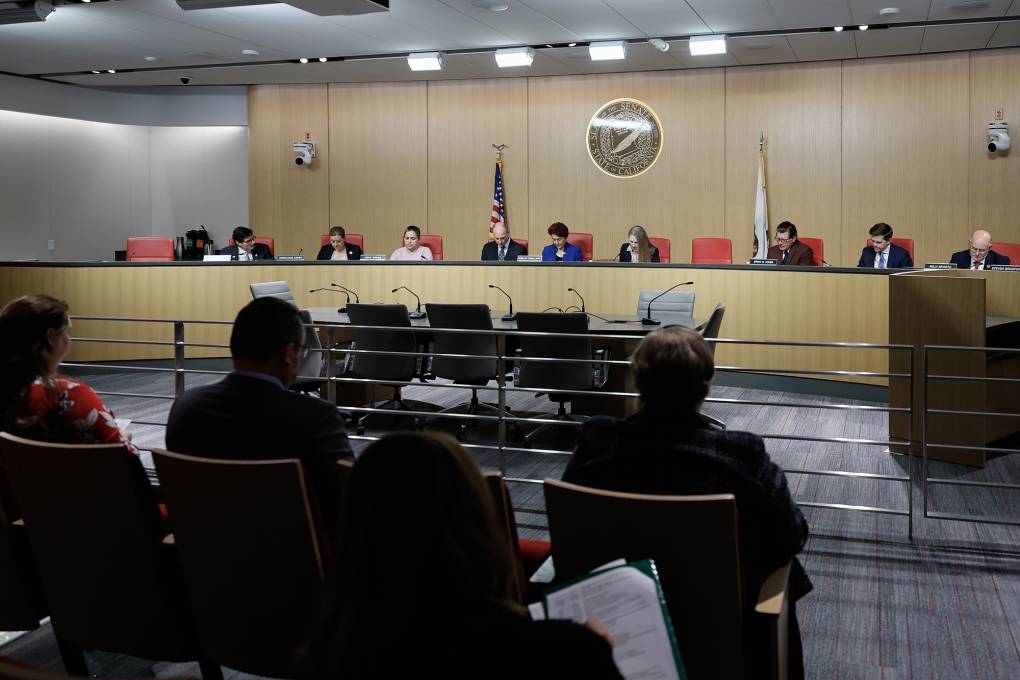
"caption": "A Senate appropriations committee hearing at the Capitol Annex Swing Space in Sacramento on May 16, 2024. On Thursday, the Assembly and Senate appropriations committees held their first round of suspense file hearings.",
"description": null,
"title": "CMLesgislature01",
"credit": "Fred Greaves/CalMatters",
"status": "inherit",
"altTag": null,
"isLoading": false,
"fetchFailed": false
},
"news_11986302": {
"type": "attachments",
"id": "news_11986302",
"meta": {
"index": "attachments_1716263798",
"site": "news",
"id": "11986302",
"found": true
},
"parent": 11986301,
"imgSizes": {
"twentyfourteen-full-width": {
"file": "https://cdn.kqed.org/wp-content/uploads/sites/10/2024/05/081922_San-Diego-State_AD_CM_01-1038x576.jpg",
"width": 1038,
"mimeType": "image/jpeg",
"height": 576
},
"thumbnail": {
"file": "https://cdn.kqed.org/wp-content/uploads/sites/10/2024/05/081922_San-Diego-State_AD_CM_01-160x107.jpg",
"width": 160,
"mimeType": "image/jpeg",
"height": 107
},
"post-thumbnail": {
"file": "https://cdn.kqed.org/wp-content/uploads/sites/10/2024/05/081922_San-Diego-State_AD_CM_01-672x372.jpg",
"width": 672,
"mimeType": "image/jpeg",
"height": 372
},
"kqedFullSize": {
"file": "https://cdn.kqed.org/wp-content/uploads/sites/10/2024/05/081922_San-Diego-State_AD_CM_01.jpg",
"width": 2000,
"height": 1333
},
"large": {
"file": "https://cdn.kqed.org/wp-content/uploads/sites/10/2024/05/081922_San-Diego-State_AD_CM_01-1020x680.jpg",
"width": 1020,
"mimeType": "image/jpeg",
"height": 680
},
"1536x1536": {
"file": "https://cdn.kqed.org/wp-content/uploads/sites/10/2024/05/081922_San-Diego-State_AD_CM_01-1536x1024.jpg",
"width": 1536,
"mimeType": "image/jpeg",
"height": 1024
},
"full-width": {
"file": "https://cdn.kqed.org/wp-content/uploads/sites/10/2024/05/081922_San-Diego-State_AD_CM_01-1920x1280.jpg",
"width": 1920,
"mimeType": "image/jpeg",
"height": 1280
},
"medium": {
"file": "https://cdn.kqed.org/wp-content/uploads/sites/10/2024/05/081922_San-Diego-State_AD_CM_01-800x533.jpg",
"width": 800,
"mimeType": "image/jpeg",
"height": 533
}
},
"publishDate": 1715794568,
"modified": 1715801286,
"caption": "Students walking at the San Diego State University campus on Aug. 19, 2022.",
"description": null,
"title": "Students walking at the San Diego State University campus on August 19, 2022.",
"credit": "Ariana Drehsler/CalMatters",
"status": "inherit",
"altTag": "People walk down a street with a college campus in the background.",
"isLoading": false,
"fetchFailed": false
},
"news_11985915": {
"type": "attachments",
"id": "news_11985915",
"meta": {
"index": "attachments_1716263798",
"site": "news",
"id": "11985915",
"found": true
},
"parent": 11985912,
"imgSizes": {
"twentyfourteen-full-width": {
"file": "https://cdn.kqed.org/wp-content/uploads/sites/10/2024/05/036_KQED_EmbarcaderoNavigationCenter_01302020_7967_qut-1038x576.jpg",
"width": 1038,
"mimeType": "image/jpeg",
"height": 576
},
"thumbnail": {
"file": "https://cdn.kqed.org/wp-content/uploads/sites/10/2024/05/036_KQED_EmbarcaderoNavigationCenter_01302020_7967_qut-160x107.jpg",
"width": 160,
"mimeType": "image/jpeg",
"height": 107
},
"post-thumbnail": {
"file": "https://cdn.kqed.org/wp-content/uploads/sites/10/2024/05/036_KQED_EmbarcaderoNavigationCenter_01302020_7967_qut-672x372.jpg",
"width": 672,
"mimeType": "image/jpeg",
"height": 372
},
"kqedFullSize": {
"file": "https://cdn.kqed.org/wp-content/uploads/sites/10/2024/05/036_KQED_EmbarcaderoNavigationCenter_01302020_7967_qut.jpg",
"width": 1920,
"height": 1278
},
"large": {
"file": "https://cdn.kqed.org/wp-content/uploads/sites/10/2024/05/036_KQED_EmbarcaderoNavigationCenter_01302020_7967_qut-1020x679.jpg",
"width": 1020,
"mimeType": "image/jpeg",
"height": 679
},
"1536x1536": {
"file": "https://cdn.kqed.org/wp-content/uploads/sites/10/2024/05/036_KQED_EmbarcaderoNavigationCenter_01302020_7967_qut-1536x1022.jpg",
"width": 1536,
"mimeType": "image/jpeg",
"height": 1022
},
"medium": {
"file": "https://cdn.kqed.org/wp-content/uploads/sites/10/2024/05/036_KQED_EmbarcaderoNavigationCenter_01302020_7967_qut-800x533.jpg",
"width": 800,
"mimeType": "image/jpeg",
"height": 533
}
},
"publishDate": 1715620690,
"modified": 1715624202,
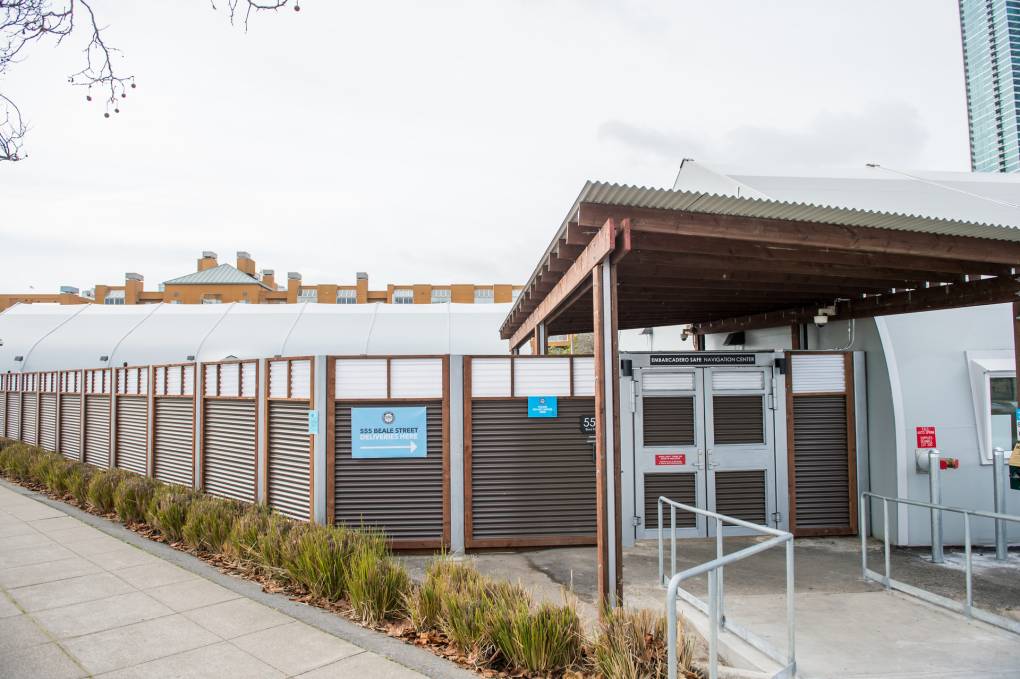
"caption": "The entrance to the Embarcadero SAFE Navigation Center at the corner of Embarcadero and Beale Street in San Francisco on Jan. 30, 2020. The 200-bed shelter opened in December of 2019.",
"description": null,
"title": "036_KQED_EmbarcaderoNavigationCenter_01302020_7967_qut",
"credit": "Beth LaBerge/KQED",
"status": "inherit",
"altTag": null,
"isLoading": false,
"fetchFailed": false
},
"news_11985840": {
"type": "attachments",
"id": "news_11985840",
"meta": {
"index": "attachments_1716263798",
"site": "news",
"id": "11985840",
"found": true
},
"parent": 11985839,
"imgSizes": {
"twentyfourteen-full-width": {
"file": "https://cdn.kqed.org/wp-content/uploads/sites/10/2024/05/050823-Blythe-Prison-Town-PU-CM-23-copy-1038x576.jpg",
"width": 1038,
"mimeType": "image/jpeg",
"height": 576
},
"thumbnail": {
"file": "https://cdn.kqed.org/wp-content/uploads/sites/10/2024/05/050823-Blythe-Prison-Town-PU-CM-23-copy-160x107.jpg",
"width": 160,
"mimeType": "image/jpeg",
"height": 107
},
"post-thumbnail": {
"file": "https://cdn.kqed.org/wp-content/uploads/sites/10/2024/05/050823-Blythe-Prison-Town-PU-CM-23-copy-672x372.jpg",
"width": 672,
"mimeType": "image/jpeg",
"height": 372
},
"kqedFullSize": {
"file": "https://cdn.kqed.org/wp-content/uploads/sites/10/2024/05/050823-Blythe-Prison-Town-PU-CM-23-copy.jpg",
"width": 2000,
"height": 1334
},
"large": {
"file": "https://cdn.kqed.org/wp-content/uploads/sites/10/2024/05/050823-Blythe-Prison-Town-PU-CM-23-copy-1020x680.jpg",
"width": 1020,
"mimeType": "image/jpeg",
"height": 680
},
"1536x1536": {
"file": "https://cdn.kqed.org/wp-content/uploads/sites/10/2024/05/050823-Blythe-Prison-Town-PU-CM-23-copy-1536x1025.jpg",
"width": 1536,
"mimeType": "image/jpeg",
"height": 1025
},
"full-width": {
"file": "https://cdn.kqed.org/wp-content/uploads/sites/10/2024/05/050823-Blythe-Prison-Town-PU-CM-23-copy-1920x1281.jpg",
"width": 1920,
"mimeType": "image/jpeg",
"height": 1281
},
"medium": {
"file": "https://cdn.kqed.org/wp-content/uploads/sites/10/2024/05/050823-Blythe-Prison-Town-PU-CM-23-copy-800x534.jpg",
"width": 800,
"mimeType": "image/jpeg",
"height": 534
}
},
"publishDate": 1715457789,
"modified": 1715457827,
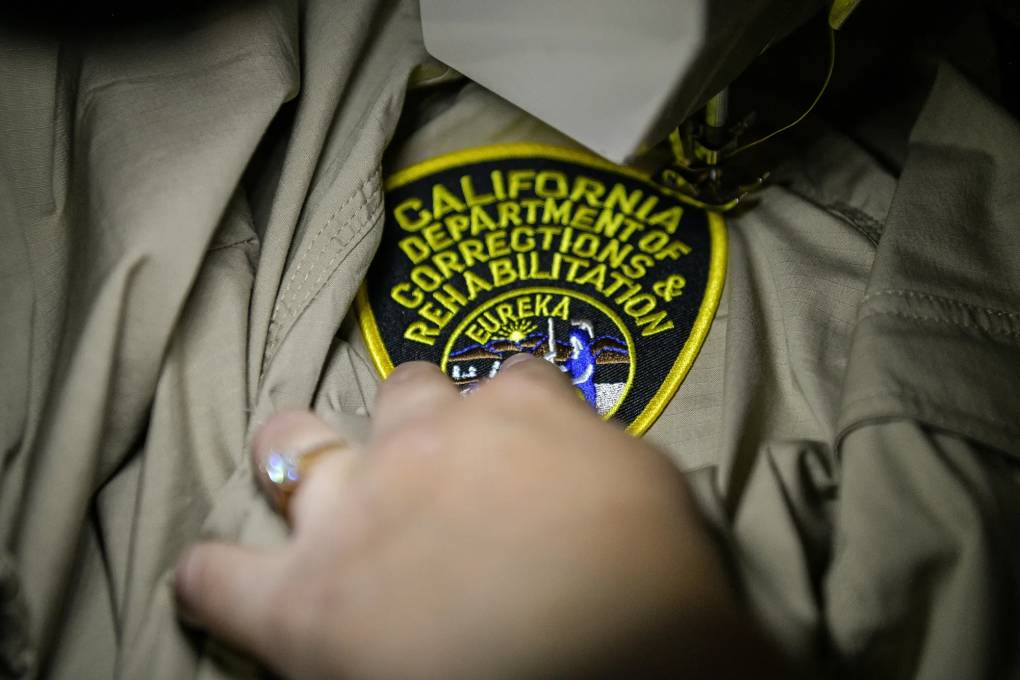
"caption": "Gov. Gavin Newsom has moved to close four California prisons and he's facing pressure to shut more because of the state deficit. Here, Francine Figueroa, a longtime seamstress, sows a patch with an emblem from the California Department of Corrections and Rehabilitation at Halby’s in Blythe on May 8, 2023. ",
"description": null,
"title": "050823-Blythe-Prison-Town-PU-CM-23 copy",
"credit": "Pablo Unzueta for CalMatters",
"status": "inherit",
"altTag": null,
"isLoading": false,
"fetchFailed": false
},
"news_11985077": {
"type": "attachments",
"id": "news_11985077",
"meta": {
"index": "attachments_1716263798",
"site": "news",
"id": "11985077",
"found": true
},
"parent": 11985069,
"imgSizes": {
"twentyfourteen-full-width": {
"file": "https://cdn.kqed.org/wp-content/uploads/sites/10/2024/05/110722-Secretary-of-State-MG-CM-03-2-1038x576.jpg",
"width": 1038,
"mimeType": "image/jpeg",
"height": 576
},
"thumbnail": {
"file": "https://cdn.kqed.org/wp-content/uploads/sites/10/2024/05/110722-Secretary-of-State-MG-CM-03-2-160x107.jpg",
"width": 160,
"mimeType": "image/jpeg",
"height": 107
},
"post-thumbnail": {
"file": "https://cdn.kqed.org/wp-content/uploads/sites/10/2024/05/110722-Secretary-of-State-MG-CM-03-2-672x372.jpg",
"width": 672,
"mimeType": "image/jpeg",
"height": 372
},
"kqedFullSize": {
"file": "https://cdn.kqed.org/wp-content/uploads/sites/10/2024/05/110722-Secretary-of-State-MG-CM-03-2.jpg",
"width": 2000,
"height": 1333
},
"large": {
"file": "https://cdn.kqed.org/wp-content/uploads/sites/10/2024/05/110722-Secretary-of-State-MG-CM-03-2-1020x680.jpg",
"width": 1020,
"mimeType": "image/jpeg",
"height": 680
},
"1536x1536": {
"file": "https://cdn.kqed.org/wp-content/uploads/sites/10/2024/05/110722-Secretary-of-State-MG-CM-03-2-1536x1024.jpg",
"width": 1536,
"mimeType": "image/jpeg",
"height": 1024
},
"full-width": {
"file": "https://cdn.kqed.org/wp-content/uploads/sites/10/2024/05/110722-Secretary-of-State-MG-CM-03-2-1920x1280.jpg",
"width": 1920,
"mimeType": "image/jpeg",
"height": 1280
},
"medium": {
"file": "https://cdn.kqed.org/wp-content/uploads/sites/10/2024/05/110722-Secretary-of-State-MG-CM-03-2-800x533.jpg",
"width": 800,
"mimeType": "image/jpeg",
"height": 533
}
},
"publishDate": 1715019570,
"modified": 1715019641,
"caption": "The Secretary of State building in Sacramento on Nov. 7, 2022. ",
"description": null,
"title": "110722-Secretary-of-State-MG-CM-03-2",
"credit": "Miguel Gutierrez Jr./CalMatters",
"status": "inherit",
"altTag": "The front of a building that reads \"State of California Secretary of State.\"",
"isLoading": false,
"fetchFailed": false
},
"news_11985024": {
"type": "attachments",
"id": "news_11985024",
"meta": {
"index": "attachments_1716263798",
"site": "news",
"id": "11985024",
"found": true
},
"parent": 11985022,
"imgSizes": {
"twentyfourteen-full-width": {
"file": "https://cdn.kqed.org/wp-content/uploads/sites/10/2024/05/CMFinance01-1038x576.jpg",
"width": 1038,
"mimeType": "image/jpeg",
"height": 576
},
"thumbnail": {
"file": "https://cdn.kqed.org/wp-content/uploads/sites/10/2024/05/CMFinance01-160x107.jpg",
"width": 160,
"mimeType": "image/jpeg",
"height": 107
},
"post-thumbnail": {
"file": "https://cdn.kqed.org/wp-content/uploads/sites/10/2024/05/CMFinance01-672x372.jpg",
"width": 672,
"mimeType": "image/jpeg",
"height": 372
},
"kqedFullSize": {
"file": "https://cdn.kqed.org/wp-content/uploads/sites/10/2024/05/CMFinance01.jpg",
"width": 2000,
"height": 1333
},
"large": {
"file": "https://cdn.kqed.org/wp-content/uploads/sites/10/2024/05/CMFinance01-1020x680.jpg",
"width": 1020,
"mimeType": "image/jpeg",
"height": 680
},
"1536x1536": {
"file": "https://cdn.kqed.org/wp-content/uploads/sites/10/2024/05/CMFinance01-1536x1024.jpg",
"width": 1536,
"mimeType": "image/jpeg",
"height": 1024
},
"full-width": {
"file": "https://cdn.kqed.org/wp-content/uploads/sites/10/2024/05/CMFinance01-1920x1280.jpg",
"width": 1920,
"mimeType": "image/jpeg",
"height": 1280
},
"medium": {
"file": "https://cdn.kqed.org/wp-content/uploads/sites/10/2024/05/CMFinance01-800x533.jpg",
"width": 800,
"mimeType": "image/jpeg",
"height": 533
}
},
"publishDate": 1714770050,
"modified": 1714770306,
"caption": null,
"description": null,
"title": "CMFinance01",
"credit": "Illustration by Miguel Gutierrez Jr./CalMatters; iStock",
"status": "inherit",
"altTag": null,
"isLoading": false,
"fetchFailed": false
},
"news_11984781": {
"type": "attachments",
"id": "news_11984781",
"meta": {
"index": "attachments_1716263798",
"site": "news",
"id": "11984781",
"found": true
},
"parent": 11984762,
"imgSizes": {
"twentyfourteen-full-width": {
"file": "https://cdn.kqed.org/wp-content/uploads/sites/10/2024/05/AP24123441309819-1038x576.jpg",
"width": 1038,
"mimeType": "image/jpeg",
"height": 576
},
"thumbnail": {
"file": "https://cdn.kqed.org/wp-content/uploads/sites/10/2024/05/AP24123441309819-160x107.jpg",
"width": 160,
"mimeType": "image/jpeg",
"height": 107
},
"post-thumbnail": {
"file": "https://cdn.kqed.org/wp-content/uploads/sites/10/2024/05/AP24123441309819-672x372.jpg",
"width": 672,
"mimeType": "image/jpeg",
"height": 372
},
"kqedFullSize": {
"file": "https://cdn.kqed.org/wp-content/uploads/sites/10/2024/05/AP24123441309819-scaled.jpg",
"width": 2560,
"height": 1707
},
"2048x2048": {
"file": "https://cdn.kqed.org/wp-content/uploads/sites/10/2024/05/AP24123441309819-2048x1365.jpg",
"width": 2048,
"mimeType": "image/jpeg",
"height": 1365
},
"large": {
"file": "https://cdn.kqed.org/wp-content/uploads/sites/10/2024/05/AP24123441309819-1020x680.jpg",
"width": 1020,
"mimeType": "image/jpeg",
"height": 680
},
"1536x1536": {
"file": "https://cdn.kqed.org/wp-content/uploads/sites/10/2024/05/AP24123441309819-1536x1024.jpg",
"width": 1536,
"mimeType": "image/jpeg",
"height": 1024
},
"full-width": {
"file": "https://cdn.kqed.org/wp-content/uploads/sites/10/2024/05/AP24123441309819-1920x1280.jpg",
"width": 1920,
"mimeType": "image/jpeg",
"height": 1280
},
"medium": {
"file": "https://cdn.kqed.org/wp-content/uploads/sites/10/2024/05/AP24123441309819-800x533.jpg",
"width": 800,
"mimeType": "image/jpeg",
"height": 533
}
},
"publishDate": 1714671020,
"modified": 1714675849,
"caption": "Police advance on pro-Palestinian demonstrators in an encampment on the UCLA campus on Thursday, May 2, 2024, in Los Angeles. ",
"description": null,
"title": "APTOPIX Israel Palestinians Campus Protests",
"credit": "Jae C. Hong/The Associated Press",
"status": "inherit",
"altTag": "Multiple police knock over a barricade and point their weapons.",
"isLoading": false,
"fetchFailed": false
},
"news_11984614": {
"type": "attachments",
"id": "news_11984614",
"meta": {
"index": "attachments_1716263798",
"site": "news",
"id": "11984614",
"found": true
},
"parent": 11984610,
"imgSizes": {
"twentyfourteen-full-width": {
"file": "https://cdn.kqed.org/wp-content/uploads/sites/10/2024/05/CMInsurance01-1038x576.jpg",
"width": 1038,
"mimeType": "image/jpeg",
"height": 576
},
"thumbnail": {
"file": "https://cdn.kqed.org/wp-content/uploads/sites/10/2024/05/CMInsurance01-160x107.jpg",
"width": 160,
"mimeType": "image/jpeg",
"height": 107
},
"post-thumbnail": {
"file": "https://cdn.kqed.org/wp-content/uploads/sites/10/2024/05/CMInsurance01-672x372.jpg",
"width": 672,
"mimeType": "image/jpeg",
"height": 372
},
"kqedFullSize": {
"file": "https://cdn.kqed.org/wp-content/uploads/sites/10/2024/05/CMInsurance01.jpg",
"width": 2000,
"height": 1333
},
"large": {
"file": "https://cdn.kqed.org/wp-content/uploads/sites/10/2024/05/CMInsurance01-1020x680.jpg",
"width": 1020,
"mimeType": "image/jpeg",
"height": 680
},
"1536x1536": {
"file": "https://cdn.kqed.org/wp-content/uploads/sites/10/2024/05/CMInsurance01-1536x1024.jpg",
"width": 1536,
"mimeType": "image/jpeg",
"height": 1024
},
"full-width": {
"file": "https://cdn.kqed.org/wp-content/uploads/sites/10/2024/05/CMInsurance01-1920x1280.jpg",
"width": 1920,
"mimeType": "image/jpeg",
"height": 1280
},
"medium": {
"file": "https://cdn.kqed.org/wp-content/uploads/sites/10/2024/05/CMInsurance01-800x533.jpg",
"width": 800,
"mimeType": "image/jpeg",
"height": 533
}
},
"publishDate": 1714584301,
"modified": 1714584340,
"caption": "Donna Yutzy cleans the gutters of her home from flammable debris on Nov. 4, 2023. State law prohibits the use of landscaping plants and any flammable materials within a five-foot radius of the house.",
"description": null,
"title": "CMInsurance01",
"credit": "Manuel Orbegozo/CalMatters",
"status": "inherit",
"altTag": null,
"isLoading": false,
"fetchFailed": false
},
"news_11984323": {
"type": "attachments",
"id": "news_11984323",
"meta": {
"index": "attachments_1716263798",
"site": "news",
"id": "11984323",
"found": true
},
"parent": 11984321,
"imgSizes": {
"twentyfourteen-full-width": {
"file": "https://cdn.kqed.org/wp-content/uploads/sites/10/2024/04/Affordable-Connectivity-California_AH_CM_01-1038x576.jpg",
"width": 1038,
"mimeType": "image/jpeg",
"height": 576
},
"thumbnail": {
"file": "https://cdn.kqed.org/wp-content/uploads/sites/10/2024/04/Affordable-Connectivity-California_AH_CM_01-160x107.jpg",
"width": 160,
"mimeType": "image/jpeg",
"height": 107
},
"post-thumbnail": {
"file": "https://cdn.kqed.org/wp-content/uploads/sites/10/2024/04/Affordable-Connectivity-California_AH_CM_01-672x372.jpg",
"width": 672,
"mimeType": "image/jpeg",
"height": 372
},
"kqedFullSize": {
"file": "https://cdn.kqed.org/wp-content/uploads/sites/10/2024/04/Affordable-Connectivity-California_AH_CM_01.jpg",
"width": 2000,
"height": 1333
},
"large": {
"file": "https://cdn.kqed.org/wp-content/uploads/sites/10/2024/04/Affordable-Connectivity-California_AH_CM_01-1020x680.jpg",
"width": 1020,
"mimeType": "image/jpeg",
"height": 680
},
"1536x1536": {
"file": "https://cdn.kqed.org/wp-content/uploads/sites/10/2024/04/Affordable-Connectivity-California_AH_CM_01-1536x1024.jpg",
"width": 1536,
"mimeType": "image/jpeg",
"height": 1024
},
"full-width": {
"file": "https://cdn.kqed.org/wp-content/uploads/sites/10/2024/04/Affordable-Connectivity-California_AH_CM_01-1920x1280.jpg",
"width": 1920,
"mimeType": "image/jpeg",
"height": 1280
},
"medium": {
"file": "https://cdn.kqed.org/wp-content/uploads/sites/10/2024/04/Affordable-Connectivity-California_AH_CM_01-800x533.jpg",
"width": 800,
"mimeType": "image/jpeg",
"height": 533
}
},
"publishDate": 1714336877,
"modified": 1714337079,
"caption": null,
"description": null,
"title": "Affordable-Connectivity-California_AH_CM_01",
"credit": "Illustration by Adriana Heldiz, CalMatters; iStock",
"status": "inherit",
"altTag": "A graphic illustration showing a $100 dollar bill, a man and child sitting next to each other looking at a laptop, and a logo of a globe with a mouse cursor on it.",
"isLoading": false,
"fetchFailed": false
},
"news_11984165": {
"type": "attachments",
"id": "news_11984165",
"meta": {
"index": "attachments_1716263798",
"site": "news",
"id": "11984165",
"found": true
},
"parent": 11984163,
"imgSizes": {
"twentyfourteen-full-width": {
"file": "https://cdn.kqed.org/wp-content/uploads/sites/10/2024/04/033023-Hollister-Hospital-LV_CM_14-copy-1038x576.jpg",
"width": 1038,
"mimeType": "image/jpeg",
"height": 576
},
"thumbnail": {
"file": "https://cdn.kqed.org/wp-content/uploads/sites/10/2024/04/033023-Hollister-Hospital-LV_CM_14-copy-160x107.jpg",
"width": 160,
"mimeType": "image/jpeg",
"height": 107
},
"post-thumbnail": {
"file": "https://cdn.kqed.org/wp-content/uploads/sites/10/2024/04/033023-Hollister-Hospital-LV_CM_14-copy-672x372.jpg",
"width": 672,
"mimeType": "image/jpeg",
"height": 372
},
"kqedFullSize": {
"file": "https://cdn.kqed.org/wp-content/uploads/sites/10/2024/04/033023-Hollister-Hospital-LV_CM_14-copy.jpg",
"width": 2000,
"height": 1333
},
"large": {
"file": "https://cdn.kqed.org/wp-content/uploads/sites/10/2024/04/033023-Hollister-Hospital-LV_CM_14-copy-1020x680.jpg",
"width": 1020,
"mimeType": "image/jpeg",
"height": 680
},
"1536x1536": {
"file": "https://cdn.kqed.org/wp-content/uploads/sites/10/2024/04/033023-Hollister-Hospital-LV_CM_14-copy-1536x1024.jpg",
"width": 1536,
"mimeType": "image/jpeg",
"height": 1024
},
"full-width": {
"file": "https://cdn.kqed.org/wp-content/uploads/sites/10/2024/04/033023-Hollister-Hospital-LV_CM_14-copy-1920x1280.jpg",
"width": 1920,
"mimeType": "image/jpeg",
"height": 1280
},
"medium": {
"file": "https://cdn.kqed.org/wp-content/uploads/sites/10/2024/04/033023-Hollister-Hospital-LV_CM_14-copy-800x533.jpg",
"width": 800,
"mimeType": "image/jpeg",
"height": 533
}
},
"publishDate": 1714154910,
"modified": 1714162995,
"caption": "California's Office of Health Care Affordability handed down a regulation that aims to limit rising health care costs by capping industry spending increases. Here, a nurse checks on a patient in the emergency room unit of Hazel Hawkins Memorial Hospital in Hollister on March 30, 2023.",
"description": null,
"title": "033023-Hollister-Hospital-LV_CM_14 copy",
"credit": "Larry Valenzuela/CalMatters/CatchLight Local",
"status": "inherit",
"altTag": "A female nurse is seen from behind, attending to a patient in a hospital room with medical equipment.",
"isLoading": false,
"fetchFailed": false
},
"news_11984011": {
"type": "attachments",
"id": "news_11984011",
"meta": {
"index": "attachments_1716263798",
"site": "news",
"id": "11984011",
"found": true
},
"parent": 11984008,
"imgSizes": {
"twentyfourteen-full-width": {
"file": "https://cdn.kqed.org/wp-content/uploads/sites/10/2024/04/042424_Joanna-Lynn-Lewis_FG_CM_11-1038x576.jpg",
"width": 1038,
"mimeType": "image/jpeg",
"height": 576
},
"thumbnail": {
"file": "https://cdn.kqed.org/wp-content/uploads/sites/10/2024/04/042424_Joanna-Lynn-Lewis_FG_CM_11-160x107.jpg",
"width": 160,
"mimeType": "image/jpeg",
"height": 107
},
"post-thumbnail": {
"file": "https://cdn.kqed.org/wp-content/uploads/sites/10/2024/04/042424_Joanna-Lynn-Lewis_FG_CM_11-672x372.jpg",
"width": 672,
"mimeType": "image/jpeg",
"height": 372
},
"kqedFullSize": {
"file": "https://cdn.kqed.org/wp-content/uploads/sites/10/2024/04/042424_Joanna-Lynn-Lewis_FG_CM_11.jpg",
"width": 2000,
"height": 1333
},
"large": {
"file": "https://cdn.kqed.org/wp-content/uploads/sites/10/2024/04/042424_Joanna-Lynn-Lewis_FG_CM_11-1020x680.jpg",
"width": 1020,
"mimeType": "image/jpeg",
"height": 680
},
"1536x1536": {
"file": "https://cdn.kqed.org/wp-content/uploads/sites/10/2024/04/042424_Joanna-Lynn-Lewis_FG_CM_11-1536x1024.jpg",
"width": 1536,
"mimeType": "image/jpeg",
"height": 1024
},
"full-width": {
"file": "https://cdn.kqed.org/wp-content/uploads/sites/10/2024/04/042424_Joanna-Lynn-Lewis_FG_CM_11-1920x1280.jpg",
"width": 1920,
"mimeType": "image/jpeg",
"height": 1280
},
"medium": {
"file": "https://cdn.kqed.org/wp-content/uploads/sites/10/2024/04/042424_Joanna-Lynn-Lewis_FG_CM_11-800x533.jpg",
"width": 800,
"mimeType": "image/jpeg",
"height": 533
}
},
"publishDate": 1714069268,
"modified": 1714076094,
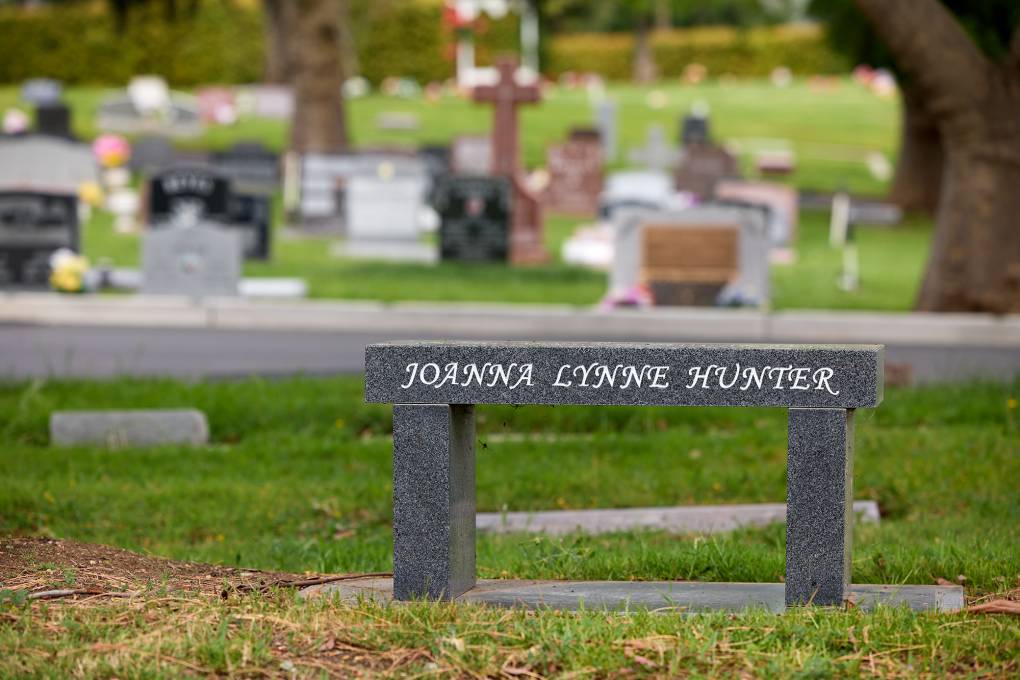
"caption": "A memorial bench near the headstone of Joanna Lynne Lewis with her maiden name, Joanna Lynne Hunter, at Vacaville-Elmira Cemetery in Vacaville on April 24, 2024.",
"description": null,
"title": "042424_Joanna-Lynn-Lewis_FG_CM_11",
"credit": " Photo by Fred Greaves/CalMatters",
"status": "inherit",
"altTag": "A memorial bench in a cemetery for Joanna Lynne Lewis.",
"isLoading": false,
"fetchFailed": false
},
"news_11983897": {
"type": "attachments",
"id": "news_11983897",
"meta": {
"index": "attachments_1716263798",
"site": "news",
"id": "11983897",
"found": true
},
"parent": 11983896,
"imgSizes": {
"twentyfourteen-full-width": {
"file": "https://cdn.kqed.org/wp-content/uploads/sites/10/2024/04/031524_Timothy-Jackson_AH_CM_02-1038x576.jpg",
"width": 1038,
"mimeType": "image/jpeg",
"height": 576
},
"thumbnail": {
"file": "https://cdn.kqed.org/wp-content/uploads/sites/10/2024/04/031524_Timothy-Jackson_AH_CM_02-160x107.jpg",
"width": 160,
"mimeType": "image/jpeg",
"height": 107
},
"post-thumbnail": {
"file": "https://cdn.kqed.org/wp-content/uploads/sites/10/2024/04/031524_Timothy-Jackson_AH_CM_02-672x372.jpg",
"width": 672,
"mimeType": "image/jpeg",
"height": 372
},
"kqedFullSize": {
"file": "https://cdn.kqed.org/wp-content/uploads/sites/10/2024/04/031524_Timothy-Jackson_AH_CM_02.jpg",
"width": 2000,
"height": 1333
},
"large": {
"file": "https://cdn.kqed.org/wp-content/uploads/sites/10/2024/04/031524_Timothy-Jackson_AH_CM_02-1020x680.jpg",
"width": 1020,
"mimeType": "image/jpeg",
"height": 680
},
"1536x1536": {
"file": "https://cdn.kqed.org/wp-content/uploads/sites/10/2024/04/031524_Timothy-Jackson_AH_CM_02-1536x1024.jpg",
"width": 1536,
"mimeType": "image/jpeg",
"height": 1024
},
"full-width": {
"file": "https://cdn.kqed.org/wp-content/uploads/sites/10/2024/04/031524_Timothy-Jackson_AH_CM_02-1920x1280.jpg",
"width": 1920,
"mimeType": "image/jpeg",
"height": 1280
},
"medium": {
"file": "https://cdn.kqed.org/wp-content/uploads/sites/10/2024/04/031524_Timothy-Jackson_AH_CM_02-800x533.jpg",
"width": 800,
"mimeType": "image/jpeg",
"height": 533
}
},
"publishDate": 1713980740,
"modified": 1713986795,
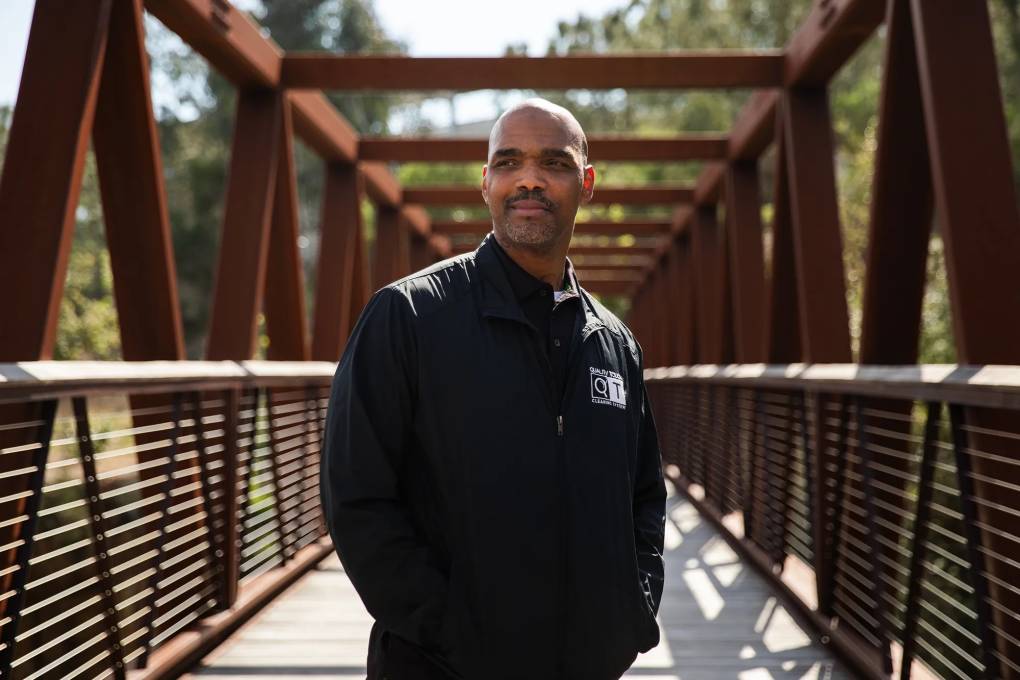
"caption": "Timothy Jackson at Torrey Pines Science Park in San Diego on March 15, 2024. Jackson started his own cleaning business after taking entrepreneurship training while incarcerated.",
"description": null,
"title": "031524_Timothy-Jackson_AH_CM_02",
"credit": "Adriana Heldiz/CalMatters",
"status": "inherit",
"altTag": "A Black man in a cleaning uniform stands on a bridge.",
"isLoading": false,
"fetchFailed": false
}
},
"audioPlayerReducer": {
"postId": "stream_live",
"isPaused": true,
"isPlaying": false,
"pfsActive": false,
"pledgeModalIsOpen": true,
"playerDrawerIsOpen": false,
"liveAudioPlayStartedAt": 0,
"liveAudioPlayContext": ""
},
"authorsReducer": {
"byline_news_11986700": {
"type": "authors",
"id": "byline_news_11986700",
"meta": {
"override": true
},
"slug": "byline_news_11986700",
"name": "Alexei Koseff and Sameea Kamal, CalMatters",
"isLoading": false
},
"byline_news_11986301": {
"type": "authors",
"id": "byline_news_11986301",
"meta": {
"override": true
},
"slug": "byline_news_11986301",
"name": "Mikhail Zinshteyn, CalMatters",
"isLoading": false
},
"byline_news_11985912": {
"type": "authors",
"id": "byline_news_11985912",
"meta": {
"override": true
},
"slug": "byline_news_11985912",
"name": "Marisa Kendall, CalMatters",
"isLoading": false
},
"byline_news_11985839": {
"type": "authors",
"id": "byline_news_11985839",
"meta": {
"override": true
},
"slug": "byline_news_11985839",
"name": "\u003ca href=\"https://calmatters.org/author/nigelduara/\">Nigel Duara\u003c/a>",
"isLoading": false
},
"byline_news_11985069": {
"type": "authors",
"id": "byline_news_11985069",
"meta": {
"override": true
},
"slug": "byline_news_11985069",
"name": "Ben Christopher, CalMatters",
"isLoading": false
},
"byline_news_11985022": {
"type": "authors",
"id": "byline_news_11985022",
"meta": {
"override": true
},
"slug": "byline_news_11985022",
"name": "Carolyn Jones, CalMatters",
"isLoading": false
},
"byline_news_11984762": {
"type": "authors",
"id": "byline_news_11984762",
"meta": {
"override": true
},
"slug": "byline_news_11984762",
"name": "Atmika Iyer, CalMatters",
"isLoading": false
},
"byline_news_11984610": {
"type": "authors",
"id": "byline_news_11984610",
"meta": {
"override": true
},
"slug": "byline_news_11984610",
"name": "Levi Sumagaysay, CalMatters",
"isLoading": false
},
"byline_news_11984321": {
"type": "authors",
"id": "byline_news_11984321",
"meta": {
"override": true
},
"slug": "byline_news_11984321",
"name": "Khari Johnson, CalMatters",
"isLoading": false
},
"byline_news_11984163": {
"type": "authors",
"id": "byline_news_11984163",
"meta": {
"override": true
},
"slug": "byline_news_11984163",
"name": "\u003ca href=\"https://calmatters.org/author/kristen-hwang/\">Kristen Hwang\u003c/a>",
"isLoading": false
},
"byline_news_11984008": {
"type": "authors",
"id": "byline_news_11984008",
"meta": {
"override": true
},
"slug": "byline_news_11984008",
"name": "Ryan Sabalow, CalMatters",
"isLoading": false
},
"byline_news_11983896": {
"type": "authors",
"id": "byline_news_11983896",
"meta": {
"override": true
},
"slug": "byline_news_11983896",
"name": "\u003ca href=\"https://calmatters.org/author/levi-sumagaysay/\">Levi Sumagaysay\u003c/a>",
"isLoading": false
}
},
"pagesReducer": {
"news_affiliate_calmatters": {
"type": "terms",
"id": "news_18481",
"meta": {
"index": "terms_1716263798",
"site": "news",
"id": "18481",
"score": 15.355904
},
"featImg": null,
"name": "CALmatters",
"description": null,
"taxonomy": "affiliate",
"headData": {
"twImgId": null,
"twTitle": null,
"ogTitle": null,
"ogImgId": null,
"twDescription": null,
"description": null,
"title": "CALmatters Archives | KQED Arts",
"ogDescription": null
},
"ttid": 18515,
"slug": "calmatters",
"isLoading": false,
"title": "CALmatters",
"pageMeta": {
"site": "news",
"WpPageTemplate": "page-topic-editorial",
"currentPage": 32
},
"blocks": [
{
"blockName": "kqed/post-list",
"attrs": {
"layout": "cardArticle2",
"query": "posts/news?affiliate=calmatters",
"seeMore": false,
"paginated": true,
"page": 32
}
},
{
"blockName": "kqed/ad"
}
]
}
},
"pfsSessionReducer": {},
"postsReducer": {
"stream_live": {
"type": "live",
"id": "stream_live",
"audioUrl": "https://streams.kqed.org/kqedradio",
"title": "Live Stream",
"excerpt": "Live Stream information currently unavailable.",
"link": "/radio",
"featImg": "",
"label": {
"name": "KQED Live",
"link": "/"
}
},
"stream_kqedNewscast": {
"type": "posts",
"id": "stream_kqedNewscast",
"audioUrl": "https://www.kqed.org/.stream/anon/radio/RDnews/newscast.mp3?_=1",
"title": "KQED Newscast",
"featImg": "",
"label": {
"name": "88.5 FM",
"link": "/"
}
},
"news_11986700": {
"type": "posts",
"id": "news_11986700",
"meta": {
"index": "posts_1716263798",
"site": "news",
"id": "11986700",
"score": null,
"sort": [
1715972441000
]
},
"parent": 0,
"labelTerm": {},
"blocks": [],
"publishDate": 1715972441,
"format": "standard",
"title": "California Deficit Forces Lawmakers to Shelve Bills on Psychedelic Therapy, Reparations",
"headTitle": "California Deficit Forces Lawmakers to Shelve Bills on Psychedelic Therapy, Reparations | KQED",
"content": "\u003cp>California’s budget crunch is forcing the Legislature to scale back its agenda this session, with bills to legalize psychedelic therapy, offer reparations to the descendants of enslaved people, and require more transparency around who is paying for lawmakers’ sponsored travel among the early carnage.\u003c/p>\n\u003cp>Facing \u003ca href=\"https://calmatters.org/politics/2024/05/california-budget-deficit-newsom-may-proposal/\">estimated deficits of tens of billions of dollars\u003c/a> over the next two years, leaders of the Legislature’s appropriations committees said on Thursday that they had to make especially difficult decisions as they held or amended hundreds of proposals with a significant cost during the biannual culling process \u003ca href=\"https://calmatters.org/politics/2017/09/capitol-suspense-california-bills-vanish-almost-without-trace/\">known as the suspense file\u003c/a> — though most of the bills in each committee still passed.\u003c/p>\n\u003cp>“The budget had a huge impact on what we did,” state Sen. \u003ca href=\"https://digitaldemocracy.calmatters.org/legislators/anna-caballero-101330\">Anna Caballero\u003c/a>, a Salinas Democrat who leads Senate appropriations, told CalMatters. “We were trying to keep costs down and really trying to live within our means.”\u003c/p>\n\u003cp>Of the \u003ca href=\"https://sapro.senate.ca.gov/sites/sapro.senate.ca.gov/files/2024%20Senate%20Suspense%20Bills%20%28Unofficial%20Results%20for%20Posting%29.pdf\">341 bills on the Senate suspense file\u003c/a>, 87 — or about 25.5% — were held, in line with the average over the past decade. But another 121 were amended, even as they advanced to the floor before a crucial deadline next Friday for measures to pass their house of origin.\u003c/p>\n\u003cp>[ad fullwidth]\u003c/p>\n\u003cp>“Authors were asked to amend their bills to take out the more expensive stuff,” Caballero said. “We don’t have the money.”\u003c/p>\n\u003cp>The Assembly’s appropriations committee held 233 of the \u003ca href=\"https://apro.assembly.ca.gov/system/files/2024-05/unofficial-results-may-16-2024.pdf\">668 bills on its suspense file\u003c/a>, or about 34.5% — slightly higher than last May \u003ca href=\"https://calmatters.org/newsletter/california-budget-suspense-file/\">when 29% were shelved\u003c/a>.\u003c/p>\n\u003cp>Those included Assembly Bill 2751 by Assemblymember \u003ca href=\"https://digitaldemocracy.calmatters.org/legislators/matt-haney-165453\">Matt Haney\u003c/a>, a San Francisco Democrat, which would have barred employers from \u003ca href=\"https://digitaldemocracy.calmatters.org/bills/ca_202320240ab2751\">contacting workers outside of scheduled hours\u003c/a>, and AB 2808 by Assemblymember \u003ca href=\"https://digitaldemocracy.calmatters.org/legislators/buffy-wicks-165044\">Buffy Wicks\u003c/a>, an Oakland Democrat who chairs the committee, which would have \u003ca href=\"https://digitaldemocracy.calmatters.org/bills/ca_202320240ab2808?slug=CA_202320240AB2808\">limited companies such as Ticketmaster\u003c/a> from being able to resell event tickets exclusively.\u003c/p>\n\u003cp>“We have an obligation to balance the budget here in California — we can’t go into debt,” Wicks told reporters after the hearing, where she killed another attempt to establish a \u003ca href=\"https://digitaldemocracy.calmatters.org/bills/ca_202320240ab2200\">single-payer health care system\u003c/a> in California, a policy she has supported in the past. “We needed to be responsible with taxpayers’ money, so that’s why we had to make some tough calls today.”\u003c/p>\n\u003cp>Assemblymember \u003ca href=\"https://digitaldemocracy.calmatters.org/legislators/ash-kalra-100938\">Ash Kalra\u003c/a>, who authored the single-payer bill, said after \u003ca href=\"https://calmatters.org/politics/2022/02/california-single-payer-legislature/\">two years of negotiations\u003c/a>, he was confident it would have passed\u003cstrong> \u003c/strong>the Assembly.\u003cstrong> \u003c/strong>\u003c/p>\n\u003cp>“I am deeply disappointed the Assembly Appropriations Committee failed to recognize the significant cost-saving potential of AB 2200,” he said in a statement. “Study after study has shown that a single-payer system will not only cost less than our current system but can safeguard the State from future deficits while stimulating economic growth.”\u003c/p>\n\u003cp>Both Caballero and Wicks are newly in charge of their respective committees this year, overseeing their first suspense file hearings as the state works through how to close a massive deficit.\u003c/p>\n\u003cp>Gov. Gavin Newsom \u003ca href=\"https://calmatters.org/politics/2024/05/california-budget-deficit-newsom-may-proposal/\">unveiled his proposed spending plan\u003c/a> last week to address the looming shortfall, estimated at $56 billion over the next two fiscal years — and more by legislative finance officials — even after he and lawmakers \u003ca href=\"https://calmatters.org/politics/capitol/2024/04/budget-deficit-california-deal/\">took early action to reduce it\u003c/a>.\u003c/p>\n\u003cp>With more than $30 billion in cuts to education, public health, environmental and other programs on the line, Newsom is likely to have little appetite this year for pricey new legislation. He has already urged discipline over the past two sessions as California’s finances softened, vetoing dozens of bills that he said would add unaccounted costs to the budget.\u003c/p>\n\u003cp>The suspense file, where all legislation with a major fiscal impact is considered concurrently and dispensed within a rapid-fire hearing, has also long provided the Legislature with an easier way to kill controversial or undesirable bills.\u003c/p>\n\u003cp>Caballero refused to discuss any of her specific decisions, citing only cost considerations, including shelving Senate Bill 1012, which would have \u003ca href=\"https://calmatters.org/health/2024/02/psychedelic-therapy-legalize/\">legalized the use of hallucinogenic drugs in therapeutic settings\u003c/a>. Newsom vetoed a broader decriminalization of psychedelics last year, and supporters hoped their focus on therapy would provide a path forward.\u003c/p>\n\u003cfigure id=\"attachment_11986705\" class=\"wp-caption aligncenter\" style=\"max-width: 2000px\">\u003cimg loading=\"lazy\" decoding=\"async\" class=\"size-full wp-image-11986705\" src=\"https://cdn.kqed.org/wp-content/uploads/sites/10/2024/05/CMLegislature02.jpg\" alt=\"\" width=\"2000\" height=\"1333\" srcset=\"https://cdn.kqed.org/wp-content/uploads/sites/10/2024/05/CMLegislature02.jpg 2000w, https://cdn.kqed.org/wp-content/uploads/sites/10/2024/05/CMLegislature02-800x533.jpg 800w, https://cdn.kqed.org/wp-content/uploads/sites/10/2024/05/CMLegislature02-1020x680.jpg 1020w, https://cdn.kqed.org/wp-content/uploads/sites/10/2024/05/CMLegislature02-160x107.jpg 160w, https://cdn.kqed.org/wp-content/uploads/sites/10/2024/05/CMLegislature02-1536x1024.jpg 1536w, https://cdn.kqed.org/wp-content/uploads/sites/10/2024/05/CMLegislature02-1920x1280.jpg 1920w\" sizes=\"(max-width: 2000px) 100vw, 2000px\">\u003cfigcaption class=\"wp-caption-text\">A Senate appropriations committee hearing on May 16, 2024. On Thursday, the Assembly and Senate appropriations committees held their first round of suspense file hearings. \u003ccite>(Fred Greaves/CalMatters)\u003c/cite>\u003c/figcaption>\u003c/figure>\n\u003cp>“Psychedelics have massive promise in helping people heal and get their lives back on track,” Sen. \u003ca href=\"https://digitaldemocracy.calmatters.org/legislators/scott-wiener-100936\">Scott Wiener\u003c/a>, a San Francisco Democrat who carried the bill, said in a statement. “I’m highly committed to this issue, and we’ll continue to work on expanding access to psychedelics.” [aside label='Related Coverage' tag='california-law']The Senate also killed SB 1422, a transparency measure to \u003ca href=\"https://digitaldemocracy.calmatters.org/bills/ca_202320240sb1422?slug=CA_202320240SB1422\">require more reporting\u003c/a> about who is paying for legislators’ sponsored travel.\u003c/p>\n\u003cp>The bill, from Sen. \u003ca href=\"https://digitaldemocracy.calmatters.org/legislators/benjamin-allen-70\">Ben Allen\u003c/a>, a Santa Monica Democrat, followed \u003ca href=\"https://calmatters.org/politics/2023/05/california-legislators-travel-disclosure/\">reporting last year by CalMatters that found\u003c/a> a 2015 law requiring the organizers of these legislative trips to disclose their major donors annually had only been used twice, despite interest groups paying for millions of dollars in travel for lawmakers during that time. Allen’s measure aimed to tighten the eligibility criteria for reporting.\u003c/p>\n\u003cp>His office did not immediately respond to a request for comment.\u003c/p>\n\u003cp>On the same day that the Assembly passed a bill requiring California to apologize for its role in perpetuating slavery, the Senate appropriations committee held two other measures that would have \u003ca href=\"https://calmatters.org/california-divide/2024/04/reparations-california-legislature/\">provided more direct reparations\u003c/a> to the descendants of enslaved people: SB 1007, a \u003ca href=\"https://digitaldemocracy.calmatters.org/bills/ca_202320240sb1007?slug=CA_202320240SB1007\">housing assistance program\u003c/a>, and SB 1013, a \u003ca href=\"https://digitaldemocracy.calmatters.org/bills/ca_202320240sb1013?slug=CA_202320240SB1013\">property tax assistance program\u003c/a>.\u003c/p>\n\u003cp>Both were carried by Sen. \u003ca href=\"https://digitaldemocracy.calmatters.org/legislators/steven-bradford-100945\">Steven Bradford\u003c/a>, an Inglewood Democrat and member of the state reparations task force, who has been critical of legislative efforts that he said do not go far enough to address systemic inequities. Several other proposals of his, including SB 1403 to establish a state agency that would \u003ca href=\"https://calmatters.org/california-divide/2023/06/reparations-california/\">carry out the task force’s recommendations\u003c/a>, continue to advance.\u003c/p>\n\u003cp>“In the words of Dr. Martin Luther King, you need to accept finite disappointment but have infinite hope,” Bradford told reporters following the hearing. “We have a good foundation to work from.”\u003c/p>\n\u003cp>\u003c/p>\n",
"stats": {
"hasVideo": false,
"hasChartOrMap": false,
"hasAudio": false,
"hasPolis": false,
"wordCount": 1073,
"hasGoogleForm": false,
"hasGallery": false,
"hasHearkenModule": false,
"iframeSrcs": [],
"paragraphCount": 23
},
"modified": 1715972835,
"excerpt": "The state’s multibillion-dollar shortfall shapes which spending bills survived the ‘suspense file’ hearings by the Assembly and Senate appropriations committees.",
"headData": {
"twImgId": "",
"twTitle": "",
"ogTitle": "",
"ogImgId": "",
"twDescription": "",
"description": "The state’s multibillion-dollar shortfall shapes which spending bills survived the ‘suspense file’ hearings by the Assembly and Senate appropriations committees.",
"title": "California Deficit Forces Lawmakers to Shelve Bills on Psychedelic Therapy, Reparations | KQED",
"ogDescription": "",
"schema": {
"@context": "https://schema.org",
"@type": "NewsArticle",
"headline": "California Deficit Forces Lawmakers to Shelve Bills on Psychedelic Therapy, Reparations",
"datePublished": "2024-05-17T12:00:41-07:00",
"dateModified": "2024-05-17T12:07:15-07:00",
"image": "https://cdn.kqed.org/wp-content/uploads/2020/02/KQED-OG-Image@1x.png",
"isAccessibleForFree": "True",
"publisher": {
"@type": "NewsMediaOrganization",
"@id": "https://www.kqed.org/#organization",
"name": "KQED",
"logo": "https://cdn.kqed.org/wp-content/uploads/2020/02/KQED-OG-Image@1x.png",
"url": "https://www.kqed.org",
"sameAs": [
"https://www.facebook.com/KQED",
"https://twitter.com/KQED",
"https://www.instagram.com/kqed/",
"https://www.tiktok.com/@kqedofficial",
"https://www.linkedin.com/company/kqed",
"https://www.youtube.com/channel/UCeC0IOo7i1P_61zVUWbJ4nw"
]
}
}
},
"guestAuthors": [],
"slug": "california-budget-deficit-forces-lawmakers-to-shelve-bills-on-psychedelic-therapy-reparations",
"status": "publish",
"sourceUrl": "https://calmatters.org/",
"nprByline": "Alexei Koseff and Sameea Kamal, CalMatters",
"excludeFromSiteSearch": "Include",
"sticky": false,
"source": "CalMatters",
"showOnAuthorArchivePages": "No",
"articleAge": "0",
"nprStoryId": "kqed-11986700",
"path": "/news/11986700/california-budget-deficit-forces-lawmakers-to-shelve-bills-on-psychedelic-therapy-reparations",
"audioTrackLength": null,
"parsedContent": [
{
"type": "contentString",
"content": "\u003cdiv class=\"post-body\">\u003cp>\u003cp>California’s budget crunch is forcing the Legislature to scale back its agenda this session, with bills to legalize psychedelic therapy, offer reparations to the descendants of enslaved people, and require more transparency around who is paying for lawmakers’ sponsored travel among the early carnage.\u003c/p>\n\u003cp>Facing \u003ca href=\"https://calmatters.org/politics/2024/05/california-budget-deficit-newsom-may-proposal/\">estimated deficits of tens of billions of dollars\u003c/a> over the next two years, leaders of the Legislature’s appropriations committees said on Thursday that they had to make especially difficult decisions as they held or amended hundreds of proposals with a significant cost during the biannual culling process \u003ca href=\"https://calmatters.org/politics/2017/09/capitol-suspense-california-bills-vanish-almost-without-trace/\">known as the suspense file\u003c/a> — though most of the bills in each committee still passed.\u003c/p>\n\u003cp>“The budget had a huge impact on what we did,” state Sen. \u003ca href=\"https://digitaldemocracy.calmatters.org/legislators/anna-caballero-101330\">Anna Caballero\u003c/a>, a Salinas Democrat who leads Senate appropriations, told CalMatters. “We were trying to keep costs down and really trying to live within our means.”\u003c/p>\n\u003cp>Of the \u003ca href=\"https://sapro.senate.ca.gov/sites/sapro.senate.ca.gov/files/2024%20Senate%20Suspense%20Bills%20%28Unofficial%20Results%20for%20Posting%29.pdf\">341 bills on the Senate suspense file\u003c/a>, 87 — or about 25.5% — were held, in line with the average over the past decade. But another 121 were amended, even as they advanced to the floor before a crucial deadline next Friday for measures to pass their house of origin.\u003c/p>\n\u003cp>\u003c/p>\u003c/div>",
"attributes": {
"named": {},
"numeric": []
}
},
{
"type": "component",
"content": "",
"name": "ad",
"attributes": {
"named": {
"label": "fullwidth"
},
"numeric": [
"fullwidth"
]
}
},
{
"type": "contentString",
"content": "\u003cdiv class=\"post-body\">\u003cp>\u003c/p>\n\u003cp>“Authors were asked to amend their bills to take out the more expensive stuff,” Caballero said. “We don’t have the money.”\u003c/p>\n\u003cp>The Assembly’s appropriations committee held 233 of the \u003ca href=\"https://apro.assembly.ca.gov/system/files/2024-05/unofficial-results-may-16-2024.pdf\">668 bills on its suspense file\u003c/a>, or about 34.5% — slightly higher than last May \u003ca href=\"https://calmatters.org/newsletter/california-budget-suspense-file/\">when 29% were shelved\u003c/a>.\u003c/p>\n\u003cp>Those included Assembly Bill 2751 by Assemblymember \u003ca href=\"https://digitaldemocracy.calmatters.org/legislators/matt-haney-165453\">Matt Haney\u003c/a>, a San Francisco Democrat, which would have barred employers from \u003ca href=\"https://digitaldemocracy.calmatters.org/bills/ca_202320240ab2751\">contacting workers outside of scheduled hours\u003c/a>, and AB 2808 by Assemblymember \u003ca href=\"https://digitaldemocracy.calmatters.org/legislators/buffy-wicks-165044\">Buffy Wicks\u003c/a>, an Oakland Democrat who chairs the committee, which would have \u003ca href=\"https://digitaldemocracy.calmatters.org/bills/ca_202320240ab2808?slug=CA_202320240AB2808\">limited companies such as Ticketmaster\u003c/a> from being able to resell event tickets exclusively.\u003c/p>\n\u003cp>“We have an obligation to balance the budget here in California — we can’t go into debt,” Wicks told reporters after the hearing, where she killed another attempt to establish a \u003ca href=\"https://digitaldemocracy.calmatters.org/bills/ca_202320240ab2200\">single-payer health care system\u003c/a> in California, a policy she has supported in the past. “We needed to be responsible with taxpayers’ money, so that’s why we had to make some tough calls today.”\u003c/p>\n\u003cp>Assemblymember \u003ca href=\"https://digitaldemocracy.calmatters.org/legislators/ash-kalra-100938\">Ash Kalra\u003c/a>, who authored the single-payer bill, said after \u003ca href=\"https://calmatters.org/politics/2022/02/california-single-payer-legislature/\">two years of negotiations\u003c/a>, he was confident it would have passed\u003cstrong> \u003c/strong>the Assembly.\u003cstrong> \u003c/strong>\u003c/p>\n\u003cp>“I am deeply disappointed the Assembly Appropriations Committee failed to recognize the significant cost-saving potential of AB 2200,” he said in a statement. “Study after study has shown that a single-payer system will not only cost less than our current system but can safeguard the State from future deficits while stimulating economic growth.”\u003c/p>\n\u003cp>Both Caballero and Wicks are newly in charge of their respective committees this year, overseeing their first suspense file hearings as the state works through how to close a massive deficit.\u003c/p>\n\u003cp>Gov. Gavin Newsom \u003ca href=\"https://calmatters.org/politics/2024/05/california-budget-deficit-newsom-may-proposal/\">unveiled his proposed spending plan\u003c/a> last week to address the looming shortfall, estimated at $56 billion over the next two fiscal years — and more by legislative finance officials — even after he and lawmakers \u003ca href=\"https://calmatters.org/politics/capitol/2024/04/budget-deficit-california-deal/\">took early action to reduce it\u003c/a>.\u003c/p>\n\u003cp>With more than $30 billion in cuts to education, public health, environmental and other programs on the line, Newsom is likely to have little appetite this year for pricey new legislation. He has already urged discipline over the past two sessions as California’s finances softened, vetoing dozens of bills that he said would add unaccounted costs to the budget.\u003c/p>\n\u003cp>The suspense file, where all legislation with a major fiscal impact is considered concurrently and dispensed within a rapid-fire hearing, has also long provided the Legislature with an easier way to kill controversial or undesirable bills.\u003c/p>\n\u003cp>Caballero refused to discuss any of her specific decisions, citing only cost considerations, including shelving Senate Bill 1012, which would have \u003ca href=\"https://calmatters.org/health/2024/02/psychedelic-therapy-legalize/\">legalized the use of hallucinogenic drugs in therapeutic settings\u003c/a>. Newsom vetoed a broader decriminalization of psychedelics last year, and supporters hoped their focus on therapy would provide a path forward.\u003c/p>\n\u003cfigure id=\"attachment_11986705\" class=\"wp-caption aligncenter\" style=\"max-width: 2000px\">\u003cimg loading=\"lazy\" decoding=\"async\" class=\"size-full wp-image-11986705\" src=\"https://cdn.kqed.org/wp-content/uploads/sites/10/2024/05/CMLegislature02.jpg\" alt=\"\" width=\"2000\" height=\"1333\" srcset=\"https://cdn.kqed.org/wp-content/uploads/sites/10/2024/05/CMLegislature02.jpg 2000w, https://cdn.kqed.org/wp-content/uploads/sites/10/2024/05/CMLegislature02-800x533.jpg 800w, https://cdn.kqed.org/wp-content/uploads/sites/10/2024/05/CMLegislature02-1020x680.jpg 1020w, https://cdn.kqed.org/wp-content/uploads/sites/10/2024/05/CMLegislature02-160x107.jpg 160w, https://cdn.kqed.org/wp-content/uploads/sites/10/2024/05/CMLegislature02-1536x1024.jpg 1536w, https://cdn.kqed.org/wp-content/uploads/sites/10/2024/05/CMLegislature02-1920x1280.jpg 1920w\" sizes=\"(max-width: 2000px) 100vw, 2000px\">\u003cfigcaption class=\"wp-caption-text\">A Senate appropriations committee hearing on May 16, 2024. On Thursday, the Assembly and Senate appropriations committees held their first round of suspense file hearings. \u003ccite>(Fred Greaves/CalMatters)\u003c/cite>\u003c/figcaption>\u003c/figure>\n\u003cp>“Psychedelics have massive promise in helping people heal and get their lives back on track,” Sen. \u003ca href=\"https://digitaldemocracy.calmatters.org/legislators/scott-wiener-100936\">Scott Wiener\u003c/a>, a San Francisco Democrat who carried the bill, said in a statement. “I’m highly committed to this issue, and we’ll continue to work on expanding access to psychedelics.” \u003c/p>\u003c/div>",
"attributes": {
"named": {},
"numeric": []
}
},
{
"type": "component",
"content": "",
"name": "aside",
"attributes": {
"named": {
"label": "Related Coverage ",
"tag": "california-law"
},
"numeric": []
}
},
{
"type": "contentString",
"content": "\u003cdiv class=\"post-body\">\u003cp>The Senate also killed SB 1422, a transparency measure to \u003ca href=\"https://digitaldemocracy.calmatters.org/bills/ca_202320240sb1422?slug=CA_202320240SB1422\">require more reporting\u003c/a> about who is paying for legislators’ sponsored travel.\u003c/p>\n\u003cp>The bill, from Sen. \u003ca href=\"https://digitaldemocracy.calmatters.org/legislators/benjamin-allen-70\">Ben Allen\u003c/a>, a Santa Monica Democrat, followed \u003ca href=\"https://calmatters.org/politics/2023/05/california-legislators-travel-disclosure/\">reporting last year by CalMatters that found\u003c/a> a 2015 law requiring the organizers of these legislative trips to disclose their major donors annually had only been used twice, despite interest groups paying for millions of dollars in travel for lawmakers during that time. Allen’s measure aimed to tighten the eligibility criteria for reporting.\u003c/p>\n\u003cp>His office did not immediately respond to a request for comment.\u003c/p>\n\u003cp>On the same day that the Assembly passed a bill requiring California to apologize for its role in perpetuating slavery, the Senate appropriations committee held two other measures that would have \u003ca href=\"https://calmatters.org/california-divide/2024/04/reparations-california-legislature/\">provided more direct reparations\u003c/a> to the descendants of enslaved people: SB 1007, a \u003ca href=\"https://digitaldemocracy.calmatters.org/bills/ca_202320240sb1007?slug=CA_202320240SB1007\">housing assistance program\u003c/a>, and SB 1013, a \u003ca href=\"https://digitaldemocracy.calmatters.org/bills/ca_202320240sb1013?slug=CA_202320240SB1013\">property tax assistance program\u003c/a>.\u003c/p>\n\u003cp>Both were carried by Sen. \u003ca href=\"https://digitaldemocracy.calmatters.org/legislators/steven-bradford-100945\">Steven Bradford\u003c/a>, an Inglewood Democrat and member of the state reparations task force, who has been critical of legislative efforts that he said do not go far enough to address systemic inequities. Several other proposals of his, including SB 1403 to establish a state agency that would \u003ca href=\"https://calmatters.org/california-divide/2023/06/reparations-california/\">carry out the task force’s recommendations\u003c/a>, continue to advance.\u003c/p>\n\u003cp>“In the words of Dr. Martin Luther King, you need to accept finite disappointment but have infinite hope,” Bradford told reporters following the hearing. “We have a good foundation to work from.”\u003c/p>\n\u003cp>\u003c/p>\n\u003c/div>\u003c/p>",
"attributes": {
"named": {},
"numeric": []
}
}
],
"link": "/news/11986700/california-budget-deficit-forces-lawmakers-to-shelve-bills-on-psychedelic-therapy-reparations",
"authors": [
"byline_news_11986700"
],
"categories": [
"news_31795",
"news_8"
],
"tags": [
"news_18538",
"news_30069",
"news_16",
"news_17968"
],
"affiliates": [
"news_18481"
],
"featImg": "news_11986701",
"label": "source_news_11986700"
},
"news_11986301": {
"type": "posts",
"id": "news_11986301",
"meta": {
"index": "posts_1716263798",
"site": "news",
"id": "11986301",
"score": null,
"sort": [
1715799600000
]
},
"guestAuthors": [],
"slug": "newsoms-budget-proposal-cuts-200-million-from-uc-and-cal-state-funding",
"title": "Newsom's Budget Proposal Cuts $200 Million from UC and Cal State Funding",
"publishDate": 1715799600,
"format": "standard",
"headTitle": "Newsom’s Budget Proposal Cuts $200 Million from UC and Cal State Funding | KQED",
"labelTerm": {
"term": 18481,
"site": "news"
},
"content": "\u003cp>Chalk it up to California dreaming: Not even three years ago, Gov. Gavin Newsom promised California’s public universities five years of annual growth in state support totalling more than $2 billion.\u003c/p>\n\u003cp>But the governor’s updated budget plan for next year instead aims to cut the University of California and California State University by a combined $200 million in response to the \u003ca href=\"https://calmatters.org/politics/2024/05/california-budget-deficit-newsom-may-proposal/\">state’s project multi-billion-dollar budget deficit\u003c/a>.\u003c/p>\n\u003cp>The five-year compact is at risk of turning into a humbler two-year vow, underscoring the difficulty of projecting multiple years of support for California’s top generators of bachelor’s degree recipients — a state particularly at the mercy of large revenue swings.\u003c/p>\n\u003cp>[aside postID=\"news_11985798,news_11983823\" label=\"Related Stories\"]The UC would see a $125 million base funding cut in 2024-25, with plans to restore that dip in 2025-26. For Cal State, the governor’s May budget revision includes a $75 million cut that’ll be restored in 2025-26.\u003c/p>\n\u003cp>The numbers were shared with CalMatters after it sought more detail from the California Department of Finance about its higher-education plans that are part of the annual May Revise process. It’s an update to the governor’s initial January proposal and sets the stage for intense budget negotiations with the Legislature to finalize a \u003ca href=\"https://calmatters.org/tag/budget/\">state budget\u003c/a> by late June. The 2024-25 budget year begins July 1.\u003c/p>\n\u003cp>[ad fullwidth]\u003c/p>\n\u003cp>The fiscal outlook gets modestly rosier later for the two systems, which combined run 33 universities that enroll around 750,000 students.\u003c/p>\n\u003cp>Each system would receive a modest bump of 2.05% in 2025-26 — a far cry from the 10% the governor projected in his January budget proposal. That 10% itself was a compromise. Each system was supposed to see a 5% bump in 2024-25 and the same in 2025-26. But in January, Newsom called for no bump in year one and to double-up in year two as a way to manage the state deficit.\u003c/p>\n\u003cp>That 10% for the two systems would have meant $1 billion combined in 2025-26, \u003ca href=\"https://lao.ca.gov/Publications/Report/4829#:~:text=%241%C2%A0billion%20ongoing%20General%20Fund%20augmentation\">according to the Legislative Analyst’s Office\u003c/a>. A mere 2% increase would total roughly $200 million.\u003c/p>\n\u003cp>The analyst’s office basically presaged the change of fortune for the universities. When Newsom unveiled his compact plan in 2022, a promise of increased spending in exchange for improvements in student academics, \u003ca href=\"https://lao.ca.gov/Publications/Report/4499#:~:text=Compacts%20Historically%20Have%20Not%20Been%20Accurate%20Guide%20for%20the%20Future\">the office wrote\u003c/a>: “We caution the Legislature against putting too much stake in the Governor’s outyear commitments to the universities.” Previous governors have rarely “been able to sustain their compacts over time,” the office noted.\u003c/p>\n\u003cp>One reason? “In some cases, changing economic and fiscal conditions in the state have led governors to suspend their compacts,” the office wrote then.\u003c/p>\n\u003cp>Whether lawmakers fight to restore these cuts is an open question. More money for campuses means they can pay to hire more faculty and offer more classes students need to graduate. The additional state support is also a particular lifeline for Cal State, which agreed to 5% raises for its roughly 60,000 unionized workers, including the \u003ca href=\"https://calmatters.org/education/higher-education/2024/02/cal-state-faculty-contract/\">nearly 30,000 faculty who went on strike\u003c/a> late last year and early this year demanding wage and benefits gains.\u003c/p>\n\u003cp>But a dollar spent one place means it’s not spent elsewhere, and the governor is also proposing to swing his budgetary scythe at student financial aid. Under his May revision, the Middle Class Scholarship would shrink by more than $500 million to $100 million \u003ca href=\"https://dof.ca.gov/wp-content/uploads/sites/352/2024/05/2024-25-May-Revision-General-Fund-Solutions.pdf#page=8\">each of the next two years\u003c/a>.\u003c/p>\n\u003cp>Around 300,000 students received that award this year, with average amounts between $2,000 and $3,000. If the governor’s plan becomes law, \u003ca href=\"https://calmatters.org/education/higher-education/2024/05/california-financial-aid-2/\">those amounts could shrink by 80%, on average\u003c/a>.\u003c/p>\n\u003cp>One higher-education watchdog worries the cuts and limited growth will affect low-income students most.\u003c/p>\n\u003cp>\u003c/p>\n\u003cp>“With this funding being cut, I think it’s going to require a real concerted effort over multiple years to make sure that those students are brought back into higher education and have the supports that they need over multiple years to actually make it to graduation,” said Joshua Hagen, director of policy and advocacy at the Campaign for College Opportunity, a nonprofit advocacy group.\u003c/p>\n\n",
"blocks": [],
"excerpt": "The latest version of the budget cuts funding by a combined $200 million for the state’s two public university systems.",
"status": "publish",
"parent": 0,
"modified": 1722644023,
"stats": {
"hasAudio": false,
"hasVideo": false,
"hasChartOrMap": false,
"iframeSrcs": [],
"hasGoogleForm": false,
"hasGallery": false,
"hasHearkenModule": false,
"hasPolis": false,
"paragraphCount": 17,
"wordCount": 727
},
"headData": {
"title": "Newsom's Budget Proposal Cuts $200 Million from UC and Cal State Funding | KQED",
"description": "The latest version of the budget cuts funding by a combined $200 million for the state’s two public university systems.",
"ogTitle": "",
"ogDescription": "",
"ogImgId": "",
"twTitle": "",
"twDescription": "",
"twImgId": "",
"schema": {
"@context": "https://schema.org",
"@type": "NewsArticle",
"headline": "Newsom's Budget Proposal Cuts $200 Million from UC and Cal State Funding",
"datePublished": "2024-05-15T12:00:00-07:00",
"dateModified": "2024-08-02T17:13:43-07:00",
"image": "https://cdn.kqed.org/wp-content/uploads/2020/02/KQED-OG-Image@1x.png",
"isAccessibleForFree": "True",
"publisher": {
"@type": "NewsMediaOrganization",
"@id": "https://www.kqed.org/#organization",
"name": "KQED",
"logo": "https://cdn.kqed.org/wp-content/uploads/2020/02/KQED-OG-Image@1x.png",
"url": "https://www.kqed.org",
"sameAs": [
"https://www.facebook.com/KQED",
"https://twitter.com/KQED",
"https://www.instagram.com/kqed/",
"https://www.tiktok.com/@kqedofficial",
"https://www.linkedin.com/company/kqed",
"https://www.youtube.com/channel/UCeC0IOo7i1P_61zVUWbJ4nw"
]
}
}
},
"sticky": false,
"nprByline": "Mikhail Zinshteyn, CalMatters",
"nprStoryId": "kqed-11986301",
"excludeFromSiteSearch": "Include",
"showOnAuthorArchivePages": "No",
"articleAge": "0",
"path": "/news/11986301/newsoms-budget-proposal-cuts-200-million-from-uc-and-cal-state-funding",
"audioTrackLength": null,
"parsedContent": [
{
"type": "contentString",
"content": "\u003cdiv class=\"post-body\">\u003cp>\u003cp>Chalk it up to California dreaming: Not even three years ago, Gov. Gavin Newsom promised California’s public universities five years of annual growth in state support totalling more than $2 billion.\u003c/p>\n\u003cp>But the governor’s updated budget plan for next year instead aims to cut the University of California and California State University by a combined $200 million in response to the \u003ca href=\"https://calmatters.org/politics/2024/05/california-budget-deficit-newsom-may-proposal/\">state’s project multi-billion-dollar budget deficit\u003c/a>.\u003c/p>\n\u003cp>The five-year compact is at risk of turning into a humbler two-year vow, underscoring the difficulty of projecting multiple years of support for California’s top generators of bachelor’s degree recipients — a state particularly at the mercy of large revenue swings.\u003c/p>\n\u003cp>\u003c/p>\u003c/div>",
"attributes": {
"named": {},
"numeric": []
}
},
{
"type": "component",
"content": "",
"name": "aside",
"attributes": {
"named": {
"postid": "news_11985798,news_11983823",
"label": "Related Stories "
},
"numeric": []
}
},
{
"type": "contentString",
"content": "\u003cdiv class=\"post-body\">\u003cp>The UC would see a $125 million base funding cut in 2024-25, with plans to restore that dip in 2025-26. For Cal State, the governor’s May budget revision includes a $75 million cut that’ll be restored in 2025-26.\u003c/p>\n\u003cp>The numbers were shared with CalMatters after it sought more detail from the California Department of Finance about its higher-education plans that are part of the annual May Revise process. It’s an update to the governor’s initial January proposal and sets the stage for intense budget negotiations with the Legislature to finalize a \u003ca href=\"https://calmatters.org/tag/budget/\">state budget\u003c/a> by late June. The 2024-25 budget year begins July 1.\u003c/p>\n\u003cp>\u003c/p>\u003c/div>",
"attributes": {
"named": {},
"numeric": []
}
},
{
"type": "component",
"content": "",
"name": "ad",
"attributes": {
"named": {
"label": "fullwidth"
},
"numeric": [
"fullwidth"
]
}
},
{
"type": "contentString",
"content": "\u003cdiv class=\"post-body\">\u003cp>\u003c/p>\n\u003cp>The fiscal outlook gets modestly rosier later for the two systems, which combined run 33 universities that enroll around 750,000 students.\u003c/p>\n\u003cp>Each system would receive a modest bump of 2.05% in 2025-26 — a far cry from the 10% the governor projected in his January budget proposal. That 10% itself was a compromise. Each system was supposed to see a 5% bump in 2024-25 and the same in 2025-26. But in January, Newsom called for no bump in year one and to double-up in year two as a way to manage the state deficit.\u003c/p>\n\u003cp>That 10% for the two systems would have meant $1 billion combined in 2025-26, \u003ca href=\"https://lao.ca.gov/Publications/Report/4829#:~:text=%241%C2%A0billion%20ongoing%20General%20Fund%20augmentation\">according to the Legislative Analyst’s Office\u003c/a>. A mere 2% increase would total roughly $200 million.\u003c/p>\n\u003cp>The analyst’s office basically presaged the change of fortune for the universities. When Newsom unveiled his compact plan in 2022, a promise of increased spending in exchange for improvements in student academics, \u003ca href=\"https://lao.ca.gov/Publications/Report/4499#:~:text=Compacts%20Historically%20Have%20Not%20Been%20Accurate%20Guide%20for%20the%20Future\">the office wrote\u003c/a>: “We caution the Legislature against putting too much stake in the Governor’s outyear commitments to the universities.” Previous governors have rarely “been able to sustain their compacts over time,” the office noted.\u003c/p>\n\u003cp>One reason? “In some cases, changing economic and fiscal conditions in the state have led governors to suspend their compacts,” the office wrote then.\u003c/p>\n\u003cp>Whether lawmakers fight to restore these cuts is an open question. More money for campuses means they can pay to hire more faculty and offer more classes students need to graduate. The additional state support is also a particular lifeline for Cal State, which agreed to 5% raises for its roughly 60,000 unionized workers, including the \u003ca href=\"https://calmatters.org/education/higher-education/2024/02/cal-state-faculty-contract/\">nearly 30,000 faculty who went on strike\u003c/a> late last year and early this year demanding wage and benefits gains.\u003c/p>\n\u003cp>But a dollar spent one place means it’s not spent elsewhere, and the governor is also proposing to swing his budgetary scythe at student financial aid. Under his May revision, the Middle Class Scholarship would shrink by more than $500 million to $100 million \u003ca href=\"https://dof.ca.gov/wp-content/uploads/sites/352/2024/05/2024-25-May-Revision-General-Fund-Solutions.pdf#page=8\">each of the next two years\u003c/a>.\u003c/p>\n\u003cp>Around 300,000 students received that award this year, with average amounts between $2,000 and $3,000. If the governor’s plan becomes law, \u003ca href=\"https://calmatters.org/education/higher-education/2024/05/california-financial-aid-2/\">those amounts could shrink by 80%, on average\u003c/a>.\u003c/p>\n\u003cp>One higher-education watchdog worries the cuts and limited growth will affect low-income students most.\u003c/p>\n\u003cp>\u003c/p>\n\u003cp>“With this funding being cut, I think it’s going to require a real concerted effort over multiple years to make sure that those students are brought back into higher education and have the supports that they need over multiple years to actually make it to graduation,” said Joshua Hagen, director of policy and advocacy at the Campaign for College Opportunity, a nonprofit advocacy group.\u003c/p>\n\n\u003c/div>\u003c/p>",
"attributes": {
"named": {},
"numeric": []
}
}
],
"link": "/news/11986301/newsoms-budget-proposal-cuts-200-million-from-uc-and-cal-state-funding",
"authors": [
"byline_news_11986301"
],
"categories": [
"news_18540",
"news_8",
"news_13"
],
"tags": [
"news_22178",
"news_221",
"news_16"
],
"affiliates": [
"news_18481"
],
"featImg": "news_11986302",
"label": "news_18481"
},
"news_11985912": {
"type": "posts",
"id": "news_11985912",
"meta": {
"index": "posts_1716263798",
"site": "news",
"id": "11985912",
"score": null,
"sort": [
1715626800000
]
},
"guestAuthors": [],
"slug": "california-considers-mandatory-sobriety-for-homeless-shelter-access",
"title": "California Considers Using State Funding to Support Sober Housing",
"publishDate": 1715626800,
"format": "standard",
"headTitle": "California Considers Using State Funding to Support Sober Housing | KQED",
"labelTerm": {
"term": 18481,
"site": "news"
},
"content": "\u003cp>Desperate for a way to help the tens of thousands of people living in tents, cars and RVs on California’s streets, lawmakers are attempting to upend a key tenet of the state’s homelessness policy.\u003c/p>\n\u003cp>Two new bills would allow state funding to support sober housing — a significant departure from current law, which requires providers to accept people regardless of their drug and alcohol use.\u003c/p>\n\u003cp>“If people want to get off of drugs and away from drugs, we should give them that option,” said \u003ca href=\"https://digitaldemocracy.calmatters.org/legislators/matt-haney-165453\">Assemblymember Matt Haney\u003c/a>, a Democrat from San Francisco who wrote \u003ca href=\"https://digitaldemocracy.calmatters.org/bills/ca_202320240ab2479\">Assembly Bill 2479\u003c/a>. “They shouldn’t be forced to live next to people who are using drugs.”\u003c/p>\n\u003cp>There are at least 12,000 sober living beds in the state, but more than twice that many Californians who would qualify for those services, according to data from the California Research Bureau quoted in the Assembly Health Committee’s analysis of the second bill, \u003ca href=\"https://digitaldemocracy.calmatters.org/bills/ca_202320240ab2893\">AB 2893\u003c/a>.\u003c/p>\n\u003cp>[ad fullwidth]\u003c/p>\n\u003cp>As state law prohibits spending housing funding on sobriety-focused programs, many are funded by private donations.\u003c/p>\n\u003cp>The lawmakers behind the two bills say they aren’t trying to alter the key idea that everyone deserves immediate housing, even people struggling with addictions. Instead, they’re attempting to give more choices to people who want to be sober. However, some experts worry that because California has a shortage of homeless housing, people who relapse into sober housing or who don’t want to stay sober would have nowhere to go but back to the street.\u003c/p>\n\u003cp>The bills come as California’s homelessness population is skyrocketing, having increased from about 118,000 in 2016 to more than 181,000 last year. Some critics blame and want to overturn the state’s inclusive housing policy. At the same time, as public fears about crime soar, voters in some liberal cities are putting limits on who can receive public assistance.\u003c/p>\n\u003cp>San Francisco voters this year passed an initiative \u003ca href=\"https://www.sfchronicle.com/sf/article/sf-march-election-prop-f-results-drug-screening-18693764.php\">mandating drug screenings\u003c/a> for welfare recipients. In San Diego County, Vista Mayor John Franklin recently introduced a measure pledging not to support “any program that enables continued drug use” and criticizing Housing First for precluding sober housing.\u003c/p>\n\u003cp>“I think we are seeing a cultural shift,” said Christopher Calton, a research fellow who studies housing and homelessness for libertarian think-tank the Independent Institute. “People are starting to say these permissive policies aren’t working.”\u003c/p>\n\u003ch2>California’s ‘Housing First’ homelessness policy\u003c/h2>\n\u003cp>At issue is the state’s adherence to “Housing First,” a framework where homeless residents are offered housing immediately and with minimal caveats or requirements, regardless of sobriety. The housing should be “low-barrier,” meaning residents are not required to participate in recovery or other programs. After someone is housed, providers are then supposed to offer voluntary substance use and mental health treatment, job training, or other services. The idea is that if people don’t have to focus all their energy on simply surviving on the streets, they’re better equipped to work on their other issues.\u003c/p>\n\u003cp>\u003ca href=\"https://www.hcd.ca.gov/grants-funding/active-funding/docs/housing-first-fact-sheet.pdf\">Housing First became the law of the land\u003c/a> in California in 2016 when the state required all state-funded programs to adopt the model.\u003c/p>\n\u003cfigure id=\"attachment_11985914\" class=\"wp-caption aligncenter\" style=\"max-width: 1920px\">\u003cimg loading=\"lazy\" decoding=\"async\" class=\"size-full wp-image-11985914\" src=\"https://cdn.kqed.org/wp-content/uploads/sites/10/2024/05/011_KQED_EmbarcaderoNavigationCenter_01302020_7844_qut.jpg\" alt=\"\" width=\"1920\" height=\"1278\" srcset=\"https://cdn.kqed.org/wp-content/uploads/sites/10/2024/05/011_KQED_EmbarcaderoNavigationCenter_01302020_7844_qut.jpg 1920w, https://cdn.kqed.org/wp-content/uploads/sites/10/2024/05/011_KQED_EmbarcaderoNavigationCenter_01302020_7844_qut-800x533.jpg 800w, https://cdn.kqed.org/wp-content/uploads/sites/10/2024/05/011_KQED_EmbarcaderoNavigationCenter_01302020_7844_qut-1020x679.jpg 1020w, https://cdn.kqed.org/wp-content/uploads/sites/10/2024/05/011_KQED_EmbarcaderoNavigationCenter_01302020_7844_qut-160x107.jpg 160w, https://cdn.kqed.org/wp-content/uploads/sites/10/2024/05/011_KQED_EmbarcaderoNavigationCenter_01302020_7844_qut-1536x1022.jpg 1536w\" sizes=\"auto, (max-width: 1920px) 100vw, 1920px\">\u003cfigcaption class=\"wp-caption-text\">The dormitory at the Embarcadero SAFE Navigation Center at the corner of Embarcadero and Beale St in San Francisco on Jan. 30, 2020. The 200-bed shelter opened in December of 2019. \u003ccite>(Beth LaBerge/KQED)\u003c/cite>\u003c/figcaption>\u003c/figure>\n\u003cp>The federal government also uses that framework. However, in 2015, the \u003ca href=\"https://www.hudexchange.info/resource/4852/recovery-housing-policy-brief/\">U.S. Department of Housing and Urban Development said\u003c/a> requiring sobriety is not necessarily anti-Housing First. California did not follow suit.\u003c/p>\n\u003cp>Some Republicans and conservative-leaning groups are now pushing to overturn California’s Housing First framework, saying it hasn’t successfully reduced homelessness. \u003ca href=\"https://digitaldemocracy.calmatters.org/people/165420\">Assemblymember Josh Hoover\u003c/a>, from Folsom, is trying to completely repeal Housing First with \u003ca href=\"https://digitaldemocracy.calmatters.org/bills/ca_202320240ab2417\">AB 2417\u003c/a>. That bill has yet to be heard by a committee and likely won’t advance this year.\u003c/p>\n\u003cp>However, with more than 180,000 Californians lacking a home, even Democrats want to see changes. The bills by Haney and \u003ca href=\"https://digitaldemocracy.calmatters.org/legislators/christopher-ward-35497\">Assemblymember Chris Ward\u003c/a> of San Diego would allow up to 25% of state funds in each county to go toward sober housing.[aside label='Related Coverage' tag='housing']Neither Democrat wants to upend Housing First. Instead, they want sober housing facilities to operate under a Housing First framework. Haney’s bill would require counties to make sure sober facilities kept people housed at rates similar to facilities without sobriety requirements.\u003c/p>\n\u003cp>Both bills specify that tenants should not be kicked out of their sober housing just because they relapse, and instead, they should get support to help them recover. If a resident is no longer interested in being sober, the program should help them move into another housing program.\u003c/p>\n\u003cp>Having a sober living option for people who want it would be a good thing — but it would have to be their choice, said Sharon Rapport, director of California state policy for The Corporation for Supportive Housing. But homeless housing is so scarce in California that it’s unlikely participants would be given a true choice, she said. And, these bills would divert already limited state money away from low-barrier housing.\u003c/p>\n\u003cp>“My worry is that we have one pie of funding for housing,” she said. “So it’s not like we’re saying, ‘Let’s add extra money and try this other approach.’ We’d be saying, ‘Let’s spend less money on harm-reduction housing.’”\u003c/p>\n\u003cp>Her organization has not taken an official position on the bills.\u003c/p>\n\u003cp>To make sure people don’t end up back on the street after a relapse, counties would have to keep spaces in low-barrier housing free in case someone needs to move out of sober housing, Haney said. But that’s not explicitly mandated in the bill.\u003c/p>\n\u003cp>One key motivation for Haney to draft his sober housing bill is the surge of deaths caused by the \u003ca href=\"https://calmatters.org/explainers/california-opioid-crisis/\">opioid fentanyl\u003c/a>.\u003c/p>\n\u003cp>“Our Housing First policies in California do not reflect the realities of fentanyl and the need to provide pathways to get off of and away from such a deadly drug,” he said.\u003c/p>\n\u003cp>Overdose deaths are rampant inside San Francisco’s homeless housing, a 2022\u003cem> \u003c/em>\u003ca href=\"https://www.sfchronicle.com/projects/2022/san-francisco-sros-overdoses/\">\u003cem>San Francisco Chronicle\u003c/em> investigation\u003c/a> found. But the state doesn’t track those deaths in public housing, meaning if Haney’s sober housing bill passes, it will be all but impossible to tell whether it saves lives.\u003c/p>\n\u003cp>The state should track those deaths, Haney said, adding, “Maybe I’ll do that bill next year.”\u003c/p>\n\u003ch2>Does Housing First work?\u003c/h2>\n\u003cp>The argument against Housing First is simple: Since California adopted the policy, the state’s homeless population has grown by more than half.\u003c/p>\n\u003cp>But experts say that’s because high housing costs push people onto the streets faster than the state’s overburdened supportive housing system can pull them back inside.\u003c/p>\n\u003cfigure id=\"attachment_11985917\" class=\"wp-caption aligncenter\" style=\"max-width: 1920px\">\u003cimg loading=\"lazy\" decoding=\"async\" class=\"size-full wp-image-11985917\" src=\"https://cdn.kqed.org/wp-content/uploads/sites/10/2024/05/20170131_AlamedaCountyHomelessCount_Credit_BertJohnson-4_qut.jpg\" alt=\"\" width=\"1920\" height=\"1280\" srcset=\"https://cdn.kqed.org/wp-content/uploads/sites/10/2024/05/20170131_AlamedaCountyHomelessCount_Credit_BertJohnson-4_qut.jpg 1920w, https://cdn.kqed.org/wp-content/uploads/sites/10/2024/05/20170131_AlamedaCountyHomelessCount_Credit_BertJohnson-4_qut-800x533.jpg 800w, https://cdn.kqed.org/wp-content/uploads/sites/10/2024/05/20170131_AlamedaCountyHomelessCount_Credit_BertJohnson-4_qut-1020x680.jpg 1020w, https://cdn.kqed.org/wp-content/uploads/sites/10/2024/05/20170131_AlamedaCountyHomelessCount_Credit_BertJohnson-4_qut-160x107.jpg 160w, https://cdn.kqed.org/wp-content/uploads/sites/10/2024/05/20170131_AlamedaCountyHomelessCount_Credit_BertJohnson-4_qut-1536x1024.jpg 1536w\" sizes=\"auto, (max-width: 1920px) 100vw, 1920px\">\u003cfigcaption class=\"wp-caption-text\">A tent under a freeway overpass in Oakland, photographed on Tuesday, Jan. 31, 2017, the day of the Point-In-Time survey of Alameda County’s homeless population. \u003ccite>(Bert Johnson/KQED)\u003c/cite>\u003c/figcaption>\u003c/figure>\n\u003cp>Under immense pressure to do something about the crisis, politicians are pointing to Housing First as a scapegoat, said Ann Oliva, CEO of the National Alliance to End Homelessness. But that’s like blaming the emergency room for the number of COVID patients coming in during the pandemic, she said.\u003c/p>\n\u003cp>Multiple studies have \u003ca href=\"https://www.huduser.gov/portal/periodicals/em/spring-summer-23/highlight2.html\">shown Housing First to be successful\u003c/a>. The Department of Veterans Affairs in 2010 found adopting Housing FIrst \u003ca href=\"https://onlinelibrary.wiley.com/doi/abs/10.1002/jcop.21554\">reduced the time it took\u003c/a> to place people in housing from 223 days to 35 days. \u003ca href=\"https://www.ncbi.nlm.nih.gov/pmc/articles/PMC4679127/\">A two-year study in five Canadian cities\u003c/a> found that Housing First participants spent 73% of their time in stable housing, compared with 32% in non-Housing First programs.\u003c/p>\n\u003cp>People Assisting the Homeless (PATH), which operates Housing First programs in Southern California and the Bay Area, reported that 94% of people who moved in were still housed a year later. Destination: Home in Santa Clara County, which spearheads the county’s Housing First efforts, reported similar results.\u003c/p>\n\u003cp>“That is as much evidence as I think would be necessary to show that this model works really well.” CEO Jennifer Loving said. “And the problem is we haven’t been able to do enough of it.”\u003c/p>\n\u003cp>\u003ci>Correction: The initial headline KQED used for this story was inaccurate. California is not considering making sobriety a mandatory requirement for shelter access. Rather, the state is considering using funding to support sober housing. We have since revised the headline to reflect this, and apologize for the inaccuracy.\u003c/i>\u003c/p>\n\u003cp>[ad floatright]\u003c/p>\n",
"blocks": [],
"excerpt": "Two new bills would allow state funding to support sober housing for unhoused residents, a significant departure from California’s current 'Housing First' law.",
"status": "publish",
"parent": 0,
"modified": 1740520197,
"stats": {
"hasAudio": false,
"hasVideo": false,
"hasChartOrMap": false,
"iframeSrcs": [],
"hasGoogleForm": false,
"hasGallery": false,
"hasHearkenModule": false,
"hasPolis": false,
"paragraphCount": 32,
"wordCount": 1501
},
"headData": {
"title": "California Considers Using State Funding to Support Sober Housing | KQED",
"description": "Two new bills would allow state funding to support sober housing for unhoused residents, a significant departure from California’s current 'Housing First' law.",
"ogTitle": "",
"ogDescription": "",
"ogImgId": "",
"twTitle": "",
"twDescription": "",
"twImgId": "",
"schema": {
"@context": "https://schema.org",
"@type": "NewsArticle",
"headline": "California Considers Using State Funding to Support Sober Housing",
"datePublished": "2024-05-13T12:00:00-07:00",
"dateModified": "2025-02-25T13:49:57-08:00",
"image": "https://cdn.kqed.org/wp-content/uploads/2020/02/KQED-OG-Image@1x.png",
"isAccessibleForFree": "True",
"publisher": {
"@type": "NewsMediaOrganization",
"@id": "https://www.kqed.org/#organization",
"name": "KQED",
"logo": "https://cdn.kqed.org/wp-content/uploads/2020/02/KQED-OG-Image@1x.png",
"url": "https://www.kqed.org",
"sameAs": [
"https://www.facebook.com/KQED",
"https://twitter.com/KQED",
"https://www.instagram.com/kqed/",
"https://www.tiktok.com/@kqedofficial",
"https://www.linkedin.com/company/kqed",
"https://www.youtube.com/channel/UCeC0IOo7i1P_61zVUWbJ4nw"
]
}
}
},
"sticky": false,
"nprByline": "Marisa Kendall, CalMatters",
"nprStoryId": "kqed-11985912",
"excludeFromSiteSearch": "Include",
"showOnAuthorArchivePages": "No",
"articleAge": "0",
"path": "/news/11985912/california-considers-mandatory-sobriety-for-homeless-shelter-access",
"audioTrackLength": null,
"parsedContent": [
{
"type": "contentString",
"content": "\u003cdiv class=\"post-body\">\u003cp>\u003cp>Desperate for a way to help the tens of thousands of people living in tents, cars and RVs on California’s streets, lawmakers are attempting to upend a key tenet of the state’s homelessness policy.\u003c/p>\n\u003cp>Two new bills would allow state funding to support sober housing — a significant departure from current law, which requires providers to accept people regardless of their drug and alcohol use.\u003c/p>\n\u003cp>“If people want to get off of drugs and away from drugs, we should give them that option,” said \u003ca href=\"https://digitaldemocracy.calmatters.org/legislators/matt-haney-165453\">Assemblymember Matt Haney\u003c/a>, a Democrat from San Francisco who wrote \u003ca href=\"https://digitaldemocracy.calmatters.org/bills/ca_202320240ab2479\">Assembly Bill 2479\u003c/a>. “They shouldn’t be forced to live next to people who are using drugs.”\u003c/p>\n\u003cp>There are at least 12,000 sober living beds in the state, but more than twice that many Californians who would qualify for those services, according to data from the California Research Bureau quoted in the Assembly Health Committee’s analysis of the second bill, \u003ca href=\"https://digitaldemocracy.calmatters.org/bills/ca_202320240ab2893\">AB 2893\u003c/a>.\u003c/p>\n\u003cp>\u003c/p>\u003c/div>",
"attributes": {
"named": {},
"numeric": []
}
},
{
"type": "component",
"content": "",
"name": "ad",
"attributes": {
"named": {
"label": "fullwidth"
},
"numeric": [
"fullwidth"
]
}
},
{
"type": "contentString",
"content": "\u003cdiv class=\"post-body\">\u003cp>\u003c/p>\n\u003cp>As state law prohibits spending housing funding on sobriety-focused programs, many are funded by private donations.\u003c/p>\n\u003cp>The lawmakers behind the two bills say they aren’t trying to alter the key idea that everyone deserves immediate housing, even people struggling with addictions. Instead, they’re attempting to give more choices to people who want to be sober. However, some experts worry that because California has a shortage of homeless housing, people who relapse into sober housing or who don’t want to stay sober would have nowhere to go but back to the street.\u003c/p>\n\u003cp>The bills come as California’s homelessness population is skyrocketing, having increased from about 118,000 in 2016 to more than 181,000 last year. Some critics blame and want to overturn the state’s inclusive housing policy. At the same time, as public fears about crime soar, voters in some liberal cities are putting limits on who can receive public assistance.\u003c/p>\n\u003cp>San Francisco voters this year passed an initiative \u003ca href=\"https://www.sfchronicle.com/sf/article/sf-march-election-prop-f-results-drug-screening-18693764.php\">mandating drug screenings\u003c/a> for welfare recipients. In San Diego County, Vista Mayor John Franklin recently introduced a measure pledging not to support “any program that enables continued drug use” and criticizing Housing First for precluding sober housing.\u003c/p>\n\u003cp>“I think we are seeing a cultural shift,” said Christopher Calton, a research fellow who studies housing and homelessness for libertarian think-tank the Independent Institute. “People are starting to say these permissive policies aren’t working.”\u003c/p>\n\u003ch2>California’s ‘Housing First’ homelessness policy\u003c/h2>\n\u003cp>At issue is the state’s adherence to “Housing First,” a framework where homeless residents are offered housing immediately and with minimal caveats or requirements, regardless of sobriety. The housing should be “low-barrier,” meaning residents are not required to participate in recovery or other programs. After someone is housed, providers are then supposed to offer voluntary substance use and mental health treatment, job training, or other services. The idea is that if people don’t have to focus all their energy on simply surviving on the streets, they’re better equipped to work on their other issues.\u003c/p>\n\u003cp>\u003ca href=\"https://www.hcd.ca.gov/grants-funding/active-funding/docs/housing-first-fact-sheet.pdf\">Housing First became the law of the land\u003c/a> in California in 2016 when the state required all state-funded programs to adopt the model.\u003c/p>\n\u003cfigure id=\"attachment_11985914\" class=\"wp-caption aligncenter\" style=\"max-width: 1920px\">\u003cimg loading=\"lazy\" decoding=\"async\" class=\"size-full wp-image-11985914\" src=\"https://cdn.kqed.org/wp-content/uploads/sites/10/2024/05/011_KQED_EmbarcaderoNavigationCenter_01302020_7844_qut.jpg\" alt=\"\" width=\"1920\" height=\"1278\" srcset=\"https://cdn.kqed.org/wp-content/uploads/sites/10/2024/05/011_KQED_EmbarcaderoNavigationCenter_01302020_7844_qut.jpg 1920w, https://cdn.kqed.org/wp-content/uploads/sites/10/2024/05/011_KQED_EmbarcaderoNavigationCenter_01302020_7844_qut-800x533.jpg 800w, https://cdn.kqed.org/wp-content/uploads/sites/10/2024/05/011_KQED_EmbarcaderoNavigationCenter_01302020_7844_qut-1020x679.jpg 1020w, https://cdn.kqed.org/wp-content/uploads/sites/10/2024/05/011_KQED_EmbarcaderoNavigationCenter_01302020_7844_qut-160x107.jpg 160w, https://cdn.kqed.org/wp-content/uploads/sites/10/2024/05/011_KQED_EmbarcaderoNavigationCenter_01302020_7844_qut-1536x1022.jpg 1536w\" sizes=\"auto, (max-width: 1920px) 100vw, 1920px\">\u003cfigcaption class=\"wp-caption-text\">The dormitory at the Embarcadero SAFE Navigation Center at the corner of Embarcadero and Beale St in San Francisco on Jan. 30, 2020. The 200-bed shelter opened in December of 2019. \u003ccite>(Beth LaBerge/KQED)\u003c/cite>\u003c/figcaption>\u003c/figure>\n\u003cp>The federal government also uses that framework. However, in 2015, the \u003ca href=\"https://www.hudexchange.info/resource/4852/recovery-housing-policy-brief/\">U.S. Department of Housing and Urban Development said\u003c/a> requiring sobriety is not necessarily anti-Housing First. California did not follow suit.\u003c/p>\n\u003cp>Some Republicans and conservative-leaning groups are now pushing to overturn California’s Housing First framework, saying it hasn’t successfully reduced homelessness. \u003ca href=\"https://digitaldemocracy.calmatters.org/people/165420\">Assemblymember Josh Hoover\u003c/a>, from Folsom, is trying to completely repeal Housing First with \u003ca href=\"https://digitaldemocracy.calmatters.org/bills/ca_202320240ab2417\">AB 2417\u003c/a>. That bill has yet to be heard by a committee and likely won’t advance this year.\u003c/p>\n\u003cp>However, with more than 180,000 Californians lacking a home, even Democrats want to see changes. The bills by Haney and \u003ca href=\"https://digitaldemocracy.calmatters.org/legislators/christopher-ward-35497\">Assemblymember Chris Ward\u003c/a> of San Diego would allow up to 25% of state funds in each county to go toward sober housing.\u003c/p>\u003c/div>",
"attributes": {
"named": {},
"numeric": []
}
},
{
"type": "component",
"content": "",
"name": "aside",
"attributes": {
"named": {
"label": "Related Coverage ",
"tag": "housing"
},
"numeric": []
}
},
{
"type": "contentString",
"content": "\u003cdiv class=\"post-body\">\u003cp>Neither Democrat wants to upend Housing First. Instead, they want sober housing facilities to operate under a Housing First framework. Haney’s bill would require counties to make sure sober facilities kept people housed at rates similar to facilities without sobriety requirements.\u003c/p>\n\u003cp>Both bills specify that tenants should not be kicked out of their sober housing just because they relapse, and instead, they should get support to help them recover. If a resident is no longer interested in being sober, the program should help them move into another housing program.\u003c/p>\n\u003cp>Having a sober living option for people who want it would be a good thing — but it would have to be their choice, said Sharon Rapport, director of California state policy for The Corporation for Supportive Housing. But homeless housing is so scarce in California that it’s unlikely participants would be given a true choice, she said. And, these bills would divert already limited state money away from low-barrier housing.\u003c/p>\n\u003cp>“My worry is that we have one pie of funding for housing,” she said. “So it’s not like we’re saying, ‘Let’s add extra money and try this other approach.’ We’d be saying, ‘Let’s spend less money on harm-reduction housing.’”\u003c/p>\n\u003cp>Her organization has not taken an official position on the bills.\u003c/p>\n\u003cp>To make sure people don’t end up back on the street after a relapse, counties would have to keep spaces in low-barrier housing free in case someone needs to move out of sober housing, Haney said. But that’s not explicitly mandated in the bill.\u003c/p>\n\u003cp>One key motivation for Haney to draft his sober housing bill is the surge of deaths caused by the \u003ca href=\"https://calmatters.org/explainers/california-opioid-crisis/\">opioid fentanyl\u003c/a>.\u003c/p>\n\u003cp>“Our Housing First policies in California do not reflect the realities of fentanyl and the need to provide pathways to get off of and away from such a deadly drug,” he said.\u003c/p>\n\u003cp>Overdose deaths are rampant inside San Francisco’s homeless housing, a 2022\u003cem> \u003c/em>\u003ca href=\"https://www.sfchronicle.com/projects/2022/san-francisco-sros-overdoses/\">\u003cem>San Francisco Chronicle\u003c/em> investigation\u003c/a> found. But the state doesn’t track those deaths in public housing, meaning if Haney’s sober housing bill passes, it will be all but impossible to tell whether it saves lives.\u003c/p>\n\u003cp>The state should track those deaths, Haney said, adding, “Maybe I’ll do that bill next year.”\u003c/p>\n\u003ch2>Does Housing First work?\u003c/h2>\n\u003cp>The argument against Housing First is simple: Since California adopted the policy, the state’s homeless population has grown by more than half.\u003c/p>\n\u003cp>But experts say that’s because high housing costs push people onto the streets faster than the state’s overburdened supportive housing system can pull them back inside.\u003c/p>\n\u003cfigure id=\"attachment_11985917\" class=\"wp-caption aligncenter\" style=\"max-width: 1920px\">\u003cimg loading=\"lazy\" decoding=\"async\" class=\"size-full wp-image-11985917\" src=\"https://cdn.kqed.org/wp-content/uploads/sites/10/2024/05/20170131_AlamedaCountyHomelessCount_Credit_BertJohnson-4_qut.jpg\" alt=\"\" width=\"1920\" height=\"1280\" srcset=\"https://cdn.kqed.org/wp-content/uploads/sites/10/2024/05/20170131_AlamedaCountyHomelessCount_Credit_BertJohnson-4_qut.jpg 1920w, https://cdn.kqed.org/wp-content/uploads/sites/10/2024/05/20170131_AlamedaCountyHomelessCount_Credit_BertJohnson-4_qut-800x533.jpg 800w, https://cdn.kqed.org/wp-content/uploads/sites/10/2024/05/20170131_AlamedaCountyHomelessCount_Credit_BertJohnson-4_qut-1020x680.jpg 1020w, https://cdn.kqed.org/wp-content/uploads/sites/10/2024/05/20170131_AlamedaCountyHomelessCount_Credit_BertJohnson-4_qut-160x107.jpg 160w, https://cdn.kqed.org/wp-content/uploads/sites/10/2024/05/20170131_AlamedaCountyHomelessCount_Credit_BertJohnson-4_qut-1536x1024.jpg 1536w\" sizes=\"auto, (max-width: 1920px) 100vw, 1920px\">\u003cfigcaption class=\"wp-caption-text\">A tent under a freeway overpass in Oakland, photographed on Tuesday, Jan. 31, 2017, the day of the Point-In-Time survey of Alameda County’s homeless population. \u003ccite>(Bert Johnson/KQED)\u003c/cite>\u003c/figcaption>\u003c/figure>\n\u003cp>Under immense pressure to do something about the crisis, politicians are pointing to Housing First as a scapegoat, said Ann Oliva, CEO of the National Alliance to End Homelessness. But that’s like blaming the emergency room for the number of COVID patients coming in during the pandemic, she said.\u003c/p>\n\u003cp>Multiple studies have \u003ca href=\"https://www.huduser.gov/portal/periodicals/em/spring-summer-23/highlight2.html\">shown Housing First to be successful\u003c/a>. The Department of Veterans Affairs in 2010 found adopting Housing FIrst \u003ca href=\"https://onlinelibrary.wiley.com/doi/abs/10.1002/jcop.21554\">reduced the time it took\u003c/a> to place people in housing from 223 days to 35 days. \u003ca href=\"https://www.ncbi.nlm.nih.gov/pmc/articles/PMC4679127/\">A two-year study in five Canadian cities\u003c/a> found that Housing First participants spent 73% of their time in stable housing, compared with 32% in non-Housing First programs.\u003c/p>\n\u003cp>People Assisting the Homeless (PATH), which operates Housing First programs in Southern California and the Bay Area, reported that 94% of people who moved in were still housed a year later. Destination: Home in Santa Clara County, which spearheads the county’s Housing First efforts, reported similar results.\u003c/p>\n\u003cp>“That is as much evidence as I think would be necessary to show that this model works really well.” CEO Jennifer Loving said. “And the problem is we haven’t been able to do enough of it.”\u003c/p>\n\u003cp>\u003ci>Correction: The initial headline KQED used for this story was inaccurate. California is not considering making sobriety a mandatory requirement for shelter access. Rather, the state is considering using funding to support sober housing. We have since revised the headline to reflect this, and apologize for the inaccuracy.\u003c/i>\u003c/p>\n\u003cp>\u003c/p>\u003c/div>",
"attributes": {
"named": {},
"numeric": []
}
},
{
"type": "component",
"content": "",
"name": "ad",
"attributes": {
"named": {
"label": "floatright"
},
"numeric": [
"floatright"
]
}
},
{
"type": "contentString",
"content": "\u003cdiv class=\"post-body\">\u003cp>\u003c/p>\n\u003c/div>\u003c/p>",
"attributes": {
"named": {},
"numeric": []
}
}
],
"link": "/news/11985912/california-considers-mandatory-sobriety-for-homeless-shelter-access",
"authors": [
"byline_news_11985912"
],
"categories": [
"news_6266",
"news_8"
],
"tags": [
"news_18538",
"news_4020",
"news_1775"
],
"affiliates": [
"news_18481"
],
"featImg": "news_11985915",
"label": "news_18481"
},
"news_11985839": {
"type": "posts",
"id": "news_11985839",
"meta": {
"index": "posts_1716263798",
"site": "news",
"id": "11985839",
"score": null,
"sort": [
1715518831000
]
},
"guestAuthors": [],
"slug": "california-could-save-millions-by-closing-more-prisons-so-why-is-newsom-holding-back",
"title": "California Could Save Millions by Closing More Prisons. So Why Is Newsom Holding Back?",
"publishDate": 1715518831,
"format": "standard",
"headTitle": "California Could Save Millions by Closing More Prisons. So Why Is Newsom Holding Back? | KQED",
"labelTerm": {
"term": 18481,
"site": "news"
},
"content": "\u003cp>Gov. \u003ca href=\"https://calmatters.org/tag/gavin-newsom/\">Gavin Newsom\u003c/a> faces a huge deficit this spring, and he has one especially big money-saving option that he’s not using.\u003c/p>\n\u003cp>California’s rapidly falling inmate population could allow Newsom to close as many as \u003ca href=\"https://calmatters.org/justice/2023/02/how-many-prisons-does-california-need/\">five more prisons\u003c/a>, analysts say, saving $1 billion a year at a moment when he’s pulling from reserves to bring the \u003ca href=\"https://calmatters.org/tag/california-budget/\">state budget\u003c/a> into the black.\u003c/p>\n\u003cp>Instead, Newsom wants to take a more cautious approach to trimming prison beds. His new budget proposal calls on the corrections department to close 46 housing blocks inside 13 state prisons.\u003c/p>\n\u003cp>Prison yard closures save money and decrease the need for staffing, but not to the extent of a prison shutdown. Newsom’s proposal would save about $80 million.\u003c/p>\n\u003cp>Saying his administration had been “scrutinizing” the prisons budget, Newsom said “We’re mindful of the direction we’re going as it relates to public safety.”\u003c/p>\n\u003cp>[ad fullwidth]\u003c/p>\n\u003cp>At the inmate population’s peak in 2006, California locked up 165,000 people in state prisons. Today, after a decade of sentencing changes, federal court intervention and a surge of releases tied to COVID-19, California’s prisons house about 93,000 people.\u003c/p>\n\u003cp>Because of that trend, Newsom has already moved to close four prisons over the course of his administration. He projects that those shutdowns will save the state $3.4 billion by 2027.\u003c/p>\n\u003cp>He suggested on Friday that the forces fighting prison closures — labor unions representing prison employees, the communities dependent on prison jobs, legislation and litigation intended to slow or stop the closures — forced him to take smaller steps than shuttering entire facilities while he crafted his plan to close a projected \u003ca href=\"https://calmatters.org/politics/2024/05/california-budget-deficit-newsom-may-proposal/\">$27.6 billion deficit\u003c/a>.\u003c/p>\n\u003cp>“Prison housing unit deactivations can happen much sooner than prison closures and provide us more flexibility,” Newsom said. “Legislative leaders have asked me, are we considering collectively reducing the larger footprint in the state? The answer is yes.\u003c/p>\n\u003cp>“But we want to do it in a pragmatic and thoughtful way, we want to be mindful of labor concerns and community concerns, we want to be mindful of trends and we want to be mindful of the unknown, meaning there are proposals to roll back some of our criminal justice reforms that could have significant impact on the census and population.”\u003c/p>\n\u003ch2>California cities fight prison closures\u003c/h2>\n\u003cp>So far, Newsom closed the Deuel Vocational Institution in Tracy in 2021 and the California Correctional Center in Susanville in 2023. He ended a lease with a privately run prison called the California City Correctional Facility, and the corrections department is shutting down Chuckwalla Valley State Prison near the Arizona border.\u003c/p>\n\u003cp>Newsom at Friday’s budget press conference said he would accelerate the proposed March 2025 closure of Chuckwalla prison in Blythe to November, although his office hasn’t yet provided details on how much money that would save the state.\u003c/p>\n\u003cp>That news surprised leaders in Blythe, where city officials had attempted to \u003ca href=\"https://calmatters.org/justice/2023/05/california-state-prison-closure/\">save the prison\u003c/a> as one of the community’s major employers.\u003c/p>\n\u003cp>“This news is disheartening to say the least,” said Blythe Interim City Manager Mallory Crecelius. “Expediting the closure was not discussed with the city prior to it being included in the May (revised budget), and we learned about it with everyone else. Our hearts are heavy for the employees and inmates at (Chuckwalla Valley State Prison) whose lives will be directly impacted as this prison is shuttered.”\u003c/p>\n\u003cp>Because of the declining inmate headcount, California can close \u003ca href=\"https://calmatters.org/justice/2023/05/california-state-prison-closure/\">up to five more of its 33 prisons\u003c/a> and eight yards within operating prisons while still complying with a federal court order that caps the system’s capacity, the Legislative Analyst’s Office found last year. The report estimated the potential savings at $1 billion.\u003c/p>\n\u003cp>The \u003ca href=\"https://calmatters.org/justice/2024/01/california-prison-cost-per-inmate/\">costs of incarcerating prisoners\u003c/a>, meanwhile, is more than ever, rising to $132,860 per inmate.\u003c/p>\n\u003cp>Those numbers have prompted Democratic lawmakers over the past several years to press for more closures, particularly as they try to protect social services from budget cuts or to put money into inmate rehabilitation programs.\u003c/p>\n\u003cp>“If the people you’re serving in the department continues to go down, why is the cost going up?” Democratic Assemblymeber James Ramos of San Bernardino asked corrections department officials at an April budget hearing.\u003c/p>\n\u003ch2>Prison union sees safety risks in closures\u003c/h2>\n\u003cp>Amber-Rose Howard, executive director of Californians United for a Responsible Budget, which advocates for reducing the number of prisons and cutting the prison population, said Newsom’s proposal to close yards instead of whole prisons misses an opportunity for bigger savings.\u003c/p>\n\u003cp>[aside label=\"Related Stories\" postID=\"news_11985798,news_11985798,news_11981977\"]“The truth is, it doesn’t go far enough,” Howard said. “When only a single yard is closed, then that means that there’s still tens of millions of dollars being spent on operational costs (and) administrative staffing.”\u003c/p>\n\u003cp>She noted that the state still has 15,000 empty prison beds.\u003c/p>\n\u003cp>“These yard deactivation will save $80 million annually,” she said, “and that’s not even equal to the cost savings of one prison closing.”\u003c/p>\n\u003cp>Newsom has previously said he wanted to maintain some capacity in the prisons to provide more space for rehabilitation efforts.\u003c/p>\n\u003cp>The California Correctional Peace Officers Association, the union representing prison guards, has argued that shuttering prisons puts guards and inmates in danger. It’s a heavyweight in the Capitol, and it has supported Newsom. It contributed $1.75 million to help \u003ca href=\"https://www.sacbee.com/news/politics-government/the-state-worker/article253144638.html\">Newsom defeat a recall campaign\u003c/a> in 2021, and it gave $1 million to back \u003ca href=\"https://calmatters.org/health/mental-health/2024/03/proposition-1-gavin-newsom-2/\">Newsom’s mental health ballot measure\u003c/a> that voters approved in March.\u003c/p>\n\u003cp>Writing in opposition to \u003ca href=\"https://leginfo.legislature.ca.gov/faces/billTextClient.xhtml?bill_id=202320240AB2178\">a bill that would limit the number of empty beds\u003c/a> the prison system can maintain, the union said prisons are still holding more inmates than they were designed to.\u003c/p>\n\u003cp>\u003c/p>\n\u003cp>“Higher densities of inmates pose substantial risks to CCPOA’s membership, as well as other staff and inmates. The denser the population, the greater the risk of assaults and other acts of violence,” the union wrote.\u003c/p>\n\n",
"blocks": [],
"excerpt": "Gov. Gavin Newsom is recommending small cuts to the state prison system, avoiding the closures of additional facilities.",
"status": "publish",
"parent": 0,
"modified": 1722644031,
"stats": {
"hasAudio": false,
"hasVideo": false,
"hasChartOrMap": false,
"iframeSrcs": [],
"hasGoogleForm": false,
"hasGallery": false,
"hasHearkenModule": false,
"hasPolis": false,
"paragraphCount": 28,
"wordCount": 1057
},
"headData": {
"title": "California Could Save Millions by Closing More Prisons. So Why Is Newsom Holding Back? | KQED",
"description": "Gov. Gavin Newsom is recommending small cuts to the state prison system, avoiding the closures of additional facilities.",
"ogTitle": "",
"ogDescription": "",
"ogImgId": "",
"twTitle": "",
"twDescription": "",
"twImgId": "",
"schema": {
"@context": "https://schema.org",
"@type": "NewsArticle",
"headline": "California Could Save Millions by Closing More Prisons. So Why Is Newsom Holding Back?",
"datePublished": "2024-05-12T06:00:31-07:00",
"dateModified": "2024-08-02T17:13:51-07:00",
"image": "https://cdn.kqed.org/wp-content/uploads/2020/02/KQED-OG-Image@1x.png",
"isAccessibleForFree": "True",
"publisher": {
"@type": "NewsMediaOrganization",
"@id": "https://www.kqed.org/#organization",
"name": "KQED",
"logo": "https://cdn.kqed.org/wp-content/uploads/2020/02/KQED-OG-Image@1x.png",
"url": "https://www.kqed.org",
"sameAs": [
"https://www.facebook.com/KQED",
"https://twitter.com/KQED",
"https://www.instagram.com/kqed/",
"https://www.tiktok.com/@kqedofficial",
"https://www.linkedin.com/company/kqed",
"https://www.youtube.com/channel/UCeC0IOo7i1P_61zVUWbJ4nw"
]
}
}
},
"sticky": false,
"nprByline": "\u003ca href=\"https://calmatters.org/author/nigelduara/\">Nigel Duara\u003c/a>",
"excludeFromSiteSearch": "Include",
"showOnAuthorArchivePages": "No",
"articleAge": "0",
"path": "/news/11985839/california-could-save-millions-by-closing-more-prisons-so-why-is-newsom-holding-back",
"audioTrackLength": null,
"parsedContent": [
{
"type": "contentString",
"content": "\u003cdiv class=\"post-body\">\u003cp>\u003cp>Gov. \u003ca href=\"https://calmatters.org/tag/gavin-newsom/\">Gavin Newsom\u003c/a> faces a huge deficit this spring, and he has one especially big money-saving option that he’s not using.\u003c/p>\n\u003cp>California’s rapidly falling inmate population could allow Newsom to close as many as \u003ca href=\"https://calmatters.org/justice/2023/02/how-many-prisons-does-california-need/\">five more prisons\u003c/a>, analysts say, saving $1 billion a year at a moment when he’s pulling from reserves to bring the \u003ca href=\"https://calmatters.org/tag/california-budget/\">state budget\u003c/a> into the black.\u003c/p>\n\u003cp>Instead, Newsom wants to take a more cautious approach to trimming prison beds. His new budget proposal calls on the corrections department to close 46 housing blocks inside 13 state prisons.\u003c/p>\n\u003cp>Prison yard closures save money and decrease the need for staffing, but not to the extent of a prison shutdown. Newsom’s proposal would save about $80 million.\u003c/p>\n\u003cp>Saying his administration had been “scrutinizing” the prisons budget, Newsom said “We’re mindful of the direction we’re going as it relates to public safety.”\u003c/p>\n\u003cp>\u003c/p>\u003c/div>",
"attributes": {
"named": {},
"numeric": []
}
},
{
"type": "component",
"content": "",
"name": "ad",
"attributes": {
"named": {
"label": "fullwidth"
},
"numeric": [
"fullwidth"
]
}
},
{
"type": "contentString",
"content": "\u003cdiv class=\"post-body\">\u003cp>\u003c/p>\n\u003cp>At the inmate population’s peak in 2006, California locked up 165,000 people in state prisons. Today, after a decade of sentencing changes, federal court intervention and a surge of releases tied to COVID-19, California’s prisons house about 93,000 people.\u003c/p>\n\u003cp>Because of that trend, Newsom has already moved to close four prisons over the course of his administration. He projects that those shutdowns will save the state $3.4 billion by 2027.\u003c/p>\n\u003cp>He suggested on Friday that the forces fighting prison closures — labor unions representing prison employees, the communities dependent on prison jobs, legislation and litigation intended to slow or stop the closures — forced him to take smaller steps than shuttering entire facilities while he crafted his plan to close a projected \u003ca href=\"https://calmatters.org/politics/2024/05/california-budget-deficit-newsom-may-proposal/\">$27.6 billion deficit\u003c/a>.\u003c/p>\n\u003cp>“Prison housing unit deactivations can happen much sooner than prison closures and provide us more flexibility,” Newsom said. “Legislative leaders have asked me, are we considering collectively reducing the larger footprint in the state? The answer is yes.\u003c/p>\n\u003cp>“But we want to do it in a pragmatic and thoughtful way, we want to be mindful of labor concerns and community concerns, we want to be mindful of trends and we want to be mindful of the unknown, meaning there are proposals to roll back some of our criminal justice reforms that could have significant impact on the census and population.”\u003c/p>\n\u003ch2>California cities fight prison closures\u003c/h2>\n\u003cp>So far, Newsom closed the Deuel Vocational Institution in Tracy in 2021 and the California Correctional Center in Susanville in 2023. He ended a lease with a privately run prison called the California City Correctional Facility, and the corrections department is shutting down Chuckwalla Valley State Prison near the Arizona border.\u003c/p>\n\u003cp>Newsom at Friday’s budget press conference said he would accelerate the proposed March 2025 closure of Chuckwalla prison in Blythe to November, although his office hasn’t yet provided details on how much money that would save the state.\u003c/p>\n\u003cp>That news surprised leaders in Blythe, where city officials had attempted to \u003ca href=\"https://calmatters.org/justice/2023/05/california-state-prison-closure/\">save the prison\u003c/a> as one of the community’s major employers.\u003c/p>\n\u003cp>“This news is disheartening to say the least,” said Blythe Interim City Manager Mallory Crecelius. “Expediting the closure was not discussed with the city prior to it being included in the May (revised budget), and we learned about it with everyone else. Our hearts are heavy for the employees and inmates at (Chuckwalla Valley State Prison) whose lives will be directly impacted as this prison is shuttered.”\u003c/p>\n\u003cp>Because of the declining inmate headcount, California can close \u003ca href=\"https://calmatters.org/justice/2023/05/california-state-prison-closure/\">up to five more of its 33 prisons\u003c/a> and eight yards within operating prisons while still complying with a federal court order that caps the system’s capacity, the Legislative Analyst’s Office found last year. The report estimated the potential savings at $1 billion.\u003c/p>\n\u003cp>The \u003ca href=\"https://calmatters.org/justice/2024/01/california-prison-cost-per-inmate/\">costs of incarcerating prisoners\u003c/a>, meanwhile, is more than ever, rising to $132,860 per inmate.\u003c/p>\n\u003cp>Those numbers have prompted Democratic lawmakers over the past several years to press for more closures, particularly as they try to protect social services from budget cuts or to put money into inmate rehabilitation programs.\u003c/p>\n\u003cp>“If the people you’re serving in the department continues to go down, why is the cost going up?” Democratic Assemblymeber James Ramos of San Bernardino asked corrections department officials at an April budget hearing.\u003c/p>\n\u003ch2>Prison union sees safety risks in closures\u003c/h2>\n\u003cp>Amber-Rose Howard, executive director of Californians United for a Responsible Budget, which advocates for reducing the number of prisons and cutting the prison population, said Newsom’s proposal to close yards instead of whole prisons misses an opportunity for bigger savings.\u003c/p>\n\u003cp>\u003c/p>\u003c/div>",
"attributes": {
"named": {},
"numeric": []
}
},
{
"type": "component",
"content": "",
"name": "aside",
"attributes": {
"named": {
"label": "Related Stories ",
"postid": "news_11985798,news_11985798,news_11981977"
},
"numeric": []
}
},
{
"type": "contentString",
"content": "\u003cdiv class=\"post-body\">\u003cp>“The truth is, it doesn’t go far enough,” Howard said. “When only a single yard is closed, then that means that there’s still tens of millions of dollars being spent on operational costs (and) administrative staffing.”\u003c/p>\n\u003cp>She noted that the state still has 15,000 empty prison beds.\u003c/p>\n\u003cp>“These yard deactivation will save $80 million annually,” she said, “and that’s not even equal to the cost savings of one prison closing.”\u003c/p>\n\u003cp>Newsom has previously said he wanted to maintain some capacity in the prisons to provide more space for rehabilitation efforts.\u003c/p>\n\u003cp>The California Correctional Peace Officers Association, the union representing prison guards, has argued that shuttering prisons puts guards and inmates in danger. It’s a heavyweight in the Capitol, and it has supported Newsom. It contributed $1.75 million to help \u003ca href=\"https://www.sacbee.com/news/politics-government/the-state-worker/article253144638.html\">Newsom defeat a recall campaign\u003c/a> in 2021, and it gave $1 million to back \u003ca href=\"https://calmatters.org/health/mental-health/2024/03/proposition-1-gavin-newsom-2/\">Newsom’s mental health ballot measure\u003c/a> that voters approved in March.\u003c/p>\n\u003cp>Writing in opposition to \u003ca href=\"https://leginfo.legislature.ca.gov/faces/billTextClient.xhtml?bill_id=202320240AB2178\">a bill that would limit the number of empty beds\u003c/a> the prison system can maintain, the union said prisons are still holding more inmates than they were designed to.\u003c/p>\n\u003cp>\u003c/p>\n\u003cp>“Higher densities of inmates pose substantial risks to CCPOA’s membership, as well as other staff and inmates. The denser the population, the greater the risk of assaults and other acts of violence,” the union wrote.\u003c/p>\n\n\u003c/div>\u003c/p>",
"attributes": {
"named": {},
"numeric": []
}
}
],
"link": "/news/11985839/california-could-save-millions-by-closing-more-prisons-so-why-is-newsom-holding-back",
"authors": [
"byline_news_11985839"
],
"categories": [
"news_1758",
"news_6188",
"news_8",
"news_13"
],
"tags": [
"news_402",
"news_18545",
"news_16",
"news_17968"
],
"affiliates": [
"news_18481"
],
"featImg": "news_11985840",
"label": "news_18481"
},
"news_11985069": {
"type": "posts",
"id": "news_11985069",
"meta": {
"index": "posts_1716263798",
"site": "news",
"id": "11985069",
"score": null,
"sort": [
1715022015000
]
},
"guestAuthors": [],
"slug": "who-owns-the-apartment-next-door-california-agency-says-it-will-take-millions-to-find-out",
"title": "Who Owns the Apartment Next Door? California Agency Says it Will Take Millions to Find Out",
"publishDate": 1715022015,
"format": "standard",
"headTitle": "Who Owns the Apartment Next Door? California Agency Says it Will Take Millions to Find Out | KQED",
"labelTerm": {
"term": 18481,
"site": "news"
},
"content": "\u003cp>Who is the flesh-and-blood landlord with a city-spanning portfolio of apartments concealed behind an obscurely named limited liability company? Who is the proprietor of a local restaurant, hotel or regional car wash chain shrouded beneath a corporate veil?\u003c/p>\n\u003cp>Who actually owns what in California?\u003c/p>\n\u003cp>For three years, a coalition of anti-eviction advocates, unions, legal aid organizations, affordable housing boosters, workers rights groups and pro-transparency activists have been demanding that the state make it easier to answer those questions.\u003c/p>\n\u003cp>And for three years, those efforts have failed in the Legislature.\u003c/p>\n\u003cp>Supporters of this year’s version, \u003ca href=\"https://digitaldemocracy.calmatters.org/bills/ca_202320240sb1201?slug=CA_202320240SB1201\">Senate Bill 1201,\u003c/a> authored by \u003ca href=\"https://digitaldemocracy.calmatters.org/legislators/maria-elena-durazo-165445\">Sen. María Elena Durazo\u003c/a>, a Los Angeles Democrat, now worry that their fourth effort will soon meet a similar fate.\u003c/p>\n\u003cp>[ad fullwidth]\u003c/p>\n\u003cp>Businesses operating in California must regularly submit documents to the Secretary of State that list the company’s name and address, along with those of its top managers and anyone responsible for receiving legal filings on the company’s behalf. That information is publicly available on the \u003ca href=\"https://bizfileonline.sos.ca.gov/search/business\">Secretary of State’s website\u003c/a>.\u003c/p>\n\u003cp>Durazo’s bill would add an additional disclosure requirement: The names and home or business addresses of “beneficial owners” — defined as anyone who “exercises substantial control” or owns at least 25% of a company.\u003c/p>\n\u003cp>[aside postID=\"news_11983000,news_11945744,news_11984610\" label=\"Related Stories\"]As Durazo \u003ca href=\"https://digitaldemocracy.calmatters.org/hearings/257789?t=1504&f=9894c3d5281deb91c62d4cf1b0cd7321\">explained at a recent Senate committee hearing\u003c/a>, the bill is “simply adding one line on the forms that anybody fills out…It’s not asking for any more.”\u003c/p>\n\u003cp>Yet last week, the Senate Appropriations Committee, tasked with putting a fiscal price tag on pending legislation, said implementing the bill would cost the state $9.3 million in its first year and nearly $3 million every year after that. The majority of those ongoing expenses would go toward paying the estimated 24 state employees that Secretary of State analysts say are needed to make the bill work. That would represent \u003ca href=\"https://admin.cdn.sos.ca.gov/reports/2024/bus-filing-processing-time-report-march-2024.pdf\">roughly 10% of the agency’s workforce \u003c/a>that now processes business filings.\u003c/p>\n\u003cp>Though $9 million is \u003ca href=\"https://calmatters.org/politics/capitol/2024/04/budget-deficit-california-deal/\">couch cushion change by California budgetary standards\u003c/a>, the bill’s supporters say the number mystifies them. For a 2020 bill requiring the Secretary of State to \u003ca href=\"https://leginfo.legislature.ca.gov/faces/billTextClient.xhtml?bill_id=201920200AB3075\">add a different question to the same form\u003c/a>, the fiscal estimate was a mere $561,000 in the first year and $79,000 thereafter.\u003c/p>\n\u003cp>“This is an example of a good governance bill that will fail because of bad governance,” said Jyotswaroop Bawa with the progressive nonprofit Rise Economy, which is sponsoring the bill. “By not collecting beneficial owner information, the Secretary of State’s office is allowing chaos to continue with impunity.”\u003c/p>\n\u003cp>Bawa and other supporters of the bill say publishing ownership information will make it easier for tenants, workers and regulators to track down scofflaw landlords and other business owners.\u003c/p>\n\u003cp>Opponents of the bill, which include state and local landlord groups, the California Association of Realtors and the California Chamber of Commerce, argue that it is already easy enough to contact a business and that disclosing the identities of individual owners would violate their privacy and enable harassment.\u003c/p>\n\u003ch3>The Secretary of State’s office refused to break down sky-high estimate\u003c/h3>\n\u003cp>Once a bill receives a big cost estimate, it’s put in a list known\u003ca href=\"https://calmatters.org/politics/2017/09/capitol-suspense-california-bills-vanish-almost-without-trace/\"> as the “suspense file.”\u003c/a> Then, in marathon sessions held twice a year, the Assembly and Senate appropriations committees rapidly tick through every bill on that list, passing some along and killing others without debate or a public vote. The first legislative culling of the year is set for mid-May.\u003c/p>\n\u003cp>With its seven-digit cost estimate, Bawa said she worries SB 1201 will be the latest victim of “death by price tag,” especially when the state is \u003ca href=\"https://calmatters.org/politics/capitol/2024/04/budget-deficit-california-deal/\">facing a multibillion-dollar deficit\u003c/a>. And it wouldn’t be the first time this idea has died a quiet procedural death.\u003c/p>\n\u003cp>In 2021, a bill that would have required companies to unveil their human owners when filing business records with the state \u003ca href=\"https://leginfo.legislature.ca.gov/faces/billTextClient.xhtml?bill_id=202120220AB1199\">didn’t get a hearing\u003c/a>. A \u003ca href=\"https://leginfo.legislature.ca.gov/faces/billVotesClient.xhtml?bill_id=202120220AB889\">revived attempt\u003c/a> the next year failed in the Senate after a majority on a key committee \u003ca href=\"https://calmatters.org/digital-democracy/2024/04/california-democrats-no-votes/\">declined to cast a vote “yes” or “no” but simply abstained\u003c/a>. Last year, a third try succumbed to the suspense file after the bill was dinged with a $9 million cost estimate from the Secretary of State’s office.\u003c/p>\n\u003cp>In coming up with this year’s figure, the Senate \u003ca href=\"https://calmatters.org/wp-content/uploads/2024/05/202320240SB1201_Senate-Appropriations.pdf\">committee’s fiscal analysis\u003c/a> said it got the estimates from the Secretary of State. Itemized totals include $3 million in “IT project costs” and more than $2 million in “mailing costs.”\u003c/p>\n\u003cp>The Secretary of State’s office refused to answer specific questions from CalMatters about the bill’s cost estimate but instead responded by email with an unsigned statement.\u003c/p>\n\u003cp>“The Office of the Secretary of State continues to be involved in deliberations and ongoing discussions with legislative staff related to SB 1201. In furtherance of this process, we must respectfully decline to publicly comment on the substantive or fiscal issues associated with the bill at this early point in the legislative process,” the statement said.\u003c/p>\n\u003cp>While the office “did not provide context” for its fiscal breakdown, the committee analysis says, the Secretary of State expressed more detailed concerns over last year’s version of the bill. Back then, the office warned that investigating and verifying the ownership information through a modified form would be costly.\u003c/p>\n\u003cp>The bill, as currently written, does not require the Secretary of State to perform that due diligence, which led an earlier Senate committee to \u003ca href=\"https://leginfo.legislature.ca.gov/faces/billAnalysisClient.xhtml?bill_id=202320240SB1201#\">raise concerns about the bill’s effectiveness.\u003c/a>\u003c/p>\n\u003ch3>‘We could do it for $200’\u003c/h3>\n\u003cp>Corporations and limited liability companies exist in part to ensure that investors in a company aren’t held directly legally responsible for the things that that company does or doesn’t do. If a company maintains unsafe conditions at a rental property, a tenant can sue the company itself, seeking damages from the corporate treasury but not from the business owner’s personal checking account.\u003c/p>\n\u003cp>Publicizing an owner’s name and address, then, doesn’t serve an obvious legal purpose, said Debra Carlton, a spokesperson for the California Apartment Association. Landlords can always be reached through the property management companies they employ. Lawsuits can always be served to a company’s \u003ca href=\"https://www.sos.ca.gov/business-programs/business-entities/service-process\">listed representative.\u003c/a>\u003c/p>\n\u003cp>“The point of the corporate veil is that you go after the corporation’s assets” in a lawsuit, said Carlton, but it doesn’t prevent landlords from getting sued. “You see lawsuits every day being brought against the industry.”\u003c/p>\n\u003cp>Matthew Silver, a lawyer who represents cities and counties in substandard housing cases, agreed that Durazo’s bill isn’t likely to make his work easier going after negligent landlords. It’s often quicker to serve court papers to a corporation or LLC than “an individual slumlord” who doesn’t have a paper trail or web presence, he said.\u003c/p>\n\u003cp>“There’s a path that leads you from the corporate name to the people who actually own it, ultimately, and we will find them and hold them responsible,” he said.\u003c/p>\n\u003cp>But there are times when it’s crucial to track down a human business owner quickly, long before matters end up at court, said Larry Brooks, who runs the residential lead prevention program for Alameda County.\u003c/p>\n\u003cp>He remembers a case in 2022 when twin toddlers were found living in an old apartment with flaking paint. Lead levels in their blood were so high the children were immediately hospitalized. The twins’ parents, undocumented immigrants, initially refused to put Brooks and his team in touch with the building’s property management company, fearing eviction or deportation, he said.\u003c/p>\n\u003cp>So Brooks began hunting on his own. He turned first to the county assessor’s office to find the property owner’s name, then plugged that name into the Secretary of State’s database. The corporate documents there only listed a street address. Brooks struggled to connect that address with a phone number or email address.\u003c/p>\n\u003cp>Finally, a county nurse persuaded the twins’ mother to share the phone number of a Sacramento-based property management company. That company put Brooks in touch with the owner, a corporation in Texas, he said. The entire process took two weeks.\u003c/p>\n\u003cp>“I wish that there were some state or federal law that required every corporate landlord to have a local contact,” said Brooks, who has also advised Human Impact Partners, a public health nonprofit that supports Durazo’s bill. “In a situation like with the twins, where the blood lead levels were so high they were life-threatening, and the kids had to be rushed to the hospital, you want to be able to call somebody immediately.”\u003c/p>\n\u003cp>Brooks said he couldn’t share additional information about the children or the landlord, citing medical privacy laws and pending litigation. CalMatters was unable to verify the details of the story independently.\u003c/p>\n\u003cp>Making it easier to find the name and address of a business owner would provide a treasure trove of data for tenant rights organizations, housing researchers and \u003ca href=\"https://www.latimes.com/opinion/story/2021-02-24/rental-housing-shell-companies-landlords\">investigative reporters\u003c/a>.\u003c/p>\n\u003cp>But it would also be a boon for would-be harassers and activists, said Carlton. “I can’t figure out what their true purpose is,” she said of the bill’s sponsors. “They want to shame people publicly, maybe.”\u003c/p>\n\u003cp>[ad floatright]\u003c/p>\n\u003cp>But Carlton was also puzzled by the $9 million cost estimate: “I almost felt like saying, ‘We could do it,’” she said. “We could do it for $200.”\u003c/p>\n\n",
"blocks": [],
"excerpt": "A legislative effort to force LLCs and corporations to publicly disclose their owners publicly faces a surprising obstacle: A massive cost estimate from the Secretary of State.",
"status": "publish",
"parent": 0,
"modified": 1721126195,
"stats": {
"hasAudio": false,
"hasVideo": false,
"hasChartOrMap": false,
"iframeSrcs": [],
"hasGoogleForm": false,
"hasGallery": false,
"hasHearkenModule": false,
"hasPolis": false,
"paragraphCount": 37,
"wordCount": 1673
},
"headData": {
"title": "Who Owns the Apartment Next Door? California Agency Says it Will Take Millions to Find Out | KQED",
"description": "A legislative effort to force LLCs and corporations to publicly disclose their owners publicly faces a surprising obstacle: A massive cost estimate from the Secretary of State.",
"ogTitle": "",
"ogDescription": "",
"ogImgId": "",
"twTitle": "",
"twDescription": "",
"twImgId": "",
"schema": {
"@context": "https://schema.org",
"@type": "NewsArticle",
"headline": "Who Owns the Apartment Next Door? California Agency Says it Will Take Millions to Find Out",
"datePublished": "2024-05-06T12:00:15-07:00",
"dateModified": "2024-07-16T03:36:35-07:00",
"image": "https://cdn.kqed.org/wp-content/uploads/2020/02/KQED-OG-Image@1x.png",
"isAccessibleForFree": "True",
"publisher": {
"@type": "NewsMediaOrganization",
"@id": "https://www.kqed.org/#organization",
"name": "KQED",
"logo": "https://cdn.kqed.org/wp-content/uploads/2020/02/KQED-OG-Image@1x.png",
"url": "https://www.kqed.org",
"sameAs": [
"https://www.facebook.com/KQED",
"https://twitter.com/KQED",
"https://www.instagram.com/kqed/",
"https://www.tiktok.com/@kqedofficial",
"https://www.linkedin.com/company/kqed",
"https://www.youtube.com/channel/UCeC0IOo7i1P_61zVUWbJ4nw"
]
}
}
},
"sticky": false,
"nprByline": "Ben Christopher, CalMatters",
"nprStoryId": "kqed-11985069",
"excludeFromSiteSearch": "Include",
"showOnAuthorArchivePages": "No",
"articleAge": "0",
"path": "/news/11985069/who-owns-the-apartment-next-door-california-agency-says-it-will-take-millions-to-find-out",
"audioTrackLength": null,
"parsedContent": [
{
"type": "contentString",
"content": "\u003cdiv class=\"post-body\">\u003cp>\u003cp>Who is the flesh-and-blood landlord with a city-spanning portfolio of apartments concealed behind an obscurely named limited liability company? Who is the proprietor of a local restaurant, hotel or regional car wash chain shrouded beneath a corporate veil?\u003c/p>\n\u003cp>Who actually owns what in California?\u003c/p>\n\u003cp>For three years, a coalition of anti-eviction advocates, unions, legal aid organizations, affordable housing boosters, workers rights groups and pro-transparency activists have been demanding that the state make it easier to answer those questions.\u003c/p>\n\u003cp>And for three years, those efforts have failed in the Legislature.\u003c/p>\n\u003cp>Supporters of this year’s version, \u003ca href=\"https://digitaldemocracy.calmatters.org/bills/ca_202320240sb1201?slug=CA_202320240SB1201\">Senate Bill 1201,\u003c/a> authored by \u003ca href=\"https://digitaldemocracy.calmatters.org/legislators/maria-elena-durazo-165445\">Sen. María Elena Durazo\u003c/a>, a Los Angeles Democrat, now worry that their fourth effort will soon meet a similar fate.\u003c/p>\n\u003cp>\u003c/p>\u003c/div>",
"attributes": {
"named": {},
"numeric": []
}
},
{
"type": "component",
"content": "",
"name": "ad",
"attributes": {
"named": {
"label": "fullwidth"
},
"numeric": [
"fullwidth"
]
}
},
{
"type": "contentString",
"content": "\u003cdiv class=\"post-body\">\u003cp>\u003c/p>\n\u003cp>Businesses operating in California must regularly submit documents to the Secretary of State that list the company’s name and address, along with those of its top managers and anyone responsible for receiving legal filings on the company’s behalf. That information is publicly available on the \u003ca href=\"https://bizfileonline.sos.ca.gov/search/business\">Secretary of State’s website\u003c/a>.\u003c/p>\n\u003cp>Durazo’s bill would add an additional disclosure requirement: The names and home or business addresses of “beneficial owners” — defined as anyone who “exercises substantial control” or owns at least 25% of a company.\u003c/p>\n\u003cp>\u003c/p>\u003c/div>",
"attributes": {
"named": {},
"numeric": []
}
},
{
"type": "component",
"content": "",
"name": "aside",
"attributes": {
"named": {
"postid": "news_11983000,news_11945744,news_11984610",
"label": "Related Stories "
},
"numeric": []
}
},
{
"type": "contentString",
"content": "\u003cdiv class=\"post-body\">\u003cp>As Durazo \u003ca href=\"https://digitaldemocracy.calmatters.org/hearings/257789?t=1504&f=9894c3d5281deb91c62d4cf1b0cd7321\">explained at a recent Senate committee hearing\u003c/a>, the bill is “simply adding one line on the forms that anybody fills out…It’s not asking for any more.”\u003c/p>\n\u003cp>Yet last week, the Senate Appropriations Committee, tasked with putting a fiscal price tag on pending legislation, said implementing the bill would cost the state $9.3 million in its first year and nearly $3 million every year after that. The majority of those ongoing expenses would go toward paying the estimated 24 state employees that Secretary of State analysts say are needed to make the bill work. That would represent \u003ca href=\"https://admin.cdn.sos.ca.gov/reports/2024/bus-filing-processing-time-report-march-2024.pdf\">roughly 10% of the agency’s workforce \u003c/a>that now processes business filings.\u003c/p>\n\u003cp>Though $9 million is \u003ca href=\"https://calmatters.org/politics/capitol/2024/04/budget-deficit-california-deal/\">couch cushion change by California budgetary standards\u003c/a>, the bill’s supporters say the number mystifies them. For a 2020 bill requiring the Secretary of State to \u003ca href=\"https://leginfo.legislature.ca.gov/faces/billTextClient.xhtml?bill_id=201920200AB3075\">add a different question to the same form\u003c/a>, the fiscal estimate was a mere $561,000 in the first year and $79,000 thereafter.\u003c/p>\n\u003cp>“This is an example of a good governance bill that will fail because of bad governance,” said Jyotswaroop Bawa with the progressive nonprofit Rise Economy, which is sponsoring the bill. “By not collecting beneficial owner information, the Secretary of State’s office is allowing chaos to continue with impunity.”\u003c/p>\n\u003cp>Bawa and other supporters of the bill say publishing ownership information will make it easier for tenants, workers and regulators to track down scofflaw landlords and other business owners.\u003c/p>\n\u003cp>Opponents of the bill, which include state and local landlord groups, the California Association of Realtors and the California Chamber of Commerce, argue that it is already easy enough to contact a business and that disclosing the identities of individual owners would violate their privacy and enable harassment.\u003c/p>\n\u003ch3>The Secretary of State’s office refused to break down sky-high estimate\u003c/h3>\n\u003cp>Once a bill receives a big cost estimate, it’s put in a list known\u003ca href=\"https://calmatters.org/politics/2017/09/capitol-suspense-california-bills-vanish-almost-without-trace/\"> as the “suspense file.”\u003c/a> Then, in marathon sessions held twice a year, the Assembly and Senate appropriations committees rapidly tick through every bill on that list, passing some along and killing others without debate or a public vote. The first legislative culling of the year is set for mid-May.\u003c/p>\n\u003cp>With its seven-digit cost estimate, Bawa said she worries SB 1201 will be the latest victim of “death by price tag,” especially when the state is \u003ca href=\"https://calmatters.org/politics/capitol/2024/04/budget-deficit-california-deal/\">facing a multibillion-dollar deficit\u003c/a>. And it wouldn’t be the first time this idea has died a quiet procedural death.\u003c/p>\n\u003cp>In 2021, a bill that would have required companies to unveil their human owners when filing business records with the state \u003ca href=\"https://leginfo.legislature.ca.gov/faces/billTextClient.xhtml?bill_id=202120220AB1199\">didn’t get a hearing\u003c/a>. A \u003ca href=\"https://leginfo.legislature.ca.gov/faces/billVotesClient.xhtml?bill_id=202120220AB889\">revived attempt\u003c/a> the next year failed in the Senate after a majority on a key committee \u003ca href=\"https://calmatters.org/digital-democracy/2024/04/california-democrats-no-votes/\">declined to cast a vote “yes” or “no” but simply abstained\u003c/a>. Last year, a third try succumbed to the suspense file after the bill was dinged with a $9 million cost estimate from the Secretary of State’s office.\u003c/p>\n\u003cp>In coming up with this year’s figure, the Senate \u003ca href=\"https://calmatters.org/wp-content/uploads/2024/05/202320240SB1201_Senate-Appropriations.pdf\">committee’s fiscal analysis\u003c/a> said it got the estimates from the Secretary of State. Itemized totals include $3 million in “IT project costs” and more than $2 million in “mailing costs.”\u003c/p>\n\u003cp>The Secretary of State’s office refused to answer specific questions from CalMatters about the bill’s cost estimate but instead responded by email with an unsigned statement.\u003c/p>\n\u003cp>“The Office of the Secretary of State continues to be involved in deliberations and ongoing discussions with legislative staff related to SB 1201. In furtherance of this process, we must respectfully decline to publicly comment on the substantive or fiscal issues associated with the bill at this early point in the legislative process,” the statement said.\u003c/p>\n\u003cp>While the office “did not provide context” for its fiscal breakdown, the committee analysis says, the Secretary of State expressed more detailed concerns over last year’s version of the bill. Back then, the office warned that investigating and verifying the ownership information through a modified form would be costly.\u003c/p>\n\u003cp>The bill, as currently written, does not require the Secretary of State to perform that due diligence, which led an earlier Senate committee to \u003ca href=\"https://leginfo.legislature.ca.gov/faces/billAnalysisClient.xhtml?bill_id=202320240SB1201#\">raise concerns about the bill’s effectiveness.\u003c/a>\u003c/p>\n\u003ch3>‘We could do it for $200’\u003c/h3>\n\u003cp>Corporations and limited liability companies exist in part to ensure that investors in a company aren’t held directly legally responsible for the things that that company does or doesn’t do. If a company maintains unsafe conditions at a rental property, a tenant can sue the company itself, seeking damages from the corporate treasury but not from the business owner’s personal checking account.\u003c/p>\n\u003cp>Publicizing an owner’s name and address, then, doesn’t serve an obvious legal purpose, said Debra Carlton, a spokesperson for the California Apartment Association. Landlords can always be reached through the property management companies they employ. Lawsuits can always be served to a company’s \u003ca href=\"https://www.sos.ca.gov/business-programs/business-entities/service-process\">listed representative.\u003c/a>\u003c/p>\n\u003cp>“The point of the corporate veil is that you go after the corporation’s assets” in a lawsuit, said Carlton, but it doesn’t prevent landlords from getting sued. “You see lawsuits every day being brought against the industry.”\u003c/p>\n\u003cp>Matthew Silver, a lawyer who represents cities and counties in substandard housing cases, agreed that Durazo’s bill isn’t likely to make his work easier going after negligent landlords. It’s often quicker to serve court papers to a corporation or LLC than “an individual slumlord” who doesn’t have a paper trail or web presence, he said.\u003c/p>\n\u003cp>“There’s a path that leads you from the corporate name to the people who actually own it, ultimately, and we will find them and hold them responsible,” he said.\u003c/p>\n\u003cp>But there are times when it’s crucial to track down a human business owner quickly, long before matters end up at court, said Larry Brooks, who runs the residential lead prevention program for Alameda County.\u003c/p>\n\u003cp>He remembers a case in 2022 when twin toddlers were found living in an old apartment with flaking paint. Lead levels in their blood were so high the children were immediately hospitalized. The twins’ parents, undocumented immigrants, initially refused to put Brooks and his team in touch with the building’s property management company, fearing eviction or deportation, he said.\u003c/p>\n\u003cp>So Brooks began hunting on his own. He turned first to the county assessor’s office to find the property owner’s name, then plugged that name into the Secretary of State’s database. The corporate documents there only listed a street address. Brooks struggled to connect that address with a phone number or email address.\u003c/p>\n\u003cp>Finally, a county nurse persuaded the twins’ mother to share the phone number of a Sacramento-based property management company. That company put Brooks in touch with the owner, a corporation in Texas, he said. The entire process took two weeks.\u003c/p>\n\u003cp>“I wish that there were some state or federal law that required every corporate landlord to have a local contact,” said Brooks, who has also advised Human Impact Partners, a public health nonprofit that supports Durazo’s bill. “In a situation like with the twins, where the blood lead levels were so high they were life-threatening, and the kids had to be rushed to the hospital, you want to be able to call somebody immediately.”\u003c/p>\n\u003cp>Brooks said he couldn’t share additional information about the children or the landlord, citing medical privacy laws and pending litigation. CalMatters was unable to verify the details of the story independently.\u003c/p>\n\u003cp>Making it easier to find the name and address of a business owner would provide a treasure trove of data for tenant rights organizations, housing researchers and \u003ca href=\"https://www.latimes.com/opinion/story/2021-02-24/rental-housing-shell-companies-landlords\">investigative reporters\u003c/a>.\u003c/p>\n\u003cp>But it would also be a boon for would-be harassers and activists, said Carlton. “I can’t figure out what their true purpose is,” she said of the bill’s sponsors. “They want to shame people publicly, maybe.”\u003c/p>\n\u003cp>\u003c/p>\u003c/div>",
"attributes": {
"named": {},
"numeric": []
}
},
{
"type": "component",
"content": "",
"name": "ad",
"attributes": {
"named": {
"label": "floatright"
},
"numeric": [
"floatright"
]
}
},
{
"type": "contentString",
"content": "\u003cdiv class=\"post-body\">\u003cp>\u003c/p>\n\u003cp>But Carlton was also puzzled by the $9 million cost estimate: “I almost felt like saying, ‘We could do it,’” she said. “We could do it for $200.”\u003c/p>\n\n\u003c/div>\u003c/p>",
"attributes": {
"named": {},
"numeric": []
}
}
],
"link": "/news/11985069/who-owns-the-apartment-next-door-california-agency-says-it-will-take-millions-to-find-out",
"authors": [
"byline_news_11985069"
],
"categories": [
"news_6266",
"news_8"
],
"tags": [
"news_1775",
"news_1852",
"news_17968"
],
"affiliates": [
"news_18481"
],
"featImg": "news_11985077",
"label": "news_18481"
},
"news_11985022": {
"type": "posts",
"id": "news_11985022",
"meta": {
"index": "posts_1716263798",
"site": "news",
"id": "11985022",
"score": null,
"sort": [
1714820449000
]
},
"parent": 0,
"labelTerm": {},
"blocks": [],
"publishDate": 1714820449,
"format": "standard",
"title": "Should Kids Learn Financial Literacy in School? California Voters May Decide",
"headTitle": "Should Kids Learn Financial Literacy in School? California Voters May Decide | KQED",
"content": "\u003cp>School curriculum is usually the purview of education experts, but this fall, it could be decided by California voters, who will vote on adding a new requirement for high school students: a one-semester class in managing personal finances.\u003c/p>\n\u003cp>California’s Secretary of State is poised to certify that the \u003ca href=\"https://www.financialed4ca.com/_files/ugd/ddc900_30f9026dbbfc41da84354dffd0155870.pdf\">California Personal Finance Act\u003c/a> is eligible for the November ballot, which would add financial literacy to the list of high school graduation requirements beginning with the class of 2030.\u003c/p>\n\u003cp>Students would learn about paying for college, online banking, taxes, budgeting, credit, retirement accounts, loans, how the stock market works and other topics. The issue is critical, organizers said, as students face a shifting economy and difficult decisions about college, careers and their futures.\u003c/p>\n\u003cp>“No one comes out of the womb knowing how to manage their credit score. It has to be taught,” said Tim Ranzetta, co-founder of a \u003ca href=\"https://www.ngpf.org/\">personal finance education nonprofit\u003c/a> and a chief backer of the initiative. “And right now, there’s a dramatic gap between what students know and what they need to know. We have to change that.”\u003c/p>\n\u003cp>[ad fullwidth]\u003c/p>\n\u003cp>Voters seem to agree with him. A 2022 \u003ca href=\"https://www.nefe.org/news/2022/04/financial-education-mandates.aspx\">survey\u003c/a> of adults nationwide showed that nearly 90% support a financial literacy requirement in high school, and nearly as many wished they had taken such a course when they were students.\u003c/p>\n\u003cp>That’s not surprising, considering the financial woes many people incur. The average \u003ca href=\"https://www.lendingtree.com/credit-cards/credit-card-debt-statistics/\">credit card debt in California\u003c/a> is $8,366, the sixth-highest rate in the country, and 1 in 6 borrowers nationwide are \u003ca href=\"https://www.newamerica.org/education-policy/edcentral/millions-spend-years-in-student-loan-default/#:~:text=Almost%207%20million%20people%2C%20about,270%20days'%20worth%20of%20payments.\">in default on their student loans\u003c/a>.\u003c/p>\n\u003ch2>Financial literacy already in classrooms\u003c/h2>\n\u003cp>However, some education experts have pushed back, not because they’re opposed to financial literacy for students but because they question whether voters are best equipped to dictate what’s taught in classrooms.\u003c/p>\n\u003cp>Currently, the state’s History-Social Studies framework includes a \u003ca href=\"https://www.cde.ca.gov/ci/hs/cf/documents/hssfwchapter18.pdf\">one-semester course in economics\u003c/a>, required for graduation, that covers much of the same material proposed by the financial literacy ballot initiative proponents. Financial literacy is also included in the first, second and ninth grade curriculum. First graders, for example, learn that money can be exchanged for goods and services, and people decide how to spend their money.\u003c/p>\n\u003cp>However, Ranzetta said the curriculum, last updated in 2017, doesn’t focus enough on financial literacy. Personal finance is covered for only a few weeks in the economics course; the rest covers more abstract economic concepts like international trade, resource allocation and the benefits and drawbacks of capitalism. Individual teachers can choose how much they want to focus on certain topics.\u003c/p>\n\u003cp>State Superintendent Tony Thurmond wouldn’t answer questions about the ballot initiative, although he endorsed it. Linda Darling-Hammond, president of the State Board of Education, also wouldn’t answer questions.\u003c/p>\n\u003ch2>Leaving curriculum decisions to voters is ‘a bad idea’\u003c/h2>\n\u003cp>The proposed ballot initiative so far has almost zero opposition, but some are questioning the idea of letting voters — and not education experts — decide what students learn in the classroom. Ordinarily, the curriculum in California is developed by a group of teachers and subject-matter professionals who serve on the \u003ca href=\"https://www.cde.ca.gov/be/cc/cd/\">Instructional Quality Commission\u003c/a>, which meets publicly six times a year. A new curriculum is subject to multiple reviews, edits and public vetting, ultimately going before the \u003ca href=\"https://www.cde.ca.gov/be/\">State Board of Education\u003c/a> for adoption. Local school boards can adjust the curriculum according to the needs of their students.\u003c/p>\n\u003cp>“Most voters don’t know much about education policy, and having them decide what can be taught in schools is a bad idea,” said Morgan Polikoff, an education professor at the University of Southern California. “We already have a process in place for adopting curriculum, and if people are unhappy with it, there are plenty of avenues to have their voices heard — they can go to meetings, they can vote people out of office, they can talk to their representatives.”\u003c/p>\n\u003cp>Polikoff worries that adopting curriculum through ballot initiatives could set a dangerous precedent. Religious or anti-LGBTQ curriculum, for example, could be approved by voters, setting up costly and lengthy legal showdowns with the state Department of Education.\u003c/p>\n\u003cp>Curriculum can be complicated, as well. When writing new curricula, the Instructional Quality Commission looks at the broader context, ensuring students get new material every year that builds on what they learned previously, subjects don’t overlap and topics are flexible enough for teachers to adapt lessons to the individual needs of their students. Textbooks and tests are also taken into consideration.\u003c/p>\n\u003ch2>Legislature weighs in\u003c/h2>\n\u003cp>Most curriculum updates and changes originate with the commission, but sometimes the Legislature weighs in. The state’s new \u003ca href=\"https://calmatters.org/education/k-12-education/2021/10/ethnic-studies-requirement/\">ethnic studies\u003c/a> and \u003ca href=\"https://calmatters.org/education/k-12-education/2023/11/fake-news-california-school/\">media literacy\u003c/a> requirements, for example, stemmed from Assembly bills. Another bill, \u003ca href=\"https://digitaldemocracy.calmatters.org/bills/ca_202320240ab2097?slug=CA_202320240AB2097\">AB 2097\u003c/a>, would add computer science as a graduation requirement.\u003c/p>\n\u003cp>\u003ca href=\"https://digitaldemocracy.calmatters.org/bills/ca_202320240ab2927?slug=CA_202320240AB2927\">AB 2927\u003c/a>, a financial literacy bill proposed by Democrat \u003ca href=\"https://digitaldemocracy.calmatters.org/legislators/kevin-mccarty-22\">Kevin McCarty\u003c/a> of Sacramento, would actually do almost the same thing as the ballot initiative. The bill would require financial literacy as a graduation requirement, although it would go into effect until 2031, a year later than the ballot measure.\u003c/p>\n\u003cp>Bruce Fuller, an education professor at UC Berkeley, said he worries about the increasing politicization of curriculum — either from the Legislature or those pushing for ballot initiatives.\u003c/p>\n\u003cp>“We have these political interests unabashedly trying to control what’s taught in the classroom instead of leaving it up to teachers and locally elected school boards,” Fuller said. “We should trust those folks to devise a thoughtful curriculum that’s appropriate for their students.”\u003c/p>\n\u003cp>He also questioned the ever-growing list of graduation requirements. High schools only offer six or seven class periods a day, and with more required classes, there’s less room for art and other electives. Some districts have started adding an extra period so students can fit in all the classes they need to take to graduate, \u003ca href=\"https://calmatters.org/education/k-12-education/2024/04/career-pathways/\">finish a career pathway\u003c/a> and qualify for California’s public universities.[aside postID=news_11984551 hero='https://cdn.kqed.org/wp-content/uploads/sites/10/2024/04/240423-SAT-III-MD-06-KQED-1020x680.jpg']“I’m not sure how adding more required classes is going to motivate restless teenagers,” Fuller said. “With more requirements, we’re giving them almost no chance to study things they’re actually interested in.”\u003c/p>\n\u003cp>McCarty’s bill is not the Legislature’s first attempt to wade into financial literacy. A dozen bills requiring financial literacy have died or been vetoed in recent years, in most cases because the financial literacy curriculum already exists and the state already has a system for adopting the curriculum.\u003c/p>\n\u003cp>As Gov. Jerry Brown wrote in 2018 when he \u003ca href=\"https://leginfo.legislature.ca.gov/faces/billStatusClient.xhtml?bill_id=201720180AB858\">vetoed a bill\u003c/a> that would have made financial literacy materials available to teachers: “This bill is unnecessary. The History-Social Science Framework already contains financial literacy content for pupils in kindergarten through grade 12, as well as a financial literacy elective.”\u003c/p>\n\u003cp>Ranzetta said the Legislature’s inability to pass a financial literacy curriculum spurred him to take the matter directly to voters.\u003c/p>\n\u003cp>“I recognize the value of the process, but it’s slow, and so far, it hasn’t worked in California,” he said. “The issue is too urgent and too popular to wait any longer.”\u003c/p>\n\u003cp>Ranzetta grew up in New Jersey, where his father was a banker, and his mother was a community volunteer who raised six children. He learned financial literacy from his parents and assumed other young people did, too. It wasn’t until he started volunteering at an East Palo Alto high school that he realized many students are clueless about money and that ignorance can hamper them throughout their lives. But they were eager to learn, he said, and share the information with their parents.\u003c/p>\n\u003cp>That experience inspired him to start NextGen Personal Finance, which offers free financial literacy curriculum and training for teachers. At least 7,000 teachers in California and more than 100,000 nationwide have participated, he said.\u003c/p>\n\u003ch2>A class that demystifies money\u003c/h2>\n\u003cp>At Berkeley High School, Crystal Rigley Janis teaches two economics classes and three personal finance classes. Her classes cover topics she wishes she had known as a young person, such as negotiating a salary, not relying on gut instinct when investing, and avoiding individual stocks in favor of index funds.\u003c/p>\n\u003cp>“It took me 15 years to understand those things, and it probably cost me millions of dollars,” said Rigley, who worked for several years at a wealth management firm before going into teaching. “I don’t want other people to make the mistakes I did.”\u003c/p>\n\u003cfigure id=\"attachment_11985029\" class=\"wp-caption aligncenter\" style=\"max-width: 2000px\">\u003cimg loading=\"lazy\" decoding=\"async\" class=\"size-full wp-image-11985029\" src=\"https://cdn.kqed.org/wp-content/uploads/sites/10/2024/05/CMFinance02.jpg\" alt=\"\" width=\"2000\" height=\"1333\" srcset=\"https://cdn.kqed.org/wp-content/uploads/sites/10/2024/05/CMFinance02.jpg 2000w, https://cdn.kqed.org/wp-content/uploads/sites/10/2024/05/CMFinance02-800x533.jpg 800w, https://cdn.kqed.org/wp-content/uploads/sites/10/2024/05/CMFinance02-1020x680.jpg 1020w, https://cdn.kqed.org/wp-content/uploads/sites/10/2024/05/CMFinance02-160x107.jpg 160w, https://cdn.kqed.org/wp-content/uploads/sites/10/2024/05/CMFinance02-1536x1024.jpg 1536w, https://cdn.kqed.org/wp-content/uploads/sites/10/2024/05/CMFinance02-1920x1280.jpg 1920w\" sizes=\"(max-width: 2000px) 100vw, 2000px\">\u003cfigcaption class=\"wp-caption-text\">Students walk in the main entrance of Berkeley High School in Berkeley on May 1, 2024. \u003ccite>(Laure Andrillon/CalMatters)\u003c/cite>\u003c/figcaption>\u003c/figure>\n\u003cp>Eliza Maier, a senior, was so inspired by Rigley’s class that she opened a Roth IRA when she turned 18 and transferred money from her low-interest savings account. The class, she said, helped demystify money and its role in major life choices.\u003c/p>\n\u003cp>“We learned that money isn’t good or bad — it’s a tool,” Maier said. “It can help you realize your goals. It can help you be prepared for whatever happens in your life. I didn’t know anything about money when I started taking this class, but I think it’s so important, especially for high school students.”\u003c/p>\n\u003cp>[ad floatright]\u003c/p>\n",
"stats": {
"hasVideo": false,
"hasChartOrMap": false,
"hasAudio": false,
"hasPolis": false,
"wordCount": 1626,
"hasGoogleForm": false,
"hasGallery": false,
"hasHearkenModule": false,
"iframeSrcs": [],
"paragraphCount": 31
},
"modified": 1714780996,
"excerpt": "California's Secretary of State is poised to certify the California Personal Finance Act for November’s ballot, which would add financial literacy to high school graduation requirements beginning with the class of 2030.",
"headData": {
"twImgId": "",
"twTitle": "",
"ogTitle": "",
"ogImgId": "",
"twDescription": "",
"description": "California's Secretary of State is poised to certify the California Personal Finance Act for November’s ballot, which would add financial literacy to high school graduation requirements beginning with the class of 2030.",
"title": "Should Kids Learn Financial Literacy in School? California Voters May Decide | KQED",
"ogDescription": "",
"schema": {
"@context": "https://schema.org",
"@type": "NewsArticle",
"headline": "Should Kids Learn Financial Literacy in School? California Voters May Decide",
"datePublished": "2024-05-04T04:00:49-07:00",
"dateModified": "2024-05-03T17:03:16-07:00",
"image": "https://cdn.kqed.org/wp-content/uploads/2020/02/KQED-OG-Image@1x.png",
"isAccessibleForFree": "True",
"publisher": {
"@type": "NewsMediaOrganization",
"@id": "https://www.kqed.org/#organization",
"name": "KQED",
"logo": "https://cdn.kqed.org/wp-content/uploads/2020/02/KQED-OG-Image@1x.png",
"url": "https://www.kqed.org",
"sameAs": [
"https://www.facebook.com/KQED",
"https://twitter.com/KQED",
"https://www.instagram.com/kqed/",
"https://www.tiktok.com/@kqedofficial",
"https://www.linkedin.com/company/kqed",
"https://www.youtube.com/channel/UCeC0IOo7i1P_61zVUWbJ4nw"
]
}
}
},
"guestAuthors": [],
"slug": "california-voters-to-decide-on-adding-financial-literacy-course-to-high-school-curriculum",
"status": "publish",
"sourceUrl": "https://calmatters.org/",
"nprByline": "Carolyn Jones, CalMatters",
"excludeFromSiteSearch": "Include",
"sticky": false,
"source": "CalMatters",
"showOnAuthorArchivePages": "No",
"articleAge": "0",
"path": "/news/11985022/california-voters-to-decide-on-adding-financial-literacy-course-to-high-school-curriculum",
"audioTrackLength": null,
"parsedContent": [
{
"type": "contentString",
"content": "\u003cdiv class=\"post-body\">\u003cp>\u003cp>School curriculum is usually the purview of education experts, but this fall, it could be decided by California voters, who will vote on adding a new requirement for high school students: a one-semester class in managing personal finances.\u003c/p>\n\u003cp>California’s Secretary of State is poised to certify that the \u003ca href=\"https://www.financialed4ca.com/_files/ugd/ddc900_30f9026dbbfc41da84354dffd0155870.pdf\">California Personal Finance Act\u003c/a> is eligible for the November ballot, which would add financial literacy to the list of high school graduation requirements beginning with the class of 2030.\u003c/p>\n\u003cp>Students would learn about paying for college, online banking, taxes, budgeting, credit, retirement accounts, loans, how the stock market works and other topics. The issue is critical, organizers said, as students face a shifting economy and difficult decisions about college, careers and their futures.\u003c/p>\n\u003cp>“No one comes out of the womb knowing how to manage their credit score. It has to be taught,” said Tim Ranzetta, co-founder of a \u003ca href=\"https://www.ngpf.org/\">personal finance education nonprofit\u003c/a> and a chief backer of the initiative. “And right now, there’s a dramatic gap between what students know and what they need to know. We have to change that.”\u003c/p>\n\u003cp>\u003c/p>\u003c/div>",
"attributes": {
"named": {},
"numeric": []
}
},
{
"type": "component",
"content": "",
"name": "ad",
"attributes": {
"named": {
"label": "fullwidth"
},
"numeric": [
"fullwidth"
]
}
},
{
"type": "contentString",
"content": "\u003cdiv class=\"post-body\">\u003cp>\u003c/p>\n\u003cp>Voters seem to agree with him. A 2022 \u003ca href=\"https://www.nefe.org/news/2022/04/financial-education-mandates.aspx\">survey\u003c/a> of adults nationwide showed that nearly 90% support a financial literacy requirement in high school, and nearly as many wished they had taken such a course when they were students.\u003c/p>\n\u003cp>That’s not surprising, considering the financial woes many people incur. The average \u003ca href=\"https://www.lendingtree.com/credit-cards/credit-card-debt-statistics/\">credit card debt in California\u003c/a> is $8,366, the sixth-highest rate in the country, and 1 in 6 borrowers nationwide are \u003ca href=\"https://www.newamerica.org/education-policy/edcentral/millions-spend-years-in-student-loan-default/#:~:text=Almost%207%20million%20people%2C%20about,270%20days'%20worth%20of%20payments.\">in default on their student loans\u003c/a>.\u003c/p>\n\u003ch2>Financial literacy already in classrooms\u003c/h2>\n\u003cp>However, some education experts have pushed back, not because they’re opposed to financial literacy for students but because they question whether voters are best equipped to dictate what’s taught in classrooms.\u003c/p>\n\u003cp>Currently, the state’s History-Social Studies framework includes a \u003ca href=\"https://www.cde.ca.gov/ci/hs/cf/documents/hssfwchapter18.pdf\">one-semester course in economics\u003c/a>, required for graduation, that covers much of the same material proposed by the financial literacy ballot initiative proponents. Financial literacy is also included in the first, second and ninth grade curriculum. First graders, for example, learn that money can be exchanged for goods and services, and people decide how to spend their money.\u003c/p>\n\u003cp>However, Ranzetta said the curriculum, last updated in 2017, doesn’t focus enough on financial literacy. Personal finance is covered for only a few weeks in the economics course; the rest covers more abstract economic concepts like international trade, resource allocation and the benefits and drawbacks of capitalism. Individual teachers can choose how much they want to focus on certain topics.\u003c/p>\n\u003cp>State Superintendent Tony Thurmond wouldn’t answer questions about the ballot initiative, although he endorsed it. Linda Darling-Hammond, president of the State Board of Education, also wouldn’t answer questions.\u003c/p>\n\u003ch2>Leaving curriculum decisions to voters is ‘a bad idea’\u003c/h2>\n\u003cp>The proposed ballot initiative so far has almost zero opposition, but some are questioning the idea of letting voters — and not education experts — decide what students learn in the classroom. Ordinarily, the curriculum in California is developed by a group of teachers and subject-matter professionals who serve on the \u003ca href=\"https://www.cde.ca.gov/be/cc/cd/\">Instructional Quality Commission\u003c/a>, which meets publicly six times a year. A new curriculum is subject to multiple reviews, edits and public vetting, ultimately going before the \u003ca href=\"https://www.cde.ca.gov/be/\">State Board of Education\u003c/a> for adoption. Local school boards can adjust the curriculum according to the needs of their students.\u003c/p>\n\u003cp>“Most voters don’t know much about education policy, and having them decide what can be taught in schools is a bad idea,” said Morgan Polikoff, an education professor at the University of Southern California. “We already have a process in place for adopting curriculum, and if people are unhappy with it, there are plenty of avenues to have their voices heard — they can go to meetings, they can vote people out of office, they can talk to their representatives.”\u003c/p>\n\u003cp>Polikoff worries that adopting curriculum through ballot initiatives could set a dangerous precedent. Religious or anti-LGBTQ curriculum, for example, could be approved by voters, setting up costly and lengthy legal showdowns with the state Department of Education.\u003c/p>\n\u003cp>Curriculum can be complicated, as well. When writing new curricula, the Instructional Quality Commission looks at the broader context, ensuring students get new material every year that builds on what they learned previously, subjects don’t overlap and topics are flexible enough for teachers to adapt lessons to the individual needs of their students. Textbooks and tests are also taken into consideration.\u003c/p>\n\u003ch2>Legislature weighs in\u003c/h2>\n\u003cp>Most curriculum updates and changes originate with the commission, but sometimes the Legislature weighs in. The state’s new \u003ca href=\"https://calmatters.org/education/k-12-education/2021/10/ethnic-studies-requirement/\">ethnic studies\u003c/a> and \u003ca href=\"https://calmatters.org/education/k-12-education/2023/11/fake-news-california-school/\">media literacy\u003c/a> requirements, for example, stemmed from Assembly bills. Another bill, \u003ca href=\"https://digitaldemocracy.calmatters.org/bills/ca_202320240ab2097?slug=CA_202320240AB2097\">AB 2097\u003c/a>, would add computer science as a graduation requirement.\u003c/p>\n\u003cp>\u003ca href=\"https://digitaldemocracy.calmatters.org/bills/ca_202320240ab2927?slug=CA_202320240AB2927\">AB 2927\u003c/a>, a financial literacy bill proposed by Democrat \u003ca href=\"https://digitaldemocracy.calmatters.org/legislators/kevin-mccarty-22\">Kevin McCarty\u003c/a> of Sacramento, would actually do almost the same thing as the ballot initiative. The bill would require financial literacy as a graduation requirement, although it would go into effect until 2031, a year later than the ballot measure.\u003c/p>\n\u003cp>Bruce Fuller, an education professor at UC Berkeley, said he worries about the increasing politicization of curriculum — either from the Legislature or those pushing for ballot initiatives.\u003c/p>\n\u003cp>“We have these political interests unabashedly trying to control what’s taught in the classroom instead of leaving it up to teachers and locally elected school boards,” Fuller said. “We should trust those folks to devise a thoughtful curriculum that’s appropriate for their students.”\u003c/p>\n\u003cp>He also questioned the ever-growing list of graduation requirements. High schools only offer six or seven class periods a day, and with more required classes, there’s less room for art and other electives. Some districts have started adding an extra period so students can fit in all the classes they need to take to graduate, \u003ca href=\"https://calmatters.org/education/k-12-education/2024/04/career-pathways/\">finish a career pathway\u003c/a> and qualify for California’s public universities.\u003c/p>\u003c/div>",
"attributes": {
"named": {},
"numeric": []
}
},
{
"type": "component",
"content": "",
"name": "aside",
"attributes": {
"named": {
"postid": "news_11984551",
"hero": "https://cdn.kqed.org/wp-content/uploads/sites/10/2024/04/240423-SAT-III-MD-06-KQED-1020x680.jpg",
"label": ""
},
"numeric": []
}
},
{
"type": "contentString",
"content": "\u003cdiv class=\"post-body\">\u003cp>“I’m not sure how adding more required classes is going to motivate restless teenagers,” Fuller said. “With more requirements, we’re giving them almost no chance to study things they’re actually interested in.”\u003c/p>\n\u003cp>McCarty’s bill is not the Legislature’s first attempt to wade into financial literacy. A dozen bills requiring financial literacy have died or been vetoed in recent years, in most cases because the financial literacy curriculum already exists and the state already has a system for adopting the curriculum.\u003c/p>\n\u003cp>As Gov. Jerry Brown wrote in 2018 when he \u003ca href=\"https://leginfo.legislature.ca.gov/faces/billStatusClient.xhtml?bill_id=201720180AB858\">vetoed a bill\u003c/a> that would have made financial literacy materials available to teachers: “This bill is unnecessary. The History-Social Science Framework already contains financial literacy content for pupils in kindergarten through grade 12, as well as a financial literacy elective.”\u003c/p>\n\u003cp>Ranzetta said the Legislature’s inability to pass a financial literacy curriculum spurred him to take the matter directly to voters.\u003c/p>\n\u003cp>“I recognize the value of the process, but it’s slow, and so far, it hasn’t worked in California,” he said. “The issue is too urgent and too popular to wait any longer.”\u003c/p>\n\u003cp>Ranzetta grew up in New Jersey, where his father was a banker, and his mother was a community volunteer who raised six children. He learned financial literacy from his parents and assumed other young people did, too. It wasn’t until he started volunteering at an East Palo Alto high school that he realized many students are clueless about money and that ignorance can hamper them throughout their lives. But they were eager to learn, he said, and share the information with their parents.\u003c/p>\n\u003cp>That experience inspired him to start NextGen Personal Finance, which offers free financial literacy curriculum and training for teachers. At least 7,000 teachers in California and more than 100,000 nationwide have participated, he said.\u003c/p>\n\u003ch2>A class that demystifies money\u003c/h2>\n\u003cp>At Berkeley High School, Crystal Rigley Janis teaches two economics classes and three personal finance classes. Her classes cover topics she wishes she had known as a young person, such as negotiating a salary, not relying on gut instinct when investing, and avoiding individual stocks in favor of index funds.\u003c/p>\n\u003cp>“It took me 15 years to understand those things, and it probably cost me millions of dollars,” said Rigley, who worked for several years at a wealth management firm before going into teaching. “I don’t want other people to make the mistakes I did.”\u003c/p>\n\u003cfigure id=\"attachment_11985029\" class=\"wp-caption aligncenter\" style=\"max-width: 2000px\">\u003cimg loading=\"lazy\" decoding=\"async\" class=\"size-full wp-image-11985029\" src=\"https://cdn.kqed.org/wp-content/uploads/sites/10/2024/05/CMFinance02.jpg\" alt=\"\" width=\"2000\" height=\"1333\" srcset=\"https://cdn.kqed.org/wp-content/uploads/sites/10/2024/05/CMFinance02.jpg 2000w, https://cdn.kqed.org/wp-content/uploads/sites/10/2024/05/CMFinance02-800x533.jpg 800w, https://cdn.kqed.org/wp-content/uploads/sites/10/2024/05/CMFinance02-1020x680.jpg 1020w, https://cdn.kqed.org/wp-content/uploads/sites/10/2024/05/CMFinance02-160x107.jpg 160w, https://cdn.kqed.org/wp-content/uploads/sites/10/2024/05/CMFinance02-1536x1024.jpg 1536w, https://cdn.kqed.org/wp-content/uploads/sites/10/2024/05/CMFinance02-1920x1280.jpg 1920w\" sizes=\"(max-width: 2000px) 100vw, 2000px\">\u003cfigcaption class=\"wp-caption-text\">Students walk in the main entrance of Berkeley High School in Berkeley on May 1, 2024. \u003ccite>(Laure Andrillon/CalMatters)\u003c/cite>\u003c/figcaption>\u003c/figure>\n\u003cp>Eliza Maier, a senior, was so inspired by Rigley’s class that she opened a Roth IRA when she turned 18 and transferred money from her low-interest savings account. The class, she said, helped demystify money and its role in major life choices.\u003c/p>\n\u003cp>“We learned that money isn’t good or bad — it’s a tool,” Maier said. “It can help you realize your goals. It can help you be prepared for whatever happens in your life. I didn’t know anything about money when I started taking this class, but I think it’s so important, especially for high school students.”\u003c/p>\n\u003cp>\u003c/p>\u003c/div>",
"attributes": {
"named": {},
"numeric": []
}
},
{
"type": "component",
"content": "",
"name": "ad",
"attributes": {
"named": {
"label": "floatright"
},
"numeric": [
"floatright"
]
}
},
{
"type": "contentString",
"content": "\u003cdiv class=\"post-body\">\u003cp>\u003c/p>\n\u003c/div>\u003c/p>",
"attributes": {
"named": {},
"numeric": []
}
}
],
"link": "/news/11985022/california-voters-to-decide-on-adding-financial-literacy-course-to-high-school-curriculum",
"authors": [
"byline_news_11985022"
],
"categories": [
"news_18540",
"news_8"
],
"tags": [
"news_18538",
"news_20013",
"news_2619"
],
"affiliates": [
"news_18481"
],
"featImg": "news_11985024",
"label": "source_news_11985022"
},
"news_11984762": {
"type": "posts",
"id": "news_11984762",
"meta": {
"index": "posts_1716263798",
"site": "news",
"id": "11984762",
"score": null,
"sort": [
1714676445000
]
},
"parent": 0,
"labelTerm": {
"site": "news",
"term": 18481
},
"blocks": [],
"publishDate": 1714676445,
"format": "standard",
"title": "UC’s President had a Plan to De-Escalate Protests. How did a Night of Violence Happen at UCLA?",
"headTitle": "UC’s President had a Plan to De-Escalate Protests. How did a Night of Violence Happen at UCLA? | KQED",
"content": "\u003cp>Before dawn on Wednesday, police demolished a pro-Palestinian encampment at UCLA — using flash bangs, firing projectiles at protesters and arresting those who refused to leave. It was in stark contrast to the scene overnight Tuesday when counterprotesters had torn at barricades, thrown fireworks, and beat and pepper sprayed the protesters — and no law enforcement officers intervened or made any arrests.\u003c/p>\n\u003cp>The reason for such a mixed response from law enforcement is haphazard adherence to UC President Michael Drake’s \u003ca href=\"https://www.ucop.edu/uc-operations/systemwide-community-safety/policies-and-guidance/community-safety-plan/uc-community-safety-plan.pdf\">2021 UC Campus Safety Plan\u003c/a>.\u003c/p>\n\u003cp>Encampments at a growing number of universities across the state and nation are sparking battles between students’ free speech and campus policies against trespassing and obstructing operations. For the University of California system, the encampments at five campuses have been a test of newly implemented campus policing reforms meant to address systemic racism post-2020.\u003c/p>\n\u003cp>Drake’s safety plan states: “The University will reinforce existing guidelines that minimize police presence at protests, follow de-escalation methods in the event of violence and seek non-urgent mutual aid first from UC campuses before calling outside law enforcement agencies.”\u003c/p>\n\u003cp>The plan was designed to deter potential violence — and reduce a police role in campus protests. But now, people are questioning why law enforcement did not break up any of the physical assaults or otherwise intervene as violence escalated at the Los Angeles campus on Tuesday. According to a statement Drake released on Tuesday, there were at least 15 injuries and one hospitalization.\u003c/p>\n\u003cp>[ad fullwidth]\u003c/p>\n\u003cp>And now some are questioning the university’s decision to forcibly dismantle the protesters’ encampment this morning when they had been peaceful.\u003c/p>\n\u003cp>The UC president has ordered a review of UCLA’s “mutual aid response,” and UCLA Chancellor Gene Block has promised to “dismantle (the encampment) at the appropriate time.”\u003c/p>\n\u003cp>[aside postID=\"news_11984645,news_11984403,news_11984094\" label=\"Related Stories\"]“My office has requested a detailed accounting from the campus about what transpired in the early morning hours today,” Drake said on Tuesday. “But some confusion remains. Therefore, we are also ordering an independent external review of both UCLA’s planning and actions, and the effectiveness of the mutual aid response.”\u003c/p>\n\u003cp>UC lecturers were quick to call for Block’s resignation on Wednesday, citing the mismanagement of police and security response to the overnight violence. He had already planned to step down on July 31.\u003c/p>\n\u003cp>“Chancellor Block has refused to meet with protesters to discuss their interests; instead, he has created an environment that has escalated tensions and failed to take meaningful action to prevent the violence that occurred last night,” the UC lecturers’ statement read.\u003c/p>\n\u003cp>Counterprotesters had set off fireworks around 10:30 p.m. Tuesday and later, armed with pepper and bear spray, physically attacked those residing in the pro-Palestinian encampment. During this time, university-hired, unarmed security guards and campus public safety aides watched the scene but did not stop the attacks. By about 1:30 a.m., Los Angeles Police and the California Highway Patrol arrived after the chancellor called them to assist security guards and UC police. The officers did not break up the violence. Instead, they advanced a line every few minutes to push the counterprotesters out of the area. Some of the counterprotesters who remained, however, continued their assaults.\u003c/p>\n\u003cp>At about 4 a.m. Wednesday, a small group of student journalists for the Daily Bruin, including Christopher Buchanan, a student fellow for the CalMatters College Journalism Network, were confronted by a group of counterprotesters who began berating them. They targeted the staff’s news editor, calling her names, and blocked the journalists’ route to the Daily Bruin office. One shined a strobe light into Buchanan’s face while others attacked him as he fell to the ground.\u003c/p>\n\u003cp>“After I was struck and debilitated, I was surrounded by four to seven counterprotesters who proceeded to punch and kick my head and torso for thirty seconds to a minute,” Buchanan said. “I didn’t sustain any internal injuries, but I was badly bruised on the body and face.”\u003c/p>\n\u003cp>Buchanan said this all happened within earshot of CHP officials, who did nothing to intervene.\u003c/p>\n\u003cp>Students and government officials decried UCLA’s response to the counterprotesters’ attack. UCLA refused to provide interviews or answer questions about their policing response.\u003c/p>\n\u003cp>California Assemblymember Rick Chavez Zbur, a Democrat whose district includes UCLA, issued a statement condemning the violence against pro-Palestinian protesters.\u003c/p>\n\u003cp>“The horrific acts of violence against UCLA students and demonstrators that occurred on campus last night are abhorrent and have no place in Los Angeles or in our democracy,” Zbur said Wednesday. “No matter how strongly one may disagree with or be offended by the anti-Israel demonstrators’ messages, tactics, or goals, violence is never acceptable and those responsible must be held accountable.”\u003c/p>\n\u003cp>In the past few days, UC Irvine and UCLA declared their campus encampment protests illegal and in violation of the state education code against non-UC use of university property. Many pro-Palestinian student advocates see this position as an attempt to disrupt their advocacy.\u003c/p>\n\u003cp>In responding to the encampments, the UC, unlike some universities, had avoided an aggressive law enforcement response. The UC Campus Safety plan, however, has not been uniformly followed at each campus.\u003c/p>\n\u003cp>UC Irvine appeared to ignore the campus safety plan. When an encampment was erected on April 29, the university immediately called in the UC police department, the Orange County Sheriff’s Department, and the police forces of Irvine, Costa Mesa and Newport. Officers in riot gear barricaded the encampment entrance.\u003c/p>\n\u003cp>UC Irvine spokesperson Tom Vasich described the decision to involve five law enforcement departments as “a standard response” for situations where the campus needs support while simultaneously describing the protest as a “very peaceful environment.” He attributed the police response to potential trespassing violations from people not affiliated with the university.\u003c/p>\n\u003cp>“This isn’t a free speech issue, this is a trespassing issue,” Vasich said.\u003c/p>\n\u003cp>Sara, a UC Irvine student studying psychological sciences who only gave her first name in fear of retaliation for participating in the protest, said that at around 9 a.m. on Monday, law enforcement prevented students from entering the encampment and giving protesters water.\u003c/p>\n\u003cp>Despite police pushback, she said students and bystanders later created barricades around their encampment, allowing students to enter the area and receive supplies. “The students here all know the risks,” Sara said. “But regardless, they stood their ground and will continue to stand their ground until our demands are met.”\u003c/p>\n\u003cp>UC Irvine Chancellor Howard Gillman said in a \u003ca href=\"https://chancellor.uci.edu/communications/campus/2024/240429-campus-activity-update.php\">Monday night statement,\u003c/a> “We support the right of our community to protest,” but they hope protesters “do not insist on staying in a space that violates the law.” Gillman promised to work with students to find a different location “that is appropriate and non-disruptive.”\u003c/p>\n\u003ch3 id=\"h-how-the-uc-plan-is-supposed-to-ensure-safety\" class=\"wp-block-heading\">How the UC plan is supposed to ensure safety\u003c/h3>\n\u003cp>The UC Campus Safety Plan is being put to the test amid heightened tensions between pro-Palestinian groups calling for a ceasefire in Gaza and for the UC to financially divest from companies with ties to Israel and pro-Israel groups counterprotesting and calling the actions of those in the encampments anti-semitic.\u003c/p>\n\u003cfigure id=\"attachment_11984780\" class=\"wp-caption aligncenter\" style=\"max-width: 2000px\">\u003ca href=\"https://cdn.kqed.org/wp-content/uploads/sites/10/2024/05/042324_Berkeley-Gaza_MO_CM_20.jpg\">\u003cimg loading=\"lazy\" decoding=\"async\" class=\"size-full wp-image-11984780\" src=\"https://cdn.kqed.org/wp-content/uploads/sites/10/2024/05/042324_Berkeley-Gaza_MO_CM_20.jpg\" alt='A red and white sign two people hold says \"Our Demands 1. END THE SILENCE 2. FINANCIAL DIVESTMENT 3. ACADEMIC BOYCOTT 4. STOP THE REPRESSION\"' width=\"2000\" height=\"1333\" srcset=\"https://cdn.kqed.org/wp-content/uploads/sites/10/2024/05/042324_Berkeley-Gaza_MO_CM_20.jpg 2000w, https://cdn.kqed.org/wp-content/uploads/sites/10/2024/05/042324_Berkeley-Gaza_MO_CM_20-800x533.jpg 800w, https://cdn.kqed.org/wp-content/uploads/sites/10/2024/05/042324_Berkeley-Gaza_MO_CM_20-1020x680.jpg 1020w, https://cdn.kqed.org/wp-content/uploads/sites/10/2024/05/042324_Berkeley-Gaza_MO_CM_20-160x107.jpg 160w, https://cdn.kqed.org/wp-content/uploads/sites/10/2024/05/042324_Berkeley-Gaza_MO_CM_20-1536x1024.jpg 1536w, https://cdn.kqed.org/wp-content/uploads/sites/10/2024/05/042324_Berkeley-Gaza_MO_CM_20-1920x1280.jpg 1920w\" sizes=\"(max-width: 2000px) 100vw, 2000px\">\u003c/a>\u003cfigcaption class=\"wp-caption-text\">A sign with students’ demands at the “Free Palestine Camp” outside of Sproul Hall at UC Berkeley on April 23, 2024. \u003ccite>(Manuel Orbegozo/CalMatters)\u003c/cite>\u003c/figcaption>\u003c/figure>\n\u003cp>The UC Office of the President released a statement on April 26 rejecting demands for divestment.\u003c/p>\n\u003cp>“The University of California has consistently opposed calls for boycotts against and divestment from Israel,” the statement said. “While the University affirms the right of our community members to express diverse viewpoints, a boycott of this sort impinges on the academic freedom of our students and faculty and the unfettered exchange of ideas on our campuses.”\u003c/p>\n\u003cp>President Drake’s office refused multiple requests from CalMatters to answer questions about UC’s response to campus encampment protests.\u003c/p>\n\u003cp>The UC’s policing reforms came after the system faced several high-profile instances of excessive force in response to student advocacy on campuses. In 2011, the Occupy Wall Street \u003ca href=\"https://www.theguardian.com/us-news/2016/apr/14/university-of-california-davis-paid-consultants-2011-protests\">protests\u003c/a> at UC Davis drew international attention when peaceful activists were pepper sprayed by the university’s police department. In the end, students won a $1 million settlement from UC Davis.\u003c/p>\n\u003cp>In 2020, racial justice organizations and Black student unions at the UC’s nine undergraduate campuses led protests over the police custody murder of George Floyd and cast a light on other Black Americans killed by law enforcement officers.\u003c/p>\n\u003cfigure id=\"attachment_11984779\" class=\"wp-caption aligncenter\" style=\"max-width: 2000px\">\u003ca href=\"https://cdn.kqed.org/wp-content/uploads/sites/10/2024/05/042324_Berkeley-Gaza_MO_CM_07.jpg\">\u003cimg loading=\"lazy\" decoding=\"async\" class=\"size-full wp-image-11984779\" src=\"https://cdn.kqed.org/wp-content/uploads/sites/10/2024/05/042324_Berkeley-Gaza_MO_CM_07.jpg\" alt=\"Two multicolored signs are hung outside an academic building on a campus with tents in front of the steps.\" width=\"2000\" height=\"1333\" srcset=\"https://cdn.kqed.org/wp-content/uploads/sites/10/2024/05/042324_Berkeley-Gaza_MO_CM_07.jpg 2000w, https://cdn.kqed.org/wp-content/uploads/sites/10/2024/05/042324_Berkeley-Gaza_MO_CM_07-800x533.jpg 800w, https://cdn.kqed.org/wp-content/uploads/sites/10/2024/05/042324_Berkeley-Gaza_MO_CM_07-1020x680.jpg 1020w, https://cdn.kqed.org/wp-content/uploads/sites/10/2024/05/042324_Berkeley-Gaza_MO_CM_07-160x107.jpg 160w, https://cdn.kqed.org/wp-content/uploads/sites/10/2024/05/042324_Berkeley-Gaza_MO_CM_07-1536x1024.jpg 1536w, https://cdn.kqed.org/wp-content/uploads/sites/10/2024/05/042324_Berkeley-Gaza_MO_CM_07-1920x1280.jpg 1920w\" sizes=\"(max-width: 2000px) 100vw, 2000px\">\u003c/a>\u003cfigcaption class=\"wp-caption-text\">Students participate in the “Free Palestine Camp” demonstration outside of Sproul Hall at UC Berkeley on April 23, 2024. \u003ccite>(Manuel Orbegozo/CalMatters)\u003c/cite>\u003c/figcaption>\u003c/figure>\n\u003cp>Their activism elevated negative experiences that some students of color reported with campus police. Students and employees demonstrated against racial profiling and a lack of police transparency. Some pushed for reforms; others called for abolishing police on university campuses.\u003c/p>\n\u003cp>The 2021 safety plan instituted data dashboards, police advisory boards, mental health responders and professional accreditation for individual police departments. According to the UC’s director of community safety, Jody Stiger, all 10 campuses are expected to put the plan into action — with the final, delayed step being professional accreditation for campus law enforcement agencies — by the end of this year.\u003c/p>\n\u003cp>The UC Cops Off Campus Coalition, composed of UC students and faculty, has criticized the safety plan for not acknowledging the structural biases of police forces and only increasing the scope of policing power.\u003c/p>\n\u003cp>UC Riverside Black Studies professor and faculty coalition member Dylan Rodríguez described the Campus Safety Plan as largely reactionary. He said it is the UC’s attempt to quell a push for police abolition in the wake of the UC’s own crises and Floyd’s murder.\u003c/p>\n\u003cp>“It’s a response to a period of time in which there are deep questions, fundamental and abolitionist questions, about whether campuses should have fully armed, militarized and, sometimes, riot-gear equipped and SWAT team-trained police officers on their campuses,” Rodríguez said.\u003c/p>\n\u003cp>The stated aim of UC’s tiered response is to use several non-sworn responders in calls for emergencies that don’t require police. Relying on alternatives to police allows campuses to respond to students in crisis who require mental health support or intervention. The plan also establishes public safety officers to patrol residence halls on foot, escort students across campus at night, provide security for events and diffuse unsafe behavior.\u003c/p>\n\u003cp>In an interview with CalMatters before this week’s violence, Stiger praised the increase of unarmed security guards and guidance against a police presence at protests. Police were not called to the scene during recent labor strikes nor for earlier protests on both sides of the Gaza war.\u003c/p>\n\u003cp>“In almost a majority of those on every campus, you don’t see any police. You might see maybe one or two that are just in the area, but you don’t see a major police presence,” Stiger said.\u003c/p>\n\u003cp>Late Tuesday, the university delivered a formal letter to UCLA’s Divest Coalition declaring the encampment an unlawful assembly in violation of campus policy. Chancellor Block put out a statement that said the university removed demonstrators’ barricades blocking entrances to specific buildings and warned that students could face suspension or expulsion.\u003c/p>\n\u003cp>Campus police chiefs at UC Berkeley, UCLA and UC Irvine refused several requests for comment from CalMatters.\u003c/p>\n\u003cp>The UC Student Association — systemwide student representatives — \u003ca href=\"https://www.instagram.com/p/C6XChA5SiDk/?utm_source=ig_web_copy_link\">published\u003c/a> a statement on April 29 in solidarity with students protesting for “Free Palestine” and condemning the law enforcement response.\u003c/p>\n\u003cp>“We demand that the UC, at a minimum, allow students to exercise their freedom of speech,” the statement read. “We denounce any use of police force to silence us.”\u003c/p>\n\u003cp>\u003cem>For the record: This article was updated to reflect that Chancellor Howard Gillman’s statement promised he would work with student protesters but did not make a promise against police intervention against the student protesters.\u003c/em>\u003c/p>\n\u003cp>[ad floatright]\u003c/p>\n\u003cp>\u003cem>Sergio Olmos contributed reporting from the scene. Christopher Buc\u003c/em>\u003cem>hanan, Li Khan and Hugo Rios also contributed to this story. All three are fellows with the \u003c/em>\u003ca href=\"https://calmatters.org/category/education/higher-education/college-beat/\">\u003cstrong>\u003cem>College Journalism Network\u003c/em>\u003c/strong>\u003c/a>\u003cstrong>\u003cem>, a collaboration between CalMatters and student journalists from across California. CalMatters higher education coverage is supported by a grant from the College Futures Foundation.\u003c/em>\u003c/strong>\u003c/p>\n\n",
"stats": {
"hasVideo": false,
"hasChartOrMap": false,
"hasAudio": false,
"hasPolis": false,
"wordCount": 2128,
"hasGoogleForm": false,
"hasGallery": false,
"hasHearkenModule": false,
"iframeSrcs": [],
"paragraphCount": 47
},
"modified": 1714688293,
"excerpt": "The University of California’s campus safety plan was designed to calm protests by limiting law enforcement. Yet, as tensions grew to violence against a UCLA student encampment erected in protest over the war in Gaza, many are criticizing law enforcement’s initial lack of intervention.",
"headData": {
"twImgId": "",
"twTitle": "",
"ogTitle": "",
"ogImgId": "",
"twDescription": "",
"description": "The University of California’s campus safety plan was designed to calm protests by limiting law enforcement. Yet, as tensions grew to violence against a UCLA student encampment erected in protest over the war in Gaza, many are criticizing law enforcement’s initial lack of intervention.",
"title": "UC’s President had a Plan to De-Escalate Protests. How did a Night of Violence Happen at UCLA? | KQED",
"ogDescription": "",
"schema": {
"@context": "https://schema.org",
"@type": "NewsArticle",
"headline": "UC’s President had a Plan to De-Escalate Protests. How did a Night of Violence Happen at UCLA?",
"datePublished": "2024-05-02T12:00:45-07:00",
"dateModified": "2024-05-02T15:18:13-07:00",
"image": "https://cdn.kqed.org/wp-content/uploads/2020/02/KQED-OG-Image@1x.png",
"isAccessibleForFree": "True",
"publisher": {
"@type": "NewsMediaOrganization",
"@id": "https://www.kqed.org/#organization",
"name": "KQED",
"logo": "https://cdn.kqed.org/wp-content/uploads/2020/02/KQED-OG-Image@1x.png",
"url": "https://www.kqed.org",
"sameAs": [
"https://www.facebook.com/KQED",
"https://twitter.com/KQED",
"https://www.instagram.com/kqed/",
"https://www.tiktok.com/@kqedofficial",
"https://www.linkedin.com/company/kqed",
"https://www.youtube.com/channel/UCeC0IOo7i1P_61zVUWbJ4nw"
]
}
}
},
"guestAuthors": [],
"slug": "ucs-campus-safety-plan-under-fire-as-violence-breaks-out-at-ucla-protest",
"status": "publish",
"nprByline": "Atmika Iyer, CalMatters",
"excludeFromSiteSearch": "Include",
"sticky": false,
"showOnAuthorArchivePages": "No",
"articleAge": "0",
"nprStoryId": "kqed-11984762",
"path": "/news/11984762/ucs-campus-safety-plan-under-fire-as-violence-breaks-out-at-ucla-protest",
"audioTrackLength": null,
"parsedContent": [
{
"type": "contentString",
"content": "\u003cdiv class=\"post-body\">\u003cp>\u003cp>Before dawn on Wednesday, police demolished a pro-Palestinian encampment at UCLA — using flash bangs, firing projectiles at protesters and arresting those who refused to leave. It was in stark contrast to the scene overnight Tuesday when counterprotesters had torn at barricades, thrown fireworks, and beat and pepper sprayed the protesters — and no law enforcement officers intervened or made any arrests.\u003c/p>\n\u003cp>The reason for such a mixed response from law enforcement is haphazard adherence to UC President Michael Drake’s \u003ca href=\"https://www.ucop.edu/uc-operations/systemwide-community-safety/policies-and-guidance/community-safety-plan/uc-community-safety-plan.pdf\">2021 UC Campus Safety Plan\u003c/a>.\u003c/p>\n\u003cp>Encampments at a growing number of universities across the state and nation are sparking battles between students’ free speech and campus policies against trespassing and obstructing operations. For the University of California system, the encampments at five campuses have been a test of newly implemented campus policing reforms meant to address systemic racism post-2020.\u003c/p>\n\u003cp>Drake’s safety plan states: “The University will reinforce existing guidelines that minimize police presence at protests, follow de-escalation methods in the event of violence and seek non-urgent mutual aid first from UC campuses before calling outside law enforcement agencies.”\u003c/p>\n\u003cp>The plan was designed to deter potential violence — and reduce a police role in campus protests. But now, people are questioning why law enforcement did not break up any of the physical assaults or otherwise intervene as violence escalated at the Los Angeles campus on Tuesday. According to a statement Drake released on Tuesday, there were at least 15 injuries and one hospitalization.\u003c/p>\n\u003cp>\u003c/p>\u003c/div>",
"attributes": {
"named": {},
"numeric": []
}
},
{
"type": "component",
"content": "",
"name": "ad",
"attributes": {
"named": {
"label": "fullwidth"
},
"numeric": [
"fullwidth"
]
}
},
{
"type": "contentString",
"content": "\u003cdiv class=\"post-body\">\u003cp>\u003c/p>\n\u003cp>And now some are questioning the university’s decision to forcibly dismantle the protesters’ encampment this morning when they had been peaceful.\u003c/p>\n\u003cp>The UC president has ordered a review of UCLA’s “mutual aid response,” and UCLA Chancellor Gene Block has promised to “dismantle (the encampment) at the appropriate time.”\u003c/p>\n\u003cp>\u003c/p>\u003c/div>",
"attributes": {
"named": {},
"numeric": []
}
},
{
"type": "component",
"content": "",
"name": "aside",
"attributes": {
"named": {
"postid": "news_11984645,news_11984403,news_11984094",
"label": "Related Stories "
},
"numeric": []
}
},
{
"type": "contentString",
"content": "\u003cdiv class=\"post-body\">\u003cp>“My office has requested a detailed accounting from the campus about what transpired in the early morning hours today,” Drake said on Tuesday. “But some confusion remains. Therefore, we are also ordering an independent external review of both UCLA’s planning and actions, and the effectiveness of the mutual aid response.”\u003c/p>\n\u003cp>UC lecturers were quick to call for Block’s resignation on Wednesday, citing the mismanagement of police and security response to the overnight violence. He had already planned to step down on July 31.\u003c/p>\n\u003cp>“Chancellor Block has refused to meet with protesters to discuss their interests; instead, he has created an environment that has escalated tensions and failed to take meaningful action to prevent the violence that occurred last night,” the UC lecturers’ statement read.\u003c/p>\n\u003cp>Counterprotesters had set off fireworks around 10:30 p.m. Tuesday and later, armed with pepper and bear spray, physically attacked those residing in the pro-Palestinian encampment. During this time, university-hired, unarmed security guards and campus public safety aides watched the scene but did not stop the attacks. By about 1:30 a.m., Los Angeles Police and the California Highway Patrol arrived after the chancellor called them to assist security guards and UC police. The officers did not break up the violence. Instead, they advanced a line every few minutes to push the counterprotesters out of the area. Some of the counterprotesters who remained, however, continued their assaults.\u003c/p>\n\u003cp>At about 4 a.m. Wednesday, a small group of student journalists for the Daily Bruin, including Christopher Buchanan, a student fellow for the CalMatters College Journalism Network, were confronted by a group of counterprotesters who began berating them. They targeted the staff’s news editor, calling her names, and blocked the journalists’ route to the Daily Bruin office. One shined a strobe light into Buchanan’s face while others attacked him as he fell to the ground.\u003c/p>\n\u003cp>“After I was struck and debilitated, I was surrounded by four to seven counterprotesters who proceeded to punch and kick my head and torso for thirty seconds to a minute,” Buchanan said. “I didn’t sustain any internal injuries, but I was badly bruised on the body and face.”\u003c/p>\n\u003cp>Buchanan said this all happened within earshot of CHP officials, who did nothing to intervene.\u003c/p>\n\u003cp>Students and government officials decried UCLA’s response to the counterprotesters’ attack. UCLA refused to provide interviews or answer questions about their policing response.\u003c/p>\n\u003cp>California Assemblymember Rick Chavez Zbur, a Democrat whose district includes UCLA, issued a statement condemning the violence against pro-Palestinian protesters.\u003c/p>\n\u003cp>“The horrific acts of violence against UCLA students and demonstrators that occurred on campus last night are abhorrent and have no place in Los Angeles or in our democracy,” Zbur said Wednesday. “No matter how strongly one may disagree with or be offended by the anti-Israel demonstrators’ messages, tactics, or goals, violence is never acceptable and those responsible must be held accountable.”\u003c/p>\n\u003cp>In the past few days, UC Irvine and UCLA declared their campus encampment protests illegal and in violation of the state education code against non-UC use of university property. Many pro-Palestinian student advocates see this position as an attempt to disrupt their advocacy.\u003c/p>\n\u003cp>In responding to the encampments, the UC, unlike some universities, had avoided an aggressive law enforcement response. The UC Campus Safety plan, however, has not been uniformly followed at each campus.\u003c/p>\n\u003cp>UC Irvine appeared to ignore the campus safety plan. When an encampment was erected on April 29, the university immediately called in the UC police department, the Orange County Sheriff’s Department, and the police forces of Irvine, Costa Mesa and Newport. Officers in riot gear barricaded the encampment entrance.\u003c/p>\n\u003cp>UC Irvine spokesperson Tom Vasich described the decision to involve five law enforcement departments as “a standard response” for situations where the campus needs support while simultaneously describing the protest as a “very peaceful environment.” He attributed the police response to potential trespassing violations from people not affiliated with the university.\u003c/p>\n\u003cp>“This isn’t a free speech issue, this is a trespassing issue,” Vasich said.\u003c/p>\n\u003cp>Sara, a UC Irvine student studying psychological sciences who only gave her first name in fear of retaliation for participating in the protest, said that at around 9 a.m. on Monday, law enforcement prevented students from entering the encampment and giving protesters water.\u003c/p>\n\u003cp>Despite police pushback, she said students and bystanders later created barricades around their encampment, allowing students to enter the area and receive supplies. “The students here all know the risks,” Sara said. “But regardless, they stood their ground and will continue to stand their ground until our demands are met.”\u003c/p>\n\u003cp>UC Irvine Chancellor Howard Gillman said in a \u003ca href=\"https://chancellor.uci.edu/communications/campus/2024/240429-campus-activity-update.php\">Monday night statement,\u003c/a> “We support the right of our community to protest,” but they hope protesters “do not insist on staying in a space that violates the law.” Gillman promised to work with students to find a different location “that is appropriate and non-disruptive.”\u003c/p>\n\u003ch3 id=\"h-how-the-uc-plan-is-supposed-to-ensure-safety\" class=\"wp-block-heading\">How the UC plan is supposed to ensure safety\u003c/h3>\n\u003cp>The UC Campus Safety Plan is being put to the test amid heightened tensions between pro-Palestinian groups calling for a ceasefire in Gaza and for the UC to financially divest from companies with ties to Israel and pro-Israel groups counterprotesting and calling the actions of those in the encampments anti-semitic.\u003c/p>\n\u003cfigure id=\"attachment_11984780\" class=\"wp-caption aligncenter\" style=\"max-width: 2000px\">\u003ca href=\"https://cdn.kqed.org/wp-content/uploads/sites/10/2024/05/042324_Berkeley-Gaza_MO_CM_20.jpg\">\u003cimg loading=\"lazy\" decoding=\"async\" class=\"size-full wp-image-11984780\" src=\"https://cdn.kqed.org/wp-content/uploads/sites/10/2024/05/042324_Berkeley-Gaza_MO_CM_20.jpg\" alt='A red and white sign two people hold says \"Our Demands 1. END THE SILENCE 2. FINANCIAL DIVESTMENT 3. ACADEMIC BOYCOTT 4. STOP THE REPRESSION\"' width=\"2000\" height=\"1333\" srcset=\"https://cdn.kqed.org/wp-content/uploads/sites/10/2024/05/042324_Berkeley-Gaza_MO_CM_20.jpg 2000w, https://cdn.kqed.org/wp-content/uploads/sites/10/2024/05/042324_Berkeley-Gaza_MO_CM_20-800x533.jpg 800w, https://cdn.kqed.org/wp-content/uploads/sites/10/2024/05/042324_Berkeley-Gaza_MO_CM_20-1020x680.jpg 1020w, https://cdn.kqed.org/wp-content/uploads/sites/10/2024/05/042324_Berkeley-Gaza_MO_CM_20-160x107.jpg 160w, https://cdn.kqed.org/wp-content/uploads/sites/10/2024/05/042324_Berkeley-Gaza_MO_CM_20-1536x1024.jpg 1536w, https://cdn.kqed.org/wp-content/uploads/sites/10/2024/05/042324_Berkeley-Gaza_MO_CM_20-1920x1280.jpg 1920w\" sizes=\"(max-width: 2000px) 100vw, 2000px\">\u003c/a>\u003cfigcaption class=\"wp-caption-text\">A sign with students’ demands at the “Free Palestine Camp” outside of Sproul Hall at UC Berkeley on April 23, 2024. \u003ccite>(Manuel Orbegozo/CalMatters)\u003c/cite>\u003c/figcaption>\u003c/figure>\n\u003cp>The UC Office of the President released a statement on April 26 rejecting demands for divestment.\u003c/p>\n\u003cp>“The University of California has consistently opposed calls for boycotts against and divestment from Israel,” the statement said. “While the University affirms the right of our community members to express diverse viewpoints, a boycott of this sort impinges on the academic freedom of our students and faculty and the unfettered exchange of ideas on our campuses.”\u003c/p>\n\u003cp>President Drake’s office refused multiple requests from CalMatters to answer questions about UC’s response to campus encampment protests.\u003c/p>\n\u003cp>The UC’s policing reforms came after the system faced several high-profile instances of excessive force in response to student advocacy on campuses. In 2011, the Occupy Wall Street \u003ca href=\"https://www.theguardian.com/us-news/2016/apr/14/university-of-california-davis-paid-consultants-2011-protests\">protests\u003c/a> at UC Davis drew international attention when peaceful activists were pepper sprayed by the university’s police department. In the end, students won a $1 million settlement from UC Davis.\u003c/p>\n\u003cp>In 2020, racial justice organizations and Black student unions at the UC’s nine undergraduate campuses led protests over the police custody murder of George Floyd and cast a light on other Black Americans killed by law enforcement officers.\u003c/p>\n\u003cfigure id=\"attachment_11984779\" class=\"wp-caption aligncenter\" style=\"max-width: 2000px\">\u003ca href=\"https://cdn.kqed.org/wp-content/uploads/sites/10/2024/05/042324_Berkeley-Gaza_MO_CM_07.jpg\">\u003cimg loading=\"lazy\" decoding=\"async\" class=\"size-full wp-image-11984779\" src=\"https://cdn.kqed.org/wp-content/uploads/sites/10/2024/05/042324_Berkeley-Gaza_MO_CM_07.jpg\" alt=\"Two multicolored signs are hung outside an academic building on a campus with tents in front of the steps.\" width=\"2000\" height=\"1333\" srcset=\"https://cdn.kqed.org/wp-content/uploads/sites/10/2024/05/042324_Berkeley-Gaza_MO_CM_07.jpg 2000w, https://cdn.kqed.org/wp-content/uploads/sites/10/2024/05/042324_Berkeley-Gaza_MO_CM_07-800x533.jpg 800w, https://cdn.kqed.org/wp-content/uploads/sites/10/2024/05/042324_Berkeley-Gaza_MO_CM_07-1020x680.jpg 1020w, https://cdn.kqed.org/wp-content/uploads/sites/10/2024/05/042324_Berkeley-Gaza_MO_CM_07-160x107.jpg 160w, https://cdn.kqed.org/wp-content/uploads/sites/10/2024/05/042324_Berkeley-Gaza_MO_CM_07-1536x1024.jpg 1536w, https://cdn.kqed.org/wp-content/uploads/sites/10/2024/05/042324_Berkeley-Gaza_MO_CM_07-1920x1280.jpg 1920w\" sizes=\"(max-width: 2000px) 100vw, 2000px\">\u003c/a>\u003cfigcaption class=\"wp-caption-text\">Students participate in the “Free Palestine Camp” demonstration outside of Sproul Hall at UC Berkeley on April 23, 2024. \u003ccite>(Manuel Orbegozo/CalMatters)\u003c/cite>\u003c/figcaption>\u003c/figure>\n\u003cp>Their activism elevated negative experiences that some students of color reported with campus police. Students and employees demonstrated against racial profiling and a lack of police transparency. Some pushed for reforms; others called for abolishing police on university campuses.\u003c/p>\n\u003cp>The 2021 safety plan instituted data dashboards, police advisory boards, mental health responders and professional accreditation for individual police departments. According to the UC’s director of community safety, Jody Stiger, all 10 campuses are expected to put the plan into action — with the final, delayed step being professional accreditation for campus law enforcement agencies — by the end of this year.\u003c/p>\n\u003cp>The UC Cops Off Campus Coalition, composed of UC students and faculty, has criticized the safety plan for not acknowledging the structural biases of police forces and only increasing the scope of policing power.\u003c/p>\n\u003cp>UC Riverside Black Studies professor and faculty coalition member Dylan Rodríguez described the Campus Safety Plan as largely reactionary. He said it is the UC’s attempt to quell a push for police abolition in the wake of the UC’s own crises and Floyd’s murder.\u003c/p>\n\u003cp>“It’s a response to a period of time in which there are deep questions, fundamental and abolitionist questions, about whether campuses should have fully armed, militarized and, sometimes, riot-gear equipped and SWAT team-trained police officers on their campuses,” Rodríguez said.\u003c/p>\n\u003cp>The stated aim of UC’s tiered response is to use several non-sworn responders in calls for emergencies that don’t require police. Relying on alternatives to police allows campuses to respond to students in crisis who require mental health support or intervention. The plan also establishes public safety officers to patrol residence halls on foot, escort students across campus at night, provide security for events and diffuse unsafe behavior.\u003c/p>\n\u003cp>In an interview with CalMatters before this week’s violence, Stiger praised the increase of unarmed security guards and guidance against a police presence at protests. Police were not called to the scene during recent labor strikes nor for earlier protests on both sides of the Gaza war.\u003c/p>\n\u003cp>“In almost a majority of those on every campus, you don’t see any police. You might see maybe one or two that are just in the area, but you don’t see a major police presence,” Stiger said.\u003c/p>\n\u003cp>Late Tuesday, the university delivered a formal letter to UCLA’s Divest Coalition declaring the encampment an unlawful assembly in violation of campus policy. Chancellor Block put out a statement that said the university removed demonstrators’ barricades blocking entrances to specific buildings and warned that students could face suspension or expulsion.\u003c/p>\n\u003cp>Campus police chiefs at UC Berkeley, UCLA and UC Irvine refused several requests for comment from CalMatters.\u003c/p>\n\u003cp>The UC Student Association — systemwide student representatives — \u003ca href=\"https://www.instagram.com/p/C6XChA5SiDk/?utm_source=ig_web_copy_link\">published\u003c/a> a statement on April 29 in solidarity with students protesting for “Free Palestine” and condemning the law enforcement response.\u003c/p>\n\u003cp>“We demand that the UC, at a minimum, allow students to exercise their freedom of speech,” the statement read. “We denounce any use of police force to silence us.”\u003c/p>\n\u003cp>\u003cem>For the record: This article was updated to reflect that Chancellor Howard Gillman’s statement promised he would work with student protesters but did not make a promise against police intervention against the student protesters.\u003c/em>\u003c/p>\n\u003cp>\u003c/p>\u003c/div>",
"attributes": {
"named": {},
"numeric": []
}
},
{
"type": "component",
"content": "",
"name": "ad",
"attributes": {
"named": {
"label": "floatright"
},
"numeric": [
"floatright"
]
}
},
{
"type": "contentString",
"content": "\u003cdiv class=\"post-body\">\u003cp>\u003c/p>\n\u003cp>\u003cem>Sergio Olmos contributed reporting from the scene. Christopher Buc\u003c/em>\u003cem>hanan, Li Khan and Hugo Rios also contributed to this story. All three are fellows with the \u003c/em>\u003ca href=\"https://calmatters.org/category/education/higher-education/college-beat/\">\u003cstrong>\u003cem>College Journalism Network\u003c/em>\u003c/strong>\u003c/a>\u003cstrong>\u003cem>, a collaboration between CalMatters and student journalists from across California. CalMatters higher education coverage is supported by a grant from the College Futures Foundation.\u003c/em>\u003c/strong>\u003c/p>\n\n\u003c/div>\u003c/p>",
"attributes": {
"named": {},
"numeric": []
}
}
],
"link": "/news/11984762/ucs-campus-safety-plan-under-fire-as-violence-breaks-out-at-ucla-protest",
"authors": [
"byline_news_11984762"
],
"categories": [
"news_8"
],
"tags": [
"news_33136",
"news_27626",
"news_6631",
"news_1741",
"news_745",
"news_3457",
"news_4606"
],
"affiliates": [
"news_18481"
],
"featImg": "news_11984781",
"label": "news_18481"
},
"news_11984610": {
"type": "posts",
"id": "news_11984610",
"meta": {
"index": "posts_1716263798",
"site": "news",
"id": "11984610",
"score": null,
"sort": [
1714597247000
]
},
"guestAuthors": [],
"slug": "an-insurance-crisis-persists-despite-californians-efforts-to-protect-themselves-from-wildfires",
"title": "An Insurance Crisis Persists Despite Californians' Efforts to Protect Themselves from Wildfires",
"publishDate": 1714597247,
"format": "standard",
"headTitle": "An Insurance Crisis Persists Despite Californians’ Efforts to Protect Themselves from Wildfires | KQED",
"labelTerm": {},
"content": "\u003cp>Spend any time thinking or talking about insurance in California these days, and you’ll hear the word “mitigation.”\u003c/p>\n\u003cp>Fire officials, lawmakers, insurance agents and others are asking homeowners to help lower the risk of devastating wildfires by improving their properties — sometimes at great expense — and often in the context of trying to hang on to their insurance policies. The state has spent about $3.7 billion on forest management in the past seven years. Communities, fire districts and others are doing their part, too.\u003c/p>\n\u003cp>However, some insurance companies, citing growing risks and costs, have paused or stopped writing new policies in California, causing a crisis of home insurance affordability and availability. Some homeowners have \u003ca href=\"https://calmatters.org/housing/2023/11/fire-insurance-california/\">seen their premiums spike\u003c/a> or are being priced out, while others have been forced to turn to the \u003ca href=\"https://calmatters.org/economy/2024/01/california-fire-insurance-2/\">ever-growing FAIR Plan\u003c/a>, the insurer of last resort that offers less coverage but higher insurance premiums anyway.\u003c/p>\n\u003cp>As Insurance Commissioner Ricardo Lara \u003ca href=\"https://calmatters.org/economy/2024/03/california-home-insurance-market/\">rolls out his plan\u003c/a> to try to reverse that trend, three state lawmakers are pushing for mitigation to be taken into account when insurers set premiums or when they decide whether to offer policies at all. Or they want mitigation to be more effectively tracked and strategized.\u003c/p>\n\u003cp>[ad fullwidth]\u003c/p>\n\u003cp>“We believe that if you do the homework, you should get the credit,” said state Sen. Josh Becker, the Democrat representing Menlo Park. “As a state, we’re doing that homework.”\u003c/p>\n\u003cp>Becker’s staff cites the billions of dollars the state has spent on reducing fuel and managing vegetation since 2017, when wildfires consumed many parts of California. The sum doesn’t include other spending on fire engines, air tankers and increasing staff for Cal Fire, which has added about 4,500 positions in the past decade.\u003c/p>\n\u003cp>A bill authored by Becker seeks to incorporate mitigation into insurance companies’ underwriting decisions — when they consider whether to write or renew policies. \u003ca href=\"https://digitaldemocracy.calmatters.org/bills/ca_202320240sb1060?slug=CA_202320240SB1060\">Senate Bill 1060\u003c/a> awaits a hearing in the Senate Appropriations Committee.\u003c/p>\n\u003cp>One of the regulations Lara has unveiled as part of his plan to try to fix the state’s insurance market involves allowing insurers to use catastrophe models in rate-making, which includes taking mitigation into account. But some say that’s not enough to address the availability of insurance.\u003c/p>\n\u003cp>Former state Insurance Commissioner Dave Jones recently told CalMatters that Becker’s bill is needed specifically for underwriting because the insurance commissioner’s authority is limited to rate-making.\u003c/p>\n\u003cp>“Local, state and federal governments are spending billions of dollars in forest treatments, so homeowners ought to see a benefit,” Jones said. “That’s not happening now, but should happen.”\u003c/p>\n\u003ch2>Wildfire mitigation and risk\u003c/h2>\n\u003cp>Studies show that mitigation reduces wildfire risks. A recent \u003ca href=\"https://content.naic.org/sites/default/files/cipr_report_wildfire_mitigation.pdf\">study by the National Association of Insurance Commissioners\u003c/a> found that structural modifications can reduce wildfire risk by 40% and, when combined with vegetation modifications, can reduce risk by 75%. A subsequent Moody’s study found that utility Southern California Edison’s actions to harden its power grid reduced the \u003ca href=\"https://www.rms.com/sites/default/files/2023-04/2023_MoodysRMS_SoCalEdison_CaseStudy.pdf\">risk of catastrophic wildfire losses\u003c/a> by 75% to 80%.\u003c/p>\n\u003cp>However, insurance industry experts are concerned about Becker’s bill. For one thing, they say incorporating mitigation into underwriting shifts more financial risk to insurers.\u003c/p>\n\u003cp>In addition, they say they already use models that account for mitigation.\u003c/p>\n\u003cp>Sheri Lee Scott, an actuary for a Milliman Property & Casualty practice in Orange County, said the bill is yet another regulation that could “exacerbate” the insurance crisis.\u003c/p>\n\u003cp>“Insurance companies are trying their best to incorporate [mitigation] already,” Scott said, pointing to a recent state regulation directing insurers to incorporate mitigation into determining premiums — which Scott wrote in a report “presents tremendous challenges for insurers in terms of compliance and the potential erosion of adequate rates for wildfire risk.”\u003c/p>\n\u003cp>The insurance commissioner said his office \u003ca href=\"https://www.insurance.ca.gov/0250-insurers/0800-rate-filings/0200-prior-approval-factors/upload/FAQ-Mitigation-in-Rating-Plans-and-Wildfire-Risk-Models-Regulation_2023-02-16.pdf\">started enforcing that rule on considering mitigation last year\u003c/a>, but homeowners, insurance agents, fire chiefs and other lawmakers say the different ways everyone is trying to reduce wildfire risk isn’t making enough of a dent in the state’s insurance crisis.\u003c/p>\n\u003cp>Bernard Molloy, fire chief of Murrieta, said during a public workshop hosted by the Insurance Department last week that “residents don’t receive credit” for the “tremendous amount of work” they put into trying to reduce wildfire risk. Jorge Escobar, a Bay Area resident, said during the same workshop that he had just asked the Moraga fire district whether insurance companies are taking mitigation into account. “The answer was, surprisingly, no … Why isn’t this being mandated?” he asked.\u003c/p>\n\u003cp>Tina Purwin, an insurance agent in Northridge, told CalMatters that her clients get notices that they’re not being renewed despite taking action to avoid wildfire risk.\u003c/p>\n\u003cfigure id=\"attachment_11984619\" class=\"wp-caption aligncenter\" style=\"max-width: 2000px\">\u003cimg loading=\"lazy\" decoding=\"async\" class=\"size-full wp-image-11984619\" src=\"https://cdn.kqed.org/wp-content/uploads/sites/10/2024/05/CMInsurance02.jpg\" alt=\"\" width=\"2000\" height=\"1333\" srcset=\"https://cdn.kqed.org/wp-content/uploads/sites/10/2024/05/CMInsurance02.jpg 2000w, https://cdn.kqed.org/wp-content/uploads/sites/10/2024/05/CMInsurance02-800x533.jpg 800w, https://cdn.kqed.org/wp-content/uploads/sites/10/2024/05/CMInsurance02-1020x680.jpg 1020w, https://cdn.kqed.org/wp-content/uploads/sites/10/2024/05/CMInsurance02-160x107.jpg 160w, https://cdn.kqed.org/wp-content/uploads/sites/10/2024/05/CMInsurance02-1536x1024.jpg 1536w, https://cdn.kqed.org/wp-content/uploads/sites/10/2024/05/CMInsurance02-1920x1280.jpg 1920w\" sizes=\"(max-width: 2000px) 100vw, 2000px\">\u003cfigcaption class=\"wp-caption-text\">State law Ab3074 prohibits the use of landscaping plants and any flammable materials within a 5-foot radius of the house. Nov. 4, 2023. \u003ccite>(Manuel Orbegozo/CalMatters)\u003c/cite>\u003c/figcaption>\u003c/figure>\n\u003cp>“Carriers are being ultra picky,” Purwin said. “They’re looking for any way to not take the risks.”\u003c/p>\n\u003cp>At another public hearing on insurance issues last week — by the Little Hoover Commission, the independent state oversight agency — Nevada County Supervisor Heidi Hall said the Sierra Nevada-area residents she represents are spending “tens of thousands of dollars” on hardening their homes and that the “county itself has put in millions of dollars, with the help of Cal Fire, to put in fire breaks.”\u003c/p>\n\u003cp>Yet, she said, “we’re not seeing discounts from insurance companies. They’re still leaving.”\u003c/p>\n\u003cp>Assemblymember Freddie Rodriguez, a Democrat representing Chino, authored another bill related to mitigation. \u003ca href=\"https://digitaldemocracy.calmatters.org/bills/ca_202320240ab2983?slug=CA_202320240AB2983\">Assembly Bill 2983\u003c/a> calls for the Insurance Department and the California Office of Emergency Services to work together on figuring out whether investments in mitigation are helping insurance availability.\u003c/p>\n\u003cp>Project assessments would have to be published on state websites. A representative of the Insurance Department would be added to the board of the California Wildfire Mitigation Program.\u003c/p>\n\u003cp>“Some people think [mitigation is already taken into account], some don’t,” Rodriguez said. “We need to bring everyone together. We need to talk about it.”\u003c/p>\n\u003cp>Rodriguez’s staff said both the Insurance Department and the mitigation program appear to be open to the board-representative idea. The Insurance Department did not answer questions, and the emergency services agency did not respond to questions in time for publication.\u003c/p>\n\u003cp>Earlier this month, the Assembly Insurance Committee approved AB 2983 and re-referred it to the Assembly Appropriations Committee.\u003c/p>\n\u003ch2>‘They should not be losing their insurance’\u003c/h2>\n\u003cp>Another bill would require the Insurance Department to evaluate every three years whether to update its \u003ca href=\"https://www.insurance.ca.gov/01-consumers/200-wrr/Safer-from-Wildfires.cfm\">Safer from Wildfires\u003c/a> regulation, which identifies steps property owners and officials can take to protect their homes and communities. The steps include installing fire-rated roofs, upgrading windows, removing combustible sheds and more. The department adopted the regulation in 2022 and said on its website that taking these measures “can help you save money on your insurance.”\u003c/p>\n\u003cp>Assemblymember Damon Connolly, a Democrat representing San Rafael, authored \u003ca href=\"https://digitaldemocracy.calmatters.org/bills/ca_202320240ab2416?slug=CA_202320240AB2416\">AB 2416\u003c/a>, which he said would “lock in periodic updates to the program so it’s most effectively serving consumers.”\u003c/p>\n\u003cp>Connolly said his staff is in talks with the Insurance Department, which he said is open to discussing his bill. He also said he had made amendments to address insurance industry concerns. The Insurance Department did not answer questions about the bill.[aside label='Related Coverage' tag='housing']The assemblymember also said that not only should property owners get discounts when they take the steps outlined in the regulation, “I would say if consumers are doing these steps, they should not be losing their insurance.”\u003c/p>\n\u003cp>The Assembly Insurance Committee has referred his bill to the Assembly Appropriations Committee.\u003c/p>\n\u003cp>Lawmakers representing California in Congress are trying to make mitigation measures matter, too. U.S. Rep. Mike Thompson, the Democrat who represents Napa and other counties, said during a press conference last week in Santa Rosa that his bill, \u003ca href=\"https://www.congress.gov/bill/118th-congress/house-bill/7849/text\">HR 7849\u003c/a>, would establish a program for individual homeowners in certain areas to receive grants of up to $10,000, as well as tax credits for homeowners and businesses, for mitigation.\u003c/p>\n\u003cp>The legislation, co-authored by U.S. Rep. Doug LaMalfa, the Republican representing rural Northern California, was introduced in March and referred to the House Ways and Means Committee and the Transportation and Infrastructure Committee.\u003c/p>\n\u003cp>Thompson said that as he and his colleagues tried to figure out how they could help on a national level, “what we heard repeatedly from insurance companies was: Make sure there’s disaster resilience in building, that homeowners [are doing] everything necessary to protect their homes.”\u003c/p>\n\u003cp>[ad floatright]\u003c/p>\n",
"blocks": [],
"excerpt": "California lawmakers want mitigation measures to be tracked, updated and accounted for to help with insurance availability and affordability.",
"status": "publish",
"parent": 0,
"modified": 1722631914,
"stats": {
"hasAudio": false,
"hasVideo": false,
"hasChartOrMap": false,
"iframeSrcs": [],
"hasGoogleForm": false,
"hasGallery": false,
"hasHearkenModule": false,
"hasPolis": false,
"paragraphCount": 35,
"wordCount": 1510
},
"headData": {
"title": "An Insurance Crisis Persists Despite Californians' Efforts to Protect Themselves from Wildfires | KQED",
"description": "California lawmakers want mitigation measures to be tracked, updated and accounted for to help with insurance availability and affordability.",
"ogTitle": "",
"ogDescription": "",
"ogImgId": "",
"twTitle": "",
"twDescription": "",
"twImgId": "",
"schema": {
"@context": "https://schema.org",
"@type": "NewsArticle",
"headline": "An Insurance Crisis Persists Despite Californians' Efforts to Protect Themselves from Wildfires",
"datePublished": "2024-05-01T14:00:47-07:00",
"dateModified": "2024-08-02T13:51:54-07:00",
"image": "https://cdn.kqed.org/wp-content/uploads/2020/02/KQED-OG-Image@1x.png",
"isAccessibleForFree": "True",
"publisher": {
"@type": "NewsMediaOrganization",
"@id": "https://www.kqed.org/#organization",
"name": "KQED",
"logo": "https://cdn.kqed.org/wp-content/uploads/2020/02/KQED-OG-Image@1x.png",
"url": "https://www.kqed.org",
"sameAs": [
"https://www.facebook.com/KQED",
"https://twitter.com/KQED",
"https://www.instagram.com/kqed/",
"https://www.tiktok.com/@kqedofficial",
"https://www.linkedin.com/company/kqed",
"https://www.youtube.com/channel/UCeC0IOo7i1P_61zVUWbJ4nw"
]
}
}
},
"source": "CalMatters",
"sourceUrl": "https://calmatters.org/",
"sticky": false,
"nprByline": "Levi Sumagaysay, CalMatters",
"excludeFromSiteSearch": "Include",
"showOnAuthorArchivePages": "No",
"articleAge": "0",
"path": "/news/11984610/an-insurance-crisis-persists-despite-californians-efforts-to-protect-themselves-from-wildfires",
"audioTrackLength": null,
"parsedContent": [
{
"type": "contentString",
"content": "\u003cdiv class=\"post-body\">\u003cp>\u003cp>Spend any time thinking or talking about insurance in California these days, and you’ll hear the word “mitigation.”\u003c/p>\n\u003cp>Fire officials, lawmakers, insurance agents and others are asking homeowners to help lower the risk of devastating wildfires by improving their properties — sometimes at great expense — and often in the context of trying to hang on to their insurance policies. The state has spent about $3.7 billion on forest management in the past seven years. Communities, fire districts and others are doing their part, too.\u003c/p>\n\u003cp>However, some insurance companies, citing growing risks and costs, have paused or stopped writing new policies in California, causing a crisis of home insurance affordability and availability. Some homeowners have \u003ca href=\"https://calmatters.org/housing/2023/11/fire-insurance-california/\">seen their premiums spike\u003c/a> or are being priced out, while others have been forced to turn to the \u003ca href=\"https://calmatters.org/economy/2024/01/california-fire-insurance-2/\">ever-growing FAIR Plan\u003c/a>, the insurer of last resort that offers less coverage but higher insurance premiums anyway.\u003c/p>\n\u003cp>As Insurance Commissioner Ricardo Lara \u003ca href=\"https://calmatters.org/economy/2024/03/california-home-insurance-market/\">rolls out his plan\u003c/a> to try to reverse that trend, three state lawmakers are pushing for mitigation to be taken into account when insurers set premiums or when they decide whether to offer policies at all. Or they want mitigation to be more effectively tracked and strategized.\u003c/p>\n\u003cp>\u003c/p>\u003c/div>",
"attributes": {
"named": {},
"numeric": []
}
},
{
"type": "component",
"content": "",
"name": "ad",
"attributes": {
"named": {
"label": "fullwidth"
},
"numeric": [
"fullwidth"
]
}
},
{
"type": "contentString",
"content": "\u003cdiv class=\"post-body\">\u003cp>\u003c/p>\n\u003cp>“We believe that if you do the homework, you should get the credit,” said state Sen. Josh Becker, the Democrat representing Menlo Park. “As a state, we’re doing that homework.”\u003c/p>\n\u003cp>Becker’s staff cites the billions of dollars the state has spent on reducing fuel and managing vegetation since 2017, when wildfires consumed many parts of California. The sum doesn’t include other spending on fire engines, air tankers and increasing staff for Cal Fire, which has added about 4,500 positions in the past decade.\u003c/p>\n\u003cp>A bill authored by Becker seeks to incorporate mitigation into insurance companies’ underwriting decisions — when they consider whether to write or renew policies. \u003ca href=\"https://digitaldemocracy.calmatters.org/bills/ca_202320240sb1060?slug=CA_202320240SB1060\">Senate Bill 1060\u003c/a> awaits a hearing in the Senate Appropriations Committee.\u003c/p>\n\u003cp>One of the regulations Lara has unveiled as part of his plan to try to fix the state’s insurance market involves allowing insurers to use catastrophe models in rate-making, which includes taking mitigation into account. But some say that’s not enough to address the availability of insurance.\u003c/p>\n\u003cp>Former state Insurance Commissioner Dave Jones recently told CalMatters that Becker’s bill is needed specifically for underwriting because the insurance commissioner’s authority is limited to rate-making.\u003c/p>\n\u003cp>“Local, state and federal governments are spending billions of dollars in forest treatments, so homeowners ought to see a benefit,” Jones said. “That’s not happening now, but should happen.”\u003c/p>\n\u003ch2>Wildfire mitigation and risk\u003c/h2>\n\u003cp>Studies show that mitigation reduces wildfire risks. A recent \u003ca href=\"https://content.naic.org/sites/default/files/cipr_report_wildfire_mitigation.pdf\">study by the National Association of Insurance Commissioners\u003c/a> found that structural modifications can reduce wildfire risk by 40% and, when combined with vegetation modifications, can reduce risk by 75%. A subsequent Moody’s study found that utility Southern California Edison’s actions to harden its power grid reduced the \u003ca href=\"https://www.rms.com/sites/default/files/2023-04/2023_MoodysRMS_SoCalEdison_CaseStudy.pdf\">risk of catastrophic wildfire losses\u003c/a> by 75% to 80%.\u003c/p>\n\u003cp>However, insurance industry experts are concerned about Becker’s bill. For one thing, they say incorporating mitigation into underwriting shifts more financial risk to insurers.\u003c/p>\n\u003cp>In addition, they say they already use models that account for mitigation.\u003c/p>\n\u003cp>Sheri Lee Scott, an actuary for a Milliman Property & Casualty practice in Orange County, said the bill is yet another regulation that could “exacerbate” the insurance crisis.\u003c/p>\n\u003cp>“Insurance companies are trying their best to incorporate [mitigation] already,” Scott said, pointing to a recent state regulation directing insurers to incorporate mitigation into determining premiums — which Scott wrote in a report “presents tremendous challenges for insurers in terms of compliance and the potential erosion of adequate rates for wildfire risk.”\u003c/p>\n\u003cp>The insurance commissioner said his office \u003ca href=\"https://www.insurance.ca.gov/0250-insurers/0800-rate-filings/0200-prior-approval-factors/upload/FAQ-Mitigation-in-Rating-Plans-and-Wildfire-Risk-Models-Regulation_2023-02-16.pdf\">started enforcing that rule on considering mitigation last year\u003c/a>, but homeowners, insurance agents, fire chiefs and other lawmakers say the different ways everyone is trying to reduce wildfire risk isn’t making enough of a dent in the state’s insurance crisis.\u003c/p>\n\u003cp>Bernard Molloy, fire chief of Murrieta, said during a public workshop hosted by the Insurance Department last week that “residents don’t receive credit” for the “tremendous amount of work” they put into trying to reduce wildfire risk. Jorge Escobar, a Bay Area resident, said during the same workshop that he had just asked the Moraga fire district whether insurance companies are taking mitigation into account. “The answer was, surprisingly, no … Why isn’t this being mandated?” he asked.\u003c/p>\n\u003cp>Tina Purwin, an insurance agent in Northridge, told CalMatters that her clients get notices that they’re not being renewed despite taking action to avoid wildfire risk.\u003c/p>\n\u003cfigure id=\"attachment_11984619\" class=\"wp-caption aligncenter\" style=\"max-width: 2000px\">\u003cimg loading=\"lazy\" decoding=\"async\" class=\"size-full wp-image-11984619\" src=\"https://cdn.kqed.org/wp-content/uploads/sites/10/2024/05/CMInsurance02.jpg\" alt=\"\" width=\"2000\" height=\"1333\" srcset=\"https://cdn.kqed.org/wp-content/uploads/sites/10/2024/05/CMInsurance02.jpg 2000w, https://cdn.kqed.org/wp-content/uploads/sites/10/2024/05/CMInsurance02-800x533.jpg 800w, https://cdn.kqed.org/wp-content/uploads/sites/10/2024/05/CMInsurance02-1020x680.jpg 1020w, https://cdn.kqed.org/wp-content/uploads/sites/10/2024/05/CMInsurance02-160x107.jpg 160w, https://cdn.kqed.org/wp-content/uploads/sites/10/2024/05/CMInsurance02-1536x1024.jpg 1536w, https://cdn.kqed.org/wp-content/uploads/sites/10/2024/05/CMInsurance02-1920x1280.jpg 1920w\" sizes=\"(max-width: 2000px) 100vw, 2000px\">\u003cfigcaption class=\"wp-caption-text\">State law Ab3074 prohibits the use of landscaping plants and any flammable materials within a 5-foot radius of the house. Nov. 4, 2023. \u003ccite>(Manuel Orbegozo/CalMatters)\u003c/cite>\u003c/figcaption>\u003c/figure>\n\u003cp>“Carriers are being ultra picky,” Purwin said. “They’re looking for any way to not take the risks.”\u003c/p>\n\u003cp>At another public hearing on insurance issues last week — by the Little Hoover Commission, the independent state oversight agency — Nevada County Supervisor Heidi Hall said the Sierra Nevada-area residents she represents are spending “tens of thousands of dollars” on hardening their homes and that the “county itself has put in millions of dollars, with the help of Cal Fire, to put in fire breaks.”\u003c/p>\n\u003cp>Yet, she said, “we’re not seeing discounts from insurance companies. They’re still leaving.”\u003c/p>\n\u003cp>Assemblymember Freddie Rodriguez, a Democrat representing Chino, authored another bill related to mitigation. \u003ca href=\"https://digitaldemocracy.calmatters.org/bills/ca_202320240ab2983?slug=CA_202320240AB2983\">Assembly Bill 2983\u003c/a> calls for the Insurance Department and the California Office of Emergency Services to work together on figuring out whether investments in mitigation are helping insurance availability.\u003c/p>\n\u003cp>Project assessments would have to be published on state websites. A representative of the Insurance Department would be added to the board of the California Wildfire Mitigation Program.\u003c/p>\n\u003cp>“Some people think [mitigation is already taken into account], some don’t,” Rodriguez said. “We need to bring everyone together. We need to talk about it.”\u003c/p>\n\u003cp>Rodriguez’s staff said both the Insurance Department and the mitigation program appear to be open to the board-representative idea. The Insurance Department did not answer questions, and the emergency services agency did not respond to questions in time for publication.\u003c/p>\n\u003cp>Earlier this month, the Assembly Insurance Committee approved AB 2983 and re-referred it to the Assembly Appropriations Committee.\u003c/p>\n\u003ch2>‘They should not be losing their insurance’\u003c/h2>\n\u003cp>Another bill would require the Insurance Department to evaluate every three years whether to update its \u003ca href=\"https://www.insurance.ca.gov/01-consumers/200-wrr/Safer-from-Wildfires.cfm\">Safer from Wildfires\u003c/a> regulation, which identifies steps property owners and officials can take to protect their homes and communities. The steps include installing fire-rated roofs, upgrading windows, removing combustible sheds and more. The department adopted the regulation in 2022 and said on its website that taking these measures “can help you save money on your insurance.”\u003c/p>\n\u003cp>Assemblymember Damon Connolly, a Democrat representing San Rafael, authored \u003ca href=\"https://digitaldemocracy.calmatters.org/bills/ca_202320240ab2416?slug=CA_202320240AB2416\">AB 2416\u003c/a>, which he said would “lock in periodic updates to the program so it’s most effectively serving consumers.”\u003c/p>\n\u003cp>Connolly said his staff is in talks with the Insurance Department, which he said is open to discussing his bill. He also said he had made amendments to address insurance industry concerns. The Insurance Department did not answer questions about the bill.\u003c/p>\u003c/div>",
"attributes": {
"named": {},
"numeric": []
}
},
{
"type": "component",
"content": "",
"name": "aside",
"attributes": {
"named": {
"label": "Related Coverage ",
"tag": "housing"
},
"numeric": []
}
},
{
"type": "contentString",
"content": "\u003cdiv class=\"post-body\">\u003cp>The assemblymember also said that not only should property owners get discounts when they take the steps outlined in the regulation, “I would say if consumers are doing these steps, they should not be losing their insurance.”\u003c/p>\n\u003cp>The Assembly Insurance Committee has referred his bill to the Assembly Appropriations Committee.\u003c/p>\n\u003cp>Lawmakers representing California in Congress are trying to make mitigation measures matter, too. U.S. Rep. Mike Thompson, the Democrat who represents Napa and other counties, said during a press conference last week in Santa Rosa that his bill, \u003ca href=\"https://www.congress.gov/bill/118th-congress/house-bill/7849/text\">HR 7849\u003c/a>, would establish a program for individual homeowners in certain areas to receive grants of up to $10,000, as well as tax credits for homeowners and businesses, for mitigation.\u003c/p>\n\u003cp>The legislation, co-authored by U.S. Rep. Doug LaMalfa, the Republican representing rural Northern California, was introduced in March and referred to the House Ways and Means Committee and the Transportation and Infrastructure Committee.\u003c/p>\n\u003cp>Thompson said that as he and his colleagues tried to figure out how they could help on a national level, “what we heard repeatedly from insurance companies was: Make sure there’s disaster resilience in building, that homeowners [are doing] everything necessary to protect their homes.”\u003c/p>\n\u003cp>\u003c/p>\u003c/div>",
"attributes": {
"named": {},
"numeric": []
}
},
{
"type": "component",
"content": "",
"name": "ad",
"attributes": {
"named": {
"label": "floatright"
},
"numeric": [
"floatright"
]
}
},
{
"type": "contentString",
"content": "\u003cdiv class=\"post-body\">\u003cp>\u003c/p>\n\u003c/div>\u003c/p>",
"attributes": {
"named": {},
"numeric": []
}
}
],
"link": "/news/11984610/an-insurance-crisis-persists-despite-californians-efforts-to-protect-themselves-from-wildfires",
"authors": [
"byline_news_11984610"
],
"categories": [
"news_6266",
"news_8"
],
"tags": [
"news_1775",
"news_18159",
"news_4463"
],
"affiliates": [
"news_18481"
],
"featImg": "news_11984614",
"label": "source_news_11984610"
},
"news_11984321": {
"type": "posts",
"id": "news_11984321",
"meta": {
"index": "posts_1716263798",
"site": "news",
"id": "11984321",
"score": null,
"sort": [
1714388418000
]
},
"parent": 0,
"labelTerm": {},
"blocks": [],
"publishDate": 1714388418,
"format": "standard",
"title": "Millions of Californians Face Internet Dilemma as Affordable Subsidy Ends",
"headTitle": "Millions of Californians Face Internet Dilemma as Affordable Subsidy Ends | KQED",
"content": "\u003cp>Alfredo Camacho and his three daughters started a new routine last week: Every evening they go to the parking lot outside a nearby library to get Wi-Fi access. The kids do homework and download YouTube videos, while Alfredo checks his email and searches job listings.\u003c/p>\n\u003cp>Camacho and his daughters ages 9, 12, and 15 live in Guadalupe, a town of roughly 9,000 on the Central Coast of California. They used to rely on the Affordable Connectivity Program, a $30 to $75 monthly credit for high-speed internet, but that ends this month.\u003c/p>\n\u003cp>“This takes away grocery money,” he told CalMatters. “Being a single father, $30 goes a long way.”\u003c/p>\n\u003cp>Camacho is one of roughly three million Californians deciding whether to keep home internet access or give it up and deepen the digital divide.\u003c/p>\n\u003cp>Congress allocated $14.2 billion to the Affordable Connectivity Program in 2021, when the COVID-19 pandemic was still top of mind and underscored people’s need for online access to do school and work. But since Congress failed to allocate more funding, that money runs out later this month. And since the subsidy only covers part of the bill, the onus is on subsidy recipients to cut the cord or it could end up costing them money.\u003c/p>\n\u003cp>[ad fullwidth]\u003c/p>\n\u003cp>Nationwide, more than 23 million Americans benefited from the program. An additional 30 million eligible people never received the subsidy.\u003c/p>\n\u003cp>Four out of five households enrolled in the program cite affordability as the reason why they had inconsistent or no internet access, according to a Federal Communications Commission survey released two months ago. Roughly the same amount said the end of the subsidy will force them to find cheaper service or get rid of home internet service.\u003c/p>\n\u003cp>[aside postID=\"news_11982394,news_11974704\" label=\"Related Stories\"]The Federal Communications Commission, which \u003ca href=\"https://calmatters.org/california-divide/2024/02/affordable-connectivity-program-deadline/\">stopped accepting affordable internet applications in February\u003c/a>, said internet service providers are required to inform recipients three times before charging consumers full price, with the final notification this month, the last billing cycle that includes a full subsidy. The federal agency said some people may receive partial affordable internet funding in May. People who haven’t received such notifications yet are encouraged to call their internet service provider.\u003c/p>\n\u003cp>In a letter urging leaders in Congress to \u003ca href=\"https://www.congress.gov/bill/118th-congress/house-bill/6929\">pass a law\u003c/a> extending funding last month, more than 150 members of Congress \u003ca href=\"https://acpdashboard.com/\">note that\u003c/a> roughly half of Affordable Connectivity Program recipients are military families, one in four live in rural communities, and one in five are households with people who are 65 or older. The letter called internet service essential to education, health, and the economy, and warned that ending the program could reduce trust in government and internet service providers.\u003c/p>\n\u003cp>Camacho agrees that ending the program breaks public trust. “You gave everybody hope and then you dropped the ball,” he said.\u003c/p>\n\u003ch3>‘Things are going to get worse’\u003c/h3>\n\u003cp>Winnie Aguilar lives in senior housing in Imperial Beach and called the affordable internet subsidy important to her and many of her neighbors.\u003c/p>\n\u003cp>“For us who have very low income and cannot work anymore it’s hard to lose that $30,” she said.\u003c/p>\n\u003cp>The digital divide for students from poor families and rural areas can and should end, said Mary Nicely, the California Department of Education chief deputy superintendent of public instruction. “Our students and families deserve a greater investment, not less, to ensure they have a level playing field to succeed academically,” she wrote in a statement. “We have a long way to go to ensure that all students in this state have the resources they need to thrive academically.”\u003c/p>\n\u003cp>State officials offered no estimates for the number of students affected by the end of the Affordable Connectivity Program.\u003c/p>\n\u003cp>The pandemic led to the development of many online tools that still get used, Public Policy Institute of California researcher Joe Hayes told CalMatters. “So it stands to reason that households from historically underserved populations are going to be harder hit by the disappearance of the Affordable Connectivity Program,” he said.\u003c/p>\n\u003cp>A record \u003ca href=\"https://www.ppic.org/wp-content/uploads/jtf-californias-digital-divide.pdf\">95% of Californians have access to the internet\u003c/a> today, according to a report Hayes published earlier this month. In recent years, access has increased the most among low-income Black and Latino households headed by people who didn’t graduate from college, the report said. The \u003ca href=\"https://www.ppic.org/blog/testimony-californias-k-12-digital-divide-has-narrowed-but-access-gaps-persist/#:~:text=In%20spring%202020%2C%20when%20schools,reliable%20access%20to%20digital%20devices.\">digital divide has narrowed for grade-school students\u003c/a> as well, but still persists, the institute found in February.\u003c/p>\n\u003cp>Despite years of progress that made him optimistic, Hayes expects the end of the Affordable Connectivity Program to widen the digital divide for students and low-income households.\u003c/p>\n\u003cp>“Things are going to get worse for people on the margins,” he told CalMatters. “Even if you’re in a place with fiber in the ground, if you suddenly can’t afford it, I do expect that that gap to widen.”\u003c/p>\n\u003cp>Still, Hayes notes that a number of federal programs continue to fund efforts to end the digital divide, including the Department of Treasury’s coronavirus projects fund and the broadband equity and access deployment program. There’s also a \u003ca href=\"https://calmatters.org/california-divide/2023/10/california-broadband/\">$6 billion state program\u003c/a> to fund broadband infrastructure projects, and earlier this month the state of California received a $70 million federal grant to implement a digital equity plan. But he said these programs don’t address a key issue at the heart of the matter: \u003ca href=\"https://calmatters.org/projects/california-broadband-student-access/\">high monthly costs\u003c/a> charged by internet service providers.\u003c/p>\n\u003cp>The average cost of home internet is $83 a month, according to a \u003ca href=\"https://broadbandforall.cdt.ca.gov/wp-content/uploads/sites/19/2023/12/2023-Statewide-Digital-Equity-Survey-Final-Remediated-Report.pdf\">2023 survey\u003c/a> by the California Department Of Technology. Latino households, people who live in rural areas, and low-income households are amongst those most in need of internet service, said the survey released in summer 2023. Roughly 3.5 million Californians still lack internet access due to lack of infrastructure, affordability, or other issues, according to the survey.\u003c/p>\n\u003cp>Sunne McPeak works to end the digital divide as the president and CEO of the California Emerging Technology Fund, which is informing people who received Affordable Connectivity Program money about low-cost \u003ca href=\"https://www.internetforallnow.org/\">options available from internet service providers\u003c/a>.\u003c/p>\n\u003cp>She said there are two important next steps for California to close the digital divide despite the end of the program:\u003c/p>\n\u003cul>\n\u003cli>The Federal Communications Commission needs to keep sharing data with state agencies that administer federal assistance programs like Medi-Cal; groups attempting to bridge the digital divide use this data to reach households\u003c/li>\n\u003cli>Do as \u003ca href=\"https://digitaldemocracy.calmatters.org/bills/ca_202320240ab1588?slug=CA_202320240AB1588\">AB 1588\u003c/a> and \u003ca href=\"https://digitaldemocracy.calmatters.org/bills/ca_202320240sb1179?slug=CA_202320240SB1179\">SB 1179\u003c/a> propose and require internet service providers extend affordable offers to people who were eligible for the Affordable Connectivity Program. She said companies like AT&T, Comcast, Cox, and Frontier already do so.\u003c/li>\n\u003c/ul>\n\u003cp>[ad floatright]\u003c/p>\n\u003cp>“It’s a total political problem,” McPeak said about the digital divide. “They could solve it tomorrow with the right will.”\u003c/p>\n\n",
"stats": {
"hasVideo": false,
"hasChartOrMap": false,
"hasAudio": false,
"hasPolis": false,
"wordCount": 1161,
"hasGoogleForm": false,
"hasGallery": false,
"hasHearkenModule": false,
"iframeSrcs": [],
"paragraphCount": 25
},
"modified": 1714407268,
"excerpt": "A federal affordable internet subsidy is going away and 3 million Californians must decide whether to end access largely considered a human right.",
"headData": {
"twImgId": "",
"twTitle": "",
"ogTitle": "",
"ogImgId": "",
"twDescription": "",
"description": "A federal affordable internet subsidy is going away and 3 million Californians must decide whether to end access largely considered a human right.",
"title": "Millions of Californians Face Internet Dilemma as Affordable Subsidy Ends | KQED",
"ogDescription": "",
"schema": {
"@context": "https://schema.org",
"@type": "NewsArticle",
"headline": "Millions of Californians Face Internet Dilemma as Affordable Subsidy Ends",
"datePublished": "2024-04-29T04:00:18-07:00",
"dateModified": "2024-04-29T09:14:28-07:00",
"image": "https://cdn.kqed.org/wp-content/uploads/2020/02/KQED-OG-Image@1x.png",
"isAccessibleForFree": "True",
"publisher": {
"@type": "NewsMediaOrganization",
"@id": "https://www.kqed.org/#organization",
"name": "KQED",
"logo": "https://cdn.kqed.org/wp-content/uploads/2020/02/KQED-OG-Image@1x.png",
"url": "https://www.kqed.org",
"sameAs": [
"https://www.facebook.com/KQED",
"https://twitter.com/KQED",
"https://www.instagram.com/kqed/",
"https://www.tiktok.com/@kqedofficial",
"https://www.linkedin.com/company/kqed",
"https://www.youtube.com/channel/UCeC0IOo7i1P_61zVUWbJ4nw"
]
}
}
},
"guestAuthors": [],
"slug": "millions-of-californians-face-internet-dilemma-as-affordable-subsidy-ends",
"status": "publish",
"sourceUrl": "https://calmatters.org/",
"nprByline": "Khari Johnson, CalMatters",
"excludeFromSiteSearch": "Include",
"sticky": false,
"source": "CalMatters",
"showOnAuthorArchivePages": "No",
"articleAge": "0",
"path": "/news/11984321/millions-of-californians-face-internet-dilemma-as-affordable-subsidy-ends",
"audioTrackLength": null,
"parsedContent": [
{
"type": "contentString",
"content": "\u003cdiv class=\"post-body\">\u003cp>\u003cp>Alfredo Camacho and his three daughters started a new routine last week: Every evening they go to the parking lot outside a nearby library to get Wi-Fi access. The kids do homework and download YouTube videos, while Alfredo checks his email and searches job listings.\u003c/p>\n\u003cp>Camacho and his daughters ages 9, 12, and 15 live in Guadalupe, a town of roughly 9,000 on the Central Coast of California. They used to rely on the Affordable Connectivity Program, a $30 to $75 monthly credit for high-speed internet, but that ends this month.\u003c/p>\n\u003cp>“This takes away grocery money,” he told CalMatters. “Being a single father, $30 goes a long way.”\u003c/p>\n\u003cp>Camacho is one of roughly three million Californians deciding whether to keep home internet access or give it up and deepen the digital divide.\u003c/p>\n\u003cp>Congress allocated $14.2 billion to the Affordable Connectivity Program in 2021, when the COVID-19 pandemic was still top of mind and underscored people’s need for online access to do school and work. But since Congress failed to allocate more funding, that money runs out later this month. And since the subsidy only covers part of the bill, the onus is on subsidy recipients to cut the cord or it could end up costing them money.\u003c/p>\n\u003cp>\u003c/p>\u003c/div>",
"attributes": {
"named": {},
"numeric": []
}
},
{
"type": "component",
"content": "",
"name": "ad",
"attributes": {
"named": {
"label": "fullwidth"
},
"numeric": [
"fullwidth"
]
}
},
{
"type": "contentString",
"content": "\u003cdiv class=\"post-body\">\u003cp>\u003c/p>\n\u003cp>Nationwide, more than 23 million Americans benefited from the program. An additional 30 million eligible people never received the subsidy.\u003c/p>\n\u003cp>Four out of five households enrolled in the program cite affordability as the reason why they had inconsistent or no internet access, according to a Federal Communications Commission survey released two months ago. Roughly the same amount said the end of the subsidy will force them to find cheaper service or get rid of home internet service.\u003c/p>\n\u003cp>\u003c/p>\u003c/div>",
"attributes": {
"named": {},
"numeric": []
}
},
{
"type": "component",
"content": "",
"name": "aside",
"attributes": {
"named": {
"postid": "news_11982394,news_11974704",
"label": "Related Stories "
},
"numeric": []
}
},
{
"type": "contentString",
"content": "\u003cdiv class=\"post-body\">\u003cp>The Federal Communications Commission, which \u003ca href=\"https://calmatters.org/california-divide/2024/02/affordable-connectivity-program-deadline/\">stopped accepting affordable internet applications in February\u003c/a>, said internet service providers are required to inform recipients three times before charging consumers full price, with the final notification this month, the last billing cycle that includes a full subsidy. The federal agency said some people may receive partial affordable internet funding in May. People who haven’t received such notifications yet are encouraged to call their internet service provider.\u003c/p>\n\u003cp>In a letter urging leaders in Congress to \u003ca href=\"https://www.congress.gov/bill/118th-congress/house-bill/6929\">pass a law\u003c/a> extending funding last month, more than 150 members of Congress \u003ca href=\"https://acpdashboard.com/\">note that\u003c/a> roughly half of Affordable Connectivity Program recipients are military families, one in four live in rural communities, and one in five are households with people who are 65 or older. The letter called internet service essential to education, health, and the economy, and warned that ending the program could reduce trust in government and internet service providers.\u003c/p>\n\u003cp>Camacho agrees that ending the program breaks public trust. “You gave everybody hope and then you dropped the ball,” he said.\u003c/p>\n\u003ch3>‘Things are going to get worse’\u003c/h3>\n\u003cp>Winnie Aguilar lives in senior housing in Imperial Beach and called the affordable internet subsidy important to her and many of her neighbors.\u003c/p>\n\u003cp>“For us who have very low income and cannot work anymore it’s hard to lose that $30,” she said.\u003c/p>\n\u003cp>The digital divide for students from poor families and rural areas can and should end, said Mary Nicely, the California Department of Education chief deputy superintendent of public instruction. “Our students and families deserve a greater investment, not less, to ensure they have a level playing field to succeed academically,” she wrote in a statement. “We have a long way to go to ensure that all students in this state have the resources they need to thrive academically.”\u003c/p>\n\u003cp>State officials offered no estimates for the number of students affected by the end of the Affordable Connectivity Program.\u003c/p>\n\u003cp>The pandemic led to the development of many online tools that still get used, Public Policy Institute of California researcher Joe Hayes told CalMatters. “So it stands to reason that households from historically underserved populations are going to be harder hit by the disappearance of the Affordable Connectivity Program,” he said.\u003c/p>\n\u003cp>A record \u003ca href=\"https://www.ppic.org/wp-content/uploads/jtf-californias-digital-divide.pdf\">95% of Californians have access to the internet\u003c/a> today, according to a report Hayes published earlier this month. In recent years, access has increased the most among low-income Black and Latino households headed by people who didn’t graduate from college, the report said. The \u003ca href=\"https://www.ppic.org/blog/testimony-californias-k-12-digital-divide-has-narrowed-but-access-gaps-persist/#:~:text=In%20spring%202020%2C%20when%20schools,reliable%20access%20to%20digital%20devices.\">digital divide has narrowed for grade-school students\u003c/a> as well, but still persists, the institute found in February.\u003c/p>\n\u003cp>Despite years of progress that made him optimistic, Hayes expects the end of the Affordable Connectivity Program to widen the digital divide for students and low-income households.\u003c/p>\n\u003cp>“Things are going to get worse for people on the margins,” he told CalMatters. “Even if you’re in a place with fiber in the ground, if you suddenly can’t afford it, I do expect that that gap to widen.”\u003c/p>\n\u003cp>Still, Hayes notes that a number of federal programs continue to fund efforts to end the digital divide, including the Department of Treasury’s coronavirus projects fund and the broadband equity and access deployment program. There’s also a \u003ca href=\"https://calmatters.org/california-divide/2023/10/california-broadband/\">$6 billion state program\u003c/a> to fund broadband infrastructure projects, and earlier this month the state of California received a $70 million federal grant to implement a digital equity plan. But he said these programs don’t address a key issue at the heart of the matter: \u003ca href=\"https://calmatters.org/projects/california-broadband-student-access/\">high monthly costs\u003c/a> charged by internet service providers.\u003c/p>\n\u003cp>The average cost of home internet is $83 a month, according to a \u003ca href=\"https://broadbandforall.cdt.ca.gov/wp-content/uploads/sites/19/2023/12/2023-Statewide-Digital-Equity-Survey-Final-Remediated-Report.pdf\">2023 survey\u003c/a> by the California Department Of Technology. Latino households, people who live in rural areas, and low-income households are amongst those most in need of internet service, said the survey released in summer 2023. Roughly 3.5 million Californians still lack internet access due to lack of infrastructure, affordability, or other issues, according to the survey.\u003c/p>\n\u003cp>Sunne McPeak works to end the digital divide as the president and CEO of the California Emerging Technology Fund, which is informing people who received Affordable Connectivity Program money about low-cost \u003ca href=\"https://www.internetforallnow.org/\">options available from internet service providers\u003c/a>.\u003c/p>\n\u003cp>She said there are two important next steps for California to close the digital divide despite the end of the program:\u003c/p>\n\u003cul>\n\u003cli>The Federal Communications Commission needs to keep sharing data with state agencies that administer federal assistance programs like Medi-Cal; groups attempting to bridge the digital divide use this data to reach households\u003c/li>\n\u003cli>Do as \u003ca href=\"https://digitaldemocracy.calmatters.org/bills/ca_202320240ab1588?slug=CA_202320240AB1588\">AB 1588\u003c/a> and \u003ca href=\"https://digitaldemocracy.calmatters.org/bills/ca_202320240sb1179?slug=CA_202320240SB1179\">SB 1179\u003c/a> propose and require internet service providers extend affordable offers to people who were eligible for the Affordable Connectivity Program. She said companies like AT&T, Comcast, Cox, and Frontier already do so.\u003c/li>\n\u003c/ul>\n\u003cp>\u003c/p>\u003c/div>",
"attributes": {
"named": {},
"numeric": []
}
},
{
"type": "component",
"content": "",
"name": "ad",
"attributes": {
"named": {
"label": "floatright"
},
"numeric": [
"floatright"
]
}
},
{
"type": "contentString",
"content": "\u003cdiv class=\"post-body\">\u003cp>\u003c/p>\n\u003cp>“It’s a total political problem,” McPeak said about the digital divide. “They could solve it tomorrow with the right will.”\u003c/p>\n\n\u003c/div>\u003c/p>",
"attributes": {
"named": {},
"numeric": []
}
}
],
"link": "/news/11984321/millions-of-californians-face-internet-dilemma-as-affordable-subsidy-ends",
"authors": [
"byline_news_11984321"
],
"categories": [
"news_8"
],
"tags": [
"news_21405",
"news_27626",
"news_31079",
"news_32709"
],
"affiliates": [
"news_18481"
],
"featImg": "news_11984323",
"label": "source_news_11984321"
},
"news_11984163": {
"type": "posts",
"id": "news_11984163",
"meta": {
"index": "posts_1716263798",
"site": "news",
"id": "11984163",
"score": null,
"sort": [
1714244427000
]
},
"guestAuthors": [],
"slug": "california-caps-rising-health-care-costs-heres-how-it-works",
"title": "California Regulators Just Approved New Rule to Cap Health Care Costs. Here's How It Works",
"publishDate": 1714244427,
"format": "standard",
"headTitle": "California Regulators Just Approved New Rule to Cap Health Care Costs. Here’s How It Works | KQED",
"labelTerm": {
"term": 18481,
"site": "news"
},
"content": "\u003cp>You won’t notice it right away, but a new California state agency took a major step this week toward \u003ca href=\"https://calmatters.org/health/2024/02/health-care-costs-cap/\">reining in the seemingly uncontrollable costs of health care\u003c/a>.\u003c/p>\n\u003cp>The \u003ca href=\"https://leginfo.legislature.ca.gov/faces/billNavClient.xhtml?bill_id=202120220SB184\">Office of Health Care Affordability\u003c/a> approved the state’s first cap on health industry spending increases, limiting growth to 3% by 2029. This means that hospitals, doctors and health insurers will need to find ways to cut costs to prevent annual per capita spending from exceeding the target. Between 2015 and 2020, per capita health spending in California grew more than 5% each year, according to federal data.\u003c/p>\n\u003cp>A board appointed by Gov. Gavin Newsom and the Legislature on Wednesday approved the new regulations in a 6–1 vote.\u003c/p>\n\u003cp>Health and Human Services Secretary Dr. Mark Ghaly, who chairs the board, said the regulations recognize that Californians are struggling every day to pay for\u003ca href=\"https://calmatters.org/category/health/\"> health care\u003c/a> and that the state has a role in helping them.\u003c/p>\n\u003cp>“We have a place in making sure it becomes more affordable,” Ghaly said.\u003c/p>\n\u003cp>Hospitals, doctors and insurers battled over the regulations for months, arguing that rising inflation and labor costs would make the target impossible to achieve. An earlier proposal would have moved more aggressively to cap costs. The final version gives the industry time to rein in spending.\u003c/p>\n\u003cp>Ghaly said he is confident that health care industry leaders will be able to find solutions to meet the new target. “When that happens, it’s going to be great for Californians.”\u003c/p>\n\u003ch2 id=\"h-how-does-it-work\" class=\"wp-block-heading\">How does it work?\u003c/h2>\n\u003cp>Increased health spending most often translates to higher out-of-pocket costs for consumers through premiums, deductibles and copays. The annual spending benchmark would require health care providers to limit spending growth to 3.5% next year, decreasing to 3% by 2029. Providers — including hospitals, doctors groups and health insurers — must submit spending data to the state to demonstrate that they comply with the cap.\u003c/p>\n\u003cp>The affordability office also has the authority to enforce penalties, including performance improvement plans and fines, for organizations that exceed the benchmark. It will not enforce penalties until 2029.\u003c/p>\n\u003cp>[ad fullwidth]\u003c/p>\n\u003cp>Assemblymember Jim Wood, a Democrat from Ukiah, at the meeting, urged the board to send a clear message to Californians that the state is taking affordability seriously. Wood spearheaded the legislation that created the office in 2022.\u003c/p>\n\u003cp>“It is not an exaggeration to say that people are deciding whether to get food on the table or get their medicines,” Wood said. “This is not an exercise. This is an effort to impact the real-life experiences of people in California.”\u003c/p>\n\u003ch2 id=\"h-how-will-providers-lower-health-care-costs\" class=\"wp-block-heading\">How will providers lower health care costs?\u003c/h2>\n\u003cp>Ultimately, it’s up to the health care organizations.\u003c/p>\n\u003cp>The board hopes health care organizations will crack down on inefficient and wasteful health spending, such as administrative inefficiency and redundant or poorly coordinated testing. But it doesn’t want to discourage spending on primary care and behavioral health. The affordability office will monitor spending in those areas to ensure organizations do not reduce services or access to preventative care.\u003c/p>\n\u003ch2 id=\"h-will-californians-see-cheaper-health-care\" class=\"wp-block-heading\">Will Californians see cheaper health care?\u003c/h2>\n\u003cp>Yes, but it may not feel like it.\u003c/p>\n\u003cp>The growth cap is not a mandate for providers to lower prices. Californians will not pay less for health insurance next year than they did this year. For those who already can’t afford health care — some estimates peg that number at \u003ca href=\"https://www.chcf.org/publication/2024-chcf-california-health-policy-survey/\" target=\"_blank\" rel=\"noreferrer noopener\">more than 50% of Californians \u003c/a>— the cap won’t bring any immediate relief.\u003c/p>\n\u003cp>The goal of the cap is to prevent future prices from increasing uncontrollably. This year, health insurance premiums on the state’s Affordable Care Act Exchange increased by 9.6% statewide, with double-digit increases in many regions. Personal health care spending shot up 60% between 2010 and 2020, reaching $405 billion, according to federal data. That’s $10,299 per person. \u003ca href=\"https://www.healthsystemtracker.org/brief/tracking-the-rise-in-premium-contributions-and-cost-sharing-for-families-with-large-employer-coverage/#Cumulative%20growth%20in%20out-of-pocket%20and%20total%20health%20spending%20for%20people%20with%20large%20employer%20coverage,%202007-2017\" target=\"_blank\" rel=\"noreferrer noopener\">Household health spending\u003c/a> has also grown twice as fast as wages, according to the Kaiser Family Foundation.\u003c/p>\n\u003cp>In an effort to recognize how many Californians can’t pay for health care, the affordability office tied the cap to the average annual median household income growth, which has historically been about 3% over the past two decades.\u003c/p>\n\u003ch2 id=\"h-will-california-succeed\" class=\"wp-block-heading\">Will California succeed?\u003c/h2>\n\u003cp>California is not the first state to try to lower health care costs. \u003ca href=\"https://www.chcf.org/publication/cost-commissions-eight-states-address-cost-growth/\" target=\"_blank\" rel=\"noreferrer noopener\">Eight other states\u003c/a> have similar cost benchmarks, although California’s is one of the more aggressive targets.\u003c/p>\n\u003cp>Massachusetts, the first state to set a health spending benchmark, has largely met its target growth rate of 3.6% over the past 10 years.\u003c/p>\n\u003cp>However, in recent years, with the impact of the COVID-19 pandemic, states have found it harder to contain costs. \u003ca href=\"https://www.healthaffairs.org/content/forefront/6-29-angeles-piece\" target=\"_blank\" rel=\"noreferrer noopener\">Connecticut, Delaware and Massachusetts\u003c/a> significantly surpassed their spending targets between 2020 and 2021 primarily because of increased health care use, according to a report by the policy journal Health Affairs.\u003c/p>\n\u003ch2 id=\"h-who-opposed-the-spending-cap\" class=\"wp-block-heading\">Who opposed the spending cap?\u003c/h2>\n\u003cp>Former state Sen. Dr. Richard Pan was the sole no-vote on the new regulations, arguing that the state needed to recognize how changing population needs, such as aging, would affect future health care spending.\u003c/p>\n\u003cp>Pan and groups representing hospitals and doctors have argued that the state should have set a more “realistic” target rather than one most organizations will fail to achieve.\u003c/p>\n\u003cp>In a letter to the board, the California Hospital Association proposed a 6.3% target for 2025 and urged state regulators to consider how inflation, aging and a new law that raises the state \u003ca href=\"https://calmatters.org/health/2023/11/california-health-care-minimum-wage-cost/#:~:text=While%20the%20original%20bill%20would,because%20of%20the%20new%20law.\" target=\"_blank\" rel=\"noreferrer noopener\">minimum wage for health care workers\u003c/a> would drive up costs. Association President Carmela Coyle said in a statement after the vote that the new regulations will worsen access to care as organizations are forced to make cuts.\u003c/p>\n\u003cp>“The office is charged by law to do more than limit spending,” Coyle said. “It’s imperative that the board analyze the impact of its decision on patients and create a process to reconsider future targets to protect access to equitable, quality care for every Californian.”\u003c/p>\n\u003cp>The California Association of Health Plans, representing most insurers, and the California Medical Association, representing doctors, voiced support for the phased-in 3% target this week but have previously pushed the affordability office to consider other options.\u003c/p>\n\u003cp>“Adopting a 3% health care spending growth target, which most physician practices and health care entities will be unable to meet, will negatively impact access to health care for Californians,” medical association President Dr. Tanya Spirtos wrote ahead of the vote.\u003c/p>\n\u003ch2 id=\"h-who-supported-the-health-spending-cap\" class=\"wp-block-heading\">Who supported the health spending cap?\u003c/h2>\n\u003cp>The new regulations are largely supported by unions, employers and consumer advocates. Supporters turned up in force at the vote to give examples of how housekeepers, bartenders, teachers, carpenters, nurses and other workers cannot afford health care even with insurance and frequently forgo raises to pay for ever-growing medical spending.\u003c/p>\n\u003cp>[aside label=\"Related Stories\" postID=\"news_11975284,science_1991871,news_11983752\"]“Consumers, particularly people of color, are burdened by record medical debt and are making daily choices between health care, housing, and food,” said Kiran Savage-Sangwan, executive director of the California Pan-Ethnic Health Network, at the meeting. “If we want a different outcome, we need to change the incentives in our system.”\u003c/p>\n\u003cp>Anthony Wright, executive director of Health Access California, said the new spending target was “long-awaited, but welcome news for Californians.”\u003c/p>\n\u003cp>“California consumers, patients and payers have been screaming for years about the cost,” Wright said. “This will provide some downward pressure on what has been ever-increasing hikes in our health care costs.”\u003c/p>\n\u003cp>\u003cem>Supported by the California Health Care Foundation (CHCF), which works to ensure that\u003c/em> \u003cem>people have access to the care they need, when they need it, at a price they can afford. Visit \u003c/em>\u003ca href=\"http://www.chcf.org/\">\u003cem>www.chcf.org\u003c/em>\u003c/a>\u003cem> to learn more.\u003c/em>\u003c/p>\n\u003cp>[ad floatright]\u003c/p>\n",
"blocks": [],
"excerpt": "California now is one of 9 states with regulations limiting health care cost increases. Consumers won’t necessarily notice the changes, but supporters say they will make a difference over time.",
"status": "publish",
"parent": 0,
"modified": 1738186235,
"stats": {
"hasAudio": false,
"hasVideo": false,
"hasChartOrMap": false,
"iframeSrcs": [],
"hasGoogleForm": false,
"hasGallery": false,
"hasHearkenModule": false,
"hasPolis": false,
"paragraphCount": 33,
"wordCount": 1327
},
"headData": {
"title": "California Regulators Just Approved New Rule to Cap Health Care Costs. Here's How It Works | KQED",
"description": "California now is one of 9 states with regulations limiting health care cost increases. Consumers won’t necessarily notice the changes, but supporters say they will make a difference over time.",
"ogTitle": "",
"ogDescription": "",
"ogImgId": "",
"twTitle": "",
"twDescription": "",
"twImgId": "",
"schema": {
"@context": "https://schema.org",
"@type": "NewsArticle",
"headline": "California Regulators Just Approved New Rule to Cap Health Care Costs. Here's How It Works",
"datePublished": "2024-04-27T12:00:27-07:00",
"dateModified": "2025-01-29T13:30:35-08:00",
"image": "https://cdn.kqed.org/wp-content/uploads/2020/02/KQED-OG-Image@1x.png",
"isAccessibleForFree": "True",
"publisher": {
"@type": "NewsMediaOrganization",
"@id": "https://www.kqed.org/#organization",
"name": "KQED",
"logo": "https://cdn.kqed.org/wp-content/uploads/2020/02/KQED-OG-Image@1x.png",
"url": "https://www.kqed.org",
"sameAs": [
"https://www.facebook.com/KQED",
"https://twitter.com/KQED",
"https://www.instagram.com/kqed/",
"https://www.tiktok.com/@kqedofficial",
"https://www.linkedin.com/company/kqed",
"https://www.youtube.com/channel/UCeC0IOo7i1P_61zVUWbJ4nw"
]
}
}
},
"sticky": false,
"nprByline": "\u003ca href=\"https://calmatters.org/author/kristen-hwang/\">Kristen Hwang\u003c/a>",
"excludeFromSiteSearch": "Include",
"showOnAuthorArchivePages": "No",
"articleAge": "0",
"path": "/news/11984163/california-caps-rising-health-care-costs-heres-how-it-works",
"audioTrackLength": null,
"parsedContent": [
{
"type": "contentString",
"content": "\u003cdiv class=\"post-body\">\u003cp>\u003cp>You won’t notice it right away, but a new California state agency took a major step this week toward \u003ca href=\"https://calmatters.org/health/2024/02/health-care-costs-cap/\">reining in the seemingly uncontrollable costs of health care\u003c/a>.\u003c/p>\n\u003cp>The \u003ca href=\"https://leginfo.legislature.ca.gov/faces/billNavClient.xhtml?bill_id=202120220SB184\">Office of Health Care Affordability\u003c/a> approved the state’s first cap on health industry spending increases, limiting growth to 3% by 2029. This means that hospitals, doctors and health insurers will need to find ways to cut costs to prevent annual per capita spending from exceeding the target. Between 2015 and 2020, per capita health spending in California grew more than 5% each year, according to federal data.\u003c/p>\n\u003cp>A board appointed by Gov. Gavin Newsom and the Legislature on Wednesday approved the new regulations in a 6–1 vote.\u003c/p>\n\u003cp>Health and Human Services Secretary Dr. Mark Ghaly, who chairs the board, said the regulations recognize that Californians are struggling every day to pay for\u003ca href=\"https://calmatters.org/category/health/\"> health care\u003c/a> and that the state has a role in helping them.\u003c/p>\n\u003cp>“We have a place in making sure it becomes more affordable,” Ghaly said.\u003c/p>\n\u003cp>Hospitals, doctors and insurers battled over the regulations for months, arguing that rising inflation and labor costs would make the target impossible to achieve. An earlier proposal would have moved more aggressively to cap costs. The final version gives the industry time to rein in spending.\u003c/p>\n\u003cp>Ghaly said he is confident that health care industry leaders will be able to find solutions to meet the new target. “When that happens, it’s going to be great for Californians.”\u003c/p>\n\u003ch2 id=\"h-how-does-it-work\" class=\"wp-block-heading\">How does it work?\u003c/h2>\n\u003cp>Increased health spending most often translates to higher out-of-pocket costs for consumers through premiums, deductibles and copays. The annual spending benchmark would require health care providers to limit spending growth to 3.5% next year, decreasing to 3% by 2029. Providers — including hospitals, doctors groups and health insurers — must submit spending data to the state to demonstrate that they comply with the cap.\u003c/p>\n\u003cp>The affordability office also has the authority to enforce penalties, including performance improvement plans and fines, for organizations that exceed the benchmark. It will not enforce penalties until 2029.\u003c/p>\n\u003cp>\u003c/p>\u003c/div>",
"attributes": {
"named": {},
"numeric": []
}
},
{
"type": "component",
"content": "",
"name": "ad",
"attributes": {
"named": {
"label": "fullwidth"
},
"numeric": [
"fullwidth"
]
}
},
{
"type": "contentString",
"content": "\u003cdiv class=\"post-body\">\u003cp>\u003c/p>\n\u003cp>Assemblymember Jim Wood, a Democrat from Ukiah, at the meeting, urged the board to send a clear message to Californians that the state is taking affordability seriously. Wood spearheaded the legislation that created the office in 2022.\u003c/p>\n\u003cp>“It is not an exaggeration to say that people are deciding whether to get food on the table or get their medicines,” Wood said. “This is not an exercise. This is an effort to impact the real-life experiences of people in California.”\u003c/p>\n\u003ch2 id=\"h-how-will-providers-lower-health-care-costs\" class=\"wp-block-heading\">How will providers lower health care costs?\u003c/h2>\n\u003cp>Ultimately, it’s up to the health care organizations.\u003c/p>\n\u003cp>The board hopes health care organizations will crack down on inefficient and wasteful health spending, such as administrative inefficiency and redundant or poorly coordinated testing. But it doesn’t want to discourage spending on primary care and behavioral health. The affordability office will monitor spending in those areas to ensure organizations do not reduce services or access to preventative care.\u003c/p>\n\u003ch2 id=\"h-will-californians-see-cheaper-health-care\" class=\"wp-block-heading\">Will Californians see cheaper health care?\u003c/h2>\n\u003cp>Yes, but it may not feel like it.\u003c/p>\n\u003cp>The growth cap is not a mandate for providers to lower prices. Californians will not pay less for health insurance next year than they did this year. For those who already can’t afford health care — some estimates peg that number at \u003ca href=\"https://www.chcf.org/publication/2024-chcf-california-health-policy-survey/\" target=\"_blank\" rel=\"noreferrer noopener\">more than 50% of Californians \u003c/a>— the cap won’t bring any immediate relief.\u003c/p>\n\u003cp>The goal of the cap is to prevent future prices from increasing uncontrollably. This year, health insurance premiums on the state’s Affordable Care Act Exchange increased by 9.6% statewide, with double-digit increases in many regions. Personal health care spending shot up 60% between 2010 and 2020, reaching $405 billion, according to federal data. That’s $10,299 per person. \u003ca href=\"https://www.healthsystemtracker.org/brief/tracking-the-rise-in-premium-contributions-and-cost-sharing-for-families-with-large-employer-coverage/#Cumulative%20growth%20in%20out-of-pocket%20and%20total%20health%20spending%20for%20people%20with%20large%20employer%20coverage,%202007-2017\" target=\"_blank\" rel=\"noreferrer noopener\">Household health spending\u003c/a> has also grown twice as fast as wages, according to the Kaiser Family Foundation.\u003c/p>\n\u003cp>In an effort to recognize how many Californians can’t pay for health care, the affordability office tied the cap to the average annual median household income growth, which has historically been about 3% over the past two decades.\u003c/p>\n\u003ch2 id=\"h-will-california-succeed\" class=\"wp-block-heading\">Will California succeed?\u003c/h2>\n\u003cp>California is not the first state to try to lower health care costs. \u003ca href=\"https://www.chcf.org/publication/cost-commissions-eight-states-address-cost-growth/\" target=\"_blank\" rel=\"noreferrer noopener\">Eight other states\u003c/a> have similar cost benchmarks, although California’s is one of the more aggressive targets.\u003c/p>\n\u003cp>Massachusetts, the first state to set a health spending benchmark, has largely met its target growth rate of 3.6% over the past 10 years.\u003c/p>\n\u003cp>However, in recent years, with the impact of the COVID-19 pandemic, states have found it harder to contain costs. \u003ca href=\"https://www.healthaffairs.org/content/forefront/6-29-angeles-piece\" target=\"_blank\" rel=\"noreferrer noopener\">Connecticut, Delaware and Massachusetts\u003c/a> significantly surpassed their spending targets between 2020 and 2021 primarily because of increased health care use, according to a report by the policy journal Health Affairs.\u003c/p>\n\u003ch2 id=\"h-who-opposed-the-spending-cap\" class=\"wp-block-heading\">Who opposed the spending cap?\u003c/h2>\n\u003cp>Former state Sen. Dr. Richard Pan was the sole no-vote on the new regulations, arguing that the state needed to recognize how changing population needs, such as aging, would affect future health care spending.\u003c/p>\n\u003cp>Pan and groups representing hospitals and doctors have argued that the state should have set a more “realistic” target rather than one most organizations will fail to achieve.\u003c/p>\n\u003cp>In a letter to the board, the California Hospital Association proposed a 6.3% target for 2025 and urged state regulators to consider how inflation, aging and a new law that raises the state \u003ca href=\"https://calmatters.org/health/2023/11/california-health-care-minimum-wage-cost/#:~:text=While%20the%20original%20bill%20would,because%20of%20the%20new%20law.\" target=\"_blank\" rel=\"noreferrer noopener\">minimum wage for health care workers\u003c/a> would drive up costs. Association President Carmela Coyle said in a statement after the vote that the new regulations will worsen access to care as organizations are forced to make cuts.\u003c/p>\n\u003cp>“The office is charged by law to do more than limit spending,” Coyle said. “It’s imperative that the board analyze the impact of its decision on patients and create a process to reconsider future targets to protect access to equitable, quality care for every Californian.”\u003c/p>\n\u003cp>The California Association of Health Plans, representing most insurers, and the California Medical Association, representing doctors, voiced support for the phased-in 3% target this week but have previously pushed the affordability office to consider other options.\u003c/p>\n\u003cp>“Adopting a 3% health care spending growth target, which most physician practices and health care entities will be unable to meet, will negatively impact access to health care for Californians,” medical association President Dr. Tanya Spirtos wrote ahead of the vote.\u003c/p>\n\u003ch2 id=\"h-who-supported-the-health-spending-cap\" class=\"wp-block-heading\">Who supported the health spending cap?\u003c/h2>\n\u003cp>The new regulations are largely supported by unions, employers and consumer advocates. Supporters turned up in force at the vote to give examples of how housekeepers, bartenders, teachers, carpenters, nurses and other workers cannot afford health care even with insurance and frequently forgo raises to pay for ever-growing medical spending.\u003c/p>\n\u003cp>\u003c/p>\u003c/div>",
"attributes": {
"named": {},
"numeric": []
}
},
{
"type": "component",
"content": "",
"name": "aside",
"attributes": {
"named": {
"label": "Related Stories ",
"postid": "news_11975284,science_1991871,news_11983752"
},
"numeric": []
}
},
{
"type": "contentString",
"content": "\u003cdiv class=\"post-body\">\u003cp>“Consumers, particularly people of color, are burdened by record medical debt and are making daily choices between health care, housing, and food,” said Kiran Savage-Sangwan, executive director of the California Pan-Ethnic Health Network, at the meeting. “If we want a different outcome, we need to change the incentives in our system.”\u003c/p>\n\u003cp>Anthony Wright, executive director of Health Access California, said the new spending target was “long-awaited, but welcome news for Californians.”\u003c/p>\n\u003cp>“California consumers, patients and payers have been screaming for years about the cost,” Wright said. “This will provide some downward pressure on what has been ever-increasing hikes in our health care costs.”\u003c/p>\n\u003cp>\u003cem>Supported by the California Health Care Foundation (CHCF), which works to ensure that\u003c/em> \u003cem>people have access to the care they need, when they need it, at a price they can afford. Visit \u003c/em>\u003ca href=\"http://www.chcf.org/\">\u003cem>www.chcf.org\u003c/em>\u003c/a>\u003cem> to learn more.\u003c/em>\u003c/p>\n\u003cp>\u003c/p>\u003c/div>",
"attributes": {
"named": {},
"numeric": []
}
},
{
"type": "component",
"content": "",
"name": "ad",
"attributes": {
"named": {
"label": "floatright"
},
"numeric": [
"floatright"
]
}
},
{
"type": "contentString",
"content": "\u003cdiv class=\"post-body\">\u003cp>\u003c/p>\n\u003c/div>\u003c/p>",
"attributes": {
"named": {},
"numeric": []
}
}
],
"link": "/news/11984163/california-caps-rising-health-care-costs-heres-how-it-works",
"authors": [
"byline_news_11984163"
],
"categories": [
"news_457",
"news_8"
],
"tags": [
"news_16",
"news_18543"
],
"affiliates": [
"news_18481"
],
"featImg": "news_11984165",
"label": "news_18481"
},
"news_11984008": {
"type": "posts",
"id": "news_11984008",
"meta": {
"index": "posts_1716263798",
"site": "news",
"id": "11984008",
"score": null,
"sort": [
1714071614000
]
},
"parent": 0,
"labelTerm": {
"site": "news",
"term": 18481
},
"blocks": [],
"publishDate": 1714071614,
"format": "standard",
"title": "California Senator Proposes Bill to Uncover Hidden Epidemic of Domestic Violence Murders",
"headTitle": "California Senator Proposes Bill to Uncover Hidden Epidemic of Domestic Violence Murders | KQED",
"content": "\u003cp>Joanna Lewis’s family never believed she took her own life.\u003c/p>\n\u003cp>In 2011, \u003ca href=\"https://www.abc10.com/article/news/local/former-pastor-sent-to-prison-for-arson-while-da-probes-wifes-death/103-183501650\">investigators found her hanging\u003c/a> from a bathrobe’s belt inside a closet. The Solano County Cororner’s Office declared her death a suicide. But Lewis, 36, had \u003ca href=\"https://www.kcra.com/article/documents-detail-abuse-allegations-against-vacaville-pastor/6410963\">previously sought restraining orders\u003c/a> against her husband, Vacaville pastor Mark Lewis, accusing him of domestic violence.\u003c/p>\n\u003cp>Four years after her death, Mark Lewis was sentenced to eight years in prison after pleading no contest to hiring three people to throw a Molotov cocktail through the window of his ex-girlfriend’s Vacaville house. He had started dating that woman within days of his wife’s death, \u003ca href=\"https://www.goodmorningamerica.com/news/story/girlfriend-pastor-charged-arson-kill-23456987\">she told ABC News\u003c/a>.\u003c/p>\n\u003cp>Lewis has never faced charges in Joanna Lewis’ death, although deputies have opened the case twice. This week, a Solano County Sheriff’s Office spokesperson told CalMatters that the agency has reopened the investigation into Joanna Lewis’s death for a third time.\u003c/p>\n\u003cp>The review comes as California lawmakers consider a bill that would give the extended families of domestic violence victims the right to request additional scrutiny of death investigations they deem suspicious, as well as provide additional training for law enforcement to spot cover-ups of domestic violence murders. Its supporters are citing Joanna Lewis’s death as they advocate for the bill.\u003c/p>\n\u003cp>[ad fullwidth]\u003c/p>\n\u003cp>\u003ca href=\"https://digitaldemocracy.calmatters.org/bills/ca_202320240sb989?slug=CA_202320240SB989\">Senate Bill 989\u003c/a>’s lead author is Sen. Angelique Ashby, a former Sacramento city council member who knows Lewis’s brother, Sacramento Fire Capt. Joseph Hunter. He testified beside Ashby last week before the Senate Public Safety Committee and again on Tuesday before the Senate’s Judiciary Committee. The bill passed both committees unanimously.\u003c/p>\n\u003cp>As he testified, he referred to his sister by her maiden name, which her \u003ca href=\"https://www.abc10.com/article/news/local/former-pastor-sent-to-prison-for-arson-while-da-probes-wifes-death/103-183501650\">family has used since her death\u003c/a>.\u003c/p>\n\u003cp>“This bill will bring justice to Joanna Hunter and so many other victims like her,” Hunter \u003ca href=\"https://digitaldemocracy.calmatters.org/hearings/257458?t=2310&f=8c5561e4bd64e7a53118bb37f9a52758\">told lawmakers\u003c/a>.\u003c/p>\n\u003cp>[aside postID=\"news_11980331,news_11983439,news_11965813\" label=\"Related Stories\"]The bill \u003ca href=\"https://www.theguardian.com/society/2024/mar/04/hidden-homicides-campaign-calls-for-review-of-cases-where-women-fell-from-height\">comes amid international calls\u003c/a> for police to take a dead woman’s history with a domestic abuser into account before declaring her death a suicide or an accident, citing examples of abusers covering up their crimes. Law enforcement organizations, however, argue that their investigators are already trained to spot death scenes that are staged to not look like a murder.\u003c/p>\n\u003cp>In an interview with CalMatters on Tuesday, Ashby said there could be as many as 800 to 1,200 “hidden homicides” in the U.S. each year, citing estimates from the bill’s sponsor, \u003ca href=\"https://www.linkedin.com/posts/casey-gwinn-3aa6697_hidden-homicide-activity-7187255061650051072-BAQg\">Alliance for HOPE International\u003c/a>, an advocacy group for victims of domestic violence. Ashby said that too often, the victim’s abuser is their spouse, who can block family members from pushing investigators to dig deeper, something the family alleges happened after Joanna Lewis’s death.\u003c/p>\n\u003cp>“If a firefighter brother can’t get a secondary autopsy,” Ashby said, “we clearly need a legal change.”\u003c/p>\n\u003cp>Lewis is no longer listed as a state prison inmate. CalMatters attempted to reach him through phone numbers and an email address found in public records. The numbers were disconnected, and the email account was disabled. Lewis’ attorney from his 2015 criminal case wasn’t listed on the Solano County Superior Court’s online case search.\u003c/p>\n\u003cp>The Solano County officials have conducted at least two other reviews of the case, \u003ca href=\"https://www.mercurynews.com/2014/02/28/solano-county-sheriffs-office-reopens-inquiry-into-death-of-embattled-vacaville-pastors-wife/\">once in 2014\u003c/a> and again in 2019, a sheriff’s spokesman told CalMatters. Lewis has not been charged with a crime related to his wife’s 2011 death. Solano County court records show that he was convicted by plea agreement of felony domestic violence in 1997. The records don’t say who his victim was.\u003c/p>\n\u003ch2>Who would get domestic violence records?\u003c/h2>\n\u003cfigure id=\"attachment_11984010\" class=\"wp-caption aligncenter\" style=\"max-width: 2000px\">\u003ca href=\"https://cdn.kqed.org/wp-content/uploads/sites/10/2024/04/042424_Joanna-Lynn-Lewis_FG_CM_06.jpg\">\u003cimg loading=\"lazy\" decoding=\"async\" class=\"size-full wp-image-11984010\" src=\"https://cdn.kqed.org/wp-content/uploads/sites/10/2024/04/042424_Joanna-Lynn-Lewis_FG_CM_06.jpg\" alt=\"A headstone in a cemetery for Joanna Lynn Lewis.\" width=\"2000\" height=\"1333\" srcset=\"https://cdn.kqed.org/wp-content/uploads/sites/10/2024/04/042424_Joanna-Lynn-Lewis_FG_CM_06.jpg 2000w, https://cdn.kqed.org/wp-content/uploads/sites/10/2024/04/042424_Joanna-Lynn-Lewis_FG_CM_06-800x533.jpg 800w, https://cdn.kqed.org/wp-content/uploads/sites/10/2024/04/042424_Joanna-Lynn-Lewis_FG_CM_06-1020x680.jpg 1020w, https://cdn.kqed.org/wp-content/uploads/sites/10/2024/04/042424_Joanna-Lynn-Lewis_FG_CM_06-160x107.jpg 160w, https://cdn.kqed.org/wp-content/uploads/sites/10/2024/04/042424_Joanna-Lynn-Lewis_FG_CM_06-1536x1024.jpg 1536w, https://cdn.kqed.org/wp-content/uploads/sites/10/2024/04/042424_Joanna-Lynn-Lewis_FG_CM_06-1920x1280.jpg 1920w\" sizes=\"(max-width: 2000px) 100vw, 2000px\">\u003c/a>\u003cfigcaption class=\"wp-caption-text\">Joanna Lynn Lewis’ headstone at Vacaville-Elmira Cemetery in Vacaville on April 24, 2024. \u003ccite>(Fred Greaves/CalMatters)\u003c/cite>\u003c/figcaption>\u003c/figure>\n\u003cp>Ashby’s bill would give parents, siblings or the domestic violence victim’s children the right to obtain photos taken during a coroner’s investigation into a death declared a suicide so that they can have them for an independent review of the case.\u003c/p>\n\u003cp>Autopsy reports are generally public records, but photographs taken during a death investigation can only be given out to a victim’s “legal heir or their representative in connection with a potential or pending civil action relating to the decedent’s death,” according to the bill’s analysis.\u003c/p>\n\u003cp>“Right now, only an heir — a legal heir — has access to those records,” Casey Gwinn, the president of Alliance for HOPE International, \u003ca href=\"https://digitaldemocracy.calmatters.org/hearings/257458?t=2200&f=8c5561e4bd64e7a53118bb37f9a52758\">told lawmakers\u003c/a>. “And in the cases of domestic violence homicide, the legal heir may actually be the killer. We believe family members should have the same access to records.”\u003c/p>\n\u003cp>California’s District Attorneys Association supports Ashby’s bill, which has Sen. Susan Rubio, a Democrat from West Covina, as a co-author. Before becoming a senator, Rubio \u003ca href=\"https://calmatters.org/justice/2019/08/susan-rubio-domestic-violence-bill-roger-hernandez-exhale/\">accused her then-husband\u003c/a>, Assemblyman Roger Hernandez, \u003ca href=\"https://www.latimes.com/politics/essential/la-pol-sac-essential-politics-updates-201608-htmlstory.html#embattled-assemblyman-roger-hernandez-drops-bid-for-congress-i-dont-have-the-fight-in-me-to-continue\">of domestic violence in 2016\u003c/a> as he was serving his final term. He denied the allegations.\u003c/p>\n\u003ch2>California police oppose death records bill\u003c/h2>\n\u003cp>However, some law enforcement groups argue that the training and other investigative requirements under Rubio’s and Ashby’s bill are redundant. Investigators, they say, are already trained to look for signs of hidden foul play at what’s known as an “unattended death” when someone dies outside of a medical setting.\u003c/p>\n\u003cp>“It has been our experience that these staged crimes are quickly recognized by our investigators out in the field due to our current policies and procedures that we have in place,” Lt. Julio De Leon of the Riverside County Sheriff’s Office told the judiciary committee on Tuesday. “And we investigate all unattended deaths out in the field. All of them.”\u003c/p>\n\u003cp>The bill also gives family members the right to request another law enforcement agency to review a death investigation officially deemed a suicide or an accident if there is a documented history of domestic violence. If the local cops don’t take up the review, the family may seek a review of the case from a federally authorized “public or private nonprofit agency” that trains law enforcement on domestic violence investigations, according to the \u003ca href=\"https://digitaldemocracy.calmatters.org/bills/ca_202320240sb989?slug=CA_202320240SB989\">bill analysis\u003c/a>.\u003c/p>\n\u003cp>De Leon said the bill doesn’t say which agency would pay for the additional review or provide a means to cover the costs.\u003c/p>\n\u003cp>“Why should residents of a particular city fund and pay and dedicate officers to investigate a crime that was potentially committed outside of their jurisdiction?” he asked.\u003c/p>\n\u003cp>Ashby brushed off concerns over unintended costs, saying nonprofit domestic violence organizations are willing to conduct death investigation reviews for families for free.\u003c/p>\n\u003cp>[ad floatright]\u003c/p>\n\u003cp>“The members of Joanna Hunter’s family would disagree that more cannot be done to protect families,” she said. “They would be joined by thousands of other families whose loved ones did not receive justice in death.”\u003c/p>\n\n",
"stats": {
"hasVideo": false,
"hasChartOrMap": false,
"hasAudio": false,
"hasPolis": false,
"wordCount": 1196,
"hasGoogleForm": false,
"hasGallery": false,
"hasHearkenModule": false,
"iframeSrcs": [],
"paragraphCount": 26
},
"modified": 1714076929,
"excerpt": "A state senator says there’s a “hidden homicide” epidemic of killers making domestic violence murders look like suicides or accidents. Her bill would give families a right to seek an independent review of death investigations.",
"headData": {
"twImgId": "",
"twTitle": "",
"ogTitle": "",
"ogImgId": "",
"twDescription": "",
"description": "A state senator says there’s a “hidden homicide” epidemic of killers making domestic violence murders look like suicides or accidents. Her bill would give families a right to seek an independent review of death investigations.",
"title": "California Senator Proposes Bill to Uncover Hidden Epidemic of Domestic Violence Murders | KQED",
"ogDescription": "",
"schema": {
"@context": "https://schema.org",
"@type": "NewsArticle",
"headline": "California Senator Proposes Bill to Uncover Hidden Epidemic of Domestic Violence Murders",
"datePublished": "2024-04-25T12:00:14-07:00",
"dateModified": "2024-04-25T13:28:49-07:00",
"image": "https://cdn.kqed.org/wp-content/uploads/2020/02/KQED-OG-Image@1x.png",
"isAccessibleForFree": "True",
"publisher": {
"@type": "NewsMediaOrganization",
"@id": "https://www.kqed.org/#organization",
"name": "KQED",
"logo": "https://cdn.kqed.org/wp-content/uploads/2020/02/KQED-OG-Image@1x.png",
"url": "https://www.kqed.org",
"sameAs": [
"https://www.facebook.com/KQED",
"https://twitter.com/KQED",
"https://www.instagram.com/kqed/",
"https://www.tiktok.com/@kqedofficial",
"https://www.linkedin.com/company/kqed",
"https://www.youtube.com/channel/UCeC0IOo7i1P_61zVUWbJ4nw"
]
}
}
},
"guestAuthors": [],
"slug": "california-senator-proposes-bill-to-uncover-hidden-epidemic-of-domestic-violence-murders",
"status": "publish",
"nprByline": "Ryan Sabalow, CalMatters",
"excludeFromSiteSearch": "Include",
"sticky": false,
"showOnAuthorArchivePages": "No",
"articleAge": "0",
"path": "/news/11984008/california-senator-proposes-bill-to-uncover-hidden-epidemic-of-domestic-violence-murders",
"audioTrackLength": null,
"parsedContent": [
{
"type": "contentString",
"content": "\u003cdiv class=\"post-body\">\u003cp>\u003cp>Joanna Lewis’s family never believed she took her own life.\u003c/p>\n\u003cp>In 2011, \u003ca href=\"https://www.abc10.com/article/news/local/former-pastor-sent-to-prison-for-arson-while-da-probes-wifes-death/103-183501650\">investigators found her hanging\u003c/a> from a bathrobe’s belt inside a closet. The Solano County Cororner’s Office declared her death a suicide. But Lewis, 36, had \u003ca href=\"https://www.kcra.com/article/documents-detail-abuse-allegations-against-vacaville-pastor/6410963\">previously sought restraining orders\u003c/a> against her husband, Vacaville pastor Mark Lewis, accusing him of domestic violence.\u003c/p>\n\u003cp>Four years after her death, Mark Lewis was sentenced to eight years in prison after pleading no contest to hiring three people to throw a Molotov cocktail through the window of his ex-girlfriend’s Vacaville house. He had started dating that woman within days of his wife’s death, \u003ca href=\"https://www.goodmorningamerica.com/news/story/girlfriend-pastor-charged-arson-kill-23456987\">she told ABC News\u003c/a>.\u003c/p>\n\u003cp>Lewis has never faced charges in Joanna Lewis’ death, although deputies have opened the case twice. This week, a Solano County Sheriff’s Office spokesperson told CalMatters that the agency has reopened the investigation into Joanna Lewis’s death for a third time.\u003c/p>\n\u003cp>The review comes as California lawmakers consider a bill that would give the extended families of domestic violence victims the right to request additional scrutiny of death investigations they deem suspicious, as well as provide additional training for law enforcement to spot cover-ups of domestic violence murders. Its supporters are citing Joanna Lewis’s death as they advocate for the bill.\u003c/p>\n\u003cp>\u003c/p>\u003c/div>",
"attributes": {
"named": {},
"numeric": []
}
},
{
"type": "component",
"content": "",
"name": "ad",
"attributes": {
"named": {
"label": "fullwidth"
},
"numeric": [
"fullwidth"
]
}
},
{
"type": "contentString",
"content": "\u003cdiv class=\"post-body\">\u003cp>\u003c/p>\n\u003cp>\u003ca href=\"https://digitaldemocracy.calmatters.org/bills/ca_202320240sb989?slug=CA_202320240SB989\">Senate Bill 989\u003c/a>’s lead author is Sen. Angelique Ashby, a former Sacramento city council member who knows Lewis’s brother, Sacramento Fire Capt. Joseph Hunter. He testified beside Ashby last week before the Senate Public Safety Committee and again on Tuesday before the Senate’s Judiciary Committee. The bill passed both committees unanimously.\u003c/p>\n\u003cp>As he testified, he referred to his sister by her maiden name, which her \u003ca href=\"https://www.abc10.com/article/news/local/former-pastor-sent-to-prison-for-arson-while-da-probes-wifes-death/103-183501650\">family has used since her death\u003c/a>.\u003c/p>\n\u003cp>“This bill will bring justice to Joanna Hunter and so many other victims like her,” Hunter \u003ca href=\"https://digitaldemocracy.calmatters.org/hearings/257458?t=2310&f=8c5561e4bd64e7a53118bb37f9a52758\">told lawmakers\u003c/a>.\u003c/p>\n\u003cp>\u003c/p>\u003c/div>",
"attributes": {
"named": {},
"numeric": []
}
},
{
"type": "component",
"content": "",
"name": "aside",
"attributes": {
"named": {
"postid": "news_11980331,news_11983439,news_11965813",
"label": "Related Stories "
},
"numeric": []
}
},
{
"type": "contentString",
"content": "\u003cdiv class=\"post-body\">\u003cp>The bill \u003ca href=\"https://www.theguardian.com/society/2024/mar/04/hidden-homicides-campaign-calls-for-review-of-cases-where-women-fell-from-height\">comes amid international calls\u003c/a> for police to take a dead woman’s history with a domestic abuser into account before declaring her death a suicide or an accident, citing examples of abusers covering up their crimes. Law enforcement organizations, however, argue that their investigators are already trained to spot death scenes that are staged to not look like a murder.\u003c/p>\n\u003cp>In an interview with CalMatters on Tuesday, Ashby said there could be as many as 800 to 1,200 “hidden homicides” in the U.S. each year, citing estimates from the bill’s sponsor, \u003ca href=\"https://www.linkedin.com/posts/casey-gwinn-3aa6697_hidden-homicide-activity-7187255061650051072-BAQg\">Alliance for HOPE International\u003c/a>, an advocacy group for victims of domestic violence. Ashby said that too often, the victim’s abuser is their spouse, who can block family members from pushing investigators to dig deeper, something the family alleges happened after Joanna Lewis’s death.\u003c/p>\n\u003cp>“If a firefighter brother can’t get a secondary autopsy,” Ashby said, “we clearly need a legal change.”\u003c/p>\n\u003cp>Lewis is no longer listed as a state prison inmate. CalMatters attempted to reach him through phone numbers and an email address found in public records. The numbers were disconnected, and the email account was disabled. Lewis’ attorney from his 2015 criminal case wasn’t listed on the Solano County Superior Court’s online case search.\u003c/p>\n\u003cp>The Solano County officials have conducted at least two other reviews of the case, \u003ca href=\"https://www.mercurynews.com/2014/02/28/solano-county-sheriffs-office-reopens-inquiry-into-death-of-embattled-vacaville-pastors-wife/\">once in 2014\u003c/a> and again in 2019, a sheriff’s spokesman told CalMatters. Lewis has not been charged with a crime related to his wife’s 2011 death. Solano County court records show that he was convicted by plea agreement of felony domestic violence in 1997. The records don’t say who his victim was.\u003c/p>\n\u003ch2>Who would get domestic violence records?\u003c/h2>\n\u003cfigure id=\"attachment_11984010\" class=\"wp-caption aligncenter\" style=\"max-width: 2000px\">\u003ca href=\"https://cdn.kqed.org/wp-content/uploads/sites/10/2024/04/042424_Joanna-Lynn-Lewis_FG_CM_06.jpg\">\u003cimg loading=\"lazy\" decoding=\"async\" class=\"size-full wp-image-11984010\" src=\"https://cdn.kqed.org/wp-content/uploads/sites/10/2024/04/042424_Joanna-Lynn-Lewis_FG_CM_06.jpg\" alt=\"A headstone in a cemetery for Joanna Lynn Lewis.\" width=\"2000\" height=\"1333\" srcset=\"https://cdn.kqed.org/wp-content/uploads/sites/10/2024/04/042424_Joanna-Lynn-Lewis_FG_CM_06.jpg 2000w, https://cdn.kqed.org/wp-content/uploads/sites/10/2024/04/042424_Joanna-Lynn-Lewis_FG_CM_06-800x533.jpg 800w, https://cdn.kqed.org/wp-content/uploads/sites/10/2024/04/042424_Joanna-Lynn-Lewis_FG_CM_06-1020x680.jpg 1020w, https://cdn.kqed.org/wp-content/uploads/sites/10/2024/04/042424_Joanna-Lynn-Lewis_FG_CM_06-160x107.jpg 160w, https://cdn.kqed.org/wp-content/uploads/sites/10/2024/04/042424_Joanna-Lynn-Lewis_FG_CM_06-1536x1024.jpg 1536w, https://cdn.kqed.org/wp-content/uploads/sites/10/2024/04/042424_Joanna-Lynn-Lewis_FG_CM_06-1920x1280.jpg 1920w\" sizes=\"(max-width: 2000px) 100vw, 2000px\">\u003c/a>\u003cfigcaption class=\"wp-caption-text\">Joanna Lynn Lewis’ headstone at Vacaville-Elmira Cemetery in Vacaville on April 24, 2024. \u003ccite>(Fred Greaves/CalMatters)\u003c/cite>\u003c/figcaption>\u003c/figure>\n\u003cp>Ashby’s bill would give parents, siblings or the domestic violence victim’s children the right to obtain photos taken during a coroner’s investigation into a death declared a suicide so that they can have them for an independent review of the case.\u003c/p>\n\u003cp>Autopsy reports are generally public records, but photographs taken during a death investigation can only be given out to a victim’s “legal heir or their representative in connection with a potential or pending civil action relating to the decedent’s death,” according to the bill’s analysis.\u003c/p>\n\u003cp>“Right now, only an heir — a legal heir — has access to those records,” Casey Gwinn, the president of Alliance for HOPE International, \u003ca href=\"https://digitaldemocracy.calmatters.org/hearings/257458?t=2200&f=8c5561e4bd64e7a53118bb37f9a52758\">told lawmakers\u003c/a>. “And in the cases of domestic violence homicide, the legal heir may actually be the killer. We believe family members should have the same access to records.”\u003c/p>\n\u003cp>California’s District Attorneys Association supports Ashby’s bill, which has Sen. Susan Rubio, a Democrat from West Covina, as a co-author. Before becoming a senator, Rubio \u003ca href=\"https://calmatters.org/justice/2019/08/susan-rubio-domestic-violence-bill-roger-hernandez-exhale/\">accused her then-husband\u003c/a>, Assemblyman Roger Hernandez, \u003ca href=\"https://www.latimes.com/politics/essential/la-pol-sac-essential-politics-updates-201608-htmlstory.html#embattled-assemblyman-roger-hernandez-drops-bid-for-congress-i-dont-have-the-fight-in-me-to-continue\">of domestic violence in 2016\u003c/a> as he was serving his final term. He denied the allegations.\u003c/p>\n\u003ch2>California police oppose death records bill\u003c/h2>\n\u003cp>However, some law enforcement groups argue that the training and other investigative requirements under Rubio’s and Ashby’s bill are redundant. Investigators, they say, are already trained to look for signs of hidden foul play at what’s known as an “unattended death” when someone dies outside of a medical setting.\u003c/p>\n\u003cp>“It has been our experience that these staged crimes are quickly recognized by our investigators out in the field due to our current policies and procedures that we have in place,” Lt. Julio De Leon of the Riverside County Sheriff’s Office told the judiciary committee on Tuesday. “And we investigate all unattended deaths out in the field. All of them.”\u003c/p>\n\u003cp>The bill also gives family members the right to request another law enforcement agency to review a death investigation officially deemed a suicide or an accident if there is a documented history of domestic violence. If the local cops don’t take up the review, the family may seek a review of the case from a federally authorized “public or private nonprofit agency” that trains law enforcement on domestic violence investigations, according to the \u003ca href=\"https://digitaldemocracy.calmatters.org/bills/ca_202320240sb989?slug=CA_202320240SB989\">bill analysis\u003c/a>.\u003c/p>\n\u003cp>De Leon said the bill doesn’t say which agency would pay for the additional review or provide a means to cover the costs.\u003c/p>\n\u003cp>“Why should residents of a particular city fund and pay and dedicate officers to investigate a crime that was potentially committed outside of their jurisdiction?” he asked.\u003c/p>\n\u003cp>Ashby brushed off concerns over unintended costs, saying nonprofit domestic violence organizations are willing to conduct death investigation reviews for families for free.\u003c/p>\n\u003cp>\u003c/p>\u003c/div>",
"attributes": {
"named": {},
"numeric": []
}
},
{
"type": "component",
"content": "",
"name": "ad",
"attributes": {
"named": {
"label": "floatright"
},
"numeric": [
"floatright"
]
}
},
{
"type": "contentString",
"content": "\u003cdiv class=\"post-body\">\u003cp>\u003c/p>\n\u003cp>“The members of Joanna Hunter’s family would disagree that more cannot be done to protect families,” she said. “They would be joined by thousands of other families whose loved ones did not receive justice in death.”\u003c/p>\n\n\u003c/div>\u003c/p>",
"attributes": {
"named": {},
"numeric": []
}
}
],
"link": "/news/11984008/california-senator-proposes-bill-to-uncover-hidden-epidemic-of-domestic-violence-murders",
"authors": [
"byline_news_11984008"
],
"categories": [
"news_6188",
"news_8"
],
"tags": [
"news_33136",
"news_17759",
"news_3265"
],
"affiliates": [
"news_18481"
],
"featImg": "news_11984011",
"label": "news_18481"
},
"news_11983896": {
"type": "posts",
"id": "news_11983896",
"meta": {
"index": "posts_1716263798",
"site": "news",
"id": "11983896",
"score": null,
"sort": [
1713992432000
]
},
"guestAuthors": [],
"slug": "its-got-to-start-on-the-inside-how-this-training-program-for-people-in-prison-aims-to-keep-them-from-returning",
"title": "'It’s Got to Start on the Inside': How a Business-Training Program for People in Prison Aims to Keep Them From Returning",
"publishDate": 1713992432,
"format": "standard",
"headTitle": "‘It’s Got to Start on the Inside’: How a Business-Training Program for People in Prison Aims to Keep Them From Returning | KQED",
"labelTerm": {
"term": 18481,
"site": "news"
},
"content": "\u003cp>Timothy Jackson never thought about becoming an entrepreneur until he spent 12 years in prison.\u003c/p>\n\u003cp>That’s where he came across and got inspired by other formerly incarcerated people who had started their own businesses. He then enrolled in a training program that gave him the skills and confidence to do the same.\u003c/p>\n\u003cp>“I saw people come back from the program empowered — they were changed,” Jackson said.\u003c/p>\n\u003cp>Now, he owns and runs Quality Touch Cleaning Systems, a San Diego-area business he started mostly to keep himself employed. He oversees five employees plus a couple of independent contractors and has clients in biotech, health care and other industries.\u003c/p>\n\u003cp>Jackson, 43, marveled at how far he’s come since he got out of prison in 2017 and started his business a year later. “Five, six years later, and I’m signing checks,” he said. “This is crazy.”\u003c/p>\n\u003cp>[ad fullwidth]\u003c/p>\n\u003cp>Defy Ventures is a national nonprofit organization that runs the program that helped Jackson eventually launch his business. Its chief executive, Andrew Glazier, said the six- to nine-month program teaches employment-readiness and business skills to people in prison.\u003c/p>\n\u003cp>The program also addresses “self-limiting beliefs,” he said. “It’s about coming to terms with past trauma and creating a new narrative for yourself that isn’t based on liabilities of your past.”\u003c/p>\n\u003cp>The organization is one of many around the nation trying to minimize recidivism rates through its in-prison and community programs. Defy’s definition of recidivism aligns with the federal one: a return to prison if convicted of a crime or because of a parole violation. Defy — which is funded with public and private money — said its graduates have a 10% recidivism rate at the one-year mark and 15% at the three-year mark, compared with the U.S. rate of 20% and 39%, respectively, according to the most recent \u003ca href=\"https://bjs.ojp.gov/library/publications/recidivism-prisoners-released-34-states-2012-5-year-follow-period-2012-2017\">federal data\u003c/a>.\u003c/p>\n\u003cp>Jackson, who was among a cohort of almost 100 people who went through the program, placed second in a business-pitch competition. Defy awarded him a $7,000 grant to help start his business and connected him with a mentor, who Jackson said “was there every step of the way” and who has become like family to him.\u003c/p>\n\u003ch2 id=\"h-california-an-outlier\" class=\"wp-block-heading\">California an ‘outlier’\u003c/h2>\n\u003cp>Defy’s programs operate in 11 prisons in California and nearly a dozen in eight other states. Glazier said California and Wisconsin are the only two states that help provide grants for its programs, and the rest of its funding comes from corporations and foundations. Last year, 18% of the organization’s funding, or about $245,000, came from the California Department of Corrections and Rehabilitation, the California Community Reinvestment Grants Program and federal funds.\u003c/p>\n\u003cp>Glazier said California is an outlier not just because it provides funding but also because of its openness to programs like Defy’s. “Access and space are just as important as the funding,” he said.\u003c/p>\n\u003cp>“It’s got to start on the inside,” Glazier added, saying programs like Defy’s end up saving state money in the long run, given that the cost of housing a prisoner in California is \u003ca href=\"https://calmatters.org/justice/2024/01/california-prison-cost-per-inmate/#:~:text=The%20cost%20of%20imprisoning%20one,according%20to%20state%20finance%20documents.\">now more than $132,000 a year\u003c/a>. “If you wait till people come home, by and large, it’s too late.”[aside label=\"related coverage\" tag=\"recidivism\"]A total of 936 people took part in Defy’s prison programs last year, 497 of them in California. The organization helped an additional 168 people nationwide with career and re-entry services after they were released from prison, 123 of whom were in the state. And 19 of its graduates launched businesses last year, 10 in California.\u003c/p>\n\u003cp>Among Defy’s funders is Checkr, a San Francisco-based software company that does background checks for employers. Checkr advocates for fair-chance hiring and says its workforce is 5% formerly incarcerated people. In California, the Fair Chance Act prohibits employers with five or more employees from asking about potential employees’ conviction history before making them a job offer. And \u003ca href=\"https://calmatters.org/justice/2024/03/california-criminal-records-expungement-law/\">a new state law\u003c/a> that took effect last year allows for most people with felony convictions to ask for their records to be cleared.\u003c/p>\n\u003cp>Checkr Foundation, the company’s fledgling philanthropic arm, recently awarded Defy a $25,000 grant. The foundation’s executive director is Ken Oliver, who \u003ca href=\"https://www.reuters.com/legal/government/prisoner-philanthropist-remarkable-journey-ken-oliver-2021-12-09/\">spent more than two decades in prison\u003c/a> and has been advocating for formerly incarcerated people since he got out in 2019.\u003c/p>\n\u003cp>Oliver said Checkr just launched an apprenticeship program, bringing in nine men and women at “all levels of the business, giving them nice salaries for being fresh out of prison, and benefits.”\u003c/p>\n\u003cp>He said that kind of support can do wonders for formerly incarcerated people since society tends to “judge” them — a sentiment echoed by several such people who spoke with CalMatters, all of whom faced challenges getting a job when they first got out of jail or prison.\u003c/p>\n\u003cp>“Give people a job for $80,000, all of a sudden they’re model citizens,” Oliver said.\u003c/p>\n\u003ch2 id=\"h-post-prison-success-stories\" class=\"wp-block-heading\">Post-prison success stories\u003c/h2>\n\u003cp>Other Defy graduates already have jobs at Checkr.\u003c/p>\n\u003cp>They include Jaylene Leslie of Contra Costa County, who went through Defy’s training program after she got out of Santa Rita County Jail in Dublin and had trouble finding a job because of her record. After she finished Defy’s program, she won some grants to start a catering business and did that for a while. Then, she landed a job at Checkr, where she has been for the past six years, most recently on the customer-success team.\u003c/p>\n\u003cp>Leslie, who is 55, said that at one point, she had lost “everything — job, house, car.” But getting a job at Checkr helped her get those things back. “If I didn’t have the compensation from a full-time tech position, I don’t think I’d be able to live in the Bay Area,” she said.\u003c/p>\n\u003cp>Adam Garcia, who lives near Grass Valley, an hour northeast of Sacramento, has similar feelings about Defy — and Checkr. That’s why, despite completing an almost 20-year prison sentence in 2019, he returns to prison to volunteer and try to inspire others. Garcia, 43, went through Defy’s program, then eventually got a job at Checkr, where he is on the talent team and will soon be a recruiter.\u003c/p>\n\u003cp>About 10 years into his sentence, Garcia said, “I didn’t want to hurt my family anymore.”\u003c/p>\n\u003cp>So he thought, “If I get a whole bunch of certificates, let me do the song and dance for the [parole] board so I can get out of prison.” But after the various programs and group sessions he attended, he said his mindset genuinely began to change.\u003c/p>\n\u003cp>All of that prepared him for Defy’s program. Garcia likened its “very intensive curriculum” to a semester in college. The program only has a 65% graduation rate, according to Glazier, its CEO.\u003c/p>\n\u003cp>Garcia, who entered the program with about a year to go in his sentence, said it also provided him with a laptop and a gift card to Men’s Wearhouse when he got out of prison.\u003c/p>\n\u003cp>Now, at Checkr, he is doing some of the things he was previously volunteering to do “and getting paid for it,” Garcia said. “I was excited for myself and excited that the company was investing in me and people like me.”\u003c/p>\n\u003cp>[ad floatright]\u003c/p>\n\u003cp>Jackson, the cleaning business owner, is similarly enthusiastic about how his life has changed. He said going through the Defy program helped him “transition from hope to transformation.”\u003c/p>\n\n",
"blocks": [],
"excerpt": "The program, run by a national nonprofit, offers intensive multi-month training on employment readiness and business skills for people in prison.",
"status": "publish",
"parent": 0,
"modified": 1721125968,
"stats": {
"hasAudio": false,
"hasVideo": false,
"hasChartOrMap": false,
"iframeSrcs": [],
"hasGoogleForm": false,
"hasGallery": false,
"hasHearkenModule": false,
"hasPolis": false,
"paragraphCount": 29,
"wordCount": 1333
},
"headData": {
"title": "'It’s Got to Start on the Inside': How a Business-Training Program for People in Prison Aims to Keep Them From Returning | KQED",
"description": "The program, run by a national nonprofit, offers intensive multi-month training on employment readiness and business skills for people in prison.",
"ogTitle": "",
"ogDescription": "",
"ogImgId": "",
"twTitle": "",
"twDescription": "",
"twImgId": "",
"schema": {
"@context": "https://schema.org",
"@type": "NewsArticle",
"headline": "'It’s Got to Start on the Inside': How a Business-Training Program for People in Prison Aims to Keep Them From Returning",
"datePublished": "2024-04-24T14:00:32-07:00",
"dateModified": "2024-07-16T03:32:48-07:00",
"image": "https://cdn.kqed.org/wp-content/uploads/2020/02/KQED-OG-Image@1x.png",
"isAccessibleForFree": "True",
"publisher": {
"@type": "NewsMediaOrganization",
"@id": "https://www.kqed.org/#organization",
"name": "KQED",
"logo": "https://cdn.kqed.org/wp-content/uploads/2020/02/KQED-OG-Image@1x.png",
"url": "https://www.kqed.org",
"sameAs": [
"https://www.facebook.com/KQED",
"https://twitter.com/KQED",
"https://www.instagram.com/kqed/",
"https://www.tiktok.com/@kqedofficial",
"https://www.linkedin.com/company/kqed",
"https://www.youtube.com/channel/UCeC0IOo7i1P_61zVUWbJ4nw"
]
}
}
},
"sticky": false,
"nprByline": "\u003ca href=\"https://calmatters.org/author/levi-sumagaysay/\">Levi Sumagaysay\u003c/a>",
"excludeFromSiteSearch": "Include",
"showOnAuthorArchivePages": "No",
"articleAge": "0",
"path": "/news/11983896/its-got-to-start-on-the-inside-how-this-training-program-for-people-in-prison-aims-to-keep-them-from-returning",
"audioTrackLength": null,
"parsedContent": [
{
"type": "contentString",
"content": "\u003cdiv class=\"post-body\">\u003cp>\u003cp>Timothy Jackson never thought about becoming an entrepreneur until he spent 12 years in prison.\u003c/p>\n\u003cp>That’s where he came across and got inspired by other formerly incarcerated people who had started their own businesses. He then enrolled in a training program that gave him the skills and confidence to do the same.\u003c/p>\n\u003cp>“I saw people come back from the program empowered — they were changed,” Jackson said.\u003c/p>\n\u003cp>Now, he owns and runs Quality Touch Cleaning Systems, a San Diego-area business he started mostly to keep himself employed. He oversees five employees plus a couple of independent contractors and has clients in biotech, health care and other industries.\u003c/p>\n\u003cp>Jackson, 43, marveled at how far he’s come since he got out of prison in 2017 and started his business a year later. “Five, six years later, and I’m signing checks,” he said. “This is crazy.”\u003c/p>\n\u003cp>\u003c/p>\u003c/div>",
"attributes": {
"named": {},
"numeric": []
}
},
{
"type": "component",
"content": "",
"name": "ad",
"attributes": {
"named": {
"label": "fullwidth"
},
"numeric": [
"fullwidth"
]
}
},
{
"type": "contentString",
"content": "\u003cdiv class=\"post-body\">\u003cp>\u003c/p>\n\u003cp>Defy Ventures is a national nonprofit organization that runs the program that helped Jackson eventually launch his business. Its chief executive, Andrew Glazier, said the six- to nine-month program teaches employment-readiness and business skills to people in prison.\u003c/p>\n\u003cp>The program also addresses “self-limiting beliefs,” he said. “It’s about coming to terms with past trauma and creating a new narrative for yourself that isn’t based on liabilities of your past.”\u003c/p>\n\u003cp>The organization is one of many around the nation trying to minimize recidivism rates through its in-prison and community programs. Defy’s definition of recidivism aligns with the federal one: a return to prison if convicted of a crime or because of a parole violation. Defy — which is funded with public and private money — said its graduates have a 10% recidivism rate at the one-year mark and 15% at the three-year mark, compared with the U.S. rate of 20% and 39%, respectively, according to the most recent \u003ca href=\"https://bjs.ojp.gov/library/publications/recidivism-prisoners-released-34-states-2012-5-year-follow-period-2012-2017\">federal data\u003c/a>.\u003c/p>\n\u003cp>Jackson, who was among a cohort of almost 100 people who went through the program, placed second in a business-pitch competition. Defy awarded him a $7,000 grant to help start his business and connected him with a mentor, who Jackson said “was there every step of the way” and who has become like family to him.\u003c/p>\n\u003ch2 id=\"h-california-an-outlier\" class=\"wp-block-heading\">California an ‘outlier’\u003c/h2>\n\u003cp>Defy’s programs operate in 11 prisons in California and nearly a dozen in eight other states. Glazier said California and Wisconsin are the only two states that help provide grants for its programs, and the rest of its funding comes from corporations and foundations. Last year, 18% of the organization’s funding, or about $245,000, came from the California Department of Corrections and Rehabilitation, the California Community Reinvestment Grants Program and federal funds.\u003c/p>\n\u003cp>Glazier said California is an outlier not just because it provides funding but also because of its openness to programs like Defy’s. “Access and space are just as important as the funding,” he said.\u003c/p>\n\u003cp>“It’s got to start on the inside,” Glazier added, saying programs like Defy’s end up saving state money in the long run, given that the cost of housing a prisoner in California is \u003ca href=\"https://calmatters.org/justice/2024/01/california-prison-cost-per-inmate/#:~:text=The%20cost%20of%20imprisoning%20one,according%20to%20state%20finance%20documents.\">now more than $132,000 a year\u003c/a>. “If you wait till people come home, by and large, it’s too late.”\u003c/p>\u003c/div>",
"attributes": {
"named": {},
"numeric": []
}
},
{
"type": "component",
"content": "",
"name": "aside",
"attributes": {
"named": {
"label": "related coverage ",
"tag": "recidivism"
},
"numeric": []
}
},
{
"type": "contentString",
"content": "\u003cdiv class=\"post-body\">\u003cp>A total of 936 people took part in Defy’s prison programs last year, 497 of them in California. The organization helped an additional 168 people nationwide with career and re-entry services after they were released from prison, 123 of whom were in the state. And 19 of its graduates launched businesses last year, 10 in California.\u003c/p>\n\u003cp>Among Defy’s funders is Checkr, a San Francisco-based software company that does background checks for employers. Checkr advocates for fair-chance hiring and says its workforce is 5% formerly incarcerated people. In California, the Fair Chance Act prohibits employers with five or more employees from asking about potential employees’ conviction history before making them a job offer. And \u003ca href=\"https://calmatters.org/justice/2024/03/california-criminal-records-expungement-law/\">a new state law\u003c/a> that took effect last year allows for most people with felony convictions to ask for their records to be cleared.\u003c/p>\n\u003cp>Checkr Foundation, the company’s fledgling philanthropic arm, recently awarded Defy a $25,000 grant. The foundation’s executive director is Ken Oliver, who \u003ca href=\"https://www.reuters.com/legal/government/prisoner-philanthropist-remarkable-journey-ken-oliver-2021-12-09/\">spent more than two decades in prison\u003c/a> and has been advocating for formerly incarcerated people since he got out in 2019.\u003c/p>\n\u003cp>Oliver said Checkr just launched an apprenticeship program, bringing in nine men and women at “all levels of the business, giving them nice salaries for being fresh out of prison, and benefits.”\u003c/p>\n\u003cp>He said that kind of support can do wonders for formerly incarcerated people since society tends to “judge” them — a sentiment echoed by several such people who spoke with CalMatters, all of whom faced challenges getting a job when they first got out of jail or prison.\u003c/p>\n\u003cp>“Give people a job for $80,000, all of a sudden they’re model citizens,” Oliver said.\u003c/p>\n\u003ch2 id=\"h-post-prison-success-stories\" class=\"wp-block-heading\">Post-prison success stories\u003c/h2>\n\u003cp>Other Defy graduates already have jobs at Checkr.\u003c/p>\n\u003cp>They include Jaylene Leslie of Contra Costa County, who went through Defy’s training program after she got out of Santa Rita County Jail in Dublin and had trouble finding a job because of her record. After she finished Defy’s program, she won some grants to start a catering business and did that for a while. Then, she landed a job at Checkr, where she has been for the past six years, most recently on the customer-success team.\u003c/p>\n\u003cp>Leslie, who is 55, said that at one point, she had lost “everything — job, house, car.” But getting a job at Checkr helped her get those things back. “If I didn’t have the compensation from a full-time tech position, I don’t think I’d be able to live in the Bay Area,” she said.\u003c/p>\n\u003cp>Adam Garcia, who lives near Grass Valley, an hour northeast of Sacramento, has similar feelings about Defy — and Checkr. That’s why, despite completing an almost 20-year prison sentence in 2019, he returns to prison to volunteer and try to inspire others. Garcia, 43, went through Defy’s program, then eventually got a job at Checkr, where he is on the talent team and will soon be a recruiter.\u003c/p>\n\u003cp>About 10 years into his sentence, Garcia said, “I didn’t want to hurt my family anymore.”\u003c/p>\n\u003cp>So he thought, “If I get a whole bunch of certificates, let me do the song and dance for the [parole] board so I can get out of prison.” But after the various programs and group sessions he attended, he said his mindset genuinely began to change.\u003c/p>\n\u003cp>All of that prepared him for Defy’s program. Garcia likened its “very intensive curriculum” to a semester in college. The program only has a 65% graduation rate, according to Glazier, its CEO.\u003c/p>\n\u003cp>Garcia, who entered the program with about a year to go in his sentence, said it also provided him with a laptop and a gift card to Men’s Wearhouse when he got out of prison.\u003c/p>\n\u003cp>Now, at Checkr, he is doing some of the things he was previously volunteering to do “and getting paid for it,” Garcia said. “I was excited for myself and excited that the company was investing in me and people like me.”\u003c/p>\n\u003cp>\u003c/p>\u003c/div>",
"attributes": {
"named": {},
"numeric": []
}
},
{
"type": "component",
"content": "",
"name": "ad",
"attributes": {
"named": {
"label": "floatright"
},
"numeric": [
"floatright"
]
}
},
{
"type": "contentString",
"content": "\u003cdiv class=\"post-body\">\u003cp>\u003c/p>\n\u003cp>Jackson, the cleaning business owner, is similarly enthusiastic about how his life has changed. He said going through the Defy program helped him “transition from hope to transformation.”\u003c/p>\n\n\u003c/div>\u003c/p>",
"attributes": {
"named": {},
"numeric": []
}
}
],
"link": "/news/11983896/its-got-to-start-on-the-inside-how-this-training-program-for-people-in-prison-aims-to-keep-them-from-returning",
"authors": [
"byline_news_11983896"
],
"categories": [
"news_8"
],
"tags": [
"news_26658",
"news_616",
"news_1629",
"news_17725",
"news_2842"
],
"affiliates": [
"news_18481"
],
"featImg": "news_11983897",
"label": "news_18481"
}
},
"podcastsReducer": {
"isFetching": false,
"fetchFailed": false,
"hasFetched": false,
"podcasts": {}
},
"radioProgramsReducer": {
"isFetching": false,
"fetchFailed": false,
"hasFetched": false,
"radioPrograms": {}
},
"radioSearchSegmentsReducer": {},
"programsReducer": {
"all-things-considered": {
"id": "all-things-considered",
"title": "All Things Considered",
"info": "Every weekday, \u003cem>All Things Considered\u003c/em> hosts Robert Siegel, Audie Cornish, Ari Shapiro, and Kelly McEvers present the program's trademark mix of news, interviews, commentaries, reviews, and offbeat features. Michel Martin hosts on the weekends.",
"airtime": "MON-FRI 1pm-2pm, 4:30pm-6:30pm\u003cbr />SAT-SUN 5pm-6pm",
"imageSrc": "https://cdn.kqed.org/wp-content/uploads/2024/04/All-Things-Considered-Podcast-Tile-360x360-1.jpg",
"officialWebsiteLink": "https://www.npr.org/programs/all-things-considered/",
"meta": {
"site": "news",
"source": "npr"
},
"link": "/radio/program/all-things-considered"
},
"american-suburb-podcast": {
"id": "american-suburb-podcast",
"title": "American Suburb: The Podcast",
"tagline": "The flip side of gentrification, told through one town",
"info": "Gentrification is changing cities across America, forcing people from neighborhoods they have long called home. Call them the displaced. Now those priced out of the Bay Area are looking for a better life in an unlikely place. American Suburb follows this migration to one California town along the Delta, 45 miles from San Francisco. But is this once sleepy suburb ready for them?",
"imageSrc": "https://cdn.kqed.org/wp-content/uploads/2024/04/American-Suburb-Podcast-Tile-703x703-1.jpg",
"officialWebsiteLink": "/news/series/american-suburb-podcast",
"meta": {
"site": "news",
"source": "kqed",
"order": 19
},
"link": "/news/series/american-suburb-podcast/",
"subscribe": {
"npr": "https://rpb3r.app.goo.gl/RBrW",
"apple": "https://itunes.apple.com/WebObjects/MZStore.woa/wa/viewPodcast?mt=2&id=1287748328",
"tuneIn": "https://tunein.com/radio/American-Suburb-p1086805/",
"rss": "https://ww2.kqed.org/news/series/american-suburb-podcast/feed/podcast",
"google": "https://podcasts.google.com/feed/aHR0cHM6Ly9mZWVkcy5tZWdhcGhvbmUuZm0vS1FJTkMzMDExODgxNjA5"
}
},
"baycurious": {
"id": "baycurious",
"title": "Bay Curious",
"tagline": "Exploring the Bay Area, one question at a time",
"info": "KQED’s new podcast, Bay Curious, gets to the bottom of the mysteries — both profound and peculiar — that give the Bay Area its unique identity. And we’ll do it with your help! You ask the questions. You decide what Bay Curious investigates. And you join us on the journey to find the answers.",
"imageSrc": "https://cdn.kqed.org/wp-content/uploads/2024/04/Bay-Curious-Podcast-Tile-703x703-1.jpg",
"imageAlt": "KQED Bay Curious",
"officialWebsiteLink": "/news/series/baycurious",
"meta": {
"site": "news",
"source": "kqed",
"order": 3
},
"link": "/podcasts/baycurious",
"subscribe": {
"apple": "https://podcasts.apple.com/us/podcast/bay-curious/id1172473406",
"npr": "https://www.npr.org/podcasts/500557090/bay-curious",
"rss": "https://ww2.kqed.org/news/category/bay-curious-podcast/feed/podcast",
"amazon": "https://music.amazon.com/podcasts/9a90d476-aa04-455d-9a4c-0871ed6216d4/bay-curious",
"stitcher": "https://www.stitcher.com/podcast/kqed/bay-curious",
"spotify": "https://open.spotify.com/show/6O76IdmhixfijmhTZLIJ8k"
}
},
"bbc-world-service": {
"id": "bbc-world-service",
"title": "BBC World Service",
"info": "The day's top stories from BBC News compiled twice daily in the week, once at weekends.",
"airtime": "MON-FRI 9pm-10pm, TUE-FRI 1am-2am",
"imageSrc": "https://cdn.kqed.org/wp-content/uploads/2024/04/BBC-World-Service-Podcast-Tile-360x360-1.jpg",
"officialWebsiteLink": "https://www.bbc.co.uk/sounds/play/live:bbc_world_service",
"meta": {
"site": "news",
"source": "BBC World Service"
},
"link": "/radio/program/bbc-world-service",
"subscribe": {
"apple": "https://itunes.apple.com/us/podcast/global-news-podcast/id135067274?mt=2",
"tuneIn": "https://tunein.com/radio/BBC-World-Service-p455581/",
"rss": "https://podcasts.files.bbci.co.uk/p02nq0gn.rss"
}
},
"californiareport": {
"id": "californiareport",
"title": "The California Report",
"tagline": "California, day by day",
"info": "KQED’s statewide radio news program providing daily coverage of issues, trends and public policy decisions.",
"imageSrc": "https://cdn.kqed.org/wp-content/uploads/2024/04/The-California-Report-Podcast-Tile-703x703-1.jpg",
"imageAlt": "KQED The California Report",
"officialWebsiteLink": "/californiareport",
"meta": {
"site": "news",
"source": "kqed",
"order": 8
},
"link": "/californiareport",
"subscribe": {
"apple": "https://podcasts.apple.com/us/podcast/kqeds-the-california-report/id79681292",
"amazon": "https://music.amazon.com/podcasts/26099305-72af-4542-9dde-ac1807fe36d5/kqed-s-the-california-report",
"npr": "https://www.npr.org/podcasts/432285393/the-california-report",
"stitcher": "https://www.stitcher.com/podcast/kqedfm-kqeds-the-california-report-podcast-8838",
"rss": "https://ww2.kqed.org/news/tag/tcram/feed/podcast"
}
},
"californiareportmagazine": {
"id": "californiareportmagazine",
"title": "The California Report Magazine",
"tagline": "Your state, your stories",
"info": "Every week, The California Report Magazine takes you on a road trip for the ears: to visit the places and meet the people who make California unique. The in-depth storytelling podcast from the California Report.",
"airtime": "FRI 4:30pm-5pm, 6:30pm-7pm, 11pm-11:30pm",
"imageSrc": "https://cdn.kqed.org/wp-content/uploads/2024/04/The-California-Report-Magazine-Podcast-Tile-703x703-1.jpg",
"imageAlt": "KQED The California Report Magazine",
"officialWebsiteLink": "/californiareportmagazine",
"meta": {
"site": "news",
"source": "kqed",
"order": 10
},
"link": "/californiareportmagazine",
"subscribe": {
"apple": "https://podcasts.apple.com/us/podcast/the-california-report-magazine/id1314750545",
"google": "https://podcasts.google.com/feed/aHR0cHM6Ly9mZWVkcy5tZWdhcGhvbmUuZm0vS1FJTkM3NjkwNjk1OTAz",
"npr": "https://www.npr.org/podcasts/564733126/the-california-report-magazine",
"stitcher": "https://www.stitcher.com/podcast/kqed/the-california-report-magazine",
"rss": "https://ww2.kqed.org/news/tag/tcrmag/feed/podcast"
}
},
"city-arts": {
"id": "city-arts",
"title": "City Arts & Lectures",
"info": "A one-hour radio program to hear celebrated writers, artists and thinkers address contemporary ideas and values, often discussing the creative process. Please note: tapes or transcripts are not available",
"imageSrc": "https://ww2.kqed.org/radio/wp-content/uploads/sites/50/2018/05/cityartsandlecture-300x300.jpg",
"officialWebsiteLink": "https://www.cityarts.net/",
"airtime": "SUN 1pm-2pm, TUE 10pm, WED 1am",
"meta": {
"site": "news",
"source": "City Arts & Lectures"
},
"link": "https://www.cityarts.net",
"subscribe": {
"tuneIn": "https://tunein.com/radio/City-Arts-and-Lectures-p692/",
"rss": "https://www.cityarts.net/feed/"
}
},
"closealltabs": {
"id": "closealltabs",
"title": "Close All Tabs",
"tagline": "Your irreverent guide to the trends redefining our world",
"info": "Close All Tabs breaks down how digital culture shapes our world through thoughtful insights and irreverent humor.",
"imageSrc": "https://cdn.kqed.org/wp-content/uploads/2025/02/CAT_2_Tile-scaled.jpg",
"imageAlt": "KQED Close All Tabs",
"officialWebsiteLink": "/podcasts/closealltabs",
"meta": {
"site": "news",
"source": "kqed",
"order": 1
},
"link": "/podcasts/closealltabs",
"subscribe": {
"apple": "https://podcasts.apple.com/us/podcast/close-all-tabs/id214663465",
"rss": "https://feeds.megaphone.fm/KQINC6993880386",
"amazon": "https://music.amazon.com/podcasts/92d9d4ac-67a3-4eed-b10a-fb45d45b1ef2/close-all-tabs",
"spotify": "https://open.spotify.com/show/6LAJFHnGK1pYXYzv6SIol6?si=deb0cae19813417c"
}
},
"code-switch-life-kit": {
"id": "code-switch-life-kit",
"title": "Code Switch / Life Kit",
"info": "\u003cem>Code Switch\u003c/em>, which listeners will hear in the first part of the hour, has fearless and much-needed conversations about race. Hosted by journalists of color, the show tackles the subject of race head-on, exploring how it impacts every part of society — from politics and pop culture to history, sports and more.\u003cbr />\u003cbr />\u003cem>Life Kit\u003c/em>, which will be in the second part of the hour, guides you through spaces and feelings no one prepares you for — from finances to mental health, from workplace microaggressions to imposter syndrome, from relationships to parenting. The show features experts with real world experience and shares their knowledge. Because everyone needs a little help being human.\u003cbr />\u003cbr />\u003ca href=\"https://www.npr.org/podcasts/510312/codeswitch\">\u003cem>Code Switch\u003c/em> offical site and podcast\u003c/a>\u003cbr />\u003ca href=\"https://www.npr.org/lifekit\">\u003cem>Life Kit\u003c/em> offical site and podcast\u003c/a>\u003cbr />",
"airtime": "SUN 9pm-10pm",
"imageSrc": "https://cdn.kqed.org/wp-content/uploads/2024/04/Code-Switch-Life-Kit-Podcast-Tile-360x360-1.jpg",
"meta": {
"site": "radio",
"source": "npr"
},
"link": "/radio/program/code-switch-life-kit",
"subscribe": {
"apple": "https://podcasts.apple.com/podcast/1112190608?mt=2&at=11l79Y&ct=nprdirectory",
"google": "https://podcasts.google.com/feed/aHR0cHM6Ly93d3cubnByLm9yZy9yc3MvcG9kY2FzdC5waHA_aWQ9NTEwMzEy",
"spotify": "https://open.spotify.com/show/3bExJ9JQpkwNhoHvaIIuyV",
"rss": "https://feeds.npr.org/510312/podcast.xml"
}
},
"commonwealth-club": {
"id": "commonwealth-club",
"title": "Commonwealth Club of California Podcast",
"info": "The Commonwealth Club of California is the nation's oldest and largest public affairs forum. As a non-partisan forum, The Club brings to the public airwaves diverse viewpoints on important topics. The Club's weekly radio broadcast - the oldest in the U.S., dating back to 1924 - is carried across the nation on public radio stations and is now podcasting. Our website archive features audio of our recent programs, as well as selected speeches from our long and distinguished history. This podcast feed is usually updated twice a week and is always un-edited.",
"airtime": "THU 10pm, FRI 1am",
"imageSrc": "https://cdn.kqed.org/wp-content/uploads/2024/04/Commonwealth-Club-Podcast-Tile-360x360-1.jpg",
"officialWebsiteLink": "https://www.commonwealthclub.org/podcasts",
"meta": {
"site": "news",
"source": "Commonwealth Club of California"
},
"link": "/radio/program/commonwealth-club",
"subscribe": {
"apple": "https://itunes.apple.com/us/podcast/commonwealth-club-of-california-podcast/id976334034?mt=2",
"google": "https://podcasts.google.com/feed/aHR0cDovL3d3dy5jb21tb253ZWFsdGhjbHViLm9yZy9hdWRpby9wb2RjYXN0L3dlZWtseS54bWw",
"tuneIn": "https://tunein.com/radio/Commonwealth-Club-of-California-p1060/"
}
},
"forum": {
"id": "forum",
"title": "Forum",
"tagline": "The conversation starts here",
"info": "KQED’s live call-in program discussing local, state, national and international issues, as well as in-depth interviews.",
"airtime": "MON-FRI 9am-11am, 10pm-11pm",
"imageSrc": "https://cdn.kqed.org/wp-content/uploads/2024/04/Forum-Podcast-Tile-703x703-1.jpg",
"imageAlt": "KQED Forum with Mina Kim and Alexis Madrigal",
"officialWebsiteLink": "/forum",
"meta": {
"site": "news",
"source": "kqed",
"order": 9
},
"link": "/forum",
"subscribe": {
"apple": "https://podcasts.apple.com/us/podcast/kqeds-forum/id73329719",
"google": "https://podcasts.google.com/feed/aHR0cHM6Ly9mZWVkcy5tZWdhcGhvbmUuZm0vS1FJTkM5NTU3MzgxNjMz",
"npr": "https://www.npr.org/podcasts/432307980/forum",
"stitcher": "https://www.stitcher.com/podcast/kqedfm-kqeds-forum-podcast",
"rss": "https://feeds.megaphone.fm/KQINC9557381633"
}
},
"freakonomics-radio": {
"id": "freakonomics-radio",
"title": "Freakonomics Radio",
"info": "Freakonomics Radio is a one-hour award-winning podcast and public-radio project hosted by Stephen Dubner, with co-author Steve Levitt as a regular guest. It is produced in partnership with WNYC.",
"imageSrc": "https://ww2.kqed.org/news/wp-content/uploads/sites/10/2018/05/freakonomicsRadio.png",
"officialWebsiteLink": "http://freakonomics.com/",
"airtime": "SUN 1am-2am, SAT 3pm-4pm",
"meta": {
"site": "radio",
"source": "WNYC"
},
"link": "/radio/program/freakonomics-radio",
"subscribe": {
"npr": "https://rpb3r.app.goo.gl/4s8b",
"apple": "https://itunes.apple.com/us/podcast/freakonomics-radio/id354668519",
"tuneIn": "https://tunein.com/podcasts/WNYC-Podcasts/Freakonomics-Radio-p272293/",
"rss": "https://feeds.feedburner.com/freakonomicsradio"
}
},
"fresh-air": {
"id": "fresh-air",
"title": "Fresh Air",
"info": "Hosted by Terry Gross, \u003cem>Fresh Air from WHYY\u003c/em> is the Peabody Award-winning weekday magazine of contemporary arts and issues. One of public radio's most popular programs, Fresh Air features intimate conversations with today's biggest luminaries.",
"airtime": "MON-FRI 7pm-8pm",
"imageSrc": "https://cdn.kqed.org/wp-content/uploads/2024/04/Fresh-Air-Podcast-Tile-360x360-1.jpg",
"officialWebsiteLink": "https://www.npr.org/programs/fresh-air/",
"meta": {
"site": "radio",
"source": "npr"
},
"link": "/radio/program/fresh-air",
"subscribe": {
"npr": "https://rpb3r.app.goo.gl/4s8b",
"apple": "https://itunes.apple.com/WebObjects/MZStore.woa/wa/viewPodcast?s=143441&mt=2&id=214089682&at=11l79Y&ct=nprdirectory",
"tuneIn": "https://tunein.com/radio/Fresh-Air-p17/",
"rss": "https://feeds.npr.org/381444908/podcast.xml"
}
},
"here-and-now": {
"id": "here-and-now",
"title": "Here & Now",
"info": "A live production of NPR and WBUR Boston, in collaboration with stations across the country, Here & Now reflects the fluid world of news as it's happening in the middle of the day, with timely, in-depth news, interviews and conversation. Hosted by Robin Young, Jeremy Hobson and Tonya Mosley.",
"airtime": "MON-THU 11am-12pm",
"imageSrc": "https://cdn.kqed.org/wp-content/uploads/2024/04/Here-And-Now-Podcast-Tile-360x360-1.jpg",
"officialWebsiteLink": "http://www.wbur.org/hereandnow",
"meta": {
"site": "news",
"source": "npr"
},
"link": "/radio/program/here-and-now",
"subsdcribe": {
"apple": "https://itunes.apple.com/WebObjects/MZStore.woa/wa/viewPodcast?mt=2&id=426698661",
"tuneIn": "https://tunein.com/radio/Here--Now-p211/",
"rss": "https://feeds.npr.org/510051/podcast.xml"
}
},
"hidden-brain": {
"id": "hidden-brain",
"title": "Hidden Brain",
"info": "Shankar Vedantam uses science and storytelling to reveal the unconscious patterns that drive human behavior, shape our choices and direct our relationships.",
"imageSrc": "https://ww2.kqed.org/radio/wp-content/uploads/sites/50/2018/05/hiddenbrain.jpg",
"officialWebsiteLink": "https://www.npr.org/series/423302056/hidden-brain",
"airtime": "SUN 7pm-8pm",
"meta": {
"site": "news",
"source": "NPR"
},
"link": "/radio/program/hidden-brain",
"subscribe": {
"apple": "https://itunes.apple.com/us/podcast/hidden-brain/id1028908750?mt=2",
"tuneIn": "https://tunein.com/podcasts/Science-Podcasts/Hidden-Brain-p787503/",
"rss": "https://feeds.npr.org/510308/podcast.xml"
}
},
"how-i-built-this": {
"id": "how-i-built-this",
"title": "How I Built This with Guy Raz",
"info": "Guy Raz dives into the stories behind some of the world's best known companies. How I Built This weaves a narrative journey about innovators, entrepreneurs and idealists—and the movements they built.",
"imageSrc": "https://ww2.kqed.org/news/wp-content/uploads/sites/10/2018/05/howIBuiltThis.png",
"officialWebsiteLink": "https://www.npr.org/podcasts/510313/how-i-built-this",
"airtime": "SUN 7:30pm-8pm",
"meta": {
"site": "news",
"source": "npr"
},
"link": "/radio/program/how-i-built-this",
"subscribe": {
"npr": "https://rpb3r.app.goo.gl/3zxy",
"apple": "https://itunes.apple.com/us/podcast/how-i-built-this-with-guy-raz/id1150510297?mt=2",
"tuneIn": "https://tunein.com/podcasts/Arts--Culture-Podcasts/How-I-Built-This-p910896/",
"rss": "https://feeds.npr.org/510313/podcast.xml"
}
},
"hyphenacion": {
"id": "hyphenacion",
"title": "Hyphenación",
"tagline": "Where conversation and cultura meet",
"info": "What kind of no sabo word is Hyphenación? For us, it’s about living within a hyphenation. Like being a third-gen Mexican-American from the Texas border now living that Bay Area Chicano life. Like Xorje! Each week we bring together a couple of hyphenated Latinos to talk all about personal life choices: family, careers, relationships, belonging … everything is on the table. ",
"imageSrc": "https://cdn.kqed.org/wp-content/uploads/2025/03/Hyphenacion_FinalAssets_PodcastTile.png",
"imageAlt": "KQED Hyphenación",
"officialWebsiteLink": "/podcasts/hyphenacion",
"meta": {
"site": "news",
"source": "kqed",
"order": 15
},
"link": "/podcasts/hyphenacion",
"subscribe": {
"apple": "https://podcasts.apple.com/us/podcast/hyphenaci%C3%B3n/id1191591838",
"spotify": "https://open.spotify.com/show/2p3Fifq96nw9BPcmFdIq0o?si=39209f7b25774f38",
"youtube": "https://www.youtube.com/c/kqedarts",
"amazon": "https://music.amazon.com/podcasts/6c3dd23c-93fb-4aab-97ba-1725fa6315f1/hyphenaci%C3%B3n",
"rss": "https://feeds.megaphone.fm/KQINC2275451163"
}
},
"jerrybrown": {
"id": "jerrybrown",
"title": "The Political Mind of Jerry Brown",
"tagline": "Lessons from a lifetime in politics",
"info": "The Political Mind of Jerry Brown brings listeners the wisdom of the former Governor, Mayor, and presidential candidate. Scott Shafer interviewed Brown for more than 40 hours, covering the former governor's life and half-century in the political game – and Brown has some lessons he'd like to share. ",
"imageSrc": "https://cdn.kqed.org/wp-content/uploads/2024/04/The-Political-Mind-of-Jerry-Brown-Podcast-Tile-703x703-1.jpg",
"imageAlt": "KQED The Political Mind of Jerry Brown",
"officialWebsiteLink": "/podcasts/jerrybrown",
"meta": {
"site": "news",
"source": "kqed",
"order": 18
},
"link": "/podcasts/jerrybrown",
"subscribe": {
"npr": "https://www.npr.org/podcasts/790253322/the-political-mind-of-jerry-brown",
"apple": "https://itunes.apple.com/us/podcast/id1492194549",
"rss": "https://ww2.kqed.org/news/series/jerrybrown/feed/podcast/",
"tuneIn": "http://tun.in/pjGcK",
"stitcher": "https://www.stitcher.com/podcast/kqed/the-political-mind-of-jerry-brown",
"spotify": "https://open.spotify.com/show/54C1dmuyFyKMFttY6X2j6r?si=K8SgRCoISNK6ZbjpXrX5-w",
"amazon": "https://music.amazon.com/podcasts/44420f75-3b0e-4301-ab3b-16da6b09e543/the-political-mind-of-jerry-brown"
}
},
"latino-usa": {
"id": "latino-usa",
"title": "Latino USA",
"airtime": "MON 1am-2am, SUN 6pm-7pm",
"info": "Latino USA, the radio journal of news and culture, is the only national, English-language radio program produced from a Latino perspective.",
"imageSrc": "https://ww2.kqed.org/radio/wp-content/uploads/sites/50/2018/04/latinoUsa.jpg",
"officialWebsiteLink": "http://latinousa.org/",
"meta": {
"site": "news",
"source": "npr"
},
"link": "/radio/program/latino-usa",
"subscribe": {
"npr": "https://rpb3r.app.goo.gl/xtTd",
"apple": "https://itunes.apple.com/WebObjects/MZStore.woa/wa/viewPodcast?s=143441&mt=2&id=79681317&at=11l79Y&ct=nprdirectory",
"tuneIn": "https://tunein.com/radio/Latino-USA-p621/",
"rss": "https://feeds.npr.org/510016/podcast.xml"
}
},
"marketplace": {
"id": "marketplace",
"title": "Marketplace",
"info": "Our flagship program, helmed by Kai Ryssdal, examines what the day in money delivered, through stories, conversations, newsworthy numbers and more. Updated Monday through Friday at about 3:30 p.m. PT.",
"airtime": "MON-FRI 4pm-4:30pm, MON-WED 6:30pm-7pm",
"imageSrc": "https://cdn.kqed.org/wp-content/uploads/2024/04/Marketplace-Podcast-Tile-360x360-1.jpg",
"officialWebsiteLink": "https://www.marketplace.org/",
"meta": {
"site": "news",
"source": "American Public Media"
},
"link": "/radio/program/marketplace",
"subscribe": {
"apple": "https://itunes.apple.com/WebObjects/MZStore.woa/wa/viewPodcast?s=143441&mt=2&id=201853034&at=11l79Y&ct=nprdirectory",
"tuneIn": "https://tunein.com/radio/APM-Marketplace-p88/",
"rss": "https://feeds.publicradio.org/public_feeds/marketplace-pm/rss/rss"
}
},
"masters-of-scale": {
"id": "masters-of-scale",
"title": "Masters of Scale",
"info": "Masters of Scale is an original podcast in which LinkedIn co-founder and Greylock Partner Reid Hoffman sets out to describe and prove theories that explain how great entrepreneurs take their companies from zero to a gazillion in ingenious fashion.",
"airtime": "Every other Wednesday June 12 through October 16 at 8pm (repeats Thursdays at 2am)",
"imageSrc": "https://cdn.kqed.org/wp-content/uploads/2024/04/Masters-of-Scale-Podcast-Tile-360x360-1.jpg",
"officialWebsiteLink": "https://mastersofscale.com/",
"meta": {
"site": "radio",
"source": "WaitWhat"
},
"link": "/radio/program/masters-of-scale",
"subscribe": {
"apple": "http://mastersofscale.app.link/",
"rss": "https://rss.art19.com/masters-of-scale"
}
},
"mindshift": {
"id": "mindshift",
"title": "MindShift",
"tagline": "A podcast about the future of learning and how we raise our kids",
"info": "The MindShift podcast explores the innovations in education that are shaping how kids learn. Hosts Ki Sung and Katrina Schwartz introduce listeners to educators, researchers, parents and students who are developing effective ways to improve how kids learn. We cover topics like how fed-up administrators are developing surprising tactics to deal with classroom disruptions; how listening to podcasts are helping kids develop reading skills; the consequences of overparenting; and why interdisciplinary learning can engage students on all ends of the traditional achievement spectrum. This podcast is part of the MindShift education site, a division of KQED News. KQED is an NPR/PBS member station based in San Francisco. You can also visit the MindShift website for episodes and supplemental blog posts or tweet us \u003ca href=\"https://twitter.com/MindShiftKQED\">@MindShiftKQED\u003c/a> or visit us at \u003ca href=\"/mindshift\">MindShift.KQED.org\u003c/a>",
"imageSrc": "https://cdn.kqed.org/wp-content/uploads/2024/04/Mindshift-Podcast-Tile-703x703-1.jpg",
"imageAlt": "KQED MindShift: How We Will Learn",
"officialWebsiteLink": "/mindshift/",
"meta": {
"site": "news",
"source": "kqed",
"order": 12
},
"link": "/podcasts/mindshift",
"subscribe": {
"apple": "https://podcasts.apple.com/us/podcast/mindshift-podcast/id1078765985",
"google": "https://podcasts.google.com/feed/aHR0cHM6Ly9mZWVkcy5tZWdhcGhvbmUuZm0vS1FJTkM1NzY0NjAwNDI5",
"npr": "https://www.npr.org/podcasts/464615685/mind-shift-podcast",
"stitcher": "https://www.stitcher.com/podcast/kqed/stories-teachers-share",
"spotify": "https://open.spotify.com/show/0MxSpNYZKNprFLCl7eEtyx"
}
},
"morning-edition": {
"id": "morning-edition",
"title": "Morning Edition",
"info": "\u003cem>Morning Edition\u003c/em> takes listeners around the country and the world with multi-faceted stories and commentaries every weekday. Hosts Steve Inskeep, David Greene and Rachel Martin bring you the latest breaking news and features to prepare you for the day.",
"airtime": "MON-FRI 3am-9am",
"imageSrc": "https://cdn.kqed.org/wp-content/uploads/2024/04/Morning-Edition-Podcast-Tile-360x360-1.jpg",
"officialWebsiteLink": "https://www.npr.org/programs/morning-edition/",
"meta": {
"site": "news",
"source": "npr"
},
"link": "/radio/program/morning-edition"
},
"onourwatch": {
"id": "onourwatch",
"title": "On Our Watch",
"tagline": "Deeply-reported investigative journalism",
"info": "For decades, the process for how police police themselves has been inconsistent – if not opaque. In some states, like California, these proceedings were completely hidden. After a new police transparency law unsealed scores of internal affairs files, our reporters set out to examine these cases and the shadow world of police discipline. On Our Watch brings listeners into the rooms where officers are questioned and witnesses are interrogated to find out who this system is really protecting. Is it the officers, or the public they've sworn to serve?",
"imageSrc": "https://cdn.kqed.org/wp-content/uploads/2024/04/On-Our-Watch-Podcast-Tile-703x703-1.jpg",
"imageAlt": "On Our Watch from NPR and KQED",
"officialWebsiteLink": "/podcasts/onourwatch",
"meta": {
"site": "news",
"source": "kqed",
"order": 11
},
"link": "/podcasts/onourwatch",
"subscribe": {
"apple": "https://podcasts.apple.com/podcast/id1567098962",
"google": "https://podcasts.google.com/feed/aHR0cHM6Ly9mZWVkcy5ucHIub3JnLzUxMDM2MC9wb2RjYXN0LnhtbD9zYz1nb29nbGVwb2RjYXN0cw",
"npr": "https://rpb3r.app.goo.gl/onourwatch",
"spotify": "https://open.spotify.com/show/0OLWoyizopu6tY1XiuX70x",
"tuneIn": "https://tunein.com/radio/On-Our-Watch-p1436229/",
"stitcher": "https://www.stitcher.com/show/on-our-watch",
"rss": "https://feeds.npr.org/510360/podcast.xml"
}
},
"on-the-media": {
"id": "on-the-media",
"title": "On The Media",
"info": "Our weekly podcast explores how the media 'sausage' is made, casts an incisive eye on fluctuations in the marketplace of ideas, and examines threats to the freedom of information and expression in America and abroad. For one hour a week, the show tries to lift the veil from the process of \"making media,\" especially news media, because it's through that lens that we see the world and the world sees us",
"airtime": "SUN 2pm-3pm, MON 12am-1am",
"imageSrc": "https://ww2.kqed.org/radio/wp-content/uploads/sites/50/2018/04/onTheMedia.png",
"officialWebsiteLink": "https://www.wnycstudios.org/shows/otm",
"meta": {
"site": "news",
"source": "wnyc"
},
"link": "/radio/program/on-the-media",
"subscribe": {
"apple": "https://itunes.apple.com/us/podcast/on-the-media/id73330715?mt=2",
"tuneIn": "https://tunein.com/radio/On-the-Media-p69/",
"rss": "http://feeds.wnyc.org/onthemedia"
}
},
"pbs-newshour": {
"id": "pbs-newshour",
"title": "PBS NewsHour",
"info": "Analysis, background reports and updates from the PBS NewsHour putting today's news in context.",
"airtime": "MON-FRI 3pm-4pm",
"imageSrc": "https://cdn.kqed.org/wp-content/uploads/2024/04/PBS-News-Hour-Podcast-Tile-360x360-1.jpg",
"officialWebsiteLink": "https://www.pbs.org/newshour/",
"meta": {
"site": "news",
"source": "pbs"
},
"link": "/radio/program/pbs-newshour",
"subscribe": {
"apple": "https://itunes.apple.com/us/podcast/pbs-newshour-full-show/id394432287?mt=2",
"tuneIn": "https://tunein.com/radio/PBS-NewsHour---Full-Show-p425698/",
"rss": "https://www.pbs.org/newshour/feeds/rss/podcasts/show"
}
},
"perspectives": {
"id": "perspectives",
"title": "Perspectives",
"tagline": "KQED's series of daily listener commentaries since 1991",
"info": "KQED's series of daily listener commentaries since 1991.",
"imageSrc": "https://cdn.kqed.org/wp-content/uploads/2025/01/Perspectives_Tile_Final.jpg",
"imageAlt": "KQED Perspectives",
"officialWebsiteLink": "/perspectives/",
"meta": {
"site": "radio",
"source": "kqed",
"order": 14
},
"link": "/perspectives",
"subscribe": {
"apple": "https://podcasts.apple.com/us/podcast/id73801135",
"npr": "https://www.npr.org/podcasts/432309616/perspectives",
"rss": "https://ww2.kqed.org/perspectives/category/perspectives/feed/",
"google": "https://podcasts.google.com/feed/aHR0cHM6Ly93dzIua3FlZC5vcmcvcGVyc3BlY3RpdmVzL2NhdGVnb3J5L3BlcnNwZWN0aXZlcy9mZWVkLw"
}
},
"planet-money": {
"id": "planet-money",
"title": "Planet Money",
"info": "The economy explained. Imagine you could call up a friend and say, Meet me at the bar and tell me what's going on with the economy. Now imagine that's actually a fun evening.",
"airtime": "SUN 3pm-4pm",
"imageSrc": "https://ww2.kqed.org/radio/wp-content/uploads/sites/50/2018/04/planetmoney.jpg",
"officialWebsiteLink": "https://www.npr.org/sections/money/",
"meta": {
"site": "news",
"source": "npr"
},
"link": "/radio/program/planet-money",
"subscribe": {
"npr": "https://rpb3r.app.goo.gl/M4f5",
"apple": "https://itunes.apple.com/us/podcast/planet-money/id290783428?mt=2",
"tuneIn": "https://tunein.com/podcasts/Business--Economics-Podcasts/Planet-Money-p164680/",
"rss": "https://feeds.npr.org/510289/podcast.xml"
}
},
"politicalbreakdown": {
"id": "politicalbreakdown",
"title": "Political Breakdown",
"tagline": "Politics from a personal perspective",
"info": "Political Breakdown is a new series that explores the political intersection of California and the nation. Each week hosts Scott Shafer and Marisa Lagos are joined with a new special guest to unpack politics -- with personality — and offer an insider’s glimpse at how politics happens.",
"airtime": "THU 6:30pm-7pm",
"imageSrc": "https://cdn.kqed.org/wp-content/uploads/2024/04/Political-Breakdown-2024-Podcast-Tile-703x703-1.jpg",
"imageAlt": "KQED Political Breakdown",
"officialWebsiteLink": "/podcasts/politicalbreakdown",
"meta": {
"site": "radio",
"source": "kqed",
"order": 5
},
"link": "/podcasts/politicalbreakdown",
"subscribe": {
"apple": "https://podcasts.apple.com/us/podcast/political-breakdown/id1327641087",
"amazon": "https://music.amazon.com/podcasts/e0c2d153-ad36-4c8d-901d-f1da6a724824/political-breakdown",
"npr": "https://www.npr.org/podcasts/572155894/political-breakdown",
"stitcher": "https://www.stitcher.com/podcast/kqed/political-breakdown",
"spotify": "https://open.spotify.com/show/07RVyIjIdk2WDuVehvBMoN",
"rss": "https://ww2.kqed.org/news/tag/political-breakdown/feed/podcast"
}
},
"possible": {
"id": "possible",
"title": "Possible",
"info": "Possible is hosted by entrepreneur Reid Hoffman and writer Aria Finger. Together in Possible, Hoffman and Finger lead enlightening discussions about building a brighter collective future. The show features interviews with visionary guests like Trevor Noah, Sam Altman and Janette Sadik-Khan. Possible paints an optimistic portrait of the world we can create through science, policy, business, art and our shared humanity. It asks: What if everything goes right for once? How can we get there? Each episode also includes a short fiction story generated by advanced AI GPT-4, serving as a thought-provoking springboard to speculate how humanity could leverage technology for good.",
"airtime": "SUN 2pm",
"imageSrc": "https://cdn.kqed.org/wp-content/uploads/2024/04/Possible-Podcast-Tile-360x360-1.jpg",
"officialWebsiteLink": "https://www.possible.fm/",
"meta": {
"site": "news",
"source": "Possible"
},
"link": "/radio/program/possible",
"subscribe": {
"apple": "https://podcasts.apple.com/us/podcast/possible/id1677184070",
"spotify": "https://open.spotify.com/show/730YpdUSNlMyPQwNnyjp4k"
}
},
"pri-the-world": {
"id": "pri-the-world",
"title": "PRI's The World: Latest Edition",
"info": "Each weekday, host Marco Werman and his team of producers bring you the world's most interesting stories in an hour of radio that reminds us just how small our planet really is.",
"airtime": "MON-FRI 2pm-3pm",
"imageSrc": "https://cdn.kqed.org/wp-content/uploads/2024/04/The-World-Podcast-Tile-360x360-1.jpg",
"officialWebsiteLink": "https://www.pri.org/programs/the-world",
"meta": {
"site": "news",
"source": "PRI"
},
"link": "/radio/program/pri-the-world",
"subscribe": {
"apple": "https://itunes.apple.com/us/podcast/pris-the-world-latest-edition/id278196007?mt=2",
"tuneIn": "https://tunein.com/podcasts/News--Politics-Podcasts/PRIs-The-World-p24/",
"rss": "http://feeds.feedburner.com/pri/theworld"
}
},
"radiolab": {
"id": "radiolab",
"title": "Radiolab",
"info": "A two-time Peabody Award-winner, Radiolab is an investigation told through sounds and stories, and centered around one big idea. In the Radiolab world, information sounds like music and science and culture collide. Hosted by Jad Abumrad and Robert Krulwich, the show is designed for listeners who demand skepticism, but appreciate wonder. WNYC Studios is the producer of other leading podcasts including Freakonomics Radio, Death, Sex & Money, On the Media and many more.",
"airtime": "SUN 12am-1am, SAT 2pm-3pm",
"imageSrc": "https://ww2.kqed.org/radio/wp-content/uploads/sites/50/2018/04/radiolab1400.png",
"officialWebsiteLink": "https://www.wnycstudios.org/shows/radiolab/",
"meta": {
"site": "science",
"source": "WNYC"
},
"link": "/radio/program/radiolab",
"subscribe": {
"apple": "https://itunes.apple.com/us/podcast/radiolab/id152249110?mt=2",
"tuneIn": "https://tunein.com/radio/RadioLab-p68032/",
"rss": "https://feeds.wnyc.org/radiolab"
}
},
"reveal": {
"id": "reveal",
"title": "Reveal",
"info": "Created by The Center for Investigative Reporting and PRX, Reveal is public radios first one-hour weekly radio show and podcast dedicated to investigative reporting. Credible, fact based and without a partisan agenda, Reveal combines the power and artistry of driveway moment storytelling with data-rich reporting on critically important issues. The result is stories that inform and inspire, arming our listeners with information to right injustices, hold the powerful accountable and improve lives.Reveal is hosted by Al Letson and showcases the award-winning work of CIR and newsrooms large and small across the nation. In a radio and podcast market crowded with choices, Reveal focuses on important and often surprising stories that illuminate the world for our listeners.",
"airtime": "SAT 4pm-5pm",
"imageSrc": "https://ww2.kqed.org/radio/wp-content/uploads/sites/50/2018/04/reveal300px.png",
"officialWebsiteLink": "https://www.revealnews.org/episodes/",
"meta": {
"site": "news",
"source": "npr"
},
"link": "/radio/program/reveal",
"subscribe": {
"apple": "https://itunes.apple.com/us/podcast/reveal/id886009669",
"tuneIn": "https://tunein.com/radio/Reveal-p679597/",
"rss": "http://feeds.revealradio.org/revealpodcast"
}
},
"rightnowish": {
"id": "rightnowish",
"title": "Rightnowish",
"tagline": "Art is where you find it",
"info": "Rightnowish digs into life in the Bay Area right now… ish. Journalist Pendarvis Harshaw takes us to galleries painted on the sides of liquor stores in West Oakland. We'll dance in warehouses in the Bayview, make smoothies with kids in South Berkeley, and listen to classical music in a 1984 Cutlass Supreme in Richmond. Every week, Pen talks to movers and shakers about how the Bay Area shapes what they create, and how they shape the place we call home.",
"imageSrc": "https://cdn.kqed.org/wp-content/uploads/2024/04/Rightnowish-Podcast-Tile-500x500-1.jpg",
"imageAlt": "KQED Rightnowish with Pendarvis Harshaw",
"officialWebsiteLink": "/podcasts/rightnowish",
"meta": {
"site": "arts",
"source": "kqed",
"order": 16
},
"link": "/podcasts/rightnowish",
"subscribe": {
"npr": "https://www.npr.org/podcasts/721590300/rightnowish",
"rss": "https://ww2.kqed.org/arts/programs/rightnowish/feed/podcast",
"apple": "https://podcasts.apple.com/us/podcast/rightnowish/id1482187648",
"stitcher": "https://www.stitcher.com/podcast/kqed/rightnowish",
"google": "https://podcasts.google.com/feed/aHR0cHM6Ly9mZWVkcy5tZWdhcGhvbmUuZm0vS1FJTkMxMjU5MTY3NDc4",
"spotify": "https://open.spotify.com/show/7kEJuafTzTVan7B78ttz1I"
}
},
"science-friday": {
"id": "science-friday",
"title": "Science Friday",
"info": "Science Friday is a weekly science talk show, broadcast live over public radio stations nationwide. Each week, the show focuses on science topics that are in the news and tries to bring an educated, balanced discussion to bear on the scientific issues at hand. Panels of expert guests join host Ira Flatow, a veteran science journalist, to discuss science and to take questions from listeners during the call-in portion of the program.",
"airtime": "FRI 11am-1pm",
"imageSrc": "https://cdn.kqed.org/wp-content/uploads/2024/04/Science-Friday-Podcast-Tile-360x360-1.jpg",
"officialWebsiteLink": "https://www.wnycstudios.org/shows/science-friday",
"meta": {
"site": "news",
"source": "npr"
},
"link": "/radio/program/science-friday",
"subscribe": {
"apple": "https://itunes.apple.com/WebObjects/MZStore.woa/wa/viewPodcast?s=143441&mt=2&id=73329284&at=11l79Y&ct=nprdirectory",
"tuneIn": "https://tunein.com/radio/Science-Friday-p394/",
"rss": "http://feeds.wnyc.org/science-friday"
}
},
"snap-judgment": {
"id": "snap-judgment",
"title": "Snap Judgment",
"tagline": "Real stories with killer beats",
"info": "The Snap Judgment radio show and podcast mixes real stories with killer beats to produce cinematic, dramatic radio. Snap's musical brand of storytelling dares listeners to see the world through the eyes of another. This is storytelling... with a BEAT!! Snap first aired on public radio stations nationwide in July 2010. Today, Snap Judgment airs on over 450 public radio stations and is brought to the airwaves by KQED & PRX.",
"airtime": "SAT 1pm-2pm, 9pm-10pm",
"imageSrc": "https://cdn.kqed.org/wp-content/uploads/2024/05/Snap-Judgment-Podcast-Tile-703x703-1.jpg",
"imageAlt": "KQED Snap Judgment",
"officialWebsiteLink": "https://snapjudgment.org",
"meta": {
"site": "arts",
"source": "kqed",
"order": 4
},
"link": "https://snapjudgment.org",
"subscribe": {
"apple": "https://podcasts.apple.com/us/podcast/snap-judgment/id283657561",
"npr": "https://www.npr.org/podcasts/449018144/snap-judgment",
"stitcher": "https://www.pandora.com/podcast/snap-judgment/PC:241?source=stitcher-sunset",
"spotify": "https://open.spotify.com/show/3Cct7ZWmxHNAtLgBTqjC5v",
"rss": "https://snap.feed.snapjudgment.org/"
}
},
"soldout": {
"id": "soldout",
"title": "SOLD OUT: Rethinking Housing in America",
"tagline": "A new future for housing",
"info": "Sold Out: Rethinking Housing in America",
"imageSrc": "https://cdn.kqed.org/wp-content/uploads/2024/04/Sold-Out-Podcast-Tile-703x703-1.jpg",
"imageAlt": "KQED Sold Out: Rethinking Housing in America",
"officialWebsiteLink": "/podcasts/soldout",
"meta": {
"site": "news",
"source": "kqed",
"order": 13
},
"link": "/podcasts/soldout",
"subscribe": {
"npr": "https://www.npr.org/podcasts/911586047/s-o-l-d-o-u-t-a-new-future-for-housing",
"apple": "https://podcasts.apple.com/us/podcast/introducing-sold-out-rethinking-housing-in-america/id1531354937",
"rss": "https://feeds.megaphone.fm/soldout",
"spotify": "https://open.spotify.com/show/38dTBSk2ISFoPiyYNoKn1X",
"stitcher": "https://www.stitcher.com/podcast/kqed/sold-out-rethinking-housing-in-america",
"tunein": "https://tunein.com/radio/SOLD-OUT-Rethinking-Housing-in-America-p1365871/"
}
},
"spooked": {
"id": "spooked",
"title": "Spooked",
"tagline": "True-life supernatural stories",
"info": "",
"imageSrc": "https://cdn.kqed.org/wp-content/uploads/2024/10/Spooked-Podcast-Tile-703x703-1.jpg",
"imageAlt": "KQED Spooked",
"officialWebsiteLink": "https://spookedpodcast.org/",
"meta": {
"site": "news",
"source": "kqed",
"order": 7
},
"link": "https://spookedpodcast.org/",
"subscribe": {
"apple": "https://podcasts.apple.com/us/podcast/spooked/id1279361017",
"npr": "https://www.npr.org/podcasts/549547848/snap-judgment-presents-spooked",
"spotify": "https://open.spotify.com/show/76571Rfl3m7PLJQZKQIGCT",
"rss": "https://feeds.simplecast.com/TBotaapn"
}
},
"tech-nation": {
"id": "tech-nation",
"title": "Tech Nation Radio Podcast",
"info": "Tech Nation is a weekly public radio program, hosted by Dr. Moira Gunn. Founded in 1993, it has grown from a simple interview show to a multi-faceted production, featuring conversations with noted technology and science leaders, and a weekly science and technology-related commentary.",
"airtime": "FRI 10pm",
"imageSrc": "https://cdn.kqed.org/wp-content/uploads/2024/04/Tech-Nation-Radio-Podcast-Tile-360x360-1.jpg",
"officialWebsiteLink": "http://technation.podomatic.com/",
"meta": {
"site": "science",
"source": "Tech Nation Media"
},
"link": "/radio/program/tech-nation",
"subscribe": {
"rss": "https://technation.podomatic.com/rss2.xml"
}
},
"ted-radio-hour": {
"id": "ted-radio-hour",
"title": "TED Radio Hour",
"info": "The TED Radio Hour is a journey through fascinating ideas, astonishing inventions, fresh approaches to old problems, and new ways to think and create.",
"airtime": "SUN 3pm-4pm, SAT 10pm-11pm",
"imageSrc": "https://ww2.kqed.org/radio/wp-content/uploads/sites/50/2018/04/tedRadioHour.jpg",
"officialWebsiteLink": "https://www.npr.org/programs/ted-radio-hour/?showDate=2018-06-22",
"meta": {
"site": "news",
"source": "npr"
},
"link": "/radio/program/ted-radio-hour",
"subscribe": {
"npr": "https://rpb3r.app.goo.gl/8vsS",
"apple": "https://itunes.apple.com/WebObjects/MZStore.woa/wa/viewPodcast?s=143441&mt=2&id=523121474&at=11l79Y&ct=nprdirectory",
"tuneIn": "https://tunein.com/radio/TED-Radio-Hour-p418021/",
"rss": "https://feeds.npr.org/510298/podcast.xml"
}
},
"thebay": {
"id": "thebay",
"title": "The Bay",
"tagline": "Local news to keep you rooted",
"info": "Host Devin Katayama walks you through the biggest story of the day with reporters and newsmakers.",
"imageSrc": "https://cdn.kqed.org/wp-content/uploads/2024/04/The-Bay-Podcast-Tile-703x703-1.jpg",
"imageAlt": "KQED The Bay",
"officialWebsiteLink": "/podcasts/thebay",
"meta": {
"site": "radio",
"source": "kqed",
"order": 2
},
"link": "/podcasts/thebay",
"subscribe": {
"apple": "https://podcasts.apple.com/us/podcast/the-bay/id1350043452",
"amazon": "https://music.amazon.com/podcasts/d800ea4c-7a2c-42f2-b861-edaf78a5db0b/the-bay",
"npr": "https://www.npr.org/podcasts/586725995/the-bay",
"stitcher": "https://www.stitcher.com/podcast/kqed/the-bay",
"spotify": "https://open.spotify.com/show/4BIKBKIujizLHlIlBNaAqQ",
"rss": "https://feeds.megaphone.fm/KQINC8259786327"
}
},
"thelatest": {
"id": "thelatest",
"title": "The Latest",
"tagline": "Trusted local news in real time",
"info": "",
"imageSrc": "https://cdn.kqed.org/wp-content/uploads/2025/05/The-Latest-2025-Podcast-Tile-703x703-1.jpg",
"imageAlt": "KQED The Latest",
"officialWebsiteLink": "/thelatest",
"meta": {
"site": "news",
"source": "kqed",
"order": 6
},
"link": "/thelatest",
"subscribe": {
"apple": "https://podcasts.apple.com/us/podcast/the-latest-from-kqed/id1197721799",
"npr": "https://www.npr.org/podcasts/1257949365/the-latest-from-k-q-e-d",
"spotify": "https://open.spotify.com/show/5KIIXMgM9GTi5AepwOYvIZ?si=bd3053fec7244dba",
"rss": "https://feeds.megaphone.fm/KQINC9137121918"
}
},
"theleap": {
"id": "theleap",
"title": "The Leap",
"tagline": "What if you closed your eyes, and jumped?",
"info": "Stories about people making dramatic, risky changes, told by award-winning public radio reporter Judy Campbell.",
"imageSrc": "https://cdn.kqed.org/wp-content/uploads/2024/04/The-Leap-Podcast-Tile-703x703-1.jpg",
"imageAlt": "KQED The Leap",
"officialWebsiteLink": "/podcasts/theleap",
"meta": {
"site": "news",
"source": "kqed",
"order": 17
},
"link": "/podcasts/theleap",
"subscribe": {
"apple": "https://podcasts.apple.com/us/podcast/the-leap/id1046668171",
"npr": "https://www.npr.org/podcasts/447248267/the-leap",
"stitcher": "https://www.stitcher.com/podcast/kqed/the-leap",
"spotify": "https://open.spotify.com/show/3sSlVHHzU0ytLwuGs1SD1U",
"rss": "https://ww2.kqed.org/news/programs/the-leap/feed/podcast"
}
},
"the-moth-radio-hour": {
"id": "the-moth-radio-hour",
"title": "The Moth Radio Hour",
"info": "Since its launch in 1997, The Moth has presented thousands of true stories, told live and without notes, to standing-room-only crowds worldwide. Moth storytellers stand alone, under a spotlight, with only a microphone and a roomful of strangers. The storyteller and the audience embark on a high-wire act of shared experience which is both terrifying and exhilarating. Since 2008, The Moth podcast has featured many of our favorite stories told live on Moth stages around the country. For information on all of our programs and live events, visit themoth.org.",
"airtime": "SAT 8pm-9pm and SUN 11am-12pm",
"imageSrc": "https://ww2.kqed.org/radio/wp-content/uploads/sites/50/2018/04/theMoth.jpg",
"officialWebsiteLink": "https://themoth.org/",
"meta": {
"site": "arts",
"source": "prx"
},
"link": "/radio/program/the-moth-radio-hour",
"subscribe": {
"apple": "https://itunes.apple.com/us/podcast/the-moth-podcast/id275699983?mt=2",
"tuneIn": "https://tunein.com/radio/The-Moth-p273888/",
"rss": "http://feeds.themoth.org/themothpodcast"
}
},
"the-new-yorker-radio-hour": {
"id": "the-new-yorker-radio-hour",
"title": "The New Yorker Radio Hour",
"info": "The New Yorker Radio Hour is a weekly program presented by the magazine's editor, David Remnick, and produced by WNYC Studios and The New Yorker. Each episode features a diverse mix of interviews, profiles, storytelling, and an occasional burst of humor inspired by the magazine, and shaped by its writers, artists, and editors. This isn't a radio version of a magazine, but something all its own, reflecting the rich possibilities of audio storytelling and conversation. Theme music for the show was composed and performed by Merrill Garbus of tUnE-YArDs.",
"airtime": "SAT 10am-11am",
"imageSrc": "https://cdn.kqed.org/wp-content/uploads/2024/04/The-New-Yorker-Podcast-Tile-360x360-1.jpg",
"officialWebsiteLink": "https://www.wnycstudios.org/shows/tnyradiohour",
"meta": {
"site": "arts",
"source": "WNYC"
},
"link": "/radio/program/the-new-yorker-radio-hour",
"subscribe": {
"apple": "https://itunes.apple.com/us/podcast/id1050430296",
"tuneIn": "https://tunein.com/podcasts/WNYC-Podcasts/New-Yorker-Radio-Hour-p803804/",
"rss": "https://feeds.feedburner.com/newyorkerradiohour"
}
},
"the-sam-sanders-show": {
"id": "the-sam-sanders-show",
"title": "The Sam Sanders Show",
"info": "One of public radio's most dynamic voices, Sam Sanders helped launch The NPR Politics Podcast and hosted NPR's hit show It's Been A Minute. Now, the award-winning host returns with something brand new, The Sam Sanders Show. Every week, Sam Sanders and friends dig into the culture that shapes our lives: what's driving the biggest trends, how artists really think, and even the memes you can't stop scrolling past. Sam is beloved for his way of unpacking the world and bringing you up close to fresh currents and engaging conversations. The Sam Sanders Show is smart, funny and always a good time.",
"airtime": "FRI 12-1pm AND SAT 11am-12pm",
"imageSrc": "https://cdn.kqed.org/wp-content/uploads/2025/11/The-Sam-Sanders-Show-Podcast-Tile-400x400-1.jpg",
"officialWebsiteLink": "https://www.kcrw.com/shows/the-sam-sanders-show/latest",
"meta": {
"site": "arts",
"source": "KCRW"
},
"link": "https://www.kcrw.com/shows/the-sam-sanders-show/latest",
"subscribe": {
"rss": "https://feed.cdnstream1.com/zjb/feed/download/ac/28/59/ac28594c-e1d0-4231-8728-61865cdc80e8.xml"
}
},
"the-splendid-table": {
"id": "the-splendid-table",
"title": "The Splendid Table",
"info": "\u003cem>The Splendid Table\u003c/em> hosts our nation's conversations about cooking, sustainability and food culture.",
"imageSrc": "https://cdn.kqed.org/wp-content/uploads/2024/04/The-Splendid-Table-Podcast-Tile-360x360-1.jpg",
"officialWebsiteLink": "https://www.splendidtable.org/",
"airtime": "SUN 10-11 pm",
"meta": {
"site": "radio",
"source": "npr"
},
"link": "/radio/program/the-splendid-table"
},
"this-american-life": {
"id": "this-american-life",
"title": "This American Life",
"info": "This American Life is a weekly public radio show, heard by 2.2 million people on more than 500 stations. Another 2.5 million people download the weekly podcast. It is hosted by Ira Glass, produced in collaboration with Chicago Public Media, delivered to stations by PRX The Public Radio Exchange, and has won all of the major broadcasting awards.",
"airtime": "SAT 12pm-1pm, 7pm-8pm",
"imageSrc": "https://ww2.kqed.org/radio/wp-content/uploads/sites/50/2018/04/thisAmericanLife.png",
"officialWebsiteLink": "https://www.thisamericanlife.org/",
"meta": {
"site": "news",
"source": "wbez"
},
"link": "/radio/program/this-american-life",
"subscribe": {
"apple": "https://itunes.apple.com/WebObjects/MZStore.woa/wa/viewPodcast?s=143441&mt=2&id=201671138&at=11l79Y&ct=nprdirectory",
"rss": "https://www.thisamericanlife.org/podcast/rss.xml"
}
},
"tinydeskradio": {
"id": "tinydeskradio",
"title": "Tiny Desk Radio",
"info": "We're bringing the best of Tiny Desk to the airwaves, only on public radio.",
"airtime": "SUN 8pm and SAT 9pm",
"imageSrc": "https://cdn.kqed.org/wp-content/uploads/2025/04/300x300-For-Member-Station-Logo-Tiny-Desk-Radio-@2x.png",
"officialWebsiteLink": "https://www.npr.org/series/g-s1-52030/tiny-desk-radio",
"meta": {
"site": "news",
"source": "npr"
},
"link": "/radio/program/tinydeskradio",
"subscribe": {
"rss": "https://feeds.npr.org/g-s1-52030/rss.xml"
}
},
"wait-wait-dont-tell-me": {
"id": "wait-wait-dont-tell-me",
"title": "Wait Wait... Don't Tell Me!",
"info": "Peter Sagal and Bill Kurtis host the weekly NPR News quiz show alongside some of the best and brightest news and entertainment personalities.",
"airtime": "SUN 10am-11am, SAT 11am-12pm, SAT 6pm-7pm",
"imageSrc": "https://cdn.kqed.org/wp-content/uploads/2024/04/Wait-Wait-Podcast-Tile-300x300-1.jpg",
"officialWebsiteLink": "https://www.npr.org/programs/wait-wait-dont-tell-me/",
"meta": {
"site": "news",
"source": "npr"
},
"link": "/radio/program/wait-wait-dont-tell-me",
"subscribe": {
"npr": "https://rpb3r.app.goo.gl/Xogv",
"apple": "https://itunes.apple.com/WebObjects/MZStore.woa/wa/viewPodcast?s=143441&mt=2&id=121493804&at=11l79Y&ct=nprdirectory",
"tuneIn": "https://tunein.com/radio/Wait-Wait-Dont-Tell-Me-p46/",
"rss": "https://feeds.npr.org/344098539/podcast.xml"
}
},
"weekend-edition-saturday": {
"id": "weekend-edition-saturday",
"title": "Weekend Edition Saturday",
"info": "Weekend Edition Saturday wraps up the week's news and offers a mix of analysis and features on a wide range of topics, including arts, sports, entertainment, and human interest stories. The two-hour program is hosted by NPR's Peabody Award-winning Scott Simon.",
"airtime": "SAT 5am-10am",
"imageSrc": "https://cdn.kqed.org/wp-content/uploads/2024/04/Weekend-Edition-Podcast-Tile-360x360-1.jpg",
"officialWebsiteLink": "https://www.npr.org/programs/weekend-edition-saturday/",
"meta": {
"site": "news",
"source": "npr"
},
"link": "/radio/program/weekend-edition-saturday"
},
"weekend-edition-sunday": {
"id": "weekend-edition-sunday",
"title": "Weekend Edition Sunday",
"info": "Weekend Edition Sunday features interviews with newsmakers, artists, scientists, politicians, musicians, writers, theologians and historians. The program has covered news events from Nelson Mandela's 1990 release from a South African prison to the capture of Saddam Hussein.",
"airtime": "SUN 5am-10am",
"imageSrc": "https://cdn.kqed.org/wp-content/uploads/2024/04/Weekend-Edition-Podcast-Tile-360x360-1.jpg",
"officialWebsiteLink": "https://www.npr.org/programs/weekend-edition-sunday/",
"meta": {
"site": "news",
"source": "npr"
},
"link": "/radio/program/weekend-edition-sunday"
}
},
"racesReducer": {},
"racesGenElectionReducer": {},
"racesGenElection2026Reducer": {},
"racesGenElection2026PresidentialReducer": {},
"radioSchedulesReducer": {},
"listsReducer": {
"posts/news?affiliate=calmatters": {
"isFetching": false,
"latestQuery": {
"from": 372,
"size": 12
},
"vitalsOnly": false,
"totalRequested": 12,
"isLoading": false,
"isLoadingMore": true,
"total": {
"value": 1005,
"relation": "eq"
},
"items": [
"news_11986700",
"news_11986301",
"news_11985912",
"news_11985839",
"news_11985069",
"news_11985022",
"news_11984762",
"news_11984610",
"news_11984321",
"news_11984163",
"news_11984008",
"news_11983896"
],
"complete": true
}
},
"recallGuideReducer": {
"intros": {},
"policy": {},
"candidates": {}
},
"savedArticleReducer": {
"articles": [],
"status": {}
},
"newslettersReducer": {
"isFetching": false,
"fetchFailed": false,
"hasFetched": false,
"newsletters": {},
"isSubscribing": false,
"isUnsubscribing": false,
"subscribedNewsletters": {}
},
"termsReducer": {
"about": {
"name": "About",
"type": "terms",
"id": "about",
"slug": "about",
"link": "/about",
"taxonomy": "site"
},
"arts": {
"name": "Arts & Culture",
"grouping": [
"arts",
"pop",
"trulyca"
],
"description": "KQED Arts provides daily in-depth coverage of the Bay Area's music, art, film, performing arts, literature and arts news, as well as cultural commentary and criticism.",
"type": "terms",
"id": "arts",
"slug": "arts",
"link": "/arts",
"taxonomy": "site"
},
"artschool": {
"name": "Art School",
"parent": "arts",
"type": "terms",
"id": "artschool",
"slug": "artschool",
"link": "/artschool",
"taxonomy": "site"
},
"bayareabites": {
"name": "KQED food",
"grouping": [
"food",
"bayareabites",
"checkplease"
],
"parent": "food",
"type": "terms",
"id": "bayareabites",
"slug": "bayareabites",
"link": "/food",
"taxonomy": "site"
},
"bayareahiphop": {
"name": "Bay Area Hiphop",
"type": "terms",
"id": "bayareahiphop",
"slug": "bayareahiphop",
"link": "/bayareahiphop",
"taxonomy": "site"
},
"campaign21": {
"name": "Campaign 21",
"type": "terms",
"id": "campaign21",
"slug": "campaign21",
"link": "/campaign21",
"taxonomy": "site"
},
"careers": {
"name": "Careers",
"type": "terms",
"id": "careers",
"slug": "careers",
"link": "/careers",
"taxonomy": "site"
},
"checkplease": {
"name": "KQED food",
"grouping": [
"food",
"bayareabites",
"checkplease"
],
"parent": "food",
"type": "terms",
"id": "checkplease",
"slug": "checkplease",
"link": "/food",
"taxonomy": "site"
},
"education": {
"name": "Education",
"grouping": [
"education"
],
"type": "terms",
"id": "education",
"slug": "education",
"link": "/education",
"taxonomy": "site"
},
"elections": {
"name": "Elections",
"type": "terms",
"id": "elections",
"slug": "elections",
"link": "/elections",
"taxonomy": "site"
},
"events": {
"name": "Events",
"type": "terms",
"id": "events",
"slug": "events",
"link": "/events",
"taxonomy": "site"
},
"event": {
"name": "Event",
"alias": "events",
"type": "terms",
"id": "event",
"slug": "event",
"link": "/event",
"taxonomy": "site"
},
"filmschoolshorts": {
"name": "Film School Shorts",
"type": "terms",
"id": "filmschoolshorts",
"slug": "filmschoolshorts",
"link": "/filmschoolshorts",
"taxonomy": "site"
},
"food": {
"name": "KQED food",
"grouping": [
"food",
"bayareabites",
"checkplease"
],
"type": "terms",
"id": "food",
"slug": "food",
"link": "/food",
"taxonomy": "site"
},
"forum": {
"name": "Forum",
"relatedContentQuery": "posts/forum?",
"parent": "news",
"type": "terms",
"id": "forum",
"slug": "forum",
"link": "/forum",
"taxonomy": "site"
},
"futureofyou": {
"name": "Future of You",
"grouping": [
"science",
"futureofyou"
],
"parent": "science",
"type": "terms",
"id": "futureofyou",
"slug": "futureofyou",
"link": "/futureofyou",
"taxonomy": "site"
},
"jpepinheart": {
"name": "KQED food",
"relatedContentQuery": "posts/food,bayareabites,checkplease",
"parent": "food",
"type": "terms",
"id": "jpepinheart",
"slug": "jpepinheart",
"link": "/food",
"taxonomy": "site"
},
"liveblog": {
"name": "Live Blog",
"type": "terms",
"id": "liveblog",
"slug": "liveblog",
"link": "/liveblog",
"taxonomy": "site"
},
"livetv": {
"name": "Live TV",
"parent": "tv",
"type": "terms",
"id": "livetv",
"slug": "livetv",
"link": "/livetv",
"taxonomy": "site"
},
"lowdown": {
"name": "The Lowdown",
"relatedContentQuery": "posts/lowdown?",
"parent": "news",
"type": "terms",
"id": "lowdown",
"slug": "lowdown",
"link": "/lowdown",
"taxonomy": "site"
},
"mindshift": {
"name": "Mindshift",
"parent": "news",
"description": "MindShift explores the future of education by highlighting the innovative – and sometimes counterintuitive – ways educators and parents are helping all children succeed.",
"type": "terms",
"id": "mindshift",
"slug": "mindshift",
"link": "/mindshift",
"taxonomy": "site"
},
"news": {
"name": "News",
"grouping": [
"news",
"forum"
],
"type": "terms",
"id": "news",
"slug": "news",
"link": "/news",
"taxonomy": "site"
},
"newsletters": {
"name": "newsletters",
"type": "terms",
"id": "newsletters",
"slug": "newsletters",
"link": "/newsletters",
"taxonomy": "site"
},
"perspectives": {
"name": "Perspectives",
"parent": "radio",
"type": "terms",
"id": "perspectives",
"slug": "perspectives",
"link": "/perspectives",
"taxonomy": "site"
},
"podcasts": {
"name": "Podcasts",
"type": "terms",
"id": "podcasts",
"slug": "podcasts",
"link": "/podcasts",
"taxonomy": "site"
},
"pop": {
"name": "Pop",
"parent": "arts",
"type": "terms",
"id": "pop",
"slug": "pop",
"link": "/pop",
"taxonomy": "site"
},
"pressroom": {
"name": "Pressroom",
"type": "terms",
"id": "pressroom",
"slug": "pressroom",
"link": "/pressroom",
"taxonomy": "site"
},
"quest": {
"name": "Quest",
"parent": "science",
"type": "terms",
"id": "quest",
"slug": "quest",
"link": "/quest",
"taxonomy": "site"
},
"radio": {
"name": "Radio",
"grouping": [
"forum",
"perspectives"
],
"description": "Listen to KQED Public Radio – home of Forum and The California Report – on 88.5 FM in San Francisco, 89.3 FM in Sacramento, 88.3 FM in Santa Rosa and 88.1 FM in Martinez.",
"type": "terms",
"id": "radio",
"slug": "radio",
"link": "/radio",
"taxonomy": "site"
},
"root": {
"name": "KQED",
"image": "https://ww2.kqed.org/app/uploads/2020/02/KQED-OG-Image@1x.png",
"imageWidth": 1200,
"imageHeight": 630,
"headData": {
"title": "KQED | News, Radio, Podcasts, TV | Public Media for Northern California",
"description": "KQED provides public radio, television, and independent reporting on issues that matter to the Bay Area. We’re the NPR and PBS member station for Northern California."
},
"type": "terms",
"id": "root",
"slug": "root",
"link": "/root",
"taxonomy": "site"
},
"science": {
"name": "Science",
"grouping": [
"science",
"futureofyou"
],
"description": "KQED Science brings you award-winning science and environment coverage from the Bay Area and beyond.",
"type": "terms",
"id": "science",
"slug": "science",
"link": "/science",
"taxonomy": "site"
},
"stateofhealth": {
"name": "State of Health",
"parent": "science",
"type": "terms",
"id": "stateofhealth",
"slug": "stateofhealth",
"link": "/stateofhealth",
"taxonomy": "site"
},
"support": {
"name": "Support",
"type": "terms",
"id": "support",
"slug": "support",
"link": "/support",
"taxonomy": "site"
},
"thedolist": {
"name": "The Do List",
"parent": "arts",
"type": "terms",
"id": "thedolist",
"slug": "thedolist",
"link": "/thedolist",
"taxonomy": "site"
},
"trulyca": {
"name": "Truly CA",
"grouping": [
"arts",
"pop",
"trulyca"
],
"parent": "arts",
"type": "terms",
"id": "trulyca",
"slug": "trulyca",
"link": "/trulyca",
"taxonomy": "site"
},
"tv": {
"name": "TV",
"type": "terms",
"id": "tv",
"slug": "tv",
"link": "/tv",
"taxonomy": "site"
},
"voterguide": {
"name": "Voter Guide",
"parent": "elections",
"alias": "elections",
"type": "terms",
"id": "voterguide",
"slug": "voterguide",
"link": "/voterguide",
"taxonomy": "site"
},
"guiaelectoral": {
"name": "Guia Electoral",
"parent": "elections",
"alias": "elections",
"type": "terms",
"id": "guiaelectoral",
"slug": "guiaelectoral",
"link": "/guiaelectoral",
"taxonomy": "site"
},
"news_affiliate_calmatters": {
"isLoading": true
},
"news_18481": {
"type": "terms",
"id": "news_18481",
"meta": {
"index": "terms_1716263798",
"site": "news",
"id": "18481",
"found": true
},
"relationships": {},
"featImg": null,
"name": "CALmatters",
"description": null,
"taxonomy": "affiliate",
"headData": {
"twImgId": null,
"twTitle": null,
"ogTitle": null,
"ogImgId": null,
"twDescription": null,
"description": null,
"title": "CALmatters Archives | KQED Arts",
"ogDescription": null
},
"ttid": 18515,
"slug": "calmatters",
"isLoading": false,
"link": "/news/affiliate/calmatters"
},
"source_news_11986700": {
"type": "terms",
"id": "source_news_11986700",
"meta": {
"override": true
},
"name": "CalMatters",
"link": "https://calmatters.org/",
"isLoading": false
},
"source_news_11985022": {
"type": "terms",
"id": "source_news_11985022",
"meta": {
"override": true
},
"name": "CalMatters",
"link": "https://calmatters.org/",
"isLoading": false
},
"source_news_11984610": {
"type": "terms",
"id": "source_news_11984610",
"meta": {
"override": true
},
"name": "CalMatters",
"link": "https://calmatters.org/",
"isLoading": false
},
"source_news_11984321": {
"type": "terms",
"id": "source_news_11984321",
"meta": {
"override": true
},
"name": "CalMatters",
"link": "https://calmatters.org/",
"isLoading": false
},
"news_31795": {
"type": "terms",
"id": "news_31795",
"meta": {
"index": "terms_1716263798",
"site": "news",
"id": "31795",
"found": true
},
"relationships": {},
"featImg": null,
"name": "California",
"description": null,
"taxonomy": "category",
"headData": {
"twImgId": null,
"twTitle": null,
"ogTitle": null,
"ogImgId": null,
"twDescription": null,
"description": null,
"title": "California Archives | KQED News",
"ogDescription": null
},
"ttid": 31812,
"slug": "california",
"isLoading": false,
"link": "/news/category/california"
},
"news_8": {
"type": "terms",
"id": "news_8",
"meta": {
"index": "terms_1716263798",
"site": "news",
"id": "8",
"found": true
},
"relationships": {},
"featImg": null,
"name": "News",
"description": null,
"taxonomy": "category",
"headData": {
"twImgId": null,
"twTitle": null,
"ogTitle": null,
"ogImgId": null,
"twDescription": null,
"description": null,
"title": "News Archives | KQED News",
"ogDescription": null
},
"ttid": 8,
"slug": "news",
"isLoading": false,
"link": "/news/category/news"
},
"news_18538": {
"type": "terms",
"id": "news_18538",
"meta": {
"index": "terms_1716263798",
"site": "news",
"id": "18538",
"found": true
},
"relationships": {},
"featImg": null,
"name": "California",
"description": null,
"taxonomy": "tag",
"headData": {
"twImgId": null,
"twTitle": null,
"ogTitle": null,
"ogImgId": null,
"twDescription": null,
"description": null,
"title": "California Archives | KQED News",
"ogDescription": null
},
"ttid": 31,
"slug": "california",
"isLoading": false,
"link": "/news/tag/california"
},
"news_30069": {
"type": "terms",
"id": "news_30069",
"meta": {
"index": "terms_1716263798",
"site": "news",
"id": "30069",
"found": true
},
"relationships": {},
"featImg": null,
"name": "california law",
"description": null,
"taxonomy": "tag",
"headData": {
"twImgId": null,
"twTitle": null,
"ogTitle": null,
"ogImgId": null,
"twDescription": null,
"description": null,
"title": "california law Archives | KQED News",
"ogDescription": null
},
"ttid": 30086,
"slug": "california-law",
"isLoading": false,
"link": "/news/tag/california-law"
},
"news_16": {
"type": "terms",
"id": "news_16",
"meta": {
"index": "terms_1716263798",
"site": "news",
"id": "16",
"found": true
},
"relationships": {},
"featImg": null,
"name": "Gavin Newsom",
"description": null,
"taxonomy": "tag",
"headData": {
"twImgId": null,
"twTitle": null,
"ogTitle": null,
"ogImgId": null,
"twDescription": null,
"description": null,
"title": "Gavin Newsom Archives | KQED News",
"ogDescription": null
},
"ttid": 16,
"slug": "gavin-newsom",
"isLoading": false,
"link": "/news/tag/gavin-newsom"
},
"news_17968": {
"type": "terms",
"id": "news_17968",
"meta": {
"index": "terms_1716263798",
"site": "news",
"id": "17968",
"found": true
},
"relationships": {},
"name": "Politics",
"slug": "politics",
"taxonomy": "tag",
"description": null,
"featImg": null,
"headData": {
"title": "Politics | KQED News",
"description": null,
"ogTitle": null,
"ogDescription": null,
"ogImgId": null,
"twTitle": null,
"twDescription": null,
"twImgId": null
},
"ttid": 18002,
"isLoading": false,
"link": "/news/tag/politics"
},
"news_33738": {
"type": "terms",
"id": "news_33738",
"meta": {
"index": "terms_1716263798",
"site": "news",
"id": "33738",
"found": true
},
"relationships": {},
"featImg": null,
"name": "California",
"description": null,
"taxonomy": "interest",
"headData": {
"twImgId": null,
"twTitle": null,
"ogTitle": null,
"ogImgId": null,
"twDescription": null,
"description": null,
"title": "California Archives | KQED News",
"ogDescription": null
},
"ttid": 33755,
"slug": "california",
"isLoading": false,
"link": "/news/interest/california"
},
"news_33734": {
"type": "terms",
"id": "news_33734",
"meta": {
"index": "terms_1716263798",
"site": "news",
"id": "33734",
"found": true
},
"relationships": {},
"featImg": null,
"name": "Local Politics",
"description": null,
"taxonomy": "interest",
"headData": {
"twImgId": null,
"twTitle": null,
"ogTitle": null,
"ogImgId": null,
"twDescription": null,
"description": null,
"title": "Local Politics Archives | KQED News",
"ogDescription": null
},
"ttid": 33751,
"slug": "local-politics",
"isLoading": false,
"link": "/news/interest/local-politics"
},
"news_33733": {
"type": "terms",
"id": "news_33733",
"meta": {
"index": "terms_1716263798",
"site": "news",
"id": "33733",
"found": true
},
"relationships": {},
"featImg": null,
"name": "News",
"description": null,
"taxonomy": "interest",
"headData": {
"twImgId": null,
"twTitle": null,
"ogTitle": null,
"ogImgId": null,
"twDescription": null,
"description": null,
"title": "News Archives | KQED News",
"ogDescription": null
},
"ttid": 33750,
"slug": "news",
"isLoading": false,
"link": "/news/interest/news"
},
"news_18540": {
"type": "terms",
"id": "news_18540",
"meta": {
"index": "terms_1716263798",
"site": "news",
"id": "18540",
"found": true
},
"relationships": {},
"featImg": null,
"name": "Education",
"description": null,
"taxonomy": "category",
"headData": {
"twImgId": null,
"twTitle": null,
"ogTitle": null,
"ogImgId": null,
"twDescription": null,
"description": null,
"title": "Education Archives | KQED News",
"ogDescription": null
},
"ttid": 2595,
"slug": "education",
"isLoading": false,
"link": "/news/category/education"
},
"news_13": {
"type": "terms",
"id": "news_13",
"meta": {
"index": "terms_1716263798",
"site": "news",
"id": "13",
"found": true
},
"relationships": {},
"name": "Politics",
"slug": "politics",
"taxonomy": "category",
"description": null,
"featImg": null,
"headData": {
"title": "Politics | KQED News",
"description": null,
"ogTitle": null,
"ogDescription": null,
"ogImgId": null,
"twTitle": null,
"twDescription": null,
"twImgId": null
},
"ttid": 13,
"isLoading": false,
"link": "/news/category/politics"
},
"news_22178": {
"type": "terms",
"id": "news_22178",
"meta": {
"index": "terms_1716263798",
"site": "news",
"id": "22178",
"found": true
},
"relationships": {},
"featImg": null,
"name": "California State Budget",
"description": null,
"taxonomy": "tag",
"headData": {
"twImgId": null,
"twTitle": null,
"ogTitle": null,
"ogImgId": null,
"twDescription": null,
"description": null,
"title": "California State Budget Archives | KQED News",
"ogDescription": null
},
"ttid": 22195,
"slug": "california-state-budget",
"isLoading": false,
"link": "/news/tag/california-state-budget"
},
"news_221": {
"type": "terms",
"id": "news_221",
"meta": {
"index": "terms_1716263798",
"site": "news",
"id": "221",
"found": true
},
"relationships": {},
"featImg": null,
"name": "California State University",
"description": null,
"taxonomy": "tag",
"headData": {
"twImgId": null,
"twTitle": null,
"ogTitle": null,
"ogImgId": null,
"twDescription": null,
"description": null,
"title": "California State University Archives | KQED News",
"ogDescription": null
},
"ttid": 229,
"slug": "california-state-university",
"isLoading": false,
"link": "/news/tag/california-state-university"
},
"news_33746": {
"type": "terms",
"id": "news_33746",
"meta": {
"index": "terms_1716263798",
"site": "news",
"id": "33746",
"found": true
},
"relationships": {},
"featImg": null,
"name": "Education",
"description": null,
"taxonomy": "interest",
"headData": {
"twImgId": null,
"twTitle": null,
"ogTitle": null,
"ogImgId": null,
"twDescription": null,
"description": null,
"title": "Education Archives | KQED News",
"ogDescription": null
},
"ttid": 33763,
"slug": "education",
"isLoading": false,
"link": "/news/interest/education"
},
"news_6266": {
"type": "terms",
"id": "news_6266",
"meta": {
"index": "terms_1716263798",
"site": "news",
"id": "6266",
"found": true
},
"relationships": {},
"featImg": null,
"name": "Housing",
"description": null,
"taxonomy": "category",
"headData": {
"twImgId": null,
"twTitle": null,
"ogTitle": null,
"ogImgId": null,
"twDescription": null,
"description": null,
"title": "Housing Archives | KQED News",
"ogDescription": null
},
"ttid": 6290,
"slug": "housing",
"isLoading": false,
"link": "/news/category/housing"
},
"news_4020": {
"type": "terms",
"id": "news_4020",
"meta": {
"index": "terms_1716263798",
"site": "news",
"id": "4020",
"found": true
},
"relationships": {},
"name": "Homelessness",
"slug": "homelessness",
"taxonomy": "tag",
"description": null,
"featImg": null,
"headData": {
"title": "Homelessness | KQED News",
"description": null,
"ogTitle": null,
"ogDescription": null,
"ogImgId": null,
"twTitle": null,
"twDescription": null,
"twImgId": null,
"metaRobotsNoIndex": "index"
},
"ttid": 4039,
"isLoading": false,
"link": "/news/tag/homelessness"
},
"news_1775": {
"type": "terms",
"id": "news_1775",
"meta": {
"index": "terms_1716263798",
"site": "news",
"id": "1775",
"found": true
},
"relationships": {},
"featImg": null,
"name": "housing",
"description": null,
"taxonomy": "tag",
"headData": {
"twImgId": null,
"twTitle": null,
"ogTitle": null,
"ogImgId": null,
"twDescription": null,
"description": null,
"title": "housing Archives | KQED News",
"ogDescription": null
},
"ttid": 1790,
"slug": "housing",
"isLoading": false,
"link": "/news/tag/housing"
},
"news_33739": {
"type": "terms",
"id": "news_33739",
"meta": {
"index": "terms_1716263798",
"site": "news",
"id": "33739",
"found": true
},
"relationships": {},
"featImg": null,
"name": "Housing",
"description": null,
"taxonomy": "interest",
"headData": {
"twImgId": null,
"twTitle": null,
"ogTitle": null,
"ogImgId": null,
"twDescription": null,
"description": null,
"title": "Housing Archives | KQED News",
"ogDescription": null
},
"ttid": 33756,
"slug": "housing",
"isLoading": false,
"link": "/news/interest/housing"
},
"news_1758": {
"type": "terms",
"id": "news_1758",
"meta": {
"index": "terms_1716263798",
"site": "news",
"id": "1758",
"found": true
},
"relationships": {},
"featImg": null,
"name": "Economy",
"description": null,
"taxonomy": "category",
"headData": {
"twImgId": null,
"twTitle": null,
"ogTitle": null,
"ogImgId": null,
"twDescription": null,
"description": "Full coverage of the economy",
"title": "Economy Archives | KQED News",
"ogDescription": null
},
"ttid": 2648,
"slug": "economy",
"isLoading": false,
"link": "/news/category/economy"
},
"news_6188": {
"type": "terms",
"id": "news_6188",
"meta": {
"index": "terms_1716263798",
"site": "news",
"id": "6188",
"found": true
},
"relationships": {},
"featImg": null,
"name": "Law and Justice",
"description": null,
"taxonomy": "category",
"headData": {
"twImgId": null,
"twTitle": null,
"ogTitle": null,
"ogImgId": null,
"twDescription": null,
"description": null,
"title": "Law and Justice Archives | KQED News",
"ogDescription": null
},
"ttid": 6212,
"slug": "law-and-justice",
"isLoading": false,
"link": "/news/category/law-and-justice"
},
"news_402": {
"type": "terms",
"id": "news_402",
"meta": {
"index": "terms_1716263798",
"site": "news",
"id": "402",
"found": true
},
"relationships": {},
"featImg": null,
"name": "California budget",
"description": null,
"taxonomy": "tag",
"headData": {
"twImgId": null,
"twTitle": null,
"ogTitle": null,
"ogImgId": null,
"twDescription": null,
"description": null,
"title": "California budget Archives | KQED News",
"ogDescription": null
},
"ttid": 410,
"slug": "california-budget",
"isLoading": false,
"link": "/news/tag/california-budget"
},
"news_18545": {
"type": "terms",
"id": "news_18545",
"meta": {
"index": "terms_1716263798",
"site": "news",
"id": "18545",
"found": true
},
"relationships": {},
"featImg": null,
"name": "Economy",
"description": null,
"taxonomy": "tag",
"headData": {
"twImgId": null,
"twTitle": null,
"ogTitle": null,
"ogImgId": null,
"twDescription": null,
"description": null,
"title": "Economy Archives | KQED News",
"ogDescription": null
},
"ttid": 1771,
"slug": "economy",
"isLoading": false,
"link": "/news/tag/economy"
},
"news_33745": {
"type": "terms",
"id": "news_33745",
"meta": {
"index": "terms_1716263798",
"site": "news",
"id": "33745",
"found": true
},
"relationships": {},
"featImg": null,
"name": "Criminal Justice",
"description": null,
"taxonomy": "interest",
"headData": {
"twImgId": null,
"twTitle": null,
"ogTitle": null,
"ogImgId": null,
"twDescription": null,
"description": null,
"title": "Criminal Justice Archives | KQED News",
"ogDescription": null
},
"ttid": 33762,
"slug": "criminal-justice",
"isLoading": false,
"link": "/news/interest/criminal-justice"
},
"news_1852": {
"type": "terms",
"id": "news_1852",
"meta": {
"index": "terms_1716263798",
"site": "news",
"id": "1852",
"found": true
},
"relationships": {},
"featImg": null,
"name": "legislature",
"description": null,
"taxonomy": "tag",
"headData": {
"twImgId": null,
"twTitle": null,
"ogTitle": null,
"ogImgId": null,
"twDescription": null,
"description": null,
"title": "legislature Archives | KQED News",
"ogDescription": null
},
"ttid": 1867,
"slug": "legislature",
"isLoading": false,
"link": "/news/tag/legislature"
},
"news_20013": {
"type": "terms",
"id": "news_20013",
"meta": {
"index": "terms_1716263798",
"site": "news",
"id": "20013",
"found": true
},
"relationships": {},
"featImg": null,
"name": "education",
"description": null,
"taxonomy": "tag",
"headData": {
"twImgId": null,
"twTitle": null,
"ogTitle": null,
"ogImgId": null,
"twDescription": null,
"description": null,
"title": "education Archives | KQED News",
"ogDescription": null
},
"ttid": 20030,
"slug": "education",
"isLoading": false,
"link": "/news/tag/education"
},
"news_2619": {
"type": "terms",
"id": "news_2619",
"meta": {
"index": "terms_1716263798",
"site": "news",
"id": "2619",
"found": true
},
"relationships": {},
"featImg": null,
"name": "finance",
"description": null,
"taxonomy": "tag",
"headData": {
"twImgId": null,
"twTitle": null,
"ogTitle": null,
"ogImgId": null,
"twDescription": null,
"description": null,
"title": "finance Archives | KQED News",
"ogDescription": null
},
"ttid": 2635,
"slug": "finance",
"isLoading": false,
"link": "/news/tag/finance"
},
"news_33136": {
"type": "terms",
"id": "news_33136",
"meta": {
"index": "terms_1716263798",
"site": "news",
"id": "33136",
"found": true
},
"relationships": {},
"featImg": null,
"name": "california police",
"description": null,
"taxonomy": "tag",
"headData": {
"twImgId": null,
"twTitle": null,
"ogTitle": null,
"ogImgId": null,
"twDescription": null,
"description": null,
"title": "california police Archives | KQED News",
"ogDescription": null
},
"ttid": 33153,
"slug": "california-police",
"isLoading": false,
"link": "/news/tag/california-police"
},
"news_27626": {
"type": "terms",
"id": "news_27626",
"meta": {
"index": "terms_1716263798",
"site": "news",
"id": "27626",
"found": true
},
"relationships": {},
"featImg": null,
"name": "featured-news",
"description": null,
"taxonomy": "tag",
"headData": {
"twImgId": null,
"twTitle": null,
"ogTitle": null,
"ogImgId": null,
"twDescription": null,
"description": null,
"title": "featured-news Archives | KQED News",
"ogDescription": null
},
"ttid": 27643,
"slug": "featured-news",
"isLoading": false,
"link": "/news/tag/featured-news"
},
"news_6631": {
"type": "terms",
"id": "news_6631",
"meta": {
"index": "terms_1716263798",
"site": "news",
"id": "6631",
"found": true
},
"relationships": {},
"featImg": null,
"name": "Gaza",
"description": null,
"taxonomy": "tag",
"headData": {
"twImgId": null,
"twTitle": null,
"ogTitle": null,
"ogImgId": null,
"twDescription": null,
"description": null,
"title": "Gaza Archives | KQED News",
"ogDescription": null
},
"ttid": 6655,
"slug": "gaza",
"isLoading": false,
"link": "/news/tag/gaza"
},
"news_1741": {
"type": "terms",
"id": "news_1741",
"meta": {
"index": "terms_1716263798",
"site": "news",
"id": "1741",
"found": true
},
"relationships": {},
"featImg": null,
"name": "Israel",
"description": null,
"taxonomy": "tag",
"headData": {
"twImgId": null,
"twTitle": null,
"ogTitle": null,
"ogImgId": null,
"twDescription": null,
"description": null,
"title": "Israel Archives | KQED News",
"ogDescription": null
},
"ttid": 1753,
"slug": "israel",
"isLoading": false,
"link": "/news/tag/israel"
},
"news_745": {
"type": "terms",
"id": "news_745",
"meta": {
"index": "terms_1716263798",
"site": "news",
"id": "745",
"found": true
},
"relationships": {},
"featImg": null,
"name": "protests",
"description": null,
"taxonomy": "tag",
"headData": {
"twImgId": null,
"twTitle": null,
"ogTitle": null,
"ogImgId": null,
"twDescription": null,
"description": null,
"title": "protests Archives | KQED News",
"ogDescription": null
},
"ttid": 754,
"slug": "protests",
"isLoading": false,
"link": "/news/tag/protests"
},
"news_3457": {
"type": "terms",
"id": "news_3457",
"meta": {
"index": "terms_1716263798",
"site": "news",
"id": "3457",
"found": true
},
"relationships": {},
"name": "Students",
"slug": "students",
"taxonomy": "tag",
"description": null,
"featImg": null,
"headData": {
"title": "Students | KQED News",
"description": null,
"ogTitle": null,
"ogDescription": null,
"ogImgId": null,
"twTitle": null,
"twDescription": null,
"twImgId": null
},
"ttid": 3475,
"isLoading": false,
"link": "/news/tag/students"
},
"news_4606": {
"type": "terms",
"id": "news_4606",
"meta": {
"index": "terms_1716263798",
"site": "news",
"id": "4606",
"found": true
},
"relationships": {},
"featImg": null,
"name": "UC system",
"description": null,
"taxonomy": "tag",
"headData": {
"twImgId": null,
"twTitle": null,
"ogTitle": null,
"ogImgId": null,
"twDescription": null,
"description": null,
"title": "UC system Archives | KQED News",
"ogDescription": null
},
"ttid": 4625,
"slug": "uc-system",
"isLoading": false,
"link": "/news/tag/uc-system"
},
"news_18159": {
"type": "terms",
"id": "news_18159",
"meta": {
"index": "terms_1716263798",
"site": "news",
"id": "18159",
"found": true
},
"relationships": {},
"featImg": null,
"name": "insurance",
"description": null,
"taxonomy": "tag",
"headData": {
"twImgId": null,
"twTitle": null,
"ogTitle": null,
"ogImgId": null,
"twDescription": null,
"description": null,
"title": "insurance Archives | KQED News",
"ogDescription": null
},
"ttid": 18193,
"slug": "insurance",
"isLoading": false,
"link": "/news/tag/insurance"
},
"news_4463": {
"type": "terms",
"id": "news_4463",
"meta": {
"index": "terms_1716263798",
"site": "news",
"id": "4463",
"found": true
},
"relationships": {},
"featImg": null,
"name": "wildfires",
"description": null,
"taxonomy": "tag",
"headData": {
"twImgId": null,
"twTitle": null,
"ogTitle": null,
"ogImgId": null,
"twDescription": null,
"description": null,
"title": "wildfires Archives | KQED News",
"ogDescription": null
},
"ttid": 4482,
"slug": "wildfires",
"isLoading": false,
"link": "/news/tag/wildfires"
},
"news_21405": {
"type": "terms",
"id": "news_21405",
"meta": {
"index": "terms_1716263798",
"site": "news",
"id": "21405",
"found": true
},
"relationships": {},
"featImg": null,
"name": "equity",
"description": null,
"taxonomy": "tag",
"headData": {
"twImgId": null,
"twTitle": null,
"ogTitle": null,
"ogImgId": null,
"twDescription": null,
"description": null,
"title": "equity Archives | KQED News",
"ogDescription": null
},
"ttid": 21422,
"slug": "equity",
"isLoading": false,
"link": "/news/tag/equity"
},
"news_31079": {
"type": "terms",
"id": "news_31079",
"meta": {
"index": "terms_1716263798",
"site": "news",
"id": "31079",
"found": true
},
"relationships": {},
"featImg": null,
"name": "internet access",
"description": null,
"taxonomy": "tag",
"headData": {
"twImgId": null,
"twTitle": null,
"ogTitle": null,
"ogImgId": null,
"twDescription": null,
"description": null,
"title": "internet access Archives | KQED News",
"ogDescription": null
},
"ttid": 31096,
"slug": "internet-access",
"isLoading": false,
"link": "/news/tag/internet-access"
},
"news_32709": {
"type": "terms",
"id": "news_32709",
"meta": {
"index": "terms_1716263798",
"site": "news",
"id": "32709",
"found": true
},
"relationships": {},
"name": "subsidies",
"slug": "subsidies",
"taxonomy": "tag",
"description": null,
"featImg": null,
"headData": {
"title": "subsidies | KQED News",
"description": null,
"ogTitle": null,
"ogDescription": null,
"ogImgId": null,
"twTitle": null,
"twDescription": null,
"twImgId": null,
"metaRobotsNoIndex": "noindex"
},
"ttid": 32726,
"isLoading": false,
"link": "/news/tag/subsidies"
},
"news_457": {
"type": "terms",
"id": "news_457",
"meta": {
"index": "terms_1716263798",
"site": "news",
"id": "457",
"found": true
},
"relationships": {},
"featImg": null,
"name": "Health",
"description": null,
"taxonomy": "category",
"headData": {
"twImgId": null,
"twTitle": null,
"ogTitle": null,
"ogImgId": null,
"twDescription": null,
"description": null,
"title": "Health Archives | KQED News",
"ogDescription": null
},
"ttid": 16998,
"slug": "health",
"isLoading": false,
"link": "/news/category/health"
},
"news_18543": {
"type": "terms",
"id": "news_18543",
"meta": {
"index": "terms_1716263798",
"site": "news",
"id": "18543",
"found": true
},
"relationships": {},
"featImg": null,
"name": "Health",
"description": null,
"taxonomy": "tag",
"headData": {
"twImgId": null,
"twTitle": null,
"ogTitle": null,
"ogImgId": null,
"twDescription": null,
"description": null,
"title": "Health Archives | KQED News",
"ogDescription": null
},
"ttid": 466,
"slug": "health",
"isLoading": false,
"link": "/news/tag/health"
},
"news_33747": {
"type": "terms",
"id": "news_33747",
"meta": {
"index": "terms_1716263798",
"site": "news",
"id": "33747",
"found": true
},
"relationships": {},
"featImg": null,
"name": "Health",
"description": null,
"taxonomy": "interest",
"headData": {
"twImgId": null,
"twTitle": null,
"ogTitle": null,
"ogImgId": null,
"twDescription": null,
"description": null,
"title": "Health Archives | KQED News",
"ogDescription": null
},
"ttid": 33764,
"slug": "health",
"isLoading": false,
"link": "/news/interest/health"
},
"news_17759": {
"type": "terms",
"id": "news_17759",
"meta": {
"index": "terms_1716263798",
"site": "news",
"id": "17759",
"found": true
},
"relationships": {},
"featImg": null,
"name": "domestic violence",
"description": null,
"taxonomy": "tag",
"headData": {
"twImgId": null,
"twTitle": null,
"ogTitle": null,
"ogImgId": null,
"twDescription": null,
"description": null,
"title": "domestic violence Archives | KQED News",
"ogDescription": null
},
"ttid": 17793,
"slug": "domestic-violence",
"isLoading": false,
"link": "/news/tag/domestic-violence"
},
"news_3265": {
"type": "terms",
"id": "news_3265",
"meta": {
"index": "terms_1716263798",
"site": "news",
"id": "3265",
"found": true
},
"relationships": {},
"name": "murders",
"slug": "murders",
"taxonomy": "tag",
"description": null,
"featImg": null,
"headData": {
"title": "murders | KQED News",
"description": null,
"ogTitle": null,
"ogDescription": null,
"ogImgId": null,
"twTitle": null,
"twDescription": null,
"twImgId": null,
"metaRobotsNoIndex": "noindex"
},
"ttid": 3283,
"isLoading": false,
"link": "/news/tag/murders"
},
"news_26658": {
"type": "terms",
"id": "news_26658",
"meta": {
"index": "terms_1716263798",
"site": "news",
"id": "26658",
"found": true
},
"relationships": {},
"featImg": null,
"name": "California Department of Correction and Rehabilitation",
"description": null,
"taxonomy": "tag",
"headData": {
"twImgId": null,
"twTitle": null,
"ogTitle": null,
"ogImgId": null,
"twDescription": null,
"description": null,
"title": "California Department of Correction and Rehabilitation Archives | KQED News",
"ogDescription": null
},
"ttid": 26675,
"slug": "california-department-of-correction-and-rehabilitation",
"isLoading": false,
"link": "/news/tag/california-department-of-correction-and-rehabilitation"
},
"news_616": {
"type": "terms",
"id": "news_616",
"meta": {
"index": "terms_1716263798",
"site": "news",
"id": "616",
"found": true
},
"relationships": {},
"featImg": null,
"name": "California prisons",
"description": null,
"taxonomy": "tag",
"headData": {
"twImgId": null,
"twTitle": null,
"ogTitle": null,
"ogImgId": null,
"twDescription": null,
"description": null,
"title": "California prisons Archives | KQED News",
"ogDescription": null
},
"ttid": 625,
"slug": "california-prisons",
"isLoading": false,
"link": "/news/tag/california-prisons"
},
"news_1629": {
"type": "terms",
"id": "news_1629",
"meta": {
"index": "terms_1716263798",
"site": "news",
"id": "1629",
"found": true
},
"relationships": {},
"featImg": null,
"name": "CDCR",
"description": null,
"taxonomy": "tag",
"headData": {
"twImgId": null,
"twTitle": null,
"ogTitle": null,
"ogImgId": null,
"twDescription": null,
"description": null,
"title": "CDCR Archives | KQED News",
"ogDescription": null
},
"ttid": 1641,
"slug": "cdcr",
"isLoading": false,
"link": "/news/tag/cdcr"
},
"news_17725": {
"type": "terms",
"id": "news_17725",
"meta": {
"index": "terms_1716263798",
"site": "news",
"id": "17725",
"found": true
},
"relationships": {},
"featImg": null,
"name": "criminal justice",
"description": null,
"taxonomy": "tag",
"headData": {
"twImgId": null,
"twTitle": null,
"ogTitle": null,
"ogImgId": null,
"twDescription": null,
"description": null,
"title": "criminal justice Archives | KQED News",
"ogDescription": null
},
"ttid": 17759,
"slug": "criminal-justice",
"isLoading": false,
"link": "/news/tag/criminal-justice"
},
"news_2842": {
"type": "terms",
"id": "news_2842",
"meta": {
"index": "terms_1716263798",
"site": "news",
"id": "2842",
"found": true
},
"relationships": {},
"featImg": null,
"name": "incarceration",
"description": null,
"taxonomy": "tag",
"headData": {
"twImgId": null,
"twTitle": null,
"ogTitle": null,
"ogImgId": null,
"twDescription": null,
"description": null,
"title": "incarceration Archives | KQED News",
"ogDescription": null
},
"ttid": 2860,
"slug": "incarceration",
"isLoading": false,
"link": "/news/tag/incarceration"
}
},
"userPermissionsReducer": {
"wpLoggedIn": false
},
"eventsReducer": {},
"fssReducer": {},
"tvDailyScheduleReducer": {},
"tvWeeklyScheduleReducer": {},
"tvPrimetimeScheduleReducer": {},
"tvMonthlyScheduleReducer": {},
"userAccountReducer": {
"user": {
"email": null,
"emailStatus": "EMAIL_UNVALIDATED",
"loggedStatus": "LOGGED_OUT",
"loggingChecked": false,
"articles": [],
"firstName": null,
"lastName": null,
"phoneNumber": null,
"fetchingMembership": false,
"membershipError": false,
"memberships": [
{
"id": null,
"startDate": null,
"firstName": null,
"lastName": null,
"familyNumber": null,
"memberNumber": null,
"memberSince": null,
"expirationDate": null,
"pfsEligible": false,
"isSustaining": false,
"membershipLevel": "Prospect",
"membershipStatus": "Non Member",
"lastGiftDate": null,
"renewalDate": null,
"lastDonationAmount": null
}
]
},
"authModal": {
"isOpen": false,
"view": "LANDING_VIEW"
},
"error": null
},
"youthMediaReducer": {},
"checkPleaseReducer": {
"filterData": {
"region": {
"key": "Restaurant Region",
"filters": [
"Any Region"
]
},
"cuisine": {
"key": "Restaurant Cuisine",
"filters": [
"Any Cuisine"
]
}
},
"restaurantDataById": {},
"restaurantIdsSorted": [],
"error": null
},
"userAgentReducer": {
"userAgent": "Mozilla/5.0 AppleWebKit/537.36 (KHTML, like Gecko; compatible; ClaudeBot/1.0; +claudebot@anthropic.com)",
"isBot": true
},
"requestOutcomesReducer": {
"notFound": []
}
}