window.__IS_SSR__=true
window.__INITIAL_STATE__={
"attachmentsReducer": {
"audio_0": {
"type": "attachments",
"id": "audio_0",
"imgSizes": {
"kqedFullSize": {
"file": "https://ww2.kqed.org/news/wp-content/themes/KQED-unified/img/audio_bgs/background0.jpg"
}
}
},
"audio_1": {
"type": "attachments",
"id": "audio_1",
"imgSizes": {
"kqedFullSize": {
"file": "https://ww2.kqed.org/news/wp-content/themes/KQED-unified/img/audio_bgs/background1.jpg"
}
}
},
"audio_2": {
"type": "attachments",
"id": "audio_2",
"imgSizes": {
"kqedFullSize": {
"file": "https://ww2.kqed.org/news/wp-content/themes/KQED-unified/img/audio_bgs/background2.jpg"
}
}
},
"audio_3": {
"type": "attachments",
"id": "audio_3",
"imgSizes": {
"kqedFullSize": {
"file": "https://ww2.kqed.org/news/wp-content/themes/KQED-unified/img/audio_bgs/background3.jpg"
}
}
},
"audio_4": {
"type": "attachments",
"id": "audio_4",
"imgSizes": {
"kqedFullSize": {
"file": "https://ww2.kqed.org/news/wp-content/themes/KQED-unified/img/audio_bgs/background4.jpg"
}
}
},
"placeholder": {
"type": "attachments",
"id": "placeholder",
"imgSizes": {
"thumbnail": {
"file": "https://cdn.kqed.org/wp-content/uploads/2024/12/KQED-Default-Image-816638274-2000x1333-1-160x107.jpg",
"width": 160,
"height": 107,
"mimeType": "image/jpeg"
},
"medium": {
"file": "https://cdn.kqed.org/wp-content/uploads/2024/12/KQED-Default-Image-816638274-2000x1333-1-800x533.jpg",
"width": 800,
"height": 533,
"mimeType": "image/jpeg"
},
"medium_large": {
"file": "https://cdn.kqed.org/wp-content/uploads/2024/12/KQED-Default-Image-816638274-2000x1333-1-768x512.jpg",
"width": 768,
"height": 512,
"mimeType": "image/jpeg"
},
"large": {
"file": "https://cdn.kqed.org/wp-content/uploads/2024/12/KQED-Default-Image-816638274-2000x1333-1-1020x680.jpg",
"width": 1020,
"height": 680,
"mimeType": "image/jpeg"
},
"1536x1536": {
"file": "https://cdn.kqed.org/wp-content/uploads/2024/12/KQED-Default-Image-816638274-2000x1333-1-1536x1024.jpg",
"width": 1536,
"height": 1024,
"mimeType": "image/jpeg"
},
"fd-lrg": {
"file": "https://cdn.kqed.org/wp-content/uploads/2024/12/KQED-Default-Image-816638274-2000x1333-1-1536x1024.jpg",
"width": 1536,
"height": 1024,
"mimeType": "image/jpeg"
},
"fd-med": {
"file": "https://cdn.kqed.org/wp-content/uploads/2024/12/KQED-Default-Image-816638274-2000x1333-1-1020x680.jpg",
"width": 1020,
"height": 680,
"mimeType": "image/jpeg"
},
"fd-sm": {
"file": "https://cdn.kqed.org/wp-content/uploads/2024/12/KQED-Default-Image-816638274-2000x1333-1-800x533.jpg",
"width": 800,
"height": 533,
"mimeType": "image/jpeg"
},
"post-thumbnail": {
"file": "https://cdn.kqed.org/wp-content/uploads/2024/12/KQED-Default-Image-816638274-2000x1333-1-672x372.jpg",
"width": 672,
"height": 372,
"mimeType": "image/jpeg"
},
"twentyfourteen-full-width": {
"file": "https://cdn.kqed.org/wp-content/uploads/2024/12/KQED-Default-Image-816638274-2000x1333-1-1038x576.jpg",
"width": 1038,
"height": 576,
"mimeType": "image/jpeg"
},
"xxsmall": {
"file": "https://cdn.kqed.org/wp-content/uploads/2024/12/KQED-Default-Image-816638274-2000x1333-1-160x107.jpg",
"width": 160,
"height": 107,
"mimeType": "image/jpeg"
},
"xsmall": {
"file": "https://cdn.kqed.org/wp-content/uploads/2024/12/KQED-Default-Image-816638274-2000x1333-1-672x372.jpg",
"width": 672,
"height": 372,
"mimeType": "image/jpeg"
},
"small": {
"file": "https://cdn.kqed.org/wp-content/uploads/2024/12/KQED-Default-Image-816638274-2000x1333-1-672x372.jpg",
"width": 672,
"height": 372,
"mimeType": "image/jpeg"
},
"xlarge": {
"file": "https://cdn.kqed.org/wp-content/uploads/2024/12/KQED-Default-Image-816638274-2000x1333-1-1020x680.jpg",
"width": 1020,
"height": 680,
"mimeType": "image/jpeg"
},
"full-width": {
"file": "https://cdn.kqed.org/wp-content/uploads/2024/12/KQED-Default-Image-816638274-2000x1333-1-1920x1280.jpg",
"width": 1920,
"height": 1280,
"mimeType": "image/jpeg"
},
"guest-author-32": {
"file": "https://cdn.kqed.org/wp-content/uploads/2025/01/KQED-Default-Image-816638274-1333x1333-1-160x160.jpg",
"width": 32,
"height": 32,
"mimeType": "image/jpeg"
},
"guest-author-50": {
"file": "https://cdn.kqed.org/wp-content/uploads/2025/01/KQED-Default-Image-816638274-1333x1333-1-160x160.jpg",
"width": 50,
"height": 50,
"mimeType": "image/jpeg"
},
"guest-author-64": {
"file": "https://cdn.kqed.org/wp-content/uploads/2025/01/KQED-Default-Image-816638274-1333x1333-1-160x160.jpg",
"width": 64,
"height": 64,
"mimeType": "image/jpeg"
},
"guest-author-96": {
"file": "https://cdn.kqed.org/wp-content/uploads/2025/01/KQED-Default-Image-816638274-1333x1333-1-160x160.jpg",
"width": 96,
"height": 96,
"mimeType": "image/jpeg"
},
"guest-author-128": {
"file": "https://cdn.kqed.org/wp-content/uploads/2025/01/KQED-Default-Image-816638274-1333x1333-1-160x160.jpg",
"width": 128,
"height": 128,
"mimeType": "image/jpeg"
},
"detail": {
"file": "https://cdn.kqed.org/wp-content/uploads/2025/01/KQED-Default-Image-816638274-1333x1333-1-160x160.jpg",
"width": 160,
"height": 160,
"mimeType": "image/jpeg"
},
"kqedFullSize": {
"file": "https://cdn.kqed.org/wp-content/uploads/2024/12/KQED-Default-Image-816638274-2000x1333-1.jpg",
"width": 2000,
"height": 1333
}
}
},
"news_12027014": {
"type": "attachments",
"id": "news_12027014",
"meta": {
"index": "attachments_1716263798",
"site": "news",
"id": "12027014",
"found": true
},
"title": "020825_Duran-Family_JAJ_CM_17 copy",
"publishDate": 1739488217,
"status": "inherit",
"parent": 12027013,
"modified": 1739488273,
"caption": "Loreal Duran with her children, ages 1 and 7, in front of her apartment complex in Los Angeles on Feb. 8, 2025. Loreal’s husband, Giovanni Duran, was born in El Salvador and detained by US Immigration and Customs Enforcement agents in late January. He is still being held.",
"credit": "Joel Angel Juarez for CalMatters",
"altTag": null,
"description": null,
"imgSizes": {
"medium": {
"file": "https://cdn.kqed.org/wp-content/uploads/sites/10/2025/02/020825_Duran-Family_JAJ_CM_17-copy-800x534.jpg",
"width": 800,
"height": 534,
"mimeType": "image/jpeg"
},
"large": {
"file": "https://cdn.kqed.org/wp-content/uploads/sites/10/2025/02/020825_Duran-Family_JAJ_CM_17-copy-1020x680.jpg",
"width": 1020,
"height": 680,
"mimeType": "image/jpeg"
},
"thumbnail": {
"file": "https://cdn.kqed.org/wp-content/uploads/sites/10/2025/02/020825_Duran-Family_JAJ_CM_17-copy-160x107.jpg",
"width": 160,
"height": 107,
"mimeType": "image/jpeg"
},
"1536x1536": {
"file": "https://cdn.kqed.org/wp-content/uploads/sites/10/2025/02/020825_Duran-Family_JAJ_CM_17-copy-1536x1025.jpg",
"width": 1536,
"height": 1025,
"mimeType": "image/jpeg"
},
"post-thumbnail": {
"file": "https://cdn.kqed.org/wp-content/uploads/sites/10/2025/02/020825_Duran-Family_JAJ_CM_17-copy-672x372.jpg",
"width": 672,
"height": 372,
"mimeType": "image/jpeg"
},
"twentyfourteen-full-width": {
"file": "https://cdn.kqed.org/wp-content/uploads/sites/10/2025/02/020825_Duran-Family_JAJ_CM_17-copy-1038x576.jpg",
"width": 1038,
"height": 576,
"mimeType": "image/jpeg"
},
"full-width": {
"file": "https://cdn.kqed.org/wp-content/uploads/sites/10/2025/02/020825_Duran-Family_JAJ_CM_17-copy-1920x1281.jpg",
"width": 1920,
"height": 1281,
"mimeType": "image/jpeg"
},
"kqedFullSize": {
"file": "https://cdn.kqed.org/wp-content/uploads/sites/10/2025/02/020825_Duran-Family_JAJ_CM_17-copy.jpg",
"width": 2000,
"height": 1334
}
},
"isLoading": false,
"fetchFailed": false
},
"news_12026446": {
"type": "attachments",
"id": "news_12026446",
"meta": {
"index": "attachments_1716263798",
"site": "news",
"id": "12026446",
"found": true
},
"title": "020625-ICE-Arrest-AP-GB-01-CM",
"publishDate": 1739212388,
"status": "inherit",
"parent": 12026443,
"modified": 1739296136,
"caption": "A U.S. Immigration and Customs Enforcement (ICE) officer escorts a man in handcuffs during an operation in Escondido on July 8, 2019.",
"credit": "Gregory Bull/AP Photo",
"altTag": null,
"description": null,
"imgSizes": {
"medium": {
"file": "https://cdn.kqed.org/wp-content/uploads/sites/10/2025/02/020625-ICE-Arrest-AP-GB-01-CM-800x533.jpg",
"width": 800,
"height": 533,
"mimeType": "image/jpeg"
},
"large": {
"file": "https://cdn.kqed.org/wp-content/uploads/sites/10/2025/02/020625-ICE-Arrest-AP-GB-01-CM-1020x680.jpg",
"width": 1020,
"height": 680,
"mimeType": "image/jpeg"
},
"thumbnail": {
"file": "https://cdn.kqed.org/wp-content/uploads/sites/10/2025/02/020625-ICE-Arrest-AP-GB-01-CM-160x107.jpg",
"width": 160,
"height": 107,
"mimeType": "image/jpeg"
},
"1536x1536": {
"file": "https://cdn.kqed.org/wp-content/uploads/sites/10/2025/02/020625-ICE-Arrest-AP-GB-01-CM-1536x1024.jpg",
"width": 1536,
"height": 1024,
"mimeType": "image/jpeg"
},
"post-thumbnail": {
"file": "https://cdn.kqed.org/wp-content/uploads/sites/10/2025/02/020625-ICE-Arrest-AP-GB-01-CM-672x372.jpg",
"width": 672,
"height": 372,
"mimeType": "image/jpeg"
},
"twentyfourteen-full-width": {
"file": "https://cdn.kqed.org/wp-content/uploads/sites/10/2025/02/020625-ICE-Arrest-AP-GB-01-CM-1038x576.jpg",
"width": 1038,
"height": 576,
"mimeType": "image/jpeg"
},
"full-width": {
"file": "https://cdn.kqed.org/wp-content/uploads/sites/10/2025/02/020625-ICE-Arrest-AP-GB-01-CM-1920x1280.jpg",
"width": 1920,
"height": 1280,
"mimeType": "image/jpeg"
},
"kqedFullSize": {
"file": "https://cdn.kqed.org/wp-content/uploads/sites/10/2025/02/020625-ICE-Arrest-AP-GB-01-CM.jpg",
"width": 2000,
"height": 1333
}
},
"isLoading": false,
"fetchFailed": false
},
"news_12013407": {
"type": "attachments",
"id": "news_12013407",
"meta": {
"index": "attachments_1716263798",
"site": "news",
"id": "12013407",
"found": true
},
"title": "Gavin Newsom, Donald Trump, Jerry Brown",
"publishDate": 1731002743,
"status": "inherit",
"parent": 12013395,
"modified": 1739131345,
"caption": "President Donald Trump talks with Gov. Gavin Newsom (left) during a visit to a neighborhood impacted by the wildfires in Paradise on Nov. 17, 2018.",
"credit": "Evan Vucci/AP Photo",
"altTag": "Two men wearing jackets and the man on the right points while wearing a black hat stand near each other talking.",
"description": null,
"imgSizes": {
"medium": {
"file": "https://cdn.kqed.org/wp-content/uploads/sites/10/2024/11/NewsomTrump2018AP-800x533.jpg",
"width": 800,
"height": 533,
"mimeType": "image/jpeg"
},
"large": {
"file": "https://cdn.kqed.org/wp-content/uploads/sites/10/2024/11/NewsomTrump2018AP-1020x680.jpg",
"width": 1020,
"height": 680,
"mimeType": "image/jpeg"
},
"thumbnail": {
"file": "https://cdn.kqed.org/wp-content/uploads/sites/10/2024/11/NewsomTrump2018AP-160x107.jpg",
"width": 160,
"height": 107,
"mimeType": "image/jpeg"
},
"1536x1536": {
"file": "https://cdn.kqed.org/wp-content/uploads/sites/10/2024/11/NewsomTrump2018AP-1536x1024.jpg",
"width": 1536,
"height": 1024,
"mimeType": "image/jpeg"
},
"post-thumbnail": {
"file": "https://cdn.kqed.org/wp-content/uploads/sites/10/2024/11/NewsomTrump2018AP-672x372.jpg",
"width": 672,
"height": 372,
"mimeType": "image/jpeg"
},
"twentyfourteen-full-width": {
"file": "https://cdn.kqed.org/wp-content/uploads/sites/10/2024/11/NewsomTrump2018AP-1038x576.jpg",
"width": 1038,
"height": 576,
"mimeType": "image/jpeg"
},
"full-width": {
"file": "https://cdn.kqed.org/wp-content/uploads/sites/10/2024/11/NewsomTrump2018AP-1920x1280.jpg",
"width": 1920,
"height": 1280,
"mimeType": "image/jpeg"
},
"kqedFullSize": {
"file": "https://cdn.kqed.org/wp-content/uploads/sites/10/2024/11/NewsomTrump2018AP.jpg",
"width": 2000,
"height": 1333
}
},
"isLoading": false,
"fetchFailed": false
},
"news_12024820": {
"type": "attachments",
"id": "news_12024820",
"meta": {
"index": "attachments_1716263798",
"site": "news",
"id": "12024820",
"found": true
},
"title": "031711-Diablo-Canyon-Nuclear-Power-Plant-REUTERS-CM-01 copy",
"publishDate": 1738261272,
"status": "inherit",
"parent": 12024817,
"modified": 1738261293,
"caption": "Amid growing energy demands from the tech sector, California legislators have examined a number of ways to use more nuclear power to fill the gap. That includes potentially extending the lifespan of the Diablo Canyon nuclear power plant in San Luis Obispo County, which has been providing electricity for 38 years.",
"credit": "Lionel Hahn/Reuters",
"altTag": null,
"description": null,
"imgSizes": {
"medium": {
"file": "https://cdn.kqed.org/wp-content/uploads/sites/10/2025/01/031711-Diablo-Canyon-Nuclear-Power-Plant-REUTERS-CM-01-copy-800x532.jpg",
"width": 800,
"height": 532,
"mimeType": "image/jpeg"
},
"large": {
"file": "https://cdn.kqed.org/wp-content/uploads/sites/10/2025/01/031711-Diablo-Canyon-Nuclear-Power-Plant-REUTERS-CM-01-copy-1020x679.jpg",
"width": 1020,
"height": 679,
"mimeType": "image/jpeg"
},
"thumbnail": {
"file": "https://cdn.kqed.org/wp-content/uploads/sites/10/2025/01/031711-Diablo-Canyon-Nuclear-Power-Plant-REUTERS-CM-01-copy-160x106.jpg",
"width": 160,
"height": 106,
"mimeType": "image/jpeg"
},
"1536x1536": {
"file": "https://cdn.kqed.org/wp-content/uploads/sites/10/2025/01/031711-Diablo-Canyon-Nuclear-Power-Plant-REUTERS-CM-01-copy-1536x1022.jpg",
"width": 1536,
"height": 1022,
"mimeType": "image/jpeg"
},
"post-thumbnail": {
"file": "https://cdn.kqed.org/wp-content/uploads/sites/10/2025/01/031711-Diablo-Canyon-Nuclear-Power-Plant-REUTERS-CM-01-copy-672x372.jpg",
"width": 672,
"height": 372,
"mimeType": "image/jpeg"
},
"twentyfourteen-full-width": {
"file": "https://cdn.kqed.org/wp-content/uploads/sites/10/2025/01/031711-Diablo-Canyon-Nuclear-Power-Plant-REUTERS-CM-01-copy-1038x576.jpg",
"width": 1038,
"height": 576,
"mimeType": "image/jpeg"
},
"full-width": {
"file": "https://cdn.kqed.org/wp-content/uploads/sites/10/2025/01/031711-Diablo-Canyon-Nuclear-Power-Plant-REUTERS-CM-01-copy-1920x1278.jpg",
"width": 1920,
"height": 1278,
"mimeType": "image/jpeg"
},
"kqedFullSize": {
"file": "https://cdn.kqed.org/wp-content/uploads/sites/10/2025/01/031711-Diablo-Canyon-Nuclear-Power-Plant-REUTERS-CM-01-copy.jpg",
"width": 2000,
"height": 1331
}
},
"isLoading": false,
"fetchFailed": false
},
"news_12024971": {
"type": "attachments",
"id": "news_12024971",
"meta": {
"index": "attachments_1716263798",
"site": "news",
"id": "12024971",
"found": true
},
"title": "TOPSHOT-US-CALIFORNIA-WILDFIRES",
"publishDate": 1738282416,
"status": "inherit",
"parent": 12024967,
"modified": 1738282488,
"caption": "Nursery owner Erick Suarez sits in his car at his tree and plant nursery as he watches flames from the Thomas Fire in the hills of Montecito, California, December 11, 2017. ",
"credit": "Robyn Beck/Getty Contributor",
"altTag": null,
"description": null,
"imgSizes": {
"medium": {
"file": "https://cdn.kqed.org/wp-content/uploads/sites/10/2025/01/GettyImages-890677282-800x533.jpg",
"width": 800,
"height": 533,
"mimeType": "image/jpeg"
},
"large": {
"file": "https://cdn.kqed.org/wp-content/uploads/sites/10/2025/01/GettyImages-890677282-1020x680.jpg",
"width": 1020,
"height": 680,
"mimeType": "image/jpeg"
},
"thumbnail": {
"file": "https://cdn.kqed.org/wp-content/uploads/sites/10/2025/01/GettyImages-890677282-160x107.jpg",
"width": 160,
"height": 107,
"mimeType": "image/jpeg"
},
"1536x1536": {
"file": "https://cdn.kqed.org/wp-content/uploads/sites/10/2025/01/GettyImages-890677282-1536x1024.jpg",
"width": 1536,
"height": 1024,
"mimeType": "image/jpeg"
},
"post-thumbnail": {
"file": "https://cdn.kqed.org/wp-content/uploads/sites/10/2025/01/GettyImages-890677282-672x372.jpg",
"width": 672,
"height": 372,
"mimeType": "image/jpeg"
},
"twentyfourteen-full-width": {
"file": "https://cdn.kqed.org/wp-content/uploads/sites/10/2025/01/GettyImages-890677282-1038x576.jpg",
"width": 1038,
"height": 576,
"mimeType": "image/jpeg"
},
"full-width": {
"file": "https://cdn.kqed.org/wp-content/uploads/sites/10/2025/01/GettyImages-890677282-1920x1280.jpg",
"width": 1920,
"height": 1280,
"mimeType": "image/jpeg"
},
"kqedFullSize": {
"file": "https://cdn.kqed.org/wp-content/uploads/sites/10/2025/01/GettyImages-890677282.jpg",
"width": 2000,
"height": 1333
}
},
"isLoading": false,
"fetchFailed": false
},
"news_12024551": {
"type": "attachments",
"id": "news_12024551",
"meta": {
"index": "attachments_1716263798",
"site": "news",
"id": "12024551",
"found": true
},
"title": "092022_Power-Lines_RL_CM_13 copy",
"publishDate": 1738172801,
"status": "inherit",
"parent": 12024550,
"modified": 1738172831,
"caption": "Power lines in Sacramento on Sept. 20, 2022. Electric bills include fees for utilities' return on equity, which critics say have grown excessive in California.\n",
"credit": "Rahul Lal/CalMatters",
"altTag": null,
"description": null,
"imgSizes": {
"medium": {
"file": "https://cdn.kqed.org/wp-content/uploads/sites/10/2025/01/092022_Power-Lines_RL_CM_13-copy-800x533.jpg",
"width": 800,
"height": 533,
"mimeType": "image/jpeg"
},
"large": {
"file": "https://cdn.kqed.org/wp-content/uploads/sites/10/2025/01/092022_Power-Lines_RL_CM_13-copy-1020x680.jpg",
"width": 1020,
"height": 680,
"mimeType": "image/jpeg"
},
"thumbnail": {
"file": "https://cdn.kqed.org/wp-content/uploads/sites/10/2025/01/092022_Power-Lines_RL_CM_13-copy-160x107.jpg",
"width": 160,
"height": 107,
"mimeType": "image/jpeg"
},
"1536x1536": {
"file": "https://cdn.kqed.org/wp-content/uploads/sites/10/2025/01/092022_Power-Lines_RL_CM_13-copy-1536x1024.jpg",
"width": 1536,
"height": 1024,
"mimeType": "image/jpeg"
},
"post-thumbnail": {
"file": "https://cdn.kqed.org/wp-content/uploads/sites/10/2025/01/092022_Power-Lines_RL_CM_13-copy-672x372.jpg",
"width": 672,
"height": 372,
"mimeType": "image/jpeg"
},
"twentyfourteen-full-width": {
"file": "https://cdn.kqed.org/wp-content/uploads/sites/10/2025/01/092022_Power-Lines_RL_CM_13-copy-1038x576.jpg",
"width": 1038,
"height": 576,
"mimeType": "image/jpeg"
},
"full-width": {
"file": "https://cdn.kqed.org/wp-content/uploads/sites/10/2025/01/092022_Power-Lines_RL_CM_13-copy-1920x1280.jpg",
"width": 1920,
"height": 1280,
"mimeType": "image/jpeg"
},
"kqedFullSize": {
"file": "https://cdn.kqed.org/wp-content/uploads/sites/10/2025/01/092022_Power-Lines_RL_CM_13-copy.jpg",
"width": 2000,
"height": 1333
}
},
"isLoading": false,
"fetchFailed": false
},
"news_12024343": {
"type": "attachments",
"id": "news_12024343",
"meta": {
"index": "attachments_1716263798",
"site": "news",
"id": "12024343",
"found": true
},
"title": "060622_ICE-Arrest_AP_CM_01 copy",
"publishDate": 1738087587,
"status": "inherit",
"parent": 12024342,
"modified": 1738090904,
"caption": "U.S. Immigration and Customs Enforcement agents arrest an immigrant considered a threat to public safety and national security during an early morning raid in Compton on June 6, 2022. ",
"credit": "Damian Dovarganes/AP Photo",
"altTag": null,
"description": null,
"imgSizes": {
"medium": {
"file": "https://cdn.kqed.org/wp-content/uploads/sites/10/2025/01/060622_ICE-Arrest_AP_CM_01-copy-800x533.jpg",
"width": 800,
"height": 533,
"mimeType": "image/jpeg"
},
"large": {
"file": "https://cdn.kqed.org/wp-content/uploads/sites/10/2025/01/060622_ICE-Arrest_AP_CM_01-copy-1020x680.jpg",
"width": 1020,
"height": 680,
"mimeType": "image/jpeg"
},
"thumbnail": {
"file": "https://cdn.kqed.org/wp-content/uploads/sites/10/2025/01/060622_ICE-Arrest_AP_CM_01-copy-160x107.jpg",
"width": 160,
"height": 107,
"mimeType": "image/jpeg"
},
"1536x1536": {
"file": "https://cdn.kqed.org/wp-content/uploads/sites/10/2025/01/060622_ICE-Arrest_AP_CM_01-copy-1536x1024.jpg",
"width": 1536,
"height": 1024,
"mimeType": "image/jpeg"
},
"post-thumbnail": {
"file": "https://cdn.kqed.org/wp-content/uploads/sites/10/2025/01/060622_ICE-Arrest_AP_CM_01-copy-672x372.jpg",
"width": 672,
"height": 372,
"mimeType": "image/jpeg"
},
"twentyfourteen-full-width": {
"file": "https://cdn.kqed.org/wp-content/uploads/sites/10/2025/01/060622_ICE-Arrest_AP_CM_01-copy-1038x576.jpg",
"width": 1038,
"height": 576,
"mimeType": "image/jpeg"
},
"full-width": {
"file": "https://cdn.kqed.org/wp-content/uploads/sites/10/2025/01/060622_ICE-Arrest_AP_CM_01-copy-1920x1280.jpg",
"width": 1920,
"height": 1280,
"mimeType": "image/jpeg"
},
"kqedFullSize": {
"file": "https://cdn.kqed.org/wp-content/uploads/sites/10/2025/01/060622_ICE-Arrest_AP_CM_01-copy.jpg",
"width": 2000,
"height": 1333
}
},
"isLoading": false,
"fetchFailed": false
},
"news_12024185": {
"type": "attachments",
"id": "news_12024185",
"meta": {
"index": "attachments_1716263798",
"site": "news",
"id": "12024185",
"found": true
},
"title": "California Copes With Worsening Drought",
"publishDate": 1738000303,
"status": "inherit",
"parent": 12024183,
"modified": 1738000342,
"caption": "The Friant-Kern canal is part of the Central Valley Project, a federal water system that delivers water to farms. Trump ordered federal agencies to deliver more water. ",
"credit": "David McNew/Getty Images",
"altTag": null,
"description": null,
"imgSizes": {
"medium": {
"file": "https://cdn.kqed.org/wp-content/uploads/sites/10/2025/01/GettyImages-1233999117-800x534.jpg",
"width": 800,
"height": 534,
"mimeType": "image/jpeg"
},
"large": {
"file": "https://cdn.kqed.org/wp-content/uploads/sites/10/2025/01/GettyImages-1233999117-1020x680.jpg",
"width": 1020,
"height": 680,
"mimeType": "image/jpeg"
},
"thumbnail": {
"file": "https://cdn.kqed.org/wp-content/uploads/sites/10/2025/01/GettyImages-1233999117-160x107.jpg",
"width": 160,
"height": 107,
"mimeType": "image/jpeg"
},
"1536x1536": {
"file": "https://cdn.kqed.org/wp-content/uploads/sites/10/2025/01/GettyImages-1233999117-1536x1025.jpg",
"width": 1536,
"height": 1025,
"mimeType": "image/jpeg"
},
"post-thumbnail": {
"file": "https://cdn.kqed.org/wp-content/uploads/sites/10/2025/01/GettyImages-1233999117-672x372.jpg",
"width": 672,
"height": 372,
"mimeType": "image/jpeg"
},
"twentyfourteen-full-width": {
"file": "https://cdn.kqed.org/wp-content/uploads/sites/10/2025/01/GettyImages-1233999117-1038x576.jpg",
"width": 1038,
"height": 576,
"mimeType": "image/jpeg"
},
"full-width": {
"file": "https://cdn.kqed.org/wp-content/uploads/sites/10/2025/01/GettyImages-1233999117-1920x1281.jpg",
"width": 1920,
"height": 1281,
"mimeType": "image/jpeg"
},
"kqedFullSize": {
"file": "https://cdn.kqed.org/wp-content/uploads/sites/10/2025/01/GettyImages-1233999117.jpg",
"width": 2000,
"height": 1334
}
},
"isLoading": false,
"fetchFailed": false
},
"news_12024171": {
"type": "attachments",
"id": "news_12024171",
"meta": {
"index": "attachments_1716263798",
"site": "news",
"id": "12024171",
"found": true
},
"title": "110524-Sacramento-General-Election-MG-CM-21",
"publishDate": 1737927658,
"status": "inherit",
"parent": 12024170,
"modified": 1737927725,
"caption": "Students and voters cast their ballots at Modoc Hall at Sacramento State on Nov. 5, 2024. Wait times were about an hour at this polling location. ",
"credit": "Miguel Gutierrez Jr./CalMatters",
"altTag": "Three people face polling booths with their heads down as another person sits down at a desk.",
"description": null,
"imgSizes": {
"medium": {
"file": "https://cdn.kqed.org/wp-content/uploads/sites/10/2025/01/110524-Sacramento-General-Election-MG-CM-21-800x533.jpg",
"width": 800,
"height": 533,
"mimeType": "image/jpeg"
},
"large": {
"file": "https://cdn.kqed.org/wp-content/uploads/sites/10/2025/01/110524-Sacramento-General-Election-MG-CM-21-1020x680.jpg",
"width": 1020,
"height": 680,
"mimeType": "image/jpeg"
},
"thumbnail": {
"file": "https://cdn.kqed.org/wp-content/uploads/sites/10/2025/01/110524-Sacramento-General-Election-MG-CM-21-160x107.jpg",
"width": 160,
"height": 107,
"mimeType": "image/jpeg"
},
"1536x1536": {
"file": "https://cdn.kqed.org/wp-content/uploads/sites/10/2025/01/110524-Sacramento-General-Election-MG-CM-21-1536x1024.jpg",
"width": 1536,
"height": 1024,
"mimeType": "image/jpeg"
},
"post-thumbnail": {
"file": "https://cdn.kqed.org/wp-content/uploads/sites/10/2025/01/110524-Sacramento-General-Election-MG-CM-21-672x372.jpg",
"width": 672,
"height": 372,
"mimeType": "image/jpeg"
},
"twentyfourteen-full-width": {
"file": "https://cdn.kqed.org/wp-content/uploads/sites/10/2025/01/110524-Sacramento-General-Election-MG-CM-21-1038x576.jpg",
"width": 1038,
"height": 576,
"mimeType": "image/jpeg"
},
"full-width": {
"file": "https://cdn.kqed.org/wp-content/uploads/sites/10/2025/01/110524-Sacramento-General-Election-MG-CM-21-1920x1280.jpg",
"width": 1920,
"height": 1280,
"mimeType": "image/jpeg"
},
"kqedFullSize": {
"file": "https://cdn.kqed.org/wp-content/uploads/sites/10/2025/01/110524-Sacramento-General-Election-MG-CM-21.jpg",
"width": 2000,
"height": 1333
}
},
"isLoading": false,
"fetchFailed": false
},
"news_12023992": {
"type": "attachments",
"id": "news_12023992",
"meta": {
"index": "attachments_1716263798",
"site": "news",
"id": "12023992",
"found": true
},
"title": "010925-Pacific-Palisades-GM-GettyImages-01 copy",
"publishDate": 1737743254,
"status": "inherit",
"parent": 12023989,
"modified": 1737743286,
"caption": "A play area smolders at the Palisades Elementary Charter School in Pacific Palisades on Jan. 8, 2025.\n",
"credit": "Genaro Molina/Los Angeles Times via Getty Images",
"altTag": null,
"description": null,
"imgSizes": {
"medium": {
"file": "https://cdn.kqed.org/wp-content/uploads/sites/10/2025/01/010925-Pacific-Palisades-GM-GettyImages-01-copy-800x533.jpg",
"width": 800,
"height": 533,
"mimeType": "image/jpeg"
},
"large": {
"file": "https://cdn.kqed.org/wp-content/uploads/sites/10/2025/01/010925-Pacific-Palisades-GM-GettyImages-01-copy-1020x680.jpg",
"width": 1020,
"height": 680,
"mimeType": "image/jpeg"
},
"thumbnail": {
"file": "https://cdn.kqed.org/wp-content/uploads/sites/10/2025/01/010925-Pacific-Palisades-GM-GettyImages-01-copy-160x107.jpg",
"width": 160,
"height": 107,
"mimeType": "image/jpeg"
},
"1536x1536": {
"file": "https://cdn.kqed.org/wp-content/uploads/sites/10/2025/01/010925-Pacific-Palisades-GM-GettyImages-01-copy-1536x1024.jpg",
"width": 1536,
"height": 1024,
"mimeType": "image/jpeg"
},
"post-thumbnail": {
"file": "https://cdn.kqed.org/wp-content/uploads/sites/10/2025/01/010925-Pacific-Palisades-GM-GettyImages-01-copy-672x372.jpg",
"width": 672,
"height": 372,
"mimeType": "image/jpeg"
},
"twentyfourteen-full-width": {
"file": "https://cdn.kqed.org/wp-content/uploads/sites/10/2025/01/010925-Pacific-Palisades-GM-GettyImages-01-copy-1038x576.jpg",
"width": 1038,
"height": 576,
"mimeType": "image/jpeg"
},
"full-width": {
"file": "https://cdn.kqed.org/wp-content/uploads/sites/10/2025/01/010925-Pacific-Palisades-GM-GettyImages-01-copy-1920x1280.jpg",
"width": 1920,
"height": 1280,
"mimeType": "image/jpeg"
},
"kqedFullSize": {
"file": "https://cdn.kqed.org/wp-content/uploads/sites/10/2025/01/010925-Pacific-Palisades-GM-GettyImages-01-copy.jpg",
"width": 2000,
"height": 1333
}
},
"isLoading": false,
"fetchFailed": false
},
"news_12022989": {
"type": "attachments",
"id": "news_12022989",
"meta": {
"index": "attachments_1716263798",
"site": "news",
"id": "12022989",
"found": true
},
"title": "011225-Eaton-Fire-Clean-Up-AP-CM-01 copy",
"publishDate": 1737232932,
"status": "inherit",
"parent": 12022988,
"modified": 1737232969,
"caption": "David Slater, right, clears the driveway from his home, spared from the Eaton Fire in Altadena, Los Angeles County, on Jan. 12, 2025. ",
"credit": "Ethan Swope/AP Photo",
"altTag": null,
"description": null,
"imgSizes": {
"medium": {
"file": "https://cdn.kqed.org/wp-content/uploads/sites/10/2025/01/011225-Eaton-Fire-Clean-Up-AP-CM-01-copy-800x534.jpg",
"width": 800,
"height": 534,
"mimeType": "image/jpeg"
},
"large": {
"file": "https://cdn.kqed.org/wp-content/uploads/sites/10/2025/01/011225-Eaton-Fire-Clean-Up-AP-CM-01-copy-1020x680.jpg",
"width": 1020,
"height": 680,
"mimeType": "image/jpeg"
},
"thumbnail": {
"file": "https://cdn.kqed.org/wp-content/uploads/sites/10/2025/01/011225-Eaton-Fire-Clean-Up-AP-CM-01-copy-160x107.jpg",
"width": 160,
"height": 107,
"mimeType": "image/jpeg"
},
"1536x1536": {
"file": "https://cdn.kqed.org/wp-content/uploads/sites/10/2025/01/011225-Eaton-Fire-Clean-Up-AP-CM-01-copy-1536x1025.jpg",
"width": 1536,
"height": 1025,
"mimeType": "image/jpeg"
},
"post-thumbnail": {
"file": "https://cdn.kqed.org/wp-content/uploads/sites/10/2025/01/011225-Eaton-Fire-Clean-Up-AP-CM-01-copy-672x372.jpg",
"width": 672,
"height": 372,
"mimeType": "image/jpeg"
},
"twentyfourteen-full-width": {
"file": "https://cdn.kqed.org/wp-content/uploads/sites/10/2025/01/011225-Eaton-Fire-Clean-Up-AP-CM-01-copy-1038x576.jpg",
"width": 1038,
"height": 576,
"mimeType": "image/jpeg"
},
"full-width": {
"file": "https://cdn.kqed.org/wp-content/uploads/sites/10/2025/01/011225-Eaton-Fire-Clean-Up-AP-CM-01-copy-1920x1281.jpg",
"width": 1920,
"height": 1281,
"mimeType": "image/jpeg"
},
"kqedFullSize": {
"file": "https://cdn.kqed.org/wp-content/uploads/sites/10/2025/01/011225-Eaton-Fire-Clean-Up-AP-CM-01-copy.jpg",
"width": 2000,
"height": 1334
}
},
"isLoading": false,
"fetchFailed": false
},
"news_12023105": {
"type": "attachments",
"id": "news_12023105",
"meta": {
"index": "attachments_1716263798",
"site": "news",
"id": "12023105",
"found": true
},
"title": "060324-CBP-Arrest-GETTY-CM-1",
"publishDate": 1737392456,
"status": "inherit",
"parent": 12023104,
"modified": 1737392496,
"caption": "Immigrant advocates are closely watching California sheriffs to see how they'll uphold the state's sanctuary law in a new Trump administration. Here, people seeking asylum are detained by border patrol after crossing the U.S. and Mexico border near Campo on June 3, 2024.",
"credit": "Robert Gauthier/Los Angeles Times via Getty Images",
"altTag": null,
"description": null,
"imgSizes": {
"medium": {
"file": "https://cdn.kqed.org/wp-content/uploads/sites/10/2025/01/060324-CBP-Arrest-GETTY-CM-1-800x533.jpg",
"width": 800,
"height": 533,
"mimeType": "image/jpeg"
},
"large": {
"file": "https://cdn.kqed.org/wp-content/uploads/sites/10/2025/01/060324-CBP-Arrest-GETTY-CM-1-1020x680.jpg",
"width": 1020,
"height": 680,
"mimeType": "image/jpeg"
},
"thumbnail": {
"file": "https://cdn.kqed.org/wp-content/uploads/sites/10/2025/01/060324-CBP-Arrest-GETTY-CM-1-160x107.jpg",
"width": 160,
"height": 107,
"mimeType": "image/jpeg"
},
"1536x1536": {
"file": "https://cdn.kqed.org/wp-content/uploads/sites/10/2025/01/060324-CBP-Arrest-GETTY-CM-1-1536x1024.jpg",
"width": 1536,
"height": 1024,
"mimeType": "image/jpeg"
},
"post-thumbnail": {
"file": "https://cdn.kqed.org/wp-content/uploads/sites/10/2025/01/060324-CBP-Arrest-GETTY-CM-1-672x372.jpg",
"width": 672,
"height": 372,
"mimeType": "image/jpeg"
},
"twentyfourteen-full-width": {
"file": "https://cdn.kqed.org/wp-content/uploads/sites/10/2025/01/060324-CBP-Arrest-GETTY-CM-1-1038x576.jpg",
"width": 1038,
"height": 576,
"mimeType": "image/jpeg"
},
"full-width": {
"file": "https://cdn.kqed.org/wp-content/uploads/sites/10/2025/01/060324-CBP-Arrest-GETTY-CM-1-1920x1280.jpg",
"width": 1920,
"height": 1280,
"mimeType": "image/jpeg"
},
"kqedFullSize": {
"file": "https://cdn.kqed.org/wp-content/uploads/sites/10/2025/01/060324-CBP-Arrest-GETTY-CM-1.jpg",
"width": 2000,
"height": 1333
}
},
"isLoading": false,
"fetchFailed": false
}
},
"audioPlayerReducer": {
"postId": "stream_live",
"isPaused": true,
"isPlaying": false,
"pfsActive": false,
"pledgeModalIsOpen": true,
"playerDrawerIsOpen": false,
"liveAudioPlayStartedAt": 0,
"liveAudioPlayContext": ""
},
"authorsReducer": {
"byline_news_12027013": {
"type": "authors",
"id": "byline_news_12027013",
"meta": {
"override": true
},
"slug": "byline_news_12027013",
"name": "\u003ca href=\"https://calmatters.org/author/wendy-fry/\">Wendy Fry\u003c/a>, CalMatters",
"isLoading": false
},
"byline_news_12026443": {
"type": "authors",
"id": "byline_news_12026443",
"meta": {
"override": true
},
"slug": "byline_news_12026443",
"name": "Jeanne Kuang, CalMatters",
"isLoading": false
},
"byline_news_12026410": {
"type": "authors",
"id": "byline_news_12026410",
"meta": {
"override": true
},
"slug": "byline_news_12026410",
"name": "\u003ca href=\"https://calmatters.org/author/alexei-koseff\">Alexei Koseff, \u003c/a>CalMatters",
"isLoading": false
},
"byline_news_12024817": {
"type": "authors",
"id": "byline_news_12024817",
"meta": {
"override": true
},
"slug": "byline_news_12024817",
"name": "\u003ca href=\"https://calmatters.org/author/alex-shultz/\">Alex Shultz\u003c/a>, CalMatters",
"isLoading": false
},
"byline_news_12024967": {
"type": "authors",
"id": "byline_news_12024967",
"meta": {
"override": true
},
"slug": "byline_news_12024967",
"name": "Malena Carollo, CalMatters",
"isLoading": false
},
"byline_news_12024550": {
"type": "authors",
"id": "byline_news_12024550",
"meta": {
"override": true
},
"slug": "byline_news_12024550",
"name": "\u003ca href=\"https://calmatters.org/author/malena-carollo/\">Malena Carollo\u003c/a>, CalMatters",
"isLoading": false
},
"byline_news_12024342": {
"type": "authors",
"id": "byline_news_12024342",
"meta": {
"override": true
},
"slug": "byline_news_12024342",
"name": "\u003ca href=\"https://calmatters.org/author/anaibarra/\">Ana B. Ibarra\u003c/a>, CalMatters",
"isLoading": false
},
"byline_news_12024183": {
"type": "authors",
"id": "byline_news_12024183",
"meta": {
"override": true
},
"slug": "byline_news_12024183",
"name": "Alastair Bland, CalMatters",
"isLoading": false
},
"byline_news_12024170": {
"type": "authors",
"id": "byline_news_12024170",
"meta": {
"override": true
},
"slug": "byline_news_12024170",
"name": "\u003ca href=\"https://calmatters.org/author/june-hsu\">June Hsu\u003c/a>, CalMatters",
"isLoading": false
},
"byline_news_12023989": {
"type": "authors",
"id": "byline_news_12023989",
"meta": {
"override": true
},
"slug": "byline_news_12023989",
"name": "\u003ca href=\"https://calmatters.org/author/carolyn-jones/\">Carolyn Jones\u003c/a>, CalMatters",
"isLoading": false
},
"byline_news_12022988": {
"type": "authors",
"id": "byline_news_12022988",
"meta": {
"override": true
},
"slug": "byline_news_12022988",
"name": "\u003ca href=\"https://calmatters.org/author/jeanne-kuang/\">Jeanne Kuang\u003c/a> and \u003ca href=\"https://calmatters.org/author/alejandra-reyesvelarde/\">Alejandra Reyes-Velarde\u003c/a>, CalMatters",
"isLoading": false
},
"byline_news_12023104": {
"type": "authors",
"id": "byline_news_12023104",
"meta": {
"override": true
},
"slug": "byline_news_12023104",
"name": "Nigel Duara and Tomas Apodaca, CalMatters",
"isLoading": false
}
},
"pagesReducer": {
"news_affiliate_calmatters": {
"type": "terms",
"id": "news_18481",
"meta": {
"index": "terms_1716263798",
"site": "news",
"id": "18481",
"score": 15.355904
},
"featImg": null,
"name": "CALmatters",
"description": null,
"taxonomy": "affiliate",
"headData": {
"twImgId": null,
"twTitle": null,
"ogTitle": null,
"ogImgId": null,
"twDescription": null,
"description": null,
"title": "CALmatters Archives | KQED Arts",
"ogDescription": null
},
"ttid": 18515,
"slug": "calmatters",
"isLoading": false,
"title": "CALmatters",
"pageMeta": {
"site": "news",
"WpPageTemplate": "page-topic-editorial",
"currentPage": 18
},
"blocks": [
{
"blockName": "kqed/post-list",
"attrs": {
"layout": "cardArticle2",
"query": "posts/news?affiliate=calmatters",
"seeMore": false,
"paginated": true,
"page": 18
}
},
{
"blockName": "kqed/ad"
}
]
}
},
"pfsSessionReducer": {},
"postsReducer": {
"stream_live": {
"type": "live",
"id": "stream_live",
"audioUrl": "https://streams.kqed.org/kqedradio",
"title": "Live Stream",
"excerpt": "Live Stream information currently unavailable.",
"link": "/radio",
"featImg": "",
"label": {
"name": "KQED Live",
"link": "/"
}
},
"stream_kqedNewscast": {
"type": "posts",
"id": "stream_kqedNewscast",
"audioUrl": "https://www.kqed.org/.stream/anon/radio/RDnews/newscast.mp3?_=1",
"title": "KQED Newscast",
"featImg": "",
"label": {
"name": "88.5 FM",
"link": "/"
}
},
"news_12027013": {
"type": "posts",
"id": "news_12027013",
"meta": {
"index": "posts_1716263798",
"site": "news",
"id": "12027013",
"score": null,
"sort": [
1739533826000
]
},
"guestAuthors": [],
"slug": "it-was-just-a-regular-morning-californians-picked-up-in-recent-ice-raids-include-kids-volunteers",
"title": "As ICE Arrests Hit California, Families Broken Up, Working People Detained",
"publishDate": 1739533826,
"format": "standard",
"headTitle": "As ICE Arrests Hit California, Families Broken Up, Working People Detained | KQED",
"labelTerm": {
"term": 18481,
"site": "news"
},
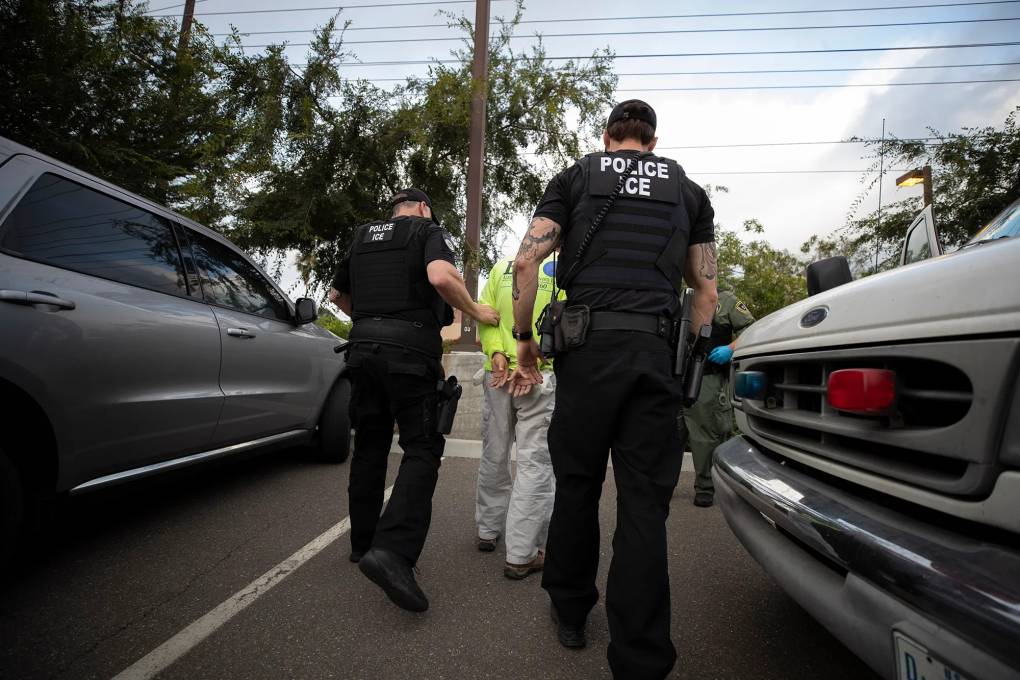
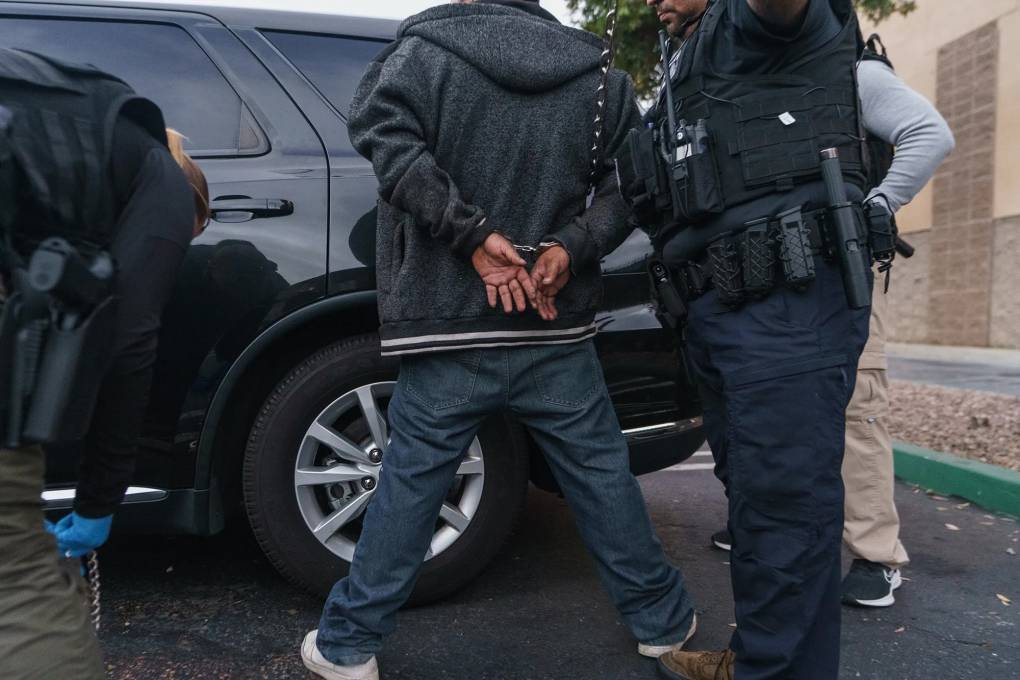
"content": "\u003cp>A church-going agricultural worker. An Echo Park man taking his son to school. A 16-year-old kid searching for work to support his family in Mexico.\u003c/p>\n\u003cp>Three weeks into President Donald Trump’s second term, a clearer picture is beginning to emerge of some of the first Californians targeted in his high-profile immigration crackdown. It’s very different from the descriptions of hardened criminals President Donald Trump has touted. People CalMatters interviewed about the raids across California suggested those swept up in them are dedicated family members and employees, their lives deeply woven into their communities. None appeared to pose the risks to national security or public safety Trump promised he’d target during his campaign.\u003c/p>\n\u003cp>The state has only begun to grapple with the resulting fear and need for reliable information. Last week Gov. Gavin Newsom signed into law legislation allocating $25 million to provide immigrants with legal services to fight immigration proceedings against them.\u003c/p>\n\u003cp>[ad fullwidth]\u003c/p>\n\u003cp>A spokesman for ICE said officers do not target noncitizens indiscriminately. “ICE’s enforcement resources are based on intelligence-driven leads,” said Richard Beam, a spokesman for ICE’s Los Angeles office.\u003c/p>\n\u003cp>Some people detained during the statewide crackdown said that’s not what it feels like on the ground.\u003c/p>\n\u003cp>“It was just a regular morning,” said Loreal Duran from Echo Park in Los Angeles, describing her family’s before-school rush to get the kids out the door and loaded into the car.\u003c/p>\n\u003cp>But on the morning in question, Jan. 23, as her husband fastened their two young children into their seats, an immigration officer walked up, asking Loreal to show identification. “As he got closer to the car, he saw my husband, and basically, he just went around to the other side to grab my husband out of the car and take him away.”\u003c/p>\n\u003cfigure id=\"attachment_12027015\" class=\"wp-caption aligncenter\" style=\"max-width: 1568px\">\u003cimg loading=\"lazy\" decoding=\"async\" class=\"size-full wp-image-12027015\" src=\"https://cdn.kqed.org/wp-content/uploads/sites/10/2025/02/020825_Duran-Family_JAJ_CM_07-copy.jpg\" alt=\"\" width=\"1568\" height=\"1046\" srcset=\"https://cdn.kqed.org/wp-content/uploads/sites/10/2025/02/020825_Duran-Family_JAJ_CM_07-copy.jpg 1568w, https://cdn.kqed.org/wp-content/uploads/sites/10/2025/02/020825_Duran-Family_JAJ_CM_07-copy-800x534.jpg 800w, https://cdn.kqed.org/wp-content/uploads/sites/10/2025/02/020825_Duran-Family_JAJ_CM_07-copy-1020x680.jpg 1020w, https://cdn.kqed.org/wp-content/uploads/sites/10/2025/02/020825_Duran-Family_JAJ_CM_07-copy-160x107.jpg 160w, https://cdn.kqed.org/wp-content/uploads/sites/10/2025/02/020825_Duran-Family_JAJ_CM_07-copy-1536x1025.jpg 1536w\" sizes=\"auto, (max-width: 1568px) 100vw, 1568px\">\u003cfigcaption class=\"wp-caption-text\">Loreal Duran holds a photo of her with her husband Giovanni Duran at her apartment in Los Angeles on Feb. 8, 2025. \u003ccite>(Joel Angel Juarez for CalMatters)\u003c/cite>\u003c/figcaption>\u003c/figure>\n\u003cfigure id=\"attachment_12027021\" class=\"wp-caption aligncenter\" style=\"max-width: 2500px\">\u003cimg loading=\"lazy\" decoding=\"async\" class=\"size-full wp-image-12027021\" src=\"https://cdn.kqed.org/wp-content/uploads/sites/10/2025/02/Copy-of-KQED-side-by-side-downpage-image.jpg\" alt=\"\" width=\"2500\" height=\"833\" srcset=\"https://cdn.kqed.org/wp-content/uploads/sites/10/2025/02/Copy-of-KQED-side-by-side-downpage-image.jpg 2500w, https://cdn.kqed.org/wp-content/uploads/sites/10/2025/02/Copy-of-KQED-side-by-side-downpage-image-800x267.jpg 800w, https://cdn.kqed.org/wp-content/uploads/sites/10/2025/02/Copy-of-KQED-side-by-side-downpage-image-1020x340.jpg 1020w, https://cdn.kqed.org/wp-content/uploads/sites/10/2025/02/Copy-of-KQED-side-by-side-downpage-image-160x53.jpg 160w, https://cdn.kqed.org/wp-content/uploads/sites/10/2025/02/Copy-of-KQED-side-by-side-downpage-image-1536x512.jpg 1536w, https://cdn.kqed.org/wp-content/uploads/sites/10/2025/02/Copy-of-KQED-side-by-side-downpage-image-2048x682.jpg 2048w, https://cdn.kqed.org/wp-content/uploads/sites/10/2025/02/Copy-of-KQED-side-by-side-downpage-image-1920x640.jpg 1920w\" sizes=\"auto, (max-width: 2500px) 100vw, 2500px\">\u003cfigcaption class=\"wp-caption-text\">Left: The Durans’ 1-year-old daughter, whose identity is being withheld for privacy concerns, eats breakfast at their apartment in Los Angeles. Right: The Durans’ 8-year-old son, whose identity is being withheld for privacy concerns, sits on their bed at their apartment on Feb. 8, 2025. \u003ccite>(Joel Angel Juarez for CalMatters)\u003c/cite>\u003c/figcaption>\u003c/figure>\n\u003cp>Giovanni Duran, 42, came to California from El Salvador without federal authorization when he was 2 years old, brought by his family. He worked as a busser in a sushi restaurant in Los Angeles, Loreal said. Duran is now being held in the Adelanto detention facility, run by a private company under contract to ICE, awaiting deportation to a country he doesn’t know.\u003c/p>\n\u003cp>“I haven’t talked to him in almost two days,” said Loreal last week. She’s had to get counseling for her 7-year-old son after he saw his dad taken away by officers.\u003c/p>\n\u003cp>“He was telling his classmates, ‘Oh, daddy got arrested for not wearing his seatbelt,’” Duran recounted. Later, the second grader asked his mom, “Did daddy get arrested because he’s Brown? I replied back to him, I go: ‘Yea, he kinda did.’”\u003c/p>\n\u003cp>Immigration and Customs Enforcement reported on social media 8,276 arrests nationwide between Jan. 22 and Jan. 31. The agency would not break out those numbers for California or different cities.\u003c/p>\n\u003ch2>Casting a wide net\u003c/h2>\n\u003cp>ProPublica and the \u003cem>Texas Tribune\u003c/em> reported less than half of the approximately 8,200 people arrested from Jan. 20 through Feb. 2, so far have criminal convictions, \u003ca href=\"https://www.propublica.org/article/donald-trump-immigration-executive-orders\">according to government data they obtained\u003c/a>.\u003c/p>\n\u003cp>In California, the apparently broad crackdown has immigrant advocates working around the clock. There have been several high-profile protests — one that shuttered a freeway in Los Angeles and another that prompted police to fire off tear gas at people in National City. Social media channels have been flooded by reported sightings of immigration officers and phones have been ringing nonstop.\u003c/p>\n\u003cp>“You can sense that kind of panic and also hunger; hunger for correct, reliable information as to what they should do in times of a raid or in times of an encounter with an immigration agent,” said Ian M. Seruelo, an immigration attorney in San Diego.\u003c/p>\n\u003cp>Two days after President Donald Trump visited wildfire-scarred Los Angeles, promising to work with California on needed federal assistance for recovery, his administration \u003ca href=\"https://x.com/dealosangeles/status/1883584230804140075?s=46\">announced, with few details, immigration enforcement operations\u003c/a> in the city carried out by federal agencies, such as the Drug Enforcement Administration, the Justice Department, “and other federal law enforcement partners.” Video released with the announcement showed officers in camouflaged uniforms and bullet-proof vests approaching apartment buildings and standing around armored vehicles and mobile command centers.\u003c/p>\n\u003cp>Trump authorized law enforcement agents from across the federal government to participate in immigration enforcement activities. He also lifted longtime guidelines restricting ICE from operating at “sensitive locations” such as schools, churches or hospitals.\u003c/p>\n\u003cp>ICE messaging about its enforcement actions has emphasized the apprehension of criminals. Last week, Enforcement and Removal Operations Los Angeles, a part of the agency, \u003ca href=\"https://x.com/EROLosAngeles/status/1886819216638255342?ref_src=twsrc%5Etfw%7Ctwcamp%5Etweetembed%7Ctwterm%5E1886819216638255342%7Ctwgr%5E8a2028151efab540da31db22ebeb7629d80c687a%7Ctwcon%5Es1_c10&ref_url=https%3A%2F%2Fwww.foxla.com%2Fnews%2Fice-raids-california-protests-immigration\">said officers arrested\u003c/a> a 47-year-old noncitizen who was convicted of DUI. “This noncitizen had previously been arrested for driving without a license and evading a peace officer,” officials said on social media. They also \u003ca href=\"https://x.com/EROLosAngeles/status/1886433176761057748\">said they arrested\u003c/a> an “unlawfully present Venezuelan Tren de Aragua gang member. This noncitizen is currently in ICE custody pending removal proceedings.”\u003c/p>\n\u003cfigure id=\"attachment_12027018\" class=\"wp-caption aligncenter\" style=\"max-width: 1568px\">\u003cimg loading=\"lazy\" decoding=\"async\" class=\"size-full wp-image-12027018\" src=\"https://cdn.kqed.org/wp-content/uploads/sites/10/2025/02/020525-ICE-Raid-AP-CM-01-copy.jpg\" alt=\"\" width=\"1568\" height=\"1045\" srcset=\"https://cdn.kqed.org/wp-content/uploads/sites/10/2025/02/020525-ICE-Raid-AP-CM-01-copy.jpg 1568w, https://cdn.kqed.org/wp-content/uploads/sites/10/2025/02/020525-ICE-Raid-AP-CM-01-copy-800x533.jpg 800w, https://cdn.kqed.org/wp-content/uploads/sites/10/2025/02/020525-ICE-Raid-AP-CM-01-copy-1020x680.jpg 1020w, https://cdn.kqed.org/wp-content/uploads/sites/10/2025/02/020525-ICE-Raid-AP-CM-01-copy-160x107.jpg 160w, https://cdn.kqed.org/wp-content/uploads/sites/10/2025/02/020525-ICE-Raid-AP-CM-01-copy-1536x1024.jpg 1536w\" sizes=\"auto, (max-width: 1568px) 100vw, 1568px\">\u003cfigcaption class=\"wp-caption-text\">Law enforcement officials spread out through an apartment complex during a raid in Denver on Feb. 5, 2025. Officials have also been conducting immigration enforcement activities across California. \u003ccite>(David Zalubowski/Reuters)\u003c/cite>\u003c/figcaption>\u003c/figure>\n\u003cp>Nayna Gupta, the policy director at the American Immigration Council, an advocacy group for immigrants, said for the Trump administration to deport millions of people as the president \u003ca href=\"https://www.washingtonpost.com/politics/2024/11/18/there-arent-20-million-people-deport-trump-will-certainly-try/\">promised\u003c/a>, it will have to target people who have not had contact with the criminal system.\u003c/p>\n\u003cp>“Based on recent data, we know that fewer than 1 in 10 undocumented immigrants has a criminal record,” said Gupta.\u003c/p>\n\u003cp>More than \u003ca href=\"https://dornsife.usc.edu/eri/wp-content/uploads/sites/41/2024/07/Final_SOILA2024_ExecSummary_v5.pdf\">one in three people in Los Angeles County (PDF)\u003c/a> are immigrants, according to a report last year from the University of Southern California. Tens of thousands of county residents had to evacuate following a series of wildfires that began in early January.\u003c/p>\n\u003cp>“It is unconscionable to have or plan for immigration enforcement activities in a natural disaster,” said Angelica Salas, the executive director of the Coalition for Humane Immigrant Rights of Los Angeles. ICE did not respond to a request for comment on the issue.\u003c/p>\n\u003ch2>In the name of public safety\u003c/h2>\n\u003cp>California Republicans appear to be on board with Trump’s actions so far. They urged Newsom to veto two bills signed into law last week. One was the $25 million for immigrant legal defense and the other allocated another $25 million for Attorney General Rob Bonta to pursue litigation against the Trump administration.\u003c/p>\n\u003cp>“We have a public safety problem in California, and a big component of that is international gangs and cartels. Human trafficking has exploded, and it knows no bounds,” said Sen. Suzette Martinez Valladares, a Republican from Santa Clarita, during a floor debate on the legislation.[aside label=\"Related Stories\" postID=\"news_12026959,news_12026817,news_12026582\"]During his campaign, Trump and his advisors repeatedly invoked hardened criminals and threats to national security when promising mass detentions and deportations of undocumented immigrants.\u003c/p>\n\u003cp>That’s what Estefany Peña, 30, from Lincoln, California, believed when she supported Trump for reelection.\u003c/p>\n\u003cp>“I thought they were going to be targeting criminals. No one mentioned during the campaigning of Donald Trump that residents …\u003cem> legal residents\u003c/em> … were going to have to go through this,” she said. Her husband, who came to the country legally in 1999 and has a green card, went to an immigration office in San Francisco for a check-in in late January and still hasn’t come home, she said.\u003c/p>\n\u003cp>“Everything just came crumbling down,” she said of when immigration officers wouldn’t let her husband leave.\u003c/p>\n\u003cp>The husband, Joel Jacuinde, 40, is the breadwinner for his family, working at a rice dryer company east of San Francisco. Peña said he also volunteers for his church and provides the primary source of transportation for the family, regularly taking their 11-year-old son for treatment for his asthma. Both children are covered for health care under Jacuinde’s Medi-Cal account, she said.\u003c/p>\n\u003cp>“My kids are very close to their dad, so it’s taken a terrible toll on them,” she said.\u003c/p>\n\u003cp>Jacuinde doesn’t show up in a database of people being detained by ICE. Peña said he was told he was not free to leave the immigration office and that agents were holding him to pressure him to sign a voluntary removal form. The family has contacted dozens of attorneys but hasn’t been able to secure legal representation, she said.\u003c/p>\n\u003cp>In Tijuana, outside a federal shelter set up to assist recently deported Mexicans, a 16-year-old told CalMatters he had been detained trying to reach Stockton to find work. “They grabbed me,” he said, and within hours, he was back in Mexico.\u003c/p>\n\u003cp>Leaving the same Tijuana shelter, Mario Guerra, 39, a construction worker from Bakersfield, said he ran from about seven or eight ICE agents on Jan. 31. Though he grew up in Bakersfield, he said he was in the U.S. without federal authorization. Guerra said the agents caught him, detained him, and sent him back to Mexico after two days in detention.\u003c/p>\n\u003cfigure id=\"attachment_12027019\" class=\"wp-caption aligncenter\" style=\"max-width: 1568px\">\u003cimg loading=\"lazy\" decoding=\"async\" class=\"size-full wp-image-12027019\" src=\"https://cdn.kqed.org/wp-content/uploads/sites/10/2025/02/020325_Day-Without-Immigrants_JWH_06-copy.jpg\" alt=\"\" width=\"1568\" height=\"1046\" srcset=\"https://cdn.kqed.org/wp-content/uploads/sites/10/2025/02/020325_Day-Without-Immigrants_JWH_06-copy.jpg 1568w, https://cdn.kqed.org/wp-content/uploads/sites/10/2025/02/020325_Day-Without-Immigrants_JWH_06-copy-800x534.jpg 800w, https://cdn.kqed.org/wp-content/uploads/sites/10/2025/02/020325_Day-Without-Immigrants_JWH_06-copy-1020x680.jpg 1020w, https://cdn.kqed.org/wp-content/uploads/sites/10/2025/02/020325_Day-Without-Immigrants_JWH_06-copy-160x107.jpg 160w, https://cdn.kqed.org/wp-content/uploads/sites/10/2025/02/020325_Day-Without-Immigrants_JWH_06-copy-1536x1025.jpg 1536w\" sizes=\"auto, (max-width: 1568px) 100vw, 1568px\">\u003cfigcaption class=\"wp-caption-text\">Protesters gather over US Route 101 in Downtown Los Angeles in support of the ‘Day Without Immigrants’ march on Feb. 3, 2025. \u003ccite>(J.W. Hendricks for CalMatters)\u003c/cite>\u003c/figcaption>\u003c/figure>\n\u003cp>Guerra said the officers handcuffed his feet and hands and left him in a transportation van for hours from Bakersfield to San Ysidro with no restroom breaks and nothing to drink.\u003c/p>\n\u003cp>“We were, basically, telling them that we needed to use the restroom, but they didn’t answer at all,” he said.\u003c/p>\n\u003cp>“The kids are the ones who are going to suffer the most,” he added about his children who are still in Bakersfield.\u003c/p>\n\u003cp>Vilma Ordóñez, 34, said she and her husband and children went out to eat in East Los Angeles on Jan. 26. As they got out of the car in front of the restaurant, two agents wearing bulletproof vests approached “and told my husband that he looked like someone they were looking for,” Ordóñez described.\u003c/p>\n\u003cp>Her stomach dropped as she remembered advice she’d read online, telling her husband, who is in the U.S. without legal status, “Let’s not say anything; let’s just look for an attorney.” The agents kept insisting the couple show them their IDs, she said.\u003c/p>\n\u003cp>“He had to take out his ID,” she said. “He showed it to them, and they said, ‘Oh, we knew you were not the right person.’”\u003c/p>\n\u003cp>“They knew he was not the right person, but yet they still insisted on asking him for his ID?” she asked in Spanish.\u003c/p>\n\u003cp>It’s possible the agents were looking for indications on Ordóñez’s husband’s ID that he was not an authorized immigrant. In 2013, California passed the Safe and Responsible Drivers Act, granting undocumented residents the ability to obtain driver’s licenses. More than a million undocumented Californians \u003ca href=\"https://calmatters.org/california-divide/2023/01/drivers-licenses-undocumented-immigrants/\">got the special licenses\u003c/a>, which look slightly different than regular state licenses. Some advocates worried at the time the licenses could be misused by immigration authorities to identify people who are undocumented. ICE did not respond to a request for comment about whether it is identifying immigrants without legal status by their AB60 driver’s licenses.\u003c/p>\n\u003cp>Ordóñez said the agents let them go, so they went into the restaurant with their children and had dinner. But when they returned to the parking lot, four agents were standing around their car.\u003c/p>\n\u003cp>“They told him he had signed a voluntary return in 1996 and had not left the country, and so they were going to detain him and take him,” she said, adding that he’s currently being held in a California detention facility. Ordóñez said her husband never signed the voluntary return form.\u003c/p>\n\u003cp>“The father has a very important role in the family, and right now, our children are traumatized. More than anything, our kids are suffering,” said Ordóñez. “My husband has always paid his taxes every single year since he entered, and he’s always worked and taken care of his family.”\u003c/p>\n\u003cp>\u003cem>Attention: If someone close to you has recently been detained by immigration agents, and you want to share your story, please reach out to CalMatters via \u003ca href=\"mailto:wendy@calmatters.org\">wendy@calmatters.org\u003c/a>.\u003c/em>\u003c/p>\n\u003cp>\u003cem>Atención: Si tienes un ser querido que recientemente ha sido detenido por agentes de migración y quieres compartir tu historia, por favor comunícate con CalMatters: \u003ca href=\"mailto:wendy@calmatters.org\">wendy@calmatters.org\u003c/a>.\u003c/em>\u003c/p>\n\u003cp>[ad floatright]\u003c/p>\n",
"blocks": [],
"excerpt": "Interviews suggest some people swept up in Trump’s immigration crackdown are dedicated to their families and communities — not hardened criminals.",
"status": "publish",
"parent": 0,
"modified": 1739552966,
"stats": {
"hasAudio": false,
"hasVideo": false,
"hasChartOrMap": false,
"iframeSrcs": [],
"hasGoogleForm": false,
"hasGallery": false,
"hasHearkenModule": false,
"hasPolis": false,
"paragraphCount": 46,
"wordCount": 2265
},
"headData": {
"title": "As ICE Arrests Hit California, Families Broken Up, Working People Detained | KQED",
"description": "Interviews suggest some people swept up in Trump’s immigration crackdown are dedicated to their families and communities — not hardened criminals.",
"ogTitle": "",
"ogDescription": "",
"ogImgId": "",
"twTitle": "",
"twDescription": "",
"twImgId": "",
"schema": {
"@context": "https://schema.org",
"@type": "NewsArticle",
"headline": "As ICE Arrests Hit California, Families Broken Up, Working People Detained",
"datePublished": "2025-02-14T03:50:26-08:00",
"dateModified": "2025-02-14T09:09:26-08:00",
"image": "https://cdn.kqed.org/wp-content/uploads/2020/02/KQED-OG-Image@1x.png",
"isAccessibleForFree": "True",
"publisher": {
"@type": "NewsMediaOrganization",
"@id": "https://www.kqed.org/#organization",
"name": "KQED",
"logo": "https://cdn.kqed.org/wp-content/uploads/2020/02/KQED-OG-Image@1x.png",
"url": "https://www.kqed.org",
"sameAs": [
"https://www.facebook.com/KQED",
"https://twitter.com/KQED",
"https://www.instagram.com/kqed/",
"https://www.tiktok.com/@kqedofficial",
"https://www.linkedin.com/company/kqed",
"https://www.youtube.com/channel/UCeC0IOo7i1P_61zVUWbJ4nw"
]
}
}
},
"sticky": false,
"nprByline": "\u003ca href=\"https://calmatters.org/author/wendy-fry/\">Wendy Fry\u003c/a>, CalMatters",
"nprStoryId": "kqed-12027013",
"excludeFromSiteSearch": "Include",
"showOnAuthorArchivePages": "No",
"articleAge": "0",
"path": "/news/12027013/it-was-just-a-regular-morning-californians-picked-up-in-recent-ice-raids-include-kids-volunteers",
"audioTrackLength": null,
"parsedContent": [
{
"type": "contentString",
"content": "\u003cdiv class=\"post-body\">\u003cp>\u003cp>A church-going agricultural worker. An Echo Park man taking his son to school. A 16-year-old kid searching for work to support his family in Mexico.\u003c/p>\n\u003cp>Three weeks into President Donald Trump’s second term, a clearer picture is beginning to emerge of some of the first Californians targeted in his high-profile immigration crackdown. It’s very different from the descriptions of hardened criminals President Donald Trump has touted. People CalMatters interviewed about the raids across California suggested those swept up in them are dedicated family members and employees, their lives deeply woven into their communities. None appeared to pose the risks to national security or public safety Trump promised he’d target during his campaign.\u003c/p>\n\u003cp>The state has only begun to grapple with the resulting fear and need for reliable information. Last week Gov. Gavin Newsom signed into law legislation allocating $25 million to provide immigrants with legal services to fight immigration proceedings against them.\u003c/p>\n\u003cp>\u003c/p>\u003c/div>",
"attributes": {
"named": {},
"numeric": []
}
},
{
"type": "component",
"content": "",
"name": "ad",
"attributes": {
"named": {
"label": "fullwidth"
},
"numeric": [
"fullwidth"
]
}
},
{
"type": "contentString",
"content": "\u003cdiv class=\"post-body\">\u003cp>\u003c/p>\n\u003cp>A spokesman for ICE said officers do not target noncitizens indiscriminately. “ICE’s enforcement resources are based on intelligence-driven leads,” said Richard Beam, a spokesman for ICE’s Los Angeles office.\u003c/p>\n\u003cp>Some people detained during the statewide crackdown said that’s not what it feels like on the ground.\u003c/p>\n\u003cp>“It was just a regular morning,” said Loreal Duran from Echo Park in Los Angeles, describing her family’s before-school rush to get the kids out the door and loaded into the car.\u003c/p>\n\u003cp>But on the morning in question, Jan. 23, as her husband fastened their two young children into their seats, an immigration officer walked up, asking Loreal to show identification. “As he got closer to the car, he saw my husband, and basically, he just went around to the other side to grab my husband out of the car and take him away.”\u003c/p>\n\u003cfigure id=\"attachment_12027015\" class=\"wp-caption aligncenter\" style=\"max-width: 1568px\">\u003cimg loading=\"lazy\" decoding=\"async\" class=\"size-full wp-image-12027015\" src=\"https://cdn.kqed.org/wp-content/uploads/sites/10/2025/02/020825_Duran-Family_JAJ_CM_07-copy.jpg\" alt=\"\" width=\"1568\" height=\"1046\" srcset=\"https://cdn.kqed.org/wp-content/uploads/sites/10/2025/02/020825_Duran-Family_JAJ_CM_07-copy.jpg 1568w, https://cdn.kqed.org/wp-content/uploads/sites/10/2025/02/020825_Duran-Family_JAJ_CM_07-copy-800x534.jpg 800w, https://cdn.kqed.org/wp-content/uploads/sites/10/2025/02/020825_Duran-Family_JAJ_CM_07-copy-1020x680.jpg 1020w, https://cdn.kqed.org/wp-content/uploads/sites/10/2025/02/020825_Duran-Family_JAJ_CM_07-copy-160x107.jpg 160w, https://cdn.kqed.org/wp-content/uploads/sites/10/2025/02/020825_Duran-Family_JAJ_CM_07-copy-1536x1025.jpg 1536w\" sizes=\"auto, (max-width: 1568px) 100vw, 1568px\">\u003cfigcaption class=\"wp-caption-text\">Loreal Duran holds a photo of her with her husband Giovanni Duran at her apartment in Los Angeles on Feb. 8, 2025. \u003ccite>(Joel Angel Juarez for CalMatters)\u003c/cite>\u003c/figcaption>\u003c/figure>\n\u003cfigure id=\"attachment_12027021\" class=\"wp-caption aligncenter\" style=\"max-width: 2500px\">\u003cimg loading=\"lazy\" decoding=\"async\" class=\"size-full wp-image-12027021\" src=\"https://cdn.kqed.org/wp-content/uploads/sites/10/2025/02/Copy-of-KQED-side-by-side-downpage-image.jpg\" alt=\"\" width=\"2500\" height=\"833\" srcset=\"https://cdn.kqed.org/wp-content/uploads/sites/10/2025/02/Copy-of-KQED-side-by-side-downpage-image.jpg 2500w, https://cdn.kqed.org/wp-content/uploads/sites/10/2025/02/Copy-of-KQED-side-by-side-downpage-image-800x267.jpg 800w, https://cdn.kqed.org/wp-content/uploads/sites/10/2025/02/Copy-of-KQED-side-by-side-downpage-image-1020x340.jpg 1020w, https://cdn.kqed.org/wp-content/uploads/sites/10/2025/02/Copy-of-KQED-side-by-side-downpage-image-160x53.jpg 160w, https://cdn.kqed.org/wp-content/uploads/sites/10/2025/02/Copy-of-KQED-side-by-side-downpage-image-1536x512.jpg 1536w, https://cdn.kqed.org/wp-content/uploads/sites/10/2025/02/Copy-of-KQED-side-by-side-downpage-image-2048x682.jpg 2048w, https://cdn.kqed.org/wp-content/uploads/sites/10/2025/02/Copy-of-KQED-side-by-side-downpage-image-1920x640.jpg 1920w\" sizes=\"auto, (max-width: 2500px) 100vw, 2500px\">\u003cfigcaption class=\"wp-caption-text\">Left: The Durans’ 1-year-old daughter, whose identity is being withheld for privacy concerns, eats breakfast at their apartment in Los Angeles. Right: The Durans’ 8-year-old son, whose identity is being withheld for privacy concerns, sits on their bed at their apartment on Feb. 8, 2025. \u003ccite>(Joel Angel Juarez for CalMatters)\u003c/cite>\u003c/figcaption>\u003c/figure>\n\u003cp>Giovanni Duran, 42, came to California from El Salvador without federal authorization when he was 2 years old, brought by his family. He worked as a busser in a sushi restaurant in Los Angeles, Loreal said. Duran is now being held in the Adelanto detention facility, run by a private company under contract to ICE, awaiting deportation to a country he doesn’t know.\u003c/p>\n\u003cp>“I haven’t talked to him in almost two days,” said Loreal last week. She’s had to get counseling for her 7-year-old son after he saw his dad taken away by officers.\u003c/p>\n\u003cp>“He was telling his classmates, ‘Oh, daddy got arrested for not wearing his seatbelt,’” Duran recounted. Later, the second grader asked his mom, “Did daddy get arrested because he’s Brown? I replied back to him, I go: ‘Yea, he kinda did.’”\u003c/p>\n\u003cp>Immigration and Customs Enforcement reported on social media 8,276 arrests nationwide between Jan. 22 and Jan. 31. The agency would not break out those numbers for California or different cities.\u003c/p>\n\u003ch2>Casting a wide net\u003c/h2>\n\u003cp>ProPublica and the \u003cem>Texas Tribune\u003c/em> reported less than half of the approximately 8,200 people arrested from Jan. 20 through Feb. 2, so far have criminal convictions, \u003ca href=\"https://www.propublica.org/article/donald-trump-immigration-executive-orders\">according to government data they obtained\u003c/a>.\u003c/p>\n\u003cp>In California, the apparently broad crackdown has immigrant advocates working around the clock. There have been several high-profile protests — one that shuttered a freeway in Los Angeles and another that prompted police to fire off tear gas at people in National City. Social media channels have been flooded by reported sightings of immigration officers and phones have been ringing nonstop.\u003c/p>\n\u003cp>“You can sense that kind of panic and also hunger; hunger for correct, reliable information as to what they should do in times of a raid or in times of an encounter with an immigration agent,” said Ian M. Seruelo, an immigration attorney in San Diego.\u003c/p>\n\u003cp>Two days after President Donald Trump visited wildfire-scarred Los Angeles, promising to work with California on needed federal assistance for recovery, his administration \u003ca href=\"https://x.com/dealosangeles/status/1883584230804140075?s=46\">announced, with few details, immigration enforcement operations\u003c/a> in the city carried out by federal agencies, such as the Drug Enforcement Administration, the Justice Department, “and other federal law enforcement partners.” Video released with the announcement showed officers in camouflaged uniforms and bullet-proof vests approaching apartment buildings and standing around armored vehicles and mobile command centers.\u003c/p>\n\u003cp>Trump authorized law enforcement agents from across the federal government to participate in immigration enforcement activities. He also lifted longtime guidelines restricting ICE from operating at “sensitive locations” such as schools, churches or hospitals.\u003c/p>\n\u003cp>ICE messaging about its enforcement actions has emphasized the apprehension of criminals. Last week, Enforcement and Removal Operations Los Angeles, a part of the agency, \u003ca href=\"https://x.com/EROLosAngeles/status/1886819216638255342?ref_src=twsrc%5Etfw%7Ctwcamp%5Etweetembed%7Ctwterm%5E1886819216638255342%7Ctwgr%5E8a2028151efab540da31db22ebeb7629d80c687a%7Ctwcon%5Es1_c10&ref_url=https%3A%2F%2Fwww.foxla.com%2Fnews%2Fice-raids-california-protests-immigration\">said officers arrested\u003c/a> a 47-year-old noncitizen who was convicted of DUI. “This noncitizen had previously been arrested for driving without a license and evading a peace officer,” officials said on social media. They also \u003ca href=\"https://x.com/EROLosAngeles/status/1886433176761057748\">said they arrested\u003c/a> an “unlawfully present Venezuelan Tren de Aragua gang member. This noncitizen is currently in ICE custody pending removal proceedings.”\u003c/p>\n\u003cfigure id=\"attachment_12027018\" class=\"wp-caption aligncenter\" style=\"max-width: 1568px\">\u003cimg loading=\"lazy\" decoding=\"async\" class=\"size-full wp-image-12027018\" src=\"https://cdn.kqed.org/wp-content/uploads/sites/10/2025/02/020525-ICE-Raid-AP-CM-01-copy.jpg\" alt=\"\" width=\"1568\" height=\"1045\" srcset=\"https://cdn.kqed.org/wp-content/uploads/sites/10/2025/02/020525-ICE-Raid-AP-CM-01-copy.jpg 1568w, https://cdn.kqed.org/wp-content/uploads/sites/10/2025/02/020525-ICE-Raid-AP-CM-01-copy-800x533.jpg 800w, https://cdn.kqed.org/wp-content/uploads/sites/10/2025/02/020525-ICE-Raid-AP-CM-01-copy-1020x680.jpg 1020w, https://cdn.kqed.org/wp-content/uploads/sites/10/2025/02/020525-ICE-Raid-AP-CM-01-copy-160x107.jpg 160w, https://cdn.kqed.org/wp-content/uploads/sites/10/2025/02/020525-ICE-Raid-AP-CM-01-copy-1536x1024.jpg 1536w\" sizes=\"auto, (max-width: 1568px) 100vw, 1568px\">\u003cfigcaption class=\"wp-caption-text\">Law enforcement officials spread out through an apartment complex during a raid in Denver on Feb. 5, 2025. Officials have also been conducting immigration enforcement activities across California. \u003ccite>(David Zalubowski/Reuters)\u003c/cite>\u003c/figcaption>\u003c/figure>\n\u003cp>Nayna Gupta, the policy director at the American Immigration Council, an advocacy group for immigrants, said for the Trump administration to deport millions of people as the president \u003ca href=\"https://www.washingtonpost.com/politics/2024/11/18/there-arent-20-million-people-deport-trump-will-certainly-try/\">promised\u003c/a>, it will have to target people who have not had contact with the criminal system.\u003c/p>\n\u003cp>“Based on recent data, we know that fewer than 1 in 10 undocumented immigrants has a criminal record,” said Gupta.\u003c/p>\n\u003cp>More than \u003ca href=\"https://dornsife.usc.edu/eri/wp-content/uploads/sites/41/2024/07/Final_SOILA2024_ExecSummary_v5.pdf\">one in three people in Los Angeles County (PDF)\u003c/a> are immigrants, according to a report last year from the University of Southern California. Tens of thousands of county residents had to evacuate following a series of wildfires that began in early January.\u003c/p>\n\u003cp>“It is unconscionable to have or plan for immigration enforcement activities in a natural disaster,” said Angelica Salas, the executive director of the Coalition for Humane Immigrant Rights of Los Angeles. ICE did not respond to a request for comment on the issue.\u003c/p>\n\u003ch2>In the name of public safety\u003c/h2>\n\u003cp>California Republicans appear to be on board with Trump’s actions so far. They urged Newsom to veto two bills signed into law last week. One was the $25 million for immigrant legal defense and the other allocated another $25 million for Attorney General Rob Bonta to pursue litigation against the Trump administration.\u003c/p>\n\u003cp>“We have a public safety problem in California, and a big component of that is international gangs and cartels. Human trafficking has exploded, and it knows no bounds,” said Sen. Suzette Martinez Valladares, a Republican from Santa Clarita, during a floor debate on the legislation.\u003c/p>\u003c/div>",
"attributes": {
"named": {},
"numeric": []
}
},
{
"type": "component",
"content": "",
"name": "aside",
"attributes": {
"named": {
"label": "Related Stories ",
"postid": "news_12026959,news_12026817,news_12026582"
},
"numeric": []
}
},
{
"type": "contentString",
"content": "\u003cdiv class=\"post-body\">\u003cp>During his campaign, Trump and his advisors repeatedly invoked hardened criminals and threats to national security when promising mass detentions and deportations of undocumented immigrants.\u003c/p>\n\u003cp>That’s what Estefany Peña, 30, from Lincoln, California, believed when she supported Trump for reelection.\u003c/p>\n\u003cp>“I thought they were going to be targeting criminals. No one mentioned during the campaigning of Donald Trump that residents …\u003cem> legal residents\u003c/em> … were going to have to go through this,” she said. Her husband, who came to the country legally in 1999 and has a green card, went to an immigration office in San Francisco for a check-in in late January and still hasn’t come home, she said.\u003c/p>\n\u003cp>“Everything just came crumbling down,” she said of when immigration officers wouldn’t let her husband leave.\u003c/p>\n\u003cp>The husband, Joel Jacuinde, 40, is the breadwinner for his family, working at a rice dryer company east of San Francisco. Peña said he also volunteers for his church and provides the primary source of transportation for the family, regularly taking their 11-year-old son for treatment for his asthma. Both children are covered for health care under Jacuinde’s Medi-Cal account, she said.\u003c/p>\n\u003cp>“My kids are very close to their dad, so it’s taken a terrible toll on them,” she said.\u003c/p>\n\u003cp>Jacuinde doesn’t show up in a database of people being detained by ICE. Peña said he was told he was not free to leave the immigration office and that agents were holding him to pressure him to sign a voluntary removal form. The family has contacted dozens of attorneys but hasn’t been able to secure legal representation, she said.\u003c/p>\n\u003cp>In Tijuana, outside a federal shelter set up to assist recently deported Mexicans, a 16-year-old told CalMatters he had been detained trying to reach Stockton to find work. “They grabbed me,” he said, and within hours, he was back in Mexico.\u003c/p>\n\u003cp>Leaving the same Tijuana shelter, Mario Guerra, 39, a construction worker from Bakersfield, said he ran from about seven or eight ICE agents on Jan. 31. Though he grew up in Bakersfield, he said he was in the U.S. without federal authorization. Guerra said the agents caught him, detained him, and sent him back to Mexico after two days in detention.\u003c/p>\n\u003cfigure id=\"attachment_12027019\" class=\"wp-caption aligncenter\" style=\"max-width: 1568px\">\u003cimg loading=\"lazy\" decoding=\"async\" class=\"size-full wp-image-12027019\" src=\"https://cdn.kqed.org/wp-content/uploads/sites/10/2025/02/020325_Day-Without-Immigrants_JWH_06-copy.jpg\" alt=\"\" width=\"1568\" height=\"1046\" srcset=\"https://cdn.kqed.org/wp-content/uploads/sites/10/2025/02/020325_Day-Without-Immigrants_JWH_06-copy.jpg 1568w, https://cdn.kqed.org/wp-content/uploads/sites/10/2025/02/020325_Day-Without-Immigrants_JWH_06-copy-800x534.jpg 800w, https://cdn.kqed.org/wp-content/uploads/sites/10/2025/02/020325_Day-Without-Immigrants_JWH_06-copy-1020x680.jpg 1020w, https://cdn.kqed.org/wp-content/uploads/sites/10/2025/02/020325_Day-Without-Immigrants_JWH_06-copy-160x107.jpg 160w, https://cdn.kqed.org/wp-content/uploads/sites/10/2025/02/020325_Day-Without-Immigrants_JWH_06-copy-1536x1025.jpg 1536w\" sizes=\"auto, (max-width: 1568px) 100vw, 1568px\">\u003cfigcaption class=\"wp-caption-text\">Protesters gather over US Route 101 in Downtown Los Angeles in support of the ‘Day Without Immigrants’ march on Feb. 3, 2025. \u003ccite>(J.W. Hendricks for CalMatters)\u003c/cite>\u003c/figcaption>\u003c/figure>\n\u003cp>Guerra said the officers handcuffed his feet and hands and left him in a transportation van for hours from Bakersfield to San Ysidro with no restroom breaks and nothing to drink.\u003c/p>\n\u003cp>“We were, basically, telling them that we needed to use the restroom, but they didn’t answer at all,” he said.\u003c/p>\n\u003cp>“The kids are the ones who are going to suffer the most,” he added about his children who are still in Bakersfield.\u003c/p>\n\u003cp>Vilma Ordóñez, 34, said she and her husband and children went out to eat in East Los Angeles on Jan. 26. As they got out of the car in front of the restaurant, two agents wearing bulletproof vests approached “and told my husband that he looked like someone they were looking for,” Ordóñez described.\u003c/p>\n\u003cp>Her stomach dropped as she remembered advice she’d read online, telling her husband, who is in the U.S. without legal status, “Let’s not say anything; let’s just look for an attorney.” The agents kept insisting the couple show them their IDs, she said.\u003c/p>\n\u003cp>“He had to take out his ID,” she said. “He showed it to them, and they said, ‘Oh, we knew you were not the right person.’”\u003c/p>\n\u003cp>“They knew he was not the right person, but yet they still insisted on asking him for his ID?” she asked in Spanish.\u003c/p>\n\u003cp>It’s possible the agents were looking for indications on Ordóñez’s husband’s ID that he was not an authorized immigrant. In 2013, California passed the Safe and Responsible Drivers Act, granting undocumented residents the ability to obtain driver’s licenses. More than a million undocumented Californians \u003ca href=\"https://calmatters.org/california-divide/2023/01/drivers-licenses-undocumented-immigrants/\">got the special licenses\u003c/a>, which look slightly different than regular state licenses. Some advocates worried at the time the licenses could be misused by immigration authorities to identify people who are undocumented. ICE did not respond to a request for comment about whether it is identifying immigrants without legal status by their AB60 driver’s licenses.\u003c/p>\n\u003cp>Ordóñez said the agents let them go, so they went into the restaurant with their children and had dinner. But when they returned to the parking lot, four agents were standing around their car.\u003c/p>\n\u003cp>“They told him he had signed a voluntary return in 1996 and had not left the country, and so they were going to detain him and take him,” she said, adding that he’s currently being held in a California detention facility. Ordóñez said her husband never signed the voluntary return form.\u003c/p>\n\u003cp>“The father has a very important role in the family, and right now, our children are traumatized. More than anything, our kids are suffering,” said Ordóñez. “My husband has always paid his taxes every single year since he entered, and he’s always worked and taken care of his family.”\u003c/p>\n\u003cp>\u003cem>Attention: If someone close to you has recently been detained by immigration agents, and you want to share your story, please reach out to CalMatters via \u003ca href=\"mailto:wendy@calmatters.org\">wendy@calmatters.org\u003c/a>.\u003c/em>\u003c/p>\n\u003cp>\u003cem>Atención: Si tienes un ser querido que recientemente ha sido detenido por agentes de migración y quieres compartir tu historia, por favor comunícate con CalMatters: \u003ca href=\"mailto:wendy@calmatters.org\">wendy@calmatters.org\u003c/a>.\u003c/em>\u003c/p>\n\u003cp>\u003c/p>\u003c/div>",
"attributes": {
"named": {},
"numeric": []
}
},
{
"type": "component",
"content": "",
"name": "ad",
"attributes": {
"named": {
"label": "floatright"
},
"numeric": [
"floatright"
]
}
},
{
"type": "contentString",
"content": "\u003cdiv class=\"post-body\">\u003cp>\u003c/p>\n\u003c/div>\u003c/p>",
"attributes": {
"named": {},
"numeric": []
}
}
],
"link": "/news/12027013/it-was-just-a-regular-morning-californians-picked-up-in-recent-ice-raids-include-kids-volunteers",
"authors": [
"byline_news_12027013"
],
"categories": [
"news_31795",
"news_1169",
"news_6188",
"news_8",
"news_13"
],
"tags": [
"news_18123",
"news_20202",
"news_20857",
"news_20584",
"news_25305",
"news_32380"
],
"affiliates": [
"news_18481"
],
"featImg": "news_12027014",
"label": "news_18481"
},
"news_12026443": {
"type": "posts",
"id": "news_12026443",
"meta": {
"index": "posts_1716263798",
"site": "news",
"id": "12026443",
"score": null,
"sort": [
1739221243000
]
},
"guestAuthors": [],
"slug": "trumps-shock-and-awe-immigration-orders-are-creating-fear-experts-say-thats-the-point",
"title": "Trump’s Early Moves on Immigration Are Creating Fear. California Is Pushing Back",
"publishDate": 1739221243,
"format": "standard",
"headTitle": "Trump’s Early Moves on Immigration Are Creating Fear. California Is Pushing Back | KQED",
"labelTerm": {},
"content": "\u003cp>President Donald Trump returned to office last month with a major show of force on immigration, issuing numerous orders and directives to dramatically increase enforcement.\u003c/p>\n\u003cp>They’ve sparked glee from his supporters, condemnation from his opponents, fear from immigrant communities amid nationwide raids — and also \u003ca href=\"https://www.mynspr.org/news/2025-01-31/north-state-ice-sightings-circulating-on-social-media-likely-false-claims\">plenty of false alarms\u003c/a>.\u003c/p>\n\u003cp>The flurry of new policies — some pushing long-held legal boundaries — are part of a “shock and awe” strategy meant to amplify the promises of a military-assisted mass deportation, experts said. Among the administration’s goals is for fearful immigrants to “voluntarily depart.”\u003c/p>\n\u003cp>“The big issue is this basically full-court press (from the administration) on immigration enforcement and the fear it’s generated,” said UC Davis immigration law professor Kevin Johnson. “(The fear) probably is the biggest impact of all.”\u003c/p>\n\u003cp>The uncertainty over immigrants’ futures has led communities to question whether workers should continue to show up to businesses, children to school and patients to doctors’ offices — and whether there will be economic disruptions and school funding consequences as a result.\u003c/p>\n\u003cp>[ad fullwidth]\u003c/p>\n\u003cp>Many immigrants \u003ca href=\"https://www.nytimes.com/2025/01/30/us/immigrant-communities-hiding-ice.html\">are staying home\u003c/a>. Others have little choice but to continue their routines.\u003c/p>\n\u003cp>In Kern County, an immigrant citrus picker who spoke on the condition that her name not be used because she fears deportation said, like many of her coworkers, she stayed home for a day in the wake of \u003ca href=\"https://calmatters.org/economy/2025/01/kern-county-immigration-sweep/\">a Border Patrol operation last month\u003c/a> — conducted before Trump took office — that seemed to target farmworkers.\u003c/p>\n\u003cp>But she has bills to pay, so she’s continued going to work and sending her child to daycare. Rumors of immigration authority sightings have also continued to spread, including one that prompted the contractor she works for to keep her crew in the orange grove at the end of a recent workday. The contractor didn’t release them to go home until checking that the roads were clear, she said.\u003c/p>\n\u003cp>“Everybody goes out with fear,” she said. “But one has needs. And my needs are bigger than the fear.”\u003c/p>\n\u003cp>Trump’s actions have the potential to drastically remake the immigration landscape. Here’s what’s changed so far and how California is responding.\u003c/p>\n\u003cp>\u003cstrong>Targeting birthright citizenship\u003c/strong>\u003c/p>\n\u003cp>One of Trump’s first-day executive orders sought to end the century-plus-old practice of granting citizenship to all children born on U.S. soil, even if their parents are undocumented. Courts have affirmed the 14th Amendment’s guarantee of birthright citizenship since 1898, in the case of a San Francisco man whose parents were from China.\u003c/p>\n\u003cp>Two federal judges, responding to separate lawsuits, quickly halted the order.\u003c/p>\n\u003cp>A third lawsuit, brought by 18 states, including California and the city of San Francisco, was heard in a Massachusetts federal court last Friday. Attorney General Rob Bonta’s office says the executive order would strip citizenship rights from about 24,500 children who are born in California each year.\u003c/p>\n\u003cp>\u003cstrong>Expanding ICE’s reach\u003c/strong>\u003c/p>\n\u003cp>The administration has directed the Immigration and Customs Enforcement to \u003ca href=\"https://public-inspection.federalregister.gov/2025-01720.pdf\">expand\u003c/a> use of a process called “expedited removal”: deportations that are allowed to bypass immigration courts, where a judge would normally decide the merit of allowing someone to stay in the country. In the past, immigrants without legal status and who do not make an asylum claim can be placed in this process if they’re arrested within 14 days of entering the country and within 100 miles of the border.\u003c/p>\n\u003cp>That already covered most of California. The new order expands the process to the entire country and to immigrants arrested within two years of entering.\u003c/p>\n\u003cp>“That could have a huge effect” on the number of people authorities can arrest and put in the fast-tracked deportation process far from the border, said UCLA law professor Ahilan Arulanantham.\u003c/p>\n\u003cp>Immigration courts have a longstanding backlog that, in \u003ca href=\"https://crsreports.congress.gov/product/pdf/IN/IN12492\">late 2024, rose to 3.5 million cases\u003c/a>.\u003c/p>\n\u003cp>Other Trump actions could also dramatically increase those cases:\u003c/p>\n\u003cul>\n\u003cli>He revoked a policy prohibiting agents from making arrests in “sensitive locations” such as churches, schools and hospitals;\u003c/li>\n\u003cli>And he signed the Laken Riley Act, a GOP bill that had some Democratic support, directing ICE to detain and deport immigrants who are charged — not just convicted — with certain crimes.\u003c/li>\n\u003c/ul>\n\u003cp>Experts say much of how this is carried out still depends on how much Congress is willing to allow ICE to spend. The agency, which operates on about $9 billion a year, estimates it needs $27 billion to carry out the Laken Riley Act, \u003ca href=\"https://www.npr.org/2025/01/16/nx-s1-5262921/laken-riley-act-deportation-ice\">NPR has reported\u003c/a>.\u003c/p>\n\u003cp>The reach of ICE’s recent activity is also unclear. The agency in the last week of January posted daily arrest numbers on the social media platform X, showing nationwide an average of about 800 arrests a day. That’s far higher than daily arrests during the Biden administration, which \u003ca href=\"https://www.cbsnews.com/chicago/news/tracking-administrative-arrests-ice/\">averaged about 300 in 2024\u003c/a>, according to ICE.\u003c/p>\n\u003cp>But it’s not clear how many people have been held in detention, released with immigration court cases pending, or deported: ICE spokesperson Richard Beam said those figures aren’t available, nor was a state-by-state breakdown.\u003c/p>\n\u003cp>The agency also would not provide figures of how many of those arrested have the criminal convictions the administration says it’s targeting. An NBC News report in late January \u003ca href=\"https://www.nbcnews.com/news/latino/ice-trump-deportations-numbers-rcna188937\">found for one of the days\u003c/a>, nearly half of those arrested were nonviolent offenders or had no criminal record.\u003c/p>\n\u003ch2>Cancelling legal immigration paths\u003c/h2>\n\u003cp>In addition to targeting immigrants without legal status, Trump is revoking pathways for immigrants to arrive legally, often on humanitarian grounds.\u003c/p>\n\u003cp>Trump suspended refugee admissions in one Day-One order. In other actions, he’s gone after the temporary legal statuses of immigrants whom the Biden administration allowed to enter. Trump’s administration has called those statuses another way to allow illegal immigration under the guise of government support.\u003c/p>\n\u003cp>For example, his Homeland Security department canceled the temporary status of about 300,000 Venezuelans that had allowed them protections from deportation and work permits. That status, intended to protect people from tumultuous home countries, \u003ca href=\"https://www.npr.org/2025/02/04/nx-s1-5285470/venezuelans-florida-tps-immigration-trump\">expires in April\u003c/a>, and another 250,000 protected Venezuelans’ status expires in September.\u003c/p>\n\u003cp>The administration also is preparing, \u003ca href=\"https://www.nytimes.com/2025/01/23/us/politics/trump-immigrants-deportation.html\">according to the New York Times\u003c/a>, to strip the temporary legal status of immigrants from four countries (Cuba, Nicaragua, Venezuela and Haiti) that the Biden administration had allowed to enter — and gain work permits — if they found American sponsors, as a way to curb illegal border crossings.\u003c/p>\n\u003cp>Similarly, on Day One, Trump ended a Biden-era program allowing migrants at the border to schedule appointments to be temporarily allowed into the U.S. with work permits while they wait for immigration cases to be decided.\u003c/p>\n\u003cp>Because many of those immigrants are newer arrivals, Kathleen Bush-Joseph, policy analyst at the Migration Policy Institute, said, they’re particularly likely to be put in the fast-tracked deportation process.\u003c/p>\n\u003ch2>Trying to secure local cooperation\u003c/h2>\n\u003cp>The administration is again trying to overturn local and state sanctuary laws, meaning we’re likely to see a return to the California-versus-federal showdown from the first Trump administration on how much the state can be required to help immigration agents.\u003c/p>\n\u003cp>Those fights, Arulanantham said, “really are fundamental to balance of power between the federal government and states with respect to how immigration enforcement plays out on the ground.”\u003c/p>\n\u003cp>\u003cspan style=\"font-weight: 400\">[aside label=’Related Coverage' tag='immigration']\u003c/span>\u003c/p>\n\u003cp>From the arresting immigration agents to the detention bed space to the judges considering whether to order deportations, the Trump administration doesn’t have nearly the capacity to carry out the level of crackdown he vows.\u003c/p>\n\u003cp>So, his orders seek to sign on more local police as partners in the effort. The administration is also suing Chicago and Cook County over their non-cooperation policies, accusing the cities of “thwarting” enforcement, and has threatened to prosecute local officials who fail to cooperate with immigration agents.\u003c/p>\n\u003cp>On her first day as attorney general, Pam Bondi ordered the Justice Department to once again pause grants for sanctuary cities and states. That could include California, which in 2017 passed a law barring police and sheriffs from arresting or detaining immigrants on behalf of federal agents.\u003c/p>\n\u003cp>In the previous iteration of this standoff, California won in court when the federal government tried to withhold funding. On Friday, San Francisco and Santa Clara counties renewed the fight, suing Trump over his latest threats.\u003c/p>\n\u003cp>California Attorney General Rob Bonta on Friday said he hadn’t seen any interruptions to grants yet, but “if that happens, we will sue.”\u003c/p>\n\u003cp>California conservative sheriffs are now in an odd position between a blue state and a red federal administration. Riverside County Sheriff Chad Bianco, in a video Thursday, sought to quell fears and “misinformation” among constituents that his agency was involved in immigration enforcement. Yet, in the same video, he said he hoped to assist ICE “within the confines of the sanctuary state laws” with arresting undocumented immigrants who are being held in his jails.\u003c/p>\n\u003ch2>California’s response\u003c/h2>\n\u003cp>The Legislature this week passed $50 million in a special session Gov. Gavin Newsom called to help “Trump-proof” the state — $25 million for the state Department of Justice to sue the federal administration on a variety of matters, including immigration and $25 million toward legal aid to represent immigrants in deportation proceedings.\u003c/p>\n\u003cp>Democratic lawmakers have introduced a series of bills seeking to discourage the presence of immigration authorities near or at schools.\u003c/p>\n\u003cp>Newsom has scaled back his own criticisms of the president in recent weeks as he seeks to secure federal wildfire aid.\u003c/p>\n\u003cp>Bonta has continued to push back with a series of press statements encouraging immigrants to know their rights and advising school employees they don’t have to assist immigration agents in apprehending immigrant students.\u003c/p>\n\u003cp>California notched some big wins in court opposing many policies during the last Trump administration, including halting the Muslim ban and Trump’s efforts to undo temporary legal status for immigrants who were brought to the U.S. illegally as children.\u003c/p>\n\u003cp>But Bush-Joseph noted the Supreme Court in 2023 limited the states’ powers to challenge presidential immigration policies when Texas and other red states tried to sue Biden.\u003c/p>\n\u003cp>[ad floatright]\u003c/p>\n\u003cp>“The inverse can be true under the Trump administration if blue states try to bring lawsuits,” Bush-Joseph said.\u003c/p>\n\n",
"blocks": [],
"excerpt": "A flurry of changes on immigration promises a dramatic crackdown. California pushed back in court last time but may be in a tougher position now, experts say.",
"status": "publish",
"parent": 0,
"modified": 1742510737,
"stats": {
"hasAudio": false,
"hasVideo": false,
"hasChartOrMap": false,
"iframeSrcs": [],
"hasGoogleForm": false,
"hasGallery": false,
"hasHearkenModule": false,
"hasPolis": false,
"paragraphCount": 48,
"wordCount": 1774
},
"headData": {
"title": "Trump’s Early Moves on Immigration Are Creating Fear. California Is Pushing Back | KQED",
"description": "A flurry of changes on immigration promises a dramatic crackdown. California pushed back in court last time but may be in a tougher position now, experts say.",
"ogTitle": "",
"ogDescription": "",
"ogImgId": "",
"twTitle": "",
"twDescription": "",
"twImgId": "",
"schema": {
"@context": "https://schema.org",
"@type": "NewsArticle",
"headline": "Trump’s Early Moves on Immigration Are Creating Fear. California Is Pushing Back",
"datePublished": "2025-02-10T13:00:43-08:00",
"dateModified": "2025-03-20T15:45:37-07:00",
"image": "https://cdn.kqed.org/wp-content/uploads/2020/02/KQED-OG-Image@1x.png",
"isAccessibleForFree": "True",
"publisher": {
"@type": "NewsMediaOrganization",
"@id": "https://www.kqed.org/#organization",
"name": "KQED",
"logo": "https://cdn.kqed.org/wp-content/uploads/2020/02/KQED-OG-Image@1x.png",
"url": "https://www.kqed.org",
"sameAs": [
"https://www.facebook.com/KQED",
"https://twitter.com/KQED",
"https://www.instagram.com/kqed/",
"https://www.tiktok.com/@kqedofficial",
"https://www.linkedin.com/company/kqed",
"https://www.youtube.com/channel/UCeC0IOo7i1P_61zVUWbJ4nw"
]
}
}
},
"source": "CalMatters",
"sourceUrl": "https://calmatters.org/",
"sticky": false,
"nprByline": "Jeanne Kuang, CalMatters",
"nprStoryId": "kqed-12026443",
"templateType": "standard",
"featuredImageType": "standard",
"excludeFromSiteSearch": "Include",
"showOnAuthorArchivePages": "No",
"articleAge": "0",
"path": "/news/12026443/trumps-shock-and-awe-immigration-orders-are-creating-fear-experts-say-thats-the-point",
"audioTrackLength": null,
"parsedContent": [
{
"type": "contentString",
"content": "\u003cdiv class=\"post-body\">\u003cp>\u003cp>President Donald Trump returned to office last month with a major show of force on immigration, issuing numerous orders and directives to dramatically increase enforcement.\u003c/p>\n\u003cp>They’ve sparked glee from his supporters, condemnation from his opponents, fear from immigrant communities amid nationwide raids — and also \u003ca href=\"https://www.mynspr.org/news/2025-01-31/north-state-ice-sightings-circulating-on-social-media-likely-false-claims\">plenty of false alarms\u003c/a>.\u003c/p>\n\u003cp>The flurry of new policies — some pushing long-held legal boundaries — are part of a “shock and awe” strategy meant to amplify the promises of a military-assisted mass deportation, experts said. Among the administration’s goals is for fearful immigrants to “voluntarily depart.”\u003c/p>\n\u003cp>“The big issue is this basically full-court press (from the administration) on immigration enforcement and the fear it’s generated,” said UC Davis immigration law professor Kevin Johnson. “(The fear) probably is the biggest impact of all.”\u003c/p>\n\u003cp>The uncertainty over immigrants’ futures has led communities to question whether workers should continue to show up to businesses, children to school and patients to doctors’ offices — and whether there will be economic disruptions and school funding consequences as a result.\u003c/p>\n\u003cp>\u003c/p>\u003c/div>",
"attributes": {
"named": {},
"numeric": []
}
},
{
"type": "component",
"content": "",
"name": "ad",
"attributes": {
"named": {
"label": "fullwidth"
},
"numeric": [
"fullwidth"
]
}
},
{
"type": "contentString",
"content": "\u003cdiv class=\"post-body\">\u003cp>\u003c/p>\n\u003cp>Many immigrants \u003ca href=\"https://www.nytimes.com/2025/01/30/us/immigrant-communities-hiding-ice.html\">are staying home\u003c/a>. Others have little choice but to continue their routines.\u003c/p>\n\u003cp>In Kern County, an immigrant citrus picker who spoke on the condition that her name not be used because she fears deportation said, like many of her coworkers, she stayed home for a day in the wake of \u003ca href=\"https://calmatters.org/economy/2025/01/kern-county-immigration-sweep/\">a Border Patrol operation last month\u003c/a> — conducted before Trump took office — that seemed to target farmworkers.\u003c/p>\n\u003cp>But she has bills to pay, so she’s continued going to work and sending her child to daycare. Rumors of immigration authority sightings have also continued to spread, including one that prompted the contractor she works for to keep her crew in the orange grove at the end of a recent workday. The contractor didn’t release them to go home until checking that the roads were clear, she said.\u003c/p>\n\u003cp>“Everybody goes out with fear,” she said. “But one has needs. And my needs are bigger than the fear.”\u003c/p>\n\u003cp>Trump’s actions have the potential to drastically remake the immigration landscape. Here’s what’s changed so far and how California is responding.\u003c/p>\n\u003cp>\u003cstrong>Targeting birthright citizenship\u003c/strong>\u003c/p>\n\u003cp>One of Trump’s first-day executive orders sought to end the century-plus-old practice of granting citizenship to all children born on U.S. soil, even if their parents are undocumented. Courts have affirmed the 14th Amendment’s guarantee of birthright citizenship since 1898, in the case of a San Francisco man whose parents were from China.\u003c/p>\n\u003cp>Two federal judges, responding to separate lawsuits, quickly halted the order.\u003c/p>\n\u003cp>A third lawsuit, brought by 18 states, including California and the city of San Francisco, was heard in a Massachusetts federal court last Friday. Attorney General Rob Bonta’s office says the executive order would strip citizenship rights from about 24,500 children who are born in California each year.\u003c/p>\n\u003cp>\u003cstrong>Expanding ICE’s reach\u003c/strong>\u003c/p>\n\u003cp>The administration has directed the Immigration and Customs Enforcement to \u003ca href=\"https://public-inspection.federalregister.gov/2025-01720.pdf\">expand\u003c/a> use of a process called “expedited removal”: deportations that are allowed to bypass immigration courts, where a judge would normally decide the merit of allowing someone to stay in the country. In the past, immigrants without legal status and who do not make an asylum claim can be placed in this process if they’re arrested within 14 days of entering the country and within 100 miles of the border.\u003c/p>\n\u003cp>That already covered most of California. The new order expands the process to the entire country and to immigrants arrested within two years of entering.\u003c/p>\n\u003cp>“That could have a huge effect” on the number of people authorities can arrest and put in the fast-tracked deportation process far from the border, said UCLA law professor Ahilan Arulanantham.\u003c/p>\n\u003cp>Immigration courts have a longstanding backlog that, in \u003ca href=\"https://crsreports.congress.gov/product/pdf/IN/IN12492\">late 2024, rose to 3.5 million cases\u003c/a>.\u003c/p>\n\u003cp>Other Trump actions could also dramatically increase those cases:\u003c/p>\n\u003cul>\n\u003cli>He revoked a policy prohibiting agents from making arrests in “sensitive locations” such as churches, schools and hospitals;\u003c/li>\n\u003cli>And he signed the Laken Riley Act, a GOP bill that had some Democratic support, directing ICE to detain and deport immigrants who are charged — not just convicted — with certain crimes.\u003c/li>\n\u003c/ul>\n\u003cp>Experts say much of how this is carried out still depends on how much Congress is willing to allow ICE to spend. The agency, which operates on about $9 billion a year, estimates it needs $27 billion to carry out the Laken Riley Act, \u003ca href=\"https://www.npr.org/2025/01/16/nx-s1-5262921/laken-riley-act-deportation-ice\">NPR has reported\u003c/a>.\u003c/p>\n\u003cp>The reach of ICE’s recent activity is also unclear. The agency in the last week of January posted daily arrest numbers on the social media platform X, showing nationwide an average of about 800 arrests a day. That’s far higher than daily arrests during the Biden administration, which \u003ca href=\"https://www.cbsnews.com/chicago/news/tracking-administrative-arrests-ice/\">averaged about 300 in 2024\u003c/a>, according to ICE.\u003c/p>\n\u003cp>But it’s not clear how many people have been held in detention, released with immigration court cases pending, or deported: ICE spokesperson Richard Beam said those figures aren’t available, nor was a state-by-state breakdown.\u003c/p>\n\u003cp>The agency also would not provide figures of how many of those arrested have the criminal convictions the administration says it’s targeting. An NBC News report in late January \u003ca href=\"https://www.nbcnews.com/news/latino/ice-trump-deportations-numbers-rcna188937\">found for one of the days\u003c/a>, nearly half of those arrested were nonviolent offenders or had no criminal record.\u003c/p>\n\u003ch2>Cancelling legal immigration paths\u003c/h2>\n\u003cp>In addition to targeting immigrants without legal status, Trump is revoking pathways for immigrants to arrive legally, often on humanitarian grounds.\u003c/p>\n\u003cp>Trump suspended refugee admissions in one Day-One order. In other actions, he’s gone after the temporary legal statuses of immigrants whom the Biden administration allowed to enter. Trump’s administration has called those statuses another way to allow illegal immigration under the guise of government support.\u003c/p>\n\u003cp>For example, his Homeland Security department canceled the temporary status of about 300,000 Venezuelans that had allowed them protections from deportation and work permits. That status, intended to protect people from tumultuous home countries, \u003ca href=\"https://www.npr.org/2025/02/04/nx-s1-5285470/venezuelans-florida-tps-immigration-trump\">expires in April\u003c/a>, and another 250,000 protected Venezuelans’ status expires in September.\u003c/p>\n\u003cp>The administration also is preparing, \u003ca href=\"https://www.nytimes.com/2025/01/23/us/politics/trump-immigrants-deportation.html\">according to the New York Times\u003c/a>, to strip the temporary legal status of immigrants from four countries (Cuba, Nicaragua, Venezuela and Haiti) that the Biden administration had allowed to enter — and gain work permits — if they found American sponsors, as a way to curb illegal border crossings.\u003c/p>\n\u003cp>Similarly, on Day One, Trump ended a Biden-era program allowing migrants at the border to schedule appointments to be temporarily allowed into the U.S. with work permits while they wait for immigration cases to be decided.\u003c/p>\n\u003cp>Because many of those immigrants are newer arrivals, Kathleen Bush-Joseph, policy analyst at the Migration Policy Institute, said, they’re particularly likely to be put in the fast-tracked deportation process.\u003c/p>\n\u003ch2>Trying to secure local cooperation\u003c/h2>\n\u003cp>The administration is again trying to overturn local and state sanctuary laws, meaning we’re likely to see a return to the California-versus-federal showdown from the first Trump administration on how much the state can be required to help immigration agents.\u003c/p>\n\u003cp>Those fights, Arulanantham said, “really are fundamental to balance of power between the federal government and states with respect to how immigration enforcement plays out on the ground.”\u003c/p>\n\u003cp>\u003cspan style=\"font-weight: 400\">\u003c/p>\u003c/div>",
"attributes": {
"named": {},
"numeric": []
}
},
{
"type": "component",
"content": "",
"name": "aside",
"attributes": {
"named": {
"label": "Related Coverage'",
"tag": "immigration"
},
"numeric": [
"Coverage'"
]
}
},
{
"type": "contentString",
"content": "\u003cdiv class=\"post-body\">\u003cp>\u003c/span>\u003c/p>\n\u003cp>From the arresting immigration agents to the detention bed space to the judges considering whether to order deportations, the Trump administration doesn’t have nearly the capacity to carry out the level of crackdown he vows.\u003c/p>\n\u003cp>So, his orders seek to sign on more local police as partners in the effort. The administration is also suing Chicago and Cook County over their non-cooperation policies, accusing the cities of “thwarting” enforcement, and has threatened to prosecute local officials who fail to cooperate with immigration agents.\u003c/p>\n\u003cp>On her first day as attorney general, Pam Bondi ordered the Justice Department to once again pause grants for sanctuary cities and states. That could include California, which in 2017 passed a law barring police and sheriffs from arresting or detaining immigrants on behalf of federal agents.\u003c/p>\n\u003cp>In the previous iteration of this standoff, California won in court when the federal government tried to withhold funding. On Friday, San Francisco and Santa Clara counties renewed the fight, suing Trump over his latest threats.\u003c/p>\n\u003cp>California Attorney General Rob Bonta on Friday said he hadn’t seen any interruptions to grants yet, but “if that happens, we will sue.”\u003c/p>\n\u003cp>California conservative sheriffs are now in an odd position between a blue state and a red federal administration. Riverside County Sheriff Chad Bianco, in a video Thursday, sought to quell fears and “misinformation” among constituents that his agency was involved in immigration enforcement. Yet, in the same video, he said he hoped to assist ICE “within the confines of the sanctuary state laws” with arresting undocumented immigrants who are being held in his jails.\u003c/p>\n\u003ch2>California’s response\u003c/h2>\n\u003cp>The Legislature this week passed $50 million in a special session Gov. Gavin Newsom called to help “Trump-proof” the state — $25 million for the state Department of Justice to sue the federal administration on a variety of matters, including immigration and $25 million toward legal aid to represent immigrants in deportation proceedings.\u003c/p>\n\u003cp>Democratic lawmakers have introduced a series of bills seeking to discourage the presence of immigration authorities near or at schools.\u003c/p>\n\u003cp>Newsom has scaled back his own criticisms of the president in recent weeks as he seeks to secure federal wildfire aid.\u003c/p>\n\u003cp>Bonta has continued to push back with a series of press statements encouraging immigrants to know their rights and advising school employees they don’t have to assist immigration agents in apprehending immigrant students.\u003c/p>\n\u003cp>California notched some big wins in court opposing many policies during the last Trump administration, including halting the Muslim ban and Trump’s efforts to undo temporary legal status for immigrants who were brought to the U.S. illegally as children.\u003c/p>\n\u003cp>But Bush-Joseph noted the Supreme Court in 2023 limited the states’ powers to challenge presidential immigration policies when Texas and other red states tried to sue Biden.\u003c/p>\n\u003cp>\u003c/p>\u003c/div>",
"attributes": {
"named": {},
"numeric": []
}
},
{
"type": "component",
"content": "",
"name": "ad",
"attributes": {
"named": {
"label": "floatright"
},
"numeric": [
"floatright"
]
}
},
{
"type": "contentString",
"content": "\u003cdiv class=\"post-body\">\u003cp>\u003c/p>\n\u003cp>“The inverse can be true under the Trump administration if blue states try to bring lawsuits,” Bush-Joseph said.\u003c/p>\n\n\u003c/div>\u003c/p>",
"attributes": {
"named": {},
"numeric": []
}
}
],
"link": "/news/12026443/trumps-shock-and-awe-immigration-orders-are-creating-fear-experts-say-thats-the-point",
"authors": [
"byline_news_12026443"
],
"categories": [
"news_31795",
"news_34167",
"news_1169",
"news_28250",
"news_8",
"news_13"
],
"tags": [
"news_1323",
"news_17708",
"news_20202",
"news_24303",
"news_3674",
"news_20529"
],
"affiliates": [
"news_18481"
],
"featImg": "news_12026446",
"label": "source_news_12026443"
},
"news_12026410": {
"type": "posts",
"id": "news_12026410",
"meta": {
"index": "posts_1716263798",
"site": "news",
"id": "12026410",
"score": null,
"sort": [
1739142001000
]
},
"guestAuthors": [],
"slug": "newsom-approves-25-million-for-californias-legal-fight-against-trump",
"title": "Newsom Approves $25 Million for California's Legal Fight Against Trump",
"publishDate": 1739142001,
"format": "standard",
"headTitle": "Newsom Approves $25 Million for California’s Legal Fight Against Trump | KQED",
"labelTerm": {},
"content": "\u003cp>\u003cem>\u003cstrong>[Feb. 10: KQED’s Guy Marzorati reported on how $50 million was approved by the state Legislature to fight Trump in court — and why it’s become harder for California to confront the president. \u003ca href=\"https://www.kqed.org/news/12025617/confronting-trump-gotten-harder-california-legislature\">Read the story here\u003c/a>.]\u003c/strong>\u003c/em>\u003c/p>\n\u003cp>Gov. Gavin Newsom approved $25 million for anticipated legal challenges against the Trump administration, positioning California to once again lead the resistance to the MAGA movement — just as the state is seeking federal assistance for the Los Angeles region’s recovery from devastating fires.\u003c/p>\n\u003cp>When Newsom first unveiled what came to be known as the state’s “Trump-proofing” plan, he did so with a \u003ca href=\"https://calmatters.org/politics/capitol/2024/11/gavin-newsom-special-session-trump-resistance/\">high-profile announcement\u003c/a> just two days after the November election. But he signed the funding bill today in decidedly more low-key fashion, eschewing a public ceremony and issuing only a brief press release late on a Friday afternoon, a traditional dumping ground for news. It included no signing statement from the governor.\u003c/p>\n\u003cp>The decision to underplay what initially seemed to be a major priority for Newsom — one set to catapult him to the \u003ca href=\"https://calmatters.org/politics/2024/11/gavin-newsom-trump-president/\">forefront of the Democratic ranks\u003c/a> as the party struggled to respond to President Donald Trump’s re-election — underscores the awkward position that the governor now finds himself in.\u003c/p>\n\u003cp>Newsom \u003ca href=\"https://calmatters.org/politics/2025/02/gavin-newsom-la-fire-aid-trump/\">flew to Washington, D.C., to lobby for disaster aid\u003c/a>, which Trump and other Republican leaders have repeatedly threatened to withhold \u003ca href=\"https://calmatters.org/politics/2025/01/trump-la-fires-newsom/\">unless California overhauls its water and elections policies\u003c/a>. Newsom told the \u003cem>Los Angeles Times\u003c/em> that he \u003ca href=\"https://www.latimes.com/california/story/2025-02-06/newsom-trump-meeting-white-house\">discussed the legal funding\u003c/a> with the president during a lengthy meeting at the White House on Wednesday, though he declined to share how Trump responded when Newsom warned that he would sign the bill.\u003c/p>\n\u003cp>[ad fullwidth]\u003c/p>\n\u003cp>“As you would expect,” the governor said. “I won’t get into it. But it’s why it was an extended period of conversation.”\u003c/p>\n\u003cp>Newsom returned from his trip touting “a strong path forward for disaster aid,” but with no firm commitments from the federal government to help Los Angeles, which experienced tens of billions of dollars in damage. Congressional Republicans appear to still be \u003ca href=\"https://www.sacbee.com/news/politics-government/capitol-alert/article299925119.html#campaignName=sacramento_breaking_newsletter\">adamant about setting conditions for any aid\u003c/a>. [aside postID=\"news_12021740,news_12022978,news_12024151\" label=\"Related Stories\"]\u003c/p>\n\u003cp>Though not unexpected, it means Newsom will likely have to continue playing nice with Trump for at least a while longer, even as other Democrats across the country increasingly speak out against the president.\u003c/p>\n\u003cp>In California, Attorney General Rob Bonta, whose office will receive the $25 million lawsuit fund, has recently taken the lead. He sued twice during Trump’s first two weeks in office, over executive orders to eliminate birthright citizenship and freeze all federal funding.\u003c/p>\n\u003cp>Newsom signed a second bill today that provides another $25 million for legal services for people caught up in the Trump administration’s crackdown on immigration.\u003c/p>\n\u003cp>Republicans have fiercely criticized both measures, which received final approval from the Legislature on Monday, arguing that they unnecessarily poke at Trump when the state needs his help.\u003c/p>\n\u003cp>“This slush fund isn’t about solving any real problems — it’s a political stunt designed to distract from the urgent issues our state faces and it won’t bode well for fire victims,” Senate Republican Leader Brian Jones of San Diego said in a statement.\u003c/p>\n\u003cp>When Newsom called for a special legislative session in November to “safeguard California values,” the money was supposed to be appropriated before Trump took office last month. But with dozens of new members getting their bearings, hesitation among Democrats about \u003ca href=\"https://calmatters.org/politics/capitol/2024/12/california-legislature-rivas-mcguire-newsom/\">how much to lean into opposing a president\u003c/a> who gained some ground in California this election, and the holidays looming, the Legislature was slow to take action. By the time members returned to Sacramento in January to begin work, the fires were breaking out in Los Angeles and the focus of the entire state government shifted.\u003c/p>\n\u003cp>Seeking to repair his relationship with the president — whom he spoke with for the first time in years when Trump \u003ca href=\"https://calmatters.org/politics/2025/01/trump-la-fires-newsom/\">briefly visited Los Angeles\u003c/a> last month to survey the fire damage — Newsom has taken pains to distance himself from the “Trump-proofing” label.\u003c/p>\n\u003cp>But he and other Democratic leaders in California continue to defend the funding, which they contend is a sensible precautionary measure given Trump’s history of attacking California and the policies that it supports. The state \u003ca href=\"https://calmatters.org/politics/2025/01/california-lawsuits-against-donald-trump/\">sued more than 120 times\u003c/a> during his first term, winning about two-thirds of the cases.\u003c/p>\n\u003cp>“Our job, above all else, is to protect our residents,” Assembly Speaker Robert Rivas, a Salinas Democrat, said in a floor speech before Monday’s vote. “And let me be blunt: Right now, Californians are being threatened by an out-of-control administration in Washington that doesn’t care about the Constitution, that thinks there are no limits to its power.”\u003c/p>\n\u003cp>\u003c/p>\n\u003cp>“We must ensure that our residents receive the federal services, the federal benefits, that they have contributed to and that they deserve,” he added. “Given the many executive orders that have been issued over the past two weeks, I can say with clarity: We do not trust President Donald Trump.”\u003c/p>\n\n",
"blocks": [],
"excerpt": "Gov. Gavin Newsom approved $25 million for anticipated legal challenges against the Trump administration, positioning California to once again lead the resistance to the MAGA movement.",
"status": "publish",
"parent": 0,
"modified": 1739209286,
"stats": {
"hasAudio": false,
"hasVideo": false,
"hasChartOrMap": false,
"iframeSrcs": [],
"hasGoogleForm": false,
"hasGallery": false,
"hasHearkenModule": false,
"hasPolis": false,
"paragraphCount": 19,
"wordCount": 883
},
"headData": {
"title": "Newsom Approves $25 Million for California's Legal Fight Against Trump | KQED",
"description": "Gov. Gavin Newsom approved $25 million for anticipated legal challenges against the Trump administration, positioning California to once again lead the resistance to the MAGA movement.",
"ogTitle": "",
"ogDescription": "",
"ogImgId": "",
"twTitle": "",
"twDescription": "",
"twImgId": "",
"schema": {
"@context": "https://schema.org",
"@type": "NewsArticle",
"headline": "Newsom Approves $25 Million for California's Legal Fight Against Trump",
"datePublished": "2025-02-09T15:00:01-08:00",
"dateModified": "2025-02-10T09:41:26-08:00",
"image": "https://cdn.kqed.org/wp-content/uploads/2020/02/KQED-OG-Image@1x.png",
"isAccessibleForFree": "True",
"publisher": {
"@type": "NewsMediaOrganization",
"@id": "https://www.kqed.org/#organization",
"name": "KQED",
"logo": "https://cdn.kqed.org/wp-content/uploads/2020/02/KQED-OG-Image@1x.png",
"url": "https://www.kqed.org",
"sameAs": [
"https://www.facebook.com/KQED",
"https://twitter.com/KQED",
"https://www.instagram.com/kqed/",
"https://www.tiktok.com/@kqedofficial",
"https://www.linkedin.com/company/kqed",
"https://www.youtube.com/channel/UCeC0IOo7i1P_61zVUWbJ4nw"
]
}
}
},
"source": "CalMatters",
"sourceUrl": "https://calmatters.org/",
"sticky": false,
"nprByline": "\u003ca href=\"https://calmatters.org/author/alexei-koseff\">Alexei Koseff, \u003c/a>CalMatters",
"nprStoryId": "kqed-12026410",
"excludeFromSiteSearch": "Include",
"showOnAuthorArchivePages": "No",
"articleAge": "0",
"path": "/news/12026410/newsom-approves-25-million-for-californias-legal-fight-against-trump",
"audioTrackLength": null,
"parsedContent": [
{
"type": "contentString",
"content": "\u003cdiv class=\"post-body\">\u003cp>\u003cp>\u003cem>\u003cstrong>[Feb. 10: KQED’s Guy Marzorati reported on how $50 million was approved by the state Legislature to fight Trump in court — and why it’s become harder for California to confront the president. \u003ca href=\"https://www.kqed.org/news/12025617/confronting-trump-gotten-harder-california-legislature\">Read the story here\u003c/a>.]\u003c/strong>\u003c/em>\u003c/p>\n\u003cp>Gov. Gavin Newsom approved $25 million for anticipated legal challenges against the Trump administration, positioning California to once again lead the resistance to the MAGA movement — just as the state is seeking federal assistance for the Los Angeles region’s recovery from devastating fires.\u003c/p>\n\u003cp>When Newsom first unveiled what came to be known as the state’s “Trump-proofing” plan, he did so with a \u003ca href=\"https://calmatters.org/politics/capitol/2024/11/gavin-newsom-special-session-trump-resistance/\">high-profile announcement\u003c/a> just two days after the November election. But he signed the funding bill today in decidedly more low-key fashion, eschewing a public ceremony and issuing only a brief press release late on a Friday afternoon, a traditional dumping ground for news. It included no signing statement from the governor.\u003c/p>\n\u003cp>The decision to underplay what initially seemed to be a major priority for Newsom — one set to catapult him to the \u003ca href=\"https://calmatters.org/politics/2024/11/gavin-newsom-trump-president/\">forefront of the Democratic ranks\u003c/a> as the party struggled to respond to President Donald Trump’s re-election — underscores the awkward position that the governor now finds himself in.\u003c/p>\n\u003cp>Newsom \u003ca href=\"https://calmatters.org/politics/2025/02/gavin-newsom-la-fire-aid-trump/\">flew to Washington, D.C., to lobby for disaster aid\u003c/a>, which Trump and other Republican leaders have repeatedly threatened to withhold \u003ca href=\"https://calmatters.org/politics/2025/01/trump-la-fires-newsom/\">unless California overhauls its water and elections policies\u003c/a>. Newsom told the \u003cem>Los Angeles Times\u003c/em> that he \u003ca href=\"https://www.latimes.com/california/story/2025-02-06/newsom-trump-meeting-white-house\">discussed the legal funding\u003c/a> with the president during a lengthy meeting at the White House on Wednesday, though he declined to share how Trump responded when Newsom warned that he would sign the bill.\u003c/p>\n\u003cp>\u003c/p>\u003c/div>",
"attributes": {
"named": {},
"numeric": []
}
},
{
"type": "component",
"content": "",
"name": "ad",
"attributes": {
"named": {
"label": "fullwidth"
},
"numeric": [
"fullwidth"
]
}
},
{
"type": "contentString",
"content": "\u003cdiv class=\"post-body\">\u003cp>\u003c/p>\n\u003cp>“As you would expect,” the governor said. “I won’t get into it. But it’s why it was an extended period of conversation.”\u003c/p>\n\u003cp>Newsom returned from his trip touting “a strong path forward for disaster aid,” but with no firm commitments from the federal government to help Los Angeles, which experienced tens of billions of dollars in damage. Congressional Republicans appear to still be \u003ca href=\"https://www.sacbee.com/news/politics-government/capitol-alert/article299925119.html#campaignName=sacramento_breaking_newsletter\">adamant about setting conditions for any aid\u003c/a>. \u003c/p>\u003c/div>",
"attributes": {
"named": {},
"numeric": []
}
},
{
"type": "component",
"content": "",
"name": "aside",
"attributes": {
"named": {
"postid": "news_12021740,news_12022978,news_12024151",
"label": "Related Stories "
},
"numeric": []
}
},
{
"type": "contentString",
"content": "\u003cdiv class=\"post-body\">\u003cp>\u003c/p>\n\u003cp>Though not unexpected, it means Newsom will likely have to continue playing nice with Trump for at least a while longer, even as other Democrats across the country increasingly speak out against the president.\u003c/p>\n\u003cp>In California, Attorney General Rob Bonta, whose office will receive the $25 million lawsuit fund, has recently taken the lead. He sued twice during Trump’s first two weeks in office, over executive orders to eliminate birthright citizenship and freeze all federal funding.\u003c/p>\n\u003cp>Newsom signed a second bill today that provides another $25 million for legal services for people caught up in the Trump administration’s crackdown on immigration.\u003c/p>\n\u003cp>Republicans have fiercely criticized both measures, which received final approval from the Legislature on Monday, arguing that they unnecessarily poke at Trump when the state needs his help.\u003c/p>\n\u003cp>“This slush fund isn’t about solving any real problems — it’s a political stunt designed to distract from the urgent issues our state faces and it won’t bode well for fire victims,” Senate Republican Leader Brian Jones of San Diego said in a statement.\u003c/p>\n\u003cp>When Newsom called for a special legislative session in November to “safeguard California values,” the money was supposed to be appropriated before Trump took office last month. But with dozens of new members getting their bearings, hesitation among Democrats about \u003ca href=\"https://calmatters.org/politics/capitol/2024/12/california-legislature-rivas-mcguire-newsom/\">how much to lean into opposing a president\u003c/a> who gained some ground in California this election, and the holidays looming, the Legislature was slow to take action. By the time members returned to Sacramento in January to begin work, the fires were breaking out in Los Angeles and the focus of the entire state government shifted.\u003c/p>\n\u003cp>Seeking to repair his relationship with the president — whom he spoke with for the first time in years when Trump \u003ca href=\"https://calmatters.org/politics/2025/01/trump-la-fires-newsom/\">briefly visited Los Angeles\u003c/a> last month to survey the fire damage — Newsom has taken pains to distance himself from the “Trump-proofing” label.\u003c/p>\n\u003cp>But he and other Democratic leaders in California continue to defend the funding, which they contend is a sensible precautionary measure given Trump’s history of attacking California and the policies that it supports. The state \u003ca href=\"https://calmatters.org/politics/2025/01/california-lawsuits-against-donald-trump/\">sued more than 120 times\u003c/a> during his first term, winning about two-thirds of the cases.\u003c/p>\n\u003cp>“Our job, above all else, is to protect our residents,” Assembly Speaker Robert Rivas, a Salinas Democrat, said in a floor speech before Monday’s vote. “And let me be blunt: Right now, Californians are being threatened by an out-of-control administration in Washington that doesn’t care about the Constitution, that thinks there are no limits to its power.”\u003c/p>\n\u003cp>\u003c/p>\n\u003cp>“We must ensure that our residents receive the federal services, the federal benefits, that they have contributed to and that they deserve,” he added. “Given the many executive orders that have been issued over the past two weeks, I can say with clarity: We do not trust President Donald Trump.”\u003c/p>\n\n\u003c/div>\u003c/p>",
"attributes": {
"named": {},
"numeric": []
}
}
],
"link": "/news/12026410/newsom-approves-25-million-for-californias-legal-fight-against-trump",
"authors": [
"byline_news_12026410"
],
"categories": [
"news_8"
],
"tags": [
"news_1323",
"news_16",
"news_21891",
"news_17968"
],
"affiliates": [
"news_18481"
],
"featImg": "news_12013407",
"label": "source_news_12026410"
},
"news_12024817": {
"type": "posts",
"id": "news_12024817",
"meta": {
"index": "posts_1716263798",
"site": "news",
"id": "12024817",
"score": null,
"sort": [
1738508405000
]
},
"guestAuthors": [],
"slug": "ai-is-bringing-nuclear-power-back-from-the-dead-maybe-even-in-california",
"title": "Will California Revive Nuclear Power to Feed AI Energy Demands?",
"publishDate": 1738508405,
"format": "standard",
"headTitle": "Will California Revive Nuclear Power to Feed AI Energy Demands? | KQED",
"labelTerm": {
"term": 18481,
"site": "news"
},
"content": "\u003cp>If you’ve used ChatGPT to write a breakup text or figure out how to not burn the Christmas roast, you might’ve actually helped create jobs and profits in California, where the artificial intelligence tool was born.\u003c/p>\n\u003cp>Unfortunately, you’ve probably also contributed to climate change. Artificial intelligence is an energy hog, and every query to ChatGPT is like running a lightbulb for 20 minutes, a \u003ca href=\"https://www.npr.org/2024/07/10/nx-s1-5028558/artificial-intelligences-thirst-for-electricity\">research scientist recently told NPR\u003c/a>.\u003c/p>\n\u003cp>Artificial intelligence is so wasteful, in fact, that its rapid spread could endanger California’s goal of eliminating all carbon emissions by 2045 — even as AI companies may be \u003ca href=\"https://calmatters.org/economy/technology/2024/10/ca-corporate-tax-revenue-surge/\">flooding the state treasury with tax revenue\u003c/a>.\u003c/p>\n\u003cp>The conundrum has legislators considering what was once unthinkable: Bringing back nuclear power as a driver of innovation and economic growth, sort of like it was the 1960s all over again.\u003c/p>\n\u003cp>[ad fullwidth]\u003c/p>\n\u003cp>Some lawmakers are pushing for exemptions to the state’s 49-year-old moratorium on the construction of new nuclear power plants; they’re also mulling a possible future for the once-left-for-dead Diablo Canyon on the Central Coast, the state’s last operational plant whose operator, Pacific Gas & Electric, said it is prepared for the possibility of the plant staying open longer.\u003c/p>\n\u003cp>Those are some of the signs of a subtle shift among state legislators and agencies, who just a few years ago seemed assured in their determination to close the book on nuclear power in California. They are being encouraged by a few outside influences: \u003ca href=\"https://apnews.com/article/climate-google-environmental-report-greenhouse-gases-emissions-3ccf95b9125831d66e676e811ece8a18\">Sweating their own emissions goals,\u003c/a> the state’s Big Tech companies have begun national efforts to rejuvenate the carbon-neutral energy source. And last summer, federal lawmakers \u003ca href=\"https://www.nrc.gov/about-nrc/governing-laws/advance-act.html\">overwhelmingly passed a bill\u003c/a>, signed by President Biden, to accelerate the development of nuclear reactors and new technologies.\u003c/p>\n\u003cp>“There have been a couple times where there’s been momentum, where people use the word ‘renaissance’” around nuclear energy, said Maureen Zawalick, PG&E vice president of business and technical services. “But nothing like it is now, where there’s bipartisan support, a significant amount of federal funding, programs and incentives.”\u003c/p>\n\u003cp>Democratic State Sen. Henry Stern, a member of the Senate Energy Committee and an environmental attorney, was mentored by anti-nuclear advocates/environmentalists and has been a critic of Diablo Canyon and PG&E. But he, too, believes “there’s going to be broader and broader bipartisan support to just put this stuff on the table,” he said, referencing certain forms of nuclear energy in the state.\u003c/p>\n\u003cp>It’s possible artificial intelligence could grow more energy efficient, reducing the need for new power plants. Energy stocks \u003ca href=\"https://www.wsj.com/finance/stocks/deepseek-is-upending-wall-streets-big-ai-power-trade-0e649925?st=agHiPL&reflink=desktopwebshare_permalink\">recently sold off\u003c/a> after a Chinese company, DeepSeek, unveiled a powerful AI model it said was produced with a fraction of the resources used by its American rivals. The accuracy of those claims and how DeepSeek might change industry practices are hotly debated.[aside label='Related Coverage' tag='nuclear-power']Even assuming AI continues to stoke demand for electricity, nuclear power remains anathema to much of the statehouse, which in the last legislative session kept a measure to partially lift the moratorium bottled up in committee. Reactors are consistent sources of energy but also incredibly expensive to build and maintain, requiring stringent regulatory oversight, staffing, and upkeep. Disposing of radioactive waste is a time-intensive process with potential environmental harms, and there are always concerns of catastrophic outcomes at nuclear facilities: reactor meltdowns, cyberattacks, and other security threats. Building new facilities in the state means lifting the moratorium and clearing not only the federal Nuclear Regulatory Commission but also a thicket of California agencies like the Public Utilities Commission, Water Resources Control Board and, depending on site location, potentially the Coastal Commission and State Lands Commission.\u003c/p>\n\u003cp>These are among the reasons nuclear power skeptics are dubious of a comeback. Critics similarly question the merits of an emerging, allegedly safer form of nuclear power known as small modular reactors and whether tech companies are committed in their push for nuclear or if they’ll lose interest once they face the inevitable headwinds.\u003c/p>\n\u003cp>“Nuclear is desperate to seem relevant, new, and improved,” said Sharon Squassoni, a research professor at George Washington University who specializes in the risks posed by nuclear weapons and nuclear energy. Of the use of nuclear power to power AI she added that “it’s a marriage that looks good on paper.”\u003c/p>\n\u003ch2>Big Tech ushers in a round of nuclear hype\u003c/h2>\n\u003cp>Renewed interest in nuclear harkens back to earlier times. President Richard Nixon \u003ca href=\"https://www.nytimes.com/2011/03/19/science/earth/19antinuke.html\">once called\u003c/a> for the construction of 1,000 nuclear reactors in the United States by the year 2000. That moonshot missed by roughly 900 reactors, and there are approximately 90 commercial reactors today.\u003c/p>\n\u003cp>Tech companies have signaled that they’d like to boost those numbers — and they’ve already taken steps outside of California to harness nuclear power.\u003c/p>\n\u003cp>\u003ca href=\"https://www.microsoft.com/en-us/microsoft-cloud/blog/2024/09/20/accelerating-the-addition-of-carbon-free-energy-an-update-on-progress/\">Citing the need\u003c/a> to add “carbon-free electricity and capacity in the grids where we operate,” \u003ca href=\"https://apnews.com/article/8f47ba63a7aab8831a7805dfde0e2c39\">Microsoft signed a deal\u003c/a> in late September to eventually get one of the reactors at Three Mile Island in southeastern Pennsylvania, site of a partial meltdown in 1979, back up and running. In mid-October, \u003ca href=\"https://www.aboutamazon.com/news/sustainability/amazon-nuclear-small-modular-reactor-net-carbon-zero\">Amazon\u003c/a> and \u003ca href=\"https://blog.google/outreach-initiatives/sustainability/google-kairos-power-nuclear-energy-agreement/\">Google\u003c/a> separately announced agreements with energy companies—one of which, Kairos Power, is based in California—that are in the business of designing small modular reactors. “The grid needs new electricity sources to support AI technologies that are powering major scientific advances, improving services for businesses and customers, and driving national competitiveness and economic growth,” \u003ca href=\"https://blog.google/outreach-initiatives/sustainability/google-kairos-power-nuclear-energy-agreement/\">Google wrote\u003c/a> in a statement about its deal with Kairos Power.\u003c/p>\n\u003cp>\u003ca href=\"https://sustainability.atmeta.com/blog/2024/12/03/accelerating-the-next-wave-of-nuclear-to-power-ai-innovation/\">Meta announced\u003c/a> in early December that it was seeking proposals from nuclear energy developers who could help in the pursuit of “AI innovation and sustainability objectives.”\u003c/p>\n\u003cp>Big tech’s ambitions for new plants are especially focused on small modular reactors. The idea behind the reactors is that they’d function as mini-reactors, \u003ca href=\"https://www.iaea.org/newscenter/news/what-are-small-modular-reactors-smrs\">producing up to roughly one-third of the energy\u003c/a> as a conventional facility, but with factory-designed components that could be shipped to a predetermined location. This would, in theory, cut down on costs, allow for more flexible siting, and reduce the lengthy construction period typical for larger nuclear reactors. The International Atomic Energy Agency \u003ca href=\"https://www.iaea.org/topics/small-modular-reactors\">characterized\u003c/a> proposed designs as simpler and safer than already-running reactors, and more recently, the Department of Energy\u003ca href=\"https://www.energy.gov/articles/biden-harris-administration-announces-900-million-build-and-deploy-next-generation-nuclear\"> accepted applications\u003c/a> to help fund the design and development of these smaller reactors.\u003c/p>\n\u003cp>The problem is that small reactors exist more in the abstract than in reality. “They’re totally unproven. They exist basically on a computer,” said Allison Macfarlane, former chair of the Nuclear Regulatory Commission under the Obama administration. “Nuclear reactors aren’t like software or social media products. They’re not fungible in the same way. … You can’t apply the tech bro mentality to these nuclear facilities, but that is what is happening.”\u003c/p>\n\u003cp>Squassoni \u003ca href=\"https://bpb-us-e1.wpmucdn.com/blogs.gwu.edu/dist/7/1053/files/2024/04/NewNuclearRisk_Report_2024_v4-1-0b59385f1c7d4153.pdf\">released a study in April 2024 (PDF)\u003c/a> noting that, “Although they are marketed as new and advanced, small modular reactors so far feature few true innovations among the scores of designs. Quite a few are old wine in new bottles.”\u003c/p>\n\u003cp>Other than Microsoft’s Three Mile Island investment, and a Bill Gates-backed venture in Wyoming, it’s hard to say which other states could someday house the tech industry’s hypothetical nuclear facilities — small reactors or otherwise. California is currently one of the only states that \u003cem>isn’t\u003c/em> an option.\u003c/p>\n\u003cp>\u003ca href=\"https://www.energy.ca.gov/sites/default/files/2020-03/Nuclear_Power_Reactors_in_California_ada.pdf\">In 1976\u003c/a>, a California law placed a moratorium on the development of additional nuclear facility sites in the state until the federal government could come up with a permanent nuclear waste disposal plan. The moratorium was largely in response to environmentalist and anti-nuclear groups in California. Almost five decades later, the federal government still has not figured out a permanent disposal method. Nowadays, spent fuel often ends up in dry casks, which are generally considered a solid, but interim, solution for storing radioactive waste. California remains one of nine states with a nuclear energy moratorium, \u003ca href=\"https://www.energy.gov/ne/articles/what-nuclear-moratorium\">according to the Department of Energy\u003c/a>. Four states have repealed their moratoriums since 2016, and Illinois recently carved out an exemption for the construction of small modular reactors.\u003c/p>\n\u003cp>In 2013, Southern California Edison announced it would shutter reactors at the San Onofre Nuclear Generating Station in San Diego County \u003ca href=\"https://www.latimes.com/local/la-xpm-2013-jun-07-la-me-0608-san-onofre-20130608-story.html\">due to defects in new steam generators\u003c/a>. That reduced California’s nuclear energy arsenal to just the two reactors at Diablo Canyon.\u003c/p>\n\u003cp>The issues at San Onofre, in addition to the 2011 Fukushima Daiichi nuclear power plant disaster in Japan, further limited California lawmakers’ appetite for nuclear energy. Diablo Canyon was scheduled to shut down beginning in 2024, but those plans have been postponed a half-decade. The site’s two remaining reactors are a vital part of California’s power grid, even more so because of environmental concerns brought about by climate change, as well as the state’s growing energy needs.\u003c/p>\n\u003ch2>The legislators trying to spark a chain reaction in the Capitol\u003c/h2>\n\u003cp>The world’s largest tech companies are racing to train and develop AI tools, which require immense amounts of electricity. The exact metrics, as far as total AI energy consumption is concerned, remain murky, largely because\u003ca href=\"https://www.theverge.com/24066646/ai-electricity-energy-watts-generative-consumption\"> the tech industry has been murky\u003c/a> on the subject. It’s clear, though, that tech companies are reliant on big, windowless data centers to power AI, and that these data centers are extremely energy-intensive — and prevalent in California. The \u003cem>Los Angeles Times\u003c/em> \u003ca href=\"https://www.latimes.com/environment/story/2024-08-12/california-data-centers-could-derail-clean-energy-goals\">reported in August\u003c/a> that the state has at least 270 data centers, many clustered, perhaps unsurprisingly, in Silicon Valley. Tech companies have eyed dozens more data centers up and down the state, the \u003cem>Times\u003c/em> reported.\u003c/p>\n\u003cp>Those sorts of statistics are a major concern for California lawmakers. “Tech is a new part of the equation because of data centers, AI, and all these things,” said Republican Assemblymember Josh Hoover, a proponent of nuclear energy from the Sacramento suburbs. “The reality is that even before all of that, our grid was not nearly prepared for the energy demands of a clean energy future. And so I am a big believer that nuclear energy needs to be part of that conversation.”[aside label=\"Related Stories\" postID=\"science_1995286,news_12020857,news_11987803\"]Hoover is referring to California’s power grid and the state’s mandatory transition to 100% carbon-free energy by 2045, \u003ca href=\"https://www.latimes.com/politics/la-pol-ca-renewable-energy-law-signed-20180910-story.html\">under a 2018 measure\u003c/a>. California has \u003ca href=\"https://calmatters.org/environment/climate-change/2024/08/california-clean-power-progress-grid/\">made significant strides\u003c/a> toward the target but \u003ca href=\"https://gridclue.com/StateProfile?rs=California\">scores a low D- rating\u003c/a> for its resilience to extreme weather events and other disruptive threats, according to measurements by the nonprofit Grid Clue. Despite an ongoing shift to renewables, California is still heavily reliant on fossil fuels, and its grid is increasingly under peril because of wildfires, heat waves, and other weather events linked to climate change.\u003c/p>\n\u003cp>Diablo Canyon provides roughly 9% of the state’s electricity, which is partly why Gov. Gavin Newsom \u003ca href=\"https://www.gov.ca.gov/2023/03/02/photos-governor-newsom-visits-diablo-canyon-power-plant/\">supported extending the use of its reactors to 2029 and 2030\u003c/a>. “That struck me as a courageous decision and the right decision, and I would hope that that’s reflective of his belief to look at all different energy sources,” said Republican Assemblymember Diane Dixon, who represents Newport Beach.\u003c/p>\n\u003cp>Representatives for PG&E, which owns and operates Diablo Canyon, have typically adopted a defensive posture when asked about their nuclear facility and the \u003ca href=\"https://www.sfchronicle.com/california/article/pge-bills-diablo-canyon-19821155.php\">cost overruns\u003c/a> it routinely incurs. But the utility company has been singing a different tune lately.\u003c/p>\n\u003cp>Zawalick, the PG&E vice president, demurred when asked if she thinks Diablo Canyon will ultimately stay open past the station’s latest deadline. “We have to be asked by the state legislators to go longer than 2030,” she said. “But we will be ready, is what I say. And we’re planning to be.” She told CalMatters she hasn’t had any “formal” conversations with tech companies about Diablo Canyon’s future.\u003c/p>\n\u003cp>Stern described Diablo Canyon as a “cost-suck” and “old,” adding, “If you were building new nuclear, you would not build it like Diablo Canyon.” But Stern conceded that San Onofre’s shutdown strained the state’s energy grid (it also led to more greenhouse gas production), and he’s come to accept Diablo Canyon’s role, at least for now.\u003c/p>\n\u003cp>Democratic Assemblymember Joaquin Arambula, who represents Fresno and has co-sponsored nuclear energy legislation, also worries “about what would occur if a member of our energy portfolio was taken offline, how that would increase rates for the rest of us.” Hoover echoed Arambula’s view and said he wants Diablo Canyon to stay open indefinitely.\u003c/p>\n\u003ch2>An opening for small modular reactors\u003c/h2>\n\u003cp>Diablo Canyon is one (complicated) piece of the nuclear puzzle. Then there’s the separate conundrum of whether to roll back all, or some, of the state’s nuclear energy moratorium. As it stands, Republican lawmakers are the political faction that has pushed to change the moratorium. Last year, Dixon was a cosponsor of \u003ca href=\"https://digitaldemocracy.calmatters.org/bills/ca_202320240ab2092\">Assembly Bill 2092\u003c/a>, which would’ve asked the California Public Utilities Commission to conduct a feasibility studies about the possible benefits and effects of small modular reactors by the beginning of 2027. The bill never got a vote on the Assembly floor.\u003c/p>\n\u003cp>“It’s good to have stretch goals,” Dixon said of the state’s zero emissions target. “But we have to be mindful of the impact on the local economy, on jobs, and driving businesses out of California. I want to at least start the process to study this important possible new alternative.”\u003c/p>\n\u003cp>Another recent proposal, \u003ca href=\"https://digitaldemocracy.calmatters.org/bills/ca_202320240ab65\">Assembly Bill 65,\u003c/a> would’ve created a moratorium exemption for the development of small modular reactors. Hoover and Arambula were co-sponsors on AB 65, and Arambula said he hopes to introduce a similar measure in the 2025–26 legislative session.\u003c/p>\n\u003cp>In April 2023, the last time lawmakers debated the bill to allow small modular reactors, Arambula was one of few Democratic politicians to publicly back pro-nuclear legislation. Los Angeles Democratic Assemblymember Rick Zbur, for instance, told his colleagues he couldn’t support the measure because, while he “used to be someone who believed that nuclear was part of the solution to a carbon-free future,” he changed his views after the 2011 nuclear power plant disaster in Japan. “I don’t think that the California public supports this,” he continued. “I don’t think that we need this to get to a carbon-free future.” (Zbur confirmed to CalMatters that his stance hasn’t changed of late.)\u003c/p>\n\u003cp>Other prominent Democratic politicians are beginning to sound more bullish on nuclear energy sources. Democratic state Sen. Scott Wiener of San Francisco told CalMatters that he’s noticed “a gradual increased openness among Democrats to nuclear,” and that he thinks nuclear “should certainly be part of the conversation.” Stern, the Senate environment committee member, said he’s interested in giving consideration to some nuclear power bills.\u003c/p>\n\u003cp>Stern previously authored a law that required the California Energy Commission, in consultation with other state agencies, to write an assessment of commercially feasible energy sources. That assessment, \u003ca href=\"https://efiling.energy.ca.gov/Lists/DocketLog.aspx?docketnumber=21-ESR-01\">which was released in August 2024\u003c/a>, suggested more research and development into small modular reactors and recommended that the legislature pass a law to exempt such reactors from the state’s nuclear moratorium.\u003c/p>\n\u003cp>In a statement, Newsom’s office left the door open to the possibility of small modular reactors and a nuclear moratorium exemption in California. “The Governor has always maintained an interest in new, promising technologies, including advancements in emerging nuclear power technologies, that follow strong safety, cost, and environmental considerations,” Newsom’s Deputy Director of Communications Daniel Villaseñor wrote to CalMatters.\u003c/p>\n\u003cp>State Sen. Josh Becker, the new chair of the Senate Energy Committee, also left the door open to nuclear technologies in California: “Climate change is an urgent crisis demanding a comprehensive and proactive response,” the Silicon Valley Democrat wrote in a statement. “To address it effectively, we must consider every viable solution.”\u003c/p>\n\u003ch2>What happens next?\u003c/h2>\n\u003cp>The 2025–26 legislative session will be instructive in showing state lawmakers’ willingness to embrace nuclear energy. Any policy changes in California — followed by a hypothetical nuclear site selection process — would proceed at a slow, methodical pace, the exact opposite of how tech companies prefer to operate.\u003c/p>\n\u003cp>In addition to needing to get a carve-out from the state’s nuclear moratorium and approvals from various state and federal entities, nuclear plant builders could well face lawsuits and other pushback from anti-nuclear groups.\u003c/p>\n\u003cp>With all those factors in mind, the legislative session will \u003cem>also \u003c/em>reveal whether tech companies feel emboldened to push for nuclear energy sites in California, or if they’re satisfied pursuing their energy needs in other states.\u003c/p>\n\u003cp>After all, just because many key AI companies are based in California doesn’t mean their data centers have to be. The recent failed bills to permit some kind of nuclear power in California were proposed shortly before tech’s fast and furious incursion into the nuclear energy space and thus weren’t part of the industry’s 2023–24 legislative lobbying efforts. Public support and lobbying for the two bills came from a handful of relatively small pro-nuclear advocacy groups, as well as a handful of labor groups, and the Nuclear Energy Institute, a pro-nuclear trade association.\u003c/p>\n\u003cp>“It’s too soon to tell how serious these tech firms are about promoting nuclear energy to power their electricity needs,” Squassoni said. “It could be a fad — it could be that once they get a real whiff of the costs and time it takes to build new plants, they may back off a little bit.”\u003c/p>\n\u003cp>Lawmakers who spoke to CalMatters said they aren’t against tech companies joining in on broader policy debates around California’s energy grid. Hoover said tech’s nascent nuclear interest may “allow for new conversations to happen,” while Wiener characterized the industry’s involvement as a “positive thing,” so long as companies participate in expanded clean energy initiatives that aren’t exclusively nuclear.\u003c/p>\n\u003cp>Stern, for his part, posited that tech’s interest “certainly doesn’t hurt the zeitgeist around nuclear being a less toxic and scary thing.” He added: “There’s some other incredible tech that, in a lot of cases, beats nuclear from a cost perspective. But it doesn’t quite make sense to me anymore that we don’t let nuclear compete in that contest.”\u003c/p>\n\u003cp>[ad floatright]\u003c/p>\n",
"blocks": [],
"excerpt": "Energy demands from big tech, including for AI, has elected officials giving an old power source a second look.",
"status": "publish",
"parent": 0,
"modified": 1738279532,
"stats": {
"hasAudio": false,
"hasVideo": false,
"hasChartOrMap": false,
"iframeSrcs": [],
"hasGoogleForm": false,
"hasGallery": false,
"hasHearkenModule": false,
"hasPolis": false,
"paragraphCount": 46,
"wordCount": 3262
},
"headData": {
"title": "Will California Revive Nuclear Power to Feed AI Energy Demands? | KQED",
"description": "Energy demands from big tech, including for AI, has elected officials giving an old power source a second look.",
"ogTitle": "",
"ogDescription": "",
"ogImgId": "",
"twTitle": "",
"twDescription": "",
"twImgId": "",
"schema": {
"@context": "https://schema.org",
"@type": "NewsArticle",
"headline": "Will California Revive Nuclear Power to Feed AI Energy Demands?",
"datePublished": "2025-02-02T07:00:05-08:00",
"dateModified": "2025-01-30T15:25:32-08:00",
"image": "https://cdn.kqed.org/wp-content/uploads/2020/02/KQED-OG-Image@1x.png",
"isAccessibleForFree": "True",
"publisher": {
"@type": "NewsMediaOrganization",
"@id": "https://www.kqed.org/#organization",
"name": "KQED",
"logo": "https://cdn.kqed.org/wp-content/uploads/2020/02/KQED-OG-Image@1x.png",
"url": "https://www.kqed.org",
"sameAs": [
"https://www.facebook.com/KQED",
"https://twitter.com/KQED",
"https://www.instagram.com/kqed/",
"https://www.tiktok.com/@kqedofficial",
"https://www.linkedin.com/company/kqed",
"https://www.youtube.com/channel/UCeC0IOo7i1P_61zVUWbJ4nw"
]
}
}
},
"sticky": false,
"nprByline": "\u003ca href=\"https://calmatters.org/author/alex-shultz/\">Alex Shultz\u003c/a>, CalMatters",
"excludeFromSiteSearch": "Include",
"showOnAuthorArchivePages": "No",
"articleAge": "0",
"path": "/news/12024817/ai-is-bringing-nuclear-power-back-from-the-dead-maybe-even-in-california",
"audioTrackLength": null,
"parsedContent": [
{
"type": "contentString",
"content": "\u003cdiv class=\"post-body\">\u003cp>\u003cp>If you’ve used ChatGPT to write a breakup text or figure out how to not burn the Christmas roast, you might’ve actually helped create jobs and profits in California, where the artificial intelligence tool was born.\u003c/p>\n\u003cp>Unfortunately, you’ve probably also contributed to climate change. Artificial intelligence is an energy hog, and every query to ChatGPT is like running a lightbulb for 20 minutes, a \u003ca href=\"https://www.npr.org/2024/07/10/nx-s1-5028558/artificial-intelligences-thirst-for-electricity\">research scientist recently told NPR\u003c/a>.\u003c/p>\n\u003cp>Artificial intelligence is so wasteful, in fact, that its rapid spread could endanger California’s goal of eliminating all carbon emissions by 2045 — even as AI companies may be \u003ca href=\"https://calmatters.org/economy/technology/2024/10/ca-corporate-tax-revenue-surge/\">flooding the state treasury with tax revenue\u003c/a>.\u003c/p>\n\u003cp>The conundrum has legislators considering what was once unthinkable: Bringing back nuclear power as a driver of innovation and economic growth, sort of like it was the 1960s all over again.\u003c/p>\n\u003cp>\u003c/p>\u003c/div>",
"attributes": {
"named": {},
"numeric": []
}
},
{
"type": "component",
"content": "",
"name": "ad",
"attributes": {
"named": {
"label": "fullwidth"
},
"numeric": [
"fullwidth"
]
}
},
{
"type": "contentString",
"content": "\u003cdiv class=\"post-body\">\u003cp>\u003c/p>\n\u003cp>Some lawmakers are pushing for exemptions to the state’s 49-year-old moratorium on the construction of new nuclear power plants; they’re also mulling a possible future for the once-left-for-dead Diablo Canyon on the Central Coast, the state’s last operational plant whose operator, Pacific Gas & Electric, said it is prepared for the possibility of the plant staying open longer.\u003c/p>\n\u003cp>Those are some of the signs of a subtle shift among state legislators and agencies, who just a few years ago seemed assured in their determination to close the book on nuclear power in California. They are being encouraged by a few outside influences: \u003ca href=\"https://apnews.com/article/climate-google-environmental-report-greenhouse-gases-emissions-3ccf95b9125831d66e676e811ece8a18\">Sweating their own emissions goals,\u003c/a> the state’s Big Tech companies have begun national efforts to rejuvenate the carbon-neutral energy source. And last summer, federal lawmakers \u003ca href=\"https://www.nrc.gov/about-nrc/governing-laws/advance-act.html\">overwhelmingly passed a bill\u003c/a>, signed by President Biden, to accelerate the development of nuclear reactors and new technologies.\u003c/p>\n\u003cp>“There have been a couple times where there’s been momentum, where people use the word ‘renaissance’” around nuclear energy, said Maureen Zawalick, PG&E vice president of business and technical services. “But nothing like it is now, where there’s bipartisan support, a significant amount of federal funding, programs and incentives.”\u003c/p>\n\u003cp>Democratic State Sen. Henry Stern, a member of the Senate Energy Committee and an environmental attorney, was mentored by anti-nuclear advocates/environmentalists and has been a critic of Diablo Canyon and PG&E. But he, too, believes “there’s going to be broader and broader bipartisan support to just put this stuff on the table,” he said, referencing certain forms of nuclear energy in the state.\u003c/p>\n\u003cp>It’s possible artificial intelligence could grow more energy efficient, reducing the need for new power plants. Energy stocks \u003ca href=\"https://www.wsj.com/finance/stocks/deepseek-is-upending-wall-streets-big-ai-power-trade-0e649925?st=agHiPL&reflink=desktopwebshare_permalink\">recently sold off\u003c/a> after a Chinese company, DeepSeek, unveiled a powerful AI model it said was produced with a fraction of the resources used by its American rivals. The accuracy of those claims and how DeepSeek might change industry practices are hotly debated.\u003c/p>\u003c/div>",
"attributes": {
"named": {},
"numeric": []
}
},
{
"type": "component",
"content": "",
"name": "aside",
"attributes": {
"named": {
"label": "Related Coverage ",
"tag": "nuclear-power"
},
"numeric": []
}
},
{
"type": "contentString",
"content": "\u003cdiv class=\"post-body\">\u003cp>Even assuming AI continues to stoke demand for electricity, nuclear power remains anathema to much of the statehouse, which in the last legislative session kept a measure to partially lift the moratorium bottled up in committee. Reactors are consistent sources of energy but also incredibly expensive to build and maintain, requiring stringent regulatory oversight, staffing, and upkeep. Disposing of radioactive waste is a time-intensive process with potential environmental harms, and there are always concerns of catastrophic outcomes at nuclear facilities: reactor meltdowns, cyberattacks, and other security threats. Building new facilities in the state means lifting the moratorium and clearing not only the federal Nuclear Regulatory Commission but also a thicket of California agencies like the Public Utilities Commission, Water Resources Control Board and, depending on site location, potentially the Coastal Commission and State Lands Commission.\u003c/p>\n\u003cp>These are among the reasons nuclear power skeptics are dubious of a comeback. Critics similarly question the merits of an emerging, allegedly safer form of nuclear power known as small modular reactors and whether tech companies are committed in their push for nuclear or if they’ll lose interest once they face the inevitable headwinds.\u003c/p>\n\u003cp>“Nuclear is desperate to seem relevant, new, and improved,” said Sharon Squassoni, a research professor at George Washington University who specializes in the risks posed by nuclear weapons and nuclear energy. Of the use of nuclear power to power AI she added that “it’s a marriage that looks good on paper.”\u003c/p>\n\u003ch2>Big Tech ushers in a round of nuclear hype\u003c/h2>\n\u003cp>Renewed interest in nuclear harkens back to earlier times. President Richard Nixon \u003ca href=\"https://www.nytimes.com/2011/03/19/science/earth/19antinuke.html\">once called\u003c/a> for the construction of 1,000 nuclear reactors in the United States by the year 2000. That moonshot missed by roughly 900 reactors, and there are approximately 90 commercial reactors today.\u003c/p>\n\u003cp>Tech companies have signaled that they’d like to boost those numbers — and they’ve already taken steps outside of California to harness nuclear power.\u003c/p>\n\u003cp>\u003ca href=\"https://www.microsoft.com/en-us/microsoft-cloud/blog/2024/09/20/accelerating-the-addition-of-carbon-free-energy-an-update-on-progress/\">Citing the need\u003c/a> to add “carbon-free electricity and capacity in the grids where we operate,” \u003ca href=\"https://apnews.com/article/8f47ba63a7aab8831a7805dfde0e2c39\">Microsoft signed a deal\u003c/a> in late September to eventually get one of the reactors at Three Mile Island in southeastern Pennsylvania, site of a partial meltdown in 1979, back up and running. In mid-October, \u003ca href=\"https://www.aboutamazon.com/news/sustainability/amazon-nuclear-small-modular-reactor-net-carbon-zero\">Amazon\u003c/a> and \u003ca href=\"https://blog.google/outreach-initiatives/sustainability/google-kairos-power-nuclear-energy-agreement/\">Google\u003c/a> separately announced agreements with energy companies—one of which, Kairos Power, is based in California—that are in the business of designing small modular reactors. “The grid needs new electricity sources to support AI technologies that are powering major scientific advances, improving services for businesses and customers, and driving national competitiveness and economic growth,” \u003ca href=\"https://blog.google/outreach-initiatives/sustainability/google-kairos-power-nuclear-energy-agreement/\">Google wrote\u003c/a> in a statement about its deal with Kairos Power.\u003c/p>\n\u003cp>\u003ca href=\"https://sustainability.atmeta.com/blog/2024/12/03/accelerating-the-next-wave-of-nuclear-to-power-ai-innovation/\">Meta announced\u003c/a> in early December that it was seeking proposals from nuclear energy developers who could help in the pursuit of “AI innovation and sustainability objectives.”\u003c/p>\n\u003cp>Big tech’s ambitions for new plants are especially focused on small modular reactors. The idea behind the reactors is that they’d function as mini-reactors, \u003ca href=\"https://www.iaea.org/newscenter/news/what-are-small-modular-reactors-smrs\">producing up to roughly one-third of the energy\u003c/a> as a conventional facility, but with factory-designed components that could be shipped to a predetermined location. This would, in theory, cut down on costs, allow for more flexible siting, and reduce the lengthy construction period typical for larger nuclear reactors. The International Atomic Energy Agency \u003ca href=\"https://www.iaea.org/topics/small-modular-reactors\">characterized\u003c/a> proposed designs as simpler and safer than already-running reactors, and more recently, the Department of Energy\u003ca href=\"https://www.energy.gov/articles/biden-harris-administration-announces-900-million-build-and-deploy-next-generation-nuclear\"> accepted applications\u003c/a> to help fund the design and development of these smaller reactors.\u003c/p>\n\u003cp>The problem is that small reactors exist more in the abstract than in reality. “They’re totally unproven. They exist basically on a computer,” said Allison Macfarlane, former chair of the Nuclear Regulatory Commission under the Obama administration. “Nuclear reactors aren’t like software or social media products. They’re not fungible in the same way. … You can’t apply the tech bro mentality to these nuclear facilities, but that is what is happening.”\u003c/p>\n\u003cp>Squassoni \u003ca href=\"https://bpb-us-e1.wpmucdn.com/blogs.gwu.edu/dist/7/1053/files/2024/04/NewNuclearRisk_Report_2024_v4-1-0b59385f1c7d4153.pdf\">released a study in April 2024 (PDF)\u003c/a> noting that, “Although they are marketed as new and advanced, small modular reactors so far feature few true innovations among the scores of designs. Quite a few are old wine in new bottles.”\u003c/p>\n\u003cp>Other than Microsoft’s Three Mile Island investment, and a Bill Gates-backed venture in Wyoming, it’s hard to say which other states could someday house the tech industry’s hypothetical nuclear facilities — small reactors or otherwise. California is currently one of the only states that \u003cem>isn’t\u003c/em> an option.\u003c/p>\n\u003cp>\u003ca href=\"https://www.energy.ca.gov/sites/default/files/2020-03/Nuclear_Power_Reactors_in_California_ada.pdf\">In 1976\u003c/a>, a California law placed a moratorium on the development of additional nuclear facility sites in the state until the federal government could come up with a permanent nuclear waste disposal plan. The moratorium was largely in response to environmentalist and anti-nuclear groups in California. Almost five decades later, the federal government still has not figured out a permanent disposal method. Nowadays, spent fuel often ends up in dry casks, which are generally considered a solid, but interim, solution for storing radioactive waste. California remains one of nine states with a nuclear energy moratorium, \u003ca href=\"https://www.energy.gov/ne/articles/what-nuclear-moratorium\">according to the Department of Energy\u003c/a>. Four states have repealed their moratoriums since 2016, and Illinois recently carved out an exemption for the construction of small modular reactors.\u003c/p>\n\u003cp>In 2013, Southern California Edison announced it would shutter reactors at the San Onofre Nuclear Generating Station in San Diego County \u003ca href=\"https://www.latimes.com/local/la-xpm-2013-jun-07-la-me-0608-san-onofre-20130608-story.html\">due to defects in new steam generators\u003c/a>. That reduced California’s nuclear energy arsenal to just the two reactors at Diablo Canyon.\u003c/p>\n\u003cp>The issues at San Onofre, in addition to the 2011 Fukushima Daiichi nuclear power plant disaster in Japan, further limited California lawmakers’ appetite for nuclear energy. Diablo Canyon was scheduled to shut down beginning in 2024, but those plans have been postponed a half-decade. The site’s two remaining reactors are a vital part of California’s power grid, even more so because of environmental concerns brought about by climate change, as well as the state’s growing energy needs.\u003c/p>\n\u003ch2>The legislators trying to spark a chain reaction in the Capitol\u003c/h2>\n\u003cp>The world’s largest tech companies are racing to train and develop AI tools, which require immense amounts of electricity. The exact metrics, as far as total AI energy consumption is concerned, remain murky, largely because\u003ca href=\"https://www.theverge.com/24066646/ai-electricity-energy-watts-generative-consumption\"> the tech industry has been murky\u003c/a> on the subject. It’s clear, though, that tech companies are reliant on big, windowless data centers to power AI, and that these data centers are extremely energy-intensive — and prevalent in California. The \u003cem>Los Angeles Times\u003c/em> \u003ca href=\"https://www.latimes.com/environment/story/2024-08-12/california-data-centers-could-derail-clean-energy-goals\">reported in August\u003c/a> that the state has at least 270 data centers, many clustered, perhaps unsurprisingly, in Silicon Valley. Tech companies have eyed dozens more data centers up and down the state, the \u003cem>Times\u003c/em> reported.\u003c/p>\n\u003cp>Those sorts of statistics are a major concern for California lawmakers. “Tech is a new part of the equation because of data centers, AI, and all these things,” said Republican Assemblymember Josh Hoover, a proponent of nuclear energy from the Sacramento suburbs. “The reality is that even before all of that, our grid was not nearly prepared for the energy demands of a clean energy future. And so I am a big believer that nuclear energy needs to be part of that conversation.”\u003c/p>\u003c/div>",
"attributes": {
"named": {},
"numeric": []
}
},
{
"type": "component",
"content": "",
"name": "aside",
"attributes": {
"named": {
"label": "Related Stories ",
"postid": "science_1995286,news_12020857,news_11987803"
},
"numeric": []
}
},
{
"type": "contentString",
"content": "\u003cdiv class=\"post-body\">\u003cp>Hoover is referring to California’s power grid and the state’s mandatory transition to 100% carbon-free energy by 2045, \u003ca href=\"https://www.latimes.com/politics/la-pol-ca-renewable-energy-law-signed-20180910-story.html\">under a 2018 measure\u003c/a>. California has \u003ca href=\"https://calmatters.org/environment/climate-change/2024/08/california-clean-power-progress-grid/\">made significant strides\u003c/a> toward the target but \u003ca href=\"https://gridclue.com/StateProfile?rs=California\">scores a low D- rating\u003c/a> for its resilience to extreme weather events and other disruptive threats, according to measurements by the nonprofit Grid Clue. Despite an ongoing shift to renewables, California is still heavily reliant on fossil fuels, and its grid is increasingly under peril because of wildfires, heat waves, and other weather events linked to climate change.\u003c/p>\n\u003cp>Diablo Canyon provides roughly 9% of the state’s electricity, which is partly why Gov. Gavin Newsom \u003ca href=\"https://www.gov.ca.gov/2023/03/02/photos-governor-newsom-visits-diablo-canyon-power-plant/\">supported extending the use of its reactors to 2029 and 2030\u003c/a>. “That struck me as a courageous decision and the right decision, and I would hope that that’s reflective of his belief to look at all different energy sources,” said Republican Assemblymember Diane Dixon, who represents Newport Beach.\u003c/p>\n\u003cp>Representatives for PG&E, which owns and operates Diablo Canyon, have typically adopted a defensive posture when asked about their nuclear facility and the \u003ca href=\"https://www.sfchronicle.com/california/article/pge-bills-diablo-canyon-19821155.php\">cost overruns\u003c/a> it routinely incurs. But the utility company has been singing a different tune lately.\u003c/p>\n\u003cp>Zawalick, the PG&E vice president, demurred when asked if she thinks Diablo Canyon will ultimately stay open past the station’s latest deadline. “We have to be asked by the state legislators to go longer than 2030,” she said. “But we will be ready, is what I say. And we’re planning to be.” She told CalMatters she hasn’t had any “formal” conversations with tech companies about Diablo Canyon’s future.\u003c/p>\n\u003cp>Stern described Diablo Canyon as a “cost-suck” and “old,” adding, “If you were building new nuclear, you would not build it like Diablo Canyon.” But Stern conceded that San Onofre’s shutdown strained the state’s energy grid (it also led to more greenhouse gas production), and he’s come to accept Diablo Canyon’s role, at least for now.\u003c/p>\n\u003cp>Democratic Assemblymember Joaquin Arambula, who represents Fresno and has co-sponsored nuclear energy legislation, also worries “about what would occur if a member of our energy portfolio was taken offline, how that would increase rates for the rest of us.” Hoover echoed Arambula’s view and said he wants Diablo Canyon to stay open indefinitely.\u003c/p>\n\u003ch2>An opening for small modular reactors\u003c/h2>\n\u003cp>Diablo Canyon is one (complicated) piece of the nuclear puzzle. Then there’s the separate conundrum of whether to roll back all, or some, of the state’s nuclear energy moratorium. As it stands, Republican lawmakers are the political faction that has pushed to change the moratorium. Last year, Dixon was a cosponsor of \u003ca href=\"https://digitaldemocracy.calmatters.org/bills/ca_202320240ab2092\">Assembly Bill 2092\u003c/a>, which would’ve asked the California Public Utilities Commission to conduct a feasibility studies about the possible benefits and effects of small modular reactors by the beginning of 2027. The bill never got a vote on the Assembly floor.\u003c/p>\n\u003cp>“It’s good to have stretch goals,” Dixon said of the state’s zero emissions target. “But we have to be mindful of the impact on the local economy, on jobs, and driving businesses out of California. I want to at least start the process to study this important possible new alternative.”\u003c/p>\n\u003cp>Another recent proposal, \u003ca href=\"https://digitaldemocracy.calmatters.org/bills/ca_202320240ab65\">Assembly Bill 65,\u003c/a> would’ve created a moratorium exemption for the development of small modular reactors. Hoover and Arambula were co-sponsors on AB 65, and Arambula said he hopes to introduce a similar measure in the 2025–26 legislative session.\u003c/p>\n\u003cp>In April 2023, the last time lawmakers debated the bill to allow small modular reactors, Arambula was one of few Democratic politicians to publicly back pro-nuclear legislation. Los Angeles Democratic Assemblymember Rick Zbur, for instance, told his colleagues he couldn’t support the measure because, while he “used to be someone who believed that nuclear was part of the solution to a carbon-free future,” he changed his views after the 2011 nuclear power plant disaster in Japan. “I don’t think that the California public supports this,” he continued. “I don’t think that we need this to get to a carbon-free future.” (Zbur confirmed to CalMatters that his stance hasn’t changed of late.)\u003c/p>\n\u003cp>Other prominent Democratic politicians are beginning to sound more bullish on nuclear energy sources. Democratic state Sen. Scott Wiener of San Francisco told CalMatters that he’s noticed “a gradual increased openness among Democrats to nuclear,” and that he thinks nuclear “should certainly be part of the conversation.” Stern, the Senate environment committee member, said he’s interested in giving consideration to some nuclear power bills.\u003c/p>\n\u003cp>Stern previously authored a law that required the California Energy Commission, in consultation with other state agencies, to write an assessment of commercially feasible energy sources. That assessment, \u003ca href=\"https://efiling.energy.ca.gov/Lists/DocketLog.aspx?docketnumber=21-ESR-01\">which was released in August 2024\u003c/a>, suggested more research and development into small modular reactors and recommended that the legislature pass a law to exempt such reactors from the state’s nuclear moratorium.\u003c/p>\n\u003cp>In a statement, Newsom’s office left the door open to the possibility of small modular reactors and a nuclear moratorium exemption in California. “The Governor has always maintained an interest in new, promising technologies, including advancements in emerging nuclear power technologies, that follow strong safety, cost, and environmental considerations,” Newsom’s Deputy Director of Communications Daniel Villaseñor wrote to CalMatters.\u003c/p>\n\u003cp>State Sen. Josh Becker, the new chair of the Senate Energy Committee, also left the door open to nuclear technologies in California: “Climate change is an urgent crisis demanding a comprehensive and proactive response,” the Silicon Valley Democrat wrote in a statement. “To address it effectively, we must consider every viable solution.”\u003c/p>\n\u003ch2>What happens next?\u003c/h2>\n\u003cp>The 2025–26 legislative session will be instructive in showing state lawmakers’ willingness to embrace nuclear energy. Any policy changes in California — followed by a hypothetical nuclear site selection process — would proceed at a slow, methodical pace, the exact opposite of how tech companies prefer to operate.\u003c/p>\n\u003cp>In addition to needing to get a carve-out from the state’s nuclear moratorium and approvals from various state and federal entities, nuclear plant builders could well face lawsuits and other pushback from anti-nuclear groups.\u003c/p>\n\u003cp>With all those factors in mind, the legislative session will \u003cem>also \u003c/em>reveal whether tech companies feel emboldened to push for nuclear energy sites in California, or if they’re satisfied pursuing their energy needs in other states.\u003c/p>\n\u003cp>After all, just because many key AI companies are based in California doesn’t mean their data centers have to be. The recent failed bills to permit some kind of nuclear power in California were proposed shortly before tech’s fast and furious incursion into the nuclear energy space and thus weren’t part of the industry’s 2023–24 legislative lobbying efforts. Public support and lobbying for the two bills came from a handful of relatively small pro-nuclear advocacy groups, as well as a handful of labor groups, and the Nuclear Energy Institute, a pro-nuclear trade association.\u003c/p>\n\u003cp>“It’s too soon to tell how serious these tech firms are about promoting nuclear energy to power their electricity needs,” Squassoni said. “It could be a fad — it could be that once they get a real whiff of the costs and time it takes to build new plants, they may back off a little bit.”\u003c/p>\n\u003cp>Lawmakers who spoke to CalMatters said they aren’t against tech companies joining in on broader policy debates around California’s energy grid. Hoover said tech’s nascent nuclear interest may “allow for new conversations to happen,” while Wiener characterized the industry’s involvement as a “positive thing,” so long as companies participate in expanded clean energy initiatives that aren’t exclusively nuclear.\u003c/p>\n\u003cp>Stern, for his part, posited that tech’s interest “certainly doesn’t hurt the zeitgeist around nuclear being a less toxic and scary thing.” He added: “There’s some other incredible tech that, in a lot of cases, beats nuclear from a cost perspective. But it doesn’t quite make sense to me anymore that we don’t let nuclear compete in that contest.”\u003c/p>\n\u003cp>\u003c/p>\u003c/div>",
"attributes": {
"named": {},
"numeric": []
}
},
{
"type": "component",
"content": "",
"name": "ad",
"attributes": {
"named": {
"label": "floatright"
},
"numeric": [
"floatright"
]
}
},
{
"type": "contentString",
"content": "\u003cdiv class=\"post-body\">\u003cp>\u003c/p>\n\u003c/div>\u003c/p>",
"attributes": {
"named": {},
"numeric": []
}
}
],
"link": "/news/12024817/ai-is-bringing-nuclear-power-back-from-the-dead-maybe-even-in-california",
"authors": [
"byline_news_12024817"
],
"categories": [
"news_31795",
"news_34165",
"news_19906",
"news_8",
"news_356",
"news_248"
],
"tags": [
"news_25184",
"news_34755",
"news_18538",
"news_23716",
"news_32668",
"news_21349",
"news_1068",
"news_21973",
"news_1029",
"news_1069",
"news_140",
"news_20592",
"news_34586",
"news_1631"
],
"affiliates": [
"news_18481"
],
"featImg": "news_12024820",
"label": "news_18481"
},
"news_12024967": {
"type": "posts",
"id": "news_12024967",
"meta": {
"index": "posts_1716263798",
"site": "news",
"id": "12024967",
"score": null,
"sort": [
1738337406000
]
},
"guestAuthors": [],
"slug": "southern-california-utility-will-raise-rates-to-help-pay-for-a-wildfire-settlement",
"title": "Southern California Utility Will Raise Rates to Help Pay for a Wildfire Settlement",
"publishDate": 1738337406,
"format": "standard",
"headTitle": "Southern California Utility Will Raise Rates to Help Pay for a Wildfire Settlement | KQED",
"labelTerm": {},
"content": "\u003cp>State utility regulators on Thursday approved a settlement that will require Southern California Edison customers to foot about $1.7 billion in claims from the 2017 Thomas Fire and the resulting 2018 Montecito Debris Flows.\u003c/p>\n\u003cp>The company’s equipment, \u003ca href=\"https://www.kqed.org/news/11732765/southern-california-edisons-power-lines-caused-thomas-fire-investigators-say\">investigators previously found\u003c/a>, caused the December 2017 fire, which burned more than 280,000 acres in Santa Barbara and Ventura counties, \u003ca href=\"https://www.latimes.com/local/lanow/la-me-thomas-fire-contained-20180112-story.html\">killing two people\u003c/a>. Rainfall the following month led to debris flows that killed 23 people.\u003c/p>\n\u003cp>“It’s an agreement to settle contested claims that would have been litigated with an unknown result if this settlement is not adopted,” Alice Reynolds, president of the California Public Utilities Commission, said after the vote.\u003c/p>\n\u003cp>The settlement comes as Edison disputes \u003ca href=\"https://www.latimes.com/california/story/2025-01-27/power-lines-eaton-canyon-sudden-boost-in-current\">evidence \u003c/a>that its power lines \u003ca href=\"https://www.nytimes.com/2025/01/26/us/los-angeles-eaton-fire-cause.html\">may have\u003c/a> ignited the Eaton fire in Los Angeles County earlier this month.\u003c/p>\n\u003cp>The agreement between the utility and ratepayers representative Cal Advocates is about $1 billion less than the utility originally requested be passed to customers. It passed 4-0 as part of the commission’s consent agenda. Commissioner Matthew Baker recused himself from the vote; he was head of Cal Advocates, which represents ratepayers before the commission, while the settlement was being hashed out.\u003c/p>\n\u003cp>[ad fullwidth]\u003c/p>\n\u003cp>[aside label='Related Coverage' tag='thomas-fire']\u003c/p>\n\u003cp>“We’re pleased with the commission’s approval of the settlement,” said David Eisenhauer, spokesperson for Southern California Edison. “The settlement is a fair outcome given the evidence put forward by [Southern California Edison] and Cal Advocates.”\u003c/p>\n\u003cp>Those affected by utility-caused wildfires would typically have eligible claims paid out by the \u003ca href=\"https://www.cawildfirefund.com/\">California Wildfire Fund\u003c/a>, a state-run pool of money funded by the three major investor-owned utility companies — Southern California Edison, Pacific Gas & Electric and San Diego Gas & Electric. But the fund was established under a law signed by Gov. Gavin Newsom in 2019, after the Thomas fire.\u003c/p>\n\u003cp>As part of the agreement, Southern California Edison must set aside $50 million in shareholder funds over five years for wildfire mitigation costs, which customers will not be responsible for.\u003c/p>\n\u003cp>Because the decision was on the consent agenda, there was no discussion of the item at Thursday’s meeting.\u003c/p>\n\u003cp>\u003c/p>\n\u003cp>The utility has also asked for the commission to have ratepayers pay for damages amounting to $5.4 billion for the 2018 Woolsey Fire. A decision on that request will be made at a later date.\u003c/p>\n\n",
"blocks": [],
"excerpt": "Customers are picking up the $1.7 billion tab after the utility’s equipment was linked to an LA wildfire and flooding seven years ago.",
"status": "publish",
"parent": 0,
"modified": 1738288478,
"stats": {
"hasAudio": false,
"hasVideo": false,
"hasChartOrMap": false,
"iframeSrcs": [],
"hasGoogleForm": false,
"hasGallery": false,
"hasHearkenModule": false,
"hasPolis": false,
"paragraphCount": 13,
"wordCount": 413
},
"headData": {
"title": "Southern California Utility Will Raise Rates to Help Pay for a Wildfire Settlement | KQED",
"description": "Customers are picking up the $1.7 billion tab after the utility’s equipment was linked to an LA wildfire and flooding seven years ago.",
"ogTitle": "",
"ogDescription": "",
"ogImgId": "",
"twTitle": "",
"twDescription": "",
"twImgId": "",
"schema": {
"@context": "https://schema.org",
"@type": "NewsArticle",
"headline": "Southern California Utility Will Raise Rates to Help Pay for a Wildfire Settlement",
"datePublished": "2025-01-31T07:30:06-08:00",
"dateModified": "2025-01-30T17:54:38-08:00",
"image": "https://cdn.kqed.org/wp-content/uploads/2020/02/KQED-OG-Image@1x.png",
"isAccessibleForFree": "True",
"publisher": {
"@type": "NewsMediaOrganization",
"@id": "https://www.kqed.org/#organization",
"name": "KQED",
"logo": "https://cdn.kqed.org/wp-content/uploads/2020/02/KQED-OG-Image@1x.png",
"url": "https://www.kqed.org",
"sameAs": [
"https://www.facebook.com/KQED",
"https://twitter.com/KQED",
"https://www.instagram.com/kqed/",
"https://www.tiktok.com/@kqedofficial",
"https://www.linkedin.com/company/kqed",
"https://www.youtube.com/channel/UCeC0IOo7i1P_61zVUWbJ4nw"
]
}
}
},
"source": "CalMatters",
"sourceUrl": "https://calmatters.org/",
"sticky": false,
"nprByline": "Malena Carollo, CalMatters",
"excludeFromSiteSearch": "Include",
"showOnAuthorArchivePages": "No",
"articleAge": "0",
"path": "/news/12024967/southern-california-utility-will-raise-rates-to-help-pay-for-a-wildfire-settlement",
"audioTrackLength": null,
"parsedContent": [
{
"type": "contentString",
"content": "\u003cdiv class=\"post-body\">\u003cp>\u003cp>State utility regulators on Thursday approved a settlement that will require Southern California Edison customers to foot about $1.7 billion in claims from the 2017 Thomas Fire and the resulting 2018 Montecito Debris Flows.\u003c/p>\n\u003cp>The company’s equipment, \u003ca href=\"https://www.kqed.org/news/11732765/southern-california-edisons-power-lines-caused-thomas-fire-investigators-say\">investigators previously found\u003c/a>, caused the December 2017 fire, which burned more than 280,000 acres in Santa Barbara and Ventura counties, \u003ca href=\"https://www.latimes.com/local/lanow/la-me-thomas-fire-contained-20180112-story.html\">killing two people\u003c/a>. Rainfall the following month led to debris flows that killed 23 people.\u003c/p>\n\u003cp>“It’s an agreement to settle contested claims that would have been litigated with an unknown result if this settlement is not adopted,” Alice Reynolds, president of the California Public Utilities Commission, said after the vote.\u003c/p>\n\u003cp>The settlement comes as Edison disputes \u003ca href=\"https://www.latimes.com/california/story/2025-01-27/power-lines-eaton-canyon-sudden-boost-in-current\">evidence \u003c/a>that its power lines \u003ca href=\"https://www.nytimes.com/2025/01/26/us/los-angeles-eaton-fire-cause.html\">may have\u003c/a> ignited the Eaton fire in Los Angeles County earlier this month.\u003c/p>\n\u003cp>The agreement between the utility and ratepayers representative Cal Advocates is about $1 billion less than the utility originally requested be passed to customers. It passed 4-0 as part of the commission’s consent agenda. Commissioner Matthew Baker recused himself from the vote; he was head of Cal Advocates, which represents ratepayers before the commission, while the settlement was being hashed out.\u003c/p>\n\u003cp>\u003c/p>\u003c/div>",
"attributes": {
"named": {},
"numeric": []
}
},
{
"type": "component",
"content": "",
"name": "ad",
"attributes": {
"named": {
"label": "fullwidth"
},
"numeric": [
"fullwidth"
]
}
},
{
"type": "contentString",
"content": "\u003cdiv class=\"post-body\">\u003cp>\u003c/p>\n\u003cp>\u003c/p>\u003c/div>",
"attributes": {
"named": {},
"numeric": []
}
},
{
"type": "component",
"content": "",
"name": "aside",
"attributes": {
"named": {
"label": "Related Coverage ",
"tag": "thomas-fire"
},
"numeric": []
}
},
{
"type": "contentString",
"content": "\u003cdiv class=\"post-body\">\u003cp>\u003c/p>\n\u003cp>“We’re pleased with the commission’s approval of the settlement,” said David Eisenhauer, spokesperson for Southern California Edison. “The settlement is a fair outcome given the evidence put forward by [Southern California Edison] and Cal Advocates.”\u003c/p>\n\u003cp>Those affected by utility-caused wildfires would typically have eligible claims paid out by the \u003ca href=\"https://www.cawildfirefund.com/\">California Wildfire Fund\u003c/a>, a state-run pool of money funded by the three major investor-owned utility companies — Southern California Edison, Pacific Gas & Electric and San Diego Gas & Electric. But the fund was established under a law signed by Gov. Gavin Newsom in 2019, after the Thomas fire.\u003c/p>\n\u003cp>As part of the agreement, Southern California Edison must set aside $50 million in shareholder funds over five years for wildfire mitigation costs, which customers will not be responsible for.\u003c/p>\n\u003cp>Because the decision was on the consent agenda, there was no discussion of the item at Thursday’s meeting.\u003c/p>\n\u003cp>\u003c/p>\n\u003cp>The utility has also asked for the commission to have ratepayers pay for damages amounting to $5.4 billion for the 2018 Woolsey Fire. A decision on that request will be made at a later date.\u003c/p>\n\n\u003c/div>\u003c/p>",
"attributes": {
"named": {},
"numeric": []
}
}
],
"link": "/news/12024967/southern-california-utility-will-raise-rates-to-help-pay-for-a-wildfire-settlement",
"authors": [
"byline_news_12024967"
],
"categories": [
"news_31795",
"news_34165",
"news_19906",
"news_8",
"news_356"
],
"tags": [
"news_32170",
"news_22228",
"news_22132",
"news_33534",
"news_34684"
],
"affiliates": [
"news_18481"
],
"featImg": "news_12024971",
"label": "source_news_12024967"
},
"news_12024550": {
"type": "posts",
"id": "news_12024550",
"meta": {
"index": "posts_1716263798",
"site": "news",
"id": "12024550",
"score": null,
"sort": [
1738179058000
]
},
"guestAuthors": [],
"slug": "one-reason-your-power-bill-is-high-baked-in-profits-that-critics-call-excessive",
"title": "Critics Point Out ‘Excessive’ Baked-In Profits on Public Utility Bills",
"publishDate": 1738179058,
"format": "standard",
"headTitle": "Critics Point Out ‘Excessive’ Baked-In Profits on Public Utility Bills | KQED",
"labelTerm": {
"term": 18481,
"site": "news"
},
"content": "\u003cp>Making sense of the alphabet soup of charges on a monthly power bill is challenging enough. But there’s a surprising cost baked into customers’ bills that doesn’t have its own line item.\u003c/p>\n\u003cp>A portion of each payment goes directly in the pockets of shareholders. Called a “return on equity,” the amount is meant to compensate investor-owned utilities for the risk of doing business. It pays back shareholders for their investment in the companies and helps utilities maintain a higher credit rating to attract better loan rates for future projects.\u003c/p>\n\u003cp>Each state’s utility regulator, including the California Public Utilities Commission, is responsible for determining these often double-digit rates of return, which is a key part of utilities’ profits. Studies found that the shareholder rates regularly outpace a common economic benchmark, costing customers across the country \u003ca href=\"https://haas.berkeley.edu/wp-content/uploads/WP329.pdf\">as much as $7 billion annually (PDF)\u003c/a>. CalMatters examined these rates since 2020 and found they amount to hundreds of millions of dollars annually from California customers.[aside postID=news_12023805 hero='https://cdn.kqed.org/wp-content/uploads/sites/10/2025/01/P1100923_qed-1020x680.jpg']Approved rates of return in the state are hovering around 10%, more than double the rate for the benchmark, 10-year U.S. treasury bonds. Utilities can earn less than that if they do not meet performance targets, but California’s three major investor-owned utilities still earned hundreds of millions of dollars from return on equity in 2023. Critics call that excessive and say utilities are exaggerating the risks they face.\u003c/p>\n\u003cp>“Across all the utilities, we seem to be providing some rather generous rates,“ said David Rode, a Carnegie Mellon University professor who studies decision-making in finance and utilities. “It’s easy to look at a single utility and go, ‘well this rate makes sense for this utility’ and miss the broader implications (but) … It’s kind of like missing the forest for the trees.”\u003c/p>\n\u003cp>Customers across the state are facing steep power bills from the state’s three main investor-owned power companies. Californians pay among t\u003ca href=\"https://www.eia.gov/electricity/monthly/epm_table_grapher.php?t=epmt_5_6_a\">he highest electricity rates in the country\u003c/a>, the largest portions of which come from \u003ca href=\"https://calmatters.org/environment/2024/12/pge-utilities-wildfire-prevention-customer-bills-california/\">new hikes for wildfire mitigation\u003c/a> and rooftop solar programs. PG&E bills, in particular, have risen \u003ca href=\"https://www.sfchronicle.com/climate/article/pge-rate-hikes-2025-19993571.php\">several times\u003c/a> in the last year alone, and ratepayers will see another increase after regulators voted to \u003ca href=\"https://www.mercurynews.com/2024/12/19/pge-bill-electric-utility-economy-consumer-diablo-energy-nuclear-power/\">keep the Diablo Canyon nuclear power plant\u003c/a> open to address concerns over energy reliability during the shift to renewable sources.\u003c/p>\n\u003cp>Gov. Gavin Newsom announced an executive order last fall to \u003ca href=\"https://www.gov.ca.gov/2024/10/30/governor-newsom-issues-executive-order-tackling-rising-electric-bills/\">address high energy bills\u003c/a>, and the state Legislative Analyst’s Office \u003ca href=\"https://lao.ca.gov/reports/2025/4950/Residential-Electricity-Rates-010725.pdf\">released a report (PDF)\u003c/a> this month examining the state’s climate policies and residential electricity rates, which it found were increased by efforts to curb wildfires and global warming, among other factors.\u003c/p>\n\u003cp>[ad fullwidth]\u003c/p>\n\u003cp>Southern California Edison’s 2024 approved shareholder return rate was the highest among its Golden State peers at 10.75%, followed by PG&E at 10.7%, and San Diego Gas & Electric at 10.65%.\u003c/p>\n\u003cp>The utility commission’s preliminary decisions for return on equity rates this year, which have not been finalized, are all just above 10%. That’s comparable to the industry average, also about 10%.\u003c/p>\n\u003cp>Each company’s financial performance throughout the year determines whether it will achieve its full shareholder rate of return or even above it. But even a fraction of their approved shareholder rates represents millions of dollars from ratepayers. In 2023, for example. Southern California Edison collected $91 million out of a possible $198 million for shareholders (approved for 10.05%), PG&E collected more than $111 million out of a potential $125 million (approved for 10%), and San Diego Gas & Electric collected $41.9 million out of a possible $42 million (approved for 9.95%).\u003c/p>\n\u003cp>“A competitive return on equity is important to ensure that PG&E can continue to attract the level of investment needed to meet the energy needs of our hometowns,” PG&E spokesperson Mike Gazda said. “The state regulator determines that return on equity through an open, transparent and public process.”\u003c/p>\n\u003cp>Gazda said the “vast majority” of that return is reinvested into PG&E. The company, he said, has cut expenses to customers through federal loans and grants, as well as “new technologies, improved processes, and renegotiated contracts.” He did not directly answer a question about whether lower shareholder returns would be part of the company’s future plans but said PG&E will work on bill affordability with regulators and policymakers.\u003c/p>\n\u003cfigure id=\"attachment_12024553\" class=\"wp-caption aligncenter\" style=\"max-width: 1568px\">\u003cimg loading=\"lazy\" decoding=\"async\" class=\"size-full wp-image-12024553\" src=\"https://cdn.kqed.org/wp-content/uploads/sites/10/2025/01/012822-CPUC-PUBLIC-UTILITIES-COMMISSION-MHN-CM-13-copy.jpg\" alt=\"\" width=\"1568\" height=\"1045\" srcset=\"https://cdn.kqed.org/wp-content/uploads/sites/10/2025/01/012822-CPUC-PUBLIC-UTILITIES-COMMISSION-MHN-CM-13-copy.jpg 1568w, https://cdn.kqed.org/wp-content/uploads/sites/10/2025/01/012822-CPUC-PUBLIC-UTILITIES-COMMISSION-MHN-CM-13-copy-800x533.jpg 800w, https://cdn.kqed.org/wp-content/uploads/sites/10/2025/01/012822-CPUC-PUBLIC-UTILITIES-COMMISSION-MHN-CM-13-copy-1020x680.jpg 1020w, https://cdn.kqed.org/wp-content/uploads/sites/10/2025/01/012822-CPUC-PUBLIC-UTILITIES-COMMISSION-MHN-CM-13-copy-160x107.jpg 160w, https://cdn.kqed.org/wp-content/uploads/sites/10/2025/01/012822-CPUC-PUBLIC-UTILITIES-COMMISSION-MHN-CM-13-copy-1536x1024.jpg 1536w\" sizes=\"auto, (max-width: 1568px) 100vw, 1568px\">\u003cfigcaption class=\"wp-caption-text\">The California Public Utilities Commission offices at the Edmund G. Pat Brown building in San Francisco on Jan. 28, 2022. The CPUC approves shareholder return rates billed directly to power customers. \u003ccite>(Martin do Nascimento/CalMatters)\u003c/cite>\u003c/figcaption>\u003c/figure>\n\u003cp>The shareholder rates, as approved by the utility commission, have outpaced those for the 10-year treasury bonds, which are often used as a benchmark by researchers because they track inflation and are considered riskless. Riskier businesses tend to earn returns above this, experts said. But Rode’s study and others found that utilities’ shareholder return rates are going up nationally, while the risk the industry faces doesn’t match that increase.\u003c/p>\n\u003cp>Treasury bond yields are part of the model the California Public Utilities Commission uses when setting these shareholder rates.\u003c/p>\n\u003cp>“Without capital market funding, necessary grid work would have to be funded immediately in part through the rates customers pay, and this would significantly raise those rates,” Jeff Monford, spokesperson for Southern California Edison, said. “Providing our investors with a competitive (return on equity) is crucial to the success of this model.”\u003c/p>\n\u003cp>CalMatters looked at California’s three main investor-owned utilities’ shareholder return rates and the average 10-year treasury bond yields from 2006 through November, including the utilities’ actual returns during that period through 2023, the most recent data available.\u003c/p>\n\u003cp>The average rates for such treasury bonds didn’t break 5% from 2006 through November. Only within the last year have any of California’s three major investor-owned utilities dipped below double digits. California’s gap between the shareholder and treasury rates has closed slightly since 2006, with shareholder rates for the three companies declining between less than 2 percentage points each. Treasury bond rates largely \u003ca href=\"https://fred.stlouisfed.org/graph/fredgraph.png?g=1D6yA\">held steady during that period\u003c/a>, with 10-year notes going from a yield of 4.53% to 4.18%.\u003c/p>\n\u003cp>Despite this dip, the dollar amount the state’s power companies are authorized to collect for shareholders has increased nearly every year as their customer bases grow and utilities add more costs that can be charged to customers.\u003c/p>\n\u003cp>One contributing factor nationwide, studies found, is that regulators often hesitate to approve shareholder rates below 10% and rarely take into consideration the gap between what utility shareholders earn and the treasury bond rates. Psychology comes into play here — 10 can feel like a substantial round number, and moving below that may feel like a large move.\u003c/p>\n\u003cp>And the companies regularly ask for more. Had regulators landed at PG&E’s request for 2023 — one percentage point above what was approved — the company would have been allowed to collect $12.5 million more. Southern California Edison requested the equivalent of about $9.4 million above what was later approved, and San Diego Gas & Electric requested the equivalent of $2.5 million more than what was later approved.\u003c/p>\n\u003cp>Cal Advocates, the body responsible for advocating for ratepayers before the commission, often pushes back against these, requesting lower shareholder rates.\u003c/p>\n\u003cp>“We generally think they’ve been set a bit too high,” Michael Campbell, assistant deputy director of energy at Cal Advocates, said. “The utilities’ arguments of just how risky it is to be a utility in California and their ability to recover their costs from ratepayers is overstated.”\u003c/p>\n\u003cp>Rising costs are of particular concern for Californians, whose bills, especially under PG&E, have risen steadily because of wildfire response. \u003ca href=\"https://leginfo.legislature.ca.gov/faces/billTextClient.xhtml?bill_id=201920200AB1054\">A law passed in 2019\u003c/a> attempted to cushion some of that blow on ratepayers, prohibiting utilities from collecting for shareholders a return on the first $5 billion they collectively spend on wildfire safety measures.\u003c/p>\n\u003cp>“The business is not meant to be risk-free,” said Janice Beecher, a political science professor at Michigan State University who specializes in utility economics. “If it’s risk-free, give them treasury returns and go home early.”\u003c/p>\n\u003cp>[ad floatright]\u003c/p>\n",
"blocks": [],
"excerpt": "Public utilities can bill directly for hundreds of millions of dollars in shareholder returns despite being in what critics call a lower-risk business.",
"status": "publish",
"parent": 0,
"modified": 1738178505,
"stats": {
"hasAudio": false,
"hasVideo": false,
"hasChartOrMap": false,
"iframeSrcs": [],
"hasGoogleForm": false,
"hasGallery": false,
"hasHearkenModule": false,
"hasPolis": false,
"paragraphCount": 25,
"wordCount": 1465
},
"headData": {
"title": "Critics Point Out ‘Excessive’ Baked-In Profits on Public Utility Bills | KQED",
"description": "Public utilities can bill directly for hundreds of millions of dollars in shareholder returns despite being in what critics call a lower-risk business.",
"ogTitle": "",
"ogDescription": "",
"ogImgId": "",
"twTitle": "",
"twDescription": "",
"twImgId": "",
"schema": {
"@context": "https://schema.org",
"@type": "NewsArticle",
"headline": "Critics Point Out ‘Excessive’ Baked-In Profits on Public Utility Bills",
"datePublished": "2025-01-29T11:30:58-08:00",
"dateModified": "2025-01-29T11:21:45-08:00",
"image": "https://cdn.kqed.org/wp-content/uploads/2020/02/KQED-OG-Image@1x.png",
"isAccessibleForFree": "True",
"publisher": {
"@type": "NewsMediaOrganization",
"@id": "https://www.kqed.org/#organization",
"name": "KQED",
"logo": "https://cdn.kqed.org/wp-content/uploads/2020/02/KQED-OG-Image@1x.png",
"url": "https://www.kqed.org",
"sameAs": [
"https://www.facebook.com/KQED",
"https://twitter.com/KQED",
"https://www.instagram.com/kqed/",
"https://www.tiktok.com/@kqedofficial",
"https://www.linkedin.com/company/kqed",
"https://www.youtube.com/channel/UCeC0IOo7i1P_61zVUWbJ4nw"
]
}
}
},
"sticky": false,
"nprByline": "\u003ca href=\"https://calmatters.org/author/malena-carollo/\">Malena Carollo\u003c/a>, CalMatters",
"excludeFromSiteSearch": "Include",
"showOnAuthorArchivePages": "No",
"articleAge": "0",
"path": "/news/12024550/one-reason-your-power-bill-is-high-baked-in-profits-that-critics-call-excessive",
"audioTrackLength": null,
"parsedContent": [
{
"type": "contentString",
"content": "\u003cdiv class=\"post-body\">\u003cp>\u003cp>Making sense of the alphabet soup of charges on a monthly power bill is challenging enough. But there’s a surprising cost baked into customers’ bills that doesn’t have its own line item.\u003c/p>\n\u003cp>A portion of each payment goes directly in the pockets of shareholders. Called a “return on equity,” the amount is meant to compensate investor-owned utilities for the risk of doing business. It pays back shareholders for their investment in the companies and helps utilities maintain a higher credit rating to attract better loan rates for future projects.\u003c/p>\n\u003cp>Each state’s utility regulator, including the California Public Utilities Commission, is responsible for determining these often double-digit rates of return, which is a key part of utilities’ profits. Studies found that the shareholder rates regularly outpace a common economic benchmark, costing customers across the country \u003ca href=\"https://haas.berkeley.edu/wp-content/uploads/WP329.pdf\">as much as $7 billion annually (PDF)\u003c/a>. CalMatters examined these rates since 2020 and found they amount to hundreds of millions of dollars annually from California customers.\u003c/p>\u003c/div>",
"attributes": {
"named": {},
"numeric": []
}
},
{
"type": "component",
"content": "",
"name": "aside",
"attributes": {
"named": {
"postid": "news_12023805",
"hero": "https://cdn.kqed.org/wp-content/uploads/sites/10/2025/01/P1100923_qed-1020x680.jpg",
"label": ""
},
"numeric": []
}
},
{
"type": "contentString",
"content": "\u003cdiv class=\"post-body\">\u003cp>Approved rates of return in the state are hovering around 10%, more than double the rate for the benchmark, 10-year U.S. treasury bonds. Utilities can earn less than that if they do not meet performance targets, but California’s three major investor-owned utilities still earned hundreds of millions of dollars from return on equity in 2023. Critics call that excessive and say utilities are exaggerating the risks they face.\u003c/p>\n\u003cp>“Across all the utilities, we seem to be providing some rather generous rates,“ said David Rode, a Carnegie Mellon University professor who studies decision-making in finance and utilities. “It’s easy to look at a single utility and go, ‘well this rate makes sense for this utility’ and miss the broader implications (but) … It’s kind of like missing the forest for the trees.”\u003c/p>\n\u003cp>Customers across the state are facing steep power bills from the state’s three main investor-owned power companies. Californians pay among t\u003ca href=\"https://www.eia.gov/electricity/monthly/epm_table_grapher.php?t=epmt_5_6_a\">he highest electricity rates in the country\u003c/a>, the largest portions of which come from \u003ca href=\"https://calmatters.org/environment/2024/12/pge-utilities-wildfire-prevention-customer-bills-california/\">new hikes for wildfire mitigation\u003c/a> and rooftop solar programs. PG&E bills, in particular, have risen \u003ca href=\"https://www.sfchronicle.com/climate/article/pge-rate-hikes-2025-19993571.php\">several times\u003c/a> in the last year alone, and ratepayers will see another increase after regulators voted to \u003ca href=\"https://www.mercurynews.com/2024/12/19/pge-bill-electric-utility-economy-consumer-diablo-energy-nuclear-power/\">keep the Diablo Canyon nuclear power plant\u003c/a> open to address concerns over energy reliability during the shift to renewable sources.\u003c/p>\n\u003cp>Gov. Gavin Newsom announced an executive order last fall to \u003ca href=\"https://www.gov.ca.gov/2024/10/30/governor-newsom-issues-executive-order-tackling-rising-electric-bills/\">address high energy bills\u003c/a>, and the state Legislative Analyst’s Office \u003ca href=\"https://lao.ca.gov/reports/2025/4950/Residential-Electricity-Rates-010725.pdf\">released a report (PDF)\u003c/a> this month examining the state’s climate policies and residential electricity rates, which it found were increased by efforts to curb wildfires and global warming, among other factors.\u003c/p>\n\u003cp>\u003c/p>\u003c/div>",
"attributes": {
"named": {},
"numeric": []
}
},
{
"type": "component",
"content": "",
"name": "ad",
"attributes": {
"named": {
"label": "fullwidth"
},
"numeric": [
"fullwidth"
]
}
},
{
"type": "contentString",
"content": "\u003cdiv class=\"post-body\">\u003cp>\u003c/p>\n\u003cp>Southern California Edison’s 2024 approved shareholder return rate was the highest among its Golden State peers at 10.75%, followed by PG&E at 10.7%, and San Diego Gas & Electric at 10.65%.\u003c/p>\n\u003cp>The utility commission’s preliminary decisions for return on equity rates this year, which have not been finalized, are all just above 10%. That’s comparable to the industry average, also about 10%.\u003c/p>\n\u003cp>Each company’s financial performance throughout the year determines whether it will achieve its full shareholder rate of return or even above it. But even a fraction of their approved shareholder rates represents millions of dollars from ratepayers. In 2023, for example. Southern California Edison collected $91 million out of a possible $198 million for shareholders (approved for 10.05%), PG&E collected more than $111 million out of a potential $125 million (approved for 10%), and San Diego Gas & Electric collected $41.9 million out of a possible $42 million (approved for 9.95%).\u003c/p>\n\u003cp>“A competitive return on equity is important to ensure that PG&E can continue to attract the level of investment needed to meet the energy needs of our hometowns,” PG&E spokesperson Mike Gazda said. “The state regulator determines that return on equity through an open, transparent and public process.”\u003c/p>\n\u003cp>Gazda said the “vast majority” of that return is reinvested into PG&E. The company, he said, has cut expenses to customers through federal loans and grants, as well as “new technologies, improved processes, and renegotiated contracts.” He did not directly answer a question about whether lower shareholder returns would be part of the company’s future plans but said PG&E will work on bill affordability with regulators and policymakers.\u003c/p>\n\u003cfigure id=\"attachment_12024553\" class=\"wp-caption aligncenter\" style=\"max-width: 1568px\">\u003cimg loading=\"lazy\" decoding=\"async\" class=\"size-full wp-image-12024553\" src=\"https://cdn.kqed.org/wp-content/uploads/sites/10/2025/01/012822-CPUC-PUBLIC-UTILITIES-COMMISSION-MHN-CM-13-copy.jpg\" alt=\"\" width=\"1568\" height=\"1045\" srcset=\"https://cdn.kqed.org/wp-content/uploads/sites/10/2025/01/012822-CPUC-PUBLIC-UTILITIES-COMMISSION-MHN-CM-13-copy.jpg 1568w, https://cdn.kqed.org/wp-content/uploads/sites/10/2025/01/012822-CPUC-PUBLIC-UTILITIES-COMMISSION-MHN-CM-13-copy-800x533.jpg 800w, https://cdn.kqed.org/wp-content/uploads/sites/10/2025/01/012822-CPUC-PUBLIC-UTILITIES-COMMISSION-MHN-CM-13-copy-1020x680.jpg 1020w, https://cdn.kqed.org/wp-content/uploads/sites/10/2025/01/012822-CPUC-PUBLIC-UTILITIES-COMMISSION-MHN-CM-13-copy-160x107.jpg 160w, https://cdn.kqed.org/wp-content/uploads/sites/10/2025/01/012822-CPUC-PUBLIC-UTILITIES-COMMISSION-MHN-CM-13-copy-1536x1024.jpg 1536w\" sizes=\"auto, (max-width: 1568px) 100vw, 1568px\">\u003cfigcaption class=\"wp-caption-text\">The California Public Utilities Commission offices at the Edmund G. Pat Brown building in San Francisco on Jan. 28, 2022. The CPUC approves shareholder return rates billed directly to power customers. \u003ccite>(Martin do Nascimento/CalMatters)\u003c/cite>\u003c/figcaption>\u003c/figure>\n\u003cp>The shareholder rates, as approved by the utility commission, have outpaced those for the 10-year treasury bonds, which are often used as a benchmark by researchers because they track inflation and are considered riskless. Riskier businesses tend to earn returns above this, experts said. But Rode’s study and others found that utilities’ shareholder return rates are going up nationally, while the risk the industry faces doesn’t match that increase.\u003c/p>\n\u003cp>Treasury bond yields are part of the model the California Public Utilities Commission uses when setting these shareholder rates.\u003c/p>\n\u003cp>“Without capital market funding, necessary grid work would have to be funded immediately in part through the rates customers pay, and this would significantly raise those rates,” Jeff Monford, spokesperson for Southern California Edison, said. “Providing our investors with a competitive (return on equity) is crucial to the success of this model.”\u003c/p>\n\u003cp>CalMatters looked at California’s three main investor-owned utilities’ shareholder return rates and the average 10-year treasury bond yields from 2006 through November, including the utilities’ actual returns during that period through 2023, the most recent data available.\u003c/p>\n\u003cp>The average rates for such treasury bonds didn’t break 5% from 2006 through November. Only within the last year have any of California’s three major investor-owned utilities dipped below double digits. California’s gap between the shareholder and treasury rates has closed slightly since 2006, with shareholder rates for the three companies declining between less than 2 percentage points each. Treasury bond rates largely \u003ca href=\"https://fred.stlouisfed.org/graph/fredgraph.png?g=1D6yA\">held steady during that period\u003c/a>, with 10-year notes going from a yield of 4.53% to 4.18%.\u003c/p>\n\u003cp>Despite this dip, the dollar amount the state’s power companies are authorized to collect for shareholders has increased nearly every year as their customer bases grow and utilities add more costs that can be charged to customers.\u003c/p>\n\u003cp>One contributing factor nationwide, studies found, is that regulators often hesitate to approve shareholder rates below 10% and rarely take into consideration the gap between what utility shareholders earn and the treasury bond rates. Psychology comes into play here — 10 can feel like a substantial round number, and moving below that may feel like a large move.\u003c/p>\n\u003cp>And the companies regularly ask for more. Had regulators landed at PG&E’s request for 2023 — one percentage point above what was approved — the company would have been allowed to collect $12.5 million more. Southern California Edison requested the equivalent of about $9.4 million above what was later approved, and San Diego Gas & Electric requested the equivalent of $2.5 million more than what was later approved.\u003c/p>\n\u003cp>Cal Advocates, the body responsible for advocating for ratepayers before the commission, often pushes back against these, requesting lower shareholder rates.\u003c/p>\n\u003cp>“We generally think they’ve been set a bit too high,” Michael Campbell, assistant deputy director of energy at Cal Advocates, said. “The utilities’ arguments of just how risky it is to be a utility in California and their ability to recover their costs from ratepayers is overstated.”\u003c/p>\n\u003cp>Rising costs are of particular concern for Californians, whose bills, especially under PG&E, have risen steadily because of wildfire response. \u003ca href=\"https://leginfo.legislature.ca.gov/faces/billTextClient.xhtml?bill_id=201920200AB1054\">A law passed in 2019\u003c/a> attempted to cushion some of that blow on ratepayers, prohibiting utilities from collecting for shareholders a return on the first $5 billion they collectively spend on wildfire safety measures.\u003c/p>\n\u003cp>“The business is not meant to be risk-free,” said Janice Beecher, a political science professor at Michigan State University who specializes in utility economics. “If it’s risk-free, give them treasury returns and go home early.”\u003c/p>\n\u003cp>\u003c/p>\u003c/div>",
"attributes": {
"named": {},
"numeric": []
}
},
{
"type": "component",
"content": "",
"name": "ad",
"attributes": {
"named": {
"label": "floatright"
},
"numeric": [
"floatright"
]
}
},
{
"type": "contentString",
"content": "\u003cdiv class=\"post-body\">\u003cp>\u003c/p>\n\u003c/div>\u003c/p>",
"attributes": {
"named": {},
"numeric": []
}
}
],
"link": "/news/12024550/one-reason-your-power-bill-is-high-baked-in-profits-that-critics-call-excessive",
"authors": [
"byline_news_12024550"
],
"categories": [
"news_8"
],
"tags": [
"news_34354",
"news_1092",
"news_140",
"news_31571",
"news_33611",
"news_23900",
"news_33534"
],
"affiliates": [
"news_18481"
],
"featImg": "news_12024551",
"label": "news_18481"
},
"news_12024342": {
"type": "posts",
"id": "news_12024342",
"meta": {
"index": "posts_1716263798",
"site": "news",
"id": "12024342",
"score": null,
"sort": [
1738098008000
]
},
"guestAuthors": [],
"slug": "trump-wants-to-break-californias-sanctuary-state-law-5-things-to-know",
"title": "Trump Wants to Break California’s Sanctuary State Law: 5 Things to Know",
"publishDate": 1738098008,
"format": "standard",
"headTitle": "Trump Wants to Break California’s Sanctuary State Law: 5 Things to Know | KQED",
"labelTerm": {
"term": 18481,
"site": "news"
},
"content": "\u003cp>Back in the Oval Office, President Donald Trump is once again trying to break a policy California Democrats adopted during his first term to protect certain undocumented immigrants from being deported.\u003c/p>\n\u003cp>One of his first executive orders targets the state’s so-called sanctuary law, which generally limits how local cops interact with federal immigration officers. Trump’s \u003ca href=\"https://www.whitehouse.gov/presidential-actions/2025/01/protecting-the-american-people-against-invasion/\">order\u003c/a>, titled “Protecting the American People Against Invasion,” would deny federal funds to sanctuary jurisdictions across the country.\u003c/p>\n\u003cp>It’s not clear yet what kind of federal funds the Trump administration would withhold. But, for a state of 39 million people that relies heavily on federal dollars for its public programs and currently for its wildfire recovery, withholding money could be a crippling blow.\u003c/p>\n\u003cp>It’s worth noting that \u003ca href=\"https://calmatters.org/politics/2025/01/california-lawsuits-against-donald-trump/\">Trump attempted something similar\u003c/a> during his first term. California sued, and the courts sided with the state.\u003c/p>\n\u003cp>Before Trump took office, a nonprofit led by his policy adviser Stephen Miller \u003ca href=\"https://calmatters.org/justice/2024/12/sanctuary-cities-san-diego-letter/\">sent letters to hundreds of local elected officials\u003c/a> around the country warning them they faced “legal consequences” if their sanctuary policies interfered with immigration enforcement.\u003c/p>\n\u003cp>So what does the state’s sanctuary law do exactly, and what does it mean for Trump’s mass deportation plans?\u003c/p>\n\u003cp>Here are five things to know about the California Values Act.\u003c/p>\n\u003cp>[ad fullwidth]\u003c/p>\n\u003ch2>It’s about what California cops can do\u003c/h2>\n\u003cp>In October 2017, \u003ca href=\"https://apnews.com/general-news-5b325d95a9c548e29b887de8b2303b76\">Gov. Jerry Brown\u003c/a> signed into law Senate Bill 54, the California Values Act, commonly referred to as the state’s sanctuary law. That law bars state and local police from investigating, interrogating, or arresting people for immigration enforcement purposes and limits — but does not entirely prohibit — police cooperation with federal immigration officials.\u003c/p>\n\u003cp>Kevin De Leon, the former state Senate leader who authored the law, \u003ca href=\"https://www.npr.org/2017/09/17/551670840/california-state-senator-speaks-on-recently-approved-sanctuary-state-bill\">told NPR in 2017\u003c/a> that the point of the law was to make clear that the feds cannot enlist local police “as a cog in the Trump deportation machine.”\u003c/p>\n\u003cp>The “sanctuary” movement goes back to the 1980s when Central American refugees fled civil war and immigrated to the U.S. When they were denied asylum, they sought protection from deportation in churches and other places of worship.\u003c/p>\n\u003cp>Today, the sanctuary law does not actually refer to a place or territory where immigrants can seek protection. Living in California alone does not shield someone from deportation.\u003c/p>\n\u003cp>Instead, the law clarifies what state and local law enforcement in California can and cannot do with regard to immigration. For example, the law says that local police cannot detain or keep someone in custody more than 48 hours past their release date just for immigration officials to pick them up.\u003c/p>\n\u003cp>The law does not restrict what the federal government can do in the state. To be clear, that means U.S Immigration Customs and Enforcement (ICE) can still arrest and deport undocumented people living in California and other sanctuary jurisdictions.\u003c/p>\n\u003cp>“The federal government has a lane that they are entitled to move in, they can enforce immigration law,” California Attorney General Rob Bonta said last week during a press conference in San Diego. But “They can’t conscript or force the city or the county or the state law enforcement entities to do their job for them.”\u003c/p>\n\u003ch2>Who isn’t protected by sanctuary law\u003c/h2>\n\u003cp>\u003ca href=\"https://calmatters.org/justice/2024/12/sanctuary-cities-san-diego-letter/\">President Trump and his allies\u003c/a> have repeatedly argued that sanctuary laws shield dangerous criminals. They have, at times, pointed to specific crimes committed by undocumented immigrants to argue the sanctuary law puts the greater public at risk. In 2019, for example, Trump pointed to the slaying of a \u003ca href=\"https://www.modbee.com/news/article224103155.html\">police officer in Stanislaus County\u003c/a> to criticize the sanctuary law and demand more funding for border protection.\u003c/p>\n\u003cp>But that’s not the whole story. The law says police can tell immigration authorities about an inmate’s upcoming release if that person has been convicted of \u003ca href=\"https://leginfo.legislature.ca.gov/faces/codes_displaySection.xhtml?lawCode=PEN§ionNum=1192.7\">a serious crime or felony, such as\u003c/a>: murder, rape, kidnapping, robbery and arson, among many others.\u003c/p>\n\u003cp>And as some \u003ca href=\"https://calmatters.org/justice/2025/01/california-sheriffs-sanctuary-law/\">sheriffs have noted\u003c/a>, there is nothing that stops immigration officials from using jail websites and fingerprints databases to identify people of interest.\u003c/p>\n\u003cp>It is up to ICE to pick up individuals on their release. Between 2018 and 2023, California jails \u003ca href=\"https://calmatters.org/justice/2025/01/california-sheriffs-sanctuary-law/\">transferred more than 4,000 individuals\u003c/a> to immigration authorities. At the same time, ICE doesn’t always show up when someone is released from jail or prison. For example, ICE picked up about 80% of undocumented immigrants released from state prisons between 2017 and 2020, according to a 2022 \u003ca href=\"https://leginfo.legislature.ca.gov/faces/billAnalysisClient.xhtml?bill_id=202120220AB937\">Senate legislative analysis\u003c/a>.\u003c/p>\n\u003cp>“It is an absurdity to be talking about SB 54 as preventing bad, noncitizens with serious criminal convictions from being turned over to (the Department of Homeland Security), it doesn’t do that,” said Niels Frenzen, a professor at USC’s Gould School of Law and codirector of the school’s immigration clinic. “But those facts are just not part of the political debate.”\u003c/p>\n\u003cp>Immigrants who are protected by the sanctuary state law are usually those who are arrested for less serious offenses, such as traffic violations and driving without a license or insurance, Frenzen said.\u003c/p>\n\u003ch2>Courts upheld California’s sanctuary state law\u003c/h2>\n\u003cp>After California enacted its Values Act, Trump’s Justice Department took the state to court, \u003ca href=\"https://www.justice.gov/opa/pr/justice-department-files-preemption-lawsuit-against-state-california-stop-interference\">arguing that the state law\u003c/a> “interferes with federal immigration authorities’ ability to carry out their responsibilities under federal law.”\u003c/p>\n\u003cp>Some immigration attorneys, however, have pointed out that the state law seemed to have little impact on ICE’s ability to do its job.\u003c/p>\n\u003cp>For example, \u003ca href=\"https://www.justice.gov/opa/press-release/file/1041431/dl\">the Justice Department, in its 2018 lawsuit,\u003c/a> said that in 2017, ICE apprehended 20,201 unlawfully present people in California, which represented about 14% of all ICE arrests made that year.\u003c/p>\n\u003cp>ICE was on track to exceed that number in the following year. In the first two months of 2018, after the sanctuary law took effect, it arrested 8,588 people in California, or about 14% of all arrests nationwide, according to a filing in the lawsuit by Trump’s Justice Department.\u003c/p>\n\u003cp>In 2019, \u003ca href=\"https://www.npr.org/2019/04/18/714882333/federal-appeals-panel-upholds-california-sanctuary-state-law\">the U.S. 9th Circuit Court of Appeals ruled\u003c/a> that the California Values Act did not impede enforcement of federal immigration law. When the Trump administration \u003ca href=\"https://www.vox.com/policy-and-politics/2020/6/16/21291797/supreme-court-trump-immigration-sanctuary-california-values-act\">asked the Supreme Court to review the case\u003c/a>, it refused to do so, leaving the law as is.\u003c/p>\n\u003cp>In a separate fight, California sued the Trump administration for its policy to withhold federal law enforcement grants from jurisdictions with sanctuary policies. A federal judge sided with California.\u003c/p>\n\u003ch2>Studies show no effect on crime\u003c/h2>\n\u003cp>Critics of the law have long claimed that the sanctuary state law harms public safety. The Hoover Institution, a conservative think tank at Stanford, for example, \u003ca href=\"https://www.hoover.org/research/different-perspective-governor-newsom-californias-state-state\">has linked the law to the fentanyl epidemic\u003c/a>, noting that a spike in fentanyl-related deaths started happening around 2018, soon after the sanctuary policy went into effect. Whether causation or coincidence, there isn’t much in the way of official research that proves this.[aside label=\"Related Stories\" postID=\"news_12023560,news_12024082,news_12016037\"]To prove such a claim, one would have to isolate the sanctuary state law’s specific impact on crime, researchers say.\u003c/p>\n\u003cp>A \u003ca href=\"https://news.uci.edu/2020/03/05/no-increase-in-crime-under-californias-sanctuary-state-status-uci-study-finds/\">2020 analysis of California’s law\u003c/a> by researchers at UC Irvine examined the state’s 2018 violent and property crime rates and compared them to estimated crime rates had Gov. Brown not signed the sanctuary policy. The study found that the law did not have a significant impact on either violent crime or property crime.\u003c/p>\n\u003cp>Charis Kubrin, who authored the study, said the takeaway of her research was that changing the state’s sanctuary status is not likely to result in major reductions in crime. “Getting rid of SB 54, for example, is not going to make crime go down because it didn’t cause crime to go up in the first place,” Kubrin said.\u003c/p>\n\u003cp>\u003ca href=\"https://www.pnas.org/doi/full/10.1073/pnas.2014673117\">A separate study\u003c/a> by researchers at Stanford and Princeton looked at sanctuary policies across the country and found that these measures reduced the overall number of deportations by one-third, but they did not reduce the number of deportations of people with violent criminal convictions.\u003c/p>\n\u003cp>That study also found that these policies don’t have much of a direct effect on crime.\u003c/p>\n\u003ch2>Conflict expected in ‘sensitive areas’\u003c/h2>\n\u003cp>During the Biden administration, the federal government had in place a “sensitive areas” order, which discouraged immigration agents from making arrests in places like schools, hospitals, churches and courthouses. Last week, the Trump administration rescinded that order.\u003c/p>\n\u003cp>“When ICE engages in civil immigration enforcement actions in or near courthouses it can reduce safety risks to the public,” reads a Jan. 21 memo to staff from ICE Acting Director Caleb Vitello.\u003c/p>\n\u003cp>The sanctuary state law asks officials at the same places to adopt policies to limit public participation with immigration enforcement, such as requesting a warrant from ICE agents before they attempt to arrest anyone. That could create a conflict for local officials if the immigration crackdown in the new administration hits their venue, said Alvaro Huerta, director of litigation and advocacy at Immigrant Defenders Law Center.\u003c/p>\n\u003cp>Given Trump’s recent rule reversal, Huerta said, “The federal government may attempt some (immigration) enforcement in those spaces, but the state government is asking those spaces to require warrants.”\u003c/p>\n\u003cp>[ad floatright]\u003c/p>\n",
"blocks": [],
"excerpt": "One of President Trump’s first executive orders threatened to withhold federal funding from so-called sanctuary jurisdictions, including California.",
"status": "publish",
"parent": 0,
"modified": 1738715673,
"stats": {
"hasAudio": false,
"hasVideo": false,
"hasChartOrMap": false,
"iframeSrcs": [],
"hasGoogleForm": false,
"hasGallery": false,
"hasHearkenModule": false,
"hasPolis": false,
"paragraphCount": 37,
"wordCount": 1602
},
"headData": {
"title": "Trump Wants to Break California’s Sanctuary State Law: 5 Things to Know | KQED",
"description": "One of President Trump’s first executive orders threatened to withhold federal funding from so-called sanctuary jurisdictions, including California.",
"ogTitle": "",
"ogDescription": "",
"ogImgId": "",
"twTitle": "",
"twDescription": "",
"twImgId": "",
"schema": {
"@context": "https://schema.org",
"@type": "NewsArticle",
"headline": "Trump Wants to Break California’s Sanctuary State Law: 5 Things to Know",
"datePublished": "2025-01-28T13:00:08-08:00",
"dateModified": "2025-02-04T16:34:33-08:00",
"image": "https://cdn.kqed.org/wp-content/uploads/2020/02/KQED-OG-Image@1x.png",
"isAccessibleForFree": "True",
"publisher": {
"@type": "NewsMediaOrganization",
"@id": "https://www.kqed.org/#organization",
"name": "KQED",
"logo": "https://cdn.kqed.org/wp-content/uploads/2020/02/KQED-OG-Image@1x.png",
"url": "https://www.kqed.org",
"sameAs": [
"https://www.facebook.com/KQED",
"https://twitter.com/KQED",
"https://www.instagram.com/kqed/",
"https://www.tiktok.com/@kqedofficial",
"https://www.linkedin.com/company/kqed",
"https://www.youtube.com/channel/UCeC0IOo7i1P_61zVUWbJ4nw"
]
}
}
},
"sticky": false,
"nprByline": "\u003ca href=\"https://calmatters.org/author/anaibarra/\">Ana B. Ibarra\u003c/a>, CalMatters",
"excludeFromSiteSearch": "Include",
"showOnAuthorArchivePages": "No",
"articleAge": "0",
"path": "/news/12024342/trump-wants-to-break-californias-sanctuary-state-law-5-things-to-know",
"audioTrackLength": null,
"parsedContent": [
{
"type": "contentString",
"content": "\u003cdiv class=\"post-body\">\u003cp>\u003cp>Back in the Oval Office, President Donald Trump is once again trying to break a policy California Democrats adopted during his first term to protect certain undocumented immigrants from being deported.\u003c/p>\n\u003cp>One of his first executive orders targets the state’s so-called sanctuary law, which generally limits how local cops interact with federal immigration officers. Trump’s \u003ca href=\"https://www.whitehouse.gov/presidential-actions/2025/01/protecting-the-american-people-against-invasion/\">order\u003c/a>, titled “Protecting the American People Against Invasion,” would deny federal funds to sanctuary jurisdictions across the country.\u003c/p>\n\u003cp>It’s not clear yet what kind of federal funds the Trump administration would withhold. But, for a state of 39 million people that relies heavily on federal dollars for its public programs and currently for its wildfire recovery, withholding money could be a crippling blow.\u003c/p>\n\u003cp>It’s worth noting that \u003ca href=\"https://calmatters.org/politics/2025/01/california-lawsuits-against-donald-trump/\">Trump attempted something similar\u003c/a> during his first term. California sued, and the courts sided with the state.\u003c/p>\n\u003cp>Before Trump took office, a nonprofit led by his policy adviser Stephen Miller \u003ca href=\"https://calmatters.org/justice/2024/12/sanctuary-cities-san-diego-letter/\">sent letters to hundreds of local elected officials\u003c/a> around the country warning them they faced “legal consequences” if their sanctuary policies interfered with immigration enforcement.\u003c/p>\n\u003cp>So what does the state’s sanctuary law do exactly, and what does it mean for Trump’s mass deportation plans?\u003c/p>\n\u003cp>Here are five things to know about the California Values Act.\u003c/p>\n\u003cp>\u003c/p>\u003c/div>",
"attributes": {
"named": {},
"numeric": []
}
},
{
"type": "component",
"content": "",
"name": "ad",
"attributes": {
"named": {
"label": "fullwidth"
},
"numeric": [
"fullwidth"
]
}
},
{
"type": "contentString",
"content": "\u003cdiv class=\"post-body\">\u003cp>\u003c/p>\n\u003ch2>It’s about what California cops can do\u003c/h2>\n\u003cp>In October 2017, \u003ca href=\"https://apnews.com/general-news-5b325d95a9c548e29b887de8b2303b76\">Gov. Jerry Brown\u003c/a> signed into law Senate Bill 54, the California Values Act, commonly referred to as the state’s sanctuary law. That law bars state and local police from investigating, interrogating, or arresting people for immigration enforcement purposes and limits — but does not entirely prohibit — police cooperation with federal immigration officials.\u003c/p>\n\u003cp>Kevin De Leon, the former state Senate leader who authored the law, \u003ca href=\"https://www.npr.org/2017/09/17/551670840/california-state-senator-speaks-on-recently-approved-sanctuary-state-bill\">told NPR in 2017\u003c/a> that the point of the law was to make clear that the feds cannot enlist local police “as a cog in the Trump deportation machine.”\u003c/p>\n\u003cp>The “sanctuary” movement goes back to the 1980s when Central American refugees fled civil war and immigrated to the U.S. When they were denied asylum, they sought protection from deportation in churches and other places of worship.\u003c/p>\n\u003cp>Today, the sanctuary law does not actually refer to a place or territory where immigrants can seek protection. Living in California alone does not shield someone from deportation.\u003c/p>\n\u003cp>Instead, the law clarifies what state and local law enforcement in California can and cannot do with regard to immigration. For example, the law says that local police cannot detain or keep someone in custody more than 48 hours past their release date just for immigration officials to pick them up.\u003c/p>\n\u003cp>The law does not restrict what the federal government can do in the state. To be clear, that means U.S Immigration Customs and Enforcement (ICE) can still arrest and deport undocumented people living in California and other sanctuary jurisdictions.\u003c/p>\n\u003cp>“The federal government has a lane that they are entitled to move in, they can enforce immigration law,” California Attorney General Rob Bonta said last week during a press conference in San Diego. But “They can’t conscript or force the city or the county or the state law enforcement entities to do their job for them.”\u003c/p>\n\u003ch2>Who isn’t protected by sanctuary law\u003c/h2>\n\u003cp>\u003ca href=\"https://calmatters.org/justice/2024/12/sanctuary-cities-san-diego-letter/\">President Trump and his allies\u003c/a> have repeatedly argued that sanctuary laws shield dangerous criminals. They have, at times, pointed to specific crimes committed by undocumented immigrants to argue the sanctuary law puts the greater public at risk. In 2019, for example, Trump pointed to the slaying of a \u003ca href=\"https://www.modbee.com/news/article224103155.html\">police officer in Stanislaus County\u003c/a> to criticize the sanctuary law and demand more funding for border protection.\u003c/p>\n\u003cp>But that’s not the whole story. The law says police can tell immigration authorities about an inmate’s upcoming release if that person has been convicted of \u003ca href=\"https://leginfo.legislature.ca.gov/faces/codes_displaySection.xhtml?lawCode=PEN§ionNum=1192.7\">a serious crime or felony, such as\u003c/a>: murder, rape, kidnapping, robbery and arson, among many others.\u003c/p>\n\u003cp>And as some \u003ca href=\"https://calmatters.org/justice/2025/01/california-sheriffs-sanctuary-law/\">sheriffs have noted\u003c/a>, there is nothing that stops immigration officials from using jail websites and fingerprints databases to identify people of interest.\u003c/p>\n\u003cp>It is up to ICE to pick up individuals on their release. Between 2018 and 2023, California jails \u003ca href=\"https://calmatters.org/justice/2025/01/california-sheriffs-sanctuary-law/\">transferred more than 4,000 individuals\u003c/a> to immigration authorities. At the same time, ICE doesn’t always show up when someone is released from jail or prison. For example, ICE picked up about 80% of undocumented immigrants released from state prisons between 2017 and 2020, according to a 2022 \u003ca href=\"https://leginfo.legislature.ca.gov/faces/billAnalysisClient.xhtml?bill_id=202120220AB937\">Senate legislative analysis\u003c/a>.\u003c/p>\n\u003cp>“It is an absurdity to be talking about SB 54 as preventing bad, noncitizens with serious criminal convictions from being turned over to (the Department of Homeland Security), it doesn’t do that,” said Niels Frenzen, a professor at USC’s Gould School of Law and codirector of the school’s immigration clinic. “But those facts are just not part of the political debate.”\u003c/p>\n\u003cp>Immigrants who are protected by the sanctuary state law are usually those who are arrested for less serious offenses, such as traffic violations and driving without a license or insurance, Frenzen said.\u003c/p>\n\u003ch2>Courts upheld California’s sanctuary state law\u003c/h2>\n\u003cp>After California enacted its Values Act, Trump’s Justice Department took the state to court, \u003ca href=\"https://www.justice.gov/opa/pr/justice-department-files-preemption-lawsuit-against-state-california-stop-interference\">arguing that the state law\u003c/a> “interferes with federal immigration authorities’ ability to carry out their responsibilities under federal law.”\u003c/p>\n\u003cp>Some immigration attorneys, however, have pointed out that the state law seemed to have little impact on ICE’s ability to do its job.\u003c/p>\n\u003cp>For example, \u003ca href=\"https://www.justice.gov/opa/press-release/file/1041431/dl\">the Justice Department, in its 2018 lawsuit,\u003c/a> said that in 2017, ICE apprehended 20,201 unlawfully present people in California, which represented about 14% of all ICE arrests made that year.\u003c/p>\n\u003cp>ICE was on track to exceed that number in the following year. In the first two months of 2018, after the sanctuary law took effect, it arrested 8,588 people in California, or about 14% of all arrests nationwide, according to a filing in the lawsuit by Trump’s Justice Department.\u003c/p>\n\u003cp>In 2019, \u003ca href=\"https://www.npr.org/2019/04/18/714882333/federal-appeals-panel-upholds-california-sanctuary-state-law\">the U.S. 9th Circuit Court of Appeals ruled\u003c/a> that the California Values Act did not impede enforcement of federal immigration law. When the Trump administration \u003ca href=\"https://www.vox.com/policy-and-politics/2020/6/16/21291797/supreme-court-trump-immigration-sanctuary-california-values-act\">asked the Supreme Court to review the case\u003c/a>, it refused to do so, leaving the law as is.\u003c/p>\n\u003cp>In a separate fight, California sued the Trump administration for its policy to withhold federal law enforcement grants from jurisdictions with sanctuary policies. A federal judge sided with California.\u003c/p>\n\u003ch2>Studies show no effect on crime\u003c/h2>\n\u003cp>Critics of the law have long claimed that the sanctuary state law harms public safety. The Hoover Institution, a conservative think tank at Stanford, for example, \u003ca href=\"https://www.hoover.org/research/different-perspective-governor-newsom-californias-state-state\">has linked the law to the fentanyl epidemic\u003c/a>, noting that a spike in fentanyl-related deaths started happening around 2018, soon after the sanctuary policy went into effect. Whether causation or coincidence, there isn’t much in the way of official research that proves this.\u003c/p>\u003c/div>",
"attributes": {
"named": {},
"numeric": []
}
},
{
"type": "component",
"content": "",
"name": "aside",
"attributes": {
"named": {
"label": "Related Stories ",
"postid": "news_12023560,news_12024082,news_12016037"
},
"numeric": []
}
},
{
"type": "contentString",
"content": "\u003cdiv class=\"post-body\">\u003cp>To prove such a claim, one would have to isolate the sanctuary state law’s specific impact on crime, researchers say.\u003c/p>\n\u003cp>A \u003ca href=\"https://news.uci.edu/2020/03/05/no-increase-in-crime-under-californias-sanctuary-state-status-uci-study-finds/\">2020 analysis of California’s law\u003c/a> by researchers at UC Irvine examined the state’s 2018 violent and property crime rates and compared them to estimated crime rates had Gov. Brown not signed the sanctuary policy. The study found that the law did not have a significant impact on either violent crime or property crime.\u003c/p>\n\u003cp>Charis Kubrin, who authored the study, said the takeaway of her research was that changing the state’s sanctuary status is not likely to result in major reductions in crime. “Getting rid of SB 54, for example, is not going to make crime go down because it didn’t cause crime to go up in the first place,” Kubrin said.\u003c/p>\n\u003cp>\u003ca href=\"https://www.pnas.org/doi/full/10.1073/pnas.2014673117\">A separate study\u003c/a> by researchers at Stanford and Princeton looked at sanctuary policies across the country and found that these measures reduced the overall number of deportations by one-third, but they did not reduce the number of deportations of people with violent criminal convictions.\u003c/p>\n\u003cp>That study also found that these policies don’t have much of a direct effect on crime.\u003c/p>\n\u003ch2>Conflict expected in ‘sensitive areas’\u003c/h2>\n\u003cp>During the Biden administration, the federal government had in place a “sensitive areas” order, which discouraged immigration agents from making arrests in places like schools, hospitals, churches and courthouses. Last week, the Trump administration rescinded that order.\u003c/p>\n\u003cp>“When ICE engages in civil immigration enforcement actions in or near courthouses it can reduce safety risks to the public,” reads a Jan. 21 memo to staff from ICE Acting Director Caleb Vitello.\u003c/p>\n\u003cp>The sanctuary state law asks officials at the same places to adopt policies to limit public participation with immigration enforcement, such as requesting a warrant from ICE agents before they attempt to arrest anyone. That could create a conflict for local officials if the immigration crackdown in the new administration hits their venue, said Alvaro Huerta, director of litigation and advocacy at Immigrant Defenders Law Center.\u003c/p>\n\u003cp>Given Trump’s recent rule reversal, Huerta said, “The federal government may attempt some (immigration) enforcement in those spaces, but the state government is asking those spaces to require warrants.”\u003c/p>\n\u003cp>\u003c/p>\u003c/div>",
"attributes": {
"named": {},
"numeric": []
}
},
{
"type": "component",
"content": "",
"name": "ad",
"attributes": {
"named": {
"label": "floatright"
},
"numeric": [
"floatright"
]
}
},
{
"type": "contentString",
"content": "\u003cdiv class=\"post-body\">\u003cp>\u003c/p>\n\u003c/div>\u003c/p>",
"attributes": {
"named": {},
"numeric": []
}
}
],
"link": "/news/12024342/trump-wants-to-break-californias-sanctuary-state-law-5-things-to-know",
"authors": [
"byline_news_12024342"
],
"categories": [
"news_31795",
"news_34168",
"news_1169",
"news_6188",
"news_8",
"news_13"
],
"tags": [
"news_18538",
"news_33136",
"news_21027",
"news_20202",
"news_19903",
"news_22719",
"news_23272"
],
"affiliates": [
"news_18481"
],
"featImg": "news_12024343",
"label": "news_18481"
},
"news_12024183": {
"type": "posts",
"id": "news_12024183",
"meta": {
"index": "posts_1716263798",
"site": "news",
"id": "12024183",
"score": null,
"sort": [
1738000828000
]
},
"guestAuthors": [],
"slug": "trump-orders-more-central-valley-water-deliveries-claiming-it-would-help-la-fires",
"title": "Trump Orders More Central Valley Water Deliveries — Claiming It Would Help LA Fires",
"publishDate": 1738000828,
"format": "standard",
"headTitle": "Trump Orders More Central Valley Water Deliveries — Claiming It Would Help LA Fires | KQED",
"labelTerm": {},
"content": "\u003cp>President Donald Trump signed \u003ca href=\"https://www.whitehouse.gov/presidential-actions/2025/01/emergency-measures-to-provide-water-resources-in-california-and-improve-disaster-response-in-certain-areas/\">a sweeping executive order\u003c/a> on Sunday that told federal agencies to “immediately take action” to deliver more Central Valley water and eliminate rules that stand in the way, including endangered species protections.\u003c/p>\n\u003cp>In the new order, Trump cited the Los Angeles fires, even though the actions he is ordering — delivering more water from the federal \u003ca href=\"https://www.usbr.gov/mp/cvp/about-cvp.html\">Central Valley Project\u003c/a> — would primarily serve farms. About 75% of Central Valley Project water \u003ca href=\"https://www.watereducation.org/aquapedia/central-valley-project#:~:text=The%20CVP%20features%20a%20combined,supplies%20several%20cities%2C%20including%20Fresno.\">is used for agriculture\u003c/a>, while much of the rest goes to cities and towns in the San Joaquin Valley, including Sacramento and Fresno.\u003c/p>\n\u003cp>“In particular, the Secretary of the Interior and the Secretary of Commerce shall immediately take actions to override existing activities that unduly burden efforts to maximize water deliveries,” Trump’s order reads.\u003c/p>\n\u003cp>At stake are the rules that guide two massive Delta water systems: the federal Central Valley Project and a state-operated system, the State Water Project. These networks of reservoirs, pumps and canals deliver water to millions of acres of farmland and 30 million people. They draw water from rivers that flow into the Sacramento-San Joaquin Delta and San Francisco Bay, which imperils Chinook salmon, smelt and sturgeon that are protected by the federal Endangered Species Act.\u003c/p>\n\u003cp>Trump ordered federal agencies to “expedite action related to any exemption under the Endangered Species Act…for the long-term operation” of the water delivery systems. In addition, he directed the federal Bureau of Reclamation to “take all available measures to ensure that State agencies — including the California Department of Water Resources — do not interfere.” He entitled a section, “Overriding Disastrous California Policies.”\u003c/p>\n\u003cp>[ad fullwidth]\u003c/p>\n\u003cp>Environmental groups are likely to sue if federal agencies override the Endangered Species Act when setting rules that control how much water is delivered via the Central Valley Project or State Water Project.\u003c/p>\n\u003cp>“Do not be fooled by Trump’s lies: none of the policies in this executive order will move even a single drop of extra water to communities devastated by these wildfires. This administration is presenting us with a false choice,” U.S. Rep. Jared Huffman, a California Democrat who is the ranking member of the House Natural Resources Committee, said in a statement on Sunday. “Fishers, farmers, treasured species, and every water user all depend on our water resources – we do not have to pick winners or losers.”\u003c/p>\n\u003cp>Several community watchdog and environmental groups, including Restore the Delta and San Francisco Baykeeper, warned that Trump’s actions “will have devastating consequences for California’s water future, public health, and environmental protections, threatening a federal takeover of California’s right to manage its land and waters.”\u003c/p>\n\u003cp>Noting that the actions would benefit farmers, San Francisco Baykeeper Science Director Jon Rosenfield called the administration “a lawless regime that uses extortion to enrich their political supporters.”\u003c/p>\n\u003cp>The powerful \u003ca href=\"https://wwd.ca.gov/about-westlands/\">Westlands Water District\u003c/a>, representing farmers in parts of Kings and Fresno counties, said Sunday that they welcome Trump’s order. “The challenges that he highlights are real, and his leadership in addressing the barriers to water delivery are welcomed,” the district said in a statement. “It’s clear that what we’ve been doing for the past few decades has not been working; not for the people, for agriculture, or for the fish.”\u003c/p>\n\u003cp>Trump’s order said, “It is in the Nation’s interest to ensure that California has what it needs to prevent and fight these fires and others in the future. Therefore, it is the policy of the United States to provide Southern California with necessary water resources, notwithstanding actively harmful State or local policies.”\u003c/p>\n\u003cp>The environmental groups said Trump’s directives “conflate fire prevention needs with water operations in California all based on the myth that water operations for environmental protections had any impact on water infrastructure used in the Los Angeles fires.”\u003c/p>\n\u003cp>Some Los Angeles fire hydrants ran out of water fighting the fires, but city fire and utility officials say\u003ca href=\"https://www.ladwpnews.com/pacific-palisades-fire-correcting-misinformation-about-ladwps-water-system/\"> it was caused by a sudden surge in demand and limited capacity of city pipelines\u003c/a>, not lack of water supply. In addition, the city’s water comes mostly from the Owens Valley, the Colorado River and groundwater, not the Delta or the Central Valley, and Southern California cities say they have ample supply after two wet winters.\u003c/p>\n\u003cp>“The premise of this executive order is false,” said Newsom spokesperson Tara Gallegos. “Attempts to connect water management in Northern California to local wildfire fighting in Los Angeles have zero factual basis. California continues to pump as much water as it did under the Trump administration’s policies, and water operations to move water south through the Delta have absolutely nothing to do with the local fire response in Los Angeles.”\u003c/p>\n\u003cp>State water \u003ca href=\"https://calmatters.org/california-drought-monitor/\">reservoirs in Southern California\u003c/a> are at above-average levels. “There is \u003ca href=\"https://calmatters.org/environment/water/2025/01/california-rain-drought-north-south/\">no shortage of water in Southern California\u003c/a>, which is why the Governor has\u003ca href=\"https://x.com/GavinNewsom/status/1877823208273178995\"> called for an investigation into the local response\u003c/a>,” Gallegos said.\u003c/p>\n\u003cp>Rosenfield said the State Water Project ensures, even in the worst of droughts, that communities have a minimum share of water designated for purposes of “human health and safety,” which includes firefighting needs. “They always deliver that human health and safety water, always — it’s never interrupted,” Rosenfield said.\u003c/p>\n\u003cp>The Central Valley Project provides about 5 million acres feet of water to farms, enough to irrigate about a third of the agricultural land in California, according to the Bureau of Reclamation. It also delivers about 600,000 acre-feet for municipal and industrial use in the San Joaquin Valley and some Bay Area cities, enough to supply about 1 million households with water each year.\u003c/p>\n\u003cp>Trump called on the Bureau of Reclamation to operate the Central Valley Project with rules that his first administration implemented in 2020. Reverting to those rules could override rules signed into law in December by Biden administration officials and endorsed by Gov. Gavin Newsom administration officials. The Biden rules would reduce Central Valley Project farm deliveries, but the State Water Project — which serves Southern California cities as well as San Joaquin Valley farms — would receive \u003ca href=\"https://calmatters.org/environment/water/2025/01/trump-california-water-delta-rules/\">more water\u003c/a> compared to Trump’s 2020 rules.\u003c/p>\n\u003cp>Directors of the state’s water and resources agencies could not be reached for comment.\u003c/p>\n\u003cp>Ryan Endean, a public information officer with the California Department of Water Resources, said in a statement last week that his agency stands by its new Delta water management rules. Under those rules, Endean said, “farms and cities have the potential to gain additional water supply, while endangered species are protected. To abandon these new frameworks would harm California water users and protection of native fish species.”\u003c/p>\n\u003cp>Experts say the Bay-Delta ecosystem is collapsing, and salmon populations have declined so severely that commercial and recreational salmon fishing have been banned in California for two straight years — \u003ca href=\"https://calmatters.org/environment/water/2024/10/salmon-fishing-california/\">with a third year expected, too\u003c/a>.\u003c/p>\n\u003cp>The order follows a series of remarks in recent weeks by the President that reflect a profound misunderstanding of California’s water supply, weaving between inaccurate and fantastical.\u003c/p>\n\u003cp>In Pacific Palisades on Friday, while visiting with local leaders in the aftermath of the region’s wildfires, Trump said, “We have to have that water … You’re talking about unlimited water coming down from the Pacific Northwest, even coming up from parts of Canada, and it pours down naturally … you’ll never run out, you’ll never have shortages and you won’t have things like this, and when you do you’ll have a lot of water to put it out.” Water does not flow into California from Canada, and the Pacific Northwest does not feed into Central Valley rivers. Instead, the water comes largely from Sierra Nevada snowmelt.\u003c/p>\n\u003cp>The order also includes provisions to expedite aid to victims of the Southern California wildfires and Hurricane Helene in North Carolina.\u003c/p>\n\u003cp>He ordered federal agencies to provide a plan that “expedites options for housing relief to survivors displaced by wildfires in California.” Also, “within 5 days from the date of this order,” he ordered federal agencies, including the Environmental Protection Agency, to “expedite the bulk removal of contaminated and general debris” in order “to accelerate the rebuilding of areas devastated” by the wildfires.\u003c/p>\n\u003cp>[ad floatright]\u003c/p>\n\u003cp>County officials and the Army Corps of Engineers officials have warned homeowners in the fire zones that \u003ca href=\"https://www.latimes.com/california/story/2025-01-25/authorities-warn-of-dangers-of-sifting-through-debris-at-fire-ravaged-properties\">sifting through debris and removing it could be harmful\u003c/a> without guidelines and precautions from the EPA for handling hazardous waste.\u003c/p>\n\n",
"blocks": [],
"excerpt": "Citing the LA fires, Trump directed federal agencies to “immediately take actions to override” water operations and environmental rules. But the water mostly serves Central Valley farms.",
"status": "publish",
"parent": 0,
"modified": 1738109318,
"stats": {
"hasAudio": false,
"hasVideo": false,
"hasChartOrMap": false,
"iframeSrcs": [],
"hasGoogleForm": false,
"hasGallery": false,
"hasHearkenModule": false,
"hasPolis": false,
"paragraphCount": 28,
"wordCount": 1493
},
"headData": {
"title": "Trump Orders More Central Valley Water Deliveries — Claiming It Would Help LA Fires | KQED",
"description": "Citing the LA fires, Trump directed federal agencies to “immediately take actions to override” water operations and environmental rules. But the water mostly serves Central Valley farms.",
"ogTitle": "",
"ogDescription": "",
"ogImgId": "",
"twTitle": "",
"twDescription": "",
"twImgId": "",
"schema": {
"@context": "https://schema.org",
"@type": "NewsArticle",
"headline": "Trump Orders More Central Valley Water Deliveries — Claiming It Would Help LA Fires",
"datePublished": "2025-01-27T10:00:28-08:00",
"dateModified": "2025-01-28T16:08:38-08:00",
"image": "https://cdn.kqed.org/wp-content/uploads/2020/02/KQED-OG-Image@1x.png",
"isAccessibleForFree": "True",
"publisher": {
"@type": "NewsMediaOrganization",
"@id": "https://www.kqed.org/#organization",
"name": "KQED",
"logo": "https://cdn.kqed.org/wp-content/uploads/2020/02/KQED-OG-Image@1x.png",
"url": "https://www.kqed.org",
"sameAs": [
"https://www.facebook.com/KQED",
"https://twitter.com/KQED",
"https://www.instagram.com/kqed/",
"https://www.tiktok.com/@kqedofficial",
"https://www.linkedin.com/company/kqed",
"https://www.youtube.com/channel/UCeC0IOo7i1P_61zVUWbJ4nw"
]
}
}
},
"source": "CalMatters",
"sourceUrl": "https://calmatters.org/",
"sticky": false,
"nprByline": "Alastair Bland, CalMatters",
"nprStoryId": "kqed-12024183",
"excludeFromSiteSearch": "Include",
"showOnAuthorArchivePages": "No",
"articleAge": "0",
"path": "/news/12024183/trump-orders-more-central-valley-water-deliveries-claiming-it-would-help-la-fires",
"audioTrackLength": null,
"parsedContent": [
{
"type": "contentString",
"content": "\u003cdiv class=\"post-body\">\u003cp>\u003cp>President Donald Trump signed \u003ca href=\"https://www.whitehouse.gov/presidential-actions/2025/01/emergency-measures-to-provide-water-resources-in-california-and-improve-disaster-response-in-certain-areas/\">a sweeping executive order\u003c/a> on Sunday that told federal agencies to “immediately take action” to deliver more Central Valley water and eliminate rules that stand in the way, including endangered species protections.\u003c/p>\n\u003cp>In the new order, Trump cited the Los Angeles fires, even though the actions he is ordering — delivering more water from the federal \u003ca href=\"https://www.usbr.gov/mp/cvp/about-cvp.html\">Central Valley Project\u003c/a> — would primarily serve farms. About 75% of Central Valley Project water \u003ca href=\"https://www.watereducation.org/aquapedia/central-valley-project#:~:text=The%20CVP%20features%20a%20combined,supplies%20several%20cities%2C%20including%20Fresno.\">is used for agriculture\u003c/a>, while much of the rest goes to cities and towns in the San Joaquin Valley, including Sacramento and Fresno.\u003c/p>\n\u003cp>“In particular, the Secretary of the Interior and the Secretary of Commerce shall immediately take actions to override existing activities that unduly burden efforts to maximize water deliveries,” Trump’s order reads.\u003c/p>\n\u003cp>At stake are the rules that guide two massive Delta water systems: the federal Central Valley Project and a state-operated system, the State Water Project. These networks of reservoirs, pumps and canals deliver water to millions of acres of farmland and 30 million people. They draw water from rivers that flow into the Sacramento-San Joaquin Delta and San Francisco Bay, which imperils Chinook salmon, smelt and sturgeon that are protected by the federal Endangered Species Act.\u003c/p>\n\u003cp>Trump ordered federal agencies to “expedite action related to any exemption under the Endangered Species Act…for the long-term operation” of the water delivery systems. In addition, he directed the federal Bureau of Reclamation to “take all available measures to ensure that State agencies — including the California Department of Water Resources — do not interfere.” He entitled a section, “Overriding Disastrous California Policies.”\u003c/p>\n\u003cp>\u003c/p>\u003c/div>",
"attributes": {
"named": {},
"numeric": []
}
},
{
"type": "component",
"content": "",
"name": "ad",
"attributes": {
"named": {
"label": "fullwidth"
},
"numeric": [
"fullwidth"
]
}
},
{
"type": "contentString",
"content": "\u003cdiv class=\"post-body\">\u003cp>\u003c/p>\n\u003cp>Environmental groups are likely to sue if federal agencies override the Endangered Species Act when setting rules that control how much water is delivered via the Central Valley Project or State Water Project.\u003c/p>\n\u003cp>“Do not be fooled by Trump’s lies: none of the policies in this executive order will move even a single drop of extra water to communities devastated by these wildfires. This administration is presenting us with a false choice,” U.S. Rep. Jared Huffman, a California Democrat who is the ranking member of the House Natural Resources Committee, said in a statement on Sunday. “Fishers, farmers, treasured species, and every water user all depend on our water resources – we do not have to pick winners or losers.”\u003c/p>\n\u003cp>Several community watchdog and environmental groups, including Restore the Delta and San Francisco Baykeeper, warned that Trump’s actions “will have devastating consequences for California’s water future, public health, and environmental protections, threatening a federal takeover of California’s right to manage its land and waters.”\u003c/p>\n\u003cp>Noting that the actions would benefit farmers, San Francisco Baykeeper Science Director Jon Rosenfield called the administration “a lawless regime that uses extortion to enrich their political supporters.”\u003c/p>\n\u003cp>The powerful \u003ca href=\"https://wwd.ca.gov/about-westlands/\">Westlands Water District\u003c/a>, representing farmers in parts of Kings and Fresno counties, said Sunday that they welcome Trump’s order. “The challenges that he highlights are real, and his leadership in addressing the barriers to water delivery are welcomed,” the district said in a statement. “It’s clear that what we’ve been doing for the past few decades has not been working; not for the people, for agriculture, or for the fish.”\u003c/p>\n\u003cp>Trump’s order said, “It is in the Nation’s interest to ensure that California has what it needs to prevent and fight these fires and others in the future. Therefore, it is the policy of the United States to provide Southern California with necessary water resources, notwithstanding actively harmful State or local policies.”\u003c/p>\n\u003cp>The environmental groups said Trump’s directives “conflate fire prevention needs with water operations in California all based on the myth that water operations for environmental protections had any impact on water infrastructure used in the Los Angeles fires.”\u003c/p>\n\u003cp>Some Los Angeles fire hydrants ran out of water fighting the fires, but city fire and utility officials say\u003ca href=\"https://www.ladwpnews.com/pacific-palisades-fire-correcting-misinformation-about-ladwps-water-system/\"> it was caused by a sudden surge in demand and limited capacity of city pipelines\u003c/a>, not lack of water supply. In addition, the city’s water comes mostly from the Owens Valley, the Colorado River and groundwater, not the Delta or the Central Valley, and Southern California cities say they have ample supply after two wet winters.\u003c/p>\n\u003cp>“The premise of this executive order is false,” said Newsom spokesperson Tara Gallegos. “Attempts to connect water management in Northern California to local wildfire fighting in Los Angeles have zero factual basis. California continues to pump as much water as it did under the Trump administration’s policies, and water operations to move water south through the Delta have absolutely nothing to do with the local fire response in Los Angeles.”\u003c/p>\n\u003cp>State water \u003ca href=\"https://calmatters.org/california-drought-monitor/\">reservoirs in Southern California\u003c/a> are at above-average levels. “There is \u003ca href=\"https://calmatters.org/environment/water/2025/01/california-rain-drought-north-south/\">no shortage of water in Southern California\u003c/a>, which is why the Governor has\u003ca href=\"https://x.com/GavinNewsom/status/1877823208273178995\"> called for an investigation into the local response\u003c/a>,” Gallegos said.\u003c/p>\n\u003cp>Rosenfield said the State Water Project ensures, even in the worst of droughts, that communities have a minimum share of water designated for purposes of “human health and safety,” which includes firefighting needs. “They always deliver that human health and safety water, always — it’s never interrupted,” Rosenfield said.\u003c/p>\n\u003cp>The Central Valley Project provides about 5 million acres feet of water to farms, enough to irrigate about a third of the agricultural land in California, according to the Bureau of Reclamation. It also delivers about 600,000 acre-feet for municipal and industrial use in the San Joaquin Valley and some Bay Area cities, enough to supply about 1 million households with water each year.\u003c/p>\n\u003cp>Trump called on the Bureau of Reclamation to operate the Central Valley Project with rules that his first administration implemented in 2020. Reverting to those rules could override rules signed into law in December by Biden administration officials and endorsed by Gov. Gavin Newsom administration officials. The Biden rules would reduce Central Valley Project farm deliveries, but the State Water Project — which serves Southern California cities as well as San Joaquin Valley farms — would receive \u003ca href=\"https://calmatters.org/environment/water/2025/01/trump-california-water-delta-rules/\">more water\u003c/a> compared to Trump’s 2020 rules.\u003c/p>\n\u003cp>Directors of the state’s water and resources agencies could not be reached for comment.\u003c/p>\n\u003cp>Ryan Endean, a public information officer with the California Department of Water Resources, said in a statement last week that his agency stands by its new Delta water management rules. Under those rules, Endean said, “farms and cities have the potential to gain additional water supply, while endangered species are protected. To abandon these new frameworks would harm California water users and protection of native fish species.”\u003c/p>\n\u003cp>Experts say the Bay-Delta ecosystem is collapsing, and salmon populations have declined so severely that commercial and recreational salmon fishing have been banned in California for two straight years — \u003ca href=\"https://calmatters.org/environment/water/2024/10/salmon-fishing-california/\">with a third year expected, too\u003c/a>.\u003c/p>\n\u003cp>The order follows a series of remarks in recent weeks by the President that reflect a profound misunderstanding of California’s water supply, weaving between inaccurate and fantastical.\u003c/p>\n\u003cp>In Pacific Palisades on Friday, while visiting with local leaders in the aftermath of the region’s wildfires, Trump said, “We have to have that water … You’re talking about unlimited water coming down from the Pacific Northwest, even coming up from parts of Canada, and it pours down naturally … you’ll never run out, you’ll never have shortages and you won’t have things like this, and when you do you’ll have a lot of water to put it out.” Water does not flow into California from Canada, and the Pacific Northwest does not feed into Central Valley rivers. Instead, the water comes largely from Sierra Nevada snowmelt.\u003c/p>\n\u003cp>The order also includes provisions to expedite aid to victims of the Southern California wildfires and Hurricane Helene in North Carolina.\u003c/p>\n\u003cp>He ordered federal agencies to provide a plan that “expedites options for housing relief to survivors displaced by wildfires in California.” Also, “within 5 days from the date of this order,” he ordered federal agencies, including the Environmental Protection Agency, to “expedite the bulk removal of contaminated and general debris” in order “to accelerate the rebuilding of areas devastated” by the wildfires.\u003c/p>\n\u003cp>\u003c/p>\u003c/div>",
"attributes": {
"named": {},
"numeric": []
}
},
{
"type": "component",
"content": "",
"name": "ad",
"attributes": {
"named": {
"label": "floatright"
},
"numeric": [
"floatright"
]
}
},
{
"type": "contentString",
"content": "\u003cdiv class=\"post-body\">\u003cp>\u003c/p>\n\u003cp>County officials and the Army Corps of Engineers officials have warned homeowners in the fire zones that \u003ca href=\"https://www.latimes.com/california/story/2025-01-25/authorities-warn-of-dangers-of-sifting-through-debris-at-fire-ravaged-properties\">sifting through debris and removing it could be harmful\u003c/a> without guidelines and precautions from the EPA for handling hazardous waste.\u003c/p>\n\n\u003c/div>\u003c/p>",
"attributes": {
"named": {},
"numeric": []
}
}
],
"link": "/news/12024183/trump-orders-more-central-valley-water-deliveries-claiming-it-would-help-la-fires",
"authors": [
"byline_news_12024183"
],
"categories": [
"news_31795",
"news_34165",
"news_19906",
"news_8",
"news_13",
"news_356"
],
"tags": [
"news_1323",
"news_34877",
"news_483"
],
"affiliates": [
"news_18481"
],
"featImg": "news_12024185",
"label": "source_news_12024183"
},
"news_12024170": {
"type": "posts",
"id": "news_12024170",
"meta": {
"index": "posts_1716263798",
"site": "news",
"id": "12024170",
"score": null,
"sort": [
1737930649000
]
},
"guestAuthors": [],
"slug": "how-much-did-the-youth-vote-shift-to-the-right-in-california",
"title": "How Much Did the Youth Vote Shift to the Right in California?",
"publishDate": 1737930649,
"format": "standard",
"headTitle": "How Much Did the Youth Vote Shift to the Right in California? | KQED",
"labelTerm": {
"term": 18481,
"site": "news"
},
"content": "\u003cp>In November 2024, when President Donald Trump won 38.3% of the vote in California, this was 4 percentage points more than he won in 2020. It was a small shift to the right, owing to many factors among subgroups of voters. But what part did young voters play in it?\u003c/p>\n\u003cp>According to national exit polls, Trump made gains within the youth vote — generally categorized as voters ages 18–29 — in \u003ca href=\"https://www.nbcnews.com/politics/2024-elections/exit-polls\">2024\u003c/a> compared to \u003ca href=\"https://www.nbcnews.com/politics/2020-elections/exit-polls/\">2020\u003c/a>. Experts say reasons for this shift, both nationally and here in California, could range from fewer young people turning out to vote to changes in ideology.\u003c/p>\n\u003cp>Former Vice President Kamala Harris won California in her 2024 presidential bid by \u003ca href=\"https://admin.cdn.sos.ca.gov/elections/sov/2024-general/sov/complete-sov.pdf\">over 3 million votes\u003c/a>. However, Trump increased his share of votes in 45 out of 58 California counties from 2020 to 2024, according to a \u003ca href=\"https://calmatters.org/politics/elections/2024/12/california-election-results-trump-vote-2024/#:~:text=Trump%20flipped%2010%20California%20counties%20and%20increased%20his%20vote%20share%20in%2045%20total\">CalMatters analysis\u003c/a>. Imperial, Merced and Sutter counties saw some of the biggest gains.\u003c/p>\n\u003cp>Nationally, \u003ca href=\"https://circle.tufts.edu/2024-election#young-trump-voters:-more-diverse-and-educated-in-2024-than-in-2020\">7% of youth voters\u003c/a> who voted for Former President Joe Biden in 2020 switched to vote for Trump in 2024, according to independent research conducted by The Center for Information and Research on Civic Learning and Engagement, a nonpartisan research organization based at Tufts University in Boston.\u003c/p>\n\u003cp>Despite this national shift, young Californians are \u003ca href=\"https://www.ppic.org/publication/the-political-views-of-young-californians/#:~:text=Young%20people%20are%20more%20liberal%20and%20Democratic%20both%20inside%20and%20outside%20California\">more likely to identify as Democrats and liberals\u003c/a>. Eric McGhee, a senior fellow at the Public Policy Institute of California, explained that rightward shifts in the state do not necessarily indicate the same for the youth vote.\u003c/p>\n\u003cp>[ad fullwidth]\u003c/p>\n\u003cp>“The people who are turning out to vote might be different than the broader population of people from that demographic, or even than the people who typically vote in that demographic,” McGhee said.\u003c/p>\n\u003cp>Some may choose not to vote altogether. The Tufts University research organization recently estimated that the national 2024 youth voter turnout was 42%, compared to 52% to 55% in 2020.\u003c/p>\n\u003cp>Adam Tallabas, a 26-year-old graduate of Cal State Long Beach and current chair of Orange County Young Democrats, met young residents in his community who planned on not voting in this election. When speaking to Orange County residents under the age of 35, Tallabas found that financial strains like paying rent and student loan debt were at the heart of their apathy toward voting.\u003c/p>\n\u003cp>“People, they have so much going on in their household that it’s hard for them to focus on what’s going on outside of that household,” he said.\u003c/p>\n\u003cfigure id=\"attachment_12024172\" class=\"wp-caption aligncenter\" style=\"max-width: 2000px\">\u003ca href=\"https://cdn.kqed.org/wp-content/uploads/sites/10/2025/01/110524_Sacramento-General-Election_MG_CM_23.jpg\">\u003cimg loading=\"lazy\" decoding=\"async\" class=\"size-full wp-image-12024172\" src=\"https://cdn.kqed.org/wp-content/uploads/sites/10/2025/01/110524_Sacramento-General-Election_MG_CM_23.jpg\" alt=\"Several teenagers wait in line in a hallway.\" width=\"2000\" height=\"1333\" srcset=\"https://cdn.kqed.org/wp-content/uploads/sites/10/2025/01/110524_Sacramento-General-Election_MG_CM_23.jpg 2000w, https://cdn.kqed.org/wp-content/uploads/sites/10/2025/01/110524_Sacramento-General-Election_MG_CM_23-800x533.jpg 800w, https://cdn.kqed.org/wp-content/uploads/sites/10/2025/01/110524_Sacramento-General-Election_MG_CM_23-1020x680.jpg 1020w, https://cdn.kqed.org/wp-content/uploads/sites/10/2025/01/110524_Sacramento-General-Election_MG_CM_23-160x107.jpg 160w, https://cdn.kqed.org/wp-content/uploads/sites/10/2025/01/110524_Sacramento-General-Election_MG_CM_23-1536x1024.jpg 1536w, https://cdn.kqed.org/wp-content/uploads/sites/10/2025/01/110524_Sacramento-General-Election_MG_CM_23-1920x1280.jpg 1920w\" sizes=\"auto, (max-width: 2000px) 100vw, 2000px\">\u003c/a>\u003cfigcaption class=\"wp-caption-text\">Students and voters wait in line to cast their ballots at Modoc Hall at Sacramento State on Nov. 5, 2024. Wait times were about an hour at this polling location. \u003ccite>(Miguel Gutierrez Jr./CalMatters)\u003c/cite>\u003c/figcaption>\u003c/figure>\n\u003cp>In 2020, 53.5% of Orange County voters chose Biden compared to 44.4% who chose Trump. That margin shrunk in 2024 when 49.7% of voters chose Harris compared to 47.1% who chose Trump. The county also saw 129,173 fewer votes overall in 2024 than in 2020, approximately an 8.35% decrease in turnout rate.\u003c/p>\n\u003cp>“A big part of why young people don’t vote is because they’re less rooted to their communities. They’re not homeowners by and large … They haven’t reached that stage of life where they feel quite as, kind of, connected to things,” said McGhee, who has conducted research at the nonpartisan think tank for over 17 years.\u003c/p>\n\u003cfigure id=\"attachment_12024173\" class=\"wp-caption aligncenter\" style=\"max-width: 2000px\">\u003ca href=\"https://cdn.kqed.org/wp-content/uploads/sites/10/2025/01/110524-Election-Fresno_LV_CM_20.jpg\">\u003cimg loading=\"lazy\" decoding=\"async\" class=\"size-full wp-image-12024173\" src=\"https://cdn.kqed.org/wp-content/uploads/sites/10/2025/01/110524-Election-Fresno_LV_CM_20.jpg\" alt=\"A hand places a pieces of paper in the ballot box.\" width=\"2000\" height=\"1333\" srcset=\"https://cdn.kqed.org/wp-content/uploads/sites/10/2025/01/110524-Election-Fresno_LV_CM_20.jpg 2000w, https://cdn.kqed.org/wp-content/uploads/sites/10/2025/01/110524-Election-Fresno_LV_CM_20-800x533.jpg 800w, https://cdn.kqed.org/wp-content/uploads/sites/10/2025/01/110524-Election-Fresno_LV_CM_20-1020x680.jpg 1020w, https://cdn.kqed.org/wp-content/uploads/sites/10/2025/01/110524-Election-Fresno_LV_CM_20-160x107.jpg 160w, https://cdn.kqed.org/wp-content/uploads/sites/10/2025/01/110524-Election-Fresno_LV_CM_20-1536x1024.jpg 1536w, https://cdn.kqed.org/wp-content/uploads/sites/10/2025/01/110524-Election-Fresno_LV_CM_20-1920x1280.jpg 1920w\" sizes=\"auto, (max-width: 2000px) 100vw, 2000px\">\u003c/a>\u003cfigcaption class=\"wp-caption-text\">A voter casts their mail-in ballot at a polling site at Fresno City College in Fresno on Nov. 5, 2024. Voters nationwide are casting their ballots in the 2024 Presidential Election. \u003ccite>(Larry Valenzuela/CalMatters/CatchLight Local)\u003c/cite>\u003c/figcaption>\u003c/figure>\n\u003cp>Young Californians of all political parties are \u003ca href=\"https://www.ppic.org/publication/the-political-views-of-young-californians/#:~:text=Older%20Republicans%20have%20a%20different%20demographic%20profile%20than%20other%20age%2Dparty%20groups\">much less likely to be homeowners\u003c/a> than those above the age of 34, according to a Public Policy Institute of California statewide survey.\u003c/p>\n\u003cp>Based on a \u003ca href=\"https://www.cnn.com/election/2024/exit-polls/national-results/general/president/0\">CNN national exit poll\u003c/a>, Harris won over young voters, with 54% of voters ages 18–29 voting for her to Trump’s 43%; however, the margin between the two candidates is much smaller than it was between Biden and Trump. \u003ca href=\"https://www.cnn.com/election/2020/exit-polls/president/national-results\">CNN’s 2020 exit poll\u003c/a> showed Biden winning 60% of the youth vote while Trump won only 36%, much less than he got this past election.\u003c/p>\n\u003cp>While national exit polls reveal some information about the youth vote in 2024, there were no exit polls for California and neither the state nor the federal government release age-specific voting data. This, McGhee explained, makes it difficult to analyze young voters in California but opinion polling and interviews help shed some light on attitudes within this demographic.\u003c/p>\n\u003cp>Personal finance issues, such as housing and inflation, were top issues for young people who did vote, \u003ca href=\"https://www.brookings.edu/articles/how-economic-concerns-are-shaping-the-youth-vote-in-2024/\">The Brookings Institution\u003c/a> found, with some seeing Trump as the solution.\u003c/p>\n\u003cp>Samantha Dalby, a 29-year-old financial advisor from Newport Beach, noted her belief that “Trump ran the country similar to a business.” This is one of the reasons she and a lot of her peers in Newport’s financial space are excited about the incoming Trump administration, specifically the conservative promise of “corporate tax cuts, which are important for a lot of business owners.”\u003c/p>\n\u003cp>While exit polls use age groups as one way to show voting patterns, Alice Siu, associate director for the Stanford Deliberative Democracy Lab, emphasizes being careful about categorizing the “youth vote” as one demographic. She noted that young voters hold diverse characteristics such as geography, identity and finances, not to mention the wide range of experiences within the age range of 18–29.\u003c/p>\n\u003cp>Party votes varied among various racial and ethnic groups of young voters as well, according to the Tufts University research organization’s \u003ca href=\"https://circle.tufts.edu/2024-election#youth-vote-+4-for-harris,-major-differences-by-race-and-gender\">analysis of an AP VoteCast Survey\u003c/a>. Trump appeared to win among young, white voters while Harris won among Black, Latino and Asian young voters. Yet the CNN exit poll still showed 46% of Latino respondents voted for Trump in 2024, a 14 percentage point increase from 2020.\u003c/p>\n\u003cp>Another way in which the youth vote differed was by gender, with Trump winning big with young men, receiving 56% of their vote nationally while 58% of young women voted for Harris.\u003c/p>\n\u003cp>[aside postID=\"news_12012537,news_12002068\" label=\"Related Stories\"]Sunjay Muralitharan, national vice president of College Democrats of America and a 20-year-old student at UC San Diego, said the inability to reach young men was one of the Democratic Party’s failures this past election.\u003c/p>\n\u003cp>“When I spoke to more people and took my own crack at kind of figuring out what went wrong, I noticed that a lot of young men felt like they were only treated as allies of women, rather than being represented themselves,” Muralitharan said. “I think this was really disheartening because a lot of the policies that we pushed for also benefit young men.”\u003c/p>\n\u003cp>Ethan Petty, a 26-year-old man living in Bakersfield — located in a county that also saw a rightward shift — expressed his support for Harris. He noted that while he did not feel strong excitement for Harris as a candidate, he found her to be favorable to Trump, noting worries about abortion and LGBTQ+ rights under a Trump administration.\u003c/p>\n\u003cfigure id=\"attachment_12024174\" class=\"wp-caption aligncenter\" style=\"max-width: 2000px\">\u003ca href=\"https://cdn.kqed.org/wp-content/uploads/sites/10/2025/01/11082022-Sacramento-State-Students-Election-Day-RL-CM-04.jpg\">\u003cimg loading=\"lazy\" decoding=\"async\" class=\"size-full wp-image-12024174\" src=\"https://cdn.kqed.org/wp-content/uploads/sites/10/2025/01/11082022-Sacramento-State-Students-Election-Day-RL-CM-04.jpg\" alt=\"A person sits behind a blue booth in a large room as a woman walks by with a pink jacket.\" width=\"2000\" height=\"1333\" srcset=\"https://cdn.kqed.org/wp-content/uploads/sites/10/2025/01/11082022-Sacramento-State-Students-Election-Day-RL-CM-04.jpg 2000w, https://cdn.kqed.org/wp-content/uploads/sites/10/2025/01/11082022-Sacramento-State-Students-Election-Day-RL-CM-04-800x533.jpg 800w, https://cdn.kqed.org/wp-content/uploads/sites/10/2025/01/11082022-Sacramento-State-Students-Election-Day-RL-CM-04-1020x680.jpg 1020w, https://cdn.kqed.org/wp-content/uploads/sites/10/2025/01/11082022-Sacramento-State-Students-Election-Day-RL-CM-04-160x107.jpg 160w, https://cdn.kqed.org/wp-content/uploads/sites/10/2025/01/11082022-Sacramento-State-Students-Election-Day-RL-CM-04-1536x1024.jpg 1536w, https://cdn.kqed.org/wp-content/uploads/sites/10/2025/01/11082022-Sacramento-State-Students-Election-Day-RL-CM-04-1920x1280.jpg 1920w\" sizes=\"auto, (max-width: 2000px) 100vw, 2000px\">\u003c/a>\u003cfigcaption class=\"wp-caption-text\">A student electronically votes at the Welcome Center at Sacramento State University in Sacramento on Nov. 8, 2022. \u003ccite>(Rahul Lal/CalMatters)\u003c/cite>\u003c/figcaption>\u003c/figure>\n\u003cp>“I’m pretty scared about what, you know, Donald Trump and the fully Republican-controlled government and Supreme Court will do to maybe change the laws of the land in the future,” he said. “I’m just kind of fearful of the future at the moment.”\u003c/p>\n\u003cp>Trump’s pick for vice president, J.D. Vance, excited some young Republican voters, according to Cynthia Kaui, 30, vice chair of the California Young Republican Federation. At just 40 years old, Vance will be the country’s third-youngest vice president.\u003c/p>\n\u003cp>“The fact that there is some level of representation, you know, in the highest level of government that one can achieve in politics, that was something that, you know, our membership was very excited about,” Kaui said.\u003c/p>\n\u003cp>Some young voters, like Antonia Lopez, were dissatisfied with all their choices at the polls. The 22-year-old resident of San Bernardino expressed her disapproval of the Democratic party’s campaign and her view that it was “encouraging right-wing sentiment” through moves such as highlighting an endorsement from prominent Republican Liz Cheney.\u003c/p>\n\u003cp>Lopez listed the Israel-Hamas conflict, bodily autonomy, freedom of the press, disseminating misinformation, and health care as some of her top issues. Though Lopez cast a vote for Harris, she didn’t feel represented by any candidate in the race and is “pessimistic” about the presidency and policies to come.\u003c/p>\n\u003cp>[ad floatright]\u003c/p>\n\u003cp>“Especially as I’m getting older and these issues become more daunting, I feel like the issues that I care about are being abandoned,” she said.\u003c/p>\n\n",
"blocks": [],
"excerpt": "In November 2024, California voters made a small shift to the right. What part did young voters play in it? Experts say reasons could range from fewer young people turning out to vote to changes in ideology.",
"status": "publish",
"parent": 0,
"modified": 1743526801,
"stats": {
"hasAudio": false,
"hasVideo": false,
"hasChartOrMap": false,
"iframeSrcs": [],
"hasGoogleForm": false,
"hasGallery": false,
"hasHearkenModule": false,
"hasPolis": false,
"paragraphCount": 30,
"wordCount": 1508
},
"headData": {
"title": "How Much Did the Youth Vote Shift to the Right in California? | KQED",
"description": "In November 2024, California voters made a small shift to the right. What part did young voters play in it? Experts say reasons could range from fewer young people turning out to vote to changes in ideology.",
"ogTitle": "",
"ogDescription": "",
"ogImgId": "",
"twTitle": "",
"twDescription": "",
"twImgId": "",
"schema": {
"@context": "https://schema.org",
"@type": "NewsArticle",
"headline": "How Much Did the Youth Vote Shift to the Right in California?",
"datePublished": "2025-01-26T14:30:49-08:00",
"dateModified": "2025-04-01T10:00:01-07:00",
"image": "https://cdn.kqed.org/wp-content/uploads/2020/02/KQED-OG-Image@1x.png",
"isAccessibleForFree": "True",
"publisher": {
"@type": "NewsMediaOrganization",
"@id": "https://www.kqed.org/#organization",
"name": "KQED",
"logo": "https://cdn.kqed.org/wp-content/uploads/2020/02/KQED-OG-Image@1x.png",
"url": "https://www.kqed.org",
"sameAs": [
"https://www.facebook.com/KQED",
"https://twitter.com/KQED",
"https://www.instagram.com/kqed/",
"https://www.tiktok.com/@kqedofficial",
"https://www.linkedin.com/company/kqed",
"https://www.youtube.com/channel/UCeC0IOo7i1P_61zVUWbJ4nw"
]
}
}
},
"sticky": false,
"nprByline": "\u003ca href=\"https://calmatters.org/author/june-hsu\">June Hsu\u003c/a>, CalMatters",
"nprStoryId": "kqed-12024170",
"templateType": "standard",
"featuredImageType": "standard",
"excludeFromSiteSearch": "Include",
"showOnAuthorArchivePages": "No",
"articleAge": "0",
"path": "/news/12024170/how-much-did-the-youth-vote-shift-to-the-right-in-california",
"audioTrackLength": null,
"parsedContent": [
{
"type": "contentString",
"content": "\u003cdiv class=\"post-body\">\u003cp>\u003cp>In November 2024, when President Donald Trump won 38.3% of the vote in California, this was 4 percentage points more than he won in 2020. It was a small shift to the right, owing to many factors among subgroups of voters. But what part did young voters play in it?\u003c/p>\n\u003cp>According to national exit polls, Trump made gains within the youth vote — generally categorized as voters ages 18–29 — in \u003ca href=\"https://www.nbcnews.com/politics/2024-elections/exit-polls\">2024\u003c/a> compared to \u003ca href=\"https://www.nbcnews.com/politics/2020-elections/exit-polls/\">2020\u003c/a>. Experts say reasons for this shift, both nationally and here in California, could range from fewer young people turning out to vote to changes in ideology.\u003c/p>\n\u003cp>Former Vice President Kamala Harris won California in her 2024 presidential bid by \u003ca href=\"https://admin.cdn.sos.ca.gov/elections/sov/2024-general/sov/complete-sov.pdf\">over 3 million votes\u003c/a>. However, Trump increased his share of votes in 45 out of 58 California counties from 2020 to 2024, according to a \u003ca href=\"https://calmatters.org/politics/elections/2024/12/california-election-results-trump-vote-2024/#:~:text=Trump%20flipped%2010%20California%20counties%20and%20increased%20his%20vote%20share%20in%2045%20total\">CalMatters analysis\u003c/a>. Imperial, Merced and Sutter counties saw some of the biggest gains.\u003c/p>\n\u003cp>Nationally, \u003ca href=\"https://circle.tufts.edu/2024-election#young-trump-voters:-more-diverse-and-educated-in-2024-than-in-2020\">7% of youth voters\u003c/a> who voted for Former President Joe Biden in 2020 switched to vote for Trump in 2024, according to independent research conducted by The Center for Information and Research on Civic Learning and Engagement, a nonpartisan research organization based at Tufts University in Boston.\u003c/p>\n\u003cp>Despite this national shift, young Californians are \u003ca href=\"https://www.ppic.org/publication/the-political-views-of-young-californians/#:~:text=Young%20people%20are%20more%20liberal%20and%20Democratic%20both%20inside%20and%20outside%20California\">more likely to identify as Democrats and liberals\u003c/a>. Eric McGhee, a senior fellow at the Public Policy Institute of California, explained that rightward shifts in the state do not necessarily indicate the same for the youth vote.\u003c/p>\n\u003cp>\u003c/p>\u003c/div>",
"attributes": {
"named": {},
"numeric": []
}
},
{
"type": "component",
"content": "",
"name": "ad",
"attributes": {
"named": {
"label": "fullwidth"
},
"numeric": [
"fullwidth"
]
}
},
{
"type": "contentString",
"content": "\u003cdiv class=\"post-body\">\u003cp>\u003c/p>\n\u003cp>“The people who are turning out to vote might be different than the broader population of people from that demographic, or even than the people who typically vote in that demographic,” McGhee said.\u003c/p>\n\u003cp>Some may choose not to vote altogether. The Tufts University research organization recently estimated that the national 2024 youth voter turnout was 42%, compared to 52% to 55% in 2020.\u003c/p>\n\u003cp>Adam Tallabas, a 26-year-old graduate of Cal State Long Beach and current chair of Orange County Young Democrats, met young residents in his community who planned on not voting in this election. When speaking to Orange County residents under the age of 35, Tallabas found that financial strains like paying rent and student loan debt were at the heart of their apathy toward voting.\u003c/p>\n\u003cp>“People, they have so much going on in their household that it’s hard for them to focus on what’s going on outside of that household,” he said.\u003c/p>\n\u003cfigure id=\"attachment_12024172\" class=\"wp-caption aligncenter\" style=\"max-width: 2000px\">\u003ca href=\"https://cdn.kqed.org/wp-content/uploads/sites/10/2025/01/110524_Sacramento-General-Election_MG_CM_23.jpg\">\u003cimg loading=\"lazy\" decoding=\"async\" class=\"size-full wp-image-12024172\" src=\"https://cdn.kqed.org/wp-content/uploads/sites/10/2025/01/110524_Sacramento-General-Election_MG_CM_23.jpg\" alt=\"Several teenagers wait in line in a hallway.\" width=\"2000\" height=\"1333\" srcset=\"https://cdn.kqed.org/wp-content/uploads/sites/10/2025/01/110524_Sacramento-General-Election_MG_CM_23.jpg 2000w, https://cdn.kqed.org/wp-content/uploads/sites/10/2025/01/110524_Sacramento-General-Election_MG_CM_23-800x533.jpg 800w, https://cdn.kqed.org/wp-content/uploads/sites/10/2025/01/110524_Sacramento-General-Election_MG_CM_23-1020x680.jpg 1020w, https://cdn.kqed.org/wp-content/uploads/sites/10/2025/01/110524_Sacramento-General-Election_MG_CM_23-160x107.jpg 160w, https://cdn.kqed.org/wp-content/uploads/sites/10/2025/01/110524_Sacramento-General-Election_MG_CM_23-1536x1024.jpg 1536w, https://cdn.kqed.org/wp-content/uploads/sites/10/2025/01/110524_Sacramento-General-Election_MG_CM_23-1920x1280.jpg 1920w\" sizes=\"auto, (max-width: 2000px) 100vw, 2000px\">\u003c/a>\u003cfigcaption class=\"wp-caption-text\">Students and voters wait in line to cast their ballots at Modoc Hall at Sacramento State on Nov. 5, 2024. Wait times were about an hour at this polling location. \u003ccite>(Miguel Gutierrez Jr./CalMatters)\u003c/cite>\u003c/figcaption>\u003c/figure>\n\u003cp>In 2020, 53.5% of Orange County voters chose Biden compared to 44.4% who chose Trump. That margin shrunk in 2024 when 49.7% of voters chose Harris compared to 47.1% who chose Trump. The county also saw 129,173 fewer votes overall in 2024 than in 2020, approximately an 8.35% decrease in turnout rate.\u003c/p>\n\u003cp>“A big part of why young people don’t vote is because they’re less rooted to their communities. They’re not homeowners by and large … They haven’t reached that stage of life where they feel quite as, kind of, connected to things,” said McGhee, who has conducted research at the nonpartisan think tank for over 17 years.\u003c/p>\n\u003cfigure id=\"attachment_12024173\" class=\"wp-caption aligncenter\" style=\"max-width: 2000px\">\u003ca href=\"https://cdn.kqed.org/wp-content/uploads/sites/10/2025/01/110524-Election-Fresno_LV_CM_20.jpg\">\u003cimg loading=\"lazy\" decoding=\"async\" class=\"size-full wp-image-12024173\" src=\"https://cdn.kqed.org/wp-content/uploads/sites/10/2025/01/110524-Election-Fresno_LV_CM_20.jpg\" alt=\"A hand places a pieces of paper in the ballot box.\" width=\"2000\" height=\"1333\" srcset=\"https://cdn.kqed.org/wp-content/uploads/sites/10/2025/01/110524-Election-Fresno_LV_CM_20.jpg 2000w, https://cdn.kqed.org/wp-content/uploads/sites/10/2025/01/110524-Election-Fresno_LV_CM_20-800x533.jpg 800w, https://cdn.kqed.org/wp-content/uploads/sites/10/2025/01/110524-Election-Fresno_LV_CM_20-1020x680.jpg 1020w, https://cdn.kqed.org/wp-content/uploads/sites/10/2025/01/110524-Election-Fresno_LV_CM_20-160x107.jpg 160w, https://cdn.kqed.org/wp-content/uploads/sites/10/2025/01/110524-Election-Fresno_LV_CM_20-1536x1024.jpg 1536w, https://cdn.kqed.org/wp-content/uploads/sites/10/2025/01/110524-Election-Fresno_LV_CM_20-1920x1280.jpg 1920w\" sizes=\"auto, (max-width: 2000px) 100vw, 2000px\">\u003c/a>\u003cfigcaption class=\"wp-caption-text\">A voter casts their mail-in ballot at a polling site at Fresno City College in Fresno on Nov. 5, 2024. Voters nationwide are casting their ballots in the 2024 Presidential Election. \u003ccite>(Larry Valenzuela/CalMatters/CatchLight Local)\u003c/cite>\u003c/figcaption>\u003c/figure>\n\u003cp>Young Californians of all political parties are \u003ca href=\"https://www.ppic.org/publication/the-political-views-of-young-californians/#:~:text=Older%20Republicans%20have%20a%20different%20demographic%20profile%20than%20other%20age%2Dparty%20groups\">much less likely to be homeowners\u003c/a> than those above the age of 34, according to a Public Policy Institute of California statewide survey.\u003c/p>\n\u003cp>Based on a \u003ca href=\"https://www.cnn.com/election/2024/exit-polls/national-results/general/president/0\">CNN national exit poll\u003c/a>, Harris won over young voters, with 54% of voters ages 18–29 voting for her to Trump’s 43%; however, the margin between the two candidates is much smaller than it was between Biden and Trump. \u003ca href=\"https://www.cnn.com/election/2020/exit-polls/president/national-results\">CNN’s 2020 exit poll\u003c/a> showed Biden winning 60% of the youth vote while Trump won only 36%, much less than he got this past election.\u003c/p>\n\u003cp>While national exit polls reveal some information about the youth vote in 2024, there were no exit polls for California and neither the state nor the federal government release age-specific voting data. This, McGhee explained, makes it difficult to analyze young voters in California but opinion polling and interviews help shed some light on attitudes within this demographic.\u003c/p>\n\u003cp>Personal finance issues, such as housing and inflation, were top issues for young people who did vote, \u003ca href=\"https://www.brookings.edu/articles/how-economic-concerns-are-shaping-the-youth-vote-in-2024/\">The Brookings Institution\u003c/a> found, with some seeing Trump as the solution.\u003c/p>\n\u003cp>Samantha Dalby, a 29-year-old financial advisor from Newport Beach, noted her belief that “Trump ran the country similar to a business.” This is one of the reasons she and a lot of her peers in Newport’s financial space are excited about the incoming Trump administration, specifically the conservative promise of “corporate tax cuts, which are important for a lot of business owners.”\u003c/p>\n\u003cp>While exit polls use age groups as one way to show voting patterns, Alice Siu, associate director for the Stanford Deliberative Democracy Lab, emphasizes being careful about categorizing the “youth vote” as one demographic. She noted that young voters hold diverse characteristics such as geography, identity and finances, not to mention the wide range of experiences within the age range of 18–29.\u003c/p>\n\u003cp>Party votes varied among various racial and ethnic groups of young voters as well, according to the Tufts University research organization’s \u003ca href=\"https://circle.tufts.edu/2024-election#youth-vote-+4-for-harris,-major-differences-by-race-and-gender\">analysis of an AP VoteCast Survey\u003c/a>. Trump appeared to win among young, white voters while Harris won among Black, Latino and Asian young voters. Yet the CNN exit poll still showed 46% of Latino respondents voted for Trump in 2024, a 14 percentage point increase from 2020.\u003c/p>\n\u003cp>Another way in which the youth vote differed was by gender, with Trump winning big with young men, receiving 56% of their vote nationally while 58% of young women voted for Harris.\u003c/p>\n\u003cp>\u003c/p>\u003c/div>",
"attributes": {
"named": {},
"numeric": []
}
},
{
"type": "component",
"content": "",
"name": "aside",
"attributes": {
"named": {
"postid": "news_12012537,news_12002068",
"label": "Related Stories "
},
"numeric": []
}
},
{
"type": "contentString",
"content": "\u003cdiv class=\"post-body\">\u003cp>Sunjay Muralitharan, national vice president of College Democrats of America and a 20-year-old student at UC San Diego, said the inability to reach young men was one of the Democratic Party’s failures this past election.\u003c/p>\n\u003cp>“When I spoke to more people and took my own crack at kind of figuring out what went wrong, I noticed that a lot of young men felt like they were only treated as allies of women, rather than being represented themselves,” Muralitharan said. “I think this was really disheartening because a lot of the policies that we pushed for also benefit young men.”\u003c/p>\n\u003cp>Ethan Petty, a 26-year-old man living in Bakersfield — located in a county that also saw a rightward shift — expressed his support for Harris. He noted that while he did not feel strong excitement for Harris as a candidate, he found her to be favorable to Trump, noting worries about abortion and LGBTQ+ rights under a Trump administration.\u003c/p>\n\u003cfigure id=\"attachment_12024174\" class=\"wp-caption aligncenter\" style=\"max-width: 2000px\">\u003ca href=\"https://cdn.kqed.org/wp-content/uploads/sites/10/2025/01/11082022-Sacramento-State-Students-Election-Day-RL-CM-04.jpg\">\u003cimg loading=\"lazy\" decoding=\"async\" class=\"size-full wp-image-12024174\" src=\"https://cdn.kqed.org/wp-content/uploads/sites/10/2025/01/11082022-Sacramento-State-Students-Election-Day-RL-CM-04.jpg\" alt=\"A person sits behind a blue booth in a large room as a woman walks by with a pink jacket.\" width=\"2000\" height=\"1333\" srcset=\"https://cdn.kqed.org/wp-content/uploads/sites/10/2025/01/11082022-Sacramento-State-Students-Election-Day-RL-CM-04.jpg 2000w, https://cdn.kqed.org/wp-content/uploads/sites/10/2025/01/11082022-Sacramento-State-Students-Election-Day-RL-CM-04-800x533.jpg 800w, https://cdn.kqed.org/wp-content/uploads/sites/10/2025/01/11082022-Sacramento-State-Students-Election-Day-RL-CM-04-1020x680.jpg 1020w, https://cdn.kqed.org/wp-content/uploads/sites/10/2025/01/11082022-Sacramento-State-Students-Election-Day-RL-CM-04-160x107.jpg 160w, https://cdn.kqed.org/wp-content/uploads/sites/10/2025/01/11082022-Sacramento-State-Students-Election-Day-RL-CM-04-1536x1024.jpg 1536w, https://cdn.kqed.org/wp-content/uploads/sites/10/2025/01/11082022-Sacramento-State-Students-Election-Day-RL-CM-04-1920x1280.jpg 1920w\" sizes=\"auto, (max-width: 2000px) 100vw, 2000px\">\u003c/a>\u003cfigcaption class=\"wp-caption-text\">A student electronically votes at the Welcome Center at Sacramento State University in Sacramento on Nov. 8, 2022. \u003ccite>(Rahul Lal/CalMatters)\u003c/cite>\u003c/figcaption>\u003c/figure>\n\u003cp>“I’m pretty scared about what, you know, Donald Trump and the fully Republican-controlled government and Supreme Court will do to maybe change the laws of the land in the future,” he said. “I’m just kind of fearful of the future at the moment.”\u003c/p>\n\u003cp>Trump’s pick for vice president, J.D. Vance, excited some young Republican voters, according to Cynthia Kaui, 30, vice chair of the California Young Republican Federation. At just 40 years old, Vance will be the country’s third-youngest vice president.\u003c/p>\n\u003cp>“The fact that there is some level of representation, you know, in the highest level of government that one can achieve in politics, that was something that, you know, our membership was very excited about,” Kaui said.\u003c/p>\n\u003cp>Some young voters, like Antonia Lopez, were dissatisfied with all their choices at the polls. The 22-year-old resident of San Bernardino expressed her disapproval of the Democratic party’s campaign and her view that it was “encouraging right-wing sentiment” through moves such as highlighting an endorsement from prominent Republican Liz Cheney.\u003c/p>\n\u003cp>Lopez listed the Israel-Hamas conflict, bodily autonomy, freedom of the press, disseminating misinformation, and health care as some of her top issues. Though Lopez cast a vote for Harris, she didn’t feel represented by any candidate in the race and is “pessimistic” about the presidency and policies to come.\u003c/p>\n\u003cp>\u003c/p>\u003c/div>",
"attributes": {
"named": {},
"numeric": []
}
},
{
"type": "component",
"content": "",
"name": "ad",
"attributes": {
"named": {
"label": "floatright"
},
"numeric": [
"floatright"
]
}
},
{
"type": "contentString",
"content": "\u003cdiv class=\"post-body\">\u003cp>\u003c/p>\n\u003cp>“Especially as I’m getting older and these issues become more daunting, I feel like the issues that I care about are being abandoned,” she said.\u003c/p>\n\n\u003c/div>\u003c/p>",
"attributes": {
"named": {},
"numeric": []
}
}
],
"link": "/news/12024170/how-much-did-the-youth-vote-shift-to-the-right-in-california",
"authors": [
"byline_news_12024170"
],
"categories": [
"news_8",
"news_13"
],
"tags": [
"news_22665",
"news_1323",
"news_19345",
"news_34464"
],
"affiliates": [
"news_18481"
],
"featImg": "news_12024171",
"label": "news_18481"
},
"news_12023989": {
"type": "posts",
"id": "news_12023989",
"meta": {
"index": "posts_1716263798",
"site": "news",
"id": "12023989",
"score": null,
"sort": [
1737905414000
]
},
"guestAuthors": [],
"slug": "will-new-bond-funds-be-enough-to-rebuild-la-schools-and-all-of-californias-other-crumbling-schools",
"title": "Will New Bond Funds Be Enough to Rebuild LA Schools — and All of California’s Other Crumbling Schools?",
"publishDate": 1737905414,
"format": "standard",
"headTitle": "Will New Bond Funds Be Enough to Rebuild LA Schools — and All of California’s Other Crumbling Schools? | KQED",
"labelTerm": {
"term": 18481,
"site": "news"
},
"content": "\u003cp>It’ll be a while before Los Angeles can fully assess the damage to its schools from this recent spate of fires, but a few things already seem certain: rebuilding will take a long time, it will be expensive, and it may sap the statewide fund for school repairs.\u003c/p>\n\u003cp>At least a dozen schools in the Los Angeles area have been damaged in the fires, including at least five that were destroyed completely. Thousands of students and school staff have lost their homes, and countless families are grappling with major disruptions to their day-to-day lives.\u003c/p>\n\u003cp>“The pain of being evacuated, losing your home, or having family and friends who have been impacted. … it’s just so devastating,” said Debra Duardo, Los Angeles County Superintendent of Schools. “At so many districts in our county, the superintendent themselves has been evacuated, or 50% of the staff has been evacuated. And meanwhile they’re all trying to help their students.”\u003c/p>\n\u003cp>[ad fullwidth]\u003c/p>\n\u003cp>In Pacific Palisades, fires destroyed two elementary schools and extensively damaged Palisades Charter High School. Fires in Pasadena and Altadena destroyed three elementary schools. Several others in greater Los Angeles remain closed because they’re in evacuation zones or have been damaged.\u003c/p>\n\u003cp>Students at those schools have been reassigned to other campuses, are learning online or are waiting for conditions to improve so they can return to class.\u003c/p>\n\u003cp>For many students, it will be a long wait. Even with loosened regulations, rebuilding a school could take years as officials piece together a hodgepodge of funding sources: insurance money, private grants and donations, local bonds, lawsuit settlement money and state and federal funds. Some districts will have plenty of funding options, while others will struggle to find enough revenue.\u003c/p>\n\u003cp>In the meantime, some will have immediate expenses such as procuring portable classrooms and hiring mental health counselors to help students, staff and families cope with trauma. Large districts such as Los Angeles Unified can reallocate resources quickly, but smaller districts and charter and private schools face more obstacles.\u003c/p>\n\u003ch2>Big demand for Proposition 2 \u003cstrong>funds\u003c/strong>\u003c/h2>\n\u003cp>Proposition 2, the $10 billion school construction bond approved by voters in November, will be a big help for schools that need to rebuild or make costly repairs, or even buy portables.\u003c/p>\n\u003cp>The state allocates the money to schools with the highest need, and then on a first-come, first-served basis. There’s already a big backlog of schools that have applied for money, and it’s likely that schools gutted by fire will get priority over those with less urgent needs, said Rebekah Kalleen, a legislative advocate for the Coalition for Adequate School Housing.\u003c/p>\n\u003cp>That means some schools will miss out. Because California’s fund for school repairs had been empty for a while, there’s a long list of schools with critical repair needs. Throughout the state, students are attending schools with leaky roofs, lead pipes, unsafe electrical systems and broken air conditioning. Schools in lower-income and rural areas are most affected, because they have less ability to raise money through local bonds.\u003c/p>\n\u003cp>Helio Brasil, superintendent of Keyes Union School District south of Modesto, said he has empathy for those dealing with buildings destroyed or damaged by the fires in Los Angeles, but he worries about \u003ca href=\"https://calmatters.org/education/2023/11/school-construction-2/\">his own district’s needs\u003c/a>. The 1,000-student district, which primarily serves lower-income students whose parents work in the nearby agricultural fields, desperately needs money to replace the 40-year-old roof, upgrade the electric wiring and make other safety improvements.\u003c/p>\n\u003cp>“There is a growing concern that Prop. 2 funds will be quickly depleted, leaving smaller districts like Keyes struggling to address our own long-term facility needs,” Brasil wrote in an email. “We understand the moral imperative to support the devastated districts first, but the reality is that districts like ours cannot be left behind in the process.”\u003c/p>\n\u003cp>Brasil and other superintendents are asking for the state to balance the needs of schools affected by fires with those that aren’t, and provide extra money if possible. Gov. Gavin Newsom last week promised to chip in an extra $1 million from the state’s general fund for schools damaged by fire.\u003c/p>\n\u003ch2>‘Like a bomb had gone off’\u003c/h2>\n\u003cp>The post-fire experience in Sonoma and Butte counties provides a preview of what lies ahead in Los Angeles. Thousands of homes and numerous schools were destroyed in a spate of fires from 2017–20, leaving residents to resurrect entire communities.\u003c/p>\n\u003cp>“Those first few weeks were surreal, almost primordial. It was like a bomb had gone off,” said Andrew Bailey, head of Anova Center for Education, a private school in Sonoma County that serves special education students enrolled in public schools. Anova was destroyed in the 2017 Tubbs Fire, leaving its 125 students without a campus.\u003c/p>\n\u003cp>There was no school at all for three weeks while staff hunted for classroom space at other locations. Eventually they brought in portables and launched an ambitious fundraising campaign to pay for a new school. Last week, the new school finally opened — more than seven years after the fire.\u003c/p>\n\u003cp>“It was miraculous that we were able to do this,” Bailey said. “It was incredibly hard work, but now the headwinds have dissipated and our kids now have a great new school.”\u003c/p>\n\u003ch2>Attending school at a hardware store\u003c/h2>\n\u003cp>In Paradise, a Butte County town which was nearly entirely destroyed in the 2018 Camp Fire, the school district is still recovering. Four school sites were destroyed and nine were extensively damaged. A big obstacle in rebuilding, school officials said, was not knowing how many students to expect. More than 80% of the town burned down, and it was unclear how many residents planned to move back. Enrollment in Paradise Unified dropped from 3,500 before the fire to 1,500 in 2019. It’s now up to 1,700.\u003c/p>\n\u003cp>Although the state was helpful, the paperwork and funding process took time, Superintendent Tom Taylor said. Meanwhile, students attended school any place officials could find space: other school districts, some 20 miles away; warehouses; even a hardware store. (The store was cleared of merchandise. Students ate lunch at the check-out counter.)\u003c/p>\n\u003cp>The district has so far spent $155 million to rebuild campuses, but needs $150 million more to fix everything that needs fixing, Taylor said. The district is hoping to break ground on Paradise Elementary School, one of the schools that was completely destroyed.\u003c/p>\n\u003cp>“There were a few years where all staff worked harder than we ever have. Long days, seven days a week, no time off,” Taylor said. “We’re still not done. … But our staff understands that schools are the center of a community, and we want our schools to help lead the return of the town.”\u003c/p>\n\u003ch2>Prioritizing mental health\u003c/h2>\n\u003cp>In some ways, Los Angeles schools will have it a bit easier than those in Sonoma and Butte. The state now has well-established disaster relief protocols, and there are plenty of experts who can advise. Because of COVID-19, most schools already have distance learning systems in place and robust social-emotional support for students.[aside label=\"Related Stories\" postID=\"news_12023695,news_12022439,news_12021941\"]Support for mental health — for staff as well as students — is a crucial piece of recovery, school officials in Sonoma and Butte said.\u003c/p>\n\u003cp>In Sonoma County, schools learned early on how to screen students for anxiety. They also created partnerships with local nonprofits and health clinics, and the County Office of Education trained teachers to lead class discussions and otherwise support students who felt traumatized by the fires.\u003c/p>\n\u003cp>“In situations like this, you’re never going to have enough money for one-to-one counseling for everyone who needs it,” said Mary Champion, a school psychologist with the Sonoma County Office of Education. “That’s why it’s so important to train educators, to take some of the pressure off clinicians.”\u003c/p>\n\u003cp>Tyson Dickinson, director of the office’s Department of Behavioral Health and Well-Being, said districts in Los Angeles should expect the recovery process — beyond the replacement of buildings — to take a long time. Sonoma County’s last major fire was in 2020, and it’s still never far from residents’ minds.\u003c/p>\n\u003cp>“Any time it’s windy, warm and dry, any time there’s smoke, you can see the stress building,” Dickinson said. “From August through January everyone is on edge. It’s just a different world now.”\u003c/p>\n\u003cp>[ad floatright]\u003c/p>\n",
"blocks": [],
"excerpt": "Some schools destroyed years ago in the Sonoma and Butte fires are just now reopening. The long, costly process of rebuilding in LA may eat up much of the money California voters approved in November for school repairs.",
"status": "publish",
"parent": 0,
"modified": 1737759044,
"stats": {
"hasAudio": false,
"hasVideo": false,
"hasChartOrMap": false,
"iframeSrcs": [],
"hasGoogleForm": false,
"hasGallery": false,
"hasHearkenModule": false,
"hasPolis": false,
"paragraphCount": 28,
"wordCount": 1465
},
"headData": {
"title": "Will New Bond Funds Be Enough to Rebuild LA Schools — and All of California’s Other Crumbling Schools? | KQED",
"description": "Some schools destroyed years ago in the Sonoma and Butte fires are just now reopening. The long, costly process of rebuilding in LA may eat up much of the money California voters approved in November for school repairs.",
"ogTitle": "",
"ogDescription": "",
"ogImgId": "",
"twTitle": "",
"twDescription": "",
"twImgId": "",
"schema": {
"@context": "https://schema.org",
"@type": "NewsArticle",
"headline": "Will New Bond Funds Be Enough to Rebuild LA Schools — and All of California’s Other Crumbling Schools?",
"datePublished": "2025-01-26T07:30:14-08:00",
"dateModified": "2025-01-24T14:50:44-08:00",
"image": "https://cdn.kqed.org/wp-content/uploads/2020/02/KQED-OG-Image@1x.png",
"isAccessibleForFree": "True",
"publisher": {
"@type": "NewsMediaOrganization",
"@id": "https://www.kqed.org/#organization",
"name": "KQED",
"logo": "https://cdn.kqed.org/wp-content/uploads/2020/02/KQED-OG-Image@1x.png",
"url": "https://www.kqed.org",
"sameAs": [
"https://www.facebook.com/KQED",
"https://twitter.com/KQED",
"https://www.instagram.com/kqed/",
"https://www.tiktok.com/@kqedofficial",
"https://www.linkedin.com/company/kqed",
"https://www.youtube.com/channel/UCeC0IOo7i1P_61zVUWbJ4nw"
]
}
}
},
"sticky": false,
"nprByline": "\u003ca href=\"https://calmatters.org/author/carolyn-jones/\">Carolyn Jones\u003c/a>, CalMatters",
"excludeFromSiteSearch": "Include",
"showOnAuthorArchivePages": "No",
"articleAge": "0",
"path": "/news/12023989/will-new-bond-funds-be-enough-to-rebuild-la-schools-and-all-of-californias-other-crumbling-schools",
"audioTrackLength": null,
"parsedContent": [
{
"type": "contentString",
"content": "\u003cdiv class=\"post-body\">\u003cp>\u003cp>It’ll be a while before Los Angeles can fully assess the damage to its schools from this recent spate of fires, but a few things already seem certain: rebuilding will take a long time, it will be expensive, and it may sap the statewide fund for school repairs.\u003c/p>\n\u003cp>At least a dozen schools in the Los Angeles area have been damaged in the fires, including at least five that were destroyed completely. Thousands of students and school staff have lost their homes, and countless families are grappling with major disruptions to their day-to-day lives.\u003c/p>\n\u003cp>“The pain of being evacuated, losing your home, or having family and friends who have been impacted. … it’s just so devastating,” said Debra Duardo, Los Angeles County Superintendent of Schools. “At so many districts in our county, the superintendent themselves has been evacuated, or 50% of the staff has been evacuated. And meanwhile they’re all trying to help their students.”\u003c/p>\n\u003cp>\u003c/p>\u003c/div>",
"attributes": {
"named": {},
"numeric": []
}
},
{
"type": "component",
"content": "",
"name": "ad",
"attributes": {
"named": {
"label": "fullwidth"
},
"numeric": [
"fullwidth"
]
}
},
{
"type": "contentString",
"content": "\u003cdiv class=\"post-body\">\u003cp>\u003c/p>\n\u003cp>In Pacific Palisades, fires destroyed two elementary schools and extensively damaged Palisades Charter High School. Fires in Pasadena and Altadena destroyed three elementary schools. Several others in greater Los Angeles remain closed because they’re in evacuation zones or have been damaged.\u003c/p>\n\u003cp>Students at those schools have been reassigned to other campuses, are learning online or are waiting for conditions to improve so they can return to class.\u003c/p>\n\u003cp>For many students, it will be a long wait. Even with loosened regulations, rebuilding a school could take years as officials piece together a hodgepodge of funding sources: insurance money, private grants and donations, local bonds, lawsuit settlement money and state and federal funds. Some districts will have plenty of funding options, while others will struggle to find enough revenue.\u003c/p>\n\u003cp>In the meantime, some will have immediate expenses such as procuring portable classrooms and hiring mental health counselors to help students, staff and families cope with trauma. Large districts such as Los Angeles Unified can reallocate resources quickly, but smaller districts and charter and private schools face more obstacles.\u003c/p>\n\u003ch2>Big demand for Proposition 2 \u003cstrong>funds\u003c/strong>\u003c/h2>\n\u003cp>Proposition 2, the $10 billion school construction bond approved by voters in November, will be a big help for schools that need to rebuild or make costly repairs, or even buy portables.\u003c/p>\n\u003cp>The state allocates the money to schools with the highest need, and then on a first-come, first-served basis. There’s already a big backlog of schools that have applied for money, and it’s likely that schools gutted by fire will get priority over those with less urgent needs, said Rebekah Kalleen, a legislative advocate for the Coalition for Adequate School Housing.\u003c/p>\n\u003cp>That means some schools will miss out. Because California’s fund for school repairs had been empty for a while, there’s a long list of schools with critical repair needs. Throughout the state, students are attending schools with leaky roofs, lead pipes, unsafe electrical systems and broken air conditioning. Schools in lower-income and rural areas are most affected, because they have less ability to raise money through local bonds.\u003c/p>\n\u003cp>Helio Brasil, superintendent of Keyes Union School District south of Modesto, said he has empathy for those dealing with buildings destroyed or damaged by the fires in Los Angeles, but he worries about \u003ca href=\"https://calmatters.org/education/2023/11/school-construction-2/\">his own district’s needs\u003c/a>. The 1,000-student district, which primarily serves lower-income students whose parents work in the nearby agricultural fields, desperately needs money to replace the 40-year-old roof, upgrade the electric wiring and make other safety improvements.\u003c/p>\n\u003cp>“There is a growing concern that Prop. 2 funds will be quickly depleted, leaving smaller districts like Keyes struggling to address our own long-term facility needs,” Brasil wrote in an email. “We understand the moral imperative to support the devastated districts first, but the reality is that districts like ours cannot be left behind in the process.”\u003c/p>\n\u003cp>Brasil and other superintendents are asking for the state to balance the needs of schools affected by fires with those that aren’t, and provide extra money if possible. Gov. Gavin Newsom last week promised to chip in an extra $1 million from the state’s general fund for schools damaged by fire.\u003c/p>\n\u003ch2>‘Like a bomb had gone off’\u003c/h2>\n\u003cp>The post-fire experience in Sonoma and Butte counties provides a preview of what lies ahead in Los Angeles. Thousands of homes and numerous schools were destroyed in a spate of fires from 2017–20, leaving residents to resurrect entire communities.\u003c/p>\n\u003cp>“Those first few weeks were surreal, almost primordial. It was like a bomb had gone off,” said Andrew Bailey, head of Anova Center for Education, a private school in Sonoma County that serves special education students enrolled in public schools. Anova was destroyed in the 2017 Tubbs Fire, leaving its 125 students without a campus.\u003c/p>\n\u003cp>There was no school at all for three weeks while staff hunted for classroom space at other locations. Eventually they brought in portables and launched an ambitious fundraising campaign to pay for a new school. Last week, the new school finally opened — more than seven years after the fire.\u003c/p>\n\u003cp>“It was miraculous that we were able to do this,” Bailey said. “It was incredibly hard work, but now the headwinds have dissipated and our kids now have a great new school.”\u003c/p>\n\u003ch2>Attending school at a hardware store\u003c/h2>\n\u003cp>In Paradise, a Butte County town which was nearly entirely destroyed in the 2018 Camp Fire, the school district is still recovering. Four school sites were destroyed and nine were extensively damaged. A big obstacle in rebuilding, school officials said, was not knowing how many students to expect. More than 80% of the town burned down, and it was unclear how many residents planned to move back. Enrollment in Paradise Unified dropped from 3,500 before the fire to 1,500 in 2019. It’s now up to 1,700.\u003c/p>\n\u003cp>Although the state was helpful, the paperwork and funding process took time, Superintendent Tom Taylor said. Meanwhile, students attended school any place officials could find space: other school districts, some 20 miles away; warehouses; even a hardware store. (The store was cleared of merchandise. Students ate lunch at the check-out counter.)\u003c/p>\n\u003cp>The district has so far spent $155 million to rebuild campuses, but needs $150 million more to fix everything that needs fixing, Taylor said. The district is hoping to break ground on Paradise Elementary School, one of the schools that was completely destroyed.\u003c/p>\n\u003cp>“There were a few years where all staff worked harder than we ever have. Long days, seven days a week, no time off,” Taylor said. “We’re still not done. … But our staff understands that schools are the center of a community, and we want our schools to help lead the return of the town.”\u003c/p>\n\u003ch2>Prioritizing mental health\u003c/h2>\n\u003cp>In some ways, Los Angeles schools will have it a bit easier than those in Sonoma and Butte. The state now has well-established disaster relief protocols, and there are plenty of experts who can advise. Because of COVID-19, most schools already have distance learning systems in place and robust social-emotional support for students.\u003c/p>\u003c/div>",
"attributes": {
"named": {},
"numeric": []
}
},
{
"type": "component",
"content": "",
"name": "aside",
"attributes": {
"named": {
"label": "Related Stories ",
"postid": "news_12023695,news_12022439,news_12021941"
},
"numeric": []
}
},
{
"type": "contentString",
"content": "\u003cdiv class=\"post-body\">\u003cp>Support for mental health — for staff as well as students — is a crucial piece of recovery, school officials in Sonoma and Butte said.\u003c/p>\n\u003cp>In Sonoma County, schools learned early on how to screen students for anxiety. They also created partnerships with local nonprofits and health clinics, and the County Office of Education trained teachers to lead class discussions and otherwise support students who felt traumatized by the fires.\u003c/p>\n\u003cp>“In situations like this, you’re never going to have enough money for one-to-one counseling for everyone who needs it,” said Mary Champion, a school psychologist with the Sonoma County Office of Education. “That’s why it’s so important to train educators, to take some of the pressure off clinicians.”\u003c/p>\n\u003cp>Tyson Dickinson, director of the office’s Department of Behavioral Health and Well-Being, said districts in Los Angeles should expect the recovery process — beyond the replacement of buildings — to take a long time. Sonoma County’s last major fire was in 2020, and it’s still never far from residents’ minds.\u003c/p>\n\u003cp>“Any time it’s windy, warm and dry, any time there’s smoke, you can see the stress building,” Dickinson said. “From August through January everyone is on edge. It’s just a different world now.”\u003c/p>\n\u003cp>\u003c/p>\u003c/div>",
"attributes": {
"named": {},
"numeric": []
}
},
{
"type": "component",
"content": "",
"name": "ad",
"attributes": {
"named": {
"label": "floatright"
},
"numeric": [
"floatright"
]
}
},
{
"type": "contentString",
"content": "\u003cdiv class=\"post-body\">\u003cp>\u003c/p>\n\u003c/div>\u003c/p>",
"attributes": {
"named": {},
"numeric": []
}
}
],
"link": "/news/12023989/will-new-bond-funds-be-enough-to-rebuild-la-schools-and-all-of-californias-other-crumbling-schools",
"authors": [
"byline_news_12023989"
],
"categories": [
"news_31795",
"news_34165",
"news_18540",
"news_8"
],
"tags": [
"news_18590",
"news_25135",
"news_30911",
"news_24483",
"news_34868",
"news_3457",
"news_21760",
"news_4463"
],
"affiliates": [
"news_18481"
],
"featImg": "news_12023992",
"label": "news_18481"
},
"news_12022988": {
"type": "posts",
"id": "news_12022988",
"meta": {
"index": "posts_1716263798",
"site": "news",
"id": "12022988",
"score": null,
"sort": [
1737468043000
]
},
"guestAuthors": [],
"slug": "workers-now-begin-massive-cleanup-after-la-fires-can-the-state-keep-them-safe",
"title": "Workers Now Begin Massive Cleanup After LA Fires. Can the State Keep Them Safe?",
"publishDate": 1737468043,
"format": "standard",
"headTitle": "Workers Now Begin Massive Cleanup After LA Fires. Can the State Keep Them Safe? | KQED",
"labelTerm": {
"term": 18481,
"site": "news"
},
"content": "\u003cp>Anabel Garcia’s eyes burned and her breathing was labored and dry as she cleared debris from burned down properties in Sonoma County.\u003c/p>\n\u003cp>In late 2017, the Tubbs Fire had just scythed its way through towns and crops and Garcia, a vineyard worker, was out of a job. So she joined on with a contractor providing post-fire cleanup services. But that proved painful and dangerous.\u003c/p>\n\u003cp>“We were sick with throat and skin problems,” she said, of herself and the scores of other immigrant workers who took cleanup gigs in the aftermath of the fire. “There were many consequences we had later, in order to keep working.”\u003c/p>\n\u003cp>Garcia was cleaning up after what was, at the time, the most destructive fire in California history, which killed 22 people and torched 5,600 structures. The Palisades and Eaton fires that started last week have already caused nearly double that damage and as Los Angeles turns its \u003ca href=\"https://calmatters.org/politics/capitol/2025/01/la-fires-california-legislature-bills/\">eye toward recovery\u003c/a>, worker advocates and state regulators are concerned about the potential hazards to cleanup workers like Garcia.\u003c/p>\n\u003cp>[ad fullwidth]\u003c/p>\n\u003cp>The cleanup is essential: The debris must be cleared and the ash-covered houses cleaned before any reconstruction is possible. Much of that work will fall to a cadre of immigrant laborers.\u003c/p>\n\u003cp>Some are already employed as housekeepers and may be asked by homeowners to clear ash from a damaged house, workers’ advocates said. Others will likely be the gardeners, handymen and other domestic service workers reeling \u003ca href=\"https://calmatters.org/environment/wildfires/2025/01/la-fires-workers-lost-jobs/\">from lost income during the fires\u003c/a>, available for work.\u003c/p>\n\u003cp>“As those big areas of the city that have been impacted get opened up and handed back to property owners, those workers are going to be, no question, in massive demand,” said Kevin Riley, director of the Labor and Occupational Safety and Health program at UCLA. “They’re a critical backbone to reconstruction efforts.”\u003c/p>\n\u003cp>Fire recovery workers can face \u003ca href=\"https://www.dir.ca.gov/dosh/wildfire/Worker-Health-and-Safety-During-Fire-Cleanup.html\">numerous hazards\u003c/a>, including structurally unsound buildings, toxic gases, exposed electrical wiring, cancer-causing chemicals and ash, soot and dust which can damage the lungs when inhaled, according to the state Division of Occupational Safety and Health.\u003c/p>\n\u003cfigure id=\"attachment_12022990\" class=\"wp-caption aligncenter\" style=\"max-width: 1568px\">\u003cimg loading=\"lazy\" decoding=\"async\" class=\"size-full wp-image-12022990\" src=\"https://cdn.kqed.org/wp-content/uploads/sites/10/2025/01/011025-Eaton-Fire-Clean-Up-AP-CM-02-copy.jpg\" alt=\"\" width=\"1568\" height=\"1045\" srcset=\"https://cdn.kqed.org/wp-content/uploads/sites/10/2025/01/011025-Eaton-Fire-Clean-Up-AP-CM-02-copy.jpg 1568w, https://cdn.kqed.org/wp-content/uploads/sites/10/2025/01/011025-Eaton-Fire-Clean-Up-AP-CM-02-copy-800x533.jpg 800w, https://cdn.kqed.org/wp-content/uploads/sites/10/2025/01/011025-Eaton-Fire-Clean-Up-AP-CM-02-copy-1020x680.jpg 1020w, https://cdn.kqed.org/wp-content/uploads/sites/10/2025/01/011025-Eaton-Fire-Clean-Up-AP-CM-02-copy-160x107.jpg 160w, https://cdn.kqed.org/wp-content/uploads/sites/10/2025/01/011025-Eaton-Fire-Clean-Up-AP-CM-02-copy-1536x1024.jpg 1536w\" sizes=\"auto, (max-width: 1568px) 100vw, 1568px\">\u003cfigcaption class=\"wp-caption-text\">From left, homeowners Christine Meinders and Sohrab Nafici, return to their fire-ravaged neighborhood in the aftermath of the Eaton Fire in Altadena, Los Angeles County, on Jan. 10, 2025. \u003ccite>(Jae C. Hong/AP Photo)\u003c/cite>\u003c/figcaption>\u003c/figure>\n\u003cp>State environmental agencies usually remove toxic substances that have seeped into the ground, and certified contractors are required to mitigate asbestos and lead risks, Riley said. Those workers tend to be trained for the hazards.\u003c/p>\n\u003cp>But he’s concerned about anyone hired for a less formal cleanup job, whether directly by a homeowner or by one of a \u003ca href=\"https://publicintegrity.org/topics/environment/toxic-labor/\">growing number of loosely regulated\u003c/a> cleanup-and-recovery contractors that \u003ca href=\"https://www.newyorker.com/magazine/2021/11/08/the-migrant-workers-who-follow-climate-disasters\">chase climate-driven disasters\u003c/a> across the country.\u003c/p>\n\u003cp>Mike Wilson, senior safety engineer at Cal/OSHA, told the Occupational Safety and Health Standards Board in a public meeting on Thursday that the agency is planning to do outreach about the risks of those jobs.\u003c/p>\n\u003cp>“We’re also paying attention to the need for getting in front of the next phase of this incident, which is going to be contractors moving into these areas, and what we’ve seen historically, hiring day laborers to do cleanup and salvage work, and often with little to no protection,” Wilson said.\u003c/p>\n\u003ch2>Safety training\u003c/h2>\n\u003cp>On Tuesday morning, day laborers and community volunteers mingled at the Pasadena Community Job Center. The day laborers, who typically wait for work requests from homeowners or contractors at Home Depots or street corners, were instead preparing to lead efforts to clean up the debris left by strong winds.\u003c/p>\n\u003cp>Dozens of men and women shoveled, raked and swept neighborhood streets where winds had topped over trees, branches and debris that could spark or carry embers. By the end of the day, they had filled a convoy of 15 dump trucks with debris.\u003c/p>\n\u003cp>The National Day Laborer Organizing Network, which runs the job center, helped organize the volunteers from the community and from throughout the county to clean up throughout the week. The effort highlights the role immigrant workers play helping their communities recover from disasters, said Manuel Vicente, director of the network’s Radio Jornalera program.\u003c/p>\n\u003cp>“It was a way to respond to the rhetoric about immigrants happening now, the rain of lies about immigrants that have been stigmatizing us,” he said. “That we’re a community that if someone falls, we extend a hand to help them up.”\u003c/p>\n\u003cfigure id=\"attachment_12022991\" class=\"wp-caption aligncenter\" style=\"max-width: 1568px\">\u003cimg loading=\"lazy\" decoding=\"async\" class=\"size-full wp-image-12022991\" src=\"https://cdn.kqed.org/wp-content/uploads/sites/10/2025/01/011525_EatonFireDayLaborersPasadenaLosAngeles_JAJ_CM_021-copy.jpg\" alt=\"\" width=\"1568\" height=\"1046\" srcset=\"https://cdn.kqed.org/wp-content/uploads/sites/10/2025/01/011525_EatonFireDayLaborersPasadenaLosAngeles_JAJ_CM_021-copy.jpg 1568w, https://cdn.kqed.org/wp-content/uploads/sites/10/2025/01/011525_EatonFireDayLaborersPasadenaLosAngeles_JAJ_CM_021-copy-800x534.jpg 800w, https://cdn.kqed.org/wp-content/uploads/sites/10/2025/01/011525_EatonFireDayLaborersPasadenaLosAngeles_JAJ_CM_021-copy-1020x680.jpg 1020w, https://cdn.kqed.org/wp-content/uploads/sites/10/2025/01/011525_EatonFireDayLaborersPasadenaLosAngeles_JAJ_CM_021-copy-160x107.jpg 160w, https://cdn.kqed.org/wp-content/uploads/sites/10/2025/01/011525_EatonFireDayLaborersPasadenaLosAngeles_JAJ_CM_021-copy-1536x1025.jpg 1536w\" sizes=\"auto, (max-width: 1568px) 100vw, 1568px\">\u003cfigcaption class=\"wp-caption-text\">Day laborer Jorge Medina cleans up vegetation debris south of the Altadena Eaton Fire burn area in Pasadena, Los Angeles County, on Jan. 15, 2025. \u003ccite>(Joel Angel Juarez for CalMatters)\u003c/cite>\u003c/figcaption>\u003c/figure>\n\u003cp>In anticipation of its members being picked up for cleanup jobs, the network has deployed an OSHA-certified trainer at the job center to teach workers how to identify hazards in burned homes. It also plans to send staff to local Home Depots to hand out pamphlets and educational materials to day laborers.\u003c/p>\n\u003cp>The network has done similar training in hurricane-battered regions on the East Coast and in Texas and Louisiana.\u003c/p>\n\u003cp>Officials at the L.A. County Department of Public Health have been distributing N95 masks to workers centers.\u003c/p>\n\u003cp>Alice Berliner, director of the department’s office of worker health and safety, pointed to surveys of gardeners, housekeepers and other domestic service workers conducted by advocacy groups after the 2018 Woolsey Fire in Malibu.\u003c/p>\n\u003cp>“Based on the fact that they were exposed to toxic debris, handling unsafe materials without proper equipment,” Berliner said, “we’re very likely to see a similar dynamic with this upcoming cleanup.”\u003c/p>\n\u003ch2>Cleaning up\u003c/h2>\n\u003cp>In Sonoma County after the Tubbs Fire, Christy Lubin remembers two kinds of disaster responses.\u003c/p>\n\u003cp>In one, the state sent specialized contractors to remove toxic substances from charred homes. Most of the workers who came to the Graton Day Labor Center in the county’s wine country were shut out from those jobs, lacking \u003ca href=\"https://www.dir.ca.gov/title8/5192.html\">the state-required hazardous material certifications\u003c/a>, said Lubin, the center’s director.[aside label=\"Related Stories\" postID=\"news_12021150,science_1995438,news_12021941,news_12021661\"]In the other, the town flooded with other reconstruction contractors from around the country.\u003c/p>\n\u003cp>“(The contractors) were bringing in a lot of immigrant workers, especially a lot of women, who got hired to go in and do especially interior building cleanup, smoke damage cleanup,” Lubin said. “Those contractors were picking up groups of workers, meeting them on a corner, driving them in a van to these workplaces where they were sent into these buildings without the proper training, without the proper personal protective equipment.”\u003c/p>\n\u003cp>It can be tough, said Riley of UCLA, to enforce safety regulations in those disaster zones.\u003c/p>\n\u003cp>“It’s a bit of a wild west situation at times,” he said. “Just because of how massive the work is and how varied the worksites and how spread out they are.”\u003c/p>\n\u003cp>Garcia, the former vineyard employee, said she found her cleanup job through a Facebook ad for a restoration contractor that said it was working for an insurance company. Hundreds of workers who needed income after the fires responded, she said, and the contractors didn’t seem to care about their immigration status.\u003c/p>\n\u003cp>The workers boarded 15-passenger vans to burned homes, businesses and even public buildings, she said. Sometimes she worked 10-hour days. She recalled being paid somewhere between $13 and $15 an hour.\u003c/p>\n\u003cp>For a few weeks, Garcia cleaned a hospital clinic strewn with blood and syringes before then cleaning homes, clearing and bagging up ashes and debris.\u003c/p>\n\u003cp>“Everything was covered in ashes,” she said. “Everything you saw was black.”\u003c/p>\n\u003cp>She said workers were given gloves and a helmet, but nothing to protect their bodies or cover their shoes. They only received masks the first two days, then had to reuse them, she said.\u003c/p>\n\u003ch2>‘What we need is to work’\u003c/h2>\n\u003cp>Experiences \u003ca href=\"https://www.kalw.org/show/crosscurrents/2020-02-26/as-californias-wildfires-get-worse-domestic-workers-fight-for-protection\">like those\u003c/a> drove Garcia — now a house-cleaner and a board member at the day labor center — and other worker advocates to push California lawmakers to better protect workers.\u003c/p>\n\u003cp>The state has passed new regulations requiring employers to protect workers from wildfire smoke or prohibiting them from forcing workers to be in evacuation zones.\u003c/p>\n\u003cp>And in July, some domestic workers will be newly covered under state workplace safety laws. There’s an exception for those hired privately by homeowners, but Cal/OSHA spokesperson Daniel Lopez told CalMatters in an email that anyone who is hired for cleanup — no matter the employer — is already covered by a \u003ca href=\"https://www.dir.ca.gov/dosh/wildfire/Worker-Health-and-Safety-During-Fire-Cleanup.html\">slew of wildfire-specific safety regulations\u003c/a>.\u003c/p>\n\u003cp>A state advisory committee on domestic labor in 2022 \u003ca href=\"https://www.dir.ca.gov/dosh/documents/Voluntary-Industry-Guidelines-SB-321.pdf\">recommended against (PDF)\u003c/a> hiring people commonly employed for household or yard work to clean up soot or ash after a wildfire, “as this may require specialized equipment and training.”\u003c/p>\n\u003cfigure id=\"attachment_12022992\" class=\"wp-caption aligncenter\" style=\"max-width: 1568px\">\u003cimg loading=\"lazy\" decoding=\"async\" class=\"size-full wp-image-12022992\" src=\"https://cdn.kqed.org/wp-content/uploads/sites/10/2025/01/011525_EatonFireDayLaborersPasadenaLosAngeles_JAJ_CM_022-copy.jpg\" alt=\"\" width=\"1568\" height=\"1046\" srcset=\"https://cdn.kqed.org/wp-content/uploads/sites/10/2025/01/011525_EatonFireDayLaborersPasadenaLosAngeles_JAJ_CM_022-copy.jpg 1568w, https://cdn.kqed.org/wp-content/uploads/sites/10/2025/01/011525_EatonFireDayLaborersPasadenaLosAngeles_JAJ_CM_022-copy-800x534.jpg 800w, https://cdn.kqed.org/wp-content/uploads/sites/10/2025/01/011525_EatonFireDayLaborersPasadenaLosAngeles_JAJ_CM_022-copy-1020x680.jpg 1020w, https://cdn.kqed.org/wp-content/uploads/sites/10/2025/01/011525_EatonFireDayLaborersPasadenaLosAngeles_JAJ_CM_022-copy-160x107.jpg 160w, https://cdn.kqed.org/wp-content/uploads/sites/10/2025/01/011525_EatonFireDayLaborersPasadenaLosAngeles_JAJ_CM_022-copy-1536x1025.jpg 1536w\" sizes=\"auto, (max-width: 1568px) 100vw, 1568px\">\u003cfigcaption class=\"wp-caption-text\">Day laborer Oscar Hernandez, right, cleans up vegetation debris south of the Altadena Eaton Fire burn area in Pasadena, Los Angeles County, on Jan. 15, 2025. \u003ccite>(Joel Angel Juarez for CalMatters)\u003c/cite>\u003c/figcaption>\u003c/figure>\n\u003cp>It doesn’t erase their willingness to do the jobs.\u003c/p>\n\u003cp>On Tuesday morning in Pasadena a handful of day laborers waited for gigs at the corner of Villa and Fair Oaks, three miles south of homes the Eaton Fire had burned one week earlier.\u003c/p>\n\u003cp>They perked up as cars slowed past the street. Work has been slow all season, they said, even before the fires destroyed many household jobs.\u003c/p>\n\u003cp>Marcelo Esteban said he knew that there might be work coming to clean up or rebuild burnt down communities, though he expected homeowners to turn to day laborers only after they’ve gotten help from insurance companies or the government.\u003c/p>\n\u003cp>He doesn’t think much about the risks that work might carry.\u003c/p>\n\u003cp>“If someone needs help, we can use masks,” he said. “Someone is going to do the work anyway. What we need is to work. It doesn’t matter what.”\u003c/p>\n\u003cp>\u003cem>CalMatters reporter Wendy Fry contributed to this story.\u003c/em>\u003c/p>\n\u003cp>[ad floatright]\u003c/p>\n",
"blocks": [],
"excerpt": "The LA fires have left domestic workers and day laborers jobless. They may soon be hired for wildfire cleanup work, where they can be exposed to ash and other toxins.",
"status": "publish",
"parent": 0,
"modified": 1737480800,
"stats": {
"hasAudio": false,
"hasVideo": false,
"hasChartOrMap": false,
"iframeSrcs": [],
"hasGoogleForm": false,
"hasGallery": false,
"hasHearkenModule": false,
"hasPolis": false,
"paragraphCount": 44,
"wordCount": 1711
},
"headData": {
"title": "Workers Now Begin Massive Cleanup After LA Fires. Can the State Keep Them Safe? | KQED",
"description": "The LA fires have left domestic workers and day laborers jobless. They may soon be hired for wildfire cleanup work, where they can be exposed to ash and other toxins.",
"ogTitle": "",
"ogDescription": "",
"ogImgId": "",
"twTitle": "",
"twDescription": "",
"twImgId": "",
"schema": {
"@context": "https://schema.org",
"@type": "NewsArticle",
"headline": "Workers Now Begin Massive Cleanup After LA Fires. Can the State Keep Them Safe?",
"datePublished": "2025-01-21T06:00:43-08:00",
"dateModified": "2025-01-21T09:33:20-08:00",
"image": "https://cdn.kqed.org/wp-content/uploads/2020/02/KQED-OG-Image@1x.png",
"isAccessibleForFree": "True",
"publisher": {
"@type": "NewsMediaOrganization",
"@id": "https://www.kqed.org/#organization",
"name": "KQED",
"logo": "https://cdn.kqed.org/wp-content/uploads/2020/02/KQED-OG-Image@1x.png",
"url": "https://www.kqed.org",
"sameAs": [
"https://www.facebook.com/KQED",
"https://twitter.com/KQED",
"https://www.instagram.com/kqed/",
"https://www.tiktok.com/@kqedofficial",
"https://www.linkedin.com/company/kqed",
"https://www.youtube.com/channel/UCeC0IOo7i1P_61zVUWbJ4nw"
]
}
}
},
"sticky": false,
"nprByline": "\u003ca href=\"https://calmatters.org/author/jeanne-kuang/\">Jeanne Kuang\u003c/a> and \u003ca href=\"https://calmatters.org/author/alejandra-reyesvelarde/\">Alejandra Reyes-Velarde\u003c/a>, CalMatters",
"nprStoryId": "kqed-12022988",
"excludeFromSiteSearch": "Include",
"showOnAuthorArchivePages": "No",
"articleAge": "0",
"path": "/news/12022988/workers-now-begin-massive-cleanup-after-la-fires-can-the-state-keep-them-safe",
"audioTrackLength": null,
"parsedContent": [
{
"type": "contentString",
"content": "\u003cdiv class=\"post-body\">\u003cp>\u003cp>Anabel Garcia’s eyes burned and her breathing was labored and dry as she cleared debris from burned down properties in Sonoma County.\u003c/p>\n\u003cp>In late 2017, the Tubbs Fire had just scythed its way through towns and crops and Garcia, a vineyard worker, was out of a job. So she joined on with a contractor providing post-fire cleanup services. But that proved painful and dangerous.\u003c/p>\n\u003cp>“We were sick with throat and skin problems,” she said, of herself and the scores of other immigrant workers who took cleanup gigs in the aftermath of the fire. “There were many consequences we had later, in order to keep working.”\u003c/p>\n\u003cp>Garcia was cleaning up after what was, at the time, the most destructive fire in California history, which killed 22 people and torched 5,600 structures. The Palisades and Eaton fires that started last week have already caused nearly double that damage and as Los Angeles turns its \u003ca href=\"https://calmatters.org/politics/capitol/2025/01/la-fires-california-legislature-bills/\">eye toward recovery\u003c/a>, worker advocates and state regulators are concerned about the potential hazards to cleanup workers like Garcia.\u003c/p>\n\u003cp>\u003c/p>\u003c/div>",
"attributes": {
"named": {},
"numeric": []
}
},
{
"type": "component",
"content": "",
"name": "ad",
"attributes": {
"named": {
"label": "fullwidth"
},
"numeric": [
"fullwidth"
]
}
},
{
"type": "contentString",
"content": "\u003cdiv class=\"post-body\">\u003cp>\u003c/p>\n\u003cp>The cleanup is essential: The debris must be cleared and the ash-covered houses cleaned before any reconstruction is possible. Much of that work will fall to a cadre of immigrant laborers.\u003c/p>\n\u003cp>Some are already employed as housekeepers and may be asked by homeowners to clear ash from a damaged house, workers’ advocates said. Others will likely be the gardeners, handymen and other domestic service workers reeling \u003ca href=\"https://calmatters.org/environment/wildfires/2025/01/la-fires-workers-lost-jobs/\">from lost income during the fires\u003c/a>, available for work.\u003c/p>\n\u003cp>“As those big areas of the city that have been impacted get opened up and handed back to property owners, those workers are going to be, no question, in massive demand,” said Kevin Riley, director of the Labor and Occupational Safety and Health program at UCLA. “They’re a critical backbone to reconstruction efforts.”\u003c/p>\n\u003cp>Fire recovery workers can face \u003ca href=\"https://www.dir.ca.gov/dosh/wildfire/Worker-Health-and-Safety-During-Fire-Cleanup.html\">numerous hazards\u003c/a>, including structurally unsound buildings, toxic gases, exposed electrical wiring, cancer-causing chemicals and ash, soot and dust which can damage the lungs when inhaled, according to the state Division of Occupational Safety and Health.\u003c/p>\n\u003cfigure id=\"attachment_12022990\" class=\"wp-caption aligncenter\" style=\"max-width: 1568px\">\u003cimg loading=\"lazy\" decoding=\"async\" class=\"size-full wp-image-12022990\" src=\"https://cdn.kqed.org/wp-content/uploads/sites/10/2025/01/011025-Eaton-Fire-Clean-Up-AP-CM-02-copy.jpg\" alt=\"\" width=\"1568\" height=\"1045\" srcset=\"https://cdn.kqed.org/wp-content/uploads/sites/10/2025/01/011025-Eaton-Fire-Clean-Up-AP-CM-02-copy.jpg 1568w, https://cdn.kqed.org/wp-content/uploads/sites/10/2025/01/011025-Eaton-Fire-Clean-Up-AP-CM-02-copy-800x533.jpg 800w, https://cdn.kqed.org/wp-content/uploads/sites/10/2025/01/011025-Eaton-Fire-Clean-Up-AP-CM-02-copy-1020x680.jpg 1020w, https://cdn.kqed.org/wp-content/uploads/sites/10/2025/01/011025-Eaton-Fire-Clean-Up-AP-CM-02-copy-160x107.jpg 160w, https://cdn.kqed.org/wp-content/uploads/sites/10/2025/01/011025-Eaton-Fire-Clean-Up-AP-CM-02-copy-1536x1024.jpg 1536w\" sizes=\"auto, (max-width: 1568px) 100vw, 1568px\">\u003cfigcaption class=\"wp-caption-text\">From left, homeowners Christine Meinders and Sohrab Nafici, return to their fire-ravaged neighborhood in the aftermath of the Eaton Fire in Altadena, Los Angeles County, on Jan. 10, 2025. \u003ccite>(Jae C. Hong/AP Photo)\u003c/cite>\u003c/figcaption>\u003c/figure>\n\u003cp>State environmental agencies usually remove toxic substances that have seeped into the ground, and certified contractors are required to mitigate asbestos and lead risks, Riley said. Those workers tend to be trained for the hazards.\u003c/p>\n\u003cp>But he’s concerned about anyone hired for a less formal cleanup job, whether directly by a homeowner or by one of a \u003ca href=\"https://publicintegrity.org/topics/environment/toxic-labor/\">growing number of loosely regulated\u003c/a> cleanup-and-recovery contractors that \u003ca href=\"https://www.newyorker.com/magazine/2021/11/08/the-migrant-workers-who-follow-climate-disasters\">chase climate-driven disasters\u003c/a> across the country.\u003c/p>\n\u003cp>Mike Wilson, senior safety engineer at Cal/OSHA, told the Occupational Safety and Health Standards Board in a public meeting on Thursday that the agency is planning to do outreach about the risks of those jobs.\u003c/p>\n\u003cp>“We’re also paying attention to the need for getting in front of the next phase of this incident, which is going to be contractors moving into these areas, and what we’ve seen historically, hiring day laborers to do cleanup and salvage work, and often with little to no protection,” Wilson said.\u003c/p>\n\u003ch2>Safety training\u003c/h2>\n\u003cp>On Tuesday morning, day laborers and community volunteers mingled at the Pasadena Community Job Center. The day laborers, who typically wait for work requests from homeowners or contractors at Home Depots or street corners, were instead preparing to lead efforts to clean up the debris left by strong winds.\u003c/p>\n\u003cp>Dozens of men and women shoveled, raked and swept neighborhood streets where winds had topped over trees, branches and debris that could spark or carry embers. By the end of the day, they had filled a convoy of 15 dump trucks with debris.\u003c/p>\n\u003cp>The National Day Laborer Organizing Network, which runs the job center, helped organize the volunteers from the community and from throughout the county to clean up throughout the week. The effort highlights the role immigrant workers play helping their communities recover from disasters, said Manuel Vicente, director of the network’s Radio Jornalera program.\u003c/p>\n\u003cp>“It was a way to respond to the rhetoric about immigrants happening now, the rain of lies about immigrants that have been stigmatizing us,” he said. “That we’re a community that if someone falls, we extend a hand to help them up.”\u003c/p>\n\u003cfigure id=\"attachment_12022991\" class=\"wp-caption aligncenter\" style=\"max-width: 1568px\">\u003cimg loading=\"lazy\" decoding=\"async\" class=\"size-full wp-image-12022991\" src=\"https://cdn.kqed.org/wp-content/uploads/sites/10/2025/01/011525_EatonFireDayLaborersPasadenaLosAngeles_JAJ_CM_021-copy.jpg\" alt=\"\" width=\"1568\" height=\"1046\" srcset=\"https://cdn.kqed.org/wp-content/uploads/sites/10/2025/01/011525_EatonFireDayLaborersPasadenaLosAngeles_JAJ_CM_021-copy.jpg 1568w, https://cdn.kqed.org/wp-content/uploads/sites/10/2025/01/011525_EatonFireDayLaborersPasadenaLosAngeles_JAJ_CM_021-copy-800x534.jpg 800w, https://cdn.kqed.org/wp-content/uploads/sites/10/2025/01/011525_EatonFireDayLaborersPasadenaLosAngeles_JAJ_CM_021-copy-1020x680.jpg 1020w, https://cdn.kqed.org/wp-content/uploads/sites/10/2025/01/011525_EatonFireDayLaborersPasadenaLosAngeles_JAJ_CM_021-copy-160x107.jpg 160w, https://cdn.kqed.org/wp-content/uploads/sites/10/2025/01/011525_EatonFireDayLaborersPasadenaLosAngeles_JAJ_CM_021-copy-1536x1025.jpg 1536w\" sizes=\"auto, (max-width: 1568px) 100vw, 1568px\">\u003cfigcaption class=\"wp-caption-text\">Day laborer Jorge Medina cleans up vegetation debris south of the Altadena Eaton Fire burn area in Pasadena, Los Angeles County, on Jan. 15, 2025. \u003ccite>(Joel Angel Juarez for CalMatters)\u003c/cite>\u003c/figcaption>\u003c/figure>\n\u003cp>In anticipation of its members being picked up for cleanup jobs, the network has deployed an OSHA-certified trainer at the job center to teach workers how to identify hazards in burned homes. It also plans to send staff to local Home Depots to hand out pamphlets and educational materials to day laborers.\u003c/p>\n\u003cp>The network has done similar training in hurricane-battered regions on the East Coast and in Texas and Louisiana.\u003c/p>\n\u003cp>Officials at the L.A. County Department of Public Health have been distributing N95 masks to workers centers.\u003c/p>\n\u003cp>Alice Berliner, director of the department’s office of worker health and safety, pointed to surveys of gardeners, housekeepers and other domestic service workers conducted by advocacy groups after the 2018 Woolsey Fire in Malibu.\u003c/p>\n\u003cp>“Based on the fact that they were exposed to toxic debris, handling unsafe materials without proper equipment,” Berliner said, “we’re very likely to see a similar dynamic with this upcoming cleanup.”\u003c/p>\n\u003ch2>Cleaning up\u003c/h2>\n\u003cp>In Sonoma County after the Tubbs Fire, Christy Lubin remembers two kinds of disaster responses.\u003c/p>\n\u003cp>In one, the state sent specialized contractors to remove toxic substances from charred homes. Most of the workers who came to the Graton Day Labor Center in the county’s wine country were shut out from those jobs, lacking \u003ca href=\"https://www.dir.ca.gov/title8/5192.html\">the state-required hazardous material certifications\u003c/a>, said Lubin, the center’s director.\u003c/p>\u003c/div>",
"attributes": {
"named": {},
"numeric": []
}
},
{
"type": "component",
"content": "",
"name": "aside",
"attributes": {
"named": {
"label": "Related Stories ",
"postid": "news_12021150,science_1995438,news_12021941,news_12021661"
},
"numeric": []
}
},
{
"type": "contentString",
"content": "\u003cdiv class=\"post-body\">\u003cp>In the other, the town flooded with other reconstruction contractors from around the country.\u003c/p>\n\u003cp>“(The contractors) were bringing in a lot of immigrant workers, especially a lot of women, who got hired to go in and do especially interior building cleanup, smoke damage cleanup,” Lubin said. “Those contractors were picking up groups of workers, meeting them on a corner, driving them in a van to these workplaces where they were sent into these buildings without the proper training, without the proper personal protective equipment.”\u003c/p>\n\u003cp>It can be tough, said Riley of UCLA, to enforce safety regulations in those disaster zones.\u003c/p>\n\u003cp>“It’s a bit of a wild west situation at times,” he said. “Just because of how massive the work is and how varied the worksites and how spread out they are.”\u003c/p>\n\u003cp>Garcia, the former vineyard employee, said she found her cleanup job through a Facebook ad for a restoration contractor that said it was working for an insurance company. Hundreds of workers who needed income after the fires responded, she said, and the contractors didn’t seem to care about their immigration status.\u003c/p>\n\u003cp>The workers boarded 15-passenger vans to burned homes, businesses and even public buildings, she said. Sometimes she worked 10-hour days. She recalled being paid somewhere between $13 and $15 an hour.\u003c/p>\n\u003cp>For a few weeks, Garcia cleaned a hospital clinic strewn with blood and syringes before then cleaning homes, clearing and bagging up ashes and debris.\u003c/p>\n\u003cp>“Everything was covered in ashes,” she said. “Everything you saw was black.”\u003c/p>\n\u003cp>She said workers were given gloves and a helmet, but nothing to protect their bodies or cover their shoes. They only received masks the first two days, then had to reuse them, she said.\u003c/p>\n\u003ch2>‘What we need is to work’\u003c/h2>\n\u003cp>Experiences \u003ca href=\"https://www.kalw.org/show/crosscurrents/2020-02-26/as-californias-wildfires-get-worse-domestic-workers-fight-for-protection\">like those\u003c/a> drove Garcia — now a house-cleaner and a board member at the day labor center — and other worker advocates to push California lawmakers to better protect workers.\u003c/p>\n\u003cp>The state has passed new regulations requiring employers to protect workers from wildfire smoke or prohibiting them from forcing workers to be in evacuation zones.\u003c/p>\n\u003cp>And in July, some domestic workers will be newly covered under state workplace safety laws. There’s an exception for those hired privately by homeowners, but Cal/OSHA spokesperson Daniel Lopez told CalMatters in an email that anyone who is hired for cleanup — no matter the employer — is already covered by a \u003ca href=\"https://www.dir.ca.gov/dosh/wildfire/Worker-Health-and-Safety-During-Fire-Cleanup.html\">slew of wildfire-specific safety regulations\u003c/a>.\u003c/p>\n\u003cp>A state advisory committee on domestic labor in 2022 \u003ca href=\"https://www.dir.ca.gov/dosh/documents/Voluntary-Industry-Guidelines-SB-321.pdf\">recommended against (PDF)\u003c/a> hiring people commonly employed for household or yard work to clean up soot or ash after a wildfire, “as this may require specialized equipment and training.”\u003c/p>\n\u003cfigure id=\"attachment_12022992\" class=\"wp-caption aligncenter\" style=\"max-width: 1568px\">\u003cimg loading=\"lazy\" decoding=\"async\" class=\"size-full wp-image-12022992\" src=\"https://cdn.kqed.org/wp-content/uploads/sites/10/2025/01/011525_EatonFireDayLaborersPasadenaLosAngeles_JAJ_CM_022-copy.jpg\" alt=\"\" width=\"1568\" height=\"1046\" srcset=\"https://cdn.kqed.org/wp-content/uploads/sites/10/2025/01/011525_EatonFireDayLaborersPasadenaLosAngeles_JAJ_CM_022-copy.jpg 1568w, https://cdn.kqed.org/wp-content/uploads/sites/10/2025/01/011525_EatonFireDayLaborersPasadenaLosAngeles_JAJ_CM_022-copy-800x534.jpg 800w, https://cdn.kqed.org/wp-content/uploads/sites/10/2025/01/011525_EatonFireDayLaborersPasadenaLosAngeles_JAJ_CM_022-copy-1020x680.jpg 1020w, https://cdn.kqed.org/wp-content/uploads/sites/10/2025/01/011525_EatonFireDayLaborersPasadenaLosAngeles_JAJ_CM_022-copy-160x107.jpg 160w, https://cdn.kqed.org/wp-content/uploads/sites/10/2025/01/011525_EatonFireDayLaborersPasadenaLosAngeles_JAJ_CM_022-copy-1536x1025.jpg 1536w\" sizes=\"auto, (max-width: 1568px) 100vw, 1568px\">\u003cfigcaption class=\"wp-caption-text\">Day laborer Oscar Hernandez, right, cleans up vegetation debris south of the Altadena Eaton Fire burn area in Pasadena, Los Angeles County, on Jan. 15, 2025. \u003ccite>(Joel Angel Juarez for CalMatters)\u003c/cite>\u003c/figcaption>\u003c/figure>\n\u003cp>It doesn’t erase their willingness to do the jobs.\u003c/p>\n\u003cp>On Tuesday morning in Pasadena a handful of day laborers waited for gigs at the corner of Villa and Fair Oaks, three miles south of homes the Eaton Fire had burned one week earlier.\u003c/p>\n\u003cp>They perked up as cars slowed past the street. Work has been slow all season, they said, even before the fires destroyed many household jobs.\u003c/p>\n\u003cp>Marcelo Esteban said he knew that there might be work coming to clean up or rebuild burnt down communities, though he expected homeowners to turn to day laborers only after they’ve gotten help from insurance companies or the government.\u003c/p>\n\u003cp>He doesn’t think much about the risks that work might carry.\u003c/p>\n\u003cp>“If someone needs help, we can use masks,” he said. “Someone is going to do the work anyway. What we need is to work. It doesn’t matter what.”\u003c/p>\n\u003cp>\u003cem>CalMatters reporter Wendy Fry contributed to this story.\u003c/em>\u003c/p>\n\u003cp>\u003c/p>\u003c/div>",
"attributes": {
"named": {},
"numeric": []
}
},
{
"type": "component",
"content": "",
"name": "ad",
"attributes": {
"named": {
"label": "floatright"
},
"numeric": [
"floatright"
]
}
},
{
"type": "contentString",
"content": "\u003cdiv class=\"post-body\">\u003cp>\u003c/p>\n\u003c/div>\u003c/p>",
"attributes": {
"named": {},
"numeric": []
}
}
],
"link": "/news/12022988/workers-now-begin-massive-cleanup-after-la-fires-can-the-state-keep-them-safe",
"authors": [
"byline_news_12022988"
],
"categories": [
"news_31795",
"news_34165",
"news_1758",
"news_19906",
"news_457",
"news_34551",
"news_8"
],
"tags": [
"news_26115",
"news_19904",
"news_34868",
"news_2233",
"news_4463"
],
"affiliates": [
"news_18481"
],
"featImg": "news_12022989",
"label": "news_18481"
},
"news_12023104": {
"type": "posts",
"id": "news_12023104",
"meta": {
"index": "posts_1716263798",
"site": "news",
"id": "12023104",
"score": null,
"sort": [
1737460804000
]
},
"guestAuthors": [],
"slug": "trump-wants-to-deport-immigrants-accused-of-crimes-california-sheriffs-could-play-a-key-role",
"title": "Trump Wants to Deport Immigrants Accused of Crimes. California Sheriffs Could Play a Key Role",
"publishDate": 1737460804,
"format": "standard",
"headTitle": "Trump Wants to Deport Immigrants Accused of Crimes. California Sheriffs Could Play a Key Role | KQED",
"labelTerm": {},
"content": "\u003cp>California sheriffs once again find themselves navigating a difficult political calculus on immigration as President \u003ca href=\"https://calmatters.org/tag/donald-trump/\">Donald Trump\u003c/a> begins his second term.\u003c/p>\n\u003cp>They can enforce a state sanctuary law that some of them personally oppose, or they can roll out the welcome mat to federal immigration enforcement authorities whom Trump has promised will carry out the largest deportation program in American history.\u003c/p>\n\u003cp>Some California sheriffs have pledged not to cooperate with federal immigration enforcement authorities, based on their own policies or laws passed by their counties, and will forbid immigration agents from using county personnel, property or databases without a federal warrant.\u003c/p>\n\u003cp>Others said that while California law prevents direct cooperation with U.S. Immigration and Customs Enforcement, immigration authorities are free to use their jail websites and fingerprints databases to identify people of interest.\u003c/p>\n\u003cp>“Several state leaders would prefer we do not have any communication with ICE, however, that is not what (the laws) say,” said Fresno County Sheriff John Zanoni. “ICE may access jail bookings through our public website and fingerprint information put into the national database to identify any incarcerated persons of interest to them.”\u003c/p>\n\u003cp>[ad fullwidth]\u003c/p>\n\u003cp>And one sheriff, Chad Bianco of Riverside County, said he would work around California law, if he could, to ensure more people are deported.\u003c/p>\n\u003cp>CalMatters attempted to \u003ca href=\"https://calmatters.org/politics/2025/01/california-sheriffs-immigration-ice-tracker/\">contact all 58 sheriff’s offices in California\u003c/a>. Twenty-seven responded by Friday afternoon. Most sheriffs who responded simply said they will follow state law, spelled out in a \u003ca href=\"https://leginfo.legislature.ca.gov/faces/billTextClient.xhtml?bill_id=201720180SB54\">bill passed during the first Trump administration\u003c/a> that limited California law enforcement participation in immigration enforcement.\u003c/p>\n\u003cp>Before Trump’s inauguration today, \u003ca href=\"https://calmatters.org/economy/2025/01/kern-county-immigration-sweep/\">immigration raids in the Central Valley\u003c/a> earlier this month already had undocumented migrants and their families concerned about massive enforcement sweeps on immigrant-dependent industries like agriculture. Trump and cabinet officials from his first term have \u003ca href=\"https://www.newyorker.com/news/the-lede/how-sheriffs-might-power-trumps-deportation-machine\">pledged “targeted arrests”\u003c/a> of undocumented people, and view local law enforcement as “force multipliers” of that effort.\u003c/p>\n\u003cp>California sheriffs could play an influential role in determining whether someone gets arrested and deported because they manage the state’s local jail system, where people suspected of committing crimes are held while awaiting trial. A bill named after a slain Georgia nursing student that is expected to pass in Congress could enhance sheriffs’ sway over \u003ca href=\"https://calmatters.org/tag/immigration/\">immigration enforcement\u003c/a> by prioritizing deportations of undocumented immigrants \u003ca href=\"https://www.axios.com/2025/01/17/laken-riley-act-clears-critical-senate-hurdle\">arrested on suspicion of burglary\u003c/a> and shoplifting, regardless of whether they’re convicted.\u003c/p>\n\u003cp>The majority of sheriffs who responded to a CalMatters inquiry said they were balancing their duties with their need for cooperation from frightened immigrant communities. They worry those communities will shun all law enforcement if they fear deportation based on their immigration status alone.\u003c/p>\n\u003cp>“You don’t know how many calls I’ve gotten from Hispanics in my area that I’ve known, I’ve grown up with, they’re all worried about family members,” said Mendocino County Sheriff Matt Kendall. “I’ve got in-laws through my children calling me because they’re concerned, but let’s look at the ability to actually enforce this crap.\u003c/p>\n\u003cp>“Hell, I’ve got 50 deputies and I can barely keep a lid on crime in a county of 90,000. How are these guys coming out here with all of this ‘We’re gonna deport 10 million people’ or something. No, that’s ridiculous. It’s not gonna happen.”\u003c/p>\n\u003cp>Kendall said he undoubtedly has people in his community who have committed serious crimes and are also undocumented, and wants those people arrested.\u003c/p>\n\u003cp>“If they want to go out and deport all the criminals, knock yourselves out, but let’s pick and choose what’s important and what is not,”he said.\u003c/p>\n\u003cp>One consistent theme: Every sheriff who responded to CalMatters said immigration enforcement isn’t their job. But some of them went further, pledging not to honor immigration holds, while others said they will neither “prevent nor hinder” immigration enforcement agents from doing their jobs.\u003c/p>\n\u003ch2>Sanctuary law divided California sheriffs\u003c/h2>\n\u003cp>When Gov. Jerry Brown signed legislation making California \u003ca href=\"https://apnews.com/general-news-5b325d95a9c548e29b887de8b2303b76%20California%20becomes%20sanctuary%20state%20as%20governor%20signs%20bill\">a sanctuary state\u003c/a> in 2017, barring police from inquiring about people’s immigration status and participating in federal immigration enforcement, the reaction from the Trump administration was immediate.\u003c/p>\n\u003cp>The administration cut off hundreds of millions of dollars in law enforcement grants to sanctuary cities that limited cooperation with federal immigration authorities. The \u003ca href=\"https://www.reuters.com/world/us/exclusive-us-justice-department-ends-trump-era-limits-grants-sanctuary-cities-2021-04-28/\">Biden administration restored the grants\u003c/a> in 2021.\u003c/p>\n\u003cp>Several California sheriffs were outspoken critics of the sanctuary law during Trump’s previous presidency. A group of San Joaquin Valley sheriffs traveled with Trump to the border in 2019, where they endorsed his immigration policies.\u003c/p>\n\u003cp>\u003cimg loading=\"lazy\" decoding=\"async\" class=\"aligncenter size-full wp-image-12023106\" src=\"https://cdn.kqed.org/wp-content/uploads/sites/10/2025/01/020323_Mike-Boudreaux_AP_CM_02.jpg\" alt=\"\" width=\"1200\" height=\"800\" srcset=\"https://cdn.kqed.org/wp-content/uploads/sites/10/2025/01/020323_Mike-Boudreaux_AP_CM_02.jpg 1200w, https://cdn.kqed.org/wp-content/uploads/sites/10/2025/01/020323_Mike-Boudreaux_AP_CM_02-800x533.jpg 800w, https://cdn.kqed.org/wp-content/uploads/sites/10/2025/01/020323_Mike-Boudreaux_AP_CM_02-1020x680.jpg 1020w, https://cdn.kqed.org/wp-content/uploads/sites/10/2025/01/020323_Mike-Boudreaux_AP_CM_02-160x107.jpg 160w\" sizes=\"auto, (max-width: 1200px) 100vw, 1200px\">\u003c/p>\n\u003cp>One of them, Tulare County Sheriff Mike Boudreaux, said he doesn’t agree with California’s sanctuary law, and said any governor who supports it should be removed from office.\u003c/p>\n\u003cp>But Boudreaux said he wants to distinguish between targeted enforcement of “felonious” people, which he supports, and massive immigration raids.\u003c/p>\n\u003cp>“Now, if they come into the area saying, ‘Hey, we’re just going to scoop up as many people as we can that are here illegally,’ we’re not going to do that, because (we) have a community to serve,” Boudreaux said. “If you can separate the difference between that, you should be able to see what I mean.”\u003c/p>\n\u003cp>Boudreaux pledged to keep working with federal immigration authorities within the parameters of California law.\u003c/p>\n\u003cp>“(If) I have a federal counterpart that comes into my county asking for assistance, I’m going to give it to them,” Boudreaux said.\u003c/p>\n\u003cp>Bianco, the Riverside County sheriff and one of Trump’s most outspoken allies in California, took office in 2019. Now, Bianco said he’s ready to work around state law to step up immigration enforcement.\u003c/p>\n\u003cp>“I will do everything in my power to make sure I keep the residents of Riverside County safe,” Bianco \u003ca href=\"https://www.foxla.com/news/how-local-sheriffs-plan-trumps-immigration-policy\">said to KTTV-TV in November\u003c/a>. “If that involves working somehow around (California’s sanctuary law) with ICE so we can deport these people victimizing us and our residents, you can be 100% sure I’m going to do that.”\u003c/p>\n\u003ch2>Immigrant advocates watching sheriffs\u003c/h2>\n\u003cp>Eva Bitran, Immigrants’ Rights project coordinator at the American Civil Liberties Union of Southern California, said her organization would be watching for violations of the state sanctuary law, which would typically involve police calling federal immigration authorities at jails or during arrests.\u003c/p>\n\u003cp>That’s what happened to Daniel Valenzuela in 2019, when Corona police interrogated him about his immigration status during a traffic stop, then transferred him to U.S. Customs and Border Protection agents. Valenzuela was then deported.\u003c/p>\n\u003cp>The ACLU sued the city of Corona, which paid Valenzuela a \u003ca href=\"https://www.aclusocal.org/en/press-releases/city-corona-pay-settlement-man-turned-over-border-agents\">$35,000 settlement\u003c/a>.\u003c/p>\n\u003cp>“Our expectation is that the sheriffs will follow the law,” Bitran said. “We will be watching to ensure they do so.”\u003c/p>\n\u003cfigure id=\"attachment_12023107\" class=\"wp-caption aligncenter\" style=\"max-width: 1200px\">\u003cimg loading=\"lazy\" decoding=\"async\" class=\"size-full wp-image-12023107\" src=\"https://cdn.kqed.org/wp-content/uploads/sites/10/2025/01/072623_Movimiento_Juventud_Migrants_AH_CM_03.jpg\" alt=\"\" width=\"1200\" height=\"800\" srcset=\"https://cdn.kqed.org/wp-content/uploads/sites/10/2025/01/072623_Movimiento_Juventud_Migrants_AH_CM_03.jpg 1200w, https://cdn.kqed.org/wp-content/uploads/sites/10/2025/01/072623_Movimiento_Juventud_Migrants_AH_CM_03-800x533.jpg 800w, https://cdn.kqed.org/wp-content/uploads/sites/10/2025/01/072623_Movimiento_Juventud_Migrants_AH_CM_03-1020x680.jpg 1020w, https://cdn.kqed.org/wp-content/uploads/sites/10/2025/01/072623_Movimiento_Juventud_Migrants_AH_CM_03-160x107.jpg 160w\" sizes=\"auto, (max-width: 1200px) 100vw, 1200px\">\u003cfigcaption class=\"wp-caption-text\">Migrants wait to receive toiletry items at Moviemiento Juventud 2000 in Tijuana on July 26, 2023. \u003ccite>(Adriana Heldiz/CalMatters)\u003c/cite>\u003c/figcaption>\u003c/figure>\n\u003cp>In 2020, Los Angeles County banned the warrantless transfer of inmates to immigration enforcement custody. Los Angeles County Sheriff Robert Luna said his department does not honor immigration detainers unless presented with a federal warrant.\u003c/p>\n\u003cp>[aside tag='immigration' label='More Immigration Coverage']\u003c/p>\n\u003cp>Between 2018 and 2023, the last date for which data was available, there were \u003ca href=\"https://data-openjustice.doj.ca.gov/sites/default/files/dataset/2024-07/SB54%20Transfers%202018-2023_07022024.csv\">4,192 transfers of people\u003c/a> from California jails to immigration authorities.\u003c/p>\n\u003cp>But it’s street enforcement that has people worried in both the Central Valley and downtown Oakland, where the Alameda County Sheriff’s Office is already trying to tamp down rumors of immigration raids.\u003c/p>\n\u003cp>“We want to assure you that this information is false,” said Alameda County Sheriff’s Sgt. Roberto Morales. “This information has caused panic and anxiety in our communities.\u003c/p>\n\u003cp>“While we respect criminal warrants issued by a judge, Sheriff’s Office personnel do not comply with administrative immigration warrants. Importantly, we believe that local law enforcement involvement in ICE deportation operations undermines our community policing strategies and depletes local resources.”\u003c/p>\n\u003cp>[ad floatright]\u003c/p>\n\u003cp>\u003cem>CalMatters reporter Cayla Mihalovich contributed to this story.\u003c/em>\u003c/p>\n\n",
"blocks": [],
"excerpt": "President Donald Trump wants to deport undocumented immigrants arrested on suspicion of various crimes. That could put sheriffs overseeing California jails in conflict with the state’s sanctuary law.",
"status": "publish",
"parent": 0,
"modified": 1737480768,
"stats": {
"hasAudio": false,
"hasVideo": false,
"hasChartOrMap": false,
"iframeSrcs": [],
"hasGoogleForm": false,
"hasGallery": false,
"hasHearkenModule": false,
"hasPolis": false,
"paragraphCount": 39,
"wordCount": 1395
},
"headData": {
"title": "Trump Wants to Deport Immigrants Accused of Crimes. California Sheriffs Could Play a Key Role | KQED",
"description": "President Donald Trump wants to deport undocumented immigrants arrested on suspicion of various crimes. That could put sheriffs overseeing California jails in conflict with the state’s sanctuary law.",
"ogTitle": "",
"ogDescription": "",
"ogImgId": "",
"twTitle": "",
"twDescription": "",
"twImgId": "",
"schema": {
"@context": "https://schema.org",
"@type": "NewsArticle",
"headline": "Trump Wants to Deport Immigrants Accused of Crimes. California Sheriffs Could Play a Key Role",
"datePublished": "2025-01-21T04:00:04-08:00",
"dateModified": "2025-01-21T09:32:48-08:00",
"image": "https://cdn.kqed.org/wp-content/uploads/2020/02/KQED-OG-Image@1x.png",
"isAccessibleForFree": "True",
"publisher": {
"@type": "NewsMediaOrganization",
"@id": "https://www.kqed.org/#organization",
"name": "KQED",
"logo": "https://cdn.kqed.org/wp-content/uploads/2020/02/KQED-OG-Image@1x.png",
"url": "https://www.kqed.org",
"sameAs": [
"https://www.facebook.com/KQED",
"https://twitter.com/KQED",
"https://www.instagram.com/kqed/",
"https://www.tiktok.com/@kqedofficial",
"https://www.linkedin.com/company/kqed",
"https://www.youtube.com/channel/UCeC0IOo7i1P_61zVUWbJ4nw"
]
}
}
},
"source": "CalMatters",
"sourceUrl": "https://calmatters.org/",
"sticky": false,
"nprByline": "Nigel Duara and Tomas Apodaca, CalMatters",
"nprStoryId": "kqed-12023104",
"excludeFromSiteSearch": "Include",
"showOnAuthorArchivePages": "No",
"articleAge": "0",
"path": "/news/12023104/trump-wants-to-deport-immigrants-accused-of-crimes-california-sheriffs-could-play-a-key-role",
"audioTrackLength": null,
"parsedContent": [
{
"type": "contentString",
"content": "\u003cdiv class=\"post-body\">\u003cp>\u003cp>California sheriffs once again find themselves navigating a difficult political calculus on immigration as President \u003ca href=\"https://calmatters.org/tag/donald-trump/\">Donald Trump\u003c/a> begins his second term.\u003c/p>\n\u003cp>They can enforce a state sanctuary law that some of them personally oppose, or they can roll out the welcome mat to federal immigration enforcement authorities whom Trump has promised will carry out the largest deportation program in American history.\u003c/p>\n\u003cp>Some California sheriffs have pledged not to cooperate with federal immigration enforcement authorities, based on their own policies or laws passed by their counties, and will forbid immigration agents from using county personnel, property or databases without a federal warrant.\u003c/p>\n\u003cp>Others said that while California law prevents direct cooperation with U.S. Immigration and Customs Enforcement, immigration authorities are free to use their jail websites and fingerprints databases to identify people of interest.\u003c/p>\n\u003cp>“Several state leaders would prefer we do not have any communication with ICE, however, that is not what (the laws) say,” said Fresno County Sheriff John Zanoni. “ICE may access jail bookings through our public website and fingerprint information put into the national database to identify any incarcerated persons of interest to them.”\u003c/p>\n\u003cp>\u003c/p>\u003c/div>",
"attributes": {
"named": {},
"numeric": []
}
},
{
"type": "component",
"content": "",
"name": "ad",
"attributes": {
"named": {
"label": "fullwidth"
},
"numeric": [
"fullwidth"
]
}
},
{
"type": "contentString",
"content": "\u003cdiv class=\"post-body\">\u003cp>\u003c/p>\n\u003cp>And one sheriff, Chad Bianco of Riverside County, said he would work around California law, if he could, to ensure more people are deported.\u003c/p>\n\u003cp>CalMatters attempted to \u003ca href=\"https://calmatters.org/politics/2025/01/california-sheriffs-immigration-ice-tracker/\">contact all 58 sheriff’s offices in California\u003c/a>. Twenty-seven responded by Friday afternoon. Most sheriffs who responded simply said they will follow state law, spelled out in a \u003ca href=\"https://leginfo.legislature.ca.gov/faces/billTextClient.xhtml?bill_id=201720180SB54\">bill passed during the first Trump administration\u003c/a> that limited California law enforcement participation in immigration enforcement.\u003c/p>\n\u003cp>Before Trump’s inauguration today, \u003ca href=\"https://calmatters.org/economy/2025/01/kern-county-immigration-sweep/\">immigration raids in the Central Valley\u003c/a> earlier this month already had undocumented migrants and their families concerned about massive enforcement sweeps on immigrant-dependent industries like agriculture. Trump and cabinet officials from his first term have \u003ca href=\"https://www.newyorker.com/news/the-lede/how-sheriffs-might-power-trumps-deportation-machine\">pledged “targeted arrests”\u003c/a> of undocumented people, and view local law enforcement as “force multipliers” of that effort.\u003c/p>\n\u003cp>California sheriffs could play an influential role in determining whether someone gets arrested and deported because they manage the state’s local jail system, where people suspected of committing crimes are held while awaiting trial. A bill named after a slain Georgia nursing student that is expected to pass in Congress could enhance sheriffs’ sway over \u003ca href=\"https://calmatters.org/tag/immigration/\">immigration enforcement\u003c/a> by prioritizing deportations of undocumented immigrants \u003ca href=\"https://www.axios.com/2025/01/17/laken-riley-act-clears-critical-senate-hurdle\">arrested on suspicion of burglary\u003c/a> and shoplifting, regardless of whether they’re convicted.\u003c/p>\n\u003cp>The majority of sheriffs who responded to a CalMatters inquiry said they were balancing their duties with their need for cooperation from frightened immigrant communities. They worry those communities will shun all law enforcement if they fear deportation based on their immigration status alone.\u003c/p>\n\u003cp>“You don’t know how many calls I’ve gotten from Hispanics in my area that I’ve known, I’ve grown up with, they’re all worried about family members,” said Mendocino County Sheriff Matt Kendall. “I’ve got in-laws through my children calling me because they’re concerned, but let’s look at the ability to actually enforce this crap.\u003c/p>\n\u003cp>“Hell, I’ve got 50 deputies and I can barely keep a lid on crime in a county of 90,000. How are these guys coming out here with all of this ‘We’re gonna deport 10 million people’ or something. No, that’s ridiculous. It’s not gonna happen.”\u003c/p>\n\u003cp>Kendall said he undoubtedly has people in his community who have committed serious crimes and are also undocumented, and wants those people arrested.\u003c/p>\n\u003cp>“If they want to go out and deport all the criminals, knock yourselves out, but let’s pick and choose what’s important and what is not,”he said.\u003c/p>\n\u003cp>One consistent theme: Every sheriff who responded to CalMatters said immigration enforcement isn’t their job. But some of them went further, pledging not to honor immigration holds, while others said they will neither “prevent nor hinder” immigration enforcement agents from doing their jobs.\u003c/p>\n\u003ch2>Sanctuary law divided California sheriffs\u003c/h2>\n\u003cp>When Gov. Jerry Brown signed legislation making California \u003ca href=\"https://apnews.com/general-news-5b325d95a9c548e29b887de8b2303b76%20California%20becomes%20sanctuary%20state%20as%20governor%20signs%20bill\">a sanctuary state\u003c/a> in 2017, barring police from inquiring about people’s immigration status and participating in federal immigration enforcement, the reaction from the Trump administration was immediate.\u003c/p>\n\u003cp>The administration cut off hundreds of millions of dollars in law enforcement grants to sanctuary cities that limited cooperation with federal immigration authorities. The \u003ca href=\"https://www.reuters.com/world/us/exclusive-us-justice-department-ends-trump-era-limits-grants-sanctuary-cities-2021-04-28/\">Biden administration restored the grants\u003c/a> in 2021.\u003c/p>\n\u003cp>Several California sheriffs were outspoken critics of the sanctuary law during Trump’s previous presidency. A group of San Joaquin Valley sheriffs traveled with Trump to the border in 2019, where they endorsed his immigration policies.\u003c/p>\n\u003cp>\u003cimg loading=\"lazy\" decoding=\"async\" class=\"aligncenter size-full wp-image-12023106\" src=\"https://cdn.kqed.org/wp-content/uploads/sites/10/2025/01/020323_Mike-Boudreaux_AP_CM_02.jpg\" alt=\"\" width=\"1200\" height=\"800\" srcset=\"https://cdn.kqed.org/wp-content/uploads/sites/10/2025/01/020323_Mike-Boudreaux_AP_CM_02.jpg 1200w, https://cdn.kqed.org/wp-content/uploads/sites/10/2025/01/020323_Mike-Boudreaux_AP_CM_02-800x533.jpg 800w, https://cdn.kqed.org/wp-content/uploads/sites/10/2025/01/020323_Mike-Boudreaux_AP_CM_02-1020x680.jpg 1020w, https://cdn.kqed.org/wp-content/uploads/sites/10/2025/01/020323_Mike-Boudreaux_AP_CM_02-160x107.jpg 160w\" sizes=\"auto, (max-width: 1200px) 100vw, 1200px\">\u003c/p>\n\u003cp>One of them, Tulare County Sheriff Mike Boudreaux, said he doesn’t agree with California’s sanctuary law, and said any governor who supports it should be removed from office.\u003c/p>\n\u003cp>But Boudreaux said he wants to distinguish between targeted enforcement of “felonious” people, which he supports, and massive immigration raids.\u003c/p>\n\u003cp>“Now, if they come into the area saying, ‘Hey, we’re just going to scoop up as many people as we can that are here illegally,’ we’re not going to do that, because (we) have a community to serve,” Boudreaux said. “If you can separate the difference between that, you should be able to see what I mean.”\u003c/p>\n\u003cp>Boudreaux pledged to keep working with federal immigration authorities within the parameters of California law.\u003c/p>\n\u003cp>“(If) I have a federal counterpart that comes into my county asking for assistance, I’m going to give it to them,” Boudreaux said.\u003c/p>\n\u003cp>Bianco, the Riverside County sheriff and one of Trump’s most outspoken allies in California, took office in 2019. Now, Bianco said he’s ready to work around state law to step up immigration enforcement.\u003c/p>\n\u003cp>“I will do everything in my power to make sure I keep the residents of Riverside County safe,” Bianco \u003ca href=\"https://www.foxla.com/news/how-local-sheriffs-plan-trumps-immigration-policy\">said to KTTV-TV in November\u003c/a>. “If that involves working somehow around (California’s sanctuary law) with ICE so we can deport these people victimizing us and our residents, you can be 100% sure I’m going to do that.”\u003c/p>\n\u003ch2>Immigrant advocates watching sheriffs\u003c/h2>\n\u003cp>Eva Bitran, Immigrants’ Rights project coordinator at the American Civil Liberties Union of Southern California, said her organization would be watching for violations of the state sanctuary law, which would typically involve police calling federal immigration authorities at jails or during arrests.\u003c/p>\n\u003cp>That’s what happened to Daniel Valenzuela in 2019, when Corona police interrogated him about his immigration status during a traffic stop, then transferred him to U.S. Customs and Border Protection agents. Valenzuela was then deported.\u003c/p>\n\u003cp>The ACLU sued the city of Corona, which paid Valenzuela a \u003ca href=\"https://www.aclusocal.org/en/press-releases/city-corona-pay-settlement-man-turned-over-border-agents\">$35,000 settlement\u003c/a>.\u003c/p>\n\u003cp>“Our expectation is that the sheriffs will follow the law,” Bitran said. “We will be watching to ensure they do so.”\u003c/p>\n\u003cfigure id=\"attachment_12023107\" class=\"wp-caption aligncenter\" style=\"max-width: 1200px\">\u003cimg loading=\"lazy\" decoding=\"async\" class=\"size-full wp-image-12023107\" src=\"https://cdn.kqed.org/wp-content/uploads/sites/10/2025/01/072623_Movimiento_Juventud_Migrants_AH_CM_03.jpg\" alt=\"\" width=\"1200\" height=\"800\" srcset=\"https://cdn.kqed.org/wp-content/uploads/sites/10/2025/01/072623_Movimiento_Juventud_Migrants_AH_CM_03.jpg 1200w, https://cdn.kqed.org/wp-content/uploads/sites/10/2025/01/072623_Movimiento_Juventud_Migrants_AH_CM_03-800x533.jpg 800w, https://cdn.kqed.org/wp-content/uploads/sites/10/2025/01/072623_Movimiento_Juventud_Migrants_AH_CM_03-1020x680.jpg 1020w, https://cdn.kqed.org/wp-content/uploads/sites/10/2025/01/072623_Movimiento_Juventud_Migrants_AH_CM_03-160x107.jpg 160w\" sizes=\"auto, (max-width: 1200px) 100vw, 1200px\">\u003cfigcaption class=\"wp-caption-text\">Migrants wait to receive toiletry items at Moviemiento Juventud 2000 in Tijuana on July 26, 2023. \u003ccite>(Adriana Heldiz/CalMatters)\u003c/cite>\u003c/figcaption>\u003c/figure>\n\u003cp>In 2020, Los Angeles County banned the warrantless transfer of inmates to immigration enforcement custody. Los Angeles County Sheriff Robert Luna said his department does not honor immigration detainers unless presented with a federal warrant.\u003c/p>\n\u003cp>\u003c/p>\u003c/div>",
"attributes": {
"named": {},
"numeric": []
}
},
{
"type": "component",
"content": "",
"name": "aside",
"attributes": {
"named": {
"tag": "immigration",
"label": "More Immigration Coverage "
},
"numeric": []
}
},
{
"type": "contentString",
"content": "\u003cdiv class=\"post-body\">\u003cp>\u003c/p>\n\u003cp>Between 2018 and 2023, the last date for which data was available, there were \u003ca href=\"https://data-openjustice.doj.ca.gov/sites/default/files/dataset/2024-07/SB54%20Transfers%202018-2023_07022024.csv\">4,192 transfers of people\u003c/a> from California jails to immigration authorities.\u003c/p>\n\u003cp>But it’s street enforcement that has people worried in both the Central Valley and downtown Oakland, where the Alameda County Sheriff’s Office is already trying to tamp down rumors of immigration raids.\u003c/p>\n\u003cp>“We want to assure you that this information is false,” said Alameda County Sheriff’s Sgt. Roberto Morales. “This information has caused panic and anxiety in our communities.\u003c/p>\n\u003cp>“While we respect criminal warrants issued by a judge, Sheriff’s Office personnel do not comply with administrative immigration warrants. Importantly, we believe that local law enforcement involvement in ICE deportation operations undermines our community policing strategies and depletes local resources.”\u003c/p>\n\u003cp>\u003c/p>\u003c/div>",
"attributes": {
"named": {},
"numeric": []
}
},
{
"type": "component",
"content": "",
"name": "ad",
"attributes": {
"named": {
"label": "floatright"
},
"numeric": [
"floatright"
]
}
},
{
"type": "contentString",
"content": "\u003cdiv class=\"post-body\">\u003cp>\u003c/p>\n\u003cp>\u003cem>CalMatters reporter Cayla Mihalovich contributed to this story.\u003c/em>\u003c/p>\n\n\u003c/div>\u003c/p>",
"attributes": {
"named": {},
"numeric": []
}
}
],
"link": "/news/12023104/trump-wants-to-deport-immigrants-accused-of-crimes-california-sheriffs-could-play-a-key-role",
"authors": [
"byline_news_12023104"
],
"categories": [
"news_1169",
"news_8",
"news_13"
],
"tags": [
"news_350",
"news_18906",
"news_1323",
"news_27626",
"news_20202",
"news_30",
"news_17968"
],
"affiliates": [
"news_18481"
],
"featImg": "news_12023105",
"label": "source_news_12023104"
}
},
"podcastsReducer": {
"isFetching": false,
"fetchFailed": false,
"hasFetched": false,
"podcasts": {}
},
"radioProgramsReducer": {
"isFetching": false,
"fetchFailed": false,
"hasFetched": false,
"radioPrograms": {}
},
"radioSearchSegmentsReducer": {},
"programsReducer": {
"all-things-considered": {
"id": "all-things-considered",
"title": "All Things Considered",
"info": "Every weekday, \u003cem>All Things Considered\u003c/em> hosts Robert Siegel, Audie Cornish, Ari Shapiro, and Kelly McEvers present the program's trademark mix of news, interviews, commentaries, reviews, and offbeat features. Michel Martin hosts on the weekends.",
"airtime": "MON-FRI 1pm-2pm, 4:30pm-6:30pm\u003cbr />SAT-SUN 5pm-6pm",
"imageSrc": "https://cdn.kqed.org/wp-content/uploads/2024/04/All-Things-Considered-Podcast-Tile-360x360-1.jpg",
"officialWebsiteLink": "https://www.npr.org/programs/all-things-considered/",
"meta": {
"site": "news",
"source": "npr"
},
"link": "/radio/program/all-things-considered"
},
"american-suburb-podcast": {
"id": "american-suburb-podcast",
"title": "American Suburb: The Podcast",
"tagline": "The flip side of gentrification, told through one town",
"info": "Gentrification is changing cities across America, forcing people from neighborhoods they have long called home. Call them the displaced. Now those priced out of the Bay Area are looking for a better life in an unlikely place. American Suburb follows this migration to one California town along the Delta, 45 miles from San Francisco. But is this once sleepy suburb ready for them?",
"imageSrc": "https://cdn.kqed.org/wp-content/uploads/2024/04/American-Suburb-Podcast-Tile-703x703-1.jpg",
"officialWebsiteLink": "/news/series/american-suburb-podcast",
"meta": {
"site": "news",
"source": "kqed",
"order": 19
},
"link": "/news/series/american-suburb-podcast/",
"subscribe": {
"npr": "https://rpb3r.app.goo.gl/RBrW",
"apple": "https://itunes.apple.com/WebObjects/MZStore.woa/wa/viewPodcast?mt=2&id=1287748328",
"tuneIn": "https://tunein.com/radio/American-Suburb-p1086805/",
"rss": "https://ww2.kqed.org/news/series/american-suburb-podcast/feed/podcast",
"google": "https://podcasts.google.com/feed/aHR0cHM6Ly9mZWVkcy5tZWdhcGhvbmUuZm0vS1FJTkMzMDExODgxNjA5"
}
},
"baycurious": {
"id": "baycurious",
"title": "Bay Curious",
"tagline": "Exploring the Bay Area, one question at a time",
"info": "KQED’s new podcast, Bay Curious, gets to the bottom of the mysteries — both profound and peculiar — that give the Bay Area its unique identity. And we’ll do it with your help! You ask the questions. You decide what Bay Curious investigates. And you join us on the journey to find the answers.",
"imageSrc": "https://cdn.kqed.org/wp-content/uploads/2024/04/Bay-Curious-Podcast-Tile-703x703-1.jpg",
"imageAlt": "KQED Bay Curious",
"officialWebsiteLink": "/news/series/baycurious",
"meta": {
"site": "news",
"source": "kqed",
"order": 3
},
"link": "/podcasts/baycurious",
"subscribe": {
"apple": "https://podcasts.apple.com/us/podcast/bay-curious/id1172473406",
"npr": "https://www.npr.org/podcasts/500557090/bay-curious",
"rss": "https://ww2.kqed.org/news/category/bay-curious-podcast/feed/podcast",
"amazon": "https://music.amazon.com/podcasts/9a90d476-aa04-455d-9a4c-0871ed6216d4/bay-curious",
"stitcher": "https://www.stitcher.com/podcast/kqed/bay-curious",
"spotify": "https://open.spotify.com/show/6O76IdmhixfijmhTZLIJ8k"
}
},
"bbc-world-service": {
"id": "bbc-world-service",
"title": "BBC World Service",
"info": "The day's top stories from BBC News compiled twice daily in the week, once at weekends.",
"airtime": "MON-FRI 9pm-10pm, TUE-FRI 1am-2am",
"imageSrc": "https://cdn.kqed.org/wp-content/uploads/2024/04/BBC-World-Service-Podcast-Tile-360x360-1.jpg",
"officialWebsiteLink": "https://www.bbc.co.uk/sounds/play/live:bbc_world_service",
"meta": {
"site": "news",
"source": "BBC World Service"
},
"link": "/radio/program/bbc-world-service",
"subscribe": {
"apple": "https://itunes.apple.com/us/podcast/global-news-podcast/id135067274?mt=2",
"tuneIn": "https://tunein.com/radio/BBC-World-Service-p455581/",
"rss": "https://podcasts.files.bbci.co.uk/p02nq0gn.rss"
}
},
"californiareport": {
"id": "californiareport",
"title": "The California Report",
"tagline": "California, day by day",
"info": "KQED’s statewide radio news program providing daily coverage of issues, trends and public policy decisions.",
"imageSrc": "https://cdn.kqed.org/wp-content/uploads/2024/04/The-California-Report-Podcast-Tile-703x703-1.jpg",
"imageAlt": "KQED The California Report",
"officialWebsiteLink": "/californiareport",
"meta": {
"site": "news",
"source": "kqed",
"order": 8
},
"link": "/californiareport",
"subscribe": {
"apple": "https://podcasts.apple.com/us/podcast/kqeds-the-california-report/id79681292",
"amazon": "https://music.amazon.com/podcasts/26099305-72af-4542-9dde-ac1807fe36d5/kqed-s-the-california-report",
"npr": "https://www.npr.org/podcasts/432285393/the-california-report",
"stitcher": "https://www.stitcher.com/podcast/kqedfm-kqeds-the-california-report-podcast-8838",
"rss": "https://ww2.kqed.org/news/tag/tcram/feed/podcast"
}
},
"californiareportmagazine": {
"id": "californiareportmagazine",
"title": "The California Report Magazine",
"tagline": "Your state, your stories",
"info": "Every week, The California Report Magazine takes you on a road trip for the ears: to visit the places and meet the people who make California unique. The in-depth storytelling podcast from the California Report.",
"airtime": "FRI 4:30pm-5pm, 6:30pm-7pm, 11pm-11:30pm",
"imageSrc": "https://cdn.kqed.org/wp-content/uploads/2024/04/The-California-Report-Magazine-Podcast-Tile-703x703-1.jpg",
"imageAlt": "KQED The California Report Magazine",
"officialWebsiteLink": "/californiareportmagazine",
"meta": {
"site": "news",
"source": "kqed",
"order": 10
},
"link": "/californiareportmagazine",
"subscribe": {
"apple": "https://podcasts.apple.com/us/podcast/the-california-report-magazine/id1314750545",
"google": "https://podcasts.google.com/feed/aHR0cHM6Ly9mZWVkcy5tZWdhcGhvbmUuZm0vS1FJTkM3NjkwNjk1OTAz",
"npr": "https://www.npr.org/podcasts/564733126/the-california-report-magazine",
"stitcher": "https://www.stitcher.com/podcast/kqed/the-california-report-magazine",
"rss": "https://ww2.kqed.org/news/tag/tcrmag/feed/podcast"
}
},
"city-arts": {
"id": "city-arts",
"title": "City Arts & Lectures",
"info": "A one-hour radio program to hear celebrated writers, artists and thinkers address contemporary ideas and values, often discussing the creative process. Please note: tapes or transcripts are not available",
"imageSrc": "https://ww2.kqed.org/radio/wp-content/uploads/sites/50/2018/05/cityartsandlecture-300x300.jpg",
"officialWebsiteLink": "https://www.cityarts.net/",
"airtime": "SUN 1pm-2pm, TUE 10pm, WED 1am",
"meta": {
"site": "news",
"source": "City Arts & Lectures"
},
"link": "https://www.cityarts.net",
"subscribe": {
"tuneIn": "https://tunein.com/radio/City-Arts-and-Lectures-p692/",
"rss": "https://www.cityarts.net/feed/"
}
},
"closealltabs": {
"id": "closealltabs",
"title": "Close All Tabs",
"tagline": "Your irreverent guide to the trends redefining our world",
"info": "Close All Tabs breaks down how digital culture shapes our world through thoughtful insights and irreverent humor.",
"imageSrc": "https://cdn.kqed.org/wp-content/uploads/2025/02/CAT_2_Tile-scaled.jpg",
"imageAlt": "KQED Close All Tabs",
"officialWebsiteLink": "/podcasts/closealltabs",
"meta": {
"site": "news",
"source": "kqed",
"order": 1
},
"link": "/podcasts/closealltabs",
"subscribe": {
"apple": "https://podcasts.apple.com/us/podcast/close-all-tabs/id214663465",
"rss": "https://feeds.megaphone.fm/KQINC6993880386",
"amazon": "https://music.amazon.com/podcasts/92d9d4ac-67a3-4eed-b10a-fb45d45b1ef2/close-all-tabs",
"spotify": "https://open.spotify.com/show/6LAJFHnGK1pYXYzv6SIol6?si=deb0cae19813417c"
}
},
"code-switch-life-kit": {
"id": "code-switch-life-kit",
"title": "Code Switch / Life Kit",
"info": "\u003cem>Code Switch\u003c/em>, which listeners will hear in the first part of the hour, has fearless and much-needed conversations about race. Hosted by journalists of color, the show tackles the subject of race head-on, exploring how it impacts every part of society — from politics and pop culture to history, sports and more.\u003cbr />\u003cbr />\u003cem>Life Kit\u003c/em>, which will be in the second part of the hour, guides you through spaces and feelings no one prepares you for — from finances to mental health, from workplace microaggressions to imposter syndrome, from relationships to parenting. The show features experts with real world experience and shares their knowledge. Because everyone needs a little help being human.\u003cbr />\u003cbr />\u003ca href=\"https://www.npr.org/podcasts/510312/codeswitch\">\u003cem>Code Switch\u003c/em> offical site and podcast\u003c/a>\u003cbr />\u003ca href=\"https://www.npr.org/lifekit\">\u003cem>Life Kit\u003c/em> offical site and podcast\u003c/a>\u003cbr />",
"airtime": "SUN 9pm-10pm",
"imageSrc": "https://cdn.kqed.org/wp-content/uploads/2024/04/Code-Switch-Life-Kit-Podcast-Tile-360x360-1.jpg",
"meta": {
"site": "radio",
"source": "npr"
},
"link": "/radio/program/code-switch-life-kit",
"subscribe": {
"apple": "https://podcasts.apple.com/podcast/1112190608?mt=2&at=11l79Y&ct=nprdirectory",
"google": "https://podcasts.google.com/feed/aHR0cHM6Ly93d3cubnByLm9yZy9yc3MvcG9kY2FzdC5waHA_aWQ9NTEwMzEy",
"spotify": "https://open.spotify.com/show/3bExJ9JQpkwNhoHvaIIuyV",
"rss": "https://feeds.npr.org/510312/podcast.xml"
}
},
"commonwealth-club": {
"id": "commonwealth-club",
"title": "Commonwealth Club of California Podcast",
"info": "The Commonwealth Club of California is the nation's oldest and largest public affairs forum. As a non-partisan forum, The Club brings to the public airwaves diverse viewpoints on important topics. The Club's weekly radio broadcast - the oldest in the U.S., dating back to 1924 - is carried across the nation on public radio stations and is now podcasting. Our website archive features audio of our recent programs, as well as selected speeches from our long and distinguished history. This podcast feed is usually updated twice a week and is always un-edited.",
"airtime": "THU 10pm, FRI 1am",
"imageSrc": "https://cdn.kqed.org/wp-content/uploads/2024/04/Commonwealth-Club-Podcast-Tile-360x360-1.jpg",
"officialWebsiteLink": "https://www.commonwealthclub.org/podcasts",
"meta": {
"site": "news",
"source": "Commonwealth Club of California"
},
"link": "/radio/program/commonwealth-club",
"subscribe": {
"apple": "https://itunes.apple.com/us/podcast/commonwealth-club-of-california-podcast/id976334034?mt=2",
"google": "https://podcasts.google.com/feed/aHR0cDovL3d3dy5jb21tb253ZWFsdGhjbHViLm9yZy9hdWRpby9wb2RjYXN0L3dlZWtseS54bWw",
"tuneIn": "https://tunein.com/radio/Commonwealth-Club-of-California-p1060/"
}
},
"forum": {
"id": "forum",
"title": "Forum",
"tagline": "The conversation starts here",
"info": "KQED’s live call-in program discussing local, state, national and international issues, as well as in-depth interviews.",
"airtime": "MON-FRI 9am-11am, 10pm-11pm",
"imageSrc": "https://cdn.kqed.org/wp-content/uploads/2024/04/Forum-Podcast-Tile-703x703-1.jpg",
"imageAlt": "KQED Forum with Mina Kim and Alexis Madrigal",
"officialWebsiteLink": "/forum",
"meta": {
"site": "news",
"source": "kqed",
"order": 9
},
"link": "/forum",
"subscribe": {
"apple": "https://podcasts.apple.com/us/podcast/kqeds-forum/id73329719",
"google": "https://podcasts.google.com/feed/aHR0cHM6Ly9mZWVkcy5tZWdhcGhvbmUuZm0vS1FJTkM5NTU3MzgxNjMz",
"npr": "https://www.npr.org/podcasts/432307980/forum",
"stitcher": "https://www.stitcher.com/podcast/kqedfm-kqeds-forum-podcast",
"rss": "https://feeds.megaphone.fm/KQINC9557381633"
}
},
"freakonomics-radio": {
"id": "freakonomics-radio",
"title": "Freakonomics Radio",
"info": "Freakonomics Radio is a one-hour award-winning podcast and public-radio project hosted by Stephen Dubner, with co-author Steve Levitt as a regular guest. It is produced in partnership with WNYC.",
"imageSrc": "https://ww2.kqed.org/news/wp-content/uploads/sites/10/2018/05/freakonomicsRadio.png",
"officialWebsiteLink": "http://freakonomics.com/",
"airtime": "SUN 1am-2am, SAT 3pm-4pm",
"meta": {
"site": "radio",
"source": "WNYC"
},
"link": "/radio/program/freakonomics-radio",
"subscribe": {
"npr": "https://rpb3r.app.goo.gl/4s8b",
"apple": "https://itunes.apple.com/us/podcast/freakonomics-radio/id354668519",
"tuneIn": "https://tunein.com/podcasts/WNYC-Podcasts/Freakonomics-Radio-p272293/",
"rss": "https://feeds.feedburner.com/freakonomicsradio"
}
},
"fresh-air": {
"id": "fresh-air",
"title": "Fresh Air",
"info": "Hosted by Terry Gross, \u003cem>Fresh Air from WHYY\u003c/em> is the Peabody Award-winning weekday magazine of contemporary arts and issues. One of public radio's most popular programs, Fresh Air features intimate conversations with today's biggest luminaries.",
"airtime": "MON-FRI 7pm-8pm",
"imageSrc": "https://cdn.kqed.org/wp-content/uploads/2024/04/Fresh-Air-Podcast-Tile-360x360-1.jpg",
"officialWebsiteLink": "https://www.npr.org/programs/fresh-air/",
"meta": {
"site": "radio",
"source": "npr"
},
"link": "/radio/program/fresh-air",
"subscribe": {
"npr": "https://rpb3r.app.goo.gl/4s8b",
"apple": "https://itunes.apple.com/WebObjects/MZStore.woa/wa/viewPodcast?s=143441&mt=2&id=214089682&at=11l79Y&ct=nprdirectory",
"tuneIn": "https://tunein.com/radio/Fresh-Air-p17/",
"rss": "https://feeds.npr.org/381444908/podcast.xml"
}
},
"here-and-now": {
"id": "here-and-now",
"title": "Here & Now",
"info": "A live production of NPR and WBUR Boston, in collaboration with stations across the country, Here & Now reflects the fluid world of news as it's happening in the middle of the day, with timely, in-depth news, interviews and conversation. Hosted by Robin Young, Jeremy Hobson and Tonya Mosley.",
"airtime": "MON-THU 11am-12pm",
"imageSrc": "https://cdn.kqed.org/wp-content/uploads/2024/04/Here-And-Now-Podcast-Tile-360x360-1.jpg",
"officialWebsiteLink": "http://www.wbur.org/hereandnow",
"meta": {
"site": "news",
"source": "npr"
},
"link": "/radio/program/here-and-now",
"subsdcribe": {
"apple": "https://itunes.apple.com/WebObjects/MZStore.woa/wa/viewPodcast?mt=2&id=426698661",
"tuneIn": "https://tunein.com/radio/Here--Now-p211/",
"rss": "https://feeds.npr.org/510051/podcast.xml"
}
},
"hidden-brain": {
"id": "hidden-brain",
"title": "Hidden Brain",
"info": "Shankar Vedantam uses science and storytelling to reveal the unconscious patterns that drive human behavior, shape our choices and direct our relationships.",
"imageSrc": "https://ww2.kqed.org/radio/wp-content/uploads/sites/50/2018/05/hiddenbrain.jpg",
"officialWebsiteLink": "https://www.npr.org/series/423302056/hidden-brain",
"airtime": "SUN 7pm-8pm",
"meta": {
"site": "news",
"source": "NPR"
},
"link": "/radio/program/hidden-brain",
"subscribe": {
"apple": "https://itunes.apple.com/us/podcast/hidden-brain/id1028908750?mt=2",
"tuneIn": "https://tunein.com/podcasts/Science-Podcasts/Hidden-Brain-p787503/",
"rss": "https://feeds.npr.org/510308/podcast.xml"
}
},
"how-i-built-this": {
"id": "how-i-built-this",
"title": "How I Built This with Guy Raz",
"info": "Guy Raz dives into the stories behind some of the world's best known companies. How I Built This weaves a narrative journey about innovators, entrepreneurs and idealists—and the movements they built.",
"imageSrc": "https://ww2.kqed.org/news/wp-content/uploads/sites/10/2018/05/howIBuiltThis.png",
"officialWebsiteLink": "https://www.npr.org/podcasts/510313/how-i-built-this",
"airtime": "SUN 7:30pm-8pm",
"meta": {
"site": "news",
"source": "npr"
},
"link": "/radio/program/how-i-built-this",
"subscribe": {
"npr": "https://rpb3r.app.goo.gl/3zxy",
"apple": "https://itunes.apple.com/us/podcast/how-i-built-this-with-guy-raz/id1150510297?mt=2",
"tuneIn": "https://tunein.com/podcasts/Arts--Culture-Podcasts/How-I-Built-This-p910896/",
"rss": "https://feeds.npr.org/510313/podcast.xml"
}
},
"hyphenacion": {
"id": "hyphenacion",
"title": "Hyphenación",
"tagline": "Where conversation and cultura meet",
"info": "What kind of no sabo word is Hyphenación? For us, it’s about living within a hyphenation. Like being a third-gen Mexican-American from the Texas border now living that Bay Area Chicano life. Like Xorje! Each week we bring together a couple of hyphenated Latinos to talk all about personal life choices: family, careers, relationships, belonging … everything is on the table. ",
"imageSrc": "https://cdn.kqed.org/wp-content/uploads/2025/03/Hyphenacion_FinalAssets_PodcastTile.png",
"imageAlt": "KQED Hyphenación",
"officialWebsiteLink": "/podcasts/hyphenacion",
"meta": {
"site": "news",
"source": "kqed",
"order": 15
},
"link": "/podcasts/hyphenacion",
"subscribe": {
"apple": "https://podcasts.apple.com/us/podcast/hyphenaci%C3%B3n/id1191591838",
"spotify": "https://open.spotify.com/show/2p3Fifq96nw9BPcmFdIq0o?si=39209f7b25774f38",
"youtube": "https://www.youtube.com/c/kqedarts",
"amazon": "https://music.amazon.com/podcasts/6c3dd23c-93fb-4aab-97ba-1725fa6315f1/hyphenaci%C3%B3n",
"rss": "https://feeds.megaphone.fm/KQINC2275451163"
}
},
"jerrybrown": {
"id": "jerrybrown",
"title": "The Political Mind of Jerry Brown",
"tagline": "Lessons from a lifetime in politics",
"info": "The Political Mind of Jerry Brown brings listeners the wisdom of the former Governor, Mayor, and presidential candidate. Scott Shafer interviewed Brown for more than 40 hours, covering the former governor's life and half-century in the political game – and Brown has some lessons he'd like to share. ",
"imageSrc": "https://cdn.kqed.org/wp-content/uploads/2024/04/The-Political-Mind-of-Jerry-Brown-Podcast-Tile-703x703-1.jpg",
"imageAlt": "KQED The Political Mind of Jerry Brown",
"officialWebsiteLink": "/podcasts/jerrybrown",
"meta": {
"site": "news",
"source": "kqed",
"order": 18
},
"link": "/podcasts/jerrybrown",
"subscribe": {
"npr": "https://www.npr.org/podcasts/790253322/the-political-mind-of-jerry-brown",
"apple": "https://itunes.apple.com/us/podcast/id1492194549",
"rss": "https://ww2.kqed.org/news/series/jerrybrown/feed/podcast/",
"tuneIn": "http://tun.in/pjGcK",
"stitcher": "https://www.stitcher.com/podcast/kqed/the-political-mind-of-jerry-brown",
"spotify": "https://open.spotify.com/show/54C1dmuyFyKMFttY6X2j6r?si=K8SgRCoISNK6ZbjpXrX5-w",
"amazon": "https://music.amazon.com/podcasts/44420f75-3b0e-4301-ab3b-16da6b09e543/the-political-mind-of-jerry-brown"
}
},
"latino-usa": {
"id": "latino-usa",
"title": "Latino USA",
"airtime": "MON 1am-2am, SUN 6pm-7pm",
"info": "Latino USA, the radio journal of news and culture, is the only national, English-language radio program produced from a Latino perspective.",
"imageSrc": "https://ww2.kqed.org/radio/wp-content/uploads/sites/50/2018/04/latinoUsa.jpg",
"officialWebsiteLink": "http://latinousa.org/",
"meta": {
"site": "news",
"source": "npr"
},
"link": "/radio/program/latino-usa",
"subscribe": {
"npr": "https://rpb3r.app.goo.gl/xtTd",
"apple": "https://itunes.apple.com/WebObjects/MZStore.woa/wa/viewPodcast?s=143441&mt=2&id=79681317&at=11l79Y&ct=nprdirectory",
"tuneIn": "https://tunein.com/radio/Latino-USA-p621/",
"rss": "https://feeds.npr.org/510016/podcast.xml"
}
},
"marketplace": {
"id": "marketplace",
"title": "Marketplace",
"info": "Our flagship program, helmed by Kai Ryssdal, examines what the day in money delivered, through stories, conversations, newsworthy numbers and more. Updated Monday through Friday at about 3:30 p.m. PT.",
"airtime": "MON-FRI 4pm-4:30pm, MON-WED 6:30pm-7pm",
"imageSrc": "https://cdn.kqed.org/wp-content/uploads/2024/04/Marketplace-Podcast-Tile-360x360-1.jpg",
"officialWebsiteLink": "https://www.marketplace.org/",
"meta": {
"site": "news",
"source": "American Public Media"
},
"link": "/radio/program/marketplace",
"subscribe": {
"apple": "https://itunes.apple.com/WebObjects/MZStore.woa/wa/viewPodcast?s=143441&mt=2&id=201853034&at=11l79Y&ct=nprdirectory",
"tuneIn": "https://tunein.com/radio/APM-Marketplace-p88/",
"rss": "https://feeds.publicradio.org/public_feeds/marketplace-pm/rss/rss"
}
},
"masters-of-scale": {
"id": "masters-of-scale",
"title": "Masters of Scale",
"info": "Masters of Scale is an original podcast in which LinkedIn co-founder and Greylock Partner Reid Hoffman sets out to describe and prove theories that explain how great entrepreneurs take their companies from zero to a gazillion in ingenious fashion.",
"airtime": "Every other Wednesday June 12 through October 16 at 8pm (repeats Thursdays at 2am)",
"imageSrc": "https://cdn.kqed.org/wp-content/uploads/2024/04/Masters-of-Scale-Podcast-Tile-360x360-1.jpg",
"officialWebsiteLink": "https://mastersofscale.com/",
"meta": {
"site": "radio",
"source": "WaitWhat"
},
"link": "/radio/program/masters-of-scale",
"subscribe": {
"apple": "http://mastersofscale.app.link/",
"rss": "https://rss.art19.com/masters-of-scale"
}
},
"mindshift": {
"id": "mindshift",
"title": "MindShift",
"tagline": "A podcast about the future of learning and how we raise our kids",
"info": "The MindShift podcast explores the innovations in education that are shaping how kids learn. Hosts Ki Sung and Katrina Schwartz introduce listeners to educators, researchers, parents and students who are developing effective ways to improve how kids learn. We cover topics like how fed-up administrators are developing surprising tactics to deal with classroom disruptions; how listening to podcasts are helping kids develop reading skills; the consequences of overparenting; and why interdisciplinary learning can engage students on all ends of the traditional achievement spectrum. This podcast is part of the MindShift education site, a division of KQED News. KQED is an NPR/PBS member station based in San Francisco. You can also visit the MindShift website for episodes and supplemental blog posts or tweet us \u003ca href=\"https://twitter.com/MindShiftKQED\">@MindShiftKQED\u003c/a> or visit us at \u003ca href=\"/mindshift\">MindShift.KQED.org\u003c/a>",
"imageSrc": "https://cdn.kqed.org/wp-content/uploads/2024/04/Mindshift-Podcast-Tile-703x703-1.jpg",
"imageAlt": "KQED MindShift: How We Will Learn",
"officialWebsiteLink": "/mindshift/",
"meta": {
"site": "news",
"source": "kqed",
"order": 12
},
"link": "/podcasts/mindshift",
"subscribe": {
"apple": "https://podcasts.apple.com/us/podcast/mindshift-podcast/id1078765985",
"google": "https://podcasts.google.com/feed/aHR0cHM6Ly9mZWVkcy5tZWdhcGhvbmUuZm0vS1FJTkM1NzY0NjAwNDI5",
"npr": "https://www.npr.org/podcasts/464615685/mind-shift-podcast",
"stitcher": "https://www.stitcher.com/podcast/kqed/stories-teachers-share",
"spotify": "https://open.spotify.com/show/0MxSpNYZKNprFLCl7eEtyx"
}
},
"morning-edition": {
"id": "morning-edition",
"title": "Morning Edition",
"info": "\u003cem>Morning Edition\u003c/em> takes listeners around the country and the world with multi-faceted stories and commentaries every weekday. Hosts Steve Inskeep, David Greene and Rachel Martin bring you the latest breaking news and features to prepare you for the day.",
"airtime": "MON-FRI 3am-9am",
"imageSrc": "https://cdn.kqed.org/wp-content/uploads/2024/04/Morning-Edition-Podcast-Tile-360x360-1.jpg",
"officialWebsiteLink": "https://www.npr.org/programs/morning-edition/",
"meta": {
"site": "news",
"source": "npr"
},
"link": "/radio/program/morning-edition"
},
"onourwatch": {
"id": "onourwatch",
"title": "On Our Watch",
"tagline": "Deeply-reported investigative journalism",
"info": "For decades, the process for how police police themselves has been inconsistent – if not opaque. In some states, like California, these proceedings were completely hidden. After a new police transparency law unsealed scores of internal affairs files, our reporters set out to examine these cases and the shadow world of police discipline. On Our Watch brings listeners into the rooms where officers are questioned and witnesses are interrogated to find out who this system is really protecting. Is it the officers, or the public they've sworn to serve?",
"imageSrc": "https://cdn.kqed.org/wp-content/uploads/2024/04/On-Our-Watch-Podcast-Tile-703x703-1.jpg",
"imageAlt": "On Our Watch from NPR and KQED",
"officialWebsiteLink": "/podcasts/onourwatch",
"meta": {
"site": "news",
"source": "kqed",
"order": 11
},
"link": "/podcasts/onourwatch",
"subscribe": {
"apple": "https://podcasts.apple.com/podcast/id1567098962",
"google": "https://podcasts.google.com/feed/aHR0cHM6Ly9mZWVkcy5ucHIub3JnLzUxMDM2MC9wb2RjYXN0LnhtbD9zYz1nb29nbGVwb2RjYXN0cw",
"npr": "https://rpb3r.app.goo.gl/onourwatch",
"spotify": "https://open.spotify.com/show/0OLWoyizopu6tY1XiuX70x",
"tuneIn": "https://tunein.com/radio/On-Our-Watch-p1436229/",
"stitcher": "https://www.stitcher.com/show/on-our-watch",
"rss": "https://feeds.npr.org/510360/podcast.xml"
}
},
"on-the-media": {
"id": "on-the-media",
"title": "On The Media",
"info": "Our weekly podcast explores how the media 'sausage' is made, casts an incisive eye on fluctuations in the marketplace of ideas, and examines threats to the freedom of information and expression in America and abroad. For one hour a week, the show tries to lift the veil from the process of \"making media,\" especially news media, because it's through that lens that we see the world and the world sees us",
"airtime": "SUN 2pm-3pm, MON 12am-1am",
"imageSrc": "https://ww2.kqed.org/radio/wp-content/uploads/sites/50/2018/04/onTheMedia.png",
"officialWebsiteLink": "https://www.wnycstudios.org/shows/otm",
"meta": {
"site": "news",
"source": "wnyc"
},
"link": "/radio/program/on-the-media",
"subscribe": {
"apple": "https://itunes.apple.com/us/podcast/on-the-media/id73330715?mt=2",
"tuneIn": "https://tunein.com/radio/On-the-Media-p69/",
"rss": "http://feeds.wnyc.org/onthemedia"
}
},
"pbs-newshour": {
"id": "pbs-newshour",
"title": "PBS NewsHour",
"info": "Analysis, background reports and updates from the PBS NewsHour putting today's news in context.",
"airtime": "MON-FRI 3pm-4pm",
"imageSrc": "https://cdn.kqed.org/wp-content/uploads/2024/04/PBS-News-Hour-Podcast-Tile-360x360-1.jpg",
"officialWebsiteLink": "https://www.pbs.org/newshour/",
"meta": {
"site": "news",
"source": "pbs"
},
"link": "/radio/program/pbs-newshour",
"subscribe": {
"apple": "https://itunes.apple.com/us/podcast/pbs-newshour-full-show/id394432287?mt=2",
"tuneIn": "https://tunein.com/radio/PBS-NewsHour---Full-Show-p425698/",
"rss": "https://www.pbs.org/newshour/feeds/rss/podcasts/show"
}
},
"perspectives": {
"id": "perspectives",
"title": "Perspectives",
"tagline": "KQED's series of daily listener commentaries since 1991",
"info": "KQED's series of daily listener commentaries since 1991.",
"imageSrc": "https://cdn.kqed.org/wp-content/uploads/2025/01/Perspectives_Tile_Final.jpg",
"imageAlt": "KQED Perspectives",
"officialWebsiteLink": "/perspectives/",
"meta": {
"site": "radio",
"source": "kqed",
"order": 14
},
"link": "/perspectives",
"subscribe": {
"apple": "https://podcasts.apple.com/us/podcast/id73801135",
"npr": "https://www.npr.org/podcasts/432309616/perspectives",
"rss": "https://ww2.kqed.org/perspectives/category/perspectives/feed/",
"google": "https://podcasts.google.com/feed/aHR0cHM6Ly93dzIua3FlZC5vcmcvcGVyc3BlY3RpdmVzL2NhdGVnb3J5L3BlcnNwZWN0aXZlcy9mZWVkLw"
}
},
"planet-money": {
"id": "planet-money",
"title": "Planet Money",
"info": "The economy explained. Imagine you could call up a friend and say, Meet me at the bar and tell me what's going on with the economy. Now imagine that's actually a fun evening.",
"airtime": "SUN 3pm-4pm",
"imageSrc": "https://ww2.kqed.org/radio/wp-content/uploads/sites/50/2018/04/planetmoney.jpg",
"officialWebsiteLink": "https://www.npr.org/sections/money/",
"meta": {
"site": "news",
"source": "npr"
},
"link": "/radio/program/planet-money",
"subscribe": {
"npr": "https://rpb3r.app.goo.gl/M4f5",
"apple": "https://itunes.apple.com/us/podcast/planet-money/id290783428?mt=2",
"tuneIn": "https://tunein.com/podcasts/Business--Economics-Podcasts/Planet-Money-p164680/",
"rss": "https://feeds.npr.org/510289/podcast.xml"
}
},
"politicalbreakdown": {
"id": "politicalbreakdown",
"title": "Political Breakdown",
"tagline": "Politics from a personal perspective",
"info": "Political Breakdown is a new series that explores the political intersection of California and the nation. Each week hosts Scott Shafer and Marisa Lagos are joined with a new special guest to unpack politics -- with personality — and offer an insider’s glimpse at how politics happens.",
"airtime": "THU 6:30pm-7pm",
"imageSrc": "https://cdn.kqed.org/wp-content/uploads/2024/04/Political-Breakdown-2024-Podcast-Tile-703x703-1.jpg",
"imageAlt": "KQED Political Breakdown",
"officialWebsiteLink": "/podcasts/politicalbreakdown",
"meta": {
"site": "radio",
"source": "kqed",
"order": 5
},
"link": "/podcasts/politicalbreakdown",
"subscribe": {
"apple": "https://podcasts.apple.com/us/podcast/political-breakdown/id1327641087",
"amazon": "https://music.amazon.com/podcasts/e0c2d153-ad36-4c8d-901d-f1da6a724824/political-breakdown",
"npr": "https://www.npr.org/podcasts/572155894/political-breakdown",
"stitcher": "https://www.stitcher.com/podcast/kqed/political-breakdown",
"spotify": "https://open.spotify.com/show/07RVyIjIdk2WDuVehvBMoN",
"rss": "https://ww2.kqed.org/news/tag/political-breakdown/feed/podcast"
}
},
"possible": {
"id": "possible",
"title": "Possible",
"info": "Possible is hosted by entrepreneur Reid Hoffman and writer Aria Finger. Together in Possible, Hoffman and Finger lead enlightening discussions about building a brighter collective future. The show features interviews with visionary guests like Trevor Noah, Sam Altman and Janette Sadik-Khan. Possible paints an optimistic portrait of the world we can create through science, policy, business, art and our shared humanity. It asks: What if everything goes right for once? How can we get there? Each episode also includes a short fiction story generated by advanced AI GPT-4, serving as a thought-provoking springboard to speculate how humanity could leverage technology for good.",
"airtime": "SUN 2pm",
"imageSrc": "https://cdn.kqed.org/wp-content/uploads/2024/04/Possible-Podcast-Tile-360x360-1.jpg",
"officialWebsiteLink": "https://www.possible.fm/",
"meta": {
"site": "news",
"source": "Possible"
},
"link": "/radio/program/possible",
"subscribe": {
"apple": "https://podcasts.apple.com/us/podcast/possible/id1677184070",
"spotify": "https://open.spotify.com/show/730YpdUSNlMyPQwNnyjp4k"
}
},
"pri-the-world": {
"id": "pri-the-world",
"title": "PRI's The World: Latest Edition",
"info": "Each weekday, host Marco Werman and his team of producers bring you the world's most interesting stories in an hour of radio that reminds us just how small our planet really is.",
"airtime": "MON-FRI 2pm-3pm",
"imageSrc": "https://cdn.kqed.org/wp-content/uploads/2024/04/The-World-Podcast-Tile-360x360-1.jpg",
"officialWebsiteLink": "https://www.pri.org/programs/the-world",
"meta": {
"site": "news",
"source": "PRI"
},
"link": "/radio/program/pri-the-world",
"subscribe": {
"apple": "https://itunes.apple.com/us/podcast/pris-the-world-latest-edition/id278196007?mt=2",
"tuneIn": "https://tunein.com/podcasts/News--Politics-Podcasts/PRIs-The-World-p24/",
"rss": "http://feeds.feedburner.com/pri/theworld"
}
},
"radiolab": {
"id": "radiolab",
"title": "Radiolab",
"info": "A two-time Peabody Award-winner, Radiolab is an investigation told through sounds and stories, and centered around one big idea. In the Radiolab world, information sounds like music and science and culture collide. Hosted by Jad Abumrad and Robert Krulwich, the show is designed for listeners who demand skepticism, but appreciate wonder. WNYC Studios is the producer of other leading podcasts including Freakonomics Radio, Death, Sex & Money, On the Media and many more.",
"airtime": "SUN 12am-1am, SAT 2pm-3pm",
"imageSrc": "https://ww2.kqed.org/radio/wp-content/uploads/sites/50/2018/04/radiolab1400.png",
"officialWebsiteLink": "https://www.wnycstudios.org/shows/radiolab/",
"meta": {
"site": "science",
"source": "WNYC"
},
"link": "/radio/program/radiolab",
"subscribe": {
"apple": "https://itunes.apple.com/us/podcast/radiolab/id152249110?mt=2",
"tuneIn": "https://tunein.com/radio/RadioLab-p68032/",
"rss": "https://feeds.wnyc.org/radiolab"
}
},
"reveal": {
"id": "reveal",
"title": "Reveal",
"info": "Created by The Center for Investigative Reporting and PRX, Reveal is public radios first one-hour weekly radio show and podcast dedicated to investigative reporting. Credible, fact based and without a partisan agenda, Reveal combines the power and artistry of driveway moment storytelling with data-rich reporting on critically important issues. The result is stories that inform and inspire, arming our listeners with information to right injustices, hold the powerful accountable and improve lives.Reveal is hosted by Al Letson and showcases the award-winning work of CIR and newsrooms large and small across the nation. In a radio and podcast market crowded with choices, Reveal focuses on important and often surprising stories that illuminate the world for our listeners.",
"airtime": "SAT 4pm-5pm",
"imageSrc": "https://ww2.kqed.org/radio/wp-content/uploads/sites/50/2018/04/reveal300px.png",
"officialWebsiteLink": "https://www.revealnews.org/episodes/",
"meta": {
"site": "news",
"source": "npr"
},
"link": "/radio/program/reveal",
"subscribe": {
"apple": "https://itunes.apple.com/us/podcast/reveal/id886009669",
"tuneIn": "https://tunein.com/radio/Reveal-p679597/",
"rss": "http://feeds.revealradio.org/revealpodcast"
}
},
"rightnowish": {
"id": "rightnowish",
"title": "Rightnowish",
"tagline": "Art is where you find it",
"info": "Rightnowish digs into life in the Bay Area right now… ish. Journalist Pendarvis Harshaw takes us to galleries painted on the sides of liquor stores in West Oakland. We'll dance in warehouses in the Bayview, make smoothies with kids in South Berkeley, and listen to classical music in a 1984 Cutlass Supreme in Richmond. Every week, Pen talks to movers and shakers about how the Bay Area shapes what they create, and how they shape the place we call home.",
"imageSrc": "https://cdn.kqed.org/wp-content/uploads/2024/04/Rightnowish-Podcast-Tile-500x500-1.jpg",
"imageAlt": "KQED Rightnowish with Pendarvis Harshaw",
"officialWebsiteLink": "/podcasts/rightnowish",
"meta": {
"site": "arts",
"source": "kqed",
"order": 16
},
"link": "/podcasts/rightnowish",
"subscribe": {
"npr": "https://www.npr.org/podcasts/721590300/rightnowish",
"rss": "https://ww2.kqed.org/arts/programs/rightnowish/feed/podcast",
"apple": "https://podcasts.apple.com/us/podcast/rightnowish/id1482187648",
"stitcher": "https://www.stitcher.com/podcast/kqed/rightnowish",
"google": "https://podcasts.google.com/feed/aHR0cHM6Ly9mZWVkcy5tZWdhcGhvbmUuZm0vS1FJTkMxMjU5MTY3NDc4",
"spotify": "https://open.spotify.com/show/7kEJuafTzTVan7B78ttz1I"
}
},
"science-friday": {
"id": "science-friday",
"title": "Science Friday",
"info": "Science Friday is a weekly science talk show, broadcast live over public radio stations nationwide. Each week, the show focuses on science topics that are in the news and tries to bring an educated, balanced discussion to bear on the scientific issues at hand. Panels of expert guests join host Ira Flatow, a veteran science journalist, to discuss science and to take questions from listeners during the call-in portion of the program.",
"airtime": "FRI 11am-1pm",
"imageSrc": "https://cdn.kqed.org/wp-content/uploads/2024/04/Science-Friday-Podcast-Tile-360x360-1.jpg",
"officialWebsiteLink": "https://www.wnycstudios.org/shows/science-friday",
"meta": {
"site": "news",
"source": "npr"
},
"link": "/radio/program/science-friday",
"subscribe": {
"apple": "https://itunes.apple.com/WebObjects/MZStore.woa/wa/viewPodcast?s=143441&mt=2&id=73329284&at=11l79Y&ct=nprdirectory",
"tuneIn": "https://tunein.com/radio/Science-Friday-p394/",
"rss": "http://feeds.wnyc.org/science-friday"
}
},
"snap-judgment": {
"id": "snap-judgment",
"title": "Snap Judgment",
"tagline": "Real stories with killer beats",
"info": "The Snap Judgment radio show and podcast mixes real stories with killer beats to produce cinematic, dramatic radio. Snap's musical brand of storytelling dares listeners to see the world through the eyes of another. This is storytelling... with a BEAT!! Snap first aired on public radio stations nationwide in July 2010. Today, Snap Judgment airs on over 450 public radio stations and is brought to the airwaves by KQED & PRX.",
"airtime": "SAT 1pm-2pm, 9pm-10pm",
"imageSrc": "https://cdn.kqed.org/wp-content/uploads/2024/05/Snap-Judgment-Podcast-Tile-703x703-1.jpg",
"imageAlt": "KQED Snap Judgment",
"officialWebsiteLink": "https://snapjudgment.org",
"meta": {
"site": "arts",
"source": "kqed",
"order": 4
},
"link": "https://snapjudgment.org",
"subscribe": {
"apple": "https://podcasts.apple.com/us/podcast/snap-judgment/id283657561",
"npr": "https://www.npr.org/podcasts/449018144/snap-judgment",
"stitcher": "https://www.pandora.com/podcast/snap-judgment/PC:241?source=stitcher-sunset",
"spotify": "https://open.spotify.com/show/3Cct7ZWmxHNAtLgBTqjC5v",
"rss": "https://snap.feed.snapjudgment.org/"
}
},
"soldout": {
"id": "soldout",
"title": "SOLD OUT: Rethinking Housing in America",
"tagline": "A new future for housing",
"info": "Sold Out: Rethinking Housing in America",
"imageSrc": "https://cdn.kqed.org/wp-content/uploads/2024/04/Sold-Out-Podcast-Tile-703x703-1.jpg",
"imageAlt": "KQED Sold Out: Rethinking Housing in America",
"officialWebsiteLink": "/podcasts/soldout",
"meta": {
"site": "news",
"source": "kqed",
"order": 13
},
"link": "/podcasts/soldout",
"subscribe": {
"npr": "https://www.npr.org/podcasts/911586047/s-o-l-d-o-u-t-a-new-future-for-housing",
"apple": "https://podcasts.apple.com/us/podcast/introducing-sold-out-rethinking-housing-in-america/id1531354937",
"rss": "https://feeds.megaphone.fm/soldout",
"spotify": "https://open.spotify.com/show/38dTBSk2ISFoPiyYNoKn1X",
"stitcher": "https://www.stitcher.com/podcast/kqed/sold-out-rethinking-housing-in-america",
"tunein": "https://tunein.com/radio/SOLD-OUT-Rethinking-Housing-in-America-p1365871/"
}
},
"spooked": {
"id": "spooked",
"title": "Spooked",
"tagline": "True-life supernatural stories",
"info": "",
"imageSrc": "https://cdn.kqed.org/wp-content/uploads/2024/10/Spooked-Podcast-Tile-703x703-1.jpg",
"imageAlt": "KQED Spooked",
"officialWebsiteLink": "https://spookedpodcast.org/",
"meta": {
"site": "news",
"source": "kqed",
"order": 7
},
"link": "https://spookedpodcast.org/",
"subscribe": {
"apple": "https://podcasts.apple.com/us/podcast/spooked/id1279361017",
"npr": "https://www.npr.org/podcasts/549547848/snap-judgment-presents-spooked",
"spotify": "https://open.spotify.com/show/76571Rfl3m7PLJQZKQIGCT",
"rss": "https://feeds.simplecast.com/TBotaapn"
}
},
"tech-nation": {
"id": "tech-nation",
"title": "Tech Nation Radio Podcast",
"info": "Tech Nation is a weekly public radio program, hosted by Dr. Moira Gunn. Founded in 1993, it has grown from a simple interview show to a multi-faceted production, featuring conversations with noted technology and science leaders, and a weekly science and technology-related commentary.",
"airtime": "FRI 10pm",
"imageSrc": "https://cdn.kqed.org/wp-content/uploads/2024/04/Tech-Nation-Radio-Podcast-Tile-360x360-1.jpg",
"officialWebsiteLink": "http://technation.podomatic.com/",
"meta": {
"site": "science",
"source": "Tech Nation Media"
},
"link": "/radio/program/tech-nation",
"subscribe": {
"rss": "https://technation.podomatic.com/rss2.xml"
}
},
"ted-radio-hour": {
"id": "ted-radio-hour",
"title": "TED Radio Hour",
"info": "The TED Radio Hour is a journey through fascinating ideas, astonishing inventions, fresh approaches to old problems, and new ways to think and create.",
"airtime": "SUN 3pm-4pm, SAT 10pm-11pm",
"imageSrc": "https://ww2.kqed.org/radio/wp-content/uploads/sites/50/2018/04/tedRadioHour.jpg",
"officialWebsiteLink": "https://www.npr.org/programs/ted-radio-hour/?showDate=2018-06-22",
"meta": {
"site": "news",
"source": "npr"
},
"link": "/radio/program/ted-radio-hour",
"subscribe": {
"npr": "https://rpb3r.app.goo.gl/8vsS",
"apple": "https://itunes.apple.com/WebObjects/MZStore.woa/wa/viewPodcast?s=143441&mt=2&id=523121474&at=11l79Y&ct=nprdirectory",
"tuneIn": "https://tunein.com/radio/TED-Radio-Hour-p418021/",
"rss": "https://feeds.npr.org/510298/podcast.xml"
}
},
"thebay": {
"id": "thebay",
"title": "The Bay",
"tagline": "Local news to keep you rooted",
"info": "Host Devin Katayama walks you through the biggest story of the day with reporters and newsmakers.",
"imageSrc": "https://cdn.kqed.org/wp-content/uploads/2024/04/The-Bay-Podcast-Tile-703x703-1.jpg",
"imageAlt": "KQED The Bay",
"officialWebsiteLink": "/podcasts/thebay",
"meta": {
"site": "radio",
"source": "kqed",
"order": 2
},
"link": "/podcasts/thebay",
"subscribe": {
"apple": "https://podcasts.apple.com/us/podcast/the-bay/id1350043452",
"amazon": "https://music.amazon.com/podcasts/d800ea4c-7a2c-42f2-b861-edaf78a5db0b/the-bay",
"npr": "https://www.npr.org/podcasts/586725995/the-bay",
"stitcher": "https://www.stitcher.com/podcast/kqed/the-bay",
"spotify": "https://open.spotify.com/show/4BIKBKIujizLHlIlBNaAqQ",
"rss": "https://feeds.megaphone.fm/KQINC8259786327"
}
},
"thelatest": {
"id": "thelatest",
"title": "The Latest",
"tagline": "Trusted local news in real time",
"info": "",
"imageSrc": "https://cdn.kqed.org/wp-content/uploads/2025/05/The-Latest-2025-Podcast-Tile-703x703-1.jpg",
"imageAlt": "KQED The Latest",
"officialWebsiteLink": "/thelatest",
"meta": {
"site": "news",
"source": "kqed",
"order": 6
},
"link": "/thelatest",
"subscribe": {
"apple": "https://podcasts.apple.com/us/podcast/the-latest-from-kqed/id1197721799",
"npr": "https://www.npr.org/podcasts/1257949365/the-latest-from-k-q-e-d",
"spotify": "https://open.spotify.com/show/5KIIXMgM9GTi5AepwOYvIZ?si=bd3053fec7244dba",
"rss": "https://feeds.megaphone.fm/KQINC9137121918"
}
},
"theleap": {
"id": "theleap",
"title": "The Leap",
"tagline": "What if you closed your eyes, and jumped?",
"info": "Stories about people making dramatic, risky changes, told by award-winning public radio reporter Judy Campbell.",
"imageSrc": "https://cdn.kqed.org/wp-content/uploads/2024/04/The-Leap-Podcast-Tile-703x703-1.jpg",
"imageAlt": "KQED The Leap",
"officialWebsiteLink": "/podcasts/theleap",
"meta": {
"site": "news",
"source": "kqed",
"order": 17
},
"link": "/podcasts/theleap",
"subscribe": {
"apple": "https://podcasts.apple.com/us/podcast/the-leap/id1046668171",
"npr": "https://www.npr.org/podcasts/447248267/the-leap",
"stitcher": "https://www.stitcher.com/podcast/kqed/the-leap",
"spotify": "https://open.spotify.com/show/3sSlVHHzU0ytLwuGs1SD1U",
"rss": "https://ww2.kqed.org/news/programs/the-leap/feed/podcast"
}
},
"the-moth-radio-hour": {
"id": "the-moth-radio-hour",
"title": "The Moth Radio Hour",
"info": "Since its launch in 1997, The Moth has presented thousands of true stories, told live and without notes, to standing-room-only crowds worldwide. Moth storytellers stand alone, under a spotlight, with only a microphone and a roomful of strangers. The storyteller and the audience embark on a high-wire act of shared experience which is both terrifying and exhilarating. Since 2008, The Moth podcast has featured many of our favorite stories told live on Moth stages around the country. For information on all of our programs and live events, visit themoth.org.",
"airtime": "SAT 8pm-9pm and SUN 11am-12pm",
"imageSrc": "https://ww2.kqed.org/radio/wp-content/uploads/sites/50/2018/04/theMoth.jpg",
"officialWebsiteLink": "https://themoth.org/",
"meta": {
"site": "arts",
"source": "prx"
},
"link": "/radio/program/the-moth-radio-hour",
"subscribe": {
"apple": "https://itunes.apple.com/us/podcast/the-moth-podcast/id275699983?mt=2",
"tuneIn": "https://tunein.com/radio/The-Moth-p273888/",
"rss": "http://feeds.themoth.org/themothpodcast"
}
},
"the-new-yorker-radio-hour": {
"id": "the-new-yorker-radio-hour",
"title": "The New Yorker Radio Hour",
"info": "The New Yorker Radio Hour is a weekly program presented by the magazine's editor, David Remnick, and produced by WNYC Studios and The New Yorker. Each episode features a diverse mix of interviews, profiles, storytelling, and an occasional burst of humor inspired by the magazine, and shaped by its writers, artists, and editors. This isn't a radio version of a magazine, but something all its own, reflecting the rich possibilities of audio storytelling and conversation. Theme music for the show was composed and performed by Merrill Garbus of tUnE-YArDs.",
"airtime": "SAT 10am-11am",
"imageSrc": "https://cdn.kqed.org/wp-content/uploads/2024/04/The-New-Yorker-Podcast-Tile-360x360-1.jpg",
"officialWebsiteLink": "https://www.wnycstudios.org/shows/tnyradiohour",
"meta": {
"site": "arts",
"source": "WNYC"
},
"link": "/radio/program/the-new-yorker-radio-hour",
"subscribe": {
"apple": "https://itunes.apple.com/us/podcast/id1050430296",
"tuneIn": "https://tunein.com/podcasts/WNYC-Podcasts/New-Yorker-Radio-Hour-p803804/",
"rss": "https://feeds.feedburner.com/newyorkerradiohour"
}
},
"the-sam-sanders-show": {
"id": "the-sam-sanders-show",
"title": "The Sam Sanders Show",
"info": "One of public radio's most dynamic voices, Sam Sanders helped launch The NPR Politics Podcast and hosted NPR's hit show It's Been A Minute. Now, the award-winning host returns with something brand new, The Sam Sanders Show. Every week, Sam Sanders and friends dig into the culture that shapes our lives: what's driving the biggest trends, how artists really think, and even the memes you can't stop scrolling past. Sam is beloved for his way of unpacking the world and bringing you up close to fresh currents and engaging conversations. The Sam Sanders Show is smart, funny and always a good time.",
"airtime": "FRI 12-1pm AND SAT 11am-12pm",
"imageSrc": "https://cdn.kqed.org/wp-content/uploads/2025/11/The-Sam-Sanders-Show-Podcast-Tile-400x400-1.jpg",
"officialWebsiteLink": "https://www.kcrw.com/shows/the-sam-sanders-show/latest",
"meta": {
"site": "arts",
"source": "KCRW"
},
"link": "https://www.kcrw.com/shows/the-sam-sanders-show/latest",
"subscribe": {
"rss": "https://feed.cdnstream1.com/zjb/feed/download/ac/28/59/ac28594c-e1d0-4231-8728-61865cdc80e8.xml"
}
},
"the-splendid-table": {
"id": "the-splendid-table",
"title": "The Splendid Table",
"info": "\u003cem>The Splendid Table\u003c/em> hosts our nation's conversations about cooking, sustainability and food culture.",
"imageSrc": "https://cdn.kqed.org/wp-content/uploads/2024/04/The-Splendid-Table-Podcast-Tile-360x360-1.jpg",
"officialWebsiteLink": "https://www.splendidtable.org/",
"airtime": "SUN 10-11 pm",
"meta": {
"site": "radio",
"source": "npr"
},
"link": "/radio/program/the-splendid-table"
},
"this-american-life": {
"id": "this-american-life",
"title": "This American Life",
"info": "This American Life is a weekly public radio show, heard by 2.2 million people on more than 500 stations. Another 2.5 million people download the weekly podcast. It is hosted by Ira Glass, produced in collaboration with Chicago Public Media, delivered to stations by PRX The Public Radio Exchange, and has won all of the major broadcasting awards.",
"airtime": "SAT 12pm-1pm, 7pm-8pm",
"imageSrc": "https://ww2.kqed.org/radio/wp-content/uploads/sites/50/2018/04/thisAmericanLife.png",
"officialWebsiteLink": "https://www.thisamericanlife.org/",
"meta": {
"site": "news",
"source": "wbez"
},
"link": "/radio/program/this-american-life",
"subscribe": {
"apple": "https://itunes.apple.com/WebObjects/MZStore.woa/wa/viewPodcast?s=143441&mt=2&id=201671138&at=11l79Y&ct=nprdirectory",
"rss": "https://www.thisamericanlife.org/podcast/rss.xml"
}
},
"tinydeskradio": {
"id": "tinydeskradio",
"title": "Tiny Desk Radio",
"info": "We're bringing the best of Tiny Desk to the airwaves, only on public radio.",
"airtime": "SUN 8pm and SAT 9pm",
"imageSrc": "https://cdn.kqed.org/wp-content/uploads/2025/04/300x300-For-Member-Station-Logo-Tiny-Desk-Radio-@2x.png",
"officialWebsiteLink": "https://www.npr.org/series/g-s1-52030/tiny-desk-radio",
"meta": {
"site": "news",
"source": "npr"
},
"link": "/radio/program/tinydeskradio",
"subscribe": {
"rss": "https://feeds.npr.org/g-s1-52030/rss.xml"
}
},
"wait-wait-dont-tell-me": {
"id": "wait-wait-dont-tell-me",
"title": "Wait Wait... Don't Tell Me!",
"info": "Peter Sagal and Bill Kurtis host the weekly NPR News quiz show alongside some of the best and brightest news and entertainment personalities.",
"airtime": "SUN 10am-11am, SAT 11am-12pm, SAT 6pm-7pm",
"imageSrc": "https://cdn.kqed.org/wp-content/uploads/2024/04/Wait-Wait-Podcast-Tile-300x300-1.jpg",
"officialWebsiteLink": "https://www.npr.org/programs/wait-wait-dont-tell-me/",
"meta": {
"site": "news",
"source": "npr"
},
"link": "/radio/program/wait-wait-dont-tell-me",
"subscribe": {
"npr": "https://rpb3r.app.goo.gl/Xogv",
"apple": "https://itunes.apple.com/WebObjects/MZStore.woa/wa/viewPodcast?s=143441&mt=2&id=121493804&at=11l79Y&ct=nprdirectory",
"tuneIn": "https://tunein.com/radio/Wait-Wait-Dont-Tell-Me-p46/",
"rss": "https://feeds.npr.org/344098539/podcast.xml"
}
},
"weekend-edition-saturday": {
"id": "weekend-edition-saturday",
"title": "Weekend Edition Saturday",
"info": "Weekend Edition Saturday wraps up the week's news and offers a mix of analysis and features on a wide range of topics, including arts, sports, entertainment, and human interest stories. The two-hour program is hosted by NPR's Peabody Award-winning Scott Simon.",
"airtime": "SAT 5am-10am",
"imageSrc": "https://cdn.kqed.org/wp-content/uploads/2024/04/Weekend-Edition-Podcast-Tile-360x360-1.jpg",
"officialWebsiteLink": "https://www.npr.org/programs/weekend-edition-saturday/",
"meta": {
"site": "news",
"source": "npr"
},
"link": "/radio/program/weekend-edition-saturday"
},
"weekend-edition-sunday": {
"id": "weekend-edition-sunday",
"title": "Weekend Edition Sunday",
"info": "Weekend Edition Sunday features interviews with newsmakers, artists, scientists, politicians, musicians, writers, theologians and historians. The program has covered news events from Nelson Mandela's 1990 release from a South African prison to the capture of Saddam Hussein.",
"airtime": "SUN 5am-10am",
"imageSrc": "https://cdn.kqed.org/wp-content/uploads/2024/04/Weekend-Edition-Podcast-Tile-360x360-1.jpg",
"officialWebsiteLink": "https://www.npr.org/programs/weekend-edition-sunday/",
"meta": {
"site": "news",
"source": "npr"
},
"link": "/radio/program/weekend-edition-sunday"
}
},
"racesReducer": {},
"racesGenElectionReducer": {},
"racesGenElection2026Reducer": {},
"racesGenElection2026PresidentialReducer": {},
"radioSchedulesReducer": {},
"listsReducer": {
"posts/news?affiliate=calmatters": {
"isFetching": false,
"latestQuery": {
"from": 204,
"size": 12
},
"vitalsOnly": false,
"totalRequested": 12,
"isLoading": false,
"isLoadingMore": true,
"total": {
"value": 1005,
"relation": "eq"
},
"items": [
"news_12027013",
"news_12026443",
"news_12026410",
"news_12024817",
"news_12024967",
"news_12024550",
"news_12024342",
"news_12024183",
"news_12024170",
"news_12023989",
"news_12022988",
"news_12023104"
],
"complete": true
}
},
"recallGuideReducer": {
"intros": {},
"policy": {},
"candidates": {}
},
"savedArticleReducer": {
"articles": [],
"status": {}
},
"newslettersReducer": {
"isFetching": false,
"fetchFailed": false,
"hasFetched": false,
"newsletters": {},
"isSubscribing": false,
"isUnsubscribing": false,
"subscribedNewsletters": {}
},
"termsReducer": {
"about": {
"name": "About",
"type": "terms",
"id": "about",
"slug": "about",
"link": "/about",
"taxonomy": "site"
},
"arts": {
"name": "Arts & Culture",
"grouping": [
"arts",
"pop",
"trulyca"
],
"description": "KQED Arts provides daily in-depth coverage of the Bay Area's music, art, film, performing arts, literature and arts news, as well as cultural commentary and criticism.",
"type": "terms",
"id": "arts",
"slug": "arts",
"link": "/arts",
"taxonomy": "site"
},
"artschool": {
"name": "Art School",
"parent": "arts",
"type": "terms",
"id": "artschool",
"slug": "artschool",
"link": "/artschool",
"taxonomy": "site"
},
"bayareabites": {
"name": "KQED food",
"grouping": [
"food",
"bayareabites",
"checkplease"
],
"parent": "food",
"type": "terms",
"id": "bayareabites",
"slug": "bayareabites",
"link": "/food",
"taxonomy": "site"
},
"bayareahiphop": {
"name": "Bay Area Hiphop",
"type": "terms",
"id": "bayareahiphop",
"slug": "bayareahiphop",
"link": "/bayareahiphop",
"taxonomy": "site"
},
"campaign21": {
"name": "Campaign 21",
"type": "terms",
"id": "campaign21",
"slug": "campaign21",
"link": "/campaign21",
"taxonomy": "site"
},
"careers": {
"name": "Careers",
"type": "terms",
"id": "careers",
"slug": "careers",
"link": "/careers",
"taxonomy": "site"
},
"checkplease": {
"name": "KQED food",
"grouping": [
"food",
"bayareabites",
"checkplease"
],
"parent": "food",
"type": "terms",
"id": "checkplease",
"slug": "checkplease",
"link": "/food",
"taxonomy": "site"
},
"education": {
"name": "Education",
"grouping": [
"education"
],
"type": "terms",
"id": "education",
"slug": "education",
"link": "/education",
"taxonomy": "site"
},
"elections": {
"name": "Elections",
"type": "terms",
"id": "elections",
"slug": "elections",
"link": "/elections",
"taxonomy": "site"
},
"events": {
"name": "Events",
"type": "terms",
"id": "events",
"slug": "events",
"link": "/events",
"taxonomy": "site"
},
"event": {
"name": "Event",
"alias": "events",
"type": "terms",
"id": "event",
"slug": "event",
"link": "/event",
"taxonomy": "site"
},
"filmschoolshorts": {
"name": "Film School Shorts",
"type": "terms",
"id": "filmschoolshorts",
"slug": "filmschoolshorts",
"link": "/filmschoolshorts",
"taxonomy": "site"
},
"food": {
"name": "KQED food",
"grouping": [
"food",
"bayareabites",
"checkplease"
],
"type": "terms",
"id": "food",
"slug": "food",
"link": "/food",
"taxonomy": "site"
},
"forum": {
"name": "Forum",
"relatedContentQuery": "posts/forum?",
"parent": "news",
"type": "terms",
"id": "forum",
"slug": "forum",
"link": "/forum",
"taxonomy": "site"
},
"futureofyou": {
"name": "Future of You",
"grouping": [
"science",
"futureofyou"
],
"parent": "science",
"type": "terms",
"id": "futureofyou",
"slug": "futureofyou",
"link": "/futureofyou",
"taxonomy": "site"
},
"jpepinheart": {
"name": "KQED food",
"relatedContentQuery": "posts/food,bayareabites,checkplease",
"parent": "food",
"type": "terms",
"id": "jpepinheart",
"slug": "jpepinheart",
"link": "/food",
"taxonomy": "site"
},
"liveblog": {
"name": "Live Blog",
"type": "terms",
"id": "liveblog",
"slug": "liveblog",
"link": "/liveblog",
"taxonomy": "site"
},
"livetv": {
"name": "Live TV",
"parent": "tv",
"type": "terms",
"id": "livetv",
"slug": "livetv",
"link": "/livetv",
"taxonomy": "site"
},
"lowdown": {
"name": "The Lowdown",
"relatedContentQuery": "posts/lowdown?",
"parent": "news",
"type": "terms",
"id": "lowdown",
"slug": "lowdown",
"link": "/lowdown",
"taxonomy": "site"
},
"mindshift": {
"name": "Mindshift",
"parent": "news",
"description": "MindShift explores the future of education by highlighting the innovative – and sometimes counterintuitive – ways educators and parents are helping all children succeed.",
"type": "terms",
"id": "mindshift",
"slug": "mindshift",
"link": "/mindshift",
"taxonomy": "site"
},
"news": {
"name": "News",
"grouping": [
"news",
"forum"
],
"type": "terms",
"id": "news",
"slug": "news",
"link": "/news",
"taxonomy": "site"
},
"newsletters": {
"name": "newsletters",
"type": "terms",
"id": "newsletters",
"slug": "newsletters",
"link": "/newsletters",
"taxonomy": "site"
},
"perspectives": {
"name": "Perspectives",
"parent": "radio",
"type": "terms",
"id": "perspectives",
"slug": "perspectives",
"link": "/perspectives",
"taxonomy": "site"
},
"podcasts": {
"name": "Podcasts",
"type": "terms",
"id": "podcasts",
"slug": "podcasts",
"link": "/podcasts",
"taxonomy": "site"
},
"pop": {
"name": "Pop",
"parent": "arts",
"type": "terms",
"id": "pop",
"slug": "pop",
"link": "/pop",
"taxonomy": "site"
},
"pressroom": {
"name": "Pressroom",
"type": "terms",
"id": "pressroom",
"slug": "pressroom",
"link": "/pressroom",
"taxonomy": "site"
},
"quest": {
"name": "Quest",
"parent": "science",
"type": "terms",
"id": "quest",
"slug": "quest",
"link": "/quest",
"taxonomy": "site"
},
"radio": {
"name": "Radio",
"grouping": [
"forum",
"perspectives"
],
"description": "Listen to KQED Public Radio – home of Forum and The California Report – on 88.5 FM in San Francisco, 89.3 FM in Sacramento, 88.3 FM in Santa Rosa and 88.1 FM in Martinez.",
"type": "terms",
"id": "radio",
"slug": "radio",
"link": "/radio",
"taxonomy": "site"
},
"root": {
"name": "KQED",
"image": "https://ww2.kqed.org/app/uploads/2020/02/KQED-OG-Image@1x.png",
"imageWidth": 1200,
"imageHeight": 630,
"headData": {
"title": "KQED | News, Radio, Podcasts, TV | Public Media for Northern California",
"description": "KQED provides public radio, television, and independent reporting on issues that matter to the Bay Area. We’re the NPR and PBS member station for Northern California."
},
"type": "terms",
"id": "root",
"slug": "root",
"link": "/root",
"taxonomy": "site"
},
"science": {
"name": "Science",
"grouping": [
"science",
"futureofyou"
],
"description": "KQED Science brings you award-winning science and environment coverage from the Bay Area and beyond.",
"type": "terms",
"id": "science",
"slug": "science",
"link": "/science",
"taxonomy": "site"
},
"stateofhealth": {
"name": "State of Health",
"parent": "science",
"type": "terms",
"id": "stateofhealth",
"slug": "stateofhealth",
"link": "/stateofhealth",
"taxonomy": "site"
},
"support": {
"name": "Support",
"type": "terms",
"id": "support",
"slug": "support",
"link": "/support",
"taxonomy": "site"
},
"thedolist": {
"name": "The Do List",
"parent": "arts",
"type": "terms",
"id": "thedolist",
"slug": "thedolist",
"link": "/thedolist",
"taxonomy": "site"
},
"trulyca": {
"name": "Truly CA",
"grouping": [
"arts",
"pop",
"trulyca"
],
"parent": "arts",
"type": "terms",
"id": "trulyca",
"slug": "trulyca",
"link": "/trulyca",
"taxonomy": "site"
},
"tv": {
"name": "TV",
"type": "terms",
"id": "tv",
"slug": "tv",
"link": "/tv",
"taxonomy": "site"
},
"voterguide": {
"name": "Voter Guide",
"parent": "elections",
"alias": "elections",
"type": "terms",
"id": "voterguide",
"slug": "voterguide",
"link": "/voterguide",
"taxonomy": "site"
},
"guiaelectoral": {
"name": "Guia Electoral",
"parent": "elections",
"alias": "elections",
"type": "terms",
"id": "guiaelectoral",
"slug": "guiaelectoral",
"link": "/guiaelectoral",
"taxonomy": "site"
},
"news_affiliate_calmatters": {
"isLoading": true
},
"news_18481": {
"type": "terms",
"id": "news_18481",
"meta": {
"index": "terms_1716263798",
"site": "news",
"id": "18481",
"found": true
},
"relationships": {},
"featImg": null,
"name": "CALmatters",
"description": null,
"taxonomy": "affiliate",
"headData": {
"twImgId": null,
"twTitle": null,
"ogTitle": null,
"ogImgId": null,
"twDescription": null,
"description": null,
"title": "CALmatters Archives | KQED Arts",
"ogDescription": null
},
"ttid": 18515,
"slug": "calmatters",
"isLoading": false,
"link": "/news/affiliate/calmatters"
},
"source_news_12026443": {
"type": "terms",
"id": "source_news_12026443",
"meta": {
"override": true
},
"name": "CalMatters",
"link": "https://calmatters.org/",
"isLoading": false
},
"source_news_12026410": {
"type": "terms",
"id": "source_news_12026410",
"meta": {
"override": true
},
"name": "CalMatters",
"link": "https://calmatters.org/",
"isLoading": false
},
"source_news_12024967": {
"type": "terms",
"id": "source_news_12024967",
"meta": {
"override": true
},
"name": "CalMatters",
"link": "https://calmatters.org/",
"isLoading": false
},
"source_news_12024183": {
"type": "terms",
"id": "source_news_12024183",
"meta": {
"override": true
},
"name": "CalMatters",
"link": "https://calmatters.org/",
"isLoading": false
},
"source_news_12023104": {
"type": "terms",
"id": "source_news_12023104",
"meta": {
"override": true
},
"name": "CalMatters",
"link": "https://calmatters.org/",
"isLoading": false
},
"news_31795": {
"type": "terms",
"id": "news_31795",
"meta": {
"index": "terms_1716263798",
"site": "news",
"id": "31795",
"found": true
},
"relationships": {},
"featImg": null,
"name": "California",
"description": null,
"taxonomy": "category",
"headData": {
"twImgId": null,
"twTitle": null,
"ogTitle": null,
"ogImgId": null,
"twDescription": null,
"description": null,
"title": "California Archives | KQED News",
"ogDescription": null
},
"ttid": 31812,
"slug": "california",
"isLoading": false,
"link": "/news/category/california"
},
"news_1169": {
"type": "terms",
"id": "news_1169",
"meta": {
"index": "terms_1716263798",
"site": "news",
"id": "1169",
"found": true
},
"relationships": {},
"featImg": null,
"name": "Immigration",
"description": null,
"taxonomy": "category",
"headData": {
"twImgId": null,
"twTitle": null,
"ogTitle": null,
"ogImgId": null,
"twDescription": null,
"description": null,
"title": "Immigration Archives | KQED News",
"ogDescription": null
},
"ttid": 1180,
"slug": "immigration",
"isLoading": false,
"link": "/news/category/immigration"
},
"news_6188": {
"type": "terms",
"id": "news_6188",
"meta": {
"index": "terms_1716263798",
"site": "news",
"id": "6188",
"found": true
},
"relationships": {},
"featImg": null,
"name": "Law and Justice",
"description": null,
"taxonomy": "category",
"headData": {
"twImgId": null,
"twTitle": null,
"ogTitle": null,
"ogImgId": null,
"twDescription": null,
"description": null,
"title": "Law and Justice Archives | KQED News",
"ogDescription": null
},
"ttid": 6212,
"slug": "law-and-justice",
"isLoading": false,
"link": "/news/category/law-and-justice"
},
"news_8": {
"type": "terms",
"id": "news_8",
"meta": {
"index": "terms_1716263798",
"site": "news",
"id": "8",
"found": true
},
"relationships": {},
"featImg": null,
"name": "News",
"description": null,
"taxonomy": "category",
"headData": {
"twImgId": null,
"twTitle": null,
"ogTitle": null,
"ogImgId": null,
"twDescription": null,
"description": null,
"title": "News Archives | KQED News",
"ogDescription": null
},
"ttid": 8,
"slug": "news",
"isLoading": false,
"link": "/news/category/news"
},
"news_13": {
"type": "terms",
"id": "news_13",
"meta": {
"index": "terms_1716263798",
"site": "news",
"id": "13",
"found": true
},
"relationships": {},
"name": "Politics",
"slug": "politics",
"taxonomy": "category",
"description": null,
"featImg": null,
"headData": {
"title": "Politics | KQED News",
"description": null,
"ogTitle": null,
"ogDescription": null,
"ogImgId": null,
"twTitle": null,
"twDescription": null,
"twImgId": null
},
"ttid": 13,
"isLoading": false,
"link": "/news/category/politics"
},
"news_18123": {
"type": "terms",
"id": "news_18123",
"meta": {
"index": "terms_1716263798",
"site": "news",
"id": "18123",
"found": true
},
"relationships": {},
"featImg": null,
"name": "deportation",
"description": null,
"taxonomy": "tag",
"headData": {
"twImgId": null,
"twTitle": null,
"ogTitle": null,
"ogImgId": null,
"twDescription": null,
"description": null,
"title": "deportation Archives | KQED News",
"ogDescription": null
},
"ttid": 18157,
"slug": "deportation",
"isLoading": false,
"link": "/news/tag/deportation"
},
"news_20202": {
"type": "terms",
"id": "news_20202",
"meta": {
"index": "terms_1716263798",
"site": "news",
"id": "20202",
"found": true
},
"relationships": {},
"featImg": null,
"name": "immigration",
"description": null,
"taxonomy": "tag",
"headData": {
"twImgId": null,
"twTitle": null,
"ogTitle": null,
"ogImgId": null,
"twDescription": null,
"description": null,
"title": "immigration Archives | KQED News",
"ogDescription": null
},
"ttid": 20219,
"slug": "immigration",
"isLoading": false,
"link": "/news/tag/immigration"
},
"news_20857": {
"type": "terms",
"id": "news_20857",
"meta": {
"index": "terms_1716263798",
"site": "news",
"id": "20857",
"found": true
},
"relationships": {},
"featImg": null,
"name": "Immigration Customs and Enforcement",
"description": null,
"taxonomy": "tag",
"headData": {
"twImgId": null,
"twTitle": null,
"ogTitle": null,
"ogImgId": null,
"twDescription": null,
"description": null,
"title": "Immigration Customs and Enforcement Archives | KQED News",
"ogDescription": null
},
"ttid": 20874,
"slug": "immigration-customs-and-enforcement",
"isLoading": false,
"link": "/news/tag/immigration-customs-and-enforcement"
},
"news_20584": {
"type": "terms",
"id": "news_20584",
"meta": {
"index": "terms_1716263798",
"site": "news",
"id": "20584",
"found": true
},
"relationships": {},
"featImg": null,
"name": "immigration detention",
"description": null,
"taxonomy": "tag",
"headData": {
"twImgId": null,
"twTitle": null,
"ogTitle": null,
"ogImgId": null,
"twDescription": null,
"description": null,
"title": "immigration detention Archives | KQED News",
"ogDescription": null
},
"ttid": 20601,
"slug": "immigration-detention",
"isLoading": false,
"link": "/news/tag/immigration-detention"
},
"news_25305": {
"type": "terms",
"id": "news_25305",
"meta": {
"index": "terms_1716263798",
"site": "news",
"id": "25305",
"found": true
},
"relationships": {},
"featImg": null,
"name": "undocumented immigrant",
"description": null,
"taxonomy": "tag",
"headData": {
"twImgId": null,
"twTitle": null,
"ogTitle": null,
"ogImgId": null,
"twDescription": null,
"description": null,
"title": "undocumented immigrant Archives | KQED News",
"ogDescription": null
},
"ttid": 25322,
"slug": "undocumented-immigrant",
"isLoading": false,
"link": "/news/tag/undocumented-immigrant"
},
"news_32380": {
"type": "terms",
"id": "news_32380",
"meta": {
"index": "terms_1716263798",
"site": "news",
"id": "32380",
"found": true
},
"relationships": {},
"featImg": null,
"name": "undocumented workers",
"description": null,
"taxonomy": "tag",
"headData": {
"twImgId": null,
"twTitle": null,
"ogTitle": null,
"ogImgId": null,
"twDescription": null,
"description": null,
"title": "undocumented workers Archives | KQED News",
"ogDescription": null
},
"ttid": 32397,
"slug": "undocumented-workers",
"isLoading": false,
"link": "/news/tag/undocumented-workers"
},
"news_33738": {
"type": "terms",
"id": "news_33738",
"meta": {
"index": "terms_1716263798",
"site": "news",
"id": "33738",
"found": true
},
"relationships": {},
"featImg": null,
"name": "California",
"description": null,
"taxonomy": "interest",
"headData": {
"twImgId": null,
"twTitle": null,
"ogTitle": null,
"ogImgId": null,
"twDescription": null,
"description": null,
"title": "California Archives | KQED News",
"ogDescription": null
},
"ttid": 33755,
"slug": "california",
"isLoading": false,
"link": "/news/interest/california"
},
"news_33748": {
"type": "terms",
"id": "news_33748",
"meta": {
"index": "terms_1716263798",
"site": "news",
"id": "33748",
"found": true
},
"relationships": {},
"featImg": null,
"name": "Immigration",
"description": null,
"taxonomy": "interest",
"headData": {
"twImgId": null,
"twTitle": null,
"ogTitle": null,
"ogImgId": null,
"twDescription": null,
"description": null,
"title": "Immigration Archives | KQED News",
"ogDescription": null
},
"ttid": 33765,
"slug": "immigration",
"isLoading": false,
"link": "/news/interest/immigration"
},
"news_33733": {
"type": "terms",
"id": "news_33733",
"meta": {
"index": "terms_1716263798",
"site": "news",
"id": "33733",
"found": true
},
"relationships": {},
"featImg": null,
"name": "News",
"description": null,
"taxonomy": "interest",
"headData": {
"twImgId": null,
"twTitle": null,
"ogTitle": null,
"ogImgId": null,
"twDescription": null,
"description": null,
"title": "News Archives | KQED News",
"ogDescription": null
},
"ttid": 33750,
"slug": "news",
"isLoading": false,
"link": "/news/interest/news"
},
"news_34167": {
"type": "terms",
"id": "news_34167",
"meta": {
"index": "terms_1716263798",
"site": "news",
"id": "34167",
"found": true
},
"relationships": {},
"name": "Criminal Justice",
"slug": "criminal-justice",
"taxonomy": "category",
"description": null,
"featImg": null,
"headData": {
"title": "Criminal Justice Archives | KQED News",
"description": null,
"ogTitle": null,
"ogDescription": null,
"ogImgId": null,
"twTitle": null,
"twDescription": null,
"twImgId": null
},
"ttid": 34184,
"isLoading": false,
"link": "/news/category/criminal-justice"
},
"news_28250": {
"type": "terms",
"id": "news_28250",
"meta": {
"index": "terms_1716263798",
"site": "news",
"id": "28250",
"found": true
},
"relationships": {},
"featImg": null,
"name": "Local",
"description": null,
"taxonomy": "category",
"headData": {
"twImgId": null,
"twTitle": null,
"ogTitle": null,
"ogImgId": null,
"twDescription": null,
"description": null,
"title": "Local Archives | KQED News",
"ogDescription": null
},
"ttid": 28267,
"slug": "local",
"isLoading": false,
"link": "/news/category/local"
},
"news_1323": {
"type": "terms",
"id": "news_1323",
"meta": {
"index": "terms_1716263798",
"site": "news",
"id": "1323",
"found": true
},
"relationships": {},
"featImg": null,
"name": "Donald Trump",
"description": null,
"taxonomy": "tag",
"headData": {
"twImgId": null,
"twTitle": null,
"ogTitle": null,
"ogImgId": null,
"twDescription": null,
"description": null,
"title": "Donald Trump Archives | KQED News",
"ogDescription": null
},
"ttid": 1335,
"slug": "donald-trump",
"isLoading": false,
"link": "/news/tag/donald-trump"
},
"news_17708": {
"type": "terms",
"id": "news_17708",
"meta": {
"index": "terms_1716263798",
"site": "news",
"id": "17708",
"found": true
},
"relationships": {},
"featImg": null,
"name": "immigrants",
"description": null,
"taxonomy": "tag",
"headData": {
"twImgId": null,
"twTitle": null,
"ogTitle": null,
"ogImgId": null,
"twDescription": null,
"description": null,
"title": "immigrants Archives | KQED News",
"ogDescription": null
},
"ttid": 17742,
"slug": "immigrants",
"isLoading": false,
"link": "/news/tag/immigrants"
},
"news_24303": {
"type": "terms",
"id": "news_24303",
"meta": {
"index": "terms_1716263798",
"site": "news",
"id": "24303",
"found": true
},
"relationships": {},
"featImg": null,
"name": "immigration policy",
"description": null,
"taxonomy": "tag",
"headData": {
"twImgId": null,
"twTitle": null,
"ogTitle": null,
"ogImgId": null,
"twDescription": null,
"description": null,
"title": "immigration policy Archives | KQED News",
"ogDescription": null
},
"ttid": 24320,
"slug": "immigration-policy",
"isLoading": false,
"link": "/news/tag/immigration-policy"
},
"news_3674": {
"type": "terms",
"id": "news_3674",
"meta": {
"index": "terms_1716263798",
"site": "news",
"id": "3674",
"found": true
},
"relationships": {},
"featImg": null,
"name": "Rob Bonta",
"description": null,
"taxonomy": "tag",
"headData": {
"twImgId": null,
"twTitle": null,
"ogTitle": null,
"ogImgId": null,
"twDescription": null,
"description": null,
"title": "Rob Bonta Archives | KQED News",
"ogDescription": null
},
"ttid": 3692,
"slug": "rob-bonta",
"isLoading": false,
"link": "/news/tag/rob-bonta"
},
"news_20529": {
"type": "terms",
"id": "news_20529",
"meta": {
"index": "terms_1716263798",
"site": "news",
"id": "20529",
"found": true
},
"relationships": {},
"featImg": null,
"name": "U.S. Immigration and Customs Enforcement",
"description": null,
"taxonomy": "tag",
"headData": {
"twImgId": null,
"twTitle": null,
"ogTitle": null,
"ogImgId": null,
"twDescription": null,
"description": null,
"title": "U.S. Immigration and Customs Enforcement Archives | KQED News",
"ogDescription": null
},
"ttid": 20546,
"slug": "u-s-immigration-and-customs-enforcement",
"isLoading": false,
"link": "/news/tag/u-s-immigration-and-customs-enforcement"
},
"news_33745": {
"type": "terms",
"id": "news_33745",
"meta": {
"index": "terms_1716263798",
"site": "news",
"id": "33745",
"found": true
},
"relationships": {},
"featImg": null,
"name": "Criminal Justice",
"description": null,
"taxonomy": "interest",
"headData": {
"twImgId": null,
"twTitle": null,
"ogTitle": null,
"ogImgId": null,
"twDescription": null,
"description": null,
"title": "Criminal Justice Archives | KQED News",
"ogDescription": null
},
"ttid": 33762,
"slug": "criminal-justice",
"isLoading": false,
"link": "/news/interest/criminal-justice"
},
"news_16": {
"type": "terms",
"id": "news_16",
"meta": {
"index": "terms_1716263798",
"site": "news",
"id": "16",
"found": true
},
"relationships": {},
"featImg": null,
"name": "Gavin Newsom",
"description": null,
"taxonomy": "tag",
"headData": {
"twImgId": null,
"twTitle": null,
"ogTitle": null,
"ogImgId": null,
"twDescription": null,
"description": null,
"title": "Gavin Newsom Archives | KQED News",
"ogDescription": null
},
"ttid": 16,
"slug": "gavin-newsom",
"isLoading": false,
"link": "/news/tag/gavin-newsom"
},
"news_21891": {
"type": "terms",
"id": "news_21891",
"meta": {
"index": "terms_1716263798",
"site": "news",
"id": "21891",
"found": true
},
"relationships": {},
"featImg": null,
"name": "lawsuits",
"description": null,
"taxonomy": "tag",
"headData": {
"twImgId": null,
"twTitle": null,
"ogTitle": null,
"ogImgId": null,
"twDescription": null,
"description": null,
"title": "lawsuits Archives | KQED News",
"ogDescription": null
},
"ttid": 21908,
"slug": "lawsuits",
"isLoading": false,
"link": "/news/tag/lawsuits"
},
"news_17968": {
"type": "terms",
"id": "news_17968",
"meta": {
"index": "terms_1716263798",
"site": "news",
"id": "17968",
"found": true
},
"relationships": {},
"name": "Politics",
"slug": "politics",
"taxonomy": "tag",
"description": null,
"featImg": null,
"headData": {
"title": "Politics | KQED News",
"description": null,
"ogTitle": null,
"ogDescription": null,
"ogImgId": null,
"twTitle": null,
"twDescription": null,
"twImgId": null
},
"ttid": 18002,
"isLoading": false,
"link": "/news/tag/politics"
},
"news_34165": {
"type": "terms",
"id": "news_34165",
"meta": {
"index": "terms_1716263798",
"site": "news",
"id": "34165",
"found": true
},
"relationships": {},
"name": "Climate",
"slug": "climate",
"taxonomy": "category",
"description": null,
"featImg": null,
"headData": {
"title": "Climate Archives | KQED News",
"description": null,
"ogTitle": null,
"ogDescription": null,
"ogImgId": null,
"twTitle": null,
"twDescription": null,
"twImgId": null
},
"ttid": 34182,
"isLoading": false,
"link": "/news/category/climate"
},
"news_19906": {
"type": "terms",
"id": "news_19906",
"meta": {
"index": "terms_1716263798",
"site": "news",
"id": "19906",
"found": true
},
"relationships": {},
"featImg": null,
"name": "Environment",
"description": null,
"taxonomy": "category",
"headData": {
"twImgId": null,
"twTitle": null,
"ogTitle": null,
"ogImgId": null,
"twDescription": null,
"description": null,
"title": "Environment Archives | KQED News",
"ogDescription": null
},
"ttid": 19923,
"slug": "environment",
"isLoading": false,
"link": "/news/category/environment"
},
"news_356": {
"type": "terms",
"id": "news_356",
"meta": {
"index": "terms_1716263798",
"site": "news",
"id": "356",
"found": true
},
"relationships": {},
"featImg": null,
"name": "Science",
"description": null,
"taxonomy": "category",
"headData": {
"twImgId": null,
"twTitle": null,
"ogTitle": null,
"ogImgId": null,
"twDescription": null,
"description": null,
"title": "Science Archives | KQED News",
"ogDescription": null
},
"ttid": 364,
"slug": "science",
"isLoading": false,
"link": "/news/category/science"
},
"news_248": {
"type": "terms",
"id": "news_248",
"meta": {
"index": "terms_1716263798",
"site": "news",
"id": "248",
"found": true
},
"relationships": {},
"featImg": null,
"name": "Technology",
"description": null,
"taxonomy": "category",
"headData": {
"twImgId": null,
"twTitle": null,
"ogTitle": null,
"ogImgId": null,
"twDescription": null,
"description": null,
"title": "Technology Archives | KQED News",
"ogDescription": null
},
"ttid": 256,
"slug": "technology",
"isLoading": false,
"link": "/news/category/technology"
},
"news_25184": {
"type": "terms",
"id": "news_25184",
"meta": {
"index": "terms_1716263798",
"site": "news",
"id": "25184",
"found": true
},
"relationships": {},
"featImg": null,
"name": "AI",
"description": null,
"taxonomy": "tag",
"headData": {
"twImgId": null,
"twTitle": null,
"ogTitle": null,
"ogImgId": null,
"twDescription": null,
"description": null,
"title": "AI Archives | KQED News",
"ogDescription": null
},
"ttid": 25201,
"slug": "ai",
"isLoading": false,
"link": "/news/tag/ai"
},
"news_34755": {
"type": "terms",
"id": "news_34755",
"meta": {
"index": "terms_1716263798",
"site": "news",
"id": "34755",
"found": true
},
"relationships": {},
"name": "artificial intelligence",
"slug": "artificial-intelligence",
"taxonomy": "tag",
"description": null,
"featImg": null,
"headData": {
"title": "artificial intelligence | KQED News",
"description": null,
"ogTitle": null,
"ogDescription": null,
"ogImgId": null,
"twTitle": null,
"twDescription": null,
"twImgId": null
},
"ttid": 34772,
"isLoading": false,
"link": "/news/tag/artificial-intelligence"
},
"news_18538": {
"type": "terms",
"id": "news_18538",
"meta": {
"index": "terms_1716263798",
"site": "news",
"id": "18538",
"found": true
},
"relationships": {},
"featImg": null,
"name": "California",
"description": null,
"taxonomy": "tag",
"headData": {
"twImgId": null,
"twTitle": null,
"ogTitle": null,
"ogImgId": null,
"twDescription": null,
"description": null,
"title": "California Archives | KQED News",
"ogDescription": null
},
"ttid": 31,
"slug": "california",
"isLoading": false,
"link": "/news/tag/california"
},
"news_23716": {
"type": "terms",
"id": "news_23716",
"meta": {
"index": "terms_1716263798",
"site": "news",
"id": "23716",
"found": true
},
"relationships": {},
"featImg": null,
"name": "carbon emissions",
"description": null,
"taxonomy": "tag",
"headData": {
"twImgId": null,
"twTitle": null,
"ogTitle": null,
"ogImgId": null,
"twDescription": null,
"description": null,
"title": "carbon emissions Archives | KQED News",
"ogDescription": null
},
"ttid": 23733,
"slug": "carbon-emissions",
"isLoading": false,
"link": "/news/tag/carbon-emissions"
},
"news_32668": {
"type": "terms",
"id": "news_32668",
"meta": {
"index": "terms_1716263798",
"site": "news",
"id": "32668",
"found": true
},
"relationships": {},
"featImg": null,
"name": "ChatGPT",
"description": null,
"taxonomy": "tag",
"headData": {
"twImgId": null,
"twTitle": null,
"ogTitle": null,
"ogImgId": null,
"twDescription": null,
"description": null,
"title": "ChatGPT Archives | KQED News",
"ogDescription": null
},
"ttid": 32685,
"slug": "chatgpt",
"isLoading": false,
"link": "/news/tag/chatgpt"
},
"news_21349": {
"type": "terms",
"id": "news_21349",
"meta": {
"index": "terms_1716263798",
"site": "news",
"id": "21349",
"found": true
},
"relationships": {},
"featImg": null,
"name": "clean energy",
"description": null,
"taxonomy": "tag",
"headData": {
"twImgId": null,
"twTitle": null,
"ogTitle": null,
"ogImgId": null,
"twDescription": null,
"description": null,
"title": "clean energy Archives | KQED News",
"ogDescription": null
},
"ttid": 21366,
"slug": "clean-energy",
"isLoading": false,
"link": "/news/tag/clean-energy"
},
"news_1068": {
"type": "terms",
"id": "news_1068",
"meta": {
"index": "terms_1716263798",
"site": "news",
"id": "1068",
"found": true
},
"relationships": {},
"featImg": null,
"name": "Diablo Canyon",
"description": null,
"taxonomy": "tag",
"headData": {
"twImgId": null,
"twTitle": null,
"ogTitle": null,
"ogImgId": null,
"twDescription": null,
"description": null,
"title": "Diablo Canyon Archives | KQED News",
"ogDescription": null
},
"ttid": 1079,
"slug": "diablo-canyon",
"isLoading": false,
"link": "/news/tag/diablo-canyon"
},
"news_21973": {
"type": "terms",
"id": "news_21973",
"meta": {
"index": "terms_1716263798",
"site": "news",
"id": "21973",
"found": true
},
"relationships": {},
"featImg": null,
"name": "energy",
"description": null,
"taxonomy": "tag",
"headData": {
"twImgId": null,
"twTitle": null,
"ogTitle": null,
"ogImgId": null,
"twDescription": null,
"description": null,
"title": "energy Archives | KQED News",
"ogDescription": null
},
"ttid": 21990,
"slug": "energy",
"isLoading": false,
"link": "/news/tag/energy"
},
"news_1029": {
"type": "terms",
"id": "news_1029",
"meta": {
"index": "terms_1716263798",
"site": "news",
"id": "1029",
"found": true
},
"relationships": {},
"featImg": null,
"name": "nuclear plants",
"description": null,
"taxonomy": "tag",
"headData": {
"twImgId": null,
"twTitle": null,
"ogTitle": null,
"ogImgId": null,
"twDescription": null,
"description": null,
"title": "nuclear plants Archives | KQED News",
"ogDescription": null
},
"ttid": 1039,
"slug": "nuclear-plants",
"isLoading": false,
"link": "/news/tag/nuclear-plants"
},
"news_1069": {
"type": "terms",
"id": "news_1069",
"meta": {
"index": "terms_1716263798",
"site": "news",
"id": "1069",
"found": true
},
"relationships": {},
"featImg": null,
"name": "nuclear power",
"description": null,
"taxonomy": "tag",
"headData": {
"twImgId": null,
"twTitle": null,
"ogTitle": null,
"ogImgId": null,
"twDescription": null,
"description": null,
"title": "nuclear power Archives | KQED News",
"ogDescription": null
},
"ttid": 1080,
"slug": "nuclear-power",
"isLoading": false,
"link": "/news/tag/nuclear-power"
},
"news_140": {
"type": "terms",
"id": "news_140",
"meta": {
"index": "terms_1716263798",
"site": "news",
"id": "140",
"found": true
},
"relationships": {},
"featImg": null,
"name": "PG&E",
"description": null,
"taxonomy": "tag",
"headData": {
"twImgId": null,
"twTitle": null,
"ogTitle": null,
"ogImgId": null,
"twDescription": null,
"description": null,
"title": "PG&E Archives | KQED News",
"ogDescription": null
},
"ttid": 144,
"slug": "pge",
"isLoading": false,
"link": "/news/tag/pge"
},
"news_20592": {
"type": "terms",
"id": "news_20592",
"meta": {
"index": "terms_1716263798",
"site": "news",
"id": "20592",
"found": true
},
"relationships": {},
"featImg": null,
"name": "power",
"description": null,
"taxonomy": "tag",
"headData": {
"twImgId": null,
"twTitle": null,
"ogTitle": null,
"ogImgId": null,
"twDescription": null,
"description": null,
"title": "power Archives | KQED News",
"ogDescription": null
},
"ttid": 20609,
"slug": "power",
"isLoading": false,
"link": "/news/tag/power"
},
"news_34586": {
"type": "terms",
"id": "news_34586",
"meta": {
"index": "terms_1716263798",
"site": "news",
"id": "34586",
"found": true
},
"relationships": {},
"name": "Silicon Valley",
"slug": "silicon-valley",
"taxonomy": "tag",
"description": null,
"featImg": null,
"headData": {
"title": "Silicon Valley | KQED News",
"description": null,
"ogTitle": null,
"ogDescription": null,
"ogImgId": null,
"twTitle": null,
"twDescription": null,
"twImgId": null
},
"ttid": 34603,
"isLoading": false,
"link": "/news/tag/silicon-valley"
},
"news_1631": {
"type": "terms",
"id": "news_1631",
"meta": {
"index": "terms_1716263798",
"site": "news",
"id": "1631",
"found": true
},
"relationships": {},
"name": "Technology",
"slug": "technology",
"taxonomy": "tag",
"description": null,
"featImg": null,
"headData": {
"title": "Technology | KQED News",
"description": null,
"ogTitle": null,
"ogDescription": null,
"ogImgId": null,
"twTitle": null,
"twDescription": null,
"twImgId": null
},
"ttid": 1643,
"isLoading": false,
"link": "/news/tag/technology"
},
"news_33750": {
"type": "terms",
"id": "news_33750",
"meta": {
"index": "terms_1716263798",
"site": "news",
"id": "33750",
"found": true
},
"relationships": {},
"featImg": null,
"name": "Climate",
"description": null,
"taxonomy": "interest",
"headData": {
"twImgId": null,
"twTitle": null,
"ogTitle": null,
"ogImgId": null,
"twDescription": null,
"description": null,
"title": "Climate Archives | KQED News",
"ogDescription": null
},
"ttid": 33767,
"slug": "climate",
"isLoading": false,
"link": "/news/interest/climate"
},
"news_33737": {
"type": "terms",
"id": "news_33737",
"meta": {
"index": "terms_1716263798",
"site": "news",
"id": "33737",
"found": true
},
"relationships": {},
"featImg": null,
"name": "Science",
"description": null,
"taxonomy": "interest",
"headData": {
"twImgId": null,
"twTitle": null,
"ogTitle": null,
"ogImgId": null,
"twDescription": null,
"description": null,
"title": "Science Archives | KQED News",
"ogDescription": null
},
"ttid": 33754,
"slug": "science",
"isLoading": false,
"link": "/news/interest/science"
},
"news_33732": {
"type": "terms",
"id": "news_33732",
"meta": {
"index": "terms_1716263798",
"site": "news",
"id": "33732",
"found": true
},
"relationships": {},
"featImg": null,
"name": "Technology",
"description": null,
"taxonomy": "interest",
"headData": {
"twImgId": null,
"twTitle": null,
"ogTitle": null,
"ogImgId": null,
"twDescription": null,
"description": null,
"title": "Technology Archives | KQED News",
"ogDescription": null
},
"ttid": 33749,
"slug": "technology",
"isLoading": false,
"link": "/news/interest/technology"
},
"news_32170": {
"type": "terms",
"id": "news_32170",
"meta": {
"index": "terms_1716263798",
"site": "news",
"id": "32170",
"found": true
},
"relationships": {},
"featImg": null,
"name": "California utility regulators",
"description": null,
"taxonomy": "tag",
"headData": {
"twImgId": null,
"twTitle": null,
"ogTitle": null,
"ogImgId": null,
"twDescription": null,
"description": null,
"title": "California utility regulators Archives | KQED News",
"ogDescription": null
},
"ttid": 32187,
"slug": "california-utility-regulators",
"isLoading": false,
"link": "/news/tag/california-utility-regulators"
},
"news_22228": {
"type": "terms",
"id": "news_22228",
"meta": {
"index": "terms_1716263798",
"site": "news",
"id": "22228",
"found": true
},
"relationships": {},
"featImg": null,
"name": "Southern California Edison",
"description": null,
"taxonomy": "tag",
"headData": {
"twImgId": null,
"twTitle": null,
"ogTitle": null,
"ogImgId": null,
"twDescription": null,
"description": null,
"title": "Southern California Edison Archives | KQED News",
"ogDescription": null
},
"ttid": 22245,
"slug": "southern-california-edison",
"isLoading": false,
"link": "/news/tag/southern-california-edison"
},
"news_22132": {
"type": "terms",
"id": "news_22132",
"meta": {
"index": "terms_1716263798",
"site": "news",
"id": "22132",
"found": true
},
"relationships": {},
"featImg": null,
"name": "Thomas Fire",
"description": null,
"taxonomy": "tag",
"headData": {
"twImgId": null,
"twTitle": null,
"ogTitle": null,
"ogImgId": null,
"twDescription": null,
"description": null,
"title": "Thomas Fire Archives | KQED News",
"ogDescription": null
},
"ttid": 22149,
"slug": "thomas-fire",
"isLoading": false,
"link": "/news/tag/thomas-fire"
},
"news_33534": {
"type": "terms",
"id": "news_33534",
"meta": {
"index": "terms_1716263798",
"site": "news",
"id": "33534",
"found": true
},
"relationships": {},
"featImg": null,
"name": "utility bills",
"description": null,
"taxonomy": "tag",
"headData": {
"twImgId": null,
"twTitle": null,
"ogTitle": null,
"ogImgId": null,
"twDescription": null,
"description": null,
"title": "utility bills Archives | KQED News",
"ogDescription": null
},
"ttid": 33551,
"slug": "utility-bills",
"isLoading": false,
"link": "/news/tag/utility-bills"
},
"news_34684": {
"type": "terms",
"id": "news_34684",
"meta": {
"index": "terms_1716263798",
"site": "news",
"id": "34684",
"found": true
},
"relationships": {},
"name": "wildfire",
"slug": "wildfire",
"taxonomy": "tag",
"description": null,
"featImg": null,
"headData": {
"title": "wildfire | KQED News",
"description": null,
"ogTitle": null,
"ogDescription": null,
"ogImgId": null,
"twTitle": null,
"twDescription": null,
"twImgId": null
},
"ttid": 34701,
"isLoading": false,
"link": "/news/tag/wildfire"
},
"news_34354": {
"type": "terms",
"id": "news_34354",
"meta": {
"index": "terms_1716263798",
"site": "news",
"id": "34354",
"found": true
},
"relationships": {},
"name": "Electricity bill",
"slug": "electricity-bill",
"taxonomy": "tag",
"description": null,
"featImg": null,
"headData": {
"title": "Electricity bill Archives | KQED News",
"description": null,
"ogTitle": null,
"ogDescription": null,
"ogImgId": null,
"twTitle": null,
"twDescription": null,
"twImgId": null
},
"ttid": 34371,
"isLoading": false,
"link": "/news/tag/electricity-bill"
},
"news_1092": {
"type": "terms",
"id": "news_1092",
"meta": {
"index": "terms_1716263798",
"site": "news",
"id": "1092",
"found": true
},
"relationships": {},
"featImg": null,
"name": "pacific gas and electric",
"description": null,
"taxonomy": "tag",
"headData": {
"twImgId": null,
"twTitle": null,
"ogTitle": null,
"ogImgId": null,
"twDescription": null,
"description": null,
"title": "pacific gas and electric Archives | KQED News",
"ogDescription": null
},
"ttid": 1103,
"slug": "pacific-gas-and-electric",
"isLoading": false,
"link": "/news/tag/pacific-gas-and-electric"
},
"news_31571": {
"type": "terms",
"id": "news_31571",
"meta": {
"index": "terms_1716263798",
"site": "news",
"id": "31571",
"found": true
},
"relationships": {},
"featImg": null,
"name": "power electricity",
"description": null,
"taxonomy": "tag",
"headData": {
"twImgId": null,
"twTitle": null,
"ogTitle": null,
"ogImgId": null,
"twDescription": null,
"description": null,
"title": "power electricity Archives | KQED News",
"ogDescription": null
},
"ttid": 31588,
"slug": "power-electricity",
"isLoading": false,
"link": "/news/tag/power-electricity"
},
"news_33611": {
"type": "terms",
"id": "news_33611",
"meta": {
"index": "terms_1716263798",
"site": "news",
"id": "33611",
"found": true
},
"relationships": {},
"featImg": null,
"name": "public utility",
"description": null,
"taxonomy": "tag",
"headData": {
"twImgId": null,
"twTitle": null,
"ogTitle": null,
"ogImgId": null,
"twDescription": null,
"description": null,
"title": "public utility Archives | KQED News",
"ogDescription": null
},
"ttid": 33628,
"slug": "public-utility",
"isLoading": false,
"link": "/news/tag/public-utility"
},
"news_23900": {
"type": "terms",
"id": "news_23900",
"meta": {
"index": "terms_1716263798",
"site": "news",
"id": "23900",
"found": true
},
"relationships": {},
"featImg": null,
"name": "utilities",
"description": null,
"taxonomy": "tag",
"headData": {
"twImgId": null,
"twTitle": null,
"ogTitle": null,
"ogImgId": null,
"twDescription": null,
"description": null,
"title": "utilities Archives | KQED News",
"ogDescription": null
},
"ttid": 23917,
"slug": "utilities",
"isLoading": false,
"link": "/news/tag/utilities"
},
"news_34168": {
"type": "terms",
"id": "news_34168",
"meta": {
"index": "terms_1716263798",
"site": "news",
"id": "34168",
"found": true
},
"relationships": {},
"name": "Guides and Explainers",
"slug": "guides-and-explainers",
"taxonomy": "category",
"description": null,
"featImg": null,
"headData": {
"title": "Guides and Explainers Archives | KQED News",
"description": null,
"ogTitle": null,
"ogDescription": null,
"ogImgId": null,
"twTitle": null,
"twDescription": null,
"twImgId": null
},
"ttid": 34185,
"isLoading": false,
"link": "/news/category/guides-and-explainers"
},
"news_33136": {
"type": "terms",
"id": "news_33136",
"meta": {
"index": "terms_1716263798",
"site": "news",
"id": "33136",
"found": true
},
"relationships": {},
"featImg": null,
"name": "california police",
"description": null,
"taxonomy": "tag",
"headData": {
"twImgId": null,
"twTitle": null,
"ogTitle": null,
"ogImgId": null,
"twDescription": null,
"description": null,
"title": "california police Archives | KQED News",
"ogDescription": null
},
"ttid": 33153,
"slug": "california-police",
"isLoading": false,
"link": "/news/tag/california-police"
},
"news_21027": {
"type": "terms",
"id": "news_21027",
"meta": {
"index": "terms_1716263798",
"site": "news",
"id": "21027",
"found": true
},
"relationships": {},
"featImg": null,
"name": "ICE",
"description": null,
"taxonomy": "tag",
"headData": {
"twImgId": null,
"twTitle": null,
"ogTitle": null,
"ogImgId": null,
"twDescription": null,
"description": null,
"title": "ICE Archives | KQED News",
"ogDescription": null
},
"ttid": 21044,
"slug": "ice",
"isLoading": false,
"link": "/news/tag/ice"
},
"news_19903": {
"type": "terms",
"id": "news_19903",
"meta": {
"index": "terms_1716263798",
"site": "news",
"id": "19903",
"found": true
},
"relationships": {},
"featImg": null,
"name": "law enforcement",
"description": null,
"taxonomy": "tag",
"headData": {
"twImgId": null,
"twTitle": null,
"ogTitle": null,
"ogImgId": null,
"twDescription": null,
"description": null,
"title": "law enforcement Archives | KQED News",
"ogDescription": null
},
"ttid": 19920,
"slug": "law-enforcement",
"isLoading": false,
"link": "/news/tag/law-enforcement"
},
"news_22719": {
"type": "terms",
"id": "news_22719",
"meta": {
"index": "terms_1716263798",
"site": "news",
"id": "22719",
"found": true
},
"relationships": {},
"featImg": null,
"name": "Sanctuary Policy",
"description": null,
"taxonomy": "tag",
"headData": {
"twImgId": null,
"twTitle": null,
"ogTitle": null,
"ogImgId": null,
"twDescription": null,
"description": null,
"title": "Sanctuary Policy Archives | KQED News",
"ogDescription": null
},
"ttid": 22736,
"slug": "sanctuary-policy",
"isLoading": false,
"link": "/news/tag/sanctuary-policy"
},
"news_23272": {
"type": "terms",
"id": "news_23272",
"meta": {
"index": "terms_1716263798",
"site": "news",
"id": "23272",
"found": true
},
"relationships": {},
"featImg": null,
"name": "Sanctuary State",
"description": null,
"taxonomy": "tag",
"headData": {
"twImgId": null,
"twTitle": null,
"ogTitle": null,
"ogImgId": null,
"twDescription": null,
"description": null,
"title": "Sanctuary State Archives | KQED News",
"ogDescription": null
},
"ttid": 23289,
"slug": "sanctuary-state",
"isLoading": false,
"link": "/news/tag/sanctuary-state"
},
"news_34877": {
"type": "terms",
"id": "news_34877",
"meta": {
"index": "terms_1716263798",
"site": "news",
"id": "34877",
"found": true
},
"relationships": {},
"name": "LA Fires",
"slug": "la-fires",
"taxonomy": "tag",
"description": null,
"featImg": null,
"headData": {
"title": "LA Fires | KQED News",
"description": null,
"ogTitle": null,
"ogDescription": null,
"ogImgId": null,
"twTitle": null,
"twDescription": null,
"twImgId": null
},
"ttid": 34894,
"isLoading": false,
"link": "/news/tag/la-fires"
},
"news_483": {
"type": "terms",
"id": "news_483",
"meta": {
"index": "terms_1716263798",
"site": "news",
"id": "483",
"found": true
},
"relationships": {},
"featImg": null,
"name": "water",
"description": null,
"taxonomy": "tag",
"headData": {
"twImgId": null,
"twTitle": null,
"ogTitle": null,
"ogImgId": null,
"twDescription": null,
"description": null,
"title": "water Archives | KQED News",
"ogDescription": null
},
"ttid": 492,
"slug": "water-2",
"isLoading": false,
"link": "/news/tag/water-2"
},
"news_33734": {
"type": "terms",
"id": "news_33734",
"meta": {
"index": "terms_1716263798",
"site": "news",
"id": "33734",
"found": true
},
"relationships": {},
"featImg": null,
"name": "Local Politics",
"description": null,
"taxonomy": "interest",
"headData": {
"twImgId": null,
"twTitle": null,
"ogTitle": null,
"ogImgId": null,
"twDescription": null,
"description": null,
"title": "Local Politics Archives | KQED News",
"ogDescription": null
},
"ttid": 33751,
"slug": "local-politics",
"isLoading": false,
"link": "/news/interest/local-politics"
},
"news_22665": {
"type": "terms",
"id": "news_22665",
"meta": {
"index": "terms_1716263798",
"site": "news",
"id": "22665",
"found": true
},
"relationships": {},
"featImg": null,
"name": "Demographics",
"description": null,
"taxonomy": "tag",
"headData": {
"twImgId": null,
"twTitle": null,
"ogTitle": null,
"ogImgId": null,
"twDescription": null,
"description": null,
"title": "Demographics Archives | KQED News",
"ogDescription": null
},
"ttid": 22682,
"slug": "demographics",
"isLoading": false,
"link": "/news/tag/demographics"
},
"news_19345": {
"type": "terms",
"id": "news_19345",
"meta": {
"index": "terms_1716263798",
"site": "news",
"id": "19345",
"found": true
},
"relationships": {},
"featImg": null,
"name": "LGBTQ rights",
"description": null,
"taxonomy": "tag",
"headData": {
"twImgId": null,
"twTitle": null,
"ogTitle": null,
"ogImgId": null,
"twDescription": null,
"description": null,
"title": "LGBTQ rights Archives | KQED News",
"ogDescription": null
},
"ttid": 19362,
"slug": "lgbtq-rights",
"isLoading": false,
"link": "/news/tag/lgbtq-rights"
},
"news_34464": {
"type": "terms",
"id": "news_34464",
"meta": {
"index": "terms_1716263798",
"site": "news",
"id": "34464",
"found": true
},
"relationships": {},
"name": "youth voting",
"slug": "youth-voting",
"taxonomy": "tag",
"description": null,
"featImg": null,
"headData": {
"title": "youth voting | KQED News",
"description": null,
"ogTitle": null,
"ogDescription": null,
"ogImgId": null,
"twTitle": null,
"twDescription": null,
"twImgId": null
},
"ttid": 34481,
"isLoading": false,
"link": "/news/tag/youth-voting"
},
"news_18540": {
"type": "terms",
"id": "news_18540",
"meta": {
"index": "terms_1716263798",
"site": "news",
"id": "18540",
"found": true
},
"relationships": {},
"featImg": null,
"name": "Education",
"description": null,
"taxonomy": "category",
"headData": {
"twImgId": null,
"twTitle": null,
"ogTitle": null,
"ogImgId": null,
"twDescription": null,
"description": null,
"title": "Education Archives | KQED News",
"ogDescription": null
},
"ttid": 2595,
"slug": "education",
"isLoading": false,
"link": "/news/category/education"
},
"news_18590": {
"type": "terms",
"id": "news_18590",
"meta": {
"index": "terms_1716263798",
"site": "news",
"id": "18590",
"found": true
},
"relationships": {},
"featImg": null,
"name": "Butte Fire",
"description": null,
"taxonomy": "tag",
"headData": {
"twImgId": null,
"twTitle": null,
"ogTitle": null,
"ogImgId": null,
"twDescription": null,
"description": null,
"title": "Butte Fire Archives | KQED News",
"ogDescription": null
},
"ttid": 18607,
"slug": "butte-fire",
"isLoading": false,
"link": "/news/tag/butte-fire"
},
"news_25135": {
"type": "terms",
"id": "news_25135",
"meta": {
"index": "terms_1716263798",
"site": "news",
"id": "25135",
"found": true
},
"relationships": {},
"featImg": null,
"name": "California fires",
"description": null,
"taxonomy": "tag",
"headData": {
"twImgId": null,
"twTitle": null,
"ogTitle": null,
"ogImgId": null,
"twDescription": null,
"description": null,
"title": "California fires Archives | KQED News",
"ogDescription": null
},
"ttid": 25152,
"slug": "california-fires",
"isLoading": false,
"link": "/news/tag/california-fires"
},
"news_30911": {
"type": "terms",
"id": "news_30911",
"meta": {
"index": "terms_1716263798",
"site": "news",
"id": "30911",
"found": true
},
"relationships": {},
"featImg": null,
"name": "california schools",
"description": null,
"taxonomy": "tag",
"headData": {
"twImgId": null,
"twTitle": null,
"ogTitle": null,
"ogImgId": null,
"twDescription": null,
"description": null,
"title": "california schools Archives | KQED News",
"ogDescription": null
},
"ttid": 30928,
"slug": "california-schools",
"isLoading": false,
"link": "/news/tag/california-schools"
},
"news_24483": {
"type": "terms",
"id": "news_24483",
"meta": {
"index": "terms_1716263798",
"site": "news",
"id": "24483",
"found": true
},
"relationships": {},
"featImg": null,
"name": "Camp Fire",
"description": null,
"taxonomy": "tag",
"headData": {
"twImgId": null,
"twTitle": null,
"ogTitle": null,
"ogImgId": null,
"twDescription": null,
"description": null,
"title": "Camp Fire Archives | KQED News",
"ogDescription": null
},
"ttid": 24500,
"slug": "camp-fire",
"isLoading": false,
"link": "/news/tag/camp-fire"
},
"news_34868": {
"type": "terms",
"id": "news_34868",
"meta": {
"index": "terms_1716263798",
"site": "news",
"id": "34868",
"found": true
},
"relationships": {},
"name": "los angeles fires",
"slug": "los-angeles-fires",
"taxonomy": "tag",
"description": null,
"featImg": null,
"headData": {
"title": "los angeles fires | KQED News",
"description": null,
"ogTitle": null,
"ogDescription": null,
"ogImgId": null,
"twTitle": null,
"twDescription": null,
"twImgId": null
},
"ttid": 34885,
"isLoading": false,
"link": "/news/tag/los-angeles-fires"
},
"news_3457": {
"type": "terms",
"id": "news_3457",
"meta": {
"index": "terms_1716263798",
"site": "news",
"id": "3457",
"found": true
},
"relationships": {},
"name": "Students",
"slug": "students",
"taxonomy": "tag",
"description": null,
"featImg": null,
"headData": {
"title": "Students | KQED News",
"description": null,
"ogTitle": null,
"ogDescription": null,
"ogImgId": null,
"twTitle": null,
"twDescription": null,
"twImgId": null
},
"ttid": 3475,
"isLoading": false,
"link": "/news/tag/students"
},
"news_21760": {
"type": "terms",
"id": "news_21760",
"meta": {
"index": "terms_1716263798",
"site": "news",
"id": "21760",
"found": true
},
"relationships": {},
"featImg": null,
"name": "Tubbs Fire",
"description": null,
"taxonomy": "tag",
"headData": {
"twImgId": null,
"twTitle": null,
"ogTitle": null,
"ogImgId": null,
"twDescription": null,
"description": null,
"title": "Tubbs Fire Archives | KQED News",
"ogDescription": null
},
"ttid": 21777,
"slug": "tubbs-fire",
"isLoading": false,
"link": "/news/tag/tubbs-fire"
},
"news_4463": {
"type": "terms",
"id": "news_4463",
"meta": {
"index": "terms_1716263798",
"site": "news",
"id": "4463",
"found": true
},
"relationships": {},
"featImg": null,
"name": "wildfires",
"description": null,
"taxonomy": "tag",
"headData": {
"twImgId": null,
"twTitle": null,
"ogTitle": null,
"ogImgId": null,
"twDescription": null,
"description": null,
"title": "wildfires Archives | KQED News",
"ogDescription": null
},
"ttid": 4482,
"slug": "wildfires",
"isLoading": false,
"link": "/news/tag/wildfires"
},
"news_33746": {
"type": "terms",
"id": "news_33746",
"meta": {
"index": "terms_1716263798",
"site": "news",
"id": "33746",
"found": true
},
"relationships": {},
"featImg": null,
"name": "Education",
"description": null,
"taxonomy": "interest",
"headData": {
"twImgId": null,
"twTitle": null,
"ogTitle": null,
"ogImgId": null,
"twDescription": null,
"description": null,
"title": "Education Archives | KQED News",
"ogDescription": null
},
"ttid": 33763,
"slug": "education",
"isLoading": false,
"link": "/news/interest/education"
},
"news_1758": {
"type": "terms",
"id": "news_1758",
"meta": {
"index": "terms_1716263798",
"site": "news",
"id": "1758",
"found": true
},
"relationships": {},
"featImg": null,
"name": "Economy",
"description": null,
"taxonomy": "category",
"headData": {
"twImgId": null,
"twTitle": null,
"ogTitle": null,
"ogImgId": null,
"twDescription": null,
"description": "Full coverage of the economy",
"title": "Economy Archives | KQED News",
"ogDescription": null
},
"ttid": 2648,
"slug": "economy",
"isLoading": false,
"link": "/news/category/economy"
},
"news_457": {
"type": "terms",
"id": "news_457",
"meta": {
"index": "terms_1716263798",
"site": "news",
"id": "457",
"found": true
},
"relationships": {},
"featImg": null,
"name": "Health",
"description": null,
"taxonomy": "category",
"headData": {
"twImgId": null,
"twTitle": null,
"ogTitle": null,
"ogImgId": null,
"twDescription": null,
"description": null,
"title": "Health Archives | KQED News",
"ogDescription": null
},
"ttid": 16998,
"slug": "health",
"isLoading": false,
"link": "/news/category/health"
},
"news_34551": {
"type": "terms",
"id": "news_34551",
"meta": {
"index": "terms_1716263798",
"site": "news",
"id": "34551",
"found": true
},
"relationships": {},
"name": "Labor",
"slug": "labor",
"taxonomy": "category",
"description": "We examine worker safety, workplace regulation, employment trends and union organizing.",
"featImg": null,
"headData": {
"title": "Labor | KQED News",
"description": "We examine worker safety, workplace regulation, employment trends and union organizing.",
"ogTitle": null,
"ogDescription": null,
"ogImgId": null,
"twTitle": null,
"twDescription": null,
"twImgId": null
},
"ttid": 34568,
"isLoading": false,
"link": "/news/category/labor"
},
"news_26115": {
"type": "terms",
"id": "news_26115",
"meta": {
"index": "terms_1716263798",
"site": "news",
"id": "26115",
"found": true
},
"relationships": {},
"featImg": null,
"name": "domestic workers",
"description": null,
"taxonomy": "tag",
"headData": {
"twImgId": null,
"twTitle": null,
"ogTitle": null,
"ogImgId": null,
"twDescription": null,
"description": null,
"title": "domestic workers Archives | KQED News",
"ogDescription": null
},
"ttid": 26132,
"slug": "domestic-workers",
"isLoading": false,
"link": "/news/tag/domestic-workers"
},
"news_19904": {
"type": "terms",
"id": "news_19904",
"meta": {
"index": "terms_1716263798",
"site": "news",
"id": "19904",
"found": true
},
"relationships": {},
"name": "Labor",
"slug": "labor",
"taxonomy": "tag",
"description": null,
"featImg": null,
"headData": {
"title": "Labor | KQED News",
"description": null,
"ogTitle": null,
"ogDescription": null,
"ogImgId": null,
"twTitle": null,
"twDescription": null,
"twImgId": null
},
"ttid": 19921,
"isLoading": false,
"link": "/news/tag/labor"
},
"news_2233": {
"type": "terms",
"id": "news_2233",
"meta": {
"index": "terms_1716263798",
"site": "news",
"id": "2233",
"found": true
},
"relationships": {},
"featImg": null,
"name": "Neighborhood Cleanup",
"description": null,
"taxonomy": "tag",
"headData": {
"twImgId": null,
"twTitle": null,
"ogTitle": null,
"ogImgId": null,
"twDescription": null,
"description": null,
"title": "Neighborhood Cleanup Archives | KQED News",
"ogDescription": null
},
"ttid": 2248,
"slug": "neighborhood-cleanup",
"isLoading": false,
"link": "/news/tag/neighborhood-cleanup"
},
"news_33747": {
"type": "terms",
"id": "news_33747",
"meta": {
"index": "terms_1716263798",
"site": "news",
"id": "33747",
"found": true
},
"relationships": {},
"featImg": null,
"name": "Health",
"description": null,
"taxonomy": "interest",
"headData": {
"twImgId": null,
"twTitle": null,
"ogTitle": null,
"ogImgId": null,
"twDescription": null,
"description": null,
"title": "Health Archives | KQED News",
"ogDescription": null
},
"ttid": 33764,
"slug": "health",
"isLoading": false,
"link": "/news/interest/health"
},
"news_350": {
"type": "terms",
"id": "news_350",
"meta": {
"index": "terms_1716263798",
"site": "news",
"id": "350",
"found": true
},
"relationships": {},
"featImg": null,
"name": "ACLU",
"description": null,
"taxonomy": "tag",
"headData": {
"twImgId": null,
"twTitle": null,
"ogTitle": null,
"ogImgId": null,
"twDescription": null,
"description": null,
"title": "ACLU Archives | KQED News",
"ogDescription": null
},
"ttid": 358,
"slug": "aclu",
"isLoading": false,
"link": "/news/tag/aclu"
},
"news_18906": {
"type": "terms",
"id": "news_18906",
"meta": {
"index": "terms_1716263798",
"site": "news",
"id": "18906",
"found": true
},
"relationships": {},
"featImg": null,
"name": "Alameda County Sheriff's Office",
"description": null,
"taxonomy": "tag",
"headData": {
"twImgId": null,
"twTitle": null,
"ogTitle": null,
"ogImgId": null,
"twDescription": null,
"description": null,
"title": "Alameda County Sheriff's Office Archives | KQED News",
"ogDescription": null
},
"ttid": 18923,
"slug": "alameda-county-sheriffs-office",
"isLoading": false,
"link": "/news/tag/alameda-county-sheriffs-office"
},
"news_27626": {
"type": "terms",
"id": "news_27626",
"meta": {
"index": "terms_1716263798",
"site": "news",
"id": "27626",
"found": true
},
"relationships": {},
"featImg": null,
"name": "featured-news",
"description": null,
"taxonomy": "tag",
"headData": {
"twImgId": null,
"twTitle": null,
"ogTitle": null,
"ogImgId": null,
"twDescription": null,
"description": null,
"title": "featured-news Archives | KQED News",
"ogDescription": null
},
"ttid": 27643,
"slug": "featured-news",
"isLoading": false,
"link": "/news/tag/featured-news"
},
"news_30": {
"type": "terms",
"id": "news_30",
"meta": {
"index": "terms_1716263798",
"site": "news",
"id": "30",
"found": true
},
"relationships": {},
"featImg": null,
"name": "Jerry Brown",
"description": null,
"taxonomy": "tag",
"headData": {
"twImgId": null,
"twTitle": null,
"ogTitle": null,
"ogImgId": null,
"twDescription": null,
"description": null,
"title": "Jerry Brown Archives | KQED News",
"ogDescription": null
},
"ttid": 30,
"slug": "jerry-brown",
"isLoading": false,
"link": "/news/tag/jerry-brown"
}
},
"userPermissionsReducer": {
"wpLoggedIn": false
},
"eventsReducer": {},
"fssReducer": {},
"tvDailyScheduleReducer": {},
"tvWeeklyScheduleReducer": {},
"tvPrimetimeScheduleReducer": {},
"tvMonthlyScheduleReducer": {},
"userAccountReducer": {
"user": {
"email": null,
"emailStatus": "EMAIL_UNVALIDATED",
"loggedStatus": "LOGGED_OUT",
"loggingChecked": false,
"articles": [],
"firstName": null,
"lastName": null,
"phoneNumber": null,
"fetchingMembership": false,
"membershipError": false,
"memberships": [
{
"id": null,
"startDate": null,
"firstName": null,
"lastName": null,
"familyNumber": null,
"memberNumber": null,
"memberSince": null,
"expirationDate": null,
"pfsEligible": false,
"isSustaining": false,
"membershipLevel": "Prospect",
"membershipStatus": "Non Member",
"lastGiftDate": null,
"renewalDate": null,
"lastDonationAmount": null
}
]
},
"authModal": {
"isOpen": false,
"view": "LANDING_VIEW"
},
"error": null
},
"youthMediaReducer": {},
"checkPleaseReducer": {
"filterData": {
"region": {
"key": "Restaurant Region",
"filters": [
"Any Region"
]
},
"cuisine": {
"key": "Restaurant Cuisine",
"filters": [
"Any Cuisine"
]
}
},
"restaurantDataById": {},
"restaurantIdsSorted": [],
"error": null
},
"userAgentReducer": {
"userAgent": "Mozilla/5.0 AppleWebKit/537.36 (KHTML, like Gecko; compatible; ClaudeBot/1.0; +claudebot@anthropic.com)",
"isBot": true
},
"requestOutcomesReducer": {
"notFound": []
}
}