window.__IS_SSR__=true
window.__INITIAL_STATE__={
"attachmentsReducer": {
"audio_0": {
"type": "attachments",
"id": "audio_0",
"imgSizes": {
"kqedFullSize": {
"file": "https://ww2.kqed.org/news/wp-content/themes/KQED-unified/img/audio_bgs/background0.jpg"
}
}
},
"audio_1": {
"type": "attachments",
"id": "audio_1",
"imgSizes": {
"kqedFullSize": {
"file": "https://ww2.kqed.org/news/wp-content/themes/KQED-unified/img/audio_bgs/background1.jpg"
}
}
},
"audio_2": {
"type": "attachments",
"id": "audio_2",
"imgSizes": {
"kqedFullSize": {
"file": "https://ww2.kqed.org/news/wp-content/themes/KQED-unified/img/audio_bgs/background2.jpg"
}
}
},
"audio_3": {
"type": "attachments",
"id": "audio_3",
"imgSizes": {
"kqedFullSize": {
"file": "https://ww2.kqed.org/news/wp-content/themes/KQED-unified/img/audio_bgs/background3.jpg"
}
}
},
"audio_4": {
"type": "attachments",
"id": "audio_4",
"imgSizes": {
"kqedFullSize": {
"file": "https://ww2.kqed.org/news/wp-content/themes/KQED-unified/img/audio_bgs/background4.jpg"
}
}
},
"placeholder": {
"type": "attachments",
"id": "placeholder",
"imgSizes": {
"thumbnail": {
"file": "https://cdn.kqed.org/wp-content/uploads/2024/12/KQED-Default-Image-816638274-2000x1333-1-160x107.jpg",
"width": 160,
"height": 107,
"mimeType": "image/jpeg"
},
"medium": {
"file": "https://cdn.kqed.org/wp-content/uploads/2024/12/KQED-Default-Image-816638274-2000x1333-1-800x533.jpg",
"width": 800,
"height": 533,
"mimeType": "image/jpeg"
},
"medium_large": {
"file": "https://cdn.kqed.org/wp-content/uploads/2024/12/KQED-Default-Image-816638274-2000x1333-1-768x512.jpg",
"width": 768,
"height": 512,
"mimeType": "image/jpeg"
},
"large": {
"file": "https://cdn.kqed.org/wp-content/uploads/2024/12/KQED-Default-Image-816638274-2000x1333-1-1020x680.jpg",
"width": 1020,
"height": 680,
"mimeType": "image/jpeg"
},
"1536x1536": {
"file": "https://cdn.kqed.org/wp-content/uploads/2024/12/KQED-Default-Image-816638274-2000x1333-1-1536x1024.jpg",
"width": 1536,
"height": 1024,
"mimeType": "image/jpeg"
},
"fd-lrg": {
"file": "https://cdn.kqed.org/wp-content/uploads/2024/12/KQED-Default-Image-816638274-2000x1333-1-1536x1024.jpg",
"width": 1536,
"height": 1024,
"mimeType": "image/jpeg"
},
"fd-med": {
"file": "https://cdn.kqed.org/wp-content/uploads/2024/12/KQED-Default-Image-816638274-2000x1333-1-1020x680.jpg",
"width": 1020,
"height": 680,
"mimeType": "image/jpeg"
},
"fd-sm": {
"file": "https://cdn.kqed.org/wp-content/uploads/2024/12/KQED-Default-Image-816638274-2000x1333-1-800x533.jpg",
"width": 800,
"height": 533,
"mimeType": "image/jpeg"
},
"post-thumbnail": {
"file": "https://cdn.kqed.org/wp-content/uploads/2024/12/KQED-Default-Image-816638274-2000x1333-1-672x372.jpg",
"width": 672,
"height": 372,
"mimeType": "image/jpeg"
},
"twentyfourteen-full-width": {
"file": "https://cdn.kqed.org/wp-content/uploads/2024/12/KQED-Default-Image-816638274-2000x1333-1-1038x576.jpg",
"width": 1038,
"height": 576,
"mimeType": "image/jpeg"
},
"xxsmall": {
"file": "https://cdn.kqed.org/wp-content/uploads/2024/12/KQED-Default-Image-816638274-2000x1333-1-160x107.jpg",
"width": 160,
"height": 107,
"mimeType": "image/jpeg"
},
"xsmall": {
"file": "https://cdn.kqed.org/wp-content/uploads/2024/12/KQED-Default-Image-816638274-2000x1333-1-672x372.jpg",
"width": 672,
"height": 372,
"mimeType": "image/jpeg"
},
"small": {
"file": "https://cdn.kqed.org/wp-content/uploads/2024/12/KQED-Default-Image-816638274-2000x1333-1-672x372.jpg",
"width": 672,
"height": 372,
"mimeType": "image/jpeg"
},
"xlarge": {
"file": "https://cdn.kqed.org/wp-content/uploads/2024/12/KQED-Default-Image-816638274-2000x1333-1-1020x680.jpg",
"width": 1020,
"height": 680,
"mimeType": "image/jpeg"
},
"full-width": {
"file": "https://cdn.kqed.org/wp-content/uploads/2024/12/KQED-Default-Image-816638274-2000x1333-1-1920x1280.jpg",
"width": 1920,
"height": 1280,
"mimeType": "image/jpeg"
},
"guest-author-32": {
"file": "https://cdn.kqed.org/wp-content/uploads/2025/01/KQED-Default-Image-816638274-1333x1333-1-160x160.jpg",
"width": 32,
"height": 32,
"mimeType": "image/jpeg"
},
"guest-author-50": {
"file": "https://cdn.kqed.org/wp-content/uploads/2025/01/KQED-Default-Image-816638274-1333x1333-1-160x160.jpg",
"width": 50,
"height": 50,
"mimeType": "image/jpeg"
},
"guest-author-64": {
"file": "https://cdn.kqed.org/wp-content/uploads/2025/01/KQED-Default-Image-816638274-1333x1333-1-160x160.jpg",
"width": 64,
"height": 64,
"mimeType": "image/jpeg"
},
"guest-author-96": {
"file": "https://cdn.kqed.org/wp-content/uploads/2025/01/KQED-Default-Image-816638274-1333x1333-1-160x160.jpg",
"width": 96,
"height": 96,
"mimeType": "image/jpeg"
},
"guest-author-128": {
"file": "https://cdn.kqed.org/wp-content/uploads/2025/01/KQED-Default-Image-816638274-1333x1333-1-160x160.jpg",
"width": 128,
"height": 128,
"mimeType": "image/jpeg"
},
"detail": {
"file": "https://cdn.kqed.org/wp-content/uploads/2025/01/KQED-Default-Image-816638274-1333x1333-1-160x160.jpg",
"width": 160,
"height": 160,
"mimeType": "image/jpeg"
},
"kqedFullSize": {
"file": "https://cdn.kqed.org/wp-content/uploads/2024/12/KQED-Default-Image-816638274-2000x1333-1.jpg",
"width": 2000,
"height": 1333
}
}
},
"news_12049032": {
"type": "attachments",
"id": "news_12049032",
"meta": {
"index": "attachments_1716263798",
"site": "news",
"id": "12049032",
"found": true
},
"title": "062025-US-CBP-LA-Raids-GETTY-CM-02 copy",
"publishDate": 1753131836,
"status": "inherit",
"parent": 12049026,
"modified": 1753131870,
"caption": "A person is detained as clashes break out after U.S. Customs and Border Protection (CBP) officers attempted to raid a store in Bell, just south of Los Angeles, on June 20, 2025.",
"credit": "Etienne Laurent/AFP via Getty Images",
"altTag": null,
"description": null,
"imgSizes": {
"thumbnail": {
"file": "https://cdn.kqed.org/wp-content/uploads/sites/10/2025/07/062025-US-CBP-LA-Raids-GETTY-CM-02-copy-160x107.jpg",
"width": 160,
"height": 107,
"mimeType": "image/jpeg"
},
"1536x1536": {
"file": "https://cdn.kqed.org/wp-content/uploads/sites/10/2025/07/062025-US-CBP-LA-Raids-GETTY-CM-02-copy-1536x1025.jpg",
"width": 1536,
"height": 1025,
"mimeType": "image/jpeg"
},
"post-thumbnail": {
"file": "https://cdn.kqed.org/wp-content/uploads/sites/10/2025/07/062025-US-CBP-LA-Raids-GETTY-CM-02-copy-672x372.jpg",
"width": 672,
"height": 372,
"mimeType": "image/jpeg"
},
"twentyfourteen-full-width": {
"file": "https://cdn.kqed.org/wp-content/uploads/sites/10/2025/07/062025-US-CBP-LA-Raids-GETTY-CM-02-copy-1038x576.jpg",
"width": 1038,
"height": 576,
"mimeType": "image/jpeg"
},
"kqedFullSize": {
"file": "https://cdn.kqed.org/wp-content/uploads/sites/10/2025/07/062025-US-CBP-LA-Raids-GETTY-CM-02-copy.jpg",
"width": 2000,
"height": 1334
}
},
"isLoading": false,
"fetchFailed": false
},
"news_12049008": {
"type": "attachments",
"id": "news_12049008",
"meta": {
"index": "attachments_1716263798",
"site": "news",
"id": "12049008",
"found": true
},
"title": "070125-Farmworker-Harvest-LV-CM-54 copy",
"publishDate": 1753129139,
"status": "inherit",
"parent": 12049005,
"modified": 1753129167,
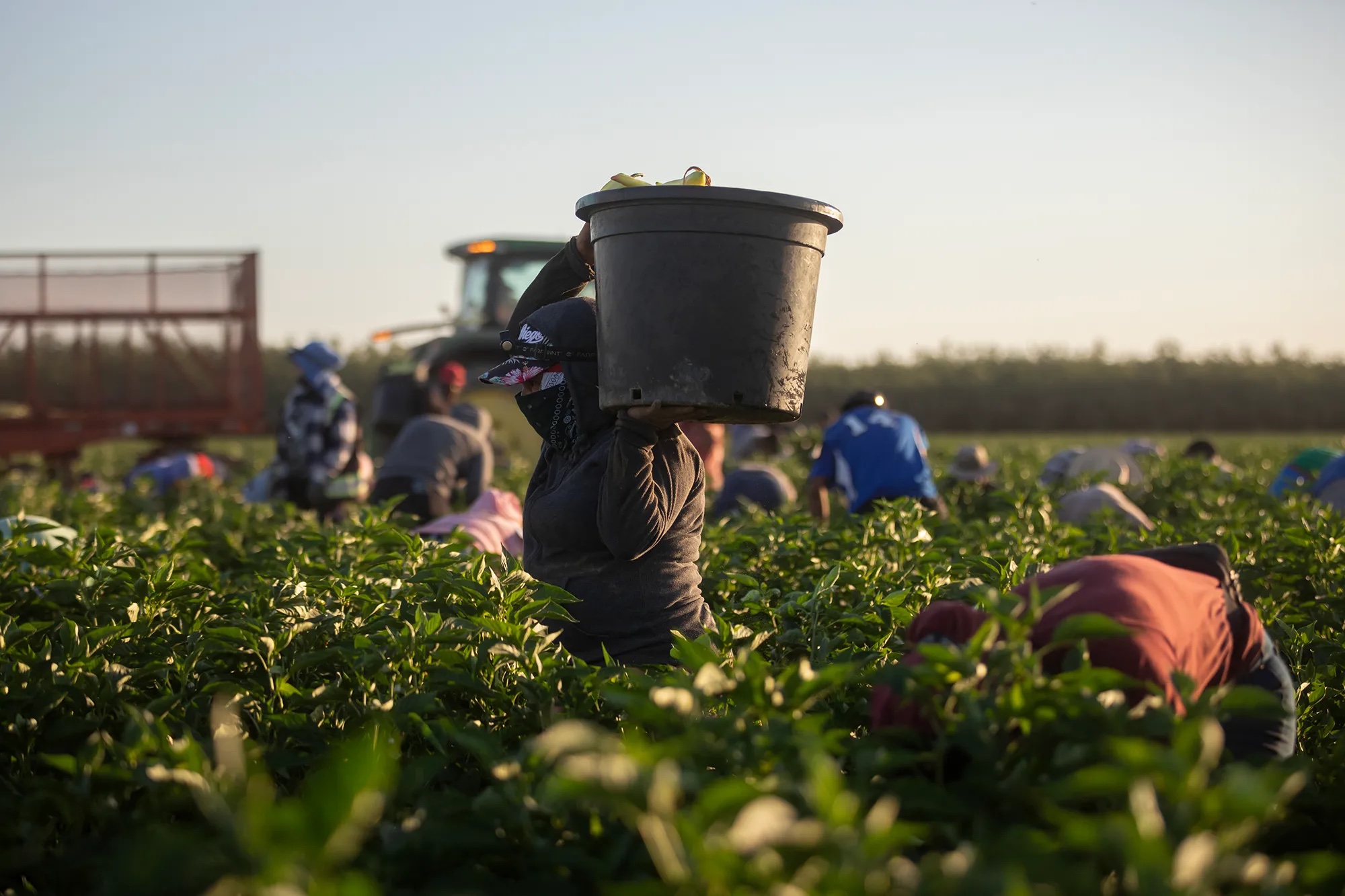
"caption": "Farmworkers harvest banana peppers at a farm near the town of Helm on July 1, 2025. ",
"credit": "Larry Valenzuela/CalMatters/CatchLight Local",
"altTag": null,
"description": null,
"imgSizes": {
"thumbnail": {
"file": "https://cdn.kqed.org/wp-content/uploads/sites/10/2025/07/070125-Farmworker-Harvest-LV-CM-54-copy-160x107.jpg",
"width": 160,
"height": 107,
"mimeType": "image/jpeg"
},
"1536x1536": {
"file": "https://cdn.kqed.org/wp-content/uploads/sites/10/2025/07/070125-Farmworker-Harvest-LV-CM-54-copy-1536x1024.jpg",
"width": 1536,
"height": 1024,
"mimeType": "image/jpeg"
},
"post-thumbnail": {
"file": "https://cdn.kqed.org/wp-content/uploads/sites/10/2025/07/070125-Farmworker-Harvest-LV-CM-54-copy-672x372.jpg",
"width": 672,
"height": 372,
"mimeType": "image/jpeg"
},
"twentyfourteen-full-width": {
"file": "https://cdn.kqed.org/wp-content/uploads/sites/10/2025/07/070125-Farmworker-Harvest-LV-CM-54-copy-1038x576.jpg",
"width": 1038,
"height": 576,
"mimeType": "image/jpeg"
},
"kqedFullSize": {
"file": "https://cdn.kqed.org/wp-content/uploads/sites/10/2025/07/070125-Farmworker-Harvest-LV-CM-54-copy.jpg",
"width": 2000,
"height": 1333
}
},
"isLoading": false,
"fetchFailed": false
},
"news_12048876": {
"type": "attachments",
"id": "news_12048876",
"meta": {
"index": "attachments_1716263798",
"site": "news",
"id": "12048876",
"found": true
},
"title": "071025-Camarillo-Raid-LV-CM-19 copy",
"publishDate": 1752874787,
"status": "inherit",
"parent": 12048875,
"modified": 1752874810,
"caption": "A line of federal immigration agents and protesters stand-off near the Glass House Farms facility outside Camarillo on July 10, 2025. Protesters gathered after federal agents conducted an immigration raid earlier in the day.",
"credit": "Larry Valenzuela/CalMatters/CatchLight Local",
"altTag": null,
"description": null,
"imgSizes": {
"thumbnail": {
"file": "https://cdn.kqed.org/wp-content/uploads/sites/10/2025/07/071025-Camarillo-Raid-LV-CM-19-copy-160x107.jpg",
"width": 160,
"height": 107,
"mimeType": "image/jpeg"
},
"1536x1536": {
"file": "https://cdn.kqed.org/wp-content/uploads/sites/10/2025/07/071025-Camarillo-Raid-LV-CM-19-copy-1536x1024.jpg",
"width": 1536,
"height": 1024,
"mimeType": "image/jpeg"
},
"post-thumbnail": {
"file": "https://cdn.kqed.org/wp-content/uploads/sites/10/2025/07/071025-Camarillo-Raid-LV-CM-19-copy-672x372.jpg",
"width": 672,
"height": 372,
"mimeType": "image/jpeg"
},
"twentyfourteen-full-width": {
"file": "https://cdn.kqed.org/wp-content/uploads/sites/10/2025/07/071025-Camarillo-Raid-LV-CM-19-copy-1038x576.jpg",
"width": 1038,
"height": 576,
"mimeType": "image/jpeg"
},
"kqedFullSize": {
"file": "https://cdn.kqed.org/wp-content/uploads/sites/10/2025/07/071025-Camarillo-Raid-LV-CM-19-copy.jpg",
"width": 2000,
"height": 1333
}
},
"isLoading": false,
"fetchFailed": false
},
"news_12048932": {
"type": "attachments",
"id": "news_12048932",
"meta": {
"index": "attachments_1716263798",
"site": "news",
"id": "12048932",
"found": true
},
"title": "070125-Camarillo-Aftermath-LV-CM-06 copy",
"publishDate": 1752948537,
"status": "inherit",
"parent": 12048931,
"modified": 1752948565,
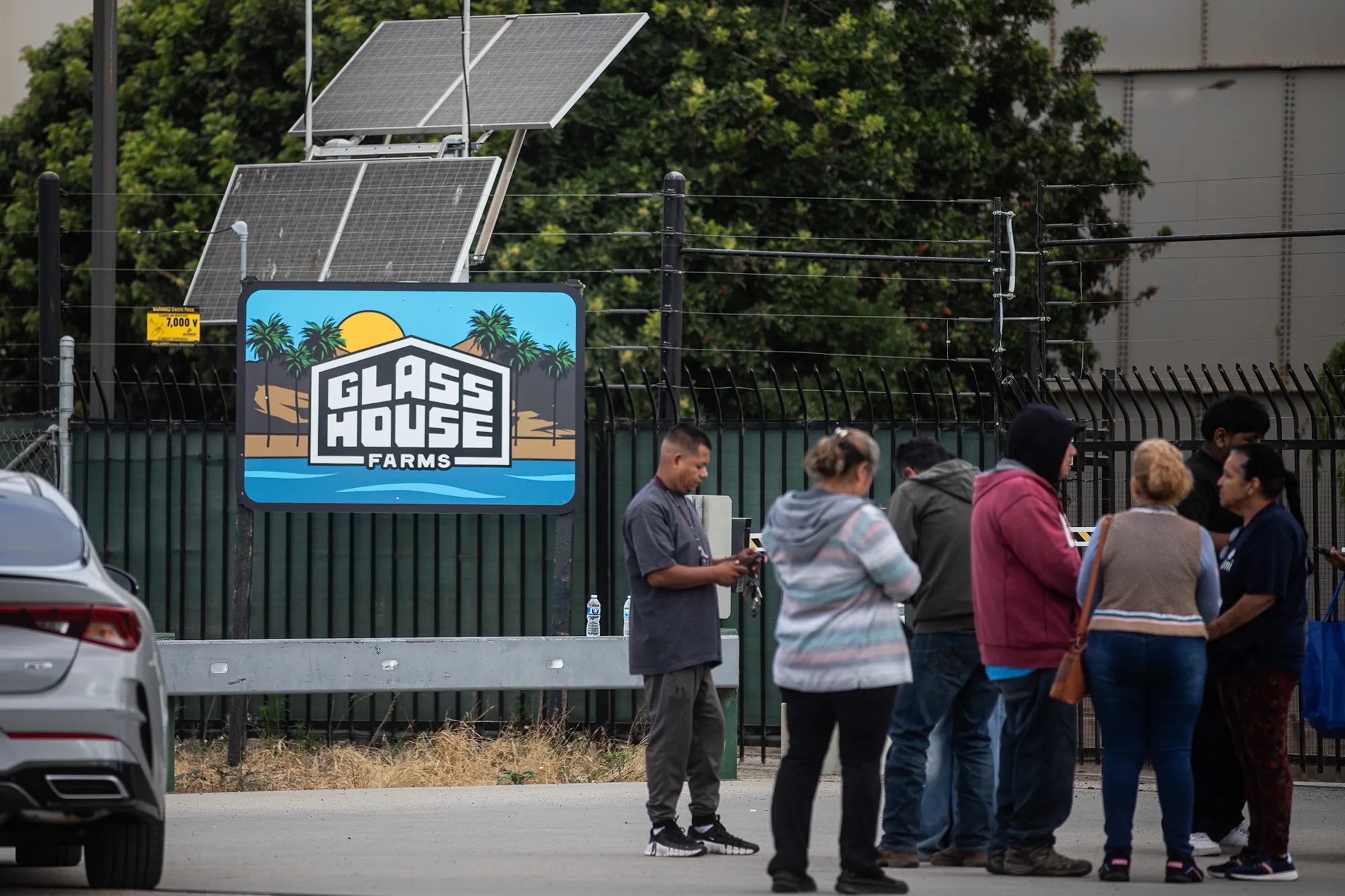
"caption": "Families wait outside the front gates of the Glass House Farms facility outside Camarillo on July 11, 2025. Glasshouse Farms was the site of an immigration raid by federal immigration agents just a day prior, on July 10.",
"credit": "Larry Valenzuela/CalMatters/CatchLight Local",
"altTag": null,
"description": null,
"imgSizes": {
"thumbnail": {
"file": "https://cdn.kqed.org/wp-content/uploads/sites/10/2025/07/070125-Camarillo-Aftermath-LV-CM-06-copy-160x107.jpg",
"width": 160,
"height": 107,
"mimeType": "image/jpeg"
},
"1536x1536": {
"file": "https://cdn.kqed.org/wp-content/uploads/sites/10/2025/07/070125-Camarillo-Aftermath-LV-CM-06-copy-1536x1024.jpg",
"width": 1536,
"height": 1024,
"mimeType": "image/jpeg"
},
"post-thumbnail": {
"file": "https://cdn.kqed.org/wp-content/uploads/sites/10/2025/07/070125-Camarillo-Aftermath-LV-CM-06-copy-672x372.jpg",
"width": 672,
"height": 372,
"mimeType": "image/jpeg"
},
"twentyfourteen-full-width": {
"file": "https://cdn.kqed.org/wp-content/uploads/sites/10/2025/07/070125-Camarillo-Aftermath-LV-CM-06-copy-1038x576.jpg",
"width": 1038,
"height": 576,
"mimeType": "image/jpeg"
},
"kqedFullSize": {
"file": "https://cdn.kqed.org/wp-content/uploads/sites/10/2025/07/070125-Camarillo-Aftermath-LV-CM-06-copy.jpg",
"width": 2000,
"height": 1333
}
},
"isLoading": false,
"fetchFailed": false
},
"news_12048692": {
"type": "attachments",
"id": "news_12048692",
"meta": {
"index": "attachments_1716263798",
"site": "news",
"id": "12048692",
"found": true
},
"title": "CMBorderPatrolSac1",
"publishDate": 1752856858,
"status": "inherit",
"parent": 12048690,
"modified": 1752856914,
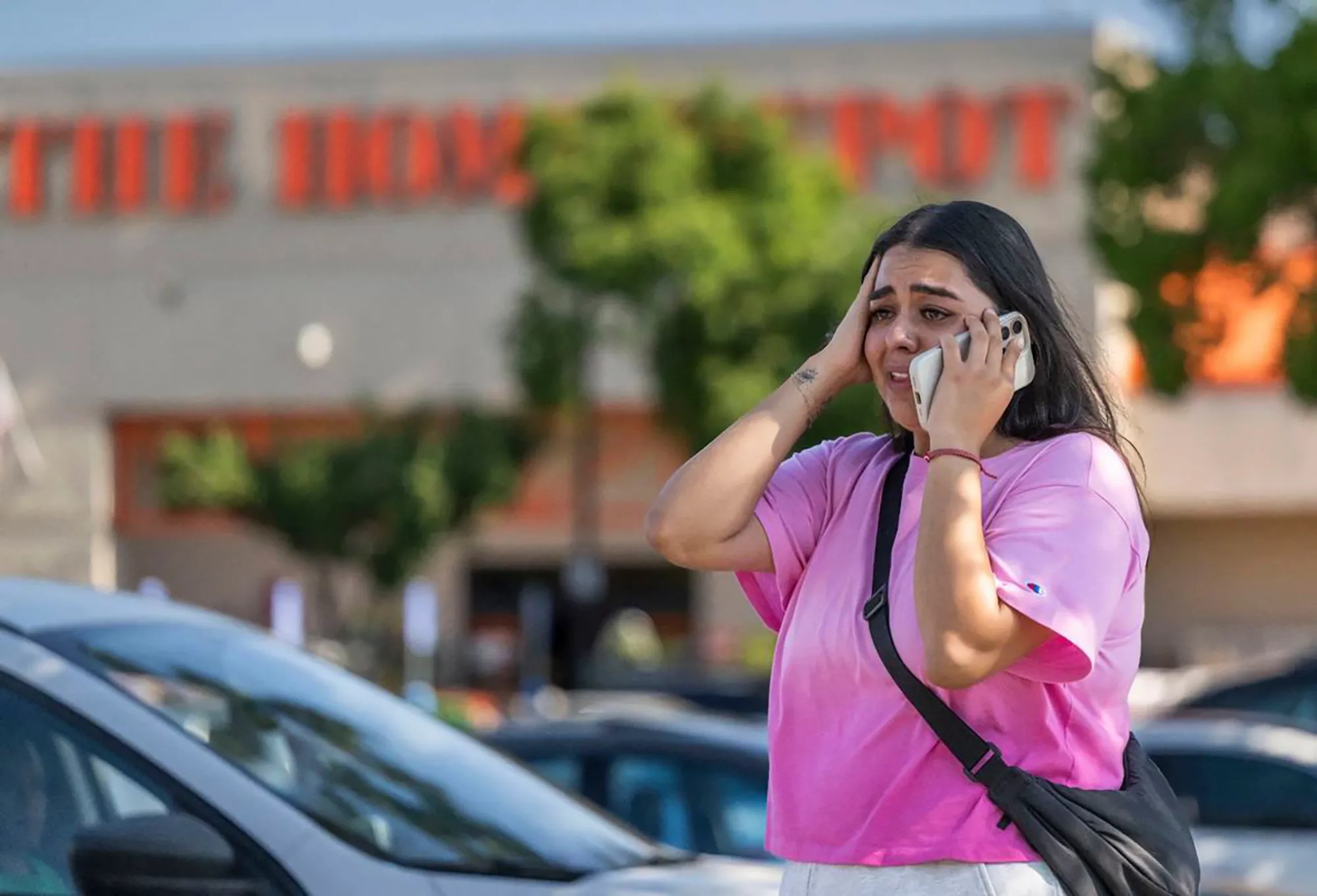
"caption": "Andrea Castillo speaks to a relative after her husband, who she said was born in Sacramento, was taken into custody by masked uniformed men from the U.S. Border Patrol at the Home Depot on Florin Road near Highway 99 in south Sacramento on July 17, 2025.",
"credit": "Hector Amezcua/The Sacramento Bee via Reuters",
"altTag": null,
"description": null,
"imgSizes": {
"thumbnail": {
"file": "https://cdn.kqed.org/wp-content/uploads/sites/10/2025/07/CMBorderPatrolSac1-160x109.jpg",
"width": 160,
"height": 109,
"mimeType": "image/jpeg"
},
"1536x1536": {
"file": "https://cdn.kqed.org/wp-content/uploads/sites/10/2025/07/CMBorderPatrolSac1-1536x1045.jpg",
"width": 1536,
"height": 1045,
"mimeType": "image/jpeg"
},
"post-thumbnail": {
"file": "https://cdn.kqed.org/wp-content/uploads/sites/10/2025/07/CMBorderPatrolSac1-672x372.jpg",
"width": 672,
"height": 372,
"mimeType": "image/jpeg"
},
"twentyfourteen-full-width": {
"file": "https://cdn.kqed.org/wp-content/uploads/sites/10/2025/07/CMBorderPatrolSac1-1038x576.jpg",
"width": 1038,
"height": 576,
"mimeType": "image/jpeg"
},
"kqedFullSize": {
"file": "https://cdn.kqed.org/wp-content/uploads/sites/10/2025/07/CMBorderPatrolSac1.jpg",
"width": 2000,
"height": 1361
}
},
"isLoading": false,
"fetchFailed": false
},
"news_12048444": {
"type": "attachments",
"id": "news_12048444",
"meta": {
"index": "attachments_1716263798",
"site": "news",
"id": "12048444",
"found": true
},
"title": "EducationChatGPT",
"publishDate": 1752708873,
"status": "inherit",
"parent": 12048432,
"modified": 1752708901,
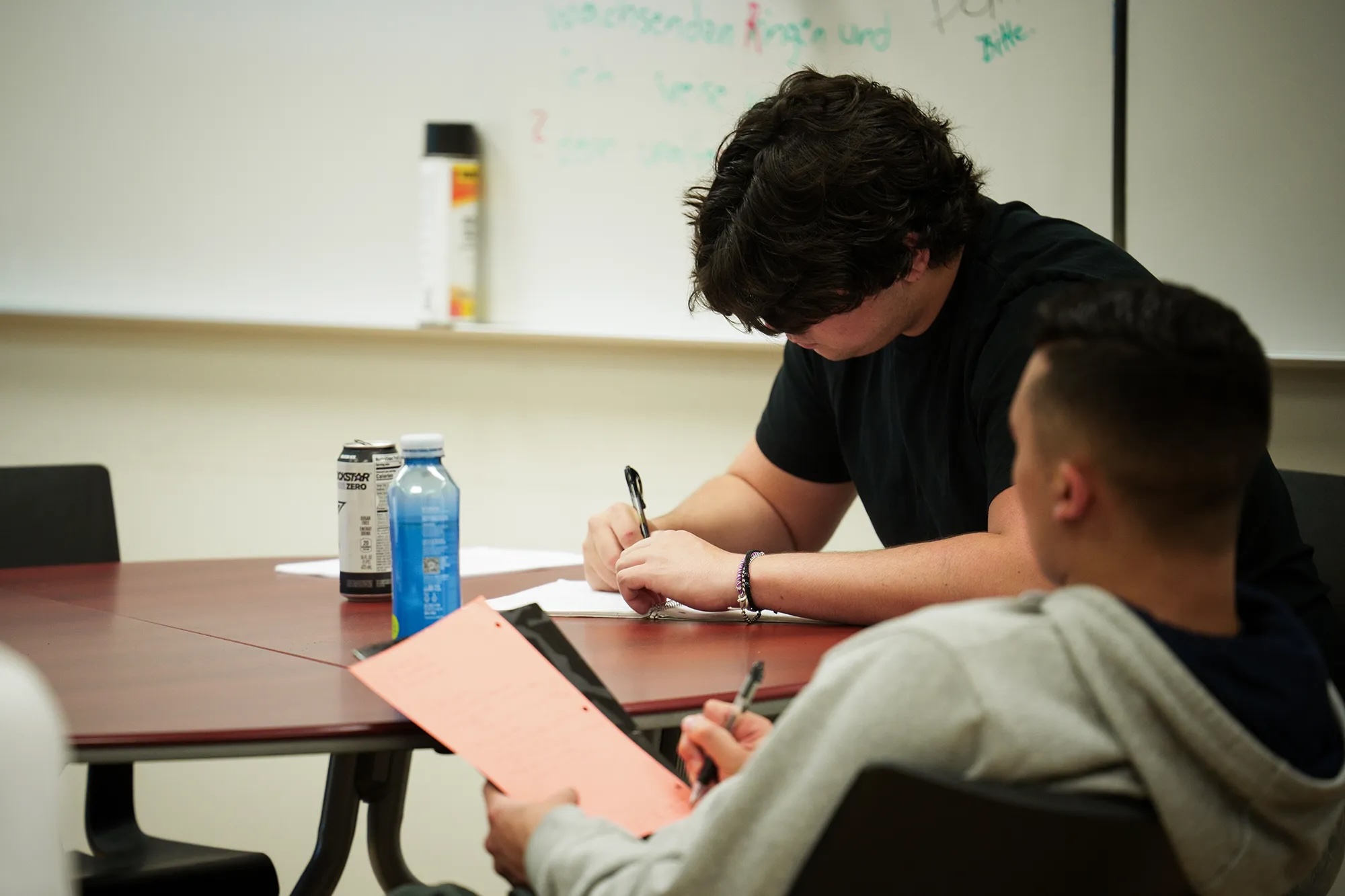
"caption": "Students take notes during Dr. Adam Kaiserman's English class at College of the Canyons in Santa Clarita on May 6, 2025.",
"credit": "Jules Hotz for CalMatters",
"altTag": null,
"description": null,
"imgSizes": {
"thumbnail": {
"file": "https://cdn.kqed.org/wp-content/uploads/sites/10/2025/07/EducationChatGPT-160x107.jpg",
"width": 160,
"height": 107,
"mimeType": "image/jpeg"
},
"1536x1536": {
"file": "https://cdn.kqed.org/wp-content/uploads/sites/10/2025/07/EducationChatGPT-1536x1024.jpg",
"width": 1536,
"height": 1024,
"mimeType": "image/jpeg"
},
"post-thumbnail": {
"file": "https://cdn.kqed.org/wp-content/uploads/sites/10/2025/07/EducationChatGPT-672x372.jpg",
"width": 672,
"height": 372,
"mimeType": "image/jpeg"
},
"twentyfourteen-full-width": {
"file": "https://cdn.kqed.org/wp-content/uploads/sites/10/2025/07/EducationChatGPT-1038x576.jpg",
"width": 1038,
"height": 576,
"mimeType": "image/jpeg"
},
"kqedFullSize": {
"file": "https://cdn.kqed.org/wp-content/uploads/sites/10/2025/07/EducationChatGPT.jpg",
"width": 2000,
"height": 1333
}
},
"isLoading": false,
"fetchFailed": false
},
"news_12048214": {
"type": "attachments",
"id": "news_12048214",
"meta": {
"index": "attachments_1716263798",
"site": "news",
"id": "12048214",
"found": true
},
"title": "ImmigrationCalMatters",
"publishDate": 1752616689,
"status": "inherit",
"parent": 12048205,
"modified": 1752616749,
"caption": "Federal agents descend on MacArthur Park in Los Angeles on July 7, 2025.",
"credit": "J.W. Hendricks for CalMatters",
"altTag": null,
"description": null,
"imgSizes": {
"thumbnail": {
"file": "https://cdn.kqed.org/wp-content/uploads/sites/10/2025/07/ImmigrationCalMatters-160x107.jpg",
"width": 160,
"height": 107,
"mimeType": "image/jpeg"
},
"1536x1536": {
"file": "https://cdn.kqed.org/wp-content/uploads/sites/10/2025/07/ImmigrationCalMatters-1536x1024.jpg",
"width": 1536,
"height": 1024,
"mimeType": "image/jpeg"
},
"post-thumbnail": {
"file": "https://cdn.kqed.org/wp-content/uploads/sites/10/2025/07/ImmigrationCalMatters-672x372.jpg",
"width": 672,
"height": 372,
"mimeType": "image/jpeg"
},
"twentyfourteen-full-width": {
"file": "https://cdn.kqed.org/wp-content/uploads/sites/10/2025/07/ImmigrationCalMatters-1038x576.jpg",
"width": 1038,
"height": 576,
"mimeType": "image/jpeg"
},
"kqedFullSize": {
"file": "https://cdn.kqed.org/wp-content/uploads/sites/10/2025/07/ImmigrationCalMatters.jpg",
"width": 2000,
"height": 1333
}
},
"isLoading": false,
"fetchFailed": false
},
"news_12047872": {
"type": "attachments",
"id": "news_12047872",
"meta": {
"index": "attachments_1716263798",
"site": "news",
"id": "12047872",
"found": true
},
"title": "070825-Elementary-School-SK-47 copy",
"publishDate": 1752504904,
"status": "inherit",
"parent": 12047871,
"modified": 1752504921,
"caption": "A classroom at an elementary school in Richmond on Feb. 6, 2023. \n",
"credit": "Shelby Knowles for CalMatters",
"altTag": null,
"description": null,
"imgSizes": {
"thumbnail": {
"file": "https://cdn.kqed.org/wp-content/uploads/sites/10/2025/07/070825-Elementary-School-SK-47-copy-160x107.jpg",
"width": 160,
"height": 107,
"mimeType": "image/jpeg"
},
"1536x1536": {
"file": "https://cdn.kqed.org/wp-content/uploads/sites/10/2025/07/070825-Elementary-School-SK-47-copy-1536x1024.jpg",
"width": 1536,
"height": 1024,
"mimeType": "image/jpeg"
},
"post-thumbnail": {
"file": "https://cdn.kqed.org/wp-content/uploads/sites/10/2025/07/070825-Elementary-School-SK-47-copy-672x372.jpg",
"width": 672,
"height": 372,
"mimeType": "image/jpeg"
},
"twentyfourteen-full-width": {
"file": "https://cdn.kqed.org/wp-content/uploads/sites/10/2025/07/070825-Elementary-School-SK-47-copy-1038x576.jpg",
"width": 1038,
"height": 576,
"mimeType": "image/jpeg"
},
"kqedFullSize": {
"file": "https://cdn.kqed.org/wp-content/uploads/sites/10/2025/07/070825-Elementary-School-SK-47-copy.jpg",
"width": 2000,
"height": 1333
}
},
"isLoading": false,
"fetchFailed": false
},
"news_12047855": {
"type": "attachments",
"id": "news_12047855",
"meta": {
"index": "attachments_1716263798",
"site": "news",
"id": "12047855",
"found": true
},
"title": "HOUSING-ORG_AH_CM_02 copy",
"publishDate": 1752428904,
"status": "inherit",
"parent": 12047853,
"modified": 1752428931,
"caption": null,
"credit": "Illustration by Adriana Heldiz/CalMatters/iStock",
"altTag": null,
"description": null,
"imgSizes": {
"thumbnail": {
"file": "https://cdn.kqed.org/wp-content/uploads/sites/10/2025/07/HOUSING-ORG_AH_CM_02-copy-160x107.jpg",
"width": 160,
"height": 107,
"mimeType": "image/jpeg"
},
"1536x1536": {
"file": "https://cdn.kqed.org/wp-content/uploads/sites/10/2025/07/HOUSING-ORG_AH_CM_02-copy-1536x1024.jpg",
"width": 1536,
"height": 1024,
"mimeType": "image/jpeg"
},
"post-thumbnail": {
"file": "https://cdn.kqed.org/wp-content/uploads/sites/10/2025/07/HOUSING-ORG_AH_CM_02-copy-672x372.jpg",
"width": 672,
"height": 372,
"mimeType": "image/jpeg"
},
"twentyfourteen-full-width": {
"file": "https://cdn.kqed.org/wp-content/uploads/sites/10/2025/07/HOUSING-ORG_AH_CM_02-copy-1038x576.jpg",
"width": 1038,
"height": 576,
"mimeType": "image/jpeg"
},
"kqedFullSize": {
"file": "https://cdn.kqed.org/wp-content/uploads/sites/10/2025/07/HOUSING-ORG_AH_CM_02-copy.jpg",
"width": 2000,
"height": 1333
}
},
"isLoading": false,
"fetchFailed": false
},
"news_12047741": {
"type": "attachments",
"id": "news_12047741",
"meta": {
"index": "attachments_1716263798",
"site": "news",
"id": "12047741",
"found": true
},
"title": "060425_Zohran-Mamdan_REUTERS_CM_01 copy",
"publishDate": 1752274589,
"status": "inherit",
"parent": 12047740,
"modified": 1752274622,
"caption": "New York City Mayoral Candidate Zohran Mamdani arrives for the New York City Democratic Mayoral Primary Debate in New York City on June 4, 2025. California progressives are hoping they can capitalize on his momentum. \n",
"credit": "Ryan Murphy/Sipa USA via Reuters",
"altTag": null,
"description": null,
"imgSizes": {
"thumbnail": {
"file": "https://cdn.kqed.org/wp-content/uploads/sites/10/2025/07/060425_Zohran-Mamdan_REUTERS_CM_01-copy-160x107.jpg",
"width": 160,
"height": 107,
"mimeType": "image/jpeg"
},
"1536x1536": {
"file": "https://cdn.kqed.org/wp-content/uploads/sites/10/2025/07/060425_Zohran-Mamdan_REUTERS_CM_01-copy-1536x1024.jpg",
"width": 1536,
"height": 1024,
"mimeType": "image/jpeg"
},
"post-thumbnail": {
"file": "https://cdn.kqed.org/wp-content/uploads/sites/10/2025/07/060425_Zohran-Mamdan_REUTERS_CM_01-copy-672x372.jpg",
"width": 672,
"height": 372,
"mimeType": "image/jpeg"
},
"twentyfourteen-full-width": {
"file": "https://cdn.kqed.org/wp-content/uploads/sites/10/2025/07/060425_Zohran-Mamdan_REUTERS_CM_01-copy-1038x576.jpg",
"width": 1038,
"height": 576,
"mimeType": "image/jpeg"
},
"kqedFullSize": {
"file": "https://cdn.kqed.org/wp-content/uploads/sites/10/2025/07/060425_Zohran-Mamdan_REUTERS_CM_01-copy.jpg",
"width": 2000,
"height": 1333
}
},
"isLoading": false,
"fetchFailed": false
},
"news_12022616": {
"type": "attachments",
"id": "news_12022616",
"meta": {
"index": "attachments_1716263798",
"site": "news",
"id": "12022616",
"found": true
},
"title": "011525-California-Wildfires-MT-AP-CM-01 copy",
"publishDate": 1737058938,
"status": "inherit",
"parent": 12022615,
"modified": 1752102006,
"caption": "The devastation from the Palisades Fire is seen from the air in the Pacific Palisades neighborhood of Los Angeles on Jan. 9, 2025. CalFire is using a chatbot to give Californians better access to real-time emergency information. But CalMatters found it isn't always accurate or reliable. \n",
"credit": "Mark J. Terrill/AP Photo",
"altTag": null,
"description": null,
"imgSizes": {
"medium": {
"file": "https://cdn.kqed.org/wp-content/uploads/sites/10/2025/01/011525-California-Wildfires-MT-AP-CM-01-copy-800x534.jpg",
"width": 800,
"height": 534,
"mimeType": "image/jpeg"
},
"large": {
"file": "https://cdn.kqed.org/wp-content/uploads/sites/10/2025/01/011525-California-Wildfires-MT-AP-CM-01-copy-1020x680.jpg",
"width": 1020,
"height": 680,
"mimeType": "image/jpeg"
},
"thumbnail": {
"file": "https://cdn.kqed.org/wp-content/uploads/sites/10/2025/01/011525-California-Wildfires-MT-AP-CM-01-copy-160x107.jpg",
"width": 160,
"height": 107,
"mimeType": "image/jpeg"
},
"1536x1536": {
"file": "https://cdn.kqed.org/wp-content/uploads/sites/10/2025/01/011525-California-Wildfires-MT-AP-CM-01-copy-1536x1025.jpg",
"width": 1536,
"height": 1025,
"mimeType": "image/jpeg"
},
"post-thumbnail": {
"file": "https://cdn.kqed.org/wp-content/uploads/sites/10/2025/01/011525-California-Wildfires-MT-AP-CM-01-copy-672x372.jpg",
"width": 672,
"height": 372,
"mimeType": "image/jpeg"
},
"twentyfourteen-full-width": {
"file": "https://cdn.kqed.org/wp-content/uploads/sites/10/2025/01/011525-California-Wildfires-MT-AP-CM-01-copy-1038x576.jpg",
"width": 1038,
"height": 576,
"mimeType": "image/jpeg"
},
"full-width": {
"file": "https://cdn.kqed.org/wp-content/uploads/sites/10/2025/01/011525-California-Wildfires-MT-AP-CM-01-copy-1920x1281.jpg",
"width": 1920,
"height": 1281,
"mimeType": "image/jpeg"
},
"kqedFullSize": {
"file": "https://cdn.kqed.org/wp-content/uploads/sites/10/2025/01/011525-California-Wildfires-MT-AP-CM-01-copy.jpg",
"width": 2000,
"height": 1334
}
},
"isLoading": false,
"fetchFailed": false
},
"news_12047145": {
"type": "attachments",
"id": "news_12047145",
"meta": {
"index": "attachments_1716263798",
"site": "news",
"id": "12047145",
"found": true
},
"title": "070325-LA-Smog-LS-GETTY-01-CM copy",
"publishDate": 1751910569,
"status": "inherit",
"parent": 12047144,
"modified": 1751910610,
"caption": "Downtown Los Angeles' skyline shimmers in the smog as a plane takes off from Long Beach Airport on Sept. 1, 2022. \n",
"credit": "Luis Sinco/Los Angeles Times via Getty Images",
"altTag": null,
"description": null,
"imgSizes": {
"thumbnail": {
"file": "https://cdn.kqed.org/wp-content/uploads/sites/10/2025/07/070325-LA-Smog-LS-GETTY-01-CM-copy-160x99.jpg",
"width": 160,
"height": 99,
"mimeType": "image/jpeg"
},
"1536x1536": {
"file": "https://cdn.kqed.org/wp-content/uploads/sites/10/2025/07/070325-LA-Smog-LS-GETTY-01-CM-copy-1536x952.jpg",
"width": 1536,
"height": 952,
"mimeType": "image/jpeg"
},
"post-thumbnail": {
"file": "https://cdn.kqed.org/wp-content/uploads/sites/10/2025/07/070325-LA-Smog-LS-GETTY-01-CM-copy-672x372.jpg",
"width": 672,
"height": 372,
"mimeType": "image/jpeg"
},
"twentyfourteen-full-width": {
"file": "https://cdn.kqed.org/wp-content/uploads/sites/10/2025/07/070325-LA-Smog-LS-GETTY-01-CM-copy-1038x576.jpg",
"width": 1038,
"height": 576,
"mimeType": "image/jpeg"
},
"kqedFullSize": {
"file": "https://cdn.kqed.org/wp-content/uploads/sites/10/2025/07/070325-LA-Smog-LS-GETTY-01-CM-copy.jpg",
"width": 2000,
"height": 1239
}
},
"isLoading": false,
"fetchFailed": false
}
},
"audioPlayerReducer": {
"postId": "stream_live",
"isPaused": true,
"isPlaying": false,
"pfsActive": false,
"pledgeModalIsOpen": true,
"playerDrawerIsOpen": false,
"liveAudioPlayStartedAt": 0,
"liveAudioPlayContext": ""
},
"authorsReducer": {
"byline_news_12049026": {
"type": "authors",
"id": "byline_news_12049026",
"meta": {
"override": true
},
"slug": "byline_news_12049026",
"name": "Robert Greene, CalMatters",
"isLoading": false
},
"byline_news_12049005": {
"type": "authors",
"id": "byline_news_12049005",
"meta": {
"override": true
},
"slug": "byline_news_12049005",
"name": "Jeanne Kuang, CalMatters",
"isLoading": false
},
"byline_news_12048875": {
"type": "authors",
"id": "byline_news_12048875",
"meta": {
"override": true
},
"slug": "byline_news_12048875",
"name": "Michael Lozano, CalMatters",
"isLoading": false
},
"byline_news_12048931": {
"type": "authors",
"id": "byline_news_12048931",
"meta": {
"override": true
},
"slug": "byline_news_12048931",
"name": "Alexei Koseff, CalMatters",
"isLoading": false
},
"byline_news_12048690": {
"type": "authors",
"id": "byline_news_12048690",
"meta": {
"override": true
},
"slug": "byline_news_12048690",
"name": "Wendy Fry and Sergio Olmos, CalMatters",
"isLoading": false
},
"byline_news_12048432": {
"type": "authors",
"id": "byline_news_12048432",
"meta": {
"override": true
},
"slug": "byline_news_12048432",
"name": "Tara García Mathewson, CalMatters",
"isLoading": false
},
"byline_news_12048205": {
"type": "authors",
"id": "byline_news_12048205",
"meta": {
"override": true
},
"slug": "byline_news_12048205",
"name": "Wendy Fry and Sergio Olmos, CalMatters",
"isLoading": false
},
"byline_news_12047871": {
"type": "authors",
"id": "byline_news_12047871",
"meta": {
"override": true
},
"slug": "byline_news_12047871",
"name": "Carolyn Jones, CalMatters",
"isLoading": false
},
"byline_news_12047853": {
"type": "authors",
"id": "byline_news_12047853",
"meta": {
"override": true
},
"slug": "byline_news_12047853",
"name": "Ben Christopher, CalMatters",
"isLoading": false
},
"byline_news_12047740": {
"type": "authors",
"id": "byline_news_12047740",
"meta": {
"override": true
},
"slug": "byline_news_12047740",
"name": "Yue Stella Yu, Calmatters",
"isLoading": false
},
"byline_news_12047478": {
"type": "authors",
"id": "byline_news_12047478",
"meta": {
"override": true
},
"slug": "byline_news_12047478",
"name": "Malena Carollo, CalMatters",
"isLoading": false
},
"byline_news_12047144": {
"type": "authors",
"id": "byline_news_12047144",
"meta": {
"override": true
},
"slug": "byline_news_12047144",
"name": "Alejandra Reyes-Velarde, CalMatters",
"isLoading": false
}
},
"pagesReducer": {
"news_affiliate_calmatters": {
"type": "terms",
"id": "news_18481",
"meta": {
"index": "terms_1716263798",
"site": "news",
"id": "18481",
"score": 15.355904
},
"featImg": null,
"name": "CALmatters",
"description": null,
"taxonomy": "affiliate",
"headData": {
"twImgId": null,
"twTitle": null,
"ogTitle": null,
"ogImgId": null,
"twDescription": null,
"description": null,
"title": "CALmatters Archives | KQED Arts",
"ogDescription": null
},
"ttid": 18515,
"slug": "calmatters",
"isLoading": false,
"title": "CALmatters",
"pageMeta": {
"site": "news",
"WpPageTemplate": "page-topic-editorial",
"currentPage": 12
},
"blocks": [
{
"blockName": "kqed/post-list",
"attrs": {
"layout": "cardArticle2",
"query": "posts/news?affiliate=calmatters",
"seeMore": false,
"paginated": true,
"page": 12
}
},
{
"blockName": "kqed/ad"
}
]
}
},
"pfsSessionReducer": {},
"postsReducer": {
"stream_live": {
"type": "live",
"id": "stream_live",
"audioUrl": "https://streams.kqed.org/kqedradio",
"title": "Live Stream",
"excerpt": "Live Stream information currently unavailable.",
"link": "/radio",
"featImg": "",
"label": {
"name": "KQED Live",
"link": "/"
}
},
"stream_kqedNewscast": {
"type": "posts",
"id": "stream_kqedNewscast",
"audioUrl": "https://www.kqed.org/.stream/anon/radio/RDnews/newscast.mp3?_=1",
"title": "KQED Newscast",
"featImg": "",
"label": {
"name": "88.5 FM",
"link": "/"
}
},
"news_12049026": {
"type": "posts",
"id": "news_12049026",
"meta": {
"index": "posts_1716263798",
"site": "news",
"id": "12049026",
"score": null,
"sort": [
1753156804000
]
},
"guestAuthors": [],
"slug": "the-trump-regime-targets-californias-sanctuary-status-at-the-expense-of-the-american-creed",
"title": "The Trump Regime Targets California’s Sanctuary Status at the Expense of the American Creed",
"publishDate": 1753156804,
"format": "standard",
"headTitle": "The Trump Regime Targets California’s Sanctuary Status at the Expense of the American Creed | KQED",
"labelTerm": {
"term": 18481,
"site": "news"
},
"content": "\u003cp>\u003c!-- Creative Commons Attribution-NonCommercial-NoDerivatives https://creativecommons.org/licenses/by-nc-nd/4.0/ -->\u003c/p>\n\u003cp>\u003cem>This commentary was originally published by \u003ca href=\"https://calmatters.org/\">CalMatters\u003c/a>. \u003ca href=\"https://calmatters.org/subscribe-to-calmatters/\">Sign up\u003c/a> for their newsletters.\u003c/em>\u003c/p>\n\u003cp>\u003cem>This story is part of California Voices, a commentary forum aiming to broaden our understanding of the state and spotlight Californians directly impacted by policy or its absence. Learn more \u003ca href=\"https://calmatters.org/category/commentary/\">here\u003c/a>.\u003c/em>\u003c/p>\n\u003cp>\u003ca href=\"https://calmatters.org/justice/2025/07/la-immigration-restraining-order/\">Blocked for now by a federal court order\u003c/a> from sending warrantless roving immigration patrols through Los Angeles and six other Southern California counties, U.S. agents on Thursday \u003ca href=\"https://calmatters.org/justice/2025/07/sacramento-border-patrol-raids/\">moved their sweeps north to Sacramento\u003c/a>.\u003c/p>\n\u003cp>Border Patrol section chief \u003ca href=\"https://calmatters.org/investigation/2025/06/los-angeles-border-patrol-chief/\">Gregory Bovino\u003c/a> made it abundantly clear that the point of the operation at a Home Depot parking lot in South Sacramento was embodied in the same word, the same concept, as the round-ups in Los Angeles. They are about “sanctuary.”\u003c/p>\n\u003cp>It is a word that has clearly gotten under Bovino’s skin, just as it has gotten under the skin of immigration opponents in the White House and the Capitol.\u003c/p>\n\u003cp>[ad fullwidth]\u003c/p>\n\u003cp>“There is no sanctuary city,” \u003ca href=\"https://x.com/BillMelugin_/status/1945902933813690454\">Bovino told Fox News\u003c/a>. “Sacramento is not a sanctuary city. The state of California is not a sanctuary state. There is no sanctuary anywhere.”\u003c/p>\n\u003cp>If by that he meant that no jurisdiction can protect residents from federal immigration law, he is of course correct. The Constitution’s Supremacy Clause leaves no doubt about that. States, counties and cities that describe themselves as sanctuaries are engaging in recklessly misleading political marketing. Their laws at most prevent local police from \u003ca href=\"https://calmatters.org/justice/2025/01/california-sanctuary-state/\">questioning suspects about their immigration status\u003c/a>, for example, or block jailers from holding inmates past their release dates so the feds can get them.\u003c/p>\n\u003cp>But the federal government’s contempt for sanctuary appears to go well beyond the modest if over-sold local policies. Their actions and statements demonstrate that they respect no sanctuary, no refuge, no protection in the very things they purport to be guarding: the law, the Constitution, the American people, and their safety, values and sovereignty.\u003c/p>\n\u003cp>[aside postID=forum_2010101909877 hero='https://cdn.kqed.org/wp-content/uploads/sites/43/2025/05/250128-SFImmigration-08-BL_qed-1-1020x574.jpg']\u003c/p>\n\u003cp>District Judge Maame Ewusi-Mensah Frimpong’s blistering \u003ca href=\"https://storage.courtlistener.com/recap/gov.uscourts.cacd.975351/gov.uscourts.cacd.975351.87.0.pdf\">July 11 order\u003c/a>, which the administration has appealed, lays out the frightening details of a government that has turned hard-won American freedoms inside out.\u003c/p>\n\u003cp>In this country, unlike most others in the world, the people are free to go about their business without having to show their papers to government agents on demand, absent probable cause to believe they have committed a crime, or at least sufficient suspicion to ask them questions. Those same agents, by contrast, must identify themselves, and not merely by brandishing their guns. They must be clearly distinguishable in action and appearance from crooks of the sort who kidnap residents of third-world countries. Here there is no army of secret police. There are no roving bands of quasi-military thugs.\u003c/p>\n\u003cp>Until now. Border Patrol and ICE agents in \u003ca href=\"https://calmatters.org/commentary/2025/06/ice-san-diego-foreshadowed-protests/\">San Diego\u003c/a>, Los Angeles, Orange and \u003ca href=\"https://www.latimes.com/california/story/2025-07-10/federal-immigration-sweep-ventura-county-farms\">Ventura\u003c/a> counties, and now in Sacramento, \u003ca href=\"https://calmatters.org/justice/2025/07/immigration-raids-who/\">hide their faces\u003c/a>, tint their car windows, remove their license plates, cover their badges, ignore requests for identification, and \u003ca href=\"https://calmatters.org/investigation/2025/07/patterns-in-california-immigration-raids/\">target people based on where they work\u003c/a> and \u003ca href=\"https://calmatters.org/justice/2025/04/border-patrol-injunction/\">how they look\u003c/a>.\u003c/p>\n\u003cp>If this conduct is allowed to stand for federal officers, based on the specious argument that they need protection, it is inevitable that all police, perhaps all jailers, prosecutors and judges, will soon hide their faces and do their government work in secret.\u003c/p>\n\u003cp>Agents recognize no sanctuary in the Fourth Amendment’s protection against warrantless search and seizure. They demand at gunpoint that you show your papers and lock you up if they find them unsatisfactory. Frimpong’s order describes a U.S. citizen showing a driver’s license — and then being grabbed anyway after an agent demanded to see a passport.\u003c/p>\n\u003cp>Since when do American citizens have to carry passports?\u003c/p>\n\u003cp>There is no sanctuary in the 14th Amendment’s promise of equal protection or in generations of civil rights struggles, court rulings and policy updates that supposedly swept away racially disparate treatment. Frimpong’s order describes a stop in which agents let a white person walk away but not a nonwhite person. Border “czar” Tom Homan said recently that ICE agents were \u003ca href=\"https://bsky.app/profile/atrupar.com/post/3ltoyyfr5vt2m\">free to stop people based on their appearance\u003c/a>.\u003c/p>\n\u003cp>There is no sanctuary in the Sixth Amendment’s right to counsel. The order describes shocking conditions in the basement of the immigration building at 300 N. Los Angeles Street, where captured suspects were so cramped they could not sit or lie down and had no access to lawyers for days.\u003c/p>\n\u003cp>There is no sanctuary in \u003ca href=\"https://www.sacbee.com/opinion/article309102735.html\">courthouses\u003c/a>, \u003ca href=\"https://calmatters.org/california-divide/2025/07/ice-targets-immigrants-church-grounds/\">churches\u003c/a>, nursing homes or other places where agents grab people without judicial warrants. There is no sanctuary in essential work, such as farm fields, despite President Trump’s \u003ca href=\"https://www.usatoday.com/story/news/politics/2025/06/20/trump-farmers-migrant-labor/84291870007/\">statement\u003c/a> that perhaps farmworkers and hotel workers might get a break, because after all, farmers would not hire any murderers. He did not explain why the exemption should cover farmworkers but not, say, kitchen workers.\u003c/p>\n\u003cp>There is no sanctuary, no protection from deportation, even in American citizenship. The Department of Justice is \u003ca href=\"https://www.npr.org/2025/06/30/nx-s1-5445398/denaturalization-trump-immigration-enforcement\">stepping up a program to denaturalize people\u003c/a> who were born elsewhere but lawfully go through the citizenship process and take the oath, but who later commit crimes. Such a move creates a second, lesser tier of citizenship, with different standards of conduct and different consequences for the same crimes.\u003c/p>\n\u003cp>Second-tier citizenship was virtually abolished in American society after a century-long post-slavery struggle for equality. Must we countenance its return?\u003c/p>\n\u003cp>But there is no sanctuary even in being born here. The administration is moving to \u003ca href=\"https://apnews.com/article/birthright-citizenship-trump-immigration-new-hampshire-9d54d8b4a75e350b6a2fe41cb79c1c65\">end birthright citizenship\u003c/a>, which long has been an unassailable cornerstone of American identity and civil rights. Our leaders are threatening to, for the first time in 60 years, award or deny fundamental rights based not on who you are or what you do, but who your parents were and what they did.\u003c/p>\n\u003cp>So where can sanctuary be found? If not in lines written on the base of the Statue of Liberty, or in the Constitution, or in citizenship or in simple human decency, then where?\u003c/p>\n\u003cp>Is there sanctuary only in \u003ca href=\"https://www.latintimes.com/dont-you-dare-ever-say-that-again-kristi-noem-threatens-reporter-over-question-ice-racial-587136\">skin color\u003c/a>? If you’re white, or perhaps if you’re Black, you may be OK. If you are brown, you’d better carry your passport for the rest of your days, and teach your children to carry theirs too. Stay away from Home Depot. Endure stops and questions. Keep your head down. It is the dream of the white supremacist. It is the achievement of the 2017 Charlottesville rally to “Unite the Right.” It is a state of affairs repugnant to the American creed.\u003c/p>\n\u003cp>And the only thing, so far, that keeps it from becoming the new American normal is Judge Frimpong’s emergency order.\u003c/p>\n\u003cp>The government has \u003ca href=\"https://www.latimes.com/california/story/2025-07-14/doj-ninth-circuit-immigration-appeal\">appealed\u003c/a>.\u003c/p>\n\u003cp>\u003cem>This article was \u003ca href=\"https://calmatters.org/commentary/2025/07/trump-targets-sanctuary-expense-american-creed/\">originally published on CalMatters\u003c/a> and was republished under the \u003ca href=\"https://creativecommons.org/licenses/by-nc-nd/4.0/\">Creative Commons Attribution-NonCommercial-NoDerivatives\u003c/a> license.\u003c/em>\u003c/p>\n\u003cp>[ad floatright]\u003c/p>\n",
"blocks": [],
"excerpt": "A commentary piece on how the federal government’s immigration sweeps appear to go well beyond contempt for local 'sanctuary' policies and demonstrate that they respect no protection in the very things they purport to be guarding: the law, the Constitution, the American people, and their safety, values and sovereignty.",
"status": "publish",
"parent": 0,
"modified": 1753133524,
"stats": {
"hasAudio": false,
"hasVideo": false,
"hasChartOrMap": false,
"iframeSrcs": [],
"hasGoogleForm": false,
"hasGallery": false,
"hasHearkenModule": false,
"hasPolis": false,
"paragraphCount": 29,
"wordCount": 1174
},
"headData": {
"title": "The Trump Regime Targets California’s Sanctuary Status at the Expense of the American Creed | KQED",
"description": "A commentary piece on how the federal government’s immigration sweeps appear to go well beyond contempt for local 'sanctuary' policies and demonstrate that they respect no protection in the very things they purport to be guarding: the law, the Constitution, the American people, and their safety, values and sovereignty.",
"ogTitle": "",
"ogDescription": "",
"ogImgId": "",
"twTitle": "",
"twDescription": "",
"twImgId": "",
"schema": {
"@context": "https://schema.org",
"@type": "NewsArticle",
"headline": "The Trump Regime Targets California’s Sanctuary Status at the Expense of the American Creed",
"datePublished": "2025-07-21T21:00:04-07:00",
"dateModified": "2025-07-21T14:32:04-07:00",
"image": "https://cdn.kqed.org/wp-content/uploads/2020/02/KQED-OG-Image@1x.png",
"isAccessibleForFree": "True",
"publisher": {
"@type": "NewsMediaOrganization",
"@id": "https://www.kqed.org/#organization",
"name": "KQED",
"logo": "https://cdn.kqed.org/wp-content/uploads/2020/02/KQED-OG-Image@1x.png",
"url": "https://www.kqed.org",
"sameAs": [
"https://www.facebook.com/KQED",
"https://twitter.com/KQED",
"https://www.instagram.com/kqed/",
"https://www.tiktok.com/@kqedofficial",
"https://www.linkedin.com/company/kqed",
"https://www.youtube.com/channel/UCeC0IOo7i1P_61zVUWbJ4nw"
]
}
}
},
"primaryCategory": {
"termId": 8,
"slug": "news",
"name": "News"
},
"sticky": false,
"nprByline": "Robert Greene, CalMatters",
"templateType": "standard",
"featuredImageType": "standard",
"excludeFromSiteSearch": "Include",
"showOnAuthorArchivePages": "No",
"articleAge": "0",
"path": "/news/12049026/the-trump-regime-targets-californias-sanctuary-status-at-the-expense-of-the-american-creed",
"audioTrackLength": null,
"parsedContent": [
{
"type": "contentString",
"content": "\u003cdiv class=\"post-body\">\u003cp>\u003cp>\u003c!-- Creative Commons Attribution-NonCommercial-NoDerivatives https://creativecommons.org/licenses/by-nc-nd/4.0/ -->\u003c/p>\n\u003cp>\u003cem>This commentary was originally published by \u003ca href=\"https://calmatters.org/\">CalMatters\u003c/a>. \u003ca href=\"https://calmatters.org/subscribe-to-calmatters/\">Sign up\u003c/a> for their newsletters.\u003c/em>\u003c/p>\n\u003cp>\u003cem>This story is part of California Voices, a commentary forum aiming to broaden our understanding of the state and spotlight Californians directly impacted by policy or its absence. Learn more \u003ca href=\"https://calmatters.org/category/commentary/\">here\u003c/a>.\u003c/em>\u003c/p>\n\u003cp>\u003ca href=\"https://calmatters.org/justice/2025/07/la-immigration-restraining-order/\">Blocked for now by a federal court order\u003c/a> from sending warrantless roving immigration patrols through Los Angeles and six other Southern California counties, U.S. agents on Thursday \u003ca href=\"https://calmatters.org/justice/2025/07/sacramento-border-patrol-raids/\">moved their sweeps north to Sacramento\u003c/a>.\u003c/p>\n\u003cp>Border Patrol section chief \u003ca href=\"https://calmatters.org/investigation/2025/06/los-angeles-border-patrol-chief/\">Gregory Bovino\u003c/a> made it abundantly clear that the point of the operation at a Home Depot parking lot in South Sacramento was embodied in the same word, the same concept, as the round-ups in Los Angeles. They are about “sanctuary.”\u003c/p>\n\u003cp>It is a word that has clearly gotten under Bovino’s skin, just as it has gotten under the skin of immigration opponents in the White House and the Capitol.\u003c/p>\n\u003cp>\u003c/p>\u003c/div>",
"attributes": {
"named": {},
"numeric": []
}
},
{
"type": "component",
"content": "",
"name": "ad",
"attributes": {
"named": {
"label": "fullwidth"
},
"numeric": [
"fullwidth"
]
}
},
{
"type": "contentString",
"content": "\u003cdiv class=\"post-body\">\u003cp>\u003c/p>\n\u003cp>“There is no sanctuary city,” \u003ca href=\"https://x.com/BillMelugin_/status/1945902933813690454\">Bovino told Fox News\u003c/a>. “Sacramento is not a sanctuary city. The state of California is not a sanctuary state. There is no sanctuary anywhere.”\u003c/p>\n\u003cp>If by that he meant that no jurisdiction can protect residents from federal immigration law, he is of course correct. The Constitution’s Supremacy Clause leaves no doubt about that. States, counties and cities that describe themselves as sanctuaries are engaging in recklessly misleading political marketing. Their laws at most prevent local police from \u003ca href=\"https://calmatters.org/justice/2025/01/california-sanctuary-state/\">questioning suspects about their immigration status\u003c/a>, for example, or block jailers from holding inmates past their release dates so the feds can get them.\u003c/p>\n\u003cp>But the federal government’s contempt for sanctuary appears to go well beyond the modest if over-sold local policies. Their actions and statements demonstrate that they respect no sanctuary, no refuge, no protection in the very things they purport to be guarding: the law, the Constitution, the American people, and their safety, values and sovereignty.\u003c/p>\n\u003cp>\u003c/p>\u003c/div>",
"attributes": {
"named": {},
"numeric": []
}
},
{
"type": "component",
"content": "",
"name": "aside",
"attributes": {
"named": {
"postid": "forum_2010101909877",
"hero": "https://cdn.kqed.org/wp-content/uploads/sites/43/2025/05/250128-SFImmigration-08-BL_qed-1-1020x574.jpg",
"label": ""
},
"numeric": []
}
},
{
"type": "contentString",
"content": "\u003cdiv class=\"post-body\">\u003cp>\u003c/p>\n\u003cp>District Judge Maame Ewusi-Mensah Frimpong’s blistering \u003ca href=\"https://storage.courtlistener.com/recap/gov.uscourts.cacd.975351/gov.uscourts.cacd.975351.87.0.pdf\">July 11 order\u003c/a>, which the administration has appealed, lays out the frightening details of a government that has turned hard-won American freedoms inside out.\u003c/p>\n\u003cp>In this country, unlike most others in the world, the people are free to go about their business without having to show their papers to government agents on demand, absent probable cause to believe they have committed a crime, or at least sufficient suspicion to ask them questions. Those same agents, by contrast, must identify themselves, and not merely by brandishing their guns. They must be clearly distinguishable in action and appearance from crooks of the sort who kidnap residents of third-world countries. Here there is no army of secret police. There are no roving bands of quasi-military thugs.\u003c/p>\n\u003cp>Until now. Border Patrol and ICE agents in \u003ca href=\"https://calmatters.org/commentary/2025/06/ice-san-diego-foreshadowed-protests/\">San Diego\u003c/a>, Los Angeles, Orange and \u003ca href=\"https://www.latimes.com/california/story/2025-07-10/federal-immigration-sweep-ventura-county-farms\">Ventura\u003c/a> counties, and now in Sacramento, \u003ca href=\"https://calmatters.org/justice/2025/07/immigration-raids-who/\">hide their faces\u003c/a>, tint their car windows, remove their license plates, cover their badges, ignore requests for identification, and \u003ca href=\"https://calmatters.org/investigation/2025/07/patterns-in-california-immigration-raids/\">target people based on where they work\u003c/a> and \u003ca href=\"https://calmatters.org/justice/2025/04/border-patrol-injunction/\">how they look\u003c/a>.\u003c/p>\n\u003cp>If this conduct is allowed to stand for federal officers, based on the specious argument that they need protection, it is inevitable that all police, perhaps all jailers, prosecutors and judges, will soon hide their faces and do their government work in secret.\u003c/p>\n\u003cp>Agents recognize no sanctuary in the Fourth Amendment’s protection against warrantless search and seizure. They demand at gunpoint that you show your papers and lock you up if they find them unsatisfactory. Frimpong’s order describes a U.S. citizen showing a driver’s license — and then being grabbed anyway after an agent demanded to see a passport.\u003c/p>\n\u003cp>Since when do American citizens have to carry passports?\u003c/p>\n\u003cp>There is no sanctuary in the 14th Amendment’s promise of equal protection or in generations of civil rights struggles, court rulings and policy updates that supposedly swept away racially disparate treatment. Frimpong’s order describes a stop in which agents let a white person walk away but not a nonwhite person. Border “czar” Tom Homan said recently that ICE agents were \u003ca href=\"https://bsky.app/profile/atrupar.com/post/3ltoyyfr5vt2m\">free to stop people based on their appearance\u003c/a>.\u003c/p>\n\u003cp>There is no sanctuary in the Sixth Amendment’s right to counsel. The order describes shocking conditions in the basement of the immigration building at 300 N. Los Angeles Street, where captured suspects were so cramped they could not sit or lie down and had no access to lawyers for days.\u003c/p>\n\u003cp>There is no sanctuary in \u003ca href=\"https://www.sacbee.com/opinion/article309102735.html\">courthouses\u003c/a>, \u003ca href=\"https://calmatters.org/california-divide/2025/07/ice-targets-immigrants-church-grounds/\">churches\u003c/a>, nursing homes or other places where agents grab people without judicial warrants. There is no sanctuary in essential work, such as farm fields, despite President Trump’s \u003ca href=\"https://www.usatoday.com/story/news/politics/2025/06/20/trump-farmers-migrant-labor/84291870007/\">statement\u003c/a> that perhaps farmworkers and hotel workers might get a break, because after all, farmers would not hire any murderers. He did not explain why the exemption should cover farmworkers but not, say, kitchen workers.\u003c/p>\n\u003cp>There is no sanctuary, no protection from deportation, even in American citizenship. The Department of Justice is \u003ca href=\"https://www.npr.org/2025/06/30/nx-s1-5445398/denaturalization-trump-immigration-enforcement\">stepping up a program to denaturalize people\u003c/a> who were born elsewhere but lawfully go through the citizenship process and take the oath, but who later commit crimes. Such a move creates a second, lesser tier of citizenship, with different standards of conduct and different consequences for the same crimes.\u003c/p>\n\u003cp>Second-tier citizenship was virtually abolished in American society after a century-long post-slavery struggle for equality. Must we countenance its return?\u003c/p>\n\u003cp>But there is no sanctuary even in being born here. The administration is moving to \u003ca href=\"https://apnews.com/article/birthright-citizenship-trump-immigration-new-hampshire-9d54d8b4a75e350b6a2fe41cb79c1c65\">end birthright citizenship\u003c/a>, which long has been an unassailable cornerstone of American identity and civil rights. Our leaders are threatening to, for the first time in 60 years, award or deny fundamental rights based not on who you are or what you do, but who your parents were and what they did.\u003c/p>\n\u003cp>So where can sanctuary be found? If not in lines written on the base of the Statue of Liberty, or in the Constitution, or in citizenship or in simple human decency, then where?\u003c/p>\n\u003cp>Is there sanctuary only in \u003ca href=\"https://www.latintimes.com/dont-you-dare-ever-say-that-again-kristi-noem-threatens-reporter-over-question-ice-racial-587136\">skin color\u003c/a>? If you’re white, or perhaps if you’re Black, you may be OK. If you are brown, you’d better carry your passport for the rest of your days, and teach your children to carry theirs too. Stay away from Home Depot. Endure stops and questions. Keep your head down. It is the dream of the white supremacist. It is the achievement of the 2017 Charlottesville rally to “Unite the Right.” It is a state of affairs repugnant to the American creed.\u003c/p>\n\u003cp>And the only thing, so far, that keeps it from becoming the new American normal is Judge Frimpong’s emergency order.\u003c/p>\n\u003cp>The government has \u003ca href=\"https://www.latimes.com/california/story/2025-07-14/doj-ninth-circuit-immigration-appeal\">appealed\u003c/a>.\u003c/p>\n\u003cp>\u003cem>This article was \u003ca href=\"https://calmatters.org/commentary/2025/07/trump-targets-sanctuary-expense-american-creed/\">originally published on CalMatters\u003c/a> and was republished under the \u003ca href=\"https://creativecommons.org/licenses/by-nc-nd/4.0/\">Creative Commons Attribution-NonCommercial-NoDerivatives\u003c/a> license.\u003c/em>\u003c/p>\n\u003cp>\u003c/p>\u003c/div>",
"attributes": {
"named": {},
"numeric": []
}
},
{
"type": "component",
"content": "",
"name": "ad",
"attributes": {
"named": {
"label": "floatright"
},
"numeric": [
"floatright"
]
}
},
{
"type": "contentString",
"content": "\u003cdiv class=\"post-body\">\u003cp>\u003c/p>\n\u003c/div>\u003c/p>",
"attributes": {
"named": {},
"numeric": []
}
}
],
"link": "/news/12049026/the-trump-regime-targets-californias-sanctuary-status-at-the-expense-of-the-american-creed",
"authors": [
"byline_news_12049026"
],
"categories": [
"news_31795",
"news_34169",
"news_1169",
"news_8",
"news_13"
],
"tags": [
"news_1323",
"news_20202",
"news_35086",
"news_20523",
"news_35168",
"news_23272",
"news_35256"
],
"affiliates": [
"news_18481"
],
"featImg": "news_12049032",
"label": "news_18481"
},
"news_12049005": {
"type": "posts",
"id": "news_12049005",
"meta": {
"index": "posts_1716263798",
"site": "news",
"id": "12049005",
"score": null,
"sort": [
1753131616000
]
},
"guestAuthors": [],
"slug": "california-osha-inspectors-dont-visit-worksites-even-when-workers-are-injured",
"title": "California OSHA Inspectors Don’t Visit Worksites Even When Workers Are Injured",
"publishDate": 1753131616,
"format": "standard",
"headTitle": "California OSHA Inspectors Don’t Visit Worksites Even When Workers Are Injured | KQED",
"labelTerm": {
"term": 18481,
"site": "news"
},
"content": "\u003cp>\u003c!-- Creative Commons Attribution-NonCommercial-NoDerivatives https://creativecommons.org/licenses/by-nc-nd/4.0/ -->\u003c/p>\n\u003cp>\u003cem>This story was originally published by \u003ca href=\"https://calmatters.org/\">CalMatters\u003c/a>. \u003ca href=\"https://calmatters.org/subscribe-to-calmatters/\">Sign up\u003c/a> for their newsletters.\u003c/em>\u003c/p>\n\u003cp>California’s worker safety agency is under-inspecting workplaces after accidents and worker injuries, failing to enforce labor regulations in a way that “may undermine” them because it does not have enough employees to do the inspections, a state audit found.\u003c/p>\n\u003cp>In a \u003ca href=\"https://www.auditor.ca.gov/reports/2024-115/\">review\u003c/a> of the California Division of Occupational Safety and Health published Thursday, state auditors found understaffing was a primary factor leading inspectors to skip in-person inspections of worksites even in cases where auditors found — and division managers agreed — it was likely warranted.\u003c/p>\n\u003cp>Nearly one-third of the division’s 800-plus positions were vacant last year, a rate that is even worse in some district offices and among some of the staff responsible for inspections and enforcement.\u003c/p>\n\u003cp>[ad fullwidth]\u003c/p>\n\u003cp>“When it does perform inspections, Cal/OSHA’s process has critical weaknesses,” state auditor Grant Parks wrote.\u003c/p>\n\u003cp>The weaknesses, he wrote, included inspectors failing to review employers’ required injury prevention plans, document notes from interviews with workers, initiate inspections quickly and ensure employers had addressed alleged hazards before closing a case file.\u003c/p>\n\u003cp>State law allows Cal/OSHA to inspect workplaces in-person proactively, after accidents or in response to a complaint. But it only mandates inspections for workplace deaths or “serious” accidents, generally defined as those requiring inpatient hospital care or resulting in “serious permanent disfiguration.”\u003c/p>\n\u003cp>Enforcement staff first determine if the complaints are valid, and then often choose to \u003ca href=\"https://calmatters.org/california-divide/2020/10/cal-osha-response-covid-complaints/\">inspect “by letter”\u003c/a> instead, which involves writing to employers asking them to investigate the complaints themselves and document how they’ve addressed hazards.\u003c/p>\n\u003cp>[aside postID=news_11989885 hero='https://cdn.kqed.org/wp-content/uploads/sites/10/2024/03/240322-INDOOR-HEAT-GETTY-02-KQED-1020x623.jpg']\u003c/p>\n\u003cp>Last year out of more than 12,000 complaints, the agency found 87% valid; staff inspected just 17% of those workplaces in person rather than investigating “by letter.” Out of 5,800 workplace accidents, the agency deemed 42% serious enough to send an inspector.\u003c/p>\n\u003cp>Auditors found staff didn’t always investigate a complaint or inspect a worksite when they should have.\u003c/p>\n\u003cp>In one case, a union representative filed a complaint saying that construction workers were riding on heavy machinery on the road with no seat belts, and another worker was hanging off the side of the vehicle, in danger of falling and being hit in oncoming traffic. Cal/OSHA declined to investigate because the incident was on a public road and therefore outside the agency’s jurisdiction. But the audit found the agency should have opened the complaint because workers were riding in a company vehicle — activity covered by workplace safety regulations.\u003c/p>\n\u003cp>Auditors reviewed another complaint from a kitchen worker who was taken to the ER by ambulance, possibly from heat illness. The worker reported poor ventilation, broken air conditioning and temperatures that reached 90 degrees indoors. Despite agency policies requiring on-site inspections for serious hazards involving current employees, and for any heat-related complaints, Cal/OSHA sent the employer a letter. Auditors reviewing the case records found the employer had not responded.\u003c/p>\n\u003ch2>Serious injuries investigated by letter\u003c/h2>\n\u003cp>The audit also highlighted two injuries that Cal/OSHA said weren’t “serious” enough to inspect in person; in one, a worker was cut by a chainsaw, requiring surgery and an overnight hospital stay, and in another a worker was knocked out when hit in the head and suffered a skull fracture, but was not formally admitted to the hospital.\u003c/p>\n\u003cp>In the chainsaw case, managers told auditors the worker was wearing protective equipment so there was less reason to suspect workplace violations. In general, the audit found that managers overwhelmingly reported understaffing as the reason for not inspecting.\u003c/p>\n\u003cp>The agency, the audit noted, doesn’t have a complaint form on its website. To file a complaint, workers must call or email a Cal/OSHA district office, or fill out a complaint form on the federal OSHA website.\u003c/p>\n\u003cp>The audit places further pressure on Cal/OSHA and its beleaguered parent agency, the Department of Industrial Relations, to deal with a trenchant staffing problem that advocates and lawmakers say renders some of the strictest worker protections in the nation toothless.\u003c/p>\n\u003cp>It comes a year after \u003ca href=\"https://calmatters.org/california-divide/2024/05/california-wage-theft-audit-labor-commissioner/\">a similar audit of the Labor Commissioner’s Office\u003c/a>, also a part of that department, which found workers complaining to the agency about wage theft were waiting more than two years on average to get their claims resolved — six times longer than the time required by law.\u003c/p>\n\u003cp>Both audits were ordered by state lawmakers, who are by now familiar with the understaffing complaints. \u003ca href=\"https://leginfo.legislature.ca.gov/faces/billNavClient.xhtml?bill_id=202520260AB694\">One bill \u003c/a>this year would require the department to study how to make more appealing career paths for the inspector positions, some of which require engineering degrees.\u003c/p>\n\u003cp>Stephen Knight, director of the advocacy group Worksafe, called the audit’s findings “really disappointing.”\u003c/p>\n\u003cp>“It confirms that California’s promise to hold employers accountable remains unfulfilled,” Knight said. “There’s a lot of good solid detail and suggestions in the audit, nothing they couldn’t have figured out beforehand. Certainly what it would require is resources and political leadership that sides with workers over corner-cutting employers.”\u003c/p>\n\u003cp>The problem is urgent, he said, noting workplace accidents have killed three teenagers in California just the past two weeks: one \u003ca href=\"https://www.ktvu.com/news/young-worker-dies-falling-meat-grinder-frozen-burrito-factory\">who fell into a meat grinder\u003c/a> at a burrito factory in Los Angeles County and two who died \u003ca href=\"https://www.cbsnews.com/sacramento/news/explosion-fire-esparto-yolo-county/\">in a fireworks warehouse explosion\u003c/a> in rural Yolo County.\u003c/p>\n\u003cp>The workplace agency has been the subject of several investigations in recent years. Last year \u003ca href=\"https://www.sacbee.com/news/politics-government/the-state-worker/article283078973.html\">the Sacramento Bee found\u003c/a> the division of Cal/OSHA that recommends cases for criminal prosecution was so understaffed it couldn’t even consider cases in which workers suffered severe but nonfatal accidents, such as ones that caused paralysis. CalMatters last year reported that the agency’s inspections and citations of heat-related hazards had \u003ca href=\"https://calmatters.org/california-divide/2024/08/california-farmworkers-heat-illness/\">plummeted since the pandemic\u003c/a>, despite the rising risks of extreme heat for outdoor workers.\u003c/p>\n\u003cp>In a letter dated June 27 responding to the audit, Department of Industrial Relations director Katrina Hagen wrote that the department “has been working to address structural and process issues, as well as recruitment and retention issues,” including studying the agency’s pay and job responsibility levels. Hagen wrote that Cal/OSHA’s vacancy rate had dropped to 12% this year; the auditor responded they hadn’t seen up-to-date data showing that.\u003c/p>\n\u003cp>Hagen also wrote that Cal/OSHA is working on making an online complaint form, and said the agency is getting a new case management system that will flag cases that should have gotten an in-person inspection, but didn’t. Both upgrades, she wrote, are expected in 2027.\u003c/p>\n\u003ch2>‘What’s the point?’\u003c/h2>\n\u003cp>The audit also questioned Cal/OSHA’s practice of reducing the fines it issued to employers after citing them for safety violations. Employers often appeal citations, a process that can take years to resolve, and the fines or violations can be reduced during settlement conferences, but the auditors wrote that the reasons aren’t always documented. In a four-year period reviewed by auditors, the average reduction was more than half the original fine.\u003c/p>\n\u003cp>Assembly Labor Committee Chair \u003ca href=\"https://calmatters.digitaldemocracy.org/legislators/liz-ortega-165416\">Liz Ortega\u003c/a>, a Hayward Democrat who requested the audit last year, slammed the practice.\u003c/p>\n\u003cp>“This Cal/OSHA standard operating procedure can stop TODAY,” she wrote in response to a query from CalMatters. “Injuries won’t abate until there are consequences. If Cal/OSHA won’t do it, we should get someone who will.”\u003c/p>\n\u003cp>She said she wanted to see the agency increase its referrals for criminal prosecution to 5% of serious cases this year, and called the investigations that don’t include in-person inspections “fake.”\u003c/p>\n\u003cp>“Sending a letter!!!” Ortega wrote. “What’s the point?”\u003c/p>\n\u003cp>\u003cem>This article was \u003ca href=\"https://calmatters.org/politics/2025/07/california-osha-inspections-state-audit/\">originally published on CalMatters\u003c/a> and was republished under the \u003ca href=\"https://creativecommons.org/licenses/by-nc-nd/4.0/\">Creative Commons Attribution-NonCommercial-NoDerivatives\u003c/a> license.\u003c/em>\u003c/p>\n\u003cp>[ad floatright]\u003c/p>\n",
"blocks": [],
"excerpt": "Nearly a third of Cal/OSHA positions were vacant last year. A new state audit found that caused the agency to skip in-person inspections, even when workers were injured.",
"status": "publish",
"parent": 0,
"modified": 1753129926,
"stats": {
"hasAudio": false,
"hasVideo": false,
"hasChartOrMap": false,
"iframeSrcs": [],
"hasGoogleForm": false,
"hasGallery": false,
"hasHearkenModule": false,
"hasPolis": false,
"paragraphCount": 34,
"wordCount": 1378
},
"headData": {
"title": "California OSHA Inspectors Don’t Visit Worksites Even When Workers Are Injured | KQED",
"description": "Nearly a third of Cal/OSHA positions were vacant last year. A new state audit found that caused the agency to skip in-person inspections, even when workers were injured.",
"ogTitle": "",
"ogDescription": "",
"ogImgId": "",
"twTitle": "",
"twDescription": "",
"twImgId": "",
"schema": {
"@context": "https://schema.org",
"@type": "NewsArticle",
"headline": "California OSHA Inspectors Don’t Visit Worksites Even When Workers Are Injured",
"datePublished": "2025-07-21T14:00:16-07:00",
"dateModified": "2025-07-21T13:32:06-07:00",
"image": "https://cdn.kqed.org/wp-content/uploads/2020/02/KQED-OG-Image@1x.png",
"isAccessibleForFree": "True",
"publisher": {
"@type": "NewsMediaOrganization",
"@id": "https://www.kqed.org/#organization",
"name": "KQED",
"logo": "https://cdn.kqed.org/wp-content/uploads/2020/02/KQED-OG-Image@1x.png",
"url": "https://www.kqed.org",
"sameAs": [
"https://www.facebook.com/KQED",
"https://twitter.com/KQED",
"https://www.instagram.com/kqed/",
"https://www.tiktok.com/@kqedofficial",
"https://www.linkedin.com/company/kqed",
"https://www.youtube.com/channel/UCeC0IOo7i1P_61zVUWbJ4nw"
]
}
}
},
"primaryCategory": {
"termId": 8,
"slug": "news",
"name": "News"
},
"sticky": false,
"nprByline": "Jeanne Kuang, CalMatters",
"templateType": "standard",
"featuredImageType": "standard",
"excludeFromSiteSearch": "Include",
"showOnAuthorArchivePages": "No",
"articleAge": "0",
"path": "/news/12049005/california-osha-inspectors-dont-visit-worksites-even-when-workers-are-injured",
"audioTrackLength": null,
"parsedContent": [
{
"type": "contentString",
"content": "\u003cdiv class=\"post-body\">\u003cp>\u003cp>\u003c!-- Creative Commons Attribution-NonCommercial-NoDerivatives https://creativecommons.org/licenses/by-nc-nd/4.0/ -->\u003c/p>\n\u003cp>\u003cem>This story was originally published by \u003ca href=\"https://calmatters.org/\">CalMatters\u003c/a>. \u003ca href=\"https://calmatters.org/subscribe-to-calmatters/\">Sign up\u003c/a> for their newsletters.\u003c/em>\u003c/p>\n\u003cp>California’s worker safety agency is under-inspecting workplaces after accidents and worker injuries, failing to enforce labor regulations in a way that “may undermine” them because it does not have enough employees to do the inspections, a state audit found.\u003c/p>\n\u003cp>In a \u003ca href=\"https://www.auditor.ca.gov/reports/2024-115/\">review\u003c/a> of the California Division of Occupational Safety and Health published Thursday, state auditors found understaffing was a primary factor leading inspectors to skip in-person inspections of worksites even in cases where auditors found — and division managers agreed — it was likely warranted.\u003c/p>\n\u003cp>Nearly one-third of the division’s 800-plus positions were vacant last year, a rate that is even worse in some district offices and among some of the staff responsible for inspections and enforcement.\u003c/p>\n\u003cp>\u003c/p>\u003c/div>",
"attributes": {
"named": {},
"numeric": []
}
},
{
"type": "component",
"content": "",
"name": "ad",
"attributes": {
"named": {
"label": "fullwidth"
},
"numeric": [
"fullwidth"
]
}
},
{
"type": "contentString",
"content": "\u003cdiv class=\"post-body\">\u003cp>\u003c/p>\n\u003cp>“When it does perform inspections, Cal/OSHA’s process has critical weaknesses,” state auditor Grant Parks wrote.\u003c/p>\n\u003cp>The weaknesses, he wrote, included inspectors failing to review employers’ required injury prevention plans, document notes from interviews with workers, initiate inspections quickly and ensure employers had addressed alleged hazards before closing a case file.\u003c/p>\n\u003cp>State law allows Cal/OSHA to inspect workplaces in-person proactively, after accidents or in response to a complaint. But it only mandates inspections for workplace deaths or “serious” accidents, generally defined as those requiring inpatient hospital care or resulting in “serious permanent disfiguration.”\u003c/p>\n\u003cp>Enforcement staff first determine if the complaints are valid, and then often choose to \u003ca href=\"https://calmatters.org/california-divide/2020/10/cal-osha-response-covid-complaints/\">inspect “by letter”\u003c/a> instead, which involves writing to employers asking them to investigate the complaints themselves and document how they’ve addressed hazards.\u003c/p>\n\u003cp>\u003c/p>\u003c/div>",
"attributes": {
"named": {},
"numeric": []
}
},
{
"type": "component",
"content": "",
"name": "aside",
"attributes": {
"named": {
"postid": "news_11989885",
"hero": "https://cdn.kqed.org/wp-content/uploads/sites/10/2024/03/240322-INDOOR-HEAT-GETTY-02-KQED-1020x623.jpg",
"label": ""
},
"numeric": []
}
},
{
"type": "contentString",
"content": "\u003cdiv class=\"post-body\">\u003cp>\u003c/p>\n\u003cp>Last year out of more than 12,000 complaints, the agency found 87% valid; staff inspected just 17% of those workplaces in person rather than investigating “by letter.” Out of 5,800 workplace accidents, the agency deemed 42% serious enough to send an inspector.\u003c/p>\n\u003cp>Auditors found staff didn’t always investigate a complaint or inspect a worksite when they should have.\u003c/p>\n\u003cp>In one case, a union representative filed a complaint saying that construction workers were riding on heavy machinery on the road with no seat belts, and another worker was hanging off the side of the vehicle, in danger of falling and being hit in oncoming traffic. Cal/OSHA declined to investigate because the incident was on a public road and therefore outside the agency’s jurisdiction. But the audit found the agency should have opened the complaint because workers were riding in a company vehicle — activity covered by workplace safety regulations.\u003c/p>\n\u003cp>Auditors reviewed another complaint from a kitchen worker who was taken to the ER by ambulance, possibly from heat illness. The worker reported poor ventilation, broken air conditioning and temperatures that reached 90 degrees indoors. Despite agency policies requiring on-site inspections for serious hazards involving current employees, and for any heat-related complaints, Cal/OSHA sent the employer a letter. Auditors reviewing the case records found the employer had not responded.\u003c/p>\n\u003ch2>Serious injuries investigated by letter\u003c/h2>\n\u003cp>The audit also highlighted two injuries that Cal/OSHA said weren’t “serious” enough to inspect in person; in one, a worker was cut by a chainsaw, requiring surgery and an overnight hospital stay, and in another a worker was knocked out when hit in the head and suffered a skull fracture, but was not formally admitted to the hospital.\u003c/p>\n\u003cp>In the chainsaw case, managers told auditors the worker was wearing protective equipment so there was less reason to suspect workplace violations. In general, the audit found that managers overwhelmingly reported understaffing as the reason for not inspecting.\u003c/p>\n\u003cp>The agency, the audit noted, doesn’t have a complaint form on its website. To file a complaint, workers must call or email a Cal/OSHA district office, or fill out a complaint form on the federal OSHA website.\u003c/p>\n\u003cp>The audit places further pressure on Cal/OSHA and its beleaguered parent agency, the Department of Industrial Relations, to deal with a trenchant staffing problem that advocates and lawmakers say renders some of the strictest worker protections in the nation toothless.\u003c/p>\n\u003cp>It comes a year after \u003ca href=\"https://calmatters.org/california-divide/2024/05/california-wage-theft-audit-labor-commissioner/\">a similar audit of the Labor Commissioner’s Office\u003c/a>, also a part of that department, which found workers complaining to the agency about wage theft were waiting more than two years on average to get their claims resolved — six times longer than the time required by law.\u003c/p>\n\u003cp>Both audits were ordered by state lawmakers, who are by now familiar with the understaffing complaints. \u003ca href=\"https://leginfo.legislature.ca.gov/faces/billNavClient.xhtml?bill_id=202520260AB694\">One bill \u003c/a>this year would require the department to study how to make more appealing career paths for the inspector positions, some of which require engineering degrees.\u003c/p>\n\u003cp>Stephen Knight, director of the advocacy group Worksafe, called the audit’s findings “really disappointing.”\u003c/p>\n\u003cp>“It confirms that California’s promise to hold employers accountable remains unfulfilled,” Knight said. “There’s a lot of good solid detail and suggestions in the audit, nothing they couldn’t have figured out beforehand. Certainly what it would require is resources and political leadership that sides with workers over corner-cutting employers.”\u003c/p>\n\u003cp>The problem is urgent, he said, noting workplace accidents have killed three teenagers in California just the past two weeks: one \u003ca href=\"https://www.ktvu.com/news/young-worker-dies-falling-meat-grinder-frozen-burrito-factory\">who fell into a meat grinder\u003c/a> at a burrito factory in Los Angeles County and two who died \u003ca href=\"https://www.cbsnews.com/sacramento/news/explosion-fire-esparto-yolo-county/\">in a fireworks warehouse explosion\u003c/a> in rural Yolo County.\u003c/p>\n\u003cp>The workplace agency has been the subject of several investigations in recent years. Last year \u003ca href=\"https://www.sacbee.com/news/politics-government/the-state-worker/article283078973.html\">the Sacramento Bee found\u003c/a> the division of Cal/OSHA that recommends cases for criminal prosecution was so understaffed it couldn’t even consider cases in which workers suffered severe but nonfatal accidents, such as ones that caused paralysis. CalMatters last year reported that the agency’s inspections and citations of heat-related hazards had \u003ca href=\"https://calmatters.org/california-divide/2024/08/california-farmworkers-heat-illness/\">plummeted since the pandemic\u003c/a>, despite the rising risks of extreme heat for outdoor workers.\u003c/p>\n\u003cp>In a letter dated June 27 responding to the audit, Department of Industrial Relations director Katrina Hagen wrote that the department “has been working to address structural and process issues, as well as recruitment and retention issues,” including studying the agency’s pay and job responsibility levels. Hagen wrote that Cal/OSHA’s vacancy rate had dropped to 12% this year; the auditor responded they hadn’t seen up-to-date data showing that.\u003c/p>\n\u003cp>Hagen also wrote that Cal/OSHA is working on making an online complaint form, and said the agency is getting a new case management system that will flag cases that should have gotten an in-person inspection, but didn’t. Both upgrades, she wrote, are expected in 2027.\u003c/p>\n\u003ch2>‘What’s the point?’\u003c/h2>\n\u003cp>The audit also questioned Cal/OSHA’s practice of reducing the fines it issued to employers after citing them for safety violations. Employers often appeal citations, a process that can take years to resolve, and the fines or violations can be reduced during settlement conferences, but the auditors wrote that the reasons aren’t always documented. In a four-year period reviewed by auditors, the average reduction was more than half the original fine.\u003c/p>\n\u003cp>Assembly Labor Committee Chair \u003ca href=\"https://calmatters.digitaldemocracy.org/legislators/liz-ortega-165416\">Liz Ortega\u003c/a>, a Hayward Democrat who requested the audit last year, slammed the practice.\u003c/p>\n\u003cp>“This Cal/OSHA standard operating procedure can stop TODAY,” she wrote in response to a query from CalMatters. “Injuries won’t abate until there are consequences. If Cal/OSHA won’t do it, we should get someone who will.”\u003c/p>\n\u003cp>She said she wanted to see the agency increase its referrals for criminal prosecution to 5% of serious cases this year, and called the investigations that don’t include in-person inspections “fake.”\u003c/p>\n\u003cp>“Sending a letter!!!” Ortega wrote. “What’s the point?”\u003c/p>\n\u003cp>\u003cem>This article was \u003ca href=\"https://calmatters.org/politics/2025/07/california-osha-inspections-state-audit/\">originally published on CalMatters\u003c/a> and was republished under the \u003ca href=\"https://creativecommons.org/licenses/by-nc-nd/4.0/\">Creative Commons Attribution-NonCommercial-NoDerivatives\u003c/a> license.\u003c/em>\u003c/p>\n\u003cp>\u003c/p>\u003c/div>",
"attributes": {
"named": {},
"numeric": []
}
},
{
"type": "component",
"content": "",
"name": "ad",
"attributes": {
"named": {
"label": "floatright"
},
"numeric": [
"floatright"
]
}
},
{
"type": "contentString",
"content": "\u003cdiv class=\"post-body\">\u003cp>\u003c/p>\n\u003c/div>\u003c/p>",
"attributes": {
"named": {},
"numeric": []
}
}
],
"link": "/news/12049005/california-osha-inspectors-dont-visit-worksites-even-when-workers-are-injured",
"authors": [
"byline_news_12049005"
],
"categories": [
"news_31795",
"news_34551",
"news_8"
],
"tags": [
"news_30731",
"news_5043",
"news_35134",
"news_6612",
"news_19904",
"news_32377",
"news_29865",
"news_23007",
"news_23063"
],
"affiliates": [
"news_18481"
],
"featImg": "news_12049008",
"label": "news_18481"
},
"news_12048875": {
"type": "posts",
"id": "news_12048875",
"meta": {
"index": "posts_1716263798",
"site": "news",
"id": "12048875",
"score": null,
"sort": [
1753041647000
]
},
"guestAuthors": [],
"slug": "behind-the-masks-who-are-the-people-rounding-up-immigrants-in-california",
"title": "Behind the Masks: Who Are the People Rounding Up Immigrants in California?",
"publishDate": 1753041647,
"format": "standard",
"headTitle": "Behind the Masks: Who Are the People Rounding Up Immigrants in California? | KQED",
"labelTerm": {
"term": 18481,
"site": "news"
},
"content": "\u003cp>\u003c!-- Creative Commons Attribution-NonCommercial-NoDerivatives https://creativecommons.org/licenses/by-nc-nd/4.0/ -->\u003c/p>\n\u003cp>\u003cem>This story was originally published by \u003ca href=\"https://calmatters.org/\">CalMatters\u003c/a>. \u003ca href=\"https://calmatters.org/subscribe-to-calmatters/\">Sign up\u003c/a> for their newsletters.\u003c/em>\u003c/p>\n\u003cp>They appeared in plain clothes outside a \u003ca href=\"https://www.nbcsandiego.com/news/local/immigration-raids-san-diego-hotels-tourism/3859339/\">San Diego\u003c/a> hotel, wore camouflage as they \u003ca href=\"https://calmatters.org/justice/2025/07/worksite-immigration-raids/\">raided a Los Angeles factory\u003c/a> and arrived with military gear at a \u003ca href=\"https://www.latimes.com/california/story/2025-07-10/federal-immigration-sweep-ventura-county-farms\">Ventura County farm\u003c/a>.\u003c/p>\n\u003cp>The presence of thousands of hard-to-identify federal agents is a new fact of life in Southern California this summer as the Trump administration carries out the president’s promised deportations.\u003c/p>\n\u003cp>Many residents may assume these masked agents are officers from Immigration and Customs Enforcement (ICE). But that’s not always the case.\u003c/p>\n\u003cp>Many of them belong to the Border Patrol, the agency that traditionally has policed the nation’s border with Mexico. But the Trump administration sent officers from other agencies to Los Angeles, too, including the FBI and special tactical teams from the Department of Homeland Security not widely seen until now.\u003c/p>\n\u003cp>[ad fullwidth]\u003c/p>\n\u003cp>Democrats in California’s Legislature have proposed measures to unmask the federal agents.\u003c/p>\n\u003cp>Senate Bill 627, the “\u003ca href=\"https://calmatters.digitaldemocracy.org/bills/ca_202520260sb627\">No Secret Police Act\u003c/a>,” seeks to prohibit all local, state and federal officers from using masks with some exceptions. SB 805, the “\u003ca href=\"https://calmatters.digitaldemocracy.org/bills/ca_202520260sb805\">No Vigilantes Act\u003c/a>,” would require that officers clearly display their name or badge number. It’s disputed whether the state can regulate federal officers and law enforcement agencies are lobbying against the proposals.\u003c/p>\n\u003cp>Federal regulations \u003ca href=\"https://www.ecfr.gov/current/title-8/chapter-I/subchapter-B/part-287/section-287.8#p-287.8(c)\">state\u003c/a> that ICE and Border Patrol agents should identify themselves when arresting someone “as soon as it is practical and safe to do so.”\u003c/p>\n\u003cp>And the public is allowed to ask federal agents to identify themselves.\u003c/p>\n\u003cp>[aside postID=news_12047506 hero='https://cdn.kqed.org/wp-content/uploads/sites/10/2025/07/250609-SEIUProtests-07-BL_qed.jpg']\u003c/p>\n\u003cp>But David Levine, a professor at UC Law San Francisco said, “they can ask but it doesn’t mean they’ll get the information.”\u003c/p>\n\u003cp>The number of sweeps and detentions appeared to slow this week after a federal judge issued a \u003ca href=\"https://calmatters.org/justice/2025/07/la-immigration-restraining-order/\">temporary restraining order\u003c/a>, finding that agents stopped people based on someone’s race, language, accent, presence at a specific location or job. For ensuing stops, agents must have “reasonable suspicion” that doesn’t consider those factors “alone or in combination,” according to the judge’s order.\u003c/p>\n\u003cp>While ICE is a different agency than Border Patrol, both are part of the Department of Homeland Security and carry out immigration enforcement.\u003c/p>\n\u003cp>The difference may not always matter much, but misidentifying an agency can confuse the public, as it did with the sighting of \u003ca href=\"https://www.latimes.com/california/story/2025-06-19/dhs-agents-at-dodger-stadium-area\">federal agents\u003c/a> outside Dodger Stadium in June. The agents reportedly had no visible names or badges and attempted to enter the stadium’s parking lots. The Dodgers put out a statement that “ICE agents” had been denied entry to the stadium. ICE denied it was ever there; the Department of Homeland Security then clarified that it had been Customs and Border Protection agents at the venue.\u003c/p>\n\u003cp>Images on social media show a constellation of federal agencies supporting immigration sweeps in Southern California. Here’s how you can identify them.\u003c/p>\n\u003ch2>Border Patrol far from the border\u003c/h2>\n\u003cfigure>\u003cimg decoding=\"async\" src=\"https://calmatters.org/wp-content/uploads/2025/07/070725_ILLO_Operation-Excalibur-MacArthur-Park_Hendricks_CM_14-1024x683.jpg\" alt=\"Three heavily armed U.S. Border Patrol agents in tactical gear stand outside in a city setting with palm trees and buildings in the background. All are wearing helmets, face coverings, and body armor. A zoomed-in inset highlights a round shoulder patch with yellow text reading “U.S. Border Patrol” over a blue map of the United States. The photo is black and white, except for the yellow and blue colors of the patch in the inset.\">\u003cfigcaption>Federal agents descend on MacArthur Park in Los Angeles on July 7, 2025. \u003cem>J.W. Hendricks for CalMatters\u003c/em>\u003c/figcaption>\u003c/figure>\n\u003cp>Border Patrol agents often wear green uniforms and “Border Patrol” and “U.S. Customs and Border Protection” might be labeled on their badge, vest, shoulder, back, bucket hat or cap, and usually in yellow text over blue.\u003c/p>\n\u003cp>Their marked vehicles tend to be white with a green slash, reading “Border Patrol” on the side.\u003c/p>\n\u003cp>Some might confuse Border Patrol with Customs and Border Protection officers. Those officials wear blue and usually stay stationed at ports of entry.\u003c/p>\n\u003cp>You may be wondering why Border Patrol agents are conducting immigration operations deep into Los Angeles neighborhoods, rather than staying closer to the border.[aside postID=news_12047018 hero='https://cdn.kqed.org/wp-content/uploads/sites/10/2025/07/IMG_1067-2000x1500.jpg']Border Patrol agents can search vehicles without a warrant throughout much of the country. They’re allowed to operate 100 miles from any edge of the country and coastline, reaching roughly two-thirds of the U.S. population, according to a \u003ca href=\"https://calmatters.org/economy/2025/04/border-patrol-records-kern-county/\">CalMatters investigation\u003c/a> and documentary produced in partnership with Evident and Bellingcat.\u003c/p>\n\u003cp>Since its \u003ca href=\"https://www.cbp.gov/border-security/along-us-borders/overview\">creation\u003c/a> by Congress in 1924, the Border Patrol’s role has been to prevent unauthorized entry into the United States. The agency \u003ca href=\"https://www.cbp.gov/border-security/along-us-borders\">polices\u003c/a> trade, narcotics, contraband and combats human trafficking.\u003c/p>\n\u003cp>The agency has a SWAT-like unit known as BORTAC, or Border Patrol Tactical Unit, which has also been documented in immigrant hubs such as \u003ca href=\"https://www.instagram.com/mel_buer_/p/DL0bj-LBOyT/?img_index=1\">MacArthur Park\u003c/a>, Los Angeles’ \u003ca href=\"https://www.instagram.com/p/DLlaVtDS-2N/\">Toy District\u003c/a>, and \u003ca href=\"https://www.latimes.com/story/2025-06-20/photos-federal-raid-in-bell-met-with-protests\">Bell\u003c/a>. Border Patrol sources describe the unit’s use for “high-risk” purposes.\u003c/p>\n\u003cp>In fatigues, the unit wears a “BORTAC” patch on the left shoulder with, at times, black undershirts.\u003c/p>\n\u003cp>Customs and Border Protection also \u003ca href=\"https://www.nbclosangeles.com/news/local/federal-agents-execute-search-warrant-in-north-hills-neighborhood/3734363/\">deployed\u003c/a> its tactical Special Response Team in Los Angeles’ North Hills late June, executing a federal search warrant at a “human smuggling hub” tied to national security threats, arresting two, according to the agency.\u003c/p>\n\u003ch2>ICE in police vests\u003c/h2>\n\u003cp>ICE agents might wear an “ICE” patch on the front or back of their vest, usually in black-and-white, though they also can carry a badge of the same design in gold. The ICE emblem features the U.S. Department of Homeland Security eagle \u003ca href=\"https://www.dhs.gov/department-homeland-security-seal\">seal\u003c/a>.\u003c/p>\n\u003cp>ICE agents might display “police” on their uniform. The ACLU wants ICE to stop using the word “police” on uniforms, contending the agency is impersonating local law enforcement officers\u003c/p>\n\u003cp>After 9/11, the Bush administration created the Department of Homeland Security, and Immigration and Customs Enforcement within it shortly thereafter. ICE is \u003ca href=\"https://www.ice.gov/history\">tasked\u003c/a> with enforcing trade and immigration laws, including within the interior of the country.[aside postID=news_12047397 hero='https://ww2.kqed.org/app/uploads/sites/10/2021/07/immigration-protest-1020x680.jpeg']The Cato Institute \u003ca href=\"https://www.cato.org/blog/65-people-taken-ice-had-no-convictions-93-no-violent-convictions\">found\u003c/a> that ICE booked over 200,000 people into detention between October 1 and June 14. More than 93% of book-ins had no violent conviction and 65% had no criminal conviction whatsoever.\u003c/p>\n\u003cp>ICE itself has a few enforcement divisions. That’s why some ICE uniforms might read \u003ca href=\"https://www.ice.gov/about-ice/ero\">ERO \u003c/a>— part of their “Enforcement and Removal Operations” team — or \u003ca href=\"https://www.ice.gov/about-ice/hsi\">HSI\u003c/a> for “Homeland Security Investigations.”\u003c/p>\n\u003cp>In 2024, ICE launched a rebrand and created the investigations unit to develop cases, and improve public outreach, including with local law enforcement, an \u003ca href=\"https://abcnews.go.com/Politics/homeland-security-agency-ice-rebrands-aid-investigations/story?id=109510154\">HSI official told\u003c/a> ABC News.\u003c/p>\n\u003cp>According to its \u003ca href=\"https://www.ice.gov/about-ice\">website\u003c/a>, HSI combats a broad array of transnational-related crime, ranging from narcotics smuggling to cybercrime, and from human trafficking to intellectual property theft.\u003c/p>\n\u003cp>\u003ca href=\"https://www.ice.gov/about-ice/ero\">ERO\u003c/a> meanwhile manages all aspects of the typical immigration enforcement process: identifying, arresting, \u003ca href=\"https://www.ice.gov/statistics\">GPS monitoring\u003c/a>, and deporting unauthorized immigrants. \u003ca href=\"https://www.ice.gov/mission\">Their site description \u003c/a>also says they seek to deport priority undocumented immigrants after they are released from U.S. jails and prisons. They can also assist multi-agency task forces in arresting unauthorized immigrants without any other criminal history who are “deemed a threat to public safety.”\u003c/p>\n\u003cp>ICE also deployed its Special Response Team (SRT), decked in military wear and weaponry, in San Diego late May. It sent a dozen or more of those officers to the \u003ca href=\"https://lapublicpress.org/2025/06/vendor-safety-santa-fe-springs-swap-meet-raid/\">Santa Fe Springs Swap Meet\u003c/a> near southeast Los Angeles in June, detaining two people for deportation.\u003c/p>\n\u003cp>Agents from those teams will often feature their logo on the shoulder and will be seen in heavy military-like uniforms. The teams are meant to engage “high risk” situations, according to \u003ca href=\"https://www.ice.gov/about-ice/hsi/news/hsi-insider/strategic-safety-operations\">ICE\u003c/a>.\u003c/p>\n\u003ch2>Rare National Guard deployment\u003c/h2>\n\u003cp>National Guard troops had been most visible outside a federal building during protests in \u003ca href=\"https://calmatters.org/justice/2025/06/la-immigration-protests-photo-essay/\">downtown Los Angeles\u003c/a>, but have also accompanied a few immigration enforcement operations. In \u003ca href=\"https://x.com/DEALOSANGELES/status/1935558820014809383\">mid-June\u003c/a>, National Guard soldiers accompanied federal agents raiding marijuana farms around Thermal, a desert town near Coachella, where about \u003ca href=\"https://x.com/DEALOSANGELES/status/1935559162144141669\">70 undocumented immigrants\u003c/a> were arrested, according to the Drug Enforcement Administration.\u003c/p>\n\u003cp>On July 7, about 90 California National Guard soldiers swept through the Los Angeles immigrant hub of MacArthur Park, a defense official said, to protect immigration agents from potentially hostile crowds, \u003ca href=\"https://apnews.com/article/california-immigration-raid-troops-military-2d81f5c35f9d11db9e32234e03480497\">according to the Associated Press\u003c/a>. They also were on site in \u003ca href=\"https://www.dvidshub.net/image/9177508/soldiers-support-federal-operation-southern-california\">Carpinteria\u003c/a> last week.\u003c/p>\n\u003cp>The National Guard troops in L.A. wear Army uniforms. Soldiers in the state units have patches on their left shoulder that show a \u003ca href=\"https://www.reddit.com/r/army/comments/rc5ctq/found_this_unit_patch_online_can_anyone_tell_me/\">raven\u003c/a>, a \u003ca href=\"https://www.dvidshub.net/image/9131019/california-national-guard-soldiers-support-federal-security-mission-los-angeles\">sunburst\u003c/a>, or a \u003ca href=\"http://www.uniforms-4u.com/p-49th-military-police-mp-brigade-acu-military-patch-4901.aspx\">sunburst\u003c/a> on top a diamond, each in black and green color schemes. Troops will also have a full color \u003ca href=\"https://www.dvidshub.net/image/9111385/california-national-guard-soldiers-provide-protection-federal-law-enforcement-federal-operation\">U.S. flag\u003c/a> on the right shoulder. The patch under that, if any, can vary and may be based on a soldier’s past deployments.\u003c/p>\n\u003cp>Part of the U.S. military, the National Guard is able to serve both domestically and globally for state and federal duties, assisting with natural disasters, border security, civil unrest, overseas combat, counter-drug efforts and more. Soldiers largely stay in their home state and can be called on by the state governor or president.\u003c/p>\n\u003cp>Gov. Gavin Newsom opposed President Trump’s decision to send the troops to Los Angeles, and the assignment marked the first time that a president has deployed the National Guard \u003ca href=\"https://calmatters.org/politics/2025/06/national-guard-los-angeles-legal/\">over the objections of a governor\u003c/a> since the Civil Rights era.\u003c/p>\n\u003ch2>More federal law enforcement officers\u003c/h2>\n\u003cp>In January, a Homeland Security memo called for Justice Department agents to carry out immigration enforcement, according to \u003ca href=\"https://abcnews.go.com/Politics/dhs-allows-us-marshals-dea-atf-carry-immigration/story?id=118022307\">ABC News\u003c/a>. Deputized bureaus include the Drug Enforcement Administration (DEA), the Bureau of Alcohol Tobacco and Firearms (ATF), the U.S. Marshals Service, the Federal Bureau of Prisons receiving the “same authority already granted to the FBI.”\u003c/p>\n\u003cp>Officers’ affiliations can be seen on their vests, jackets, or at times, their shoulder patches.\u003c/p>\n\u003cp>Agents wearing FBI fatigues were most visible in the worksite sweep at Ambiance Apparel in L.A.’s Fashion District, arguably the first major operation of the current wave of raids.\u003c/p>\n\u003cp>On June 10, FBI Los Angeles’ X account \u003ca href=\"https://x.com/FBILosAngeles/status/1932573649585787303\">touted\u003c/a> its collaboration with an ICE operation in Ventura County. They have also \u003ca href=\"https://www.fox10tv.com/2025/06/26/hsi-fbi-speak-illegal-immigration-raid-gulf-shores-high-school/\">participated\u003c/a> in other immigration raids across the country.\u003c/p>\n\u003cp>A spokesperson with the Justice Department declined to comment on how it deployed agents from various agencies. In early June, the FBI \u003ca href=\"https://ktla.com/news/local-news/federal-agents-raid-home-depot-in-westlake-district/\">told\u003c/a> KTLA that it is participating in immigration enforcement in Los Angeles and nationwide “as directed by the Attorney General,” supporting with SWAT, intelligence and more.\u003c/p>\n\u003cp>The ATF was also seen at the Ambiance Apparel raid. The DEA was there, too, and has since \u003ca href=\"https://x.com/DEALOSANGELES/status/1932898021626556425/photo/1\">collaborated\u003c/a> with ICE in the region.\u003c/p>\n\u003cp>On X, U.S. Marshals \u003ca href=\"https://x.com/USMSLosAngeles/status/1935684366589415896/photo/1\">touted\u003c/a> themselves as “on the front lines of immigration enforcement” in Los Angeles while showing officers interviewing a man on a bike. Marshals were also on \u003ca href=\"https://x.com/USMSLosAngeles/status/1943918200799772806/photo/1\">site\u003c/a> at a Ventura County marijuana farm raid where more than 200 people were arrested.\u003c/p>\n\u003ch2>Can California unmask federal agents?\u003c/h2>\n\u003cp>The use of masked agents without clearly identifying uniforms has confused the public, including local police receiving reports of kidnappings.\u003c/p>\n\u003cp>California Attorney General Rob Bonta \u003ca href=\"https://oag.ca.gov/news/press-releases/attorney-general-bonta-issues-warning-amid-increased-reports-fake-ice-officers\">warned\u003c/a> in March that reports of ICE impersonations were growing. Alleged federal agent impersonations have occurred in Huntington Park, \u003ca href=\"https://www.fox6now.com/news/new-berlin-border-patrol-impersonator-charges\">Wisconsin\u003c/a>, \u003ca href=\"https://www.youtube.com/watch?v=UDUXfqt4QUs\">Philadelphia\u003c/a> and elsewhere.\u003c/p>\n\u003cp>“We don’t even know who these people are. It’s so dangerous, it’s so horrific, and it’s time to put standards in place,” said Sen. Scott Wiener, a San Francisco Democrat who is backing two proposals that would compel law enforcement officers to go without masks and display identification.\u003c/p>\n\u003cp>The Trump administration maintains that the masks are necessary to protect officers’ identities as they carry out investigations.\u003c/p>\n\u003cp>“So, I’m sorry if people are offended by them wearing masks but I’m not going to let my officers and agents go out there and put their lives on the line and their family on the line because people don’t like what immigration enforcement is,” \u003ca href=\"https://newsroom.ap.org/editorial-photos-videos/detail?itemid=dfdb587be6bb4d8d829c7d1b92812a76\">said\u003c/a> acting ICE Director Todd Lyons in a press conference early June.\u003c/p>\n\u003cp>And some law enforcement experts say the federal government has that authority.\u003c/p>\n\u003cp>“Certain legislators are giving a false sense of hope that California can legislate laws to control the practices of federal agents,” said Ed Obayashi, a longtime sheriff’s deputy in California and policy adviser to the Modoc County Sheriff’s Office.\u003c/p>\n\u003cp>“They cannot do that — bottom line. Plain and simple. Federal law is supreme.”\u003c/p>\n\u003cp>Acknowledging potential legal disputes, Wiener said he’s willing to test the “time-sensitive” bills in the courts.\u003cbr>\n\u003cstrong>\u003cbr>\n\u003c/strong>“Federal employees can’t just come in and ignore all California laws,” he said. “There are laws that they have to follow.”\u003c/p>\n\u003cp>\u003cem>This article was \u003ca href=\"https://calmatters.org/justice/2025/07/immigration-raids-who/\">originally published on CalMatters\u003c/a> and was republished under the \u003ca href=\"https://creativecommons.org/licenses/by-nc-nd/4.0/\">Creative Commons Attribution-NonCommercial-NoDerivatives\u003c/a> license.\u003c/em>\u003c/p>\n\u003cp>[ad floatright]\u003c/p>\n",
"blocks": [],
"excerpt": "The presence of masked federal agents is an unnerving part of life in Southern California this summer. Here’s a look at who’s carrying out the immigration raids.",
"status": "publish",
"parent": 0,
"modified": 1752875681,
"stats": {
"hasAudio": false,
"hasVideo": false,
"hasChartOrMap": false,
"iframeSrcs": [],
"hasGoogleForm": false,
"hasGallery": false,
"hasHearkenModule": false,
"hasPolis": false,
"paragraphCount": 57,
"wordCount": 2164
},
"headData": {
"title": "Behind the Masks: Who Are the People Rounding Up Immigrants in California? | KQED",
"description": "The presence of masked federal agents is an unnerving part of life in Southern California this summer. Here’s a look at who’s carrying out the immigration raids.",
"ogTitle": "",
"ogDescription": "",
"ogImgId": "",
"twTitle": "",
"twDescription": "",
"twImgId": "",
"schema": {
"@context": "https://schema.org",
"@type": "NewsArticle",
"headline": "Behind the Masks: Who Are the People Rounding Up Immigrants in California?",
"datePublished": "2025-07-20T13:00:47-07:00",
"dateModified": "2025-07-18T14:54:41-07:00",
"image": "https://cdn.kqed.org/wp-content/uploads/2020/02/KQED-OG-Image@1x.png",
"isAccessibleForFree": "True",
"publisher": {
"@type": "NewsMediaOrganization",
"@id": "https://www.kqed.org/#organization",
"name": "KQED",
"logo": "https://cdn.kqed.org/wp-content/uploads/2020/02/KQED-OG-Image@1x.png",
"url": "https://www.kqed.org",
"sameAs": [
"https://www.facebook.com/KQED",
"https://twitter.com/KQED",
"https://www.instagram.com/kqed/",
"https://www.tiktok.com/@kqedofficial",
"https://www.linkedin.com/company/kqed",
"https://www.youtube.com/channel/UCeC0IOo7i1P_61zVUWbJ4nw"
]
}
}
},
"primaryCategory": {
"termId": 8,
"slug": "news",
"name": "News"
},
"sticky": false,
"nprByline": "Michael Lozano, CalMatters",
"templateType": "standard",
"featuredImageType": "standard",
"excludeFromSiteSearch": "Include",
"showOnAuthorArchivePages": "No",
"articleAge": "0",
"path": "/news/12048875/behind-the-masks-who-are-the-people-rounding-up-immigrants-in-california",
"audioTrackLength": null,
"parsedContent": [
{
"type": "contentString",
"content": "\u003cdiv class=\"post-body\">\u003cp>\u003cp>\u003c!-- Creative Commons Attribution-NonCommercial-NoDerivatives https://creativecommons.org/licenses/by-nc-nd/4.0/ -->\u003c/p>\n\u003cp>\u003cem>This story was originally published by \u003ca href=\"https://calmatters.org/\">CalMatters\u003c/a>. \u003ca href=\"https://calmatters.org/subscribe-to-calmatters/\">Sign up\u003c/a> for their newsletters.\u003c/em>\u003c/p>\n\u003cp>They appeared in plain clothes outside a \u003ca href=\"https://www.nbcsandiego.com/news/local/immigration-raids-san-diego-hotels-tourism/3859339/\">San Diego\u003c/a> hotel, wore camouflage as they \u003ca href=\"https://calmatters.org/justice/2025/07/worksite-immigration-raids/\">raided a Los Angeles factory\u003c/a> and arrived with military gear at a \u003ca href=\"https://www.latimes.com/california/story/2025-07-10/federal-immigration-sweep-ventura-county-farms\">Ventura County farm\u003c/a>.\u003c/p>\n\u003cp>The presence of thousands of hard-to-identify federal agents is a new fact of life in Southern California this summer as the Trump administration carries out the president’s promised deportations.\u003c/p>\n\u003cp>Many residents may assume these masked agents are officers from Immigration and Customs Enforcement (ICE). But that’s not always the case.\u003c/p>\n\u003cp>Many of them belong to the Border Patrol, the agency that traditionally has policed the nation’s border with Mexico. But the Trump administration sent officers from other agencies to Los Angeles, too, including the FBI and special tactical teams from the Department of Homeland Security not widely seen until now.\u003c/p>\n\u003cp>\u003c/p>\u003c/div>",
"attributes": {
"named": {},
"numeric": []
}
},
{
"type": "component",
"content": "",
"name": "ad",
"attributes": {
"named": {
"label": "fullwidth"
},
"numeric": [
"fullwidth"
]
}
},
{
"type": "contentString",
"content": "\u003cdiv class=\"post-body\">\u003cp>\u003c/p>\n\u003cp>Democrats in California’s Legislature have proposed measures to unmask the federal agents.\u003c/p>\n\u003cp>Senate Bill 627, the “\u003ca href=\"https://calmatters.digitaldemocracy.org/bills/ca_202520260sb627\">No Secret Police Act\u003c/a>,” seeks to prohibit all local, state and federal officers from using masks with some exceptions. SB 805, the “\u003ca href=\"https://calmatters.digitaldemocracy.org/bills/ca_202520260sb805\">No Vigilantes Act\u003c/a>,” would require that officers clearly display their name or badge number. It’s disputed whether the state can regulate federal officers and law enforcement agencies are lobbying against the proposals.\u003c/p>\n\u003cp>Federal regulations \u003ca href=\"https://www.ecfr.gov/current/title-8/chapter-I/subchapter-B/part-287/section-287.8#p-287.8(c)\">state\u003c/a> that ICE and Border Patrol agents should identify themselves when arresting someone “as soon as it is practical and safe to do so.”\u003c/p>\n\u003cp>And the public is allowed to ask federal agents to identify themselves.\u003c/p>\n\u003cp>\u003c/p>\u003c/div>",
"attributes": {
"named": {},
"numeric": []
}
},
{
"type": "component",
"content": "",
"name": "aside",
"attributes": {
"named": {
"postid": "news_12047506",
"hero": "https://cdn.kqed.org/wp-content/uploads/sites/10/2025/07/250609-SEIUProtests-07-BL_qed.jpg",
"label": ""
},
"numeric": []
}
},
{
"type": "contentString",
"content": "\u003cdiv class=\"post-body\">\u003cp>\u003c/p>\n\u003cp>But David Levine, a professor at UC Law San Francisco said, “they can ask but it doesn’t mean they’ll get the information.”\u003c/p>\n\u003cp>The number of sweeps and detentions appeared to slow this week after a federal judge issued a \u003ca href=\"https://calmatters.org/justice/2025/07/la-immigration-restraining-order/\">temporary restraining order\u003c/a>, finding that agents stopped people based on someone’s race, language, accent, presence at a specific location or job. For ensuing stops, agents must have “reasonable suspicion” that doesn’t consider those factors “alone or in combination,” according to the judge’s order.\u003c/p>\n\u003cp>While ICE is a different agency than Border Patrol, both are part of the Department of Homeland Security and carry out immigration enforcement.\u003c/p>\n\u003cp>The difference may not always matter much, but misidentifying an agency can confuse the public, as it did with the sighting of \u003ca href=\"https://www.latimes.com/california/story/2025-06-19/dhs-agents-at-dodger-stadium-area\">federal agents\u003c/a> outside Dodger Stadium in June. The agents reportedly had no visible names or badges and attempted to enter the stadium’s parking lots. The Dodgers put out a statement that “ICE agents” had been denied entry to the stadium. ICE denied it was ever there; the Department of Homeland Security then clarified that it had been Customs and Border Protection agents at the venue.\u003c/p>\n\u003cp>Images on social media show a constellation of federal agencies supporting immigration sweeps in Southern California. Here’s how you can identify them.\u003c/p>\n\u003ch2>Border Patrol far from the border\u003c/h2>\n\u003cfigure>\u003cimg decoding=\"async\" src=\"https://calmatters.org/wp-content/uploads/2025/07/070725_ILLO_Operation-Excalibur-MacArthur-Park_Hendricks_CM_14-1024x683.jpg\" alt=\"Three heavily armed U.S. Border Patrol agents in tactical gear stand outside in a city setting with palm trees and buildings in the background. All are wearing helmets, face coverings, and body armor. A zoomed-in inset highlights a round shoulder patch with yellow text reading “U.S. Border Patrol” over a blue map of the United States. The photo is black and white, except for the yellow and blue colors of the patch in the inset.\">\u003cfigcaption>Federal agents descend on MacArthur Park in Los Angeles on July 7, 2025. \u003cem>J.W. Hendricks for CalMatters\u003c/em>\u003c/figcaption>\u003c/figure>\n\u003cp>Border Patrol agents often wear green uniforms and “Border Patrol” and “U.S. Customs and Border Protection” might be labeled on their badge, vest, shoulder, back, bucket hat or cap, and usually in yellow text over blue.\u003c/p>\n\u003cp>Their marked vehicles tend to be white with a green slash, reading “Border Patrol” on the side.\u003c/p>\n\u003cp>Some might confuse Border Patrol with Customs and Border Protection officers. Those officials wear blue and usually stay stationed at ports of entry.\u003c/p>\n\u003cp>You may be wondering why Border Patrol agents are conducting immigration operations deep into Los Angeles neighborhoods, rather than staying closer to the border.\u003c/p>\u003c/div>",
"attributes": {
"named": {},
"numeric": []
}
},
{
"type": "component",
"content": "",
"name": "aside",
"attributes": {
"named": {
"postid": "news_12047018",
"hero": "https://cdn.kqed.org/wp-content/uploads/sites/10/2025/07/IMG_1067-2000x1500.jpg",
"label": ""
},
"numeric": []
}
},
{
"type": "contentString",
"content": "\u003cdiv class=\"post-body\">\u003cp>Border Patrol agents can search vehicles without a warrant throughout much of the country. They’re allowed to operate 100 miles from any edge of the country and coastline, reaching roughly two-thirds of the U.S. population, according to a \u003ca href=\"https://calmatters.org/economy/2025/04/border-patrol-records-kern-county/\">CalMatters investigation\u003c/a> and documentary produced in partnership with Evident and Bellingcat.\u003c/p>\n\u003cp>Since its \u003ca href=\"https://www.cbp.gov/border-security/along-us-borders/overview\">creation\u003c/a> by Congress in 1924, the Border Patrol’s role has been to prevent unauthorized entry into the United States. The agency \u003ca href=\"https://www.cbp.gov/border-security/along-us-borders\">polices\u003c/a> trade, narcotics, contraband and combats human trafficking.\u003c/p>\n\u003cp>The agency has a SWAT-like unit known as BORTAC, or Border Patrol Tactical Unit, which has also been documented in immigrant hubs such as \u003ca href=\"https://www.instagram.com/mel_buer_/p/DL0bj-LBOyT/?img_index=1\">MacArthur Park\u003c/a>, Los Angeles’ \u003ca href=\"https://www.instagram.com/p/DLlaVtDS-2N/\">Toy District\u003c/a>, and \u003ca href=\"https://www.latimes.com/story/2025-06-20/photos-federal-raid-in-bell-met-with-protests\">Bell\u003c/a>. Border Patrol sources describe the unit’s use for “high-risk” purposes.\u003c/p>\n\u003cp>In fatigues, the unit wears a “BORTAC” patch on the left shoulder with, at times, black undershirts.\u003c/p>\n\u003cp>Customs and Border Protection also \u003ca href=\"https://www.nbclosangeles.com/news/local/federal-agents-execute-search-warrant-in-north-hills-neighborhood/3734363/\">deployed\u003c/a> its tactical Special Response Team in Los Angeles’ North Hills late June, executing a federal search warrant at a “human smuggling hub” tied to national security threats, arresting two, according to the agency.\u003c/p>\n\u003ch2>ICE in police vests\u003c/h2>\n\u003cp>ICE agents might wear an “ICE” patch on the front or back of their vest, usually in black-and-white, though they also can carry a badge of the same design in gold. The ICE emblem features the U.S. Department of Homeland Security eagle \u003ca href=\"https://www.dhs.gov/department-homeland-security-seal\">seal\u003c/a>.\u003c/p>\n\u003cp>ICE agents might display “police” on their uniform. The ACLU wants ICE to stop using the word “police” on uniforms, contending the agency is impersonating local law enforcement officers\u003c/p>\n\u003cp>After 9/11, the Bush administration created the Department of Homeland Security, and Immigration and Customs Enforcement within it shortly thereafter. ICE is \u003ca href=\"https://www.ice.gov/history\">tasked\u003c/a> with enforcing trade and immigration laws, including within the interior of the country.\u003c/p>\u003c/div>",
"attributes": {
"named": {},
"numeric": []
}
},
{
"type": "component",
"content": "",
"name": "aside",
"attributes": {
"named": {
"postid": "news_12047397",
"hero": "https://ww2.kqed.org/app/uploads/sites/10/2021/07/immigration-protest-1020x680.jpeg",
"label": ""
},
"numeric": []
}
},
{
"type": "contentString",
"content": "\u003cdiv class=\"post-body\">\u003cp>The Cato Institute \u003ca href=\"https://www.cato.org/blog/65-people-taken-ice-had-no-convictions-93-no-violent-convictions\">found\u003c/a> that ICE booked over 200,000 people into detention between October 1 and June 14. More than 93% of book-ins had no violent conviction and 65% had no criminal conviction whatsoever.\u003c/p>\n\u003cp>ICE itself has a few enforcement divisions. That’s why some ICE uniforms might read \u003ca href=\"https://www.ice.gov/about-ice/ero\">ERO \u003c/a>— part of their “Enforcement and Removal Operations” team — or \u003ca href=\"https://www.ice.gov/about-ice/hsi\">HSI\u003c/a> for “Homeland Security Investigations.”\u003c/p>\n\u003cp>In 2024, ICE launched a rebrand and created the investigations unit to develop cases, and improve public outreach, including with local law enforcement, an \u003ca href=\"https://abcnews.go.com/Politics/homeland-security-agency-ice-rebrands-aid-investigations/story?id=109510154\">HSI official told\u003c/a> ABC News.\u003c/p>\n\u003cp>According to its \u003ca href=\"https://www.ice.gov/about-ice\">website\u003c/a>, HSI combats a broad array of transnational-related crime, ranging from narcotics smuggling to cybercrime, and from human trafficking to intellectual property theft.\u003c/p>\n\u003cp>\u003ca href=\"https://www.ice.gov/about-ice/ero\">ERO\u003c/a> meanwhile manages all aspects of the typical immigration enforcement process: identifying, arresting, \u003ca href=\"https://www.ice.gov/statistics\">GPS monitoring\u003c/a>, and deporting unauthorized immigrants. \u003ca href=\"https://www.ice.gov/mission\">Their site description \u003c/a>also says they seek to deport priority undocumented immigrants after they are released from U.S. jails and prisons. They can also assist multi-agency task forces in arresting unauthorized immigrants without any other criminal history who are “deemed a threat to public safety.”\u003c/p>\n\u003cp>ICE also deployed its Special Response Team (SRT), decked in military wear and weaponry, in San Diego late May. It sent a dozen or more of those officers to the \u003ca href=\"https://lapublicpress.org/2025/06/vendor-safety-santa-fe-springs-swap-meet-raid/\">Santa Fe Springs Swap Meet\u003c/a> near southeast Los Angeles in June, detaining two people for deportation.\u003c/p>\n\u003cp>Agents from those teams will often feature their logo on the shoulder and will be seen in heavy military-like uniforms. The teams are meant to engage “high risk” situations, according to \u003ca href=\"https://www.ice.gov/about-ice/hsi/news/hsi-insider/strategic-safety-operations\">ICE\u003c/a>.\u003c/p>\n\u003ch2>Rare National Guard deployment\u003c/h2>\n\u003cp>National Guard troops had been most visible outside a federal building during protests in \u003ca href=\"https://calmatters.org/justice/2025/06/la-immigration-protests-photo-essay/\">downtown Los Angeles\u003c/a>, but have also accompanied a few immigration enforcement operations. In \u003ca href=\"https://x.com/DEALOSANGELES/status/1935558820014809383\">mid-June\u003c/a>, National Guard soldiers accompanied federal agents raiding marijuana farms around Thermal, a desert town near Coachella, where about \u003ca href=\"https://x.com/DEALOSANGELES/status/1935559162144141669\">70 undocumented immigrants\u003c/a> were arrested, according to the Drug Enforcement Administration.\u003c/p>\n\u003cp>On July 7, about 90 California National Guard soldiers swept through the Los Angeles immigrant hub of MacArthur Park, a defense official said, to protect immigration agents from potentially hostile crowds, \u003ca href=\"https://apnews.com/article/california-immigration-raid-troops-military-2d81f5c35f9d11db9e32234e03480497\">according to the Associated Press\u003c/a>. They also were on site in \u003ca href=\"https://www.dvidshub.net/image/9177508/soldiers-support-federal-operation-southern-california\">Carpinteria\u003c/a> last week.\u003c/p>\n\u003cp>The National Guard troops in L.A. wear Army uniforms. Soldiers in the state units have patches on their left shoulder that show a \u003ca href=\"https://www.reddit.com/r/army/comments/rc5ctq/found_this_unit_patch_online_can_anyone_tell_me/\">raven\u003c/a>, a \u003ca href=\"https://www.dvidshub.net/image/9131019/california-national-guard-soldiers-support-federal-security-mission-los-angeles\">sunburst\u003c/a>, or a \u003ca href=\"http://www.uniforms-4u.com/p-49th-military-police-mp-brigade-acu-military-patch-4901.aspx\">sunburst\u003c/a> on top a diamond, each in black and green color schemes. Troops will also have a full color \u003ca href=\"https://www.dvidshub.net/image/9111385/california-national-guard-soldiers-provide-protection-federal-law-enforcement-federal-operation\">U.S. flag\u003c/a> on the right shoulder. The patch under that, if any, can vary and may be based on a soldier’s past deployments.\u003c/p>\n\u003cp>Part of the U.S. military, the National Guard is able to serve both domestically and globally for state and federal duties, assisting with natural disasters, border security, civil unrest, overseas combat, counter-drug efforts and more. Soldiers largely stay in their home state and can be called on by the state governor or president.\u003c/p>\n\u003cp>Gov. Gavin Newsom opposed President Trump’s decision to send the troops to Los Angeles, and the assignment marked the first time that a president has deployed the National Guard \u003ca href=\"https://calmatters.org/politics/2025/06/national-guard-los-angeles-legal/\">over the objections of a governor\u003c/a> since the Civil Rights era.\u003c/p>\n\u003ch2>More federal law enforcement officers\u003c/h2>\n\u003cp>In January, a Homeland Security memo called for Justice Department agents to carry out immigration enforcement, according to \u003ca href=\"https://abcnews.go.com/Politics/dhs-allows-us-marshals-dea-atf-carry-immigration/story?id=118022307\">ABC News\u003c/a>. Deputized bureaus include the Drug Enforcement Administration (DEA), the Bureau of Alcohol Tobacco and Firearms (ATF), the U.S. Marshals Service, the Federal Bureau of Prisons receiving the “same authority already granted to the FBI.”\u003c/p>\n\u003cp>Officers’ affiliations can be seen on their vests, jackets, or at times, their shoulder patches.\u003c/p>\n\u003cp>Agents wearing FBI fatigues were most visible in the worksite sweep at Ambiance Apparel in L.A.’s Fashion District, arguably the first major operation of the current wave of raids.\u003c/p>\n\u003cp>On June 10, FBI Los Angeles’ X account \u003ca href=\"https://x.com/FBILosAngeles/status/1932573649585787303\">touted\u003c/a> its collaboration with an ICE operation in Ventura County. They have also \u003ca href=\"https://www.fox10tv.com/2025/06/26/hsi-fbi-speak-illegal-immigration-raid-gulf-shores-high-school/\">participated\u003c/a> in other immigration raids across the country.\u003c/p>\n\u003cp>A spokesperson with the Justice Department declined to comment on how it deployed agents from various agencies. In early June, the FBI \u003ca href=\"https://ktla.com/news/local-news/federal-agents-raid-home-depot-in-westlake-district/\">told\u003c/a> KTLA that it is participating in immigration enforcement in Los Angeles and nationwide “as directed by the Attorney General,” supporting with SWAT, intelligence and more.\u003c/p>\n\u003cp>The ATF was also seen at the Ambiance Apparel raid. The DEA was there, too, and has since \u003ca href=\"https://x.com/DEALOSANGELES/status/1932898021626556425/photo/1\">collaborated\u003c/a> with ICE in the region.\u003c/p>\n\u003cp>On X, U.S. Marshals \u003ca href=\"https://x.com/USMSLosAngeles/status/1935684366589415896/photo/1\">touted\u003c/a> themselves as “on the front lines of immigration enforcement” in Los Angeles while showing officers interviewing a man on a bike. Marshals were also on \u003ca href=\"https://x.com/USMSLosAngeles/status/1943918200799772806/photo/1\">site\u003c/a> at a Ventura County marijuana farm raid where more than 200 people were arrested.\u003c/p>\n\u003ch2>Can California unmask federal agents?\u003c/h2>\n\u003cp>The use of masked agents without clearly identifying uniforms has confused the public, including local police receiving reports of kidnappings.\u003c/p>\n\u003cp>California Attorney General Rob Bonta \u003ca href=\"https://oag.ca.gov/news/press-releases/attorney-general-bonta-issues-warning-amid-increased-reports-fake-ice-officers\">warned\u003c/a> in March that reports of ICE impersonations were growing. Alleged federal agent impersonations have occurred in Huntington Park, \u003ca href=\"https://www.fox6now.com/news/new-berlin-border-patrol-impersonator-charges\">Wisconsin\u003c/a>, \u003ca href=\"https://www.youtube.com/watch?v=UDUXfqt4QUs\">Philadelphia\u003c/a> and elsewhere.\u003c/p>\n\u003cp>“We don’t even know who these people are. It’s so dangerous, it’s so horrific, and it’s time to put standards in place,” said Sen. Scott Wiener, a San Francisco Democrat who is backing two proposals that would compel law enforcement officers to go without masks and display identification.\u003c/p>\n\u003cp>The Trump administration maintains that the masks are necessary to protect officers’ identities as they carry out investigations.\u003c/p>\n\u003cp>“So, I’m sorry if people are offended by them wearing masks but I’m not going to let my officers and agents go out there and put their lives on the line and their family on the line because people don’t like what immigration enforcement is,” \u003ca href=\"https://newsroom.ap.org/editorial-photos-videos/detail?itemid=dfdb587be6bb4d8d829c7d1b92812a76\">said\u003c/a> acting ICE Director Todd Lyons in a press conference early June.\u003c/p>\n\u003cp>And some law enforcement experts say the federal government has that authority.\u003c/p>\n\u003cp>“Certain legislators are giving a false sense of hope that California can legislate laws to control the practices of federal agents,” said Ed Obayashi, a longtime sheriff’s deputy in California and policy adviser to the Modoc County Sheriff’s Office.\u003c/p>\n\u003cp>“They cannot do that — bottom line. Plain and simple. Federal law is supreme.”\u003c/p>\n\u003cp>Acknowledging potential legal disputes, Wiener said he’s willing to test the “time-sensitive” bills in the courts.\u003cbr>\n\u003cstrong>\u003cbr>\n\u003c/strong>“Federal employees can’t just come in and ignore all California laws,” he said. “There are laws that they have to follow.”\u003c/p>\n\u003cp>\u003cem>This article was \u003ca href=\"https://calmatters.org/justice/2025/07/immigration-raids-who/\">originally published on CalMatters\u003c/a> and was republished under the \u003ca href=\"https://creativecommons.org/licenses/by-nc-nd/4.0/\">Creative Commons Attribution-NonCommercial-NoDerivatives\u003c/a> license.\u003c/em>\u003c/p>\n\u003cp>\u003c/p>\u003c/div>",
"attributes": {
"named": {},
"numeric": []
}
},
{
"type": "component",
"content": "",
"name": "ad",
"attributes": {
"named": {
"label": "floatright"
},
"numeric": [
"floatright"
]
}
},
{
"type": "contentString",
"content": "\u003cdiv class=\"post-body\">\u003cp>\u003c/p>\n\u003c/div>\u003c/p>",
"attributes": {
"named": {},
"numeric": []
}
}
],
"link": "/news/12048875/behind-the-masks-who-are-the-people-rounding-up-immigrants-in-california",
"authors": [
"byline_news_12048875"
],
"categories": [
"news_31795",
"news_1169",
"news_8",
"news_13"
],
"tags": [
"news_24736",
"news_1323",
"news_35397",
"news_23687",
"news_20202",
"news_35256",
"news_20529",
"news_244"
],
"affiliates": [
"news_18481"
],
"featImg": "news_12048876",
"label": "news_18481"
},
"news_12048931": {
"type": "posts",
"id": "news_12048931",
"meta": {
"index": "posts_1716263798",
"site": "news",
"id": "12048931",
"score": null,
"sort": [
1752958829000
]
},
"guestAuthors": [],
"slug": "california-cannabis-companies-thought-trump-would-be-an-ally-then-the-raids-happened",
"title": "California Cannabis Companies Thought Trump Would Be an Ally. Then the Raids Happened",
"publishDate": 1752958829,
"format": "standard",
"headTitle": "California Cannabis Companies Thought Trump Would Be an Ally. Then the Raids Happened | KQED",
"labelTerm": {
"term": 18481,
"site": "news"
},
"content": "\u003cp>\u003c!-- Creative Commons Attribution-NonCommercial-NoDerivatives https://creativecommons.org/licenses/by-nc-nd/4.0/ -->\u003c/p>\n\u003cp>\u003cem>This story was originally published by \u003ca href=\"https://calmatters.org/\">CalMatters\u003c/a>. \u003ca href=\"https://calmatters.org/subscribe-to-calmatters/\">Sign up\u003c/a> for their newsletters.\u003c/em>\u003c/p>\n\u003cp>After massive federal raids last week at two Southern California cannabis farms, the United Farm Workers \u003ca href=\"https://x.com/UFWupdates/status/1944932225361068168\">posted an urgent message\u003c/a> to its social media accounts. Because weed remains illegal under federal law, the union advised workers who are not U.S. citizens to avoid jobs in the cannabis industry, even at state-licensed facilities.\u003c/p>\n\u003cp>“We know this is unfair,” the United Farm Workers wrote Monday, “but we encourage you to protect yourself and your family.”\u003c/p>\n\u003cp>The immigration enforcement operations at the Camarillo and Carpinteria facilities of Glass House Farms, one of the state’s largest licensed cannabis companies, have unsettled California’s legal industry, which feels more vulnerable than it has since voters approved recreational weed in 2016.\u003c/p>\n\u003cp>[ad fullwidth]\u003c/p>\n\u003cp>The chaotic scene has brought to the forefront simmering concerns that weed farms could become an easy target as President \u003ca href=\"https://calmatters.org/tag/donald-trump/\">Donald Trump\u003c/a> ramps up deportations, because simply working in the industry could provide the criminal pretext to arrest even a legal immigrant.\u003c/p>\n\u003cp>It has also resurfaced for many industry veterans traumatic memories of raids during the “war on drugs,” raising alarms that the Trump administration may be hardening its stance against what remains a federally illegal substance.\u003c/p>\n\u003cp>“There is a sense that the community has gotten a little complacent in our legalization bubbles,” said Caren Woodson, senior director of compliance and licensing for Kiva Brands and the board president of the California Cannabis Industry Association. “We’re definitely in a moment of uncertainty.”\u003c/p>\n\u003cfigure>\u003cimg decoding=\"async\" src=\"https://calmatters.org/wp-content/uploads/2025/07/071025-Camarillo-Raid-LV-CM-06-1024x682.jpg\" alt=\"A line of armored law enforcement officers in tactical gear and gas masks face a crowd at night, illuminated by vehicle headlights and flashlights. One officer stands in the foreground gripping a weapon with orange markings. A protester’s silhouette and a partially visible flag appear in the foreground, with tension palpable in the scene.\">\u003cfigcaption>A line of federal immigration agents and protesters stand-off near the Glass House Farms facility outside Camarillo on July 10, 2025. Protesters gathered after federal immigration agents conducted an immigration raid earlier in the day. \u003cem>Larry Valenzuela/CalMatters/CatchLight Local\u003c/em>\u003c/figcaption>\u003c/figure>\n\u003cp>The fears of California cannabis growers had largely faded in recent decades, since voters legalized medical marijuana in 1996 and its recreational use in 2016. The legal market was \u003ca href=\"https://cdtfa.ca.gov/dataportal/dataset.htm?url=CannabisTaxRevenues\">nearly $4.9 billion last year\u003c/a> and employed an \u003ca href=\"https://www.flowhub.com/cannabis-industry-statistics\">estimated 83,000 people\u003c/a>, though its growth is precarious as it \u003ca href=\"https://calmatters.org/politics/2025/07/california-marijuana-excise-tax-increase/\">struggles to compete\u003c/a> with a stubbornly robust illicit industry.\u003c/p>\n\u003cp>[aside postID=science_1997425 hero='https://cdn.kqed.org/wp-content/uploads/sites/35/2025/06/CannabisStudy.jpg']\u003c/p>\n\u003cp>But any sense of ease was snapped by the immigration raids last week, which were tied to alleged labor violations by Glass House Farms. Federal authorities ultimately reported \u003ca href=\"https://apnews.com/article/immigration-raids-marijuana-farm-southern-california-arrests-ead862824a6e994fdfd5297aa1cd6c79\">more than 360 arrests\u003c/a> of people they suspected of being in the country illegally and the recovery of 14 immigrant minors. Glass House Farms did not respond to emailed questions.\u003c/p>\n\u003cp>“There is absolutely heightened risk working for a cannabis facility. It shouldn’t be that way,” Woodson said. “Folks should be aware of that risk and we should be prepared as an industry to manage that risk.”\u003c/p>\n\u003cp>The Trump administration has not given an indication whether those operations were an isolated incident or a reflection of shifting enforcement priorities on cannabis. The U.S. Drug Enforcement Administration did not respond to emailed questions.\u003c/p>\n\u003cp>Advocates had hoped that Trump might finally lead the way on loosening federal restrictions on cannabis. Yet since \u003ca href=\"https://truthsocial.com/@realDonaldTrump/posts/113105431683796730\">suggesting during his campaign\u003c/a> last fall that he would downgrade the classification of weed so that its medical uses can be more easily studied, Trump has \u003ca href=\"https://www.nytimes.com/2025/05/21/us/trump-biden-marijuana-policy.html\">made no moves toward rescheduling\u003c/a>.\u003c/p>\n\u003cp>Other developments signal that momentum may be moving in the opposite direction. During his confirmation hearing, Trump’s nominee to lead the DEA \u003ca href=\"https://www.cannabisbusinesstimes.com/cannabis-rescheduling/news/15744461/deas-likely-administrator-refuses-to-commit-to-schedule-iii-proposal-for-cannabis\">would not commit to removing\u003c/a> cannabis from the list of serious narcotics, and there is an ongoing effort in Congress to \u003ca href=\"https://www.cannabisbusinesstimes.com/cannabis-rescheduling/news/15750787/us-house-subcommittee-advances-bill-to-prevent-cannabis-rescheduling-under-doj\">block its reclassification\u003c/a>.\u003c/p>\n\u003cfigure>\u003cimg decoding=\"async\" src=\"https://calmatters.org/wp-content/uploads/2025/07/070125-Camarillo-Aftermath-LV-CM-14-1024x682.jpg\" alt=\"A person holds up a smartphone displaying a photo of someone wearing a gray hoodie with bold lettering. The phone is held in both hands, partially covering the holder’s face. The screen includes text in Spanish that reads “El Rey de las Micheladas.” Palm trees are faintly visible in the blurred background.\">\u003cfigcaption>Mia Ortiz holds a photo of her father on her phone while talking to reporters on July 11, 2025. Mia Ortiz said she hasn’t heard from her father, Rafael Ortiz, since she heard about the immigration raid at Glasshouse Farms just a day prior on July 10. \u003cem>Larry Valenzuela/CalMatters/CatchLight Local\u003c/em>\u003c/figcaption>\u003c/figure>\n\u003cp>“We can’t take anything for granted,” Steph Sherer, executive director of the advocacy group Americans For Safe Access, warned industry members on a video call last week following the raids. “We’ve gotten dependent on this broader layer of support for medical cannabis that’s being tested right now.”\u003c/p>\n\u003cp>She suggested that growers learn how to read a search warrant, have a criminal lawyer on retainer and plan how they would pay for bail.\u003c/p>\n\u003cp>Not everyone believes it’s time to panic just yet. Some local members of the cannabis industry have noted that Glass House’s facilities are surrounded by other weed farms that were not raided by federal authorities, which could mean the operation was entirely unrelated to drugs.\u003c/p>\n\u003cp>The California Department of Cannabis Control subsequently confirmed that it was actively \u003ca href=\"https://www.latimes.com/california/story/2025-07-14/pot-farm-raided-by-immigrant-agents-has-open-child-labor-complaint-state-says\">investigating a child labor complaint\u003c/a> against the company.\u003c/p>\n\u003cp>“The employment of individuals under the age of 21 in the cannabis industry is strictly illegal, a serious matter, and is not tolerated,” spokesperson David Hafner said in a statement.\u003c/p>\n\u003cp>\u003cem>This article was \u003ca href=\"https://calmatters.org/justice/2025/07/marijuana-immigration-raid/\">originally published on CalMatters\u003c/a> and was republished under the \u003ca href=\"https://creativecommons.org/licenses/by-nc-nd/4.0/\">Creative Commons Attribution-NonCommercial-NoDerivatives\u003c/a> license.\u003c/em>\u003c/p>\n\u003cp>\u003c/p>\n",
"blocks": [],
"excerpt": "Federal agents arrested hundreds of workers after immigration sweeps at a California cannabis company, stoking fears that President Trump might target the marijuana industry.",
"status": "publish",
"parent": 0,
"modified": 1752951181,
"stats": {
"hasAudio": false,
"hasVideo": false,
"hasChartOrMap": false,
"iframeSrcs": [],
"hasGoogleForm": false,
"hasGallery": false,
"hasHearkenModule": false,
"hasPolis": false,
"paragraphCount": 23,
"wordCount": 872
},
"headData": {
"title": "California Cannabis Companies Thought Trump Would Be an Ally. Then the Raids Happened | KQED",
"description": "Federal agents arrested hundreds of workers after immigration sweeps at a California cannabis company, stoking fears that President Trump might target the marijuana industry.",
"ogTitle": "",
"ogDescription": "",
"ogImgId": "",
"twTitle": "",
"twDescription": "",
"twImgId": "",
"schema": {
"@context": "https://schema.org",
"@type": "NewsArticle",
"headline": "California Cannabis Companies Thought Trump Would Be an Ally. Then the Raids Happened",
"datePublished": "2025-07-19T14:00:29-07:00",
"dateModified": "2025-07-19T11:53:01-07:00",
"image": "https://cdn.kqed.org/wp-content/uploads/2020/02/KQED-OG-Image@1x.png",
"isAccessibleForFree": "True",
"publisher": {
"@type": "NewsMediaOrganization",
"@id": "https://www.kqed.org/#organization",
"name": "KQED",
"logo": "https://cdn.kqed.org/wp-content/uploads/2020/02/KQED-OG-Image@1x.png",
"url": "https://www.kqed.org",
"sameAs": [
"https://www.facebook.com/KQED",
"https://twitter.com/KQED",
"https://www.instagram.com/kqed/",
"https://www.tiktok.com/@kqedofficial",
"https://www.linkedin.com/company/kqed",
"https://www.youtube.com/channel/UCeC0IOo7i1P_61zVUWbJ4nw"
]
}
}
},
"primaryCategory": {
"termId": 8,
"slug": "news",
"name": "News"
},
"sticky": false,
"nprByline": "Alexei Koseff, CalMatters",
"templateType": "standard",
"featuredImageType": "standard",
"excludeFromSiteSearch": "Include",
"showOnAuthorArchivePages": "No",
"articleAge": "0",
"path": "/news/12048931/california-cannabis-companies-thought-trump-would-be-an-ally-then-the-raids-happened",
"audioTrackLength": null,
"parsedContent": [
{
"type": "contentString",
"content": "\u003cdiv class=\"post-body\">\u003cp>\u003cp>\u003c!-- Creative Commons Attribution-NonCommercial-NoDerivatives https://creativecommons.org/licenses/by-nc-nd/4.0/ -->\u003c/p>\n\u003cp>\u003cem>This story was originally published by \u003ca href=\"https://calmatters.org/\">CalMatters\u003c/a>. \u003ca href=\"https://calmatters.org/subscribe-to-calmatters/\">Sign up\u003c/a> for their newsletters.\u003c/em>\u003c/p>\n\u003cp>After massive federal raids last week at two Southern California cannabis farms, the United Farm Workers \u003ca href=\"https://x.com/UFWupdates/status/1944932225361068168\">posted an urgent message\u003c/a> to its social media accounts. Because weed remains illegal under federal law, the union advised workers who are not U.S. citizens to avoid jobs in the cannabis industry, even at state-licensed facilities.\u003c/p>\n\u003cp>“We know this is unfair,” the United Farm Workers wrote Monday, “but we encourage you to protect yourself and your family.”\u003c/p>\n\u003cp>The immigration enforcement operations at the Camarillo and Carpinteria facilities of Glass House Farms, one of the state’s largest licensed cannabis companies, have unsettled California’s legal industry, which feels more vulnerable than it has since voters approved recreational weed in 2016.\u003c/p>\n\u003cp>\u003c/p>\u003c/div>",
"attributes": {
"named": {},
"numeric": []
}
},
{
"type": "component",
"content": "",
"name": "ad",
"attributes": {
"named": {
"label": "fullwidth"
},
"numeric": [
"fullwidth"
]
}
},
{
"type": "contentString",
"content": "\u003cdiv class=\"post-body\">\u003cp>\u003c/p>\n\u003cp>The chaotic scene has brought to the forefront simmering concerns that weed farms could become an easy target as President \u003ca href=\"https://calmatters.org/tag/donald-trump/\">Donald Trump\u003c/a> ramps up deportations, because simply working in the industry could provide the criminal pretext to arrest even a legal immigrant.\u003c/p>\n\u003cp>It has also resurfaced for many industry veterans traumatic memories of raids during the “war on drugs,” raising alarms that the Trump administration may be hardening its stance against what remains a federally illegal substance.\u003c/p>\n\u003cp>“There is a sense that the community has gotten a little complacent in our legalization bubbles,” said Caren Woodson, senior director of compliance and licensing for Kiva Brands and the board president of the California Cannabis Industry Association. “We’re definitely in a moment of uncertainty.”\u003c/p>\n\u003cfigure>\u003cimg decoding=\"async\" src=\"https://calmatters.org/wp-content/uploads/2025/07/071025-Camarillo-Raid-LV-CM-06-1024x682.jpg\" alt=\"A line of armored law enforcement officers in tactical gear and gas masks face a crowd at night, illuminated by vehicle headlights and flashlights. One officer stands in the foreground gripping a weapon with orange markings. A protester’s silhouette and a partially visible flag appear in the foreground, with tension palpable in the scene.\">\u003cfigcaption>A line of federal immigration agents and protesters stand-off near the Glass House Farms facility outside Camarillo on July 10, 2025. Protesters gathered after federal immigration agents conducted an immigration raid earlier in the day. \u003cem>Larry Valenzuela/CalMatters/CatchLight Local\u003c/em>\u003c/figcaption>\u003c/figure>\n\u003cp>The fears of California cannabis growers had largely faded in recent decades, since voters legalized medical marijuana in 1996 and its recreational use in 2016. The legal market was \u003ca href=\"https://cdtfa.ca.gov/dataportal/dataset.htm?url=CannabisTaxRevenues\">nearly $4.9 billion last year\u003c/a> and employed an \u003ca href=\"https://www.flowhub.com/cannabis-industry-statistics\">estimated 83,000 people\u003c/a>, though its growth is precarious as it \u003ca href=\"https://calmatters.org/politics/2025/07/california-marijuana-excise-tax-increase/\">struggles to compete\u003c/a> with a stubbornly robust illicit industry.\u003c/p>\n\u003cp>\u003c/p>\u003c/div>",
"attributes": {
"named": {},
"numeric": []
}
},
{
"type": "component",
"content": "",
"name": "aside",
"attributes": {
"named": {
"postid": "science_1997425",
"hero": "https://cdn.kqed.org/wp-content/uploads/sites/35/2025/06/CannabisStudy.jpg",
"label": ""
},
"numeric": []
}
},
{
"type": "contentString",
"content": "\u003cdiv class=\"post-body\">\u003cp>\u003c/p>\n\u003cp>But any sense of ease was snapped by the immigration raids last week, which were tied to alleged labor violations by Glass House Farms. Federal authorities ultimately reported \u003ca href=\"https://apnews.com/article/immigration-raids-marijuana-farm-southern-california-arrests-ead862824a6e994fdfd5297aa1cd6c79\">more than 360 arrests\u003c/a> of people they suspected of being in the country illegally and the recovery of 14 immigrant minors. Glass House Farms did not respond to emailed questions.\u003c/p>\n\u003cp>“There is absolutely heightened risk working for a cannabis facility. It shouldn’t be that way,” Woodson said. “Folks should be aware of that risk and we should be prepared as an industry to manage that risk.”\u003c/p>\n\u003cp>The Trump administration has not given an indication whether those operations were an isolated incident or a reflection of shifting enforcement priorities on cannabis. The U.S. Drug Enforcement Administration did not respond to emailed questions.\u003c/p>\n\u003cp>Advocates had hoped that Trump might finally lead the way on loosening federal restrictions on cannabis. Yet since \u003ca href=\"https://truthsocial.com/@realDonaldTrump/posts/113105431683796730\">suggesting during his campaign\u003c/a> last fall that he would downgrade the classification of weed so that its medical uses can be more easily studied, Trump has \u003ca href=\"https://www.nytimes.com/2025/05/21/us/trump-biden-marijuana-policy.html\">made no moves toward rescheduling\u003c/a>.\u003c/p>\n\u003cp>Other developments signal that momentum may be moving in the opposite direction. During his confirmation hearing, Trump’s nominee to lead the DEA \u003ca href=\"https://www.cannabisbusinesstimes.com/cannabis-rescheduling/news/15744461/deas-likely-administrator-refuses-to-commit-to-schedule-iii-proposal-for-cannabis\">would not commit to removing\u003c/a> cannabis from the list of serious narcotics, and there is an ongoing effort in Congress to \u003ca href=\"https://www.cannabisbusinesstimes.com/cannabis-rescheduling/news/15750787/us-house-subcommittee-advances-bill-to-prevent-cannabis-rescheduling-under-doj\">block its reclassification\u003c/a>.\u003c/p>\n\u003cfigure>\u003cimg decoding=\"async\" src=\"https://calmatters.org/wp-content/uploads/2025/07/070125-Camarillo-Aftermath-LV-CM-14-1024x682.jpg\" alt=\"A person holds up a smartphone displaying a photo of someone wearing a gray hoodie with bold lettering. The phone is held in both hands, partially covering the holder’s face. The screen includes text in Spanish that reads “El Rey de las Micheladas.” Palm trees are faintly visible in the blurred background.\">\u003cfigcaption>Mia Ortiz holds a photo of her father on her phone while talking to reporters on July 11, 2025. Mia Ortiz said she hasn’t heard from her father, Rafael Ortiz, since she heard about the immigration raid at Glasshouse Farms just a day prior on July 10. \u003cem>Larry Valenzuela/CalMatters/CatchLight Local\u003c/em>\u003c/figcaption>\u003c/figure>\n\u003cp>“We can’t take anything for granted,” Steph Sherer, executive director of the advocacy group Americans For Safe Access, warned industry members on a video call last week following the raids. “We’ve gotten dependent on this broader layer of support for medical cannabis that’s being tested right now.”\u003c/p>\n\u003cp>She suggested that growers learn how to read a search warrant, have a criminal lawyer on retainer and plan how they would pay for bail.\u003c/p>\n\u003cp>Not everyone believes it’s time to panic just yet. Some local members of the cannabis industry have noted that Glass House’s facilities are surrounded by other weed farms that were not raided by federal authorities, which could mean the operation was entirely unrelated to drugs.\u003c/p>\n\u003cp>The California Department of Cannabis Control subsequently confirmed that it was actively \u003ca href=\"https://www.latimes.com/california/story/2025-07-14/pot-farm-raided-by-immigrant-agents-has-open-child-labor-complaint-state-says\">investigating a child labor complaint\u003c/a> against the company.\u003c/p>\n\u003cp>“The employment of individuals under the age of 21 in the cannabis industry is strictly illegal, a serious matter, and is not tolerated,” spokesperson David Hafner said in a statement.\u003c/p>\n\u003cp>\u003cem>This article was \u003ca href=\"https://calmatters.org/justice/2025/07/marijuana-immigration-raid/\">originally published on CalMatters\u003c/a> and was republished under the \u003ca href=\"https://creativecommons.org/licenses/by-nc-nd/4.0/\">Creative Commons Attribution-NonCommercial-NoDerivatives\u003c/a> license.\u003c/em>\u003c/p>\n\u003cp>\u003c/p>\n\u003c/div>\u003c/p>",
"attributes": {
"named": {},
"numeric": []
}
}
],
"link": "/news/12048931/california-cannabis-companies-thought-trump-would-be-an-ally-then-the-raids-happened",
"authors": [
"byline_news_12048931"
],
"categories": [
"news_31795",
"news_1169",
"news_8",
"news_13"
],
"tags": [
"news_19963",
"news_35650",
"news_1323",
"news_20202",
"news_35293",
"news_35256"
],
"affiliates": [
"news_18481"
],
"featImg": "news_12048932",
"label": "news_18481"
},
"news_12048690": {
"type": "posts",
"id": "news_12048690",
"meta": {
"index": "posts_1716263798",
"site": "news",
"id": "12048690",
"score": null,
"sort": [
1752859846000
]
},
"guestAuthors": [],
"slug": "no-sanctuary-anywhere-border-patrol-raids-strike-heart-of-california-capitol",
"title": "'No Sanctuary Anywhere': Border Patrol Raids Strike Heart of California Capitol",
"publishDate": 1752859846,
"format": "standard",
"headTitle": "‘No Sanctuary Anywhere’: Border Patrol Raids Strike Heart of California Capitol | KQED",
"labelTerm": {},
"content": "\u003cp>\u003cem>This story was originally published by \u003ca href=\"https://calmatters.org/\">CalMatters\u003c/a>. \u003ca href=\"https://calmatters.org/subscribe-to-calmatters/\">Sign up\u003c/a> for their newsletters.\u003c/em>\u003c/p>\n\u003cp>Border Patrol agents moved their operations northward Thursday to California’s capital, targeting a Home Depot in Sacramento, this time more than 500 miles away from the border.\u003c/p>\n\u003cp>On Friday, a judge in Los Angeles \u003ca href=\"https://calmatters.org/justice/2025/07/la-immigration-restraining-order/\">ordered federal immigration agents\u003c/a> to temporarily stop the “roving patrols” in which \u003ca href=\"https://calmatters.org/investigation/2025/07/patterns-in-california-immigration-raids/\">heavily armed agents\u003c/a> have aggressively detained immigrants and U.S. citizens throughout Southern California during a month-long crackdown. They targeted car washes, construction jobs, and Home Depots, arresting mostly Latino men who were longtime residents of Los Angeles.\u003c/p>\n\u003cp>It appeared agents had stopped the warrantless, aggressive sweeps through Los Angeles since the court ruling, which only applied to the state’s Central District. However, Border Patrol has been under a separate court order to stop similar warrantless raids in the state’s Eastern District — which includes Sacramento — after agents raided a Home Depot and other worksites in January.\u003c/p>\n\u003cp>[ad fullwidth]\u003c/p>\n\u003cp>The architect of both the Central Valley and Los Angeles operations, \u003ca href=\"https://calmatters.org/investigation/2025/06/los-angeles-border-patrol-chief/\">Gregory Bovino\u003c/a>, stood in front of the State Capitol Building on Thursday for \u003ca href=\"https://x.com/billmelugin_/status/1945902933813690454?s=46\">an interview with Fox News\u003c/a>.\u003c/p>\n\u003cp>“There is no sanctuary city. Sacramento is not a sanctuary city. The state of California is not a sanctuary state. There is no sanctuary anywhere,” the El Centro sector’s chief patrol agent said. “We’re here to stay. We’re not going anywhere. We’re going to affect this mission and secure the homeland.”\u003c/p>\n\u003cp>Also on Thursday, a federal appeals court denied on procedural grounds the Department of Homeland Security’s request to pause the temporary restraining order won last week by civil rights groups, who argued that the “\u003ca href=\"https://calmatters.org/justice/2025/07/la-immigration-raids-lawsuit/\">brazen, midday kidnappings\u003c/a>” violated the Constitution’s protections against unreasonable searches. The government was illegally \u003ca href=\"https://calmatters.org/investigation/2025/06/taken-la-immigration-raids/\">denying detainees access to an attorney\u003c/a>.\u003c/p>\n\u003cfigure id=\"attachment_12048135\" class=\"wp-caption aligncenter\" style=\"max-width: 2000px\">\u003cimg loading=\"lazy\" decoding=\"async\" class=\"wp-image-12048135 size-full\" src=\"https://cdn.kqed.org/wp-content/uploads/sites/10/2025/07/GettyImages-2220045842-scaled-e1752857672682.jpg\" alt=\"\" width=\"2000\" height=\"1334\">\u003cfigcaption class=\"wp-caption-text\">Federal agents guard outside of a federal building and Immigration and Customs Enforcement (ICE) detention center in downtown Los Angeles as demonstrations continue after a series of immigration raids began last Friday, on June 13, 2025, in Los Angeles, California. Tensions in the city remain high after the Trump administration called in the National Guard and the Marines against the wishes of city leaders. \u003ccite>(Spencer Platt/Getty Images)\u003c/cite>\u003c/figcaption>\u003c/figure>\n\u003cp>In the Kern County case, a federal judge issued a preliminary injunction in April \u003ca href=\"https://calmatters.org/justice/2025/04/border-patrol-injunction/\">barring agents from using racial profiling\u003c/a> in the Eastern District of California, which includes Sacramento.\u003c/p>\n\u003cp>In court paperwork, the federal government maintains that its tactics are legitimate while \u003ca href=\"https://calmatters.org/justice/2025/04/border-patrol-to-retrain-hundreds-of-california-agents-on-how-to-comply-with-the-constitution/\">vowing to retrain agents\u003c/a> on the Fourth and Fifth Amendments of the U.S. Constitution.\u003c/p>\n\u003cp>Bovino publicly said that Border Patrol went after a list of specific criminal targets, but the \u003ca href=\"https://calmatters.org/economy/2025/04/border-patrol-records-kern-county/\">agency’s own documents\u003c/a> later showed that it only had a previous record on one of the 78 people it arrested.\u003c/p>\n\u003cp>After that court ruling, Border Patrol agents moved districts and became more aggressive, fanning out, while wearing masks, across Southern California.[aside postID=news_12048509 hero='https://cdn.kqed.org/wp-content/uploads/sites/10/2025/07/Interior-Secretary-Doug-Burgum.jpg']Not only do Thursday’s activities mark a return to the Eastern District, but they went right to the heart of California’s government.\u003c/p>\n\u003cp>Gov. Gavin Newsom said the Border Patrol is trying to escape a court order, and said they should get out of California.\u003c/p>\n\u003cp>“The Border Patrol should do their jobs — at the border — instead of continuing their tirade statewide of illegal racial profiling and illegal arrests,” said Diana Crofts-Pelayo, a Newsom spokesperson.\u003c/p>\n\u003cp>Agents arrested about 10 people at the Home Depot in Sacramento on Thursday, according to Border Patrol.\u003c/p>\n\u003cp>\u003ca href=\"https://www.kcra.com/article/border-patrol-raid-home-depot-florin-road-sacramento/65440117\">In a video shared by KCRA\u003c/a>, the NBC affiliate in Sacramento, a woman identified as Andrea Castillo can be heard shouting, “Leave him alone! He’s a U.S. citizen!” as masked agents chase a man running across a parking lot. An agent wearing a mask momentarily turns and points a can of mace at the person filming the video. Another armed man, in a full-face mask and wearing a green vest labeled only “police,” could be seen joining in the chase. Castillo continues shouting, “He’s my husband.”\u003c/p>\n\u003cp>Five men surround the man, who is face-down on the blacktop, while screaming at the person filming the video to stay back. “His brother is a Marine Corps officer,” she shouts while several more armed and masked men join in on the arrest. “Stand back or you will be maced,” another agent screams at her. The woman filming asks one of the agents for his badge number, and he responds: “Google me.”\u003c/p>\n\u003cfigure id=\"attachment_12040806\" class=\"wp-caption aligncenter\" style=\"max-width: 2000px\">\u003cimg loading=\"lazy\" decoding=\"async\" class=\"size-full wp-image-12040806\" src=\"https://cdn.kqed.org/wp-content/uploads/sites/10/2025/05/250506-SACRAMENTOFILE-04-BL-KQED.jpg\" alt=\"\" width=\"2000\" height=\"1333\" srcset=\"https://cdn.kqed.org/wp-content/uploads/sites/10/2025/05/250506-SACRAMENTOFILE-04-BL-KQED.jpg 2000w, https://cdn.kqed.org/wp-content/uploads/sites/10/2025/05/250506-SACRAMENTOFILE-04-BL-KQED-800x533.jpg 800w, https://cdn.kqed.org/wp-content/uploads/sites/10/2025/05/250506-SACRAMENTOFILE-04-BL-KQED-1020x680.jpg 1020w, https://cdn.kqed.org/wp-content/uploads/sites/10/2025/05/250506-SACRAMENTOFILE-04-BL-KQED-160x107.jpg 160w, https://cdn.kqed.org/wp-content/uploads/sites/10/2025/05/250506-SACRAMENTOFILE-04-BL-KQED-1536x1024.jpg 1536w, https://cdn.kqed.org/wp-content/uploads/sites/10/2025/05/250506-SACRAMENTOFILE-04-BL-KQED-1920x1280.jpg 1920w\" sizes=\"auto, (max-width: 2000px) 100vw, 2000px\">\u003cfigcaption class=\"wp-caption-text\">The California State Capitol in Sacramento on May 6, 2025. \u003ccite>(Beth LaBerge/KQED)\u003c/cite>\u003c/figcaption>\u003c/figure>\n\u003cp>Another photo shared to social media shows the man — identified in media reports as Jose Castillo — being arrested with a badly stained face, presumably from mace, and what appears to be a bruise under his left eye. His wife told KCRA he is a U.S. citizen. The Border Patrol said he slashed one of their tires in the Home Depot parking lot.\u003c/p>\n\u003cp>The Mexican government interviewed 330 Mexican nationals who were arrested by immigration officials in Los Angeles between June 6 and July 6, finding more than half had lived in the U.S. for at least a decade. One-third had lived here for more than 20 years, and one-third had U.S.-born children, according to the Mexican Consulate of Los Angeles.\u003c/p>\n\u003cp>The vast majority of those arrested were employed in working-class labor-intensive jobs, with 16.4% working at a car wash, 13.3% in construction, 13% had a factory job, and 11.5% worked as landscapers.[aside postID=news_12048357 hero='https://cdn.kqed.org/wp-content/uploads/sites/10/2025/06/250609-SF-IMMIGRATION-PROTESTS-MD-08-KQED-3.jpg']In a motion to dismiss the Kern County lawsuit, the federal government argued agents are using a variety of factors, and not just a person’s skin color, when considering immigration stops, including the type of haircut a person has.\u003c/p>\n\u003cp>“There are a number of factors Border Patrol can consider in assessing reasonable suspicion, including the characteristic appearance of persons who live in Mexico, such as the mode of dress and haircut,” the federal government wrote in their motion to dismiss the lawsuit brought by the American Civil Liberties Union of Northern California on behalf of the United Farm Workers.\u003c/p>\n\u003cp>The government also said in the court filings that agents are considering a “totality of the circumstances, including the agent’s training and experience,” and prior surveillance of locations known to agents as places where undocumented workers congregate.\u003c/p>\n\u003cp>The Border Patrol also issued new guidelines to agents, the government said, to provide detainees with access to legal counsel before they sign “voluntary removal” orders, after being accused of using coercive tactics like brandishing their guns when someone asked to see an immigration judge.\u003c/p>\n\u003cp>\u003cem>This article was \u003ca href=\"https://calmatters.org/justice/2025/07/sacramento-border-patrol-raids/\">originally published on CalMatters\u003c/a> and was republished under the \u003ca href=\"https://creativecommons.org/licenses/by-nc-nd/4.0/\">Creative Commons Attribution-NonCommercial-NoDerivatives\u003c/a> license.\u003c/em>\u003c/p>\n\u003cp>[ad floatright]\u003c/p>\n",
"blocks": [],
"excerpt": "The Border Patrol began conducting operations in Sacramento on Thursday, as two federal court rulings have ordered them to stop warrantless raids.",
"status": "publish",
"parent": 0,
"modified": 1752858051,
"stats": {
"hasAudio": false,
"hasVideo": false,
"hasChartOrMap": false,
"iframeSrcs": [],
"hasGoogleForm": false,
"hasGallery": false,
"hasHearkenModule": false,
"hasPolis": false,
"paragraphCount": 25,
"wordCount": 1214
},
"headData": {
"title": "'No Sanctuary Anywhere': Border Patrol Raids Strike Heart of California Capitol | KQED",
"description": "The Border Patrol began conducting operations in Sacramento on Thursday, as two federal court rulings have ordered them to stop warrantless raids.",
"ogTitle": "",
"ogDescription": "",
"ogImgId": "",
"twTitle": "",
"twDescription": "",
"twImgId": "",
"schema": {
"@context": "https://schema.org",
"@type": "NewsArticle",
"headline": "'No Sanctuary Anywhere': Border Patrol Raids Strike Heart of California Capitol",
"datePublished": "2025-07-18T10:30:46-07:00",
"dateModified": "2025-07-18T10:00:51-07:00",
"image": "https://cdn.kqed.org/wp-content/uploads/2020/02/KQED-OG-Image@1x.png",
"isAccessibleForFree": "True",
"publisher": {
"@type": "NewsMediaOrganization",
"@id": "https://www.kqed.org/#organization",
"name": "KQED",
"logo": "https://cdn.kqed.org/wp-content/uploads/2020/02/KQED-OG-Image@1x.png",
"url": "https://www.kqed.org",
"sameAs": [
"https://www.facebook.com/KQED",
"https://twitter.com/KQED",
"https://www.instagram.com/kqed/",
"https://www.tiktok.com/@kqedofficial",
"https://www.linkedin.com/company/kqed",
"https://www.youtube.com/channel/UCeC0IOo7i1P_61zVUWbJ4nw"
]
}
}
},
"primaryCategory": {
"termId": 8,
"slug": "news",
"name": "News"
},
"source": "CalMatters",
"sourceUrl": "https://calmatters.org/",
"sticky": false,
"nprByline": "Wendy Fry and Sergio Olmos, CalMatters",
"templateType": "standard",
"featuredImageType": "standard",
"excludeFromSiteSearch": "Include",
"showOnAuthorArchivePages": "No",
"articleAge": "0",
"path": "/news/12048690/no-sanctuary-anywhere-border-patrol-raids-strike-heart-of-california-capitol",
"audioTrackLength": null,
"parsedContent": [
{
"type": "contentString",
"content": "\u003cdiv class=\"post-body\">\u003cp>\u003cp>\u003cem>This story was originally published by \u003ca href=\"https://calmatters.org/\">CalMatters\u003c/a>. \u003ca href=\"https://calmatters.org/subscribe-to-calmatters/\">Sign up\u003c/a> for their newsletters.\u003c/em>\u003c/p>\n\u003cp>Border Patrol agents moved their operations northward Thursday to California’s capital, targeting a Home Depot in Sacramento, this time more than 500 miles away from the border.\u003c/p>\n\u003cp>On Friday, a judge in Los Angeles \u003ca href=\"https://calmatters.org/justice/2025/07/la-immigration-restraining-order/\">ordered federal immigration agents\u003c/a> to temporarily stop the “roving patrols” in which \u003ca href=\"https://calmatters.org/investigation/2025/07/patterns-in-california-immigration-raids/\">heavily armed agents\u003c/a> have aggressively detained immigrants and U.S. citizens throughout Southern California during a month-long crackdown. They targeted car washes, construction jobs, and Home Depots, arresting mostly Latino men who were longtime residents of Los Angeles.\u003c/p>\n\u003cp>It appeared agents had stopped the warrantless, aggressive sweeps through Los Angeles since the court ruling, which only applied to the state’s Central District. However, Border Patrol has been under a separate court order to stop similar warrantless raids in the state’s Eastern District — which includes Sacramento — after agents raided a Home Depot and other worksites in January.\u003c/p>\n\u003cp>\u003c/p>\u003c/div>",
"attributes": {
"named": {},
"numeric": []
}
},
{
"type": "component",
"content": "",
"name": "ad",
"attributes": {
"named": {
"label": "fullwidth"
},
"numeric": [
"fullwidth"
]
}
},
{
"type": "contentString",
"content": "\u003cdiv class=\"post-body\">\u003cp>\u003c/p>\n\u003cp>The architect of both the Central Valley and Los Angeles operations, \u003ca href=\"https://calmatters.org/investigation/2025/06/los-angeles-border-patrol-chief/\">Gregory Bovino\u003c/a>, stood in front of the State Capitol Building on Thursday for \u003ca href=\"https://x.com/billmelugin_/status/1945902933813690454?s=46\">an interview with Fox News\u003c/a>.\u003c/p>\n\u003cp>“There is no sanctuary city. Sacramento is not a sanctuary city. The state of California is not a sanctuary state. There is no sanctuary anywhere,” the El Centro sector’s chief patrol agent said. “We’re here to stay. We’re not going anywhere. We’re going to affect this mission and secure the homeland.”\u003c/p>\n\u003cp>Also on Thursday, a federal appeals court denied on procedural grounds the Department of Homeland Security’s request to pause the temporary restraining order won last week by civil rights groups, who argued that the “\u003ca href=\"https://calmatters.org/justice/2025/07/la-immigration-raids-lawsuit/\">brazen, midday kidnappings\u003c/a>” violated the Constitution’s protections against unreasonable searches. The government was illegally \u003ca href=\"https://calmatters.org/investigation/2025/06/taken-la-immigration-raids/\">denying detainees access to an attorney\u003c/a>.\u003c/p>\n\u003cfigure id=\"attachment_12048135\" class=\"wp-caption aligncenter\" style=\"max-width: 2000px\">\u003cimg loading=\"lazy\" decoding=\"async\" class=\"wp-image-12048135 size-full\" src=\"https://cdn.kqed.org/wp-content/uploads/sites/10/2025/07/GettyImages-2220045842-scaled-e1752857672682.jpg\" alt=\"\" width=\"2000\" height=\"1334\">\u003cfigcaption class=\"wp-caption-text\">Federal agents guard outside of a federal building and Immigration and Customs Enforcement (ICE) detention center in downtown Los Angeles as demonstrations continue after a series of immigration raids began last Friday, on June 13, 2025, in Los Angeles, California. Tensions in the city remain high after the Trump administration called in the National Guard and the Marines against the wishes of city leaders. \u003ccite>(Spencer Platt/Getty Images)\u003c/cite>\u003c/figcaption>\u003c/figure>\n\u003cp>In the Kern County case, a federal judge issued a preliminary injunction in April \u003ca href=\"https://calmatters.org/justice/2025/04/border-patrol-injunction/\">barring agents from using racial profiling\u003c/a> in the Eastern District of California, which includes Sacramento.\u003c/p>\n\u003cp>In court paperwork, the federal government maintains that its tactics are legitimate while \u003ca href=\"https://calmatters.org/justice/2025/04/border-patrol-to-retrain-hundreds-of-california-agents-on-how-to-comply-with-the-constitution/\">vowing to retrain agents\u003c/a> on the Fourth and Fifth Amendments of the U.S. Constitution.\u003c/p>\n\u003cp>Bovino publicly said that Border Patrol went after a list of specific criminal targets, but the \u003ca href=\"https://calmatters.org/economy/2025/04/border-patrol-records-kern-county/\">agency’s own documents\u003c/a> later showed that it only had a previous record on one of the 78 people it arrested.\u003c/p>\n\u003cp>After that court ruling, Border Patrol agents moved districts and became more aggressive, fanning out, while wearing masks, across Southern California.\u003c/p>\u003c/div>",
"attributes": {
"named": {},
"numeric": []
}
},
{
"type": "component",
"content": "",
"name": "aside",
"attributes": {
"named": {
"postid": "news_12048509",
"hero": "https://cdn.kqed.org/wp-content/uploads/sites/10/2025/07/Interior-Secretary-Doug-Burgum.jpg",
"label": ""
},
"numeric": []
}
},
{
"type": "contentString",
"content": "\u003cdiv class=\"post-body\">\u003cp>Not only do Thursday’s activities mark a return to the Eastern District, but they went right to the heart of California’s government.\u003c/p>\n\u003cp>Gov. Gavin Newsom said the Border Patrol is trying to escape a court order, and said they should get out of California.\u003c/p>\n\u003cp>“The Border Patrol should do their jobs — at the border — instead of continuing their tirade statewide of illegal racial profiling and illegal arrests,” said Diana Crofts-Pelayo, a Newsom spokesperson.\u003c/p>\n\u003cp>Agents arrested about 10 people at the Home Depot in Sacramento on Thursday, according to Border Patrol.\u003c/p>\n\u003cp>\u003ca href=\"https://www.kcra.com/article/border-patrol-raid-home-depot-florin-road-sacramento/65440117\">In a video shared by KCRA\u003c/a>, the NBC affiliate in Sacramento, a woman identified as Andrea Castillo can be heard shouting, “Leave him alone! He’s a U.S. citizen!” as masked agents chase a man running across a parking lot. An agent wearing a mask momentarily turns and points a can of mace at the person filming the video. Another armed man, in a full-face mask and wearing a green vest labeled only “police,” could be seen joining in the chase. Castillo continues shouting, “He’s my husband.”\u003c/p>\n\u003cp>Five men surround the man, who is face-down on the blacktop, while screaming at the person filming the video to stay back. “His brother is a Marine Corps officer,” she shouts while several more armed and masked men join in on the arrest. “Stand back or you will be maced,” another agent screams at her. The woman filming asks one of the agents for his badge number, and he responds: “Google me.”\u003c/p>\n\u003cfigure id=\"attachment_12040806\" class=\"wp-caption aligncenter\" style=\"max-width: 2000px\">\u003cimg loading=\"lazy\" decoding=\"async\" class=\"size-full wp-image-12040806\" src=\"https://cdn.kqed.org/wp-content/uploads/sites/10/2025/05/250506-SACRAMENTOFILE-04-BL-KQED.jpg\" alt=\"\" width=\"2000\" height=\"1333\" srcset=\"https://cdn.kqed.org/wp-content/uploads/sites/10/2025/05/250506-SACRAMENTOFILE-04-BL-KQED.jpg 2000w, https://cdn.kqed.org/wp-content/uploads/sites/10/2025/05/250506-SACRAMENTOFILE-04-BL-KQED-800x533.jpg 800w, https://cdn.kqed.org/wp-content/uploads/sites/10/2025/05/250506-SACRAMENTOFILE-04-BL-KQED-1020x680.jpg 1020w, https://cdn.kqed.org/wp-content/uploads/sites/10/2025/05/250506-SACRAMENTOFILE-04-BL-KQED-160x107.jpg 160w, https://cdn.kqed.org/wp-content/uploads/sites/10/2025/05/250506-SACRAMENTOFILE-04-BL-KQED-1536x1024.jpg 1536w, https://cdn.kqed.org/wp-content/uploads/sites/10/2025/05/250506-SACRAMENTOFILE-04-BL-KQED-1920x1280.jpg 1920w\" sizes=\"auto, (max-width: 2000px) 100vw, 2000px\">\u003cfigcaption class=\"wp-caption-text\">The California State Capitol in Sacramento on May 6, 2025. \u003ccite>(Beth LaBerge/KQED)\u003c/cite>\u003c/figcaption>\u003c/figure>\n\u003cp>Another photo shared to social media shows the man — identified in media reports as Jose Castillo — being arrested with a badly stained face, presumably from mace, and what appears to be a bruise under his left eye. His wife told KCRA he is a U.S. citizen. The Border Patrol said he slashed one of their tires in the Home Depot parking lot.\u003c/p>\n\u003cp>The Mexican government interviewed 330 Mexican nationals who were arrested by immigration officials in Los Angeles between June 6 and July 6, finding more than half had lived in the U.S. for at least a decade. One-third had lived here for more than 20 years, and one-third had U.S.-born children, according to the Mexican Consulate of Los Angeles.\u003c/p>\n\u003cp>The vast majority of those arrested were employed in working-class labor-intensive jobs, with 16.4% working at a car wash, 13.3% in construction, 13% had a factory job, and 11.5% worked as landscapers.\u003c/p>\u003c/div>",
"attributes": {
"named": {},
"numeric": []
}
},
{
"type": "component",
"content": "",
"name": "aside",
"attributes": {
"named": {
"postid": "news_12048357",
"hero": "https://cdn.kqed.org/wp-content/uploads/sites/10/2025/06/250609-SF-IMMIGRATION-PROTESTS-MD-08-KQED-3.jpg",
"label": ""
},
"numeric": []
}
},
{
"type": "contentString",
"content": "\u003cdiv class=\"post-body\">\u003cp>In a motion to dismiss the Kern County lawsuit, the federal government argued agents are using a variety of factors, and not just a person’s skin color, when considering immigration stops, including the type of haircut a person has.\u003c/p>\n\u003cp>“There are a number of factors Border Patrol can consider in assessing reasonable suspicion, including the characteristic appearance of persons who live in Mexico, such as the mode of dress and haircut,” the federal government wrote in their motion to dismiss the lawsuit brought by the American Civil Liberties Union of Northern California on behalf of the United Farm Workers.\u003c/p>\n\u003cp>The government also said in the court filings that agents are considering a “totality of the circumstances, including the agent’s training and experience,” and prior surveillance of locations known to agents as places where undocumented workers congregate.\u003c/p>\n\u003cp>The Border Patrol also issued new guidelines to agents, the government said, to provide detainees with access to legal counsel before they sign “voluntary removal” orders, after being accused of using coercive tactics like brandishing their guns when someone asked to see an immigration judge.\u003c/p>\n\u003cp>\u003cem>This article was \u003ca href=\"https://calmatters.org/justice/2025/07/sacramento-border-patrol-raids/\">originally published on CalMatters\u003c/a> and was republished under the \u003ca href=\"https://creativecommons.org/licenses/by-nc-nd/4.0/\">Creative Commons Attribution-NonCommercial-NoDerivatives\u003c/a> license.\u003c/em>\u003c/p>\n\u003cp>\u003c/p>\u003c/div>",
"attributes": {
"named": {},
"numeric": []
}
},
{
"type": "component",
"content": "",
"name": "ad",
"attributes": {
"named": {
"label": "floatright"
},
"numeric": [
"floatright"
]
}
},
{
"type": "contentString",
"content": "\u003cdiv class=\"post-body\">\u003cp>\u003c/p>\n\u003c/div>\u003c/p>",
"attributes": {
"named": {},
"numeric": []
}
}
],
"link": "/news/12048690/no-sanctuary-anywhere-border-patrol-raids-strike-heart-of-california-capitol",
"authors": [
"byline_news_12048690"
],
"categories": [
"news_31795",
"news_1169",
"news_8",
"news_13"
],
"tags": [
"news_20595",
"news_18538",
"news_1323",
"news_20466",
"news_16",
"news_17708",
"news_20202",
"news_31420",
"news_18142",
"news_17968",
"news_95",
"news_20529",
"news_244"
],
"affiliates": [
"news_18481"
],
"featImg": "news_12048692",
"label": "source_news_12048690"
},
"news_12048432": {
"type": "posts",
"id": "news_12048432",
"meta": {
"index": "posts_1716263798",
"site": "news",
"id": "12048432",
"score": null,
"sort": [
1752778831000
]
},
"guestAuthors": [],
"slug": "ai-is-helping-students-be-more-independent-but-the-isolation-could-be-career-poison",
"title": "AI Is Helping Students Be More Independent, but the Isolation Could Be Career Poison",
"publishDate": 1752778831,
"format": "standard",
"headTitle": "AI Is Helping Students Be More Independent, but the Isolation Could Be Career Poison | KQED",
"labelTerm": {},
"content": "\u003cp>\u003cem>This story was originally published by \u003ca href=\"https://calmatters.org/\">CalMatters.\u003c/a> \u003ca href=\"https://calmatters.org/subscribe-to-calmatters/\">Sign up\u003c/a> for their newsletters.\u003c/em>\u003c/p>\n\u003cp>Students don’t have the same incentives to talk to their professors — or even their classmates — anymore. Chatbots like \u003ca href=\"https://www.kqed.org/news/tag/chatgpt\">ChatGPT\u003c/a>, Gemini and Claude have given them a new path to self-sufficiency. Instead of asking a professor for help on a paper topic, students can go to a chatbot. Instead of forming a study group, students can ask AI for help. These chatbots give them quick responses, on their own timeline.\u003c/p>\n\u003cp>For students juggling school, work and family responsibilities, that ease can seem like a lifesaver. And maybe turning to a chatbot for homework help here and there isn’t such a big deal in isolation. But every time a student decides to ask a question of a chatbot instead of a professor or peer or tutor, that’s one fewer opportunity to build or strengthen a relationship, and the human connections students make on campus are among the most important benefits of college.\u003c/p>\n\u003cp>Julia Freeland-Fisher studies how technology can help or hinder student success at the \u003ca href=\"https://www.christenseninstitute.org\">Clayton Christensen Institute\u003c/a>. She said the consequences of turning to chatbots for help can compound.\u003c/p>\n\u003cp>\u003cspan style=\"font-weight: 400\">[ad fullwidth]\u003c/span>\u003c/p>\n\u003cp>“Over time, that means students have fewer and fewer people in their corner who can help them in other moments of struggle, who can help them in ways a bot might not be capable of,” she said.\u003c/p>\n\u003cp>As colleges further embed ChatGPT and other chatbots into campus life, Freeland-Fisher warns that lost relationships may become a devastating unintended consequence.\u003c/p>\n\u003ch2>Asking for help\u003c/h2>\n\u003cp>Christian Alba said he has never turned in an AI-written assignment. Alba, 20, attends College of the Canyons, a large community college north of Los Angeles, where he is studying business and history. And while he hasn’t asked ChatGPT to write any papers for him, he has turned to the technology when a blank page and a blinking cursor seemed overwhelming. He has asked for an outline. He has asked for ideas to get him started on an introduction. He has asked for advice about what to prioritize first.\u003c/p>\n\u003cp>“It’s kind of hard to just start something fresh off your mind,” Alba said. “I won’t lie. It’s a helpful tool.” Alba has wondered, though, whether turning to ChatGPT with these sorts of questions represents an overreliance on AI. But Alba, like many others in higher education, worries primarily about AI use as it relates to academic integrity, not social capital. And that’s a problem.\u003c/p>\n\u003cfigure id=\"attachment_11988686\" class=\"wp-caption alignnone\" style=\"max-width: 2000px\">\u003cimg loading=\"lazy\" decoding=\"async\" class=\"size-full wp-image-11988686\" src=\"https://cdn.kqed.org/wp-content/uploads/sites/10/2024/06/050324_School-AI-San-Diego_AH_CM_17.jpg\" alt='A sign that reads \"Can I Use ChatGPT?\" is posted on the wall behind a white woman with glasses.' width=\"2000\" height=\"1333\" srcset=\"https://cdn.kqed.org/wp-content/uploads/sites/10/2024/06/050324_School-AI-San-Diego_AH_CM_17.jpg 2000w, https://cdn.kqed.org/wp-content/uploads/sites/10/2024/06/050324_School-AI-San-Diego_AH_CM_17-800x533.jpg 800w, https://cdn.kqed.org/wp-content/uploads/sites/10/2024/06/050324_School-AI-San-Diego_AH_CM_17-1020x680.jpg 1020w, https://cdn.kqed.org/wp-content/uploads/sites/10/2024/06/050324_School-AI-San-Diego_AH_CM_17-160x107.jpg 160w, https://cdn.kqed.org/wp-content/uploads/sites/10/2024/06/050324_School-AI-San-Diego_AH_CM_17-1536x1024.jpg 1536w, https://cdn.kqed.org/wp-content/uploads/sites/10/2024/06/050324_School-AI-San-Diego_AH_CM_17-1920x1280.jpg 1920w\" sizes=\"auto, (max-width: 2000px) 100vw, 2000px\">\u003cfigcaption class=\"wp-caption-text\">A poster with information for students on using ChatGPT, an AI platform, in English teacher Jen Roberts’ class at Point Loma High School in San Diego on May 3, 2024. \u003ccite>(Adriana Heldiz/CalMatters)\u003c/cite>\u003c/figcaption>\u003c/figure>\n\u003cp>Jean Rhodes, a psychology professor at the University of Massachusetts Boston, has spent decades studying the way college students seek help on campus and how the relationships formed during those interactions end up benefitting the students long-term. Rhodes doesn’t begrudge students integrating chatbots into their workflows, as many of their professors have, but she worries that students will get inferior answers to even simple-sounding questions, like, “How do I change my major?”\u003c/p>\n\u003cp>A chatbot might point a student to the registrar’s office, Rhodes said, but had a student asked the question of an advisor, that person may have asked important follow-up questions — why the student wants the change, for example, which could lead to a deeper conversation about a student’s goals and roadblocks.\u003c/p>\n\u003cp>“We understand the broader context of students’ lives,” Rhodes said. “They’re smart but they’re not wise, these tools.”[aside postID=news_12048270 hero='https://cdn.kqed.org/wp-content/uploads/sites/10/2025/07/Teens-and-AI-Chatbots_web-img.png']\u003c/p>\n\u003cp>Rhodes and one of her former doctoral students, Sarah Schwartz, created a program called Connected Scholars to help students understand why it’s valuable to talk to professors and have mentors. The program helped them hone their networking skills and understand what people get out of their networks over the course of their lives — namely, social capital.\u003c/p>\n\u003cp>Connected Scholars is offered as a semester-long course at U Mass Boston, and a forthcoming paper examines outcomes over the last decade, finding that students who take the course are three times more likely to graduate. Over time, Rhodes and her colleagues discovered that the key to the program’s success is getting students past an aversion to asking others for help.\u003c/p>\n\u003cp>Students will make a plethora of excuses to avoid asking for help, Rhodes said, ticking off a list of them: “‘I don’t want to stand out,’ ‘I don’t want people to realize I don’t fit in here,’ ‘My culture values independence,’ ‘I shouldn’t reach out,’ ‘I’ll get anxious,’ ‘This person won’t respond.’ If you can get past that and get them to recognize the value of reaching out, it’s pretty amazing what happens.”\u003c/p>\n\u003ch2>Connections are key\u003c/h2>\n\u003cp>Seeking human help not only leaves students with a resolution to a single problem, but it also gives them a connection to another person. And that person, down the line, could become a friend, a mentor or a business partner — a “strong tie,” as social scientists describe their centrality to a person’s network. They could also become a “weak tie” that a student may not see often, but could, importantly, still offer \u003ca href=\"https://news.mit.edu/2022/weak-ties-linkedin-employment-0915\">a job lead\u003c/a> or crucial \u003ca href=\"https://www.mariosmall.com/_files/ugd/4a8452_e96d220a75184b14aee623b41c7e7f30.pdf\">social support\u003c/a> one day.\u003c/p>\n\u003cp>Daniel Chambliss, a retired sociologist from Hamilton College, emphasized the value of relationships in his 2014 book, “How College Works,” co-authored with Christopher Takacs. Throughout their research, the pair found that the key to a successful college experience boiled down to relationships, specifically two or three close friends and one or two trusted adults. Hamilton College goes out of its way to make sure students can form those relationships, structuring work-study to get students into campus offices and around faculty and staff, making room for students of varying athletic abilities on sports teams, and more.\u003c/p>\n\u003cfigure id=\"attachment_11989313\" class=\"wp-caption alignnone\" style=\"max-width: 2560px\">\u003cimg loading=\"lazy\" decoding=\"async\" class=\"size-full wp-image-11989313\" src=\"https://cdn.kqed.org/wp-content/uploads/sites/10/2024/06/GettyImages-2155035557-scaled.jpg\" alt=\"\" width=\"2560\" height=\"1707\" srcset=\"https://cdn.kqed.org/wp-content/uploads/sites/10/2024/06/GettyImages-2155035557-scaled.jpg 2560w, https://cdn.kqed.org/wp-content/uploads/sites/10/2024/06/GettyImages-2155035557-800x533.jpg 800w, https://cdn.kqed.org/wp-content/uploads/sites/10/2024/06/GettyImages-2155035557-1020x680.jpg 1020w, https://cdn.kqed.org/wp-content/uploads/sites/10/2024/06/GettyImages-2155035557-160x107.jpg 160w, https://cdn.kqed.org/wp-content/uploads/sites/10/2024/06/GettyImages-2155035557-1536x1024.jpg 1536w, https://cdn.kqed.org/wp-content/uploads/sites/10/2024/06/GettyImages-2155035557-2048x1365.jpg 2048w, https://cdn.kqed.org/wp-content/uploads/sites/10/2024/06/GettyImages-2155035557-1920x1280.jpg 1920w\" sizes=\"auto, (max-width: 2560px) 100vw, 2560px\">\u003cfigcaption class=\"wp-caption-text\">The OpenAI ChatGPT logo. \u003ccite>(Jaap Arriens/NurPhoto via Getty Images)\u003c/cite>\u003c/figcaption>\u003c/figure>\n\u003cp>In fact, \u003ca href=\"https://www.media.mit.edu/publications/how-ai-and-human-behaviors-shape-psychosocial-effects-of-chatbot-use-a-longitudinal-controlled-study/\">a recent study\u003c/a> by researchers at the MIT Media Lab and OpenAI found that the most frequent users of ChatGPT — power users — were more likely to be lonely and isolated from human interaction.\u003c/p>\n\u003cp>“What scares me about that is that Big Tech would like all of us to be power users,” said Freeland-Fisher. “That’s in the fabric of the business model of a technology company.”\u003c/p>\n\u003cp>Yesenia Pacheco is preparing to re-enroll in Long Beach City College for her final semester after more than a year off. Last time she was on campus, ChatGPT existed, but it wasn’t widely used. Now she knows she’s returning to a college where ChatGPT is deeply embedded in students’ as well as faculty and staff’s lives, but Pacheco expects she’ll go back to her old habits — going to her professors’ office hours and sticking around after class to ask them questions. She sees the value.\u003c/p>\n\u003cp>She understands why others might not. Today’s high schoolers, she has noticed, are not used to talking to adults or building mentor-style relationships. At 24, she knows why they matter.\u003c/p>\n\u003cp>“A chatbot,” she said, “isn’t going to give you a letter of recommendation.”\u003c/p>\n\u003cp>\u003cem>This article was \u003ca href=\"https://calmatters.org/education/higher-education/2025/07/chatbots/\">originally published on CalMatters\u003c/a> and was republished under the \u003ca href=\"https://creativecommons.org/licenses/by-nc-nd/4.0/\">Creative Commons Attribution-NonCommercial-NoDerivatives\u003c/a> license.\u003c/em>\u003c/p>\n\u003cp>[ad floatright]\u003c/p>\n",
"blocks": [],
"excerpt": "Chatbots may give students quick answers when they have questions, but they won’t help students form relationships that matter for college and life success.",
"status": "publish",
"parent": 0,
"modified": 1752711056,
"stats": {
"hasAudio": false,
"hasVideo": false,
"hasChartOrMap": false,
"iframeSrcs": [],
"hasGoogleForm": false,
"hasGallery": false,
"hasHearkenModule": false,
"hasPolis": false,
"paragraphCount": 24,
"wordCount": 1322
},
"headData": {
"title": "AI Is Helping Students Be More Independent, but the Isolation Could Be Career Poison | KQED",
"description": "Chatbots may give students quick answers when they have questions, but they won’t help students form relationships that matter for college and life success.",
"ogTitle": "",
"ogDescription": "",
"ogImgId": "",
"twTitle": "",
"twDescription": "",
"twImgId": "",
"schema": {
"@context": "https://schema.org",
"@type": "NewsArticle",
"headline": "AI Is Helping Students Be More Independent, but the Isolation Could Be Career Poison",
"datePublished": "2025-07-17T12:00:31-07:00",
"dateModified": "2025-07-16T17:10:56-07:00",
"image": "https://cdn.kqed.org/wp-content/uploads/2020/02/KQED-OG-Image@1x.png",
"isAccessibleForFree": "True",
"publisher": {
"@type": "NewsMediaOrganization",
"@id": "https://www.kqed.org/#organization",
"name": "KQED",
"logo": "https://cdn.kqed.org/wp-content/uploads/2020/02/KQED-OG-Image@1x.png",
"url": "https://www.kqed.org",
"sameAs": [
"https://www.facebook.com/KQED",
"https://twitter.com/KQED",
"https://www.instagram.com/kqed/",
"https://www.tiktok.com/@kqedofficial",
"https://www.linkedin.com/company/kqed",
"https://www.youtube.com/channel/UCeC0IOo7i1P_61zVUWbJ4nw"
]
}
}
},
"primaryCategory": {
"termId": 8,
"slug": "news",
"name": "News"
},
"source": "CalMatters",
"sourceUrl": "https://calmatters.org/",
"sticky": false,
"nprByline": "Tara García Mathewson, CalMatters",
"templateType": "standard",
"featuredImageType": "standard",
"excludeFromSiteSearch": "Include",
"showOnAuthorArchivePages": "No",
"articleAge": "0",
"path": "/news/12048432/ai-is-helping-students-be-more-independent-but-the-isolation-could-be-career-poison",
"audioTrackLength": null,
"parsedContent": [
{
"type": "contentString",
"content": "\u003cdiv class=\"post-body\">\u003cp>\u003cp>\u003cem>This story was originally published by \u003ca href=\"https://calmatters.org/\">CalMatters.\u003c/a> \u003ca href=\"https://calmatters.org/subscribe-to-calmatters/\">Sign up\u003c/a> for their newsletters.\u003c/em>\u003c/p>\n\u003cp>Students don’t have the same incentives to talk to their professors — or even their classmates — anymore. Chatbots like \u003ca href=\"https://www.kqed.org/news/tag/chatgpt\">ChatGPT\u003c/a>, Gemini and Claude have given them a new path to self-sufficiency. Instead of asking a professor for help on a paper topic, students can go to a chatbot. Instead of forming a study group, students can ask AI for help. These chatbots give them quick responses, on their own timeline.\u003c/p>\n\u003cp>For students juggling school, work and family responsibilities, that ease can seem like a lifesaver. And maybe turning to a chatbot for homework help here and there isn’t such a big deal in isolation. But every time a student decides to ask a question of a chatbot instead of a professor or peer or tutor, that’s one fewer opportunity to build or strengthen a relationship, and the human connections students make on campus are among the most important benefits of college.\u003c/p>\n\u003cp>Julia Freeland-Fisher studies how technology can help or hinder student success at the \u003ca href=\"https://www.christenseninstitute.org\">Clayton Christensen Institute\u003c/a>. She said the consequences of turning to chatbots for help can compound.\u003c/p>\n\u003cp>\u003cspan style=\"font-weight: 400\">\u003c/p>\u003c/div>",
"attributes": {
"named": {},
"numeric": []
}
},
{
"type": "component",
"content": "",
"name": "ad",
"attributes": {
"named": {
"label": "fullwidth"
},
"numeric": [
"fullwidth"
]
}
},
{
"type": "contentString",
"content": "\u003cdiv class=\"post-body\">\u003cp>\u003c/span>\u003c/p>\n\u003cp>“Over time, that means students have fewer and fewer people in their corner who can help them in other moments of struggle, who can help them in ways a bot might not be capable of,” she said.\u003c/p>\n\u003cp>As colleges further embed ChatGPT and other chatbots into campus life, Freeland-Fisher warns that lost relationships may become a devastating unintended consequence.\u003c/p>\n\u003ch2>Asking for help\u003c/h2>\n\u003cp>Christian Alba said he has never turned in an AI-written assignment. Alba, 20, attends College of the Canyons, a large community college north of Los Angeles, where he is studying business and history. And while he hasn’t asked ChatGPT to write any papers for him, he has turned to the technology when a blank page and a blinking cursor seemed overwhelming. He has asked for an outline. He has asked for ideas to get him started on an introduction. He has asked for advice about what to prioritize first.\u003c/p>\n\u003cp>“It’s kind of hard to just start something fresh off your mind,” Alba said. “I won’t lie. It’s a helpful tool.” Alba has wondered, though, whether turning to ChatGPT with these sorts of questions represents an overreliance on AI. But Alba, like many others in higher education, worries primarily about AI use as it relates to academic integrity, not social capital. And that’s a problem.\u003c/p>\n\u003cfigure id=\"attachment_11988686\" class=\"wp-caption alignnone\" style=\"max-width: 2000px\">\u003cimg loading=\"lazy\" decoding=\"async\" class=\"size-full wp-image-11988686\" src=\"https://cdn.kqed.org/wp-content/uploads/sites/10/2024/06/050324_School-AI-San-Diego_AH_CM_17.jpg\" alt='A sign that reads \"Can I Use ChatGPT?\" is posted on the wall behind a white woman with glasses.' width=\"2000\" height=\"1333\" srcset=\"https://cdn.kqed.org/wp-content/uploads/sites/10/2024/06/050324_School-AI-San-Diego_AH_CM_17.jpg 2000w, https://cdn.kqed.org/wp-content/uploads/sites/10/2024/06/050324_School-AI-San-Diego_AH_CM_17-800x533.jpg 800w, https://cdn.kqed.org/wp-content/uploads/sites/10/2024/06/050324_School-AI-San-Diego_AH_CM_17-1020x680.jpg 1020w, https://cdn.kqed.org/wp-content/uploads/sites/10/2024/06/050324_School-AI-San-Diego_AH_CM_17-160x107.jpg 160w, https://cdn.kqed.org/wp-content/uploads/sites/10/2024/06/050324_School-AI-San-Diego_AH_CM_17-1536x1024.jpg 1536w, https://cdn.kqed.org/wp-content/uploads/sites/10/2024/06/050324_School-AI-San-Diego_AH_CM_17-1920x1280.jpg 1920w\" sizes=\"auto, (max-width: 2000px) 100vw, 2000px\">\u003cfigcaption class=\"wp-caption-text\">A poster with information for students on using ChatGPT, an AI platform, in English teacher Jen Roberts’ class at Point Loma High School in San Diego on May 3, 2024. \u003ccite>(Adriana Heldiz/CalMatters)\u003c/cite>\u003c/figcaption>\u003c/figure>\n\u003cp>Jean Rhodes, a psychology professor at the University of Massachusetts Boston, has spent decades studying the way college students seek help on campus and how the relationships formed during those interactions end up benefitting the students long-term. Rhodes doesn’t begrudge students integrating chatbots into their workflows, as many of their professors have, but she worries that students will get inferior answers to even simple-sounding questions, like, “How do I change my major?”\u003c/p>\n\u003cp>A chatbot might point a student to the registrar’s office, Rhodes said, but had a student asked the question of an advisor, that person may have asked important follow-up questions — why the student wants the change, for example, which could lead to a deeper conversation about a student’s goals and roadblocks.\u003c/p>\n\u003cp>“We understand the broader context of students’ lives,” Rhodes said. “They’re smart but they’re not wise, these tools.”\u003c/p>\u003c/div>",
"attributes": {
"named": {},
"numeric": []
}
},
{
"type": "component",
"content": "",
"name": "aside",
"attributes": {
"named": {
"postid": "news_12048270",
"hero": "https://cdn.kqed.org/wp-content/uploads/sites/10/2025/07/Teens-and-AI-Chatbots_web-img.png",
"label": ""
},
"numeric": []
}
},
{
"type": "contentString",
"content": "\u003cdiv class=\"post-body\">\u003cp>\u003c/p>\n\u003cp>Rhodes and one of her former doctoral students, Sarah Schwartz, created a program called Connected Scholars to help students understand why it’s valuable to talk to professors and have mentors. The program helped them hone their networking skills and understand what people get out of their networks over the course of their lives — namely, social capital.\u003c/p>\n\u003cp>Connected Scholars is offered as a semester-long course at U Mass Boston, and a forthcoming paper examines outcomes over the last decade, finding that students who take the course are three times more likely to graduate. Over time, Rhodes and her colleagues discovered that the key to the program’s success is getting students past an aversion to asking others for help.\u003c/p>\n\u003cp>Students will make a plethora of excuses to avoid asking for help, Rhodes said, ticking off a list of them: “‘I don’t want to stand out,’ ‘I don’t want people to realize I don’t fit in here,’ ‘My culture values independence,’ ‘I shouldn’t reach out,’ ‘I’ll get anxious,’ ‘This person won’t respond.’ If you can get past that and get them to recognize the value of reaching out, it’s pretty amazing what happens.”\u003c/p>\n\u003ch2>Connections are key\u003c/h2>\n\u003cp>Seeking human help not only leaves students with a resolution to a single problem, but it also gives them a connection to another person. And that person, down the line, could become a friend, a mentor or a business partner — a “strong tie,” as social scientists describe their centrality to a person’s network. They could also become a “weak tie” that a student may not see often, but could, importantly, still offer \u003ca href=\"https://news.mit.edu/2022/weak-ties-linkedin-employment-0915\">a job lead\u003c/a> or crucial \u003ca href=\"https://www.mariosmall.com/_files/ugd/4a8452_e96d220a75184b14aee623b41c7e7f30.pdf\">social support\u003c/a> one day.\u003c/p>\n\u003cp>Daniel Chambliss, a retired sociologist from Hamilton College, emphasized the value of relationships in his 2014 book, “How College Works,” co-authored with Christopher Takacs. Throughout their research, the pair found that the key to a successful college experience boiled down to relationships, specifically two or three close friends and one or two trusted adults. Hamilton College goes out of its way to make sure students can form those relationships, structuring work-study to get students into campus offices and around faculty and staff, making room for students of varying athletic abilities on sports teams, and more.\u003c/p>\n\u003cfigure id=\"attachment_11989313\" class=\"wp-caption alignnone\" style=\"max-width: 2560px\">\u003cimg loading=\"lazy\" decoding=\"async\" class=\"size-full wp-image-11989313\" src=\"https://cdn.kqed.org/wp-content/uploads/sites/10/2024/06/GettyImages-2155035557-scaled.jpg\" alt=\"\" width=\"2560\" height=\"1707\" srcset=\"https://cdn.kqed.org/wp-content/uploads/sites/10/2024/06/GettyImages-2155035557-scaled.jpg 2560w, https://cdn.kqed.org/wp-content/uploads/sites/10/2024/06/GettyImages-2155035557-800x533.jpg 800w, https://cdn.kqed.org/wp-content/uploads/sites/10/2024/06/GettyImages-2155035557-1020x680.jpg 1020w, https://cdn.kqed.org/wp-content/uploads/sites/10/2024/06/GettyImages-2155035557-160x107.jpg 160w, https://cdn.kqed.org/wp-content/uploads/sites/10/2024/06/GettyImages-2155035557-1536x1024.jpg 1536w, https://cdn.kqed.org/wp-content/uploads/sites/10/2024/06/GettyImages-2155035557-2048x1365.jpg 2048w, https://cdn.kqed.org/wp-content/uploads/sites/10/2024/06/GettyImages-2155035557-1920x1280.jpg 1920w\" sizes=\"auto, (max-width: 2560px) 100vw, 2560px\">\u003cfigcaption class=\"wp-caption-text\">The OpenAI ChatGPT logo. \u003ccite>(Jaap Arriens/NurPhoto via Getty Images)\u003c/cite>\u003c/figcaption>\u003c/figure>\n\u003cp>In fact, \u003ca href=\"https://www.media.mit.edu/publications/how-ai-and-human-behaviors-shape-psychosocial-effects-of-chatbot-use-a-longitudinal-controlled-study/\">a recent study\u003c/a> by researchers at the MIT Media Lab and OpenAI found that the most frequent users of ChatGPT — power users — were more likely to be lonely and isolated from human interaction.\u003c/p>\n\u003cp>“What scares me about that is that Big Tech would like all of us to be power users,” said Freeland-Fisher. “That’s in the fabric of the business model of a technology company.”\u003c/p>\n\u003cp>Yesenia Pacheco is preparing to re-enroll in Long Beach City College for her final semester after more than a year off. Last time she was on campus, ChatGPT existed, but it wasn’t widely used. Now she knows she’s returning to a college where ChatGPT is deeply embedded in students’ as well as faculty and staff’s lives, but Pacheco expects she’ll go back to her old habits — going to her professors’ office hours and sticking around after class to ask them questions. She sees the value.\u003c/p>\n\u003cp>She understands why others might not. Today’s high schoolers, she has noticed, are not used to talking to adults or building mentor-style relationships. At 24, she knows why they matter.\u003c/p>\n\u003cp>“A chatbot,” she said, “isn’t going to give you a letter of recommendation.”\u003c/p>\n\u003cp>\u003cem>This article was \u003ca href=\"https://calmatters.org/education/higher-education/2025/07/chatbots/\">originally published on CalMatters\u003c/a> and was republished under the \u003ca href=\"https://creativecommons.org/licenses/by-nc-nd/4.0/\">Creative Commons Attribution-NonCommercial-NoDerivatives\u003c/a> license.\u003c/em>\u003c/p>\n\u003cp>\u003c/p>\u003c/div>",
"attributes": {
"named": {},
"numeric": []
}
},
{
"type": "component",
"content": "",
"name": "ad",
"attributes": {
"named": {
"label": "floatright"
},
"numeric": [
"floatright"
]
}
},
{
"type": "contentString",
"content": "\u003cdiv class=\"post-body\">\u003cp>\u003c/p>\n\u003c/div>\u003c/p>",
"attributes": {
"named": {},
"numeric": []
}
}
],
"link": "/news/12048432/ai-is-helping-students-be-more-independent-but-the-isolation-could-be-career-poison",
"authors": [
"byline_news_12048432"
],
"categories": [
"news_31795",
"news_18540",
"news_8"
],
"tags": [
"news_25184",
"news_34755",
"news_18538",
"news_32668",
"news_18085",
"news_20013",
"news_4922",
"news_4843",
"news_3457"
],
"affiliates": [
"news_18481"
],
"featImg": "news_12048444",
"label": "source_news_12048432"
},
"news_12048205": {
"type": "posts",
"id": "news_12048205",
"meta": {
"index": "posts_1716263798",
"site": "news",
"id": "12048205",
"score": null,
"sort": [
1752618638000
]
},
"guestAuthors": [],
"slug": "judge-says-immigration-agents-must-stop-roving-patrols-that-have-upended-southern-california",
"title": "Judge Says Immigration Agents Must Stop ‘Roving Patrols’ That Have Upended Southern California",
"publishDate": 1752618638,
"format": "standard",
"headTitle": "Judge Says Immigration Agents Must Stop ‘Roving Patrols’ That Have Upended Southern California | KQED",
"labelTerm": {},
"content": "\u003cp>\u003cem>This story was originally published by \u003ca href=\"https://calmatters.org\">CalMatters.\u003c/a> \u003ca href=\"https://calmatters.org/subscribe-to-calmatters\">Sign up\u003c/a> for their newsletters.\u003c/em>\u003c/p>\n\u003cp>A federal judge in \u003ca href=\"https://www.kqed.org/news/tag/los-angeles\">Los Angeles\u003c/a> on Friday granted a temporary restraining order against the federal government’s aggressive, month-long immigration sweep across Southern California.\u003c/p>\n\u003cp>A coalition of civil rights, immigrant rights and local government agencies \u003ca href=\"https://calmatters.org/justice/2025/07/la-immigration-raids-lawsuit/\">sought the order\u003c/a>, arguing the raids have violated constitutional protections against unreasonable searches and seizures by conducting warrantless stops on people who simply appear to be Latino, and due process rights to access to counsel in immigration detention, where they say detainees are facing “dungeon-like conditions.”\u003c/p>\n\u003cp>In a 52-page order issued late Friday evening, U.S. District Judge Maame Ewusi-Mensah Frimpong wrote that the two questions before the court were if the plaintiffs were likely to succeed in proving that the government “is conducting roving patrols without reasonable suspicion and denying access to lawyers?” and “what should be done about that?”\u003c/p>\n\u003cp>[ad fullwidth]\u003c/p>\n\u003cp>The ruling could have far-reaching implications for the Trump administration’s mass deportation plans. Over the last month, \u003ca href=\"https://calmatters.org/investigation/2025/07/patterns-in-california-immigration-raids/\">heavily armed immigration agents\u003c/a>, often in masks and battle fatigues, have been \u003ca href=\"https://calmatters.org/investigation/2025/06/taken-la-immigration-raids/\">aggressively detaining immigrants\u003c/a> and U.S. citizens at Home Depots, car washes, and Latino markets across Los Angeles. Trump and other leaders have promised to bring similar raids to other major U.S. cities.\u003c/p>\n\u003cp>Frimpong wrote, “the individuals and organizations who have brought this lawsuit have made a fairly modest request: that this court order the federal government to stop.” Frimpong wrote: “The court grants their request.”\u003c/p>\n\u003cp>The order bars federal agents from conducting detention stops in the district unless the agent has “reasonable suspicion” the person stopped is in “violation of U.S. immigration law.” The order prohibits agents from relying solely on four factors, either alone or in combination, that include “apparent race or ethnicity, speaking Spanish or English with an accent, presence at a particular location (e.g. bus stop, car wash, tow yard, day laborer pick up site, agricultural site, ect), the type of work one does.”\u003c/p>\n\u003cfigure id=\"attachment_12044278\" class=\"wp-caption alignnone\" style=\"max-width: 2000px\">\u003cimg loading=\"lazy\" decoding=\"async\" class=\"size-full wp-image-12044278\" src=\"https://cdn.kqed.org/wp-content/uploads/sites/10/2025/06/031523-ICE-Arrest-AP-CM-01-copy.jpg\" alt=\"\" width=\"2000\" height=\"1333\" srcset=\"https://cdn.kqed.org/wp-content/uploads/sites/10/2025/06/031523-ICE-Arrest-AP-CM-01-copy.jpg 2000w, https://cdn.kqed.org/wp-content/uploads/sites/10/2025/06/031523-ICE-Arrest-AP-CM-01-copy-160x107.jpg 160w, https://cdn.kqed.org/wp-content/uploads/sites/10/2025/06/031523-ICE-Arrest-AP-CM-01-copy-1536x1024.jpg 1536w\" sizes=\"auto, (max-width: 2000px) 100vw, 2000px\">\u003cfigcaption class=\"wp-caption-text\">Immigration and Customs Enforcement officers escort a man detained at an immigration and customs processing facility in San Diego on March 15, 2023. \u003ccite>(Gregory Bull/AP Photo)\u003c/cite>\u003c/figcaption>\u003c/figure>\n\u003cp>“No matter the color of their skin, what language they speak, or where they work, everyone is guaranteed constitutional rights to protect them from unlawful stops,” Mohammad Tajsar, senior staff attorney with the ACLU Foundation of Southern California said in a statement. “While it does not take a federal judge to recognize that marauding bands of masked, rifle-toting goons have been violating ordinary people’s rights throughout Southern California, we are hopeful that today’s ruling will be a step toward accountability for the federal government’s flagrant lawlessness that we have all been witnessing.”\u003c/p>\n\u003cp>A second ruling orders the federal government to allow immigrants who have been detained to have access to counsel, and repeats concerns about the conditions in which they’ve been detained.\u003c/p>\n\u003cp>“Individuals … are being kept in small, windowless rooms with dozens or more other detainees in cramped quarters. Detainees are also routinely deprived of food, and some have not even been given water other than what comes out of the combined sink and toilet in the group detention room,” the order states.\u003c/p>\n\u003cp>“Is it unlawful to prevent people from having access to lawyers who can help them in immigration court? Yes it is,” the judge wrote, describing an incident in which federal officers deployed chemical agents against family members, attorneys and representatives seeking access to people being detained.\u003c/p>\n\u003cp>In a basement holding area meant to only temporarily process immigrants, people have been held for extended periods of time and denied access to necessary medical care and medications. “The facility cannot provide detainees with basic hygiene; individuals who are menstruating have had to wait long periods before receiving menstrual pads, if they receive them at all,” Frimpong wrote.[aside postID=news_12047875 hero='https://cdn.kqed.org/wp-content/uploads/sites/10/2025/07/250715-ImmigrationCourtProtests-13-BL_qed.jpg']\u003c/p>\n\u003cp>In a Thursday court hearing on the order, attorneys for the Department of Homeland Security argued that the plaintiffs should provide a $30 million bond to pay for training for agents to comply with the court’s order. Frimpong denied that request, writing that her restraining order “does not require any deviation from the training and the policies that appear to be in place, but rather compliance with the existing law.”\u003c/p>\n\u003cp>The complaint, brought by the ACLU and a host of other rights groups, labeled the raids an unconstitutional “immigration dragnet,” driven by arrest quotas rather than probable cause or credible evidence.\u003c/p>\n\u003cp>The Border Patrol carried out a similar, though smaller scale, operation in Kern County in January. Patrol agents arrested farmworkers and daylaborers after slashing tires, breaking windows, pulling people out of their cars, and throwing a grandmother to the ground. That too was \u003ca href=\"https://calmatters.org/justice/2025/04/border-patrol-injunction/\">halted by a federal judge\u003c/a> along similar grounds.\u003c/p>\n\u003cp>In response to that lawsuit, the Department of Homeland Security said it would be retraining some 900 Border Patrol agents on the constitution and following the Fourth Amendment.\u003c/p>\n\u003cp>The Los Angeles area sweeps began more than a month ago with Homeland Security Investigations agents serving warrants at the Ambiance Apparel factory and storefront on June 6; dozens of people were detained. Since then, DHS says it has arrested 2,792 unauthorized immigrants in the Los Angeles area.\u003c/p>\n\u003cp>Those raids turned deadly on Friday when a farmworker fell several stories off a greenhouse during Thursday’s large-scale operation at a marijuana farm in Camarillo, according to the United Farm Workers.\u003c/p>\n\u003cp>“Farm workers rise before dawn to feed this country — there is no labor more dignified,” said Teresa Romero, president of United Farm Workers. “No one should be targeted, profiled, or terrorized for being brown and working hard. We are pleased the court recognized what’s at stake: the basic right to live and work without fear. We will keep fighting until that right is fully protected for all farm workers.”\u003c/p>\n\u003cp>The ACLU and Public Counsel filed the lawsuit on behalf of several immigrants arrested at Los Angeles area bus stops and two U.S. citizens who were also caught up in what the plaintiffs argue were “indiscriminate sweeps.”\u003c/p>\n\u003cfigure id=\"attachment_12044791\" class=\"wp-caption alignnone\" style=\"max-width: 2000px\">\u003cimg loading=\"lazy\" decoding=\"async\" class=\"size-full wp-image-12044791\" src=\"https://cdn.kqed.org/wp-content/uploads/sites/10/2025/06/CaliforniaFarmworkersGetty.jpg\" alt=\"\" width=\"2000\" height=\"1333\" srcset=\"https://cdn.kqed.org/wp-content/uploads/sites/10/2025/06/CaliforniaFarmworkersGetty.jpg 2000w, https://cdn.kqed.org/wp-content/uploads/sites/10/2025/06/CaliforniaFarmworkersGetty-160x107.jpg 160w, https://cdn.kqed.org/wp-content/uploads/sites/10/2025/06/CaliforniaFarmworkersGetty-1536x1024.jpg 1536w\" sizes=\"auto, (max-width: 2000px) 100vw, 2000px\">\u003cfigcaption class=\"wp-caption-text\">A farmworker works in a strawberry field on June 12, 2025 in Oxnard, California. Anti-immigration crackdowns ordered by President Donald Trump has seen federal authorities target factories and work sites since June 6, sparking days of angry protests in Los Angeles. \u003ccite>(Apu Gomes/AFP via Getty Images)\u003c/cite>\u003c/figcaption>\u003c/figure>\n\u003cp>The federal government argues agents are conducting highly targeted operations, indicating they are arresting specific people. The leader of the LA operation, Border Patrol Sector Chief Gregory Bovino, \u003ca href=\"https://calmatters.org/investigation/2025/06/los-angeles-border-patrol-chief/\">made the same claim\u003c/a> about the Kern County operation, which he led. But Border Patrol \u003ca href=\"https://calmatters.org/economy/2025/04/border-patrol-records-kern-county/\">documents later showed\u003c/a> it had no previous record of 77 of the 78 people it arrested.\u003c/p>\n\u003cp>DHS spokesperson Tricia McLaughlin continued to make the same argument in response to the judge’s decision.\u003c/p>\n\u003cp>“A district judge is undermining the will of the American people,” she said. “America’s brave men and women are removing murderers, MS-13 gang members, pedophiles, rapists—truly the worst of the worst from Golden State communities.”\u003c/p>\n\u003cp>The ruling does not stop the federal government from obtaining search warrants and continuing workplace raids. A hearing on whether the temporary restraining order should be extended into a preliminary injunction is expected in the coming weeks.\u003c/p>\n\u003cp>\u003cem>This article was \u003ca href=\"https://calmatters.org/justice/2025/07/la-immigration-restraining-order/\">originally published on CalMatters\u003c/a> and was republished under the \u003ca href=\"https://creativecommons.org/licenses/by-nc-nd/4.0/\">Creative Commons Attribution-NonCommercial-NoDerivatives\u003c/a> license.\u003c/em>\u003c/p>\n\u003cp>[ad floatright]\u003c/p>\n",
"blocks": [],
"excerpt": "A court ruling Friday orders a halt to a chaotic and relentless 36-day immigration crackdown that’s upended life across Southern California.",
"status": "publish",
"parent": 0,
"modified": 1752618810,
"stats": {
"hasAudio": false,
"hasVideo": false,
"hasChartOrMap": false,
"iframeSrcs": [],
"hasGoogleForm": false,
"hasGallery": false,
"hasHearkenModule": false,
"hasPolis": false,
"paragraphCount": 27,
"wordCount": 1311
},
"headData": {
"title": "Judge Says Immigration Agents Must Stop ‘Roving Patrols’ That Have Upended Southern California | KQED",
"description": "A court ruling Friday orders a halt to a chaotic and relentless 36-day immigration crackdown that’s upended life across Southern California.",
"ogTitle": "",
"ogDescription": "",
"ogImgId": "",
"twTitle": "",
"twDescription": "",
"twImgId": "",
"schema": {
"@context": "https://schema.org",
"@type": "NewsArticle",
"headline": "Judge Says Immigration Agents Must Stop ‘Roving Patrols’ That Have Upended Southern California",
"datePublished": "2025-07-15T15:30:38-07:00",
"dateModified": "2025-07-15T15:33:30-07:00",
"image": "https://cdn.kqed.org/wp-content/uploads/2020/02/KQED-OG-Image@1x.png",
"isAccessibleForFree": "True",
"publisher": {
"@type": "NewsMediaOrganization",
"@id": "https://www.kqed.org/#organization",
"name": "KQED",
"logo": "https://cdn.kqed.org/wp-content/uploads/2020/02/KQED-OG-Image@1x.png",
"url": "https://www.kqed.org",
"sameAs": [
"https://www.facebook.com/KQED",
"https://twitter.com/KQED",
"https://www.instagram.com/kqed/",
"https://www.tiktok.com/@kqedofficial",
"https://www.linkedin.com/company/kqed",
"https://www.youtube.com/channel/UCeC0IOo7i1P_61zVUWbJ4nw"
]
}
}
},
"primaryCategory": {
"termId": 8,
"slug": "news",
"name": "News"
},
"source": "CalMatters",
"sourceUrl": "https://calmatters.org/",
"sticky": false,
"nprByline": "Wendy Fry and Sergio Olmos, CalMatters",
"nprStoryId": "kqed-12048205",
"templateType": "standard",
"featuredImageType": "standard",
"excludeFromSiteSearch": "Include",
"showOnAuthorArchivePages": "No",
"articleAge": "0",
"path": "/news/12048205/judge-says-immigration-agents-must-stop-roving-patrols-that-have-upended-southern-california",
"audioTrackLength": null,
"parsedContent": [
{
"type": "contentString",
"content": "\u003cdiv class=\"post-body\">\u003cp>\u003cp>\u003cem>This story was originally published by \u003ca href=\"https://calmatters.org\">CalMatters.\u003c/a> \u003ca href=\"https://calmatters.org/subscribe-to-calmatters\">Sign up\u003c/a> for their newsletters.\u003c/em>\u003c/p>\n\u003cp>A federal judge in \u003ca href=\"https://www.kqed.org/news/tag/los-angeles\">Los Angeles\u003c/a> on Friday granted a temporary restraining order against the federal government’s aggressive, month-long immigration sweep across Southern California.\u003c/p>\n\u003cp>A coalition of civil rights, immigrant rights and local government agencies \u003ca href=\"https://calmatters.org/justice/2025/07/la-immigration-raids-lawsuit/\">sought the order\u003c/a>, arguing the raids have violated constitutional protections against unreasonable searches and seizures by conducting warrantless stops on people who simply appear to be Latino, and due process rights to access to counsel in immigration detention, where they say detainees are facing “dungeon-like conditions.”\u003c/p>\n\u003cp>In a 52-page order issued late Friday evening, U.S. District Judge Maame Ewusi-Mensah Frimpong wrote that the two questions before the court were if the plaintiffs were likely to succeed in proving that the government “is conducting roving patrols without reasonable suspicion and denying access to lawyers?” and “what should be done about that?”\u003c/p>\n\u003cp>\u003c/p>\u003c/div>",
"attributes": {
"named": {},
"numeric": []
}
},
{
"type": "component",
"content": "",
"name": "ad",
"attributes": {
"named": {
"label": "fullwidth"
},
"numeric": [
"fullwidth"
]
}
},
{
"type": "contentString",
"content": "\u003cdiv class=\"post-body\">\u003cp>\u003c/p>\n\u003cp>The ruling could have far-reaching implications for the Trump administration’s mass deportation plans. Over the last month, \u003ca href=\"https://calmatters.org/investigation/2025/07/patterns-in-california-immigration-raids/\">heavily armed immigration agents\u003c/a>, often in masks and battle fatigues, have been \u003ca href=\"https://calmatters.org/investigation/2025/06/taken-la-immigration-raids/\">aggressively detaining immigrants\u003c/a> and U.S. citizens at Home Depots, car washes, and Latino markets across Los Angeles. Trump and other leaders have promised to bring similar raids to other major U.S. cities.\u003c/p>\n\u003cp>Frimpong wrote, “the individuals and organizations who have brought this lawsuit have made a fairly modest request: that this court order the federal government to stop.” Frimpong wrote: “The court grants their request.”\u003c/p>\n\u003cp>The order bars federal agents from conducting detention stops in the district unless the agent has “reasonable suspicion” the person stopped is in “violation of U.S. immigration law.” The order prohibits agents from relying solely on four factors, either alone or in combination, that include “apparent race or ethnicity, speaking Spanish or English with an accent, presence at a particular location (e.g. bus stop, car wash, tow yard, day laborer pick up site, agricultural site, ect), the type of work one does.”\u003c/p>\n\u003cfigure id=\"attachment_12044278\" class=\"wp-caption alignnone\" style=\"max-width: 2000px\">\u003cimg loading=\"lazy\" decoding=\"async\" class=\"size-full wp-image-12044278\" src=\"https://cdn.kqed.org/wp-content/uploads/sites/10/2025/06/031523-ICE-Arrest-AP-CM-01-copy.jpg\" alt=\"\" width=\"2000\" height=\"1333\" srcset=\"https://cdn.kqed.org/wp-content/uploads/sites/10/2025/06/031523-ICE-Arrest-AP-CM-01-copy.jpg 2000w, https://cdn.kqed.org/wp-content/uploads/sites/10/2025/06/031523-ICE-Arrest-AP-CM-01-copy-160x107.jpg 160w, https://cdn.kqed.org/wp-content/uploads/sites/10/2025/06/031523-ICE-Arrest-AP-CM-01-copy-1536x1024.jpg 1536w\" sizes=\"auto, (max-width: 2000px) 100vw, 2000px\">\u003cfigcaption class=\"wp-caption-text\">Immigration and Customs Enforcement officers escort a man detained at an immigration and customs processing facility in San Diego on March 15, 2023. \u003ccite>(Gregory Bull/AP Photo)\u003c/cite>\u003c/figcaption>\u003c/figure>\n\u003cp>“No matter the color of their skin, what language they speak, or where they work, everyone is guaranteed constitutional rights to protect them from unlawful stops,” Mohammad Tajsar, senior staff attorney with the ACLU Foundation of Southern California said in a statement. “While it does not take a federal judge to recognize that marauding bands of masked, rifle-toting goons have been violating ordinary people’s rights throughout Southern California, we are hopeful that today’s ruling will be a step toward accountability for the federal government’s flagrant lawlessness that we have all been witnessing.”\u003c/p>\n\u003cp>A second ruling orders the federal government to allow immigrants who have been detained to have access to counsel, and repeats concerns about the conditions in which they’ve been detained.\u003c/p>\n\u003cp>“Individuals … are being kept in small, windowless rooms with dozens or more other detainees in cramped quarters. Detainees are also routinely deprived of food, and some have not even been given water other than what comes out of the combined sink and toilet in the group detention room,” the order states.\u003c/p>\n\u003cp>“Is it unlawful to prevent people from having access to lawyers who can help them in immigration court? Yes it is,” the judge wrote, describing an incident in which federal officers deployed chemical agents against family members, attorneys and representatives seeking access to people being detained.\u003c/p>\n\u003cp>In a basement holding area meant to only temporarily process immigrants, people have been held for extended periods of time and denied access to necessary medical care and medications. “The facility cannot provide detainees with basic hygiene; individuals who are menstruating have had to wait long periods before receiving menstrual pads, if they receive them at all,” Frimpong wrote.\u003c/p>\u003c/div>",
"attributes": {
"named": {},
"numeric": []
}
},
{
"type": "component",
"content": "",
"name": "aside",
"attributes": {
"named": {
"postid": "news_12047875",
"hero": "https://cdn.kqed.org/wp-content/uploads/sites/10/2025/07/250715-ImmigrationCourtProtests-13-BL_qed.jpg",
"label": ""
},
"numeric": []
}
},
{
"type": "contentString",
"content": "\u003cdiv class=\"post-body\">\u003cp>\u003c/p>\n\u003cp>In a Thursday court hearing on the order, attorneys for the Department of Homeland Security argued that the plaintiffs should provide a $30 million bond to pay for training for agents to comply with the court’s order. Frimpong denied that request, writing that her restraining order “does not require any deviation from the training and the policies that appear to be in place, but rather compliance with the existing law.”\u003c/p>\n\u003cp>The complaint, brought by the ACLU and a host of other rights groups, labeled the raids an unconstitutional “immigration dragnet,” driven by arrest quotas rather than probable cause or credible evidence.\u003c/p>\n\u003cp>The Border Patrol carried out a similar, though smaller scale, operation in Kern County in January. Patrol agents arrested farmworkers and daylaborers after slashing tires, breaking windows, pulling people out of their cars, and throwing a grandmother to the ground. That too was \u003ca href=\"https://calmatters.org/justice/2025/04/border-patrol-injunction/\">halted by a federal judge\u003c/a> along similar grounds.\u003c/p>\n\u003cp>In response to that lawsuit, the Department of Homeland Security said it would be retraining some 900 Border Patrol agents on the constitution and following the Fourth Amendment.\u003c/p>\n\u003cp>The Los Angeles area sweeps began more than a month ago with Homeland Security Investigations agents serving warrants at the Ambiance Apparel factory and storefront on June 6; dozens of people were detained. Since then, DHS says it has arrested 2,792 unauthorized immigrants in the Los Angeles area.\u003c/p>\n\u003cp>Those raids turned deadly on Friday when a farmworker fell several stories off a greenhouse during Thursday’s large-scale operation at a marijuana farm in Camarillo, according to the United Farm Workers.\u003c/p>\n\u003cp>“Farm workers rise before dawn to feed this country — there is no labor more dignified,” said Teresa Romero, president of United Farm Workers. “No one should be targeted, profiled, or terrorized for being brown and working hard. We are pleased the court recognized what’s at stake: the basic right to live and work without fear. We will keep fighting until that right is fully protected for all farm workers.”\u003c/p>\n\u003cp>The ACLU and Public Counsel filed the lawsuit on behalf of several immigrants arrested at Los Angeles area bus stops and two U.S. citizens who were also caught up in what the plaintiffs argue were “indiscriminate sweeps.”\u003c/p>\n\u003cfigure id=\"attachment_12044791\" class=\"wp-caption alignnone\" style=\"max-width: 2000px\">\u003cimg loading=\"lazy\" decoding=\"async\" class=\"size-full wp-image-12044791\" src=\"https://cdn.kqed.org/wp-content/uploads/sites/10/2025/06/CaliforniaFarmworkersGetty.jpg\" alt=\"\" width=\"2000\" height=\"1333\" srcset=\"https://cdn.kqed.org/wp-content/uploads/sites/10/2025/06/CaliforniaFarmworkersGetty.jpg 2000w, https://cdn.kqed.org/wp-content/uploads/sites/10/2025/06/CaliforniaFarmworkersGetty-160x107.jpg 160w, https://cdn.kqed.org/wp-content/uploads/sites/10/2025/06/CaliforniaFarmworkersGetty-1536x1024.jpg 1536w\" sizes=\"auto, (max-width: 2000px) 100vw, 2000px\">\u003cfigcaption class=\"wp-caption-text\">A farmworker works in a strawberry field on June 12, 2025 in Oxnard, California. Anti-immigration crackdowns ordered by President Donald Trump has seen federal authorities target factories and work sites since June 6, sparking days of angry protests in Los Angeles. \u003ccite>(Apu Gomes/AFP via Getty Images)\u003c/cite>\u003c/figcaption>\u003c/figure>\n\u003cp>The federal government argues agents are conducting highly targeted operations, indicating they are arresting specific people. The leader of the LA operation, Border Patrol Sector Chief Gregory Bovino, \u003ca href=\"https://calmatters.org/investigation/2025/06/los-angeles-border-patrol-chief/\">made the same claim\u003c/a> about the Kern County operation, which he led. But Border Patrol \u003ca href=\"https://calmatters.org/economy/2025/04/border-patrol-records-kern-county/\">documents later showed\u003c/a> it had no previous record of 77 of the 78 people it arrested.\u003c/p>\n\u003cp>DHS spokesperson Tricia McLaughlin continued to make the same argument in response to the judge’s decision.\u003c/p>\n\u003cp>“A district judge is undermining the will of the American people,” she said. “America’s brave men and women are removing murderers, MS-13 gang members, pedophiles, rapists—truly the worst of the worst from Golden State communities.”\u003c/p>\n\u003cp>The ruling does not stop the federal government from obtaining search warrants and continuing workplace raids. A hearing on whether the temporary restraining order should be extended into a preliminary injunction is expected in the coming weeks.\u003c/p>\n\u003cp>\u003cem>This article was \u003ca href=\"https://calmatters.org/justice/2025/07/la-immigration-restraining-order/\">originally published on CalMatters\u003c/a> and was republished under the \u003ca href=\"https://creativecommons.org/licenses/by-nc-nd/4.0/\">Creative Commons Attribution-NonCommercial-NoDerivatives\u003c/a> license.\u003c/em>\u003c/p>\n\u003cp>\u003c/p>\u003c/div>",
"attributes": {
"named": {},
"numeric": []
}
},
{
"type": "component",
"content": "",
"name": "ad",
"attributes": {
"named": {
"label": "floatright"
},
"numeric": [
"floatright"
]
}
},
{
"type": "contentString",
"content": "\u003cdiv class=\"post-body\">\u003cp>\u003c/p>\n\u003c/div>\u003c/p>",
"attributes": {
"named": {},
"numeric": []
}
}
],
"link": "/news/12048205/judge-says-immigration-agents-must-stop-roving-patrols-that-have-upended-southern-california",
"authors": [
"byline_news_12048205"
],
"categories": [
"news_31795",
"news_1169",
"news_8"
],
"tags": [
"news_18538",
"news_1323",
"news_20202"
],
"affiliates": [
"news_18481"
],
"featImg": "news_12048214",
"label": "source_news_12048205"
},
"news_12047871": {
"type": "posts",
"id": "news_12047871",
"meta": {
"index": "posts_1716263798",
"site": "news",
"id": "12047871",
"score": null,
"sort": [
1752505152000
]
},
"guestAuthors": [],
"slug": "heinous-heartbreaking-and-expensive-california-schools-face-avalanche-of-sex-abuse-claims",
"title": "Heinous, Heartbreaking — and Expensive. California Schools Face Avalanche of Sex Abuse Claims",
"publishDate": 1752505152,
"format": "standard",
"headTitle": "Heinous, Heartbreaking — and Expensive. California Schools Face Avalanche of Sex Abuse Claims | KQED",
"labelTerm": {
"term": 18481,
"site": "news"
},
"content": "\u003cp>\u003c!-- Creative Commons Attribution-NonCommercial-NoDerivatives https://creativecommons.org/licenses/by-nc-nd/4.0/ -->\u003c/p>\n\u003cp>\u003cem>This story was originally published by \u003ca href=\"https://calmatters.org/\">CalMatters\u003c/a>. \u003ca href=\"https://calmatters.org/subscribe-to-calmatters/\">Sign up\u003c/a> for their newsletters.\u003c/em>\u003c/p>\n\u003cp>When Samantha Muñoz was a second grader at Fancher Creek Elementary in Clovis, her teacher told her she “wasn’t that bright” and needed extra help with schoolwork. He’d make her stay in the classroom at recess, or tell her to sit on his lap while other students were busy with assignments.\u003c/p>\n\u003cp>During those quiet times in the classroom, she said, he sexually abused her — over and over, for at least a semester, even after the school principal walked in on him.\u003c/p>\n\u003cp>“No one knew. I just didn’t know who to run to. I ran to the school, and they shut me down into silence,” said Muñoz, who’s now 28. “But (now) I’ve figured, no one should be living like this. It’s time to speak your truth and make it OK to talk about. It’s a sensitive topic, but it needs awareness and closure.”\u003c/p>\n\u003cp>[ad fullwidth]\u003c/p>\n\u003cp>Muñoz, who lives in Fresno County, is part of a multi-plaintiff lawsuit against the Clovis Unified School District alleging the district knew about Muñoz’s teacher but — for at least seven years, from 2005-2012 — did not stop him from abusing students. Clovis Unified had no comment on the case because of the litigation.\u003c/p>\n\u003cp>Muñoz’s case is one of at least 1,000 lawsuits against California school districts and counties stemming from \u003ca href=\"https://leginfo.legislature.ca.gov/faces/billTextClient.xhtml?bill_id=201920200AB218\">AB 218\u003c/a>, a sexual abuse reform law that took effect in 2020. It temporarily dropped the statute of limitations, provided a three-year window for victims to file claims and otherwise made it easier for them to sue school districts and counties.\u003c/p>\n\u003cp>The cases span decades, some as early as the 1940s. In many cases the perpetrator is dead, the district staff has turned over, and there’s no longer a paper trail of the original complaint, if there ever was one.\u003c/p>\n\u003cp>The new law has resulted in a slew of payouts to abuse survivors, most in the range of $5 million to $10 million but some much higher. In 2023 a jury delivered a $135 million verdict against Moreno Valley Unified in Riverside County. Los Angeles Unified is expecting to pay more than $500 million to settle a portion of its claims. Overall, the claims against schools total nearly $3 billion.\u003c/p>\n\u003cp>Counties also have paid out large sums of money. In April, Los Angeles County \u003ca href=\"https://lacounty.gov/2025/04/04/la-county-reaches-4-billion-tentative-settlement-in-thousands-of-sexual-abuse-cases/\">paid $4 billion\u003c/a> to settle 6,800 abuse claims from victims who were abused in foster care or in probation department facilities. Like many government entities, Los Angeles County is self-insured.\u003c/p>\n\u003cp>The settlements have been so large that they’ve brought some school districts to the brink of financial insolvency and state takeover. They’ve also resulted in steep spikes in insurance payments for all school districts, regardless of whether they’ve been sued.\u003c/p>\n\u003ch2>‘Untenable’\u003c/h2>\n\u003cp>Carpinteria Unified is among those districts facing financial collapse.\u003c/p>\n\u003cp>The predominantly low-income Latino district near Santa Barbara has been served with four sexual abuse lawsuits, all involving the same perpetrator: a principal who was \u003ca href=\"https://www.latimes.com/archives/la-xpm-1986-12-10-mn-2255-story.html\">convicted in 1986 of abusing several boys\u003c/a> in the 1970s and early 1980s.\u003c/p>\n\u003cp>“These suits are settling for $5 million to $10 million each, and we have a $42 million budget. You do the math,” said Superintendent Diana Rigby. “It’s untenable.”\u003c/p>\n\u003cp>[aside postID=news_12047461 hero='https://cdn.kqed.org/wp-content/uploads/sites/10/2025/07/GettyImages-959592014_qed.jpg']\u003c/p>\n\u003cp>The district has already spent $750,000 on legal fees, and has had to lay off staff, increase class sizes and cut field trips, enrichment activities and other programs to pay its legal bills. Although the district had insurance at the time of the abuse, the company has since gone out of business and its current insurance company won’t cover old claims.\u003c/p>\n\u003cp>The perpetrator is dead and the district staff has turned over 100% since the incidents occurred. Years ago, the district instituted strict protocols for abuse claims, immediately contacting the police and placing the alleged perpetrator on leave until an investigation is complete.\u003c/p>\n\u003cp>Rigby worries about how her district will survive. If the state takes it over, it’ll lose its school board and superintendent, and further cuts will be inevitable.\u003c/p>\n\u003cp>“We believe all the victims need to be compensated for these heinous crimes,” Rigby said. “But AB 218 is causing current students and taxpayers to pay for crimes that happened 50 years ago, that they had nothing to do with. There has to be a better solution.”\u003c/p>\n\u003ch2>Legislative solution?\u003c/h2>\n\u003cp>Several current bills in the Legislature would curb the law, at least somewhat. A bill by Sen. John Laird, \u003ca href=\"https://calmatters.digitaldemocracy.org/bills/ca_202520260sb577\">SB 577\u003c/a>, would bring back a statute of limitations, make it easier for districts to issue bonds to pay off settlements and take other steps to give some relief to school districts and other public agencies. But it doesn’t cap attorneys’ fees or settlements.\u003c/p>\n\u003cp>The political reality, Laird said, is that there’s not enough support in the Legislature to limit legal settlements in abuse cases.\u003c/p>\n\u003cp>“We’re trying to walk between the poles of avoiding billions of dollars in settlements, while not neglecting the rights of victims,” said Laird, a Democrat from Santa Cruz.\u003c/p>\n\u003cp>The bill passed the Senate and is now in the Assembly judiciary committee.\u003c/p>\n\u003cp>Consumer Attorneys of California is neutral on the bill, but several school lobbying groups have opposed it, saying it doesn’t go far enough. One group, the Association of California School Administrators, would also like to see school districts share responsibility for paying settlements with the perpetrator or other groups that might be involved, such as sports or after-school organizations. The group also wants the state to study the possibility of a victims’ fund that’s not entirely monetary; it could also include mental and physical health services.\u003c/p>\n\u003cp>The abuse settlements are the worst financial threat to school districts since the Great Recession of 2008-2009, said Mike Fine, director of the Fiscal Crisis Management and Assistance Team, which advises the state and school districts on financial matters.\u003c/p>\n\u003cp>His \u003ca href=\"https://www.fcmat.org/PublicationsReports/child-sexual-assault-fiscal-implications-report.pdf\">group is recommending\u003c/a> that the state create a database of abuse claims as well as teachers who have been accused, to prevent perpetrators from bouncing from one district to another. The group also recommends more flexibility on settlement payment plans, and an alternative to state takeover for districts that are out of money.\u003c/p>\n\u003cp>Like Laird, Fine’s group is not calling for a cap on settlements or attorney fees. “We didn’t think tort reform was within our scope,” Fine said.\u003c/p>\n\u003cp>They’re also not calling for a state-financed victims’ fund, something school districts have asked for. Laird said the state lacks the money for such a fund. Fine’s group omitted it from its recommendations because a victims’ fund could preclude a trial, and Fine said that victims should have a right to go to court and have their voices heard.\u003c/p>\n\u003cp>But schools’ top priority, Fine said, should be setting tough protocols to prevent abuse from happening in the first place. Although some districts have instituted safeguards, not all have, and the state doesn’t have a uniform policy because it’s deemed a local issue.\u003c/p>\n\u003cp>“Schools have to hold themselves to a higher standard, and we’ve clearly failed in this regard,” Fine said. “This simply has to stop.”\u003c/p>\n\u003ch2>‘Prime time’ for trial attorneys\u003c/h2>\n\u003cp>The sexual abuse law has been a windfall for trial attorneys. Billboards seeking clients have cropped up around the state, and lawyers from throughout the country have come to California to file claims.\u003c/p>\n\u003cp>Typically attorneys in abuse lawsuits work for free until there’s a resolution, and then collect a portion of the payout if the plaintiff prevails — in some instances up to 40%, depending on the complexity of the case.\u003c/p>\n\u003cp>Dorothy Johnson, legislative advocate for the Association of California School Administrators, called the current scenario “prime time” for trial attorneys in California, but forcing impossible burdens onto school districts and other agencies. Schools are already contending with financial hardships due to declining enrollment, the end of pandemic relief funds and federal education cuts. These settlements are pushing some districts over the edge — while attorneys are making millions, she said.\u003c/p>\n\u003cp>“We don’t think trial attorneys should be profiting at the expense of current students,” Johnson said. “We want to make sure victims get resolution but at the same time put some guardrails up. Right now, there are no guardrails.”\u003c/p>\n\u003cp>The trial attorneys’ association is not opposed to changes in the law, as long as victims’ rights aren’t curtailed, said Nancy Peverini, legislative director for California Consumer Attorneys.\u003c/p>\n\u003cp>“There’s an understanding that we need to find a balance, but it’s really important that survivors’ voices don’t get lost,” Peverini said.\u003c/p>\n\u003ch2>Hard choices in Montecito\u003c/h2>\n\u003cp>Montecito — a scenic enclave near Santa Barbara — is home to Prince Harry and Meghan, Duchess of Sussex, Oprah Winfrey and other celebrities. With sweeping views of the Pacific and Santa Ynez mountains, it’s one of the most affluent and exclusive towns in the country. Its school district, however, is facing financial calamity and a possible state takeover.\u003c/p>\n\u003cp>Montecito Union Elementary District serves about 350 students, mostly children from affluent families but also the children of Montecito’s landscapers and housekeepers. Earlier this year, it took in 42 students from Pacific Palisades, which was largely destroyed in a wildfire.\u003c/p>\n\u003cp>In 2023, three former students sued the district over sexual abuse they said they experienced from 1972-76. The district denied the claim, and is negotiating a settlement. The payout and legal costs could swell to $20 million — more than the district’s annual budget. Even a state loan wouldn’t solve the problem, because the payments would be more than the district can afford, according to Fine’s organization.\u003c/p>\n\u003cp>The district’s insurance company at the time of the alleged abuse no longer exists, and its current insurer doesn’t cover events from that long ago. That means that like Carpinteria Unified, Montecito will have to pay the entire cost — cutting programs, borrowing money and using reserves.\u003c/p>\n\u003cp>“First of all, there’s a whole lot of empathy. We were heartbroken to hear these allegations,” Superintendent Anthony Ranii said. “But none of us were here then. Many of us weren’t even born. The alleged perpetrator and witnesses are dead. We’re putting the responsibility for something that might or might not have happened in 1972 100% on the heads of students in 2025. That’s not fair.”\u003c/p>\n\u003ch2>‘We need awareness’\u003c/h2>\n\u003cp>For Muñoz, the abuse she suffered during the 2004-05 school year took more than a decade to come to terms with. Even after the abuse stopped, Muñoz found school difficult, socially and academically. She lost trust in adults and emotionally withdrew. She never talked about what happened, not even to her family.\u003c/p>\n\u003cp>Neng Yang, the teacher whom Muñoz said abused her, was arrested and tried in 2014 on 45 counts of sexual abuse on a child under age 10, based on testimony from numerous victims who were students at Fancher Creek Elementary. He was \u003ca href=\"https://www.ice.gov/news/releases/former-fresno-area-teacher-pleads-guilty-producing-child-pornography\">convicted\u003c/a> and is serving a 38-year sentence.\u003c/p>\n\u003cp>Muñoz only started talking about the abuse a few years ago, when she started reading about the impacts of childhood abuse. Earlier this year, she got a call from Pfau Cochran Vertetis Amala, a Washington-based law firm, that was investigating claims from another of Yang’s victims for a potential suit against Clovis Unified.\u003c/p>\n\u003cp>She decided to share her story with the attorneys and join the lawsuit.\u003c/p>\n\u003cp>“I just want other victims to know that they’re not the only ones,” Muñoz said. “It’s OK to talk about it. We need awareness if there’s going to be change.”\u003c/p>\n\u003cp>\u003cem>This article was \u003ca href=\"https://calmatters.org/education/k-12-education/2025/07/child-sex-abuse-california/\">originally published on CalMatters\u003c/a> and was republished under the \u003ca href=\"https://creativecommons.org/licenses/by-nc-nd/4.0/\">Creative Commons Attribution-NonCommercial-NoDerivatives\u003c/a> license.\u003c/em>\u003c/p>\n\u003cp>[ad floatright]\u003c/p>\n",
"blocks": [],
"excerpt": "A California law took effect in 2020 that dropped the statute of limitations for filing lawsuits, provided a three-year window for victims to file claims and otherwise made it easier for them to sue school districts and counties.",
"status": "publish",
"parent": 0,
"modified": 1752505152,
"stats": {
"hasAudio": false,
"hasVideo": false,
"hasChartOrMap": false,
"iframeSrcs": [],
"hasGoogleForm": false,
"hasGallery": false,
"hasHearkenModule": false,
"hasPolis": false,
"paragraphCount": 49,
"wordCount": 2114
},
"headData": {
"title": "Heinous, Heartbreaking — and Expensive. California Schools Face Avalanche of Sex Abuse Claims | KQED",
"description": "A California law took effect in 2020 that dropped the statute of limitations for filing lawsuits, provided a three-year window for victims to file claims and otherwise made it easier for them to sue school districts and counties.",
"ogTitle": "",
"ogDescription": "",
"ogImgId": "",
"twTitle": "",
"twDescription": "",
"twImgId": "",
"schema": {
"@context": "https://schema.org",
"@type": "NewsArticle",
"headline": "Heinous, Heartbreaking — and Expensive. California Schools Face Avalanche of Sex Abuse Claims",
"datePublished": "2025-07-14T07:59:12-07:00",
"dateModified": "2025-07-14T07:59:12-07:00",
"image": "https://cdn.kqed.org/wp-content/uploads/2020/02/KQED-OG-Image@1x.png",
"isAccessibleForFree": "True",
"publisher": {
"@type": "NewsMediaOrganization",
"@id": "https://www.kqed.org/#organization",
"name": "KQED",
"logo": "https://cdn.kqed.org/wp-content/uploads/2020/02/KQED-OG-Image@1x.png",
"url": "https://www.kqed.org",
"sameAs": [
"https://www.facebook.com/KQED",
"https://twitter.com/KQED",
"https://www.instagram.com/kqed/",
"https://www.tiktok.com/@kqedofficial",
"https://www.linkedin.com/company/kqed",
"https://www.youtube.com/channel/UCeC0IOo7i1P_61zVUWbJ4nw"
]
}
}
},
"primaryCategory": {
"termId": 8,
"slug": "news",
"name": "News"
},
"sticky": false,
"nprByline": "Carolyn Jones, CalMatters",
"nprStoryId": "kqed-12047871",
"templateType": "standard",
"featuredImageType": "standard",
"excludeFromSiteSearch": "Include",
"showOnAuthorArchivePages": "No",
"articleAge": "0",
"path": "/news/12047871/heinous-heartbreaking-and-expensive-california-schools-face-avalanche-of-sex-abuse-claims",
"audioTrackLength": null,
"parsedContent": [
{
"type": "contentString",
"content": "\u003cdiv class=\"post-body\">\u003cp>\u003cp>\u003c!-- Creative Commons Attribution-NonCommercial-NoDerivatives https://creativecommons.org/licenses/by-nc-nd/4.0/ -->\u003c/p>\n\u003cp>\u003cem>This story was originally published by \u003ca href=\"https://calmatters.org/\">CalMatters\u003c/a>. \u003ca href=\"https://calmatters.org/subscribe-to-calmatters/\">Sign up\u003c/a> for their newsletters.\u003c/em>\u003c/p>\n\u003cp>When Samantha Muñoz was a second grader at Fancher Creek Elementary in Clovis, her teacher told her she “wasn’t that bright” and needed extra help with schoolwork. He’d make her stay in the classroom at recess, or tell her to sit on his lap while other students were busy with assignments.\u003c/p>\n\u003cp>During those quiet times in the classroom, she said, he sexually abused her — over and over, for at least a semester, even after the school principal walked in on him.\u003c/p>\n\u003cp>“No one knew. I just didn’t know who to run to. I ran to the school, and they shut me down into silence,” said Muñoz, who’s now 28. “But (now) I’ve figured, no one should be living like this. It’s time to speak your truth and make it OK to talk about. It’s a sensitive topic, but it needs awareness and closure.”\u003c/p>\n\u003cp>\u003c/p>\u003c/div>",
"attributes": {
"named": {},
"numeric": []
}
},
{
"type": "component",
"content": "",
"name": "ad",
"attributes": {
"named": {
"label": "fullwidth"
},
"numeric": [
"fullwidth"
]
}
},
{
"type": "contentString",
"content": "\u003cdiv class=\"post-body\">\u003cp>\u003c/p>\n\u003cp>Muñoz, who lives in Fresno County, is part of a multi-plaintiff lawsuit against the Clovis Unified School District alleging the district knew about Muñoz’s teacher but — for at least seven years, from 2005-2012 — did not stop him from abusing students. Clovis Unified had no comment on the case because of the litigation.\u003c/p>\n\u003cp>Muñoz’s case is one of at least 1,000 lawsuits against California school districts and counties stemming from \u003ca href=\"https://leginfo.legislature.ca.gov/faces/billTextClient.xhtml?bill_id=201920200AB218\">AB 218\u003c/a>, a sexual abuse reform law that took effect in 2020. It temporarily dropped the statute of limitations, provided a three-year window for victims to file claims and otherwise made it easier for them to sue school districts and counties.\u003c/p>\n\u003cp>The cases span decades, some as early as the 1940s. In many cases the perpetrator is dead, the district staff has turned over, and there’s no longer a paper trail of the original complaint, if there ever was one.\u003c/p>\n\u003cp>The new law has resulted in a slew of payouts to abuse survivors, most in the range of $5 million to $10 million but some much higher. In 2023 a jury delivered a $135 million verdict against Moreno Valley Unified in Riverside County. Los Angeles Unified is expecting to pay more than $500 million to settle a portion of its claims. Overall, the claims against schools total nearly $3 billion.\u003c/p>\n\u003cp>Counties also have paid out large sums of money. In April, Los Angeles County \u003ca href=\"https://lacounty.gov/2025/04/04/la-county-reaches-4-billion-tentative-settlement-in-thousands-of-sexual-abuse-cases/\">paid $4 billion\u003c/a> to settle 6,800 abuse claims from victims who were abused in foster care or in probation department facilities. Like many government entities, Los Angeles County is self-insured.\u003c/p>\n\u003cp>The settlements have been so large that they’ve brought some school districts to the brink of financial insolvency and state takeover. They’ve also resulted in steep spikes in insurance payments for all school districts, regardless of whether they’ve been sued.\u003c/p>\n\u003ch2>‘Untenable’\u003c/h2>\n\u003cp>Carpinteria Unified is among those districts facing financial collapse.\u003c/p>\n\u003cp>The predominantly low-income Latino district near Santa Barbara has been served with four sexual abuse lawsuits, all involving the same perpetrator: a principal who was \u003ca href=\"https://www.latimes.com/archives/la-xpm-1986-12-10-mn-2255-story.html\">convicted in 1986 of abusing several boys\u003c/a> in the 1970s and early 1980s.\u003c/p>\n\u003cp>“These suits are settling for $5 million to $10 million each, and we have a $42 million budget. You do the math,” said Superintendent Diana Rigby. “It’s untenable.”\u003c/p>\n\u003cp>\u003c/p>\u003c/div>",
"attributes": {
"named": {},
"numeric": []
}
},
{
"type": "component",
"content": "",
"name": "aside",
"attributes": {
"named": {
"postid": "news_12047461",
"hero": "https://cdn.kqed.org/wp-content/uploads/sites/10/2025/07/GettyImages-959592014_qed.jpg",
"label": ""
},
"numeric": []
}
},
{
"type": "contentString",
"content": "\u003cdiv class=\"post-body\">\u003cp>\u003c/p>\n\u003cp>The district has already spent $750,000 on legal fees, and has had to lay off staff, increase class sizes and cut field trips, enrichment activities and other programs to pay its legal bills. Although the district had insurance at the time of the abuse, the company has since gone out of business and its current insurance company won’t cover old claims.\u003c/p>\n\u003cp>The perpetrator is dead and the district staff has turned over 100% since the incidents occurred. Years ago, the district instituted strict protocols for abuse claims, immediately contacting the police and placing the alleged perpetrator on leave until an investigation is complete.\u003c/p>\n\u003cp>Rigby worries about how her district will survive. If the state takes it over, it’ll lose its school board and superintendent, and further cuts will be inevitable.\u003c/p>\n\u003cp>“We believe all the victims need to be compensated for these heinous crimes,” Rigby said. “But AB 218 is causing current students and taxpayers to pay for crimes that happened 50 years ago, that they had nothing to do with. There has to be a better solution.”\u003c/p>\n\u003ch2>Legislative solution?\u003c/h2>\n\u003cp>Several current bills in the Legislature would curb the law, at least somewhat. A bill by Sen. John Laird, \u003ca href=\"https://calmatters.digitaldemocracy.org/bills/ca_202520260sb577\">SB 577\u003c/a>, would bring back a statute of limitations, make it easier for districts to issue bonds to pay off settlements and take other steps to give some relief to school districts and other public agencies. But it doesn’t cap attorneys’ fees or settlements.\u003c/p>\n\u003cp>The political reality, Laird said, is that there’s not enough support in the Legislature to limit legal settlements in abuse cases.\u003c/p>\n\u003cp>“We’re trying to walk between the poles of avoiding billions of dollars in settlements, while not neglecting the rights of victims,” said Laird, a Democrat from Santa Cruz.\u003c/p>\n\u003cp>The bill passed the Senate and is now in the Assembly judiciary committee.\u003c/p>\n\u003cp>Consumer Attorneys of California is neutral on the bill, but several school lobbying groups have opposed it, saying it doesn’t go far enough. One group, the Association of California School Administrators, would also like to see school districts share responsibility for paying settlements with the perpetrator or other groups that might be involved, such as sports or after-school organizations. The group also wants the state to study the possibility of a victims’ fund that’s not entirely monetary; it could also include mental and physical health services.\u003c/p>\n\u003cp>The abuse settlements are the worst financial threat to school districts since the Great Recession of 2008-2009, said Mike Fine, director of the Fiscal Crisis Management and Assistance Team, which advises the state and school districts on financial matters.\u003c/p>\n\u003cp>His \u003ca href=\"https://www.fcmat.org/PublicationsReports/child-sexual-assault-fiscal-implications-report.pdf\">group is recommending\u003c/a> that the state create a database of abuse claims as well as teachers who have been accused, to prevent perpetrators from bouncing from one district to another. The group also recommends more flexibility on settlement payment plans, and an alternative to state takeover for districts that are out of money.\u003c/p>\n\u003cp>Like Laird, Fine’s group is not calling for a cap on settlements or attorney fees. “We didn’t think tort reform was within our scope,” Fine said.\u003c/p>\n\u003cp>They’re also not calling for a state-financed victims’ fund, something school districts have asked for. Laird said the state lacks the money for such a fund. Fine’s group omitted it from its recommendations because a victims’ fund could preclude a trial, and Fine said that victims should have a right to go to court and have their voices heard.\u003c/p>\n\u003cp>But schools’ top priority, Fine said, should be setting tough protocols to prevent abuse from happening in the first place. Although some districts have instituted safeguards, not all have, and the state doesn’t have a uniform policy because it’s deemed a local issue.\u003c/p>\n\u003cp>“Schools have to hold themselves to a higher standard, and we’ve clearly failed in this regard,” Fine said. “This simply has to stop.”\u003c/p>\n\u003ch2>‘Prime time’ for trial attorneys\u003c/h2>\n\u003cp>The sexual abuse law has been a windfall for trial attorneys. Billboards seeking clients have cropped up around the state, and lawyers from throughout the country have come to California to file claims.\u003c/p>\n\u003cp>Typically attorneys in abuse lawsuits work for free until there’s a resolution, and then collect a portion of the payout if the plaintiff prevails — in some instances up to 40%, depending on the complexity of the case.\u003c/p>\n\u003cp>Dorothy Johnson, legislative advocate for the Association of California School Administrators, called the current scenario “prime time” for trial attorneys in California, but forcing impossible burdens onto school districts and other agencies. Schools are already contending with financial hardships due to declining enrollment, the end of pandemic relief funds and federal education cuts. These settlements are pushing some districts over the edge — while attorneys are making millions, she said.\u003c/p>\n\u003cp>“We don’t think trial attorneys should be profiting at the expense of current students,” Johnson said. “We want to make sure victims get resolution but at the same time put some guardrails up. Right now, there are no guardrails.”\u003c/p>\n\u003cp>The trial attorneys’ association is not opposed to changes in the law, as long as victims’ rights aren’t curtailed, said Nancy Peverini, legislative director for California Consumer Attorneys.\u003c/p>\n\u003cp>“There’s an understanding that we need to find a balance, but it’s really important that survivors’ voices don’t get lost,” Peverini said.\u003c/p>\n\u003ch2>Hard choices in Montecito\u003c/h2>\n\u003cp>Montecito — a scenic enclave near Santa Barbara — is home to Prince Harry and Meghan, Duchess of Sussex, Oprah Winfrey and other celebrities. With sweeping views of the Pacific and Santa Ynez mountains, it’s one of the most affluent and exclusive towns in the country. Its school district, however, is facing financial calamity and a possible state takeover.\u003c/p>\n\u003cp>Montecito Union Elementary District serves about 350 students, mostly children from affluent families but also the children of Montecito’s landscapers and housekeepers. Earlier this year, it took in 42 students from Pacific Palisades, which was largely destroyed in a wildfire.\u003c/p>\n\u003cp>In 2023, three former students sued the district over sexual abuse they said they experienced from 1972-76. The district denied the claim, and is negotiating a settlement. The payout and legal costs could swell to $20 million — more than the district’s annual budget. Even a state loan wouldn’t solve the problem, because the payments would be more than the district can afford, according to Fine’s organization.\u003c/p>\n\u003cp>The district’s insurance company at the time of the alleged abuse no longer exists, and its current insurer doesn’t cover events from that long ago. That means that like Carpinteria Unified, Montecito will have to pay the entire cost — cutting programs, borrowing money and using reserves.\u003c/p>\n\u003cp>“First of all, there’s a whole lot of empathy. We were heartbroken to hear these allegations,” Superintendent Anthony Ranii said. “But none of us were here then. Many of us weren’t even born. The alleged perpetrator and witnesses are dead. We’re putting the responsibility for something that might or might not have happened in 1972 100% on the heads of students in 2025. That’s not fair.”\u003c/p>\n\u003ch2>‘We need awareness’\u003c/h2>\n\u003cp>For Muñoz, the abuse she suffered during the 2004-05 school year took more than a decade to come to terms with. Even after the abuse stopped, Muñoz found school difficult, socially and academically. She lost trust in adults and emotionally withdrew. She never talked about what happened, not even to her family.\u003c/p>\n\u003cp>Neng Yang, the teacher whom Muñoz said abused her, was arrested and tried in 2014 on 45 counts of sexual abuse on a child under age 10, based on testimony from numerous victims who were students at Fancher Creek Elementary. He was \u003ca href=\"https://www.ice.gov/news/releases/former-fresno-area-teacher-pleads-guilty-producing-child-pornography\">convicted\u003c/a> and is serving a 38-year sentence.\u003c/p>\n\u003cp>Muñoz only started talking about the abuse a few years ago, when she started reading about the impacts of childhood abuse. Earlier this year, she got a call from Pfau Cochran Vertetis Amala, a Washington-based law firm, that was investigating claims from another of Yang’s victims for a potential suit against Clovis Unified.\u003c/p>\n\u003cp>She decided to share her story with the attorneys and join the lawsuit.\u003c/p>\n\u003cp>“I just want other victims to know that they’re not the only ones,” Muñoz said. “It’s OK to talk about it. We need awareness if there’s going to be change.”\u003c/p>\n\u003cp>\u003cem>This article was \u003ca href=\"https://calmatters.org/education/k-12-education/2025/07/child-sex-abuse-california/\">originally published on CalMatters\u003c/a> and was republished under the \u003ca href=\"https://creativecommons.org/licenses/by-nc-nd/4.0/\">Creative Commons Attribution-NonCommercial-NoDerivatives\u003c/a> license.\u003c/em>\u003c/p>\n\u003cp>\u003c/p>\u003c/div>",
"attributes": {
"named": {},
"numeric": []
}
},
{
"type": "component",
"content": "",
"name": "ad",
"attributes": {
"named": {
"label": "floatright"
},
"numeric": [
"floatright"
]
}
},
{
"type": "contentString",
"content": "\u003cdiv class=\"post-body\">\u003cp>\u003c/p>\n\u003c/div>\u003c/p>",
"attributes": {
"named": {},
"numeric": []
}
}
],
"link": "/news/12047871/heinous-heartbreaking-and-expensive-california-schools-face-avalanche-of-sex-abuse-claims",
"authors": [
"byline_news_12047871"
],
"categories": [
"news_31795",
"news_18540",
"news_8"
],
"tags": [
"news_30911",
"news_20013",
"news_34669"
],
"affiliates": [
"news_18481"
],
"featImg": "news_12047872",
"label": "news_18481"
},
"news_12047853": {
"type": "posts",
"id": "news_12047853",
"meta": {
"index": "posts_1716263798",
"site": "news",
"id": "12047853",
"score": null,
"sort": [
1752436826000
]
},
"guestAuthors": [],
"slug": "california-epicenter-of-the-nations-housing-crisis-is-finally-getting-a-housing-agency",
"title": "California, Epicenter of the Nation’s Housing Crisis, Is Finally Getting a Housing Agency",
"publishDate": 1752436826,
"format": "standard",
"headTitle": "California, Epicenter of the Nation’s Housing Crisis, Is Finally Getting a Housing Agency | KQED",
"labelTerm": {
"term": 18481,
"site": "news"
},
"content": "\u003cp>\u003c!-- Creative Commons Attribution-NonCommercial-NoDerivatives https://creativecommons.org/licenses/by-nc-nd/4.0/ -->\u003c/p>\n\u003cp>\u003cem>This story was originally published by \u003ca href=\"https://calmatters.org/\">CalMatters\u003c/a>. \u003ca href=\"https://calmatters.org/subscribe-to-calmatters/\">Sign up\u003c/a> for their newsletters.\u003c/em>\u003c/p>\n\u003cp>After years of soaring rents, increasingly out-of-reach home prices and an enduring homelessness crisis that touches every corner of the state, California is finally creating a state agency exclusively focused on housing issues.\u003c/p>\n\u003cp>You might wonder what took so long.\u003c/p>\n\u003cp>Earlier this year, Gov. Gavin Newsom \u003ca href=\"https://ebudget.ca.gov/2025-26/pdf/BudgetSummary/HousingandHomelessness.pdf\">introduced a proposal\u003c/a> to split up the Business, Consumer Services and Housing Agency — an awkward grabbag of disparate bureaucratic operations — into two fresh agencies: One just for housing and homelessness-related departments and one for everything else.\u003c/p>\n\u003cp>The Legislature had until July 4 to veto the plan. It didn’t (though \u003ca href=\"https://calmatters.digitaldemocracy.org/bills/ca_202520260sr52\">some Republicans tried\u003c/a>). Now the work of standing up California’s first housing agency begins.\u003c/p>\n\u003cp>[ad fullwidth]\u003c/p>\n\u003cp>Supporters of the bureaucratic reshuffle say the move is long overdue. In surveys, Californians regularly name housing costs and homelessness as among the \u003ca href=\"https://www.ppic.org/publication/ppic-statewide-survey-californians-and-their-government-june-2025/\">state’s top concerns\u003c/a>. That alone warrants the creation of a new cabinet-level adviser to the governor, said Ray Pearl, executive director of the California Housing Consortium, which advocates for affordable housing development.\u003c/p>\n\u003cp>“A cabinet-level secretary who will sit with other cabinet secretaries, whose purview will be housing … that is elevating the agenda to the highest level,” he said.\u003c/p>\n\u003cp>Pearl, like virtually every expert interviewed for this article about the new agency, described the reorganization as “just the first step” in bringing much-needed order and efficiency to California’s network of funding programs for affordable housing.\u003c/p>\n\u003cp>[aside postID=forum_2010101910295 hero='https://cdn.kqed.org/wp-content/uploads/sites/43/2025/06/housing2.png']\u003c/p>\n\u003cp>“Simply moving people around and giving them a new business card doesn’t change the system,” he said.\u003c/p>\n\u003cp>A spokesperson for the governor stressed that the creation of a new housing agency is part of a broader effort by Newsom to prioritize one of California’s most vexing issues. Since taking the helm of state government in 2018, the governor has \u003ca href=\"https://www.dailyjournal.com/articles/381011-newsom-threatens-to-sue-more-cities-over-housing\">ramped up pressure\u003c/a> on local governments to plan for more housing, urged them to \u003ca href=\"https://calmatters.org/housing/2025/05/newsom-encampment-sweep-ordinance/\">clear encampments\u003c/a> of unhoused Californians and pushed for legislation \u003ca href=\"https://calmatters.org/housing/2025/06/ceqa-urban-development-infill-budget/\">aimed at ramping up construction\u003c/a>.\u003c/p>\n\u003cp>“This is the first administration to make this a part of our everyday conversation — putting a magnifying glass on the issue of homelessness and finding ways to effectively address it. These structural and policy changes are going to create a generational impact,” said spokesperson Tara Gallegos.\u003c/p>\n\u003cp>Among the seven cabinet-level agencies, the BCSH has always seemed like the “everything else” wing of state government. Affordable housing grantmakers, lenders and urban planning regulators share agency letterhead with cannabis and alcohol industry overseers, professional licensors, car mechanic watchdogs and everyone at the California Horse Racing Board.\u003c/p>\n\u003cp>“We used to call it ‘The Island of Misfit Toys,’” said Claudia Cappio, who ran both the California Housing Finance Agency and the Department of Housing and Community Development in the years immediately before and after 2012 when both were packed into the newly created BCSH. “Imagine a staff meeting of all those things … I learned a lot about horse racing.”\u003c/p>\n\u003ch2>How many financing systems is too many?\u003c/h2>\n\u003cp>Aside from giving housing and homelessness its own box atop Newsom’s organizational chart, the chief selling point of the reorganization has been to simplify the state’s hydra of affordable housing financing systems.\u003c/p>\n\u003cp>Currently, there is \u003ca href=\"https://www.calhfa.ca.gov/\">one state organization\u003c/a> where affordable housing developers apply for loans, another where they \u003ca href=\"https://www.hcd.ca.gov/\">go for most grants\u003c/a>, a \u003ca href=\"https://www.treasurer.ca.gov/ctcac/\">third\u003c/a> where they apply for the \u003ca href=\"https://shelterforce.org/wp-content/uploads/2023/11/Final_Shelterforce-LIHTC-Explainer.pdf\">federal tax credits\u003c/a> that builders use to entice private investors to back their projects and a \u003ca href=\"https://www.treasurer.ca.gov/cdlac/\">fourth\u003c/a> for the \u003ca href=\"http://e\">bonds needed\u003c/a> to secure many of those credits. This doesn’t include one-off programs for \u003ca href=\"https://www.calvet.ca.gov/calvet-programs/veteran-homes\">veterans\u003c/a>, \u003ca href=\"https://sgc.ca.gov/grant-programs/ahsc/\">transit-oriented development\u003c/a> and \u003ca href=\"https://bridgehousing.buildingcalhhs.com/\">short-term housing\u003c/a> for homeless people, which are sprinkled across state government.\u003c/p>\n\u003cp>Complicating things further, the tax credit and bond funding programs — the backbone of funding for affordable housing development across the country — aren’t even under the governor’s control. Those programs are run by the state’s independently elected treasurer.[aside postID=news_12046718 hero='https://cdn.kqed.org/wp-content/uploads/sites/10/2025/06/250519-AffordableHousingFile-13-BL_qed.jpg']“Many, many states have what is essentially a housing finance agency that controls the majority of affordable housing funds,” said Sarah Karlinsky, who directs research at UC Berkeley’s Terner Center for Housing Innovation. California’s programs are split up, which is unusual.\u003c/p>\n\u003cp>Beyond that, “what makes California so unique,” said Karlinksy, “is the fact that the resources are spread across two different constitutional officers.”\u003c/p>\n\u003cp>That fragmentation appears to be adding to the cost of construction in California. A \u003ca href=\"https://ternercenter.berkeley.edu/blog/reducing-the-complexity-in-californias-affordable-housing-finance-system/\">Terner Center analysis\u003c/a> this spring estimated that each additional public funding source delays a project by, on average, four months, and adds an additional $20,460 in costs per unit.\u003c/p>\n\u003cp>Affordable housing construction is already distinctly expensive here. Building a publicly funded project in California costs more than 2.5 times more per square foot than in both Texas and Colorado, a \u003ca href=\"https://calmatters.org/commentary/2025/04/california-affordable-housing-costs-time/\">recent report\u003c/a> from the Rand Institute found.\u003c/p>\n\u003ch2>The dance of secretaries\u003c/h2>\n\u003cp>Will the new housing agency solve that problem? Not everyone is convinced.\u003c/p>\n\u003cp>Of the many ways in which the scarcity of affordable housing affects most people, “the lines on the org chart” don’t crack the “top 100 list,” Sen. Christopher Cabaldon, a Napa Democrat, said about the governor’s proposal at a \u003ca href=\"https://calmatters.digitaldemocracy.org/hearings/258768?t=280&f=1c6b70cfd4945984f9bb6137feda8d9d\">hearing in March\u003c/a>.\u003c/p>\n\u003cp>Cabaldon noted that executive reorganizations are a semi-regular feature of California governance. The Business, Consumer Services and Housing Agency is itself the \u003ca href=\"https://archive.gov.ca.gov/archive/gov39/2012/07/03/news17617/index.html\">product of a reorganization\u003c/a> which spun off California’s independent transportation agency.\u003c/p>\n\u003cp>“The dance of the secretaries we do constantly, always with grand ambitions,” said Cabaldon. “Simply saying that it’s going to cause more focus, that it will be streamlined, that it will cause leadership level action — but \u003cem>how\u003c/em>?”\u003c/p>\n\u003cp>As written, the new housing agency will consist of the current agency’s housing-related entities along with a new Affordable Housing Finance Committee, which will be tasked with coordinating the \u003ca href=\"https://www.bcsh.ca.gov/about/chha_overview.pdf\">housing subsidy programs\u003c/a> currently under the governor’s control.\u003c/p>\n\u003cp>But the major funding sources managed by the treasurer’s office will remain where they are. The California constitution wouldn’t have allowed Newsom to commandeer those functions from the independent treasurer even had he wanted to.\u003c/p>\n\u003cp>That’s a significant shortcoming, according to the Little Hoover Commission, the state government’s independent oversight agency, which reviewed the governor’s plan before it was passed along to the Legislature. In its \u003ca href=\"https://lhc.ca.gov/wp-content/uploads/Report-287.pdf\">final report\u003c/a>, the commission recommended that the governor and treasurer strike a formal deal to “create a unified application and review process” for all the affordable finance programs under their respective purviews.\u003c/p>\n\u003cp>Neither the governor’s office nor the office of state Treasurer Fiona Ma would say if or how they are pursuing that goal.\u003c/p>\n\u003cp>A single, unified application for every one of California’s public affordable housing funding programs has been the bureaucratic holy grail of California affordable developers and policy wonks since at least the mid-1990s. Though the reorganization stops short of requiring that, it set up both constitutional offices to better coordinate in the future, said Matt Schwartz, president of the California Housing Partnership, a nonprofit that advocates for affordable housing.\u003c/p>\n\u003cp>“There’s going to be a bit of diplomacy” between the two executive branches to work out a joint application, said Schwartz, who spoke to CalMatters earlier this year after the governor first introduced the proposal. “That’s the longer-term prize that many of us will be pushing to come out of this process.”\u003c/p>\n\u003cp>Some affordable housing advocates have urged lawmakers to be cautious in mushing the various bureaucracies together.\u003c/p>\n\u003cp>In a \u003ca href=\"https://calmatters.org/wp-content/uploads/2025/07/CHC_BudgetCommittees_Reorg.pdf\">letter to four powerful Democratic legislators\u003c/a>, the California Housing Consortium stressed that the application systems administered by the treasurer’s office already “function extremely well.”\u003c/p>\n\u003cp>That process “is not broken and doesn’t need fixing,” said Pearl, the consortium’s director. Before monkeying with it, he said, “let’s get the agency set up.”\u003c/p>\n\u003cp>Pearl and the consortium also noted that \u003ca href=\"https://calmatters.digitaldemocracy.org/bills/ca_202320240ab519\">past legislation\u003c/a> has already mandated the creation of a working group to propose a consolidated application. The findings of that group are due on July 1, 2026. That’s the same day the current BCSH is set to officially dissolve and the two new agencies will take its place.\u003c/p>\n\u003cp>That’s also just five months before statewide elections will be held to replace Newsom and Ma, giving voters a chance to decide who will shape the future of affordable housing policy in California.\u003c/p>\n\u003cp>\u003cem>This article was \u003ca href=\"https://calmatters.org/housing/2025/07/california-construction-unions-housing-2/\">originally published on CalMatters\u003c/a> and was republished under the \u003ca href=\"https://creativecommons.org/licenses/by-nc-nd/4.0/\">Creative Commons Attribution-NonCommercial-NoDerivatives\u003c/a> license.\u003c/em>\u003c/p>\n\u003cp>[ad floatright]\u003c/p>\n",
"blocks": [],
"excerpt": "Aside from giving housing and homelessness its own box atop Gov. Gavin Newsom’s organizational chart, the reorg is supposed to simplify the state’s snarled affordable housing financing system.",
"status": "publish",
"parent": 0,
"modified": 1752429294,
"stats": {
"hasAudio": false,
"hasVideo": false,
"hasChartOrMap": false,
"iframeSrcs": [],
"hasGoogleForm": false,
"hasGallery": false,
"hasHearkenModule": false,
"hasPolis": false,
"paragraphCount": 39,
"wordCount": 1532
},
"headData": {
"title": "California, Epicenter of the Nation’s Housing Crisis, Is Finally Getting a Housing Agency | KQED",
"description": "Aside from giving housing and homelessness its own box atop Gov. Gavin Newsom’s organizational chart, the reorg is supposed to simplify the state’s snarled affordable housing financing system.",
"ogTitle": "",
"ogDescription": "",
"ogImgId": "",
"twTitle": "",
"twDescription": "",
"twImgId": "",
"schema": {
"@context": "https://schema.org",
"@type": "NewsArticle",
"headline": "California, Epicenter of the Nation’s Housing Crisis, Is Finally Getting a Housing Agency",
"datePublished": "2025-07-13T13:00:26-07:00",
"dateModified": "2025-07-13T10:54:54-07:00",
"image": "https://cdn.kqed.org/wp-content/uploads/2020/02/KQED-OG-Image@1x.png",
"isAccessibleForFree": "True",
"publisher": {
"@type": "NewsMediaOrganization",
"@id": "https://www.kqed.org/#organization",
"name": "KQED",
"logo": "https://cdn.kqed.org/wp-content/uploads/2020/02/KQED-OG-Image@1x.png",
"url": "https://www.kqed.org",
"sameAs": [
"https://www.facebook.com/KQED",
"https://twitter.com/KQED",
"https://www.instagram.com/kqed/",
"https://www.tiktok.com/@kqedofficial",
"https://www.linkedin.com/company/kqed",
"https://www.youtube.com/channel/UCeC0IOo7i1P_61zVUWbJ4nw"
]
}
}
},
"primaryCategory": {
"termId": 8,
"slug": "news",
"name": "News"
},
"sticky": false,
"nprByline": "Ben Christopher, CalMatters",
"templateType": "standard",
"featuredImageType": "standard",
"excludeFromSiteSearch": "Include",
"showOnAuthorArchivePages": "No",
"articleAge": "0",
"path": "/news/12047853/california-epicenter-of-the-nations-housing-crisis-is-finally-getting-a-housing-agency",
"audioTrackLength": null,
"parsedContent": [
{
"type": "contentString",
"content": "\u003cdiv class=\"post-body\">\u003cp>\u003cp>\u003c!-- Creative Commons Attribution-NonCommercial-NoDerivatives https://creativecommons.org/licenses/by-nc-nd/4.0/ -->\u003c/p>\n\u003cp>\u003cem>This story was originally published by \u003ca href=\"https://calmatters.org/\">CalMatters\u003c/a>. \u003ca href=\"https://calmatters.org/subscribe-to-calmatters/\">Sign up\u003c/a> for their newsletters.\u003c/em>\u003c/p>\n\u003cp>After years of soaring rents, increasingly out-of-reach home prices and an enduring homelessness crisis that touches every corner of the state, California is finally creating a state agency exclusively focused on housing issues.\u003c/p>\n\u003cp>You might wonder what took so long.\u003c/p>\n\u003cp>Earlier this year, Gov. Gavin Newsom \u003ca href=\"https://ebudget.ca.gov/2025-26/pdf/BudgetSummary/HousingandHomelessness.pdf\">introduced a proposal\u003c/a> to split up the Business, Consumer Services and Housing Agency — an awkward grabbag of disparate bureaucratic operations — into two fresh agencies: One just for housing and homelessness-related departments and one for everything else.\u003c/p>\n\u003cp>The Legislature had until July 4 to veto the plan. It didn’t (though \u003ca href=\"https://calmatters.digitaldemocracy.org/bills/ca_202520260sr52\">some Republicans tried\u003c/a>). Now the work of standing up California’s first housing agency begins.\u003c/p>\n\u003cp>\u003c/p>\u003c/div>",
"attributes": {
"named": {},
"numeric": []
}
},
{
"type": "component",
"content": "",
"name": "ad",
"attributes": {
"named": {
"label": "fullwidth"
},
"numeric": [
"fullwidth"
]
}
},
{
"type": "contentString",
"content": "\u003cdiv class=\"post-body\">\u003cp>\u003c/p>\n\u003cp>Supporters of the bureaucratic reshuffle say the move is long overdue. In surveys, Californians regularly name housing costs and homelessness as among the \u003ca href=\"https://www.ppic.org/publication/ppic-statewide-survey-californians-and-their-government-june-2025/\">state’s top concerns\u003c/a>. That alone warrants the creation of a new cabinet-level adviser to the governor, said Ray Pearl, executive director of the California Housing Consortium, which advocates for affordable housing development.\u003c/p>\n\u003cp>“A cabinet-level secretary who will sit with other cabinet secretaries, whose purview will be housing … that is elevating the agenda to the highest level,” he said.\u003c/p>\n\u003cp>Pearl, like virtually every expert interviewed for this article about the new agency, described the reorganization as “just the first step” in bringing much-needed order and efficiency to California’s network of funding programs for affordable housing.\u003c/p>\n\u003cp>\u003c/p>\u003c/div>",
"attributes": {
"named": {},
"numeric": []
}
},
{
"type": "component",
"content": "",
"name": "aside",
"attributes": {
"named": {
"postid": "forum_2010101910295",
"hero": "https://cdn.kqed.org/wp-content/uploads/sites/43/2025/06/housing2.png",
"label": ""
},
"numeric": []
}
},
{
"type": "contentString",
"content": "\u003cdiv class=\"post-body\">\u003cp>\u003c/p>\n\u003cp>“Simply moving people around and giving them a new business card doesn’t change the system,” he said.\u003c/p>\n\u003cp>A spokesperson for the governor stressed that the creation of a new housing agency is part of a broader effort by Newsom to prioritize one of California’s most vexing issues. Since taking the helm of state government in 2018, the governor has \u003ca href=\"https://www.dailyjournal.com/articles/381011-newsom-threatens-to-sue-more-cities-over-housing\">ramped up pressure\u003c/a> on local governments to plan for more housing, urged them to \u003ca href=\"https://calmatters.org/housing/2025/05/newsom-encampment-sweep-ordinance/\">clear encampments\u003c/a> of unhoused Californians and pushed for legislation \u003ca href=\"https://calmatters.org/housing/2025/06/ceqa-urban-development-infill-budget/\">aimed at ramping up construction\u003c/a>.\u003c/p>\n\u003cp>“This is the first administration to make this a part of our everyday conversation — putting a magnifying glass on the issue of homelessness and finding ways to effectively address it. These structural and policy changes are going to create a generational impact,” said spokesperson Tara Gallegos.\u003c/p>\n\u003cp>Among the seven cabinet-level agencies, the BCSH has always seemed like the “everything else” wing of state government. Affordable housing grantmakers, lenders and urban planning regulators share agency letterhead with cannabis and alcohol industry overseers, professional licensors, car mechanic watchdogs and everyone at the California Horse Racing Board.\u003c/p>\n\u003cp>“We used to call it ‘The Island of Misfit Toys,’” said Claudia Cappio, who ran both the California Housing Finance Agency and the Department of Housing and Community Development in the years immediately before and after 2012 when both were packed into the newly created BCSH. “Imagine a staff meeting of all those things … I learned a lot about horse racing.”\u003c/p>\n\u003ch2>How many financing systems is too many?\u003c/h2>\n\u003cp>Aside from giving housing and homelessness its own box atop Newsom’s organizational chart, the chief selling point of the reorganization has been to simplify the state’s hydra of affordable housing financing systems.\u003c/p>\n\u003cp>Currently, there is \u003ca href=\"https://www.calhfa.ca.gov/\">one state organization\u003c/a> where affordable housing developers apply for loans, another where they \u003ca href=\"https://www.hcd.ca.gov/\">go for most grants\u003c/a>, a \u003ca href=\"https://www.treasurer.ca.gov/ctcac/\">third\u003c/a> where they apply for the \u003ca href=\"https://shelterforce.org/wp-content/uploads/2023/11/Final_Shelterforce-LIHTC-Explainer.pdf\">federal tax credits\u003c/a> that builders use to entice private investors to back their projects and a \u003ca href=\"https://www.treasurer.ca.gov/cdlac/\">fourth\u003c/a> for the \u003ca href=\"http://e\">bonds needed\u003c/a> to secure many of those credits. This doesn’t include one-off programs for \u003ca href=\"https://www.calvet.ca.gov/calvet-programs/veteran-homes\">veterans\u003c/a>, \u003ca href=\"https://sgc.ca.gov/grant-programs/ahsc/\">transit-oriented development\u003c/a> and \u003ca href=\"https://bridgehousing.buildingcalhhs.com/\">short-term housing\u003c/a> for homeless people, which are sprinkled across state government.\u003c/p>\n\u003cp>Complicating things further, the tax credit and bond funding programs — the backbone of funding for affordable housing development across the country — aren’t even under the governor’s control. Those programs are run by the state’s independently elected treasurer.\u003c/p>\u003c/div>",
"attributes": {
"named": {},
"numeric": []
}
},
{
"type": "component",
"content": "",
"name": "aside",
"attributes": {
"named": {
"postid": "news_12046718",
"hero": "https://cdn.kqed.org/wp-content/uploads/sites/10/2025/06/250519-AffordableHousingFile-13-BL_qed.jpg",
"label": ""
},
"numeric": []
}
},
{
"type": "contentString",
"content": "\u003cdiv class=\"post-body\">\u003cp>“Many, many states have what is essentially a housing finance agency that controls the majority of affordable housing funds,” said Sarah Karlinsky, who directs research at UC Berkeley’s Terner Center for Housing Innovation. California’s programs are split up, which is unusual.\u003c/p>\n\u003cp>Beyond that, “what makes California so unique,” said Karlinksy, “is the fact that the resources are spread across two different constitutional officers.”\u003c/p>\n\u003cp>That fragmentation appears to be adding to the cost of construction in California. A \u003ca href=\"https://ternercenter.berkeley.edu/blog/reducing-the-complexity-in-californias-affordable-housing-finance-system/\">Terner Center analysis\u003c/a> this spring estimated that each additional public funding source delays a project by, on average, four months, and adds an additional $20,460 in costs per unit.\u003c/p>\n\u003cp>Affordable housing construction is already distinctly expensive here. Building a publicly funded project in California costs more than 2.5 times more per square foot than in both Texas and Colorado, a \u003ca href=\"https://calmatters.org/commentary/2025/04/california-affordable-housing-costs-time/\">recent report\u003c/a> from the Rand Institute found.\u003c/p>\n\u003ch2>The dance of secretaries\u003c/h2>\n\u003cp>Will the new housing agency solve that problem? Not everyone is convinced.\u003c/p>\n\u003cp>Of the many ways in which the scarcity of affordable housing affects most people, “the lines on the org chart” don’t crack the “top 100 list,” Sen. Christopher Cabaldon, a Napa Democrat, said about the governor’s proposal at a \u003ca href=\"https://calmatters.digitaldemocracy.org/hearings/258768?t=280&f=1c6b70cfd4945984f9bb6137feda8d9d\">hearing in March\u003c/a>.\u003c/p>\n\u003cp>Cabaldon noted that executive reorganizations are a semi-regular feature of California governance. The Business, Consumer Services and Housing Agency is itself the \u003ca href=\"https://archive.gov.ca.gov/archive/gov39/2012/07/03/news17617/index.html\">product of a reorganization\u003c/a> which spun off California’s independent transportation agency.\u003c/p>\n\u003cp>“The dance of the secretaries we do constantly, always with grand ambitions,” said Cabaldon. “Simply saying that it’s going to cause more focus, that it will be streamlined, that it will cause leadership level action — but \u003cem>how\u003c/em>?”\u003c/p>\n\u003cp>As written, the new housing agency will consist of the current agency’s housing-related entities along with a new Affordable Housing Finance Committee, which will be tasked with coordinating the \u003ca href=\"https://www.bcsh.ca.gov/about/chha_overview.pdf\">housing subsidy programs\u003c/a> currently under the governor’s control.\u003c/p>\n\u003cp>But the major funding sources managed by the treasurer’s office will remain where they are. The California constitution wouldn’t have allowed Newsom to commandeer those functions from the independent treasurer even had he wanted to.\u003c/p>\n\u003cp>That’s a significant shortcoming, according to the Little Hoover Commission, the state government’s independent oversight agency, which reviewed the governor’s plan before it was passed along to the Legislature. In its \u003ca href=\"https://lhc.ca.gov/wp-content/uploads/Report-287.pdf\">final report\u003c/a>, the commission recommended that the governor and treasurer strike a formal deal to “create a unified application and review process” for all the affordable finance programs under their respective purviews.\u003c/p>\n\u003cp>Neither the governor’s office nor the office of state Treasurer Fiona Ma would say if or how they are pursuing that goal.\u003c/p>\n\u003cp>A single, unified application for every one of California’s public affordable housing funding programs has been the bureaucratic holy grail of California affordable developers and policy wonks since at least the mid-1990s. Though the reorganization stops short of requiring that, it set up both constitutional offices to better coordinate in the future, said Matt Schwartz, president of the California Housing Partnership, a nonprofit that advocates for affordable housing.\u003c/p>\n\u003cp>“There’s going to be a bit of diplomacy” between the two executive branches to work out a joint application, said Schwartz, who spoke to CalMatters earlier this year after the governor first introduced the proposal. “That’s the longer-term prize that many of us will be pushing to come out of this process.”\u003c/p>\n\u003cp>Some affordable housing advocates have urged lawmakers to be cautious in mushing the various bureaucracies together.\u003c/p>\n\u003cp>In a \u003ca href=\"https://calmatters.org/wp-content/uploads/2025/07/CHC_BudgetCommittees_Reorg.pdf\">letter to four powerful Democratic legislators\u003c/a>, the California Housing Consortium stressed that the application systems administered by the treasurer’s office already “function extremely well.”\u003c/p>\n\u003cp>That process “is not broken and doesn’t need fixing,” said Pearl, the consortium’s director. Before monkeying with it, he said, “let’s get the agency set up.”\u003c/p>\n\u003cp>Pearl and the consortium also noted that \u003ca href=\"https://calmatters.digitaldemocracy.org/bills/ca_202320240ab519\">past legislation\u003c/a> has already mandated the creation of a working group to propose a consolidated application. The findings of that group are due on July 1, 2026. That’s the same day the current BCSH is set to officially dissolve and the two new agencies will take its place.\u003c/p>\n\u003cp>That’s also just five months before statewide elections will be held to replace Newsom and Ma, giving voters a chance to decide who will shape the future of affordable housing policy in California.\u003c/p>\n\u003cp>\u003cem>This article was \u003ca href=\"https://calmatters.org/housing/2025/07/california-construction-unions-housing-2/\">originally published on CalMatters\u003c/a> and was republished under the \u003ca href=\"https://creativecommons.org/licenses/by-nc-nd/4.0/\">Creative Commons Attribution-NonCommercial-NoDerivatives\u003c/a> license.\u003c/em>\u003c/p>\n\u003cp>\u003c/p>\u003c/div>",
"attributes": {
"named": {},
"numeric": []
}
},
{
"type": "component",
"content": "",
"name": "ad",
"attributes": {
"named": {
"label": "floatright"
},
"numeric": [
"floatright"
]
}
},
{
"type": "contentString",
"content": "\u003cdiv class=\"post-body\">\u003cp>\u003c/p>\n\u003c/div>\u003c/p>",
"attributes": {
"named": {},
"numeric": []
}
}
],
"link": "/news/12047853/california-epicenter-of-the-nations-housing-crisis-is-finally-getting-a-housing-agency",
"authors": [
"byline_news_12047853"
],
"categories": [
"news_6266",
"news_8"
],
"tags": [
"news_3921",
"news_18538",
"news_1775",
"news_21358"
],
"affiliates": [
"news_18481"
],
"featImg": "news_12047855",
"label": "news_18481"
},
"news_12047740": {
"type": "posts",
"id": "news_12047740",
"meta": {
"index": "posts_1716263798",
"site": "news",
"id": "12047740",
"score": null,
"sort": [
1752339619000
]
},
"guestAuthors": [],
"slug": "zohran-mamdani-jolted-progressives-can-california-candidates-replicate-his-success",
"title": "Zohran Mamdani Jolted Progressives. Can California Candidates Replicate His Success?",
"publishDate": 1752339619,
"format": "standard",
"headTitle": "Zohran Mamdani Jolted Progressives. Can California Candidates Replicate His Success? | KQED",
"labelTerm": {
"term": 18481,
"site": "news"
},
"content": "\u003cp>\u003c!-- Creative Commons Attribution-NonCommercial-NoDerivatives https://creativecommons.org/licenses/by-nc-nd/4.0/ -->\u003c/p>\n\u003cp>\u003cem>This story was originally published by \u003ca href=\"https://calmatters.org/\">CalMatters\u003c/a>. \u003ca href=\"https://calmatters.org/subscribe-to-calmatters/\">Sign up\u003c/a> for their newsletters.\u003c/em>\u003c/p>\n\u003cp>For California progressives, Zohran Mamdani’s New York City mayoral bid offers something of a formula to follow.\u003c/p>\n\u003cp>When the 33-year-old democratic socialist pulled off a historic upset in the primary last month, \u003ca href=\"https://www.politico.com/news/2025/07/03/san-francisco-progressives-eye-mamdanis-rise-with-envy-00438196\">Golden State progressives rejoiced\u003c/a>. Some deemed his victory a sign that they do not need to pivot to the center to resonate with voters as \u003ca href=\"https://www.latimes.com/california/newsletter/2024-09-19/why-san-francisco-turned-on-progressivism-essential-california\">many California leaders have in recent years\u003c/a>.\u003c/p>\n\u003cp>“It gets people to say … ‘Maybe I can actually be myself and do this,’” said Neel Sannappa, chair of the California Democratic Party’s progressive caucus and an organizer with the Working Families Party, which supports universal health care, the Green New Deal and taxing the rich.\u003c/p>\n\u003cp>[ad fullwidth]\u003c/p>\n\u003cp>Mamdani is young and charismatic. He \u003ca href=\"https://www.nytimes.com/2025/07/01/nyregion/how-mamdani-won-campaign-mayor.html\">chatted people up in the streets\u003c/a> with an \u003ca href=\"https://www.thecity.nyc/2025/06/04/zohran-mamdani-volunteers-support-mayoral-race-progressive/\">army of volunteers,\u003c/a> drew a cult following with young voters and built a solid base among middle- and upper-class progressives. It helped that his main opponent, former New York Gov. Andrew Cuomo, was embroiled in sexual harassment allegations.\u003c/p>\n\u003cp>But Mamdani’s victory may be much harder to replicate in California, where progressives \u003ca href=\"https://apnews.com/article/oakland-california-mayor-barbara-lee-195b9204ed98d28b4d5ce9fcba6aaad1\">have had some success\u003c/a> — like when \u003ca href=\"https://www.politico.com/newsletters/california-playbook/2025/04/14/bernie-returns-to-a-bruised-progressive-movement-00288529\">U.S. Sen. Bernie Sanders of Vermont\u003c/a> won California handily in the 2020 Democratic presidential primary — but have struggled to fully break through.\u003c/p>\n\u003cp>“Do I see a Mamdani-like election somewhere in 2026 here in California? Potentially,” said Michael Trujillo, a Democratic strategist who worked on former Los Angeles mayor Antonio Villaraigosa’s campaigns and Hillary Clinton’s presidential campaign.\u003c/p>\n\u003cp>“But if that person exists, they haven’t emerged yet.”\u003c/p>\n\u003cp>Over the years, California progressives have failed to \u003ca href=\"https://calmatters.org/politics/2022/03/california-democrats-progressives/\">gain more influence\u003c/a> within the state Democratic Party. Voters have rejected \u003ca href=\"https://www.latimes.com/california/story/2024-11-07/with-progressive-ballot-measures-set-to-fail-californias-political-identity-is-questioned\">left-leaning ballot measures\u003c/a> and \u003ca href=\"https://calmatters.org/politics/2025/07/california-renters-eviction-protections/\">progressive legislation\u003c/a> has stalled. Fueled by frustration over crime and homelessness, voters have \u003ca href=\"https://calmatters.org/justice/2024/11/george-gascon-pamela-price/\">recalled progressive district attorneys\u003c/a> and elected \u003ca href=\"https://www.politico.com/news/2024/11/07/london-breed-concedes-san-francisco-mayoral-race-to-levis-heir-daniel-lurie-00187133\">moderate local leaders\u003c/a>.\u003c/p>\n\u003cp>[aside postID=news_12046831 hero='https://cdn.kqed.org/wp-content/uploads/sites/10/2025/03/LateefahSimonGetty2-1020x680.jpg']\u003c/p>\n\u003cp>California progressives who spoke to CalMatters primarily faulted their lack of success on the political influence of corporations, arguing that special interests have spent big to elbow out left-wing Democrats. They pointed to Sacramento’s mayoral race last November, where \u003ca href=\"https://www.sacbee.com/news/local/article294722779.html\">business-backed\u003c/a> Democrat Kevin McCarty defeated his left-leaning opponent Flo Cofer after \u003ca href=\"https://www.sfchronicle.com/california/article/sacramento-mayor-race-19959893.php\">outspending her two-to-one\u003c/a>. Nationwide, \u003ca href=\"https://abcnews.go.com/Politics/progressives-reckon-massive-campaign-spending-deficit-after-cori/story?id=112667023\">progressive members of Congress\u003c/a> such as Cori Bush of Missouri and Jamaal Bowman of New York lost to well-funded primary opponents.\u003c/p>\n\u003cp>The sheer vastness of California also makes it hard to mount effective door-knocking campaigns like Mamdani’s.\u003c/p>\n\u003cp>“There’s no doubt that Zohran is a unicorn,” said Jane Kim, head of the Working Families Party in California. “There are unicorns that break out that are able to fly at an altitude that’s very hard for us to reach.”\u003c/p>\n\u003cp>But progressive strategists and candidates argue that Mamdani’s victory demonstrates a desire for a departure from the establishment. They argue that there \u003cem>is\u003c/em> a path to victory if they present themselves as agents of change and craft relatable messages that resonate with the working class, especially on affordability.\u003c/p>\n\u003cp>“(Mamdani) made the campaign not about progressive vs. moderate. He made it about change vs. the status quo,” said Saikat Chakrabarti, a progressive seeking to unseat Democratic U.S. Rep. Nancy Pelosi in San Francisco next year. He is the former chief of staff to progressive U.S. Rep Alexandria Ocasio-Cortez.\u003c/p>\n\u003cp>“People are sick of the status quo,” he said. “I’m the change candidate.”\u003c/p>\n\u003ch2>Changing the electorate\u003c/h2>\n\u003cp>The California electorate, though relatively liberal compared to other states, is not as liberal as portrayed nationwide and has shifted rightward in recent years, said Christian Grose, political science professor at the University of Southern California.\u003c/p>\n\u003cp>Just last year, Californians \u003ca href=\"https://calmatters.org/politics/elections/2024/11/prop-36-california-election-result/\">embraced tougher penalties for petty crimes\u003c/a>, elected leaders \u003ca href=\"https://www.latimes.com/california/story/2024-11-12/san-francisco-oakland-voters-move-right-oust-breed-thao-progressives\">promising harder crackdown on homelessness\u003c/a> and rejected progressive policies aiming to rein in \u003ca href=\"https://calmatters.org/politics/2024/11/california-election-results-prop-33-rent-control/\">rent increases\u003c/a>, \u003ca href=\"https://calmatters.org/politics/2024/11/california-election-result-prop6/\">end forced prison labor\u003c/a> and \u003ca href=\"https://calmatters.org/politics/elections/2024/11/california-election-result-prop32-minimum-wage/\">increase the minimum wage\u003c/a>.\u003c/p>\n\u003cp>“Even the most progressive or socialist Democrats, if they want to win statewide, they have to reach all those coalition groups in the Democratic electorate, some of which are very progressive and some of which are not,” Grose said.\u003c/p>\n\u003cp>While much of California’s population is renters and aspiring homeowners, its voters are skewed heavily toward older homeowners, who could view things like rent control and social housing as threats to their quality of life, Grose noted. Homeowners account for almost 70% of likely voters, whereas renters account for only 30%, \u003ca href=\"https://www.ppic.org/publication/californias-likely-voters/\">according to a Public Policy Institute of California survey\u003c/a>.\u003c/p>\n\u003cp>“One path for progressives to win would actually be to change the electorate, to get more renters to turn out, to get more young people to turn out,” Grose said.\u003c/p>\n\u003cp>That’s what Mamdani sought to do in New York City, and data suggest he succeeded, beating Cuomo in neighborhoods with more young people, many of whom said they liked \u003ca href=\"https://www.nytimes.com/2025/06/29/nyregion/zohran-mamdani-voters-strategy.html\">his affordability policies\u003c/a>. As the city pondered rent increases, Mamdani ran on a platform of freezing rent and creating more affordable housing and won 46% of the vote \u003ca href=\"https://www.bloomberg.com/graphics/2025-mamdani-nyc-voters/\">in renter-heavy neighborhoods\u003c/a>, Bloomberg reported.\u003c/p>\n\u003cp>“Progressives and Democrats and Republicans would all be very foolish not to be courting the youth vote. The problem is that they all do a generally pretty bad job of courting the youth vote,” said Mindy Romero, founder and director of the Center for Inclusive Democracy at the University of Southern California.\u003c/p>\n\u003cp>Following the November election, \u003ca href=\"https://calmatters.org/politics/2025/06/california-young-democrats-party-2026/\">California’s young Democrats\u003c/a> expressed frustration that their party isn’t doing enough to resonate with their peers, arguing that candidates should take progressive stances on issues such as the war in Gaza and transgender rights, focus on reaching young people on social media and campuses and simplify their affordability message.\u003c/p>\n\u003cp>“It can’t be an afterthought,” Romero said.\u003c/p>\n\u003ch2>Anti-corporate messaging\u003c/h2>\n\u003cp>Many who spoke to CalMatters hope their firm stance against accepting money from corporate donors will resonate. \u003ca href=\"https://escholarship.org/uc/item/44f080mq\">More than half of California voters\u003c/a> “strongly agree” that special interest money has too much sway in state politics, according to a poll released Thursday by the Institute of Governmental Studies at the University of California, Berkeley.\u003c/p>\n\u003cp>Though affiliated with the Working Families Party, Randy Villegas, who is challenging GOP U.S. Rep. David Valadao in the swing 22nd Congressional District, hesitates to call himself a progressive. The district is one where only moderate Democrats have managed to come close to victory in the past decade.\u003c/p>\n\u003cp>Instead, Villegas said his path to victory lies in his “economic populist,” anti-wealthy message that focuses on making life easier for the working class. Villegas has sworn off corporate political action committee money, a gesture of authenticity that Sannappa said corporate-backed Democrats do not share.\u003c/p>\n\u003cp>“You are not having to curtail what you say because some donor that gave you $2,700 in Beverly Hills thinks this certain way about this certain thing,” he said.\u003c/p>\n\u003cp>“We cannot claim to champion the working class … if we are receiving money from the same corporate PACs that Republicans are receiving money from,” Villegas said.\u003c/p>\n\u003cp>But Romero said that messaging mostly works with voters who are already aligned with the candidate.\u003c/p>\n\u003cp>“Not everybody agrees corporate money is bad. They need to be shown exactly what that means for their pocket book, for their family’s well being, or their family’s safety,” Romero said.\u003c/p>\n\u003cfigure>\u003cimg decoding=\"async\" src=\"https://calmatters.org/wp-content/uploads/2025/07/11172023_Jummah-For-Palestine_RL_CM_09-1024x682.jpg\" alt=\"Protesters stand at the edge of a sidewalk as they hold varuous signs in support of Palestine as cars drive through an entrance near a convention center. A white and blue California Democratic Party advertising feather flag can be seen in the foreground.\">\u003cfigcaption>Pro-Palestine protesters arrive at the state Democratic Party Convention event center at the SAFE Credit Union Convention Center in Sacramento on Nov. 17, 2023. Protestors marched through the streets of downtown, calling for a ceasefire in the Israel-Hamas conflict. \u003cem>Rahul Lal for CalMatters\u003c/em>\u003c/figcaption>\u003c/figure>\n\u003cp>And while Democrats widely use the anti-corporate PAC pledge to signal their willingness to stand up to special interests, that promise still allows them to \u003ca href=\"https://calmatters.org/politics/elections/2024/02/california-senate-race-corporate-pacs/\">accept other corporate dollars\u003c/a>, such as contributions from executives or trade groups.\u003c/p>\n\u003cp>When asked whether the party would change its approach to accepting corporate donations or shift to the left to address progressives, California Democratic Party Chairperson Rusty Hicks did not address his party’s plans.\u003c/p>\n\u003cp>“The California Democratic Party has been and will continue to be home to the diverse voices that best represent the Golden State,” he wrote in an emailed statement. “California Democrats are squarely focused on delivering for all Californians – in the halls of government, in places of work and in every community. That’s what voters are expecting of us. And we aim to deliver.”\u003c/p>\n\u003ch2>Will Trump provide the momentum?\u003c/h2>\n\u003cp>Progressives in California are hoping that President Donald Trump, who has executed much more sweeping immigration and economic policies than in his first term, drives voters toward “bold,” left-wing candidates.\u003c/p>\n\u003cp>“It becomes this populist opportunity to really frame the economy in a way that works for working people and not for the more moderate problem solvers … that tend to be a lot more pro-business,” said Danielle Cendejas, a progressive consultant in Los Angeles.\u003c/p>\n\u003cp>But it is not a given that progressives would receive a greater boost than other Democrats, Grose said.\u003c/p>\n\u003cp>“I think it’s more about someone who can effectively take on Trump,” he said. “The politics is secondary.”\u003c/p>\n\u003cp>\u003cem>This article was \u003ca href=\"https://calmatters.org/politics/2025/07/california-progressives-zohran-mamdani/\">originally published on CalMatters\u003c/a> and was republished under the \u003ca href=\"https://creativecommons.org/licenses/by-nc-nd/4.0/\">Creative Commons Attribution-NonCommercial-NoDerivatives\u003c/a> license.\u003c/em>\u003c/p>\n\u003cp>[ad floatright]\u003c/p>\n",
"blocks": [],
"excerpt": "California progressives, who have long struggled for influence, hope to break through to mainstream voters by challenging the establishment and rejecting corporate spending.",
"status": "publish",
"parent": 0,
"modified": 1752351631,
"stats": {
"hasAudio": false,
"hasVideo": false,
"hasChartOrMap": false,
"iframeSrcs": [],
"hasGoogleForm": false,
"hasGallery": false,
"hasHearkenModule": false,
"hasPolis": false,
"paragraphCount": 43,
"wordCount": 1629
},
"headData": {
"title": "Zohran Mamdani Jolted Progressives. Can California Candidates Replicate His Success? | KQED",
"description": "California progressives, who have long struggled for influence, hope to break through to mainstream voters by challenging the establishment and rejecting corporate spending.",
"ogTitle": "",
"ogDescription": "",
"ogImgId": "",
"twTitle": "",
"twDescription": "",
"twImgId": "",
"schema": {
"@context": "https://schema.org",
"@type": "NewsArticle",
"headline": "Zohran Mamdani Jolted Progressives. Can California Candidates Replicate His Success?",
"datePublished": "2025-07-12T10:00:19-07:00",
"dateModified": "2025-07-12T13:20:31-07:00",
"image": "https://cdn.kqed.org/wp-content/uploads/2020/02/KQED-OG-Image@1x.png",
"isAccessibleForFree": "True",
"publisher": {
"@type": "NewsMediaOrganization",
"@id": "https://www.kqed.org/#organization",
"name": "KQED",
"logo": "https://cdn.kqed.org/wp-content/uploads/2020/02/KQED-OG-Image@1x.png",
"url": "https://www.kqed.org",
"sameAs": [
"https://www.facebook.com/KQED",
"https://twitter.com/KQED",
"https://www.instagram.com/kqed/",
"https://www.tiktok.com/@kqedofficial",
"https://www.linkedin.com/company/kqed",
"https://www.youtube.com/channel/UCeC0IOo7i1P_61zVUWbJ4nw"
]
}
}
},
"primaryCategory": {
"termId": 31795,
"slug": "california",
"name": "California"
},
"sticky": false,
"nprByline": "Yue Stella Yu, Calmatters",
"nprStoryId": "kqed-12047740",
"templateType": "standard",
"featuredImageType": "standard",
"excludeFromSiteSearch": "Include",
"showOnAuthorArchivePages": "No",
"articleAge": "0",
"path": "/news/12047740/zohran-mamdani-jolted-progressives-can-california-candidates-replicate-his-success",
"audioTrackLength": null,
"parsedContent": [
{
"type": "contentString",
"content": "\u003cdiv class=\"post-body\">\u003cp>\u003cp>\u003c!-- Creative Commons Attribution-NonCommercial-NoDerivatives https://creativecommons.org/licenses/by-nc-nd/4.0/ -->\u003c/p>\n\u003cp>\u003cem>This story was originally published by \u003ca href=\"https://calmatters.org/\">CalMatters\u003c/a>. \u003ca href=\"https://calmatters.org/subscribe-to-calmatters/\">Sign up\u003c/a> for their newsletters.\u003c/em>\u003c/p>\n\u003cp>For California progressives, Zohran Mamdani’s New York City mayoral bid offers something of a formula to follow.\u003c/p>\n\u003cp>When the 33-year-old democratic socialist pulled off a historic upset in the primary last month, \u003ca href=\"https://www.politico.com/news/2025/07/03/san-francisco-progressives-eye-mamdanis-rise-with-envy-00438196\">Golden State progressives rejoiced\u003c/a>. Some deemed his victory a sign that they do not need to pivot to the center to resonate with voters as \u003ca href=\"https://www.latimes.com/california/newsletter/2024-09-19/why-san-francisco-turned-on-progressivism-essential-california\">many California leaders have in recent years\u003c/a>.\u003c/p>\n\u003cp>“It gets people to say … ‘Maybe I can actually be myself and do this,’” said Neel Sannappa, chair of the California Democratic Party’s progressive caucus and an organizer with the Working Families Party, which supports universal health care, the Green New Deal and taxing the rich.\u003c/p>\n\u003cp>\u003c/p>\u003c/div>",
"attributes": {
"named": {},
"numeric": []
}
},
{
"type": "component",
"content": "",
"name": "ad",
"attributes": {
"named": {
"label": "fullwidth"
},
"numeric": [
"fullwidth"
]
}
},
{
"type": "contentString",
"content": "\u003cdiv class=\"post-body\">\u003cp>\u003c/p>\n\u003cp>Mamdani is young and charismatic. He \u003ca href=\"https://www.nytimes.com/2025/07/01/nyregion/how-mamdani-won-campaign-mayor.html\">chatted people up in the streets\u003c/a> with an \u003ca href=\"https://www.thecity.nyc/2025/06/04/zohran-mamdani-volunteers-support-mayoral-race-progressive/\">army of volunteers,\u003c/a> drew a cult following with young voters and built a solid base among middle- and upper-class progressives. It helped that his main opponent, former New York Gov. Andrew Cuomo, was embroiled in sexual harassment allegations.\u003c/p>\n\u003cp>But Mamdani’s victory may be much harder to replicate in California, where progressives \u003ca href=\"https://apnews.com/article/oakland-california-mayor-barbara-lee-195b9204ed98d28b4d5ce9fcba6aaad1\">have had some success\u003c/a> — like when \u003ca href=\"https://www.politico.com/newsletters/california-playbook/2025/04/14/bernie-returns-to-a-bruised-progressive-movement-00288529\">U.S. Sen. Bernie Sanders of Vermont\u003c/a> won California handily in the 2020 Democratic presidential primary — but have struggled to fully break through.\u003c/p>\n\u003cp>“Do I see a Mamdani-like election somewhere in 2026 here in California? Potentially,” said Michael Trujillo, a Democratic strategist who worked on former Los Angeles mayor Antonio Villaraigosa’s campaigns and Hillary Clinton’s presidential campaign.\u003c/p>\n\u003cp>“But if that person exists, they haven’t emerged yet.”\u003c/p>\n\u003cp>Over the years, California progressives have failed to \u003ca href=\"https://calmatters.org/politics/2022/03/california-democrats-progressives/\">gain more influence\u003c/a> within the state Democratic Party. Voters have rejected \u003ca href=\"https://www.latimes.com/california/story/2024-11-07/with-progressive-ballot-measures-set-to-fail-californias-political-identity-is-questioned\">left-leaning ballot measures\u003c/a> and \u003ca href=\"https://calmatters.org/politics/2025/07/california-renters-eviction-protections/\">progressive legislation\u003c/a> has stalled. Fueled by frustration over crime and homelessness, voters have \u003ca href=\"https://calmatters.org/justice/2024/11/george-gascon-pamela-price/\">recalled progressive district attorneys\u003c/a> and elected \u003ca href=\"https://www.politico.com/news/2024/11/07/london-breed-concedes-san-francisco-mayoral-race-to-levis-heir-daniel-lurie-00187133\">moderate local leaders\u003c/a>.\u003c/p>\n\u003cp>\u003c/p>\u003c/div>",
"attributes": {
"named": {},
"numeric": []
}
},
{
"type": "component",
"content": "",
"name": "aside",
"attributes": {
"named": {
"postid": "news_12046831",
"hero": "https://cdn.kqed.org/wp-content/uploads/sites/10/2025/03/LateefahSimonGetty2-1020x680.jpg",
"label": ""
},
"numeric": []
}
},
{
"type": "contentString",
"content": "\u003cdiv class=\"post-body\">\u003cp>\u003c/p>\n\u003cp>California progressives who spoke to CalMatters primarily faulted their lack of success on the political influence of corporations, arguing that special interests have spent big to elbow out left-wing Democrats. They pointed to Sacramento’s mayoral race last November, where \u003ca href=\"https://www.sacbee.com/news/local/article294722779.html\">business-backed\u003c/a> Democrat Kevin McCarty defeated his left-leaning opponent Flo Cofer after \u003ca href=\"https://www.sfchronicle.com/california/article/sacramento-mayor-race-19959893.php\">outspending her two-to-one\u003c/a>. Nationwide, \u003ca href=\"https://abcnews.go.com/Politics/progressives-reckon-massive-campaign-spending-deficit-after-cori/story?id=112667023\">progressive members of Congress\u003c/a> such as Cori Bush of Missouri and Jamaal Bowman of New York lost to well-funded primary opponents.\u003c/p>\n\u003cp>The sheer vastness of California also makes it hard to mount effective door-knocking campaigns like Mamdani’s.\u003c/p>\n\u003cp>“There’s no doubt that Zohran is a unicorn,” said Jane Kim, head of the Working Families Party in California. “There are unicorns that break out that are able to fly at an altitude that’s very hard for us to reach.”\u003c/p>\n\u003cp>But progressive strategists and candidates argue that Mamdani’s victory demonstrates a desire for a departure from the establishment. They argue that there \u003cem>is\u003c/em> a path to victory if they present themselves as agents of change and craft relatable messages that resonate with the working class, especially on affordability.\u003c/p>\n\u003cp>“(Mamdani) made the campaign not about progressive vs. moderate. He made it about change vs. the status quo,” said Saikat Chakrabarti, a progressive seeking to unseat Democratic U.S. Rep. Nancy Pelosi in San Francisco next year. He is the former chief of staff to progressive U.S. Rep Alexandria Ocasio-Cortez.\u003c/p>\n\u003cp>“People are sick of the status quo,” he said. “I’m the change candidate.”\u003c/p>\n\u003ch2>Changing the electorate\u003c/h2>\n\u003cp>The California electorate, though relatively liberal compared to other states, is not as liberal as portrayed nationwide and has shifted rightward in recent years, said Christian Grose, political science professor at the University of Southern California.\u003c/p>\n\u003cp>Just last year, Californians \u003ca href=\"https://calmatters.org/politics/elections/2024/11/prop-36-california-election-result/\">embraced tougher penalties for petty crimes\u003c/a>, elected leaders \u003ca href=\"https://www.latimes.com/california/story/2024-11-12/san-francisco-oakland-voters-move-right-oust-breed-thao-progressives\">promising harder crackdown on homelessness\u003c/a> and rejected progressive policies aiming to rein in \u003ca href=\"https://calmatters.org/politics/2024/11/california-election-results-prop-33-rent-control/\">rent increases\u003c/a>, \u003ca href=\"https://calmatters.org/politics/2024/11/california-election-result-prop6/\">end forced prison labor\u003c/a> and \u003ca href=\"https://calmatters.org/politics/elections/2024/11/california-election-result-prop32-minimum-wage/\">increase the minimum wage\u003c/a>.\u003c/p>\n\u003cp>“Even the most progressive or socialist Democrats, if they want to win statewide, they have to reach all those coalition groups in the Democratic electorate, some of which are very progressive and some of which are not,” Grose said.\u003c/p>\n\u003cp>While much of California’s population is renters and aspiring homeowners, its voters are skewed heavily toward older homeowners, who could view things like rent control and social housing as threats to their quality of life, Grose noted. Homeowners account for almost 70% of likely voters, whereas renters account for only 30%, \u003ca href=\"https://www.ppic.org/publication/californias-likely-voters/\">according to a Public Policy Institute of California survey\u003c/a>.\u003c/p>\n\u003cp>“One path for progressives to win would actually be to change the electorate, to get more renters to turn out, to get more young people to turn out,” Grose said.\u003c/p>\n\u003cp>That’s what Mamdani sought to do in New York City, and data suggest he succeeded, beating Cuomo in neighborhoods with more young people, many of whom said they liked \u003ca href=\"https://www.nytimes.com/2025/06/29/nyregion/zohran-mamdani-voters-strategy.html\">his affordability policies\u003c/a>. As the city pondered rent increases, Mamdani ran on a platform of freezing rent and creating more affordable housing and won 46% of the vote \u003ca href=\"https://www.bloomberg.com/graphics/2025-mamdani-nyc-voters/\">in renter-heavy neighborhoods\u003c/a>, Bloomberg reported.\u003c/p>\n\u003cp>“Progressives and Democrats and Republicans would all be very foolish not to be courting the youth vote. The problem is that they all do a generally pretty bad job of courting the youth vote,” said Mindy Romero, founder and director of the Center for Inclusive Democracy at the University of Southern California.\u003c/p>\n\u003cp>Following the November election, \u003ca href=\"https://calmatters.org/politics/2025/06/california-young-democrats-party-2026/\">California’s young Democrats\u003c/a> expressed frustration that their party isn’t doing enough to resonate with their peers, arguing that candidates should take progressive stances on issues such as the war in Gaza and transgender rights, focus on reaching young people on social media and campuses and simplify their affordability message.\u003c/p>\n\u003cp>“It can’t be an afterthought,” Romero said.\u003c/p>\n\u003ch2>Anti-corporate messaging\u003c/h2>\n\u003cp>Many who spoke to CalMatters hope their firm stance against accepting money from corporate donors will resonate. \u003ca href=\"https://escholarship.org/uc/item/44f080mq\">More than half of California voters\u003c/a> “strongly agree” that special interest money has too much sway in state politics, according to a poll released Thursday by the Institute of Governmental Studies at the University of California, Berkeley.\u003c/p>\n\u003cp>Though affiliated with the Working Families Party, Randy Villegas, who is challenging GOP U.S. Rep. David Valadao in the swing 22nd Congressional District, hesitates to call himself a progressive. The district is one where only moderate Democrats have managed to come close to victory in the past decade.\u003c/p>\n\u003cp>Instead, Villegas said his path to victory lies in his “economic populist,” anti-wealthy message that focuses on making life easier for the working class. Villegas has sworn off corporate political action committee money, a gesture of authenticity that Sannappa said corporate-backed Democrats do not share.\u003c/p>\n\u003cp>“You are not having to curtail what you say because some donor that gave you $2,700 in Beverly Hills thinks this certain way about this certain thing,” he said.\u003c/p>\n\u003cp>“We cannot claim to champion the working class … if we are receiving money from the same corporate PACs that Republicans are receiving money from,” Villegas said.\u003c/p>\n\u003cp>But Romero said that messaging mostly works with voters who are already aligned with the candidate.\u003c/p>\n\u003cp>“Not everybody agrees corporate money is bad. They need to be shown exactly what that means for their pocket book, for their family’s well being, or their family’s safety,” Romero said.\u003c/p>\n\u003cfigure>\u003cimg decoding=\"async\" src=\"https://calmatters.org/wp-content/uploads/2025/07/11172023_Jummah-For-Palestine_RL_CM_09-1024x682.jpg\" alt=\"Protesters stand at the edge of a sidewalk as they hold varuous signs in support of Palestine as cars drive through an entrance near a convention center. A white and blue California Democratic Party advertising feather flag can be seen in the foreground.\">\u003cfigcaption>Pro-Palestine protesters arrive at the state Democratic Party Convention event center at the SAFE Credit Union Convention Center in Sacramento on Nov. 17, 2023. Protestors marched through the streets of downtown, calling for a ceasefire in the Israel-Hamas conflict. \u003cem>Rahul Lal for CalMatters\u003c/em>\u003c/figcaption>\u003c/figure>\n\u003cp>And while Democrats widely use the anti-corporate PAC pledge to signal their willingness to stand up to special interests, that promise still allows them to \u003ca href=\"https://calmatters.org/politics/elections/2024/02/california-senate-race-corporate-pacs/\">accept other corporate dollars\u003c/a>, such as contributions from executives or trade groups.\u003c/p>\n\u003cp>When asked whether the party would change its approach to accepting corporate donations or shift to the left to address progressives, California Democratic Party Chairperson Rusty Hicks did not address his party’s plans.\u003c/p>\n\u003cp>“The California Democratic Party has been and will continue to be home to the diverse voices that best represent the Golden State,” he wrote in an emailed statement. “California Democrats are squarely focused on delivering for all Californians – in the halls of government, in places of work and in every community. That’s what voters are expecting of us. And we aim to deliver.”\u003c/p>\n\u003ch2>Will Trump provide the momentum?\u003c/h2>\n\u003cp>Progressives in California are hoping that President Donald Trump, who has executed much more sweeping immigration and economic policies than in his first term, drives voters toward “bold,” left-wing candidates.\u003c/p>\n\u003cp>“It becomes this populist opportunity to really frame the economy in a way that works for working people and not for the more moderate problem solvers … that tend to be a lot more pro-business,” said Danielle Cendejas, a progressive consultant in Los Angeles.\u003c/p>\n\u003cp>But it is not a given that progressives would receive a greater boost than other Democrats, Grose said.\u003c/p>\n\u003cp>“I think it’s more about someone who can effectively take on Trump,” he said. “The politics is secondary.”\u003c/p>\n\u003cp>\u003cem>This article was \u003ca href=\"https://calmatters.org/politics/2025/07/california-progressives-zohran-mamdani/\">originally published on CalMatters\u003c/a> and was republished under the \u003ca href=\"https://creativecommons.org/licenses/by-nc-nd/4.0/\">Creative Commons Attribution-NonCommercial-NoDerivatives\u003c/a> license.\u003c/em>\u003c/p>\n\u003cp>\u003c/p>\u003c/div>",
"attributes": {
"named": {},
"numeric": []
}
},
{
"type": "component",
"content": "",
"name": "ad",
"attributes": {
"named": {
"label": "floatright"
},
"numeric": [
"floatright"
]
}
},
{
"type": "contentString",
"content": "\u003cdiv class=\"post-body\">\u003cp>\u003c/p>\n\u003c/div>\u003c/p>",
"attributes": {
"named": {},
"numeric": []
}
}
],
"link": "/news/12047740/zohran-mamdani-jolted-progressives-can-california-candidates-replicate-his-success",
"authors": [
"byline_news_12047740"
],
"categories": [
"news_31795",
"news_8",
"news_13"
],
"tags": [
"news_20251",
"news_35417"
],
"affiliates": [
"news_18481"
],
"featImg": "news_12047741",
"label": "news_18481"
},
"news_12047478": {
"type": "posts",
"id": "news_12047478",
"meta": {
"index": "posts_1716263798",
"site": "news",
"id": "12047478",
"score": null,
"sort": [
1752103982000
]
},
"guestAuthors": [],
"slug": "cal-fire-rolled-out-an-ai-chatbot-dont-ask-it-about-evacuation-orders",
"title": "Cal Fire Rolled Out an AI Chatbot. Don’t Ask It About Evacuation Orders",
"publishDate": 1752103982,
"format": "standard",
"headTitle": "Cal Fire Rolled Out an AI Chatbot. Don’t Ask It About Evacuation Orders | KQED",
"labelTerm": {},
"content": "\u003cp>California government agencies are going all-in on \u003ca href=\"https://calmatters.org/economy/technology/2024/03/california-ai-purchasing-guidelines/\">generative artificial intelligence tools\u003c/a> after Gov. \u003ca href=\"https://calmatters.org/tag/gavin-newsom/\">Gavin Newsom\u003c/a>’s \u003ca href=\"https://www.gov.ca.gov/wp-content/uploads/2023/09/AI-EO-No.12-_-GGN-Signed.pdf\">2023 executive order\u003c/a> to improve government efficiency with AI. One deployment recently touted by the governor is a chatbot from the California Department of Forestry and Fire Protection, the primary agency tasked with coordinating the state’s wildfire response.\u003c/p>\n\u003cp>The chatbot, which Cal Fire says is independent of Newsom’s order, is meant to give Californians better access to “critical fire prevention resources and near-real-time emergency information,” according to a \u003ca href=\"https://www.gov.ca.gov/2025/05/09/california-launches-new-ai-powered-chatbot-that-provides-wildfire-resources-in-70-languages/\">May release from Newsom’s office\u003c/a>. But CalMatters found that it fails to accurately describe the containment of a given wildfire, doesn’t reliably provide information such as a list for evacuation supplies and can’t tell users about evacuation orders.\u003c/p>\n\u003cp>Newsom has announced AI applications for \u003ca href=\"https://calmatters.org/commentary/2025/05/newsom-artificial-intelligence-california/\">traffic\u003c/a>, \u003ca href=\"https://www.genai.ca.gov/2024/12/13/california-advances-genai-projects-streamline-state-work-housing-budget-jobs/\">housing\u003c/a> and \u003ca href=\"https://www.gov.ca.gov/2025/04/29/governor-newsom-deploys-first-in-the-nation-genai-technologies-to-improve-efficiency-in-state-government/\">customer service\u003c/a> to be implemented in the coming months and years. But Cal Fire’s chatbot issues raise questions about whether agencies are following best practices.\u003c/p>\n\u003cp>[ad fullwidth]\u003c/p>\n\u003cp>“Evaluation is not an afterthought,” said Daniel Ho, law professor at Stanford University whose research focuses on government use of AI. “It should be part of the standard expectation when we pilot and roll out a system like this.”\u003c/p>\n\u003cp>The chatbot uses the Cal Fire website and the agency’s \u003ca href=\"http://readyforwildfire.org/\">ReadyForWildfire.org\u003c/a> to generate answers. It can tell users about topics such as active wildfires, the agency, fire preparedness tips and Cal Fire’s programs. It was built by Citibot, a South Carolina-based company that sells AI-powered chatbots for local government agencies across the country. Cal Fire plans to host the tool until at least 2027, according to procurement records.\u003c/p>\n\u003cp>“It really was started with the intent and the goal of having a better-informed public about Cal Fire,” said Issac Sanchez, deputy chief of communications for the agency.\u003c/p>\n\u003cfigure id=\"attachment_12021951\" class=\"wp-caption alignnone\" style=\"max-width: 2000px\">\u003cimg loading=\"lazy\" decoding=\"async\" class=\"size-full wp-image-12021951\" src=\"https://cdn.kqed.org/wp-content/uploads/sites/10/2025/01/CAWildfireSchoolAP.jpg\" alt=\"\" width=\"2000\" height=\"1328\" srcset=\"https://cdn.kqed.org/wp-content/uploads/sites/10/2025/01/CAWildfireSchoolAP.jpg 2000w, https://cdn.kqed.org/wp-content/uploads/sites/10/2025/01/CAWildfireSchoolAP-800x531.jpg 800w, https://cdn.kqed.org/wp-content/uploads/sites/10/2025/01/CAWildfireSchoolAP-1020x677.jpg 1020w, https://cdn.kqed.org/wp-content/uploads/sites/10/2025/01/CAWildfireSchoolAP-160x106.jpg 160w, https://cdn.kqed.org/wp-content/uploads/sites/10/2025/01/CAWildfireSchoolAP-1536x1020.jpg 1536w, https://cdn.kqed.org/wp-content/uploads/sites/10/2025/01/CAWildfireSchoolAP-1920x1275.jpg 1920w\" sizes=\"auto, (max-width: 2000px) 100vw, 2000px\">\u003cfigcaption class=\"wp-caption-text\">A firefighter studies the charred remains of St. Mark’s School, a preschool and K-6 grade school on Altadena Drive, on Friday, Jan. 10, 2025, in Altadena, California. \u003ccite>(Chris Pizzello/AP Photo)\u003c/cite>\u003c/figcaption>\u003c/figure>\n\u003cp>When CalMatters asked Cal Fire’s bot questions about what fires were currently active and basic information about the agency, it returned accurate answers. But for other information, CalMatters found that the chatbot can give different answers when the wording of the query changes slightly, even if the meaning of the question remains the same.\u003c/p>\n\u003cp>For example, an important way Californians can prepare for fire season is by assembling a bag of emergency supplies should they need to evacuate. Only “What should I have in my evacuation kit?” returned a specific list of items from Cal Fire’s chatbot. Variations of the question that included “go bag,” “wildfire ready kit” and “fire preparedness kit” instead returned either a prompt to visit Cal Fire’s “Ready for Wildfire” site, which has that information, or a message saying “I’m not sure about the specific items you should have” and the wildfire site link. Two of those terms are present on the site that the chatbot referenced.\u003c/p>\n\u003cp>And while the chatbot didn’t generate incorrect answers in any of the queries CalMatters made, it doesn’t always pull the most up-to-date information.\u003c/p>\n\u003cp>When asked if the Ranch Fire, a 4,293-acre fire in San Bernardino County, was contained, the chatbot said that the “latest” update as of June 10 showed the fire was 50% contained. At the time CalMatters queried the chatbot, the information was six days out of date – the fire was 85% contained by then.[aside postID=news_12026870 hero='https://cdn.kqed.org/wp-content/uploads/sites/10/2025/02/GettyImages-2152644533-1020x680.jpg']Similarly, when asked about current job openings at the agency, the chatbot said there weren’t any. A search on the state’s job site showed two positions at Cal Fire accepting applications at the time.\u003c/p>\n\u003cp>Mila Gascó-Hernandez is research director for the University at Albany’s Center for Technology in government and has studied how public agencies use AI-powered chatbots. Two key factors she uses to evaluate such chatbots are the accuracy of information they provide and how consistently they answer the same questions, even if the question is asked in different ways.\u003c/p>\n\u003cp>“If a fire is coming and you need to know how to react to it, you do need both accuracy and consistency in the answer,” she said. “You’re not going to think about ‘what’s the nice way to ask the chatbot?’”\u003c/p>\n\u003cp>Currently, the chatbot is unable to provide information about evacuation orders associated with fires. When asked who issues evacuation orders, it sometimes correctly said law enforcement, while other times it said it didn’t know. Cal Fire’s Sanchez said it’s reasonable to expect the chatbot to be able to answer questions about evacuations.\u003c/p>\n\u003cp>If there are no evacuation orders for a particular fire, he said, “the answer should be ‘there doesn’t appear to be any evacuations associated with this incident.’”\u003c/p>\n\u003cp>Sanchez said he and his team of about four people tested the chatbot before it went out by submitting questions they expected the public to ask. Cal Fire is currently making improvements to the bot’s answers by combing through the queries people make and ensuring that the chatbot correctly surfaces the needed answer.\u003c/p>\n\u003cp>When CalMatters asked the bot, “What can you help me with?” in early May, it responded, “Sorry, I don’t have the answer to that question right now” and asked if CalMatters had questions about information on the Cal Fire site. By mid-June, that answer was updated to being able to “provide answers to questions related to information located on this page, such as details about current fires, CAL FIRE job classifications, examination requirements and CAL FIRE’s various programs.”\u003c/p>\n\u003cp>“The big message we want to get across,” Sanchez said, “is be patient.”\u003c/p>\n\u003cp>But experts said the process of kicking the tires on a chatbot should happen long before procurement begins.\u003c/p>\n\u003cp>The preferred process, Stanford’s Ho said, is to establish criteria for how the chatbot should perform before a vendor is selected, so there are clear benchmarks to evaluate the tool. Ideally, those benchmarks are created by an independent third party. There should also be an evaluation of the benefits and risks before the chatbot is released.\u003c/p>\n\u003cp>And in a best-case scenario, the public would be involved before launch, Albany’s Gascó-Hernandez said. Agencies interested in using chatbots should identify the questions the public is likely to ask the AI tool ahead of time, ensure those are representative of the expected population the agency serves and refine the chatbot by having members of the public pilot the system to ensure it provides the kind of information they seek.\u003c/p>\n\u003cp>“These user engagement and user experiences are very important so the citizen ends up using the chatbot,” she said.\u003c/p>\n\u003cp>[ad floatright]\u003c/p>\n",
"blocks": [],
"excerpt": "Cal Fire is using a chatbot to give Californians better access to real-time emergency information. But CalMatters found it isn't always accurate or reliable. ",
"status": "publish",
"parent": 0,
"modified": 1752103982,
"stats": {
"hasAudio": false,
"hasVideo": false,
"hasChartOrMap": false,
"iframeSrcs": [],
"hasGoogleForm": false,
"hasGallery": false,
"hasHearkenModule": false,
"hasPolis": false,
"paragraphCount": 23,
"wordCount": 1224
},
"headData": {
"title": "Cal Fire Rolled Out an AI Chatbot. Don’t Ask It About Evacuation Orders | KQED",
"description": "Cal Fire is using a chatbot to give Californians better access to real-time emergency information. But CalMatters found it isn't always accurate or reliable. ",
"ogTitle": "",
"ogDescription": "",
"ogImgId": "",
"twTitle": "",
"twDescription": "",
"twImgId": "",
"schema": {
"@context": "https://schema.org",
"@type": "NewsArticle",
"headline": "Cal Fire Rolled Out an AI Chatbot. Don’t Ask It About Evacuation Orders",
"datePublished": "2025-07-09T16:33:02-07:00",
"dateModified": "2025-07-09T16:33:02-07:00",
"image": "https://cdn.kqed.org/wp-content/uploads/2020/02/KQED-OG-Image@1x.png",
"isAccessibleForFree": "True",
"publisher": {
"@type": "NewsMediaOrganization",
"@id": "https://www.kqed.org/#organization",
"name": "KQED",
"logo": "https://cdn.kqed.org/wp-content/uploads/2020/02/KQED-OG-Image@1x.png",
"url": "https://www.kqed.org",
"sameAs": [
"https://www.facebook.com/KQED",
"https://twitter.com/KQED",
"https://www.instagram.com/kqed/",
"https://www.tiktok.com/@kqedofficial",
"https://www.linkedin.com/company/kqed",
"https://www.youtube.com/channel/UCeC0IOo7i1P_61zVUWbJ4nw"
]
}
}
},
"primaryCategory": {
"termId": 8,
"slug": "news",
"name": "News"
},
"source": "CalMatters",
"sourceUrl": "https://calmatters.org/",
"sticky": false,
"nprByline": "Malena Carollo, CalMatters",
"nprStoryId": "kqed-12047478",
"templateType": "standard",
"featuredImageType": "standard",
"excludeFromSiteSearch": "Include",
"showOnAuthorArchivePages": "No",
"articleAge": "0",
"path": "/news/12047478/cal-fire-rolled-out-an-ai-chatbot-dont-ask-it-about-evacuation-orders",
"audioTrackLength": null,
"parsedContent": [
{
"type": "contentString",
"content": "\u003cdiv class=\"post-body\">\u003cp>\u003cp>California government agencies are going all-in on \u003ca href=\"https://calmatters.org/economy/technology/2024/03/california-ai-purchasing-guidelines/\">generative artificial intelligence tools\u003c/a> after Gov. \u003ca href=\"https://calmatters.org/tag/gavin-newsom/\">Gavin Newsom\u003c/a>’s \u003ca href=\"https://www.gov.ca.gov/wp-content/uploads/2023/09/AI-EO-No.12-_-GGN-Signed.pdf\">2023 executive order\u003c/a> to improve government efficiency with AI. One deployment recently touted by the governor is a chatbot from the California Department of Forestry and Fire Protection, the primary agency tasked with coordinating the state’s wildfire response.\u003c/p>\n\u003cp>The chatbot, which Cal Fire says is independent of Newsom’s order, is meant to give Californians better access to “critical fire prevention resources and near-real-time emergency information,” according to a \u003ca href=\"https://www.gov.ca.gov/2025/05/09/california-launches-new-ai-powered-chatbot-that-provides-wildfire-resources-in-70-languages/\">May release from Newsom’s office\u003c/a>. But CalMatters found that it fails to accurately describe the containment of a given wildfire, doesn’t reliably provide information such as a list for evacuation supplies and can’t tell users about evacuation orders.\u003c/p>\n\u003cp>Newsom has announced AI applications for \u003ca href=\"https://calmatters.org/commentary/2025/05/newsom-artificial-intelligence-california/\">traffic\u003c/a>, \u003ca href=\"https://www.genai.ca.gov/2024/12/13/california-advances-genai-projects-streamline-state-work-housing-budget-jobs/\">housing\u003c/a> and \u003ca href=\"https://www.gov.ca.gov/2025/04/29/governor-newsom-deploys-first-in-the-nation-genai-technologies-to-improve-efficiency-in-state-government/\">customer service\u003c/a> to be implemented in the coming months and years. But Cal Fire’s chatbot issues raise questions about whether agencies are following best practices.\u003c/p>\n\u003cp>\u003c/p>\u003c/div>",
"attributes": {
"named": {},
"numeric": []
}
},
{
"type": "component",
"content": "",
"name": "ad",
"attributes": {
"named": {
"label": "fullwidth"
},
"numeric": [
"fullwidth"
]
}
},
{
"type": "contentString",
"content": "\u003cdiv class=\"post-body\">\u003cp>\u003c/p>\n\u003cp>“Evaluation is not an afterthought,” said Daniel Ho, law professor at Stanford University whose research focuses on government use of AI. “It should be part of the standard expectation when we pilot and roll out a system like this.”\u003c/p>\n\u003cp>The chatbot uses the Cal Fire website and the agency’s \u003ca href=\"http://readyforwildfire.org/\">ReadyForWildfire.org\u003c/a> to generate answers. It can tell users about topics such as active wildfires, the agency, fire preparedness tips and Cal Fire’s programs. It was built by Citibot, a South Carolina-based company that sells AI-powered chatbots for local government agencies across the country. Cal Fire plans to host the tool until at least 2027, according to procurement records.\u003c/p>\n\u003cp>“It really was started with the intent and the goal of having a better-informed public about Cal Fire,” said Issac Sanchez, deputy chief of communications for the agency.\u003c/p>\n\u003cfigure id=\"attachment_12021951\" class=\"wp-caption alignnone\" style=\"max-width: 2000px\">\u003cimg loading=\"lazy\" decoding=\"async\" class=\"size-full wp-image-12021951\" src=\"https://cdn.kqed.org/wp-content/uploads/sites/10/2025/01/CAWildfireSchoolAP.jpg\" alt=\"\" width=\"2000\" height=\"1328\" srcset=\"https://cdn.kqed.org/wp-content/uploads/sites/10/2025/01/CAWildfireSchoolAP.jpg 2000w, https://cdn.kqed.org/wp-content/uploads/sites/10/2025/01/CAWildfireSchoolAP-800x531.jpg 800w, https://cdn.kqed.org/wp-content/uploads/sites/10/2025/01/CAWildfireSchoolAP-1020x677.jpg 1020w, https://cdn.kqed.org/wp-content/uploads/sites/10/2025/01/CAWildfireSchoolAP-160x106.jpg 160w, https://cdn.kqed.org/wp-content/uploads/sites/10/2025/01/CAWildfireSchoolAP-1536x1020.jpg 1536w, https://cdn.kqed.org/wp-content/uploads/sites/10/2025/01/CAWildfireSchoolAP-1920x1275.jpg 1920w\" sizes=\"auto, (max-width: 2000px) 100vw, 2000px\">\u003cfigcaption class=\"wp-caption-text\">A firefighter studies the charred remains of St. Mark’s School, a preschool and K-6 grade school on Altadena Drive, on Friday, Jan. 10, 2025, in Altadena, California. \u003ccite>(Chris Pizzello/AP Photo)\u003c/cite>\u003c/figcaption>\u003c/figure>\n\u003cp>When CalMatters asked Cal Fire’s bot questions about what fires were currently active and basic information about the agency, it returned accurate answers. But for other information, CalMatters found that the chatbot can give different answers when the wording of the query changes slightly, even if the meaning of the question remains the same.\u003c/p>\n\u003cp>For example, an important way Californians can prepare for fire season is by assembling a bag of emergency supplies should they need to evacuate. Only “What should I have in my evacuation kit?” returned a specific list of items from Cal Fire’s chatbot. Variations of the question that included “go bag,” “wildfire ready kit” and “fire preparedness kit” instead returned either a prompt to visit Cal Fire’s “Ready for Wildfire” site, which has that information, or a message saying “I’m not sure about the specific items you should have” and the wildfire site link. Two of those terms are present on the site that the chatbot referenced.\u003c/p>\n\u003cp>And while the chatbot didn’t generate incorrect answers in any of the queries CalMatters made, it doesn’t always pull the most up-to-date information.\u003c/p>\n\u003cp>When asked if the Ranch Fire, a 4,293-acre fire in San Bernardino County, was contained, the chatbot said that the “latest” update as of June 10 showed the fire was 50% contained. At the time CalMatters queried the chatbot, the information was six days out of date – the fire was 85% contained by then.\u003c/p>\u003c/div>",
"attributes": {
"named": {},
"numeric": []
}
},
{
"type": "component",
"content": "",
"name": "aside",
"attributes": {
"named": {
"postid": "news_12026870",
"hero": "https://cdn.kqed.org/wp-content/uploads/sites/10/2025/02/GettyImages-2152644533-1020x680.jpg",
"label": ""
},
"numeric": []
}
},
{
"type": "contentString",
"content": "\u003cdiv class=\"post-body\">\u003cp>Similarly, when asked about current job openings at the agency, the chatbot said there weren’t any. A search on the state’s job site showed two positions at Cal Fire accepting applications at the time.\u003c/p>\n\u003cp>Mila Gascó-Hernandez is research director for the University at Albany’s Center for Technology in government and has studied how public agencies use AI-powered chatbots. Two key factors she uses to evaluate such chatbots are the accuracy of information they provide and how consistently they answer the same questions, even if the question is asked in different ways.\u003c/p>\n\u003cp>“If a fire is coming and you need to know how to react to it, you do need both accuracy and consistency in the answer,” she said. “You’re not going to think about ‘what’s the nice way to ask the chatbot?’”\u003c/p>\n\u003cp>Currently, the chatbot is unable to provide information about evacuation orders associated with fires. When asked who issues evacuation orders, it sometimes correctly said law enforcement, while other times it said it didn’t know. Cal Fire’s Sanchez said it’s reasonable to expect the chatbot to be able to answer questions about evacuations.\u003c/p>\n\u003cp>If there are no evacuation orders for a particular fire, he said, “the answer should be ‘there doesn’t appear to be any evacuations associated with this incident.’”\u003c/p>\n\u003cp>Sanchez said he and his team of about four people tested the chatbot before it went out by submitting questions they expected the public to ask. Cal Fire is currently making improvements to the bot’s answers by combing through the queries people make and ensuring that the chatbot correctly surfaces the needed answer.\u003c/p>\n\u003cp>When CalMatters asked the bot, “What can you help me with?” in early May, it responded, “Sorry, I don’t have the answer to that question right now” and asked if CalMatters had questions about information on the Cal Fire site. By mid-June, that answer was updated to being able to “provide answers to questions related to information located on this page, such as details about current fires, CAL FIRE job classifications, examination requirements and CAL FIRE’s various programs.”\u003c/p>\n\u003cp>“The big message we want to get across,” Sanchez said, “is be patient.”\u003c/p>\n\u003cp>But experts said the process of kicking the tires on a chatbot should happen long before procurement begins.\u003c/p>\n\u003cp>The preferred process, Stanford’s Ho said, is to establish criteria for how the chatbot should perform before a vendor is selected, so there are clear benchmarks to evaluate the tool. Ideally, those benchmarks are created by an independent third party. There should also be an evaluation of the benefits and risks before the chatbot is released.\u003c/p>\n\u003cp>And in a best-case scenario, the public would be involved before launch, Albany’s Gascó-Hernandez said. Agencies interested in using chatbots should identify the questions the public is likely to ask the AI tool ahead of time, ensure those are representative of the expected population the agency serves and refine the chatbot by having members of the public pilot the system to ensure it provides the kind of information they seek.\u003c/p>\n\u003cp>“These user engagement and user experiences are very important so the citizen ends up using the chatbot,” she said.\u003c/p>\n\u003cp>\u003c/p>\u003c/div>",
"attributes": {
"named": {},
"numeric": []
}
},
{
"type": "component",
"content": "",
"name": "ad",
"attributes": {
"named": {
"label": "floatright"
},
"numeric": [
"floatright"
]
}
},
{
"type": "contentString",
"content": "\u003cdiv class=\"post-body\">\u003cp>\u003c/p>\n\u003c/div>\u003c/p>",
"attributes": {
"named": {},
"numeric": []
}
}
],
"link": "/news/12047478/cal-fire-rolled-out-an-ai-chatbot-dont-ask-it-about-evacuation-orders",
"authors": [
"byline_news_12047478"
],
"categories": [
"news_34165",
"news_19906",
"news_8"
],
"tags": [
"news_34755",
"news_34196",
"news_18538",
"news_22456",
"news_4463"
],
"affiliates": [
"news_18481"
],
"featImg": "news_12022616",
"label": "source_news_12047478"
},
"news_12047144": {
"type": "posts",
"id": "news_12047144",
"meta": {
"index": "posts_1716263798",
"site": "news",
"id": "12047144",
"score": null,
"sort": [
1751914843000
]
},
"guestAuthors": [],
"slug": "cleaning-up-smog-is-suddenly-much-harder-reined-in-by-trump-what-will-california-do-next",
"title": "Cleaning Up Smog Is Suddenly Much Harder. Reined In by Trump, What Will California Do Next?",
"publishDate": 1751914843,
"format": "standard",
"headTitle": "Cleaning Up Smog Is Suddenly Much Harder. Reined In by Trump, What Will California Do Next? | KQED",
"labelTerm": {
"term": 18481,
"site": "news"
},
"content": "\u003cp>\u003c!-- Creative Commons Attribution-NonCommercial-NoDerivatives https://creativecommons.org/licenses/by-nc-nd/4.0/ -->\u003c/p>\n\u003cp>\u003cem>This story was originally published by \u003ca href=\"https://calmatters.org/\">CalMatters\u003c/a>. \u003ca href=\"https://calmatters.org/subscribe-to-calmatters/\">Sign up\u003c/a> for their newsletters.\u003c/em>\u003c/p>\n\u003cp>At an electric vehicle showcase in Anaheim, Christopher Grundler — one of the top executives in California responsible for cleaning the air — said despite all the setbacks his agency has faced this year, he’s confident the state can keep making progress.\u003c/p>\n\u003cp>“This president, this Congress, will not kill the electric car,” said Grundler, a deputy executive officer of the state Air Resources Board. “They won’t kill the electric truck, and they certainly won’t kill the California spirit.”\u003c/p>\n\u003cp>Despite that optimism, California officials — now reined in by the Trump administration and growing concerns about affordability and costs — are struggling to come up with new ways to clean up the nation’s most polluted air.\u003c/p>\n\u003cp>[ad fullwidth]\u003c/p>\n\u003cp>Lacking federal permission to set aggressive emission standards for the first time in almost 60 years, California may be left mainly with voluntary agreements with the auto, trucking and rail industries, and subsidies to entice consumers into buying electric vehicles.\u003c/p>\n\u003cp>Congress last month revoked the state’s authority to implement\u003ca href=\"https://calmatters.org/environment/2025/01/trump-california-withdraws-diesel-clean-air-rules/\"> three landmark rules \u003c/a>that ban sales of new gas-powered cars by 2035 and phase out diesel trucks. In addition, California was \u003ca href=\"https://calmatters.org/environment/2025/01/trump-california-withdraws-diesel-clean-air-rules/\">forced to abandon\u003c/a> four other ambitious rules for \u003ca href=\"https://ww2.arb.ca.gov/our-work/programs/advanced-clean-fleets\">zero-emission trucks\u003c/a>, \u003ca href=\"https://ww2.arb.ca.gov/our-work/programs/reducing-rail-emissions-california\">locomotives\u003c/a> and \u003ca href=\"https://ww2.arb.ca.gov/news/carb-passes-amendments-commercial-harbor-craft-regulation\">commercial harbor craft\u003c/a> because the Trump administration’s Environmental Protection Agency would be unlikely to grant waivers.\u003c/p>\n\u003cp>[aside postID=science_1997300 hero='https://cdn.kqed.org/wp-content/uploads/sites/35/2020/01/RS40709_GettyImages-1192749958-qut-1020x680.jpg']\u003c/p>\n\u003cp>Those seven mandates, now unenforceable, were key to cleaning up the pollutants that leave \u003ca href=\"https://www.lung.org/media/press-releases/ca-sota-2025-release\">about 34 million Californians\u003c/a> regularly breathing unhealthy air. In another blow to California’s efforts, Congress and President Donald Trump eliminated tax credits for consumers who buy electric cars.\u003c/p>\n\u003cp>At the same time, California’s air quality rules are facing growing pushback from the public, industry — and even some Democrats in the Legislature — because of the impacts on gas prices and other economic concerns.\u003c/p>\n\u003cp>Air Resources Board Chair Liane Randolph, in an interview with CalMatters, did not offer any details on how the agency will make up for the voluminous tons of smog-causing gases and soot those rules would have eliminated.\u003c/p>\n\u003cp>“There’s no one strategy that’s going to work. It’s really going to need to be a suite of different things,” Randolph said. The governor and Legislature will help decide “what strategies are going to be the most effective, the most cost effective, the most likely to be able to scale up,” she said.\u003c/p>\n\u003cp>The air board is hosting four meetings in the coming weeks to hear ideas from industry groups, environmentalists and community members about how the state should now approach clean air regulation.\u003c/p>\n\u003cfigure id=\"attachment_12047156\" class=\"wp-caption aligncenter\" style=\"max-width: 2500px\">\u003cimg loading=\"lazy\" decoding=\"async\" class=\"size-full wp-image-12047156\" src=\"https://cdn.kqed.org/wp-content/uploads/sites/10/2025/07/Side-by-side-Downpage.jpg\" alt=\"\" width=\"2500\" height=\"833\" srcset=\"https://cdn.kqed.org/wp-content/uploads/sites/10/2025/07/Side-by-side-Downpage.jpg 2500w, https://cdn.kqed.org/wp-content/uploads/sites/10/2025/07/Side-by-side-Downpage-2000x666.jpg 2000w, https://cdn.kqed.org/wp-content/uploads/sites/10/2025/07/Side-by-side-Downpage-160x53.jpg 160w, https://cdn.kqed.org/wp-content/uploads/sites/10/2025/07/Side-by-side-Downpage-1536x512.jpg 1536w, https://cdn.kqed.org/wp-content/uploads/sites/10/2025/07/Side-by-side-Downpage-2048x682.jpg 2048w\" sizes=\"auto, (max-width: 2500px) 100vw, 2500px\">\u003cfigcaption class=\"wp-caption-text\">Left: A zero-emission heavy-duty truck shown at an exhibition in Anaheim. Right: Fernando Silva with TEC equipment test drives a Volvo electric truck. \u003ccite>(Jules Hotz for CalMatters)\u003c/cite>\u003c/figcaption>\u003c/figure>\n\u003cp>In an \u003ca href=\"https://www.gov.ca.gov/2025/06/12/governor-newsom-signs-executive-order-doubling-down-on-states-commitment-to-clean-cars-and-trucks-kickstarts-next-phase-of-leadership/\">executive order\u003c/a> last month, Gov. Gavin Newsom directed the air board to develop a new zero-emission car mandate — apparently in preparation for when the state either \u003ca href=\"https://calmatters.org/environment/2025/06/california-sues-trump-blocking-clean-air-rules-cars/\">wins its lawsuit against Trump\u003c/a> or when he leaves office.\u003c/p>\n\u003cp>Newsom also ordered the air board to develop a plan by Aug. 11 to keep expanding California’s market for electric cars and trucks. As part of the plan, the state agency must consider ways to improve charging infrastructure and offer incentives.\u003c/p>\n\u003cp>“We know that the federal government is going to be completely useless in our efforts to clean the air, despite rhetoric claiming they care about clean air. State and local governments are going to have to do more,” said Adrian Martinez, an attorney with the San Francisco-based environmental group Earthjustice.\u003c/p>\n\u003cp>“We just have to go it alone.”\u003c/p>\n\u003ch2>Heart and lungs at stake\u003c/h2>\n\u003cp>It’s been \u003ca href=\"https://calmatters.org/series/california-electric-vehicles/\">a long, bumpy road\u003c/a> to cleaning up exhaust from California’s \u003ca href=\"https://www.dmv.ca.gov/portal/dmv-research-reports/research-development-data-dashboards/vehicles-registered-by-county/\">36 million vehicles\u003c/a>. Gas-powered cars and diesel trucks remain the state’s largest sources of smog and soot despite decades of cutting emissions.\u003c/p>\n\u003cp>Much of that pollution is inhaled by the most \u003ca href=\"https://www.lung.org/research/sota/city-rankings/states/california\">vulnerable Black and brown communities\u003c/a> \u003ca href=\"https://calmatters.org/series/california-environmental-justice/\">near ports\u003c/a>, highways and warehouses. Ozone, a smog-causing gas, and \u003ca href=\"https://calmatters.org/environment/2024/02/california-new-soot-standards/\">fine particles\u003c/a> of soot are linked to premature deaths from heart attacks and respiratory diseases, and increased emergency room visits.\u003c/p>\n\u003cp>\u003cimg decoding=\"async\" src=\"https://datawrapper.dwcdn.net/UjGyI/full.png\" alt=\"A choropleth map of California showing the average number of days per year that exceeded the fine particles (PM2.5) standard in each county from 2021-2023. The map shows that Kern, Tulare, Kings and Fresno counties all had an average of 25 or more days that exceeded the standard.\">\u003c/p>\n\u003cp>\u003cimg decoding=\"async\" src=\"https://datawrapper.dwcdn.net/dYaGT/full.png\" alt=\"A map of air monitoring sites in the South Coast and San Joaquin Valley air basins shows the average number of days per year that each monitoring station exceeded the federal ozone standard from 2021-2023. Some monitoring stations in the San Bernardino area exceeded the ozone standard an average of 100 days a year. \">\u003c/p>\n\u003cp>For six decades, a provision in the Clean Air Act has granted California the power to set its own vehicle standards that are stricter than the federal government’s because of the state’s unique and severe air pollution problem.[aside postID=science_1997275 hero='https://cdn.kqed.org/wp-content/uploads/sites/35/2025/06/250603-POLLUTERSPAY-21-BL-KQED-1020x680.jpg']But last month, Congress \u003ca href=\"https://calmatters.org/environment/2025/05/california-electric-car-mandate-senate-revoke-waiver/\">invoked the Congressional Review Act\u003c/a> to repeal waivers granted by the Biden administration. The state in its lawsuit called this an unlawful action by Congress.\u003cbr>\nJohn Dunlap III, who served as California Air Resources Board chair under Gov. Pete Wilson in the 1990s, said in an interview with CalMatters that the Newsom administration “pushed too fast, and I think there were some holes” in their zero-emission car and truck rules.\u003c/p>\n\u003cp>Dunlap said by moving forward despite concerns about inadequate charging infrastructure, cost and the impacts on trucking, California regulators sent their critics straight into the arms of a more sympathetic federal government.\u003c/p>\n\u003cp>“They’ve been all in on zero-emission technology, which is great. It’s been a priority. But, they haven’t really cared to dialogue much, if at all, with the users of technology, particularly truck fleets,” he said. Dunlap was chair in 1996 when the board repealed deadlines \u003ca href=\"https://www.latimes.com/archives/la-xpm-1996-03-30-mn-52891-story.html\">requiring sales of electric cars\u003c/a> because the technology wasn’t ready.\u003c/p>\n\u003cp>Under the landmark rule \u003ca href=\"https://calmatters.org/environment/2022/08/electric-cars-california-to-phase-out-gas-cars/\">adopted by the air board in 2022\u003c/a>, all new cars sold in California would have to be zero emissions beginning with 2035 models, ramping up from 68% in 2030. For trucks, California enacted two rules, one in 2020 and then one in 2023 that \u003ca href=\"https://calmatters.org/environment/climate-change/2023/04/california-phases-out-diesel-trucks/#:~:text=Under%20the%20new%20rules%20approved,their%20fleets%20to%20electric%20models.\">would phase out new diesel trucks\u003c/a> by 2042. None will now be implemented.\u003c/p>\n\u003cfigure>\u003cimg decoding=\"async\" src=\"https://calmatters.org/wp-content/uploads/2025/05/092523-EV-Fast-Charging-Event-LE-CM-05-1024x682.jpg\" alt=\"A close-up of an electric vehicle plugged into an EVgo fast charging station in a parking lot. The charging cable connects to the front side of a dark green Rivian truck, with signage for Ultium and EVgo visible in the background.\">\u003cfigcaption>A fast-charging station in Union City. \u003cem>(Loren Elliott for CalMatters)\u003c/em>\u003c/figcaption>\u003c/figure>\n\u003cp>Automakers say the rules were too aggressive and would have led to manufacturing job losses, higher car prices and limited consumer choices.\u003c/p>\n\u003cp>“The auto industry has invested billions in electrification and has 144 electrified models on the market right now. Again, the concerns were about the mandate – not the technology,” the Alliance for Automotive Innovation said in a statement.\u003c/p>\n\u003cp>Conservatives say the air board is an unelected board that wields too much power. (Its members include \u003ca href=\"https://ww2.arb.ca.gov/about/leadership\">appointees from Newsom and the Legislature, and local elected officials\u003c/a>.) A Democrat in the Legislature last month urged Randolph, the board’s chair, to resign because \u003ca href=\"https://a35.asmdc.org/press-releases/20250630-want-lower-gas-prices-pause-governors-new-gas-tax-state-regulators-say\">the agency hasn’t analyzed the economic costs of its rules\u003c/a>.\u003c/p>\n\u003cp>One new clean-air rule, the revamped \u003ca href=\"https://calmatters.org/environment/climate-change/2025/06/controversial-climate-rule-gas-prices-fuel-standard/\">Low Carbon Fuel Standard\u003c/a> implemented last week, was met with widespread, vehement criticism from elected officials and industry since it will raise the price of gasoline by an unknown amount.\u003c/p>\n\u003cfigure>\u003cimg decoding=\"async\" src=\"https://calmatters.org/wp-content/uploads/2025/07/061825-EV-Showcase-JAH-01-1024x682.jpg\" alt=\"\">\u003cfigcaption>Christopher Grundler, the California Air Resources Board’s deputy executive officer of mobile sources and incentives, delivers opening remarks at a zero-emission vehicle showcase in Anaheim. \u003cem>(Jules Hotz for CalMatters)\u003c/em>\u003c/figcaption>\u003c/figure>\n\u003cp>Amid concerns about the costs to consumers, the Trump administration and industry groups also are making it difficult for local agencies to take bold action.\u003c/p>\n\u003cp>The \u003ca href=\"https://www.aqmd.gov/nav/about/governing-board/board-members\">South Coast Air Quality Management District \u003c/a>— responsible for regulating industrial plants and products that pollute the LA basin’s air — recently \u003ca href=\"https://calmatters.org/environment/2025/06/gas-water-heaters-furnaces-phaseout-la-basin-aqmd-rules/\">rejected rules\u003c/a> phasing in \u003ca href=\"https://docs.google.com/document/d/1H2LHI3rt7Cbom8EWwMe-mrGofAgkEpvVuGvuC-KWrzs/edit?tab=t.0\">zero-emission water heaters and furnaces\u003c/a>.\u003c/p>\n\u003cp>The rules would have brought one of the biggest pollution reductions that the district has implemented in decades. But business groups and others were strongly opposed, saying fees imposed on manufacturers would raise the cost of products. And U.S. Attorney Bill Essayli threatened the local air district with a lawsuit if it approved the rule.\u003c/p>\n\u003cp>South Coast district Board Chair Vanessa Delgado and Executive Officer Wayne Nastri rejected multiple requests for interviews with CalMatters about what they plan to do next to clean the air in the LA basin.\u003c/p>\n\u003cp>“As you know, 80% of emissions in our region come from mobile sources — planes, trains, ships, heavy-duty trucks — all of which we do not have federal regulatory authority over,” said Nahal Mogharabi, spokesperson for the agency.\u003c/p>\n\u003cp>She directed all questions to Trump’s EPA.\u003c/p>\n\u003ch2>\u003cstrong>What else can the state do\u003c/strong>?\u003c/h2>\n\u003cp>Last month at the clean-vehicle showcase in Anaheim, Brett Ivy, a fleet manager for the aerospace company Northrop Grumman, wandered through Angel Stadium’s parking lot, looking at electric trucks and machines that he could potentially buy for his company.\u003c/p>\n\u003cp>Ivy knows the state isn’t enforcing its truck mandates, so he doesn’t know what his bosses will direct him to do in the future. He said they could abandon electric vehicles altogether.\u003c/p>\n\u003cp>But Ivy added, who knows what the next administration would bring, and Northrop Grumman has to think long-term. He wants to be prepared to do his job managing the company’s fleet of trucks.\u003c/p>\n\u003cp>“If we don’t, a new administration might reverse what (Trump) did,” he said. “Then you’re behind.”\u003c/p>\n\u003cp>The trucking industry, when the mandate was approved in 2023, \u003ca href=\"https://calmatters.org/environment/2023/04/california-ban-diesel-trucks/\">predicted economic chaos and dysfunction\u003c/a> and that it would “fail pretty spectacularly.” With its repeal, Nick Chiappe of the California Trucking Association expects that fleet owners will keep buying hydrogen and electric trucks when it makes economic sense, such as with smaller vehicles with shorter hauls.\u003c/p>\n\u003cp>“The industry will continue to work with (the air board) on reasonable steps to advance zero-emissions technology but maintain that the programs being rolled back were infeasible from the moment they were proposed,” Chiappe said.\u003c/p>\n\u003cfigure>\u003cimg decoding=\"async\" src=\"https://calmatters.org/wp-content/uploads/2025/07/061825-EV-Showcase-JAH-28-1024x682.jpg\" alt=\"\">\u003cfigcaption>A zero-emission loader shown at Angel Stadium. Construction equipment powered by diesel is a major source of air pollution. \u003cem>(Jules Hotz for CalMatters)\u003c/em>\u003c/figcaption>\u003c/figure>\n\u003cp>Experts and advocates say California will have to approach clean air policy from many angles — mandates and incentives.\u003c/p>\n\u003cp>“There is still work that can be done,” said Martinez of Earthjustice. It’ll require “being creative and not losing steam,” he said. “These are big hits (from Trump) but I think still continuing to press on zero-emission vehicles is going to be really critical.”\u003cs> \u003c/s>\u003c/p>\n\u003cp>Craig Segall, a former deputy executive officer for the state Air Resources Board, said the state should set new standards for cars and trucks. “The only thing that EPA is barred from doing is issuing substantially the same — not similar — waivers in the future,” he said. “The state can actually do quite a lot in terms of new standards.”\u003c/p>\n\u003cp>Segall said the state also should support companies that have already been buying zero-emission trucks with financing programs and get at the root of the transportation problem by expanding mass transit.\u003c/p>\n\u003cp>Offering incentives to consumers buying clean cars and trucks will be key. But Grundler, when asked whether California has the funds for more incentive programs, answered bluntly: No.\u003c/p>\n\u003cp>The state’s Greenhouse Gas Reduction Fund, paid for by its cap and trade market program, typically has around $4 billion for programs related to climate change and air pollution. But because of the large deficit this year, the new budget allocated about $1.5 billion of those cap and trade funds to Cal Fire for fire prevention. It’s unclear how much will be left over for other projects.\u003c/p>\n\u003cp>In the state’s new budget, $132 million is allocated over the next fiscal year for an air board program \u003ca href=\"https://ww2.arb.ca.gov/our-work/programs/clean-truck-bus-vouchers-hvip\">offering incentives\u003c/a> to truck fleet buyers. There also are creative ways that the state can encourage the purchase of electric cars, said Mary Nichols, the longtime chair of the air board under two previous governors and Newsom. Registration fees or sales taxes could be based on whether a car is gas-powered or electric, she said.\u003c/p>\n\u003cp>“The state of California has authority over everything relating to what cars can operate on our roads, as long as we’re not violating any constitutional requirements that deal with commerce between the states,” Nichols told CalMatters. “There’s a wide array of things that the state could do to make it clear that they don’t wish to continue having gasoline cars sold in the state of California.”\u003c/p>\n\u003ch2>\u003cstrong>Tackling ‘pollution magnets\u003c/strong>‘\u003c/h2>\n\u003cp>Experts say one of the most impactful policies the state could pursue without federal intervention could be regulating “pollution magnets.” These are hotspots, such as warehouses, ports and airports, that don’t directly pollute, but draw high-polluting vehicles, like diesel trucks and trains into communities.\u003c/p>\n\u003cp>The South Coast Air Quality Management District \u003ca href=\"https://calmatters.org/environment/2025/03/port-communities-air-pollution-plan-los-angeles-long-beach/\">is developing a rule \u003c/a>that would push the Los Angeles and Long Beach ports to install more charging stations for zero-emission trucks and cargo handling equipment. The district also approved a rule for warehouses that environmentalists call a success. These are known as “indirect source rules” since they regulate a place that is a hotspot.\u003c/p>\n\u003cp>These types of regulations “are definitely a leading strategy that California can continue to pursue environmental justice goals, despite the federal government being completely disinterested in environmental justice,” said Brennon Mendez, an environmental law and policy fellow at UCLA School of Law.\u003c/p>\n\u003cp>Polluting ports, airports and warehouses “should be held responsible for the air pollution that’s released into these neighborhoods because of their operations,” he said.\u003c/p>\n\u003cfigure>\u003cimg decoding=\"async\" src=\"https://calmatters.org/wp-content/uploads/2025/07/061825-EV-Showcase-JAH-11-1024x682.jpg\" alt=\"\">\u003cfigcaption>An electric backhoe loader forklift on display at the Anaheim showcase. Zero-emission equipment like this could replace diesels, which emit fine particles of soot. \u003cem>(Jules Hotz for CalMatters)\u003c/em>\u003c/figcaption>\u003c/figure>\n\u003cp>But while local air districts’ power to enact indirect source rules is well-established, the state’s power to do the same isn’t as clear.\u003c/p>\n\u003cp>A bill in the Legislature that \u003ca href=\"https://calmatters.digitaldemocracy.org/bills/ca_202520260ab914\">enshrines the state’s power \u003c/a>is opposed by labor and industry groups, especially now that the ports are facing economic uncertainty because of Trump’s tariffs. Assemblymember Robert Garcia, a Democrat from Rancho Cucamonga, said action on the bill is delayed until next year.\u003c/p>\n\u003cp>Also, \u003ca href=\"https://calmatters.digitaldemocracy.org/bills/ca_202520260sb34\">a Senate bill\u003c/a> would limit the South Coast district’s power to regulate the L.A. and Long Beach ports, requiring the agency to consider the costs and how ports and their tenants would be reimbursed, as well as the energy use and impacts on workers.\u003c/p>\n\u003cp>Randolph said it’s always been a struggle for California to slash enough emissions in California to achieve health standards, but now Trump’s actions “make the challenge even steeper and even harder.”\u003c/p>\n\u003cp>“The fundamental question,” she said, is “how do we continue to make progress … in the short-term and the long-term?”\u003c/p>\n\u003cp>\u003cem>CalMatters reporter Rachel Becker contributed to this report. \u003c/em>\u003c/p>\n\u003cp>\u003cem>This article was \u003ca href=\"https://calmatters.org/environment/2025/07/california-smog-air-pollution-solutions-electric-cars-trucks-trump/\">originally published on CalMatters\u003c/a> and was republished under the \u003ca href=\"https://creativecommons.org/licenses/by-nc-nd/4.0/\">Creative Commons Attribution-NonCommercial-NoDerivatives\u003c/a> license.\u003c/em>\u003c/p>\n\u003cp>[ad floatright]\u003c/p>\n",
"blocks": [],
"excerpt": "With 7 of its most ambitious rules for cars, trucks and trains repealed, California officials now must find new ways to clean up the nation’s worst air pollution. But officials face growing pushback about affordability and costs.",
"status": "publish",
"parent": 0,
"modified": 1751911759,
"stats": {
"hasAudio": false,
"hasVideo": false,
"hasChartOrMap": false,
"iframeSrcs": [],
"hasGoogleForm": false,
"hasGallery": false,
"hasHearkenModule": false,
"hasPolis": false,
"paragraphCount": 62,
"wordCount": 2570
},
"headData": {
"title": "Cleaning Up Smog Is Suddenly Much Harder. Reined In by Trump, What Will California Do Next? | KQED",
"description": "With 7 of its most ambitious rules for cars, trucks and trains repealed, California officials now must find new ways to clean up the nation’s worst air pollution. But officials face growing pushback about affordability and costs.",
"ogTitle": "",
"ogDescription": "",
"ogImgId": "",
"twTitle": "",
"twDescription": "",
"twImgId": "",
"schema": {
"@context": "https://schema.org",
"@type": "NewsArticle",
"headline": "Cleaning Up Smog Is Suddenly Much Harder. Reined In by Trump, What Will California Do Next?",
"datePublished": "2025-07-07T12:00:43-07:00",
"dateModified": "2025-07-07T11:09:19-07:00",
"image": "https://cdn.kqed.org/wp-content/uploads/2020/02/KQED-OG-Image@1x.png",
"isAccessibleForFree": "True",
"publisher": {
"@type": "NewsMediaOrganization",
"@id": "https://www.kqed.org/#organization",
"name": "KQED",
"logo": "https://cdn.kqed.org/wp-content/uploads/2020/02/KQED-OG-Image@1x.png",
"url": "https://www.kqed.org",
"sameAs": [
"https://www.facebook.com/KQED",
"https://twitter.com/KQED",
"https://www.instagram.com/kqed/",
"https://www.tiktok.com/@kqedofficial",
"https://www.linkedin.com/company/kqed",
"https://www.youtube.com/channel/UCeC0IOo7i1P_61zVUWbJ4nw"
]
}
}
},
"primaryCategory": {
"termId": 31795,
"slug": "california",
"name": "California"
},
"sticky": false,
"nprByline": "Alejandra Reyes-Velarde, CalMatters",
"templateType": "standard",
"featuredImageType": "standard",
"excludeFromSiteSearch": "Include",
"showOnAuthorArchivePages": "No",
"articleAge": "0",
"path": "/news/12047144/cleaning-up-smog-is-suddenly-much-harder-reined-in-by-trump-what-will-california-do-next",
"audioTrackLength": null,
"parsedContent": [
{
"type": "contentString",
"content": "\u003cdiv class=\"post-body\">\u003cp>\u003cp>\u003c!-- Creative Commons Attribution-NonCommercial-NoDerivatives https://creativecommons.org/licenses/by-nc-nd/4.0/ -->\u003c/p>\n\u003cp>\u003cem>This story was originally published by \u003ca href=\"https://calmatters.org/\">CalMatters\u003c/a>. \u003ca href=\"https://calmatters.org/subscribe-to-calmatters/\">Sign up\u003c/a> for their newsletters.\u003c/em>\u003c/p>\n\u003cp>At an electric vehicle showcase in Anaheim, Christopher Grundler — one of the top executives in California responsible for cleaning the air — said despite all the setbacks his agency has faced this year, he’s confident the state can keep making progress.\u003c/p>\n\u003cp>“This president, this Congress, will not kill the electric car,” said Grundler, a deputy executive officer of the state Air Resources Board. “They won’t kill the electric truck, and they certainly won’t kill the California spirit.”\u003c/p>\n\u003cp>Despite that optimism, California officials — now reined in by the Trump administration and growing concerns about affordability and costs — are struggling to come up with new ways to clean up the nation’s most polluted air.\u003c/p>\n\u003cp>\u003c/p>\u003c/div>",
"attributes": {
"named": {},
"numeric": []
}
},
{
"type": "component",
"content": "",
"name": "ad",
"attributes": {
"named": {
"label": "fullwidth"
},
"numeric": [
"fullwidth"
]
}
},
{
"type": "contentString",
"content": "\u003cdiv class=\"post-body\">\u003cp>\u003c/p>\n\u003cp>Lacking federal permission to set aggressive emission standards for the first time in almost 60 years, California may be left mainly with voluntary agreements with the auto, trucking and rail industries, and subsidies to entice consumers into buying electric vehicles.\u003c/p>\n\u003cp>Congress last month revoked the state’s authority to implement\u003ca href=\"https://calmatters.org/environment/2025/01/trump-california-withdraws-diesel-clean-air-rules/\"> three landmark rules \u003c/a>that ban sales of new gas-powered cars by 2035 and phase out diesel trucks. In addition, California was \u003ca href=\"https://calmatters.org/environment/2025/01/trump-california-withdraws-diesel-clean-air-rules/\">forced to abandon\u003c/a> four other ambitious rules for \u003ca href=\"https://ww2.arb.ca.gov/our-work/programs/advanced-clean-fleets\">zero-emission trucks\u003c/a>, \u003ca href=\"https://ww2.arb.ca.gov/our-work/programs/reducing-rail-emissions-california\">locomotives\u003c/a> and \u003ca href=\"https://ww2.arb.ca.gov/news/carb-passes-amendments-commercial-harbor-craft-regulation\">commercial harbor craft\u003c/a> because the Trump administration’s Environmental Protection Agency would be unlikely to grant waivers.\u003c/p>\n\u003cp>\u003c/p>\u003c/div>",
"attributes": {
"named": {},
"numeric": []
}
},
{
"type": "component",
"content": "",
"name": "aside",
"attributes": {
"named": {
"postid": "science_1997300",
"hero": "https://cdn.kqed.org/wp-content/uploads/sites/35/2020/01/RS40709_GettyImages-1192749958-qut-1020x680.jpg",
"label": ""
},
"numeric": []
}
},
{
"type": "contentString",
"content": "\u003cdiv class=\"post-body\">\u003cp>\u003c/p>\n\u003cp>Those seven mandates, now unenforceable, were key to cleaning up the pollutants that leave \u003ca href=\"https://www.lung.org/media/press-releases/ca-sota-2025-release\">about 34 million Californians\u003c/a> regularly breathing unhealthy air. In another blow to California’s efforts, Congress and President Donald Trump eliminated tax credits for consumers who buy electric cars.\u003c/p>\n\u003cp>At the same time, California’s air quality rules are facing growing pushback from the public, industry — and even some Democrats in the Legislature — because of the impacts on gas prices and other economic concerns.\u003c/p>\n\u003cp>Air Resources Board Chair Liane Randolph, in an interview with CalMatters, did not offer any details on how the agency will make up for the voluminous tons of smog-causing gases and soot those rules would have eliminated.\u003c/p>\n\u003cp>“There’s no one strategy that’s going to work. It’s really going to need to be a suite of different things,” Randolph said. The governor and Legislature will help decide “what strategies are going to be the most effective, the most cost effective, the most likely to be able to scale up,” she said.\u003c/p>\n\u003cp>The air board is hosting four meetings in the coming weeks to hear ideas from industry groups, environmentalists and community members about how the state should now approach clean air regulation.\u003c/p>\n\u003cfigure id=\"attachment_12047156\" class=\"wp-caption aligncenter\" style=\"max-width: 2500px\">\u003cimg loading=\"lazy\" decoding=\"async\" class=\"size-full wp-image-12047156\" src=\"https://cdn.kqed.org/wp-content/uploads/sites/10/2025/07/Side-by-side-Downpage.jpg\" alt=\"\" width=\"2500\" height=\"833\" srcset=\"https://cdn.kqed.org/wp-content/uploads/sites/10/2025/07/Side-by-side-Downpage.jpg 2500w, https://cdn.kqed.org/wp-content/uploads/sites/10/2025/07/Side-by-side-Downpage-2000x666.jpg 2000w, https://cdn.kqed.org/wp-content/uploads/sites/10/2025/07/Side-by-side-Downpage-160x53.jpg 160w, https://cdn.kqed.org/wp-content/uploads/sites/10/2025/07/Side-by-side-Downpage-1536x512.jpg 1536w, https://cdn.kqed.org/wp-content/uploads/sites/10/2025/07/Side-by-side-Downpage-2048x682.jpg 2048w\" sizes=\"auto, (max-width: 2500px) 100vw, 2500px\">\u003cfigcaption class=\"wp-caption-text\">Left: A zero-emission heavy-duty truck shown at an exhibition in Anaheim. Right: Fernando Silva with TEC equipment test drives a Volvo electric truck. \u003ccite>(Jules Hotz for CalMatters)\u003c/cite>\u003c/figcaption>\u003c/figure>\n\u003cp>In an \u003ca href=\"https://www.gov.ca.gov/2025/06/12/governor-newsom-signs-executive-order-doubling-down-on-states-commitment-to-clean-cars-and-trucks-kickstarts-next-phase-of-leadership/\">executive order\u003c/a> last month, Gov. Gavin Newsom directed the air board to develop a new zero-emission car mandate — apparently in preparation for when the state either \u003ca href=\"https://calmatters.org/environment/2025/06/california-sues-trump-blocking-clean-air-rules-cars/\">wins its lawsuit against Trump\u003c/a> or when he leaves office.\u003c/p>\n\u003cp>Newsom also ordered the air board to develop a plan by Aug. 11 to keep expanding California’s market for electric cars and trucks. As part of the plan, the state agency must consider ways to improve charging infrastructure and offer incentives.\u003c/p>\n\u003cp>“We know that the federal government is going to be completely useless in our efforts to clean the air, despite rhetoric claiming they care about clean air. State and local governments are going to have to do more,” said Adrian Martinez, an attorney with the San Francisco-based environmental group Earthjustice.\u003c/p>\n\u003cp>“We just have to go it alone.”\u003c/p>\n\u003ch2>Heart and lungs at stake\u003c/h2>\n\u003cp>It’s been \u003ca href=\"https://calmatters.org/series/california-electric-vehicles/\">a long, bumpy road\u003c/a> to cleaning up exhaust from California’s \u003ca href=\"https://www.dmv.ca.gov/portal/dmv-research-reports/research-development-data-dashboards/vehicles-registered-by-county/\">36 million vehicles\u003c/a>. Gas-powered cars and diesel trucks remain the state’s largest sources of smog and soot despite decades of cutting emissions.\u003c/p>\n\u003cp>Much of that pollution is inhaled by the most \u003ca href=\"https://www.lung.org/research/sota/city-rankings/states/california\">vulnerable Black and brown communities\u003c/a> \u003ca href=\"https://calmatters.org/series/california-environmental-justice/\">near ports\u003c/a>, highways and warehouses. Ozone, a smog-causing gas, and \u003ca href=\"https://calmatters.org/environment/2024/02/california-new-soot-standards/\">fine particles\u003c/a> of soot are linked to premature deaths from heart attacks and respiratory diseases, and increased emergency room visits.\u003c/p>\n\u003cp>\u003cimg decoding=\"async\" src=\"https://datawrapper.dwcdn.net/UjGyI/full.png\" alt=\"A choropleth map of California showing the average number of days per year that exceeded the fine particles (PM2.5) standard in each county from 2021-2023. The map shows that Kern, Tulare, Kings and Fresno counties all had an average of 25 or more days that exceeded the standard.\">\u003c/p>\n\u003cp>\u003cimg decoding=\"async\" src=\"https://datawrapper.dwcdn.net/dYaGT/full.png\" alt=\"A map of air monitoring sites in the South Coast and San Joaquin Valley air basins shows the average number of days per year that each monitoring station exceeded the federal ozone standard from 2021-2023. Some monitoring stations in the San Bernardino area exceeded the ozone standard an average of 100 days a year. \">\u003c/p>\n\u003cp>For six decades, a provision in the Clean Air Act has granted California the power to set its own vehicle standards that are stricter than the federal government’s because of the state’s unique and severe air pollution problem.\u003c/p>\u003c/div>",
"attributes": {
"named": {},
"numeric": []
}
},
{
"type": "component",
"content": "",
"name": "aside",
"attributes": {
"named": {
"postid": "science_1997275",
"hero": "https://cdn.kqed.org/wp-content/uploads/sites/35/2025/06/250603-POLLUTERSPAY-21-BL-KQED-1020x680.jpg",
"label": ""
},
"numeric": []
}
},
{
"type": "contentString",
"content": "\u003cdiv class=\"post-body\">\u003cp>But last month, Congress \u003ca href=\"https://calmatters.org/environment/2025/05/california-electric-car-mandate-senate-revoke-waiver/\">invoked the Congressional Review Act\u003c/a> to repeal waivers granted by the Biden administration. The state in its lawsuit called this an unlawful action by Congress.\u003cbr>\nJohn Dunlap III, who served as California Air Resources Board chair under Gov. Pete Wilson in the 1990s, said in an interview with CalMatters that the Newsom administration “pushed too fast, and I think there were some holes” in their zero-emission car and truck rules.\u003c/p>\n\u003cp>Dunlap said by moving forward despite concerns about inadequate charging infrastructure, cost and the impacts on trucking, California regulators sent their critics straight into the arms of a more sympathetic federal government.\u003c/p>\n\u003cp>“They’ve been all in on zero-emission technology, which is great. It’s been a priority. But, they haven’t really cared to dialogue much, if at all, with the users of technology, particularly truck fleets,” he said. Dunlap was chair in 1996 when the board repealed deadlines \u003ca href=\"https://www.latimes.com/archives/la-xpm-1996-03-30-mn-52891-story.html\">requiring sales of electric cars\u003c/a> because the technology wasn’t ready.\u003c/p>\n\u003cp>Under the landmark rule \u003ca href=\"https://calmatters.org/environment/2022/08/electric-cars-california-to-phase-out-gas-cars/\">adopted by the air board in 2022\u003c/a>, all new cars sold in California would have to be zero emissions beginning with 2035 models, ramping up from 68% in 2030. For trucks, California enacted two rules, one in 2020 and then one in 2023 that \u003ca href=\"https://calmatters.org/environment/climate-change/2023/04/california-phases-out-diesel-trucks/#:~:text=Under%20the%20new%20rules%20approved,their%20fleets%20to%20electric%20models.\">would phase out new diesel trucks\u003c/a> by 2042. None will now be implemented.\u003c/p>\n\u003cfigure>\u003cimg decoding=\"async\" src=\"https://calmatters.org/wp-content/uploads/2025/05/092523-EV-Fast-Charging-Event-LE-CM-05-1024x682.jpg\" alt=\"A close-up of an electric vehicle plugged into an EVgo fast charging station in a parking lot. The charging cable connects to the front side of a dark green Rivian truck, with signage for Ultium and EVgo visible in the background.\">\u003cfigcaption>A fast-charging station in Union City. \u003cem>(Loren Elliott for CalMatters)\u003c/em>\u003c/figcaption>\u003c/figure>\n\u003cp>Automakers say the rules were too aggressive and would have led to manufacturing job losses, higher car prices and limited consumer choices.\u003c/p>\n\u003cp>“The auto industry has invested billions in electrification and has 144 electrified models on the market right now. Again, the concerns were about the mandate – not the technology,” the Alliance for Automotive Innovation said in a statement.\u003c/p>\n\u003cp>Conservatives say the air board is an unelected board that wields too much power. (Its members include \u003ca href=\"https://ww2.arb.ca.gov/about/leadership\">appointees from Newsom and the Legislature, and local elected officials\u003c/a>.) A Democrat in the Legislature last month urged Randolph, the board’s chair, to resign because \u003ca href=\"https://a35.asmdc.org/press-releases/20250630-want-lower-gas-prices-pause-governors-new-gas-tax-state-regulators-say\">the agency hasn’t analyzed the economic costs of its rules\u003c/a>.\u003c/p>\n\u003cp>One new clean-air rule, the revamped \u003ca href=\"https://calmatters.org/environment/climate-change/2025/06/controversial-climate-rule-gas-prices-fuel-standard/\">Low Carbon Fuel Standard\u003c/a> implemented last week, was met with widespread, vehement criticism from elected officials and industry since it will raise the price of gasoline by an unknown amount.\u003c/p>\n\u003cfigure>\u003cimg decoding=\"async\" src=\"https://calmatters.org/wp-content/uploads/2025/07/061825-EV-Showcase-JAH-01-1024x682.jpg\" alt=\"\">\u003cfigcaption>Christopher Grundler, the California Air Resources Board’s deputy executive officer of mobile sources and incentives, delivers opening remarks at a zero-emission vehicle showcase in Anaheim. \u003cem>(Jules Hotz for CalMatters)\u003c/em>\u003c/figcaption>\u003c/figure>\n\u003cp>Amid concerns about the costs to consumers, the Trump administration and industry groups also are making it difficult for local agencies to take bold action.\u003c/p>\n\u003cp>The \u003ca href=\"https://www.aqmd.gov/nav/about/governing-board/board-members\">South Coast Air Quality Management District \u003c/a>— responsible for regulating industrial plants and products that pollute the LA basin’s air — recently \u003ca href=\"https://calmatters.org/environment/2025/06/gas-water-heaters-furnaces-phaseout-la-basin-aqmd-rules/\">rejected rules\u003c/a> phasing in \u003ca href=\"https://docs.google.com/document/d/1H2LHI3rt7Cbom8EWwMe-mrGofAgkEpvVuGvuC-KWrzs/edit?tab=t.0\">zero-emission water heaters and furnaces\u003c/a>.\u003c/p>\n\u003cp>The rules would have brought one of the biggest pollution reductions that the district has implemented in decades. But business groups and others were strongly opposed, saying fees imposed on manufacturers would raise the cost of products. And U.S. Attorney Bill Essayli threatened the local air district with a lawsuit if it approved the rule.\u003c/p>\n\u003cp>South Coast district Board Chair Vanessa Delgado and Executive Officer Wayne Nastri rejected multiple requests for interviews with CalMatters about what they plan to do next to clean the air in the LA basin.\u003c/p>\n\u003cp>“As you know, 80% of emissions in our region come from mobile sources — planes, trains, ships, heavy-duty trucks — all of which we do not have federal regulatory authority over,” said Nahal Mogharabi, spokesperson for the agency.\u003c/p>\n\u003cp>She directed all questions to Trump’s EPA.\u003c/p>\n\u003ch2>\u003cstrong>What else can the state do\u003c/strong>?\u003c/h2>\n\u003cp>Last month at the clean-vehicle showcase in Anaheim, Brett Ivy, a fleet manager for the aerospace company Northrop Grumman, wandered through Angel Stadium’s parking lot, looking at electric trucks and machines that he could potentially buy for his company.\u003c/p>\n\u003cp>Ivy knows the state isn’t enforcing its truck mandates, so he doesn’t know what his bosses will direct him to do in the future. He said they could abandon electric vehicles altogether.\u003c/p>\n\u003cp>But Ivy added, who knows what the next administration would bring, and Northrop Grumman has to think long-term. He wants to be prepared to do his job managing the company’s fleet of trucks.\u003c/p>\n\u003cp>“If we don’t, a new administration might reverse what (Trump) did,” he said. “Then you’re behind.”\u003c/p>\n\u003cp>The trucking industry, when the mandate was approved in 2023, \u003ca href=\"https://calmatters.org/environment/2023/04/california-ban-diesel-trucks/\">predicted economic chaos and dysfunction\u003c/a> and that it would “fail pretty spectacularly.” With its repeal, Nick Chiappe of the California Trucking Association expects that fleet owners will keep buying hydrogen and electric trucks when it makes economic sense, such as with smaller vehicles with shorter hauls.\u003c/p>\n\u003cp>“The industry will continue to work with (the air board) on reasonable steps to advance zero-emissions technology but maintain that the programs being rolled back were infeasible from the moment they were proposed,” Chiappe said.\u003c/p>\n\u003cfigure>\u003cimg decoding=\"async\" src=\"https://calmatters.org/wp-content/uploads/2025/07/061825-EV-Showcase-JAH-28-1024x682.jpg\" alt=\"\">\u003cfigcaption>A zero-emission loader shown at Angel Stadium. Construction equipment powered by diesel is a major source of air pollution. \u003cem>(Jules Hotz for CalMatters)\u003c/em>\u003c/figcaption>\u003c/figure>\n\u003cp>Experts and advocates say California will have to approach clean air policy from many angles — mandates and incentives.\u003c/p>\n\u003cp>“There is still work that can be done,” said Martinez of Earthjustice. It’ll require “being creative and not losing steam,” he said. “These are big hits (from Trump) but I think still continuing to press on zero-emission vehicles is going to be really critical.”\u003cs> \u003c/s>\u003c/p>\n\u003cp>Craig Segall, a former deputy executive officer for the state Air Resources Board, said the state should set new standards for cars and trucks. “The only thing that EPA is barred from doing is issuing substantially the same — not similar — waivers in the future,” he said. “The state can actually do quite a lot in terms of new standards.”\u003c/p>\n\u003cp>Segall said the state also should support companies that have already been buying zero-emission trucks with financing programs and get at the root of the transportation problem by expanding mass transit.\u003c/p>\n\u003cp>Offering incentives to consumers buying clean cars and trucks will be key. But Grundler, when asked whether California has the funds for more incentive programs, answered bluntly: No.\u003c/p>\n\u003cp>The state’s Greenhouse Gas Reduction Fund, paid for by its cap and trade market program, typically has around $4 billion for programs related to climate change and air pollution. But because of the large deficit this year, the new budget allocated about $1.5 billion of those cap and trade funds to Cal Fire for fire prevention. It’s unclear how much will be left over for other projects.\u003c/p>\n\u003cp>In the state’s new budget, $132 million is allocated over the next fiscal year for an air board program \u003ca href=\"https://ww2.arb.ca.gov/our-work/programs/clean-truck-bus-vouchers-hvip\">offering incentives\u003c/a> to truck fleet buyers. There also are creative ways that the state can encourage the purchase of electric cars, said Mary Nichols, the longtime chair of the air board under two previous governors and Newsom. Registration fees or sales taxes could be based on whether a car is gas-powered or electric, she said.\u003c/p>\n\u003cp>“The state of California has authority over everything relating to what cars can operate on our roads, as long as we’re not violating any constitutional requirements that deal with commerce between the states,” Nichols told CalMatters. “There’s a wide array of things that the state could do to make it clear that they don’t wish to continue having gasoline cars sold in the state of California.”\u003c/p>\n\u003ch2>\u003cstrong>Tackling ‘pollution magnets\u003c/strong>‘\u003c/h2>\n\u003cp>Experts say one of the most impactful policies the state could pursue without federal intervention could be regulating “pollution magnets.” These are hotspots, such as warehouses, ports and airports, that don’t directly pollute, but draw high-polluting vehicles, like diesel trucks and trains into communities.\u003c/p>\n\u003cp>The South Coast Air Quality Management District \u003ca href=\"https://calmatters.org/environment/2025/03/port-communities-air-pollution-plan-los-angeles-long-beach/\">is developing a rule \u003c/a>that would push the Los Angeles and Long Beach ports to install more charging stations for zero-emission trucks and cargo handling equipment. The district also approved a rule for warehouses that environmentalists call a success. These are known as “indirect source rules” since they regulate a place that is a hotspot.\u003c/p>\n\u003cp>These types of regulations “are definitely a leading strategy that California can continue to pursue environmental justice goals, despite the federal government being completely disinterested in environmental justice,” said Brennon Mendez, an environmental law and policy fellow at UCLA School of Law.\u003c/p>\n\u003cp>Polluting ports, airports and warehouses “should be held responsible for the air pollution that’s released into these neighborhoods because of their operations,” he said.\u003c/p>\n\u003cfigure>\u003cimg decoding=\"async\" src=\"https://calmatters.org/wp-content/uploads/2025/07/061825-EV-Showcase-JAH-11-1024x682.jpg\" alt=\"\">\u003cfigcaption>An electric backhoe loader forklift on display at the Anaheim showcase. Zero-emission equipment like this could replace diesels, which emit fine particles of soot. \u003cem>(Jules Hotz for CalMatters)\u003c/em>\u003c/figcaption>\u003c/figure>\n\u003cp>But while local air districts’ power to enact indirect source rules is well-established, the state’s power to do the same isn’t as clear.\u003c/p>\n\u003cp>A bill in the Legislature that \u003ca href=\"https://calmatters.digitaldemocracy.org/bills/ca_202520260ab914\">enshrines the state’s power \u003c/a>is opposed by labor and industry groups, especially now that the ports are facing economic uncertainty because of Trump’s tariffs. Assemblymember Robert Garcia, a Democrat from Rancho Cucamonga, said action on the bill is delayed until next year.\u003c/p>\n\u003cp>Also, \u003ca href=\"https://calmatters.digitaldemocracy.org/bills/ca_202520260sb34\">a Senate bill\u003c/a> would limit the South Coast district’s power to regulate the L.A. and Long Beach ports, requiring the agency to consider the costs and how ports and their tenants would be reimbursed, as well as the energy use and impacts on workers.\u003c/p>\n\u003cp>Randolph said it’s always been a struggle for California to slash enough emissions in California to achieve health standards, but now Trump’s actions “make the challenge even steeper and even harder.”\u003c/p>\n\u003cp>“The fundamental question,” she said, is “how do we continue to make progress … in the short-term and the long-term?”\u003c/p>\n\u003cp>\u003cem>CalMatters reporter Rachel Becker contributed to this report. \u003c/em>\u003c/p>\n\u003cp>\u003cem>This article was \u003ca href=\"https://calmatters.org/environment/2025/07/california-smog-air-pollution-solutions-electric-cars-trucks-trump/\">originally published on CalMatters\u003c/a> and was republished under the \u003ca href=\"https://creativecommons.org/licenses/by-nc-nd/4.0/\">Creative Commons Attribution-NonCommercial-NoDerivatives\u003c/a> license.\u003c/em>\u003c/p>\n\u003cp>\u003c/p>\u003c/div>",
"attributes": {
"named": {},
"numeric": []
}
},
{
"type": "component",
"content": "",
"name": "ad",
"attributes": {
"named": {
"label": "floatright"
},
"numeric": [
"floatright"
]
}
},
{
"type": "contentString",
"content": "\u003cdiv class=\"post-body\">\u003cp>\u003c/p>\n\u003c/div>\u003c/p>",
"attributes": {
"named": {},
"numeric": []
}
}
],
"link": "/news/12047144/cleaning-up-smog-is-suddenly-much-harder-reined-in-by-trump-what-will-california-do-next",
"authors": [
"byline_news_12047144"
],
"categories": [
"news_31795",
"news_19906",
"news_457",
"news_356"
],
"tags": [
"news_2036",
"news_2928",
"news_18538",
"news_20023",
"news_31830"
],
"affiliates": [
"news_18481"
],
"featImg": "news_12047145",
"label": "news_18481"
}
},
"podcastsReducer": {
"isFetching": false,
"fetchFailed": false,
"hasFetched": false,
"podcasts": {}
},
"radioProgramsReducer": {
"isFetching": false,
"fetchFailed": false,
"hasFetched": false,
"radioPrograms": {}
},
"radioSearchSegmentsReducer": {},
"programsReducer": {
"all-things-considered": {
"id": "all-things-considered",
"title": "All Things Considered",
"info": "Every weekday, \u003cem>All Things Considered\u003c/em> hosts Robert Siegel, Audie Cornish, Ari Shapiro, and Kelly McEvers present the program's trademark mix of news, interviews, commentaries, reviews, and offbeat features. Michel Martin hosts on the weekends.",
"airtime": "MON-FRI 1pm-2pm, 4:30pm-6:30pm\u003cbr />SAT-SUN 5pm-6pm",
"imageSrc": "https://cdn.kqed.org/wp-content/uploads/2024/04/All-Things-Considered-Podcast-Tile-360x360-1.jpg",
"officialWebsiteLink": "https://www.npr.org/programs/all-things-considered/",
"meta": {
"site": "news",
"source": "npr"
},
"link": "/radio/program/all-things-considered"
},
"american-suburb-podcast": {
"id": "american-suburb-podcast",
"title": "American Suburb: The Podcast",
"tagline": "The flip side of gentrification, told through one town",
"info": "Gentrification is changing cities across America, forcing people from neighborhoods they have long called home. Call them the displaced. Now those priced out of the Bay Area are looking for a better life in an unlikely place. American Suburb follows this migration to one California town along the Delta, 45 miles from San Francisco. But is this once sleepy suburb ready for them?",
"imageSrc": "https://cdn.kqed.org/wp-content/uploads/2024/04/American-Suburb-Podcast-Tile-703x703-1.jpg",
"officialWebsiteLink": "/news/series/american-suburb-podcast",
"meta": {
"site": "news",
"source": "kqed",
"order": 19
},
"link": "/news/series/american-suburb-podcast/",
"subscribe": {
"npr": "https://rpb3r.app.goo.gl/RBrW",
"apple": "https://itunes.apple.com/WebObjects/MZStore.woa/wa/viewPodcast?mt=2&id=1287748328",
"tuneIn": "https://tunein.com/radio/American-Suburb-p1086805/",
"rss": "https://ww2.kqed.org/news/series/american-suburb-podcast/feed/podcast",
"google": "https://podcasts.google.com/feed/aHR0cHM6Ly9mZWVkcy5tZWdhcGhvbmUuZm0vS1FJTkMzMDExODgxNjA5"
}
},
"baycurious": {
"id": "baycurious",
"title": "Bay Curious",
"tagline": "Exploring the Bay Area, one question at a time",
"info": "KQED’s new podcast, Bay Curious, gets to the bottom of the mysteries — both profound and peculiar — that give the Bay Area its unique identity. And we’ll do it with your help! You ask the questions. You decide what Bay Curious investigates. And you join us on the journey to find the answers.",
"imageSrc": "https://cdn.kqed.org/wp-content/uploads/2024/04/Bay-Curious-Podcast-Tile-703x703-1.jpg",
"imageAlt": "KQED Bay Curious",
"officialWebsiteLink": "/news/series/baycurious",
"meta": {
"site": "news",
"source": "kqed",
"order": 3
},
"link": "/podcasts/baycurious",
"subscribe": {
"apple": "https://podcasts.apple.com/us/podcast/bay-curious/id1172473406",
"npr": "https://www.npr.org/podcasts/500557090/bay-curious",
"rss": "https://ww2.kqed.org/news/category/bay-curious-podcast/feed/podcast",
"amazon": "https://music.amazon.com/podcasts/9a90d476-aa04-455d-9a4c-0871ed6216d4/bay-curious",
"stitcher": "https://www.stitcher.com/podcast/kqed/bay-curious",
"spotify": "https://open.spotify.com/show/6O76IdmhixfijmhTZLIJ8k"
}
},
"bbc-world-service": {
"id": "bbc-world-service",
"title": "BBC World Service",
"info": "The day's top stories from BBC News compiled twice daily in the week, once at weekends.",
"airtime": "MON-FRI 9pm-10pm, TUE-FRI 1am-2am",
"imageSrc": "https://cdn.kqed.org/wp-content/uploads/2024/04/BBC-World-Service-Podcast-Tile-360x360-1.jpg",
"officialWebsiteLink": "https://www.bbc.co.uk/sounds/play/live:bbc_world_service",
"meta": {
"site": "news",
"source": "BBC World Service"
},
"link": "/radio/program/bbc-world-service",
"subscribe": {
"apple": "https://itunes.apple.com/us/podcast/global-news-podcast/id135067274?mt=2",
"tuneIn": "https://tunein.com/radio/BBC-World-Service-p455581/",
"rss": "https://podcasts.files.bbci.co.uk/p02nq0gn.rss"
}
},
"californiareport": {
"id": "californiareport",
"title": "The California Report",
"tagline": "California, day by day",
"info": "KQED’s statewide radio news program providing daily coverage of issues, trends and public policy decisions.",
"imageSrc": "https://cdn.kqed.org/wp-content/uploads/2024/04/The-California-Report-Podcast-Tile-703x703-1.jpg",
"imageAlt": "KQED The California Report",
"officialWebsiteLink": "/californiareport",
"meta": {
"site": "news",
"source": "kqed",
"order": 8
},
"link": "/californiareport",
"subscribe": {
"apple": "https://podcasts.apple.com/us/podcast/kqeds-the-california-report/id79681292",
"amazon": "https://music.amazon.com/podcasts/26099305-72af-4542-9dde-ac1807fe36d5/kqed-s-the-california-report",
"npr": "https://www.npr.org/podcasts/432285393/the-california-report",
"stitcher": "https://www.stitcher.com/podcast/kqedfm-kqeds-the-california-report-podcast-8838",
"rss": "https://ww2.kqed.org/news/tag/tcram/feed/podcast"
}
},
"californiareportmagazine": {
"id": "californiareportmagazine",
"title": "The California Report Magazine",
"tagline": "Your state, your stories",
"info": "Every week, The California Report Magazine takes you on a road trip for the ears: to visit the places and meet the people who make California unique. The in-depth storytelling podcast from the California Report.",
"airtime": "FRI 4:30pm-5pm, 6:30pm-7pm, 11pm-11:30pm",
"imageSrc": "https://cdn.kqed.org/wp-content/uploads/2024/04/The-California-Report-Magazine-Podcast-Tile-703x703-1.jpg",
"imageAlt": "KQED The California Report Magazine",
"officialWebsiteLink": "/californiareportmagazine",
"meta": {
"site": "news",
"source": "kqed",
"order": 10
},
"link": "/californiareportmagazine",
"subscribe": {
"apple": "https://podcasts.apple.com/us/podcast/the-california-report-magazine/id1314750545",
"google": "https://podcasts.google.com/feed/aHR0cHM6Ly9mZWVkcy5tZWdhcGhvbmUuZm0vS1FJTkM3NjkwNjk1OTAz",
"npr": "https://www.npr.org/podcasts/564733126/the-california-report-magazine",
"stitcher": "https://www.stitcher.com/podcast/kqed/the-california-report-magazine",
"rss": "https://ww2.kqed.org/news/tag/tcrmag/feed/podcast"
}
},
"city-arts": {
"id": "city-arts",
"title": "City Arts & Lectures",
"info": "A one-hour radio program to hear celebrated writers, artists and thinkers address contemporary ideas and values, often discussing the creative process. Please note: tapes or transcripts are not available",
"imageSrc": "https://ww2.kqed.org/radio/wp-content/uploads/sites/50/2018/05/cityartsandlecture-300x300.jpg",
"officialWebsiteLink": "https://www.cityarts.net/",
"airtime": "SUN 1pm-2pm, TUE 10pm, WED 1am",
"meta": {
"site": "news",
"source": "City Arts & Lectures"
},
"link": "https://www.cityarts.net",
"subscribe": {
"tuneIn": "https://tunein.com/radio/City-Arts-and-Lectures-p692/",
"rss": "https://www.cityarts.net/feed/"
}
},
"closealltabs": {
"id": "closealltabs",
"title": "Close All Tabs",
"tagline": "Your irreverent guide to the trends redefining our world",
"info": "Close All Tabs breaks down how digital culture shapes our world through thoughtful insights and irreverent humor.",
"imageSrc": "https://cdn.kqed.org/wp-content/uploads/2025/02/CAT_2_Tile-scaled.jpg",
"imageAlt": "KQED Close All Tabs",
"officialWebsiteLink": "/podcasts/closealltabs",
"meta": {
"site": "news",
"source": "kqed",
"order": 1
},
"link": "/podcasts/closealltabs",
"subscribe": {
"apple": "https://podcasts.apple.com/us/podcast/close-all-tabs/id214663465",
"rss": "https://feeds.megaphone.fm/KQINC6993880386",
"amazon": "https://music.amazon.com/podcasts/92d9d4ac-67a3-4eed-b10a-fb45d45b1ef2/close-all-tabs",
"spotify": "https://open.spotify.com/show/6LAJFHnGK1pYXYzv6SIol6?si=deb0cae19813417c"
}
},
"code-switch-life-kit": {
"id": "code-switch-life-kit",
"title": "Code Switch / Life Kit",
"info": "\u003cem>Code Switch\u003c/em>, which listeners will hear in the first part of the hour, has fearless and much-needed conversations about race. Hosted by journalists of color, the show tackles the subject of race head-on, exploring how it impacts every part of society — from politics and pop culture to history, sports and more.\u003cbr />\u003cbr />\u003cem>Life Kit\u003c/em>, which will be in the second part of the hour, guides you through spaces and feelings no one prepares you for — from finances to mental health, from workplace microaggressions to imposter syndrome, from relationships to parenting. The show features experts with real world experience and shares their knowledge. Because everyone needs a little help being human.\u003cbr />\u003cbr />\u003ca href=\"https://www.npr.org/podcasts/510312/codeswitch\">\u003cem>Code Switch\u003c/em> offical site and podcast\u003c/a>\u003cbr />\u003ca href=\"https://www.npr.org/lifekit\">\u003cem>Life Kit\u003c/em> offical site and podcast\u003c/a>\u003cbr />",
"airtime": "SUN 9pm-10pm",
"imageSrc": "https://cdn.kqed.org/wp-content/uploads/2024/04/Code-Switch-Life-Kit-Podcast-Tile-360x360-1.jpg",
"meta": {
"site": "radio",
"source": "npr"
},
"link": "/radio/program/code-switch-life-kit",
"subscribe": {
"apple": "https://podcasts.apple.com/podcast/1112190608?mt=2&at=11l79Y&ct=nprdirectory",
"google": "https://podcasts.google.com/feed/aHR0cHM6Ly93d3cubnByLm9yZy9yc3MvcG9kY2FzdC5waHA_aWQ9NTEwMzEy",
"spotify": "https://open.spotify.com/show/3bExJ9JQpkwNhoHvaIIuyV",
"rss": "https://feeds.npr.org/510312/podcast.xml"
}
},
"commonwealth-club": {
"id": "commonwealth-club",
"title": "Commonwealth Club of California Podcast",
"info": "The Commonwealth Club of California is the nation's oldest and largest public affairs forum. As a non-partisan forum, The Club brings to the public airwaves diverse viewpoints on important topics. The Club's weekly radio broadcast - the oldest in the U.S., dating back to 1924 - is carried across the nation on public radio stations and is now podcasting. Our website archive features audio of our recent programs, as well as selected speeches from our long and distinguished history. This podcast feed is usually updated twice a week and is always un-edited.",
"airtime": "THU 10pm, FRI 1am",
"imageSrc": "https://cdn.kqed.org/wp-content/uploads/2024/04/Commonwealth-Club-Podcast-Tile-360x360-1.jpg",
"officialWebsiteLink": "https://www.commonwealthclub.org/podcasts",
"meta": {
"site": "news",
"source": "Commonwealth Club of California"
},
"link": "/radio/program/commonwealth-club",
"subscribe": {
"apple": "https://itunes.apple.com/us/podcast/commonwealth-club-of-california-podcast/id976334034?mt=2",
"google": "https://podcasts.google.com/feed/aHR0cDovL3d3dy5jb21tb253ZWFsdGhjbHViLm9yZy9hdWRpby9wb2RjYXN0L3dlZWtseS54bWw",
"tuneIn": "https://tunein.com/radio/Commonwealth-Club-of-California-p1060/"
}
},
"forum": {
"id": "forum",
"title": "Forum",
"tagline": "The conversation starts here",
"info": "KQED’s live call-in program discussing local, state, national and international issues, as well as in-depth interviews.",
"airtime": "MON-FRI 9am-11am, 10pm-11pm",
"imageSrc": "https://cdn.kqed.org/wp-content/uploads/2024/04/Forum-Podcast-Tile-703x703-1.jpg",
"imageAlt": "KQED Forum with Mina Kim and Alexis Madrigal",
"officialWebsiteLink": "/forum",
"meta": {
"site": "news",
"source": "kqed",
"order": 9
},
"link": "/forum",
"subscribe": {
"apple": "https://podcasts.apple.com/us/podcast/kqeds-forum/id73329719",
"google": "https://podcasts.google.com/feed/aHR0cHM6Ly9mZWVkcy5tZWdhcGhvbmUuZm0vS1FJTkM5NTU3MzgxNjMz",
"npr": "https://www.npr.org/podcasts/432307980/forum",
"stitcher": "https://www.stitcher.com/podcast/kqedfm-kqeds-forum-podcast",
"rss": "https://feeds.megaphone.fm/KQINC9557381633"
}
},
"freakonomics-radio": {
"id": "freakonomics-radio",
"title": "Freakonomics Radio",
"info": "Freakonomics Radio is a one-hour award-winning podcast and public-radio project hosted by Stephen Dubner, with co-author Steve Levitt as a regular guest. It is produced in partnership with WNYC.",
"imageSrc": "https://ww2.kqed.org/news/wp-content/uploads/sites/10/2018/05/freakonomicsRadio.png",
"officialWebsiteLink": "http://freakonomics.com/",
"airtime": "SUN 1am-2am, SAT 3pm-4pm",
"meta": {
"site": "radio",
"source": "WNYC"
},
"link": "/radio/program/freakonomics-radio",
"subscribe": {
"npr": "https://rpb3r.app.goo.gl/4s8b",
"apple": "https://itunes.apple.com/us/podcast/freakonomics-radio/id354668519",
"tuneIn": "https://tunein.com/podcasts/WNYC-Podcasts/Freakonomics-Radio-p272293/",
"rss": "https://feeds.feedburner.com/freakonomicsradio"
}
},
"fresh-air": {
"id": "fresh-air",
"title": "Fresh Air",
"info": "Hosted by Terry Gross, \u003cem>Fresh Air from WHYY\u003c/em> is the Peabody Award-winning weekday magazine of contemporary arts and issues. One of public radio's most popular programs, Fresh Air features intimate conversations with today's biggest luminaries.",
"airtime": "MON-FRI 7pm-8pm",
"imageSrc": "https://cdn.kqed.org/wp-content/uploads/2024/04/Fresh-Air-Podcast-Tile-360x360-1.jpg",
"officialWebsiteLink": "https://www.npr.org/programs/fresh-air/",
"meta": {
"site": "radio",
"source": "npr"
},
"link": "/radio/program/fresh-air",
"subscribe": {
"npr": "https://rpb3r.app.goo.gl/4s8b",
"apple": "https://itunes.apple.com/WebObjects/MZStore.woa/wa/viewPodcast?s=143441&mt=2&id=214089682&at=11l79Y&ct=nprdirectory",
"tuneIn": "https://tunein.com/radio/Fresh-Air-p17/",
"rss": "https://feeds.npr.org/381444908/podcast.xml"
}
},
"here-and-now": {
"id": "here-and-now",
"title": "Here & Now",
"info": "A live production of NPR and WBUR Boston, in collaboration with stations across the country, Here & Now reflects the fluid world of news as it's happening in the middle of the day, with timely, in-depth news, interviews and conversation. Hosted by Robin Young, Jeremy Hobson and Tonya Mosley.",
"airtime": "MON-THU 11am-12pm",
"imageSrc": "https://cdn.kqed.org/wp-content/uploads/2024/04/Here-And-Now-Podcast-Tile-360x360-1.jpg",
"officialWebsiteLink": "http://www.wbur.org/hereandnow",
"meta": {
"site": "news",
"source": "npr"
},
"link": "/radio/program/here-and-now",
"subsdcribe": {
"apple": "https://itunes.apple.com/WebObjects/MZStore.woa/wa/viewPodcast?mt=2&id=426698661",
"tuneIn": "https://tunein.com/radio/Here--Now-p211/",
"rss": "https://feeds.npr.org/510051/podcast.xml"
}
},
"hidden-brain": {
"id": "hidden-brain",
"title": "Hidden Brain",
"info": "Shankar Vedantam uses science and storytelling to reveal the unconscious patterns that drive human behavior, shape our choices and direct our relationships.",
"imageSrc": "https://ww2.kqed.org/radio/wp-content/uploads/sites/50/2018/05/hiddenbrain.jpg",
"officialWebsiteLink": "https://www.npr.org/series/423302056/hidden-brain",
"airtime": "SUN 7pm-8pm",
"meta": {
"site": "news",
"source": "NPR"
},
"link": "/radio/program/hidden-brain",
"subscribe": {
"apple": "https://itunes.apple.com/us/podcast/hidden-brain/id1028908750?mt=2",
"tuneIn": "https://tunein.com/podcasts/Science-Podcasts/Hidden-Brain-p787503/",
"rss": "https://feeds.npr.org/510308/podcast.xml"
}
},
"how-i-built-this": {
"id": "how-i-built-this",
"title": "How I Built This with Guy Raz",
"info": "Guy Raz dives into the stories behind some of the world's best known companies. How I Built This weaves a narrative journey about innovators, entrepreneurs and idealists—and the movements they built.",
"imageSrc": "https://ww2.kqed.org/news/wp-content/uploads/sites/10/2018/05/howIBuiltThis.png",
"officialWebsiteLink": "https://www.npr.org/podcasts/510313/how-i-built-this",
"airtime": "SUN 7:30pm-8pm",
"meta": {
"site": "news",
"source": "npr"
},
"link": "/radio/program/how-i-built-this",
"subscribe": {
"npr": "https://rpb3r.app.goo.gl/3zxy",
"apple": "https://itunes.apple.com/us/podcast/how-i-built-this-with-guy-raz/id1150510297?mt=2",
"tuneIn": "https://tunein.com/podcasts/Arts--Culture-Podcasts/How-I-Built-This-p910896/",
"rss": "https://feeds.npr.org/510313/podcast.xml"
}
},
"hyphenacion": {
"id": "hyphenacion",
"title": "Hyphenación",
"tagline": "Where conversation and cultura meet",
"info": "What kind of no sabo word is Hyphenación? For us, it’s about living within a hyphenation. Like being a third-gen Mexican-American from the Texas border now living that Bay Area Chicano life. Like Xorje! Each week we bring together a couple of hyphenated Latinos to talk all about personal life choices: family, careers, relationships, belonging … everything is on the table. ",
"imageSrc": "https://cdn.kqed.org/wp-content/uploads/2025/03/Hyphenacion_FinalAssets_PodcastTile.png",
"imageAlt": "KQED Hyphenación",
"officialWebsiteLink": "/podcasts/hyphenacion",
"meta": {
"site": "news",
"source": "kqed",
"order": 15
},
"link": "/podcasts/hyphenacion",
"subscribe": {
"apple": "https://podcasts.apple.com/us/podcast/hyphenaci%C3%B3n/id1191591838",
"spotify": "https://open.spotify.com/show/2p3Fifq96nw9BPcmFdIq0o?si=39209f7b25774f38",
"youtube": "https://www.youtube.com/c/kqedarts",
"amazon": "https://music.amazon.com/podcasts/6c3dd23c-93fb-4aab-97ba-1725fa6315f1/hyphenaci%C3%B3n",
"rss": "https://feeds.megaphone.fm/KQINC2275451163"
}
},
"jerrybrown": {
"id": "jerrybrown",
"title": "The Political Mind of Jerry Brown",
"tagline": "Lessons from a lifetime in politics",
"info": "The Political Mind of Jerry Brown brings listeners the wisdom of the former Governor, Mayor, and presidential candidate. Scott Shafer interviewed Brown for more than 40 hours, covering the former governor's life and half-century in the political game – and Brown has some lessons he'd like to share. ",
"imageSrc": "https://cdn.kqed.org/wp-content/uploads/2024/04/The-Political-Mind-of-Jerry-Brown-Podcast-Tile-703x703-1.jpg",
"imageAlt": "KQED The Political Mind of Jerry Brown",
"officialWebsiteLink": "/podcasts/jerrybrown",
"meta": {
"site": "news",
"source": "kqed",
"order": 18
},
"link": "/podcasts/jerrybrown",
"subscribe": {
"npr": "https://www.npr.org/podcasts/790253322/the-political-mind-of-jerry-brown",
"apple": "https://itunes.apple.com/us/podcast/id1492194549",
"rss": "https://ww2.kqed.org/news/series/jerrybrown/feed/podcast/",
"tuneIn": "http://tun.in/pjGcK",
"stitcher": "https://www.stitcher.com/podcast/kqed/the-political-mind-of-jerry-brown",
"spotify": "https://open.spotify.com/show/54C1dmuyFyKMFttY6X2j6r?si=K8SgRCoISNK6ZbjpXrX5-w",
"amazon": "https://music.amazon.com/podcasts/44420f75-3b0e-4301-ab3b-16da6b09e543/the-political-mind-of-jerry-brown"
}
},
"latino-usa": {
"id": "latino-usa",
"title": "Latino USA",
"airtime": "MON 1am-2am, SUN 6pm-7pm",
"info": "Latino USA, the radio journal of news and culture, is the only national, English-language radio program produced from a Latino perspective.",
"imageSrc": "https://ww2.kqed.org/radio/wp-content/uploads/sites/50/2018/04/latinoUsa.jpg",
"officialWebsiteLink": "http://latinousa.org/",
"meta": {
"site": "news",
"source": "npr"
},
"link": "/radio/program/latino-usa",
"subscribe": {
"npr": "https://rpb3r.app.goo.gl/xtTd",
"apple": "https://itunes.apple.com/WebObjects/MZStore.woa/wa/viewPodcast?s=143441&mt=2&id=79681317&at=11l79Y&ct=nprdirectory",
"tuneIn": "https://tunein.com/radio/Latino-USA-p621/",
"rss": "https://feeds.npr.org/510016/podcast.xml"
}
},
"marketplace": {
"id": "marketplace",
"title": "Marketplace",
"info": "Our flagship program, helmed by Kai Ryssdal, examines what the day in money delivered, through stories, conversations, newsworthy numbers and more. Updated Monday through Friday at about 3:30 p.m. PT.",
"airtime": "MON-FRI 4pm-4:30pm, MON-WED 6:30pm-7pm",
"imageSrc": "https://cdn.kqed.org/wp-content/uploads/2024/04/Marketplace-Podcast-Tile-360x360-1.jpg",
"officialWebsiteLink": "https://www.marketplace.org/",
"meta": {
"site": "news",
"source": "American Public Media"
},
"link": "/radio/program/marketplace",
"subscribe": {
"apple": "https://itunes.apple.com/WebObjects/MZStore.woa/wa/viewPodcast?s=143441&mt=2&id=201853034&at=11l79Y&ct=nprdirectory",
"tuneIn": "https://tunein.com/radio/APM-Marketplace-p88/",
"rss": "https://feeds.publicradio.org/public_feeds/marketplace-pm/rss/rss"
}
},
"masters-of-scale": {
"id": "masters-of-scale",
"title": "Masters of Scale",
"info": "Masters of Scale is an original podcast in which LinkedIn co-founder and Greylock Partner Reid Hoffman sets out to describe and prove theories that explain how great entrepreneurs take their companies from zero to a gazillion in ingenious fashion.",
"airtime": "Every other Wednesday June 12 through October 16 at 8pm (repeats Thursdays at 2am)",
"imageSrc": "https://cdn.kqed.org/wp-content/uploads/2024/04/Masters-of-Scale-Podcast-Tile-360x360-1.jpg",
"officialWebsiteLink": "https://mastersofscale.com/",
"meta": {
"site": "radio",
"source": "WaitWhat"
},
"link": "/radio/program/masters-of-scale",
"subscribe": {
"apple": "http://mastersofscale.app.link/",
"rss": "https://rss.art19.com/masters-of-scale"
}
},
"mindshift": {
"id": "mindshift",
"title": "MindShift",
"tagline": "A podcast about the future of learning and how we raise our kids",
"info": "The MindShift podcast explores the innovations in education that are shaping how kids learn. Hosts Ki Sung and Katrina Schwartz introduce listeners to educators, researchers, parents and students who are developing effective ways to improve how kids learn. We cover topics like how fed-up administrators are developing surprising tactics to deal with classroom disruptions; how listening to podcasts are helping kids develop reading skills; the consequences of overparenting; and why interdisciplinary learning can engage students on all ends of the traditional achievement spectrum. This podcast is part of the MindShift education site, a division of KQED News. KQED is an NPR/PBS member station based in San Francisco. You can also visit the MindShift website for episodes and supplemental blog posts or tweet us \u003ca href=\"https://twitter.com/MindShiftKQED\">@MindShiftKQED\u003c/a> or visit us at \u003ca href=\"/mindshift\">MindShift.KQED.org\u003c/a>",
"imageSrc": "https://cdn.kqed.org/wp-content/uploads/2024/04/Mindshift-Podcast-Tile-703x703-1.jpg",
"imageAlt": "KQED MindShift: How We Will Learn",
"officialWebsiteLink": "/mindshift/",
"meta": {
"site": "news",
"source": "kqed",
"order": 12
},
"link": "/podcasts/mindshift",
"subscribe": {
"apple": "https://podcasts.apple.com/us/podcast/mindshift-podcast/id1078765985",
"google": "https://podcasts.google.com/feed/aHR0cHM6Ly9mZWVkcy5tZWdhcGhvbmUuZm0vS1FJTkM1NzY0NjAwNDI5",
"npr": "https://www.npr.org/podcasts/464615685/mind-shift-podcast",
"stitcher": "https://www.stitcher.com/podcast/kqed/stories-teachers-share",
"spotify": "https://open.spotify.com/show/0MxSpNYZKNprFLCl7eEtyx"
}
},
"morning-edition": {
"id": "morning-edition",
"title": "Morning Edition",
"info": "\u003cem>Morning Edition\u003c/em> takes listeners around the country and the world with multi-faceted stories and commentaries every weekday. Hosts Steve Inskeep, David Greene and Rachel Martin bring you the latest breaking news and features to prepare you for the day.",
"airtime": "MON-FRI 3am-9am",
"imageSrc": "https://cdn.kqed.org/wp-content/uploads/2024/04/Morning-Edition-Podcast-Tile-360x360-1.jpg",
"officialWebsiteLink": "https://www.npr.org/programs/morning-edition/",
"meta": {
"site": "news",
"source": "npr"
},
"link": "/radio/program/morning-edition"
},
"onourwatch": {
"id": "onourwatch",
"title": "On Our Watch",
"tagline": "Deeply-reported investigative journalism",
"info": "For decades, the process for how police police themselves has been inconsistent – if not opaque. In some states, like California, these proceedings were completely hidden. After a new police transparency law unsealed scores of internal affairs files, our reporters set out to examine these cases and the shadow world of police discipline. On Our Watch brings listeners into the rooms where officers are questioned and witnesses are interrogated to find out who this system is really protecting. Is it the officers, or the public they've sworn to serve?",
"imageSrc": "https://cdn.kqed.org/wp-content/uploads/2024/04/On-Our-Watch-Podcast-Tile-703x703-1.jpg",
"imageAlt": "On Our Watch from NPR and KQED",
"officialWebsiteLink": "/podcasts/onourwatch",
"meta": {
"site": "news",
"source": "kqed",
"order": 11
},
"link": "/podcasts/onourwatch",
"subscribe": {
"apple": "https://podcasts.apple.com/podcast/id1567098962",
"google": "https://podcasts.google.com/feed/aHR0cHM6Ly9mZWVkcy5ucHIub3JnLzUxMDM2MC9wb2RjYXN0LnhtbD9zYz1nb29nbGVwb2RjYXN0cw",
"npr": "https://rpb3r.app.goo.gl/onourwatch",
"spotify": "https://open.spotify.com/show/0OLWoyizopu6tY1XiuX70x",
"tuneIn": "https://tunein.com/radio/On-Our-Watch-p1436229/",
"stitcher": "https://www.stitcher.com/show/on-our-watch",
"rss": "https://feeds.npr.org/510360/podcast.xml"
}
},
"on-the-media": {
"id": "on-the-media",
"title": "On The Media",
"info": "Our weekly podcast explores how the media 'sausage' is made, casts an incisive eye on fluctuations in the marketplace of ideas, and examines threats to the freedom of information and expression in America and abroad. For one hour a week, the show tries to lift the veil from the process of \"making media,\" especially news media, because it's through that lens that we see the world and the world sees us",
"airtime": "SUN 2pm-3pm, MON 12am-1am",
"imageSrc": "https://ww2.kqed.org/radio/wp-content/uploads/sites/50/2018/04/onTheMedia.png",
"officialWebsiteLink": "https://www.wnycstudios.org/shows/otm",
"meta": {
"site": "news",
"source": "wnyc"
},
"link": "/radio/program/on-the-media",
"subscribe": {
"apple": "https://itunes.apple.com/us/podcast/on-the-media/id73330715?mt=2",
"tuneIn": "https://tunein.com/radio/On-the-Media-p69/",
"rss": "http://feeds.wnyc.org/onthemedia"
}
},
"pbs-newshour": {
"id": "pbs-newshour",
"title": "PBS NewsHour",
"info": "Analysis, background reports and updates from the PBS NewsHour putting today's news in context.",
"airtime": "MON-FRI 3pm-4pm",
"imageSrc": "https://cdn.kqed.org/wp-content/uploads/2024/04/PBS-News-Hour-Podcast-Tile-360x360-1.jpg",
"officialWebsiteLink": "https://www.pbs.org/newshour/",
"meta": {
"site": "news",
"source": "pbs"
},
"link": "/radio/program/pbs-newshour",
"subscribe": {
"apple": "https://itunes.apple.com/us/podcast/pbs-newshour-full-show/id394432287?mt=2",
"tuneIn": "https://tunein.com/radio/PBS-NewsHour---Full-Show-p425698/",
"rss": "https://www.pbs.org/newshour/feeds/rss/podcasts/show"
}
},
"perspectives": {
"id": "perspectives",
"title": "Perspectives",
"tagline": "KQED's series of daily listener commentaries since 1991",
"info": "KQED's series of daily listener commentaries since 1991.",
"imageSrc": "https://cdn.kqed.org/wp-content/uploads/2025/01/Perspectives_Tile_Final.jpg",
"imageAlt": "KQED Perspectives",
"officialWebsiteLink": "/perspectives/",
"meta": {
"site": "radio",
"source": "kqed",
"order": 14
},
"link": "/perspectives",
"subscribe": {
"apple": "https://podcasts.apple.com/us/podcast/id73801135",
"npr": "https://www.npr.org/podcasts/432309616/perspectives",
"rss": "https://ww2.kqed.org/perspectives/category/perspectives/feed/",
"google": "https://podcasts.google.com/feed/aHR0cHM6Ly93dzIua3FlZC5vcmcvcGVyc3BlY3RpdmVzL2NhdGVnb3J5L3BlcnNwZWN0aXZlcy9mZWVkLw"
}
},
"planet-money": {
"id": "planet-money",
"title": "Planet Money",
"info": "The economy explained. Imagine you could call up a friend and say, Meet me at the bar and tell me what's going on with the economy. Now imagine that's actually a fun evening.",
"airtime": "SUN 3pm-4pm",
"imageSrc": "https://ww2.kqed.org/radio/wp-content/uploads/sites/50/2018/04/planetmoney.jpg",
"officialWebsiteLink": "https://www.npr.org/sections/money/",
"meta": {
"site": "news",
"source": "npr"
},
"link": "/radio/program/planet-money",
"subscribe": {
"npr": "https://rpb3r.app.goo.gl/M4f5",
"apple": "https://itunes.apple.com/us/podcast/planet-money/id290783428?mt=2",
"tuneIn": "https://tunein.com/podcasts/Business--Economics-Podcasts/Planet-Money-p164680/",
"rss": "https://feeds.npr.org/510289/podcast.xml"
}
},
"politicalbreakdown": {
"id": "politicalbreakdown",
"title": "Political Breakdown",
"tagline": "Politics from a personal perspective",
"info": "Political Breakdown is a new series that explores the political intersection of California and the nation. Each week hosts Scott Shafer and Marisa Lagos are joined with a new special guest to unpack politics -- with personality — and offer an insider’s glimpse at how politics happens.",
"airtime": "THU 6:30pm-7pm",
"imageSrc": "https://cdn.kqed.org/wp-content/uploads/2024/04/Political-Breakdown-2024-Podcast-Tile-703x703-1.jpg",
"imageAlt": "KQED Political Breakdown",
"officialWebsiteLink": "/podcasts/politicalbreakdown",
"meta": {
"site": "radio",
"source": "kqed",
"order": 5
},
"link": "/podcasts/politicalbreakdown",
"subscribe": {
"apple": "https://podcasts.apple.com/us/podcast/political-breakdown/id1327641087",
"amazon": "https://music.amazon.com/podcasts/e0c2d153-ad36-4c8d-901d-f1da6a724824/political-breakdown",
"npr": "https://www.npr.org/podcasts/572155894/political-breakdown",
"stitcher": "https://www.stitcher.com/podcast/kqed/political-breakdown",
"spotify": "https://open.spotify.com/show/07RVyIjIdk2WDuVehvBMoN",
"rss": "https://ww2.kqed.org/news/tag/political-breakdown/feed/podcast"
}
},
"possible": {
"id": "possible",
"title": "Possible",
"info": "Possible is hosted by entrepreneur Reid Hoffman and writer Aria Finger. Together in Possible, Hoffman and Finger lead enlightening discussions about building a brighter collective future. The show features interviews with visionary guests like Trevor Noah, Sam Altman and Janette Sadik-Khan. Possible paints an optimistic portrait of the world we can create through science, policy, business, art and our shared humanity. It asks: What if everything goes right for once? How can we get there? Each episode also includes a short fiction story generated by advanced AI GPT-4, serving as a thought-provoking springboard to speculate how humanity could leverage technology for good.",
"airtime": "SUN 2pm",
"imageSrc": "https://cdn.kqed.org/wp-content/uploads/2024/04/Possible-Podcast-Tile-360x360-1.jpg",
"officialWebsiteLink": "https://www.possible.fm/",
"meta": {
"site": "news",
"source": "Possible"
},
"link": "/radio/program/possible",
"subscribe": {
"apple": "https://podcasts.apple.com/us/podcast/possible/id1677184070",
"spotify": "https://open.spotify.com/show/730YpdUSNlMyPQwNnyjp4k"
}
},
"pri-the-world": {
"id": "pri-the-world",
"title": "PRI's The World: Latest Edition",
"info": "Each weekday, host Marco Werman and his team of producers bring you the world's most interesting stories in an hour of radio that reminds us just how small our planet really is.",
"airtime": "MON-FRI 2pm-3pm",
"imageSrc": "https://cdn.kqed.org/wp-content/uploads/2024/04/The-World-Podcast-Tile-360x360-1.jpg",
"officialWebsiteLink": "https://www.pri.org/programs/the-world",
"meta": {
"site": "news",
"source": "PRI"
},
"link": "/radio/program/pri-the-world",
"subscribe": {
"apple": "https://itunes.apple.com/us/podcast/pris-the-world-latest-edition/id278196007?mt=2",
"tuneIn": "https://tunein.com/podcasts/News--Politics-Podcasts/PRIs-The-World-p24/",
"rss": "http://feeds.feedburner.com/pri/theworld"
}
},
"radiolab": {
"id": "radiolab",
"title": "Radiolab",
"info": "A two-time Peabody Award-winner, Radiolab is an investigation told through sounds and stories, and centered around one big idea. In the Radiolab world, information sounds like music and science and culture collide. Hosted by Jad Abumrad and Robert Krulwich, the show is designed for listeners who demand skepticism, but appreciate wonder. WNYC Studios is the producer of other leading podcasts including Freakonomics Radio, Death, Sex & Money, On the Media and many more.",
"airtime": "SUN 12am-1am, SAT 2pm-3pm",
"imageSrc": "https://ww2.kqed.org/radio/wp-content/uploads/sites/50/2018/04/radiolab1400.png",
"officialWebsiteLink": "https://www.wnycstudios.org/shows/radiolab/",
"meta": {
"site": "science",
"source": "WNYC"
},
"link": "/radio/program/radiolab",
"subscribe": {
"apple": "https://itunes.apple.com/us/podcast/radiolab/id152249110?mt=2",
"tuneIn": "https://tunein.com/radio/RadioLab-p68032/",
"rss": "https://feeds.wnyc.org/radiolab"
}
},
"reveal": {
"id": "reveal",
"title": "Reveal",
"info": "Created by The Center for Investigative Reporting and PRX, Reveal is public radios first one-hour weekly radio show and podcast dedicated to investigative reporting. Credible, fact based and without a partisan agenda, Reveal combines the power and artistry of driveway moment storytelling with data-rich reporting on critically important issues. The result is stories that inform and inspire, arming our listeners with information to right injustices, hold the powerful accountable and improve lives.Reveal is hosted by Al Letson and showcases the award-winning work of CIR and newsrooms large and small across the nation. In a radio and podcast market crowded with choices, Reveal focuses on important and often surprising stories that illuminate the world for our listeners.",
"airtime": "SAT 4pm-5pm",
"imageSrc": "https://ww2.kqed.org/radio/wp-content/uploads/sites/50/2018/04/reveal300px.png",
"officialWebsiteLink": "https://www.revealnews.org/episodes/",
"meta": {
"site": "news",
"source": "npr"
},
"link": "/radio/program/reveal",
"subscribe": {
"apple": "https://itunes.apple.com/us/podcast/reveal/id886009669",
"tuneIn": "https://tunein.com/radio/Reveal-p679597/",
"rss": "http://feeds.revealradio.org/revealpodcast"
}
},
"rightnowish": {
"id": "rightnowish",
"title": "Rightnowish",
"tagline": "Art is where you find it",
"info": "Rightnowish digs into life in the Bay Area right now… ish. Journalist Pendarvis Harshaw takes us to galleries painted on the sides of liquor stores in West Oakland. We'll dance in warehouses in the Bayview, make smoothies with kids in South Berkeley, and listen to classical music in a 1984 Cutlass Supreme in Richmond. Every week, Pen talks to movers and shakers about how the Bay Area shapes what they create, and how they shape the place we call home.",
"imageSrc": "https://cdn.kqed.org/wp-content/uploads/2024/04/Rightnowish-Podcast-Tile-500x500-1.jpg",
"imageAlt": "KQED Rightnowish with Pendarvis Harshaw",
"officialWebsiteLink": "/podcasts/rightnowish",
"meta": {
"site": "arts",
"source": "kqed",
"order": 16
},
"link": "/podcasts/rightnowish",
"subscribe": {
"npr": "https://www.npr.org/podcasts/721590300/rightnowish",
"rss": "https://ww2.kqed.org/arts/programs/rightnowish/feed/podcast",
"apple": "https://podcasts.apple.com/us/podcast/rightnowish/id1482187648",
"stitcher": "https://www.stitcher.com/podcast/kqed/rightnowish",
"google": "https://podcasts.google.com/feed/aHR0cHM6Ly9mZWVkcy5tZWdhcGhvbmUuZm0vS1FJTkMxMjU5MTY3NDc4",
"spotify": "https://open.spotify.com/show/7kEJuafTzTVan7B78ttz1I"
}
},
"science-friday": {
"id": "science-friday",
"title": "Science Friday",
"info": "Science Friday is a weekly science talk show, broadcast live over public radio stations nationwide. Each week, the show focuses on science topics that are in the news and tries to bring an educated, balanced discussion to bear on the scientific issues at hand. Panels of expert guests join host Ira Flatow, a veteran science journalist, to discuss science and to take questions from listeners during the call-in portion of the program.",
"airtime": "FRI 11am-1pm",
"imageSrc": "https://cdn.kqed.org/wp-content/uploads/2024/04/Science-Friday-Podcast-Tile-360x360-1.jpg",
"officialWebsiteLink": "https://www.wnycstudios.org/shows/science-friday",
"meta": {
"site": "news",
"source": "npr"
},
"link": "/radio/program/science-friday",
"subscribe": {
"apple": "https://itunes.apple.com/WebObjects/MZStore.woa/wa/viewPodcast?s=143441&mt=2&id=73329284&at=11l79Y&ct=nprdirectory",
"tuneIn": "https://tunein.com/radio/Science-Friday-p394/",
"rss": "http://feeds.wnyc.org/science-friday"
}
},
"snap-judgment": {
"id": "snap-judgment",
"title": "Snap Judgment",
"tagline": "Real stories with killer beats",
"info": "The Snap Judgment radio show and podcast mixes real stories with killer beats to produce cinematic, dramatic radio. Snap's musical brand of storytelling dares listeners to see the world through the eyes of another. This is storytelling... with a BEAT!! Snap first aired on public radio stations nationwide in July 2010. Today, Snap Judgment airs on over 450 public radio stations and is brought to the airwaves by KQED & PRX.",
"airtime": "SAT 1pm-2pm, 9pm-10pm",
"imageSrc": "https://cdn.kqed.org/wp-content/uploads/2024/05/Snap-Judgment-Podcast-Tile-703x703-1.jpg",
"imageAlt": "KQED Snap Judgment",
"officialWebsiteLink": "https://snapjudgment.org",
"meta": {
"site": "arts",
"source": "kqed",
"order": 4
},
"link": "https://snapjudgment.org",
"subscribe": {
"apple": "https://podcasts.apple.com/us/podcast/snap-judgment/id283657561",
"npr": "https://www.npr.org/podcasts/449018144/snap-judgment",
"stitcher": "https://www.pandora.com/podcast/snap-judgment/PC:241?source=stitcher-sunset",
"spotify": "https://open.spotify.com/show/3Cct7ZWmxHNAtLgBTqjC5v",
"rss": "https://snap.feed.snapjudgment.org/"
}
},
"soldout": {
"id": "soldout",
"title": "SOLD OUT: Rethinking Housing in America",
"tagline": "A new future for housing",
"info": "Sold Out: Rethinking Housing in America",
"imageSrc": "https://cdn.kqed.org/wp-content/uploads/2024/04/Sold-Out-Podcast-Tile-703x703-1.jpg",
"imageAlt": "KQED Sold Out: Rethinking Housing in America",
"officialWebsiteLink": "/podcasts/soldout",
"meta": {
"site": "news",
"source": "kqed",
"order": 13
},
"link": "/podcasts/soldout",
"subscribe": {
"npr": "https://www.npr.org/podcasts/911586047/s-o-l-d-o-u-t-a-new-future-for-housing",
"apple": "https://podcasts.apple.com/us/podcast/introducing-sold-out-rethinking-housing-in-america/id1531354937",
"rss": "https://feeds.megaphone.fm/soldout",
"spotify": "https://open.spotify.com/show/38dTBSk2ISFoPiyYNoKn1X",
"stitcher": "https://www.stitcher.com/podcast/kqed/sold-out-rethinking-housing-in-america",
"tunein": "https://tunein.com/radio/SOLD-OUT-Rethinking-Housing-in-America-p1365871/"
}
},
"spooked": {
"id": "spooked",
"title": "Spooked",
"tagline": "True-life supernatural stories",
"info": "",
"imageSrc": "https://cdn.kqed.org/wp-content/uploads/2024/10/Spooked-Podcast-Tile-703x703-1.jpg",
"imageAlt": "KQED Spooked",
"officialWebsiteLink": "https://spookedpodcast.org/",
"meta": {
"site": "news",
"source": "kqed",
"order": 7
},
"link": "https://spookedpodcast.org/",
"subscribe": {
"apple": "https://podcasts.apple.com/us/podcast/spooked/id1279361017",
"npr": "https://www.npr.org/podcasts/549547848/snap-judgment-presents-spooked",
"spotify": "https://open.spotify.com/show/76571Rfl3m7PLJQZKQIGCT",
"rss": "https://feeds.simplecast.com/TBotaapn"
}
},
"tech-nation": {
"id": "tech-nation",
"title": "Tech Nation Radio Podcast",
"info": "Tech Nation is a weekly public radio program, hosted by Dr. Moira Gunn. Founded in 1993, it has grown from a simple interview show to a multi-faceted production, featuring conversations with noted technology and science leaders, and a weekly science and technology-related commentary.",
"airtime": "FRI 10pm",
"imageSrc": "https://cdn.kqed.org/wp-content/uploads/2024/04/Tech-Nation-Radio-Podcast-Tile-360x360-1.jpg",
"officialWebsiteLink": "http://technation.podomatic.com/",
"meta": {
"site": "science",
"source": "Tech Nation Media"
},
"link": "/radio/program/tech-nation",
"subscribe": {
"rss": "https://technation.podomatic.com/rss2.xml"
}
},
"ted-radio-hour": {
"id": "ted-radio-hour",
"title": "TED Radio Hour",
"info": "The TED Radio Hour is a journey through fascinating ideas, astonishing inventions, fresh approaches to old problems, and new ways to think and create.",
"airtime": "SUN 3pm-4pm, SAT 10pm-11pm",
"imageSrc": "https://ww2.kqed.org/radio/wp-content/uploads/sites/50/2018/04/tedRadioHour.jpg",
"officialWebsiteLink": "https://www.npr.org/programs/ted-radio-hour/?showDate=2018-06-22",
"meta": {
"site": "news",
"source": "npr"
},
"link": "/radio/program/ted-radio-hour",
"subscribe": {
"npr": "https://rpb3r.app.goo.gl/8vsS",
"apple": "https://itunes.apple.com/WebObjects/MZStore.woa/wa/viewPodcast?s=143441&mt=2&id=523121474&at=11l79Y&ct=nprdirectory",
"tuneIn": "https://tunein.com/radio/TED-Radio-Hour-p418021/",
"rss": "https://feeds.npr.org/510298/podcast.xml"
}
},
"thebay": {
"id": "thebay",
"title": "The Bay",
"tagline": "Local news to keep you rooted",
"info": "Host Devin Katayama walks you through the biggest story of the day with reporters and newsmakers.",
"imageSrc": "https://cdn.kqed.org/wp-content/uploads/2024/04/The-Bay-Podcast-Tile-703x703-1.jpg",
"imageAlt": "KQED The Bay",
"officialWebsiteLink": "/podcasts/thebay",
"meta": {
"site": "radio",
"source": "kqed",
"order": 2
},
"link": "/podcasts/thebay",
"subscribe": {
"apple": "https://podcasts.apple.com/us/podcast/the-bay/id1350043452",
"amazon": "https://music.amazon.com/podcasts/d800ea4c-7a2c-42f2-b861-edaf78a5db0b/the-bay",
"npr": "https://www.npr.org/podcasts/586725995/the-bay",
"stitcher": "https://www.stitcher.com/podcast/kqed/the-bay",
"spotify": "https://open.spotify.com/show/4BIKBKIujizLHlIlBNaAqQ",
"rss": "https://feeds.megaphone.fm/KQINC8259786327"
}
},
"thelatest": {
"id": "thelatest",
"title": "The Latest",
"tagline": "Trusted local news in real time",
"info": "",
"imageSrc": "https://cdn.kqed.org/wp-content/uploads/2025/05/The-Latest-2025-Podcast-Tile-703x703-1.jpg",
"imageAlt": "KQED The Latest",
"officialWebsiteLink": "/thelatest",
"meta": {
"site": "news",
"source": "kqed",
"order": 6
},
"link": "/thelatest",
"subscribe": {
"apple": "https://podcasts.apple.com/us/podcast/the-latest-from-kqed/id1197721799",
"npr": "https://www.npr.org/podcasts/1257949365/the-latest-from-k-q-e-d",
"spotify": "https://open.spotify.com/show/5KIIXMgM9GTi5AepwOYvIZ?si=bd3053fec7244dba",
"rss": "https://feeds.megaphone.fm/KQINC9137121918"
}
},
"theleap": {
"id": "theleap",
"title": "The Leap",
"tagline": "What if you closed your eyes, and jumped?",
"info": "Stories about people making dramatic, risky changes, told by award-winning public radio reporter Judy Campbell.",
"imageSrc": "https://cdn.kqed.org/wp-content/uploads/2024/04/The-Leap-Podcast-Tile-703x703-1.jpg",
"imageAlt": "KQED The Leap",
"officialWebsiteLink": "/podcasts/theleap",
"meta": {
"site": "news",
"source": "kqed",
"order": 17
},
"link": "/podcasts/theleap",
"subscribe": {
"apple": "https://podcasts.apple.com/us/podcast/the-leap/id1046668171",
"npr": "https://www.npr.org/podcasts/447248267/the-leap",
"stitcher": "https://www.stitcher.com/podcast/kqed/the-leap",
"spotify": "https://open.spotify.com/show/3sSlVHHzU0ytLwuGs1SD1U",
"rss": "https://ww2.kqed.org/news/programs/the-leap/feed/podcast"
}
},
"the-moth-radio-hour": {
"id": "the-moth-radio-hour",
"title": "The Moth Radio Hour",
"info": "Since its launch in 1997, The Moth has presented thousands of true stories, told live and without notes, to standing-room-only crowds worldwide. Moth storytellers stand alone, under a spotlight, with only a microphone and a roomful of strangers. The storyteller and the audience embark on a high-wire act of shared experience which is both terrifying and exhilarating. Since 2008, The Moth podcast has featured many of our favorite stories told live on Moth stages around the country. For information on all of our programs and live events, visit themoth.org.",
"airtime": "SAT 8pm-9pm and SUN 11am-12pm",
"imageSrc": "https://ww2.kqed.org/radio/wp-content/uploads/sites/50/2018/04/theMoth.jpg",
"officialWebsiteLink": "https://themoth.org/",
"meta": {
"site": "arts",
"source": "prx"
},
"link": "/radio/program/the-moth-radio-hour",
"subscribe": {
"apple": "https://itunes.apple.com/us/podcast/the-moth-podcast/id275699983?mt=2",
"tuneIn": "https://tunein.com/radio/The-Moth-p273888/",
"rss": "http://feeds.themoth.org/themothpodcast"
}
},
"the-new-yorker-radio-hour": {
"id": "the-new-yorker-radio-hour",
"title": "The New Yorker Radio Hour",
"info": "The New Yorker Radio Hour is a weekly program presented by the magazine's editor, David Remnick, and produced by WNYC Studios and The New Yorker. Each episode features a diverse mix of interviews, profiles, storytelling, and an occasional burst of humor inspired by the magazine, and shaped by its writers, artists, and editors. This isn't a radio version of a magazine, but something all its own, reflecting the rich possibilities of audio storytelling and conversation. Theme music for the show was composed and performed by Merrill Garbus of tUnE-YArDs.",
"airtime": "SAT 10am-11am",
"imageSrc": "https://cdn.kqed.org/wp-content/uploads/2024/04/The-New-Yorker-Podcast-Tile-360x360-1.jpg",
"officialWebsiteLink": "https://www.wnycstudios.org/shows/tnyradiohour",
"meta": {
"site": "arts",
"source": "WNYC"
},
"link": "/radio/program/the-new-yorker-radio-hour",
"subscribe": {
"apple": "https://itunes.apple.com/us/podcast/id1050430296",
"tuneIn": "https://tunein.com/podcasts/WNYC-Podcasts/New-Yorker-Radio-Hour-p803804/",
"rss": "https://feeds.feedburner.com/newyorkerradiohour"
}
},
"the-sam-sanders-show": {
"id": "the-sam-sanders-show",
"title": "The Sam Sanders Show",
"info": "One of public radio's most dynamic voices, Sam Sanders helped launch The NPR Politics Podcast and hosted NPR's hit show It's Been A Minute. Now, the award-winning host returns with something brand new, The Sam Sanders Show. Every week, Sam Sanders and friends dig into the culture that shapes our lives: what's driving the biggest trends, how artists really think, and even the memes you can't stop scrolling past. Sam is beloved for his way of unpacking the world and bringing you up close to fresh currents and engaging conversations. The Sam Sanders Show is smart, funny and always a good time.",
"airtime": "FRI 12-1pm AND SAT 11am-12pm",
"imageSrc": "https://cdn.kqed.org/wp-content/uploads/2025/11/The-Sam-Sanders-Show-Podcast-Tile-400x400-1.jpg",
"officialWebsiteLink": "https://www.kcrw.com/shows/the-sam-sanders-show/latest",
"meta": {
"site": "arts",
"source": "KCRW"
},
"link": "https://www.kcrw.com/shows/the-sam-sanders-show/latest",
"subscribe": {
"rss": "https://feed.cdnstream1.com/zjb/feed/download/ac/28/59/ac28594c-e1d0-4231-8728-61865cdc80e8.xml"
}
},
"the-splendid-table": {
"id": "the-splendid-table",
"title": "The Splendid Table",
"info": "\u003cem>The Splendid Table\u003c/em> hosts our nation's conversations about cooking, sustainability and food culture.",
"imageSrc": "https://cdn.kqed.org/wp-content/uploads/2024/04/The-Splendid-Table-Podcast-Tile-360x360-1.jpg",
"officialWebsiteLink": "https://www.splendidtable.org/",
"airtime": "SUN 10-11 pm",
"meta": {
"site": "radio",
"source": "npr"
},
"link": "/radio/program/the-splendid-table"
},
"this-american-life": {
"id": "this-american-life",
"title": "This American Life",
"info": "This American Life is a weekly public radio show, heard by 2.2 million people on more than 500 stations. Another 2.5 million people download the weekly podcast. It is hosted by Ira Glass, produced in collaboration with Chicago Public Media, delivered to stations by PRX The Public Radio Exchange, and has won all of the major broadcasting awards.",
"airtime": "SAT 12pm-1pm, 7pm-8pm",
"imageSrc": "https://ww2.kqed.org/radio/wp-content/uploads/sites/50/2018/04/thisAmericanLife.png",
"officialWebsiteLink": "https://www.thisamericanlife.org/",
"meta": {
"site": "news",
"source": "wbez"
},
"link": "/radio/program/this-american-life",
"subscribe": {
"apple": "https://itunes.apple.com/WebObjects/MZStore.woa/wa/viewPodcast?s=143441&mt=2&id=201671138&at=11l79Y&ct=nprdirectory",
"rss": "https://www.thisamericanlife.org/podcast/rss.xml"
}
},
"tinydeskradio": {
"id": "tinydeskradio",
"title": "Tiny Desk Radio",
"info": "We're bringing the best of Tiny Desk to the airwaves, only on public radio.",
"airtime": "SUN 8pm and SAT 9pm",
"imageSrc": "https://cdn.kqed.org/wp-content/uploads/2025/04/300x300-For-Member-Station-Logo-Tiny-Desk-Radio-@2x.png",
"officialWebsiteLink": "https://www.npr.org/series/g-s1-52030/tiny-desk-radio",
"meta": {
"site": "news",
"source": "npr"
},
"link": "/radio/program/tinydeskradio",
"subscribe": {
"rss": "https://feeds.npr.org/g-s1-52030/rss.xml"
}
},
"wait-wait-dont-tell-me": {
"id": "wait-wait-dont-tell-me",
"title": "Wait Wait... Don't Tell Me!",
"info": "Peter Sagal and Bill Kurtis host the weekly NPR News quiz show alongside some of the best and brightest news and entertainment personalities.",
"airtime": "SUN 10am-11am, SAT 11am-12pm, SAT 6pm-7pm",
"imageSrc": "https://cdn.kqed.org/wp-content/uploads/2024/04/Wait-Wait-Podcast-Tile-300x300-1.jpg",
"officialWebsiteLink": "https://www.npr.org/programs/wait-wait-dont-tell-me/",
"meta": {
"site": "news",
"source": "npr"
},
"link": "/radio/program/wait-wait-dont-tell-me",
"subscribe": {
"npr": "https://rpb3r.app.goo.gl/Xogv",
"apple": "https://itunes.apple.com/WebObjects/MZStore.woa/wa/viewPodcast?s=143441&mt=2&id=121493804&at=11l79Y&ct=nprdirectory",
"tuneIn": "https://tunein.com/radio/Wait-Wait-Dont-Tell-Me-p46/",
"rss": "https://feeds.npr.org/344098539/podcast.xml"
}
},
"weekend-edition-saturday": {
"id": "weekend-edition-saturday",
"title": "Weekend Edition Saturday",
"info": "Weekend Edition Saturday wraps up the week's news and offers a mix of analysis and features on a wide range of topics, including arts, sports, entertainment, and human interest stories. The two-hour program is hosted by NPR's Peabody Award-winning Scott Simon.",
"airtime": "SAT 5am-10am",
"imageSrc": "https://cdn.kqed.org/wp-content/uploads/2024/04/Weekend-Edition-Podcast-Tile-360x360-1.jpg",
"officialWebsiteLink": "https://www.npr.org/programs/weekend-edition-saturday/",
"meta": {
"site": "news",
"source": "npr"
},
"link": "/radio/program/weekend-edition-saturday"
},
"weekend-edition-sunday": {
"id": "weekend-edition-sunday",
"title": "Weekend Edition Sunday",
"info": "Weekend Edition Sunday features interviews with newsmakers, artists, scientists, politicians, musicians, writers, theologians and historians. The program has covered news events from Nelson Mandela's 1990 release from a South African prison to the capture of Saddam Hussein.",
"airtime": "SUN 5am-10am",
"imageSrc": "https://cdn.kqed.org/wp-content/uploads/2024/04/Weekend-Edition-Podcast-Tile-360x360-1.jpg",
"officialWebsiteLink": "https://www.npr.org/programs/weekend-edition-sunday/",
"meta": {
"site": "news",
"source": "npr"
},
"link": "/radio/program/weekend-edition-sunday"
}
},
"racesReducer": {},
"racesGenElectionReducer": {},
"racesGenElection2026Reducer": {},
"racesGenElection2026PresidentialReducer": {},
"radioSchedulesReducer": {},
"listsReducer": {
"posts/news?affiliate=calmatters": {
"isFetching": false,
"latestQuery": {
"from": 132,
"size": 12
},
"vitalsOnly": false,
"totalRequested": 12,
"isLoading": false,
"isLoadingMore": true,
"total": {
"value": 1004,
"relation": "eq"
},
"items": [
"news_12049026",
"news_12049005",
"news_12048875",
"news_12048931",
"news_12048690",
"news_12048432",
"news_12048205",
"news_12047871",
"news_12047853",
"news_12047740",
"news_12047478",
"news_12047144"
],
"complete": true
}
},
"recallGuideReducer": {
"intros": {},
"policy": {},
"candidates": {}
},
"savedArticleReducer": {
"articles": [],
"status": {}
},
"newslettersReducer": {
"isFetching": false,
"fetchFailed": false,
"hasFetched": false,
"newsletters": {},
"isSubscribing": false,
"isUnsubscribing": false,
"subscribedNewsletters": {}
},
"termsReducer": {
"about": {
"name": "About",
"type": "terms",
"id": "about",
"slug": "about",
"link": "/about",
"taxonomy": "site"
},
"arts": {
"name": "Arts & Culture",
"grouping": [
"arts",
"pop",
"trulyca"
],
"description": "KQED Arts provides daily in-depth coverage of the Bay Area's music, art, film, performing arts, literature and arts news, as well as cultural commentary and criticism.",
"type": "terms",
"id": "arts",
"slug": "arts",
"link": "/arts",
"taxonomy": "site"
},
"artschool": {
"name": "Art School",
"parent": "arts",
"type": "terms",
"id": "artschool",
"slug": "artschool",
"link": "/artschool",
"taxonomy": "site"
},
"bayareabites": {
"name": "KQED food",
"grouping": [
"food",
"bayareabites",
"checkplease"
],
"parent": "food",
"type": "terms",
"id": "bayareabites",
"slug": "bayareabites",
"link": "/food",
"taxonomy": "site"
},
"bayareahiphop": {
"name": "Bay Area Hiphop",
"type": "terms",
"id": "bayareahiphop",
"slug": "bayareahiphop",
"link": "/bayareahiphop",
"taxonomy": "site"
},
"campaign21": {
"name": "Campaign 21",
"type": "terms",
"id": "campaign21",
"slug": "campaign21",
"link": "/campaign21",
"taxonomy": "site"
},
"careers": {
"name": "Careers",
"type": "terms",
"id": "careers",
"slug": "careers",
"link": "/careers",
"taxonomy": "site"
},
"checkplease": {
"name": "KQED food",
"grouping": [
"food",
"bayareabites",
"checkplease"
],
"parent": "food",
"type": "terms",
"id": "checkplease",
"slug": "checkplease",
"link": "/food",
"taxonomy": "site"
},
"education": {
"name": "Education",
"grouping": [
"education"
],
"type": "terms",
"id": "education",
"slug": "education",
"link": "/education",
"taxonomy": "site"
},
"elections": {
"name": "Elections",
"type": "terms",
"id": "elections",
"slug": "elections",
"link": "/elections",
"taxonomy": "site"
},
"events": {
"name": "Events",
"type": "terms",
"id": "events",
"slug": "events",
"link": "/events",
"taxonomy": "site"
},
"event": {
"name": "Event",
"alias": "events",
"type": "terms",
"id": "event",
"slug": "event",
"link": "/event",
"taxonomy": "site"
},
"filmschoolshorts": {
"name": "Film School Shorts",
"type": "terms",
"id": "filmschoolshorts",
"slug": "filmschoolshorts",
"link": "/filmschoolshorts",
"taxonomy": "site"
},
"food": {
"name": "KQED food",
"grouping": [
"food",
"bayareabites",
"checkplease"
],
"type": "terms",
"id": "food",
"slug": "food",
"link": "/food",
"taxonomy": "site"
},
"forum": {
"name": "Forum",
"relatedContentQuery": "posts/forum?",
"parent": "news",
"type": "terms",
"id": "forum",
"slug": "forum",
"link": "/forum",
"taxonomy": "site"
},
"futureofyou": {
"name": "Future of You",
"grouping": [
"science",
"futureofyou"
],
"parent": "science",
"type": "terms",
"id": "futureofyou",
"slug": "futureofyou",
"link": "/futureofyou",
"taxonomy": "site"
},
"jpepinheart": {
"name": "KQED food",
"relatedContentQuery": "posts/food,bayareabites,checkplease",
"parent": "food",
"type": "terms",
"id": "jpepinheart",
"slug": "jpepinheart",
"link": "/food",
"taxonomy": "site"
},
"liveblog": {
"name": "Live Blog",
"type": "terms",
"id": "liveblog",
"slug": "liveblog",
"link": "/liveblog",
"taxonomy": "site"
},
"livetv": {
"name": "Live TV",
"parent": "tv",
"type": "terms",
"id": "livetv",
"slug": "livetv",
"link": "/livetv",
"taxonomy": "site"
},
"lowdown": {
"name": "The Lowdown",
"relatedContentQuery": "posts/lowdown?",
"parent": "news",
"type": "terms",
"id": "lowdown",
"slug": "lowdown",
"link": "/lowdown",
"taxonomy": "site"
},
"mindshift": {
"name": "Mindshift",
"parent": "news",
"description": "MindShift explores the future of education by highlighting the innovative – and sometimes counterintuitive – ways educators and parents are helping all children succeed.",
"type": "terms",
"id": "mindshift",
"slug": "mindshift",
"link": "/mindshift",
"taxonomy": "site"
},
"news": {
"name": "News",
"grouping": [
"news",
"forum"
],
"type": "terms",
"id": "news",
"slug": "news",
"link": "/news",
"taxonomy": "site"
},
"newsletters": {
"name": "newsletters",
"type": "terms",
"id": "newsletters",
"slug": "newsletters",
"link": "/newsletters",
"taxonomy": "site"
},
"perspectives": {
"name": "Perspectives",
"parent": "radio",
"type": "terms",
"id": "perspectives",
"slug": "perspectives",
"link": "/perspectives",
"taxonomy": "site"
},
"podcasts": {
"name": "Podcasts",
"type": "terms",
"id": "podcasts",
"slug": "podcasts",
"link": "/podcasts",
"taxonomy": "site"
},
"pop": {
"name": "Pop",
"parent": "arts",
"type": "terms",
"id": "pop",
"slug": "pop",
"link": "/pop",
"taxonomy": "site"
},
"pressroom": {
"name": "Pressroom",
"type": "terms",
"id": "pressroom",
"slug": "pressroom",
"link": "/pressroom",
"taxonomy": "site"
},
"quest": {
"name": "Quest",
"parent": "science",
"type": "terms",
"id": "quest",
"slug": "quest",
"link": "/quest",
"taxonomy": "site"
},
"radio": {
"name": "Radio",
"grouping": [
"forum",
"perspectives"
],
"description": "Listen to KQED Public Radio – home of Forum and The California Report – on 88.5 FM in San Francisco, 89.3 FM in Sacramento, 88.3 FM in Santa Rosa and 88.1 FM in Martinez.",
"type": "terms",
"id": "radio",
"slug": "radio",
"link": "/radio",
"taxonomy": "site"
},
"root": {
"name": "KQED",
"image": "https://ww2.kqed.org/app/uploads/2020/02/KQED-OG-Image@1x.png",
"imageWidth": 1200,
"imageHeight": 630,
"headData": {
"title": "KQED | News, Radio, Podcasts, TV | Public Media for Northern California",
"description": "KQED provides public radio, television, and independent reporting on issues that matter to the Bay Area. We’re the NPR and PBS member station for Northern California."
},
"type": "terms",
"id": "root",
"slug": "root",
"link": "/root",
"taxonomy": "site"
},
"science": {
"name": "Science",
"grouping": [
"science",
"futureofyou"
],
"description": "KQED Science brings you award-winning science and environment coverage from the Bay Area and beyond.",
"type": "terms",
"id": "science",
"slug": "science",
"link": "/science",
"taxonomy": "site"
},
"stateofhealth": {
"name": "State of Health",
"parent": "science",
"type": "terms",
"id": "stateofhealth",
"slug": "stateofhealth",
"link": "/stateofhealth",
"taxonomy": "site"
},
"support": {
"name": "Support",
"type": "terms",
"id": "support",
"slug": "support",
"link": "/support",
"taxonomy": "site"
},
"thedolist": {
"name": "The Do List",
"parent": "arts",
"type": "terms",
"id": "thedolist",
"slug": "thedolist",
"link": "/thedolist",
"taxonomy": "site"
},
"trulyca": {
"name": "Truly CA",
"grouping": [
"arts",
"pop",
"trulyca"
],
"parent": "arts",
"type": "terms",
"id": "trulyca",
"slug": "trulyca",
"link": "/trulyca",
"taxonomy": "site"
},
"tv": {
"name": "TV",
"type": "terms",
"id": "tv",
"slug": "tv",
"link": "/tv",
"taxonomy": "site"
},
"voterguide": {
"name": "Voter Guide",
"parent": "elections",
"alias": "elections",
"type": "terms",
"id": "voterguide",
"slug": "voterguide",
"link": "/voterguide",
"taxonomy": "site"
},
"guiaelectoral": {
"name": "Guia Electoral",
"parent": "elections",
"alias": "elections",
"type": "terms",
"id": "guiaelectoral",
"slug": "guiaelectoral",
"link": "/guiaelectoral",
"taxonomy": "site"
},
"news_affiliate_calmatters": {
"isLoading": true
},
"news_18481": {
"type": "terms",
"id": "news_18481",
"meta": {
"index": "terms_1716263798",
"site": "news",
"id": "18481",
"found": true
},
"relationships": {},
"featImg": null,
"name": "CALmatters",
"description": null,
"taxonomy": "affiliate",
"headData": {
"twImgId": null,
"twTitle": null,
"ogTitle": null,
"ogImgId": null,
"twDescription": null,
"description": null,
"title": "CALmatters Archives | KQED Arts",
"ogDescription": null
},
"ttid": 18515,
"slug": "calmatters",
"isLoading": false,
"link": "/news/affiliate/calmatters"
},
"source_news_12048690": {
"type": "terms",
"id": "source_news_12048690",
"meta": {
"override": true
},
"name": "CalMatters",
"link": "https://calmatters.org/",
"isLoading": false
},
"source_news_12048432": {
"type": "terms",
"id": "source_news_12048432",
"meta": {
"override": true
},
"name": "CalMatters",
"link": "https://calmatters.org/",
"isLoading": false
},
"source_news_12048205": {
"type": "terms",
"id": "source_news_12048205",
"meta": {
"override": true
},
"name": "CalMatters",
"link": "https://calmatters.org/",
"isLoading": false
},
"source_news_12047478": {
"type": "terms",
"id": "source_news_12047478",
"meta": {
"override": true
},
"name": "CalMatters",
"link": "https://calmatters.org/",
"isLoading": false
},
"news_31795": {
"type": "terms",
"id": "news_31795",
"meta": {
"index": "terms_1716263798",
"site": "news",
"id": "31795",
"found": true
},
"relationships": {},
"featImg": null,
"name": "California",
"description": null,
"taxonomy": "category",
"headData": {
"twImgId": null,
"twTitle": null,
"ogTitle": null,
"ogImgId": null,
"twDescription": null,
"description": null,
"title": "California Archives | KQED News",
"ogDescription": null
},
"ttid": 31812,
"slug": "california",
"isLoading": false,
"link": "/news/category/california"
},
"news_34169": {
"type": "terms",
"id": "news_34169",
"meta": {
"index": "terms_1716263798",
"site": "news",
"id": "34169",
"found": true
},
"relationships": {},
"name": "Cultural Commentary",
"slug": "cultural-commentary",
"taxonomy": "category",
"description": null,
"featImg": null,
"headData": {
"title": "Cultural Commentary Archives | KQED News",
"description": null,
"ogTitle": null,
"ogDescription": null,
"ogImgId": null,
"twTitle": null,
"twDescription": null,
"twImgId": null
},
"ttid": 34186,
"isLoading": false,
"link": "/news/category/cultural-commentary"
},
"news_1169": {
"type": "terms",
"id": "news_1169",
"meta": {
"index": "terms_1716263798",
"site": "news",
"id": "1169",
"found": true
},
"relationships": {},
"featImg": null,
"name": "Immigration",
"description": null,
"taxonomy": "category",
"headData": {
"twImgId": null,
"twTitle": null,
"ogTitle": null,
"ogImgId": null,
"twDescription": null,
"description": null,
"title": "Immigration Archives | KQED News",
"ogDescription": null
},
"ttid": 1180,
"slug": "immigration",
"isLoading": false,
"link": "/news/category/immigration"
},
"news_8": {
"type": "terms",
"id": "news_8",
"meta": {
"index": "terms_1716263798",
"site": "news",
"id": "8",
"found": true
},
"relationships": {},
"featImg": null,
"name": "News",
"description": null,
"taxonomy": "category",
"headData": {
"twImgId": null,
"twTitle": null,
"ogTitle": null,
"ogImgId": null,
"twDescription": null,
"description": null,
"title": "News Archives | KQED News",
"ogDescription": null
},
"ttid": 8,
"slug": "news",
"isLoading": false,
"link": "/news/category/news"
},
"news_13": {
"type": "terms",
"id": "news_13",
"meta": {
"index": "terms_1716263798",
"site": "news",
"id": "13",
"found": true
},
"relationships": {},
"name": "Politics",
"slug": "politics",
"taxonomy": "category",
"description": null,
"featImg": null,
"headData": {
"title": "Politics | KQED News",
"description": null,
"ogTitle": null,
"ogDescription": null,
"ogImgId": null,
"twTitle": null,
"twDescription": null,
"twImgId": null
},
"ttid": 13,
"isLoading": false,
"link": "/news/category/politics"
},
"news_1323": {
"type": "terms",
"id": "news_1323",
"meta": {
"index": "terms_1716263798",
"site": "news",
"id": "1323",
"found": true
},
"relationships": {},
"featImg": null,
"name": "Donald Trump",
"description": null,
"taxonomy": "tag",
"headData": {
"twImgId": null,
"twTitle": null,
"ogTitle": null,
"ogImgId": null,
"twDescription": null,
"description": null,
"title": "Donald Trump Archives | KQED News",
"ogDescription": null
},
"ttid": 1335,
"slug": "donald-trump",
"isLoading": false,
"link": "/news/tag/donald-trump"
},
"news_20202": {
"type": "terms",
"id": "news_20202",
"meta": {
"index": "terms_1716263798",
"site": "news",
"id": "20202",
"found": true
},
"relationships": {},
"featImg": null,
"name": "immigration",
"description": null,
"taxonomy": "tag",
"headData": {
"twImgId": null,
"twTitle": null,
"ogTitle": null,
"ogImgId": null,
"twDescription": null,
"description": null,
"title": "immigration Archives | KQED News",
"ogDescription": null
},
"ttid": 20219,
"slug": "immigration",
"isLoading": false,
"link": "/news/tag/immigration"
},
"news_35086": {
"type": "terms",
"id": "news_35086",
"meta": {
"index": "terms_1716263798",
"site": "news",
"id": "35086",
"found": true
},
"relationships": {},
"name": "immigration crackdown",
"slug": "immigration-crackdown",
"taxonomy": "tag",
"description": null,
"featImg": null,
"headData": {
"title": "immigration crackdown | KQED News",
"description": null,
"ogTitle": null,
"ogDescription": null,
"ogImgId": null,
"twTitle": null,
"twDescription": null,
"twImgId": null,
"metaRobotsNoIndex": "noindex"
},
"ttid": 35103,
"isLoading": false,
"link": "/news/tag/immigration-crackdown"
},
"news_20523": {
"type": "terms",
"id": "news_20523",
"meta": {
"index": "terms_1716263798",
"site": "news",
"id": "20523",
"found": true
},
"relationships": {},
"featImg": null,
"name": "Sanctuary",
"description": null,
"taxonomy": "tag",
"headData": {
"twImgId": null,
"twTitle": null,
"ogTitle": null,
"ogImgId": null,
"twDescription": null,
"description": null,
"title": "Sanctuary Archives | KQED News",
"ogDescription": null
},
"ttid": 20540,
"slug": "sanctuary",
"isLoading": false,
"link": "/news/tag/sanctuary"
},
"news_35168": {
"type": "terms",
"id": "news_35168",
"meta": {
"index": "terms_1716263798",
"site": "news",
"id": "35168",
"found": true
},
"relationships": {},
"name": "sanctuary policies",
"slug": "sanctuary-policies",
"taxonomy": "tag",
"description": null,
"featImg": null,
"headData": {
"title": "sanctuary policies | KQED News",
"description": null,
"ogTitle": null,
"ogDescription": null,
"ogImgId": null,
"twTitle": null,
"twDescription": null,
"twImgId": null
},
"ttid": 35185,
"isLoading": false,
"link": "/news/tag/sanctuary-policies"
},
"news_23272": {
"type": "terms",
"id": "news_23272",
"meta": {
"index": "terms_1716263798",
"site": "news",
"id": "23272",
"found": true
},
"relationships": {},
"featImg": null,
"name": "Sanctuary State",
"description": null,
"taxonomy": "tag",
"headData": {
"twImgId": null,
"twTitle": null,
"ogTitle": null,
"ogImgId": null,
"twDescription": null,
"description": null,
"title": "Sanctuary State Archives | KQED News",
"ogDescription": null
},
"ttid": 23289,
"slug": "sanctuary-state",
"isLoading": false,
"link": "/news/tag/sanctuary-state"
},
"news_35256": {
"type": "terms",
"id": "news_35256",
"meta": {
"index": "terms_1716263798",
"site": "news",
"id": "35256",
"found": true
},
"relationships": {},
"name": "Trump Administration",
"slug": "trump-administration",
"taxonomy": "tag",
"description": null,
"featImg": null,
"headData": {
"title": "Trump Administration | KQED News",
"description": null,
"ogTitle": null,
"ogDescription": null,
"ogImgId": null,
"twTitle": null,
"twDescription": null,
"twImgId": null
},
"ttid": 35273,
"isLoading": false,
"link": "/news/tag/trump-administration"
},
"news_33738": {
"type": "terms",
"id": "news_33738",
"meta": {
"index": "terms_1716263798",
"site": "news",
"id": "33738",
"found": true
},
"relationships": {},
"featImg": null,
"name": "California",
"description": null,
"taxonomy": "interest",
"headData": {
"twImgId": null,
"twTitle": null,
"ogTitle": null,
"ogImgId": null,
"twDescription": null,
"description": null,
"title": "California Archives | KQED News",
"ogDescription": null
},
"ttid": 33755,
"slug": "california",
"isLoading": false,
"link": "/news/interest/california"
},
"news_33748": {
"type": "terms",
"id": "news_33748",
"meta": {
"index": "terms_1716263798",
"site": "news",
"id": "33748",
"found": true
},
"relationships": {},
"featImg": null,
"name": "Immigration",
"description": null,
"taxonomy": "interest",
"headData": {
"twImgId": null,
"twTitle": null,
"ogTitle": null,
"ogImgId": null,
"twDescription": null,
"description": null,
"title": "Immigration Archives | KQED News",
"ogDescription": null
},
"ttid": 33765,
"slug": "immigration",
"isLoading": false,
"link": "/news/interest/immigration"
},
"news_33733": {
"type": "terms",
"id": "news_33733",
"meta": {
"index": "terms_1716263798",
"site": "news",
"id": "33733",
"found": true
},
"relationships": {},
"featImg": null,
"name": "News",
"description": null,
"taxonomy": "interest",
"headData": {
"twImgId": null,
"twTitle": null,
"ogTitle": null,
"ogImgId": null,
"twDescription": null,
"description": null,
"title": "News Archives | KQED News",
"ogDescription": null
},
"ttid": 33750,
"slug": "news",
"isLoading": false,
"link": "/news/interest/news"
},
"news_34551": {
"type": "terms",
"id": "news_34551",
"meta": {
"index": "terms_1716263798",
"site": "news",
"id": "34551",
"found": true
},
"relationships": {},
"name": "Labor",
"slug": "labor",
"taxonomy": "category",
"description": "We examine worker safety, workplace regulation, employment trends and union organizing.",
"featImg": null,
"headData": {
"title": "Labor | KQED News",
"description": "We examine worker safety, workplace regulation, employment trends and union organizing.",
"ogTitle": null,
"ogDescription": null,
"ogImgId": null,
"twTitle": null,
"twDescription": null,
"twImgId": null
},
"ttid": 34568,
"isLoading": false,
"link": "/news/category/labor"
},
"news_30731": {
"type": "terms",
"id": "news_30731",
"meta": {
"index": "terms_1716263798",
"site": "news",
"id": "30731",
"found": true
},
"relationships": {},
"featImg": null,
"name": "California Labor Commissioner’s Office",
"description": null,
"taxonomy": "tag",
"headData": {
"twImgId": null,
"twTitle": null,
"ogTitle": null,
"ogImgId": null,
"twDescription": null,
"description": null,
"title": "California Labor Commissioner’s Office Archives | KQED News",
"ogDescription": null
},
"ttid": 30748,
"slug": "california-labor-commissioners-office",
"isLoading": false,
"link": "/news/tag/california-labor-commissioners-office"
},
"news_5043": {
"type": "terms",
"id": "news_5043",
"meta": {
"index": "terms_1716263798",
"site": "news",
"id": "5043",
"found": true
},
"relationships": {},
"featImg": null,
"name": "CalOSHA",
"description": null,
"taxonomy": "tag",
"headData": {
"twImgId": null,
"twTitle": null,
"ogTitle": null,
"ogImgId": null,
"twDescription": null,
"description": null,
"title": "CalOSHA Archives | KQED News",
"ogDescription": null
},
"ttid": 5063,
"slug": "calosha",
"isLoading": false,
"link": "/news/tag/calosha"
},
"news_35134": {
"type": "terms",
"id": "news_35134",
"meta": {
"index": "terms_1716263798",
"site": "news",
"id": "35134",
"found": true
},
"relationships": {},
"name": "day laborers",
"slug": "day-laborers",
"taxonomy": "tag",
"description": null,
"featImg": null,
"headData": {
"title": "day laborers | KQED News",
"description": null,
"ogTitle": null,
"ogDescription": null,
"ogImgId": null,
"twTitle": null,
"twDescription": null,
"twImgId": null
},
"ttid": 35151,
"isLoading": false,
"link": "/news/tag/day-laborers"
},
"news_6612": {
"type": "terms",
"id": "news_6612",
"meta": {
"index": "terms_1716263798",
"site": "news",
"id": "6612",
"found": true
},
"relationships": {},
"featImg": null,
"name": "industrial accidents",
"description": null,
"taxonomy": "tag",
"headData": {
"twImgId": null,
"twTitle": null,
"ogTitle": null,
"ogImgId": null,
"twDescription": null,
"description": null,
"title": "industrial accidents Archives | KQED News",
"ogDescription": null
},
"ttid": 6636,
"slug": "industrial-accidents",
"isLoading": false,
"link": "/news/tag/industrial-accidents"
},
"news_19904": {
"type": "terms",
"id": "news_19904",
"meta": {
"index": "terms_1716263798",
"site": "news",
"id": "19904",
"found": true
},
"relationships": {},
"name": "Labor",
"slug": "labor",
"taxonomy": "tag",
"description": null,
"featImg": null,
"headData": {
"title": "Labor | KQED News",
"description": null,
"ogTitle": null,
"ogDescription": null,
"ogImgId": null,
"twTitle": null,
"twDescription": null,
"twImgId": null
},
"ttid": 19921,
"isLoading": false,
"link": "/news/tag/labor"
},
"news_32377": {
"type": "terms",
"id": "news_32377",
"meta": {
"index": "terms_1716263798",
"site": "news",
"id": "32377",
"found": true
},
"relationships": {},
"featImg": null,
"name": "labor laws",
"description": null,
"taxonomy": "tag",
"headData": {
"twImgId": null,
"twTitle": null,
"ogTitle": null,
"ogImgId": null,
"twDescription": null,
"description": null,
"title": "labor laws Archives | KQED News",
"ogDescription": null
},
"ttid": 32394,
"slug": "labor-laws",
"isLoading": false,
"link": "/news/tag/labor-laws"
},
"news_29865": {
"type": "terms",
"id": "news_29865",
"meta": {
"index": "terms_1716263798",
"site": "news",
"id": "29865",
"found": true
},
"relationships": {},
"featImg": null,
"name": "labor rights",
"description": null,
"taxonomy": "tag",
"headData": {
"twImgId": null,
"twTitle": null,
"ogTitle": null,
"ogImgId": null,
"twDescription": null,
"description": null,
"title": "labor rights Archives | KQED News",
"ogDescription": null
},
"ttid": 29882,
"slug": "labor-rights",
"isLoading": false,
"link": "/news/tag/labor-rights"
},
"news_23007": {
"type": "terms",
"id": "news_23007",
"meta": {
"index": "terms_1716263798",
"site": "news",
"id": "23007",
"found": true
},
"relationships": {},
"featImg": null,
"name": "worker safety",
"description": null,
"taxonomy": "tag",
"headData": {
"twImgId": null,
"twTitle": null,
"ogTitle": null,
"ogImgId": null,
"twDescription": null,
"description": null,
"title": "worker safety Archives | KQED News",
"ogDescription": null
},
"ttid": 23024,
"slug": "worker-safety",
"isLoading": false,
"link": "/news/tag/worker-safety"
},
"news_23063": {
"type": "terms",
"id": "news_23063",
"meta": {
"index": "terms_1716263798",
"site": "news",
"id": "23063",
"found": true
},
"relationships": {},
"featImg": null,
"name": "workplace safety",
"description": null,
"taxonomy": "tag",
"headData": {
"twImgId": null,
"twTitle": null,
"ogTitle": null,
"ogImgId": null,
"twDescription": null,
"description": null,
"title": "workplace safety Archives | KQED News",
"ogDescription": null
},
"ttid": 23080,
"slug": "workplace-safety",
"isLoading": false,
"link": "/news/tag/workplace-safety"
},
"news_24736": {
"type": "terms",
"id": "news_24736",
"meta": {
"index": "terms_1716263798",
"site": "news",
"id": "24736",
"found": true
},
"relationships": {},
"featImg": null,
"name": "CBP",
"description": null,
"taxonomy": "tag",
"headData": {
"twImgId": null,
"twTitle": null,
"ogTitle": null,
"ogImgId": null,
"twDescription": null,
"description": null,
"title": "CBP Archives | KQED News",
"ogDescription": null
},
"ttid": 24753,
"slug": "cbp",
"isLoading": false,
"link": "/news/tag/cbp"
},
"news_35397": {
"type": "terms",
"id": "news_35397",
"meta": {
"index": "terms_1716263798",
"site": "news",
"id": "35397",
"found": true
},
"relationships": {},
"name": "federal government",
"slug": "federal-government",
"taxonomy": "tag",
"description": null,
"featImg": null,
"headData": {
"title": "federal government | KQED News",
"description": null,
"ogTitle": null,
"ogDescription": null,
"ogImgId": null,
"twTitle": null,
"twDescription": null,
"twImgId": null
},
"ttid": 35414,
"isLoading": false,
"link": "/news/tag/federal-government"
},
"news_23687": {
"type": "terms",
"id": "news_23687",
"meta": {
"index": "terms_1716263798",
"site": "news",
"id": "23687",
"found": true
},
"relationships": {},
"featImg": null,
"name": "immigrant detention",
"description": null,
"taxonomy": "tag",
"headData": {
"twImgId": null,
"twTitle": null,
"ogTitle": null,
"ogImgId": null,
"twDescription": null,
"description": null,
"title": "immigrant detention Archives | KQED News",
"ogDescription": null
},
"ttid": 23704,
"slug": "immigrant-detention",
"isLoading": false,
"link": "/news/tag/immigrant-detention"
},
"news_20529": {
"type": "terms",
"id": "news_20529",
"meta": {
"index": "terms_1716263798",
"site": "news",
"id": "20529",
"found": true
},
"relationships": {},
"featImg": null,
"name": "U.S. Immigration and Customs Enforcement",
"description": null,
"taxonomy": "tag",
"headData": {
"twImgId": null,
"twTitle": null,
"ogTitle": null,
"ogImgId": null,
"twDescription": null,
"description": null,
"title": "U.S. Immigration and Customs Enforcement Archives | KQED News",
"ogDescription": null
},
"ttid": 20546,
"slug": "u-s-immigration-and-customs-enforcement",
"isLoading": false,
"link": "/news/tag/u-s-immigration-and-customs-enforcement"
},
"news_244": {
"type": "terms",
"id": "news_244",
"meta": {
"index": "terms_1716263798",
"site": "news",
"id": "244",
"found": true
},
"relationships": {},
"featImg": null,
"name": "undocumented immigrants",
"description": null,
"taxonomy": "tag",
"headData": {
"twImgId": null,
"twTitle": null,
"ogTitle": null,
"ogImgId": null,
"twDescription": null,
"description": null,
"title": "undocumented immigrants Archives | KQED News",
"ogDescription": null
},
"ttid": 252,
"slug": "undocumented-immigrants",
"isLoading": false,
"link": "/news/tag/undocumented-immigrants"
},
"news_19963": {
"type": "terms",
"id": "news_19963",
"meta": {
"index": "terms_1716263798",
"site": "news",
"id": "19963",
"found": true
},
"relationships": {},
"featImg": null,
"name": "Cannabis",
"description": null,
"taxonomy": "tag",
"headData": {
"twImgId": null,
"twTitle": null,
"ogTitle": null,
"ogImgId": null,
"twDescription": null,
"description": null,
"title": "Cannabis Archives | KQED News",
"ogDescription": null
},
"ttid": 19980,
"slug": "cannabis",
"isLoading": false,
"link": "/news/tag/cannabis"
},
"news_35650": {
"type": "terms",
"id": "news_35650",
"meta": {
"index": "terms_1716263798",
"site": "news",
"id": "35650",
"found": true
},
"relationships": {},
"name": "cannabis farm",
"slug": "cannabis-farm",
"taxonomy": "tag",
"description": null,
"featImg": null,
"headData": {
"title": "cannabis farm | KQED News",
"description": null,
"ogTitle": null,
"ogDescription": null,
"ogImgId": null,
"twTitle": null,
"twDescription": null,
"twImgId": null
},
"ttid": 35667,
"isLoading": false,
"link": "/news/tag/cannabis-farm"
},
"news_35293": {
"type": "terms",
"id": "news_35293",
"meta": {
"index": "terms_1716263798",
"site": "news",
"id": "35293",
"found": true
},
"relationships": {},
"name": "immigrations raids",
"slug": "immigrations-raids",
"taxonomy": "tag",
"description": null,
"featImg": null,
"headData": {
"title": "immigrations raids | KQED News",
"description": null,
"ogTitle": null,
"ogDescription": null,
"ogImgId": null,
"twTitle": null,
"twDescription": null,
"twImgId": null
},
"ttid": 35310,
"isLoading": false,
"link": "/news/tag/immigrations-raids"
},
"news_20595": {
"type": "terms",
"id": "news_20595",
"meta": {
"index": "terms_1716263798",
"site": "news",
"id": "20595",
"found": true
},
"relationships": {},
"featImg": null,
"name": "border patrol",
"description": null,
"taxonomy": "tag",
"headData": {
"twImgId": null,
"twTitle": null,
"ogTitle": null,
"ogImgId": null,
"twDescription": null,
"description": null,
"title": "border patrol Archives | KQED News",
"ogDescription": null
},
"ttid": 20612,
"slug": "border-patrol",
"isLoading": false,
"link": "/news/tag/border-patrol"
},
"news_18538": {
"type": "terms",
"id": "news_18538",
"meta": {
"index": "terms_1716263798",
"site": "news",
"id": "18538",
"found": true
},
"relationships": {},
"featImg": null,
"name": "California",
"description": null,
"taxonomy": "tag",
"headData": {
"twImgId": null,
"twTitle": null,
"ogTitle": null,
"ogImgId": null,
"twDescription": null,
"description": null,
"title": "California Archives | KQED News",
"ogDescription": null
},
"ttid": 31,
"slug": "california",
"isLoading": false,
"link": "/news/tag/california"
},
"news_20466": {
"type": "terms",
"id": "news_20466",
"meta": {
"index": "terms_1716263798",
"site": "news",
"id": "20466",
"found": true
},
"relationships": {},
"featImg": null,
"name": "Executive Order",
"description": null,
"taxonomy": "tag",
"headData": {
"twImgId": null,
"twTitle": null,
"ogTitle": null,
"ogImgId": null,
"twDescription": null,
"description": null,
"title": "Executive Order Archives | KQED News",
"ogDescription": null
},
"ttid": 20483,
"slug": "executive-order",
"isLoading": false,
"link": "/news/tag/executive-order"
},
"news_16": {
"type": "terms",
"id": "news_16",
"meta": {
"index": "terms_1716263798",
"site": "news",
"id": "16",
"found": true
},
"relationships": {},
"featImg": null,
"name": "Gavin Newsom",
"description": null,
"taxonomy": "tag",
"headData": {
"twImgId": null,
"twTitle": null,
"ogTitle": null,
"ogImgId": null,
"twDescription": null,
"description": null,
"title": "Gavin Newsom Archives | KQED News",
"ogDescription": null
},
"ttid": 16,
"slug": "gavin-newsom",
"isLoading": false,
"link": "/news/tag/gavin-newsom"
},
"news_17708": {
"type": "terms",
"id": "news_17708",
"meta": {
"index": "terms_1716263798",
"site": "news",
"id": "17708",
"found": true
},
"relationships": {},
"featImg": null,
"name": "immigrants",
"description": null,
"taxonomy": "tag",
"headData": {
"twImgId": null,
"twTitle": null,
"ogTitle": null,
"ogImgId": null,
"twDescription": null,
"description": null,
"title": "immigrants Archives | KQED News",
"ogDescription": null
},
"ttid": 17742,
"slug": "immigrants",
"isLoading": false,
"link": "/news/tag/immigrants"
},
"news_31420": {
"type": "terms",
"id": "news_31420",
"meta": {
"index": "terms_1716263798",
"site": "news",
"id": "31420",
"found": true
},
"relationships": {},
"featImg": null,
"name": "latino community",
"description": null,
"taxonomy": "tag",
"headData": {
"twImgId": null,
"twTitle": null,
"ogTitle": null,
"ogImgId": null,
"twDescription": null,
"description": null,
"title": "latino community Archives | KQED News",
"ogDescription": null
},
"ttid": 31437,
"slug": "latino-community",
"isLoading": false,
"link": "/news/tag/latino-community"
},
"news_18142": {
"type": "terms",
"id": "news_18142",
"meta": {
"index": "terms_1716263798",
"site": "news",
"id": "18142",
"found": true
},
"relationships": {},
"featImg": null,
"name": "Latinos",
"description": null,
"taxonomy": "tag",
"headData": {
"twImgId": null,
"twTitle": null,
"ogTitle": null,
"ogImgId": null,
"twDescription": null,
"description": null,
"title": "Latinos Archives | KQED News",
"ogDescription": null
},
"ttid": 18176,
"slug": "latinos",
"isLoading": false,
"link": "/news/tag/latinos"
},
"news_17968": {
"type": "terms",
"id": "news_17968",
"meta": {
"index": "terms_1716263798",
"site": "news",
"id": "17968",
"found": true
},
"relationships": {},
"name": "Politics",
"slug": "politics",
"taxonomy": "tag",
"description": null,
"featImg": null,
"headData": {
"title": "Politics | KQED News",
"description": null,
"ogTitle": null,
"ogDescription": null,
"ogImgId": null,
"twTitle": null,
"twDescription": null,
"twImgId": null
},
"ttid": 18002,
"isLoading": false,
"link": "/news/tag/politics"
},
"news_95": {
"type": "terms",
"id": "news_95",
"meta": {
"index": "terms_1716263798",
"site": "news",
"id": "95",
"found": true
},
"relationships": {},
"featImg": null,
"name": "Sacramento",
"description": null,
"taxonomy": "tag",
"headData": {
"twImgId": null,
"twTitle": null,
"ogTitle": null,
"ogImgId": null,
"twDescription": null,
"description": null,
"title": "Sacramento Archives | KQED News",
"ogDescription": null
},
"ttid": 411,
"slug": "sacramento",
"isLoading": false,
"link": "/news/tag/sacramento"
},
"news_18540": {
"type": "terms",
"id": "news_18540",
"meta": {
"index": "terms_1716263798",
"site": "news",
"id": "18540",
"found": true
},
"relationships": {},
"featImg": null,
"name": "Education",
"description": null,
"taxonomy": "category",
"headData": {
"twImgId": null,
"twTitle": null,
"ogTitle": null,
"ogImgId": null,
"twDescription": null,
"description": null,
"title": "Education Archives | KQED News",
"ogDescription": null
},
"ttid": 2595,
"slug": "education",
"isLoading": false,
"link": "/news/category/education"
},
"news_25184": {
"type": "terms",
"id": "news_25184",
"meta": {
"index": "terms_1716263798",
"site": "news",
"id": "25184",
"found": true
},
"relationships": {},
"featImg": null,
"name": "AI",
"description": null,
"taxonomy": "tag",
"headData": {
"twImgId": null,
"twTitle": null,
"ogTitle": null,
"ogImgId": null,
"twDescription": null,
"description": null,
"title": "AI Archives | KQED News",
"ogDescription": null
},
"ttid": 25201,
"slug": "ai",
"isLoading": false,
"link": "/news/tag/ai"
},
"news_34755": {
"type": "terms",
"id": "news_34755",
"meta": {
"index": "terms_1716263798",
"site": "news",
"id": "34755",
"found": true
},
"relationships": {},
"name": "artificial intelligence",
"slug": "artificial-intelligence",
"taxonomy": "tag",
"description": null,
"featImg": null,
"headData": {
"title": "artificial intelligence | KQED News",
"description": null,
"ogTitle": null,
"ogDescription": null,
"ogImgId": null,
"twTitle": null,
"twDescription": null,
"twImgId": null
},
"ttid": 34772,
"isLoading": false,
"link": "/news/tag/artificial-intelligence"
},
"news_32668": {
"type": "terms",
"id": "news_32668",
"meta": {
"index": "terms_1716263798",
"site": "news",
"id": "32668",
"found": true
},
"relationships": {},
"featImg": null,
"name": "ChatGPT",
"description": null,
"taxonomy": "tag",
"headData": {
"twImgId": null,
"twTitle": null,
"ogTitle": null,
"ogImgId": null,
"twDescription": null,
"description": null,
"title": "ChatGPT Archives | KQED News",
"ogDescription": null
},
"ttid": 32685,
"slug": "chatgpt",
"isLoading": false,
"link": "/news/tag/chatgpt"
},
"news_18085": {
"type": "terms",
"id": "news_18085",
"meta": {
"index": "terms_1716263798",
"site": "news",
"id": "18085",
"found": true
},
"relationships": {},
"name": "College",
"slug": "college",
"taxonomy": "tag",
"description": null,
"featImg": null,
"headData": {
"title": "College | KQED News",
"description": null,
"ogTitle": null,
"ogDescription": null,
"ogImgId": null,
"twTitle": null,
"twDescription": null,
"twImgId": null
},
"ttid": 18119,
"isLoading": false,
"link": "/news/tag/college"
},
"news_20013": {
"type": "terms",
"id": "news_20013",
"meta": {
"index": "terms_1716263798",
"site": "news",
"id": "20013",
"found": true
},
"relationships": {},
"featImg": null,
"name": "education",
"description": null,
"taxonomy": "tag",
"headData": {
"twImgId": null,
"twTitle": null,
"ogTitle": null,
"ogImgId": null,
"twDescription": null,
"description": null,
"title": "education Archives | KQED News",
"ogDescription": null
},
"ttid": 20030,
"slug": "education",
"isLoading": false,
"link": "/news/tag/education"
},
"news_4922": {
"type": "terms",
"id": "news_4922",
"meta": {
"index": "terms_1716263798",
"site": "news",
"id": "4922",
"found": true
},
"relationships": {},
"featImg": null,
"name": "high school",
"description": null,
"taxonomy": "tag",
"headData": {
"twImgId": null,
"twTitle": null,
"ogTitle": null,
"ogImgId": null,
"twDescription": null,
"description": null,
"title": "high school Archives | KQED News",
"ogDescription": null
},
"ttid": 4941,
"slug": "high-school",
"isLoading": false,
"link": "/news/tag/high-school"
},
"news_4843": {
"type": "terms",
"id": "news_4843",
"meta": {
"index": "terms_1716263798",
"site": "news",
"id": "4843",
"found": true
},
"relationships": {},
"featImg": null,
"name": "higher education",
"description": null,
"taxonomy": "tag",
"headData": {
"twImgId": null,
"twTitle": null,
"ogTitle": null,
"ogImgId": null,
"twDescription": null,
"description": null,
"title": "higher education Archives | KQED News",
"ogDescription": null
},
"ttid": 4862,
"slug": "higher-education",
"isLoading": false,
"link": "/news/tag/higher-education"
},
"news_3457": {
"type": "terms",
"id": "news_3457",
"meta": {
"index": "terms_1716263798",
"site": "news",
"id": "3457",
"found": true
},
"relationships": {},
"name": "Students",
"slug": "students",
"taxonomy": "tag",
"description": null,
"featImg": null,
"headData": {
"title": "Students | KQED News",
"description": null,
"ogTitle": null,
"ogDescription": null,
"ogImgId": null,
"twTitle": null,
"twDescription": null,
"twImgId": null
},
"ttid": 3475,
"isLoading": false,
"link": "/news/tag/students"
},
"news_33746": {
"type": "terms",
"id": "news_33746",
"meta": {
"index": "terms_1716263798",
"site": "news",
"id": "33746",
"found": true
},
"relationships": {},
"featImg": null,
"name": "Education",
"description": null,
"taxonomy": "interest",
"headData": {
"twImgId": null,
"twTitle": null,
"ogTitle": null,
"ogImgId": null,
"twDescription": null,
"description": null,
"title": "Education Archives | KQED News",
"ogDescription": null
},
"ttid": 33763,
"slug": "education",
"isLoading": false,
"link": "/news/interest/education"
},
"news_30911": {
"type": "terms",
"id": "news_30911",
"meta": {
"index": "terms_1716263798",
"site": "news",
"id": "30911",
"found": true
},
"relationships": {},
"featImg": null,
"name": "california schools",
"description": null,
"taxonomy": "tag",
"headData": {
"twImgId": null,
"twTitle": null,
"ogTitle": null,
"ogImgId": null,
"twDescription": null,
"description": null,
"title": "california schools Archives | KQED News",
"ogDescription": null
},
"ttid": 30928,
"slug": "california-schools",
"isLoading": false,
"link": "/news/tag/california-schools"
},
"news_34669": {
"type": "terms",
"id": "news_34669",
"meta": {
"index": "terms_1716263798",
"site": "news",
"id": "34669",
"found": true
},
"relationships": {},
"name": "sex abuse",
"slug": "sex-abuse",
"taxonomy": "tag",
"description": null,
"featImg": null,
"headData": {
"title": "sex abuse | KQED News",
"description": null,
"ogTitle": null,
"ogDescription": null,
"ogImgId": null,
"twTitle": null,
"twDescription": null,
"twImgId": null
},
"ttid": 34686,
"isLoading": false,
"link": "/news/tag/sex-abuse"
},
"news_6266": {
"type": "terms",
"id": "news_6266",
"meta": {
"index": "terms_1716263798",
"site": "news",
"id": "6266",
"found": true
},
"relationships": {},
"featImg": null,
"name": "Housing",
"description": null,
"taxonomy": "category",
"headData": {
"twImgId": null,
"twTitle": null,
"ogTitle": null,
"ogImgId": null,
"twDescription": null,
"description": null,
"title": "Housing Archives | KQED News",
"ogDescription": null
},
"ttid": 6290,
"slug": "housing",
"isLoading": false,
"link": "/news/category/housing"
},
"news_3921": {
"type": "terms",
"id": "news_3921",
"meta": {
"index": "terms_1716263798",
"site": "news",
"id": "3921",
"found": true
},
"relationships": {},
"featImg": null,
"name": "affordable housing",
"description": null,
"taxonomy": "tag",
"headData": {
"twImgId": null,
"twTitle": null,
"ogTitle": null,
"ogImgId": null,
"twDescription": null,
"description": null,
"title": "affordable housing Archives | KQED News",
"ogDescription": null
},
"ttid": 3940,
"slug": "affordable-housing",
"isLoading": false,
"link": "/news/tag/affordable-housing"
},
"news_1775": {
"type": "terms",
"id": "news_1775",
"meta": {
"index": "terms_1716263798",
"site": "news",
"id": "1775",
"found": true
},
"relationships": {},
"featImg": null,
"name": "housing",
"description": null,
"taxonomy": "tag",
"headData": {
"twImgId": null,
"twTitle": null,
"ogTitle": null,
"ogImgId": null,
"twDescription": null,
"description": null,
"title": "housing Archives | KQED News",
"ogDescription": null
},
"ttid": 1790,
"slug": "housing",
"isLoading": false,
"link": "/news/tag/housing"
},
"news_21358": {
"type": "terms",
"id": "news_21358",
"meta": {
"index": "terms_1716263798",
"site": "news",
"id": "21358",
"found": true
},
"relationships": {},
"featImg": null,
"name": "housing crisis",
"description": null,
"taxonomy": "tag",
"headData": {
"twImgId": null,
"twTitle": null,
"ogTitle": null,
"ogImgId": null,
"twDescription": null,
"description": null,
"title": "housing crisis Archives | KQED News",
"ogDescription": null
},
"ttid": 21375,
"slug": "housing-crisis",
"isLoading": false,
"link": "/news/tag/housing-crisis"
},
"news_33739": {
"type": "terms",
"id": "news_33739",
"meta": {
"index": "terms_1716263798",
"site": "news",
"id": "33739",
"found": true
},
"relationships": {},
"featImg": null,
"name": "Housing",
"description": null,
"taxonomy": "interest",
"headData": {
"twImgId": null,
"twTitle": null,
"ogTitle": null,
"ogImgId": null,
"twDescription": null,
"description": null,
"title": "Housing Archives | KQED News",
"ogDescription": null
},
"ttid": 33756,
"slug": "housing",
"isLoading": false,
"link": "/news/interest/housing"
},
"news_20251": {
"type": "terms",
"id": "news_20251",
"meta": {
"index": "terms_1716263798",
"site": "news",
"id": "20251",
"found": true
},
"relationships": {},
"featImg": null,
"name": "California Democrats",
"description": null,
"taxonomy": "tag",
"headData": {
"twImgId": null,
"twTitle": null,
"ogTitle": null,
"ogImgId": null,
"twDescription": null,
"description": null,
"title": "California Democrats Archives | KQED News",
"ogDescription": null
},
"ttid": 20268,
"slug": "california-democrats",
"isLoading": false,
"link": "/news/tag/california-democrats"
},
"news_35417": {
"type": "terms",
"id": "news_35417",
"meta": {
"index": "terms_1716263798",
"site": "news",
"id": "35417",
"found": true
},
"relationships": {},
"name": "Progressives",
"slug": "progressives",
"taxonomy": "tag",
"description": null,
"featImg": null,
"headData": {
"title": "Progressives | KQED News",
"description": null,
"ogTitle": null,
"ogDescription": null,
"ogImgId": null,
"twTitle": null,
"twDescription": null,
"twImgId": null
},
"ttid": 35434,
"isLoading": false,
"link": "/news/tag/progressives"
},
"news_33734": {
"type": "terms",
"id": "news_33734",
"meta": {
"index": "terms_1716263798",
"site": "news",
"id": "33734",
"found": true
},
"relationships": {},
"featImg": null,
"name": "Local Politics",
"description": null,
"taxonomy": "interest",
"headData": {
"twImgId": null,
"twTitle": null,
"ogTitle": null,
"ogImgId": null,
"twDescription": null,
"description": null,
"title": "Local Politics Archives | KQED News",
"ogDescription": null
},
"ttid": 33751,
"slug": "local-politics",
"isLoading": false,
"link": "/news/interest/local-politics"
},
"news_34165": {
"type": "terms",
"id": "news_34165",
"meta": {
"index": "terms_1716263798",
"site": "news",
"id": "34165",
"found": true
},
"relationships": {},
"name": "Climate",
"slug": "climate",
"taxonomy": "category",
"description": null,
"featImg": null,
"headData": {
"title": "Climate Archives | KQED News",
"description": null,
"ogTitle": null,
"ogDescription": null,
"ogImgId": null,
"twTitle": null,
"twDescription": null,
"twImgId": null
},
"ttid": 34182,
"isLoading": false,
"link": "/news/category/climate"
},
"news_19906": {
"type": "terms",
"id": "news_19906",
"meta": {
"index": "terms_1716263798",
"site": "news",
"id": "19906",
"found": true
},
"relationships": {},
"featImg": null,
"name": "Environment",
"description": null,
"taxonomy": "category",
"headData": {
"twImgId": null,
"twTitle": null,
"ogTitle": null,
"ogImgId": null,
"twDescription": null,
"description": null,
"title": "Environment Archives | KQED News",
"ogDescription": null
},
"ttid": 19923,
"slug": "environment",
"isLoading": false,
"link": "/news/category/environment"
},
"news_34196": {
"type": "terms",
"id": "news_34196",
"meta": {
"index": "terms_1716263798",
"site": "news",
"id": "34196",
"found": true
},
"relationships": {},
"name": "CalFire",
"slug": "calfire",
"taxonomy": "tag",
"description": null,
"featImg": null,
"headData": {
"title": "CalFire Archives | KQED News",
"description": null,
"ogTitle": null,
"ogDescription": null,
"ogImgId": null,
"twTitle": null,
"twDescription": null,
"twImgId": null
},
"ttid": 34213,
"isLoading": false,
"link": "/news/tag/calfire"
},
"news_22456": {
"type": "terms",
"id": "news_22456",
"meta": {
"index": "terms_1716263798",
"site": "news",
"id": "22456",
"found": true
},
"relationships": {},
"featImg": null,
"name": "public safety",
"description": null,
"taxonomy": "tag",
"headData": {
"twImgId": null,
"twTitle": null,
"ogTitle": null,
"ogImgId": null,
"twDescription": null,
"description": null,
"title": "public safety Archives | KQED News",
"ogDescription": null
},
"ttid": 22473,
"slug": "public-safety",
"isLoading": false,
"link": "/news/tag/public-safety"
},
"news_4463": {
"type": "terms",
"id": "news_4463",
"meta": {
"index": "terms_1716263798",
"site": "news",
"id": "4463",
"found": true
},
"relationships": {},
"featImg": null,
"name": "wildfires",
"description": null,
"taxonomy": "tag",
"headData": {
"twImgId": null,
"twTitle": null,
"ogTitle": null,
"ogImgId": null,
"twDescription": null,
"description": null,
"title": "wildfires Archives | KQED News",
"ogDescription": null
},
"ttid": 4482,
"slug": "wildfires",
"isLoading": false,
"link": "/news/tag/wildfires"
},
"news_33750": {
"type": "terms",
"id": "news_33750",
"meta": {
"index": "terms_1716263798",
"site": "news",
"id": "33750",
"found": true
},
"relationships": {},
"featImg": null,
"name": "Climate",
"description": null,
"taxonomy": "interest",
"headData": {
"twImgId": null,
"twTitle": null,
"ogTitle": null,
"ogImgId": null,
"twDescription": null,
"description": null,
"title": "Climate Archives | KQED News",
"ogDescription": null
},
"ttid": 33767,
"slug": "climate",
"isLoading": false,
"link": "/news/interest/climate"
},
"news_457": {
"type": "terms",
"id": "news_457",
"meta": {
"index": "terms_1716263798",
"site": "news",
"id": "457",
"found": true
},
"relationships": {},
"featImg": null,
"name": "Health",
"description": null,
"taxonomy": "category",
"headData": {
"twImgId": null,
"twTitle": null,
"ogTitle": null,
"ogImgId": null,
"twDescription": null,
"description": null,
"title": "Health Archives | KQED News",
"ogDescription": null
},
"ttid": 16998,
"slug": "health",
"isLoading": false,
"link": "/news/category/health"
},
"news_356": {
"type": "terms",
"id": "news_356",
"meta": {
"index": "terms_1716263798",
"site": "news",
"id": "356",
"found": true
},
"relationships": {},
"featImg": null,
"name": "Science",
"description": null,
"taxonomy": "category",
"headData": {
"twImgId": null,
"twTitle": null,
"ogTitle": null,
"ogImgId": null,
"twDescription": null,
"description": null,
"title": "Science Archives | KQED News",
"ogDescription": null
},
"ttid": 364,
"slug": "science",
"isLoading": false,
"link": "/news/category/science"
},
"news_2036": {
"type": "terms",
"id": "news_2036",
"meta": {
"index": "terms_1716263798",
"site": "news",
"id": "2036",
"found": true
},
"relationships": {},
"featImg": null,
"name": "air pollution",
"description": null,
"taxonomy": "tag",
"headData": {
"twImgId": null,
"twTitle": null,
"ogTitle": null,
"ogImgId": null,
"twDescription": null,
"description": null,
"title": "air pollution Archives | KQED News",
"ogDescription": null
},
"ttid": 2051,
"slug": "air-pollution",
"isLoading": false,
"link": "/news/tag/air-pollution"
},
"news_2928": {
"type": "terms",
"id": "news_2928",
"meta": {
"index": "terms_1716263798",
"site": "news",
"id": "2928",
"found": true
},
"relationships": {},
"featImg": null,
"name": "air quality",
"description": null,
"taxonomy": "tag",
"headData": {
"twImgId": null,
"twTitle": null,
"ogTitle": null,
"ogImgId": null,
"twDescription": null,
"description": null,
"title": "air quality Archives | KQED News",
"ogDescription": null
},
"ttid": 2946,
"slug": "air-quality",
"isLoading": false,
"link": "/news/tag/air-quality"
},
"news_20023": {
"type": "terms",
"id": "news_20023",
"meta": {
"index": "terms_1716263798",
"site": "news",
"id": "20023",
"found": true
},
"relationships": {},
"featImg": null,
"name": "environment",
"description": null,
"taxonomy": "tag",
"headData": {
"twImgId": null,
"twTitle": null,
"ogTitle": null,
"ogImgId": null,
"twDescription": null,
"description": null,
"title": "environment Archives | KQED News",
"ogDescription": null
},
"ttid": 20040,
"slug": "environment",
"isLoading": false,
"link": "/news/tag/environment"
},
"news_31830": {
"type": "terms",
"id": "news_31830",
"meta": {
"index": "terms_1716263798",
"site": "news",
"id": "31830",
"found": true
},
"relationships": {},
"featImg": null,
"name": "environmental pollution",
"description": null,
"taxonomy": "tag",
"headData": {
"twImgId": null,
"twTitle": null,
"ogTitle": null,
"ogImgId": null,
"twDescription": null,
"description": null,
"title": "environmental pollution Archives | KQED News",
"ogDescription": null
},
"ttid": 31847,
"slug": "environmental-pollution",
"isLoading": false,
"link": "/news/tag/environmental-pollution"
},
"news_33747": {
"type": "terms",
"id": "news_33747",
"meta": {
"index": "terms_1716263798",
"site": "news",
"id": "33747",
"found": true
},
"relationships": {},
"featImg": null,
"name": "Health",
"description": null,
"taxonomy": "interest",
"headData": {
"twImgId": null,
"twTitle": null,
"ogTitle": null,
"ogImgId": null,
"twDescription": null,
"description": null,
"title": "Health Archives | KQED News",
"ogDescription": null
},
"ttid": 33764,
"slug": "health",
"isLoading": false,
"link": "/news/interest/health"
},
"news_33737": {
"type": "terms",
"id": "news_33737",
"meta": {
"index": "terms_1716263798",
"site": "news",
"id": "33737",
"found": true
},
"relationships": {},
"featImg": null,
"name": "Science",
"description": null,
"taxonomy": "interest",
"headData": {
"twImgId": null,
"twTitle": null,
"ogTitle": null,
"ogImgId": null,
"twDescription": null,
"description": null,
"title": "Science Archives | KQED News",
"ogDescription": null
},
"ttid": 33754,
"slug": "science",
"isLoading": false,
"link": "/news/interest/science"
}
},
"userPermissionsReducer": {
"wpLoggedIn": false
},
"eventsReducer": {},
"fssReducer": {},
"tvDailyScheduleReducer": {},
"tvWeeklyScheduleReducer": {},
"tvPrimetimeScheduleReducer": {},
"tvMonthlyScheduleReducer": {},
"userAccountReducer": {
"user": {
"email": null,
"emailStatus": "EMAIL_UNVALIDATED",
"loggedStatus": "LOGGED_OUT",
"loggingChecked": false,
"articles": [],
"firstName": null,
"lastName": null,
"phoneNumber": null,
"fetchingMembership": false,
"membershipError": false,
"memberships": [
{
"id": null,
"startDate": null,
"firstName": null,
"lastName": null,
"familyNumber": null,
"memberNumber": null,
"memberSince": null,
"expirationDate": null,
"pfsEligible": false,
"isSustaining": false,
"membershipLevel": "Prospect",
"membershipStatus": "Non Member",
"lastGiftDate": null,
"renewalDate": null,
"lastDonationAmount": null
}
]
},
"authModal": {
"isOpen": false,
"view": "LANDING_VIEW"
},
"error": null
},
"youthMediaReducer": {},
"checkPleaseReducer": {
"filterData": {
"region": {
"key": "Restaurant Region",
"filters": [
"Any Region"
]
},
"cuisine": {
"key": "Restaurant Cuisine",
"filters": [
"Any Cuisine"
]
}
},
"restaurantDataById": {},
"restaurantIdsSorted": [],
"error": null
},
"userAgentReducer": {
"userAgent": "Mozilla/5.0 AppleWebKit/537.36 (KHTML, like Gecko; compatible; ClaudeBot/1.0; +claudebot@anthropic.com)",
"isBot": true
},
"requestOutcomesReducer": {
"notFound": []
}
}