window.__IS_SSR__=true
window.__INITIAL_STATE__={
"attachmentsReducer": {
"audio_0": {
"type": "attachments",
"id": "audio_0",
"imgSizes": {
"kqedFullSize": {
"file": "https://ww2.kqed.org/news/wp-content/themes/KQED-unified/img/audio_bgs/background0.jpg"
}
}
},
"audio_1": {
"type": "attachments",
"id": "audio_1",
"imgSizes": {
"kqedFullSize": {
"file": "https://ww2.kqed.org/news/wp-content/themes/KQED-unified/img/audio_bgs/background1.jpg"
}
}
},
"audio_2": {
"type": "attachments",
"id": "audio_2",
"imgSizes": {
"kqedFullSize": {
"file": "https://ww2.kqed.org/news/wp-content/themes/KQED-unified/img/audio_bgs/background2.jpg"
}
}
},
"audio_3": {
"type": "attachments",
"id": "audio_3",
"imgSizes": {
"kqedFullSize": {
"file": "https://ww2.kqed.org/news/wp-content/themes/KQED-unified/img/audio_bgs/background3.jpg"
}
}
},
"audio_4": {
"type": "attachments",
"id": "audio_4",
"imgSizes": {
"kqedFullSize": {
"file": "https://ww2.kqed.org/news/wp-content/themes/KQED-unified/img/audio_bgs/background4.jpg"
}
}
},
"placeholder": {
"type": "attachments",
"id": "placeholder",
"imgSizes": {
"thumbnail": {
"file": "https://cdn.kqed.org/wp-content/uploads/2024/12/KQED-Default-Image-816638274-2000x1333-1-160x107.jpg",
"width": 160,
"height": 107,
"mimeType": "image/jpeg"
},
"medium": {
"file": "https://cdn.kqed.org/wp-content/uploads/2024/12/KQED-Default-Image-816638274-2000x1333-1-800x533.jpg",
"width": 800,
"height": 533,
"mimeType": "image/jpeg"
},
"medium_large": {
"file": "https://cdn.kqed.org/wp-content/uploads/2024/12/KQED-Default-Image-816638274-2000x1333-1-768x512.jpg",
"width": 768,
"height": 512,
"mimeType": "image/jpeg"
},
"large": {
"file": "https://cdn.kqed.org/wp-content/uploads/2024/12/KQED-Default-Image-816638274-2000x1333-1-1020x680.jpg",
"width": 1020,
"height": 680,
"mimeType": "image/jpeg"
},
"1536x1536": {
"file": "https://cdn.kqed.org/wp-content/uploads/2024/12/KQED-Default-Image-816638274-2000x1333-1-1536x1024.jpg",
"width": 1536,
"height": 1024,
"mimeType": "image/jpeg"
},
"fd-lrg": {
"file": "https://cdn.kqed.org/wp-content/uploads/2024/12/KQED-Default-Image-816638274-2000x1333-1-1536x1024.jpg",
"width": 1536,
"height": 1024,
"mimeType": "image/jpeg"
},
"fd-med": {
"file": "https://cdn.kqed.org/wp-content/uploads/2024/12/KQED-Default-Image-816638274-2000x1333-1-1020x680.jpg",
"width": 1020,
"height": 680,
"mimeType": "image/jpeg"
},
"fd-sm": {
"file": "https://cdn.kqed.org/wp-content/uploads/2024/12/KQED-Default-Image-816638274-2000x1333-1-800x533.jpg",
"width": 800,
"height": 533,
"mimeType": "image/jpeg"
},
"post-thumbnail": {
"file": "https://cdn.kqed.org/wp-content/uploads/2024/12/KQED-Default-Image-816638274-2000x1333-1-672x372.jpg",
"width": 672,
"height": 372,
"mimeType": "image/jpeg"
},
"twentyfourteen-full-width": {
"file": "https://cdn.kqed.org/wp-content/uploads/2024/12/KQED-Default-Image-816638274-2000x1333-1-1038x576.jpg",
"width": 1038,
"height": 576,
"mimeType": "image/jpeg"
},
"xxsmall": {
"file": "https://cdn.kqed.org/wp-content/uploads/2024/12/KQED-Default-Image-816638274-2000x1333-1-160x107.jpg",
"width": 160,
"height": 107,
"mimeType": "image/jpeg"
},
"xsmall": {
"file": "https://cdn.kqed.org/wp-content/uploads/2024/12/KQED-Default-Image-816638274-2000x1333-1-672x372.jpg",
"width": 672,
"height": 372,
"mimeType": "image/jpeg"
},
"small": {
"file": "https://cdn.kqed.org/wp-content/uploads/2024/12/KQED-Default-Image-816638274-2000x1333-1-672x372.jpg",
"width": 672,
"height": 372,
"mimeType": "image/jpeg"
},
"xlarge": {
"file": "https://cdn.kqed.org/wp-content/uploads/2024/12/KQED-Default-Image-816638274-2000x1333-1-1020x680.jpg",
"width": 1020,
"height": 680,
"mimeType": "image/jpeg"
},
"full-width": {
"file": "https://cdn.kqed.org/wp-content/uploads/2024/12/KQED-Default-Image-816638274-2000x1333-1-1920x1280.jpg",
"width": 1920,
"height": 1280,
"mimeType": "image/jpeg"
},
"guest-author-32": {
"file": "https://cdn.kqed.org/wp-content/uploads/2025/01/KQED-Default-Image-816638274-1333x1333-1-160x160.jpg",
"width": 32,
"height": 32,
"mimeType": "image/jpeg"
},
"guest-author-50": {
"file": "https://cdn.kqed.org/wp-content/uploads/2025/01/KQED-Default-Image-816638274-1333x1333-1-160x160.jpg",
"width": 50,
"height": 50,
"mimeType": "image/jpeg"
},
"guest-author-64": {
"file": "https://cdn.kqed.org/wp-content/uploads/2025/01/KQED-Default-Image-816638274-1333x1333-1-160x160.jpg",
"width": 64,
"height": 64,
"mimeType": "image/jpeg"
},
"guest-author-96": {
"file": "https://cdn.kqed.org/wp-content/uploads/2025/01/KQED-Default-Image-816638274-1333x1333-1-160x160.jpg",
"width": 96,
"height": 96,
"mimeType": "image/jpeg"
},
"guest-author-128": {
"file": "https://cdn.kqed.org/wp-content/uploads/2025/01/KQED-Default-Image-816638274-1333x1333-1-160x160.jpg",
"width": 128,
"height": 128,
"mimeType": "image/jpeg"
},
"detail": {
"file": "https://cdn.kqed.org/wp-content/uploads/2025/01/KQED-Default-Image-816638274-1333x1333-1-160x160.jpg",
"width": 160,
"height": 160,
"mimeType": "image/jpeg"
},
"kqedFullSize": {
"file": "https://cdn.kqed.org/wp-content/uploads/2024/12/KQED-Default-Image-816638274-2000x1333-1.jpg",
"width": 2000,
"height": 1333
}
}
},
"news_12055857": {
"type": "attachments",
"id": "news_12055857",
"meta": {
"index": "attachments_1716263798",
"site": "news",
"id": "12055857",
"found": true
},
"title": "111215_Google-Campus_AP_CM_01",
"publishDate": 1757719431,
"status": "inherit",
"parent": 12055854,
"modified": 1757787966,
"caption": "Mountain View tech giant Google asked small business owners to sign a petition opposing new rules for web browsers. Its Chrome browser leads the market. \n",
"credit": "Jeff Chiu/AP Photo",
"altTag": null,
"description": null,
"imgSizes": {
"thumbnail": {
"file": "https://cdn.kqed.org/wp-content/uploads/sites/10/2025/09/111215_Google-Campus_AP_CM_01-160x107.jpg",
"width": 160,
"height": 107,
"mimeType": "image/jpeg"
},
"1536x1536": {
"file": "https://cdn.kqed.org/wp-content/uploads/sites/10/2025/09/111215_Google-Campus_AP_CM_01-1536x1024.jpg",
"width": 1536,
"height": 1024,
"mimeType": "image/jpeg"
},
"post-thumbnail": {
"file": "https://cdn.kqed.org/wp-content/uploads/sites/10/2025/09/111215_Google-Campus_AP_CM_01-672x372.jpg",
"width": 672,
"height": 372,
"mimeType": "image/jpeg"
},
"twentyfourteen-full-width": {
"file": "https://cdn.kqed.org/wp-content/uploads/sites/10/2025/09/111215_Google-Campus_AP_CM_01-1038x576.jpg",
"width": 1038,
"height": 576,
"mimeType": "image/jpeg"
},
"kqedFullSize": {
"file": "https://cdn.kqed.org/wp-content/uploads/sites/10/2025/09/111215_Google-Campus_AP_CM_01.jpg",
"width": 2000,
"height": 1333
}
},
"isLoading": false,
"fetchFailed": false
},
"news_12055530": {
"type": "attachments",
"id": "news_12055530",
"meta": {
"index": "attachments_1716263798",
"site": "news",
"id": "12055530",
"found": true
},
"title": "ImmigrationCoverageCM1",
"publishDate": 1757546413,
"status": "inherit",
"parent": 12055528,
"modified": 1757546450,
"caption": "Tebh Altawil, teacher apprentice at the Ralph Hawley Head Start Center at the YMCA of the East Bay, blows bubbles with her infant and toddler class during their outdoor time in Emeryville on Dec. 9, 2024. ",
"credit": "Florence Middleton/CalMatters",
"altTag": null,
"description": null,
"imgSizes": {
"thumbnail": {
"file": "https://cdn.kqed.org/wp-content/uploads/sites/10/2025/09/ImmigrationCoverageCM1-160x107.jpg",
"width": 160,
"height": 107,
"mimeType": "image/jpeg"
},
"1536x1536": {
"file": "https://cdn.kqed.org/wp-content/uploads/sites/10/2025/09/ImmigrationCoverageCM1-1536x1024.jpg",
"width": 1536,
"height": 1024,
"mimeType": "image/jpeg"
},
"post-thumbnail": {
"file": "https://cdn.kqed.org/wp-content/uploads/sites/10/2025/09/ImmigrationCoverageCM1-672x372.jpg",
"width": 672,
"height": 372,
"mimeType": "image/jpeg"
},
"twentyfourteen-full-width": {
"file": "https://cdn.kqed.org/wp-content/uploads/sites/10/2025/09/ImmigrationCoverageCM1-1038x576.jpg",
"width": 1038,
"height": 576,
"mimeType": "image/jpeg"
},
"kqedFullSize": {
"file": "https://cdn.kqed.org/wp-content/uploads/sites/10/2025/09/ImmigrationCoverageCM1.jpg",
"width": 2000,
"height": 1333
}
},
"isLoading": false,
"fetchFailed": false
},
"news_12055169": {
"type": "attachments",
"id": "news_12055169",
"meta": {
"index": "attachments_1716263798",
"site": "news",
"id": "12055169",
"found": true
},
"title": "ICECMGETTY",
"publishDate": 1757361542,
"status": "inherit",
"parent": 12055166,
"modified": 1757361614,
"caption": "A person is detained as clashes break out after U.S. Customs and Border Protection (CBP) officers attempted to raid a store in Bell, just south of Los Angeles, on June 20, 2025.\n",
"credit": "Etienne Laurent/AFP via Getty Images",
"altTag": null,
"description": null,
"imgSizes": {
"thumbnail": {
"file": "https://cdn.kqed.org/wp-content/uploads/sites/10/2025/09/ICECMGETTY-160x107.jpg",
"width": 160,
"height": 107,
"mimeType": "image/jpeg"
},
"1536x1536": {
"file": "https://cdn.kqed.org/wp-content/uploads/sites/10/2025/09/ICECMGETTY-1536x1025.jpg",
"width": 1536,
"height": 1025,
"mimeType": "image/jpeg"
},
"post-thumbnail": {
"file": "https://cdn.kqed.org/wp-content/uploads/sites/10/2025/09/ICECMGETTY-672x372.jpg",
"width": 672,
"height": 372,
"mimeType": "image/jpeg"
},
"twentyfourteen-full-width": {
"file": "https://cdn.kqed.org/wp-content/uploads/sites/10/2025/09/ICECMGETTY-1038x576.jpg",
"width": 1038,
"height": 576,
"mimeType": "image/jpeg"
},
"kqedFullSize": {
"file": "https://cdn.kqed.org/wp-content/uploads/sites/10/2025/09/ICECMGETTY.jpg",
"width": 1999,
"height": 1334
}
},
"isLoading": false,
"fetchFailed": false
},
"news_12054683": {
"type": "attachments",
"id": "news_12054683",
"meta": {
"index": "attachments_1716263798",
"site": "news",
"id": "12054683",
"found": true
},
"title": "ChowchillaCalMattersGetty",
"publishDate": 1757020998,
"status": "inherit",
"parent": 12054658,
"modified": 1757021291,
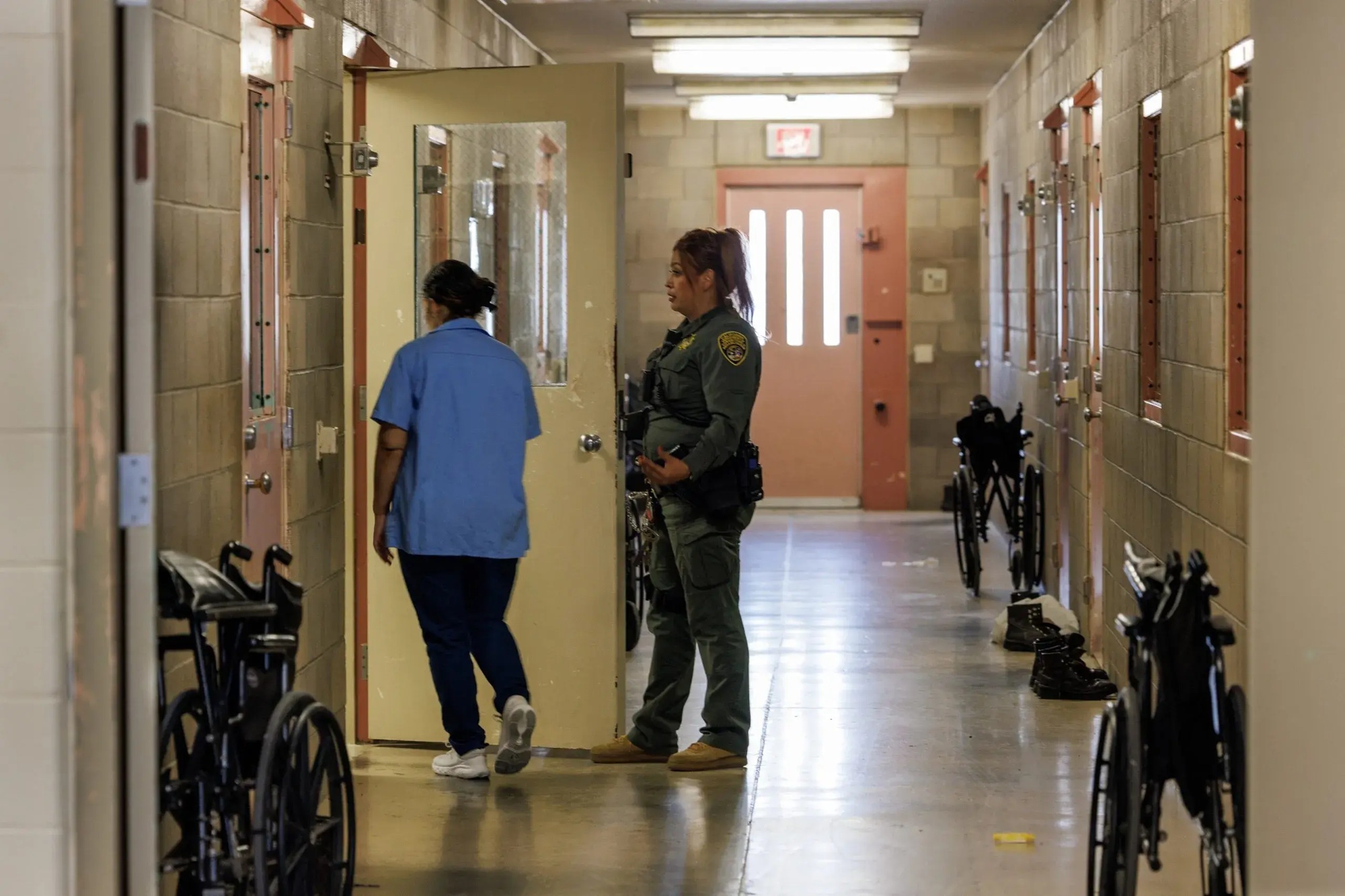
"caption": "An officer opens a dorm room for an inmate at the Central California Women's Facility in Chowchilla on June 18, 2024. After years of complaints from inmates and advocates about hot temperatures inside prison cells, California is finally embarking on a plan to cool some cells. But it’s only a test, and it will only help a fraction of inmates.",
"credit": "Gina Ferazzi/Los Angeles Times via Getty Images",
"altTag": null,
"description": null,
"imgSizes": {
"thumbnail": {
"file": "https://cdn.kqed.org/wp-content/uploads/sites/10/2025/09/ChowchillaCalMattersGetty-160x107.jpg",
"width": 160,
"height": 107,
"mimeType": "image/jpeg"
},
"1536x1536": {
"file": "https://cdn.kqed.org/wp-content/uploads/sites/10/2025/09/ChowchillaCalMattersGetty-1536x1024.jpg",
"width": 1536,
"height": 1024,
"mimeType": "image/jpeg"
},
"post-thumbnail": {
"file": "https://cdn.kqed.org/wp-content/uploads/sites/10/2025/09/ChowchillaCalMattersGetty-672x372.jpg",
"width": 672,
"height": 372,
"mimeType": "image/jpeg"
},
"twentyfourteen-full-width": {
"file": "https://cdn.kqed.org/wp-content/uploads/sites/10/2025/09/ChowchillaCalMattersGetty-1038x576.jpg",
"width": 1038,
"height": 576,
"mimeType": "image/jpeg"
},
"kqedFullSize": {
"file": "https://cdn.kqed.org/wp-content/uploads/sites/10/2025/09/ChowchillaCalMattersGetty.jpg",
"width": 2000,
"height": 1333
}
},
"isLoading": false,
"fetchFailed": false
},
"news_12054557": {
"type": "attachments",
"id": "news_12054557",
"meta": {
"index": "attachments_1716263798",
"site": "news",
"id": "12054557",
"found": true
},
"title": "Rodriguez_CARE_07_11_2025-4-672x372",
"publishDate": 1756936606,
"status": "inherit",
"parent": 12054473,
"modified": 1756936649,
"caption": null,
"credit": "David Rodriguez for KQED",
"altTag": null,
"description": null,
"imgSizes": {
"thumbnail": {
"file": "https://cdn.kqed.org/wp-content/uploads/sites/10/2025/09/Rodriguez_CARE_07_11_2025-4-672x372-1-160x89.jpg",
"width": 160,
"height": 89,
"mimeType": "image/jpeg"
},
"1536x1536": {
"file": "https://cdn.kqed.org/wp-content/uploads/sites/10/2025/09/Rodriguez_CARE_07_11_2025-4-672x372-1-1536x850.jpg",
"width": 1536,
"height": 850,
"mimeType": "image/jpeg"
},
"post-thumbnail": {
"file": "https://cdn.kqed.org/wp-content/uploads/sites/10/2025/09/Rodriguez_CARE_07_11_2025-4-672x372-1-672x372.jpg",
"width": 672,
"height": 372,
"mimeType": "image/jpeg"
},
"twentyfourteen-full-width": {
"file": "https://cdn.kqed.org/wp-content/uploads/sites/10/2025/09/Rodriguez_CARE_07_11_2025-4-672x372-1-1038x576.jpg",
"width": 1038,
"height": 576,
"mimeType": "image/jpeg"
},
"kqedFullSize": {
"file": "https://cdn.kqed.org/wp-content/uploads/sites/10/2025/09/Rodriguez_CARE_07_11_2025-4-672x372-1.jpg",
"width": 2000,
"height": 1107
}
},
"isLoading": false,
"fetchFailed": false
},
"news_12054276": {
"type": "attachments",
"id": "news_12054276",
"meta": {
"index": "attachments_1716263798",
"site": "news",
"id": "12054276",
"found": true
},
"title": "NewsomHousingCM1",
"publishDate": 1756505317,
"status": "inherit",
"parent": 12054274,
"modified": 1756505343,
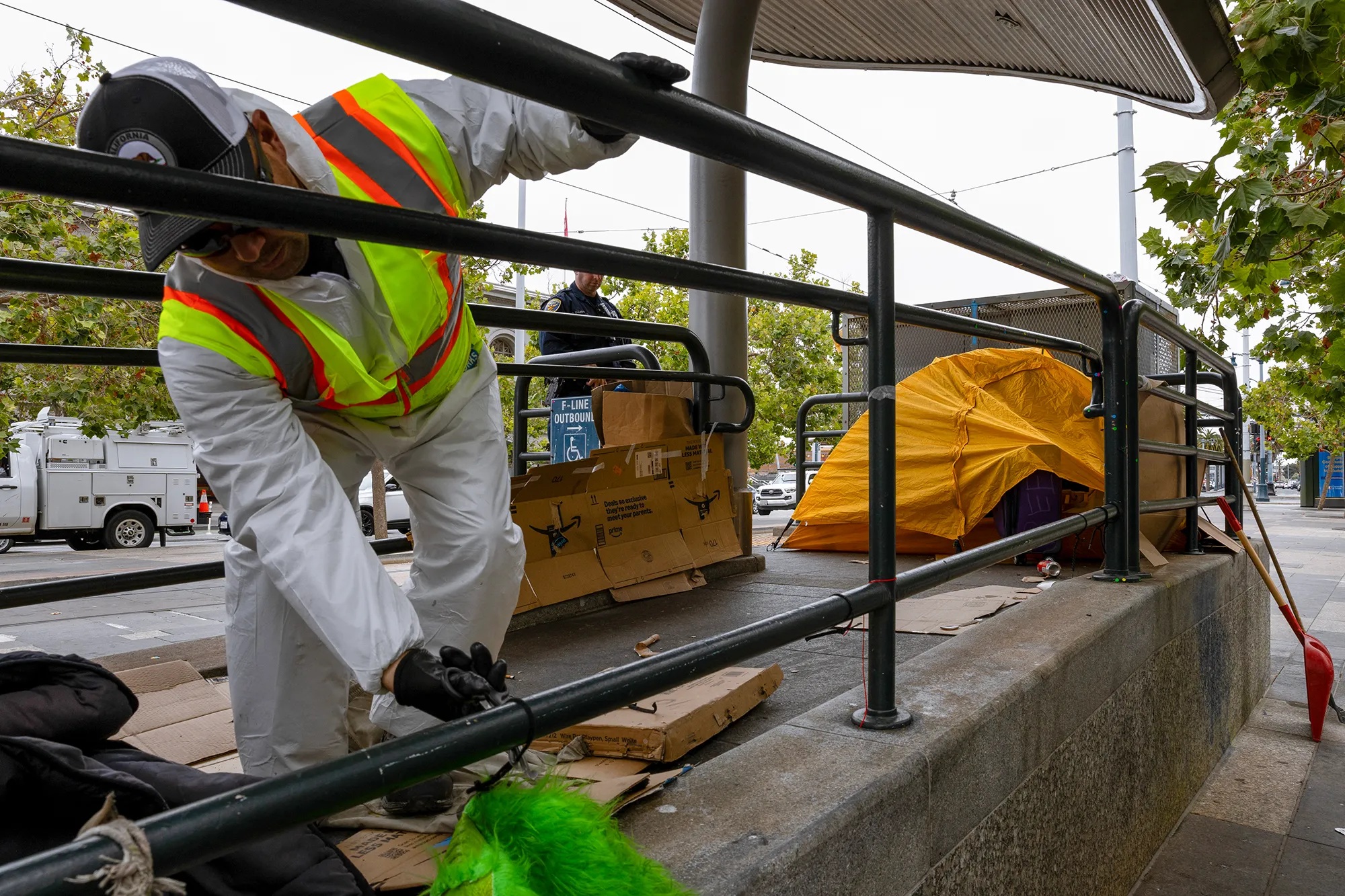
"caption": "A city worker picks up items belonging to an unhoused person outside of their tent in San Francisco during an encampment sweep on Aug. 9, 2024. \n",
"credit": "Manuel Orbegozo/CalMatters",
"altTag": null,
"description": null,
"imgSizes": {
"thumbnail": {
"file": "https://cdn.kqed.org/wp-content/uploads/sites/10/2025/08/NewsomHousingCM1-160x107.jpg",
"width": 160,
"height": 107,
"mimeType": "image/jpeg"
},
"1536x1536": {
"file": "https://cdn.kqed.org/wp-content/uploads/sites/10/2025/08/NewsomHousingCM1-1536x1024.jpg",
"width": 1536,
"height": 1024,
"mimeType": "image/jpeg"
},
"post-thumbnail": {
"file": "https://cdn.kqed.org/wp-content/uploads/sites/10/2025/08/NewsomHousingCM1-672x372.jpg",
"width": 672,
"height": 372,
"mimeType": "image/jpeg"
},
"twentyfourteen-full-width": {
"file": "https://cdn.kqed.org/wp-content/uploads/sites/10/2025/08/NewsomHousingCM1-1038x576.jpg",
"width": 1038,
"height": 576,
"mimeType": "image/jpeg"
},
"kqedFullSize": {
"file": "https://cdn.kqed.org/wp-content/uploads/sites/10/2025/08/NewsomHousingCM1.jpg",
"width": 2000,
"height": 1333
}
},
"isLoading": false,
"fetchFailed": false
},
"news_12053886": {
"type": "attachments",
"id": "news_12053886",
"meta": {
"index": "attachments_1716263798",
"site": "news",
"id": "12053886",
"found": true
},
"title": "HealthCareICECalMatters1",
"publishDate": 1756321773,
"status": "inherit",
"parent": 12053881,
"modified": 1756321808,
"caption": "Protesters gather outside Glendale Memorial Hospital where federal immigration agents wait for Milagro Solis Portillo to recover in Glendale, on July 17, 2025.\n",
"credit": "J.W. Hendricks/NurPhoto via Getty Images",
"altTag": null,
"description": null,
"imgSizes": {
"thumbnail": {
"file": "https://cdn.kqed.org/wp-content/uploads/sites/10/2025/08/HealthCareICECalMatters1-160x107.jpg",
"width": 160,
"height": 107,
"mimeType": "image/jpeg"
},
"1536x1536": {
"file": "https://cdn.kqed.org/wp-content/uploads/sites/10/2025/08/HealthCareICECalMatters1-1536x1025.jpg",
"width": 1536,
"height": 1025,
"mimeType": "image/jpeg"
},
"post-thumbnail": {
"file": "https://cdn.kqed.org/wp-content/uploads/sites/10/2025/08/HealthCareICECalMatters1-672x372.jpg",
"width": 672,
"height": 372,
"mimeType": "image/jpeg"
},
"twentyfourteen-full-width": {
"file": "https://cdn.kqed.org/wp-content/uploads/sites/10/2025/08/HealthCareICECalMatters1-1038x576.jpg",
"width": 1038,
"height": 576,
"mimeType": "image/jpeg"
},
"kqedFullSize": {
"file": "https://cdn.kqed.org/wp-content/uploads/sites/10/2025/08/HealthCareICECalMatters1.jpg",
"width": 1999,
"height": 1334
}
},
"isLoading": false,
"fetchFailed": false
},
"news_12052855": {
"type": "attachments",
"id": "news_12052855",
"meta": {
"index": "attachments_1716263798",
"site": "news",
"id": "12052855",
"found": true
},
"title": "Redistricting-Battle_CalMatters_jpg",
"publishDate": 1755639768,
"status": "inherit",
"parent": 12052851,
"modified": 1755645894,
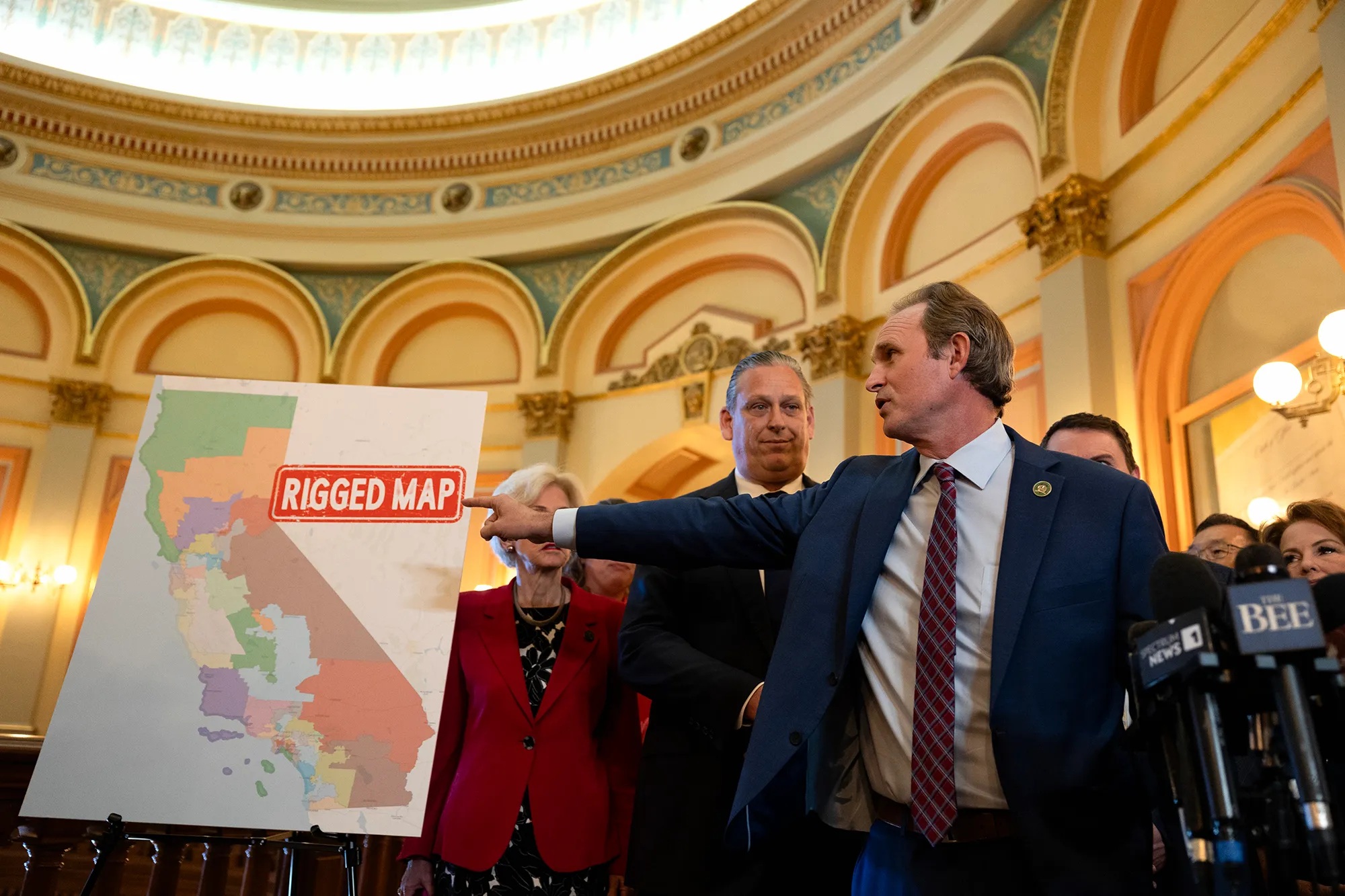
"caption": "Republican Assemblymember James Gallagher addresses the media during a press conference at the State Capitol in Sacramento on the current national redistricting battle between Democrats and Republicans on Aug. 18, 2025.",
"credit": "Miguel Gutierrez Jr./CalMatters",
"altTag": null,
"description": null,
"imgSizes": {
"thumbnail": {
"file": "https://cdn.kqed.org/wp-content/uploads/sites/10/2025/08/Redistricting-Battle_CalMatters_jpg-160x107.jpg",
"width": 160,
"height": 107,
"mimeType": "image/jpeg"
},
"1536x1536": {
"file": "https://cdn.kqed.org/wp-content/uploads/sites/10/2025/08/Redistricting-Battle_CalMatters_jpg-1536x1024.jpg",
"width": 1536,
"height": 1024,
"mimeType": "image/jpeg"
},
"post-thumbnail": {
"file": "https://cdn.kqed.org/wp-content/uploads/sites/10/2025/08/Redistricting-Battle_CalMatters_jpg-672x372.jpg",
"width": 672,
"height": 372,
"mimeType": "image/jpeg"
},
"twentyfourteen-full-width": {
"file": "https://cdn.kqed.org/wp-content/uploads/sites/10/2025/08/Redistricting-Battle_CalMatters_jpg-1038x576.jpg",
"width": 1038,
"height": 576,
"mimeType": "image/jpeg"
},
"kqedFullSize": {
"file": "https://cdn.kqed.org/wp-content/uploads/sites/10/2025/08/Redistricting-Battle_CalMatters_jpg.jpg",
"width": 2000,
"height": 1333
}
},
"isLoading": false,
"fetchFailed": false
},
"news_12052849": {
"type": "attachments",
"id": "news_12052849",
"meta": {
"index": "attachments_1716263798",
"site": "news",
"id": "12052849",
"found": true
},
"title": "Rob-Bonta-CalMatters",
"publishDate": 1755637464,
"status": "inherit",
"parent": 12052839,
"modified": 1755637506,
"caption": "Attorney General Rob Bonta discusses the California Department of Justice's efforts to protect rights of the state's immigrant communities at a news conference at the San Francisco Public Library's Bernal Heights branch in San Francisco, on Dec. 4, 2024.",
"credit": "Jeff Chiu/AP Photo",
"altTag": null,
"description": null,
"imgSizes": {
"thumbnail": {
"file": "https://cdn.kqed.org/wp-content/uploads/sites/10/2025/08/Rob-Bonta-CalMatters-160x107.jpg",
"width": 160,
"height": 107,
"mimeType": "image/jpeg"
},
"1536x1536": {
"file": "https://cdn.kqed.org/wp-content/uploads/sites/10/2025/08/Rob-Bonta-CalMatters-1536x1024.jpg",
"width": 1536,
"height": 1024,
"mimeType": "image/jpeg"
},
"post-thumbnail": {
"file": "https://cdn.kqed.org/wp-content/uploads/sites/10/2025/08/Rob-Bonta-CalMatters-672x372.jpg",
"width": 672,
"height": 372,
"mimeType": "image/jpeg"
},
"twentyfourteen-full-width": {
"file": "https://cdn.kqed.org/wp-content/uploads/sites/10/2025/08/Rob-Bonta-CalMatters-1038x576.jpg",
"width": 1038,
"height": 576,
"mimeType": "image/jpeg"
},
"kqedFullSize": {
"file": "https://cdn.kqed.org/wp-content/uploads/sites/10/2025/08/Rob-Bonta-CalMatters.jpg",
"width": 2000,
"height": 1333
}
},
"isLoading": false,
"fetchFailed": false
},
"news_12052572": {
"type": "attachments",
"id": "news_12052572",
"meta": {
"index": "attachments_1716263798",
"site": "news",
"id": "12052572",
"found": true
},
"title": "042924_Covered-CA_AH_06",
"publishDate": 1755462324,
"status": "inherit",
"parent": 12052571,
"modified": 1781122450,
"caption": "A Covered California Enrollment Center in Chula Vista on April 29, 2024. ",
"credit": "Adriana Heldiz/CalMatters",
"altTag": "A woman wearing a black and white striped shirt walks past a building with a sign that says \"Health Insurance Covered California.\"",
"description": null,
"imgSizes": {
"thumbnail": {
"file": "https://cdn.kqed.org/wp-content/uploads/sites/10/2025/08/042924_Covered-CA_AH_06-160x107.jpg",
"width": 160,
"height": 107,
"mimeType": "image/jpeg"
},
"1536x1536": {
"file": "https://cdn.kqed.org/wp-content/uploads/sites/10/2025/08/042924_Covered-CA_AH_06-1536x1024.jpg",
"width": 1536,
"height": 1024,
"mimeType": "image/jpeg"
},
"post-thumbnail": {
"file": "https://cdn.kqed.org/wp-content/uploads/sites/10/2025/08/042924_Covered-CA_AH_06-672x372.jpg",
"width": 672,
"height": 372,
"mimeType": "image/jpeg"
},
"twentyfourteen-full-width": {
"file": "https://cdn.kqed.org/wp-content/uploads/sites/10/2025/08/042924_Covered-CA_AH_06-1038x576.jpg",
"width": 1038,
"height": 576,
"mimeType": "image/jpeg"
},
"kqedFullSize": {
"file": "https://cdn.kqed.org/wp-content/uploads/sites/10/2025/08/042924_Covered-CA_AH_06.jpg",
"width": 2000,
"height": 1333
}
},
"isLoading": false,
"fetchFailed": false
},
"news_12052535": {
"type": "attachments",
"id": "news_12052535",
"meta": {
"index": "attachments_1716263798",
"site": "news",
"id": "12052535",
"found": true
},
"title": "080525_WomenInStem_FM_CM_04",
"publishDate": 1755377180,
"status": "inherit",
"parent": 12052533,
"modified": 1755377331,
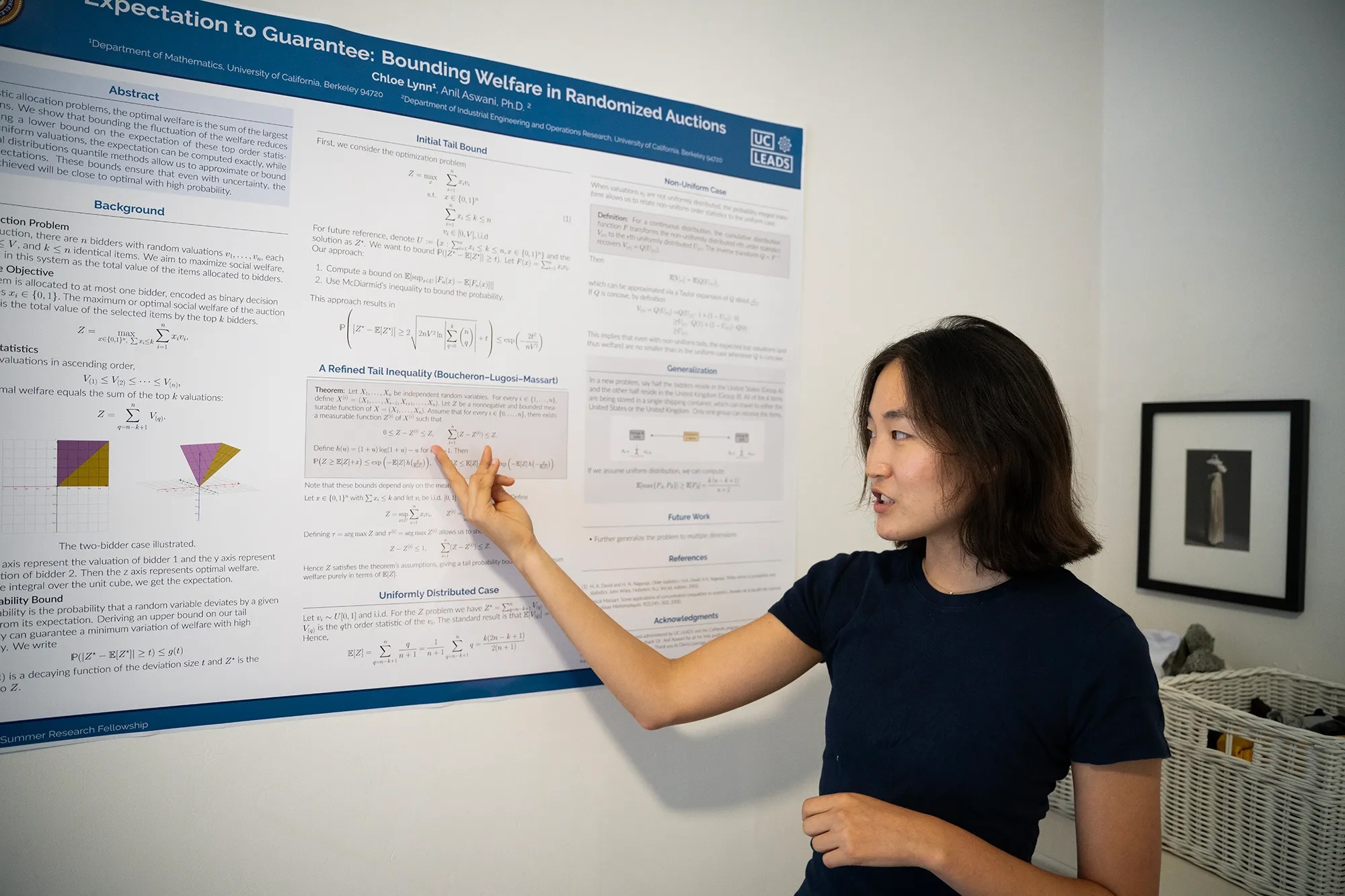
"caption": "Chloe Lynn, 20, a UC Berkeley undergraduate student double majoring in applied mathematics and operations research and management science, at her home in Berkeley on Aug. 5, 2025. Lynn recently presented a poster for her project in optimization theory that she keeps displayed on her bedroom wall.",
"credit": "Florence Middleton for CalMatters",
"altTag": null,
"description": null,
"imgSizes": {
"thumbnail": {
"file": "https://cdn.kqed.org/wp-content/uploads/sites/10/2025/08/080525_WomenInStem_FM_CM_04-160x107.jpeg",
"width": 160,
"height": 107,
"mimeType": "image/jpeg"
},
"1536x1536": {
"file": "https://cdn.kqed.org/wp-content/uploads/sites/10/2025/08/080525_WomenInStem_FM_CM_04-1536x1024.jpeg",
"width": 1536,
"height": 1024,
"mimeType": "image/jpeg"
},
"post-thumbnail": {
"file": "https://cdn.kqed.org/wp-content/uploads/sites/10/2025/08/080525_WomenInStem_FM_CM_04-672x372.jpeg",
"width": 672,
"height": 372,
"mimeType": "image/jpeg"
},
"twentyfourteen-full-width": {
"file": "https://cdn.kqed.org/wp-content/uploads/sites/10/2025/08/080525_WomenInStem_FM_CM_04-1038x576.jpeg",
"width": 1038,
"height": 576,
"mimeType": "image/jpeg"
},
"kqedFullSize": {
"file": "https://cdn.kqed.org/wp-content/uploads/sites/10/2025/08/080525_WomenInStem_FM_CM_04.jpeg",
"width": 2000,
"height": 1333
}
},
"isLoading": false,
"fetchFailed": false
},
"news_12052116": {
"type": "attachments",
"id": "news_12052116",
"meta": {
"index": "attachments_1716263798",
"site": "news",
"id": "12052116",
"found": true
},
"title": "080725-Self-Checkout-IS-CM",
"publishDate": 1755127920,
"status": "inherit",
"parent": 12052115,
"modified": 1755127938,
"caption": "A person uses a self-checkout machine at a store. ",
"credit": "Photo via iStock Photo",
"altTag": null,
"description": null,
"imgSizes": {
"thumbnail": {
"file": "https://cdn.kqed.org/wp-content/uploads/sites/10/2025/08/080725-Self-Checkout-IS-CM-160x107.jpg",
"width": 160,
"height": 107,
"mimeType": "image/jpeg"
},
"1536x1536": {
"file": "https://cdn.kqed.org/wp-content/uploads/sites/10/2025/08/080725-Self-Checkout-IS-CM-1536x1024.jpg",
"width": 1536,
"height": 1024,
"mimeType": "image/jpeg"
},
"post-thumbnail": {
"file": "https://cdn.kqed.org/wp-content/uploads/sites/10/2025/08/080725-Self-Checkout-IS-CM-672x372.jpg",
"width": 672,
"height": 372,
"mimeType": "image/jpeg"
},
"twentyfourteen-full-width": {
"file": "https://cdn.kqed.org/wp-content/uploads/sites/10/2025/08/080725-Self-Checkout-IS-CM-1038x576.jpg",
"width": 1038,
"height": 576,
"mimeType": "image/jpeg"
},
"kqedFullSize": {
"file": "https://cdn.kqed.org/wp-content/uploads/sites/10/2025/08/080725-Self-Checkout-IS-CM.jpg",
"width": 2000,
"height": 1333
}
},
"isLoading": false,
"fetchFailed": false
}
},
"audioPlayerReducer": {
"postId": "stream_live",
"isPaused": true,
"isPlaying": false,
"pfsActive": false,
"pledgeModalIsOpen": true,
"playerDrawerIsOpen": false,
"liveAudioPlayStartedAt": 0,
"liveAudioPlayContext": ""
},
"authorsReducer": {
"byline_news_12055854": {
"type": "authors",
"id": "byline_news_12055854",
"meta": {
"override": true
},
"slug": "byline_news_12055854",
"name": "Khari Johnson and Yue Stella Yu, CalMatters",
"isLoading": false
},
"byline_news_12055528": {
"type": "authors",
"id": "byline_news_12055528",
"meta": {
"override": true
},
"slug": "byline_news_12055528",
"name": "Adam Echelman, CalMatters",
"isLoading": false
},
"byline_news_12055166": {
"type": "authors",
"id": "byline_news_12055166",
"meta": {
"override": true
},
"slug": "byline_news_12055166",
"name": "Wendy Fry and Sergio Olmos, CalMatters",
"isLoading": false
},
"byline_news_12054658": {
"type": "authors",
"id": "byline_news_12054658",
"meta": {
"override": true
},
"slug": "byline_news_12054658",
"name": "Jeanne Kuang, CalMatters",
"isLoading": false
},
"byline_news_12054473": {
"type": "authors",
"id": "byline_news_12054473",
"meta": {
"override": true
},
"slug": "byline_news_12054473",
"name": "Marisa Kendall, CalMatters",
"isLoading": false
},
"byline_news_12054274": {
"type": "authors",
"id": "byline_news_12054274",
"meta": {
"override": true
},
"slug": "byline_news_12054274",
"name": "Marisa Kendall, CalMatters",
"isLoading": false
},
"byline_news_12053881": {
"type": "authors",
"id": "byline_news_12053881",
"meta": {
"override": true
},
"slug": "byline_news_12053881",
"name": "Ana B. Ibarra and Kristen Hwang, CalMatters",
"isLoading": false
},
"byline_news_12052851": {
"type": "authors",
"id": "byline_news_12052851",
"meta": {
"override": true
},
"slug": "byline_news_12052851",
"name": "Maya C. Miller, CalMatters",
"isLoading": false
},
"byline_news_12052839": {
"type": "authors",
"id": "byline_news_12052839",
"meta": {
"override": true
},
"slug": "byline_news_12052839",
"name": "Mikhail Zinshteyn and Cayla Mihalovich, CalMatters",
"isLoading": false
},
"byline_news_12052571": {
"type": "authors",
"id": "byline_news_12052571",
"meta": {
"override": true
},
"slug": "byline_news_12052571",
"name": "\u003ca href=\"https://calmatters.org/author/kristen-hwang\">Kristen Hwang, \u003c/a>CalMatters",
"isLoading": false
},
"byline_news_12052533": {
"type": "authors",
"id": "byline_news_12052533",
"meta": {
"override": true
},
"slug": "byline_news_12052533",
"name": "Adam Echelman, CalMatters",
"isLoading": false
},
"byline_news_12052115": {
"type": "authors",
"id": "byline_news_12052115",
"meta": {
"override": true
},
"slug": "byline_news_12052115",
"name": "Maya C. Miller, CalMatters",
"isLoading": false
}
},
"pagesReducer": {
"news_affiliate_calmatters": {
"type": "terms",
"id": "news_18481",
"meta": {
"index": "terms_1716263798",
"site": "news",
"id": "18481",
"score": 15.355904
},
"featImg": null,
"name": "CALmatters",
"description": null,
"taxonomy": "affiliate",
"headData": {
"twImgId": null,
"twTitle": null,
"ogTitle": null,
"ogImgId": null,
"twDescription": null,
"description": null,
"title": "CALmatters Archives | KQED Arts",
"ogDescription": null
},
"ttid": 18515,
"slug": "calmatters",
"isLoading": false,
"title": "CALmatters",
"pageMeta": {
"site": "news",
"WpPageTemplate": "page-topic-editorial",
"currentPage": 10
},
"blocks": [
{
"blockName": "kqed/post-list",
"attrs": {
"layout": "cardArticle2",
"query": "posts/news?affiliate=calmatters",
"seeMore": false,
"paginated": true,
"page": 10
}
},
{
"blockName": "kqed/ad"
}
]
}
},
"pfsSessionReducer": {},
"postsReducer": {
"stream_live": {
"type": "live",
"id": "stream_live",
"audioUrl": "https://streams.kqed.org/kqedradio",
"title": "Live Stream",
"excerpt": "Live Stream information currently unavailable.",
"link": "/radio",
"featImg": "",
"label": {
"name": "KQED Live",
"link": "/"
}
},
"stream_kqedNewscast": {
"type": "posts",
"id": "stream_kqedNewscast",
"audioUrl": "https://www.kqed.org/.stream/anon/radio/RDnews/newscast.mp3?_=1",
"title": "KQED Newscast",
"featImg": "",
"label": {
"name": "88.5 FM",
"link": "/"
}
},
"news_12055854": {
"type": "posts",
"id": "news_12055854",
"meta": {
"index": "posts_1716263798",
"site": "news",
"id": "12055854",
"score": null,
"sort": [
1757854807000
]
},
"guestAuthors": [],
"slug": "how-google-organized-opposition-to-a-california-privacy-proposal",
"title": "How Google Organized Opposition to a California Privacy Proposal",
"publishDate": 1757854807,
"format": "standard",
"headTitle": "How Google Organized Opposition to a California Privacy Proposal | KQED",
"labelTerm": {},
"content": "\u003cp>\u003cem>This story was originally published by \u003ca href=\"https://calmatters.org/\">CalMatters\u003c/a>. \u003ca href=\"https://calmatters.org/subscribe-to-calmatters/\">Sign up\u003c/a> for their newsletters.\u003c/em>\u003c/p>\n\u003cp>In April, Rhode Island resident Navah Hopkins received a plea for her help to defeat legislation thousands of miles away in California.\u003c/p>\n\u003cp>The ask came from Google, maker of the world’s most used web browser, Chrome. The tech giant sent a message to an email list that Hopkins and other small business owners were subscribed to. Google’s request: To sign a petition opposing \u003ca href=\"https://calmatters.digitaldemocracy.org/bills/ca_202520260ab566\">Assembly Bill 566\u003c/a>, which would require browsers to provide users with a way to automatically tell websites not to share their personal information with third parties. The measure is sponsored by the California Privacy Protection Agency, which enforces state regulations on such sharing.\u003c/p>\n\u003cp>In its email to Hopkins, Google claimed that the legislation would “hurt your ability to use online ads to reach customers.”\u003c/p>\n\u003cp>“It was intentionally misleading people that by this bill passing, they were going to lose out on all of these tools within Google (to advertise),” she told CalMatters.\u003c/p>\n\u003cp>[ad fullwidth]\u003c/p>\n\u003cp>The outreach was particularly noteworthy because Google had not itself taken a public position on the bill. The tech giant was so quiet about its opposition that Assemblymember \u003ca href=\"https://calmatters.digitaldemocracy.org/legislators/josh-lowenthal-164206\">Josh Lowenthal\u003c/a>, the author of AB 566, did not know about Google’s email push until a CalMatters reporter asked. Lowenthal also said his office did not receive small business owners’ signatures or outreach.\u003c/p>\n\u003cp>Google’s name wasn’t on the petition either; instead, the document was officially from the “Connected Commerce Council,” which the tech giant backs financially.\u003c/p>\n\u003cfigure id=\"attachment_12036476\" class=\"wp-caption aligncenter\" style=\"max-width: 1024px\">\u003ca href=\"https://cdn.kqed.org/wp-content/uploads/sites/10/2025/04/GettyImages-2166671481.jpg\">\u003cimg loading=\"lazy\" decoding=\"async\" class=\"size-full wp-image-12036476\" src=\"https://cdn.kqed.org/wp-content/uploads/sites/10/2025/04/GettyImages-2166671481.jpg\" alt=\"\" width=\"1024\" height=\"706\" srcset=\"https://cdn.kqed.org/wp-content/uploads/sites/10/2025/04/GettyImages-2166671481.jpg 1024w, https://cdn.kqed.org/wp-content/uploads/sites/10/2025/04/GettyImages-2166671481-800x552.jpg 800w, https://cdn.kqed.org/wp-content/uploads/sites/10/2025/04/GettyImages-2166671481-1020x703.jpg 1020w, https://cdn.kqed.org/wp-content/uploads/sites/10/2025/04/GettyImages-2166671481-160x110.jpg 160w\" sizes=\"auto, (max-width: 1024px) 100vw, 1024px\">\u003c/a>\u003cfigcaption class=\"wp-caption-text\">The Google logo is displayed in front of company headquarters during the Made By Google event on August 13, 2024 in Mountain View, California. Google announced new Pixel phones, watches and AI features at the event. \u003ccite>(Justin Sullivan/Getty Images)\u003c/cite>\u003c/figcaption>\u003c/figure>\n\u003cp>The largely behind-the-scenes campaign offers a glimpse into how the tech giant is working to preserve its grip on the online advertising market and how it attempts, without being seen, to shape policies in a state with one of the nation’s strictest privacy protection laws.\u003c/p>\n\u003cp>Recruiting small businesses to represent the policy interests of a tech giant isn’t new. Last year, Google successfully blocked \u003ca href=\"https://calmatters.digitaldemocracy.org/bills/ca_202320240ab3048\">a similar bill\u003c/a> — ultimately vetoed by Gov. Gavin Newsom — by adopting the same tactic, reaching out to small businesses via email lists, according to a message obtained by CalMatters.\u003c/p>\n\u003cp>There’s no telling how effective Google’s lobbying on the measure has been this year, or how many people it successfully mobilized. Experts warn that the strategy could backfire if the people it reaches out to, like the small business owners, aren’t buying what the company is selling.\u003c/p>\n\u003cp>But before the browser bill reached its final floor vote, Lowenthal amended it to delay the effective date until 2027 and to add liability protections for browser companies like Google.\u003c/p>\n\u003cp>[aside postID=news_12054490 hero='https://cdn.kqed.org/wp-content/uploads/sites/10/2024/08/ChatGPTGetty-1020x680.jpg']\u003c/p>\n\u003cp>When asked who advocated for that language, Lowenthal said he’d taken input from “colleagues and stakeholders” to shape up the “strongest possible bill.”\u003c/p>\n\u003cp>“With any bill that’s been vetoed before, it takes some give-and-take to get it across the finish line,” he said.\u003c/p>\n\u003cp>The bill cleared the Legislature and headed to the governor’s desk Thursday after this story was published.\u003c/p>\n\u003cp>Google did not respond to multiple requests for comment.\u003c/p>\n\u003cp>Google ranked among the \u003ca href=\"https://calmatters.org/data/2025/04/california-lobbying-spending-2024/\">most active lobbyists in California\u003c/a> last year, spending more to influence the opinions of elected officials \u003ca href=\"https://calmatters.org/politics/capitol/2024/11/google-lobbying-california/\">than it had in the previous 20 years combined\u003c/a>. The lobbying was aimed at battling AI regulation, local news funding requirements, and a prior version of the browser bill.\u003c/p>\n\u003cp>This year, it has disclosed pouring nearly $700,000 into lobbying state leaders on bills including AB 566. Google has also increased lobbying spending in many \u003ca href=\"https://www.openmarketsinstitute.org/publications/google-refines-50-state-lobby-strategy-austin-ahlman\">other statehouses\u003c/a>, according to the Open Markets Institute. With inaction in Congress, states have led the way in tech regulation in recent years.\u003c/p>\n\u003cp>But it’s hard to trace Google’s full influence when the company does not publicly share its position on bills like AB 566, instead paying groups like the California Chamber of Commerce and Connected Commerce Council to influence legislators on its behalf.\u003c/p>\n\u003cfigure>\u003cimg decoding=\"async\" src=\"https://calmatters.org/wp-content/uploads/2025/09/082125_CA-Legislature_FG_CM_37-1024x682.jpg\" alt=\"A person, with white hair and wearing a gray suit, stands in front of a podium with a microphone on it while they speak.\">\u003cfigcaption>Assemblymember Josh Lowenthal at the dais during an Assembly floor session at the state Capitol in Sacramento on Aug. 21, 2025. \u003cem>(Fred Greaves for CalMatters)\u003c/em>\u003c/figcaption>\u003c/figure>\n\u003cp>Google registered to lobby 17 bills this year that sought to do things like place \u003ca href=\"https://calmatters.digitaldemocracy.org/bills/ca_202520260ab56\">warning labels on social media\u003c/a> or protect people from \u003ca href=\"https://calmatters.digitaldemocracy.org/bills/ca_202520260sb503\">algorithms that make health care decisions\u003c/a>, but the company only publicly stated its position on one bill that sought to require\u003ca href=\"https://calmatters.digitaldemocracy.org/bills/ca_202520260ab1043\"> online age verification\u003c/a>, according to\u003ca href=\"https://calmatters.digitaldemocracy.org/\"> state filings and Digital Democracy\u003c/a>.\u003c/p>\n\u003cp>Google’s lobbying tactics, while not illegal, demonstrate the sway money has over policies, said Sean McMorris, the transparency, ethics, and accountability program manager at California Common Cause.\u003c/p>\n\u003cp>“This type of activity … exemplifies the skewed playing field that we have to play on,” he said. “It’s important to report on and to point out these strategies and loopholes that money can afford you the privilege to engage in, and the public has every right to scrutinize whether that is just or not.”\u003c/p>\n\u003cp>If Google really believes this bill shouldn’t become a law, its lobbyists should show up to testify at a public hearing, not behave in shadowy ways that undercut democracy, said Brandon Forester, an organizer for MediaJustice, a nonprofit that has been critical of the influence of of Big Tech companies and internet service providers.\u003c/p>\n\u003cfigure id=\"attachment_12001241\" class=\"wp-caption aligncenter\" style=\"max-width: 2000px\">\u003ca href=\"https://cdn.kqed.org/wp-content/uploads/sites/10/2024/08/GETTYIMAGES-1411232503-KQED.jpg\">\u003cimg loading=\"lazy\" decoding=\"async\" class=\"size-full wp-image-12001241\" src=\"https://cdn.kqed.org/wp-content/uploads/sites/10/2024/08/GETTYIMAGES-1411232503-KQED.jpg\" alt=\"\" width=\"2000\" height=\"1333\" srcset=\"https://cdn.kqed.org/wp-content/uploads/sites/10/2024/08/GETTYIMAGES-1411232503-KQED.jpg 2000w, https://cdn.kqed.org/wp-content/uploads/sites/10/2024/08/GETTYIMAGES-1411232503-KQED-800x533.jpg 800w, https://cdn.kqed.org/wp-content/uploads/sites/10/2024/08/GETTYIMAGES-1411232503-KQED-1020x680.jpg 1020w, https://cdn.kqed.org/wp-content/uploads/sites/10/2024/08/GETTYIMAGES-1411232503-KQED-160x107.jpg 160w, https://cdn.kqed.org/wp-content/uploads/sites/10/2024/08/GETTYIMAGES-1411232503-KQED-1536x1024.jpg 1536w, https://cdn.kqed.org/wp-content/uploads/sites/10/2024/08/GETTYIMAGES-1411232503-KQED-1920x1280.jpg 1920w\" sizes=\"auto, (max-width: 2000px) 100vw, 2000px\">\u003c/a>\u003cfigcaption class=\"wp-caption-text\">Google’s Bay View campus in Mountain View on June 16, 2022. \u003ccite>(Zhang Yi/VCG via Getty Images)\u003c/cite>\u003c/figcaption>\u003c/figure>\n\u003cp>“None of us wants to enter a surveillance marketplace every time that we go on the internet,” he said. “Part of the reason they need to do the shadow lobbying is because the things that they want to do to achieve their infinite growth model is not good for the public.”\u003c/p>\n\u003cp>AB 566 is not the only threat Google faces to its grip on how people surf the web. A \u003ca href=\"https://www.latimes.com/business/story/2025-09-02/google-chrome-decision\">judge ruled\u003c/a> last month that the company may no longer enter into exclusive distribution deals for Chrome or Google search. And Chrome faces new competition from a \u003ca href=\"https://www.platformer.news/ai-web-browsers-openai-perplexity-opera/?ref=platformer-newsletter\">number of AI-powered browsers entering the market\u003c/a>, reportedly to \u003ca href=\"https://www.reuters.com/business/media-telecom/openai-release-web-browser-challenge-google-chrome-2025-07-09/\">soon include\u003c/a> one from ChatGPT maker OpenAI.\u003c/p>\n\u003ch2>Onerous mandate or consumer convenience?\u003c/h2>\n\u003cp>Under a 2018 state law, California businesses \u003ca href=\"https://calmatters.org/economy/technology/2025/08/companies-make-it-hard-to-delete-personal-data/\">must provide customers\u003c/a> with a way to forbid the sharing or sale of their personal information to businesses. AB 566 seeks to streamline that process.\u003c/p>\n\u003cp>Browsers such as DuckDuckGo, Brave, and Firefox already have privacy features that, once enabled, \u003ca href=\"https://support.mozilla.org/en-US/kb/global-privacy-control\">automatically send an opt-out signal\u003c/a> to each website the user goes to.[aside postID=forum_2010101911184 hero='https://cdn.kqed.org/wp-content/uploads/sites/43/2025/09/GettyImages-2204906139-2000x1335.jpg']The California Chamber of Commerce opposes AB 566, arguing it represents an onerous mandate. The measure lacks clarity, regulates browsers that aren’t “consumer-facing” and is hard to implement, the trade association argued in a letter to lawmakers.\u003c/p>\n\u003cp>“Browsers and devices already compete to offer clear, effective privacy controls,” Ronak Dalami, a lobbyist for the chamber, told lawmakers in July.\u003c/p>\n\u003cp>A similar bill the Legislature passed last year would have required both web browsers and mobile operating systems to offer ways to automatically prohibit the sharing of a user’s personal information, but Gov. Gavin Newsom \u003ca href=\"https://www.gov.ca.gov/wp-content/uploads/2024/09/AB-3048-Veto-Message.pdf\">vetoed\u003c/a> the bill because no major mobile operating system includes such an option.\u003c/p>\n\u003cp>“To ensure the ongoing usability of mobile devices, it’s best if design questions are first addressed by developers, rather than by regulators,” Newsom said \u003ca href=\"https://www.gov.ca.gov/wp-content/uploads/2024/09/AB-3048-Veto-Message.pdf\">in a veto message\u003c/a>.\u003c/p>\n\u003cp>Bianca Blomquist, California director of nonprofit Small Business Majority, which represents 85,000 small businesses nationwide, was among the business owners who received an email last year from Google, on a mailing list of businesses that participated in the company’s training program, Grow with Google. The letter argued that allowing people to easily stop companies from sharing their personal information would make it more expensive for small businesses to sell their products.\u003c/p>\n\u003cp>But Blomquist was skeptical. And while Newsom’s veto message spoke of design risks, she said that most people she talks to “are more concerned about their data being shared than they are too many buttons flashing on a screen.”\u003c/p>\n\u003cp>To Blomquist, the email is clear evidence that Google was “leveraging” the data it collected from partners for advocacy.\u003c/p>\n\u003cp>“What we find is that small business owners … and partner organizations oftentimes sign on to support or oppose legislation without having an understanding of what it does.”\u003c/p>\n\u003ch2>Connected Commerce Council\u003c/h2>\n\u003cp>The petition Google circulated this year was authored by \u003ca href=\"https://www.politico.com/news/2022/03/30/connected-commerce-council-amazon-google-lobbying-00021801\">Connected Commerce Council\u003c/a>, or 3C, a lobbying group that in 2022 \u003ca href=\"https://connectedcouncil.org/statement-from-the-connected-commerce-council-on-behalf-of-15000-small-business-members-criticizing-the-senate-judiciarys-passage-of-the-american-innovation-and-choice-online-act/\">claimed to represent 15,000 small businesses\u003c/a> but lists Google and Amazon as \u003ca href=\"https://connectedcouncil.org/partners/\">funders and partners\u003c/a>. In 2022, Google and Amazon mobilized their users to fight anti-trust bills in Congress by encouraging them to sign a model online petition the council drafted. That year, the nonprofit published and later removed a membership directory of 5,000 small businesses, many of which told Politico \u003ca href=\"https://www.politico.com/news/2022/03/30/connected-commerce-council-amazon-google-lobbying-00021801\">they were not members of the organization\u003c/a>.[aside postID=news_12049301 hero='https://cdn.kqed.org/wp-content/uploads/sites/10/2025/07/CAT-%E2%80%94-OG-of-Tech.png']This spring, the group sent a letter to California state lawmakers, arguing that the requirements proposed in AB 566 would cause small businesses to lose out on customer data and make their websites more expensive to operate.\u003c/p>\n\u003cp>“Implementing a sweeping experiment that would jeopardize small businesses’ success, limit Californians’ access to relevant products and services, and potentially disrupt access to free web content, is not a sensible way forward,” wrote Rob Retzlaff, executive director of the group.\u003c/p>\n\u003cp>In a virtual press conference last month, the organization put forward two California online business owners who oppose the legislation. The owners argued that the browser feature mandated in the bill could inadvertently drive away customers, would block them from sending targeted ads to users who opt out of having their personal information shared, and would make it impossible for customers who opted out to opt back in.\u003c/p>\n\u003cp>“If they opt out of one thing — maybe they just didn’t want … my weekly emails about moms connecting, but they want to have discounts — how are we going to segment that?” said Michelle Mak, owner of baby product store Mewl Baby.\u003c/p>\n\u003cp>Google did not report paying the commerce council any money to lobby on its behalf to the California secretary of state. But Google reported paying the California Chamber of Commerce, the face of its opposition, almost $100,000 to lobby this year. It also reported paying TechNet, which also registered its opposition, $2,500.\u003c/p>\n\u003cp>Connected Commerce Council spokesperson Jennifer Hodgkins declined to answer a list of questions from CalMatters, instead providing a statement pointing to the organization’s letters to the Legislature, press releases and statements from small business owners featured in its press conference.\u003c/p>\n\u003cp>“Small business owners are deeply concerned about the impact AB 566 will have on their ability to advertise online, find new customers, and grow,” Hodgkins said.\u003c/p>\n\u003cfigure id=\"attachment_12052593\" class=\"wp-caption aligncenter\" style=\"max-width: 2000px\">\u003ca href=\"https://cdn.kqed.org/wp-content/uploads/sites/10/2025/08/CA-state-capitol.jpg\">\u003cimg loading=\"lazy\" decoding=\"async\" class=\"size-full wp-image-12052593\" src=\"https://cdn.kqed.org/wp-content/uploads/sites/10/2025/08/CA-state-capitol.jpg\" alt=\"\" width=\"2000\" height=\"1333\" srcset=\"https://cdn.kqed.org/wp-content/uploads/sites/10/2025/08/CA-state-capitol.jpg 2000w, https://cdn.kqed.org/wp-content/uploads/sites/10/2025/08/CA-state-capitol-160x107.jpg 160w, https://cdn.kqed.org/wp-content/uploads/sites/10/2025/08/CA-state-capitol-1536x1024.jpg 1536w\" sizes=\"auto, (max-width: 2000px) 100vw, 2000px\">\u003c/a>\u003cfigcaption class=\"wp-caption-text\">The State Capitol of California in Sacramento, May 6, 2025. \u003ccite>(Beth LaBerge/KQE)\u003c/cite>\u003c/figcaption>\u003c/figure>\n\u003cp>John Myers, a spokesperson for the California Chamber of Commerce, declined to answer a CalMatters question about the payments it received from Google.\u003c/p>\n\u003cp>But McMorris of Common Cause said Google’s payments to the chamber for lobbying should be “closely scrutinized.”\u003c/p>\n\u003cp>“If it’s not for (AB566), then what was it for?” he said. “That’s where the law gets murky, and you have these wink and nod relationships where both sides know how to play the game without explicitly saying, ‘This is how we are going to play the game.’”\u003c/p>\n\u003ch2>Mobilizing users a unique tactic\u003c/h2>\n\u003cp>It tracks that Google turned to small business owners to protect the company’s business model, said Jeremy Mack, director of the\u003ca href=\"http://phoenixprojectnow.com/\"> Phoenix Project\u003c/a>, a group that tries to draw attention to San Francisco Bay Area front organizations secretly funded by tech billionaires.\u003c/p>\n\u003cp>Mack said the practice is reminiscent of how Uber and Lyft mobilized people who use ride-hailing apps to \u003ca href=\"https://calmatters.org/economy/2024/07/prop-22-california-gig-work-law-upheld/\">support Proposition 22\u003c/a> and keep gig workers from being defined as employees instead of contractors, and tactics embraced by apartment landlords and realtor groups.[aside postID=news_12052617 hero='https://cdn.kqed.org/wp-content/uploads/sites/10/2025/08/GETTYIMAGES-2228237489-KQED.jpg']“It’s not surprising that Google would do this, but it’s definitely good to be able to flag this for people and put it on their radar,” he said.\u003c/p>\n\u003cp>Unlike other industries seeking to influence policy, tech companies can mobilize users through their online platforms, said Austin Ahlman, a researcher who tracks Google lobbying efforts in state capitals for the Open Markets Institute. It’s part of a long pattern of tech companies using small businesses that rely on their platforms to preempt regulation.\u003c/p>\n\u003cp>Meta also has a history of recruiting small businesses to represent its interests, and Google and Meta threatened or prevented people in \u003ca href=\"https://www.theguardian.com/technology/2021/feb/18/time-to-reactivate-myspace-the-day-australia-woke-up-to-a-facebook-news-blackout\">Australia\u003c/a>, \u003ca href=\"https://www.cbc.ca/radio/frontburner/how-the-google-news-blackout-was-avoided-1.7045601\">Canada\u003c/a>, and \u003ca href=\"https://blog.google/products/news/california-journalism-preservation-act-puts-news-ecosystem-at-risk/\">California\u003c/a> from seeing the news to oppose a demand that the companies pay to \u003ca href=\"https://calmatters.org/politics/2025/05/google-california-local-news/\">link to news websites\u003c/a>. An earlier, prominent instance of tech companies using their platforms to influence legislation came around the Stop Online Piracy Act and the PROTECT IP Act when major companies, including Google, organized to shut down their websites for a day in September 2012 to oppose those laws.\u003c/p>\n\u003cp>Mack thinks mobilizing users has been devastatingly effective, but companies probably do it sparingly because if they do it too often people will be more aware of how much control large tech companies have over people’s information.\u003c/p>\n\u003cp>“I’d call it anti-democratic, but I wouldn’t call it desperate, because, frankly, it mostly works,” he said.\u003c/p>\n\u003cp>Powerful companies typically combine traditional lobbying and strategies used by civil society organizations when regulatory pressures threaten their core business model, according to a \u003ca href=\"https://academic.oup.com/ser/article/21/4/1917/7202313\">2023 research paper\u003c/a> about corporate lobbying campaigns. Those tactics were historically associated with the fossil fuel, pharmaceutical and tobacco industries, but tech companies have innovated on and rejuvenated the lobbying form. They can do so more effectively because they can tap into user data and their platforms give them unmediated communication with customers.\u003c/p>\n\u003cp>Companies typically recruit users to advance their policy initiatives when they sense a threat to their business and no longer believe conventional lobbying will be sufficient, said UCLA sociology professor Edward Walker, who studies how companies mobilize customers to speak out about legislation.\u003c/p>\n\u003cp>But it only works if users are motivated to speak out, such as when video game players fought efforts to regulate in-game violence, or when for-profit college students opposed a push by the Obama administration to keep them from receiving federal student aid.\u003c/p>\n\u003cp>“It’s important to know that these kinds of grassroots lobbying strategies, or user mobilization strategies, are a double-edged sword. It’s not a given that they’re always going to work in your favor,” he said. “If you do this in a scattershot way, you really increase the risk it’s going to backfire on you.”\u003c/p>\n\u003cp>\u003cem>\u003cstrong>For the record\u003c/strong>: An earlier version of this post misstated Uber and Lyft’s position on Prop. 22.\u003c/em>\u003c/p>\n\u003cp>\u003cem>This article was \u003ca href=\"https://calmatters.org/politics/2025/09/google-lobbying/\">originally published on CalMatters\u003c/a> and was republished under the \u003ca href=\"https://creativecommons.org/licenses/by-nc-nd/4.0/\">Creative Commons Attribution-NonCommercial-NoDerivatives\u003c/a> license.\u003c/em>\u003c/p>\n\u003cp>[ad floatright]\u003c/p>\n",
"blocks": [],
"excerpt": "Google organized business owners against California legislation to force its Chrome web browser to safeguard personal data.",
"status": "publish",
"parent": 0,
"modified": 1757788156,
"stats": {
"hasAudio": false,
"hasVideo": false,
"hasChartOrMap": false,
"iframeSrcs": [],
"hasGoogleForm": false,
"hasGallery": false,
"hasHearkenModule": false,
"hasPolis": false,
"paragraphCount": 58,
"wordCount": 2680
},
"headData": {
"title": "How Google Organized Opposition to a California Privacy Proposal | KQED",
"description": "Google organized business owners against California legislation to force its Chrome web browser to safeguard personal data.",
"ogTitle": "",
"ogDescription": "",
"ogImgId": "",
"twTitle": "",
"twDescription": "",
"twImgId": "",
"schema": {
"@context": "https://schema.org",
"@type": "NewsArticle",
"headline": "How Google Organized Opposition to a California Privacy Proposal",
"datePublished": "2025-09-14T06:00:07-07:00",
"dateModified": "2025-09-13T11:29:16-07:00",
"image": "https://cdn.kqed.org/wp-content/uploads/2020/02/KQED-OG-Image@1x.png",
"isAccessibleForFree": "True",
"publisher": {
"@type": "NewsMediaOrganization",
"@id": "https://www.kqed.org/#organization",
"name": "KQED",
"logo": "https://cdn.kqed.org/wp-content/uploads/2020/02/KQED-OG-Image@1x.png",
"url": "https://www.kqed.org",
"sameAs": [
"https://www.facebook.com/KQED",
"https://twitter.com/KQED",
"https://www.instagram.com/kqed/",
"https://www.tiktok.com/@kqedofficial",
"https://www.linkedin.com/company/kqed",
"https://www.youtube.com/channel/UCeC0IOo7i1P_61zVUWbJ4nw"
]
}
}
},
"primaryCategory": {
"termId": 248,
"slug": "technology",
"name": "Technology"
},
"source": "CalMatters",
"sourceUrl": "https://calmatters.org/",
"sticky": false,
"nprByline": "Khari Johnson and Yue Stella Yu, CalMatters",
"templateType": "standard",
"featuredImageType": "standard",
"excludeFromSiteSearch": "Include",
"showOnAuthorArchivePages": "No",
"articleAge": "0",
"path": "/news/12055854/how-google-organized-opposition-to-a-california-privacy-proposal",
"audioTrackLength": null,
"parsedContent": [
{
"type": "contentString",
"content": "\u003cdiv class=\"post-body\">\u003cp>\u003cp>\u003cem>This story was originally published by \u003ca href=\"https://calmatters.org/\">CalMatters\u003c/a>. \u003ca href=\"https://calmatters.org/subscribe-to-calmatters/\">Sign up\u003c/a> for their newsletters.\u003c/em>\u003c/p>\n\u003cp>In April, Rhode Island resident Navah Hopkins received a plea for her help to defeat legislation thousands of miles away in California.\u003c/p>\n\u003cp>The ask came from Google, maker of the world’s most used web browser, Chrome. The tech giant sent a message to an email list that Hopkins and other small business owners were subscribed to. Google’s request: To sign a petition opposing \u003ca href=\"https://calmatters.digitaldemocracy.org/bills/ca_202520260ab566\">Assembly Bill 566\u003c/a>, which would require browsers to provide users with a way to automatically tell websites not to share their personal information with third parties. The measure is sponsored by the California Privacy Protection Agency, which enforces state regulations on such sharing.\u003c/p>\n\u003cp>In its email to Hopkins, Google claimed that the legislation would “hurt your ability to use online ads to reach customers.”\u003c/p>\n\u003cp>“It was intentionally misleading people that by this bill passing, they were going to lose out on all of these tools within Google (to advertise),” she told CalMatters.\u003c/p>\n\u003cp>\u003c/p>\u003c/div>",
"attributes": {
"named": {},
"numeric": []
}
},
{
"type": "component",
"content": "",
"name": "ad",
"attributes": {
"named": {
"label": "fullwidth"
},
"numeric": [
"fullwidth"
]
}
},
{
"type": "contentString",
"content": "\u003cdiv class=\"post-body\">\u003cp>\u003c/p>\n\u003cp>The outreach was particularly noteworthy because Google had not itself taken a public position on the bill. The tech giant was so quiet about its opposition that Assemblymember \u003ca href=\"https://calmatters.digitaldemocracy.org/legislators/josh-lowenthal-164206\">Josh Lowenthal\u003c/a>, the author of AB 566, did not know about Google’s email push until a CalMatters reporter asked. Lowenthal also said his office did not receive small business owners’ signatures or outreach.\u003c/p>\n\u003cp>Google’s name wasn’t on the petition either; instead, the document was officially from the “Connected Commerce Council,” which the tech giant backs financially.\u003c/p>\n\u003cfigure id=\"attachment_12036476\" class=\"wp-caption aligncenter\" style=\"max-width: 1024px\">\u003ca href=\"https://cdn.kqed.org/wp-content/uploads/sites/10/2025/04/GettyImages-2166671481.jpg\">\u003cimg loading=\"lazy\" decoding=\"async\" class=\"size-full wp-image-12036476\" src=\"https://cdn.kqed.org/wp-content/uploads/sites/10/2025/04/GettyImages-2166671481.jpg\" alt=\"\" width=\"1024\" height=\"706\" srcset=\"https://cdn.kqed.org/wp-content/uploads/sites/10/2025/04/GettyImages-2166671481.jpg 1024w, https://cdn.kqed.org/wp-content/uploads/sites/10/2025/04/GettyImages-2166671481-800x552.jpg 800w, https://cdn.kqed.org/wp-content/uploads/sites/10/2025/04/GettyImages-2166671481-1020x703.jpg 1020w, https://cdn.kqed.org/wp-content/uploads/sites/10/2025/04/GettyImages-2166671481-160x110.jpg 160w\" sizes=\"auto, (max-width: 1024px) 100vw, 1024px\">\u003c/a>\u003cfigcaption class=\"wp-caption-text\">The Google logo is displayed in front of company headquarters during the Made By Google event on August 13, 2024 in Mountain View, California. Google announced new Pixel phones, watches and AI features at the event. \u003ccite>(Justin Sullivan/Getty Images)\u003c/cite>\u003c/figcaption>\u003c/figure>\n\u003cp>The largely behind-the-scenes campaign offers a glimpse into how the tech giant is working to preserve its grip on the online advertising market and how it attempts, without being seen, to shape policies in a state with one of the nation’s strictest privacy protection laws.\u003c/p>\n\u003cp>Recruiting small businesses to represent the policy interests of a tech giant isn’t new. Last year, Google successfully blocked \u003ca href=\"https://calmatters.digitaldemocracy.org/bills/ca_202320240ab3048\">a similar bill\u003c/a> — ultimately vetoed by Gov. Gavin Newsom — by adopting the same tactic, reaching out to small businesses via email lists, according to a message obtained by CalMatters.\u003c/p>\n\u003cp>There’s no telling how effective Google’s lobbying on the measure has been this year, or how many people it successfully mobilized. Experts warn that the strategy could backfire if the people it reaches out to, like the small business owners, aren’t buying what the company is selling.\u003c/p>\n\u003cp>But before the browser bill reached its final floor vote, Lowenthal amended it to delay the effective date until 2027 and to add liability protections for browser companies like Google.\u003c/p>\n\u003cp>\u003c/p>\u003c/div>",
"attributes": {
"named": {},
"numeric": []
}
},
{
"type": "component",
"content": "",
"name": "aside",
"attributes": {
"named": {
"postid": "news_12054490",
"hero": "https://cdn.kqed.org/wp-content/uploads/sites/10/2024/08/ChatGPTGetty-1020x680.jpg",
"label": ""
},
"numeric": []
}
},
{
"type": "contentString",
"content": "\u003cdiv class=\"post-body\">\u003cp>\u003c/p>\n\u003cp>When asked who advocated for that language, Lowenthal said he’d taken input from “colleagues and stakeholders” to shape up the “strongest possible bill.”\u003c/p>\n\u003cp>“With any bill that’s been vetoed before, it takes some give-and-take to get it across the finish line,” he said.\u003c/p>\n\u003cp>The bill cleared the Legislature and headed to the governor’s desk Thursday after this story was published.\u003c/p>\n\u003cp>Google did not respond to multiple requests for comment.\u003c/p>\n\u003cp>Google ranked among the \u003ca href=\"https://calmatters.org/data/2025/04/california-lobbying-spending-2024/\">most active lobbyists in California\u003c/a> last year, spending more to influence the opinions of elected officials \u003ca href=\"https://calmatters.org/politics/capitol/2024/11/google-lobbying-california/\">than it had in the previous 20 years combined\u003c/a>. The lobbying was aimed at battling AI regulation, local news funding requirements, and a prior version of the browser bill.\u003c/p>\n\u003cp>This year, it has disclosed pouring nearly $700,000 into lobbying state leaders on bills including AB 566. Google has also increased lobbying spending in many \u003ca href=\"https://www.openmarketsinstitute.org/publications/google-refines-50-state-lobby-strategy-austin-ahlman\">other statehouses\u003c/a>, according to the Open Markets Institute. With inaction in Congress, states have led the way in tech regulation in recent years.\u003c/p>\n\u003cp>But it’s hard to trace Google’s full influence when the company does not publicly share its position on bills like AB 566, instead paying groups like the California Chamber of Commerce and Connected Commerce Council to influence legislators on its behalf.\u003c/p>\n\u003cfigure>\u003cimg decoding=\"async\" src=\"https://calmatters.org/wp-content/uploads/2025/09/082125_CA-Legislature_FG_CM_37-1024x682.jpg\" alt=\"A person, with white hair and wearing a gray suit, stands in front of a podium with a microphone on it while they speak.\">\u003cfigcaption>Assemblymember Josh Lowenthal at the dais during an Assembly floor session at the state Capitol in Sacramento on Aug. 21, 2025. \u003cem>(Fred Greaves for CalMatters)\u003c/em>\u003c/figcaption>\u003c/figure>\n\u003cp>Google registered to lobby 17 bills this year that sought to do things like place \u003ca href=\"https://calmatters.digitaldemocracy.org/bills/ca_202520260ab56\">warning labels on social media\u003c/a> or protect people from \u003ca href=\"https://calmatters.digitaldemocracy.org/bills/ca_202520260sb503\">algorithms that make health care decisions\u003c/a>, but the company only publicly stated its position on one bill that sought to require\u003ca href=\"https://calmatters.digitaldemocracy.org/bills/ca_202520260ab1043\"> online age verification\u003c/a>, according to\u003ca href=\"https://calmatters.digitaldemocracy.org/\"> state filings and Digital Democracy\u003c/a>.\u003c/p>\n\u003cp>Google’s lobbying tactics, while not illegal, demonstrate the sway money has over policies, said Sean McMorris, the transparency, ethics, and accountability program manager at California Common Cause.\u003c/p>\n\u003cp>“This type of activity … exemplifies the skewed playing field that we have to play on,” he said. “It’s important to report on and to point out these strategies and loopholes that money can afford you the privilege to engage in, and the public has every right to scrutinize whether that is just or not.”\u003c/p>\n\u003cp>If Google really believes this bill shouldn’t become a law, its lobbyists should show up to testify at a public hearing, not behave in shadowy ways that undercut democracy, said Brandon Forester, an organizer for MediaJustice, a nonprofit that has been critical of the influence of of Big Tech companies and internet service providers.\u003c/p>\n\u003cfigure id=\"attachment_12001241\" class=\"wp-caption aligncenter\" style=\"max-width: 2000px\">\u003ca href=\"https://cdn.kqed.org/wp-content/uploads/sites/10/2024/08/GETTYIMAGES-1411232503-KQED.jpg\">\u003cimg loading=\"lazy\" decoding=\"async\" class=\"size-full wp-image-12001241\" src=\"https://cdn.kqed.org/wp-content/uploads/sites/10/2024/08/GETTYIMAGES-1411232503-KQED.jpg\" alt=\"\" width=\"2000\" height=\"1333\" srcset=\"https://cdn.kqed.org/wp-content/uploads/sites/10/2024/08/GETTYIMAGES-1411232503-KQED.jpg 2000w, https://cdn.kqed.org/wp-content/uploads/sites/10/2024/08/GETTYIMAGES-1411232503-KQED-800x533.jpg 800w, https://cdn.kqed.org/wp-content/uploads/sites/10/2024/08/GETTYIMAGES-1411232503-KQED-1020x680.jpg 1020w, https://cdn.kqed.org/wp-content/uploads/sites/10/2024/08/GETTYIMAGES-1411232503-KQED-160x107.jpg 160w, https://cdn.kqed.org/wp-content/uploads/sites/10/2024/08/GETTYIMAGES-1411232503-KQED-1536x1024.jpg 1536w, https://cdn.kqed.org/wp-content/uploads/sites/10/2024/08/GETTYIMAGES-1411232503-KQED-1920x1280.jpg 1920w\" sizes=\"auto, (max-width: 2000px) 100vw, 2000px\">\u003c/a>\u003cfigcaption class=\"wp-caption-text\">Google’s Bay View campus in Mountain View on June 16, 2022. \u003ccite>(Zhang Yi/VCG via Getty Images)\u003c/cite>\u003c/figcaption>\u003c/figure>\n\u003cp>“None of us wants to enter a surveillance marketplace every time that we go on the internet,” he said. “Part of the reason they need to do the shadow lobbying is because the things that they want to do to achieve their infinite growth model is not good for the public.”\u003c/p>\n\u003cp>AB 566 is not the only threat Google faces to its grip on how people surf the web. A \u003ca href=\"https://www.latimes.com/business/story/2025-09-02/google-chrome-decision\">judge ruled\u003c/a> last month that the company may no longer enter into exclusive distribution deals for Chrome or Google search. And Chrome faces new competition from a \u003ca href=\"https://www.platformer.news/ai-web-browsers-openai-perplexity-opera/?ref=platformer-newsletter\">number of AI-powered browsers entering the market\u003c/a>, reportedly to \u003ca href=\"https://www.reuters.com/business/media-telecom/openai-release-web-browser-challenge-google-chrome-2025-07-09/\">soon include\u003c/a> one from ChatGPT maker OpenAI.\u003c/p>\n\u003ch2>Onerous mandate or consumer convenience?\u003c/h2>\n\u003cp>Under a 2018 state law, California businesses \u003ca href=\"https://calmatters.org/economy/technology/2025/08/companies-make-it-hard-to-delete-personal-data/\">must provide customers\u003c/a> with a way to forbid the sharing or sale of their personal information to businesses. AB 566 seeks to streamline that process.\u003c/p>\n\u003cp>Browsers such as DuckDuckGo, Brave, and Firefox already have privacy features that, once enabled, \u003ca href=\"https://support.mozilla.org/en-US/kb/global-privacy-control\">automatically send an opt-out signal\u003c/a> to each website the user goes to.\u003c/p>\u003c/div>",
"attributes": {
"named": {},
"numeric": []
}
},
{
"type": "component",
"content": "",
"name": "aside",
"attributes": {
"named": {
"postid": "forum_2010101911184",
"hero": "https://cdn.kqed.org/wp-content/uploads/sites/43/2025/09/GettyImages-2204906139-2000x1335.jpg",
"label": ""
},
"numeric": []
}
},
{
"type": "contentString",
"content": "\u003cdiv class=\"post-body\">\u003cp>The California Chamber of Commerce opposes AB 566, arguing it represents an onerous mandate. The measure lacks clarity, regulates browsers that aren’t “consumer-facing” and is hard to implement, the trade association argued in a letter to lawmakers.\u003c/p>\n\u003cp>“Browsers and devices already compete to offer clear, effective privacy controls,” Ronak Dalami, a lobbyist for the chamber, told lawmakers in July.\u003c/p>\n\u003cp>A similar bill the Legislature passed last year would have required both web browsers and mobile operating systems to offer ways to automatically prohibit the sharing of a user’s personal information, but Gov. Gavin Newsom \u003ca href=\"https://www.gov.ca.gov/wp-content/uploads/2024/09/AB-3048-Veto-Message.pdf\">vetoed\u003c/a> the bill because no major mobile operating system includes such an option.\u003c/p>\n\u003cp>“To ensure the ongoing usability of mobile devices, it’s best if design questions are first addressed by developers, rather than by regulators,” Newsom said \u003ca href=\"https://www.gov.ca.gov/wp-content/uploads/2024/09/AB-3048-Veto-Message.pdf\">in a veto message\u003c/a>.\u003c/p>\n\u003cp>Bianca Blomquist, California director of nonprofit Small Business Majority, which represents 85,000 small businesses nationwide, was among the business owners who received an email last year from Google, on a mailing list of businesses that participated in the company’s training program, Grow with Google. The letter argued that allowing people to easily stop companies from sharing their personal information would make it more expensive for small businesses to sell their products.\u003c/p>\n\u003cp>But Blomquist was skeptical. And while Newsom’s veto message spoke of design risks, she said that most people she talks to “are more concerned about their data being shared than they are too many buttons flashing on a screen.”\u003c/p>\n\u003cp>To Blomquist, the email is clear evidence that Google was “leveraging” the data it collected from partners for advocacy.\u003c/p>\n\u003cp>“What we find is that small business owners … and partner organizations oftentimes sign on to support or oppose legislation without having an understanding of what it does.”\u003c/p>\n\u003ch2>Connected Commerce Council\u003c/h2>\n\u003cp>The petition Google circulated this year was authored by \u003ca href=\"https://www.politico.com/news/2022/03/30/connected-commerce-council-amazon-google-lobbying-00021801\">Connected Commerce Council\u003c/a>, or 3C, a lobbying group that in 2022 \u003ca href=\"https://connectedcouncil.org/statement-from-the-connected-commerce-council-on-behalf-of-15000-small-business-members-criticizing-the-senate-judiciarys-passage-of-the-american-innovation-and-choice-online-act/\">claimed to represent 15,000 small businesses\u003c/a> but lists Google and Amazon as \u003ca href=\"https://connectedcouncil.org/partners/\">funders and partners\u003c/a>. In 2022, Google and Amazon mobilized their users to fight anti-trust bills in Congress by encouraging them to sign a model online petition the council drafted. That year, the nonprofit published and later removed a membership directory of 5,000 small businesses, many of which told Politico \u003ca href=\"https://www.politico.com/news/2022/03/30/connected-commerce-council-amazon-google-lobbying-00021801\">they were not members of the organization\u003c/a>.\u003c/p>\u003c/div>",
"attributes": {
"named": {},
"numeric": []
}
},
{
"type": "component",
"content": "",
"name": "aside",
"attributes": {
"named": {
"postid": "news_12049301",
"hero": "https://cdn.kqed.org/wp-content/uploads/sites/10/2025/07/CAT-%E2%80%94-OG-of-Tech.png",
"label": ""
},
"numeric": []
}
},
{
"type": "contentString",
"content": "\u003cdiv class=\"post-body\">\u003cp>This spring, the group sent a letter to California state lawmakers, arguing that the requirements proposed in AB 566 would cause small businesses to lose out on customer data and make their websites more expensive to operate.\u003c/p>\n\u003cp>“Implementing a sweeping experiment that would jeopardize small businesses’ success, limit Californians’ access to relevant products and services, and potentially disrupt access to free web content, is not a sensible way forward,” wrote Rob Retzlaff, executive director of the group.\u003c/p>\n\u003cp>In a virtual press conference last month, the organization put forward two California online business owners who oppose the legislation. The owners argued that the browser feature mandated in the bill could inadvertently drive away customers, would block them from sending targeted ads to users who opt out of having their personal information shared, and would make it impossible for customers who opted out to opt back in.\u003c/p>\n\u003cp>“If they opt out of one thing — maybe they just didn’t want … my weekly emails about moms connecting, but they want to have discounts — how are we going to segment that?” said Michelle Mak, owner of baby product store Mewl Baby.\u003c/p>\n\u003cp>Google did not report paying the commerce council any money to lobby on its behalf to the California secretary of state. But Google reported paying the California Chamber of Commerce, the face of its opposition, almost $100,000 to lobby this year. It also reported paying TechNet, which also registered its opposition, $2,500.\u003c/p>\n\u003cp>Connected Commerce Council spokesperson Jennifer Hodgkins declined to answer a list of questions from CalMatters, instead providing a statement pointing to the organization’s letters to the Legislature, press releases and statements from small business owners featured in its press conference.\u003c/p>\n\u003cp>“Small business owners are deeply concerned about the impact AB 566 will have on their ability to advertise online, find new customers, and grow,” Hodgkins said.\u003c/p>\n\u003cfigure id=\"attachment_12052593\" class=\"wp-caption aligncenter\" style=\"max-width: 2000px\">\u003ca href=\"https://cdn.kqed.org/wp-content/uploads/sites/10/2025/08/CA-state-capitol.jpg\">\u003cimg loading=\"lazy\" decoding=\"async\" class=\"size-full wp-image-12052593\" src=\"https://cdn.kqed.org/wp-content/uploads/sites/10/2025/08/CA-state-capitol.jpg\" alt=\"\" width=\"2000\" height=\"1333\" srcset=\"https://cdn.kqed.org/wp-content/uploads/sites/10/2025/08/CA-state-capitol.jpg 2000w, https://cdn.kqed.org/wp-content/uploads/sites/10/2025/08/CA-state-capitol-160x107.jpg 160w, https://cdn.kqed.org/wp-content/uploads/sites/10/2025/08/CA-state-capitol-1536x1024.jpg 1536w\" sizes=\"auto, (max-width: 2000px) 100vw, 2000px\">\u003c/a>\u003cfigcaption class=\"wp-caption-text\">The State Capitol of California in Sacramento, May 6, 2025. \u003ccite>(Beth LaBerge/KQE)\u003c/cite>\u003c/figcaption>\u003c/figure>\n\u003cp>John Myers, a spokesperson for the California Chamber of Commerce, declined to answer a CalMatters question about the payments it received from Google.\u003c/p>\n\u003cp>But McMorris of Common Cause said Google’s payments to the chamber for lobbying should be “closely scrutinized.”\u003c/p>\n\u003cp>“If it’s not for (AB566), then what was it for?” he said. “That’s where the law gets murky, and you have these wink and nod relationships where both sides know how to play the game without explicitly saying, ‘This is how we are going to play the game.’”\u003c/p>\n\u003ch2>Mobilizing users a unique tactic\u003c/h2>\n\u003cp>It tracks that Google turned to small business owners to protect the company’s business model, said Jeremy Mack, director of the\u003ca href=\"http://phoenixprojectnow.com/\"> Phoenix Project\u003c/a>, a group that tries to draw attention to San Francisco Bay Area front organizations secretly funded by tech billionaires.\u003c/p>\n\u003cp>Mack said the practice is reminiscent of how Uber and Lyft mobilized people who use ride-hailing apps to \u003ca href=\"https://calmatters.org/economy/2024/07/prop-22-california-gig-work-law-upheld/\">support Proposition 22\u003c/a> and keep gig workers from being defined as employees instead of contractors, and tactics embraced by apartment landlords and realtor groups.\u003c/p>\u003c/div>",
"attributes": {
"named": {},
"numeric": []
}
},
{
"type": "component",
"content": "",
"name": "aside",
"attributes": {
"named": {
"postid": "news_12052617",
"hero": "https://cdn.kqed.org/wp-content/uploads/sites/10/2025/08/GETTYIMAGES-2228237489-KQED.jpg",
"label": ""
},
"numeric": []
}
},
{
"type": "contentString",
"content": "\u003cdiv class=\"post-body\">\u003cp>“It’s not surprising that Google would do this, but it’s definitely good to be able to flag this for people and put it on their radar,” he said.\u003c/p>\n\u003cp>Unlike other industries seeking to influence policy, tech companies can mobilize users through their online platforms, said Austin Ahlman, a researcher who tracks Google lobbying efforts in state capitals for the Open Markets Institute. It’s part of a long pattern of tech companies using small businesses that rely on their platforms to preempt regulation.\u003c/p>\n\u003cp>Meta also has a history of recruiting small businesses to represent its interests, and Google and Meta threatened or prevented people in \u003ca href=\"https://www.theguardian.com/technology/2021/feb/18/time-to-reactivate-myspace-the-day-australia-woke-up-to-a-facebook-news-blackout\">Australia\u003c/a>, \u003ca href=\"https://www.cbc.ca/radio/frontburner/how-the-google-news-blackout-was-avoided-1.7045601\">Canada\u003c/a>, and \u003ca href=\"https://blog.google/products/news/california-journalism-preservation-act-puts-news-ecosystem-at-risk/\">California\u003c/a> from seeing the news to oppose a demand that the companies pay to \u003ca href=\"https://calmatters.org/politics/2025/05/google-california-local-news/\">link to news websites\u003c/a>. An earlier, prominent instance of tech companies using their platforms to influence legislation came around the Stop Online Piracy Act and the PROTECT IP Act when major companies, including Google, organized to shut down their websites for a day in September 2012 to oppose those laws.\u003c/p>\n\u003cp>Mack thinks mobilizing users has been devastatingly effective, but companies probably do it sparingly because if they do it too often people will be more aware of how much control large tech companies have over people’s information.\u003c/p>\n\u003cp>“I’d call it anti-democratic, but I wouldn’t call it desperate, because, frankly, it mostly works,” he said.\u003c/p>\n\u003cp>Powerful companies typically combine traditional lobbying and strategies used by civil society organizations when regulatory pressures threaten their core business model, according to a \u003ca href=\"https://academic.oup.com/ser/article/21/4/1917/7202313\">2023 research paper\u003c/a> about corporate lobbying campaigns. Those tactics were historically associated with the fossil fuel, pharmaceutical and tobacco industries, but tech companies have innovated on and rejuvenated the lobbying form. They can do so more effectively because they can tap into user data and their platforms give them unmediated communication with customers.\u003c/p>\n\u003cp>Companies typically recruit users to advance their policy initiatives when they sense a threat to their business and no longer believe conventional lobbying will be sufficient, said UCLA sociology professor Edward Walker, who studies how companies mobilize customers to speak out about legislation.\u003c/p>\n\u003cp>But it only works if users are motivated to speak out, such as when video game players fought efforts to regulate in-game violence, or when for-profit college students opposed a push by the Obama administration to keep them from receiving federal student aid.\u003c/p>\n\u003cp>“It’s important to know that these kinds of grassroots lobbying strategies, or user mobilization strategies, are a double-edged sword. It’s not a given that they’re always going to work in your favor,” he said. “If you do this in a scattershot way, you really increase the risk it’s going to backfire on you.”\u003c/p>\n\u003cp>\u003cem>\u003cstrong>For the record\u003c/strong>: An earlier version of this post misstated Uber and Lyft’s position on Prop. 22.\u003c/em>\u003c/p>\n\u003cp>\u003cem>This article was \u003ca href=\"https://calmatters.org/politics/2025/09/google-lobbying/\">originally published on CalMatters\u003c/a> and was republished under the \u003ca href=\"https://creativecommons.org/licenses/by-nc-nd/4.0/\">Creative Commons Attribution-NonCommercial-NoDerivatives\u003c/a> license.\u003c/em>\u003c/p>\n\u003cp>\u003c/p>\u003c/div>",
"attributes": {
"named": {},
"numeric": []
}
},
{
"type": "component",
"content": "",
"name": "ad",
"attributes": {
"named": {
"label": "floatright"
},
"numeric": [
"floatright"
]
}
},
{
"type": "contentString",
"content": "\u003cdiv class=\"post-body\">\u003cp>\u003c/p>\n\u003c/div>\u003c/p>",
"attributes": {
"named": {},
"numeric": []
}
}
],
"link": "/news/12055854/how-google-organized-opposition-to-a-california-privacy-proposal",
"authors": [
"byline_news_12055854"
],
"categories": [
"news_31795",
"news_8",
"news_13",
"news_248"
],
"tags": [
"news_18538",
"news_16",
"news_93",
"news_34586",
"news_1631"
],
"affiliates": [
"news_18481"
],
"featImg": "news_12055857",
"label": "source_news_12055854"
},
"news_12055528": {
"type": "posts",
"id": "news_12055528",
"meta": {
"index": "posts_1716263798",
"site": "news",
"id": "12055528",
"score": null,
"sort": [
1757588440000
]
},
"guestAuthors": [],
"slug": "judge-halts-trump-policy-denying-schools-shelters-to-certain-immigrants",
"title": "Judge Halts Trump Policy Denying Schools, Shelters to Certain Immigrants",
"publishDate": 1757588440,
"format": "standard",
"headTitle": "Judge Halts Trump Policy Denying Schools, Shelters to Certain Immigrants | KQED",
"labelTerm": {},
"content": "\u003cp>\u003c!-- Creative Commons Attribution-NonCommercial-NoDerivatives https://creativecommons.org/licenses/by-nc-nd/4.0/ -->\u003c/p>\n\u003cp>\u003cem>This story was originally published by \u003ca href=\"https://calmatters.org/\">CalMatters\u003c/a>. \u003ca href=\"https://calmatters.org/subscribe-to-calmatters/\">Sign up\u003c/a> for their newsletters.\u003c/em>\u003c/p>\n\u003cp>\u003ca href=\"https://www.kqed.org/news/tag/california\">California\u003c/a>’s soup kitchens, homeless shelters and preschools can continue to serve those without legal status, at least temporarily, according to a decision on Wednesday by a U.S. district court judge in Rhode Island.\u003c/p>\n\u003cp>In July, four federal departments — Education, Justice, Health and Human Services and Labor — directed California to deny many immigrants access to federally funded public services, including health care, \u003ca href=\"https://www.kqed.org/news/tag/education\">education\u003c/a> and job training. The new policies apply to certain classes of immigrants, including those without legal status as well as those who have it, such as asylum seekers or those with student visas.\u003c/p>\n\u003cp>California quickly joined 20 other states and the District of Columbia in \u003ca href=\"https://www.courtlistener.com/docket/70869382/state-of-new-york-v-us-department-of-justice/\">a lawsuit\u003c/a>, arguing that the policy changes were illegal. The ruling today, which is a preliminary injunction, means that the federal government can’t enforce the new policies in these states until the lawsuit is decided, which could take months or years to resolve.\u003c/p>\n\u003cp>[ad fullwidth]\u003c/p>\n\u003cp>The four federal departments said in July that the new policies were an effort to fulfill one of Trump’s \u003ca href=\"https://www.whitehouse.gov/presidential-actions/2025/02/ending-taxpayer-subsidization-of-open-borders/\">executive orders\u003c/a>, which claims that public benefits fuel “illegal immigration.” The executive order asks federal departments to ensure that “no taxpayer-funded benefits go to unqualified aliens.”\u003c/p>\n\u003cp>A lawyer for the Justice Department, Sean Skedzielewski, said the new policies also reflect the proper interpretation of federal law, despite the fact that the Justice Department has used a different interpretation for nearly 30 years.\u003c/p>\n\u003cfigure id=\"attachment_12026832\" class=\"wp-caption aligncenter\" style=\"max-width: 2000px\">\u003cimg loading=\"lazy\" decoding=\"async\" class=\"size-full wp-image-12026832\" src=\"https://cdn.kqed.org/wp-content/uploads/sites/10/2025/02/GettyImages-2197914000-scaled-e1740613370625.jpg\" alt=\"\" width=\"2000\" height=\"1334\">\u003cfigcaption class=\"wp-caption-text\">A protester waves the national flags of Mexico during a demonstration for immigrants’ rights outside of Los Angeles City Hall on Feb. 5, 2025. \u003ccite>(Qian Weizhong/VCG via Getty Images)\u003c/cite>\u003c/figcaption>\u003c/figure>\n\u003cp>In \u003ca href=\"https://calmatters.org/wp-content/uploads/2025/09/c8da6d92-c0d0-4a14-a4a1-6c6c94d48b8b.pdf\">her written decision\u003c/a> issuing the preliminary injunction, U.S. District Judge Mary McElroy said she’s skeptical of Skedzielewski’s legal argument. “The [federal] Government argues that it has somehow interpreted this statute incorrectly for the nearly thirty years that it has been the law. In its view, everyone [from every past administration] has misunderstood it from the start — at least until last month, when the right way to read it became clear to the [federal] Government.”\u003c/p>\n\u003cp>McElroy wrote that the new policies, which are now paused, would mean that “fewer people will get critical antipoverty resources due to immigrant communities avoiding services but also because, generally, people living in poverty at times lack government identification.”\u003c/p>\n\u003ch2>Who qualifies for public benefits?\u003c/h2>\n\u003cp>In 1996, Congress passed a law restricting most federally funded public benefits to U.S. citizens or those with certain legal statuses, such as a green card. Later, when clarifying the law, the federal government carved out certain exceptions.\u003c/p>\n\u003cp>Any person, regardless of their legal status, can access a crisis call center and any neglected or abused child can receive public assistance because these services are “necessary for the protection of life and safety,” according to \u003ca href=\"https://www.govinfo.gov/content/pkg/FR-1996-08-30/pdf/96-22233.pdf\">federal guidance from 1996\u003c/a>, which clarified the meaning of that year’s law. Homeless and domestic violence shelters, public hospitals and programs that support mental health or substance use recovery are also available to all.\u003c/p>\n\u003cfigure id=\"attachment_11707712\" class=\"wp-caption aligncenter\" style=\"max-width: 1920px\">\u003cimg loading=\"lazy\" decoding=\"async\" class=\"size-full wp-image-11707712\" src=\"https://cdn.kqed.org/wp-content/uploads/sites/10/2018/11/RS33989_111918_AW_SoupKitchen_03-qut.jpg\" alt=\"\" width=\"1920\" height=\"1280\" srcset=\"https://cdn.kqed.org/wp-content/uploads/sites/10/2018/11/RS33989_111918_AW_SoupKitchen_03-qut.jpg 1920w, https://cdn.kqed.org/wp-content/uploads/sites/10/2018/11/RS33989_111918_AW_SoupKitchen_03-qut-160x107.jpg 160w, https://cdn.kqed.org/wp-content/uploads/sites/10/2018/11/RS33989_111918_AW_SoupKitchen_03-qut-800x533.jpg 800w, https://cdn.kqed.org/wp-content/uploads/sites/10/2018/11/RS33989_111918_AW_SoupKitchen_03-qut-1020x680.jpg 1020w, https://cdn.kqed.org/wp-content/uploads/sites/10/2018/11/RS33989_111918_AW_SoupKitchen_03-qut-1200x800.jpg 1200w\" sizes=\"auto, (max-width: 1920px) 100vw, 1920px\">\u003cfigcaption class=\"wp-caption-text\">Volunteers pass trays down the cafeteria line at St. Anthony’s. \u003ccite>(Anne Wernikoff/KQED)\u003c/cite>\u003c/figcaption>\u003c/figure>\n\u003cp>As a result of a 1982 \u003ca href=\"https://calmatters.org/education/k-12-education/2025/08/immigrants-california/\">Supreme Court decision\u003c/a>, the federal government allows all students under 18 years old, regardless of legal status, to attend public school. Immigrants without legal status are also able to access Head Start and to enroll in adult education classes, which include English as a second language and high school equivalency programs.\u003c/p>\n\u003cp>In Santa Clara County, which encompasses San Jose, roughly 40% of residents are foreign-born and more than half of all children in the county have a foreign-born parent. The county receives about $3.7 billion in federal funding each year, most of which supports its public hospital system, according to a court declaration by Greta Hanson, the chief operating officer of the county.\u003c/p>\n\u003cp>Verifying patients’ legal status isn’t feasible, she said, but even if it were, it would “have extremely detrimental impacts and deter individuals from seeking much-needed care.” If an individual has a contagious disease but avoids seeking care, for example, they could jeopardize the health of their entire community.\u003c/p>\n\u003cp>Although the new policies went into effect in July, the health system has yet to turn away any patients. The states in the lawsuit and the four federal departments came to an agreement that they would delay enforcing the new policies until Sept. 11. Because of today’s preliminary injunction, it will now take months or years before the policies are enacted, and if the judge ultimately rules in favor of California, the policies may never take effect at all.[aside postID=news_12055279 hero='https://cdn.kqed.org/wp-content/uploads/sites/10/2025/09/250903-ICETRAINING_01023_TV-KQED.jpg']It’s just one of many lawsuits California has filed against the Trump administration regarding the treatment of immigrants. In an attempt to implement a different presidential executive order, which asked federal departments to stop “\u003ca href=\"https://www.federalregister.gov/documents/2025/03/25/2025-05214/stopping-waste-fraud-and-abuse-by-eliminating-information-silos\">waste, fraud and abuse\u003c/a>,” the U.S. Department of Agriculture (USDA) asked California to share private data about people who receive food stamps.\u003c/p>\n\u003cp>In July, Democratic attorneys general, including California Attorney General Rob Bonta, sued the USDA, saying it’s an attempt to target \u003ca href=\"https://www.kqed.org/news/12052815/oakland-attorneys-say-immigrant-children-are-being-held-in-prison-like-conditions\">mixed-status families\u003c/a>, where U.S. citizens may have a non-citizen relative. California has also sued the Trump Administration over its \u003ca href=\"https://www.kqed.org/news/12054700/newsom-trump-troop-stunt-cost-taxpayers-nearly-120-million\">deployment of the National Guard\u003c/a> after federal immigration raids led to protests in Los Angeles this summer.\u003c/p>\n\u003cp>All told, California has sued or joined other states in suing the federal government \u003ca href=\"https://www.kqed.org/news/12047925/california-sues-trump-administration-again-this-time-over-withheld-school-funds\">roughly 40 times\u003c/a> since the president’s inauguration. During the first Trump administration, California sued the president 123 times and won about two-thirds of those cases.\u003c/p>\n\u003cp>Many of the lawsuits filed this year have already led to preliminary injunctions, temporarily halting the Trump administration’s new policies, but advocates for immigrants say the president’s actions have had an impact nonetheless.\u003c/p>\n\u003cp>Many Californians, including those with legal status, are shying away from public services out of fear. Some are \u003ca href=\"https://calmatters.org/justice/2025/08/la-immigration-raids-empty-spaces/\">afraid to leave their house\u003c/a> at all.\u003c/p>\n\u003cp>At an adult school in Huntington Beach, principal Steve Curiel said few immigrants are showing up for English-language classes this summer. He said he’s heard that other schools across the state are seeing the same trend.\u003c/p>\n\u003cp>\u003cem>Education reporter Carolyn Jones contributed to this story\u003c/em>\u003c/p>\n\u003cp>\u003cem>This article was \u003ca href=\"https://calmatters.org/education/2025/09/public-benefits-california/\">originally published on CalMatters\u003c/a> and was republished under the \u003ca href=\"https://creativecommons.org/licenses/by-nc-nd/4.0/\">Creative Commons Attribution-NonCommercial-NoDerivatives\u003c/a> license.\u003c/em>\u003c/p>\n\u003cp>[ad floatright]\u003c/p>\n",
"blocks": [],
"excerpt": "A U.S. district judge issued a preliminary injunction, temporarily pausing a series of federal policies aimed at restricting certain immigrants’ access to public benefits and programs.",
"status": "publish",
"parent": 0,
"modified": 1757547846,
"stats": {
"hasAudio": false,
"hasVideo": false,
"hasChartOrMap": false,
"iframeSrcs": [],
"hasGoogleForm": false,
"hasGallery": false,
"hasHearkenModule": false,
"hasPolis": false,
"paragraphCount": 24,
"wordCount": 1117
},
"headData": {
"title": "Judge Halts Trump Policy Denying Schools, Shelters to Certain Immigrants | KQED",
"description": "A U.S. district judge issued a preliminary injunction, temporarily pausing a series of federal policies aimed at restricting certain immigrants’ access to public benefits and programs.",
"ogTitle": "",
"ogDescription": "",
"ogImgId": "",
"twTitle": "",
"twDescription": "",
"twImgId": "",
"schema": {
"@context": "https://schema.org",
"@type": "NewsArticle",
"headline": "Judge Halts Trump Policy Denying Schools, Shelters to Certain Immigrants",
"datePublished": "2025-09-11T04:00:40-07:00",
"dateModified": "2025-09-10T16:44:06-07:00",
"image": "https://cdn.kqed.org/wp-content/uploads/2020/02/KQED-OG-Image@1x.png",
"isAccessibleForFree": "True",
"publisher": {
"@type": "NewsMediaOrganization",
"@id": "https://www.kqed.org/#organization",
"name": "KQED",
"logo": "https://cdn.kqed.org/wp-content/uploads/2020/02/KQED-OG-Image@1x.png",
"url": "https://www.kqed.org",
"sameAs": [
"https://www.facebook.com/KQED",
"https://twitter.com/KQED",
"https://www.instagram.com/kqed/",
"https://www.tiktok.com/@kqedofficial",
"https://www.linkedin.com/company/kqed",
"https://www.youtube.com/channel/UCeC0IOo7i1P_61zVUWbJ4nw"
]
}
}
},
"primaryCategory": {
"termId": 1169,
"slug": "immigration",
"name": "Immigration"
},
"source": "CalMatters",
"sourceUrl": "https://calmatters.org/",
"sticky": false,
"nprByline": "Adam Echelman, CalMatters",
"templateType": "standard",
"featuredImageType": "standard",
"excludeFromSiteSearch": "Include",
"showOnAuthorArchivePages": "No",
"articleAge": "0",
"path": "/news/12055528/judge-halts-trump-policy-denying-schools-shelters-to-certain-immigrants",
"audioTrackLength": null,
"parsedContent": [
{
"type": "contentString",
"content": "\u003cdiv class=\"post-body\">\u003cp>\u003cp>\u003c!-- Creative Commons Attribution-NonCommercial-NoDerivatives https://creativecommons.org/licenses/by-nc-nd/4.0/ -->\u003c/p>\n\u003cp>\u003cem>This story was originally published by \u003ca href=\"https://calmatters.org/\">CalMatters\u003c/a>. \u003ca href=\"https://calmatters.org/subscribe-to-calmatters/\">Sign up\u003c/a> for their newsletters.\u003c/em>\u003c/p>\n\u003cp>\u003ca href=\"https://www.kqed.org/news/tag/california\">California\u003c/a>’s soup kitchens, homeless shelters and preschools can continue to serve those without legal status, at least temporarily, according to a decision on Wednesday by a U.S. district court judge in Rhode Island.\u003c/p>\n\u003cp>In July, four federal departments — Education, Justice, Health and Human Services and Labor — directed California to deny many immigrants access to federally funded public services, including health care, \u003ca href=\"https://www.kqed.org/news/tag/education\">education\u003c/a> and job training. The new policies apply to certain classes of immigrants, including those without legal status as well as those who have it, such as asylum seekers or those with student visas.\u003c/p>\n\u003cp>California quickly joined 20 other states and the District of Columbia in \u003ca href=\"https://www.courtlistener.com/docket/70869382/state-of-new-york-v-us-department-of-justice/\">a lawsuit\u003c/a>, arguing that the policy changes were illegal. The ruling today, which is a preliminary injunction, means that the federal government can’t enforce the new policies in these states until the lawsuit is decided, which could take months or years to resolve.\u003c/p>\n\u003cp>\u003c/p>\u003c/div>",
"attributes": {
"named": {},
"numeric": []
}
},
{
"type": "component",
"content": "",
"name": "ad",
"attributes": {
"named": {
"label": "fullwidth"
},
"numeric": [
"fullwidth"
]
}
},
{
"type": "contentString",
"content": "\u003cdiv class=\"post-body\">\u003cp>\u003c/p>\n\u003cp>The four federal departments said in July that the new policies were an effort to fulfill one of Trump’s \u003ca href=\"https://www.whitehouse.gov/presidential-actions/2025/02/ending-taxpayer-subsidization-of-open-borders/\">executive orders\u003c/a>, which claims that public benefits fuel “illegal immigration.” The executive order asks federal departments to ensure that “no taxpayer-funded benefits go to unqualified aliens.”\u003c/p>\n\u003cp>A lawyer for the Justice Department, Sean Skedzielewski, said the new policies also reflect the proper interpretation of federal law, despite the fact that the Justice Department has used a different interpretation for nearly 30 years.\u003c/p>\n\u003cfigure id=\"attachment_12026832\" class=\"wp-caption aligncenter\" style=\"max-width: 2000px\">\u003cimg loading=\"lazy\" decoding=\"async\" class=\"size-full wp-image-12026832\" src=\"https://cdn.kqed.org/wp-content/uploads/sites/10/2025/02/GettyImages-2197914000-scaled-e1740613370625.jpg\" alt=\"\" width=\"2000\" height=\"1334\">\u003cfigcaption class=\"wp-caption-text\">A protester waves the national flags of Mexico during a demonstration for immigrants’ rights outside of Los Angeles City Hall on Feb. 5, 2025. \u003ccite>(Qian Weizhong/VCG via Getty Images)\u003c/cite>\u003c/figcaption>\u003c/figure>\n\u003cp>In \u003ca href=\"https://calmatters.org/wp-content/uploads/2025/09/c8da6d92-c0d0-4a14-a4a1-6c6c94d48b8b.pdf\">her written decision\u003c/a> issuing the preliminary injunction, U.S. District Judge Mary McElroy said she’s skeptical of Skedzielewski’s legal argument. “The [federal] Government argues that it has somehow interpreted this statute incorrectly for the nearly thirty years that it has been the law. In its view, everyone [from every past administration] has misunderstood it from the start — at least until last month, when the right way to read it became clear to the [federal] Government.”\u003c/p>\n\u003cp>McElroy wrote that the new policies, which are now paused, would mean that “fewer people will get critical antipoverty resources due to immigrant communities avoiding services but also because, generally, people living in poverty at times lack government identification.”\u003c/p>\n\u003ch2>Who qualifies for public benefits?\u003c/h2>\n\u003cp>In 1996, Congress passed a law restricting most federally funded public benefits to U.S. citizens or those with certain legal statuses, such as a green card. Later, when clarifying the law, the federal government carved out certain exceptions.\u003c/p>\n\u003cp>Any person, regardless of their legal status, can access a crisis call center and any neglected or abused child can receive public assistance because these services are “necessary for the protection of life and safety,” according to \u003ca href=\"https://www.govinfo.gov/content/pkg/FR-1996-08-30/pdf/96-22233.pdf\">federal guidance from 1996\u003c/a>, which clarified the meaning of that year’s law. Homeless and domestic violence shelters, public hospitals and programs that support mental health or substance use recovery are also available to all.\u003c/p>\n\u003cfigure id=\"attachment_11707712\" class=\"wp-caption aligncenter\" style=\"max-width: 1920px\">\u003cimg loading=\"lazy\" decoding=\"async\" class=\"size-full wp-image-11707712\" src=\"https://cdn.kqed.org/wp-content/uploads/sites/10/2018/11/RS33989_111918_AW_SoupKitchen_03-qut.jpg\" alt=\"\" width=\"1920\" height=\"1280\" srcset=\"https://cdn.kqed.org/wp-content/uploads/sites/10/2018/11/RS33989_111918_AW_SoupKitchen_03-qut.jpg 1920w, https://cdn.kqed.org/wp-content/uploads/sites/10/2018/11/RS33989_111918_AW_SoupKitchen_03-qut-160x107.jpg 160w, https://cdn.kqed.org/wp-content/uploads/sites/10/2018/11/RS33989_111918_AW_SoupKitchen_03-qut-800x533.jpg 800w, https://cdn.kqed.org/wp-content/uploads/sites/10/2018/11/RS33989_111918_AW_SoupKitchen_03-qut-1020x680.jpg 1020w, https://cdn.kqed.org/wp-content/uploads/sites/10/2018/11/RS33989_111918_AW_SoupKitchen_03-qut-1200x800.jpg 1200w\" sizes=\"auto, (max-width: 1920px) 100vw, 1920px\">\u003cfigcaption class=\"wp-caption-text\">Volunteers pass trays down the cafeteria line at St. Anthony’s. \u003ccite>(Anne Wernikoff/KQED)\u003c/cite>\u003c/figcaption>\u003c/figure>\n\u003cp>As a result of a 1982 \u003ca href=\"https://calmatters.org/education/k-12-education/2025/08/immigrants-california/\">Supreme Court decision\u003c/a>, the federal government allows all students under 18 years old, regardless of legal status, to attend public school. Immigrants without legal status are also able to access Head Start and to enroll in adult education classes, which include English as a second language and high school equivalency programs.\u003c/p>\n\u003cp>In Santa Clara County, which encompasses San Jose, roughly 40% of residents are foreign-born and more than half of all children in the county have a foreign-born parent. The county receives about $3.7 billion in federal funding each year, most of which supports its public hospital system, according to a court declaration by Greta Hanson, the chief operating officer of the county.\u003c/p>\n\u003cp>Verifying patients’ legal status isn’t feasible, she said, but even if it were, it would “have extremely detrimental impacts and deter individuals from seeking much-needed care.” If an individual has a contagious disease but avoids seeking care, for example, they could jeopardize the health of their entire community.\u003c/p>\n\u003cp>Although the new policies went into effect in July, the health system has yet to turn away any patients. The states in the lawsuit and the four federal departments came to an agreement that they would delay enforcing the new policies until Sept. 11. Because of today’s preliminary injunction, it will now take months or years before the policies are enacted, and if the judge ultimately rules in favor of California, the policies may never take effect at all.\u003c/p>\u003c/div>",
"attributes": {
"named": {},
"numeric": []
}
},
{
"type": "component",
"content": "",
"name": "aside",
"attributes": {
"named": {
"postid": "news_12055279",
"hero": "https://cdn.kqed.org/wp-content/uploads/sites/10/2025/09/250903-ICETRAINING_01023_TV-KQED.jpg",
"label": ""
},
"numeric": []
}
},
{
"type": "contentString",
"content": "\u003cdiv class=\"post-body\">\u003cp>It’s just one of many lawsuits California has filed against the Trump administration regarding the treatment of immigrants. In an attempt to implement a different presidential executive order, which asked federal departments to stop “\u003ca href=\"https://www.federalregister.gov/documents/2025/03/25/2025-05214/stopping-waste-fraud-and-abuse-by-eliminating-information-silos\">waste, fraud and abuse\u003c/a>,” the U.S. Department of Agriculture (USDA) asked California to share private data about people who receive food stamps.\u003c/p>\n\u003cp>In July, Democratic attorneys general, including California Attorney General Rob Bonta, sued the USDA, saying it’s an attempt to target \u003ca href=\"https://www.kqed.org/news/12052815/oakland-attorneys-say-immigrant-children-are-being-held-in-prison-like-conditions\">mixed-status families\u003c/a>, where U.S. citizens may have a non-citizen relative. California has also sued the Trump Administration over its \u003ca href=\"https://www.kqed.org/news/12054700/newsom-trump-troop-stunt-cost-taxpayers-nearly-120-million\">deployment of the National Guard\u003c/a> after federal immigration raids led to protests in Los Angeles this summer.\u003c/p>\n\u003cp>All told, California has sued or joined other states in suing the federal government \u003ca href=\"https://www.kqed.org/news/12047925/california-sues-trump-administration-again-this-time-over-withheld-school-funds\">roughly 40 times\u003c/a> since the president’s inauguration. During the first Trump administration, California sued the president 123 times and won about two-thirds of those cases.\u003c/p>\n\u003cp>Many of the lawsuits filed this year have already led to preliminary injunctions, temporarily halting the Trump administration’s new policies, but advocates for immigrants say the president’s actions have had an impact nonetheless.\u003c/p>\n\u003cp>Many Californians, including those with legal status, are shying away from public services out of fear. Some are \u003ca href=\"https://calmatters.org/justice/2025/08/la-immigration-raids-empty-spaces/\">afraid to leave their house\u003c/a> at all.\u003c/p>\n\u003cp>At an adult school in Huntington Beach, principal Steve Curiel said few immigrants are showing up for English-language classes this summer. He said he’s heard that other schools across the state are seeing the same trend.\u003c/p>\n\u003cp>\u003cem>Education reporter Carolyn Jones contributed to this story\u003c/em>\u003c/p>\n\u003cp>\u003cem>This article was \u003ca href=\"https://calmatters.org/education/2025/09/public-benefits-california/\">originally published on CalMatters\u003c/a> and was republished under the \u003ca href=\"https://creativecommons.org/licenses/by-nc-nd/4.0/\">Creative Commons Attribution-NonCommercial-NoDerivatives\u003c/a> license.\u003c/em>\u003c/p>\n\u003cp>\u003c/p>\u003c/div>",
"attributes": {
"named": {},
"numeric": []
}
},
{
"type": "component",
"content": "",
"name": "ad",
"attributes": {
"named": {
"label": "floatright"
},
"numeric": [
"floatright"
]
}
},
{
"type": "contentString",
"content": "\u003cdiv class=\"post-body\">\u003cp>\u003c/p>\n\u003c/div>\u003c/p>",
"attributes": {
"named": {},
"numeric": []
}
}
],
"link": "/news/12055528/judge-halts-trump-policy-denying-schools-shelters-to-certain-immigrants",
"authors": [
"byline_news_12055528"
],
"categories": [
"news_31795",
"news_1169",
"news_8",
"news_13"
],
"tags": [
"news_18538",
"news_1323",
"news_20013",
"news_35213",
"news_20202",
"news_17968",
"news_244"
],
"affiliates": [
"news_18481"
],
"featImg": "news_12055530",
"label": "source_news_12055528"
},
"news_12055166": {
"type": "posts",
"id": "news_12055166",
"meta": {
"index": "posts_1716263798",
"site": "news",
"id": "12055166",
"score": null,
"sort": [
1757363441000
]
},
"guestAuthors": [],
"slug": "supreme-court-allows-immigration-agents-to-resume-roving-patrols-in-la-siding-with-trump",
"title": "Supreme Court Allows Immigration Agents to Resume ‘Roving Patrols’ in LA, Siding With Trump",
"publishDate": 1757363441,
"format": "standard",
"headTitle": "Supreme Court Allows Immigration Agents to Resume ‘Roving Patrols’ in LA, Siding With Trump | KQED",
"labelTerm": {
"term": 18481,
"site": "news"
},
"content": "\u003cp>\u003c!-- Creative Commons Attribution-NonCommercial-NoDerivatives https://creativecommons.org/licenses/by-nc-nd/4.0/ -->\u003c/p>\n\u003cp>\u003cem>This story was originally published by \u003ca href=\"https://calmatters.org/\">CalMatters\u003c/a>. \u003ca href=\"https://calmatters.org/subscribe-to-calmatters/\">Sign up\u003c/a> for their newsletters.\u003c/em>\u003c/p>\n\u003cp>The U.S. Supreme Court today granted the \u003ca href=\"https://www.kqed.org/news/tag/trump-administration\">Trump administration\u003c/a>’s \u003ca href=\"https://www.documentcloud.org/documents/26044229-25a169/\">emergency request\u003c/a> to lift a temporary restraining order barring federal immigration officials from conducting “\u003ca href=\"https://www.kqed.org/news/12051954/judge-to-rule-whether-trumps-use-of-troops-in-la-violated-federal-law\">roving patrols\u003c/a>” and profiling people based on their appearance in Los Angeles and Southern California.\u003c/p>\n\u003cp>The case is likely to have an enormous impact, not just for Los Angeles but across the country, several experts told CalMatters. It means \u003ca href=\"https://www.kqed.org/news/12054771/what-ice-agents-can-and-cannot-legally-do-during-arrests\">immigration agents can legally\u003c/a> resume aggressive street sweeps that began in early June in Los Angeles, the epicenter for President Donald Trump’s mass deportation campaign.\u003c/p>\n\u003cp>The Supreme Court, by a 6-3 majority, \u003ca href=\"https://www.supremecourt.gov/opinions/24pdf/25a169_5h25.pdf\">agreed with the Trump administration\u003c/a> that federal immigration officers can briefly detain and interrogate individuals about whether they are lawfully in the United States and that they can rely on a “totality of circumstances” standard for reasonable suspicion. That means everything the officer knew and observed at the time of the stop.\u003c/p>\n\u003cp>[ad fullwidth]\u003c/p>\n\u003cp>The U.S. Supreme Court took the case through its emergency docket, also known as the shadow docket, which is used for cases that are handled speedily with limited briefing and typically no oral argument.\u003c/p>\n\u003cp>Justices do not have to publish an opinion when they act from the emergency docket. Justice Brett Kavanaugh, nonetheless, wrote a concurring opinion explaining his reasoning in lifting restrictions on Los Angeles immigration sweeps.\u003c/p>\n\u003cfigure id=\"attachment_12055174\" class=\"wp-caption aligncenter\" style=\"max-width: 2000px\">\u003cimg loading=\"lazy\" decoding=\"async\" class=\"size-full wp-image-12055174\" src=\"https://cdn.kqed.org/wp-content/uploads/sites/10/2025/09/Brett-Kavanaugh-Getty.jpg\" alt=\"\" width=\"2000\" height=\"1333\" srcset=\"https://cdn.kqed.org/wp-content/uploads/sites/10/2025/09/Brett-Kavanaugh-Getty.jpg 2000w, https://cdn.kqed.org/wp-content/uploads/sites/10/2025/09/Brett-Kavanaugh-Getty-160x107.jpg 160w, https://cdn.kqed.org/wp-content/uploads/sites/10/2025/09/Brett-Kavanaugh-Getty-1536x1024.jpg 1536w\" sizes=\"auto, (max-width: 2000px) 100vw, 2000px\">\u003cfigcaption class=\"wp-caption-text\">Left to right: Chief Justice of the Supreme Court John Roberts, Justice Elena Kagan, Justice Brett Kavanaugh, Justice Amy Coney Barrett, and retired Justice Anthony Kennedy attend U.S. President Donald Trump’s address to a joint session of Congress at the U.S. Capitol on March 04, 2025 in Washington, D.C. President Trump was expected to address Congress on his early achievements of his presidency and his upcoming legislative agenda. \u003ccite>(Win McNamee/Getty Images)\u003c/cite>\u003c/figcaption>\u003c/figure>\n\u003cp>“Here, those circumstances include: that there is an extremely high number and percentage of illegal immigrants in the Los Angeles area; that those individuals tend to gather in certain locations to seek daily work; that those individuals often work in certain kinds of jobs, such as day labor, landscaping, agriculture, and construction, that do not require paperwork and are therefore especially attractive to illegal immigrants; and that many of those illegally in the Los Angeles area come from Mexico or Central America and do not speak much English,” he wrote.\u003c/p>\n\u003cp>“To be clear,” he continued, “ethnicity alone cannot furnish reasonable suspicion; under this Court’s case law regarding immigration stops, however, it can be a ‘relevant factor’ when considered with other salient factors.”\u003c/p>\n\u003cp>The three justices appointed by Democratic presidents dissented from the majority, stressing that they objected to the court lifting limitations on immigration sweeps without oral argument and through the emergency docket, which the Trump administration used extensively this year.\u003c/p>\n\u003cp>The Supreme Court has sided with Trump in at least 17 cases in a row now.[aside postID=news_12055084 hero='https://cdn.kqed.org/wp-content/uploads/sites/10/2025/09/250905-ADOPTACORNER_00645_TV-KQED.jpg']“That decision is yet another grave misuse of our emergency docket,” Justice Sonia Sotomayor wrote in the dissent. “We should not have to live in a country where the Government can seize anyone who looks Latino, speaks Spanish, and appears to work a low-wage job.”\u003c/p>\n\u003cp>Los Angeles and dozens of other Southern California municipalities wrote in an amicus brief supporting the restraining order that, because of the population makeup that “half the population” of the region meets the federal government’s criteria for being stopped and questioned about their immigration status.\u003c/p>\n\u003cp>Gov. Gavin Newsom, in a written statement, condemned the decision and said the state would “continue fighting these abhorrent attacks on Californians.”\u003c/p>\n\u003cp>“Trump’s hand-picked Supreme Court majority just became the Grand Marshal for a parade of racial terror in Los Angeles. This isn’t about enforcing immigration laws — it’s about targeting Latinos and anyone who doesn’t look or sound like Stephen Miller’s idea of an American, including U.S. citizens and children, to deliberately harm California’s families and small businesses,” Newsom said, referring to Trump’s deputy chief of staff.\u003c/p>\n\u003cfigure id=\"attachment_12051595\" class=\"wp-caption aligncenter\" style=\"max-width: 2000px\">\u003cimg loading=\"lazy\" decoding=\"async\" class=\"size-full wp-image-12051595\" src=\"https://cdn.kqed.org/wp-content/uploads/sites/10/2025/08/GavinNewsomTexasDemsAP.jpg\" alt=\"\" width=\"2000\" height=\"1333\" srcset=\"https://cdn.kqed.org/wp-content/uploads/sites/10/2025/08/GavinNewsomTexasDemsAP.jpg 2000w, https://cdn.kqed.org/wp-content/uploads/sites/10/2025/08/GavinNewsomTexasDemsAP-160x107.jpg 160w, https://cdn.kqed.org/wp-content/uploads/sites/10/2025/08/GavinNewsomTexasDemsAP-1536x1024.jpg 1536w\" sizes=\"auto, (max-width: 2000px) 100vw, 2000px\">\u003cfigcaption class=\"wp-caption-text\">Accompanied by California and Texas lawmakers, California Gov. Gavin Newsom, center, discusses the push to schedule a special election to redraw California’s Congressional voting districts, during a news conference in Sacramento, California, on Friday, Aug. 8, 2025. \u003ccite>(Rich Pedroncelli/AP Photo)\u003c/cite>\u003c/figcaption>\u003c/figure>\n\u003cp>The ruling means the Border Patrol can \u003ca href=\"https://calmatters.org/investigation/2025/06/taken-la-immigration-raids/\">resume the aggressive tactics\u003c/a> a district federal judge said violated people’s Fourth Amendment constitutional rights against unreasonable search and seizure. It means officers can rely on little more than a person being in the parking lot of a Home Depot and speaking Spanish to question someone about their immigration status.\u003c/p>\n\u003cp>In a brief asking justices to remove restrictions on immigration stops, Trump’s Department of Homeland Security wrote that the lower-court injunction interfered with agents’ efforts to remove unauthorized immigrants.\u003c/p>\n\u003cp>“The injunction raises the specter of contempt for every stop in the district, threatening agents with sanctions if the court disbelieves that they relied on additional factors in making any particular stop. It chills the exercise of Executive authority and usurps the President’s Article II powers to enforce our immigration laws,” attorneys for the Trump administration wrote.\u003c/p>\n\u003ch2>Why courts paused ‘roving patrols’\u003c/h2>\n\u003cp>The district court found, based on a “mountain of evidence,” that the government engaged in a pattern of conducting stops without reasonable suspicion—relying solely on traits like race or ethnicity, speaking Spanish or accented English, the location a person is in, and the type of work a person does.\u003c/p>\n\u003cp>The 9th Circuit Court of Appeals had upheld the lower court’s ruling, chiding the Trump administration for misrepresenting the restraining order in their appeal.\u003c/p>\n\u003cfigure id=\"attachment_12053411\" class=\"wp-caption aligncenter\" style=\"max-width: 2000px\">\u003cimg loading=\"lazy\" decoding=\"async\" class=\"size-full wp-image-12053411\" src=\"https://cdn.kqed.org/wp-content/uploads/sites/10/2025/08/DSC02098-scaled-e1755897157954.jpg\" alt=\"\" width=\"2000\" height=\"1334\">\u003cfigcaption class=\"wp-caption-text\">California National Guard patrol downtown Los Angeles on June 18, 2025. \u003ccite>(Aisha Wallace-Palomares/KQED)\u003c/cite>\u003c/figcaption>\u003c/figure>\n\u003cp>“If, as the Defendants suggest, they are not conducting stops that lack reasonable suspicion, they can hardly claim to be irreparably harmed by an injunction aimed at preventing … stops not supported by reasonable suspicion,” the three-judge panel from the 9th Circuit wrote.\u003c/p>\n\u003cp>A coalition of civil rights, immigrant rights, and local government agencies, including the American Civil Liberties Union and the United Farm Workers, sought the order, arguing the LA-area raids have violated people’s rights by allowing federal immigration agents to stop people who simply appear to be Latino, including U.S. citizens.\u003c/p>\n\u003cp>“The federal government is seeking to detain individuals solely because they are not white, speak Spanish or speak accented English. That idea is anathema to everything the United States stands for, and it should be rejected,” a group of cities in Los Angeles County wrote in an amicus brief supporting restrictions on immigration agents. They wrote that this summer’s raids had “sown terror” in their communities.\u003c/p>\n\u003ch2>L.A. immigration sweeps continued\u003c/h2>\n\u003cp>Despite the previous order barring profiling, agents have continued an \u003ca href=\"https://calmatters.org/justice/2025/07/immigration-raids-who/\">aggressive enforcement blitz \u003c/a>in the nation’s second-largest city.\u003c/p>\n\u003cp>About 40 agents hit a Westlake Home Depot on Aug. 28, using tear gas and pepper pellets to disperse a crowd before detaining eight people, a Border Patrol official confirmed Friday. That’s the same location where agents previously \u003ca href=\"https://x.com/CMDROpAtLargeCA/status/1953616253270327491\">made a hype video set to rap music\u003c/a> of themselves hiding in a Penske rental truck before bursting out to detain day laborers in a raid dubbed Operation Trojan Horse.\u003c/p>\n\u003cfigure id=\"attachment_12054681\" class=\"wp-caption aligncenter\" style=\"max-width: 2560px\">\u003cimg loading=\"lazy\" decoding=\"async\" class=\"size-full wp-image-12054681\" src=\"https://cdn.kqed.org/wp-content/uploads/sites/10/2025/09/GettyImages-2220320695-scaled.jpg\" alt=\"\" width=\"2560\" height=\"1708\" srcset=\"https://cdn.kqed.org/wp-content/uploads/sites/10/2025/09/GettyImages-2220320695-scaled.jpg 2560w, https://cdn.kqed.org/wp-content/uploads/sites/10/2025/09/GettyImages-2220320695-2000x1334.jpg 2000w, https://cdn.kqed.org/wp-content/uploads/sites/10/2025/09/GettyImages-2220320695-160x107.jpg 160w, https://cdn.kqed.org/wp-content/uploads/sites/10/2025/09/GettyImages-2220320695-1536x1025.jpg 1536w, https://cdn.kqed.org/wp-content/uploads/sites/10/2025/09/GettyImages-2220320695-2048x1366.jpg 2048w\" sizes=\"auto, (max-width: 2560px) 100vw, 2560px\">\u003cfigcaption class=\"wp-caption-text\">A day laborer waits on the parking lot of a Home Depot as federal immigration conducts raids in Los Angeles, California on June 20, 2025. \u003ccite>(Etienne Laurent/AFP via Getty Images)\u003c/cite>\u003c/figcaption>\u003c/figure>\n\u003cp>Under Operation-At-Large Chief \u003ca href=\"https://calmatters.org/investigation/2025/06/los-angeles-border-patrol-chief/\">Gregory Bovino\u003c/a>, the Border Patrol has detained Latino daylaborers, swarming Home Depots and carwashes across the nation’s second-largest city. Bovino has vowed to bring similar tactics to cities across the country.\u003c/p>\n\u003cp>Kevin R. Johnson, the director of Aoki Center on Critical Race and Nation Studies at UC Davis School of Law, said the federal government’s racial profiling has consequences beyond immigration enforcement. He wrote to CalMatters and also in a paper for the SMU Law Review that “race-based immigration enforcement undermines Latina/o sense of belonging in the national community for generations.”\u003c/p>\n\u003cp>“Importantly, the Trump administration’s campaign against people of color goes well beyond immigration law and immigrants. As exemplified by the administration’s war on diversity, equity, and inclusion, the President has sought to eliminate programs that seek to promote the full integration of racial and other minorities into U.S. society,” Johnson wrote.\u003c/p>\n\u003cp>\u003cem>This article was \u003ca href=\"https://calmatters.org/justice/2025/09/la-immigration-sweeps-supreme-court/\">originally published on CalMatters\u003c/a> and was republished under the \u003ca href=\"https://creativecommons.org/licenses/by-nc-nd/4.0/\">Creative Commons Attribution-NonCommercial-NoDerivatives\u003c/a> license.\u003c/em>\u003c/p>\n\u003cp>[ad floatright]\u003c/p>\n",
"blocks": [],
"excerpt": "The U.S. Supreme Court lifted limits on immigration sweeps in Southern California, overturning a lower court ruling that prohibited agents from stopping people based on their appearance.",
"status": "publish",
"parent": 0,
"modified": 1757363067,
"stats": {
"hasAudio": false,
"hasVideo": false,
"hasChartOrMap": false,
"iframeSrcs": [],
"hasGoogleForm": false,
"hasGallery": false,
"hasHearkenModule": false,
"hasPolis": false,
"paragraphCount": 30,
"wordCount": 1510
},
"headData": {
"title": "Supreme Court Allows Immigration Agents to Resume ‘Roving Patrols’ in LA, Siding With Trump | KQED",
"description": "The U.S. Supreme Court lifted limits on immigration sweeps in Southern California, overturning a lower court ruling that prohibited agents from stopping people based on their appearance.",
"ogTitle": "",
"ogDescription": "",
"ogImgId": "",
"twTitle": "",
"twDescription": "",
"twImgId": "",
"schema": {
"@context": "https://schema.org",
"@type": "NewsArticle",
"headline": "Supreme Court Allows Immigration Agents to Resume ‘Roving Patrols’ in LA, Siding With Trump",
"datePublished": "2025-09-08T13:30:41-07:00",
"dateModified": "2025-09-08T13:24:27-07:00",
"image": "https://cdn.kqed.org/wp-content/uploads/2020/02/KQED-OG-Image@1x.png",
"isAccessibleForFree": "True",
"publisher": {
"@type": "NewsMediaOrganization",
"@id": "https://www.kqed.org/#organization",
"name": "KQED",
"logo": "https://cdn.kqed.org/wp-content/uploads/2020/02/KQED-OG-Image@1x.png",
"url": "https://www.kqed.org",
"sameAs": [
"https://www.facebook.com/KQED",
"https://twitter.com/KQED",
"https://www.instagram.com/kqed/",
"https://www.tiktok.com/@kqedofficial",
"https://www.linkedin.com/company/kqed",
"https://www.youtube.com/channel/UCeC0IOo7i1P_61zVUWbJ4nw"
]
}
}
},
"primaryCategory": {
"termId": 1169,
"slug": "immigration",
"name": "Immigration"
},
"sticky": false,
"nprByline": "Wendy Fry and Sergio Olmos, CalMatters",
"templateType": "standard",
"featuredImageType": "standard",
"excludeFromSiteSearch": "Include",
"showOnAuthorArchivePages": "No",
"articleAge": "0",
"path": "/news/12055166/supreme-court-allows-immigration-agents-to-resume-roving-patrols-in-la-siding-with-trump",
"audioTrackLength": null,
"parsedContent": [
{
"type": "contentString",
"content": "\u003cdiv class=\"post-body\">\u003cp>\u003cp>\u003c!-- Creative Commons Attribution-NonCommercial-NoDerivatives https://creativecommons.org/licenses/by-nc-nd/4.0/ -->\u003c/p>\n\u003cp>\u003cem>This story was originally published by \u003ca href=\"https://calmatters.org/\">CalMatters\u003c/a>. \u003ca href=\"https://calmatters.org/subscribe-to-calmatters/\">Sign up\u003c/a> for their newsletters.\u003c/em>\u003c/p>\n\u003cp>The U.S. Supreme Court today granted the \u003ca href=\"https://www.kqed.org/news/tag/trump-administration\">Trump administration\u003c/a>’s \u003ca href=\"https://www.documentcloud.org/documents/26044229-25a169/\">emergency request\u003c/a> to lift a temporary restraining order barring federal immigration officials from conducting “\u003ca href=\"https://www.kqed.org/news/12051954/judge-to-rule-whether-trumps-use-of-troops-in-la-violated-federal-law\">roving patrols\u003c/a>” and profiling people based on their appearance in Los Angeles and Southern California.\u003c/p>\n\u003cp>The case is likely to have an enormous impact, not just for Los Angeles but across the country, several experts told CalMatters. It means \u003ca href=\"https://www.kqed.org/news/12054771/what-ice-agents-can-and-cannot-legally-do-during-arrests\">immigration agents can legally\u003c/a> resume aggressive street sweeps that began in early June in Los Angeles, the epicenter for President Donald Trump’s mass deportation campaign.\u003c/p>\n\u003cp>The Supreme Court, by a 6-3 majority, \u003ca href=\"https://www.supremecourt.gov/opinions/24pdf/25a169_5h25.pdf\">agreed with the Trump administration\u003c/a> that federal immigration officers can briefly detain and interrogate individuals about whether they are lawfully in the United States and that they can rely on a “totality of circumstances” standard for reasonable suspicion. That means everything the officer knew and observed at the time of the stop.\u003c/p>\n\u003cp>\u003c/p>\u003c/div>",
"attributes": {
"named": {},
"numeric": []
}
},
{
"type": "component",
"content": "",
"name": "ad",
"attributes": {
"named": {
"label": "fullwidth"
},
"numeric": [
"fullwidth"
]
}
},
{
"type": "contentString",
"content": "\u003cdiv class=\"post-body\">\u003cp>\u003c/p>\n\u003cp>The U.S. Supreme Court took the case through its emergency docket, also known as the shadow docket, which is used for cases that are handled speedily with limited briefing and typically no oral argument.\u003c/p>\n\u003cp>Justices do not have to publish an opinion when they act from the emergency docket. Justice Brett Kavanaugh, nonetheless, wrote a concurring opinion explaining his reasoning in lifting restrictions on Los Angeles immigration sweeps.\u003c/p>\n\u003cfigure id=\"attachment_12055174\" class=\"wp-caption aligncenter\" style=\"max-width: 2000px\">\u003cimg loading=\"lazy\" decoding=\"async\" class=\"size-full wp-image-12055174\" src=\"https://cdn.kqed.org/wp-content/uploads/sites/10/2025/09/Brett-Kavanaugh-Getty.jpg\" alt=\"\" width=\"2000\" height=\"1333\" srcset=\"https://cdn.kqed.org/wp-content/uploads/sites/10/2025/09/Brett-Kavanaugh-Getty.jpg 2000w, https://cdn.kqed.org/wp-content/uploads/sites/10/2025/09/Brett-Kavanaugh-Getty-160x107.jpg 160w, https://cdn.kqed.org/wp-content/uploads/sites/10/2025/09/Brett-Kavanaugh-Getty-1536x1024.jpg 1536w\" sizes=\"auto, (max-width: 2000px) 100vw, 2000px\">\u003cfigcaption class=\"wp-caption-text\">Left to right: Chief Justice of the Supreme Court John Roberts, Justice Elena Kagan, Justice Brett Kavanaugh, Justice Amy Coney Barrett, and retired Justice Anthony Kennedy attend U.S. President Donald Trump’s address to a joint session of Congress at the U.S. Capitol on March 04, 2025 in Washington, D.C. President Trump was expected to address Congress on his early achievements of his presidency and his upcoming legislative agenda. \u003ccite>(Win McNamee/Getty Images)\u003c/cite>\u003c/figcaption>\u003c/figure>\n\u003cp>“Here, those circumstances include: that there is an extremely high number and percentage of illegal immigrants in the Los Angeles area; that those individuals tend to gather in certain locations to seek daily work; that those individuals often work in certain kinds of jobs, such as day labor, landscaping, agriculture, and construction, that do not require paperwork and are therefore especially attractive to illegal immigrants; and that many of those illegally in the Los Angeles area come from Mexico or Central America and do not speak much English,” he wrote.\u003c/p>\n\u003cp>“To be clear,” he continued, “ethnicity alone cannot furnish reasonable suspicion; under this Court’s case law regarding immigration stops, however, it can be a ‘relevant factor’ when considered with other salient factors.”\u003c/p>\n\u003cp>The three justices appointed by Democratic presidents dissented from the majority, stressing that they objected to the court lifting limitations on immigration sweeps without oral argument and through the emergency docket, which the Trump administration used extensively this year.\u003c/p>\n\u003cp>The Supreme Court has sided with Trump in at least 17 cases in a row now.\u003c/p>\u003c/div>",
"attributes": {
"named": {},
"numeric": []
}
},
{
"type": "component",
"content": "",
"name": "aside",
"attributes": {
"named": {
"postid": "news_12055084",
"hero": "https://cdn.kqed.org/wp-content/uploads/sites/10/2025/09/250905-ADOPTACORNER_00645_TV-KQED.jpg",
"label": ""
},
"numeric": []
}
},
{
"type": "contentString",
"content": "\u003cdiv class=\"post-body\">\u003cp>“That decision is yet another grave misuse of our emergency docket,” Justice Sonia Sotomayor wrote in the dissent. “We should not have to live in a country where the Government can seize anyone who looks Latino, speaks Spanish, and appears to work a low-wage job.”\u003c/p>\n\u003cp>Los Angeles and dozens of other Southern California municipalities wrote in an amicus brief supporting the restraining order that, because of the population makeup that “half the population” of the region meets the federal government’s criteria for being stopped and questioned about their immigration status.\u003c/p>\n\u003cp>Gov. Gavin Newsom, in a written statement, condemned the decision and said the state would “continue fighting these abhorrent attacks on Californians.”\u003c/p>\n\u003cp>“Trump’s hand-picked Supreme Court majority just became the Grand Marshal for a parade of racial terror in Los Angeles. This isn’t about enforcing immigration laws — it’s about targeting Latinos and anyone who doesn’t look or sound like Stephen Miller’s idea of an American, including U.S. citizens and children, to deliberately harm California’s families and small businesses,” Newsom said, referring to Trump’s deputy chief of staff.\u003c/p>\n\u003cfigure id=\"attachment_12051595\" class=\"wp-caption aligncenter\" style=\"max-width: 2000px\">\u003cimg loading=\"lazy\" decoding=\"async\" class=\"size-full wp-image-12051595\" src=\"https://cdn.kqed.org/wp-content/uploads/sites/10/2025/08/GavinNewsomTexasDemsAP.jpg\" alt=\"\" width=\"2000\" height=\"1333\" srcset=\"https://cdn.kqed.org/wp-content/uploads/sites/10/2025/08/GavinNewsomTexasDemsAP.jpg 2000w, https://cdn.kqed.org/wp-content/uploads/sites/10/2025/08/GavinNewsomTexasDemsAP-160x107.jpg 160w, https://cdn.kqed.org/wp-content/uploads/sites/10/2025/08/GavinNewsomTexasDemsAP-1536x1024.jpg 1536w\" sizes=\"auto, (max-width: 2000px) 100vw, 2000px\">\u003cfigcaption class=\"wp-caption-text\">Accompanied by California and Texas lawmakers, California Gov. Gavin Newsom, center, discusses the push to schedule a special election to redraw California’s Congressional voting districts, during a news conference in Sacramento, California, on Friday, Aug. 8, 2025. \u003ccite>(Rich Pedroncelli/AP Photo)\u003c/cite>\u003c/figcaption>\u003c/figure>\n\u003cp>The ruling means the Border Patrol can \u003ca href=\"https://calmatters.org/investigation/2025/06/taken-la-immigration-raids/\">resume the aggressive tactics\u003c/a> a district federal judge said violated people’s Fourth Amendment constitutional rights against unreasonable search and seizure. It means officers can rely on little more than a person being in the parking lot of a Home Depot and speaking Spanish to question someone about their immigration status.\u003c/p>\n\u003cp>In a brief asking justices to remove restrictions on immigration stops, Trump’s Department of Homeland Security wrote that the lower-court injunction interfered with agents’ efforts to remove unauthorized immigrants.\u003c/p>\n\u003cp>“The injunction raises the specter of contempt for every stop in the district, threatening agents with sanctions if the court disbelieves that they relied on additional factors in making any particular stop. It chills the exercise of Executive authority and usurps the President’s Article II powers to enforce our immigration laws,” attorneys for the Trump administration wrote.\u003c/p>\n\u003ch2>Why courts paused ‘roving patrols’\u003c/h2>\n\u003cp>The district court found, based on a “mountain of evidence,” that the government engaged in a pattern of conducting stops without reasonable suspicion—relying solely on traits like race or ethnicity, speaking Spanish or accented English, the location a person is in, and the type of work a person does.\u003c/p>\n\u003cp>The 9th Circuit Court of Appeals had upheld the lower court’s ruling, chiding the Trump administration for misrepresenting the restraining order in their appeal.\u003c/p>\n\u003cfigure id=\"attachment_12053411\" class=\"wp-caption aligncenter\" style=\"max-width: 2000px\">\u003cimg loading=\"lazy\" decoding=\"async\" class=\"size-full wp-image-12053411\" src=\"https://cdn.kqed.org/wp-content/uploads/sites/10/2025/08/DSC02098-scaled-e1755897157954.jpg\" alt=\"\" width=\"2000\" height=\"1334\">\u003cfigcaption class=\"wp-caption-text\">California National Guard patrol downtown Los Angeles on June 18, 2025. \u003ccite>(Aisha Wallace-Palomares/KQED)\u003c/cite>\u003c/figcaption>\u003c/figure>\n\u003cp>“If, as the Defendants suggest, they are not conducting stops that lack reasonable suspicion, they can hardly claim to be irreparably harmed by an injunction aimed at preventing … stops not supported by reasonable suspicion,” the three-judge panel from the 9th Circuit wrote.\u003c/p>\n\u003cp>A coalition of civil rights, immigrant rights, and local government agencies, including the American Civil Liberties Union and the United Farm Workers, sought the order, arguing the LA-area raids have violated people’s rights by allowing federal immigration agents to stop people who simply appear to be Latino, including U.S. citizens.\u003c/p>\n\u003cp>“The federal government is seeking to detain individuals solely because they are not white, speak Spanish or speak accented English. That idea is anathema to everything the United States stands for, and it should be rejected,” a group of cities in Los Angeles County wrote in an amicus brief supporting restrictions on immigration agents. They wrote that this summer’s raids had “sown terror” in their communities.\u003c/p>\n\u003ch2>L.A. immigration sweeps continued\u003c/h2>\n\u003cp>Despite the previous order barring profiling, agents have continued an \u003ca href=\"https://calmatters.org/justice/2025/07/immigration-raids-who/\">aggressive enforcement blitz \u003c/a>in the nation’s second-largest city.\u003c/p>\n\u003cp>About 40 agents hit a Westlake Home Depot on Aug. 28, using tear gas and pepper pellets to disperse a crowd before detaining eight people, a Border Patrol official confirmed Friday. That’s the same location where agents previously \u003ca href=\"https://x.com/CMDROpAtLargeCA/status/1953616253270327491\">made a hype video set to rap music\u003c/a> of themselves hiding in a Penske rental truck before bursting out to detain day laborers in a raid dubbed Operation Trojan Horse.\u003c/p>\n\u003cfigure id=\"attachment_12054681\" class=\"wp-caption aligncenter\" style=\"max-width: 2560px\">\u003cimg loading=\"lazy\" decoding=\"async\" class=\"size-full wp-image-12054681\" src=\"https://cdn.kqed.org/wp-content/uploads/sites/10/2025/09/GettyImages-2220320695-scaled.jpg\" alt=\"\" width=\"2560\" height=\"1708\" srcset=\"https://cdn.kqed.org/wp-content/uploads/sites/10/2025/09/GettyImages-2220320695-scaled.jpg 2560w, https://cdn.kqed.org/wp-content/uploads/sites/10/2025/09/GettyImages-2220320695-2000x1334.jpg 2000w, https://cdn.kqed.org/wp-content/uploads/sites/10/2025/09/GettyImages-2220320695-160x107.jpg 160w, https://cdn.kqed.org/wp-content/uploads/sites/10/2025/09/GettyImages-2220320695-1536x1025.jpg 1536w, https://cdn.kqed.org/wp-content/uploads/sites/10/2025/09/GettyImages-2220320695-2048x1366.jpg 2048w\" sizes=\"auto, (max-width: 2560px) 100vw, 2560px\">\u003cfigcaption class=\"wp-caption-text\">A day laborer waits on the parking lot of a Home Depot as federal immigration conducts raids in Los Angeles, California on June 20, 2025. \u003ccite>(Etienne Laurent/AFP via Getty Images)\u003c/cite>\u003c/figcaption>\u003c/figure>\n\u003cp>Under Operation-At-Large Chief \u003ca href=\"https://calmatters.org/investigation/2025/06/los-angeles-border-patrol-chief/\">Gregory Bovino\u003c/a>, the Border Patrol has detained Latino daylaborers, swarming Home Depots and carwashes across the nation’s second-largest city. Bovino has vowed to bring similar tactics to cities across the country.\u003c/p>\n\u003cp>Kevin R. Johnson, the director of Aoki Center on Critical Race and Nation Studies at UC Davis School of Law, said the federal government’s racial profiling has consequences beyond immigration enforcement. He wrote to CalMatters and also in a paper for the SMU Law Review that “race-based immigration enforcement undermines Latina/o sense of belonging in the national community for generations.”\u003c/p>\n\u003cp>“Importantly, the Trump administration’s campaign against people of color goes well beyond immigration law and immigrants. As exemplified by the administration’s war on diversity, equity, and inclusion, the President has sought to eliminate programs that seek to promote the full integration of racial and other minorities into U.S. society,” Johnson wrote.\u003c/p>\n\u003cp>\u003cem>This article was \u003ca href=\"https://calmatters.org/justice/2025/09/la-immigration-sweeps-supreme-court/\">originally published on CalMatters\u003c/a> and was republished under the \u003ca href=\"https://creativecommons.org/licenses/by-nc-nd/4.0/\">Creative Commons Attribution-NonCommercial-NoDerivatives\u003c/a> license.\u003c/em>\u003c/p>\n\u003cp>\u003c/p>\u003c/div>",
"attributes": {
"named": {},
"numeric": []
}
},
{
"type": "component",
"content": "",
"name": "ad",
"attributes": {
"named": {
"label": "floatright"
},
"numeric": [
"floatright"
]
}
},
{
"type": "contentString",
"content": "\u003cdiv class=\"post-body\">\u003cp>\u003c/p>\n\u003c/div>\u003c/p>",
"attributes": {
"named": {},
"numeric": []
}
}
],
"link": "/news/12055166/supreme-court-allows-immigration-agents-to-resume-roving-patrols-in-la-siding-with-trump",
"authors": [
"byline_news_12055166"
],
"categories": [
"news_31795",
"news_1169",
"news_8",
"news_13"
],
"tags": [
"news_18538",
"news_1323",
"news_35606",
"news_20202",
"news_17968",
"news_20529",
"news_1172"
],
"affiliates": [
"news_18481"
],
"featImg": "news_12055169",
"label": "news_18481"
},
"news_12054658": {
"type": "posts",
"id": "news_12054658",
"meta": {
"index": "posts_1716263798",
"site": "news",
"id": "12054658",
"score": null,
"sort": [
1757271624000
]
},
"guestAuthors": [],
"slug": "complaints-about-californias-hellishly-hot-prison-cells-have-been-mounting-for-years",
"title": "Complaints About California’s Hellishly Hot Prison Cells Have Been Mounting for Years",
"publishDate": 1757271624,
"format": "standard",
"headTitle": "Complaints About California’s Hellishly Hot Prison Cells Have Been Mounting for Years | KQED",
"labelTerm": {},
"content": "\u003cp>\u003cem>This story was originally published by \u003ca href=\"https://calmatters.org/\">CalMatters\u003c/a>. \u003ca href=\"https://calmatters.org/subscribe-to-calmatters/\">Sign up\u003c/a> for their newsletters.\u003c/em>\u003c/p>\n\u003cp>As climate change exacerbates the risks of extreme heat across California, the state’s prison officials plan to embark on a $38 million pilot program to figure out how to keep their prison cells cool.\u003c/p>\n\u003cp>It comes after years of complaints from prisoners about dangerous temperatures during the state’s brutal summer heat waves, warnings by advocates that the problem will only get worse as the planet warms and the death of an incarcerated woman last year during California’s hottest month on record — which officials from the California Department of Corrections and Rehabilitation insist was unrelated to the heat.\u003c/p>\n\u003cp>But don’t expect the prisons to become air conditioned anytime soon.\u003c/p>\n\u003cp>[ad fullwidth]\u003c/p>\n\u003cp>The pilot, approved by the Legislature this year amid a budget deficit, is a limited test of cooling systems and new insulation over the next four years at just three of the department’s 31 prisons. Results of the test are not expected until mid-2029.\u003c/p>\n\u003cp>The corrections department has pointed to the pilot as a step toward addressing the heat problem as it faces pressure from activists, lawmakers and judges to do more. Critics say it falls short, since it only applies to parts of facilities that house about 8,000 of California’s 91,000 inmates and does not require any future concrete action. The department is currently required in a federal court case to protect inmates with mental illness from heat risks, and uses a decades-old protocol to do so.\u003c/p>\n\u003cp>With temperatures in some prisons reaching 95 degrees each summer, some prisoners’ advocates say the only safe solution to protect all prisoners is to install air conditioning statewide.\u003c/p>\n\u003cp>“Extreme heat poses a serious health risk to all in CDCR,” said Lily Harvey, senior staff attorney at the Prison Law Office, which represents inmates in several federal class-action court cases covering health care in state prisons. “Air-conditioned housing units are the only effective way to protect against that risk.”[aside postID=news_11993408 hero='https://cdn.kqed.org/wp-content/uploads/sites/10/2024/07/GettyImages-1322060041_qed-1020x781.jpg']But department attorneys have pushed back, arguing in court that some facilities in more temperate areas might not need air conditioning. They have \u003ca href=\"https://www.cdcr.ca.gov/green/wp-content/uploads/sites/176/2025/06/Climate-and-the-Impact-on-CDCR.pdf\">put the price tag\u003c/a> of “statewide implementation of effective air cooling mechanisms” at $6 billion, but have refused to provide a cost breakdown of that figure.\u003c/p>\n\u003cp>Department officials declined to be interviewed for this story. Instead, in response to a detailed list of questions, department spokesperson Mary Xjimenez sent a written statement saying the heat problem can’t be solved statewide by installing air conditioning alone. For facilities that will need air conditioning, the department will also have to fix corroded roofs and other structural issues.\u003c/p>\n\u003cp>The pilot will test different ways — air conditioning, insulation, or some combination of the two — to reduce indoor prison temperatures to 78 degrees at Kern Valley State Prison, Central California Women’s Facility and the California State Prison in Los Angeles County.\u003c/p>\n\u003cp>Most prisons currently rely on fans or evaporative cooling units (known commonly as swamp coolers), that have limited effectiveness when temperatures near triple digits. Xjimenez said the department will use the results of the pilot “to recommend a statewide strategy for scaling air cooling in a timely, efficient and cost-effective manner.” She pointed to $246 million worth of cooling improvements the department has started at five prisons over the past five years, though not all cover the cells where prisoners are housed.\u003c/p>\n\u003cfigure id=\"attachment_12054782\" class=\"wp-caption aligncenter\" style=\"max-width: 2000px\">\u003cimg loading=\"lazy\" decoding=\"async\" class=\"size-full wp-image-12054782\" src=\"https://cdn.kqed.org/wp-content/uploads/sites/10/2025/09/PrisonHeatCM1.jpg\" alt=\"\" width=\"2000\" height=\"1333\" srcset=\"https://cdn.kqed.org/wp-content/uploads/sites/10/2025/09/PrisonHeatCM1.jpg 2000w, https://cdn.kqed.org/wp-content/uploads/sites/10/2025/09/PrisonHeatCM1-160x107.jpg 160w, https://cdn.kqed.org/wp-content/uploads/sites/10/2025/09/PrisonHeatCM1-1536x1024.jpg 1536w\" sizes=\"auto, (max-width: 2000px) 100vw, 2000px\">\u003cfigcaption class=\"wp-caption-text\">Guard towers outside Kern Valley State Prison, one of three state facilities that will operate the cooling test, on Nov. 15, 2022. \u003ccite>(Larry Valenzuela/CalMatters via CatchLight Local)\u003c/cite>\u003c/figcaption>\u003c/figure>\n\u003cp>In the meantime, officials point to what they call their successful heat protocol, required by the court, which they use to monitor inmates who are most at risk of heat illness. From May to October, staff at every prison must record indoor and outdoor temperatures daily, move at-risk inmates indoors and, on the hottest days, check on them every few hours for signs of heat stroke.\u003c/p>\n\u003cp>But a monitor for the federal courts this year found gaping holes in its usage, calling consistent implementation of the rules “elusive.”\u003c/p>\n\u003cp>At half of the 14 prisons he toured, monitor Matthew Lopes found staff who were unaware of the protocol. He questioned the accuracy of officers’ temperature logs at two prisons; at three, he found broken or missing thermometers.\u003c/p>\n\u003cp>While some prison officials “commendably” go out of their way to ease conditions during heat waves, he wrote, others are “failing to approach compliance.”\u003c/p>\n\u003ch2>‘There’s really no reprieve’\u003c/h2>\n\u003cp>Extreme heat is \u003ca href=\"https://calmatters.org/environment/climate-change/2024/09/california-extreme-heat-population-growth-inland-communities/\">warping life for all Californians\u003c/a>, but state prisoners will be hit especially hard. Many are housed in inland or desert environments where temperatures are slated to rise more than the statewide average over the next few decades.\u003c/p>\n\u003cp>There were 182 days last year in which at least one of the state’s 31 prisons was experiencing weather hotter than 90 degrees — amounting to half the year, according to a June CDCR report. On 46 days last year, at least one prison was hotter than 95 degrees indoors.\u003c/p>\n\u003cp>\u003cimg loading=\"lazy\" decoding=\"async\" class=\"aligncenter size-full wp-image-12054785\" src=\"https://cdn.kqed.org/wp-content/uploads/sites/10/2025/09/PrisonHeatChartCM1.png\" alt=\"\" width=\"1220\" height=\"678\" srcset=\"https://cdn.kqed.org/wp-content/uploads/sites/10/2025/09/PrisonHeatChartCM1.png 1220w, https://cdn.kqed.org/wp-content/uploads/sites/10/2025/09/PrisonHeatChartCM1-160x89.png 160w, https://cdn.kqed.org/wp-content/uploads/sites/10/2025/09/PrisonHeatChartCM1-672x372.png 672w, https://cdn.kqed.org/wp-content/uploads/sites/10/2025/09/PrisonHeatChartCM1-1038x576.png 1038w\" sizes=\"auto, (max-width: 1220px) 100vw, 1220px\">Cal/OSHA only recently began \u003ca href=\"https://calmatters.org/california-divide/2024/06/extreme-heat-california-workplace-rules/\">requiring indoor workplaces to be lower than 87 degrees\u003c/a> and to provide cooling areas that are no hotter than 82 degrees, but \u003ca href=\"https://calmatters.org/politics/capitol/2024/04/workplace-safety-california-indoor-heat-prisons/\">correctional facilities \u003c/a>were exempted because of how much it would cost the state to comply. Some experts recommend cooling homes to at most 78 degrees during heat waves to avoid health risks.\u003c/p>\n\u003cp>CDCR instituted its summer heat protocol under federal court order after \u003ca href=\"https://www.latimes.com/archives/la-xpm-1991-07-05-mn-1789-story.html\">three inmates died in their cells of hyperthermia\u003c/a> at the California Medical Facility psychiatric prison in Vacaville in 1991. The men, all in their 30s, had been taking psychotropic medications to treat mental illness, which elevate patients’ body temperatures.\u003c/p>\n\u003cp>Under \u003ca href=\"https://www.cdcr.ca.gov/family-resources/2022/09/02/cdcr-and-cchcs-extreme-heat-prevention-and-response-efforts/\">the protocol\u003c/a>, prison staff are required to share a list of inmates who take heat-sensitive medications every summer.\u003c/p>\n\u003cp>When outdoor temperatures reach 90 degrees, they are supposed to activate Stage 1, moving heat-sensitive inmates indoors. When indoor temperatures reach 90 degrees, they call Stage 2, giving those inmates more access to showers and ice. Indoor temperatures of 95 degrees should trigger Stage 3, during which medical staff are mandated to check on inmates every two hours to monitor for signs of heat illness.\u003c/p>\n\u003cp>Even outside the cells, heat affects every corner of prison life, the court-appointed monitor Lopes has found.[aside postID=news_12022075 hero='https://cdn.kqed.org/wp-content/uploads/sites/10/2025/01/ChowchillaWomensPrisonGetty-1020x680.jpg']Heat forces staff to shuffle counseling to less private spaces, disrupts group therapy and when inmates are forced inside during heat alerts, they sometimes lose out on programs and recreation time to stay in even hotter cells.\u003c/p>\n\u003cp>One prisoner at the California Rehabilitation Center in Norco declined to take an antipsychotic medication urged by his psychiatrist because he didn’t want to lose his maintenance job over heat concerns.\u003c/p>\n\u003cp>In their housing units, there’s little inmates can do other than take showers and scoop ice when officers provide it. Concrete, uninsulated cells can be as much as 21 degrees hotter than common areas, the department \u003ca href=\"https://www.cdcr.ca.gov/green/wp-content/uploads/sites/176/2025/06/Climate-and-the-Impact-on-CDCR.pdf\">has noted\u003c/a>.\u003c/p>\n\u003cp>Inmates may keep a personal fan in their cells; it’s available for $27 from the commissary. An inmate with no family support would have to work a minimum-wage prison job for about 4 weeks to afford one, estimates Bharat Venkat, a UCLA anthropologist who has researched the effects of heat on incarcerated people.\u003c/p>\n\u003cp>Lawrence Cox, an advocate with Legal Services for Prisoners with Children, spent years incarcerated in Calipatria State Prison, in the Imperial County desert and California State Prison Solano, in Vacaville. He and his cellmate would wet their bedsheets in the sink to try to keep cool, but with little ventilation, the cell only became more humid, and he developed heat rashes that he said left lasting marks on his skin.\u003c/p>\n\u003cp>“I have never sweated so much, continuously, all day, just simply by sitting there,” he said. “There’s really no reprieve.”\u003c/p>\n\u003cp>The heat protocol’s success depends on who’s on shift. Over the years, the monitor has found inconsistent record-keeping and compliance, according to thousands of pages of court records reviewed by CalMatters.\u003c/p>\n\u003cp>Though some facilities are testing digital temperature use, most prison staff maintain outdoor and indoor records on paper, in handwritten logs. A department spokesperson said supervisors are required to verify those records daily.\u003c/p>\n\u003cp>Reviewing logs from the Central California Women’s Facility in Madera County obtained through a public records request, CalMatters found days in which prison staff did not record any indoor temperatures. Two days in 2022 the same indoor temperature was recorded at one of the facility’s housing units every three hours for the entire day, in the same handwriting.\u003c/p>\n\u003ch2>A death at California’s largest women’s prison\u003c/h2>\n\u003cp>Every summer, incarcerated women at the Chowchilla prison flood the phone lines of community advocacy groups and attorneys’ offices, raising alarms about hot conditions. About 2,000 women are incarcerated across 15 housing units at the facility, which opened in 1990.\u003c/p>\n\u003cp>Every summer from 2020 through 2024, Chowchilla saw at least seven days that reached or surpassed 105 degrees; last summer set a record at 28 days.\u003c/p>\n\u003cp>\u003c!-- iframe plugin v.4.3 wordpress.org/plugins/iframe/ -->\u003cbr>\n\u003ciframe loading=\"lazy\" title=\"Chowchilla, where imprisoned California woman died during heat wave, sees triple digits every year\" aria-label=\"Line chart\" id=\"datawrapper-chart-N9qjd\" src=\"https://datawrapper.dwcdn.net/N9qjd/1/\" scrolling=\"no\" frameborder=\"0\" style=\"width: 0; min-width: 100% !important; border: none;\" height=\"516\" data-external=\"1\" width=\"100%\" class=\"iframe-class\">\u003c/iframe>\u003c/p>\n\u003cp>Adrienne Boulware, who had been incarcerated there for about a decade by 2024, told her family each summer that the prison’s evaporative cooling units weren’t working, said her daughter Michaela Nelson.\u003c/p>\n\u003cp>“We were usually worried about her every summer,” Nelson said.\u003c/p>\n\u003cp>Even driving through the Central Valley to visit Boulware felt “treacherous” because of the heat, Nelson said. The family had helped her buy a fan for her cell, and she took showers to cool off, but in phone calls to her daughters in the summer of 2024, Boulware described the prison as “hot as hell.”\u003c/p>\n\u003cp>Boulware raised Nelson and three siblings in Sacramento. She was serving a 15 years-to-life sentence for second-degree murder in the 2011 beating death of a man she and another woman argued with in an abandoned car wash in north Sacramento. Nelson said her mother had been steadily repaying her debt to society, taking classes and running a Bible study. In recent years Boulware had started going to parole hearings, so her family was hoping for her release. Nelson, a home care worker in Georgia, planned to move back to California.\u003c/p>\n\u003cp>Like much of the state, Chowchilla was three days into a searing two-week heat wave during last year’s long Independence Day weekend when Boulware, 47, collapsed.\u003c/p>\n\u003cfigure id=\"attachment_12054792\" class=\"wp-caption aligncenter\" style=\"max-width: 2000px\">\u003cimg loading=\"lazy\" decoding=\"async\" class=\"size-full wp-image-12054792\" src=\"https://cdn.kqed.org/wp-content/uploads/sites/10/2025/09/PrisonHeatCM2.jpg\" alt=\"\" width=\"2000\" height=\"1333\" srcset=\"https://cdn.kqed.org/wp-content/uploads/sites/10/2025/09/PrisonHeatCM2.jpg 2000w, https://cdn.kqed.org/wp-content/uploads/sites/10/2025/09/PrisonHeatCM2-160x107.jpg 160w, https://cdn.kqed.org/wp-content/uploads/sites/10/2025/09/PrisonHeatCM2-1536x1024.jpg 1536w\" sizes=\"auto, (max-width: 2000px) 100vw, 2000px\">\u003cfigcaption class=\"wp-caption-text\">The Central California Women’s Facility in Chowchilla in 2008. \u003ccite>(Tomas O’Valle/Fresno Bee via Reuters)\u003c/cite>\u003c/figcaption>\u003c/figure>\n\u003cp>On July 4, when temperatures were as high as 109 degrees outside, the swamp cooler in Boulware’s building was “blowing warm air but was fixed the same day,” CDCR attorney Melissa Bentz wrote in an email later included in court records. Staff placed coolers of ice water and “large industrial floor fans” in the housing units.\u003c/p>\n\u003cp>On July 5, outside temperatures reached 108. A lieutenant at the prison told the Madera County Sheriff’s Office that Boulware, who court records say was prescribed the mood stabilizer lithium, was “outside in the yard most of the day,” according to a coroner’s report. After they returned inside, dorm-mates found Boulware on the floor of the shower.\u003c/p>\n\u003cp>Officers were unsure if she was having a seizure or overdose. She was given four rounds of Narcan and taken to a hospital in Merced, where she died early the next morning.\u003c/p>\n\u003cp>Amid a \u003ca href=\"https://www.instagram.com/p/C9yChJSSSO3/?hl=en\">public outcry\u003c/a> in the days that followed, department spokespeople downplayed the role of heat in Boulware’s death, telling reporters it “appears to be the result of an ongoing medical condition and not heat-related.”\u003c/p>\n\u003cp>A toxicology report showed fentanyl was found in her blood. The Madera County coroner this year listed the cause of death as undetermined.\u003c/p>\n\u003cp>Experts say it can often be \u003ca href=\"https://www.latimes.com/projects/california-extreme-heat-deaths-show-climate-change-risks/#nt=0000017c-3247-d42d-adfd-32ef494d0000-showMedia-title-promoSuperLeadSmall-1col-enhancement\">hard to identify heat as a cause\u003c/a> in deaths and medical events, especially when people have other health conditions.\u003c/p>\n\u003cp>Advocates and Boulware’s family believe her death was preventable. Records show the department itself suspected heat from the beginning.\u003c/p>\n\u003cp>In prison staff’s first phone call to Boulware’s family before she was taken to the hospital on July 5, Nelson said, they told her sister she had suffered a heat stroke. In an email to plaintiffs’ attorneys and the court monitor a few days after the death, a prison medical provider wrote that the causes of death were listed as loss of consciousness, seizures, “heat stroke and possible overdose.” The email was included in court records.\u003c/p>\n\u003cp>An alarmed plaintiffs’ attorney, Steven Fama, wrote to the court monitor on July 8 asking for an investigation. Citing Boulware’s prison medical records, Fama noted her body temperature was 41.5 degrees Celsius when she arrived at the hospital — 106.7 degrees Fahrenheit, eight degrees higher than the normal human body temperature.\u003c/p>\n\u003cp>He also raised more questions: Why, he wrote, was an inmate who was prescribed the heat-sensitive medication lithium “outside all day” during a triple-digit heat wave?\u003c/p>\n\u003cp>Nelson said her family is still waiting for an answer. They also haven’t received her mother’s belongings — years of letters, photographs, everything the family bought her from the prison commissary and her mother’s Bible. Asked by CalMatters for comment, CDCR said it is following department procedures for returning Boulware’s belongings. Officials declined to comment on her death, deferring to the coroner’s report.\u003c/p>\n\u003cp>“It’s hard to not know,” Nelson said. “It’s always better to know than to just be wondering, wondering if she suffered, and how things could have been different.”\u003c/p>\n\u003ch2>Increasing pressure on the state\u003c/h2>\n\u003cp>Seven months after Boulware died, in February of this year, court-appointed prison monitor Matthew Lopes wrote that her death was a “tragic reminder of the very real harm that can result from failing to properly monitor and treat patients on heat-sensitive medication.”\u003c/p>\n\u003cp>But corrections department attorneys urged him not to include that in his report evaluating CDCR’s heat protocol. In court records, staff attorney Nick Weber called it “charged language,” noting that, as of this spring, the coroner had not yet documented an official cause of death.\u003c/p>\n\u003cp>Since Boulware’s death a year ago, advocates have used the incident to demand that CDCR do more to protect incarcerated people.\u003c/p>\n\u003cp>Earlier this year, activists pleaded with the Cal/OSHA standards board to adopt a promised new workplace standard for state prisons. They argued that many prison inmates work in the facilities, whether in kitchens, facility maintenance, or as part of state programs that place inmates in jobs with private contractors.\u003c/p>\n\u003cp>Any new rule would require a drafting and public hearings process which can take years. Spokespeople for both the department and the Cal/OSHA board said they are in “discussions” about a rule, but no public process has begun.\u003c/p>\n\u003cp>Cox’s group, Legal Services for Prisoners with Children, \u003ca href=\"https://calmatters.digitaldemocracy.org/bills/ca_202520260ab1424\">sponsored a bill\u003c/a> this year that would have forced the state to lower temperatures in all the prisons and require digitized, live temperature monitoring. The bill sailed through state Assembly committees and didn’t garner any official opposition.\u003c/p>\n\u003cp>But with the corrections department estimating it would cost between $10 billion and $20 billion to make the changes, author Assemblymember Celeste Rodriguez said she knew it would be a tough sell amid a budget deficit. Rodriguez, a Democrat from Chino, agreed to hold it and revisit it next year.\u003c/p>\n\u003cp>She said she’s encouraged by the pilot program the department is starting, but wants to keep the legislation alive so officials don’t lose urgency to address the heat.\u003c/p>\n\u003cp>“Managing litigation costs is a factor when we consider infrastructure projects,” she said of the potential cost of installing air conditioning across prisons.\u003c/p>\n\u003cp>Meanwhile, in a class action federal court case on medical care in California prisons, plaintiffs representing virtually every prisoner in the state have sought to bring heat issues before a judge.\u003c/p>\n\u003cp>They’ve pointed to \u003ca href=\"https://www.texastribune.org/2025/05/15/texas-AC-prison-heat-summer/\">a case in Texas\u003c/a> in which a judge ruled in March that the lack of systemwide air conditioning there violates constitutional protections against cruel and unusual punishment.\u003c/p>\n\u003cp>The department has objected to the comparison. Unlike Texas, attorneys for the CDCR wrote in June, California prisons have experienced “very few sentinel events (such as deaths) among its patient population directly related to extreme heat.”\u003c/p>\n\u003cp>But in California, U.S. District Judge Jon S. Tigar has expressed interest in the issue, and directed the department to provide the plaintiffs data on the matter.\u003c/p>\n\u003cp>“I want to say this very clearly, this is a medical issue,” he said in a June conference with attorneys on all sides. “This is a big issue, that’s only going to get bigger with the passage of time.”\u003c/p>\n\u003cp>\u003cem>This article was \u003ca href=\"https://calmatters.org/politics/2025/09/california-prison-heat-death-pilot/\">originally published on CalMatters\u003c/a> and was republished under the \u003ca href=\"https://creativecommons.org/licenses/by-nc-nd/4.0/\">Creative Commons Attribution-NonCommercial-NoDerivatives\u003c/a> license.\u003c/em>\u003c/p>\n\u003cp>[ad floatright]\u003c/p>\n",
"blocks": [],
"excerpt": "After years of complaints from inmates and advocates about hot temperatures inside prison cells, California is finally embarking on a plan to cool some cells. But it’s only a test, and it will only help a fraction of inmates.",
"status": "publish",
"parent": 0,
"modified": 1757272348,
"stats": {
"hasAudio": false,
"hasVideo": false,
"hasChartOrMap": true,
"iframeSrcs": [
"https://datawrapper.dwcdn.net/N9qjd/1/"
],
"hasGoogleForm": false,
"hasGallery": false,
"hasHearkenModule": false,
"hasPolis": false,
"paragraphCount": 67,
"wordCount": 2960
},
"headData": {
"title": "Complaints About California’s Hellishly Hot Prison Cells Have Been Mounting for Years | KQED",
"description": "After years of complaints from inmates and advocates about hot temperatures inside prison cells, California is finally embarking on a plan to cool some cells. But it’s only a test, and it will only help a fraction of inmates.",
"ogTitle": "",
"ogDescription": "",
"ogImgId": "",
"twTitle": "",
"twDescription": "",
"twImgId": "",
"schema": {
"@context": "https://schema.org",
"@type": "NewsArticle",
"headline": "Complaints About California’s Hellishly Hot Prison Cells Have Been Mounting for Years",
"datePublished": "2025-09-07T12:00:24-07:00",
"dateModified": "2025-09-07T12:12:28-07:00",
"image": "https://cdn.kqed.org/wp-content/uploads/2020/02/KQED-OG-Image@1x.png",
"isAccessibleForFree": "True",
"publisher": {
"@type": "NewsMediaOrganization",
"@id": "https://www.kqed.org/#organization",
"name": "KQED",
"logo": "https://cdn.kqed.org/wp-content/uploads/2020/02/KQED-OG-Image@1x.png",
"url": "https://www.kqed.org",
"sameAs": [
"https://www.facebook.com/KQED",
"https://twitter.com/KQED",
"https://www.instagram.com/kqed/",
"https://www.tiktok.com/@kqedofficial",
"https://www.linkedin.com/company/kqed",
"https://www.youtube.com/channel/UCeC0IOo7i1P_61zVUWbJ4nw"
]
}
}
},
"primaryCategory": {
"termId": 34167,
"slug": "criminal-justice",
"name": "Criminal Justice"
},
"source": "CalMatters",
"sourceUrl": "https://calmatters.org/",
"sticky": false,
"nprByline": "Jeanne Kuang, CalMatters",
"nprStoryId": "kqed-12054658",
"templateType": "standard",
"featuredImageType": "standard",
"excludeFromSiteSearch": "Include",
"showOnAuthorArchivePages": "No",
"articleAge": "0",
"path": "/news/12054658/complaints-about-californias-hellishly-hot-prison-cells-have-been-mounting-for-years",
"audioTrackLength": null,
"parsedContent": [
{
"type": "contentString",
"content": "\u003cdiv class=\"post-body\">\u003cp>\u003cp>\u003cem>This story was originally published by \u003ca href=\"https://calmatters.org/\">CalMatters\u003c/a>. \u003ca href=\"https://calmatters.org/subscribe-to-calmatters/\">Sign up\u003c/a> for their newsletters.\u003c/em>\u003c/p>\n\u003cp>As climate change exacerbates the risks of extreme heat across California, the state’s prison officials plan to embark on a $38 million pilot program to figure out how to keep their prison cells cool.\u003c/p>\n\u003cp>It comes after years of complaints from prisoners about dangerous temperatures during the state’s brutal summer heat waves, warnings by advocates that the problem will only get worse as the planet warms and the death of an incarcerated woman last year during California’s hottest month on record — which officials from the California Department of Corrections and Rehabilitation insist was unrelated to the heat.\u003c/p>\n\u003cp>But don’t expect the prisons to become air conditioned anytime soon.\u003c/p>\n\u003cp>\u003c/p>\u003c/div>",
"attributes": {
"named": {},
"numeric": []
}
},
{
"type": "component",
"content": "",
"name": "ad",
"attributes": {
"named": {
"label": "fullwidth"
},
"numeric": [
"fullwidth"
]
}
},
{
"type": "contentString",
"content": "\u003cdiv class=\"post-body\">\u003cp>\u003c/p>\n\u003cp>The pilot, approved by the Legislature this year amid a budget deficit, is a limited test of cooling systems and new insulation over the next four years at just three of the department’s 31 prisons. Results of the test are not expected until mid-2029.\u003c/p>\n\u003cp>The corrections department has pointed to the pilot as a step toward addressing the heat problem as it faces pressure from activists, lawmakers and judges to do more. Critics say it falls short, since it only applies to parts of facilities that house about 8,000 of California’s 91,000 inmates and does not require any future concrete action. The department is currently required in a federal court case to protect inmates with mental illness from heat risks, and uses a decades-old protocol to do so.\u003c/p>\n\u003cp>With temperatures in some prisons reaching 95 degrees each summer, some prisoners’ advocates say the only safe solution to protect all prisoners is to install air conditioning statewide.\u003c/p>\n\u003cp>“Extreme heat poses a serious health risk to all in CDCR,” said Lily Harvey, senior staff attorney at the Prison Law Office, which represents inmates in several federal class-action court cases covering health care in state prisons. “Air-conditioned housing units are the only effective way to protect against that risk.”\u003c/p>\u003c/div>",
"attributes": {
"named": {},
"numeric": []
}
},
{
"type": "component",
"content": "",
"name": "aside",
"attributes": {
"named": {
"postid": "news_11993408",
"hero": "https://cdn.kqed.org/wp-content/uploads/sites/10/2024/07/GettyImages-1322060041_qed-1020x781.jpg",
"label": ""
},
"numeric": []
}
},
{
"type": "contentString",
"content": "\u003cdiv class=\"post-body\">\u003cp>But department attorneys have pushed back, arguing in court that some facilities in more temperate areas might not need air conditioning. They have \u003ca href=\"https://www.cdcr.ca.gov/green/wp-content/uploads/sites/176/2025/06/Climate-and-the-Impact-on-CDCR.pdf\">put the price tag\u003c/a> of “statewide implementation of effective air cooling mechanisms” at $6 billion, but have refused to provide a cost breakdown of that figure.\u003c/p>\n\u003cp>Department officials declined to be interviewed for this story. Instead, in response to a detailed list of questions, department spokesperson Mary Xjimenez sent a written statement saying the heat problem can’t be solved statewide by installing air conditioning alone. For facilities that will need air conditioning, the department will also have to fix corroded roofs and other structural issues.\u003c/p>\n\u003cp>The pilot will test different ways — air conditioning, insulation, or some combination of the two — to reduce indoor prison temperatures to 78 degrees at Kern Valley State Prison, Central California Women’s Facility and the California State Prison in Los Angeles County.\u003c/p>\n\u003cp>Most prisons currently rely on fans or evaporative cooling units (known commonly as swamp coolers), that have limited effectiveness when temperatures near triple digits. Xjimenez said the department will use the results of the pilot “to recommend a statewide strategy for scaling air cooling in a timely, efficient and cost-effective manner.” She pointed to $246 million worth of cooling improvements the department has started at five prisons over the past five years, though not all cover the cells where prisoners are housed.\u003c/p>\n\u003cfigure id=\"attachment_12054782\" class=\"wp-caption aligncenter\" style=\"max-width: 2000px\">\u003cimg loading=\"lazy\" decoding=\"async\" class=\"size-full wp-image-12054782\" src=\"https://cdn.kqed.org/wp-content/uploads/sites/10/2025/09/PrisonHeatCM1.jpg\" alt=\"\" width=\"2000\" height=\"1333\" srcset=\"https://cdn.kqed.org/wp-content/uploads/sites/10/2025/09/PrisonHeatCM1.jpg 2000w, https://cdn.kqed.org/wp-content/uploads/sites/10/2025/09/PrisonHeatCM1-160x107.jpg 160w, https://cdn.kqed.org/wp-content/uploads/sites/10/2025/09/PrisonHeatCM1-1536x1024.jpg 1536w\" sizes=\"auto, (max-width: 2000px) 100vw, 2000px\">\u003cfigcaption class=\"wp-caption-text\">Guard towers outside Kern Valley State Prison, one of three state facilities that will operate the cooling test, on Nov. 15, 2022. \u003ccite>(Larry Valenzuela/CalMatters via CatchLight Local)\u003c/cite>\u003c/figcaption>\u003c/figure>\n\u003cp>In the meantime, officials point to what they call their successful heat protocol, required by the court, which they use to monitor inmates who are most at risk of heat illness. From May to October, staff at every prison must record indoor and outdoor temperatures daily, move at-risk inmates indoors and, on the hottest days, check on them every few hours for signs of heat stroke.\u003c/p>\n\u003cp>But a monitor for the federal courts this year found gaping holes in its usage, calling consistent implementation of the rules “elusive.”\u003c/p>\n\u003cp>At half of the 14 prisons he toured, monitor Matthew Lopes found staff who were unaware of the protocol. He questioned the accuracy of officers’ temperature logs at two prisons; at three, he found broken or missing thermometers.\u003c/p>\n\u003cp>While some prison officials “commendably” go out of their way to ease conditions during heat waves, he wrote, others are “failing to approach compliance.”\u003c/p>\n\u003ch2>‘There’s really no reprieve’\u003c/h2>\n\u003cp>Extreme heat is \u003ca href=\"https://calmatters.org/environment/climate-change/2024/09/california-extreme-heat-population-growth-inland-communities/\">warping life for all Californians\u003c/a>, but state prisoners will be hit especially hard. Many are housed in inland or desert environments where temperatures are slated to rise more than the statewide average over the next few decades.\u003c/p>\n\u003cp>There were 182 days last year in which at least one of the state’s 31 prisons was experiencing weather hotter than 90 degrees — amounting to half the year, according to a June CDCR report. On 46 days last year, at least one prison was hotter than 95 degrees indoors.\u003c/p>\n\u003cp>\u003cimg loading=\"lazy\" decoding=\"async\" class=\"aligncenter size-full wp-image-12054785\" src=\"https://cdn.kqed.org/wp-content/uploads/sites/10/2025/09/PrisonHeatChartCM1.png\" alt=\"\" width=\"1220\" height=\"678\" srcset=\"https://cdn.kqed.org/wp-content/uploads/sites/10/2025/09/PrisonHeatChartCM1.png 1220w, https://cdn.kqed.org/wp-content/uploads/sites/10/2025/09/PrisonHeatChartCM1-160x89.png 160w, https://cdn.kqed.org/wp-content/uploads/sites/10/2025/09/PrisonHeatChartCM1-672x372.png 672w, https://cdn.kqed.org/wp-content/uploads/sites/10/2025/09/PrisonHeatChartCM1-1038x576.png 1038w\" sizes=\"auto, (max-width: 1220px) 100vw, 1220px\">Cal/OSHA only recently began \u003ca href=\"https://calmatters.org/california-divide/2024/06/extreme-heat-california-workplace-rules/\">requiring indoor workplaces to be lower than 87 degrees\u003c/a> and to provide cooling areas that are no hotter than 82 degrees, but \u003ca href=\"https://calmatters.org/politics/capitol/2024/04/workplace-safety-california-indoor-heat-prisons/\">correctional facilities \u003c/a>were exempted because of how much it would cost the state to comply. Some experts recommend cooling homes to at most 78 degrees during heat waves to avoid health risks.\u003c/p>\n\u003cp>CDCR instituted its summer heat protocol under federal court order after \u003ca href=\"https://www.latimes.com/archives/la-xpm-1991-07-05-mn-1789-story.html\">three inmates died in their cells of hyperthermia\u003c/a> at the California Medical Facility psychiatric prison in Vacaville in 1991. The men, all in their 30s, had been taking psychotropic medications to treat mental illness, which elevate patients’ body temperatures.\u003c/p>\n\u003cp>Under \u003ca href=\"https://www.cdcr.ca.gov/family-resources/2022/09/02/cdcr-and-cchcs-extreme-heat-prevention-and-response-efforts/\">the protocol\u003c/a>, prison staff are required to share a list of inmates who take heat-sensitive medications every summer.\u003c/p>\n\u003cp>When outdoor temperatures reach 90 degrees, they are supposed to activate Stage 1, moving heat-sensitive inmates indoors. When indoor temperatures reach 90 degrees, they call Stage 2, giving those inmates more access to showers and ice. Indoor temperatures of 95 degrees should trigger Stage 3, during which medical staff are mandated to check on inmates every two hours to monitor for signs of heat illness.\u003c/p>\n\u003cp>Even outside the cells, heat affects every corner of prison life, the court-appointed monitor Lopes has found.\u003c/p>\u003c/div>",
"attributes": {
"named": {},
"numeric": []
}
},
{
"type": "component",
"content": "",
"name": "aside",
"attributes": {
"named": {
"postid": "news_12022075",
"hero": "https://cdn.kqed.org/wp-content/uploads/sites/10/2025/01/ChowchillaWomensPrisonGetty-1020x680.jpg",
"label": ""
},
"numeric": []
}
},
{
"type": "contentString",
"content": "\u003cdiv class=\"post-body\">\u003cp>Heat forces staff to shuffle counseling to less private spaces, disrupts group therapy and when inmates are forced inside during heat alerts, they sometimes lose out on programs and recreation time to stay in even hotter cells.\u003c/p>\n\u003cp>One prisoner at the California Rehabilitation Center in Norco declined to take an antipsychotic medication urged by his psychiatrist because he didn’t want to lose his maintenance job over heat concerns.\u003c/p>\n\u003cp>In their housing units, there’s little inmates can do other than take showers and scoop ice when officers provide it. Concrete, uninsulated cells can be as much as 21 degrees hotter than common areas, the department \u003ca href=\"https://www.cdcr.ca.gov/green/wp-content/uploads/sites/176/2025/06/Climate-and-the-Impact-on-CDCR.pdf\">has noted\u003c/a>.\u003c/p>\n\u003cp>Inmates may keep a personal fan in their cells; it’s available for $27 from the commissary. An inmate with no family support would have to work a minimum-wage prison job for about 4 weeks to afford one, estimates Bharat Venkat, a UCLA anthropologist who has researched the effects of heat on incarcerated people.\u003c/p>\n\u003cp>Lawrence Cox, an advocate with Legal Services for Prisoners with Children, spent years incarcerated in Calipatria State Prison, in the Imperial County desert and California State Prison Solano, in Vacaville. He and his cellmate would wet their bedsheets in the sink to try to keep cool, but with little ventilation, the cell only became more humid, and he developed heat rashes that he said left lasting marks on his skin.\u003c/p>\n\u003cp>“I have never sweated so much, continuously, all day, just simply by sitting there,” he said. “There’s really no reprieve.”\u003c/p>\n\u003cp>The heat protocol’s success depends on who’s on shift. Over the years, the monitor has found inconsistent record-keeping and compliance, according to thousands of pages of court records reviewed by CalMatters.\u003c/p>\n\u003cp>Though some facilities are testing digital temperature use, most prison staff maintain outdoor and indoor records on paper, in handwritten logs. A department spokesperson said supervisors are required to verify those records daily.\u003c/p>\n\u003cp>Reviewing logs from the Central California Women’s Facility in Madera County obtained through a public records request, CalMatters found days in which prison staff did not record any indoor temperatures. Two days in 2022 the same indoor temperature was recorded at one of the facility’s housing units every three hours for the entire day, in the same handwriting.\u003c/p>\n\u003ch2>A death at California’s largest women’s prison\u003c/h2>\n\u003cp>Every summer, incarcerated women at the Chowchilla prison flood the phone lines of community advocacy groups and attorneys’ offices, raising alarms about hot conditions. About 2,000 women are incarcerated across 15 housing units at the facility, which opened in 1990.\u003c/p>\n\u003cp>Every summer from 2020 through 2024, Chowchilla saw at least seven days that reached or surpassed 105 degrees; last summer set a record at 28 days.\u003c/p>\n\u003cp>\u003c!-- iframe plugin v.4.3 wordpress.org/plugins/iframe/ -->\u003cbr>\n\u003ciframe loading=\"lazy\" title=\"Chowchilla, where imprisoned California woman died during heat wave, sees triple digits every year\" aria-label=\"Line chart\" id=\"datawrapper-chart-N9qjd\" src=\"https://datawrapper.dwcdn.net/N9qjd/1/\" scrolling=\"no\" frameborder=\"0\" style=\"width: 0; min-width: 100% !important; border: none;\" height=\"516\" data-external=\"1\" width=\"100%\" class=\"iframe-class\">\u003c/iframe>\u003c/p>\n\u003cp>Adrienne Boulware, who had been incarcerated there for about a decade by 2024, told her family each summer that the prison’s evaporative cooling units weren’t working, said her daughter Michaela Nelson.\u003c/p>\n\u003cp>“We were usually worried about her every summer,” Nelson said.\u003c/p>\n\u003cp>Even driving through the Central Valley to visit Boulware felt “treacherous” because of the heat, Nelson said. The family had helped her buy a fan for her cell, and she took showers to cool off, but in phone calls to her daughters in the summer of 2024, Boulware described the prison as “hot as hell.”\u003c/p>\n\u003cp>Boulware raised Nelson and three siblings in Sacramento. She was serving a 15 years-to-life sentence for second-degree murder in the 2011 beating death of a man she and another woman argued with in an abandoned car wash in north Sacramento. Nelson said her mother had been steadily repaying her debt to society, taking classes and running a Bible study. In recent years Boulware had started going to parole hearings, so her family was hoping for her release. Nelson, a home care worker in Georgia, planned to move back to California.\u003c/p>\n\u003cp>Like much of the state, Chowchilla was three days into a searing two-week heat wave during last year’s long Independence Day weekend when Boulware, 47, collapsed.\u003c/p>\n\u003cfigure id=\"attachment_12054792\" class=\"wp-caption aligncenter\" style=\"max-width: 2000px\">\u003cimg loading=\"lazy\" decoding=\"async\" class=\"size-full wp-image-12054792\" src=\"https://cdn.kqed.org/wp-content/uploads/sites/10/2025/09/PrisonHeatCM2.jpg\" alt=\"\" width=\"2000\" height=\"1333\" srcset=\"https://cdn.kqed.org/wp-content/uploads/sites/10/2025/09/PrisonHeatCM2.jpg 2000w, https://cdn.kqed.org/wp-content/uploads/sites/10/2025/09/PrisonHeatCM2-160x107.jpg 160w, https://cdn.kqed.org/wp-content/uploads/sites/10/2025/09/PrisonHeatCM2-1536x1024.jpg 1536w\" sizes=\"auto, (max-width: 2000px) 100vw, 2000px\">\u003cfigcaption class=\"wp-caption-text\">The Central California Women’s Facility in Chowchilla in 2008. \u003ccite>(Tomas O’Valle/Fresno Bee via Reuters)\u003c/cite>\u003c/figcaption>\u003c/figure>\n\u003cp>On July 4, when temperatures were as high as 109 degrees outside, the swamp cooler in Boulware’s building was “blowing warm air but was fixed the same day,” CDCR attorney Melissa Bentz wrote in an email later included in court records. Staff placed coolers of ice water and “large industrial floor fans” in the housing units.\u003c/p>\n\u003cp>On July 5, outside temperatures reached 108. A lieutenant at the prison told the Madera County Sheriff’s Office that Boulware, who court records say was prescribed the mood stabilizer lithium, was “outside in the yard most of the day,” according to a coroner’s report. After they returned inside, dorm-mates found Boulware on the floor of the shower.\u003c/p>\n\u003cp>Officers were unsure if she was having a seizure or overdose. She was given four rounds of Narcan and taken to a hospital in Merced, where she died early the next morning.\u003c/p>\n\u003cp>Amid a \u003ca href=\"https://www.instagram.com/p/C9yChJSSSO3/?hl=en\">public outcry\u003c/a> in the days that followed, department spokespeople downplayed the role of heat in Boulware’s death, telling reporters it “appears to be the result of an ongoing medical condition and not heat-related.”\u003c/p>\n\u003cp>A toxicology report showed fentanyl was found in her blood. The Madera County coroner this year listed the cause of death as undetermined.\u003c/p>\n\u003cp>Experts say it can often be \u003ca href=\"https://www.latimes.com/projects/california-extreme-heat-deaths-show-climate-change-risks/#nt=0000017c-3247-d42d-adfd-32ef494d0000-showMedia-title-promoSuperLeadSmall-1col-enhancement\">hard to identify heat as a cause\u003c/a> in deaths and medical events, especially when people have other health conditions.\u003c/p>\n\u003cp>Advocates and Boulware’s family believe her death was preventable. Records show the department itself suspected heat from the beginning.\u003c/p>\n\u003cp>In prison staff’s first phone call to Boulware’s family before she was taken to the hospital on July 5, Nelson said, they told her sister she had suffered a heat stroke. In an email to plaintiffs’ attorneys and the court monitor a few days after the death, a prison medical provider wrote that the causes of death were listed as loss of consciousness, seizures, “heat stroke and possible overdose.” The email was included in court records.\u003c/p>\n\u003cp>An alarmed plaintiffs’ attorney, Steven Fama, wrote to the court monitor on July 8 asking for an investigation. Citing Boulware’s prison medical records, Fama noted her body temperature was 41.5 degrees Celsius when she arrived at the hospital — 106.7 degrees Fahrenheit, eight degrees higher than the normal human body temperature.\u003c/p>\n\u003cp>He also raised more questions: Why, he wrote, was an inmate who was prescribed the heat-sensitive medication lithium “outside all day” during a triple-digit heat wave?\u003c/p>\n\u003cp>Nelson said her family is still waiting for an answer. They also haven’t received her mother’s belongings — years of letters, photographs, everything the family bought her from the prison commissary and her mother’s Bible. Asked by CalMatters for comment, CDCR said it is following department procedures for returning Boulware’s belongings. Officials declined to comment on her death, deferring to the coroner’s report.\u003c/p>\n\u003cp>“It’s hard to not know,” Nelson said. “It’s always better to know than to just be wondering, wondering if she suffered, and how things could have been different.”\u003c/p>\n\u003ch2>Increasing pressure on the state\u003c/h2>\n\u003cp>Seven months after Boulware died, in February of this year, court-appointed prison monitor Matthew Lopes wrote that her death was a “tragic reminder of the very real harm that can result from failing to properly monitor and treat patients on heat-sensitive medication.”\u003c/p>\n\u003cp>But corrections department attorneys urged him not to include that in his report evaluating CDCR’s heat protocol. In court records, staff attorney Nick Weber called it “charged language,” noting that, as of this spring, the coroner had not yet documented an official cause of death.\u003c/p>\n\u003cp>Since Boulware’s death a year ago, advocates have used the incident to demand that CDCR do more to protect incarcerated people.\u003c/p>\n\u003cp>Earlier this year, activists pleaded with the Cal/OSHA standards board to adopt a promised new workplace standard for state prisons. They argued that many prison inmates work in the facilities, whether in kitchens, facility maintenance, or as part of state programs that place inmates in jobs with private contractors.\u003c/p>\n\u003cp>Any new rule would require a drafting and public hearings process which can take years. Spokespeople for both the department and the Cal/OSHA board said they are in “discussions” about a rule, but no public process has begun.\u003c/p>\n\u003cp>Cox’s group, Legal Services for Prisoners with Children, \u003ca href=\"https://calmatters.digitaldemocracy.org/bills/ca_202520260ab1424\">sponsored a bill\u003c/a> this year that would have forced the state to lower temperatures in all the prisons and require digitized, live temperature monitoring. The bill sailed through state Assembly committees and didn’t garner any official opposition.\u003c/p>\n\u003cp>But with the corrections department estimating it would cost between $10 billion and $20 billion to make the changes, author Assemblymember Celeste Rodriguez said she knew it would be a tough sell amid a budget deficit. Rodriguez, a Democrat from Chino, agreed to hold it and revisit it next year.\u003c/p>\n\u003cp>She said she’s encouraged by the pilot program the department is starting, but wants to keep the legislation alive so officials don’t lose urgency to address the heat.\u003c/p>\n\u003cp>“Managing litigation costs is a factor when we consider infrastructure projects,” she said of the potential cost of installing air conditioning across prisons.\u003c/p>\n\u003cp>Meanwhile, in a class action federal court case on medical care in California prisons, plaintiffs representing virtually every prisoner in the state have sought to bring heat issues before a judge.\u003c/p>\n\u003cp>They’ve pointed to \u003ca href=\"https://www.texastribune.org/2025/05/15/texas-AC-prison-heat-summer/\">a case in Texas\u003c/a> in which a judge ruled in March that the lack of systemwide air conditioning there violates constitutional protections against cruel and unusual punishment.\u003c/p>\n\u003cp>The department has objected to the comparison. Unlike Texas, attorneys for the CDCR wrote in June, California prisons have experienced “very few sentinel events (such as deaths) among its patient population directly related to extreme heat.”\u003c/p>\n\u003cp>But in California, U.S. District Judge Jon S. Tigar has expressed interest in the issue, and directed the department to provide the plaintiffs data on the matter.\u003c/p>\n\u003cp>“I want to say this very clearly, this is a medical issue,” he said in a June conference with attorneys on all sides. “This is a big issue, that’s only going to get bigger with the passage of time.”\u003c/p>\n\u003cp>\u003cem>This article was \u003ca href=\"https://calmatters.org/politics/2025/09/california-prison-heat-death-pilot/\">originally published on CalMatters\u003c/a> and was republished under the \u003ca href=\"https://creativecommons.org/licenses/by-nc-nd/4.0/\">Creative Commons Attribution-NonCommercial-NoDerivatives\u003c/a> license.\u003c/em>\u003c/p>\n\u003cp>\u003c/p>\u003c/div>",
"attributes": {
"named": {},
"numeric": []
}
},
{
"type": "component",
"content": "",
"name": "ad",
"attributes": {
"named": {
"label": "floatright"
},
"numeric": [
"floatright"
]
}
},
{
"type": "contentString",
"content": "\u003cdiv class=\"post-body\">\u003cp>\u003c/p>\n\u003c/div>\u003c/p>",
"attributes": {
"named": {},
"numeric": []
}
}
],
"link": "/news/12054658/complaints-about-californias-hellishly-hot-prison-cells-have-been-mounting-for-years",
"authors": [
"byline_news_12054658"
],
"categories": [
"news_34165",
"news_34167",
"news_8"
],
"tags": [
"news_1628",
"news_17725",
"news_2929",
"news_32043"
],
"affiliates": [
"news_18481"
],
"featImg": "news_12054683",
"label": "source_news_12054658"
},
"news_12054473": {
"type": "posts",
"id": "news_12054473",
"meta": {
"index": "posts_1716263798",
"site": "news",
"id": "12054473",
"score": null,
"sort": [
1757005221000
]
},
"guestAuthors": [],
"slug": "6-things-to-know-about-how-gov-newsoms-care-court-is-working-so-far",
"title": "6 Things to Know About How Gov. Newsom’s CARE Court Is Working So Far",
"publishDate": 1757005221,
"format": "standard",
"headTitle": "6 Things to Know About How Gov. Newsom’s CARE Court Is Working So Far | KQED",
"labelTerm": {},
"content": "\u003cp>\u003cem>This story was originally published by \u003ca href=\"https://calmatters.org/\">CalMatters\u003c/a>. \u003ca href=\"https://calmatters.org/subscribe-to-calmatters/\">Sign up\u003c/a> for their newsletters.\u003c/em>\u003c/p>\n\u003cp>Gov. Gavin Newsom’s new \u003ca href=\"https://calmatters.org/health/mental-health/2025/09/care-court-2025-data/\">mental health court made big promises\u003c/a> about how it would help get the sickest Californians off the streets.\u003c/p>\n\u003cp>Launched in 2023, the program allows people to petition a court to order treatment is for someone experiencing psychosis.\u003c/p>\n\u003cp>To see how CARE Court is working so far, CalMatters requested data from every county in the state.\u003c/p>\n\u003cp>[ad fullwidth]\u003c/p>\n\u003cp>Here’s what we found:\u003c/p>\n\u003ch2>CARE Court is reaching far fewer people than expected\u003c/h2>\n\u003cp>The state initially estimated as many as 12,000 Californians could qualify for the program. Instead, just 2,421 petitions have been filed through July, according to the Judicial Council of California. Only 528 of those have resulted in people getting care through voluntary treatment agreements or court-ordered plans.\u003c/p>\n\u003cp>San Diego County anticipated receiving 1,000 petitions in the first year and establishing court-ordered treatment plans for 250 people. But in nearly two years, the county instead has received just 384 petitions and established 134 voluntary agreements. Los Angeles County saw 511 petitions filed, with 112 resulting in care agreements or plans. In 2023, LA officials predicted to news organizations the county could enroll 4,500 people in the first year.[aside postID=news_12048062 hero='https://cdn.kqed.org/wp-content/uploads/sites/10/2025/07/Rodriguez_CARE_07_07_2025-1.jpg']\u003c/p>\n\u003ch2>It can be hard to file in court\u003c/h2>\n\u003cp>Sources we talked to said it ended up being harder than expected to file petitions. Counties thought police, firefighters and other first responders would jump at the chance to file CARE Court petitions on behalf of the sick, unhoused Californians they encounter on the streets every day. But overworked first-responders didn’t have time to navigate the time-consuming process, said Amber Irvine, San Diego County’s behavioral health program coordinator.\u003c/p>\n\u003cp>In some cases, police and firefighters filed petitions when the program first started. But they were often dismissed – which made them reluctant to file more, said Crystal Robbins, who manages a treatment referral program for San Diego Fire-Rescue.\u003c/p>\n\u003cp>“We quickly found out that it wasn’t a useful tool for the people that we see,” she said.\u003c/p>\n\u003ch2>A lot of CARE Court petitions get dismissed\u003c/h2>\n\u003cp>About 45% of petitions filed statewide, although that number includes the handful of cases in which someone has successfully “graduated” from the program. The rate is even higher in some counties, such as San Francisco, where nearly two-thirds of petitions are thrown out.\u003c/p>\n\u003cp>That can be for a variety of reasons. Someone might not meet the narrow criteria to qualify for CARE Court. If the person is homeless, outreach workers might have a hard time finding them. Or, the person might simply refuse services. If that’s the case, CARE Court has few teeth to force them to comply.\u003c/p>\n\u003ch2>Most counties aren’t forcing people to participate\u003c/h2>\n\u003cp>The initial allure of CARE Court for many supporters was the promise of court-ordered treatment plans that would encourage sick people to accept the help they’d been resisting. But most counties are eschewing that aspect of the program, and instead providing treatment only if outreach workers can convince someone to comply. Courts have ordered just 14 people into treatment plans, according to the Judicial Council.\u003c/p>\n\u003cfigure id=\"attachment_11959338\" class=\"wp-caption alignnone\" style=\"max-width: 800px\">\u003cimg loading=\"lazy\" decoding=\"async\" class=\"size-medium wp-image-11959338\" src=\"https://cdn.kqed.org/wp-content/uploads/sites/10/2023/08/CMCareCourts02-800x533.jpg\" alt='An office full of people sit at tables looking toward a woman with a purple blouse who speaks from a microphone and holding index cards in her other hand. A flat-screen television hangs above her head displaying \"What is in a CARE Agreement Plan?\"' width=\"800\" height=\"533\" srcset=\"https://cdn.kqed.org/wp-content/uploads/sites/10/2023/08/CMCareCourts02-800x533.jpg 800w, https://cdn.kqed.org/wp-content/uploads/sites/10/2023/08/CMCareCourts02-1020x680.jpg 1020w, https://cdn.kqed.org/wp-content/uploads/sites/10/2023/08/CMCareCourts02-160x107.jpg 160w, https://cdn.kqed.org/wp-content/uploads/sites/10/2023/08/CMCareCourts02-1536x1024.jpg 1536w, https://cdn.kqed.org/wp-content/uploads/sites/10/2023/08/CMCareCourts02-1920x1280.jpg 1920w, https://cdn.kqed.org/wp-content/uploads/sites/10/2023/08/CMCareCourts02.jpg 2000w\" sizes=\"auto, (max-width: 800px) 100vw, 800px\">\u003cfigcaption class=\"wp-caption-text\">Annette Mugrditchian, deputy director, speaks to community members about CARE Court in October of 2023, at the Behavioral Health Training Center in Orange County. \u003ccite>(Lauren Justice/CalMatters)\u003c/cite>\u003c/figcaption>\u003c/figure>\n\u003ch2>But counties say numbers don’t tell the whole story\u003c/h2>\n\u003cp>While this data shows how many people engaged in treatment through the official CARE Court program, it doesn’t count all the people who started the process and ended up getting services through another county program instead, said Michelle Doty Cabrera, executive director of the California Behavioral Health Directors Association.\u003c/p>\n\u003cp>“I would say that I think the whole idea of looking at the numbers, it sort of misses the point,” she said.\u003c/p>\n\u003cp>One of CARE Court’s successes, she said, has been in spreading the word about county services to people who might need them. As of December, people were diverted away from CARE Court and into other county services 1,358 times, according to a \u003ca href=\"https://www.chhs.ca.gov/wp-content/uploads/2025/06/CARE-Act-Implementation-Update-July-2025.pdf\">recent report\u003c/a> from the Health and Human Services Agency.\u003c/p>\n\u003ch2>A new bill could boost Care Court’s numbers\u003c/h2>\n\u003cp>Right now, only people with schizophrenia and other limited psychotic disorders qualify. If \u003ca href=\"https://calmatters.digitaldemocracy.org/legislators/thomas-umberg-165043\">Sen. Thomas Umberg’s\u003c/a> \u003ca href=\"https://calmatters.digitaldemocracy.org/bills/ca_202520260sb27\">Senate Bill 27\u003c/a> passes, the program would expand to include people who experience psychotic symptoms as a result of bipolar disorder.\u003c/p>\n\u003cp>It’s unclear how many more people CARE Court could reach as a result. Umberg’s office has no estimate, and San Diego County says the bill could increase its numbers by anywhere from 3.5% to 48.1%.\u003c/p>\n\u003cp>That’s worrying for people like Irvine. Adding a lot more people into the program would give clinicians less time to spend with each client, Irvine said. And Umberg’s bill doesn’t come with money to hire more staff.\u003c/p>\n\u003cp>\u003cem>This article was \u003ca href=\"https://calmatters.org/health/mental-health/2025/09/care-court-data-takeaways/\">originally published on CalMatters\u003c/a> and was republished under the \u003ca href=\"https://creativecommons.org/licenses/by-nc-nd/4.0/\">Creative Commons Attribution-NonCommercial-NoDerivatives\u003c/a> license.\u003c/em>\u003c/p>\n\u003cp>\u003c/p>\n",
"blocks": [],
"excerpt": null,
"status": "publish",
"parent": 0,
"modified": 1756938161,
"stats": {
"hasAudio": false,
"hasVideo": false,
"hasChartOrMap": false,
"iframeSrcs": [],
"hasGoogleForm": false,
"hasGallery": false,
"hasHearkenModule": false,
"hasPolis": false,
"paragraphCount": 22,
"wordCount": 881
},
"headData": {
"title": "6 Things to Know About How Gov. Newsom’s CARE Court Is Working So Far | KQED",
"description": "This story was originally published by CalMatters. Sign up for their newsletters. Gov. Gavin Newsom’s new mental health court made big promises about how it would help get the sickest Californians off the streets. Launched in 2023, the program allows people to petition a court to order treatment is for someone experiencing psychosis. To see how CARE Court is working so far, CalMatters requested data from every county in the state. Here’s what we found: CARE Court is reaching far fewer people than expected The state initially estimated as many as 12,000 Californians could qualify for the program. Instead, just",
"ogTitle": "",
"ogDescription": "",
"ogImgId": "",
"twTitle": "",
"twDescription": "",
"twImgId": "",
"schema": {
"@context": "https://schema.org",
"@type": "NewsArticle",
"headline": "6 Things to Know About How Gov. Newsom’s CARE Court Is Working So Far",
"datePublished": "2025-09-04T10:00:21-07:00",
"dateModified": "2025-09-03T15:22:41-07:00",
"image": "https://cdn.kqed.org/wp-content/uploads/2020/02/KQED-OG-Image@1x.png",
"isAccessibleForFree": "True",
"publisher": {
"@type": "NewsMediaOrganization",
"@id": "https://www.kqed.org/#organization",
"name": "KQED",
"logo": "https://cdn.kqed.org/wp-content/uploads/2020/02/KQED-OG-Image@1x.png",
"url": "https://www.kqed.org",
"sameAs": [
"https://www.facebook.com/KQED",
"https://twitter.com/KQED",
"https://www.instagram.com/kqed/",
"https://www.tiktok.com/@kqedofficial",
"https://www.linkedin.com/company/kqed",
"https://www.youtube.com/channel/UCeC0IOo7i1P_61zVUWbJ4nw"
]
}
}
},
"primaryCategory": {
"termId": 457,
"slug": "health",
"name": "Health"
},
"source": "CalMatters",
"sourceUrl": "http://calmatters.org",
"sticky": false,
"nprByline": "Marisa Kendall, CalMatters",
"templateType": "standard",
"featuredImageType": "standard",
"excludeFromSiteSearch": "Include",
"showOnAuthorArchivePages": "No",
"articleAge": "0",
"path": "/news/12054473/6-things-to-know-about-how-gov-newsoms-care-court-is-working-so-far",
"audioTrackLength": null,
"parsedContent": [
{
"type": "contentString",
"content": "\u003cdiv class=\"post-body\">\u003cp>\u003cp>\u003cem>This story was originally published by \u003ca href=\"https://calmatters.org/\">CalMatters\u003c/a>. \u003ca href=\"https://calmatters.org/subscribe-to-calmatters/\">Sign up\u003c/a> for their newsletters.\u003c/em>\u003c/p>\n\u003cp>Gov. Gavin Newsom’s new \u003ca href=\"https://calmatters.org/health/mental-health/2025/09/care-court-2025-data/\">mental health court made big promises\u003c/a> about how it would help get the sickest Californians off the streets.\u003c/p>\n\u003cp>Launched in 2023, the program allows people to petition a court to order treatment is for someone experiencing psychosis.\u003c/p>\n\u003cp>To see how CARE Court is working so far, CalMatters requested data from every county in the state.\u003c/p>\n\u003cp>\u003c/p>\u003c/div>",
"attributes": {
"named": {},
"numeric": []
}
},
{
"type": "component",
"content": "",
"name": "ad",
"attributes": {
"named": {
"label": "fullwidth"
},
"numeric": [
"fullwidth"
]
}
},
{
"type": "contentString",
"content": "\u003cdiv class=\"post-body\">\u003cp>\u003c/p>\n\u003cp>Here’s what we found:\u003c/p>\n\u003ch2>CARE Court is reaching far fewer people than expected\u003c/h2>\n\u003cp>The state initially estimated as many as 12,000 Californians could qualify for the program. Instead, just 2,421 petitions have been filed through July, according to the Judicial Council of California. Only 528 of those have resulted in people getting care through voluntary treatment agreements or court-ordered plans.\u003c/p>\n\u003cp>San Diego County anticipated receiving 1,000 petitions in the first year and establishing court-ordered treatment plans for 250 people. But in nearly two years, the county instead has received just 384 petitions and established 134 voluntary agreements. Los Angeles County saw 511 petitions filed, with 112 resulting in care agreements or plans. In 2023, LA officials predicted to news organizations the county could enroll 4,500 people in the first year.\u003c/p>\u003c/div>",
"attributes": {
"named": {},
"numeric": []
}
},
{
"type": "component",
"content": "",
"name": "aside",
"attributes": {
"named": {
"postid": "news_12048062",
"hero": "https://cdn.kqed.org/wp-content/uploads/sites/10/2025/07/Rodriguez_CARE_07_07_2025-1.jpg",
"label": ""
},
"numeric": []
}
},
{
"type": "contentString",
"content": "\u003cdiv class=\"post-body\">\u003cp>\u003c/p>\n\u003ch2>It can be hard to file in court\u003c/h2>\n\u003cp>Sources we talked to said it ended up being harder than expected to file petitions. Counties thought police, firefighters and other first responders would jump at the chance to file CARE Court petitions on behalf of the sick, unhoused Californians they encounter on the streets every day. But overworked first-responders didn’t have time to navigate the time-consuming process, said Amber Irvine, San Diego County’s behavioral health program coordinator.\u003c/p>\n\u003cp>In some cases, police and firefighters filed petitions when the program first started. But they were often dismissed – which made them reluctant to file more, said Crystal Robbins, who manages a treatment referral program for San Diego Fire-Rescue.\u003c/p>\n\u003cp>“We quickly found out that it wasn’t a useful tool for the people that we see,” she said.\u003c/p>\n\u003ch2>A lot of CARE Court petitions get dismissed\u003c/h2>\n\u003cp>About 45% of petitions filed statewide, although that number includes the handful of cases in which someone has successfully “graduated” from the program. The rate is even higher in some counties, such as San Francisco, where nearly two-thirds of petitions are thrown out.\u003c/p>\n\u003cp>That can be for a variety of reasons. Someone might not meet the narrow criteria to qualify for CARE Court. If the person is homeless, outreach workers might have a hard time finding them. Or, the person might simply refuse services. If that’s the case, CARE Court has few teeth to force them to comply.\u003c/p>\n\u003ch2>Most counties aren’t forcing people to participate\u003c/h2>\n\u003cp>The initial allure of CARE Court for many supporters was the promise of court-ordered treatment plans that would encourage sick people to accept the help they’d been resisting. But most counties are eschewing that aspect of the program, and instead providing treatment only if outreach workers can convince someone to comply. Courts have ordered just 14 people into treatment plans, according to the Judicial Council.\u003c/p>\n\u003cfigure id=\"attachment_11959338\" class=\"wp-caption alignnone\" style=\"max-width: 800px\">\u003cimg loading=\"lazy\" decoding=\"async\" class=\"size-medium wp-image-11959338\" src=\"https://cdn.kqed.org/wp-content/uploads/sites/10/2023/08/CMCareCourts02-800x533.jpg\" alt='An office full of people sit at tables looking toward a woman with a purple blouse who speaks from a microphone and holding index cards in her other hand. A flat-screen television hangs above her head displaying \"What is in a CARE Agreement Plan?\"' width=\"800\" height=\"533\" srcset=\"https://cdn.kqed.org/wp-content/uploads/sites/10/2023/08/CMCareCourts02-800x533.jpg 800w, https://cdn.kqed.org/wp-content/uploads/sites/10/2023/08/CMCareCourts02-1020x680.jpg 1020w, https://cdn.kqed.org/wp-content/uploads/sites/10/2023/08/CMCareCourts02-160x107.jpg 160w, https://cdn.kqed.org/wp-content/uploads/sites/10/2023/08/CMCareCourts02-1536x1024.jpg 1536w, https://cdn.kqed.org/wp-content/uploads/sites/10/2023/08/CMCareCourts02-1920x1280.jpg 1920w, https://cdn.kqed.org/wp-content/uploads/sites/10/2023/08/CMCareCourts02.jpg 2000w\" sizes=\"auto, (max-width: 800px) 100vw, 800px\">\u003cfigcaption class=\"wp-caption-text\">Annette Mugrditchian, deputy director, speaks to community members about CARE Court in October of 2023, at the Behavioral Health Training Center in Orange County. \u003ccite>(Lauren Justice/CalMatters)\u003c/cite>\u003c/figcaption>\u003c/figure>\n\u003ch2>But counties say numbers don’t tell the whole story\u003c/h2>\n\u003cp>While this data shows how many people engaged in treatment through the official CARE Court program, it doesn’t count all the people who started the process and ended up getting services through another county program instead, said Michelle Doty Cabrera, executive director of the California Behavioral Health Directors Association.\u003c/p>\n\u003cp>“I would say that I think the whole idea of looking at the numbers, it sort of misses the point,” she said.\u003c/p>\n\u003cp>One of CARE Court’s successes, she said, has been in spreading the word about county services to people who might need them. As of December, people were diverted away from CARE Court and into other county services 1,358 times, according to a \u003ca href=\"https://www.chhs.ca.gov/wp-content/uploads/2025/06/CARE-Act-Implementation-Update-July-2025.pdf\">recent report\u003c/a> from the Health and Human Services Agency.\u003c/p>\n\u003ch2>A new bill could boost Care Court’s numbers\u003c/h2>\n\u003cp>Right now, only people with schizophrenia and other limited psychotic disorders qualify. If \u003ca href=\"https://calmatters.digitaldemocracy.org/legislators/thomas-umberg-165043\">Sen. Thomas Umberg’s\u003c/a> \u003ca href=\"https://calmatters.digitaldemocracy.org/bills/ca_202520260sb27\">Senate Bill 27\u003c/a> passes, the program would expand to include people who experience psychotic symptoms as a result of bipolar disorder.\u003c/p>\n\u003cp>It’s unclear how many more people CARE Court could reach as a result. Umberg’s office has no estimate, and San Diego County says the bill could increase its numbers by anywhere from 3.5% to 48.1%.\u003c/p>\n\u003cp>That’s worrying for people like Irvine. Adding a lot more people into the program would give clinicians less time to spend with each client, Irvine said. And Umberg’s bill doesn’t come with money to hire more staff.\u003c/p>\n\u003cp>\u003cem>This article was \u003ca href=\"https://calmatters.org/health/mental-health/2025/09/care-court-data-takeaways/\">originally published on CalMatters\u003c/a> and was republished under the \u003ca href=\"https://creativecommons.org/licenses/by-nc-nd/4.0/\">Creative Commons Attribution-NonCommercial-NoDerivatives\u003c/a> license.\u003c/em>\u003c/p>\n\u003cp>\u003c/p>\n\u003c/div>\u003c/p>",
"attributes": {
"named": {},
"numeric": []
}
}
],
"link": "/news/12054473/6-things-to-know-about-how-gov-newsoms-care-court-is-working-so-far",
"authors": [
"byline_news_12054473"
],
"categories": [
"news_31795",
"news_457",
"news_8"
],
"tags": [
"news_18538",
"news_31336",
"news_16",
"news_18543",
"news_2109"
],
"affiliates": [
"news_18481"
],
"featImg": "news_12054557",
"label": "source_news_12054473"
},
"news_12054274": {
"type": "posts",
"id": "news_12054274",
"meta": {
"index": "posts_1716263798",
"site": "news",
"id": "12054274",
"score": null,
"sort": [
1756562457000
]
},
"guestAuthors": [],
"slug": "gov-newsom-launches-new-task-force-to-clear-california-homeless-encampments",
"title": "Gov. Newsom Launches New Task Force to Clear California Homeless Encampments",
"publishDate": 1756562457,
"format": "standard",
"headTitle": "Gov. Newsom Launches New Task Force to Clear California Homeless Encampments | KQED",
"labelTerm": {},
"content": "\u003cp>\u003c!-- Creative Commons Attribution-NonCommercial-NoDerivatives https://creativecommons.org/licenses/by-nc-nd/4.0/ -->\u003c/p>\n\u003cp>\u003cem>\u003ca href=\"https://calmatters.org/\">CalMatters originally published \u003c/a>this story. \u003ca href=\"https://calmatters.org/subscribe-to-calmatters/\">Sign up\u003c/a> for their newsletters.\u003c/em>\u003c/p>\n\u003cp>Gov. \u003ca href=\"https://www.kqed.org/news/tag/gavin-newsom\">Gavin Newsom\u003c/a> launched a new homeless response task force on Friday, marking the latest escalation in his ongoing campaign to eradicate encampments.\u003c/p>\n\u003cp>Newsom’s office expects to deploy the team within the next month to camps in California’s 10 largest cities: Los Angeles, San Francisco, Oakland, San Diego, Sacramento, San Jose, Long Beach, Anaheim, Bakersfield and Fresno. It will address encampments on state property, such as along highway medians or on and off ramps, and under overpasses.\u003c/p>\n\u003cp>The news comes as Newsom in recent months has pushed for more enforcement against all encampments that line city streets and sidewalks, dot public parks and wind along waterways throughout the state. In May, he \u003ca href=\"https://calmatters.org/housing/homelessness/2025/05/newsom-encampment-sweep-ordinance/\">urged cities\u003c/a> to make it illegal to camp in one place for more than three nights in a row. Last year, he \u003ca href=\"https://calmatters.org/housing/homelessness/2024/07/newsom-homeless-encampments-order/\">ordered\u003c/a> state agencies to ramp up encampment clearings.\u003c/p>\n\u003cp>[ad fullwidth]\u003c/p>\n\u003cp>“California has put in place a strong, comprehensive strategy for fighting the national homelessness and housing crises — and is outperforming the nation as a result in turning this issue around,” Newsom said in a statement. “No one should live in a dangerous or unsanitary encampment, and we will continue our ongoing work to ensure that everyone has a safe place to call home.”\u003c/p>\n\u003cp>Dubbed the State Action for Facilitation on Encampments Task Force, Newsom’s new team will include representatives from six different state agencies and departments, each with a different role to play in removing an encampment:\u003c/p>\n\u003cul>\n\u003cli>The California Highway Patrol will be responsible for providing public safety support during a removal, and later for monitoring the area to prevent the encampment from returning.\u003c/li>\n\u003cli>The Office of Emergency Services will oversee logistics and procurement of resources.\u003c/li>\n\u003cli>The Department of Housing and Community Development will be in charge of providing housing and supportive services for the people living in encampments.\u003c/li>\n\u003cli>The Interagency Council on Homelessness will guide local governments on how to help those people.\u003c/li>\n\u003cli>Health and Human Services will support local governments’ efforts to provide health care to people in encampments.\u003c/li>\n\u003cli>Caltrans will do the actual work of clearing encampments.\u003c/li>\n\u003c/ul>\n\u003cp>It’s too soon to tell exactly how this new directive will change the state’s response to homeless encampments, said Alex Visotzky, senior California policy fellow for \u003ca href=\"https://endhomelessness.org/\">the National Alliance to End Homelessness\u003c/a>. The language in the news release sent out by Newsom’s office had few specific details about how the task force will function. Newsom’s office did not respond to a request for an interview.\u003c/p>\n\u003cp>But the only proven way to resolve an encampment is to move people into housing and connect them with the other services they need, Visotzky said.\u003c/p>\n\u003cfigure id=\"attachment_11986242\" class=\"wp-caption aligncenter\" style=\"max-width: 2000px\">\u003cimg loading=\"lazy\" decoding=\"async\" class=\"size-full wp-image-11986242\" src=\"https://cdn.kqed.org/wp-content/uploads/sites/10/2024/05/AP24135825405021-KQED.jpg\" alt=\"\" width=\"2000\" height=\"1333\" srcset=\"https://cdn.kqed.org/wp-content/uploads/sites/10/2024/05/AP24135825405021-KQED.jpg 2000w, https://cdn.kqed.org/wp-content/uploads/sites/10/2024/05/AP24135825405021-KQED-800x533.jpg 800w, https://cdn.kqed.org/wp-content/uploads/sites/10/2024/05/AP24135825405021-KQED-1020x680.jpg 1020w, https://cdn.kqed.org/wp-content/uploads/sites/10/2024/05/AP24135825405021-KQED-160x107.jpg 160w, https://cdn.kqed.org/wp-content/uploads/sites/10/2024/05/AP24135825405021-KQED-1536x1024.jpg 1536w, https://cdn.kqed.org/wp-content/uploads/sites/10/2024/05/AP24135825405021-KQED-1920x1280.jpg 1920w\" sizes=\"auto, (max-width: 2000px) 100vw, 2000px\">\u003cfigcaption class=\"wp-caption-text\">California Gov. Gavin Newsom makes an announcement on Tuesday, May 14, 2024, in San Mateo, California. Hammered by mounting pressure to address the growing homelessness crisis in the state, Newsom said his administration would make $3.3 billion available ahead of schedule for counties and private developers to start building more behavioral health treatment centers as part of his efforts to fund housing and drug use programs. \u003ccite>(Haven Daley/AP Photo)\u003c/cite>\u003c/figcaption>\u003c/figure>\n\u003cp>“My hope is that the task force will make sure we’re understanding the needs of residents of those encampments,” he said, “and what barriers they’re facing to getting back into housing, if we’re going to see results.”\u003c/p>\n\u003cp>Los Angeles Mayor Karen Bass applauded the new task force on Friday.\u003c/p>\n\u003cp>“Homeless encampments, debris and graffiti located on highways and freeways are under state jurisdiction,” she said in a statement. “I am glad that the Governor is continuing action to collaborate with local efforts. Los Angeles has bucked nationwide trends of increasing homelessness and Governor Newsom’s announcement of a task force today will help keep that momentum.”[aside postID=news_12054039 hero='https://cdn.kqed.org/wp-content/uploads/sites/10/2025/08/GettyImages-2230198852-2000x1377.jpg']A 2024 \u003ca href=\"https://calmatters.org/housing/2024/06/california-homeless-camps-grants-pass-ruling/\">U.S. Supreme Court ruling\u003c/a> gave cities and counties more freedom to ticket or arrest people for camping in public, even if there are no shelter beds available. Since then, \u003ca href=\"https://calmatters.org/housing/homelessness/2025/06/homelessness-enforcement-data/\">homelessness-related tickets and arrests\u003c/a> have soared in some California cities.\u003c/p>\n\u003cp>Meanwhile, President Donald Trump’s administration is cracking down on encampments at the federal level. Trump \u003ca href=\"https://calmatters.org/housing/homelessness/2025/07/trump-homelessness-executive-order/\">signed an executive order\u003c/a> this summer pushing cities and states to use law enforcement to get people off the streets.\u003c/p>\n\u003cp>Some experts and advocates in the homelessness sector have pointed out the similarities between Trump and Newsom’s approaches to clearing encampments.\u003c/p>\n\u003cp>But on Friday, Newsom’s administration tried to distance its policies from that of the president, stating in a news release:\u003c/p>\n\u003cp>“Unlike the haphazard strategies employed by the Trump Administration, California’s SAFE Task Force brings together each of the tools created by Governor Newsom to clear encampments and connect people with the care they need.”\u003c/p>\n\u003cp>\u003cem>This article was \u003ca href=\"https://calmatters.org/housing/homelessness/2025/08/newsom-homeless-encampments-task-force/\">originally published on CalMatters\u003c/a> and was republished under the \u003ca href=\"https://creativecommons.org/licenses/by-nc-nd/4.0/\">Creative Commons Attribution-NonCommercial-NoDerivatives\u003c/a> license.\u003c/em>\u003c/p>\n\u003cp>\u003c/p>\n",
"blocks": [],
"excerpt": "The task force, made up of six different state agencies, is the latest effort by the Newsom administration to remove homeless encampments from California’s streets.",
"status": "publish",
"parent": 0,
"modified": 1756510998,
"stats": {
"hasAudio": false,
"hasVideo": false,
"hasChartOrMap": false,
"iframeSrcs": [],
"hasGoogleForm": false,
"hasGallery": false,
"hasHearkenModule": false,
"hasPolis": false,
"paragraphCount": 19,
"wordCount": 857
},
"headData": {
"title": "Gov. Newsom Launches New Task Force to Clear California Homeless Encampments | KQED",
"description": "The task force, made up of six different state agencies, is the latest effort by the Newsom administration to remove homeless encampments from California’s streets.",
"ogTitle": "",
"ogDescription": "",
"ogImgId": "",
"twTitle": "",
"twDescription": "",
"twImgId": "",
"schema": {
"@context": "https://schema.org",
"@type": "NewsArticle",
"headline": "Gov. Newsom Launches New Task Force to Clear California Homeless Encampments",
"datePublished": "2025-08-30T07:00:57-07:00",
"dateModified": "2025-08-29T16:43:18-07:00",
"image": "https://cdn.kqed.org/wp-content/uploads/2020/02/KQED-OG-Image@1x.png",
"isAccessibleForFree": "True",
"publisher": {
"@type": "NewsMediaOrganization",
"@id": "https://www.kqed.org/#organization",
"name": "KQED",
"logo": "https://cdn.kqed.org/wp-content/uploads/2020/02/KQED-OG-Image@1x.png",
"url": "https://www.kqed.org",
"sameAs": [
"https://www.facebook.com/KQED",
"https://twitter.com/KQED",
"https://www.instagram.com/kqed/",
"https://www.tiktok.com/@kqedofficial",
"https://www.linkedin.com/company/kqed",
"https://www.youtube.com/channel/UCeC0IOo7i1P_61zVUWbJ4nw"
]
}
}
},
"primaryCategory": {
"termId": 8,
"slug": "news",
"name": "News"
},
"source": "CalMatters",
"sourceUrl": "https://calmatters.org/",
"sticky": false,
"nprByline": "Marisa Kendall, CalMatters",
"templateType": "standard",
"featuredImageType": "standard",
"excludeFromSiteSearch": "Include",
"showOnAuthorArchivePages": "No",
"articleAge": "0",
"path": "/news/12054274/gov-newsom-launches-new-task-force-to-clear-california-homeless-encampments",
"audioTrackLength": null,
"parsedContent": [
{
"type": "contentString",
"content": "\u003cdiv class=\"post-body\">\u003cp>\u003cp>\u003c!-- Creative Commons Attribution-NonCommercial-NoDerivatives https://creativecommons.org/licenses/by-nc-nd/4.0/ -->\u003c/p>\n\u003cp>\u003cem>\u003ca href=\"https://calmatters.org/\">CalMatters originally published \u003c/a>this story. \u003ca href=\"https://calmatters.org/subscribe-to-calmatters/\">Sign up\u003c/a> for their newsletters.\u003c/em>\u003c/p>\n\u003cp>Gov. \u003ca href=\"https://www.kqed.org/news/tag/gavin-newsom\">Gavin Newsom\u003c/a> launched a new homeless response task force on Friday, marking the latest escalation in his ongoing campaign to eradicate encampments.\u003c/p>\n\u003cp>Newsom’s office expects to deploy the team within the next month to camps in California’s 10 largest cities: Los Angeles, San Francisco, Oakland, San Diego, Sacramento, San Jose, Long Beach, Anaheim, Bakersfield and Fresno. It will address encampments on state property, such as along highway medians or on and off ramps, and under overpasses.\u003c/p>\n\u003cp>The news comes as Newsom in recent months has pushed for more enforcement against all encampments that line city streets and sidewalks, dot public parks and wind along waterways throughout the state. In May, he \u003ca href=\"https://calmatters.org/housing/homelessness/2025/05/newsom-encampment-sweep-ordinance/\">urged cities\u003c/a> to make it illegal to camp in one place for more than three nights in a row. Last year, he \u003ca href=\"https://calmatters.org/housing/homelessness/2024/07/newsom-homeless-encampments-order/\">ordered\u003c/a> state agencies to ramp up encampment clearings.\u003c/p>\n\u003cp>\u003c/p>\u003c/div>",
"attributes": {
"named": {},
"numeric": []
}
},
{
"type": "component",
"content": "",
"name": "ad",
"attributes": {
"named": {
"label": "fullwidth"
},
"numeric": [
"fullwidth"
]
}
},
{
"type": "contentString",
"content": "\u003cdiv class=\"post-body\">\u003cp>\u003c/p>\n\u003cp>“California has put in place a strong, comprehensive strategy for fighting the national homelessness and housing crises — and is outperforming the nation as a result in turning this issue around,” Newsom said in a statement. “No one should live in a dangerous or unsanitary encampment, and we will continue our ongoing work to ensure that everyone has a safe place to call home.”\u003c/p>\n\u003cp>Dubbed the State Action for Facilitation on Encampments Task Force, Newsom’s new team will include representatives from six different state agencies and departments, each with a different role to play in removing an encampment:\u003c/p>\n\u003cul>\n\u003cli>The California Highway Patrol will be responsible for providing public safety support during a removal, and later for monitoring the area to prevent the encampment from returning.\u003c/li>\n\u003cli>The Office of Emergency Services will oversee logistics and procurement of resources.\u003c/li>\n\u003cli>The Department of Housing and Community Development will be in charge of providing housing and supportive services for the people living in encampments.\u003c/li>\n\u003cli>The Interagency Council on Homelessness will guide local governments on how to help those people.\u003c/li>\n\u003cli>Health and Human Services will support local governments’ efforts to provide health care to people in encampments.\u003c/li>\n\u003cli>Caltrans will do the actual work of clearing encampments.\u003c/li>\n\u003c/ul>\n\u003cp>It’s too soon to tell exactly how this new directive will change the state’s response to homeless encampments, said Alex Visotzky, senior California policy fellow for \u003ca href=\"https://endhomelessness.org/\">the National Alliance to End Homelessness\u003c/a>. The language in the news release sent out by Newsom’s office had few specific details about how the task force will function. Newsom’s office did not respond to a request for an interview.\u003c/p>\n\u003cp>But the only proven way to resolve an encampment is to move people into housing and connect them with the other services they need, Visotzky said.\u003c/p>\n\u003cfigure id=\"attachment_11986242\" class=\"wp-caption aligncenter\" style=\"max-width: 2000px\">\u003cimg loading=\"lazy\" decoding=\"async\" class=\"size-full wp-image-11986242\" src=\"https://cdn.kqed.org/wp-content/uploads/sites/10/2024/05/AP24135825405021-KQED.jpg\" alt=\"\" width=\"2000\" height=\"1333\" srcset=\"https://cdn.kqed.org/wp-content/uploads/sites/10/2024/05/AP24135825405021-KQED.jpg 2000w, https://cdn.kqed.org/wp-content/uploads/sites/10/2024/05/AP24135825405021-KQED-800x533.jpg 800w, https://cdn.kqed.org/wp-content/uploads/sites/10/2024/05/AP24135825405021-KQED-1020x680.jpg 1020w, https://cdn.kqed.org/wp-content/uploads/sites/10/2024/05/AP24135825405021-KQED-160x107.jpg 160w, https://cdn.kqed.org/wp-content/uploads/sites/10/2024/05/AP24135825405021-KQED-1536x1024.jpg 1536w, https://cdn.kqed.org/wp-content/uploads/sites/10/2024/05/AP24135825405021-KQED-1920x1280.jpg 1920w\" sizes=\"auto, (max-width: 2000px) 100vw, 2000px\">\u003cfigcaption class=\"wp-caption-text\">California Gov. Gavin Newsom makes an announcement on Tuesday, May 14, 2024, in San Mateo, California. Hammered by mounting pressure to address the growing homelessness crisis in the state, Newsom said his administration would make $3.3 billion available ahead of schedule for counties and private developers to start building more behavioral health treatment centers as part of his efforts to fund housing and drug use programs. \u003ccite>(Haven Daley/AP Photo)\u003c/cite>\u003c/figcaption>\u003c/figure>\n\u003cp>“My hope is that the task force will make sure we’re understanding the needs of residents of those encampments,” he said, “and what barriers they’re facing to getting back into housing, if we’re going to see results.”\u003c/p>\n\u003cp>Los Angeles Mayor Karen Bass applauded the new task force on Friday.\u003c/p>\n\u003cp>“Homeless encampments, debris and graffiti located on highways and freeways are under state jurisdiction,” she said in a statement. “I am glad that the Governor is continuing action to collaborate with local efforts. Los Angeles has bucked nationwide trends of increasing homelessness and Governor Newsom’s announcement of a task force today will help keep that momentum.”\u003c/p>\u003c/div>",
"attributes": {
"named": {},
"numeric": []
}
},
{
"type": "component",
"content": "",
"name": "aside",
"attributes": {
"named": {
"postid": "news_12054039",
"hero": "https://cdn.kqed.org/wp-content/uploads/sites/10/2025/08/GettyImages-2230198852-2000x1377.jpg",
"label": ""
},
"numeric": []
}
},
{
"type": "contentString",
"content": "\u003cdiv class=\"post-body\">\u003cp>A 2024 \u003ca href=\"https://calmatters.org/housing/2024/06/california-homeless-camps-grants-pass-ruling/\">U.S. Supreme Court ruling\u003c/a> gave cities and counties more freedom to ticket or arrest people for camping in public, even if there are no shelter beds available. Since then, \u003ca href=\"https://calmatters.org/housing/homelessness/2025/06/homelessness-enforcement-data/\">homelessness-related tickets and arrests\u003c/a> have soared in some California cities.\u003c/p>\n\u003cp>Meanwhile, President Donald Trump’s administration is cracking down on encampments at the federal level. Trump \u003ca href=\"https://calmatters.org/housing/homelessness/2025/07/trump-homelessness-executive-order/\">signed an executive order\u003c/a> this summer pushing cities and states to use law enforcement to get people off the streets.\u003c/p>\n\u003cp>Some experts and advocates in the homelessness sector have pointed out the similarities between Trump and Newsom’s approaches to clearing encampments.\u003c/p>\n\u003cp>But on Friday, Newsom’s administration tried to distance its policies from that of the president, stating in a news release:\u003c/p>\n\u003cp>“Unlike the haphazard strategies employed by the Trump Administration, California’s SAFE Task Force brings together each of the tools created by Governor Newsom to clear encampments and connect people with the care they need.”\u003c/p>\n\u003cp>\u003cem>This article was \u003ca href=\"https://calmatters.org/housing/homelessness/2025/08/newsom-homeless-encampments-task-force/\">originally published on CalMatters\u003c/a> and was republished under the \u003ca href=\"https://creativecommons.org/licenses/by-nc-nd/4.0/\">Creative Commons Attribution-NonCommercial-NoDerivatives\u003c/a> license.\u003c/em>\u003c/p>\n\u003cp>\u003c/p>\n\u003c/div>\u003c/p>",
"attributes": {
"named": {},
"numeric": []
}
}
],
"link": "/news/12054274/gov-newsom-launches-new-task-force-to-clear-california-homeless-encampments",
"authors": [
"byline_news_12054274"
],
"categories": [
"news_31795",
"news_6266",
"news_8"
],
"tags": [
"news_3921",
"news_18538",
"news_35094",
"news_35095",
"news_27626",
"news_16",
"news_21214",
"news_1775",
"news_17968"
],
"affiliates": [
"news_18481"
],
"featImg": "news_12054276",
"label": "source_news_12054274"
},
"news_12053881": {
"type": "posts",
"id": "news_12053881",
"meta": {
"index": "posts_1716263798",
"site": "news",
"id": "12053881",
"score": null,
"sort": [
1756330231000
]
},
"guestAuthors": [],
"slug": "ice-activity-in-california-hospitals-leaves-health-care-workers-on-edge",
"title": "ICE Activity in California Hospitals Leaves Health Care Workers on Edge",
"publishDate": 1756330231,
"format": "standard",
"headTitle": "ICE Activity in California Hospitals Leaves Health Care Workers on Edge | KQED",
"labelTerm": {},
"content": "\u003cp>\u003c!-- Creative Commons Attribution-NonCommercial-NoDerivatives https://creativecommons.org/licenses/by-nc-nd/4.0/ -->\u003c/p>\n\u003cp>\u003cem>This story was originally published by \u003ca href=\"https://calmatters.org/\">CalMatters\u003c/a>. \u003ca href=\"https://calmatters.org/subscribe-to-calmatters/\">Sign up\u003c/a> for their newsletters.\u003c/em>\u003c/p>\n\u003cp>Federal immigration agents are more routinely showing up at California medical facilities as the Trump administration ramps up deportations.\u003c/p>\n\u003cp>They may come to the emergency room, bringing in someone who’s suffering a medical crisis while being detained. They may wait in the lobby, as agents did for two weeks\u003ca href=\"https://lapublicpress.org/2025/07/ice-agents-glendale-hospital-waiting-to-arrest-a-patient/\"> at an L.A.-area hospital \u003c/a>waiting for a woman to be discharged. Or they may even chase people inside, as federal agents did at a Southern California surgical center.\u003c/p>\n\u003cp>The sight of these agents — often armed and with covered faces — makes many wary and may keep people from seeking care.\u003c/p>\n\u003cp>[ad fullwidth]\u003c/p>\n\u003cp>Existing hospital policies guide operations when law enforcement brings in a person under arrest, hospital officials say.\u003c/p>\n\u003cp>“This is nothing new to hospitals,” said Lois Richardson, vice president and counsel at the California Hospital Association. “We get inmates, detainees, arrestees all the time, whether it’s police, sheriff, highway patrol, ICE, whatever it is.” The job for hospital workers remains to provide care, she added, and not to get involved in disputes over why a person is in custody.\u003c/p>\n\u003cfigure id=\"attachment_12031986\" class=\"wp-caption aligncenter\" style=\"max-width: 2000px\">\u003cimg loading=\"lazy\" decoding=\"async\" class=\"size-full wp-image-12031986\" src=\"https://cdn.kqed.org/wp-content/uploads/sites/10/2025/03/082420_healthcareworkers_AW_sized_04-copy.jpg\" alt=\"\" width=\"2000\" height=\"1333\" srcset=\"https://cdn.kqed.org/wp-content/uploads/sites/10/2025/03/082420_healthcareworkers_AW_sized_04-copy.jpg 2000w, https://cdn.kqed.org/wp-content/uploads/sites/10/2025/03/082420_healthcareworkers_AW_sized_04-copy-800x533.jpg 800w, https://cdn.kqed.org/wp-content/uploads/sites/10/2025/03/082420_healthcareworkers_AW_sized_04-copy-1020x680.jpg 1020w, https://cdn.kqed.org/wp-content/uploads/sites/10/2025/03/082420_healthcareworkers_AW_sized_04-copy-160x107.jpg 160w, https://cdn.kqed.org/wp-content/uploads/sites/10/2025/03/082420_healthcareworkers_AW_sized_04-copy-1536x1024.jpg 1536w, https://cdn.kqed.org/wp-content/uploads/sites/10/2025/03/082420_healthcareworkers_AW_sized_04-copy-1920x1280.jpg 1920w\" sizes=\"auto, (max-width: 2000px) 100vw, 2000px\">\u003cfigcaption class=\"wp-caption-text\">A hospital employee enters Alta Bates Summit Medical Center in Oakland on Aug. 24, 2020. \u003ccite>(Anne Wernikoff for CalMatters)\u003c/cite>\u003c/figcaption>\u003c/figure>\n\u003cp>Yet immigration attorneys, advocates and health workers have expressed concerns over the handling of some of these cases, both by immigration officers and by some administrators at medical facilities.\u003c/p>\n\u003cp>Specifically, they’re worried about the application of protocols like visitation rules, about threats to patients’ legal and privacy rights, and about risks to hospital workers themselves.\u003c/p>\n\u003cp>“We have a level of privacy that we owe to patients and their families, and that has just been completely demolished with all of the involvement of ICE coming into hospitals,” said Kate Mobeen, an ICU nurse at John Muir Medical Center in Concord. “It creates just a huge sense of fear, not only in our patient population, but in our employee population and our nurses.”\u003c/p>\n\u003ch2>\u003cstrong>Patients’ rights, policies face new tests\u003c/strong>\u003c/h2>\n\u003cp>Sometimes, when ICE has shown up at medical facilities with a detained patient, the result has been conflicting messaging about the rules.\u003c/p>\n\u003cp>On July 29, ICE agents took a man to John Muir Medical Center in Concord because he suffered an unspecified medical emergency while being detained outside the Concord immigration court, according to Ali Saidi, an attorney and the director of Stand Together Contra Costa, a local rapid response and legal services organization.\u003c/p>\n\u003cfigure id=\"attachment_12043496\" class=\"wp-caption aligncenter\" style=\"max-width: 2000px\">\u003cimg loading=\"lazy\" decoding=\"async\" class=\"size-full wp-image-12043496\" src=\"https://cdn.kqed.org/wp-content/uploads/sites/10/2025/06/250609-SF-IMMIGRATION-PROTESTS-MD-12-KQED.jpg\" alt=\"\" width=\"2000\" height=\"1334\" srcset=\"https://cdn.kqed.org/wp-content/uploads/sites/10/2025/06/250609-SF-IMMIGRATION-PROTESTS-MD-12-KQED.jpg 2000w, https://cdn.kqed.org/wp-content/uploads/sites/10/2025/06/250609-SF-IMMIGRATION-PROTESTS-MD-12-KQED-160x107.jpg 160w, https://cdn.kqed.org/wp-content/uploads/sites/10/2025/06/250609-SF-IMMIGRATION-PROTESTS-MD-12-KQED-1536x1025.jpg 1536w\" sizes=\"auto, (max-width: 2000px) 100vw, 2000px\">\u003cfigcaption class=\"wp-caption-text\">Protestors rally in the Mission District in San Francisco in opposition to the Trump Administration’s immigration policy and enforcement on June 9, 2025. \u003ccite>(Martin do Nascimento/KQED)\u003c/cite>\u003c/figcaption>\u003c/figure>\n\u003cp>When Saidi arrived at the hospital as part of the response network, he said hospital staff told him that he was not allowed to see the detained patient, but that the man’s family would be allowed. Then, when the man’s wife arrived, “The rules had somehow changed, and they said no family visit,” Saidi said.\u003c/p>\n\u003cp>In a statement shared by the Contra Costa Immigrants Rights Alliance, the detained man’s wife, who asked to be identified only by her middle name, Maria, said that when she later talked to her husband, he told her that he was so terrified that he passed out.\u003c/p>\n\u003cp>“My family and I went to the emergency room and we asked to see him and talk to him to make sure he was OK,” Maria said in the statement. “The hospital staff would not let us see him, and they would not give us any information about what was happening to him. They wouldn’t even answer my questions.”[aside postID=news_12053380 hero='https://cdn.kqed.org/wp-content/uploads/sites/10/2025/08/75ACE4D9-068E-4167-9BD3-CFF3A0BE597B-2000x1335.jpg']John Muir officials would not comment on the incident, citing privacy laws. But in an email, Ben Drew, a spokesperson for the hospital, said general policy is that “If a law enforcement agency indicates that visitation presents a safety or security concern, [the hospital] may limit or deny visitation to protect our patients, staff, and visitors.”\u003c/p>\n\u003cp>Saidi said that when the wife insisted on getting information about the man’s condition, hospital security called the police.\u003c/p>\n\u003cp>“We understand that emotions are high whenever a family member or friend is in the emergency department or hospital,” said Drew. “The hospital only involves local police in circumstances when a patient or visitor’s behavior becomes abusive, disruptive, or threatening, and cannot be resolved through our own security team.”\u003c/p>\n\u003cp>Saidi denied that the family was being disruptive, saying that conversations with hospital staff and administration were respectful and no voices were raised.\u003c/p>\n\u003cp>“The atmosphere in that emergency bay was something like I’ve never seen before in my career,” Saidi said. “There was a chilling effect. Everyone was averting their eyes. You could tell the staff felt bad.”\u003c/p>\n\u003cp>Multiple emergency department nurses told Mobeen, a local California Nurses Association leader at John Muir, that ICE officers were “very aggressive with staff” and staff were afterwards “emotionally and physically upset” by what happened, she said.\u003c/p>\n\u003cp>“It’s horrifying to not be able to tell patients’ family members how they are, what their status is,” Mobeen said.\u003c/p>\n\u003cp>Part of the issue, Mobeen added, is training. Staff were not given adequate training on how to respond to any kind of immigration enforcement action that may occur at the hospital, she said.\u003c/p>\n\u003cp>Drew, the spokesman for John Muir, countered that the hospital has given guidance on its longstanding law enforcement policy and answered multiple questions since January about what to do if ICE agents show up at their facilities.\u003c/p>\n\u003ch2>\u003cstrong>Limits for ICE access, sometimes murky\u003c/strong>\u003c/h2>\n\u003cp>Last month, immigration agents occupied the lobby of Dignity Health’s Glendale Memorial Hospital, even standing behind reception desks, \u003ca href=\"https://lapublicpress.org/2025/07/ice-agents-glendale-hospital-waiting-to-arrest-a-patient/\">as photos that circulated online showed.\u003c/a> Protestors gathered outside the hospital, hosting rallies and press conferences.\u003c/p>\n\u003cp>They were all there because agents had previously brought in \u003ca href=\"https://abc7.com/post/immigrant-rights-activists-rally-presence-ice-contractors-glendale-hospital/17038487/\">Milagro Solis-Portillo\u003c/a>, an immigrant from El Salvador, for medical care following her detention. They spent 15 days in the hospital waiting for Solis-Portillo’s discharge before transferring her to another hospital and then taking her into custody, \u003ca href=\"https://lapublicpress.org/2025/07/woman-ice-stalked-at-two-socal-hospitals-is-now-in-federal-custody/\">according to local news reports\u003c/a>.\u003c/p>\n\u003cfigure id=\"attachment_12053903\" class=\"wp-caption aligncenter\" style=\"max-width: 2000px\">\u003cimg loading=\"lazy\" decoding=\"async\" class=\"size-full wp-image-12053903\" src=\"https://cdn.kqed.org/wp-content/uploads/sites/10/2025/08/HealthCareICECalMatters2.jpg\" alt=\"\" width=\"2000\" height=\"1334\" srcset=\"https://cdn.kqed.org/wp-content/uploads/sites/10/2025/08/HealthCareICECalMatters2.jpg 2000w, https://cdn.kqed.org/wp-content/uploads/sites/10/2025/08/HealthCareICECalMatters2-160x107.jpg 160w, https://cdn.kqed.org/wp-content/uploads/sites/10/2025/08/HealthCareICECalMatters2-1536x1025.jpg 1536w\" sizes=\"auto, (max-width: 2000px) 100vw, 2000px\">\u003cfigcaption class=\"wp-caption-text\">People stand on the stairs at an entrance of Dignity Health-Glendale Memorial Hospital in Glendale, on July 17, 2025. Activists have condemned the ongoing presence of ICE agents or contractors in the hospital lobby where a woman was recovering from a medical emergency while detained. \u003ccite>(Robyn Beck/AFP via Getty Images)\u003c/cite>\u003c/figcaption>\u003c/figure>\n\u003cp>In a \u003ca href=\"https://www.dignityhealth.org/socal/locations/glendalememorial/about-us/press-center/statement-from-glendale-memorial-hospital-regarding-ice-july-7-2025\">statement\u003c/a>, officials from Dignity Memorial Hospital said they could not legally prohibit law enforcement from being in public areas.\u003c/p>\n\u003cp>That’s true, say legal experts: Waiting rooms and lobbies are considered public spaces in hospitals. But agents cannot move through hospitals without limits. Law enforcement officials are not allowed to search for people in exam rooms or other private spaces without a federal court warrant.\u003c/p>\n\u003cp>When agents bring in someone who is in their custody and needs medical care, the application of the law can be more murky.\u003c/p>\n\u003cp>According to Richardson at the hospital association, how far an agent can go into treatment areas with a detained patient may be decided on a case-by-case basis. In cases where a detained patient is struggling or resisting, that patient may need guarding, she explained.\u003c/p>\n\u003cp>And if law enforcement officers do go inside exam rooms, they may hear medical information while on guard. But that isn’t necessarily a privacy violation, according to federal rules. The HIPAA Privacy Rule, the law that sets privacy standards for medical information, \u003ca href=\"https://www.hhs.gov/hipaa/for-professionals/privacy/guidance/incidental-uses-and-disclosures/index.html\">has a provision\u003c/a> that allows for “incidental disclosures” of information as long as “reasonable safeguards” are applied.\u003c/p>\n\u003cp>“The hospital will, and the doctor will make reasonable attempts to protect the patient’s privacy.” “What is reasonable is going to depend, again, on what’s wrong with the patient, how the patient is behaving, the nature of the circumstances,” Richardson said.\u003c/p>\n\u003cp>HIPAA protects the disclosure of medical records, which include names, addresses and social security numbers along with health conditions. State law also requires health facilities to protect this information. According to \u003ca href=\"https://oag.ca.gov/sites/all/files/agweb/pdfs/immigration/healthcare-guidance.pdf\">guidance from the attorney general’s office\u003c/a>, health facilities should consider a patient’s immigration status confidential.\u003c/p>\n\u003cp>At the same time, some disclosures are required if law enforcement can prove lawful custody or show an appropriate warrant. A federal court warrant signed by a judge grants law enforcement immediate access to information or to search a particular area, while an ICE administrative warrant does not require immediate compliance.\u003c/p>\n\u003ch2>Health workers in ‘precarious’ \u003cstrong>situations \u003c/strong>\u003c/h2>\n\u003cp>Health facilities generally direct frontline workers not to engage with immigration agents, but rather to immediately contact security or management.\u003c/p>\n\u003cp>One particular incident at a Southern California surgery center stands out, in conversation with health workers.\u003c/p>\n\u003cp>On July 8, federal agents targeted three landscapers who had parked outside of the Ontario Advanced Surgical Center. They chased one of the men inside on foot, according to a felony criminal complaint filed against two health care workers in the U.S. District Court for the Central District of California.\u003c/p>\n\u003cp>In videos of the incident posted online, a \u003ca href=\"https://www.youtube.com/watch?v=9PW6Bysinn0\">masked agent wearing a vest labeled “POLICE ICE” \u003c/a>on the back holds a weeping man by the shoulder inside the center while several workers in scrubs stand by. At multiple points in the video workers ask the officer for identification; one worker says, “this is a private business.”\u003c/p>\n\u003cp>Two workers, Danielle Davila and Jose Ortega, tell the officer to leave. Davila moves between the officer and the man, saying “Get your hands off of him. You don’t even have a warrant.”[aside postID=news_12052815 hero='https://cdn.kqed.org/wp-content/uploads/sites/10/2019/01/gettyimages-91547950_slide-4d6100270cc91128d1beb27eca778a6dcd952acd-1020x680.jpg']Ortega puts an arm between Davila and the officer and says “You have no proper identification.”\u003c/p>\n\u003cp>The officer says to both workers “You touched a federal agent.” Then Davila responds, “I’m not touching you.”\u003c/p>\n\u003cp>Davila and Ortega were later charged with two felony counts of assaulting a federal officer and conspiring to prevent a federal officer from performing their duties.\u003c/p>\n\u003cp>Last week the felony charges were dismissed and both Davila and Ortega pleaded not guilty to a subsequent misdemeanor assault charge. A spokesperson for the U.S. attorney’s office declined to comment on the charges.\u003c/p>\n\u003cp>Davila’s defense attorney Oliver Cleary said his client believed she was doing the right thing by asking for credentials and a warrant.\u003c/p>\n\u003cp>“You can’t just come in where people are getting medical care and whisk them away,” Cleary said. “She didn’t know who these people were. They didn’t tell her who they were, and as far as she knew this was a patient of the clinic.”\u003c/p>\n\u003cp>Carlos Juárez, Ortega’s defense attorney, said arresting and charging health workers with crimes for asking to see a warrant and identification puts them in a “precarious” and “dangerous situation.”\u003c/p>\n\u003cp>“They did what they needed to do and what they had a right to do,” Juárez said. “What I hope is it doesn’t have a chilling effect on other health care workers.”\u003c/p>\n\u003ch2>\u003cstrong>Workers say additional training can help\u003c/strong>\u003c/h2>\n\u003cp>Around the state, health workers say they’d like to see management provide additional guidance on how to respond to such scenarios if they were to play out in their workplace. Some workers are providing training themselves.\u003c/p>\n\u003cp>Adriana Rugeles-Ortiz, a licensed vocational nurse at Kaiser Permanente Modesto Medical Center, has been leading “Know Your Rights” sessions at her hospital and in her community as part of her union, SEIU-United Healthcare Workers West. She said some of her coworkers have expressed anxiety over some of the situations they’ve seen play out in other hospitals.\u003c/p>\n\u003cp>“Because of my involvement with all the training that we have done to the workers and to the community, personally, I do feel prepared. I am not that confident that we have been able to reach the entire workforce within Kaiser to get them to the level of confidence to deal with it,” Rugeles-Ortiz said.\u003c/p>\n\u003cp>Dr. Douglas Yoshida, an emergency room physician at Stanford Health Tri-Valley in Alameda County, said additional guidance and training for workers at medical facilities could be of great value.\u003c/p>\n\u003cp>“I think as health care providers, we need to deliver good health care to these patients, just like any other patient, and we need to protect their rights,” Yoshida said. “I mean, personally, if someone comes in in ICE custody, within the limits of the law, I want to do everything I can to help [patients.]”\u003c/p>\n\u003cp>The hospital in Pleasanton that Yoshida works in is located near the county’s Santa Rita Jail; staff, he said, have been used to a law enforcement presence. But the recent incident at John Muir Medical Center, about 30 miles north, as well as the criminal charges filed against the southern California surgery center workers have set people on edge, Yoshida said.\u003c/p>\n\u003cp>“Normally, health care workers have no reason to fear law enforcement,” he added, “but we’re in uncharted territory.”\u003c/p>\n\u003cp>\u003cem>Supported by the California Health Care Foundation (CHCF), which works to ensure that people have access to the care they need, when they need it, at a price they can afford. Visit \u003ca href=\"https://www.chcf.org/\">www.chcf.org\u003c/a> to learn more.\u003c/em>\u003c/p>\n\u003cp>\u003cem>This article was \u003ca href=\"https://calmatters.org/health/2025/08/immigration-hospitals-workers-fear/\">originally published on CalMatters\u003c/a> and was republished under the \u003ca href=\"https://creativecommons.org/licenses/by-nc-nd/4.0/\">Creative Commons Attribution-NonCommercial-NoDerivatives\u003c/a> license.\u003c/em>\u003c/p>\n\u003cp>[ad floatright]\u003c/p>\n",
"blocks": [],
"excerpt": "As federal immigration agents appear more frequently at California medical facilities, workers are increasingly concerned about patients’ rights and their own.",
"status": "publish",
"parent": 0,
"modified": 1756328265,
"stats": {
"hasAudio": false,
"hasVideo": false,
"hasChartOrMap": false,
"iframeSrcs": [],
"hasGoogleForm": false,
"hasGallery": false,
"hasHearkenModule": false,
"hasPolis": false,
"paragraphCount": 56,
"wordCount": 2361
},
"headData": {
"title": "ICE Activity in California Hospitals Leaves Health Care Workers on Edge | KQED",
"description": "As federal immigration agents appear more frequently at California medical facilities, workers are increasingly concerned about patients’ rights and their own.",
"ogTitle": "",
"ogDescription": "",
"ogImgId": "",
"twTitle": "",
"twDescription": "",
"twImgId": "",
"schema": {
"@context": "https://schema.org",
"@type": "NewsArticle",
"headline": "ICE Activity in California Hospitals Leaves Health Care Workers on Edge",
"datePublished": "2025-08-27T14:30:31-07:00",
"dateModified": "2025-08-27T13:57:45-07:00",
"image": "https://cdn.kqed.org/wp-content/uploads/2020/02/KQED-OG-Image@1x.png",
"isAccessibleForFree": "True",
"publisher": {
"@type": "NewsMediaOrganization",
"@id": "https://www.kqed.org/#organization",
"name": "KQED",
"logo": "https://cdn.kqed.org/wp-content/uploads/2020/02/KQED-OG-Image@1x.png",
"url": "https://www.kqed.org",
"sameAs": [
"https://www.facebook.com/KQED",
"https://twitter.com/KQED",
"https://www.instagram.com/kqed/",
"https://www.tiktok.com/@kqedofficial",
"https://www.linkedin.com/company/kqed",
"https://www.youtube.com/channel/UCeC0IOo7i1P_61zVUWbJ4nw"
]
}
}
},
"primaryCategory": {
"termId": 8,
"slug": "news",
"name": "News"
},
"source": "CalMatters",
"sourceUrl": "https://calmatters.org/",
"sticky": false,
"nprByline": "Ana B. Ibarra and Kristen Hwang, CalMatters",
"templateType": "standard",
"featuredImageType": "standard",
"excludeFromSiteSearch": "Include",
"showOnAuthorArchivePages": "No",
"articleAge": "0",
"path": "/news/12053881/ice-activity-in-california-hospitals-leaves-health-care-workers-on-edge",
"audioTrackLength": null,
"parsedContent": [
{
"type": "contentString",
"content": "\u003cdiv class=\"post-body\">\u003cp>\u003cp>\u003c!-- Creative Commons Attribution-NonCommercial-NoDerivatives https://creativecommons.org/licenses/by-nc-nd/4.0/ -->\u003c/p>\n\u003cp>\u003cem>This story was originally published by \u003ca href=\"https://calmatters.org/\">CalMatters\u003c/a>. \u003ca href=\"https://calmatters.org/subscribe-to-calmatters/\">Sign up\u003c/a> for their newsletters.\u003c/em>\u003c/p>\n\u003cp>Federal immigration agents are more routinely showing up at California medical facilities as the Trump administration ramps up deportations.\u003c/p>\n\u003cp>They may come to the emergency room, bringing in someone who’s suffering a medical crisis while being detained. They may wait in the lobby, as agents did for two weeks\u003ca href=\"https://lapublicpress.org/2025/07/ice-agents-glendale-hospital-waiting-to-arrest-a-patient/\"> at an L.A.-area hospital \u003c/a>waiting for a woman to be discharged. Or they may even chase people inside, as federal agents did at a Southern California surgical center.\u003c/p>\n\u003cp>The sight of these agents — often armed and with covered faces — makes many wary and may keep people from seeking care.\u003c/p>\n\u003cp>\u003c/p>\u003c/div>",
"attributes": {
"named": {},
"numeric": []
}
},
{
"type": "component",
"content": "",
"name": "ad",
"attributes": {
"named": {
"label": "fullwidth"
},
"numeric": [
"fullwidth"
]
}
},
{
"type": "contentString",
"content": "\u003cdiv class=\"post-body\">\u003cp>\u003c/p>\n\u003cp>Existing hospital policies guide operations when law enforcement brings in a person under arrest, hospital officials say.\u003c/p>\n\u003cp>“This is nothing new to hospitals,” said Lois Richardson, vice president and counsel at the California Hospital Association. “We get inmates, detainees, arrestees all the time, whether it’s police, sheriff, highway patrol, ICE, whatever it is.” The job for hospital workers remains to provide care, she added, and not to get involved in disputes over why a person is in custody.\u003c/p>\n\u003cfigure id=\"attachment_12031986\" class=\"wp-caption aligncenter\" style=\"max-width: 2000px\">\u003cimg loading=\"lazy\" decoding=\"async\" class=\"size-full wp-image-12031986\" src=\"https://cdn.kqed.org/wp-content/uploads/sites/10/2025/03/082420_healthcareworkers_AW_sized_04-copy.jpg\" alt=\"\" width=\"2000\" height=\"1333\" srcset=\"https://cdn.kqed.org/wp-content/uploads/sites/10/2025/03/082420_healthcareworkers_AW_sized_04-copy.jpg 2000w, https://cdn.kqed.org/wp-content/uploads/sites/10/2025/03/082420_healthcareworkers_AW_sized_04-copy-800x533.jpg 800w, https://cdn.kqed.org/wp-content/uploads/sites/10/2025/03/082420_healthcareworkers_AW_sized_04-copy-1020x680.jpg 1020w, https://cdn.kqed.org/wp-content/uploads/sites/10/2025/03/082420_healthcareworkers_AW_sized_04-copy-160x107.jpg 160w, https://cdn.kqed.org/wp-content/uploads/sites/10/2025/03/082420_healthcareworkers_AW_sized_04-copy-1536x1024.jpg 1536w, https://cdn.kqed.org/wp-content/uploads/sites/10/2025/03/082420_healthcareworkers_AW_sized_04-copy-1920x1280.jpg 1920w\" sizes=\"auto, (max-width: 2000px) 100vw, 2000px\">\u003cfigcaption class=\"wp-caption-text\">A hospital employee enters Alta Bates Summit Medical Center in Oakland on Aug. 24, 2020. \u003ccite>(Anne Wernikoff for CalMatters)\u003c/cite>\u003c/figcaption>\u003c/figure>\n\u003cp>Yet immigration attorneys, advocates and health workers have expressed concerns over the handling of some of these cases, both by immigration officers and by some administrators at medical facilities.\u003c/p>\n\u003cp>Specifically, they’re worried about the application of protocols like visitation rules, about threats to patients’ legal and privacy rights, and about risks to hospital workers themselves.\u003c/p>\n\u003cp>“We have a level of privacy that we owe to patients and their families, and that has just been completely demolished with all of the involvement of ICE coming into hospitals,” said Kate Mobeen, an ICU nurse at John Muir Medical Center in Concord. “It creates just a huge sense of fear, not only in our patient population, but in our employee population and our nurses.”\u003c/p>\n\u003ch2>\u003cstrong>Patients’ rights, policies face new tests\u003c/strong>\u003c/h2>\n\u003cp>Sometimes, when ICE has shown up at medical facilities with a detained patient, the result has been conflicting messaging about the rules.\u003c/p>\n\u003cp>On July 29, ICE agents took a man to John Muir Medical Center in Concord because he suffered an unspecified medical emergency while being detained outside the Concord immigration court, according to Ali Saidi, an attorney and the director of Stand Together Contra Costa, a local rapid response and legal services organization.\u003c/p>\n\u003cfigure id=\"attachment_12043496\" class=\"wp-caption aligncenter\" style=\"max-width: 2000px\">\u003cimg loading=\"lazy\" decoding=\"async\" class=\"size-full wp-image-12043496\" src=\"https://cdn.kqed.org/wp-content/uploads/sites/10/2025/06/250609-SF-IMMIGRATION-PROTESTS-MD-12-KQED.jpg\" alt=\"\" width=\"2000\" height=\"1334\" srcset=\"https://cdn.kqed.org/wp-content/uploads/sites/10/2025/06/250609-SF-IMMIGRATION-PROTESTS-MD-12-KQED.jpg 2000w, https://cdn.kqed.org/wp-content/uploads/sites/10/2025/06/250609-SF-IMMIGRATION-PROTESTS-MD-12-KQED-160x107.jpg 160w, https://cdn.kqed.org/wp-content/uploads/sites/10/2025/06/250609-SF-IMMIGRATION-PROTESTS-MD-12-KQED-1536x1025.jpg 1536w\" sizes=\"auto, (max-width: 2000px) 100vw, 2000px\">\u003cfigcaption class=\"wp-caption-text\">Protestors rally in the Mission District in San Francisco in opposition to the Trump Administration’s immigration policy and enforcement on June 9, 2025. \u003ccite>(Martin do Nascimento/KQED)\u003c/cite>\u003c/figcaption>\u003c/figure>\n\u003cp>When Saidi arrived at the hospital as part of the response network, he said hospital staff told him that he was not allowed to see the detained patient, but that the man’s family would be allowed. Then, when the man’s wife arrived, “The rules had somehow changed, and they said no family visit,” Saidi said.\u003c/p>\n\u003cp>In a statement shared by the Contra Costa Immigrants Rights Alliance, the detained man’s wife, who asked to be identified only by her middle name, Maria, said that when she later talked to her husband, he told her that he was so terrified that he passed out.\u003c/p>\n\u003cp>“My family and I went to the emergency room and we asked to see him and talk to him to make sure he was OK,” Maria said in the statement. “The hospital staff would not let us see him, and they would not give us any information about what was happening to him. They wouldn’t even answer my questions.”\u003c/p>\u003c/div>",
"attributes": {
"named": {},
"numeric": []
}
},
{
"type": "component",
"content": "",
"name": "aside",
"attributes": {
"named": {
"postid": "news_12053380",
"hero": "https://cdn.kqed.org/wp-content/uploads/sites/10/2025/08/75ACE4D9-068E-4167-9BD3-CFF3A0BE597B-2000x1335.jpg",
"label": ""
},
"numeric": []
}
},
{
"type": "contentString",
"content": "\u003cdiv class=\"post-body\">\u003cp>John Muir officials would not comment on the incident, citing privacy laws. But in an email, Ben Drew, a spokesperson for the hospital, said general policy is that “If a law enforcement agency indicates that visitation presents a safety or security concern, [the hospital] may limit or deny visitation to protect our patients, staff, and visitors.”\u003c/p>\n\u003cp>Saidi said that when the wife insisted on getting information about the man’s condition, hospital security called the police.\u003c/p>\n\u003cp>“We understand that emotions are high whenever a family member or friend is in the emergency department or hospital,” said Drew. “The hospital only involves local police in circumstances when a patient or visitor’s behavior becomes abusive, disruptive, or threatening, and cannot be resolved through our own security team.”\u003c/p>\n\u003cp>Saidi denied that the family was being disruptive, saying that conversations with hospital staff and administration were respectful and no voices were raised.\u003c/p>\n\u003cp>“The atmosphere in that emergency bay was something like I’ve never seen before in my career,” Saidi said. “There was a chilling effect. Everyone was averting their eyes. You could tell the staff felt bad.”\u003c/p>\n\u003cp>Multiple emergency department nurses told Mobeen, a local California Nurses Association leader at John Muir, that ICE officers were “very aggressive with staff” and staff were afterwards “emotionally and physically upset” by what happened, she said.\u003c/p>\n\u003cp>“It’s horrifying to not be able to tell patients’ family members how they are, what their status is,” Mobeen said.\u003c/p>\n\u003cp>Part of the issue, Mobeen added, is training. Staff were not given adequate training on how to respond to any kind of immigration enforcement action that may occur at the hospital, she said.\u003c/p>\n\u003cp>Drew, the spokesman for John Muir, countered that the hospital has given guidance on its longstanding law enforcement policy and answered multiple questions since January about what to do if ICE agents show up at their facilities.\u003c/p>\n\u003ch2>\u003cstrong>Limits for ICE access, sometimes murky\u003c/strong>\u003c/h2>\n\u003cp>Last month, immigration agents occupied the lobby of Dignity Health’s Glendale Memorial Hospital, even standing behind reception desks, \u003ca href=\"https://lapublicpress.org/2025/07/ice-agents-glendale-hospital-waiting-to-arrest-a-patient/\">as photos that circulated online showed.\u003c/a> Protestors gathered outside the hospital, hosting rallies and press conferences.\u003c/p>\n\u003cp>They were all there because agents had previously brought in \u003ca href=\"https://abc7.com/post/immigrant-rights-activists-rally-presence-ice-contractors-glendale-hospital/17038487/\">Milagro Solis-Portillo\u003c/a>, an immigrant from El Salvador, for medical care following her detention. They spent 15 days in the hospital waiting for Solis-Portillo’s discharge before transferring her to another hospital and then taking her into custody, \u003ca href=\"https://lapublicpress.org/2025/07/woman-ice-stalked-at-two-socal-hospitals-is-now-in-federal-custody/\">according to local news reports\u003c/a>.\u003c/p>\n\u003cfigure id=\"attachment_12053903\" class=\"wp-caption aligncenter\" style=\"max-width: 2000px\">\u003cimg loading=\"lazy\" decoding=\"async\" class=\"size-full wp-image-12053903\" src=\"https://cdn.kqed.org/wp-content/uploads/sites/10/2025/08/HealthCareICECalMatters2.jpg\" alt=\"\" width=\"2000\" height=\"1334\" srcset=\"https://cdn.kqed.org/wp-content/uploads/sites/10/2025/08/HealthCareICECalMatters2.jpg 2000w, https://cdn.kqed.org/wp-content/uploads/sites/10/2025/08/HealthCareICECalMatters2-160x107.jpg 160w, https://cdn.kqed.org/wp-content/uploads/sites/10/2025/08/HealthCareICECalMatters2-1536x1025.jpg 1536w\" sizes=\"auto, (max-width: 2000px) 100vw, 2000px\">\u003cfigcaption class=\"wp-caption-text\">People stand on the stairs at an entrance of Dignity Health-Glendale Memorial Hospital in Glendale, on July 17, 2025. Activists have condemned the ongoing presence of ICE agents or contractors in the hospital lobby where a woman was recovering from a medical emergency while detained. \u003ccite>(Robyn Beck/AFP via Getty Images)\u003c/cite>\u003c/figcaption>\u003c/figure>\n\u003cp>In a \u003ca href=\"https://www.dignityhealth.org/socal/locations/glendalememorial/about-us/press-center/statement-from-glendale-memorial-hospital-regarding-ice-july-7-2025\">statement\u003c/a>, officials from Dignity Memorial Hospital said they could not legally prohibit law enforcement from being in public areas.\u003c/p>\n\u003cp>That’s true, say legal experts: Waiting rooms and lobbies are considered public spaces in hospitals. But agents cannot move through hospitals without limits. Law enforcement officials are not allowed to search for people in exam rooms or other private spaces without a federal court warrant.\u003c/p>\n\u003cp>When agents bring in someone who is in their custody and needs medical care, the application of the law can be more murky.\u003c/p>\n\u003cp>According to Richardson at the hospital association, how far an agent can go into treatment areas with a detained patient may be decided on a case-by-case basis. In cases where a detained patient is struggling or resisting, that patient may need guarding, she explained.\u003c/p>\n\u003cp>And if law enforcement officers do go inside exam rooms, they may hear medical information while on guard. But that isn’t necessarily a privacy violation, according to federal rules. The HIPAA Privacy Rule, the law that sets privacy standards for medical information, \u003ca href=\"https://www.hhs.gov/hipaa/for-professionals/privacy/guidance/incidental-uses-and-disclosures/index.html\">has a provision\u003c/a> that allows for “incidental disclosures” of information as long as “reasonable safeguards” are applied.\u003c/p>\n\u003cp>“The hospital will, and the doctor will make reasonable attempts to protect the patient’s privacy.” “What is reasonable is going to depend, again, on what’s wrong with the patient, how the patient is behaving, the nature of the circumstances,” Richardson said.\u003c/p>\n\u003cp>HIPAA protects the disclosure of medical records, which include names, addresses and social security numbers along with health conditions. State law also requires health facilities to protect this information. According to \u003ca href=\"https://oag.ca.gov/sites/all/files/agweb/pdfs/immigration/healthcare-guidance.pdf\">guidance from the attorney general’s office\u003c/a>, health facilities should consider a patient’s immigration status confidential.\u003c/p>\n\u003cp>At the same time, some disclosures are required if law enforcement can prove lawful custody or show an appropriate warrant. A federal court warrant signed by a judge grants law enforcement immediate access to information or to search a particular area, while an ICE administrative warrant does not require immediate compliance.\u003c/p>\n\u003ch2>Health workers in ‘precarious’ \u003cstrong>situations \u003c/strong>\u003c/h2>\n\u003cp>Health facilities generally direct frontline workers not to engage with immigration agents, but rather to immediately contact security or management.\u003c/p>\n\u003cp>One particular incident at a Southern California surgery center stands out, in conversation with health workers.\u003c/p>\n\u003cp>On July 8, federal agents targeted three landscapers who had parked outside of the Ontario Advanced Surgical Center. They chased one of the men inside on foot, according to a felony criminal complaint filed against two health care workers in the U.S. District Court for the Central District of California.\u003c/p>\n\u003cp>In videos of the incident posted online, a \u003ca href=\"https://www.youtube.com/watch?v=9PW6Bysinn0\">masked agent wearing a vest labeled “POLICE ICE” \u003c/a>on the back holds a weeping man by the shoulder inside the center while several workers in scrubs stand by. At multiple points in the video workers ask the officer for identification; one worker says, “this is a private business.”\u003c/p>\n\u003cp>Two workers, Danielle Davila and Jose Ortega, tell the officer to leave. Davila moves between the officer and the man, saying “Get your hands off of him. You don’t even have a warrant.”\u003c/p>\u003c/div>",
"attributes": {
"named": {},
"numeric": []
}
},
{
"type": "component",
"content": "",
"name": "aside",
"attributes": {
"named": {
"postid": "news_12052815",
"hero": "https://cdn.kqed.org/wp-content/uploads/sites/10/2019/01/gettyimages-91547950_slide-4d6100270cc91128d1beb27eca778a6dcd952acd-1020x680.jpg",
"label": ""
},
"numeric": []
}
},
{
"type": "contentString",
"content": "\u003cdiv class=\"post-body\">\u003cp>Ortega puts an arm between Davila and the officer and says “You have no proper identification.”\u003c/p>\n\u003cp>The officer says to both workers “You touched a federal agent.” Then Davila responds, “I’m not touching you.”\u003c/p>\n\u003cp>Davila and Ortega were later charged with two felony counts of assaulting a federal officer and conspiring to prevent a federal officer from performing their duties.\u003c/p>\n\u003cp>Last week the felony charges were dismissed and both Davila and Ortega pleaded not guilty to a subsequent misdemeanor assault charge. A spokesperson for the U.S. attorney’s office declined to comment on the charges.\u003c/p>\n\u003cp>Davila’s defense attorney Oliver Cleary said his client believed she was doing the right thing by asking for credentials and a warrant.\u003c/p>\n\u003cp>“You can’t just come in where people are getting medical care and whisk them away,” Cleary said. “She didn’t know who these people were. They didn’t tell her who they were, and as far as she knew this was a patient of the clinic.”\u003c/p>\n\u003cp>Carlos Juárez, Ortega’s defense attorney, said arresting and charging health workers with crimes for asking to see a warrant and identification puts them in a “precarious” and “dangerous situation.”\u003c/p>\n\u003cp>“They did what they needed to do and what they had a right to do,” Juárez said. “What I hope is it doesn’t have a chilling effect on other health care workers.”\u003c/p>\n\u003ch2>\u003cstrong>Workers say additional training can help\u003c/strong>\u003c/h2>\n\u003cp>Around the state, health workers say they’d like to see management provide additional guidance on how to respond to such scenarios if they were to play out in their workplace. Some workers are providing training themselves.\u003c/p>\n\u003cp>Adriana Rugeles-Ortiz, a licensed vocational nurse at Kaiser Permanente Modesto Medical Center, has been leading “Know Your Rights” sessions at her hospital and in her community as part of her union, SEIU-United Healthcare Workers West. She said some of her coworkers have expressed anxiety over some of the situations they’ve seen play out in other hospitals.\u003c/p>\n\u003cp>“Because of my involvement with all the training that we have done to the workers and to the community, personally, I do feel prepared. I am not that confident that we have been able to reach the entire workforce within Kaiser to get them to the level of confidence to deal with it,” Rugeles-Ortiz said.\u003c/p>\n\u003cp>Dr. Douglas Yoshida, an emergency room physician at Stanford Health Tri-Valley in Alameda County, said additional guidance and training for workers at medical facilities could be of great value.\u003c/p>\n\u003cp>“I think as health care providers, we need to deliver good health care to these patients, just like any other patient, and we need to protect their rights,” Yoshida said. “I mean, personally, if someone comes in in ICE custody, within the limits of the law, I want to do everything I can to help [patients.]”\u003c/p>\n\u003cp>The hospital in Pleasanton that Yoshida works in is located near the county’s Santa Rita Jail; staff, he said, have been used to a law enforcement presence. But the recent incident at John Muir Medical Center, about 30 miles north, as well as the criminal charges filed against the southern California surgery center workers have set people on edge, Yoshida said.\u003c/p>\n\u003cp>“Normally, health care workers have no reason to fear law enforcement,” he added, “but we’re in uncharted territory.”\u003c/p>\n\u003cp>\u003cem>Supported by the California Health Care Foundation (CHCF), which works to ensure that people have access to the care they need, when they need it, at a price they can afford. Visit \u003ca href=\"https://www.chcf.org/\">www.chcf.org\u003c/a> to learn more.\u003c/em>\u003c/p>\n\u003cp>\u003cem>This article was \u003ca href=\"https://calmatters.org/health/2025/08/immigration-hospitals-workers-fear/\">originally published on CalMatters\u003c/a> and was republished under the \u003ca href=\"https://creativecommons.org/licenses/by-nc-nd/4.0/\">Creative Commons Attribution-NonCommercial-NoDerivatives\u003c/a> license.\u003c/em>\u003c/p>\n\u003cp>\u003c/p>\u003c/div>",
"attributes": {
"named": {},
"numeric": []
}
},
{
"type": "component",
"content": "",
"name": "ad",
"attributes": {
"named": {
"label": "floatright"
},
"numeric": [
"floatright"
]
}
},
{
"type": "contentString",
"content": "\u003cdiv class=\"post-body\">\u003cp>\u003c/p>\n\u003c/div>\u003c/p>",
"attributes": {
"named": {},
"numeric": []
}
}
],
"link": "/news/12053881/ice-activity-in-california-hospitals-leaves-health-care-workers-on-edge",
"authors": [
"byline_news_12053881"
],
"categories": [
"news_31795",
"news_457",
"news_1169",
"news_8",
"news_13"
],
"tags": [
"news_18538",
"news_1323",
"news_18543",
"news_35118",
"news_24939",
"news_18659",
"news_35606",
"news_17708",
"news_20202",
"news_35766",
"news_17968",
"news_20529",
"news_244"
],
"affiliates": [
"news_18481"
],
"featImg": "news_12053886",
"label": "source_news_12053881"
},
"news_12052851": {
"type": "posts",
"id": "news_12052851",
"meta": {
"index": "posts_1716263798",
"site": "news",
"id": "12052851",
"score": null,
"sort": [
1755702053000
]
},
"guestAuthors": [],
"slug": "republicans-sue-to-block-newsoms-gerrymandering-point-to-legislative-gamesmanship",
"title": "Republicans Sue to Block Newsom’s Gerrymandering, Point to Legislative Gamesmanship",
"publishDate": 1755702053,
"format": "standard",
"headTitle": "Republicans Sue to Block Newsom’s Gerrymandering, Point to Legislative Gamesmanship | KQED",
"labelTerm": {},
"content": "\u003cp>\u003cem>This story was originally published by \u003ca href=\"https://calmatters.org/\">CalMatters\u003c/a>. \u003ca href=\"https://calmatters.org/subscribe-to-calmatters/\">Sign up\u003c/a> for their newsletters.\u003c/em>\u003c/p>\n\u003cp>A group of California Republicans is suing the state to block the Democratic-controlled Legislature from considering the bills that would allow Gov. \u003ca href=\"https://calmatters.org/tag/gavin-newsom/\">Gavin Newsom\u003c/a> to facilitate a special election on \u003ca href=\"https://calmatters.org/politics/2025/08/special-election-redistricting-how/\">gerrymandered congressional maps\u003c/a>.\u003c/p>\n\u003cp>The legal action could slow down the process by which elections officials, \u003ca href=\"https://calmatters.org/politics/2025/08/special-election-redistricting-how/\">already tight on time\u003c/a>, get the maps onto Californians’ ballots for the Nov. 4 special election Newsom wants. But that depends on how quickly the California Supreme Court moves, and whether it suspends the process while considering the lawsuit.\u003c/p>\n\u003cp>Newsom \u003ca href=\"https://calmatters.org/politics/2025/07/california-redistricting-november-ballot/\">needs voter approval\u003c/a> for the maps because California has an independent redistricting commission that draws election maps after every census. He’s in a hurry to get the measure on the ballot as a response to \u003ca href=\"https://www.texastribune.org/2025/08/18/texas-redistricting-maps-charts-analysis/\">Republican gerrymandering efforts\u003c/a> in Texas that are intended to sway the 2026 congressional elections in the GOP’s — and President \u003ca href=\"https://calmatters.org/tag/donald-trump/\">Donald Trump’s\u003c/a> — favor.\u003c/p>\n\u003cp>[ad fullwidth]\u003c/p>\n\u003cp>The Republicans argue that Democratic leaders violated the state constitution by bypassing a rule that says with few exceptions legislation must be publicly available for 30 days before lawmakers vote on it.\u003c/p>\n\u003cp>To get the maps on the ballot, Democrats repurposed two existing bills rather than introduce new legislation that would trigger the 30-day window.\u003c/p>\n\u003cp>\u003ca href=\"https://calmatters.digitaldemocracy.org/legislators/tony-strickland-188489\">Sen. Tony Strickland\u003c/a>, Republican of Huntington Beach and the lead lawmaker on the lawsuit, slammed Newsom and Democrats for drawing up a “backroom deal” with “ “no public input, no transparency, no light of day”\u003c/p>\n\u003cp>“If they did it right, they would have public hearings, public notice, they would get the authority from the people of California, and then they would draw the maps,” Strickland said.[aside postID=news_12052388 hero='https://cdn.kqed.org/wp-content/uploads/sites/10/2025/08/GettyImages-2230198852-2000x1377.jpg']The bills in question, \u003ca href=\"https://calmatters.digitaldemocracy.org/bills/ca_202520260ab604\">Assembly Bill 604\u003c/a> and \u003ca href=\"https://calmatters.digitaldemocracy.org/bills/ca_202520260sb280\">Senate Bill 280\u003c/a>, were first introduced and given bill numbers in early February. The new language on the redistricting effort was posted early Monday morning.\u003c/p>\n\u003cp>Chris Micheli, a longtime lobbyist, said lawmakers “for decades” have viewed a bill’s initial introduction date, often in early January near the start of session, as the date that starts the 30-day clock. For gut-and-amends, the Legislature abides by a different rule added to the state constitution by voters in 2016: the language needs to be published for 72 hours before lawmakers can vote.\u003c/p>\n\u003cp>“To be fair, it is untested and there’s no court decision on this,” Micheli said of Republicans’ lawsuit. But, “I don’t think it will succeed.”\u003c/p>\n\u003cp>Lawmakers frequently use the gut-and-amend tactic to skirt deadlines and introduce new legislation late in the season. Rarely, if ever, does the opposition party call on the California State Supreme Court to mediate what is otherwise a wonky game of insider legislative baseball.\u003c/p>\n\u003cp>But with the redistricting push, Republican lawmakers have doubled down on their defense of the state’s citizen redistricting commission, established in 2010 on a bipartisan basis to prevent politicians from drawing maps that are self-serving.\u003c/p>\n\u003cp>“The public cannot have a voice if they do not know what’s going on,” said Assemblyman Carl DeMaio of San Diego, who is not party to the lawsuit. “What Governor Newsom and the legislators are trying to do is prevent the public from knowing what’s going on before it’s too late.”\u003c/p>\n\u003cp>\u003cem>CalMatters’ Jeanne Kuang contributed reporting to this story.\u003c/em>\u003c/p>\n\u003cp>\u003cem>This article was \u003ca href=\"https://calmatters.org/politics/2025/08/newsom-redistricting-republican-lawsuit/\">originally published on CalMatters\u003c/a> and was republished under the \u003ca href=\"https://creativecommons.org/licenses/by-nc-nd/4.0/\">Creative Commons Attribution-NonCommercial-NoDerivatives\u003c/a> license.\u003c/em>\u003c/p>\n\u003cp>\u003c/p>\n",
"blocks": [],
"excerpt": "California Democrats used a common legislative tactic called “gut and amend” to rush legislation for a special election on new election maps. Republicans say that violates the state constitution.",
"status": "publish",
"parent": 0,
"modified": 1755646024,
"stats": {
"hasAudio": false,
"hasVideo": false,
"hasChartOrMap": false,
"iframeSrcs": [],
"hasGoogleForm": false,
"hasGallery": false,
"hasHearkenModule": false,
"hasPolis": false,
"paragraphCount": 17,
"wordCount": 622
},
"headData": {
"title": "Republicans Sue to Block Newsom’s Gerrymandering, Point to Legislative Gamesmanship | KQED",
"description": "California Democrats used a common legislative tactic called “gut and amend” to rush legislation for a special election on new election maps. Republicans say that violates the state constitution.",
"ogTitle": "",
"ogDescription": "",
"ogImgId": "",
"twTitle": "",
"twDescription": "",
"twImgId": "",
"schema": {
"@context": "https://schema.org",
"@type": "NewsArticle",
"headline": "Republicans Sue to Block Newsom’s Gerrymandering, Point to Legislative Gamesmanship",
"datePublished": "2025-08-20T08:00:53-07:00",
"dateModified": "2025-08-19T16:27:04-07:00",
"image": "https://cdn.kqed.org/wp-content/uploads/2020/02/KQED-OG-Image@1x.png",
"isAccessibleForFree": "True",
"publisher": {
"@type": "NewsMediaOrganization",
"@id": "https://www.kqed.org/#organization",
"name": "KQED",
"logo": "https://cdn.kqed.org/wp-content/uploads/2020/02/KQED-OG-Image@1x.png",
"url": "https://www.kqed.org",
"sameAs": [
"https://www.facebook.com/KQED",
"https://twitter.com/KQED",
"https://www.instagram.com/kqed/",
"https://www.tiktok.com/@kqedofficial",
"https://www.linkedin.com/company/kqed",
"https://www.youtube.com/channel/UCeC0IOo7i1P_61zVUWbJ4nw"
]
}
}
},
"primaryCategory": {
"termId": 8,
"slug": "news",
"name": "News"
},
"source": "CalMatters",
"sourceUrl": "https://calmatters.org/",
"sticky": false,
"nprByline": "Maya C. Miller, CalMatters",
"templateType": "standard",
"featuredImageType": "standard",
"excludeFromSiteSearch": "Include",
"showOnAuthorArchivePages": "No",
"articleAge": "0",
"path": "/news/12052851/republicans-sue-to-block-newsoms-gerrymandering-point-to-legislative-gamesmanship",
"audioTrackLength": null,
"parsedContent": [
{
"type": "contentString",
"content": "\u003cdiv class=\"post-body\">\u003cp>\u003cp>\u003cem>This story was originally published by \u003ca href=\"https://calmatters.org/\">CalMatters\u003c/a>. \u003ca href=\"https://calmatters.org/subscribe-to-calmatters/\">Sign up\u003c/a> for their newsletters.\u003c/em>\u003c/p>\n\u003cp>A group of California Republicans is suing the state to block the Democratic-controlled Legislature from considering the bills that would allow Gov. \u003ca href=\"https://calmatters.org/tag/gavin-newsom/\">Gavin Newsom\u003c/a> to facilitate a special election on \u003ca href=\"https://calmatters.org/politics/2025/08/special-election-redistricting-how/\">gerrymandered congressional maps\u003c/a>.\u003c/p>\n\u003cp>The legal action could slow down the process by which elections officials, \u003ca href=\"https://calmatters.org/politics/2025/08/special-election-redistricting-how/\">already tight on time\u003c/a>, get the maps onto Californians’ ballots for the Nov. 4 special election Newsom wants. But that depends on how quickly the California Supreme Court moves, and whether it suspends the process while considering the lawsuit.\u003c/p>\n\u003cp>Newsom \u003ca href=\"https://calmatters.org/politics/2025/07/california-redistricting-november-ballot/\">needs voter approval\u003c/a> for the maps because California has an independent redistricting commission that draws election maps after every census. He’s in a hurry to get the measure on the ballot as a response to \u003ca href=\"https://www.texastribune.org/2025/08/18/texas-redistricting-maps-charts-analysis/\">Republican gerrymandering efforts\u003c/a> in Texas that are intended to sway the 2026 congressional elections in the GOP’s — and President \u003ca href=\"https://calmatters.org/tag/donald-trump/\">Donald Trump’s\u003c/a> — favor.\u003c/p>\n\u003cp>\u003c/p>\u003c/div>",
"attributes": {
"named": {},
"numeric": []
}
},
{
"type": "component",
"content": "",
"name": "ad",
"attributes": {
"named": {
"label": "fullwidth"
},
"numeric": [
"fullwidth"
]
}
},
{
"type": "contentString",
"content": "\u003cdiv class=\"post-body\">\u003cp>\u003c/p>\n\u003cp>The Republicans argue that Democratic leaders violated the state constitution by bypassing a rule that says with few exceptions legislation must be publicly available for 30 days before lawmakers vote on it.\u003c/p>\n\u003cp>To get the maps on the ballot, Democrats repurposed two existing bills rather than introduce new legislation that would trigger the 30-day window.\u003c/p>\n\u003cp>\u003ca href=\"https://calmatters.digitaldemocracy.org/legislators/tony-strickland-188489\">Sen. Tony Strickland\u003c/a>, Republican of Huntington Beach and the lead lawmaker on the lawsuit, slammed Newsom and Democrats for drawing up a “backroom deal” with “ “no public input, no transparency, no light of day”\u003c/p>\n\u003cp>“If they did it right, they would have public hearings, public notice, they would get the authority from the people of California, and then they would draw the maps,” Strickland said.\u003c/p>\u003c/div>",
"attributes": {
"named": {},
"numeric": []
}
},
{
"type": "component",
"content": "",
"name": "aside",
"attributes": {
"named": {
"postid": "news_12052388",
"hero": "https://cdn.kqed.org/wp-content/uploads/sites/10/2025/08/GettyImages-2230198852-2000x1377.jpg",
"label": ""
},
"numeric": []
}
},
{
"type": "contentString",
"content": "\u003cdiv class=\"post-body\">\u003cp>The bills in question, \u003ca href=\"https://calmatters.digitaldemocracy.org/bills/ca_202520260ab604\">Assembly Bill 604\u003c/a> and \u003ca href=\"https://calmatters.digitaldemocracy.org/bills/ca_202520260sb280\">Senate Bill 280\u003c/a>, were first introduced and given bill numbers in early February. The new language on the redistricting effort was posted early Monday morning.\u003c/p>\n\u003cp>Chris Micheli, a longtime lobbyist, said lawmakers “for decades” have viewed a bill’s initial introduction date, often in early January near the start of session, as the date that starts the 30-day clock. For gut-and-amends, the Legislature abides by a different rule added to the state constitution by voters in 2016: the language needs to be published for 72 hours before lawmakers can vote.\u003c/p>\n\u003cp>“To be fair, it is untested and there’s no court decision on this,” Micheli said of Republicans’ lawsuit. But, “I don’t think it will succeed.”\u003c/p>\n\u003cp>Lawmakers frequently use the gut-and-amend tactic to skirt deadlines and introduce new legislation late in the season. Rarely, if ever, does the opposition party call on the California State Supreme Court to mediate what is otherwise a wonky game of insider legislative baseball.\u003c/p>\n\u003cp>But with the redistricting push, Republican lawmakers have doubled down on their defense of the state’s citizen redistricting commission, established in 2010 on a bipartisan basis to prevent politicians from drawing maps that are self-serving.\u003c/p>\n\u003cp>“The public cannot have a voice if they do not know what’s going on,” said Assemblyman Carl DeMaio of San Diego, who is not party to the lawsuit. “What Governor Newsom and the legislators are trying to do is prevent the public from knowing what’s going on before it’s too late.”\u003c/p>\n\u003cp>\u003cem>CalMatters’ Jeanne Kuang contributed reporting to this story.\u003c/em>\u003c/p>\n\u003cp>\u003cem>This article was \u003ca href=\"https://calmatters.org/politics/2025/08/newsom-redistricting-republican-lawsuit/\">originally published on CalMatters\u003c/a> and was republished under the \u003ca href=\"https://creativecommons.org/licenses/by-nc-nd/4.0/\">Creative Commons Attribution-NonCommercial-NoDerivatives\u003c/a> license.\u003c/em>\u003c/p>\n\u003cp>\u003c/p>\n\u003c/div>\u003c/p>",
"attributes": {
"named": {},
"numeric": []
}
}
],
"link": "/news/12052851/republicans-sue-to-block-newsoms-gerrymandering-point-to-legislative-gamesmanship",
"authors": [
"byline_news_12052851"
],
"categories": [
"news_31795",
"news_8",
"news_13"
],
"tags": [
"news_18538",
"news_16",
"news_35733",
"news_20199",
"news_17968",
"news_386"
],
"affiliates": [
"news_18481"
],
"featImg": "news_12052855",
"label": "source_news_12052851"
},
"news_12052839": {
"type": "posts",
"id": "news_12052839",
"meta": {
"index": "posts_1716263798",
"site": "news",
"id": "12052839",
"score": null,
"sort": [
1755638206000
]
},
"guestAuthors": [],
"slug": "california-sues-trump-over-new-conditions-on-funding-for-crime-victims",
"title": "California Sues Trump Over New Conditions on Funding for Crime Victims",
"publishDate": 1755638206,
"format": "standard",
"headTitle": "California Sues Trump Over New Conditions on Funding for Crime Victims | KQED",
"labelTerm": {},
"content": "\u003cp>\u003cem>This story was originally published by \u003ca href=\"https://calmatters.org/\">CalMatters\u003c/a>. \u003ca href=\"https://calmatters.org/subscribe-to-calmatters/\">Sign up\u003c/a> for their newsletters.\u003c/em>\u003c/p>\n\u003cp>Attorney General Rob Bonta on Monday filed California’s \u003ca href=\"https://calmatters.org/politics/2025/01/california-trump-lawsuits/\">39th lawsuit against the Trump administration\u003c/a>, challenging new immigration enforcement requirements it placed \u003ca href=\"https://storage.courtlistener.com/recap/gov.uscourts.rid.60243/gov.uscourts.rid.60243.1.0_1.pdf\">on federal funding for crime victims\u003c/a>.\u003c/p>\n\u003cp>States were set to receive more than $1.2 billion in federal crime victim funding this year, with California expected to claim $165 million. But last month, the U.S. Justice Department’s Office of Victims for Crime announced that states must agree to support and assist the Department of Homeland Security with federal immigration enforcement in order to access those funds.\u003c/p>\n\u003cp>Some states view that condition as unworkable and the potential loss of funding could be the second significant hit this year from the Trump administration to California programs that support crime victims. Earlier this year, the U.S. Justice Department \u003ca href=\"https://calmatters.org/justice/2025/04/crime-prevention-grants-trump/\">slashed grants\u003c/a> for violence prevention and victim service programs that were initially valued at $811 million. In California alone, the department cut just over $80 million.\u003c/p>\n\u003cp>[ad fullwidth]\u003c/p>\n\u003cp>“Congress has never put civil immigration enforcement conditions on this funding because it has nothing to do with immigration. This is a brazen abuse of the president’s power,” Bonta said at a Monday press conference about the latest lawsuit.\u003c/p>\n\u003cp>California and 20 other states are suing the Trump administration over the potential cut in the U.S. District Court for Rhode Island. The states want the courts to prevent the Department of Justice from implementing the new rules.\u003c/p>\n\u003cp>The contested funding for crime victims supports expenses such as emergency shelter, sexual assault medical support, compensation for lost wages and funeral expenses.\u003c/p>\n\u003cp>The lawsuit says the Trump administration is violating the U.S. Constitution by \u003ca href=\"https://storage.courtlistener.com/recap/gov.uscourts.rid.60243/gov.uscourts.rid.60243.1.0_1.pdf#page=42\">going around Congress\u003c/a> on how a program it created should be funded. The lawsuit also alleges that the Trump administration violated the Administrative Procedure Act, a law that is the subject of most of the lawsuits California has filed against the White House. The act says that a federal agency needs to follow procedures and explain its rationale for changing a policy.[aside postID=news_12048504 hero='https://cdn.kqed.org/wp-content/uploads/sites/10/2025/07/250717-BontaForum-04-BL_qed.jpg']The states allege that the Department of Justice “arbitrarily relied on immigration-related factors that Congress did not authorize it to rely on in allocating federal grant monies to support victims.”\u003c/p>\n\u003cp>Rhode Island’s attorney general, Peter Neronha, said during the press conference that the Department of Justice’s new rules go against his values. He gave the example of a child who’s the victim of sexual assault being interviewed at a child advocacy center. “One question that should not be asked is whether that child is in this country lawfully or unlawfully,” he said.\u003c/p>\n\u003cp>The crime act fund was signed by President Ronald Reagan \u003ca href=\"https://ovc.ojp.gov/celebrating-40-years-of-voca/overview\">in 1984\u003c/a>. The law emerged after a report from Reagan’s 1982 Task Force on Victims of Crime said that the “neglect of crime victims is a national disgrace,” according to Monday’s lawsuit. Among the report’s recommendations was to “enact legislation to provide federal funding to assist state crime victim compensation programs.”\u003c/p>\n\u003cp>In May, California filed \u003ca href=\"https://oag.ca.gov/news/press-releases/attorney-general-bonta-sues-us-departments-transportation-and-homeland-security\">two other lawsuits\u003c/a> \u003ca href=\"https://oag.ca.gov/news/press-releases/attorney-general-bonta-sues-us-departments-transportation-and-homeland-security\">against the Trump administration\u003c/a> for tying immigration enforcement to transportation and counter-terrorism funding, affecting billions of dollars in federal support.\u003c/p>\n\u003cp>\u003cem>Cayla Mihalovich is a California Local News fellow. \u003c/em>\u003c/p>\n\u003cp>\u003cem>This article was \u003ca href=\"https://calmatters.org/justice/2025/08/trump-lawsuit-crime-victim-funding/\">originally published on CalMatters\u003c/a> and was republished under the \u003ca href=\"https://creativecommons.org/licenses/by-nc-nd/4.0/\">Creative Commons Attribution-NonCommercial-NoDerivatives\u003c/a> license.\u003c/em>\u003c/p>\n\u003cp>\u003c/p>\n",
"blocks": [],
"excerpt": "California and 20 other states are suing the Trump administration over new, immigration-related conditions on grants for crime victims.",
"status": "publish",
"parent": 0,
"modified": 1755638206,
"stats": {
"hasAudio": false,
"hasVideo": false,
"hasChartOrMap": false,
"iframeSrcs": [],
"hasGoogleForm": false,
"hasGallery": false,
"hasHearkenModule": false,
"hasPolis": false,
"paragraphCount": 15,
"wordCount": 600
},
"headData": {
"title": "California Sues Trump Over New Conditions on Funding for Crime Victims | KQED",
"description": "California and 20 other states are suing the Trump administration over new, immigration-related conditions on grants for crime victims.",
"ogTitle": "",
"ogDescription": "",
"ogImgId": "",
"twTitle": "",
"twDescription": "",
"twImgId": "",
"schema": {
"@context": "https://schema.org",
"@type": "NewsArticle",
"headline": "California Sues Trump Over New Conditions on Funding for Crime Victims",
"datePublished": "2025-08-19T14:16:46-07:00",
"dateModified": "2025-08-19T14:16:46-07:00",
"image": "https://cdn.kqed.org/wp-content/uploads/2020/02/KQED-OG-Image@1x.png",
"isAccessibleForFree": "True",
"publisher": {
"@type": "NewsMediaOrganization",
"@id": "https://www.kqed.org/#organization",
"name": "KQED",
"logo": "https://cdn.kqed.org/wp-content/uploads/2020/02/KQED-OG-Image@1x.png",
"url": "https://www.kqed.org",
"sameAs": [
"https://www.facebook.com/KQED",
"https://twitter.com/KQED",
"https://www.instagram.com/kqed/",
"https://www.tiktok.com/@kqedofficial",
"https://www.linkedin.com/company/kqed",
"https://www.youtube.com/channel/UCeC0IOo7i1P_61zVUWbJ4nw"
]
}
}
},
"primaryCategory": {
"termId": 8,
"slug": "news",
"name": "News"
},
"source": "CalMatters",
"sourceUrl": "https://calmatters.org/",
"sticky": false,
"nprByline": "Mikhail Zinshteyn and Cayla Mihalovich, CalMatters",
"templateType": "standard",
"featuredImageType": "standard",
"excludeFromSiteSearch": "Include",
"showOnAuthorArchivePages": "No",
"articleAge": "0",
"path": "/news/12052839/california-sues-trump-over-new-conditions-on-funding-for-crime-victims",
"audioTrackLength": null,
"parsedContent": [
{
"type": "contentString",
"content": "\u003cdiv class=\"post-body\">\u003cp>\u003cp>\u003cem>This story was originally published by \u003ca href=\"https://calmatters.org/\">CalMatters\u003c/a>. \u003ca href=\"https://calmatters.org/subscribe-to-calmatters/\">Sign up\u003c/a> for their newsletters.\u003c/em>\u003c/p>\n\u003cp>Attorney General Rob Bonta on Monday filed California’s \u003ca href=\"https://calmatters.org/politics/2025/01/california-trump-lawsuits/\">39th lawsuit against the Trump administration\u003c/a>, challenging new immigration enforcement requirements it placed \u003ca href=\"https://storage.courtlistener.com/recap/gov.uscourts.rid.60243/gov.uscourts.rid.60243.1.0_1.pdf\">on federal funding for crime victims\u003c/a>.\u003c/p>\n\u003cp>States were set to receive more than $1.2 billion in federal crime victim funding this year, with California expected to claim $165 million. But last month, the U.S. Justice Department’s Office of Victims for Crime announced that states must agree to support and assist the Department of Homeland Security with federal immigration enforcement in order to access those funds.\u003c/p>\n\u003cp>Some states view that condition as unworkable and the potential loss of funding could be the second significant hit this year from the Trump administration to California programs that support crime victims. Earlier this year, the U.S. Justice Department \u003ca href=\"https://calmatters.org/justice/2025/04/crime-prevention-grants-trump/\">slashed grants\u003c/a> for violence prevention and victim service programs that were initially valued at $811 million. In California alone, the department cut just over $80 million.\u003c/p>\n\u003cp>\u003c/p>\u003c/div>",
"attributes": {
"named": {},
"numeric": []
}
},
{
"type": "component",
"content": "",
"name": "ad",
"attributes": {
"named": {
"label": "fullwidth"
},
"numeric": [
"fullwidth"
]
}
},
{
"type": "contentString",
"content": "\u003cdiv class=\"post-body\">\u003cp>\u003c/p>\n\u003cp>“Congress has never put civil immigration enforcement conditions on this funding because it has nothing to do with immigration. This is a brazen abuse of the president’s power,” Bonta said at a Monday press conference about the latest lawsuit.\u003c/p>\n\u003cp>California and 20 other states are suing the Trump administration over the potential cut in the U.S. District Court for Rhode Island. The states want the courts to prevent the Department of Justice from implementing the new rules.\u003c/p>\n\u003cp>The contested funding for crime victims supports expenses such as emergency shelter, sexual assault medical support, compensation for lost wages and funeral expenses.\u003c/p>\n\u003cp>The lawsuit says the Trump administration is violating the U.S. Constitution by \u003ca href=\"https://storage.courtlistener.com/recap/gov.uscourts.rid.60243/gov.uscourts.rid.60243.1.0_1.pdf#page=42\">going around Congress\u003c/a> on how a program it created should be funded. The lawsuit also alleges that the Trump administration violated the Administrative Procedure Act, a law that is the subject of most of the lawsuits California has filed against the White House. The act says that a federal agency needs to follow procedures and explain its rationale for changing a policy.\u003c/p>\u003c/div>",
"attributes": {
"named": {},
"numeric": []
}
},
{
"type": "component",
"content": "",
"name": "aside",
"attributes": {
"named": {
"postid": "news_12048504",
"hero": "https://cdn.kqed.org/wp-content/uploads/sites/10/2025/07/250717-BontaForum-04-BL_qed.jpg",
"label": ""
},
"numeric": []
}
},
{
"type": "contentString",
"content": "\u003cdiv class=\"post-body\">\u003cp>The states allege that the Department of Justice “arbitrarily relied on immigration-related factors that Congress did not authorize it to rely on in allocating federal grant monies to support victims.”\u003c/p>\n\u003cp>Rhode Island’s attorney general, Peter Neronha, said during the press conference that the Department of Justice’s new rules go against his values. He gave the example of a child who’s the victim of sexual assault being interviewed at a child advocacy center. “One question that should not be asked is whether that child is in this country lawfully or unlawfully,” he said.\u003c/p>\n\u003cp>The crime act fund was signed by President Ronald Reagan \u003ca href=\"https://ovc.ojp.gov/celebrating-40-years-of-voca/overview\">in 1984\u003c/a>. The law emerged after a report from Reagan’s 1982 Task Force on Victims of Crime said that the “neglect of crime victims is a national disgrace,” according to Monday’s lawsuit. Among the report’s recommendations was to “enact legislation to provide federal funding to assist state crime victim compensation programs.”\u003c/p>\n\u003cp>In May, California filed \u003ca href=\"https://oag.ca.gov/news/press-releases/attorney-general-bonta-sues-us-departments-transportation-and-homeland-security\">two other lawsuits\u003c/a> \u003ca href=\"https://oag.ca.gov/news/press-releases/attorney-general-bonta-sues-us-departments-transportation-and-homeland-security\">against the Trump administration\u003c/a> for tying immigration enforcement to transportation and counter-terrorism funding, affecting billions of dollars in federal support.\u003c/p>\n\u003cp>\u003cem>Cayla Mihalovich is a California Local News fellow. \u003c/em>\u003c/p>\n\u003cp>\u003cem>This article was \u003ca href=\"https://calmatters.org/justice/2025/08/trump-lawsuit-crime-victim-funding/\">originally published on CalMatters\u003c/a> and was republished under the \u003ca href=\"https://creativecommons.org/licenses/by-nc-nd/4.0/\">Creative Commons Attribution-NonCommercial-NoDerivatives\u003c/a> license.\u003c/em>\u003c/p>\n\u003cp>\u003c/p>\n\u003c/div>\u003c/p>",
"attributes": {
"named": {},
"numeric": []
}
}
],
"link": "/news/12052839/california-sues-trump-over-new-conditions-on-funding-for-crime-victims",
"authors": [
"byline_news_12052839"
],
"categories": [
"news_31795",
"news_1169",
"news_6188",
"news_8",
"news_13"
],
"tags": [
"news_18538",
"news_1323",
"news_20202",
"news_21891",
"news_17968",
"news_3674",
"news_35256"
],
"affiliates": [
"news_18481"
],
"featImg": "news_12052849",
"label": "source_news_12052839"
},
"news_12052571": {
"type": "posts",
"id": "news_12052571",
"meta": {
"index": "posts_1716263798",
"site": "news",
"id": "12052571",
"score": null,
"sort": [
1755464452000
]
},
"guestAuthors": [],
"slug": "covered-california-health-insurance-will-cost-more-in-2026-heres-why",
"title": "Covered California Health Insurance Will Cost More in 2026. Here’s Why",
"publishDate": 1755464452,
"format": "standard",
"headTitle": "Covered California Health Insurance Will Cost More in 2026. Here’s Why | KQED",
"labelTerm": {
"term": 18481,
"site": "news"
},
"content": "\u003cp>Californians who get their health insurance through the state’s marketplace will see \u003ca href=\"https://www.coveredca.com/newsroom/news-releases/2025/08/14/covered-california-rates-and-plans-for-2026-consumer-affordability-on-the-line-with-uncertainty-surrounding-federal-premium-tax-credit-extension/\">premiums increase by an average of 10.3%\u003c/a> next year.\u003c/p>\n\u003cp>Covered California officials on Thursday announced the first double-digit rate increase since 2018, saying it represents a “confluence” of factors putting upward pressure on the market.\u003c/p>\n\u003cp>Rising health care costs, the expiration of enhanced federal subsidies and policy-driven market uncertainty together are fueling the hike, Covered California Director Jessica Altman said.\u003c/p>\n\u003cp>Insurers in recent years have expected health care costs to increase by about 8% each year. That makes up the bulk of next year’s increase. But Altman said about 2% of the rate increase in the state’s version of the Affordable Care Act marketplace is based on \u003ca href=\"https://calmatters.org/health/2025/07/gop-budget-increases-health-insurance-costs/\">federal financial assistance that expires at the end of the year\u003c/a>.\u003c/p>\n\u003cp>\u003ca href=\"https://calmatters.org/health/2025/07/federal-budget-health-care-medicaid-medi-cal/\">President Donald Trump’s signature spending and tax reform bill\u003c/a> — the “One Big Beautiful Bill Act” — left out funding for enhanced premium tax credits used by more than 90% of Affordable Care Act enrollees nationwide. Congress enacted these subsidies during the COVID-19 pandemic to ensure people had health insurance. Since then, Affordable Care Act enrollment has nearly doubled nationwide from 12 million to 24 million people.\u003c/p>\n\u003cp>[ad fullwidth]\u003c/p>\n\u003cp>“We’ve never been through a loss in affordability like the expiration of the enhanced tax credits,” Altman said.\u003c/p>\n\u003cp>\u003ca href=\"https://www.modernhealthcare.com/politics-regulation/mh-congress-medicare-advantage-telehealth-doctor-pay/\">Congress could still decide to re-up the subsidies in September\u003c/a>. If it doesn’t, California will lose about $2.1 billion in enhanced tax credits for consumers.\u003c/p>\n\u003ch2>Double whammy for consumers\u003c/h2>\n\u003cp>Ariana Brill, a certified health insurance agent who helps people enroll in Covered California, said if the enhanced subsidies aren’t renewed, consumers’ pocketbooks will be hit twice next year.\u003c/p>\n\u003cp>“We’ll see rates go up. We’ll see assistance go down. And the net premium, the consumer’s take home price, is going to go up considerably,” Brill said.\u003c/p>\n\u003cp>Open enrollment typically starts on Nov. 1, but Brill said clients are already calling her with concerns about increases. A majority of her clients, about 2,600 of them, will have to pay significantly more for health care if Congress doesn’t extend the enhanced subsidies, she said.\u003c/p>\n\u003cp>If that happens, Brill said she expects some people to switch to less comprehensive, lower-cost plans to make ends meet. Others will drop coverage altogether. [aside postID=\"news_12049673,news_12051104\" label=\"Related Stories\"]\u003c/p>\n\u003cp>“For most people, affordability is a huge part of their decision making. Very few of us have the luxury of buying things without looking at the price,” Brill said.\u003c/p>\n\u003cp>State officials recently took steps to ease the potential loss of federal subsidies for the lowest-income Covered California members. The state will spend $190 million to maintain subsidies for people earning up to 150% of the federal poverty level (individuals earning about $23,000 or families of four earning about $48,000).\u003c/p>\n\u003cp>Still, that investment is far short of the $2.1 billion the state stands to lose.\u003c/p>\n\u003cp>Covered California’s previous estimates indicate that 600,000 people could drop coverage as a result of lost subsidies and rising costs. That, in turn, could make health care even more expensive, experts say. That’s because younger and healthier people tend to forego coverage first, leaving sicker and more costly people behind. To meet their needs, insurers have to charge more.\u003c/p>\n\u003cp>“With those lower utilization people leaving the marketplace, which leaves only the high cost users in the pool, it drives up premiums for those who are left,” said Matthew McGough, a policy analyst for KFF’s Affordable Care Act program who co-authored a recent\u003ca href=\"https://www.healthsystemtracker.org/brief/how-much-and-why-aca-marketplace-premiums-are-going-up-in-2026/#Distribution%20of%20proposed%202026%20rate%20changes%20among%20312%20ACA%20Marketplace%20insurers\"> study looking at 2026 premium increases\u003c/a>.\u003c/p>\n\u003cp>More people seeking health care and higher prices are already the primary factor driving annual rate increases, McGough said. Some of that can be attributed to the aging population and widespread use of costly pharmaceuticals like Ozempic and Wegovy to treat diabetes and other chronic health conditions.\u003c/p>\n\u003cp>But insurers nationally and in California have pointed out other factors contributing significantly to increased costs. These include tariffs on drugs and medical devices, enrollment and eligibility changes included in Trump’s budget package, and inflation. Most insurers are assuming Congress won’t extend the enhanced premium tax credits.\u003c/p>\n\u003cp>Nationally, the median premium increase for next year is 18%, according to the KFF analysis. Loss of subsidies accounts for 4%, McGough said.\u003c/p>\n\u003cp>“It’s definitely a significant factor this year and that along with the general environment of uncertainty are what is pushing these rates above what we’ve seen in the past few years,” McGough said.\u003c/p>\n\u003cp>\u003c/p>\n\u003cp>\u003cem>Supported by the California Health Care Foundation (CHCF), which works to ensure that people have access to the care they need, when they need it, at a price they can afford. Visit www.chcf.org to learn more.\u003c/em>\u003c/p>\n\n",
"blocks": [],
"excerpt": "Millions of consumers will feel the pinch when rates already expected to rise will jump even further. Federal subsidies, set to expire at year’s end, are partly to blame.",
"status": "publish",
"parent": 0,
"modified": 1755464909,
"stats": {
"hasAudio": false,
"hasVideo": false,
"hasChartOrMap": false,
"iframeSrcs": [],
"hasGoogleForm": false,
"hasGallery": false,
"hasHearkenModule": false,
"hasPolis": false,
"paragraphCount": 23,
"wordCount": 835
},
"headData": {
"title": "Covered California Health Insurance Will Cost More in 2026. Here’s Why | KQED",
"description": "Millions of consumers will feel the pinch when rates already expected to rise will jump even further. Federal subsidies, set to expire at year’s end, are partly to blame.",
"ogTitle": "",
"ogDescription": "",
"ogImgId": "",
"twTitle": "",
"twDescription": "",
"twImgId": "",
"schema": {
"@context": "https://schema.org",
"@type": "NewsArticle",
"headline": "Covered California Health Insurance Will Cost More in 2026. Here’s Why",
"datePublished": "2025-08-17T14:00:52-07:00",
"dateModified": "2025-08-17T14:08:29-07:00",
"image": "https://cdn.kqed.org/wp-content/uploads/2020/02/KQED-OG-Image@1x.png",
"isAccessibleForFree": "True",
"publisher": {
"@type": "NewsMediaOrganization",
"@id": "https://www.kqed.org/#organization",
"name": "KQED",
"logo": "https://cdn.kqed.org/wp-content/uploads/2020/02/KQED-OG-Image@1x.png",
"url": "https://www.kqed.org",
"sameAs": [
"https://www.facebook.com/KQED",
"https://twitter.com/KQED",
"https://www.instagram.com/kqed/",
"https://www.tiktok.com/@kqedofficial",
"https://www.linkedin.com/company/kqed",
"https://www.youtube.com/channel/UCeC0IOo7i1P_61zVUWbJ4nw"
]
}
}
},
"sticky": false,
"WpOldSlug": "covered-california-health-insurance-will-cost-more-in-2026-heres-whats-behind-the-double-digit-increase",
"nprByline": "\u003ca href=\"https://calmatters.org/author/kristen-hwang\">Kristen Hwang, \u003c/a>CalMatters",
"nprStoryId": "kqed-12052571",
"templateType": "standard",
"featuredImageType": "standard",
"excludeFromSiteSearch": "Include",
"showOnAuthorArchivePages": "No",
"articleAge": "0",
"path": "/news/12052571/covered-california-health-insurance-will-cost-more-in-2026-heres-why",
"audioTrackLength": null,
"parsedContent": [
{
"type": "contentString",
"content": "\u003cdiv class=\"post-body\">\u003cp>\u003cp>Californians who get their health insurance through the state’s marketplace will see \u003ca href=\"https://www.coveredca.com/newsroom/news-releases/2025/08/14/covered-california-rates-and-plans-for-2026-consumer-affordability-on-the-line-with-uncertainty-surrounding-federal-premium-tax-credit-extension/\">premiums increase by an average of 10.3%\u003c/a> next year.\u003c/p>\n\u003cp>Covered California officials on Thursday announced the first double-digit rate increase since 2018, saying it represents a “confluence” of factors putting upward pressure on the market.\u003c/p>\n\u003cp>Rising health care costs, the expiration of enhanced federal subsidies and policy-driven market uncertainty together are fueling the hike, Covered California Director Jessica Altman said.\u003c/p>\n\u003cp>Insurers in recent years have expected health care costs to increase by about 8% each year. That makes up the bulk of next year’s increase. But Altman said about 2% of the rate increase in the state’s version of the Affordable Care Act marketplace is based on \u003ca href=\"https://calmatters.org/health/2025/07/gop-budget-increases-health-insurance-costs/\">federal financial assistance that expires at the end of the year\u003c/a>.\u003c/p>\n\u003cp>\u003ca href=\"https://calmatters.org/health/2025/07/federal-budget-health-care-medicaid-medi-cal/\">President Donald Trump’s signature spending and tax reform bill\u003c/a> — the “One Big Beautiful Bill Act” — left out funding for enhanced premium tax credits used by more than 90% of Affordable Care Act enrollees nationwide. Congress enacted these subsidies during the COVID-19 pandemic to ensure people had health insurance. Since then, Affordable Care Act enrollment has nearly doubled nationwide from 12 million to 24 million people.\u003c/p>\n\u003cp>\u003c/p>\u003c/div>",
"attributes": {
"named": {},
"numeric": []
}
},
{
"type": "component",
"content": "",
"name": "ad",
"attributes": {
"named": {
"label": "fullwidth"
},
"numeric": [
"fullwidth"
]
}
},
{
"type": "contentString",
"content": "\u003cdiv class=\"post-body\">\u003cp>\u003c/p>\n\u003cp>“We’ve never been through a loss in affordability like the expiration of the enhanced tax credits,” Altman said.\u003c/p>\n\u003cp>\u003ca href=\"https://www.modernhealthcare.com/politics-regulation/mh-congress-medicare-advantage-telehealth-doctor-pay/\">Congress could still decide to re-up the subsidies in September\u003c/a>. If it doesn’t, California will lose about $2.1 billion in enhanced tax credits for consumers.\u003c/p>\n\u003ch2>Double whammy for consumers\u003c/h2>\n\u003cp>Ariana Brill, a certified health insurance agent who helps people enroll in Covered California, said if the enhanced subsidies aren’t renewed, consumers’ pocketbooks will be hit twice next year.\u003c/p>\n\u003cp>“We’ll see rates go up. We’ll see assistance go down. And the net premium, the consumer’s take home price, is going to go up considerably,” Brill said.\u003c/p>\n\u003cp>Open enrollment typically starts on Nov. 1, but Brill said clients are already calling her with concerns about increases. A majority of her clients, about 2,600 of them, will have to pay significantly more for health care if Congress doesn’t extend the enhanced subsidies, she said.\u003c/p>\n\u003cp>If that happens, Brill said she expects some people to switch to less comprehensive, lower-cost plans to make ends meet. Others will drop coverage altogether. \u003c/p>\u003c/div>",
"attributes": {
"named": {},
"numeric": []
}
},
{
"type": "component",
"content": "",
"name": "aside",
"attributes": {
"named": {
"postid": "news_12049673,news_12051104",
"label": "Related Stories "
},
"numeric": []
}
},
{
"type": "contentString",
"content": "\u003cdiv class=\"post-body\">\u003cp>\u003c/p>\n\u003cp>“For most people, affordability is a huge part of their decision making. Very few of us have the luxury of buying things without looking at the price,” Brill said.\u003c/p>\n\u003cp>State officials recently took steps to ease the potential loss of federal subsidies for the lowest-income Covered California members. The state will spend $190 million to maintain subsidies for people earning up to 150% of the federal poverty level (individuals earning about $23,000 or families of four earning about $48,000).\u003c/p>\n\u003cp>Still, that investment is far short of the $2.1 billion the state stands to lose.\u003c/p>\n\u003cp>Covered California’s previous estimates indicate that 600,000 people could drop coverage as a result of lost subsidies and rising costs. That, in turn, could make health care even more expensive, experts say. That’s because younger and healthier people tend to forego coverage first, leaving sicker and more costly people behind. To meet their needs, insurers have to charge more.\u003c/p>\n\u003cp>“With those lower utilization people leaving the marketplace, which leaves only the high cost users in the pool, it drives up premiums for those who are left,” said Matthew McGough, a policy analyst for KFF’s Affordable Care Act program who co-authored a recent\u003ca href=\"https://www.healthsystemtracker.org/brief/how-much-and-why-aca-marketplace-premiums-are-going-up-in-2026/#Distribution%20of%20proposed%202026%20rate%20changes%20among%20312%20ACA%20Marketplace%20insurers\"> study looking at 2026 premium increases\u003c/a>.\u003c/p>\n\u003cp>More people seeking health care and higher prices are already the primary factor driving annual rate increases, McGough said. Some of that can be attributed to the aging population and widespread use of costly pharmaceuticals like Ozempic and Wegovy to treat diabetes and other chronic health conditions.\u003c/p>\n\u003cp>But insurers nationally and in California have pointed out other factors contributing significantly to increased costs. These include tariffs on drugs and medical devices, enrollment and eligibility changes included in Trump’s budget package, and inflation. Most insurers are assuming Congress won’t extend the enhanced premium tax credits.\u003c/p>\n\u003cp>Nationally, the median premium increase for next year is 18%, according to the KFF analysis. Loss of subsidies accounts for 4%, McGough said.\u003c/p>\n\u003cp>“It’s definitely a significant factor this year and that along with the general environment of uncertainty are what is pushing these rates above what we’ve seen in the past few years,” McGough said.\u003c/p>\n\u003cp>\u003c/p>\n\u003cp>\u003cem>Supported by the California Health Care Foundation (CHCF), which works to ensure that people have access to the care they need, when they need it, at a price they can afford. Visit www.chcf.org to learn more.\u003c/em>\u003c/p>\n\n\u003c/div>\u003c/p>",
"attributes": {
"named": {},
"numeric": []
}
}
],
"link": "/news/12052571/covered-california-health-insurance-will-cost-more-in-2026-heres-why",
"authors": [
"byline_news_12052571"
],
"categories": [
"news_8"
],
"tags": [
"news_2409",
"news_5164",
"news_1054",
"news_35337"
],
"affiliates": [
"news_18481"
],
"featImg": "news_12052572",
"label": "news_18481"
},
"news_12052533": {
"type": "posts",
"id": "news_12052533",
"meta": {
"index": "posts_1716263798",
"site": "news",
"id": "12052533",
"score": null,
"sort": [
1755439250000
]
},
"guestAuthors": [],
"slug": "california-invested-millions-pushing-these-careers-for-women-the-results-are-disappointing",
"title": "California invested millions pushing these careers for women. The results are disappointing",
"publishDate": 1755439250,
"format": "standard",
"headTitle": "California invested millions pushing these careers for women. The results are disappointing | KQED",
"labelTerm": {
"term": 18481,
"site": "news"
},
"content": "\u003cp>\u003cem>This story was originally published by \u003ca href=\"https://calmatters.org/\">CalMatters\u003c/a>. \u003ca href=\"https://calmatters.org/subscribe-to-calmatters/\">Sign up\u003c/a> for their newsletters.\u003c/em>\u003c/p>\n\u003cp>Ten years ago, it seemed everyone was talking about women in science.\u003c/p>\n\u003cp>As the economy improved in the years after the Great Recession, women were slower to return to the workforce, causing alarm, especially in vital fields like computing. State and federal leaders turned their attention to women in science, technology, engineering and math, known by the acronym STEM.\u003c/p>\n\u003cp>Over the next few years, they poured millions of dollars into increasing the number of women pursuing STEM degrees. But the rate of women who attain those degrees has hardly improved, according to an analysis of colleges’ data by the Public Policy Institute of California on behalf of CalMatters.\u003c/p>\n\u003cp>“The unfortunate news is that the numbers haven’t changed much at all,” said Hans Johnson, a senior fellow at the institute who conducted the analysis of California’s four-year colleges using data from the 2009-10 school year and comparing it to the most recent numbers, from 2022-23. The share of women who received a bachelor’s degree increased from roughly 19% to about 25% in engineering and from nearly 16% to about 23% in computer science. In math and statistics, the percentage of women who graduate with a degree has gone down in the last five years.\u003c/p>\n\u003cp>[ad fullwidth]\u003c/p>\n\u003cp>“It’s not nothing, but at this pace it would take a very long time to reach parity,” Johnson said.\u003c/p>\n\u003cp>Girls are also underrepresented in certain high school classes, such as \u003ca href=\"https://code.org/en-US/computer-science-advanced-placement-data\">AP computer science\u003c/a>, and while women make up about 42% of California’s workforce, they comprise just a quarter of those working in STEM careers, according to a \u003ca href=\"https://www.msmu.edu/media/website/learning-amp-research-communities/center-for-the-advancement-of-women/MSMU_RSWG_2025_FNL.pdf\">study\u003c/a> by Mount Saint Mary’s University. Fewer women were working in math careers in 2023 than in the five or 10 years before that, the study found.\u003c/p>\n\u003cp>“It’s a cultural phenomenon, not a biological phenomenon,” said Mayya Tokman, a professor of applied mathematics at UC Merced. She said underrepresentation is a result of perceptions about women, the quality of their education, and a lack of role models in a given field.\u003c/p>\n\u003cp>Science and technology spurs innovation and economic growth while promoting national security, and these jobs are often lucrative and stable. Gender parity is critical, especially as U.S. science and technology industries struggle to find qualified workers, said Sue Rosser, provost emerita at San Francisco State and a longtime advocate for women in science. “We need more people in STEM. More people means immigrants, women, people of color as well as white men. There’s no point in excluding anyone.”\u003c/p>\n\u003cfigure id=\"attachment_12052538\" class=\"wp-caption alignnone\" style=\"max-width: 2000px\">\u003cimg loading=\"lazy\" decoding=\"async\" class=\"size-full wp-image-12052538\" src=\"https://cdn.kqed.org/wp-content/uploads/sites/10/2025/08/080525_WomenInStem_FM_CM_08.jpeg\" alt=\"\" width=\"2000\" height=\"1333\" srcset=\"https://cdn.kqed.org/wp-content/uploads/sites/10/2025/08/080525_WomenInStem_FM_CM_08.jpeg 2000w, https://cdn.kqed.org/wp-content/uploads/sites/10/2025/08/080525_WomenInStem_FM_CM_08-160x107.jpeg 160w, https://cdn.kqed.org/wp-content/uploads/sites/10/2025/08/080525_WomenInStem_FM_CM_08-1536x1024.jpeg 1536w\" sizes=\"auto, (max-width: 2000px) 100vw, 2000px\">\u003cfigcaption class=\"wp-caption-text\">Chloe Lynn, 20, a UC Berkeley undergraduate student, points to a poster she presented summarizing her mathematics research in Berkeley on Aug. 5, 2025. \u003ccite>(Florence Middleton for CalMatters)\u003c/cite>\u003c/figcaption>\u003c/figure>\n\u003cp>Over the last eight months, the federal government has made \u003ca href=\"https://calmatters.org/education/2025/03/university-of-california/\">extensive cuts\u003c/a> to scientific research at California’s universities, affecting work on \u003ca href=\"https://calmatters.org/education/higher-education/2025/04/health-research/\">dementia\u003c/a>, vaccines, women’s issues and on health problems affecting the LGBTQ+ community. The administration also ended programs that\u003ca href=\"https://calmatters.org/education/higher-education/2025/05/nih-science-research-california/\"> support undergraduate students\u003c/a> in science. In June a federal judge ruled that the administration needs to\u003ca href=\"https://calmatters.org/education/higher-education/2025/06/health-research-california/\"> restore some of those grants\u003c/a>, but a Supreme Court decision could reverse that ruling.\u003c/p>\n\u003cp>More recently, the administration halted hundreds of grants to UCLA — representing hundreds of millions in research funding — in response to a U.S. Justice Department investigation into allegations of \u003ca href=\"https://calmatters.org/education/higher-education/2025/07/ucla/\">antisemitism\u003c/a>. Now the Trump administration is asking for a $1 billion settlement in return for the grants. A California district judge ruled on Tuesday that at least some of those grants need to\u003ca href=\"https://calmatters.org/education/2025/08/trump-ucla-research-grants/\"> be restored\u003c/a>.\u003c/p>\n\u003ch2>‘The cultural conversation has changed’\u003c/h2>\n\u003cp>In the past five years, attention has shifted away from women in science. Nonprofit leaders and researchers across the state say that many lawmakers and philanthropists turned away from women in STEM during the COVID-19 pandemic and focused more on racial justice following the police killing of George Floyd.\u003c/p>\n\u003cdiv id=\"datawrapper-vis-wO6k7\" style=\"min-height: 742px\">\n\u003cp>Since 1995, women have been outpacing men in college, and women are now much more likely to attain \u003ca href=\"https://www.pewresearch.org/short-reads/2024/11/18/us-women-are-outpacing-men-in-college-completion-including-in-every-major-racial-and-ethnic-group/\">a bachelor’s degree\u003c/a>. The unemployment rate for men\u003ca href=\"https://www.ppic.org/blog/who-is-unemployed-in-california-today/\"> is higher,\u003c/a> too, and men without college degrees are \u003ca href=\"https://www.ppic.org/blog/improving-californias-labor-market-for-men-without-four-year-degrees/\">opting out\u003c/a> of the labor force at unprecedented rates.On July 30 Gov. Gavin Newsom issued an executive order saying the state needs to do more to address the “growing crisis of connection and opportunity for \u003ca href=\"https://www.gov.ca.gov/wp-content/uploads/2025/07/2025-7-30.Men-and-Boys-Workgroup-EO.FINAL-signed.pdf\">men and boys\u003c/a>.” It’s not a “zero-sum” game, he wrote: the state can, and should, support everyone. But some state investments for women’s education are lagging.\u003c/p>\n\u003cfigure id=\"attachment_12000027\" class=\"wp-caption alignnone\" style=\"max-width: 2000px\">\u003cimg loading=\"lazy\" decoding=\"async\" class=\"size-full wp-image-12000027\" src=\"https://cdn.kqed.org/wp-content/uploads/sites/10/2024/08/NewsomCellphonesSchools.jpg\" alt=\"\" width=\"2000\" height=\"1333\" srcset=\"https://cdn.kqed.org/wp-content/uploads/sites/10/2024/08/NewsomCellphonesSchools.jpg 2000w, https://cdn.kqed.org/wp-content/uploads/sites/10/2024/08/NewsomCellphonesSchools-800x533.jpg 800w, https://cdn.kqed.org/wp-content/uploads/sites/10/2024/08/NewsomCellphonesSchools-1020x680.jpg 1020w, https://cdn.kqed.org/wp-content/uploads/sites/10/2024/08/NewsomCellphonesSchools-160x107.jpg 160w, https://cdn.kqed.org/wp-content/uploads/sites/10/2024/08/NewsomCellphonesSchools-1536x1024.jpg 1536w, https://cdn.kqed.org/wp-content/uploads/sites/10/2024/08/NewsomCellphonesSchools-1920x1280.jpg 1920w\" sizes=\"auto, (max-width: 2000px) 100vw, 2000px\">\u003cfigcaption class=\"wp-caption-text\">Gov. Gavin Newsom is sending letters to every school district in California, calling on them to restrict smartphone use in classrooms. \u003ccite>(Derrick Tuskan/AP Photo)\u003c/cite>\u003c/figcaption>\u003c/figure>\n\u003cp>In 2018, the Legislature agreed to put $10 million each year into a new initiative, the California Education Learning Laboratory, to “close equity and achievement gaps,” including the underrepresentation of girls and women in science and technology. But two years later, the state imposed large-scale cuts to the initiative due to the pandemic. As the state faced more fiscal challenges in 2024, lawmakers cut its budget to about half its former size.\u003c/p>\n\u003cp>This year, Newsom proposed cutting the Education Learning Laboratory altogether. After negotiations with the Legislature, Newsom agreed to fund the initiative through next year, at which point it’s set to close unless new funding is secured.\u003c/p>\n\u003cp>“While I think women are faring better in college generally, I would be skeptical that we can say ‘mission accomplished’ in terms of achieving parity for women in STEM undergraduate degrees,” said Lark Park, the director of the Education Learning Laboratory, which uses public money to provide grants to schools and nonprofits. “I think we’ve just gotten distracted and the cultural conversation has changed.”\u003c/p>\n\u003cp>Private and corporate foundations fund numerous nonprofit organizations that support girls and women in STEM, but grant recipients say some money has moved toward other, more popular topics or less controversial ones. “Funders focus on trends and they’re very trendy in how they give,” said Dawn Brown, president of the EmpowHer Institute, which offers education programs to girls and women across Los Angeles County.\u003c/p>\n\u003cfigure id=\"attachment_11963870\" class=\"wp-caption alignnone\" style=\"max-width: 2000px\">\u003cimg loading=\"lazy\" decoding=\"async\" class=\"size-full wp-image-11963870\" src=\"https://cdn.kqed.org/wp-content/uploads/sites/10/2023/10/230817-UC-BERKELEY-CAMPUS-MD-03-KQED.jpg\" alt=\"Young people walk outdoors in front of a large ornate tower.\" width=\"2000\" height=\"1333\" srcset=\"https://cdn.kqed.org/wp-content/uploads/sites/10/2023/10/230817-UC-BERKELEY-CAMPUS-MD-03-KQED.jpg 2000w, https://cdn.kqed.org/wp-content/uploads/sites/10/2023/10/230817-UC-BERKELEY-CAMPUS-MD-03-KQED-800x533.jpg 800w, https://cdn.kqed.org/wp-content/uploads/sites/10/2023/10/230817-UC-BERKELEY-CAMPUS-MD-03-KQED-1020x680.jpg 1020w, https://cdn.kqed.org/wp-content/uploads/sites/10/2023/10/230817-UC-BERKELEY-CAMPUS-MD-03-KQED-160x107.jpg 160w, https://cdn.kqed.org/wp-content/uploads/sites/10/2023/10/230817-UC-BERKELEY-CAMPUS-MD-03-KQED-1536x1024.jpg 1536w, https://cdn.kqed.org/wp-content/uploads/sites/10/2023/10/230817-UC-BERKELEY-CAMPUS-MD-03-KQED-1920x1280.jpg 1920w\" sizes=\"auto, (max-width: 2000px) 100vw, 2000px\">\u003cfigcaption class=\"wp-caption-text\">Students walk across the UC Berkeley campus on Aug. 17, 2023. \u003ccite>(Martin do Nascimento/KQED)\u003c/cite>\u003c/figcaption>\u003c/figure>\n\u003cp>One of her programs provides a free, five-week summer camp to girls, including a trip to Catalina Island, where they learn about environmental science and climate change. Since Trump took office, some corporate funders have pulled back support for the organization’s programs, which may be perceived as supporting “DEI,” she said. “The words ‘women,’ ‘girls,’ ‘climate change’ — those are banned words.”\u003c/p>\n\u003cp>\u003cspan style=\"font-size: 24px;font-weight: bold\">Supporting women in math\u003c/span>\u003c/p>\n\u003cp>When Chloe Lynn, a rising junior at UC Berkeley and a double major in applied math and management science, started taking higher-level courses, she noticed a trend in her math classes: fewer women. “I’ll be one of three girls in a 30, 40-person class,” she said during an interview at the university’s division of equity and inclusion.\u003c/p>\n\u003cp>UC Berkeley has a center dedicated to promoting diversity in STEM, known as Cal NERDS, which features cozy study spots, a high-tech makerspace and various multi-purpose meeting rooms. The center receives much of its funding from the state but has a few grants from the federal government, some of which are currently on hold.[aside postID=news_12048432 hero='https://cdn.kqed.org/wp-content/uploads/sites/10/2025/07/EducationChatGPT.jpg']\u003c/p>\n\u003cp>On a Thursday last month, Lynn was one of 10 students who came to present their summer research in one of the multi-purpose rooms. More than half of the presenters were women or non-binary, and the rest were part of other underrepresented groups in STEM, including Hispanic, Black and LGBTQ+ students. She stood in front of a large poster, waiting for people to stop by and ask about her work.\u003c/p>\n\u003cp>“Say you’re at an auction, and say there’s \u003cem>n\u003c/em> bidders and \u003cem>k\u003c/em> identical items,” she said as another student approached. Over the next two hours, fellow mathematicians, classmates, friends and family stopped by, listening as she explained her formula for allocating resources in an optimal way. Some understood her work and asked questions about her variables, formulas or 3-D models. The rest nodded in admiration.\u003c/p>\n\u003cp>By the end of the event, many students had abandoned their own posters in order to learn about their friends’ research. In her free time, as the vice president of UC Berkeley’s undergraduate math association, Lynn has been trying to build this kind of community among other female math majors by organizing events where students can meet each other. Her end goal is graduate school, either in applied math or industrial engineering. Women are also \u003ca href=\"https://www.pewresearch.org/social-trends/2021/04/01/stem-jobs-see-uneven-progress-in-increasing-gender-racial-and-ethnic-diversity/#:~:text=But%20they%20accounted%20for%2053,these%20fields%20as%20of%202018.\">underrepresented\u003c/a> in those graduate programs.\u003c/p>\n\u003cp>“Creating an inclusive and uplifting community is so important for anyone that’s underrepresented,” she said after finishing her presentation.\u003c/p>\n\u003cp>\u003cspan style=\"font-size: 24px;font-weight: bold\">How STEM helps people\u003c/span>\u003c/p>\n\u003cp>The lack of women in STEM has nothing to do with their abilities. In fact, women who major in STEM at California State University campuses are more likely than men to graduate, according to \u003ca href=\"https://tableau.calstate.edu/views/GraduationRatesPopulationPyramidPrototype_liveversion/SummaryOverview?iframeSizedToWindow=true&%3Aembed=y&%3Adisplay_count=no&%3AshowAppBanner=false&%3AshowVizHome=no\">data\u003c/a> from the college system, and in biology, women are overrepresented. Over 64% of biology bachelor’s degrees awarded in California during the 2022-23 school year went to women, according to the analysis from the Public Policy Institute of California.\u003c/p>\n\u003cfigure id=\"attachment_12052545\" class=\"wp-caption alignnone\" style=\"max-width: 2000px\">\u003cimg loading=\"lazy\" decoding=\"async\" class=\"size-full wp-image-12052545\" src=\"https://cdn.kqed.org/wp-content/uploads/sites/10/2025/08/080525_WomenInStem_FM_CM_15.jpeg\" alt=\"\" width=\"2000\" height=\"1333\" srcset=\"https://cdn.kqed.org/wp-content/uploads/sites/10/2025/08/080525_WomenInStem_FM_CM_15.jpeg 2000w, https://cdn.kqed.org/wp-content/uploads/sites/10/2025/08/080525_WomenInStem_FM_CM_15-160x107.jpeg 160w, https://cdn.kqed.org/wp-content/uploads/sites/10/2025/08/080525_WomenInStem_FM_CM_15-1536x1024.jpeg 1536w\" sizes=\"auto, (max-width: 2000px) 100vw, 2000px\">\u003cfigcaption class=\"wp-caption-text\">Chloe Lynn at her home in Berkeley on Aug. 5, 2025. \u003ccite>(Florence Middleton for CalMatters)\u003c/cite>\u003c/figcaption>\u003c/figure>\n\u003cp>Brown said some female alumni of EmpowHer have said that college advisers push biology over other science, engineering or math courses, claiming that it’s “easier.” Better advising could create more parity, she said.\u003c/p>\n\u003cp>Rosser, who trained as a zoologist before becoming a college administrator, said women’s shift toward biology was a slow process, beginning in the 1970s. “Women are particularly attracted to STEM when they can see its usefulness, particularly to help people,” she said. Biology is often “an entryway to the health care professions,” she added, many of which are predominately female. She recommends that professors promote the application of their research as a way to increase the percentage of women in these fields.\u003c/p>\n\u003cp>In her studies at UC Berkeley, Lynn said she’s struggled with the relevance of her research. “There’s a lot going on in the world right now and I feel called to help,” she said. “Even though I did theory research this summer, I’ve been thinking about ways to apply this theory to real-world applications I care about.” In particular, she wants her research to help her community in the Bay Area, where she grew up.\u003c/p>\n\u003cp>“Say you’re an architect and you’re in charge of reinforcing San Francisco’s concrete structures in the event of an earthquake,” she said. “You want to minimize cost in San Francisco, and that’s going to help you choose which building you’re going to reinforce.”\u003c/p>\n\u003cp>It’s just another resource allocation problem, she said, so it could be solved with a similar formula.\u003c/p>\n\u003cp>“It does hit close to home,” she said. In fact, the UC Berkeley campus lies on a fault line.\u003c/p>\n\u003cp>\u003cem>This article was \u003ca href=\"https://calmatters.org/education/higher-education/2025/07/chatbots/\">originally published on CalMatters\u003c/a> and was republished under the \u003ca href=\"https://creativecommons.org/licenses/by-nc-nd/4.0/\">Creative Commons Attribution-NonCommercial-NoDerivatives\u003c/a> license.\u003c/em>\u003c/p>\n\u003c/div>\n\u003cp>[ad floatright]\u003c/p>\n",
"blocks": [],
"excerpt": null,
"status": "publish",
"parent": 0,
"modified": 1755384521,
"stats": {
"hasAudio": false,
"hasVideo": false,
"hasChartOrMap": false,
"iframeSrcs": [],
"hasGoogleForm": false,
"hasGallery": false,
"hasHearkenModule": false,
"hasPolis": false,
"paragraphCount": 36,
"wordCount": 1967
},
"headData": {
"title": "California invested millions pushing these careers for women. The results are disappointing | KQED",
"description": "This story was originally published by CalMatters. Sign up for their newsletters. Ten years ago, it seemed everyone was talking about women in science. As the economy improved in the years after the Great Recession, women were slower to return to the workforce, causing alarm, especially in vital fields like computing. State and federal leaders",
"ogTitle": "",
"ogDescription": "",
"ogImgId": "",
"twTitle": "",
"twDescription": "",
"twImgId": "",
"schema": {
"@context": "https://schema.org",
"@type": "NewsArticle",
"headline": "California invested millions pushing these careers for women. The results are disappointing",
"datePublished": "2025-08-17T07:00:50-07:00",
"dateModified": "2025-08-16T15:48:41-07:00",
"image": "https://cdn.kqed.org/wp-content/uploads/2020/02/KQED-OG-Image@1x.png",
"isAccessibleForFree": "True",
"publisher": {
"@type": "NewsMediaOrganization",
"@id": "https://www.kqed.org/#organization",
"name": "KQED",
"logo": "https://cdn.kqed.org/wp-content/uploads/2020/02/KQED-OG-Image@1x.png",
"url": "https://www.kqed.org",
"sameAs": [
"https://www.facebook.com/KQED",
"https://twitter.com/KQED",
"https://www.instagram.com/kqed/",
"https://www.tiktok.com/@kqedofficial",
"https://www.linkedin.com/company/kqed",
"https://www.youtube.com/channel/UCeC0IOo7i1P_61zVUWbJ4nw"
]
}
}
},
"primaryCategory": {
"termId": 8,
"slug": "news",
"name": "News"
},
"sticky": false,
"nprByline": "Adam Echelman, CalMatters",
"templateType": "standard",
"featuredImageType": "standard",
"excludeFromSiteSearch": "Include",
"showOnAuthorArchivePages": "No",
"articleAge": "0",
"path": "/news/12052533/california-invested-millions-pushing-these-careers-for-women-the-results-are-disappointing",
"audioTrackLength": null,
"parsedContent": [
{
"type": "contentString",
"content": "\u003cdiv class=\"post-body\">\u003cp>\u003cp>\u003cem>This story was originally published by \u003ca href=\"https://calmatters.org/\">CalMatters\u003c/a>. \u003ca href=\"https://calmatters.org/subscribe-to-calmatters/\">Sign up\u003c/a> for their newsletters.\u003c/em>\u003c/p>\n\u003cp>Ten years ago, it seemed everyone was talking about women in science.\u003c/p>\n\u003cp>As the economy improved in the years after the Great Recession, women were slower to return to the workforce, causing alarm, especially in vital fields like computing. State and federal leaders turned their attention to women in science, technology, engineering and math, known by the acronym STEM.\u003c/p>\n\u003cp>Over the next few years, they poured millions of dollars into increasing the number of women pursuing STEM degrees. But the rate of women who attain those degrees has hardly improved, according to an analysis of colleges’ data by the Public Policy Institute of California on behalf of CalMatters.\u003c/p>\n\u003cp>“The unfortunate news is that the numbers haven’t changed much at all,” said Hans Johnson, a senior fellow at the institute who conducted the analysis of California’s four-year colleges using data from the 2009-10 school year and comparing it to the most recent numbers, from 2022-23. The share of women who received a bachelor’s degree increased from roughly 19% to about 25% in engineering and from nearly 16% to about 23% in computer science. In math and statistics, the percentage of women who graduate with a degree has gone down in the last five years.\u003c/p>\n\u003cp>\u003c/p>\u003c/div>",
"attributes": {
"named": {},
"numeric": []
}
},
{
"type": "component",
"content": "",
"name": "ad",
"attributes": {
"named": {
"label": "fullwidth"
},
"numeric": [
"fullwidth"
]
}
},
{
"type": "contentString",
"content": "\u003cdiv class=\"post-body\">\u003cp>\u003c/p>\n\u003cp>“It’s not nothing, but at this pace it would take a very long time to reach parity,” Johnson said.\u003c/p>\n\u003cp>Girls are also underrepresented in certain high school classes, such as \u003ca href=\"https://code.org/en-US/computer-science-advanced-placement-data\">AP computer science\u003c/a>, and while women make up about 42% of California’s workforce, they comprise just a quarter of those working in STEM careers, according to a \u003ca href=\"https://www.msmu.edu/media/website/learning-amp-research-communities/center-for-the-advancement-of-women/MSMU_RSWG_2025_FNL.pdf\">study\u003c/a> by Mount Saint Mary’s University. Fewer women were working in math careers in 2023 than in the five or 10 years before that, the study found.\u003c/p>\n\u003cp>“It’s a cultural phenomenon, not a biological phenomenon,” said Mayya Tokman, a professor of applied mathematics at UC Merced. She said underrepresentation is a result of perceptions about women, the quality of their education, and a lack of role models in a given field.\u003c/p>\n\u003cp>Science and technology spurs innovation and economic growth while promoting national security, and these jobs are often lucrative and stable. Gender parity is critical, especially as U.S. science and technology industries struggle to find qualified workers, said Sue Rosser, provost emerita at San Francisco State and a longtime advocate for women in science. “We need more people in STEM. More people means immigrants, women, people of color as well as white men. There’s no point in excluding anyone.”\u003c/p>\n\u003cfigure id=\"attachment_12052538\" class=\"wp-caption alignnone\" style=\"max-width: 2000px\">\u003cimg loading=\"lazy\" decoding=\"async\" class=\"size-full wp-image-12052538\" src=\"https://cdn.kqed.org/wp-content/uploads/sites/10/2025/08/080525_WomenInStem_FM_CM_08.jpeg\" alt=\"\" width=\"2000\" height=\"1333\" srcset=\"https://cdn.kqed.org/wp-content/uploads/sites/10/2025/08/080525_WomenInStem_FM_CM_08.jpeg 2000w, https://cdn.kqed.org/wp-content/uploads/sites/10/2025/08/080525_WomenInStem_FM_CM_08-160x107.jpeg 160w, https://cdn.kqed.org/wp-content/uploads/sites/10/2025/08/080525_WomenInStem_FM_CM_08-1536x1024.jpeg 1536w\" sizes=\"auto, (max-width: 2000px) 100vw, 2000px\">\u003cfigcaption class=\"wp-caption-text\">Chloe Lynn, 20, a UC Berkeley undergraduate student, points to a poster she presented summarizing her mathematics research in Berkeley on Aug. 5, 2025. \u003ccite>(Florence Middleton for CalMatters)\u003c/cite>\u003c/figcaption>\u003c/figure>\n\u003cp>Over the last eight months, the federal government has made \u003ca href=\"https://calmatters.org/education/2025/03/university-of-california/\">extensive cuts\u003c/a> to scientific research at California’s universities, affecting work on \u003ca href=\"https://calmatters.org/education/higher-education/2025/04/health-research/\">dementia\u003c/a>, vaccines, women’s issues and on health problems affecting the LGBTQ+ community. The administration also ended programs that\u003ca href=\"https://calmatters.org/education/higher-education/2025/05/nih-science-research-california/\"> support undergraduate students\u003c/a> in science. In June a federal judge ruled that the administration needs to\u003ca href=\"https://calmatters.org/education/higher-education/2025/06/health-research-california/\"> restore some of those grants\u003c/a>, but a Supreme Court decision could reverse that ruling.\u003c/p>\n\u003cp>More recently, the administration halted hundreds of grants to UCLA — representing hundreds of millions in research funding — in response to a U.S. Justice Department investigation into allegations of \u003ca href=\"https://calmatters.org/education/higher-education/2025/07/ucla/\">antisemitism\u003c/a>. Now the Trump administration is asking for a $1 billion settlement in return for the grants. A California district judge ruled on Tuesday that at least some of those grants need to\u003ca href=\"https://calmatters.org/education/2025/08/trump-ucla-research-grants/\"> be restored\u003c/a>.\u003c/p>\n\u003ch2>‘The cultural conversation has changed’\u003c/h2>\n\u003cp>In the past five years, attention has shifted away from women in science. Nonprofit leaders and researchers across the state say that many lawmakers and philanthropists turned away from women in STEM during the COVID-19 pandemic and focused more on racial justice following the police killing of George Floyd.\u003c/p>\n\u003cdiv id=\"datawrapper-vis-wO6k7\" style=\"min-height: 742px\">\n\u003cp>Since 1995, women have been outpacing men in college, and women are now much more likely to attain \u003ca href=\"https://www.pewresearch.org/short-reads/2024/11/18/us-women-are-outpacing-men-in-college-completion-including-in-every-major-racial-and-ethnic-group/\">a bachelor’s degree\u003c/a>. The unemployment rate for men\u003ca href=\"https://www.ppic.org/blog/who-is-unemployed-in-california-today/\"> is higher,\u003c/a> too, and men without college degrees are \u003ca href=\"https://www.ppic.org/blog/improving-californias-labor-market-for-men-without-four-year-degrees/\">opting out\u003c/a> of the labor force at unprecedented rates.On July 30 Gov. Gavin Newsom issued an executive order saying the state needs to do more to address the “growing crisis of connection and opportunity for \u003ca href=\"https://www.gov.ca.gov/wp-content/uploads/2025/07/2025-7-30.Men-and-Boys-Workgroup-EO.FINAL-signed.pdf\">men and boys\u003c/a>.” It’s not a “zero-sum” game, he wrote: the state can, and should, support everyone. But some state investments for women’s education are lagging.\u003c/p>\n\u003cfigure id=\"attachment_12000027\" class=\"wp-caption alignnone\" style=\"max-width: 2000px\">\u003cimg loading=\"lazy\" decoding=\"async\" class=\"size-full wp-image-12000027\" src=\"https://cdn.kqed.org/wp-content/uploads/sites/10/2024/08/NewsomCellphonesSchools.jpg\" alt=\"\" width=\"2000\" height=\"1333\" srcset=\"https://cdn.kqed.org/wp-content/uploads/sites/10/2024/08/NewsomCellphonesSchools.jpg 2000w, https://cdn.kqed.org/wp-content/uploads/sites/10/2024/08/NewsomCellphonesSchools-800x533.jpg 800w, https://cdn.kqed.org/wp-content/uploads/sites/10/2024/08/NewsomCellphonesSchools-1020x680.jpg 1020w, https://cdn.kqed.org/wp-content/uploads/sites/10/2024/08/NewsomCellphonesSchools-160x107.jpg 160w, https://cdn.kqed.org/wp-content/uploads/sites/10/2024/08/NewsomCellphonesSchools-1536x1024.jpg 1536w, https://cdn.kqed.org/wp-content/uploads/sites/10/2024/08/NewsomCellphonesSchools-1920x1280.jpg 1920w\" sizes=\"auto, (max-width: 2000px) 100vw, 2000px\">\u003cfigcaption class=\"wp-caption-text\">Gov. Gavin Newsom is sending letters to every school district in California, calling on them to restrict smartphone use in classrooms. \u003ccite>(Derrick Tuskan/AP Photo)\u003c/cite>\u003c/figcaption>\u003c/figure>\n\u003cp>In 2018, the Legislature agreed to put $10 million each year into a new initiative, the California Education Learning Laboratory, to “close equity and achievement gaps,” including the underrepresentation of girls and women in science and technology. But two years later, the state imposed large-scale cuts to the initiative due to the pandemic. As the state faced more fiscal challenges in 2024, lawmakers cut its budget to about half its former size.\u003c/p>\n\u003cp>This year, Newsom proposed cutting the Education Learning Laboratory altogether. After negotiations with the Legislature, Newsom agreed to fund the initiative through next year, at which point it’s set to close unless new funding is secured.\u003c/p>\n\u003cp>“While I think women are faring better in college generally, I would be skeptical that we can say ‘mission accomplished’ in terms of achieving parity for women in STEM undergraduate degrees,” said Lark Park, the director of the Education Learning Laboratory, which uses public money to provide grants to schools and nonprofits. “I think we’ve just gotten distracted and the cultural conversation has changed.”\u003c/p>\n\u003cp>Private and corporate foundations fund numerous nonprofit organizations that support girls and women in STEM, but grant recipients say some money has moved toward other, more popular topics or less controversial ones. “Funders focus on trends and they’re very trendy in how they give,” said Dawn Brown, president of the EmpowHer Institute, which offers education programs to girls and women across Los Angeles County.\u003c/p>\n\u003cfigure id=\"attachment_11963870\" class=\"wp-caption alignnone\" style=\"max-width: 2000px\">\u003cimg loading=\"lazy\" decoding=\"async\" class=\"size-full wp-image-11963870\" src=\"https://cdn.kqed.org/wp-content/uploads/sites/10/2023/10/230817-UC-BERKELEY-CAMPUS-MD-03-KQED.jpg\" alt=\"Young people walk outdoors in front of a large ornate tower.\" width=\"2000\" height=\"1333\" srcset=\"https://cdn.kqed.org/wp-content/uploads/sites/10/2023/10/230817-UC-BERKELEY-CAMPUS-MD-03-KQED.jpg 2000w, https://cdn.kqed.org/wp-content/uploads/sites/10/2023/10/230817-UC-BERKELEY-CAMPUS-MD-03-KQED-800x533.jpg 800w, https://cdn.kqed.org/wp-content/uploads/sites/10/2023/10/230817-UC-BERKELEY-CAMPUS-MD-03-KQED-1020x680.jpg 1020w, https://cdn.kqed.org/wp-content/uploads/sites/10/2023/10/230817-UC-BERKELEY-CAMPUS-MD-03-KQED-160x107.jpg 160w, https://cdn.kqed.org/wp-content/uploads/sites/10/2023/10/230817-UC-BERKELEY-CAMPUS-MD-03-KQED-1536x1024.jpg 1536w, https://cdn.kqed.org/wp-content/uploads/sites/10/2023/10/230817-UC-BERKELEY-CAMPUS-MD-03-KQED-1920x1280.jpg 1920w\" sizes=\"auto, (max-width: 2000px) 100vw, 2000px\">\u003cfigcaption class=\"wp-caption-text\">Students walk across the UC Berkeley campus on Aug. 17, 2023. \u003ccite>(Martin do Nascimento/KQED)\u003c/cite>\u003c/figcaption>\u003c/figure>\n\u003cp>One of her programs provides a free, five-week summer camp to girls, including a trip to Catalina Island, where they learn about environmental science and climate change. Since Trump took office, some corporate funders have pulled back support for the organization’s programs, which may be perceived as supporting “DEI,” she said. “The words ‘women,’ ‘girls,’ ‘climate change’ — those are banned words.”\u003c/p>\n\u003cp>\u003cspan style=\"font-size: 24px;font-weight: bold\">Supporting women in math\u003c/span>\u003c/p>\n\u003cp>When Chloe Lynn, a rising junior at UC Berkeley and a double major in applied math and management science, started taking higher-level courses, she noticed a trend in her math classes: fewer women. “I’ll be one of three girls in a 30, 40-person class,” she said during an interview at the university’s division of equity and inclusion.\u003c/p>\n\u003cp>UC Berkeley has a center dedicated to promoting diversity in STEM, known as Cal NERDS, which features cozy study spots, a high-tech makerspace and various multi-purpose meeting rooms. The center receives much of its funding from the state but has a few grants from the federal government, some of which are currently on hold.\u003c/p>\u003c/div>",
"attributes": {
"named": {},
"numeric": []
}
},
{
"type": "component",
"content": "",
"name": "aside",
"attributes": {
"named": {
"postid": "news_12048432",
"hero": "https://cdn.kqed.org/wp-content/uploads/sites/10/2025/07/EducationChatGPT.jpg",
"label": ""
},
"numeric": []
}
},
{
"type": "contentString",
"content": "\u003cdiv class=\"post-body\">\u003cp>\u003c/p>\n\u003cp>On a Thursday last month, Lynn was one of 10 students who came to present their summer research in one of the multi-purpose rooms. More than half of the presenters were women or non-binary, and the rest were part of other underrepresented groups in STEM, including Hispanic, Black and LGBTQ+ students. She stood in front of a large poster, waiting for people to stop by and ask about her work.\u003c/p>\n\u003cp>“Say you’re at an auction, and say there’s \u003cem>n\u003c/em> bidders and \u003cem>k\u003c/em> identical items,” she said as another student approached. Over the next two hours, fellow mathematicians, classmates, friends and family stopped by, listening as she explained her formula for allocating resources in an optimal way. Some understood her work and asked questions about her variables, formulas or 3-D models. The rest nodded in admiration.\u003c/p>\n\u003cp>By the end of the event, many students had abandoned their own posters in order to learn about their friends’ research. In her free time, as the vice president of UC Berkeley’s undergraduate math association, Lynn has been trying to build this kind of community among other female math majors by organizing events where students can meet each other. Her end goal is graduate school, either in applied math or industrial engineering. Women are also \u003ca href=\"https://www.pewresearch.org/social-trends/2021/04/01/stem-jobs-see-uneven-progress-in-increasing-gender-racial-and-ethnic-diversity/#:~:text=But%20they%20accounted%20for%2053,these%20fields%20as%20of%202018.\">underrepresented\u003c/a> in those graduate programs.\u003c/p>\n\u003cp>“Creating an inclusive and uplifting community is so important for anyone that’s underrepresented,” she said after finishing her presentation.\u003c/p>\n\u003cp>\u003cspan style=\"font-size: 24px;font-weight: bold\">How STEM helps people\u003c/span>\u003c/p>\n\u003cp>The lack of women in STEM has nothing to do with their abilities. In fact, women who major in STEM at California State University campuses are more likely than men to graduate, according to \u003ca href=\"https://tableau.calstate.edu/views/GraduationRatesPopulationPyramidPrototype_liveversion/SummaryOverview?iframeSizedToWindow=true&%3Aembed=y&%3Adisplay_count=no&%3AshowAppBanner=false&%3AshowVizHome=no\">data\u003c/a> from the college system, and in biology, women are overrepresented. Over 64% of biology bachelor’s degrees awarded in California during the 2022-23 school year went to women, according to the analysis from the Public Policy Institute of California.\u003c/p>\n\u003cfigure id=\"attachment_12052545\" class=\"wp-caption alignnone\" style=\"max-width: 2000px\">\u003cimg loading=\"lazy\" decoding=\"async\" class=\"size-full wp-image-12052545\" src=\"https://cdn.kqed.org/wp-content/uploads/sites/10/2025/08/080525_WomenInStem_FM_CM_15.jpeg\" alt=\"\" width=\"2000\" height=\"1333\" srcset=\"https://cdn.kqed.org/wp-content/uploads/sites/10/2025/08/080525_WomenInStem_FM_CM_15.jpeg 2000w, https://cdn.kqed.org/wp-content/uploads/sites/10/2025/08/080525_WomenInStem_FM_CM_15-160x107.jpeg 160w, https://cdn.kqed.org/wp-content/uploads/sites/10/2025/08/080525_WomenInStem_FM_CM_15-1536x1024.jpeg 1536w\" sizes=\"auto, (max-width: 2000px) 100vw, 2000px\">\u003cfigcaption class=\"wp-caption-text\">Chloe Lynn at her home in Berkeley on Aug. 5, 2025. \u003ccite>(Florence Middleton for CalMatters)\u003c/cite>\u003c/figcaption>\u003c/figure>\n\u003cp>Brown said some female alumni of EmpowHer have said that college advisers push biology over other science, engineering or math courses, claiming that it’s “easier.” Better advising could create more parity, she said.\u003c/p>\n\u003cp>Rosser, who trained as a zoologist before becoming a college administrator, said women’s shift toward biology was a slow process, beginning in the 1970s. “Women are particularly attracted to STEM when they can see its usefulness, particularly to help people,” she said. Biology is often “an entryway to the health care professions,” she added, many of which are predominately female. She recommends that professors promote the application of their research as a way to increase the percentage of women in these fields.\u003c/p>\n\u003cp>In her studies at UC Berkeley, Lynn said she’s struggled with the relevance of her research. “There’s a lot going on in the world right now and I feel called to help,” she said. “Even though I did theory research this summer, I’ve been thinking about ways to apply this theory to real-world applications I care about.” In particular, she wants her research to help her community in the Bay Area, where she grew up.\u003c/p>\n\u003cp>“Say you’re an architect and you’re in charge of reinforcing San Francisco’s concrete structures in the event of an earthquake,” she said. “You want to minimize cost in San Francisco, and that’s going to help you choose which building you’re going to reinforce.”\u003c/p>\n\u003cp>It’s just another resource allocation problem, she said, so it could be solved with a similar formula.\u003c/p>\n\u003cp>“It does hit close to home,” she said. In fact, the UC Berkeley campus lies on a fault line.\u003c/p>\n\u003cp>\u003cem>This article was \u003ca href=\"https://calmatters.org/education/higher-education/2025/07/chatbots/\">originally published on CalMatters\u003c/a> and was republished under the \u003ca href=\"https://creativecommons.org/licenses/by-nc-nd/4.0/\">Creative Commons Attribution-NonCommercial-NoDerivatives\u003c/a> license.\u003c/em>\u003c/p>\n\u003c/div>\n\u003cp>\u003c/p>\u003c/div>",
"attributes": {
"named": {},
"numeric": []
}
},
{
"type": "component",
"content": "",
"name": "ad",
"attributes": {
"named": {
"label": "floatright"
},
"numeric": [
"floatright"
]
}
},
{
"type": "contentString",
"content": "\u003cdiv class=\"post-body\">\u003cp>\u003c/p>\n\u003c/div>\u003c/p>",
"attributes": {
"named": {},
"numeric": []
}
}
],
"link": "/news/12052533/california-invested-millions-pushing-these-careers-for-women-the-results-are-disappointing",
"authors": [
"byline_news_12052533"
],
"categories": [
"news_31795",
"news_18540",
"news_8"
],
"tags": [
"news_20013",
"news_30211",
"news_34948",
"news_3187",
"news_6793"
],
"affiliates": [
"news_18481"
],
"featImg": "news_12052535",
"label": "news_18481"
},
"news_12052115": {
"type": "posts",
"id": "news_12052115",
"meta": {
"index": "posts_1716263798",
"site": "news",
"id": "12052115",
"score": null,
"sort": [
1755172844000
]
},
"guestAuthors": [],
"slug": "california-grocery-prices-could-rise-if-this-self-checkout-bill-passes-grocers-argue",
"title": "California Grocery Prices Could Rise if This Self-Checkout Bill Passes, Grocers Argue",
"publishDate": 1755172844,
"format": "standard",
"headTitle": "California Grocery Prices Could Rise if This Self-Checkout Bill Passes, Grocers Argue | KQED",
"labelTerm": {
"term": 18481,
"site": "news"
},
"content": "\u003cp>\u003cem>This story was originally published by \u003ca href=\"https://calmatters.org/\">CalMatters\u003c/a>. \u003ca href=\"https://calmatters.org/subscribe-to-calmatters/\">Sign up\u003c/a> for their newsletters.\u003c/em>\u003c/p>\n\u003cp>It’s been a long day at work, and you still need to stop by the store on your way home.\u003c/p>\n\u003cp>To spare yourself more social interaction, you make a beeline for the self-checkout station, praying for a quick and painless transaction.\u003c/p>\n\u003cp>“Please wait, help is on the way,” the machine’s feminine voice coos, taunting you as you try desperately to flag down a clerk.\u003c/p>\n\u003cp>[ad fullwidth]\u003c/p>\n\u003cp>Following a \u003ca href=\"https://calmatters.digitaldemocracy.org/bills/ca_202320240sb1446\">failed, union-backed effort last year\u003c/a> to strictly regulate self-checkout machines, California Democrats are trying again to set guidelines that they say will improve the efficiency of self-service stations across the state’s grocery, drug and big box stores.\u003c/p>\n\u003cp>\u003ca href=\"https://calmatters.digitaldemocracy.org/bills/ca_202520260sb442\">Senate Bill 442\u003c/a>, from Los Angeles \u003ca href=\"https://calmatters.digitaldemocracy.org/legislators/lola-smallwood-cuevas-113915?utm_medium=email&utm_medium=email&utm_source=ActiveCampaign&utm_content=How+big+a+role+for+Newsom+in+Harris+campaign%3F&utm_campaign=WhatMatters\">Sen. Lola Smallwood-Cuevas\u003c/a>, who chairs the Senate committee on labor and public employment, would require stores to have at least one dedicated worker there to help self-service customers. Stores would also be required to operate at least one traditional staffed checkout lane at all times and restrict the type and number of items a customer could bring through self-checkout.\u003c/p>\n\u003cfigure id=\"attachment_11994152\" class=\"wp-caption aligncenter\" style=\"max-width: 2560px\">\u003ca href=\"https://cdn.kqed.org/wp-content/uploads/sites/10/2024/07/gettyimages-1464818047-scaled.jpeg\">\u003cimg loading=\"lazy\" decoding=\"async\" class=\"size-full wp-image-11994152\" src=\"https://cdn.kqed.org/wp-content/uploads/sites/10/2024/07/gettyimages-1464818047-scaled.jpeg\" alt=\"Sale priced bags of Lay's potato chips.\" width=\"2560\" height=\"1802\" srcset=\"https://cdn.kqed.org/wp-content/uploads/sites/10/2024/07/gettyimages-1464818047-scaled.jpeg 2560w, https://cdn.kqed.org/wp-content/uploads/sites/10/2024/07/gettyimages-1464818047-800x563.jpeg 800w, https://cdn.kqed.org/wp-content/uploads/sites/10/2024/07/gettyimages-1464818047-1020x718.jpeg 1020w, https://cdn.kqed.org/wp-content/uploads/sites/10/2024/07/gettyimages-1464818047-160x113.jpeg 160w, https://cdn.kqed.org/wp-content/uploads/sites/10/2024/07/gettyimages-1464818047-1536x1081.jpeg 1536w, https://cdn.kqed.org/wp-content/uploads/sites/10/2024/07/gettyimages-1464818047-2048x1442.jpeg 2048w, https://cdn.kqed.org/wp-content/uploads/sites/10/2024/07/gettyimages-1464818047-1920x1352.jpeg 1920w\" sizes=\"auto, (max-width: 2560px) 100vw, 2560px\">\u003c/a>\u003cfigcaption class=\"wp-caption-text\">Sale priced bags of Lay’s potato chips are displayed on a shelf at a grocery store on February 10, 2023 in San Rafael. \u003ccite>(Justin Sullivan/Getty Images)\u003c/cite>\u003c/figcaption>\u003c/figure>\n\u003cp>“This is about supporting our workforce, to make sure that they’re safe, but mostly to also make sure that they’re providing the level of service that customers expect and deserve,” said Smallwood-Cuevas on the Senate floor earlier this summer before the bill passed that chamber 26-10.\u003c/p>\n\u003cp>But the state’s business community, especially its grocers, still opposes the effort. Instead, without pointing to concrete studies or evidence, they say more regulations will drive up prices due to added labor costs that companies will pass along to consumers.\u003c/p>\n\u003cp>“This seems like a clear example of why Californians pay the highest prices for groceries, regardless of what checkout line they go through,” said Daniel Conway, a lobbyist for the California Grocers Association, at \u003ca href=\"https://calmatters.digitaldemocracy.org/hearings/259477?t=756&f=88548c0715cc05096c1f1ce461c9a104\">an Assembly Labor and Employment Committee hearing\u003c/a> in June.[aside postID=news_12047129 hero='https://cdn.kqed.org/wp-content/uploads/sites/10/2025/07/55950722_qed.jpg']It’s not surprising that Smallwood-Cuevas, a former labor organizer herself, is carrying such a bill given her close alignment with the two union heavyweights cosponsoring the legislation: the California Labor Federation and the United Food and Commercial Workers. She votes their way more than 95% of the time, \u003ca href=\"https://calmatters.digitaldemocracy.org/legislators/lola-smallwood-cuevas-113915?utm_medium=email&utm_medium=email&utm_source=ActiveCampaign&utm_content=How+big+a+role+for+Newsom+in+Harris+campaign%3F&utm_campaign=WhatMatters\">according to the Digital Democracy database\u003c/a>, and has received nearly $30,000 in total campaign contributions from the groups since 2021.\u003c/p>\n\u003cp>Under the measure, stores would have to display signs that limit customers to 15 items or fewer in the self-checkout lanes and also designate one employee whose only assigned duties are to monitor the stands. Notably, the bill explicitly states that stores would not be penalized for failing to enforce the item limit, a condition that the business groups say is nonsensical. Proponents of the provision argue that signs will increase peer pressure and self-policing without strict enforcement.\u003c/p>\n\u003ch2>More items banned from self-checkout\u003c/h2>\n\u003cp>And building on a 2011 law that banned the sale of alcohol at self-checkout stations, another union-backed effort, Smallwood-Cuevas’s new bill would expand the ban to any items that require identification to buy, such as tobacco products, and anything with anti-theft security devices that must be removed by an employee.\u003c/p>\n\u003cp>Stores that want to add new self-service checkout stations must notify employees and their unions in writing at least 60 days in advance or face a $1,000 penalty per violation per day.\u003c/p>\n\u003cp>Democrats have largely voiced support for Smallwood-Cuevas’s bill, calling it a much needed remedy for the headache that is self-checkout.\u003c/p>\n\u003cp>\u003ca href=\"https://calmatters.digitaldemocracy.org/legislators/ash-kalra-100938\">Assemblymember Ash Kalra\u003c/a>, a San Jose Democrat, scoffed at Conway’s assertion that self-checkout is an efficient and preferable choice for customers and said customers are often forced to use them since stores have reduced the number of cashiers.[aside postID=news_12036939 hero='https://cdn.kqed.org/wp-content/uploads/sites/10/2025/04/250421-CHINATOWNTARIFFS-32-BL-KQED-1020x680.jpg']“I don’t know if I can disagree with more points that were just made from our friends with the grocers,” Kalra told Conway \u003ca href=\"https://calmatters.digitaldemocracy.org/hearings/259477?t=831&f=88548c0715cc05096c1f1ce461c9a104\">during the late June hearing\u003c/a>. “You must not be going to the stores if you think there’s an improved shopping experience from these self-checkouts.”\u003c/p>\n\u003cp>Opponents have expressed concern that a newly added provision in the bill would invite local municipalities to pass their own more stringent standards, as the city of Long Beach recently did, requiring stores to assign at least one clerk for every three self-checkout machines.\u003c/p>\n\u003cp>Companies warn that such a patchwork of laws would make it difficult to run stores with multiple locations, creating a burden for both owners and customers.\u003c/p>\n\u003cp>“Only a uniform, statewide approach can provide the consistency that both employers and employees need to thrive,” wrote Ryan Allain, a lobbyist for the California Retailers Association, which is currently opposed to the bill.\u003c/p>\n\u003cp>Even though Republicans admitted that they, too, despise the self-checkout process, lawmakers slammed the bill for overstepping businesses’ authority to regulate themselves and raise operating costs that would ultimately be passed along to the consumer.\u003c/p>\n\u003cp>\u003ca href=\"https://calmatters.digitaldemocracy.org/legislators/shannon-grove-77\">Sen. Shannon Grove\u003c/a>, Republican of Bakersfield, called it “completely unacceptable” for the Legislature to prevent businesses from introducing automation that could lower costs after \u003ca href=\"https://calmatters.org/politics/2025/05/california-legislature-affordability-crisis-democrats/\">committing to an affordability agenda\u003c/a>.\u003c/p>\n\u003cp>“It’s a labor thing, I get it,” said \u003ca href=\"https://calmatters.digitaldemocracy.org/legislators/kelly-seyarto-165446\">Sen. Kelly Seyarto\u003c/a>, a Murrieta Republican, on the Senate floor in June. “I’d like as many people to work as possible, but I’d also like to afford the groceries.”\u003c/p>\n\u003cp>\u003ca href=\"https://calmatters.digitaldemocracy.org/legislators/benjamin-allen-70\">Sen. Ben Allen\u003c/a>, a Democrat from El Segundo, was among a few Democrats who expressed slight hesitations about the state preemption of local rules but voted for the bill anyway.\u003c/p>\n\u003cp>“I understand you’re going to be working with the grocers on that challenge,” he said in June.\u003c/p>\n\u003cp>The bill must clear the Assembly Appropriations Committee after lawmakers return from their summer recess on Aug. 18 before it goes to the floor for a vote.\u003c/p>\n\u003cp>Tara Gallegos, a spokesperson for Gov. Gavin Newsom, wouldn’t state a position on SB 442, saying the governor’s office “doesn’t typically comment on pending legislation.”\u003c/p>\n\u003cp> \u003c/p>\n\u003cp>This article was \u003ca href=\"https://calmatters.org/politics/2025/08/california-labor-grocers-self-checkout/\">originally published on CalMatters\u003c/a> and was republished under the \u003ca href=\"https://creativecommons.org/licenses/by-nc-nd/4.0/\">Creative Commons Attribution-NonCommercial-NoDerivatives\u003c/a> license.\u003c/p>\n\u003cp> \u003c/p>\n\u003cp>[ad floatright]\u003c/p>\n",
"blocks": [],
"excerpt": "Labor unions are trying once again to regulate self-checkout lanes at California stores. This year’s bill waters down a version that died last session, but businesses still warn it will increase costs and lead to consumer frustration.",
"status": "publish",
"parent": 0,
"modified": 1755130298,
"stats": {
"hasAudio": false,
"hasVideo": false,
"hasChartOrMap": false,
"iframeSrcs": [],
"hasGoogleForm": false,
"hasGallery": false,
"hasHearkenModule": false,
"hasPolis": false,
"paragraphCount": 27,
"wordCount": 1131
},
"headData": {
"title": "California Grocery Prices Could Rise if This Self-Checkout Bill Passes, Grocers Argue | KQED",
"description": "Labor unions are trying once again to regulate self-checkout lanes at California stores. This year’s bill waters down a version that died last session, but businesses still warn it will increase costs and lead to consumer frustration.",
"ogTitle": "",
"ogDescription": "",
"ogImgId": "",
"twTitle": "",
"twDescription": "",
"twImgId": "",
"schema": {
"@context": "https://schema.org",
"@type": "NewsArticle",
"headline": "California Grocery Prices Could Rise if This Self-Checkout Bill Passes, Grocers Argue",
"datePublished": "2025-08-14T05:00:44-07:00",
"dateModified": "2025-08-13T17:11:38-07:00",
"image": "https://cdn.kqed.org/wp-content/uploads/2020/02/KQED-OG-Image@1x.png",
"isAccessibleForFree": "True",
"publisher": {
"@type": "NewsMediaOrganization",
"@id": "https://www.kqed.org/#organization",
"name": "KQED",
"logo": "https://cdn.kqed.org/wp-content/uploads/2020/02/KQED-OG-Image@1x.png",
"url": "https://www.kqed.org",
"sameAs": [
"https://www.facebook.com/KQED",
"https://twitter.com/KQED",
"https://www.instagram.com/kqed/",
"https://www.tiktok.com/@kqedofficial",
"https://www.linkedin.com/company/kqed",
"https://www.youtube.com/channel/UCeC0IOo7i1P_61zVUWbJ4nw"
]
}
}
},
"primaryCategory": {
"termId": 31795,
"slug": "california",
"name": "California"
},
"sticky": false,
"nprByline": "Maya C. Miller, CalMatters",
"nprStoryId": "kqed-12051638",
"templateType": "standard",
"featuredImageType": "standard",
"excludeFromSiteSearch": "Include",
"showOnAuthorArchivePages": "No",
"articleAge": "0",
"path": "/news/12052115/california-grocery-prices-could-rise-if-this-self-checkout-bill-passes-grocers-argue",
"audioTrackLength": null,
"parsedContent": [
{
"type": "contentString",
"content": "\u003cdiv class=\"post-body\">\u003cp>\u003cp>\u003cem>This story was originally published by \u003ca href=\"https://calmatters.org/\">CalMatters\u003c/a>. \u003ca href=\"https://calmatters.org/subscribe-to-calmatters/\">Sign up\u003c/a> for their newsletters.\u003c/em>\u003c/p>\n\u003cp>It’s been a long day at work, and you still need to stop by the store on your way home.\u003c/p>\n\u003cp>To spare yourself more social interaction, you make a beeline for the self-checkout station, praying for a quick and painless transaction.\u003c/p>\n\u003cp>“Please wait, help is on the way,” the machine’s feminine voice coos, taunting you as you try desperately to flag down a clerk.\u003c/p>\n\u003cp>\u003c/p>\u003c/div>",
"attributes": {
"named": {},
"numeric": []
}
},
{
"type": "component",
"content": "",
"name": "ad",
"attributes": {
"named": {
"label": "fullwidth"
},
"numeric": [
"fullwidth"
]
}
},
{
"type": "contentString",
"content": "\u003cdiv class=\"post-body\">\u003cp>\u003c/p>\n\u003cp>Following a \u003ca href=\"https://calmatters.digitaldemocracy.org/bills/ca_202320240sb1446\">failed, union-backed effort last year\u003c/a> to strictly regulate self-checkout machines, California Democrats are trying again to set guidelines that they say will improve the efficiency of self-service stations across the state’s grocery, drug and big box stores.\u003c/p>\n\u003cp>\u003ca href=\"https://calmatters.digitaldemocracy.org/bills/ca_202520260sb442\">Senate Bill 442\u003c/a>, from Los Angeles \u003ca href=\"https://calmatters.digitaldemocracy.org/legislators/lola-smallwood-cuevas-113915?utm_medium=email&utm_medium=email&utm_source=ActiveCampaign&utm_content=How+big+a+role+for+Newsom+in+Harris+campaign%3F&utm_campaign=WhatMatters\">Sen. Lola Smallwood-Cuevas\u003c/a>, who chairs the Senate committee on labor and public employment, would require stores to have at least one dedicated worker there to help self-service customers. Stores would also be required to operate at least one traditional staffed checkout lane at all times and restrict the type and number of items a customer could bring through self-checkout.\u003c/p>\n\u003cfigure id=\"attachment_11994152\" class=\"wp-caption aligncenter\" style=\"max-width: 2560px\">\u003ca href=\"https://cdn.kqed.org/wp-content/uploads/sites/10/2024/07/gettyimages-1464818047-scaled.jpeg\">\u003cimg loading=\"lazy\" decoding=\"async\" class=\"size-full wp-image-11994152\" src=\"https://cdn.kqed.org/wp-content/uploads/sites/10/2024/07/gettyimages-1464818047-scaled.jpeg\" alt=\"Sale priced bags of Lay's potato chips.\" width=\"2560\" height=\"1802\" srcset=\"https://cdn.kqed.org/wp-content/uploads/sites/10/2024/07/gettyimages-1464818047-scaled.jpeg 2560w, https://cdn.kqed.org/wp-content/uploads/sites/10/2024/07/gettyimages-1464818047-800x563.jpeg 800w, https://cdn.kqed.org/wp-content/uploads/sites/10/2024/07/gettyimages-1464818047-1020x718.jpeg 1020w, https://cdn.kqed.org/wp-content/uploads/sites/10/2024/07/gettyimages-1464818047-160x113.jpeg 160w, https://cdn.kqed.org/wp-content/uploads/sites/10/2024/07/gettyimages-1464818047-1536x1081.jpeg 1536w, https://cdn.kqed.org/wp-content/uploads/sites/10/2024/07/gettyimages-1464818047-2048x1442.jpeg 2048w, https://cdn.kqed.org/wp-content/uploads/sites/10/2024/07/gettyimages-1464818047-1920x1352.jpeg 1920w\" sizes=\"auto, (max-width: 2560px) 100vw, 2560px\">\u003c/a>\u003cfigcaption class=\"wp-caption-text\">Sale priced bags of Lay’s potato chips are displayed on a shelf at a grocery store on February 10, 2023 in San Rafael. \u003ccite>(Justin Sullivan/Getty Images)\u003c/cite>\u003c/figcaption>\u003c/figure>\n\u003cp>“This is about supporting our workforce, to make sure that they’re safe, but mostly to also make sure that they’re providing the level of service that customers expect and deserve,” said Smallwood-Cuevas on the Senate floor earlier this summer before the bill passed that chamber 26-10.\u003c/p>\n\u003cp>But the state’s business community, especially its grocers, still opposes the effort. Instead, without pointing to concrete studies or evidence, they say more regulations will drive up prices due to added labor costs that companies will pass along to consumers.\u003c/p>\n\u003cp>“This seems like a clear example of why Californians pay the highest prices for groceries, regardless of what checkout line they go through,” said Daniel Conway, a lobbyist for the California Grocers Association, at \u003ca href=\"https://calmatters.digitaldemocracy.org/hearings/259477?t=756&f=88548c0715cc05096c1f1ce461c9a104\">an Assembly Labor and Employment Committee hearing\u003c/a> in June.\u003c/p>\u003c/div>",
"attributes": {
"named": {},
"numeric": []
}
},
{
"type": "component",
"content": "",
"name": "aside",
"attributes": {
"named": {
"postid": "news_12047129",
"hero": "https://cdn.kqed.org/wp-content/uploads/sites/10/2025/07/55950722_qed.jpg",
"label": ""
},
"numeric": []
}
},
{
"type": "contentString",
"content": "\u003cdiv class=\"post-body\">\u003cp>It’s not surprising that Smallwood-Cuevas, a former labor organizer herself, is carrying such a bill given her close alignment with the two union heavyweights cosponsoring the legislation: the California Labor Federation and the United Food and Commercial Workers. She votes their way more than 95% of the time, \u003ca href=\"https://calmatters.digitaldemocracy.org/legislators/lola-smallwood-cuevas-113915?utm_medium=email&utm_medium=email&utm_source=ActiveCampaign&utm_content=How+big+a+role+for+Newsom+in+Harris+campaign%3F&utm_campaign=WhatMatters\">according to the Digital Democracy database\u003c/a>, and has received nearly $30,000 in total campaign contributions from the groups since 2021.\u003c/p>\n\u003cp>Under the measure, stores would have to display signs that limit customers to 15 items or fewer in the self-checkout lanes and also designate one employee whose only assigned duties are to monitor the stands. Notably, the bill explicitly states that stores would not be penalized for failing to enforce the item limit, a condition that the business groups say is nonsensical. Proponents of the provision argue that signs will increase peer pressure and self-policing without strict enforcement.\u003c/p>\n\u003ch2>More items banned from self-checkout\u003c/h2>\n\u003cp>And building on a 2011 law that banned the sale of alcohol at self-checkout stations, another union-backed effort, Smallwood-Cuevas’s new bill would expand the ban to any items that require identification to buy, such as tobacco products, and anything with anti-theft security devices that must be removed by an employee.\u003c/p>\n\u003cp>Stores that want to add new self-service checkout stations must notify employees and their unions in writing at least 60 days in advance or face a $1,000 penalty per violation per day.\u003c/p>\n\u003cp>Democrats have largely voiced support for Smallwood-Cuevas’s bill, calling it a much needed remedy for the headache that is self-checkout.\u003c/p>\n\u003cp>\u003ca href=\"https://calmatters.digitaldemocracy.org/legislators/ash-kalra-100938\">Assemblymember Ash Kalra\u003c/a>, a San Jose Democrat, scoffed at Conway’s assertion that self-checkout is an efficient and preferable choice for customers and said customers are often forced to use them since stores have reduced the number of cashiers.\u003c/p>\u003c/div>",
"attributes": {
"named": {},
"numeric": []
}
},
{
"type": "component",
"content": "",
"name": "aside",
"attributes": {
"named": {
"postid": "news_12036939",
"hero": "https://cdn.kqed.org/wp-content/uploads/sites/10/2025/04/250421-CHINATOWNTARIFFS-32-BL-KQED-1020x680.jpg",
"label": ""
},
"numeric": []
}
},
{
"type": "contentString",
"content": "\u003cdiv class=\"post-body\">\u003cp>“I don’t know if I can disagree with more points that were just made from our friends with the grocers,” Kalra told Conway \u003ca href=\"https://calmatters.digitaldemocracy.org/hearings/259477?t=831&f=88548c0715cc05096c1f1ce461c9a104\">during the late June hearing\u003c/a>. “You must not be going to the stores if you think there’s an improved shopping experience from these self-checkouts.”\u003c/p>\n\u003cp>Opponents have expressed concern that a newly added provision in the bill would invite local municipalities to pass their own more stringent standards, as the city of Long Beach recently did, requiring stores to assign at least one clerk for every three self-checkout machines.\u003c/p>\n\u003cp>Companies warn that such a patchwork of laws would make it difficult to run stores with multiple locations, creating a burden for both owners and customers.\u003c/p>\n\u003cp>“Only a uniform, statewide approach can provide the consistency that both employers and employees need to thrive,” wrote Ryan Allain, a lobbyist for the California Retailers Association, which is currently opposed to the bill.\u003c/p>\n\u003cp>Even though Republicans admitted that they, too, despise the self-checkout process, lawmakers slammed the bill for overstepping businesses’ authority to regulate themselves and raise operating costs that would ultimately be passed along to the consumer.\u003c/p>\n\u003cp>\u003ca href=\"https://calmatters.digitaldemocracy.org/legislators/shannon-grove-77\">Sen. Shannon Grove\u003c/a>, Republican of Bakersfield, called it “completely unacceptable” for the Legislature to prevent businesses from introducing automation that could lower costs after \u003ca href=\"https://calmatters.org/politics/2025/05/california-legislature-affordability-crisis-democrats/\">committing to an affordability agenda\u003c/a>.\u003c/p>\n\u003cp>“It’s a labor thing, I get it,” said \u003ca href=\"https://calmatters.digitaldemocracy.org/legislators/kelly-seyarto-165446\">Sen. Kelly Seyarto\u003c/a>, a Murrieta Republican, on the Senate floor in June. “I’d like as many people to work as possible, but I’d also like to afford the groceries.”\u003c/p>\n\u003cp>\u003ca href=\"https://calmatters.digitaldemocracy.org/legislators/benjamin-allen-70\">Sen. Ben Allen\u003c/a>, a Democrat from El Segundo, was among a few Democrats who expressed slight hesitations about the state preemption of local rules but voted for the bill anyway.\u003c/p>\n\u003cp>“I understand you’re going to be working with the grocers on that challenge,” he said in June.\u003c/p>\n\u003cp>The bill must clear the Assembly Appropriations Committee after lawmakers return from their summer recess on Aug. 18 before it goes to the floor for a vote.\u003c/p>\n\u003cp>Tara Gallegos, a spokesperson for Gov. Gavin Newsom, wouldn’t state a position on SB 442, saying the governor’s office “doesn’t typically comment on pending legislation.”\u003c/p>\n\u003cp> \u003c/p>\n\u003cp>This article was \u003ca href=\"https://calmatters.org/politics/2025/08/california-labor-grocers-self-checkout/\">originally published on CalMatters\u003c/a> and was republished under the \u003ca href=\"https://creativecommons.org/licenses/by-nc-nd/4.0/\">Creative Commons Attribution-NonCommercial-NoDerivatives\u003c/a> license.\u003c/p>\n\u003cp> \u003c/p>\n\u003cp>\u003c/p>\u003c/div>",
"attributes": {
"named": {},
"numeric": []
}
},
{
"type": "component",
"content": "",
"name": "ad",
"attributes": {
"named": {
"label": "floatright"
},
"numeric": [
"floatright"
]
}
},
{
"type": "contentString",
"content": "\u003cdiv class=\"post-body\">\u003cp>\u003c/p>\n\u003c/div>\u003c/p>",
"attributes": {
"named": {},
"numeric": []
}
}
],
"link": "/news/12052115/california-grocery-prices-could-rise-if-this-self-checkout-bill-passes-grocers-argue",
"authors": [
"byline_news_12052115"
],
"categories": [
"news_31795",
"news_24114"
],
"tags": [
"news_18538",
"news_3651",
"news_2704",
"news_333",
"news_34418"
],
"affiliates": [
"news_18481"
],
"featImg": "news_12052116",
"label": "news_18481"
}
},
"podcastsReducer": {
"isFetching": false,
"fetchFailed": false,
"hasFetched": false,
"podcasts": {}
},
"radioProgramsReducer": {
"isFetching": false,
"fetchFailed": false,
"hasFetched": false,
"radioPrograms": {}
},
"radioSearchSegmentsReducer": {},
"programsReducer": {
"all-things-considered": {
"id": "all-things-considered",
"title": "All Things Considered",
"info": "Every weekday, \u003cem>All Things Considered\u003c/em> hosts Robert Siegel, Audie Cornish, Ari Shapiro, and Kelly McEvers present the program's trademark mix of news, interviews, commentaries, reviews, and offbeat features. Michel Martin hosts on the weekends.",
"airtime": "MON-FRI 1pm-2pm, 4:30pm-6:30pm\u003cbr />SAT-SUN 5pm-6pm",
"imageSrc": "https://cdn.kqed.org/wp-content/uploads/2024/04/All-Things-Considered-Podcast-Tile-360x360-1.jpg",
"officialWebsiteLink": "https://www.npr.org/programs/all-things-considered/",
"meta": {
"site": "news",
"source": "npr"
},
"link": "/radio/program/all-things-considered"
},
"american-suburb-podcast": {
"id": "american-suburb-podcast",
"title": "American Suburb: The Podcast",
"tagline": "The flip side of gentrification, told through one town",
"info": "Gentrification is changing cities across America, forcing people from neighborhoods they have long called home. Call them the displaced. Now those priced out of the Bay Area are looking for a better life in an unlikely place. American Suburb follows this migration to one California town along the Delta, 45 miles from San Francisco. But is this once sleepy suburb ready for them?",
"imageSrc": "https://cdn.kqed.org/wp-content/uploads/2024/04/American-Suburb-Podcast-Tile-703x703-1.jpg",
"officialWebsiteLink": "/news/series/american-suburb-podcast",
"meta": {
"site": "news",
"source": "kqed",
"order": 19
},
"link": "/news/series/american-suburb-podcast/",
"subscribe": {
"npr": "https://rpb3r.app.goo.gl/RBrW",
"apple": "https://itunes.apple.com/WebObjects/MZStore.woa/wa/viewPodcast?mt=2&id=1287748328",
"tuneIn": "https://tunein.com/radio/American-Suburb-p1086805/",
"rss": "https://ww2.kqed.org/news/series/american-suburb-podcast/feed/podcast",
"google": "https://podcasts.google.com/feed/aHR0cHM6Ly9mZWVkcy5tZWdhcGhvbmUuZm0vS1FJTkMzMDExODgxNjA5"
}
},
"baycurious": {
"id": "baycurious",
"title": "Bay Curious",
"tagline": "Exploring the Bay Area, one question at a time",
"info": "KQED’s new podcast, Bay Curious, gets to the bottom of the mysteries — both profound and peculiar — that give the Bay Area its unique identity. And we’ll do it with your help! You ask the questions. You decide what Bay Curious investigates. And you join us on the journey to find the answers.",
"imageSrc": "https://cdn.kqed.org/wp-content/uploads/2024/04/Bay-Curious-Podcast-Tile-703x703-1.jpg",
"imageAlt": "KQED Bay Curious",
"officialWebsiteLink": "/news/series/baycurious",
"meta": {
"site": "news",
"source": "kqed",
"order": 3
},
"link": "/podcasts/baycurious",
"subscribe": {
"apple": "https://podcasts.apple.com/us/podcast/bay-curious/id1172473406",
"npr": "https://www.npr.org/podcasts/500557090/bay-curious",
"rss": "https://ww2.kqed.org/news/category/bay-curious-podcast/feed/podcast",
"amazon": "https://music.amazon.com/podcasts/9a90d476-aa04-455d-9a4c-0871ed6216d4/bay-curious",
"stitcher": "https://www.stitcher.com/podcast/kqed/bay-curious",
"spotify": "https://open.spotify.com/show/6O76IdmhixfijmhTZLIJ8k"
}
},
"bbc-world-service": {
"id": "bbc-world-service",
"title": "BBC World Service",
"info": "The day's top stories from BBC News compiled twice daily in the week, once at weekends.",
"airtime": "MON-FRI 9pm-10pm, TUE-FRI 1am-2am",
"imageSrc": "https://cdn.kqed.org/wp-content/uploads/2024/04/BBC-World-Service-Podcast-Tile-360x360-1.jpg",
"officialWebsiteLink": "https://www.bbc.co.uk/sounds/play/live:bbc_world_service",
"meta": {
"site": "news",
"source": "BBC World Service"
},
"link": "/radio/program/bbc-world-service",
"subscribe": {
"apple": "https://itunes.apple.com/us/podcast/global-news-podcast/id135067274?mt=2",
"tuneIn": "https://tunein.com/radio/BBC-World-Service-p455581/",
"rss": "https://podcasts.files.bbci.co.uk/p02nq0gn.rss"
}
},
"californiareport": {
"id": "californiareport",
"title": "The California Report",
"tagline": "California, day by day",
"info": "KQED’s statewide radio news program providing daily coverage of issues, trends and public policy decisions.",
"imageSrc": "https://cdn.kqed.org/wp-content/uploads/2024/04/The-California-Report-Podcast-Tile-703x703-1.jpg",
"imageAlt": "KQED The California Report",
"officialWebsiteLink": "/californiareport",
"meta": {
"site": "news",
"source": "kqed",
"order": 8
},
"link": "/californiareport",
"subscribe": {
"apple": "https://podcasts.apple.com/us/podcast/kqeds-the-california-report/id79681292",
"amazon": "https://music.amazon.com/podcasts/26099305-72af-4542-9dde-ac1807fe36d5/kqed-s-the-california-report",
"npr": "https://www.npr.org/podcasts/432285393/the-california-report",
"stitcher": "https://www.stitcher.com/podcast/kqedfm-kqeds-the-california-report-podcast-8838",
"rss": "https://ww2.kqed.org/news/tag/tcram/feed/podcast"
}
},
"californiareportmagazine": {
"id": "californiareportmagazine",
"title": "The California Report Magazine",
"tagline": "Your state, your stories",
"info": "Every week, The California Report Magazine takes you on a road trip for the ears: to visit the places and meet the people who make California unique. The in-depth storytelling podcast from the California Report.",
"airtime": "FRI 4:30pm-5pm, 6:30pm-7pm, 11pm-11:30pm",
"imageSrc": "https://cdn.kqed.org/wp-content/uploads/2024/04/The-California-Report-Magazine-Podcast-Tile-703x703-1.jpg",
"imageAlt": "KQED The California Report Magazine",
"officialWebsiteLink": "/californiareportmagazine",
"meta": {
"site": "news",
"source": "kqed",
"order": 10
},
"link": "/californiareportmagazine",
"subscribe": {
"apple": "https://podcasts.apple.com/us/podcast/the-california-report-magazine/id1314750545",
"google": "https://podcasts.google.com/feed/aHR0cHM6Ly9mZWVkcy5tZWdhcGhvbmUuZm0vS1FJTkM3NjkwNjk1OTAz",
"npr": "https://www.npr.org/podcasts/564733126/the-california-report-magazine",
"stitcher": "https://www.stitcher.com/podcast/kqed/the-california-report-magazine",
"rss": "https://ww2.kqed.org/news/tag/tcrmag/feed/podcast"
}
},
"city-arts": {
"id": "city-arts",
"title": "City Arts & Lectures",
"info": "A one-hour radio program to hear celebrated writers, artists and thinkers address contemporary ideas and values, often discussing the creative process. Please note: tapes or transcripts are not available",
"imageSrc": "https://ww2.kqed.org/radio/wp-content/uploads/sites/50/2018/05/cityartsandlecture-300x300.jpg",
"officialWebsiteLink": "https://www.cityarts.net/",
"airtime": "SUN 1pm-2pm, TUE 10pm, WED 1am",
"meta": {
"site": "news",
"source": "City Arts & Lectures"
},
"link": "https://www.cityarts.net",
"subscribe": {
"tuneIn": "https://tunein.com/radio/City-Arts-and-Lectures-p692/",
"rss": "https://www.cityarts.net/feed/"
}
},
"closealltabs": {
"id": "closealltabs",
"title": "Close All Tabs",
"tagline": "Your irreverent guide to the trends redefining our world",
"info": "Close All Tabs breaks down how digital culture shapes our world through thoughtful insights and irreverent humor.",
"imageSrc": "https://cdn.kqed.org/wp-content/uploads/2025/02/CAT_2_Tile-scaled.jpg",
"imageAlt": "KQED Close All Tabs",
"officialWebsiteLink": "/podcasts/closealltabs",
"meta": {
"site": "news",
"source": "kqed",
"order": 1
},
"link": "/podcasts/closealltabs",
"subscribe": {
"apple": "https://podcasts.apple.com/us/podcast/close-all-tabs/id214663465",
"rss": "https://feeds.megaphone.fm/KQINC6993880386",
"amazon": "https://music.amazon.com/podcasts/92d9d4ac-67a3-4eed-b10a-fb45d45b1ef2/close-all-tabs",
"spotify": "https://open.spotify.com/show/6LAJFHnGK1pYXYzv6SIol6?si=deb0cae19813417c"
}
},
"code-switch-life-kit": {
"id": "code-switch-life-kit",
"title": "Code Switch / Life Kit",
"info": "\u003cem>Code Switch\u003c/em>, which listeners will hear in the first part of the hour, has fearless and much-needed conversations about race. Hosted by journalists of color, the show tackles the subject of race head-on, exploring how it impacts every part of society — from politics and pop culture to history, sports and more.\u003cbr />\u003cbr />\u003cem>Life Kit\u003c/em>, which will be in the second part of the hour, guides you through spaces and feelings no one prepares you for — from finances to mental health, from workplace microaggressions to imposter syndrome, from relationships to parenting. The show features experts with real world experience and shares their knowledge. Because everyone needs a little help being human.\u003cbr />\u003cbr />\u003ca href=\"https://www.npr.org/podcasts/510312/codeswitch\">\u003cem>Code Switch\u003c/em> offical site and podcast\u003c/a>\u003cbr />\u003ca href=\"https://www.npr.org/lifekit\">\u003cem>Life Kit\u003c/em> offical site and podcast\u003c/a>\u003cbr />",
"airtime": "SUN 9pm-10pm",
"imageSrc": "https://cdn.kqed.org/wp-content/uploads/2024/04/Code-Switch-Life-Kit-Podcast-Tile-360x360-1.jpg",
"meta": {
"site": "radio",
"source": "npr"
},
"link": "/radio/program/code-switch-life-kit",
"subscribe": {
"apple": "https://podcasts.apple.com/podcast/1112190608?mt=2&at=11l79Y&ct=nprdirectory",
"google": "https://podcasts.google.com/feed/aHR0cHM6Ly93d3cubnByLm9yZy9yc3MvcG9kY2FzdC5waHA_aWQ9NTEwMzEy",
"spotify": "https://open.spotify.com/show/3bExJ9JQpkwNhoHvaIIuyV",
"rss": "https://feeds.npr.org/510312/podcast.xml"
}
},
"commonwealth-club": {
"id": "commonwealth-club",
"title": "Commonwealth Club of California Podcast",
"info": "The Commonwealth Club of California is the nation's oldest and largest public affairs forum. As a non-partisan forum, The Club brings to the public airwaves diverse viewpoints on important topics. The Club's weekly radio broadcast - the oldest in the U.S., dating back to 1924 - is carried across the nation on public radio stations and is now podcasting. Our website archive features audio of our recent programs, as well as selected speeches from our long and distinguished history. This podcast feed is usually updated twice a week and is always un-edited.",
"airtime": "THU 10pm, FRI 1am",
"imageSrc": "https://cdn.kqed.org/wp-content/uploads/2024/04/Commonwealth-Club-Podcast-Tile-360x360-1.jpg",
"officialWebsiteLink": "https://www.commonwealthclub.org/podcasts",
"meta": {
"site": "news",
"source": "Commonwealth Club of California"
},
"link": "/radio/program/commonwealth-club",
"subscribe": {
"apple": "https://itunes.apple.com/us/podcast/commonwealth-club-of-california-podcast/id976334034?mt=2",
"google": "https://podcasts.google.com/feed/aHR0cDovL3d3dy5jb21tb253ZWFsdGhjbHViLm9yZy9hdWRpby9wb2RjYXN0L3dlZWtseS54bWw",
"tuneIn": "https://tunein.com/radio/Commonwealth-Club-of-California-p1060/"
}
},
"forum": {
"id": "forum",
"title": "Forum",
"tagline": "The conversation starts here",
"info": "KQED’s live call-in program discussing local, state, national and international issues, as well as in-depth interviews.",
"airtime": "MON-FRI 9am-11am, 10pm-11pm",
"imageSrc": "https://cdn.kqed.org/wp-content/uploads/2024/04/Forum-Podcast-Tile-703x703-1.jpg",
"imageAlt": "KQED Forum with Mina Kim and Alexis Madrigal",
"officialWebsiteLink": "/forum",
"meta": {
"site": "news",
"source": "kqed",
"order": 9
},
"link": "/forum",
"subscribe": {
"apple": "https://podcasts.apple.com/us/podcast/kqeds-forum/id73329719",
"google": "https://podcasts.google.com/feed/aHR0cHM6Ly9mZWVkcy5tZWdhcGhvbmUuZm0vS1FJTkM5NTU3MzgxNjMz",
"npr": "https://www.npr.org/podcasts/432307980/forum",
"stitcher": "https://www.stitcher.com/podcast/kqedfm-kqeds-forum-podcast",
"rss": "https://feeds.megaphone.fm/KQINC9557381633"
}
},
"freakonomics-radio": {
"id": "freakonomics-radio",
"title": "Freakonomics Radio",
"info": "Freakonomics Radio is a one-hour award-winning podcast and public-radio project hosted by Stephen Dubner, with co-author Steve Levitt as a regular guest. It is produced in partnership with WNYC.",
"imageSrc": "https://ww2.kqed.org/news/wp-content/uploads/sites/10/2018/05/freakonomicsRadio.png",
"officialWebsiteLink": "http://freakonomics.com/",
"airtime": "SUN 1am-2am, SAT 3pm-4pm",
"meta": {
"site": "radio",
"source": "WNYC"
},
"link": "/radio/program/freakonomics-radio",
"subscribe": {
"npr": "https://rpb3r.app.goo.gl/4s8b",
"apple": "https://itunes.apple.com/us/podcast/freakonomics-radio/id354668519",
"tuneIn": "https://tunein.com/podcasts/WNYC-Podcasts/Freakonomics-Radio-p272293/",
"rss": "https://feeds.feedburner.com/freakonomicsradio"
}
},
"fresh-air": {
"id": "fresh-air",
"title": "Fresh Air",
"info": "Hosted by Terry Gross, \u003cem>Fresh Air from WHYY\u003c/em> is the Peabody Award-winning weekday magazine of contemporary arts and issues. One of public radio's most popular programs, Fresh Air features intimate conversations with today's biggest luminaries.",
"airtime": "MON-FRI 7pm-8pm",
"imageSrc": "https://cdn.kqed.org/wp-content/uploads/2024/04/Fresh-Air-Podcast-Tile-360x360-1.jpg",
"officialWebsiteLink": "https://www.npr.org/programs/fresh-air/",
"meta": {
"site": "radio",
"source": "npr"
},
"link": "/radio/program/fresh-air",
"subscribe": {
"npr": "https://rpb3r.app.goo.gl/4s8b",
"apple": "https://itunes.apple.com/WebObjects/MZStore.woa/wa/viewPodcast?s=143441&mt=2&id=214089682&at=11l79Y&ct=nprdirectory",
"tuneIn": "https://tunein.com/radio/Fresh-Air-p17/",
"rss": "https://feeds.npr.org/381444908/podcast.xml"
}
},
"here-and-now": {
"id": "here-and-now",
"title": "Here & Now",
"info": "A live production of NPR and WBUR Boston, in collaboration with stations across the country, Here & Now reflects the fluid world of news as it's happening in the middle of the day, with timely, in-depth news, interviews and conversation. Hosted by Robin Young, Jeremy Hobson and Tonya Mosley.",
"airtime": "MON-THU 11am-12pm",
"imageSrc": "https://cdn.kqed.org/wp-content/uploads/2024/04/Here-And-Now-Podcast-Tile-360x360-1.jpg",
"officialWebsiteLink": "http://www.wbur.org/hereandnow",
"meta": {
"site": "news",
"source": "npr"
},
"link": "/radio/program/here-and-now",
"subsdcribe": {
"apple": "https://itunes.apple.com/WebObjects/MZStore.woa/wa/viewPodcast?mt=2&id=426698661",
"tuneIn": "https://tunein.com/radio/Here--Now-p211/",
"rss": "https://feeds.npr.org/510051/podcast.xml"
}
},
"hidden-brain": {
"id": "hidden-brain",
"title": "Hidden Brain",
"info": "Shankar Vedantam uses science and storytelling to reveal the unconscious patterns that drive human behavior, shape our choices and direct our relationships.",
"imageSrc": "https://ww2.kqed.org/radio/wp-content/uploads/sites/50/2018/05/hiddenbrain.jpg",
"officialWebsiteLink": "https://www.npr.org/series/423302056/hidden-brain",
"airtime": "SUN 7pm-8pm",
"meta": {
"site": "news",
"source": "NPR"
},
"link": "/radio/program/hidden-brain",
"subscribe": {
"apple": "https://itunes.apple.com/us/podcast/hidden-brain/id1028908750?mt=2",
"tuneIn": "https://tunein.com/podcasts/Science-Podcasts/Hidden-Brain-p787503/",
"rss": "https://feeds.npr.org/510308/podcast.xml"
}
},
"how-i-built-this": {
"id": "how-i-built-this",
"title": "How I Built This with Guy Raz",
"info": "Guy Raz dives into the stories behind some of the world's best known companies. How I Built This weaves a narrative journey about innovators, entrepreneurs and idealists—and the movements they built.",
"imageSrc": "https://ww2.kqed.org/news/wp-content/uploads/sites/10/2018/05/howIBuiltThis.png",
"officialWebsiteLink": "https://www.npr.org/podcasts/510313/how-i-built-this",
"airtime": "SUN 7:30pm-8pm",
"meta": {
"site": "news",
"source": "npr"
},
"link": "/radio/program/how-i-built-this",
"subscribe": {
"npr": "https://rpb3r.app.goo.gl/3zxy",
"apple": "https://itunes.apple.com/us/podcast/how-i-built-this-with-guy-raz/id1150510297?mt=2",
"tuneIn": "https://tunein.com/podcasts/Arts--Culture-Podcasts/How-I-Built-This-p910896/",
"rss": "https://feeds.npr.org/510313/podcast.xml"
}
},
"hyphenacion": {
"id": "hyphenacion",
"title": "Hyphenación",
"tagline": "Where conversation and cultura meet",
"info": "What kind of no sabo word is Hyphenación? For us, it’s about living within a hyphenation. Like being a third-gen Mexican-American from the Texas border now living that Bay Area Chicano life. Like Xorje! Each week we bring together a couple of hyphenated Latinos to talk all about personal life choices: family, careers, relationships, belonging … everything is on the table. ",
"imageSrc": "https://cdn.kqed.org/wp-content/uploads/2025/03/Hyphenacion_FinalAssets_PodcastTile.png",
"imageAlt": "KQED Hyphenación",
"officialWebsiteLink": "/podcasts/hyphenacion",
"meta": {
"site": "news",
"source": "kqed",
"order": 15
},
"link": "/podcasts/hyphenacion",
"subscribe": {
"apple": "https://podcasts.apple.com/us/podcast/hyphenaci%C3%B3n/id1191591838",
"spotify": "https://open.spotify.com/show/2p3Fifq96nw9BPcmFdIq0o?si=39209f7b25774f38",
"youtube": "https://www.youtube.com/c/kqedarts",
"amazon": "https://music.amazon.com/podcasts/6c3dd23c-93fb-4aab-97ba-1725fa6315f1/hyphenaci%C3%B3n",
"rss": "https://feeds.megaphone.fm/KQINC2275451163"
}
},
"jerrybrown": {
"id": "jerrybrown",
"title": "The Political Mind of Jerry Brown",
"tagline": "Lessons from a lifetime in politics",
"info": "The Political Mind of Jerry Brown brings listeners the wisdom of the former Governor, Mayor, and presidential candidate. Scott Shafer interviewed Brown for more than 40 hours, covering the former governor's life and half-century in the political game – and Brown has some lessons he'd like to share. ",
"imageSrc": "https://cdn.kqed.org/wp-content/uploads/2024/04/The-Political-Mind-of-Jerry-Brown-Podcast-Tile-703x703-1.jpg",
"imageAlt": "KQED The Political Mind of Jerry Brown",
"officialWebsiteLink": "/podcasts/jerrybrown",
"meta": {
"site": "news",
"source": "kqed",
"order": 18
},
"link": "/podcasts/jerrybrown",
"subscribe": {
"npr": "https://www.npr.org/podcasts/790253322/the-political-mind-of-jerry-brown",
"apple": "https://itunes.apple.com/us/podcast/id1492194549",
"rss": "https://ww2.kqed.org/news/series/jerrybrown/feed/podcast/",
"tuneIn": "http://tun.in/pjGcK",
"stitcher": "https://www.stitcher.com/podcast/kqed/the-political-mind-of-jerry-brown",
"spotify": "https://open.spotify.com/show/54C1dmuyFyKMFttY6X2j6r?si=K8SgRCoISNK6ZbjpXrX5-w",
"amazon": "https://music.amazon.com/podcasts/44420f75-3b0e-4301-ab3b-16da6b09e543/the-political-mind-of-jerry-brown"
}
},
"latino-usa": {
"id": "latino-usa",
"title": "Latino USA",
"airtime": "MON 1am-2am, SUN 6pm-7pm",
"info": "Latino USA, the radio journal of news and culture, is the only national, English-language radio program produced from a Latino perspective.",
"imageSrc": "https://ww2.kqed.org/radio/wp-content/uploads/sites/50/2018/04/latinoUsa.jpg",
"officialWebsiteLink": "http://latinousa.org/",
"meta": {
"site": "news",
"source": "npr"
},
"link": "/radio/program/latino-usa",
"subscribe": {
"npr": "https://rpb3r.app.goo.gl/xtTd",
"apple": "https://itunes.apple.com/WebObjects/MZStore.woa/wa/viewPodcast?s=143441&mt=2&id=79681317&at=11l79Y&ct=nprdirectory",
"tuneIn": "https://tunein.com/radio/Latino-USA-p621/",
"rss": "https://feeds.npr.org/510016/podcast.xml"
}
},
"marketplace": {
"id": "marketplace",
"title": "Marketplace",
"info": "Our flagship program, helmed by Kai Ryssdal, examines what the day in money delivered, through stories, conversations, newsworthy numbers and more. Updated Monday through Friday at about 3:30 p.m. PT.",
"airtime": "MON-FRI 4pm-4:30pm, MON-WED 6:30pm-7pm",
"imageSrc": "https://cdn.kqed.org/wp-content/uploads/2024/04/Marketplace-Podcast-Tile-360x360-1.jpg",
"officialWebsiteLink": "https://www.marketplace.org/",
"meta": {
"site": "news",
"source": "American Public Media"
},
"link": "/radio/program/marketplace",
"subscribe": {
"apple": "https://itunes.apple.com/WebObjects/MZStore.woa/wa/viewPodcast?s=143441&mt=2&id=201853034&at=11l79Y&ct=nprdirectory",
"tuneIn": "https://tunein.com/radio/APM-Marketplace-p88/",
"rss": "https://feeds.publicradio.org/public_feeds/marketplace-pm/rss/rss"
}
},
"masters-of-scale": {
"id": "masters-of-scale",
"title": "Masters of Scale",
"info": "Masters of Scale is an original podcast in which LinkedIn co-founder and Greylock Partner Reid Hoffman sets out to describe and prove theories that explain how great entrepreneurs take their companies from zero to a gazillion in ingenious fashion.",
"airtime": "Every other Wednesday June 12 through October 16 at 8pm (repeats Thursdays at 2am)",
"imageSrc": "https://cdn.kqed.org/wp-content/uploads/2024/04/Masters-of-Scale-Podcast-Tile-360x360-1.jpg",
"officialWebsiteLink": "https://mastersofscale.com/",
"meta": {
"site": "radio",
"source": "WaitWhat"
},
"link": "/radio/program/masters-of-scale",
"subscribe": {
"apple": "http://mastersofscale.app.link/",
"rss": "https://rss.art19.com/masters-of-scale"
}
},
"mindshift": {
"id": "mindshift",
"title": "MindShift",
"tagline": "A podcast about the future of learning and how we raise our kids",
"info": "The MindShift podcast explores the innovations in education that are shaping how kids learn. Hosts Ki Sung and Katrina Schwartz introduce listeners to educators, researchers, parents and students who are developing effective ways to improve how kids learn. We cover topics like how fed-up administrators are developing surprising tactics to deal with classroom disruptions; how listening to podcasts are helping kids develop reading skills; the consequences of overparenting; and why interdisciplinary learning can engage students on all ends of the traditional achievement spectrum. This podcast is part of the MindShift education site, a division of KQED News. KQED is an NPR/PBS member station based in San Francisco. You can also visit the MindShift website for episodes and supplemental blog posts or tweet us \u003ca href=\"https://twitter.com/MindShiftKQED\">@MindShiftKQED\u003c/a> or visit us at \u003ca href=\"/mindshift\">MindShift.KQED.org\u003c/a>",
"imageSrc": "https://cdn.kqed.org/wp-content/uploads/2024/04/Mindshift-Podcast-Tile-703x703-1.jpg",
"imageAlt": "KQED MindShift: How We Will Learn",
"officialWebsiteLink": "/mindshift/",
"meta": {
"site": "news",
"source": "kqed",
"order": 12
},
"link": "/podcasts/mindshift",
"subscribe": {
"apple": "https://podcasts.apple.com/us/podcast/mindshift-podcast/id1078765985",
"google": "https://podcasts.google.com/feed/aHR0cHM6Ly9mZWVkcy5tZWdhcGhvbmUuZm0vS1FJTkM1NzY0NjAwNDI5",
"npr": "https://www.npr.org/podcasts/464615685/mind-shift-podcast",
"stitcher": "https://www.stitcher.com/podcast/kqed/stories-teachers-share",
"spotify": "https://open.spotify.com/show/0MxSpNYZKNprFLCl7eEtyx"
}
},
"morning-edition": {
"id": "morning-edition",
"title": "Morning Edition",
"info": "\u003cem>Morning Edition\u003c/em> takes listeners around the country and the world with multi-faceted stories and commentaries every weekday. Hosts Steve Inskeep, David Greene and Rachel Martin bring you the latest breaking news and features to prepare you for the day.",
"airtime": "MON-FRI 3am-9am",
"imageSrc": "https://cdn.kqed.org/wp-content/uploads/2024/04/Morning-Edition-Podcast-Tile-360x360-1.jpg",
"officialWebsiteLink": "https://www.npr.org/programs/morning-edition/",
"meta": {
"site": "news",
"source": "npr"
},
"link": "/radio/program/morning-edition"
},
"onourwatch": {
"id": "onourwatch",
"title": "On Our Watch",
"tagline": "Deeply-reported investigative journalism",
"info": "For decades, the process for how police police themselves has been inconsistent – if not opaque. In some states, like California, these proceedings were completely hidden. After a new police transparency law unsealed scores of internal affairs files, our reporters set out to examine these cases and the shadow world of police discipline. On Our Watch brings listeners into the rooms where officers are questioned and witnesses are interrogated to find out who this system is really protecting. Is it the officers, or the public they've sworn to serve?",
"imageSrc": "https://cdn.kqed.org/wp-content/uploads/2024/04/On-Our-Watch-Podcast-Tile-703x703-1.jpg",
"imageAlt": "On Our Watch from NPR and KQED",
"officialWebsiteLink": "/podcasts/onourwatch",
"meta": {
"site": "news",
"source": "kqed",
"order": 11
},
"link": "/podcasts/onourwatch",
"subscribe": {
"apple": "https://podcasts.apple.com/podcast/id1567098962",
"google": "https://podcasts.google.com/feed/aHR0cHM6Ly9mZWVkcy5ucHIub3JnLzUxMDM2MC9wb2RjYXN0LnhtbD9zYz1nb29nbGVwb2RjYXN0cw",
"npr": "https://rpb3r.app.goo.gl/onourwatch",
"spotify": "https://open.spotify.com/show/0OLWoyizopu6tY1XiuX70x",
"tuneIn": "https://tunein.com/radio/On-Our-Watch-p1436229/",
"stitcher": "https://www.stitcher.com/show/on-our-watch",
"rss": "https://feeds.npr.org/510360/podcast.xml"
}
},
"on-the-media": {
"id": "on-the-media",
"title": "On The Media",
"info": "Our weekly podcast explores how the media 'sausage' is made, casts an incisive eye on fluctuations in the marketplace of ideas, and examines threats to the freedom of information and expression in America and abroad. For one hour a week, the show tries to lift the veil from the process of \"making media,\" especially news media, because it's through that lens that we see the world and the world sees us",
"airtime": "SUN 2pm-3pm, MON 12am-1am",
"imageSrc": "https://ww2.kqed.org/radio/wp-content/uploads/sites/50/2018/04/onTheMedia.png",
"officialWebsiteLink": "https://www.wnycstudios.org/shows/otm",
"meta": {
"site": "news",
"source": "wnyc"
},
"link": "/radio/program/on-the-media",
"subscribe": {
"apple": "https://itunes.apple.com/us/podcast/on-the-media/id73330715?mt=2",
"tuneIn": "https://tunein.com/radio/On-the-Media-p69/",
"rss": "http://feeds.wnyc.org/onthemedia"
}
},
"pbs-newshour": {
"id": "pbs-newshour",
"title": "PBS NewsHour",
"info": "Analysis, background reports and updates from the PBS NewsHour putting today's news in context.",
"airtime": "MON-FRI 3pm-4pm",
"imageSrc": "https://cdn.kqed.org/wp-content/uploads/2024/04/PBS-News-Hour-Podcast-Tile-360x360-1.jpg",
"officialWebsiteLink": "https://www.pbs.org/newshour/",
"meta": {
"site": "news",
"source": "pbs"
},
"link": "/radio/program/pbs-newshour",
"subscribe": {
"apple": "https://itunes.apple.com/us/podcast/pbs-newshour-full-show/id394432287?mt=2",
"tuneIn": "https://tunein.com/radio/PBS-NewsHour---Full-Show-p425698/",
"rss": "https://www.pbs.org/newshour/feeds/rss/podcasts/show"
}
},
"perspectives": {
"id": "perspectives",
"title": "Perspectives",
"tagline": "KQED's series of daily listener commentaries since 1991",
"info": "KQED's series of daily listener commentaries since 1991.",
"imageSrc": "https://cdn.kqed.org/wp-content/uploads/2025/01/Perspectives_Tile_Final.jpg",
"imageAlt": "KQED Perspectives",
"officialWebsiteLink": "/perspectives/",
"meta": {
"site": "radio",
"source": "kqed",
"order": 14
},
"link": "/perspectives",
"subscribe": {
"apple": "https://podcasts.apple.com/us/podcast/id73801135",
"npr": "https://www.npr.org/podcasts/432309616/perspectives",
"rss": "https://ww2.kqed.org/perspectives/category/perspectives/feed/",
"google": "https://podcasts.google.com/feed/aHR0cHM6Ly93dzIua3FlZC5vcmcvcGVyc3BlY3RpdmVzL2NhdGVnb3J5L3BlcnNwZWN0aXZlcy9mZWVkLw"
}
},
"planet-money": {
"id": "planet-money",
"title": "Planet Money",
"info": "The economy explained. Imagine you could call up a friend and say, Meet me at the bar and tell me what's going on with the economy. Now imagine that's actually a fun evening.",
"airtime": "SUN 3pm-4pm",
"imageSrc": "https://ww2.kqed.org/radio/wp-content/uploads/sites/50/2018/04/planetmoney.jpg",
"officialWebsiteLink": "https://www.npr.org/sections/money/",
"meta": {
"site": "news",
"source": "npr"
},
"link": "/radio/program/planet-money",
"subscribe": {
"npr": "https://rpb3r.app.goo.gl/M4f5",
"apple": "https://itunes.apple.com/us/podcast/planet-money/id290783428?mt=2",
"tuneIn": "https://tunein.com/podcasts/Business--Economics-Podcasts/Planet-Money-p164680/",
"rss": "https://feeds.npr.org/510289/podcast.xml"
}
},
"politicalbreakdown": {
"id": "politicalbreakdown",
"title": "Political Breakdown",
"tagline": "Politics from a personal perspective",
"info": "Political Breakdown is a new series that explores the political intersection of California and the nation. Each week hosts Scott Shafer and Marisa Lagos are joined with a new special guest to unpack politics -- with personality — and offer an insider’s glimpse at how politics happens.",
"airtime": "THU 6:30pm-7pm",
"imageSrc": "https://cdn.kqed.org/wp-content/uploads/2024/04/Political-Breakdown-2024-Podcast-Tile-703x703-1.jpg",
"imageAlt": "KQED Political Breakdown",
"officialWebsiteLink": "/podcasts/politicalbreakdown",
"meta": {
"site": "radio",
"source": "kqed",
"order": 5
},
"link": "/podcasts/politicalbreakdown",
"subscribe": {
"apple": "https://podcasts.apple.com/us/podcast/political-breakdown/id1327641087",
"amazon": "https://music.amazon.com/podcasts/e0c2d153-ad36-4c8d-901d-f1da6a724824/political-breakdown",
"npr": "https://www.npr.org/podcasts/572155894/political-breakdown",
"stitcher": "https://www.stitcher.com/podcast/kqed/political-breakdown",
"spotify": "https://open.spotify.com/show/07RVyIjIdk2WDuVehvBMoN",
"rss": "https://ww2.kqed.org/news/tag/political-breakdown/feed/podcast"
}
},
"possible": {
"id": "possible",
"title": "Possible",
"info": "Possible is hosted by entrepreneur Reid Hoffman and writer Aria Finger. Together in Possible, Hoffman and Finger lead enlightening discussions about building a brighter collective future. The show features interviews with visionary guests like Trevor Noah, Sam Altman and Janette Sadik-Khan. Possible paints an optimistic portrait of the world we can create through science, policy, business, art and our shared humanity. It asks: What if everything goes right for once? How can we get there? Each episode also includes a short fiction story generated by advanced AI GPT-4, serving as a thought-provoking springboard to speculate how humanity could leverage technology for good.",
"airtime": "SUN 2pm",
"imageSrc": "https://cdn.kqed.org/wp-content/uploads/2024/04/Possible-Podcast-Tile-360x360-1.jpg",
"officialWebsiteLink": "https://www.possible.fm/",
"meta": {
"site": "news",
"source": "Possible"
},
"link": "/radio/program/possible",
"subscribe": {
"apple": "https://podcasts.apple.com/us/podcast/possible/id1677184070",
"spotify": "https://open.spotify.com/show/730YpdUSNlMyPQwNnyjp4k"
}
},
"pri-the-world": {
"id": "pri-the-world",
"title": "PRI's The World: Latest Edition",
"info": "Each weekday, host Marco Werman and his team of producers bring you the world's most interesting stories in an hour of radio that reminds us just how small our planet really is.",
"airtime": "MON-FRI 2pm-3pm",
"imageSrc": "https://cdn.kqed.org/wp-content/uploads/2024/04/The-World-Podcast-Tile-360x360-1.jpg",
"officialWebsiteLink": "https://www.pri.org/programs/the-world",
"meta": {
"site": "news",
"source": "PRI"
},
"link": "/radio/program/pri-the-world",
"subscribe": {
"apple": "https://itunes.apple.com/us/podcast/pris-the-world-latest-edition/id278196007?mt=2",
"tuneIn": "https://tunein.com/podcasts/News--Politics-Podcasts/PRIs-The-World-p24/",
"rss": "http://feeds.feedburner.com/pri/theworld"
}
},
"radiolab": {
"id": "radiolab",
"title": "Radiolab",
"info": "A two-time Peabody Award-winner, Radiolab is an investigation told through sounds and stories, and centered around one big idea. In the Radiolab world, information sounds like music and science and culture collide. Hosted by Jad Abumrad and Robert Krulwich, the show is designed for listeners who demand skepticism, but appreciate wonder. WNYC Studios is the producer of other leading podcasts including Freakonomics Radio, Death, Sex & Money, On the Media and many more.",
"airtime": "SUN 12am-1am, SAT 2pm-3pm",
"imageSrc": "https://ww2.kqed.org/radio/wp-content/uploads/sites/50/2018/04/radiolab1400.png",
"officialWebsiteLink": "https://www.wnycstudios.org/shows/radiolab/",
"meta": {
"site": "science",
"source": "WNYC"
},
"link": "/radio/program/radiolab",
"subscribe": {
"apple": "https://itunes.apple.com/us/podcast/radiolab/id152249110?mt=2",
"tuneIn": "https://tunein.com/radio/RadioLab-p68032/",
"rss": "https://feeds.wnyc.org/radiolab"
}
},
"reveal": {
"id": "reveal",
"title": "Reveal",
"info": "Created by The Center for Investigative Reporting and PRX, Reveal is public radios first one-hour weekly radio show and podcast dedicated to investigative reporting. Credible, fact based and without a partisan agenda, Reveal combines the power and artistry of driveway moment storytelling with data-rich reporting on critically important issues. The result is stories that inform and inspire, arming our listeners with information to right injustices, hold the powerful accountable and improve lives.Reveal is hosted by Al Letson and showcases the award-winning work of CIR and newsrooms large and small across the nation. In a radio and podcast market crowded with choices, Reveal focuses on important and often surprising stories that illuminate the world for our listeners.",
"airtime": "SAT 4pm-5pm",
"imageSrc": "https://ww2.kqed.org/radio/wp-content/uploads/sites/50/2018/04/reveal300px.png",
"officialWebsiteLink": "https://www.revealnews.org/episodes/",
"meta": {
"site": "news",
"source": "npr"
},
"link": "/radio/program/reveal",
"subscribe": {
"apple": "https://itunes.apple.com/us/podcast/reveal/id886009669",
"tuneIn": "https://tunein.com/radio/Reveal-p679597/",
"rss": "http://feeds.revealradio.org/revealpodcast"
}
},
"rightnowish": {
"id": "rightnowish",
"title": "Rightnowish",
"tagline": "Art is where you find it",
"info": "Rightnowish digs into life in the Bay Area right now… ish. Journalist Pendarvis Harshaw takes us to galleries painted on the sides of liquor stores in West Oakland. We'll dance in warehouses in the Bayview, make smoothies with kids in South Berkeley, and listen to classical music in a 1984 Cutlass Supreme in Richmond. Every week, Pen talks to movers and shakers about how the Bay Area shapes what they create, and how they shape the place we call home.",
"imageSrc": "https://cdn.kqed.org/wp-content/uploads/2024/04/Rightnowish-Podcast-Tile-500x500-1.jpg",
"imageAlt": "KQED Rightnowish with Pendarvis Harshaw",
"officialWebsiteLink": "/podcasts/rightnowish",
"meta": {
"site": "arts",
"source": "kqed",
"order": 16
},
"link": "/podcasts/rightnowish",
"subscribe": {
"npr": "https://www.npr.org/podcasts/721590300/rightnowish",
"rss": "https://ww2.kqed.org/arts/programs/rightnowish/feed/podcast",
"apple": "https://podcasts.apple.com/us/podcast/rightnowish/id1482187648",
"stitcher": "https://www.stitcher.com/podcast/kqed/rightnowish",
"google": "https://podcasts.google.com/feed/aHR0cHM6Ly9mZWVkcy5tZWdhcGhvbmUuZm0vS1FJTkMxMjU5MTY3NDc4",
"spotify": "https://open.spotify.com/show/7kEJuafTzTVan7B78ttz1I"
}
},
"science-friday": {
"id": "science-friday",
"title": "Science Friday",
"info": "Science Friday is a weekly science talk show, broadcast live over public radio stations nationwide. Each week, the show focuses on science topics that are in the news and tries to bring an educated, balanced discussion to bear on the scientific issues at hand. Panels of expert guests join host Ira Flatow, a veteran science journalist, to discuss science and to take questions from listeners during the call-in portion of the program.",
"airtime": "FRI 11am-1pm",
"imageSrc": "https://cdn.kqed.org/wp-content/uploads/2024/04/Science-Friday-Podcast-Tile-360x360-1.jpg",
"officialWebsiteLink": "https://www.wnycstudios.org/shows/science-friday",
"meta": {
"site": "news",
"source": "npr"
},
"link": "/radio/program/science-friday",
"subscribe": {
"apple": "https://itunes.apple.com/WebObjects/MZStore.woa/wa/viewPodcast?s=143441&mt=2&id=73329284&at=11l79Y&ct=nprdirectory",
"tuneIn": "https://tunein.com/radio/Science-Friday-p394/",
"rss": "http://feeds.wnyc.org/science-friday"
}
},
"snap-judgment": {
"id": "snap-judgment",
"title": "Snap Judgment",
"tagline": "Real stories with killer beats",
"info": "The Snap Judgment radio show and podcast mixes real stories with killer beats to produce cinematic, dramatic radio. Snap's musical brand of storytelling dares listeners to see the world through the eyes of another. This is storytelling... with a BEAT!! Snap first aired on public radio stations nationwide in July 2010. Today, Snap Judgment airs on over 450 public radio stations and is brought to the airwaves by KQED & PRX.",
"airtime": "SAT 1pm-2pm, 9pm-10pm",
"imageSrc": "https://cdn.kqed.org/wp-content/uploads/2024/05/Snap-Judgment-Podcast-Tile-703x703-1.jpg",
"imageAlt": "KQED Snap Judgment",
"officialWebsiteLink": "https://snapjudgment.org",
"meta": {
"site": "arts",
"source": "kqed",
"order": 4
},
"link": "https://snapjudgment.org",
"subscribe": {
"apple": "https://podcasts.apple.com/us/podcast/snap-judgment/id283657561",
"npr": "https://www.npr.org/podcasts/449018144/snap-judgment",
"stitcher": "https://www.pandora.com/podcast/snap-judgment/PC:241?source=stitcher-sunset",
"spotify": "https://open.spotify.com/show/3Cct7ZWmxHNAtLgBTqjC5v",
"rss": "https://snap.feed.snapjudgment.org/"
}
},
"soldout": {
"id": "soldout",
"title": "SOLD OUT: Rethinking Housing in America",
"tagline": "A new future for housing",
"info": "Sold Out: Rethinking Housing in America",
"imageSrc": "https://cdn.kqed.org/wp-content/uploads/2024/04/Sold-Out-Podcast-Tile-703x703-1.jpg",
"imageAlt": "KQED Sold Out: Rethinking Housing in America",
"officialWebsiteLink": "/podcasts/soldout",
"meta": {
"site": "news",
"source": "kqed",
"order": 13
},
"link": "/podcasts/soldout",
"subscribe": {
"npr": "https://www.npr.org/podcasts/911586047/s-o-l-d-o-u-t-a-new-future-for-housing",
"apple": "https://podcasts.apple.com/us/podcast/introducing-sold-out-rethinking-housing-in-america/id1531354937",
"rss": "https://feeds.megaphone.fm/soldout",
"spotify": "https://open.spotify.com/show/38dTBSk2ISFoPiyYNoKn1X",
"stitcher": "https://www.stitcher.com/podcast/kqed/sold-out-rethinking-housing-in-america",
"tunein": "https://tunein.com/radio/SOLD-OUT-Rethinking-Housing-in-America-p1365871/"
}
},
"spooked": {
"id": "spooked",
"title": "Spooked",
"tagline": "True-life supernatural stories",
"info": "",
"imageSrc": "https://cdn.kqed.org/wp-content/uploads/2024/10/Spooked-Podcast-Tile-703x703-1.jpg",
"imageAlt": "KQED Spooked",
"officialWebsiteLink": "https://spookedpodcast.org/",
"meta": {
"site": "news",
"source": "kqed",
"order": 7
},
"link": "https://spookedpodcast.org/",
"subscribe": {
"apple": "https://podcasts.apple.com/us/podcast/spooked/id1279361017",
"npr": "https://www.npr.org/podcasts/549547848/snap-judgment-presents-spooked",
"spotify": "https://open.spotify.com/show/76571Rfl3m7PLJQZKQIGCT",
"rss": "https://feeds.simplecast.com/TBotaapn"
}
},
"tech-nation": {
"id": "tech-nation",
"title": "Tech Nation Radio Podcast",
"info": "Tech Nation is a weekly public radio program, hosted by Dr. Moira Gunn. Founded in 1993, it has grown from a simple interview show to a multi-faceted production, featuring conversations with noted technology and science leaders, and a weekly science and technology-related commentary.",
"airtime": "FRI 10pm",
"imageSrc": "https://cdn.kqed.org/wp-content/uploads/2024/04/Tech-Nation-Radio-Podcast-Tile-360x360-1.jpg",
"officialWebsiteLink": "http://technation.podomatic.com/",
"meta": {
"site": "science",
"source": "Tech Nation Media"
},
"link": "/radio/program/tech-nation",
"subscribe": {
"rss": "https://technation.podomatic.com/rss2.xml"
}
},
"ted-radio-hour": {
"id": "ted-radio-hour",
"title": "TED Radio Hour",
"info": "The TED Radio Hour is a journey through fascinating ideas, astonishing inventions, fresh approaches to old problems, and new ways to think and create.",
"airtime": "SUN 3pm-4pm, SAT 10pm-11pm",
"imageSrc": "https://ww2.kqed.org/radio/wp-content/uploads/sites/50/2018/04/tedRadioHour.jpg",
"officialWebsiteLink": "https://www.npr.org/programs/ted-radio-hour/?showDate=2018-06-22",
"meta": {
"site": "news",
"source": "npr"
},
"link": "/radio/program/ted-radio-hour",
"subscribe": {
"npr": "https://rpb3r.app.goo.gl/8vsS",
"apple": "https://itunes.apple.com/WebObjects/MZStore.woa/wa/viewPodcast?s=143441&mt=2&id=523121474&at=11l79Y&ct=nprdirectory",
"tuneIn": "https://tunein.com/radio/TED-Radio-Hour-p418021/",
"rss": "https://feeds.npr.org/510298/podcast.xml"
}
},
"thebay": {
"id": "thebay",
"title": "The Bay",
"tagline": "Local news to keep you rooted",
"info": "Host Devin Katayama walks you through the biggest story of the day with reporters and newsmakers.",
"imageSrc": "https://cdn.kqed.org/wp-content/uploads/2024/04/The-Bay-Podcast-Tile-703x703-1.jpg",
"imageAlt": "KQED The Bay",
"officialWebsiteLink": "/podcasts/thebay",
"meta": {
"site": "radio",
"source": "kqed",
"order": 2
},
"link": "/podcasts/thebay",
"subscribe": {
"apple": "https://podcasts.apple.com/us/podcast/the-bay/id1350043452",
"amazon": "https://music.amazon.com/podcasts/d800ea4c-7a2c-42f2-b861-edaf78a5db0b/the-bay",
"npr": "https://www.npr.org/podcasts/586725995/the-bay",
"stitcher": "https://www.stitcher.com/podcast/kqed/the-bay",
"spotify": "https://open.spotify.com/show/4BIKBKIujizLHlIlBNaAqQ",
"rss": "https://feeds.megaphone.fm/KQINC8259786327"
}
},
"thelatest": {
"id": "thelatest",
"title": "The Latest",
"tagline": "Trusted local news in real time",
"info": "",
"imageSrc": "https://cdn.kqed.org/wp-content/uploads/2025/05/The-Latest-2025-Podcast-Tile-703x703-1.jpg",
"imageAlt": "KQED The Latest",
"officialWebsiteLink": "/thelatest",
"meta": {
"site": "news",
"source": "kqed",
"order": 6
},
"link": "/thelatest",
"subscribe": {
"apple": "https://podcasts.apple.com/us/podcast/the-latest-from-kqed/id1197721799",
"npr": "https://www.npr.org/podcasts/1257949365/the-latest-from-k-q-e-d",
"spotify": "https://open.spotify.com/show/5KIIXMgM9GTi5AepwOYvIZ?si=bd3053fec7244dba",
"rss": "https://feeds.megaphone.fm/KQINC9137121918"
}
},
"theleap": {
"id": "theleap",
"title": "The Leap",
"tagline": "What if you closed your eyes, and jumped?",
"info": "Stories about people making dramatic, risky changes, told by award-winning public radio reporter Judy Campbell.",
"imageSrc": "https://cdn.kqed.org/wp-content/uploads/2024/04/The-Leap-Podcast-Tile-703x703-1.jpg",
"imageAlt": "KQED The Leap",
"officialWebsiteLink": "/podcasts/theleap",
"meta": {
"site": "news",
"source": "kqed",
"order": 17
},
"link": "/podcasts/theleap",
"subscribe": {
"apple": "https://podcasts.apple.com/us/podcast/the-leap/id1046668171",
"npr": "https://www.npr.org/podcasts/447248267/the-leap",
"stitcher": "https://www.stitcher.com/podcast/kqed/the-leap",
"spotify": "https://open.spotify.com/show/3sSlVHHzU0ytLwuGs1SD1U",
"rss": "https://ww2.kqed.org/news/programs/the-leap/feed/podcast"
}
},
"the-moth-radio-hour": {
"id": "the-moth-radio-hour",
"title": "The Moth Radio Hour",
"info": "Since its launch in 1997, The Moth has presented thousands of true stories, told live and without notes, to standing-room-only crowds worldwide. Moth storytellers stand alone, under a spotlight, with only a microphone and a roomful of strangers. The storyteller and the audience embark on a high-wire act of shared experience which is both terrifying and exhilarating. Since 2008, The Moth podcast has featured many of our favorite stories told live on Moth stages around the country. For information on all of our programs and live events, visit themoth.org.",
"airtime": "SAT 8pm-9pm and SUN 11am-12pm",
"imageSrc": "https://ww2.kqed.org/radio/wp-content/uploads/sites/50/2018/04/theMoth.jpg",
"officialWebsiteLink": "https://themoth.org/",
"meta": {
"site": "arts",
"source": "prx"
},
"link": "/radio/program/the-moth-radio-hour",
"subscribe": {
"apple": "https://itunes.apple.com/us/podcast/the-moth-podcast/id275699983?mt=2",
"tuneIn": "https://tunein.com/radio/The-Moth-p273888/",
"rss": "http://feeds.themoth.org/themothpodcast"
}
},
"the-new-yorker-radio-hour": {
"id": "the-new-yorker-radio-hour",
"title": "The New Yorker Radio Hour",
"info": "The New Yorker Radio Hour is a weekly program presented by the magazine's editor, David Remnick, and produced by WNYC Studios and The New Yorker. Each episode features a diverse mix of interviews, profiles, storytelling, and an occasional burst of humor inspired by the magazine, and shaped by its writers, artists, and editors. This isn't a radio version of a magazine, but something all its own, reflecting the rich possibilities of audio storytelling and conversation. Theme music for the show was composed and performed by Merrill Garbus of tUnE-YArDs.",
"airtime": "SAT 10am-11am",
"imageSrc": "https://cdn.kqed.org/wp-content/uploads/2024/04/The-New-Yorker-Podcast-Tile-360x360-1.jpg",
"officialWebsiteLink": "https://www.wnycstudios.org/shows/tnyradiohour",
"meta": {
"site": "arts",
"source": "WNYC"
},
"link": "/radio/program/the-new-yorker-radio-hour",
"subscribe": {
"apple": "https://itunes.apple.com/us/podcast/id1050430296",
"tuneIn": "https://tunein.com/podcasts/WNYC-Podcasts/New-Yorker-Radio-Hour-p803804/",
"rss": "https://feeds.feedburner.com/newyorkerradiohour"
}
},
"the-sam-sanders-show": {
"id": "the-sam-sanders-show",
"title": "The Sam Sanders Show",
"info": "One of public radio's most dynamic voices, Sam Sanders helped launch The NPR Politics Podcast and hosted NPR's hit show It's Been A Minute. Now, the award-winning host returns with something brand new, The Sam Sanders Show. Every week, Sam Sanders and friends dig into the culture that shapes our lives: what's driving the biggest trends, how artists really think, and even the memes you can't stop scrolling past. Sam is beloved for his way of unpacking the world and bringing you up close to fresh currents and engaging conversations. The Sam Sanders Show is smart, funny and always a good time.",
"airtime": "FRI 12-1pm AND SAT 11am-12pm",
"imageSrc": "https://cdn.kqed.org/wp-content/uploads/2025/11/The-Sam-Sanders-Show-Podcast-Tile-400x400-1.jpg",
"officialWebsiteLink": "https://www.kcrw.com/shows/the-sam-sanders-show/latest",
"meta": {
"site": "arts",
"source": "KCRW"
},
"link": "https://www.kcrw.com/shows/the-sam-sanders-show/latest",
"subscribe": {
"rss": "https://feed.cdnstream1.com/zjb/feed/download/ac/28/59/ac28594c-e1d0-4231-8728-61865cdc80e8.xml"
}
},
"the-splendid-table": {
"id": "the-splendid-table",
"title": "The Splendid Table",
"info": "\u003cem>The Splendid Table\u003c/em> hosts our nation's conversations about cooking, sustainability and food culture.",
"imageSrc": "https://cdn.kqed.org/wp-content/uploads/2024/04/The-Splendid-Table-Podcast-Tile-360x360-1.jpg",
"officialWebsiteLink": "https://www.splendidtable.org/",
"airtime": "SUN 10-11 pm",
"meta": {
"site": "radio",
"source": "npr"
},
"link": "/radio/program/the-splendid-table"
},
"this-american-life": {
"id": "this-american-life",
"title": "This American Life",
"info": "This American Life is a weekly public radio show, heard by 2.2 million people on more than 500 stations. Another 2.5 million people download the weekly podcast. It is hosted by Ira Glass, produced in collaboration with Chicago Public Media, delivered to stations by PRX The Public Radio Exchange, and has won all of the major broadcasting awards.",
"airtime": "SAT 12pm-1pm, 7pm-8pm",
"imageSrc": "https://ww2.kqed.org/radio/wp-content/uploads/sites/50/2018/04/thisAmericanLife.png",
"officialWebsiteLink": "https://www.thisamericanlife.org/",
"meta": {
"site": "news",
"source": "wbez"
},
"link": "/radio/program/this-american-life",
"subscribe": {
"apple": "https://itunes.apple.com/WebObjects/MZStore.woa/wa/viewPodcast?s=143441&mt=2&id=201671138&at=11l79Y&ct=nprdirectory",
"rss": "https://www.thisamericanlife.org/podcast/rss.xml"
}
},
"tinydeskradio": {
"id": "tinydeskradio",
"title": "Tiny Desk Radio",
"info": "We're bringing the best of Tiny Desk to the airwaves, only on public radio.",
"airtime": "SUN 8pm and SAT 9pm",
"imageSrc": "https://cdn.kqed.org/wp-content/uploads/2025/04/300x300-For-Member-Station-Logo-Tiny-Desk-Radio-@2x.png",
"officialWebsiteLink": "https://www.npr.org/series/g-s1-52030/tiny-desk-radio",
"meta": {
"site": "news",
"source": "npr"
},
"link": "/radio/program/tinydeskradio",
"subscribe": {
"rss": "https://feeds.npr.org/g-s1-52030/rss.xml"
}
},
"wait-wait-dont-tell-me": {
"id": "wait-wait-dont-tell-me",
"title": "Wait Wait... Don't Tell Me!",
"info": "Peter Sagal and Bill Kurtis host the weekly NPR News quiz show alongside some of the best and brightest news and entertainment personalities.",
"airtime": "SUN 10am-11am, SAT 11am-12pm, SAT 6pm-7pm",
"imageSrc": "https://cdn.kqed.org/wp-content/uploads/2024/04/Wait-Wait-Podcast-Tile-300x300-1.jpg",
"officialWebsiteLink": "https://www.npr.org/programs/wait-wait-dont-tell-me/",
"meta": {
"site": "news",
"source": "npr"
},
"link": "/radio/program/wait-wait-dont-tell-me",
"subscribe": {
"npr": "https://rpb3r.app.goo.gl/Xogv",
"apple": "https://itunes.apple.com/WebObjects/MZStore.woa/wa/viewPodcast?s=143441&mt=2&id=121493804&at=11l79Y&ct=nprdirectory",
"tuneIn": "https://tunein.com/radio/Wait-Wait-Dont-Tell-Me-p46/",
"rss": "https://feeds.npr.org/344098539/podcast.xml"
}
},
"weekend-edition-saturday": {
"id": "weekend-edition-saturday",
"title": "Weekend Edition Saturday",
"info": "Weekend Edition Saturday wraps up the week's news and offers a mix of analysis and features on a wide range of topics, including arts, sports, entertainment, and human interest stories. The two-hour program is hosted by NPR's Peabody Award-winning Scott Simon.",
"airtime": "SAT 5am-10am",
"imageSrc": "https://cdn.kqed.org/wp-content/uploads/2024/04/Weekend-Edition-Podcast-Tile-360x360-1.jpg",
"officialWebsiteLink": "https://www.npr.org/programs/weekend-edition-saturday/",
"meta": {
"site": "news",
"source": "npr"
},
"link": "/radio/program/weekend-edition-saturday"
},
"weekend-edition-sunday": {
"id": "weekend-edition-sunday",
"title": "Weekend Edition Sunday",
"info": "Weekend Edition Sunday features interviews with newsmakers, artists, scientists, politicians, musicians, writers, theologians and historians. The program has covered news events from Nelson Mandela's 1990 release from a South African prison to the capture of Saddam Hussein.",
"airtime": "SUN 5am-10am",
"imageSrc": "https://cdn.kqed.org/wp-content/uploads/2024/04/Weekend-Edition-Podcast-Tile-360x360-1.jpg",
"officialWebsiteLink": "https://www.npr.org/programs/weekend-edition-sunday/",
"meta": {
"site": "news",
"source": "npr"
},
"link": "/radio/program/weekend-edition-sunday"
}
},
"racesReducer": {},
"racesGenElectionReducer": {},
"racesGenElection2026Reducer": {},
"racesGenElection2026PresidentialReducer": {},
"radioSchedulesReducer": {},
"listsReducer": {
"posts/news?affiliate=calmatters": {
"isFetching": false,
"latestQuery": {
"from": 108,
"size": 12
},
"vitalsOnly": false,
"totalRequested": 12,
"isLoading": false,
"isLoadingMore": true,
"total": {
"value": 1004,
"relation": "eq"
},
"items": [
"news_12055854",
"news_12055528",
"news_12055166",
"news_12054658",
"news_12054473",
"news_12054274",
"news_12053881",
"news_12052851",
"news_12052839",
"news_12052571",
"news_12052533",
"news_12052115"
],
"complete": true
}
},
"recallGuideReducer": {
"intros": {},
"policy": {},
"candidates": {}
},
"savedArticleReducer": {
"articles": [],
"status": {}
},
"newslettersReducer": {
"isFetching": false,
"fetchFailed": false,
"hasFetched": false,
"newsletters": {},
"isSubscribing": false,
"isUnsubscribing": false,
"subscribedNewsletters": {}
},
"termsReducer": {
"about": {
"name": "About",
"type": "terms",
"id": "about",
"slug": "about",
"link": "/about",
"taxonomy": "site"
},
"arts": {
"name": "Arts & Culture",
"grouping": [
"arts",
"pop",
"trulyca"
],
"description": "KQED Arts provides daily in-depth coverage of the Bay Area's music, art, film, performing arts, literature and arts news, as well as cultural commentary and criticism.",
"type": "terms",
"id": "arts",
"slug": "arts",
"link": "/arts",
"taxonomy": "site"
},
"artschool": {
"name": "Art School",
"parent": "arts",
"type": "terms",
"id": "artschool",
"slug": "artschool",
"link": "/artschool",
"taxonomy": "site"
},
"bayareabites": {
"name": "KQED food",
"grouping": [
"food",
"bayareabites",
"checkplease"
],
"parent": "food",
"type": "terms",
"id": "bayareabites",
"slug": "bayareabites",
"link": "/food",
"taxonomy": "site"
},
"bayareahiphop": {
"name": "Bay Area Hiphop",
"type": "terms",
"id": "bayareahiphop",
"slug": "bayareahiphop",
"link": "/bayareahiphop",
"taxonomy": "site"
},
"campaign21": {
"name": "Campaign 21",
"type": "terms",
"id": "campaign21",
"slug": "campaign21",
"link": "/campaign21",
"taxonomy": "site"
},
"careers": {
"name": "Careers",
"type": "terms",
"id": "careers",
"slug": "careers",
"link": "/careers",
"taxonomy": "site"
},
"checkplease": {
"name": "KQED food",
"grouping": [
"food",
"bayareabites",
"checkplease"
],
"parent": "food",
"type": "terms",
"id": "checkplease",
"slug": "checkplease",
"link": "/food",
"taxonomy": "site"
},
"education": {
"name": "Education",
"grouping": [
"education"
],
"type": "terms",
"id": "education",
"slug": "education",
"link": "/education",
"taxonomy": "site"
},
"elections": {
"name": "Elections",
"type": "terms",
"id": "elections",
"slug": "elections",
"link": "/elections",
"taxonomy": "site"
},
"events": {
"name": "Events",
"type": "terms",
"id": "events",
"slug": "events",
"link": "/events",
"taxonomy": "site"
},
"event": {
"name": "Event",
"alias": "events",
"type": "terms",
"id": "event",
"slug": "event",
"link": "/event",
"taxonomy": "site"
},
"filmschoolshorts": {
"name": "Film School Shorts",
"type": "terms",
"id": "filmschoolshorts",
"slug": "filmschoolshorts",
"link": "/filmschoolshorts",
"taxonomy": "site"
},
"food": {
"name": "KQED food",
"grouping": [
"food",
"bayareabites",
"checkplease"
],
"type": "terms",
"id": "food",
"slug": "food",
"link": "/food",
"taxonomy": "site"
},
"forum": {
"name": "Forum",
"relatedContentQuery": "posts/forum?",
"parent": "news",
"type": "terms",
"id": "forum",
"slug": "forum",
"link": "/forum",
"taxonomy": "site"
},
"futureofyou": {
"name": "Future of You",
"grouping": [
"science",
"futureofyou"
],
"parent": "science",
"type": "terms",
"id": "futureofyou",
"slug": "futureofyou",
"link": "/futureofyou",
"taxonomy": "site"
},
"jpepinheart": {
"name": "KQED food",
"relatedContentQuery": "posts/food,bayareabites,checkplease",
"parent": "food",
"type": "terms",
"id": "jpepinheart",
"slug": "jpepinheart",
"link": "/food",
"taxonomy": "site"
},
"liveblog": {
"name": "Live Blog",
"type": "terms",
"id": "liveblog",
"slug": "liveblog",
"link": "/liveblog",
"taxonomy": "site"
},
"livetv": {
"name": "Live TV",
"parent": "tv",
"type": "terms",
"id": "livetv",
"slug": "livetv",
"link": "/livetv",
"taxonomy": "site"
},
"lowdown": {
"name": "The Lowdown",
"relatedContentQuery": "posts/lowdown?",
"parent": "news",
"type": "terms",
"id": "lowdown",
"slug": "lowdown",
"link": "/lowdown",
"taxonomy": "site"
},
"mindshift": {
"name": "Mindshift",
"parent": "news",
"description": "MindShift explores the future of education by highlighting the innovative – and sometimes counterintuitive – ways educators and parents are helping all children succeed.",
"type": "terms",
"id": "mindshift",
"slug": "mindshift",
"link": "/mindshift",
"taxonomy": "site"
},
"news": {
"name": "News",
"grouping": [
"news",
"forum"
],
"type": "terms",
"id": "news",
"slug": "news",
"link": "/news",
"taxonomy": "site"
},
"newsletters": {
"name": "newsletters",
"type": "terms",
"id": "newsletters",
"slug": "newsletters",
"link": "/newsletters",
"taxonomy": "site"
},
"perspectives": {
"name": "Perspectives",
"parent": "radio",
"type": "terms",
"id": "perspectives",
"slug": "perspectives",
"link": "/perspectives",
"taxonomy": "site"
},
"podcasts": {
"name": "Podcasts",
"type": "terms",
"id": "podcasts",
"slug": "podcasts",
"link": "/podcasts",
"taxonomy": "site"
},
"pop": {
"name": "Pop",
"parent": "arts",
"type": "terms",
"id": "pop",
"slug": "pop",
"link": "/pop",
"taxonomy": "site"
},
"pressroom": {
"name": "Pressroom",
"type": "terms",
"id": "pressroom",
"slug": "pressroom",
"link": "/pressroom",
"taxonomy": "site"
},
"quest": {
"name": "Quest",
"parent": "science",
"type": "terms",
"id": "quest",
"slug": "quest",
"link": "/quest",
"taxonomy": "site"
},
"radio": {
"name": "Radio",
"grouping": [
"forum",
"perspectives"
],
"description": "Listen to KQED Public Radio – home of Forum and The California Report – on 88.5 FM in San Francisco, 89.3 FM in Sacramento, 88.3 FM in Santa Rosa and 88.1 FM in Martinez.",
"type": "terms",
"id": "radio",
"slug": "radio",
"link": "/radio",
"taxonomy": "site"
},
"root": {
"name": "KQED",
"image": "https://ww2.kqed.org/app/uploads/2020/02/KQED-OG-Image@1x.png",
"imageWidth": 1200,
"imageHeight": 630,
"headData": {
"title": "KQED | News, Radio, Podcasts, TV | Public Media for Northern California",
"description": "KQED provides public radio, television, and independent reporting on issues that matter to the Bay Area. We’re the NPR and PBS member station for Northern California."
},
"type": "terms",
"id": "root",
"slug": "root",
"link": "/root",
"taxonomy": "site"
},
"science": {
"name": "Science",
"grouping": [
"science",
"futureofyou"
],
"description": "KQED Science brings you award-winning science and environment coverage from the Bay Area and beyond.",
"type": "terms",
"id": "science",
"slug": "science",
"link": "/science",
"taxonomy": "site"
},
"stateofhealth": {
"name": "State of Health",
"parent": "science",
"type": "terms",
"id": "stateofhealth",
"slug": "stateofhealth",
"link": "/stateofhealth",
"taxonomy": "site"
},
"support": {
"name": "Support",
"type": "terms",
"id": "support",
"slug": "support",
"link": "/support",
"taxonomy": "site"
},
"thedolist": {
"name": "The Do List",
"parent": "arts",
"type": "terms",
"id": "thedolist",
"slug": "thedolist",
"link": "/thedolist",
"taxonomy": "site"
},
"trulyca": {
"name": "Truly CA",
"grouping": [
"arts",
"pop",
"trulyca"
],
"parent": "arts",
"type": "terms",
"id": "trulyca",
"slug": "trulyca",
"link": "/trulyca",
"taxonomy": "site"
},
"tv": {
"name": "TV",
"type": "terms",
"id": "tv",
"slug": "tv",
"link": "/tv",
"taxonomy": "site"
},
"voterguide": {
"name": "Voter Guide",
"parent": "elections",
"alias": "elections",
"type": "terms",
"id": "voterguide",
"slug": "voterguide",
"link": "/voterguide",
"taxonomy": "site"
},
"guiaelectoral": {
"name": "Guia Electoral",
"parent": "elections",
"alias": "elections",
"type": "terms",
"id": "guiaelectoral",
"slug": "guiaelectoral",
"link": "/guiaelectoral",
"taxonomy": "site"
},
"news_affiliate_calmatters": {
"isLoading": true
},
"news_18481": {
"type": "terms",
"id": "news_18481",
"meta": {
"index": "terms_1716263798",
"site": "news",
"id": "18481",
"found": true
},
"relationships": {},
"featImg": null,
"name": "CALmatters",
"description": null,
"taxonomy": "affiliate",
"headData": {
"twImgId": null,
"twTitle": null,
"ogTitle": null,
"ogImgId": null,
"twDescription": null,
"description": null,
"title": "CALmatters Archives | KQED Arts",
"ogDescription": null
},
"ttid": 18515,
"slug": "calmatters",
"isLoading": false,
"link": "/news/affiliate/calmatters"
},
"source_news_12055854": {
"type": "terms",
"id": "source_news_12055854",
"meta": {
"override": true
},
"name": "CalMatters",
"link": "https://calmatters.org/",
"isLoading": false
},
"source_news_12055528": {
"type": "terms",
"id": "source_news_12055528",
"meta": {
"override": true
},
"name": "CalMatters",
"link": "https://calmatters.org/",
"isLoading": false
},
"source_news_12054658": {
"type": "terms",
"id": "source_news_12054658",
"meta": {
"override": true
},
"name": "CalMatters",
"link": "https://calmatters.org/",
"isLoading": false
},
"source_news_12054473": {
"type": "terms",
"id": "source_news_12054473",
"meta": {
"override": true
},
"name": "CalMatters",
"link": "http://calmatters.org",
"isLoading": false
},
"source_news_12054274": {
"type": "terms",
"id": "source_news_12054274",
"meta": {
"override": true
},
"name": "CalMatters",
"link": "https://calmatters.org/",
"isLoading": false
},
"source_news_12053881": {
"type": "terms",
"id": "source_news_12053881",
"meta": {
"override": true
},
"name": "CalMatters",
"link": "https://calmatters.org/",
"isLoading": false
},
"source_news_12052851": {
"type": "terms",
"id": "source_news_12052851",
"meta": {
"override": true
},
"name": "CalMatters",
"link": "https://calmatters.org/",
"isLoading": false
},
"source_news_12052839": {
"type": "terms",
"id": "source_news_12052839",
"meta": {
"override": true
},
"name": "CalMatters",
"link": "https://calmatters.org/",
"isLoading": false
},
"news_31795": {
"type": "terms",
"id": "news_31795",
"meta": {
"index": "terms_1716263798",
"site": "news",
"id": "31795",
"found": true
},
"relationships": {},
"featImg": null,
"name": "California",
"description": null,
"taxonomy": "category",
"headData": {
"twImgId": null,
"twTitle": null,
"ogTitle": null,
"ogImgId": null,
"twDescription": null,
"description": null,
"title": "California Archives | KQED News",
"ogDescription": null
},
"ttid": 31812,
"slug": "california",
"isLoading": false,
"link": "/news/category/california"
},
"news_8": {
"type": "terms",
"id": "news_8",
"meta": {
"index": "terms_1716263798",
"site": "news",
"id": "8",
"found": true
},
"relationships": {},
"featImg": null,
"name": "News",
"description": null,
"taxonomy": "category",
"headData": {
"twImgId": null,
"twTitle": null,
"ogTitle": null,
"ogImgId": null,
"twDescription": null,
"description": null,
"title": "News Archives | KQED News",
"ogDescription": null
},
"ttid": 8,
"slug": "news",
"isLoading": false,
"link": "/news/category/news"
},
"news_13": {
"type": "terms",
"id": "news_13",
"meta": {
"index": "terms_1716263798",
"site": "news",
"id": "13",
"found": true
},
"relationships": {},
"name": "Politics",
"slug": "politics",
"taxonomy": "category",
"description": null,
"featImg": null,
"headData": {
"title": "Politics | KQED News",
"description": null,
"ogTitle": null,
"ogDescription": null,
"ogImgId": null,
"twTitle": null,
"twDescription": null,
"twImgId": null
},
"ttid": 13,
"isLoading": false,
"link": "/news/category/politics"
},
"news_248": {
"type": "terms",
"id": "news_248",
"meta": {
"index": "terms_1716263798",
"site": "news",
"id": "248",
"found": true
},
"relationships": {},
"featImg": null,
"name": "Technology",
"description": null,
"taxonomy": "category",
"headData": {
"twImgId": null,
"twTitle": null,
"ogTitle": null,
"ogImgId": null,
"twDescription": null,
"description": null,
"title": "Technology Archives | KQED News",
"ogDescription": null
},
"ttid": 256,
"slug": "technology",
"isLoading": false,
"link": "/news/category/technology"
},
"news_18538": {
"type": "terms",
"id": "news_18538",
"meta": {
"index": "terms_1716263798",
"site": "news",
"id": "18538",
"found": true
},
"relationships": {},
"featImg": null,
"name": "California",
"description": null,
"taxonomy": "tag",
"headData": {
"twImgId": null,
"twTitle": null,
"ogTitle": null,
"ogImgId": null,
"twDescription": null,
"description": null,
"title": "California Archives | KQED News",
"ogDescription": null
},
"ttid": 31,
"slug": "california",
"isLoading": false,
"link": "/news/tag/california"
},
"news_16": {
"type": "terms",
"id": "news_16",
"meta": {
"index": "terms_1716263798",
"site": "news",
"id": "16",
"found": true
},
"relationships": {},
"featImg": null,
"name": "Gavin Newsom",
"description": null,
"taxonomy": "tag",
"headData": {
"twImgId": null,
"twTitle": null,
"ogTitle": null,
"ogImgId": null,
"twDescription": null,
"description": null,
"title": "Gavin Newsom Archives | KQED News",
"ogDescription": null
},
"ttid": 16,
"slug": "gavin-newsom",
"isLoading": false,
"link": "/news/tag/gavin-newsom"
},
"news_93": {
"type": "terms",
"id": "news_93",
"meta": {
"index": "terms_1716263798",
"site": "news",
"id": "93",
"found": true
},
"relationships": {},
"featImg": null,
"name": "Google",
"description": null,
"taxonomy": "tag",
"headData": {
"twImgId": null,
"twTitle": null,
"ogTitle": null,
"ogImgId": null,
"twDescription": null,
"description": null,
"title": "Google Archives | KQED News",
"ogDescription": null
},
"ttid": 96,
"slug": "google",
"isLoading": false,
"link": "/news/tag/google"
},
"news_34586": {
"type": "terms",
"id": "news_34586",
"meta": {
"index": "terms_1716263798",
"site": "news",
"id": "34586",
"found": true
},
"relationships": {},
"name": "Silicon Valley",
"slug": "silicon-valley",
"taxonomy": "tag",
"description": null,
"featImg": null,
"headData": {
"title": "Silicon Valley | KQED News",
"description": null,
"ogTitle": null,
"ogDescription": null,
"ogImgId": null,
"twTitle": null,
"twDescription": null,
"twImgId": null
},
"ttid": 34603,
"isLoading": false,
"link": "/news/tag/silicon-valley"
},
"news_1631": {
"type": "terms",
"id": "news_1631",
"meta": {
"index": "terms_1716263798",
"site": "news",
"id": "1631",
"found": true
},
"relationships": {},
"name": "Technology",
"slug": "technology",
"taxonomy": "tag",
"description": null,
"featImg": null,
"headData": {
"title": "Technology | KQED News",
"description": null,
"ogTitle": null,
"ogDescription": null,
"ogImgId": null,
"twTitle": null,
"twDescription": null,
"twImgId": null
},
"ttid": 1643,
"isLoading": false,
"link": "/news/tag/technology"
},
"news_33738": {
"type": "terms",
"id": "news_33738",
"meta": {
"index": "terms_1716263798",
"site": "news",
"id": "33738",
"found": true
},
"relationships": {},
"featImg": null,
"name": "California",
"description": null,
"taxonomy": "interest",
"headData": {
"twImgId": null,
"twTitle": null,
"ogTitle": null,
"ogImgId": null,
"twDescription": null,
"description": null,
"title": "California Archives | KQED News",
"ogDescription": null
},
"ttid": 33755,
"slug": "california",
"isLoading": false,
"link": "/news/interest/california"
},
"news_33733": {
"type": "terms",
"id": "news_33733",
"meta": {
"index": "terms_1716263798",
"site": "news",
"id": "33733",
"found": true
},
"relationships": {},
"featImg": null,
"name": "News",
"description": null,
"taxonomy": "interest",
"headData": {
"twImgId": null,
"twTitle": null,
"ogTitle": null,
"ogImgId": null,
"twDescription": null,
"description": null,
"title": "News Archives | KQED News",
"ogDescription": null
},
"ttid": 33750,
"slug": "news",
"isLoading": false,
"link": "/news/interest/news"
},
"news_33732": {
"type": "terms",
"id": "news_33732",
"meta": {
"index": "terms_1716263798",
"site": "news",
"id": "33732",
"found": true
},
"relationships": {},
"featImg": null,
"name": "Technology",
"description": null,
"taxonomy": "interest",
"headData": {
"twImgId": null,
"twTitle": null,
"ogTitle": null,
"ogImgId": null,
"twDescription": null,
"description": null,
"title": "Technology Archives | KQED News",
"ogDescription": null
},
"ttid": 33749,
"slug": "technology",
"isLoading": false,
"link": "/news/interest/technology"
},
"news_1169": {
"type": "terms",
"id": "news_1169",
"meta": {
"index": "terms_1716263798",
"site": "news",
"id": "1169",
"found": true
},
"relationships": {},
"featImg": null,
"name": "Immigration",
"description": null,
"taxonomy": "category",
"headData": {
"twImgId": null,
"twTitle": null,
"ogTitle": null,
"ogImgId": null,
"twDescription": null,
"description": null,
"title": "Immigration Archives | KQED News",
"ogDescription": null
},
"ttid": 1180,
"slug": "immigration",
"isLoading": false,
"link": "/news/category/immigration"
},
"news_1323": {
"type": "terms",
"id": "news_1323",
"meta": {
"index": "terms_1716263798",
"site": "news",
"id": "1323",
"found": true
},
"relationships": {},
"featImg": null,
"name": "Donald Trump",
"description": null,
"taxonomy": "tag",
"headData": {
"twImgId": null,
"twTitle": null,
"ogTitle": null,
"ogImgId": null,
"twDescription": null,
"description": null,
"title": "Donald Trump Archives | KQED News",
"ogDescription": null
},
"ttid": 1335,
"slug": "donald-trump",
"isLoading": false,
"link": "/news/tag/donald-trump"
},
"news_20013": {
"type": "terms",
"id": "news_20013",
"meta": {
"index": "terms_1716263798",
"site": "news",
"id": "20013",
"found": true
},
"relationships": {},
"featImg": null,
"name": "education",
"description": null,
"taxonomy": "tag",
"headData": {
"twImgId": null,
"twTitle": null,
"ogTitle": null,
"ogImgId": null,
"twDescription": null,
"description": null,
"title": "education Archives | KQED News",
"ogDescription": null
},
"ttid": 20030,
"slug": "education",
"isLoading": false,
"link": "/news/tag/education"
},
"news_35213": {
"type": "terms",
"id": "news_35213",
"meta": {
"index": "terms_1716263798",
"site": "news",
"id": "35213",
"found": true
},
"relationships": {},
"name": "homeless shelters",
"slug": "homeless-shelters",
"taxonomy": "tag",
"description": null,
"featImg": null,
"headData": {
"title": "homeless shelters | KQED News",
"description": null,
"ogTitle": null,
"ogDescription": null,
"ogImgId": null,
"twTitle": null,
"twDescription": null,
"twImgId": null
},
"ttid": 35230,
"isLoading": false,
"link": "/news/tag/homeless-shelters"
},
"news_20202": {
"type": "terms",
"id": "news_20202",
"meta": {
"index": "terms_1716263798",
"site": "news",
"id": "20202",
"found": true
},
"relationships": {},
"featImg": null,
"name": "immigration",
"description": null,
"taxonomy": "tag",
"headData": {
"twImgId": null,
"twTitle": null,
"ogTitle": null,
"ogImgId": null,
"twDescription": null,
"description": null,
"title": "immigration Archives | KQED News",
"ogDescription": null
},
"ttid": 20219,
"slug": "immigration",
"isLoading": false,
"link": "/news/tag/immigration"
},
"news_17968": {
"type": "terms",
"id": "news_17968",
"meta": {
"index": "terms_1716263798",
"site": "news",
"id": "17968",
"found": true
},
"relationships": {},
"name": "Politics",
"slug": "politics",
"taxonomy": "tag",
"description": null,
"featImg": null,
"headData": {
"title": "Politics | KQED News",
"description": null,
"ogTitle": null,
"ogDescription": null,
"ogImgId": null,
"twTitle": null,
"twDescription": null,
"twImgId": null
},
"ttid": 18002,
"isLoading": false,
"link": "/news/tag/politics"
},
"news_244": {
"type": "terms",
"id": "news_244",
"meta": {
"index": "terms_1716263798",
"site": "news",
"id": "244",
"found": true
},
"relationships": {},
"featImg": null,
"name": "undocumented immigrants",
"description": null,
"taxonomy": "tag",
"headData": {
"twImgId": null,
"twTitle": null,
"ogTitle": null,
"ogImgId": null,
"twDescription": null,
"description": null,
"title": "undocumented immigrants Archives | KQED News",
"ogDescription": null
},
"ttid": 252,
"slug": "undocumented-immigrants",
"isLoading": false,
"link": "/news/tag/undocumented-immigrants"
},
"news_33748": {
"type": "terms",
"id": "news_33748",
"meta": {
"index": "terms_1716263798",
"site": "news",
"id": "33748",
"found": true
},
"relationships": {},
"featImg": null,
"name": "Immigration",
"description": null,
"taxonomy": "interest",
"headData": {
"twImgId": null,
"twTitle": null,
"ogTitle": null,
"ogImgId": null,
"twDescription": null,
"description": null,
"title": "Immigration Archives | KQED News",
"ogDescription": null
},
"ttid": 33765,
"slug": "immigration",
"isLoading": false,
"link": "/news/interest/immigration"
},
"news_35606": {
"type": "terms",
"id": "news_35606",
"meta": {
"index": "terms_1716263798",
"site": "news",
"id": "35606",
"found": true
},
"relationships": {},
"name": "ICE raids",
"slug": "ice-raids",
"taxonomy": "tag",
"description": null,
"featImg": null,
"headData": {
"title": "ICE raids | KQED News",
"description": null,
"ogTitle": null,
"ogDescription": null,
"ogImgId": null,
"twTitle": null,
"twDescription": null,
"twImgId": null
},
"ttid": 35623,
"isLoading": false,
"link": "/news/tag/ice-raids"
},
"news_20529": {
"type": "terms",
"id": "news_20529",
"meta": {
"index": "terms_1716263798",
"site": "news",
"id": "20529",
"found": true
},
"relationships": {},
"featImg": null,
"name": "U.S. Immigration and Customs Enforcement",
"description": null,
"taxonomy": "tag",
"headData": {
"twImgId": null,
"twTitle": null,
"ogTitle": null,
"ogImgId": null,
"twDescription": null,
"description": null,
"title": "U.S. Immigration and Customs Enforcement Archives | KQED News",
"ogDescription": null
},
"ttid": 20546,
"slug": "u-s-immigration-and-customs-enforcement",
"isLoading": false,
"link": "/news/tag/u-s-immigration-and-customs-enforcement"
},
"news_1172": {
"type": "terms",
"id": "news_1172",
"meta": {
"index": "terms_1716263798",
"site": "news",
"id": "1172",
"found": true
},
"relationships": {},
"featImg": null,
"name": "U.S. Supreme Court",
"description": null,
"taxonomy": "tag",
"headData": {
"twImgId": null,
"twTitle": null,
"ogTitle": null,
"ogImgId": null,
"twDescription": null,
"description": null,
"title": "U.S. Supreme Court Archives | KQED News",
"ogDescription": null
},
"ttid": 1183,
"slug": "u-s-supreme-court",
"isLoading": false,
"link": "/news/tag/u-s-supreme-court"
},
"news_33734": {
"type": "terms",
"id": "news_33734",
"meta": {
"index": "terms_1716263798",
"site": "news",
"id": "33734",
"found": true
},
"relationships": {},
"featImg": null,
"name": "Local Politics",
"description": null,
"taxonomy": "interest",
"headData": {
"twImgId": null,
"twTitle": null,
"ogTitle": null,
"ogImgId": null,
"twDescription": null,
"description": null,
"title": "Local Politics Archives | KQED News",
"ogDescription": null
},
"ttid": 33751,
"slug": "local-politics",
"isLoading": false,
"link": "/news/interest/local-politics"
},
"news_34165": {
"type": "terms",
"id": "news_34165",
"meta": {
"index": "terms_1716263798",
"site": "news",
"id": "34165",
"found": true
},
"relationships": {},
"name": "Climate",
"slug": "climate",
"taxonomy": "category",
"description": null,
"featImg": null,
"headData": {
"title": "Climate Archives | KQED News",
"description": null,
"ogTitle": null,
"ogDescription": null,
"ogImgId": null,
"twTitle": null,
"twDescription": null,
"twImgId": null
},
"ttid": 34182,
"isLoading": false,
"link": "/news/category/climate"
},
"news_34167": {
"type": "terms",
"id": "news_34167",
"meta": {
"index": "terms_1716263798",
"site": "news",
"id": "34167",
"found": true
},
"relationships": {},
"name": "Criminal Justice",
"slug": "criminal-justice",
"taxonomy": "category",
"description": null,
"featImg": null,
"headData": {
"title": "Criminal Justice Archives | KQED News",
"description": null,
"ogTitle": null,
"ogDescription": null,
"ogImgId": null,
"twTitle": null,
"twDescription": null,
"twImgId": null
},
"ttid": 34184,
"isLoading": false,
"link": "/news/category/criminal-justice"
},
"news_1628": {
"type": "terms",
"id": "news_1628",
"meta": {
"index": "terms_1716263798",
"site": "news",
"id": "1628",
"found": true
},
"relationships": {},
"featImg": null,
"name": "California Department of Corrections and Rehabilitation",
"description": null,
"taxonomy": "tag",
"headData": {
"twImgId": null,
"twTitle": null,
"ogTitle": null,
"ogImgId": null,
"twDescription": null,
"description": null,
"title": "California Department of Corrections and Rehabilitation Archives | KQED News",
"ogDescription": null
},
"ttid": 1640,
"slug": "california-department-of-corrections-and-rehabilitation",
"isLoading": false,
"link": "/news/tag/california-department-of-corrections-and-rehabilitation"
},
"news_17725": {
"type": "terms",
"id": "news_17725",
"meta": {
"index": "terms_1716263798",
"site": "news",
"id": "17725",
"found": true
},
"relationships": {},
"featImg": null,
"name": "criminal justice",
"description": null,
"taxonomy": "tag",
"headData": {
"twImgId": null,
"twTitle": null,
"ogTitle": null,
"ogImgId": null,
"twDescription": null,
"description": null,
"title": "criminal justice Archives | KQED News",
"ogDescription": null
},
"ttid": 17759,
"slug": "criminal-justice",
"isLoading": false,
"link": "/news/tag/criminal-justice"
},
"news_2929": {
"type": "terms",
"id": "news_2929",
"meta": {
"index": "terms_1716263798",
"site": "news",
"id": "2929",
"found": true
},
"relationships": {},
"featImg": null,
"name": "heat",
"description": null,
"taxonomy": "tag",
"headData": {
"twImgId": null,
"twTitle": null,
"ogTitle": null,
"ogImgId": null,
"twDescription": null,
"description": null,
"title": "heat Archives | KQED News",
"ogDescription": null
},
"ttid": 2947,
"slug": "heat",
"isLoading": false,
"link": "/news/tag/heat"
},
"news_32043": {
"type": "terms",
"id": "news_32043",
"meta": {
"index": "terms_1716263798",
"site": "news",
"id": "32043",
"found": true
},
"relationships": {},
"featImg": null,
"name": "women's prison",
"description": null,
"taxonomy": "tag",
"headData": {
"twImgId": null,
"twTitle": null,
"ogTitle": null,
"ogImgId": null,
"twDescription": null,
"description": null,
"title": "women's prison Archives | KQED News",
"ogDescription": null
},
"ttid": 32060,
"slug": "womens-prison",
"isLoading": false,
"link": "/news/tag/womens-prison"
},
"news_33750": {
"type": "terms",
"id": "news_33750",
"meta": {
"index": "terms_1716263798",
"site": "news",
"id": "33750",
"found": true
},
"relationships": {},
"featImg": null,
"name": "Climate",
"description": null,
"taxonomy": "interest",
"headData": {
"twImgId": null,
"twTitle": null,
"ogTitle": null,
"ogImgId": null,
"twDescription": null,
"description": null,
"title": "Climate Archives | KQED News",
"ogDescription": null
},
"ttid": 33767,
"slug": "climate",
"isLoading": false,
"link": "/news/interest/climate"
},
"news_33745": {
"type": "terms",
"id": "news_33745",
"meta": {
"index": "terms_1716263798",
"site": "news",
"id": "33745",
"found": true
},
"relationships": {},
"featImg": null,
"name": "Criminal Justice",
"description": null,
"taxonomy": "interest",
"headData": {
"twImgId": null,
"twTitle": null,
"ogTitle": null,
"ogImgId": null,
"twDescription": null,
"description": null,
"title": "Criminal Justice Archives | KQED News",
"ogDescription": null
},
"ttid": 33762,
"slug": "criminal-justice",
"isLoading": false,
"link": "/news/interest/criminal-justice"
},
"news_457": {
"type": "terms",
"id": "news_457",
"meta": {
"index": "terms_1716263798",
"site": "news",
"id": "457",
"found": true
},
"relationships": {},
"featImg": null,
"name": "Health",
"description": null,
"taxonomy": "category",
"headData": {
"twImgId": null,
"twTitle": null,
"ogTitle": null,
"ogImgId": null,
"twDescription": null,
"description": null,
"title": "Health Archives | KQED News",
"ogDescription": null
},
"ttid": 16998,
"slug": "health",
"isLoading": false,
"link": "/news/category/health"
},
"news_31336": {
"type": "terms",
"id": "news_31336",
"meta": {
"index": "terms_1716263798",
"site": "news",
"id": "31336",
"found": true
},
"relationships": {},
"featImg": null,
"name": "CARE court",
"description": null,
"taxonomy": "tag",
"headData": {
"twImgId": null,
"twTitle": null,
"ogTitle": null,
"ogImgId": null,
"twDescription": null,
"description": null,
"title": "CARE court Archives | KQED News",
"ogDescription": null
},
"ttid": 31353,
"slug": "care-court",
"isLoading": false,
"link": "/news/tag/care-court"
},
"news_18543": {
"type": "terms",
"id": "news_18543",
"meta": {
"index": "terms_1716263798",
"site": "news",
"id": "18543",
"found": true
},
"relationships": {},
"featImg": null,
"name": "Health",
"description": null,
"taxonomy": "tag",
"headData": {
"twImgId": null,
"twTitle": null,
"ogTitle": null,
"ogImgId": null,
"twDescription": null,
"description": null,
"title": "Health Archives | KQED News",
"ogDescription": null
},
"ttid": 466,
"slug": "health",
"isLoading": false,
"link": "/news/tag/health"
},
"news_2109": {
"type": "terms",
"id": "news_2109",
"meta": {
"index": "terms_1716263798",
"site": "news",
"id": "2109",
"found": true
},
"relationships": {},
"featImg": null,
"name": "mental health",
"description": null,
"taxonomy": "tag",
"headData": {
"twImgId": null,
"twTitle": null,
"ogTitle": null,
"ogImgId": null,
"twDescription": null,
"description": null,
"title": "mental health Archives | KQED News",
"ogDescription": null
},
"ttid": 2124,
"slug": "mental-health",
"isLoading": false,
"link": "/news/tag/mental-health"
},
"news_33747": {
"type": "terms",
"id": "news_33747",
"meta": {
"index": "terms_1716263798",
"site": "news",
"id": "33747",
"found": true
},
"relationships": {},
"featImg": null,
"name": "Health",
"description": null,
"taxonomy": "interest",
"headData": {
"twImgId": null,
"twTitle": null,
"ogTitle": null,
"ogImgId": null,
"twDescription": null,
"description": null,
"title": "Health Archives | KQED News",
"ogDescription": null
},
"ttid": 33764,
"slug": "health",
"isLoading": false,
"link": "/news/interest/health"
},
"news_6266": {
"type": "terms",
"id": "news_6266",
"meta": {
"index": "terms_1716263798",
"site": "news",
"id": "6266",
"found": true
},
"relationships": {},
"featImg": null,
"name": "Housing",
"description": null,
"taxonomy": "category",
"headData": {
"twImgId": null,
"twTitle": null,
"ogTitle": null,
"ogImgId": null,
"twDescription": null,
"description": null,
"title": "Housing Archives | KQED News",
"ogDescription": null
},
"ttid": 6290,
"slug": "housing",
"isLoading": false,
"link": "/news/category/housing"
},
"news_3921": {
"type": "terms",
"id": "news_3921",
"meta": {
"index": "terms_1716263798",
"site": "news",
"id": "3921",
"found": true
},
"relationships": {},
"featImg": null,
"name": "affordable housing",
"description": null,
"taxonomy": "tag",
"headData": {
"twImgId": null,
"twTitle": null,
"ogTitle": null,
"ogImgId": null,
"twDescription": null,
"description": null,
"title": "affordable housing Archives | KQED News",
"ogDescription": null
},
"ttid": 3940,
"slug": "affordable-housing",
"isLoading": false,
"link": "/news/tag/affordable-housing"
},
"news_35094": {
"type": "terms",
"id": "news_35094",
"meta": {
"index": "terms_1716263798",
"site": "news",
"id": "35094",
"found": true
},
"relationships": {},
"name": "encampment sweeps",
"slug": "encampment-sweeps",
"taxonomy": "tag",
"description": null,
"featImg": null,
"headData": {
"title": "encampment sweeps | KQED News",
"description": null,
"ogTitle": null,
"ogDescription": null,
"ogImgId": null,
"twTitle": null,
"twDescription": null,
"twImgId": null
},
"ttid": 35111,
"isLoading": false,
"link": "/news/tag/encampment-sweeps"
},
"news_35095": {
"type": "terms",
"id": "news_35095",
"meta": {
"index": "terms_1716263798",
"site": "news",
"id": "35095",
"found": true
},
"relationships": {},
"name": "encampments",
"slug": "encampments",
"taxonomy": "tag",
"description": null,
"featImg": null,
"headData": {
"title": "encampments | KQED News",
"description": null,
"ogTitle": null,
"ogDescription": null,
"ogImgId": null,
"twTitle": null,
"twDescription": null,
"twImgId": null
},
"ttid": 35112,
"isLoading": false,
"link": "/news/tag/encampments"
},
"news_27626": {
"type": "terms",
"id": "news_27626",
"meta": {
"index": "terms_1716263798",
"site": "news",
"id": "27626",
"found": true
},
"relationships": {},
"featImg": null,
"name": "featured-news",
"description": null,
"taxonomy": "tag",
"headData": {
"twImgId": null,
"twTitle": null,
"ogTitle": null,
"ogImgId": null,
"twDescription": null,
"description": null,
"title": "featured-news Archives | KQED News",
"ogDescription": null
},
"ttid": 27643,
"slug": "featured-news",
"isLoading": false,
"link": "/news/tag/featured-news"
},
"news_21214": {
"type": "terms",
"id": "news_21214",
"meta": {
"index": "terms_1716263798",
"site": "news",
"id": "21214",
"found": true
},
"relationships": {},
"featImg": null,
"name": "homeless encampments",
"description": null,
"taxonomy": "tag",
"headData": {
"twImgId": null,
"twTitle": null,
"ogTitle": null,
"ogImgId": null,
"twDescription": null,
"description": null,
"title": "homeless encampments Archives | KQED News",
"ogDescription": null
},
"ttid": 21231,
"slug": "homeless-encampments",
"isLoading": false,
"link": "/news/tag/homeless-encampments"
},
"news_1775": {
"type": "terms",
"id": "news_1775",
"meta": {
"index": "terms_1716263798",
"site": "news",
"id": "1775",
"found": true
},
"relationships": {},
"featImg": null,
"name": "housing",
"description": null,
"taxonomy": "tag",
"headData": {
"twImgId": null,
"twTitle": null,
"ogTitle": null,
"ogImgId": null,
"twDescription": null,
"description": null,
"title": "housing Archives | KQED News",
"ogDescription": null
},
"ttid": 1790,
"slug": "housing",
"isLoading": false,
"link": "/news/tag/housing"
},
"news_33739": {
"type": "terms",
"id": "news_33739",
"meta": {
"index": "terms_1716263798",
"site": "news",
"id": "33739",
"found": true
},
"relationships": {},
"featImg": null,
"name": "Housing",
"description": null,
"taxonomy": "interest",
"headData": {
"twImgId": null,
"twTitle": null,
"ogTitle": null,
"ogImgId": null,
"twDescription": null,
"description": null,
"title": "Housing Archives | KQED News",
"ogDescription": null
},
"ttid": 33756,
"slug": "housing",
"isLoading": false,
"link": "/news/interest/housing"
},
"news_35118": {
"type": "terms",
"id": "news_35118",
"meta": {
"index": "terms_1716263798",
"site": "news",
"id": "35118",
"found": true
},
"relationships": {},
"name": "health care",
"slug": "health-care",
"taxonomy": "tag",
"description": null,
"featImg": null,
"headData": {
"title": "health care | KQED News",
"description": null,
"ogTitle": null,
"ogDescription": null,
"ogImgId": null,
"twTitle": null,
"twDescription": null,
"twImgId": null
},
"ttid": 35135,
"isLoading": false,
"link": "/news/tag/health-care"
},
"news_24939": {
"type": "terms",
"id": "news_24939",
"meta": {
"index": "terms_1716263798",
"site": "news",
"id": "24939",
"found": true
},
"relationships": {},
"featImg": null,
"name": "health care workers",
"description": null,
"taxonomy": "tag",
"headData": {
"twImgId": null,
"twTitle": null,
"ogTitle": null,
"ogImgId": null,
"twDescription": null,
"description": null,
"title": "health care workers Archives | KQED News",
"ogDescription": null
},
"ttid": 24956,
"slug": "health-care-workers",
"isLoading": false,
"link": "/news/tag/health-care-workers"
},
"news_18659": {
"type": "terms",
"id": "news_18659",
"meta": {
"index": "terms_1716263798",
"site": "news",
"id": "18659",
"found": true
},
"relationships": {},
"featImg": null,
"name": "hospitals",
"description": null,
"taxonomy": "tag",
"headData": {
"twImgId": null,
"twTitle": null,
"ogTitle": null,
"ogImgId": null,
"twDescription": null,
"description": null,
"title": "hospitals Archives | KQED News",
"ogDescription": null
},
"ttid": 18676,
"slug": "hospitals",
"isLoading": false,
"link": "/news/tag/hospitals"
},
"news_17708": {
"type": "terms",
"id": "news_17708",
"meta": {
"index": "terms_1716263798",
"site": "news",
"id": "17708",
"found": true
},
"relationships": {},
"featImg": null,
"name": "immigrants",
"description": null,
"taxonomy": "tag",
"headData": {
"twImgId": null,
"twTitle": null,
"ogTitle": null,
"ogImgId": null,
"twDescription": null,
"description": null,
"title": "immigrants Archives | KQED News",
"ogDescription": null
},
"ttid": 17742,
"slug": "immigrants",
"isLoading": false,
"link": "/news/tag/immigrants"
},
"news_35766": {
"type": "terms",
"id": "news_35766",
"meta": {
"index": "terms_1716263798",
"site": "news",
"id": "35766",
"found": true
},
"relationships": {},
"name": "immigration arrest",
"slug": "immigration-arrest",
"taxonomy": "tag",
"description": null,
"featImg": null,
"headData": {
"title": "immigration arrest | KQED News",
"description": null,
"ogTitle": null,
"ogDescription": null,
"ogImgId": null,
"twTitle": null,
"twDescription": null,
"twImgId": null
},
"ttid": 35783,
"isLoading": false,
"link": "/news/tag/immigration-arrest"
},
"news_35733": {
"type": "terms",
"id": "news_35733",
"meta": {
"index": "terms_1716263798",
"site": "news",
"id": "35733",
"found": true
},
"relationships": {},
"name": "gerrymandering",
"slug": "gerrymandering",
"taxonomy": "tag",
"description": null,
"featImg": null,
"headData": {
"title": "gerrymandering | KQED News",
"description": null,
"ogTitle": null,
"ogDescription": null,
"ogImgId": null,
"twTitle": null,
"twDescription": null,
"twImgId": null
},
"ttid": 35750,
"isLoading": false,
"link": "/news/tag/gerrymandering"
},
"news_20199": {
"type": "terms",
"id": "news_20199",
"meta": {
"index": "terms_1716263798",
"site": "news",
"id": "20199",
"found": true
},
"relationships": {},
"featImg": null,
"name": "lawsuit",
"description": null,
"taxonomy": "tag",
"headData": {
"twImgId": null,
"twTitle": null,
"ogTitle": null,
"ogImgId": null,
"twDescription": null,
"description": null,
"title": "lawsuit Archives | KQED News",
"ogDescription": null
},
"ttid": 20216,
"slug": "lawsuit",
"isLoading": false,
"link": "/news/tag/lawsuit"
},
"news_386": {
"type": "terms",
"id": "news_386",
"meta": {
"index": "terms_1716263798",
"site": "news",
"id": "386",
"found": true
},
"relationships": {},
"featImg": null,
"name": "Republicans",
"description": null,
"taxonomy": "tag",
"headData": {
"twImgId": null,
"twTitle": null,
"ogTitle": null,
"ogImgId": null,
"twDescription": null,
"description": null,
"title": "Republicans Archives | KQED News",
"ogDescription": null
},
"ttid": 394,
"slug": "republicans",
"isLoading": false,
"link": "/news/tag/republicans"
},
"news_6188": {
"type": "terms",
"id": "news_6188",
"meta": {
"index": "terms_1716263798",
"site": "news",
"id": "6188",
"found": true
},
"relationships": {},
"featImg": null,
"name": "Law and Justice",
"description": null,
"taxonomy": "category",
"headData": {
"twImgId": null,
"twTitle": null,
"ogTitle": null,
"ogImgId": null,
"twDescription": null,
"description": null,
"title": "Law and Justice Archives | KQED News",
"ogDescription": null
},
"ttid": 6212,
"slug": "law-and-justice",
"isLoading": false,
"link": "/news/category/law-and-justice"
},
"news_21891": {
"type": "terms",
"id": "news_21891",
"meta": {
"index": "terms_1716263798",
"site": "news",
"id": "21891",
"found": true
},
"relationships": {},
"featImg": null,
"name": "lawsuits",
"description": null,
"taxonomy": "tag",
"headData": {
"twImgId": null,
"twTitle": null,
"ogTitle": null,
"ogImgId": null,
"twDescription": null,
"description": null,
"title": "lawsuits Archives | KQED News",
"ogDescription": null
},
"ttid": 21908,
"slug": "lawsuits",
"isLoading": false,
"link": "/news/tag/lawsuits"
},
"news_3674": {
"type": "terms",
"id": "news_3674",
"meta": {
"index": "terms_1716263798",
"site": "news",
"id": "3674",
"found": true
},
"relationships": {},
"featImg": null,
"name": "Rob Bonta",
"description": null,
"taxonomy": "tag",
"headData": {
"twImgId": null,
"twTitle": null,
"ogTitle": null,
"ogImgId": null,
"twDescription": null,
"description": null,
"title": "Rob Bonta Archives | KQED News",
"ogDescription": null
},
"ttid": 3692,
"slug": "rob-bonta",
"isLoading": false,
"link": "/news/tag/rob-bonta"
},
"news_35256": {
"type": "terms",
"id": "news_35256",
"meta": {
"index": "terms_1716263798",
"site": "news",
"id": "35256",
"found": true
},
"relationships": {},
"name": "Trump Administration",
"slug": "trump-administration",
"taxonomy": "tag",
"description": null,
"featImg": null,
"headData": {
"title": "Trump Administration | KQED News",
"description": null,
"ogTitle": null,
"ogDescription": null,
"ogImgId": null,
"twTitle": null,
"twDescription": null,
"twImgId": null
},
"ttid": 35273,
"isLoading": false,
"link": "/news/tag/trump-administration"
},
"news_2409": {
"type": "terms",
"id": "news_2409",
"meta": {
"index": "terms_1716263798",
"site": "news",
"id": "2409",
"found": true
},
"relationships": {},
"featImg": null,
"name": "Affordable Care Act",
"description": null,
"taxonomy": "tag",
"headData": {
"twImgId": null,
"twTitle": null,
"ogTitle": null,
"ogImgId": null,
"twDescription": null,
"description": null,
"title": "Affordable Care Act Archives | KQED News",
"ogDescription": null
},
"ttid": 2424,
"slug": "affordable-care-act",
"isLoading": false,
"link": "/news/tag/affordable-care-act"
},
"news_5164": {
"type": "terms",
"id": "news_5164",
"meta": {
"index": "terms_1716263798",
"site": "news",
"id": "5164",
"found": true
},
"relationships": {},
"featImg": null,
"name": "Covered California",
"description": null,
"taxonomy": "tag",
"headData": {
"twImgId": null,
"twTitle": null,
"ogTitle": null,
"ogImgId": null,
"twDescription": null,
"description": null,
"title": "Covered California Archives | KQED News",
"ogDescription": null
},
"ttid": 5185,
"slug": "covered-california",
"isLoading": false,
"link": "/news/tag/covered-california"
},
"news_1054": {
"type": "terms",
"id": "news_1054",
"meta": {
"index": "terms_1716263798",
"site": "news",
"id": "1054",
"found": true
},
"relationships": {},
"featImg": null,
"name": "health insurance",
"description": null,
"taxonomy": "tag",
"headData": {
"twImgId": null,
"twTitle": null,
"ogTitle": null,
"ogImgId": null,
"twDescription": null,
"description": null,
"title": "health insurance Archives | KQED News",
"ogDescription": null
},
"ttid": 1065,
"slug": "health-insurance",
"isLoading": false,
"link": "/news/tag/health-insurance"
},
"news_35337": {
"type": "terms",
"id": "news_35337",
"meta": {
"index": "terms_1716263798",
"site": "news",
"id": "35337",
"found": true
},
"relationships": {},
"name": "President Donald Trump",
"slug": "president-donald-trump",
"taxonomy": "tag",
"description": null,
"featImg": null,
"headData": {
"title": "President Donald Trump | KQED News",
"description": null,
"ogTitle": null,
"ogDescription": null,
"ogImgId": null,
"twTitle": null,
"twDescription": null,
"twImgId": null
},
"ttid": 35354,
"isLoading": false,
"link": "/news/tag/president-donald-trump"
},
"news_18540": {
"type": "terms",
"id": "news_18540",
"meta": {
"index": "terms_1716263798",
"site": "news",
"id": "18540",
"found": true
},
"relationships": {},
"featImg": null,
"name": "Education",
"description": null,
"taxonomy": "category",
"headData": {
"twImgId": null,
"twTitle": null,
"ogTitle": null,
"ogImgId": null,
"twDescription": null,
"description": null,
"title": "Education Archives | KQED News",
"ogDescription": null
},
"ttid": 2595,
"slug": "education",
"isLoading": false,
"link": "/news/category/education"
},
"news_30211": {
"type": "terms",
"id": "news_30211",
"meta": {
"index": "terms_1716263798",
"site": "news",
"id": "30211",
"found": true
},
"relationships": {},
"featImg": null,
"name": "education equity",
"description": null,
"taxonomy": "tag",
"headData": {
"twImgId": null,
"twTitle": null,
"ogTitle": null,
"ogImgId": null,
"twDescription": null,
"description": null,
"title": "education equity Archives | KQED News",
"ogDescription": null
},
"ttid": 30228,
"slug": "education-equity",
"isLoading": false,
"link": "/news/tag/education-equity"
},
"news_34948": {
"type": "terms",
"id": "news_34948",
"meta": {
"index": "terms_1716263798",
"site": "news",
"id": "34948",
"found": true
},
"relationships": {},
"name": "gender",
"slug": "gender",
"taxonomy": "tag",
"description": null,
"featImg": null,
"headData": {
"title": "gender | KQED News",
"description": null,
"ogTitle": null,
"ogDescription": null,
"ogImgId": null,
"twTitle": null,
"twDescription": null,
"twImgId": null
},
"ttid": 34965,
"isLoading": false,
"link": "/news/tag/gender"
},
"news_3187": {
"type": "terms",
"id": "news_3187",
"meta": {
"index": "terms_1716263798",
"site": "news",
"id": "3187",
"found": true
},
"relationships": {},
"featImg": null,
"name": "science",
"description": null,
"taxonomy": "tag",
"headData": {
"twImgId": null,
"twTitle": null,
"ogTitle": null,
"ogImgId": null,
"twDescription": null,
"description": null,
"title": "science Archives | KQED News",
"ogDescription": null
},
"ttid": 3205,
"slug": "science-2",
"isLoading": false,
"link": "/news/tag/science-2"
},
"news_6793": {
"type": "terms",
"id": "news_6793",
"meta": {
"index": "terms_1716263798",
"site": "news",
"id": "6793",
"found": true
},
"relationships": {},
"featImg": null,
"name": "STEM",
"description": null,
"taxonomy": "tag",
"headData": {
"twImgId": null,
"twTitle": null,
"ogTitle": null,
"ogImgId": null,
"twDescription": null,
"description": null,
"title": "STEM Archives | KQED News",
"ogDescription": null
},
"ttid": 6817,
"slug": "stem",
"isLoading": false,
"link": "/news/tag/stem"
},
"news_33746": {
"type": "terms",
"id": "news_33746",
"meta": {
"index": "terms_1716263798",
"site": "news",
"id": "33746",
"found": true
},
"relationships": {},
"featImg": null,
"name": "Education",
"description": null,
"taxonomy": "interest",
"headData": {
"twImgId": null,
"twTitle": null,
"ogTitle": null,
"ogImgId": null,
"twDescription": null,
"description": null,
"title": "Education Archives | KQED News",
"ogDescription": null
},
"ttid": 33763,
"slug": "education",
"isLoading": false,
"link": "/news/interest/education"
},
"news_24114": {
"type": "terms",
"id": "news_24114",
"meta": {
"index": "terms_1716263798",
"site": "news",
"id": "24114",
"found": true
},
"relationships": {},
"featImg": null,
"name": "Food",
"description": null,
"taxonomy": "category",
"headData": {
"twImgId": null,
"twTitle": null,
"ogTitle": null,
"ogImgId": null,
"twDescription": null,
"description": null,
"title": "Food Archives | KQED News",
"ogDescription": null
},
"ttid": 24131,
"slug": "food",
"isLoading": false,
"link": "/news/category/food"
},
"news_3651": {
"type": "terms",
"id": "news_3651",
"meta": {
"index": "terms_1716263798",
"site": "news",
"id": "3651",
"found": true
},
"relationships": {},
"featImg": null,
"name": "California economy",
"description": null,
"taxonomy": "tag",
"headData": {
"twImgId": null,
"twTitle": null,
"ogTitle": null,
"ogImgId": null,
"twDescription": null,
"description": null,
"title": "California economy Archives | KQED News",
"ogDescription": null
},
"ttid": 3669,
"slug": "california-economy",
"isLoading": false,
"link": "/news/tag/california-economy"
},
"news_2704": {
"type": "terms",
"id": "news_2704",
"meta": {
"index": "terms_1716263798",
"site": "news",
"id": "2704",
"found": true
},
"relationships": {},
"featImg": null,
"name": "California Legislature",
"description": null,
"taxonomy": "tag",
"headData": {
"twImgId": null,
"twTitle": null,
"ogTitle": null,
"ogImgId": null,
"twDescription": null,
"description": null,
"title": "California Legislature Archives | KQED News",
"ogDescription": null
},
"ttid": 2722,
"slug": "california-legislature",
"isLoading": false,
"link": "/news/tag/california-legislature"
},
"news_333": {
"type": "terms",
"id": "news_333",
"meta": {
"index": "terms_1716263798",
"site": "news",
"id": "333",
"found": true
},
"relationships": {},
"featImg": null,
"name": "Food",
"description": null,
"taxonomy": "tag",
"headData": {
"twImgId": null,
"twTitle": null,
"ogTitle": null,
"ogImgId": null,
"twDescription": null,
"description": null,
"title": "Food Archives | KQED News",
"ogDescription": null
},
"ttid": 341,
"slug": "food",
"isLoading": false,
"link": "/news/tag/food"
},
"news_34418": {
"type": "terms",
"id": "news_34418",
"meta": {
"index": "terms_1716263798",
"site": "news",
"id": "34418",
"found": true
},
"relationships": {},
"name": "grocery prices",
"slug": "grocery-prices",
"taxonomy": "tag",
"description": null,
"featImg": null,
"headData": {
"title": "grocery prices | KQED News",
"description": null,
"ogTitle": null,
"ogDescription": null,
"ogImgId": null,
"twTitle": null,
"twDescription": null,
"twImgId": null
},
"ttid": 34435,
"isLoading": false,
"link": "/news/tag/grocery-prices"
}
},
"userPermissionsReducer": {
"wpLoggedIn": false
},
"eventsReducer": {},
"fssReducer": {},
"tvDailyScheduleReducer": {},
"tvWeeklyScheduleReducer": {},
"tvPrimetimeScheduleReducer": {},
"tvMonthlyScheduleReducer": {},
"userAccountReducer": {
"user": {
"email": null,
"emailStatus": "EMAIL_UNVALIDATED",
"loggedStatus": "LOGGED_OUT",
"loggingChecked": false,
"articles": [],
"firstName": null,
"lastName": null,
"phoneNumber": null,
"fetchingMembership": false,
"membershipError": false,
"memberships": [
{
"id": null,
"startDate": null,
"firstName": null,
"lastName": null,
"familyNumber": null,
"memberNumber": null,
"memberSince": null,
"expirationDate": null,
"pfsEligible": false,
"isSustaining": false,
"membershipLevel": "Prospect",
"membershipStatus": "Non Member",
"lastGiftDate": null,
"renewalDate": null,
"lastDonationAmount": null
}
]
},
"authModal": {
"isOpen": false,
"view": "LANDING_VIEW"
},
"error": null
},
"youthMediaReducer": {},
"checkPleaseReducer": {
"filterData": {
"region": {
"key": "Restaurant Region",
"filters": [
"Any Region"
]
},
"cuisine": {
"key": "Restaurant Cuisine",
"filters": [
"Any Cuisine"
]
}
},
"restaurantDataById": {},
"restaurantIdsSorted": [],
"error": null
},
"userAgentReducer": {
"userAgent": "Mozilla/5.0 AppleWebKit/537.36 (KHTML, like Gecko; compatible; ClaudeBot/1.0; +claudebot@anthropic.com)",
"isBot": true
},
"requestOutcomesReducer": {
"notFound": []
}
}