El Niño Drives Record-Shattering Ocean Heat off San Francisco Coast

Water off the coast of San Francisco is now warmer than it’s ever been in recorded history for this time of year, thanks to El Niño, according to climate scientist Daniel Swain.
Swain, of UC Agriculture and Natural Resources, said Thursday during his YouTube office hours that sea surface temperatures around the Farallon Islands, about 30 miles west of San Francisco, are “starting to get off the charts.” There were only a few days in the last century when the water was as warm, Swain said, but those days were in late summer or early fall.
“There has never been water this warm, this late in the year off the coast of San Francisco in the peak upwelling zone near the Farallon Islands,” Swain said of data from the Shore Stations Program at the Scripps Institution of Oceanography. “This is pretty extraordinary.”
The water has warmed rapidly since September, coinciding with warm water associated with El Niño moving up the California coast.
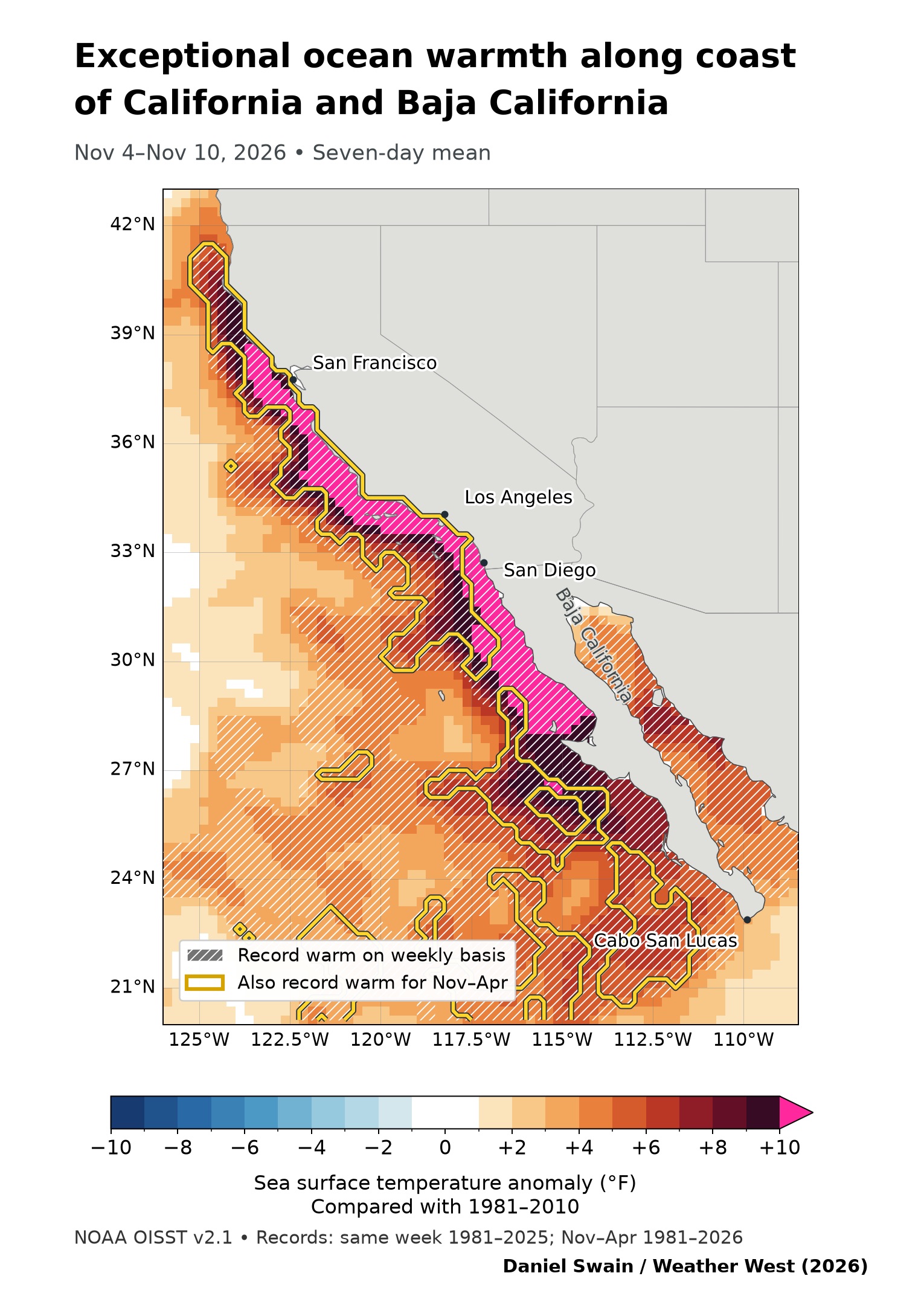
In recent days, temperatures peaked around 65 to 66 degrees and are not cooling right now, according to Swain.
“I wouldn’t call it balmy warm, but I mean, 65 degrees is noticeably warmer than 55 degrees,” Swain said during his Nov. 6 office hours. “There are some folks who will brave 65-degree oceans without a wetsuit, whereas they wouldn’t do it at 55 degrees.”
Swain called it a “pretty significant, noticeable, perceptible difference.”
Normal temperatures for this time of year would be in the 56-degree range, but temperatures are around 10 degrees above that norm, and will likely continue to warm as warm waters push north from the equator.
“We’re 10-plus degrees above average and two to three degrees beyond the previous record for any point this late in the calendar year,” Swain said.
The warm water signals El Niño’s growing influence. This natural climate phenomenon, worsened by human-caused climate change, doesn’t occur in California. It is characterized by warm waters, thousands of miles away, in the equatorial Pacific.
Persistent trade winds reverse, and a massive bulge of warm water lurches toward South America, with that water splitting north and slowly moving up the coastline — warming and thickening the ocean’s surface.
The warming matters because marine life depends on cold upwelling, which brings nutrient-rich water to the surface and in turn fuels one of the richest and most biologically diverse marine ecosystems globally.
When the upwelling diminishes during an El Niño year, “fish either die or migrate into areas where they’ll find more to eat,” according to the State of California Department of Fish and Wildlife.
“With the fish gone, sea birds that depend on them may die or go elsewhere,” state officials wrote. “Kelp forests are often destroyed by storms and ocean swells.”
The warming isn’t limited to the Farallon Islands. Swain said record ocean temperatures have been recorded “from about Newport Beach contiguously northward to Eureka.”
“Not only is the water warmer than it’s ever been at this time of year, but in fact, it is warmer than it has ever been at any point after Nov. 1. and before May in any previous year,” Swain said. “These are record-shattering temperatures for the cool season.”