Ditching Gas in Restaurant Kitchens Could Slash California Emissions
Here are the morning’s top stories on Wednesday, November 11, 2026
- Attorney General Rob Bonta is urging a federal appeals court to maintain protections for the health of detainees… who sued the Trump administration over dangerous conditions at an immigration jail in California’s Mojave Desert.
- Alameda County is demanding that ICE stop conducting immigration enforcement at Santa Rita Jail.
- California is flying as fast as it can to fight climate change. Experts say there’s one field the state has overlooked that could make a big impact: Getting restaurants to cook with electricity instead of gas. But this can be expensive and unfamiliar for many.
A year ago, seven people filed a class-action lawsuit over conditions at ICE’s largest lock-up in the state: the California City Detention Facility.
A judge ordered ICE to improve things and allow an independent monitor into the facility, while the case unfolds.
Now Bonta is weighing in with the Ninth Circuit Court of Appeals. His office inspected California City last year and found what he calls “crisis-level understaffing for health care,” denial of access to outside medical specialists, and “shockingly inadequate” and “inhumane conditions.”
He filed a similar amicus brief last year in a lawsuit over conditions at an ICE facility in Adelanto California.
Alameda County Interim Counsel Andrea Weddle penned a cease-and-desist letter to ICE on Monday, writing that ICE has ignored warnings from the sheriff’s office that they are not allowed to use the jail parking lot and lobby for operations. The letter notes agents have chased people in the parking lot and confronted them in the lobby.
Here’s county supervisor Nikki Fortunato Bas:
“I would say a lot of them are rogue… incredibly untrained and unprofessional and they should not be allowed to be conducting themselves in the way that they are doing. It’s causing a lot of fear as well as safety concerns.”
Members of the county-backed immigration-related rapid response network ACILEP said they believe that, starting around Oct. 25, rotating groups of up to six ICE agents began using the parking lot outside Santa Rita Jail as a hub for detaining people exiting and entering the facility.
ICE did not respond to a request for comment.
The Board of Supervisors approved a policy earlier this year prohibiting the use of county property for civil immigration enforcement.
It’s the evening dinner rush at Flour and Water Pizza Shop in downtown Oakland. Line cooks plop chicken wings in deep fryers, and CEO Thomas McNaughton assembles a margherita pizza.
It’s a bustling full service kitchen. But one thing you won’t find here? A single gas flame.
“Flour & Water pizza shops are all electric,” says McNaughton
Everything from the cooktops to the ovens that churn out hundreds of pies a day run on electricity. For a long time, It’s not something McNaughton thought was possible.
“If you said to me 10 years ago, ‘an all electric deck oven,’ like Susie Homemaker with the Easy Bake Oven comes to mind.”
But times have changed, McNaughton says electric deck ovens now outperform gas ones. About three years ago, he had a lightbulb moment: “Couldn’t we build our entire operation around electricity?” The answer was yes. All of their new restaurants are all-electric.
For McNaughton, it’s a way to help the restaurant group achieve its sustainability goals. But Flour and Water is an outlier – most restaurants in California use gas.
Rob Jackson is calibrating sensors at his lab at Stanford University. He measures emissions from gas stoves.
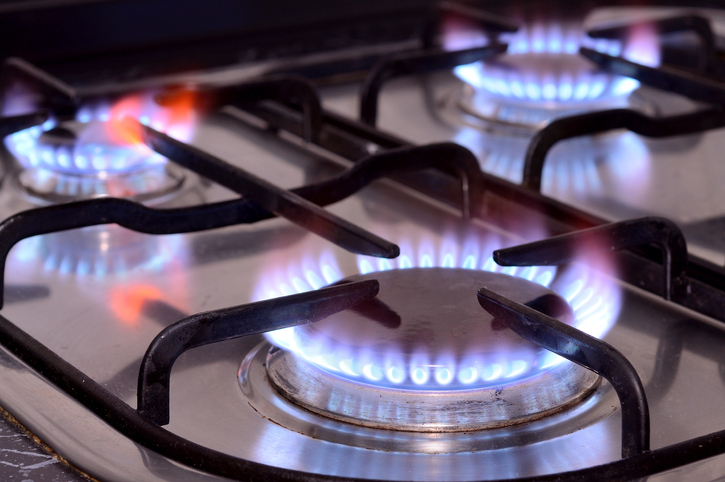
He says we’re a gas-heavy state. About 85% of California restaurants use gas. Those stoves leak fumes that increase the risk of health issues like asthma and heart disease.
”You would never stand over the tailpipe of your car breathing in those pollutants,” said Jackson. “And yet people stand over the stove breathing the same pollutants day after day, meal after meal.”
He says electrifying is the best way to make kitchens healthier for ourselves, and the planet, but that can be a tall order.
”Let’s not sugarcoat it,” says Jackson. “It’s not easy right now to electrify when you already have gas.”
Brady Seals is the Director of the Electrification for Health program at Stanford. She says making the switch can be expensive. Most commercial kitchens already have hookups for gas appliances, but not the upgraded wiring for electric ones.
And industry trade groups like the California Restaurant Association have opposed electrification mandates. When the city of Berkeley passed a first-in-the-nation ban on gas hookups in new construction in 2019, the CRA sued, forcing Berkeley to overturn the ban about five years later. Here’s how they put it when they announced the lawsuit on YouTube:
”What about searing meat, charring vegetables, or cooking food in a wok over high-intensity heat? All of that would go away.”
The idea that you can’t cook a classic wok stir fry with an electric stove just isn’t true, according to southern California-based caterer and “chefluencer” Katie Chin.
”You just have to keep an open mind that Asian cooking isn’t synonymous with the blue flame.”
She says it’s taken a little learning, but induction burners — which use electromagnetic energy — get super hot, super fast. And it’s made her a better cook.
“ And I’m not so cranky ’cause it’s cooler in my kitchen.”
While Berkeley’s natural gas ban was defeated in the courts, the state is making progress. In 2024 California mandated that many kinds of new construction be built ready to go all-electric.
At Flour and Water, CEO Thomas McNaughton says he sees a future where gas is no longer an option.
”We have never said, ‘Oh man, I really wish we had a six burner all-gas range,’ ” he said. “You hungry? Do you wanna eat a margarita?”
So when he offers me a slice from their all-electric kitchen… it just might be a taste of the future.
Reported by: Azul Dahlstrom-Eckman, KQED, for the Flipping The Switch series exploring California’s transition to clean energy.