A Park for the Living, Rest for the Dead: The Shared Space of Mountain View Cemetery
View the full episode transcript.
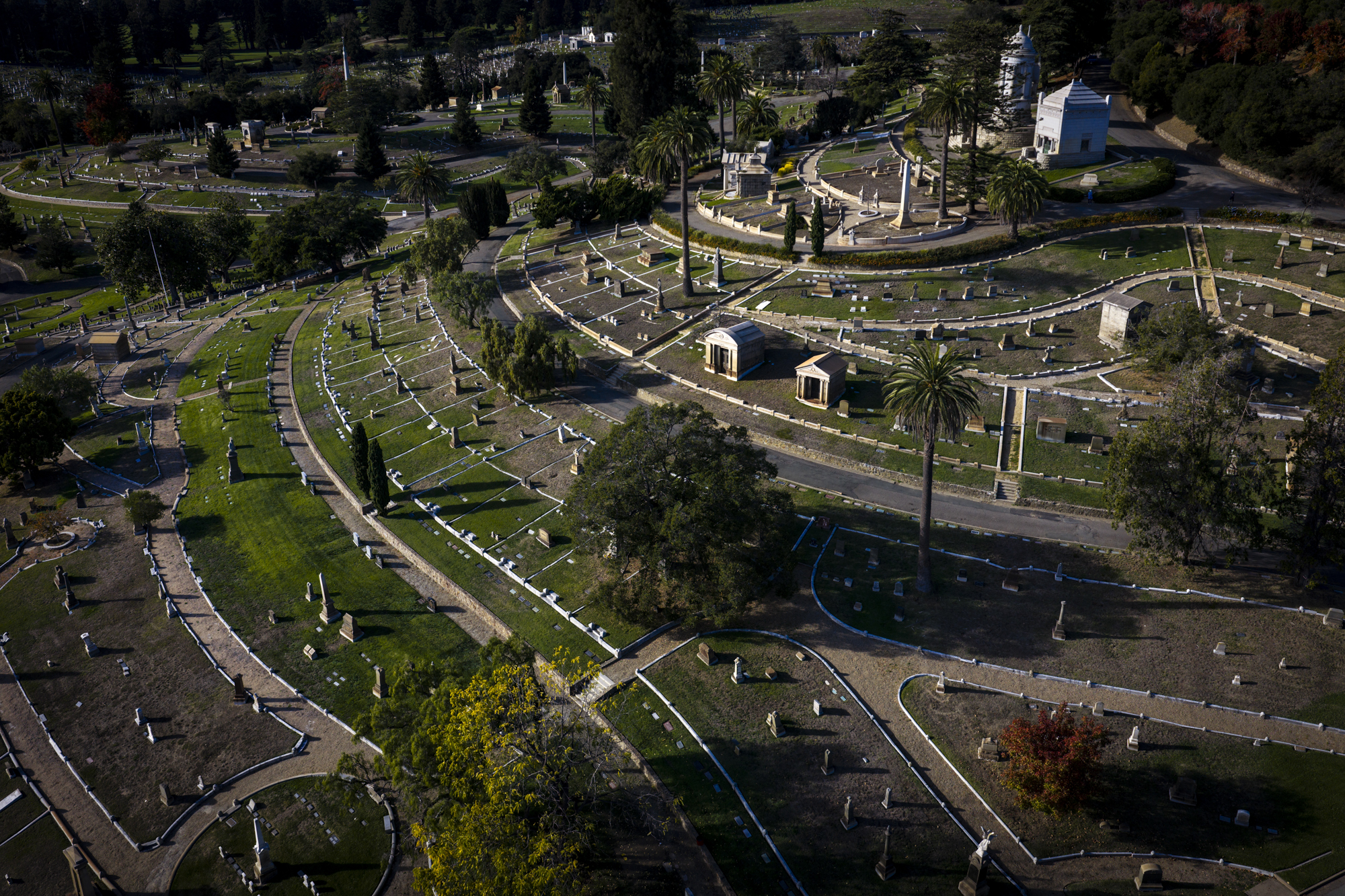
Up in the hills above Oakland’s Piedmont Avenue is a beautiful, peaceful stretch of more than 200 acres of land, dotted with little lakes, ornamental trees and thoughtful winding paths. It’s something of a public park: Locals picnic here. Walk their dogs. Bring their kids to play.
But they also come to mourn the dead, because this isn’t a city park. This is Mountain View Cemetery.
Bay Curious listener Sarah Fockler wanted to know if this cemetery was originally designed to be used as a public park.
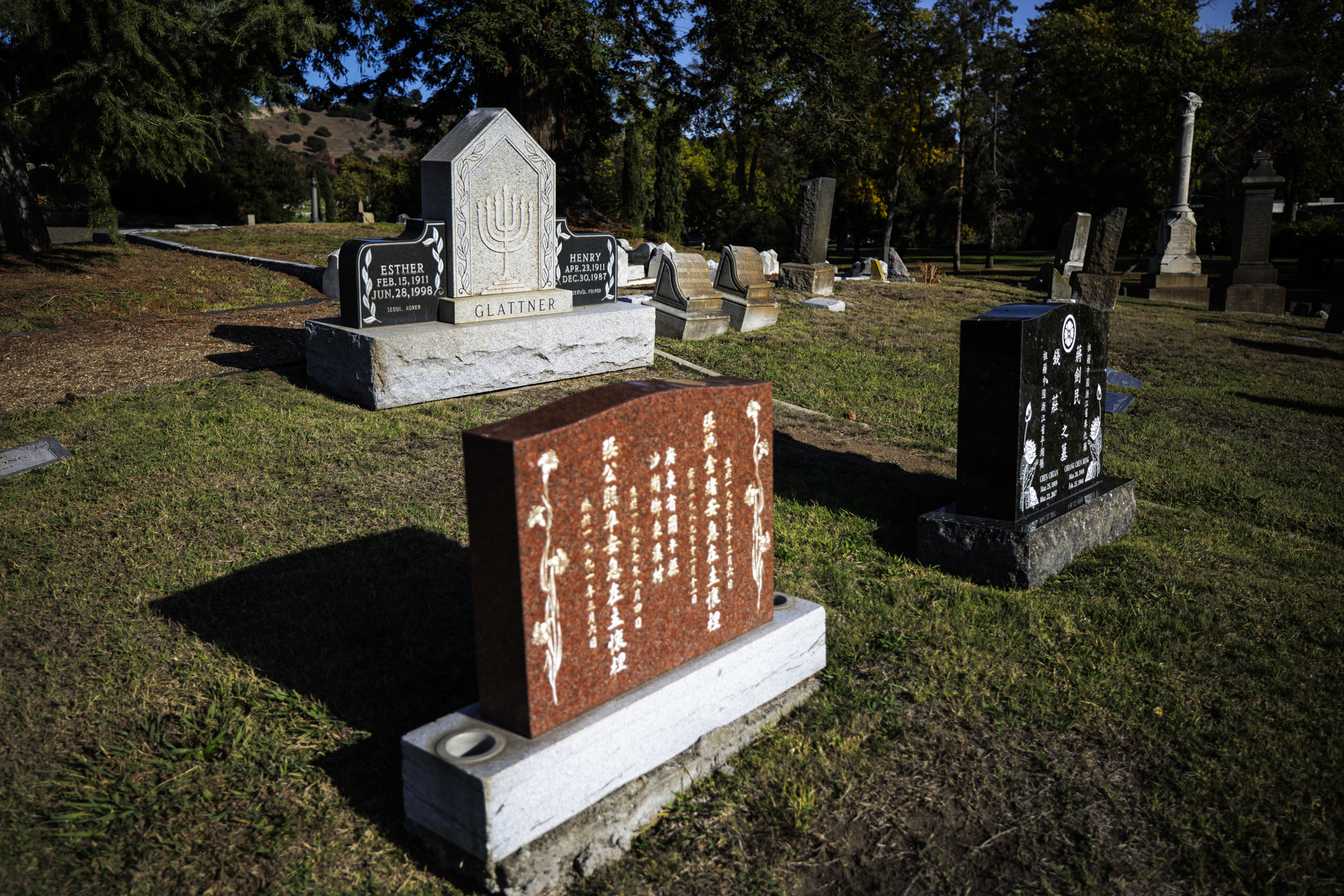
“I think it’s a really interesting place,” Fockler said. “There are people grieving or visiting graves, as well as a public recreation area, and one that’s very popular.”
The origins of Mountain View Cemetery
The Mountain View cemetery got started in 1863. The City of Oakland was just eleven years old at the time, but it had already filled up one cemetery, and most of a second.
“Nobody wanted a cemetery in town anymore,” said historian Dennis Evanosky, a docent at Mountain View for more than 30 years. “Especially when they fill up, what are you gonna do?”
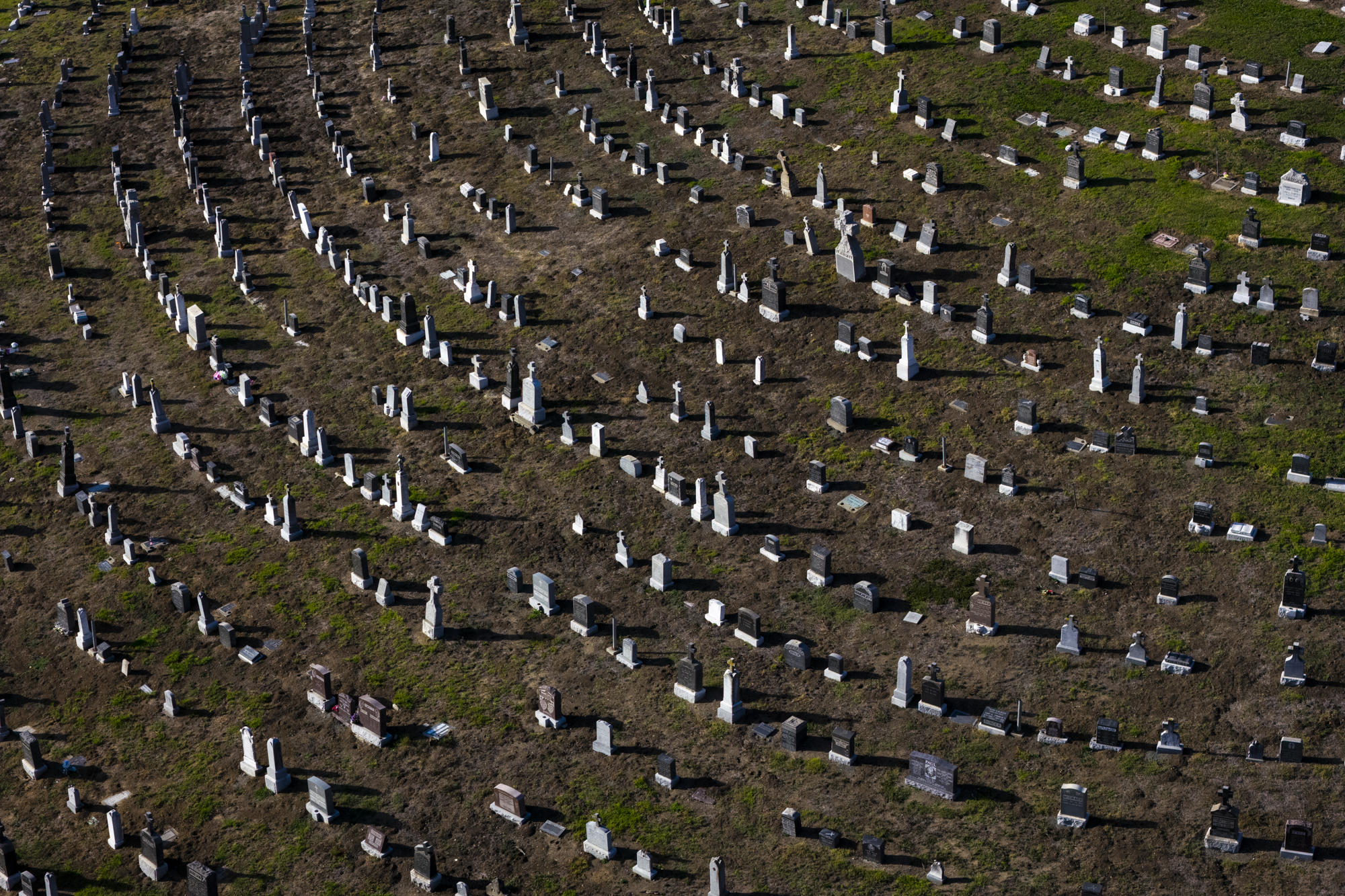
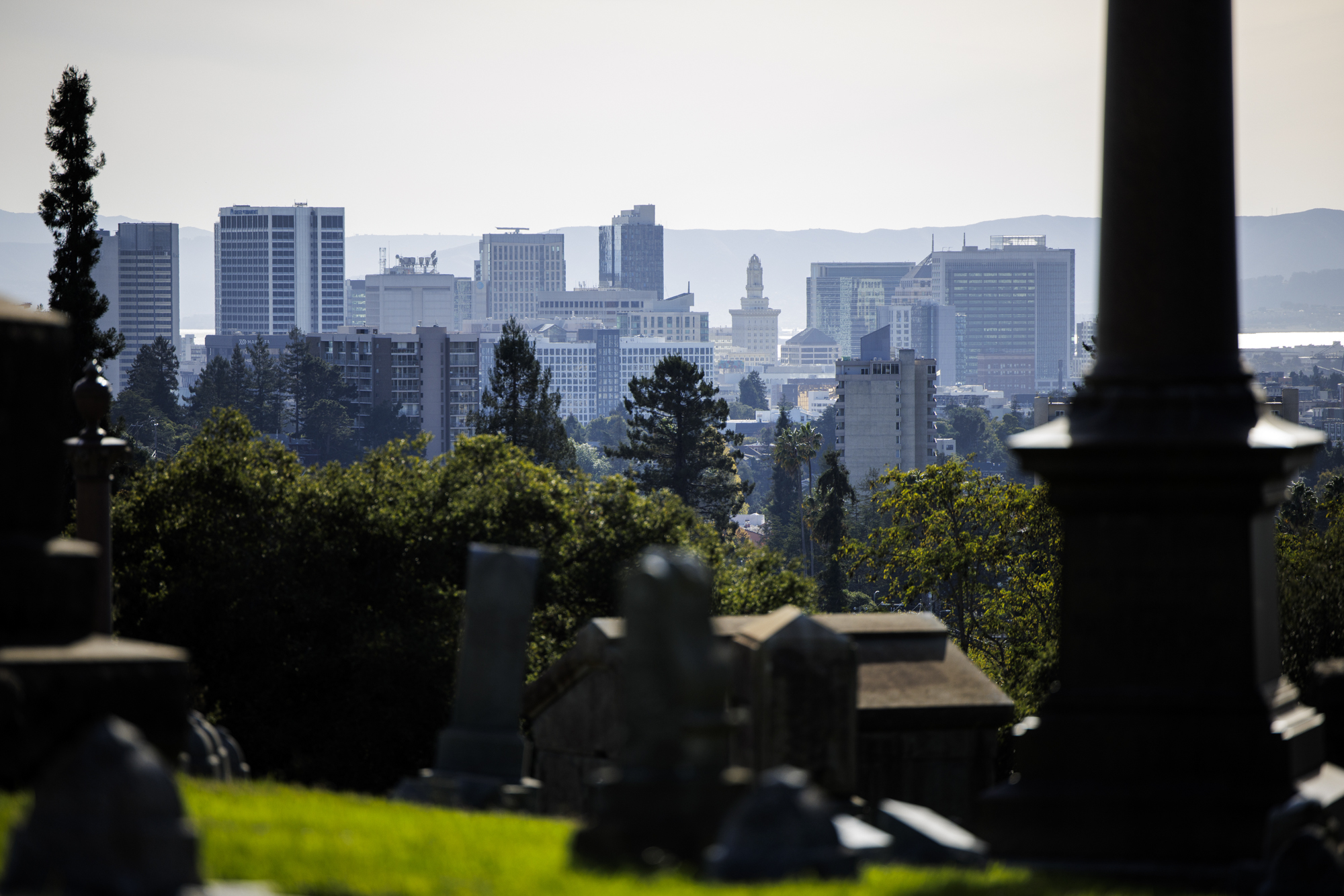
Samuel Merritt, who would soon become mayor of Oakland, called a meeting with other wealthy businessmen. They wanted the bodies moved out of the old cemeteries, which were right downtown by what’s now Lake Merritt, to make way for streets and houses.
They envisioned a new, grand, European-style, park-like cemetery instead, well outside of the city limits of the day.
The businessmen offered the job of designing their new cemetery to Frederick Law Olmsted, who was already famous for having designed New York’s Central Park. He accepted, and wrote up a thoughtful, detailed plan featuring curving paths that followed the shapes of the hills and specifications for which trees and shrubbery would “prompt the consolations of faith.”
He suggested “the heaven-pointing spires of the immortal cypress [tree].”
Though his plan didn’t say anything about public recreational use, the cemetery, once constructed, was immediately recognized as exceptionally beautiful.
Today, there are around 210,000 people interred here. Millionaires, children, victims of the 1918 Spanish flu epidemic and death row inmates are among the inhabitants of Mountain View Cemetery – as diverse as the living who walk its grounds.
A few unsettling stories
Since it’s almost Halloween, Michael Colbruno, who, together with Evanosky, wrote Lives of the Dead at Mountain View Cemetery, shared some of the wilder stories buried here.
“We’ve got murder and mayhem,” Colbruno said.
In a mausoleum with stained glass windows is a grave marked only with a mildewed paper card that reads “Frank Paul Gonzalez.” Gonzalez was an Olympic athlete who competed with the Philippine sailing team in 1960.
Afterward, Gonzalez moved to the Bay Area and fell deep into debt. On May 7, 1964, he was flying back from a gambling trip in Reno. As the plane passed over the East Bay, Gonzalez went into the cockpit, shot both pilots in the head, and then shot himself.
The plane crashed, killing all 44 people aboard.
No one ever came to claim his remains. No one paid for his burial. But Evanosky said cemeteries are required to take certain bodies.
“It’s done on a rotating basis,” he said. “And if it’s Mountain View’s turn, they come here.”
Another grim story lies higher up the hillside at a tall, graceful Victorian vault. It was made in 1866 for Civil War surgeon Orran Warren, who was buried there with several family members.
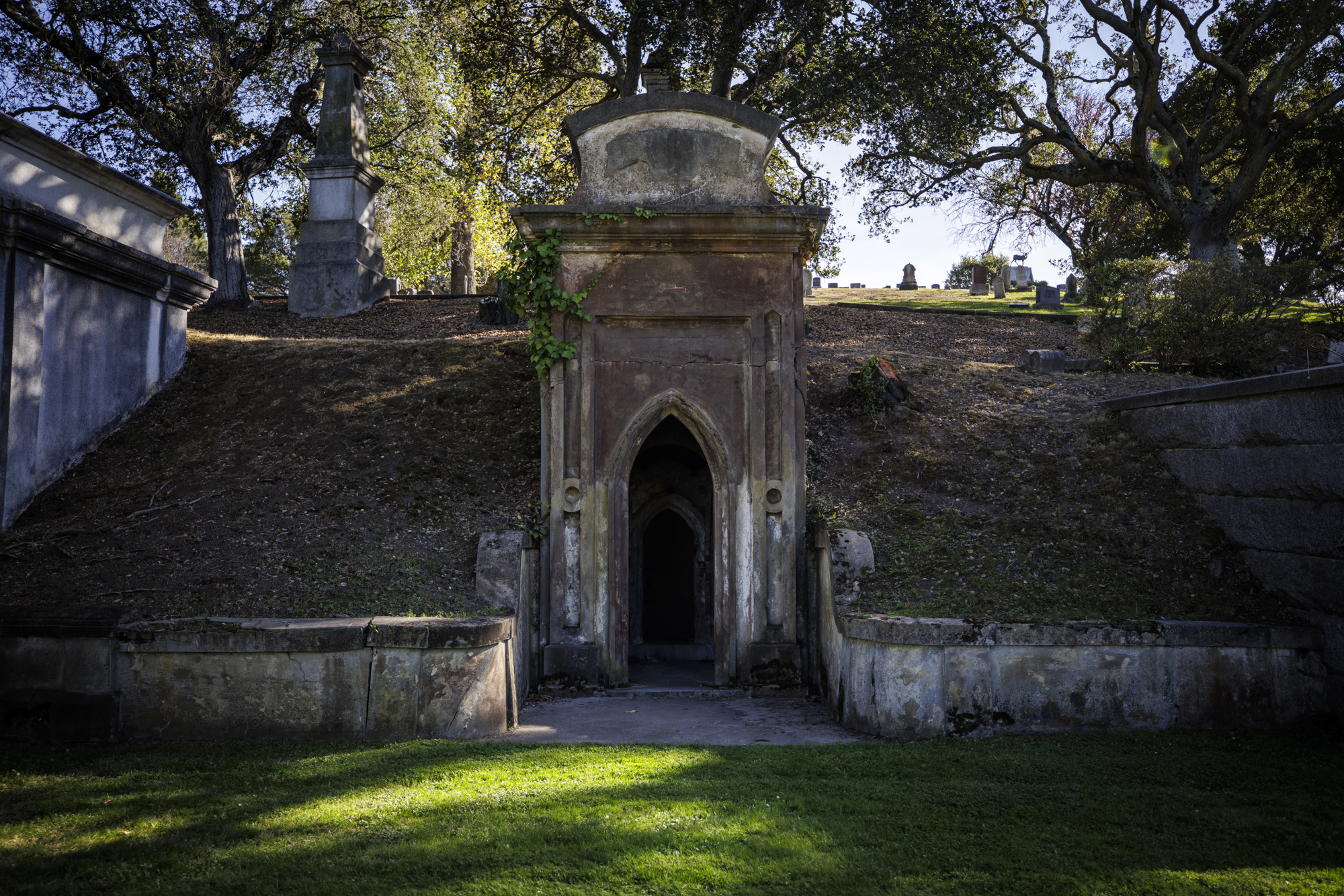
In 1988, a Skyline High School graduate, together with an accomplice, forced open the door to the vault, got into the caskets and removed four of the corpses’ heads.
Evanosky was a local newspaper reporter at the time, so he was on the scene with sheriff’s deputies when the crime was discovered.
“We found two skulls . . . in Walgreens bags,” Evanosky said. “I took them out of the bags.”
Two other skulls were gone. Colbruno thinks the thieves were involved in devil worship.
“That’s why they had come in here to steal the skulls,” Colbruno said. “They were gonna use them for their rituals.”
One of the perpetrators was caught and charged, but he refused to give up his accomplice or the location of the two missing skulls.
“But then, maybe five or six years ago, I got a call,” Evanosky said. Someone had mailed a skull to the cemetery, using a fake return address. The staff called the coroner’s office, which verified that it was one of those missing from the vault.
Evanosky and the staff returned it to its place.
“I went down to the florist shop here, and got a dozen roses,” Evanosky said. “And then the place is all clean, with roses on the ladies’ graves.”
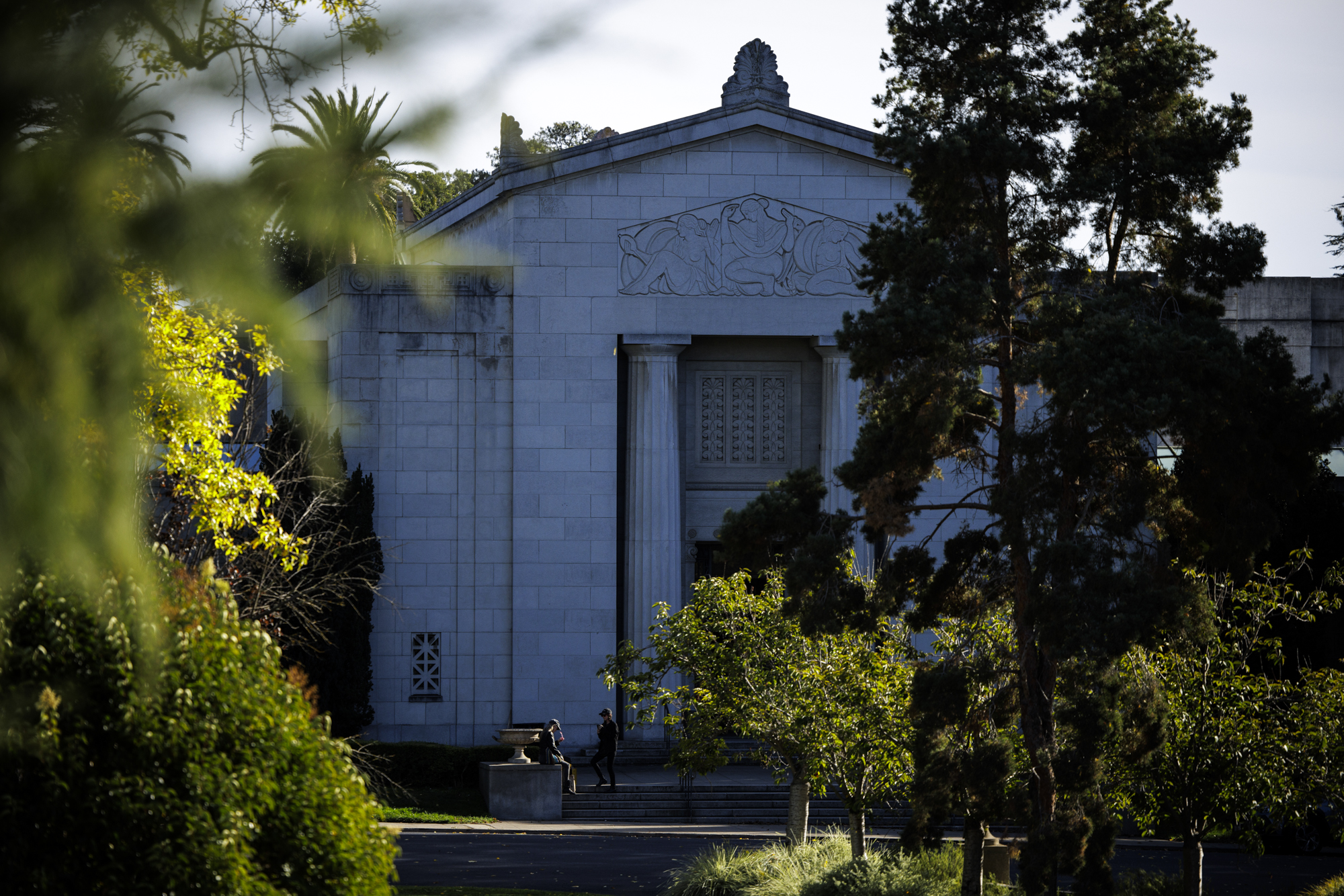
These days, people come and take wedding photos in the doorway of the Warren family vault – which is still open after the break-in. They probably have no idea about the grisly crime.
A peaceful park for all
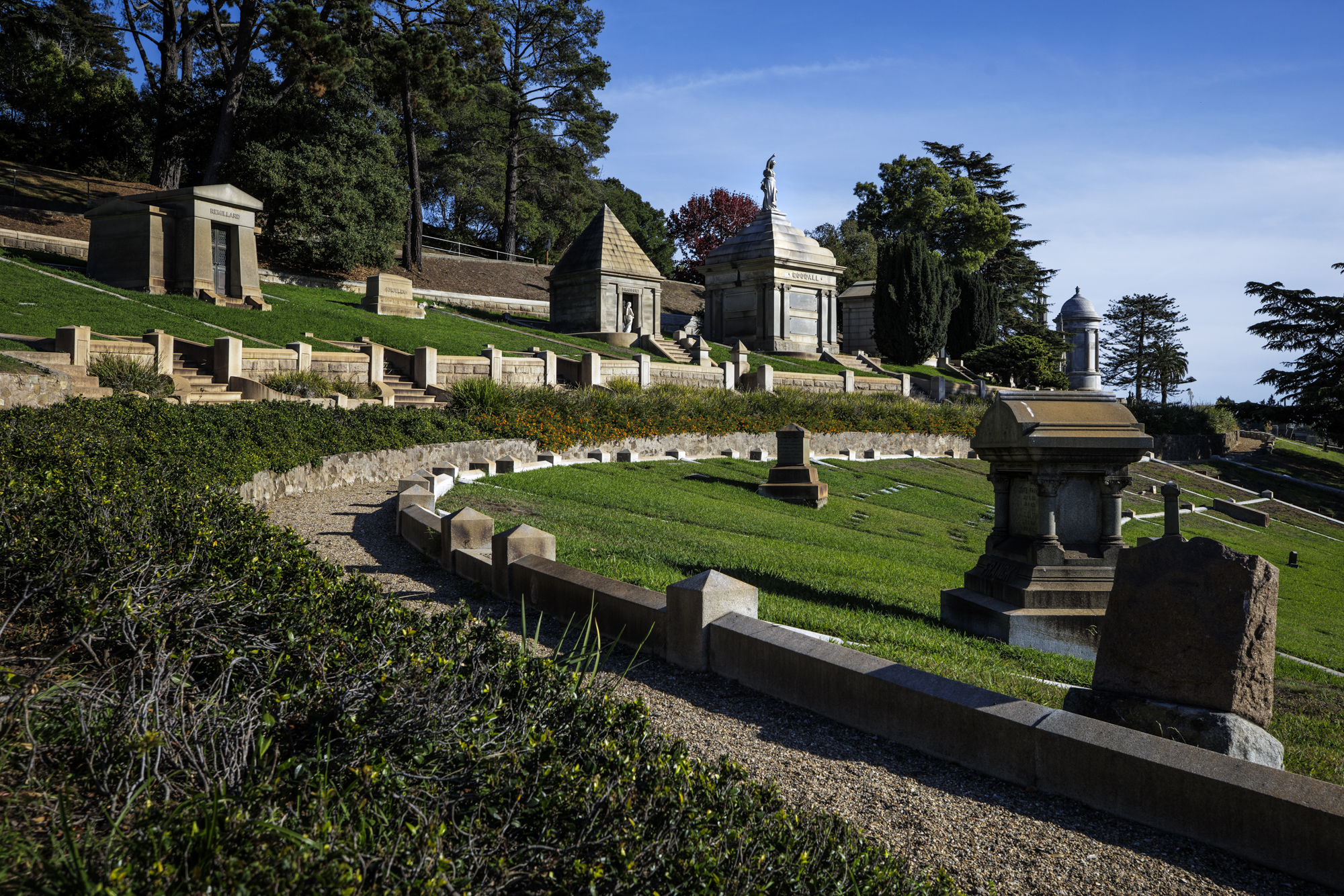
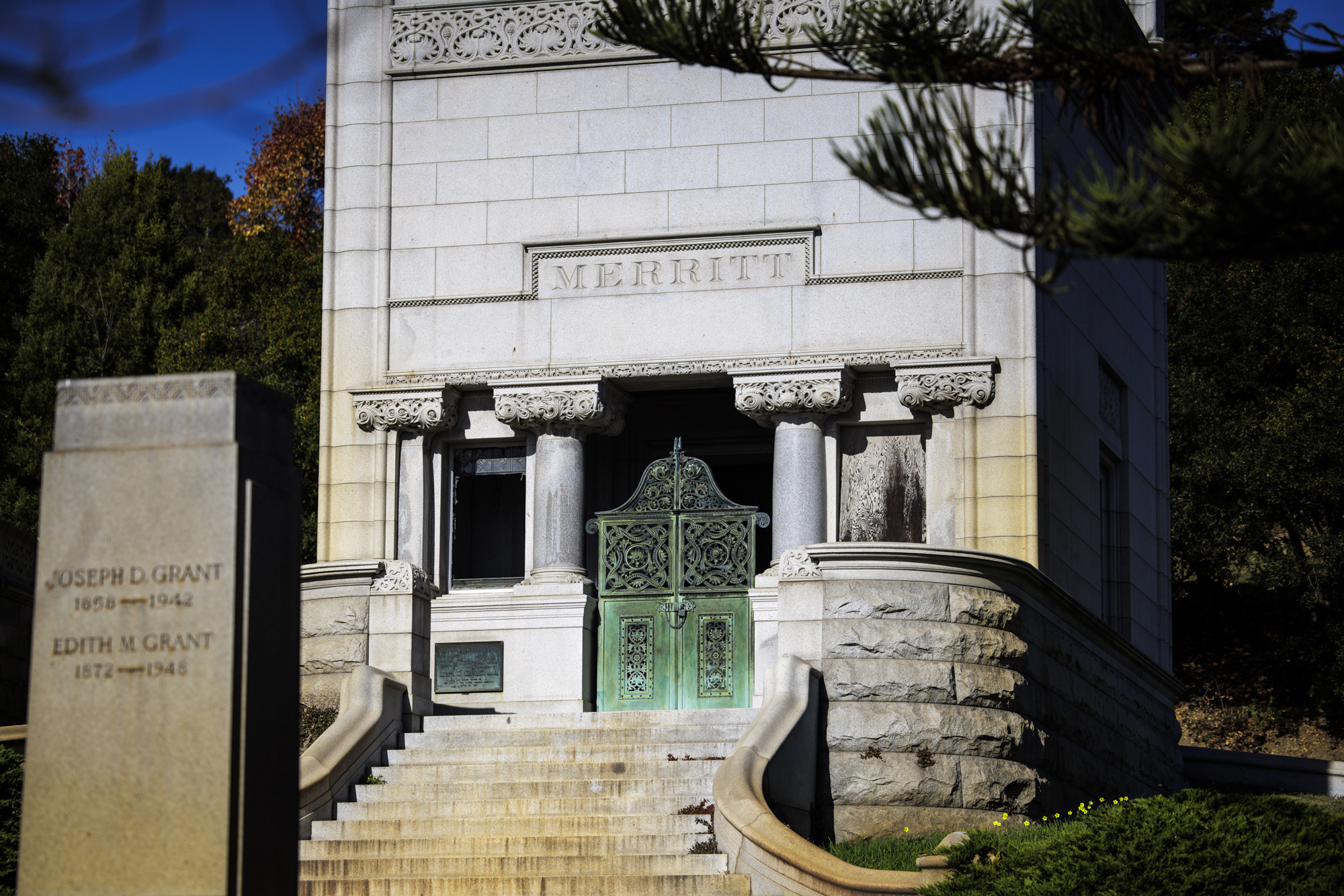
Further still up the winding paths is what’s called Millionaire’s Row – a line of huge, spectacular monuments. Domingo Ghirardelli of chocolate fame has an Egyptian Revival style mausoleum as big as a small house.
Oakland Mayor Samuel Merritt’s is a replica of one of the seven wonders of the ancient world. Next to it is the 60-foot-tall domed cylinder that houses railroad tycoon Charles Crocker. He had it built to look like a Greek temple.
Oakland residents Heather Riffel and Hannah Young strolled by them in the shade of the oak trees. They said they’d been having a deep talk on their visit.
“I feel like it’s essential to this city, to all of us, to have places to zoom out and get perspective,” Young said.
When Frederick Law Olmsted laid out these winding paths back in the 1860s, he envisioned a place where grief and beauty could coexist. A space for the dead and the living.
He wrote in his plans: “Hence, no place of burial is satisfactory to us, which does not exhibit, besides evidences of respect paid by individuals and families to the memory of their own dead, evidences also of respect paid by the community of the living to the community of the dead.”
So maybe it was part of his vision for people to come to the cemetery for enjoyment. This is, after all, the only cemetery Olmsted ever designed. He’s most remembered today for his parks and college campuses.
“I think if I was dead, I would want the company showing up at my tombstone, just hanging out,” Riffel said.
Whether you come here to trace the names of Oakland’s past or just watch the sunset over the Bay, Mountain View Cemetery reminds us that the living and the dead can share this city. And maybe, in a place like this, neither side is ever truly alone.
Episode transcript
Olivia Allen-Price: If you ask people who live near Piedmont Avenue in Oakland where to go and watch the sunset, you might get an answer you don’t quite expect. Up in the hills is a beautiful, peaceful stretch of more than 200 acres of land, dotted with little lakes, ornamental trees, and thoughtful winding paths. This place is something of a public park – locals picnic here, walk their dogs, bring their kids to play, but they also come to mourn the dead. Because this isn’t a city park, this is Mountain View Cemetery.
Sarah Fockler: I believe during COVID, they had to shut it down to recreational users because so many people were using it.
Olivia Allen-Price: That’s Bay Curious listener Sarah Fockler. She lives in Oakland and likes to walk at Mountain View Cemetery for exercise and the sweeping views of downtown, the Bay, even San Francisco. And she likes the history of the place. The cemetery is more than 150 years old.
Sarah Fockler: Even the graves themselves, you know, being in several different languages and from a vast time period, it’s as diverse as Oakland itself.
Olivia Allen-Price: Saraf wanted to know if this cemetery was originally designed to be used the way it is today, essentially as a public park. I think it’s a really interesting place.
Sarah Fockler: The idea that there are people grieving or visiting graves, as well as a public recreation area and one that’s very popular.
Olivia Allen-Price: This is Bay Curious, the show that answers listener questions about the Bay Area. I’m your host, Olivia Allen-Price. To find out more about the cemetery’s origins, and also because it’s almost Halloween, we sent reporter Katherine Monahan to wander around the place. It turns out that things here aren’t always as bucolic as they seem.
Katherine Monahan: At the entrance to the Mountain View Cemetery, there’s a tall fountain and a circular pool surrounded by trees. Just beyond, people are strolling in the sun.
Lake Patterson Greer: I wish I had a ghost costume.
Katherine Monahan: That’s Lake Patterson Greer. He’s walking with his mom, Paige Patterson.
Paige Patterson: He’s been seeing a lot of Halloween decorations, and I said those are headstones, and he said, what is that? So that’s why we’re here. He’s really curious about death and about where bodies go.
Katherine Monahan: Lake looks at ease playing among the grave markers.
Lake Patterson Greer: When can we dig up the people?
Paige Patterson: We don’t dig up the people. Yeah, we’re respectful of them. When people’s families choose to put them in the ground, we leave them in the ground.
Katherine Monahan: Good rule of thumb. Interestingly, someone actually is digging up a body, just a little deeper into the cemetery. A big machine hoists a casket out of the earth, swings it carefully onto a green cart, and a worker drives off with it.
Dennis Evanosky: Yeah, somebody is being moved.
Katherine Monahan: Dennis Evanosky has been a docent here at the cemetery for almost 30 years.
Dennis Evanosky: Families will be crushed that somebody’s buried here and they want to put them someplace else. Right on time for Halloween, an exhumation!
Katherine Monahan: Evanosky says moving bodies around is actually part of how the Mountain View Cemetery got started in 1863. The city of Oakland was just 11 years old at the time, but it had already filled up one cemetery and most of a second.
Dennis Evanosky: Nobody wanted a cemetery in town anymore. So especially when they fill up, what are you gonna do?
Katherine Monahan: Samuel Merritt, who would soon become mayor of Oakland, called a meeting with other wealthy businessmen. They wanted the bodies moved out of the old cemeteries, which were right downtown by what’s now Lake Merritt. They wanted to build streets and houses there instead. As for where to put the bodies, they envisioned a new grand European-style park-like cemetery instead, well outside of the city limits of the day.
Dennis Evanosky: They discovered Frederick Law Olmsted was in town, and Olmsted was very, very famous for having designed Central Park.
Katherine Monahan: So the businessmen offered Olmsted, who was probably the best-known landscape architect of the day, the job of designing their new cemetery. He accepted and wrote up a thoughtful, detailed plan. His design featured curving paths that followed the shapes of the hills and specifications for which trees and shrubbery would prompt the consolations of faith. He suggested the heaven-pointing spires of the immortal cypress tree. Though his plan didn’t say anything about public recreational use, the cemetery, once constructed, was immediately recognized as exceptionally beautiful and began attracting both the living and the dead. An 1876 newspaper article in Oakland’s Morning Times said…
Voiceover: No wonder that sincere and thoughtful mourners remove the bodies of loved ones from the bleak and dreary wastes to the cheerful and soothing surroundings of our own silent home of the dear departed.
Katherine Monahan: It was a peaceful place and popular from the start.
Olivia Allen-Price: We have to take a quick break. When we return, some unsettling stories. Stay with us.
SPONSOR MESSAGE
Olivia Allen-Price: And we’re back, walking around Mountain View Cemetery with KQED’s Katherine Monahan.
Katherine Monahan: Today, there are around 210,000 people buried here, and a few of them come with wild stories. Dennis Evinowski and his fellow docent, Michael Colbruno, are ready to share. The two of them actually wrote a book together called Lives of the Dead.
Dennis Evanosky: Oh yeah, I’ll tell you. For Halloween, we have a very special skull story.
Katherine Monahan: First, they want to show me the grave of a mass murderer.
Dennis Evanosky: Let’s do it. He’s right in that little white building.
Michael Colbruno: Let’s go across.
Katherine Monahan: Colbruno leads us to a mausoleum with stained glass windows. Inside, the walls are set with graves, floor to ceiling like filing cabinets. Colbruno points out one towards the back, which, unlike most of the others, doesn’t have an engraved nameplate.
Michael Colbruno: And this just has a little paper card, which is still original from 1964.
Katherine Monahan: It’s mildewed, but you can make out the typed name. Frank Paul Gonzalez. He was an Olympic athlete, competed with the Philippine Sailing Team in 1960.
Michael Colbruno: But unfortunately, he has become notorious for something other than his Olympic days, which is he moved to the Bay Area and he accumulated a massive gambling debt.
Katherine Monahan: González was flying back and forth to Reno regularly to gamble, and on one of the return flights.
Michael Colbruno: He went into the cockpit and shot both pilots in the head, and the plane crashed over in the East Bay, and all the passengers aboard were killed.
Katherine Monahan: 44 people. No one ever came to claim his remains. No one paid for his burial. But Evanosky says cemeteries are required to take certain bodies.
Dennis Evanosky: It’s done on a rotating basis, and if it’s Mountain View’s turn, they come here, and normally they would just cremate you.
Katherine Monahan: Back outside, we walk on past immaculate lawns with graceful trees, but up in a corner, there’s a section that looks a little less cared for.
Dennis Evanosky: We have the stranger’s plot across the way, and that’s where they’ll find you on this side of the road. They don’t know who you are.
Michael Colbruno: The stranger’s plot also has some death row inmates over there from San Quentin.
Katherine Monahan: But people with social standing and a lot of money could get a tall, lovely hillside vault big enough for them and their family.
Dennis Evanosky: We’re almost to it, coming right up here on the right-hand side here.
Katherine Monahan: Like Dr. Oren Warren did. He was a Civil War surgeon, and in 1866, he had one of the cemetery’s first monument-sized vaults made. It’s tucked under trees along one of main roads, and it’s the site of one of Evinowski’s wildest stories.
Dennis Evanosky: The Stolen Skulls.
Katherine Monahan: Warren and his family rested peacefully in the vault until 1988, when a Skyline High School graduate, together with an accomplice, came in the dark of night.
Dennis Evanosky: They forced this door open.
Katherine Monahan: Got into the caskets and one by one removed four of their heads. Evanosky was a local newspaper reporter at the time, so he was on the scene with sheriff’s deputies when the crime was discovered.
Dennis Evanosky: We found two skulls in Walgreens bags. I took them out of the bags.
Katherine Monahan: Two other skulls were gone. Colbruno thinks the thieves were involved in devil worship.
Michael Colbruno: They interviewed kids at Skyline High School who said that these guys were into monsters and goblins. That’s why they had come in here to steal the skulls. They were going to use them for their rituals.
Katherine Monahan: One of the perpetrators was caught and charged, but he refused to give up his accomplice or the location of the two missing skulls.
Dennis Evanosky: But then, maybe five or six years ago, I got a call, and they said, Dennis, get down here, wait until you see this.
Katherine Monahan: Someone had mailed a skull to the cemetery using a fake return address. The staff called the coroner’s office.
Dennis Evanosky: And they took part of a bone from in there, and they used that to match. And they said, it’s a match, and it’s woman.
Katherine Monahan: It was one of the missing skulls. Evanosky and the staff returned it to the vault.
Dennis Evanosky: I went down to the florist shop here and got a dozen roses, and then the place is all clean with roses on the ladies’ graves.
Katherine Monahan: These days, people come and take wedding photos in the doorway of the Warren family vault, which is still open after the break-in. They probably have no idea about the grisly crime. Further still up the winding paths is what’s called Millionaire’s Row, a line of huge, spectacular monuments. Domingo Ghirardelli of chocolate fame has an Egyptian revival-style mausoleum as big as a small house. Oakland Mayor Samuel Merritts is a replica of one of the seven wonders of the ancient world. Next to it is the 60-foot-tall dome cylinder that houses railroad tycoon Charles Crocker. He had his built to look like a Greek temple. Strolling by them in the shade of the oak trees are Oakland residents Heather Riffel and Hannah Young. Young says they’ve been having a deep talk on their visit today.
Hannah Young: I feel like it’s essential to the city, to all of us, to have places to, like, zoom out and get perspective.
Katherine Monahan: When Frederick Law Olmsted laid out these winding paths back in the 1860s, he envisioned a place where grief and beauty could coexist, a space for the dead and the living. Here’s a quote from his plans.
Voiceover of Olmstead: Hence, no place of burial is satisfactory to us which does not exhibit, besides evidences of respect paid by individuals and families to the memory of their own dead, evidences also of respect paid by the community of the living to the community of the dead.
Katherine Monahan: So maybe in a way, it was part of this plan for people to come here and enjoy. Here’s Riffel.
Heather Riffel: I think if I was dead, I would want the company just like showing up in my tombstone, just hanging out.
Katherine Monahan: Whether you come here to trace the names of Oakland’s past, or just watch the sunset over the bay, Mountain View Cemetery reminds us that the living and the dead can share this city. And maybe in a place like this, neither side is ever truly alone.
Olivia Allen-Price: That was KQED’s Katharine Monahan. Thanks to Sarah Fockler for submitting this week’s question. If you want more spooky-ish stories from Bay Curious, we made a Spotify playlist for you. Check our show notes for the link. If you love hearing listener questions get answered on our podcast, you should subscribe to the Bay Curious newsletter. We answer even more of your questions over there. We’re just about to send our November dispatch out, so subscribe now so you don’t miss it. KQED.org/newsletters is the place to go.
Sarah Fockler: Bay Curious is a production of member-supported KQED in San Francisco.
Olivia Allen-Price: Our show is produced by Katrina Schwartz, Christopher Beale, Anna Casalme and me, Olivia Ellen Price. We get extra support from Maha Sanad, Katie Springer, Jen Chien, Ethan Tovan-Lindsey and everyone on Team KQED. Big thanks to KQED members who help support our work. You can become one today by visiting donate.kqed.org slash podcasts. Some members of the KQED podcast team are represented by the Screen Actors Guild, American Federation of Television and Radio Artists, San Francisco, Northern California Local. I’m Olivia Allen Price. Happy Halloween.