Proposition 4 Would Let More Cities Fund Campaigns. In Oakland, That’s Been a Struggle
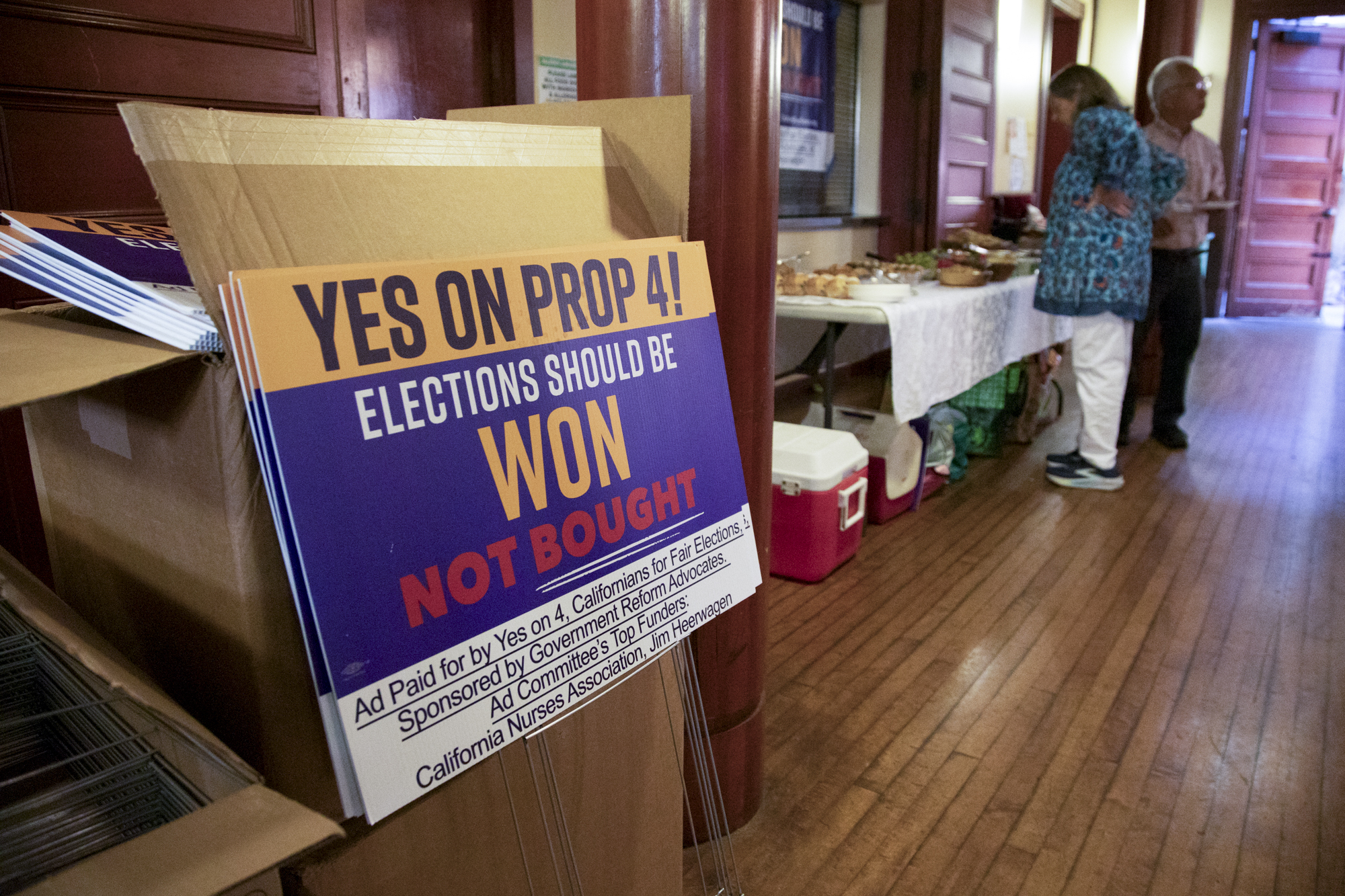
Trent Lange stands in front of a banner hastily taped to the wall reading “Elections should be won, not bought.” The message seems to resonate with the roughly two dozen activists gathered at the First Unitarian Church in downtown Oakland, all members of the California Clean Money Campaign.
“Who thinks that the amount of money in politics is outrageous and is corrupting our democracy?” Lange asks the crowd, which responds with a cheer. Lange and the grassroots organization he leads want to limit the growing influence of corporate donors on political campaigns.
It’s why they are rallying around Proposition 4, the measure on California’s November ballot that would allow all local governments to establish their own public campaign financing programs. Currently, most cities are barred from using taxpayer dollars for such programs.
“If we can lift this ban on public financing that stops communities from passing public financing, then we can empower voters [and] give candidates, good candidates, a chance to run for office and win — even when they’re not backed by corporate special interests,” Lange said.

Some charter cities exempted from the 1988 ban, including Los Angeles, San Francisco and Berkeley, have approved their own local public campaign financing programs. Here in Oakland, however, residents have yet to receive a single dollar from its signature public financing program as the city struggles to get it off the ground.
Oakland residents overwhelmingly voted to adopt the “Democracy Dollars” program in 2022, but city officials have delayed the program’s rollout twice now, citing the city’s massive budget shortfall.
“We’re disappointed that Oakland hasn’t found the money yet to pay for it, though we understand they are in a very serious budget deficit,” Lange said. “We think that the fact that over 70% of voters voted for Oakland to have a public financing system with democracy vouchers shows how much they want it — and it’s a good investment.”
It’s a problem that might not be unique to Oakland, even if Proposition 4 passes. While the measure would allow cities to create their own public financing programs, it wouldn’t provide any funding for cities to pay for them.
A promise delayed
Under Oakland’s Democracy Dollars program, each resident is supposed to receive four $25 vouchers they can donate to the local candidate of their choice. The city is required to allocate $4 million for the vouchers each election cycle, with unused funds rolling over to future elections.
The program was pitched as a promise to limit the undue influence of big corporate donors and empower Oakland residents to invest in the local candidates they believe in.
It was also seen as an opportunity to give grassroots candidates a fighting chance against those backed by special interests. Both are also arguments that supporters of Proposition 4 have made in favor of the measure.

Opponents, however, say taxpayer dollars should not be used to fund political campaigns, especially when cities and the state are trying to balance the budget.
“First and foremost, California isn’t doing a good job with its finances. They continue to raise taxes and cut services, both at the state and local level,” said Assemblymember Carl DeMaio, R-San Diego, who is urging a no vote on Proposition 4. “And now the politicians want to use our scarce tax dollars to fund their political campaigns. This is outrageous.”
In Oakland, city administrators initially signaled the Democracy Dollars program would be in place for the 2024 election cycle, though it was postponed until 2026. Now city officials say the full program could be on hold for two more election seasons.
“The Public Ethics Commission is planning for a potential scaled-down Democracy Dollars program for the 2030 election,” Suzanne Doran, executive director of the Oakland Public Ethics Commission, said in a statement. “Implementation would depend on available funding and city budget decisions; no launch date has been confirmed.”
Oakland’s Roadmap to Fiscal Health, the city’s multi-year plan to improve its financial outlook, includes a plan to fully fund the program in 2032. While Oakland is technically among the California charter cities that have a public financing program, Oaklanders have not had an opportunity to participate.
“The City of Oakland has to come up with creative solutions to make sure that we have that in place,” said Keith Brown, an Oakland resident and leader on the Alameda Labor Council, who attended the California Clean Money Campaign’s Proposition 4 rally in the city’s downtown.
Even though Brown understands his city faces a challenging financial situation, he said it doesn’t change his support for the city’s Democracy Dollars program.
“I think it must be a priority for all elected officials to come up with policies and solutions to promote democracy and bring democracy in the hands of working people,” Brown said.
Oakland’s delay in getting its campaign financing program off the ground could serve as a warning for advocates who want to see public financing spread to other municipalities.

The fact that Oakland’s Measure W contained a provision allowing the city to delay its implementation should be avoided for future program development, said Sean McMorris, program manager for transparency, ethics and accountability at the nonpartisan watchdog group California Common Cause. The group advocated for Oakland’s measure and is backing Proposition 4.
“I don’t think that is something we would recommend that jurisdictions do in the future because it isn’t out and it makes the program unreliable,” McMorris said. “Candidates need to know they’re going to be reliably able to use this program and they’re not going to have to worry about it being taken away from them from election to election.”
In neighboring Berkeley, Mayor Adena Ishii attributes the city’s public financing program for making it possible for her to run without access to wealthy donors. She also said it helped her make history as the first Asian American and woman of color to be elected mayor of Berkeley.
Ishii’s reliance on Berkeley’s matching funds program led her to run a grassroots campaign, focusing on individual donors in Berkeley rather than larger, corporate donors. It’s something she’d like to see Oakland do as well.
“It’s important to put your money where your mouth is, and if this is a priority to make sure it’s the will of the people that’s being represented in public office, then it’s important for cities to make sure that the funding is there too,” Ishii said.