“Sister, yesss!” What’s Behind the Viral Nun Podcast?
View the full episode transcript.
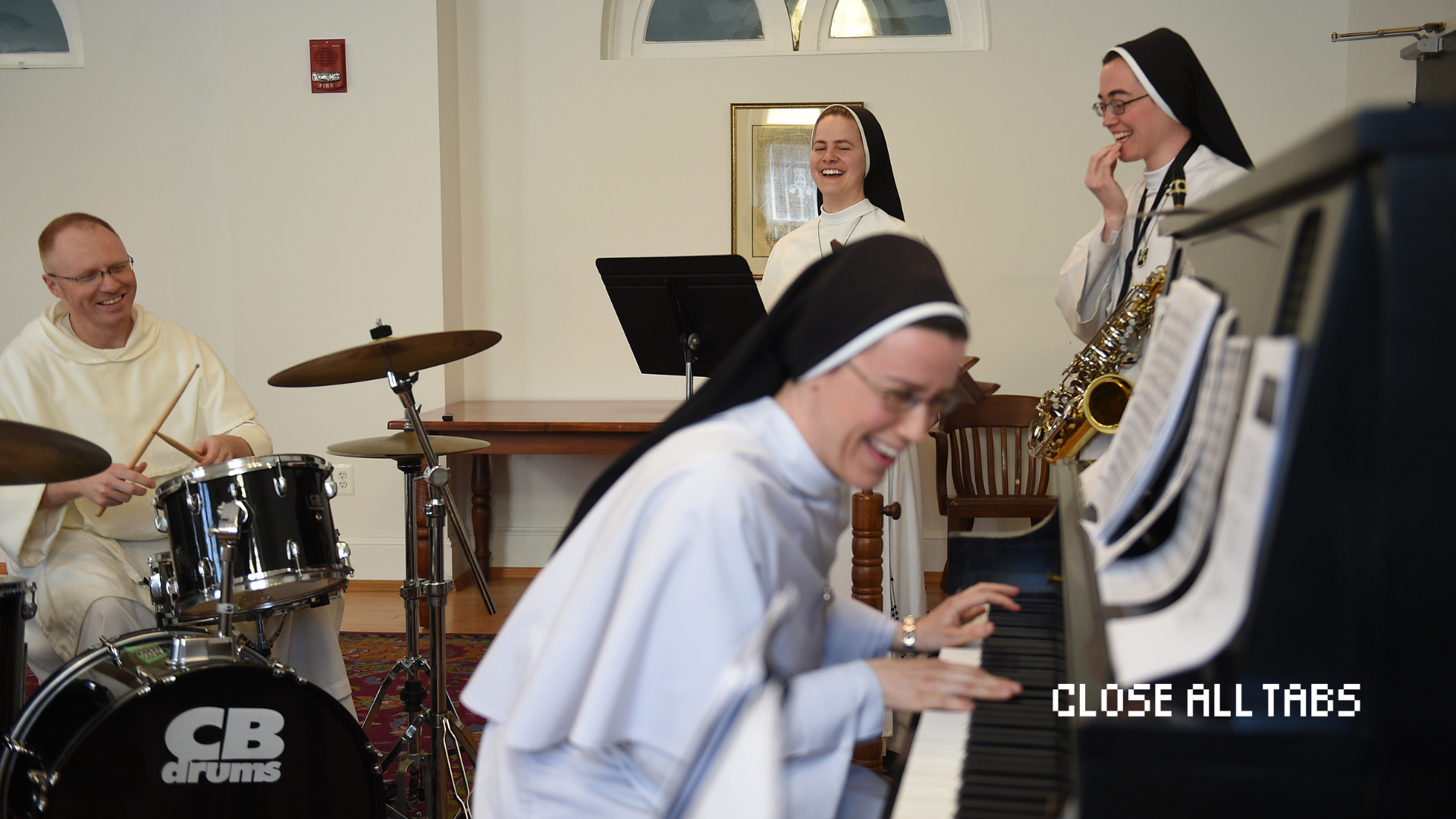
This year’s internet breakout star was an order of Catholic sisters with a podcast. Within weeks of launching, Dominican Sisters Open Mic went mega viral. Clips and fan edits of host Sister Miriam saying “Sister, yesss!” spread across social media. Secular women’s magazines and Catholic media alike dubbed this year a “nun girl summer.” At the same time, some have criticized the order behind the podcast for the conservative ideology baked into its educational content. In this episode, we explore how the Dominican Sisters of Mary rose to viral fame, the beliefs behind their easy charm and infectious laughter, and what it all says about the cultural moment we’re in.
Guests:
- Paul Dailey, director of marketing at Openlight Media
- Sister Thu T. Do, Sister of the Lovers of the Holy Cross of Hanoi and Research Associate at the Center for Applied Research in the Apostolate, Georgetown University
- Dr. Tricia Bruce, Sociology of Religion and Director of Social Science Research, Institute for Advanced Catholic Studies
- Matthew Remski, religion and politics journalist, co-host of Conspirituality and author of Antifascist Dad: Urgent Conversations with Young People in Chaotic Times
Further Reading/Listening:
- Don’t Call Them Nuns. They’re Podcasters. — Madison Malone Kircher, NYT
- Why Are So Many People Listening to a Podcast About Living in a Convent? — Luis Parrales, The Atlantic
- The TikTok Nuns Have Everyone in a Chokehold — Christen A. Johnson, Cosmopolitan
- The Next Hot Trend Might Just Be ‘Nun Girl Summer’ — Amy Glover, Huffington Post
Want to give us feedback on the show? Shoot us an email at [email protected]
Follow us on Instagram and TikTok
Episode Transcript
This is a computer-generated transcript. While our team has reviewed it, there may be errors.
Morgan Sung: Hello, do you like these deep dives? Do you want more? Then please rate and review Close All Tabs on Spotify, Apple Podcasts, or wherever you listen to the show. And tell your friends, tell your frenemies, stir up some drama and while you’re at it, it would be a huge help to get the word out. Okay, let’s get to the show.
Morgan Sung: This year’s internet breakout star was not a family vlogger, or a fashion influencer, or a Hype House type creator collective, but an order of Catholic nuns with a podcast.
[Clip from Dominican Sisters Open Mic]
Sister 1: Mary is so uncomplicated and we are.
Sister 2: Sister, yes!
Morgan Sung: This is Dominican Sisters Open Mic, a podcast from the Dominican Sisters of Mary, Mother of the Eucharist. They’re an order based in Ann Arbor, Michigan. Within weeks of launching their podcast, they went mega viral. I personally cannot stop saying, Sister, yessss, whenever I agree with a friend’s take. Just like the host Sister Miriam does in this iconic clip.
[Clip from Dominican Sisters Open Mic]
Sister Miriam: Do you have a hobby?
Sister Mercedes: Cooking
Sister Miriam: Sister, yes!
Sister Mercedes: I love cooking!
Sister Miriam: Sister, teach me your ways!
Morgan Sung: That phrase is the internet earworm of the year. It has its own fan edits.
[Clip from TikTok User@whsprtz]
Sister Miriam: Do you have a hobby?
Sister Mercedes: Cooking.
Sister Miriam: Sister, yes!
Morgan Sung: And fan reenactments.
[Clip from TikTok user @whoismikecentanni]
Person 1: Do you have a hobby?
Person 2: Cooking.
Person 1: Sister, Yes!
Morgan Sung: Okay, they technically aren’t nuns, since they aren’t cloistered in a convent. Here’s Sister Louise Marie explaining it in another viral clip.
[Clip from Dominican Sisters Open Mic]
Sister Louise Marie: We go out and teach, so we’re not just remaining in the convent and so we’re called Sister.
Morgan Sung: But still, both secular women’s magazines and Catholic media alike dubbed this year a nun-girl summer, undoubtedly thanks to the popularity of these religious sisters. One commenter claimed, “They sound like a healed, regulated nervous system.” Others pointed out how the clips of these joyful and relaxed sisters are conspicuously devoid of men. But, at its core their popularity seems to stem from the fact that so many people online yearn for the life these sisters portray in their podcast clips. They talk about cooking dinner for each other. They play ultimate frisbee together. They’re always supporting their fellow sisters and complimenting each other’s virtues. Who wouldn’t want a joyful communal living experience like that? But the full story isn’t so simple. Their virality comes at a really unique moment for both secular culture and the Catholic Church. Under that shiny, wholesome exterior, some critics have questioned the political motivations of the Sisters’ religious order.
[Clip from TikTok user@antifascistdad]
Matthew Remski: Whenever I’m charmed, I try to see what the catch is, and so I went beyond the clips to see what they’re doing politically.
Morgan Sung: So, who are the Dominican Sisters of Mary? Why is everyone obsessed with them? Today, we’re looking at how they rose to viral fame, what that says about the cultural moment we’re in, and what some critics see behind their infectious laughter. Ready? This is Close All Tabs. I’m Morgan Sung, tech journalist, and your chronically online friend, here to open as many browser tabs as it takes to help you understand how the digital world affects our real lives. Let’s get into it.
Morgan Sung: As usual, let’s open a new tab. Who are the Dominican Sisters of Mary? To understand the sisters, we have to understand charisms. In Catholicism, a charism is a divine spiritual gift given by God so that a person can serve others and the church. It’s the driving force behind their mission, and Catholic orders are often organized around them. Some are focused on running community hospitals. Others are focused missionary outreach. And many, like the Dominican Sisters, work in education.
Paul Dailey: So, Dominican sisters follow the Dominican charism, which was established by Saint Dominic. And Dominicans place a lot of emphasis on virtue and virtue.
Morgan Sung: That’s Paul Dailey, the Director of Marketing for Open Light Media, the communications arm for the order. It’s the media company that produces the Sisters’ podcast.
Paul Dailey: They are supposed to be teachers and preachers spreading the word of God, how to teach future generations how to live a virtuous life.
Morgan Sung: This specific order behind Open Light Media—the Dominican Sisters of Mary, mother of the Eucharist—is actually relatively young for a Catholic order. Their mission began in July 1996, when Pope John Paul II called for sisters and priests to be more present in local communities. So four Dominican Sisters from Nashville started looking for a place to establish a new order. Dailey says their origins can be traced back to pizza.
Paul Dailey: I think it was Sister Joseph Andrew who saw a USA Today article.
Morgan Sung: They were visiting friends in Chicago when, stopping for gas, she saw a photo of Tom Monaghan, the founder of Domino’s Pizza.
Paul Dailey: She said, we should just go talk to him because he certainly seems like he would have maybe some money to help us establish an order.
Morgan Sung: Monaghan was a devout Catholic and already deeply involved in Catholic philanthropy. One of the sisters actually knew him through a Catholic business network that he founded. The sisters were enroute to New York, and the Domino’s headquarters were on the way. So they decided to stop by and say hello.
Paul Dailey: And so they just went and without really scheduling a call or anything, walked into his office and ended up meeting with Tom Monaghan, the CEO of Domino’s Pizza.
Morgan Sung: And he was interested in establishing some Catholic schools in his hometown of Ann Arbor, Michigan.
Paul Dailey: And who better to run your Catholic schools than a bunch of Dominican Sisters. So that was how it ended up in Ann Arbor, and it’s grown to, I believe we’re at over 140 sisters.
Morgan Sung: Daly says that while their mission has remained consistent over the years, how they approach it has evolved.
Paul Dailey: Their goal is to preach in the town square, right? And today, it’s not like you have a physical town square that you go to and everybody’s there listening to what’s going on. The internet has really become the town square. It’s not too often you see a religious sister pop up on TikTok, but that’s the whole point is you’re not supposed to just talk to people who believe the same things as you. You’re supposed to go out there into the public square and talk to everybody.
Morgan Sung: Which is why they saw an opportunity to spread their religious message through a podcast.
[Clip from Dominican Sisters Open Mic]
Sister Maria: I wonder if Mary, she would ever mess with Jesus when he was little, you know, like joke around? Come on, she had to. Every mother does. Like she’d go, where did Messiah go? There he is!
[Clip from Dominican Sisters Open Mic]
Sister Mary Bethany: My all time favorite, this is an outdoor game, but in the summers when we’re all home together is playing ultimate frisbee.
Sister Miriam: Sister and you are so good at that.
[Clip from Dominican Sisters Open Mic]
Sister Mary Bethany: I heard of one sister for Lent, she tried to drive the speed limit like the whole time.
Sister Miriam: So she gave up speeding?
Sister Mary Bethany: Yeah, she gave up speeding.
Morgan Sung: We weren’t able to sit down with any of the Dominican Sisters of Mary, but we did talk to Sister Thu Do, a research associate for the Center for Applied Research in the Apostolate at Georgetown University, CARA for short. Sister Thu theorizes that the reason the podcast is so popular is because it shatters stereotypes people have about religious sisterhood.
Sister Thu: Popular culture, uh, has painted religious life as like somber or rigid, uh, for far too long. So by projecting authentic joy, the sisters show single women that giving your life to God doesn’t mean losing your personality or joy.
Morgan Sung: And it offers an alternative vision to the isolation many people feel today.
Sister Thu: Showing the beauty of community living makes the vocation feel human, touchable and, of course, deeply attractive.
Morgan Sung: The podcast launched in February this year, and within a couple of weeks, the first viral clip took off. Back in June, Cosmopolitan reported that Dominican Sisters Open Mic listenership is up 3500% since launch, according to Spotify. Millennials and Gen Z make up 84% of the podcast’s audience on the platform.
Paul Dailey: This has been a total shock. Sister Miriam always jokes. She said, “when we first started, I told myself, at least my mom will watch this.” She really did not know if anybody was gonna be interested.
Morgan Sung: But as it turns out, everyone loves these sisters. I mean, the diva edits speak for themselves. These are the fan-made videos remixing clips from the podcast with sick beats and sparkly filters. Fans usually make these edits for pop stars, but in this case, it’s Catholic Sisters.
[Clip from TikTok user@enzoiio]
[music] Do you have a hobby? Cooking. Sister, yesss!
Paul Dailey: They’re so authentically kind and they make you feel like you’re the only person in the whole world even though you know that they interact with like hundreds or thousands of people and yet they’ll still remember fun facts about you. And that just speaks to who they are and the way that they live.
Tricia Bruce: I think it really captured the imagination of folks who suddenly see these women laughing and saw them as very human and relatable.
Morgan Sung: That’s Dr. Trisha Bruce, a sociologist of religion who studies Catholicism and social change. She pointed out that the average age of religious sisters in the U.S. is around 80 years old.
Tricia Bruce: This group is not like that. These are younger women.
Morgan Sung: The sisters interviewed on the podcast are typically in their 30s.
Tricia Bruce: These are women who were thinking about the here and now and the future. They’re influencers, but they don’t live a life or act like influencers other than having the influence that they have. So there are all sorts of contradictions and unique things about them that I think really spark curiosity and attention and intrigue.
Morgan Sung: According to Dr. Bruce, it’s also…
Tricia Bruce: Showcasing a different story for what religion is or also for how, in this case, younger women for whom this is a deeply meaningful experience. So I think they show something in a bright light that has otherwise been fairly treated with skepticism and uncertainty for so many years, given all of the trouble, of course, that religion has been in, too, in different ways.
Morgan Sung: Women have always been part of the Catholic media landscape, from developing programming to managing communications to helping write and distribute diocese newspapers. Back in 1981, Mother Angelica established the Catholic Media Empire by launching EWTN, which turned into a global religious broadcasting network. She herself appeared in broadcasts, answering questions and giving advice from her rocking chair. Her show was revolutionary because it was so casual. The vibe wasn’t that different from what the Dominican Sisters are doing with their podcasts today. Mother Angelica was so influential that she herself has gotten the diva edit TikTok treatment, years after her passing.
Clip from TikTok user @giramoficiall]
Mother Angelica: I’ve always said, God was very, very good to some man when he gave me a religious vocation. [laughter]
Morgan Sung: But Mother Angelica was an outlier. Dr. Bruce says that historically, men were front and center in Catholic media. They were the voices of the church, speaking on Catholic radio, writing Catholic op-eds, and appearing on Catholic television broadcasts. Today, media has evolved, drastically. The great shift to digital has given others a chance to share their voices too.
Tricia Bruce: And I think we’re seeing here an example of a group of religious sisters who has very wisely seen, ah, there’s a gap, there is an opening. The people are here, the messaging is over here. So we need to take the message and put it into these new spaces.
Morgan Sung: The Dominican Sisters have actually been working on their media presence for years. The podcast is just the latest in several efforts they’ve made to spread their message and fundraise, using the media to their advantage, like going on the Oprah Winfrey Show.
[Clip from Oprah Show]
Oprah correspondent Lisa Ling: Why did you want to pursue this life?
Morgan Sung: This is a clip from their first appearance on Oprah in 2010.
[Clip from Oprah Show]
Sister: God wanted me here, and he made it very clear to me.
Lisa Ling: How do you know? Like, do you hear a voice?
Sister: It’s right here.
Morgan Sung: Five years after that appearance, Oprah aired an update and interviewed the Dominican Sisters of Mary. Some of them were actually viewers. They said they were inspired to answer the call after watching that first segment.
[Clip from Oprah Show]
Sister: Now we’re known as the Oprah nuns, so if you put into Google or any search engine the Oprah Nuns, we will come right up.
Morgan Sung: Obviously, virality is not a Catholic charism. The Dominican Sisters’ ultimate mission goes beyond getting on Oprah or building a TikTok following. They’re really focused on education and they’ve been incredibly digitally adept in that field too. They run Open Light Media, a subscription platform of Catholic educational content. And this is where things start to get complicated. Matthew Remski was also taken by the Sisters’ easy charm and joyful conversations. But as a cradle Catholic and writer who reports on religion and authoritarian extremism, he had to dig deeper.
Matthew Remski: I think they really offer a fantastic package, and then they also hide what they believe too, and they have to, because if you really scratch the surface on what fairly conservative Catholic nuns believe, it’s not going to be appealing to a lot of the women that are actually really thrilled by contemplating this communal life.
Morgan Sung: So what isn’t reflected in the podcast clips going viral on TikTok? After the break, we’re driving into open light media and some of the ideology baked into its educational content. But first, we wanted to remind you that Close All Tabs depends on listeners like you. To become a member and support the show, go to donate.kqed.org/podcasts. When we’re back, we are getting into the politics behind the clips. Stick around.
Morgan Sung: Okay, we’re back. Let’s open a new tab. What do the Dominican Sisters believe? While the sisters have definitely gotten a lot of attention for their viral success, others are looking beyond the charm.
[Clip from TikTok user@antifascistdad]
Matthew Remski: Now the press coverage has focused on the vibes without a single question raised about their politics.
Morgan Sung: That’s Matthew Remski again, a researcher and writer who reports on authoritarian extremism, spiritual influence, and religion. He’s critiqued the sisters on his own show, the Conspirituality Podcast, and on TikTok. He, too, grew up Catholic, in a very particular school of Catholic thought. That experience shaped his viewpoint on organized religion.
Matthew Remski: There’s a pugnacious part of me that says, yeah, I’m absolutely still Catholic, but I’m the kind of Catholic that I learned how to be initially when I was introduced to the church through liberation theology back in the 1970s.
Morgan Sung: Liberation theology is a religious movement. It emphasizes not just serving the poor, but also dismantling social injustice and economic inequality. It’s a very political approach to religion. It actually originated in Latin American Marxist movements. And this is important, because this is central to Matthew’s criticism of Dominican Sisters Open Mic.
Matthew Remski: I think that they’ve done an incredible job at providing people, women especially, younger women especially with a vision of, you know, productivity and communal life and shared purpose in the world that is also, you now, about shared resources. And I think they really put together an attractive vision of an alternative to the precarious. Uh, an alternative to, um, you know, Instagram and tech talk life. I also knew at the same time that they were, uh, concealing what they’re really about, uh in a particular way that, that I wanted to make clear.
Morgan Sung: Because while the sisters talk about playing frisbee and cooking and the joys of communal living for a higher purpose, Matthew has qualms about the ideology of the Catholic order they serve under. Chief among his concerns is Open Light Media, the media company that produces their podcast. The podcast is actually just a side project. Open Light’s main focus is producing educational content.
Matthew Remski: If you look at their product page, that is their main output, right? They sell these courses to Catholic educators and homeschoolers. It is an anti-public education, anti-secular industry.
Morgan Sung: Open Light Media produces a faith-based Catholic alternative to something called social emotional learning. Social emotional learning is an educational framework that revolves around teaching children relationship building skills, responsible decision making, and emotional regulation. This method has been widely adopted by American public schools, many of which implement classroom-wide life skill lessons and daily check-ins, as well as individualized behavioral support for students who need it. There’s a lot of focus on identifying feelings, empathy for others, and affirmation, which has been criticized by some conservatives, including many Catholic organizations, who say
Matthew Remski: Look, you know, all of this touchy-feely, no-God-centered, secular, psychological stuff that you guys are doing with kids are really leaving them unanchored. They’re leading kids astray. They are not giving them a grounding of the truth of the gospel, which is that there are two genders or, you can’t really change your sex or whatever, or that it’s not really natural to be queer. If you’re going to be a queer, you can’t really act on it.
Morgan Sung: They actually addressed this in the very first episode of Dominican Sisters Open Mic, when one sister interviewed Catholic psychologists about the dangers of secular education.
[Clip from Dominican Sisters Open Mic]
Dr. Karen Villa: I think Tik Tok was essentially responsible for this kind of transgender movement.
Dr. Brett Salkeld: Right.
Dr. Karen Villa: And creating a generation that had been manipulated
Dr. Brett Salkeld: Right
Dr. Karen Villa: to think about gender in this very relative way. We’re just leaving them in this state of confusion because they’ve been manipulated in this way.
Brett Salkeld: Right. And then, and then when we put them in this state, and then we affirm.
Morgan Sung: Instead of affirmation culture, as one of the podcast guests put it, Open Light’s educational programs focus on virtues and faith.
Matthew Remski: Which they believe should replace the secular version of social-emotional learning in public schools because they believe that social- emotional learning in public school is the kind of thing that just allows kids to explore themselves in a way that might make them understand that they’re trans. Like they’re using a kind of quasi-intellectual take on an educational practice to try to persuade people that in order to be a well-rounded teacher who nurtures well-rounded children, you really have to give them a kind of social-emotional context that’s based in God.
Morgan Sung: Of course, this conservative religious ideology isn’t obvious from the clips going viral on TikTok. As Matthew noted, the podcast didn’t blow up until Sister Miriam took the reins as host, and they pivoted from lengthy discussions on Catholic education to one-on-one interviews with other sisters about their own lives.
[Clip from Dominican Sisters Open Mic]
Sister Mary Andre: Some people like to play scripture roulette, right? Do the, like, flip through the Bible and like finger point. I mean, that’s one way. Actually, sometimes God has really spoken to me in that way.
Morgan Sung: Some people on ex-Catholic forums on Reddit have questioned the authenticity of the sisters’ joy. Commenters have speculated that they’re under pressure to come off as fun and that the podcast is just propaganda. And while Matthew agrees that the clips are propaganda for the Catholic Church, he doesn’t agree with all of the detractors’ assumptions.
Matthew Remski: I don’t want to dismiss them personally because they seem like really lovely people who, you know, I would love to hang out with. And I don’t t get any sense that anybody is trying to be deceptive or anybody is trying to be, you know, manipulative and recruiting. I think they are really presenting their best lives and I don t know how conscious they are of, you know, concealing the ideology.
Morgan Sung: But what does bother him is that this portrayal of Catholicism is what consistently goes viral, a palatable version that isn’t upfront about a belief system that younger viewers on social media might find far less appealing.
Matthew Remski: And while they’re doing that, they are not, to my knowledge, engaging in any of the social justice work that generations of prior religious women in the United States have been engaged in.
Morgan Sung: Religious sisters have taken on different types of social justice work throughout modern American history. In 1965, a group of Catholic sisters marched with Dr. Martin Luther King Jr. in Selma, Alabama to support voting rights for all. During the peak of the AIDS epidemic, Catholic sisters in Oakland fought to build affordable housing for patients who needed live-in medical care. In 2012, sisters known as the Nuns on the Bus traveled across the country in protest of federal budget cuts that would have affected vulnerable, low-income Americans. And more recently, religious sisters have been fighting ICE deportation efforts across the country, funding passports for children who’ve been separated from their deported parents. And organizing demonstrations outside of ICE detention centers.
Matthew Remski: This is the liberation theology legacy that exists within Catholic religious life, which has now become a kind of minority demographic and now which is being outshadowed by the high production values of, you know, convents and monastic communities that have better social media skills and, you now, may well be supported by conservative Catholics.
Morgan Sung: And that glitzy, polished Catholic media costs money.
Matthew Remski: You need support for that. You need cultural support for that. And we also know that, you know, especially in the United States, wealthy Catholics are responsible for supporting all kinds of politicized reactionary religious efforts.
Morgan Sung: We asked Paul Daly, Open Light Media’s Director of Marketing, about some of the critiques of the organization’s ideology. He wasn’t surprised.
Paul Dailey: I mean, no matter what, if you’re going into the public space in any way, there’s going to be critiques, right? If somebody disagrees with something that the sisters say, the whole point is that the sisters are not saying necessarily that you have to agree with them in order to still listen to them. And keep in mind, a majority of these sisters are teachers. And so, they’re out throughout the country working at different schools. And of course, they work at Catholic schools, but you don’t have to be Catholic to go to Catholic school. So, they have tons of students, you know, who have different viewpoints. And so, they’re very used to interacting with people who disagree with them, even dislike them.
Morgan Sung: But he did acknowledge that religious sisterhood is deeper than what viewers see in short vertical video clips. Committing to religious life is far from an easy choice. And for many, it comes with great personal sacrifice.
Paul Dailey: They are joyful and happy and you know, but we also don’t want to, you know, sell short just how hard they work. Cause it really is definitely not just hanging out playing frisbee.
Morgan Sung: We followed up with Paul after our interview, giving him another opportunity to respond to critiques of Open Light Media and asking him whether the Dominican Sisters of Mary have engaged in any type of social justice work. We didn’t hear back though. So what does the sisters’ virality say about religious life in the U.S. though?
Morgan Sung: That’s a new tab. What is “nun girl summer” really about? While the Dominican Sisters of Mary kicked off “nun girl summer” earlier this year, Catholic influence appears to have made waves in pop culture across America, both on and offline. Convents in New York are reporting long waitlists for prayer retreats. Birkenstock rolled out these stop-motion ads this summer, featuring nuns doing hopscotch in slides. Catholic Kitsch has made a comeback. Cutesy, nostalgic, novelty prayer candles and glittery Jesus statues are prime meme material. In other words, Catholicism is really up right now.
Tricia Bruce: My mom, a baby boomer, she grew up in a very Catholic world.
Morgan Sung: Dr. Tricia Bruce again.
Tricia Bruce: And I think for a lot of Catholics who grew up in that world, your neighborhood was Catholic. You called your neighborhood by the name of your parish. Oftentimes, this was very intertwined with ethnic identity. religion, Catholicism was everywhere.
Morgan Sung: Fast forward, and religious life in the US looks very different now.
Tricia Bruce: Many kids today, of course, are being raised in non-religious households, non- religious families. So. Religion is less of a forefront reality in home, in the neighborhood, in the broader culture.
Morgan Sung: If organized religion is no longer mainstream, then…
Tricia Bruce: It makes it feel countercultural. It makes that look different. It makes it feels intriguing and mysterious or maybe even a way to connect to something bigger than oneself in a world that feels so isolating and lonely.
Morgan Sung: Think about the vintage marketplace today. For some, their grail is a 90s-era purse that someone’s grandma probably has in her closet. For others, it’s a mid-century table lamp that was once common in every university library.
Tricia Bruce: They’re a treasure to one generation. They get thrown out as trash to the next. And then suddenly, another generation looks around and is like, oh, this is super cool. There’s something here.
Morgan Sung: We’re trying to dig around for something authentic and real. And in that, there becomes…
Tricia Bruce: An opening there for an intrigue around religion that I think is likewise helping to give Catholicism this kind of moment. It is certainly an invitation to learn more and for some to take action.
Morgan Sung: Dr. Bruce says that people have been distrustful and skeptical of religion and religious institutions for valid reasons.
Tricia Bruce: Because, of course, you have instances of abuse or discrimination or inauthenticity that have really been a reckoning for many institutions. And I think now the religion and other institutions are undergoing a massive project to rebuild trust and people talk about looking for authenticity. And so I think the podcast by these Dominican sisters is in some ways a reflection of authenticity or a desire to showcase a more transparent experience and message around religion and a re-invitation to see as trustworthy, something like religion.
Morgan Sung: Sister Thu agrees. In her research at CARA at Georgetown, she’s found that Millennials and Gen Z are reporting historic levels of isolation and anxiety. The Dominican Sisters podcast emerged in the midst of that cold.
Sister Thu: It is responding directly to a hunger for belonging and meaning, especially among the younger generations, as they always search for meaning and real connection. We are seeing a remarkable spiritual surge. Dioceses and campus ministries across the country reported significant surges in baptisms and new candidates last Easter.
Morgan Sung: She says that what the sisters are doing with their podcast is really in line with what the whole universal Catholic Church is doing. CARA reports that adults 18 to 35 spend hours online searching for connection, so it makes sense to reach them where they’re at.
Sister Thu: And that is the digital evangelization tool in the modern town square, which today happens to be TikTok and YouTube feeds. Right, so by showing up in these digital spaces, the sisters fulfill their religious mandate to meet believers, you know, seekers and non-believers alike where they already spend their time.
Morgan Sung: Is it actually bringing anyone into religious sisterhood though? Well, it takes a really long time to become a sister. It’s a years long process. But while it’s too early to tell if podcast listeners will be inspired to join the Catholic order, like Oprah viewers were 16 years ago, there is a lot of interest in it. Paul from Open Light Media said that after going viral, the Dominican sisters have seen an uptick in young women reaching out for discernment. That’s a process of examining whether it’s God’s will to do something, like becoming a nun.
Paul Dailey: And there’s actually a link specifically for that because we saw that happening on our link tree. The process of becoming a sister is very drawn out. It takes years to become a fully professed sister. I anticipate that 10, 15 years down the line, we will probably have a handful of sisters who first heard about the order from the podcast. I really do.
Morgan Sung: But Matthew Remski urges people to look beyond the viral clips, the fan edits, and the esthetic mood boards, to really investigate what religious sisterhood means and what the organization, the viral content is coming from, stands for.
Matthew Remski: Religious life is punk rock. There’s something really cool about it. And let’s just be clear about what it all entails, right? I would say that what they are showing is the delight they have in communal life. And they’re not showing what the ideological price is for that. Like, I think most people will watch the clip about Ultimate Frisbee or any other activity that they have or like Bingo Night or Games Night or whatever they’re talking about, they’re talking how much fun they have together. And that’s really wonderful and heartwarming. But I think that when you understand that, oh, they actually have a straightforward Catholic ideology that’s driving their faith and their intellectual output and you learn what that ideology teaches and you learned that it’s exclusionary, the conviviality, the thing that people are attracted to, I just wanna say it comes at a price and you gotta know what the price is.
Morgan Sung: This doesn’t mean that you can’t watch the sisters’ content or find solace in their joy. Will I stop saying, ‘sister, yes’ every time I agree with my literal sister? No. But it is worth considering where the content on your feed really comes from and digging deeper beyond viral clips, even if their laughter is infectious.
[Clip from Dominican Sisters Open Mic]
[Laughter] Sister, yes! [laughter]
Morgan Sung: With that, let’s close all these tabs.
Morgan Sung: Close All Tabs is a production of KQED Studios, and is reported and hosted by me, Morgan Sung. This episode was produced by Cayla Mihalovich and Maya Cueva It was edited by Chris Egusa, who also composed our theme song and credits music. The Close All tabs team also includes editor Chris Hambrick and audio engineer, Brendan Willard. Our intern is Lauren Yoon, additional music by APM. Audience engagement support from Maha Sanad. Jen Chien is executive director of podcasts, and Ethan Toven Lindsey is our editor-in-chief.
Morgan Sung: Some members of the KQED podcast team are represented by the Screen Actors Guild, American Federation of Television and Radio Artists, San Francisco, Northern California local. This episode includes clips from Open Light Media and Matthew Remske, AKA Anti-Fascist Dad, and the Oprah Winfrey Show. It also includes clips from the TikTok accounts @Whsprtz, @whoismikecentanni, @Rag_dti, @thawestt, @editzz103d, @enzoiio, and @giramoficial. This episode’s keyboard sounds were submitted by Alex Tran. And recorded on his white Epomaker Hi75 keyboard with Fogruaden red samurai keycaps and gateron milky yellow pro v2 switches.Thanks for listening.
Paul Dailey: It’s really meant for people who, maybe they grew up Catholic and they just don’t really go to church anymore. Maybe they grew up without any religion at all and they see a sister pop up in their TikTok feed and they’re like, I didn’t realize that nuns had podcasts, which is a pretty common comment that we get.