Orange County Community in the Heart of Debate Over E-Bikes
Here are the morning’s top stories on Friday, October 2, 2026
- Governor Gavin Newsom signed three laws this week aimed at addressing some of the most pressing safety concerns surrounding electric bicycles, as the devices’ popularity continues to rise in California. It was not long ago that the headlines about e-bikes seemed full of promise, as a replacement for gas-guzzling cars, and an affordable, flexible new mode of transportation. Now, a lot of the news is about crashes and serious injuries, often involving kids.
- Lyft has agreed to pay more than $272 million to settle a state lawsuit alleging it misclassified California drivers as independent contractors, rather than employees, from 2016 to 2020.
- A new study has found that when applying for building permits, mosques face more pushback over parking requirements than churches.
The bell had already rung on a recent morning at Newport Beach’s Ensign Intermediate School. But two of the school’s students hadn’t made it to class. Instead, they were sitting on a sidewalk across from campus, detained by a police officer for parking their e-bikes on the street.
The situation at Ensign has gotten messy since the school district, Newport-Mesa Unified, voted to ban e-bikes from middle and elementary school campuses, citing safety concerns. Many students kept riding their e-bikes to school anyway, parking them in swarms in the surrounding neighborhood. The neighbors did not like this. Shouting matches ensued between students and homeowners. At least one student returned from class to find her tires deflated. The city responded to the tension by putting up “No e-bike parking” signs on several streets.
“I wouldn’t want it in my neighborhood either, like, I get it,” said Corey Gulbranson, who got a $100 parking ticket on behalf of his daughter, one of the Ensign students detained for allegedly illegally parking her e-bike. “But at the end of the day, we’re just trying to get our kids to school on a legal mode of transportation.”
E-bikes and significantly more powerful e-motorcycles have become very popular in many Orange County suburbs, where the streets are wide, public transit is spotty, and distances are longer than some are willing to pedal on a regular bike. For teens and tweens, e-bikes provide a taste of independence. They also relieve parents of some of their driving duties. Plus, e-bikes can replace polluting cars.
But their popularity has brought an alarming increase in serious injuries, especially among young riders. At Providence Mission Hospital in Mission Viejo, e-bike crashes are now sending more kids to the ER than any other cause, according to Dr. Tetsuya Takeuchi, the hospital’s trauma medical director. More than 70% of those patients had some level of head injury, from minor concussions to devastating brain damage, he said, often because they were not wearing a helmet. But even Takeuchi recognizes the nearly irresistible draw of e-bikes. “If you ride one, you realize how easy it is to go everywhere with it,” he said. “I am not by any means surprised at how popular this is, especially amongst kids.”
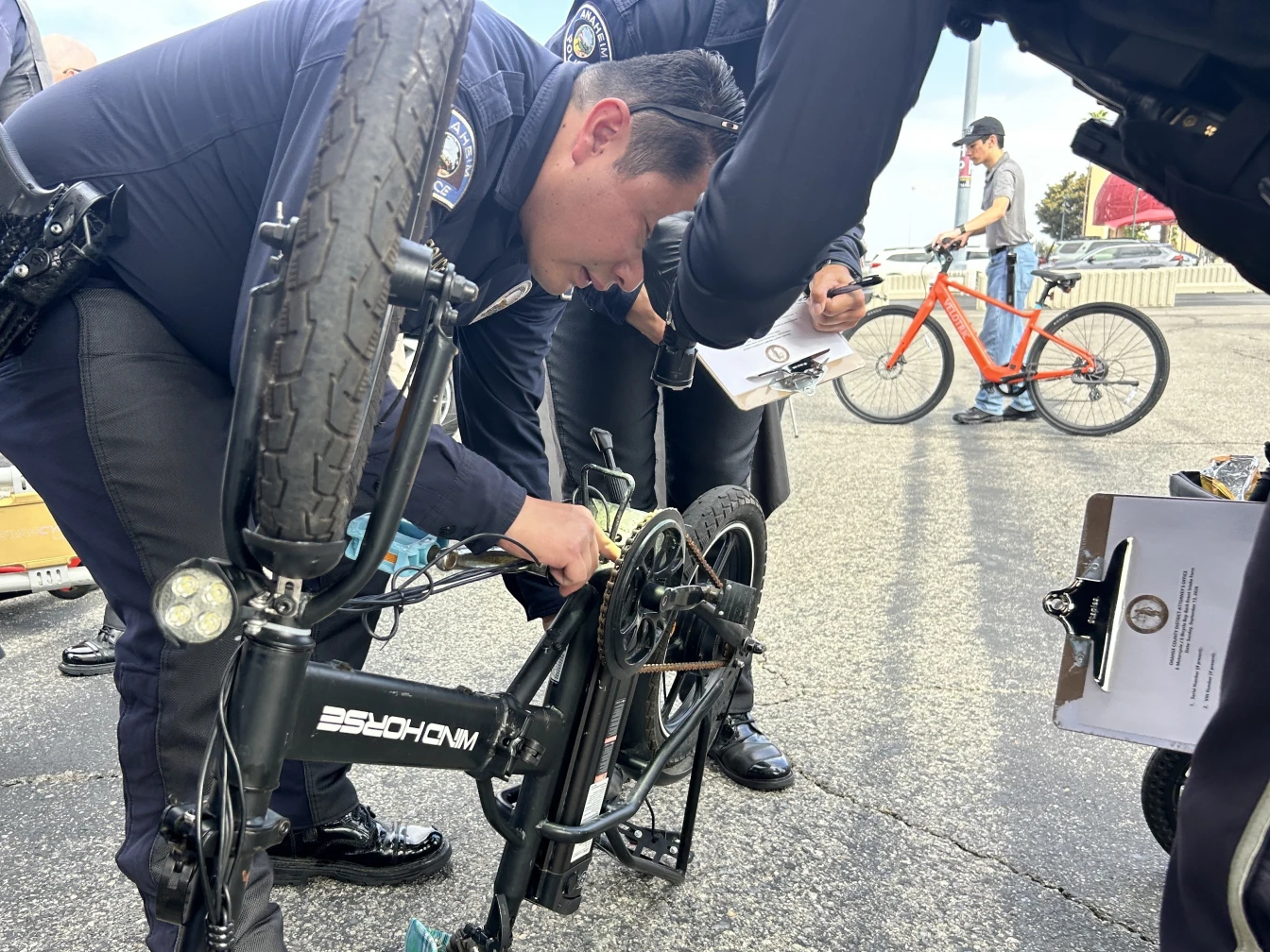
Orange County District Attorney Todd Spitzer has taken some unusual approaches to addressing the e-bike dilemma. To date, he has pressed criminal charges — including for child endangerment — against four parents after their children were involved in collisions, all of them on e-motorcycles, not e-bikes. One of those parents, a woman from Aliso Viejo, was charged with three felonies, including involuntary manslaughter, after her 14-year-old son allegedly struck and killed an 81-year-old man while doing wheelies in the street in Lake Forest on an e-motorcycle souped up to reach 60 miles per hour.
The DA’s office said it has also sent letters to retailers reminding them of a ban on selling products used to modify e-bikes to go faster than legally allowed. Spitzer recently tried another novel approach: buybacks. On a recent Sunday, hundreds of people brought their e-bikes, e-scooters and e-motos to an event at Angel Stadium in Anaheim, hoping to turn them in for up to a thousand dollars in gift cards. The county event was paid for with $100,000 in asset forfeiture funds.
Lyft has agreed to pay more than $272 million to settle a state lawsuit alleging it committed wage theft by misclassifying California drivers as independent contractors, rather than employees, from 2016 to 2020.
Attorney General Rob Bonta announced the deal on Thursday alongside city attorneys for San Francisco, Los Angeles and San Diego. He said Lyft, which has argued its drivers were always properly classified, spent years trying to push the case into private arbitration. “All the while Lyft grew into a multibillion-dollar company, and a household name. Its success depended on its drivers, many of whom came from immigrant communities and communities of color, and still, Lyft failed to protect those drivers and failed to pay them fairly,” Bonta said.
He called it the largest worker misclassification settlement in California history. “The bottom line is that eligible drivers are going to get paid. That’s money in the pockets of the workers who drove this company’s success,” the attorney general said.
Most of the money, at least $237 million, is set to go to drivers. “This was rent that didn’t get paid, food that wasn’t there for hungry kids. We’ve waited six years for this,” said Alvaro Bolainez, vice president of Rideshare Drivers United, a union representing over 20,000 drivers, in a statement. “It’s a big settlement — but it’s not big enough to cover the real harm that’s happened to drivers over the years.”
The settlement still needs a judge’s approval. In a statement, Lyft said the deal “closes a chapter from a very different time, before Prop 22,” the 2020 ballot measure that let app-based companies keep treating drivers as contractors.
New research shows mosques face more pushback over parking requirements
A new study has found that when applying for building permits, mosques face more pushback over parking requirements than churches.
The study was published in The Journal of the American Planning Association in September. It found that mosques were 16 to 18% more likely to experience opposition than newly proposed Christian churches. Mark Massoud is a professor at UC Santa Cruz, and coauthor of the study. “ If someone comes to a planning commission hearing, and they say ‘I don’t want Muslims in my neighborhood these people, especially in progressive cities and towns like here in California, will probably not be taken seriously,” he said.
But, another tactic is to raise a more legitimate concern like worries over the amount of parking. Massoud said that mosques in general do provide adequate parking, but that they’re still asked to jump through extra hoops. In some cases, approval can be delayed for a decade or more over permitting issues.
The report encourages cities to consistently apply zoning standards to all projects as a way to reduce bias.