This piece was featured first on Jan 15 for One Good Thing, a weekly newsletter brought to you by Alexis Madrigal about his take on Bay Area art, culture & nature. Subscribe today.
It is one of my favorite moments in my garden: we’re greening into winter and the hellebore are blooming. These are the hardiest of plants. While many plants lie dormant, they are throwing off large, extravagant flowers over the top of thick, leathery leaves.
These are tough flowers, impervious to pests and the elements. They are a reminder of warmer, flowerier months to come. Next to my ferns, which are throwing off gargantuan, unfurling fronds, they give me a reason to go out and really look at the world.
I have three varietals in my backyard. Do I remember what they are called? Absolutely not. But let’s peer at them.
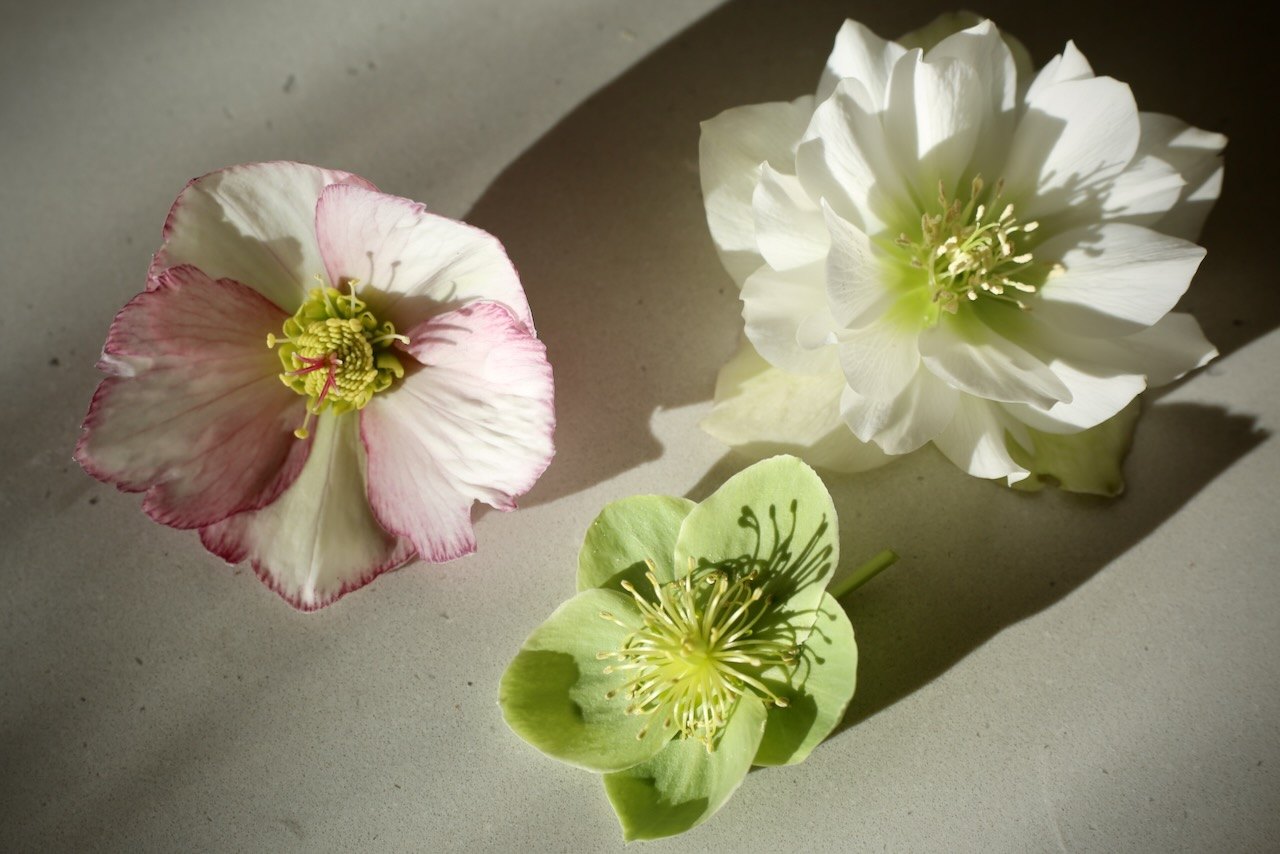
The first has five simple what appear to be petals, but those are actually sepals, which are like a specialized leaf. The sepals are edged and decorated with a soft pink. In the center, they sport five bright pink styles, surrounded by a tight arrangement of lime-green anthers. The real petals, in this flower, are small and folded, surrounding the anther cone.
The second varietal is white and ethereal. It is a “double” meaning that it has showy petals in addition to sepals, which give it a petticoated, almost Victorian air.
And the third is like a slapstick little sibling. These flowers are all green. Their reproductive parts sprout from the center like a sea creature or a verdant insect.
Beyond their beauty, I have an attachment to hellebore for a specific, mysterious reason. In my life, I have forgotten two words not just for a minute, but for a period of weeks. I have no idea why this happened or why these twords
The first word is a little silly, in that it is too on the nose. The word was what scientists use to describe the hypothesized physical trace of a memory, the stuff of a memory. Neuroscientists have made a lot of progress, and these traces must exist, but the specifics remain quite fuzzy for this fundamental brain process. I think about this a lot, more than I should.
In any case, after weeks, I gave in and googled: the word I was searching for was engram. For some reason, all I had been able to think of was the word memristor, which I read in an Hewlett Packard press release in 2009.
The other word that I, for some strange reason, could not recall for weeks was (you guessed it) hellebore.
This was a few years ago, and I struggled with it for weeks on end. All through their flowering season, the dark months, I’d get near the right neighborhood of my plant knowledge or the right letters of the alphabet and whatever wisp of memory I needed would disappear. All I had was the flowers themselves, these flowers made of tougher stuff than other flowers.
Finally, one day, in the garden, the word arrived: hellebore, and it’s stuck around since.
But it made me think: Why were my memories not made of hellebore, tough stuff? Why did evolution build memories like clouds rather than mountains?
My conclusion: We are made to change. We are not meant to be carved in stone, but to keep being new. As the novelist Octavia Butler put it in her fictional religion, Earthseed, “All that you touch / You Change. / All that you Change / Changes you. / The only lasting truth / Is Change.”
Every year, hellebore flower through winter and then those stalks disappear. And in fact, you can chop off the remaining leaves, too, in the fall, and they’ll come back the next year just the same. The only lasting truth is change.

Alexis Madrigal, Co-Host, Forum

My Tipline
- You can catch me reading poetry (alongside real poets!) next Friday at 5:30 at Golden Sardine, my favorite bar in the city.
- I’m loving this strange album from Dagmar Zuniga. Cassette-y!
- Have you heard a writer co-op bought Gourmet magazine after Condé Nast let the trademark lapse? Chef’s kiss.
- Attend the 2026 Public Domain Film Remix Contest Screening & Party at the Internet Archive on Jan 21!
- Go see the La Peña Community Chorus at Mission High this weekend.
- Finally, a paper for your pleasure… “That They May Vomit Out Their Folly”: The Gut-Mind Axis and Hellebore in Early Modern England.

My Picks
 ARTS
ARTS
What We Will Lose When California College of the Arts Closes
Ugh. Vanderbilt swallows CCA?
 K ONDA
After Maduro’s Capture, Venezuela Faces Old US Shadows and Uncertain Future
Somehow Venezuela has been pushed out of the news.
 BAY CURIOUS
San Francisco’s Historic ‘Relief Cottages,’ Built After the 1906 Earthquake, Are Hidden in Plain Sight
Know that city!