Reminder: Highway 101 Through SF Is Closed (Again) This Weekend
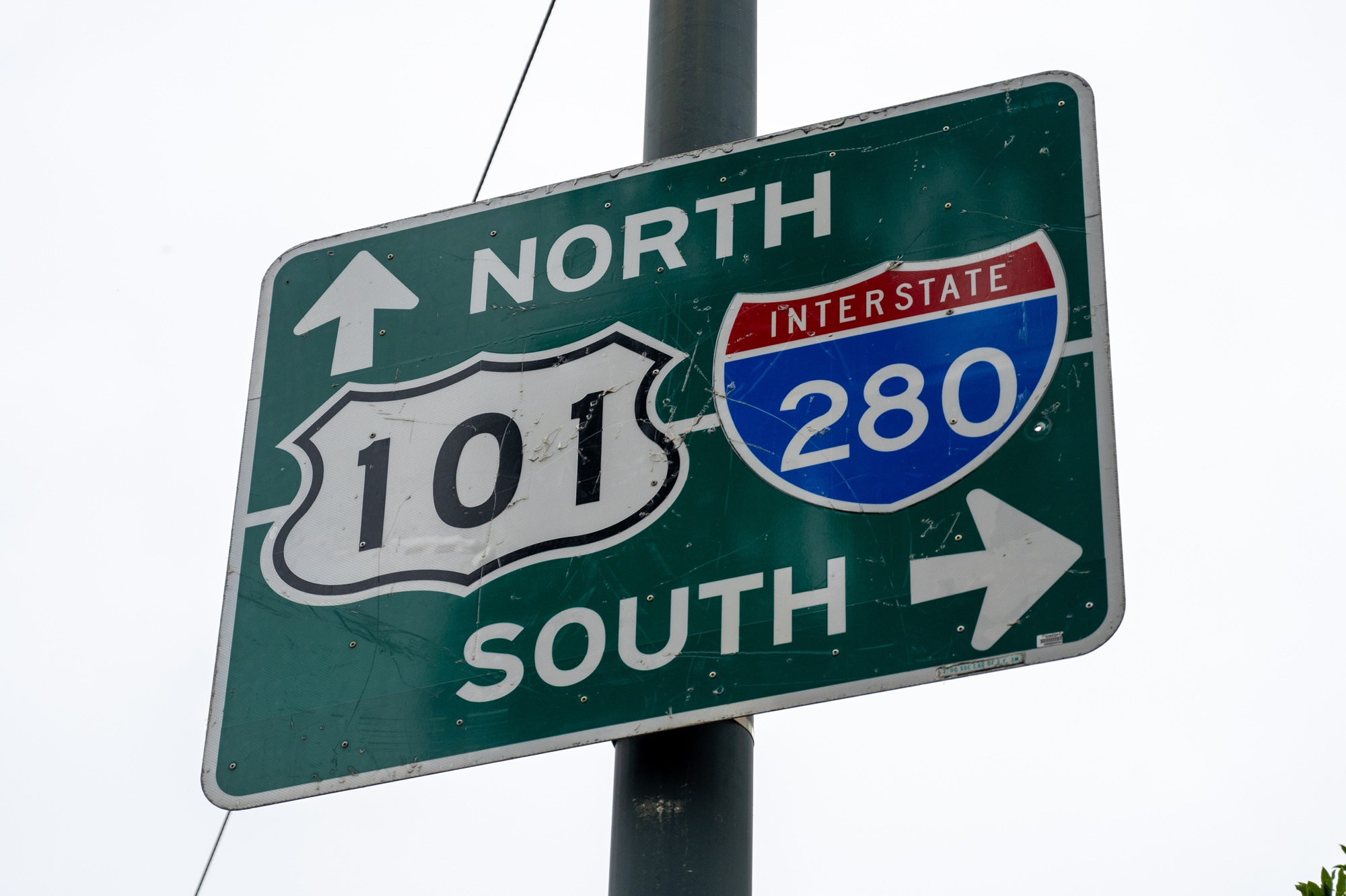
Remember that stretch of Highway 101 through San Francisco that was closed over the Labor Day weekend earlier this month? It’ll be closed again this weekend.
Over a mile of 101 near Zuckerberg San Francisco General Hospital will be fully closed to all northbound traffic starting the night of Friday, Sept. 18 and won’t reopen until early morning on Monday, Sept. 21.
These closures on what’s known as the “Hospital Curve” part of 101 will affect not only drivers trying to drive from the South Bay and Peninsula to the East Bay or North Bay — including people arriving at San Francisco International Airport — but also anyone wanting to travel through the city on this weekend.
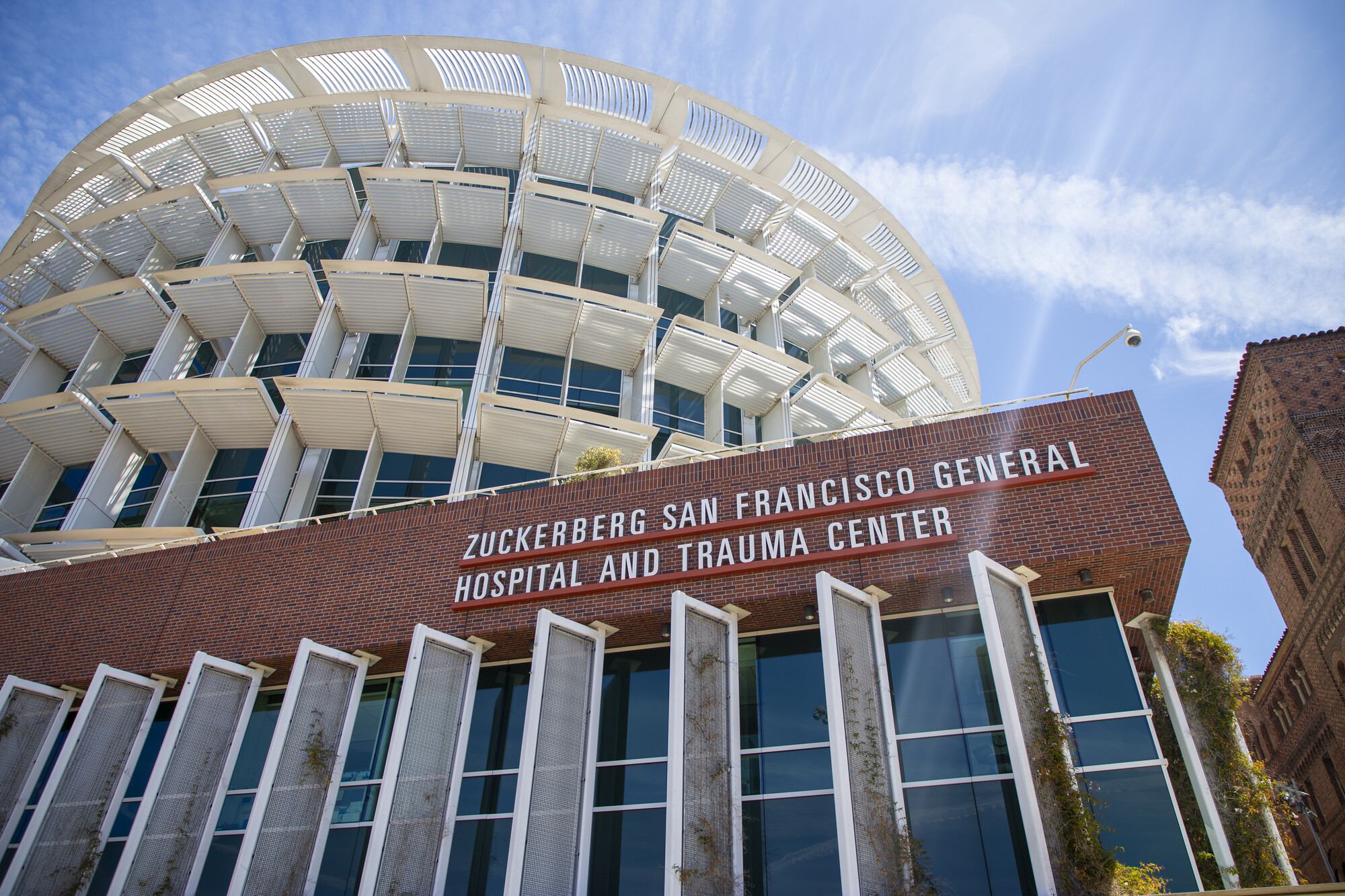
This weekend closure is part of Caltrans’s ongoing work on what the agency calls “the Fab 4”: 101’s Hospital Curve, I-280, the Central Freeway and 19th Avenue. The work is coming on the heels of April’s major Interstate 80 closure through San Francisco and last month’s highway shutdown over the Carquinez Bridge.
With the upcoming 101 work, “all of those lanes are going to be completely closed to traffic so that major pavement work can happen,” said Lori Shepherd, Caltrans’ Bay Area public information officer. “Basically, they’re putting on a brand new repaving [on] the whole entire road.”
Jump straight to:
Warning: Delays and detours ahead
Shepherd said that drivers should know that “this is going to be a major, major impact,” and that any travelers planning to drive in San Francisco during the weekend closure should expect sizable delays getting through the city — not just around 101, but on surrounding streets and detours.
Shepherd said that the greatest traffic impacts from the closure could be felt around Cesar Chavez and 17th streets, as well as around Potrero Avenue — and also on entrances to I-280.

Caltrans is urging travelers wherever possible to take public transportation to travel through San Francisco this weekend, instead of using the roads.
It “really remains the best option to bypass congestion and work zone delays — because there will be some major delays getting through the city,” warned Shepherd. Delays from the closures could also have a knock-on effect on other routes through the city.
But if you really have to drive through San Francisco this weekend, what should you know about timings, detours and delays?
Keep reading for what we know about navigating the upcoming 101 closure without having your weekend completely hijacked by traffic.
(And a heads up that in October, there’ll be two more weekend Hwy 101 closures — this time on the southbound side — between Cesar Chavez Street and 10th Street. These closures will take place Oct. 2-5 and Oct. 16-19.)
Where will northbound 101 through San Francisco be closed?
All northbound lanes on 101 between Cesar Chavez Street and 10th Street will be closed to traffic — a 1.2-mile stretch of highway.
Any drivers on northbound 101 approaching this closure will be forced to take the Cesar Chavez Street/Potrero Avenue off-ramp before the closed area.
All southbound lanes on 101 will remain open during the closures of the northbound lanes.
When will the northbound 101 closures in San Francisco take place?
Closure starts: 11 p.m. on Friday, Sept. 18
Closure ends: by 6 a.m. on Monday, Sept. 21
I need to drive north through San Francisco during the closures. What detour should I take?
If you’re already on 101 north through San Francisco
Caltrans recommends that motorists use I-280 northbound to reach downtown areas of the city or the San Francisco-Oakland Bay Bridge.
You can merge onto I-280 by staying in the right two lanes of 101 around Silver Avenue.
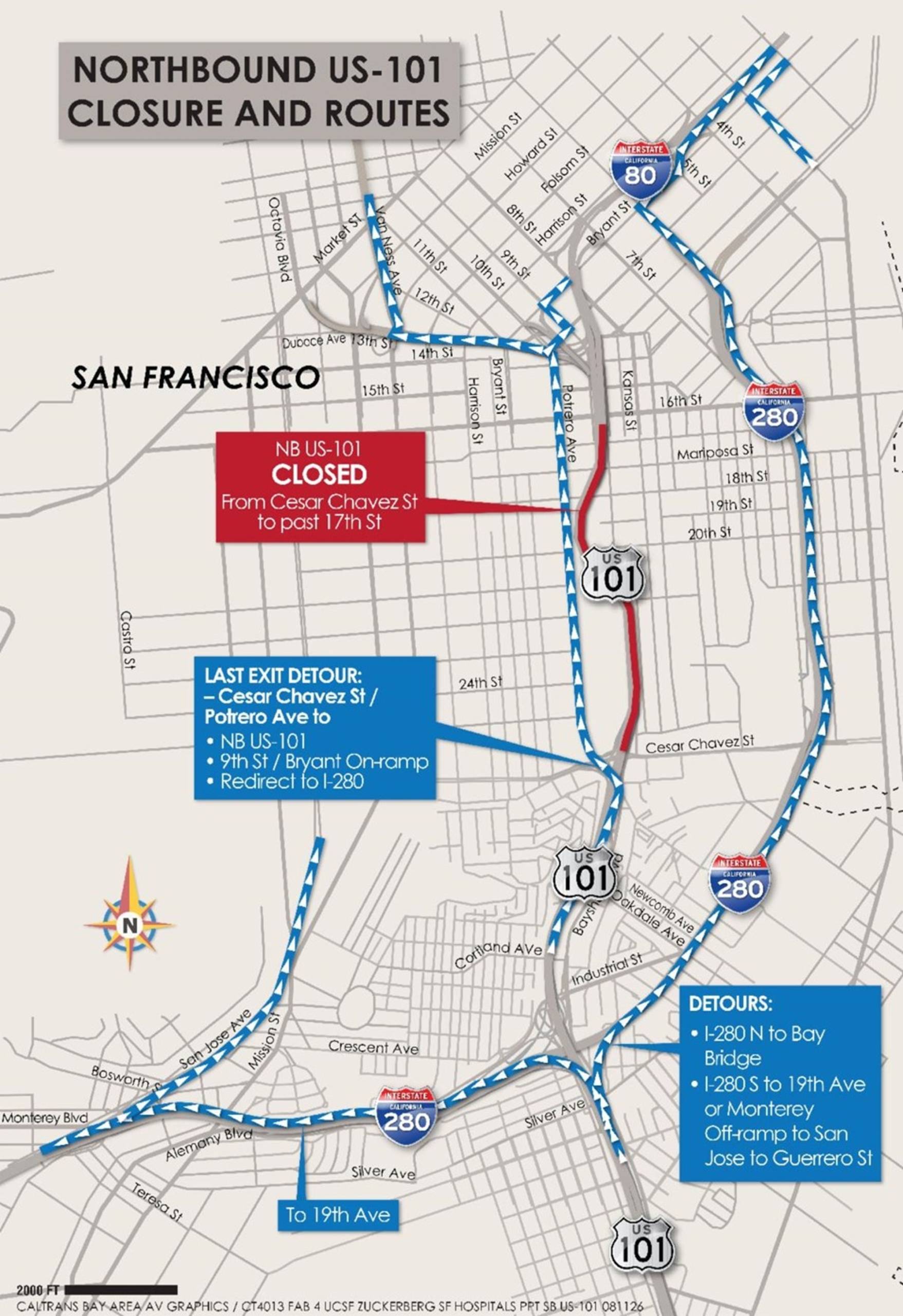
If you don’t take the I-280 exit and continue on 101 northbound toward the closure, you’ll be forced to take the last exit before the closed area: the Cesar Chavez Street/Potrero Avenue off-ramp.
From here, you can take Potrero Avenue north and either connect back onto northbound 101 to the Golden Gate Bridge or to Bryant Street, where you can take the Ninth Street/Bryant on-ramp to I-80 over the Bay Bridge.
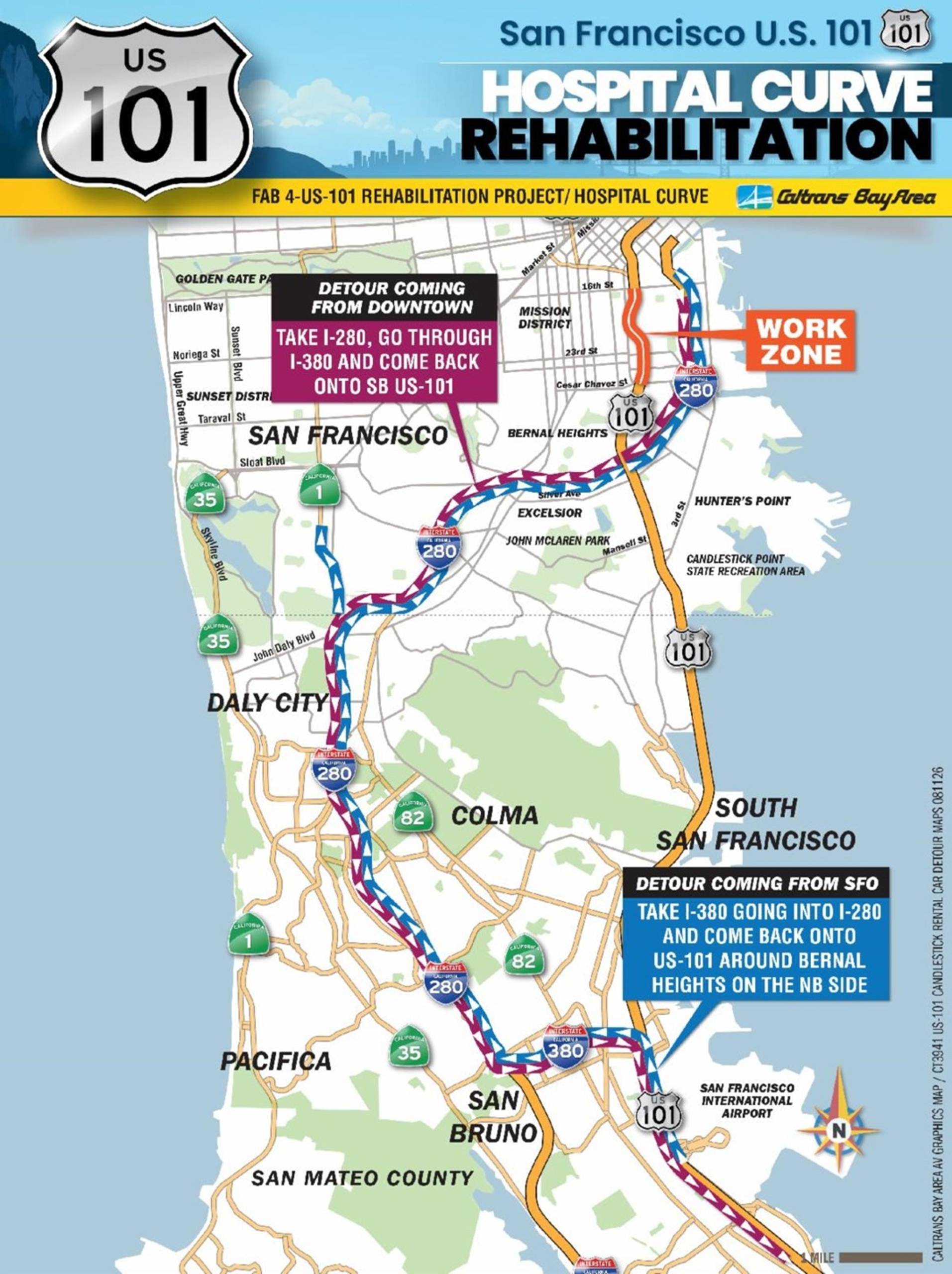
If you want to drive north through the city from SFO, the Peninsula or South Bay
Caltrans’ detour map suggests drivers on 101 by SFO merge onto I-380 westbound, and then transfer to northbound 280 into San Francisco.
Why can’t these 101 closures take place overnight instead?
Shepherd attributed the length of the multiple closures — first Labor Day weekend, now this weekend — to the sheer scope of the “24-7” repaving work being undertaken on 101 at this time.
“It’s a major, massive project, if you can imagine, repaving the freeway,” she said, and despite the Labor Day weekend, Caltrans has timed these closures “to do it with the least amount of impact on the public,” Shepherd said.
According to the traffic data Caltrans consulted, “holiday weekends actually are [a] lower volume of traffic,” she said. “So we knew that this would be a good weekend to come in and get the work done as quickly as possible.”
The concrete used in this kind of repaving work also needs the kind of dry conditions that September brings. “There’s a lot of emphasis on getting work done — as much of it completed in the summer during the dry season as much as possible,” she said.
“It’s difficult, yes, for the traveling public to have to find ways around,” Shepherd said. “But in the end, it will produce long-term gains, because the road will be safer and smoother to drive [and] less prone to flooding.”
KQED’s Juan Carlos Lara contributed to this report.