Boom and Bust in Big Sur
Big Sur’s residents are used to natural disasters. This time, Highway 1 is closed again thanks to the Timber Fire that started on Aug. 8, which has burned more than 5,000 acres. Parts of Big Sur are also under mandatory evacuation orders.
As the SF Chronicle’s Connor Letourneau reports, it’s the latest chapter in a “boom and bust” cycle that Big Sur’s small businesses know all too well.
Episode transcript
This transcript is computer-generated. While our team has reviewed it, there may be errors.
Ericka Cruz Guevarra: [00:00:00] I’m Ericka Cruz Guevara, and welcome to The Bay, local news to keep you rooted. Meredith Gafill has lived in Big Sur for more than 30 years. And when you’ve lived in big surf for that long, disaster is as familiar as a close neighbor.
Meredith Gafill: [00:00:23] You know, my husband and I have been together and just kind of have gone through all these moments of fires and bridges falling down.
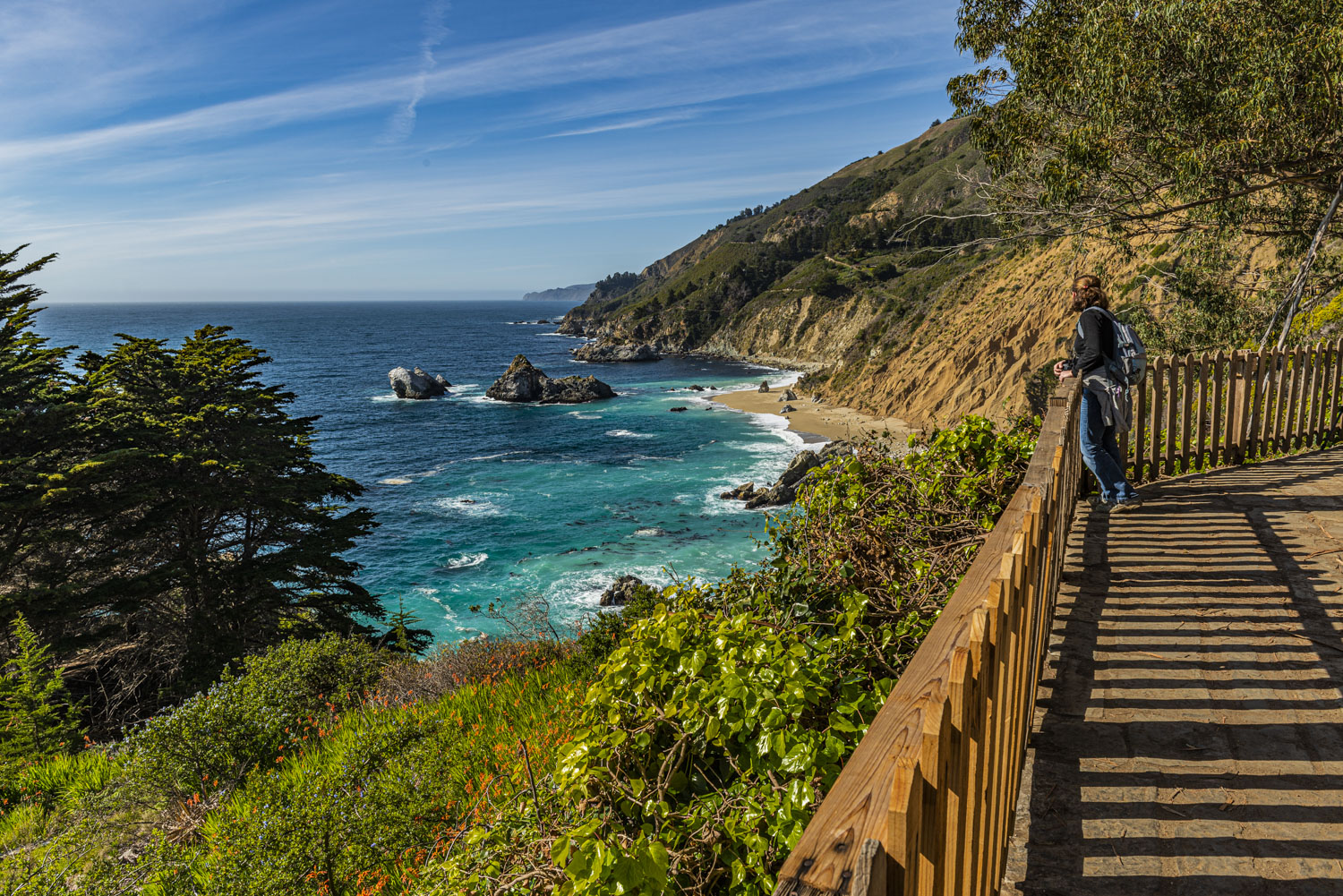
Ericka Cruz Guevarra: [00:00:32] Meredith’s family owns Nepenthe, an iconic restaurant in Big Sur that sits 808 feet above the ocean. Its extraordinary views of the Santa Lucia Mountains and the Pacific Ocean are a prime example of Big Sur’s greatest asset, its beauty, an asset that some also say is its greatest weakness.
Meredith Gafill: [00:01:02] Everything about Big Sur is abundance. The plants, the rain, everything. That’s why it’s so beautiful. That’s what people love it so much. It also comes with a huge price tag.
Ericka Cruz Guevarra: [00:01:19] Now, the Timber Fire is burning more than 5,200 acres in Big Sur, prompting evacuation orders in certain areas. And the fire comes just months after the long-awaited reopening of Highway 1, which was closed for years because of landslides. For Meredith, preparing for and withstanding disaster after disaster is just part of everyday life for locals here.
Meredith Gafill: [00:01:51] When we have a disaster, it’s abundant. We just keep staying though, you know, we just keep stayin’ and we seem to survive.
Ericka Cruz Guevarra: [00:02:01] Today, the boom and bust cycle of Big Sur, and how those who live there stick around.
Connor Letourneau: [00:02:13] Big Sur to me is kind of the epitome of California at its most beautiful.
Ericka Cruz Guevarra: [00:02:23] Connor Leterno is an enterprise reporter for the San Francisco Chronicle.
Connor Letourneau: [00:02:29] Anyone who’s done that drive along Highway 1 and been through Big Sur knows exactly what I’m talking about. There’s a lot to do that goes beyond just the scenic viewpoints that everyone talks about, Bixby Bridge and the waterfalls. There’s bunch of great, you know, state parks in that area with really good hiking trails. I really like the beaches over there. There’s couple of really good beaches. You know, I’ve been in the Bay now for 11 years and it’s become one of my favorite places is just to. Either go on a drive or just bring friends and family who are in town visiting, it’s a special place.
Ericka Cruz Guevarra: [00:03:07] And obviously it’s a huge tourism destination for folks living in the Bay and in California, but it has been sort of cut off for the last three years in a way. Can you remind us why that is and sort of walk us through some of the ups and downs of Highway 1 over the last couple of years?
Connor Letourneau: [00:03:27] Highway One is considered by geologists, arguably the most geologically fragile place in all of America in terms of a roadway, especially that part of Highway One. Everyone talks about that three-year period, which is fair, but it really goes back at least a decade. They had some sort of interruption basically every year between 2016 and this past January. Everything from major wildfires to major landslides, mudslides, storms, you name it. Lately, the biggest issues have historically been mudslide and landslide. Caltrans has spent well over $300 million on unplanned roadwork, just in that, you know, 75 mile stretch of Highway 1 over the past decade. There have been a couple times where The stretch of Big Sur that everyone knows where most of the businesses are, were completely cut off from the outside world for months at a time, which is devastating to those businesses who completely depend on hospitality industry and tourism. And now, you know, you have another interruption with this wildfire.
Ericka Cruz Guevarra: [00:04:40] There’s only about 1,200 people living there year round. But I understand that Highway 1 was reopened in January. I mean, what did that mean for the community? What happened? Was it able to really bounce back pretty seamlessly?
Connor Letourneau: [00:05:01] Yeah, it bounced back in a shocking way. There’s this thing they call a hangover effect where basically, usually it takes a little while for word to fully get out that business is open and the roads are open. But what happened in January, I think there was just such a built up demand and interest to get back there because there had been some sort of road closure for three years. And so when it finally did reopen, it was like a complete flood of interest and tourists from day one.
News Reporter: [00:05:35] They are finally seeing a sense of hope now that Highway 1 has reopened.
Connor Letourneau: [00:05:40] They were completely inundated to the point where they weren’t really ready for it.
News Reporter: [00:05:45] Take a look at this video sent to us by a viewer. Now, this is looking down at Bixby bridge. You can see people walking in the road and even one car illegally u-turning in the middle of all the traffic
Connor Letourneau: [00:05:59] What was interesting is in that three year period, a lot of locals did leave the area and they actually struggled to, to staff these hotels and these, these businesses because there was so much demand, you know, their, their peak season is usually obviously in the summer, but talk to business owners down there who said, you, know, back in February, March, they were getting numbers that were crazier than they often see in July, August, and then, you know for something like this latest wildfire to happen, it’s definitely a bummer because things were going so well.
Ericka Cruz Guevarra: [00:06:33] And I do want to ask you about the Timberfire and sort of the basics of it. I mean, when did it start and what are the state of things as of right now as we’re talking on Tuesday morning?
Connor Letourneau: [00:06:44] Last I checked, it was continuing and continuing to grow, but they’ve done a really good job of pushing it in a direction where it’s basically uninhabited, really rocky, difficult terrain. So there’s not really any structures or people in those areas. So that’s the big positive. The drawback with that obviously is that. It’s difficult to fight because, I mean, these firefighters are having a hard time just getting to the fire. I went down there last Tuesday. That was the day that the road officially closed, August 11th. So it was really weird because I actually got to drive the whole road and tourists were still coming and basically chasing the wildfire. And we have a freelance photographer we work with down there who… Wasn’t getting back to us because he was busy helping his neighbors save their homes, potentially just clearing brush and doing all the things you gotta do to prevent your home from being susceptible to a wildfire. But when I last spoke to some business owners down there, they were optimistic that their businesses would only be closed a week or two, which for them is not a big deal. At all. I mean, these are people who’ve gone months and months and months at a time during road closures of having to have their business closed.
Ericka Cruz Guevarra: [00:08:14] Yeah, and I actually spoke with the owner of Nepenthe the other day, his name is Kirk Gaffel, and I was almost shocked by how calm he seemed to be.
Kirk Gafill: [00:08:23] You’ve probably been hearing the helicopters going overhead constantly. There’s a pond on the property right next to ours where we can see these helicopters dip and get water in. It’s like sitting on a front row of a basketball game.
Ericka Cruz Guevarra: [00:08:38] He’s like, uh, yeah, there’s a bunch of helicopters outside right now. Uh, sort of just like, it’s just another day in Big Sur.
Connor Letourneau: [00:08:46] Yeah, you know, everyone was very, had kind of a macro mindset. Anyone who lives there knows that the good times only last so long. You know, so everyone there is very pragmatic in terms of how they build up their finances, how they deal with their cash reserves as a business. They’re not necessarily putting a ton of money back into the business during the good times. They are trying to save as much money as possible, knowing that they’re going to probably need that money to get them through some lean periods.
Ericka Cruz Guevarra: [00:09:23] We’ll have more with the San Francisco Chronicle’s Connor Letourneau right after this break. By the way, if you appreciate the deep dives into local news stories that we bring you here on the Bay, consider becoming a KQED sustaining member. Becoming a member is one of the best ways that you can help support the journalism that we make here on this show. Just go to donate.kqed.org slash podcasts. We’ll be right back.
Ericka Cruz Guevarra: [00:10:02] So I mean, you were just talking about just the volatility of the landscape, and I imagine this fire and then the rains that are expected to come probably spell more disaster for Big Sur in the coming months. I mean more landslides, I imagine.
Connor Letourneau: [00:10:21] Yeah, you know, that’s what they’re kind of bracing for. You know, this is a huge El Nino year. It’s funny talking to the people down there, because a lot of them are kind of climate nerds, you know, weather nerds. They have these at-home weather stations and they’re not just tuning into the news. They’re actually following it on these special apps they have and these special monitors they have at their homes. They’re all pretty aware that El Nino was gonna be significant this year and probably be a decent chance of mudslides or landslides, this coming winter especially. And so yeah, the wildfire was a little bit of a surprise because they weren’t expecting that to be the problem. Over the years, because there’s been so many issues down there, Caltrans has gotten better at instead of just being reactionary, they’re really being proactive of really studying the geology, studying the landscape, and trying to guard against landslides. Like I said, they’ve spent well over $300 million. I’ve had people ask me, why don’t they just abandon it? Why don’t they just, you know, and it’s like, I can understand that. But you can’t abandon a place like Big Sur, I mean, it’s just. It’s literally, when you think of California, I mean, a lot of people think of that stretch of the coastline.
Ericka Cruz Guevarra: [00:11:46] We’re talking about just this place being so prone to disaster and in many ways so used to it. Where do I place this fire? I mean is it just another day in Big Sur?
Connor Letourneau: [00:11:58] It’s not that big a deal in the grand scheme of things in terms of what they’re accustomed to enduring, given the fact that they had a wildfire, I think in 2016, that wiped out well over 50 buildings. In comparison to that, this is not a huge deal. They also know that given the climate there and the geology, things can change in a split second, so. Who knows? Maybe the wind will start blowing in a different direction and the circumstances will change. And so everyone is still bracing for those possibilities and prepared for if they have to really start defending their homes again.
Ericka Cruz Guevarra: [00:12:41] My last question for you here, Connor, you mentioned you’ve been talking with business owners over the last couple of years about how they do just keep returning to this place despite being very aware of the volatility of this place. What do they say about why they stay?
Connor Letourneau: [00:13:01] They just love it. A lot of the people who’ve been down there have been down for decades. These are people who really value nature. They really value the serenity, the peace. And these are people generally who work because they have to, but ultimately their priorities aren’t about working. Their priorities aren’t about grinding the way we are up in the bay.
Ericka Cruz Guevarra: [00:13:31] Well, Connor, thank you so much for sharing your reporting with us and for joining me on the show. I really appreciate it.
Connor Letourneau: [00:13:38] Happy to be here.
Some members of the KQED podcast team are represented by The Screen Actors Guild, American Federation of Television and Radio Artists, San Francisco-Northern California Local.