Episode transcript
Olivia Allen-Price: Things were different for San Francisco kids back in the 1960s and ’70s. For one, there was a lot more freedom.
Dennis O’Neill: In those days, there were no cars parked on the street for the most part. And there were kids everywhere. You know, there were six or seven kids on my block. My name’s Dennis O’Neill. I grew up on 18th Avenue from about 1963 to 1980.
Olivia Allen-Price: Dennis and the other neighborhood kids spent a lot of time at nearby Larsen Park. It’s right on busy 19th Avenue at Vicente Street.
Dennis O’Neill: We were seven or eight. And our parents, you know, allowed us to cross 19th Avenue, the highway, on a green light and go to the park.
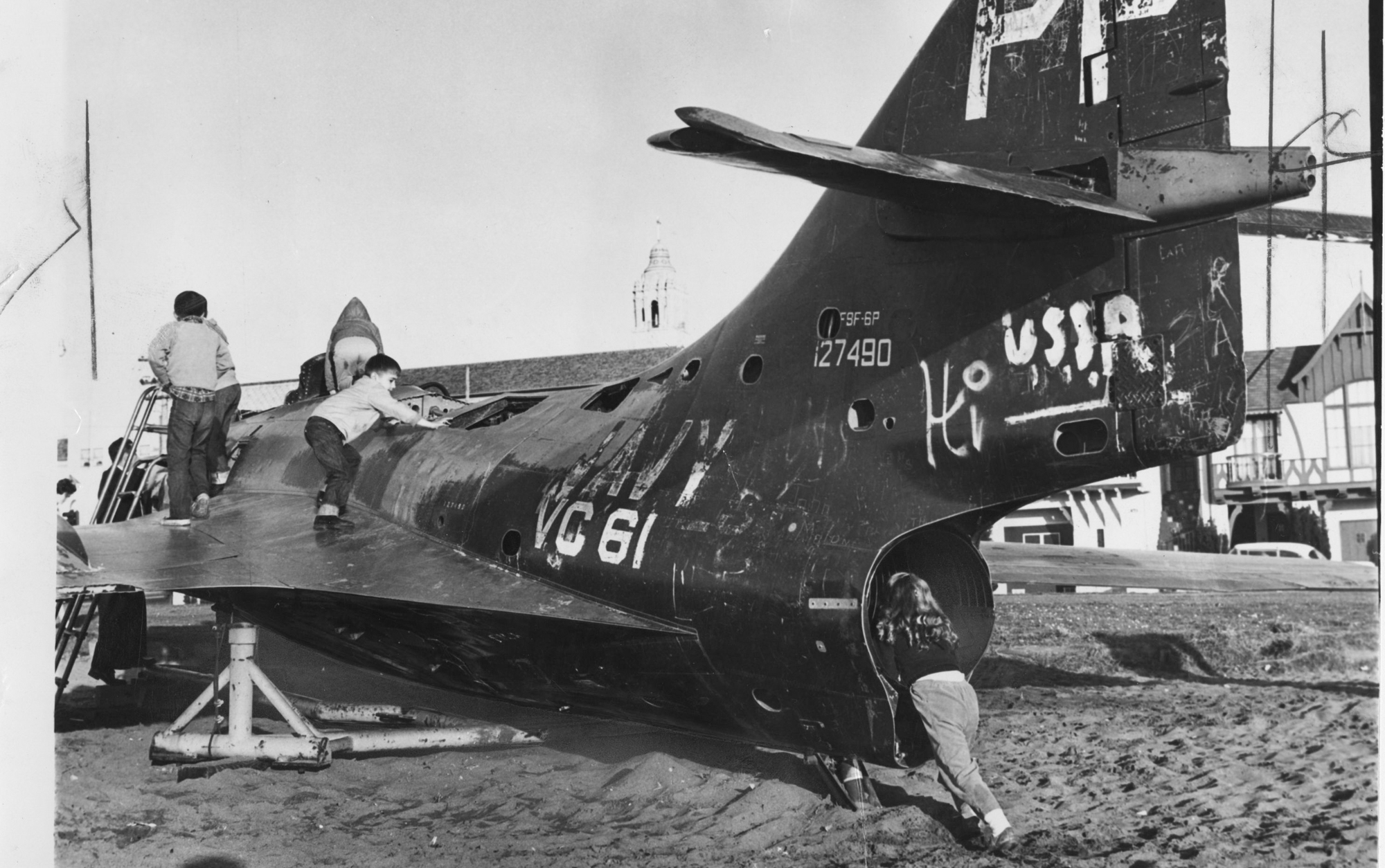
Olivia Allen-Price: Back then, every city park had a park director. They would organize games, keep an eye on the kids and maintain play equipment. But Larsen Park also had something that made it extra special. A real Navy jet.
Dennis O’Neill: It felt like an actual jet landed in Larsen Park.
Olivia Allen-Price: And wow, was that jet beloved by the neighborhood kids!
Dennis O’Neill: It was fantastic, I have to say. I still remember. I’m 64 years old. I remember specifically sitting in that cockpit and being a pilot, you know.
Olivia Allen-Price: Our question asker this week, Aaron Van Lieu, also spent a lot of time at the plane in Larsen Park.
Aaron Van Lieu: It’s some of my earliest memories. My brother, dad and I were going there in the late ’80s, like ’88-’89. So I was like 4, 5, 6.
Olivia Allen-Price: Over a period of 35 years, there were actually three different Navy jets in that park. The last one was placed in 1975, and the nose of it was painted with shark’s teeth. It was there the longest and was known to many as “The Shark in the Park.”
That’s the plane Aaron remembers.
Aaron Van Lieu: Playing tag, but there’s a jet involved. And hide and seek and you know, just running around it. My dad, you know, trying to explain what certain things were because for a long time the canopy was there, and you could see inside of it, and it had all the gauges and stuff.
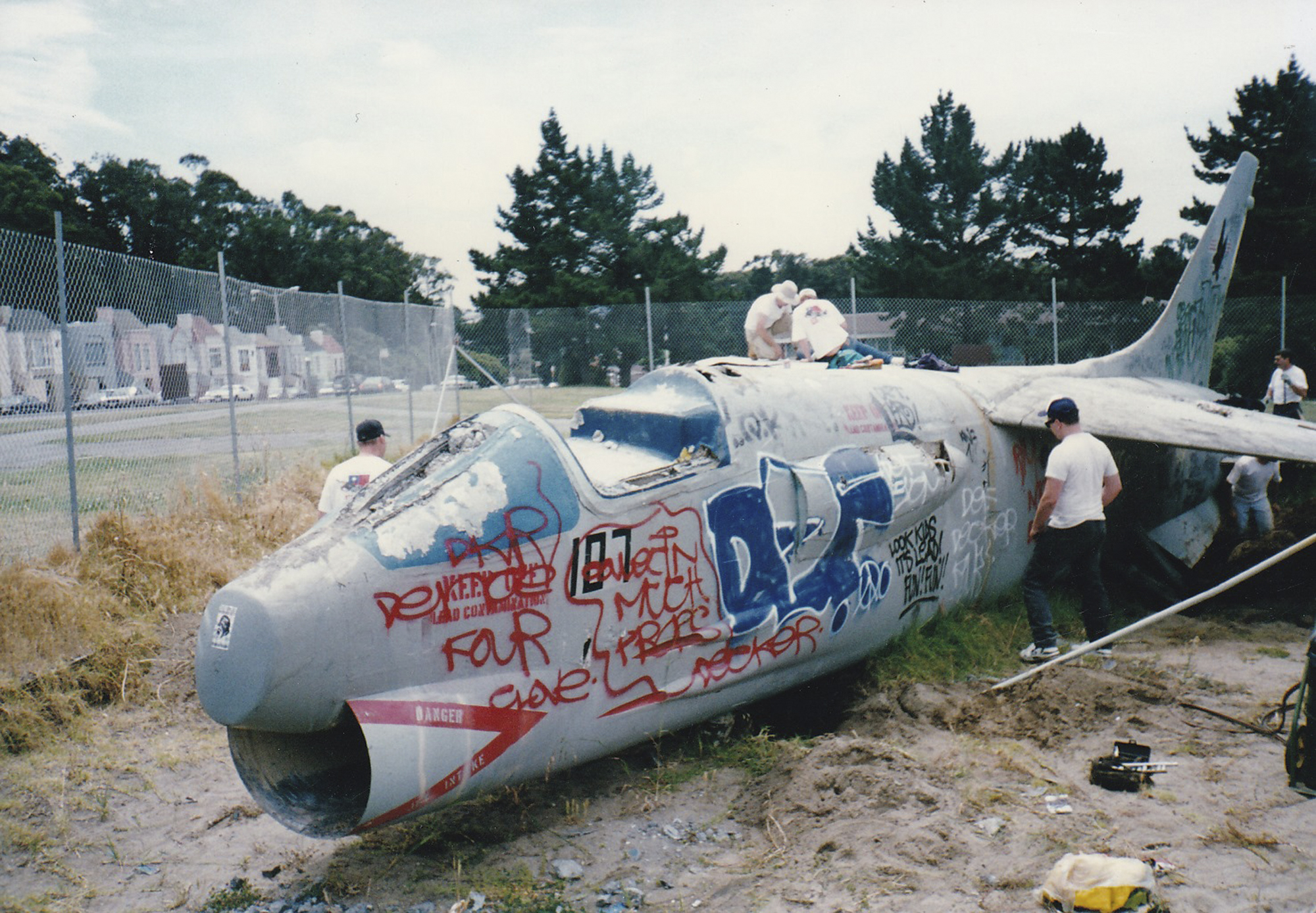
Olivia Allen-Price: But Aaron also remembers how the jet slowly started falling apart.
Aaron Van Lieu: Little by little, the wings and parts of the jet just started falling off and going and disappearing. So, and then eventually it was like kind of like this, like skeleton.
Olivia Allen-Price: And then, one day, it was gone.
Aaron has spent decades wondering what happened to that jet that he loved so much. He even credits it, in small part, with his love of aviation and a short stint as a flight attendant. He wants to know:
Aaron Van Lieu: What happened to the jet, and why did it get taken out, aside from being covered in graffiti? So I just wanna know where it went from there, you know?
Katrina Schwartz: And, I want to know who thought a jet in a playground was a good idea in the first place.
Olivia Allen-Price: Bay Curious editor and producer, Katrina Schwartz, always the pragmatic one.
Katrina Schwartz: A real fighter jet has to be one of the most expensive pieces of playground equipment ever!
Olivia Allen-Price: So, I did a little math, and the plane cost about 2 million to build originally, which is nearly $24 million today.
Sounds of pickleball
Katrina Schwartz: Our modern obsessions on display at the park are a little more mundane … and a lot less expensive.
Pickleball sounds
Katrina Schwartz: The near constant pop and thwack of the very popular pickleball courts has been the soundtrack to Larsen Park since they opened in 2023.
I visited with Christopher Pollock, historian in residence for the San Francisco Recreation and Parks Department, to learn a little more about this park.
Christopher Pollock: So Carl L Larsen is a Danish immigrant who was a cafe owner in downtown San Francisco. He owned the Tivoli Cafe and he was quite a large landowner in San Francisco.
Katrina Schwartz: Larsen gave the city a parcel of land to create a park before this west side neighborhood was even fully built. The park opened in 1926. Bisected by Vicente Street, one side had tennis courts and playground equipment and the other side had an open field and a swimming pool, now called Sava Pool.
Christopher Pollock: He, as a developer, certainly had the vision that San Francisco was going to grow and that things would grow to be what they are today.
Katrina Schwartz: At this point, playgrounds were a fairly new idea. They only came into fashion in the early 1900s as a tool to keep kids off the streets.
Christopher Pollock: Kids were getting into trouble because they didn’t have enough to do in off hours of school. Yeah, they had their playgrounds within the schools, but those were closed when school was not open.
Katrina Schwartz: The first Navy jet came to Larsen Park in 1958. It was during the Cold War and people were obsessed with going to the moon.
Archival video 1: In October 1957, the world entered the Space Age. At that time, a multistage rocket took off from Russia – Sputnik 1.
Archival video 2: More and more teenagers are giving up rock and roll for Rocket Rolls.
Christopher Pollock: People want to go to the moon, and so it becomes a very popular kind of thing that people started designing playground equipment to look like jet planes and rockets and things like that.
Katrina Schwartz: Space exploration was a national obsession. But you know, San Francisco, it had to approach the trend a little differently.
Christopher Pollock: There was surplus jet down at Moffat Field in Mountain View and that it could be had for a song. It just had to be brought to San Francisco. So that becomes our very first plaything in a playground, but it’s the real thing. Our kids were going to learn, you know, the real straight skinny on stuff, not some representation.
Katrina Schwartz: It’s easy to forget that back then, San Francisco was a Navy town. The city was surrounded by Naval stations and there were jets like this one in playgrounds in Bayview, Sunnyvale and San Leandro.
But as any parent knows, kids are hard on stuff. Even military grade materials were no match for their grubby little hands.
Christopher Pollock: About every 10 years these jets had to be replaced because the kids wore them down so much.
Katrina Schwartz: The second jet in Larsen Park came from the Alameda Naval Base and was placed in the park in 1967. But the longest tenured jet — the “shark in the park” our question asker loved — arrived in dramatic fashion eight years later, in 1975.
Newspaper read: A marine helicopter carrying a surplus Navy fighter in its sling, flew under the Golden Gate Bridge yesterday morning — after it had cruised under the Bay Bridge. The old F-8 Crusader was taken from Alameda Naval Air Station to the parking lot of the San Francisco Zoo.
Katrina Schwartz: They then towed the jet two and a half miles northeast … going up Sloat Boulevard and down 19th Avenue to Larsen Park.
Newspaper read: The engineless plane will be used, as was its predecessor, as a giant toy in which San Francisco children may take flights of imagination.
Katrina Schwartz: And there it stayed, delighting generations of children … for 18 years.
Christopher Pollock: When this first started, people weren’t thinking so much about safety, but as the years went by, safety became a much bigger issue.
Katrina Schwartz: The first two planes were propped up, with ladders to climb into the cockpits. Kids would crawl on the wings, fall off and break arms and legs. And, the metal was sharp — many a kid got a nasty gash playing on the jets.
Christopher Pollock: Not only that but it was found that the paint on these jets was lead-based and it was being discovered in later years that this was toxic to children. It was decided in 1993 to remove the last of the three jets. And so we were without a jet for a very long time in this park.
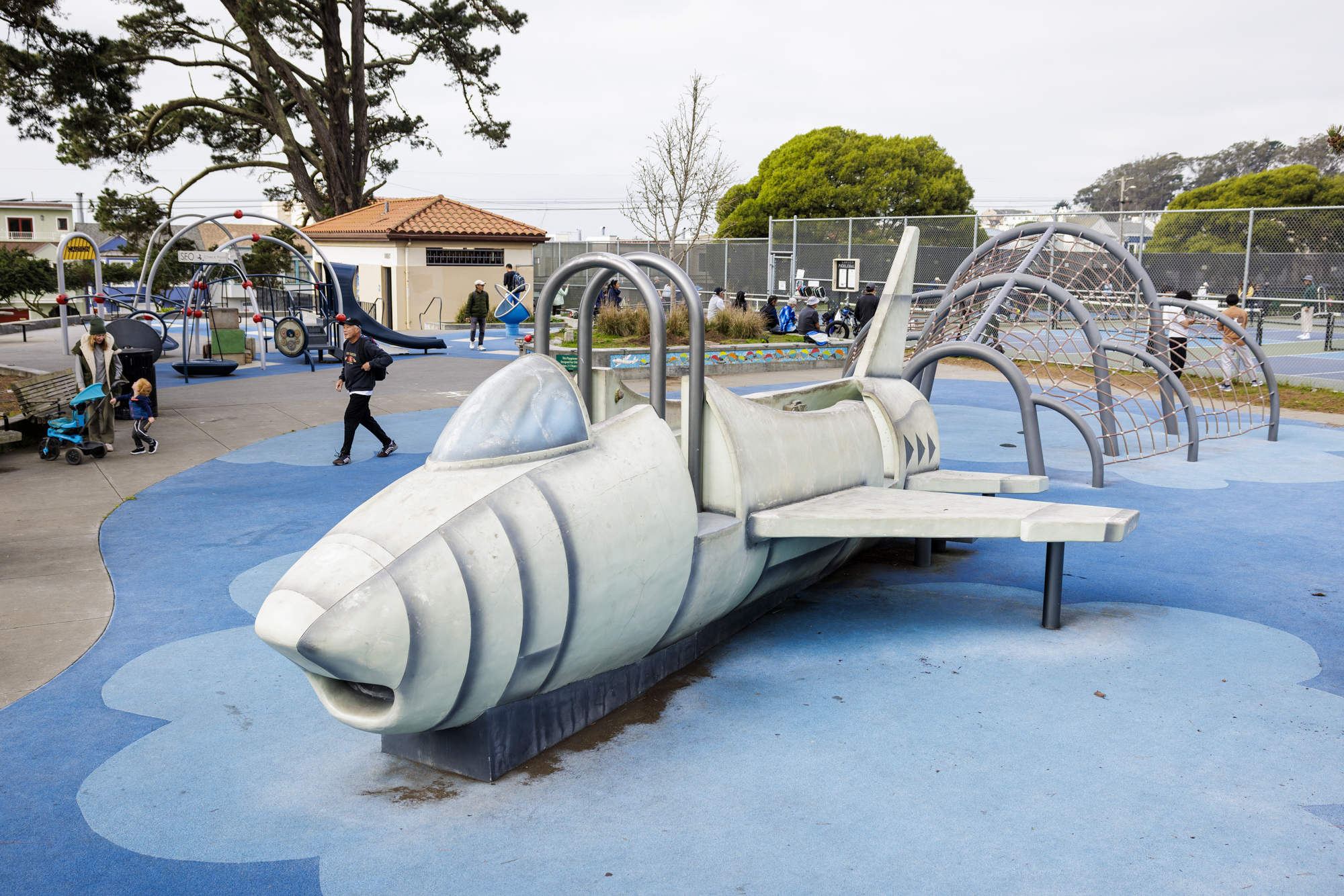
Katrina Schwartz: After 22 jetless years, Larsen Park got an all new playground in 2015, one complete with a play structure that looks like a jet. It may not be the real thing, but kids still like it.
By the time the shark in the park was removed, it was a hunk of junk. The wings were gone, the nose ripped off and it was covered in graffiti.
Aaron Van Lieu: My last memory of it is being like a skeleton. So I would hope that it was maybe fixed a little bit.
Katrina Schwartz: It was in that forlorn state that Aaron, our question asker, last saw the plane. Until I met up with him at the Pacific Coast Air Museum to show him what had become of it. That’s coming up, after this short break.
Sponsor Message
Katrina Schwartz: Aaron Van Lieu has always wondered what happened to the jet in San Francisco’s Larsen Park that made such an impression on him as a child. And it turns out, its new home isn’t too far away, at the Pacific Coast Air Museum in Santa Rosa.
Janet Doto: OK, we ready?
Katrina Schwartz: I guess so.
Janet Doto: All right.
Katrina Schwartz: Aaron and I meet up at the museum and hop in a golf cart for a quick tour with Janet Doto, an Airforce veteran and volunteer here.
Janet Doto: These are the two top gun aircraft, the F-14 Tomcat and then the F-18 Viper.
Aaron Van Lieu: The Tomcat was one of my favorite jets.
Janet Dotto: Oh, it’s a beautiful jet. My favorite’s the F4, but yeah, I’m partial. 23 years in the Air Force, you can’t love a navy aircraft.
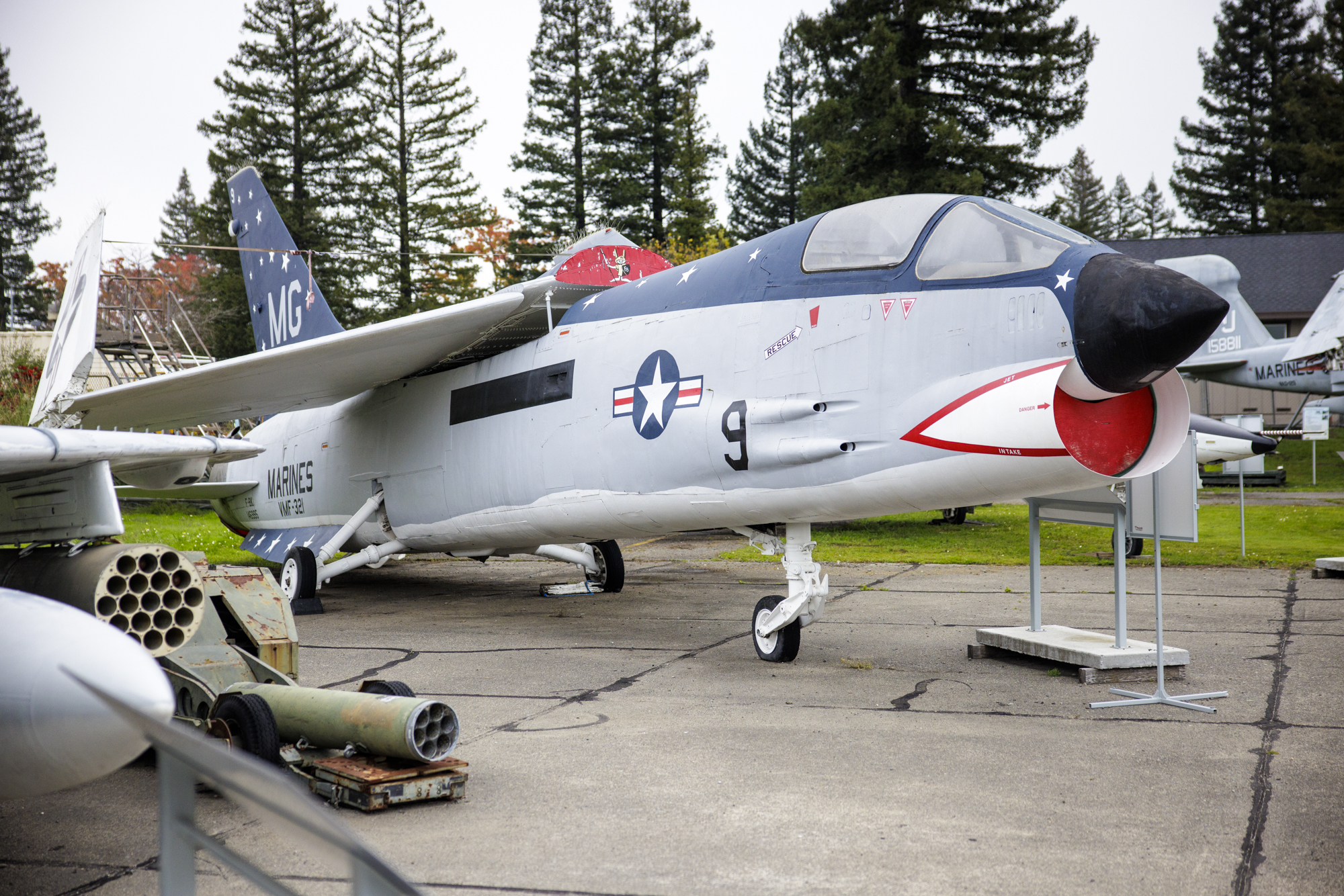
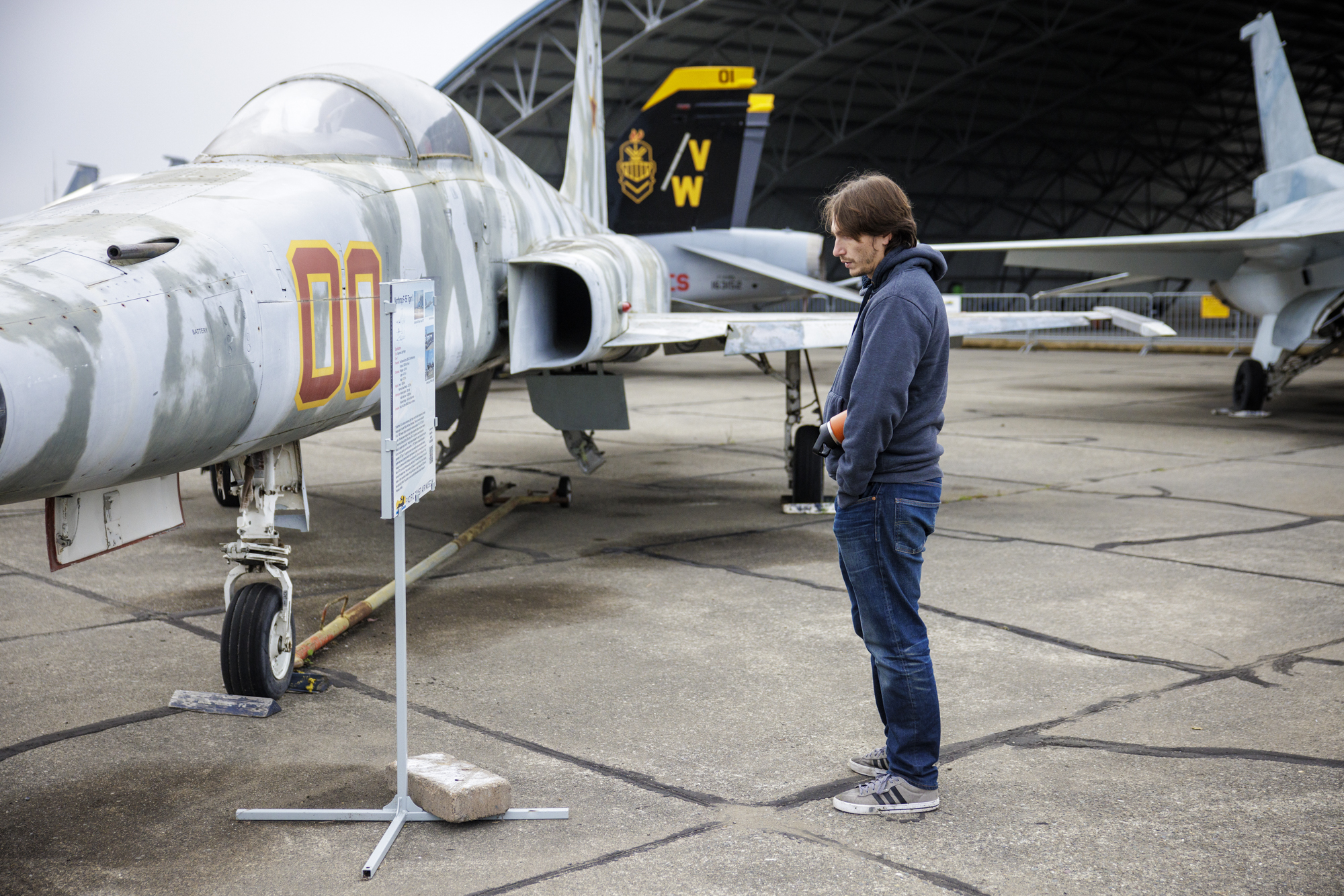
Katrina Schwartz: The museum is a small but mighty operation. Almost all outdoors, they have 37 restored aircraft. One plane fought in WWII, another was a first responder to the 911 attacks and of course, parked out on the tarmac they’ve got the Shark in the Park.
Janet Doto: And there she is, the F-8.
Aaron Van Lieu: This one right here.
Janet Doto: That’s the one.
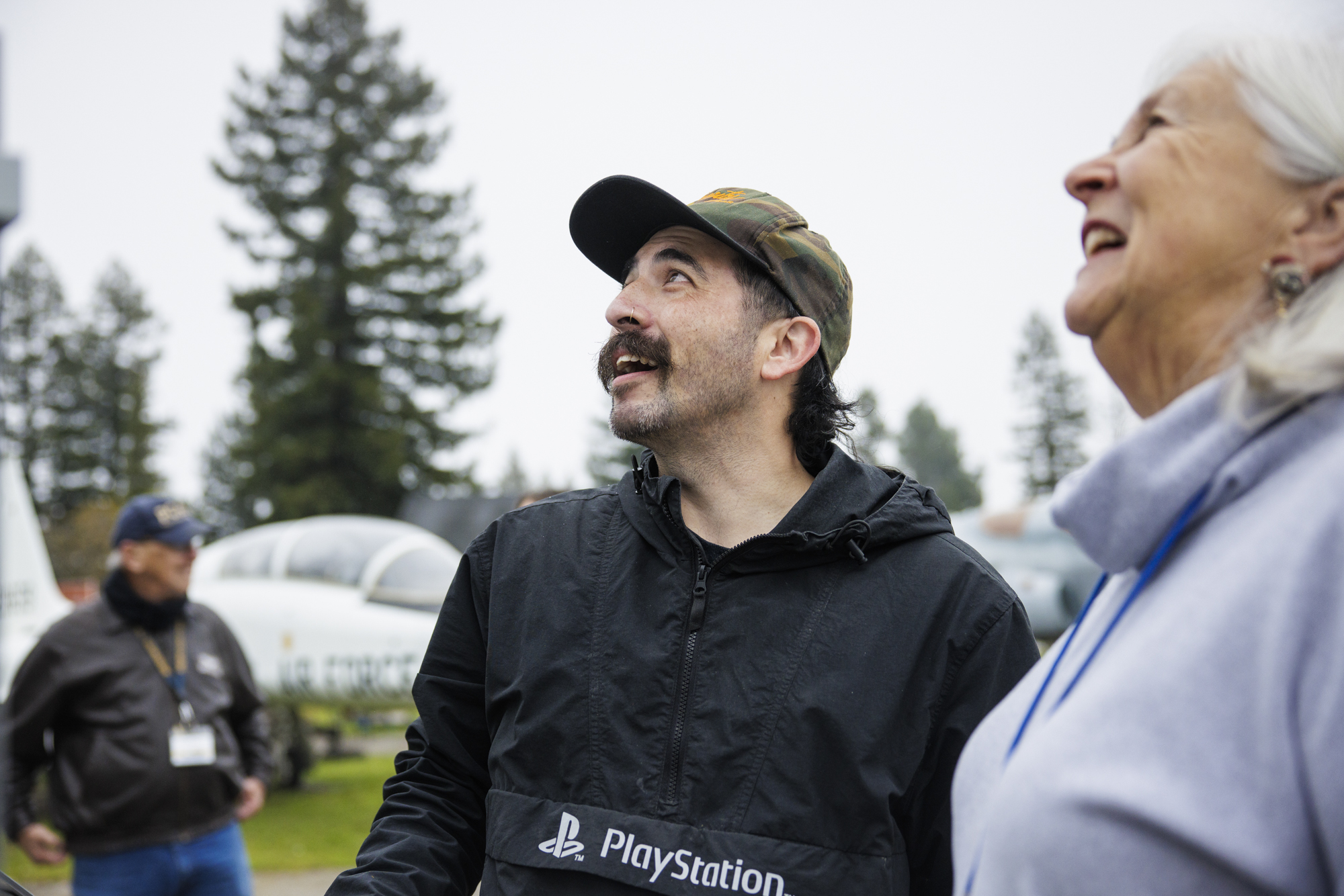
Aaron Van Lieu: Whoa!
Katrina Schwartz: Is it how you remember it looking?
Aaron Van Lieu: Yeah, very much. Yeah, the canopy, it actually looks bigger than I remember.
Janet Doto: That’s probably because there’s more of it.
Laughter
Katrina Schwartz: This F-8 jet is the very one that generations of San Francisco kids played on.
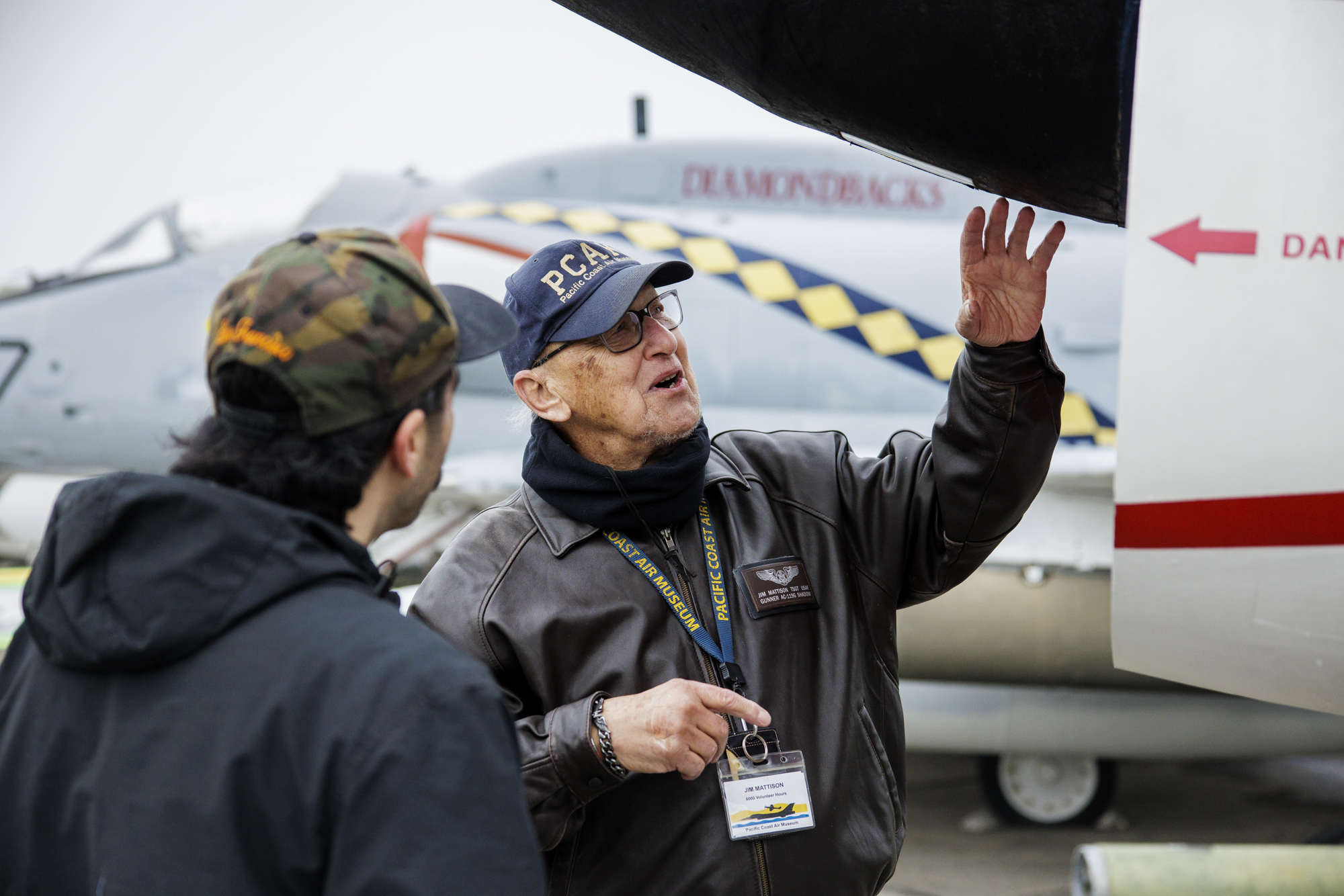
Jim Mattison: Aaron, okay, I’m Jim Mattison. I’m the crew chief. And I’m proud to say I’m responsible for how this came out.
Katrina Schwartz: Jim is also an Air Force veteran and volunteer. But his memories of the Shark in the Park go way back to when he used to be stuck in traffic on 19th Avenue, commuting to Daly City.
Jim Mattison: I look over there, and I say, What’s the city gonna do to that piece of junk? That looks terrible. And it’s just the irony that 30 years later, guess what I’m doing?
Katrina Schwartz: Jim and his team have lovingly restored this 1956 F-8. The paint scheme is mostly gray with accents of red and navy blue.
Jim Mattison: I chose to paint it in the Marine Corps colors. Why? Because that was the last squadron it flew out of. And this was such an amazing paint scheme, I saw that and thought, I know what I want to do.
Katrina Schwartz: The Navy basically begged the museum to take the plane. San Francisco officials wanted the dangerous eyesore gone, especially because by the 90s, the Navy’s presence in the Bay Area had waned.
Jim Mattison: They got a big crane and a low boy truck. Dug it out of the sand, took it apart.
Katrina Schwartz: And like so many jets before it, put it on a truck and drove it up to Santa Rosa
Jim Mattison: And then just like a model airplane, put it all back together. My teammate, he was working on the belly. And every once in a while, he’s busy banging and drilling holes. He’d get a face full of Larson Park sand.
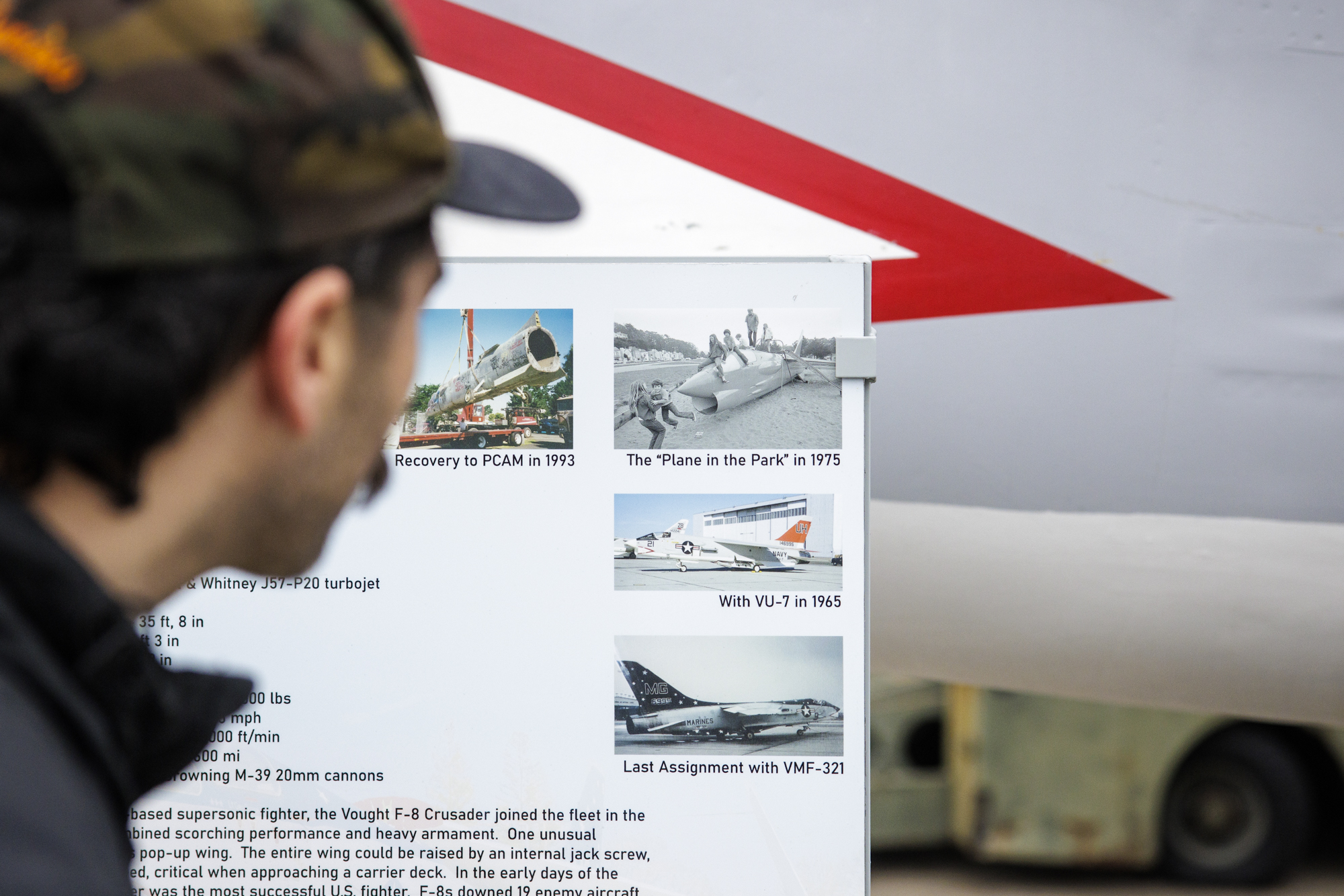
Katrina Schwartz: The museum initially didn’t want to take this plane, but now, it’s one of the most popular attractions. Many visitors who remember playing on the F-8 as kids never knew much about what the jet did before it became playground equipment. That history is something Jim is passionate about sharing.
Jim Mattison: This was designed as a supersonic day fighter for the Navy.
Katrina Schwartz: It would land on incredibly short runways … just 500 feet … on floating aircraft carriers.
Jim Mattison: And it was fast. Very maneuverable and the pilots loved flying it.
Katrina Schwartz in scene: I’m curious, Aaron, what do you think now that you’ve seen it?
Aaron Van Lieu: There’s been a rush and flush of emotions and and memories, you know. I’m on top of the world being able to see it again, really. ‘Cause I’ve always wondered what happened to it.
Katrina Schwartz: And if you remember playing on this jet and have always wondered what happened to it … the Pacific Coast Air Museum is waiting for you.
Olivia Allen-Price: That was Bay Curious editor and producer, Katrina Schwartz.
You can still play on some real Navy equipment if you go to Lincoln and 45th Avenue Playground in Golden Gate Park. There’s a blue boat there that was donated by the Navy … and it’s the real deal.
Are you loving having more Bay Curious episodes in your podcast feed? If so, you can get even more Bay Curious in your life via the Bay Curious newsletter! Head to our website to sign up. As always, at BayCurious.org.
BC is made in SF at member-supported KQED.
Our show is made by Katrina Schwartz, Christopher Beale and me, Olivia Allen Price.
Extra support from Maha Sanad, Katie Sprenger, Jen Chien, Ethan Toven-Lindsey and everyone at team KQED.
Some members of the KQED podcast team are represented by the Screen Actors Guild, American Federation of Television and Radio Artists, San Francisco, Northern California local.
I’m Olivia Allen-Price. Cleared for takeoff.