
Read a transcript of this episode.
Kathleen McKusick used to work in Foster City near Bridgeview Park which, as its name suggests, offers a fine view of the San Mateo-Hayward Bridge. One day, while riding bikes with her daughter along the nearby Bay Trail, she stumbled upon a remnant of the original 1929 San Mateo Bridge that once crossed over the San Francisco Bay.
“Which raised all kinds of questions in my mind,” McKusick said. She wrote to Bay Curious looking to learn about the bridge. “I would love to know more about that original bridge in its heyday.”
McKusick Googled it, naturally, as did I, and there just isn’t a whole lot out there. The best resource? A single article written a few years ago for the Hayward Historical Society by John Christian, formerly an archivist there.
Turns out this bridge was once the longest bridge in North America.
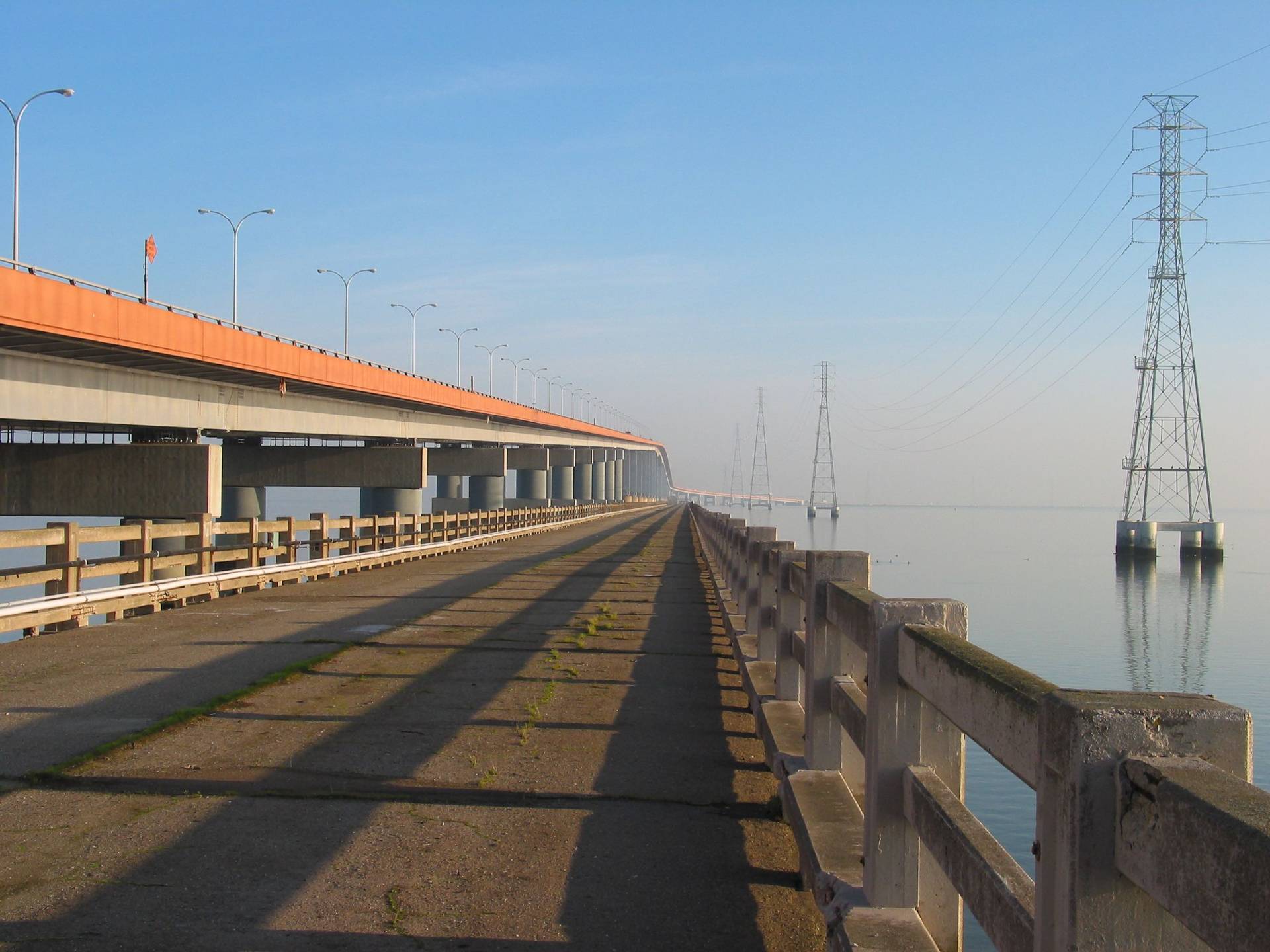
A little stub alongside the new San Mateo-Hayward Bridge is all that remains of the original from 1929.
The history of the bridge
We all met at the Bridgeview Park, where you can spy a little stub of the old bridge alongside the big new one.
“This is the first time I’ve been over here. I guess I’m too Hayward-centric. I’ve never really seen it from this side, to be honest,” Christian said.
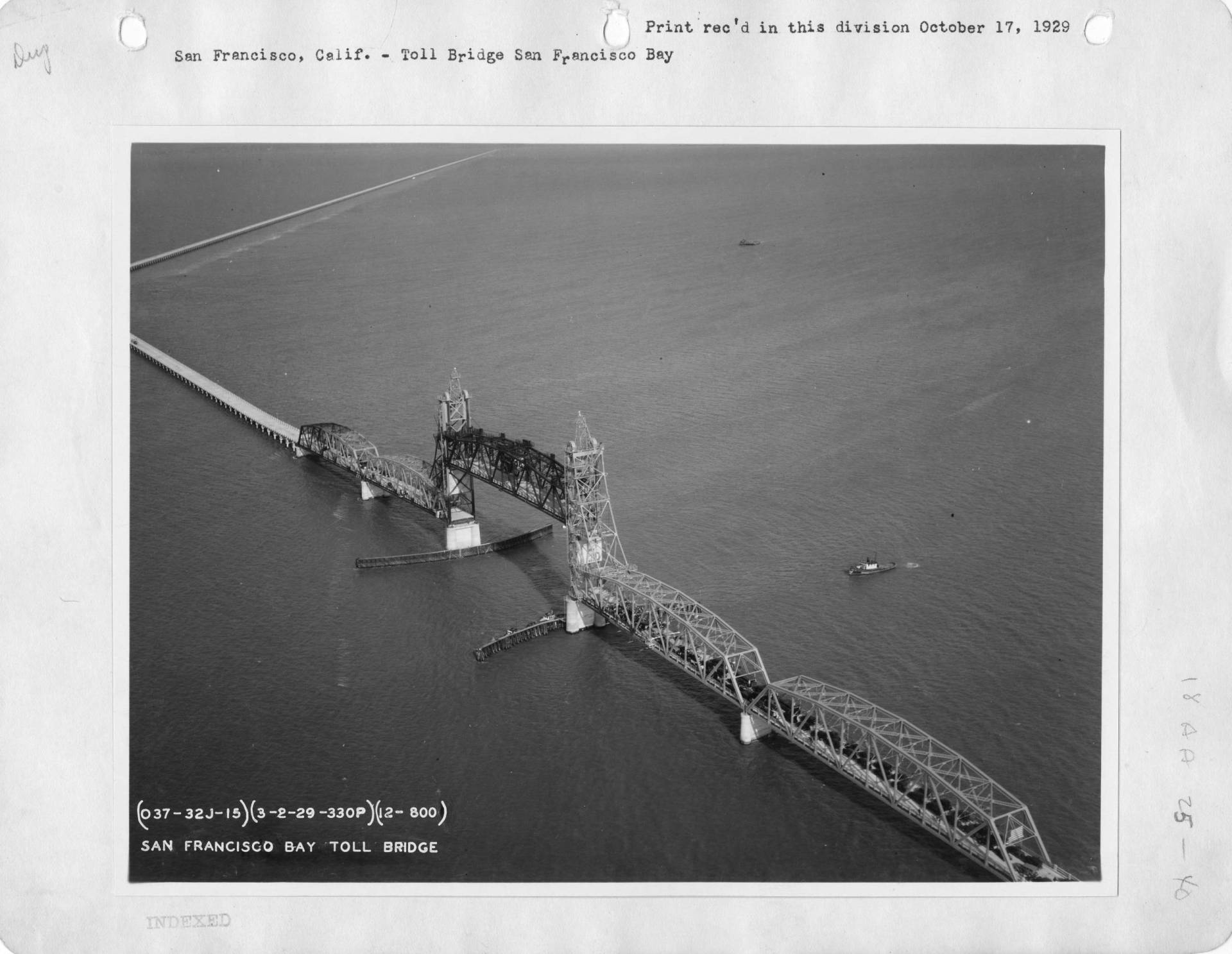
According to Christian, the bridge was originally proposed in 1922 by the Oakland Chamber of Commerce, as a way to jump start business between the Peninsula and the East Bay. Construction began in December 1927. A little more than a year later, on March 2, 1929, there was a grand opening of what was then called the “San Francisco Bay Toll-Bridge.”
The bridge opening in 1929 was a big deal for the Bay Area, and President Calvin Coolidge participated in the dedication by pressing a telegraph button in Washington, D.C. that directed the unfurling of an American flag from the bridge.
San Francisco Mayor James Rolph, who was known to love attending celebrations of almost any kind, was the biggest local celebrity to show up in person.
Not unlike the Golden Gate Bridge to the north, this bridge helped farmers get their goods to market. In the 1920s, the region on both sides of the Bay was rural, as opposed to suburban, as it is today. Think farms, orchards, canneries, salt harvesting and the like.
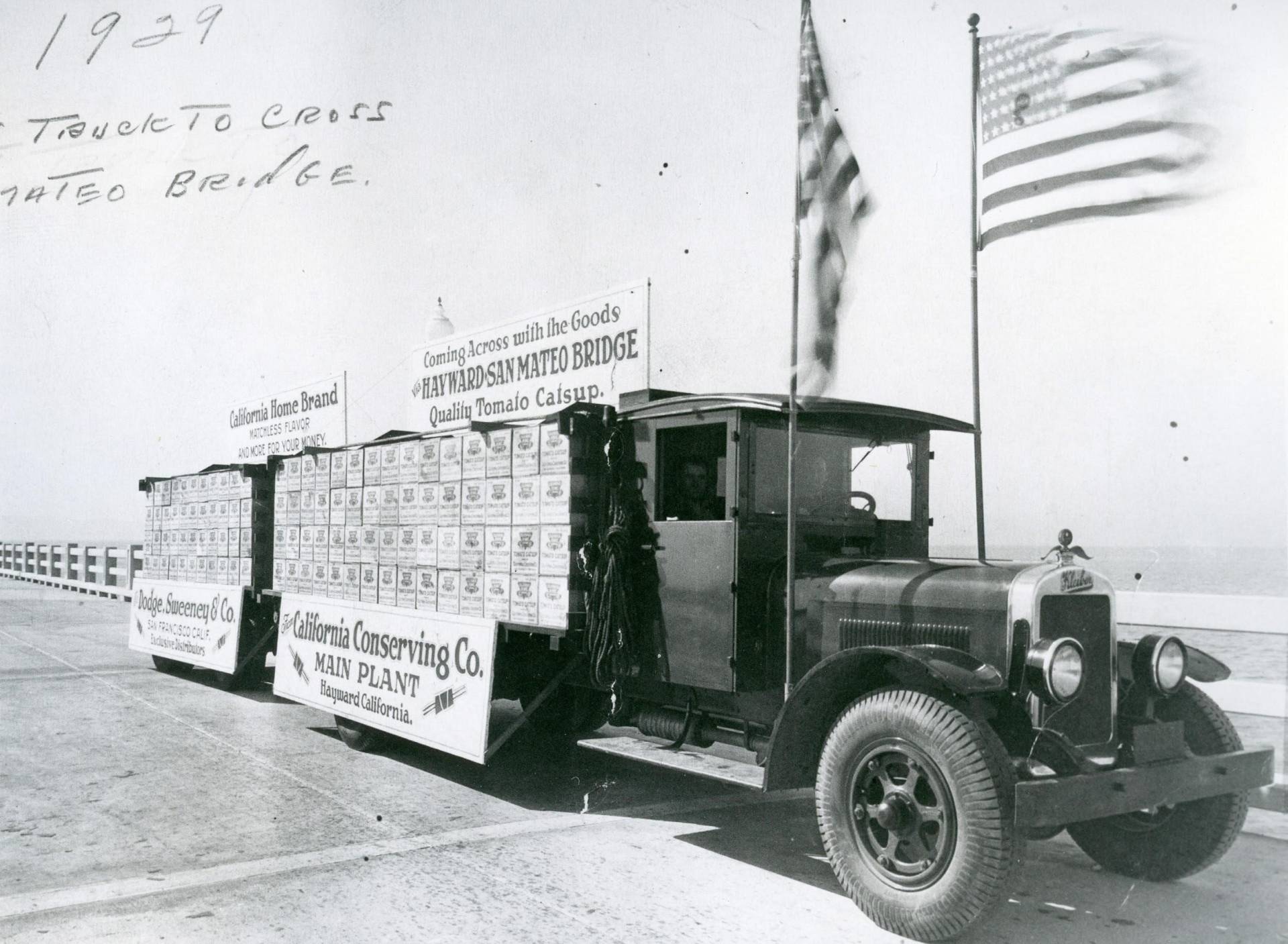
And maybe because it wasn’t designed primarily for commuter traffic, the original bridge was only 30 feet wide with just two lanes, and about 7 miles long.
“Looking at the new bridge, I mean, compared to the old bridge, this bridge is a monster. You know, this is like, 6 lanes. The original bridge would have been just two lanes, back and forth,” Christian said.
Petite, and also, I have to say, terrifying. Right? Especially if there’s a stiff wind? Picking up off the water? Driving a Model T Ford?
“Nobody was blown into the water, as far as I can tell,” Christian said.
Fun fact: The original toll was 45 cents, about $8 in today’s money! So, Christian says, adjusted for inflation, it was more expensive to cross in 1929 than it is today. Takes the sting out of today’s $7 toll? Or maybe not.
Dreams of a bigger bridge
By 1954, 7,400 cars and trucks were crossing every day and newspapers were calling the old bridge an “antique.” The rural towns on either side of the Bay had become suburbs, and the bridge wasn’t designed to carry that kind of capacity.
“It was a small bridge taking you to a small place. And now it’s this massive [bridge taking you from] city center to city center,” said Christian.
As time went on, the biggest complaint about this bridge was not how slender it was, but the electric drawbridge that went up on average 6 times a day to let marine traffic pass underneath. That brought cars and trucks on the bridge to a standstill.
So in 1961, the groundwork was laid for the construction of a wider, taller bridge, to be built just a few feet north of the original span. The old bridge was dismantled, piece by piece, except for the small bit you can still see from Bridgeview Park today. And while there are now longer bridges in North America, according to the state’s Department of Transportation (PDF), the new bridge is still the longest bridge in California.
McKusick’s thoughts on learning the full story? “I really wish that the pier were open and I could walk out onto the bridge. That would be a dream come true.”