window.__IS_SSR__=true
window.__INITIAL_STATE__={
"attachmentsReducer": {
"audio_0": {
"type": "attachments",
"id": "audio_0",
"imgSizes": {
"kqedFullSize": {
"file": "https://ww2.kqed.org/news/wp-content/themes/KQED-unified/img/audio_bgs/background0.jpg"
}
}
},
"audio_1": {
"type": "attachments",
"id": "audio_1",
"imgSizes": {
"kqedFullSize": {
"file": "https://ww2.kqed.org/news/wp-content/themes/KQED-unified/img/audio_bgs/background1.jpg"
}
}
},
"audio_2": {
"type": "attachments",
"id": "audio_2",
"imgSizes": {
"kqedFullSize": {
"file": "https://ww2.kqed.org/news/wp-content/themes/KQED-unified/img/audio_bgs/background2.jpg"
}
}
},
"audio_3": {
"type": "attachments",
"id": "audio_3",
"imgSizes": {
"kqedFullSize": {
"file": "https://ww2.kqed.org/news/wp-content/themes/KQED-unified/img/audio_bgs/background3.jpg"
}
}
},
"audio_4": {
"type": "attachments",
"id": "audio_4",
"imgSizes": {
"kqedFullSize": {
"file": "https://ww2.kqed.org/news/wp-content/themes/KQED-unified/img/audio_bgs/background4.jpg"
}
}
},
"placeholder": {
"type": "attachments",
"id": "placeholder",
"imgSizes": {
"thumbnail": {
"file": "https://cdn.kqed.org/wp-content/uploads/2024/12/KQED-Default-Image-816638274-2000x1333-1-160x107.jpg",
"width": 160,
"height": 107,
"mimeType": "image/jpeg"
},
"medium": {
"file": "https://cdn.kqed.org/wp-content/uploads/2024/12/KQED-Default-Image-816638274-2000x1333-1-800x533.jpg",
"width": 800,
"height": 533,
"mimeType": "image/jpeg"
},
"medium_large": {
"file": "https://cdn.kqed.org/wp-content/uploads/2024/12/KQED-Default-Image-816638274-2000x1333-1-768x512.jpg",
"width": 768,
"height": 512,
"mimeType": "image/jpeg"
},
"large": {
"file": "https://cdn.kqed.org/wp-content/uploads/2024/12/KQED-Default-Image-816638274-2000x1333-1-1020x680.jpg",
"width": 1020,
"height": 680,
"mimeType": "image/jpeg"
},
"1536x1536": {
"file": "https://cdn.kqed.org/wp-content/uploads/2024/12/KQED-Default-Image-816638274-2000x1333-1-1536x1024.jpg",
"width": 1536,
"height": 1024,
"mimeType": "image/jpeg"
},
"fd-lrg": {
"file": "https://cdn.kqed.org/wp-content/uploads/2024/12/KQED-Default-Image-816638274-2000x1333-1-1536x1024.jpg",
"width": 1536,
"height": 1024,
"mimeType": "image/jpeg"
},
"fd-med": {
"file": "https://cdn.kqed.org/wp-content/uploads/2024/12/KQED-Default-Image-816638274-2000x1333-1-1020x680.jpg",
"width": 1020,
"height": 680,
"mimeType": "image/jpeg"
},
"fd-sm": {
"file": "https://cdn.kqed.org/wp-content/uploads/2024/12/KQED-Default-Image-816638274-2000x1333-1-800x533.jpg",
"width": 800,
"height": 533,
"mimeType": "image/jpeg"
},
"post-thumbnail": {
"file": "https://cdn.kqed.org/wp-content/uploads/2024/12/KQED-Default-Image-816638274-2000x1333-1-672x372.jpg",
"width": 672,
"height": 372,
"mimeType": "image/jpeg"
},
"twentyfourteen-full-width": {
"file": "https://cdn.kqed.org/wp-content/uploads/2024/12/KQED-Default-Image-816638274-2000x1333-1-1038x576.jpg",
"width": 1038,
"height": 576,
"mimeType": "image/jpeg"
},
"xxsmall": {
"file": "https://cdn.kqed.org/wp-content/uploads/2024/12/KQED-Default-Image-816638274-2000x1333-1-160x107.jpg",
"width": 160,
"height": 107,
"mimeType": "image/jpeg"
},
"xsmall": {
"file": "https://cdn.kqed.org/wp-content/uploads/2024/12/KQED-Default-Image-816638274-2000x1333-1-672x372.jpg",
"width": 672,
"height": 372,
"mimeType": "image/jpeg"
},
"small": {
"file": "https://cdn.kqed.org/wp-content/uploads/2024/12/KQED-Default-Image-816638274-2000x1333-1-672x372.jpg",
"width": 672,
"height": 372,
"mimeType": "image/jpeg"
},
"xlarge": {
"file": "https://cdn.kqed.org/wp-content/uploads/2024/12/KQED-Default-Image-816638274-2000x1333-1-1020x680.jpg",
"width": 1020,
"height": 680,
"mimeType": "image/jpeg"
},
"full-width": {
"file": "https://cdn.kqed.org/wp-content/uploads/2024/12/KQED-Default-Image-816638274-2000x1333-1-1920x1280.jpg",
"width": 1920,
"height": 1280,
"mimeType": "image/jpeg"
},
"guest-author-32": {
"file": "https://cdn.kqed.org/wp-content/uploads/2025/01/KQED-Default-Image-816638274-1333x1333-1-160x160.jpg",
"width": 32,
"height": 32,
"mimeType": "image/jpeg"
},
"guest-author-50": {
"file": "https://cdn.kqed.org/wp-content/uploads/2025/01/KQED-Default-Image-816638274-1333x1333-1-160x160.jpg",
"width": 50,
"height": 50,
"mimeType": "image/jpeg"
},
"guest-author-64": {
"file": "https://cdn.kqed.org/wp-content/uploads/2025/01/KQED-Default-Image-816638274-1333x1333-1-160x160.jpg",
"width": 64,
"height": 64,
"mimeType": "image/jpeg"
},
"guest-author-96": {
"file": "https://cdn.kqed.org/wp-content/uploads/2025/01/KQED-Default-Image-816638274-1333x1333-1-160x160.jpg",
"width": 96,
"height": 96,
"mimeType": "image/jpeg"
},
"guest-author-128": {
"file": "https://cdn.kqed.org/wp-content/uploads/2025/01/KQED-Default-Image-816638274-1333x1333-1-160x160.jpg",
"width": 128,
"height": 128,
"mimeType": "image/jpeg"
},
"detail": {
"file": "https://cdn.kqed.org/wp-content/uploads/2025/01/KQED-Default-Image-816638274-1333x1333-1-160x160.jpg",
"width": 160,
"height": 160,
"mimeType": "image/jpeg"
},
"kqedFullSize": {
"file": "https://cdn.kqed.org/wp-content/uploads/2024/12/KQED-Default-Image-816638274-2000x1333-1.jpg",
"width": 2000,
"height": 1333
}
}
},
"mindshift_40168": {
"type": "attachments",
"id": "mindshift_40168",
"meta": {
"index": "attachments_1716263798",
"site": "mindshift",
"id": "40168",
"found": true
},
"parent": 40161,
"imgSizes": {
"twentyfourteen-full-width": {
"file": "https://ww2.kqed.org/app/uploads/sites/23/2015/04/Man-on-Phone-at-Night-iStock-1038x576.jpg",
"width": 1038,
"mimeType": "image/jpeg",
"height": 576
},
"thumbnail": {
"file": "https://ww2.kqed.org/app/uploads/sites/23/2015/04/Man-on-Phone-at-Night-iStock-400x225.jpg",
"width": 400,
"mimeType": "image/jpeg",
"height": 225
},
"fd-sm": {
"file": "https://ww2.kqed.org/app/uploads/sites/23/2015/04/Man-on-Phone-at-Night-iStock-320x180.jpg",
"width": 320,
"mimeType": "image/jpeg",
"height": 180
},
"post-thumbnail": {
"file": "https://ww2.kqed.org/app/uploads/sites/23/2015/04/Man-on-Phone-at-Night-iStock-672x372.jpg",
"width": 672,
"mimeType": "image/jpeg",
"height": 372
},
"kqedFullSize": {
"file": "https://ww2.kqed.org/app/uploads/sites/23/2015/04/Man-on-Phone-at-Night-iStock.jpg",
"width": 1920,
"height": 1081
},
"large": {
"file": "https://ww2.kqed.org/app/uploads/sites/23/2015/04/Man-on-Phone-at-Night-iStock-1440x811.jpg",
"width": 1440,
"mimeType": "image/jpeg",
"height": 811
},
"guest-author-96": {
"file": "https://ww2.kqed.org/app/uploads/sites/23/2015/04/Man-on-Phone-at-Night-iStock-96x96.jpg",
"width": 96,
"mimeType": "image/jpeg",
"height": 96
},
"medium": {
"file": "https://ww2.kqed.org/app/uploads/sites/23/2015/04/Man-on-Phone-at-Night-iStock-800x450.jpg",
"width": 800,
"mimeType": "image/jpeg",
"height": 450
},
"guest-author-64": {
"file": "https://ww2.kqed.org/app/uploads/sites/23/2015/04/Man-on-Phone-at-Night-iStock-64x64.jpg",
"width": 64,
"mimeType": "image/jpeg",
"height": 64
},
"guest-author-32": {
"file": "https://ww2.kqed.org/app/uploads/sites/23/2015/04/Man-on-Phone-at-Night-iStock-32x32.jpg",
"width": 32,
"mimeType": "image/jpeg",
"height": 32
},
"cat_post_thumb_sizecategory-posts-2": {
"file": "https://ww2.kqed.org/app/uploads/sites/23/2015/04/Man-on-Phone-at-Night-iStock-50x50.jpg",
"width": 50,
"mimeType": "image/jpeg",
"height": 50
},
"fd-lrg": {
"file": "https://ww2.kqed.org/app/uploads/sites/23/2015/04/Man-on-Phone-at-Night-iStock-1180x664.jpg",
"width": 1180,
"mimeType": "image/jpeg",
"height": 664
},
"fd-med": {
"file": "https://ww2.kqed.org/app/uploads/sites/23/2015/04/Man-on-Phone-at-Night-iStock-768x432.jpg",
"width": 768,
"mimeType": "image/jpeg",
"height": 432
},
"detail": {
"file": "https://ww2.kqed.org/app/uploads/sites/23/2015/04/Man-on-Phone-at-Night-iStock-75x75.jpg",
"width": 75,
"mimeType": "image/jpeg",
"height": 75
},
"guest-author-128": {
"file": "https://ww2.kqed.org/app/uploads/sites/23/2015/04/Man-on-Phone-at-Night-iStock-128x128.jpg",
"width": 128,
"mimeType": "image/jpeg",
"height": 128
}
},
"publishDate": 1429488702,
"modified": 1429488709,
"caption": null,
"description": null,
"title": "Man-on-Phone-at-Night-iStock",
"credit": "iStock",
"status": "inherit",
"isLoading": false,
"fetchFailed": false
},
"mindshift_40126": {
"type": "attachments",
"id": "mindshift_40126",
"meta": {
"index": "attachments_1716263798",
"site": "mindshift",
"id": "40126",
"found": true
},
"parent": 40124,
"imgSizes": {
"thumbnail": {
"file": "https://ww2.kqed.org/app/uploads/sites/23/2015/04/cheryl-400x300.jpg",
"width": 400,
"mimeType": "image/jpeg",
"height": 300
},
"fd-sm": {
"file": "https://ww2.kqed.org/app/uploads/sites/23/2015/04/cheryl-320x240.jpg",
"width": 320,
"mimeType": "image/jpeg",
"height": 240
},
"post-thumbnail": {
"file": "https://ww2.kqed.org/app/uploads/sites/23/2015/04/cheryl-630x372.jpg",
"width": 630,
"mimeType": "image/jpeg",
"height": 372
},
"kqedFullSize": {
"file": "https://ww2.kqed.org/app/uploads/sites/23/2015/04/cheryl.jpg",
"width": 630,
"height": 473
},
"cat_post_thumb_sizecategory-posts-2": {
"file": "https://ww2.kqed.org/app/uploads/sites/23/2015/04/cheryl-50x50.jpg",
"width": 50,
"mimeType": "image/jpeg",
"height": 50
},
"guest-author-96": {
"file": "https://ww2.kqed.org/app/uploads/sites/23/2015/04/cheryl-96x96.jpg",
"width": 96,
"mimeType": "image/jpeg",
"height": 96
},
"guest-author-64": {
"file": "https://ww2.kqed.org/app/uploads/sites/23/2015/04/cheryl-64x64.jpg",
"width": 64,
"mimeType": "image/jpeg",
"height": 64
},
"detail": {
"file": "https://ww2.kqed.org/app/uploads/sites/23/2015/04/cheryl-75x75.jpg",
"width": 75,
"mimeType": "image/jpeg",
"height": 75
},
"guest-author-32": {
"file": "https://ww2.kqed.org/app/uploads/sites/23/2015/04/cheryl-32x32.jpg",
"width": 32,
"mimeType": "image/jpeg",
"height": 32
},
"guest-author-128": {
"file": "https://ww2.kqed.org/app/uploads/sites/23/2015/04/cheryl-128x128.jpg",
"width": 128,
"mimeType": "image/jpeg",
"height": 128
}
},
"publishDate": 1429141778,
"modified": 1429141785,
"caption": null,
"description": null,
"title": "cheryl",
"credit": "Kenneth Kong/Facebook",
"status": "inherit",
"isLoading": false,
"fetchFailed": false
},
"mindshift_40096": {
"type": "attachments",
"id": "mindshift_40096",
"meta": {
"index": "attachments_1716263798",
"site": "mindshift",
"id": "40096",
"found": true
},
"parent": 40093,
"imgSizes": {
"twentyfourteen-full-width": {
"file": "https://ww2.kqed.org/app/uploads/sites/23/2015/04/Baby-smiling-and-sleeping-Robert-Freiberger-1038x576.jpg",
"width": 1038,
"mimeType": "image/jpeg",
"height": 576
},
"thumbnail": {
"file": "https://ww2.kqed.org/app/uploads/sites/23/2015/04/Baby-smiling-and-sleeping-Robert-Freiberger-400x225.jpg",
"width": 400,
"mimeType": "image/jpeg",
"height": 225
},
"fd-sm": {
"file": "https://ww2.kqed.org/app/uploads/sites/23/2015/04/Baby-smiling-and-sleeping-Robert-Freiberger-320x180.jpg",
"width": 320,
"mimeType": "image/jpeg",
"height": 180
},
"post-thumbnail": {
"file": "https://ww2.kqed.org/app/uploads/sites/23/2015/04/Baby-smiling-and-sleeping-Robert-Freiberger-672x372.jpg",
"width": 672,
"mimeType": "image/jpeg",
"height": 372
},
"kqedFullSize": {
"file": "https://ww2.kqed.org/app/uploads/sites/23/2015/04/Baby-smiling-and-sleeping-Robert-Freiberger.jpg",
"width": 1920,
"height": 1081
},
"large": {
"file": "https://ww2.kqed.org/app/uploads/sites/23/2015/04/Baby-smiling-and-sleeping-Robert-Freiberger-1440x811.jpg",
"width": 1440,
"mimeType": "image/jpeg",
"height": 811
},
"guest-author-96": {
"file": "https://ww2.kqed.org/app/uploads/sites/23/2015/04/Baby-smiling-and-sleeping-Robert-Freiberger-96x96.jpg",
"width": 96,
"mimeType": "image/jpeg",
"height": 96
},
"medium": {
"file": "https://ww2.kqed.org/app/uploads/sites/23/2015/04/Baby-smiling-and-sleeping-Robert-Freiberger-800x450.jpg",
"width": 800,
"mimeType": "image/jpeg",
"height": 450
},
"guest-author-64": {
"file": "https://ww2.kqed.org/app/uploads/sites/23/2015/04/Baby-smiling-and-sleeping-Robert-Freiberger-64x64.jpg",
"width": 64,
"mimeType": "image/jpeg",
"height": 64
},
"guest-author-32": {
"file": "https://ww2.kqed.org/app/uploads/sites/23/2015/04/Baby-smiling-and-sleeping-Robert-Freiberger-32x32.jpg",
"width": 32,
"mimeType": "image/jpeg",
"height": 32
},
"cat_post_thumb_sizecategory-posts-2": {
"file": "https://ww2.kqed.org/app/uploads/sites/23/2015/04/Baby-smiling-and-sleeping-Robert-Freiberger-50x50.jpg",
"width": 50,
"mimeType": "image/jpeg",
"height": 50
},
"fd-lrg": {
"file": "https://ww2.kqed.org/app/uploads/sites/23/2015/04/Baby-smiling-and-sleeping-Robert-Freiberger-1180x664.jpg",
"width": 1180,
"mimeType": "image/jpeg",
"height": 664
},
"fd-med": {
"file": "https://ww2.kqed.org/app/uploads/sites/23/2015/04/Baby-smiling-and-sleeping-Robert-Freiberger-768x432.jpg",
"width": 768,
"mimeType": "image/jpeg",
"height": 432
},
"detail": {
"file": "https://ww2.kqed.org/app/uploads/sites/23/2015/04/Baby-smiling-and-sleeping-Robert-Freiberger-75x75.jpg",
"width": 75,
"mimeType": "image/jpeg",
"height": 75
},
"guest-author-128": {
"file": "https://ww2.kqed.org/app/uploads/sites/23/2015/04/Baby-smiling-and-sleeping-Robert-Freiberger-128x128.jpg",
"width": 128,
"mimeType": "image/jpeg",
"height": 128
}
},
"publishDate": 1429100929,
"modified": 1429100942,
"caption": null,
"description": null,
"title": "Baby-smiling and sleeping-Robert-Freiberger",
"credit": "Robert Freiberger/Flickr",
"status": "inherit",
"isLoading": false,
"fetchFailed": false
},
"mindshift_39811": {
"type": "attachments",
"id": "mindshift_39811",
"meta": {
"index": "attachments_1716263798",
"site": "mindshift",
"id": "39811",
"found": true
},
"parent": 39748,
"imgSizes": {
"twentyfourteen-full-width": {
"file": "https://ww2.kqed.org/app/uploads/sites/23/2015/03/Alone-at-school-1038x576.jpg",
"width": 1038,
"mimeType": "image/jpeg",
"height": 576
},
"thumbnail": {
"file": "https://ww2.kqed.org/app/uploads/sites/23/2015/03/Alone-at-school-400x267.jpg",
"width": 400,
"mimeType": "image/jpeg",
"height": 267
},
"fd-sm": {
"file": "https://ww2.kqed.org/app/uploads/sites/23/2015/03/Alone-at-school-320x214.jpg",
"width": 320,
"mimeType": "image/jpeg",
"height": 214
},
"post-thumbnail": {
"file": "https://ww2.kqed.org/app/uploads/sites/23/2015/03/Alone-at-school-672x372.jpg",
"width": 672,
"mimeType": "image/jpeg",
"height": 372
},
"kqedFullSize": {
"file": "https://ww2.kqed.org/app/uploads/sites/23/2015/03/Alone-at-school.jpg",
"width": 1438,
"height": 960
},
"fd-lrg": {
"file": "https://ww2.kqed.org/app/uploads/sites/23/2015/03/Alone-at-school-1180x788.jpg",
"width": 1180,
"mimeType": "image/jpeg",
"height": 788
},
"fd-med": {
"file": "https://ww2.kqed.org/app/uploads/sites/23/2015/03/Alone-at-school-768x513.jpg",
"width": 768,
"mimeType": "image/jpeg",
"height": 513
},
"guest-author-96": {
"file": "https://ww2.kqed.org/app/uploads/sites/23/2015/03/Alone-at-school-96x96.jpg",
"width": 96,
"mimeType": "image/jpeg",
"height": 96
},
"medium": {
"file": "https://ww2.kqed.org/app/uploads/sites/23/2015/03/Alone-at-school-800x534.jpg",
"width": 800,
"mimeType": "image/jpeg",
"height": 534
},
"guest-author-64": {
"file": "https://ww2.kqed.org/app/uploads/sites/23/2015/03/Alone-at-school-64x64.jpg",
"width": 64,
"mimeType": "image/jpeg",
"height": 64
},
"guest-author-32": {
"file": "https://ww2.kqed.org/app/uploads/sites/23/2015/03/Alone-at-school-32x32.jpg",
"width": 32,
"mimeType": "image/jpeg",
"height": 32
},
"guest-author-128": {
"file": "https://ww2.kqed.org/app/uploads/sites/23/2015/03/Alone-at-school-128x128.jpg",
"width": 128,
"mimeType": "image/jpeg",
"height": 128
}
},
"publishDate": 1426858286,
"modified": 1426858302,
"caption": "Gebbe/Flickr",
"description": null,
"title": "Alone-at-school",
"credit": null,
"status": "inherit",
"isLoading": false,
"fetchFailed": false
},
"mindshift_39448": {
"type": "attachments",
"id": "mindshift_39448",
"meta": {
"index": "attachments_1716263798",
"site": "mindshift",
"id": "39448",
"found": true
},
"parent": 39446,
"imgSizes": {
"twentyfourteen-full-width": {
"file": "https://ww2.kqed.org/app/uploads/sites/23/2015/02/teachers-pet_slide-e5b6b0ba34a365514b5f5ae913a1e1e1d0df22d0-1038x576.jpg",
"width": 1038,
"mimeType": "image/jpeg",
"height": 576
},
"thumbnail": {
"file": "https://ww2.kqed.org/app/uploads/sites/23/2015/02/teachers-pet_slide-e5b6b0ba34a365514b5f5ae913a1e1e1d0df22d0-400x267.jpg",
"width": 400,
"mimeType": "image/jpeg",
"height": 267
},
"fd-sm": {
"file": "https://ww2.kqed.org/app/uploads/sites/23/2015/02/teachers-pet_slide-e5b6b0ba34a365514b5f5ae913a1e1e1d0df22d0-320x213.jpg",
"width": 320,
"mimeType": "image/jpeg",
"height": 213
},
"post-thumbnail": {
"file": "https://ww2.kqed.org/app/uploads/sites/23/2015/02/teachers-pet_slide-e5b6b0ba34a365514b5f5ae913a1e1e1d0df22d0-672x372.jpg",
"width": 672,
"mimeType": "image/jpeg",
"height": 372
},
"kqedFullSize": {
"file": "https://ww2.kqed.org/app/uploads/sites/23/2015/02/teachers-pet_slide-e5b6b0ba34a365514b5f5ae913a1e1e1d0df22d0.jpg",
"width": 2997,
"height": 1998
},
"large": {
"file": "https://ww2.kqed.org/app/uploads/sites/23/2015/02/teachers-pet_slide-e5b6b0ba34a365514b5f5ae913a1e1e1d0df22d0-1440x960.jpg",
"width": 1440,
"mimeType": "image/jpeg",
"height": 960
},
"guest-author-96": {
"file": "https://ww2.kqed.org/app/uploads/sites/23/2015/02/teachers-pet_slide-e5b6b0ba34a365514b5f5ae913a1e1e1d0df22d0-96x96.jpg",
"width": 96,
"mimeType": "image/jpeg",
"height": 96
},
"medium": {
"file": "https://ww2.kqed.org/app/uploads/sites/23/2015/02/teachers-pet_slide-e5b6b0ba34a365514b5f5ae913a1e1e1d0df22d0-800x533.jpg",
"width": 800,
"mimeType": "image/jpeg",
"height": 533
},
"guest-author-64": {
"file": "https://ww2.kqed.org/app/uploads/sites/23/2015/02/teachers-pet_slide-e5b6b0ba34a365514b5f5ae913a1e1e1d0df22d0-64x64.jpg",
"width": 64,
"mimeType": "image/jpeg",
"height": 64
},
"guest-author-32": {
"file": "https://ww2.kqed.org/app/uploads/sites/23/2015/02/teachers-pet_slide-e5b6b0ba34a365514b5f5ae913a1e1e1d0df22d0-32x32.jpg",
"width": 32,
"mimeType": "image/jpeg",
"height": 32
},
"fd-lrg": {
"file": "https://ww2.kqed.org/app/uploads/sites/23/2015/02/teachers-pet_slide-e5b6b0ba34a365514b5f5ae913a1e1e1d0df22d0-1180x787.jpg",
"width": 1180,
"mimeType": "image/jpeg",
"height": 787
},
"fd-med": {
"file": "https://ww2.kqed.org/app/uploads/sites/23/2015/02/teachers-pet_slide-e5b6b0ba34a365514b5f5ae913a1e1e1d0df22d0-768x512.jpg",
"width": 768,
"mimeType": "image/jpeg",
"height": 512
},
"guest-author-128": {
"file": "https://ww2.kqed.org/app/uploads/sites/23/2015/02/teachers-pet_slide-e5b6b0ba34a365514b5f5ae913a1e1e1d0df22d0-128x128.jpg",
"width": 128,
"mimeType": "image/jpeg",
"height": 128
}
},
"publishDate": 1424805363,
"modified": 1424805363,
"caption": null,
"description": "The Teacher's Pet",
"title": "The Teacher's Pet",
"credit": null,
"status": "inherit",
"isLoading": false,
"fetchFailed": false
},
"mindshift_39437": {
"type": "attachments",
"id": "mindshift_39437",
"meta": {
"index": "attachments_1716263798",
"site": "mindshift",
"id": "39437",
"found": true
},
"parent": 39119,
"imgSizes": {
"twentyfourteen-full-width": {
"file": "https://ww2.kqed.org/app/uploads/sites/23/2015/02/Study-drug-1038x576.jpg",
"width": 1038,
"mimeType": "image/jpeg",
"height": 576
},
"thumbnail": {
"file": "https://ww2.kqed.org/app/uploads/sites/23/2015/02/Study-drug-400x267.jpg",
"width": 400,
"mimeType": "image/jpeg",
"height": 267
},
"fd-sm": {
"file": "https://ww2.kqed.org/app/uploads/sites/23/2015/02/Study-drug-320x214.jpg",
"width": 320,
"mimeType": "image/jpeg",
"height": 214
},
"post-thumbnail": {
"file": "https://ww2.kqed.org/app/uploads/sites/23/2015/02/Study-drug-672x372.jpg",
"width": 672,
"mimeType": "image/jpeg",
"height": 372
},
"kqedFullSize": {
"file": "https://ww2.kqed.org/app/uploads/sites/23/2015/02/Study-drug.jpg",
"width": 1438,
"height": 960
},
"fd-lrg": {
"file": "https://ww2.kqed.org/app/uploads/sites/23/2015/02/Study-drug-1180x788.jpg",
"width": 1180,
"mimeType": "image/jpeg",
"height": 788
},
"fd-med": {
"file": "https://ww2.kqed.org/app/uploads/sites/23/2015/02/Study-drug-768x513.jpg",
"width": 768,
"mimeType": "image/jpeg",
"height": 513
},
"guest-author-96": {
"file": "https://ww2.kqed.org/app/uploads/sites/23/2015/02/Study-drug-96x96.jpg",
"width": 96,
"mimeType": "image/jpeg",
"height": 96
},
"medium": {
"file": "https://ww2.kqed.org/app/uploads/sites/23/2015/02/Study-drug-800x534.jpg",
"width": 800,
"mimeType": "image/jpeg",
"height": 534
},
"guest-author-64": {
"file": "https://ww2.kqed.org/app/uploads/sites/23/2015/02/Study-drug-64x64.jpg",
"width": 64,
"mimeType": "image/jpeg",
"height": 64
},
"guest-author-32": {
"file": "https://ww2.kqed.org/app/uploads/sites/23/2015/02/Study-drug-32x32.jpg",
"width": 32,
"mimeType": "image/jpeg",
"height": 32
},
"guest-author-128": {
"file": "https://ww2.kqed.org/app/uploads/sites/23/2015/02/Study-drug-128x128.jpg",
"width": 128,
"mimeType": "image/jpeg",
"height": 128
}
},
"publishDate": 1424785009,
"modified": 1424785028,
"caption": "Getty Images",
"description": null,
"title": "Study-drug",
"credit": null,
"status": "inherit",
"isLoading": false,
"fetchFailed": false
},
"mindshift_39389": {
"type": "attachments",
"id": "mindshift_39389",
"meta": {
"index": "attachments_1716263798",
"site": "mindshift",
"id": "39389",
"found": true
},
"parent": 39385,
"imgSizes": {
"twentyfourteen-full-width": {
"file": "https://ww2.kqed.org/app/uploads/sites/23/2015/02/Hands-1038x576.gif",
"width": 1038,
"mimeType": "image/gif",
"height": 576
},
"thumbnail": {
"file": "https://ww2.kqed.org/app/uploads/sites/23/2015/02/Hands-400x267.gif",
"width": 400,
"mimeType": "image/gif",
"height": 267
},
"fd-sm": {
"file": "https://ww2.kqed.org/app/uploads/sites/23/2015/02/Hands-320x214.gif",
"width": 320,
"mimeType": "image/gif",
"height": 214
},
"post-thumbnail": {
"file": "https://ww2.kqed.org/app/uploads/sites/23/2015/02/Hands-672x372.gif",
"width": 672,
"mimeType": "image/gif",
"height": 372
},
"kqedFullSize": {
"file": "https://ww2.kqed.org/app/uploads/sites/23/2015/02/Hands.gif",
"width": 1438,
"height": 960
},
"fd-lrg": {
"file": "https://ww2.kqed.org/app/uploads/sites/23/2015/02/Hands-1180x788.gif",
"width": 1180,
"mimeType": "image/gif",
"height": 788
},
"fd-med": {
"file": "https://ww2.kqed.org/app/uploads/sites/23/2015/02/Hands-768x513.gif",
"width": 768,
"mimeType": "image/gif",
"height": 513
},
"guest-author-96": {
"file": "https://ww2.kqed.org/app/uploads/sites/23/2015/02/Hands-96x96.gif",
"width": 96,
"mimeType": "image/gif",
"height": 96
},
"medium": {
"file": "https://ww2.kqed.org/app/uploads/sites/23/2015/02/Hands-800x534.gif",
"width": 800,
"mimeType": "image/gif",
"height": 534
},
"guest-author-64": {
"file": "https://ww2.kqed.org/app/uploads/sites/23/2015/02/Hands-64x64.gif",
"width": 64,
"mimeType": "image/gif",
"height": 64
},
"guest-author-32": {
"file": "https://ww2.kqed.org/app/uploads/sites/23/2015/02/Hands-32x32.gif",
"width": 32,
"mimeType": "image/gif",
"height": 32
},
"guest-author-128": {
"file": "https://ww2.kqed.org/app/uploads/sites/23/2015/02/Hands-128x128.gif",
"width": 128,
"mimeType": "image/gif",
"height": 128
}
},
"publishDate": 1424265578,
"modified": 1424265586,
"caption": "iStock",
"description": null,
"title": "Hands",
"credit": null,
"status": "inherit",
"isLoading": false,
"fetchFailed": false
},
"mindshift_35515": {
"type": "attachments",
"id": "mindshift_35515",
"meta": {
"index": "attachments_1716263798",
"site": "mindshift",
"id": "35515",
"found": true
},
"parent": 35462,
"imgSizes": {
"thumbnail": {
"file": "https://ww2.kqed.org/app/uploads/sites/23/2014/05/475253193-e1399403283931-400x225.jpg",
"width": 400,
"mimeType": "image/jpeg",
"height": 225
},
"fd-sm": {
"file": "https://ww2.kqed.org/app/uploads/sites/23/2014/05/475253193-e1399403283931-320x180.jpg",
"width": 320,
"mimeType": "image/jpeg",
"height": 180
},
"kqedFullSize": {
"file": "https://ww2.kqed.org/app/uploads/sites/23/2014/05/475253193-e1399403283931.jpg",
"width": 640,
"height": 360
},
"guest-author-96": {
"file": "https://ww2.kqed.org/app/uploads/sites/23/2014/05/475253193-e1399403283931-96x96.jpg",
"width": 96,
"mimeType": "image/jpeg",
"height": 96
},
"guest-author-64": {
"file": "https://ww2.kqed.org/app/uploads/sites/23/2014/05/475253193-e1399403283931-64x64.jpg",
"width": 64,
"mimeType": "image/jpeg",
"height": 64
},
"guest-author-32": {
"file": "https://ww2.kqed.org/app/uploads/sites/23/2014/05/475253193-e1399403283931-32x32.jpg",
"width": 32,
"mimeType": "image/jpeg",
"height": 32
},
"guest-author-128": {
"file": "https://ww2.kqed.org/app/uploads/sites/23/2014/05/475253193-e1399403283931-128x128.jpg",
"width": 128,
"mimeType": "image/jpeg",
"height": 128
}
},
"publishDate": 1399403241,
"modified": 1399403241,
"caption": "Getty",
"description": null,
"title": "475253193",
"credit": null,
"status": "inherit",
"isLoading": false,
"fetchFailed": false
},
"mindshift_38286": {
"type": "attachments",
"id": "mindshift_38286",
"meta": {
"index": "attachments_1716263798",
"site": "mindshift",
"id": "38286",
"found": true
},
"parent": 37765,
"imgSizes": {
"twentyfourteen-full-width": {
"file": "https://ww2.kqed.org/app/uploads/sites/23/2014/10/Golden-Ratio-Math-1038x576.gif",
"width": 1038,
"mimeType": "image/gif",
"height": 576
},
"thumbnail": {
"file": "https://ww2.kqed.org/app/uploads/sites/23/2014/10/Golden-Ratio-Math-400x225.gif",
"width": 400,
"mimeType": "image/gif",
"height": 225
},
"fd-sm": {
"file": "https://ww2.kqed.org/app/uploads/sites/23/2014/10/Golden-Ratio-Math-320x180.gif",
"width": 320,
"mimeType": "image/gif",
"height": 180
},
"post-thumbnail": {
"file": "https://ww2.kqed.org/app/uploads/sites/23/2014/10/Golden-Ratio-Math-672x372.gif",
"width": 672,
"mimeType": "image/gif",
"height": 372
},
"kqedFullSize": {
"file": "https://ww2.kqed.org/app/uploads/sites/23/2014/10/Golden-Ratio-Math.gif",
"width": 1280,
"height": 720
},
"fd-lrg": {
"file": "https://ww2.kqed.org/app/uploads/sites/23/2014/10/Golden-Ratio-Math-1180x664.gif",
"width": 1180,
"mimeType": "image/gif",
"height": 664
},
"fd-med": {
"file": "https://ww2.kqed.org/app/uploads/sites/23/2014/10/Golden-Ratio-Math-768x432.gif",
"width": 768,
"mimeType": "image/gif",
"height": 432
},
"guest-author-96": {
"file": "https://ww2.kqed.org/app/uploads/sites/23/2014/10/Golden-Ratio-Math-96x96.gif",
"width": 96,
"mimeType": "image/gif",
"height": 96
},
"medium": {
"file": "https://ww2.kqed.org/app/uploads/sites/23/2014/10/Golden-Ratio-Math-800x450.gif",
"width": 800,
"mimeType": "image/gif",
"height": 450
},
"guest-author-64": {
"file": "https://ww2.kqed.org/app/uploads/sites/23/2014/10/Golden-Ratio-Math-64x64.gif",
"width": 64,
"mimeType": "image/gif",
"height": 64
},
"guest-author-32": {
"file": "https://ww2.kqed.org/app/uploads/sites/23/2014/10/Golden-Ratio-Math-32x32.gif",
"width": 32,
"mimeType": "image/gif",
"height": 32
},
"guest-author-128": {
"file": "https://ww2.kqed.org/app/uploads/sites/23/2014/10/Golden-Ratio-Math-128x128.gif",
"width": 128,
"mimeType": "image/gif",
"height": 128
}
},
"publishDate": 1414500716,
"modified": 1414500716,
"caption": "iStock",
"description": null,
"title": "Golden-Ratio-Math",
"credit": null,
"status": "inherit",
"isLoading": false,
"fetchFailed": false
},
"mindshift_39188": {
"type": "attachments",
"id": "mindshift_39188",
"meta": {
"index": "attachments_1716263798",
"site": "mindshift",
"id": "39188",
"found": true
},
"parent": 39108,
"imgSizes": {
"twentyfourteen-full-width": {
"file": "https://ww2.kqed.org/app/uploads/sites/23/2015/01/Improv2_BaukeSchildt1-Featured-Image-1038x576.gif",
"width": 1038,
"mimeType": "image/gif",
"height": 576
},
"thumbnail": {
"file": "https://ww2.kqed.org/app/uploads/sites/23/2015/01/Improv2_BaukeSchildt1-Featured-Image-400x267.gif",
"width": 400,
"mimeType": "image/gif",
"height": 267
},
"fd-sm": {
"file": "https://ww2.kqed.org/app/uploads/sites/23/2015/01/Improv2_BaukeSchildt1-Featured-Image-320x213.gif",
"width": 320,
"mimeType": "image/gif",
"height": 213
},
"post-thumbnail": {
"file": "https://ww2.kqed.org/app/uploads/sites/23/2015/01/Improv2_BaukeSchildt1-Featured-Image-672x372.gif",
"width": 672,
"mimeType": "image/gif",
"height": 372
},
"kqedFullSize": {
"file": "https://ww2.kqed.org/app/uploads/sites/23/2015/01/Improv2_BaukeSchildt1-Featured-Image.gif",
"width": 1440,
"height": 960
},
"large": {
"file": "https://ww2.kqed.org/app/uploads/sites/23/2015/01/Improv2_BaukeSchildt1-Featured-Image-1440x960.gif",
"width": 1440,
"mimeType": "image/gif",
"height": 960
},
"guest-author-96": {
"file": "https://ww2.kqed.org/app/uploads/sites/23/2015/01/Improv2_BaukeSchildt1-Featured-Image-96x96.gif",
"width": 96,
"mimeType": "image/gif",
"height": 96
},
"medium": {
"file": "https://ww2.kqed.org/app/uploads/sites/23/2015/01/Improv2_BaukeSchildt1-Featured-Image-800x533.gif",
"width": 800,
"mimeType": "image/gif",
"height": 533
},
"guest-author-64": {
"file": "https://ww2.kqed.org/app/uploads/sites/23/2015/01/Improv2_BaukeSchildt1-Featured-Image-64x64.gif",
"width": 64,
"mimeType": "image/gif",
"height": 64
},
"guest-author-32": {
"file": "https://ww2.kqed.org/app/uploads/sites/23/2015/01/Improv2_BaukeSchildt1-Featured-Image-32x32.gif",
"width": 32,
"mimeType": "image/gif",
"height": 32
},
"fd-lrg": {
"file": "https://ww2.kqed.org/app/uploads/sites/23/2015/01/Improv2_BaukeSchildt1-Featured-Image-1180x787.gif",
"width": 1180,
"mimeType": "image/gif",
"height": 787
},
"fd-med": {
"file": "https://ww2.kqed.org/app/uploads/sites/23/2015/01/Improv2_BaukeSchildt1-Featured-Image-768x512.gif",
"width": 768,
"mimeType": "image/gif",
"height": 512
},
"guest-author-128": {
"file": "https://ww2.kqed.org/app/uploads/sites/23/2015/01/Improv2_BaukeSchildt1-Featured-Image-128x128.gif",
"width": 128,
"mimeType": "image/gif",
"height": 128
}
},
"publishDate": 1422654564,
"modified": 1422654579,
"caption": "Illustration by Bauke Schildt",
"description": null,
"title": "Improv2_BaukeSchildt[1]-Featured-Image",
"credit": null,
"status": "inherit",
"isLoading": false,
"fetchFailed": false
},
"mindshift_39148": {
"type": "attachments",
"id": "mindshift_39148",
"meta": {
"index": "attachments_1716263798",
"site": "mindshift",
"id": "39148",
"found": true
},
"parent": 39097,
"imgSizes": {
"twentyfourteen-full-width": {
"file": "https://ww2.kqed.org/app/uploads/sites/23/2015/01/Tangramming-Jef-Safi-1038x576.gif",
"width": 1038,
"mimeType": "image/gif",
"height": 576
},
"thumbnail": {
"file": "https://ww2.kqed.org/app/uploads/sites/23/2015/01/Tangramming-Jef-Safi-400x267.gif",
"width": 400,
"mimeType": "image/gif",
"height": 267
},
"fd-sm": {
"file": "https://ww2.kqed.org/app/uploads/sites/23/2015/01/Tangramming-Jef-Safi-320x213.gif",
"width": 320,
"mimeType": "image/gif",
"height": 213
},
"post-thumbnail": {
"file": "https://ww2.kqed.org/app/uploads/sites/23/2015/01/Tangramming-Jef-Safi-672x372.gif",
"width": 672,
"mimeType": "image/gif",
"height": 372
},
"kqedFullSize": {
"file": "https://ww2.kqed.org/app/uploads/sites/23/2015/01/Tangramming-Jef-Safi.gif",
"width": 1440,
"height": 960
},
"large": {
"file": "https://ww2.kqed.org/app/uploads/sites/23/2015/01/Tangramming-Jef-Safi-1440x960.gif",
"width": 1440,
"mimeType": "image/gif",
"height": 960
},
"guest-author-96": {
"file": "https://ww2.kqed.org/app/uploads/sites/23/2015/01/Tangramming-Jef-Safi-96x96.gif",
"width": 96,
"mimeType": "image/gif",
"height": 96
},
"medium": {
"file": "https://ww2.kqed.org/app/uploads/sites/23/2015/01/Tangramming-Jef-Safi-800x533.gif",
"width": 800,
"mimeType": "image/gif",
"height": 533
},
"guest-author-64": {
"file": "https://ww2.kqed.org/app/uploads/sites/23/2015/01/Tangramming-Jef-Safi-64x64.gif",
"width": 64,
"mimeType": "image/gif",
"height": 64
},
"guest-author-32": {
"file": "https://ww2.kqed.org/app/uploads/sites/23/2015/01/Tangramming-Jef-Safi-32x32.gif",
"width": 32,
"mimeType": "image/gif",
"height": 32
},
"fd-lrg": {
"file": "https://ww2.kqed.org/app/uploads/sites/23/2015/01/Tangramming-Jef-Safi-1180x787.gif",
"width": 1180,
"mimeType": "image/gif",
"height": 787
},
"fd-med": {
"file": "https://ww2.kqed.org/app/uploads/sites/23/2015/01/Tangramming-Jef-Safi-768x512.gif",
"width": 768,
"mimeType": "image/gif",
"height": 512
},
"guest-author-128": {
"file": "https://ww2.kqed.org/app/uploads/sites/23/2015/01/Tangramming-Jef-Safi-128x128.gif",
"width": 128,
"mimeType": "image/gif",
"height": 128
}
},
"publishDate": 1422536857,
"modified": 1422536882,
"caption": "Flickr/Jef Safi ",
"description": null,
"title": "Tangramming-Jef-Safi",
"credit": null,
"status": "inherit",
"isLoading": false,
"fetchFailed": false
},
"mindshift_39014": {
"type": "attachments",
"id": "mindshift_39014",
"meta": {
"index": "attachments_1716263798",
"site": "mindshift",
"id": "39014",
"found": true
},
"parent": 39013,
"imgSizes": {
"twentyfourteen-full-width": {
"file": "https://ww2.kqed.org/app/uploads/sites/23/2015/01/Globe-Judy-van-der-Velden-1038x576.gif",
"width": 1038,
"mimeType": "image/gif",
"height": 576
},
"thumbnail": {
"file": "https://ww2.kqed.org/app/uploads/sites/23/2015/01/Globe-Judy-van-der-Velden-400x267.gif",
"width": 400,
"mimeType": "image/gif",
"height": 267
},
"fd-sm": {
"file": "https://ww2.kqed.org/app/uploads/sites/23/2015/01/Globe-Judy-van-der-Velden-320x213.gif",
"width": 320,
"mimeType": "image/gif",
"height": 213
},
"post-thumbnail": {
"file": "https://ww2.kqed.org/app/uploads/sites/23/2015/01/Globe-Judy-van-der-Velden-672x372.gif",
"width": 672,
"mimeType": "image/gif",
"height": 372
},
"kqedFullSize": {
"file": "https://ww2.kqed.org/app/uploads/sites/23/2015/01/Globe-Judy-van-der-Velden.gif",
"width": 1440,
"height": 960
},
"large": {
"file": "https://ww2.kqed.org/app/uploads/sites/23/2015/01/Globe-Judy-van-der-Velden-1440x960.gif",
"width": 1440,
"mimeType": "image/gif",
"height": 960
},
"guest-author-96": {
"file": "https://ww2.kqed.org/app/uploads/sites/23/2015/01/Globe-Judy-van-der-Velden-96x96.gif",
"width": 96,
"mimeType": "image/gif",
"height": 96
},
"medium": {
"file": "https://ww2.kqed.org/app/uploads/sites/23/2015/01/Globe-Judy-van-der-Velden-800x533.gif",
"width": 800,
"mimeType": "image/gif",
"height": 533
},
"guest-author-64": {
"file": "https://ww2.kqed.org/app/uploads/sites/23/2015/01/Globe-Judy-van-der-Velden-64x64.gif",
"width": 64,
"mimeType": "image/gif",
"height": 64
},
"guest-author-32": {
"file": "https://ww2.kqed.org/app/uploads/sites/23/2015/01/Globe-Judy-van-der-Velden-32x32.gif",
"width": 32,
"mimeType": "image/gif",
"height": 32
},
"fd-lrg": {
"file": "https://ww2.kqed.org/app/uploads/sites/23/2015/01/Globe-Judy-van-der-Velden-1180x787.gif",
"width": 1180,
"mimeType": "image/gif",
"height": 787
},
"fd-med": {
"file": "https://ww2.kqed.org/app/uploads/sites/23/2015/01/Globe-Judy-van-der-Velden-768x512.gif",
"width": 768,
"mimeType": "image/gif",
"height": 512
},
"guest-author-128": {
"file": "https://ww2.kqed.org/app/uploads/sites/23/2015/01/Globe-Judy-van-der-Velden-128x128.gif",
"width": 128,
"mimeType": "image/gif",
"height": 128
}
},
"publishDate": 1421243771,
"modified": 1421243786,
"caption": "Flickr/Judy van der Velden",
"description": null,
"title": "Globe-Judy-van-der-Velden",
"credit": null,
"status": "inherit",
"isLoading": false,
"fetchFailed": false
}
},
"audioPlayerReducer": {
"postId": "stream_live",
"isPaused": true,
"isPlaying": false,
"pfsActive": false,
"pledgeModalIsOpen": true,
"playerDrawerIsOpen": false,
"liveAudioPlayStartedAt": 0,
"liveAudioPlayContext": ""
},
"authorsReducer": {
"byline_mindshift_40093": {
"type": "authors",
"id": "byline_mindshift_40093",
"meta": {
"override": true
},
"slug": "byline_mindshift_40093",
"name": "Jon Hamilton",
"isLoading": false
},
"byline_mindshift_39446": {
"type": "authors",
"id": "byline_mindshift_39446",
"meta": {
"override": true
},
"slug": "byline_mindshift_39446",
"name": "Anya Kamenetz",
"isLoading": false
},
"katrinaschwartz": {
"type": "authors",
"id": "234",
"meta": {
"index": "authors_1716337520",
"id": "234",
"found": true
},
"name": "Katrina Schwartz",
"firstName": "Katrina",
"lastName": "Schwartz",
"slug": "katrinaschwartz",
"email": "kschwartz@kqed.org",
"display_author_email": false,
"staff_mastheads": [
"news"
],
"title": "Producer",
"bio": "Katrina Schwartz is a journalist based in San Francisco. She's worked at KPCC public radio in LA and has reported on air and online for KQED since 2010. She covered how teaching and learning is changing for MindShift between 2012 and 2020. She is the co-host of the MindShift podcast and now produces KQED's Bay Curious podcast.",
"avatar": "https://secure.gravatar.com/avatar/edb4ee79070447a018538c9aae6eeecf28786515b8a0c30e43b6b7dce5aa44c8?s=600&d=blank&r=g",
"twitter": "kschwart",
"bluesky": null,
"facebook": null,
"instagram": null,
"linkedin": null,
"sites": [
{
"site": "",
"roles": [
"editor"
]
},
{
"site": "news",
"roles": [
"editor"
]
},
{
"site": "mindshift",
"roles": [
"administrator"
]
},
{
"site": "stateofhealth",
"roles": [
"author"
]
},
{
"site": "science",
"roles": [
"editor"
]
}
],
"headData": {
"title": "Katrina Schwartz | KQED",
"description": "Producer",
"ogImgSrc": "https://secure.gravatar.com/avatar/edb4ee79070447a018538c9aae6eeecf28786515b8a0c30e43b6b7dce5aa44c8?s=600&d=blank&r=g",
"twImgSrc": "https://secure.gravatar.com/avatar/edb4ee79070447a018538c9aae6eeecf28786515b8a0c30e43b6b7dce5aa44c8?s=600&d=blank&r=g"
},
"isLoading": false,
"link": "/author/katrinaschwartz"
},
"hollykorbey": {
"type": "authors",
"id": "4445",
"meta": {
"index": "authors_1716337520",
"id": "4445",
"found": true
},
"name": "Holly Korbey",
"firstName": "Holly",
"lastName": "Korbey",
"slug": "hollykorbey",
"email": "holly@hollykorbey.com",
"display_author_email": false,
"staff_mastheads": [],
"title": null,
"bio": "Holly Korbey's work on parenting and education has appeared in The New York Times, The Atlantic, Babble, Brain, Child Magazine, and others. She lives in Nashville with her family. Follow her on Twitter: @HKorbey",
"avatar": "https://secure.gravatar.com/avatar/f385f7a3b90e52ecd5e85c24fbd0a363?s=600&d=blank&r=g",
"twitter": null,
"facebook": null,
"instagram": null,
"linkedin": null,
"sites": [
{
"site": "mindshift",
"roles": [
"contributor"
]
}
],
"headData": {
"title": "Holly Korbey | KQED",
"description": null,
"ogImgSrc": "https://secure.gravatar.com/avatar/f385f7a3b90e52ecd5e85c24fbd0a363?s=600&d=blank&r=g",
"twImgSrc": "https://secure.gravatar.com/avatar/f385f7a3b90e52ecd5e85c24fbd0a363?s=600&d=blank&r=g"
},
"isLoading": false,
"link": "/author/hollykorbey"
},
"ichen": {
"type": "authors",
"id": "4556",
"meta": {
"index": "authors_1716337520",
"id": "4556",
"found": true
},
"name": "Ingfei Chen",
"firstName": "Ingfei",
"lastName": "Chen",
"slug": "ichen",
"email": "ingfei@sbcglobal.net",
"display_author_email": false,
"staff_mastheads": [],
"title": null,
"bio": "Ingfei Chen is a freelance writer in Northern California whose work has appeared in Scientific American, the New York Times and Smithsonian.",
"avatar": "https://secure.gravatar.com/avatar/10d83690bdf15670800fcf9cbf9d7a63?s=600&d=blank&r=g",
"twitter": null,
"facebook": null,
"instagram": null,
"linkedin": null,
"sites": [
{
"site": "mindshift",
"roles": [
"contributor"
]
}
],
"headData": {
"title": "Ingfei Chen | KQED",
"description": null,
"ogImgSrc": "https://secure.gravatar.com/avatar/10d83690bdf15670800fcf9cbf9d7a63?s=600&d=blank&r=g",
"twImgSrc": "https://secure.gravatar.com/avatar/10d83690bdf15670800fcf9cbf9d7a63?s=600&d=blank&r=g"
},
"isLoading": false,
"link": "/author/ichen"
},
"lindaflan": {
"type": "authors",
"id": "4613",
"meta": {
"index": "authors_1716337520",
"id": "4613",
"found": true
},
"name": "Linda Flanagan",
"firstName": "Linda",
"lastName": "Flanagan",
"slug": "lindaflan",
"email": "lindaflan@comcast.net",
"display_author_email": false,
"staff_mastheads": [],
"title": null,
"bio": "Linda Flanagan is a freelance writer, researcher, and editor. Her work has appeared in The Atlantic, The Wall St. Journal, Newsweek, Running Times, and Mind/Shift, and she blogs regularly for the Huffington Post. Linda writes about education, culture, athletics, youth sports, mental health, politics, college admissions, and other curiosities. She also reviews books and conducts interviews.",
"avatar": "https://secure.gravatar.com/avatar/6bca04c0736bf5eaea80654019de688f?s=600&d=blank&r=g",
"twitter": "LindaFlanagan2",
"facebook": null,
"instagram": null,
"linkedin": null,
"sites": [
{
"site": "mindshift",
"roles": [
"contributor"
]
}
],
"headData": {
"title": "Linda Flanagan | KQED",
"description": null,
"ogImgSrc": "https://secure.gravatar.com/avatar/6bca04c0736bf5eaea80654019de688f?s=600&d=blank&r=g",
"twImgSrc": "https://secure.gravatar.com/avatar/6bca04c0736bf5eaea80654019de688f?s=600&d=blank&r=g"
},
"isLoading": false,
"link": "/author/lindaflan"
}
},
"pagesReducer": {
"mindshift_category_culture": {
"type": "terms",
"id": "mindshift_194",
"meta": {
"index": "terms_1716263798",
"site": "mindshift",
"id": "194",
"score": 12.371298
},
"featImg": null,
"name": "Culture",
"description": "How trends in technology – social networks, Internet privacy, cyberbullying – influence education.",
"taxonomy": "category",
"headData": {
"twImgId": null,
"twTitle": null,
"ogTitle": null,
"ogImgId": null,
"twDescription": null,
"description": "How trends in technology – social networks, Internet privacy, cyberbullying – influence education.",
"title": "Culture Archives | KQED Mindshift",
"ogDescription": null
},
"ttid": 194,
"slug": "culture",
"isLoading": false,
"title": "Culture",
"pageMeta": {
"site": "mindshift",
"WpPageTemplate": "page-topic-editorial",
"currentPage": 16
},
"blocks": [
{
"blockName": "kqed/company-paragraph",
"content": "How trends in technology – social networks, Internet privacy, cyberbullying – influence education."
},
{
"blockName": "kqed/post-list",
"attrs": {
"layout": "cardArticle2",
"query": "posts/mindshift?category=culture",
"seeMore": false,
"paginated": true,
"page": 16
}
},
{
"blockName": "kqed/ad"
}
]
}
},
"pfsSessionReducer": {},
"postsReducer": {
"stream_live": {
"type": "live",
"id": "stream_live",
"audioUrl": "https://streams.kqed.org/kqedradio",
"title": "Live Stream",
"excerpt": "Live Stream information currently unavailable.",
"link": "/radio",
"featImg": "",
"label": {
"name": "KQED Live",
"link": "/"
}
},
"stream_kqedNewscast": {
"type": "posts",
"id": "stream_kqedNewscast",
"audioUrl": "https://www.kqed.org/.stream/anon/radio/RDnews/newscast.mp3?_=1",
"title": "KQED Newscast",
"featImg": "",
"label": {
"name": "88.5 FM",
"link": "/"
}
},
"mindshift_40161": {
"type": "posts",
"id": "mindshift_40161",
"meta": {
"index": "posts_1716263798",
"site": "mindshift",
"id": "40161",
"score": null,
"sort": [
1429489076000
]
},
"parent": 0,
"labelTerm": {
"site": "mindshift"
},
"blocks": [],
"publishDate": 1429489076,
"format": "standard",
"disqusTitle": "How Much Sleep is Just Right for Cognitive Function?",
"title": "How Much Sleep is Just Right for Cognitive Function?",
"headTitle": "MindShift | KQED News",
"content": "\u003cp>There's no shortage of \u003ca href=\"http://ww2.kqed.org/mindshift/2013/01/11/why-sleeping-may-be-more-important-than-studying/\">research\u003c/a> around the benefits of sleep and its critical relationship to learning. So how much sleep is enough? Researchers have looked at the differences in cognitive function of people who have slept four or six or eight hours and how their brains function. This AsapSCIENCE video demonstrates what your capabilities are after those various amounts of sleep.\u003c/p>\n\u003cp>https://www.youtube.com/watch?v=SVQlcxiQlzI\u003c/p>\n\u003cp>And if you're using the snooze button to reach what you think is a full night's rest, think again. AsapSCIENCE also looked at sleep cycles and the effect of snooze buttons. Some may already know about \"sleep debt,\" but in this video, you'll see how the snooze button contributes to \"sleep inertia.\"\u003c/p>\n\u003cp>https://www.youtube.com/watch?v=P6zcSFA7ymo\u003c/p>\n\u003cp> \u003c/p>\n\u003cp>[ad fullwidth]\u003c/p>\u003cp>\u003c/p>\n",
"disqusIdentifier": "40161 http://ww2.kqed.org/mindshift/?p=40161",
"disqusUrl": "https://ww2.kqed.org/mindshift/2015/04/19/how-much-sleep-is-just-right-for-cognitive-function/",
"stats": {
"hasVideo": true,
"hasChartOrMap": false,
"hasAudio": false,
"hasPolis": false,
"wordCount": 138,
"hasGoogleForm": false,
"hasGallery": false,
"hasHearkenModule": false,
"iframeSrcs": [],
"paragraphCount": 4
},
"modified": 1429489076,
"excerpt": "We all know about the importance of sleep. But what's the difference between four, six and eight hours of sleep? ",
"headData": {
"twImgId": "",
"twTitle": "",
"ogTitle": "",
"ogImgId": "",
"twDescription": "",
"description": "We all know about the importance of sleep. But what's the difference between four, six and eight hours of sleep? ",
"title": "How Much Sleep is Just Right for Cognitive Function? | KQED",
"ogDescription": "",
"schema": {
"@context": "https://schema.org",
"@type": "Article",
"headline": "How Much Sleep is Just Right for Cognitive Function?",
"datePublished": "2015-04-19T17:17:56-07:00",
"dateModified": "2015-04-19T17:17:56-07:00",
"image": "https://cdn.kqed.org/wp-content/uploads/2020/02/KQED-OG-Image@1x.png"
}
},
"guestAuthors": [],
"slug": "how-much-sleep-is-just-right-for-cognitive-function",
"status": "publish",
"path": "/mindshift/40161/how-much-sleep-is-just-right-for-cognitive-function",
"audioTrackLength": null,
"parsedContent": [
{
"type": "contentString",
"content": "\u003cdiv class=\"post-body\">\u003cp>\u003cp>There's no shortage of \u003ca href=\"http://ww2.kqed.org/mindshift/2013/01/11/why-sleeping-may-be-more-important-than-studying/\">research\u003c/a> around the benefits of sleep and its critical relationship to learning. So how much sleep is enough? Researchers have looked at the differences in cognitive function of people who have slept four or six or eight hours and how their brains function. This AsapSCIENCE video demonstrates what your capabilities are after those various amounts of sleep.\u003c/p>\u003c/p>\u003cp>\u003cspan class='utils-parseShortcode-shortcodes-__youtubeShortcode__embedYoutube'>\n \u003cspan class='utils-parseShortcode-shortcodes-__youtubeShortcode__embedYoutubeInside'>\n \u003ciframe\n loading='lazy'\n class='utils-parseShortcode-shortcodes-__youtubeShortcode__youtubePlayer'\n type='text/html'\n src='//www.youtube.com/embed/SVQlcxiQlzI'\n title='//www.youtube.com/embed/SVQlcxiQlzI'\n allowfullscreen='true'\n style='border:0;'>\u003c/iframe>\n \u003c/span>\n \u003c/span>\u003c/p>\u003cp>\u003cp>And if you're using the snooze button to reach what you think is a full night's rest, think again. AsapSCIENCE also looked at sleep cycles and the effect of snooze buttons. Some may already know about \"sleep debt,\" but in this video, you'll see how the snooze button contributes to \"sleep inertia.\"\u003c/p>\u003c/p>\u003cp>\u003cspan class='utils-parseShortcode-shortcodes-__youtubeShortcode__embedYoutube'>\n \u003cspan class='utils-parseShortcode-shortcodes-__youtubeShortcode__embedYoutubeInside'>\n \u003ciframe\n loading='lazy'\n class='utils-parseShortcode-shortcodes-__youtubeShortcode__youtubePlayer'\n type='text/html'\n src='//www.youtube.com/embed/P6zcSFA7ymo'\n title='//www.youtube.com/embed/P6zcSFA7ymo'\n allowfullscreen='true'\n style='border:0;'>\u003c/iframe>\n \u003c/span>\n \u003c/span>\u003c/p>\u003cp>\u003cp> \u003c/p>\n\u003cp>\u003c/p>\u003c/div>",
"attributes": {
"named": {},
"numeric": []
}
},
{
"type": "component",
"content": "",
"name": "ad",
"attributes": {
"named": {
"label": "fullwidth"
},
"numeric": [
"fullwidth"
]
}
},
{
"type": "contentString",
"content": "\u003cdiv class=\"post-body\">\u003cp>\u003c/p>\u003cp>\u003c/p>\n\u003c/div>\u003c/p>",
"attributes": {
"named": {},
"numeric": []
}
}
],
"link": "/mindshift/40161/how-much-sleep-is-just-right-for-cognitive-function",
"authors": [
"4354"
],
"categories": [
"mindshift_194"
],
"tags": [
"mindshift_990"
],
"featImg": "mindshift_40168",
"label": "mindshift"
},
"mindshift_40124": {
"type": "posts",
"id": "mindshift_40124",
"meta": {
"index": "posts_1716263798",
"site": "mindshift",
"id": "40124",
"score": null,
"sort": [
1429192004000
]
},
"parent": 0,
"labelTerm": {
"site": "mindshift"
},
"blocks": [],
"publishDate": 1429192004,
"format": "standard",
"disqusTitle": "The Math Question That Stumped the Internet",
"title": "The Math Question That Stumped the Internet",
"headTitle": "MindShift | KQED News",
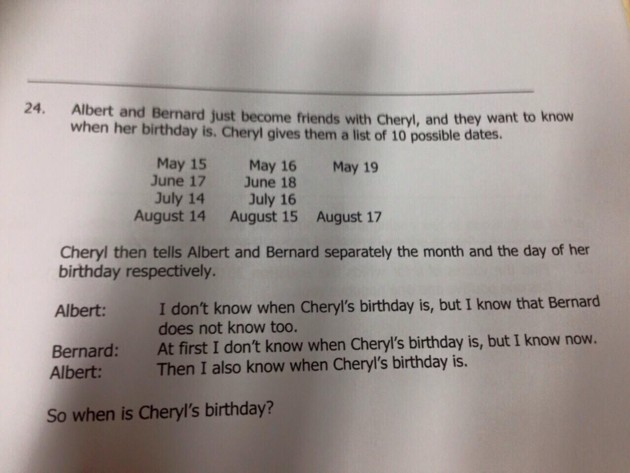
"content": "\u003cp>Last weekend, a TV host in Singapore posted a math logic problem that had people all over the world arguing about the answer. It's a good example of the kind of math that has won Singapore accolades for math instruction and high scores on the Program for International Student Assessment (PISA) test. Finally, math took center stage for a moment of viral Internet fun. Terrance Foss broke down the short-lived phenomenon for \u003ca href=\"http://www.theatlantic.com/education/archive/2015/04/the-math-question-that-went-viral/390411/\" target=\"_blank\">The Atlantic \u003c/a>and Katherine Schulten turned the fuss \u003ca href=\"http://learning.blogs.nytimes.com/2015/04/15/6-qs-about-the-news-a-math-problem-from-singapore-goes-viral/?ref=education\" target=\"_blank\">into a lesson\u003c/a> for the New York Times Learning Network.\u003c/p>\n\u003cp>But the real question is--can you figure out when Cheryl's birthday is?\u003cbr>\nhttp://www.theatlantic.com/education/archive/2015/04/the-math-question-that-went-viral/390411/\u003c/p>\n\u003cp>[ad fullwidth]\u003c/p>\u003cp>\u003c/p>\n",
"disqusIdentifier": "40124 http://ww2.kqed.org/mindshift/?p=40124",
"disqusUrl": "https://ww2.kqed.org/mindshift/2015/04/16/the-math-question-that-stumped-the-internet/",
"stats": {
"hasVideo": false,
"hasChartOrMap": false,
"hasAudio": false,
"hasPolis": false,
"wordCount": 126,
"hasGoogleForm": false,
"hasGallery": false,
"hasHearkenModule": false,
"iframeSrcs": [],
"paragraphCount": 4
},
"modified": 1456262145,
"excerpt": "Singaporean students have earned some of the highest scores on international tests with a curriculum focused on logic.",
"headData": {
"twImgId": "",
"twTitle": "",
"ogTitle": "",
"ogImgId": "",
"twDescription": "",
"description": "Singaporean students have earned some of the highest scores on international tests with a curriculum focused on logic.",
"title": "The Math Question That Stumped the Internet | KQED",
"ogDescription": "",
"schema": {
"@context": "https://schema.org",
"@type": "Article",
"headline": "The Math Question That Stumped the Internet",
"datePublished": "2015-04-16T06:46:44-07:00",
"dateModified": "2016-02-23T13:15:45-08:00",
"image": "https://cdn.kqed.org/wp-content/uploads/2020/02/KQED-OG-Image@1x.png"
}
},
"guestAuthors": [],
"slug": "the-math-question-that-stumped-the-internet",
"status": "publish",
"path": "/mindshift/40124/the-math-question-that-stumped-the-internet",
"audioTrackLength": null,
"parsedContent": [
{
"type": "contentString",
"content": "\u003cdiv class=\"post-body\">\u003cp>\u003cp>Last weekend, a TV host in Singapore posted a math logic problem that had people all over the world arguing about the answer. It's a good example of the kind of math that has won Singapore accolades for math instruction and high scores on the Program for International Student Assessment (PISA) test. Finally, math took center stage for a moment of viral Internet fun. Terrance Foss broke down the short-lived phenomenon for \u003ca href=\"http://www.theatlantic.com/education/archive/2015/04/the-math-question-that-went-viral/390411/\" target=\"_blank\">The Atlantic \u003c/a>and Katherine Schulten turned the fuss \u003ca href=\"http://learning.blogs.nytimes.com/2015/04/15/6-qs-about-the-news-a-math-problem-from-singapore-goes-viral/?ref=education\" target=\"_blank\">into a lesson\u003c/a> for the New York Times Learning Network.\u003c/p>\n\u003cp>But the real question is--can you figure out when Cheryl's birthday is?\u003cbr>\nhttp://www.theatlantic.com/education/archive/2015/04/the-math-question-that-went-viral/390411/\u003c/p>\n\u003cp>\u003c/p>\u003c/div>",
"attributes": {
"named": {},
"numeric": []
}
},
{
"type": "component",
"content": "",
"name": "ad",
"attributes": {
"named": {
"label": "fullwidth"
},
"numeric": [
"fullwidth"
]
}
},
{
"type": "contentString",
"content": "\u003cdiv class=\"post-body\">\u003cp>\u003c/p>\u003cp>\u003c/p>\n\u003c/div>\u003c/p>",
"attributes": {
"named": {},
"numeric": []
}
}
],
"link": "/mindshift/40124/the-math-question-that-stumped-the-internet",
"authors": [
"4354"
],
"categories": [
"mindshift_194"
],
"tags": [
"mindshift_392",
"mindshift_205"
],
"featImg": "mindshift_40126",
"label": "mindshift"
},
"mindshift_40093": {
"type": "posts",
"id": "mindshift_40093",
"meta": {
"index": "posts_1716263798",
"site": "mindshift",
"id": "40093",
"score": null,
"sort": [
1429101510000
]
},
"parent": 0,
"labelTerm": {
"site": "mindshift"
},
"blocks": [],
"publishDate": 1429101510,
"format": "standard",
"disqusTitle": "Why a Sleeping Brain Isn't Exactly Resting",
"title": "Why a Sleeping Brain Isn't Exactly Resting",
"headTitle": "MindShift | KQED News",
"content": "\u003cp>There's new evidence that the brain's activity during sleep isn't random. And the findings could help explain why the brain consumes so much energy even when it appears to be resting.\u003c/p>\n\u003cp>\"There is something that's going on in a very structured manner during rest and during sleep,\" says Stanford neurologist \u003ca href=\"https://med.stanford.edu/profiles/josef-parvizi?tab=publications\">Dr. Josef Parvizi\u003c/a>, \"and that will, of course, require energy consumption.\"\u003c/p>\n\u003cp>For a long time, scientists dismissed the brain's electrical activity during rest and sleep as meaningless \"noise.\" But then studies using fMRI began to reveal patterns suggesting coordinated activity.\u003c/p>\n\u003cp>To take a closer look, Parvizi and a team of researchers studied three people awaiting surgery for epilepsy. These people spent several days with electrodes in their brains to help locate the source of their seizures. And that meant Parvizi's team was able to monitor the activity of small groups of brain cells in real time.\u003c/p>\n\u003cp>\"We wanted to know exactly what's going on during rest,\" Parvizi says, \"and whether or not it reflects what went on during the daytime when the subject was not resting.\"\u003c/p>\n\u003cp>[ad fullwidth]\u003c/p>\n\u003cp>[contextly_sidebar id=\"ablpXQRNUqasufat2HBGQIvTPSmgPy54\"]\u003c/p>\n\u003cp>In the study \u003ca href=\"http://www.cell.com/neuron/abstract/S0896-6273(15)00214-7\">published online\u003c/a> earlier this month in \u003cem>Neuron\u003c/em>, the team first studied the volunteers while they were awake and answering simple questions like: Did you drive to work last week?\u003c/p>\n\u003cp>\"In order to answer yes or no, you retrieve a lot of facts; you retrieve a lot of visualized memories,\" Parvizi says.\u003c/p>\n\u003cp>As expected, the team saw activity in two widely separated brain areas known to be involved in episodic memories. And the activity was highly coordinated — suggesting the different brain regions were working together to answer the questions.\u003c/p>\n\u003cp>Next, the volunteers were allowed to rest and even go to sleep while the researchers continued to monitor signals from the two brain areas. And the signals from the two regions remained coordinated, as if they were still working together, Parvizi says.\u003c/p>\n\u003cp>\"What we found,\" he says, \"was that the same nerve cells that were activated to retrieve memories ... have a very coordinated pattern of noise.\"\u003c/p>\n\u003cp>The brain may be working to maintain the relationship between regions that have cooperated recently, and may need to again, Parvizi says. This would help explain why the brain, unlike the body, consumes a lot of energy whether or not it has a specific job to do.\u003c/p>\n\u003cp>\u003c/p>\n\u003cp>\"Any brain is designed in such a way that it's using a lot of energy at what we call a 'resting state,' \" Parvizi says. \"So it's not really a resting brain.\" \u003c/p>\n\u003cdiv class=\"fullattribution\">Copyright 2015 NPR. To see more, visit http://www.npr.org/.\u003cimg src=\"http://www.google-analytics.com/__utm.gif?utmac=UA-5828686-4&utmdt=No+Rest+For+Your+Sleeping+Brain&utme=8(APIKey)9(MDAxOTAwOTE4MDEyMTkxMDAzNjczZDljZA004)\">\u003c/div>\n\n",
"disqusIdentifier": "40093 http://ww2.kqed.org/mindshift/?p=40093",
"disqusUrl": "https://ww2.kqed.org/mindshift/2015/04/15/why-a-sleeping-brain-isnt-exactly-resting/",
"stats": {
"hasVideo": false,
"hasChartOrMap": false,
"hasAudio": false,
"hasPolis": false,
"wordCount": 437,
"hasGoogleForm": false,
"hasGallery": false,
"hasHearkenModule": false,
"iframeSrcs": [],
"paragraphCount": 15
},
"modified": 1429101510,
"excerpt": "No wonder the brain needs so much energy. The same coordinated activity that allows you to retrieve a specific memory, like what you had for breakfast, continues at rest and even during sleep.",
"headData": {
"twImgId": "",
"twTitle": "",
"ogTitle": "",
"ogImgId": "",
"twDescription": "",
"description": "No wonder the brain needs so much energy. The same coordinated activity that allows you to retrieve a specific memory, like what you had for breakfast, continues at rest and even during sleep.",
"title": "Why a Sleeping Brain Isn't Exactly Resting | KQED",
"ogDescription": "",
"schema": {
"@context": "https://schema.org",
"@type": "Article",
"headline": "Why a Sleeping Brain Isn't Exactly Resting",
"datePublished": "2015-04-15T05:38:30-07:00",
"dateModified": "2015-04-15T05:38:30-07:00",
"image": "https://cdn.kqed.org/wp-content/uploads/2020/02/KQED-OG-Image@1x.png"
}
},
"guestAuthors": [],
"slug": "why-a-sleeping-brain-isnt-exactly-resting",
"status": "publish",
"nprApiLink": "http://api.npr.org/query?id=399599727&apiKey=MDAxOTAwOTE4MDEyMTkxMDAzNjczZDljZA004",
"nprByline": "Jon Hamilton",
"nprStoryDate": "Tue, 14 Apr 2015 15:43:00 -0400",
"nprLastModifiedDate": "Tue, 14 Apr 2015 16:59:10 -0400",
"nprHtmlLink": "http://www.npr.org/blogs/health/2015/04/14/399599727/no-rest-for-your-sleeping-brain?ft=nprml&f=399599727",
"nprAudio": "http://pd.npr.org/anon.npr-mp3/npr/atc/2015/04/20150414_atc_no_rest_for_your_sleeping_brain.mp3?orgId=1&topicId=1128&e=399599727&d=161&ft=nprml&f=399599727",
"nprAudioM3u": "http://api.npr.org/m3u/1399641472-c34eba.m3u?orgId=1&topicId=1128&e=399599727&d=161&ft=nprml&f=399599727",
"nprStoryId": "399599727",
"nprRetrievedStory": "1",
"nprPubDate": "Tue, 14 Apr 2015 19:45:00 -0400",
"path": "/mindshift/40093/why-a-sleeping-brain-isnt-exactly-resting",
"audioUrl": "http://pd.npr.org/anon.npr-mp3/npr/atc/2015/04/20150414_atc_no_rest_for_your_sleeping_brain.mp3?orgId=1&topicId=1128&e=399599727&d=161&ft=nprml&f=399599727",
"audioTrackLength": null,
"parsedContent": [
{
"type": "contentString",
"content": "\u003cdiv class=\"post-body\">\u003cp>\u003cp>There's new evidence that the brain's activity during sleep isn't random. And the findings could help explain why the brain consumes so much energy even when it appears to be resting.\u003c/p>\n\u003cp>\"There is something that's going on in a very structured manner during rest and during sleep,\" says Stanford neurologist \u003ca href=\"https://med.stanford.edu/profiles/josef-parvizi?tab=publications\">Dr. Josef Parvizi\u003c/a>, \"and that will, of course, require energy consumption.\"\u003c/p>\n\u003cp>For a long time, scientists dismissed the brain's electrical activity during rest and sleep as meaningless \"noise.\" But then studies using fMRI began to reveal patterns suggesting coordinated activity.\u003c/p>\n\u003cp>To take a closer look, Parvizi and a team of researchers studied three people awaiting surgery for epilepsy. These people spent several days with electrodes in their brains to help locate the source of their seizures. And that meant Parvizi's team was able to monitor the activity of small groups of brain cells in real time.\u003c/p>\n\u003cp>\"We wanted to know exactly what's going on during rest,\" Parvizi says, \"and whether or not it reflects what went on during the daytime when the subject was not resting.\"\u003c/p>\n\u003cp>\u003c/p>\u003c/div>",
"attributes": {
"named": {},
"numeric": []
}
},
{
"type": "component",
"content": "",
"name": "ad",
"attributes": {
"named": {
"label": "fullwidth"
},
"numeric": [
"fullwidth"
]
}
},
{
"type": "contentString",
"content": "\u003cdiv class=\"post-body\">\u003cp>\u003c/p>\n\u003cp>\u003c/p>\u003cp>\u003c/p>\u003cp>\u003c/p>\n\u003cp>In the study \u003ca href=\"http://www.cell.com/neuron/abstract/S0896-6273(15)00214-7\">published online\u003c/a> earlier this month in \u003cem>Neuron\u003c/em>, the team first studied the volunteers while they were awake and answering simple questions like: Did you drive to work last week?\u003c/p>\n\u003cp>\"In order to answer yes or no, you retrieve a lot of facts; you retrieve a lot of visualized memories,\" Parvizi says.\u003c/p>\n\u003cp>As expected, the team saw activity in two widely separated brain areas known to be involved in episodic memories. And the activity was highly coordinated — suggesting the different brain regions were working together to answer the questions.\u003c/p>\n\u003cp>Next, the volunteers were allowed to rest and even go to sleep while the researchers continued to monitor signals from the two brain areas. And the signals from the two regions remained coordinated, as if they were still working together, Parvizi says.\u003c/p>\n\u003cp>\"What we found,\" he says, \"was that the same nerve cells that were activated to retrieve memories ... have a very coordinated pattern of noise.\"\u003c/p>\n\u003cp>The brain may be working to maintain the relationship between regions that have cooperated recently, and may need to again, Parvizi says. This would help explain why the brain, unlike the body, consumes a lot of energy whether or not it has a specific job to do.\u003c/p>\n\u003cp>\u003c/p>\n\u003cp>\"Any brain is designed in such a way that it's using a lot of energy at what we call a 'resting state,' \" Parvizi says. \"So it's not really a resting brain.\" \u003c/p>\n\u003cdiv class=\"fullattribution\">Copyright 2015 NPR. To see more, visit http://www.npr.org/.\u003cimg src=\"http://www.google-analytics.com/__utm.gif?utmac=UA-5828686-4&utmdt=No+Rest+For+Your+Sleeping+Brain&utme=8(APIKey)9(MDAxOTAwOTE4MDEyMTkxMDAzNjczZDljZA004)\">\u003c/div>\n\n\u003c/div>\u003c/p>",
"attributes": {
"named": {},
"numeric": []
}
}
],
"link": "/mindshift/40093/why-a-sleeping-brain-isnt-exactly-resting",
"authors": [
"byline_mindshift_40093"
],
"categories": [
"mindshift_194"
],
"tags": [
"mindshift_20784",
"mindshift_1040",
"mindshift_990"
],
"featImg": "mindshift_40096",
"label": "mindshift"
},
"mindshift_39748": {
"type": "posts",
"id": "mindshift_39748",
"meta": {
"index": "posts_1716263798",
"site": "mindshift",
"id": "39748",
"score": null,
"sort": [
1426859826000
]
},
"parent": 0,
"labelTerm": {
"site": "mindshift"
},
"blocks": [],
"publishDate": 1426859826,
"format": "aside",
"disqusTitle": "Feeling Alone as the Opportunity Gap Widens for Kids",
"title": "Feeling Alone as the Opportunity Gap Widens for Kids",
"headTitle": "MindShift | KQED News",
"content": "\u003cfigure id=\"attachment_39811\" class=\"wp-caption aligncenter\" style=\"max-width: 640px\">\u003ca href=\"http://ww2.kqed.org/mindshift/2015/03/feeling-alone-as-the-opportunity-gap-widens-in-education/alone-at-school/\" rel=\"attachment wp-att-39811\">\u003cimg src=\"http://ww2.kqed.org/mindshift/wp-content/uploads/sites/23/2015/03/Alone-at-school.jpg\" alt=\"Gebbe/Flickr\" width=\"640\" height=\"960\" class=\"size-full wp-image-39811\">\u003c/a>\u003cfigcaption class=\"wp-caption-text\">\u003ca href=\"https://www.flickr.com/photos/gebbe/6988399523\"> Gebbe/Flickr\u003c/a>\u003c/figcaption>\u003c/figure>\n\u003cp class=\"dropcap-serif\">After raising her daughters, stay-at-home mother Susan Norwood knew that she wanted to be a teacher. She had spent plenty of time at school while her daughters were students in Brentwood, an affluent Nashville suburb with famously great schools, as a room mother and fundraiser, she even volunteered to work in the library. But after getting her certification and being assigned to one of Nashville’s poorest high schools as an English teacher, she quickly realized there were stark differences between her daughters’ school and her new teaching home.\u003c/p>\n\u003cp>Many of the school’s classes operated without textbooks for students. Most students simply didn’t to do their homework -- and even if they did, Norwood would have been unable to give proper attention to each assignment of her 185 students. And many of her sophomore English students were dealing with a host of problems outside school, from unstable home lives to jailed parents, even undiagnosed health issues.\u003c/p>\n\u003cp>\u003ca href=\"http://ww2.kqed.org/mindshift/2015/03/feeling-alone-as-the-opportunity-gap-widens-in-education/our-kids-by-robert-putnam-jacket-image/\" rel=\"attachment wp-att-39807\">\u003cimg src=\"http://ww2.kqed.org/mindshift/wp-content/uploads/sites/23/2015/03/OUR-KIDS-by-Robert-Putnam-Jacket-Image-300x450.jpg\" alt=\"OUR KIDS by Robert Putnam - Jacket Image\" width=\"300\" height=\"450\" class=\"alignright size-medium wp-image-39807\">\u003c/a>“Just yesterday, one of my girls (students) told me she wanted to make up work, because she currently had an F in my class -- she just stopped working. She said, ‘I’m having some problems at home,’ ” said Norwood. “She told me she had moved out of the house, she hadn’t seen her mother in two weeks, and she was living with a friend. If you’re having those kinds of problems, doing your vocabulary may not seem important!”\u003c/p>\n\u003cp>To understand the breadth of the problem, Norwood said, just multiply this girl’s story times most of her students. The notion of being able to help them all becomes overwhelming.\u003c/p>\n\u003cp>This is life for the majority of American kids whose parents didn’t go to college, says social scientist and Harvard professor Robert Putnam in his new book, \"\u003ca href=\"http://books.simonandschuster.com/Our-Kids/Robert-D-Putnam/9781476769899\">Our Kids: The American Dream in Crisis\u003c/a>.\" This bottom third of poorer students face a widening “opportunity gap” with today’s richer students -- the ones whose parents did go to college. Putnam and his team of researchers analyzed decades of research on the habits of richer and poorer families, and found that who your parents are predicts where you will end up much more today than it did several decades ago.\u003c/p>\n\u003cp>[ad fullwidth]\u003c/p>\n\u003cp>Putnam describes “scissor graphs” showing how, over the last several decades, while richer kids’ reading time with their parents, family dinners, extracurricular activities, and two-parent homes stayed the same or increased, the poorer kids’ decreased. The team found that today the lowest-performing rich kids \u003ca href=\"http://blogs.edweek.org/edweek/inside-school-research/2015/03/its_hard_to_make_schools.html\">have a better chance of finishing college\u003c/a> than the highest-performing poor kids.\u003c/p>\n\u003cfigure id=\"attachment_39804\" class=\"wp-caption alignnone\" style=\"max-width: 1017px\">\u003ca href=\"http://ww2.kqed.org/mindshift/2015/03/feeling-alone-as-the-opportunity-gap-widens-in-education/putnam-ourkids-fig4-3/\" rel=\"attachment wp-att-39804\">\u003cimg src=\"http://ww2.kqed.org/mindshift/wp-content/uploads/sites/23/2015/03/Putnam-OurKids-Fig4.3.png\" alt=\"Courtesy of Robert Putnam\" width=\"1017\" height=\"593\" class=\"size-full wp-image-39804\" srcset=\"https://ww2.kqed.org/app/uploads/sites/23/2015/03/Putnam-OurKids-Fig4.3.png 1017w, https://ww2.kqed.org/app/uploads/sites/23/2015/03/Putnam-OurKids-Fig4.3-400x233.png 400w, https://ww2.kqed.org/app/uploads/sites/23/2015/03/Putnam-OurKids-Fig4.3-800x466.png 800w, https://ww2.kqed.org/app/uploads/sites/23/2015/03/Putnam-OurKids-Fig4.3-768x448.png 768w, https://ww2.kqed.org/app/uploads/sites/23/2015/03/Putnam-OurKids-Fig4.3-320x187.png 320w\" sizes=\"(max-width: 1017px) 100vw, 1017px\">\u003c/a>\u003cfigcaption class=\"wp-caption-text\">Courtesy of Robert Putnam\u003c/figcaption>\u003c/figure>\n\u003cp>It wasn’t always this way. In the book, Putnam described going back to his hometown of Port Clinton, Ohio, to interview all the surviving members of his high school class. He found that in 1950s Ohio, who your parents were mattered much less: Most of his classmates, regardless of the education or economic levels of their parents, achieved more and led better lives than their parents did.\u003c/p>\n\u003cp>Yet today, the opportunity gap stacks up against poor kids in terms of family instability, cut ties with community institutions, untrustworthy and frightening neighborhoods, and increasing isolation as poor students find they don’t have “air bags” -- parents, pastors, coaches, mentors -- to cushion life’s blows and help navigate their difficult lives. Putnam argues that, even more than income, the opportunity gap is leaving a third of kids unable to even get on the ladder needed to reach the American Dream.\u003c/p>\n\u003cp>“The basic story is that these poor kids, they are isolated really from all the major social institutions. Two-thirds of them have only one parent, at most. They come from broken homes -- if there was a dad, he’s gone. They basically can’t trust their parents, many of whom are loving but are themselves damaged by something further back in history. Their first line of defenses has been breached,” he said.\u003c/p>\n\u003cp>Putnam said school becomes an “echo chamber” that amplifies the problems of chaotic lives: It’s not so much what districts do or don’t do nearly as much as what kids bring to school.\u003c/p>\n\u003cp>[contextly_sidebar id=\"diMjf98mjWLMbp1REasIJynYR8CBpFb4\"]\u003c/p>\n\u003cp>“The first thing I see when I look at our evidence, schools themselves contributed very little to this opportunity gap problem,” Putnam said. “We know going to school with other poor kids is bad. There’s a ton of evidence, it’s all clear: Your peers are very important. Why has that changed? We’ve become more socially segregated, and poor kids are going to school more with other poor kids.”\u003c/p>\n\u003cp>Susan Norwood agrees, and says she sees the chaos played out often. “There are a number of kids at school who’ve had a huge loss in their life without any counseling,” she said. “Last year, I had a girl whose father died in a motorcycle accident. I asked her if she’d talked to her mother about getting counseling. ‘My mother is in jail,’ she said. She’d been living with her grandfather, and they couldn’t afford counseling.’ ”\u003c/p>\n\u003cp>While there is an on-site counselor at school, counseling is only offered to students with Medicaid. So the school rallied together, and provided a counselor to the girl over the summer.\u003c/p>\n\u003cp>\u003cstrong>\u003cstrong> \u003c/strong>\u003c/strong>\u003cb>Well connected but still alone\u003c/b>\u003c/p>\n\u003cp>According to Putnam’s research, the \u003ca href=\"http://ww2.kqed.org/mindshift/2013/02/by-the-numbers-teachers-tech-and-the-digital-divide/\">digital divide\u003c/a> has morphed: Rich kids and poor kids now have equal access to the Internet, but use it in different ways. Surrounded by adults to guide them, richer kids use the Internet in what he calls a “mobility-enhancing way,” such as comparing colleges and doing research for a term paper. Poor kids tend to use the Internet for entertainment and more casual interaction.\u003c/p>\n\u003cp>But Putnam is quick to point out that there’s a more complex layer to how poor kids use the Internet: Their online interactions can highlight how isolated they are. Putnam said his team of researchers is still connected to many of the kids they interviewed for the book through Facebook, and they can see, in real time, how they use the Internet.\u003c/p>\n\u003cp>One person they interviewed for the book, “David” (a pseudonym), recently posted something to his Facebook wall that Putnam describes as “clearly a cry for help.” In the post, David says how hard he’s working, how he’s taking care of his younger step-siblings, and that “he’s done” with it all. To Putnam’s horror, none of David’s Facebook friends reached out and left a message in response to his post, either to encourage him, or tell him he would get through it, or ask to meet him or help him.\"Even though they are connecting in some way, it's clear that they're not connecting. When David posted his message, no one came on and said, 'c'mon, let's get together,' - that's what happens if you have real social networks.\"\u003c/p>\n\u003cp>“They [poor kids] do have other friends with whom they interact,” on the Internet, he said, “but even that setting shows how isolated they are. The messages are just heart-rending.”\u003c/p>\n\u003cfigure id=\"attachment_39806\" class=\"wp-caption alignnone\" style=\"max-width: 1017px\">\u003ca href=\"http://ww2.kqed.org/mindshift/2015/03/feeling-alone-as-the-opportunity-gap-widens-in-education/putnam-ourkids-fig5-5/\" rel=\"attachment wp-att-39806\">\u003cimg src=\"http://ww2.kqed.org/mindshift/wp-content/uploads/sites/23/2015/03/Putnam-OurKids-Fig5.5.png\" alt=\"Courtesy of Robert Putnam\" width=\"1017\" height=\"672\" class=\"size-full wp-image-39806\" srcset=\"https://ww2.kqed.org/app/uploads/sites/23/2015/03/Putnam-OurKids-Fig5.5.png 1017w, https://ww2.kqed.org/app/uploads/sites/23/2015/03/Putnam-OurKids-Fig5.5-400x264.png 400w, https://ww2.kqed.org/app/uploads/sites/23/2015/03/Putnam-OurKids-Fig5.5-800x529.png 800w, https://ww2.kqed.org/app/uploads/sites/23/2015/03/Putnam-OurKids-Fig5.5-768x507.png 768w, https://ww2.kqed.org/app/uploads/sites/23/2015/03/Putnam-OurKids-Fig5.5-320x211.png 320w\" sizes=\"(max-width: 1017px) 100vw, 1017px\">\u003c/a>\u003cfigcaption class=\"wp-caption-text\">Courtesy of Robert Putnam\u003c/figcaption>\u003c/figure>\n\u003cp>\u003cb>What can schools do?\u003c/b>\u003c/p>\n\u003cp>Susan Norwood isn’t sure if her school can help get their 2,300 students out of poverty, into college and on to something better than their splintered lives -- at least not without more help than she’s receiving now.\u003c/p>\n\u003cp>Though Norwood and colleagues have been told that 60 percent of English students must pass the state test, the school projects only 29 percent will pass. Norwood teaches English and literature and doesn’t have a single set of books to give out to her students, instead relying mostly on handouts and public domain short stories students can download and read on their phones. (She does have one set of literature and grammar books for students to use in class, but only Honors students are allowed to check them out and bring them home.) From the district, she received $300 to purchase all the supplies needed for 185 students for the entire year.\u003c/p>\n\u003cp>Norwood said nearly everything about the way her students are schooled -- from the lack of books to the class sizes to their personal problems -- is so different from the education her daughters got in Brentwood that they almost can’t be compared. Even in such bleak circumstances, though, bright spots do occur. She found out recently that one of her honors students had spent a year sleeping on a couch in his father’s one-bedroom with five other people when his mother went to jail, and kept his grades up. \u003c/p>\n\u003cp>Putnam is brimming with hope. And while his book\u003ci> \u003c/i>offers ideas for solutions -- Putnam favors investing in early childhood education, community-school partnerships to coordinate social services, and programs to offer more AP and advanced classes to low-income schools, among others -- he said one of the biggest \"solutions\" is for people in the upper third to simply realize that the opportunity ladder is broken, and they may not be seeing it.\u003c/p>\n\u003cp>“We have become much more segregated in social-class terms, and are less likely to live near others from a different class background,” he said. “So we’re less likely to meet someone at school, or church, or even the family reunion, that’s from a different class.”\u003c/p>\n\u003cp>He implores society to start looking beyond their own families and thinking of kids -- all of them -- as \"our kids.\"\u003c/p>\n\u003cp>[ad floatright]\u003c/p>\n\u003cp>“As Americans, historically we’ve wanted [public schools] to create a level playing field. Schools \u003ci>must\u003c/i> be part of the solution. The facts are consistent. We shouldn’t blame teachers or districts. They’re just dealing with what they’ve been given. Districts don’t decide their own boundaries, but saying that doesn’t absolve us from how schools can help,\" he said. \"Something must be done.”\u003c/p>\n\n",
"disqusIdentifier": "39748 http://blogs.kqed.org/mindshift/?p=39748",
"disqusUrl": "https://ww2.kqed.org/mindshift/2015/03/20/feeling-alone-as-the-opportunity-gap-widens-in-education/",
"stats": {
"hasVideo": false,
"hasChartOrMap": false,
"hasAudio": false,
"hasPolis": false,
"wordCount": 1743,
"hasGoogleForm": false,
"hasGallery": false,
"hasHearkenModule": false,
"iframeSrcs": [],
"paragraphCount": 27
},
"modified": 1427398040,
"excerpt": "Robert Putnam, the author of \"Bowling Alone,\" looks at how kids are experiencing the brunt of inequality and all of its missed opportunities, and what that means for learning. ",
"headData": {
"twImgId": "",
"twTitle": "",
"ogTitle": "",
"ogImgId": "",
"twDescription": "",
"description": "Robert Putnam, the author of "Bowling Alone," looks at how kids are experiencing the brunt of inequality and all of its missed opportunities, and what that means for learning. ",
"title": "Feeling Alone as the Opportunity Gap Widens for Kids | KQED",
"ogDescription": "",
"schema": {
"@context": "https://schema.org",
"@type": "Article",
"headline": "Feeling Alone as the Opportunity Gap Widens for Kids",
"datePublished": "2015-03-20T06:57:06-07:00",
"dateModified": "2015-03-26T12:27:20-07:00",
"image": "https://cdn.kqed.org/wp-content/uploads/2020/02/KQED-OG-Image@1x.png"
}
},
"guestAuthors": [],
"slug": "feeling-alone-as-the-opportunity-gap-widens-in-education",
"status": "publish",
"path": "/mindshift/39748/feeling-alone-as-the-opportunity-gap-widens-in-education",
"audioTrackLength": null,
"parsedContent": [
{
"type": "contentString",
"content": "\u003cdiv class=\"post-body\">\u003cp>\u003cfigure id=\"attachment_39811\" class=\"wp-caption aligncenter\" style=\"max-width: 640px\">\u003ca href=\"http://ww2.kqed.org/mindshift/2015/03/feeling-alone-as-the-opportunity-gap-widens-in-education/alone-at-school/\" rel=\"attachment wp-att-39811\">\u003cimg src=\"http://ww2.kqed.org/mindshift/wp-content/uploads/sites/23/2015/03/Alone-at-school.jpg\" alt=\"Gebbe/Flickr\" width=\"640\" height=\"960\" class=\"size-full wp-image-39811\">\u003c/a>\u003cfigcaption class=\"wp-caption-text\">\u003ca href=\"https://www.flickr.com/photos/gebbe/6988399523\"> Gebbe/Flickr\u003c/a>\u003c/figcaption>\u003c/figure>\n\u003cp class=\"dropcap-serif\">After raising her daughters, stay-at-home mother Susan Norwood knew that she wanted to be a teacher. She had spent plenty of time at school while her daughters were students in Brentwood, an affluent Nashville suburb with famously great schools, as a room mother and fundraiser, she even volunteered to work in the library. But after getting her certification and being assigned to one of Nashville’s poorest high schools as an English teacher, she quickly realized there were stark differences between her daughters’ school and her new teaching home.\u003c/p>\n\u003cp>Many of the school’s classes operated without textbooks for students. Most students simply didn’t to do their homework -- and even if they did, Norwood would have been unable to give proper attention to each assignment of her 185 students. And many of her sophomore English students were dealing with a host of problems outside school, from unstable home lives to jailed parents, even undiagnosed health issues.\u003c/p>\n\u003cp>\u003ca href=\"http://ww2.kqed.org/mindshift/2015/03/feeling-alone-as-the-opportunity-gap-widens-in-education/our-kids-by-robert-putnam-jacket-image/\" rel=\"attachment wp-att-39807\">\u003cimg src=\"http://ww2.kqed.org/mindshift/wp-content/uploads/sites/23/2015/03/OUR-KIDS-by-Robert-Putnam-Jacket-Image-300x450.jpg\" alt=\"OUR KIDS by Robert Putnam - Jacket Image\" width=\"300\" height=\"450\" class=\"alignright size-medium wp-image-39807\">\u003c/a>“Just yesterday, one of my girls (students) told me she wanted to make up work, because she currently had an F in my class -- she just stopped working. She said, ‘I’m having some problems at home,’ ” said Norwood. “She told me she had moved out of the house, she hadn’t seen her mother in two weeks, and she was living with a friend. If you’re having those kinds of problems, doing your vocabulary may not seem important!”\u003c/p>\n\u003cp>To understand the breadth of the problem, Norwood said, just multiply this girl’s story times most of her students. The notion of being able to help them all becomes overwhelming.\u003c/p>\n\u003cp>This is life for the majority of American kids whose parents didn’t go to college, says social scientist and Harvard professor Robert Putnam in his new book, \"\u003ca href=\"http://books.simonandschuster.com/Our-Kids/Robert-D-Putnam/9781476769899\">Our Kids: The American Dream in Crisis\u003c/a>.\" This bottom third of poorer students face a widening “opportunity gap” with today’s richer students -- the ones whose parents did go to college. Putnam and his team of researchers analyzed decades of research on the habits of richer and poorer families, and found that who your parents are predicts where you will end up much more today than it did several decades ago.\u003c/p>\n\u003cp>\u003c/p>\u003c/div>",
"attributes": {
"named": {},
"numeric": []
}
},
{
"type": "component",
"content": "",
"name": "ad",
"attributes": {
"named": {
"label": "fullwidth"
},
"numeric": [
"fullwidth"
]
}
},
{
"type": "contentString",
"content": "\u003cdiv class=\"post-body\">\u003cp>\u003c/p>\n\u003cp>Putnam describes “scissor graphs” showing how, over the last several decades, while richer kids’ reading time with their parents, family dinners, extracurricular activities, and two-parent homes stayed the same or increased, the poorer kids’ decreased. The team found that today the lowest-performing rich kids \u003ca href=\"http://blogs.edweek.org/edweek/inside-school-research/2015/03/its_hard_to_make_schools.html\">have a better chance of finishing college\u003c/a> than the highest-performing poor kids.\u003c/p>\n\u003cfigure id=\"attachment_39804\" class=\"wp-caption alignnone\" style=\"max-width: 1017px\">\u003ca href=\"http://ww2.kqed.org/mindshift/2015/03/feeling-alone-as-the-opportunity-gap-widens-in-education/putnam-ourkids-fig4-3/\" rel=\"attachment wp-att-39804\">\u003cimg src=\"http://ww2.kqed.org/mindshift/wp-content/uploads/sites/23/2015/03/Putnam-OurKids-Fig4.3.png\" alt=\"Courtesy of Robert Putnam\" width=\"1017\" height=\"593\" class=\"size-full wp-image-39804\" srcset=\"https://ww2.kqed.org/app/uploads/sites/23/2015/03/Putnam-OurKids-Fig4.3.png 1017w, https://ww2.kqed.org/app/uploads/sites/23/2015/03/Putnam-OurKids-Fig4.3-400x233.png 400w, https://ww2.kqed.org/app/uploads/sites/23/2015/03/Putnam-OurKids-Fig4.3-800x466.png 800w, https://ww2.kqed.org/app/uploads/sites/23/2015/03/Putnam-OurKids-Fig4.3-768x448.png 768w, https://ww2.kqed.org/app/uploads/sites/23/2015/03/Putnam-OurKids-Fig4.3-320x187.png 320w\" sizes=\"(max-width: 1017px) 100vw, 1017px\">\u003c/a>\u003cfigcaption class=\"wp-caption-text\">Courtesy of Robert Putnam\u003c/figcaption>\u003c/figure>\n\u003cp>It wasn’t always this way. In the book, Putnam described going back to his hometown of Port Clinton, Ohio, to interview all the surviving members of his high school class. He found that in 1950s Ohio, who your parents were mattered much less: Most of his classmates, regardless of the education or economic levels of their parents, achieved more and led better lives than their parents did.\u003c/p>\n\u003cp>Yet today, the opportunity gap stacks up against poor kids in terms of family instability, cut ties with community institutions, untrustworthy and frightening neighborhoods, and increasing isolation as poor students find they don’t have “air bags” -- parents, pastors, coaches, mentors -- to cushion life’s blows and help navigate their difficult lives. Putnam argues that, even more than income, the opportunity gap is leaving a third of kids unable to even get on the ladder needed to reach the American Dream.\u003c/p>\n\u003cp>“The basic story is that these poor kids, they are isolated really from all the major social institutions. Two-thirds of them have only one parent, at most. They come from broken homes -- if there was a dad, he’s gone. They basically can’t trust their parents, many of whom are loving but are themselves damaged by something further back in history. Their first line of defenses has been breached,” he said.\u003c/p>\n\u003cp>Putnam said school becomes an “echo chamber” that amplifies the problems of chaotic lives: It’s not so much what districts do or don’t do nearly as much as what kids bring to school.\u003c/p>\n\u003cp>\u003c/p>\u003cp>\u003c/p>\u003cp>\u003c/p>\n\u003cp>“The first thing I see when I look at our evidence, schools themselves contributed very little to this opportunity gap problem,” Putnam said. “We know going to school with other poor kids is bad. There’s a ton of evidence, it’s all clear: Your peers are very important. Why has that changed? We’ve become more socially segregated, and poor kids are going to school more with other poor kids.”\u003c/p>\n\u003cp>Susan Norwood agrees, and says she sees the chaos played out often. “There are a number of kids at school who’ve had a huge loss in their life without any counseling,” she said. “Last year, I had a girl whose father died in a motorcycle accident. I asked her if she’d talked to her mother about getting counseling. ‘My mother is in jail,’ she said. She’d been living with her grandfather, and they couldn’t afford counseling.’ ”\u003c/p>\n\u003cp>While there is an on-site counselor at school, counseling is only offered to students with Medicaid. So the school rallied together, and provided a counselor to the girl over the summer.\u003c/p>\n\u003cp>\u003cstrong>\u003cstrong> \u003c/strong>\u003c/strong>\u003cb>Well connected but still alone\u003c/b>\u003c/p>\n\u003cp>According to Putnam’s research, the \u003ca href=\"http://ww2.kqed.org/mindshift/2013/02/by-the-numbers-teachers-tech-and-the-digital-divide/\">digital divide\u003c/a> has morphed: Rich kids and poor kids now have equal access to the Internet, but use it in different ways. Surrounded by adults to guide them, richer kids use the Internet in what he calls a “mobility-enhancing way,” such as comparing colleges and doing research for a term paper. Poor kids tend to use the Internet for entertainment and more casual interaction.\u003c/p>\n\u003cp>But Putnam is quick to point out that there’s a more complex layer to how poor kids use the Internet: Their online interactions can highlight how isolated they are. Putnam said his team of researchers is still connected to many of the kids they interviewed for the book through Facebook, and they can see, in real time, how they use the Internet.\u003c/p>\n\u003cp>One person they interviewed for the book, “David” (a pseudonym), recently posted something to his Facebook wall that Putnam describes as “clearly a cry for help.” In the post, David says how hard he’s working, how he’s taking care of his younger step-siblings, and that “he’s done” with it all. To Putnam’s horror, none of David’s Facebook friends reached out and left a message in response to his post, either to encourage him, or tell him he would get through it, or ask to meet him or help him.\"Even though they are connecting in some way, it's clear that they're not connecting. When David posted his message, no one came on and said, 'c'mon, let's get together,' - that's what happens if you have real social networks.\"\u003c/p>\n\u003cp>“They [poor kids] do have other friends with whom they interact,” on the Internet, he said, “but even that setting shows how isolated they are. The messages are just heart-rending.”\u003c/p>\n\u003cfigure id=\"attachment_39806\" class=\"wp-caption alignnone\" style=\"max-width: 1017px\">\u003ca href=\"http://ww2.kqed.org/mindshift/2015/03/feeling-alone-as-the-opportunity-gap-widens-in-education/putnam-ourkids-fig5-5/\" rel=\"attachment wp-att-39806\">\u003cimg src=\"http://ww2.kqed.org/mindshift/wp-content/uploads/sites/23/2015/03/Putnam-OurKids-Fig5.5.png\" alt=\"Courtesy of Robert Putnam\" width=\"1017\" height=\"672\" class=\"size-full wp-image-39806\" srcset=\"https://ww2.kqed.org/app/uploads/sites/23/2015/03/Putnam-OurKids-Fig5.5.png 1017w, https://ww2.kqed.org/app/uploads/sites/23/2015/03/Putnam-OurKids-Fig5.5-400x264.png 400w, https://ww2.kqed.org/app/uploads/sites/23/2015/03/Putnam-OurKids-Fig5.5-800x529.png 800w, https://ww2.kqed.org/app/uploads/sites/23/2015/03/Putnam-OurKids-Fig5.5-768x507.png 768w, https://ww2.kqed.org/app/uploads/sites/23/2015/03/Putnam-OurKids-Fig5.5-320x211.png 320w\" sizes=\"(max-width: 1017px) 100vw, 1017px\">\u003c/a>\u003cfigcaption class=\"wp-caption-text\">Courtesy of Robert Putnam\u003c/figcaption>\u003c/figure>\n\u003cp>\u003cb>What can schools do?\u003c/b>\u003c/p>\n\u003cp>Susan Norwood isn’t sure if her school can help get their 2,300 students out of poverty, into college and on to something better than their splintered lives -- at least not without more help than she’s receiving now.\u003c/p>\n\u003cp>Though Norwood and colleagues have been told that 60 percent of English students must pass the state test, the school projects only 29 percent will pass. Norwood teaches English and literature and doesn’t have a single set of books to give out to her students, instead relying mostly on handouts and public domain short stories students can download and read on their phones. (She does have one set of literature and grammar books for students to use in class, but only Honors students are allowed to check them out and bring them home.) From the district, she received $300 to purchase all the supplies needed for 185 students for the entire year.\u003c/p>\n\u003cp>Norwood said nearly everything about the way her students are schooled -- from the lack of books to the class sizes to their personal problems -- is so different from the education her daughters got in Brentwood that they almost can’t be compared. Even in such bleak circumstances, though, bright spots do occur. She found out recently that one of her honors students had spent a year sleeping on a couch in his father’s one-bedroom with five other people when his mother went to jail, and kept his grades up. \u003c/p>\n\u003cp>Putnam is brimming with hope. And while his book\u003ci> \u003c/i>offers ideas for solutions -- Putnam favors investing in early childhood education, community-school partnerships to coordinate social services, and programs to offer more AP and advanced classes to low-income schools, among others -- he said one of the biggest \"solutions\" is for people in the upper third to simply realize that the opportunity ladder is broken, and they may not be seeing it.\u003c/p>\n\u003cp>“We have become much more segregated in social-class terms, and are less likely to live near others from a different class background,” he said. “So we’re less likely to meet someone at school, or church, or even the family reunion, that’s from a different class.”\u003c/p>\n\u003cp>He implores society to start looking beyond their own families and thinking of kids -- all of them -- as \"our kids.\"\u003c/p>\n\u003cp>\u003c/p>\u003c/div>",
"attributes": {
"named": {},
"numeric": []
}
},
{
"type": "component",
"content": "",
"name": "ad",
"attributes": {
"named": {
"label": "floatright"
},
"numeric": [
"floatright"
]
}
},
{
"type": "contentString",
"content": "\u003cdiv class=\"post-body\">\u003cp>\u003c/p>\n\u003cp>“As Americans, historically we’ve wanted [public schools] to create a level playing field. Schools \u003ci>must\u003c/i> be part of the solution. The facts are consistent. We shouldn’t blame teachers or districts. They’re just dealing with what they’ve been given. Districts don’t decide their own boundaries, but saying that doesn’t absolve us from how schools can help,\" he said. \"Something must be done.”\u003c/p>\n\n\u003c/div>\u003c/p>",
"attributes": {
"named": {},
"numeric": []
}
}
],
"link": "/mindshift/39748/feeling-alone-as-the-opportunity-gap-widens-in-education",
"authors": [
"4445"
],
"categories": [
"mindshift_194"
],
"tags": [
"mindshift_20784",
"mindshift_1040",
"mindshift_20700"
],
"featImg": "mindshift_39811",
"label": "mindshift"
},
"mindshift_39446": {
"type": "posts",
"id": "mindshift_39446",
"meta": {
"index": "posts_1716263798",
"site": "mindshift",
"id": "39446",
"score": null,
"sort": [
1424805933000
]
},
"parent": 0,
"labelTerm": {
"site": "mindshift"
},
"blocks": [],
"publishDate": 1424805933,
"format": "aside",
"disqusTitle": "Why The Teacher’s Pet Resembles The Teacher",
"title": "Why The Teacher’s Pet Resembles The Teacher",
"headTitle": "MindShift | KQED News",
"content": "\u003cfigure id=\"attachment_39450\" class=\"wp-caption alignnone\" style=\"max-width: 640px\">\u003ca href=\"http://ww2.kqed.org/mindshift/2015/02/if-your-teacher-likes-you-you-might-get-a-better-grade/the-teachers-pet-2/\" rel=\"attachment wp-att-39450\">\u003cimg class=\"size-full wp-image-39450\" src=\"http://ww2.kqed.org/mindshift/wp-content/uploads/sites/23/2015/02/teachers-pet_slide-e5b6b0ba34a365514b5f5ae913a1e1e1d0df22d01-e1424805430496.jpg\" alt=\"LA Johnson/NPR\" width=\"640\" height=\"960\">\u003c/a>\u003cfigcaption class=\"wp-caption-text\">LA Johnson/NPR\u003c/figcaption>\u003c/figure>\n\u003cp>Were you ever the teacher's pet? Or did you just sit behind the teacher's pet and roll your eyes from time to time?\u003c/p>\n\u003cp>A \u003ca href=\"http://www.tandfonline.com/doi/full/10.1080/01443410.2014.998629#abstract\">newly published paper\u003c/a> suggests that personality similarity affects teachers' estimation of student achievement. That is, how much you are like your teacher contributes to his or her feelings about you — and your abilities.\u003c/p>\n\u003cp>\"Astonishingly, little is known about the formation of teacher judgments and therefore about the biases in judgments,\" says Tobias Rausch, an author of the study and a research scientist at the Otto-Friedrich-Universität Bamberg in Germany. \"However, research tells us that teacher judgments often are not accurate.\"\u003c/p>\n\u003cp>This study looked at a group of 93 teachers and 294 students in eighth grade in Germany. Everyone took a short test to establish basic features of their personalities: extraversion, agreeableness and the like.\u003c/p>\n\u003cp>[contextly_sidebar id=\"HQHsDSgEarIyJHxKuYeHM9gUqNEpjn0H\"]\u003c/p>\n\u003cp>They gave the students reading and math tests too, sharing the test items with the teachers. Then they asked the teachers two questions: How good is this student compared to an average eighth grader? How well will this student do on this test?\u003c/p>\n\u003cp>[ad fullwidth]\u003c/p>\n\u003cp>In other words, the first question asked the teacher to give a global judgment; the second asked for a task-specific judgment.\u003c/p>\n\u003cp>The study found that when teachers and students were peas in a pod, the teachers overestimated the students' general abilities. Conversely, students who were dissimilar from their teachers were judged less positively.\u003c/p>\n\u003cp>But when the judgment was grounded to a specific test, the effect disappeared.\u003c/p>\n\u003cp>This finding is maybe not that surprising. But it's important for two reasons.\u003c/p>\n\u003cp>First, there's concern that teacher bias of many kinds may unfairly hold back groups of students.\u003c/p>\n\u003cp>For example, a \u003ca href=\"http://www.slate.com/blogs/xx_factor/2015/02/10/teacher_bias_in_math_new_study_finds_teachers_grade_boys_more_generously.html\">recent study from Israel\u003c/a> showed that teachers gave girls lower grades on math tests when they knew their gender. And lots of researchers have looked at the importance of having teachers who share the racial and socio-economic backgrounds of their students.\u003c/p>\n\u003cp>If teachers give students who are similar to them better grades, or even just maintain higher expectations of those students, what does that do for the students who don't look or act like their teachers?\u003c/p>\n\u003cp>Second, as Rausch, the co-author, points out, this study points to the importance of balancing teachers' \"holistic\" evaluations with standardized assessments, or at least assessments that aren't graded by a student's own teacher.\u003c/p>\n\u003cp>\u003c/p>\n\u003cp>Rausch also says it might be a good idea to spend more time training teachers to notice their biases. \"The best way to control for is probably raising teachers' awareness concerning the way they assess their students' competencies and their awareness concerning typical judgment biases and tendencies,\" he says.Human judgment, after all, is only human.\u003c/p>\n\u003cdiv class=\"fullattribution\">Copyright 2015 NPR. To see more, visit http://www.npr.org/.\u003cimg src=\"http://www.google-analytics.com/__utm.gif?utmac=UA-5828686-4&utmdt=If+Your+Teacher+Likes+You%2C+You+Might+Get+A+Better+Grade+&utme=8(APIKey)9(MDAxOTAwOTE4MDEyMTkxMDAzNjczZDljZA004)\" alt=\"\">\u003c/div>\n\n",
"disqusIdentifier": "39446 http://blogs.kqed.org/mindshift/?p=39446",
"disqusUrl": "https://ww2.kqed.org/mindshift/2015/02/24/why-the-teachers-pet-often-resembles-the-teacher/",
"stats": {
"hasVideo": false,
"hasChartOrMap": false,
"hasAudio": false,
"hasPolis": false,
"wordCount": 477,
"hasGoogleForm": false,
"hasGallery": false,
"hasHearkenModule": false,
"iframeSrcs": [],
"paragraphCount": 17
},
"modified": 1519759566,
"excerpt": "Students who are viewed as having a lot in common with their teachers can have an advantage in the classroom. ",
"headData": {
"twImgId": "",
"twTitle": "",
"ogTitle": "",
"ogImgId": "",
"twDescription": "",
"description": "Students who are viewed as having a lot in common with their teachers can have an advantage in the classroom. ",
"title": "Why The Teacher’s Pet Resembles The Teacher | KQED",
"ogDescription": "",
"schema": {
"@context": "https://schema.org",
"@type": "Article",
"headline": "Why The Teacher’s Pet Resembles The Teacher",
"datePublished": "2015-02-24T11:25:33-08:00",
"dateModified": "2018-02-27T11:26:06-08:00",
"image": "https://cdn.kqed.org/wp-content/uploads/2020/02/KQED-OG-Image@1x.png"
}
},
"guestAuthors": [],
"slug": "why-the-teachers-pet-often-resembles-the-teacher",
"status": "publish",
"nprApiLink": "http://api.npr.org/query?id=387481854&apiKey=MDAxOTAwOTE4MDEyMTkxMDAzNjczZDljZA004",
"nprByline": "Anya Kamenetz",
"nprStoryDate": "Sun, 22 Feb 2015 05:55:00 -0500",
"nprLastModifiedDate": "Mon, 23 Feb 2015 10:59:18 -0500",
"nprHtmlLink": "http://www.npr.org/blogs/ed/2015/02/22/387481854/if-your-teacher-likes-you-you-might-get-a-better-grade?ft=nprml&f=387481854",
"nprStoryId": "387481854",
"nprRetrievedStory": "1",
"nprPubDate": "Mon, 23 Feb 2015 10:59:00 -0500",
"path": "/mindshift/39446/why-the-teachers-pet-often-resembles-the-teacher",
"audioTrackLength": null,
"parsedContent": [
{
"type": "contentString",
"content": "\u003cdiv class=\"post-body\">\u003cp>\u003cfigure id=\"attachment_39450\" class=\"wp-caption alignnone\" style=\"max-width: 640px\">\u003ca href=\"http://ww2.kqed.org/mindshift/2015/02/if-your-teacher-likes-you-you-might-get-a-better-grade/the-teachers-pet-2/\" rel=\"attachment wp-att-39450\">\u003cimg class=\"size-full wp-image-39450\" src=\"http://ww2.kqed.org/mindshift/wp-content/uploads/sites/23/2015/02/teachers-pet_slide-e5b6b0ba34a365514b5f5ae913a1e1e1d0df22d01-e1424805430496.jpg\" alt=\"LA Johnson/NPR\" width=\"640\" height=\"960\">\u003c/a>\u003cfigcaption class=\"wp-caption-text\">LA Johnson/NPR\u003c/figcaption>\u003c/figure>\n\u003cp>Were you ever the teacher's pet? Or did you just sit behind the teacher's pet and roll your eyes from time to time?\u003c/p>\n\u003cp>A \u003ca href=\"http://www.tandfonline.com/doi/full/10.1080/01443410.2014.998629#abstract\">newly published paper\u003c/a> suggests that personality similarity affects teachers' estimation of student achievement. That is, how much you are like your teacher contributes to his or her feelings about you — and your abilities.\u003c/p>\n\u003cp>\"Astonishingly, little is known about the formation of teacher judgments and therefore about the biases in judgments,\" says Tobias Rausch, an author of the study and a research scientist at the Otto-Friedrich-Universität Bamberg in Germany. \"However, research tells us that teacher judgments often are not accurate.\"\u003c/p>\n\u003cp>This study looked at a group of 93 teachers and 294 students in eighth grade in Germany. Everyone took a short test to establish basic features of their personalities: extraversion, agreeableness and the like.\u003c/p>\n\u003cp>\u003c/p>\u003cp>\u003c/p>\u003cp>\u003c/p>\n\u003cp>They gave the students reading and math tests too, sharing the test items with the teachers. Then they asked the teachers two questions: How good is this student compared to an average eighth grader? How well will this student do on this test?\u003c/p>\n\u003cp>\u003c/p>\u003c/div>",
"attributes": {
"named": {},
"numeric": []
}
},
{
"type": "component",
"content": "",
"name": "ad",
"attributes": {
"named": {
"label": "fullwidth"
},
"numeric": [
"fullwidth"
]
}
},
{
"type": "contentString",
"content": "\u003cdiv class=\"post-body\">\u003cp>\u003c/p>\n\u003cp>In other words, the first question asked the teacher to give a global judgment; the second asked for a task-specific judgment.\u003c/p>\n\u003cp>The study found that when teachers and students were peas in a pod, the teachers overestimated the students' general abilities. Conversely, students who were dissimilar from their teachers were judged less positively.\u003c/p>\n\u003cp>But when the judgment was grounded to a specific test, the effect disappeared.\u003c/p>\n\u003cp>This finding is maybe not that surprising. But it's important for two reasons.\u003c/p>\n\u003cp>First, there's concern that teacher bias of many kinds may unfairly hold back groups of students.\u003c/p>\n\u003cp>For example, a \u003ca href=\"http://www.slate.com/blogs/xx_factor/2015/02/10/teacher_bias_in_math_new_study_finds_teachers_grade_boys_more_generously.html\">recent study from Israel\u003c/a> showed that teachers gave girls lower grades on math tests when they knew their gender. And lots of researchers have looked at the importance of having teachers who share the racial and socio-economic backgrounds of their students.\u003c/p>\n\u003cp>If teachers give students who are similar to them better grades, or even just maintain higher expectations of those students, what does that do for the students who don't look or act like their teachers?\u003c/p>\n\u003cp>Second, as Rausch, the co-author, points out, this study points to the importance of balancing teachers' \"holistic\" evaluations with standardized assessments, or at least assessments that aren't graded by a student's own teacher.\u003c/p>\n\u003cp>\u003c/p>\n\u003cp>Rausch also says it might be a good idea to spend more time training teachers to notice their biases. \"The best way to control for is probably raising teachers' awareness concerning the way they assess their students' competencies and their awareness concerning typical judgment biases and tendencies,\" he says.Human judgment, after all, is only human.\u003c/p>\n\u003cdiv class=\"fullattribution\">Copyright 2015 NPR. To see more, visit http://www.npr.org/.\u003cimg src=\"http://www.google-analytics.com/__utm.gif?utmac=UA-5828686-4&utmdt=If+Your+Teacher+Likes+You%2C+You+Might+Get+A+Better+Grade+&utme=8(APIKey)9(MDAxOTAwOTE4MDEyMTkxMDAzNjczZDljZA004)\" alt=\"\">\u003c/div>\n\n\u003c/div>\u003c/p>",
"attributes": {
"named": {},
"numeric": []
}
}
],
"link": "/mindshift/39446/why-the-teachers-pet-often-resembles-the-teacher",
"authors": [
"byline_mindshift_39446"
],
"categories": [
"mindshift_192",
"mindshift_194"
],
"tags": [
"mindshift_20818",
"mindshift_20784",
"mindshift_1040",
"mindshift_943"
],
"featImg": "mindshift_39448",
"label": "mindshift"
},
"mindshift_39119": {
"type": "posts",
"id": "mindshift_39119",
"meta": {
"index": "posts_1716263798",
"site": "mindshift",
"id": "39119",
"score": null,
"sort": [
1424787919000
]
},
"parent": 0,
"labelTerm": {
"site": "mindshift"
},
"blocks": [],
"publishDate": 1424787919,
"format": "aside",
"disqusTitle": "Teaching Kids How to Learn Without Study Drugs",
"title": "Teaching Kids How to Learn Without Study Drugs",
"headTitle": "MindShift | KQED News",
"content": "\u003cfigure id=\"attachment_39437\" class=\"wp-caption alignnone\" style=\"max-width: 640px\">\u003ca href=\"http://ww2.kqed.org/mindshift/2015/02/teaching-kids-to-learn-without-study-drugs/study-drug/\" rel=\"attachment wp-att-39437\">\u003cimg class=\"size-full wp-image-39437\" src=\"http://ww2.kqed.org/mindshift/wp-content/uploads/sites/23/2015/02/Study-drug.jpg\" alt=\"Getty Images\" width=\"640\" height=\"960\">\u003c/a>\u003cfigcaption class=\"wp-caption-text\">Getty Images\u003c/figcaption>\u003c/figure>\n\u003cp class=\"dropcap-serif\">In a shifting economy without any assurances of success, there's a lot of pressure on students to succeed in school. More and more kids are going to college and the application process is competitive. To help stand out, students are taking on tougher course loads, along with extracurricular activities and leadership roles. In order to pack everything in, some kids \u003ca href=\"http://www.nytimes.com/2012/06/10/education/seeking-academic-edge-teenagers-abuse-stimulants.html?pagewanted=all&_r=2&\" target=\"_blank\">turn to prescription drugs like Adderall and Ritalin\u003c/a> to stay awake and focus on school work and test prep. They can obtain the medication from doctors, peers and sources they find \u003ca href=\"http://www.newyorker.com/magazine/2009/04/27/brain-gain\">online\u003c/a>. However, many of these students, both in high school and in college, don’t know the physical or neurological ramifications of taking drugs that haven’t been prescribed to them by a doctor.\u003c/p>\n\u003cp>“We live in this culture of excellence,” said Michael McCutcheon, a counseling psychology phD candidate at New York University, on \u003ca href=\"http://www.kqed.org/a/forum/R201412180900\" target=\"_blank\">KQED’s Forum\u003c/a>, “and if you are at a competitive high school and you know the culture really only celebrates success or money, then everything is riding on this test.” That overwhelming pressure – the feeling that every test and grade matters for ones future – combined with ease of access to these drugs makes their use seductive. Stanford Graduate School of Education senior lecturer \u003ca href=\"https://ed.stanford.edu/faculty/dpope\" target=\"_blank\">Denise Pope\u003c/a> found similar experiences among thousands of high school students she has interviewed or observed in her work.\u003c/p>\n\u003caside class=\"pullquote alignleft\">'I'm not smarter when I'm using these drugs. It simply allows me to focus in a system with such stress on excellence.'\u003c/aside>\n\u003cp>“These kids are completely overloaded,” Pope said. “They come from high achieving schools, but these kids feel like there’s more homework than there is time in a day.” She cited increased pressure to take \u003ca href=\"https://teensneedsleep.files.wordpress.com/2011/04/galloway-nonacademic-effects-of-homework-in-privileged-high-performing-high-schools.pdf\" target=\"_blank\">Advanced Placement or honors classes that require lots of homework\u003c/a>, along with the explosion of extracurricular activities and the time students devote to them as some of the reasons for increased stress.\u003c/p>\n\u003cp>“The kids who cheat in high school, absolutely cheat in college,” Pope said. “My guess would be that if this is negative coping strategy that you are employing, it’s your go-to strategy when you have the stress and overload in college.”\u003c/p>\n\u003cp>Indeed, study drugs are most often used by high achieving high school students and among college student-athletes and those who participate in the Greek system. A \u003ca href=\"http://www.sciencedirect.com/science/article/pii/S0890856709620815\" target=\"_blank\">2009 review of the literature\u003c/a> on study drugs found that anywhere between five and nine percent of middle and high school students, and five to 35 percent of college students use prescription drugs to stay awake and focus longer than they would normally.\u003c/p>\n\u003cp>[ad fullwidth]\u003c/p>\n\u003cp>\u003cstrong>WHAT STUDY DRUGS DO TO THE BRAIN\u003c/strong>\u003c/p>\n\u003cp>Drugs like Adderall and Ritalin are prescribed to kids with Attention Deficit Disorder (ADD) or Attention Deficit Hyperactivity Disorder (ADHD). These kids are easily distracted by visual or auditory background noises, which can overwhelm them and make it hard to focus. People with ADD or ADHD don’t produce enough dopamine in the brain, which the drugs help correct.\u003c/p>\n\u003cp>[contextly_sidebar id=\"1CiYPZ8kWQnWefWGJUkyBbLtdoT2CNds\"]\u003c/p>\n\u003cp>“They are meant to increase dopamine in the brain, which regulates two things: executive functioning and the rewards system in the brain,” said Michelle Goldsmith, assistant clinical professor at Stanford. “Both of those things come into play when we talk about attention.”\u003c/p>\n\u003cp>For kids who actually need Adderall or Ritalin, the brain’s dopamine pathways aren’t strong enough to circulate the neural signals that make certain mental processes go. For those kids the added dopamine can have a huge influence on ability to focus, but also comes with some less desirable side effects when the drug wears off like fatigue, depression and mood-swings. There’s a lot less known about how the drug affects brains that start out with normal dopamine levels because clinicians consider it too risky to conduct a study that would subject “normal” students to the drug.\u003c/p>\n\u003cp>“The question is do they really help normal people with learning,” Goldsmith said, “There hasn’t been any reason to study them because the risks are so significant.” Those risks include depression, psychosis, mood swings, suicidal thoughts, seizures, decreased appetite and insomnia.\u003c/p>\n\u003cp>\u003cstrong>DO STUDY DRUGS IMPROVE LEARNING?\u003c/strong>\u003c/p>\n\u003cp>Students certainly think so, but they may be misjudging the quality of their performance when taking study drugs.\u003c/p>\n\u003cp>“Students who are misusing are actually more likely to have a lower grade point average,” said Niloofar Bavarian, assistant professor in the Health Science Department at California State University, Long Beach. Bavarian conducted a study of 554 UC Berkeley undergraduates and \u003ca href=\"http://uhs.berkeley.edu/students/healthpromotion/pdf/prescriptiondrug_pressrelease.pdf\" target=\"_blank\">found about 17 percent\u003c/a> of those surveyed were misusing prescription stimulants. While the drugs may help students stay awake to study, research shows they don’t enhance brain functioning. Hurriedly done work still looks like rushed work.\u003c/p>\n\u003caside class=\"pullquote alignleft\">'These kids are completely overloaded.'\u003c/aside>\n\u003cp>“There are a lot of things that make up learning and there are some small studies with adults that show improvement in working memory, but it’s shown not to be helpful for long term memory and assimilation,” Goldsmith said. She’s also quick to point out that \u003ca href=\"http://www.mitpressjournals.org/doi/abs/10.1162/jocn_a_00776#.VOvJK_nF98E\" target=\"_blank\">other studies\u003c/a> contradict those showing improved short-term memory.\u003c/p>\n\u003cp>“There are studies that counter each other,” she said. “Some show a positive result in this very small aspect of learning and others showed impairment.” It all depends on the dose a person takes, the individual brain, and any knowledge brought to the table.\u003c/p>\n\u003cp>In other words, the drugs might help a student stay awake to cram information into short-term memory for a test, but it’s \u003ca href=\"http://www.ncbi.nlm.nih.gov/pmc/articles/PMC3591814/\" target=\"_blank\">not helping them truly learn the material\u003c/a>. And the drugs could prevent students from doing important things for brain health, like sleeping and eating.\u003c/p>\n\u003cp>\u003cstrong>SOLUTIONS \u003c/strong>\u003c/p>\n\u003cp>The adults in students' lives play a big role in how much stress they experience. A balanced life that includes strong time management skills, at least \u003ca href=\"http://www.theguardian.com/lifeandstyle/2013/nov/03/how-much-sleep-teenagers-need\">9.5 hours of sleep\u003c/a> per night and a moderate number of extracurricular commitments can help students feel like their lives are manageable. In some cases, students feel they have to keep up with their peers and can’t imagine doing so without the aid of stimulants.\u003c/p>\n\u003cp>“I do think it creates an unfair advantage where I’m able to focus for an extra period of time when ordinarily I wouldn't be able to,” said Aiden, a senior at a University of California school on Forum. “But I think it speaks to our culture. Every single grade matters for our future.”\u003c/p>\n\u003cp>Denise Pope notes that she hears the same thing from the high school students she studies. They don’t want to take study drugs, but they feel that they have to in order to keep up.\u003c/p>\n\u003cp>“I’m not smarter when I’m using these drugs,” Aiden said. “It simply allows me to focus in a system with such stress on excellence.”\u003c/p>\n\u003cp>So, how can parents and teachers reduce stress on the teens and young adults in their lives? One way is stop confusing rigor with workload. Pope said she knows one high school Advanced Placement teacher who cut the homework load in half and didn't see any change in students’ AP scores.\u003c/p>\n\u003cp>“If you look at the protective factors for kids it’s very clear that every kid needs play time, down time and family time,” Pope said. She’s also found that \u003ca href=\"https://www.scribd.com/doc/254002778/Not-Just-RoboStudents-Conner-Pope-pdf-Final\" target=\"_blank\">genuine motivation and engagement with school decreases stress and academic anxiety\u003c/a>.\u003c/p>\n\u003cp>[ad floatright]\u003c/p>\n\u003cp>Many kids want to meet the high expectations of their teachers and parents, but may not be able to handle the stress of taking all advanced courses with heavy homework loads and participate in multiple extracurricular activities. Adults need to help model healthy schedules and make students see it’s okay to be a kid too.\u003c/p>\n\n",
"disqusIdentifier": "39119 http://blogs.kqed.org/mindshift/?p=39119",
"disqusUrl": "https://ww2.kqed.org/mindshift/2015/02/24/teaching-kids-to-learn-without-study-drugs/",
"stats": {
"hasVideo": false,
"hasChartOrMap": false,
"hasAudio": false,
"hasPolis": false,
"wordCount": 1364,
"hasGoogleForm": false,
"hasGallery": false,
"hasHearkenModule": false,
"iframeSrcs": [],
"paragraphCount": 26
},
"modified": 1424802933,
"excerpt": "How can parents and teachers reduce stress on the teens and young adults in their lives? One way is stop confusing rigor with workload.",
"headData": {
"twImgId": "",
"twTitle": "",
"ogTitle": "",
"ogImgId": "",
"twDescription": "",
"description": "How can parents and teachers reduce stress on the teens and young adults in their lives? One way is stop confusing rigor with workload.",
"title": "Teaching Kids How to Learn Without Study Drugs | KQED",
"ogDescription": "",
"schema": {
"@context": "https://schema.org",
"@type": "Article",
"headline": "Teaching Kids How to Learn Without Study Drugs",
"datePublished": "2015-02-24T06:25:19-08:00",
"dateModified": "2015-02-24T10:35:33-08:00",
"image": "https://cdn.kqed.org/wp-content/uploads/2020/02/KQED-OG-Image@1x.png"
}
},
"guestAuthors": [],
"slug": "teaching-kids-to-learn-without-study-drugs",
"status": "publish",
"path": "/mindshift/39119/teaching-kids-to-learn-without-study-drugs",
"audioTrackLength": null,
"parsedContent": [
{
"type": "contentString",
"content": "\u003cdiv class=\"post-body\">\u003cp>\u003cfigure id=\"attachment_39437\" class=\"wp-caption alignnone\" style=\"max-width: 640px\">\u003ca href=\"http://ww2.kqed.org/mindshift/2015/02/teaching-kids-to-learn-without-study-drugs/study-drug/\" rel=\"attachment wp-att-39437\">\u003cimg class=\"size-full wp-image-39437\" src=\"http://ww2.kqed.org/mindshift/wp-content/uploads/sites/23/2015/02/Study-drug.jpg\" alt=\"Getty Images\" width=\"640\" height=\"960\">\u003c/a>\u003cfigcaption class=\"wp-caption-text\">Getty Images\u003c/figcaption>\u003c/figure>\n\u003cp class=\"dropcap-serif\">In a shifting economy without any assurances of success, there's a lot of pressure on students to succeed in school. More and more kids are going to college and the application process is competitive. To help stand out, students are taking on tougher course loads, along with extracurricular activities and leadership roles. In order to pack everything in, some kids \u003ca href=\"http://www.nytimes.com/2012/06/10/education/seeking-academic-edge-teenagers-abuse-stimulants.html?pagewanted=all&_r=2&\" target=\"_blank\">turn to prescription drugs like Adderall and Ritalin\u003c/a> to stay awake and focus on school work and test prep. They can obtain the medication from doctors, peers and sources they find \u003ca href=\"http://www.newyorker.com/magazine/2009/04/27/brain-gain\">online\u003c/a>. However, many of these students, both in high school and in college, don’t know the physical or neurological ramifications of taking drugs that haven’t been prescribed to them by a doctor.\u003c/p>\n\u003cp>“We live in this culture of excellence,” said Michael McCutcheon, a counseling psychology phD candidate at New York University, on \u003ca href=\"http://www.kqed.org/a/forum/R201412180900\" target=\"_blank\">KQED’s Forum\u003c/a>, “and if you are at a competitive high school and you know the culture really only celebrates success or money, then everything is riding on this test.” That overwhelming pressure – the feeling that every test and grade matters for ones future – combined with ease of access to these drugs makes their use seductive. Stanford Graduate School of Education senior lecturer \u003ca href=\"https://ed.stanford.edu/faculty/dpope\" target=\"_blank\">Denise Pope\u003c/a> found similar experiences among thousands of high school students she has interviewed or observed in her work.\u003c/p>\n\u003caside class=\"pullquote alignleft\">'I'm not smarter when I'm using these drugs. It simply allows me to focus in a system with such stress on excellence.'\u003c/aside>\n\u003cp>“These kids are completely overloaded,” Pope said. “They come from high achieving schools, but these kids feel like there’s more homework than there is time in a day.” She cited increased pressure to take \u003ca href=\"https://teensneedsleep.files.wordpress.com/2011/04/galloway-nonacademic-effects-of-homework-in-privileged-high-performing-high-schools.pdf\" target=\"_blank\">Advanced Placement or honors classes that require lots of homework\u003c/a>, along with the explosion of extracurricular activities and the time students devote to them as some of the reasons for increased stress.\u003c/p>\n\u003cp>“The kids who cheat in high school, absolutely cheat in college,” Pope said. “My guess would be that if this is negative coping strategy that you are employing, it’s your go-to strategy when you have the stress and overload in college.”\u003c/p>\n\u003cp>Indeed, study drugs are most often used by high achieving high school students and among college student-athletes and those who participate in the Greek system. A \u003ca href=\"http://www.sciencedirect.com/science/article/pii/S0890856709620815\" target=\"_blank\">2009 review of the literature\u003c/a> on study drugs found that anywhere between five and nine percent of middle and high school students, and five to 35 percent of college students use prescription drugs to stay awake and focus longer than they would normally.\u003c/p>\n\u003cp>\u003c/p>\u003c/div>",
"attributes": {
"named": {},
"numeric": []
}
},
{
"type": "component",
"content": "",
"name": "ad",
"attributes": {
"named": {
"label": "fullwidth"
},
"numeric": [
"fullwidth"
]
}
},
{
"type": "contentString",
"content": "\u003cdiv class=\"post-body\">\u003cp>\u003c/p>\n\u003cp>\u003cstrong>WHAT STUDY DRUGS DO TO THE BRAIN\u003c/strong>\u003c/p>\n\u003cp>Drugs like Adderall and Ritalin are prescribed to kids with Attention Deficit Disorder (ADD) or Attention Deficit Hyperactivity Disorder (ADHD). These kids are easily distracted by visual or auditory background noises, which can overwhelm them and make it hard to focus. People with ADD or ADHD don’t produce enough dopamine in the brain, which the drugs help correct.\u003c/p>\n\u003cp>\u003c/p>\u003cp>\u003c/p>\u003cp>\u003c/p>\n\u003cp>“They are meant to increase dopamine in the brain, which regulates two things: executive functioning and the rewards system in the brain,” said Michelle Goldsmith, assistant clinical professor at Stanford. “Both of those things come into play when we talk about attention.”\u003c/p>\n\u003cp>For kids who actually need Adderall or Ritalin, the brain’s dopamine pathways aren’t strong enough to circulate the neural signals that make certain mental processes go. For those kids the added dopamine can have a huge influence on ability to focus, but also comes with some less desirable side effects when the drug wears off like fatigue, depression and mood-swings. There’s a lot less known about how the drug affects brains that start out with normal dopamine levels because clinicians consider it too risky to conduct a study that would subject “normal” students to the drug.\u003c/p>\n\u003cp>“The question is do they really help normal people with learning,” Goldsmith said, “There hasn’t been any reason to study them because the risks are so significant.” Those risks include depression, psychosis, mood swings, suicidal thoughts, seizures, decreased appetite and insomnia.\u003c/p>\n\u003cp>\u003cstrong>DO STUDY DRUGS IMPROVE LEARNING?\u003c/strong>\u003c/p>\n\u003cp>Students certainly think so, but they may be misjudging the quality of their performance when taking study drugs.\u003c/p>\n\u003cp>“Students who are misusing are actually more likely to have a lower grade point average,” said Niloofar Bavarian, assistant professor in the Health Science Department at California State University, Long Beach. Bavarian conducted a study of 554 UC Berkeley undergraduates and \u003ca href=\"http://uhs.berkeley.edu/students/healthpromotion/pdf/prescriptiondrug_pressrelease.pdf\" target=\"_blank\">found about 17 percent\u003c/a> of those surveyed were misusing prescription stimulants. While the drugs may help students stay awake to study, research shows they don’t enhance brain functioning. Hurriedly done work still looks like rushed work.\u003c/p>\n\u003caside class=\"pullquote alignleft\">'These kids are completely overloaded.'\u003c/aside>\n\u003cp>“There are a lot of things that make up learning and there are some small studies with adults that show improvement in working memory, but it’s shown not to be helpful for long term memory and assimilation,” Goldsmith said. She’s also quick to point out that \u003ca href=\"http://www.mitpressjournals.org/doi/abs/10.1162/jocn_a_00776#.VOvJK_nF98E\" target=\"_blank\">other studies\u003c/a> contradict those showing improved short-term memory.\u003c/p>\n\u003cp>“There are studies that counter each other,” she said. “Some show a positive result in this very small aspect of learning and others showed impairment.” It all depends on the dose a person takes, the individual brain, and any knowledge brought to the table.\u003c/p>\n\u003cp>In other words, the drugs might help a student stay awake to cram information into short-term memory for a test, but it’s \u003ca href=\"http://www.ncbi.nlm.nih.gov/pmc/articles/PMC3591814/\" target=\"_blank\">not helping them truly learn the material\u003c/a>. And the drugs could prevent students from doing important things for brain health, like sleeping and eating.\u003c/p>\n\u003cp>\u003cstrong>SOLUTIONS \u003c/strong>\u003c/p>\n\u003cp>The adults in students' lives play a big role in how much stress they experience. A balanced life that includes strong time management skills, at least \u003ca href=\"http://www.theguardian.com/lifeandstyle/2013/nov/03/how-much-sleep-teenagers-need\">9.5 hours of sleep\u003c/a> per night and a moderate number of extracurricular commitments can help students feel like their lives are manageable. In some cases, students feel they have to keep up with their peers and can’t imagine doing so without the aid of stimulants.\u003c/p>\n\u003cp>“I do think it creates an unfair advantage where I’m able to focus for an extra period of time when ordinarily I wouldn't be able to,” said Aiden, a senior at a University of California school on Forum. “But I think it speaks to our culture. Every single grade matters for our future.”\u003c/p>\n\u003cp>Denise Pope notes that she hears the same thing from the high school students she studies. They don’t want to take study drugs, but they feel that they have to in order to keep up.\u003c/p>\n\u003cp>“I’m not smarter when I’m using these drugs,” Aiden said. “It simply allows me to focus in a system with such stress on excellence.”\u003c/p>\n\u003cp>So, how can parents and teachers reduce stress on the teens and young adults in their lives? One way is stop confusing rigor with workload. Pope said she knows one high school Advanced Placement teacher who cut the homework load in half and didn't see any change in students’ AP scores.\u003c/p>\n\u003cp>“If you look at the protective factors for kids it’s very clear that every kid needs play time, down time and family time,” Pope said. She’s also found that \u003ca href=\"https://www.scribd.com/doc/254002778/Not-Just-RoboStudents-Conner-Pope-pdf-Final\" target=\"_blank\">genuine motivation and engagement with school decreases stress and academic anxiety\u003c/a>.\u003c/p>\n\u003cp>\u003c/p>\u003c/div>",
"attributes": {
"named": {},
"numeric": []
}
},
{
"type": "component",
"content": "",
"name": "ad",
"attributes": {
"named": {
"label": "floatright"
},
"numeric": [
"floatright"
]
}
},
{
"type": "contentString",
"content": "\u003cdiv class=\"post-body\">\u003cp>\u003c/p>\n\u003cp>Many kids want to meet the high expectations of their teachers and parents, but may not be able to handle the stress of taking all advanced courses with heavy homework loads and participate in multiple extracurricular activities. Adults need to help model healthy schedules and make students see it’s okay to be a kid too.\u003c/p>\n\n\u003c/div>\u003c/p>",
"attributes": {
"named": {},
"numeric": []
}
}
],
"link": "/mindshift/39119/teaching-kids-to-learn-without-study-drugs",
"authors": [
"234"
],
"categories": [
"mindshift_194"
],
"tags": [
"mindshift_20811",
"mindshift_767",
"mindshift_20784",
"mindshift_1040",
"mindshift_20810"
],
"featImg": "mindshift_39437",
"label": "mindshift"
},
"mindshift_39385": {
"type": "posts",
"id": "mindshift_39385",
"meta": {
"index": "posts_1716263798",
"site": "mindshift",
"id": "39385",
"score": null,
"sort": [
1424265664000
]
},
"parent": 0,
"labelTerm": {
"site": "mindshift"
},
"blocks": [],
"publishDate": 1424265664,
"format": "aside",
"disqusTitle": "Why More African American Families Are Choosing Homeschool",
"title": "Why More African American Families Are Choosing Homeschool",
"headTitle": "MindShift | KQED News",
"content": "\u003cp>Parents choose to homeschool their kids for a variety of reasons: religion, dissatisfaction with existing options, more personalized instruction. But according to the \u003ca href=\"http://hechingerreport.org/black-parents-homeschooling-children/\">Hechinger Report\u003c/a>, for some African American families, racism, a school culture of low expectations for their kids and the poor treatment of boys in particular, are contributing to their growing exit from the public school system. This shift has created some tension for those who have struggled for greater inclusion within schools as part of their civil rights. Jessica Huseman's report includes the work of Ama Mazama, an African American Studies professor at Temple University: \u003c/p>\n\u003cblockquote>\u003cp>In a 2012 report published in the Journal of Black Studies, she surveyed black homeschooling families from around the country and found most chose to educate their children at home, at least in part, to avoid school-related racism. Mazama calls this rationale “racial protectionism” and said it is a response to the inability of schools to meet the needs of black students.\u003c/p>\n\u003cp>“We have all heard that the American education system is not the best and is falling behind in terms of international standards,” she said. “But this is compounded for black children, who are treated as though they are not as intelligent and cannot perform as well, and therefore the standards for them should be lower.”\n\u003c/p>\u003c/blockquote>\n\u003cp>\u003ca class=\"embedly-card\" href=\"http://hechingerreport.org/black-parents-homeschooling-children/\">Why more black parents are homeschooling their children - The Hechinger Report\u003c/a>\u003c/p>\n\u003cp>[ad fullwidth]\u003c/p>\u003cp>\u003c/p>\n",
"disqusIdentifier": "39385 http://blogs.kqed.org/mindshift/?p=39385",
"disqusUrl": "https://ww2.kqed.org/mindshift/2015/02/18/why-more-african-american-families-are-choosing-homeschool/",
"stats": {
"hasVideo": false,
"hasChartOrMap": false,
"hasAudio": false,
"hasPolis": false,
"wordCount": 236,
"hasGoogleForm": false,
"hasGallery": false,
"hasHearkenModule": false,
"iframeSrcs": [],
"paragraphCount": 6
},
"modified": 1424267921,
"excerpt": "A survey of African American homeschooling families found that most left traditional school to avoid racism. ",
"headData": {
"twImgId": "",
"twTitle": "",
"ogTitle": "",
"ogImgId": "",
"twDescription": "",
"description": "A survey of African American homeschooling families found that most left traditional school to avoid racism. ",
"title": "Why More African American Families Are Choosing Homeschool | KQED",
"ogDescription": "",
"schema": {
"@context": "https://schema.org",
"@type": "Article",
"headline": "Why More African American Families Are Choosing Homeschool",
"datePublished": "2015-02-18T05:21:04-08:00",
"dateModified": "2015-02-18T05:58:41-08:00",
"image": "https://cdn.kqed.org/wp-content/uploads/2020/02/KQED-OG-Image@1x.png"
}
},
"guestAuthors": [],
"slug": "why-more-african-american-families-are-choosing-homeschool",
"status": "publish",
"path": "/mindshift/39385/why-more-african-american-families-are-choosing-homeschool",
"audioTrackLength": null,
"parsedContent": [
{
"type": "contentString",
"content": "\u003cdiv class=\"post-body\">\u003cp>\u003cp>Parents choose to homeschool their kids for a variety of reasons: religion, dissatisfaction with existing options, more personalized instruction. But according to the \u003ca href=\"http://hechingerreport.org/black-parents-homeschooling-children/\">Hechinger Report\u003c/a>, for some African American families, racism, a school culture of low expectations for their kids and the poor treatment of boys in particular, are contributing to their growing exit from the public school system. This shift has created some tension for those who have struggled for greater inclusion within schools as part of their civil rights. Jessica Huseman's report includes the work of Ama Mazama, an African American Studies professor at Temple University: \u003c/p>\n\u003cblockquote>\u003cp>In a 2012 report published in the Journal of Black Studies, she surveyed black homeschooling families from around the country and found most chose to educate their children at home, at least in part, to avoid school-related racism. Mazama calls this rationale “racial protectionism” and said it is a response to the inability of schools to meet the needs of black students.\u003c/p>\n\u003cp>“We have all heard that the American education system is not the best and is falling behind in terms of international standards,” she said. “But this is compounded for black children, who are treated as though they are not as intelligent and cannot perform as well, and therefore the standards for them should be lower.”\n\u003c/p>\u003c/blockquote>\n\u003cp>\u003ca class=\"embedly-card\" href=\"http://hechingerreport.org/black-parents-homeschooling-children/\">Why more black parents are homeschooling their children - The Hechinger Report\u003c/a>\u003c/p>\n\u003cp>\u003c/p>\u003c/div>",
"attributes": {
"named": {},
"numeric": []
}
},
{
"type": "component",
"content": "",
"name": "ad",
"attributes": {
"named": {
"label": "fullwidth"
},
"numeric": [
"fullwidth"
]
}
},
{
"type": "contentString",
"content": "\u003cdiv class=\"post-body\">\u003cp>\u003c/p>\u003cp>\u003c/p>\n\u003c/div>\u003c/p>",
"attributes": {
"named": {},
"numeric": []
}
}
],
"link": "/mindshift/39385/why-more-african-american-families-are-choosing-homeschool",
"authors": [
"4354"
],
"categories": [
"mindshift_192",
"mindshift_194"
],
"tags": [
"mindshift_20701",
"mindshift_20784",
"mindshift_1040",
"mindshift_289"
],
"featImg": "mindshift_39389",
"label": "mindshift"
},
"mindshift_39314": {
"type": "posts",
"id": "mindshift_39314",
"meta": {
"index": "posts_1716263798",
"site": "mindshift",
"id": "39314",
"score": null,
"sort": [
1423666603000
]
},
"parent": 0,
"labelTerm": {
"site": "mindshift"
},
"blocks": [],
"publishDate": 1423666603,
"format": "aside",
"disqusTitle": "Redefining Teachers with a 21st Century Education 'Story'",
"title": "Redefining Teachers with a 21st Century Education 'Story'",
"headTitle": "MindShift | KQED News",
"content": "\u003cfigure id=\"attachment_35515\" class=\"wp-caption alignnone\" style=\"max-width: 640px\">\u003ca href=\"http://ww2.kqed.org/mindshift/2014/05/on-the-edge-of-chaos-where-creativity-flourishes/attachment/475253193/\" rel=\"attachment wp-att-35515\">\u003cimg src=\"http://ww2.kqed.org/mindshift/wp-content/uploads/sites/23/2014/05/475253193-e1399403283931.jpg\" alt=\"Getty\" width=\"640\" height=\"360\" class=\"size-full wp-image-35515\" srcset=\"https://ww2.kqed.org/app/uploads/sites/23/2014/05/475253193-e1399403283931.jpg 640w, https://ww2.kqed.org/app/uploads/sites/23/2014/05/475253193-e1399403283931-400x225.jpg 400w, https://ww2.kqed.org/app/uploads/sites/23/2014/05/475253193-e1399403283931-320x180.jpg 320w\" sizes=\"(max-width: 640px) 100vw, 640px\">\u003c/a>\u003cfigcaption class=\"wp-caption-text\">Getty\u003c/figcaption>\u003c/figure>\n\u003cp>\u003cstrong>By Thom Markham\u003c/strong>\u003c/p>\n\u003cp>The world’s top performing organizations achieve their goals by offering a rich blend of culture, work, and engagement that deeply enrolls employees in the mission and purpose of the organization, attracts highly motivated, committed individuals to join a rewarding social network, and infuses the journey to success with joy and passion. That results in innovation, creativity, and a personal desire to contribute to systematic improvement. Overall, employees become part of a ‘story’ that enrolls them in a cause and brings out their best talents.\u003c/p>\n\u003cp>This does not describe education in the U.S. Why?\u003c/p>\n\u003cp>Anyone who has read \u003ca href=\"http://www.amazon.com/Teacher-Wars-Americas-Embattled-Profession-ebook/dp/B00IWTSK7Q/ref=sr_1_1?s=books&ie=UTF8&qid=1423074991&sr=1-1&keywords=the+teacher+wars\">\u003cem>The Teacher Wars\u003c/em>\u003c/a> or similar books about the history of education knows the reasons. For well over 150 years, education has been stuck in an endless wash cycle that alternates between a ‘hands-on, better citizenship, student-oriented’ and a ‘scientific, strict outcomes, measurable results’ approach to children’s learning. The latest tension between inquiry and project based approaches versus testing and standards is simply the latest iteration of a long and unresolved debate.\u003c/p>\n\u003cp>[contextly_sidebar id=\"dFWnscxP4NKnjD3qUFSnYSNAO2ZpMyFU\"]\u003c/p>\n\u003cp>Add in the historically confusing role of teachers themselves—initially as women focused on bettering the morals of children during the Common Schools period, then as blue-collar cogs in an industrial machine at the beginning of the 20th century, and today as under-empowered participants in a stagnant system designed to broadcast standardized information—and it’s easy to see why an undertone of resignation, cynicism, or even learned helplessness permeates too many conversations in hallways, staff rooms, and parking lots. Those emotions leak into the school culture, don’t fuel the creative parts of the brain, and lead to inertia, not innovation.\u003c/p>\n\u003cp>[ad fullwidth]\u003c/p>\n\u003cp>And right now, there’s no story that will lead educators out of this historical wilderness. Winning the global battle for jobs, higher standards, more ‘rigorous learning’, teacher evaluation, merit pay, and testing requirements are all themes drawn straight from the technocratic approach of the last 100 years. It’s not the future, and those initiatives, though useful for daily use, don’t inspire—not in a world that so obviously demands joy and genius.\u003c/p>\n\u003cp>\u003cstrong>\u003cem> \u003c/em>\u003c/strong>\u003cstrong>The New Story\u003c/strong>\u003c/p>\n\u003cp>Tapping the deepest energies of teachers, or any employees, requires a connection with big, meaningful themes that promise a significant, positive effect on the world. The themes contain simple, truthful, future-oriented plot lines—the elements of a story—that provide context for the daily work and help one refocus on larger goals. The more whole hearted the embrace of the goals, the more the hidden resources of the inner self are activated.\u003c/p>\n\u003cp>At a time of great transformation in the world, there are no shortages of themes to pick from. But teachers have special opportunities to tell a magnificent story about themselves and their profession:\u003c/p>\n\u003cp>\u003cstrong>Appreciate the power, beauty, and challenge of the present moment. \u003c/strong>If you’re a teacher, you have placed yourself in the most enviable, challenging, fulfilling role possible in the 21\u003csup>st\u003c/sup> century: You are responsible for co-creating a future that no one can imagine, and helping an untested generation of youth navigate unknown waters. Nothing—\u003cem>nothing\u003c/em>—really prepares you for this role. But the future will be invented—and you will be part of it. Your passion, vision, and sense of mission will determine your level of contribution, but those qualities are liberated by appreciation and gratitude. The more grateful for your opportunity, the better the outcome and the more joyful the work. The same, by the way, applies to your students\u003c/p>\n\u003cp>\u003cstrong> \u003c/strong>\u003cstrong>Contribute to a global vision. \u003c/strong>Thinking about test scores is important for job security and job satisfaction. But confining performance to your school or district, or even your country, is a small slice of reality. Instead, imagine how 300 million youth under the age of 18 world-wide will rise out of poverty, find decent jobs, seek fulfillment, and design a livable world. Know that a \u003cem>significant\u003c/em> shift has taken place world-wide: The concerns of teachers everywhere have converged, and every forward-focused teacher can be not just a local teacher, but part of connected network of educators trying to rally the world on behalf of youth. It’s a noble effort.\u003c/p>\n\u003cp>\u003cstrong>Redefine smart.\u003c/strong> The image of success associated with the old model is breaking down. A college degree and technical mastery are enormously helpful, but they don’t capture the essential attitudes necessary to succeed in a global environment that teeters every day on uncertainty. Test scores may affect funding and hiring, but nearly every teacher recognizes the passivity that testing encourages. ‘Smart’ these days includes grit, resiliency, empathy, curiosity, openness, creativity, and evaluative thinking. Figuring out how to teach, instill, or elicit these strengths in children as they move through school is the most acute challenge education has ever faced. No one really knows how to design a system that leads to ‘better’ people—and yet that’s the task.\u003c/p>\n\u003cp>\u003cstrong>Live the collaborative reality. \u003c/strong>The level of stress reported in high-performing organizations is considerable, so it’s not all roses, even when driven by passion and commitment. The answer is to share, either in person or beyond. Just signing up for Twitter, for example, will alert every teacher to the daily flow of powerful, hopeful ideas about education that are flowing 24/7 across the globe. If you’re a teacher in the U.S., try posting a wonderful, inventive insight about your classroom and watch Australia light up. See yourself as a cyber-partner. Get your \u003ca href=\"http://teacherchallenge.edublogs.org/pln-challenge-1-what-the-heck-is-a-pln/\">personal learning network\u003c/a> Think of yourself as living in a peer-driven world, in which ideas and change come from within and below, not from the top, and you can make the difference. Be part of these amazing times.\u003c/p>\n\u003cp>\u003c/p>\n\u003cp>\u003cem>\u003cem>\u003ca href=\"http://ww2.kqed.org/mindshift/wp-admin/thom@thommarkham.com\">Thom Markham\u003c/a> is a psychologist, school redesign consultant, and the author of the \u003ca href=\"http://www.amazon.com/Project-Based-Learning-Design-Coaching/dp/1616233613/ref=sr_1_3?s=books&ie=UTF8&qid=1334257826&sr=1-3\">Project Based Learning Design and Coaching Guide: Expert tools for inquiry and innovation for K-12 educators\u003c/a>. Find many more resources on his website, \u003ca href=\"http://www.thommarkham.com/\">www.thommarkham.com\u003c/a>\u003c/em>\u003c/em>\u003cem> or tweet him @thommarkham.\u003c/em>\u003c/p>\n\n",
"disqusIdentifier": "39314 http://blogs.kqed.org/mindshift/?p=39314",
"disqusUrl": "https://ww2.kqed.org/mindshift/2015/02/11/redefining-teachers-with-a-21st-century-education-story/",
"stats": {
"hasVideo": false,
"hasChartOrMap": false,
"hasAudio": false,
"hasPolis": false,
"wordCount": 1044,
"hasGoogleForm": false,
"hasGallery": false,
"hasHearkenModule": false,
"iframeSrcs": [],
"paragraphCount": 15
},
"modified": 1423666805,
"excerpt": "Thom Markham sees an opportunity for teachers to tell stories about themselves and their profession to give more voice to what's important to them. ",
"headData": {
"twImgId": "",
"twTitle": "",
"ogTitle": "",
"ogImgId": "",
"twDescription": "",
"description": "Thom Markham sees an opportunity for teachers to tell stories about themselves and their profession to give more voice to what's important to them. ",
"title": "Redefining Teachers with a 21st Century Education 'Story' | KQED",
"ogDescription": "",
"schema": {
"@context": "https://schema.org",
"@type": "Article",
"headline": "Redefining Teachers with a 21st Century Education 'Story'",
"datePublished": "2015-02-11T06:56:43-08:00",
"dateModified": "2015-02-11T07:00:05-08:00",
"image": "https://cdn.kqed.org/wp-content/uploads/2020/02/KQED-OG-Image@1x.png"
}
},
"guestAuthors": [],
"slug": "redefining-teachers-with-a-21st-century-education-story",
"status": "publish",
"path": "/mindshift/39314/redefining-teachers-with-a-21st-century-education-story",
"audioTrackLength": null,
"parsedContent": [
{
"type": "contentString",
"content": "\u003cdiv class=\"post-body\">\u003cp>\u003cfigure id=\"attachment_35515\" class=\"wp-caption alignnone\" style=\"max-width: 640px\">\u003ca href=\"http://ww2.kqed.org/mindshift/2014/05/on-the-edge-of-chaos-where-creativity-flourishes/attachment/475253193/\" rel=\"attachment wp-att-35515\">\u003cimg src=\"http://ww2.kqed.org/mindshift/wp-content/uploads/sites/23/2014/05/475253193-e1399403283931.jpg\" alt=\"Getty\" width=\"640\" height=\"360\" class=\"size-full wp-image-35515\" srcset=\"https://ww2.kqed.org/app/uploads/sites/23/2014/05/475253193-e1399403283931.jpg 640w, https://ww2.kqed.org/app/uploads/sites/23/2014/05/475253193-e1399403283931-400x225.jpg 400w, https://ww2.kqed.org/app/uploads/sites/23/2014/05/475253193-e1399403283931-320x180.jpg 320w\" sizes=\"(max-width: 640px) 100vw, 640px\">\u003c/a>\u003cfigcaption class=\"wp-caption-text\">Getty\u003c/figcaption>\u003c/figure>\n\u003cp>\u003cstrong>By Thom Markham\u003c/strong>\u003c/p>\n\u003cp>The world’s top performing organizations achieve their goals by offering a rich blend of culture, work, and engagement that deeply enrolls employees in the mission and purpose of the organization, attracts highly motivated, committed individuals to join a rewarding social network, and infuses the journey to success with joy and passion. That results in innovation, creativity, and a personal desire to contribute to systematic improvement. Overall, employees become part of a ‘story’ that enrolls them in a cause and brings out their best talents.\u003c/p>\n\u003cp>This does not describe education in the U.S. Why?\u003c/p>\n\u003cp>Anyone who has read \u003ca href=\"http://www.amazon.com/Teacher-Wars-Americas-Embattled-Profession-ebook/dp/B00IWTSK7Q/ref=sr_1_1?s=books&ie=UTF8&qid=1423074991&sr=1-1&keywords=the+teacher+wars\">\u003cem>The Teacher Wars\u003c/em>\u003c/a> or similar books about the history of education knows the reasons. For well over 150 years, education has been stuck in an endless wash cycle that alternates between a ‘hands-on, better citizenship, student-oriented’ and a ‘scientific, strict outcomes, measurable results’ approach to children’s learning. The latest tension between inquiry and project based approaches versus testing and standards is simply the latest iteration of a long and unresolved debate.\u003c/p>\n\u003cp>\u003c/p>\u003cp>\u003c/p>\u003cp>\u003c/p>\n\u003cp>Add in the historically confusing role of teachers themselves—initially as women focused on bettering the morals of children during the Common Schools period, then as blue-collar cogs in an industrial machine at the beginning of the 20th century, and today as under-empowered participants in a stagnant system designed to broadcast standardized information—and it’s easy to see why an undertone of resignation, cynicism, or even learned helplessness permeates too many conversations in hallways, staff rooms, and parking lots. Those emotions leak into the school culture, don’t fuel the creative parts of the brain, and lead to inertia, not innovation.\u003c/p>\n\u003cp>\u003c/p>\u003c/div>",
"attributes": {
"named": {},
"numeric": []
}
},
{
"type": "component",
"content": "",
"name": "ad",
"attributes": {
"named": {
"label": "fullwidth"
},
"numeric": [
"fullwidth"
]
}
},
{
"type": "contentString",
"content": "\u003cdiv class=\"post-body\">\u003cp>\u003c/p>\n\u003cp>And right now, there’s no story that will lead educators out of this historical wilderness. Winning the global battle for jobs, higher standards, more ‘rigorous learning’, teacher evaluation, merit pay, and testing requirements are all themes drawn straight from the technocratic approach of the last 100 years. It’s not the future, and those initiatives, though useful for daily use, don’t inspire—not in a world that so obviously demands joy and genius.\u003c/p>\n\u003cp>\u003cstrong>\u003cem> \u003c/em>\u003c/strong>\u003cstrong>The New Story\u003c/strong>\u003c/p>\n\u003cp>Tapping the deepest energies of teachers, or any employees, requires a connection with big, meaningful themes that promise a significant, positive effect on the world. The themes contain simple, truthful, future-oriented plot lines—the elements of a story—that provide context for the daily work and help one refocus on larger goals. The more whole hearted the embrace of the goals, the more the hidden resources of the inner self are activated.\u003c/p>\n\u003cp>At a time of great transformation in the world, there are no shortages of themes to pick from. But teachers have special opportunities to tell a magnificent story about themselves and their profession:\u003c/p>\n\u003cp>\u003cstrong>Appreciate the power, beauty, and challenge of the present moment. \u003c/strong>If you’re a teacher, you have placed yourself in the most enviable, challenging, fulfilling role possible in the 21\u003csup>st\u003c/sup> century: You are responsible for co-creating a future that no one can imagine, and helping an untested generation of youth navigate unknown waters. Nothing—\u003cem>nothing\u003c/em>—really prepares you for this role. But the future will be invented—and you will be part of it. Your passion, vision, and sense of mission will determine your level of contribution, but those qualities are liberated by appreciation and gratitude. The more grateful for your opportunity, the better the outcome and the more joyful the work. The same, by the way, applies to your students\u003c/p>\n\u003cp>\u003cstrong> \u003c/strong>\u003cstrong>Contribute to a global vision. \u003c/strong>Thinking about test scores is important for job security and job satisfaction. But confining performance to your school or district, or even your country, is a small slice of reality. Instead, imagine how 300 million youth under the age of 18 world-wide will rise out of poverty, find decent jobs, seek fulfillment, and design a livable world. Know that a \u003cem>significant\u003c/em> shift has taken place world-wide: The concerns of teachers everywhere have converged, and every forward-focused teacher can be not just a local teacher, but part of connected network of educators trying to rally the world on behalf of youth. It’s a noble effort.\u003c/p>\n\u003cp>\u003cstrong>Redefine smart.\u003c/strong> The image of success associated with the old model is breaking down. A college degree and technical mastery are enormously helpful, but they don’t capture the essential attitudes necessary to succeed in a global environment that teeters every day on uncertainty. Test scores may affect funding and hiring, but nearly every teacher recognizes the passivity that testing encourages. ‘Smart’ these days includes grit, resiliency, empathy, curiosity, openness, creativity, and evaluative thinking. Figuring out how to teach, instill, or elicit these strengths in children as they move through school is the most acute challenge education has ever faced. No one really knows how to design a system that leads to ‘better’ people—and yet that’s the task.\u003c/p>\n\u003cp>\u003cstrong>Live the collaborative reality. \u003c/strong>The level of stress reported in high-performing organizations is considerable, so it’s not all roses, even when driven by passion and commitment. The answer is to share, either in person or beyond. Just signing up for Twitter, for example, will alert every teacher to the daily flow of powerful, hopeful ideas about education that are flowing 24/7 across the globe. If you’re a teacher in the U.S., try posting a wonderful, inventive insight about your classroom and watch Australia light up. See yourself as a cyber-partner. Get your \u003ca href=\"http://teacherchallenge.edublogs.org/pln-challenge-1-what-the-heck-is-a-pln/\">personal learning network\u003c/a> Think of yourself as living in a peer-driven world, in which ideas and change come from within and below, not from the top, and you can make the difference. Be part of these amazing times.\u003c/p>\n\u003cp>\u003c/p>\n\u003cp>\u003cem>\u003cem>\u003ca href=\"http://ww2.kqed.org/mindshift/wp-admin/thom@thommarkham.com\">Thom Markham\u003c/a> is a psychologist, school redesign consultant, and the author of the \u003ca href=\"http://www.amazon.com/Project-Based-Learning-Design-Coaching/dp/1616233613/ref=sr_1_3?s=books&ie=UTF8&qid=1334257826&sr=1-3\">Project Based Learning Design and Coaching Guide: Expert tools for inquiry and innovation for K-12 educators\u003c/a>. Find many more resources on his website, \u003ca href=\"http://www.thommarkham.com/\">www.thommarkham.com\u003c/a>\u003c/em>\u003c/em>\u003cem> or tweet him @thommarkham.\u003c/em>\u003c/p>\n\n\u003c/div>\u003c/p>",
"attributes": {
"named": {},
"numeric": []
}
}
],
"link": "/mindshift/39314/redefining-teachers-with-a-21st-century-education-story",
"authors": [
"4354"
],
"categories": [
"mindshift_192",
"mindshift_194"
],
"tags": [
"mindshift_20784",
"mindshift_1040",
"mindshift_394"
],
"featImg": "mindshift_35515",
"label": "mindshift"
},
"mindshift_39210": {
"type": "posts",
"id": "mindshift_39210",
"meta": {
"index": "posts_1716263798",
"site": "mindshift",
"id": "39210",
"score": null,
"sort": [
1423232683000
]
},
"parent": 0,
"labelTerm": {
"site": "mindshift"
},
"blocks": [],
"publishDate": 1423232683,
"format": "aside",
"disqusTitle": "Playing With Math: How Math Circles Bring Learners Together For Fun",
"title": "Playing With Math: How Math Circles Bring Learners Together For Fun",
"headTitle": "MindShift | KQED News",
"content": "\u003cfigure id=\"attachment_38286\" class=\"wp-caption alignnone\" style=\"max-width: 1280px\">\u003cimg src=\"http://ww2.kqed.org/mindshift/wp-content/uploads/sites/23/2014/10/Golden-Ratio-Math.gif\" alt=\"iStock\" width=\"1280\" height=\"720\" class=\"size-full wp-image-38286\">\u003cfigcaption class=\"wp-caption-text\">iStock\u003c/figcaption>\u003c/figure>\n\u003cp class=\"dropcap-serif\">One day more than a year ago, an 8-year-old named Andrew told his parents he wanted to learn to do long division. His dad, Tim Sylvester, looked up a YouTube video explaining the basic steps and began working with him through simple problems on a whiteboard in their house. A half-hour later, the child was dividing two-digit numbers into 20-digit numbers.\u003c/p>\n\u003cp>“He was ecstatic, running around,” said Sylvester, describing the moment as a “math high.” Several months later, when Andrew’s third-grade class at a public school in Santa Cruz, California, began tackling long division, the boy had it down cold and read a book on his own during the lessons.\u003c/p>\n\u003cp>Sylvester and his wife, Barbara Meister, wanted to keep Andrew, who is profoundly gifted with numbers, engaged and learning. So last fall, the father launched the \u003ca href=\"http://xacademy.org/\">Santa Cruz Math Circle\u003c/a>: a six-week enrichment program that brought in mathematicians for two hours on Sunday afternoons to explore and discuss fascinating numerical puzzles and concepts with fourth- through eighth-graders. \u003ca href=\"http://www.mathcircles.org\">Math circles\u003c/a> are an Eastern European and Russian tradition that spread across the U.S. in the last two decades. The goal wasn’t to plod through the standard formulas in preparation for a test, but to provide a stimulating and interactive environment in which Andrew and other kids with a knack for numbers could experience “math that was challenging and fun at the same time,” said Sylvester, a software engineer who works in Silicon Valley.\u003c/p>\n\u003cp>The new course in Santa Cruz has been “a huge success,” said Evelyn Strauss, whose 10-year-old son was an avid participant. “There's a wide range of kids who are really enjoying the program.” Most students go through elementary school thinking that mathematics is only about adding and subtracting and arithmetic, “but there's this whole world of math that's not typically covered in school and that's really interesting,” she said. Math circle reveals that world to kids.\u003c/p>\n\u003caside class=\"pullquote alignleft\">\nIn the U.S., “most of the kids come to the math circle because they don’t like what they see in school and they’re looking for something else.”\u003c/aside>\n\u003cp>Creating a math circle takes a lot of energy and planning -- from finding dynamic instructors to booking classroom space -- but it can be well worth the effort if no similar enrichment opportunities are available nearby. Parents might consider forming a circle when their children come home from school saying they’re bored with the level of mathematics that’s being taught, Sylvester said. “If your kid comes back and wants more challenging math, or if they love math or they love puzzles, then start one.”\u003c/p>\n\u003cp>[ad fullwidth]\u003c/p>\n\u003cp>One Sunday last November, the fledgling program was underway at a community center, with around 19 boys and seven girls mulling over a game called Conway’s checkers. The visiting instructor that day was Zvezdelina Stankova, a Mills College professor and director of the \u003ca href=\"http://mathcircle.berkeley.edu/\">Berkeley Math Circle\u003c/a>. Each student was given a sheet of paper with a grid of squares -- divided in half by a thick line -- and a pile of pennies to serve as checkers. Beginning at one end of the board, and given particular rules for checker-jumping and a theoretically endless supply of coins, Stankova asked: How far could the coins be advanced?\u003c/p>\n\u003cp>Students experimented with jumping the checkers to the third row on the other side of the line, and then the fourth, and Stankova demonstrated the winning solutions. What about the fifth row? Many kids became so engrossed, chattering among themselves, they didn’t want to stop to hear the next part of the lesson. “No touching the coins!” Stankova finally admonished. “It’s impossible to reach the fifth row,” she said, briefly explaining that the reason had to do with the quadratic equation and the Golden Ratio.\u003c/p>\n\u003cp>Stankova grew up in Bulgaria, where it was common for children to attend circles in math, physics, chemistry and poetry. “Kids went to the math circle because they loved what was happening in class and they wanted more of it,” she said. By contrast, in the U.S., “most of the kids come to the math circle because they don't like what they see in school and they're looking for something else.”\u003c/p>\n\u003cp>\u003cstrong>A COMFORTABLE PLACE FOR MATH GEEKS\u003c/strong>\u003c/p>\n\u003cp>About three years ago, Sylvester wanted to take Andrew to a math circle after hearing of the programs at Berkeley as well as Stanford, but those courses are popular and hard to get into. He and his wife have fostered their son’s passion for numbers in various ways, including online courses and a summer camp in mathematics, as well as math competitions. Although UC Santa Cruz was offering a monthly math circle at one point, that course was put on hold when the professor who ran it went on sabbatical.\u003c/p>\n\u003cp>[contextly_sidebar id=\"ajVWdKoGTSzNaY9PHn6Av0sySOm2F3Hg\"]\u003c/p>\n\u003cp>Last summer, Sylvester decided to start a circle through the X Academy, a nonprofit that he founded to offer enrichment activities, and he reached out to math professor Paul Zeitz, co-founder of the \u003ca href=\"http://www.sfmathcircle.org/\">San Francisco Math Circle\u003c/a>. Zeitz promptly volunteered to give an introductory math circle session in Santa Cruz and connected him with Stankova and other willing expert instructors.\u003c/p>\n\u003cp>“I thought I’d be lucky to get five kids in a room on a Sunday afternoon,” Sylvester said. To his surprise, 50 students and their parents signed up to attend the free kickoff session by Zeitz. Through an application process, the Santa Cruz Math Circle ended up with around 25 regular attendees for the rest of the fall course; registration cost $75, but scholarships were available.\u003c/p>\n\u003cp>Sylvester ran the course with help from X Academy board members (including Meister) and other parent volunteers, who assisted with promotion and setup. Meeting the needs of students from fourth through eighth grades in a single class proved too wide of a spread in ability and maturity to manage, so the software engineer brought in an extra instructor and split the students into two tracks; but younger kids such as Andrew who were ready for the math of the upper-level group could move up.\u003c/p>\n\u003cp>For many attendees, being in a place where they could dive into math and interact with other number-loving geeks was a welcome shift from the standard school environment, where the subject isn’t exactly popular. The circle “creates this community where it's safe to come and talk about math,” said teacher Nicholas Bugayong of Rolling Hills Middle School in Watsonville, who volunteered to drive four eighth-grade math students, all from Latino families, to the Sunday sessions. Some of these pupils were otherwise unable to make the 17-mile trek -- their parents couldn’t bring them -- or to afford the course without X Academy scholarships.\u003c/p>\n\u003cp>“Other people don’t like math and they say it’s a waste of time, but I think it’s interesting to learn things that you don’t learn in school,” said Rolling Hills student Monica Alvarez, 13. Listening to the other students as they volunteered different ideas and strategies for tackling challenging problems “helps you to learn other ways to solve a puzzle,” she added.\u003c/p>\n\u003cp>As for Andrew Sylvester, now age 10, the program prompted some more “math highs,” such as when he got into thinking about the Conway’s checkers conundrum. And the lessons spurred lively discussions. During one pizza break, he stayed behind in the classroom with two other boys who are also profoundly gifted at math. “They were bent over a piece of paper scribbling, in animated conversation,” recalled Strauss, whose son was part of the confab.\u003c/p>\n\u003cp>“I just like learning the math and arguing with my friends about math stuff -- for example, stuff like if one over infinity equals zero,” said 10-year-old Olin Ottemann-Strauss.\u003c/p>\n\u003cp>\u003cstrong>MATH CIRCLE STARTUP LESSONS\u003c/strong>\u003c/p>\n\u003cp>The Santa Cruz Math Circle resumes this spring. A major challenge will be continuing to arrange for high-quality instructors, Tim Sylvester said. While ideal teachers include math professors or scientists or engineers with doctorates in math, not all such experts have the experience or classroom management skills to instruct young pupils in a dynamic way. But Sylvester hopes to eventually join forces with UC Santa Cruz’s math circle.\u003c/p>\n\u003cp>Even if there is no nearby college to collaborate with, anyone interested in launching a math circle program can find helpful, step-by-step resources on the National Association of Math Circles website, including \u003ca href=\"http://www.mathcircles.org/content/getting-started-new-organizers\">lesson plans\u003c/a> from the book, \u003cem>Circle in a Box\u003c/em>. Teachers at some Bay Area schools have created their own programs, Sylvester noted, such as \u003ca href=\"http://www.nuevaschool.org/outreach/math-circles\">Nueva School\u003c/a> in Hillsborough.\u003c/p>\n\u003cp>Sustaining a circle does require adequate financing, which can be an ongoing challenge if registration fees are to remain affordable. The Santa Cruz program recently got a donation from Cisco Systems, where Sylvester used to work, and parents can make contributions to X Academy through its website. The academy has also applied for \u003ca href=\"http://www.mathcircles.org/content/math-circle-grants\">a seed grant\u003c/a> from the Berkeley-based nonprofit Mathematical Sciences Research Institute, which has funded many math circles over the years. But the institute is currently reviewing that grant program and has ended its support of the San Francisco Math Circle.\u003c/p>\n\u003cp>While many students often question why they need to learn algebra or calculus that they might not use later in life, Sylvester sees the ability to figure out tough math problems as being an essential life skill.\u003c/p>\n\u003cp>“One of the reasons you learn math is for the thought process and the problem-solving process,” he said. “That's why you do it.”\u003c/p>\n\u003cp>[ad floatright]\u003c/p>\n\u003cp>\u003cem>Correction: An earlier version of this story misidentified Barbara Meister as Barbara Sylvester. It also stated that Andrew Sylvester's third grade lessons in long division were at a private school, which is incorrect. He was attending a public school. \u003c/em>\u003c/p>\n\n",
"disqusIdentifier": "39210 http://blogs.kqed.org/mindshift/?p=39210",
"disqusUrl": "https://ww2.kqed.org/mindshift/2015/02/06/playing-with-math-how-math-circles-bring-learners-together-for-fun/",
"stats": {
"hasVideo": false,
"hasChartOrMap": false,
"hasAudio": false,
"hasPolis": false,
"wordCount": 1707,
"hasGoogleForm": false,
"hasGallery": false,
"hasHearkenModule": false,
"iframeSrcs": [],
"paragraphCount": 26
},
"modified": 1423265954,
"excerpt": "Math circles are an Eastern European and Russian tradition that spread across the U.S. in the last two decades thanks to math lovers who yearn for more. ",
"headData": {
"twImgId": "",
"twTitle": "",
"ogTitle": "",
"ogImgId": "",
"twDescription": "",
"description": "Math circles are an Eastern European and Russian tradition that spread across the U.S. in the last two decades thanks to math lovers who yearn for more. ",
"title": "Playing With Math: How Math Circles Bring Learners Together For Fun | KQED",
"ogDescription": "",
"schema": {
"@context": "https://schema.org",
"@type": "Article",
"headline": "Playing With Math: How Math Circles Bring Learners Together For Fun",
"datePublished": "2015-02-06T06:24:43-08:00",
"dateModified": "2015-02-06T15:39:14-08:00",
"image": "https://cdn.kqed.org/wp-content/uploads/2020/02/KQED-OG-Image@1x.png"
}
},
"guestAuthors": [],
"slug": "playing-with-math-how-math-circles-bring-learners-together-for-fun",
"status": "publish",
"path": "/mindshift/39210/playing-with-math-how-math-circles-bring-learners-together-for-fun",
"audioTrackLength": null,
"parsedContent": [
{
"type": "contentString",
"content": "\u003cdiv class=\"post-body\">\u003cp>\u003cfigure id=\"attachment_38286\" class=\"wp-caption alignnone\" style=\"max-width: 1280px\">\u003cimg src=\"http://ww2.kqed.org/mindshift/wp-content/uploads/sites/23/2014/10/Golden-Ratio-Math.gif\" alt=\"iStock\" width=\"1280\" height=\"720\" class=\"size-full wp-image-38286\">\u003cfigcaption class=\"wp-caption-text\">iStock\u003c/figcaption>\u003c/figure>\n\u003cp class=\"dropcap-serif\">One day more than a year ago, an 8-year-old named Andrew told his parents he wanted to learn to do long division. His dad, Tim Sylvester, looked up a YouTube video explaining the basic steps and began working with him through simple problems on a whiteboard in their house. A half-hour later, the child was dividing two-digit numbers into 20-digit numbers.\u003c/p>\n\u003cp>“He was ecstatic, running around,” said Sylvester, describing the moment as a “math high.” Several months later, when Andrew’s third-grade class at a public school in Santa Cruz, California, began tackling long division, the boy had it down cold and read a book on his own during the lessons.\u003c/p>\n\u003cp>Sylvester and his wife, Barbara Meister, wanted to keep Andrew, who is profoundly gifted with numbers, engaged and learning. So last fall, the father launched the \u003ca href=\"http://xacademy.org/\">Santa Cruz Math Circle\u003c/a>: a six-week enrichment program that brought in mathematicians for two hours on Sunday afternoons to explore and discuss fascinating numerical puzzles and concepts with fourth- through eighth-graders. \u003ca href=\"http://www.mathcircles.org\">Math circles\u003c/a> are an Eastern European and Russian tradition that spread across the U.S. in the last two decades. The goal wasn’t to plod through the standard formulas in preparation for a test, but to provide a stimulating and interactive environment in which Andrew and other kids with a knack for numbers could experience “math that was challenging and fun at the same time,” said Sylvester, a software engineer who works in Silicon Valley.\u003c/p>\n\u003cp>The new course in Santa Cruz has been “a huge success,” said Evelyn Strauss, whose 10-year-old son was an avid participant. “There's a wide range of kids who are really enjoying the program.” Most students go through elementary school thinking that mathematics is only about adding and subtracting and arithmetic, “but there's this whole world of math that's not typically covered in school and that's really interesting,” she said. Math circle reveals that world to kids.\u003c/p>\n\u003caside class=\"pullquote alignleft\">\nIn the U.S., “most of the kids come to the math circle because they don’t like what they see in school and they’re looking for something else.”\u003c/aside>\n\u003cp>Creating a math circle takes a lot of energy and planning -- from finding dynamic instructors to booking classroom space -- but it can be well worth the effort if no similar enrichment opportunities are available nearby. Parents might consider forming a circle when their children come home from school saying they’re bored with the level of mathematics that’s being taught, Sylvester said. “If your kid comes back and wants more challenging math, or if they love math or they love puzzles, then start one.”\u003c/p>\n\u003cp>\u003c/p>\u003c/div>",
"attributes": {
"named": {},
"numeric": []
}
},
{
"type": "component",
"content": "",
"name": "ad",
"attributes": {
"named": {
"label": "fullwidth"
},
"numeric": [
"fullwidth"
]
}
},
{
"type": "contentString",
"content": "\u003cdiv class=\"post-body\">\u003cp>\u003c/p>\n\u003cp>One Sunday last November, the fledgling program was underway at a community center, with around 19 boys and seven girls mulling over a game called Conway’s checkers. The visiting instructor that day was Zvezdelina Stankova, a Mills College professor and director of the \u003ca href=\"http://mathcircle.berkeley.edu/\">Berkeley Math Circle\u003c/a>. Each student was given a sheet of paper with a grid of squares -- divided in half by a thick line -- and a pile of pennies to serve as checkers. Beginning at one end of the board, and given particular rules for checker-jumping and a theoretically endless supply of coins, Stankova asked: How far could the coins be advanced?\u003c/p>\n\u003cp>Students experimented with jumping the checkers to the third row on the other side of the line, and then the fourth, and Stankova demonstrated the winning solutions. What about the fifth row? Many kids became so engrossed, chattering among themselves, they didn’t want to stop to hear the next part of the lesson. “No touching the coins!” Stankova finally admonished. “It’s impossible to reach the fifth row,” she said, briefly explaining that the reason had to do with the quadratic equation and the Golden Ratio.\u003c/p>\n\u003cp>Stankova grew up in Bulgaria, where it was common for children to attend circles in math, physics, chemistry and poetry. “Kids went to the math circle because they loved what was happening in class and they wanted more of it,” she said. By contrast, in the U.S., “most of the kids come to the math circle because they don't like what they see in school and they're looking for something else.”\u003c/p>\n\u003cp>\u003cstrong>A COMFORTABLE PLACE FOR MATH GEEKS\u003c/strong>\u003c/p>\n\u003cp>About three years ago, Sylvester wanted to take Andrew to a math circle after hearing of the programs at Berkeley as well as Stanford, but those courses are popular and hard to get into. He and his wife have fostered their son’s passion for numbers in various ways, including online courses and a summer camp in mathematics, as well as math competitions. Although UC Santa Cruz was offering a monthly math circle at one point, that course was put on hold when the professor who ran it went on sabbatical.\u003c/p>\n\u003cp>\u003c/p>\u003cp>\u003c/p>\u003cp>\u003c/p>\n\u003cp>Last summer, Sylvester decided to start a circle through the X Academy, a nonprofit that he founded to offer enrichment activities, and he reached out to math professor Paul Zeitz, co-founder of the \u003ca href=\"http://www.sfmathcircle.org/\">San Francisco Math Circle\u003c/a>. Zeitz promptly volunteered to give an introductory math circle session in Santa Cruz and connected him with Stankova and other willing expert instructors.\u003c/p>\n\u003cp>“I thought I’d be lucky to get five kids in a room on a Sunday afternoon,” Sylvester said. To his surprise, 50 students and their parents signed up to attend the free kickoff session by Zeitz. Through an application process, the Santa Cruz Math Circle ended up with around 25 regular attendees for the rest of the fall course; registration cost $75, but scholarships were available.\u003c/p>\n\u003cp>Sylvester ran the course with help from X Academy board members (including Meister) and other parent volunteers, who assisted with promotion and setup. Meeting the needs of students from fourth through eighth grades in a single class proved too wide of a spread in ability and maturity to manage, so the software engineer brought in an extra instructor and split the students into two tracks; but younger kids such as Andrew who were ready for the math of the upper-level group could move up.\u003c/p>\n\u003cp>For many attendees, being in a place where they could dive into math and interact with other number-loving geeks was a welcome shift from the standard school environment, where the subject isn’t exactly popular. The circle “creates this community where it's safe to come and talk about math,” said teacher Nicholas Bugayong of Rolling Hills Middle School in Watsonville, who volunteered to drive four eighth-grade math students, all from Latino families, to the Sunday sessions. Some of these pupils were otherwise unable to make the 17-mile trek -- their parents couldn’t bring them -- or to afford the course without X Academy scholarships.\u003c/p>\n\u003cp>“Other people don’t like math and they say it’s a waste of time, but I think it’s interesting to learn things that you don’t learn in school,” said Rolling Hills student Monica Alvarez, 13. Listening to the other students as they volunteered different ideas and strategies for tackling challenging problems “helps you to learn other ways to solve a puzzle,” she added.\u003c/p>\n\u003cp>As for Andrew Sylvester, now age 10, the program prompted some more “math highs,” such as when he got into thinking about the Conway’s checkers conundrum. And the lessons spurred lively discussions. During one pizza break, he stayed behind in the classroom with two other boys who are also profoundly gifted at math. “They were bent over a piece of paper scribbling, in animated conversation,” recalled Strauss, whose son was part of the confab.\u003c/p>\n\u003cp>“I just like learning the math and arguing with my friends about math stuff -- for example, stuff like if one over infinity equals zero,” said 10-year-old Olin Ottemann-Strauss.\u003c/p>\n\u003cp>\u003cstrong>MATH CIRCLE STARTUP LESSONS\u003c/strong>\u003c/p>\n\u003cp>The Santa Cruz Math Circle resumes this spring. A major challenge will be continuing to arrange for high-quality instructors, Tim Sylvester said. While ideal teachers include math professors or scientists or engineers with doctorates in math, not all such experts have the experience or classroom management skills to instruct young pupils in a dynamic way. But Sylvester hopes to eventually join forces with UC Santa Cruz’s math circle.\u003c/p>\n\u003cp>Even if there is no nearby college to collaborate with, anyone interested in launching a math circle program can find helpful, step-by-step resources on the National Association of Math Circles website, including \u003ca href=\"http://www.mathcircles.org/content/getting-started-new-organizers\">lesson plans\u003c/a> from the book, \u003cem>Circle in a Box\u003c/em>. Teachers at some Bay Area schools have created their own programs, Sylvester noted, such as \u003ca href=\"http://www.nuevaschool.org/outreach/math-circles\">Nueva School\u003c/a> in Hillsborough.\u003c/p>\n\u003cp>Sustaining a circle does require adequate financing, which can be an ongoing challenge if registration fees are to remain affordable. The Santa Cruz program recently got a donation from Cisco Systems, where Sylvester used to work, and parents can make contributions to X Academy through its website. The academy has also applied for \u003ca href=\"http://www.mathcircles.org/content/math-circle-grants\">a seed grant\u003c/a> from the Berkeley-based nonprofit Mathematical Sciences Research Institute, which has funded many math circles over the years. But the institute is currently reviewing that grant program and has ended its support of the San Francisco Math Circle.\u003c/p>\n\u003cp>While many students often question why they need to learn algebra or calculus that they might not use later in life, Sylvester sees the ability to figure out tough math problems as being an essential life skill.\u003c/p>\n\u003cp>“One of the reasons you learn math is for the thought process and the problem-solving process,” he said. “That's why you do it.”\u003c/p>\n\u003cp>\u003c/p>\u003c/div>",
"attributes": {
"named": {},
"numeric": []
}
},
{
"type": "component",
"content": "",
"name": "ad",
"attributes": {
"named": {
"label": "floatright"
},
"numeric": [
"floatright"
]
}
},
{
"type": "contentString",
"content": "\u003cdiv class=\"post-body\">\u003cp>\u003c/p>\n\u003cp>\u003cem>Correction: An earlier version of this story misidentified Barbara Meister as Barbara Sylvester. It also stated that Andrew Sylvester's third grade lessons in long division were at a private school, which is incorrect. He was attending a public school. \u003c/em>\u003c/p>\n\n\u003c/div>\u003c/p>",
"attributes": {
"named": {},
"numeric": []
}
}
],
"link": "/mindshift/39210/playing-with-math-how-math-circles-bring-learners-together-for-fun",
"authors": [
"4556"
],
"categories": [
"mindshift_192",
"mindshift_20579",
"mindshift_194"
],
"tags": [
"mindshift_20784",
"mindshift_1040",
"mindshift_392",
"mindshift_20813"
],
"featImg": "mindshift_38286",
"label": "mindshift"
},
"mindshift_39108": {
"type": "posts",
"id": "mindshift_39108",
"meta": {
"index": "posts_1716263798",
"site": "mindshift",
"id": "39108",
"score": null,
"sort": [
1422625321000
]
},
"parent": 0,
"labelTerm": {
"site": "mindshift"
},
"blocks": [],
"publishDate": 1422625321,
"format": "aside",
"disqusTitle": "How Improv Can Open Up the Mind to Learning in the Classroom and Beyond",
"title": "How Improv Can Open Up the Mind to Learning in the Classroom and Beyond",
"headTitle": "MindShift | KQED News",
"content": "\u003cfigure id=\"attachment_39154\" class=\"wp-caption alignnone\" style=\"max-width: 640px\">\u003ca href=\"http://ww2.kqed.org/mindshift/2015/01/how-improv-can-open-up-the-mind-to-learning-in-the-classroom-and-beyond/improv2_baukeschildt1/\" rel=\"attachment wp-att-39154\">\u003cimg class=\"size-full wp-image-39154\" src=\"http://ww2.kqed.org/mindshift/wp-content/uploads/sites/23/2015/01/Improv2_BaukeSchildt1.gif\" alt=\"Illustration by Bauke Schildt\" width=\"640\" height=\"960\">\u003c/a>\u003cfigcaption class=\"wp-caption-text\">Illustration by Bauke Schildt\u003c/figcaption>\u003c/figure>\n\u003cp class=\"dropcap-serif\">Long before Amy Poehler became famous for her comic roles as Hillary Clinton on \"Saturday Night Live,\" and as indefatigable bureaucrat Leslie Knope on \"Parks and Recreation,\" she was a college freshman looking for something to do outside class. During her first week on campus, she auditioned for the school’s improvisational theater group, \"My Mother’s Fleabag,\" and discovered a passion. “Everyone was getting to act and be funny and write and direct and edit all at the same time,” she writes in her memoir, \u003cem>Yes, Please\u003c/em>. “My college life sort of exploded in happiness,” she adds.\u003c/p>\n\u003cp>What Poehler found liberating as a performer — the free-wheeling, creative and judgment-free nature of improv — is what makes it an appealing way to learn. \u003c/p>\n\u003cp>Improvisation is well-known as comedy and entertainment, but during the past decade it has grown as a method of teaching and learning as well, says Robert Kulhan, adjunct professor of business administration at Duke’s Fuqua School of Business, and CEO of \u003ca href=\"http://businessimprov.com/\">Business Improvisations\u003c/a>. Today, improv is offered in the theater departments of many colleges and some high schools, according to Kulhan. As well, improv troupes around the country offer short workshops to school kids on specific subjects, and teach the basics of the art form in afterschool programs and summer camps. ImprovBoston, a 30-year old nonprofit comedy theater, sends staff into local schools to perform assemblies and share the fundamentals of improv to teachers and students.\u003c/p>\n\u003cp>[contextly_sidebar id=\"q8ZaL0bQGGf6Oqj4cOuVNjNxaQHc2KrF\"]\u003c/p>\n\u003cp>The first rule of improvisation is “yes, and,” meaning that anyone’s contribution to the group discussion is accepted without judgment. “We always talk about the four ‘c’s of improv: creativity, critical thinking, collaboration and communication,” says Deana Criess, director of ImprovBoston’s National Touring Company, about how she teaches the form to seventh-graders. To persuade students to abandon their fear of mistakes, she insists on unconditional support to all answers, then works to build trust among the group and invite risk-taking. “Once we have confidence in our ideas and in our teammates, we can free ourselves up to have fun,” she says. “So support, trust, risk, confidence and fun. That’s what improv is all about,” Criess says.\u003c/p>\n\u003cp>[ad fullwidth]\u003c/p>\n\u003cp>Improv enthusiasts rave about its educational value. Not only does it hone communication and public speaking skills, it also stimulates fast thinking and engagement with ideas. On a deeper level, improv chips away at mental barriers that block creative thinking — that internal editor who crosses out every word before it appears on a page — and rewards spontaneous, intuitive responses, Criess says. Because improv depends on the group providing categorical support for every answer, participants also grow in confidence and feel more connected to others.\u003c/p>\n\u003cp>“It’s one of the few opportunities they have to truly create something, and have a voice that isn’t prescribed for them,” Criess says about students engaged in an improv exercise. And the form’s imperative to be fully “in the zone,” as Kulhan puts it, is a rebellion against the interruptions and distractions of our modern, high-tech lives.\u003c/p>\n\u003cp>Improv is especially beneficial for atypical kids, no matter their stripe. It helps children with learning and physical disabilities develop a sense of play, and enables the socially awkward intellectual to socialize more easily, Kulhan explains. Run-of-the-mill introverts, who might be reluctant to raise their hands or audition for the play, also gain from the experience, Criess says. When they know they’ll be supported no matter their answer, introspective kids thrive. “Introverts give improv its richness,” she says, adding that many improv instructors identify themselves as introverts.\u003c/p>\n\u003cfigure id=\"attachment_39158\" class=\"wp-caption alignleft\" style=\"max-width: 300px\">\u003ca href=\"http://ww2.kqed.org/mindshift/2015/01/how-improv-can-open-up-the-mind-to-learning-in-the-classroom-and-beyond/tenets-of-improve-iskme/\" rel=\"attachment wp-att-39158\">\u003cimg class=\"size-medium wp-image-39158\" src=\"http://ww2.kqed.org/mindshift/wp-content/uploads/sites/23/2015/01/Tenets-of-Improve-ISKME-300x410.gif\" alt=\"Facilitators at the Institute for the Study of Knowledge Management in Education's Big Ideas Fest 2014 conveyed the improv mindset for solving problems and learning new ideas. \" width=\"300\" height=\"410\">\u003c/a>\u003cfigcaption class=\"wp-caption-text\">Facilitators at ISKME's \u003ca href=\"http://www.bigideasfest.org/\">Big Ideas Fest 2014\u003c/a> conveyed the improv mindset for solving problems and learning new ideas.\u003c/figcaption>\u003c/figure>\n\u003cp>And improv is liberating for those in fields like science, where emotional detachment is critical for success. The Alan Alda Center for Communicating Science at Stony Brook University offers a graduate course on improv to help emerging scientists convey their ideas without resorting to textbook speak or one-sided lectures. “Improv helps the scientist re-engage with their own passions in their work, get out of their head and connected to the needs of the listener, be able to respond more freely, spontaneously and flexibly,” says Valeri Lantz-Gefroh, the improvisation coordinator at Stony Brook.\u003c/p>\n\u003cp>\u003cstrong>A Student’s Perspective\u003c/strong>\u003c/p>\n\u003cp>Lilly Hartman, now a junior at Brookline High School in Brookline, Massachusetts, took her first improv class in eighth grade, and remembers thinking it seemed cool but kind of nerve-wracking. Her first few times on stage she felt anxious about what her peers would think of her, worrying that she might do something foolish or embarrassing. But the more times Hartman did it, the less self-conscious she became, and the quicker she began to trust her own ideas and to think on her feet. “It’s about deciding to go with the flow and acting on what’s around you, and making decisions based on that,” she says. “And then feeling good about those decisions,” she adds.\u003c/p>\n\u003cp>Unlike the classroom, where the learning environment is often tense and competitive, an improv setting builds enthusiasm among the participants, Hartman explained. “When you’re performing, it’s not competitive,” she says, and the trust that the performers build with one another is rewarding in itself. Acknowledging that math and English classes teach important skills, Hartman says that her improv work has been more personally transformative. “Improv helps you change on the inside,” she says. Without it, “I would be a more scared and quiet person,” she says. In fact, she adds, “I wouldn’t be the same person.”\u003c/p>\n\u003cp>\u003cstrong>Improvisation Exercises\u003c/strong>\u003c/p>\n\u003cp>Improv works cumulatively, so that a group ordinarily starts with a simple task and moves on to more challenging assignments once they’ve loosened up and begun to trust one another. Kulhan offers these two simple introductory examples:\u003c/p>\n\u003cp>\u003cstrong>One-Word Story:\u003c/strong> In this exercise, a group of individuals tells a cohesive story one word at a time. It starts when one person says a single word, and unfolds when someone else in the group offers up another word. Groups can do this in circles, so the participants know when it’s their turn to talk, or at the will of the teacher, adding a randomness to the exercise. The improvising continues until the group has created a story. “It takes a lot of focus, concentration, adaptability, flexibility, attentive listening, etc., just to create a single sentence … let alone a whole story,” Kulhan says.\u003c/p>\n\u003cp>\u003cstrong>Conducted Story:\u003c/strong> This is more advanced than the one-word story. Here, participants form a line with the teacher up front, who behaves like the conductor of a line orchestra. When the conductor points to a student, that person talks for as long as the conductor remains pointing — perhaps just a couple of words, or maybe a few sentences. But as soon as the conductor turns to another student, the first talker must stop immediately and allow the second speaker to take over the narrative. The conductor moves haphazardly, forward and back through the line, lending even more unexpected twists to the story.\u003c/p>\n\u003cp>Variations of improv are also useful in helping revitalize a sleepy or distracted class or to introduce more proactive kinds of learning:\u003c/p>\n\u003cp>\u003cstrong>Shakeout Exercise:\u003c/strong> Together, the teacher and class stand at their desks and count backward from eight to one — then seven to one, and six to one, etc. — saying the number out loud as if it’s the most important word they’ve ever heard. While counting, they also shake their right hands in keeping with the number. Then they do the same series of countdowns while moving their left hand, then their right leg, and finally their left leg. “It’s superpowerful,” says Criess, “and doing it together can teach kids and adults it’s OK to look foolish in front of each other.”\u003c/p>\n\u003cp>\u003cstrong>Living Wax Museum/Historical Talk Show:\u003c/strong> Students pick an important historical figure to research, and later “become” that person, improvising answers to questions posed by fellow classmates, visiting parents or the talk-show “host”.\u003c/p>\n\u003cp>\u003cstrong>An Aid for Teachers and Schools\u003c/strong>\u003c/p>\n\u003cp>Inviting kids of all types to engage together in improv exercises reinforces the values that most schools seek, Criess says. With its emphasis on support and acceptance of all ideas, improv’s “yes, and” code penetrates social tribes and teaches kids to see the positive in their peers, creating a healthier climate at school. “It helps kids be positive community members,” she says.\u003c/p>\n\u003cfigure id=\"attachment_39155\" class=\"wp-caption alignright\" style=\"max-width: 300px\">\u003ca href=\"http://ww2.kqed.org/mindshift/2015/01/how-improv-can-open-up-the-mind-to-learning-in-the-classroom-and-beyond/improv-photo-from-iskme-big-ideas-fest/\" rel=\"attachment wp-att-39155\">\u003cimg class=\"size-medium wp-image-39155\" src=\"http://ww2.kqed.org/mindshift/wp-content/uploads/sites/23/2015/01/Improv-photo-from-ISKME-Big-Ideas-Fest-300x300.gif\" alt=\"Facilitators at ISKME's Big Ideas Fest 2014 conveyed the "Yes, and" mindset for solving problems and learning new ideas. \" width=\"300\" height=\"300\">\u003c/a>\u003cfigcaption class=\"wp-caption-text\">Facilitators at ISKME's Big Ideas Fest 2014 conveyed the \"Yes, and\" mindset for solving problems and learning new ideas.\u003c/figcaption>\u003c/figure>\n\u003cp>Training in improv may help teachers be more effective as well. Criess began learning improv while working in a preschool for children on the autism spectrum, and found herself applying the lessons from theater to the class. “What I was doing there with adults is exactly what these kids needed,” she says. Improv class helped her work with the kids on their level rather than according to a preconceived idea about what they needed to know.\u003c/p>\n\u003cp>It also reminds teachers that listening and responding to students, and adapting to their needs, is more educational than obeying a rigid teaching plan, Kulhan explains. “It's communication based on observation, collaboration, and not teaching with blinders on,” he says. Teachers might also find that kids are energized and more attentive after engaging in simple improv exercises that induce everyone to look ridiculous together.\u003c/p>\n\u003cp>[ad floatright]\u003c/p>\n\u003cp>But does “yes, and” diminish one’s ability to think critically? Are there limits to all the right answers? “Improv says yes to the idea of ideas,” Criess says. Not every original thought will turn into the next invention, but offshoots of that first idea may lead to better ones, she explains. “Let’s agree to have ideas,” she says. “And set up a culture where risks are encouraged, and greeted positively and with respect.”\u003c/p>\n\n",
"disqusIdentifier": "39108 http://blogs.kqed.org/mindshift/?p=39108",
"disqusUrl": "https://ww2.kqed.org/mindshift/2015/01/30/how-improv-can-open-up-the-mind-to-learning-in-the-classroom-and-beyond/",
"stats": {
"hasVideo": false,
"hasChartOrMap": false,
"hasAudio": false,
"hasPolis": false,
"wordCount": 1754,
"hasGoogleForm": false,
"hasGallery": false,
"hasHearkenModule": false,
"iframeSrcs": [],
"paragraphCount": 25
},
"modified": 1424825449,
"excerpt": "Improvisation is being used as a way to help students and educators feel supported, open up to new ideas and think on their feet. ",
"headData": {
"twImgId": "",
"twTitle": "",
"ogTitle": "",
"ogImgId": "",
"twDescription": "",
"description": "Improvisation is being used as a way to help students and educators feel supported, open up to new ideas and think on their feet. ",
"title": "How Improv Can Open Up the Mind to Learning in the Classroom and Beyond | KQED",
"ogDescription": "",
"schema": {
"@context": "https://schema.org",
"@type": "Article",
"headline": "How Improv Can Open Up the Mind to Learning in the Classroom and Beyond",
"datePublished": "2015-01-30T05:42:01-08:00",
"dateModified": "2015-02-24T16:50:49-08:00",
"image": "https://cdn.kqed.org/wp-content/uploads/2020/02/KQED-OG-Image@1x.png"
}
},
"guestAuthors": [],
"slug": "how-improv-can-open-up-the-mind-to-learning-in-the-classroom-and-beyond",
"status": "publish",
"path": "/mindshift/39108/how-improv-can-open-up-the-mind-to-learning-in-the-classroom-and-beyond",
"audioTrackLength": null,
"parsedContent": [
{
"type": "contentString",
"content": "\u003cdiv class=\"post-body\">\u003cp>\u003cfigure id=\"attachment_39154\" class=\"wp-caption alignnone\" style=\"max-width: 640px\">\u003ca href=\"http://ww2.kqed.org/mindshift/2015/01/how-improv-can-open-up-the-mind-to-learning-in-the-classroom-and-beyond/improv2_baukeschildt1/\" rel=\"attachment wp-att-39154\">\u003cimg class=\"size-full wp-image-39154\" src=\"http://ww2.kqed.org/mindshift/wp-content/uploads/sites/23/2015/01/Improv2_BaukeSchildt1.gif\" alt=\"Illustration by Bauke Schildt\" width=\"640\" height=\"960\">\u003c/a>\u003cfigcaption class=\"wp-caption-text\">Illustration by Bauke Schildt\u003c/figcaption>\u003c/figure>\n\u003cp class=\"dropcap-serif\">Long before Amy Poehler became famous for her comic roles as Hillary Clinton on \"Saturday Night Live,\" and as indefatigable bureaucrat Leslie Knope on \"Parks and Recreation,\" she was a college freshman looking for something to do outside class. During her first week on campus, she auditioned for the school’s improvisational theater group, \"My Mother’s Fleabag,\" and discovered a passion. “Everyone was getting to act and be funny and write and direct and edit all at the same time,” she writes in her memoir, \u003cem>Yes, Please\u003c/em>. “My college life sort of exploded in happiness,” she adds.\u003c/p>\n\u003cp>What Poehler found liberating as a performer — the free-wheeling, creative and judgment-free nature of improv — is what makes it an appealing way to learn. \u003c/p>\n\u003cp>Improvisation is well-known as comedy and entertainment, but during the past decade it has grown as a method of teaching and learning as well, says Robert Kulhan, adjunct professor of business administration at Duke’s Fuqua School of Business, and CEO of \u003ca href=\"http://businessimprov.com/\">Business Improvisations\u003c/a>. Today, improv is offered in the theater departments of many colleges and some high schools, according to Kulhan. As well, improv troupes around the country offer short workshops to school kids on specific subjects, and teach the basics of the art form in afterschool programs and summer camps. ImprovBoston, a 30-year old nonprofit comedy theater, sends staff into local schools to perform assemblies and share the fundamentals of improv to teachers and students.\u003c/p>\n\u003cp>\u003c/p>\u003cp>\u003c/p>\u003cp>\u003c/p>\n\u003cp>The first rule of improvisation is “yes, and,” meaning that anyone’s contribution to the group discussion is accepted without judgment. “We always talk about the four ‘c’s of improv: creativity, critical thinking, collaboration and communication,” says Deana Criess, director of ImprovBoston’s National Touring Company, about how she teaches the form to seventh-graders. To persuade students to abandon their fear of mistakes, she insists on unconditional support to all answers, then works to build trust among the group and invite risk-taking. “Once we have confidence in our ideas and in our teammates, we can free ourselves up to have fun,” she says. “So support, trust, risk, confidence and fun. That’s what improv is all about,” Criess says.\u003c/p>\n\u003cp>\u003c/p>\u003c/div>",
"attributes": {
"named": {},
"numeric": []
}
},
{
"type": "component",
"content": "",
"name": "ad",
"attributes": {
"named": {
"label": "fullwidth"
},
"numeric": [
"fullwidth"
]
}
},
{
"type": "contentString",
"content": "\u003cdiv class=\"post-body\">\u003cp>\u003c/p>\n\u003cp>Improv enthusiasts rave about its educational value. Not only does it hone communication and public speaking skills, it also stimulates fast thinking and engagement with ideas. On a deeper level, improv chips away at mental barriers that block creative thinking — that internal editor who crosses out every word before it appears on a page — and rewards spontaneous, intuitive responses, Criess says. Because improv depends on the group providing categorical support for every answer, participants also grow in confidence and feel more connected to others.\u003c/p>\n\u003cp>“It’s one of the few opportunities they have to truly create something, and have a voice that isn’t prescribed for them,” Criess says about students engaged in an improv exercise. And the form’s imperative to be fully “in the zone,” as Kulhan puts it, is a rebellion against the interruptions and distractions of our modern, high-tech lives.\u003c/p>\n\u003cp>Improv is especially beneficial for atypical kids, no matter their stripe. It helps children with learning and physical disabilities develop a sense of play, and enables the socially awkward intellectual to socialize more easily, Kulhan explains. Run-of-the-mill introverts, who might be reluctant to raise their hands or audition for the play, also gain from the experience, Criess says. When they know they’ll be supported no matter their answer, introspective kids thrive. “Introverts give improv its richness,” she says, adding that many improv instructors identify themselves as introverts.\u003c/p>\n\u003cfigure id=\"attachment_39158\" class=\"wp-caption alignleft\" style=\"max-width: 300px\">\u003ca href=\"http://ww2.kqed.org/mindshift/2015/01/how-improv-can-open-up-the-mind-to-learning-in-the-classroom-and-beyond/tenets-of-improve-iskme/\" rel=\"attachment wp-att-39158\">\u003cimg class=\"size-medium wp-image-39158\" src=\"http://ww2.kqed.org/mindshift/wp-content/uploads/sites/23/2015/01/Tenets-of-Improve-ISKME-300x410.gif\" alt=\"Facilitators at the Institute for the Study of Knowledge Management in Education's Big Ideas Fest 2014 conveyed the improv mindset for solving problems and learning new ideas. \" width=\"300\" height=\"410\">\u003c/a>\u003cfigcaption class=\"wp-caption-text\">Facilitators at ISKME's \u003ca href=\"http://www.bigideasfest.org/\">Big Ideas Fest 2014\u003c/a> conveyed the improv mindset for solving problems and learning new ideas.\u003c/figcaption>\u003c/figure>\n\u003cp>And improv is liberating for those in fields like science, where emotional detachment is critical for success. The Alan Alda Center for Communicating Science at Stony Brook University offers a graduate course on improv to help emerging scientists convey their ideas without resorting to textbook speak or one-sided lectures. “Improv helps the scientist re-engage with their own passions in their work, get out of their head and connected to the needs of the listener, be able to respond more freely, spontaneously and flexibly,” says Valeri Lantz-Gefroh, the improvisation coordinator at Stony Brook.\u003c/p>\n\u003cp>\u003cstrong>A Student’s Perspective\u003c/strong>\u003c/p>\n\u003cp>Lilly Hartman, now a junior at Brookline High School in Brookline, Massachusetts, took her first improv class in eighth grade, and remembers thinking it seemed cool but kind of nerve-wracking. Her first few times on stage she felt anxious about what her peers would think of her, worrying that she might do something foolish or embarrassing. But the more times Hartman did it, the less self-conscious she became, and the quicker she began to trust her own ideas and to think on her feet. “It’s about deciding to go with the flow and acting on what’s around you, and making decisions based on that,” she says. “And then feeling good about those decisions,” she adds.\u003c/p>\n\u003cp>Unlike the classroom, where the learning environment is often tense and competitive, an improv setting builds enthusiasm among the participants, Hartman explained. “When you’re performing, it’s not competitive,” she says, and the trust that the performers build with one another is rewarding in itself. Acknowledging that math and English classes teach important skills, Hartman says that her improv work has been more personally transformative. “Improv helps you change on the inside,” she says. Without it, “I would be a more scared and quiet person,” she says. In fact, she adds, “I wouldn’t be the same person.”\u003c/p>\n\u003cp>\u003cstrong>Improvisation Exercises\u003c/strong>\u003c/p>\n\u003cp>Improv works cumulatively, so that a group ordinarily starts with a simple task and moves on to more challenging assignments once they’ve loosened up and begun to trust one another. Kulhan offers these two simple introductory examples:\u003c/p>\n\u003cp>\u003cstrong>One-Word Story:\u003c/strong> In this exercise, a group of individuals tells a cohesive story one word at a time. It starts when one person says a single word, and unfolds when someone else in the group offers up another word. Groups can do this in circles, so the participants know when it’s their turn to talk, or at the will of the teacher, adding a randomness to the exercise. The improvising continues until the group has created a story. “It takes a lot of focus, concentration, adaptability, flexibility, attentive listening, etc., just to create a single sentence … let alone a whole story,” Kulhan says.\u003c/p>\n\u003cp>\u003cstrong>Conducted Story:\u003c/strong> This is more advanced than the one-word story. Here, participants form a line with the teacher up front, who behaves like the conductor of a line orchestra. When the conductor points to a student, that person talks for as long as the conductor remains pointing — perhaps just a couple of words, or maybe a few sentences. But as soon as the conductor turns to another student, the first talker must stop immediately and allow the second speaker to take over the narrative. The conductor moves haphazardly, forward and back through the line, lending even more unexpected twists to the story.\u003c/p>\n\u003cp>Variations of improv are also useful in helping revitalize a sleepy or distracted class or to introduce more proactive kinds of learning:\u003c/p>\n\u003cp>\u003cstrong>Shakeout Exercise:\u003c/strong> Together, the teacher and class stand at their desks and count backward from eight to one — then seven to one, and six to one, etc. — saying the number out loud as if it’s the most important word they’ve ever heard. While counting, they also shake their right hands in keeping with the number. Then they do the same series of countdowns while moving their left hand, then their right leg, and finally their left leg. “It’s superpowerful,” says Criess, “and doing it together can teach kids and adults it’s OK to look foolish in front of each other.”\u003c/p>\n\u003cp>\u003cstrong>Living Wax Museum/Historical Talk Show:\u003c/strong> Students pick an important historical figure to research, and later “become” that person, improvising answers to questions posed by fellow classmates, visiting parents or the talk-show “host”.\u003c/p>\n\u003cp>\u003cstrong>An Aid for Teachers and Schools\u003c/strong>\u003c/p>\n\u003cp>Inviting kids of all types to engage together in improv exercises reinforces the values that most schools seek, Criess says. With its emphasis on support and acceptance of all ideas, improv’s “yes, and” code penetrates social tribes and teaches kids to see the positive in their peers, creating a healthier climate at school. “It helps kids be positive community members,” she says.\u003c/p>\n\u003cfigure id=\"attachment_39155\" class=\"wp-caption alignright\" style=\"max-width: 300px\">\u003ca href=\"http://ww2.kqed.org/mindshift/2015/01/how-improv-can-open-up-the-mind-to-learning-in-the-classroom-and-beyond/improv-photo-from-iskme-big-ideas-fest/\" rel=\"attachment wp-att-39155\">\u003cimg class=\"size-medium wp-image-39155\" src=\"http://ww2.kqed.org/mindshift/wp-content/uploads/sites/23/2015/01/Improv-photo-from-ISKME-Big-Ideas-Fest-300x300.gif\" alt=\"Facilitators at ISKME's Big Ideas Fest 2014 conveyed the "Yes, and" mindset for solving problems and learning new ideas. \" width=\"300\" height=\"300\">\u003c/a>\u003cfigcaption class=\"wp-caption-text\">Facilitators at ISKME's Big Ideas Fest 2014 conveyed the \"Yes, and\" mindset for solving problems and learning new ideas.\u003c/figcaption>\u003c/figure>\n\u003cp>Training in improv may help teachers be more effective as well. Criess began learning improv while working in a preschool for children on the autism spectrum, and found herself applying the lessons from theater to the class. “What I was doing there with adults is exactly what these kids needed,” she says. Improv class helped her work with the kids on their level rather than according to a preconceived idea about what they needed to know.\u003c/p>\n\u003cp>It also reminds teachers that listening and responding to students, and adapting to their needs, is more educational than obeying a rigid teaching plan, Kulhan explains. “It's communication based on observation, collaboration, and not teaching with blinders on,” he says. Teachers might also find that kids are energized and more attentive after engaging in simple improv exercises that induce everyone to look ridiculous together.\u003c/p>\n\u003cp>\u003c/p>\u003c/div>",
"attributes": {
"named": {},
"numeric": []
}
},
{
"type": "component",
"content": "",
"name": "ad",
"attributes": {
"named": {
"label": "floatright"
},
"numeric": [
"floatright"
]
}
},
{
"type": "contentString",
"content": "\u003cdiv class=\"post-body\">\u003cp>\u003c/p>\n\u003cp>But does “yes, and” diminish one’s ability to think critically? Are there limits to all the right answers? “Improv says yes to the idea of ideas,” Criess says. Not every original thought will turn into the next invention, but offshoots of that first idea may lead to better ones, she explains. “Let’s agree to have ideas,” she says. “And set up a culture where risks are encouraged, and greeted positively and with respect.”\u003c/p>\n\n\u003c/div>\u003c/p>",
"attributes": {
"named": {},
"numeric": []
}
}
],
"link": "/mindshift/39108/how-improv-can-open-up-the-mind-to-learning-in-the-classroom-and-beyond",
"authors": [
"4613"
],
"categories": [
"mindshift_20729",
"mindshift_20579",
"mindshift_194"
],
"tags": [
"mindshift_862",
"mindshift_20784",
"mindshift_1040",
"mindshift_20812"
],
"featImg": "mindshift_39188",
"label": "mindshift"
},
"mindshift_39097": {
"type": "posts",
"id": "mindshift_39097",
"meta": {
"index": "posts_1716263798",
"site": "mindshift",
"id": "39097",
"score": null,
"sort": [
1422539845000
]
},
"parent": 0,
"labelTerm": {
"site": "mindshift"
},
"blocks": [],
"publishDate": 1422539845,
"format": "aside",
"disqusTitle": "Why Even 'Good' Schools Benefit From Trying Fresh Ideas",
"title": "Why Even 'Good' Schools Benefit From Trying Fresh Ideas",
"headTitle": "MindShift | KQED News",
"content": "\u003cfigure id=\"attachment_39148\" class=\"wp-caption alignnone\" style=\"max-width: 640px\">\u003ca href=\"https://www.flickr.com/photos/jef_safi/4605548723/in/photolist-81YDbt-aTJnGR-g69Xg-4S7piz-3HZmyZ-5pw3gK-dDtSze-uDksh-b3V8ue-CU4fC-sATrK-5kJQRh-dDzgzo-5t2yNG-oe6U2-uDnoG-azRRXP-2evASh-dLeKtW-84o17r-LFqLh-u6mYe-xs1DZ-6EQzRP-vTVyU-eMj8Jq-8iwTEA-8NnYhF-95A2eK-8EWtcC-JEvyc-3eb3qZ-Hp9XF-8iwTEb-5ymv7y-8jxm1C-9UgZfY-3ZyLB3-Rw7VR-kVnxd-6NwxoZ-6tWDy1-3HZhDn-beNXke-aTJnGF-86fPzW-3HZhCH-3beyf4-2NfzuD-7GufSz\">\u003cimg class=\"size-full wp-image-39148\" src=\"http://ww2.kqed.org/mindshift/wp-content/uploads/sites/23/2015/01/Tangramming-Jef-Safi.gif\" alt=\"Flickr/Jef Safi \" width=\"640\" height=\"960\">\u003c/a>\u003cfigcaption class=\"wp-caption-text\">Flickr/Jef Safi\u003c/figcaption>\u003c/figure>\n\u003cp class=\"dropcap-serif\">More and more schools are breaking away from traditional school models to try new approaches that educators hope will engage students and stimulate a life-long love of learning. Often the most adventurous experimenters are in struggling schools where it is obvious that the status quo is failing students. \u003ca href=\"http://ww2.kqed.org/mindshift/2014/06/finding-the-most-creative-ways-to-help-students-advance-at-their-own-pace/\" target=\"_blank\">Radical shake-ups at “high-achieving” schools are less common\u003c/a> -- it’s hard to see the need for change when test scores are high and kids are getting into prestigious colleges. But disengaged and bored students are found even at successful schools; kids are just more adept at jumping through the requisite hoops to achieve what they've been told will lead to a good life.\u003c/p>\n\u003cp>\u003cstrong>TRYING SOMETHING NEW\u003c/strong>\u003c/p>\n\u003cp>Greenwich High School in Connecticut is one such high-performing school. It is located in an affluent area with 14 percent of its students eligible for free and reduced price lunch. It's also a big school with an emphasis on testing and Advanced Placement courses.\u003c/p>\n\u003caside class=\"pullquote alignleft\">'There's got to be something else to make this stuff stick a little better.'\u003c/aside>\n\u003cp>But even with its apparent success, Greenwich headmaster Chris Winters quietly tapped a select group of teachers to explore what a radically different kind of public high school experience might look like. After dreaming together a few times a month over the course of a year, the school received a grant from a local non-profit, Greenwich Alliance, so that \u003ca href=\"http://ghsinnovationlab.com/our-team/\" target=\"_blank\">five teachers could plan and recruit\u003c/a> for their big experiment -- what they’re calling \u003ca href=\"http://ghsinnovationlab.com/\" target=\"_blank\">Innovation Lab\u003c/a>.\u003c/p>\n\u003cp>“It was clear from the beginning that it wasn't going to be a top-down initiative,” said Brian Walach, a math teacher and member of the Innovation Lab teaching team. The headmaster was clear that the program had to fit within the constraints of the public school system, but otherwise he gave the teaching team freedom to come up with a program that would excite students to learn on their own, connect subject areas and dive deeply into individual passions.\u003c/p>\n\u003cp>[ad fullwidth]\u003c/p>\n\u003cp>\u003cstrong>WHAT WILL IT LOOK LIKE\u003c/strong>\u003c/p>\n\u003cp>Freshmen at Greenwich are currently applying for 90 spots in the Innovation Lab where they will take all their math, English, social studies and science classes for the next three years (although students can opt out of the program if they don't like it). Students will study big questions that tie the subjects together -- things like climate change or logic as expressed through different disciplines.\u003c/p>\n\u003cp>Each quarter will follow a seminar cycle where big questions are discussed, researched, deepened and connected to the real-world. That could mean interdisciplinary discussions, modules focused on developing subject-specific skills or studio time to dig into a particularly interesting aspect that can be brought back to the group.\u003c/p>\n\u003cp>[contextly_sidebar id=\"mfz6IV92AfT29hq6X4VpvPy6TxqOn5nQ\"]\u003c/p>\n\u003cp>“We can check off a ton of boxes on the stuff we need to cover while still making it interesting and connecting the dots between things,” Walach said. In this way, the Innovation Lab teachers expect to teach all the standards public school students are supposed to learn, but without following a pacing guide or textbook.\u003c/p>\n\u003cp>The seminar cycle will take four weeks of the quarter and is followed by an immersion week where students get to drill down on an aspect of the seminar that particularly interests them, reaching out to experts in the field or going out to see the ideas work. “We’re looking at immersion week as a moment when students can step back from what school feels like and connect with what this looks like in the real-world and get immersed in that experience,” Walach said.\u003c/p>\n\u003cp>After five weeks of seminar and immersion, students will get the chance to design a solution for a real-world problem they’ve identified through research and study. They’ll work independently, with support from teachers, to design and build a product that meets the need they’ve identified. At the end each will present his or her project to the group in a showcase of student-designed and built products.\u003c/p>\n\u003cp>Climate change will be a big part of first quarter sophomore year. Together students and teachers will examine questions like: how do mathematicians and scientists differ in how they make claims about the empirical evidence of climate change. Students will analyze climate science data, which Walach says involves a lot of Algebra II concepts, and discuss how climate deniers construct their arguments. In social studies, they’ll look at how policy arguments are formulated, how that logic works in comparison to something like a mathematical proof, and how logical frameworks from various disciplines are different from one another.\u003c/p>\n\u003cfigure id=\"attachment_39105\" class=\"wp-caption alignright\" style=\"max-width: 300px\">\u003ca href=\"http://ww2.kqed.org/mindshift/wp-content/uploads/sites/23/2015/01/Greenwich-cycle.jpg\">\u003cimg class=\"size-medium wp-image-39105\" src=\"http://ww2.kqed.org/mindshift/wp-content/uploads/sites/23/2015/01/Greenwich-cycle-300x329.jpg\" alt=\"An Innovation Lab graph showing ho seminars, design and immersion in the real world work together.\" width=\"300\" height=\"329\">\u003c/a>\u003cfigcaption class=\"wp-caption-text\">An Innovation Lab graph showing ho seminars, design and immersion in the real world work together.\u003c/figcaption>\u003c/figure>\n\u003cp>In English, they may look at how satire can influence both personal and political decision making. They might examine Mark Twain’s satire as an example, analyzing his critiques for facts and perception. And rather than taking a test to demonstrate understanding, the teaching team will be looking at alternate forms of applied assessment. For example, students might write and produce a satire of climate change deniers in the spirit of The Daily Show.\u003c/p>\n\u003cp>\u003cstrong>THE MOTIVATION\u003c/strong>\u003c/p>\n\u003cp>“There’s got to be something else to make this stuff stick a little better,” Walach said. “If my goal is to have my students pass my final at the end of the year, then maybe I should keep teaching math as we are right now. But if we want students to be able to apply math to the real world, it’s not working.” He’s tired of watching students grind through school just because they know they have to show colleges a committed, consistent record.\u003c/p>\n\u003cp>“I want to give them an experience where they get to learn something they’re actually passionate about, that’s what school’s about,” Walach said. And there were a lot of things about traditional teaching that annoyed him, like students’ obsession with grades. Math is often considered to be an outlier, not part of interdisciplinary approaches because of the belief that its linear and certain concepts must be taught before others can be broached. Walach no longer believes that.\u003c/p>\n\u003cp>“Now that I’ve actually done it, I don’t think it’s really that hard after you get some practice talking about subjects in more than one way,” Walach said. “I’m excited to talk about math differently.”\u003c/p>\n\u003caside class=\"pullquote alignleft\">'I feel really motivated when I learn something I enjoy learning.'\u003c/aside>\n\u003cp>Similar motivations drove the other teachers involved in Innovation lab. Science teacher Dr. Sarah Golin has experience as a researcher. She’s long wanted to teach science like she learned it in graduate school, when she was the most engaged with her work. “I think for science teachers to shift into project-based learning, they need to have that experience themselves.”\u003c/p>\n\u003cp>For his part, social studies teacher Michael Belanger found himself pushing his students to ask deeper questions and reveling in the discussions that came from them. “The time I enjoy teaching most is when I’m helping kids discover things on their own or working in small groups,” Belanger said. “So when I heard about Innovation Lab, that’s exactly what I’ve been trying to do in my classes, except we’ll be doing it in a more interdisciplinary way.”\u003c/p>\n\u003cp>The five teachers who’ve worked to make Innovation Lab a reality know that the 90 kids who may take part are only a small portion of the more than 2,500 students at the school. But they hope to provide an example of rigorous, connected learning that doesn’t rely on traditional means like AP classes to give students interesting and challenging ways to learn.\u003c/p>\n\u003cp>\u003cstrong>CAN THIS BE DONE ELSEWHERE?\u003c/strong>\u003c/p>\n\u003cp>The Innovation Lab has several things working in its favor. The school is located in an affluent district and has more access to resources than many of the nation's poorest schools. The headmaster supports the effort and actively sought funding to free up some of his most creative teachers to make an idea a reality. And the team of teachers have been extraordinarily committed to creating a new reality at their school.\u003c/p>\n\u003cfigure id=\"attachment_39109\" class=\"wp-caption alignleft\" style=\"max-width: 300px\">\u003ca href=\"http://ww2.kqed.org/mindshift/wp-content/uploads/sites/23/2015/01/Greenwich-chart.jpg\">\u003cimg class=\"size-medium wp-image-39109\" src=\"http://ww2.kqed.org/mindshift/wp-content/uploads/sites/23/2015/01/Greenwich-chart-300x347.jpg\" alt=\"The Innovation Lab team has worked hard to explain to prospective participants how the program fits in with the rest of school.\" width=\"300\" height=\"347\">\u003c/a>\u003cfigcaption class=\"wp-caption-text\">The Innovation Lab team has worked hard to explain to prospective participants how the program fits in with the rest of school.\u003c/figcaption>\u003c/figure>\n\u003cp>Despite these advantages, the teaching team is adamant that this idea is replicable in public schools elsewhere if leaders identify likely teachers, give them time to dream and plan, and make sure the program is teacher-driven. They’re clear that every school has its own culture and needs that will dictate what a new program looks like.\u003c/p>\n\u003cp>[ad floatright]\u003c/p>\n\u003cp>“You can’t take a model and transpose it onto a different community or a different school, but it’s important to experiment with alternative learning environments,” Golin said. This team of teachers has been convinced by visits to other non-traditional schools that have seen success reaching a wide variety of students like The Springfield Renaissance School or High Tech High. This work is happening in pockets throughout the country and educators who have jumped on board find a community of like-minded educators to support them through the experience.\u003c/p>\n\n",
"disqusIdentifier": "39097 http://blogs.kqed.org/mindshift/?p=39097",
"disqusUrl": "https://ww2.kqed.org/mindshift/2015/01/29/why-even-good-schools-benefit-from-trying-fresh-ideas/",
"stats": {
"hasVideo": false,
"hasChartOrMap": false,
"hasAudio": false,
"hasPolis": false,
"wordCount": 1603,
"hasGoogleForm": false,
"hasGallery": false,
"hasHearkenModule": false,
"iframeSrcs": [],
"paragraphCount": 26
},
"modified": 1422539978,
"excerpt": "When leaders make space for new ideas within public schools new teaching models can thrive.",
"headData": {
"twImgId": "",
"twTitle": "",
"ogTitle": "",
"ogImgId": "",
"twDescription": "",
"description": "When leaders make space for new ideas within public schools new teaching models can thrive.",
"title": "Why Even 'Good' Schools Benefit From Trying Fresh Ideas | KQED",
"ogDescription": "",
"schema": {
"@context": "https://schema.org",
"@type": "Article",
"headline": "Why Even 'Good' Schools Benefit From Trying Fresh Ideas",
"datePublished": "2015-01-29T05:57:25-08:00",
"dateModified": "2015-01-29T05:59:38-08:00",
"image": "https://cdn.kqed.org/wp-content/uploads/2020/02/KQED-OG-Image@1x.png"
}
},
"guestAuthors": [],
"slug": "why-even-good-schools-benefit-from-trying-fresh-ideas",
"status": "publish",
"path": "/mindshift/39097/why-even-good-schools-benefit-from-trying-fresh-ideas",
"audioTrackLength": null,
"parsedContent": [
{
"type": "contentString",
"content": "\u003cdiv class=\"post-body\">\u003cp>\u003cfigure id=\"attachment_39148\" class=\"wp-caption alignnone\" style=\"max-width: 640px\">\u003ca href=\"https://www.flickr.com/photos/jef_safi/4605548723/in/photolist-81YDbt-aTJnGR-g69Xg-4S7piz-3HZmyZ-5pw3gK-dDtSze-uDksh-b3V8ue-CU4fC-sATrK-5kJQRh-dDzgzo-5t2yNG-oe6U2-uDnoG-azRRXP-2evASh-dLeKtW-84o17r-LFqLh-u6mYe-xs1DZ-6EQzRP-vTVyU-eMj8Jq-8iwTEA-8NnYhF-95A2eK-8EWtcC-JEvyc-3eb3qZ-Hp9XF-8iwTEb-5ymv7y-8jxm1C-9UgZfY-3ZyLB3-Rw7VR-kVnxd-6NwxoZ-6tWDy1-3HZhDn-beNXke-aTJnGF-86fPzW-3HZhCH-3beyf4-2NfzuD-7GufSz\">\u003cimg class=\"size-full wp-image-39148\" src=\"http://ww2.kqed.org/mindshift/wp-content/uploads/sites/23/2015/01/Tangramming-Jef-Safi.gif\" alt=\"Flickr/Jef Safi \" width=\"640\" height=\"960\">\u003c/a>\u003cfigcaption class=\"wp-caption-text\">Flickr/Jef Safi\u003c/figcaption>\u003c/figure>\n\u003cp class=\"dropcap-serif\">More and more schools are breaking away from traditional school models to try new approaches that educators hope will engage students and stimulate a life-long love of learning. Often the most adventurous experimenters are in struggling schools where it is obvious that the status quo is failing students. \u003ca href=\"http://ww2.kqed.org/mindshift/2014/06/finding-the-most-creative-ways-to-help-students-advance-at-their-own-pace/\" target=\"_blank\">Radical shake-ups at “high-achieving” schools are less common\u003c/a> -- it’s hard to see the need for change when test scores are high and kids are getting into prestigious colleges. But disengaged and bored students are found even at successful schools; kids are just more adept at jumping through the requisite hoops to achieve what they've been told will lead to a good life.\u003c/p>\n\u003cp>\u003cstrong>TRYING SOMETHING NEW\u003c/strong>\u003c/p>\n\u003cp>Greenwich High School in Connecticut is one such high-performing school. It is located in an affluent area with 14 percent of its students eligible for free and reduced price lunch. It's also a big school with an emphasis on testing and Advanced Placement courses.\u003c/p>\n\u003caside class=\"pullquote alignleft\">'There's got to be something else to make this stuff stick a little better.'\u003c/aside>\n\u003cp>But even with its apparent success, Greenwich headmaster Chris Winters quietly tapped a select group of teachers to explore what a radically different kind of public high school experience might look like. After dreaming together a few times a month over the course of a year, the school received a grant from a local non-profit, Greenwich Alliance, so that \u003ca href=\"http://ghsinnovationlab.com/our-team/\" target=\"_blank\">five teachers could plan and recruit\u003c/a> for their big experiment -- what they’re calling \u003ca href=\"http://ghsinnovationlab.com/\" target=\"_blank\">Innovation Lab\u003c/a>.\u003c/p>\n\u003cp>“It was clear from the beginning that it wasn't going to be a top-down initiative,” said Brian Walach, a math teacher and member of the Innovation Lab teaching team. The headmaster was clear that the program had to fit within the constraints of the public school system, but otherwise he gave the teaching team freedom to come up with a program that would excite students to learn on their own, connect subject areas and dive deeply into individual passions.\u003c/p>\n\u003cp>\u003c/p>\u003c/div>",
"attributes": {
"named": {},
"numeric": []
}
},
{
"type": "component",
"content": "",
"name": "ad",
"attributes": {
"named": {
"label": "fullwidth"
},
"numeric": [
"fullwidth"
]
}
},
{
"type": "contentString",
"content": "\u003cdiv class=\"post-body\">\u003cp>\u003c/p>\n\u003cp>\u003cstrong>WHAT WILL IT LOOK LIKE\u003c/strong>\u003c/p>\n\u003cp>Freshmen at Greenwich are currently applying for 90 spots in the Innovation Lab where they will take all their math, English, social studies and science classes for the next three years (although students can opt out of the program if they don't like it). Students will study big questions that tie the subjects together -- things like climate change or logic as expressed through different disciplines.\u003c/p>\n\u003cp>Each quarter will follow a seminar cycle where big questions are discussed, researched, deepened and connected to the real-world. That could mean interdisciplinary discussions, modules focused on developing subject-specific skills or studio time to dig into a particularly interesting aspect that can be brought back to the group.\u003c/p>\n\u003cp>\u003c/p>\u003cp>\u003c/p>\u003cp>\u003c/p>\n\u003cp>“We can check off a ton of boxes on the stuff we need to cover while still making it interesting and connecting the dots between things,” Walach said. In this way, the Innovation Lab teachers expect to teach all the standards public school students are supposed to learn, but without following a pacing guide or textbook.\u003c/p>\n\u003cp>The seminar cycle will take four weeks of the quarter and is followed by an immersion week where students get to drill down on an aspect of the seminar that particularly interests them, reaching out to experts in the field or going out to see the ideas work. “We’re looking at immersion week as a moment when students can step back from what school feels like and connect with what this looks like in the real-world and get immersed in that experience,” Walach said.\u003c/p>\n\u003cp>After five weeks of seminar and immersion, students will get the chance to design a solution for a real-world problem they’ve identified through research and study. They’ll work independently, with support from teachers, to design and build a product that meets the need they’ve identified. At the end each will present his or her project to the group in a showcase of student-designed and built products.\u003c/p>\n\u003cp>Climate change will be a big part of first quarter sophomore year. Together students and teachers will examine questions like: how do mathematicians and scientists differ in how they make claims about the empirical evidence of climate change. Students will analyze climate science data, which Walach says involves a lot of Algebra II concepts, and discuss how climate deniers construct their arguments. In social studies, they’ll look at how policy arguments are formulated, how that logic works in comparison to something like a mathematical proof, and how logical frameworks from various disciplines are different from one another.\u003c/p>\n\u003cfigure id=\"attachment_39105\" class=\"wp-caption alignright\" style=\"max-width: 300px\">\u003ca href=\"http://ww2.kqed.org/mindshift/wp-content/uploads/sites/23/2015/01/Greenwich-cycle.jpg\">\u003cimg class=\"size-medium wp-image-39105\" src=\"http://ww2.kqed.org/mindshift/wp-content/uploads/sites/23/2015/01/Greenwich-cycle-300x329.jpg\" alt=\"An Innovation Lab graph showing ho seminars, design and immersion in the real world work together.\" width=\"300\" height=\"329\">\u003c/a>\u003cfigcaption class=\"wp-caption-text\">An Innovation Lab graph showing ho seminars, design and immersion in the real world work together.\u003c/figcaption>\u003c/figure>\n\u003cp>In English, they may look at how satire can influence both personal and political decision making. They might examine Mark Twain’s satire as an example, analyzing his critiques for facts and perception. And rather than taking a test to demonstrate understanding, the teaching team will be looking at alternate forms of applied assessment. For example, students might write and produce a satire of climate change deniers in the spirit of The Daily Show.\u003c/p>\n\u003cp>\u003cstrong>THE MOTIVATION\u003c/strong>\u003c/p>\n\u003cp>“There’s got to be something else to make this stuff stick a little better,” Walach said. “If my goal is to have my students pass my final at the end of the year, then maybe I should keep teaching math as we are right now. But if we want students to be able to apply math to the real world, it’s not working.” He’s tired of watching students grind through school just because they know they have to show colleges a committed, consistent record.\u003c/p>\n\u003cp>“I want to give them an experience where they get to learn something they’re actually passionate about, that’s what school’s about,” Walach said. And there were a lot of things about traditional teaching that annoyed him, like students’ obsession with grades. Math is often considered to be an outlier, not part of interdisciplinary approaches because of the belief that its linear and certain concepts must be taught before others can be broached. Walach no longer believes that.\u003c/p>\n\u003cp>“Now that I’ve actually done it, I don’t think it’s really that hard after you get some practice talking about subjects in more than one way,” Walach said. “I’m excited to talk about math differently.”\u003c/p>\n\u003caside class=\"pullquote alignleft\">'I feel really motivated when I learn something I enjoy learning.'\u003c/aside>\n\u003cp>Similar motivations drove the other teachers involved in Innovation lab. Science teacher Dr. Sarah Golin has experience as a researcher. She’s long wanted to teach science like she learned it in graduate school, when she was the most engaged with her work. “I think for science teachers to shift into project-based learning, they need to have that experience themselves.”\u003c/p>\n\u003cp>For his part, social studies teacher Michael Belanger found himself pushing his students to ask deeper questions and reveling in the discussions that came from them. “The time I enjoy teaching most is when I’m helping kids discover things on their own or working in small groups,” Belanger said. “So when I heard about Innovation Lab, that’s exactly what I’ve been trying to do in my classes, except we’ll be doing it in a more interdisciplinary way.”\u003c/p>\n\u003cp>The five teachers who’ve worked to make Innovation Lab a reality know that the 90 kids who may take part are only a small portion of the more than 2,500 students at the school. But they hope to provide an example of rigorous, connected learning that doesn’t rely on traditional means like AP classes to give students interesting and challenging ways to learn.\u003c/p>\n\u003cp>\u003cstrong>CAN THIS BE DONE ELSEWHERE?\u003c/strong>\u003c/p>\n\u003cp>The Innovation Lab has several things working in its favor. The school is located in an affluent district and has more access to resources than many of the nation's poorest schools. The headmaster supports the effort and actively sought funding to free up some of his most creative teachers to make an idea a reality. And the team of teachers have been extraordinarily committed to creating a new reality at their school.\u003c/p>\n\u003cfigure id=\"attachment_39109\" class=\"wp-caption alignleft\" style=\"max-width: 300px\">\u003ca href=\"http://ww2.kqed.org/mindshift/wp-content/uploads/sites/23/2015/01/Greenwich-chart.jpg\">\u003cimg class=\"size-medium wp-image-39109\" src=\"http://ww2.kqed.org/mindshift/wp-content/uploads/sites/23/2015/01/Greenwich-chart-300x347.jpg\" alt=\"The Innovation Lab team has worked hard to explain to prospective participants how the program fits in with the rest of school.\" width=\"300\" height=\"347\">\u003c/a>\u003cfigcaption class=\"wp-caption-text\">The Innovation Lab team has worked hard to explain to prospective participants how the program fits in with the rest of school.\u003c/figcaption>\u003c/figure>\n\u003cp>Despite these advantages, the teaching team is adamant that this idea is replicable in public schools elsewhere if leaders identify likely teachers, give them time to dream and plan, and make sure the program is teacher-driven. They’re clear that every school has its own culture and needs that will dictate what a new program looks like.\u003c/p>\n\u003cp>\u003c/p>\u003c/div>",
"attributes": {
"named": {},
"numeric": []
}
},
{
"type": "component",
"content": "",
"name": "ad",
"attributes": {
"named": {
"label": "floatright"
},
"numeric": [
"floatright"
]
}
},
{
"type": "contentString",
"content": "\u003cdiv class=\"post-body\">\u003cp>\u003c/p>\n\u003cp>“You can’t take a model and transpose it onto a different community or a different school, but it’s important to experiment with alternative learning environments,” Golin said. This team of teachers has been convinced by visits to other non-traditional schools that have seen success reaching a wide variety of students like The Springfield Renaissance School or High Tech High. This work is happening in pockets throughout the country and educators who have jumped on board find a community of like-minded educators to support them through the experience.\u003c/p>\n\n\u003c/div>\u003c/p>",
"attributes": {
"named": {},
"numeric": []
}
}
],
"link": "/mindshift/39097/why-even-good-schools-benefit-from-trying-fresh-ideas",
"authors": [
"234"
],
"categories": [
"mindshift_192",
"mindshift_194"
],
"tags": [
"mindshift_20784",
"mindshift_1040",
"mindshift_256"
],
"featImg": "mindshift_39148",
"label": "mindshift"
},
"mindshift_39013": {
"type": "posts",
"id": "mindshift_39013",
"meta": {
"index": "posts_1716263798",
"site": "mindshift",
"id": "39013",
"score": null,
"sort": [
1421245799000
]
},
"parent": 0,
"labelTerm": {
"site": "mindshift"
},
"blocks": [],
"publishDate": 1421245799,
"format": "aside",
"disqusTitle": "In an Era of Conflict, Healing the World One Classroom at a Time",
"title": "In an Era of Conflict, Healing the World One Classroom at a Time",
"headTitle": "MindShift | KQED News",
"content": "\u003cfigure id=\"attachment_39014\" class=\"wp-caption alignnone\" style=\"max-width: 640px\">\u003ca href=\"http://ww2.kqed.org/mindshift/wp-content/uploads/sites/23/2015/01/Globe-Judy-van-der-Velden.gif\">\u003cimg class=\"size-full wp-image-39014\" src=\"http://ww2.kqed.org/mindshift/wp-content/uploads/sites/23/2015/01/Globe-Judy-van-der-Velden.gif\" alt=\"Flickr/Judy van der Velden\" width=\"640\" height=\"960\">\u003c/a>\u003cfigcaption class=\"wp-caption-text\">\u003ca href=\"https://www.flickr.com/photos/judy-van-der-velden/6700513557\">Flickr/Judy van der Velden\u003c/a>\u003c/figcaption>\u003c/figure>\n\u003cp>\u003cstrong>By Thom Markham\u003c/strong>\u003c/p>\n\u003cp>It’s not hyperbole to say that we’re in danger of losing a generation of children to a world that, at the moment, cannot find its way forward without violence, conflict, and despair. It’s not just war and violence that threaten, but a crumbling of the infrastructure of good thinking. That sounds vague, but we witness its impact daily. What we see around us is an \u003cem>increasing inability to collectively define and outline a satisfying vision of the future. \u003c/em>Fear is rapidly replacing hope—and that’s not a good formula for growing up whole.\u003c/p>\n\u003cp>The news is particularly poignant as we transition into a new year, when much of the world aims to turn love and good will from slogans into reality. So here's a question for educators to consider: How do teachers help heal the world in 2015 and beyond?\u003c/p>\n\u003cp>[contextly_sidebar id=\"oX7qIK68b4oByR8EQz83DOn0JcyFBd7H\"]\u003c/p>\n\u003cp>First, education can aim higher. Implementing better standards or more STEM programs, increasing college enrollments or improving teacher evaluation, privatizing schools or flipping classrooms, or similar programmatic solutions are built on the premise that what we do now, but doing it better, will suffice for the future. That's doubtful. The crisis is deeper, rooted in habits of mind and heart inaccessible to traditional content-driven education.\u003c/p>\n\u003cp>[ad fullwidth]\u003c/p>\n\u003cp>That means teachers need to go deeper as well to help students rise above current religious, political, and social divides, and to nourish the collegial, broad-minded, and self-sustaining qualities we desire in citizens of the future. To begin addressing some of these issues, consider infusing instruction with a set of ‘first’ principles imagined as a kind of Hippocratic Oath or similar touchstone that unites teachers in service to youth \u003cem>everywhere\u003c/em>, based on four commitments:\u003c/p>\n\u003cp>\u003cstrong>Commit to character \u003c/strong>\u003c/p>\n\u003cp>To borrow a metaphor, attempting to improve education without addressing the critical role of personal strengths and resilient behaviors is like Starbucks changing the design of their coffee cup rather than the quality of their coffee. The real question is this: How do we change the quality of our coffee to meet the needs of today’s customers in schools?\u003c/p>\n\u003cp>Here's one suggestion: Invent a new Bloom’s taxonomy that makes character the foundation for learning. Amidst the chaotic turbulence of a divided world, you cannot navigate and do no harm without empathy, persistence, and—most crucial—an attitude of appreciation and gratitude. How else can you deal with income inequality or immigration or violence except through empathy? How else can you encourage communication and tolerance except through nurturing a collaborative spirit in children?\u003c/p>\n\u003cp>\u003cstrong>Commit to being a global teacher \u003c/strong>\u003c/p>\n\u003cp>Most teachers express deep care for children, but their concern is largely local, focused on their own students, classrooms, and schools. Plus, their curriculum is subject to the constraints of nationality, religion, politics, and—more recently—the incessant mantra of global competition.\u003c/p>\n\u003cp>But teachers should become familiar with an underreported fact: Teachers from the U.S., U.K., Turkey, Iran, and Vietnam—or any combination of any countries, anywhere—are engaged in a common conversation about common problems in teaching and learning. Globally, children are disengaged, motivated more by fear than love of learning, and comply with demands but lack a vision of the future. Worldwide, teachers \u003cem>know and agree \u003c/em>that something is wrong.\u003c/p>\n\u003cp>This creates an opening for educators to participate in a global mindshift: Let go of local and commit to taking responsibility for \u003cem>all \u003c/em>children and working against a future run by ideologues focused on division rather than cooperation. Help all children move from the dominant win-lose mentality to cooperation—to \u003cem>sustain \u003c/em>from \u003cem>compete\u003c/em>. In every child, foster curiosity, questioning, and innovative thinking by encouraging appreciation for multiple points of view. The key to learning is \u003cem>openness. \u003c/em>That’s a shared global goal for every teacher.\u003c/p>\n\u003cp>\u003cstrong>Commit to educational innovation \u003c/strong>\u003c/p>\n\u003cp>Whether learning takes place in a regimented classroom in a Chinese province, a madrassa in an Islamic country, a makeshift building in Africa, or a sparkling new high school in a highly-developed country, children suffer equally from the lack of a new cognitive map to guide education into the latter 21\u003csup>st\u003c/sup> century. Obviously, issues of equity, access, funding, and so forth create enormous disparities in opportunity. But in every corner of the globe, old methods of instruction prevail, driven chiefly by the notion that information can be planted in a child’s head.\u003c/p>\n\u003cp>Just as with student issues, surprising unanimity exists among teachers that the old model does not serve children well. Thought leaders in education usually cite better standards or improved testing as markers for the future, but that’s not true in my experience. Worldwide, teachers sense that a more relevant, problem-based, inquiry-oriented, student-empowered form of education is necessary.\u003c/p>\n\u003cp>The outline of the new model is apparent. The present emphasis on inquiry, projects, deeper learning, personalization, and qualities such as grit, resilience, and empathy are not fads. They’re a genuine response to the desire to impact students more deeply, to bring forth the essential goodness that most teacher sense in their students.\u003c/p>\n\u003cp>\u003cstrong>Commit to a personal mission\u003c/strong>\u003c/p>\n\u003cp>The power of purpose is well known. It fosters resilience, perseverance, and creativity. More important, it liberates the energy necessary to do important work. But industrial education, which too often settles for small outcomes, relies on top-down reform, or treats teachers as cogs rather than innovators, can mute the power of purpose in individuals.\u003c/p>\n\u003cp>It’s time to reclaim the power. It’s way past time for teachers to see educational transformation as the sole province of consultants, superintendents, or state and federal officials. Plus, it’s time to reveal a well-kept secret: \u003cem>They don’t have the answers either.\u003c/em> In this peer driven, collaborative world, the real answer is for every teacher to make a personal commitment to becoming local thought leaders of schools and communities, to be innovators at all levels, and to join with colleagues and students in reimagining the future. That’s one important way to honor an unmistakable fact of the global world: We’re all in this together.\u003c/p>\n\u003cp>[ad floatright]\u003c/p>\n\u003cp>\u003cem>\u003cem>\u003ca href=\"http://ww2.kqed.org/mindshift/wp-admin/thom@thommarkham.com\">Thom Markham\u003c/a> is a psychologist, school redesign consultant, and the author of the \u003ca href=\"http://www.amazon.com/Project-Based-Learning-Design-Coaching/dp/1616233613/ref=sr_1_3?s=books&ie=UTF8&qid=1334257826&sr=1-3\">Project Based Learning Design and Coaching Guide: Expert tools for inquiry and innovation for K-12 educators\u003c/a>. Find many more resources on his website, \u003ca href=\"http://www.thommarkham.com/\">www.thommarkham.com\u003c/a>.\u003c/em>\u003c/em>\u003c/p>\n\n",
"disqusIdentifier": "39013 http://blogs.kqed.org/mindshift/?p=39013",
"disqusUrl": "https://ww2.kqed.org/mindshift/2015/01/14/in-an-era-of-conflict-healing-the-world-one-classroom-at-a-time/",
"stats": {
"hasVideo": false,
"hasChartOrMap": false,
"hasAudio": false,
"hasPolis": false,
"wordCount": 1100,
"hasGoogleForm": false,
"hasGallery": false,
"hasHearkenModule": false,
"iframeSrcs": [],
"paragraphCount": 23
},
"modified": 1421245799,
"excerpt": "Thom Markham offers a set of principles to help educators see beyond immediate reforms to the education system. ",
"headData": {
"twImgId": "",
"twTitle": "",
"ogTitle": "",
"ogImgId": "",
"twDescription": "",
"description": "Thom Markham offers a set of principles to help educators see beyond immediate reforms to the education system. ",
"title": "In an Era of Conflict, Healing the World One Classroom at a Time | KQED",
"ogDescription": "",
"schema": {
"@context": "https://schema.org",
"@type": "Article",
"headline": "In an Era of Conflict, Healing the World One Classroom at a Time",
"datePublished": "2015-01-14T06:29:59-08:00",
"dateModified": "2015-01-14T06:29:59-08:00",
"image": "https://cdn.kqed.org/wp-content/uploads/2020/02/KQED-OG-Image@1x.png"
}
},
"guestAuthors": [],
"slug": "in-an-era-of-conflict-healing-the-world-one-classroom-at-a-time",
"status": "publish",
"path": "/mindshift/39013/in-an-era-of-conflict-healing-the-world-one-classroom-at-a-time",
"audioTrackLength": null,
"parsedContent": [
{
"type": "contentString",
"content": "\u003cdiv class=\"post-body\">\u003cp>\u003cfigure id=\"attachment_39014\" class=\"wp-caption alignnone\" style=\"max-width: 640px\">\u003ca href=\"http://ww2.kqed.org/mindshift/wp-content/uploads/sites/23/2015/01/Globe-Judy-van-der-Velden.gif\">\u003cimg class=\"size-full wp-image-39014\" src=\"http://ww2.kqed.org/mindshift/wp-content/uploads/sites/23/2015/01/Globe-Judy-van-der-Velden.gif\" alt=\"Flickr/Judy van der Velden\" width=\"640\" height=\"960\">\u003c/a>\u003cfigcaption class=\"wp-caption-text\">\u003ca href=\"https://www.flickr.com/photos/judy-van-der-velden/6700513557\">Flickr/Judy van der Velden\u003c/a>\u003c/figcaption>\u003c/figure>\n\u003cp>\u003cstrong>By Thom Markham\u003c/strong>\u003c/p>\n\u003cp>It’s not hyperbole to say that we’re in danger of losing a generation of children to a world that, at the moment, cannot find its way forward without violence, conflict, and despair. It’s not just war and violence that threaten, but a crumbling of the infrastructure of good thinking. That sounds vague, but we witness its impact daily. What we see around us is an \u003cem>increasing inability to collectively define and outline a satisfying vision of the future. \u003c/em>Fear is rapidly replacing hope—and that’s not a good formula for growing up whole.\u003c/p>\n\u003cp>The news is particularly poignant as we transition into a new year, when much of the world aims to turn love and good will from slogans into reality. So here's a question for educators to consider: How do teachers help heal the world in 2015 and beyond?\u003c/p>\n\u003cp>\u003c/p>\u003cp>\u003c/p>\u003cp>\u003c/p>\n\u003cp>First, education can aim higher. Implementing better standards or more STEM programs, increasing college enrollments or improving teacher evaluation, privatizing schools or flipping classrooms, or similar programmatic solutions are built on the premise that what we do now, but doing it better, will suffice for the future. That's doubtful. The crisis is deeper, rooted in habits of mind and heart inaccessible to traditional content-driven education.\u003c/p>\n\u003cp>\u003c/p>\u003c/div>",
"attributes": {
"named": {},
"numeric": []
}
},
{
"type": "component",
"content": "",
"name": "ad",
"attributes": {
"named": {
"label": "fullwidth"
},
"numeric": [
"fullwidth"
]
}
},
{
"type": "contentString",
"content": "\u003cdiv class=\"post-body\">\u003cp>\u003c/p>\n\u003cp>That means teachers need to go deeper as well to help students rise above current religious, political, and social divides, and to nourish the collegial, broad-minded, and self-sustaining qualities we desire in citizens of the future. To begin addressing some of these issues, consider infusing instruction with a set of ‘first’ principles imagined as a kind of Hippocratic Oath or similar touchstone that unites teachers in service to youth \u003cem>everywhere\u003c/em>, based on four commitments:\u003c/p>\n\u003cp>\u003cstrong>Commit to character \u003c/strong>\u003c/p>\n\u003cp>To borrow a metaphor, attempting to improve education without addressing the critical role of personal strengths and resilient behaviors is like Starbucks changing the design of their coffee cup rather than the quality of their coffee. The real question is this: How do we change the quality of our coffee to meet the needs of today’s customers in schools?\u003c/p>\n\u003cp>Here's one suggestion: Invent a new Bloom’s taxonomy that makes character the foundation for learning. Amidst the chaotic turbulence of a divided world, you cannot navigate and do no harm without empathy, persistence, and—most crucial—an attitude of appreciation and gratitude. How else can you deal with income inequality or immigration or violence except through empathy? How else can you encourage communication and tolerance except through nurturing a collaborative spirit in children?\u003c/p>\n\u003cp>\u003cstrong>Commit to being a global teacher \u003c/strong>\u003c/p>\n\u003cp>Most teachers express deep care for children, but their concern is largely local, focused on their own students, classrooms, and schools. Plus, their curriculum is subject to the constraints of nationality, religion, politics, and—more recently—the incessant mantra of global competition.\u003c/p>\n\u003cp>But teachers should become familiar with an underreported fact: Teachers from the U.S., U.K., Turkey, Iran, and Vietnam—or any combination of any countries, anywhere—are engaged in a common conversation about common problems in teaching and learning. Globally, children are disengaged, motivated more by fear than love of learning, and comply with demands but lack a vision of the future. Worldwide, teachers \u003cem>know and agree \u003c/em>that something is wrong.\u003c/p>\n\u003cp>This creates an opening for educators to participate in a global mindshift: Let go of local and commit to taking responsibility for \u003cem>all \u003c/em>children and working against a future run by ideologues focused on division rather than cooperation. Help all children move from the dominant win-lose mentality to cooperation—to \u003cem>sustain \u003c/em>from \u003cem>compete\u003c/em>. In every child, foster curiosity, questioning, and innovative thinking by encouraging appreciation for multiple points of view. The key to learning is \u003cem>openness. \u003c/em>That’s a shared global goal for every teacher.\u003c/p>\n\u003cp>\u003cstrong>Commit to educational innovation \u003c/strong>\u003c/p>\n\u003cp>Whether learning takes place in a regimented classroom in a Chinese province, a madrassa in an Islamic country, a makeshift building in Africa, or a sparkling new high school in a highly-developed country, children suffer equally from the lack of a new cognitive map to guide education into the latter 21\u003csup>st\u003c/sup> century. Obviously, issues of equity, access, funding, and so forth create enormous disparities in opportunity. But in every corner of the globe, old methods of instruction prevail, driven chiefly by the notion that information can be planted in a child’s head.\u003c/p>\n\u003cp>Just as with student issues, surprising unanimity exists among teachers that the old model does not serve children well. Thought leaders in education usually cite better standards or improved testing as markers for the future, but that’s not true in my experience. Worldwide, teachers sense that a more relevant, problem-based, inquiry-oriented, student-empowered form of education is necessary.\u003c/p>\n\u003cp>The outline of the new model is apparent. The present emphasis on inquiry, projects, deeper learning, personalization, and qualities such as grit, resilience, and empathy are not fads. They’re a genuine response to the desire to impact students more deeply, to bring forth the essential goodness that most teacher sense in their students.\u003c/p>\n\u003cp>\u003cstrong>Commit to a personal mission\u003c/strong>\u003c/p>\n\u003cp>The power of purpose is well known. It fosters resilience, perseverance, and creativity. More important, it liberates the energy necessary to do important work. But industrial education, which too often settles for small outcomes, relies on top-down reform, or treats teachers as cogs rather than innovators, can mute the power of purpose in individuals.\u003c/p>\n\u003cp>It’s time to reclaim the power. It’s way past time for teachers to see educational transformation as the sole province of consultants, superintendents, or state and federal officials. Plus, it’s time to reveal a well-kept secret: \u003cem>They don’t have the answers either.\u003c/em> In this peer driven, collaborative world, the real answer is for every teacher to make a personal commitment to becoming local thought leaders of schools and communities, to be innovators at all levels, and to join with colleagues and students in reimagining the future. That’s one important way to honor an unmistakable fact of the global world: We’re all in this together.\u003c/p>\n\u003cp>\u003c/p>\u003c/div>",
"attributes": {
"named": {},
"numeric": []
}
},
{
"type": "component",
"content": "",
"name": "ad",
"attributes": {
"named": {
"label": "floatright"
},
"numeric": [
"floatright"
]
}
},
{
"type": "contentString",
"content": "\u003cdiv class=\"post-body\">\u003cp>\u003c/p>\n\u003cp>\u003cem>\u003cem>\u003ca href=\"http://ww2.kqed.org/mindshift/wp-admin/thom@thommarkham.com\">Thom Markham\u003c/a> is a psychologist, school redesign consultant, and the author of the \u003ca href=\"http://www.amazon.com/Project-Based-Learning-Design-Coaching/dp/1616233613/ref=sr_1_3?s=books&ie=UTF8&qid=1334257826&sr=1-3\">Project Based Learning Design and Coaching Guide: Expert tools for inquiry and innovation for K-12 educators\u003c/a>. Find many more resources on his website, \u003ca href=\"http://www.thommarkham.com/\">www.thommarkham.com\u003c/a>.\u003c/em>\u003c/em>\u003c/p>\n\n\u003c/div>\u003c/p>",
"attributes": {
"named": {},
"numeric": []
}
}
],
"link": "/mindshift/39013/in-an-era-of-conflict-healing-the-world-one-classroom-at-a-time",
"authors": [
"4354"
],
"categories": [
"mindshift_20579",
"mindshift_194"
],
"tags": [
"mindshift_20784",
"mindshift_1040"
],
"featImg": "mindshift_39014",
"label": "mindshift"
}
},
"podcastsReducer": {
"isFetching": false,
"fetchFailed": false,
"hasFetched": false,
"podcasts": {}
},
"radioProgramsReducer": {
"isFetching": false,
"fetchFailed": false,
"hasFetched": false,
"radioPrograms": {}
},
"radioSearchSegmentsReducer": {},
"programsReducer": {
"all-things-considered": {
"id": "all-things-considered",
"title": "All Things Considered",
"info": "Every weekday, \u003cem>All Things Considered\u003c/em> hosts Robert Siegel, Audie Cornish, Ari Shapiro, and Kelly McEvers present the program's trademark mix of news, interviews, commentaries, reviews, and offbeat features. Michel Martin hosts on the weekends.",
"airtime": "MON-FRI 1pm-2pm, 4:30pm-6:30pm\u003cbr />SAT-SUN 5pm-6pm",
"imageSrc": "https://cdn.kqed.org/wp-content/uploads/2024/04/All-Things-Considered-Podcast-Tile-360x360-1.jpg",
"officialWebsiteLink": "https://www.npr.org/programs/all-things-considered/",
"meta": {
"site": "news",
"source": "npr"
},
"link": "/radio/program/all-things-considered"
},
"american-suburb-podcast": {
"id": "american-suburb-podcast",
"title": "American Suburb: The Podcast",
"tagline": "The flip side of gentrification, told through one town",
"info": "Gentrification is changing cities across America, forcing people from neighborhoods they have long called home. Call them the displaced. Now those priced out of the Bay Area are looking for a better life in an unlikely place. American Suburb follows this migration to one California town along the Delta, 45 miles from San Francisco. But is this once sleepy suburb ready for them?",
"imageSrc": "https://cdn.kqed.org/wp-content/uploads/2024/04/American-Suburb-Podcast-Tile-703x703-1.jpg",
"officialWebsiteLink": "/news/series/american-suburb-podcast",
"meta": {
"site": "news",
"source": "kqed",
"order": 19
},
"link": "/news/series/american-suburb-podcast/",
"subscribe": {
"npr": "https://rpb3r.app.goo.gl/RBrW",
"apple": "https://itunes.apple.com/WebObjects/MZStore.woa/wa/viewPodcast?mt=2&id=1287748328",
"tuneIn": "https://tunein.com/radio/American-Suburb-p1086805/",
"rss": "https://ww2.kqed.org/news/series/american-suburb-podcast/feed/podcast",
"google": "https://podcasts.google.com/feed/aHR0cHM6Ly9mZWVkcy5tZWdhcGhvbmUuZm0vS1FJTkMzMDExODgxNjA5"
}
},
"baycurious": {
"id": "baycurious",
"title": "Bay Curious",
"tagline": "Exploring the Bay Area, one question at a time",
"info": "KQED’s new podcast, Bay Curious, gets to the bottom of the mysteries — both profound and peculiar — that give the Bay Area its unique identity. And we’ll do it with your help! You ask the questions. You decide what Bay Curious investigates. And you join us on the journey to find the answers.",
"imageSrc": "https://cdn.kqed.org/wp-content/uploads/2024/04/Bay-Curious-Podcast-Tile-703x703-1.jpg",
"imageAlt": "KQED Bay Curious",
"officialWebsiteLink": "/news/series/baycurious",
"meta": {
"site": "news",
"source": "kqed",
"order": 3
},
"link": "/podcasts/baycurious",
"subscribe": {
"apple": "https://podcasts.apple.com/us/podcast/bay-curious/id1172473406",
"npr": "https://www.npr.org/podcasts/500557090/bay-curious",
"rss": "https://ww2.kqed.org/news/category/bay-curious-podcast/feed/podcast",
"amazon": "https://music.amazon.com/podcasts/9a90d476-aa04-455d-9a4c-0871ed6216d4/bay-curious",
"stitcher": "https://www.stitcher.com/podcast/kqed/bay-curious",
"spotify": "https://open.spotify.com/show/6O76IdmhixfijmhTZLIJ8k"
}
},
"bbc-world-service": {
"id": "bbc-world-service",
"title": "BBC World Service",
"info": "The day's top stories from BBC News compiled twice daily in the week, once at weekends.",
"airtime": "MON-FRI 9pm-10pm, TUE-FRI 1am-2am",
"imageSrc": "https://cdn.kqed.org/wp-content/uploads/2024/04/BBC-World-Service-Podcast-Tile-360x360-1.jpg",
"officialWebsiteLink": "https://www.bbc.co.uk/sounds/play/live:bbc_world_service",
"meta": {
"site": "news",
"source": "BBC World Service"
},
"link": "/radio/program/bbc-world-service",
"subscribe": {
"apple": "https://itunes.apple.com/us/podcast/global-news-podcast/id135067274?mt=2",
"tuneIn": "https://tunein.com/radio/BBC-World-Service-p455581/",
"rss": "https://podcasts.files.bbci.co.uk/p02nq0gn.rss"
}
},
"californiareport": {
"id": "californiareport",
"title": "The California Report",
"tagline": "California, day by day",
"info": "KQED’s statewide radio news program providing daily coverage of issues, trends and public policy decisions.",
"imageSrc": "https://cdn.kqed.org/wp-content/uploads/2024/04/The-California-Report-Podcast-Tile-703x703-1.jpg",
"imageAlt": "KQED The California Report",
"officialWebsiteLink": "/californiareport",
"meta": {
"site": "news",
"source": "kqed",
"order": 8
},
"link": "/californiareport",
"subscribe": {
"apple": "https://podcasts.apple.com/us/podcast/kqeds-the-california-report/id79681292",
"amazon": "https://music.amazon.com/podcasts/26099305-72af-4542-9dde-ac1807fe36d5/kqed-s-the-california-report",
"npr": "https://www.npr.org/podcasts/432285393/the-california-report",
"stitcher": "https://www.stitcher.com/podcast/kqedfm-kqeds-the-california-report-podcast-8838",
"rss": "https://ww2.kqed.org/news/tag/tcram/feed/podcast"
}
},
"californiareportmagazine": {
"id": "californiareportmagazine",
"title": "The California Report Magazine",
"tagline": "Your state, your stories",
"info": "Every week, The California Report Magazine takes you on a road trip for the ears: to visit the places and meet the people who make California unique. The in-depth storytelling podcast from the California Report.",
"airtime": "FRI 4:30pm-5pm, 6:30pm-7pm, 11pm-11:30pm",
"imageSrc": "https://cdn.kqed.org/wp-content/uploads/2024/04/The-California-Report-Magazine-Podcast-Tile-703x703-1.jpg",
"imageAlt": "KQED The California Report Magazine",
"officialWebsiteLink": "/californiareportmagazine",
"meta": {
"site": "news",
"source": "kqed",
"order": 10
},
"link": "/californiareportmagazine",
"subscribe": {
"apple": "https://podcasts.apple.com/us/podcast/the-california-report-magazine/id1314750545",
"google": "https://podcasts.google.com/feed/aHR0cHM6Ly9mZWVkcy5tZWdhcGhvbmUuZm0vS1FJTkM3NjkwNjk1OTAz",
"npr": "https://www.npr.org/podcasts/564733126/the-california-report-magazine",
"stitcher": "https://www.stitcher.com/podcast/kqed/the-california-report-magazine",
"rss": "https://ww2.kqed.org/news/tag/tcrmag/feed/podcast"
}
},
"city-arts": {
"id": "city-arts",
"title": "City Arts & Lectures",
"info": "A one-hour radio program to hear celebrated writers, artists and thinkers address contemporary ideas and values, often discussing the creative process. Please note: tapes or transcripts are not available",
"imageSrc": "https://ww2.kqed.org/radio/wp-content/uploads/sites/50/2018/05/cityartsandlecture-300x300.jpg",
"officialWebsiteLink": "https://www.cityarts.net/",
"airtime": "SUN 1pm-2pm, TUE 10pm, WED 1am",
"meta": {
"site": "news",
"source": "City Arts & Lectures"
},
"link": "https://www.cityarts.net",
"subscribe": {
"tuneIn": "https://tunein.com/radio/City-Arts-and-Lectures-p692/",
"rss": "https://www.cityarts.net/feed/"
}
},
"closealltabs": {
"id": "closealltabs",
"title": "Close All Tabs",
"tagline": "Your irreverent guide to the trends redefining our world",
"info": "Close All Tabs breaks down how digital culture shapes our world through thoughtful insights and irreverent humor.",
"imageSrc": "https://cdn.kqed.org/wp-content/uploads/2025/02/CAT_2_Tile-scaled.jpg",
"imageAlt": "KQED Close All Tabs",
"officialWebsiteLink": "/podcasts/closealltabs",
"meta": {
"site": "news",
"source": "kqed",
"order": 1
},
"link": "/podcasts/closealltabs",
"subscribe": {
"apple": "https://podcasts.apple.com/us/podcast/close-all-tabs/id214663465",
"rss": "https://feeds.megaphone.fm/KQINC6993880386",
"amazon": "https://music.amazon.com/podcasts/92d9d4ac-67a3-4eed-b10a-fb45d45b1ef2/close-all-tabs",
"spotify": "https://open.spotify.com/show/6LAJFHnGK1pYXYzv6SIol6?si=deb0cae19813417c"
}
},
"code-switch-life-kit": {
"id": "code-switch-life-kit",
"title": "Code Switch / Life Kit",
"info": "\u003cem>Code Switch\u003c/em>, which listeners will hear in the first part of the hour, has fearless and much-needed conversations about race. Hosted by journalists of color, the show tackles the subject of race head-on, exploring how it impacts every part of society — from politics and pop culture to history, sports and more.\u003cbr />\u003cbr />\u003cem>Life Kit\u003c/em>, which will be in the second part of the hour, guides you through spaces and feelings no one prepares you for — from finances to mental health, from workplace microaggressions to imposter syndrome, from relationships to parenting. The show features experts with real world experience and shares their knowledge. Because everyone needs a little help being human.\u003cbr />\u003cbr />\u003ca href=\"https://www.npr.org/podcasts/510312/codeswitch\">\u003cem>Code Switch\u003c/em> offical site and podcast\u003c/a>\u003cbr />\u003ca href=\"https://www.npr.org/lifekit\">\u003cem>Life Kit\u003c/em> offical site and podcast\u003c/a>\u003cbr />",
"airtime": "SUN 9pm-10pm",
"imageSrc": "https://cdn.kqed.org/wp-content/uploads/2024/04/Code-Switch-Life-Kit-Podcast-Tile-360x360-1.jpg",
"meta": {
"site": "radio",
"source": "npr"
},
"link": "/radio/program/code-switch-life-kit",
"subscribe": {
"apple": "https://podcasts.apple.com/podcast/1112190608?mt=2&at=11l79Y&ct=nprdirectory",
"google": "https://podcasts.google.com/feed/aHR0cHM6Ly93d3cubnByLm9yZy9yc3MvcG9kY2FzdC5waHA_aWQ9NTEwMzEy",
"spotify": "https://open.spotify.com/show/3bExJ9JQpkwNhoHvaIIuyV",
"rss": "https://feeds.npr.org/510312/podcast.xml"
}
},
"commonwealth-club": {
"id": "commonwealth-club",
"title": "Commonwealth Club of California Podcast",
"info": "The Commonwealth Club of California is the nation's oldest and largest public affairs forum. As a non-partisan forum, The Club brings to the public airwaves diverse viewpoints on important topics. The Club's weekly radio broadcast - the oldest in the U.S., dating back to 1924 - is carried across the nation on public radio stations and is now podcasting. Our website archive features audio of our recent programs, as well as selected speeches from our long and distinguished history. This podcast feed is usually updated twice a week and is always un-edited.",
"airtime": "THU 10pm, FRI 1am",
"imageSrc": "https://cdn.kqed.org/wp-content/uploads/2024/04/Commonwealth-Club-Podcast-Tile-360x360-1.jpg",
"officialWebsiteLink": "https://www.commonwealthclub.org/podcasts",
"meta": {
"site": "news",
"source": "Commonwealth Club of California"
},
"link": "/radio/program/commonwealth-club",
"subscribe": {
"apple": "https://itunes.apple.com/us/podcast/commonwealth-club-of-california-podcast/id976334034?mt=2",
"google": "https://podcasts.google.com/feed/aHR0cDovL3d3dy5jb21tb253ZWFsdGhjbHViLm9yZy9hdWRpby9wb2RjYXN0L3dlZWtseS54bWw",
"tuneIn": "https://tunein.com/radio/Commonwealth-Club-of-California-p1060/"
}
},
"forum": {
"id": "forum",
"title": "Forum",
"tagline": "The conversation starts here",
"info": "KQED’s live call-in program discussing local, state, national and international issues, as well as in-depth interviews.",
"airtime": "MON-FRI 9am-11am, 10pm-11pm",
"imageSrc": "https://cdn.kqed.org/wp-content/uploads/2024/04/Forum-Podcast-Tile-703x703-1.jpg",
"imageAlt": "KQED Forum with Mina Kim and Alexis Madrigal",
"officialWebsiteLink": "/forum",
"meta": {
"site": "news",
"source": "kqed",
"order": 9
},
"link": "/forum",
"subscribe": {
"apple": "https://podcasts.apple.com/us/podcast/kqeds-forum/id73329719",
"google": "https://podcasts.google.com/feed/aHR0cHM6Ly9mZWVkcy5tZWdhcGhvbmUuZm0vS1FJTkM5NTU3MzgxNjMz",
"npr": "https://www.npr.org/podcasts/432307980/forum",
"stitcher": "https://www.stitcher.com/podcast/kqedfm-kqeds-forum-podcast",
"rss": "https://feeds.megaphone.fm/KQINC9557381633"
}
},
"freakonomics-radio": {
"id": "freakonomics-radio",
"title": "Freakonomics Radio",
"info": "Freakonomics Radio is a one-hour award-winning podcast and public-radio project hosted by Stephen Dubner, with co-author Steve Levitt as a regular guest. It is produced in partnership with WNYC.",
"imageSrc": "https://ww2.kqed.org/news/wp-content/uploads/sites/10/2018/05/freakonomicsRadio.png",
"officialWebsiteLink": "http://freakonomics.com/",
"airtime": "SUN 1am-2am, SAT 3pm-4pm",
"meta": {
"site": "radio",
"source": "WNYC"
},
"link": "/radio/program/freakonomics-radio",
"subscribe": {
"npr": "https://rpb3r.app.goo.gl/4s8b",
"apple": "https://itunes.apple.com/us/podcast/freakonomics-radio/id354668519",
"tuneIn": "https://tunein.com/podcasts/WNYC-Podcasts/Freakonomics-Radio-p272293/",
"rss": "https://feeds.feedburner.com/freakonomicsradio"
}
},
"fresh-air": {
"id": "fresh-air",
"title": "Fresh Air",
"info": "Hosted by Terry Gross, \u003cem>Fresh Air from WHYY\u003c/em> is the Peabody Award-winning weekday magazine of contemporary arts and issues. One of public radio's most popular programs, Fresh Air features intimate conversations with today's biggest luminaries.",
"airtime": "MON-FRI 7pm-8pm",
"imageSrc": "https://cdn.kqed.org/wp-content/uploads/2024/04/Fresh-Air-Podcast-Tile-360x360-1.jpg",
"officialWebsiteLink": "https://www.npr.org/programs/fresh-air/",
"meta": {
"site": "radio",
"source": "npr"
},
"link": "/radio/program/fresh-air",
"subscribe": {
"npr": "https://rpb3r.app.goo.gl/4s8b",
"apple": "https://itunes.apple.com/WebObjects/MZStore.woa/wa/viewPodcast?s=143441&mt=2&id=214089682&at=11l79Y&ct=nprdirectory",
"tuneIn": "https://tunein.com/radio/Fresh-Air-p17/",
"rss": "https://feeds.npr.org/381444908/podcast.xml"
}
},
"here-and-now": {
"id": "here-and-now",
"title": "Here & Now",
"info": "A live production of NPR and WBUR Boston, in collaboration with stations across the country, Here & Now reflects the fluid world of news as it's happening in the middle of the day, with timely, in-depth news, interviews and conversation. Hosted by Robin Young, Jeremy Hobson and Tonya Mosley.",
"airtime": "MON-THU 11am-12pm",
"imageSrc": "https://cdn.kqed.org/wp-content/uploads/2024/04/Here-And-Now-Podcast-Tile-360x360-1.jpg",
"officialWebsiteLink": "http://www.wbur.org/hereandnow",
"meta": {
"site": "news",
"source": "npr"
},
"link": "/radio/program/here-and-now",
"subsdcribe": {
"apple": "https://itunes.apple.com/WebObjects/MZStore.woa/wa/viewPodcast?mt=2&id=426698661",
"tuneIn": "https://tunein.com/radio/Here--Now-p211/",
"rss": "https://feeds.npr.org/510051/podcast.xml"
}
},
"hidden-brain": {
"id": "hidden-brain",
"title": "Hidden Brain",
"info": "Shankar Vedantam uses science and storytelling to reveal the unconscious patterns that drive human behavior, shape our choices and direct our relationships.",
"imageSrc": "https://ww2.kqed.org/radio/wp-content/uploads/sites/50/2018/05/hiddenbrain.jpg",
"officialWebsiteLink": "https://www.npr.org/series/423302056/hidden-brain",
"airtime": "SUN 7pm-8pm",
"meta": {
"site": "news",
"source": "NPR"
},
"link": "/radio/program/hidden-brain",
"subscribe": {
"apple": "https://itunes.apple.com/us/podcast/hidden-brain/id1028908750?mt=2",
"tuneIn": "https://tunein.com/podcasts/Science-Podcasts/Hidden-Brain-p787503/",
"rss": "https://feeds.npr.org/510308/podcast.xml"
}
},
"how-i-built-this": {
"id": "how-i-built-this",
"title": "How I Built This with Guy Raz",
"info": "Guy Raz dives into the stories behind some of the world's best known companies. How I Built This weaves a narrative journey about innovators, entrepreneurs and idealists—and the movements they built.",
"imageSrc": "https://ww2.kqed.org/news/wp-content/uploads/sites/10/2018/05/howIBuiltThis.png",
"officialWebsiteLink": "https://www.npr.org/podcasts/510313/how-i-built-this",
"airtime": "SUN 7:30pm-8pm",
"meta": {
"site": "news",
"source": "npr"
},
"link": "/radio/program/how-i-built-this",
"subscribe": {
"npr": "https://rpb3r.app.goo.gl/3zxy",
"apple": "https://itunes.apple.com/us/podcast/how-i-built-this-with-guy-raz/id1150510297?mt=2",
"tuneIn": "https://tunein.com/podcasts/Arts--Culture-Podcasts/How-I-Built-This-p910896/",
"rss": "https://feeds.npr.org/510313/podcast.xml"
}
},
"hyphenacion": {
"id": "hyphenacion",
"title": "Hyphenación",
"tagline": "Where conversation and cultura meet",
"info": "What kind of no sabo word is Hyphenación? For us, it’s about living within a hyphenation. Like being a third-gen Mexican-American from the Texas border now living that Bay Area Chicano life. Like Xorje! Each week we bring together a couple of hyphenated Latinos to talk all about personal life choices: family, careers, relationships, belonging … everything is on the table. ",
"imageSrc": "https://cdn.kqed.org/wp-content/uploads/2025/03/Hyphenacion_FinalAssets_PodcastTile.png",
"imageAlt": "KQED Hyphenación",
"officialWebsiteLink": "/podcasts/hyphenacion",
"meta": {
"site": "news",
"source": "kqed",
"order": 15
},
"link": "/podcasts/hyphenacion",
"subscribe": {
"apple": "https://podcasts.apple.com/us/podcast/hyphenaci%C3%B3n/id1191591838",
"spotify": "https://open.spotify.com/show/2p3Fifq96nw9BPcmFdIq0o?si=39209f7b25774f38",
"youtube": "https://www.youtube.com/c/kqedarts",
"amazon": "https://music.amazon.com/podcasts/6c3dd23c-93fb-4aab-97ba-1725fa6315f1/hyphenaci%C3%B3n",
"rss": "https://feeds.megaphone.fm/KQINC2275451163"
}
},
"jerrybrown": {
"id": "jerrybrown",
"title": "The Political Mind of Jerry Brown",
"tagline": "Lessons from a lifetime in politics",
"info": "The Political Mind of Jerry Brown brings listeners the wisdom of the former Governor, Mayor, and presidential candidate. Scott Shafer interviewed Brown for more than 40 hours, covering the former governor's life and half-century in the political game – and Brown has some lessons he'd like to share. ",
"imageSrc": "https://cdn.kqed.org/wp-content/uploads/2024/04/The-Political-Mind-of-Jerry-Brown-Podcast-Tile-703x703-1.jpg",
"imageAlt": "KQED The Political Mind of Jerry Brown",
"officialWebsiteLink": "/podcasts/jerrybrown",
"meta": {
"site": "news",
"source": "kqed",
"order": 18
},
"link": "/podcasts/jerrybrown",
"subscribe": {
"npr": "https://www.npr.org/podcasts/790253322/the-political-mind-of-jerry-brown",
"apple": "https://itunes.apple.com/us/podcast/id1492194549",
"rss": "https://ww2.kqed.org/news/series/jerrybrown/feed/podcast/",
"tuneIn": "http://tun.in/pjGcK",
"stitcher": "https://www.stitcher.com/podcast/kqed/the-political-mind-of-jerry-brown",
"spotify": "https://open.spotify.com/show/54C1dmuyFyKMFttY6X2j6r?si=K8SgRCoISNK6ZbjpXrX5-w",
"amazon": "https://music.amazon.com/podcasts/44420f75-3b0e-4301-ab3b-16da6b09e543/the-political-mind-of-jerry-brown"
}
},
"latino-usa": {
"id": "latino-usa",
"title": "Latino USA",
"airtime": "MON 1am-2am, SUN 6pm-7pm",
"info": "Latino USA, the radio journal of news and culture, is the only national, English-language radio program produced from a Latino perspective.",
"imageSrc": "https://ww2.kqed.org/radio/wp-content/uploads/sites/50/2018/04/latinoUsa.jpg",
"officialWebsiteLink": "http://latinousa.org/",
"meta": {
"site": "news",
"source": "npr"
},
"link": "/radio/program/latino-usa",
"subscribe": {
"npr": "https://rpb3r.app.goo.gl/xtTd",
"apple": "https://itunes.apple.com/WebObjects/MZStore.woa/wa/viewPodcast?s=143441&mt=2&id=79681317&at=11l79Y&ct=nprdirectory",
"tuneIn": "https://tunein.com/radio/Latino-USA-p621/",
"rss": "https://feeds.npr.org/510016/podcast.xml"
}
},
"marketplace": {
"id": "marketplace",
"title": "Marketplace",
"info": "Our flagship program, helmed by Kai Ryssdal, examines what the day in money delivered, through stories, conversations, newsworthy numbers and more. Updated Monday through Friday at about 3:30 p.m. PT.",
"airtime": "MON-FRI 4pm-4:30pm, MON-WED 6:30pm-7pm",
"imageSrc": "https://cdn.kqed.org/wp-content/uploads/2024/04/Marketplace-Podcast-Tile-360x360-1.jpg",
"officialWebsiteLink": "https://www.marketplace.org/",
"meta": {
"site": "news",
"source": "American Public Media"
},
"link": "/radio/program/marketplace",
"subscribe": {
"apple": "https://itunes.apple.com/WebObjects/MZStore.woa/wa/viewPodcast?s=143441&mt=2&id=201853034&at=11l79Y&ct=nprdirectory",
"tuneIn": "https://tunein.com/radio/APM-Marketplace-p88/",
"rss": "https://feeds.publicradio.org/public_feeds/marketplace-pm/rss/rss"
}
},
"masters-of-scale": {
"id": "masters-of-scale",
"title": "Masters of Scale",
"info": "Masters of Scale is an original podcast in which LinkedIn co-founder and Greylock Partner Reid Hoffman sets out to describe and prove theories that explain how great entrepreneurs take their companies from zero to a gazillion in ingenious fashion.",
"airtime": "Every other Wednesday June 12 through October 16 at 8pm (repeats Thursdays at 2am)",
"imageSrc": "https://cdn.kqed.org/wp-content/uploads/2024/04/Masters-of-Scale-Podcast-Tile-360x360-1.jpg",
"officialWebsiteLink": "https://mastersofscale.com/",
"meta": {
"site": "radio",
"source": "WaitWhat"
},
"link": "/radio/program/masters-of-scale",
"subscribe": {
"apple": "http://mastersofscale.app.link/",
"rss": "https://rss.art19.com/masters-of-scale"
}
},
"mindshift": {
"id": "mindshift",
"title": "MindShift",
"tagline": "A podcast about the future of learning and how we raise our kids",
"info": "The MindShift podcast explores the innovations in education that are shaping how kids learn. Hosts Ki Sung and Katrina Schwartz introduce listeners to educators, researchers, parents and students who are developing effective ways to improve how kids learn. We cover topics like how fed-up administrators are developing surprising tactics to deal with classroom disruptions; how listening to podcasts are helping kids develop reading skills; the consequences of overparenting; and why interdisciplinary learning can engage students on all ends of the traditional achievement spectrum. This podcast is part of the MindShift education site, a division of KQED News. KQED is an NPR/PBS member station based in San Francisco. You can also visit the MindShift website for episodes and supplemental blog posts or tweet us \u003ca href=\"https://twitter.com/MindShiftKQED\">@MindShiftKQED\u003c/a> or visit us at \u003ca href=\"/mindshift\">MindShift.KQED.org\u003c/a>",
"imageSrc": "https://cdn.kqed.org/wp-content/uploads/2024/04/Mindshift-Podcast-Tile-703x703-1.jpg",
"imageAlt": "KQED MindShift: How We Will Learn",
"officialWebsiteLink": "/mindshift/",
"meta": {
"site": "news",
"source": "kqed",
"order": 12
},
"link": "/podcasts/mindshift",
"subscribe": {
"apple": "https://podcasts.apple.com/us/podcast/mindshift-podcast/id1078765985",
"google": "https://podcasts.google.com/feed/aHR0cHM6Ly9mZWVkcy5tZWdhcGhvbmUuZm0vS1FJTkM1NzY0NjAwNDI5",
"npr": "https://www.npr.org/podcasts/464615685/mind-shift-podcast",
"stitcher": "https://www.stitcher.com/podcast/kqed/stories-teachers-share",
"spotify": "https://open.spotify.com/show/0MxSpNYZKNprFLCl7eEtyx"
}
},
"morning-edition": {
"id": "morning-edition",
"title": "Morning Edition",
"info": "\u003cem>Morning Edition\u003c/em> takes listeners around the country and the world with multi-faceted stories and commentaries every weekday. Hosts Steve Inskeep, David Greene and Rachel Martin bring you the latest breaking news and features to prepare you for the day.",
"airtime": "MON-FRI 3am-9am",
"imageSrc": "https://cdn.kqed.org/wp-content/uploads/2024/04/Morning-Edition-Podcast-Tile-360x360-1.jpg",
"officialWebsiteLink": "https://www.npr.org/programs/morning-edition/",
"meta": {
"site": "news",
"source": "npr"
},
"link": "/radio/program/morning-edition"
},
"onourwatch": {
"id": "onourwatch",
"title": "On Our Watch",
"tagline": "Deeply-reported investigative journalism",
"info": "For decades, the process for how police police themselves has been inconsistent – if not opaque. In some states, like California, these proceedings were completely hidden. After a new police transparency law unsealed scores of internal affairs files, our reporters set out to examine these cases and the shadow world of police discipline. On Our Watch brings listeners into the rooms where officers are questioned and witnesses are interrogated to find out who this system is really protecting. Is it the officers, or the public they've sworn to serve?",
"imageSrc": "https://cdn.kqed.org/wp-content/uploads/2024/04/On-Our-Watch-Podcast-Tile-703x703-1.jpg",
"imageAlt": "On Our Watch from NPR and KQED",
"officialWebsiteLink": "/podcasts/onourwatch",
"meta": {
"site": "news",
"source": "kqed",
"order": 11
},
"link": "/podcasts/onourwatch",
"subscribe": {
"apple": "https://podcasts.apple.com/podcast/id1567098962",
"google": "https://podcasts.google.com/feed/aHR0cHM6Ly9mZWVkcy5ucHIub3JnLzUxMDM2MC9wb2RjYXN0LnhtbD9zYz1nb29nbGVwb2RjYXN0cw",
"npr": "https://rpb3r.app.goo.gl/onourwatch",
"spotify": "https://open.spotify.com/show/0OLWoyizopu6tY1XiuX70x",
"tuneIn": "https://tunein.com/radio/On-Our-Watch-p1436229/",
"stitcher": "https://www.stitcher.com/show/on-our-watch",
"rss": "https://feeds.npr.org/510360/podcast.xml"
}
},
"on-the-media": {
"id": "on-the-media",
"title": "On The Media",
"info": "Our weekly podcast explores how the media 'sausage' is made, casts an incisive eye on fluctuations in the marketplace of ideas, and examines threats to the freedom of information and expression in America and abroad. For one hour a week, the show tries to lift the veil from the process of \"making media,\" especially news media, because it's through that lens that we see the world and the world sees us",
"airtime": "SUN 2pm-3pm, MON 12am-1am",
"imageSrc": "https://ww2.kqed.org/radio/wp-content/uploads/sites/50/2018/04/onTheMedia.png",
"officialWebsiteLink": "https://www.wnycstudios.org/shows/otm",
"meta": {
"site": "news",
"source": "wnyc"
},
"link": "/radio/program/on-the-media",
"subscribe": {
"apple": "https://itunes.apple.com/us/podcast/on-the-media/id73330715?mt=2",
"tuneIn": "https://tunein.com/radio/On-the-Media-p69/",
"rss": "http://feeds.wnyc.org/onthemedia"
}
},
"pbs-newshour": {
"id": "pbs-newshour",
"title": "PBS NewsHour",
"info": "Analysis, background reports and updates from the PBS NewsHour putting today's news in context.",
"airtime": "MON-FRI 3pm-4pm",
"imageSrc": "https://cdn.kqed.org/wp-content/uploads/2024/04/PBS-News-Hour-Podcast-Tile-360x360-1.jpg",
"officialWebsiteLink": "https://www.pbs.org/newshour/",
"meta": {
"site": "news",
"source": "pbs"
},
"link": "/radio/program/pbs-newshour",
"subscribe": {
"apple": "https://itunes.apple.com/us/podcast/pbs-newshour-full-show/id394432287?mt=2",
"tuneIn": "https://tunein.com/radio/PBS-NewsHour---Full-Show-p425698/",
"rss": "https://www.pbs.org/newshour/feeds/rss/podcasts/show"
}
},
"perspectives": {
"id": "perspectives",
"title": "Perspectives",
"tagline": "KQED's series of daily listener commentaries since 1991",
"info": "KQED's series of daily listener commentaries since 1991.",
"imageSrc": "https://cdn.kqed.org/wp-content/uploads/2025/01/Perspectives_Tile_Final.jpg",
"imageAlt": "KQED Perspectives",
"officialWebsiteLink": "/perspectives/",
"meta": {
"site": "radio",
"source": "kqed",
"order": 14
},
"link": "/perspectives",
"subscribe": {
"apple": "https://podcasts.apple.com/us/podcast/id73801135",
"npr": "https://www.npr.org/podcasts/432309616/perspectives",
"rss": "https://ww2.kqed.org/perspectives/category/perspectives/feed/",
"google": "https://podcasts.google.com/feed/aHR0cHM6Ly93dzIua3FlZC5vcmcvcGVyc3BlY3RpdmVzL2NhdGVnb3J5L3BlcnNwZWN0aXZlcy9mZWVkLw"
}
},
"planet-money": {
"id": "planet-money",
"title": "Planet Money",
"info": "The economy explained. Imagine you could call up a friend and say, Meet me at the bar and tell me what's going on with the economy. Now imagine that's actually a fun evening.",
"airtime": "SUN 3pm-4pm",
"imageSrc": "https://ww2.kqed.org/radio/wp-content/uploads/sites/50/2018/04/planetmoney.jpg",
"officialWebsiteLink": "https://www.npr.org/sections/money/",
"meta": {
"site": "news",
"source": "npr"
},
"link": "/radio/program/planet-money",
"subscribe": {
"npr": "https://rpb3r.app.goo.gl/M4f5",
"apple": "https://itunes.apple.com/us/podcast/planet-money/id290783428?mt=2",
"tuneIn": "https://tunein.com/podcasts/Business--Economics-Podcasts/Planet-Money-p164680/",
"rss": "https://feeds.npr.org/510289/podcast.xml"
}
},
"politicalbreakdown": {
"id": "politicalbreakdown",
"title": "Political Breakdown",
"tagline": "Politics from a personal perspective",
"info": "Political Breakdown is a new series that explores the political intersection of California and the nation. Each week hosts Scott Shafer and Marisa Lagos are joined with a new special guest to unpack politics -- with personality — and offer an insider’s glimpse at how politics happens.",
"airtime": "THU 6:30pm-7pm",
"imageSrc": "https://cdn.kqed.org/wp-content/uploads/2024/04/Political-Breakdown-2024-Podcast-Tile-703x703-1.jpg",
"imageAlt": "KQED Political Breakdown",
"officialWebsiteLink": "/podcasts/politicalbreakdown",
"meta": {
"site": "radio",
"source": "kqed",
"order": 5
},
"link": "/podcasts/politicalbreakdown",
"subscribe": {
"apple": "https://podcasts.apple.com/us/podcast/political-breakdown/id1327641087",
"amazon": "https://music.amazon.com/podcasts/e0c2d153-ad36-4c8d-901d-f1da6a724824/political-breakdown",
"npr": "https://www.npr.org/podcasts/572155894/political-breakdown",
"stitcher": "https://www.stitcher.com/podcast/kqed/political-breakdown",
"spotify": "https://open.spotify.com/show/07RVyIjIdk2WDuVehvBMoN",
"rss": "https://ww2.kqed.org/news/tag/political-breakdown/feed/podcast"
}
},
"possible": {
"id": "possible",
"title": "Possible",
"info": "Possible is hosted by entrepreneur Reid Hoffman and writer Aria Finger. Together in Possible, Hoffman and Finger lead enlightening discussions about building a brighter collective future. The show features interviews with visionary guests like Trevor Noah, Sam Altman and Janette Sadik-Khan. Possible paints an optimistic portrait of the world we can create through science, policy, business, art and our shared humanity. It asks: What if everything goes right for once? How can we get there? Each episode also includes a short fiction story generated by advanced AI GPT-4, serving as a thought-provoking springboard to speculate how humanity could leverage technology for good.",
"airtime": "SUN 2pm",
"imageSrc": "https://cdn.kqed.org/wp-content/uploads/2024/04/Possible-Podcast-Tile-360x360-1.jpg",
"officialWebsiteLink": "https://www.possible.fm/",
"meta": {
"site": "news",
"source": "Possible"
},
"link": "/radio/program/possible",
"subscribe": {
"apple": "https://podcasts.apple.com/us/podcast/possible/id1677184070",
"spotify": "https://open.spotify.com/show/730YpdUSNlMyPQwNnyjp4k"
}
},
"pri-the-world": {
"id": "pri-the-world",
"title": "PRI's The World: Latest Edition",
"info": "Each weekday, host Marco Werman and his team of producers bring you the world's most interesting stories in an hour of radio that reminds us just how small our planet really is.",
"airtime": "MON-FRI 2pm-3pm",
"imageSrc": "https://cdn.kqed.org/wp-content/uploads/2024/04/The-World-Podcast-Tile-360x360-1.jpg",
"officialWebsiteLink": "https://www.pri.org/programs/the-world",
"meta": {
"site": "news",
"source": "PRI"
},
"link": "/radio/program/pri-the-world",
"subscribe": {
"apple": "https://itunes.apple.com/us/podcast/pris-the-world-latest-edition/id278196007?mt=2",
"tuneIn": "https://tunein.com/podcasts/News--Politics-Podcasts/PRIs-The-World-p24/",
"rss": "http://feeds.feedburner.com/pri/theworld"
}
},
"radiolab": {
"id": "radiolab",
"title": "Radiolab",
"info": "A two-time Peabody Award-winner, Radiolab is an investigation told through sounds and stories, and centered around one big idea. In the Radiolab world, information sounds like music and science and culture collide. Hosted by Jad Abumrad and Robert Krulwich, the show is designed for listeners who demand skepticism, but appreciate wonder. WNYC Studios is the producer of other leading podcasts including Freakonomics Radio, Death, Sex & Money, On the Media and many more.",
"airtime": "SUN 12am-1am, SAT 2pm-3pm",
"imageSrc": "https://ww2.kqed.org/radio/wp-content/uploads/sites/50/2018/04/radiolab1400.png",
"officialWebsiteLink": "https://www.wnycstudios.org/shows/radiolab/",
"meta": {
"site": "science",
"source": "WNYC"
},
"link": "/radio/program/radiolab",
"subscribe": {
"apple": "https://itunes.apple.com/us/podcast/radiolab/id152249110?mt=2",
"tuneIn": "https://tunein.com/radio/RadioLab-p68032/",
"rss": "https://feeds.wnyc.org/radiolab"
}
},
"reveal": {
"id": "reveal",
"title": "Reveal",
"info": "Created by The Center for Investigative Reporting and PRX, Reveal is public radios first one-hour weekly radio show and podcast dedicated to investigative reporting. Credible, fact based and without a partisan agenda, Reveal combines the power and artistry of driveway moment storytelling with data-rich reporting on critically important issues. The result is stories that inform and inspire, arming our listeners with information to right injustices, hold the powerful accountable and improve lives.Reveal is hosted by Al Letson and showcases the award-winning work of CIR and newsrooms large and small across the nation. In a radio and podcast market crowded with choices, Reveal focuses on important and often surprising stories that illuminate the world for our listeners.",
"airtime": "SAT 4pm-5pm",
"imageSrc": "https://ww2.kqed.org/radio/wp-content/uploads/sites/50/2018/04/reveal300px.png",
"officialWebsiteLink": "https://www.revealnews.org/episodes/",
"meta": {
"site": "news",
"source": "npr"
},
"link": "/radio/program/reveal",
"subscribe": {
"apple": "https://itunes.apple.com/us/podcast/reveal/id886009669",
"tuneIn": "https://tunein.com/radio/Reveal-p679597/",
"rss": "http://feeds.revealradio.org/revealpodcast"
}
},
"rightnowish": {
"id": "rightnowish",
"title": "Rightnowish",
"tagline": "Art is where you find it",
"info": "Rightnowish digs into life in the Bay Area right now… ish. Journalist Pendarvis Harshaw takes us to galleries painted on the sides of liquor stores in West Oakland. We'll dance in warehouses in the Bayview, make smoothies with kids in South Berkeley, and listen to classical music in a 1984 Cutlass Supreme in Richmond. Every week, Pen talks to movers and shakers about how the Bay Area shapes what they create, and how they shape the place we call home.",
"imageSrc": "https://cdn.kqed.org/wp-content/uploads/2024/04/Rightnowish-Podcast-Tile-500x500-1.jpg",
"imageAlt": "KQED Rightnowish with Pendarvis Harshaw",
"officialWebsiteLink": "/podcasts/rightnowish",
"meta": {
"site": "arts",
"source": "kqed",
"order": 16
},
"link": "/podcasts/rightnowish",
"subscribe": {
"npr": "https://www.npr.org/podcasts/721590300/rightnowish",
"rss": "https://ww2.kqed.org/arts/programs/rightnowish/feed/podcast",
"apple": "https://podcasts.apple.com/us/podcast/rightnowish/id1482187648",
"stitcher": "https://www.stitcher.com/podcast/kqed/rightnowish",
"google": "https://podcasts.google.com/feed/aHR0cHM6Ly9mZWVkcy5tZWdhcGhvbmUuZm0vS1FJTkMxMjU5MTY3NDc4",
"spotify": "https://open.spotify.com/show/7kEJuafTzTVan7B78ttz1I"
}
},
"science-friday": {
"id": "science-friday",
"title": "Science Friday",
"info": "Science Friday is a weekly science talk show, broadcast live over public radio stations nationwide. Each week, the show focuses on science topics that are in the news and tries to bring an educated, balanced discussion to bear on the scientific issues at hand. Panels of expert guests join host Ira Flatow, a veteran science journalist, to discuss science and to take questions from listeners during the call-in portion of the program.",
"airtime": "FRI 11am-1pm",
"imageSrc": "https://cdn.kqed.org/wp-content/uploads/2024/04/Science-Friday-Podcast-Tile-360x360-1.jpg",
"officialWebsiteLink": "https://www.wnycstudios.org/shows/science-friday",
"meta": {
"site": "news",
"source": "npr"
},
"link": "/radio/program/science-friday",
"subscribe": {
"apple": "https://itunes.apple.com/WebObjects/MZStore.woa/wa/viewPodcast?s=143441&mt=2&id=73329284&at=11l79Y&ct=nprdirectory",
"tuneIn": "https://tunein.com/radio/Science-Friday-p394/",
"rss": "http://feeds.wnyc.org/science-friday"
}
},
"snap-judgment": {
"id": "snap-judgment",
"title": "Snap Judgment",
"tagline": "Real stories with killer beats",
"info": "The Snap Judgment radio show and podcast mixes real stories with killer beats to produce cinematic, dramatic radio. Snap's musical brand of storytelling dares listeners to see the world through the eyes of another. This is storytelling... with a BEAT!! Snap first aired on public radio stations nationwide in July 2010. Today, Snap Judgment airs on over 450 public radio stations and is brought to the airwaves by KQED & PRX.",
"airtime": "SAT 1pm-2pm, 9pm-10pm",
"imageSrc": "https://cdn.kqed.org/wp-content/uploads/2024/05/Snap-Judgment-Podcast-Tile-703x703-1.jpg",
"imageAlt": "KQED Snap Judgment",
"officialWebsiteLink": "https://snapjudgment.org",
"meta": {
"site": "arts",
"source": "kqed",
"order": 4
},
"link": "https://snapjudgment.org",
"subscribe": {
"apple": "https://podcasts.apple.com/us/podcast/snap-judgment/id283657561",
"npr": "https://www.npr.org/podcasts/449018144/snap-judgment",
"stitcher": "https://www.pandora.com/podcast/snap-judgment/PC:241?source=stitcher-sunset",
"spotify": "https://open.spotify.com/show/3Cct7ZWmxHNAtLgBTqjC5v",
"rss": "https://snap.feed.snapjudgment.org/"
}
},
"soldout": {
"id": "soldout",
"title": "SOLD OUT: Rethinking Housing in America",
"tagline": "A new future for housing",
"info": "Sold Out: Rethinking Housing in America",
"imageSrc": "https://cdn.kqed.org/wp-content/uploads/2024/04/Sold-Out-Podcast-Tile-703x703-1.jpg",
"imageAlt": "KQED Sold Out: Rethinking Housing in America",
"officialWebsiteLink": "/podcasts/soldout",
"meta": {
"site": "news",
"source": "kqed",
"order": 13
},
"link": "/podcasts/soldout",
"subscribe": {
"npr": "https://www.npr.org/podcasts/911586047/s-o-l-d-o-u-t-a-new-future-for-housing",
"apple": "https://podcasts.apple.com/us/podcast/introducing-sold-out-rethinking-housing-in-america/id1531354937",
"rss": "https://feeds.megaphone.fm/soldout",
"spotify": "https://open.spotify.com/show/38dTBSk2ISFoPiyYNoKn1X",
"stitcher": "https://www.stitcher.com/podcast/kqed/sold-out-rethinking-housing-in-america",
"tunein": "https://tunein.com/radio/SOLD-OUT-Rethinking-Housing-in-America-p1365871/"
}
},
"spooked": {
"id": "spooked",
"title": "Spooked",
"tagline": "True-life supernatural stories",
"info": "",
"imageSrc": "https://cdn.kqed.org/wp-content/uploads/2024/10/Spooked-Podcast-Tile-703x703-1.jpg",
"imageAlt": "KQED Spooked",
"officialWebsiteLink": "https://spookedpodcast.org/",
"meta": {
"site": "news",
"source": "kqed",
"order": 7
},
"link": "https://spookedpodcast.org/",
"subscribe": {
"apple": "https://podcasts.apple.com/us/podcast/spooked/id1279361017",
"npr": "https://www.npr.org/podcasts/549547848/snap-judgment-presents-spooked",
"spotify": "https://open.spotify.com/show/76571Rfl3m7PLJQZKQIGCT",
"rss": "https://feeds.simplecast.com/TBotaapn"
}
},
"tech-nation": {
"id": "tech-nation",
"title": "Tech Nation Radio Podcast",
"info": "Tech Nation is a weekly public radio program, hosted by Dr. Moira Gunn. Founded in 1993, it has grown from a simple interview show to a multi-faceted production, featuring conversations with noted technology and science leaders, and a weekly science and technology-related commentary.",
"airtime": "FRI 10pm",
"imageSrc": "https://cdn.kqed.org/wp-content/uploads/2024/04/Tech-Nation-Radio-Podcast-Tile-360x360-1.jpg",
"officialWebsiteLink": "http://technation.podomatic.com/",
"meta": {
"site": "science",
"source": "Tech Nation Media"
},
"link": "/radio/program/tech-nation",
"subscribe": {
"rss": "https://technation.podomatic.com/rss2.xml"
}
},
"ted-radio-hour": {
"id": "ted-radio-hour",
"title": "TED Radio Hour",
"info": "The TED Radio Hour is a journey through fascinating ideas, astonishing inventions, fresh approaches to old problems, and new ways to think and create.",
"airtime": "SUN 3pm-4pm, SAT 10pm-11pm",
"imageSrc": "https://ww2.kqed.org/radio/wp-content/uploads/sites/50/2018/04/tedRadioHour.jpg",
"officialWebsiteLink": "https://www.npr.org/programs/ted-radio-hour/?showDate=2018-06-22",
"meta": {
"site": "news",
"source": "npr"
},
"link": "/radio/program/ted-radio-hour",
"subscribe": {
"npr": "https://rpb3r.app.goo.gl/8vsS",
"apple": "https://itunes.apple.com/WebObjects/MZStore.woa/wa/viewPodcast?s=143441&mt=2&id=523121474&at=11l79Y&ct=nprdirectory",
"tuneIn": "https://tunein.com/radio/TED-Radio-Hour-p418021/",
"rss": "https://feeds.npr.org/510298/podcast.xml"
}
},
"thebay": {
"id": "thebay",
"title": "The Bay",
"tagline": "Local news to keep you rooted",
"info": "Host Devin Katayama walks you through the biggest story of the day with reporters and newsmakers.",
"imageSrc": "https://cdn.kqed.org/wp-content/uploads/2024/04/The-Bay-Podcast-Tile-703x703-1.jpg",
"imageAlt": "KQED The Bay",
"officialWebsiteLink": "/podcasts/thebay",
"meta": {
"site": "radio",
"source": "kqed",
"order": 2
},
"link": "/podcasts/thebay",
"subscribe": {
"apple": "https://podcasts.apple.com/us/podcast/the-bay/id1350043452",
"amazon": "https://music.amazon.com/podcasts/d800ea4c-7a2c-42f2-b861-edaf78a5db0b/the-bay",
"npr": "https://www.npr.org/podcasts/586725995/the-bay",
"stitcher": "https://www.stitcher.com/podcast/kqed/the-bay",
"spotify": "https://open.spotify.com/show/4BIKBKIujizLHlIlBNaAqQ",
"rss": "https://feeds.megaphone.fm/KQINC8259786327"
}
},
"thelatest": {
"id": "thelatest",
"title": "The Latest",
"tagline": "Trusted local news in real time",
"info": "",
"imageSrc": "https://cdn.kqed.org/wp-content/uploads/2025/05/The-Latest-2025-Podcast-Tile-703x703-1.jpg",
"imageAlt": "KQED The Latest",
"officialWebsiteLink": "/thelatest",
"meta": {
"site": "news",
"source": "kqed",
"order": 6
},
"link": "/thelatest",
"subscribe": {
"apple": "https://podcasts.apple.com/us/podcast/the-latest-from-kqed/id1197721799",
"npr": "https://www.npr.org/podcasts/1257949365/the-latest-from-k-q-e-d",
"spotify": "https://open.spotify.com/show/5KIIXMgM9GTi5AepwOYvIZ?si=bd3053fec7244dba",
"rss": "https://feeds.megaphone.fm/KQINC9137121918"
}
},
"theleap": {
"id": "theleap",
"title": "The Leap",
"tagline": "What if you closed your eyes, and jumped?",
"info": "Stories about people making dramatic, risky changes, told by award-winning public radio reporter Judy Campbell.",
"imageSrc": "https://cdn.kqed.org/wp-content/uploads/2024/04/The-Leap-Podcast-Tile-703x703-1.jpg",
"imageAlt": "KQED The Leap",
"officialWebsiteLink": "/podcasts/theleap",
"meta": {
"site": "news",
"source": "kqed",
"order": 17
},
"link": "/podcasts/theleap",
"subscribe": {
"apple": "https://podcasts.apple.com/us/podcast/the-leap/id1046668171",
"npr": "https://www.npr.org/podcasts/447248267/the-leap",
"stitcher": "https://www.stitcher.com/podcast/kqed/the-leap",
"spotify": "https://open.spotify.com/show/3sSlVHHzU0ytLwuGs1SD1U",
"rss": "https://ww2.kqed.org/news/programs/the-leap/feed/podcast"
}
},
"the-moth-radio-hour": {
"id": "the-moth-radio-hour",
"title": "The Moth Radio Hour",
"info": "Since its launch in 1997, The Moth has presented thousands of true stories, told live and without notes, to standing-room-only crowds worldwide. Moth storytellers stand alone, under a spotlight, with only a microphone and a roomful of strangers. The storyteller and the audience embark on a high-wire act of shared experience which is both terrifying and exhilarating. Since 2008, The Moth podcast has featured many of our favorite stories told live on Moth stages around the country. For information on all of our programs and live events, visit themoth.org.",
"airtime": "SAT 8pm-9pm and SUN 11am-12pm",
"imageSrc": "https://ww2.kqed.org/radio/wp-content/uploads/sites/50/2018/04/theMoth.jpg",
"officialWebsiteLink": "https://themoth.org/",
"meta": {
"site": "arts",
"source": "prx"
},
"link": "/radio/program/the-moth-radio-hour",
"subscribe": {
"apple": "https://itunes.apple.com/us/podcast/the-moth-podcast/id275699983?mt=2",
"tuneIn": "https://tunein.com/radio/The-Moth-p273888/",
"rss": "http://feeds.themoth.org/themothpodcast"
}
},
"the-new-yorker-radio-hour": {
"id": "the-new-yorker-radio-hour",
"title": "The New Yorker Radio Hour",
"info": "The New Yorker Radio Hour is a weekly program presented by the magazine's editor, David Remnick, and produced by WNYC Studios and The New Yorker. Each episode features a diverse mix of interviews, profiles, storytelling, and an occasional burst of humor inspired by the magazine, and shaped by its writers, artists, and editors. This isn't a radio version of a magazine, but something all its own, reflecting the rich possibilities of audio storytelling and conversation. Theme music for the show was composed and performed by Merrill Garbus of tUnE-YArDs.",
"airtime": "SAT 10am-11am",
"imageSrc": "https://cdn.kqed.org/wp-content/uploads/2024/04/The-New-Yorker-Podcast-Tile-360x360-1.jpg",
"officialWebsiteLink": "https://www.wnycstudios.org/shows/tnyradiohour",
"meta": {
"site": "arts",
"source": "WNYC"
},
"link": "/radio/program/the-new-yorker-radio-hour",
"subscribe": {
"apple": "https://itunes.apple.com/us/podcast/id1050430296",
"tuneIn": "https://tunein.com/podcasts/WNYC-Podcasts/New-Yorker-Radio-Hour-p803804/",
"rss": "https://feeds.feedburner.com/newyorkerradiohour"
}
},
"the-sam-sanders-show": {
"id": "the-sam-sanders-show",
"title": "The Sam Sanders Show",
"info": "One of public radio's most dynamic voices, Sam Sanders helped launch The NPR Politics Podcast and hosted NPR's hit show It's Been A Minute. Now, the award-winning host returns with something brand new, The Sam Sanders Show. Every week, Sam Sanders and friends dig into the culture that shapes our lives: what's driving the biggest trends, how artists really think, and even the memes you can't stop scrolling past. Sam is beloved for his way of unpacking the world and bringing you up close to fresh currents and engaging conversations. The Sam Sanders Show is smart, funny and always a good time.",
"airtime": "FRI 12-1pm AND SAT 11am-12pm",
"imageSrc": "https://cdn.kqed.org/wp-content/uploads/2025/11/The-Sam-Sanders-Show-Podcast-Tile-400x400-1.jpg",
"officialWebsiteLink": "https://www.kcrw.com/shows/the-sam-sanders-show/latest",
"meta": {
"site": "arts",
"source": "KCRW"
},
"link": "https://www.kcrw.com/shows/the-sam-sanders-show/latest",
"subscribe": {
"rss": "https://feed.cdnstream1.com/zjb/feed/download/ac/28/59/ac28594c-e1d0-4231-8728-61865cdc80e8.xml"
}
},
"the-splendid-table": {
"id": "the-splendid-table",
"title": "The Splendid Table",
"info": "\u003cem>The Splendid Table\u003c/em> hosts our nation's conversations about cooking, sustainability and food culture.",
"imageSrc": "https://cdn.kqed.org/wp-content/uploads/2024/04/The-Splendid-Table-Podcast-Tile-360x360-1.jpg",
"officialWebsiteLink": "https://www.splendidtable.org/",
"airtime": "SUN 10-11 pm",
"meta": {
"site": "radio",
"source": "npr"
},
"link": "/radio/program/the-splendid-table"
},
"this-american-life": {
"id": "this-american-life",
"title": "This American Life",
"info": "This American Life is a weekly public radio show, heard by 2.2 million people on more than 500 stations. Another 2.5 million people download the weekly podcast. It is hosted by Ira Glass, produced in collaboration with Chicago Public Media, delivered to stations by PRX The Public Radio Exchange, and has won all of the major broadcasting awards.",
"airtime": "SAT 12pm-1pm, 7pm-8pm",
"imageSrc": "https://ww2.kqed.org/radio/wp-content/uploads/sites/50/2018/04/thisAmericanLife.png",
"officialWebsiteLink": "https://www.thisamericanlife.org/",
"meta": {
"site": "news",
"source": "wbez"
},
"link": "/radio/program/this-american-life",
"subscribe": {
"apple": "https://itunes.apple.com/WebObjects/MZStore.woa/wa/viewPodcast?s=143441&mt=2&id=201671138&at=11l79Y&ct=nprdirectory",
"rss": "https://www.thisamericanlife.org/podcast/rss.xml"
}
},
"tinydeskradio": {
"id": "tinydeskradio",
"title": "Tiny Desk Radio",
"info": "We're bringing the best of Tiny Desk to the airwaves, only on public radio.",
"airtime": "SUN 8pm and SAT 9pm",
"imageSrc": "https://cdn.kqed.org/wp-content/uploads/2025/04/300x300-For-Member-Station-Logo-Tiny-Desk-Radio-@2x.png",
"officialWebsiteLink": "https://www.npr.org/series/g-s1-52030/tiny-desk-radio",
"meta": {
"site": "news",
"source": "npr"
},
"link": "/radio/program/tinydeskradio",
"subscribe": {
"rss": "https://feeds.npr.org/g-s1-52030/rss.xml"
}
},
"wait-wait-dont-tell-me": {
"id": "wait-wait-dont-tell-me",
"title": "Wait Wait... Don't Tell Me!",
"info": "Peter Sagal and Bill Kurtis host the weekly NPR News quiz show alongside some of the best and brightest news and entertainment personalities.",
"airtime": "SUN 10am-11am, SAT 11am-12pm, SAT 6pm-7pm",
"imageSrc": "https://cdn.kqed.org/wp-content/uploads/2024/04/Wait-Wait-Podcast-Tile-300x300-1.jpg",
"officialWebsiteLink": "https://www.npr.org/programs/wait-wait-dont-tell-me/",
"meta": {
"site": "news",
"source": "npr"
},
"link": "/radio/program/wait-wait-dont-tell-me",
"subscribe": {
"npr": "https://rpb3r.app.goo.gl/Xogv",
"apple": "https://itunes.apple.com/WebObjects/MZStore.woa/wa/viewPodcast?s=143441&mt=2&id=121493804&at=11l79Y&ct=nprdirectory",
"tuneIn": "https://tunein.com/radio/Wait-Wait-Dont-Tell-Me-p46/",
"rss": "https://feeds.npr.org/344098539/podcast.xml"
}
},
"weekend-edition-saturday": {
"id": "weekend-edition-saturday",
"title": "Weekend Edition Saturday",
"info": "Weekend Edition Saturday wraps up the week's news and offers a mix of analysis and features on a wide range of topics, including arts, sports, entertainment, and human interest stories. The two-hour program is hosted by NPR's Peabody Award-winning Scott Simon.",
"airtime": "SAT 5am-10am",
"imageSrc": "https://cdn.kqed.org/wp-content/uploads/2024/04/Weekend-Edition-Podcast-Tile-360x360-1.jpg",
"officialWebsiteLink": "https://www.npr.org/programs/weekend-edition-saturday/",
"meta": {
"site": "news",
"source": "npr"
},
"link": "/radio/program/weekend-edition-saturday"
},
"weekend-edition-sunday": {
"id": "weekend-edition-sunday",
"title": "Weekend Edition Sunday",
"info": "Weekend Edition Sunday features interviews with newsmakers, artists, scientists, politicians, musicians, writers, theologians and historians. The program has covered news events from Nelson Mandela's 1990 release from a South African prison to the capture of Saddam Hussein.",
"airtime": "SUN 5am-10am",
"imageSrc": "https://cdn.kqed.org/wp-content/uploads/2024/04/Weekend-Edition-Podcast-Tile-360x360-1.jpg",
"officialWebsiteLink": "https://www.npr.org/programs/weekend-edition-sunday/",
"meta": {
"site": "news",
"source": "npr"
},
"link": "/radio/program/weekend-edition-sunday"
}
},
"racesReducer": {},
"racesGenElectionReducer": {},
"racesGenElection2026Reducer": {},
"racesGenElection2026PresidentialReducer": {},
"radioSchedulesReducer": {},
"listsReducer": {
"posts/mindshift?category=culture": {
"isFetching": false,
"latestQuery": {
"from": 180,
"size": 12
},
"vitalsOnly": false,
"totalRequested": 12,
"isLoading": false,
"isLoadingMore": true,
"total": {
"value": 550,
"relation": "eq"
},
"items": [
"mindshift_40161",
"mindshift_40124",
"mindshift_40093",
"mindshift_39748",
"mindshift_39446",
"mindshift_39119",
"mindshift_39385",
"mindshift_39314",
"mindshift_39210",
"mindshift_39108",
"mindshift_39097",
"mindshift_39013"
],
"complete": true
}
},
"recallGuideReducer": {
"intros": {},
"policy": {},
"candidates": {}
},
"savedArticleReducer": {
"articles": [],
"status": {}
},
"newslettersReducer": {
"isFetching": false,
"fetchFailed": false,
"hasFetched": false,
"newsletters": {},
"isSubscribing": false,
"isUnsubscribing": false,
"subscribedNewsletters": {}
},
"termsReducer": {
"about": {
"name": "About",
"type": "terms",
"id": "about",
"slug": "about",
"link": "/about",
"taxonomy": "site"
},
"arts": {
"name": "Arts & Culture",
"grouping": [
"arts",
"pop",
"trulyca"
],
"description": "KQED Arts provides daily in-depth coverage of the Bay Area's music, art, film, performing arts, literature and arts news, as well as cultural commentary and criticism.",
"type": "terms",
"id": "arts",
"slug": "arts",
"link": "/arts",
"taxonomy": "site"
},
"artschool": {
"name": "Art School",
"parent": "arts",
"type": "terms",
"id": "artschool",
"slug": "artschool",
"link": "/artschool",
"taxonomy": "site"
},
"bayareabites": {
"name": "KQED food",
"grouping": [
"food",
"bayareabites",
"checkplease"
],
"parent": "food",
"type": "terms",
"id": "bayareabites",
"slug": "bayareabites",
"link": "/food",
"taxonomy": "site"
},
"bayareahiphop": {
"name": "Bay Area Hiphop",
"type": "terms",
"id": "bayareahiphop",
"slug": "bayareahiphop",
"link": "/bayareahiphop",
"taxonomy": "site"
},
"campaign21": {
"name": "Campaign 21",
"type": "terms",
"id": "campaign21",
"slug": "campaign21",
"link": "/campaign21",
"taxonomy": "site"
},
"careers": {
"name": "Careers",
"type": "terms",
"id": "careers",
"slug": "careers",
"link": "/careers",
"taxonomy": "site"
},
"checkplease": {
"name": "KQED food",
"grouping": [
"food",
"bayareabites",
"checkplease"
],
"parent": "food",
"type": "terms",
"id": "checkplease",
"slug": "checkplease",
"link": "/food",
"taxonomy": "site"
},
"education": {
"name": "Education",
"grouping": [
"education"
],
"type": "terms",
"id": "education",
"slug": "education",
"link": "/education",
"taxonomy": "site"
},
"elections": {
"name": "Elections",
"type": "terms",
"id": "elections",
"slug": "elections",
"link": "/elections",
"taxonomy": "site"
},
"events": {
"name": "Events",
"type": "terms",
"id": "events",
"slug": "events",
"link": "/events",
"taxonomy": "site"
},
"event": {
"name": "Event",
"alias": "events",
"type": "terms",
"id": "event",
"slug": "event",
"link": "/event",
"taxonomy": "site"
},
"filmschoolshorts": {
"name": "Film School Shorts",
"type": "terms",
"id": "filmschoolshorts",
"slug": "filmschoolshorts",
"link": "/filmschoolshorts",
"taxonomy": "site"
},
"food": {
"name": "KQED food",
"grouping": [
"food",
"bayareabites",
"checkplease"
],
"type": "terms",
"id": "food",
"slug": "food",
"link": "/food",
"taxonomy": "site"
},
"forum": {
"name": "Forum",
"relatedContentQuery": "posts/forum?",
"parent": "news",
"type": "terms",
"id": "forum",
"slug": "forum",
"link": "/forum",
"taxonomy": "site"
},
"futureofyou": {
"name": "Future of You",
"grouping": [
"science",
"futureofyou"
],
"parent": "science",
"type": "terms",
"id": "futureofyou",
"slug": "futureofyou",
"link": "/futureofyou",
"taxonomy": "site"
},
"jpepinheart": {
"name": "KQED food",
"relatedContentQuery": "posts/food,bayareabites,checkplease",
"parent": "food",
"type": "terms",
"id": "jpepinheart",
"slug": "jpepinheart",
"link": "/food",
"taxonomy": "site"
},
"liveblog": {
"name": "Live Blog",
"type": "terms",
"id": "liveblog",
"slug": "liveblog",
"link": "/liveblog",
"taxonomy": "site"
},
"livetv": {
"name": "Live TV",
"parent": "tv",
"type": "terms",
"id": "livetv",
"slug": "livetv",
"link": "/livetv",
"taxonomy": "site"
},
"lowdown": {
"name": "The Lowdown",
"relatedContentQuery": "posts/lowdown?",
"parent": "news",
"type": "terms",
"id": "lowdown",
"slug": "lowdown",
"link": "/lowdown",
"taxonomy": "site"
},
"mindshift": {
"name": "Mindshift",
"parent": "news",
"description": "MindShift explores the future of education by highlighting the innovative – and sometimes counterintuitive – ways educators and parents are helping all children succeed.",
"type": "terms",
"id": "mindshift",
"slug": "mindshift",
"link": "/mindshift",
"taxonomy": "site"
},
"news": {
"name": "News",
"grouping": [
"news",
"forum"
],
"type": "terms",
"id": "news",
"slug": "news",
"link": "/news",
"taxonomy": "site"
},
"newsletters": {
"name": "newsletters",
"type": "terms",
"id": "newsletters",
"slug": "newsletters",
"link": "/newsletters",
"taxonomy": "site"
},
"perspectives": {
"name": "Perspectives",
"parent": "radio",
"type": "terms",
"id": "perspectives",
"slug": "perspectives",
"link": "/perspectives",
"taxonomy": "site"
},
"podcasts": {
"name": "Podcasts",
"type": "terms",
"id": "podcasts",
"slug": "podcasts",
"link": "/podcasts",
"taxonomy": "site"
},
"pop": {
"name": "Pop",
"parent": "arts",
"type": "terms",
"id": "pop",
"slug": "pop",
"link": "/pop",
"taxonomy": "site"
},
"pressroom": {
"name": "Pressroom",
"type": "terms",
"id": "pressroom",
"slug": "pressroom",
"link": "/pressroom",
"taxonomy": "site"
},
"quest": {
"name": "Quest",
"parent": "science",
"type": "terms",
"id": "quest",
"slug": "quest",
"link": "/quest",
"taxonomy": "site"
},
"radio": {
"name": "Radio",
"grouping": [
"forum",
"perspectives"
],
"description": "Listen to KQED Public Radio – home of Forum and The California Report – on 88.5 FM in San Francisco, 89.3 FM in Sacramento, 88.3 FM in Santa Rosa and 88.1 FM in Martinez.",
"type": "terms",
"id": "radio",
"slug": "radio",
"link": "/radio",
"taxonomy": "site"
},
"root": {
"name": "KQED",
"image": "https://ww2.kqed.org/app/uploads/2020/02/KQED-OG-Image@1x.png",
"imageWidth": 1200,
"imageHeight": 630,
"headData": {
"title": "KQED | News, Radio, Podcasts, TV | Public Media for Northern California",
"description": "KQED provides public radio, television, and independent reporting on issues that matter to the Bay Area. We’re the NPR and PBS member station for Northern California."
},
"type": "terms",
"id": "root",
"slug": "root",
"link": "/root",
"taxonomy": "site"
},
"science": {
"name": "Science",
"grouping": [
"science",
"futureofyou"
],
"description": "KQED Science brings you award-winning science and environment coverage from the Bay Area and beyond.",
"type": "terms",
"id": "science",
"slug": "science",
"link": "/science",
"taxonomy": "site"
},
"stateofhealth": {
"name": "State of Health",
"parent": "science",
"type": "terms",
"id": "stateofhealth",
"slug": "stateofhealth",
"link": "/stateofhealth",
"taxonomy": "site"
},
"support": {
"name": "Support",
"type": "terms",
"id": "support",
"slug": "support",
"link": "/support",
"taxonomy": "site"
},
"thedolist": {
"name": "The Do List",
"parent": "arts",
"type": "terms",
"id": "thedolist",
"slug": "thedolist",
"link": "/thedolist",
"taxonomy": "site"
},
"trulyca": {
"name": "Truly CA",
"grouping": [
"arts",
"pop",
"trulyca"
],
"parent": "arts",
"type": "terms",
"id": "trulyca",
"slug": "trulyca",
"link": "/trulyca",
"taxonomy": "site"
},
"tv": {
"name": "TV",
"type": "terms",
"id": "tv",
"slug": "tv",
"link": "/tv",
"taxonomy": "site"
},
"voterguide": {
"name": "Voter Guide",
"parent": "elections",
"alias": "elections",
"type": "terms",
"id": "voterguide",
"slug": "voterguide",
"link": "/voterguide",
"taxonomy": "site"
},
"guiaelectoral": {
"name": "Guia Electoral",
"parent": "elections",
"alias": "elections",
"type": "terms",
"id": "guiaelectoral",
"slug": "guiaelectoral",
"link": "/guiaelectoral",
"taxonomy": "site"
},
"mindshift_category_culture": {
"isLoading": true
},
"mindshift_194": {
"type": "terms",
"id": "mindshift_194",
"meta": {
"index": "terms_1716263798",
"site": "mindshift",
"id": "194",
"found": true
},
"relationships": {},
"featImg": null,
"name": "Culture",
"description": "How trends in technology – social networks, Internet privacy, cyberbullying – influence education.",
"taxonomy": "category",
"headData": {
"twImgId": null,
"twTitle": null,
"ogTitle": null,
"ogImgId": null,
"twDescription": null,
"description": "How trends in technology – social networks, Internet privacy, cyberbullying – influence education.",
"title": "Culture Archives | KQED Mindshift",
"ogDescription": null
},
"ttid": 194,
"slug": "culture",
"isLoading": false,
"link": "/mindshift/category/culture"
},
"mindshift_990": {
"type": "terms",
"id": "mindshift_990",
"meta": {
"index": "terms_1716263798",
"site": "mindshift",
"id": "990",
"found": true
},
"relationships": {},
"featImg": null,
"name": "sleep and learning",
"description": null,
"taxonomy": "tag",
"headData": {
"twImgId": null,
"twTitle": null,
"ogTitle": null,
"ogImgId": null,
"twDescription": null,
"description": null,
"title": "sleep and learning Archives | KQED Mindshift",
"ogDescription": null
},
"ttid": 995,
"slug": "sleep-and-learning",
"isLoading": false,
"link": "/mindshift/tag/sleep-and-learning"
},
"mindshift_392": {
"type": "terms",
"id": "mindshift_392",
"meta": {
"index": "terms_1716263798",
"site": "mindshift",
"id": "392",
"found": true
},
"relationships": {},
"featImg": null,
"name": "math",
"description": null,
"taxonomy": "tag",
"headData": {
"twImgId": null,
"twTitle": null,
"ogTitle": null,
"ogImgId": null,
"twDescription": null,
"description": null,
"title": "math Archives - KQED Mindshift",
"ogDescription": null
},
"ttid": 393,
"slug": "math",
"isLoading": false,
"link": "/mindshift/tag/math"
},
"mindshift_205": {
"type": "terms",
"id": "mindshift_205",
"meta": {
"index": "terms_1716263798",
"site": "mindshift",
"id": "205",
"found": true
},
"relationships": {},
"featImg": null,
"name": "PISA",
"description": null,
"taxonomy": "tag",
"headData": {
"twImgId": null,
"twTitle": null,
"ogTitle": null,
"ogImgId": null,
"twDescription": null,
"description": null,
"title": "PISA Archives | KQED Mindshift",
"ogDescription": null
},
"ttid": 205,
"slug": "pisa",
"isLoading": false,
"link": "/mindshift/tag/pisa"
},
"mindshift_20784": {
"type": "terms",
"id": "mindshift_20784",
"meta": {
"index": "terms_1716263798",
"site": "mindshift",
"id": "20784",
"found": true
},
"relationships": {},
"featImg": null,
"name": "featured",
"description": null,
"taxonomy": "tag",
"headData": {
"twImgId": null,
"twTitle": null,
"ogTitle": null,
"ogImgId": null,
"twDescription": null,
"description": null,
"title": "featured Archives | KQED Mindshift",
"ogDescription": null
},
"ttid": 20061,
"slug": "featured",
"isLoading": false,
"link": "/mindshift/tag/featured"
},
"mindshift_1040": {
"type": "terms",
"id": "mindshift_1040",
"meta": {
"index": "terms_1716263798",
"site": "mindshift",
"id": "1040",
"found": true
},
"relationships": {},
"featImg": null,
"name": "full-image",
"description": null,
"taxonomy": "tag",
"headData": {
"twImgId": null,
"twTitle": null,
"ogTitle": null,
"ogImgId": null,
"twDescription": null,
"description": null,
"title": "full-image Archives | KQED Mindshift",
"ogDescription": null
},
"ttid": 1045,
"slug": "full-image",
"isLoading": false,
"link": "/mindshift/tag/full-image"
},
"mindshift_20700": {
"type": "terms",
"id": "mindshift_20700",
"meta": {
"index": "terms_1716263798",
"site": "mindshift",
"id": "20700",
"found": true
},
"relationships": {},
"featImg": null,
"name": "opportunity gap",
"description": null,
"taxonomy": "tag",
"headData": {
"twImgId": null,
"twTitle": null,
"ogTitle": null,
"ogImgId": null,
"twDescription": null,
"description": null,
"title": "opportunity gap Archives | KQED Mindshift",
"ogDescription": null
},
"ttid": 19977,
"slug": "opportunity-gap",
"isLoading": false,
"link": "/mindshift/tag/opportunity-gap"
},
"mindshift_192": {
"type": "terms",
"id": "mindshift_192",
"meta": {
"index": "terms_1716263798",
"site": "mindshift",
"id": "192",
"found": true
},
"relationships": {},
"featImg": null,
"name": "Big Ideas",
"description": "The latest findings from experts in the field related to the future of learning.",
"taxonomy": "category",
"headData": {
"twImgId": null,
"twTitle": null,
"ogTitle": null,
"ogImgId": null,
"twDescription": null,
"description": "The latest findings from experts in the field related to the future of learning.",
"title": "Big Ideas Archives | KQED Mindshift",
"ogDescription": null
},
"ttid": 192,
"slug": "big-ideas",
"isLoading": false,
"link": "/mindshift/category/big-ideas"
},
"mindshift_20818": {
"type": "terms",
"id": "mindshift_20818",
"meta": {
"index": "terms_1716263798",
"site": "mindshift",
"id": "20818",
"found": true
},
"relationships": {},
"featImg": null,
"name": "bias",
"description": null,
"taxonomy": "tag",
"headData": {
"twImgId": null,
"twTitle": null,
"ogTitle": null,
"ogImgId": null,
"twDescription": null,
"description": null,
"title": "bias Archives | KQED Mindshift",
"ogDescription": null
},
"ttid": 20095,
"slug": "bias",
"isLoading": false,
"link": "/mindshift/tag/bias"
},
"mindshift_943": {
"type": "terms",
"id": "mindshift_943",
"meta": {
"index": "terms_1716263798",
"site": "mindshift",
"id": "943",
"found": true
},
"relationships": {},
"featImg": null,
"name": "social emotional learning",
"description": null,
"taxonomy": "tag",
"headData": {
"twImgId": null,
"twTitle": null,
"ogTitle": null,
"ogImgId": null,
"twDescription": null,
"description": null,
"title": "social emotional learning Archives - KQED Mindshift",
"ogDescription": null
},
"ttid": 948,
"slug": "social-emotional-learning",
"isLoading": false,
"link": "/mindshift/tag/social-emotional-learning"
},
"mindshift_20811": {
"type": "terms",
"id": "mindshift_20811",
"meta": {
"index": "terms_1716263798",
"site": "mindshift",
"id": "20811",
"found": true
},
"relationships": {},
"featImg": null,
"name": "adolescents",
"description": null,
"taxonomy": "tag",
"headData": {
"twImgId": null,
"twTitle": null,
"ogTitle": null,
"ogImgId": null,
"twDescription": null,
"description": null,
"title": "adolescents Archives | KQED Mindshift",
"ogDescription": null
},
"ttid": 20088,
"slug": "adolescents",
"isLoading": false,
"link": "/mindshift/tag/adolescents"
},
"mindshift_767": {
"type": "terms",
"id": "mindshift_767",
"meta": {
"index": "terms_1716263798",
"site": "mindshift",
"id": "767",
"found": true
},
"relationships": {},
"featImg": null,
"name": "brain research",
"description": null,
"taxonomy": "tag",
"headData": {
"twImgId": null,
"twTitle": null,
"ogTitle": null,
"ogImgId": null,
"twDescription": null,
"description": null,
"title": "brain research Archives | KQED Mindshift",
"ogDescription": null
},
"ttid": 770,
"slug": "brain-research",
"isLoading": false,
"link": "/mindshift/tag/brain-research"
},
"mindshift_20810": {
"type": "terms",
"id": "mindshift_20810",
"meta": {
"index": "terms_1716263798",
"site": "mindshift",
"id": "20810",
"found": true
},
"relationships": {},
"featImg": null,
"name": "study drugs",
"description": null,
"taxonomy": "tag",
"headData": {
"twImgId": null,
"twTitle": null,
"ogTitle": null,
"ogImgId": null,
"twDescription": null,
"description": null,
"title": "study drugs Archives | KQED Mindshift",
"ogDescription": null
},
"ttid": 20087,
"slug": "study-drugs",
"isLoading": false,
"link": "/mindshift/tag/study-drugs"
},
"mindshift_20701": {
"type": "terms",
"id": "mindshift_20701",
"meta": {
"index": "terms_1716263798",
"site": "mindshift",
"id": "20701",
"found": true
},
"relationships": {},
"featImg": null,
"name": "equity",
"description": null,
"taxonomy": "tag",
"headData": {
"twImgId": null,
"twTitle": null,
"ogTitle": null,
"ogImgId": null,
"twDescription": null,
"description": null,
"title": "equity Archives - KQED Mindshift",
"ogDescription": null
},
"ttid": 19978,
"slug": "equity",
"isLoading": false,
"link": "/mindshift/tag/equity"
},
"mindshift_289": {
"type": "terms",
"id": "mindshift_289",
"meta": {
"index": "terms_1716263798",
"site": "mindshift",
"id": "289",
"found": true
},
"relationships": {},
"featImg": null,
"name": "homeschool",
"description": null,
"taxonomy": "tag",
"headData": {
"twImgId": null,
"twTitle": null,
"ogTitle": null,
"ogImgId": null,
"twDescription": null,
"description": null,
"title": "homeschool Archives | KQED Mindshift",
"ogDescription": null
},
"ttid": 290,
"slug": "homeschool",
"isLoading": false,
"link": "/mindshift/tag/homeschool"
},
"mindshift_394": {
"type": "terms",
"id": "mindshift_394",
"meta": {
"index": "terms_1716263798",
"site": "mindshift",
"id": "394",
"found": true
},
"relationships": {},
"featImg": null,
"name": "teacher resources",
"description": null,
"taxonomy": "tag",
"headData": {
"twImgId": null,
"twTitle": null,
"ogTitle": null,
"ogImgId": null,
"twDescription": null,
"description": null,
"title": "teacher resources Archives | KQED Mindshift",
"ogDescription": null
},
"ttid": 395,
"slug": "teacher-resources",
"isLoading": false,
"link": "/mindshift/tag/teacher-resources"
},
"mindshift_20579": {
"type": "terms",
"id": "mindshift_20579",
"meta": {
"index": "terms_1716263798",
"site": "mindshift",
"id": "20579",
"found": true
},
"relationships": {},
"featImg": null,
"name": "Creativity",
"description": null,
"taxonomy": "category",
"headData": {
"twImgId": null,
"twTitle": null,
"ogTitle": null,
"ogImgId": null,
"twDescription": null,
"description": null,
"title": "Creativity Archives | KQED Mindshift",
"ogDescription": null
},
"ttid": 19856,
"slug": "creativity-3",
"isLoading": false,
"link": "/mindshift/category/creativity-3"
},
"mindshift_20813": {
"type": "terms",
"id": "mindshift_20813",
"meta": {
"index": "terms_1716263798",
"site": "mindshift",
"id": "20813",
"found": true
},
"relationships": {},
"featImg": null,
"name": "math circles",
"description": null,
"taxonomy": "tag",
"headData": {
"twImgId": null,
"twTitle": null,
"ogTitle": null,
"ogImgId": null,
"twDescription": null,
"description": null,
"title": "math circles Archives | KQED Mindshift",
"ogDescription": null
},
"ttid": 20090,
"slug": "math-circles",
"isLoading": false,
"link": "/mindshift/tag/math-circles"
},
"mindshift_20729": {
"type": "terms",
"id": "mindshift_20729",
"meta": {
"index": "terms_1716263798",
"site": "mindshift",
"id": "20729",
"found": true
},
"relationships": {},
"featImg": null,
"name": "BACK TO SCHOOL",
"description": null,
"taxonomy": "category",
"headData": {
"twImgId": null,
"twTitle": null,
"ogTitle": null,
"ogImgId": null,
"twDescription": null,
"description": null,
"title": "BACK TO SCHOOL Archives | KQED Mindshift",
"ogDescription": null
},
"ttid": 20006,
"slug": "back-to-school",
"isLoading": false,
"link": "/mindshift/category/back-to-school"
},
"mindshift_862": {
"type": "terms",
"id": "mindshift_862",
"meta": {
"index": "terms_1716263798",
"site": "mindshift",
"id": "862",
"found": true
},
"relationships": {},
"featImg": null,
"name": "creativity",
"description": null,
"taxonomy": "tag",
"headData": {
"twImgId": null,
"twTitle": null,
"ogTitle": null,
"ogImgId": null,
"twDescription": null,
"description": null,
"title": "creativity Archives | KQED Mindshift",
"ogDescription": null
},
"ttid": 865,
"slug": "creativity",
"isLoading": false,
"link": "/mindshift/tag/creativity"
},
"mindshift_20812": {
"type": "terms",
"id": "mindshift_20812",
"meta": {
"index": "terms_1716263798",
"site": "mindshift",
"id": "20812",
"found": true
},
"relationships": {},
"featImg": null,
"name": "improv",
"description": null,
"taxonomy": "tag",
"headData": {
"twImgId": null,
"twTitle": null,
"ogTitle": null,
"ogImgId": null,
"twDescription": null,
"description": null,
"title": "improv Archives | KQED Mindshift",
"ogDescription": null
},
"ttid": 20089,
"slug": "improv",
"isLoading": false,
"link": "/mindshift/tag/improv"
},
"mindshift_256": {
"type": "terms",
"id": "mindshift_256",
"meta": {
"index": "terms_1716263798",
"site": "mindshift",
"id": "256",
"found": true
},
"relationships": {},
"featImg": null,
"name": "Project Based Learning",
"description": "Educators use Project Based Learning to allow students to make projects as they learn certain subjects.",
"taxonomy": "tag",
"headData": {
"twImgId": null,
"twTitle": null,
"ogTitle": null,
"ogImgId": null,
"twDescription": null,
"description": "Educators use Project Based Learning to allow students to make projects as they learn certain subjects.",
"title": "Project Based Learning Archives - KQED Mindshift",
"ogDescription": null
},
"ttid": 256,
"slug": "project-based-learning",
"isLoading": false,
"link": "/mindshift/tag/project-based-learning"
}
},
"userPermissionsReducer": {
"wpLoggedIn": false
},
"eventsReducer": {},
"fssReducer": {},
"tvDailyScheduleReducer": {},
"tvWeeklyScheduleReducer": {},
"tvPrimetimeScheduleReducer": {},
"tvMonthlyScheduleReducer": {},
"userAccountReducer": {
"user": {
"email": null,
"emailStatus": "EMAIL_UNVALIDATED",
"loggedStatus": "LOGGED_OUT",
"loggingChecked": false,
"articles": [],
"firstName": null,
"lastName": null,
"phoneNumber": null,
"fetchingMembership": false,
"membershipError": false,
"memberships": [
{
"id": null,
"startDate": null,
"firstName": null,
"lastName": null,
"familyNumber": null,
"memberNumber": null,
"memberSince": null,
"expirationDate": null,
"pfsEligible": false,
"isSustaining": false,
"membershipLevel": "Prospect",
"membershipStatus": "Non Member",
"lastGiftDate": null,
"renewalDate": null,
"lastDonationAmount": null
}
]
},
"authModal": {
"isOpen": false,
"view": "LANDING_VIEW"
},
"error": null
},
"youthMediaReducer": {},
"checkPleaseReducer": {
"filterData": {
"region": {
"key": "Restaurant Region",
"filters": [
"Any Region"
]
},
"cuisine": {
"key": "Restaurant Cuisine",
"filters": [
"Any Cuisine"
]
}
},
"restaurantDataById": {},
"restaurantIdsSorted": [],
"error": null
},
"userAgentReducer": {
"userAgent": "Mozilla/5.0 AppleWebKit/537.36 (KHTML, like Gecko; compatible; ClaudeBot/1.0; +claudebot@anthropic.com)",
"isBot": true
},
"requestOutcomesReducer": {
"notFound": []
}
}