Orville Schell’s 30-Year Secret: Exposing China’s Secret Prisons
Airdate: Monday, Sept 14 at 10 AM
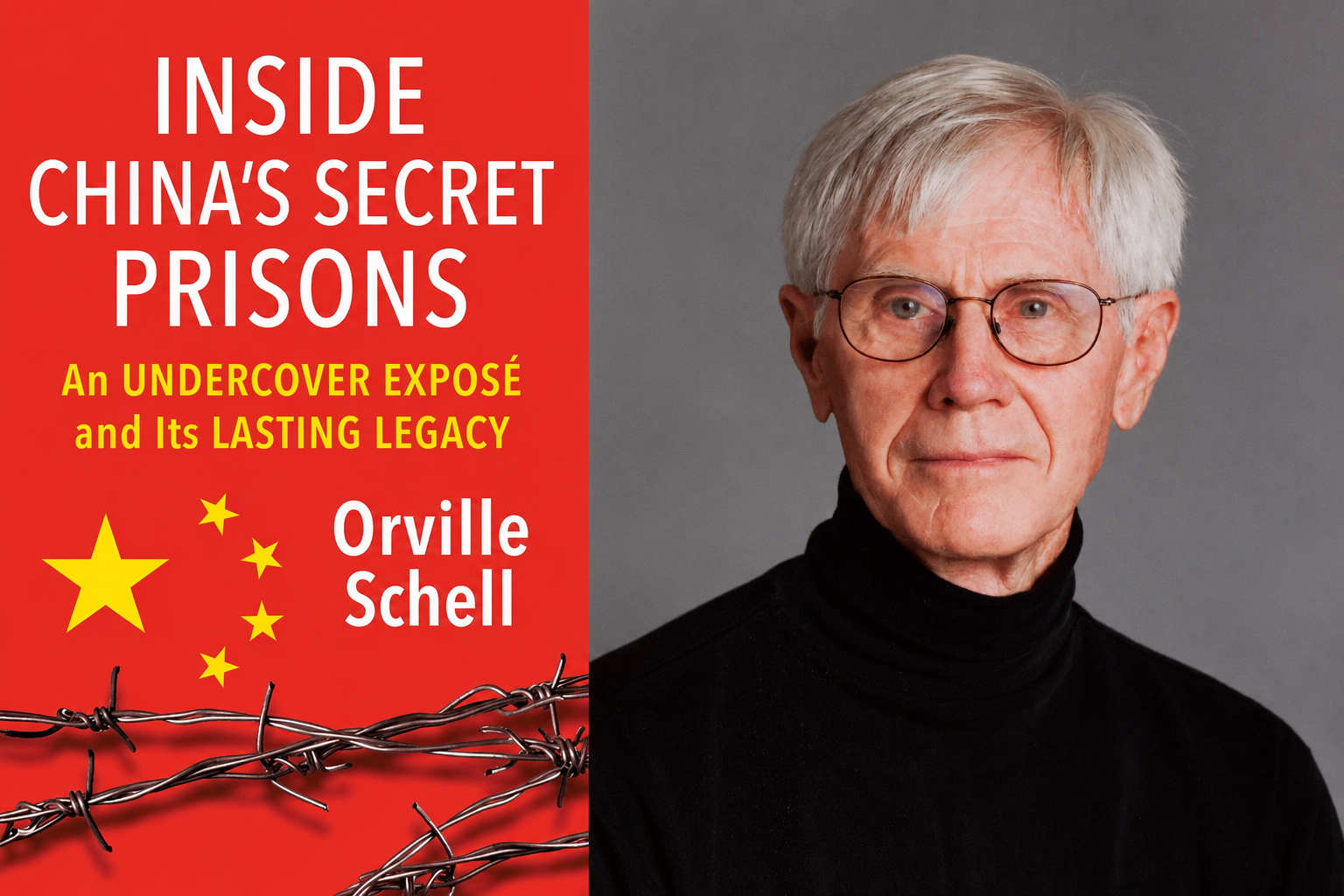
In 1991, China scholar and journalist Orville Schell teamed up with CBS News’ 60 Minutes for a perilous undercover investigation into China’s laogai—a vast network of forced labor camps secretly exporting goods into American markets. Fearing severe retaliation against his family and friends in China, Schell shelved his written account for three decades. In his new book, “Inside China’s Secret Prisons: An Undercover Exposé and Its Lasting Legacy,” Schell reveals how that clandestine operation played out and shares why forced labor persists in China today.
Guest:
- Orville Schell, director of the Center on US-China Relations at the Asia Society and author of the new book “Inside China’s Secret Prisons: An Undercover Exposé and Its Lasting Legacy”
Episode Transcript
This is a computer-generated transcript. While our team has reviewed it, there may be errors.
Mina Kim: Welcome to Forum, I’m Mina Kim. Orville Schell has been a leading scholar on China for more than 50 years, visiting the nation since the 1970s. He’s Asia Society’s Director of the Center on U.S.-China Relations and former Dean of UC Berkeley’s Graduate School of Journalism. In 1991, Schell helped CBS’s 60 Minutes conduct an exposé into China’s forced labor camps, where prisoners were making products that were being secretly exported to American markets. But he shelved the written account he’d promised then to The New Yorker until now. Schell’s new book, called Inside China’s Secret Prisons, recounts the making of the 60 Minutes episode and how forced labor, despite its illegality, still supplies U.S. and other global markets today. Orville Schell joins me now. Welcome to Forum.
Pleasure. So, Orville, help me understand, first of all, just the origins and theory behind the state-imposed forced labor system in China.
Orville Schell: Well, you know, when China became the People’s Republic of China in 1949, after Mao Zedong defeated Chiang Kai-shek and he fled to Taiwan, they adopted sort of wholesale the Soviet system of government. You know, all of the relationship between the party and the state, all the structures were just adopted wholesale. And part of that, of course, was Russia’s system of penal institutions.
But interestingly, China added a dimension to what Russians had long used in Siberia, which is namely just imprison people and you make them work and it’s punishment. But Mao Zedong had a kind of a new element he threw into the pot, and that was that, trying to follow the dictum of Stalin that part of socialist revolution was to re-engineer the human soul, he thought, okay, it’s not just enough to put people in prison. We need to add another element, and that was thought reform. What we have referred to in this country often as brainwashing.
So the idea was that if you could help people understand their political incorrectness, you know, the incorrectness of their thinking, that was as crucial as to make them pay, you know, penance for their so-called political crimes. So they added that element. So, reformed through labor camps meant that you got reformed by working for the state at no pay or extremely low pay in rare cases, but you also had to reform yourself politically and also, although Mao never wrote about this, psychologically.
Mina Kim: So then, if it was about thought reform, the people that were there were there because they were political prisoners, essentially, because they said and, quote unquote, thought things that were wrong according to the government.
Orville Schell: Yes, there’s this sort of wonderfully quaint term in Chinese, incorrect thought. And that thought needs to be, quote, rectified. And it can be rectified if the party compels people while in prison or even out of prison to go to all these struggle sessions and study meetings.
And I went to a bunch of these when I was first in China, when Mao was still alive and the Cultural Revolution was still going on. I mean, these head-bangingly boring meetings where you had to read some document. You had to deliver self-criticisms about your own thinking and even confessions.
And these were sort of exercises that really did undermine, I think, people’s belief in themselves. Because if, in fact, there’s a punishment and you’re in prison, shouldn’t there logically also be a crime? So then people start searching within themselves, all right, what did I do wrong? How can I get out of this bind? So it was a very crippling exercise that Mao Zedong sort of inadvertently tripped upon and threw into the whole question of incarceration for political purposes.
Mina Kim: Well, so these places were not just physically savage, but also sort of mentally savage as well. And then in the, I guess, early 1990s or late — was it 1991 when David Gelber approached you, a 60 Minutes producer calls you up and says he wants to document these places. Tell me what your reaction was to that.
Orville Schell: Well, I didn’t know this guy, David Gelber, who was a producer for Ed Bradley at 60 Minutes, and I just thought he was bereft of his senses. I mean, you know, you want to get into Chinese prisons with a giant camera and a big TV crew and a sound man with a fishnet vest and the whole nine yards. There wasn’t a snowball’s chance in hell that that could happen.
Mina Kim: So how did he convince you, then, to get in?
Orville Schell: Well, he kept at it. And I thought this is interesting, but I really couldn’t see how to do it. It was a rather terrifying prospect, too, to think of trying to penetrate this prison system.
But then it suddenly occurred to me that I’d met someone who was at Stanford at the Hoover Institution, who’d spent 19 years in the camps and was documenting that as his project at Stanford. So I called him up, and his first reaction was, “I don’t want anything to do with this. The people I know, I would never introduce you to. There’s no hope of anything.”
But we kept up the conversation. And then one day, he kind of got a strange look in his eye. This was Wu Hongda, or Harry Wu. And he said, “You know what?” He said, “If anybody goes back to China to do this, I should do it. Because I know what I’m doing. I know where the camps are, I know people who are in the camps, living outside of them now because they have no homes or no family to go back to and working in the prison factories. I could go back and possibly get some video.”
Mina Kim: Why was Harry Wu imprisoned in these camps in the first place?
Orville Schell: You know, he never really knew why, and this is one of the ways that I think this whole protocol of imprisonment and ideological reform is so powerful, is that very often you will ask the Chinese Communist Party or the cadres, whatever, if you’re being interrogated, detained, imprisoned, whatever. You’ll say, well, what was the fault? What was the crime? And they say, “You know what you did.”
And of course that triggers everybody to think of a thousand reasons why they might have run off the rails somehow. So it was during, I think, the Hungarian uprising in 1956 that he did speak out. He thinks that was the reason, and thus he was locked up as a rightist.
Mina Kim: Locked up for 19 years and yet willing to go back. What was he risking by doing this investigation, undercover investigation, with you and 60 Minutes?
Orville Schell: Well, I asked myself that very question. I wondered, what motivates this person? As I got to know him, I began to realize that one of the things that probably gave him both the fortitude and the reason to risk going back to the very camps he’d been in, which he could end up in again, was that he was a Catholic.
He was raised in a very wealthy Shanghai banking family. And he went to Jesuit schools, and his father was also deeply religious. And he often said to me that his faith was what sustained him in the camps.
And as we got to know each other and worked very closely together for almost a year, he often felt he owed it to them. And I said, who’s them? And he said, all the other people who were in the camp, and there were millions of them, who cannot speak out. Many are dead, many are damaged, but many are incapable of being able to say anything about what happened to themselves.
Mina Kim: We’re talking with China scholar and journalist Orville Schell about his 60 Minutes investigation to infiltrate China’s forced labor camps in 1991, and he’s written a book about it called Inside China’s Secret Prisons: An Undercover Exposé and Its Lasting Legacy. We will talk about its lasting legacy today, but listeners, you’re invited to join the conversation. If you know anything about China’s forced labor detention system or want to ask Orville about it, you can email Forum at kqed.org. Find us on Discord, Bluesky, Facebook, or Instagram. We’re at KQED Forum. Or you can call us at 866-733-6786, 866-733-6786.
And let me remind listeners, you are listening to Forum. I’m Mina Kim. He did understand the stakes, though. I do understand that he insisted on recording on camera sort of a last will and testament. Horrible.
Orville Schell: Well, before we actually went to China, and he began trying to penetrate these old camps with a camera bag that had a peephole and a hidden Sony cam inside the camera bag peeking out, he of course got very, very concerned about — you know, he realized he was going back into the dragon’s lair and he wasn’t sure what would happen, and I was going to go back with him, be sort of backup should anything happen, provide him with video cassettes, take the cassettes that he might succeed in shooting.
And so he did go back, and it was pretty extraordinary what he succeeded in doing. And the great tragedy was he got out with all these tapes, and all of the 60 Minutes crew from New York came out to Berkeley. And we got a big suite in the Fairmont. We started putting these cassettes into the video player, all excited and thinking we had the cat in the bag.
And one after the other. I mean, the video on it was pictures of the sky, pictures of his feet, he’s running, you know, “We have to get out of here.” There wasn’t one 10-second sequence in all of the hours he had shot that was suitable for commercial American television.
Mina Kim: Wow, you write about the Velcro flap, you know, the bag being over the — I mean, it is just heartbreaking to listen to. And yet, ultimately, you know, this does happen. He does go back to try to make all this happen again, shoot it again, risk his life and his freedom again. And this does ultimately air on 60 Minutes in 1991.
And after the break we’ll get into that saga more and more. But, you know, it is pretty incredible that this aired back then, and what I really want to get into is why, even though this aired in 1991, you didn’t want to publish your written account.
We’ll have more with Orville Schell right after the break. His book about China’s secret prisons and undercover exposé and its lasting legacy about a perilous attempt to investigate the forced labor camps for 60 Minutes and what made Orville write a written account of it, release a written account of it now. Stay with us. You’re listening to Forum. I’m Mina Kim.