Who Should Pay When Utilities Companies Start a Fire?
Airdate: Tuesday, September 1, 2026
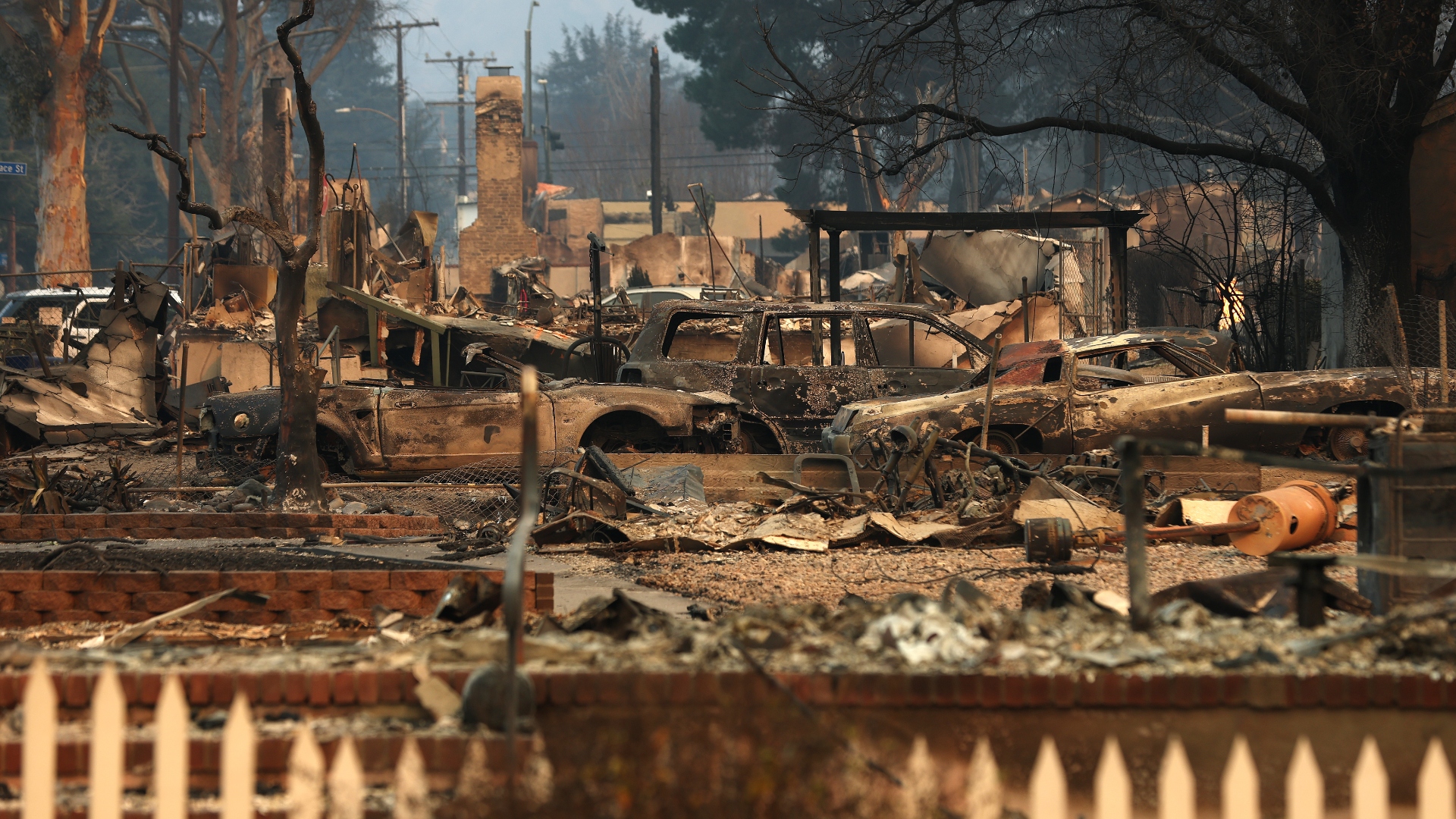
Wildfire season is underway in California, but the state’s wildfire fund is running low after billions went to victims of last year’s massive Altadena fire, sparked by faulty equipment owned by Southern California Edison. Governor Newsom and the legislature’s debate over fixing the wildfire fund has hinged on the extent utilities, insurance companies and homeowners would pay into it. We’ll dig into the details, and hear your thoughts on who should pay to rebuild after wildfires.
Guests:
- Guy Marzorati, correspondent, KQED’s California Politics and Government Desk
- Michael Wara, policy director for the Sustainability Accelerator at the Doerr School of Sustainability, director of the Climate and Energy Policy Program, senior research scholar at the Woods Institute for the Environment, Stanford University
- Joy Chen, executive director, Every Fire Survivor’s Network
Episode Transcript
This is a computer-generated transcript. While our team has reviewed it, there may be errors.
Mina Kim: Welcome to Forum. I’m Mina Kim. State lawmakers are voting today on an agreement with Governor Newsom that changes some of the rules governing wildfires caused by utilities. The deal, reached after months of closed-door negotiations, falls short of Newsom’s biggest goal of limiting liability for utilities, but it does build in some increased protections for ratepayers and creates a state program to get faster payments to wildfire victims. This hour, we dig into the details and the broader question of how to manage the costs of California’s increasingly destructive wildfires. Joining me this hour is Guy Marzorati, correspondent on KQED’s California Politics and Government Desk. Hi, Guy.
Guy Marzorati: Hey, good morning.
Mina Kim: And also with us is Michael Wara, senior research scholar at Stanford Woods Institute for the Environment. Michael, glad to have you with us, too.
Michael Wara: Thank you for having me on.
Mina Kim: So, Guy, first take me back a bit and tell me when and why Newsom started making this push to limit utility companies’ liability.
Guy Marzorati: Yeah, so I guess just real bird’s-eye view, like, this is the politics of climate change in California in the 2020s. Like, it is a debate that’s no longer just about what emissions-reduction goals to set. It’s about how to deal with climate damages that are here. And when you talk about climate damages in California, you’re talking about people’s homes burning down. And you’re talking about the ripple effects of electricity prices going up, insurance premiums going up. And all three of those pieces are kind of at the heart of the debate that we’ve seen play out really for more than a year. I mean, like, this issue of electricity affordability was a hotly debated item at the end of last year’s legislative session, continued through the year to where we are now.
Mina Kim: So he wanted to reduce our electricity bills, then. He wanted to reduce our insurance payments. But were Edison and the state’s other two big utilities lobbying hard for him to do something about this, too?
Guy Marzorati: I mean, look, I think from the lens of electricity affordability, Newsom is looking at the burden, the liability that’s on these utilities, the potential business impact of a bankruptcy following the kind of damaging fires we’ve seen, the fire in Altadena at the beginning of 2025 being the most recent example. But what he’s pushing up against is, if you want to shift the liability away from utilities, where does it end up? And the place that he proposed it ending up was more so in the home insurance base. Well, that industry also has gone through some years of crisis for the same exact reason, the fallout from these wildfires. And so that was not an easy landing spot politically. And I think when you’re talking about the politics of getting something through the Legislature, doing anything that’s seen as overly favorable or generous to utilities is just a really difficult lift.
Mina Kim: Yeah. So, you know, that did not work out for him with regard to trying to shift the cost to insurance companies. And it also is politically hard to be on the side of utilities that start a fire, like the Eaton Fire, as we know the liability was placed on them. But politically, why did it make sense for him?
Guy Marzorati: It’s a good question. I mean, I think there’s — look, I’ve heard a lot of different explanations for, like, why he’s — why he went after this in literally the last week of his last legislative session, ranging from the most charitable, which is, he took office at the beginning of 2019, right as PG&E was going into bankruptcy. He did not want the next governor — because this issue is not going away — he did not want the next governor to deal with the calamity that he faced while taking office. Okay, that’s probably the most charitable. He’s running for president. Having a future utility bankruptcy would not be a great headline.
But then I also think you have to just keep in mind, like, his term does not end this week. The Legislature is done with their session. He’s governor through the end of the year. And there is ongoing risk of, if we have another fire the likes of the Eaton Fire, the Camp Fire, what does that do for utilities, given that the wildfire fund that has already existed probably gets depleted by the Eaton Fire? There’s a new one that was authorized last year, but, like, what’s the long-term play for that? Is it just we just continue to fund these bailout funds through ratepayers every time there’s a — I mean, it just doesn’t seem sustainable. So you have to think he was also looking at that.
Mina Kim: Yeah, Michael, the strength of the wildfire fund was probably on his mind, certainly on state lawmakers’ minds as well. Can you remind us, you know, what the wildfire fund is and the pressure that’s on it right now in the wake of the fire?
Michael Wara: Sure. It’s a little bit like an insurance policy that you buy, you know, before a big calamity. And the policy is funded half out of shareholders’ pockets and half out of our pockets, ratepayer pockets, created in 2019 in the bankruptcy and designed to manage the risks of fire that were made so evident by both the Camp Fire and the Woolsey — Camp in Northern California, Woolsey in Southern California — and the fires in ’17 before that. And it really enabled PG&E to exit bankruptcy and kept Edison healthy through that process.
And then we ran the clock forward a few years, and we had a couple of bad fires that were not like Eaton in magnitude, but folks in Northern California may remember the Dixie Fire and the Kincade Fire a little bit before that, and those were bad utility-caused fires as well. But then Eaton basically wiped out the fund. We had a $21 billion claims-paying capacity. That’s kind of the limit, the coverage limit. And there haven’t actually been claims filed yet from Eaton. The settlements are still under negotiation. But I think most people believe that the fund will be exhausted or very nearly exhausted by the single event in January of ’25.
Mina Kim: Wow. And just remind us, when a wildfire is started by a utility company, how and when can they access the money in that fund?
Michael Wara: Yeah, so it’s not right away. The utility company has to settle lawsuits, and those are generally from two kinds of parties. One is victims, and the other is insurance companies that sue on behalf of the people they’ve already paid claims to, and they try to recover the money they paid in claims. That’s called subrogation. And so those two types of claims make up most of the money, but you have to settle in court. And Edison is right now in court with the victims’ attorneys making lots of claims. And I think they’re starting to get further on the subrogation claim settlement process than maybe they are with the plaintiffs’ attorneys. Yeah.
Mina Kim: Okay, so we’re hearing about all these pressures. We’re hearing all the goals, right, that the governor and lawmakers have. What did they finally agree to, Guy?
Guy Marzorati: Well, it was short of what Newsom initially proposed. He wanted to basically bar insurance companies from pursuing these claims against utilities through the subrogation process Michael’s talking about. The ultimate deal that was reached over the weekend was basically to limit — restrict hedge funds from buying those claims from insurance companies.
So you can think about an insurance company: They make the payout to victims, they’re looking for ways to stay liquid, a hedge fund might come around and offer them something short of full compensation, but cash up front to take on the claim. And a hedge fund, look, they have a lot of lawyers. They can spend the years it takes in many cases in pursuing this litigation against utilities.
Newsom and the Legislature, their deal would say basically insurance companies can’t sell those rights to hedge funds or private equity firms. And then the bill does some other things. It sets up a fast-pay system for wildfire victims to get paid. It has some new reporting requirements around, you know, local efforts to actually prevent the damage from wildfires at a community level, although importantly there’s not any money in the bill to do that.
So, short of what Newsom wanted to do, but again, given kind of the politics — and we should say, like, the coalition that formed against what Newsom is trying to do. It was not just the insurance companies who said, no, we want to continue to be able to file these lawsuits against utilities. It was also groups representing victims and then attorney groups, which have enormous sway, particularly in the Democratic caucus, who didn’t want kind of limits on what they see as their business. And so you had those, you know, kind of strange bedfellows, but a powerful coalition against Newsom and utilities. And in the end, the deal that was reached, which I’m not convinced Newsom actually likes — I mean, he made some comments last night that were pretty critical of the deal that he struck with legislative leaders — but certainly he was not able to get a lot of what he wanted.
Mina Kim: Yeah, the biggest sticking point was the fact that he didn’t want to let insurance companies sue utilities.
Guy Marzorati: Right. And the point there is, like, the idea that, you know, that would drive up the overall, you know, claims that are made or the settlement amounts. And that the big-picture thing is all of that — the settlement amount, the liability that utility companies hold — that all trickles down to electricity bills.
And I guess, like, the best argument that I’ve heard in support of what Newsom is trying to do is, if you look at, you know, placing the burden for these liabilities on electric ratepayers, think about if you’re, you know, you and I, or if you were living in the Central Valley, you have to run your AC all the time. There’s very little that you can do at an individual level to actually change that, right? The liabilities held by the utilities, they’re passing that down.
If you shift that to the insurance space, well, now there actually is something that individual homeowners can do to decrease their own liability, right? If the system works as it should, you should be able to discount if you are hardening your home, if you replace your roof, if you’re increasing defensible space. So it creates somewhat kind of like a structure of agency there, not saying it makes the politics any easier.
Mina Kim: Right. Why did, Michael, lawmakers push back so hard on that, and did they have a point about what could happen in the insurance space?
Michael Wara: Well, I think there’s two issues, right? One is we need to have — we have private electric utilities and private insurance companies in California. They both provide essential services to California. We need available insurance to have mortgages, right, and it’s just, it’s essential to the —
The challenge is we have this growing cost because of the status quo, because of how things were done back in the 20th century. The cost is on electric utilities, but it’s getting so big that the electric utilities can’t handle it. But nobody else wants to handle it either. And the insurers have been in a fragile state, as Guy pointed to. I would say we’re sort of one or two steps into a healthy recovery for insurers in California. Maybe like when you’ve taken one dose of antibiotics, but you’ve got like four more to go? Um, and so the insurers were understandably concerned that this shift of cost would put them back where they were a couple of years ago before they started taking those antibiotic doses. And they pushed back hard.
They don’t want to see this cost on their books. The problem is that we have the situation where, you know, the single mom in Fresno is paying through the nose because it’s 105 degrees outside in the summer. And maybe, maybe, and I’m not saying this is definitely true, but maybe it makes more sense to ask someone who’s already paying through the nose for their insurance because they live in a high-risk place and they have an expensive house to pay more. That’s really the debate. Who’s going to pay more? Is it the electricity customer in a hot place, or is it the homeowner in a high-risk place?
Mina Kim: We’re coming up on a break, but lawmakers are saying that this would raise premiums and cause more insurers to flee the state. Do you see that as—
Michael Wara: I think it really depends on how it’s implemented. The final compromise would have softened that a lot, but it is gonna raise — like, prices are going up some way or other. Climate change is expensive. It is not free.
Mina Kim: We’re talking about the effects of climate change, specifically wildfires, and how California is attempting to manage the many costs that come with them, with Michael Wara and Guy Marzorati, and with you, our listeners. Stay with us. We’ll take your calls and comments after the break. This is Forum.