Annie Jacobsen’s Doomsday Biological War Scenario
Airdate: Monday, August 11, 2026 at 10 AM
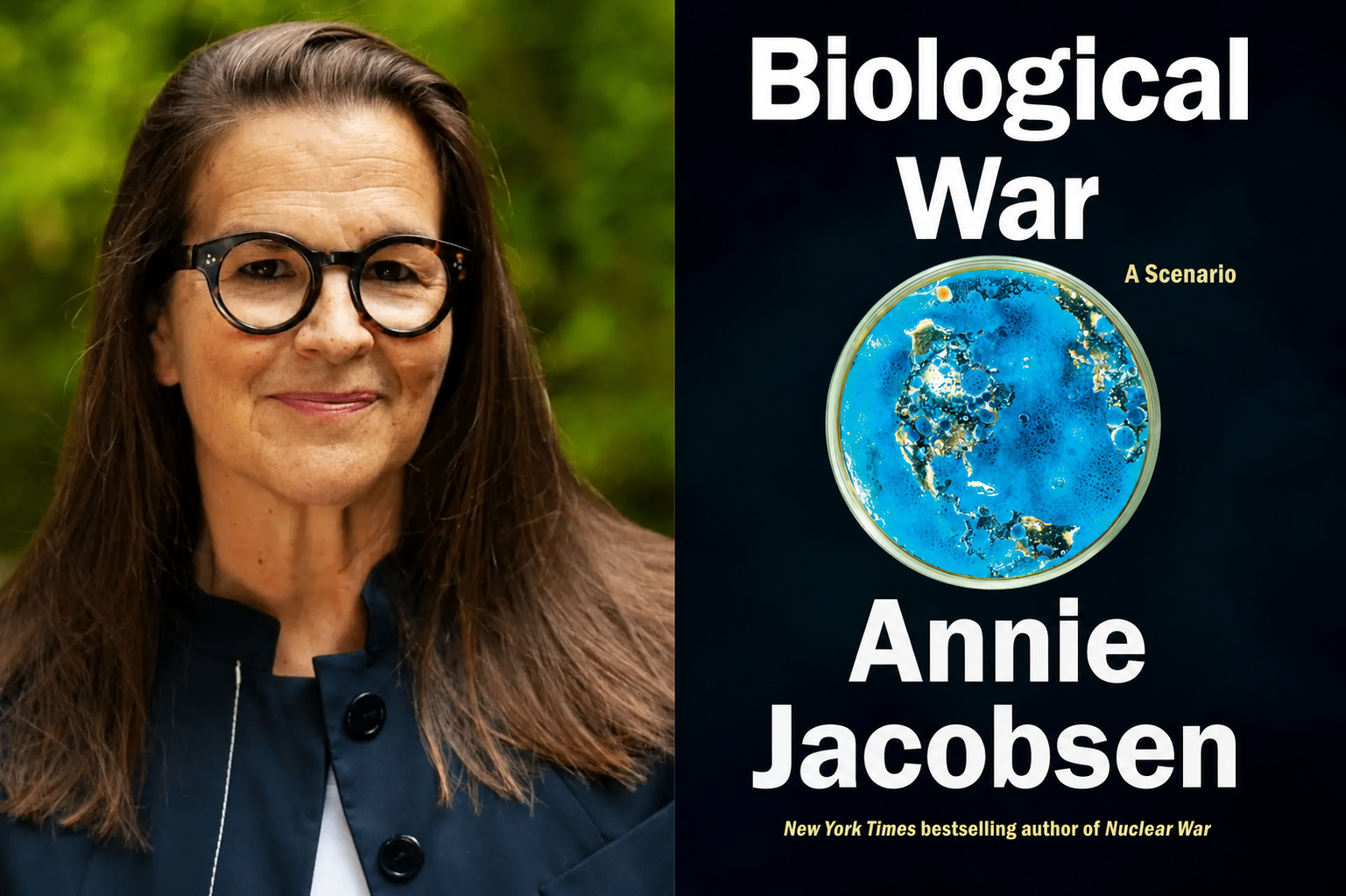
What would happen if a top-secret Russian lab released a deadly, weaponized, pathogen? That’s the nightmare possibility that author Annie Jacobsen presents in her new book, “Biological War: A Scenario.” Drawing on hundreds of interviews with former defense secretaries, CIA and FEMA officials, scientists and counterterrorism experts, Jacobsen shows how we might respond hour-by-hour, and the outlook is grim. We’ll talk to Jacobsen about why we can’t ignore the existence of biological weaponry.
Guest:
- Annie Jacobsen, author of “Biological War: A Scenario” and other books including “Nuclear War” and “The Pentagon’s Brain”
Episode Transcript
This is a computer-generated transcript. While our team has reviewed it, there may be errors.
Mina Kim: Welcome to Forum, I’m Mina Kim. When news broke last week that Stanford scientists had trained AI to create 16 new viruses in hopes of driving medical advances, alarm bells also rang over how this could be used by bad actors to create novel viruses as weapons and wipe out populations. Journalist and author Annie Jacobsen says that even without AI’s help, nations for decades have been genetically engineering pathogens in malicious ways. And in her new book, Biological War: A Scenario, she considers what would happen hour by hour if a U.S. adversary released one of those weaponized germs. Annie Jacobsen joins me now. Welcome to Forum.
Thank you for having me. You know, I honestly could not put your book down, which I did not expect with a topic like biological war, but it really is a testament to your ability to write something this complex, this extensively.
Annie Jacobsen: Well, thank you very much. And I think what I show is the mechanisms behind the veil of this kind of a catastrophic event. And ultimately, not only is it dramatic, but it actually is so impactful to us as individuals. Certainly with bio, we can all relate to it because we all just lived through a pandemic.
Mina Kim: Yeah, exactly. So walk us through, in your book, the scenario that you crafted, how this initially unfolds, because it’s Russia that has released this weaponized pathogen, and it has done it inadvertently with an accidental explosion at a Siberian lab.
Annie Jacobsen: That’s right. I take the readers essentially from outbreak to anarchy in the United States in six days. And I typically begin the scenario with that accident you refer to. It’s also called a lab escape or a lab leak among scientists. Lab leaks are very common, unfortunately. They present an extraordinary danger. And I did that very specifically because I was shocked, having written about national security for 20 years and looked at countless war games and studied countless battles and operations. It’s always an attack that gets a counter-attack. And yet, in biological war, it doesn’t need to be an attack. It can be an incident that triggers all of this. And that means an accident or a lab leak.
Mina Kim: So, one of the mechanisms by which it spreads is that this scientist, you know, has essentially felt guilty about his research, has tried to incinerate the virus that he’s developing, it goes wrong, causes the explosion, he’s infected and knows he’s going to die, and goes to confession, thereby infecting other people, right?
Annie Jacobsen: That’s absolutely right. What a truly human archetype of behavior.
Mina Kim: And then there is — so one of the ways it gets to the U.S. is that one of the people he infects is like a Russian student studying abroad at UCLA. But how does it get out to multiple continents very quickly?
Annie Jacobsen: You know, I looked at the 14th-century bubonic plague, also known as the Black Death, that killed one-third and one-half of Europe, to get a real foothold on the question you asked me, how I would answer that and how I’d present that dramatically, but realistically in today’s world.
And it was very interesting, in reading contemporary reports by survivors of the Black Death, that it was often noted that the plague traveled at the speed that humans traveled. And back in the 14th century, that was at about one mile a day by caravan or by ship. It’s such an image. And then when you think about today, we can — we, any of us can, and many of us have — gotten halfway across the planet in half a day.
And when you realize that, now you have a real nightmare scenario with any super-dangerous pathogen that has a high case-fatality rate. You can just spread that disease on an airplane. That is a super-spreader event. And then you have generation one becomes generation two, three, and four. And suddenly the pathogen is seeded in the entire world at scale.
Mina Kim: Right. So generation one, the initial people, then the people that they infect affecting the other people around them, and then so on and so forth. So talk about the U.S. government in the meantime. It has caught this explosion on their satellites and all the agencies are springing into action. But because Russia is an adversary, they’re not being forthcoming about what happened. So they have to figure things out on their own. Can you talk about what you learned about how our government is set up to respond? And why those measures essentially are likely to be inadequate in the face of a biological weapon and are in your scenario?
Annie Jacobsen: Exactly. I mean, you know, coming on the heels of all the reporting I’ve done on national security and specifically on my previous book, Nuclear War: A Scenario, I am incredibly interested in learning about and then conveying to my readers how the national security apparatus here in the United States responds to something.
And I was shocked when I was reporting Nuclear War to learn that nuclear war begins when an ICBM launches halfway across the world. In other words, those first 33 minutes while the ICBM is traveling to the United States, the Defense Department knows not only that it has happened but knows exactly where it is, essentially. And so the whole system moves into high gear without any of us having any idea of what is going on.
Bio had a completely disarming — disquieting, let me just say terrifying — sort of mirror to that, which is that in the event of an explosion-type event at a BSL-4 lab in Siberia, in Russia, which was the inciting incident in the book, I learned the Defense Department has eyes on that facility. So they know about the explosion in minute one because they see it from space with the satellite system, the same kinds of systems that look for nuclear launches.
But unlike nuclear, there’s no way to precisely detect what happened surrounding that explosion. Was a pathogen released? Is anyone dying? And so in the first act of the book, I take the reader, as you said, hour by hour through the Defense Department, the intelligence community — these are all our agencies, NRO, NSA, DIA, CIA. I interview people from all those organizations working over time to try and figure out what happened.
I mean, it’s this incredible shark-in-the-water feeling. As you said, State Department officials are trying to get Moscow to pony up and tell the truth. What happened? Were there dangerous pathogens in this lab that exploded? And of course, Moscow won’t talk, because that, I learned from all State Department officials, that’s the world in which we live right now, because communication has just been absolutely stunted.
And so I’m trying to convey to the reader both how serious it is that you cannot determine in the first hours whether a pathogen has been released. And at the same time, I learned from subject matter experts that that is precisely the only window of time in which you could mitigate this, which you can keep an outbreak from becoming an epidemic and then becoming a —
Mina Kim: Pandemic. Right. At one point, they even contemplate, you know, the officials, the government officials from all these different agencies, just nuking the area, right? Which is pretty shocking to learn is even a potential option when people are panicked in these situations about whether or not something gets out, right. But what’s incredible is that even if they took such a catastrophic action around the site of the explosion, people have already gotten on planes and left the area and brought it here. So it’s already too late.
Annie Jacobsen: It’s exactly right. You know, there was an interview I did with a Pentagon wargamer named Colonel Thomas Erhardt, and he worked in the Office of the Secretary of Defense under this very famous, legendary wargamer named Andrew Marshall, who led the Office for Net Assessment.
And when I was asking Erhardt, kind of like what you’re asking me, like, wait a minute, is there really nothing that can be done to mitigate this problem? And he’s the one that said to me that there’s actually no real homeland defense against a catastrophic pathogen. All that we can do is mitigate extermination. Those were his words.
Mina Kim: We’re talking with Annie Jacobsen about what might happen if a biological weapon escaped from a lab in Russia, how the U.S. government might respond hour by hour in a ticking-clock race to stop the spread of a deadly biological weapon.
And listeners, I want to invite you to join the conversation. What is your reaction to what you’re hearing? What questions do you have for Jacobsen about the threat and impact of biological war? You can email [email protected], find us on Discord, Bluesky, Facebook or Instagram at KQED Forum, and you can call us at 866-733-6786, 866-733-6786.
So part of the reason that you envision a scenario that it does take six days from the release of the engineered virus to the U.S. devolving into anarchy in just six days is because of the effectiveness of this pathogen. Could you just describe its features?
Annie Jacobsen: You bet. So one important thing to know, and I love that part of this learning experience ends up becoming sort of a powerful tool for people, not just for a reporter, but for all of us in dealing with these kinds of realities for ourselves and our families.
And I’m talking about, like, threats when people suddenly panic and they say, is there going to be an Ebola epidemic in America because there’s one in West Africa, et cetera. There are, for starters, a pathogen — there are two kinds of pathogens that can be deadly to humans. One is a virus. COVID was a virus. The other are bacteria. And that is what I use in the book as a pathogen. I use the plague.
Plague bacteria is called Yersinia pestis. And plague is precisely what the Black Death was predicated on. But that was bubonic plague. And what I learned from subject matter experts is that bubonic plague has a far more nefarious sort of uncle or grandfather, if you will, which is called pneumonic plague.
And of course, pneumonia means it involves the lungs. So pneumonic is airborne. It’s transmissible from person to person through the air. COVID was airborne, and that’s what makes it pandemic.
Mina Kim: Mm-hmm. And this pathogen that you create for this scenario is also airborne as well. We’ll dig into more about the pathogen right after the break. Stay with us. You’re listening to Forum.