window.__IS_SSR__=true
window.__INITIAL_STATE__={
"attachmentsReducer": {
"audio_0": {
"type": "attachments",
"id": "audio_0",
"imgSizes": {
"kqedFullSize": {
"file": "https://ww2.kqed.org/news/wp-content/themes/KQED-unified/img/audio_bgs/background0.jpg"
}
}
},
"audio_1": {
"type": "attachments",
"id": "audio_1",
"imgSizes": {
"kqedFullSize": {
"file": "https://ww2.kqed.org/news/wp-content/themes/KQED-unified/img/audio_bgs/background1.jpg"
}
}
},
"audio_2": {
"type": "attachments",
"id": "audio_2",
"imgSizes": {
"kqedFullSize": {
"file": "https://ww2.kqed.org/news/wp-content/themes/KQED-unified/img/audio_bgs/background2.jpg"
}
}
},
"audio_3": {
"type": "attachments",
"id": "audio_3",
"imgSizes": {
"kqedFullSize": {
"file": "https://ww2.kqed.org/news/wp-content/themes/KQED-unified/img/audio_bgs/background3.jpg"
}
}
},
"audio_4": {
"type": "attachments",
"id": "audio_4",
"imgSizes": {
"kqedFullSize": {
"file": "https://ww2.kqed.org/news/wp-content/themes/KQED-unified/img/audio_bgs/background4.jpg"
}
}
},
"placeholder": {
"type": "attachments",
"id": "placeholder",
"imgSizes": {
"thumbnail": {
"file": "https://cdn.kqed.org/wp-content/uploads/2024/12/KQED-Default-Image-816638274-2000x1333-1-160x107.jpg",
"width": 160,
"height": 107,
"mimeType": "image/jpeg"
},
"medium": {
"file": "https://cdn.kqed.org/wp-content/uploads/2024/12/KQED-Default-Image-816638274-2000x1333-1-800x533.jpg",
"width": 800,
"height": 533,
"mimeType": "image/jpeg"
},
"medium_large": {
"file": "https://cdn.kqed.org/wp-content/uploads/2024/12/KQED-Default-Image-816638274-2000x1333-1-768x512.jpg",
"width": 768,
"height": 512,
"mimeType": "image/jpeg"
},
"large": {
"file": "https://cdn.kqed.org/wp-content/uploads/2024/12/KQED-Default-Image-816638274-2000x1333-1-1020x680.jpg",
"width": 1020,
"height": 680,
"mimeType": "image/jpeg"
},
"1536x1536": {
"file": "https://cdn.kqed.org/wp-content/uploads/2024/12/KQED-Default-Image-816638274-2000x1333-1-1536x1024.jpg",
"width": 1536,
"height": 1024,
"mimeType": "image/jpeg"
},
"fd-lrg": {
"file": "https://cdn.kqed.org/wp-content/uploads/2024/12/KQED-Default-Image-816638274-2000x1333-1-1536x1024.jpg",
"width": 1536,
"height": 1024,
"mimeType": "image/jpeg"
},
"fd-med": {
"file": "https://cdn.kqed.org/wp-content/uploads/2024/12/KQED-Default-Image-816638274-2000x1333-1-1020x680.jpg",
"width": 1020,
"height": 680,
"mimeType": "image/jpeg"
},
"fd-sm": {
"file": "https://cdn.kqed.org/wp-content/uploads/2024/12/KQED-Default-Image-816638274-2000x1333-1-800x533.jpg",
"width": 800,
"height": 533,
"mimeType": "image/jpeg"
},
"post-thumbnail": {
"file": "https://cdn.kqed.org/wp-content/uploads/2024/12/KQED-Default-Image-816638274-2000x1333-1-672x372.jpg",
"width": 672,
"height": 372,
"mimeType": "image/jpeg"
},
"twentyfourteen-full-width": {
"file": "https://cdn.kqed.org/wp-content/uploads/2024/12/KQED-Default-Image-816638274-2000x1333-1-1038x576.jpg",
"width": 1038,
"height": 576,
"mimeType": "image/jpeg"
},
"xxsmall": {
"file": "https://cdn.kqed.org/wp-content/uploads/2024/12/KQED-Default-Image-816638274-2000x1333-1-160x107.jpg",
"width": 160,
"height": 107,
"mimeType": "image/jpeg"
},
"xsmall": {
"file": "https://cdn.kqed.org/wp-content/uploads/2024/12/KQED-Default-Image-816638274-2000x1333-1-672x372.jpg",
"width": 672,
"height": 372,
"mimeType": "image/jpeg"
},
"small": {
"file": "https://cdn.kqed.org/wp-content/uploads/2024/12/KQED-Default-Image-816638274-2000x1333-1-672x372.jpg",
"width": 672,
"height": 372,
"mimeType": "image/jpeg"
},
"xlarge": {
"file": "https://cdn.kqed.org/wp-content/uploads/2024/12/KQED-Default-Image-816638274-2000x1333-1-1020x680.jpg",
"width": 1020,
"height": 680,
"mimeType": "image/jpeg"
},
"full-width": {
"file": "https://cdn.kqed.org/wp-content/uploads/2024/12/KQED-Default-Image-816638274-2000x1333-1-1920x1280.jpg",
"width": 1920,
"height": 1280,
"mimeType": "image/jpeg"
},
"guest-author-32": {
"file": "https://cdn.kqed.org/wp-content/uploads/2025/01/KQED-Default-Image-816638274-1333x1333-1-160x160.jpg",
"width": 32,
"height": 32,
"mimeType": "image/jpeg"
},
"guest-author-50": {
"file": "https://cdn.kqed.org/wp-content/uploads/2025/01/KQED-Default-Image-816638274-1333x1333-1-160x160.jpg",
"width": 50,
"height": 50,
"mimeType": "image/jpeg"
},
"guest-author-64": {
"file": "https://cdn.kqed.org/wp-content/uploads/2025/01/KQED-Default-Image-816638274-1333x1333-1-160x160.jpg",
"width": 64,
"height": 64,
"mimeType": "image/jpeg"
},
"guest-author-96": {
"file": "https://cdn.kqed.org/wp-content/uploads/2025/01/KQED-Default-Image-816638274-1333x1333-1-160x160.jpg",
"width": 96,
"height": 96,
"mimeType": "image/jpeg"
},
"guest-author-128": {
"file": "https://cdn.kqed.org/wp-content/uploads/2025/01/KQED-Default-Image-816638274-1333x1333-1-160x160.jpg",
"width": 128,
"height": 128,
"mimeType": "image/jpeg"
},
"detail": {
"file": "https://cdn.kqed.org/wp-content/uploads/2025/01/KQED-Default-Image-816638274-1333x1333-1-160x160.jpg",
"width": 160,
"height": 160,
"mimeType": "image/jpeg"
},
"kqedFullSize": {
"file": "https://cdn.kqed.org/wp-content/uploads/2024/12/KQED-Default-Image-816638274-2000x1333-1.jpg",
"width": 2000,
"height": 1333
}
}
},
"arts_13953516": {
"type": "attachments",
"id": "arts_13953516",
"meta": {
"index": "attachments_1716263798",
"site": "arts",
"id": "13953516",
"found": true
},
"parent": 13953330,
"imgSizes": {
"twentyfourteen-full-width": {
"file": "https://cdn.kqed.org/wp-content/uploads/sites/2/2024/03/IMG_2979_crop-1038x576.jpg",
"width": 1038,
"mimeType": "image/jpeg",
"height": 576
},
"thumbnail": {
"file": "https://cdn.kqed.org/wp-content/uploads/sites/2/2024/03/IMG_2979_crop-160x90.jpg",
"width": 160,
"mimeType": "image/jpeg",
"height": 90
},
"post-thumbnail": {
"file": "https://cdn.kqed.org/wp-content/uploads/sites/2/2024/03/IMG_2979_crop-672x372.jpg",
"width": 672,
"mimeType": "image/jpeg",
"height": 372
},
"kqedFullSize": {
"file": "https://cdn.kqed.org/wp-content/uploads/sites/2/2024/03/IMG_2979_crop.jpg",
"width": 2000,
"height": 1125
},
"large": {
"file": "https://cdn.kqed.org/wp-content/uploads/sites/2/2024/03/IMG_2979_crop-1020x574.jpg",
"width": 1020,
"mimeType": "image/jpeg",
"height": 574
},
"1536x1536": {
"file": "https://cdn.kqed.org/wp-content/uploads/sites/2/2024/03/IMG_2979_crop-1536x864.jpg",
"width": 1536,
"mimeType": "image/jpeg",
"height": 864
},
"full-width": {
"file": "https://cdn.kqed.org/wp-content/uploads/sites/2/2024/03/IMG_2979_crop-1920x1080.jpg",
"width": 1920,
"mimeType": "image/jpeg",
"height": 1080
},
"medium": {
"file": "https://cdn.kqed.org/wp-content/uploads/sites/2/2024/03/IMG_2979_crop-800x450.jpg",
"width": 800,
"mimeType": "image/jpeg",
"height": 450
},
"medium_large": {
"file": "https://cdn.kqed.org/wp-content/uploads/sites/2/2024/03/IMG_2979_crop-768x432.jpg",
"width": 768,
"mimeType": "image/jpeg",
"height": 432
}
},
"publishDate": 1709754764,
"modified": 1709755156,
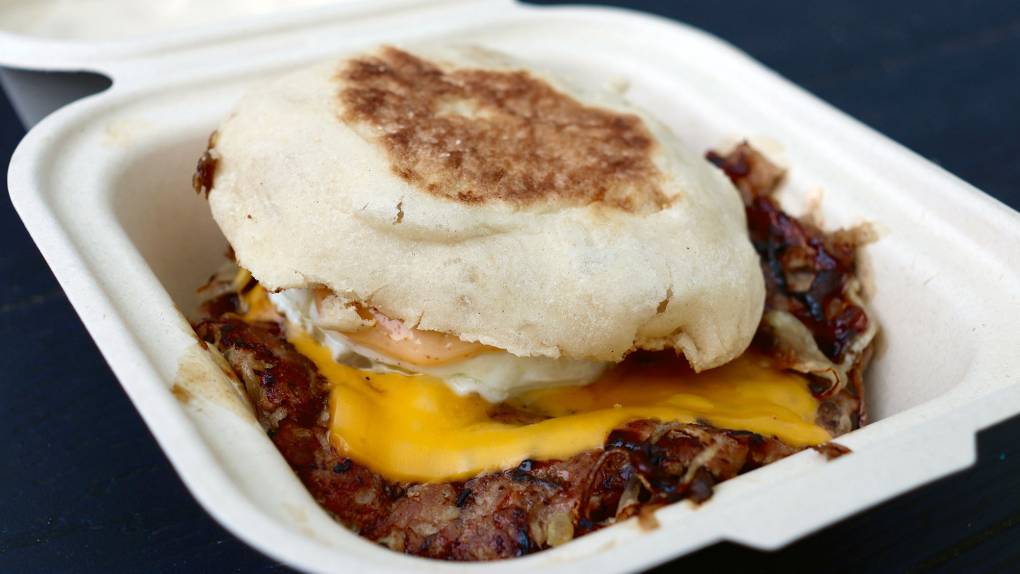
"caption": "Last month, the \"408 Smash\" at Hash N Dash gained over a million views and hundreds of new customers. Now the pop-up is having to shift its food model. ",
"description": null,
"title": "IMG_2979_crop",
"credit": "Alan Chazaro",
"status": "inherit",
"altTag": "a breakfast sandwich is served in a to-go box",
"isLoading": false,
"fetchFailed": false
},
"arts_13953272": {
"type": "attachments",
"id": "arts_13953272",
"meta": {
"index": "attachments_1716263798",
"site": "arts",
"id": "13953272",
"found": true
},
"parent": 13953266,
"imgSizes": {
"twentyfourteen-full-width": {
"file": "https://cdn.kqed.org/wp-content/uploads/sites/2/2024/03/Savory-Empanadas-3-crop-1038x576.jpg",
"width": 1038,
"mimeType": "image/jpeg",
"height": 576
},
"thumbnail": {
"file": "https://cdn.kqed.org/wp-content/uploads/sites/2/2024/03/Savory-Empanadas-3-crop-160x90.jpg",
"width": 160,
"mimeType": "image/jpeg",
"height": 90
},
"post-thumbnail": {
"file": "https://cdn.kqed.org/wp-content/uploads/sites/2/2024/03/Savory-Empanadas-3-crop-672x372.jpg",
"width": 672,
"mimeType": "image/jpeg",
"height": 372
},
"kqedFullSize": {
"file": "https://cdn.kqed.org/wp-content/uploads/sites/2/2024/03/Savory-Empanadas-3-crop.jpg",
"width": 2000,
"height": 1125
},
"large": {
"file": "https://cdn.kqed.org/wp-content/uploads/sites/2/2024/03/Savory-Empanadas-3-crop-1020x574.jpg",
"width": 1020,
"mimeType": "image/jpeg",
"height": 574
},
"1536x1536": {
"file": "https://cdn.kqed.org/wp-content/uploads/sites/2/2024/03/Savory-Empanadas-3-crop-1536x864.jpg",
"width": 1536,
"mimeType": "image/jpeg",
"height": 864
},
"full-width": {
"file": "https://cdn.kqed.org/wp-content/uploads/sites/2/2024/03/Savory-Empanadas-3-crop-1920x1080.jpg",
"width": 1920,
"mimeType": "image/jpeg",
"height": 1080
},
"medium": {
"file": "https://cdn.kqed.org/wp-content/uploads/sites/2/2024/03/Savory-Empanadas-3-crop-800x450.jpg",
"width": 800,
"mimeType": "image/jpeg",
"height": 450
},
"medium_large": {
"file": "https://cdn.kqed.org/wp-content/uploads/sites/2/2024/03/Savory-Empanadas-3-crop-768x432.jpg",
"width": 768,
"mimeType": "image/jpeg",
"height": 432
}
},
"publishDate": 1709334266,
"modified": 1709334418,
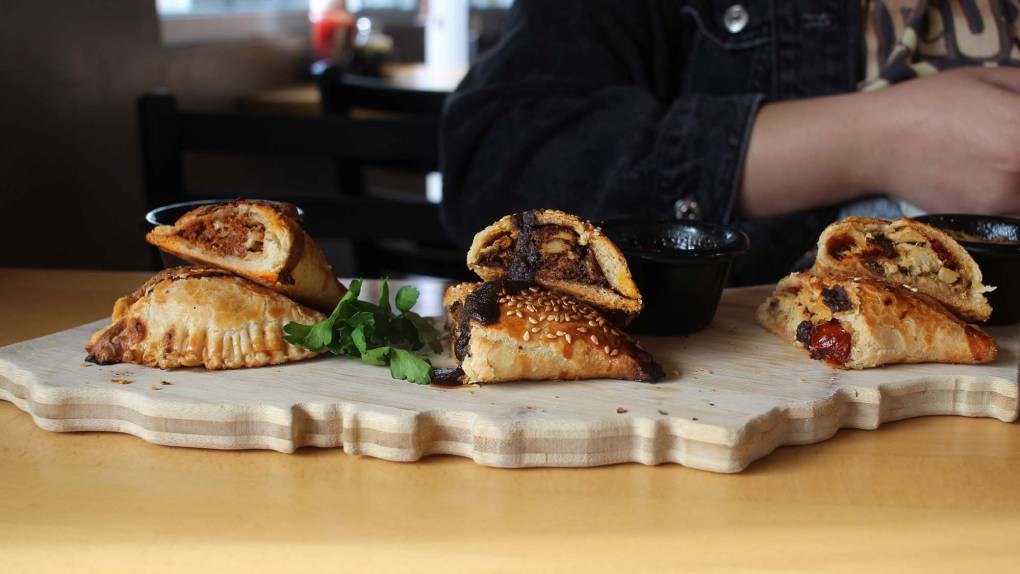
"caption": "Three different flavors of savory empanadas from Cheff Che Cafe & Bar, a Mexican American restaurant in San Jose that started out as a pandemic-born home empanada business. ",
"description": null,
"title": "Savory Empanadas 3-crop",
"credit": "Octavio Peña",
"status": "inherit",
"altTag": "On a wooden cutting board, three empanadas cut open to show the fillings inside.",
"isLoading": false,
"fetchFailed": false
},
"arts_13953108": {
"type": "attachments",
"id": "arts_13953108",
"meta": {
"index": "attachments_1716263798",
"site": "arts",
"id": "13953108",
"found": true
},
"parent": 13952476,
"imgSizes": {
"twentyfourteen-full-width": {
"file": "https://cdn.kqed.org/wp-content/uploads/sites/2/2024/02/img_0390-crop-1038x576.jpg",
"width": 1038,
"mimeType": "image/jpeg",
"height": 576
},
"thumbnail": {
"file": "https://cdn.kqed.org/wp-content/uploads/sites/2/2024/02/img_0390-crop-160x90.jpg",
"width": 160,
"mimeType": "image/jpeg",
"height": 90
},
"post-thumbnail": {
"file": "https://cdn.kqed.org/wp-content/uploads/sites/2/2024/02/img_0390-crop-672x372.jpg",
"width": 672,
"mimeType": "image/jpeg",
"height": 372
},
"kqedFullSize": {
"file": "https://cdn.kqed.org/wp-content/uploads/sites/2/2024/02/img_0390-crop.jpg",
"width": 2000,
"height": 1125
},
"large": {
"file": "https://cdn.kqed.org/wp-content/uploads/sites/2/2024/02/img_0390-crop-1020x574.jpg",
"width": 1020,
"mimeType": "image/jpeg",
"height": 574
},
"1536x1536": {
"file": "https://cdn.kqed.org/wp-content/uploads/sites/2/2024/02/img_0390-crop-1536x864.jpg",
"width": 1536,
"mimeType": "image/jpeg",
"height": 864
},
"full-width": {
"file": "https://cdn.kqed.org/wp-content/uploads/sites/2/2024/02/img_0390-crop-1920x1080.jpg",
"width": 1920,
"mimeType": "image/jpeg",
"height": 1080
},
"medium": {
"file": "https://cdn.kqed.org/wp-content/uploads/sites/2/2024/02/img_0390-crop-800x450.jpg",
"width": 800,
"mimeType": "image/jpeg",
"height": 450
},
"medium_large": {
"file": "https://cdn.kqed.org/wp-content/uploads/sites/2/2024/02/img_0390-crop-768x432.jpg",
"width": 768,
"mimeType": "image/jpeg",
"height": 432
}
},
"publishDate": 1709068359,
"modified": 1709080129,
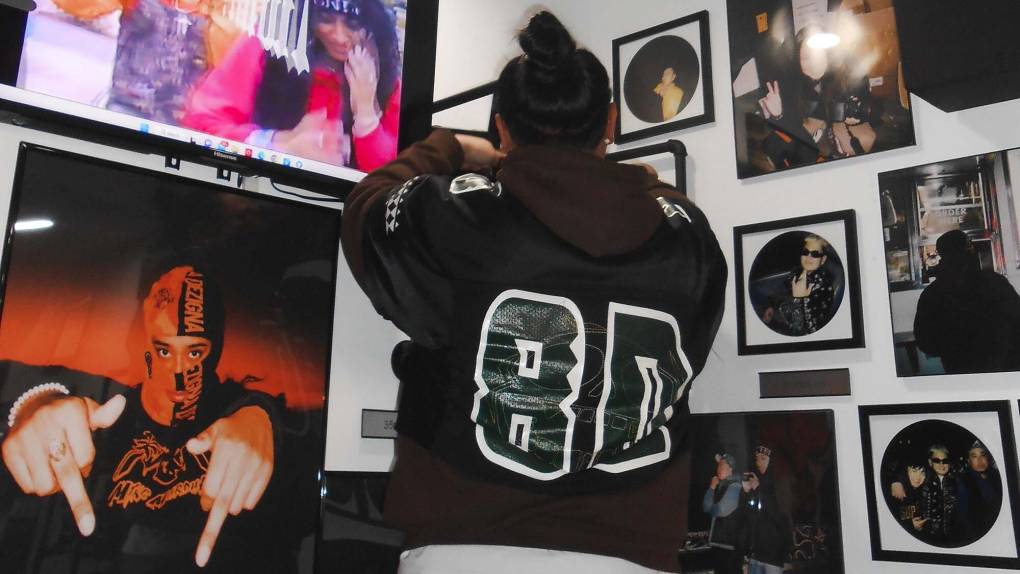
"caption": "MadeByRila, a San Jose designer who co-owns Coldwater Clothing, helped set up last year's edition of 'A Photo Night in Japantown.'",
"description": null,
"title": "img_0390-crop",
"credit": "Alex Knowbody",
"status": "inherit",
"altTag": "an artist puts photographs up on a studio wall before an exhibition",
"isLoading": false,
"fetchFailed": false
},
"arts_13952600": {
"type": "attachments",
"id": "arts_13952600",
"meta": {
"index": "attachments_1716263798",
"site": "arts",
"id": "13952600",
"found": true
},
"parent": 13952579,
"imgSizes": {
"twentyfourteen-full-width": {
"file": "https://cdn.kqed.org/wp-content/uploads/sites/2/2024/02/PXL_20230305_200112733.MP-01-1038x576.jpeg",
"width": 1038,
"mimeType": "image/jpeg",
"height": 576
},
"thumbnail": {
"file": "https://cdn.kqed.org/wp-content/uploads/sites/2/2024/02/PXL_20230305_200112733.MP-01-160x107.jpeg",
"width": 160,
"mimeType": "image/jpeg",
"height": 107
},
"post-thumbnail": {
"file": "https://cdn.kqed.org/wp-content/uploads/sites/2/2024/02/PXL_20230305_200112733.MP-01-672x372.jpeg",
"width": 672,
"mimeType": "image/jpeg",
"height": 372
},
"kqedFullSize": {
"file": "https://cdn.kqed.org/wp-content/uploads/sites/2/2024/02/PXL_20230305_200112733.MP-01.jpeg",
"width": 1920,
"height": 1280
},
"large": {
"file": "https://cdn.kqed.org/wp-content/uploads/sites/2/2024/02/PXL_20230305_200112733.MP-01-1020x680.jpeg",
"width": 1020,
"mimeType": "image/jpeg",
"height": 680
},
"1536x1536": {
"file": "https://cdn.kqed.org/wp-content/uploads/sites/2/2024/02/PXL_20230305_200112733.MP-01-1536x1024.jpeg",
"width": 1536,
"mimeType": "image/jpeg",
"height": 1024
},
"medium": {
"file": "https://cdn.kqed.org/wp-content/uploads/sites/2/2024/02/PXL_20230305_200112733.MP-01-800x533.jpeg",
"width": 800,
"mimeType": "image/jpeg",
"height": 533
},
"medium_large": {
"file": "https://cdn.kqed.org/wp-content/uploads/sites/2/2024/02/PXL_20230305_200112733.MP-01-768x512.jpeg",
"width": 768,
"mimeType": "image/jpeg",
"height": 512
}
},
"publishDate": 1708456074,
"modified": 1708457642,
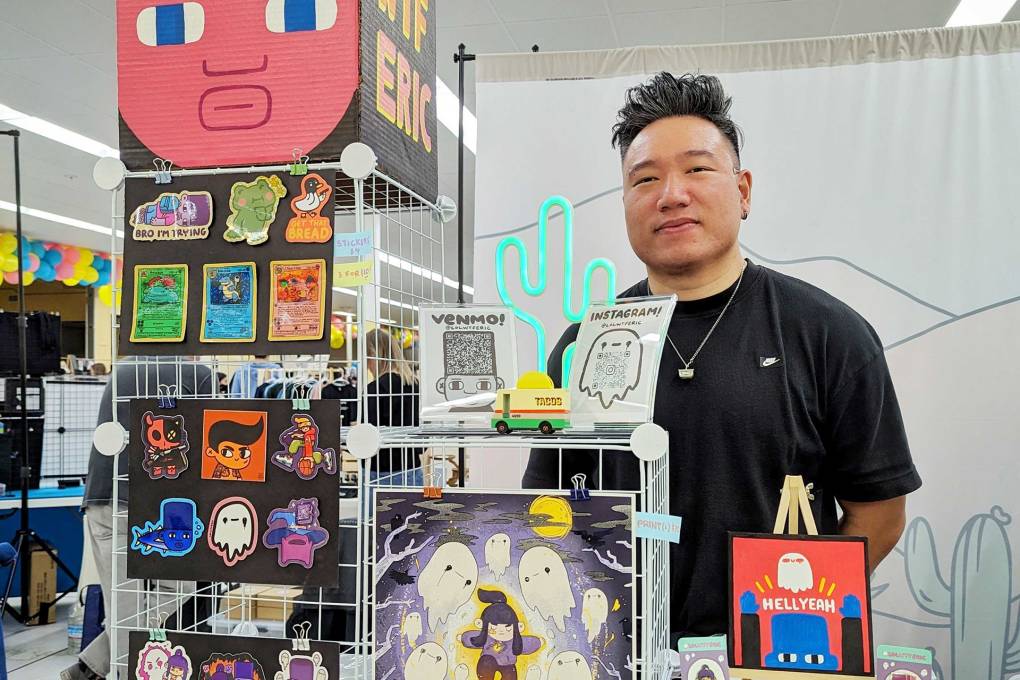
"caption": "Eric Bui, also known as lolwtferic, at Friend Fest 2023. ",
"description": null,
"title": "PXL_20230305_200112733.MP-01",
"credit": "Courtesy of San José Made",
"status": "inherit",
"altTag": "An artist vendor stands at his booth of stickers and art prints.",
"isLoading": false,
"fetchFailed": false
},
"arts_13951040": {
"type": "attachments",
"id": "arts_13951040",
"meta": {
"index": "attachments_1716263798",
"site": "arts",
"id": "13951040",
"found": true
},
"parent": 13951001,
"imgSizes": {
"thumbnail": {
"file": "https://cdn.kqed.org/wp-content/uploads/sites/2/2024/01/sanjose_coverfinal_720-160x90.jpg",
"width": 160,
"mimeType": "image/jpeg",
"height": 90
},
"post-thumbnail": {
"file": "https://cdn.kqed.org/wp-content/uploads/sites/2/2024/01/sanjose_coverfinal_720-672x372.jpg",
"width": 672,
"mimeType": "image/jpeg",
"height": 372
},
"kqedFullSize": {
"file": "https://cdn.kqed.org/wp-content/uploads/sites/2/2024/01/sanjose_coverfinal_720.jpg",
"width": 720,
"height": 405
}
},
"publishDate": 1706254303,
"modified": 1706254361,
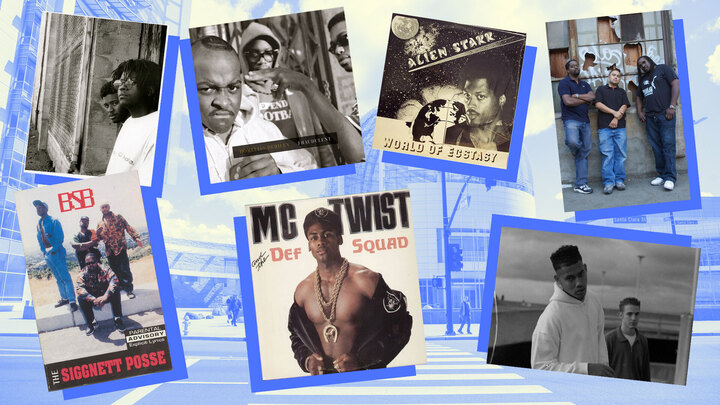
"caption": "San Jose's rap history goes far deeper than you may think.",
"description": null,
"title": "sanjose_coverfinal_720",
"credit": "Collage by Sarah Hotchkiss",
"status": "inherit",
"altTag": null,
"isLoading": false,
"fetchFailed": false
},
"arts_13951125": {
"type": "attachments",
"id": "arts_13951125",
"meta": {
"index": "attachments_1716263798",
"site": "arts",
"id": "13951125",
"found": true
},
"parent": 13950866,
"imgSizes": {
"twentyfourteen-full-width": {
"file": "https://cdn.kqed.org/wp-content/uploads/sites/2/2024/01/Hella-Hungry-—-Feature-Image-1920x1080-2-1038x576.jpg",
"width": 1038,
"mimeType": "image/jpeg",
"height": 576
},
"thumbnail": {
"file": "https://cdn.kqed.org/wp-content/uploads/sites/2/2024/01/Hella-Hungry-—-Feature-Image-1920x1080-2-160x90.jpg",
"width": 160,
"mimeType": "image/jpeg",
"height": 90
},
"post-thumbnail": {
"file": "https://cdn.kqed.org/wp-content/uploads/sites/2/2024/01/Hella-Hungry-—-Feature-Image-1920x1080-2-672x372.jpg",
"width": 672,
"mimeType": "image/jpeg",
"height": 372
},
"kqedFullSize": {
"file": "https://cdn.kqed.org/wp-content/uploads/sites/2/2024/01/Hella-Hungry-—-Feature-Image-1920x1080-2.jpg",
"width": 1920,
"height": 1080
},
"large": {
"file": "https://cdn.kqed.org/wp-content/uploads/sites/2/2024/01/Hella-Hungry-—-Feature-Image-1920x1080-2-1020x574.jpg",
"width": 1020,
"mimeType": "image/jpeg",
"height": 574
},
"1536x1536": {
"file": "https://cdn.kqed.org/wp-content/uploads/sites/2/2024/01/Hella-Hungry-—-Feature-Image-1920x1080-2-1536x864.jpg",
"width": 1536,
"mimeType": "image/jpeg",
"height": 864
},
"medium": {
"file": "https://cdn.kqed.org/wp-content/uploads/sites/2/2024/01/Hella-Hungry-—-Feature-Image-1920x1080-2-800x450.jpg",
"width": 800,
"mimeType": "image/jpeg",
"height": 450
},
"medium_large": {
"file": "https://cdn.kqed.org/wp-content/uploads/sites/2/2024/01/Hella-Hungry-—-Feature-Image-1920x1080-2-768x432.jpg",
"width": 768,
"mimeType": "image/jpeg",
"height": 432
}
},
"publishDate": 1706550972,
"modified": 1706643839,
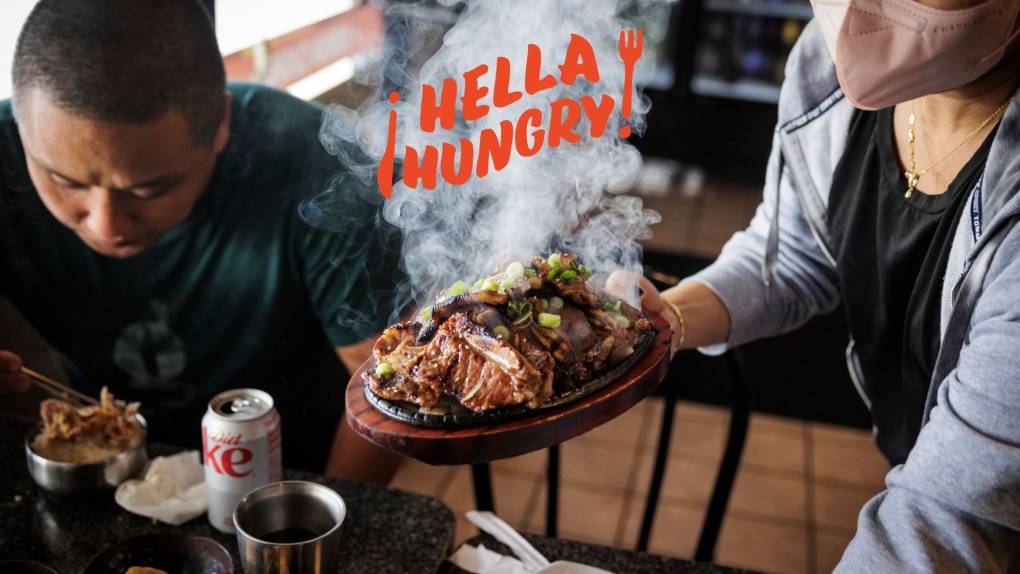
"caption": "Berkeley author Jay Caspian Kang (left) receives an order of galbi at GangNam Tofu in El Cerrito. The restaurant is one of Kang's local favorites because it serves \"standard Korean food\" prepared well. ",
"description": null,
"title": "Hella Hungry — Feature Image (1920x1080)",
"credit": "Martin do Nascimento/KQED",
"status": "inherit",
"altTag": "A masked server brings an order of galbi (Korean grilled short ribs) to the table when a man hunches over his food. A logo in the middle of the image reads, \"¡Hella Hungry!\"",
"isLoading": false,
"fetchFailed": false
},
"arts_13939829": {
"type": "attachments",
"id": "arts_13939829",
"meta": {
"index": "attachments_1716263798",
"site": "arts",
"id": "13939829",
"found": true
},
"parent": 13939767,
"imgSizes": {
"twentyfourteen-full-width": {
"file": "https://cdn.kqed.org/wp-content/uploads/sites/2/2023/12/BWneg-3-1038x576.jpg",
"width": 1038,
"mimeType": "image/jpeg",
"height": 576
},
"thumbnail": {
"file": "https://cdn.kqed.org/wp-content/uploads/sites/2/2023/12/BWneg-3-160x110.jpg",
"width": 160,
"mimeType": "image/jpeg",
"height": 110
},
"post-thumbnail": {
"file": "https://cdn.kqed.org/wp-content/uploads/sites/2/2023/12/BWneg-3-672x372.jpg",
"width": 672,
"mimeType": "image/jpeg",
"height": 372
},
"kqedFullSize": {
"file": "https://cdn.kqed.org/wp-content/uploads/sites/2/2023/12/BWneg-3.jpg",
"width": 1920,
"height": 1322
},
"large": {
"file": "https://cdn.kqed.org/wp-content/uploads/sites/2/2023/12/BWneg-3-1020x702.jpg",
"width": 1020,
"mimeType": "image/jpeg",
"height": 702
},
"1536x1536": {
"file": "https://cdn.kqed.org/wp-content/uploads/sites/2/2023/12/BWneg-3-1536x1058.jpg",
"width": 1536,
"mimeType": "image/jpeg",
"height": 1058
},
"medium": {
"file": "https://cdn.kqed.org/wp-content/uploads/sites/2/2023/12/BWneg-3-800x551.jpg",
"width": 800,
"mimeType": "image/jpeg",
"height": 551
},
"medium_large": {
"file": "https://cdn.kqed.org/wp-content/uploads/sites/2/2023/12/BWneg-3-768x529.jpg",
"width": 768,
"mimeType": "image/jpeg",
"height": 529
}
},
"publishDate": 1703701364,
"modified": 1703737947,
"caption": "(L–R) Charizma and Peanut Butter Wolf on top of San Jose State parking garage, 1992. (Outtake from 'Big Shots' album cover shoot.)",
"description": null,
"title": "B&Wneg-3",
"credit": "Theresa Castro",
"status": "inherit",
"altTag": null,
"isLoading": false,
"fetchFailed": false
},
"arts_13937543": {
"type": "attachments",
"id": "arts_13937543",
"meta": {
"index": "attachments_1716263798",
"site": "arts",
"id": "13937543",
"found": true
},
"parent": 13937510,
"imgSizes": {
"twentyfourteen-full-width": {
"file": "https://ww2.kqed.org/app/uploads/sites/2/2023/11/fox-tale_queso-1038x576.jpg",
"width": 1038,
"mimeType": "image/jpeg",
"height": 576
},
"thumbnail": {
"file": "https://ww2.kqed.org/app/uploads/sites/2/2023/11/fox-tale_queso-160x90.jpg",
"width": 160,
"mimeType": "image/jpeg",
"height": 90
},
"post-thumbnail": {
"file": "https://ww2.kqed.org/app/uploads/sites/2/2023/11/fox-tale_queso-672x372.jpg",
"width": 672,
"mimeType": "image/jpeg",
"height": 372
},
"kqedFullSize": {
"file": "https://ww2.kqed.org/app/uploads/sites/2/2023/11/fox-tale_queso.jpg",
"width": 1920,
"height": 1080
},
"large": {
"file": "https://ww2.kqed.org/app/uploads/sites/2/2023/11/fox-tale_queso-1020x574.jpg",
"width": 1020,
"mimeType": "image/jpeg",
"height": 574
},
"1536x1536": {
"file": "https://ww2.kqed.org/app/uploads/sites/2/2023/11/fox-tale_queso-1536x864.jpg",
"width": 1536,
"mimeType": "image/jpeg",
"height": 864
},
"medium": {
"file": "https://ww2.kqed.org/app/uploads/sites/2/2023/11/fox-tale_queso-800x450.jpg",
"width": 800,
"mimeType": "image/jpeg",
"height": 450
},
"medium_large": {
"file": "https://ww2.kqed.org/app/uploads/sites/2/2023/11/fox-tale_queso-768x432.jpg",
"width": 768,
"mimeType": "image/jpeg",
"height": 432
}
},
"publishDate": 1699029535,
"modified": 1699029750,
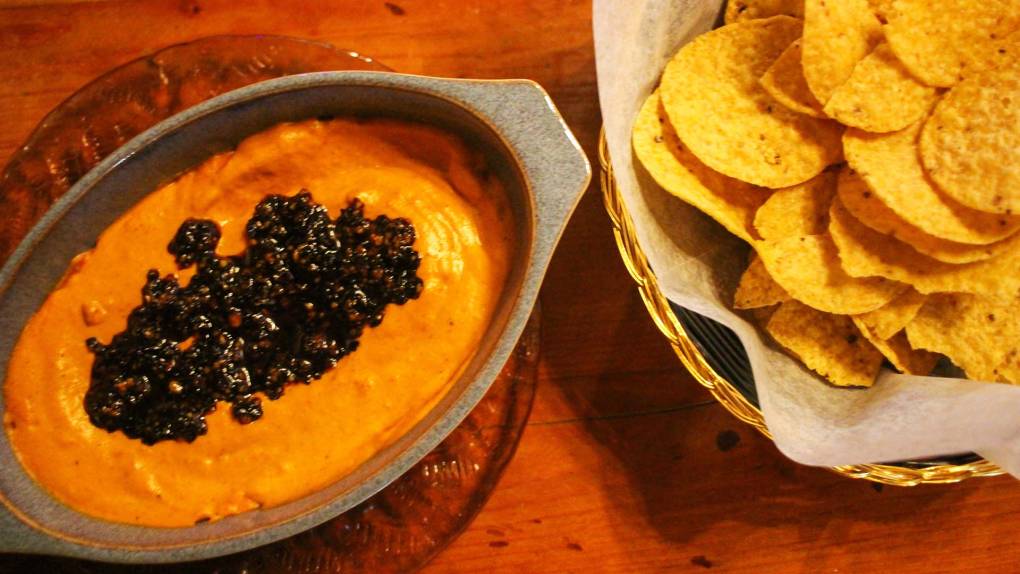
"caption": "At San Jose's Fox Tale Fermentation Project, the beer and the vegan food items — including this cashew-based queso — are made with fermented ingredients.",
"description": null,
"title": "fox tale_queso",
"credit": "Octavio Peña",
"status": "inherit",
"altTag": "A bowl of bright-orange vegan cashew \"queso\" topped with salsa macha, with a basket of tortilla chips on the side.",
"isLoading": false,
"fetchFailed": false
},
"arts_13936650": {
"type": "attachments",
"id": "arts_13936650",
"meta": {
"index": "attachments_1716263798",
"site": "arts",
"id": "13936650",
"found": true
},
"parent": 13936639,
"imgSizes": {
"twentyfourteen-full-width": {
"file": "https://ww2.kqed.org/app/uploads/sites/2/2023/10/juborrito_portrait-1038x576.jpg",
"width": 1038,
"mimeType": "image/jpeg",
"height": 576
},
"thumbnail": {
"file": "https://ww2.kqed.org/app/uploads/sites/2/2023/10/juborrito_portrait-160x107.jpg",
"width": 160,
"mimeType": "image/jpeg",
"height": 107
},
"post-thumbnail": {
"file": "https://ww2.kqed.org/app/uploads/sites/2/2023/10/juborrito_portrait-672x372.jpg",
"width": 672,
"mimeType": "image/jpeg",
"height": 372
},
"kqedFullSize": {
"file": "https://ww2.kqed.org/app/uploads/sites/2/2023/10/juborrito_portrait.jpg",
"width": 1920,
"height": 1280
},
"large": {
"file": "https://ww2.kqed.org/app/uploads/sites/2/2023/10/juborrito_portrait-1020x680.jpg",
"width": 1020,
"mimeType": "image/jpeg",
"height": 680
},
"1536x1536": {
"file": "https://ww2.kqed.org/app/uploads/sites/2/2023/10/juborrito_portrait-1536x1024.jpg",
"width": 1536,
"mimeType": "image/jpeg",
"height": 1024
},
"medium": {
"file": "https://ww2.kqed.org/app/uploads/sites/2/2023/10/juborrito_portrait-800x533.jpg",
"width": 800,
"mimeType": "image/jpeg",
"height": 533
},
"medium_large": {
"file": "https://ww2.kqed.org/app/uploads/sites/2/2023/10/juborrito_portrait-768x512.jpg",
"width": 768,
"mimeType": "image/jpeg",
"height": 512
}
},
"publishDate": 1697665778,
"modified": 1697670819,
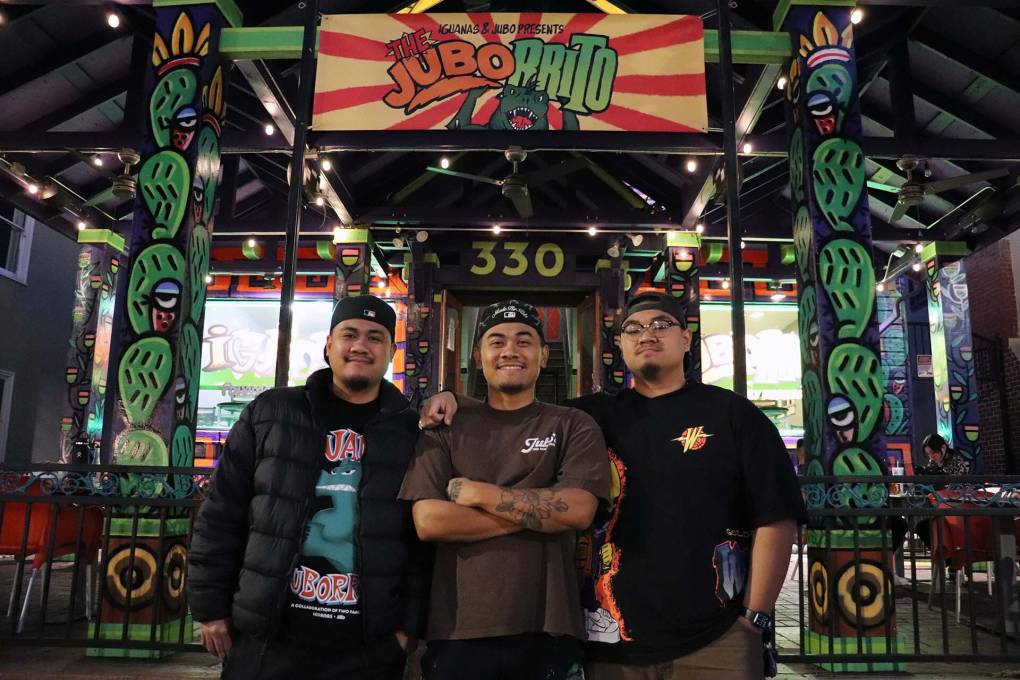
"caption": "The Nemedez brothers (Averill, left; Jason, center; Brian, right) in front of Iguanas taqueria in downtown San Jose, where they debuted their \"Juborrito\" in October.",
"description": null,
"title": "juborrito_portrait",
"credit": "Alan Chazaro",
"status": "inherit",
"altTag": "three brothers proudly stand in front of a taqueria in San Jose",
"isLoading": false,
"fetchFailed": false
},
"arts_13936444": {
"type": "attachments",
"id": "arts_13936444",
"meta": {
"index": "attachments_1716263798",
"site": "arts",
"id": "13936444",
"found": true
},
"parent": 13936406,
"imgSizes": {
"twentyfourteen-full-width": {
"file": "https://ww2.kqed.org/app/uploads/sites/2/2023/10/PesoPluma.MAIN_-1038x576.jpg",
"width": 1038,
"mimeType": "image/jpeg",
"height": 576
},
"thumbnail": {
"file": "https://ww2.kqed.org/app/uploads/sites/2/2023/10/PesoPluma.MAIN_-160x90.jpg",
"width": 160,
"mimeType": "image/jpeg",
"height": 90
},
"post-thumbnail": {
"file": "https://ww2.kqed.org/app/uploads/sites/2/2023/10/PesoPluma.MAIN_-672x372.jpg",
"width": 672,
"mimeType": "image/jpeg",
"height": 372
},
"kqedFullSize": {
"file": "https://ww2.kqed.org/app/uploads/sites/2/2023/10/PesoPluma.MAIN_.jpg",
"width": 1920,
"height": 1080
},
"large": {
"file": "https://ww2.kqed.org/app/uploads/sites/2/2023/10/PesoPluma.MAIN_-1020x574.jpg",
"width": 1020,
"mimeType": "image/jpeg",
"height": 574
},
"1536x1536": {
"file": "https://ww2.kqed.org/app/uploads/sites/2/2023/10/PesoPluma.MAIN_-1536x864.jpg",
"width": 1536,
"mimeType": "image/jpeg",
"height": 864
},
"medium": {
"file": "https://ww2.kqed.org/app/uploads/sites/2/2023/10/PesoPluma.MAIN_-800x450.jpg",
"width": 800,
"mimeType": "image/jpeg",
"height": 450
},
"medium_large": {
"file": "https://ww2.kqed.org/app/uploads/sites/2/2023/10/PesoPluma.MAIN_-768x432.jpg",
"width": 768,
"mimeType": "image/jpeg",
"height": 432
}
},
"publishDate": 1697307739,
"modified": 1697307801,
"caption": "Yunuel Enriquez attends her first concert at SAP Center on Friday, Oct. 13, 2023.",
"description": null,
"title": "PesoPluma.MAIN",
"credit": "Estefany Gonzalez for KQED",
"status": "inherit",
"altTag": "A young woman with gold hoop earrings, tight necklace and painted nails looks to the right outside a concert arena",
"isLoading": false,
"fetchFailed": false
},
"arts_13936053": {
"type": "attachments",
"id": "arts_13936053",
"meta": {
"index": "attachments_1716263798",
"site": "arts",
"id": "13936053",
"found": true
},
"parent": 13936015,
"imgSizes": {
"twentyfourteen-full-width": {
"file": "https://ww2.kqed.org/app/uploads/sites/2/2023/10/RBD.hat_.MAIN_.option-1038x576.jpg",
"width": 1038,
"mimeType": "image/jpeg",
"height": 576
},
"thumbnail": {
"file": "https://ww2.kqed.org/app/uploads/sites/2/2023/10/RBD.hat_.MAIN_.option-160x90.jpg",
"width": 160,
"mimeType": "image/jpeg",
"height": 90
},
"post-thumbnail": {
"file": "https://ww2.kqed.org/app/uploads/sites/2/2023/10/RBD.hat_.MAIN_.option-672x372.jpg",
"width": 672,
"mimeType": "image/jpeg",
"height": 372
},
"kqedFullSize": {
"file": "https://ww2.kqed.org/app/uploads/sites/2/2023/10/RBD.hat_.MAIN_.option.jpg",
"width": 1920,
"height": 1080
},
"large": {
"file": "https://ww2.kqed.org/app/uploads/sites/2/2023/10/RBD.hat_.MAIN_.option-1020x574.jpg",
"width": 1020,
"mimeType": "image/jpeg",
"height": 574
},
"1536x1536": {
"file": "https://ww2.kqed.org/app/uploads/sites/2/2023/10/RBD.hat_.MAIN_.option-1536x864.jpg",
"width": 1536,
"mimeType": "image/jpeg",
"height": 864
},
"medium": {
"file": "https://ww2.kqed.org/app/uploads/sites/2/2023/10/RBD.hat_.MAIN_.option-800x450.jpg",
"width": 800,
"mimeType": "image/jpeg",
"height": 450
},
"medium_large": {
"file": "https://ww2.kqed.org/app/uploads/sites/2/2023/10/RBD.hat_.MAIN_.option-768x432.jpg",
"width": 768,
"mimeType": "image/jpeg",
"height": 432
}
},
"publishDate": 1696704532,
"modified": 1696704575,
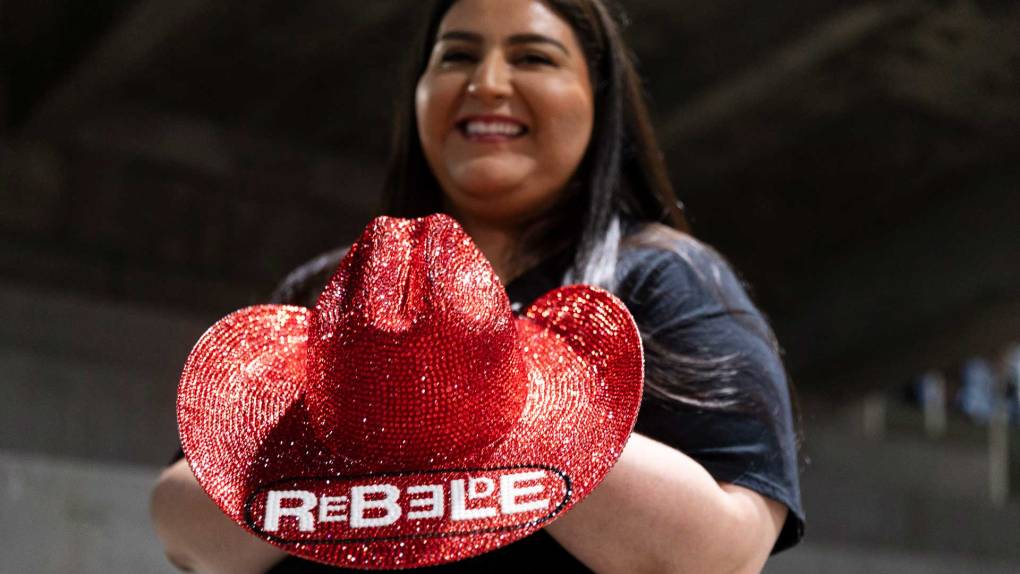
"caption": "Karina Guerrero traveled from Gonzales to attend the RBD concert at SAP Center on Friday, Oct. 6, 2023. Guerrero spent a week bedazzling her hat for the group's reunion tour.",
"description": null,
"title": "RBD.hat.MAIN.option",
"credit": "Estefany Gonzalez for KQED",
"status": "inherit",
"altTag": null,
"isLoading": false,
"fetchFailed": false
},
"arts_13934272": {
"type": "attachments",
"id": "arts_13934272",
"meta": {
"index": "attachments_1716263798",
"site": "arts",
"id": "13934272",
"found": true
},
"parent": 13934270,
"imgSizes": {
"twentyfourteen-full-width": {
"file": "https://ww2.kqed.org/app/uploads/sites/2/2023/09/GettyImages-578142500-1038x576.jpg",
"width": 1038,
"mimeType": "image/jpeg",
"height": 576
},
"thumbnail": {
"file": "https://ww2.kqed.org/app/uploads/sites/2/2023/09/GettyImages-578142500-160x90.jpg",
"width": 160,
"mimeType": "image/jpeg",
"height": 90
},
"post-thumbnail": {
"file": "https://ww2.kqed.org/app/uploads/sites/2/2023/09/GettyImages-578142500-672x372.jpg",
"width": 672,
"mimeType": "image/jpeg",
"height": 372
},
"kqedFullSize": {
"file": "https://ww2.kqed.org/app/uploads/sites/2/2023/09/GettyImages-578142500-scaled.jpg",
"width": 2560,
"height": 1440
},
"2048x2048": {
"file": "https://ww2.kqed.org/app/uploads/sites/2/2023/09/GettyImages-578142500-2048x1152.jpg",
"width": 2048,
"mimeType": "image/jpeg",
"height": 1152
},
"large": {
"file": "https://ww2.kqed.org/app/uploads/sites/2/2023/09/GettyImages-578142500-1020x574.jpg",
"width": 1020,
"mimeType": "image/jpeg",
"height": 574
},
"1536x1536": {
"file": "https://ww2.kqed.org/app/uploads/sites/2/2023/09/GettyImages-578142500-1536x864.jpg",
"width": 1536,
"mimeType": "image/jpeg",
"height": 864
},
"full-width": {
"file": "https://ww2.kqed.org/app/uploads/sites/2/2023/09/GettyImages-578142500-1920x1080.jpg",
"width": 1920,
"mimeType": "image/jpeg",
"height": 1080
},
"medium": {
"file": "https://ww2.kqed.org/app/uploads/sites/2/2023/09/GettyImages-578142500-800x450.jpg",
"width": 800,
"mimeType": "image/jpeg",
"height": 450
},
"medium_large": {
"file": "https://ww2.kqed.org/app/uploads/sites/2/2023/09/GettyImages-578142500-768x432.jpg",
"width": 768,
"mimeType": "image/jpeg",
"height": 432
}
},
"publishDate": 1693849872,
"modified": 1693849967,
"caption": "Singer Steve Harwell of Smash Mouth performs in 2016 in Los Angeles, California. Harwell, born and raised in the South Bay Area, died Monday from acute liver failure. ",
"description": null,
"title": "GettyImages-578142500",
"credit": "Michael Tullberg/Getty Images",
"status": "inherit",
"altTag": "a man in sunglasses, black t-shirt and tattoos sings into a microphone",
"isLoading": false,
"fetchFailed": false
}
},
"audioPlayerReducer": {
"postId": "stream_live",
"isPaused": true,
"isPlaying": false,
"pfsActive": false,
"pledgeModalIsOpen": true,
"playerDrawerIsOpen": false,
"liveAudioPlayStartedAt": 0,
"liveAudioPlayContext": ""
},
"authorsReducer": {
"byline_arts_13951001": {
"type": "authors",
"id": "byline_arts_13951001",
"meta": {
"override": true
},
"slug": "byline_arts_13951001",
"name": "J. Darrah",
"isLoading": false
},
"byline_arts_13939767": {
"type": "authors",
"id": "byline_arts_13939767",
"meta": {
"override": true
},
"slug": "byline_arts_13939767",
"name": "David Ma",
"isLoading": false
},
"byline_arts_13934270": {
"type": "authors",
"id": "byline_arts_13934270",
"meta": {
"override": true
},
"slug": "byline_arts_13934270",
"name": "Maria Sherman, Associated Press",
"isLoading": false
},
"egonzalez": {
"type": "authors",
"id": "11384",
"meta": {
"index": "authors_1716337520",
"id": "11384",
"found": true
},
"name": "Estefany Gonzalez",
"firstName": "Estefany",
"lastName": "Gonzalez",
"slug": "egonzalez",
"email": "estefancy@gmail.com",
"display_author_email": false,
"staff_mastheads": [],
"title": "KQED Contributor",
"bio": "Estefany is a contributing photographer at KQED.",
"avatar": "https://secure.gravatar.com/avatar/31ed90a4cd60f9435d6f170329b6cbb7?s=600&d=blank&r=g",
"twitter": null,
"facebook": null,
"instagram": "https://www.instagram.com/estefancy/",
"linkedin": null,
"sites": [
{
"site": "arts",
"roles": [
"author"
]
},
{
"site": "news",
"roles": [
"author"
]
}
],
"headData": {
"title": "Estefany Gonzalez | KQED",
"description": "KQED Contributor",
"ogImgSrc": "https://secure.gravatar.com/avatar/31ed90a4cd60f9435d6f170329b6cbb7?s=600&d=blank&r=g",
"twImgSrc": "https://secure.gravatar.com/avatar/31ed90a4cd60f9435d6f170329b6cbb7?s=600&d=blank&r=g"
},
"isLoading": false,
"link": "/author/egonzalez"
},
"nvoynovskaya": {
"type": "authors",
"id": "11387",
"meta": {
"index": "authors_1716337520",
"id": "11387",
"found": true
},
"name": "Nastia Voynovskaya",
"firstName": "Nastia",
"lastName": "Voynovskaya",
"slug": "nvoynovskaya",
"email": "nvoynovskaya@kqed.org",
"display_author_email": false,
"staff_mastheads": [
"arts"
],
"title": "Editor and reporter",
"bio": "Nastia Voynovskaya is a reporter, editor and host at KQED Arts & Culture. She's been covering the arts in the Bay Area for over a decade, with a focus on music, queer culture, labor issues and grassroots organizing. She has edited KQED story series such as Trans Bay: A History of San Francisco's Gender-Diverse Community, and co-created KQED's Bay Area hip-hop history project, That's My Word. Nastia's work has been recognized by the Society of Professional Journalists and San Francisco Press Club. She regularly appears on podcasts and radio programs, including NPR's All Songs Considered, and hosts live events where music, culture and conversation meet.",
"avatar": "https://secure.gravatar.com/avatar/5025ee460e5a85d69ca20ea6c6f2f80d7e17795c828f61ea3aecfcd924e9042e?s=600&d=blank&r=g",
"twitter": null,
"bluesky": null,
"facebook": null,
"instagram": "https://www.instagram.com/nananastia/",
"linkedin": null,
"sites": [
{
"site": "",
"roles": [
"editor"
]
},
{
"site": "arts",
"roles": [
"administrator"
]
},
{
"site": "news",
"roles": [
"editor"
]
},
{
"site": "pop",
"roles": [
"administrator"
]
},
{
"site": "bayareabites",
"roles": [
"editor"
]
},
{
"site": "podcasts",
"roles": [
"editor"
]
},
{
"site": "hiphop",
"roles": [
"editor"
]
}
],
"headData": {
"title": "Nastia Voynovskaya | KQED",
"description": "Editor and reporter",
"ogImgSrc": "https://secure.gravatar.com/avatar/5025ee460e5a85d69ca20ea6c6f2f80d7e17795c828f61ea3aecfcd924e9042e?s=600&d=blank&r=g",
"twImgSrc": "https://secure.gravatar.com/avatar/5025ee460e5a85d69ca20ea6c6f2f80d7e17795c828f61ea3aecfcd924e9042e?s=600&d=blank&r=g"
},
"isLoading": false,
"link": "/author/nvoynovskaya"
},
"achazaro": {
"type": "authors",
"id": "11748",
"meta": {
"index": "authors_1716337520",
"id": "11748",
"found": true
},
"name": "Alan Chazaro",
"firstName": "Alan",
"lastName": "Chazaro",
"slug": "achazaro",
"email": "agchazaro@gmail.com",
"display_author_email": true,
"staff_mastheads": [],
"title": "Food Writer and Reporter",
"bio": "Alan Chazaro is the author of \u003cem>This Is Not a Frank Ocean Cover Album\u003c/em> (Black Lawrence Press, 2019), \u003cem>Piñata Theory\u003c/em> (Black Lawrence Press, 2020), and \u003cem>Notes from the Eastern Span of the Bay Bridge\u003c/em> (Ghost City Press, 2021). He is a graduate of June Jordan’s Poetry for the People program at UC Berkeley and a former Lawrence Ferlinghetti Fellow at the University of San Francisco. He writes about sports, food, art, music, education, and culture while repping the Bay on \u003ca href=\"https://twitter.com/alan_chazaro\">Twitter\u003c/a> and \u003ca href=\"https://www.instagram.com/alan_chazaro/?hl=en\">Instagram\u003c/a> at @alan_chazaro.",
"avatar": "https://secure.gravatar.com/avatar/ea8b6dd970fc5c29e7a188e7d5861df7?s=600&d=blank&r=g",
"twitter": "alan_chazaro",
"facebook": null,
"instagram": null,
"linkedin": null,
"sites": [
{
"site": "arts",
"roles": [
"contributor"
]
},
{
"site": "news",
"roles": [
"editor"
]
}
],
"headData": {
"title": "Alan Chazaro | KQED",
"description": "Food Writer and Reporter",
"ogImgSrc": "https://secure.gravatar.com/avatar/ea8b6dd970fc5c29e7a188e7d5861df7?s=600&d=blank&r=g",
"twImgSrc": "https://secure.gravatar.com/avatar/ea8b6dd970fc5c29e7a188e7d5861df7?s=600&d=blank&r=g"
},
"isLoading": false,
"link": "/author/achazaro"
},
"pabarca": {
"type": "authors",
"id": "11882",
"meta": {
"index": "authors_1716337520",
"id": "11882",
"found": true
},
"name": "Paloma Abarca",
"firstName": "Paloma",
"lastName": "Abarca",
"slug": "pabarca",
"email": "pabarca@kqed.org",
"display_author_email": true,
"staff_mastheads": [],
"title": "KQED Contributor",
"bio": "Paloma Yaritza Abarca is a Live Event Producer and Digital Creator for KQED Live, our multiplatform live events program. She focuses on amplifying LGBTQIA and BIPOC voices and developing opportunities to showcase the diversity of the Bay's culture and history. She's produced three successful Latinx events: Hella Caffeinated con Pan, The Special: Vegan Food con Sazón, and Reclaiming Curanderismo, and was previously the Latinx Engagement Producer with KQED's Audience Development team. Paloma was a writer and Lead Content Specialist for the Dance Music Media and News company, EDM Maniac, has produced stories for KALW's award-winning news magazine Crosscurrents, and ran San Francisco State's events venue, The Depot.",
"avatar": "https://secure.gravatar.com/avatar/90ff14b6bdb2e86dc89f8cf0d6beeecd?s=600&d=blank&r=g",
"twitter": null,
"facebook": null,
"instagram": null,
"linkedin": null,
"sites": [
{
"site": "arts",
"roles": [
"contributor"
]
}
],
"headData": {
"title": "Paloma Abarca | KQED",
"description": "KQED Contributor",
"ogImgSrc": "https://secure.gravatar.com/avatar/90ff14b6bdb2e86dc89f8cf0d6beeecd?s=600&d=blank&r=g",
"twImgSrc": "https://secure.gravatar.com/avatar/90ff14b6bdb2e86dc89f8cf0d6beeecd?s=600&d=blank&r=g"
},
"isLoading": false,
"link": "/author/pabarca"
},
"opena": {
"type": "authors",
"id": "11903",
"meta": {
"index": "authors_1716337520",
"id": "11903",
"found": true
},
"name": "Octavio Peña",
"firstName": "Octavio",
"lastName": "Peña",
"slug": "opena",
"email": "octaviopenagutierrez@gmail.com",
"display_author_email": false,
"staff_mastheads": [],
"title": "KQED Contributor",
"bio": null,
"avatar": "https://secure.gravatar.com/avatar/62850791380238ea3945ee72a3d56056477904792b41daaf11effa8780bab75d?s=600&d=blank&r=g",
"twitter": null,
"bluesky": null,
"facebook": null,
"instagram": null,
"linkedin": null,
"sites": [
{
"site": "arts",
"roles": [
"contributor"
]
}
],
"headData": {
"title": "Octavio Peña | KQED",
"description": "KQED Contributor",
"ogImgSrc": "https://secure.gravatar.com/avatar/62850791380238ea3945ee72a3d56056477904792b41daaf11effa8780bab75d?s=600&d=blank&r=g",
"twImgSrc": "https://secure.gravatar.com/avatar/62850791380238ea3945ee72a3d56056477904792b41daaf11effa8780bab75d?s=600&d=blank&r=g"
},
"isLoading": false,
"link": "/author/opena"
}
},
"pagesReducer": {
"arts_tag_san-jose": {
"type": "terms",
"id": "arts_1084",
"meta": {
"index": "terms_1716263798",
"site": "arts",
"id": "1084",
"score": 8.005498
},
"featImg": null,
"name": "San Jose",
"description": null,
"taxonomy": "tag",
"headData": {
"twImgId": null,
"twTitle": null,
"ogTitle": null,
"ogImgId": null,
"twDescription": null,
"description": null,
"title": "San Jose Archives | KQED Arts",
"ogDescription": null
},
"ttid": 1101,
"slug": "san-jose",
"isLoading": false,
"title": "San Jose",
"pageMeta": {
"site": "arts",
"WpPageTemplate": "page-topic-editorial",
"currentPage": 8
},
"blocks": [
{
"blockName": "kqed/post-list",
"attrs": {
"layout": "cardArticle2",
"query": "posts/arts?tag=san-jose",
"seeMore": false,
"paginated": true,
"page": 8
}
},
{
"blockName": "kqed/ad"
}
]
}
},
"pfsSessionReducer": {},
"postsReducer": {
"stream_live": {
"type": "live",
"id": "stream_live",
"audioUrl": "https://streams.kqed.org/kqedradio",
"title": "Live Stream",
"excerpt": "Live Stream information currently unavailable.",
"link": "/radio",
"featImg": "",
"label": {
"name": "KQED Live",
"link": "/"
}
},
"stream_kqedNewscast": {
"type": "posts",
"id": "stream_kqedNewscast",
"audioUrl": "https://www.kqed.org/.stream/anon/radio/RDnews/newscast.mp3?_=1",
"title": "KQED Newscast",
"featImg": "",
"label": {
"name": "88.5 FM",
"link": "/"
}
},
"arts_13953330": {
"type": "posts",
"id": "arts_13953330",
"meta": {
"index": "posts_1716263798",
"site": "arts",
"id": "13953330",
"score": null,
"sort": [
1709764589000
]
},
"guestAuthors": [],
"slug": "hash-n-dash-breakfast-sandwiches-pop-up-san-jose-new-location",
"title": "San Jose’s Viral Breakfast Pop-Up Is Reborn After County Attempts to Shut It Down",
"publishDate": 1709764589,
"format": "standard",
"headTitle": "San Jose’s Viral Breakfast Pop-Up Is Reborn After County Attempts to Shut It Down | KQED",
"labelTerm": {},
"content": "\u003cp>[dropcap]P[/dropcap]icture a drizzly Bay Area afternoon, when you’d rather rain-check your plans and stay bundled up indoors. Picture the gray, dreary sky as you trek down 880 over slick pavement, the tired weight of a wintry Sunday knocking inside your head.\u003c/p>\n\u003cp>Now, picture all of that instantly dissolving when you take your first bite of a warm breakfast sandwich served by a dude wearing sunglasses beneath a dark canopy tent.\u003c/p>\n\u003cp>It’s a formula that San Jose’s Brandon Salmon has mastered with his viral breakfast pop-up, \u003ca href=\"https://www.instagram.com/hashndashsj/?hl=en\">Hash N Dash\u003c/a>.\u003c/p>\n\u003cp>Serving a small selection of smash burger–style breakfast sandwiches at any hour of the day, Salmon has carved out a definitive lane as Silicon Valley’s sausage-egg-and-cheese-on-English-muffin god — with regular appearances outside of San Jose’s coffee shops, and occasionally at breweries and wineries around the greater Bay Area.\u003c/p>\n\u003cp>This isn’t some \u003ca href=\"https://www.instagram.com/p/C1xPLS8P0_C/\">McDonald’s warmed-in-the-microwave kind of breakfast sandwich\u003c/a> with a whimper of Canadian bacon in it. This is a full-on sausage patty mashed onto a searing grill then dressed with maple syrup, griddled sweet onions, Tapatio-spiked mayo, melted American cheese and a yolk-bursting soft-boiled egg, all chewily layered inside a toasted English muffin.\u003c/p>\n\u003cp>[ad fullwidth]\u003c/p>\n\u003cp>It’s the kind of out-of-body Northern California food experience where — after the smoke-sizzle clears and the flavors have melted into your system — you might hear Mac Dre’s “Not My Job” slapping from a nearby portable speaker. (If Hash N Dash was ever in need of a motto, a remix of \u003ca href=\"https://www.youtube.com/watch?v=rZgWrovjAAI\">what Mac Dre articulated in 2004\u003c/a> would suffice: “I can make you a breakfast sandwich, but anything else, not my job”).\u003c/p>\n\u003cfigure id=\"attachment_13953461\" class=\"wp-caption alignnone\" style=\"max-width: 2560px\">\u003cimg loading=\"lazy\" decoding=\"async\" class=\"size-full wp-image-13953461\" src=\"https://cdn.kqed.org/wp-content/uploads/sites/2/2024/03/IMG_2931-scaled.jpg\" alt=\"an outdoor cook smashes sausage patties into a searing grill\" width=\"2560\" height=\"1707\" srcset=\"https://cdn.kqed.org/wp-content/uploads/sites/2/2024/03/IMG_2931-scaled.jpg 2560w, https://cdn.kqed.org/wp-content/uploads/sites/2/2024/03/IMG_2931-800x533.jpg 800w, https://cdn.kqed.org/wp-content/uploads/sites/2/2024/03/IMG_2931-1020x680.jpg 1020w, https://cdn.kqed.org/wp-content/uploads/sites/2/2024/03/IMG_2931-160x107.jpg 160w, https://cdn.kqed.org/wp-content/uploads/sites/2/2024/03/IMG_2931-768x512.jpg 768w, https://cdn.kqed.org/wp-content/uploads/sites/2/2024/03/IMG_2931-1536x1024.jpg 1536w, https://cdn.kqed.org/wp-content/uploads/sites/2/2024/03/IMG_2931-2048x1365.jpg 2048w, https://cdn.kqed.org/wp-content/uploads/sites/2/2024/03/IMG_2931-1920x1280.jpg 1920w\" sizes=\"(max-width: 2560px) 100vw, 2560px\">\u003cfigcaption class=\"wp-caption-text\">The “408 Smash” is the main attraction at Hash N Dash. Brandon Salmon prides himself in keeping his food station clean and his ingredients simple. \u003ccite>(Alan Chazaro)\u003c/cite>\u003c/figcaption>\u003c/figure>\n\u003cp>And yet, despite Hash N Dash’s underground success — which peaked in January when \u003ca href=\"https://www.instagram.com/p/C2c7Xfpvnm5/\">a video of its “408 Smash” sando accrued over 1 million views\u003c/a>, driving in hundreds of new customers per day — Santa Clara County temporarily banned Salmon and his small crew from operating on February 8.\u003c/p>\n\u003cp>Salmon says he has been slanging breakfast around San Jose using the same methods since December of 2021. Now, he has to rethink his approach in his hometown, after county officials told him he can no longer run his business in the same way — as a simple pop-up without any infrastructure other than the portable flat-top griddle he sets up at each event.\u003c/p>\n\u003cp>“It’s been a wild two weeks. The [Santa Clara County] Health Department came for me and said I was illegally vending,” he says. “They said we would need to buy a food trailer or food truck. That’s an expense people can’t pull out of nowhere. We’re just trying to make it in this expensive state and pay our bills. They didn’t provide any tips or resources for anything — just paperwork to fill out. It’s frustrating how they don’t seem to want to help you in the process, and aren’t setting you up for success.”\u003c/p>\n\u003cp>In his view, the \u003ca href=\"https://library.municode.com/ca/san_jose/codes/code_of_ordinances?nodeId=TIT20ZO_CH20.80SPUSRE_PT10OUVEFA\">county’s regulations\u003c/a> for outdoor food vendors are draconian and inconsistently enforced, singling him out since he “blew up.” Prior to being flagged, Salmon had set up his mobile operation in front of coffee shops around San Jose for over two years without any problem. He says he had agreements with each business he worked alongside, paid for multiple permits and licenses, and fulfilled the county’s health department requirements (such as always being within 30 feet of a bathroom and having access to three compartment sinks).\u003c/p>\n\u003cp>“I understand the legal process of paying fees; I get it,” says Salmon, who left his full-time job in corporate catering to pursue his passion as an independent food maker. “The problem is that the process is so difficult, and there’s not a lot of room for receiving help to continue thriving and make a living. It’s not conducive to creating a community that says, ‘We care about small business owners.’ It feels the exact opposite. It feels like we’re being driven out.”\u003c/p>\n\u003cp>Even without this latest obstacle, operating a food business in the Bay Area is far from easy. Between soaring rent, staffing and a variety of unforgiving regional factors, it seems some of the best foodmakers are downsizing rather than expanding while others have decided it’s best to simply pack up. Last year, \u003ca href=\"https://www.sfchronicle.com/food/restaurants/article/bay-area-struggles-18411322.php\">the \u003ci>San Francisco Chronicle\u003c/i> described the Bay Area as being a “terrifying” business environment for local restaurant owners\u003c/a>. In that context, starting with a small pop-up seems like it would be the easier, more realistic route.\u003c/p>\n\u003cfigure id=\"attachment_13953462\" class=\"wp-caption alignnone\" style=\"max-width: 2560px\">\u003cimg loading=\"lazy\" decoding=\"async\" class=\"size-full wp-image-13953462\" src=\"https://cdn.kqed.org/wp-content/uploads/sites/2/2024/03/IMG_2953-scaled.jpg\" alt=\"three food workers prepare food and man an outdoor pop-up business in West Oakland\" width=\"2560\" height=\"1707\" srcset=\"https://cdn.kqed.org/wp-content/uploads/sites/2/2024/03/IMG_2953-scaled.jpg 2560w, https://cdn.kqed.org/wp-content/uploads/sites/2/2024/03/IMG_2953-800x533.jpg 800w, https://cdn.kqed.org/wp-content/uploads/sites/2/2024/03/IMG_2953-1020x680.jpg 1020w, https://cdn.kqed.org/wp-content/uploads/sites/2/2024/03/IMG_2953-160x107.jpg 160w, https://cdn.kqed.org/wp-content/uploads/sites/2/2024/03/IMG_2953-768x512.jpg 768w, https://cdn.kqed.org/wp-content/uploads/sites/2/2024/03/IMG_2953-1536x1024.jpg 1536w, https://cdn.kqed.org/wp-content/uploads/sites/2/2024/03/IMG_2953-2048x1365.jpg 2048w, https://cdn.kqed.org/wp-content/uploads/sites/2/2024/03/IMG_2953-1920x1280.jpg 1920w\" sizes=\"(max-width: 2560px) 100vw, 2560px\">\u003cfigcaption class=\"wp-caption-text\">The Hash N Dash team: Brandon Salmon (center), Chris Villa (left) and Skylar Arnold (right) team up to serve their smash burger–style breakfast sandwiches every weekend. Here, they work the grill at a pop-up at Ghost Town Brewing in West Oakland. \u003ccite>(Alan Chazaro)\u003c/cite>\u003c/figcaption>\u003c/figure>\n\u003cp>And yet, at least based on Salmon’s experience, Santa Clara County actually seems to be actively discouraging pop-ups. It doesn’t help that Santa Clara County is \u003ca href=\"https://www.forbes.com/sites/andrewdepietro/2021/12/21/richest-counties-in-the-us/?sh=3c18fde42ecd\">among the wealthiest\u003c/a> — and therefore most expensive — places to live in the entire country, where owning or renting a brick-and-mortar could account for an exorbitant cost that would paralyze many potential businesses. Factor in the county’s recent \u003ca href=\"https://sanjosespotlight.com/san-jose-officials-struggle-to-protect-street-vendors/\">rash of violence toward immigrant street vendors\u003c/a>, and Santa Clara County may legitimately be one of the harshest places to successfully sustain a food pop-up.\u003c/p>\n\u003cp>\u003cspan style=\"font-weight: 400\">But according to Larry Little, the \u003ca href=\"https://ehinfo.sccgov.org/home\">Santa Clara County Department of Environmental Health Department\u003c/a> Communications Officer, \u003c/span>\u003cspan style=\"font-weight: 400\">“This is more about safety and keeping community members safe.” \u003c/span>\u003c/p>\n\u003cp>\u003cspan style=\"font-weight: 400\">“When you get a [temporary] permit, you’re under the umbrella of a larger event that’s happening,” Little says, acknowledging that pop-ups like Hash N Dash, which don’t have a kitchen or a food truck, can’t legally operate in Santa Clara County. “The coffee shop is not a temp event, and they don’t have a permit to sell food there.” \u003c/span>\u003c/p>\n\u003cp>\u003cspan style=\"font-weight: 400\">As it stands, then, foodmakers are expected to acquire either “a food truck, trailer, van, the specific mobile food cart [or] the portable units” — in addition to applying for a Mobile Food Facility permit — to operate a pop-up business in the county.\u003c/span>\u003c/p>\n\u003cp>“I don’t want to at all sound like a victim because I’m absolutely not,” Salmon told KQED via text. “But … I do believe it’s a bigger issue. It’s a bureaucratic issue that absolutely needs to be addressed so that steps can be taken to aid small business owners [and give] pop-up vendors the ability to operate as they do in a legal fashion.”\u003c/p>\n\u003cp>Hash N Dash has paid “around $12k in sales taxes and about $400 in district taxes,” he says. “I’m not trying to do things illegally.”\u003c/p>\n\u003cp>In Salmon’s eyes, the city has not taken any discernible action towards uplifting or creating pathways for the county’s non-traditional food makers — and some municipalities, he argues, are downright hostile toward small pop-ups like his. Meanwhile, \u003ca href=\"https://sf.eater.com/2023/12/14/24001759/manresa-reopens-chef-residency-michelin-star-pop-up\">a fine-dining pop-up in Los Gatos organized by a Michelin-starred chef has been receiving rave reviews\u003c/a>, with no apparent interference from county officials.\u003c/p>\n\u003cfigure id=\"attachment_13953460\" class=\"wp-caption alignnone\" style=\"max-width: 2560px\">\u003cimg loading=\"lazy\" decoding=\"async\" class=\"size-full wp-image-13953460\" src=\"https://cdn.kqed.org/wp-content/uploads/sites/2/2024/03/IMG_2911-scaled.jpg\" alt=\"an order of eight eggs are prepared on a portable outdoor griddle\" width=\"2560\" height=\"1707\" srcset=\"https://cdn.kqed.org/wp-content/uploads/sites/2/2024/03/IMG_2911-scaled.jpg 2560w, https://cdn.kqed.org/wp-content/uploads/sites/2/2024/03/IMG_2911-800x533.jpg 800w, https://cdn.kqed.org/wp-content/uploads/sites/2/2024/03/IMG_2911-1020x680.jpg 1020w, https://cdn.kqed.org/wp-content/uploads/sites/2/2024/03/IMG_2911-160x107.jpg 160w, https://cdn.kqed.org/wp-content/uploads/sites/2/2024/03/IMG_2911-768x512.jpg 768w, https://cdn.kqed.org/wp-content/uploads/sites/2/2024/03/IMG_2911-1536x1024.jpg 1536w, https://cdn.kqed.org/wp-content/uploads/sites/2/2024/03/IMG_2911-2048x1365.jpg 2048w, https://cdn.kqed.org/wp-content/uploads/sites/2/2024/03/IMG_2911-1920x1280.jpg 1920w\" sizes=\"(max-width: 2560px) 100vw, 2560px\">\u003cfigcaption class=\"wp-caption-text\">Over-medium eggs are an essential component for a top-tier breakfast sandwich. \u003ccite>(Alan Chazaro)\u003c/cite>\u003c/figcaption>\u003c/figure>\n\u003cp>Salmon isn’t the only one who has found the county’s regulations around pop-ups and public gatherings to be strict and often unclear. Freddie Jackson, owner of Enso Bar & Nightclub in San Jose, facetiously told San Jose Spotlight, “Here, \u003ca href=\"https://sanjosespotlight.com/san-jose-raised-nfl-football-player-cornerback-chidobe-awuzie-beafro-ent-is-energizing-downtown/\">it takes like 18 months to get a permit to have a chair in front of your building\u003c/a>.” He contrasts that with running a business in San Diego, where he says “They’ll close their streets and let you party for any reason. The wind blows the correct way, and they’ll have a festival.”\u003c/p>\n\u003cp>It’s not just fantasizing about a year-round Mardi Gras in Santa Clara County, though. In many cases, even the day-to-day basics can be a gargantuan struggle. In fact, a group of San Jose’s councilmembers banded together last year to \u003ca href=\"https://sanjosespotlight.com/san-jose-officials-call-for-street-food-vendor-protections/\">publicly call for solutions\u003c/a> in defense of the city’s most vulnerable food suppliers — its immigrant street vendors, who have faced a rash of harassment and violence. \u003ca href=\"https://sanjosespotlight.com/san-jose-officials-struggle-to-protect-street-vendors/\">As councilmember Peter Ortiz put it\u003c/a>, “[The city needs to] modernize policies that have marginalized this community within our economy.”\u003c/p>\n\u003cp>[aside postID='arts_13934596,arts_13936325,arts_13952384']In the case of an immigrant street vendor, the lack of a proper support system can be a matter of basic survival. But that need for support applies to anyone trying to make a living outside of the traditional restaurant model. Salmon, for instance, isn’t an immigrant himself, but he knows it’s a demographic that’s adjacent to his line of work.\u003c/p>\n\u003cp>Haley Cardamon, a San Jose-raised advocate who founded \u003ca href=\"https://www.instagram.com/sanjoseday/\">San Jose Day\u003c/a>, an annual event that hosts nearly 100 local artists and vendors each year, says, “A lot of small food businesses don’t have the means, or the process is so overwhelming, that it’s hard for them to even try to step into that space.”\u003c/p>\n\u003cp>She goes on to ask the million dollar question: “Could there be opportunities for the health department or city or county to provide learning opportunities to help our small businesses succeed?”\u003c/p>\n\u003cp>For Salmon, those “learning opportunities” have only coincided with the county’s attempt to shut him down. But with his fastidious approach and dedication to becoming the best breakfast sandwich provider in the area, he has still found a way to level up.\u003c/p>\n\u003cfigure id=\"attachment_13953463\" class=\"wp-caption alignnone\" style=\"max-width: 2560px\">\u003cimg loading=\"lazy\" decoding=\"async\" class=\"size-full wp-image-13953463\" src=\"https://cdn.kqed.org/wp-content/uploads/sites/2/2024/03/IMG_2955-scaled.jpg\" alt=\"a portable griddle sizzles with sausage patties, onions and eggs\" width=\"2560\" height=\"1707\" srcset=\"https://cdn.kqed.org/wp-content/uploads/sites/2/2024/03/IMG_2955-scaled.jpg 2560w, https://cdn.kqed.org/wp-content/uploads/sites/2/2024/03/IMG_2955-800x533.jpg 800w, https://cdn.kqed.org/wp-content/uploads/sites/2/2024/03/IMG_2955-1020x680.jpg 1020w, https://cdn.kqed.org/wp-content/uploads/sites/2/2024/03/IMG_2955-160x107.jpg 160w, https://cdn.kqed.org/wp-content/uploads/sites/2/2024/03/IMG_2955-768x512.jpg 768w, https://cdn.kqed.org/wp-content/uploads/sites/2/2024/03/IMG_2955-1536x1024.jpg 1536w, https://cdn.kqed.org/wp-content/uploads/sites/2/2024/03/IMG_2955-2048x1365.jpg 2048w, https://cdn.kqed.org/wp-content/uploads/sites/2/2024/03/IMG_2955-1920x1280.jpg 1920w\" sizes=\"(max-width: 2560px) 100vw, 2560px\">\u003cfigcaption class=\"wp-caption-text\">Selling up to 300 sandwiches in under two hours, Hash N Dash makes breakfast food to go (and sells out quickly). \u003ccite>(Alan Chazaro)\u003c/cite>\u003c/figcaption>\u003c/figure>\n\u003cp>On March 10, Hash N Dash will reopen as a fixed location inside the \u003ca href=\"https://www.instagram.com/recroomsj/?hl=en\">Rec Room\u003c/a>, a bar in downtown San Jose that will now double as Hash N Dash’s kitchen. Here, Salmon will serve breakfast five days a week, with his headlining lineup of decadent, overstuffed English muffin smashes. The fully equipped commercial kitchen will allow Hash N Dash to — fittingly — add hash browns to their menu. With a larger operation, Salmon also expects to significantly reduce customer wait time.\u003c/p>\n\u003cp>Despite the turbulent circumstances, it’s a major accomplishment for Salmon, who never envisioned becoming one of the city’s most popular food vendors when he first launched from his driveway with his two brothers. Still, he is concerned for his fellow pop-up operators and street food vendors who haven’t been as fortunate.\u003c/p>\n\u003cp>As it stands, Santa Clara County doesn’t appear to look kindly on emerging food entrepreneurs who can’t afford a brick-and-mortar or haven’t invested in a food truck or food trailer. The roving, micro-scale food makers who are operating in a limited, impermanent way? In Salmon’s view, the county would simply prefer that they take their business elsewhere.\u003c/p>\n\u003cp>It makes one wonder: Is street vending a foundational good for the community? Who wins when food pop-ups are thriving, and who loses? And — importantly — how is that measured, regulated and enforced?\u003c/p>\n\u003cp>“I know that there’s an incredibly rich food scene in San Jose. It’s just obscured by [the] corporate tech DashMart ease of convenience shit,” says Salmon. “So many ‘illegal’ businesses thrive here, but they can’t afford to buy a food truck or rent a brick and mortar. If you just want to start [out] and proof your concept before going all in, it’s very, very hard to do.”\u003c/p>\n\u003cp>\u003cimg loading=\"lazy\" decoding=\"async\" class=\"alignnone size-full wp-image-12127869\" src=\"https://cdn.kqed.org/wp-content/uploads/sites/2/2016/09/Q.Logo_.Break_.jpg\" alt=\"\" width=\"800\" height=\"78\" srcset=\"https://cdn.kqed.org/wp-content/uploads/sites/2/2016/09/Q.Logo_.Break_.jpg 800w, https://cdn.kqed.org/wp-content/uploads/sites/2/2016/09/Q.Logo_.Break_-400x39.jpg 400w, https://cdn.kqed.org/wp-content/uploads/sites/2/2016/09/Q.Logo_.Break_-768x75.jpg 768w\" sizes=\"(max-width: 800px) 100vw, 800px\">\u003c/p>\n\u003cp>[ad floatright]\u003c/p>\n\u003cp>\u003ca href=\"https://www.instagram.com/hashndashsj/\">\u003ci>Hash N Dash\u003c/i>\u003c/a>\u003ci> is relaunching on Friday, Mar. 8 from 8 a.m. to 2 p.m. at \u003c/i>\u003ca href=\"https://www.recroomsj.com/\">\u003ci>Rec Room\u003c/i>\u003c/a>\u003ci> (1 E. San Fernando St., San Jose), as well as Saturday and Sunday during the same hours. Starting on Mar. 13, it will operate weekly from Wednesday to Sunday. Check the pop-up’s page for \u003c/i>\u003ca href=\"https://www.instagram.com/reel/C4HPlvKvzub/?utm_source=ig_web_copy_link\">\u003ci>more updates\u003c/i>\u003c/a>\u003ci>.\u003c/i>\u003c/p>\n\n",
"blocks": [],
"excerpt": "Hash N Dash's smash burger–style breakfast sandwiches now have a home in downtown San Jose.",
"status": "publish",
"parent": 0,
"modified": 1720803558,
"stats": {
"hasAudio": false,
"hasVideo": false,
"hasChartOrMap": false,
"iframeSrcs": [],
"hasGoogleForm": false,
"hasGallery": false,
"hasHearkenModule": false,
"hasPolis": false,
"paragraphCount": 34,
"wordCount": 2173
},
"headData": {
"title": "San Jose’s Viral Breakfast Pop-Up Is Reborn After County Attempts to Shut It Down | KQED",
"description": "Hash N Dash's smash burger–style breakfast sandwiches now have a home in downtown San Jose.",
"ogTitle": "",
"ogDescription": "",
"ogImgId": "",
"twTitle": "",
"twDescription": "",
"twImgId": "",
"schema": {
"@context": "https://schema.org",
"@type": "Article",
"headline": "San Jose’s Viral Breakfast Pop-Up Is Reborn After County Attempts to Shut It Down",
"datePublished": "2024-03-06T14:36:29-08:00",
"dateModified": "2024-07-12T09:59:18-07:00",
"image": "https://cdn.kqed.org/wp-content/uploads/2020/02/KQED-OG-Image@1x.png"
}
},
"source": "Food",
"sourceUrl": "https://www.kqed.org/food",
"sticky": false,
"excludeFromSiteSearch": "Include",
"articleAge": "0",
"path": "/arts/13953330/hash-n-dash-breakfast-sandwiches-pop-up-san-jose-new-location",
"audioTrackLength": null,
"parsedContent": [
{
"type": "contentString",
"content": "\u003cdiv class=\"post-body\">\u003cp>\u003cp>\u003c/p>\u003cp>\u003cspan class=\"utils-parseShortcode-shortcodes-__dropcapShortcode__dropcap\">P\u003c/span>\u003c/p>\u003cp>icture a drizzly Bay Area afternoon, when you’d rather rain-check your plans and stay bundled up indoors. Picture the gray, dreary sky as you trek down 880 over slick pavement, the tired weight of a wintry Sunday knocking inside your head.\u003c/p>\n\u003cp>Now, picture all of that instantly dissolving when you take your first bite of a warm breakfast sandwich served by a dude wearing sunglasses beneath a dark canopy tent.\u003c/p>\n\u003cp>It’s a formula that San Jose’s Brandon Salmon has mastered with his viral breakfast pop-up, \u003ca href=\"https://www.instagram.com/hashndashsj/?hl=en\">Hash N Dash\u003c/a>.\u003c/p>\n\u003cp>Serving a small selection of smash burger–style breakfast sandwiches at any hour of the day, Salmon has carved out a definitive lane as Silicon Valley’s sausage-egg-and-cheese-on-English-muffin god — with regular appearances outside of San Jose’s coffee shops, and occasionally at breweries and wineries around the greater Bay Area.\u003c/p>\n\u003cp>This isn’t some \u003ca href=\"https://www.instagram.com/p/C1xPLS8P0_C/\">McDonald’s warmed-in-the-microwave kind of breakfast sandwich\u003c/a> with a whimper of Canadian bacon in it. This is a full-on sausage patty mashed onto a searing grill then dressed with maple syrup, griddled sweet onions, Tapatio-spiked mayo, melted American cheese and a yolk-bursting soft-boiled egg, all chewily layered inside a toasted English muffin.\u003c/p>\n\u003cp>\u003c/p>\u003c/div>",
"attributes": {
"named": {},
"numeric": []
}
},
{
"type": "component",
"content": "",
"name": "ad",
"attributes": {
"named": {
"label": "fullwidth"
},
"numeric": [
"fullwidth"
]
}
},
{
"type": "contentString",
"content": "\u003cdiv class=\"post-body\">\u003cp>\u003c/p>\n\u003cp>It’s the kind of out-of-body Northern California food experience where — after the smoke-sizzle clears and the flavors have melted into your system — you might hear Mac Dre’s “Not My Job” slapping from a nearby portable speaker. (If Hash N Dash was ever in need of a motto, a remix of \u003ca href=\"https://www.youtube.com/watch?v=rZgWrovjAAI\">what Mac Dre articulated in 2004\u003c/a> would suffice: “I can make you a breakfast sandwich, but anything else, not my job”).\u003c/p>\n\u003cfigure id=\"attachment_13953461\" class=\"wp-caption alignnone\" style=\"max-width: 2560px\">\u003cimg loading=\"lazy\" decoding=\"async\" class=\"size-full wp-image-13953461\" src=\"https://cdn.kqed.org/wp-content/uploads/sites/2/2024/03/IMG_2931-scaled.jpg\" alt=\"an outdoor cook smashes sausage patties into a searing grill\" width=\"2560\" height=\"1707\" srcset=\"https://cdn.kqed.org/wp-content/uploads/sites/2/2024/03/IMG_2931-scaled.jpg 2560w, https://cdn.kqed.org/wp-content/uploads/sites/2/2024/03/IMG_2931-800x533.jpg 800w, https://cdn.kqed.org/wp-content/uploads/sites/2/2024/03/IMG_2931-1020x680.jpg 1020w, https://cdn.kqed.org/wp-content/uploads/sites/2/2024/03/IMG_2931-160x107.jpg 160w, https://cdn.kqed.org/wp-content/uploads/sites/2/2024/03/IMG_2931-768x512.jpg 768w, https://cdn.kqed.org/wp-content/uploads/sites/2/2024/03/IMG_2931-1536x1024.jpg 1536w, https://cdn.kqed.org/wp-content/uploads/sites/2/2024/03/IMG_2931-2048x1365.jpg 2048w, https://cdn.kqed.org/wp-content/uploads/sites/2/2024/03/IMG_2931-1920x1280.jpg 1920w\" sizes=\"(max-width: 2560px) 100vw, 2560px\">\u003cfigcaption class=\"wp-caption-text\">The “408 Smash” is the main attraction at Hash N Dash. Brandon Salmon prides himself in keeping his food station clean and his ingredients simple. \u003ccite>(Alan Chazaro)\u003c/cite>\u003c/figcaption>\u003c/figure>\n\u003cp>And yet, despite Hash N Dash’s underground success — which peaked in January when \u003ca href=\"https://www.instagram.com/p/C2c7Xfpvnm5/\">a video of its “408 Smash” sando accrued over 1 million views\u003c/a>, driving in hundreds of new customers per day — Santa Clara County temporarily banned Salmon and his small crew from operating on February 8.\u003c/p>\n\u003cp>Salmon says he has been slanging breakfast around San Jose using the same methods since December of 2021. Now, he has to rethink his approach in his hometown, after county officials told him he can no longer run his business in the same way — as a simple pop-up without any infrastructure other than the portable flat-top griddle he sets up at each event.\u003c/p>\n\u003cp>“It’s been a wild two weeks. The [Santa Clara County] Health Department came for me and said I was illegally vending,” he says. “They said we would need to buy a food trailer or food truck. That’s an expense people can’t pull out of nowhere. We’re just trying to make it in this expensive state and pay our bills. They didn’t provide any tips or resources for anything — just paperwork to fill out. It’s frustrating how they don’t seem to want to help you in the process, and aren’t setting you up for success.”\u003c/p>\n\u003cp>In his view, the \u003ca href=\"https://library.municode.com/ca/san_jose/codes/code_of_ordinances?nodeId=TIT20ZO_CH20.80SPUSRE_PT10OUVEFA\">county’s regulations\u003c/a> for outdoor food vendors are draconian and inconsistently enforced, singling him out since he “blew up.” Prior to being flagged, Salmon had set up his mobile operation in front of coffee shops around San Jose for over two years without any problem. He says he had agreements with each business he worked alongside, paid for multiple permits and licenses, and fulfilled the county’s health department requirements (such as always being within 30 feet of a bathroom and having access to three compartment sinks).\u003c/p>\n\u003cp>“I understand the legal process of paying fees; I get it,” says Salmon, who left his full-time job in corporate catering to pursue his passion as an independent food maker. “The problem is that the process is so difficult, and there’s not a lot of room for receiving help to continue thriving and make a living. It’s not conducive to creating a community that says, ‘We care about small business owners.’ It feels the exact opposite. It feels like we’re being driven out.”\u003c/p>\n\u003cp>Even without this latest obstacle, operating a food business in the Bay Area is far from easy. Between soaring rent, staffing and a variety of unforgiving regional factors, it seems some of the best foodmakers are downsizing rather than expanding while others have decided it’s best to simply pack up. Last year, \u003ca href=\"https://www.sfchronicle.com/food/restaurants/article/bay-area-struggles-18411322.php\">the \u003ci>San Francisco Chronicle\u003c/i> described the Bay Area as being a “terrifying” business environment for local restaurant owners\u003c/a>. In that context, starting with a small pop-up seems like it would be the easier, more realistic route.\u003c/p>\n\u003cfigure id=\"attachment_13953462\" class=\"wp-caption alignnone\" style=\"max-width: 2560px\">\u003cimg loading=\"lazy\" decoding=\"async\" class=\"size-full wp-image-13953462\" src=\"https://cdn.kqed.org/wp-content/uploads/sites/2/2024/03/IMG_2953-scaled.jpg\" alt=\"three food workers prepare food and man an outdoor pop-up business in West Oakland\" width=\"2560\" height=\"1707\" srcset=\"https://cdn.kqed.org/wp-content/uploads/sites/2/2024/03/IMG_2953-scaled.jpg 2560w, https://cdn.kqed.org/wp-content/uploads/sites/2/2024/03/IMG_2953-800x533.jpg 800w, https://cdn.kqed.org/wp-content/uploads/sites/2/2024/03/IMG_2953-1020x680.jpg 1020w, https://cdn.kqed.org/wp-content/uploads/sites/2/2024/03/IMG_2953-160x107.jpg 160w, https://cdn.kqed.org/wp-content/uploads/sites/2/2024/03/IMG_2953-768x512.jpg 768w, https://cdn.kqed.org/wp-content/uploads/sites/2/2024/03/IMG_2953-1536x1024.jpg 1536w, https://cdn.kqed.org/wp-content/uploads/sites/2/2024/03/IMG_2953-2048x1365.jpg 2048w, https://cdn.kqed.org/wp-content/uploads/sites/2/2024/03/IMG_2953-1920x1280.jpg 1920w\" sizes=\"(max-width: 2560px) 100vw, 2560px\">\u003cfigcaption class=\"wp-caption-text\">The Hash N Dash team: Brandon Salmon (center), Chris Villa (left) and Skylar Arnold (right) team up to serve their smash burger–style breakfast sandwiches every weekend. Here, they work the grill at a pop-up at Ghost Town Brewing in West Oakland. \u003ccite>(Alan Chazaro)\u003c/cite>\u003c/figcaption>\u003c/figure>\n\u003cp>And yet, at least based on Salmon’s experience, Santa Clara County actually seems to be actively discouraging pop-ups. It doesn’t help that Santa Clara County is \u003ca href=\"https://www.forbes.com/sites/andrewdepietro/2021/12/21/richest-counties-in-the-us/?sh=3c18fde42ecd\">among the wealthiest\u003c/a> — and therefore most expensive — places to live in the entire country, where owning or renting a brick-and-mortar could account for an exorbitant cost that would paralyze many potential businesses. Factor in the county’s recent \u003ca href=\"https://sanjosespotlight.com/san-jose-officials-struggle-to-protect-street-vendors/\">rash of violence toward immigrant street vendors\u003c/a>, and Santa Clara County may legitimately be one of the harshest places to successfully sustain a food pop-up.\u003c/p>\n\u003cp>\u003cspan style=\"font-weight: 400\">But according to Larry Little, the \u003ca href=\"https://ehinfo.sccgov.org/home\">Santa Clara County Department of Environmental Health Department\u003c/a> Communications Officer, \u003c/span>\u003cspan style=\"font-weight: 400\">“This is more about safety and keeping community members safe.” \u003c/span>\u003c/p>\n\u003cp>\u003cspan style=\"font-weight: 400\">“When you get a [temporary] permit, you’re under the umbrella of a larger event that’s happening,” Little says, acknowledging that pop-ups like Hash N Dash, which don’t have a kitchen or a food truck, can’t legally operate in Santa Clara County. “The coffee shop is not a temp event, and they don’t have a permit to sell food there.” \u003c/span>\u003c/p>\n\u003cp>\u003cspan style=\"font-weight: 400\">As it stands, then, foodmakers are expected to acquire either “a food truck, trailer, van, the specific mobile food cart [or] the portable units” — in addition to applying for a Mobile Food Facility permit — to operate a pop-up business in the county.\u003c/span>\u003c/p>\n\u003cp>“I don’t want to at all sound like a victim because I’m absolutely not,” Salmon told KQED via text. “But … I do believe it’s a bigger issue. It’s a bureaucratic issue that absolutely needs to be addressed so that steps can be taken to aid small business owners [and give] pop-up vendors the ability to operate as they do in a legal fashion.”\u003c/p>\n\u003cp>Hash N Dash has paid “around $12k in sales taxes and about $400 in district taxes,” he says. “I’m not trying to do things illegally.”\u003c/p>\n\u003cp>In Salmon’s eyes, the city has not taken any discernible action towards uplifting or creating pathways for the county’s non-traditional food makers — and some municipalities, he argues, are downright hostile toward small pop-ups like his. Meanwhile, \u003ca href=\"https://sf.eater.com/2023/12/14/24001759/manresa-reopens-chef-residency-michelin-star-pop-up\">a fine-dining pop-up in Los Gatos organized by a Michelin-starred chef has been receiving rave reviews\u003c/a>, with no apparent interference from county officials.\u003c/p>\n\u003cfigure id=\"attachment_13953460\" class=\"wp-caption alignnone\" style=\"max-width: 2560px\">\u003cimg loading=\"lazy\" decoding=\"async\" class=\"size-full wp-image-13953460\" src=\"https://cdn.kqed.org/wp-content/uploads/sites/2/2024/03/IMG_2911-scaled.jpg\" alt=\"an order of eight eggs are prepared on a portable outdoor griddle\" width=\"2560\" height=\"1707\" srcset=\"https://cdn.kqed.org/wp-content/uploads/sites/2/2024/03/IMG_2911-scaled.jpg 2560w, https://cdn.kqed.org/wp-content/uploads/sites/2/2024/03/IMG_2911-800x533.jpg 800w, https://cdn.kqed.org/wp-content/uploads/sites/2/2024/03/IMG_2911-1020x680.jpg 1020w, https://cdn.kqed.org/wp-content/uploads/sites/2/2024/03/IMG_2911-160x107.jpg 160w, https://cdn.kqed.org/wp-content/uploads/sites/2/2024/03/IMG_2911-768x512.jpg 768w, https://cdn.kqed.org/wp-content/uploads/sites/2/2024/03/IMG_2911-1536x1024.jpg 1536w, https://cdn.kqed.org/wp-content/uploads/sites/2/2024/03/IMG_2911-2048x1365.jpg 2048w, https://cdn.kqed.org/wp-content/uploads/sites/2/2024/03/IMG_2911-1920x1280.jpg 1920w\" sizes=\"(max-width: 2560px) 100vw, 2560px\">\u003cfigcaption class=\"wp-caption-text\">Over-medium eggs are an essential component for a top-tier breakfast sandwich. \u003ccite>(Alan Chazaro)\u003c/cite>\u003c/figcaption>\u003c/figure>\n\u003cp>Salmon isn’t the only one who has found the county’s regulations around pop-ups and public gatherings to be strict and often unclear. Freddie Jackson, owner of Enso Bar & Nightclub in San Jose, facetiously told San Jose Spotlight, “Here, \u003ca href=\"https://sanjosespotlight.com/san-jose-raised-nfl-football-player-cornerback-chidobe-awuzie-beafro-ent-is-energizing-downtown/\">it takes like 18 months to get a permit to have a chair in front of your building\u003c/a>.” He contrasts that with running a business in San Diego, where he says “They’ll close their streets and let you party for any reason. The wind blows the correct way, and they’ll have a festival.”\u003c/p>\n\u003cp>It’s not just fantasizing about a year-round Mardi Gras in Santa Clara County, though. In many cases, even the day-to-day basics can be a gargantuan struggle. In fact, a group of San Jose’s councilmembers banded together last year to \u003ca href=\"https://sanjosespotlight.com/san-jose-officials-call-for-street-food-vendor-protections/\">publicly call for solutions\u003c/a> in defense of the city’s most vulnerable food suppliers — its immigrant street vendors, who have faced a rash of harassment and violence. \u003ca href=\"https://sanjosespotlight.com/san-jose-officials-struggle-to-protect-street-vendors/\">As councilmember Peter Ortiz put it\u003c/a>, “[The city needs to] modernize policies that have marginalized this community within our economy.”\u003c/p>\n\u003cp>\u003c/p>\u003c/div>",
"attributes": {
"named": {},
"numeric": []
}
},
{
"type": "component",
"content": "",
"name": "aside",
"attributes": {
"named": {
"postid": "arts_13934596,arts_13936325,arts_13952384",
"label": ""
},
"numeric": []
}
},
{
"type": "contentString",
"content": "\u003cdiv class=\"post-body\">\u003cp>In the case of an immigrant street vendor, the lack of a proper support system can be a matter of basic survival. But that need for support applies to anyone trying to make a living outside of the traditional restaurant model. Salmon, for instance, isn’t an immigrant himself, but he knows it’s a demographic that’s adjacent to his line of work.\u003c/p>\n\u003cp>Haley Cardamon, a San Jose-raised advocate who founded \u003ca href=\"https://www.instagram.com/sanjoseday/\">San Jose Day\u003c/a>, an annual event that hosts nearly 100 local artists and vendors each year, says, “A lot of small food businesses don’t have the means, or the process is so overwhelming, that it’s hard for them to even try to step into that space.”\u003c/p>\n\u003cp>She goes on to ask the million dollar question: “Could there be opportunities for the health department or city or county to provide learning opportunities to help our small businesses succeed?”\u003c/p>\n\u003cp>For Salmon, those “learning opportunities” have only coincided with the county’s attempt to shut him down. But with his fastidious approach and dedication to becoming the best breakfast sandwich provider in the area, he has still found a way to level up.\u003c/p>\n\u003cfigure id=\"attachment_13953463\" class=\"wp-caption alignnone\" style=\"max-width: 2560px\">\u003cimg loading=\"lazy\" decoding=\"async\" class=\"size-full wp-image-13953463\" src=\"https://cdn.kqed.org/wp-content/uploads/sites/2/2024/03/IMG_2955-scaled.jpg\" alt=\"a portable griddle sizzles with sausage patties, onions and eggs\" width=\"2560\" height=\"1707\" srcset=\"https://cdn.kqed.org/wp-content/uploads/sites/2/2024/03/IMG_2955-scaled.jpg 2560w, https://cdn.kqed.org/wp-content/uploads/sites/2/2024/03/IMG_2955-800x533.jpg 800w, https://cdn.kqed.org/wp-content/uploads/sites/2/2024/03/IMG_2955-1020x680.jpg 1020w, https://cdn.kqed.org/wp-content/uploads/sites/2/2024/03/IMG_2955-160x107.jpg 160w, https://cdn.kqed.org/wp-content/uploads/sites/2/2024/03/IMG_2955-768x512.jpg 768w, https://cdn.kqed.org/wp-content/uploads/sites/2/2024/03/IMG_2955-1536x1024.jpg 1536w, https://cdn.kqed.org/wp-content/uploads/sites/2/2024/03/IMG_2955-2048x1365.jpg 2048w, https://cdn.kqed.org/wp-content/uploads/sites/2/2024/03/IMG_2955-1920x1280.jpg 1920w\" sizes=\"(max-width: 2560px) 100vw, 2560px\">\u003cfigcaption class=\"wp-caption-text\">Selling up to 300 sandwiches in under two hours, Hash N Dash makes breakfast food to go (and sells out quickly). \u003ccite>(Alan Chazaro)\u003c/cite>\u003c/figcaption>\u003c/figure>\n\u003cp>On March 10, Hash N Dash will reopen as a fixed location inside the \u003ca href=\"https://www.instagram.com/recroomsj/?hl=en\">Rec Room\u003c/a>, a bar in downtown San Jose that will now double as Hash N Dash’s kitchen. Here, Salmon will serve breakfast five days a week, with his headlining lineup of decadent, overstuffed English muffin smashes. The fully equipped commercial kitchen will allow Hash N Dash to — fittingly — add hash browns to their menu. With a larger operation, Salmon also expects to significantly reduce customer wait time.\u003c/p>\n\u003cp>Despite the turbulent circumstances, it’s a major accomplishment for Salmon, who never envisioned becoming one of the city’s most popular food vendors when he first launched from his driveway with his two brothers. Still, he is concerned for his fellow pop-up operators and street food vendors who haven’t been as fortunate.\u003c/p>\n\u003cp>As it stands, Santa Clara County doesn’t appear to look kindly on emerging food entrepreneurs who can’t afford a brick-and-mortar or haven’t invested in a food truck or food trailer. The roving, micro-scale food makers who are operating in a limited, impermanent way? In Salmon’s view, the county would simply prefer that they take their business elsewhere.\u003c/p>\n\u003cp>It makes one wonder: Is street vending a foundational good for the community? Who wins when food pop-ups are thriving, and who loses? And — importantly — how is that measured, regulated and enforced?\u003c/p>\n\u003cp>“I know that there’s an incredibly rich food scene in San Jose. It’s just obscured by [the] corporate tech DashMart ease of convenience shit,” says Salmon. “So many ‘illegal’ businesses thrive here, but they can’t afford to buy a food truck or rent a brick and mortar. If you just want to start [out] and proof your concept before going all in, it’s very, very hard to do.”\u003c/p>\n\u003cp>\u003cimg loading=\"lazy\" decoding=\"async\" class=\"alignnone size-full wp-image-12127869\" src=\"https://cdn.kqed.org/wp-content/uploads/sites/2/2016/09/Q.Logo_.Break_.jpg\" alt=\"\" width=\"800\" height=\"78\" srcset=\"https://cdn.kqed.org/wp-content/uploads/sites/2/2016/09/Q.Logo_.Break_.jpg 800w, https://cdn.kqed.org/wp-content/uploads/sites/2/2016/09/Q.Logo_.Break_-400x39.jpg 400w, https://cdn.kqed.org/wp-content/uploads/sites/2/2016/09/Q.Logo_.Break_-768x75.jpg 768w\" sizes=\"(max-width: 800px) 100vw, 800px\">\u003c/p>\n\u003cp>\u003c/p>\u003c/div>",
"attributes": {
"named": {},
"numeric": []
}
},
{
"type": "component",
"content": "",
"name": "ad",
"attributes": {
"named": {
"label": "floatright"
},
"numeric": [
"floatright"
]
}
},
{
"type": "contentString",
"content": "\u003cdiv class=\"post-body\">\u003cp>\u003c/p>\n\u003cp>\u003ca href=\"https://www.instagram.com/hashndashsj/\">\u003ci>Hash N Dash\u003c/i>\u003c/a>\u003ci> is relaunching on Friday, Mar. 8 from 8 a.m. to 2 p.m. at \u003c/i>\u003ca href=\"https://www.recroomsj.com/\">\u003ci>Rec Room\u003c/i>\u003c/a>\u003ci> (1 E. San Fernando St., San Jose), as well as Saturday and Sunday during the same hours. Starting on Mar. 13, it will operate weekly from Wednesday to Sunday. Check the pop-up’s page for \u003c/i>\u003ca href=\"https://www.instagram.com/reel/C4HPlvKvzub/?utm_source=ig_web_copy_link\">\u003ci>more updates\u003c/i>\u003c/a>\u003ci>.\u003c/i>\u003c/p>\n\n\u003c/div>\u003c/p>",
"attributes": {
"named": {},
"numeric": []
}
}
],
"link": "/arts/13953330/hash-n-dash-breakfast-sandwiches-pop-up-san-jose-new-location",
"authors": [
"11748"
],
"categories": [
"arts_1",
"arts_12276",
"arts_235"
],
"tags": [
"arts_10278",
"arts_1297",
"arts_14089",
"arts_1084",
"arts_22211",
"arts_3001",
"arts_2475"
],
"featImg": "arts_13953516",
"label": "source_arts_13953330"
},
"arts_13953266": {
"type": "posts",
"id": "arts_13953266",
"meta": {
"index": "posts_1716263798",
"site": "arts",
"id": "13953266",
"score": null,
"sort": [
1709578838000
]
},
"guestAuthors": [],
"slug": "empanadas-mexican-san-jose-cheff-che-cafe",
"title": "Empanadas Are the Star of This San Jose Cafe's Vast Mexican American Menu",
"publishDate": 1709578838,
"format": "standard",
"headTitle": "Empanadas Are the Star of This San Jose Cafe’s Vast Mexican American Menu | KQED",
"labelTerm": {},
"content": "\u003cp>\u003ca href=\"https://www.instagram.com/cheffchecafe/?locale=en_US%2Cen_US\">Cheff Che Cafe & Bar\u003c/a> is one of those restaurants that seems to have a hundred miscellaneous dishes on the menu. It slings classic American brunch fare, homestyle Mexican breakfast and amalgamations of the two, like a fajitas Benedict and omelets smothered in mole. It serves burgers, hard tacos, crepes and even Italian frittatas.\u003c/p>\n\u003cp>But the not-so-hidden gem of the menu? Mexican-style empanadas, available in both sweet and savory flavors. At Cheff Cafe, these aren’t just a throwaway appetizer — they’re arguably the very heart of the business.\u003c/p>\n\u003cp>Before it was a proper restaurant, Cheff Che was one of the countless small, home-based food businesses that were born out of the pandemic. When shelter-in-place went into effect, owner Julio Garcia lost his restaurant job and decided to use his decades of cooking experience to start an empanada business based out of his family’s garage in Hayward. He created his own recipes and advertised his creations on Facebook Marketplace, where their popularity led to him delivering boxes of empanadas to customers all over the Bay Area.\u003c/p>\n\u003cp>The success also gave Garcia the confidence to open his first restaurant, Cheff Che, in November of 2022. It’s located on The Alameda, a passageway in San Jose that’s sprinkled with cafes and bus stops for commuters heading downtown.\u003c/p>\n\u003cp>“I opened this place to share what I most love,” says Garcia. “It’s cooking and hosting people.”\u003c/p>\n\u003cfigure id=\"attachment_13953275\" class=\"wp-caption alignnone\" style=\"max-width: 2000px\">\u003cimg loading=\"lazy\" decoding=\"async\" class=\"size-full wp-image-13953275\" src=\"https://cdn.kqed.org/wp-content/uploads/sites/2/2024/03/Julio-Garcia-and-Oscar-Rojas.jpg\" alt=\"Two chefs pose outside of their restaurant; the one on the right holds a stack of menus.\" width=\"2000\" height=\"1333\" srcset=\"https://cdn.kqed.org/wp-content/uploads/sites/2/2024/03/Julio-Garcia-and-Oscar-Rojas.jpg 2000w, https://cdn.kqed.org/wp-content/uploads/sites/2/2024/03/Julio-Garcia-and-Oscar-Rojas-800x533.jpg 800w, https://cdn.kqed.org/wp-content/uploads/sites/2/2024/03/Julio-Garcia-and-Oscar-Rojas-1020x680.jpg 1020w, https://cdn.kqed.org/wp-content/uploads/sites/2/2024/03/Julio-Garcia-and-Oscar-Rojas-160x107.jpg 160w, https://cdn.kqed.org/wp-content/uploads/sites/2/2024/03/Julio-Garcia-and-Oscar-Rojas-768x512.jpg 768w, https://cdn.kqed.org/wp-content/uploads/sites/2/2024/03/Julio-Garcia-and-Oscar-Rojas-1536x1024.jpg 1536w, https://cdn.kqed.org/wp-content/uploads/sites/2/2024/03/Julio-Garcia-and-Oscar-Rojas-1920x1280.jpg 1920w\" sizes=\"(max-width: 2000px) 100vw, 2000px\">\u003cfigcaption class=\"wp-caption-text\">Cheff Che owner Julio Garcia (right) poses outside of his restaurant with one of his chefs, Oscar Rojas. \u003ccite>(Octavio Peña)\u003c/cite>\u003c/figcaption>\u003c/figure>\n\u003cp>For Garcia, hospitality is essential to the dining experience. The first time I entered the restaurant, I felt like I had walked into a family breakfast party. Bruno Mars was playing over the speakers, colorful dancing lights projected on the wall and people sipping super-sized mimosas. Garcia even removed the option to check in with a tablet to ensure every customer is greeted by a friendly face.\u003c/p>\n\u003cp>[ad fullwidth]\u003c/p>\n\u003cp>The party-sized menu is large enough to be intimidating, with its selection of breakfast skillets, pancakes, burgers and tacos dorados listed alongside more home-style Mexican dishes like sauce-simmered huevos ahogados served with quesadillas and chorizo links for dipping.\u003c/p>\n\u003cp>But the empanadas are still the star of the menu — and by far the most popular item. Garcia says they make 200 of them each day in over a dozen flavors. Although Garcia is Mexican, and Cheff Che’s menu is primarily Mexican American, his empanadas aren’t the fried, masa-based variety most commonly found in Mexico. Instead, Garcia makes the dough with wheat flour and butter, and bakes it like you would for a Central or \u003ca href=\"https://www.kqed.org/arts/13930138/chile-lindo-chilean-empanadas-mission-district-san-francisco-hella-hungry\">South American empanada\u003c/a>. This hybrid style is common in the U.S., but Garcia refined his recipe through years of working with dough in restaurant kitchens. The finished empanadas are flaky and crisp like pie crust, with a light and buttery flavor that gives the flavorful fillings space to shine.\u003c/p>\n\u003cfigure id=\"attachment_13953280\" class=\"wp-caption alignnone\" style=\"max-width: 2000px\">\u003cimg loading=\"lazy\" decoding=\"async\" class=\"size-full wp-image-13953280\" src=\"https://cdn.kqed.org/wp-content/uploads/sites/2/2024/03/Chilaquiles.jpg\" alt=\"A plate of red chilaquiles with a side of breakfast potatoes.\" width=\"2000\" height=\"1333\" srcset=\"https://cdn.kqed.org/wp-content/uploads/sites/2/2024/03/Chilaquiles.jpg 2000w, https://cdn.kqed.org/wp-content/uploads/sites/2/2024/03/Chilaquiles-800x533.jpg 800w, https://cdn.kqed.org/wp-content/uploads/sites/2/2024/03/Chilaquiles-1020x680.jpg 1020w, https://cdn.kqed.org/wp-content/uploads/sites/2/2024/03/Chilaquiles-160x107.jpg 160w, https://cdn.kqed.org/wp-content/uploads/sites/2/2024/03/Chilaquiles-768x512.jpg 768w, https://cdn.kqed.org/wp-content/uploads/sites/2/2024/03/Chilaquiles-1536x1024.jpg 1536w, https://cdn.kqed.org/wp-content/uploads/sites/2/2024/03/Chilaquiles-1920x1280.jpg 1920w\" sizes=\"(max-width: 2000px) 100vw, 2000px\">\u003cfigcaption class=\"wp-caption-text\">Besides its many varieties of empanadas, the restaurant serves a broad menu of Mexican American favorites, like the chilaquiles pictured here. \u003ccite>(Octavio Peña)\u003c/cite>\u003c/figcaption>\u003c/figure>\n\u003cfigure id=\"attachment_13953277\" class=\"wp-caption alignnone\" style=\"max-width: 2000px\">\u003cimg loading=\"lazy\" decoding=\"async\" class=\"size-full wp-image-13953277\" src=\"https://cdn.kqed.org/wp-content/uploads/sites/2/2024/03/Sweet-Empanadas.jpg\" alt=\"Three sweet empanadas, cut open to show their cross sections.\" width=\"2000\" height=\"1333\" srcset=\"https://cdn.kqed.org/wp-content/uploads/sites/2/2024/03/Sweet-Empanadas.jpg 2000w, https://cdn.kqed.org/wp-content/uploads/sites/2/2024/03/Sweet-Empanadas-800x533.jpg 800w, https://cdn.kqed.org/wp-content/uploads/sites/2/2024/03/Sweet-Empanadas-1020x680.jpg 1020w, https://cdn.kqed.org/wp-content/uploads/sites/2/2024/03/Sweet-Empanadas-160x107.jpg 160w, https://cdn.kqed.org/wp-content/uploads/sites/2/2024/03/Sweet-Empanadas-768x512.jpg 768w, https://cdn.kqed.org/wp-content/uploads/sites/2/2024/03/Sweet-Empanadas-1536x1024.jpg 1536w, https://cdn.kqed.org/wp-content/uploads/sites/2/2024/03/Sweet-Empanadas-1920x1280.jpg 1920w\" sizes=\"(max-width: 2000px) 100vw, 2000px\">\u003cfigcaption class=\"wp-caption-text\">Sweet empanadas might feature homemade marmalade, betún de queso crema or the Mexican caramel known as cajeta. \u003ccite>(Octavio Peña)\u003c/cite>\u003c/figcaption>\u003c/figure>\n\u003cp>Those fillings, too, are made from scratch. For example, a majority of the sweet empanadas are filled with a combination of homemade marmalade and betún de queso crema, a frosting Garcia makes by whipping together orange, vanilla, powdered sugar and cream cheese. The result is a well-balanced, tangy sweetness that melts on your tongue.\u003c/p>\n\u003cp>[aside postID='arts_13930138,arts_13953078,arts_13925233']Other empanadas draw inspiration from traditional Mexican sweets. There’s a churro empanada that’s dusted with cinnamon sugar, for example, and an empanada filled with cajeta — a savory-sweet caramel made by cooking goat’s milk down to the texture of fudge. Even customers who are familiar with these treats will enjoy the textural experience of tasting them encased in an empanada.\u003c/p>\n\u003cp>If you’re only going to try one thing on the menu, get the chicken mole empanada. In Mexico, mole recipes vary widely from region to region and family to family, but the one thing they all have in common is the pride the creator has in their own particular version. The Oaxacan mole negro that Garcia uses in his empanadas — as well as his omelets and enchiladas — is his grandmother’s secret recipe. As such, Garcia refused to share any specific details, but a mole negro is typically made by charring chiles and other spices to develop a savory, complex flavor and a bitterness that’s counteracted by the addition of chocolate. The result is a unique, rich sauce that’s incredibly difficult to master.\u003c/p>\n\u003cfigure id=\"attachment_13953278\" class=\"wp-caption alignnone\" style=\"max-width: 2000px\">\u003cimg loading=\"lazy\" decoding=\"async\" class=\"size-full wp-image-13953278\" src=\"https://cdn.kqed.org/wp-content/uploads/sites/2/2024/03/Chicken-Mole-Empanada.jpg\" alt=\"Close-up view of the chicken mole empanada, made using Garcia's grandmother's secret recipe.\" width=\"2000\" height=\"1333\" srcset=\"https://cdn.kqed.org/wp-content/uploads/sites/2/2024/03/Chicken-Mole-Empanada.jpg 2000w, https://cdn.kqed.org/wp-content/uploads/sites/2/2024/03/Chicken-Mole-Empanada-800x533.jpg 800w, https://cdn.kqed.org/wp-content/uploads/sites/2/2024/03/Chicken-Mole-Empanada-1020x680.jpg 1020w, https://cdn.kqed.org/wp-content/uploads/sites/2/2024/03/Chicken-Mole-Empanada-160x107.jpg 160w, https://cdn.kqed.org/wp-content/uploads/sites/2/2024/03/Chicken-Mole-Empanada-768x512.jpg 768w, https://cdn.kqed.org/wp-content/uploads/sites/2/2024/03/Chicken-Mole-Empanada-1536x1024.jpg 1536w, https://cdn.kqed.org/wp-content/uploads/sites/2/2024/03/Chicken-Mole-Empanada-1920x1280.jpg 1920w\" sizes=\"(max-width: 2000px) 100vw, 2000px\">\u003cfigcaption class=\"wp-caption-text\">Garcia uses his grandmother’s secret Oaxacan mole negro recipe to make his chicken mole empanada. \u003ccite>(Octavio Peña)\u003c/cite>\u003c/figcaption>\u003c/figure>\n\u003cp>What makes Garcia’s mole special is the way it gracefully balances all of the different flavors and elements. In that sense, the mole empanada perfectly showcases what Cheff Che is all about — flavors that are very deep and personal, presented to the customer in a single portable, delicious package.\u003c/p>\n\u003cp>“We went through a lot of difficult times because it’s our first place, but it’s good to learn,” Garcia says. “We care about the people behind us — the cooks, the servers and the people who first came in and loved the food and stayed with us.”\u003c/p>\n\u003cp>\u003cimg loading=\"lazy\" decoding=\"async\" class=\"alignnone size-full wp-image-12127869\" src=\"https://cdn.kqed.org/wp-content/uploads/sites/2/2016/09/Q.Logo_.Break_.jpg\" alt=\"\" width=\"800\" height=\"78\" srcset=\"https://cdn.kqed.org/wp-content/uploads/sites/2/2016/09/Q.Logo_.Break_.jpg 800w, https://cdn.kqed.org/wp-content/uploads/sites/2/2016/09/Q.Logo_.Break_-400x39.jpg 400w, https://cdn.kqed.org/wp-content/uploads/sites/2/2016/09/Q.Logo_.Break_-768x75.jpg 768w\" sizes=\"(max-width: 800px) 100vw, 800px\">\u003c/p>\n\u003cp>\u003c/p>\n\u003cp>\u003cem>\u003ca href=\"https://www.cheffchecafe.com/\">Cheff Che Cafe & Bar\u003c/a> (975 The Alameda #80, San Jose) is open daily from 8 a.m to 3 p.m.\u003c/em>\u003c/p>\n\n",
"blocks": [],
"excerpt": "Cheff Che Cafe got its start as a pandemic-born empanada business run out of the chef's garage.",
"status": "publish",
"parent": 0,
"modified": 1716316985,
"stats": {
"hasAudio": false,
"hasVideo": false,
"hasChartOrMap": false,
"iframeSrcs": [],
"hasGoogleForm": false,
"hasGallery": false,
"hasHearkenModule": false,
"hasPolis": false,
"paragraphCount": 17,
"wordCount": 976
},
"headData": {
"title": "Empanadas Are the Star of This San Jose Cafe's Vast Mexican American Menu | KQED",
"description": "Cheff Che Cafe got its start as a pandemic-born empanada business run out of the chef's garage.",
"ogTitle": "",
"ogDescription": "",
"ogImgId": "",
"twTitle": "",
"twDescription": "",
"twImgId": "",
"schema": {
"@context": "https://schema.org",
"@type": "Article",
"headline": "Empanadas Are the Star of This San Jose Cafe's Vast Mexican American Menu",
"datePublished": "2024-03-04T11:00:38-08:00",
"dateModified": "2024-05-21T11:43:05-07:00",
"image": "https://cdn.kqed.org/wp-content/uploads/2020/02/KQED-OG-Image@1x.png"
}
},
"source": "Food",
"sourceUrl": "https://www.kqed.org/food",
"sticky": false,
"excludeFromSiteSearch": "Include",
"showOnAuthorArchivePages": "Yes",
"articleAge": "0",
"path": "/arts/13953266/empanadas-mexican-san-jose-cheff-che-cafe",
"audioTrackLength": null,
"parsedContent": [
{
"type": "contentString",
"content": "\u003cdiv class=\"post-body\">\u003cp>\u003cp>\u003ca href=\"https://www.instagram.com/cheffchecafe/?locale=en_US%2Cen_US\">Cheff Che Cafe & Bar\u003c/a> is one of those restaurants that seems to have a hundred miscellaneous dishes on the menu. It slings classic American brunch fare, homestyle Mexican breakfast and amalgamations of the two, like a fajitas Benedict and omelets smothered in mole. It serves burgers, hard tacos, crepes and even Italian frittatas.\u003c/p>\n\u003cp>But the not-so-hidden gem of the menu? Mexican-style empanadas, available in both sweet and savory flavors. At Cheff Cafe, these aren’t just a throwaway appetizer — they’re arguably the very heart of the business.\u003c/p>\n\u003cp>Before it was a proper restaurant, Cheff Che was one of the countless small, home-based food businesses that were born out of the pandemic. When shelter-in-place went into effect, owner Julio Garcia lost his restaurant job and decided to use his decades of cooking experience to start an empanada business based out of his family’s garage in Hayward. He created his own recipes and advertised his creations on Facebook Marketplace, where their popularity led to him delivering boxes of empanadas to customers all over the Bay Area.\u003c/p>\n\u003cp>The success also gave Garcia the confidence to open his first restaurant, Cheff Che, in November of 2022. It’s located on The Alameda, a passageway in San Jose that’s sprinkled with cafes and bus stops for commuters heading downtown.\u003c/p>\n\u003cp>“I opened this place to share what I most love,” says Garcia. “It’s cooking and hosting people.”\u003c/p>\n\u003cfigure id=\"attachment_13953275\" class=\"wp-caption alignnone\" style=\"max-width: 2000px\">\u003cimg loading=\"lazy\" decoding=\"async\" class=\"size-full wp-image-13953275\" src=\"https://cdn.kqed.org/wp-content/uploads/sites/2/2024/03/Julio-Garcia-and-Oscar-Rojas.jpg\" alt=\"Two chefs pose outside of their restaurant; the one on the right holds a stack of menus.\" width=\"2000\" height=\"1333\" srcset=\"https://cdn.kqed.org/wp-content/uploads/sites/2/2024/03/Julio-Garcia-and-Oscar-Rojas.jpg 2000w, https://cdn.kqed.org/wp-content/uploads/sites/2/2024/03/Julio-Garcia-and-Oscar-Rojas-800x533.jpg 800w, https://cdn.kqed.org/wp-content/uploads/sites/2/2024/03/Julio-Garcia-and-Oscar-Rojas-1020x680.jpg 1020w, https://cdn.kqed.org/wp-content/uploads/sites/2/2024/03/Julio-Garcia-and-Oscar-Rojas-160x107.jpg 160w, https://cdn.kqed.org/wp-content/uploads/sites/2/2024/03/Julio-Garcia-and-Oscar-Rojas-768x512.jpg 768w, https://cdn.kqed.org/wp-content/uploads/sites/2/2024/03/Julio-Garcia-and-Oscar-Rojas-1536x1024.jpg 1536w, https://cdn.kqed.org/wp-content/uploads/sites/2/2024/03/Julio-Garcia-and-Oscar-Rojas-1920x1280.jpg 1920w\" sizes=\"(max-width: 2000px) 100vw, 2000px\">\u003cfigcaption class=\"wp-caption-text\">Cheff Che owner Julio Garcia (right) poses outside of his restaurant with one of his chefs, Oscar Rojas. \u003ccite>(Octavio Peña)\u003c/cite>\u003c/figcaption>\u003c/figure>\n\u003cp>For Garcia, hospitality is essential to the dining experience. The first time I entered the restaurant, I felt like I had walked into a family breakfast party. Bruno Mars was playing over the speakers, colorful dancing lights projected on the wall and people sipping super-sized mimosas. Garcia even removed the option to check in with a tablet to ensure every customer is greeted by a friendly face.\u003c/p>\n\u003cp>\u003c/p>\u003c/div>",
"attributes": {
"named": {},
"numeric": []
}
},
{
"type": "component",
"content": "",
"name": "ad",
"attributes": {
"named": {
"label": "fullwidth"
},
"numeric": [
"fullwidth"
]
}
},
{
"type": "contentString",
"content": "\u003cdiv class=\"post-body\">\u003cp>\u003c/p>\n\u003cp>The party-sized menu is large enough to be intimidating, with its selection of breakfast skillets, pancakes, burgers and tacos dorados listed alongside more home-style Mexican dishes like sauce-simmered huevos ahogados served with quesadillas and chorizo links for dipping.\u003c/p>\n\u003cp>But the empanadas are still the star of the menu — and by far the most popular item. Garcia says they make 200 of them each day in over a dozen flavors. Although Garcia is Mexican, and Cheff Che’s menu is primarily Mexican American, his empanadas aren’t the fried, masa-based variety most commonly found in Mexico. Instead, Garcia makes the dough with wheat flour and butter, and bakes it like you would for a Central or \u003ca href=\"https://www.kqed.org/arts/13930138/chile-lindo-chilean-empanadas-mission-district-san-francisco-hella-hungry\">South American empanada\u003c/a>. This hybrid style is common in the U.S., but Garcia refined his recipe through years of working with dough in restaurant kitchens. The finished empanadas are flaky and crisp like pie crust, with a light and buttery flavor that gives the flavorful fillings space to shine.\u003c/p>\n\u003cfigure id=\"attachment_13953280\" class=\"wp-caption alignnone\" style=\"max-width: 2000px\">\u003cimg loading=\"lazy\" decoding=\"async\" class=\"size-full wp-image-13953280\" src=\"https://cdn.kqed.org/wp-content/uploads/sites/2/2024/03/Chilaquiles.jpg\" alt=\"A plate of red chilaquiles with a side of breakfast potatoes.\" width=\"2000\" height=\"1333\" srcset=\"https://cdn.kqed.org/wp-content/uploads/sites/2/2024/03/Chilaquiles.jpg 2000w, https://cdn.kqed.org/wp-content/uploads/sites/2/2024/03/Chilaquiles-800x533.jpg 800w, https://cdn.kqed.org/wp-content/uploads/sites/2/2024/03/Chilaquiles-1020x680.jpg 1020w, https://cdn.kqed.org/wp-content/uploads/sites/2/2024/03/Chilaquiles-160x107.jpg 160w, https://cdn.kqed.org/wp-content/uploads/sites/2/2024/03/Chilaquiles-768x512.jpg 768w, https://cdn.kqed.org/wp-content/uploads/sites/2/2024/03/Chilaquiles-1536x1024.jpg 1536w, https://cdn.kqed.org/wp-content/uploads/sites/2/2024/03/Chilaquiles-1920x1280.jpg 1920w\" sizes=\"(max-width: 2000px) 100vw, 2000px\">\u003cfigcaption class=\"wp-caption-text\">Besides its many varieties of empanadas, the restaurant serves a broad menu of Mexican American favorites, like the chilaquiles pictured here. \u003ccite>(Octavio Peña)\u003c/cite>\u003c/figcaption>\u003c/figure>\n\u003cfigure id=\"attachment_13953277\" class=\"wp-caption alignnone\" style=\"max-width: 2000px\">\u003cimg loading=\"lazy\" decoding=\"async\" class=\"size-full wp-image-13953277\" src=\"https://cdn.kqed.org/wp-content/uploads/sites/2/2024/03/Sweet-Empanadas.jpg\" alt=\"Three sweet empanadas, cut open to show their cross sections.\" width=\"2000\" height=\"1333\" srcset=\"https://cdn.kqed.org/wp-content/uploads/sites/2/2024/03/Sweet-Empanadas.jpg 2000w, https://cdn.kqed.org/wp-content/uploads/sites/2/2024/03/Sweet-Empanadas-800x533.jpg 800w, https://cdn.kqed.org/wp-content/uploads/sites/2/2024/03/Sweet-Empanadas-1020x680.jpg 1020w, https://cdn.kqed.org/wp-content/uploads/sites/2/2024/03/Sweet-Empanadas-160x107.jpg 160w, https://cdn.kqed.org/wp-content/uploads/sites/2/2024/03/Sweet-Empanadas-768x512.jpg 768w, https://cdn.kqed.org/wp-content/uploads/sites/2/2024/03/Sweet-Empanadas-1536x1024.jpg 1536w, https://cdn.kqed.org/wp-content/uploads/sites/2/2024/03/Sweet-Empanadas-1920x1280.jpg 1920w\" sizes=\"(max-width: 2000px) 100vw, 2000px\">\u003cfigcaption class=\"wp-caption-text\">Sweet empanadas might feature homemade marmalade, betún de queso crema or the Mexican caramel known as cajeta. \u003ccite>(Octavio Peña)\u003c/cite>\u003c/figcaption>\u003c/figure>\n\u003cp>Those fillings, too, are made from scratch. For example, a majority of the sweet empanadas are filled with a combination of homemade marmalade and betún de queso crema, a frosting Garcia makes by whipping together orange, vanilla, powdered sugar and cream cheese. The result is a well-balanced, tangy sweetness that melts on your tongue.\u003c/p>\n\u003cp>\u003c/p>\u003c/div>",
"attributes": {
"named": {},
"numeric": []
}
},
{
"type": "component",
"content": "",
"name": "aside",
"attributes": {
"named": {
"postid": "arts_13930138,arts_13953078,arts_13925233",
"label": ""
},
"numeric": []
}
},
{
"type": "contentString",
"content": "\u003cdiv class=\"post-body\">\u003cp>Other empanadas draw inspiration from traditional Mexican sweets. There’s a churro empanada that’s dusted with cinnamon sugar, for example, and an empanada filled with cajeta — a savory-sweet caramel made by cooking goat’s milk down to the texture of fudge. Even customers who are familiar with these treats will enjoy the textural experience of tasting them encased in an empanada.\u003c/p>\n\u003cp>If you’re only going to try one thing on the menu, get the chicken mole empanada. In Mexico, mole recipes vary widely from region to region and family to family, but the one thing they all have in common is the pride the creator has in their own particular version. The Oaxacan mole negro that Garcia uses in his empanadas — as well as his omelets and enchiladas — is his grandmother’s secret recipe. As such, Garcia refused to share any specific details, but a mole negro is typically made by charring chiles and other spices to develop a savory, complex flavor and a bitterness that’s counteracted by the addition of chocolate. The result is a unique, rich sauce that’s incredibly difficult to master.\u003c/p>\n\u003cfigure id=\"attachment_13953278\" class=\"wp-caption alignnone\" style=\"max-width: 2000px\">\u003cimg loading=\"lazy\" decoding=\"async\" class=\"size-full wp-image-13953278\" src=\"https://cdn.kqed.org/wp-content/uploads/sites/2/2024/03/Chicken-Mole-Empanada.jpg\" alt=\"Close-up view of the chicken mole empanada, made using Garcia's grandmother's secret recipe.\" width=\"2000\" height=\"1333\" srcset=\"https://cdn.kqed.org/wp-content/uploads/sites/2/2024/03/Chicken-Mole-Empanada.jpg 2000w, https://cdn.kqed.org/wp-content/uploads/sites/2/2024/03/Chicken-Mole-Empanada-800x533.jpg 800w, https://cdn.kqed.org/wp-content/uploads/sites/2/2024/03/Chicken-Mole-Empanada-1020x680.jpg 1020w, https://cdn.kqed.org/wp-content/uploads/sites/2/2024/03/Chicken-Mole-Empanada-160x107.jpg 160w, https://cdn.kqed.org/wp-content/uploads/sites/2/2024/03/Chicken-Mole-Empanada-768x512.jpg 768w, https://cdn.kqed.org/wp-content/uploads/sites/2/2024/03/Chicken-Mole-Empanada-1536x1024.jpg 1536w, https://cdn.kqed.org/wp-content/uploads/sites/2/2024/03/Chicken-Mole-Empanada-1920x1280.jpg 1920w\" sizes=\"(max-width: 2000px) 100vw, 2000px\">\u003cfigcaption class=\"wp-caption-text\">Garcia uses his grandmother’s secret Oaxacan mole negro recipe to make his chicken mole empanada. \u003ccite>(Octavio Peña)\u003c/cite>\u003c/figcaption>\u003c/figure>\n\u003cp>What makes Garcia’s mole special is the way it gracefully balances all of the different flavors and elements. In that sense, the mole empanada perfectly showcases what Cheff Che is all about — flavors that are very deep and personal, presented to the customer in a single portable, delicious package.\u003c/p>\n\u003cp>“We went through a lot of difficult times because it’s our first place, but it’s good to learn,” Garcia says. “We care about the people behind us — the cooks, the servers and the people who first came in and loved the food and stayed with us.”\u003c/p>\n\u003cp>\u003cimg loading=\"lazy\" decoding=\"async\" class=\"alignnone size-full wp-image-12127869\" src=\"https://cdn.kqed.org/wp-content/uploads/sites/2/2016/09/Q.Logo_.Break_.jpg\" alt=\"\" width=\"800\" height=\"78\" srcset=\"https://cdn.kqed.org/wp-content/uploads/sites/2/2016/09/Q.Logo_.Break_.jpg 800w, https://cdn.kqed.org/wp-content/uploads/sites/2/2016/09/Q.Logo_.Break_-400x39.jpg 400w, https://cdn.kqed.org/wp-content/uploads/sites/2/2016/09/Q.Logo_.Break_-768x75.jpg 768w\" sizes=\"(max-width: 800px) 100vw, 800px\">\u003c/p>\n\u003cp>\u003c/p>\n\u003cp>\u003cem>\u003ca href=\"https://www.cheffchecafe.com/\">Cheff Che Cafe & Bar\u003c/a> (975 The Alameda #80, San Jose) is open daily from 8 a.m to 3 p.m.\u003c/em>\u003c/p>\n\n\u003c/div>\u003c/p>",
"attributes": {
"named": {},
"numeric": []
}
}
],
"link": "/arts/13953266/empanadas-mexican-san-jose-cheff-che-cafe",
"authors": [
"11903"
],
"categories": [
"arts_1",
"arts_12276"
],
"tags": [
"arts_1297",
"arts_14985",
"arts_1084",
"arts_2475"
],
"featImg": "arts_13953272",
"label": "source_arts_13953266"
},
"arts_13952476": {
"type": "posts",
"id": "arts_13952476",
"meta": {
"index": "posts_1716263798",
"site": "arts",
"id": "13952476",
"score": null,
"sort": [
1709077668000
]
},
"guestAuthors": [],
"slug": "san-jose-japantown-photo-night-cukui",
"title": "San Jose's Japantown Highlights Underground Scene With 'Photo Night'",
"publishDate": 1709077668,
"format": "standard",
"headTitle": "San Jose’s Japantown Highlights Underground Scene With ‘Photo Night’ | KQED",
"labelTerm": {},
"content": "\u003cp>San Jose’s Japantown is small but mighty — a few blocks’ stretch of small businesses that are often overlooked. But they never underdeliver.\u003c/p>\n\u003cp>\u003ca href=\"https://www.jtown.org/history\">Dating back to the early 20th century\u003c/a>, the neighborhood has long been a \u003ca href=\"https://www.kqed.org/arts/13904788/san-jose-japantown-changes-minato-gombei-shuei-do-santo-market\">hub of commerce and community\u003c/a> for Japanese Americans. Over the years, the core of Japantown has also diversified. It’s become a notable intersection for \u003ca href=\"https://www.kqed.org/sanjosefood\">San Jose’s richly vibrant food offerings \u003c/a>while also incubating one of the South Bay’s best underground scenes.\u003c/p>\n\u003cp>Currently, there’s a tiki lounge, a hidden shop up a narrow flight of stairs that stashes hard-to-find anime DVDs, sushi bars, hot pot restaurants, a slick barbershop, a recording studio, streetwear boutiques, art galleries and more. There are young artists, veteran designers, amateur photographers and general creatives kicking it and cross-pollinating their ideas.\u003c/p>\n\u003cfigure id=\"attachment_13952506\" class=\"wp-caption alignnone\" style=\"max-width: 1920px\">\u003cimg loading=\"lazy\" decoding=\"async\" class=\"wp-image-13952506 size-full\" src=\"https://cdn.kqed.org/wp-content/uploads/sites/2/2024/02/AKCUKILaLuchaSigueRecap-36-scaled-e1708993242591.jpg\" alt=\"Two people wearing colorful clothing wave at the camera while posing in front of an art exhibit.\" width=\"1920\" height=\"1693\" srcset=\"https://cdn.kqed.org/wp-content/uploads/sites/2/2024/02/AKCUKILaLuchaSigueRecap-36-scaled-e1708993242591.jpg 1920w, https://cdn.kqed.org/wp-content/uploads/sites/2/2024/02/AKCUKILaLuchaSigueRecap-36-scaled-e1708993242591-800x705.jpg 800w, https://cdn.kqed.org/wp-content/uploads/sites/2/2024/02/AKCUKILaLuchaSigueRecap-36-scaled-e1708993242591-1020x899.jpg 1020w, https://cdn.kqed.org/wp-content/uploads/sites/2/2024/02/AKCUKILaLuchaSigueRecap-36-scaled-e1708993242591-160x141.jpg 160w, https://cdn.kqed.org/wp-content/uploads/sites/2/2024/02/AKCUKILaLuchaSigueRecap-36-scaled-e1708993242591-768x677.jpg 768w, https://cdn.kqed.org/wp-content/uploads/sites/2/2024/02/AKCUKILaLuchaSigueRecap-36-scaled-e1708993242591-1536x1354.jpg 1536w\" sizes=\"(max-width: 1920px) 100vw, 1920px\">\u003cfigcaption class=\"wp-caption-text\">Shalomy The Homie (left) and Vicky Quach show love at Alex Knowbody’s photo exhibit, titled “La Lucha Sigue,” displayed inside Cukui during last year’s “A Photo Night in Japantown.” \u003ccite>(Alex Knowbody)\u003c/cite>\u003c/figcaption>\u003c/figure>\n\u003cp>Among them, \u003ca href=\"https://www.instagram.com/cukui/\">Cukui\u003c/a> has been an anchoring presence since 2008. Built from the post–dot com imagination of Silicon Valley millennials, the clothing shop has survived gentrification for nearly two decades and continues to amplify Shark City’s unique offerings with streetwear rooted in Latinx, Asian and Polynesian cultures and tattoo aesthetics.\u003c/p>\n\u003cp>This is the legendary OG shop where \u003ca href=\"https://www.instagram.com/alexknowbody/?hl=en\">Alex Knowbody\u003c/a> — a Mexican American documentarian from East Side San Jose — got his jumpstart as an intern.\u003c/p>\n\u003cp>[ad fullwidth]\u003c/p>\n\u003cp>On Saturday, March 9, Knowbody will co-facilitate the second annual “A Photo Night in Japantown” at Cukui and seven other businesses on Jackson Street. The event will be an organic, interconnected affair, featuring photography that aims to shine a light on San Jose’s subcultures and bring people together.\u003c/p>\n\u003cfigure id=\"attachment_13952504\" class=\"wp-caption alignnone\" style=\"max-width: 2560px\">\u003cimg loading=\"lazy\" decoding=\"async\" class=\"size-full wp-image-13952504\" src=\"https://cdn.kqed.org/wp-content/uploads/sites/2/2024/02/AKCUKILaLuchaSigueRecap-40-scaled.jpg\" alt=\"\" width=\"2560\" height=\"1920\" srcset=\"https://cdn.kqed.org/wp-content/uploads/sites/2/2024/02/AKCUKILaLuchaSigueRecap-40-scaled.jpg 2560w, https://cdn.kqed.org/wp-content/uploads/sites/2/2024/02/AKCUKILaLuchaSigueRecap-40-800x600.jpg 800w, https://cdn.kqed.org/wp-content/uploads/sites/2/2024/02/AKCUKILaLuchaSigueRecap-40-1020x765.jpg 1020w, https://cdn.kqed.org/wp-content/uploads/sites/2/2024/02/AKCUKILaLuchaSigueRecap-40-160x120.jpg 160w, https://cdn.kqed.org/wp-content/uploads/sites/2/2024/02/AKCUKILaLuchaSigueRecap-40-768x576.jpg 768w, https://cdn.kqed.org/wp-content/uploads/sites/2/2024/02/AKCUKILaLuchaSigueRecap-40-1536x1152.jpg 1536w, https://cdn.kqed.org/wp-content/uploads/sites/2/2024/02/AKCUKILaLuchaSigueRecap-40-2048x1536.jpg 2048w, https://cdn.kqed.org/wp-content/uploads/sites/2/2024/02/AKCUKILaLuchaSigueRecap-40-1920x1440.jpg 1920w\" sizes=\"(max-width: 2560px) 100vw, 2560px\">\u003cfigcaption class=\"wp-caption-text\">Los Jefes de 408 perform a live outdoor set at last year’s inaugural event. \u003ccite>(Alex Knowbody)\u003c/cite>\u003c/figcaption>\u003c/figure>\n\u003cp>“It’s cool to see certain spots like Cukui where it feels like Silicon Valley [tech culture] hasn’t taken over,” Knowbody says of the streetwear brand, which hosts a range of collaborative projects with local culture-pushers from all over the South Bay, including rappers like \u003ca href=\"https://www.instagram.com/reyresurreccion/\">Rey Resurreccion\u003c/a> and \u003ca href=\"https://www.instagram.com/ljames408\">LJames408\u003c/a>, and the air-freshener maker \u003ca href=\"https://www.fuchilafresheners.com/airfresheners/fuckice\">Fúchila\u003c/a>.\u003c/p>\n\u003cp>\u003cb>\u003cstrong>\u003cspan style=\"font-weight: 400\">[aside postID='arts_13936639,arts_13904788']\u003c/span>\u003c/strong>\u003c/b>“Japantown is a big part of that,” he says. “There are big high-rise apartments around now, but we’re trying to keep the culture alive, not gentrified. We’re some like-minded folks with pure passion. I just want to get something going on in my city.”\u003c/p>\n\u003cp>In addition to Cukui, Empire Seven, Headliners, No Future Gallery, LNP Gallery, The Coterie Den, Paradox and Coldwater will also open their doors for Photo Night. The loosely themed exhibition will showcase the work of photographers like Knowbody and his main co-conspirators, \u003ca href=\"https://www.instagram.com/gooseneckmagazine/\">Gooseneck\u003c/a> and \u003ca href=\"https://www.instagram.com/doyouknowtheway/\">Abraham Menor\u003c/a>. It originally started as a simple idea to display each other’s photos and grew into the informal collective’s first-ever showing in 2023.\u003c/p>\n\u003cfigure id=\"attachment_13952505\" class=\"wp-caption alignnone\" style=\"max-width: 1920px\">\u003cimg loading=\"lazy\" decoding=\"async\" class=\"wp-image-13952505 size-full\" src=\"https://cdn.kqed.org/wp-content/uploads/sites/2/2024/02/AKCUKILaLuchaSigueRecap-46-scaled.jpg\" alt=\"\" width=\"1920\" height=\"2560\" srcset=\"https://cdn.kqed.org/wp-content/uploads/sites/2/2024/02/AKCUKILaLuchaSigueRecap-46-scaled.jpg 1920w, https://cdn.kqed.org/wp-content/uploads/sites/2/2024/02/AKCUKILaLuchaSigueRecap-46-800x1067.jpg 800w, https://cdn.kqed.org/wp-content/uploads/sites/2/2024/02/AKCUKILaLuchaSigueRecap-46-1020x1360.jpg 1020w, https://cdn.kqed.org/wp-content/uploads/sites/2/2024/02/AKCUKILaLuchaSigueRecap-46-160x213.jpg 160w, https://cdn.kqed.org/wp-content/uploads/sites/2/2024/02/AKCUKILaLuchaSigueRecap-46-768x1024.jpg 768w, https://cdn.kqed.org/wp-content/uploads/sites/2/2024/02/AKCUKILaLuchaSigueRecap-46-1152x1536.jpg 1152w, https://cdn.kqed.org/wp-content/uploads/sites/2/2024/02/AKCUKILaLuchaSigueRecap-46-1536x2048.jpg 1536w\" sizes=\"(max-width: 1920px) 100vw, 1920px\">\u003cfigcaption class=\"wp-caption-text\">A series of photos are displayed inside Coldwater, one of Japantown’s streetwear boutiques that is often at the center of the local arts community. \u003ccite>(Alex Knowbody)\u003c/cite>\u003c/figcaption>\u003c/figure>\n\u003cp>For his part, Knowbody will be setting up a live photo space inside Coldwater, a shop owned by \u003ca href=\"https://www.kqed.org/arts/13936639/jubo-iguanas-filipino-burrito-juborrito-collaboration-san-jose\">three Filipino brothers known around town for inventing a Spam-and-garlic-tot burrito\u003c/a>. Their custom-apparel clothing store will transform into a makeshift studio space with a backdrop where visitors can get professional portraits taken. Meanwhile, another exhibit next door will feature Gooseneck’s photographs of San Jose’s low riders.\u003c/p>\n\u003cp>“Last year, [Menor] called me and wanted to have a show and get the block activated, and he asked me If I was down,” recalls Knowbody. “I technically had my first-ever solo show at Cukui, so it made sense. Now I’m super stoked to be a part of this and see Japantown be culturally represented for the whole city.”\u003c/p>\n\u003cp>\u003cimg loading=\"lazy\" decoding=\"async\" class=\"alignnone size-full wp-image-12127869\" src=\"https://cdn.kqed.org/wp-content/uploads/sites/2/2016/09/Q.Logo_.Break_.jpg\" alt=\"\" width=\"800\" height=\"78\" srcset=\"https://cdn.kqed.org/wp-content/uploads/sites/2/2016/09/Q.Logo_.Break_.jpg 800w, https://cdn.kqed.org/wp-content/uploads/sites/2/2016/09/Q.Logo_.Break_-400x39.jpg 400w, https://cdn.kqed.org/wp-content/uploads/sites/2/2016/09/Q.Logo_.Break_-768x75.jpg 768w\" sizes=\"(max-width: 800px) 100vw, 800px\">\u003c/p>\n\u003cp>\u003c/p>\n\u003cp>\u003ci>‘A Photo Night in Japantown’ will happen on Saturday, March 9, along Jackson Street in San Jose’s Japantown, from 4 to 7 p.m. Attendance is free.\u003c/i>\u003c/p>\n\n",
"blocks": [],
"excerpt": "The second annual event brings the city's photographers together for a neighborhood celebration.",
"status": "publish",
"parent": 0,
"modified": 1726701913,
"stats": {
"hasAudio": false,
"hasVideo": false,
"hasChartOrMap": false,
"iframeSrcs": [],
"hasGoogleForm": false,
"hasGallery": false,
"hasHearkenModule": false,
"hasPolis": false,
"paragraphCount": 15,
"wordCount": 728
},
"headData": {
"title": "San Jose's Japantown Highlights Underground Scene With 'Photo Night' | KQED",
"description": "The second annual event brings the city's photographers together for a neighborhood celebration.",
"ogTitle": "",
"ogDescription": "",
"ogImgId": "",
"twTitle": "",
"twDescription": "",
"twImgId": "",
"schema": {
"@context": "https://schema.org",
"@type": "Article",
"headline": "San Jose's Japantown Highlights Underground Scene With 'Photo Night'",
"datePublished": "2024-02-27T15:47:48-08:00",
"dateModified": "2024-09-18T16:25:13-07:00",
"image": "https://cdn.kqed.org/wp-content/uploads/2020/02/KQED-OG-Image@1x.png"
}
},
"source": "Arts & Culture",
"sourceUrl": "https://www.kqed.org/arts",
"sticky": false,
"excludeFromSiteSearch": "Include",
"articleAge": "0",
"path": "/arts/13952476/san-jose-japantown-photo-night-cukui",
"audioTrackLength": null,
"parsedContent": [
{
"type": "contentString",
"content": "\u003cdiv class=\"post-body\">\u003cp>\u003cp>San Jose’s Japantown is small but mighty — a few blocks’ stretch of small businesses that are often overlooked. But they never underdeliver.\u003c/p>\n\u003cp>\u003ca href=\"https://www.jtown.org/history\">Dating back to the early 20th century\u003c/a>, the neighborhood has long been a \u003ca href=\"https://www.kqed.org/arts/13904788/san-jose-japantown-changes-minato-gombei-shuei-do-santo-market\">hub of commerce and community\u003c/a> for Japanese Americans. Over the years, the core of Japantown has also diversified. It’s become a notable intersection for \u003ca href=\"https://www.kqed.org/sanjosefood\">San Jose’s richly vibrant food offerings \u003c/a>while also incubating one of the South Bay’s best underground scenes.\u003c/p>\n\u003cp>Currently, there’s a tiki lounge, a hidden shop up a narrow flight of stairs that stashes hard-to-find anime DVDs, sushi bars, hot pot restaurants, a slick barbershop, a recording studio, streetwear boutiques, art galleries and more. There are young artists, veteran designers, amateur photographers and general creatives kicking it and cross-pollinating their ideas.\u003c/p>\n\u003cfigure id=\"attachment_13952506\" class=\"wp-caption alignnone\" style=\"max-width: 1920px\">\u003cimg loading=\"lazy\" decoding=\"async\" class=\"wp-image-13952506 size-full\" src=\"https://cdn.kqed.org/wp-content/uploads/sites/2/2024/02/AKCUKILaLuchaSigueRecap-36-scaled-e1708993242591.jpg\" alt=\"Two people wearing colorful clothing wave at the camera while posing in front of an art exhibit.\" width=\"1920\" height=\"1693\" srcset=\"https://cdn.kqed.org/wp-content/uploads/sites/2/2024/02/AKCUKILaLuchaSigueRecap-36-scaled-e1708993242591.jpg 1920w, https://cdn.kqed.org/wp-content/uploads/sites/2/2024/02/AKCUKILaLuchaSigueRecap-36-scaled-e1708993242591-800x705.jpg 800w, https://cdn.kqed.org/wp-content/uploads/sites/2/2024/02/AKCUKILaLuchaSigueRecap-36-scaled-e1708993242591-1020x899.jpg 1020w, https://cdn.kqed.org/wp-content/uploads/sites/2/2024/02/AKCUKILaLuchaSigueRecap-36-scaled-e1708993242591-160x141.jpg 160w, https://cdn.kqed.org/wp-content/uploads/sites/2/2024/02/AKCUKILaLuchaSigueRecap-36-scaled-e1708993242591-768x677.jpg 768w, https://cdn.kqed.org/wp-content/uploads/sites/2/2024/02/AKCUKILaLuchaSigueRecap-36-scaled-e1708993242591-1536x1354.jpg 1536w\" sizes=\"(max-width: 1920px) 100vw, 1920px\">\u003cfigcaption class=\"wp-caption-text\">Shalomy The Homie (left) and Vicky Quach show love at Alex Knowbody’s photo exhibit, titled “La Lucha Sigue,” displayed inside Cukui during last year’s “A Photo Night in Japantown.” \u003ccite>(Alex Knowbody)\u003c/cite>\u003c/figcaption>\u003c/figure>\n\u003cp>Among them, \u003ca href=\"https://www.instagram.com/cukui/\">Cukui\u003c/a> has been an anchoring presence since 2008. Built from the post–dot com imagination of Silicon Valley millennials, the clothing shop has survived gentrification for nearly two decades and continues to amplify Shark City’s unique offerings with streetwear rooted in Latinx, Asian and Polynesian cultures and tattoo aesthetics.\u003c/p>\n\u003cp>This is the legendary OG shop where \u003ca href=\"https://www.instagram.com/alexknowbody/?hl=en\">Alex Knowbody\u003c/a> — a Mexican American documentarian from East Side San Jose — got his jumpstart as an intern.\u003c/p>\n\u003cp>\u003c/p>\u003c/div>",
"attributes": {
"named": {},
"numeric": []
}
},
{
"type": "component",
"content": "",
"name": "ad",
"attributes": {
"named": {
"label": "fullwidth"
},
"numeric": [
"fullwidth"
]
}
},
{
"type": "contentString",
"content": "\u003cdiv class=\"post-body\">\u003cp>\u003c/p>\n\u003cp>On Saturday, March 9, Knowbody will co-facilitate the second annual “A Photo Night in Japantown” at Cukui and seven other businesses on Jackson Street. The event will be an organic, interconnected affair, featuring photography that aims to shine a light on San Jose’s subcultures and bring people together.\u003c/p>\n\u003cfigure id=\"attachment_13952504\" class=\"wp-caption alignnone\" style=\"max-width: 2560px\">\u003cimg loading=\"lazy\" decoding=\"async\" class=\"size-full wp-image-13952504\" src=\"https://cdn.kqed.org/wp-content/uploads/sites/2/2024/02/AKCUKILaLuchaSigueRecap-40-scaled.jpg\" alt=\"\" width=\"2560\" height=\"1920\" srcset=\"https://cdn.kqed.org/wp-content/uploads/sites/2/2024/02/AKCUKILaLuchaSigueRecap-40-scaled.jpg 2560w, https://cdn.kqed.org/wp-content/uploads/sites/2/2024/02/AKCUKILaLuchaSigueRecap-40-800x600.jpg 800w, https://cdn.kqed.org/wp-content/uploads/sites/2/2024/02/AKCUKILaLuchaSigueRecap-40-1020x765.jpg 1020w, https://cdn.kqed.org/wp-content/uploads/sites/2/2024/02/AKCUKILaLuchaSigueRecap-40-160x120.jpg 160w, https://cdn.kqed.org/wp-content/uploads/sites/2/2024/02/AKCUKILaLuchaSigueRecap-40-768x576.jpg 768w, https://cdn.kqed.org/wp-content/uploads/sites/2/2024/02/AKCUKILaLuchaSigueRecap-40-1536x1152.jpg 1536w, https://cdn.kqed.org/wp-content/uploads/sites/2/2024/02/AKCUKILaLuchaSigueRecap-40-2048x1536.jpg 2048w, https://cdn.kqed.org/wp-content/uploads/sites/2/2024/02/AKCUKILaLuchaSigueRecap-40-1920x1440.jpg 1920w\" sizes=\"(max-width: 2560px) 100vw, 2560px\">\u003cfigcaption class=\"wp-caption-text\">Los Jefes de 408 perform a live outdoor set at last year’s inaugural event. \u003ccite>(Alex Knowbody)\u003c/cite>\u003c/figcaption>\u003c/figure>\n\u003cp>“It’s cool to see certain spots like Cukui where it feels like Silicon Valley [tech culture] hasn’t taken over,” Knowbody says of the streetwear brand, which hosts a range of collaborative projects with local culture-pushers from all over the South Bay, including rappers like \u003ca href=\"https://www.instagram.com/reyresurreccion/\">Rey Resurreccion\u003c/a> and \u003ca href=\"https://www.instagram.com/ljames408\">LJames408\u003c/a>, and the air-freshener maker \u003ca href=\"https://www.fuchilafresheners.com/airfresheners/fuckice\">Fúchila\u003c/a>.\u003c/p>\n\u003cp>\u003cb>\u003cstrong>\u003cspan style=\"font-weight: 400\">\u003c/p>\u003c/div>",
"attributes": {
"named": {},
"numeric": []
}
},
{
"type": "component",
"content": "",
"name": "aside",
"attributes": {
"named": {
"postid": "arts_13936639,arts_13904788",
"label": ""
},
"numeric": []
}
},
{
"type": "contentString",
"content": "\u003cdiv class=\"post-body\">\u003cp>\u003c/span>\u003c/strong>\u003c/b>“Japantown is a big part of that,” he says. “There are big high-rise apartments around now, but we’re trying to keep the culture alive, not gentrified. We’re some like-minded folks with pure passion. I just want to get something going on in my city.”\u003c/p>\n\u003cp>In addition to Cukui, Empire Seven, Headliners, No Future Gallery, LNP Gallery, The Coterie Den, Paradox and Coldwater will also open their doors for Photo Night. The loosely themed exhibition will showcase the work of photographers like Knowbody and his main co-conspirators, \u003ca href=\"https://www.instagram.com/gooseneckmagazine/\">Gooseneck\u003c/a> and \u003ca href=\"https://www.instagram.com/doyouknowtheway/\">Abraham Menor\u003c/a>. It originally started as a simple idea to display each other’s photos and grew into the informal collective’s first-ever showing in 2023.\u003c/p>\n\u003cfigure id=\"attachment_13952505\" class=\"wp-caption alignnone\" style=\"max-width: 1920px\">\u003cimg loading=\"lazy\" decoding=\"async\" class=\"wp-image-13952505 size-full\" src=\"https://cdn.kqed.org/wp-content/uploads/sites/2/2024/02/AKCUKILaLuchaSigueRecap-46-scaled.jpg\" alt=\"\" width=\"1920\" height=\"2560\" srcset=\"https://cdn.kqed.org/wp-content/uploads/sites/2/2024/02/AKCUKILaLuchaSigueRecap-46-scaled.jpg 1920w, https://cdn.kqed.org/wp-content/uploads/sites/2/2024/02/AKCUKILaLuchaSigueRecap-46-800x1067.jpg 800w, https://cdn.kqed.org/wp-content/uploads/sites/2/2024/02/AKCUKILaLuchaSigueRecap-46-1020x1360.jpg 1020w, https://cdn.kqed.org/wp-content/uploads/sites/2/2024/02/AKCUKILaLuchaSigueRecap-46-160x213.jpg 160w, https://cdn.kqed.org/wp-content/uploads/sites/2/2024/02/AKCUKILaLuchaSigueRecap-46-768x1024.jpg 768w, https://cdn.kqed.org/wp-content/uploads/sites/2/2024/02/AKCUKILaLuchaSigueRecap-46-1152x1536.jpg 1152w, https://cdn.kqed.org/wp-content/uploads/sites/2/2024/02/AKCUKILaLuchaSigueRecap-46-1536x2048.jpg 1536w\" sizes=\"(max-width: 1920px) 100vw, 1920px\">\u003cfigcaption class=\"wp-caption-text\">A series of photos are displayed inside Coldwater, one of Japantown’s streetwear boutiques that is often at the center of the local arts community. \u003ccite>(Alex Knowbody)\u003c/cite>\u003c/figcaption>\u003c/figure>\n\u003cp>For his part, Knowbody will be setting up a live photo space inside Coldwater, a shop owned by \u003ca href=\"https://www.kqed.org/arts/13936639/jubo-iguanas-filipino-burrito-juborrito-collaboration-san-jose\">three Filipino brothers known around town for inventing a Spam-and-garlic-tot burrito\u003c/a>. Their custom-apparel clothing store will transform into a makeshift studio space with a backdrop where visitors can get professional portraits taken. Meanwhile, another exhibit next door will feature Gooseneck’s photographs of San Jose’s low riders.\u003c/p>\n\u003cp>“Last year, [Menor] called me and wanted to have a show and get the block activated, and he asked me If I was down,” recalls Knowbody. “I technically had my first-ever solo show at Cukui, so it made sense. Now I’m super stoked to be a part of this and see Japantown be culturally represented for the whole city.”\u003c/p>\n\u003cp>\u003cimg loading=\"lazy\" decoding=\"async\" class=\"alignnone size-full wp-image-12127869\" src=\"https://cdn.kqed.org/wp-content/uploads/sites/2/2016/09/Q.Logo_.Break_.jpg\" alt=\"\" width=\"800\" height=\"78\" srcset=\"https://cdn.kqed.org/wp-content/uploads/sites/2/2016/09/Q.Logo_.Break_.jpg 800w, https://cdn.kqed.org/wp-content/uploads/sites/2/2016/09/Q.Logo_.Break_-400x39.jpg 400w, https://cdn.kqed.org/wp-content/uploads/sites/2/2016/09/Q.Logo_.Break_-768x75.jpg 768w\" sizes=\"(max-width: 800px) 100vw, 800px\">\u003c/p>\n\u003cp>\u003c/p>\n\u003cp>\u003ci>‘A Photo Night in Japantown’ will happen on Saturday, March 9, along Jackson Street in San Jose’s Japantown, from 4 to 7 p.m. Attendance is free.\u003c/i>\u003c/p>\n\n\u003c/div>\u003c/p>",
"attributes": {
"named": {},
"numeric": []
}
}
],
"link": "/arts/13952476/san-jose-japantown-photo-night-cukui",
"authors": [
"11748"
],
"programs": [
"arts_140"
],
"categories": [
"arts_1"
],
"tags": [
"arts_11007",
"arts_14294",
"arts_1256",
"arts_822",
"arts_1084",
"arts_3001",
"arts_585"
],
"featImg": "arts_13953108",
"label": "source_arts_13952476"
},
"arts_13952579": {
"type": "posts",
"id": "arts_13952579",
"meta": {
"index": "posts_1716263798",
"site": "arts",
"id": "13952579",
"score": null,
"sort": [
1708459361000
]
},
"parent": 0,
"labelTerm": {
"site": "arts",
"term": 140
},
"blocks": [],
"publishDate": 1708459361,
"format": "standard",
"title": "Friend Fest Showcases 275 Artists and Makers from San José and Beyond",
"headTitle": "Friend Fest Showcases 275 Artists and Makers from San José and Beyond | KQED",
"content": "\u003cp>Though Oakland and San Francisco get a lot of shine when it comes to arts in the Bay Area, there’s a vibrant South Bay creative community \u003cspan style=\"font-weight: 400\">— over 275 members of which will showcase and sell their works at the upcoming \u003ca href=\"https://www.sanjosemade.com/pages/friend-fest-2024\">Friend Fest\u003c/a>, produced by San José Made, a platform that uplifts the South Bay’s artisans and makers. \u003c/span>\u003c/p>\n\u003cp>The free event comes to the San José Convention Center’s South Hall on Feb. 24 and 25, and features art prints, ceramics, handmade jewelry, candles, stickers, enamel pins, snacks, desserts and more. And with a name that celebrates loved ones and chosen family, Friend Fest offers activities to do with a squad \u003cspan style=\"font-weight: 400\">— a Y2K-themed photo booth for nostalgic, airbrushed-looking portraits, keychain and friendship bracelet-making stations and a community love letter wall. [aside postid='arts_13952566']\u003c/span>\u003c/p>\n\u003cp>Kevin Biggers of San José Made says the goal is not only to uplift local small business, but to foster a sense of community that still feels disrupted by the pandemic. It’s also about South Bay pride.\u003c/p>\n\u003cp>“We want the people who craft the vision … of how our city is represented and perceived, both internally and externally, to be local creatives,” he says.\u003c/p>\n\u003cfigure id=\"attachment_13952604\" class=\"wp-caption aligncenter\" style=\"max-width: 800px\">\u003cimg loading=\"lazy\" decoding=\"async\" class=\"size-medium wp-image-13952604\" src=\"https://cdn.kqed.org/wp-content/uploads/sites/2/2024/02/PXL_20220313_013745727.MP-01-1-800x598.jpeg\" alt=\"Shoppers look at two artist vendor booths.\" width=\"800\" height=\"598\" srcset=\"https://cdn.kqed.org/wp-content/uploads/sites/2/2024/02/PXL_20220313_013745727.MP-01-1-800x598.jpeg 800w, https://cdn.kqed.org/wp-content/uploads/sites/2/2024/02/PXL_20220313_013745727.MP-01-1-1020x762.jpeg 1020w, https://cdn.kqed.org/wp-content/uploads/sites/2/2024/02/PXL_20220313_013745727.MP-01-1-160x120.jpeg 160w, https://cdn.kqed.org/wp-content/uploads/sites/2/2024/02/PXL_20220313_013745727.MP-01-1-768x574.jpeg 768w, https://cdn.kqed.org/wp-content/uploads/sites/2/2024/02/PXL_20220313_013745727.MP-01-1-1536x1148.jpeg 1536w, https://cdn.kqed.org/wp-content/uploads/sites/2/2024/02/PXL_20220313_013745727.MP-01-1-2048x1531.jpeg 2048w, https://cdn.kqed.org/wp-content/uploads/sites/2/2024/02/PXL_20220313_013745727.MP-01-1-1920x1435.jpeg 1920w\" sizes=\"(max-width: 800px) 100vw, 800px\">\u003cfigcaption class=\"wp-caption-text\">Vendors Panty Cat and Sherry Lou Studio at Friend Fest 2023. \u003ccite>(Courtesy of San José Made)\u003c/cite>\u003c/figcaption>\u003c/figure>\n\u003cp>Biggers says Friend Fest’s vendor base is diverse and leans heavily Asian American and Latine, just like San José itself. He also notes that there’s a strong contingent of LGBTQ+ artists.\u003c/p>\n\u003cp>[ad fullwidth]\u003c/p>\n\u003cp>In addition to Friend Fest, San José Made runs an \u003ca href=\"https://www.sanjosemade.com/collections/all\">online marketplace\u003c/a> (basically, a South Bay version of Etsy) and a pop-up program that gets makers into empty storefronts. It also operates three brick-and-mortar shops called \u003ca href=\"https://www.momentpopup.com/\">MOMENT\u003c/a>: one in Japantown, one in downtown San José and one in the Google Visitor Experience in Mountain View. [aside postid='arts_13952384']\u003c/p>\n\u003cp>Biggers is careful to note that although Friend Fest celebrates community, it’s also perfectly OK to come alone and, who knows, maybe make a new connection: “I think certainly it’s possible, just given the general vibes of the event, for that to happen organically.”\u003c/p>\n\u003cp>\u003cimg loading=\"lazy\" decoding=\"async\" class=\"aligncenter size-full wp-image-12127869\" src=\"https://cdn.kqed.org/wp-content/uploads/sites/2/2016/09/Q.Logo_.Break_.jpg\" alt=\"\" width=\"800\" height=\"78\" srcset=\"https://cdn.kqed.org/wp-content/uploads/sites/2/2016/09/Q.Logo_.Break_.jpg 800w, https://cdn.kqed.org/wp-content/uploads/sites/2/2016/09/Q.Logo_.Break_-400x39.jpg 400w, https://cdn.kqed.org/wp-content/uploads/sites/2/2016/09/Q.Logo_.Break_-768x75.jpg 768w\" sizes=\"(max-width: 800px) 100vw, 800px\">\u003c/p>\n\u003cp>\u003c/p>\n\u003cp>\u003cem>Friend Fest takes place at South Hall in San José on Feb. 24 and 25, 11 a.m. to 5 p.m. Free, all ages. \u003ca href=\"https://www.sanjosemade.com/pages/friend-fest-2024\">Details and full list of vendors here\u003c/a>. \u003c/em>\u003c/p>\n\n",
"stats": {
"hasVideo": false,
"hasChartOrMap": false,
"hasAudio": false,
"hasPolis": false,
"wordCount": 416,
"hasGoogleForm": false,
"hasGallery": false,
"hasHearkenModule": false,
"iframeSrcs": [],
"paragraphCount": 11
},
"modified": 1708460206,
"excerpt": "The free event uplifts the South Bay's creative community and offers activities to do with a squad.",
"headData": {
"twImgId": "",
"twTitle": "",
"ogTitle": "",
"ogImgId": "",
"twDescription": "",
"description": "The free event uplifts the South Bay's creative community and offers activities to do with a squad.",
"title": "Friend Fest Showcases 275 Artists and Makers from San José and Beyond | KQED",
"ogDescription": "",
"schema": {
"@context": "https://schema.org",
"@type": "Article",
"headline": "Friend Fest Showcases 275 Artists and Makers from San José and Beyond",
"datePublished": "2024-02-20T12:02:41-08:00",
"dateModified": "2024-02-20T12:16:46-08:00",
"image": "https://cdn.kqed.org/wp-content/uploads/2020/02/KQED-OG-Image@1x.png"
}
},
"guestAuthors": [],
"slug": "friend-fest-san-jose-made-artists-makers",
"status": "publish",
"templateType": "standard",
"excludeFromSiteSearch": "Include",
"featuredImageType": "standard",
"sticky": false,
"articleAge": "0",
"path": "/arts/13952579/friend-fest-san-jose-made-artists-makers",
"audioTrackLength": null,
"parsedContent": [
{
"type": "contentString",
"content": "\u003cdiv class=\"post-body\">\u003cp>\u003cp>Though Oakland and San Francisco get a lot of shine when it comes to arts in the Bay Area, there’s a vibrant South Bay creative community \u003cspan style=\"font-weight: 400\">— over 275 members of which will showcase and sell their works at the upcoming \u003ca href=\"https://www.sanjosemade.com/pages/friend-fest-2024\">Friend Fest\u003c/a>, produced by San José Made, a platform that uplifts the South Bay’s artisans and makers. \u003c/span>\u003c/p>\n\u003cp>The free event comes to the San José Convention Center’s South Hall on Feb. 24 and 25, and features art prints, ceramics, handmade jewelry, candles, stickers, enamel pins, snacks, desserts and more. And with a name that celebrates loved ones and chosen family, Friend Fest offers activities to do with a squad \u003cspan style=\"font-weight: 400\">— a Y2K-themed photo booth for nostalgic, airbrushed-looking portraits, keychain and friendship bracelet-making stations and a community love letter wall. \u003c/p>\u003c/div>",
"attributes": {
"named": {},
"numeric": []
}
},
{
"type": "component",
"content": "",
"name": "aside",
"attributes": {
"named": {
"postid": "arts_13952566",
"label": ""
},
"numeric": []
}
},
{
"type": "contentString",
"content": "\u003cdiv class=\"post-body\">\u003cp>\u003c/span>\u003c/p>\n\u003cp>Kevin Biggers of San José Made says the goal is not only to uplift local small business, but to foster a sense of community that still feels disrupted by the pandemic. It’s also about South Bay pride.\u003c/p>\n\u003cp>“We want the people who craft the vision … of how our city is represented and perceived, both internally and externally, to be local creatives,” he says.\u003c/p>\n\u003cfigure id=\"attachment_13952604\" class=\"wp-caption aligncenter\" style=\"max-width: 800px\">\u003cimg loading=\"lazy\" decoding=\"async\" class=\"size-medium wp-image-13952604\" src=\"https://cdn.kqed.org/wp-content/uploads/sites/2/2024/02/PXL_20220313_013745727.MP-01-1-800x598.jpeg\" alt=\"Shoppers look at two artist vendor booths.\" width=\"800\" height=\"598\" srcset=\"https://cdn.kqed.org/wp-content/uploads/sites/2/2024/02/PXL_20220313_013745727.MP-01-1-800x598.jpeg 800w, https://cdn.kqed.org/wp-content/uploads/sites/2/2024/02/PXL_20220313_013745727.MP-01-1-1020x762.jpeg 1020w, https://cdn.kqed.org/wp-content/uploads/sites/2/2024/02/PXL_20220313_013745727.MP-01-1-160x120.jpeg 160w, https://cdn.kqed.org/wp-content/uploads/sites/2/2024/02/PXL_20220313_013745727.MP-01-1-768x574.jpeg 768w, https://cdn.kqed.org/wp-content/uploads/sites/2/2024/02/PXL_20220313_013745727.MP-01-1-1536x1148.jpeg 1536w, https://cdn.kqed.org/wp-content/uploads/sites/2/2024/02/PXL_20220313_013745727.MP-01-1-2048x1531.jpeg 2048w, https://cdn.kqed.org/wp-content/uploads/sites/2/2024/02/PXL_20220313_013745727.MP-01-1-1920x1435.jpeg 1920w\" sizes=\"(max-width: 800px) 100vw, 800px\">\u003cfigcaption class=\"wp-caption-text\">Vendors Panty Cat and Sherry Lou Studio at Friend Fest 2023. \u003ccite>(Courtesy of San José Made)\u003c/cite>\u003c/figcaption>\u003c/figure>\n\u003cp>Biggers says Friend Fest’s vendor base is diverse and leans heavily Asian American and Latine, just like San José itself. He also notes that there’s a strong contingent of LGBTQ+ artists.\u003c/p>\n\u003cp>\u003c/p>\u003c/div>",
"attributes": {
"named": {},
"numeric": []
}
},
{
"type": "component",
"content": "",
"name": "ad",
"attributes": {
"named": {
"label": "fullwidth"
},
"numeric": [
"fullwidth"
]
}
},
{
"type": "contentString",
"content": "\u003cdiv class=\"post-body\">\u003cp>\u003c/p>\n\u003cp>In addition to Friend Fest, San José Made runs an \u003ca href=\"https://www.sanjosemade.com/collections/all\">online marketplace\u003c/a> (basically, a South Bay version of Etsy) and a pop-up program that gets makers into empty storefronts. It also operates three brick-and-mortar shops called \u003ca href=\"https://www.momentpopup.com/\">MOMENT\u003c/a>: one in Japantown, one in downtown San José and one in the Google Visitor Experience in Mountain View. \u003c/p>\u003c/div>",
"attributes": {
"named": {},
"numeric": []
}
},
{
"type": "component",
"content": "",
"name": "aside",
"attributes": {
"named": {
"postid": "arts_13952384",
"label": ""
},
"numeric": []
}
},
{
"type": "contentString",
"content": "\u003cdiv class=\"post-body\">\u003cp>\u003c/p>\n\u003cp>Biggers is careful to note that although Friend Fest celebrates community, it’s also perfectly OK to come alone and, who knows, maybe make a new connection: “I think certainly it’s possible, just given the general vibes of the event, for that to happen organically.”\u003c/p>\n\u003cp>\u003cimg loading=\"lazy\" decoding=\"async\" class=\"aligncenter size-full wp-image-12127869\" src=\"https://cdn.kqed.org/wp-content/uploads/sites/2/2016/09/Q.Logo_.Break_.jpg\" alt=\"\" width=\"800\" height=\"78\" srcset=\"https://cdn.kqed.org/wp-content/uploads/sites/2/2016/09/Q.Logo_.Break_.jpg 800w, https://cdn.kqed.org/wp-content/uploads/sites/2/2016/09/Q.Logo_.Break_-400x39.jpg 400w, https://cdn.kqed.org/wp-content/uploads/sites/2/2016/09/Q.Logo_.Break_-768x75.jpg 768w\" sizes=\"(max-width: 800px) 100vw, 800px\">\u003c/p>\n\u003cp>\u003c/p>\n\u003cp>\u003cem>Friend Fest takes place at South Hall in San José on Feb. 24 and 25, 11 a.m. to 5 p.m. Free, all ages. \u003ca href=\"https://www.sanjosemade.com/pages/friend-fest-2024\">Details and full list of vendors here\u003c/a>. \u003c/em>\u003c/p>\n\n\u003c/div>\u003c/p>",
"attributes": {
"named": {},
"numeric": []
}
}
],
"link": "/arts/13952579/friend-fest-san-jose-made-artists-makers",
"authors": [
"11387"
],
"programs": [
"arts_140"
],
"categories": [
"arts_1"
],
"tags": [
"arts_1084",
"arts_585"
],
"featImg": "arts_13952600",
"label": "arts_140"
},
"arts_13951001": {
"type": "posts",
"id": "arts_13951001",
"meta": {
"index": "posts_1716263798",
"site": "arts",
"id": "13951001",
"score": null,
"sort": [
1706652096000
]
},
"guestAuthors": [],
"slug": "12-san-jose-rap-tapes-that-youve-probably-never-heard-before",
"title": "12 San Jose Rap Tapes That You've (Probably) Never Heard Before",
"publishDate": 1706652096,
"format": "standard",
"headTitle": "12 San Jose Rap Tapes That You’ve (Probably) Never Heard Before | KQED",
"labelTerm": {},
"content": "\u003cp>\u003cem>\u003cstrong>Editor’s note\u003c/strong>: This story is part of \u003ca href=\"https://www.kqed.org/bayareahiphop\">\u003c/a>\u003c/em>That’s My Word\u003cem>, KQED’s year-long exploration of \u003ca href=\"https://www.kqed.org/bayareahiphop\">Bay Area hip-hop\u003c/a> history.\u003c/em>\u003c/p>\n\u003cp>[dropcap]S[/dropcap]an Jose is the overlooked stepchild of Bay Area hip-hop. Like famed San Jose-raised producer \u003ca href=\"https://www.kqed.org/arts/13939767/peanut-butter-wolf-san-jose-hip-hop-1980s-1990s\">Peanut Butter Wolf\u003c/a> recently told KQED, it was decidedly \u003cem>not\u003c/em> a hip-hop city in the ’80s and early ’90s. As large as it is, and with a vibrant 1980s East Side car culture and electro club scene, you’d think it’d be in the conversation alongside Oakland, Vallejo, East Palo Alto and Richmond.\u003c/p>\n\u003cp>Turns out you just have to dig deeper. Here, cassette collector J. Darrah, a.k.a. \u003ca href=\"https://12manrambotapes.blogspot.com/\">12manrambo\u003c/a>, dives into \u003ca href=\"https://12manrambotapes.blogspot.com/\">his collection of over 500 Northern California rap tapes from 1985–2000\u003c/a> to unearth and add context to some of San Jose’s best early rap. You won’t be able to find most of these on Spotify — but without a doubt, taken together, these tracks reorient San Jose in the historical landscape. \u003c/p>\n\u003cp>https://www.youtube.com/watch?v=iU0KPp41M5A\u003c/p>\n\u003ch2>1. MC Twist & The Def Squad, ‘I Like It Loud ’89’\u003c/h2>\n\u003cp>The one and only Bay Area artist signed to \u003ca href=\"https://www.discogs.com/label/6552-Luke-Skyywalker-Records\">Skyywalker Records\u003c/a> (run by Luke Skyywalker of 2 Live Crew), MC Twist came out hard with tracks like “I Like It Loud” off his \u003cem>Comin Thru Like Warriors\u003c/em> LP. His DJ Boy Flash and producer Kay Jay borrow a bit from L.A.’s Rodney O And Joe Cooley, and also throw in a classic Dionne Warwick sample of “\u003ca href=\"https://www.youtube.com/watch?v=FZLa-1q-lkw\">Do You Know The Way To San Jose\u003c/a>.”\u003c/p>\n\u003cp>[ad fullwidth]\u003c/p>\n\u003cp>Twist went on to self-release 1998’s \u003ca href=\"https://www.discogs.com/release/1109042-MC-Twist-MVP\">MVP\u003c/a>, a solid, more Mobb/G-funk oriented album, but disappeared soon afterward.\u003c/p>\n\u003cp>https://www.youtube.com/watch?v=z2_hStmncxw\u003c/p>\n\u003ch2>2. Lyrical Prophecy, ‘You Can’t Swing This’\u003c/h2>\n\u003cp>Pressed in a low run of 500 copies, the Lyrical Prophecy 12″ is a difficult piece of wax to attain today, and it established \u003ca href=\"https://www.discogs.com/artist/222089-Chris-Cut\">Chris Cut\u003c/a>, a.k.a. \u003ca href=\"https://www.kqed.org/arts/13939767/peanut-butter-wolf-san-jose-hip-hop-1980s-1990s\">Peanut Butter Wolf\u003c/a>, as a young producer/DJ/entrepreneur on the San Jose scene. Wolf would go on to achieve success and indie-rap status with his label, Stones Throw, founded about five years later.\u003c/p>\n\u003cp>[aside postID='arts_13939767']Here, Chris set down his San Jose rap roots with \u003ca href=\"https://www.discogs.com/artist/1570868-Quiz-One?superFilter=Credits\">Quiz One\u003c/a> (RIP) and DJ Raleem (who went on to be better known as \u003ca href=\"https://www.discogs.com/artist/219142-Assassin-3\">Assassin\u003c/a>),\u003cbr>\nall a couple years before his unfortunately short-lived \u003ca href=\"https://www.discogs.com/artist/89874-Charizma-Peanut-Butter-Wolf\">collaborations with Charizma (RIP)\u003c/a>.\u003c/p>\n\u003cp>Bob James “Nautilus”/Public Enemy sample on the hook? Check. ‘Conscious’/’Lyrical Miracle Spiritual’-type lyrics? Check. Though this could easily be mistaken for something coming out of the Bronx or Brooklyn, Wolf would eventually blur the lines of regionality via his gloriously genre-bending label, and the duo of Quiz One and Assassin would soon establish a more West Coast identity via the “gangster rap” sound of their group Ghetto Politics.\u003c/p>\n\u003cp>https://www.youtube.com/watch?v=hzgQ56hQqos\u003c/p>\n\u003ch2>3. The Siggnett Posse, ‘The BBQ’\u003c/h2>\n\u003cp>The Siggnett Posse were led by rappers J-Wanz and D-Flat, and, since half the members were from Oakland, they titled their sole release \u003cem>\u003ca href=\"https://12manrambotapes.blogspot.com/2012/08/siggnett-posse-bsb-san-jose-92.html\">Both Sides Of The Bay\u003c/a>\u003c/em>. (It’s yet another Peanut Butter Wolf-related project; “Chris Cut” is credited as engineer, but in reality he ghost-produced the majority of the tape). \u003c/p>\n\u003cp>“The BBQ” is a classic feel-good summertime jam, full of youthful exuberance and naïveté with bit more of an edge than, say, A Lighter Shade Of Brown’s “Sunday Afternoon” or DJ Jazzy Jeff & the Fresh Prince’s “Summertime.” Just check out D-Flat exclaiming “I ain’t got no time for trippin’ / cuz every plate I’ve has been finger lickin’ / \u003cem>mother fuckin’ good\u003c/em>” before hittin’ the thai stick and having all the girls look at him funny for jumping into his danked-out dance routine, immediately followed by his second bottle of Crazy Horse.\u003c/p>\n\u003cp>https://www.youtube.com/watch?v=1frILH8XRfk\u003c/p>\n\u003ch2>4. Ghetto Politics, ‘Away From Home’\u003c/h2>\n\u003cp>In 1993, Quiz One and Assassin released their cassette- and vinyl-only EP release ‘Ghetto Life’ on the \u003ca href=\"https://12manrambotapes.blogspot.com/search/label/Dukie%20Duke%20Records\">Dukie Duke\u003c/a> label. The following year, Assassin would be replaced by Cisco The Frisco Mack, a.k.a. \u003ca href=\"https://www.discogs.com/artist/294161-Don-Cisco\">Don Cisco\u003c/a>, and the group changed the spelling of its name to \u003ca href=\"https://12manrambotapes.blogspot.com/search/label/Ghetto%20Politix\">Ghetto Politix\u003c/a> for a killer, now very hard-to-find full-length cassette release, \u003cem>Just Mob\u003c/em>.\u003c/p>\n\u003cp>But here, on their debut EP, Quiz and Assassin rock self-reflective rhymes over a hard breakbeat and a bluesy guitar-driven loop, all adding up to a hell of a mood that fit the group’s name.\u003c/p>\n\u003cp>https://www.youtube.com/watch?v=4yUMEwVUotg\u003c/p>\n\u003ch2>5. Homeliss Derilex (feat. Encore), ‘Originator’\u003c/h2>\n\u003cp>With their jazzy East Coast vibe, Homeliss Derilex sounded far more Gang Starr than gangsta, while rapper 50 Grand had an unmistakable drawl that perfectly fit the unique, gritty production sound of G-Luv a.k.a. The Architect. The crew busted out on the scene with a \u003ca href=\"https://12manrambotapes.blogspot.com/2012/12/homeliss-derilex-demo-oakland-93.html\">rock-solid, seven-track demo tape\u003c/a> in 1993.\u003c/p>\n\u003cp>After being featured on \u003ca href=\"https://www.kqed.org/arts/13935467/the-bomb-magazine-label-san-francisco-turntablism-djs\">Dave Paul\u003c/a>’s \u003cem>Bomb Hip-Hop Compilation\u003c/em>, which was \u003cem>the\u003c/em> definitive underground Bay Area rap comp at the time — showcasing such crucial local artists as Bored Stiff, Mystik Journeymen and Blackalicious, to name a few — they delivered another low-key but 100% dope debut on wax in the form of the “\u003ca href=\"https://www.discogs.com/master/775462-Homeliss-Derilex-Surviven-The-Game\">Survive’n The Game\u003c/a>” 12″, released on the Malvado label out of Oakland. \u003c/p>\n\u003cp>[aside postID='arts_13928550']One year later, anticipation built for a full-length release from the Homeliss Derilex when they dropped their \u003ca href=\"https://www.discogs.com/master/379130-Homeliss-Derilex-Cash-Money\">second 12″ single\u003c/a> on Stones Throw, but alas, the crew never did complete an LP during the ’90s.\u003c/p>\n\u003cp>Here, with their demo tape track “Originator” featuring a very young, fully formed and highly overlooked emcee \u003ca href=\"https://www.discogs.com/artist/31714-Encore\">Encore\u003c/a>, 50 Grand rides a thick, heavy vibraphone-laden Architect beat, proving how he “got more juice than citrus fruit.”\u003c/p>\n\u003cp>https://www.youtube.com/watch?v=aIS6solQoGI\u003c/p>\n\u003ch2>6. G-Pack, ‘Damned’\u003c/h2>\n\u003cp>G-Pack were a lesser known crew that debuted on DJ Swift’s even lesser known \u003cem>\u003ca href=\"https://12manrambotapes.blogspot.com/2015/01/g-pack-etc-bay-area-rap-compilation-vol.html\">Bay Area Rap Compilation Vol. 1\u003c/a>\u003c/em>, which also featured a couple artists out of Richmond and Hayward. D-Mac and E-Money were the two main rappers, though a year later on their \u003cem>Comin’ Way Tight\u003c/em> album they enlisted the very promising talents of rapper \u003ca href=\"https://www.discogs.com/artist/302415-Young-Life\">Young Life\u003c/a> (who in the late 90s was rumored to have been working on a deal with Suge Knight at Death Row Records).\u003c/p>\n\u003cp>“Damned,” the compilation’s lead-off track, perfectly exemplifies the underground breakbeat-driven Bay Area sound of 1994, with live synths and the slick gangster/hustler flow of D-Mac & T-Spoon.\u003c/p>\n\u003cp>https://www.youtube.com/watch?v=ag2KsrUZzaY\u003c/p>\n\u003ch2>7. The Dereliks, ‘The Phrase That Pays’\u003c/h2>\n\u003cp>Another great San Jose group featured on the \u003cem>Bomb Hip-Hop Compilation\u003c/em>, The Dereliks were DJ Hen Boogie and MC Iz aka Izadoe. After a trio of \u003ca href=\"https://www.discogs.com/artist/89877-Dereliks?superFilter=Releases&subFilter=Singles+%26+EPs\">promising demos\u003c/a> from ’92-’94, the two released a classic EP, \u003cem>\u003ca href=\"https://www.discogs.com/master/116452-Dereliks-A-Turn-On-The-Wheel-Is-Worth-More-Than-A-Record-Deal\">A Turn on the Wheel Is Worth More Than a Record Deal\u003c/a>\u003c/em>, on Hen’s own Low Self Discipline label.\u003c/p>\n\u003cp>Still under the heavy influence, like many others, of the almighty De La Soul and Native Tongue era, “The Phrase That Pays” shows just how bohemian, self-conscious and “witty-with-wordplay” rap could get – “I’ll leave it to Bobbito to give me a break / I Sway from the top of the Bay down to Swan Lake.”\u003c/p>\n\u003cp>https://www.youtube.com/watch?v=q73ROxRNwDw\u003c/p>\n\u003ch2>8. F.B.G., ‘Dippin”\u003c/h2>\n\u003cp>For those who thought San Jose couldn’t mobb like Vallejo or Oakland…think again. Rapper/producer P-Nut started out under his Nut-Houze Productions imprint with partner Jaz, forming the group \u003ca href=\"https://www.discogs.com/artist/1447114-Straight-Funk\">Straight Funk\u003c/a> before creating his new label Rush Force Productions and group F.B.G. with fellow rappers Tyesta and Mr. Frosty in ’96, dropping the South Bay mobb bomb \u003cem>\u003ca href=\"https://www.discogs.com/master/1528919-FBG-Insane-Ta-Da-Brain\">Insane Ta Da Brain\u003c/a>\u003c/em>.\u003c/p>\n\u003cp>On “Dippin’,” the 408 Blocc Gangstas go all in with some of the most menacing mobb music ever made. When you hear P-Nut chanting “bottle full o’ liquor and a indo stick / mobbin’ down the avenue dippin’ sick” over that beat and those screeching tire sounds, you’d best run for cover and head west to Sunnyvale!\u003c/p>\n\u003cp>https://www.youtube.com/watch?v=-SqctWANgUY\u003c/p>\n\u003ch2>9. 007 Goon Squad, ‘What Dat’ 7 Like?’\u003c/h2>\n\u003cp>The mobbin’ continues in Southside San Jose with another under-appreciated producer by the name of \u003ca href=\"https://www.discogs.com/artist/437731-G-Rock-2\">G-Rock\u003c/a>. A bit older than his rap peers, G-Rock already had solid experience with state-of-the-art synths and drum machines from a previous era of funk (he played all the instruments on his \u003cem>\u003ca href=\"https://www.discogs.com/release/311660-Alien-Starr-World-Of-Ecstasy\">World Of Ecstasy\u003c/a>\u003c/em> EP from 1985, under the moniker Alien Starr). As a hip-hop producer, he had a distinct and often oddly out-of-place sound compared to other Bay rap production of the time, but in retrospect seems nothing less than innovative.\u003c/p>\n\u003cp>[aside postID='arts_13936387']Through the latter half of the ’90s, G-Rock ended up serving as a sort of in-house producer for some of San Jose’s “realest” gangster rappers (as in “actual gangbangers who happen to rap”) such as Full Clip and Loc’d Out Clique. 007 Goon Squad was made up of members of the \u003ca href=\"https://www.youtube.com/watch?v=vsnz-r9gEOw\">Seven Trees Crips\u003c/a>, and sadly never released a full-length. Luckily, they blessed us with the intense, soulful, slow-rolling track “What Dat’ 7 Like,” in which the crew “shoots a kite” to their homie serving 13 years in the clink.\u003c/p>\n\u003cp>https://www.youtube.com/watch?v=gZUPc7sBhtc\u003c/p>\n\u003ch2>10. Sub Contents, ‘Parinoid’\u003c/h2>\n\u003cp>Consisting of Dave Dub, Persevere and beatmaker Fanatik, Sub Contents were an underground crew who also unfortunately never released a full album until \u003ca href=\"https://www.discogs.com/master/1131951-Subcontents-Notes-From-The-Cliff\">well after\u003c/a> the gritty indie-rap heyday of the mid-’90s (though their “\u003ca href=\"https://www.youtube.com/watch?v=0PTEfsjykXk\">Underbomber Theories\u003c/a>” did make its way onto Peanut Butter Wolf’s classic \u003cem>Step On Our Egos\u003c/em> EP.)\u003c/p>\n\u003cp>“Parinoid” finds Dave Dub firing off a fierce a capella with one of the rawest and thickest Bay rap accents ever heard south of West Oakland crew Hobo Junction’s Eyecue (a brief Southpaw label-mate of Dave’s, for the record). There’s a cold, menacing vocal sample of Black Moon’s Buckshot (“Hallucinate…ill visions in my head), which makes way for Dave Dub’s anxiety-riddled verbal onslaught, claiming “the world just ain’t the same as it was in my youth.” He retreats to the wilderness after “plugging a pig” and walking his Rottweiler with a choke-chain, wondering if he’s just paranoid or if “maybe it was just experimentation, from acid to blow.”\u003c/p>\n\u003cp>https://www.youtube.com/watch?v=NG848lanS24\u003c/p>\n\u003ch2>11. Third Sight, ‘Rhymes Like A Scientist’\u003c/h2>\n\u003cp>A three-man crew consisting of Du-Funk, Jihad and (current Invisibl Skratch Piklz) DJ D-Styles, Third Sight debuted with their now rarer-than-hen’s-teeth cassette \u003cem>\u003ca href=\"https://www.discogs.com/release/662146-Third-Sight-From-Outta-Nowhere\">From Outta Nowhere\u003c/a>\u003c/em> in 1993. Three years later came the underground classic “Ballsacks” 12″ on their Darc Brothas label, with the B-side “Rhymes Like A Scientist” having heads nodding from the Bay back to New York, where their core sound originated. Perhaps taking a cue from Blackalicious’ “40 Oz. for Breakfast,” in which the rapper delays his verse to allow the beat and the vibe to marinate, D-Styles cuts up Eric B. & Rakim’s “My Melody” for two whole minutes with such precision that it would make DJ Premier lose sleep.\u003c/p>\n\u003cp>[aside postID='arts_13904835']Finally, Jihad effortlessly wrecks the mic. This track was surely under the radar when it was released, but as a semi-avid clubgoer growing up in the L.A. area, I would hear this being spun (shout out to DJ Rob One RIP!) and folks in the crowd were BUGGING. OUT.\u003c/p>\n\u003cp>https://www.youtube.com/watch?v=31WTmqyDaRY\u003c/p>\n\u003ch2>12. Charizma & Peanut Butter Wolf, ‘Methods’\u003c/h2>\n\u003cp>Peanut Butter Wolf, as stated above, was a central figure in early San Jose rap. After countless local musical collaborations and contributions, he moved to L.A. so his Stones Throw label could flourish, and the rest is hip-hop history. In the early days as a producer, he found his counterpart \u003ca href=\"https://www.discogs.com/artist/34219-Charizma\">Charizma\u003c/a>, but the duo was tragically short-lived due to Charizma’s death in late 1993.\u003c/p>\n\u003cp>In the early 1990s, long before “emo rap” existed, there were hip-hop songs that could nonetheless make the listener feel a certain way: De La Soul’s “Pass The Plugs,” Nas’ “One Love,” Pharcyde’s “Passin’ Me By.” That feeling hits even harder with “Methods,” a posthumously released song from Charizma and Peanut Butter Wolf that leaves the listener imagining the two navigating the burgeoning industry not just as another hip-hop act but as two close friends, and pondering what heights they might have reached together.\u003c/p>\n\u003cp>[ad floatright]\u003c/p>\n\u003cp>\u003cimg loading=\"lazy\" decoding=\"async\" src=\"https://cdn.kqed.org/wp-content/uploads/sites/2/2016/06/Turntable.Break_.jpg\" alt=\"\" width=\"800\" height=\"60\" class=\"aligncenter size-full wp-image-11687704\" srcset=\"https://cdn.kqed.org/wp-content/uploads/sites/2/2016/06/Turntable.Break_.jpg 800w, https://cdn.kqed.org/wp-content/uploads/sites/2/2016/06/Turntable.Break_-400x30.jpg 400w, https://cdn.kqed.org/wp-content/uploads/sites/2/2016/06/Turntable.Break_-768x58.jpg 768w\" sizes=\"(max-width: 800px) 100vw, 800px\">\u003c/p>\n\n",
"blocks": [],
"excerpt": "Listen to rare San Jose rap songs from a massive archive of over 500 underground rap tapes.",
"status": "publish",
"parent": 0,
"modified": 1726790345,
"stats": {
"hasAudio": false,
"hasVideo": true,
"hasChartOrMap": false,
"iframeSrcs": [],
"hasGoogleForm": false,
"hasGallery": false,
"hasHearkenModule": false,
"hasPolis": false,
"paragraphCount": 33,
"wordCount": 2307
},
"headData": {
"title": "12 San Jose Rap Tapes That You've (Probably) Never Heard Before | KQED",
"description": "Listen to rare San Jose rap songs from a massive archive of over 500 underground rap tapes.",
"ogTitle": "",
"ogDescription": "",
"ogImgId": "",
"twTitle": "",
"twDescription": "",
"twImgId": "",
"schema": {
"@context": "https://schema.org",
"@type": "Article",
"headline": "12 San Jose Rap Tapes That You've (Probably) Never Heard Before",
"datePublished": "2024-01-30T14:01:36-08:00",
"dateModified": "2024-09-19T16:59:05-07:00",
"image": "https://cdn.kqed.org/wp-content/uploads/2020/02/KQED-OG-Image@1x.png"
}
},
"source": "That's My Word",
"sourceUrl": "https://www.kqed.org/bayareahiphop",
"sticky": false,
"nprByline": "J. Darrah",
"templateType": "standard",
"featuredImageType": "standard",
"excludeFromSiteSearch": "Include",
"showOnAuthorArchivePages": "No",
"articleAge": "0",
"path": "/arts/13951001/12-san-jose-rap-tapes-that-youve-probably-never-heard-before",
"audioTrackLength": null,
"parsedContent": [
{
"type": "contentString",
"content": "\u003cdiv class=\"post-body\">\u003cp>\u003cp>\u003cem>\u003cstrong>Editor’s note\u003c/strong>: This story is part of \u003ca href=\"https://www.kqed.org/bayareahiphop\">\u003c/a>\u003c/em>That’s My Word\u003cem>, KQED’s year-long exploration of \u003ca href=\"https://www.kqed.org/bayareahiphop\">Bay Area hip-hop\u003c/a> history.\u003c/em>\u003c/p>\n\u003cp>\u003c/p>\u003cp>\u003cspan class=\"utils-parseShortcode-shortcodes-__dropcapShortcode__dropcap\">S\u003c/span>\u003c/p>\u003cp>an Jose is the overlooked stepchild of Bay Area hip-hop. Like famed San Jose-raised producer \u003ca href=\"https://www.kqed.org/arts/13939767/peanut-butter-wolf-san-jose-hip-hop-1980s-1990s\">Peanut Butter Wolf\u003c/a> recently told KQED, it was decidedly \u003cem>not\u003c/em> a hip-hop city in the ’80s and early ’90s. As large as it is, and with a vibrant 1980s East Side car culture and electro club scene, you’d think it’d be in the conversation alongside Oakland, Vallejo, East Palo Alto and Richmond.\u003c/p>\n\u003cp>Turns out you just have to dig deeper. Here, cassette collector J. Darrah, a.k.a. \u003ca href=\"https://12manrambotapes.blogspot.com/\">12manrambo\u003c/a>, dives into \u003ca href=\"https://12manrambotapes.blogspot.com/\">his collection of over 500 Northern California rap tapes from 1985–2000\u003c/a> to unearth and add context to some of San Jose’s best early rap. You won’t be able to find most of these on Spotify — but without a doubt, taken together, these tracks reorient San Jose in the historical landscape. \u003c/p>\u003c/p>\u003cp>\u003cspan class='utils-parseShortcode-shortcodes-__youtubeShortcode__embedYoutube'>\n \u003cspan class='utils-parseShortcode-shortcodes-__youtubeShortcode__embedYoutubeInside'>\n \u003ciframe\n loading='lazy'\n class='utils-parseShortcode-shortcodes-__youtubeShortcode__youtubePlayer'\n type='text/html'\n src='//www.youtube.com/embed/iU0KPp41M5A'\n title='//www.youtube.com/embed/iU0KPp41M5A'\n allowfullscreen='true'\n style='border:0;'>\u003c/iframe>\n \u003c/span>\n \u003c/span>\u003c/p>\u003cp>\u003ch2>1. MC Twist & The Def Squad, ‘I Like It Loud ’89’\u003c/h2>\n\u003cp>The one and only Bay Area artist signed to \u003ca href=\"https://www.discogs.com/label/6552-Luke-Skyywalker-Records\">Skyywalker Records\u003c/a> (run by Luke Skyywalker of 2 Live Crew), MC Twist came out hard with tracks like “I Like It Loud” off his \u003cem>Comin Thru Like Warriors\u003c/em> LP. His DJ Boy Flash and producer Kay Jay borrow a bit from L.A.’s Rodney O And Joe Cooley, and also throw in a classic Dionne Warwick sample of “\u003ca href=\"https://www.youtube.com/watch?v=FZLa-1q-lkw\">Do You Know The Way To San Jose\u003c/a>.”\u003c/p>\n\u003cp>\u003c/p>\u003c/div>",
"attributes": {
"named": {},
"numeric": []
}
},
{
"type": "component",
"content": "",
"name": "ad",
"attributes": {
"named": {
"label": "fullwidth"
},
"numeric": [
"fullwidth"
]
}
},
{
"type": "contentString",
"content": "\u003cdiv class=\"post-body\">\u003cp>\u003c/p>\n\u003cp>Twist went on to self-release 1998’s \u003ca href=\"https://www.discogs.com/release/1109042-MC-Twist-MVP\">MVP\u003c/a>, a solid, more Mobb/G-funk oriented album, but disappeared soon afterward.\u003c/p>\u003c/p>\u003cp>\u003cspan class='utils-parseShortcode-shortcodes-__youtubeShortcode__embedYoutube'>\n \u003cspan class='utils-parseShortcode-shortcodes-__youtubeShortcode__embedYoutubeInside'>\n \u003ciframe\n loading='lazy'\n class='utils-parseShortcode-shortcodes-__youtubeShortcode__youtubePlayer'\n type='text/html'\n src='//www.youtube.com/embed/z2_hStmncxw'\n title='//www.youtube.com/embed/z2_hStmncxw'\n allowfullscreen='true'\n style='border:0;'>\u003c/iframe>\n \u003c/span>\n \u003c/span>\u003c/p>\u003cp>\u003ch2>2. Lyrical Prophecy, ‘You Can’t Swing This’\u003c/h2>\n\u003cp>Pressed in a low run of 500 copies, the Lyrical Prophecy 12″ is a difficult piece of wax to attain today, and it established \u003ca href=\"https://www.discogs.com/artist/222089-Chris-Cut\">Chris Cut\u003c/a>, a.k.a. \u003ca href=\"https://www.kqed.org/arts/13939767/peanut-butter-wolf-san-jose-hip-hop-1980s-1990s\">Peanut Butter Wolf\u003c/a>, as a young producer/DJ/entrepreneur on the San Jose scene. Wolf would go on to achieve success and indie-rap status with his label, Stones Throw, founded about five years later.\u003c/p>\n\u003cp>\u003c/p>\u003c/div>",
"attributes": {
"named": {},
"numeric": []
}
},
{
"type": "component",
"content": "",
"name": "aside",
"attributes": {
"named": {
"postid": "arts_13939767",
"label": ""
},
"numeric": []
}
},
{
"type": "contentString",
"content": "\u003cdiv class=\"post-body\">\u003cp>Here, Chris set down his San Jose rap roots with \u003ca href=\"https://www.discogs.com/artist/1570868-Quiz-One?superFilter=Credits\">Quiz One\u003c/a> (RIP) and DJ Raleem (who went on to be better known as \u003ca href=\"https://www.discogs.com/artist/219142-Assassin-3\">Assassin\u003c/a>),\u003cbr>\nall a couple years before his unfortunately short-lived \u003ca href=\"https://www.discogs.com/artist/89874-Charizma-Peanut-Butter-Wolf\">collaborations with Charizma (RIP)\u003c/a>.\u003c/p>\n\u003cp>Bob James “Nautilus”/Public Enemy sample on the hook? Check. ‘Conscious’/’Lyrical Miracle Spiritual’-type lyrics? Check. Though this could easily be mistaken for something coming out of the Bronx or Brooklyn, Wolf would eventually blur the lines of regionality via his gloriously genre-bending label, and the duo of Quiz One and Assassin would soon establish a more West Coast identity via the “gangster rap” sound of their group Ghetto Politics.\u003c/p>\u003c/p>\u003cp>\u003cspan class='utils-parseShortcode-shortcodes-__youtubeShortcode__embedYoutube'>\n \u003cspan class='utils-parseShortcode-shortcodes-__youtubeShortcode__embedYoutubeInside'>\n \u003ciframe\n loading='lazy'\n class='utils-parseShortcode-shortcodes-__youtubeShortcode__youtubePlayer'\n type='text/html'\n src='//www.youtube.com/embed/hzgQ56hQqos'\n title='//www.youtube.com/embed/hzgQ56hQqos'\n allowfullscreen='true'\n style='border:0;'>\u003c/iframe>\n \u003c/span>\n \u003c/span>\u003c/p>\u003cp>\u003ch2>3. The Siggnett Posse, ‘The BBQ’\u003c/h2>\n\u003cp>The Siggnett Posse were led by rappers J-Wanz and D-Flat, and, since half the members were from Oakland, they titled their sole release \u003cem>\u003ca href=\"https://12manrambotapes.blogspot.com/2012/08/siggnett-posse-bsb-san-jose-92.html\">Both Sides Of The Bay\u003c/a>\u003c/em>. (It’s yet another Peanut Butter Wolf-related project; “Chris Cut” is credited as engineer, but in reality he ghost-produced the majority of the tape). \u003c/p>\n\u003cp>“The BBQ” is a classic feel-good summertime jam, full of youthful exuberance and naïveté with bit more of an edge than, say, A Lighter Shade Of Brown’s “Sunday Afternoon” or DJ Jazzy Jeff & the Fresh Prince’s “Summertime.” Just check out D-Flat exclaiming “I ain’t got no time for trippin’ / cuz every plate I’ve has been finger lickin’ / \u003cem>mother fuckin’ good\u003c/em>” before hittin’ the thai stick and having all the girls look at him funny for jumping into his danked-out dance routine, immediately followed by his second bottle of Crazy Horse.\u003c/p>\u003c/p>\u003cp>\u003cspan class='utils-parseShortcode-shortcodes-__youtubeShortcode__embedYoutube'>\n \u003cspan class='utils-parseShortcode-shortcodes-__youtubeShortcode__embedYoutubeInside'>\n \u003ciframe\n loading='lazy'\n class='utils-parseShortcode-shortcodes-__youtubeShortcode__youtubePlayer'\n type='text/html'\n src='//www.youtube.com/embed/1frILH8XRfk'\n title='//www.youtube.com/embed/1frILH8XRfk'\n allowfullscreen='true'\n style='border:0;'>\u003c/iframe>\n \u003c/span>\n \u003c/span>\u003c/p>\u003cp>\u003ch2>4. Ghetto Politics, ‘Away From Home’\u003c/h2>\n\u003cp>In 1993, Quiz One and Assassin released their cassette- and vinyl-only EP release ‘Ghetto Life’ on the \u003ca href=\"https://12manrambotapes.blogspot.com/search/label/Dukie%20Duke%20Records\">Dukie Duke\u003c/a> label. The following year, Assassin would be replaced by Cisco The Frisco Mack, a.k.a. \u003ca href=\"https://www.discogs.com/artist/294161-Don-Cisco\">Don Cisco\u003c/a>, and the group changed the spelling of its name to \u003ca href=\"https://12manrambotapes.blogspot.com/search/label/Ghetto%20Politix\">Ghetto Politix\u003c/a> for a killer, now very hard-to-find full-length cassette release, \u003cem>Just Mob\u003c/em>.\u003c/p>\n\u003cp>But here, on their debut EP, Quiz and Assassin rock self-reflective rhymes over a hard breakbeat and a bluesy guitar-driven loop, all adding up to a hell of a mood that fit the group’s name.\u003c/p>\u003c/p>\u003cp>\u003cspan class='utils-parseShortcode-shortcodes-__youtubeShortcode__embedYoutube'>\n \u003cspan class='utils-parseShortcode-shortcodes-__youtubeShortcode__embedYoutubeInside'>\n \u003ciframe\n loading='lazy'\n class='utils-parseShortcode-shortcodes-__youtubeShortcode__youtubePlayer'\n type='text/html'\n src='//www.youtube.com/embed/4yUMEwVUotg'\n title='//www.youtube.com/embed/4yUMEwVUotg'\n allowfullscreen='true'\n style='border:0;'>\u003c/iframe>\n \u003c/span>\n \u003c/span>\u003c/p>\u003cp>\u003ch2>5. Homeliss Derilex (feat. Encore), ‘Originator’\u003c/h2>\n\u003cp>With their jazzy East Coast vibe, Homeliss Derilex sounded far more Gang Starr than gangsta, while rapper 50 Grand had an unmistakable drawl that perfectly fit the unique, gritty production sound of G-Luv a.k.a. The Architect. The crew busted out on the scene with a \u003ca href=\"https://12manrambotapes.blogspot.com/2012/12/homeliss-derilex-demo-oakland-93.html\">rock-solid, seven-track demo tape\u003c/a> in 1993.\u003c/p>\n\u003cp>After being featured on \u003ca href=\"https://www.kqed.org/arts/13935467/the-bomb-magazine-label-san-francisco-turntablism-djs\">Dave Paul\u003c/a>’s \u003cem>Bomb Hip-Hop Compilation\u003c/em>, which was \u003cem>the\u003c/em> definitive underground Bay Area rap comp at the time — showcasing such crucial local artists as Bored Stiff, Mystik Journeymen and Blackalicious, to name a few — they delivered another low-key but 100% dope debut on wax in the form of the “\u003ca href=\"https://www.discogs.com/master/775462-Homeliss-Derilex-Surviven-The-Game\">Survive’n The Game\u003c/a>” 12″, released on the Malvado label out of Oakland. \u003c/p>\n\u003cp>\u003c/p>\u003c/div>",
"attributes": {
"named": {},
"numeric": []
}
},
{
"type": "component",
"content": "",
"name": "aside",
"attributes": {
"named": {
"postid": "arts_13928550",
"label": ""
},
"numeric": []
}
},
{
"type": "contentString",
"content": "\u003cdiv class=\"post-body\">\u003cp>One year later, anticipation built for a full-length release from the Homeliss Derilex when they dropped their \u003ca href=\"https://www.discogs.com/master/379130-Homeliss-Derilex-Cash-Money\">second 12″ single\u003c/a> on Stones Throw, but alas, the crew never did complete an LP during the ’90s.\u003c/p>\n\u003cp>Here, with their demo tape track “Originator” featuring a very young, fully formed and highly overlooked emcee \u003ca href=\"https://www.discogs.com/artist/31714-Encore\">Encore\u003c/a>, 50 Grand rides a thick, heavy vibraphone-laden Architect beat, proving how he “got more juice than citrus fruit.”\u003c/p>\u003c/p>\u003cp>\u003cspan class='utils-parseShortcode-shortcodes-__youtubeShortcode__embedYoutube'>\n \u003cspan class='utils-parseShortcode-shortcodes-__youtubeShortcode__embedYoutubeInside'>\n \u003ciframe\n loading='lazy'\n class='utils-parseShortcode-shortcodes-__youtubeShortcode__youtubePlayer'\n type='text/html'\n src='//www.youtube.com/embed/aIS6solQoGI'\n title='//www.youtube.com/embed/aIS6solQoGI'\n allowfullscreen='true'\n style='border:0;'>\u003c/iframe>\n \u003c/span>\n \u003c/span>\u003c/p>\u003cp>\u003ch2>6. G-Pack, ‘Damned’\u003c/h2>\n\u003cp>G-Pack were a lesser known crew that debuted on DJ Swift’s even lesser known \u003cem>\u003ca href=\"https://12manrambotapes.blogspot.com/2015/01/g-pack-etc-bay-area-rap-compilation-vol.html\">Bay Area Rap Compilation Vol. 1\u003c/a>\u003c/em>, which also featured a couple artists out of Richmond and Hayward. D-Mac and E-Money were the two main rappers, though a year later on their \u003cem>Comin’ Way Tight\u003c/em> album they enlisted the very promising talents of rapper \u003ca href=\"https://www.discogs.com/artist/302415-Young-Life\">Young Life\u003c/a> (who in the late 90s was rumored to have been working on a deal with Suge Knight at Death Row Records).\u003c/p>\n\u003cp>“Damned,” the compilation’s lead-off track, perfectly exemplifies the underground breakbeat-driven Bay Area sound of 1994, with live synths and the slick gangster/hustler flow of D-Mac & T-Spoon.\u003c/p>\u003c/p>\u003cp>\u003cspan class='utils-parseShortcode-shortcodes-__youtubeShortcode__embedYoutube'>\n \u003cspan class='utils-parseShortcode-shortcodes-__youtubeShortcode__embedYoutubeInside'>\n \u003ciframe\n loading='lazy'\n class='utils-parseShortcode-shortcodes-__youtubeShortcode__youtubePlayer'\n type='text/html'\n src='//www.youtube.com/embed/ag2KsrUZzaY'\n title='//www.youtube.com/embed/ag2KsrUZzaY'\n allowfullscreen='true'\n style='border:0;'>\u003c/iframe>\n \u003c/span>\n \u003c/span>\u003c/p>\u003cp>\u003ch2>7. The Dereliks, ‘The Phrase That Pays’\u003c/h2>\n\u003cp>Another great San Jose group featured on the \u003cem>Bomb Hip-Hop Compilation\u003c/em>, The Dereliks were DJ Hen Boogie and MC Iz aka Izadoe. After a trio of \u003ca href=\"https://www.discogs.com/artist/89877-Dereliks?superFilter=Releases&subFilter=Singles+%26+EPs\">promising demos\u003c/a> from ’92-’94, the two released a classic EP, \u003cem>\u003ca href=\"https://www.discogs.com/master/116452-Dereliks-A-Turn-On-The-Wheel-Is-Worth-More-Than-A-Record-Deal\">A Turn on the Wheel Is Worth More Than a Record Deal\u003c/a>\u003c/em>, on Hen’s own Low Self Discipline label.\u003c/p>\n\u003cp>Still under the heavy influence, like many others, of the almighty De La Soul and Native Tongue era, “The Phrase That Pays” shows just how bohemian, self-conscious and “witty-with-wordplay” rap could get – “I’ll leave it to Bobbito to give me a break / I Sway from the top of the Bay down to Swan Lake.”\u003c/p>\u003c/p>\u003cp>\u003cspan class='utils-parseShortcode-shortcodes-__youtubeShortcode__embedYoutube'>\n \u003cspan class='utils-parseShortcode-shortcodes-__youtubeShortcode__embedYoutubeInside'>\n \u003ciframe\n loading='lazy'\n class='utils-parseShortcode-shortcodes-__youtubeShortcode__youtubePlayer'\n type='text/html'\n src='//www.youtube.com/embed/q73ROxRNwDw'\n title='//www.youtube.com/embed/q73ROxRNwDw'\n allowfullscreen='true'\n style='border:0;'>\u003c/iframe>\n \u003c/span>\n \u003c/span>\u003c/p>\u003cp>\u003ch2>8. F.B.G., ‘Dippin”\u003c/h2>\n\u003cp>For those who thought San Jose couldn’t mobb like Vallejo or Oakland…think again. Rapper/producer P-Nut started out under his Nut-Houze Productions imprint with partner Jaz, forming the group \u003ca href=\"https://www.discogs.com/artist/1447114-Straight-Funk\">Straight Funk\u003c/a> before creating his new label Rush Force Productions and group F.B.G. with fellow rappers Tyesta and Mr. Frosty in ’96, dropping the South Bay mobb bomb \u003cem>\u003ca href=\"https://www.discogs.com/master/1528919-FBG-Insane-Ta-Da-Brain\">Insane Ta Da Brain\u003c/a>\u003c/em>.\u003c/p>\n\u003cp>On “Dippin’,” the 408 Blocc Gangstas go all in with some of the most menacing mobb music ever made. When you hear P-Nut chanting “bottle full o’ liquor and a indo stick / mobbin’ down the avenue dippin’ sick” over that beat and those screeching tire sounds, you’d best run for cover and head west to Sunnyvale!\u003c/p>\u003c/p>\u003cp>\u003cspan class='utils-parseShortcode-shortcodes-__youtubeShortcode__embedYoutube'>\n \u003cspan class='utils-parseShortcode-shortcodes-__youtubeShortcode__embedYoutubeInside'>\n \u003ciframe\n loading='lazy'\n class='utils-parseShortcode-shortcodes-__youtubeShortcode__youtubePlayer'\n type='text/html'\n src='//www.youtube.com/embed/-SqctWANgUY'\n title='//www.youtube.com/embed/-SqctWANgUY'\n allowfullscreen='true'\n style='border:0;'>\u003c/iframe>\n \u003c/span>\n \u003c/span>\u003c/p>\u003cp>\u003ch2>9. 007 Goon Squad, ‘What Dat’ 7 Like?’\u003c/h2>\n\u003cp>The mobbin’ continues in Southside San Jose with another under-appreciated producer by the name of \u003ca href=\"https://www.discogs.com/artist/437731-G-Rock-2\">G-Rock\u003c/a>. A bit older than his rap peers, G-Rock already had solid experience with state-of-the-art synths and drum machines from a previous era of funk (he played all the instruments on his \u003cem>\u003ca href=\"https://www.discogs.com/release/311660-Alien-Starr-World-Of-Ecstasy\">World Of Ecstasy\u003c/a>\u003c/em> EP from 1985, under the moniker Alien Starr). As a hip-hop producer, he had a distinct and often oddly out-of-place sound compared to other Bay rap production of the time, but in retrospect seems nothing less than innovative.\u003c/p>\n\u003cp>\u003c/p>\u003c/div>",
"attributes": {
"named": {},
"numeric": []
}
},
{
"type": "component",
"content": "",
"name": "aside",
"attributes": {
"named": {
"postid": "arts_13936387",
"label": ""
},
"numeric": []
}
},
{
"type": "contentString",
"content": "\u003cdiv class=\"post-body\">\u003cp>Through the latter half of the ’90s, G-Rock ended up serving as a sort of in-house producer for some of San Jose’s “realest” gangster rappers (as in “actual gangbangers who happen to rap”) such as Full Clip and Loc’d Out Clique. 007 Goon Squad was made up of members of the \u003ca href=\"https://www.youtube.com/watch?v=vsnz-r9gEOw\">Seven Trees Crips\u003c/a>, and sadly never released a full-length. Luckily, they blessed us with the intense, soulful, slow-rolling track “What Dat’ 7 Like,” in which the crew “shoots a kite” to their homie serving 13 years in the clink.\u003c/p>\u003c/p>\u003cp>\u003cspan class='utils-parseShortcode-shortcodes-__youtubeShortcode__embedYoutube'>\n \u003cspan class='utils-parseShortcode-shortcodes-__youtubeShortcode__embedYoutubeInside'>\n \u003ciframe\n loading='lazy'\n class='utils-parseShortcode-shortcodes-__youtubeShortcode__youtubePlayer'\n type='text/html'\n src='//www.youtube.com/embed/gZUPc7sBhtc'\n title='//www.youtube.com/embed/gZUPc7sBhtc'\n allowfullscreen='true'\n style='border:0;'>\u003c/iframe>\n \u003c/span>\n \u003c/span>\u003c/p>\u003cp>\u003ch2>10. Sub Contents, ‘Parinoid’\u003c/h2>\n\u003cp>Consisting of Dave Dub, Persevere and beatmaker Fanatik, Sub Contents were an underground crew who also unfortunately never released a full album until \u003ca href=\"https://www.discogs.com/master/1131951-Subcontents-Notes-From-The-Cliff\">well after\u003c/a> the gritty indie-rap heyday of the mid-’90s (though their “\u003ca href=\"https://www.youtube.com/watch?v=0PTEfsjykXk\">Underbomber Theories\u003c/a>” did make its way onto Peanut Butter Wolf’s classic \u003cem>Step On Our Egos\u003c/em> EP.)\u003c/p>\n\u003cp>“Parinoid” finds Dave Dub firing off a fierce a capella with one of the rawest and thickest Bay rap accents ever heard south of West Oakland crew Hobo Junction’s Eyecue (a brief Southpaw label-mate of Dave’s, for the record). There’s a cold, menacing vocal sample of Black Moon’s Buckshot (“Hallucinate…ill visions in my head), which makes way for Dave Dub’s anxiety-riddled verbal onslaught, claiming “the world just ain’t the same as it was in my youth.” He retreats to the wilderness after “plugging a pig” and walking his Rottweiler with a choke-chain, wondering if he’s just paranoid or if “maybe it was just experimentation, from acid to blow.”\u003c/p>\u003c/p>\u003cp>\u003cspan class='utils-parseShortcode-shortcodes-__youtubeShortcode__embedYoutube'>\n \u003cspan class='utils-parseShortcode-shortcodes-__youtubeShortcode__embedYoutubeInside'>\n \u003ciframe\n loading='lazy'\n class='utils-parseShortcode-shortcodes-__youtubeShortcode__youtubePlayer'\n type='text/html'\n src='//www.youtube.com/embed/NG848lanS24'\n title='//www.youtube.com/embed/NG848lanS24'\n allowfullscreen='true'\n style='border:0;'>\u003c/iframe>\n \u003c/span>\n \u003c/span>\u003c/p>\u003cp>\u003ch2>11. Third Sight, ‘Rhymes Like A Scientist’\u003c/h2>\n\u003cp>A three-man crew consisting of Du-Funk, Jihad and (current Invisibl Skratch Piklz) DJ D-Styles, Third Sight debuted with their now rarer-than-hen’s-teeth cassette \u003cem>\u003ca href=\"https://www.discogs.com/release/662146-Third-Sight-From-Outta-Nowhere\">From Outta Nowhere\u003c/a>\u003c/em> in 1993. Three years later came the underground classic “Ballsacks” 12″ on their Darc Brothas label, with the B-side “Rhymes Like A Scientist” having heads nodding from the Bay back to New York, where their core sound originated. Perhaps taking a cue from Blackalicious’ “40 Oz. for Breakfast,” in which the rapper delays his verse to allow the beat and the vibe to marinate, D-Styles cuts up Eric B. & Rakim’s “My Melody” for two whole minutes with such precision that it would make DJ Premier lose sleep.\u003c/p>\n\u003cp>\u003c/p>\u003c/div>",
"attributes": {
"named": {},
"numeric": []
}
},
{
"type": "component",
"content": "",
"name": "aside",
"attributes": {
"named": {
"postid": "arts_13904835",
"label": ""
},
"numeric": []
}
},
{
"type": "contentString",
"content": "\u003cdiv class=\"post-body\">\u003cp>Finally, Jihad effortlessly wrecks the mic. This track was surely under the radar when it was released, but as a semi-avid clubgoer growing up in the L.A. area, I would hear this being spun (shout out to DJ Rob One RIP!) and folks in the crowd were BUGGING. OUT.\u003c/p>\u003c/p>\u003cp>\u003cspan class='utils-parseShortcode-shortcodes-__youtubeShortcode__embedYoutube'>\n \u003cspan class='utils-parseShortcode-shortcodes-__youtubeShortcode__embedYoutubeInside'>\n \u003ciframe\n loading='lazy'\n class='utils-parseShortcode-shortcodes-__youtubeShortcode__youtubePlayer'\n type='text/html'\n src='//www.youtube.com/embed/31WTmqyDaRY'\n title='//www.youtube.com/embed/31WTmqyDaRY'\n allowfullscreen='true'\n style='border:0;'>\u003c/iframe>\n \u003c/span>\n \u003c/span>\u003c/p>\u003cp>\u003ch2>12. Charizma & Peanut Butter Wolf, ‘Methods’\u003c/h2>\n\u003cp>Peanut Butter Wolf, as stated above, was a central figure in early San Jose rap. After countless local musical collaborations and contributions, he moved to L.A. so his Stones Throw label could flourish, and the rest is hip-hop history. In the early days as a producer, he found his counterpart \u003ca href=\"https://www.discogs.com/artist/34219-Charizma\">Charizma\u003c/a>, but the duo was tragically short-lived due to Charizma’s death in late 1993.\u003c/p>\n\u003cp>In the early 1990s, long before “emo rap” existed, there were hip-hop songs that could nonetheless make the listener feel a certain way: De La Soul’s “Pass The Plugs,” Nas’ “One Love,” Pharcyde’s “Passin’ Me By.” That feeling hits even harder with “Methods,” a posthumously released song from Charizma and Peanut Butter Wolf that leaves the listener imagining the two navigating the burgeoning industry not just as another hip-hop act but as two close friends, and pondering what heights they might have reached together.\u003c/p>\n\u003cp>\u003c/p>\u003c/div>",
"attributes": {
"named": {},
"numeric": []
}
},
{
"type": "component",
"content": "",
"name": "ad",
"attributes": {
"named": {
"label": "floatright"
},
"numeric": [
"floatright"
]
}
},
{
"type": "contentString",
"content": "\u003cdiv class=\"post-body\">\u003cp>\u003c/p>\n\u003cp>\u003cimg loading=\"lazy\" decoding=\"async\" src=\"https://cdn.kqed.org/wp-content/uploads/sites/2/2016/06/Turntable.Break_.jpg\" alt=\"\" width=\"800\" height=\"60\" class=\"aligncenter size-full wp-image-11687704\" srcset=\"https://cdn.kqed.org/wp-content/uploads/sites/2/2016/06/Turntable.Break_.jpg 800w, https://cdn.kqed.org/wp-content/uploads/sites/2/2016/06/Turntable.Break_-400x30.jpg 400w, https://cdn.kqed.org/wp-content/uploads/sites/2/2016/06/Turntable.Break_-768x58.jpg 768w\" sizes=\"(max-width: 800px) 100vw, 800px\">\u003c/p>\n\n\u003c/div>\u003c/p>",
"attributes": {
"named": {},
"numeric": []
}
}
],
"link": "/arts/13951001/12-san-jose-rap-tapes-that-youve-probably-never-heard-before",
"authors": [
"byline_arts_13951001"
],
"series": [
"arts_22314"
],
"categories": [
"arts_1",
"arts_69"
],
"tags": [
"arts_8505",
"arts_21903",
"arts_10278",
"arts_831",
"arts_1084",
"arts_19347"
],
"featImg": "arts_13951040",
"label": "source_arts_13951001"
},
"arts_13950866": {
"type": "posts",
"id": "arts_13950866",
"meta": {
"index": "posts_1716263798",
"site": "arts",
"id": "13950866",
"score": null,
"sort": [
1706646992000
]
},
"guestAuthors": [],
"slug": "jay-caspian-kang-asian-food-san-jose-hella-hungry",
"title": "Jay Caspian Kang Loves Bay Area Food — But Isn’t Shy About Bashing It",
"publishDate": 1706646992,
"format": "standard",
"headTitle": "Jay Caspian Kang Loves Bay Area Food — But Isn’t Shy About Bashing It | KQED",
"labelTerm": {},
"content": "\u003cp>\u003cstrong>\u003ci>¡Hella Hungry! is a series of interviews with Bay Area foodmakers exploring the region’s culinary innovations through the mouth of a first-generation local.\u003c/i>\u003c/strong>\u003c/p>\n\u003cp>\u003cspan style=\"font-weight: 400\">Inside \u003c/span>\u003ca href=\"https://gangnamtofuusa.com/\">\u003cspan style=\"font-weight: 400\">Gangnam Tofu\u003c/span>\u003c/a>\u003cspan style=\"font-weight: 400\">, a destination-worthy Korean restaurant in an otherwise unremarkable El Cerrito strip mall, \u003c/span>\u003ca href=\"https://twitter.com/jaycaspiankang?ref_src=twsrc%5Egoogle%7Ctwcamp%5Eserp%7Ctwgr%5Eauthor\">\u003cspan style=\"font-weight: 400\">Jay Caspian Kang\u003c/span>\u003c/a>\u003cspan style=\"font-weight: 400\"> orders a round of shareable dishes — galbi, honey-cheese fried chicken and budae jjigae (a wartime-era stew of mixed meats and noodles) — for us to split. As the lunch crowd pours in behind him, Kang tells me why he likes Gangnam over most other Asian eateries in the area: “I just want to eat standard Korean food that’s prepared well.”\u003c/span>\u003c/p>\n\u003cp>\u003cspan style=\"font-weight: 400\">Though he surprisingly prefers his spicy food mild, the Korean-born \u003c/span>\u003ca href=\"https://goodbye.substack.com/\">\u003cspan style=\"font-weight: 400\">podcast host\u003c/span>\u003c/a>\u003cspan style=\"font-weight: 400\">, novelist and \u003c/span>\u003ci>\u003cspan style=\"font-weight: 400\">New Yorker \u003c/span>\u003c/i>\u003cspan style=\"font-weight: 400\">staff writer serves plenty of hot takes on everything from the shortcomings of technology (he’s an aspiring luddite) to the most underrated rap albums of the past quarter century (he stands with Mos Def in the internet feud against Drake). And when it comes to the hypocrisies of Bay Area politics, he especially \u003c/span>\u003ca href=\"https://www.newyorker.com/news/our-columnists/london-breeds-cynical-swing-to-the-right\">\u003cspan style=\"font-weight: 400\">doesn’t hold back\u003c/span>\u003c/a>\u003cspan style=\"font-weight: 400\">.\u003c/span>\u003c/p>\n\u003cfigure id=\"attachment_13950802\" class=\"wp-caption alignnone\" style=\"max-width: 2000px\">\u003cimg loading=\"lazy\" decoding=\"async\" class=\"size-full wp-image-13950802\" src=\"https://cdn.kqed.org/wp-content/uploads/sites/2/2024/01/240122-GAGNAM-TOFU-MD-09-KQED.jpg\" alt=\"\" width=\"2000\" height=\"1333\" srcset=\"https://cdn.kqed.org/wp-content/uploads/sites/2/2024/01/240122-GAGNAM-TOFU-MD-09-KQED.jpg 2000w, https://cdn.kqed.org/wp-content/uploads/sites/2/2024/01/240122-GAGNAM-TOFU-MD-09-KQED-800x533.jpg 800w, https://cdn.kqed.org/wp-content/uploads/sites/2/2024/01/240122-GAGNAM-TOFU-MD-09-KQED-1020x680.jpg 1020w, https://cdn.kqed.org/wp-content/uploads/sites/2/2024/01/240122-GAGNAM-TOFU-MD-09-KQED-160x107.jpg 160w, https://cdn.kqed.org/wp-content/uploads/sites/2/2024/01/240122-GAGNAM-TOFU-MD-09-KQED-768x512.jpg 768w, https://cdn.kqed.org/wp-content/uploads/sites/2/2024/01/240122-GAGNAM-TOFU-MD-09-KQED-1536x1024.jpg 1536w, https://cdn.kqed.org/wp-content/uploads/sites/2/2024/01/240122-GAGNAM-TOFU-MD-09-KQED-1920x1280.jpg 1920w\" sizes=\"(max-width: 2000px) 100vw, 2000px\">\u003cfigcaption class=\"wp-caption-text\">Best known for articles he’s written for national publications such as the New Yorker, Kang has lived in Berkeley since 2019. \u003ccite>(Martin do Nascimento/KQED)\u003c/cite>\u003c/figcaption>\u003c/figure>\n\u003cp>\u003cspan style=\"font-weight: 400\">Having settled in Berkeley after years of living in New York City and Los Angeles, Kang has developed a genuine appreciation for the Bay Area’s microcultures. Despite growing up on the East Coast and often writing about topics of national interest, Kang has in many ways become a quintessential Northern Californian: In his free time, you might find him surfing or wandering the aisles at Berkeley Bowl.\u003c/span>\u003c/p>\n\u003cp>\u003cspan style=\"font-weight: 400\">And yet, he’s also someone who brings a worldly outsider’s unflinching perspective to controversial Bay Area topics such as the \u003c/span>\u003ca href=\"https://www.newyorker.com/news/our-columnists/what-does-californias-homeless-population-actually-look-like\">\u003cspan style=\"font-weight: 400\">housing crisis\u003c/span>\u003c/a>\u003cspan style=\"font-weight: 400\"> and \u003c/span>\u003ca href=\"https://www.nytimes.com/2019/08/28/magazine/where-does-affirmative-action-leave-asian-americans.html\">\u003cspan style=\"font-weight: 400\">affirmative action\u003c/span>\u003c/a>\u003cspan style=\"font-weight: 400\">. He’ll even let you know that \u003c/span>\u003ca href=\"https://twitter.com/jaycaspiankang/status/1740961971498074151\">\u003cspan style=\"font-weight: 400\">the Asian food in Las Vegas is better than the Bay Area’s\u003c/span>\u003c/a>\u003cspan style=\"font-weight: 400\">. \u003c/span>\u003c/p>\n\u003cp>[ad fullwidth]\u003c/p>\n\u003cp>\u003cspan style=\"font-weight: 400\">Perhaps \u003c/span>\u003ca href=\"https://www.kqed.org/arts/13950363/keith-lee-tiktok-oakland-sf-bay-area-struggles\">\u003cspan style=\"font-weight: 400\">our region needs that tough love\u003c/span>\u003c/a>\u003cspan style=\"font-weight: 400\"> now more than ever.\u003c/span>\u003c/p>\n\u003cp>\u003cspan style=\"font-weight: 400\">While talking to the sports-loving dad and low-key hip-hop historian about the highs and lows of Bay Area living, I remembered why I love this quirky region so deeply, despite its complex truths. Here’s what everyone’s favorite \u003c/span>\u003ca href=\"https://twitter.com/jaycaspiankang\">\u003cspan style=\"font-weight: 400\">Tyler Hansborough evangelist\u003c/span>\u003c/a>\u003cspan style=\"font-weight: 400\"> and \u003c/span>\u003ca href=\"https://www.houseofstrauss.com/p/hos-jay-caspian-kang\">\u003cspan style=\"font-weight: 400\">reformed online troll\u003c/span>\u003c/a>\u003cspan style=\"font-weight: 400\"> has to say about the state of the Bay — and its food offerings — in these precarious times.\u003c/span>\u003c/p>\n\u003cp>\u003ci>\u003cspan style=\"font-weight: 400\">This interview has been edited for length and clarity.\u003c/span>\u003c/i>\u003c/p>\n\u003cp style=\"text-align: center\">\u003cspan style=\"font-weight: 400\">********\u003c/span>\u003c/p>\n\u003cp>\u003cb>Alan Chazaro: You were born in Korea, grew up in North Carolina and have lived in a ton of places. How long have you been in the Bay Area?\u003c/b>\u003c/p>\n\u003cp>\u003cb>Jay Caspian Kang: \u003c/b>\u003cspan style=\"font-weight: 400\">I went to college in New England, and then I went to New York for grad school. But after that, I moved out to California and lived here in San Francisco for six, seven years. I was working as a high school teacher. Then I moved to L.A., back to New York, and then right before the pandemic we moved back out here to Berkeley. It’s been four years now. \u003c/span>\u003c/p>\n\u003cfigure id=\"attachment_13950796\" class=\"wp-caption alignnone\" style=\"max-width: 2000px\">\u003cimg loading=\"lazy\" decoding=\"async\" class=\"size-full wp-image-13950796\" src=\"https://cdn.kqed.org/wp-content/uploads/sites/2/2024/01/240122-GAGNAM-TOFU-MD-03-KQED.jpg\" alt='Hand pointing to the \"honey cheese chicken\" on Korean restaurant menu.' width=\"2000\" height=\"1333\" srcset=\"https://cdn.kqed.org/wp-content/uploads/sites/2/2024/01/240122-GAGNAM-TOFU-MD-03-KQED.jpg 2000w, https://cdn.kqed.org/wp-content/uploads/sites/2/2024/01/240122-GAGNAM-TOFU-MD-03-KQED-800x533.jpg 800w, https://cdn.kqed.org/wp-content/uploads/sites/2/2024/01/240122-GAGNAM-TOFU-MD-03-KQED-1020x680.jpg 1020w, https://cdn.kqed.org/wp-content/uploads/sites/2/2024/01/240122-GAGNAM-TOFU-MD-03-KQED-160x107.jpg 160w, https://cdn.kqed.org/wp-content/uploads/sites/2/2024/01/240122-GAGNAM-TOFU-MD-03-KQED-768x512.jpg 768w, https://cdn.kqed.org/wp-content/uploads/sites/2/2024/01/240122-GAGNAM-TOFU-MD-03-KQED-1536x1024.jpg 1536w, https://cdn.kqed.org/wp-content/uploads/sites/2/2024/01/240122-GAGNAM-TOFU-MD-03-KQED-1920x1280.jpg 1920w\" sizes=\"(max-width: 2000px) 100vw, 2000px\">\u003cfigcaption class=\"wp-caption-text\">Perusing the menu at GangNam Tofu . \u003ccite>(Martin do Nascimento/KQED)\u003c/cite>\u003c/figcaption>\u003c/figure>\n\u003cp>\u003cb>You’ve written about \u003c/b>\u003ca href=\"https://www.nytimes.com/2015/07/22/magazine/writing-the-wave.html\">\u003cb>your passion for surfing\u003c/b>\u003c/a>\u003cb> in the Bay. What draws you to that?\u003c/b>\u003c/p>\n\u003cp>\u003cspan style=\"font-weight: 400\">I’m not a good surfer, but yeah, I spend most of my time thinking about surfing. For years, I just went to Ocean Beach all the time, and you get used to it and, you know, you learn how to avoid trouble. \u003c/span>\u003cspan style=\"font-weight: 400\">I go once or twice a week. That’s the only way you can do it: You have to prioritize it. Or else, if you don’t, then you don’t ever go. If I get a Zoom call, I’ll just cancel that. You have to live with some of the consequences after, but surfing is very necessary for my mental well-being.\u003c/span>\u003c/p>\n\u003cp>\u003cb>It sounds like you’ve reached some kind of Zen mindstate. Did you achieve that when you were living in Los Angeles?\u003c/b>\u003c/p>\n\u003cp>\u003cspan style=\"font-weight: 400\">I don’t really like to drive. And I’ve never liked Hollywood culture. I just find that the people I vibe most with are generally up here.\u003c/span>\u003c/p>\n\u003cp>\u003cb>Who do you think is a good example of the Bay Area’s creativity and open-mindedness?\u003c/b>\u003c/p>\n\u003cp>\u003cspan style=\"font-weight: 400\">Look at MC Hammer. He grew up doing that boogaloo style of dancing in East Oakland. He downloaded that as a kid. He blew it up into worldwide fame in a modified kind of way. Now that he’s old, his presence on social media is just showing all these old videos of guys from his neighborhood dancing. I find it amazing that he’s willing to go back and show these kids from his block who were his influences, and he’s basically showing how that made him who he is. That’s community, music coming out of community. He’s interesting because he’s like the \u003ca href=\"https://www.kqed.org/arts/13909788/mc-hammer-oakland-redman-too-short-crips-louis-burrell-mc-serch-hit-e40\">most Oakland dude ever\u003c/a>, but he’s not always seen as being affiliated with that (laughs). \u003c/span>\u003c/p>\n\u003cfigure id=\"attachment_13950797\" class=\"wp-caption alignnone\" style=\"max-width: 2000px\">\u003cimg loading=\"lazy\" decoding=\"async\" class=\"size-full wp-image-13950797\" src=\"https://cdn.kqed.org/wp-content/uploads/sites/2/2024/01/240122-GAGNAM-TOFU-MD-04-KQED.jpg\" alt=\"\" width=\"2000\" height=\"1333\" srcset=\"https://cdn.kqed.org/wp-content/uploads/sites/2/2024/01/240122-GAGNAM-TOFU-MD-04-KQED.jpg 2000w, https://cdn.kqed.org/wp-content/uploads/sites/2/2024/01/240122-GAGNAM-TOFU-MD-04-KQED-800x533.jpg 800w, https://cdn.kqed.org/wp-content/uploads/sites/2/2024/01/240122-GAGNAM-TOFU-MD-04-KQED-1020x680.jpg 1020w, https://cdn.kqed.org/wp-content/uploads/sites/2/2024/01/240122-GAGNAM-TOFU-MD-04-KQED-160x107.jpg 160w, https://cdn.kqed.org/wp-content/uploads/sites/2/2024/01/240122-GAGNAM-TOFU-MD-04-KQED-768x512.jpg 768w, https://cdn.kqed.org/wp-content/uploads/sites/2/2024/01/240122-GAGNAM-TOFU-MD-04-KQED-1536x1024.jpg 1536w, https://cdn.kqed.org/wp-content/uploads/sites/2/2024/01/240122-GAGNAM-TOFU-MD-04-KQED-1920x1280.jpg 1920w\" sizes=\"(max-width: 2000px) 100vw, 2000px\">\u003cfigcaption class=\"wp-caption-text\">Kang and KQED reporter Alan Chazaro put in their order. \u003ccite>(Martin do Nascimento/KQED)\u003c/cite>\u003c/figcaption>\u003c/figure>\n\u003cp>\u003cb>The Bay is weird like that. There’s a lot of different characters here.\u003c/b>\u003c/p>\n\u003cp>\u003cspan style=\"font-weight: 400\">It is weird. It’s interesting how someone like E-40 has become this sort of mascot as a rapper. He’s the dude. He’s like an entire persona. And people love him because he goes to all the games. I’ve never seen Too $hort at a game. \u003c/span>\u003c/p>\n\u003cp>\u003cb>Did you grow up listening to a lot of Bay Area rap out on the East Coast?\u003c/b>\u003c/p>\n\u003cp>\u003cspan style=\"font-weight: 400\">I grew up listening to whatever you imagine a 44-year-old man would listen to (laughs). A Tribe Called Quest. Wu-Tang. Mobb Deep. Then you had the Bay Area, so there was like “Blowjob Betty” or whatever, and you would listen to it, and it was crazy because it was just so nasty. Luniz, Del [the Funky Homosapien]. \u003c/span>\u003c/p>\n\u003cp>\u003cspan style=\"font-weight: 400\">Del is the one I personally listened to the most. I still listen to him. The Deltron 3030 album is brilliant. The production on that album is \u003c/span>\u003ci>\u003cspan style=\"font-weight: 400\">fucking\u003c/span>\u003c/i>\u003cspan style=\"font-weight: 400\"> crazy. The whole concept is weird. [Bay Area producer] Dan the Automator had been messing with concept albums for a while. That was just a cool kind of rap with enough label support to make weird shit. That was before MF DOOM and all those dudes. It’s like Del imagining the future, and Del is awesome. He kills it. That album is low-key one of the 20 best rap albums ever. I hesitate to put it higher because is it as important as, say, KRS One? I don’t know. Listening to those KRS One albums can feel like you’re just doing your homework. I bet more people enjoyed Deltron 3030.\u003c/span>\u003c/p>\n\u003cp>\u003cb>What’s more Bay Area than an Asian American producer teaming up with a nerdy Black dude from East Oakland to make a futuristic album about a fictional dystopian society?\u003c/b>\u003c/p>\n\u003cp>\u003cspan style=\"font-weight: 400\">Totally. And these guys were getting deeply influenced by the shit that’s happening with \u003c/span>\u003ca href=\"https://www.kqed.org/arts/13812554/how-daly-citys-filipino-mobile-dj-scene-changed-hip-hop-forever\">\u003cspan style=\"font-weight: 400\">Filipino DJs in Daly City\u003c/span>\u003c/a>\u003cspan style=\"font-weight: 400\">. Every city has some version of that, but it’s so interesting in the Bay because it really is so multiracial. \u003c/span>\u003c/p>\n\u003cp>\u003cb>I wonder if the Bay Area still represents that as much as it once did. You commented on the whole \u003c/b>\u003cb>fiasco with TikTok food critic Keith Lee’s \u003ca href=\"https://www.kqed.org/arts/13950363/keith-lee-tiktok-oakland-sf-bay-area-struggles\">recent Bay Area visit\u003c/a>\u003c/b>\u003cb>. He said the Bay is “not a place for tourists” right now. What do you think about that?\u003c/b>\u003c/p>\n\u003cp>\u003cspan style=\"font-weight: 400\">There’s no question that the Bay Area is going through a difficult time right now. If Keith Lee went to the Tenderloin and parts of East Oakland, which it seems like he did — or even if he went to 24th and Mission, which is highly trafficked — people when they come to the Bay Area and see that, it’s shocking to them. You have to be real about it. You don’t see that in New York. You see it in L.A. but it’s mostly in the Skid Row area. \u003c/span>\u003c/p>\n\u003cp>\u003cspan style=\"font-weight: 400\">The Bay Area has had these issues for a long time, but it was more contained and it didn’t feel like it was as big of a problem. When I moved to San Francisco around 2002, I got off BART at 16th Street. I was like, \u003cem>Wow, this is kind of wild\u003c/em>. And now that has really expanded to a lot of places where a lot more people go. So in the Bay, you get these people coming for conferences or just visiting to see Fisherman’s Wharf, and chances are the hotel is going to be in Union Square or directly in the Tenderloin. So when you leave your hotel, you’re seeing really bad shit. That shocks outsiders and contributes to an unfair narrative. If you put all of the hotels in L.A. on Skid Row, everyone would be saying the same thing about L.A. But at the same time, I think it’s good to bring attention to this problem: We have completely out-of-control homelessness in one of the richest cities in America, and that paradox and contradiction is impossible to resolve.\u003c/span>\u003c/p>\n\u003cp>\u003cspan style=\"font-weight: 400\">The way out of it is going to be super messy and will create reactionary elements. People like [\u003c/span>\u003ci>\u003cspan style=\"font-weight: 400\">San Fransicko \u003c/span>\u003c/i>\u003cspan style=\"font-weight: 400\">author] Michael Shellenberger believe all these \u003c/span>\u003ca href=\"https://www.sfchronicle.com/opinion/openforum/article/Michael-Shellenberger-s-narrative-of-California-17172493.php\">\u003cspan style=\"font-weight: 400\">drug addicts should just be put in jail.\u003c/span>\u003c/a> \u003ca href=\"https://invisiblepeople.tv/san-francisco-mayor-london-breed-joins-calls-to-punish-homeless-people-overturn-martin-v-boise/\">\u003cspan style=\"font-weight: 400\">London Breed sometimes feels that way, too\u003c/span>\u003c/a>\u003cspan style=\"font-weight: 400\">. But I think overall, those people are underestimating that the San Francisco Bay Area is a very progressive place. They will never accept us locking up these people. And that’s a good thing. The idea that you’re going to lock up the poor and throw away the key, it’s just not going to happen. Right now we’re in a period of extremes: of extreme cynicism and despair. And for good reason, because it’s fucking bad, you know? But I still wouldn’t trade places with anyone to live somewhere else in this country. It’s a trade-off.\u003c/span>\u003c/p>\n\u003cfigure id=\"attachment_13950799\" class=\"wp-caption alignnone\" style=\"max-width: 2000px\">\u003cimg loading=\"lazy\" decoding=\"async\" class=\"size-full wp-image-13950799\" src=\"https://cdn.kqed.org/wp-content/uploads/sites/2/2024/01/240122-GAGNAM-TOFU-MD-06-KQED.jpg\" alt=\"\" width=\"2000\" height=\"1333\" srcset=\"https://cdn.kqed.org/wp-content/uploads/sites/2/2024/01/240122-GAGNAM-TOFU-MD-06-KQED.jpg 2000w, https://cdn.kqed.org/wp-content/uploads/sites/2/2024/01/240122-GAGNAM-TOFU-MD-06-KQED-800x533.jpg 800w, https://cdn.kqed.org/wp-content/uploads/sites/2/2024/01/240122-GAGNAM-TOFU-MD-06-KQED-1020x680.jpg 1020w, https://cdn.kqed.org/wp-content/uploads/sites/2/2024/01/240122-GAGNAM-TOFU-MD-06-KQED-160x107.jpg 160w, https://cdn.kqed.org/wp-content/uploads/sites/2/2024/01/240122-GAGNAM-TOFU-MD-06-KQED-768x512.jpg 768w, https://cdn.kqed.org/wp-content/uploads/sites/2/2024/01/240122-GAGNAM-TOFU-MD-06-KQED-1536x1024.jpg 1536w, https://cdn.kqed.org/wp-content/uploads/sites/2/2024/01/240122-GAGNAM-TOFU-MD-06-KQED-1920x1280.jpg 1920w\" sizes=\"(max-width: 2000px) 100vw, 2000px\">\u003cfigcaption class=\"wp-caption-text\">Gangnam Tofu’s version of budae jjigae is a soft tofu stew loaded with sausage and noodles. \u003ccite>(Martin do Nascimento/KQED)\u003c/cite>\u003c/figcaption>\u003c/figure>\n\u003cp>\u003cb>Despite our struggles, there’s so much to discover here and so many pockets of rich culture. You actually \u003c/b>\u003cb>had a take\u003c/b>\u003cb> that most of the \u003ca href=\"https://twitter.com/jaycaspiankang/status/1740965943998927231\">Asian food in the Bay Area is bad\u003c/a>, outside of in San Jose. I’m not sure many outsiders, or even locals, would voice that.\u003c/b>\u003c/p>\n\u003cp>\u003cspan style=\"font-weight: 400\">So here’s the thing. This is just my theory. Immigrant food is only really good in a certain time period after the people who are making it have immigrated here. For example, new Chinese populations in the United States will have much better food in their restaurants, and in those areas where they are living, than older, established Chinese populations. And the reason for that is very simple. It’s that food on the mainland continues to evolve, right? But the immigrants who have been living here for decades don’t. They’re frozen in time. \u003c/span>\u003c/p>\n\u003cp>\u003cspan style=\"font-weight: 400\">[aside postID='arts_13904835,arts_13950363,arts_13938479']My parents left Korea in 1978, and they never go back except for a little visit throughout 25 years. And by 1999, their understanding of Korean cuisine is basically frozen in 1978, because every single other person who owns a Korean restaurant also came around that same time, because there was a big wave of immigration from ’75 to ’79. I know that in San Francisco you have a multi-generational embedded Chinese population. But at this point, like, what are we even eating? \u003c/span>\u003c/p>\n\u003cp>\u003cspan style=\"font-weight: 400\">A lot of Chinese restaurants [in San Francisco] feel like they’re a movie set or something. It’s very charming, but it’s very old school. In the Richmond, there are places you can find that are exceptions to that. But right now, the cradle for the best Chinese food is from Cupertino to Mountain View, all around Silicon Valley. And the reason for that is because there are a lot of new Chinese immigrants that are coming to work there. In addition to that, there’s this \u003ca href=\"https://www.kqed.org/arts/13904913/vietnamese-drinks-boba-che-guide-san-jose\">Vietnamese mall culture in San Jose\u003c/a>. It’s getting a little old-fashioned, but it’s still super vibrant. \u003c/span>\u003c/p>\n\u003cp>\u003cspan style=\"font-weight: 400\">[pullquote size=\"large\" align=\"right\" citation=\"Jay Caspian Kang\"]‘Food on the mainland continues to evolve, right? But the immigrants who have been living here for decades don’t. They’re frozen in time.’[/pullquote]I just don’t find anything like that out here in the East Bay. We have taqueros in people’s backyards, and that’s very distinct and fully immigrant-driven, so that feels fresh in the cycle. But with Korean food, you have all these restaurants, but the issue is that they’ve all been here for so long that nothing has been updated. They’re basically selling food from the ’80s — but Korean food updates, even the standard dishes. When something comes straight from there and lands here, it feels exciting. That doesn’t happen as much up here as it does around San Jose. \u003ca href=\"https://www.kqed.org/arts/13904835/san-jose-immigrant-food\">The restaurants down there are fire\u003c/a>. Unfortunately I can’t go to Cupertino for lunch.\u003c/span>\u003c/p>\n\u003cfigure id=\"attachment_13950795\" class=\"wp-caption alignnone\" style=\"max-width: 2000px\">\u003cimg loading=\"lazy\" decoding=\"async\" class=\"size-full wp-image-13950795\" src=\"https://cdn.kqed.org/wp-content/uploads/sites/2/2024/01/240122-GAGNAM-TOFU-MD-02-KQED.jpg\" alt=\"Two men seated across from each other inside a Korean restaurant.\" width=\"2000\" height=\"1333\" srcset=\"https://cdn.kqed.org/wp-content/uploads/sites/2/2024/01/240122-GAGNAM-TOFU-MD-02-KQED.jpg 2000w, https://cdn.kqed.org/wp-content/uploads/sites/2/2024/01/240122-GAGNAM-TOFU-MD-02-KQED-800x533.jpg 800w, https://cdn.kqed.org/wp-content/uploads/sites/2/2024/01/240122-GAGNAM-TOFU-MD-02-KQED-1020x680.jpg 1020w, https://cdn.kqed.org/wp-content/uploads/sites/2/2024/01/240122-GAGNAM-TOFU-MD-02-KQED-160x107.jpg 160w, https://cdn.kqed.org/wp-content/uploads/sites/2/2024/01/240122-GAGNAM-TOFU-MD-02-KQED-768x512.jpg 768w, https://cdn.kqed.org/wp-content/uploads/sites/2/2024/01/240122-GAGNAM-TOFU-MD-02-KQED-1536x1024.jpg 1536w, https://cdn.kqed.org/wp-content/uploads/sites/2/2024/01/240122-GAGNAM-TOFU-MD-02-KQED-1920x1280.jpg 1920w\" sizes=\"(max-width: 2000px) 100vw, 2000px\">\u003cfigcaption class=\"wp-caption-text\">Many Korean restaurants in the Bay Area are selling a version of Korean food that has been frozen in time since the 1980s, Kang says. \u003ccite>(Martin do Nascimento/KQED)\u003c/cite>\u003c/figcaption>\u003c/figure>\n\u003cp>\u003cb>So what are you working on next? What’s on your mind as a locally-based journalist with a national platform?\u003c/b>\u003c/p>\n\u003cp>\u003cspan style=\"font-weight: 400\">I write a lot about homelessness, so I’d like to continue to write and think about that. There’s tiny amounts of progress finally being made. It’s actually better than it was. For years here, we kind of felt like it could only get worse. But there are tiny indications things are getting a little bit better, that some of these interventions are working. People are just going to have to get used to the idea that the hotel down the street from their house where nobody ever stayed, that’s now a place for the people in the encampment that you didn’t like. They now live there. If you don’t like that, then I’m sorry. Obviously it’s going to take many, many years. And so following that is very interesting to me. They actually are reversing this thing that seems impossible to fix. I’m also going to write a lot about the upcoming election. \u003c/span>\u003c/p>\n\u003cp>\u003cb>You’ve had a decades-long career in this industry, which is currently struggling as \u003c/b>\u003ca href=\"https://www.kqed.org/news/11973593/l-a-times-layoffs-decimate-journalists-of-color\">\u003cb>layoffs are decimating newsrooms across the country\u003c/b>\u003c/a>\u003cb>. What keeps you going?\u003c/b>\u003c/p>\n\u003cp>\u003cspan style=\"font-weight: 400\">I feel the need to write a lot. I used to write very infrequently, and I found that I actually enjoyed writing much more. It’s a way to organize one’s life. Having something to put out and putting it out feels good. Sometimes it’s not great, because you might only have a week to do it. But I’m learning to be fine with that and understanding the job is not to make everything perfect. I’ve really embraced that.\u003c/span>\u003c/p>\n\u003cp>[ad floatright]\u003c/p>\n\u003cp>\u003cimg loading=\"lazy\" decoding=\"async\" class=\"alignnone size-full wp-image-12127869\" src=\"https://cdn.kqed.org/wp-content/uploads/sites/2/2016/09/Q.Logo_.Break_.jpg\" alt=\"\" width=\"800\" height=\"78\" srcset=\"https://cdn.kqed.org/wp-content/uploads/sites/2/2016/09/Q.Logo_.Break_.jpg 800w, https://cdn.kqed.org/wp-content/uploads/sites/2/2016/09/Q.Logo_.Break_-400x39.jpg 400w, https://cdn.kqed.org/wp-content/uploads/sites/2/2016/09/Q.Logo_.Break_-768x75.jpg 768w\" sizes=\"(max-width: 800px) 100vw, 800px\">\u003c/p>\n\u003cdiv class=\"wDYxhc\" lang=\"en-US\" data-attrid=\"kc:/local:lu attribute list\" data-md=\"205\" data-hveid=\"CB4QAA\" data-ved=\"2ahUKEwiGt_a2mIOEAxV_LUQIHYdKB3wQ1rkBegQIHhAA\">\n\u003cdiv class=\"TLYLSe MaBy9\">\n\u003cdiv class=\"CJQ04\">\u003cem>Gangnam Tofu Korean Cuisine (11740 San Pablo Ave. Suite C, El Cerrito) is open Mon.–Fri. from 11:30 a.m. to 2:30 p.m. and 5 to 9 p.m.; Sat. and Sun. from 11:30 a.m. to 9 p.m.\u003c/em>\u003c/div>\n\u003c/div>\n\u003c/div>\n\n",
"blocks": [],
"excerpt": "The Berkeley writer riffs on Bay Area rap, the housing crisis and why San Jose has the region's best Asian food.",
"status": "publish",
"parent": 0,
"modified": 1727131771,
"stats": {
"hasAudio": false,
"hasVideo": false,
"hasChartOrMap": false,
"iframeSrcs": [],
"hasGoogleForm": false,
"hasGallery": false,
"hasHearkenModule": false,
"hasPolis": false,
"paragraphCount": 39,
"wordCount": 2696
},
"headData": {
"title": "Jay Caspian Kang Shares His Hot Takes on Bay Area Food | KQED",
"description": "The Berkeley writer riffs on Bay Area rap, the housing crisis and why San Jose has the region's best Asian food.",
"ogTitle": "Jay Caspian Kang Loves Bay Area Food — But Isn’t Shy About Bashing It",
"ogDescription": "",
"ogImgId": "",
"twTitle": "Jay Caspian Kang Loves Bay Area Food — But Isn’t Shy About Bashing It",
"twDescription": "",
"twImgId": "",
"socialTitle": "Jay Caspian Kang Shares His Hot Takes on Bay Area Food%%page%% %%sep%% KQED",
"schema": {
"@context": "https://schema.org",
"@type": "Article",
"headline": "Jay Caspian Kang Loves Bay Area Food — But Isn’t Shy About Bashing It",
"datePublished": "2024-01-30T12:36:32-08:00",
"dateModified": "2024-09-23T15:49:31-07:00",
"image": "https://cdn.kqed.org/wp-content/uploads/2020/02/KQED-OG-Image@1x.png"
}
},
"source": "Food",
"sourceUrl": "https://www.kqed.org/food",
"sticky": false,
"excludeFromSiteSearch": "Include",
"articleAge": "0",
"path": "/arts/13950866/jay-caspian-kang-asian-food-san-jose-hella-hungry",
"audioTrackLength": null,
"parsedContent": [
{
"type": "contentString",
"content": "\u003cdiv class=\"post-body\">\u003cp>\u003cp>\u003cstrong>\u003ci>¡Hella Hungry! is a series of interviews with Bay Area foodmakers exploring the region’s culinary innovations through the mouth of a first-generation local.\u003c/i>\u003c/strong>\u003c/p>\n\u003cp>\u003cspan style=\"font-weight: 400\">Inside \u003c/span>\u003ca href=\"https://gangnamtofuusa.com/\">\u003cspan style=\"font-weight: 400\">Gangnam Tofu\u003c/span>\u003c/a>\u003cspan style=\"font-weight: 400\">, a destination-worthy Korean restaurant in an otherwise unremarkable El Cerrito strip mall, \u003c/span>\u003ca href=\"https://twitter.com/jaycaspiankang?ref_src=twsrc%5Egoogle%7Ctwcamp%5Eserp%7Ctwgr%5Eauthor\">\u003cspan style=\"font-weight: 400\">Jay Caspian Kang\u003c/span>\u003c/a>\u003cspan style=\"font-weight: 400\"> orders a round of shareable dishes — galbi, honey-cheese fried chicken and budae jjigae (a wartime-era stew of mixed meats and noodles) — for us to split. As the lunch crowd pours in behind him, Kang tells me why he likes Gangnam over most other Asian eateries in the area: “I just want to eat standard Korean food that’s prepared well.”\u003c/span>\u003c/p>\n\u003cp>\u003cspan style=\"font-weight: 400\">Though he surprisingly prefers his spicy food mild, the Korean-born \u003c/span>\u003ca href=\"https://goodbye.substack.com/\">\u003cspan style=\"font-weight: 400\">podcast host\u003c/span>\u003c/a>\u003cspan style=\"font-weight: 400\">, novelist and \u003c/span>\u003ci>\u003cspan style=\"font-weight: 400\">New Yorker \u003c/span>\u003c/i>\u003cspan style=\"font-weight: 400\">staff writer serves plenty of hot takes on everything from the shortcomings of technology (he’s an aspiring luddite) to the most underrated rap albums of the past quarter century (he stands with Mos Def in the internet feud against Drake). And when it comes to the hypocrisies of Bay Area politics, he especially \u003c/span>\u003ca href=\"https://www.newyorker.com/news/our-columnists/london-breeds-cynical-swing-to-the-right\">\u003cspan style=\"font-weight: 400\">doesn’t hold back\u003c/span>\u003c/a>\u003cspan style=\"font-weight: 400\">.\u003c/span>\u003c/p>\n\u003cfigure id=\"attachment_13950802\" class=\"wp-caption alignnone\" style=\"max-width: 2000px\">\u003cimg loading=\"lazy\" decoding=\"async\" class=\"size-full wp-image-13950802\" src=\"https://cdn.kqed.org/wp-content/uploads/sites/2/2024/01/240122-GAGNAM-TOFU-MD-09-KQED.jpg\" alt=\"\" width=\"2000\" height=\"1333\" srcset=\"https://cdn.kqed.org/wp-content/uploads/sites/2/2024/01/240122-GAGNAM-TOFU-MD-09-KQED.jpg 2000w, https://cdn.kqed.org/wp-content/uploads/sites/2/2024/01/240122-GAGNAM-TOFU-MD-09-KQED-800x533.jpg 800w, https://cdn.kqed.org/wp-content/uploads/sites/2/2024/01/240122-GAGNAM-TOFU-MD-09-KQED-1020x680.jpg 1020w, https://cdn.kqed.org/wp-content/uploads/sites/2/2024/01/240122-GAGNAM-TOFU-MD-09-KQED-160x107.jpg 160w, https://cdn.kqed.org/wp-content/uploads/sites/2/2024/01/240122-GAGNAM-TOFU-MD-09-KQED-768x512.jpg 768w, https://cdn.kqed.org/wp-content/uploads/sites/2/2024/01/240122-GAGNAM-TOFU-MD-09-KQED-1536x1024.jpg 1536w, https://cdn.kqed.org/wp-content/uploads/sites/2/2024/01/240122-GAGNAM-TOFU-MD-09-KQED-1920x1280.jpg 1920w\" sizes=\"(max-width: 2000px) 100vw, 2000px\">\u003cfigcaption class=\"wp-caption-text\">Best known for articles he’s written for national publications such as the New Yorker, Kang has lived in Berkeley since 2019. \u003ccite>(Martin do Nascimento/KQED)\u003c/cite>\u003c/figcaption>\u003c/figure>\n\u003cp>\u003cspan style=\"font-weight: 400\">Having settled in Berkeley after years of living in New York City and Los Angeles, Kang has developed a genuine appreciation for the Bay Area’s microcultures. Despite growing up on the East Coast and often writing about topics of national interest, Kang has in many ways become a quintessential Northern Californian: In his free time, you might find him surfing or wandering the aisles at Berkeley Bowl.\u003c/span>\u003c/p>\n\u003cp>\u003cspan style=\"font-weight: 400\">And yet, he’s also someone who brings a worldly outsider’s unflinching perspective to controversial Bay Area topics such as the \u003c/span>\u003ca href=\"https://www.newyorker.com/news/our-columnists/what-does-californias-homeless-population-actually-look-like\">\u003cspan style=\"font-weight: 400\">housing crisis\u003c/span>\u003c/a>\u003cspan style=\"font-weight: 400\"> and \u003c/span>\u003ca href=\"https://www.nytimes.com/2019/08/28/magazine/where-does-affirmative-action-leave-asian-americans.html\">\u003cspan style=\"font-weight: 400\">affirmative action\u003c/span>\u003c/a>\u003cspan style=\"font-weight: 400\">. He’ll even let you know that \u003c/span>\u003ca href=\"https://twitter.com/jaycaspiankang/status/1740961971498074151\">\u003cspan style=\"font-weight: 400\">the Asian food in Las Vegas is better than the Bay Area’s\u003c/span>\u003c/a>\u003cspan style=\"font-weight: 400\">. \u003c/span>\u003c/p>\n\u003cp>\u003c/p>\u003c/div>",
"attributes": {
"named": {},
"numeric": []
}
},
{
"type": "component",
"content": "",
"name": "ad",
"attributes": {
"named": {
"label": "fullwidth"
},
"numeric": [
"fullwidth"
]
}
},
{
"type": "contentString",
"content": "\u003cdiv class=\"post-body\">\u003cp>\u003c/p>\n\u003cp>\u003cspan style=\"font-weight: 400\">Perhaps \u003c/span>\u003ca href=\"https://www.kqed.org/arts/13950363/keith-lee-tiktok-oakland-sf-bay-area-struggles\">\u003cspan style=\"font-weight: 400\">our region needs that tough love\u003c/span>\u003c/a>\u003cspan style=\"font-weight: 400\"> now more than ever.\u003c/span>\u003c/p>\n\u003cp>\u003cspan style=\"font-weight: 400\">While talking to the sports-loving dad and low-key hip-hop historian about the highs and lows of Bay Area living, I remembered why I love this quirky region so deeply, despite its complex truths. Here’s what everyone’s favorite \u003c/span>\u003ca href=\"https://twitter.com/jaycaspiankang\">\u003cspan style=\"font-weight: 400\">Tyler Hansborough evangelist\u003c/span>\u003c/a>\u003cspan style=\"font-weight: 400\"> and \u003c/span>\u003ca href=\"https://www.houseofstrauss.com/p/hos-jay-caspian-kang\">\u003cspan style=\"font-weight: 400\">reformed online troll\u003c/span>\u003c/a>\u003cspan style=\"font-weight: 400\"> has to say about the state of the Bay — and its food offerings — in these precarious times.\u003c/span>\u003c/p>\n\u003cp>\u003ci>\u003cspan style=\"font-weight: 400\">This interview has been edited for length and clarity.\u003c/span>\u003c/i>\u003c/p>\n\u003cp style=\"text-align: center\">\u003cspan style=\"font-weight: 400\">********\u003c/span>\u003c/p>\n\u003cp>\u003cb>Alan Chazaro: You were born in Korea, grew up in North Carolina and have lived in a ton of places. How long have you been in the Bay Area?\u003c/b>\u003c/p>\n\u003cp>\u003cb>Jay Caspian Kang: \u003c/b>\u003cspan style=\"font-weight: 400\">I went to college in New England, and then I went to New York for grad school. But after that, I moved out to California and lived here in San Francisco for six, seven years. I was working as a high school teacher. Then I moved to L.A., back to New York, and then right before the pandemic we moved back out here to Berkeley. It’s been four years now. \u003c/span>\u003c/p>\n\u003cfigure id=\"attachment_13950796\" class=\"wp-caption alignnone\" style=\"max-width: 2000px\">\u003cimg loading=\"lazy\" decoding=\"async\" class=\"size-full wp-image-13950796\" src=\"https://cdn.kqed.org/wp-content/uploads/sites/2/2024/01/240122-GAGNAM-TOFU-MD-03-KQED.jpg\" alt='Hand pointing to the \"honey cheese chicken\" on Korean restaurant menu.' width=\"2000\" height=\"1333\" srcset=\"https://cdn.kqed.org/wp-content/uploads/sites/2/2024/01/240122-GAGNAM-TOFU-MD-03-KQED.jpg 2000w, https://cdn.kqed.org/wp-content/uploads/sites/2/2024/01/240122-GAGNAM-TOFU-MD-03-KQED-800x533.jpg 800w, https://cdn.kqed.org/wp-content/uploads/sites/2/2024/01/240122-GAGNAM-TOFU-MD-03-KQED-1020x680.jpg 1020w, https://cdn.kqed.org/wp-content/uploads/sites/2/2024/01/240122-GAGNAM-TOFU-MD-03-KQED-160x107.jpg 160w, https://cdn.kqed.org/wp-content/uploads/sites/2/2024/01/240122-GAGNAM-TOFU-MD-03-KQED-768x512.jpg 768w, https://cdn.kqed.org/wp-content/uploads/sites/2/2024/01/240122-GAGNAM-TOFU-MD-03-KQED-1536x1024.jpg 1536w, https://cdn.kqed.org/wp-content/uploads/sites/2/2024/01/240122-GAGNAM-TOFU-MD-03-KQED-1920x1280.jpg 1920w\" sizes=\"(max-width: 2000px) 100vw, 2000px\">\u003cfigcaption class=\"wp-caption-text\">Perusing the menu at GangNam Tofu . \u003ccite>(Martin do Nascimento/KQED)\u003c/cite>\u003c/figcaption>\u003c/figure>\n\u003cp>\u003cb>You’ve written about \u003c/b>\u003ca href=\"https://www.nytimes.com/2015/07/22/magazine/writing-the-wave.html\">\u003cb>your passion for surfing\u003c/b>\u003c/a>\u003cb> in the Bay. What draws you to that?\u003c/b>\u003c/p>\n\u003cp>\u003cspan style=\"font-weight: 400\">I’m not a good surfer, but yeah, I spend most of my time thinking about surfing. For years, I just went to Ocean Beach all the time, and you get used to it and, you know, you learn how to avoid trouble. \u003c/span>\u003cspan style=\"font-weight: 400\">I go once or twice a week. That’s the only way you can do it: You have to prioritize it. Or else, if you don’t, then you don’t ever go. If I get a Zoom call, I’ll just cancel that. You have to live with some of the consequences after, but surfing is very necessary for my mental well-being.\u003c/span>\u003c/p>\n\u003cp>\u003cb>It sounds like you’ve reached some kind of Zen mindstate. Did you achieve that when you were living in Los Angeles?\u003c/b>\u003c/p>\n\u003cp>\u003cspan style=\"font-weight: 400\">I don’t really like to drive. And I’ve never liked Hollywood culture. I just find that the people I vibe most with are generally up here.\u003c/span>\u003c/p>\n\u003cp>\u003cb>Who do you think is a good example of the Bay Area’s creativity and open-mindedness?\u003c/b>\u003c/p>\n\u003cp>\u003cspan style=\"font-weight: 400\">Look at MC Hammer. He grew up doing that boogaloo style of dancing in East Oakland. He downloaded that as a kid. He blew it up into worldwide fame in a modified kind of way. Now that he’s old, his presence on social media is just showing all these old videos of guys from his neighborhood dancing. I find it amazing that he’s willing to go back and show these kids from his block who were his influences, and he’s basically showing how that made him who he is. That’s community, music coming out of community. He’s interesting because he’s like the \u003ca href=\"https://www.kqed.org/arts/13909788/mc-hammer-oakland-redman-too-short-crips-louis-burrell-mc-serch-hit-e40\">most Oakland dude ever\u003c/a>, but he’s not always seen as being affiliated with that (laughs). \u003c/span>\u003c/p>\n\u003cfigure id=\"attachment_13950797\" class=\"wp-caption alignnone\" style=\"max-width: 2000px\">\u003cimg loading=\"lazy\" decoding=\"async\" class=\"size-full wp-image-13950797\" src=\"https://cdn.kqed.org/wp-content/uploads/sites/2/2024/01/240122-GAGNAM-TOFU-MD-04-KQED.jpg\" alt=\"\" width=\"2000\" height=\"1333\" srcset=\"https://cdn.kqed.org/wp-content/uploads/sites/2/2024/01/240122-GAGNAM-TOFU-MD-04-KQED.jpg 2000w, https://cdn.kqed.org/wp-content/uploads/sites/2/2024/01/240122-GAGNAM-TOFU-MD-04-KQED-800x533.jpg 800w, https://cdn.kqed.org/wp-content/uploads/sites/2/2024/01/240122-GAGNAM-TOFU-MD-04-KQED-1020x680.jpg 1020w, https://cdn.kqed.org/wp-content/uploads/sites/2/2024/01/240122-GAGNAM-TOFU-MD-04-KQED-160x107.jpg 160w, https://cdn.kqed.org/wp-content/uploads/sites/2/2024/01/240122-GAGNAM-TOFU-MD-04-KQED-768x512.jpg 768w, https://cdn.kqed.org/wp-content/uploads/sites/2/2024/01/240122-GAGNAM-TOFU-MD-04-KQED-1536x1024.jpg 1536w, https://cdn.kqed.org/wp-content/uploads/sites/2/2024/01/240122-GAGNAM-TOFU-MD-04-KQED-1920x1280.jpg 1920w\" sizes=\"(max-width: 2000px) 100vw, 2000px\">\u003cfigcaption class=\"wp-caption-text\">Kang and KQED reporter Alan Chazaro put in their order. \u003ccite>(Martin do Nascimento/KQED)\u003c/cite>\u003c/figcaption>\u003c/figure>\n\u003cp>\u003cb>The Bay is weird like that. There’s a lot of different characters here.\u003c/b>\u003c/p>\n\u003cp>\u003cspan style=\"font-weight: 400\">It is weird. It’s interesting how someone like E-40 has become this sort of mascot as a rapper. He’s the dude. He’s like an entire persona. And people love him because he goes to all the games. I’ve never seen Too $hort at a game. \u003c/span>\u003c/p>\n\u003cp>\u003cb>Did you grow up listening to a lot of Bay Area rap out on the East Coast?\u003c/b>\u003c/p>\n\u003cp>\u003cspan style=\"font-weight: 400\">I grew up listening to whatever you imagine a 44-year-old man would listen to (laughs). A Tribe Called Quest. Wu-Tang. Mobb Deep. Then you had the Bay Area, so there was like “Blowjob Betty” or whatever, and you would listen to it, and it was crazy because it was just so nasty. Luniz, Del [the Funky Homosapien]. \u003c/span>\u003c/p>\n\u003cp>\u003cspan style=\"font-weight: 400\">Del is the one I personally listened to the most. I still listen to him. The Deltron 3030 album is brilliant. The production on that album is \u003c/span>\u003ci>\u003cspan style=\"font-weight: 400\">fucking\u003c/span>\u003c/i>\u003cspan style=\"font-weight: 400\"> crazy. The whole concept is weird. [Bay Area producer] Dan the Automator had been messing with concept albums for a while. That was just a cool kind of rap with enough label support to make weird shit. That was before MF DOOM and all those dudes. It’s like Del imagining the future, and Del is awesome. He kills it. That album is low-key one of the 20 best rap albums ever. I hesitate to put it higher because is it as important as, say, KRS One? I don’t know. Listening to those KRS One albums can feel like you’re just doing your homework. I bet more people enjoyed Deltron 3030.\u003c/span>\u003c/p>\n\u003cp>\u003cb>What’s more Bay Area than an Asian American producer teaming up with a nerdy Black dude from East Oakland to make a futuristic album about a fictional dystopian society?\u003c/b>\u003c/p>\n\u003cp>\u003cspan style=\"font-weight: 400\">Totally. And these guys were getting deeply influenced by the shit that’s happening with \u003c/span>\u003ca href=\"https://www.kqed.org/arts/13812554/how-daly-citys-filipino-mobile-dj-scene-changed-hip-hop-forever\">\u003cspan style=\"font-weight: 400\">Filipino DJs in Daly City\u003c/span>\u003c/a>\u003cspan style=\"font-weight: 400\">. Every city has some version of that, but it’s so interesting in the Bay because it really is so multiracial. \u003c/span>\u003c/p>\n\u003cp>\u003cb>I wonder if the Bay Area still represents that as much as it once did. You commented on the whole \u003c/b>\u003cb>fiasco with TikTok food critic Keith Lee’s \u003ca href=\"https://www.kqed.org/arts/13950363/keith-lee-tiktok-oakland-sf-bay-area-struggles\">recent Bay Area visit\u003c/a>\u003c/b>\u003cb>. He said the Bay is “not a place for tourists” right now. What do you think about that?\u003c/b>\u003c/p>\n\u003cp>\u003cspan style=\"font-weight: 400\">There’s no question that the Bay Area is going through a difficult time right now. If Keith Lee went to the Tenderloin and parts of East Oakland, which it seems like he did — or even if he went to 24th and Mission, which is highly trafficked — people when they come to the Bay Area and see that, it’s shocking to them. You have to be real about it. You don’t see that in New York. You see it in L.A. but it’s mostly in the Skid Row area. \u003c/span>\u003c/p>\n\u003cp>\u003cspan style=\"font-weight: 400\">The Bay Area has had these issues for a long time, but it was more contained and it didn’t feel like it was as big of a problem. When I moved to San Francisco around 2002, I got off BART at 16th Street. I was like, \u003cem>Wow, this is kind of wild\u003c/em>. And now that has really expanded to a lot of places where a lot more people go. So in the Bay, you get these people coming for conferences or just visiting to see Fisherman’s Wharf, and chances are the hotel is going to be in Union Square or directly in the Tenderloin. So when you leave your hotel, you’re seeing really bad shit. That shocks outsiders and contributes to an unfair narrative. If you put all of the hotels in L.A. on Skid Row, everyone would be saying the same thing about L.A. But at the same time, I think it’s good to bring attention to this problem: We have completely out-of-control homelessness in one of the richest cities in America, and that paradox and contradiction is impossible to resolve.\u003c/span>\u003c/p>\n\u003cp>\u003cspan style=\"font-weight: 400\">The way out of it is going to be super messy and will create reactionary elements. People like [\u003c/span>\u003ci>\u003cspan style=\"font-weight: 400\">San Fransicko \u003c/span>\u003c/i>\u003cspan style=\"font-weight: 400\">author] Michael Shellenberger believe all these \u003c/span>\u003ca href=\"https://www.sfchronicle.com/opinion/openforum/article/Michael-Shellenberger-s-narrative-of-California-17172493.php\">\u003cspan style=\"font-weight: 400\">drug addicts should just be put in jail.\u003c/span>\u003c/a> \u003ca href=\"https://invisiblepeople.tv/san-francisco-mayor-london-breed-joins-calls-to-punish-homeless-people-overturn-martin-v-boise/\">\u003cspan style=\"font-weight: 400\">London Breed sometimes feels that way, too\u003c/span>\u003c/a>\u003cspan style=\"font-weight: 400\">. But I think overall, those people are underestimating that the San Francisco Bay Area is a very progressive place. They will never accept us locking up these people. And that’s a good thing. The idea that you’re going to lock up the poor and throw away the key, it’s just not going to happen. Right now we’re in a period of extremes: of extreme cynicism and despair. And for good reason, because it’s fucking bad, you know? But I still wouldn’t trade places with anyone to live somewhere else in this country. It’s a trade-off.\u003c/span>\u003c/p>\n\u003cfigure id=\"attachment_13950799\" class=\"wp-caption alignnone\" style=\"max-width: 2000px\">\u003cimg loading=\"lazy\" decoding=\"async\" class=\"size-full wp-image-13950799\" src=\"https://cdn.kqed.org/wp-content/uploads/sites/2/2024/01/240122-GAGNAM-TOFU-MD-06-KQED.jpg\" alt=\"\" width=\"2000\" height=\"1333\" srcset=\"https://cdn.kqed.org/wp-content/uploads/sites/2/2024/01/240122-GAGNAM-TOFU-MD-06-KQED.jpg 2000w, https://cdn.kqed.org/wp-content/uploads/sites/2/2024/01/240122-GAGNAM-TOFU-MD-06-KQED-800x533.jpg 800w, https://cdn.kqed.org/wp-content/uploads/sites/2/2024/01/240122-GAGNAM-TOFU-MD-06-KQED-1020x680.jpg 1020w, https://cdn.kqed.org/wp-content/uploads/sites/2/2024/01/240122-GAGNAM-TOFU-MD-06-KQED-160x107.jpg 160w, https://cdn.kqed.org/wp-content/uploads/sites/2/2024/01/240122-GAGNAM-TOFU-MD-06-KQED-768x512.jpg 768w, https://cdn.kqed.org/wp-content/uploads/sites/2/2024/01/240122-GAGNAM-TOFU-MD-06-KQED-1536x1024.jpg 1536w, https://cdn.kqed.org/wp-content/uploads/sites/2/2024/01/240122-GAGNAM-TOFU-MD-06-KQED-1920x1280.jpg 1920w\" sizes=\"(max-width: 2000px) 100vw, 2000px\">\u003cfigcaption class=\"wp-caption-text\">Gangnam Tofu’s version of budae jjigae is a soft tofu stew loaded with sausage and noodles. \u003ccite>(Martin do Nascimento/KQED)\u003c/cite>\u003c/figcaption>\u003c/figure>\n\u003cp>\u003cb>Despite our struggles, there’s so much to discover here and so many pockets of rich culture. You actually \u003c/b>\u003cb>had a take\u003c/b>\u003cb> that most of the \u003ca href=\"https://twitter.com/jaycaspiankang/status/1740965943998927231\">Asian food in the Bay Area is bad\u003c/a>, outside of in San Jose. I’m not sure many outsiders, or even locals, would voice that.\u003c/b>\u003c/p>\n\u003cp>\u003cspan style=\"font-weight: 400\">So here’s the thing. This is just my theory. Immigrant food is only really good in a certain time period after the people who are making it have immigrated here. For example, new Chinese populations in the United States will have much better food in their restaurants, and in those areas where they are living, than older, established Chinese populations. And the reason for that is very simple. It’s that food on the mainland continues to evolve, right? But the immigrants who have been living here for decades don’t. They’re frozen in time. \u003c/span>\u003c/p>\n\u003cp>\u003cspan style=\"font-weight: 400\">\u003c/p>\u003c/div>",
"attributes": {
"named": {},
"numeric": []
}
},
{
"type": "component",
"content": "",
"name": "aside",
"attributes": {
"named": {
"postid": "arts_13904835,arts_13950363,arts_13938479",
"label": ""
},
"numeric": []
}
},
{
"type": "contentString",
"content": "\u003cdiv class=\"post-body\">\u003cp>My parents left Korea in 1978, and they never go back except for a little visit throughout 25 years. And by 1999, their understanding of Korean cuisine is basically frozen in 1978, because every single other person who owns a Korean restaurant also came around that same time, because there was a big wave of immigration from ’75 to ’79. I know that in San Francisco you have a multi-generational embedded Chinese population. But at this point, like, what are we even eating? \u003c/span>\u003c/p>\n\u003cp>\u003cspan style=\"font-weight: 400\">A lot of Chinese restaurants [in San Francisco] feel like they’re a movie set or something. It’s very charming, but it’s very old school. In the Richmond, there are places you can find that are exceptions to that. But right now, the cradle for the best Chinese food is from Cupertino to Mountain View, all around Silicon Valley. And the reason for that is because there are a lot of new Chinese immigrants that are coming to work there. In addition to that, there’s this \u003ca href=\"https://www.kqed.org/arts/13904913/vietnamese-drinks-boba-che-guide-san-jose\">Vietnamese mall culture in San Jose\u003c/a>. It’s getting a little old-fashioned, but it’s still super vibrant. \u003c/span>\u003c/p>\n\u003cp>\u003cspan style=\"font-weight: 400\">\u003c/p>\u003c/div>",
"attributes": {
"named": {},
"numeric": []
}
},
{
"type": "component",
"content": "‘Food on the mainland continues to evolve, right? But the immigrants who have been living here for decades don’t. They’re frozen in time.’",
"name": "pullquote",
"attributes": {
"named": {
"size": "large",
"align": "right",
"citation": "Jay Caspian Kang",
"label": ""
},
"numeric": []
}
},
{
"type": "contentString",
"content": "\u003cdiv class=\"post-body\">\u003cp>I just don’t find anything like that out here in the East Bay. We have taqueros in people’s backyards, and that’s very distinct and fully immigrant-driven, so that feels fresh in the cycle. But with Korean food, you have all these restaurants, but the issue is that they’ve all been here for so long that nothing has been updated. They’re basically selling food from the ’80s — but Korean food updates, even the standard dishes. When something comes straight from there and lands here, it feels exciting. That doesn’t happen as much up here as it does around San Jose. \u003ca href=\"https://www.kqed.org/arts/13904835/san-jose-immigrant-food\">The restaurants down there are fire\u003c/a>. Unfortunately I can’t go to Cupertino for lunch.\u003c/span>\u003c/p>\n\u003cfigure id=\"attachment_13950795\" class=\"wp-caption alignnone\" style=\"max-width: 2000px\">\u003cimg loading=\"lazy\" decoding=\"async\" class=\"size-full wp-image-13950795\" src=\"https://cdn.kqed.org/wp-content/uploads/sites/2/2024/01/240122-GAGNAM-TOFU-MD-02-KQED.jpg\" alt=\"Two men seated across from each other inside a Korean restaurant.\" width=\"2000\" height=\"1333\" srcset=\"https://cdn.kqed.org/wp-content/uploads/sites/2/2024/01/240122-GAGNAM-TOFU-MD-02-KQED.jpg 2000w, https://cdn.kqed.org/wp-content/uploads/sites/2/2024/01/240122-GAGNAM-TOFU-MD-02-KQED-800x533.jpg 800w, https://cdn.kqed.org/wp-content/uploads/sites/2/2024/01/240122-GAGNAM-TOFU-MD-02-KQED-1020x680.jpg 1020w, https://cdn.kqed.org/wp-content/uploads/sites/2/2024/01/240122-GAGNAM-TOFU-MD-02-KQED-160x107.jpg 160w, https://cdn.kqed.org/wp-content/uploads/sites/2/2024/01/240122-GAGNAM-TOFU-MD-02-KQED-768x512.jpg 768w, https://cdn.kqed.org/wp-content/uploads/sites/2/2024/01/240122-GAGNAM-TOFU-MD-02-KQED-1536x1024.jpg 1536w, https://cdn.kqed.org/wp-content/uploads/sites/2/2024/01/240122-GAGNAM-TOFU-MD-02-KQED-1920x1280.jpg 1920w\" sizes=\"(max-width: 2000px) 100vw, 2000px\">\u003cfigcaption class=\"wp-caption-text\">Many Korean restaurants in the Bay Area are selling a version of Korean food that has been frozen in time since the 1980s, Kang says. \u003ccite>(Martin do Nascimento/KQED)\u003c/cite>\u003c/figcaption>\u003c/figure>\n\u003cp>\u003cb>So what are you working on next? What’s on your mind as a locally-based journalist with a national platform?\u003c/b>\u003c/p>\n\u003cp>\u003cspan style=\"font-weight: 400\">I write a lot about homelessness, so I’d like to continue to write and think about that. There’s tiny amounts of progress finally being made. It’s actually better than it was. For years here, we kind of felt like it could only get worse. But there are tiny indications things are getting a little bit better, that some of these interventions are working. People are just going to have to get used to the idea that the hotel down the street from their house where nobody ever stayed, that’s now a place for the people in the encampment that you didn’t like. They now live there. If you don’t like that, then I’m sorry. Obviously it’s going to take many, many years. And so following that is very interesting to me. They actually are reversing this thing that seems impossible to fix. I’m also going to write a lot about the upcoming election. \u003c/span>\u003c/p>\n\u003cp>\u003cb>You’ve had a decades-long career in this industry, which is currently struggling as \u003c/b>\u003ca href=\"https://www.kqed.org/news/11973593/l-a-times-layoffs-decimate-journalists-of-color\">\u003cb>layoffs are decimating newsrooms across the country\u003c/b>\u003c/a>\u003cb>. What keeps you going?\u003c/b>\u003c/p>\n\u003cp>\u003cspan style=\"font-weight: 400\">I feel the need to write a lot. I used to write very infrequently, and I found that I actually enjoyed writing much more. It’s a way to organize one’s life. Having something to put out and putting it out feels good. Sometimes it’s not great, because you might only have a week to do it. But I’m learning to be fine with that and understanding the job is not to make everything perfect. I’ve really embraced that.\u003c/span>\u003c/p>\n\u003cp>\u003c/p>\u003c/div>",
"attributes": {
"named": {},
"numeric": []
}
},
{
"type": "component",
"content": "",
"name": "ad",
"attributes": {
"named": {
"label": "floatright"
},
"numeric": [
"floatright"
]
}
},
{
"type": "contentString",
"content": "\u003cdiv class=\"post-body\">\u003cp>\u003c/p>\n\u003cp>\u003cimg loading=\"lazy\" decoding=\"async\" class=\"alignnone size-full wp-image-12127869\" src=\"https://cdn.kqed.org/wp-content/uploads/sites/2/2016/09/Q.Logo_.Break_.jpg\" alt=\"\" width=\"800\" height=\"78\" srcset=\"https://cdn.kqed.org/wp-content/uploads/sites/2/2016/09/Q.Logo_.Break_.jpg 800w, https://cdn.kqed.org/wp-content/uploads/sites/2/2016/09/Q.Logo_.Break_-400x39.jpg 400w, https://cdn.kqed.org/wp-content/uploads/sites/2/2016/09/Q.Logo_.Break_-768x75.jpg 768w\" sizes=\"(max-width: 800px) 100vw, 800px\">\u003c/p>\n\u003cdiv class=\"wDYxhc\" lang=\"en-US\" data-attrid=\"kc:/local:lu attribute list\" data-md=\"205\" data-hveid=\"CB4QAA\" data-ved=\"2ahUKEwiGt_a2mIOEAxV_LUQIHYdKB3wQ1rkBegQIHhAA\">\n\u003cdiv class=\"TLYLSe MaBy9\">\n\u003cdiv class=\"CJQ04\">\u003cem>Gangnam Tofu Korean Cuisine (11740 San Pablo Ave. Suite C, El Cerrito) is open Mon.–Fri. from 11:30 a.m. to 2:30 p.m. and 5 to 9 p.m.; Sat. and Sun. from 11:30 a.m. to 9 p.m.\u003c/em>\u003c/div>\n\u003c/div>\n\u003c/div>\n\n\u003c/div>\u003c/p>",
"attributes": {
"named": {},
"numeric": []
}
}
],
"link": "/arts/13950866/jay-caspian-kang-asian-food-san-jose-hella-hungry",
"authors": [
"11748"
],
"series": [
"arts_22307"
],
"categories": [
"arts_1",
"arts_12276"
],
"tags": [
"arts_5397",
"arts_1270",
"arts_19355",
"arts_10278",
"arts_1297",
"arts_17573",
"arts_1050",
"arts_15803",
"arts_1146",
"arts_1084"
],
"featImg": "arts_13951125",
"label": "source_arts_13950866"
},
"arts_13939767": {
"type": "posts",
"id": "arts_13939767",
"meta": {
"index": "posts_1716263798",
"site": "arts",
"id": "13939767",
"score": null,
"sort": [
1703782821000
]
},
"guestAuthors": [],
"slug": "peanut-butter-wolf-san-jose-hip-hop-1980s-1990s",
"title": "Peanut Butter Wolf on San Jose Hip-Hop in the ’80s and ’90s",
"publishDate": 1703782821,
"format": "standard",
"headTitle": "Peanut Butter Wolf on San Jose Hip-Hop in the ’80s and ’90s | KQED",
"labelTerm": {},
"content": "\u003cp>\u003cem>Editor’s note: This story is part of \u003c/em>\u003ca href=\"https://www.kqed.org/bayareahiphop\">That’s My Word\u003c/a>\u003cem>, KQED’s year-long exploration of \u003ca href=\"https://www.kqed.org/bayareahiphop\">Bay Area hip-hop\u003c/a> history.\u003c/em>\u003c/p>\n\u003cp>[dropcap]P[/dropcap]eanut Butter Wolf is a San Jose legend. As a DJ, producer, archivist and record label owner, his contributions to Bay Area hip-hop loom large — even after a move to Los Angeles to run his label, \u003ca href=\"https://www.stonesthrow.com/\">Stones Throw\u003c/a>, which has released undisputed classics from MF Doom, J. Dilla, Madlib and many others. He’s chronicled and reissued more early San Jose rap than anyone, and his own 1998 solo opus \u003cem>\u003ca href=\"https://www.youtube.com/playlist?list=OLAK5uy_nF0-WLXv4osbSzzBa2eRbCzGUClaGhu_Q\">My Vinyl Weighs a Ton\u003c/a>\u003c/em> still goes hard. \u003c/p>\n\u003cp>Here, Peanut Butter Wolf reminisces on growing up in San Jose in the ’80s and ’90s; the dedication required to discover new hip-hop in those early years; and the serendipitous circumstances of his early collaborations with South Bay rappers. This interview with San Jose’s David Ma (\u003ca href=\"https://needletothegroove.net/\">Needle to the Groove Records\u003c/a>, \u003cem>\u003ca href=\"https://dadbodrappod.com/\">Dad Bod Rap Pod\u003c/a>\u003c/em>) has been edited for length and clarity. \u003c/p>\n\u003cfigure id=\"attachment_13939819\" class=\"wp-caption aligncenter\" style=\"max-width: 1920px\">\u003cimg loading=\"lazy\" decoding=\"async\" src=\"https://cdn.kqed.org/wp-content/uploads/sites/2/2023/12/1982-PBW-xmas-Planet-Patrol-record.jpg\" alt=\"\" width=\"1920\" height=\"1534\" class=\"size-full wp-image-13939819\" srcset=\"https://cdn.kqed.org/wp-content/uploads/sites/2/2023/12/1982-PBW-xmas-Planet-Patrol-record.jpg 1920w, https://cdn.kqed.org/wp-content/uploads/sites/2/2023/12/1982-PBW-xmas-Planet-Patrol-record-800x639.jpg 800w, https://cdn.kqed.org/wp-content/uploads/sites/2/2023/12/1982-PBW-xmas-Planet-Patrol-record-1020x815.jpg 1020w, https://cdn.kqed.org/wp-content/uploads/sites/2/2023/12/1982-PBW-xmas-Planet-Patrol-record-160x128.jpg 160w, https://cdn.kqed.org/wp-content/uploads/sites/2/2023/12/1982-PBW-xmas-Planet-Patrol-record-768x614.jpg 768w, https://cdn.kqed.org/wp-content/uploads/sites/2/2023/12/1982-PBW-xmas-Planet-Patrol-record-1536x1227.jpg 1536w\" sizes=\"(max-width: 1920px) 100vw, 1920px\">\u003cfigcaption class=\"wp-caption-text\">With a Planet Patrol 12” single at friend Steve’s house, Christmas 1982. \u003ccite>(Courtesy of Peanut Butter Wolf)\u003c/cite>\u003c/figcaption>\u003c/figure>\n\u003cp>\u003cstrong>David Ma:\u003c/strong> What was your musical experience growing up in San Jose?\u003c/p>\n\u003cp>\u003cstrong>Peanut Butter Wolf:\u003c/strong> My musical experience started with my parents showing me the music they liked, which was mainly classical, showtunes, swing and country. They belonged to a “record of the month” club where they paid a monthly fee and could choose a different record to be mailed to them each month — Beethoven, \u003cem>The Sound of Music\u003c/em>, Frank Sinatra, John Denver. I liked the music OK, but I also liked getting the box in the mail and opening it up. Then my mom would let me get a 45 every now and then, and when \u003cem>Saturday Night Fever\u003c/em> came out, I was hooked on that sound.\u003c/p>\n\u003cp>[ad fullwidth]\u003c/p>\n\u003cp>My second-grade teacher would also show me music. I found out about The Sylvers, The Jacksons, Heatwave and others from him. By age 9, in 1979, my best friend Steve and I were buying 45s every weekend at Star Records. We’d save our lunch money and buy a record or two, play some video games, buy some baseball cards and get a junior whopper at Burger King. The owner would be impressed that these little kids knew the latest songs even before she did, and she told me “When you get old enough to work, I’m gonna hire you.” She eventually did. \u003c/p>\n\u003cfigure id=\"attachment_13939817\" class=\"wp-caption aligncenter\" style=\"max-width: 1920px\">\u003cimg loading=\"lazy\" decoding=\"async\" src=\"https://cdn.kqed.org/wp-content/uploads/sites/2/2023/12/1977-Mr-Bowman-2nd-Grade-teacher.jpg\" alt=\"\" width=\"1920\" height=\"1790\" class=\"size-full wp-image-13939817\" srcset=\"https://cdn.kqed.org/wp-content/uploads/sites/2/2023/12/1977-Mr-Bowman-2nd-Grade-teacher.jpg 1920w, https://cdn.kqed.org/wp-content/uploads/sites/2/2023/12/1977-Mr-Bowman-2nd-Grade-teacher-800x746.jpg 800w, https://cdn.kqed.org/wp-content/uploads/sites/2/2023/12/1977-Mr-Bowman-2nd-Grade-teacher-1020x951.jpg 1020w, https://cdn.kqed.org/wp-content/uploads/sites/2/2023/12/1977-Mr-Bowman-2nd-Grade-teacher-160x149.jpg 160w, https://cdn.kqed.org/wp-content/uploads/sites/2/2023/12/1977-Mr-Bowman-2nd-Grade-teacher-768x716.jpg 768w, https://cdn.kqed.org/wp-content/uploads/sites/2/2023/12/1977-Mr-Bowman-2nd-Grade-teacher-1536x1432.jpg 1536w\" sizes=\"(max-width: 1920px) 100vw, 1920px\">\u003cfigcaption class=\"wp-caption-text\">Second-grade teacher Mr. Bowman, who introduced Chris to funk, soul, and disco in 1977. \u003ccite>(Courtesy of Peanut Butter Wolf)\u003c/cite>\u003c/figcaption>\u003c/figure>\n\u003cp>\u003cstrong>When did hip-hop enter your consciousness? And, to the best of your memory, what was the reaction to hip-hop in the South Bay?\u003c/strong>\u003c/p>\n\u003cp>It started for me with “Rappers Delight” and “The Breaks.” Those were my favorite songs of the year. That’s when I discovered 12” singles, which cost $4.99 compared to 99¢ for a 45, so we’d only buy those if it was something we \u003cem>really\u003c/em> liked. And stuff like “Double Dutch Bus” was rap to us too. We didn’t really know the difference. After “Rappers Delight” took off, funk and soul artists tried rapping too, and we loved it all: “Fantastic Voyage,” “Square Biz,” “Rapture.” But also thanks to the success of “Rappers Delight,” the label that they were on, Sugar Hill Records, was really the only “hip-hop” label that got distribution in the stores we went to in San Jose. We bought records by Grandmaster Flash, Treacherous Three, Crash Crew, The Sequence, West Street Mob — basically anything on that label we could find. And when breaking got big in 1984, it helped bring rapping, DJing, and graffiti to the forefront as well. \u003c/p>\n\u003cp>[aside postID='arts_13923938']Movies like \u003cem>Breakin’\u003c/em>, \u003cem>Beat Street\u003c/em>, and \u003cem>Wild Style\u003c/em> were so exciting. We’d go to Chuck E. Cheese to witness breakdance battles. And our VCR would always be ready in case there was breaking on the news. We’d even tape the TV commercials that had breaking in them — Mountain Dew had one, and Sprite. And shows like Soul Train, cable access video shows like \u003cem>Magic Number Video\u003c/em> with Isaac Stevenson and \u003cem>Night Flight\u003c/em>, college radio stations like KZSU with Kevvy Kev, KSCU, and KSJS. We’re talking mid ’80s. When the pilot episode of \u003cem>Graffiti Rock\u003c/em> came out, we were so excited and recorded it on our VCR and kept watching it over and over. I remember at the end, Shannon does a hair flip with her beads, and they hit one of the members of Run-DMC in the face and we’d watch it over and over on slow motion. But we had to find every song in that episode (we knew most already).\u003c/p>\n\u003cfigure id=\"attachment_13939818\" class=\"wp-caption aligncenter\" style=\"max-width: 1920px\">\u003cimg loading=\"lazy\" decoding=\"async\" src=\"https://cdn.kqed.org/wp-content/uploads/sites/2/2023/12/1982-DJ-Chris.jpg\" alt=\"\" width=\"1920\" height=\"1920\" class=\"size-full wp-image-13939818\" srcset=\"https://cdn.kqed.org/wp-content/uploads/sites/2/2023/12/1982-DJ-Chris.jpg 1920w, https://cdn.kqed.org/wp-content/uploads/sites/2/2023/12/1982-DJ-Chris-800x800.jpg 800w, https://cdn.kqed.org/wp-content/uploads/sites/2/2023/12/1982-DJ-Chris-1020x1020.jpg 1020w, https://cdn.kqed.org/wp-content/uploads/sites/2/2023/12/1982-DJ-Chris-160x160.jpg 160w, https://cdn.kqed.org/wp-content/uploads/sites/2/2023/12/1982-DJ-Chris-768x768.jpg 768w, https://cdn.kqed.org/wp-content/uploads/sites/2/2023/12/1982-DJ-Chris-1536x1536.jpg 1536w\" sizes=\"(max-width: 1920px) 100vw, 1920px\">\u003cfigcaption class=\"wp-caption-text\">Listening to records at his friend Steve’s house. Christmas, 1982. \u003ccite>(Courtesy of Peanut Butter Wolf)\u003c/cite>\u003c/figcaption>\u003c/figure>\n\u003cp>\u003cstrong>What was your main mode for discovering music in a pre-internet era? \u003c/strong>\u003c/p>\n\u003cp>In the early ’80s, most of our favorite stuff as pre-teen kids was on radio station KSOL, but only getting played rarely, at night or on the weekends. You could hear stuff like that at Cal Skate, which was a roller rink in Milpitas. We were friends with an older guy David Gillespie who would let us borrow his albums so we could record them too. Besides those few 12”s that we’d sometimes buy, we were still mainly buying 45s. And sometimes the 45 would be sold out, so we’d have to record it from the radio until it was available, because otherwise, we couldn’t hear the song “on demand.” But when you do that, you miss the beginning and ending of the song because the announcer is talking over it, and God forbid, you’d never want that. But we were too young to go to clubs or live shows, so we didn’t really have much of a way to hear hip-hop in San Jose besides the record stores, mix shows on KSOL, and word of mouth from friends with older siblings. \u003c/p>\n\u003cfigure id=\"attachment_13939835\" class=\"wp-caption aligncenter\" style=\"max-width: 1440px\">\u003cimg loading=\"lazy\" decoding=\"async\" src=\"https://cdn.kqed.org/wp-content/uploads/sites/2/2023/12/Star-Records-shopping-bag.jpg\" alt=\"\" width=\"1440\" height=\"1920\" class=\"size-full wp-image-13939835\" srcset=\"https://cdn.kqed.org/wp-content/uploads/sites/2/2023/12/Star-Records-shopping-bag.jpg 1440w, https://cdn.kqed.org/wp-content/uploads/sites/2/2023/12/Star-Records-shopping-bag-800x1067.jpg 800w, https://cdn.kqed.org/wp-content/uploads/sites/2/2023/12/Star-Records-shopping-bag-1020x1360.jpg 1020w, https://cdn.kqed.org/wp-content/uploads/sites/2/2023/12/Star-Records-shopping-bag-160x213.jpg 160w, https://cdn.kqed.org/wp-content/uploads/sites/2/2023/12/Star-Records-shopping-bag-768x1024.jpg 768w, https://cdn.kqed.org/wp-content/uploads/sites/2/2023/12/Star-Records-shopping-bag-1152x1536.jpg 1152w\" sizes=\"(max-width: 1440px) 100vw, 1440px\">\u003cfigcaption class=\"wp-caption-text\">Star Records shopping bag. Year unknown. \u003ccite>(Courtesy of Peanut Butter Wolf)\u003c/cite>\u003c/figcaption>\u003c/figure>\n\u003cp>\u003cstrong>Seems like you mostly DJ now at gigs, but I want to know about your early beatmaking — for example, the stuff you did with Charizma. Tell us about who your production influences were at the time.\u003c/strong>\u003c/p>\n\u003cp>This was around 1984, so I was really influenced by stuff like “F-4000,” “Sucker MCs,” “What People Do For Money,” “Alnaayfish,” “The Show,” “Request Line,” “Fresh Is the Word,” “King Kut,” “Techno Scratch,” “Roxanne, Roxanne,” “Buffalo Gals,” “Beat Box,” “What Is A DJ If He Can’t Scratch,” “Five Minutes Of Funk” and others. The stuff with just a drum machine and scratching appealed to us the most. We didn’t wanna play keyboards or bass at that point. We just wanted hard drums, rapping, and scratching. The whole point with the second wave of hip-hop that started with the drum machines and scratching was that we didn’t like hip-hop with a live band anymore, like the stuff on Sugar Hill Records that we loved a few years before. It was all about Run-DMC and the stripped-down, hardcore sound. \u003c/p>\n\u003cp>[aside postID='arts_13927349']\u003cstrong>Tell about when you made beats; the equipment you used, what the process was like, what samples you looked for. Were you trying to emulate anyone? Were there other San Jose producers you interacted with?\u003c/strong>\u003c/p>\n\u003cp>I guess that depends on which years. The early drum machines I used were the Mattel Synsonics and then the Boss Dr. Rhythm. The early recordings were done live, with the mic, turntables, and drum machine all plugged into my Realistic mixer from Radio Shack. If you messed up with any of the elements, you’d have to rewind the tape and start all over. And then the Casio RZ-1 that I bought in 1987 when I was in Long Beach, which was later Prince Paul’s signature sound. It was strictly drum machine and scratching. I always wanted an 808, but couldn’t afford one. Then, in 1989, I bought my first real sampler: an Ensoniq EPS workstation. I used that throughout the ’90s. It was the same sampler that RZA used for all his early classic albums and sounded really raw. In those years, I really loved Marley Marl, the Bomb Squad, and the 45 King. And I was really impressed with a local hip-hop producer DJ Divine, who later changed his name to Raleem and then eventually became Assassin. And of course, King Shameek was a big influence because I loved his beats, but also because he moved to New York and “made it.”\u003c/p>\n\u003cfigure id=\"attachment_13939821\" class=\"wp-caption aligncenter\" style=\"max-width: 1920px\">\u003cimg loading=\"lazy\" decoding=\"async\" src=\"https://cdn.kqed.org/wp-content/uploads/sites/2/2023/12/1985-Cut-It-Up-Chris-lo-res.jpg\" alt=\"\" width=\"1920\" height=\"1471\" class=\"size-full wp-image-13939821\" srcset=\"https://cdn.kqed.org/wp-content/uploads/sites/2/2023/12/1985-Cut-It-Up-Chris-lo-res.jpg 1920w, https://cdn.kqed.org/wp-content/uploads/sites/2/2023/12/1985-Cut-It-Up-Chris-lo-res-800x613.jpg 800w, https://cdn.kqed.org/wp-content/uploads/sites/2/2023/12/1985-Cut-It-Up-Chris-lo-res-1020x781.jpg 1020w, https://cdn.kqed.org/wp-content/uploads/sites/2/2023/12/1985-Cut-It-Up-Chris-lo-res-160x123.jpg 160w, https://cdn.kqed.org/wp-content/uploads/sites/2/2023/12/1985-Cut-It-Up-Chris-lo-res-768x588.jpg 768w, https://cdn.kqed.org/wp-content/uploads/sites/2/2023/12/1985-Cut-It-Up-Chris-lo-res-1536x1177.jpg 1536w\" sizes=\"(max-width: 1920px) 100vw, 1920px\">\u003cfigcaption class=\"wp-caption-text\">A doodle of Chris by his high school classmate Rick Gray. Piedmont Hills High School, 1985. \u003ccite>(Illustration by Rick Gray)\u003c/cite>\u003c/figcaption>\u003c/figure>\n\u003cp>\u003cstrong>Let’s get into more obscure San Jose rap that made an impact on you yet doesn’t get brought up often. Do you remember the Members Only crew?\u003c/strong>\u003c/p>\n\u003cp>Of course, I do. They were a major influence because they were the first hip-hop group from the South Bay that I knew about, and the songs were dope. They were all college students at Stanford University and their DJ Markski was the older brother of my friend Todd from high school. I was so excited when their record came out. I was already listening to Kevvy Kev’s hip-hop radio show “The Drum” every Sunday from 6-9 p.m., and I’d learn about all the underground stuff. My parents were divorced at the time and every Sunday, I’d go to my dad’s house, so I’d listen to it in the garage. That was the only place that had a radio besides his car. We’d play pool in there. I remember one time Kev played the bonus beats of the song “Request Line,” and it had a little vocal sample that said “Hello, hello, hello… hello…,” and it repeated over and over, and my dad said, “This isn’t real music. Anyone can do that.” I got so mad. But Kev was one of the rappers in Members Only, and Jonathan Brown was one of the other MCs in the group, and Jonathan had his show on KZSU at 9 p.m. We bought the record and taped the video off of “Magic Number Video,” and recently digitized it and gave it to Jonathan, and he was so happy. He uploaded it to YouTube.\u003c/p>\n\u003cp>https://www.youtube.com/watch?v=RiU_ysKjoyc\u003c/p>\n\u003cp> \u003c/p>\n\u003cp>\u003cstrong>There was a sizable bass and electro scene in the South Bay. Tell us about Jonathan Brown — who he is, what he did, and why he shouldn’t be left out of the history we’re discussing.\u003c/strong>\u003c/p>\n\u003cp>Yeah, San Jose in particular felt like a sister city to Miami. Latin Freestyle music and Miami Bass music really connected with an audience in San Jose. MC Twist was also the first rapper from San Jose to sign with a well-known label, Luke Skyywalker Records, which was from Miami. I didn’t know about him working at Star Records, but I remember him coming in and people being in awe. Before even hearing the music, there was a buzz about him being the first rapper from San Jose to get signed to a label we all knew about. \u003c/p>\n\u003cp>Jonathan Brown was one of the rappers in the Members Only Crew in 1985, but he gravitated more towards bass music. He released records that sounded like lo-fi Egyptian Lover. I wasn’t really into them at the time because I was all about my New York hardcore rap, like Schoolly D and Just-Ice and Ultramagnetic MCs, stuff like that, but my best friend Steve bought his Bass Creator album. Years later, I really liked it. I tried unsuccessfully to release his music on Stones Throw as a reissue, other than the \u003ca href=\"https://www.youtube.com/watch?v=0JzDYv4VBYk\">Bass Creator song on a compilation I did\u003c/a>. But Jonathan is super prolific. He has hundreds and hundreds of songs.\u003c/p>\n\u003cfigure id=\"attachment_13939822\" class=\"wp-caption aligncenter\" style=\"max-width: 1920px\">\u003cimg loading=\"lazy\" decoding=\"async\" src=\"https://cdn.kqed.org/wp-content/uploads/sites/2/2023/12/1986-DJ-Chris-Cut-w-MC-Cool-Breeze-in-the-back.jpg\" alt=\"\" width=\"1920\" height=\"1949\" class=\"size-full wp-image-13939822\" srcset=\"https://cdn.kqed.org/wp-content/uploads/sites/2/2023/12/1986-DJ-Chris-Cut-w-MC-Cool-Breeze-in-the-back.jpg 1920w, https://cdn.kqed.org/wp-content/uploads/sites/2/2023/12/1986-DJ-Chris-Cut-w-MC-Cool-Breeze-in-the-back-800x812.jpg 800w, https://cdn.kqed.org/wp-content/uploads/sites/2/2023/12/1986-DJ-Chris-Cut-w-MC-Cool-Breeze-in-the-back-1020x1035.jpg 1020w, https://cdn.kqed.org/wp-content/uploads/sites/2/2023/12/1986-DJ-Chris-Cut-w-MC-Cool-Breeze-in-the-back-160x162.jpg 160w, https://cdn.kqed.org/wp-content/uploads/sites/2/2023/12/1986-DJ-Chris-Cut-w-MC-Cool-Breeze-in-the-back-768x780.jpg 768w, https://cdn.kqed.org/wp-content/uploads/sites/2/2023/12/1986-DJ-Chris-Cut-w-MC-Cool-Breeze-in-the-back-1513x1536.jpg 1513w\" sizes=\"(max-width: 1920px) 100vw, 1920px\">\u003cfigcaption class=\"wp-caption-text\">Chris Cut and MC Cool Breeze in the back of a Suzuki Samurai on the way to a performance, 1986. \u003ccite>(Dave Gatt)\u003c/cite>\u003c/figcaption>\u003c/figure>\n\u003cp>\u003cstrong>Can you tell folks who Cool Breeze was? I know you two had even recorded some songs together.\u003c/strong> \u003c/p>\n\u003cp>So, the first group I was in was called The Slobs. It was MBJ (Miles) and CKB (Kamaal) on the rhymes and me on the beats and cuts. The Fat Boys had just made it, and the MCs I worked with were both big guys, so they thought “If the Fat Boys can do it, so can we.” Miles was truly the first guy to believe in himself and believe in me, and he borrowed a drum machine from a friend and gave it to me so I could make beats. He had the most ambition of all of us, but not so much talent. He later went solo because CKB never took it as serious, and he changed his name from MBJ to Cool Breeze. \u003c/p>\n\u003cp>We recorded our early demos at King Shameek’s house; he was in a group called Def City Crew with this MC named Landon Green. Shameek always told us we were all gonna make it, and then he moved to New York and became the DJ/producer for Twin Hype, and did beats for King Sun and other rappers. None of us could believe it.\u003c/p>\n\u003cp>Before I moved to Long Beach for college, this DJ on KMEL named Alexander Mejia heard our demo and hooked us up with a show opening for a freestyle artist named Trinere. We were so excited. It was around 800 people, definitely the biggest audience we played for up to that time. Then I moved, and Cool Breeze joined the army, and also moved, and we lost touch. Years later, I found out he committed suicide. \u003c/p>\n\u003cp>[aside postID='arts_13937489']\u003cstrong>The Eastside Prep Boys were around in the mid-’80s and made a name for themselves. Yet they’re also forgotten when it comes to San Jose history. Can you tell us who they were?\u003c/strong>\u003c/p>\n\u003cp>So around 1985, I worked with an MC named Marky D, who later changed his name to Marky Fresh since one of the Fat Boys was named Marky D. Then there was an MC in New York named Marky Fresh who worked with the 45 King. But my Marky had a really deep voice, like Spyder D, even though we were only 15. I was really excited to record with him, but I could never get him to write down rhymes. He always freestyled his way through it. When “Roxanne, Roxanne” came out, we did an answer rap to it. And even before me getting a hold of drum machines, I had him rap over the instrumental of the new wave song “Sex” by Berlin. He never really seemed that worried about becoming a rapper as a career or anything, but was the nicest guy you’d ever meet. He also got into mobile DJing high energy and freestyle music, and then eventually became a nightclub security guard and then an Ultimate Fighter. Decades later, I released a 7” of one of the songs under the fake name “Eastside Prep Boys.” I used the Mattel Synsonic Drums which were a drum machine/electronic drums you could buy at Toys R Us. And the scratching was terrible.\u003c/p>\n\u003cp>[aside postID='arts_13924224']\u003cstrong>San Jose is interesting in that two of the most beloved early rap groups from the area have similar names — Homeliss Derilex and the Dereliks. When did both come on your radar? What are the main distinctions between the two? You even have a song with 50 Grand. Tell us about it?\u003c/strong>\u003c/p>\n\u003cp>Well at the time, they had beef, and I was friends with the Homeless Derilex so I couldn’t listen to the Dereliks. But the Homeless Derilex sounded more like a Gang Starr influence, and the Dereliks sounded more like a Hiero influence. \u003c/p>\n\u003cp>\u003cstrong>Did you ever hear that \u003ca href=\"https://www.youtube.com/watch?v=mxMCbtm4w78&list=OLAK5uy_ljXD8Mjs94cRT2cM-5XfD3FwpkpG5lges\">Raised By Seuss reissue from a few years ago\u003c/a>? They were from Sunnyvale, supposedly. Any reaction to their music? I know plenty of folks for your era who speak of them highly. \u003c/strong>\u003c/p>\n\u003cp>Raised By Seuss was partly brought to my attention by DJ Pioneer, who also knew DJ Raleem. I think out of all the rappers I was working with in San Jose around 1990, besides Charizma, they got the more playful De La Soul, KMD and bohemian influences that I had, more than anybody else. DJ Pioneer was doing their beats. He was another great producer, and I actually liked the songs they did with him better than the ones with me. In those years, I was so concerned with making stuff sound “different” that some of my beats didn’t have that funky, soulful, hip-hop essence. Pioneer always had that. Raised By Seuss really only came to my house a few times to record, but cool cats. For \u003ca href=\"https://www.youtube.com/watch?v=j9fk9Hw5iNc\">one of the songs I did with them\u003c/a>, I ended up developing the track more and eventually gave it to Charizma for a song we did called “Ice Cream Truck.”\u003c/p>\n\u003cp>https://www.youtube.com/watch?v=cFEjqGsn7dY\u003c/p>\n\u003cp> \u003c/p>\n\u003cp>\u003cstrong>How was gangsta rap received in San Jose? How did it strike you? I think you produced a gangsta rap group as well — tell us about them, if you remember.\u003c/strong>\u003c/p>\n\u003cp>People loved gangsta rap in San Jose in the late ’80s and early ’90s. That was definitely selling more than the East Coast stuff. I liked the early East Coast gangsta rap, but we just called it “hardcore.” Stuff like Schoolly D, Just-Ice, Boogie Down Productions’ first album. Gangster rappers around the country were really into the \u003cem>Criminal Minded\u003c/em> album, and even Eric B. & Rakim’s \u003cem>Paid In Full\u003c/em>, EPMD and Public Enemy. Gangsta rap would sample their voices for choruses and make beats that sounded similar, but the whole G-funk sound that grew out of the gangsta rap thing — I wasn’t really listening to it all that much when it was happening. We played a little bit of NWA and Eazy-E on the radio, but we also felt a responsibility to play stuff that hip-hop fans in San Jose didn’t really know or have access to. I also wasn’t interested in really making that music, because I was so excited about digging in the crates and finding rare, weird shit to sample. G-funk was more crisp synths and drum machines, and well-known early ’80s funk like Zapp and One Way. Which was the music I loved when it was happening, but by the early ’90s I was looking for a new sound. And I also didn’t relate to the lifestyle. \u003c/p>\n\u003cp>[aside postID='arts_13936387']I was in college and getting really curious about and attracted to stuff like the Universal Zulu Nation and the 5 Percenters. But this more street group called the Siggnett Posse found out about me through Charizma’s dad, who played in a reggae band with this guy who knew them. They didn’t know any producers, so they were introduced to me. One of the rappers was from San Francisco, and the other was from Oakland, so they called their crew BSB, which stood for Both Sides Of The Bay. They sounded more like Totally Insane, Rappin’ 4-Tay, MC Breed or Paperboy, but it had a 408 connection because of me. I made the beats at my house in San Jose; we tracked the music and their vocals in a studio in San Jose as well. The main rapper, J-Wanz, was the nephew of Victor Willis, the lead singer and songwriter of the Village People. After we released \u003ca href=\"https://www.youtube.com/watch?v=2q-DLOE0MjI\">that tape\u003c/a>, Victor called me and wanted me to produce his solo record with hip-hop sounding beats, but I never followed up. I wasn’t sure how that would sound, but looking back, “YMCA” was my favorite song when I was 7, so maybe I should’ve just tried it. \u003c/p>\n\u003cp>\u003cstrong>One of our favorites, and one of the best turntablists on the planet, is D-Styles, who lived in the South Bay area for a minute. Can you tell us about when you two crossed paths?\u003c/strong> \u003c/p>\n\u003cp>Back in around 1985, when I was in high school and had 2 turntables and a mixer, D-Styles went to middle school with my younger sister. I’m guessing she told him I was a DJ. The way I remember it, my sister brought him over to the house and into my room, and she asked me to show him how to scratch. I was a little protective as the older brother, and didn’t want her talking to guys, even if she said they were just friends. So I didn’t wanna show him all the turntable tricks I learned. Back then, at our age, there really was no way to learn how to scratch other than listening to records and trying to mimic what the DJs did on record.\u003c/p>\n\u003cp>https://www.youtube.com/watch?v=2aLmQ5tP3hg\u003c/p>\n\u003cp> \u003c/p>\n\u003cp>\u003cstrong>Tell us about your DJing experience with one another, as one of a few who experimented with it at the time.\u003c/strong> \u003c/p>\n\u003cp>“Adventures Of Grandmaster Flash” was one of the first songs we’d all try to learn, and then “Buffalo Gals” by Malcolm McLaren, “Rockit” with Grandmixer DST and “Techno Scratch” by Knights Of The Turntable. “Looking For The Perfect Beat” confused us, because it sounded like scratching, but it didn’t sound like a human did it; it was more robotic. But there was “What Is A DJ If He Can’t Scratch” by Egyptian Lover, “Reckless” with Chris “The Glove” Taylor, “Surgery” by the Wreckin’ Crew. Those years in 1982–1983 really made me want to learn how to scratch. I didn’t even care about mixing. I’d go to parties and school dances where Jazzy Jim or D’Jam Hassan or Joey J. Rox was DJing, and literally ask if could get on their turntables and show the crowd that I knew how to scratch. \u003c/p>\n\u003cp>[aside postID='arts_13935467']Looking back, it was really bold to the point of insulting for me to do that, but I didn’t know any better. I was 15. And there weren’t really felt slipmats that you could buy, so we would use the rubber platter that came with the turntable and try to scratch with that under the record. It would ruin my records. And I couldn’t really afford Technics 1200s until the mid-’90s, so even the scratches I did on the songs with Charizma in the early ’90s were done with a Fisher turntable that didn’t even have pitch control and a Radio Shack Realistic mixer. I taped my library card to the crossfader to be able to scratch faster, but even then, you could hear the static as it was happening. By around 1986 when DJ Cheese and Jazzy Jeff and Cash Money came out, transforming and chirping and doing all these difficult scratches, I tried to use the on/off button on my mixer and I’d have these terrible calluses on my thumb and index finger. \u003c/p>\n\u003cp>It would literally hurt to scratch, but we were committed. We’d use WD-40 to try to make the mixer less sticky so we could scratch faster. The WD-40 helped get rid of the static, too. But back to D-Styles — when I later heard about him joining the Skratch Piklz in the late ’90s and being one of the only DJs who could hang with Qbert, I was so proud that a guy from San Jose that I personally knew made it so far with scratching. By then, he was obviously way better than me with turntablism, and has been ever since.\u003c/p>\n\u003cfigure id=\"attachment_13939826\" class=\"wp-caption aligncenter\" style=\"max-width: 1923px\">\u003cimg loading=\"lazy\" decoding=\"async\" src=\"https://cdn.kqed.org/wp-content/uploads/sites/2/2023/12/1994-PB-Breaks.jpg\" alt=\"\" width=\"1923\" height=\"1920\" class=\"size-full wp-image-13939826\" srcset=\"https://cdn.kqed.org/wp-content/uploads/sites/2/2023/12/1994-PB-Breaks.jpg 1923w, https://cdn.kqed.org/wp-content/uploads/sites/2/2023/12/1994-PB-Breaks-800x799.jpg 800w, https://cdn.kqed.org/wp-content/uploads/sites/2/2023/12/1994-PB-Breaks-1020x1018.jpg 1020w, https://cdn.kqed.org/wp-content/uploads/sites/2/2023/12/1994-PB-Breaks-160x160.jpg 160w, https://cdn.kqed.org/wp-content/uploads/sites/2/2023/12/1994-PB-Breaks-768x767.jpg 768w, https://cdn.kqed.org/wp-content/uploads/sites/2/2023/12/1994-PB-Breaks-1536x1534.jpg 1536w, https://cdn.kqed.org/wp-content/uploads/sites/2/2023/12/1994-PB-Breaks-1920x1917.jpg 1920w\" sizes=\"(max-width: 1923px) 100vw, 1923px\">\u003cfigcaption class=\"wp-caption-text\">‘Peanut Butter Breaks,’ a self-released 1994 instrumental LP, was funded by San Jose Latin freestyle label Upstairs Records and distributed by San Francisco rare groove reissue label Ubiquity Records. \u003ccite>(Courtesy of Peanut Butter Wolf)\u003c/cite>\u003c/figcaption>\u003c/figure>\n\u003cp>\u003cstrong>D-Styles was also part of the group \u003ca href=\"https://www.youtube.com/watch?v=_PRN4IPWDko\">Third Sight\u003c/a> when they were active here in San Jose. What do you remember about them when they dropped?\u003c/strong>\u003c/p>\n\u003cp>I loved that record. I was working as the hip-hop buyer at a record distributor in Burlingame called TRC Distributors, and I got that record into stores all around the world. I got the Dereliks and the Homeliss Derilex into stores around the world as well. TRC was a mainly vinyl, mainly house and rave music distributor; I called and asked if I could start a hip-hop division, and they gave me a shot. New York stores generally didn’t care about San Jose rap, or Bay Area rap in general, but I got a lot of these underground West Coast indie hip-hop records to stores up and down California, and eventually the UK, Germany, Australia and Japan. I would buy magazines dedicated to DJ culture, and there would always be ads for record stores in the back. I’d cold-call them all and ask if they liked hip-hop, and many were receptive. Some of my bigger successes were Dr. Octagon, Jurassic 5 and all the Qbert battle records. \u003c/p>\n\u003cp>Some stores would take 50–100 copies of these records at a time. I’d literally play them all the new underground records I had in stock over the phone, and they’d order them that way. Also, at the time, people would order all of their major label and indie label hip-hop from East Coast distributors, but since the Rainbo Records plant was on the West Coast, I had access to a lot of the major label records before the East Coast ones. So all these stores around the world who wouldn’t give me the time of day at first started buying things from me like like Cypress Hill, The Fugees, Biggie, and Pac. I’d convince them to pad their order with the underground shit I would recommend, and they eventually learned that a lot that stuff would sell well too. And in Europe, Asia and Australia, there was a genuine love for the weirder stuff.\u003c/p>\n\u003cp>https://www.youtube.com/watch?v=h0cckKamCtg\u003c/p>\n\u003cp> \u003c/p>\n\u003cp>I did the “Step On Our Egos” EP in 1995, with beats by me and all San Jose MCs, and it was released by South Paw Records, which was started by an A&R of Delicious Vinyl. He heard by record \u003cem>Peanut Butter Breaks \u003c/em>and offered to put out an EP with me. I was excited to showcase my beats with my favorite South Bay rappers. At the same time, two different UK labels signed me to non-exclusive deals to do records for them. This was when DJ Shadow was getting really big over there, and labels were looking for more of that Bay Area “trip hop” sound. We all hated that generalization, but long story short, DJ Shadow was wearing a Charizma & Peanut Butter Wolf T-shirt in his promo pictures and the press and labels over there all started searching for me. I remember getting a call from Madonna’s manager who told me she read about me in a UK magazine and wanted to consider me for a remix, and asked me to send a copy of my music. When she heard it, she passed. \u003c/p>\n\u003cfigure id=\"attachment_13939827\" class=\"wp-caption aligncenter\" style=\"max-width: 1495px\">\u003cimg loading=\"lazy\" decoding=\"async\" src=\"https://cdn.kqed.org/wp-content/uploads/sites/2/2023/12/1996-STH-logo-first-round011.jpg\" alt=\"\" width=\"1495\" height=\"1920\" class=\"size-full wp-image-13939827\" srcset=\"https://cdn.kqed.org/wp-content/uploads/sites/2/2023/12/1996-STH-logo-first-round011.jpg 1495w, https://cdn.kqed.org/wp-content/uploads/sites/2/2023/12/1996-STH-logo-first-round011-800x1027.jpg 800w, https://cdn.kqed.org/wp-content/uploads/sites/2/2023/12/1996-STH-logo-first-round011-1020x1310.jpg 1020w, https://cdn.kqed.org/wp-content/uploads/sites/2/2023/12/1996-STH-logo-first-round011-160x205.jpg 160w, https://cdn.kqed.org/wp-content/uploads/sites/2/2023/12/1996-STH-logo-first-round011-768x986.jpg 768w, https://cdn.kqed.org/wp-content/uploads/sites/2/2023/12/1996-STH-logo-first-round011-1196x1536.jpg 1196w\" sizes=\"(max-width: 1495px) 100vw, 1495px\">\u003cfigcaption class=\"wp-caption-text\">First round of Stones Throw logos submitted by Matthew Clark, 1996. \u003ccite>(Courtesy of Peanut Butter Wolf)\u003c/cite>\u003c/figcaption>\u003c/figure>\n\u003cp>\u003cstrong>Can you touch on Dave Dub? He’s a San Jose stalwart and you put some of his early stuff on Stones Throw. \u003c/strong>\u003c/p>\n\u003cp>I love Dave Dub. He was in a crew called The Underbombers with Persevere. I put out his stuff on my EP \u003cem>Step On Our Egos\u003c/em>, then later on \u003cem>My Vinyl Weighs A Ton\u003c/em> along with Zest The Smoker and others from San Jose. I think I originally met him through this kid Sid, who hung around my younger brother (8 years younger than me). Sid lived with his mom in the same condo complex where I lived with my mom, and Sid used to come over my house and sometimes hang with Charizma and I. He later changed his name to Tape Master Steph and he got the same sampler that I had, the Ensoniq EPS, and started making beats for Dave Dub, Zest, and others. But Dave was and is very talented. I just did a remix for Dave Dub and Myka 9, and we’ve been talking about possibly doing an album together.\u003c/p>\n\u003cfigure id=\"attachment_13939824\" class=\"wp-caption aligncenter\" style=\"max-width: 1920px\">\u003cimg loading=\"lazy\" decoding=\"async\" src=\"https://cdn.kqed.org/wp-content/uploads/sites/2/2023/12/1990-LYRICAL.jpg\" alt=\"\" width=\"1920\" height=\"1948\" class=\"size-full wp-image-13939824\" srcset=\"https://cdn.kqed.org/wp-content/uploads/sites/2/2023/12/1990-LYRICAL.jpg 1920w, https://cdn.kqed.org/wp-content/uploads/sites/2/2023/12/1990-LYRICAL-800x812.jpg 800w, https://cdn.kqed.org/wp-content/uploads/sites/2/2023/12/1990-LYRICAL-1020x1035.jpg 1020w, https://cdn.kqed.org/wp-content/uploads/sites/2/2023/12/1990-LYRICAL-160x162.jpg 160w, https://cdn.kqed.org/wp-content/uploads/sites/2/2023/12/1990-LYRICAL-768x779.jpg 768w, https://cdn.kqed.org/wp-content/uploads/sites/2/2023/12/1990-LYRICAL-1514x1536.jpg 1514w\" sizes=\"(max-width: 1920px) 100vw, 1920px\">\u003cfigcaption class=\"wp-caption-text\">First production on vinyl: Lyrical Prophecy, 1990. \u003ccite>(Courtesy of Peanut Butter Wolf)\u003c/cite>\u003c/figcaption>\u003c/figure>\n\u003cp>\u003cstrong>We need to talk about Lyrical Prophecy. Tell us about your experience with them. It was your first credit, right? As Chris Cut?\u003c/strong>\u003c/p>\n\u003cp>I was DJing on KSJS on their late night hip-hop show called Project Sound, and the program director Kim Collett and the assistant director George Headly were working on this record with a San Jose hip-hop group that sounded like they were from New York. One MC in Lyrical Prophecy was named Quiz One; he was an intimidating 6’5” and 300 pounds. The other MC was named Double Duce. Twenty years later, his son actually did the beats for an album with Phife right before Phife passed away. And Raleem was the producer. I loved what I heard from them and somehow got to go to the studio with them. Raleem was open minded enough to let me add my own ideas over the songs ± some samples and scratches — and even eventually gave me co-producing credit on them. Before we pressed the record, something happened where Double Duce’s raps were recorded over by another MC named Deshee. Deshee was very abstract and lyrical and people compared him to Rakim because of his voice. Even his speaking voice was similar, so none of us ever felt like he was biting.\u003c/p>\n\u003cp>So me and Kim and George each pitched in $500, and for $1,500, we were able to press 500 units. My dad loaned me the money so I could be part of this business venture, even though he always told me, “You’ll never make it doing music. There’s only one Michael Jackson. There’s only one MC Hammer.” I told him “I don’t wanna be either of those guys. I wanna do underground music.” Ironically, the record we made was called “\u003ca href=\"https://www.youtube.com/watch?v=z2_hStmncxw\">You Can’t Swing This\u003c/a>,” and later, Hammer came out with “U Can’t Touch This.” We were sure that he got the idea from us, but looking back now… highly doubtful. It was just a popular Bay Area hip hop saying.\u003c/p>\n\u003cfigure id=\"attachment_13939830\" class=\"wp-caption aligncenter\" style=\"max-width: 1920px\">\u003cimg loading=\"lazy\" decoding=\"async\" src=\"https://cdn.kqed.org/wp-content/uploads/sites/2/2023/12/BWphotos-12.jpg\" alt=\"\" width=\"1920\" height=\"1278\" class=\"size-full wp-image-13939830\" srcset=\"https://cdn.kqed.org/wp-content/uploads/sites/2/2023/12/BWphotos-12.jpg 1920w, https://cdn.kqed.org/wp-content/uploads/sites/2/2023/12/BWphotos-12-800x533.jpg 800w, https://cdn.kqed.org/wp-content/uploads/sites/2/2023/12/BWphotos-12-1020x679.jpg 1020w, https://cdn.kqed.org/wp-content/uploads/sites/2/2023/12/BWphotos-12-160x107.jpg 160w, https://cdn.kqed.org/wp-content/uploads/sites/2/2023/12/BWphotos-12-768x511.jpg 768w, https://cdn.kqed.org/wp-content/uploads/sites/2/2023/12/BWphotos-12-1536x1022.jpg 1536w\" sizes=\"(max-width: 1920px) 100vw, 1920px\">\u003cfigcaption class=\"wp-caption-text\">Charizma and Peanut Butter Wolf by the San Jose train tracks, 1991. \u003ccite>(Theresa Castro)\u003c/cite>\u003c/figcaption>\u003c/figure>\n\u003cp>\u003cstrong>Some of the timeless hip-hop from this area and era is the stuff you did with Charizma. Can you please tell us your origin story as a duo?\u003c/strong>\u003c/p>\n\u003cp>We had just put out the Lyrical Prophecy record and we didn’t know how to distribute it or promote it. I made up a promotional “goals” one-sheet, and it was stuff like “Get on \u003cem>In Living Color\u003c/em>, \u003cem>Rap City\u003c/em>, \u003cem>Yo! MTV Raps\u003c/em> and \u003cem>The Arsenio Hall Show\u003c/em>, get written up in \u003cem>The Source\u003c/em>,” all stuff that was only possible if we were on a big indie label or major label. We got one write-up in a magazine called \u003cem>Dance Music Report\u003c/em>, but coming from the Bay and making New York sounding hip-hop wasn’t the move. We didn’t even master the vinyl — we didn’t know what that was — so it sounded really lo-fi and muddy. But what I did notice was once we had a record out, every rapper in San Jose who was into the same stuff we were into (YZ, Poor Righteous Teachers, Ed O.G., Gang Starr, Public Enemy, De La Soul) found a way to get in touch with me because we actually had a record out. I was meeting so many rappers in 1990 that I wanted to do a West Coast version of Marley Marl’s \u003cem>In Control\u003c/em> by doing songs with all the rappers I knew. And Charizma was one of those rappers. It was hard. I was living at home with my mom and brother and sister, and I worked and went to school, so it made scheduling having rappers come over the house challenging. \u003c/p>\n\u003cp>There were no cell phones or email, so you just had to get a hold of people when you were home and they were home. One day, my friend Kermit from high school brought Charizma to my house. It got confusing because Charizma \u003cem>also\u003c/em> had a friend named Kermit who became our hype man and dancer for our live shows. Charizma had way more drive and focus and excitement than all the other rappers I was working with, but I wanted to at least get a few songs from each rapper, pick the best one from each of them and put out the compilation. When Charizma asked to come over, a lot of times I’d be like “I can’t do today. So-and-so is coming over.” And Charizma said, “I hear ya, but I’m the best of everyone so eventually you’re gonna drop everyone else and focus on me.” And it worked. He planted that seed.\u003c/p>\n\u003cfigure id=\"attachment_13939833\" class=\"wp-caption aligncenter\" style=\"max-width: 1920px\">\u003cimg loading=\"lazy\" decoding=\"async\" src=\"https://cdn.kqed.org/wp-content/uploads/sites/2/2023/12/Charizma-PBWs-dad-Charizmas-dad-PBW.jpg\" alt=\"\" width=\"1920\" height=\"1345\" class=\"size-full wp-image-13939833\" srcset=\"https://cdn.kqed.org/wp-content/uploads/sites/2/2023/12/Charizma-PBWs-dad-Charizmas-dad-PBW.jpg 1920w, https://cdn.kqed.org/wp-content/uploads/sites/2/2023/12/Charizma-PBWs-dad-Charizmas-dad-PBW-800x560.jpg 800w, https://cdn.kqed.org/wp-content/uploads/sites/2/2023/12/Charizma-PBWs-dad-Charizmas-dad-PBW-1020x715.jpg 1020w, https://cdn.kqed.org/wp-content/uploads/sites/2/2023/12/Charizma-PBWs-dad-Charizmas-dad-PBW-160x112.jpg 160w, https://cdn.kqed.org/wp-content/uploads/sites/2/2023/12/Charizma-PBWs-dad-Charizmas-dad-PBW-768x538.jpg 768w, https://cdn.kqed.org/wp-content/uploads/sites/2/2023/12/Charizma-PBWs-dad-Charizmas-dad-PBW-1536x1076.jpg 1536w\" sizes=\"(max-width: 1920px) 100vw, 1920px\">\u003cfigcaption class=\"wp-caption-text\">(L–R) Charizma, Peanut Butter Wolf’s dad, Charizma’s dad and Peanut Butter Wolf at Charizma’s house, 1992. \u003ccite>(Courtesy of Peanut Butter Wolf)\u003c/cite>\u003c/figcaption>\u003c/figure>\n\u003cp>\u003cstrong>What do you know about Charizma’s group, II Def II Touch, before you guys linked?\u003c/strong> \u003c/p>\n\u003cp>I didn’t know about II Def II Touch before I met Charizma. They lived in Milpitas and I lived in Northeast San Jose on the border of Milpitas. So we were really close, but they were in high school and I was in college, so kind of a different scene. But when I first met him, his name was Charlie C and my name was Chris Cut. I eventually met the other MC in the group with Charizma and he was cool too. I think his name was Ty or Tyadi. His dad or his uncle was in The Natural Four, who were an R&B group that worked under Curtis Mayfield. The original business card Charizma gave me was for II Def II Touch, I think. \u003c/p>\n\u003cfigure id=\"attachment_13939831\" class=\"wp-caption aligncenter\" style=\"max-width: 1920px\">\u003cimg loading=\"lazy\" decoding=\"async\" src=\"https://cdn.kqed.org/wp-content/uploads/sites/2/2023/12/Charizma-Chris-Cutt-demo.jpg\" alt=\"\" width=\"1920\" height=\"1389\" class=\"size-full wp-image-13939831\" srcset=\"https://cdn.kqed.org/wp-content/uploads/sites/2/2023/12/Charizma-Chris-Cutt-demo.jpg 1920w, https://cdn.kqed.org/wp-content/uploads/sites/2/2023/12/Charizma-Chris-Cutt-demo-800x579.jpg 800w, https://cdn.kqed.org/wp-content/uploads/sites/2/2023/12/Charizma-Chris-Cutt-demo-1020x738.jpg 1020w, https://cdn.kqed.org/wp-content/uploads/sites/2/2023/12/Charizma-Chris-Cutt-demo-160x116.jpg 160w, https://cdn.kqed.org/wp-content/uploads/sites/2/2023/12/Charizma-Chris-Cutt-demo-768x556.jpg 768w, https://cdn.kqed.org/wp-content/uploads/sites/2/2023/12/Charizma-Chris-Cutt-demo-1536x1111.jpg 1536w\" sizes=\"(max-width: 1920px) 100vw, 1920px\">\u003cfigcaption class=\"wp-caption-text\">Charizma and Chris Cut’s first demo, 1990. \u003ccite>(Courtesy of Peanut Butter Wolf)\u003c/cite>\u003c/figcaption>\u003c/figure>\n\u003cp>\u003cstrong>What was the recording process like? Did you guys have similar taste in other artists?\u003c/strong>\u003c/p>\n\u003cp>Some of our mutual rappers we loved besides the ones I mentioned above were Lord Finesse, Brand Nubian, The Juice Crew like Masta Ace and Craig G, so on and so on. Charizma loved Special Ed. That was his favorite. The recording process was that I’d work on beats on my own in my Ensoniq EPS sampler and then show them all to him and he’d pick his favorites. Charizma knew how to make beats too, but he never pushed his beats on the project. He gave me full creative control. He would pick vocal snippets and sound effects and stuff like that, but the tracks were all me and the lyrics and vocals were all him. We were a group for four years before he passed away.\u003c/p>\n\u003cfigure id=\"attachment_13939825\" class=\"wp-caption aligncenter\" style=\"max-width: 1920px\">\u003cimg loading=\"lazy\" decoding=\"async\" src=\"https://cdn.kqed.org/wp-content/uploads/sites/2/2023/12/1992-Germany-w-Money-B-Hi-C-PBW-Casual-T-Charizma.jpg\" alt=\"\" width=\"1920\" height=\"1431\" class=\"size-full wp-image-13939825\" srcset=\"https://cdn.kqed.org/wp-content/uploads/sites/2/2023/12/1992-Germany-w-Money-B-Hi-C-PBW-Casual-T-Charizma.jpg 1920w, https://cdn.kqed.org/wp-content/uploads/sites/2/2023/12/1992-Germany-w-Money-B-Hi-C-PBW-Casual-T-Charizma-800x596.jpg 800w, https://cdn.kqed.org/wp-content/uploads/sites/2/2023/12/1992-Germany-w-Money-B-Hi-C-PBW-Casual-T-Charizma-1020x760.jpg 1020w, https://cdn.kqed.org/wp-content/uploads/sites/2/2023/12/1992-Germany-w-Money-B-Hi-C-PBW-Casual-T-Charizma-160x119.jpg 160w, https://cdn.kqed.org/wp-content/uploads/sites/2/2023/12/1992-Germany-w-Money-B-Hi-C-PBW-Casual-T-Charizma-768x572.jpg 768w, https://cdn.kqed.org/wp-content/uploads/sites/2/2023/12/1992-Germany-w-Money-B-Hi-C-PBW-Casual-T-Charizma-1536x1145.jpg 1536w\" sizes=\"(max-width: 1920px) 100vw, 1920px\">\u003cfigcaption class=\"wp-caption-text\">Charizma and Peanut Butter Wolf’s first and only German tour as a group in 1992. With Money B, Hi-C, and Hollywood Records A&R Casual T. \u003ccite>(Courtesy of Peanut Butter Wolf)\u003c/cite>\u003c/figcaption>\u003c/figure>\n\u003cp>\u003cstrong>I know you’ve spoken about this before, but for this piece I think we should include it. Please tell us what occurred with Charizma, and take us back to the day or moment you found out.\u003c/strong>\u003c/p>\n\u003cp>In December 1993, we were supposed to go to a recording studio and lay down a song. He left a voice message on my pager that he wasn’t gonna be able to do it because he had something to take care of. He was killed shortly afterward that day, in broad daylight. He was in East Palo Alto and someone tried to rob him, and he resisted and he was killed. I believe a reverend witnessed it and called 911.\u003c/p>\n\u003cp>[aside postID='arts_13933590']\u003cstrong>You mentioned Star Records; what were your other local music haunts back then? Describe for us what that bygone era was like for you.\u003c/strong>\u003c/p>\n\u003cp>In the late ’70s, there was a store called Wheatstraw Records that was close to Olivera Egg Ranch, where the 45s were only a dollar. Star Records was around back then too, and was really the main one in San Jose because they specialized in all styles of dance music — funk, soul, disco, electro, rap, freestyle, Hi-NRG, new wave. There was also Leopold’s across the street from Eastridge, where the 12” singles were $3.89 instead of $4.99, like everywhere else. And the San Jose Flea Market used to carry mixtapes and bootleg cut-up records, which were basically megamixes made by DJs on multi-track tapes pressed onto vinyl. Some of them had scratching too. By the late ’80s, Tower Records in San Francisco was the only store we knew that carried \u003cem>Ultimate Breaks & Beats\u003c/em>, and that was a huge deal. But yeah, overall, Star Records was the best.\u003c/p>\n\u003cfigure id=\"attachment_13939820\" class=\"wp-caption aligncenter\" style=\"max-width: 1920px\">\u003cimg loading=\"lazy\" decoding=\"async\" src=\"https://cdn.kqed.org/wp-content/uploads/sites/2/2023/12/1984-Hard-Times-mixtape-.jpg\" alt=\"\" width=\"1920\" height=\"1810\" class=\"size-full wp-image-13939820\" srcset=\"https://cdn.kqed.org/wp-content/uploads/sites/2/2023/12/1984-Hard-Times-mixtape-.jpg 1920w, https://cdn.kqed.org/wp-content/uploads/sites/2/2023/12/1984-Hard-Times-mixtape--800x754.jpg 800w, https://cdn.kqed.org/wp-content/uploads/sites/2/2023/12/1984-Hard-Times-mixtape--1020x962.jpg 1020w, https://cdn.kqed.org/wp-content/uploads/sites/2/2023/12/1984-Hard-Times-mixtape--160x151.jpg 160w, https://cdn.kqed.org/wp-content/uploads/sites/2/2023/12/1984-Hard-Times-mixtape--768x724.jpg 768w, https://cdn.kqed.org/wp-content/uploads/sites/2/2023/12/1984-Hard-Times-mixtape--1536x1448.jpg 1536w\" sizes=\"(max-width: 1920px) 100vw, 1920px\">\u003cfigcaption class=\"wp-caption-text\">An electro mixtape made by Chris in 1984. \u003ccite>(Courtesy of Peanut Butter Wolf)\u003c/cite>\u003c/figcaption>\u003c/figure>\n\u003cp>\u003cstrong>Tell us about your decision to move to Los Angeles. What did you encounter there that perhaps San Jose lacked? \u003c/strong>\u003c/p>\n\u003cp>I actually first left San Jose in 1987, to go to college in Long Beach. I had been going to Newport Beach every summer for week or two with my friend Steve and his family, and I fell in love with it. I always wanted to move to Southern California, but it seemed more like a dream I’d never follow through with. After a year in Long Beach, I got homesick and moved back, but I loved that they had a radio station that played hip-hop 24 hours a day. I moved from San Jose to San Mateo in 1995 to be closer to TRC Distributors as the head of their hip-hop department, and then I started Stones Throw in 1996 in San Mateo. I moved to San Francisco a couple years later and stayed there until moving to L.A. in around 2001.\u003c/p>\n\u003cp>Stones Throw was pretty much strictly hip-hop when I moved to L.A., but I did sprinkle in some other stuff. With time, I started putting out more and more funk, soul, electronic, jazz and post punk. But one of the main reasons I moved to L.A. was to be closer to Madlib, who lived in Santa Barbara at the time. When I moved to L.A., I basically brought him with me. But yeah, I loved the DJ and club scene and live music scene in L.A. as well. I found myself DJing there a lot when I lived in San Francisco, and they really embraced me at clubs like the Root Down, Firecracker, and some others.\u003c/p>\n\u003cfigure id=\"attachment_13939828\" class=\"wp-caption aligncenter\" style=\"max-width: 1920px\">\u003cimg loading=\"lazy\" decoding=\"async\" src=\"https://cdn.kqed.org/wp-content/uploads/sites/2/2023/12/1996-STH-logos-second-round.jpg\" alt=\"\" width=\"1920\" height=\"1395\" class=\"size-full wp-image-13939828\" srcset=\"https://cdn.kqed.org/wp-content/uploads/sites/2/2023/12/1996-STH-logos-second-round.jpg 1920w, https://cdn.kqed.org/wp-content/uploads/sites/2/2023/12/1996-STH-logos-second-round-800x581.jpg 800w, https://cdn.kqed.org/wp-content/uploads/sites/2/2023/12/1996-STH-logos-second-round-1020x741.jpg 1020w, https://cdn.kqed.org/wp-content/uploads/sites/2/2023/12/1996-STH-logos-second-round-160x116.jpg 160w, https://cdn.kqed.org/wp-content/uploads/sites/2/2023/12/1996-STH-logos-second-round-768x558.jpg 768w, https://cdn.kqed.org/wp-content/uploads/sites/2/2023/12/1996-STH-logos-second-round-1536x1116.jpg 1536w\" sizes=\"(max-width: 1920px) 100vw, 1920px\">\u003cfigcaption class=\"wp-caption-text\">Second round of logos by Matthew Clark, including the one chosen to be ‘official,’ 1996. \u003ccite>(Courtesy of Peanut Butter Wolf)\u003c/cite>\u003c/figcaption>\u003c/figure>\n\u003cp>\u003cstrong>In general, what do you think people should know about San Jose’s early rap history? Are there any misconceived notions of San Jose’s early rap scene that people should know about?\u003c/strong>\u003c/p>\n\u003cp>San Jose was \u003cem>not\u003c/em> a hip-hop city in the ’80s. It was hard to hear the music in clubs, record stores and radio stations until the ’90s. But the scarcity of it made the few of us who were freaks for it try harder to find it. I bought a lot of scarce hip-hop 12” records in the 99¢ bin at Star Records. The labels would send Star a promo, and they would pass on ordering it, and they’d sell the promo in the 99¢ bin. I went there every week to grab those before anybody else did, and made mixtapes with the hardcore New York rap for my high school. Kevvy Kev played it once a week from 6-9 p.m. and if you didn’t make it a priority to hear it, you had to wait another week. That was our hip-hop experience.\u003c/p>\n\u003cp>[ad floatright]\u003c/p>\n\u003cp>\u003cimg loading=\"lazy\" decoding=\"async\" src=\"https://cdn.kqed.org/wp-content/uploads/sites/2/2016/06/Turntable.Break_.jpg\" alt=\"\" width=\"800\" height=\"60\" class=\"aligncenter size-full wp-image-11687704\" srcset=\"https://cdn.kqed.org/wp-content/uploads/sites/2/2016/06/Turntable.Break_.jpg 800w, https://cdn.kqed.org/wp-content/uploads/sites/2/2016/06/Turntable.Break_-400x30.jpg 400w, https://cdn.kqed.org/wp-content/uploads/sites/2/2016/06/Turntable.Break_-768x58.jpg 768w\" sizes=\"(max-width: 800px) 100vw, 800px\">\u003c/p>\n\n",
"blocks": [],
"excerpt": "The DJ, producer and label owner discusses San Jose's earliest hip-hop activity — and the dedication required in those years to be part of it.",
"status": "publish",
"parent": 0,
"modified": 1726790351,
"stats": {
"hasAudio": false,
"hasVideo": true,
"hasChartOrMap": false,
"iframeSrcs": [],
"hasGoogleForm": false,
"hasGallery": false,
"hasHearkenModule": false,
"hasPolis": false,
"paragraphCount": 67,
"wordCount": 7040
},
"headData": {
"title": "Peanut Butter Wolf on San Jose Hip-Hop in the ’80s and ’90s | KQED",
"description": "The DJ, producer and label owner discusses San Jose's earliest hip-hop activity — and the dedication required in those years to be part of it.",
"ogTitle": "",
"ogDescription": "",
"ogImgId": "",
"twTitle": "",
"twDescription": "",
"twImgId": "",
"schema": {
"@context": "https://schema.org",
"@type": "Article",
"headline": "Peanut Butter Wolf on San Jose Hip-Hop in the ’80s and ’90s",
"datePublished": "2023-12-28T09:00:21-08:00",
"dateModified": "2024-09-19T16:59:11-07:00",
"image": "https://cdn.kqed.org/wp-content/uploads/2020/02/KQED-OG-Image@1x.png"
}
},
"source": "That's My Word",
"sourceUrl": "https://www.kqed.org/bayareahiphop",
"sticky": false,
"nprByline": "David Ma",
"templateType": "standard",
"featuredImageType": "standard",
"excludeFromSiteSearch": "Include",
"showOnAuthorArchivePages": "No",
"articleAge": "0",
"path": "/arts/13939767/peanut-butter-wolf-san-jose-hip-hop-1980s-1990s",
"audioTrackLength": null,
"parsedContent": [
{
"type": "contentString",
"content": "\u003cdiv class=\"post-body\">\u003cp>\u003cp>\u003cem>Editor’s note: This story is part of \u003c/em>\u003ca href=\"https://www.kqed.org/bayareahiphop\">That’s My Word\u003c/a>\u003cem>, KQED’s year-long exploration of \u003ca href=\"https://www.kqed.org/bayareahiphop\">Bay Area hip-hop\u003c/a> history.\u003c/em>\u003c/p>\n\u003cp>\u003c/p>\u003cp>\u003cspan class=\"utils-parseShortcode-shortcodes-__dropcapShortcode__dropcap\">P\u003c/span>\u003c/p>\u003cp>eanut Butter Wolf is a San Jose legend. As a DJ, producer, archivist and record label owner, his contributions to Bay Area hip-hop loom large — even after a move to Los Angeles to run his label, \u003ca href=\"https://www.stonesthrow.com/\">Stones Throw\u003c/a>, which has released undisputed classics from MF Doom, J. Dilla, Madlib and many others. He’s chronicled and reissued more early San Jose rap than anyone, and his own 1998 solo opus \u003cem>\u003ca href=\"https://www.youtube.com/playlist?list=OLAK5uy_nF0-WLXv4osbSzzBa2eRbCzGUClaGhu_Q\">My Vinyl Weighs a Ton\u003c/a>\u003c/em> still goes hard. \u003c/p>\n\u003cp>Here, Peanut Butter Wolf reminisces on growing up in San Jose in the ’80s and ’90s; the dedication required to discover new hip-hop in those early years; and the serendipitous circumstances of his early collaborations with South Bay rappers. This interview with San Jose’s David Ma (\u003ca href=\"https://needletothegroove.net/\">Needle to the Groove Records\u003c/a>, \u003cem>\u003ca href=\"https://dadbodrappod.com/\">Dad Bod Rap Pod\u003c/a>\u003c/em>) has been edited for length and clarity. \u003c/p>\n\u003cfigure id=\"attachment_13939819\" class=\"wp-caption aligncenter\" style=\"max-width: 1920px\">\u003cimg loading=\"lazy\" decoding=\"async\" src=\"https://cdn.kqed.org/wp-content/uploads/sites/2/2023/12/1982-PBW-xmas-Planet-Patrol-record.jpg\" alt=\"\" width=\"1920\" height=\"1534\" class=\"size-full wp-image-13939819\" srcset=\"https://cdn.kqed.org/wp-content/uploads/sites/2/2023/12/1982-PBW-xmas-Planet-Patrol-record.jpg 1920w, https://cdn.kqed.org/wp-content/uploads/sites/2/2023/12/1982-PBW-xmas-Planet-Patrol-record-800x639.jpg 800w, https://cdn.kqed.org/wp-content/uploads/sites/2/2023/12/1982-PBW-xmas-Planet-Patrol-record-1020x815.jpg 1020w, https://cdn.kqed.org/wp-content/uploads/sites/2/2023/12/1982-PBW-xmas-Planet-Patrol-record-160x128.jpg 160w, https://cdn.kqed.org/wp-content/uploads/sites/2/2023/12/1982-PBW-xmas-Planet-Patrol-record-768x614.jpg 768w, https://cdn.kqed.org/wp-content/uploads/sites/2/2023/12/1982-PBW-xmas-Planet-Patrol-record-1536x1227.jpg 1536w\" sizes=\"(max-width: 1920px) 100vw, 1920px\">\u003cfigcaption class=\"wp-caption-text\">With a Planet Patrol 12” single at friend Steve’s house, Christmas 1982. \u003ccite>(Courtesy of Peanut Butter Wolf)\u003c/cite>\u003c/figcaption>\u003c/figure>\n\u003cp>\u003cstrong>David Ma:\u003c/strong> What was your musical experience growing up in San Jose?\u003c/p>\n\u003cp>\u003cstrong>Peanut Butter Wolf:\u003c/strong> My musical experience started with my parents showing me the music they liked, which was mainly classical, showtunes, swing and country. They belonged to a “record of the month” club where they paid a monthly fee and could choose a different record to be mailed to them each month — Beethoven, \u003cem>The Sound of Music\u003c/em>, Frank Sinatra, John Denver. I liked the music OK, but I also liked getting the box in the mail and opening it up. Then my mom would let me get a 45 every now and then, and when \u003cem>Saturday Night Fever\u003c/em> came out, I was hooked on that sound.\u003c/p>\n\u003cp>\u003c/p>\u003c/div>",
"attributes": {
"named": {},
"numeric": []
}
},
{
"type": "component",
"content": "",
"name": "ad",
"attributes": {
"named": {
"label": "fullwidth"
},
"numeric": [
"fullwidth"
]
}
},
{
"type": "contentString",
"content": "\u003cdiv class=\"post-body\">\u003cp>\u003c/p>\n\u003cp>My second-grade teacher would also show me music. I found out about The Sylvers, The Jacksons, Heatwave and others from him. By age 9, in 1979, my best friend Steve and I were buying 45s every weekend at Star Records. We’d save our lunch money and buy a record or two, play some video games, buy some baseball cards and get a junior whopper at Burger King. The owner would be impressed that these little kids knew the latest songs even before she did, and she told me “When you get old enough to work, I’m gonna hire you.” She eventually did. \u003c/p>\n\u003cfigure id=\"attachment_13939817\" class=\"wp-caption aligncenter\" style=\"max-width: 1920px\">\u003cimg loading=\"lazy\" decoding=\"async\" src=\"https://cdn.kqed.org/wp-content/uploads/sites/2/2023/12/1977-Mr-Bowman-2nd-Grade-teacher.jpg\" alt=\"\" width=\"1920\" height=\"1790\" class=\"size-full wp-image-13939817\" srcset=\"https://cdn.kqed.org/wp-content/uploads/sites/2/2023/12/1977-Mr-Bowman-2nd-Grade-teacher.jpg 1920w, https://cdn.kqed.org/wp-content/uploads/sites/2/2023/12/1977-Mr-Bowman-2nd-Grade-teacher-800x746.jpg 800w, https://cdn.kqed.org/wp-content/uploads/sites/2/2023/12/1977-Mr-Bowman-2nd-Grade-teacher-1020x951.jpg 1020w, https://cdn.kqed.org/wp-content/uploads/sites/2/2023/12/1977-Mr-Bowman-2nd-Grade-teacher-160x149.jpg 160w, https://cdn.kqed.org/wp-content/uploads/sites/2/2023/12/1977-Mr-Bowman-2nd-Grade-teacher-768x716.jpg 768w, https://cdn.kqed.org/wp-content/uploads/sites/2/2023/12/1977-Mr-Bowman-2nd-Grade-teacher-1536x1432.jpg 1536w\" sizes=\"(max-width: 1920px) 100vw, 1920px\">\u003cfigcaption class=\"wp-caption-text\">Second-grade teacher Mr. Bowman, who introduced Chris to funk, soul, and disco in 1977. \u003ccite>(Courtesy of Peanut Butter Wolf)\u003c/cite>\u003c/figcaption>\u003c/figure>\n\u003cp>\u003cstrong>When did hip-hop enter your consciousness? And, to the best of your memory, what was the reaction to hip-hop in the South Bay?\u003c/strong>\u003c/p>\n\u003cp>It started for me with “Rappers Delight” and “The Breaks.” Those were my favorite songs of the year. That’s when I discovered 12” singles, which cost $4.99 compared to 99¢ for a 45, so we’d only buy those if it was something we \u003cem>really\u003c/em> liked. And stuff like “Double Dutch Bus” was rap to us too. We didn’t really know the difference. After “Rappers Delight” took off, funk and soul artists tried rapping too, and we loved it all: “Fantastic Voyage,” “Square Biz,” “Rapture.” But also thanks to the success of “Rappers Delight,” the label that they were on, Sugar Hill Records, was really the only “hip-hop” label that got distribution in the stores we went to in San Jose. We bought records by Grandmaster Flash, Treacherous Three, Crash Crew, The Sequence, West Street Mob — basically anything on that label we could find. And when breaking got big in 1984, it helped bring rapping, DJing, and graffiti to the forefront as well. \u003c/p>\n\u003cp>\u003c/p>\u003c/div>",
"attributes": {
"named": {},
"numeric": []
}
},
{
"type": "component",
"content": "",
"name": "aside",
"attributes": {
"named": {
"postid": "arts_13923938",
"label": ""
},
"numeric": []
}
},
{
"type": "contentString",
"content": "\u003cdiv class=\"post-body\">\u003cp>Movies like \u003cem>Breakin’\u003c/em>, \u003cem>Beat Street\u003c/em>, and \u003cem>Wild Style\u003c/em> were so exciting. We’d go to Chuck E. Cheese to witness breakdance battles. And our VCR would always be ready in case there was breaking on the news. We’d even tape the TV commercials that had breaking in them — Mountain Dew had one, and Sprite. And shows like Soul Train, cable access video shows like \u003cem>Magic Number Video\u003c/em> with Isaac Stevenson and \u003cem>Night Flight\u003c/em>, college radio stations like KZSU with Kevvy Kev, KSCU, and KSJS. We’re talking mid ’80s. When the pilot episode of \u003cem>Graffiti Rock\u003c/em> came out, we were so excited and recorded it on our VCR and kept watching it over and over. I remember at the end, Shannon does a hair flip with her beads, and they hit one of the members of Run-DMC in the face and we’d watch it over and over on slow motion. But we had to find every song in that episode (we knew most already).\u003c/p>\n\u003cfigure id=\"attachment_13939818\" class=\"wp-caption aligncenter\" style=\"max-width: 1920px\">\u003cimg loading=\"lazy\" decoding=\"async\" src=\"https://cdn.kqed.org/wp-content/uploads/sites/2/2023/12/1982-DJ-Chris.jpg\" alt=\"\" width=\"1920\" height=\"1920\" class=\"size-full wp-image-13939818\" srcset=\"https://cdn.kqed.org/wp-content/uploads/sites/2/2023/12/1982-DJ-Chris.jpg 1920w, https://cdn.kqed.org/wp-content/uploads/sites/2/2023/12/1982-DJ-Chris-800x800.jpg 800w, https://cdn.kqed.org/wp-content/uploads/sites/2/2023/12/1982-DJ-Chris-1020x1020.jpg 1020w, https://cdn.kqed.org/wp-content/uploads/sites/2/2023/12/1982-DJ-Chris-160x160.jpg 160w, https://cdn.kqed.org/wp-content/uploads/sites/2/2023/12/1982-DJ-Chris-768x768.jpg 768w, https://cdn.kqed.org/wp-content/uploads/sites/2/2023/12/1982-DJ-Chris-1536x1536.jpg 1536w\" sizes=\"(max-width: 1920px) 100vw, 1920px\">\u003cfigcaption class=\"wp-caption-text\">Listening to records at his friend Steve’s house. Christmas, 1982. \u003ccite>(Courtesy of Peanut Butter Wolf)\u003c/cite>\u003c/figcaption>\u003c/figure>\n\u003cp>\u003cstrong>What was your main mode for discovering music in a pre-internet era? \u003c/strong>\u003c/p>\n\u003cp>In the early ’80s, most of our favorite stuff as pre-teen kids was on radio station KSOL, but only getting played rarely, at night or on the weekends. You could hear stuff like that at Cal Skate, which was a roller rink in Milpitas. We were friends with an older guy David Gillespie who would let us borrow his albums so we could record them too. Besides those few 12”s that we’d sometimes buy, we were still mainly buying 45s. And sometimes the 45 would be sold out, so we’d have to record it from the radio until it was available, because otherwise, we couldn’t hear the song “on demand.” But when you do that, you miss the beginning and ending of the song because the announcer is talking over it, and God forbid, you’d never want that. But we were too young to go to clubs or live shows, so we didn’t really have much of a way to hear hip-hop in San Jose besides the record stores, mix shows on KSOL, and word of mouth from friends with older siblings. \u003c/p>\n\u003cfigure id=\"attachment_13939835\" class=\"wp-caption aligncenter\" style=\"max-width: 1440px\">\u003cimg loading=\"lazy\" decoding=\"async\" src=\"https://cdn.kqed.org/wp-content/uploads/sites/2/2023/12/Star-Records-shopping-bag.jpg\" alt=\"\" width=\"1440\" height=\"1920\" class=\"size-full wp-image-13939835\" srcset=\"https://cdn.kqed.org/wp-content/uploads/sites/2/2023/12/Star-Records-shopping-bag.jpg 1440w, https://cdn.kqed.org/wp-content/uploads/sites/2/2023/12/Star-Records-shopping-bag-800x1067.jpg 800w, https://cdn.kqed.org/wp-content/uploads/sites/2/2023/12/Star-Records-shopping-bag-1020x1360.jpg 1020w, https://cdn.kqed.org/wp-content/uploads/sites/2/2023/12/Star-Records-shopping-bag-160x213.jpg 160w, https://cdn.kqed.org/wp-content/uploads/sites/2/2023/12/Star-Records-shopping-bag-768x1024.jpg 768w, https://cdn.kqed.org/wp-content/uploads/sites/2/2023/12/Star-Records-shopping-bag-1152x1536.jpg 1152w\" sizes=\"(max-width: 1440px) 100vw, 1440px\">\u003cfigcaption class=\"wp-caption-text\">Star Records shopping bag. Year unknown. \u003ccite>(Courtesy of Peanut Butter Wolf)\u003c/cite>\u003c/figcaption>\u003c/figure>\n\u003cp>\u003cstrong>Seems like you mostly DJ now at gigs, but I want to know about your early beatmaking — for example, the stuff you did with Charizma. Tell us about who your production influences were at the time.\u003c/strong>\u003c/p>\n\u003cp>This was around 1984, so I was really influenced by stuff like “F-4000,” “Sucker MCs,” “What People Do For Money,” “Alnaayfish,” “The Show,” “Request Line,” “Fresh Is the Word,” “King Kut,” “Techno Scratch,” “Roxanne, Roxanne,” “Buffalo Gals,” “Beat Box,” “What Is A DJ If He Can’t Scratch,” “Five Minutes Of Funk” and others. The stuff with just a drum machine and scratching appealed to us the most. We didn’t wanna play keyboards or bass at that point. We just wanted hard drums, rapping, and scratching. The whole point with the second wave of hip-hop that started with the drum machines and scratching was that we didn’t like hip-hop with a live band anymore, like the stuff on Sugar Hill Records that we loved a few years before. It was all about Run-DMC and the stripped-down, hardcore sound. \u003c/p>\n\u003cp>\u003c/p>\u003c/div>",
"attributes": {
"named": {},
"numeric": []
}
},
{
"type": "component",
"content": "",
"name": "aside",
"attributes": {
"named": {
"postid": "arts_13927349",
"label": ""
},
"numeric": []
}
},
{
"type": "contentString",
"content": "\u003cdiv class=\"post-body\">\u003cp>\u003cstrong>Tell about when you made beats; the equipment you used, what the process was like, what samples you looked for. Were you trying to emulate anyone? Were there other San Jose producers you interacted with?\u003c/strong>\u003c/p>\n\u003cp>I guess that depends on which years. The early drum machines I used were the Mattel Synsonics and then the Boss Dr. Rhythm. The early recordings were done live, with the mic, turntables, and drum machine all plugged into my Realistic mixer from Radio Shack. If you messed up with any of the elements, you’d have to rewind the tape and start all over. And then the Casio RZ-1 that I bought in 1987 when I was in Long Beach, which was later Prince Paul’s signature sound. It was strictly drum machine and scratching. I always wanted an 808, but couldn’t afford one. Then, in 1989, I bought my first real sampler: an Ensoniq EPS workstation. I used that throughout the ’90s. It was the same sampler that RZA used for all his early classic albums and sounded really raw. In those years, I really loved Marley Marl, the Bomb Squad, and the 45 King. And I was really impressed with a local hip-hop producer DJ Divine, who later changed his name to Raleem and then eventually became Assassin. And of course, King Shameek was a big influence because I loved his beats, but also because he moved to New York and “made it.”\u003c/p>\n\u003cfigure id=\"attachment_13939821\" class=\"wp-caption aligncenter\" style=\"max-width: 1920px\">\u003cimg loading=\"lazy\" decoding=\"async\" src=\"https://cdn.kqed.org/wp-content/uploads/sites/2/2023/12/1985-Cut-It-Up-Chris-lo-res.jpg\" alt=\"\" width=\"1920\" height=\"1471\" class=\"size-full wp-image-13939821\" srcset=\"https://cdn.kqed.org/wp-content/uploads/sites/2/2023/12/1985-Cut-It-Up-Chris-lo-res.jpg 1920w, https://cdn.kqed.org/wp-content/uploads/sites/2/2023/12/1985-Cut-It-Up-Chris-lo-res-800x613.jpg 800w, https://cdn.kqed.org/wp-content/uploads/sites/2/2023/12/1985-Cut-It-Up-Chris-lo-res-1020x781.jpg 1020w, https://cdn.kqed.org/wp-content/uploads/sites/2/2023/12/1985-Cut-It-Up-Chris-lo-res-160x123.jpg 160w, https://cdn.kqed.org/wp-content/uploads/sites/2/2023/12/1985-Cut-It-Up-Chris-lo-res-768x588.jpg 768w, https://cdn.kqed.org/wp-content/uploads/sites/2/2023/12/1985-Cut-It-Up-Chris-lo-res-1536x1177.jpg 1536w\" sizes=\"(max-width: 1920px) 100vw, 1920px\">\u003cfigcaption class=\"wp-caption-text\">A doodle of Chris by his high school classmate Rick Gray. Piedmont Hills High School, 1985. \u003ccite>(Illustration by Rick Gray)\u003c/cite>\u003c/figcaption>\u003c/figure>\n\u003cp>\u003cstrong>Let’s get into more obscure San Jose rap that made an impact on you yet doesn’t get brought up often. Do you remember the Members Only crew?\u003c/strong>\u003c/p>\n\u003cp>Of course, I do. They were a major influence because they were the first hip-hop group from the South Bay that I knew about, and the songs were dope. They were all college students at Stanford University and their DJ Markski was the older brother of my friend Todd from high school. I was so excited when their record came out. I was already listening to Kevvy Kev’s hip-hop radio show “The Drum” every Sunday from 6-9 p.m., and I’d learn about all the underground stuff. My parents were divorced at the time and every Sunday, I’d go to my dad’s house, so I’d listen to it in the garage. That was the only place that had a radio besides his car. We’d play pool in there. I remember one time Kev played the bonus beats of the song “Request Line,” and it had a little vocal sample that said “Hello, hello, hello… hello…,” and it repeated over and over, and my dad said, “This isn’t real music. Anyone can do that.” I got so mad. But Kev was one of the rappers in Members Only, and Jonathan Brown was one of the other MCs in the group, and Jonathan had his show on KZSU at 9 p.m. We bought the record and taped the video off of “Magic Number Video,” and recently digitized it and gave it to Jonathan, and he was so happy. He uploaded it to YouTube.\u003c/p>\u003c/p>\u003cp>\u003cspan class='utils-parseShortcode-shortcodes-__youtubeShortcode__embedYoutube'>\n \u003cspan class='utils-parseShortcode-shortcodes-__youtubeShortcode__embedYoutubeInside'>\n \u003ciframe\n loading='lazy'\n class='utils-parseShortcode-shortcodes-__youtubeShortcode__youtubePlayer'\n type='text/html'\n src='//www.youtube.com/embed/RiU_ysKjoyc'\n title='//www.youtube.com/embed/RiU_ysKjoyc'\n allowfullscreen='true'\n style='border:0;'>\u003c/iframe>\n \u003c/span>\n \u003c/span>\u003c/p>\u003cp>\u003cp> \u003c/p>\n\u003cp>\u003cstrong>There was a sizable bass and electro scene in the South Bay. Tell us about Jonathan Brown — who he is, what he did, and why he shouldn’t be left out of the history we’re discussing.\u003c/strong>\u003c/p>\n\u003cp>Yeah, San Jose in particular felt like a sister city to Miami. Latin Freestyle music and Miami Bass music really connected with an audience in San Jose. MC Twist was also the first rapper from San Jose to sign with a well-known label, Luke Skyywalker Records, which was from Miami. I didn’t know about him working at Star Records, but I remember him coming in and people being in awe. Before even hearing the music, there was a buzz about him being the first rapper from San Jose to get signed to a label we all knew about. \u003c/p>\n\u003cp>Jonathan Brown was one of the rappers in the Members Only Crew in 1985, but he gravitated more towards bass music. He released records that sounded like lo-fi Egyptian Lover. I wasn’t really into them at the time because I was all about my New York hardcore rap, like Schoolly D and Just-Ice and Ultramagnetic MCs, stuff like that, but my best friend Steve bought his Bass Creator album. Years later, I really liked it. I tried unsuccessfully to release his music on Stones Throw as a reissue, other than the \u003ca href=\"https://www.youtube.com/watch?v=0JzDYv4VBYk\">Bass Creator song on a compilation I did\u003c/a>. But Jonathan is super prolific. He has hundreds and hundreds of songs.\u003c/p>\n\u003cfigure id=\"attachment_13939822\" class=\"wp-caption aligncenter\" style=\"max-width: 1920px\">\u003cimg loading=\"lazy\" decoding=\"async\" src=\"https://cdn.kqed.org/wp-content/uploads/sites/2/2023/12/1986-DJ-Chris-Cut-w-MC-Cool-Breeze-in-the-back.jpg\" alt=\"\" width=\"1920\" height=\"1949\" class=\"size-full wp-image-13939822\" srcset=\"https://cdn.kqed.org/wp-content/uploads/sites/2/2023/12/1986-DJ-Chris-Cut-w-MC-Cool-Breeze-in-the-back.jpg 1920w, https://cdn.kqed.org/wp-content/uploads/sites/2/2023/12/1986-DJ-Chris-Cut-w-MC-Cool-Breeze-in-the-back-800x812.jpg 800w, https://cdn.kqed.org/wp-content/uploads/sites/2/2023/12/1986-DJ-Chris-Cut-w-MC-Cool-Breeze-in-the-back-1020x1035.jpg 1020w, https://cdn.kqed.org/wp-content/uploads/sites/2/2023/12/1986-DJ-Chris-Cut-w-MC-Cool-Breeze-in-the-back-160x162.jpg 160w, https://cdn.kqed.org/wp-content/uploads/sites/2/2023/12/1986-DJ-Chris-Cut-w-MC-Cool-Breeze-in-the-back-768x780.jpg 768w, https://cdn.kqed.org/wp-content/uploads/sites/2/2023/12/1986-DJ-Chris-Cut-w-MC-Cool-Breeze-in-the-back-1513x1536.jpg 1513w\" sizes=\"(max-width: 1920px) 100vw, 1920px\">\u003cfigcaption class=\"wp-caption-text\">Chris Cut and MC Cool Breeze in the back of a Suzuki Samurai on the way to a performance, 1986. \u003ccite>(Dave Gatt)\u003c/cite>\u003c/figcaption>\u003c/figure>\n\u003cp>\u003cstrong>Can you tell folks who Cool Breeze was? I know you two had even recorded some songs together.\u003c/strong> \u003c/p>\n\u003cp>So, the first group I was in was called The Slobs. It was MBJ (Miles) and CKB (Kamaal) on the rhymes and me on the beats and cuts. The Fat Boys had just made it, and the MCs I worked with were both big guys, so they thought “If the Fat Boys can do it, so can we.” Miles was truly the first guy to believe in himself and believe in me, and he borrowed a drum machine from a friend and gave it to me so I could make beats. He had the most ambition of all of us, but not so much talent. He later went solo because CKB never took it as serious, and he changed his name from MBJ to Cool Breeze. \u003c/p>\n\u003cp>We recorded our early demos at King Shameek’s house; he was in a group called Def City Crew with this MC named Landon Green. Shameek always told us we were all gonna make it, and then he moved to New York and became the DJ/producer for Twin Hype, and did beats for King Sun and other rappers. None of us could believe it.\u003c/p>\n\u003cp>Before I moved to Long Beach for college, this DJ on KMEL named Alexander Mejia heard our demo and hooked us up with a show opening for a freestyle artist named Trinere. We were so excited. It was around 800 people, definitely the biggest audience we played for up to that time. Then I moved, and Cool Breeze joined the army, and also moved, and we lost touch. Years later, I found out he committed suicide. \u003c/p>\n\u003cp>\u003c/p>\u003c/div>",
"attributes": {
"named": {},
"numeric": []
}
},
{
"type": "component",
"content": "",
"name": "aside",
"attributes": {
"named": {
"postid": "arts_13937489",
"label": ""
},
"numeric": []
}
},
{
"type": "contentString",
"content": "\u003cdiv class=\"post-body\">\u003cp>\u003cstrong>The Eastside Prep Boys were around in the mid-’80s and made a name for themselves. Yet they’re also forgotten when it comes to San Jose history. Can you tell us who they were?\u003c/strong>\u003c/p>\n\u003cp>So around 1985, I worked with an MC named Marky D, who later changed his name to Marky Fresh since one of the Fat Boys was named Marky D. Then there was an MC in New York named Marky Fresh who worked with the 45 King. But my Marky had a really deep voice, like Spyder D, even though we were only 15. I was really excited to record with him, but I could never get him to write down rhymes. He always freestyled his way through it. When “Roxanne, Roxanne” came out, we did an answer rap to it. And even before me getting a hold of drum machines, I had him rap over the instrumental of the new wave song “Sex” by Berlin. He never really seemed that worried about becoming a rapper as a career or anything, but was the nicest guy you’d ever meet. He also got into mobile DJing high energy and freestyle music, and then eventually became a nightclub security guard and then an Ultimate Fighter. Decades later, I released a 7” of one of the songs under the fake name “Eastside Prep Boys.” I used the Mattel Synsonic Drums which were a drum machine/electronic drums you could buy at Toys R Us. And the scratching was terrible.\u003c/p>\n\u003cp>\u003c/p>\u003c/div>",
"attributes": {
"named": {},
"numeric": []
}
},
{
"type": "component",
"content": "",
"name": "aside",
"attributes": {
"named": {
"postid": "arts_13924224",
"label": ""
},
"numeric": []
}
},
{
"type": "contentString",
"content": "\u003cdiv class=\"post-body\">\u003cp>\u003cstrong>San Jose is interesting in that two of the most beloved early rap groups from the area have similar names — Homeliss Derilex and the Dereliks. When did both come on your radar? What are the main distinctions between the two? You even have a song with 50 Grand. Tell us about it?\u003c/strong>\u003c/p>\n\u003cp>Well at the time, they had beef, and I was friends with the Homeless Derilex so I couldn’t listen to the Dereliks. But the Homeless Derilex sounded more like a Gang Starr influence, and the Dereliks sounded more like a Hiero influence. \u003c/p>\n\u003cp>\u003cstrong>Did you ever hear that \u003ca href=\"https://www.youtube.com/watch?v=mxMCbtm4w78&list=OLAK5uy_ljXD8Mjs94cRT2cM-5XfD3FwpkpG5lges\">Raised By Seuss reissue from a few years ago\u003c/a>? They were from Sunnyvale, supposedly. Any reaction to their music? I know plenty of folks for your era who speak of them highly. \u003c/strong>\u003c/p>\n\u003cp>Raised By Seuss was partly brought to my attention by DJ Pioneer, who also knew DJ Raleem. I think out of all the rappers I was working with in San Jose around 1990, besides Charizma, they got the more playful De La Soul, KMD and bohemian influences that I had, more than anybody else. DJ Pioneer was doing their beats. He was another great producer, and I actually liked the songs they did with him better than the ones with me. In those years, I was so concerned with making stuff sound “different” that some of my beats didn’t have that funky, soulful, hip-hop essence. Pioneer always had that. Raised By Seuss really only came to my house a few times to record, but cool cats. For \u003ca href=\"https://www.youtube.com/watch?v=j9fk9Hw5iNc\">one of the songs I did with them\u003c/a>, I ended up developing the track more and eventually gave it to Charizma for a song we did called “Ice Cream Truck.”\u003c/p>\u003c/p>\u003cp>\u003cspan class='utils-parseShortcode-shortcodes-__youtubeShortcode__embedYoutube'>\n \u003cspan class='utils-parseShortcode-shortcodes-__youtubeShortcode__embedYoutubeInside'>\n \u003ciframe\n loading='lazy'\n class='utils-parseShortcode-shortcodes-__youtubeShortcode__youtubePlayer'\n type='text/html'\n src='//www.youtube.com/embed/cFEjqGsn7dY'\n title='//www.youtube.com/embed/cFEjqGsn7dY'\n allowfullscreen='true'\n style='border:0;'>\u003c/iframe>\n \u003c/span>\n \u003c/span>\u003c/p>\u003cp>\u003cp> \u003c/p>\n\u003cp>\u003cstrong>How was gangsta rap received in San Jose? How did it strike you? I think you produced a gangsta rap group as well — tell us about them, if you remember.\u003c/strong>\u003c/p>\n\u003cp>People loved gangsta rap in San Jose in the late ’80s and early ’90s. That was definitely selling more than the East Coast stuff. I liked the early East Coast gangsta rap, but we just called it “hardcore.” Stuff like Schoolly D, Just-Ice, Boogie Down Productions’ first album. Gangster rappers around the country were really into the \u003cem>Criminal Minded\u003c/em> album, and even Eric B. & Rakim’s \u003cem>Paid In Full\u003c/em>, EPMD and Public Enemy. Gangsta rap would sample their voices for choruses and make beats that sounded similar, but the whole G-funk sound that grew out of the gangsta rap thing — I wasn’t really listening to it all that much when it was happening. We played a little bit of NWA and Eazy-E on the radio, but we also felt a responsibility to play stuff that hip-hop fans in San Jose didn’t really know or have access to. I also wasn’t interested in really making that music, because I was so excited about digging in the crates and finding rare, weird shit to sample. G-funk was more crisp synths and drum machines, and well-known early ’80s funk like Zapp and One Way. Which was the music I loved when it was happening, but by the early ’90s I was looking for a new sound. And I also didn’t relate to the lifestyle. \u003c/p>\n\u003cp>\u003c/p>\u003c/div>",
"attributes": {
"named": {},
"numeric": []
}
},
{
"type": "component",
"content": "",
"name": "aside",
"attributes": {
"named": {
"postid": "arts_13936387",
"label": ""
},
"numeric": []
}
},
{
"type": "contentString",
"content": "\u003cdiv class=\"post-body\">\u003cp>I was in college and getting really curious about and attracted to stuff like the Universal Zulu Nation and the 5 Percenters. But this more street group called the Siggnett Posse found out about me through Charizma’s dad, who played in a reggae band with this guy who knew them. They didn’t know any producers, so they were introduced to me. One of the rappers was from San Francisco, and the other was from Oakland, so they called their crew BSB, which stood for Both Sides Of The Bay. They sounded more like Totally Insane, Rappin’ 4-Tay, MC Breed or Paperboy, but it had a 408 connection because of me. I made the beats at my house in San Jose; we tracked the music and their vocals in a studio in San Jose as well. The main rapper, J-Wanz, was the nephew of Victor Willis, the lead singer and songwriter of the Village People. After we released \u003ca href=\"https://www.youtube.com/watch?v=2q-DLOE0MjI\">that tape\u003c/a>, Victor called me and wanted me to produce his solo record with hip-hop sounding beats, but I never followed up. I wasn’t sure how that would sound, but looking back, “YMCA” was my favorite song when I was 7, so maybe I should’ve just tried it. \u003c/p>\n\u003cp>\u003cstrong>One of our favorites, and one of the best turntablists on the planet, is D-Styles, who lived in the South Bay area for a minute. Can you tell us about when you two crossed paths?\u003c/strong> \u003c/p>\n\u003cp>Back in around 1985, when I was in high school and had 2 turntables and a mixer, D-Styles went to middle school with my younger sister. I’m guessing she told him I was a DJ. The way I remember it, my sister brought him over to the house and into my room, and she asked me to show him how to scratch. I was a little protective as the older brother, and didn’t want her talking to guys, even if she said they were just friends. So I didn’t wanna show him all the turntable tricks I learned. Back then, at our age, there really was no way to learn how to scratch other than listening to records and trying to mimic what the DJs did on record.\u003c/p>\u003c/p>\u003cp>\u003cspan class='utils-parseShortcode-shortcodes-__youtubeShortcode__embedYoutube'>\n \u003cspan class='utils-parseShortcode-shortcodes-__youtubeShortcode__embedYoutubeInside'>\n \u003ciframe\n loading='lazy'\n class='utils-parseShortcode-shortcodes-__youtubeShortcode__youtubePlayer'\n type='text/html'\n src='//www.youtube.com/embed/2aLmQ5tP3hg'\n title='//www.youtube.com/embed/2aLmQ5tP3hg'\n allowfullscreen='true'\n style='border:0;'>\u003c/iframe>\n \u003c/span>\n \u003c/span>\u003c/p>\u003cp>\u003cp> \u003c/p>\n\u003cp>\u003cstrong>Tell us about your DJing experience with one another, as one of a few who experimented with it at the time.\u003c/strong> \u003c/p>\n\u003cp>“Adventures Of Grandmaster Flash” was one of the first songs we’d all try to learn, and then “Buffalo Gals” by Malcolm McLaren, “Rockit” with Grandmixer DST and “Techno Scratch” by Knights Of The Turntable. “Looking For The Perfect Beat” confused us, because it sounded like scratching, but it didn’t sound like a human did it; it was more robotic. But there was “What Is A DJ If He Can’t Scratch” by Egyptian Lover, “Reckless” with Chris “The Glove” Taylor, “Surgery” by the Wreckin’ Crew. Those years in 1982–1983 really made me want to learn how to scratch. I didn’t even care about mixing. I’d go to parties and school dances where Jazzy Jim or D’Jam Hassan or Joey J. Rox was DJing, and literally ask if could get on their turntables and show the crowd that I knew how to scratch. \u003c/p>\n\u003cp>\u003c/p>\u003c/div>",
"attributes": {
"named": {},
"numeric": []
}
},
{
"type": "component",
"content": "",
"name": "aside",
"attributes": {
"named": {
"postid": "arts_13935467",
"label": ""
},
"numeric": []
}
},
{
"type": "contentString",
"content": "\u003cdiv class=\"post-body\">\u003cp>Looking back, it was really bold to the point of insulting for me to do that, but I didn’t know any better. I was 15. And there weren’t really felt slipmats that you could buy, so we would use the rubber platter that came with the turntable and try to scratch with that under the record. It would ruin my records. And I couldn’t really afford Technics 1200s until the mid-’90s, so even the scratches I did on the songs with Charizma in the early ’90s were done with a Fisher turntable that didn’t even have pitch control and a Radio Shack Realistic mixer. I taped my library card to the crossfader to be able to scratch faster, but even then, you could hear the static as it was happening. By around 1986 when DJ Cheese and Jazzy Jeff and Cash Money came out, transforming and chirping and doing all these difficult scratches, I tried to use the on/off button on my mixer and I’d have these terrible calluses on my thumb and index finger. \u003c/p>\n\u003cp>It would literally hurt to scratch, but we were committed. We’d use WD-40 to try to make the mixer less sticky so we could scratch faster. The WD-40 helped get rid of the static, too. But back to D-Styles — when I later heard about him joining the Skratch Piklz in the late ’90s and being one of the only DJs who could hang with Qbert, I was so proud that a guy from San Jose that I personally knew made it so far with scratching. By then, he was obviously way better than me with turntablism, and has been ever since.\u003c/p>\n\u003cfigure id=\"attachment_13939826\" class=\"wp-caption aligncenter\" style=\"max-width: 1923px\">\u003cimg loading=\"lazy\" decoding=\"async\" src=\"https://cdn.kqed.org/wp-content/uploads/sites/2/2023/12/1994-PB-Breaks.jpg\" alt=\"\" width=\"1923\" height=\"1920\" class=\"size-full wp-image-13939826\" srcset=\"https://cdn.kqed.org/wp-content/uploads/sites/2/2023/12/1994-PB-Breaks.jpg 1923w, https://cdn.kqed.org/wp-content/uploads/sites/2/2023/12/1994-PB-Breaks-800x799.jpg 800w, https://cdn.kqed.org/wp-content/uploads/sites/2/2023/12/1994-PB-Breaks-1020x1018.jpg 1020w, https://cdn.kqed.org/wp-content/uploads/sites/2/2023/12/1994-PB-Breaks-160x160.jpg 160w, https://cdn.kqed.org/wp-content/uploads/sites/2/2023/12/1994-PB-Breaks-768x767.jpg 768w, https://cdn.kqed.org/wp-content/uploads/sites/2/2023/12/1994-PB-Breaks-1536x1534.jpg 1536w, https://cdn.kqed.org/wp-content/uploads/sites/2/2023/12/1994-PB-Breaks-1920x1917.jpg 1920w\" sizes=\"(max-width: 1923px) 100vw, 1923px\">\u003cfigcaption class=\"wp-caption-text\">‘Peanut Butter Breaks,’ a self-released 1994 instrumental LP, was funded by San Jose Latin freestyle label Upstairs Records and distributed by San Francisco rare groove reissue label Ubiquity Records. \u003ccite>(Courtesy of Peanut Butter Wolf)\u003c/cite>\u003c/figcaption>\u003c/figure>\n\u003cp>\u003cstrong>D-Styles was also part of the group \u003ca href=\"https://www.youtube.com/watch?v=_PRN4IPWDko\">Third Sight\u003c/a> when they were active here in San Jose. What do you remember about them when they dropped?\u003c/strong>\u003c/p>\n\u003cp>I loved that record. I was working as the hip-hop buyer at a record distributor in Burlingame called TRC Distributors, and I got that record into stores all around the world. I got the Dereliks and the Homeliss Derilex into stores around the world as well. TRC was a mainly vinyl, mainly house and rave music distributor; I called and asked if I could start a hip-hop division, and they gave me a shot. New York stores generally didn’t care about San Jose rap, or Bay Area rap in general, but I got a lot of these underground West Coast indie hip-hop records to stores up and down California, and eventually the UK, Germany, Australia and Japan. I would buy magazines dedicated to DJ culture, and there would always be ads for record stores in the back. I’d cold-call them all and ask if they liked hip-hop, and many were receptive. Some of my bigger successes were Dr. Octagon, Jurassic 5 and all the Qbert battle records. \u003c/p>\n\u003cp>Some stores would take 50–100 copies of these records at a time. I’d literally play them all the new underground records I had in stock over the phone, and they’d order them that way. Also, at the time, people would order all of their major label and indie label hip-hop from East Coast distributors, but since the Rainbo Records plant was on the West Coast, I had access to a lot of the major label records before the East Coast ones. So all these stores around the world who wouldn’t give me the time of day at first started buying things from me like like Cypress Hill, The Fugees, Biggie, and Pac. I’d convince them to pad their order with the underground shit I would recommend, and they eventually learned that a lot that stuff would sell well too. And in Europe, Asia and Australia, there was a genuine love for the weirder stuff.\u003c/p>\u003c/p>\u003cp>\u003cspan class='utils-parseShortcode-shortcodes-__youtubeShortcode__embedYoutube'>\n \u003cspan class='utils-parseShortcode-shortcodes-__youtubeShortcode__embedYoutubeInside'>\n \u003ciframe\n loading='lazy'\n class='utils-parseShortcode-shortcodes-__youtubeShortcode__youtubePlayer'\n type='text/html'\n src='//www.youtube.com/embed/h0cckKamCtg'\n title='//www.youtube.com/embed/h0cckKamCtg'\n allowfullscreen='true'\n style='border:0;'>\u003c/iframe>\n \u003c/span>\n \u003c/span>\u003c/p>\u003cp>\u003cp> \u003c/p>\n\u003cp>I did the “Step On Our Egos” EP in 1995, with beats by me and all San Jose MCs, and it was released by South Paw Records, which was started by an A&R of Delicious Vinyl. He heard by record \u003cem>Peanut Butter Breaks \u003c/em>and offered to put out an EP with me. I was excited to showcase my beats with my favorite South Bay rappers. At the same time, two different UK labels signed me to non-exclusive deals to do records for them. This was when DJ Shadow was getting really big over there, and labels were looking for more of that Bay Area “trip hop” sound. We all hated that generalization, but long story short, DJ Shadow was wearing a Charizma & Peanut Butter Wolf T-shirt in his promo pictures and the press and labels over there all started searching for me. I remember getting a call from Madonna’s manager who told me she read about me in a UK magazine and wanted to consider me for a remix, and asked me to send a copy of my music. When she heard it, she passed. \u003c/p>\n\u003cfigure id=\"attachment_13939827\" class=\"wp-caption aligncenter\" style=\"max-width: 1495px\">\u003cimg loading=\"lazy\" decoding=\"async\" src=\"https://cdn.kqed.org/wp-content/uploads/sites/2/2023/12/1996-STH-logo-first-round011.jpg\" alt=\"\" width=\"1495\" height=\"1920\" class=\"size-full wp-image-13939827\" srcset=\"https://cdn.kqed.org/wp-content/uploads/sites/2/2023/12/1996-STH-logo-first-round011.jpg 1495w, https://cdn.kqed.org/wp-content/uploads/sites/2/2023/12/1996-STH-logo-first-round011-800x1027.jpg 800w, https://cdn.kqed.org/wp-content/uploads/sites/2/2023/12/1996-STH-logo-first-round011-1020x1310.jpg 1020w, https://cdn.kqed.org/wp-content/uploads/sites/2/2023/12/1996-STH-logo-first-round011-160x205.jpg 160w, https://cdn.kqed.org/wp-content/uploads/sites/2/2023/12/1996-STH-logo-first-round011-768x986.jpg 768w, https://cdn.kqed.org/wp-content/uploads/sites/2/2023/12/1996-STH-logo-first-round011-1196x1536.jpg 1196w\" sizes=\"(max-width: 1495px) 100vw, 1495px\">\u003cfigcaption class=\"wp-caption-text\">First round of Stones Throw logos submitted by Matthew Clark, 1996. \u003ccite>(Courtesy of Peanut Butter Wolf)\u003c/cite>\u003c/figcaption>\u003c/figure>\n\u003cp>\u003cstrong>Can you touch on Dave Dub? He’s a San Jose stalwart and you put some of his early stuff on Stones Throw. \u003c/strong>\u003c/p>\n\u003cp>I love Dave Dub. He was in a crew called The Underbombers with Persevere. I put out his stuff on my EP \u003cem>Step On Our Egos\u003c/em>, then later on \u003cem>My Vinyl Weighs A Ton\u003c/em> along with Zest The Smoker and others from San Jose. I think I originally met him through this kid Sid, who hung around my younger brother (8 years younger than me). Sid lived with his mom in the same condo complex where I lived with my mom, and Sid used to come over my house and sometimes hang with Charizma and I. He later changed his name to Tape Master Steph and he got the same sampler that I had, the Ensoniq EPS, and started making beats for Dave Dub, Zest, and others. But Dave was and is very talented. I just did a remix for Dave Dub and Myka 9, and we’ve been talking about possibly doing an album together.\u003c/p>\n\u003cfigure id=\"attachment_13939824\" class=\"wp-caption aligncenter\" style=\"max-width: 1920px\">\u003cimg loading=\"lazy\" decoding=\"async\" src=\"https://cdn.kqed.org/wp-content/uploads/sites/2/2023/12/1990-LYRICAL.jpg\" alt=\"\" width=\"1920\" height=\"1948\" class=\"size-full wp-image-13939824\" srcset=\"https://cdn.kqed.org/wp-content/uploads/sites/2/2023/12/1990-LYRICAL.jpg 1920w, https://cdn.kqed.org/wp-content/uploads/sites/2/2023/12/1990-LYRICAL-800x812.jpg 800w, https://cdn.kqed.org/wp-content/uploads/sites/2/2023/12/1990-LYRICAL-1020x1035.jpg 1020w, https://cdn.kqed.org/wp-content/uploads/sites/2/2023/12/1990-LYRICAL-160x162.jpg 160w, https://cdn.kqed.org/wp-content/uploads/sites/2/2023/12/1990-LYRICAL-768x779.jpg 768w, https://cdn.kqed.org/wp-content/uploads/sites/2/2023/12/1990-LYRICAL-1514x1536.jpg 1514w\" sizes=\"(max-width: 1920px) 100vw, 1920px\">\u003cfigcaption class=\"wp-caption-text\">First production on vinyl: Lyrical Prophecy, 1990. \u003ccite>(Courtesy of Peanut Butter Wolf)\u003c/cite>\u003c/figcaption>\u003c/figure>\n\u003cp>\u003cstrong>We need to talk about Lyrical Prophecy. Tell us about your experience with them. It was your first credit, right? As Chris Cut?\u003c/strong>\u003c/p>\n\u003cp>I was DJing on KSJS on their late night hip-hop show called Project Sound, and the program director Kim Collett and the assistant director George Headly were working on this record with a San Jose hip-hop group that sounded like they were from New York. One MC in Lyrical Prophecy was named Quiz One; he was an intimidating 6’5” and 300 pounds. The other MC was named Double Duce. Twenty years later, his son actually did the beats for an album with Phife right before Phife passed away. And Raleem was the producer. I loved what I heard from them and somehow got to go to the studio with them. Raleem was open minded enough to let me add my own ideas over the songs ± some samples and scratches — and even eventually gave me co-producing credit on them. Before we pressed the record, something happened where Double Duce’s raps were recorded over by another MC named Deshee. Deshee was very abstract and lyrical and people compared him to Rakim because of his voice. Even his speaking voice was similar, so none of us ever felt like he was biting.\u003c/p>\n\u003cp>So me and Kim and George each pitched in $500, and for $1,500, we were able to press 500 units. My dad loaned me the money so I could be part of this business venture, even though he always told me, “You’ll never make it doing music. There’s only one Michael Jackson. There’s only one MC Hammer.” I told him “I don’t wanna be either of those guys. I wanna do underground music.” Ironically, the record we made was called “\u003ca href=\"https://www.youtube.com/watch?v=z2_hStmncxw\">You Can’t Swing This\u003c/a>,” and later, Hammer came out with “U Can’t Touch This.” We were sure that he got the idea from us, but looking back now… highly doubtful. It was just a popular Bay Area hip hop saying.\u003c/p>\n\u003cfigure id=\"attachment_13939830\" class=\"wp-caption aligncenter\" style=\"max-width: 1920px\">\u003cimg loading=\"lazy\" decoding=\"async\" src=\"https://cdn.kqed.org/wp-content/uploads/sites/2/2023/12/BWphotos-12.jpg\" alt=\"\" width=\"1920\" height=\"1278\" class=\"size-full wp-image-13939830\" srcset=\"https://cdn.kqed.org/wp-content/uploads/sites/2/2023/12/BWphotos-12.jpg 1920w, https://cdn.kqed.org/wp-content/uploads/sites/2/2023/12/BWphotos-12-800x533.jpg 800w, https://cdn.kqed.org/wp-content/uploads/sites/2/2023/12/BWphotos-12-1020x679.jpg 1020w, https://cdn.kqed.org/wp-content/uploads/sites/2/2023/12/BWphotos-12-160x107.jpg 160w, https://cdn.kqed.org/wp-content/uploads/sites/2/2023/12/BWphotos-12-768x511.jpg 768w, https://cdn.kqed.org/wp-content/uploads/sites/2/2023/12/BWphotos-12-1536x1022.jpg 1536w\" sizes=\"(max-width: 1920px) 100vw, 1920px\">\u003cfigcaption class=\"wp-caption-text\">Charizma and Peanut Butter Wolf by the San Jose train tracks, 1991. \u003ccite>(Theresa Castro)\u003c/cite>\u003c/figcaption>\u003c/figure>\n\u003cp>\u003cstrong>Some of the timeless hip-hop from this area and era is the stuff you did with Charizma. Can you please tell us your origin story as a duo?\u003c/strong>\u003c/p>\n\u003cp>We had just put out the Lyrical Prophecy record and we didn’t know how to distribute it or promote it. I made up a promotional “goals” one-sheet, and it was stuff like “Get on \u003cem>In Living Color\u003c/em>, \u003cem>Rap City\u003c/em>, \u003cem>Yo! MTV Raps\u003c/em> and \u003cem>The Arsenio Hall Show\u003c/em>, get written up in \u003cem>The Source\u003c/em>,” all stuff that was only possible if we were on a big indie label or major label. We got one write-up in a magazine called \u003cem>Dance Music Report\u003c/em>, but coming from the Bay and making New York sounding hip-hop wasn’t the move. We didn’t even master the vinyl — we didn’t know what that was — so it sounded really lo-fi and muddy. But what I did notice was once we had a record out, every rapper in San Jose who was into the same stuff we were into (YZ, Poor Righteous Teachers, Ed O.G., Gang Starr, Public Enemy, De La Soul) found a way to get in touch with me because we actually had a record out. I was meeting so many rappers in 1990 that I wanted to do a West Coast version of Marley Marl’s \u003cem>In Control\u003c/em> by doing songs with all the rappers I knew. And Charizma was one of those rappers. It was hard. I was living at home with my mom and brother and sister, and I worked and went to school, so it made scheduling having rappers come over the house challenging. \u003c/p>\n\u003cp>There were no cell phones or email, so you just had to get a hold of people when you were home and they were home. One day, my friend Kermit from high school brought Charizma to my house. It got confusing because Charizma \u003cem>also\u003c/em> had a friend named Kermit who became our hype man and dancer for our live shows. Charizma had way more drive and focus and excitement than all the other rappers I was working with, but I wanted to at least get a few songs from each rapper, pick the best one from each of them and put out the compilation. When Charizma asked to come over, a lot of times I’d be like “I can’t do today. So-and-so is coming over.” And Charizma said, “I hear ya, but I’m the best of everyone so eventually you’re gonna drop everyone else and focus on me.” And it worked. He planted that seed.\u003c/p>\n\u003cfigure id=\"attachment_13939833\" class=\"wp-caption aligncenter\" style=\"max-width: 1920px\">\u003cimg loading=\"lazy\" decoding=\"async\" src=\"https://cdn.kqed.org/wp-content/uploads/sites/2/2023/12/Charizma-PBWs-dad-Charizmas-dad-PBW.jpg\" alt=\"\" width=\"1920\" height=\"1345\" class=\"size-full wp-image-13939833\" srcset=\"https://cdn.kqed.org/wp-content/uploads/sites/2/2023/12/Charizma-PBWs-dad-Charizmas-dad-PBW.jpg 1920w, https://cdn.kqed.org/wp-content/uploads/sites/2/2023/12/Charizma-PBWs-dad-Charizmas-dad-PBW-800x560.jpg 800w, https://cdn.kqed.org/wp-content/uploads/sites/2/2023/12/Charizma-PBWs-dad-Charizmas-dad-PBW-1020x715.jpg 1020w, https://cdn.kqed.org/wp-content/uploads/sites/2/2023/12/Charizma-PBWs-dad-Charizmas-dad-PBW-160x112.jpg 160w, https://cdn.kqed.org/wp-content/uploads/sites/2/2023/12/Charizma-PBWs-dad-Charizmas-dad-PBW-768x538.jpg 768w, https://cdn.kqed.org/wp-content/uploads/sites/2/2023/12/Charizma-PBWs-dad-Charizmas-dad-PBW-1536x1076.jpg 1536w\" sizes=\"(max-width: 1920px) 100vw, 1920px\">\u003cfigcaption class=\"wp-caption-text\">(L–R) Charizma, Peanut Butter Wolf’s dad, Charizma’s dad and Peanut Butter Wolf at Charizma’s house, 1992. \u003ccite>(Courtesy of Peanut Butter Wolf)\u003c/cite>\u003c/figcaption>\u003c/figure>\n\u003cp>\u003cstrong>What do you know about Charizma’s group, II Def II Touch, before you guys linked?\u003c/strong> \u003c/p>\n\u003cp>I didn’t know about II Def II Touch before I met Charizma. They lived in Milpitas and I lived in Northeast San Jose on the border of Milpitas. So we were really close, but they were in high school and I was in college, so kind of a different scene. But when I first met him, his name was Charlie C and my name was Chris Cut. I eventually met the other MC in the group with Charizma and he was cool too. I think his name was Ty or Tyadi. His dad or his uncle was in The Natural Four, who were an R&B group that worked under Curtis Mayfield. The original business card Charizma gave me was for II Def II Touch, I think. \u003c/p>\n\u003cfigure id=\"attachment_13939831\" class=\"wp-caption aligncenter\" style=\"max-width: 1920px\">\u003cimg loading=\"lazy\" decoding=\"async\" src=\"https://cdn.kqed.org/wp-content/uploads/sites/2/2023/12/Charizma-Chris-Cutt-demo.jpg\" alt=\"\" width=\"1920\" height=\"1389\" class=\"size-full wp-image-13939831\" srcset=\"https://cdn.kqed.org/wp-content/uploads/sites/2/2023/12/Charizma-Chris-Cutt-demo.jpg 1920w, https://cdn.kqed.org/wp-content/uploads/sites/2/2023/12/Charizma-Chris-Cutt-demo-800x579.jpg 800w, https://cdn.kqed.org/wp-content/uploads/sites/2/2023/12/Charizma-Chris-Cutt-demo-1020x738.jpg 1020w, https://cdn.kqed.org/wp-content/uploads/sites/2/2023/12/Charizma-Chris-Cutt-demo-160x116.jpg 160w, https://cdn.kqed.org/wp-content/uploads/sites/2/2023/12/Charizma-Chris-Cutt-demo-768x556.jpg 768w, https://cdn.kqed.org/wp-content/uploads/sites/2/2023/12/Charizma-Chris-Cutt-demo-1536x1111.jpg 1536w\" sizes=\"(max-width: 1920px) 100vw, 1920px\">\u003cfigcaption class=\"wp-caption-text\">Charizma and Chris Cut’s first demo, 1990. \u003ccite>(Courtesy of Peanut Butter Wolf)\u003c/cite>\u003c/figcaption>\u003c/figure>\n\u003cp>\u003cstrong>What was the recording process like? Did you guys have similar taste in other artists?\u003c/strong>\u003c/p>\n\u003cp>Some of our mutual rappers we loved besides the ones I mentioned above were Lord Finesse, Brand Nubian, The Juice Crew like Masta Ace and Craig G, so on and so on. Charizma loved Special Ed. That was his favorite. The recording process was that I’d work on beats on my own in my Ensoniq EPS sampler and then show them all to him and he’d pick his favorites. Charizma knew how to make beats too, but he never pushed his beats on the project. He gave me full creative control. He would pick vocal snippets and sound effects and stuff like that, but the tracks were all me and the lyrics and vocals were all him. We were a group for four years before he passed away.\u003c/p>\n\u003cfigure id=\"attachment_13939825\" class=\"wp-caption aligncenter\" style=\"max-width: 1920px\">\u003cimg loading=\"lazy\" decoding=\"async\" src=\"https://cdn.kqed.org/wp-content/uploads/sites/2/2023/12/1992-Germany-w-Money-B-Hi-C-PBW-Casual-T-Charizma.jpg\" alt=\"\" width=\"1920\" height=\"1431\" class=\"size-full wp-image-13939825\" srcset=\"https://cdn.kqed.org/wp-content/uploads/sites/2/2023/12/1992-Germany-w-Money-B-Hi-C-PBW-Casual-T-Charizma.jpg 1920w, https://cdn.kqed.org/wp-content/uploads/sites/2/2023/12/1992-Germany-w-Money-B-Hi-C-PBW-Casual-T-Charizma-800x596.jpg 800w, https://cdn.kqed.org/wp-content/uploads/sites/2/2023/12/1992-Germany-w-Money-B-Hi-C-PBW-Casual-T-Charizma-1020x760.jpg 1020w, https://cdn.kqed.org/wp-content/uploads/sites/2/2023/12/1992-Germany-w-Money-B-Hi-C-PBW-Casual-T-Charizma-160x119.jpg 160w, https://cdn.kqed.org/wp-content/uploads/sites/2/2023/12/1992-Germany-w-Money-B-Hi-C-PBW-Casual-T-Charizma-768x572.jpg 768w, https://cdn.kqed.org/wp-content/uploads/sites/2/2023/12/1992-Germany-w-Money-B-Hi-C-PBW-Casual-T-Charizma-1536x1145.jpg 1536w\" sizes=\"(max-width: 1920px) 100vw, 1920px\">\u003cfigcaption class=\"wp-caption-text\">Charizma and Peanut Butter Wolf’s first and only German tour as a group in 1992. With Money B, Hi-C, and Hollywood Records A&R Casual T. \u003ccite>(Courtesy of Peanut Butter Wolf)\u003c/cite>\u003c/figcaption>\u003c/figure>\n\u003cp>\u003cstrong>I know you’ve spoken about this before, but for this piece I think we should include it. Please tell us what occurred with Charizma, and take us back to the day or moment you found out.\u003c/strong>\u003c/p>\n\u003cp>In December 1993, we were supposed to go to a recording studio and lay down a song. He left a voice message on my pager that he wasn’t gonna be able to do it because he had something to take care of. He was killed shortly afterward that day, in broad daylight. He was in East Palo Alto and someone tried to rob him, and he resisted and he was killed. I believe a reverend witnessed it and called 911.\u003c/p>\n\u003cp>\u003c/p>\u003c/div>",
"attributes": {
"named": {},
"numeric": []
}
},
{
"type": "component",
"content": "",
"name": "aside",
"attributes": {
"named": {
"postid": "arts_13933590",
"label": ""
},
"numeric": []
}
},
{
"type": "contentString",
"content": "\u003cdiv class=\"post-body\">\u003cp>\u003cstrong>You mentioned Star Records; what were your other local music haunts back then? Describe for us what that bygone era was like for you.\u003c/strong>\u003c/p>\n\u003cp>In the late ’70s, there was a store called Wheatstraw Records that was close to Olivera Egg Ranch, where the 45s were only a dollar. Star Records was around back then too, and was really the main one in San Jose because they specialized in all styles of dance music — funk, soul, disco, electro, rap, freestyle, Hi-NRG, new wave. There was also Leopold’s across the street from Eastridge, where the 12” singles were $3.89 instead of $4.99, like everywhere else. And the San Jose Flea Market used to carry mixtapes and bootleg cut-up records, which were basically megamixes made by DJs on multi-track tapes pressed onto vinyl. Some of them had scratching too. By the late ’80s, Tower Records in San Francisco was the only store we knew that carried \u003cem>Ultimate Breaks & Beats\u003c/em>, and that was a huge deal. But yeah, overall, Star Records was the best.\u003c/p>\n\u003cfigure id=\"attachment_13939820\" class=\"wp-caption aligncenter\" style=\"max-width: 1920px\">\u003cimg loading=\"lazy\" decoding=\"async\" src=\"https://cdn.kqed.org/wp-content/uploads/sites/2/2023/12/1984-Hard-Times-mixtape-.jpg\" alt=\"\" width=\"1920\" height=\"1810\" class=\"size-full wp-image-13939820\" srcset=\"https://cdn.kqed.org/wp-content/uploads/sites/2/2023/12/1984-Hard-Times-mixtape-.jpg 1920w, https://cdn.kqed.org/wp-content/uploads/sites/2/2023/12/1984-Hard-Times-mixtape--800x754.jpg 800w, https://cdn.kqed.org/wp-content/uploads/sites/2/2023/12/1984-Hard-Times-mixtape--1020x962.jpg 1020w, https://cdn.kqed.org/wp-content/uploads/sites/2/2023/12/1984-Hard-Times-mixtape--160x151.jpg 160w, https://cdn.kqed.org/wp-content/uploads/sites/2/2023/12/1984-Hard-Times-mixtape--768x724.jpg 768w, https://cdn.kqed.org/wp-content/uploads/sites/2/2023/12/1984-Hard-Times-mixtape--1536x1448.jpg 1536w\" sizes=\"(max-width: 1920px) 100vw, 1920px\">\u003cfigcaption class=\"wp-caption-text\">An electro mixtape made by Chris in 1984. \u003ccite>(Courtesy of Peanut Butter Wolf)\u003c/cite>\u003c/figcaption>\u003c/figure>\n\u003cp>\u003cstrong>Tell us about your decision to move to Los Angeles. What did you encounter there that perhaps San Jose lacked? \u003c/strong>\u003c/p>\n\u003cp>I actually first left San Jose in 1987, to go to college in Long Beach. I had been going to Newport Beach every summer for week or two with my friend Steve and his family, and I fell in love with it. I always wanted to move to Southern California, but it seemed more like a dream I’d never follow through with. After a year in Long Beach, I got homesick and moved back, but I loved that they had a radio station that played hip-hop 24 hours a day. I moved from San Jose to San Mateo in 1995 to be closer to TRC Distributors as the head of their hip-hop department, and then I started Stones Throw in 1996 in San Mateo. I moved to San Francisco a couple years later and stayed there until moving to L.A. in around 2001.\u003c/p>\n\u003cp>Stones Throw was pretty much strictly hip-hop when I moved to L.A., but I did sprinkle in some other stuff. With time, I started putting out more and more funk, soul, electronic, jazz and post punk. But one of the main reasons I moved to L.A. was to be closer to Madlib, who lived in Santa Barbara at the time. When I moved to L.A., I basically brought him with me. But yeah, I loved the DJ and club scene and live music scene in L.A. as well. I found myself DJing there a lot when I lived in San Francisco, and they really embraced me at clubs like the Root Down, Firecracker, and some others.\u003c/p>\n\u003cfigure id=\"attachment_13939828\" class=\"wp-caption aligncenter\" style=\"max-width: 1920px\">\u003cimg loading=\"lazy\" decoding=\"async\" src=\"https://cdn.kqed.org/wp-content/uploads/sites/2/2023/12/1996-STH-logos-second-round.jpg\" alt=\"\" width=\"1920\" height=\"1395\" class=\"size-full wp-image-13939828\" srcset=\"https://cdn.kqed.org/wp-content/uploads/sites/2/2023/12/1996-STH-logos-second-round.jpg 1920w, https://cdn.kqed.org/wp-content/uploads/sites/2/2023/12/1996-STH-logos-second-round-800x581.jpg 800w, https://cdn.kqed.org/wp-content/uploads/sites/2/2023/12/1996-STH-logos-second-round-1020x741.jpg 1020w, https://cdn.kqed.org/wp-content/uploads/sites/2/2023/12/1996-STH-logos-second-round-160x116.jpg 160w, https://cdn.kqed.org/wp-content/uploads/sites/2/2023/12/1996-STH-logos-second-round-768x558.jpg 768w, https://cdn.kqed.org/wp-content/uploads/sites/2/2023/12/1996-STH-logos-second-round-1536x1116.jpg 1536w\" sizes=\"(max-width: 1920px) 100vw, 1920px\">\u003cfigcaption class=\"wp-caption-text\">Second round of logos by Matthew Clark, including the one chosen to be ‘official,’ 1996. \u003ccite>(Courtesy of Peanut Butter Wolf)\u003c/cite>\u003c/figcaption>\u003c/figure>\n\u003cp>\u003cstrong>In general, what do you think people should know about San Jose’s early rap history? Are there any misconceived notions of San Jose’s early rap scene that people should know about?\u003c/strong>\u003c/p>\n\u003cp>San Jose was \u003cem>not\u003c/em> a hip-hop city in the ’80s. It was hard to hear the music in clubs, record stores and radio stations until the ’90s. But the scarcity of it made the few of us who were freaks for it try harder to find it. I bought a lot of scarce hip-hop 12” records in the 99¢ bin at Star Records. The labels would send Star a promo, and they would pass on ordering it, and they’d sell the promo in the 99¢ bin. I went there every week to grab those before anybody else did, and made mixtapes with the hardcore New York rap for my high school. Kevvy Kev played it once a week from 6-9 p.m. and if you didn’t make it a priority to hear it, you had to wait another week. That was our hip-hop experience.\u003c/p>\n\u003cp>\u003c/p>\u003c/div>",
"attributes": {
"named": {},
"numeric": []
}
},
{
"type": "component",
"content": "",
"name": "ad",
"attributes": {
"named": {
"label": "floatright"
},
"numeric": [
"floatright"
]
}
},
{
"type": "contentString",
"content": "\u003cdiv class=\"post-body\">\u003cp>\u003c/p>\n\u003cp>\u003cimg loading=\"lazy\" decoding=\"async\" src=\"https://cdn.kqed.org/wp-content/uploads/sites/2/2016/06/Turntable.Break_.jpg\" alt=\"\" width=\"800\" height=\"60\" class=\"aligncenter size-full wp-image-11687704\" srcset=\"https://cdn.kqed.org/wp-content/uploads/sites/2/2016/06/Turntable.Break_.jpg 800w, https://cdn.kqed.org/wp-content/uploads/sites/2/2016/06/Turntable.Break_-400x30.jpg 400w, https://cdn.kqed.org/wp-content/uploads/sites/2/2016/06/Turntable.Break_-768x58.jpg 768w\" sizes=\"(max-width: 800px) 100vw, 800px\">\u003c/p>\n\n\u003c/div>\u003c/p>",
"attributes": {
"named": {},
"numeric": []
}
}
],
"link": "/arts/13939767/peanut-butter-wolf-san-jose-hip-hop-1980s-1990s",
"authors": [
"byline_arts_13939767"
],
"series": [
"arts_22314"
],
"categories": [
"arts_1",
"arts_69"
],
"tags": [
"arts_8505",
"arts_21713",
"arts_10278",
"arts_831",
"arts_1084",
"arts_19347",
"arts_21711"
],
"featImg": "arts_13939829",
"label": "source_arts_13939767"
},
"arts_13937510": {
"type": "posts",
"id": "arts_13937510",
"meta": {
"index": "posts_1716263798",
"site": "arts",
"id": "13937510",
"score": null,
"sort": [
1699030853000
]
},
"guestAuthors": [],
"slug": "this-san-jose-brewery-turns-mushrooms-into-beer-leftover-bread-into-miso",
"title": "This San Jose Brewery Turns Mushrooms Into Beer, Leftover Bread Into Miso",
"publishDate": 1699030853,
"format": "standard",
"headTitle": "This San Jose Brewery Turns Mushrooms Into Beer, Leftover Bread Into Miso | KQED",
"labelTerm": {},
"content": "\u003cp>At \u003ca href=\"https://www.instagram.com/foxtalefermentationproject/\">Fox Tale Fermentation Project\u003c/a>, cashews are blended into vegan queso, sourdough bread gets transformed into miso and whole oysters are brewed into beer.\u003c/p>\n\u003cp>As its name suggests, the downtown San Jose brewery is known for its experimental approach to its beers, which are made by fermenting special ingredients like rose petals or loquats \u003ca href=\"https://www.instagram.com/p/CvdoSWQR4Cu/?img_index=1\">foraged from the local community\u003c/a>. Owners Wendy Neff and Felipe Bravo started tinkering with fermentation in their garage before opening the brick-and-mortar location last April. By combining Neff’s experience as the head of Facebook’s fermented foods program and Bravo’s experience as a professional brewer, the couple grew their passion project into a now-thriving business. \u003ca href=\"https://www.hopculture.com/best-new-craft-beer-breweries/\">Hop Culture Magazine\u003c/a> even named it one of the best new breweries in the entire country.\u003c/p>\n\u003cp>What sets Fox Tale apart is its focus on finding new ways to use local ingredients.\u003c/p>\n\u003cp>“There are so many amazing producers around here,” Neff says. “Especially independently owned farms and gardens that are creating beautiful things. We’re getting really unique items and things you can’t find through a large produce company.”\u003c/p>\n\u003cfigure id=\"attachment_13937545\" class=\"wp-caption alignnone\" style=\"max-width: 1920px\">\u003cimg loading=\"lazy\" decoding=\"async\" class=\"size-full wp-image-13937545\" src=\"https://ww2.kqed.org/app/uploads/sites/2/2023/11/fox-tale_owners-courtesy.jpg\" alt=\"A man and woman in black T-shirts pose for a photo in front of a large kettle for brewing beer.\" width=\"1920\" height=\"1285\" srcset=\"https://cdn.kqed.org/wp-content/uploads/sites/2/2023/11/fox-tale_owners-courtesy.jpg 1920w, https://cdn.kqed.org/wp-content/uploads/sites/2/2023/11/fox-tale_owners-courtesy-800x535.jpg 800w, https://cdn.kqed.org/wp-content/uploads/sites/2/2023/11/fox-tale_owners-courtesy-1020x683.jpg 1020w, https://cdn.kqed.org/wp-content/uploads/sites/2/2023/11/fox-tale_owners-courtesy-160x107.jpg 160w, https://cdn.kqed.org/wp-content/uploads/sites/2/2023/11/fox-tale_owners-courtesy-768x514.jpg 768w, https://cdn.kqed.org/wp-content/uploads/sites/2/2023/11/fox-tale_owners-courtesy-1536x1028.jpg 1536w\" sizes=\"(max-width: 1920px) 100vw, 1920px\">\u003cfigcaption class=\"wp-caption-text\">Fox Tale owners Felipe Bravo (left) and Wendy Neff first started tinkering with fermentation in their Silicon Valley garage. \u003ccite>(Courtesy of Fox Tale Fermentation Project)\u003c/cite>\u003c/figcaption>\u003c/figure>\n\u003cp>Local gardens and beautiful produce aren’t typically associated with brewing beer. At Fox Tale, however, you can try a pale ale made with the tips of a grand fir tree or a black saison made with lacto-fermented oyster mushrooms. To make the latter beer, the \u003ca href=\"https://www.foxtalefermentationproject.com/shop/p/bottle-mkfh6-kpasp-p36hw-kssfk-gj6zs-l6pm7-m3xhl-bznkt\">Ouroboros\u003c/a>, Bravo also steeps actual oysters in the kettle — a technique that dates back to the 1800s when oyster shells were used to filter sediment when brewing stout beer. The Ouroboros is special because the fermentation develops the mushroom’s savory, seafood-like flavor, which in turn helps bring out the brininess of the oyster.\u003c/p>\n\u003cp>[ad fullwidth]\u003c/p>\n\u003cp>\u003cb>\u003cstrong>\u003cspan style=\"font-weight: 400\">[aside postID='arts_13935854,arts_13926565,arts_13925233']\u003c/span>\u003c/strong>\u003c/b>As Fox Tale’s chef and recipe developer, Neff extends this experimental approach to the brewery’s newly expanded vegan food menu, which visitors can enjoy at the cozy bar counter, with plants and warm-colored string lights hanging overhead.\u003c/p>\n\u003cp>One of the most popular menu items is the Tex-Mex style cashew queso, which Neff cultures with microbes to emulate the umami flavors present in dairy cheese. She uses cashews because they’re fatty and sweet like cheese, and then tops the queso with a salsa macha made with smoky pepitas, ancho chiles and vinegar made from tepache (a Mexican fermented pineapple drink). “The reason that I like fermentation,” Neff says, “is because it brings out dynamic flavors that things just don’t have on their own.”\u003c/p>\n\u003cp>Plant-based cheeses are often mocked for being poor imitations of cheese. But Fox Tale’s unctuous, golden-orange queso has a dense, creamy texture that I actually found superior to its dairy counterpart.\u003c/p>\n\u003cfigure id=\"attachment_13937546\" class=\"wp-caption alignnone\" style=\"max-width: 1920px\">\u003cimg loading=\"lazy\" decoding=\"async\" class=\"size-full wp-image-13937546\" src=\"https://ww2.kqed.org/app/uploads/sites/2/2023/11/fox-tale_fermented.jpg\" alt=\"A colorful plate of raw and pickled vegetables, dips and other assorted fermented foods.\" width=\"1920\" height=\"1280\" srcset=\"https://cdn.kqed.org/wp-content/uploads/sites/2/2023/11/fox-tale_fermented.jpg 1920w, https://cdn.kqed.org/wp-content/uploads/sites/2/2023/11/fox-tale_fermented-800x533.jpg 800w, https://cdn.kqed.org/wp-content/uploads/sites/2/2023/11/fox-tale_fermented-1020x680.jpg 1020w, https://cdn.kqed.org/wp-content/uploads/sites/2/2023/11/fox-tale_fermented-160x107.jpg 160w, https://cdn.kqed.org/wp-content/uploads/sites/2/2023/11/fox-tale_fermented-768x512.jpg 768w, https://cdn.kqed.org/wp-content/uploads/sites/2/2023/11/fox-tale_fermented-1536x1024.jpg 1536w\" sizes=\"(max-width: 1920px) 100vw, 1920px\">\u003cfigcaption class=\"wp-caption-text\">The house-fermented items platter is a must-order dish. \u003ccite>(Octavio Peña)\u003c/cite>\u003c/figcaption>\u003c/figure>\n\u003cp>Neff’s recipe development process varies from item to item, but the common denominator is her deep knowledge of fermentation. When she acquired quince and sugar rush peppers from a local farm, she combined them to make a fermented hot sauce that also includes rose hips, pink peppercorns and saffron — a floral mixture of ingredients inspired by Persian quince stew. Fox Tale’s sunflower spread, a staple of the house, combines fermented garlic, month-long fermented Meyer lemons, sunflower seeds and stinging nettle to create a tart, pungent dip. It’s served as part of the brewery’s house-fermented items platter — a must-order for first-time visitors who want to get a sense of the kitchen’s approach.\u003c/p>\n\u003cp>At Fox Tale, fermentation is more than just a way to develop interesting flavors, though. It also allows the kitchen to transform leftovers into something new, thus reducing food waste. For example, miso is traditionally made by fermenting soybeans, but Neff cleverly swaps out the soybeans for leftover sourdough bread, which has the high amounts of protein and starch needed to produce miso. In Neff’s golden chanterelle bucatini, the tangy, savory sourdough miso helps emulsify the liquids into a creamy sauce that pairs beautifully with black trumpet chili oil, tamari and roasted chanterelle mushrooms. What the dish shows, more broadly, is fermentation’s potential to turn something you would normally discard into something delicious — an approach that Neff and Bravo hope others will emulate.\u003c/p>\n\u003cfigure id=\"attachment_13937548\" class=\"wp-caption alignnone\" style=\"max-width: 1920px\">\u003cimg loading=\"lazy\" decoding=\"async\" class=\"size-full wp-image-13937548\" src=\"https://ww2.kqed.org/app/uploads/sites/2/2023/11/fox-tale_pasta-courtesy.jpg\" alt=\"A bowl of pasta topped with greens and golden chanterelle mushrooms.\" width=\"1920\" height=\"2560\" srcset=\"https://cdn.kqed.org/wp-content/uploads/sites/2/2023/11/fox-tale_pasta-courtesy.jpg 1920w, https://cdn.kqed.org/wp-content/uploads/sites/2/2023/11/fox-tale_pasta-courtesy-800x1067.jpg 800w, https://cdn.kqed.org/wp-content/uploads/sites/2/2023/11/fox-tale_pasta-courtesy-1020x1360.jpg 1020w, https://cdn.kqed.org/wp-content/uploads/sites/2/2023/11/fox-tale_pasta-courtesy-160x213.jpg 160w, https://cdn.kqed.org/wp-content/uploads/sites/2/2023/11/fox-tale_pasta-courtesy-768x1024.jpg 768w, https://cdn.kqed.org/wp-content/uploads/sites/2/2023/11/fox-tale_pasta-courtesy-1152x1536.jpg 1152w, https://cdn.kqed.org/wp-content/uploads/sites/2/2023/11/fox-tale_pasta-courtesy-1536x2048.jpg 1536w\" sizes=\"(max-width: 1920px) 100vw, 1920px\">\u003cfigcaption class=\"wp-caption-text\">Miso made with leftover sourdough bread forms the base for this golden chanterelle pasta dish. \u003ccite>(Courtesy of Fox Tale Fermentation Project)\u003c/cite>\u003c/figcaption>\u003c/figure>\n\u003cp>Indeed, Neff says she has always wanted Fox Tale to be more than a place where she sells stuff to people. She and Bravo also wanted to create a welcoming space. Toward that end, they’ve created collaborative menu items using ingredients provided by local environmental nonprofits like \u003ca href=\"https://www.ourcityforest.org/\">Our City Forest\u003c/a>. They host open mic events and “Drink and Doodle” art nights. And they are slowly forming a community of like-minded people who are interested in sourcing locally, foraging and fermenting — learning about the food that’s growing all around them.\u003c/p>\n\u003cp>“It’s the biggest thing that keeps us going,” Neff says. “[We] get to be a space where people share themselves.”\u003c/p>\n\u003cp>\u003cimg loading=\"lazy\" decoding=\"async\" class=\"alignnone size-full wp-image-12127869\" src=\"https://ww2.kqed.org/app/uploads/sites/2/2016/09/Q.Logo_.Break_.jpg\" alt=\"\" width=\"800\" height=\"78\" srcset=\"https://cdn.kqed.org/wp-content/uploads/sites/2/2016/09/Q.Logo_.Break_.jpg 800w, https://cdn.kqed.org/wp-content/uploads/sites/2/2016/09/Q.Logo_.Break_-400x39.jpg 400w, https://cdn.kqed.org/wp-content/uploads/sites/2/2016/09/Q.Logo_.Break_-768x75.jpg 768w\" sizes=\"(max-width: 800px) 100vw, 800px\">\u003c/p>\n\u003cp>\u003c/p>\n\u003cp>\u003ca href=\"https://www.foxtalefermentationproject.com/\">\u003ci>Fox Tale Fermentation Project\u003c/i>\u003c/a>\u003ci> is open Thu.–Mon. at 30 E. Santa Clara St. #120 in San Jose.\u003c/i>\u003c/p>\n\n",
"blocks": [],
"excerpt": "Fox Tale Fermentation Project shows off the power of fermenting local ingredients — in its beer and its vegan food menu.",
"status": "publish",
"parent": 0,
"modified": 1722619306,
"stats": {
"hasAudio": false,
"hasVideo": false,
"hasChartOrMap": false,
"iframeSrcs": [],
"hasGoogleForm": false,
"hasGallery": false,
"hasHearkenModule": false,
"hasPolis": false,
"paragraphCount": 16,
"wordCount": 933
},
"headData": {
"title": "San Jose's Fox Tale Fermentation Project Now Serves Vegan Food | KQED",
"description": "Fox Tale Fermentation Project shows off the power of fermenting local ingredients — in its beer and its vegan food menu.",
"ogTitle": "This San Jose Brewery Turns Mushrooms Into Beer, Leftover Bread Into Miso",
"ogDescription": "",
"ogImgId": "",
"twTitle": "This San Jose Brewery Turns Mushrooms Into Beer, Leftover Bread Into Miso",
"twDescription": "",
"twImgId": "",
"socialTitle": "San Jose's Fox Tale Fermentation Project Now Serves Vegan Food %%page%% %%sep%% KQED",
"schema": {
"@context": "https://schema.org",
"@type": "Article",
"headline": "This San Jose Brewery Turns Mushrooms Into Beer, Leftover Bread Into Miso",
"datePublished": "2023-11-03T10:00:53-07:00",
"dateModified": "2024-08-02T10:21:46-07:00",
"image": "https://cdn.kqed.org/wp-content/uploads/2020/02/KQED-OG-Image@1x.png"
}
},
"source": "Food",
"sourceUrl": "https://www.kqed.org/food/",
"sticky": false,
"excludeFromSiteSearch": "Include",
"showOnAuthorArchivePages": "Yes",
"articleAge": "0",
"path": "/arts/13937510/this-san-jose-brewery-turns-mushrooms-into-beer-leftover-bread-into-miso",
"audioTrackLength": null,
"parsedContent": [
{
"type": "contentString",
"content": "\u003cdiv class=\"post-body\">\u003cp>\u003cp>At \u003ca href=\"https://www.instagram.com/foxtalefermentationproject/\">Fox Tale Fermentation Project\u003c/a>, cashews are blended into vegan queso, sourdough bread gets transformed into miso and whole oysters are brewed into beer.\u003c/p>\n\u003cp>As its name suggests, the downtown San Jose brewery is known for its experimental approach to its beers, which are made by fermenting special ingredients like rose petals or loquats \u003ca href=\"https://www.instagram.com/p/CvdoSWQR4Cu/?img_index=1\">foraged from the local community\u003c/a>. Owners Wendy Neff and Felipe Bravo started tinkering with fermentation in their garage before opening the brick-and-mortar location last April. By combining Neff’s experience as the head of Facebook’s fermented foods program and Bravo’s experience as a professional brewer, the couple grew their passion project into a now-thriving business. \u003ca href=\"https://www.hopculture.com/best-new-craft-beer-breweries/\">Hop Culture Magazine\u003c/a> even named it one of the best new breweries in the entire country.\u003c/p>\n\u003cp>What sets Fox Tale apart is its focus on finding new ways to use local ingredients.\u003c/p>\n\u003cp>“There are so many amazing producers around here,” Neff says. “Especially independently owned farms and gardens that are creating beautiful things. We’re getting really unique items and things you can’t find through a large produce company.”\u003c/p>\n\u003cfigure id=\"attachment_13937545\" class=\"wp-caption alignnone\" style=\"max-width: 1920px\">\u003cimg loading=\"lazy\" decoding=\"async\" class=\"size-full wp-image-13937545\" src=\"https://ww2.kqed.org/app/uploads/sites/2/2023/11/fox-tale_owners-courtesy.jpg\" alt=\"A man and woman in black T-shirts pose for a photo in front of a large kettle for brewing beer.\" width=\"1920\" height=\"1285\" srcset=\"https://cdn.kqed.org/wp-content/uploads/sites/2/2023/11/fox-tale_owners-courtesy.jpg 1920w, https://cdn.kqed.org/wp-content/uploads/sites/2/2023/11/fox-tale_owners-courtesy-800x535.jpg 800w, https://cdn.kqed.org/wp-content/uploads/sites/2/2023/11/fox-tale_owners-courtesy-1020x683.jpg 1020w, https://cdn.kqed.org/wp-content/uploads/sites/2/2023/11/fox-tale_owners-courtesy-160x107.jpg 160w, https://cdn.kqed.org/wp-content/uploads/sites/2/2023/11/fox-tale_owners-courtesy-768x514.jpg 768w, https://cdn.kqed.org/wp-content/uploads/sites/2/2023/11/fox-tale_owners-courtesy-1536x1028.jpg 1536w\" sizes=\"(max-width: 1920px) 100vw, 1920px\">\u003cfigcaption class=\"wp-caption-text\">Fox Tale owners Felipe Bravo (left) and Wendy Neff first started tinkering with fermentation in their Silicon Valley garage. \u003ccite>(Courtesy of Fox Tale Fermentation Project)\u003c/cite>\u003c/figcaption>\u003c/figure>\n\u003cp>Local gardens and beautiful produce aren’t typically associated with brewing beer. At Fox Tale, however, you can try a pale ale made with the tips of a grand fir tree or a black saison made with lacto-fermented oyster mushrooms. To make the latter beer, the \u003ca href=\"https://www.foxtalefermentationproject.com/shop/p/bottle-mkfh6-kpasp-p36hw-kssfk-gj6zs-l6pm7-m3xhl-bznkt\">Ouroboros\u003c/a>, Bravo also steeps actual oysters in the kettle — a technique that dates back to the 1800s when oyster shells were used to filter sediment when brewing stout beer. The Ouroboros is special because the fermentation develops the mushroom’s savory, seafood-like flavor, which in turn helps bring out the brininess of the oyster.\u003c/p>\n\u003cp>\u003c/p>\u003c/div>",
"attributes": {
"named": {},
"numeric": []
}
},
{
"type": "component",
"content": "",
"name": "ad",
"attributes": {
"named": {
"label": "fullwidth"
},
"numeric": [
"fullwidth"
]
}
},
{
"type": "contentString",
"content": "\u003cdiv class=\"post-body\">\u003cp>\u003c/p>\n\u003cp>\u003cb>\u003cstrong>\u003cspan style=\"font-weight: 400\">\u003c/p>\u003c/div>",
"attributes": {
"named": {},
"numeric": []
}
},
{
"type": "component",
"content": "",
"name": "aside",
"attributes": {
"named": {
"postid": "arts_13935854,arts_13926565,arts_13925233",
"label": ""
},
"numeric": []
}
},
{
"type": "contentString",
"content": "\u003cdiv class=\"post-body\">\u003cp>\u003c/span>\u003c/strong>\u003c/b>As Fox Tale’s chef and recipe developer, Neff extends this experimental approach to the brewery’s newly expanded vegan food menu, which visitors can enjoy at the cozy bar counter, with plants and warm-colored string lights hanging overhead.\u003c/p>\n\u003cp>One of the most popular menu items is the Tex-Mex style cashew queso, which Neff cultures with microbes to emulate the umami flavors present in dairy cheese. She uses cashews because they’re fatty and sweet like cheese, and then tops the queso with a salsa macha made with smoky pepitas, ancho chiles and vinegar made from tepache (a Mexican fermented pineapple drink). “The reason that I like fermentation,” Neff says, “is because it brings out dynamic flavors that things just don’t have on their own.”\u003c/p>\n\u003cp>Plant-based cheeses are often mocked for being poor imitations of cheese. But Fox Tale’s unctuous, golden-orange queso has a dense, creamy texture that I actually found superior to its dairy counterpart.\u003c/p>\n\u003cfigure id=\"attachment_13937546\" class=\"wp-caption alignnone\" style=\"max-width: 1920px\">\u003cimg loading=\"lazy\" decoding=\"async\" class=\"size-full wp-image-13937546\" src=\"https://ww2.kqed.org/app/uploads/sites/2/2023/11/fox-tale_fermented.jpg\" alt=\"A colorful plate of raw and pickled vegetables, dips and other assorted fermented foods.\" width=\"1920\" height=\"1280\" srcset=\"https://cdn.kqed.org/wp-content/uploads/sites/2/2023/11/fox-tale_fermented.jpg 1920w, https://cdn.kqed.org/wp-content/uploads/sites/2/2023/11/fox-tale_fermented-800x533.jpg 800w, https://cdn.kqed.org/wp-content/uploads/sites/2/2023/11/fox-tale_fermented-1020x680.jpg 1020w, https://cdn.kqed.org/wp-content/uploads/sites/2/2023/11/fox-tale_fermented-160x107.jpg 160w, https://cdn.kqed.org/wp-content/uploads/sites/2/2023/11/fox-tale_fermented-768x512.jpg 768w, https://cdn.kqed.org/wp-content/uploads/sites/2/2023/11/fox-tale_fermented-1536x1024.jpg 1536w\" sizes=\"(max-width: 1920px) 100vw, 1920px\">\u003cfigcaption class=\"wp-caption-text\">The house-fermented items platter is a must-order dish. \u003ccite>(Octavio Peña)\u003c/cite>\u003c/figcaption>\u003c/figure>\n\u003cp>Neff’s recipe development process varies from item to item, but the common denominator is her deep knowledge of fermentation. When she acquired quince and sugar rush peppers from a local farm, she combined them to make a fermented hot sauce that also includes rose hips, pink peppercorns and saffron — a floral mixture of ingredients inspired by Persian quince stew. Fox Tale’s sunflower spread, a staple of the house, combines fermented garlic, month-long fermented Meyer lemons, sunflower seeds and stinging nettle to create a tart, pungent dip. It’s served as part of the brewery’s house-fermented items platter — a must-order for first-time visitors who want to get a sense of the kitchen’s approach.\u003c/p>\n\u003cp>At Fox Tale, fermentation is more than just a way to develop interesting flavors, though. It also allows the kitchen to transform leftovers into something new, thus reducing food waste. For example, miso is traditionally made by fermenting soybeans, but Neff cleverly swaps out the soybeans for leftover sourdough bread, which has the high amounts of protein and starch needed to produce miso. In Neff’s golden chanterelle bucatini, the tangy, savory sourdough miso helps emulsify the liquids into a creamy sauce that pairs beautifully with black trumpet chili oil, tamari and roasted chanterelle mushrooms. What the dish shows, more broadly, is fermentation’s potential to turn something you would normally discard into something delicious — an approach that Neff and Bravo hope others will emulate.\u003c/p>\n\u003cfigure id=\"attachment_13937548\" class=\"wp-caption alignnone\" style=\"max-width: 1920px\">\u003cimg loading=\"lazy\" decoding=\"async\" class=\"size-full wp-image-13937548\" src=\"https://ww2.kqed.org/app/uploads/sites/2/2023/11/fox-tale_pasta-courtesy.jpg\" alt=\"A bowl of pasta topped with greens and golden chanterelle mushrooms.\" width=\"1920\" height=\"2560\" srcset=\"https://cdn.kqed.org/wp-content/uploads/sites/2/2023/11/fox-tale_pasta-courtesy.jpg 1920w, https://cdn.kqed.org/wp-content/uploads/sites/2/2023/11/fox-tale_pasta-courtesy-800x1067.jpg 800w, https://cdn.kqed.org/wp-content/uploads/sites/2/2023/11/fox-tale_pasta-courtesy-1020x1360.jpg 1020w, https://cdn.kqed.org/wp-content/uploads/sites/2/2023/11/fox-tale_pasta-courtesy-160x213.jpg 160w, https://cdn.kqed.org/wp-content/uploads/sites/2/2023/11/fox-tale_pasta-courtesy-768x1024.jpg 768w, https://cdn.kqed.org/wp-content/uploads/sites/2/2023/11/fox-tale_pasta-courtesy-1152x1536.jpg 1152w, https://cdn.kqed.org/wp-content/uploads/sites/2/2023/11/fox-tale_pasta-courtesy-1536x2048.jpg 1536w\" sizes=\"(max-width: 1920px) 100vw, 1920px\">\u003cfigcaption class=\"wp-caption-text\">Miso made with leftover sourdough bread forms the base for this golden chanterelle pasta dish. \u003ccite>(Courtesy of Fox Tale Fermentation Project)\u003c/cite>\u003c/figcaption>\u003c/figure>\n\u003cp>Indeed, Neff says she has always wanted Fox Tale to be more than a place where she sells stuff to people. She and Bravo also wanted to create a welcoming space. Toward that end, they’ve created collaborative menu items using ingredients provided by local environmental nonprofits like \u003ca href=\"https://www.ourcityforest.org/\">Our City Forest\u003c/a>. They host open mic events and “Drink and Doodle” art nights. And they are slowly forming a community of like-minded people who are interested in sourcing locally, foraging and fermenting — learning about the food that’s growing all around them.\u003c/p>\n\u003cp>“It’s the biggest thing that keeps us going,” Neff says. “[We] get to be a space where people share themselves.”\u003c/p>\n\u003cp>\u003cimg loading=\"lazy\" decoding=\"async\" class=\"alignnone size-full wp-image-12127869\" src=\"https://ww2.kqed.org/app/uploads/sites/2/2016/09/Q.Logo_.Break_.jpg\" alt=\"\" width=\"800\" height=\"78\" srcset=\"https://cdn.kqed.org/wp-content/uploads/sites/2/2016/09/Q.Logo_.Break_.jpg 800w, https://cdn.kqed.org/wp-content/uploads/sites/2/2016/09/Q.Logo_.Break_-400x39.jpg 400w, https://cdn.kqed.org/wp-content/uploads/sites/2/2016/09/Q.Logo_.Break_-768x75.jpg 768w\" sizes=\"(max-width: 800px) 100vw, 800px\">\u003c/p>\n\u003cp>\u003c/p>\n\u003cp>\u003ca href=\"https://www.foxtalefermentationproject.com/\">\u003ci>Fox Tale Fermentation Project\u003c/i>\u003c/a>\u003ci> is open Thu.–Mon. at 30 E. Santa Clara St. #120 in San Jose.\u003c/i>\u003c/p>\n\n\u003c/div>\u003c/p>",
"attributes": {
"named": {},
"numeric": []
}
}
],
"link": "/arts/13937510/this-san-jose-brewery-turns-mushrooms-into-beer-leftover-bread-into-miso",
"authors": [
"11903"
],
"categories": [
"arts_1",
"arts_12276"
],
"tags": [
"arts_22245",
"arts_15443",
"arts_10278",
"arts_20052",
"arts_1297",
"arts_1084",
"arts_14087"
],
"featImg": "arts_13937543",
"label": "source_arts_13937510"
},
"arts_13936639": {
"type": "posts",
"id": "arts_13936639",
"meta": {
"index": "posts_1716263798",
"site": "arts",
"id": "13936639",
"score": null,
"sort": [
1697738286000
]
},
"guestAuthors": [],
"slug": "jubo-iguanas-filipino-burrito-juborrito-collaboration-san-jose",
"title": "Spam and Garlic Tots in Your Burrito? These San Jose Brothers Are Starting the Trend",
"publishDate": 1697738286,
"format": "standard",
"headTitle": "Spam and Garlic Tots in Your Burrito? These San Jose Brothers Are Starting the Trend | KQED",
"labelTerm": {},
"content": "\u003cp>\u003ci>\u003cspan style=\"font-weight: 400\">¡Hella Hungry! is a column about Bay Area foodmakers, exploring the region’s culinary cultures through the mouth of a first-generation local.\u003c/span>\u003c/i>\u003c/p>\n\u003cp>\u003cspan style=\"font-weight: 400\">There’s a fresh energy bubbling in \u003c/span>\u003ca href=\"https://www.kqed.org/sanjosefood\">\u003cspan style=\"font-weight: 400\">San Jose\u003c/span>\u003c/a>\u003cspan style=\"font-weight: 400\">. Though some might assume Silicon Valley’s capital lacks the cosmopolitan grandeur of San Francisco or the bohemian flair of the East Bay, I implore you to spend an evening on foot in the sprawling downtown. You won’t find any true epicenter. Instead, you’ll encounter scattershot offerings of reinvigorated creativity: a \u003c/span>\u003ca href=\"https://www.instagram.com/goodtimebarsj/?hl=en\">\u003cspan style=\"font-weight: 400\">natural wine haven\u003c/span>\u003c/a>\u003cspan style=\"font-weight: 400\">, a \u003c/span>\u003ca href=\"https://www.instagram.com/sliceofhomage/?hl=en\">\u003cspan style=\"font-weight: 400\">nightlife-fueled pizzeria\u003c/span>\u003c/a>\u003cspan style=\"font-weight: 400\"> and a \u003c/span>\u003ca href=\"https://www.instagram.com/conazucarcafe/?hl=en\">\u003cspan style=\"font-weight: 400\">Mexican cafe that serves the largest pan dulce\u003c/span>\u003c/a>\u003cspan style=\"font-weight: 400\"> you’ll ever try to cram into your not-wide-enough mouth.\u003c/span>\u003c/p>\n\u003cp>\u003cspan style=\"font-weight: 400\">Forget about Google, Facebook, Tesla and Apple. I’m talking about the real creators — lifelong community members, musicians, immigrants, clothing makers and small business owners who carefully alchemize the soulful ingredients of their home to provide a delicious, shareable experience.\u003c/span>\u003c/p>\n\u003cp>\u003cspan style=\"font-weight: 400\">For streetwear label \u003c/span>\u003ca href=\"https://www.instagram.com/juboclothing/\">\u003cspan style=\"font-weight: 400\">Jubo Clothing\u003c/span>\u003c/a>\u003cspan style=\"font-weight: 400\"> and the zany, family-owned taqueria, \u003c/span>\u003ca href=\"https://www.instagram.com/iguanasburritozilla/\">\u003cspan style=\"font-weight: 400\">Iguanas\u003c/span>\u003c/a>\u003cspan style=\"font-weight: 400\">, the recipe is as simple as remixing a California classic. It’s called the Juborrito, a limited-time item on a menu that has been feeding hungry San Jose State students since 1994. The gold-wrapped burrito — stuffed with Spam, garlic tots, scrambled eggs, cheese and Zilla Sauce (a housemade concoction of orange-hued spiciness) — is surprisingly fluffy to the bite and jam-packed with memories of childhood comfort. \u003c/span>\u003c/p>\n\u003cp>\u003cspan style=\"font-weight: 400\">For an extra kick, customers who purchase the burrito can also buy a custom shirt designed by Jubo’s Nemedez brothers (Jason, 30; Averill, 27; Brian, 22). Their effort is a subtle homage to classic San Jose streetwear brands like \u003c/span>\u003ca href=\"https://www.instagram.com/breezyexcursion/\">\u003cspan style=\"font-weight: 400\">Breezy Excursion\u003c/span>\u003c/a>\u003cspan style=\"font-weight: 400\">, which used to host T-shirt giveaways at Iguanas when they were growing up.\u003c/span>\u003c/p>\n\u003cfigure id=\"attachment_13936648\" class=\"wp-caption alignnone\" style=\"max-width: 1920px\">\u003cimg loading=\"lazy\" decoding=\"async\" class=\"wp-image-13936648 size-full\" src=\"https://ww2.kqed.org/app/uploads/sites/2/2023/10/juborrito_taters.jpg\" alt=\"inside a taqueria's kitchen, four burritos are being prepared with tater tots as a prominent ingredient\" width=\"1920\" height=\"1280\" srcset=\"https://cdn.kqed.org/wp-content/uploads/sites/2/2023/10/juborrito_taters.jpg 1920w, https://cdn.kqed.org/wp-content/uploads/sites/2/2023/10/juborrito_taters-800x533.jpg 800w, https://cdn.kqed.org/wp-content/uploads/sites/2/2023/10/juborrito_taters-1020x680.jpg 1020w, https://cdn.kqed.org/wp-content/uploads/sites/2/2023/10/juborrito_taters-160x107.jpg 160w, https://cdn.kqed.org/wp-content/uploads/sites/2/2023/10/juborrito_taters-768x512.jpg 768w, https://cdn.kqed.org/wp-content/uploads/sites/2/2023/10/juborrito_taters-1536x1024.jpg 1536w\" sizes=\"(max-width: 1920px) 100vw, 1920px\">\u003cfigcaption class=\"wp-caption-text\">“Juborritos” (which feature garlic tater tots and Spam) are prepared inside Iguanas in San Jose.\u003c/figcaption>\u003c/figure>\n\u003cp>\u003cspan style=\"font-weight: 400\">To learn about the 408’s subcultural depths, I kicked it with the first-generation Filipino trendsetting brothers, who pulled up a chair for me to eat at their table. With burritos binding us all together, we reflected on what it means to be from a place that isn’t always embraced.\u003c/span>\u003c/p>\n\u003cp>[ad fullwidth]\u003c/p>\n\u003cp>\u003ci>\u003cspan style=\"font-weight: 400\">This interview has been edited for length and clarity.\u003c/span>\u003c/i>\u003c/p>\n\u003cp style=\"text-align: center\">\u003ci>\u003cspan style=\"font-weight: 400\">********\u003c/span>\u003c/i>\u003c/p>\n\u003cp>\u003cb>Alan Chazaro: Iguanas is the home of the famed \u003c/b>\u003ca href=\"https://youtu.be/7SDU7-4VBfY\">\u003cb>“Burritozilla” — a five-pound, 18-inch burrito\u003c/b>\u003c/a>\u003cb>. Your burrito, the Juborrito, isn’t as epic in scale, but it’s a fresh take on your Filipino upbringing. How did the idea for your burrito collab come about?\u003c/b>\u003c/p>\n\u003cp>\u003cb>Jason Nemedez:\u003c/b>\u003cspan style=\"font-weight: 400\"> We wanted to recreate a popular Filipino breakfast. \u003c/span>\u003c/p>\n\u003cfigure id=\"attachment_13936649\" class=\"wp-caption alignright\" style=\"max-width: 1558px\">\u003cimg loading=\"lazy\" decoding=\"async\" class=\"wp-image-13936649 size-full\" src=\"https://ww2.kqed.org/app/uploads/sites/2/2023/10/juborrito_poster-scaled.jpg\" alt='a Godzilla-themed poster shows a burrito named \"Juborrito\" inside a San Jose taqueria' width=\"1558\" height=\"2560\" srcset=\"https://cdn.kqed.org/wp-content/uploads/sites/2/2023/10/juborrito_poster-scaled.jpg 1558w, https://cdn.kqed.org/wp-content/uploads/sites/2/2023/10/juborrito_poster-800x1315.jpg 800w, https://cdn.kqed.org/wp-content/uploads/sites/2/2023/10/juborrito_poster-1020x1676.jpg 1020w, https://cdn.kqed.org/wp-content/uploads/sites/2/2023/10/juborrito_poster-160x263.jpg 160w, https://cdn.kqed.org/wp-content/uploads/sites/2/2023/10/juborrito_poster-768x1262.jpg 768w, https://cdn.kqed.org/wp-content/uploads/sites/2/2023/10/juborrito_poster-935x1536.jpg 935w, https://cdn.kqed.org/wp-content/uploads/sites/2/2023/10/juborrito_poster-1246x2048.jpg 1246w\" sizes=\"(max-width: 1558px) 100vw, 1558px\">\u003cfigcaption class=\"wp-caption-text\">A “Juborrito” poster inside Iguanas, a taqueria known for their massive “Burritozilla.” \u003ccite>(Alan Chazaro)\u003c/cite>\u003c/figcaption>\u003c/figure>\n\u003cp>\u003cb>Averill Nemedez:\u003c/b>\u003cspan style=\"font-weight: 400\"> Garlic fried rice, eggs, Spam. Know what I’m saying? We used to eat that all the time.\u003c/span>\u003c/p>\n\u003cp>\u003cb>Jason: \u003c/b>\u003cspan style=\"font-weight: 400\">That’s it. It’s like a breakfast burrito. But we’ll eat Spam anytime of the day. \u003c/span>\u003c/p>\n\u003cp>\u003cb>Brian Nemedez: \u003c/b>\u003cspan style=\"font-weight: 400\">This is our first time working with Iguanas. We would always come and line up for events here for free T-shirt Fridays. Get a burrito and steak fries. It was the spot to go to.\u003c/span>\u003c/p>\n\u003cp>\u003cb>Jason:\u003c/b>\u003cspan style=\"font-weight: 400\"> It’s also like, what other restaurant is doing cool shit like that? Iguanas has always been open to that. We grew up eating the food and coming to events here. We’re paying our dues. \u003c/span>\u003c/p>\n\u003cp>\u003cb>Brian:\u003c/b>\u003cspan style=\"font-weight: 400\"> [San Jose rapper] \u003c/span>\u003ca href=\"https://www.instagram.com/reyresurreccion/\">\u003cspan style=\"font-weight: 400\">Rey Resurreccion\u003c/span>\u003c/a>\u003cspan style=\"font-weight: 400\"> is how we actually got it rolling. \u003c/span>\u003c/p>\n\u003cp>\u003cb>Jason: \u003c/b>\u003cspan style=\"font-weight: 400\">He linked us up together. He was cool with the owner here. We’re just reaching new audiences, you know.\u003c/span>\u003c/p>\n\u003cp>\u003cb>I’ve never had Spam in a burrito. It’s definitely not common in Mexican cuisine. Was that even an option on the menu at Iguanas before this? \u003c/b>\u003c/p>\n\u003cp>\u003cb>Brian:\u003c/b>\u003cspan style=\"font-weight: 400\"> Nah, we didn’t know we could even add an ingredient like that. They added it just for this.\u003c/span>\u003c/p>\n\u003cp>\u003cb>Averill:\u003c/b>\u003cspan style=\"font-weight: 400\"> It reminded us of, like, a \u003ca href=\"https://www.instagram.com/p/CGx0fcuBrzA/\">tosilog burrito\u003c/a>. The owners said we could do it.\u003c/span>\u003c/p>\n\u003cp>\u003cb>Jason:\u003c/b>\u003cspan style=\"font-weight: 400\"> On the day of the debut event, they actually ran out of Spam. \u003c/span>\u003ca href=\"https://www.instagram.com/p/Cx1S--qyqIn/\">\u003cspan style=\"font-weight: 400\">The crowd was lined up all around the block\u003c/span>\u003c/a>\u003cspan style=\"font-weight: 400\">. It was crazy.\u003c/span>\u003c/p>\n\u003cp>\u003cb>I’ve noticed a rise in popularity and demand for Filipino brands and foods lately, like ube. \u003c/b>\u003c/p>\n\u003cp>\u003cb>Brian: \u003c/b>\u003cspan style=\"font-weight: 400\">There’s ube lattes now.\u003c/span>\u003c/p>\n\u003cp>\u003cb>Jason: \u003c/b>\u003cspan style=\"font-weight: 400\">I think that’s cool, it gives more exposure to our culture. That’s sick. But we need to go a little bit deeper into it. Not just the basic stuff like adobo.\u003c/span>\u003c/p>\n\u003cp>\u003cb>Averill: \u003c/b>\u003cspan style=\"font-weight: 400\">Man, kare-kare [a peanut-sauce stew with oxtails].\u003c/span>\u003c/p>\n\u003cp>\u003cb>Jason: \u003c/b>\u003cspan style=\"font-weight: 400\">Yeah, kare-kare is fire. \u003c/span>\u003c/p>\n\u003cp>\u003cb>You’re mostly known for your clothing. Where does your brand’s name, Jubo, come from? You started out by doing graffiti, right?\u003c/b>\u003c/p>\n\u003cp>\u003cb>Jason: \u003c/b>\u003cspan style=\"font-weight: 400\">I used to have another tagging\u003c/span> \u003cspan style=\"font-weight: 400\">name, but then I got caught. So my brother Averill gave me the name Jubo. I didn’t want to get caught again, so I transitioned into making T-shirts. We all used to draw back then, and then we would all sign it. My signature was always “Jubo.” When I started DJing, people would say, “Aye, Jubo, play that slap,” and that’s where I got that from. That leveled up to us designing and turning it all into a logo. It became a well-known name where we grew up. It just became its own thing.\u003c/span>\u003c/p>\n\u003cfigure id=\"attachment_13936645\" class=\"wp-caption alignnone\" style=\"max-width: 1920px\">\u003cimg loading=\"lazy\" decoding=\"async\" class=\"wp-image-13936645 size-full\" src=\"https://ww2.kqed.org/app/uploads/sites/2/2023/10/juborrito_collab_swag.jpg\" alt=\"a San Jose artist showcases a shirt he designed for a local taqueria\" width=\"1920\" height=\"1280\" srcset=\"https://cdn.kqed.org/wp-content/uploads/sites/2/2023/10/juborrito_collab_swag.jpg 1920w, https://cdn.kqed.org/wp-content/uploads/sites/2/2023/10/juborrito_collab_swag-800x533.jpg 800w, https://cdn.kqed.org/wp-content/uploads/sites/2/2023/10/juborrito_collab_swag-1020x680.jpg 1020w, https://cdn.kqed.org/wp-content/uploads/sites/2/2023/10/juborrito_collab_swag-160x107.jpg 160w, https://cdn.kqed.org/wp-content/uploads/sites/2/2023/10/juborrito_collab_swag-768x512.jpg 768w, https://cdn.kqed.org/wp-content/uploads/sites/2/2023/10/juborrito_collab_swag-1536x1024.jpg 1536w\" sizes=\"(max-width: 1920px) 100vw, 1920px\">\u003cfigcaption class=\"wp-caption-text\">Averill Nemedez shows off his Iguanas and Juborrito collaborative T-shirt. \u003ccite>(Alan Chazaro)\u003c/cite>\u003c/figcaption>\u003c/figure>\n\u003cp>\u003cb>When did you start actually making T-shirts?\u003c/b>\u003c/p>\n\u003cp>\u003cb>Jason: \u003c/b>\u003cspan style=\"font-weight: 400\">We’ve been into it since middle school. At first we made stencils using manila folders and an Exacto knife. Then I bought a screen printing press when I was in high school. Eventually Jubo became official in about 2018.\u003c/span>\u003c/p>\n\u003cp>\u003cb>Averill: \u003c/b>\u003cspan style=\"font-weight: 400\">We had a brand before that, back in high school. But it was a wack brand.\u003c/span>\u003c/p>\n\u003cp>\u003cb>Jason: \u003c/b>\u003cspan style=\"font-weight: 400\">Yeah, no one has to know about that [laughs]. I just used Microsoft Word, which was hard, because it’s not meant for design.\u003c/span>\u003c/p>\n\u003cp>\u003cb>Averill: \u003c/b>\u003cspan style=\"font-weight: 400\">And Microsoft Paint. We just printed things out.\u003c/span>\u003c/p>\n\u003cp>\u003cb>Jason: \u003c/b>\u003cspan style=\"font-weight: 400\">After high school,\u003c/span> \u003cspan style=\"font-weight: 400\">I took a few classes at Evergreen Valley College. The teacher pushed me to do more. She gave me my first art show. She taught me hella shit about mock-ups, the process. But then I went to San Jose State, and it felt completely different. They didn’t care about what I wanted to do. I was working at a car wrapping spot at the time, learning different things. I also worked at a custom print shop in the mall. So I dropped out. Having those design experiences, I was able to teach Averill and Brian what to do. Now those guys are better than me.\u003c/span>\u003c/p>\n\u003cp>\u003cb>How has San Jose shaped your approach to clothing, fashion and community?\u003c/b>\u003c/p>\n\u003cp>\u003cb>Jason: \u003c/b>\u003cspan style=\"font-weight: 400\">We’ve been here our whole lives. People from here are built different, you know? You gotta hustle and have multiple streams of income. You gotta figure out how to make it. My mom immigrated here from the Philippines and had three different hustles at once. She had a 9 to 5 and then she would sell blankets at night. She would sell fish and longaniza, too. \u003c/span>\u003c/p>\n\u003cp>\u003cb>Averill: \u003c/b>\u003cspan style=\"font-weight: 400\">Jewelry.\u003c/span>\u003c/p>\n\u003cp>\u003cb>Brian:\u003c/b>\u003cspan style=\"font-weight: 400\"> Toys and shit. \u003c/span>\u003c/p>\n\u003cp>\u003cb>Jason: \u003c/b>\u003cspan style=\"font-weight: 400\">Exactly. When we were younger, we’d go on drop-offs with her ’til midnight. Bruh, I used to hate it, but now we do drop-offs for our own products. Now I get it. She did that for us to be able to thrive out here.\u003c/span>\u003c/p>\n\u003cp>\u003cb> Besides family (shout out immigrant parents), who has influenced you to pursue your creative passions?\u003c/b>\u003c/p>\n\u003cp>\u003cb>Averill: \u003c/b>\u003cspan style=\"font-weight: 400\">\u003ca href=\"https://www.kqed.org/arts/13907726/e-40-goon-with-the-spoon-bay-area-rappers-food-entrepreneurs-hustle\">E-40\u003c/a> did it out the trunk, independently. \u003c/span>\u003c/p>\n\u003cp>\u003cb>Jason: \u003c/b>\u003cspan style=\"font-weight: 400\">Yeah, he’s basically a millionaire out the trunk. But for me, \u003c/span>\u003ca href=\"https://www.kqed.org/arts/10141391/dream-but-dont-sleep-remembering-mike-dream-francisco\">\u003cspan style=\"font-weight: 400\">[TDK] Dream\u003c/span>\u003c/a>\u003cspan style=\"font-weight: 400\"> was a big influence. He was a Filipino dude doing graffiti. He did commercial shit, but he also had his own style. I realized there was something you could do with graffiti. \u003c/span>\u003c/p>\n\u003cfigure id=\"attachment_13936644\" class=\"wp-caption alignnone\" style=\"max-width: 1920px\">\u003cimg loading=\"lazy\" decoding=\"async\" class=\"wp-image-13936644 size-full\" src=\"https://ww2.kqed.org/app/uploads/sites/2/2023/10/juborrito_back.jpg\" alt=\"three brothers stand with their backs to the camera inside a taqueria\" width=\"1920\" height=\"1280\" srcset=\"https://cdn.kqed.org/wp-content/uploads/sites/2/2023/10/juborrito_back.jpg 1920w, https://cdn.kqed.org/wp-content/uploads/sites/2/2023/10/juborrito_back-800x533.jpg 800w, https://cdn.kqed.org/wp-content/uploads/sites/2/2023/10/juborrito_back-1020x680.jpg 1020w, https://cdn.kqed.org/wp-content/uploads/sites/2/2023/10/juborrito_back-160x107.jpg 160w, https://cdn.kqed.org/wp-content/uploads/sites/2/2023/10/juborrito_back-768x512.jpg 768w, https://cdn.kqed.org/wp-content/uploads/sites/2/2023/10/juborrito_back-1536x1024.jpg 1536w\" sizes=\"(max-width: 1920px) 100vw, 1920px\">\u003cfigcaption class=\"wp-caption-text\">The Nemedez brothers (Averill, right; Jason, center; Brian, left) oversee the making of “Juborritos” at Iguanas in San Jose. \u003ccite>(Alan Chazaro)\u003c/cite>\u003c/figcaption>\u003c/figure>\n\u003cp>\u003cb>What makes clothing your ideal medium for self-expression?\u003c/b>\u003c/p>\n\u003cp>\u003cb>Averill: \u003c/b>\u003cspan style=\"font-weight: 400\">Clothing is very personal. It’s about what’s comfortable to you. Nobody really has any say in what you choose to put on. It’s you. Other opinions don’t matter.\u003c/span>\u003c/p>\n\u003cp>\u003cb>Brian: \u003c/b>\u003cspan style=\"font-weight: 400\">It’s cool because it gives you an outlet to show who you are. We make shit inspired by what we like. Musical artists, cartoons, sports, movies we watched growing up. You can display it all without saying a word. Someone might see you and identify with you, they might be able to relate and connect off that.\u003c/span>\u003c/p>\n\u003cp>\u003cb>Jason: \u003c/b>\u003cspan style=\"font-weight: 400\">Before us, San Jose had a big renaissance in terms of streetwear and creative outlets. Breezy was a top brand. Cukui. Headliners. Holloway. They all came up together. And it came with the music at the time like Rey Res, City Shawn, The Bangerz, Cutso and them. And \u003c/span>\u003ca href=\"https://www.kqed.org/arts/13907735/remembering-traxamillion-whose-beats-defined-the-bay-area-sound\">\u003cspan style=\"font-weight: 400\">Traxamillion\u003c/span>\u003c/a>\u003cspan style=\"font-weight: 400\">, RIP. We actually made merch for him. In 2020 he had a Street Fighter album [\u003c/span>\u003ca href=\"https://open.spotify.com/album/4qpg7wKEQK4yaLrMvoRP4f\">\u003ci>\u003cspan style=\"font-weight: 400\">Super Beat Fighter\u003c/span>\u003c/i>\u003c/a>\u003cspan style=\"font-weight: 400\">], and \u003c/span>\u003ca href=\"https://www.traxamillion.com/products/black-super-beat-fighter-slapp-edition-t-shirt\">\u003cspan style=\"font-weight: 400\">he asked me to give Ryu a durag instead of a headband\u003c/span>\u003c/a>\u003cspan style=\"font-weight: 400\">. All that got us excited for designing clothes.\u003c/span>\u003c/p>\n\u003cp>\u003cb>What do you think outsiders misunderstand or overlook about San Jose?\u003c/b>\u003c/p>\n\u003cp>\u003cb>Brian: \u003c/b>\u003cspan style=\"font-weight: 400\">The creative scene. We’re surrounded by all this technology, everyone just thinks of that. \u003c/span>\u003c/p>\n\u003cp>\u003cb>\u003cstrong>\u003cspan style=\"font-weight: 400\">[aside postID='arts_13904835,arts_13920483,arts_13932574']\u003c/span>\u003c/strong>Averill: \u003c/b>\u003cspan style=\"font-weight: 400\">You have to be in it to know what’s going on. If you’re from the outside, you wouldn’t know. \u003c/span>\u003c/p>\n\u003cp>\u003cb>Jason: \u003c/b>\u003cspan style=\"font-weight: 400\">We’re also neighboring San Francisco and Oakland, which are more prominent. But San Jose for sure has its own style. \u003c/span>\u003c/p>\n\u003cp>\u003cb>Averill: \u003c/b>\u003cspan style=\"font-weight: 400\">We have a chip on our shoulder.\u003c/span>\u003c/p>\n\u003cp>\u003cb>Jason: \u003c/b>\u003cspan style=\"font-weight: 400\">Yeah. I like to say I’m from San Jose and not the Bay Area. When I tell people I’m from the Bay they’re like, “So, San Francisco?” and I’m like, “Nah, that’s an hour away.” I think something that plays a part in that is we don’t really have any music venues here, so artists don’t really come out here unless they’re huge like Drake and can sell out the SAP Center. So a lot of people just skip over us.\u003c/span>\u003c/p>\n\u003cfigure id=\"attachment_13936647\" class=\"wp-caption alignnone\" style=\"max-width: 1920px\">\u003cimg loading=\"lazy\" decoding=\"async\" class=\"wp-image-13936647 size-full\" src=\"https://ww2.kqed.org/app/uploads/sites/2/2023/10/juborrito_gold_cropped.jpg\" alt=\"a gold-foil wrapped burrito is displayed on an outdoor table\" width=\"1920\" height=\"1080\" srcset=\"https://cdn.kqed.org/wp-content/uploads/sites/2/2023/10/juborrito_gold_cropped.jpg 1920w, https://cdn.kqed.org/wp-content/uploads/sites/2/2023/10/juborrito_gold_cropped-800x450.jpg 800w, https://cdn.kqed.org/wp-content/uploads/sites/2/2023/10/juborrito_gold_cropped-1020x574.jpg 1020w, https://cdn.kqed.org/wp-content/uploads/sites/2/2023/10/juborrito_gold_cropped-160x90.jpg 160w, https://cdn.kqed.org/wp-content/uploads/sites/2/2023/10/juborrito_gold_cropped-768x432.jpg 768w, https://cdn.kqed.org/wp-content/uploads/sites/2/2023/10/juborrito_gold_cropped-1536x864.jpg 1536w\" sizes=\"(max-width: 1920px) 100vw, 1920px\">\u003cfigcaption class=\"wp-caption-text\">The limited-edition “Juborrito” (which includes Spam, garlic tater tots, cheese, and egg) is inspired by classic Filipino breakfast meals.\u003c/figcaption>\u003c/figure>\n\u003cp>\u003cb>So how is San Jose’s style different from other parts of the Bay?\u003c/b>\u003c/p>\n\u003cp>\u003cb>Jason: \u003c/b>\u003cspan style=\"font-weight: 400\">Someone once told me that they think of San Jose more like L.A. rather than San Francisco or Oakland. Because we have hella lowriders. That’s huge here. That Chicano influence is fasho big out here. \u003c/span>\u003c/p>\n\u003cp>\u003cb>Averill: \u003c/b>\u003cspan style=\"font-weight: 400\">It’s kind of that vintage style, too. That workwear. \u003c/span>\u003c/p>\n\u003cp>\u003cb>Brian: \u003c/b>\u003cspan style=\"font-weight: 400\">And skate culture.\u003c/span>\u003c/p>\n\u003cp>\u003cb>How are you keeping that San Jose style alive? Where can the people find you?\u003c/b>\u003c/p>\n\u003cp>\u003cb>Jason:\u003c/b>\u003cspan style=\"font-weight: 400\"> We have a brick-and-mortar shop in Japantown. It’s called \u003c/span>\u003ca href=\"https://www.instagram.com/coldwater.sj/\">\u003cspan style=\"font-weight: 400\">Coldwater\u003c/span>\u003c/a>\u003cspan style=\"font-weight: 400\">. It’s an ode to our grandma, who lived on Coldwater Drive, where we grew up. We each sell our own separate brands there, and Jubo Clothing is our team brand.\u003c/span>\u003c/p>\n\u003cp>\u003cb>Brian:\u003c/b>\u003cspan style=\"font-weight: 400\"> My brand is \u003c/span>\u003ca href=\"https://www.instagram.com/madebyrila/\">\u003cspan style=\"font-weight: 400\">Made by Rila\u003c/span>\u003c/a>\u003cspan style=\"font-weight: 400\">. I do a lot of custom hats. Shirts. I did a skateboard recently.\u003c/span>\u003c/p>\n\u003cp>\u003cb>Averill:\u003c/b>\u003cspan style=\"font-weight: 400\"> Mine is \u003c/span>\u003ca href=\"https://www.instagram.com/bigavegetpaid/\">\u003cspan style=\"font-weight: 400\">Big Ave Get Paid\u003c/span>\u003c/a>\u003cspan style=\"font-weight: 400\">. I make graphic designs on shirts. I want to try doing jackets in the future. \u003c/span>\u003c/p>\n\u003cp>\u003cb>Jason:\u003c/b> \u003ca href=\"https://www.instagram.com/juboslaps/\">\u003cspan style=\"font-weight: 400\">Jubo Slaps\u003c/span>\u003c/a>\u003cspan style=\"font-weight: 400\"> is my personal brand. It’s all just a reflection of San Jose and our experiences growing up here.\u003c/span>\u003c/p>\n\u003cp>\u003cimg loading=\"lazy\" decoding=\"async\" class=\"alignnone size-medium wp-image-12127869\" src=\"https://ww2.kqed.org/app/uploads/sites/2/2016/09/Q.Logo_.Break_-800x78.jpg\" alt=\"\" width=\"800\" height=\"78\" srcset=\"https://cdn.kqed.org/wp-content/uploads/sites/2/2016/09/Q.Logo_.Break_.jpg 800w, https://cdn.kqed.org/wp-content/uploads/sites/2/2016/09/Q.Logo_.Break_-400x39.jpg 400w, https://cdn.kqed.org/wp-content/uploads/sites/2/2016/09/Q.Logo_.Break_-768x75.jpg 768w\" sizes=\"(max-width: 800px) 100vw, 800px\">\u003c/p>\n\u003cp>[ad floatright]\u003c/p>\n\u003cp>\u003ci>\u003cspan style=\"font-weight: 400\">The Juborrito will be served at all three \u003c/span>\u003c/i>\u003ca href=\"https://www.instagram.com/iguanasburritozilla/\">\u003ci>\u003cspan style=\"font-weight: 400\">Iguanas\u003c/span>\u003c/i>\u003c/a>\u003ci>\u003cspan style=\"font-weight: 400\"> locations (330 S. Third St., San Jose; 4848 San\u003c/span>\u003c/i> \u003ci>\u003cspan style=\"font-weight: 400\">Felipe Rd., San Jose; 4300 Great America Pkwy., Santa Clara) through the end of November. \u003c/span>\u003c/i>\u003ca href=\"https://www.instagram.com/coldwater.sj/\">\u003ci>\u003cspan style=\"font-weight: 400\">Coldwater\u003c/span>\u003c/i>\u003c/a>\u003ci>\u003cspan style=\"font-weight: 400\"> (205 Jackson St., San Jose) is open Thu. through Sun., from 12:30 to 5 p.m. (6 p.m. on weekends).\u003c/span>\u003c/i>\u003c/p>\n\n",
"blocks": [],
"excerpt": "Iguanas and the Jubo streetwear brand team up for an epic Filipino-Mexican collaboration.",
"status": "publish",
"parent": 0,
"modified": 1727131805,
"stats": {
"hasAudio": false,
"hasVideo": false,
"hasChartOrMap": false,
"iframeSrcs": [],
"hasGoogleForm": false,
"hasGallery": false,
"hasHearkenModule": false,
"hasPolis": false,
"paragraphCount": 62,
"wordCount": 2068
},
"headData": {
"title": "San Jose's Jubo and Iguanas Create a Mexican-Filipino Burrito | KQED",
"description": "Iguanas and the Jubo streetwear brand team up for an epic Filipino-Mexican collaboration.",
"ogTitle": "Spam and Garlic Tots in Your Burrito? These San Jose Brothers Are Starting the Trend",
"ogDescription": "",
"ogImgId": "",
"twTitle": "Spam and Garlic Tots in Your Burrito? These San Jose Brothers Are Starting the Trend",
"twDescription": "",
"twImgId": "",
"socialTitle": "San Jose's Jubo and Iguanas Create a Mexican-Filipino Burrito %%page%% %%sep%% KQED",
"schema": {
"@context": "https://schema.org",
"@type": "Article",
"headline": "Spam and Garlic Tots in Your Burrito? These San Jose Brothers Are Starting the Trend",
"datePublished": "2023-10-19T10:58:06-07:00",
"dateModified": "2024-09-23T15:50:05-07:00",
"image": "https://cdn.kqed.org/wp-content/uploads/2020/02/KQED-OG-Image@1x.png"
}
},
"source": "Food",
"sourceUrl": "https://www.kqed.org/food",
"sticky": false,
"excludeFromSiteSearch": "Include",
"articleAge": "0",
"path": "/arts/13936639/jubo-iguanas-filipino-burrito-juborrito-collaboration-san-jose",
"audioTrackLength": null,
"parsedContent": [
{
"type": "contentString",
"content": "\u003cdiv class=\"post-body\">\u003cp>\u003cp>\u003ci>\u003cspan style=\"font-weight: 400\">¡Hella Hungry! is a column about Bay Area foodmakers, exploring the region’s culinary cultures through the mouth of a first-generation local.\u003c/span>\u003c/i>\u003c/p>\n\u003cp>\u003cspan style=\"font-weight: 400\">There’s a fresh energy bubbling in \u003c/span>\u003ca href=\"https://www.kqed.org/sanjosefood\">\u003cspan style=\"font-weight: 400\">San Jose\u003c/span>\u003c/a>\u003cspan style=\"font-weight: 400\">. Though some might assume Silicon Valley’s capital lacks the cosmopolitan grandeur of San Francisco or the bohemian flair of the East Bay, I implore you to spend an evening on foot in the sprawling downtown. You won’t find any true epicenter. Instead, you’ll encounter scattershot offerings of reinvigorated creativity: a \u003c/span>\u003ca href=\"https://www.instagram.com/goodtimebarsj/?hl=en\">\u003cspan style=\"font-weight: 400\">natural wine haven\u003c/span>\u003c/a>\u003cspan style=\"font-weight: 400\">, a \u003c/span>\u003ca href=\"https://www.instagram.com/sliceofhomage/?hl=en\">\u003cspan style=\"font-weight: 400\">nightlife-fueled pizzeria\u003c/span>\u003c/a>\u003cspan style=\"font-weight: 400\"> and a \u003c/span>\u003ca href=\"https://www.instagram.com/conazucarcafe/?hl=en\">\u003cspan style=\"font-weight: 400\">Mexican cafe that serves the largest pan dulce\u003c/span>\u003c/a>\u003cspan style=\"font-weight: 400\"> you’ll ever try to cram into your not-wide-enough mouth.\u003c/span>\u003c/p>\n\u003cp>\u003cspan style=\"font-weight: 400\">Forget about Google, Facebook, Tesla and Apple. I’m talking about the real creators — lifelong community members, musicians, immigrants, clothing makers and small business owners who carefully alchemize the soulful ingredients of their home to provide a delicious, shareable experience.\u003c/span>\u003c/p>\n\u003cp>\u003cspan style=\"font-weight: 400\">For streetwear label \u003c/span>\u003ca href=\"https://www.instagram.com/juboclothing/\">\u003cspan style=\"font-weight: 400\">Jubo Clothing\u003c/span>\u003c/a>\u003cspan style=\"font-weight: 400\"> and the zany, family-owned taqueria, \u003c/span>\u003ca href=\"https://www.instagram.com/iguanasburritozilla/\">\u003cspan style=\"font-weight: 400\">Iguanas\u003c/span>\u003c/a>\u003cspan style=\"font-weight: 400\">, the recipe is as simple as remixing a California classic. It’s called the Juborrito, a limited-time item on a menu that has been feeding hungry San Jose State students since 1994. The gold-wrapped burrito — stuffed with Spam, garlic tots, scrambled eggs, cheese and Zilla Sauce (a housemade concoction of orange-hued spiciness) — is surprisingly fluffy to the bite and jam-packed with memories of childhood comfort. \u003c/span>\u003c/p>\n\u003cp>\u003cspan style=\"font-weight: 400\">For an extra kick, customers who purchase the burrito can also buy a custom shirt designed by Jubo’s Nemedez brothers (Jason, 30; Averill, 27; Brian, 22). Their effort is a subtle homage to classic San Jose streetwear brands like \u003c/span>\u003ca href=\"https://www.instagram.com/breezyexcursion/\">\u003cspan style=\"font-weight: 400\">Breezy Excursion\u003c/span>\u003c/a>\u003cspan style=\"font-weight: 400\">, which used to host T-shirt giveaways at Iguanas when they were growing up.\u003c/span>\u003c/p>\n\u003cfigure id=\"attachment_13936648\" class=\"wp-caption alignnone\" style=\"max-width: 1920px\">\u003cimg loading=\"lazy\" decoding=\"async\" class=\"wp-image-13936648 size-full\" src=\"https://ww2.kqed.org/app/uploads/sites/2/2023/10/juborrito_taters.jpg\" alt=\"inside a taqueria's kitchen, four burritos are being prepared with tater tots as a prominent ingredient\" width=\"1920\" height=\"1280\" srcset=\"https://cdn.kqed.org/wp-content/uploads/sites/2/2023/10/juborrito_taters.jpg 1920w, https://cdn.kqed.org/wp-content/uploads/sites/2/2023/10/juborrito_taters-800x533.jpg 800w, https://cdn.kqed.org/wp-content/uploads/sites/2/2023/10/juborrito_taters-1020x680.jpg 1020w, https://cdn.kqed.org/wp-content/uploads/sites/2/2023/10/juborrito_taters-160x107.jpg 160w, https://cdn.kqed.org/wp-content/uploads/sites/2/2023/10/juborrito_taters-768x512.jpg 768w, https://cdn.kqed.org/wp-content/uploads/sites/2/2023/10/juborrito_taters-1536x1024.jpg 1536w\" sizes=\"(max-width: 1920px) 100vw, 1920px\">\u003cfigcaption class=\"wp-caption-text\">“Juborritos” (which feature garlic tater tots and Spam) are prepared inside Iguanas in San Jose.\u003c/figcaption>\u003c/figure>\n\u003cp>\u003cspan style=\"font-weight: 400\">To learn about the 408’s subcultural depths, I kicked it with the first-generation Filipino trendsetting brothers, who pulled up a chair for me to eat at their table. With burritos binding us all together, we reflected on what it means to be from a place that isn’t always embraced.\u003c/span>\u003c/p>\n\u003cp>\u003c/p>\u003c/div>",
"attributes": {
"named": {},
"numeric": []
}
},
{
"type": "component",
"content": "",
"name": "ad",
"attributes": {
"named": {
"label": "fullwidth"
},
"numeric": [
"fullwidth"
]
}
},
{
"type": "contentString",
"content": "\u003cdiv class=\"post-body\">\u003cp>\u003c/p>\n\u003cp>\u003ci>\u003cspan style=\"font-weight: 400\">This interview has been edited for length and clarity.\u003c/span>\u003c/i>\u003c/p>\n\u003cp style=\"text-align: center\">\u003ci>\u003cspan style=\"font-weight: 400\">********\u003c/span>\u003c/i>\u003c/p>\n\u003cp>\u003cb>Alan Chazaro: Iguanas is the home of the famed \u003c/b>\u003ca href=\"https://youtu.be/7SDU7-4VBfY\">\u003cb>“Burritozilla” — a five-pound, 18-inch burrito\u003c/b>\u003c/a>\u003cb>. Your burrito, the Juborrito, isn’t as epic in scale, but it’s a fresh take on your Filipino upbringing. How did the idea for your burrito collab come about?\u003c/b>\u003c/p>\n\u003cp>\u003cb>Jason Nemedez:\u003c/b>\u003cspan style=\"font-weight: 400\"> We wanted to recreate a popular Filipino breakfast. \u003c/span>\u003c/p>\n\u003cfigure id=\"attachment_13936649\" class=\"wp-caption alignright\" style=\"max-width: 1558px\">\u003cimg loading=\"lazy\" decoding=\"async\" class=\"wp-image-13936649 size-full\" src=\"https://ww2.kqed.org/app/uploads/sites/2/2023/10/juborrito_poster-scaled.jpg\" alt='a Godzilla-themed poster shows a burrito named \"Juborrito\" inside a San Jose taqueria' width=\"1558\" height=\"2560\" srcset=\"https://cdn.kqed.org/wp-content/uploads/sites/2/2023/10/juborrito_poster-scaled.jpg 1558w, https://cdn.kqed.org/wp-content/uploads/sites/2/2023/10/juborrito_poster-800x1315.jpg 800w, https://cdn.kqed.org/wp-content/uploads/sites/2/2023/10/juborrito_poster-1020x1676.jpg 1020w, https://cdn.kqed.org/wp-content/uploads/sites/2/2023/10/juborrito_poster-160x263.jpg 160w, https://cdn.kqed.org/wp-content/uploads/sites/2/2023/10/juborrito_poster-768x1262.jpg 768w, https://cdn.kqed.org/wp-content/uploads/sites/2/2023/10/juborrito_poster-935x1536.jpg 935w, https://cdn.kqed.org/wp-content/uploads/sites/2/2023/10/juborrito_poster-1246x2048.jpg 1246w\" sizes=\"(max-width: 1558px) 100vw, 1558px\">\u003cfigcaption class=\"wp-caption-text\">A “Juborrito” poster inside Iguanas, a taqueria known for their massive “Burritozilla.” \u003ccite>(Alan Chazaro)\u003c/cite>\u003c/figcaption>\u003c/figure>\n\u003cp>\u003cb>Averill Nemedez:\u003c/b>\u003cspan style=\"font-weight: 400\"> Garlic fried rice, eggs, Spam. Know what I’m saying? We used to eat that all the time.\u003c/span>\u003c/p>\n\u003cp>\u003cb>Jason: \u003c/b>\u003cspan style=\"font-weight: 400\">That’s it. It’s like a breakfast burrito. But we’ll eat Spam anytime of the day. \u003c/span>\u003c/p>\n\u003cp>\u003cb>Brian Nemedez: \u003c/b>\u003cspan style=\"font-weight: 400\">This is our first time working with Iguanas. We would always come and line up for events here for free T-shirt Fridays. Get a burrito and steak fries. It was the spot to go to.\u003c/span>\u003c/p>\n\u003cp>\u003cb>Jason:\u003c/b>\u003cspan style=\"font-weight: 400\"> It’s also like, what other restaurant is doing cool shit like that? Iguanas has always been open to that. We grew up eating the food and coming to events here. We’re paying our dues. \u003c/span>\u003c/p>\n\u003cp>\u003cb>Brian:\u003c/b>\u003cspan style=\"font-weight: 400\"> [San Jose rapper] \u003c/span>\u003ca href=\"https://www.instagram.com/reyresurreccion/\">\u003cspan style=\"font-weight: 400\">Rey Resurreccion\u003c/span>\u003c/a>\u003cspan style=\"font-weight: 400\"> is how we actually got it rolling. \u003c/span>\u003c/p>\n\u003cp>\u003cb>Jason: \u003c/b>\u003cspan style=\"font-weight: 400\">He linked us up together. He was cool with the owner here. We’re just reaching new audiences, you know.\u003c/span>\u003c/p>\n\u003cp>\u003cb>I’ve never had Spam in a burrito. It’s definitely not common in Mexican cuisine. Was that even an option on the menu at Iguanas before this? \u003c/b>\u003c/p>\n\u003cp>\u003cb>Brian:\u003c/b>\u003cspan style=\"font-weight: 400\"> Nah, we didn’t know we could even add an ingredient like that. They added it just for this.\u003c/span>\u003c/p>\n\u003cp>\u003cb>Averill:\u003c/b>\u003cspan style=\"font-weight: 400\"> It reminded us of, like, a \u003ca href=\"https://www.instagram.com/p/CGx0fcuBrzA/\">tosilog burrito\u003c/a>. The owners said we could do it.\u003c/span>\u003c/p>\n\u003cp>\u003cb>Jason:\u003c/b>\u003cspan style=\"font-weight: 400\"> On the day of the debut event, they actually ran out of Spam. \u003c/span>\u003ca href=\"https://www.instagram.com/p/Cx1S--qyqIn/\">\u003cspan style=\"font-weight: 400\">The crowd was lined up all around the block\u003c/span>\u003c/a>\u003cspan style=\"font-weight: 400\">. It was crazy.\u003c/span>\u003c/p>\n\u003cp>\u003cb>I’ve noticed a rise in popularity and demand for Filipino brands and foods lately, like ube. \u003c/b>\u003c/p>\n\u003cp>\u003cb>Brian: \u003c/b>\u003cspan style=\"font-weight: 400\">There’s ube lattes now.\u003c/span>\u003c/p>\n\u003cp>\u003cb>Jason: \u003c/b>\u003cspan style=\"font-weight: 400\">I think that’s cool, it gives more exposure to our culture. That’s sick. But we need to go a little bit deeper into it. Not just the basic stuff like adobo.\u003c/span>\u003c/p>\n\u003cp>\u003cb>Averill: \u003c/b>\u003cspan style=\"font-weight: 400\">Man, kare-kare [a peanut-sauce stew with oxtails].\u003c/span>\u003c/p>\n\u003cp>\u003cb>Jason: \u003c/b>\u003cspan style=\"font-weight: 400\">Yeah, kare-kare is fire. \u003c/span>\u003c/p>\n\u003cp>\u003cb>You’re mostly known for your clothing. Where does your brand’s name, Jubo, come from? You started out by doing graffiti, right?\u003c/b>\u003c/p>\n\u003cp>\u003cb>Jason: \u003c/b>\u003cspan style=\"font-weight: 400\">I used to have another tagging\u003c/span> \u003cspan style=\"font-weight: 400\">name, but then I got caught. So my brother Averill gave me the name Jubo. I didn’t want to get caught again, so I transitioned into making T-shirts. We all used to draw back then, and then we would all sign it. My signature was always “Jubo.” When I started DJing, people would say, “Aye, Jubo, play that slap,” and that’s where I got that from. That leveled up to us designing and turning it all into a logo. It became a well-known name where we grew up. It just became its own thing.\u003c/span>\u003c/p>\n\u003cfigure id=\"attachment_13936645\" class=\"wp-caption alignnone\" style=\"max-width: 1920px\">\u003cimg loading=\"lazy\" decoding=\"async\" class=\"wp-image-13936645 size-full\" src=\"https://ww2.kqed.org/app/uploads/sites/2/2023/10/juborrito_collab_swag.jpg\" alt=\"a San Jose artist showcases a shirt he designed for a local taqueria\" width=\"1920\" height=\"1280\" srcset=\"https://cdn.kqed.org/wp-content/uploads/sites/2/2023/10/juborrito_collab_swag.jpg 1920w, https://cdn.kqed.org/wp-content/uploads/sites/2/2023/10/juborrito_collab_swag-800x533.jpg 800w, https://cdn.kqed.org/wp-content/uploads/sites/2/2023/10/juborrito_collab_swag-1020x680.jpg 1020w, https://cdn.kqed.org/wp-content/uploads/sites/2/2023/10/juborrito_collab_swag-160x107.jpg 160w, https://cdn.kqed.org/wp-content/uploads/sites/2/2023/10/juborrito_collab_swag-768x512.jpg 768w, https://cdn.kqed.org/wp-content/uploads/sites/2/2023/10/juborrito_collab_swag-1536x1024.jpg 1536w\" sizes=\"(max-width: 1920px) 100vw, 1920px\">\u003cfigcaption class=\"wp-caption-text\">Averill Nemedez shows off his Iguanas and Juborrito collaborative T-shirt. \u003ccite>(Alan Chazaro)\u003c/cite>\u003c/figcaption>\u003c/figure>\n\u003cp>\u003cb>When did you start actually making T-shirts?\u003c/b>\u003c/p>\n\u003cp>\u003cb>Jason: \u003c/b>\u003cspan style=\"font-weight: 400\">We’ve been into it since middle school. At first we made stencils using manila folders and an Exacto knife. Then I bought a screen printing press when I was in high school. Eventually Jubo became official in about 2018.\u003c/span>\u003c/p>\n\u003cp>\u003cb>Averill: \u003c/b>\u003cspan style=\"font-weight: 400\">We had a brand before that, back in high school. But it was a wack brand.\u003c/span>\u003c/p>\n\u003cp>\u003cb>Jason: \u003c/b>\u003cspan style=\"font-weight: 400\">Yeah, no one has to know about that [laughs]. I just used Microsoft Word, which was hard, because it’s not meant for design.\u003c/span>\u003c/p>\n\u003cp>\u003cb>Averill: \u003c/b>\u003cspan style=\"font-weight: 400\">And Microsoft Paint. We just printed things out.\u003c/span>\u003c/p>\n\u003cp>\u003cb>Jason: \u003c/b>\u003cspan style=\"font-weight: 400\">After high school,\u003c/span> \u003cspan style=\"font-weight: 400\">I took a few classes at Evergreen Valley College. The teacher pushed me to do more. She gave me my first art show. She taught me hella shit about mock-ups, the process. But then I went to San Jose State, and it felt completely different. They didn’t care about what I wanted to do. I was working at a car wrapping spot at the time, learning different things. I also worked at a custom print shop in the mall. So I dropped out. Having those design experiences, I was able to teach Averill and Brian what to do. Now those guys are better than me.\u003c/span>\u003c/p>\n\u003cp>\u003cb>How has San Jose shaped your approach to clothing, fashion and community?\u003c/b>\u003c/p>\n\u003cp>\u003cb>Jason: \u003c/b>\u003cspan style=\"font-weight: 400\">We’ve been here our whole lives. People from here are built different, you know? You gotta hustle and have multiple streams of income. You gotta figure out how to make it. My mom immigrated here from the Philippines and had three different hustles at once. She had a 9 to 5 and then she would sell blankets at night. She would sell fish and longaniza, too. \u003c/span>\u003c/p>\n\u003cp>\u003cb>Averill: \u003c/b>\u003cspan style=\"font-weight: 400\">Jewelry.\u003c/span>\u003c/p>\n\u003cp>\u003cb>Brian:\u003c/b>\u003cspan style=\"font-weight: 400\"> Toys and shit. \u003c/span>\u003c/p>\n\u003cp>\u003cb>Jason: \u003c/b>\u003cspan style=\"font-weight: 400\">Exactly. When we were younger, we’d go on drop-offs with her ’til midnight. Bruh, I used to hate it, but now we do drop-offs for our own products. Now I get it. She did that for us to be able to thrive out here.\u003c/span>\u003c/p>\n\u003cp>\u003cb> Besides family (shout out immigrant parents), who has influenced you to pursue your creative passions?\u003c/b>\u003c/p>\n\u003cp>\u003cb>Averill: \u003c/b>\u003cspan style=\"font-weight: 400\">\u003ca href=\"https://www.kqed.org/arts/13907726/e-40-goon-with-the-spoon-bay-area-rappers-food-entrepreneurs-hustle\">E-40\u003c/a> did it out the trunk, independently. \u003c/span>\u003c/p>\n\u003cp>\u003cb>Jason: \u003c/b>\u003cspan style=\"font-weight: 400\">Yeah, he’s basically a millionaire out the trunk. But for me, \u003c/span>\u003ca href=\"https://www.kqed.org/arts/10141391/dream-but-dont-sleep-remembering-mike-dream-francisco\">\u003cspan style=\"font-weight: 400\">[TDK] Dream\u003c/span>\u003c/a>\u003cspan style=\"font-weight: 400\"> was a big influence. He was a Filipino dude doing graffiti. He did commercial shit, but he also had his own style. I realized there was something you could do with graffiti. \u003c/span>\u003c/p>\n\u003cfigure id=\"attachment_13936644\" class=\"wp-caption alignnone\" style=\"max-width: 1920px\">\u003cimg loading=\"lazy\" decoding=\"async\" class=\"wp-image-13936644 size-full\" src=\"https://ww2.kqed.org/app/uploads/sites/2/2023/10/juborrito_back.jpg\" alt=\"three brothers stand with their backs to the camera inside a taqueria\" width=\"1920\" height=\"1280\" srcset=\"https://cdn.kqed.org/wp-content/uploads/sites/2/2023/10/juborrito_back.jpg 1920w, https://cdn.kqed.org/wp-content/uploads/sites/2/2023/10/juborrito_back-800x533.jpg 800w, https://cdn.kqed.org/wp-content/uploads/sites/2/2023/10/juborrito_back-1020x680.jpg 1020w, https://cdn.kqed.org/wp-content/uploads/sites/2/2023/10/juborrito_back-160x107.jpg 160w, https://cdn.kqed.org/wp-content/uploads/sites/2/2023/10/juborrito_back-768x512.jpg 768w, https://cdn.kqed.org/wp-content/uploads/sites/2/2023/10/juborrito_back-1536x1024.jpg 1536w\" sizes=\"(max-width: 1920px) 100vw, 1920px\">\u003cfigcaption class=\"wp-caption-text\">The Nemedez brothers (Averill, right; Jason, center; Brian, left) oversee the making of “Juborritos” at Iguanas in San Jose. \u003ccite>(Alan Chazaro)\u003c/cite>\u003c/figcaption>\u003c/figure>\n\u003cp>\u003cb>What makes clothing your ideal medium for self-expression?\u003c/b>\u003c/p>\n\u003cp>\u003cb>Averill: \u003c/b>\u003cspan style=\"font-weight: 400\">Clothing is very personal. It’s about what’s comfortable to you. Nobody really has any say in what you choose to put on. It’s you. Other opinions don’t matter.\u003c/span>\u003c/p>\n\u003cp>\u003cb>Brian: \u003c/b>\u003cspan style=\"font-weight: 400\">It’s cool because it gives you an outlet to show who you are. We make shit inspired by what we like. Musical artists, cartoons, sports, movies we watched growing up. You can display it all without saying a word. Someone might see you and identify with you, they might be able to relate and connect off that.\u003c/span>\u003c/p>\n\u003cp>\u003cb>Jason: \u003c/b>\u003cspan style=\"font-weight: 400\">Before us, San Jose had a big renaissance in terms of streetwear and creative outlets. Breezy was a top brand. Cukui. Headliners. Holloway. They all came up together. And it came with the music at the time like Rey Res, City Shawn, The Bangerz, Cutso and them. And \u003c/span>\u003ca href=\"https://www.kqed.org/arts/13907735/remembering-traxamillion-whose-beats-defined-the-bay-area-sound\">\u003cspan style=\"font-weight: 400\">Traxamillion\u003c/span>\u003c/a>\u003cspan style=\"font-weight: 400\">, RIP. We actually made merch for him. In 2020 he had a Street Fighter album [\u003c/span>\u003ca href=\"https://open.spotify.com/album/4qpg7wKEQK4yaLrMvoRP4f\">\u003ci>\u003cspan style=\"font-weight: 400\">Super Beat Fighter\u003c/span>\u003c/i>\u003c/a>\u003cspan style=\"font-weight: 400\">], and \u003c/span>\u003ca href=\"https://www.traxamillion.com/products/black-super-beat-fighter-slapp-edition-t-shirt\">\u003cspan style=\"font-weight: 400\">he asked me to give Ryu a durag instead of a headband\u003c/span>\u003c/a>\u003cspan style=\"font-weight: 400\">. All that got us excited for designing clothes.\u003c/span>\u003c/p>\n\u003cp>\u003cb>What do you think outsiders misunderstand or overlook about San Jose?\u003c/b>\u003c/p>\n\u003cp>\u003cb>Brian: \u003c/b>\u003cspan style=\"font-weight: 400\">The creative scene. We’re surrounded by all this technology, everyone just thinks of that. \u003c/span>\u003c/p>\n\u003cp>\u003cb>\u003cstrong>\u003cspan style=\"font-weight: 400\">\u003c/p>\u003c/div>",
"attributes": {
"named": {},
"numeric": []
}
},
{
"type": "component",
"content": "",
"name": "aside",
"attributes": {
"named": {
"postid": "arts_13904835,arts_13920483,arts_13932574",
"label": ""
},
"numeric": []
}
},
{
"type": "contentString",
"content": "\u003cdiv class=\"post-body\">\u003cp>\u003c/span>\u003c/strong>Averill: \u003c/b>\u003cspan style=\"font-weight: 400\">You have to be in it to know what’s going on. If you’re from the outside, you wouldn’t know. \u003c/span>\u003c/p>\n\u003cp>\u003cb>Jason: \u003c/b>\u003cspan style=\"font-weight: 400\">We’re also neighboring San Francisco and Oakland, which are more prominent. But San Jose for sure has its own style. \u003c/span>\u003c/p>\n\u003cp>\u003cb>Averill: \u003c/b>\u003cspan style=\"font-weight: 400\">We have a chip on our shoulder.\u003c/span>\u003c/p>\n\u003cp>\u003cb>Jason: \u003c/b>\u003cspan style=\"font-weight: 400\">Yeah. I like to say I’m from San Jose and not the Bay Area. When I tell people I’m from the Bay they’re like, “So, San Francisco?” and I’m like, “Nah, that’s an hour away.” I think something that plays a part in that is we don’t really have any music venues here, so artists don’t really come out here unless they’re huge like Drake and can sell out the SAP Center. So a lot of people just skip over us.\u003c/span>\u003c/p>\n\u003cfigure id=\"attachment_13936647\" class=\"wp-caption alignnone\" style=\"max-width: 1920px\">\u003cimg loading=\"lazy\" decoding=\"async\" class=\"wp-image-13936647 size-full\" src=\"https://ww2.kqed.org/app/uploads/sites/2/2023/10/juborrito_gold_cropped.jpg\" alt=\"a gold-foil wrapped burrito is displayed on an outdoor table\" width=\"1920\" height=\"1080\" srcset=\"https://cdn.kqed.org/wp-content/uploads/sites/2/2023/10/juborrito_gold_cropped.jpg 1920w, https://cdn.kqed.org/wp-content/uploads/sites/2/2023/10/juborrito_gold_cropped-800x450.jpg 800w, https://cdn.kqed.org/wp-content/uploads/sites/2/2023/10/juborrito_gold_cropped-1020x574.jpg 1020w, https://cdn.kqed.org/wp-content/uploads/sites/2/2023/10/juborrito_gold_cropped-160x90.jpg 160w, https://cdn.kqed.org/wp-content/uploads/sites/2/2023/10/juborrito_gold_cropped-768x432.jpg 768w, https://cdn.kqed.org/wp-content/uploads/sites/2/2023/10/juborrito_gold_cropped-1536x864.jpg 1536w\" sizes=\"(max-width: 1920px) 100vw, 1920px\">\u003cfigcaption class=\"wp-caption-text\">The limited-edition “Juborrito” (which includes Spam, garlic tater tots, cheese, and egg) is inspired by classic Filipino breakfast meals.\u003c/figcaption>\u003c/figure>\n\u003cp>\u003cb>So how is San Jose’s style different from other parts of the Bay?\u003c/b>\u003c/p>\n\u003cp>\u003cb>Jason: \u003c/b>\u003cspan style=\"font-weight: 400\">Someone once told me that they think of San Jose more like L.A. rather than San Francisco or Oakland. Because we have hella lowriders. That’s huge here. That Chicano influence is fasho big out here. \u003c/span>\u003c/p>\n\u003cp>\u003cb>Averill: \u003c/b>\u003cspan style=\"font-weight: 400\">It’s kind of that vintage style, too. That workwear. \u003c/span>\u003c/p>\n\u003cp>\u003cb>Brian: \u003c/b>\u003cspan style=\"font-weight: 400\">And skate culture.\u003c/span>\u003c/p>\n\u003cp>\u003cb>How are you keeping that San Jose style alive? Where can the people find you?\u003c/b>\u003c/p>\n\u003cp>\u003cb>Jason:\u003c/b>\u003cspan style=\"font-weight: 400\"> We have a brick-and-mortar shop in Japantown. It’s called \u003c/span>\u003ca href=\"https://www.instagram.com/coldwater.sj/\">\u003cspan style=\"font-weight: 400\">Coldwater\u003c/span>\u003c/a>\u003cspan style=\"font-weight: 400\">. It’s an ode to our grandma, who lived on Coldwater Drive, where we grew up. We each sell our own separate brands there, and Jubo Clothing is our team brand.\u003c/span>\u003c/p>\n\u003cp>\u003cb>Brian:\u003c/b>\u003cspan style=\"font-weight: 400\"> My brand is \u003c/span>\u003ca href=\"https://www.instagram.com/madebyrila/\">\u003cspan style=\"font-weight: 400\">Made by Rila\u003c/span>\u003c/a>\u003cspan style=\"font-weight: 400\">. I do a lot of custom hats. Shirts. I did a skateboard recently.\u003c/span>\u003c/p>\n\u003cp>\u003cb>Averill:\u003c/b>\u003cspan style=\"font-weight: 400\"> Mine is \u003c/span>\u003ca href=\"https://www.instagram.com/bigavegetpaid/\">\u003cspan style=\"font-weight: 400\">Big Ave Get Paid\u003c/span>\u003c/a>\u003cspan style=\"font-weight: 400\">. I make graphic designs on shirts. I want to try doing jackets in the future. \u003c/span>\u003c/p>\n\u003cp>\u003cb>Jason:\u003c/b> \u003ca href=\"https://www.instagram.com/juboslaps/\">\u003cspan style=\"font-weight: 400\">Jubo Slaps\u003c/span>\u003c/a>\u003cspan style=\"font-weight: 400\"> is my personal brand. It’s all just a reflection of San Jose and our experiences growing up here.\u003c/span>\u003c/p>\n\u003cp>\u003cimg loading=\"lazy\" decoding=\"async\" class=\"alignnone size-medium wp-image-12127869\" src=\"https://ww2.kqed.org/app/uploads/sites/2/2016/09/Q.Logo_.Break_-800x78.jpg\" alt=\"\" width=\"800\" height=\"78\" srcset=\"https://cdn.kqed.org/wp-content/uploads/sites/2/2016/09/Q.Logo_.Break_.jpg 800w, https://cdn.kqed.org/wp-content/uploads/sites/2/2016/09/Q.Logo_.Break_-400x39.jpg 400w, https://cdn.kqed.org/wp-content/uploads/sites/2/2016/09/Q.Logo_.Break_-768x75.jpg 768w\" sizes=\"(max-width: 800px) 100vw, 800px\">\u003c/p>\n\u003cp>\u003c/p>\u003c/div>",
"attributes": {
"named": {},
"numeric": []
}
},
{
"type": "component",
"content": "",
"name": "ad",
"attributes": {
"named": {
"label": "floatright"
},
"numeric": [
"floatright"
]
}
},
{
"type": "contentString",
"content": "\u003cdiv class=\"post-body\">\u003cp>\u003c/p>\n\u003cp>\u003ci>\u003cspan style=\"font-weight: 400\">The Juborrito will be served at all three \u003c/span>\u003c/i>\u003ca href=\"https://www.instagram.com/iguanasburritozilla/\">\u003ci>\u003cspan style=\"font-weight: 400\">Iguanas\u003c/span>\u003c/i>\u003c/a>\u003ci>\u003cspan style=\"font-weight: 400\"> locations (330 S. Third St., San Jose; 4848 San\u003c/span>\u003c/i> \u003ci>\u003cspan style=\"font-weight: 400\">Felipe Rd., San Jose; 4300 Great America Pkwy., Santa Clara) through the end of November. \u003c/span>\u003c/i>\u003ca href=\"https://www.instagram.com/coldwater.sj/\">\u003ci>\u003cspan style=\"font-weight: 400\">Coldwater\u003c/span>\u003c/i>\u003c/a>\u003ci>\u003cspan style=\"font-weight: 400\"> (205 Jackson St., San Jose) is open Thu. through Sun., from 12:30 to 5 p.m. (6 p.m. on weekends).\u003c/span>\u003c/i>\u003c/p>\n\n\u003c/div>\u003c/p>",
"attributes": {
"named": {},
"numeric": []
}
}
],
"link": "/arts/13936639/jubo-iguanas-filipino-burrito-juborrito-collaboration-san-jose",
"authors": [
"11748"
],
"series": [
"arts_22307"
],
"categories": [
"arts_1",
"arts_12276"
],
"tags": [
"arts_1331",
"arts_21731",
"arts_1696",
"arts_10278",
"arts_2855",
"arts_14183",
"arts_17573",
"arts_14985",
"arts_1084",
"arts_20354"
],
"featImg": "arts_13936650",
"label": "source_arts_13936639"
},
"arts_13936406": {
"type": "posts",
"id": "arts_13936406",
"meta": {
"index": "posts_1716263798",
"site": "arts",
"id": "13936406",
"score": null,
"sort": [
1697309528000
]
},
"parent": 0,
"labelTerm": {
"site": "arts"
},
"blocks": [],
"publishDate": 1697309528,
"format": "standard",
"title": "PHOTOS: Peso Pluma Fans in San Jose Show Up in Style for Mexican Superstar’s Tour",
"headTitle": "PHOTOS: Peso Pluma Fans in San Jose Show Up in Style for Mexican Superstar’s Tour | KQED",
"content": "\u003cp>Friday the 13th in San Jose was far from ordinary at the SAP Center, where an eerie, oversized, purple-and-pink spider on the street greeted \u003ca href=\"https://www.kqed.org/news/11963875/peso-pluma-san-jose-parking-schedule\">Peso Pluma\u003c/a>’s devoted fans for his anticipated return to The Bay.\u003c/p>\n\u003cp>Born Hassan Emilio Kabande Laija in Guadalajara, Mexico, the 24-year-old is a prominent figure in the surging Mexican corridos scene, ignited by hits like “La Bebe” with \u003ca href=\"https://www.billboard.com/music/latin/yng-lvcas-peso-pluma-la-bebe-remix-hot-100-interview-1235315184/\">Yng Lvcas\u003c/a> and a collaboration with the Mexican-American group \u003ca href=\"https://variety.com/2023/music/news/peso-pluma-eslabon-armado-ella-baila-sola-global-song-summer-spotify-1235702519/\">Eslabon Armado\u003c/a> on “Ella Baila Sola” — which made history as the first \u003ca href=\"https://www.billboard.com/t/regional-mexican/\">regional Mexican track\u003c/a> to reach the top five on the all-genre chart.\u003c/p>\n\u003cfigure id=\"attachment_13936442\" class=\"wp-caption aligncenter\" style=\"max-width: 1920px\">\u003cimg loading=\"lazy\" decoding=\"async\" src=\"https://ww2.kqed.org/app/uploads/sites/2/2023/10/231013_PesoPluma_EG-53.jpg\" alt=\"\" width=\"1920\" height=\"1280\" class=\"size-full wp-image-13936442\" srcset=\"https://cdn.kqed.org/wp-content/uploads/sites/2/2023/10/231013_PesoPluma_EG-53.jpg 1920w, https://cdn.kqed.org/wp-content/uploads/sites/2/2023/10/231013_PesoPluma_EG-53-800x533.jpg 800w, https://cdn.kqed.org/wp-content/uploads/sites/2/2023/10/231013_PesoPluma_EG-53-1020x680.jpg 1020w, https://cdn.kqed.org/wp-content/uploads/sites/2/2023/10/231013_PesoPluma_EG-53-160x107.jpg 160w, https://cdn.kqed.org/wp-content/uploads/sites/2/2023/10/231013_PesoPluma_EG-53-768x512.jpg 768w, https://cdn.kqed.org/wp-content/uploads/sites/2/2023/10/231013_PesoPluma_EG-53-1536x1024.jpg 1536w\" sizes=\"(max-width: 1920px) 100vw, 1920px\">\u003cfigcaption class=\"wp-caption-text\">Peso Pluma performs at the SAP Center on Friday, Oct. 13, 2023. \u003ccite>(Estefany Gonzalez for KQED)\u003c/cite>\u003c/figcaption>\u003c/figure>\n\u003cp>Peso Pluma teased his set with a pre-recorded video of each of his band members sharing what Peso Pluma meant to them: family, companionship, a lifestyle. Then came a black-and-white countdown projected onto a white stage curtain, displaying spiders crawling downward, as if into the crowd. As soon as the curtain dropped, the young artist was greeted with screams.\u003c/p>\n\u003cp>[aside postID='arts_13936015']With his full band in tow, Peso Pluma didn’t just offer music; he provided a unique, high-energy experience for fans and aspiring Latinx artists alike. \u003c/p>\n\u003cp>Concert attendees showed their style, ranging from ski masks inspired by Peso Pluma himself to sombreros, all-black outfits and an outpouring of Mexican pride. KQED’s Paloma Abarca and photographer Estefany Gonzalez were there to capture the artist’s far-reaching impact.\u003cem>—Paloma Abarca\u003c/em>\u003c/p>\n\u003cfigure id=\"attachment_13936416\" class=\"wp-caption aligncenter\" style=\"max-width: 1920px\">\u003cimg loading=\"lazy\" decoding=\"async\" src=\"https://ww2.kqed.org/app/uploads/sites/2/2023/10/231013_PesoPluma_EG-14.jpg\" alt=\"\" width=\"1920\" height=\"1280\" class=\"size-full wp-image-13936416\" srcset=\"https://cdn.kqed.org/wp-content/uploads/sites/2/2023/10/231013_PesoPluma_EG-14.jpg 1920w, https://cdn.kqed.org/wp-content/uploads/sites/2/2023/10/231013_PesoPluma_EG-14-800x533.jpg 800w, https://cdn.kqed.org/wp-content/uploads/sites/2/2023/10/231013_PesoPluma_EG-14-1020x680.jpg 1020w, https://cdn.kqed.org/wp-content/uploads/sites/2/2023/10/231013_PesoPluma_EG-14-160x107.jpg 160w, https://cdn.kqed.org/wp-content/uploads/sites/2/2023/10/231013_PesoPluma_EG-14-768x512.jpg 768w, https://cdn.kqed.org/wp-content/uploads/sites/2/2023/10/231013_PesoPluma_EG-14-1536x1024.jpg 1536w\" sizes=\"(max-width: 1920px) 100vw, 1920px\">\u003cfigcaption class=\"wp-caption-text\">Isael Altamirano (left) and Santi Ochoa sport matching haircuts to Peso Pluma’s Doble P tour at the SAP Center on Friday, Oct. 13, 2023. \u003ccite>(Estefany Gonzalez for KQED)\u003c/cite>\u003c/figcaption>\u003c/figure>\n\u003cfigure id=\"attachment_13936433\" class=\"wp-caption aligncenter\" style=\"max-width: 1920px\">\u003cimg loading=\"lazy\" decoding=\"async\" src=\"https://ww2.kqed.org/app/uploads/sites/2/2023/10/231013_PesoPluma_EG-44.jpg\" alt=\"\" width=\"1920\" height=\"1280\" class=\"size-full wp-image-13936433\" srcset=\"https://cdn.kqed.org/wp-content/uploads/sites/2/2023/10/231013_PesoPluma_EG-44.jpg 1920w, https://cdn.kqed.org/wp-content/uploads/sites/2/2023/10/231013_PesoPluma_EG-44-800x533.jpg 800w, https://cdn.kqed.org/wp-content/uploads/sites/2/2023/10/231013_PesoPluma_EG-44-1020x680.jpg 1020w, https://cdn.kqed.org/wp-content/uploads/sites/2/2023/10/231013_PesoPluma_EG-44-160x107.jpg 160w, https://cdn.kqed.org/wp-content/uploads/sites/2/2023/10/231013_PesoPluma_EG-44-768x512.jpg 768w, https://cdn.kqed.org/wp-content/uploads/sites/2/2023/10/231013_PesoPluma_EG-44-1536x1024.jpg 1536w\" sizes=\"(max-width: 1920px) 100vw, 1920px\">\u003cfigcaption class=\"wp-caption-text\">Brenda Gomez wears custom nails to the Peso Pluma concert at SAP Center on Friday, Oct. 13, 2023. \u003ccite>(Estefany Gonzalez for KQED)\u003c/cite>\u003c/figcaption>\u003c/figure>\n\u003cfigure id=\"attachment_13936414\" class=\"wp-caption aligncenter\" style=\"max-width: 1920px\">\u003cimg loading=\"lazy\" decoding=\"async\" src=\"https://ww2.kqed.org/app/uploads/sites/2/2023/10/231013_PesoPluma_EG-10.jpg\" alt=\"\" width=\"1920\" height=\"1280\" class=\"size-full wp-image-13936414\" srcset=\"https://cdn.kqed.org/wp-content/uploads/sites/2/2023/10/231013_PesoPluma_EG-10.jpg 1920w, https://cdn.kqed.org/wp-content/uploads/sites/2/2023/10/231013_PesoPluma_EG-10-800x533.jpg 800w, https://cdn.kqed.org/wp-content/uploads/sites/2/2023/10/231013_PesoPluma_EG-10-1020x680.jpg 1020w, https://cdn.kqed.org/wp-content/uploads/sites/2/2023/10/231013_PesoPluma_EG-10-160x107.jpg 160w, https://cdn.kqed.org/wp-content/uploads/sites/2/2023/10/231013_PesoPluma_EG-10-768x512.jpg 768w, https://cdn.kqed.org/wp-content/uploads/sites/2/2023/10/231013_PesoPluma_EG-10-1536x1024.jpg 1536w\" sizes=\"(max-width: 1920px) 100vw, 1920px\">\u003cfigcaption class=\"wp-caption-text\">Oscar Rojas (left) and Betsy Luna pose pose for a portrait with the Mexican flag outside the SAP Center on Friday, Oct. 13, 2023. The two are very proud of their Mexican heritage. ‘Mexicanos al el 100 por ciento,’ Rojas said. \u003ccite>(Estefany Gonzalez for KQED)\u003c/cite>\u003c/figcaption>\u003c/figure>\n\u003cfigure id=\"attachment_13936436\" class=\"wp-caption aligncenter\" style=\"max-width: 1920px\">\u003cimg loading=\"lazy\" decoding=\"async\" src=\"https://ww2.kqed.org/app/uploads/sites/2/2023/10/231013_PesoPluma_EG-59.jpg\" alt=\"\" width=\"1920\" height=\"1280\" class=\"size-full wp-image-13936436\" srcset=\"https://cdn.kqed.org/wp-content/uploads/sites/2/2023/10/231013_PesoPluma_EG-59.jpg 1920w, https://cdn.kqed.org/wp-content/uploads/sites/2/2023/10/231013_PesoPluma_EG-59-800x533.jpg 800w, https://cdn.kqed.org/wp-content/uploads/sites/2/2023/10/231013_PesoPluma_EG-59-1020x680.jpg 1020w, https://cdn.kqed.org/wp-content/uploads/sites/2/2023/10/231013_PesoPluma_EG-59-160x107.jpg 160w, https://cdn.kqed.org/wp-content/uploads/sites/2/2023/10/231013_PesoPluma_EG-59-768x512.jpg 768w, https://cdn.kqed.org/wp-content/uploads/sites/2/2023/10/231013_PesoPluma_EG-59-1536x1024.jpg 1536w\" sizes=\"(max-width: 1920px) 100vw, 1920px\">\u003cfigcaption class=\"wp-caption-text\">Peso Pluma performs at the SAP Center on Friday, Oct. 13, 2023. \u003ccite>(Estefany Gonzalez for KQED)\u003c/cite>\u003c/figcaption>\u003c/figure>\n\u003cfigure id=\"attachment_13936427\" class=\"wp-caption aligncenter\" style=\"max-width: 853px\">\u003cimg loading=\"lazy\" decoding=\"async\" src=\"https://ww2.kqed.org/app/uploads/sites/2/2023/10/231013_PesoPluma_EG-30.jpg\" alt=\"\" width=\"853\" height=\"1280\" class=\"size-full wp-image-13936427\" srcset=\"https://cdn.kqed.org/wp-content/uploads/sites/2/2023/10/231013_PesoPluma_EG-30.jpg 853w, https://cdn.kqed.org/wp-content/uploads/sites/2/2023/10/231013_PesoPluma_EG-30-800x1200.jpg 800w, https://cdn.kqed.org/wp-content/uploads/sites/2/2023/10/231013_PesoPluma_EG-30-160x240.jpg 160w, https://cdn.kqed.org/wp-content/uploads/sites/2/2023/10/231013_PesoPluma_EG-30-768x1152.jpg 768w\" sizes=\"(max-width: 853px) 100vw, 853px\">\u003cfigcaption class=\"wp-caption-text\">Ángeles Acevedo wears sparkly jersey and cowboy boots to the Peso Pluma concert at SAP Center on Friday, Oct. 13, 2023. \u003ccite>(Estefany Gonzalez for KQED)\u003c/cite>\u003c/figcaption>\u003c/figure>\n\u003cfigure id=\"attachment_13936413\" class=\"wp-caption aligncenter\" style=\"max-width: 1920px\">\u003cimg loading=\"lazy\" decoding=\"async\" src=\"https://ww2.kqed.org/app/uploads/sites/2/2023/10/231013_PesoPluma_EG-8.jpg\" alt=\"\" width=\"1920\" height=\"1280\" class=\"size-full wp-image-13936413\" srcset=\"https://cdn.kqed.org/wp-content/uploads/sites/2/2023/10/231013_PesoPluma_EG-8.jpg 1920w, https://cdn.kqed.org/wp-content/uploads/sites/2/2023/10/231013_PesoPluma_EG-8-800x533.jpg 800w, https://cdn.kqed.org/wp-content/uploads/sites/2/2023/10/231013_PesoPluma_EG-8-1020x680.jpg 1020w, https://cdn.kqed.org/wp-content/uploads/sites/2/2023/10/231013_PesoPluma_EG-8-160x107.jpg 160w, https://cdn.kqed.org/wp-content/uploads/sites/2/2023/10/231013_PesoPluma_EG-8-768x512.jpg 768w, https://cdn.kqed.org/wp-content/uploads/sites/2/2023/10/231013_PesoPluma_EG-8-1536x1024.jpg 1536w\" sizes=\"(max-width: 1920px) 100vw, 1920px\">\u003cfigcaption class=\"wp-caption-text\">Marlen Martinez (left) and Eduardo Martinez pose for a portrait outside the SAP Center on Friday, Oct. 13, 2023. \u003ccite>(Estefany Gonzalez for KQED)\u003c/cite>\u003c/figcaption>\u003c/figure>\n\u003cfigure id=\"attachment_13936429\" class=\"wp-caption aligncenter\" style=\"max-width: 1920px\">\u003cimg loading=\"lazy\" decoding=\"async\" src=\"https://ww2.kqed.org/app/uploads/sites/2/2023/10/231013_PesoPluma_EG-35.jpg\" alt=\"\" width=\"1920\" height=\"1280\" class=\"size-full wp-image-13936429\" srcset=\"https://cdn.kqed.org/wp-content/uploads/sites/2/2023/10/231013_PesoPluma_EG-35.jpg 1920w, https://cdn.kqed.org/wp-content/uploads/sites/2/2023/10/231013_PesoPluma_EG-35-800x533.jpg 800w, https://cdn.kqed.org/wp-content/uploads/sites/2/2023/10/231013_PesoPluma_EG-35-1020x680.jpg 1020w, https://cdn.kqed.org/wp-content/uploads/sites/2/2023/10/231013_PesoPluma_EG-35-160x107.jpg 160w, https://cdn.kqed.org/wp-content/uploads/sites/2/2023/10/231013_PesoPluma_EG-35-768x512.jpg 768w, https://cdn.kqed.org/wp-content/uploads/sites/2/2023/10/231013_PesoPluma_EG-35-1536x1024.jpg 1536w\" sizes=\"(max-width: 1920px) 100vw, 1920px\">\u003cfigcaption class=\"wp-caption-text\">Jose Plata wears a ski mask, an accessory often worn by Peso Pluma, to SAP Center on Friday, Oct. 13, 2023. \u003ccite>(Estefany Gonzalez for KQED)\u003c/cite>\u003c/figcaption>\u003c/figure>\n\u003cfigure id=\"attachment_13936434\" class=\"wp-caption aligncenter\" style=\"max-width: 1920px\">\u003cimg loading=\"lazy\" decoding=\"async\" src=\"https://ww2.kqed.org/app/uploads/sites/2/2023/10/231013_PesoPluma_EG-46.jpg\" alt=\"\" width=\"1920\" height=\"1280\" class=\"size-full wp-image-13936434\" srcset=\"https://cdn.kqed.org/wp-content/uploads/sites/2/2023/10/231013_PesoPluma_EG-46.jpg 1920w, https://cdn.kqed.org/wp-content/uploads/sites/2/2023/10/231013_PesoPluma_EG-46-800x533.jpg 800w, https://cdn.kqed.org/wp-content/uploads/sites/2/2023/10/231013_PesoPluma_EG-46-1020x680.jpg 1020w, https://cdn.kqed.org/wp-content/uploads/sites/2/2023/10/231013_PesoPluma_EG-46-160x107.jpg 160w, https://cdn.kqed.org/wp-content/uploads/sites/2/2023/10/231013_PesoPluma_EG-46-768x512.jpg 768w, https://cdn.kqed.org/wp-content/uploads/sites/2/2023/10/231013_PesoPluma_EG-46-1536x1024.jpg 1536w\" sizes=\"(max-width: 1920px) 100vw, 1920px\">\u003cfigcaption class=\"wp-caption-text\">Yeni Mota (right) and daughter Ashlyn Mota wear matching outfits to the Peso Pluma concert at SAP Center on Friday, Oct. 13, 2023. \u003ccite>(Estefany Gonzalez for KQED)\u003c/cite>\u003c/figcaption>\u003c/figure>\n\u003cfigure id=\"attachment_13936437\" class=\"wp-caption aligncenter\" style=\"max-width: 1920px\">\u003cimg loading=\"lazy\" decoding=\"async\" src=\"https://ww2.kqed.org/app/uploads/sites/2/2023/10/231013_PesoPluma_EG-78.jpg\" alt=\"\" width=\"1920\" height=\"1280\" class=\"size-full wp-image-13936437\" srcset=\"https://cdn.kqed.org/wp-content/uploads/sites/2/2023/10/231013_PesoPluma_EG-78.jpg 1920w, https://cdn.kqed.org/wp-content/uploads/sites/2/2023/10/231013_PesoPluma_EG-78-800x533.jpg 800w, https://cdn.kqed.org/wp-content/uploads/sites/2/2023/10/231013_PesoPluma_EG-78-1020x680.jpg 1020w, https://cdn.kqed.org/wp-content/uploads/sites/2/2023/10/231013_PesoPluma_EG-78-160x107.jpg 160w, https://cdn.kqed.org/wp-content/uploads/sites/2/2023/10/231013_PesoPluma_EG-78-768x512.jpg 768w, https://cdn.kqed.org/wp-content/uploads/sites/2/2023/10/231013_PesoPluma_EG-78-1536x1024.jpg 1536w\" sizes=\"(max-width: 1920px) 100vw, 1920px\">\u003cfigcaption class=\"wp-caption-text\">Peso Pluma performs at the SAP Center on Friday, Oct. 13, 2023. \u003ccite>(Estefany Gonzalez for KQED)\u003c/cite>\u003c/figcaption>\u003c/figure>\n\u003cfigure id=\"attachment_13936424\" class=\"wp-caption aligncenter\" style=\"max-width: 1920px\">\u003cimg loading=\"lazy\" decoding=\"async\" src=\"https://ww2.kqed.org/app/uploads/sites/2/2023/10/231013_PesoPluma_EG-23.jpg\" alt=\"\" width=\"1920\" height=\"1280\" class=\"size-full wp-image-13936424\" srcset=\"https://cdn.kqed.org/wp-content/uploads/sites/2/2023/10/231013_PesoPluma_EG-23.jpg 1920w, https://cdn.kqed.org/wp-content/uploads/sites/2/2023/10/231013_PesoPluma_EG-23-800x533.jpg 800w, https://cdn.kqed.org/wp-content/uploads/sites/2/2023/10/231013_PesoPluma_EG-23-1020x680.jpg 1020w, https://cdn.kqed.org/wp-content/uploads/sites/2/2023/10/231013_PesoPluma_EG-23-160x107.jpg 160w, https://cdn.kqed.org/wp-content/uploads/sites/2/2023/10/231013_PesoPluma_EG-23-768x512.jpg 768w, https://cdn.kqed.org/wp-content/uploads/sites/2/2023/10/231013_PesoPluma_EG-23-1536x1024.jpg 1536w\" sizes=\"(max-width: 1920px) 100vw, 1920px\">\u003cfigcaption class=\"wp-caption-text\">José Rodríguez poses for a portrait outside the SAP Center on Friday, Oct. 13, 2023. \u003ccite>(Estefany Gonzalez for KQED)\u003c/cite>\u003c/figcaption>\u003c/figure>\n\u003cfigure id=\"attachment_13936431\" class=\"wp-caption aligncenter\" style=\"max-width: 1920px\">\u003cimg loading=\"lazy\" decoding=\"async\" src=\"https://ww2.kqed.org/app/uploads/sites/2/2023/10/231013_PesoPluma_EG-41.jpg\" alt=\"\" width=\"1920\" height=\"1280\" class=\"size-full wp-image-13936431\" srcset=\"https://cdn.kqed.org/wp-content/uploads/sites/2/2023/10/231013_PesoPluma_EG-41.jpg 1920w, https://cdn.kqed.org/wp-content/uploads/sites/2/2023/10/231013_PesoPluma_EG-41-800x533.jpg 800w, https://cdn.kqed.org/wp-content/uploads/sites/2/2023/10/231013_PesoPluma_EG-41-1020x680.jpg 1020w, https://cdn.kqed.org/wp-content/uploads/sites/2/2023/10/231013_PesoPluma_EG-41-160x107.jpg 160w, https://cdn.kqed.org/wp-content/uploads/sites/2/2023/10/231013_PesoPluma_EG-41-768x512.jpg 768w, https://cdn.kqed.org/wp-content/uploads/sites/2/2023/10/231013_PesoPluma_EG-41-1536x1024.jpg 1536w\" sizes=\"(max-width: 1920px) 100vw, 1920px\">\u003cfigcaption class=\"wp-caption-text\">Jazmin Sigala (left) and Isabel Perez pose for portrait outside the SAP Center on Friday, Oct. 13, 2023. \u003ccite>(Estefany Gonzalez for KQED)\u003c/cite>\u003c/figcaption>\u003c/figure>\n\u003cfigure id=\"attachment_13936412\" class=\"wp-caption aligncenter\" style=\"max-width: 853px\">\u003cimg loading=\"lazy\" decoding=\"async\" src=\"https://ww2.kqed.org/app/uploads/sites/2/2023/10/231013_PesoPluma_EG-6.jpg\" alt=\"\" width=\"853\" height=\"1280\" class=\"size-full wp-image-13936412\" srcset=\"https://cdn.kqed.org/wp-content/uploads/sites/2/2023/10/231013_PesoPluma_EG-6.jpg 853w, https://cdn.kqed.org/wp-content/uploads/sites/2/2023/10/231013_PesoPluma_EG-6-800x1200.jpg 800w, https://cdn.kqed.org/wp-content/uploads/sites/2/2023/10/231013_PesoPluma_EG-6-160x240.jpg 160w, https://cdn.kqed.org/wp-content/uploads/sites/2/2023/10/231013_PesoPluma_EG-6-768x1152.jpg 768w\" sizes=\"(max-width: 853px) 100vw, 853px\">\u003cfigcaption class=\"wp-caption-text\">Zaira Cortez wears a spider necklace to Peso Pluma concert at SAP Center on Friday, Oct. 13, 2023. \u003ccite>(Estefany Gonzalez for KQED)\u003c/cite>\u003c/figcaption>\u003c/figure>\n\u003cfigure id=\"attachment_13936440\" class=\"wp-caption aligncenter\" style=\"max-width: 1920px\">\u003cimg loading=\"lazy\" decoding=\"async\" src=\"https://ww2.kqed.org/app/uploads/sites/2/2023/10/231013_PesoPluma_EG-32.jpg\" alt=\"\" width=\"1920\" height=\"1280\" class=\"size-full wp-image-13936440\" srcset=\"https://cdn.kqed.org/wp-content/uploads/sites/2/2023/10/231013_PesoPluma_EG-32.jpg 1920w, https://cdn.kqed.org/wp-content/uploads/sites/2/2023/10/231013_PesoPluma_EG-32-800x533.jpg 800w, https://cdn.kqed.org/wp-content/uploads/sites/2/2023/10/231013_PesoPluma_EG-32-1020x680.jpg 1020w, https://cdn.kqed.org/wp-content/uploads/sites/2/2023/10/231013_PesoPluma_EG-32-160x107.jpg 160w, https://cdn.kqed.org/wp-content/uploads/sites/2/2023/10/231013_PesoPluma_EG-32-768x512.jpg 768w, https://cdn.kqed.org/wp-content/uploads/sites/2/2023/10/231013_PesoPluma_EG-32-1536x1024.jpg 1536w\" sizes=\"(max-width: 1920px) 100vw, 1920px\">\u003cfigcaption class=\"wp-caption-text\">Peso Pluma concert attendees arrive to the SAP Center via Eco City Cycles on Friday, Oct. 13, 2023. \u003ccite>(Estefany Gonzalez for KQED)\u003c/cite>\u003c/figcaption>\u003c/figure>\n\u003cfigure id=\"attachment_13936438\" class=\"wp-caption aligncenter\" style=\"max-width: 1920px\">\u003cimg loading=\"lazy\" decoding=\"async\" src=\"https://ww2.kqed.org/app/uploads/sites/2/2023/10/231013_PesoPluma_EG-82.jpg\" alt=\"\" width=\"1920\" height=\"1280\" class=\"size-full wp-image-13936438\" srcset=\"https://cdn.kqed.org/wp-content/uploads/sites/2/2023/10/231013_PesoPluma_EG-82.jpg 1920w, https://cdn.kqed.org/wp-content/uploads/sites/2/2023/10/231013_PesoPluma_EG-82-800x533.jpg 800w, https://cdn.kqed.org/wp-content/uploads/sites/2/2023/10/231013_PesoPluma_EG-82-1020x680.jpg 1020w, https://cdn.kqed.org/wp-content/uploads/sites/2/2023/10/231013_PesoPluma_EG-82-160x107.jpg 160w, https://cdn.kqed.org/wp-content/uploads/sites/2/2023/10/231013_PesoPluma_EG-82-768x512.jpg 768w, https://cdn.kqed.org/wp-content/uploads/sites/2/2023/10/231013_PesoPluma_EG-82-1536x1024.jpg 1536w\" sizes=\"(max-width: 1920px) 100vw, 1920px\">\u003cfigcaption class=\"wp-caption-text\">Peso Pluma performs at the SAP Center on Friday, Oct. 13, 2023. \u003ccite>(Estefany Gonzalez for KQED)\u003c/cite>\u003c/figcaption>\u003c/figure>\n\u003cfigure id=\"attachment_13936425\" class=\"wp-caption aligncenter\" style=\"max-width: 1920px\">\u003cimg loading=\"lazy\" decoding=\"async\" src=\"https://ww2.kqed.org/app/uploads/sites/2/2023/10/231013_PesoPluma_EG-27.jpg\" alt=\"\" width=\"1920\" height=\"1280\" class=\"size-full wp-image-13936425\" srcset=\"https://cdn.kqed.org/wp-content/uploads/sites/2/2023/10/231013_PesoPluma_EG-27.jpg 1920w, https://cdn.kqed.org/wp-content/uploads/sites/2/2023/10/231013_PesoPluma_EG-27-800x533.jpg 800w, https://cdn.kqed.org/wp-content/uploads/sites/2/2023/10/231013_PesoPluma_EG-27-1020x680.jpg 1020w, https://cdn.kqed.org/wp-content/uploads/sites/2/2023/10/231013_PesoPluma_EG-27-160x107.jpg 160w, https://cdn.kqed.org/wp-content/uploads/sites/2/2023/10/231013_PesoPluma_EG-27-768x512.jpg 768w, https://cdn.kqed.org/wp-content/uploads/sites/2/2023/10/231013_PesoPluma_EG-27-1536x1024.jpg 1536w\" sizes=\"(max-width: 1920px) 100vw, 1920px\">\u003cfigcaption class=\"wp-caption-text\">Sisters Cristina Ledezma (left) and Sade Ledezma wear matching shirts to the Peso Pluma concert at SAP Center on Friday, Oct. 13, 2023. \u003ccite>(Estefany Gonzalez for KQED)\u003c/cite>\u003c/figcaption>\u003c/figure>\n\u003cfigure id=\"attachment_13936408\" class=\"wp-caption aligncenter\" style=\"max-width: 1920px\">\u003cimg loading=\"lazy\" decoding=\"async\" src=\"https://ww2.kqed.org/app/uploads/sites/2/2023/10/231013_PesoPluma_EG-1.jpg\" alt=\"\" width=\"1920\" height=\"1280\" class=\"size-full wp-image-13936408\" srcset=\"https://cdn.kqed.org/wp-content/uploads/sites/2/2023/10/231013_PesoPluma_EG-1.jpg 1920w, https://cdn.kqed.org/wp-content/uploads/sites/2/2023/10/231013_PesoPluma_EG-1-800x533.jpg 800w, https://cdn.kqed.org/wp-content/uploads/sites/2/2023/10/231013_PesoPluma_EG-1-1020x680.jpg 1020w, https://cdn.kqed.org/wp-content/uploads/sites/2/2023/10/231013_PesoPluma_EG-1-160x107.jpg 160w, https://cdn.kqed.org/wp-content/uploads/sites/2/2023/10/231013_PesoPluma_EG-1-768x512.jpg 768w, https://cdn.kqed.org/wp-content/uploads/sites/2/2023/10/231013_PesoPluma_EG-1-1536x1024.jpg 1536w\" sizes=\"(max-width: 1920px) 100vw, 1920px\">\u003cfigcaption class=\"wp-caption-text\">Magy Hernández and her children Aylin Hernández and Adrian Hernández pose for a portrait next to a spider installation at the SAP Center on Friday, Oct. 13, 2023. The three traveled from Chicago to attend the Peso Pluma concert. \u003ccite>(Estefany Gonzalez for KQED)\u003c/cite>\u003c/figcaption>\u003c/figure>\n\u003cfigure id=\"attachment_13936415\" class=\"wp-caption aligncenter\" style=\"max-width: 1920px\">\u003cimg loading=\"lazy\" decoding=\"async\" src=\"https://ww2.kqed.org/app/uploads/sites/2/2023/10/231013_PesoPluma_EG-11.jpg\" alt=\"\" width=\"1920\" height=\"1280\" class=\"size-full wp-image-13936415\" srcset=\"https://cdn.kqed.org/wp-content/uploads/sites/2/2023/10/231013_PesoPluma_EG-11.jpg 1920w, https://cdn.kqed.org/wp-content/uploads/sites/2/2023/10/231013_PesoPluma_EG-11-800x533.jpg 800w, https://cdn.kqed.org/wp-content/uploads/sites/2/2023/10/231013_PesoPluma_EG-11-1020x680.jpg 1020w, https://cdn.kqed.org/wp-content/uploads/sites/2/2023/10/231013_PesoPluma_EG-11-160x107.jpg 160w, https://cdn.kqed.org/wp-content/uploads/sites/2/2023/10/231013_PesoPluma_EG-11-768x512.jpg 768w, https://cdn.kqed.org/wp-content/uploads/sites/2/2023/10/231013_PesoPluma_EG-11-1536x1024.jpg 1536w\" sizes=\"(max-width: 1920px) 100vw, 1920px\">\u003cfigcaption class=\"wp-caption-text\">Braulio Ochoa poses for a portrait next to a spider installation at the SAP Center on Friday, Oct. 13, 2023. \u003ccite>(Estefany Gonzalez for KQED)\u003c/cite>\u003c/figcaption>\u003c/figure>\n\u003cp>[ad fullwidth]\u003c/p>\u003cp>\u003c/p>\n",
"stats": {
"hasVideo": false,
"hasChartOrMap": false,
"hasAudio": false,
"hasPolis": false,
"wordCount": 703,
"hasGoogleForm": false,
"hasGallery": false,
"hasHearkenModule": false,
"iframeSrcs": [],
"paragraphCount": 7
},
"modified": 1705003234,
"excerpt": "A sea of black outfits, sombreros and Mexican pride greeted Peso Pluma's Doble P tour at San Jose's SAP Center.",
"headData": {
"twImgId": "arts_13936444",
"twTitle": "PHOTOS: Peso Pluma Fans in San Jose Show Up in Style",
"socialTitle": "PHOTOS: Peso Pluma Fans in San Jose Show Up In Style for Doble P Tour %%page%% %%sep%% KQED",
"ogTitle": "PHOTOS: Peso Pluma Fans in San Jose Show Up in Style",
"ogImgId": "arts_13936444",
"twDescription": "",
"description": "A sea of black outfits, sombreros and Mexican pride greeted corridos star Peso Pluma at San Jose's SAP Center.",
"socialDescription": "A sea of black outfits, sombreros and Mexican pride greeted corridos star Peso Pluma at San Jose's SAP Center.",
"title": "PHOTOS: Peso Pluma Fans in San Jose Show Up In Style for Doble P Tour | KQED",
"ogDescription": "",
"schema": {
"@context": "https://schema.org",
"@type": "Article",
"headline": "PHOTOS: Peso Pluma Fans in San Jose Show Up in Style for Mexican Superstar’s Tour",
"datePublished": "2023-10-14T11:52:08-07:00",
"dateModified": "2024-01-11T12:00:34-08:00",
"image": "https://cdn.kqed.org/wp-content/uploads/2020/02/KQED-OG-Image@1x.png"
}
},
"guestAuthors": [],
"slug": "peso-pluma-photos-fans-san-jose",
"status": "publish",
"templateType": "standard",
"excludeFromSiteSearch": "Include",
"featuredImageType": "standard",
"sticky": false,
"articleAge": "0",
"path": "/arts/13936406/peso-pluma-photos-fans-san-jose",
"audioTrackLength": null,
"parsedContent": [
{
"type": "contentString",
"content": "\u003cdiv class=\"post-body\">\u003cp>\u003cp>Friday the 13th in San Jose was far from ordinary at the SAP Center, where an eerie, oversized, purple-and-pink spider on the street greeted \u003ca href=\"https://www.kqed.org/news/11963875/peso-pluma-san-jose-parking-schedule\">Peso Pluma\u003c/a>’s devoted fans for his anticipated return to The Bay.\u003c/p>\n\u003cp>Born Hassan Emilio Kabande Laija in Guadalajara, Mexico, the 24-year-old is a prominent figure in the surging Mexican corridos scene, ignited by hits like “La Bebe” with \u003ca href=\"https://www.billboard.com/music/latin/yng-lvcas-peso-pluma-la-bebe-remix-hot-100-interview-1235315184/\">Yng Lvcas\u003c/a> and a collaboration with the Mexican-American group \u003ca href=\"https://variety.com/2023/music/news/peso-pluma-eslabon-armado-ella-baila-sola-global-song-summer-spotify-1235702519/\">Eslabon Armado\u003c/a> on “Ella Baila Sola” — which made history as the first \u003ca href=\"https://www.billboard.com/t/regional-mexican/\">regional Mexican track\u003c/a> to reach the top five on the all-genre chart.\u003c/p>\n\u003cfigure id=\"attachment_13936442\" class=\"wp-caption aligncenter\" style=\"max-width: 1920px\">\u003cimg loading=\"lazy\" decoding=\"async\" src=\"https://ww2.kqed.org/app/uploads/sites/2/2023/10/231013_PesoPluma_EG-53.jpg\" alt=\"\" width=\"1920\" height=\"1280\" class=\"size-full wp-image-13936442\" srcset=\"https://cdn.kqed.org/wp-content/uploads/sites/2/2023/10/231013_PesoPluma_EG-53.jpg 1920w, https://cdn.kqed.org/wp-content/uploads/sites/2/2023/10/231013_PesoPluma_EG-53-800x533.jpg 800w, https://cdn.kqed.org/wp-content/uploads/sites/2/2023/10/231013_PesoPluma_EG-53-1020x680.jpg 1020w, https://cdn.kqed.org/wp-content/uploads/sites/2/2023/10/231013_PesoPluma_EG-53-160x107.jpg 160w, https://cdn.kqed.org/wp-content/uploads/sites/2/2023/10/231013_PesoPluma_EG-53-768x512.jpg 768w, https://cdn.kqed.org/wp-content/uploads/sites/2/2023/10/231013_PesoPluma_EG-53-1536x1024.jpg 1536w\" sizes=\"(max-width: 1920px) 100vw, 1920px\">\u003cfigcaption class=\"wp-caption-text\">Peso Pluma performs at the SAP Center on Friday, Oct. 13, 2023. \u003ccite>(Estefany Gonzalez for KQED)\u003c/cite>\u003c/figcaption>\u003c/figure>\n\u003cp>Peso Pluma teased his set with a pre-recorded video of each of his band members sharing what Peso Pluma meant to them: family, companionship, a lifestyle. Then came a black-and-white countdown projected onto a white stage curtain, displaying spiders crawling downward, as if into the crowd. As soon as the curtain dropped, the young artist was greeted with screams.\u003c/p>\n\u003cp>\u003c/p>\u003c/div>",
"attributes": {
"named": {},
"numeric": []
}
},
{
"type": "component",
"content": "",
"name": "aside",
"attributes": {
"named": {
"postid": "arts_13936015",
"label": ""
},
"numeric": []
}
},
{
"type": "contentString",
"content": "\u003cdiv class=\"post-body\">\u003cp>With his full band in tow, Peso Pluma didn’t just offer music; he provided a unique, high-energy experience for fans and aspiring Latinx artists alike. \u003c/p>\n\u003cp>Concert attendees showed their style, ranging from ski masks inspired by Peso Pluma himself to sombreros, all-black outfits and an outpouring of Mexican pride. KQED’s Paloma Abarca and photographer Estefany Gonzalez were there to capture the artist’s far-reaching impact.\u003cem>—Paloma Abarca\u003c/em>\u003c/p>\n\u003cfigure id=\"attachment_13936416\" class=\"wp-caption aligncenter\" style=\"max-width: 1920px\">\u003cimg loading=\"lazy\" decoding=\"async\" src=\"https://ww2.kqed.org/app/uploads/sites/2/2023/10/231013_PesoPluma_EG-14.jpg\" alt=\"\" width=\"1920\" height=\"1280\" class=\"size-full wp-image-13936416\" srcset=\"https://cdn.kqed.org/wp-content/uploads/sites/2/2023/10/231013_PesoPluma_EG-14.jpg 1920w, https://cdn.kqed.org/wp-content/uploads/sites/2/2023/10/231013_PesoPluma_EG-14-800x533.jpg 800w, https://cdn.kqed.org/wp-content/uploads/sites/2/2023/10/231013_PesoPluma_EG-14-1020x680.jpg 1020w, https://cdn.kqed.org/wp-content/uploads/sites/2/2023/10/231013_PesoPluma_EG-14-160x107.jpg 160w, https://cdn.kqed.org/wp-content/uploads/sites/2/2023/10/231013_PesoPluma_EG-14-768x512.jpg 768w, https://cdn.kqed.org/wp-content/uploads/sites/2/2023/10/231013_PesoPluma_EG-14-1536x1024.jpg 1536w\" sizes=\"(max-width: 1920px) 100vw, 1920px\">\u003cfigcaption class=\"wp-caption-text\">Isael Altamirano (left) and Santi Ochoa sport matching haircuts to Peso Pluma’s Doble P tour at the SAP Center on Friday, Oct. 13, 2023. \u003ccite>(Estefany Gonzalez for KQED)\u003c/cite>\u003c/figcaption>\u003c/figure>\n\u003cfigure id=\"attachment_13936433\" class=\"wp-caption aligncenter\" style=\"max-width: 1920px\">\u003cimg loading=\"lazy\" decoding=\"async\" src=\"https://ww2.kqed.org/app/uploads/sites/2/2023/10/231013_PesoPluma_EG-44.jpg\" alt=\"\" width=\"1920\" height=\"1280\" class=\"size-full wp-image-13936433\" srcset=\"https://cdn.kqed.org/wp-content/uploads/sites/2/2023/10/231013_PesoPluma_EG-44.jpg 1920w, https://cdn.kqed.org/wp-content/uploads/sites/2/2023/10/231013_PesoPluma_EG-44-800x533.jpg 800w, https://cdn.kqed.org/wp-content/uploads/sites/2/2023/10/231013_PesoPluma_EG-44-1020x680.jpg 1020w, https://cdn.kqed.org/wp-content/uploads/sites/2/2023/10/231013_PesoPluma_EG-44-160x107.jpg 160w, https://cdn.kqed.org/wp-content/uploads/sites/2/2023/10/231013_PesoPluma_EG-44-768x512.jpg 768w, https://cdn.kqed.org/wp-content/uploads/sites/2/2023/10/231013_PesoPluma_EG-44-1536x1024.jpg 1536w\" sizes=\"(max-width: 1920px) 100vw, 1920px\">\u003cfigcaption class=\"wp-caption-text\">Brenda Gomez wears custom nails to the Peso Pluma concert at SAP Center on Friday, Oct. 13, 2023. \u003ccite>(Estefany Gonzalez for KQED)\u003c/cite>\u003c/figcaption>\u003c/figure>\n\u003cfigure id=\"attachment_13936414\" class=\"wp-caption aligncenter\" style=\"max-width: 1920px\">\u003cimg loading=\"lazy\" decoding=\"async\" src=\"https://ww2.kqed.org/app/uploads/sites/2/2023/10/231013_PesoPluma_EG-10.jpg\" alt=\"\" width=\"1920\" height=\"1280\" class=\"size-full wp-image-13936414\" srcset=\"https://cdn.kqed.org/wp-content/uploads/sites/2/2023/10/231013_PesoPluma_EG-10.jpg 1920w, https://cdn.kqed.org/wp-content/uploads/sites/2/2023/10/231013_PesoPluma_EG-10-800x533.jpg 800w, https://cdn.kqed.org/wp-content/uploads/sites/2/2023/10/231013_PesoPluma_EG-10-1020x680.jpg 1020w, https://cdn.kqed.org/wp-content/uploads/sites/2/2023/10/231013_PesoPluma_EG-10-160x107.jpg 160w, https://cdn.kqed.org/wp-content/uploads/sites/2/2023/10/231013_PesoPluma_EG-10-768x512.jpg 768w, https://cdn.kqed.org/wp-content/uploads/sites/2/2023/10/231013_PesoPluma_EG-10-1536x1024.jpg 1536w\" sizes=\"(max-width: 1920px) 100vw, 1920px\">\u003cfigcaption class=\"wp-caption-text\">Oscar Rojas (left) and Betsy Luna pose pose for a portrait with the Mexican flag outside the SAP Center on Friday, Oct. 13, 2023. The two are very proud of their Mexican heritage. ‘Mexicanos al el 100 por ciento,’ Rojas said. \u003ccite>(Estefany Gonzalez for KQED)\u003c/cite>\u003c/figcaption>\u003c/figure>\n\u003cfigure id=\"attachment_13936436\" class=\"wp-caption aligncenter\" style=\"max-width: 1920px\">\u003cimg loading=\"lazy\" decoding=\"async\" src=\"https://ww2.kqed.org/app/uploads/sites/2/2023/10/231013_PesoPluma_EG-59.jpg\" alt=\"\" width=\"1920\" height=\"1280\" class=\"size-full wp-image-13936436\" srcset=\"https://cdn.kqed.org/wp-content/uploads/sites/2/2023/10/231013_PesoPluma_EG-59.jpg 1920w, https://cdn.kqed.org/wp-content/uploads/sites/2/2023/10/231013_PesoPluma_EG-59-800x533.jpg 800w, https://cdn.kqed.org/wp-content/uploads/sites/2/2023/10/231013_PesoPluma_EG-59-1020x680.jpg 1020w, https://cdn.kqed.org/wp-content/uploads/sites/2/2023/10/231013_PesoPluma_EG-59-160x107.jpg 160w, https://cdn.kqed.org/wp-content/uploads/sites/2/2023/10/231013_PesoPluma_EG-59-768x512.jpg 768w, https://cdn.kqed.org/wp-content/uploads/sites/2/2023/10/231013_PesoPluma_EG-59-1536x1024.jpg 1536w\" sizes=\"(max-width: 1920px) 100vw, 1920px\">\u003cfigcaption class=\"wp-caption-text\">Peso Pluma performs at the SAP Center on Friday, Oct. 13, 2023. \u003ccite>(Estefany Gonzalez for KQED)\u003c/cite>\u003c/figcaption>\u003c/figure>\n\u003cfigure id=\"attachment_13936427\" class=\"wp-caption aligncenter\" style=\"max-width: 853px\">\u003cimg loading=\"lazy\" decoding=\"async\" src=\"https://ww2.kqed.org/app/uploads/sites/2/2023/10/231013_PesoPluma_EG-30.jpg\" alt=\"\" width=\"853\" height=\"1280\" class=\"size-full wp-image-13936427\" srcset=\"https://cdn.kqed.org/wp-content/uploads/sites/2/2023/10/231013_PesoPluma_EG-30.jpg 853w, https://cdn.kqed.org/wp-content/uploads/sites/2/2023/10/231013_PesoPluma_EG-30-800x1200.jpg 800w, https://cdn.kqed.org/wp-content/uploads/sites/2/2023/10/231013_PesoPluma_EG-30-160x240.jpg 160w, https://cdn.kqed.org/wp-content/uploads/sites/2/2023/10/231013_PesoPluma_EG-30-768x1152.jpg 768w\" sizes=\"(max-width: 853px) 100vw, 853px\">\u003cfigcaption class=\"wp-caption-text\">Ángeles Acevedo wears sparkly jersey and cowboy boots to the Peso Pluma concert at SAP Center on Friday, Oct. 13, 2023. \u003ccite>(Estefany Gonzalez for KQED)\u003c/cite>\u003c/figcaption>\u003c/figure>\n\u003cfigure id=\"attachment_13936413\" class=\"wp-caption aligncenter\" style=\"max-width: 1920px\">\u003cimg loading=\"lazy\" decoding=\"async\" src=\"https://ww2.kqed.org/app/uploads/sites/2/2023/10/231013_PesoPluma_EG-8.jpg\" alt=\"\" width=\"1920\" height=\"1280\" class=\"size-full wp-image-13936413\" srcset=\"https://cdn.kqed.org/wp-content/uploads/sites/2/2023/10/231013_PesoPluma_EG-8.jpg 1920w, https://cdn.kqed.org/wp-content/uploads/sites/2/2023/10/231013_PesoPluma_EG-8-800x533.jpg 800w, https://cdn.kqed.org/wp-content/uploads/sites/2/2023/10/231013_PesoPluma_EG-8-1020x680.jpg 1020w, https://cdn.kqed.org/wp-content/uploads/sites/2/2023/10/231013_PesoPluma_EG-8-160x107.jpg 160w, https://cdn.kqed.org/wp-content/uploads/sites/2/2023/10/231013_PesoPluma_EG-8-768x512.jpg 768w, https://cdn.kqed.org/wp-content/uploads/sites/2/2023/10/231013_PesoPluma_EG-8-1536x1024.jpg 1536w\" sizes=\"(max-width: 1920px) 100vw, 1920px\">\u003cfigcaption class=\"wp-caption-text\">Marlen Martinez (left) and Eduardo Martinez pose for a portrait outside the SAP Center on Friday, Oct. 13, 2023. \u003ccite>(Estefany Gonzalez for KQED)\u003c/cite>\u003c/figcaption>\u003c/figure>\n\u003cfigure id=\"attachment_13936429\" class=\"wp-caption aligncenter\" style=\"max-width: 1920px\">\u003cimg loading=\"lazy\" decoding=\"async\" src=\"https://ww2.kqed.org/app/uploads/sites/2/2023/10/231013_PesoPluma_EG-35.jpg\" alt=\"\" width=\"1920\" height=\"1280\" class=\"size-full wp-image-13936429\" srcset=\"https://cdn.kqed.org/wp-content/uploads/sites/2/2023/10/231013_PesoPluma_EG-35.jpg 1920w, https://cdn.kqed.org/wp-content/uploads/sites/2/2023/10/231013_PesoPluma_EG-35-800x533.jpg 800w, https://cdn.kqed.org/wp-content/uploads/sites/2/2023/10/231013_PesoPluma_EG-35-1020x680.jpg 1020w, https://cdn.kqed.org/wp-content/uploads/sites/2/2023/10/231013_PesoPluma_EG-35-160x107.jpg 160w, https://cdn.kqed.org/wp-content/uploads/sites/2/2023/10/231013_PesoPluma_EG-35-768x512.jpg 768w, https://cdn.kqed.org/wp-content/uploads/sites/2/2023/10/231013_PesoPluma_EG-35-1536x1024.jpg 1536w\" sizes=\"(max-width: 1920px) 100vw, 1920px\">\u003cfigcaption class=\"wp-caption-text\">Jose Plata wears a ski mask, an accessory often worn by Peso Pluma, to SAP Center on Friday, Oct. 13, 2023. \u003ccite>(Estefany Gonzalez for KQED)\u003c/cite>\u003c/figcaption>\u003c/figure>\n\u003cfigure id=\"attachment_13936434\" class=\"wp-caption aligncenter\" style=\"max-width: 1920px\">\u003cimg loading=\"lazy\" decoding=\"async\" src=\"https://ww2.kqed.org/app/uploads/sites/2/2023/10/231013_PesoPluma_EG-46.jpg\" alt=\"\" width=\"1920\" height=\"1280\" class=\"size-full wp-image-13936434\" srcset=\"https://cdn.kqed.org/wp-content/uploads/sites/2/2023/10/231013_PesoPluma_EG-46.jpg 1920w, https://cdn.kqed.org/wp-content/uploads/sites/2/2023/10/231013_PesoPluma_EG-46-800x533.jpg 800w, https://cdn.kqed.org/wp-content/uploads/sites/2/2023/10/231013_PesoPluma_EG-46-1020x680.jpg 1020w, https://cdn.kqed.org/wp-content/uploads/sites/2/2023/10/231013_PesoPluma_EG-46-160x107.jpg 160w, https://cdn.kqed.org/wp-content/uploads/sites/2/2023/10/231013_PesoPluma_EG-46-768x512.jpg 768w, https://cdn.kqed.org/wp-content/uploads/sites/2/2023/10/231013_PesoPluma_EG-46-1536x1024.jpg 1536w\" sizes=\"(max-width: 1920px) 100vw, 1920px\">\u003cfigcaption class=\"wp-caption-text\">Yeni Mota (right) and daughter Ashlyn Mota wear matching outfits to the Peso Pluma concert at SAP Center on Friday, Oct. 13, 2023. \u003ccite>(Estefany Gonzalez for KQED)\u003c/cite>\u003c/figcaption>\u003c/figure>\n\u003cfigure id=\"attachment_13936437\" class=\"wp-caption aligncenter\" style=\"max-width: 1920px\">\u003cimg loading=\"lazy\" decoding=\"async\" src=\"https://ww2.kqed.org/app/uploads/sites/2/2023/10/231013_PesoPluma_EG-78.jpg\" alt=\"\" width=\"1920\" height=\"1280\" class=\"size-full wp-image-13936437\" srcset=\"https://cdn.kqed.org/wp-content/uploads/sites/2/2023/10/231013_PesoPluma_EG-78.jpg 1920w, https://cdn.kqed.org/wp-content/uploads/sites/2/2023/10/231013_PesoPluma_EG-78-800x533.jpg 800w, https://cdn.kqed.org/wp-content/uploads/sites/2/2023/10/231013_PesoPluma_EG-78-1020x680.jpg 1020w, https://cdn.kqed.org/wp-content/uploads/sites/2/2023/10/231013_PesoPluma_EG-78-160x107.jpg 160w, https://cdn.kqed.org/wp-content/uploads/sites/2/2023/10/231013_PesoPluma_EG-78-768x512.jpg 768w, https://cdn.kqed.org/wp-content/uploads/sites/2/2023/10/231013_PesoPluma_EG-78-1536x1024.jpg 1536w\" sizes=\"(max-width: 1920px) 100vw, 1920px\">\u003cfigcaption class=\"wp-caption-text\">Peso Pluma performs at the SAP Center on Friday, Oct. 13, 2023. \u003ccite>(Estefany Gonzalez for KQED)\u003c/cite>\u003c/figcaption>\u003c/figure>\n\u003cfigure id=\"attachment_13936424\" class=\"wp-caption aligncenter\" style=\"max-width: 1920px\">\u003cimg loading=\"lazy\" decoding=\"async\" src=\"https://ww2.kqed.org/app/uploads/sites/2/2023/10/231013_PesoPluma_EG-23.jpg\" alt=\"\" width=\"1920\" height=\"1280\" class=\"size-full wp-image-13936424\" srcset=\"https://cdn.kqed.org/wp-content/uploads/sites/2/2023/10/231013_PesoPluma_EG-23.jpg 1920w, https://cdn.kqed.org/wp-content/uploads/sites/2/2023/10/231013_PesoPluma_EG-23-800x533.jpg 800w, https://cdn.kqed.org/wp-content/uploads/sites/2/2023/10/231013_PesoPluma_EG-23-1020x680.jpg 1020w, https://cdn.kqed.org/wp-content/uploads/sites/2/2023/10/231013_PesoPluma_EG-23-160x107.jpg 160w, https://cdn.kqed.org/wp-content/uploads/sites/2/2023/10/231013_PesoPluma_EG-23-768x512.jpg 768w, https://cdn.kqed.org/wp-content/uploads/sites/2/2023/10/231013_PesoPluma_EG-23-1536x1024.jpg 1536w\" sizes=\"(max-width: 1920px) 100vw, 1920px\">\u003cfigcaption class=\"wp-caption-text\">José Rodríguez poses for a portrait outside the SAP Center on Friday, Oct. 13, 2023. \u003ccite>(Estefany Gonzalez for KQED)\u003c/cite>\u003c/figcaption>\u003c/figure>\n\u003cfigure id=\"attachment_13936431\" class=\"wp-caption aligncenter\" style=\"max-width: 1920px\">\u003cimg loading=\"lazy\" decoding=\"async\" src=\"https://ww2.kqed.org/app/uploads/sites/2/2023/10/231013_PesoPluma_EG-41.jpg\" alt=\"\" width=\"1920\" height=\"1280\" class=\"size-full wp-image-13936431\" srcset=\"https://cdn.kqed.org/wp-content/uploads/sites/2/2023/10/231013_PesoPluma_EG-41.jpg 1920w, https://cdn.kqed.org/wp-content/uploads/sites/2/2023/10/231013_PesoPluma_EG-41-800x533.jpg 800w, https://cdn.kqed.org/wp-content/uploads/sites/2/2023/10/231013_PesoPluma_EG-41-1020x680.jpg 1020w, https://cdn.kqed.org/wp-content/uploads/sites/2/2023/10/231013_PesoPluma_EG-41-160x107.jpg 160w, https://cdn.kqed.org/wp-content/uploads/sites/2/2023/10/231013_PesoPluma_EG-41-768x512.jpg 768w, https://cdn.kqed.org/wp-content/uploads/sites/2/2023/10/231013_PesoPluma_EG-41-1536x1024.jpg 1536w\" sizes=\"(max-width: 1920px) 100vw, 1920px\">\u003cfigcaption class=\"wp-caption-text\">Jazmin Sigala (left) and Isabel Perez pose for portrait outside the SAP Center on Friday, Oct. 13, 2023. \u003ccite>(Estefany Gonzalez for KQED)\u003c/cite>\u003c/figcaption>\u003c/figure>\n\u003cfigure id=\"attachment_13936412\" class=\"wp-caption aligncenter\" style=\"max-width: 853px\">\u003cimg loading=\"lazy\" decoding=\"async\" src=\"https://ww2.kqed.org/app/uploads/sites/2/2023/10/231013_PesoPluma_EG-6.jpg\" alt=\"\" width=\"853\" height=\"1280\" class=\"size-full wp-image-13936412\" srcset=\"https://cdn.kqed.org/wp-content/uploads/sites/2/2023/10/231013_PesoPluma_EG-6.jpg 853w, https://cdn.kqed.org/wp-content/uploads/sites/2/2023/10/231013_PesoPluma_EG-6-800x1200.jpg 800w, https://cdn.kqed.org/wp-content/uploads/sites/2/2023/10/231013_PesoPluma_EG-6-160x240.jpg 160w, https://cdn.kqed.org/wp-content/uploads/sites/2/2023/10/231013_PesoPluma_EG-6-768x1152.jpg 768w\" sizes=\"(max-width: 853px) 100vw, 853px\">\u003cfigcaption class=\"wp-caption-text\">Zaira Cortez wears a spider necklace to Peso Pluma concert at SAP Center on Friday, Oct. 13, 2023. \u003ccite>(Estefany Gonzalez for KQED)\u003c/cite>\u003c/figcaption>\u003c/figure>\n\u003cfigure id=\"attachment_13936440\" class=\"wp-caption aligncenter\" style=\"max-width: 1920px\">\u003cimg loading=\"lazy\" decoding=\"async\" src=\"https://ww2.kqed.org/app/uploads/sites/2/2023/10/231013_PesoPluma_EG-32.jpg\" alt=\"\" width=\"1920\" height=\"1280\" class=\"size-full wp-image-13936440\" srcset=\"https://cdn.kqed.org/wp-content/uploads/sites/2/2023/10/231013_PesoPluma_EG-32.jpg 1920w, https://cdn.kqed.org/wp-content/uploads/sites/2/2023/10/231013_PesoPluma_EG-32-800x533.jpg 800w, https://cdn.kqed.org/wp-content/uploads/sites/2/2023/10/231013_PesoPluma_EG-32-1020x680.jpg 1020w, https://cdn.kqed.org/wp-content/uploads/sites/2/2023/10/231013_PesoPluma_EG-32-160x107.jpg 160w, https://cdn.kqed.org/wp-content/uploads/sites/2/2023/10/231013_PesoPluma_EG-32-768x512.jpg 768w, https://cdn.kqed.org/wp-content/uploads/sites/2/2023/10/231013_PesoPluma_EG-32-1536x1024.jpg 1536w\" sizes=\"(max-width: 1920px) 100vw, 1920px\">\u003cfigcaption class=\"wp-caption-text\">Peso Pluma concert attendees arrive to the SAP Center via Eco City Cycles on Friday, Oct. 13, 2023. \u003ccite>(Estefany Gonzalez for KQED)\u003c/cite>\u003c/figcaption>\u003c/figure>\n\u003cfigure id=\"attachment_13936438\" class=\"wp-caption aligncenter\" style=\"max-width: 1920px\">\u003cimg loading=\"lazy\" decoding=\"async\" src=\"https://ww2.kqed.org/app/uploads/sites/2/2023/10/231013_PesoPluma_EG-82.jpg\" alt=\"\" width=\"1920\" height=\"1280\" class=\"size-full wp-image-13936438\" srcset=\"https://cdn.kqed.org/wp-content/uploads/sites/2/2023/10/231013_PesoPluma_EG-82.jpg 1920w, https://cdn.kqed.org/wp-content/uploads/sites/2/2023/10/231013_PesoPluma_EG-82-800x533.jpg 800w, https://cdn.kqed.org/wp-content/uploads/sites/2/2023/10/231013_PesoPluma_EG-82-1020x680.jpg 1020w, https://cdn.kqed.org/wp-content/uploads/sites/2/2023/10/231013_PesoPluma_EG-82-160x107.jpg 160w, https://cdn.kqed.org/wp-content/uploads/sites/2/2023/10/231013_PesoPluma_EG-82-768x512.jpg 768w, https://cdn.kqed.org/wp-content/uploads/sites/2/2023/10/231013_PesoPluma_EG-82-1536x1024.jpg 1536w\" sizes=\"(max-width: 1920px) 100vw, 1920px\">\u003cfigcaption class=\"wp-caption-text\">Peso Pluma performs at the SAP Center on Friday, Oct. 13, 2023. \u003ccite>(Estefany Gonzalez for KQED)\u003c/cite>\u003c/figcaption>\u003c/figure>\n\u003cfigure id=\"attachment_13936425\" class=\"wp-caption aligncenter\" style=\"max-width: 1920px\">\u003cimg loading=\"lazy\" decoding=\"async\" src=\"https://ww2.kqed.org/app/uploads/sites/2/2023/10/231013_PesoPluma_EG-27.jpg\" alt=\"\" width=\"1920\" height=\"1280\" class=\"size-full wp-image-13936425\" srcset=\"https://cdn.kqed.org/wp-content/uploads/sites/2/2023/10/231013_PesoPluma_EG-27.jpg 1920w, https://cdn.kqed.org/wp-content/uploads/sites/2/2023/10/231013_PesoPluma_EG-27-800x533.jpg 800w, https://cdn.kqed.org/wp-content/uploads/sites/2/2023/10/231013_PesoPluma_EG-27-1020x680.jpg 1020w, https://cdn.kqed.org/wp-content/uploads/sites/2/2023/10/231013_PesoPluma_EG-27-160x107.jpg 160w, https://cdn.kqed.org/wp-content/uploads/sites/2/2023/10/231013_PesoPluma_EG-27-768x512.jpg 768w, https://cdn.kqed.org/wp-content/uploads/sites/2/2023/10/231013_PesoPluma_EG-27-1536x1024.jpg 1536w\" sizes=\"(max-width: 1920px) 100vw, 1920px\">\u003cfigcaption class=\"wp-caption-text\">Sisters Cristina Ledezma (left) and Sade Ledezma wear matching shirts to the Peso Pluma concert at SAP Center on Friday, Oct. 13, 2023. \u003ccite>(Estefany Gonzalez for KQED)\u003c/cite>\u003c/figcaption>\u003c/figure>\n\u003cfigure id=\"attachment_13936408\" class=\"wp-caption aligncenter\" style=\"max-width: 1920px\">\u003cimg loading=\"lazy\" decoding=\"async\" src=\"https://ww2.kqed.org/app/uploads/sites/2/2023/10/231013_PesoPluma_EG-1.jpg\" alt=\"\" width=\"1920\" height=\"1280\" class=\"size-full wp-image-13936408\" srcset=\"https://cdn.kqed.org/wp-content/uploads/sites/2/2023/10/231013_PesoPluma_EG-1.jpg 1920w, https://cdn.kqed.org/wp-content/uploads/sites/2/2023/10/231013_PesoPluma_EG-1-800x533.jpg 800w, https://cdn.kqed.org/wp-content/uploads/sites/2/2023/10/231013_PesoPluma_EG-1-1020x680.jpg 1020w, https://cdn.kqed.org/wp-content/uploads/sites/2/2023/10/231013_PesoPluma_EG-1-160x107.jpg 160w, https://cdn.kqed.org/wp-content/uploads/sites/2/2023/10/231013_PesoPluma_EG-1-768x512.jpg 768w, https://cdn.kqed.org/wp-content/uploads/sites/2/2023/10/231013_PesoPluma_EG-1-1536x1024.jpg 1536w\" sizes=\"(max-width: 1920px) 100vw, 1920px\">\u003cfigcaption class=\"wp-caption-text\">Magy Hernández and her children Aylin Hernández and Adrian Hernández pose for a portrait next to a spider installation at the SAP Center on Friday, Oct. 13, 2023. The three traveled from Chicago to attend the Peso Pluma concert. \u003ccite>(Estefany Gonzalez for KQED)\u003c/cite>\u003c/figcaption>\u003c/figure>\n\u003cfigure id=\"attachment_13936415\" class=\"wp-caption aligncenter\" style=\"max-width: 1920px\">\u003cimg loading=\"lazy\" decoding=\"async\" src=\"https://ww2.kqed.org/app/uploads/sites/2/2023/10/231013_PesoPluma_EG-11.jpg\" alt=\"\" width=\"1920\" height=\"1280\" class=\"size-full wp-image-13936415\" srcset=\"https://cdn.kqed.org/wp-content/uploads/sites/2/2023/10/231013_PesoPluma_EG-11.jpg 1920w, https://cdn.kqed.org/wp-content/uploads/sites/2/2023/10/231013_PesoPluma_EG-11-800x533.jpg 800w, https://cdn.kqed.org/wp-content/uploads/sites/2/2023/10/231013_PesoPluma_EG-11-1020x680.jpg 1020w, https://cdn.kqed.org/wp-content/uploads/sites/2/2023/10/231013_PesoPluma_EG-11-160x107.jpg 160w, https://cdn.kqed.org/wp-content/uploads/sites/2/2023/10/231013_PesoPluma_EG-11-768x512.jpg 768w, https://cdn.kqed.org/wp-content/uploads/sites/2/2023/10/231013_PesoPluma_EG-11-1536x1024.jpg 1536w\" sizes=\"(max-width: 1920px) 100vw, 1920px\">\u003cfigcaption class=\"wp-caption-text\">Braulio Ochoa poses for a portrait next to a spider installation at the SAP Center on Friday, Oct. 13, 2023. \u003ccite>(Estefany Gonzalez for KQED)\u003c/cite>\u003c/figcaption>\u003c/figure>\n\u003cp>\u003c/p>\u003c/div>",
"attributes": {
"named": {},
"numeric": []
}
},
{
"type": "component",
"content": "",
"name": "ad",
"attributes": {
"named": {
"label": "fullwidth"
},
"numeric": [
"fullwidth"
]
}
},
{
"type": "contentString",
"content": "\u003cdiv class=\"post-body\">\u003cp>\u003c/p>\u003cp>\u003c/p>\n\u003c/div>\u003c/p>",
"attributes": {
"named": {},
"numeric": []
}
}
],
"link": "/arts/13936406/peso-pluma-photos-fans-san-jose",
"authors": [
"11384",
"11882"
],
"categories": [
"arts_1",
"arts_76",
"arts_69",
"arts_235"
],
"tags": [
"arts_10342",
"arts_10278",
"arts_2519",
"arts_822",
"arts_1084",
"arts_21604"
],
"featImg": "arts_13936444",
"label": "arts"
},
"arts_13936015": {
"type": "posts",
"id": "arts_13936015",
"meta": {
"index": "posts_1716263798",
"site": "arts",
"id": "13936015",
"score": null,
"sort": [
1696704834000
]
},
"parent": 0,
"labelTerm": {
"site": "arts"
},
"blocks": [],
"publishDate": 1696704834,
"format": "aside",
"title": "RBD Fans Flock to San Jose's SAP Center for 'Rebelde' Reunion",
"headTitle": "RBD Fans Flock to San Jose’s SAP Center for ‘Rebelde’ Reunion | KQED",
"content": "\u003cfigure id=\"attachment_13936031\" class=\"wp-caption aligncenter\" style=\"max-width: 1920px\">\u003cimg loading=\"lazy\" decoding=\"async\" src=\"https://ww2.kqed.org/app/uploads/sites/2/2023/10/D7A7908.jpg\" alt=\"\" width=\"1920\" height=\"1280\" class=\"size-full wp-image-13936031\" srcset=\"https://cdn.kqed.org/wp-content/uploads/sites/2/2023/10/D7A7908.jpg 1920w, https://cdn.kqed.org/wp-content/uploads/sites/2/2023/10/D7A7908-800x533.jpg 800w, https://cdn.kqed.org/wp-content/uploads/sites/2/2023/10/D7A7908-1020x680.jpg 1020w, https://cdn.kqed.org/wp-content/uploads/sites/2/2023/10/D7A7908-160x107.jpg 160w, https://cdn.kqed.org/wp-content/uploads/sites/2/2023/10/D7A7908-768x512.jpg 768w, https://cdn.kqed.org/wp-content/uploads/sites/2/2023/10/D7A7908-1536x1024.jpg 1536w\" sizes=\"(max-width: 1920px) 100vw, 1920px\">\u003cfigcaption class=\"wp-caption-text\">Karina Guerrero traveled from Gonzales to attend the RBD concert at SAP Center on Friday, Oct. 6, 2023. Guerrero spent a week bedazzling her hat for the group’s reunion tour. \u003ccite>(Estefany Gonzalez for KQED)\u003c/cite>\u003c/figcaption>\u003c/figure>\n\u003cp>On Friday night in San Jose, RBD devotees filled the SAP Center dressed to the T in bedazzled red blazers, crisp white button-ups, on-theme ties and denim.\u003c/p>\n\u003cp>The legendary Mexican pop group, who catapulted to fame in the 2000s via the wildly popular teen telenovela \u003cem>\u003ca href=\"https://tv.apple.com/us/show/rebelde/umc.cmc.2f8a7abumingof0h8j02li6kq\">Rebelde\u003c/a>\u003c/em>, launched their Soy Rebelde reunion tour in August, with 54 dates at stadiums and arenas spanning Brazil, Colombia, Mexico and the United States.\u003c/p>\n\u003cp>In San Jose, it was undeniable: RBD still has a grip on the hearts of millennials and Gen Zers alike.\u003c/p>\n\u003cfigure id=\"attachment_13936017\" class=\"wp-caption aligncenter\" style=\"max-width: 1920px\">\u003cimg loading=\"lazy\" decoding=\"async\" src=\"https://ww2.kqed.org/app/uploads/sites/2/2023/10/D7A7719.jpg\" alt=\"\" width=\"1920\" height=\"1280\" class=\"size-full wp-image-13936017\" srcset=\"https://cdn.kqed.org/wp-content/uploads/sites/2/2023/10/D7A7719.jpg 1920w, https://cdn.kqed.org/wp-content/uploads/sites/2/2023/10/D7A7719-800x533.jpg 800w, https://cdn.kqed.org/wp-content/uploads/sites/2/2023/10/D7A7719-1020x680.jpg 1020w, https://cdn.kqed.org/wp-content/uploads/sites/2/2023/10/D7A7719-160x107.jpg 160w, https://cdn.kqed.org/wp-content/uploads/sites/2/2023/10/D7A7719-768x512.jpg 768w, https://cdn.kqed.org/wp-content/uploads/sites/2/2023/10/D7A7719-1536x1024.jpg 1536w\" sizes=\"(max-width: 1920px) 100vw, 1920px\">\u003cfigcaption class=\"wp-caption-text\">Sisters Paulina Salinas and Miriam Salinas wait in line with friend Marlene Garibay to see RBD perform at SAP Center on Friday, Oct. 6, 2023. The three are long time RBD fans and have listened to the band since their high school days. “Ya estamos trentreinta-onas (we’re in our 30’s now,) but we’re still here,” Paula Salinas said. \u003ccite>(Estefany Gonzalez for KQED)\u003c/cite>\u003c/figcaption>\u003c/figure>\n\u003cp>Members \u003ca href=\"https://www.instagram.com/dulcemaria/?hl=en\">Dulce María Espinoza\u003c/a>, \u003ca href=\"https://www.instagram.com/christianchavezreal/?hl=en\">Christian Chávez\u003c/a>, \u003ca href=\"https://www.instagram.com/maiteperroni/?hl=en\">Maite Perroni\u003c/a>, \u003ca href=\"https://www.instagram.com/anahi/?hl=en\">Anahí Puente\u003c/a> and \u003ca href=\"https://www.instagram.com/christophervuckermann/?hl=en\">Christopher von Uckermann\u003c/a> emerged on a floating circular platform that hovered to the center of the SAP stage. Together they ignited euphoric 2000s memories, transforming the arena’s giant screens into vortexes that took many back into their childhood.\u003c/p>\n\u003cp>For many, the show marked a first encounter with RBD outside the confines of a TV screen. An evening once spent glued to the sofa watching the telenovela, shared with family or close friends, had now transformed into a vibrant, shared spectacle.\u003c/p>\n\u003cfigure id=\"attachment_13936038\" class=\"wp-caption aligncenter\" style=\"max-width: 1920px\">\u003cimg loading=\"lazy\" decoding=\"async\" src=\"https://ww2.kqed.org/app/uploads/sites/2/2023/10/RBD-performs-at-SAP-Center-in-San-Jose-on-Friday-Oct.-7-2023.-Estefany-Gonzalez014.jpg\" alt=\"\" width=\"1920\" height=\"1280\" class=\"size-full wp-image-13936038\" srcset=\"https://cdn.kqed.org/wp-content/uploads/sites/2/2023/10/RBD-performs-at-SAP-Center-in-San-Jose-on-Friday-Oct.-7-2023.-Estefany-Gonzalez014.jpg 1920w, https://cdn.kqed.org/wp-content/uploads/sites/2/2023/10/RBD-performs-at-SAP-Center-in-San-Jose-on-Friday-Oct.-7-2023.-Estefany-Gonzalez014-800x533.jpg 800w, https://cdn.kqed.org/wp-content/uploads/sites/2/2023/10/RBD-performs-at-SAP-Center-in-San-Jose-on-Friday-Oct.-7-2023.-Estefany-Gonzalez014-1020x680.jpg 1020w, https://cdn.kqed.org/wp-content/uploads/sites/2/2023/10/RBD-performs-at-SAP-Center-in-San-Jose-on-Friday-Oct.-7-2023.-Estefany-Gonzalez014-160x107.jpg 160w, https://cdn.kqed.org/wp-content/uploads/sites/2/2023/10/RBD-performs-at-SAP-Center-in-San-Jose-on-Friday-Oct.-7-2023.-Estefany-Gonzalez014-768x512.jpg 768w, https://cdn.kqed.org/wp-content/uploads/sites/2/2023/10/RBD-performs-at-SAP-Center-in-San-Jose-on-Friday-Oct.-7-2023.-Estefany-Gonzalez014-1536x1024.jpg 1536w\" sizes=\"(max-width: 1920px) 100vw, 1920px\">\u003cfigcaption class=\"wp-caption-text\">RBD perform at SAP Center in San Jose on Friday, Oct. 7, 2023. \u003ccite>(Estefany Gonzalez for KQED)\u003c/cite>\u003c/figcaption>\u003c/figure>\n\u003cp>After a 15-year hiatus, RBD’s comeback is shaping up to be one of the biggest reunions in Latin music history — a profoundly nostalgic odyssey for steadfast fans that weaves their remarkable music and legacy into a new generation’s collective memory.\u003c/p>\n\u003cp>[ad fullwidth]\u003c/p>\n\u003cp>\u003c/p>\n\u003cp>KQED’s Paloma Abarca and photographer Estefany Gonzalez stood witness in San Jose, meeting fans embracing their rekindled childhood memories through the iconic garb of \u003ca href=\"https://rebelde.fandom.com/wiki/Elite_Way_School\">Elite Way School\u003c/a>.\u003cem>—Paloma Abarca\u003c/em>\u003c/p>\n\u003chr>\n\u003cfigure id=\"attachment_13936016\" class=\"wp-caption aligncenter\" style=\"max-width: 1920px\">\u003cimg loading=\"lazy\" decoding=\"async\" src=\"https://ww2.kqed.org/app/uploads/sites/2/2023/10/D7A7711.jpg\" alt=\"\" width=\"1920\" height=\"1280\" class=\"size-full wp-image-13936016\" srcset=\"https://cdn.kqed.org/wp-content/uploads/sites/2/2023/10/D7A7711.jpg 1920w, https://cdn.kqed.org/wp-content/uploads/sites/2/2023/10/D7A7711-800x533.jpg 800w, https://cdn.kqed.org/wp-content/uploads/sites/2/2023/10/D7A7711-1020x680.jpg 1020w, https://cdn.kqed.org/wp-content/uploads/sites/2/2023/10/D7A7711-160x107.jpg 160w, https://cdn.kqed.org/wp-content/uploads/sites/2/2023/10/D7A7711-768x512.jpg 768w, https://cdn.kqed.org/wp-content/uploads/sites/2/2023/10/D7A7711-1536x1024.jpg 1536w\" sizes=\"(max-width: 1920px) 100vw, 1920px\">\u003cfigcaption class=\"wp-caption-text\">From left to right: Cristal Monte, Jasmin Padilla, Rubi Montes and Katherine Cortez sport RBD-inspired looks outside of SAP Center on Friday, Oct. 6, 2023. Padilla spend two days bedazzling her boots to dress up for the RBD reunion concert. \u003ccite>(Estefany Gonzalez for KQED)\u003c/cite>\u003c/figcaption>\u003c/figure>\n\u003cfigure id=\"attachment_13936019\" class=\"wp-caption aligncenter\" style=\"max-width: 1920px\">\u003cimg loading=\"lazy\" decoding=\"async\" src=\"https://ww2.kqed.org/app/uploads/sites/2/2023/10/D7A7747.jpg\" alt=\"\" width=\"1920\" height=\"1280\" class=\"size-full wp-image-13936019\" srcset=\"https://cdn.kqed.org/wp-content/uploads/sites/2/2023/10/D7A7747.jpg 1920w, https://cdn.kqed.org/wp-content/uploads/sites/2/2023/10/D7A7747-800x533.jpg 800w, https://cdn.kqed.org/wp-content/uploads/sites/2/2023/10/D7A7747-1020x680.jpg 1020w, https://cdn.kqed.org/wp-content/uploads/sites/2/2023/10/D7A7747-160x107.jpg 160w, https://cdn.kqed.org/wp-content/uploads/sites/2/2023/10/D7A7747-768x512.jpg 768w, https://cdn.kqed.org/wp-content/uploads/sites/2/2023/10/D7A7747-1536x1024.jpg 1536w\" sizes=\"(max-width: 1920px) 100vw, 1920px\">\u003cfigcaption class=\"wp-caption-text\">Claudia Jimenez wears a handmade RBD-themed hat to the RBD reunion concert at SAP Center in San Jose on Friday, Oct. 6, 2023. \u003ccite>(Estefany Gonzalez for KQED)\u003c/cite>\u003c/figcaption>\u003c/figure>\n\u003cfigure id=\"attachment_13936044\" class=\"wp-caption aligncenter\" style=\"max-width: 1920px\">\u003cimg loading=\"lazy\" decoding=\"async\" src=\"https://ww2.kqed.org/app/uploads/sites/2/2023/10/Mayra-Romero-left-and-Nathaly-Esquivel-Estefany-Gonzalez001.jpg\" alt=\"\" width=\"1920\" height=\"1280\" class=\"size-full wp-image-13936044\" srcset=\"https://cdn.kqed.org/wp-content/uploads/sites/2/2023/10/Mayra-Romero-left-and-Nathaly-Esquivel-Estefany-Gonzalez001.jpg 1920w, https://cdn.kqed.org/wp-content/uploads/sites/2/2023/10/Mayra-Romero-left-and-Nathaly-Esquivel-Estefany-Gonzalez001-800x533.jpg 800w, https://cdn.kqed.org/wp-content/uploads/sites/2/2023/10/Mayra-Romero-left-and-Nathaly-Esquivel-Estefany-Gonzalez001-1020x680.jpg 1020w, https://cdn.kqed.org/wp-content/uploads/sites/2/2023/10/Mayra-Romero-left-and-Nathaly-Esquivel-Estefany-Gonzalez001-160x107.jpg 160w, https://cdn.kqed.org/wp-content/uploads/sites/2/2023/10/Mayra-Romero-left-and-Nathaly-Esquivel-Estefany-Gonzalez001-768x512.jpg 768w, https://cdn.kqed.org/wp-content/uploads/sites/2/2023/10/Mayra-Romero-left-and-Nathaly-Esquivel-Estefany-Gonzalez001-1536x1024.jpg 1536w\" sizes=\"(max-width: 1920px) 100vw, 1920px\">\u003cfigcaption class=\"wp-caption-text\">Mayra Romero (left) and Nathaly Esquivel stand in line to see RBD perform at SAP Center on Friday, Oct. 6, 2023. \u003ccite>(Estefany Gonzalez for KQED)\u003c/cite>\u003c/figcaption>\u003c/figure>\n\u003cfigure id=\"attachment_13936042\" class=\"wp-caption aligncenter\" style=\"max-width: 1920px\">\u003cimg loading=\"lazy\" decoding=\"async\" src=\"https://ww2.kqed.org/app/uploads/sites/2/2023/10/Fan-photos_.jpg\" alt=\"\" width=\"1920\" height=\"1280\" class=\"size-full wp-image-13936042\" srcset=\"https://cdn.kqed.org/wp-content/uploads/sites/2/2023/10/Fan-photos_.jpg 1920w, https://cdn.kqed.org/wp-content/uploads/sites/2/2023/10/Fan-photos_-800x533.jpg 800w, https://cdn.kqed.org/wp-content/uploads/sites/2/2023/10/Fan-photos_-1020x680.jpg 1020w, https://cdn.kqed.org/wp-content/uploads/sites/2/2023/10/Fan-photos_-160x107.jpg 160w, https://cdn.kqed.org/wp-content/uploads/sites/2/2023/10/Fan-photos_-768x512.jpg 768w, https://cdn.kqed.org/wp-content/uploads/sites/2/2023/10/Fan-photos_-1536x1024.jpg 1536w\" sizes=\"(max-width: 1920px) 100vw, 1920px\">\u003cfigcaption class=\"wp-caption-text\">Adilene Garcia holds a sign reading “fan de corazon” (“fan from the heart”) at SAP Center on Friday, Oct. 6, 2023. \u003ccite>(Estefany Gonzalez for KQED)\u003c/cite>\u003c/figcaption>\u003c/figure>\n\u003cfigure id=\"attachment_13936026\" class=\"wp-caption aligncenter\" style=\"max-width: 1920px\">\u003cimg loading=\"lazy\" decoding=\"async\" src=\"https://ww2.kqed.org/app/uploads/sites/2/2023/10/D7A7868.jpg\" alt=\"\" width=\"1920\" height=\"1280\" class=\"size-full wp-image-13936026\" srcset=\"https://cdn.kqed.org/wp-content/uploads/sites/2/2023/10/D7A7868.jpg 1920w, https://cdn.kqed.org/wp-content/uploads/sites/2/2023/10/D7A7868-800x533.jpg 800w, https://cdn.kqed.org/wp-content/uploads/sites/2/2023/10/D7A7868-1020x680.jpg 1020w, https://cdn.kqed.org/wp-content/uploads/sites/2/2023/10/D7A7868-160x107.jpg 160w, https://cdn.kqed.org/wp-content/uploads/sites/2/2023/10/D7A7868-768x512.jpg 768w, https://cdn.kqed.org/wp-content/uploads/sites/2/2023/10/D7A7868-1536x1024.jpg 1536w\" sizes=\"(max-width: 1920px) 100vw, 1920px\">\u003cfigcaption class=\"wp-caption-text\">Mayra Lombera wears a ‘Rebelde’-themed outfit to the RBD reunion concert at SAP Center in San Jose on Friday, Oct. 6, 2023. \u003ccite>(Estefany Gonzalez for KQED)\u003c/cite>\u003c/figcaption>\u003c/figure>\n\u003cfigure id=\"attachment_13936032\" class=\"wp-caption aligncenter\" style=\"max-width: 1920px\">\u003cimg loading=\"lazy\" decoding=\"async\" src=\"https://ww2.kqed.org/app/uploads/sites/2/2023/10/D7A7915.jpg\" alt=\"\" width=\"1920\" height=\"1280\" class=\"size-full wp-image-13936032\" srcset=\"https://cdn.kqed.org/wp-content/uploads/sites/2/2023/10/D7A7915.jpg 1920w, https://cdn.kqed.org/wp-content/uploads/sites/2/2023/10/D7A7915-800x533.jpg 800w, https://cdn.kqed.org/wp-content/uploads/sites/2/2023/10/D7A7915-1020x680.jpg 1020w, https://cdn.kqed.org/wp-content/uploads/sites/2/2023/10/D7A7915-160x107.jpg 160w, https://cdn.kqed.org/wp-content/uploads/sites/2/2023/10/D7A7915-768x512.jpg 768w, https://cdn.kqed.org/wp-content/uploads/sites/2/2023/10/D7A7915-1536x1024.jpg 1536w\" sizes=\"(max-width: 1920px) 100vw, 1920px\">\u003cfigcaption class=\"wp-caption-text\">Amy Torres wears a ‘Rebelde’-themed outfit to the RBD reunion concert at SAP Center in San Jose on Friday, Oct. 6, 2023. \u003ccite>(Estefany Gonzalez for KQED)\u003c/cite>\u003c/figcaption>\u003c/figure>\n\u003cfigure id=\"attachment_13936029\" class=\"wp-caption aligncenter\" style=\"max-width: 1920px\">\u003cimg loading=\"lazy\" decoding=\"async\" src=\"https://ww2.kqed.org/app/uploads/sites/2/2023/10/D7A7897.jpg\" alt=\"\" width=\"1920\" height=\"1280\" class=\"size-full wp-image-13936029\" srcset=\"https://cdn.kqed.org/wp-content/uploads/sites/2/2023/10/D7A7897.jpg 1920w, https://cdn.kqed.org/wp-content/uploads/sites/2/2023/10/D7A7897-800x533.jpg 800w, https://cdn.kqed.org/wp-content/uploads/sites/2/2023/10/D7A7897-1020x680.jpg 1020w, https://cdn.kqed.org/wp-content/uploads/sites/2/2023/10/D7A7897-160x107.jpg 160w, https://cdn.kqed.org/wp-content/uploads/sites/2/2023/10/D7A7897-768x512.jpg 768w, https://cdn.kqed.org/wp-content/uploads/sites/2/2023/10/D7A7897-1536x1024.jpg 1536w\" sizes=\"(max-width: 1920px) 100vw, 1920px\">\u003cfigcaption class=\"wp-caption-text\">Sisters Yvonne Martinez (left) and Heydi Martinez wear glittery eye make up to the RBD reunion concert at SAP Center in San Jose on Friday, Oct. 6, 2023. \u003ccite>(Estefany Gonzalez for KQED)\u003c/cite>\u003c/figcaption>\u003c/figure>\n\u003cfigure id=\"attachment_13936021\" class=\"wp-caption aligncenter\" style=\"max-width: 1920px\">\u003cimg loading=\"lazy\" decoding=\"async\" src=\"https://ww2.kqed.org/app/uploads/sites/2/2023/10/D7A7768.jpg\" alt=\"\" width=\"1920\" height=\"1280\" class=\"size-full wp-image-13936021\" srcset=\"https://cdn.kqed.org/wp-content/uploads/sites/2/2023/10/D7A7768.jpg 1920w, https://cdn.kqed.org/wp-content/uploads/sites/2/2023/10/D7A7768-800x533.jpg 800w, https://cdn.kqed.org/wp-content/uploads/sites/2/2023/10/D7A7768-1020x680.jpg 1020w, https://cdn.kqed.org/wp-content/uploads/sites/2/2023/10/D7A7768-160x107.jpg 160w, https://cdn.kqed.org/wp-content/uploads/sites/2/2023/10/D7A7768-768x512.jpg 768w, https://cdn.kqed.org/wp-content/uploads/sites/2/2023/10/D7A7768-1536x1024.jpg 1536w\" sizes=\"(max-width: 1920px) 100vw, 1920px\">\u003cfigcaption class=\"wp-caption-text\">Nail technician Fernando Barron wears ‘Rebelde’-themed nails to the RBD reunion concert at SAP Center in San Jose on Friday, Oct. 6, 2023. \u003ccite>(Estefany Gonzalez for KQED)\u003c/cite>\u003c/figcaption>\u003c/figure>\n\u003cfigure id=\"attachment_13936018\" class=\"wp-caption aligncenter\" style=\"max-width: 1920px\">\u003cimg loading=\"lazy\" decoding=\"async\" src=\"https://ww2.kqed.org/app/uploads/sites/2/2023/10/D7A7724.jpg\" alt=\"\" width=\"1920\" height=\"1280\" class=\"size-full wp-image-13936018\" srcset=\"https://cdn.kqed.org/wp-content/uploads/sites/2/2023/10/D7A7724.jpg 1920w, https://cdn.kqed.org/wp-content/uploads/sites/2/2023/10/D7A7724-800x533.jpg 800w, https://cdn.kqed.org/wp-content/uploads/sites/2/2023/10/D7A7724-1020x680.jpg 1020w, https://cdn.kqed.org/wp-content/uploads/sites/2/2023/10/D7A7724-160x107.jpg 160w, https://cdn.kqed.org/wp-content/uploads/sites/2/2023/10/D7A7724-768x512.jpg 768w, https://cdn.kqed.org/wp-content/uploads/sites/2/2023/10/D7A7724-1536x1024.jpg 1536w\" sizes=\"(max-width: 1920px) 100vw, 1920px\">\u003cfigcaption class=\"wp-caption-text\">From left to right: Diana Romero, Brenda Romero and Jessica Romero wear RBD-inspired looks outside of SAP Center on Friday, Oct. 6, 2023. Romero spent more than a month customizing her blazer in time to wear it to the RBD reunion concert. \u003ccite>(Estefany Gonzalez for KQED)\u003c/cite>\u003c/figcaption>\u003c/figure>\n\u003cfigure id=\"attachment_13936041\" class=\"wp-caption aligncenter\" style=\"max-width: 1920px\">\u003cimg loading=\"lazy\" decoding=\"async\" src=\"https://ww2.kqed.org/app/uploads/sites/2/2023/10/Cynthia-Chavez-left-and-Jocelyn-Munoz_.jpg\" alt=\"\" width=\"1920\" height=\"1280\" class=\"size-full wp-image-13936041\" srcset=\"https://cdn.kqed.org/wp-content/uploads/sites/2/2023/10/Cynthia-Chavez-left-and-Jocelyn-Munoz_.jpg 1920w, https://cdn.kqed.org/wp-content/uploads/sites/2/2023/10/Cynthia-Chavez-left-and-Jocelyn-Munoz_-800x533.jpg 800w, https://cdn.kqed.org/wp-content/uploads/sites/2/2023/10/Cynthia-Chavez-left-and-Jocelyn-Munoz_-1020x680.jpg 1020w, https://cdn.kqed.org/wp-content/uploads/sites/2/2023/10/Cynthia-Chavez-left-and-Jocelyn-Munoz_-160x107.jpg 160w, https://cdn.kqed.org/wp-content/uploads/sites/2/2023/10/Cynthia-Chavez-left-and-Jocelyn-Munoz_-768x512.jpg 768w, https://cdn.kqed.org/wp-content/uploads/sites/2/2023/10/Cynthia-Chavez-left-and-Jocelyn-Munoz_-1536x1024.jpg 1536w\" sizes=\"(max-width: 1920px) 100vw, 1920px\">\u003cfigcaption class=\"wp-caption-text\">Cynthia Chavez (left) and Jocelyn Muñoz wear RBD outfits in honor of the uniform from Televisa’s telenovela ‘Rebelde.’ \u003ccite>(Estefany Gonzalez for KQED)\u003c/cite>\u003c/figcaption>\u003c/figure>\n\u003cfigure id=\"attachment_13936035\" class=\"wp-caption aligncenter\" style=\"max-width: 1920px\">\u003cimg loading=\"lazy\" decoding=\"async\" src=\"https://ww2.kqed.org/app/uploads/sites/2/2023/10/RBD-performs-at-SAP-Center-in-San-Jose-on-Friday-Oct.-7-2023.-Estefany-Gonzalez003.jpg\" alt=\"\" width=\"1920\" height=\"1280\" class=\"size-full wp-image-13936035\" srcset=\"https://cdn.kqed.org/wp-content/uploads/sites/2/2023/10/RBD-performs-at-SAP-Center-in-San-Jose-on-Friday-Oct.-7-2023.-Estefany-Gonzalez003.jpg 1920w, https://cdn.kqed.org/wp-content/uploads/sites/2/2023/10/RBD-performs-at-SAP-Center-in-San-Jose-on-Friday-Oct.-7-2023.-Estefany-Gonzalez003-800x533.jpg 800w, https://cdn.kqed.org/wp-content/uploads/sites/2/2023/10/RBD-performs-at-SAP-Center-in-San-Jose-on-Friday-Oct.-7-2023.-Estefany-Gonzalez003-1020x680.jpg 1020w, https://cdn.kqed.org/wp-content/uploads/sites/2/2023/10/RBD-performs-at-SAP-Center-in-San-Jose-on-Friday-Oct.-7-2023.-Estefany-Gonzalez003-160x107.jpg 160w, https://cdn.kqed.org/wp-content/uploads/sites/2/2023/10/RBD-performs-at-SAP-Center-in-San-Jose-on-Friday-Oct.-7-2023.-Estefany-Gonzalez003-768x512.jpg 768w, https://cdn.kqed.org/wp-content/uploads/sites/2/2023/10/RBD-performs-at-SAP-Center-in-San-Jose-on-Friday-Oct.-7-2023.-Estefany-Gonzalez003-1536x1024.jpg 1536w\" sizes=\"(max-width: 1920px) 100vw, 1920px\">\u003cfigcaption class=\"wp-caption-text\">RBD perform at SAP Center in San Jose on Friday, Oct. 7, 2023. \u003ccite>(Estefany Gonzalez for KQED)\u003c/cite>\u003c/figcaption>\u003c/figure>\n\u003cfigure id=\"attachment_13936024\" class=\"wp-caption aligncenter\" style=\"max-width: 1920px\">\u003cimg loading=\"lazy\" decoding=\"async\" src=\"https://ww2.kqed.org/app/uploads/sites/2/2023/10/D7A7833.jpg\" alt=\"\" width=\"1920\" height=\"1280\" class=\"size-full wp-image-13936024\" srcset=\"https://cdn.kqed.org/wp-content/uploads/sites/2/2023/10/D7A7833.jpg 1920w, https://cdn.kqed.org/wp-content/uploads/sites/2/2023/10/D7A7833-800x533.jpg 800w, https://cdn.kqed.org/wp-content/uploads/sites/2/2023/10/D7A7833-1020x680.jpg 1020w, https://cdn.kqed.org/wp-content/uploads/sites/2/2023/10/D7A7833-160x107.jpg 160w, https://cdn.kqed.org/wp-content/uploads/sites/2/2023/10/D7A7833-768x512.jpg 768w, https://cdn.kqed.org/wp-content/uploads/sites/2/2023/10/D7A7833-1536x1024.jpg 1536w\" sizes=\"(max-width: 1920px) 100vw, 1920px\">\u003cfigcaption class=\"wp-caption-text\">Irma Ochoa (left) and Anthony Briseño wear Rebelde Jerseys to the RBD reunion concert at SAP Center in San Jose on Friday, Oct. 6, 2023. \u003ccite>(Estefany Gonzalez for KQED)\u003c/cite>\u003c/figcaption>\u003c/figure>\n\u003cfigure id=\"attachment_13936034\" class=\"wp-caption aligncenter\" style=\"max-width: 1920px\">\u003cimg loading=\"lazy\" decoding=\"async\" src=\"https://ww2.kqed.org/app/uploads/sites/2/2023/10/Jacob-Andrade-left-and-Jose-Gonzales-_.jpg\" alt=\"\" width=\"1920\" height=\"1280\" class=\"size-full wp-image-13936034\" srcset=\"https://cdn.kqed.org/wp-content/uploads/sites/2/2023/10/Jacob-Andrade-left-and-Jose-Gonzales-_.jpg 1920w, https://cdn.kqed.org/wp-content/uploads/sites/2/2023/10/Jacob-Andrade-left-and-Jose-Gonzales-_-800x533.jpg 800w, https://cdn.kqed.org/wp-content/uploads/sites/2/2023/10/Jacob-Andrade-left-and-Jose-Gonzales-_-1020x680.jpg 1020w, https://cdn.kqed.org/wp-content/uploads/sites/2/2023/10/Jacob-Andrade-left-and-Jose-Gonzales-_-160x107.jpg 160w, https://cdn.kqed.org/wp-content/uploads/sites/2/2023/10/Jacob-Andrade-left-and-Jose-Gonzales-_-768x512.jpg 768w, https://cdn.kqed.org/wp-content/uploads/sites/2/2023/10/Jacob-Andrade-left-and-Jose-Gonzales-_-1536x1024.jpg 1536w\" sizes=\"(max-width: 1920px) 100vw, 1920px\">\u003cfigcaption class=\"wp-caption-text\">First-time concert attendees Jacob Andrade (left) and Jose Gonzales pose for a portrait at the SAP Center. “Its my first concert, so I’m excited. I’m reliving my childhood,” Andrade said. \u003ccite>(Estefany Gonzalez for KQED)\u003c/cite>\u003c/figcaption>\u003c/figure>\n\u003cfigure id=\"attachment_13936020\" class=\"wp-caption aligncenter\" style=\"max-width: 1920px\">\u003cimg loading=\"lazy\" decoding=\"async\" src=\"https://ww2.kqed.org/app/uploads/sites/2/2023/10/D7A7752.jpg\" alt=\"\" width=\"1920\" height=\"1280\" class=\"size-full wp-image-13936020\" srcset=\"https://cdn.kqed.org/wp-content/uploads/sites/2/2023/10/D7A7752.jpg 1920w, https://cdn.kqed.org/wp-content/uploads/sites/2/2023/10/D7A7752-800x533.jpg 800w, https://cdn.kqed.org/wp-content/uploads/sites/2/2023/10/D7A7752-1020x680.jpg 1020w, https://cdn.kqed.org/wp-content/uploads/sites/2/2023/10/D7A7752-160x107.jpg 160w, https://cdn.kqed.org/wp-content/uploads/sites/2/2023/10/D7A7752-768x512.jpg 768w, https://cdn.kqed.org/wp-content/uploads/sites/2/2023/10/D7A7752-1536x1024.jpg 1536w\" sizes=\"(max-width: 1920px) 100vw, 1920px\">\u003cfigcaption class=\"wp-caption-text\">Sisters Claudia Jimenez (left) and Rosa Jimenez wear RBD-inspired looks outside of SAP Center on Friday, Oct. 6, 2023. \u003ccite>(Estefany Gonzalez for KQED)\u003c/cite>\u003c/figcaption>\u003c/figure>\n\u003cfigure id=\"attachment_13936037\" class=\"wp-caption aligncenter\" style=\"max-width: 1920px\">\u003cimg loading=\"lazy\" decoding=\"async\" src=\"https://ww2.kqed.org/app/uploads/sites/2/2023/10/RBD-performs-at-SAP-Center-in-San-Jose-on-Friday-Oct.-7-2023.-Estefany-Gonzalez010.jpg\" alt=\"\" width=\"1920\" height=\"1280\" class=\"size-full wp-image-13936037\" srcset=\"https://cdn.kqed.org/wp-content/uploads/sites/2/2023/10/RBD-performs-at-SAP-Center-in-San-Jose-on-Friday-Oct.-7-2023.-Estefany-Gonzalez010.jpg 1920w, https://cdn.kqed.org/wp-content/uploads/sites/2/2023/10/RBD-performs-at-SAP-Center-in-San-Jose-on-Friday-Oct.-7-2023.-Estefany-Gonzalez010-800x533.jpg 800w, https://cdn.kqed.org/wp-content/uploads/sites/2/2023/10/RBD-performs-at-SAP-Center-in-San-Jose-on-Friday-Oct.-7-2023.-Estefany-Gonzalez010-1020x680.jpg 1020w, https://cdn.kqed.org/wp-content/uploads/sites/2/2023/10/RBD-performs-at-SAP-Center-in-San-Jose-on-Friday-Oct.-7-2023.-Estefany-Gonzalez010-160x107.jpg 160w, https://cdn.kqed.org/wp-content/uploads/sites/2/2023/10/RBD-performs-at-SAP-Center-in-San-Jose-on-Friday-Oct.-7-2023.-Estefany-Gonzalez010-768x512.jpg 768w, https://cdn.kqed.org/wp-content/uploads/sites/2/2023/10/RBD-performs-at-SAP-Center-in-San-Jose-on-Friday-Oct.-7-2023.-Estefany-Gonzalez010-1536x1024.jpg 1536w\" sizes=\"(max-width: 1920px) 100vw, 1920px\">\u003cfigcaption class=\"wp-caption-text\">RBD perform at SAP Center in San Jose on Friday, Oct. 7, 2023. \u003ccite>(Estefany Gonzalez for KQED)\u003c/cite>\u003c/figcaption>\u003c/figure>\n\u003cfigure id=\"attachment_13936028\" class=\"wp-caption aligncenter\" style=\"max-width: 1920px\">\u003cimg loading=\"lazy\" decoding=\"async\" src=\"https://ww2.kqed.org/app/uploads/sites/2/2023/10/D7A7883.jpg\" alt=\"\" width=\"1920\" height=\"1280\" class=\"size-full wp-image-13936028\" srcset=\"https://cdn.kqed.org/wp-content/uploads/sites/2/2023/10/D7A7883.jpg 1920w, https://cdn.kqed.org/wp-content/uploads/sites/2/2023/10/D7A7883-800x533.jpg 800w, https://cdn.kqed.org/wp-content/uploads/sites/2/2023/10/D7A7883-1020x680.jpg 1020w, https://cdn.kqed.org/wp-content/uploads/sites/2/2023/10/D7A7883-160x107.jpg 160w, https://cdn.kqed.org/wp-content/uploads/sites/2/2023/10/D7A7883-768x512.jpg 768w, https://cdn.kqed.org/wp-content/uploads/sites/2/2023/10/D7A7883-1536x1024.jpg 1536w\" sizes=\"(max-width: 1920px) 100vw, 1920px\">\u003cfigcaption class=\"wp-caption-text\">Vanessa Sanchez wears a jeweled skirt to the RBD reunion concert at SAP Center in San Jose on Friday, Oct. 6, 2023. \u003ccite>(Estefany Gonzalez for KQED)\u003c/cite>\u003c/figcaption>\u003c/figure>\n\n",
"stats": {
"hasVideo": false,
"hasChartOrMap": false,
"hasAudio": false,
"hasPolis": false,
"wordCount": 871,
"hasGoogleForm": false,
"hasGallery": false,
"hasHearkenModule": false,
"iframeSrcs": [],
"paragraphCount": 9
},
"modified": 1705003264,
"excerpt": "The legendary Mexican pop group ignited nostalgic 2000s memories — and inspired dazzling fan outfits.",
"headData": {
"twImgId": "",
"twTitle": "",
"socialTitle": "PHOTOS: RBD Fans Flock to San Jose's SAP Center for 'Rebelde' Memories%%page%% %%sep%% KQED",
"ogTitle": "",
"ogImgId": "",
"twDescription": "",
"description": "The legendary Mexican pop group ignited nostalgic 2000s memories — and inspired dazzling fan outfits.",
"title": "PHOTOS: RBD Fans Flock to San Jose's SAP Center for 'Rebelde' Memories | KQED",
"ogDescription": "",
"schema": {
"@context": "https://schema.org",
"@type": "Article",
"headline": "RBD Fans Flock to San Jose's SAP Center for 'Rebelde' Reunion",
"datePublished": "2023-10-07T11:53:54-07:00",
"dateModified": "2024-01-11T12:01:04-08:00",
"image": "https://cdn.kqed.org/wp-content/uploads/2020/02/KQED-OG-Image@1x.png"
}
},
"guestAuthors": [],
"slug": "photos-rbd-fans-outfits-rebelde-san-jose",
"status": "publish",
"templateType": "standard",
"excludeFromSiteSearch": "Include",
"featuredImageType": "standard",
"sticky": false,
"showOnAuthorArchivePages": "No",
"articleAge": "0",
"path": "/arts/13936015/photos-rbd-fans-outfits-rebelde-san-jose",
"audioTrackLength": null,
"parsedContent": [
{
"type": "contentString",
"content": "\u003cdiv class=\"post-body\">\u003cp>\u003cfigure id=\"attachment_13936031\" class=\"wp-caption aligncenter\" style=\"max-width: 1920px\">\u003cimg loading=\"lazy\" decoding=\"async\" src=\"https://ww2.kqed.org/app/uploads/sites/2/2023/10/D7A7908.jpg\" alt=\"\" width=\"1920\" height=\"1280\" class=\"size-full wp-image-13936031\" srcset=\"https://cdn.kqed.org/wp-content/uploads/sites/2/2023/10/D7A7908.jpg 1920w, https://cdn.kqed.org/wp-content/uploads/sites/2/2023/10/D7A7908-800x533.jpg 800w, https://cdn.kqed.org/wp-content/uploads/sites/2/2023/10/D7A7908-1020x680.jpg 1020w, https://cdn.kqed.org/wp-content/uploads/sites/2/2023/10/D7A7908-160x107.jpg 160w, https://cdn.kqed.org/wp-content/uploads/sites/2/2023/10/D7A7908-768x512.jpg 768w, https://cdn.kqed.org/wp-content/uploads/sites/2/2023/10/D7A7908-1536x1024.jpg 1536w\" sizes=\"(max-width: 1920px) 100vw, 1920px\">\u003cfigcaption class=\"wp-caption-text\">Karina Guerrero traveled from Gonzales to attend the RBD concert at SAP Center on Friday, Oct. 6, 2023. Guerrero spent a week bedazzling her hat for the group’s reunion tour. \u003ccite>(Estefany Gonzalez for KQED)\u003c/cite>\u003c/figcaption>\u003c/figure>\n\u003cp>On Friday night in San Jose, RBD devotees filled the SAP Center dressed to the T in bedazzled red blazers, crisp white button-ups, on-theme ties and denim.\u003c/p>\n\u003cp>The legendary Mexican pop group, who catapulted to fame in the 2000s via the wildly popular teen telenovela \u003cem>\u003ca href=\"https://tv.apple.com/us/show/rebelde/umc.cmc.2f8a7abumingof0h8j02li6kq\">Rebelde\u003c/a>\u003c/em>, launched their Soy Rebelde reunion tour in August, with 54 dates at stadiums and arenas spanning Brazil, Colombia, Mexico and the United States.\u003c/p>\n\u003cp>In San Jose, it was undeniable: RBD still has a grip on the hearts of millennials and Gen Zers alike.\u003c/p>\n\u003cfigure id=\"attachment_13936017\" class=\"wp-caption aligncenter\" style=\"max-width: 1920px\">\u003cimg loading=\"lazy\" decoding=\"async\" src=\"https://ww2.kqed.org/app/uploads/sites/2/2023/10/D7A7719.jpg\" alt=\"\" width=\"1920\" height=\"1280\" class=\"size-full wp-image-13936017\" srcset=\"https://cdn.kqed.org/wp-content/uploads/sites/2/2023/10/D7A7719.jpg 1920w, https://cdn.kqed.org/wp-content/uploads/sites/2/2023/10/D7A7719-800x533.jpg 800w, https://cdn.kqed.org/wp-content/uploads/sites/2/2023/10/D7A7719-1020x680.jpg 1020w, https://cdn.kqed.org/wp-content/uploads/sites/2/2023/10/D7A7719-160x107.jpg 160w, https://cdn.kqed.org/wp-content/uploads/sites/2/2023/10/D7A7719-768x512.jpg 768w, https://cdn.kqed.org/wp-content/uploads/sites/2/2023/10/D7A7719-1536x1024.jpg 1536w\" sizes=\"(max-width: 1920px) 100vw, 1920px\">\u003cfigcaption class=\"wp-caption-text\">Sisters Paulina Salinas and Miriam Salinas wait in line with friend Marlene Garibay to see RBD perform at SAP Center on Friday, Oct. 6, 2023. The three are long time RBD fans and have listened to the band since their high school days. “Ya estamos trentreinta-onas (we’re in our 30’s now,) but we’re still here,” Paula Salinas said. \u003ccite>(Estefany Gonzalez for KQED)\u003c/cite>\u003c/figcaption>\u003c/figure>\n\u003cp>Members \u003ca href=\"https://www.instagram.com/dulcemaria/?hl=en\">Dulce María Espinoza\u003c/a>, \u003ca href=\"https://www.instagram.com/christianchavezreal/?hl=en\">Christian Chávez\u003c/a>, \u003ca href=\"https://www.instagram.com/maiteperroni/?hl=en\">Maite Perroni\u003c/a>, \u003ca href=\"https://www.instagram.com/anahi/?hl=en\">Anahí Puente\u003c/a> and \u003ca href=\"https://www.instagram.com/christophervuckermann/?hl=en\">Christopher von Uckermann\u003c/a> emerged on a floating circular platform that hovered to the center of the SAP stage. Together they ignited euphoric 2000s memories, transforming the arena’s giant screens into vortexes that took many back into their childhood.\u003c/p>\n\u003cp>For many, the show marked a first encounter with RBD outside the confines of a TV screen. An evening once spent glued to the sofa watching the telenovela, shared with family or close friends, had now transformed into a vibrant, shared spectacle.\u003c/p>\n\u003cfigure id=\"attachment_13936038\" class=\"wp-caption aligncenter\" style=\"max-width: 1920px\">\u003cimg loading=\"lazy\" decoding=\"async\" src=\"https://ww2.kqed.org/app/uploads/sites/2/2023/10/RBD-performs-at-SAP-Center-in-San-Jose-on-Friday-Oct.-7-2023.-Estefany-Gonzalez014.jpg\" alt=\"\" width=\"1920\" height=\"1280\" class=\"size-full wp-image-13936038\" srcset=\"https://cdn.kqed.org/wp-content/uploads/sites/2/2023/10/RBD-performs-at-SAP-Center-in-San-Jose-on-Friday-Oct.-7-2023.-Estefany-Gonzalez014.jpg 1920w, https://cdn.kqed.org/wp-content/uploads/sites/2/2023/10/RBD-performs-at-SAP-Center-in-San-Jose-on-Friday-Oct.-7-2023.-Estefany-Gonzalez014-800x533.jpg 800w, https://cdn.kqed.org/wp-content/uploads/sites/2/2023/10/RBD-performs-at-SAP-Center-in-San-Jose-on-Friday-Oct.-7-2023.-Estefany-Gonzalez014-1020x680.jpg 1020w, https://cdn.kqed.org/wp-content/uploads/sites/2/2023/10/RBD-performs-at-SAP-Center-in-San-Jose-on-Friday-Oct.-7-2023.-Estefany-Gonzalez014-160x107.jpg 160w, https://cdn.kqed.org/wp-content/uploads/sites/2/2023/10/RBD-performs-at-SAP-Center-in-San-Jose-on-Friday-Oct.-7-2023.-Estefany-Gonzalez014-768x512.jpg 768w, https://cdn.kqed.org/wp-content/uploads/sites/2/2023/10/RBD-performs-at-SAP-Center-in-San-Jose-on-Friday-Oct.-7-2023.-Estefany-Gonzalez014-1536x1024.jpg 1536w\" sizes=\"(max-width: 1920px) 100vw, 1920px\">\u003cfigcaption class=\"wp-caption-text\">RBD perform at SAP Center in San Jose on Friday, Oct. 7, 2023. \u003ccite>(Estefany Gonzalez for KQED)\u003c/cite>\u003c/figcaption>\u003c/figure>\n\u003cp>After a 15-year hiatus, RBD’s comeback is shaping up to be one of the biggest reunions in Latin music history — a profoundly nostalgic odyssey for steadfast fans that weaves their remarkable music and legacy into a new generation’s collective memory.\u003c/p>\n\u003cp>\u003c/p>\u003c/div>",
"attributes": {
"named": {},
"numeric": []
}
},
{
"type": "component",
"content": "",
"name": "ad",
"attributes": {
"named": {
"label": "fullwidth"
},
"numeric": [
"fullwidth"
]
}
},
{
"type": "contentString",
"content": "\u003cdiv class=\"post-body\">\u003cp>\u003c/p>\n\u003cp>\u003c/p>\n\u003cp>KQED’s Paloma Abarca and photographer Estefany Gonzalez stood witness in San Jose, meeting fans embracing their rekindled childhood memories through the iconic garb of \u003ca href=\"https://rebelde.fandom.com/wiki/Elite_Way_School\">Elite Way School\u003c/a>.\u003cem>—Paloma Abarca\u003c/em>\u003c/p>\n\u003chr>\n\u003cfigure id=\"attachment_13936016\" class=\"wp-caption aligncenter\" style=\"max-width: 1920px\">\u003cimg loading=\"lazy\" decoding=\"async\" src=\"https://ww2.kqed.org/app/uploads/sites/2/2023/10/D7A7711.jpg\" alt=\"\" width=\"1920\" height=\"1280\" class=\"size-full wp-image-13936016\" srcset=\"https://cdn.kqed.org/wp-content/uploads/sites/2/2023/10/D7A7711.jpg 1920w, https://cdn.kqed.org/wp-content/uploads/sites/2/2023/10/D7A7711-800x533.jpg 800w, https://cdn.kqed.org/wp-content/uploads/sites/2/2023/10/D7A7711-1020x680.jpg 1020w, https://cdn.kqed.org/wp-content/uploads/sites/2/2023/10/D7A7711-160x107.jpg 160w, https://cdn.kqed.org/wp-content/uploads/sites/2/2023/10/D7A7711-768x512.jpg 768w, https://cdn.kqed.org/wp-content/uploads/sites/2/2023/10/D7A7711-1536x1024.jpg 1536w\" sizes=\"(max-width: 1920px) 100vw, 1920px\">\u003cfigcaption class=\"wp-caption-text\">From left to right: Cristal Monte, Jasmin Padilla, Rubi Montes and Katherine Cortez sport RBD-inspired looks outside of SAP Center on Friday, Oct. 6, 2023. Padilla spend two days bedazzling her boots to dress up for the RBD reunion concert. \u003ccite>(Estefany Gonzalez for KQED)\u003c/cite>\u003c/figcaption>\u003c/figure>\n\u003cfigure id=\"attachment_13936019\" class=\"wp-caption aligncenter\" style=\"max-width: 1920px\">\u003cimg loading=\"lazy\" decoding=\"async\" src=\"https://ww2.kqed.org/app/uploads/sites/2/2023/10/D7A7747.jpg\" alt=\"\" width=\"1920\" height=\"1280\" class=\"size-full wp-image-13936019\" srcset=\"https://cdn.kqed.org/wp-content/uploads/sites/2/2023/10/D7A7747.jpg 1920w, https://cdn.kqed.org/wp-content/uploads/sites/2/2023/10/D7A7747-800x533.jpg 800w, https://cdn.kqed.org/wp-content/uploads/sites/2/2023/10/D7A7747-1020x680.jpg 1020w, https://cdn.kqed.org/wp-content/uploads/sites/2/2023/10/D7A7747-160x107.jpg 160w, https://cdn.kqed.org/wp-content/uploads/sites/2/2023/10/D7A7747-768x512.jpg 768w, https://cdn.kqed.org/wp-content/uploads/sites/2/2023/10/D7A7747-1536x1024.jpg 1536w\" sizes=\"(max-width: 1920px) 100vw, 1920px\">\u003cfigcaption class=\"wp-caption-text\">Claudia Jimenez wears a handmade RBD-themed hat to the RBD reunion concert at SAP Center in San Jose on Friday, Oct. 6, 2023. \u003ccite>(Estefany Gonzalez for KQED)\u003c/cite>\u003c/figcaption>\u003c/figure>\n\u003cfigure id=\"attachment_13936044\" class=\"wp-caption aligncenter\" style=\"max-width: 1920px\">\u003cimg loading=\"lazy\" decoding=\"async\" src=\"https://ww2.kqed.org/app/uploads/sites/2/2023/10/Mayra-Romero-left-and-Nathaly-Esquivel-Estefany-Gonzalez001.jpg\" alt=\"\" width=\"1920\" height=\"1280\" class=\"size-full wp-image-13936044\" srcset=\"https://cdn.kqed.org/wp-content/uploads/sites/2/2023/10/Mayra-Romero-left-and-Nathaly-Esquivel-Estefany-Gonzalez001.jpg 1920w, https://cdn.kqed.org/wp-content/uploads/sites/2/2023/10/Mayra-Romero-left-and-Nathaly-Esquivel-Estefany-Gonzalez001-800x533.jpg 800w, https://cdn.kqed.org/wp-content/uploads/sites/2/2023/10/Mayra-Romero-left-and-Nathaly-Esquivel-Estefany-Gonzalez001-1020x680.jpg 1020w, https://cdn.kqed.org/wp-content/uploads/sites/2/2023/10/Mayra-Romero-left-and-Nathaly-Esquivel-Estefany-Gonzalez001-160x107.jpg 160w, https://cdn.kqed.org/wp-content/uploads/sites/2/2023/10/Mayra-Romero-left-and-Nathaly-Esquivel-Estefany-Gonzalez001-768x512.jpg 768w, https://cdn.kqed.org/wp-content/uploads/sites/2/2023/10/Mayra-Romero-left-and-Nathaly-Esquivel-Estefany-Gonzalez001-1536x1024.jpg 1536w\" sizes=\"(max-width: 1920px) 100vw, 1920px\">\u003cfigcaption class=\"wp-caption-text\">Mayra Romero (left) and Nathaly Esquivel stand in line to see RBD perform at SAP Center on Friday, Oct. 6, 2023. \u003ccite>(Estefany Gonzalez for KQED)\u003c/cite>\u003c/figcaption>\u003c/figure>\n\u003cfigure id=\"attachment_13936042\" class=\"wp-caption aligncenter\" style=\"max-width: 1920px\">\u003cimg loading=\"lazy\" decoding=\"async\" src=\"https://ww2.kqed.org/app/uploads/sites/2/2023/10/Fan-photos_.jpg\" alt=\"\" width=\"1920\" height=\"1280\" class=\"size-full wp-image-13936042\" srcset=\"https://cdn.kqed.org/wp-content/uploads/sites/2/2023/10/Fan-photos_.jpg 1920w, https://cdn.kqed.org/wp-content/uploads/sites/2/2023/10/Fan-photos_-800x533.jpg 800w, https://cdn.kqed.org/wp-content/uploads/sites/2/2023/10/Fan-photos_-1020x680.jpg 1020w, https://cdn.kqed.org/wp-content/uploads/sites/2/2023/10/Fan-photos_-160x107.jpg 160w, https://cdn.kqed.org/wp-content/uploads/sites/2/2023/10/Fan-photos_-768x512.jpg 768w, https://cdn.kqed.org/wp-content/uploads/sites/2/2023/10/Fan-photos_-1536x1024.jpg 1536w\" sizes=\"(max-width: 1920px) 100vw, 1920px\">\u003cfigcaption class=\"wp-caption-text\">Adilene Garcia holds a sign reading “fan de corazon” (“fan from the heart”) at SAP Center on Friday, Oct. 6, 2023. \u003ccite>(Estefany Gonzalez for KQED)\u003c/cite>\u003c/figcaption>\u003c/figure>\n\u003cfigure id=\"attachment_13936026\" class=\"wp-caption aligncenter\" style=\"max-width: 1920px\">\u003cimg loading=\"lazy\" decoding=\"async\" src=\"https://ww2.kqed.org/app/uploads/sites/2/2023/10/D7A7868.jpg\" alt=\"\" width=\"1920\" height=\"1280\" class=\"size-full wp-image-13936026\" srcset=\"https://cdn.kqed.org/wp-content/uploads/sites/2/2023/10/D7A7868.jpg 1920w, https://cdn.kqed.org/wp-content/uploads/sites/2/2023/10/D7A7868-800x533.jpg 800w, https://cdn.kqed.org/wp-content/uploads/sites/2/2023/10/D7A7868-1020x680.jpg 1020w, https://cdn.kqed.org/wp-content/uploads/sites/2/2023/10/D7A7868-160x107.jpg 160w, https://cdn.kqed.org/wp-content/uploads/sites/2/2023/10/D7A7868-768x512.jpg 768w, https://cdn.kqed.org/wp-content/uploads/sites/2/2023/10/D7A7868-1536x1024.jpg 1536w\" sizes=\"(max-width: 1920px) 100vw, 1920px\">\u003cfigcaption class=\"wp-caption-text\">Mayra Lombera wears a ‘Rebelde’-themed outfit to the RBD reunion concert at SAP Center in San Jose on Friday, Oct. 6, 2023. \u003ccite>(Estefany Gonzalez for KQED)\u003c/cite>\u003c/figcaption>\u003c/figure>\n\u003cfigure id=\"attachment_13936032\" class=\"wp-caption aligncenter\" style=\"max-width: 1920px\">\u003cimg loading=\"lazy\" decoding=\"async\" src=\"https://ww2.kqed.org/app/uploads/sites/2/2023/10/D7A7915.jpg\" alt=\"\" width=\"1920\" height=\"1280\" class=\"size-full wp-image-13936032\" srcset=\"https://cdn.kqed.org/wp-content/uploads/sites/2/2023/10/D7A7915.jpg 1920w, https://cdn.kqed.org/wp-content/uploads/sites/2/2023/10/D7A7915-800x533.jpg 800w, https://cdn.kqed.org/wp-content/uploads/sites/2/2023/10/D7A7915-1020x680.jpg 1020w, https://cdn.kqed.org/wp-content/uploads/sites/2/2023/10/D7A7915-160x107.jpg 160w, https://cdn.kqed.org/wp-content/uploads/sites/2/2023/10/D7A7915-768x512.jpg 768w, https://cdn.kqed.org/wp-content/uploads/sites/2/2023/10/D7A7915-1536x1024.jpg 1536w\" sizes=\"(max-width: 1920px) 100vw, 1920px\">\u003cfigcaption class=\"wp-caption-text\">Amy Torres wears a ‘Rebelde’-themed outfit to the RBD reunion concert at SAP Center in San Jose on Friday, Oct. 6, 2023. \u003ccite>(Estefany Gonzalez for KQED)\u003c/cite>\u003c/figcaption>\u003c/figure>\n\u003cfigure id=\"attachment_13936029\" class=\"wp-caption aligncenter\" style=\"max-width: 1920px\">\u003cimg loading=\"lazy\" decoding=\"async\" src=\"https://ww2.kqed.org/app/uploads/sites/2/2023/10/D7A7897.jpg\" alt=\"\" width=\"1920\" height=\"1280\" class=\"size-full wp-image-13936029\" srcset=\"https://cdn.kqed.org/wp-content/uploads/sites/2/2023/10/D7A7897.jpg 1920w, https://cdn.kqed.org/wp-content/uploads/sites/2/2023/10/D7A7897-800x533.jpg 800w, https://cdn.kqed.org/wp-content/uploads/sites/2/2023/10/D7A7897-1020x680.jpg 1020w, https://cdn.kqed.org/wp-content/uploads/sites/2/2023/10/D7A7897-160x107.jpg 160w, https://cdn.kqed.org/wp-content/uploads/sites/2/2023/10/D7A7897-768x512.jpg 768w, https://cdn.kqed.org/wp-content/uploads/sites/2/2023/10/D7A7897-1536x1024.jpg 1536w\" sizes=\"(max-width: 1920px) 100vw, 1920px\">\u003cfigcaption class=\"wp-caption-text\">Sisters Yvonne Martinez (left) and Heydi Martinez wear glittery eye make up to the RBD reunion concert at SAP Center in San Jose on Friday, Oct. 6, 2023. \u003ccite>(Estefany Gonzalez for KQED)\u003c/cite>\u003c/figcaption>\u003c/figure>\n\u003cfigure id=\"attachment_13936021\" class=\"wp-caption aligncenter\" style=\"max-width: 1920px\">\u003cimg loading=\"lazy\" decoding=\"async\" src=\"https://ww2.kqed.org/app/uploads/sites/2/2023/10/D7A7768.jpg\" alt=\"\" width=\"1920\" height=\"1280\" class=\"size-full wp-image-13936021\" srcset=\"https://cdn.kqed.org/wp-content/uploads/sites/2/2023/10/D7A7768.jpg 1920w, https://cdn.kqed.org/wp-content/uploads/sites/2/2023/10/D7A7768-800x533.jpg 800w, https://cdn.kqed.org/wp-content/uploads/sites/2/2023/10/D7A7768-1020x680.jpg 1020w, https://cdn.kqed.org/wp-content/uploads/sites/2/2023/10/D7A7768-160x107.jpg 160w, https://cdn.kqed.org/wp-content/uploads/sites/2/2023/10/D7A7768-768x512.jpg 768w, https://cdn.kqed.org/wp-content/uploads/sites/2/2023/10/D7A7768-1536x1024.jpg 1536w\" sizes=\"(max-width: 1920px) 100vw, 1920px\">\u003cfigcaption class=\"wp-caption-text\">Nail technician Fernando Barron wears ‘Rebelde’-themed nails to the RBD reunion concert at SAP Center in San Jose on Friday, Oct. 6, 2023. \u003ccite>(Estefany Gonzalez for KQED)\u003c/cite>\u003c/figcaption>\u003c/figure>\n\u003cfigure id=\"attachment_13936018\" class=\"wp-caption aligncenter\" style=\"max-width: 1920px\">\u003cimg loading=\"lazy\" decoding=\"async\" src=\"https://ww2.kqed.org/app/uploads/sites/2/2023/10/D7A7724.jpg\" alt=\"\" width=\"1920\" height=\"1280\" class=\"size-full wp-image-13936018\" srcset=\"https://cdn.kqed.org/wp-content/uploads/sites/2/2023/10/D7A7724.jpg 1920w, https://cdn.kqed.org/wp-content/uploads/sites/2/2023/10/D7A7724-800x533.jpg 800w, https://cdn.kqed.org/wp-content/uploads/sites/2/2023/10/D7A7724-1020x680.jpg 1020w, https://cdn.kqed.org/wp-content/uploads/sites/2/2023/10/D7A7724-160x107.jpg 160w, https://cdn.kqed.org/wp-content/uploads/sites/2/2023/10/D7A7724-768x512.jpg 768w, https://cdn.kqed.org/wp-content/uploads/sites/2/2023/10/D7A7724-1536x1024.jpg 1536w\" sizes=\"(max-width: 1920px) 100vw, 1920px\">\u003cfigcaption class=\"wp-caption-text\">From left to right: Diana Romero, Brenda Romero and Jessica Romero wear RBD-inspired looks outside of SAP Center on Friday, Oct. 6, 2023. Romero spent more than a month customizing her blazer in time to wear it to the RBD reunion concert. \u003ccite>(Estefany Gonzalez for KQED)\u003c/cite>\u003c/figcaption>\u003c/figure>\n\u003cfigure id=\"attachment_13936041\" class=\"wp-caption aligncenter\" style=\"max-width: 1920px\">\u003cimg loading=\"lazy\" decoding=\"async\" src=\"https://ww2.kqed.org/app/uploads/sites/2/2023/10/Cynthia-Chavez-left-and-Jocelyn-Munoz_.jpg\" alt=\"\" width=\"1920\" height=\"1280\" class=\"size-full wp-image-13936041\" srcset=\"https://cdn.kqed.org/wp-content/uploads/sites/2/2023/10/Cynthia-Chavez-left-and-Jocelyn-Munoz_.jpg 1920w, https://cdn.kqed.org/wp-content/uploads/sites/2/2023/10/Cynthia-Chavez-left-and-Jocelyn-Munoz_-800x533.jpg 800w, https://cdn.kqed.org/wp-content/uploads/sites/2/2023/10/Cynthia-Chavez-left-and-Jocelyn-Munoz_-1020x680.jpg 1020w, https://cdn.kqed.org/wp-content/uploads/sites/2/2023/10/Cynthia-Chavez-left-and-Jocelyn-Munoz_-160x107.jpg 160w, https://cdn.kqed.org/wp-content/uploads/sites/2/2023/10/Cynthia-Chavez-left-and-Jocelyn-Munoz_-768x512.jpg 768w, https://cdn.kqed.org/wp-content/uploads/sites/2/2023/10/Cynthia-Chavez-left-and-Jocelyn-Munoz_-1536x1024.jpg 1536w\" sizes=\"(max-width: 1920px) 100vw, 1920px\">\u003cfigcaption class=\"wp-caption-text\">Cynthia Chavez (left) and Jocelyn Muñoz wear RBD outfits in honor of the uniform from Televisa’s telenovela ‘Rebelde.’ \u003ccite>(Estefany Gonzalez for KQED)\u003c/cite>\u003c/figcaption>\u003c/figure>\n\u003cfigure id=\"attachment_13936035\" class=\"wp-caption aligncenter\" style=\"max-width: 1920px\">\u003cimg loading=\"lazy\" decoding=\"async\" src=\"https://ww2.kqed.org/app/uploads/sites/2/2023/10/RBD-performs-at-SAP-Center-in-San-Jose-on-Friday-Oct.-7-2023.-Estefany-Gonzalez003.jpg\" alt=\"\" width=\"1920\" height=\"1280\" class=\"size-full wp-image-13936035\" srcset=\"https://cdn.kqed.org/wp-content/uploads/sites/2/2023/10/RBD-performs-at-SAP-Center-in-San-Jose-on-Friday-Oct.-7-2023.-Estefany-Gonzalez003.jpg 1920w, https://cdn.kqed.org/wp-content/uploads/sites/2/2023/10/RBD-performs-at-SAP-Center-in-San-Jose-on-Friday-Oct.-7-2023.-Estefany-Gonzalez003-800x533.jpg 800w, https://cdn.kqed.org/wp-content/uploads/sites/2/2023/10/RBD-performs-at-SAP-Center-in-San-Jose-on-Friday-Oct.-7-2023.-Estefany-Gonzalez003-1020x680.jpg 1020w, https://cdn.kqed.org/wp-content/uploads/sites/2/2023/10/RBD-performs-at-SAP-Center-in-San-Jose-on-Friday-Oct.-7-2023.-Estefany-Gonzalez003-160x107.jpg 160w, https://cdn.kqed.org/wp-content/uploads/sites/2/2023/10/RBD-performs-at-SAP-Center-in-San-Jose-on-Friday-Oct.-7-2023.-Estefany-Gonzalez003-768x512.jpg 768w, https://cdn.kqed.org/wp-content/uploads/sites/2/2023/10/RBD-performs-at-SAP-Center-in-San-Jose-on-Friday-Oct.-7-2023.-Estefany-Gonzalez003-1536x1024.jpg 1536w\" sizes=\"(max-width: 1920px) 100vw, 1920px\">\u003cfigcaption class=\"wp-caption-text\">RBD perform at SAP Center in San Jose on Friday, Oct. 7, 2023. \u003ccite>(Estefany Gonzalez for KQED)\u003c/cite>\u003c/figcaption>\u003c/figure>\n\u003cfigure id=\"attachment_13936024\" class=\"wp-caption aligncenter\" style=\"max-width: 1920px\">\u003cimg loading=\"lazy\" decoding=\"async\" src=\"https://ww2.kqed.org/app/uploads/sites/2/2023/10/D7A7833.jpg\" alt=\"\" width=\"1920\" height=\"1280\" class=\"size-full wp-image-13936024\" srcset=\"https://cdn.kqed.org/wp-content/uploads/sites/2/2023/10/D7A7833.jpg 1920w, https://cdn.kqed.org/wp-content/uploads/sites/2/2023/10/D7A7833-800x533.jpg 800w, https://cdn.kqed.org/wp-content/uploads/sites/2/2023/10/D7A7833-1020x680.jpg 1020w, https://cdn.kqed.org/wp-content/uploads/sites/2/2023/10/D7A7833-160x107.jpg 160w, https://cdn.kqed.org/wp-content/uploads/sites/2/2023/10/D7A7833-768x512.jpg 768w, https://cdn.kqed.org/wp-content/uploads/sites/2/2023/10/D7A7833-1536x1024.jpg 1536w\" sizes=\"(max-width: 1920px) 100vw, 1920px\">\u003cfigcaption class=\"wp-caption-text\">Irma Ochoa (left) and Anthony Briseño wear Rebelde Jerseys to the RBD reunion concert at SAP Center in San Jose on Friday, Oct. 6, 2023. \u003ccite>(Estefany Gonzalez for KQED)\u003c/cite>\u003c/figcaption>\u003c/figure>\n\u003cfigure id=\"attachment_13936034\" class=\"wp-caption aligncenter\" style=\"max-width: 1920px\">\u003cimg loading=\"lazy\" decoding=\"async\" src=\"https://ww2.kqed.org/app/uploads/sites/2/2023/10/Jacob-Andrade-left-and-Jose-Gonzales-_.jpg\" alt=\"\" width=\"1920\" height=\"1280\" class=\"size-full wp-image-13936034\" srcset=\"https://cdn.kqed.org/wp-content/uploads/sites/2/2023/10/Jacob-Andrade-left-and-Jose-Gonzales-_.jpg 1920w, https://cdn.kqed.org/wp-content/uploads/sites/2/2023/10/Jacob-Andrade-left-and-Jose-Gonzales-_-800x533.jpg 800w, https://cdn.kqed.org/wp-content/uploads/sites/2/2023/10/Jacob-Andrade-left-and-Jose-Gonzales-_-1020x680.jpg 1020w, https://cdn.kqed.org/wp-content/uploads/sites/2/2023/10/Jacob-Andrade-left-and-Jose-Gonzales-_-160x107.jpg 160w, https://cdn.kqed.org/wp-content/uploads/sites/2/2023/10/Jacob-Andrade-left-and-Jose-Gonzales-_-768x512.jpg 768w, https://cdn.kqed.org/wp-content/uploads/sites/2/2023/10/Jacob-Andrade-left-and-Jose-Gonzales-_-1536x1024.jpg 1536w\" sizes=\"(max-width: 1920px) 100vw, 1920px\">\u003cfigcaption class=\"wp-caption-text\">First-time concert attendees Jacob Andrade (left) and Jose Gonzales pose for a portrait at the SAP Center. “Its my first concert, so I’m excited. I’m reliving my childhood,” Andrade said. \u003ccite>(Estefany Gonzalez for KQED)\u003c/cite>\u003c/figcaption>\u003c/figure>\n\u003cfigure id=\"attachment_13936020\" class=\"wp-caption aligncenter\" style=\"max-width: 1920px\">\u003cimg loading=\"lazy\" decoding=\"async\" src=\"https://ww2.kqed.org/app/uploads/sites/2/2023/10/D7A7752.jpg\" alt=\"\" width=\"1920\" height=\"1280\" class=\"size-full wp-image-13936020\" srcset=\"https://cdn.kqed.org/wp-content/uploads/sites/2/2023/10/D7A7752.jpg 1920w, https://cdn.kqed.org/wp-content/uploads/sites/2/2023/10/D7A7752-800x533.jpg 800w, https://cdn.kqed.org/wp-content/uploads/sites/2/2023/10/D7A7752-1020x680.jpg 1020w, https://cdn.kqed.org/wp-content/uploads/sites/2/2023/10/D7A7752-160x107.jpg 160w, https://cdn.kqed.org/wp-content/uploads/sites/2/2023/10/D7A7752-768x512.jpg 768w, https://cdn.kqed.org/wp-content/uploads/sites/2/2023/10/D7A7752-1536x1024.jpg 1536w\" sizes=\"(max-width: 1920px) 100vw, 1920px\">\u003cfigcaption class=\"wp-caption-text\">Sisters Claudia Jimenez (left) and Rosa Jimenez wear RBD-inspired looks outside of SAP Center on Friday, Oct. 6, 2023. \u003ccite>(Estefany Gonzalez for KQED)\u003c/cite>\u003c/figcaption>\u003c/figure>\n\u003cfigure id=\"attachment_13936037\" class=\"wp-caption aligncenter\" style=\"max-width: 1920px\">\u003cimg loading=\"lazy\" decoding=\"async\" src=\"https://ww2.kqed.org/app/uploads/sites/2/2023/10/RBD-performs-at-SAP-Center-in-San-Jose-on-Friday-Oct.-7-2023.-Estefany-Gonzalez010.jpg\" alt=\"\" width=\"1920\" height=\"1280\" class=\"size-full wp-image-13936037\" srcset=\"https://cdn.kqed.org/wp-content/uploads/sites/2/2023/10/RBD-performs-at-SAP-Center-in-San-Jose-on-Friday-Oct.-7-2023.-Estefany-Gonzalez010.jpg 1920w, https://cdn.kqed.org/wp-content/uploads/sites/2/2023/10/RBD-performs-at-SAP-Center-in-San-Jose-on-Friday-Oct.-7-2023.-Estefany-Gonzalez010-800x533.jpg 800w, https://cdn.kqed.org/wp-content/uploads/sites/2/2023/10/RBD-performs-at-SAP-Center-in-San-Jose-on-Friday-Oct.-7-2023.-Estefany-Gonzalez010-1020x680.jpg 1020w, https://cdn.kqed.org/wp-content/uploads/sites/2/2023/10/RBD-performs-at-SAP-Center-in-San-Jose-on-Friday-Oct.-7-2023.-Estefany-Gonzalez010-160x107.jpg 160w, https://cdn.kqed.org/wp-content/uploads/sites/2/2023/10/RBD-performs-at-SAP-Center-in-San-Jose-on-Friday-Oct.-7-2023.-Estefany-Gonzalez010-768x512.jpg 768w, https://cdn.kqed.org/wp-content/uploads/sites/2/2023/10/RBD-performs-at-SAP-Center-in-San-Jose-on-Friday-Oct.-7-2023.-Estefany-Gonzalez010-1536x1024.jpg 1536w\" sizes=\"(max-width: 1920px) 100vw, 1920px\">\u003cfigcaption class=\"wp-caption-text\">RBD perform at SAP Center in San Jose on Friday, Oct. 7, 2023. \u003ccite>(Estefany Gonzalez for KQED)\u003c/cite>\u003c/figcaption>\u003c/figure>\n\u003cfigure id=\"attachment_13936028\" class=\"wp-caption aligncenter\" style=\"max-width: 1920px\">\u003cimg loading=\"lazy\" decoding=\"async\" src=\"https://ww2.kqed.org/app/uploads/sites/2/2023/10/D7A7883.jpg\" alt=\"\" width=\"1920\" height=\"1280\" class=\"size-full wp-image-13936028\" srcset=\"https://cdn.kqed.org/wp-content/uploads/sites/2/2023/10/D7A7883.jpg 1920w, https://cdn.kqed.org/wp-content/uploads/sites/2/2023/10/D7A7883-800x533.jpg 800w, https://cdn.kqed.org/wp-content/uploads/sites/2/2023/10/D7A7883-1020x680.jpg 1020w, https://cdn.kqed.org/wp-content/uploads/sites/2/2023/10/D7A7883-160x107.jpg 160w, https://cdn.kqed.org/wp-content/uploads/sites/2/2023/10/D7A7883-768x512.jpg 768w, https://cdn.kqed.org/wp-content/uploads/sites/2/2023/10/D7A7883-1536x1024.jpg 1536w\" sizes=\"(max-width: 1920px) 100vw, 1920px\">\u003cfigcaption class=\"wp-caption-text\">Vanessa Sanchez wears a jeweled skirt to the RBD reunion concert at SAP Center in San Jose on Friday, Oct. 6, 2023. \u003ccite>(Estefany Gonzalez for KQED)\u003c/cite>\u003c/figcaption>\u003c/figure>\n\n\u003c/div>\u003c/p>",
"attributes": {
"named": {},
"numeric": []
}
}
],
"link": "/arts/13936015/photos-rbd-fans-outfits-rebelde-san-jose",
"authors": [
"11384",
"11882"
],
"categories": [
"arts_1",
"arts_69",
"arts_235",
"arts_990"
],
"tags": [
"arts_10278",
"arts_2519",
"arts_1084",
"arts_21604",
"arts_2792"
],
"featImg": "arts_13936053",
"label": "arts"
},
"arts_13934270": {
"type": "posts",
"id": "arts_13934270",
"meta": {
"index": "posts_1716263798",
"site": "arts",
"id": "13934270",
"score": null,
"sort": [
1693850150000
]
},
"parent": 0,
"labelTerm": {
"site": "arts"
},
"blocks": [],
"publishDate": 1693850150,
"format": "standard",
"title": "Smash Mouth Frontman Steve Harwell Dies at 56",
"headTitle": "Smash Mouth Frontman Steve Harwell Dies at 56 | KQED",
"content": "\u003cp>Steve Harwell, the longtime frontman of the San Jose-based, Grammy-nominated pop rock band Smash Mouth has died. He was 56.\u003c/p>\n\u003cp>The band’s manager, Robert Hayes, said Harwell “passed peacefully and comfortably” Monday morning surrounded by family and friends at his home in Boise, Idaho. The cause of death was acute liver failure, Hayes said in a statement.\u003c/p>\n\u003cp>Smash Mouth was known for hits including the \u003cem>Shrek\u003c/em>-featured “All Star” and “Walkin’ on the Sun.” \u003c/p>\n\u003cp>“Steve Harwell was a true American Original. A larger-than-life character who shot up into the sky like a Roman candle,” Hayes said. “Steve should be remembered for his unwavering focus and impassioned determination to reach the heights of pop stardom.”\u003c/p>\n\u003cp>https://www.youtube.com/watch?v=L_jWHffIx5E\u003c/p>\n\u003cp>[ad fullwidth]\u003c/p>\n\u003cp>Born in California in 1967, Harwell performed in a rap group called F.O.S. (Freedom of Speech) before forming Smash Mouth in 1994. Early support of the band came from Bay Area radio station KOME, who began playing the song “Nervous in the Alley,” helping Smash Mouth gain attention.\u003c/p>\n\u003cp>The band released two platinum albums on Interscope Records, the ska-fueled 1997’s \u003cem>Fush Yu Mang\u003c/em> and 1999’s \u003cem>Astro Lounge\u003c/em>. The second album featured some of the band’s biggest hits, including the Grammy-nominated, platinum single “All Star,” which appeared in the movie \u003cem>Shrek\u003c/em> alongside their cover of the Monkees’ “I’m a Believer.”\u003c/p>\n\u003cp>Humor was a driving force behind Smash Mouth’s success, and at the forefront was Harwell’s playful alt-rock voice and persona. He made a cameo in 2001 comedy film “Rat Race,” and had a well-documented friendship with the Food Network chef and host Guy Fieri, once \u003ca href=\"https://www.youtube.com/watch?v=clyEcrwuXfk\">collaborating together on an egg-eating challenge for charity\u003c/a> in Dublin, California.\u003c/p>\n\u003cp>“His only tools were his irrepressible charm and charisma, his fearlessly reckless ambition, and his king-size cajones,” Hayes said. “Steve lived a 100% full-throttle life. Burning brightly across the universe before burning out.”\u003c/p>\n\u003cp>https://youtu.be/0mYBSayCsH0?si=JSFVRhRcTSMlLNEi\u003c/p>\n\u003cp>Harwell’s stage antics were unpredictable and well documented. In a 2014 appearance in Napa at the BottleRock music festival, he spent much of the set delivering obscenity-laden insults to fellow 1990s band Third Eye Blind.\u003c/p>\n\u003cp>Nothing, however, could stop the momentum of Smash Mouth’s biggest hit. While the \u003cem>Shrek\u003c/em> generation transitioned into adulthood, “All Star” would go on to become a widespread meme, being \u003ca href=\"https://www.youtube.com/watch?v=eT3BFzSD6YY\">remixed\u003c/a> and \u003ca href=\"https://www.youtube.com/watch?v=rLz1gBKk-t8\">mangled\u003c/a> by clever internet users. \u003c/p>\n\u003cp>Harwell left Smash Mouth in 2021 and the band continued to tour with Zach Goode as the singer. The band released a statement at the time saying Harwell had been diagnosed with cardiomyopathy eight years earlier, and had suffered “nonstop serious medical setbacks including heart failure as well as acute Wernicke Encephalopathy.”\u003c/p>\n\u003cp>Hayes had released a statement on Sunday saying Harwell was in hospice care.\u003c/p>\n\u003cp>Harwell will be cremated in Boise and buried in San Jose, California, alongside his mother, Hayes said.\u003c/p>\n\u003cp>\u003c/p>\n\u003cp>\u003cem>KQED’s Gabe Meline contributed reporting.\u003c/em> \u003c/p>\n\n",
"stats": {
"hasVideo": true,
"hasChartOrMap": false,
"hasAudio": false,
"hasPolis": false,
"wordCount": 537,
"hasGoogleForm": false,
"hasGallery": false,
"hasHearkenModule": false,
"iframeSrcs": [],
"paragraphCount": 16
},
"modified": 1705005071,
"excerpt": "The singer of the San Jose-based band with hits \"All Star\" and \"I'm a Believer\" had acute liver failure. ",
"headData": {
"twImgId": "",
"twTitle": "",
"ogTitle": "",
"ogImgId": "",
"twDescription": "",
"description": "The singer of the San Jose-based band with hits "All Star" and "I'm a Believer" had acute liver failure. ",
"title": "Smash Mouth Frontman Steve Harwell Dies at 56 | KQED",
"ogDescription": "",
"schema": {
"@context": "https://schema.org",
"@type": "Article",
"headline": "Smash Mouth Frontman Steve Harwell Dies at 56",
"datePublished": "2023-09-04T10:55:50-07:00",
"dateModified": "2024-01-11T12:31:11-08:00",
"image": "https://cdn.kqed.org/wp-content/uploads/2020/02/KQED-OG-Image@1x.png"
}
},
"guestAuthors": [],
"slug": "smash-mouth-steve-harwell-dead",
"status": "publish",
"templateType": "standard",
"nprByline": "Maria Sherman, Associated Press",
"excludeFromSiteSearch": "Include",
"featuredImageType": "standard",
"sticky": false,
"showOnAuthorArchivePages": "No",
"WpOldSlug": "smash-mouth-frontman-steve-harwell-dies-at-56",
"articleAge": "0",
"path": "/arts/13934270/smash-mouth-steve-harwell-dead",
"audioTrackLength": null,
"parsedContent": [
{
"type": "contentString",
"content": "\u003cdiv class=\"post-body\">\u003cp>\u003cp>Steve Harwell, the longtime frontman of the San Jose-based, Grammy-nominated pop rock band Smash Mouth has died. He was 56.\u003c/p>\n\u003cp>The band’s manager, Robert Hayes, said Harwell “passed peacefully and comfortably” Monday morning surrounded by family and friends at his home in Boise, Idaho. The cause of death was acute liver failure, Hayes said in a statement.\u003c/p>\n\u003cp>Smash Mouth was known for hits including the \u003cem>Shrek\u003c/em>-featured “All Star” and “Walkin’ on the Sun.” \u003c/p>\n\u003cp>“Steve Harwell was a true American Original. A larger-than-life character who shot up into the sky like a Roman candle,” Hayes said. “Steve should be remembered for his unwavering focus and impassioned determination to reach the heights of pop stardom.”\u003c/p>\u003c/p>\u003cp>\u003cspan class='utils-parseShortcode-shortcodes-__youtubeShortcode__embedYoutube'>\n \u003cspan class='utils-parseShortcode-shortcodes-__youtubeShortcode__embedYoutubeInside'>\n \u003ciframe\n loading='lazy'\n class='utils-parseShortcode-shortcodes-__youtubeShortcode__youtubePlayer'\n type='text/html'\n src='//www.youtube.com/embed/L_jWHffIx5E'\n title='//www.youtube.com/embed/L_jWHffIx5E'\n allowfullscreen='true'\n style='border:0;'>\u003c/iframe>\n \u003c/span>\n \u003c/span>\u003c/p>\u003cp>\u003cp>\u003c/p>\u003c/div>",
"attributes": {
"named": {},
"numeric": []
}
},
{
"type": "component",
"content": "",
"name": "ad",
"attributes": {
"named": {
"label": "fullwidth"
},
"numeric": [
"fullwidth"
]
}
},
{
"type": "contentString",
"content": "\u003cdiv class=\"post-body\">\u003cp>\u003c/p>\n\u003cp>Born in California in 1967, Harwell performed in a rap group called F.O.S. (Freedom of Speech) before forming Smash Mouth in 1994. Early support of the band came from Bay Area radio station KOME, who began playing the song “Nervous in the Alley,” helping Smash Mouth gain attention.\u003c/p>\n\u003cp>The band released two platinum albums on Interscope Records, the ska-fueled 1997’s \u003cem>Fush Yu Mang\u003c/em> and 1999’s \u003cem>Astro Lounge\u003c/em>. The second album featured some of the band’s biggest hits, including the Grammy-nominated, platinum single “All Star,” which appeared in the movie \u003cem>Shrek\u003c/em> alongside their cover of the Monkees’ “I’m a Believer.”\u003c/p>\n\u003cp>Humor was a driving force behind Smash Mouth’s success, and at the forefront was Harwell’s playful alt-rock voice and persona. He made a cameo in 2001 comedy film “Rat Race,” and had a well-documented friendship with the Food Network chef and host Guy Fieri, once \u003ca href=\"https://www.youtube.com/watch?v=clyEcrwuXfk\">collaborating together on an egg-eating challenge for charity\u003c/a> in Dublin, California.\u003c/p>\n\u003cp>“His only tools were his irrepressible charm and charisma, his fearlessly reckless ambition, and his king-size cajones,” Hayes said. “Steve lived a 100% full-throttle life. Burning brightly across the universe before burning out.”\u003c/p>\u003c/p>\u003cp>\u003cspan class='utils-parseShortcode-shortcodes-__youtubeShortcode__embedYoutube'>\n \u003cspan class='utils-parseShortcode-shortcodes-__youtubeShortcode__embedYoutubeInside'>\n \u003ciframe\n loading='lazy'\n class='utils-parseShortcode-shortcodes-__youtubeShortcode__youtubePlayer'\n type='text/html'\n src='//www.youtube.com/embed/0mYBSayCsH0'\n title='//www.youtube.com/embed/0mYBSayCsH0'\n allowfullscreen='true'\n style='border:0;'>\u003c/iframe>\n \u003c/span>\n \u003c/span>\u003c/p>\u003cp>\u003cp>Harwell’s stage antics were unpredictable and well documented. In a 2014 appearance in Napa at the BottleRock music festival, he spent much of the set delivering obscenity-laden insults to fellow 1990s band Third Eye Blind.\u003c/p>\n\u003cp>Nothing, however, could stop the momentum of Smash Mouth’s biggest hit. While the \u003cem>Shrek\u003c/em> generation transitioned into adulthood, “All Star” would go on to become a widespread meme, being \u003ca href=\"https://www.youtube.com/watch?v=eT3BFzSD6YY\">remixed\u003c/a> and \u003ca href=\"https://www.youtube.com/watch?v=rLz1gBKk-t8\">mangled\u003c/a> by clever internet users. \u003c/p>\n\u003cp>Harwell left Smash Mouth in 2021 and the band continued to tour with Zach Goode as the singer. The band released a statement at the time saying Harwell had been diagnosed with cardiomyopathy eight years earlier, and had suffered “nonstop serious medical setbacks including heart failure as well as acute Wernicke Encephalopathy.”\u003c/p>\n\u003cp>Hayes had released a statement on Sunday saying Harwell was in hospice care.\u003c/p>\n\u003cp>Harwell will be cremated in Boise and buried in San Jose, California, alongside his mother, Hayes said.\u003c/p>\n\u003cp>\u003c/p>\n\u003cp>\u003cem>KQED’s Gabe Meline contributed reporting.\u003c/em> \u003c/p>\n\n\u003c/div>\u003c/p>",
"attributes": {
"named": {},
"numeric": []
}
}
],
"link": "/arts/13934270/smash-mouth-steve-harwell-dead",
"authors": [
"byline_arts_13934270"
],
"categories": [
"arts_1",
"arts_69",
"arts_235",
"arts_1564"
],
"tags": [
"arts_1091",
"arts_1084",
"arts_1552"
],
"featImg": "arts_13934272",
"label": "arts"
}
},
"podcastsReducer": {
"isFetching": false,
"fetchFailed": false,
"hasFetched": false,
"podcasts": {}
},
"radioProgramsReducer": {
"isFetching": false,
"fetchFailed": false,
"hasFetched": false,
"radioPrograms": {}
},
"radioSearchSegmentsReducer": {},
"programsReducer": {
"all-things-considered": {
"id": "all-things-considered",
"title": "All Things Considered",
"info": "Every weekday, \u003cem>All Things Considered\u003c/em> hosts Robert Siegel, Audie Cornish, Ari Shapiro, and Kelly McEvers present the program's trademark mix of news, interviews, commentaries, reviews, and offbeat features. Michel Martin hosts on the weekends.",
"airtime": "MON-FRI 1pm-2pm, 4:30pm-6:30pm\u003cbr />SAT-SUN 5pm-6pm",
"imageSrc": "https://cdn.kqed.org/wp-content/uploads/2024/04/All-Things-Considered-Podcast-Tile-360x360-1.jpg",
"officialWebsiteLink": "https://www.npr.org/programs/all-things-considered/",
"meta": {
"site": "news",
"source": "npr"
},
"link": "/radio/program/all-things-considered"
},
"american-suburb-podcast": {
"id": "american-suburb-podcast",
"title": "American Suburb: The Podcast",
"tagline": "The flip side of gentrification, told through one town",
"info": "Gentrification is changing cities across America, forcing people from neighborhoods they have long called home. Call them the displaced. Now those priced out of the Bay Area are looking for a better life in an unlikely place. American Suburb follows this migration to one California town along the Delta, 45 miles from San Francisco. But is this once sleepy suburb ready for them?",
"imageSrc": "https://cdn.kqed.org/wp-content/uploads/2024/04/American-Suburb-Podcast-Tile-703x703-1.jpg",
"officialWebsiteLink": "/news/series/american-suburb-podcast",
"meta": {
"site": "news",
"source": "kqed",
"order": 19
},
"link": "/news/series/american-suburb-podcast/",
"subscribe": {
"npr": "https://rpb3r.app.goo.gl/RBrW",
"apple": "https://itunes.apple.com/WebObjects/MZStore.woa/wa/viewPodcast?mt=2&id=1287748328",
"tuneIn": "https://tunein.com/radio/American-Suburb-p1086805/",
"rss": "https://ww2.kqed.org/news/series/american-suburb-podcast/feed/podcast",
"google": "https://podcasts.google.com/feed/aHR0cHM6Ly9mZWVkcy5tZWdhcGhvbmUuZm0vS1FJTkMzMDExODgxNjA5"
}
},
"baycurious": {
"id": "baycurious",
"title": "Bay Curious",
"tagline": "Exploring the Bay Area, one question at a time",
"info": "KQED’s new podcast, Bay Curious, gets to the bottom of the mysteries — both profound and peculiar — that give the Bay Area its unique identity. And we’ll do it with your help! You ask the questions. You decide what Bay Curious investigates. And you join us on the journey to find the answers.",
"imageSrc": "https://cdn.kqed.org/wp-content/uploads/2024/04/Bay-Curious-Podcast-Tile-703x703-1.jpg",
"imageAlt": "KQED Bay Curious",
"officialWebsiteLink": "/news/series/baycurious",
"meta": {
"site": "news",
"source": "kqed",
"order": 3
},
"link": "/podcasts/baycurious",
"subscribe": {
"apple": "https://podcasts.apple.com/us/podcast/bay-curious/id1172473406",
"npr": "https://www.npr.org/podcasts/500557090/bay-curious",
"rss": "https://ww2.kqed.org/news/category/bay-curious-podcast/feed/podcast",
"amazon": "https://music.amazon.com/podcasts/9a90d476-aa04-455d-9a4c-0871ed6216d4/bay-curious",
"stitcher": "https://www.stitcher.com/podcast/kqed/bay-curious",
"spotify": "https://open.spotify.com/show/6O76IdmhixfijmhTZLIJ8k"
}
},
"bbc-world-service": {
"id": "bbc-world-service",
"title": "BBC World Service",
"info": "The day's top stories from BBC News compiled twice daily in the week, once at weekends.",
"airtime": "MON-FRI 9pm-10pm, TUE-FRI 1am-2am",
"imageSrc": "https://cdn.kqed.org/wp-content/uploads/2024/04/BBC-World-Service-Podcast-Tile-360x360-1.jpg",
"officialWebsiteLink": "https://www.bbc.co.uk/sounds/play/live:bbc_world_service",
"meta": {
"site": "news",
"source": "BBC World Service"
},
"link": "/radio/program/bbc-world-service",
"subscribe": {
"apple": "https://itunes.apple.com/us/podcast/global-news-podcast/id135067274?mt=2",
"tuneIn": "https://tunein.com/radio/BBC-World-Service-p455581/",
"rss": "https://podcasts.files.bbci.co.uk/p02nq0gn.rss"
}
},
"californiareport": {
"id": "californiareport",
"title": "The California Report",
"tagline": "California, day by day",
"info": "KQED’s statewide radio news program providing daily coverage of issues, trends and public policy decisions.",
"imageSrc": "https://cdn.kqed.org/wp-content/uploads/2024/04/The-California-Report-Podcast-Tile-703x703-1.jpg",
"imageAlt": "KQED The California Report",
"officialWebsiteLink": "/californiareport",
"meta": {
"site": "news",
"source": "kqed",
"order": 8
},
"link": "/californiareport",
"subscribe": {
"apple": "https://podcasts.apple.com/us/podcast/kqeds-the-california-report/id79681292",
"amazon": "https://music.amazon.com/podcasts/26099305-72af-4542-9dde-ac1807fe36d5/kqed-s-the-california-report",
"npr": "https://www.npr.org/podcasts/432285393/the-california-report",
"stitcher": "https://www.stitcher.com/podcast/kqedfm-kqeds-the-california-report-podcast-8838",
"rss": "https://ww2.kqed.org/news/tag/tcram/feed/podcast"
}
},
"californiareportmagazine": {
"id": "californiareportmagazine",
"title": "The California Report Magazine",
"tagline": "Your state, your stories",
"info": "Every week, The California Report Magazine takes you on a road trip for the ears: to visit the places and meet the people who make California unique. The in-depth storytelling podcast from the California Report.",
"airtime": "FRI 4:30pm-5pm, 6:30pm-7pm, 11pm-11:30pm",
"imageSrc": "https://cdn.kqed.org/wp-content/uploads/2024/04/The-California-Report-Magazine-Podcast-Tile-703x703-1.jpg",
"imageAlt": "KQED The California Report Magazine",
"officialWebsiteLink": "/californiareportmagazine",
"meta": {
"site": "news",
"source": "kqed",
"order": 10
},
"link": "/californiareportmagazine",
"subscribe": {
"apple": "https://podcasts.apple.com/us/podcast/the-california-report-magazine/id1314750545",
"google": "https://podcasts.google.com/feed/aHR0cHM6Ly9mZWVkcy5tZWdhcGhvbmUuZm0vS1FJTkM3NjkwNjk1OTAz",
"npr": "https://www.npr.org/podcasts/564733126/the-california-report-magazine",
"stitcher": "https://www.stitcher.com/podcast/kqed/the-california-report-magazine",
"rss": "https://ww2.kqed.org/news/tag/tcrmag/feed/podcast"
}
},
"city-arts": {
"id": "city-arts",
"title": "City Arts & Lectures",
"info": "A one-hour radio program to hear celebrated writers, artists and thinkers address contemporary ideas and values, often discussing the creative process. Please note: tapes or transcripts are not available",
"imageSrc": "https://ww2.kqed.org/radio/wp-content/uploads/sites/50/2018/05/cityartsandlecture-300x300.jpg",
"officialWebsiteLink": "https://www.cityarts.net/",
"airtime": "SUN 1pm-2pm, TUE 10pm, WED 1am",
"meta": {
"site": "news",
"source": "City Arts & Lectures"
},
"link": "https://www.cityarts.net",
"subscribe": {
"tuneIn": "https://tunein.com/radio/City-Arts-and-Lectures-p692/",
"rss": "https://www.cityarts.net/feed/"
}
},
"closealltabs": {
"id": "closealltabs",
"title": "Close All Tabs",
"tagline": "Your irreverent guide to the trends redefining our world",
"info": "Close All Tabs breaks down how digital culture shapes our world through thoughtful insights and irreverent humor.",
"imageSrc": "https://cdn.kqed.org/wp-content/uploads/2025/02/CAT_2_Tile-scaled.jpg",
"imageAlt": "KQED Close All Tabs",
"officialWebsiteLink": "/podcasts/closealltabs",
"meta": {
"site": "news",
"source": "kqed",
"order": 1
},
"link": "/podcasts/closealltabs",
"subscribe": {
"apple": "https://podcasts.apple.com/us/podcast/close-all-tabs/id214663465",
"rss": "https://feeds.megaphone.fm/KQINC6993880386",
"amazon": "https://music.amazon.com/podcasts/92d9d4ac-67a3-4eed-b10a-fb45d45b1ef2/close-all-tabs",
"spotify": "https://open.spotify.com/show/6LAJFHnGK1pYXYzv6SIol6?si=deb0cae19813417c"
}
},
"code-switch-life-kit": {
"id": "code-switch-life-kit",
"title": "Code Switch / Life Kit",
"info": "\u003cem>Code Switch\u003c/em>, which listeners will hear in the first part of the hour, has fearless and much-needed conversations about race. Hosted by journalists of color, the show tackles the subject of race head-on, exploring how it impacts every part of society — from politics and pop culture to history, sports and more.\u003cbr />\u003cbr />\u003cem>Life Kit\u003c/em>, which will be in the second part of the hour, guides you through spaces and feelings no one prepares you for — from finances to mental health, from workplace microaggressions to imposter syndrome, from relationships to parenting. The show features experts with real world experience and shares their knowledge. Because everyone needs a little help being human.\u003cbr />\u003cbr />\u003ca href=\"https://www.npr.org/podcasts/510312/codeswitch\">\u003cem>Code Switch\u003c/em> offical site and podcast\u003c/a>\u003cbr />\u003ca href=\"https://www.npr.org/lifekit\">\u003cem>Life Kit\u003c/em> offical site and podcast\u003c/a>\u003cbr />",
"airtime": "SUN 9pm-10pm",
"imageSrc": "https://cdn.kqed.org/wp-content/uploads/2024/04/Code-Switch-Life-Kit-Podcast-Tile-360x360-1.jpg",
"meta": {
"site": "radio",
"source": "npr"
},
"link": "/radio/program/code-switch-life-kit",
"subscribe": {
"apple": "https://podcasts.apple.com/podcast/1112190608?mt=2&at=11l79Y&ct=nprdirectory",
"google": "https://podcasts.google.com/feed/aHR0cHM6Ly93d3cubnByLm9yZy9yc3MvcG9kY2FzdC5waHA_aWQ9NTEwMzEy",
"spotify": "https://open.spotify.com/show/3bExJ9JQpkwNhoHvaIIuyV",
"rss": "https://feeds.npr.org/510312/podcast.xml"
}
},
"commonwealth-club": {
"id": "commonwealth-club",
"title": "Commonwealth Club of California Podcast",
"info": "The Commonwealth Club of California is the nation's oldest and largest public affairs forum. As a non-partisan forum, The Club brings to the public airwaves diverse viewpoints on important topics. The Club's weekly radio broadcast - the oldest in the U.S., dating back to 1924 - is carried across the nation on public radio stations and is now podcasting. Our website archive features audio of our recent programs, as well as selected speeches from our long and distinguished history. This podcast feed is usually updated twice a week and is always un-edited.",
"airtime": "THU 10pm, FRI 1am",
"imageSrc": "https://cdn.kqed.org/wp-content/uploads/2024/04/Commonwealth-Club-Podcast-Tile-360x360-1.jpg",
"officialWebsiteLink": "https://www.commonwealthclub.org/podcasts",
"meta": {
"site": "news",
"source": "Commonwealth Club of California"
},
"link": "/radio/program/commonwealth-club",
"subscribe": {
"apple": "https://itunes.apple.com/us/podcast/commonwealth-club-of-california-podcast/id976334034?mt=2",
"google": "https://podcasts.google.com/feed/aHR0cDovL3d3dy5jb21tb253ZWFsdGhjbHViLm9yZy9hdWRpby9wb2RjYXN0L3dlZWtseS54bWw",
"tuneIn": "https://tunein.com/radio/Commonwealth-Club-of-California-p1060/"
}
},
"forum": {
"id": "forum",
"title": "Forum",
"tagline": "The conversation starts here",
"info": "KQED’s live call-in program discussing local, state, national and international issues, as well as in-depth interviews.",
"airtime": "MON-FRI 9am-11am, 10pm-11pm",
"imageSrc": "https://cdn.kqed.org/wp-content/uploads/2024/04/Forum-Podcast-Tile-703x703-1.jpg",
"imageAlt": "KQED Forum with Mina Kim and Alexis Madrigal",
"officialWebsiteLink": "/forum",
"meta": {
"site": "news",
"source": "kqed",
"order": 9
},
"link": "/forum",
"subscribe": {
"apple": "https://podcasts.apple.com/us/podcast/kqeds-forum/id73329719",
"google": "https://podcasts.google.com/feed/aHR0cHM6Ly9mZWVkcy5tZWdhcGhvbmUuZm0vS1FJTkM5NTU3MzgxNjMz",
"npr": "https://www.npr.org/podcasts/432307980/forum",
"stitcher": "https://www.stitcher.com/podcast/kqedfm-kqeds-forum-podcast",
"rss": "https://feeds.megaphone.fm/KQINC9557381633"
}
},
"freakonomics-radio": {
"id": "freakonomics-radio",
"title": "Freakonomics Radio",
"info": "Freakonomics Radio is a one-hour award-winning podcast and public-radio project hosted by Stephen Dubner, with co-author Steve Levitt as a regular guest. It is produced in partnership with WNYC.",
"imageSrc": "https://ww2.kqed.org/news/wp-content/uploads/sites/10/2018/05/freakonomicsRadio.png",
"officialWebsiteLink": "http://freakonomics.com/",
"airtime": "SUN 1am-2am, SAT 3pm-4pm",
"meta": {
"site": "radio",
"source": "WNYC"
},
"link": "/radio/program/freakonomics-radio",
"subscribe": {
"npr": "https://rpb3r.app.goo.gl/4s8b",
"apple": "https://itunes.apple.com/us/podcast/freakonomics-radio/id354668519",
"tuneIn": "https://tunein.com/podcasts/WNYC-Podcasts/Freakonomics-Radio-p272293/",
"rss": "https://feeds.feedburner.com/freakonomicsradio"
}
},
"fresh-air": {
"id": "fresh-air",
"title": "Fresh Air",
"info": "Hosted by Terry Gross, \u003cem>Fresh Air from WHYY\u003c/em> is the Peabody Award-winning weekday magazine of contemporary arts and issues. One of public radio's most popular programs, Fresh Air features intimate conversations with today's biggest luminaries.",
"airtime": "MON-FRI 7pm-8pm",
"imageSrc": "https://cdn.kqed.org/wp-content/uploads/2024/04/Fresh-Air-Podcast-Tile-360x360-1.jpg",
"officialWebsiteLink": "https://www.npr.org/programs/fresh-air/",
"meta": {
"site": "radio",
"source": "npr"
},
"link": "/radio/program/fresh-air",
"subscribe": {
"npr": "https://rpb3r.app.goo.gl/4s8b",
"apple": "https://itunes.apple.com/WebObjects/MZStore.woa/wa/viewPodcast?s=143441&mt=2&id=214089682&at=11l79Y&ct=nprdirectory",
"tuneIn": "https://tunein.com/radio/Fresh-Air-p17/",
"rss": "https://feeds.npr.org/381444908/podcast.xml"
}
},
"here-and-now": {
"id": "here-and-now",
"title": "Here & Now",
"info": "A live production of NPR and WBUR Boston, in collaboration with stations across the country, Here & Now reflects the fluid world of news as it's happening in the middle of the day, with timely, in-depth news, interviews and conversation. Hosted by Robin Young, Jeremy Hobson and Tonya Mosley.",
"airtime": "MON-THU 11am-12pm",
"imageSrc": "https://cdn.kqed.org/wp-content/uploads/2024/04/Here-And-Now-Podcast-Tile-360x360-1.jpg",
"officialWebsiteLink": "http://www.wbur.org/hereandnow",
"meta": {
"site": "news",
"source": "npr"
},
"link": "/radio/program/here-and-now",
"subsdcribe": {
"apple": "https://itunes.apple.com/WebObjects/MZStore.woa/wa/viewPodcast?mt=2&id=426698661",
"tuneIn": "https://tunein.com/radio/Here--Now-p211/",
"rss": "https://feeds.npr.org/510051/podcast.xml"
}
},
"hidden-brain": {
"id": "hidden-brain",
"title": "Hidden Brain",
"info": "Shankar Vedantam uses science and storytelling to reveal the unconscious patterns that drive human behavior, shape our choices and direct our relationships.",
"imageSrc": "https://ww2.kqed.org/radio/wp-content/uploads/sites/50/2018/05/hiddenbrain.jpg",
"officialWebsiteLink": "https://www.npr.org/series/423302056/hidden-brain",
"airtime": "SUN 7pm-8pm",
"meta": {
"site": "news",
"source": "NPR"
},
"link": "/radio/program/hidden-brain",
"subscribe": {
"apple": "https://itunes.apple.com/us/podcast/hidden-brain/id1028908750?mt=2",
"tuneIn": "https://tunein.com/podcasts/Science-Podcasts/Hidden-Brain-p787503/",
"rss": "https://feeds.npr.org/510308/podcast.xml"
}
},
"how-i-built-this": {
"id": "how-i-built-this",
"title": "How I Built This with Guy Raz",
"info": "Guy Raz dives into the stories behind some of the world's best known companies. How I Built This weaves a narrative journey about innovators, entrepreneurs and idealists—and the movements they built.",
"imageSrc": "https://ww2.kqed.org/news/wp-content/uploads/sites/10/2018/05/howIBuiltThis.png",
"officialWebsiteLink": "https://www.npr.org/podcasts/510313/how-i-built-this",
"airtime": "SUN 7:30pm-8pm",
"meta": {
"site": "news",
"source": "npr"
},
"link": "/radio/program/how-i-built-this",
"subscribe": {
"npr": "https://rpb3r.app.goo.gl/3zxy",
"apple": "https://itunes.apple.com/us/podcast/how-i-built-this-with-guy-raz/id1150510297?mt=2",
"tuneIn": "https://tunein.com/podcasts/Arts--Culture-Podcasts/How-I-Built-This-p910896/",
"rss": "https://feeds.npr.org/510313/podcast.xml"
}
},
"hyphenacion": {
"id": "hyphenacion",
"title": "Hyphenación",
"tagline": "Where conversation and cultura meet",
"info": "What kind of no sabo word is Hyphenación? For us, it’s about living within a hyphenation. Like being a third-gen Mexican-American from the Texas border now living that Bay Area Chicano life. Like Xorje! Each week we bring together a couple of hyphenated Latinos to talk all about personal life choices: family, careers, relationships, belonging … everything is on the table. ",
"imageSrc": "https://cdn.kqed.org/wp-content/uploads/2025/03/Hyphenacion_FinalAssets_PodcastTile.png",
"imageAlt": "KQED Hyphenación",
"officialWebsiteLink": "/podcasts/hyphenacion",
"meta": {
"site": "news",
"source": "kqed",
"order": 15
},
"link": "/podcasts/hyphenacion",
"subscribe": {
"apple": "https://podcasts.apple.com/us/podcast/hyphenaci%C3%B3n/id1191591838",
"spotify": "https://open.spotify.com/show/2p3Fifq96nw9BPcmFdIq0o?si=39209f7b25774f38",
"youtube": "https://www.youtube.com/c/kqedarts",
"amazon": "https://music.amazon.com/podcasts/6c3dd23c-93fb-4aab-97ba-1725fa6315f1/hyphenaci%C3%B3n",
"rss": "https://feeds.megaphone.fm/KQINC2275451163"
}
},
"jerrybrown": {
"id": "jerrybrown",
"title": "The Political Mind of Jerry Brown",
"tagline": "Lessons from a lifetime in politics",
"info": "The Political Mind of Jerry Brown brings listeners the wisdom of the former Governor, Mayor, and presidential candidate. Scott Shafer interviewed Brown for more than 40 hours, covering the former governor's life and half-century in the political game – and Brown has some lessons he'd like to share. ",
"imageSrc": "https://cdn.kqed.org/wp-content/uploads/2024/04/The-Political-Mind-of-Jerry-Brown-Podcast-Tile-703x703-1.jpg",
"imageAlt": "KQED The Political Mind of Jerry Brown",
"officialWebsiteLink": "/podcasts/jerrybrown",
"meta": {
"site": "news",
"source": "kqed",
"order": 18
},
"link": "/podcasts/jerrybrown",
"subscribe": {
"npr": "https://www.npr.org/podcasts/790253322/the-political-mind-of-jerry-brown",
"apple": "https://itunes.apple.com/us/podcast/id1492194549",
"rss": "https://ww2.kqed.org/news/series/jerrybrown/feed/podcast/",
"tuneIn": "http://tun.in/pjGcK",
"stitcher": "https://www.stitcher.com/podcast/kqed/the-political-mind-of-jerry-brown",
"spotify": "https://open.spotify.com/show/54C1dmuyFyKMFttY6X2j6r?si=K8SgRCoISNK6ZbjpXrX5-w",
"amazon": "https://music.amazon.com/podcasts/44420f75-3b0e-4301-ab3b-16da6b09e543/the-political-mind-of-jerry-brown"
}
},
"latino-usa": {
"id": "latino-usa",
"title": "Latino USA",
"airtime": "MON 1am-2am, SUN 6pm-7pm",
"info": "Latino USA, the radio journal of news and culture, is the only national, English-language radio program produced from a Latino perspective.",
"imageSrc": "https://ww2.kqed.org/radio/wp-content/uploads/sites/50/2018/04/latinoUsa.jpg",
"officialWebsiteLink": "http://latinousa.org/",
"meta": {
"site": "news",
"source": "npr"
},
"link": "/radio/program/latino-usa",
"subscribe": {
"npr": "https://rpb3r.app.goo.gl/xtTd",
"apple": "https://itunes.apple.com/WebObjects/MZStore.woa/wa/viewPodcast?s=143441&mt=2&id=79681317&at=11l79Y&ct=nprdirectory",
"tuneIn": "https://tunein.com/radio/Latino-USA-p621/",
"rss": "https://feeds.npr.org/510016/podcast.xml"
}
},
"marketplace": {
"id": "marketplace",
"title": "Marketplace",
"info": "Our flagship program, helmed by Kai Ryssdal, examines what the day in money delivered, through stories, conversations, newsworthy numbers and more. Updated Monday through Friday at about 3:30 p.m. PT.",
"airtime": "MON-FRI 4pm-4:30pm, MON-WED 6:30pm-7pm",
"imageSrc": "https://cdn.kqed.org/wp-content/uploads/2024/04/Marketplace-Podcast-Tile-360x360-1.jpg",
"officialWebsiteLink": "https://www.marketplace.org/",
"meta": {
"site": "news",
"source": "American Public Media"
},
"link": "/radio/program/marketplace",
"subscribe": {
"apple": "https://itunes.apple.com/WebObjects/MZStore.woa/wa/viewPodcast?s=143441&mt=2&id=201853034&at=11l79Y&ct=nprdirectory",
"tuneIn": "https://tunein.com/radio/APM-Marketplace-p88/",
"rss": "https://feeds.publicradio.org/public_feeds/marketplace-pm/rss/rss"
}
},
"masters-of-scale": {
"id": "masters-of-scale",
"title": "Masters of Scale",
"info": "Masters of Scale is an original podcast in which LinkedIn co-founder and Greylock Partner Reid Hoffman sets out to describe and prove theories that explain how great entrepreneurs take their companies from zero to a gazillion in ingenious fashion.",
"airtime": "Every other Wednesday June 12 through October 16 at 8pm (repeats Thursdays at 2am)",
"imageSrc": "https://cdn.kqed.org/wp-content/uploads/2024/04/Masters-of-Scale-Podcast-Tile-360x360-1.jpg",
"officialWebsiteLink": "https://mastersofscale.com/",
"meta": {
"site": "radio",
"source": "WaitWhat"
},
"link": "/radio/program/masters-of-scale",
"subscribe": {
"apple": "http://mastersofscale.app.link/",
"rss": "https://rss.art19.com/masters-of-scale"
}
},
"mindshift": {
"id": "mindshift",
"title": "MindShift",
"tagline": "A podcast about the future of learning and how we raise our kids",
"info": "The MindShift podcast explores the innovations in education that are shaping how kids learn. Hosts Ki Sung and Katrina Schwartz introduce listeners to educators, researchers, parents and students who are developing effective ways to improve how kids learn. We cover topics like how fed-up administrators are developing surprising tactics to deal with classroom disruptions; how listening to podcasts are helping kids develop reading skills; the consequences of overparenting; and why interdisciplinary learning can engage students on all ends of the traditional achievement spectrum. This podcast is part of the MindShift education site, a division of KQED News. KQED is an NPR/PBS member station based in San Francisco. You can also visit the MindShift website for episodes and supplemental blog posts or tweet us \u003ca href=\"https://twitter.com/MindShiftKQED\">@MindShiftKQED\u003c/a> or visit us at \u003ca href=\"/mindshift\">MindShift.KQED.org\u003c/a>",
"imageSrc": "https://cdn.kqed.org/wp-content/uploads/2024/04/Mindshift-Podcast-Tile-703x703-1.jpg",
"imageAlt": "KQED MindShift: How We Will Learn",
"officialWebsiteLink": "/mindshift/",
"meta": {
"site": "news",
"source": "kqed",
"order": 12
},
"link": "/podcasts/mindshift",
"subscribe": {
"apple": "https://podcasts.apple.com/us/podcast/mindshift-podcast/id1078765985",
"google": "https://podcasts.google.com/feed/aHR0cHM6Ly9mZWVkcy5tZWdhcGhvbmUuZm0vS1FJTkM1NzY0NjAwNDI5",
"npr": "https://www.npr.org/podcasts/464615685/mind-shift-podcast",
"stitcher": "https://www.stitcher.com/podcast/kqed/stories-teachers-share",
"spotify": "https://open.spotify.com/show/0MxSpNYZKNprFLCl7eEtyx"
}
},
"morning-edition": {
"id": "morning-edition",
"title": "Morning Edition",
"info": "\u003cem>Morning Edition\u003c/em> takes listeners around the country and the world with multi-faceted stories and commentaries every weekday. Hosts Steve Inskeep, David Greene and Rachel Martin bring you the latest breaking news and features to prepare you for the day.",
"airtime": "MON-FRI 3am-9am",
"imageSrc": "https://cdn.kqed.org/wp-content/uploads/2024/04/Morning-Edition-Podcast-Tile-360x360-1.jpg",
"officialWebsiteLink": "https://www.npr.org/programs/morning-edition/",
"meta": {
"site": "news",
"source": "npr"
},
"link": "/radio/program/morning-edition"
},
"onourwatch": {
"id": "onourwatch",
"title": "On Our Watch",
"tagline": "Deeply-reported investigative journalism",
"info": "For decades, the process for how police police themselves has been inconsistent – if not opaque. In some states, like California, these proceedings were completely hidden. After a new police transparency law unsealed scores of internal affairs files, our reporters set out to examine these cases and the shadow world of police discipline. On Our Watch brings listeners into the rooms where officers are questioned and witnesses are interrogated to find out who this system is really protecting. Is it the officers, or the public they've sworn to serve?",
"imageSrc": "https://cdn.kqed.org/wp-content/uploads/2024/04/On-Our-Watch-Podcast-Tile-703x703-1.jpg",
"imageAlt": "On Our Watch from NPR and KQED",
"officialWebsiteLink": "/podcasts/onourwatch",
"meta": {
"site": "news",
"source": "kqed",
"order": 11
},
"link": "/podcasts/onourwatch",
"subscribe": {
"apple": "https://podcasts.apple.com/podcast/id1567098962",
"google": "https://podcasts.google.com/feed/aHR0cHM6Ly9mZWVkcy5ucHIub3JnLzUxMDM2MC9wb2RjYXN0LnhtbD9zYz1nb29nbGVwb2RjYXN0cw",
"npr": "https://rpb3r.app.goo.gl/onourwatch",
"spotify": "https://open.spotify.com/show/0OLWoyizopu6tY1XiuX70x",
"tuneIn": "https://tunein.com/radio/On-Our-Watch-p1436229/",
"stitcher": "https://www.stitcher.com/show/on-our-watch",
"rss": "https://feeds.npr.org/510360/podcast.xml"
}
},
"on-the-media": {
"id": "on-the-media",
"title": "On The Media",
"info": "Our weekly podcast explores how the media 'sausage' is made, casts an incisive eye on fluctuations in the marketplace of ideas, and examines threats to the freedom of information and expression in America and abroad. For one hour a week, the show tries to lift the veil from the process of \"making media,\" especially news media, because it's through that lens that we see the world and the world sees us",
"airtime": "SUN 2pm-3pm, MON 12am-1am",
"imageSrc": "https://ww2.kqed.org/radio/wp-content/uploads/sites/50/2018/04/onTheMedia.png",
"officialWebsiteLink": "https://www.wnycstudios.org/shows/otm",
"meta": {
"site": "news",
"source": "wnyc"
},
"link": "/radio/program/on-the-media",
"subscribe": {
"apple": "https://itunes.apple.com/us/podcast/on-the-media/id73330715?mt=2",
"tuneIn": "https://tunein.com/radio/On-the-Media-p69/",
"rss": "http://feeds.wnyc.org/onthemedia"
}
},
"pbs-newshour": {
"id": "pbs-newshour",
"title": "PBS NewsHour",
"info": "Analysis, background reports and updates from the PBS NewsHour putting today's news in context.",
"airtime": "MON-FRI 3pm-4pm",
"imageSrc": "https://cdn.kqed.org/wp-content/uploads/2024/04/PBS-News-Hour-Podcast-Tile-360x360-1.jpg",
"officialWebsiteLink": "https://www.pbs.org/newshour/",
"meta": {
"site": "news",
"source": "pbs"
},
"link": "/radio/program/pbs-newshour",
"subscribe": {
"apple": "https://itunes.apple.com/us/podcast/pbs-newshour-full-show/id394432287?mt=2",
"tuneIn": "https://tunein.com/radio/PBS-NewsHour---Full-Show-p425698/",
"rss": "https://www.pbs.org/newshour/feeds/rss/podcasts/show"
}
},
"perspectives": {
"id": "perspectives",
"title": "Perspectives",
"tagline": "KQED's series of daily listener commentaries since 1991",
"info": "KQED's series of daily listener commentaries since 1991.",
"imageSrc": "https://cdn.kqed.org/wp-content/uploads/2025/01/Perspectives_Tile_Final.jpg",
"imageAlt": "KQED Perspectives",
"officialWebsiteLink": "/perspectives/",
"meta": {
"site": "radio",
"source": "kqed",
"order": 14
},
"link": "/perspectives",
"subscribe": {
"apple": "https://podcasts.apple.com/us/podcast/id73801135",
"npr": "https://www.npr.org/podcasts/432309616/perspectives",
"rss": "https://ww2.kqed.org/perspectives/category/perspectives/feed/",
"google": "https://podcasts.google.com/feed/aHR0cHM6Ly93dzIua3FlZC5vcmcvcGVyc3BlY3RpdmVzL2NhdGVnb3J5L3BlcnNwZWN0aXZlcy9mZWVkLw"
}
},
"planet-money": {
"id": "planet-money",
"title": "Planet Money",
"info": "The economy explained. Imagine you could call up a friend and say, Meet me at the bar and tell me what's going on with the economy. Now imagine that's actually a fun evening.",
"airtime": "SUN 3pm-4pm",
"imageSrc": "https://ww2.kqed.org/radio/wp-content/uploads/sites/50/2018/04/planetmoney.jpg",
"officialWebsiteLink": "https://www.npr.org/sections/money/",
"meta": {
"site": "news",
"source": "npr"
},
"link": "/radio/program/planet-money",
"subscribe": {
"npr": "https://rpb3r.app.goo.gl/M4f5",
"apple": "https://itunes.apple.com/us/podcast/planet-money/id290783428?mt=2",
"tuneIn": "https://tunein.com/podcasts/Business--Economics-Podcasts/Planet-Money-p164680/",
"rss": "https://feeds.npr.org/510289/podcast.xml"
}
},
"politicalbreakdown": {
"id": "politicalbreakdown",
"title": "Political Breakdown",
"tagline": "Politics from a personal perspective",
"info": "Political Breakdown is a new series that explores the political intersection of California and the nation. Each week hosts Scott Shafer and Marisa Lagos are joined with a new special guest to unpack politics -- with personality — and offer an insider’s glimpse at how politics happens.",
"airtime": "THU 6:30pm-7pm",
"imageSrc": "https://cdn.kqed.org/wp-content/uploads/2024/04/Political-Breakdown-2024-Podcast-Tile-703x703-1.jpg",
"imageAlt": "KQED Political Breakdown",
"officialWebsiteLink": "/podcasts/politicalbreakdown",
"meta": {
"site": "radio",
"source": "kqed",
"order": 5
},
"link": "/podcasts/politicalbreakdown",
"subscribe": {
"apple": "https://podcasts.apple.com/us/podcast/political-breakdown/id1327641087",
"amazon": "https://music.amazon.com/podcasts/e0c2d153-ad36-4c8d-901d-f1da6a724824/political-breakdown",
"npr": "https://www.npr.org/podcasts/572155894/political-breakdown",
"stitcher": "https://www.stitcher.com/podcast/kqed/political-breakdown",
"spotify": "https://open.spotify.com/show/07RVyIjIdk2WDuVehvBMoN",
"rss": "https://ww2.kqed.org/news/tag/political-breakdown/feed/podcast"
}
},
"possible": {
"id": "possible",
"title": "Possible",
"info": "Possible is hosted by entrepreneur Reid Hoffman and writer Aria Finger. Together in Possible, Hoffman and Finger lead enlightening discussions about building a brighter collective future. The show features interviews with visionary guests like Trevor Noah, Sam Altman and Janette Sadik-Khan. Possible paints an optimistic portrait of the world we can create through science, policy, business, art and our shared humanity. It asks: What if everything goes right for once? How can we get there? Each episode also includes a short fiction story generated by advanced AI GPT-4, serving as a thought-provoking springboard to speculate how humanity could leverage technology for good.",
"airtime": "SUN 2pm",
"imageSrc": "https://cdn.kqed.org/wp-content/uploads/2024/04/Possible-Podcast-Tile-360x360-1.jpg",
"officialWebsiteLink": "https://www.possible.fm/",
"meta": {
"site": "news",
"source": "Possible"
},
"link": "/radio/program/possible",
"subscribe": {
"apple": "https://podcasts.apple.com/us/podcast/possible/id1677184070",
"spotify": "https://open.spotify.com/show/730YpdUSNlMyPQwNnyjp4k"
}
},
"pri-the-world": {
"id": "pri-the-world",
"title": "PRI's The World: Latest Edition",
"info": "Each weekday, host Marco Werman and his team of producers bring you the world's most interesting stories in an hour of radio that reminds us just how small our planet really is.",
"airtime": "MON-FRI 2pm-3pm",
"imageSrc": "https://cdn.kqed.org/wp-content/uploads/2024/04/The-World-Podcast-Tile-360x360-1.jpg",
"officialWebsiteLink": "https://www.pri.org/programs/the-world",
"meta": {
"site": "news",
"source": "PRI"
},
"link": "/radio/program/pri-the-world",
"subscribe": {
"apple": "https://itunes.apple.com/us/podcast/pris-the-world-latest-edition/id278196007?mt=2",
"tuneIn": "https://tunein.com/podcasts/News--Politics-Podcasts/PRIs-The-World-p24/",
"rss": "http://feeds.feedburner.com/pri/theworld"
}
},
"radiolab": {
"id": "radiolab",
"title": "Radiolab",
"info": "A two-time Peabody Award-winner, Radiolab is an investigation told through sounds and stories, and centered around one big idea. In the Radiolab world, information sounds like music and science and culture collide. Hosted by Jad Abumrad and Robert Krulwich, the show is designed for listeners who demand skepticism, but appreciate wonder. WNYC Studios is the producer of other leading podcasts including Freakonomics Radio, Death, Sex & Money, On the Media and many more.",
"airtime": "SUN 12am-1am, SAT 2pm-3pm",
"imageSrc": "https://ww2.kqed.org/radio/wp-content/uploads/sites/50/2018/04/radiolab1400.png",
"officialWebsiteLink": "https://www.wnycstudios.org/shows/radiolab/",
"meta": {
"site": "science",
"source": "WNYC"
},
"link": "/radio/program/radiolab",
"subscribe": {
"apple": "https://itunes.apple.com/us/podcast/radiolab/id152249110?mt=2",
"tuneIn": "https://tunein.com/radio/RadioLab-p68032/",
"rss": "https://feeds.wnyc.org/radiolab"
}
},
"reveal": {
"id": "reveal",
"title": "Reveal",
"info": "Created by The Center for Investigative Reporting and PRX, Reveal is public radios first one-hour weekly radio show and podcast dedicated to investigative reporting. Credible, fact based and without a partisan agenda, Reveal combines the power and artistry of driveway moment storytelling with data-rich reporting on critically important issues. The result is stories that inform and inspire, arming our listeners with information to right injustices, hold the powerful accountable and improve lives.Reveal is hosted by Al Letson and showcases the award-winning work of CIR and newsrooms large and small across the nation. In a radio and podcast market crowded with choices, Reveal focuses on important and often surprising stories that illuminate the world for our listeners.",
"airtime": "SAT 4pm-5pm",
"imageSrc": "https://ww2.kqed.org/radio/wp-content/uploads/sites/50/2018/04/reveal300px.png",
"officialWebsiteLink": "https://www.revealnews.org/episodes/",
"meta": {
"site": "news",
"source": "npr"
},
"link": "/radio/program/reveal",
"subscribe": {
"apple": "https://itunes.apple.com/us/podcast/reveal/id886009669",
"tuneIn": "https://tunein.com/radio/Reveal-p679597/",
"rss": "http://feeds.revealradio.org/revealpodcast"
}
},
"rightnowish": {
"id": "rightnowish",
"title": "Rightnowish",
"tagline": "Art is where you find it",
"info": "Rightnowish digs into life in the Bay Area right now… ish. Journalist Pendarvis Harshaw takes us to galleries painted on the sides of liquor stores in West Oakland. We'll dance in warehouses in the Bayview, make smoothies with kids in South Berkeley, and listen to classical music in a 1984 Cutlass Supreme in Richmond. Every week, Pen talks to movers and shakers about how the Bay Area shapes what they create, and how they shape the place we call home.",
"imageSrc": "https://cdn.kqed.org/wp-content/uploads/2024/04/Rightnowish-Podcast-Tile-500x500-1.jpg",
"imageAlt": "KQED Rightnowish with Pendarvis Harshaw",
"officialWebsiteLink": "/podcasts/rightnowish",
"meta": {
"site": "arts",
"source": "kqed",
"order": 16
},
"link": "/podcasts/rightnowish",
"subscribe": {
"npr": "https://www.npr.org/podcasts/721590300/rightnowish",
"rss": "https://ww2.kqed.org/arts/programs/rightnowish/feed/podcast",
"apple": "https://podcasts.apple.com/us/podcast/rightnowish/id1482187648",
"stitcher": "https://www.stitcher.com/podcast/kqed/rightnowish",
"google": "https://podcasts.google.com/feed/aHR0cHM6Ly9mZWVkcy5tZWdhcGhvbmUuZm0vS1FJTkMxMjU5MTY3NDc4",
"spotify": "https://open.spotify.com/show/7kEJuafTzTVan7B78ttz1I"
}
},
"science-friday": {
"id": "science-friday",
"title": "Science Friday",
"info": "Science Friday is a weekly science talk show, broadcast live over public radio stations nationwide. Each week, the show focuses on science topics that are in the news and tries to bring an educated, balanced discussion to bear on the scientific issues at hand. Panels of expert guests join host Ira Flatow, a veteran science journalist, to discuss science and to take questions from listeners during the call-in portion of the program.",
"airtime": "FRI 11am-1pm",
"imageSrc": "https://cdn.kqed.org/wp-content/uploads/2024/04/Science-Friday-Podcast-Tile-360x360-1.jpg",
"officialWebsiteLink": "https://www.wnycstudios.org/shows/science-friday",
"meta": {
"site": "news",
"source": "npr"
},
"link": "/radio/program/science-friday",
"subscribe": {
"apple": "https://itunes.apple.com/WebObjects/MZStore.woa/wa/viewPodcast?s=143441&mt=2&id=73329284&at=11l79Y&ct=nprdirectory",
"tuneIn": "https://tunein.com/radio/Science-Friday-p394/",
"rss": "http://feeds.wnyc.org/science-friday"
}
},
"snap-judgment": {
"id": "snap-judgment",
"title": "Snap Judgment",
"tagline": "Real stories with killer beats",
"info": "The Snap Judgment radio show and podcast mixes real stories with killer beats to produce cinematic, dramatic radio. Snap's musical brand of storytelling dares listeners to see the world through the eyes of another. This is storytelling... with a BEAT!! Snap first aired on public radio stations nationwide in July 2010. Today, Snap Judgment airs on over 450 public radio stations and is brought to the airwaves by KQED & PRX.",
"airtime": "SAT 1pm-2pm, 9pm-10pm",
"imageSrc": "https://cdn.kqed.org/wp-content/uploads/2024/05/Snap-Judgment-Podcast-Tile-703x703-1.jpg",
"imageAlt": "KQED Snap Judgment",
"officialWebsiteLink": "https://snapjudgment.org",
"meta": {
"site": "arts",
"source": "kqed",
"order": 4
},
"link": "https://snapjudgment.org",
"subscribe": {
"apple": "https://podcasts.apple.com/us/podcast/snap-judgment/id283657561",
"npr": "https://www.npr.org/podcasts/449018144/snap-judgment",
"stitcher": "https://www.pandora.com/podcast/snap-judgment/PC:241?source=stitcher-sunset",
"spotify": "https://open.spotify.com/show/3Cct7ZWmxHNAtLgBTqjC5v",
"rss": "https://snap.feed.snapjudgment.org/"
}
},
"soldout": {
"id": "soldout",
"title": "SOLD OUT: Rethinking Housing in America",
"tagline": "A new future for housing",
"info": "Sold Out: Rethinking Housing in America",
"imageSrc": "https://cdn.kqed.org/wp-content/uploads/2024/04/Sold-Out-Podcast-Tile-703x703-1.jpg",
"imageAlt": "KQED Sold Out: Rethinking Housing in America",
"officialWebsiteLink": "/podcasts/soldout",
"meta": {
"site": "news",
"source": "kqed",
"order": 13
},
"link": "/podcasts/soldout",
"subscribe": {
"npr": "https://www.npr.org/podcasts/911586047/s-o-l-d-o-u-t-a-new-future-for-housing",
"apple": "https://podcasts.apple.com/us/podcast/introducing-sold-out-rethinking-housing-in-america/id1531354937",
"rss": "https://feeds.megaphone.fm/soldout",
"spotify": "https://open.spotify.com/show/38dTBSk2ISFoPiyYNoKn1X",
"stitcher": "https://www.stitcher.com/podcast/kqed/sold-out-rethinking-housing-in-america",
"tunein": "https://tunein.com/radio/SOLD-OUT-Rethinking-Housing-in-America-p1365871/"
}
},
"spooked": {
"id": "spooked",
"title": "Spooked",
"tagline": "True-life supernatural stories",
"info": "",
"imageSrc": "https://cdn.kqed.org/wp-content/uploads/2024/10/Spooked-Podcast-Tile-703x703-1.jpg",
"imageAlt": "KQED Spooked",
"officialWebsiteLink": "https://spookedpodcast.org/",
"meta": {
"site": "news",
"source": "kqed",
"order": 7
},
"link": "https://spookedpodcast.org/",
"subscribe": {
"apple": "https://podcasts.apple.com/us/podcast/spooked/id1279361017",
"npr": "https://www.npr.org/podcasts/549547848/snap-judgment-presents-spooked",
"spotify": "https://open.spotify.com/show/76571Rfl3m7PLJQZKQIGCT",
"rss": "https://feeds.simplecast.com/TBotaapn"
}
},
"tech-nation": {
"id": "tech-nation",
"title": "Tech Nation Radio Podcast",
"info": "Tech Nation is a weekly public radio program, hosted by Dr. Moira Gunn. Founded in 1993, it has grown from a simple interview show to a multi-faceted production, featuring conversations with noted technology and science leaders, and a weekly science and technology-related commentary.",
"airtime": "FRI 10pm",
"imageSrc": "https://cdn.kqed.org/wp-content/uploads/2024/04/Tech-Nation-Radio-Podcast-Tile-360x360-1.jpg",
"officialWebsiteLink": "http://technation.podomatic.com/",
"meta": {
"site": "science",
"source": "Tech Nation Media"
},
"link": "/radio/program/tech-nation",
"subscribe": {
"rss": "https://technation.podomatic.com/rss2.xml"
}
},
"ted-radio-hour": {
"id": "ted-radio-hour",
"title": "TED Radio Hour",
"info": "The TED Radio Hour is a journey through fascinating ideas, astonishing inventions, fresh approaches to old problems, and new ways to think and create.",
"airtime": "SUN 3pm-4pm, SAT 10pm-11pm",
"imageSrc": "https://ww2.kqed.org/radio/wp-content/uploads/sites/50/2018/04/tedRadioHour.jpg",
"officialWebsiteLink": "https://www.npr.org/programs/ted-radio-hour/?showDate=2018-06-22",
"meta": {
"site": "news",
"source": "npr"
},
"link": "/radio/program/ted-radio-hour",
"subscribe": {
"npr": "https://rpb3r.app.goo.gl/8vsS",
"apple": "https://itunes.apple.com/WebObjects/MZStore.woa/wa/viewPodcast?s=143441&mt=2&id=523121474&at=11l79Y&ct=nprdirectory",
"tuneIn": "https://tunein.com/radio/TED-Radio-Hour-p418021/",
"rss": "https://feeds.npr.org/510298/podcast.xml"
}
},
"thebay": {
"id": "thebay",
"title": "The Bay",
"tagline": "Local news to keep you rooted",
"info": "Host Devin Katayama walks you through the biggest story of the day with reporters and newsmakers.",
"imageSrc": "https://cdn.kqed.org/wp-content/uploads/2024/04/The-Bay-Podcast-Tile-703x703-1.jpg",
"imageAlt": "KQED The Bay",
"officialWebsiteLink": "/podcasts/thebay",
"meta": {
"site": "radio",
"source": "kqed",
"order": 2
},
"link": "/podcasts/thebay",
"subscribe": {
"apple": "https://podcasts.apple.com/us/podcast/the-bay/id1350043452",
"amazon": "https://music.amazon.com/podcasts/d800ea4c-7a2c-42f2-b861-edaf78a5db0b/the-bay",
"npr": "https://www.npr.org/podcasts/586725995/the-bay",
"stitcher": "https://www.stitcher.com/podcast/kqed/the-bay",
"spotify": "https://open.spotify.com/show/4BIKBKIujizLHlIlBNaAqQ",
"rss": "https://feeds.megaphone.fm/KQINC8259786327"
}
},
"thelatest": {
"id": "thelatest",
"title": "The Latest",
"tagline": "Trusted local news in real time",
"info": "",
"imageSrc": "https://cdn.kqed.org/wp-content/uploads/2025/05/The-Latest-2025-Podcast-Tile-703x703-1.jpg",
"imageAlt": "KQED The Latest",
"officialWebsiteLink": "/thelatest",
"meta": {
"site": "news",
"source": "kqed",
"order": 6
},
"link": "/thelatest",
"subscribe": {
"apple": "https://podcasts.apple.com/us/podcast/the-latest-from-kqed/id1197721799",
"npr": "https://www.npr.org/podcasts/1257949365/the-latest-from-k-q-e-d",
"spotify": "https://open.spotify.com/show/5KIIXMgM9GTi5AepwOYvIZ?si=bd3053fec7244dba",
"rss": "https://feeds.megaphone.fm/KQINC9137121918"
}
},
"theleap": {
"id": "theleap",
"title": "The Leap",
"tagline": "What if you closed your eyes, and jumped?",
"info": "Stories about people making dramatic, risky changes, told by award-winning public radio reporter Judy Campbell.",
"imageSrc": "https://cdn.kqed.org/wp-content/uploads/2024/04/The-Leap-Podcast-Tile-703x703-1.jpg",
"imageAlt": "KQED The Leap",
"officialWebsiteLink": "/podcasts/theleap",
"meta": {
"site": "news",
"source": "kqed",
"order": 17
},
"link": "/podcasts/theleap",
"subscribe": {
"apple": "https://podcasts.apple.com/us/podcast/the-leap/id1046668171",
"npr": "https://www.npr.org/podcasts/447248267/the-leap",
"stitcher": "https://www.stitcher.com/podcast/kqed/the-leap",
"spotify": "https://open.spotify.com/show/3sSlVHHzU0ytLwuGs1SD1U",
"rss": "https://ww2.kqed.org/news/programs/the-leap/feed/podcast"
}
},
"the-moth-radio-hour": {
"id": "the-moth-radio-hour",
"title": "The Moth Radio Hour",
"info": "Since its launch in 1997, The Moth has presented thousands of true stories, told live and without notes, to standing-room-only crowds worldwide. Moth storytellers stand alone, under a spotlight, with only a microphone and a roomful of strangers. The storyteller and the audience embark on a high-wire act of shared experience which is both terrifying and exhilarating. Since 2008, The Moth podcast has featured many of our favorite stories told live on Moth stages around the country. For information on all of our programs and live events, visit themoth.org.",
"airtime": "SAT 8pm-9pm and SUN 11am-12pm",
"imageSrc": "https://ww2.kqed.org/radio/wp-content/uploads/sites/50/2018/04/theMoth.jpg",
"officialWebsiteLink": "https://themoth.org/",
"meta": {
"site": "arts",
"source": "prx"
},
"link": "/radio/program/the-moth-radio-hour",
"subscribe": {
"apple": "https://itunes.apple.com/us/podcast/the-moth-podcast/id275699983?mt=2",
"tuneIn": "https://tunein.com/radio/The-Moth-p273888/",
"rss": "http://feeds.themoth.org/themothpodcast"
}
},
"the-new-yorker-radio-hour": {
"id": "the-new-yorker-radio-hour",
"title": "The New Yorker Radio Hour",
"info": "The New Yorker Radio Hour is a weekly program presented by the magazine's editor, David Remnick, and produced by WNYC Studios and The New Yorker. Each episode features a diverse mix of interviews, profiles, storytelling, and an occasional burst of humor inspired by the magazine, and shaped by its writers, artists, and editors. This isn't a radio version of a magazine, but something all its own, reflecting the rich possibilities of audio storytelling and conversation. Theme music for the show was composed and performed by Merrill Garbus of tUnE-YArDs.",
"airtime": "SAT 10am-11am",
"imageSrc": "https://cdn.kqed.org/wp-content/uploads/2024/04/The-New-Yorker-Podcast-Tile-360x360-1.jpg",
"officialWebsiteLink": "https://www.wnycstudios.org/shows/tnyradiohour",
"meta": {
"site": "arts",
"source": "WNYC"
},
"link": "/radio/program/the-new-yorker-radio-hour",
"subscribe": {
"apple": "https://itunes.apple.com/us/podcast/id1050430296",
"tuneIn": "https://tunein.com/podcasts/WNYC-Podcasts/New-Yorker-Radio-Hour-p803804/",
"rss": "https://feeds.feedburner.com/newyorkerradiohour"
}
},
"the-sam-sanders-show": {
"id": "the-sam-sanders-show",
"title": "The Sam Sanders Show",
"info": "One of public radio's most dynamic voices, Sam Sanders helped launch The NPR Politics Podcast and hosted NPR's hit show It's Been A Minute. Now, the award-winning host returns with something brand new, The Sam Sanders Show. Every week, Sam Sanders and friends dig into the culture that shapes our lives: what's driving the biggest trends, how artists really think, and even the memes you can't stop scrolling past. Sam is beloved for his way of unpacking the world and bringing you up close to fresh currents and engaging conversations. The Sam Sanders Show is smart, funny and always a good time.",
"airtime": "FRI 12-1pm AND SAT 11am-12pm",
"imageSrc": "https://cdn.kqed.org/wp-content/uploads/2025/11/The-Sam-Sanders-Show-Podcast-Tile-400x400-1.jpg",
"officialWebsiteLink": "https://www.kcrw.com/shows/the-sam-sanders-show/latest",
"meta": {
"site": "arts",
"source": "KCRW"
},
"link": "https://www.kcrw.com/shows/the-sam-sanders-show/latest",
"subscribe": {
"rss": "https://feed.cdnstream1.com/zjb/feed/download/ac/28/59/ac28594c-e1d0-4231-8728-61865cdc80e8.xml"
}
},
"the-splendid-table": {
"id": "the-splendid-table",
"title": "The Splendid Table",
"info": "\u003cem>The Splendid Table\u003c/em> hosts our nation's conversations about cooking, sustainability and food culture.",
"imageSrc": "https://cdn.kqed.org/wp-content/uploads/2024/04/The-Splendid-Table-Podcast-Tile-360x360-1.jpg",
"officialWebsiteLink": "https://www.splendidtable.org/",
"airtime": "SUN 10-11 pm",
"meta": {
"site": "radio",
"source": "npr"
},
"link": "/radio/program/the-splendid-table"
},
"this-american-life": {
"id": "this-american-life",
"title": "This American Life",
"info": "This American Life is a weekly public radio show, heard by 2.2 million people on more than 500 stations. Another 2.5 million people download the weekly podcast. It is hosted by Ira Glass, produced in collaboration with Chicago Public Media, delivered to stations by PRX The Public Radio Exchange, and has won all of the major broadcasting awards.",
"airtime": "SAT 12pm-1pm, 7pm-8pm",
"imageSrc": "https://ww2.kqed.org/radio/wp-content/uploads/sites/50/2018/04/thisAmericanLife.png",
"officialWebsiteLink": "https://www.thisamericanlife.org/",
"meta": {
"site": "news",
"source": "wbez"
},
"link": "/radio/program/this-american-life",
"subscribe": {
"apple": "https://itunes.apple.com/WebObjects/MZStore.woa/wa/viewPodcast?s=143441&mt=2&id=201671138&at=11l79Y&ct=nprdirectory",
"rss": "https://www.thisamericanlife.org/podcast/rss.xml"
}
},
"tinydeskradio": {
"id": "tinydeskradio",
"title": "Tiny Desk Radio",
"info": "We're bringing the best of Tiny Desk to the airwaves, only on public radio.",
"airtime": "SUN 8pm and SAT 9pm",
"imageSrc": "https://cdn.kqed.org/wp-content/uploads/2025/04/300x300-For-Member-Station-Logo-Tiny-Desk-Radio-@2x.png",
"officialWebsiteLink": "https://www.npr.org/series/g-s1-52030/tiny-desk-radio",
"meta": {
"site": "news",
"source": "npr"
},
"link": "/radio/program/tinydeskradio",
"subscribe": {
"rss": "https://feeds.npr.org/g-s1-52030/rss.xml"
}
},
"wait-wait-dont-tell-me": {
"id": "wait-wait-dont-tell-me",
"title": "Wait Wait... Don't Tell Me!",
"info": "Peter Sagal and Bill Kurtis host the weekly NPR News quiz show alongside some of the best and brightest news and entertainment personalities.",
"airtime": "SUN 10am-11am, SAT 11am-12pm, SAT 6pm-7pm",
"imageSrc": "https://cdn.kqed.org/wp-content/uploads/2024/04/Wait-Wait-Podcast-Tile-300x300-1.jpg",
"officialWebsiteLink": "https://www.npr.org/programs/wait-wait-dont-tell-me/",
"meta": {
"site": "news",
"source": "npr"
},
"link": "/radio/program/wait-wait-dont-tell-me",
"subscribe": {
"npr": "https://rpb3r.app.goo.gl/Xogv",
"apple": "https://itunes.apple.com/WebObjects/MZStore.woa/wa/viewPodcast?s=143441&mt=2&id=121493804&at=11l79Y&ct=nprdirectory",
"tuneIn": "https://tunein.com/radio/Wait-Wait-Dont-Tell-Me-p46/",
"rss": "https://feeds.npr.org/344098539/podcast.xml"
}
},
"weekend-edition-saturday": {
"id": "weekend-edition-saturday",
"title": "Weekend Edition Saturday",
"info": "Weekend Edition Saturday wraps up the week's news and offers a mix of analysis and features on a wide range of topics, including arts, sports, entertainment, and human interest stories. The two-hour program is hosted by NPR's Peabody Award-winning Scott Simon.",
"airtime": "SAT 5am-10am",
"imageSrc": "https://cdn.kqed.org/wp-content/uploads/2024/04/Weekend-Edition-Podcast-Tile-360x360-1.jpg",
"officialWebsiteLink": "https://www.npr.org/programs/weekend-edition-saturday/",
"meta": {
"site": "news",
"source": "npr"
},
"link": "/radio/program/weekend-edition-saturday"
},
"weekend-edition-sunday": {
"id": "weekend-edition-sunday",
"title": "Weekend Edition Sunday",
"info": "Weekend Edition Sunday features interviews with newsmakers, artists, scientists, politicians, musicians, writers, theologians and historians. The program has covered news events from Nelson Mandela's 1990 release from a South African prison to the capture of Saddam Hussein.",
"airtime": "SUN 5am-10am",
"imageSrc": "https://cdn.kqed.org/wp-content/uploads/2024/04/Weekend-Edition-Podcast-Tile-360x360-1.jpg",
"officialWebsiteLink": "https://www.npr.org/programs/weekend-edition-sunday/",
"meta": {
"site": "news",
"source": "npr"
},
"link": "/radio/program/weekend-edition-sunday"
}
},
"racesReducer": {},
"racesGenElectionReducer": {},
"racesGenElection2026Reducer": {},
"radioSchedulesReducer": {},
"listsReducer": {
"posts/arts?tag=san-jose": {
"isFetching": false,
"latestQuery": {
"from": 84,
"size": 12
},
"vitalsOnly": false,
"totalRequested": 12,
"isLoading": false,
"isLoadingMore": true,
"total": {
"value": 193,
"relation": "eq"
},
"items": [
"arts_13953330",
"arts_13953266",
"arts_13952476",
"arts_13952579",
"arts_13951001",
"arts_13950866",
"arts_13939767",
"arts_13937510",
"arts_13936639",
"arts_13936406",
"arts_13936015",
"arts_13934270"
],
"complete": true
}
},
"recallGuideReducer": {
"intros": {},
"policy": {},
"candidates": {}
},
"savedArticleReducer": {
"articles": [],
"status": {}
},
"newslettersReducer": {
"isFetching": false,
"fetchFailed": false,
"hasFetched": false,
"newsletters": {},
"isSubscribing": false,
"isUnsubscribing": false,
"subscribedNewsletters": {}
},
"termsReducer": {
"about": {
"name": "About",
"type": "terms",
"id": "about",
"slug": "about",
"link": "/about",
"taxonomy": "site"
},
"arts": {
"name": "Arts & Culture",
"grouping": [
"arts",
"pop",
"trulyca"
],
"description": "KQED Arts provides daily in-depth coverage of the Bay Area's music, art, film, performing arts, literature and arts news, as well as cultural commentary and criticism.",
"type": "terms",
"id": "arts",
"slug": "arts",
"link": "/arts",
"taxonomy": "site"
},
"artschool": {
"name": "Art School",
"parent": "arts",
"type": "terms",
"id": "artschool",
"slug": "artschool",
"link": "/artschool",
"taxonomy": "site"
},
"bayareabites": {
"name": "KQED food",
"grouping": [
"food",
"bayareabites",
"checkplease"
],
"parent": "food",
"type": "terms",
"id": "bayareabites",
"slug": "bayareabites",
"link": "/food",
"taxonomy": "site"
},
"bayareahiphop": {
"name": "Bay Area Hiphop",
"type": "terms",
"id": "bayareahiphop",
"slug": "bayareahiphop",
"link": "/bayareahiphop",
"taxonomy": "site"
},
"campaign21": {
"name": "Campaign 21",
"type": "terms",
"id": "campaign21",
"slug": "campaign21",
"link": "/campaign21",
"taxonomy": "site"
},
"careers": {
"name": "Careers",
"type": "terms",
"id": "careers",
"slug": "careers",
"link": "/careers",
"taxonomy": "site"
},
"checkplease": {
"name": "KQED food",
"grouping": [
"food",
"bayareabites",
"checkplease"
],
"parent": "food",
"type": "terms",
"id": "checkplease",
"slug": "checkplease",
"link": "/food",
"taxonomy": "site"
},
"education": {
"name": "Education",
"grouping": [
"education"
],
"type": "terms",
"id": "education",
"slug": "education",
"link": "/education",
"taxonomy": "site"
},
"elections": {
"name": "Elections",
"type": "terms",
"id": "elections",
"slug": "elections",
"link": "/elections",
"taxonomy": "site"
},
"events": {
"name": "Events",
"type": "terms",
"id": "events",
"slug": "events",
"link": "/events",
"taxonomy": "site"
},
"event": {
"name": "Event",
"alias": "events",
"type": "terms",
"id": "event",
"slug": "event",
"link": "/event",
"taxonomy": "site"
},
"filmschoolshorts": {
"name": "Film School Shorts",
"type": "terms",
"id": "filmschoolshorts",
"slug": "filmschoolshorts",
"link": "/filmschoolshorts",
"taxonomy": "site"
},
"food": {
"name": "KQED food",
"grouping": [
"food",
"bayareabites",
"checkplease"
],
"type": "terms",
"id": "food",
"slug": "food",
"link": "/food",
"taxonomy": "site"
},
"forum": {
"name": "Forum",
"relatedContentQuery": "posts/forum?",
"parent": "news",
"type": "terms",
"id": "forum",
"slug": "forum",
"link": "/forum",
"taxonomy": "site"
},
"futureofyou": {
"name": "Future of You",
"grouping": [
"science",
"futureofyou"
],
"parent": "science",
"type": "terms",
"id": "futureofyou",
"slug": "futureofyou",
"link": "/futureofyou",
"taxonomy": "site"
},
"jpepinheart": {
"name": "KQED food",
"relatedContentQuery": "posts/food,bayareabites,checkplease",
"parent": "food",
"type": "terms",
"id": "jpepinheart",
"slug": "jpepinheart",
"link": "/food",
"taxonomy": "site"
},
"liveblog": {
"name": "Live Blog",
"type": "terms",
"id": "liveblog",
"slug": "liveblog",
"link": "/liveblog",
"taxonomy": "site"
},
"livetv": {
"name": "Live TV",
"parent": "tv",
"type": "terms",
"id": "livetv",
"slug": "livetv",
"link": "/livetv",
"taxonomy": "site"
},
"lowdown": {
"name": "The Lowdown",
"relatedContentQuery": "posts/lowdown?",
"parent": "news",
"type": "terms",
"id": "lowdown",
"slug": "lowdown",
"link": "/lowdown",
"taxonomy": "site"
},
"mindshift": {
"name": "Mindshift",
"parent": "news",
"description": "MindShift explores the future of education by highlighting the innovative – and sometimes counterintuitive – ways educators and parents are helping all children succeed.",
"type": "terms",
"id": "mindshift",
"slug": "mindshift",
"link": "/mindshift",
"taxonomy": "site"
},
"news": {
"name": "News",
"grouping": [
"news",
"forum"
],
"type": "terms",
"id": "news",
"slug": "news",
"link": "/news",
"taxonomy": "site"
},
"newsletters": {
"name": "newsletters",
"type": "terms",
"id": "newsletters",
"slug": "newsletters",
"link": "/newsletters",
"taxonomy": "site"
},
"perspectives": {
"name": "Perspectives",
"parent": "radio",
"type": "terms",
"id": "perspectives",
"slug": "perspectives",
"link": "/perspectives",
"taxonomy": "site"
},
"podcasts": {
"name": "Podcasts",
"type": "terms",
"id": "podcasts",
"slug": "podcasts",
"link": "/podcasts",
"taxonomy": "site"
},
"pop": {
"name": "Pop",
"parent": "arts",
"type": "terms",
"id": "pop",
"slug": "pop",
"link": "/pop",
"taxonomy": "site"
},
"pressroom": {
"name": "Pressroom",
"type": "terms",
"id": "pressroom",
"slug": "pressroom",
"link": "/pressroom",
"taxonomy": "site"
},
"quest": {
"name": "Quest",
"parent": "science",
"type": "terms",
"id": "quest",
"slug": "quest",
"link": "/quest",
"taxonomy": "site"
},
"radio": {
"name": "Radio",
"grouping": [
"forum",
"perspectives"
],
"description": "Listen to KQED Public Radio – home of Forum and The California Report – on 88.5 FM in San Francisco, 89.3 FM in Sacramento, 88.3 FM in Santa Rosa and 88.1 FM in Martinez.",
"type": "terms",
"id": "radio",
"slug": "radio",
"link": "/radio",
"taxonomy": "site"
},
"root": {
"name": "KQED",
"image": "https://ww2.kqed.org/app/uploads/2020/02/KQED-OG-Image@1x.png",
"imageWidth": 1200,
"imageHeight": 630,
"headData": {
"title": "KQED | News, Radio, Podcasts, TV | Public Media for Northern California",
"description": "KQED provides public radio, television, and independent reporting on issues that matter to the Bay Area. We’re the NPR and PBS member station for Northern California."
},
"type": "terms",
"id": "root",
"slug": "root",
"link": "/root",
"taxonomy": "site"
},
"science": {
"name": "Science",
"grouping": [
"science",
"futureofyou"
],
"description": "KQED Science brings you award-winning science and environment coverage from the Bay Area and beyond.",
"type": "terms",
"id": "science",
"slug": "science",
"link": "/science",
"taxonomy": "site"
},
"stateofhealth": {
"name": "State of Health",
"parent": "science",
"type": "terms",
"id": "stateofhealth",
"slug": "stateofhealth",
"link": "/stateofhealth",
"taxonomy": "site"
},
"support": {
"name": "Support",
"type": "terms",
"id": "support",
"slug": "support",
"link": "/support",
"taxonomy": "site"
},
"thedolist": {
"name": "The Do List",
"parent": "arts",
"type": "terms",
"id": "thedolist",
"slug": "thedolist",
"link": "/thedolist",
"taxonomy": "site"
},
"trulyca": {
"name": "Truly CA",
"grouping": [
"arts",
"pop",
"trulyca"
],
"parent": "arts",
"type": "terms",
"id": "trulyca",
"slug": "trulyca",
"link": "/trulyca",
"taxonomy": "site"
},
"tv": {
"name": "TV",
"type": "terms",
"id": "tv",
"slug": "tv",
"link": "/tv",
"taxonomy": "site"
},
"voterguide": {
"name": "Voter Guide",
"parent": "elections",
"alias": "elections",
"type": "terms",
"id": "voterguide",
"slug": "voterguide",
"link": "/voterguide",
"taxonomy": "site"
},
"guiaelectoral": {
"name": "Guia Electoral",
"parent": "elections",
"alias": "elections",
"type": "terms",
"id": "guiaelectoral",
"slug": "guiaelectoral",
"link": "/guiaelectoral",
"taxonomy": "site"
},
"arts_tag_san-jose": {
"isLoading": true
},
"arts_1084": {
"type": "terms",
"id": "arts_1084",
"meta": {
"index": "terms_1716263798",
"site": "arts",
"id": "1084",
"found": true
},
"relationships": {},
"featImg": null,
"name": "San Jose",
"description": null,
"taxonomy": "tag",
"headData": {
"twImgId": null,
"twTitle": null,
"ogTitle": null,
"ogImgId": null,
"twDescription": null,
"description": null,
"title": "San Jose Archives | KQED Arts",
"ogDescription": null
},
"ttid": 1101,
"slug": "san-jose",
"isLoading": false,
"link": "/arts/tag/san-jose"
},
"source_arts_13953330": {
"type": "terms",
"id": "source_arts_13953330",
"meta": {
"override": true
},
"name": "Food",
"link": "https://www.kqed.org/food",
"isLoading": false
},
"source_arts_13953266": {
"type": "terms",
"id": "source_arts_13953266",
"meta": {
"override": true
},
"name": "Food",
"link": "https://www.kqed.org/food",
"isLoading": false
},
"source_arts_13952476": {
"type": "terms",
"id": "source_arts_13952476",
"meta": {
"override": true
},
"name": "Arts & Culture",
"link": "https://www.kqed.org/arts",
"isLoading": false
},
"source_arts_13951001": {
"type": "terms",
"id": "source_arts_13951001",
"meta": {
"override": true
},
"name": "That's My Word",
"link": "https://www.kqed.org/bayareahiphop",
"isLoading": false
},
"source_arts_13950866": {
"type": "terms",
"id": "source_arts_13950866",
"meta": {
"override": true
},
"name": "Food",
"link": "https://www.kqed.org/food",
"isLoading": false
},
"source_arts_13939767": {
"type": "terms",
"id": "source_arts_13939767",
"meta": {
"override": true
},
"name": "That's My Word",
"link": "https://www.kqed.org/bayareahiphop",
"isLoading": false
},
"source_arts_13937510": {
"type": "terms",
"id": "source_arts_13937510",
"meta": {
"override": true
},
"name": "Food",
"link": "https://www.kqed.org/food/",
"isLoading": false
},
"source_arts_13936639": {
"type": "terms",
"id": "source_arts_13936639",
"meta": {
"override": true
},
"name": "Food",
"link": "https://www.kqed.org/food",
"isLoading": false
},
"arts_1": {
"type": "terms",
"id": "arts_1",
"meta": {
"index": "terms_1716263798",
"site": "arts",
"id": "1",
"found": true
},
"relationships": {},
"featImg": null,
"name": "Arts",
"description": null,
"taxonomy": "category",
"headData": {
"twImgId": null,
"twTitle": null,
"ogTitle": null,
"ogImgId": null,
"twDescription": null,
"description": null,
"title": "Arts Archives | KQED Arts",
"ogDescription": null
},
"ttid": 1,
"slug": "arts",
"isLoading": false,
"link": "/arts/category/arts"
},
"arts_12276": {
"type": "terms",
"id": "arts_12276",
"meta": {
"index": "terms_1716263798",
"site": "arts",
"id": "12276",
"found": true
},
"relationships": {},
"featImg": null,
"name": "Food",
"description": null,
"taxonomy": "category",
"headData": {
"twImgId": null,
"twTitle": null,
"ogTitle": null,
"ogImgId": null,
"twDescription": null,
"description": "Explore the Bay Area culinary scene through KQED's food stories, recipes, dining experiences, and stories from the diverse tastemakers that define the Bay's cuisines.",
"title": "Bay Area Food Archives, Articles, News, and Reviews | KQED",
"ogDescription": null
},
"ttid": 12288,
"slug": "food",
"isLoading": false,
"link": "/arts/category/food"
},
"arts_235": {
"type": "terms",
"id": "arts_235",
"meta": {
"index": "terms_1716263798",
"site": "arts",
"id": "235",
"found": true
},
"relationships": {},
"featImg": null,
"name": "News",
"description": null,
"taxonomy": "category",
"headData": {
"twImgId": null,
"twTitle": null,
"ogTitle": null,
"ogImgId": null,
"twDescription": null,
"description": null,
"title": "News Archives | KQED Arts",
"ogDescription": null
},
"ttid": 236,
"slug": "news",
"isLoading": false,
"link": "/arts/category/news"
},
"arts_10278": {
"type": "terms",
"id": "arts_10278",
"meta": {
"index": "terms_1716263798",
"site": "arts",
"id": "10278",
"found": true
},
"relationships": {},
"featImg": null,
"name": "featured-arts",
"description": null,
"taxonomy": "tag",
"headData": {
"twImgId": null,
"twTitle": null,
"ogTitle": null,
"ogImgId": null,
"twDescription": null,
"description": null,
"title": "featured-arts Archives | KQED Arts",
"ogDescription": null
},
"ttid": 10290,
"slug": "featured-arts",
"isLoading": false,
"link": "/arts/tag/featured-arts"
},
"arts_1297": {
"type": "terms",
"id": "arts_1297",
"meta": {
"index": "terms_1716263798",
"site": "arts",
"id": "1297",
"found": true
},
"relationships": {},
"featImg": null,
"name": "food",
"description": null,
"taxonomy": "tag",
"headData": {
"twImgId": null,
"twTitle": null,
"ogTitle": null,
"ogImgId": null,
"twDescription": null,
"description": null,
"title": "food Archives | KQED Arts",
"ogDescription": null
},
"ttid": 1309,
"slug": "food",
"isLoading": false,
"link": "/arts/tag/food"
},
"arts_14089": {
"type": "terms",
"id": "arts_14089",
"meta": {
"index": "terms_1716263798",
"site": "arts",
"id": "14089",
"found": true
},
"relationships": {},
"featImg": null,
"name": "pop-up",
"description": null,
"taxonomy": "tag",
"headData": {
"twImgId": null,
"twTitle": null,
"ogTitle": null,
"ogImgId": null,
"twDescription": null,
"description": null,
"title": "pop-up Archives | KQED Arts",
"ogDescription": null
},
"ttid": 14101,
"slug": "pop-up",
"isLoading": false,
"link": "/arts/tag/pop-up"
},
"arts_22211": {
"type": "terms",
"id": "arts_22211",
"meta": {
"index": "terms_1716263798",
"site": "arts",
"id": "22211",
"found": true
},
"relationships": {},
"name": "sandwiches",
"slug": "sandwiches",
"taxonomy": "tag",
"description": null,
"featImg": null,
"headData": {
"title": "sandwiches Archives | KQED Arts",
"description": null,
"ogTitle": null,
"ogDescription": null,
"ogImgId": null,
"twTitle": null,
"twDescription": null,
"twImgId": null
},
"ttid": 22223,
"isLoading": false,
"link": "/arts/tag/sandwiches"
},
"arts_3001": {
"type": "terms",
"id": "arts_3001",
"meta": {
"index": "terms_1716263798",
"site": "arts",
"id": "3001",
"found": true
},
"relationships": {},
"featImg": null,
"name": "silicon valley",
"description": null,
"taxonomy": "tag",
"headData": {
"twImgId": null,
"twTitle": null,
"ogTitle": null,
"ogImgId": null,
"twDescription": null,
"description": null,
"title": "silicon valley Archives | KQED Arts",
"ogDescription": null
},
"ttid": 3013,
"slug": "silicon-valley",
"isLoading": false,
"link": "/arts/tag/silicon-valley"
},
"arts_2475": {
"type": "terms",
"id": "arts_2475",
"meta": {
"index": "terms_1716263798",
"site": "arts",
"id": "2475",
"found": true
},
"relationships": {},
"featImg": null,
"name": "South Bay",
"description": null,
"taxonomy": "tag",
"headData": {
"twImgId": null,
"twTitle": null,
"ogTitle": null,
"ogImgId": null,
"twDescription": null,
"description": null,
"title": "South Bay Archives | KQED Arts",
"ogDescription": null
},
"ttid": 2487,
"slug": "south-bay",
"isLoading": false,
"link": "/arts/tag/south-bay"
},
"arts_14985": {
"type": "terms",
"id": "arts_14985",
"meta": {
"index": "terms_1716263798",
"site": "arts",
"id": "14985",
"found": true
},
"relationships": {},
"featImg": null,
"name": "mexican food",
"description": null,
"taxonomy": "tag",
"headData": {
"twImgId": null,
"twTitle": null,
"ogTitle": null,
"ogImgId": null,
"twDescription": null,
"description": null,
"title": "mexican food Archives | KQED Arts",
"ogDescription": null
},
"ttid": 14997,
"slug": "mexican-food",
"isLoading": false,
"link": "/arts/tag/mexican-food"
},
"arts_140": {
"type": "terms",
"id": "arts_140",
"meta": {
"index": "terms_1716263798",
"site": "arts",
"id": "140",
"found": true
},
"relationships": {},
"name": "The Do List",
"slug": "the-do-list",
"taxonomy": "program",
"description": null,
"featImg": "https://cdn.kqed.org/wp-content/uploads/sites/2/2015/11/The-Do-LIst-logo-2014-horizontal-015.png",
"headData": {
"title": "The Do List Archives | KQED Arts",
"description": null,
"ogTitle": null,
"ogDescription": null,
"ogImgId": null,
"twTitle": null,
"twDescription": null,
"twImgId": null
},
"ttid": 141,
"isLoading": false,
"link": "/arts/program/the-do-list"
},
"arts_11007": {
"type": "terms",
"id": "arts_11007",
"meta": {
"index": "terms_1716263798",
"site": "arts",
"id": "11007",
"found": true
},
"relationships": {},
"featImg": null,
"name": "AAPI",
"description": null,
"taxonomy": "tag",
"headData": {
"twImgId": null,
"twTitle": null,
"ogTitle": null,
"ogImgId": null,
"twDescription": null,
"description": null,
"title": "AAPI Archives | KQED Arts",
"ogDescription": null
},
"ttid": 11019,
"slug": "aapi",
"isLoading": false,
"link": "/arts/tag/aapi"
},
"arts_14294": {
"type": "terms",
"id": "arts_14294",
"meta": {
"index": "terms_1716263798",
"site": "arts",
"id": "14294",
"found": true
},
"relationships": {},
"featImg": null,
"name": "japantown",
"description": null,
"taxonomy": "tag",
"headData": {
"twImgId": null,
"twTitle": null,
"ogTitle": null,
"ogImgId": null,
"twDescription": null,
"description": null,
"title": "japantown Archives | KQED Arts",
"ogDescription": null
},
"ttid": 14306,
"slug": "japantown",
"isLoading": false,
"link": "/arts/tag/japantown"
},
"arts_1256": {
"type": "terms",
"id": "arts_1256",
"meta": {
"index": "terms_1716263798",
"site": "arts",
"id": "1256",
"found": true
},
"relationships": {},
"featImg": null,
"name": "Latino",
"description": null,
"taxonomy": "tag",
"headData": {
"twImgId": null,
"twTitle": null,
"ogTitle": null,
"ogImgId": null,
"twDescription": null,
"description": null,
"title": "Latino Archives | KQED Arts",
"ogDescription": null
},
"ttid": 1268,
"slug": "latino",
"isLoading": false,
"link": "/arts/tag/latino"
},
"arts_822": {
"type": "terms",
"id": "arts_822",
"meta": {
"index": "terms_1716263798",
"site": "arts",
"id": "822",
"found": true
},
"relationships": {},
"featImg": null,
"name": "photography",
"description": null,
"taxonomy": "tag",
"headData": {
"twImgId": null,
"twTitle": null,
"ogTitle": null,
"ogImgId": null,
"twDescription": null,
"description": null,
"title": "photography Archives | KQED Arts",
"ogDescription": null
},
"ttid": 840,
"slug": "photography",
"isLoading": false,
"link": "/arts/tag/photography"
},
"arts_585": {
"type": "terms",
"id": "arts_585",
"meta": {
"index": "terms_1716263798",
"site": "arts",
"id": "585",
"found": true
},
"relationships": {},
"featImg": null,
"name": "thedolist",
"description": null,
"taxonomy": "tag",
"headData": {
"twImgId": null,
"twTitle": null,
"ogTitle": null,
"ogImgId": null,
"twDescription": null,
"description": null,
"title": "thedolist Archives | KQED Arts",
"ogDescription": null
},
"ttid": 590,
"slug": "thedolist",
"isLoading": false,
"link": "/arts/tag/thedolist"
},
"arts_22314": {
"type": "terms",
"id": "arts_22314",
"meta": {
"index": "terms_1716263798",
"site": "arts",
"id": "22314",
"found": true
},
"relationships": {},
"name": "That’s My Word",
"slug": "thats-my-word",
"taxonomy": "series",
"description": null,
"featImg": null,
"headData": {
"title": "That’s My Word | KQED Arts",
"description": null,
"ogTitle": null,
"ogDescription": null,
"ogImgId": null,
"twTitle": null,
"twDescription": null,
"twImgId": null
},
"ttid": 22326,
"isLoading": false,
"link": "/arts/series/thats-my-word"
},
"arts_69": {
"type": "terms",
"id": "arts_69",
"meta": {
"index": "terms_1716263798",
"site": "arts",
"id": "69",
"found": true
},
"relationships": {},
"featImg": null,
"name": "Music",
"description": null,
"taxonomy": "category",
"headData": {
"twImgId": null,
"twTitle": null,
"ogTitle": null,
"ogImgId": null,
"twDescription": null,
"description": null,
"title": "Music Archives | KQED Arts",
"ogDescription": null
},
"ttid": 70,
"slug": "music",
"isLoading": false,
"link": "/arts/category/music"
},
"arts_8505": {
"type": "terms",
"id": "arts_8505",
"meta": {
"index": "terms_1716263798",
"site": "arts",
"id": "8505",
"found": true
},
"relationships": {},
"featImg": null,
"name": "bay area hip-hop",
"description": null,
"taxonomy": "tag",
"headData": {
"twImgId": null,
"twTitle": null,
"ogTitle": null,
"ogImgId": null,
"twDescription": null,
"description": null,
"title": "bay area hip-hop Archives | KQED Arts",
"ogDescription": null
},
"ttid": 8517,
"slug": "bay-area-hip-hop",
"isLoading": false,
"link": "/arts/tag/bay-area-hip-hop"
},
"arts_21903": {
"type": "terms",
"id": "arts_21903",
"meta": {
"index": "terms_1716263798",
"site": "arts",
"id": "21903",
"found": true
},
"relationships": {},
"featImg": null,
"name": "cassettes",
"description": null,
"taxonomy": "tag",
"headData": {
"twImgId": null,
"twTitle": null,
"ogTitle": null,
"ogImgId": null,
"twDescription": null,
"description": null,
"title": "cassettes Archives | KQED Arts",
"ogDescription": null
},
"ttid": 21915,
"slug": "cassettes",
"isLoading": false,
"link": "/arts/tag/cassettes"
},
"arts_831": {
"type": "terms",
"id": "arts_831",
"meta": {
"index": "terms_1716263798",
"site": "arts",
"id": "831",
"found": true
},
"relationships": {},
"featImg": null,
"name": "Hip Hop",
"description": null,
"taxonomy": "tag",
"headData": {
"twImgId": null,
"twTitle": null,
"socialTitle": "Fresh Off the Streets: Get Amped by the Bay's Hottest Hip-Hop Stories",
"ogTitle": null,
"ogImgId": null,
"twDescription": null,
"description": "Discover rising stars, hidden gems, and live events that'll keep your head nodding. Find your next favorite local hip hop artist right here.",
"metaRobotsNoIndex": "index",
"title": "Fresh Off the Streets: Get Amped by the Bay's Hottest Hip-Hop Stories",
"ogDescription": null
},
"ttid": 849,
"slug": "hip-hop",
"isLoading": false,
"link": "/arts/tag/hip-hop"
},
"arts_19347": {
"type": "terms",
"id": "arts_19347",
"meta": {
"index": "terms_1716263798",
"site": "arts",
"id": "19347",
"found": true
},
"relationships": {},
"featImg": null,
"name": "tmw-latest",
"description": null,
"taxonomy": "tag",
"headData": {
"twImgId": null,
"twTitle": null,
"ogTitle": null,
"ogImgId": null,
"twDescription": null,
"description": null,
"title": "tmw-latest Archives | KQED Arts",
"ogDescription": null
},
"ttid": 19359,
"slug": "tmw-latest",
"isLoading": false,
"link": "/arts/tag/tmw-latest"
},
"arts_22307": {
"type": "terms",
"id": "arts_22307",
"meta": {
"index": "terms_1716263798",
"site": "arts",
"id": "22307",
"found": true
},
"relationships": {},
"name": "¡Hella Hungry!",
"slug": "hella-hungry",
"taxonomy": "series",
"description": null,
"featImg": null,
"headData": {
"title": "¡Hella Hungry! | KQED Arts",
"description": null,
"ogTitle": null,
"ogDescription": null,
"ogImgId": null,
"twTitle": null,
"twDescription": null,
"twImgId": null
},
"ttid": 22319,
"isLoading": false,
"link": "/arts/series/hella-hungry"
},
"arts_5397": {
"type": "terms",
"id": "arts_5397",
"meta": {
"index": "terms_1716263798",
"site": "arts",
"id": "5397",
"found": true
},
"relationships": {},
"featImg": null,
"name": "bay area rap",
"description": null,
"taxonomy": "tag",
"headData": {
"twImgId": null,
"twTitle": null,
"ogTitle": null,
"ogImgId": null,
"twDescription": null,
"description": null,
"title": "bay area rap Archives | KQED Arts",
"ogDescription": null
},
"ttid": 5409,
"slug": "bay-area-rap",
"isLoading": false,
"link": "/arts/tag/bay-area-rap"
},
"arts_1270": {
"type": "terms",
"id": "arts_1270",
"meta": {
"index": "terms_1716263798",
"site": "arts",
"id": "1270",
"found": true
},
"relationships": {},
"featImg": null,
"name": "Berkeley",
"description": null,
"taxonomy": "tag",
"headData": {
"twImgId": null,
"twTitle": null,
"ogTitle": null,
"ogImgId": null,
"twDescription": null,
"description": null,
"title": "Berkeley Archives | KQED Arts",
"ogDescription": null
},
"ttid": 1282,
"slug": "berkeley",
"isLoading": false,
"link": "/arts/tag/berkeley"
},
"arts_19355": {
"type": "terms",
"id": "arts_19355",
"meta": {
"index": "terms_1716263798",
"site": "arts",
"id": "19355",
"found": true
},
"relationships": {},
"featImg": null,
"name": "El Cerrito",
"description": null,
"taxonomy": "tag",
"headData": {
"twImgId": null,
"twTitle": null,
"ogTitle": null,
"ogImgId": null,
"twDescription": null,
"description": null,
"title": "El Cerrito Archives | KQED Arts",
"ogDescription": null
},
"ttid": 19367,
"slug": "el-cerrito",
"isLoading": false,
"link": "/arts/tag/el-cerrito"
},
"arts_17573": {
"type": "terms",
"id": "arts_17573",
"meta": {
"index": "terms_1716263798",
"site": "arts",
"id": "17573",
"found": true
},
"relationships": {},
"featImg": null,
"name": "hella hungry",
"description": null,
"taxonomy": "tag",
"headData": {
"twImgId": null,
"twTitle": null,
"socialTitle": "From Tamales to Trendy Toasts: Hella Hungry Tours Bay Area Flavors",
"ogTitle": null,
"ogImgId": null,
"twDescription": null,
"description": "KQED's food blog, Hella Hungry, dives into the Bay Area's diverse culinary scene. Discover hidden gems, meet passionate chefs, and explore the stories behind the flavors.",
"metaRobotsNoIndex": "index",
"title": "From Tamales to Trendy Toasts: Hella Hungry Tours Bay Area Flavors",
"ogDescription": null
},
"ttid": 17585,
"slug": "hella-hungry",
"isLoading": false,
"link": "/arts/tag/hella-hungry"
},
"arts_1050": {
"type": "terms",
"id": "arts_1050",
"meta": {
"index": "terms_1716263798",
"site": "arts",
"id": "1050",
"found": true
},
"relationships": {},
"featImg": null,
"name": "interview",
"description": null,
"taxonomy": "tag",
"headData": {
"twImgId": null,
"twTitle": null,
"ogTitle": null,
"ogImgId": null,
"twDescription": null,
"description": null,
"title": "interview Archives | KQED Arts",
"ogDescription": null
},
"ttid": 1067,
"slug": "interview",
"isLoading": false,
"link": "/arts/tag/interview"
},
"arts_15803": {
"type": "terms",
"id": "arts_15803",
"meta": {
"index": "terms_1716263798",
"site": "arts",
"id": "15803",
"found": true
},
"relationships": {},
"featImg": null,
"name": "korean food",
"description": null,
"taxonomy": "tag",
"headData": {
"twImgId": null,
"twTitle": null,
"ogTitle": null,
"ogImgId": null,
"twDescription": null,
"description": null,
"title": "korean food Archives | KQED Arts",
"ogDescription": null
},
"ttid": 15815,
"slug": "korean-food",
"isLoading": false,
"link": "/arts/tag/korean-food"
},
"arts_1146": {
"type": "terms",
"id": "arts_1146",
"meta": {
"index": "terms_1716263798",
"site": "arts",
"id": "1146",
"found": true
},
"relationships": {},
"featImg": null,
"name": "San Francisco",
"description": null,
"taxonomy": "tag",
"headData": {
"twImgId": null,
"twTitle": null,
"ogTitle": null,
"ogImgId": null,
"twDescription": null,
"description": null,
"title": "San Francisco Archives | KQED Arts",
"ogDescription": null
},
"ttid": 701,
"slug": "san-francisco",
"isLoading": false,
"link": "/arts/tag/san-francisco"
},
"arts_21713": {
"type": "terms",
"id": "arts_21713",
"meta": {
"index": "terms_1716263798",
"site": "arts",
"id": "21713",
"found": true
},
"relationships": {},
"featImg": null,
"name": "dj shadow",
"description": null,
"taxonomy": "tag",
"headData": {
"twImgId": null,
"twTitle": null,
"ogTitle": null,
"ogImgId": null,
"twDescription": null,
"description": null,
"title": "dj shadow Archives | KQED Arts",
"ogDescription": null
},
"ttid": 21725,
"slug": "dj-shadow",
"isLoading": false,
"link": "/arts/tag/dj-shadow"
},
"arts_21711": {
"type": "terms",
"id": "arts_21711",
"meta": {
"index": "terms_1716263798",
"site": "arts",
"id": "21711",
"found": true
},
"relationships": {},
"featImg": null,
"name": "turntablism",
"description": null,
"taxonomy": "tag",
"headData": {
"twImgId": null,
"twTitle": null,
"ogTitle": null,
"ogImgId": null,
"twDescription": null,
"description": null,
"title": "turntablism Archives | KQED Arts",
"ogDescription": null
},
"ttid": 21723,
"slug": "turntablism",
"isLoading": false,
"link": "/arts/tag/turntablism"
},
"arts_22245": {
"type": "terms",
"id": "arts_22245",
"meta": {
"index": "terms_1716263798",
"site": "arts",
"id": "22245",
"found": true
},
"relationships": {},
"name": "bar",
"slug": "bar",
"taxonomy": "tag",
"description": null,
"featImg": null,
"headData": {
"title": "bar Archives | KQED Arts",
"description": null,
"ogTitle": null,
"ogDescription": null,
"ogImgId": null,
"twTitle": null,
"twDescription": null,
"twImgId": null
},
"ttid": 22257,
"isLoading": false,
"link": "/arts/tag/bar"
},
"arts_15443": {
"type": "terms",
"id": "arts_15443",
"meta": {
"index": "terms_1716263798",
"site": "arts",
"id": "15443",
"found": true
},
"relationships": {},
"featImg": null,
"name": "beer",
"description": null,
"taxonomy": "tag",
"headData": {
"twImgId": null,
"twTitle": null,
"ogTitle": null,
"ogImgId": null,
"twDescription": null,
"description": null,
"title": "beer Archives | KQED Arts",
"ogDescription": null
},
"ttid": 15455,
"slug": "beer",
"isLoading": false,
"link": "/arts/tag/beer"
},
"arts_20052": {
"type": "terms",
"id": "arts_20052",
"meta": {
"index": "terms_1716263798",
"site": "arts",
"id": "20052",
"found": true
},
"relationships": {},
"featImg": null,
"name": "fermentation",
"description": null,
"taxonomy": "tag",
"headData": {
"twImgId": null,
"twTitle": null,
"ogTitle": null,
"ogImgId": null,
"twDescription": null,
"description": null,
"title": "fermentation Archives | KQED Arts",
"ogDescription": null
},
"ttid": 20064,
"slug": "fermentation",
"isLoading": false,
"link": "/arts/tag/fermentation"
},
"arts_14087": {
"type": "terms",
"id": "arts_14087",
"meta": {
"index": "terms_1716263798",
"site": "arts",
"id": "14087",
"found": true
},
"relationships": {},
"featImg": null,
"name": "vegan",
"description": null,
"taxonomy": "tag",
"headData": {
"twImgId": null,
"twTitle": null,
"ogTitle": null,
"ogImgId": null,
"twDescription": null,
"description": null,
"title": "vegan Archives | KQED Arts",
"ogDescription": null
},
"ttid": 14099,
"slug": "vegan",
"isLoading": false,
"link": "/arts/tag/vegan"
},
"arts_1331": {
"type": "terms",
"id": "arts_1331",
"meta": {
"index": "terms_1716263798",
"site": "arts",
"id": "1331",
"found": true
},
"relationships": {},
"featImg": null,
"name": "bay area",
"description": null,
"taxonomy": "tag",
"headData": {
"twImgId": null,
"twTitle": null,
"ogTitle": null,
"ogImgId": null,
"twDescription": null,
"description": null,
"title": "bay area Archives | KQED Arts",
"ogDescription": null
},
"ttid": 1343,
"slug": "bay-area",
"isLoading": false,
"link": "/arts/tag/bay-area"
},
"arts_21731": {
"type": "terms",
"id": "arts_21731",
"meta": {
"index": "terms_1716263798",
"site": "arts",
"id": "21731",
"found": true
},
"relationships": {},
"featImg": null,
"name": "burrito",
"description": null,
"taxonomy": "tag",
"headData": {
"twImgId": null,
"twTitle": null,
"ogTitle": null,
"ogImgId": null,
"twDescription": null,
"description": null,
"title": "burrito Archives | KQED Arts",
"ogDescription": null
},
"ttid": 21743,
"slug": "burrito",
"isLoading": false,
"link": "/arts/tag/burrito"
},
"arts_1696": {
"type": "terms",
"id": "arts_1696",
"meta": {
"index": "terms_1716263798",
"site": "arts",
"id": "1696",
"found": true
},
"relationships": {},
"featImg": null,
"name": "fashion",
"description": null,
"taxonomy": "tag",
"headData": {
"twImgId": null,
"twTitle": null,
"ogTitle": null,
"ogImgId": null,
"twDescription": null,
"description": null,
"title": "fashion Archives | KQED Arts",
"ogDescription": null
},
"ttid": 1708,
"slug": "fashion",
"isLoading": false,
"link": "/arts/tag/fashion"
},
"arts_2855": {
"type": "terms",
"id": "arts_2855",
"meta": {
"index": "terms_1716263798",
"site": "arts",
"id": "2855",
"found": true
},
"relationships": {},
"featImg": null,
"name": "Filipino",
"description": null,
"taxonomy": "tag",
"headData": {
"twImgId": null,
"twTitle": null,
"ogTitle": null,
"ogImgId": null,
"twDescription": null,
"description": null,
"title": "Filipino Archives | KQED Arts",
"ogDescription": null
},
"ttid": 2867,
"slug": "filipino",
"isLoading": false,
"link": "/arts/tag/filipino"
},
"arts_14183": {
"type": "terms",
"id": "arts_14183",
"meta": {
"index": "terms_1716263798",
"site": "arts",
"id": "14183",
"found": true
},
"relationships": {},
"featImg": null,
"name": "Filipino food",
"description": null,
"taxonomy": "tag",
"headData": {
"twImgId": null,
"twTitle": null,
"ogTitle": null,
"ogImgId": null,
"twDescription": null,
"description": null,
"title": "Filipino food Archives | KQED Arts",
"ogDescription": null
},
"ttid": 14195,
"slug": "filipino-food",
"isLoading": false,
"link": "/arts/tag/filipino-food"
},
"arts_20354": {
"type": "terms",
"id": "arts_20354",
"meta": {
"index": "terms_1716263798",
"site": "arts",
"id": "20354",
"found": true
},
"relationships": {},
"featImg": null,
"name": "spam",
"description": null,
"taxonomy": "tag",
"headData": {
"twImgId": null,
"twTitle": null,
"ogTitle": null,
"ogImgId": null,
"twDescription": null,
"description": null,
"title": "spam Archives | KQED Arts",
"ogDescription": null
},
"ttid": 20366,
"slug": "spam",
"isLoading": false,
"link": "/arts/tag/spam"
},
"arts_76": {
"type": "terms",
"id": "arts_76",
"meta": {
"index": "terms_1716263798",
"site": "arts",
"id": "76",
"found": true
},
"relationships": {},
"featImg": null,
"name": "Fashion/Design",
"description": null,
"taxonomy": "category",
"headData": {
"twImgId": null,
"twTitle": null,
"ogTitle": null,
"ogImgId": null,
"twDescription": null,
"description": null,
"title": "Fashion/Design Archives | KQED Arts",
"ogDescription": null
},
"ttid": 77,
"slug": "design",
"isLoading": false,
"link": "/arts/category/design"
},
"arts_10342": {
"type": "terms",
"id": "arts_10342",
"meta": {
"index": "terms_1716263798",
"site": "arts",
"id": "10342",
"found": true
},
"relationships": {},
"featImg": null,
"name": "editorspick",
"description": null,
"taxonomy": "tag",
"headData": {
"twImgId": null,
"twTitle": null,
"ogTitle": null,
"ogImgId": null,
"twDescription": null,
"description": null,
"title": "editorspick Archives | KQED Arts",
"ogDescription": null
},
"ttid": 10354,
"slug": "editorspick",
"isLoading": false,
"link": "/arts/tag/editorspick"
},
"arts_2519": {
"type": "terms",
"id": "arts_2519",
"meta": {
"index": "terms_1716263798",
"site": "arts",
"id": "2519",
"found": true
},
"relationships": {},
"featImg": null,
"name": "Latin music",
"description": null,
"taxonomy": "tag",
"headData": {
"twImgId": null,
"twTitle": null,
"ogTitle": null,
"ogImgId": null,
"twDescription": null,
"description": null,
"title": "Latin music Archives | KQED Arts",
"ogDescription": null
},
"ttid": 2531,
"slug": "latin-music",
"isLoading": false,
"link": "/arts/tag/latin-music"
},
"arts_21604": {
"type": "terms",
"id": "arts_21604",
"meta": {
"index": "terms_1716263798",
"site": "arts",
"id": "21604",
"found": true
},
"relationships": {},
"featImg": null,
"name": "sap center",
"description": null,
"taxonomy": "tag",
"headData": {
"twImgId": null,
"twTitle": null,
"ogTitle": null,
"ogImgId": null,
"twDescription": null,
"description": null,
"title": "sap center Archives | KQED Arts",
"ogDescription": null
},
"ttid": 21616,
"slug": "sap-center",
"isLoading": false,
"link": "/arts/tag/sap-center"
},
"arts_990": {
"type": "terms",
"id": "arts_990",
"meta": {
"index": "terms_1716263798",
"site": "arts",
"id": "990",
"found": true
},
"relationships": {},
"featImg": null,
"name": "TV",
"description": null,
"taxonomy": "category",
"headData": {
"twImgId": null,
"twTitle": null,
"ogTitle": null,
"ogImgId": null,
"twDescription": null,
"description": null,
"title": "TV Archives | KQED Arts",
"ogDescription": null
},
"ttid": 1008,
"slug": "tv",
"isLoading": false,
"link": "/arts/category/tv"
},
"arts_2792": {
"type": "terms",
"id": "arts_2792",
"meta": {
"index": "terms_1716263798",
"site": "arts",
"id": "2792",
"found": true
},
"relationships": {},
"featImg": null,
"name": "tv",
"description": null,
"taxonomy": "tag",
"headData": {
"twImgId": null,
"twTitle": null,
"ogTitle": null,
"ogImgId": null,
"twDescription": null,
"description": null,
"title": "tv Archives | KQED Arts",
"ogDescription": null
},
"ttid": 2804,
"slug": "tv",
"isLoading": false,
"link": "/arts/tag/tv"
},
"arts_1564": {
"type": "terms",
"id": "arts_1564",
"meta": {
"index": "terms_1716263798",
"site": "arts",
"id": "1564",
"found": true
},
"relationships": {},
"featImg": null,
"name": "Remembrance",
"description": null,
"taxonomy": "category",
"headData": {
"twImgId": null,
"twTitle": null,
"ogTitle": null,
"ogImgId": null,
"twDescription": null,
"description": null,
"title": "Remembrance Archives | KQED Arts",
"ogDescription": null
},
"ttid": 1576,
"slug": "remembrance",
"isLoading": false,
"link": "/arts/category/remembrance"
},
"arts_1091": {
"type": "terms",
"id": "arts_1091",
"meta": {
"index": "terms_1716263798",
"site": "arts",
"id": "1091",
"found": true
},
"relationships": {},
"featImg": null,
"name": "obit",
"description": null,
"taxonomy": "tag",
"headData": {
"twImgId": null,
"twTitle": null,
"ogTitle": null,
"ogImgId": null,
"twDescription": null,
"description": null,
"title": "obit Archives | KQED Arts",
"ogDescription": null
},
"ttid": 1108,
"slug": "obit",
"isLoading": false,
"link": "/arts/tag/obit"
},
"arts_1552": {
"type": "terms",
"id": "arts_1552",
"meta": {
"index": "terms_1716263798",
"site": "arts",
"id": "1552",
"found": true
},
"relationships": {},
"featImg": null,
"name": "smash mouth",
"description": null,
"taxonomy": "tag",
"headData": {
"twImgId": null,
"twTitle": null,
"ogTitle": null,
"ogImgId": null,
"twDescription": null,
"description": null,
"title": "smash mouth Archives | KQED Arts",
"ogDescription": null
},
"ttid": 1564,
"slug": "smash-mouth",
"isLoading": false,
"link": "/arts/tag/smash-mouth"
}
},
"userPermissionsReducer": {
"wpLoggedIn": false
},
"eventsReducer": {},
"fssReducer": {},
"tvDailyScheduleReducer": {},
"tvWeeklyScheduleReducer": {},
"tvPrimetimeScheduleReducer": {},
"tvMonthlyScheduleReducer": {},
"userAccountReducer": {
"user": {
"email": null,
"emailStatus": "EMAIL_UNVALIDATED",
"loggedStatus": "LOGGED_OUT",
"loggingChecked": false,
"articles": [],
"firstName": null,
"lastName": null,
"phoneNumber": null,
"fetchingMembership": false,
"membershipError": false,
"memberships": [
{
"id": null,
"startDate": null,
"firstName": null,
"lastName": null,
"familyNumber": null,
"memberNumber": null,
"memberSince": null,
"expirationDate": null,
"pfsEligible": false,
"isSustaining": false,
"membershipLevel": "Prospect",
"membershipStatus": "Non Member",
"lastGiftDate": null,
"renewalDate": null,
"lastDonationAmount": null
}
]
},
"authModal": {
"isOpen": false,
"view": "LANDING_VIEW"
},
"error": null
},
"youthMediaReducer": {},
"checkPleaseReducer": {
"filterData": {
"region": {
"key": "Restaurant Region",
"filters": [
"Any Region"
]
},
"cuisine": {
"key": "Restaurant Cuisine",
"filters": [
"Any Cuisine"
]
}
},
"restaurantDataById": {},
"restaurantIdsSorted": [],
"error": null
},
"userAgentReducer": {
"userAgent": "Mozilla/5.0 AppleWebKit/537.36 (KHTML, like Gecko; compatible; ClaudeBot/1.0; +claudebot@anthropic.com)",
"isBot": true
},
"requestOutcomesReducer": {
"notFound": []
}
}