window.__IS_SSR__=true
window.__INITIAL_STATE__={
"attachmentsReducer": {
"audio_0": {
"type": "attachments",
"id": "audio_0",
"imgSizes": {
"kqedFullSize": {
"file": "https://ww2.kqed.org/news/wp-content/themes/KQED-unified/img/audio_bgs/background0.jpg"
}
}
},
"audio_1": {
"type": "attachments",
"id": "audio_1",
"imgSizes": {
"kqedFullSize": {
"file": "https://ww2.kqed.org/news/wp-content/themes/KQED-unified/img/audio_bgs/background1.jpg"
}
}
},
"audio_2": {
"type": "attachments",
"id": "audio_2",
"imgSizes": {
"kqedFullSize": {
"file": "https://ww2.kqed.org/news/wp-content/themes/KQED-unified/img/audio_bgs/background2.jpg"
}
}
},
"audio_3": {
"type": "attachments",
"id": "audio_3",
"imgSizes": {
"kqedFullSize": {
"file": "https://ww2.kqed.org/news/wp-content/themes/KQED-unified/img/audio_bgs/background3.jpg"
}
}
},
"audio_4": {
"type": "attachments",
"id": "audio_4",
"imgSizes": {
"kqedFullSize": {
"file": "https://ww2.kqed.org/news/wp-content/themes/KQED-unified/img/audio_bgs/background4.jpg"
}
}
},
"placeholder": {
"type": "attachments",
"id": "placeholder",
"imgSizes": {
"thumbnail": {
"file": "https://cdn.kqed.org/wp-content/uploads/2024/12/KQED-Default-Image-816638274-2000x1333-1-160x107.jpg",
"width": 160,
"height": 107,
"mimeType": "image/jpeg"
},
"medium": {
"file": "https://cdn.kqed.org/wp-content/uploads/2024/12/KQED-Default-Image-816638274-2000x1333-1-800x533.jpg",
"width": 800,
"height": 533,
"mimeType": "image/jpeg"
},
"medium_large": {
"file": "https://cdn.kqed.org/wp-content/uploads/2024/12/KQED-Default-Image-816638274-2000x1333-1-768x512.jpg",
"width": 768,
"height": 512,
"mimeType": "image/jpeg"
},
"large": {
"file": "https://cdn.kqed.org/wp-content/uploads/2024/12/KQED-Default-Image-816638274-2000x1333-1-1020x680.jpg",
"width": 1020,
"height": 680,
"mimeType": "image/jpeg"
},
"1536x1536": {
"file": "https://cdn.kqed.org/wp-content/uploads/2024/12/KQED-Default-Image-816638274-2000x1333-1-1536x1024.jpg",
"width": 1536,
"height": 1024,
"mimeType": "image/jpeg"
},
"fd-lrg": {
"file": "https://cdn.kqed.org/wp-content/uploads/2024/12/KQED-Default-Image-816638274-2000x1333-1-1536x1024.jpg",
"width": 1536,
"height": 1024,
"mimeType": "image/jpeg"
},
"fd-med": {
"file": "https://cdn.kqed.org/wp-content/uploads/2024/12/KQED-Default-Image-816638274-2000x1333-1-1020x680.jpg",
"width": 1020,
"height": 680,
"mimeType": "image/jpeg"
},
"fd-sm": {
"file": "https://cdn.kqed.org/wp-content/uploads/2024/12/KQED-Default-Image-816638274-2000x1333-1-800x533.jpg",
"width": 800,
"height": 533,
"mimeType": "image/jpeg"
},
"post-thumbnail": {
"file": "https://cdn.kqed.org/wp-content/uploads/2024/12/KQED-Default-Image-816638274-2000x1333-1-672x372.jpg",
"width": 672,
"height": 372,
"mimeType": "image/jpeg"
},
"twentyfourteen-full-width": {
"file": "https://cdn.kqed.org/wp-content/uploads/2024/12/KQED-Default-Image-816638274-2000x1333-1-1038x576.jpg",
"width": 1038,
"height": 576,
"mimeType": "image/jpeg"
},
"xxsmall": {
"file": "https://cdn.kqed.org/wp-content/uploads/2024/12/KQED-Default-Image-816638274-2000x1333-1-160x107.jpg",
"width": 160,
"height": 107,
"mimeType": "image/jpeg"
},
"xsmall": {
"file": "https://cdn.kqed.org/wp-content/uploads/2024/12/KQED-Default-Image-816638274-2000x1333-1-672x372.jpg",
"width": 672,
"height": 372,
"mimeType": "image/jpeg"
},
"small": {
"file": "https://cdn.kqed.org/wp-content/uploads/2024/12/KQED-Default-Image-816638274-2000x1333-1-672x372.jpg",
"width": 672,
"height": 372,
"mimeType": "image/jpeg"
},
"xlarge": {
"file": "https://cdn.kqed.org/wp-content/uploads/2024/12/KQED-Default-Image-816638274-2000x1333-1-1020x680.jpg",
"width": 1020,
"height": 680,
"mimeType": "image/jpeg"
},
"full-width": {
"file": "https://cdn.kqed.org/wp-content/uploads/2024/12/KQED-Default-Image-816638274-2000x1333-1-1920x1280.jpg",
"width": 1920,
"height": 1280,
"mimeType": "image/jpeg"
},
"guest-author-32": {
"file": "https://cdn.kqed.org/wp-content/uploads/2025/01/KQED-Default-Image-816638274-1333x1333-1-160x160.jpg",
"width": 32,
"height": 32,
"mimeType": "image/jpeg"
},
"guest-author-50": {
"file": "https://cdn.kqed.org/wp-content/uploads/2025/01/KQED-Default-Image-816638274-1333x1333-1-160x160.jpg",
"width": 50,
"height": 50,
"mimeType": "image/jpeg"
},
"guest-author-64": {
"file": "https://cdn.kqed.org/wp-content/uploads/2025/01/KQED-Default-Image-816638274-1333x1333-1-160x160.jpg",
"width": 64,
"height": 64,
"mimeType": "image/jpeg"
},
"guest-author-96": {
"file": "https://cdn.kqed.org/wp-content/uploads/2025/01/KQED-Default-Image-816638274-1333x1333-1-160x160.jpg",
"width": 96,
"height": 96,
"mimeType": "image/jpeg"
},
"guest-author-128": {
"file": "https://cdn.kqed.org/wp-content/uploads/2025/01/KQED-Default-Image-816638274-1333x1333-1-160x160.jpg",
"width": 128,
"height": 128,
"mimeType": "image/jpeg"
},
"detail": {
"file": "https://cdn.kqed.org/wp-content/uploads/2025/01/KQED-Default-Image-816638274-1333x1333-1-160x160.jpg",
"width": 160,
"height": 160,
"mimeType": "image/jpeg"
},
"kqedFullSize": {
"file": "https://cdn.kqed.org/wp-content/uploads/2024/12/KQED-Default-Image-816638274-2000x1333-1.jpg",
"width": 2000,
"height": 1333
}
}
},
"arts_13910673": {
"type": "attachments",
"id": "arts_13910673",
"meta": {
"index": "attachments_1716263798",
"site": "arts",
"id": "13910673",
"found": true
},
"parent": 13910664,
"imgSizes": {
"twentyfourteen-full-width": {
"file": "https://ww2.kqed.org/app/uploads/sites/2/2022/03/ashyan_main-1038x576.jpg",
"width": 1038,
"mimeType": "image/jpeg",
"height": 576
},
"thumbnail": {
"file": "https://ww2.kqed.org/app/uploads/sites/2/2022/03/ashyan_main-160x110.jpg",
"width": 160,
"mimeType": "image/jpeg",
"height": 110
},
"post-thumbnail": {
"file": "https://ww2.kqed.org/app/uploads/sites/2/2022/03/ashyan_main-672x372.jpg",
"width": 672,
"mimeType": "image/jpeg",
"height": 372
},
"kqedFullSize": {
"file": "https://ww2.kqed.org/app/uploads/sites/2/2022/03/ashyan_main.jpg",
"width": 1139,
"height": 784
},
"large": {
"file": "https://ww2.kqed.org/app/uploads/sites/2/2022/03/ashyan_main-1020x702.jpg",
"width": 1020,
"mimeType": "image/jpeg",
"height": 702
},
"medium": {
"file": "https://ww2.kqed.org/app/uploads/sites/2/2022/03/ashyan_main-800x551.jpg",
"width": 800,
"mimeType": "image/jpeg",
"height": 551
},
"medium_large": {
"file": "https://ww2.kqed.org/app/uploads/sites/2/2022/03/ashyan_main-768x529.jpg",
"width": 768,
"mimeType": "image/jpeg",
"height": 529
}
},
"publishDate": 1647464676,
"modified": 1647464797,
"caption": "Ashyan's Lu Rou Fan is delivering homemade Taiwanese braised pork rice to customers in San Francisco's western neighborhoods.",
"description": null,
"title": "ashyan_main",
"credit": "Ashyan's Lu Rou Fan",
"status": "inherit",
"altTag": "Two takeout containers of lu rou fan, or Taiwanese braised pork rice, garnished with yellow daikon pickles and hard-boiled eggs.",
"isLoading": false,
"fetchFailed": false
},
"arts_13910245": {
"type": "attachments",
"id": "arts_13910245",
"meta": {
"index": "attachments_1716263798",
"site": "arts",
"id": "13910245",
"found": true
},
"parent": 13910221,
"imgSizes": {
"thumbnail": {
"file": "https://ww2.kqed.org/app/uploads/sites/2/2022/03/274879679_375011581132263_4217090458688623097_n-160x106.jpg",
"width": 160,
"mimeType": "image/jpeg",
"height": 106
},
"post-thumbnail": {
"file": "https://ww2.kqed.org/app/uploads/sites/2/2022/03/274879679_375011581132263_4217090458688623097_n-672x372.jpg",
"width": 672,
"mimeType": "image/jpeg",
"height": 372
},
"kqedFullSize": {
"file": "https://ww2.kqed.org/app/uploads/sites/2/2022/03/274879679_375011581132263_4217090458688623097_n.jpg",
"width": 828,
"height": 548
},
"medium": {
"file": "https://ww2.kqed.org/app/uploads/sites/2/2022/03/274879679_375011581132263_4217090458688623097_n-800x529.jpg",
"width": 800,
"mimeType": "image/jpeg",
"height": 529
},
"medium_large": {
"file": "https://ww2.kqed.org/app/uploads/sites/2/2022/03/274879679_375011581132263_4217090458688623097_n-768x508.jpg",
"width": 768,
"mimeType": "image/jpeg",
"height": 508
}
},
"publishDate": 1646762422,
"modified": 1646762475,
"caption": "Half of Family Not a Group pose for a photo at a performance in Portland. ",
"description": null,
"title": "Half of Family Not a Group pose for a photo at a performance in Portland.",
"credit": "Via Baghead",
"status": "inherit",
"altTag": "Half of Family Not a Group pose for a photo at a performance in Portland.",
"isLoading": false,
"fetchFailed": false
},
"arts_13909278": {
"type": "attachments",
"id": "arts_13909278",
"meta": {
"index": "attachments_1716263798",
"site": "arts",
"id": "13909278",
"found": true
},
"parent": 13909273,
"imgSizes": {
"twentyfourteen-full-width": {
"file": "https://ww2.kqed.org/app/uploads/sites/2/2022/02/ImaginePicasso_COVER-1038x576.jpg",
"width": 1038,
"mimeType": "image/jpeg",
"height": 576
},
"thumbnail": {
"file": "https://ww2.kqed.org/app/uploads/sites/2/2022/02/ImaginePicasso_COVER-160x90.jpg",
"width": 160,
"mimeType": "image/jpeg",
"height": 90
},
"post-thumbnail": {
"file": "https://ww2.kqed.org/app/uploads/sites/2/2022/02/ImaginePicasso_COVER-672x372.jpg",
"width": 672,
"mimeType": "image/jpeg",
"height": 372
},
"kqedFullSize": {
"file": "https://ww2.kqed.org/app/uploads/sites/2/2022/02/ImaginePicasso_COVER.jpg",
"width": 1920,
"height": 1080
},
"large": {
"file": "https://ww2.kqed.org/app/uploads/sites/2/2022/02/ImaginePicasso_COVER-1020x574.jpg",
"width": 1020,
"mimeType": "image/jpeg",
"height": 574
},
"1536x1536": {
"file": "https://ww2.kqed.org/app/uploads/sites/2/2022/02/ImaginePicasso_COVER-1536x864.jpg",
"width": 1536,
"mimeType": "image/jpeg",
"height": 864
},
"medium": {
"file": "https://ww2.kqed.org/app/uploads/sites/2/2022/02/ImaginePicasso_COVER-800x450.jpg",
"width": 800,
"mimeType": "image/jpeg",
"height": 450
},
"medium_large": {
"file": "https://ww2.kqed.org/app/uploads/sites/2/2022/02/ImaginePicasso_COVER-768x432.jpg",
"width": 768,
"mimeType": "image/jpeg",
"height": 432
}
},
"publishDate": 1644548587,
"modified": 1644548673,
"caption": "A view of 'Imagine Picasso' at San Francisco's Armory.",
"description": null,
"title": "ImaginePicasso_COVER",
"credit": "Courtesy Imagine Picasso",
"status": "inherit",
"altTag": "Projected fragments of colorful paintings on walls and floor",
"isLoading": false,
"fetchFailed": false
},
"arts_13909291": {
"type": "attachments",
"id": "arts_13909291",
"meta": {
"index": "attachments_1716263798",
"site": "arts",
"id": "13909291",
"found": true
},
"parent": 13909240,
"imgSizes": {
"twentyfourteen-full-width": {
"file": "https://ww2.kqed.org/app/uploads/sites/2/2022/02/MAC_01-1038x576.jpeg",
"width": 1038,
"mimeType": "image/jpeg",
"height": 576
},
"thumbnail": {
"file": "https://ww2.kqed.org/app/uploads/sites/2/2022/02/MAC_01-160x148.jpeg",
"width": 160,
"mimeType": "image/jpeg",
"height": 148
},
"post-thumbnail": {
"file": "https://ww2.kqed.org/app/uploads/sites/2/2022/02/MAC_01-672x372.jpeg",
"width": 672,
"mimeType": "image/jpeg",
"height": 372
},
"kqedFullSize": {
"file": "https://ww2.kqed.org/app/uploads/sites/2/2022/02/MAC_01-scaled.jpeg",
"width": 2560,
"height": 2365
},
"2048x2048": {
"file": "https://ww2.kqed.org/app/uploads/sites/2/2022/02/MAC_01-2048x1892.jpeg",
"width": 2048,
"mimeType": "image/jpeg",
"height": 1892
},
"large": {
"file": "https://ww2.kqed.org/app/uploads/sites/2/2022/02/MAC_01-1020x942.jpeg",
"width": 1020,
"mimeType": "image/jpeg",
"height": 942
},
"1536x1536": {
"file": "https://ww2.kqed.org/app/uploads/sites/2/2022/02/MAC_01-1536x1419.jpeg",
"width": 1536,
"mimeType": "image/jpeg",
"height": 1419
},
"full-width": {
"file": "https://ww2.kqed.org/app/uploads/sites/2/2022/02/MAC_01-1920x1773.jpeg",
"width": 1920,
"mimeType": "image/jpeg",
"height": 1773
},
"medium": {
"file": "https://ww2.kqed.org/app/uploads/sites/2/2022/02/MAC_01-800x739.jpeg",
"width": 800,
"mimeType": "image/jpeg",
"height": 739
},
"medium_large": {
"file": "https://ww2.kqed.org/app/uploads/sites/2/2022/02/MAC_01-768x709.jpeg",
"width": 768,
"mimeType": "image/jpeg",
"height": 709
}
},
"publishDate": 1644601175,
"modified": 1644601651,
"caption": "Mac McGinnes at Amy Trachtenberg's Bernal Heights home in 2020.",
"description": null,
"title": "MAC_01",
"credit": "Courtesy Amy Trachtenberg",
"status": "inherit",
"altTag": "An older man sits at a table with hands clasped",
"isLoading": false,
"fetchFailed": false
},
"arts_13909230": {
"type": "attachments",
"id": "arts_13909230",
"meta": {
"index": "attachments_1716263798",
"site": "arts",
"id": "13909230",
"found": true
},
"parent": 13909188,
"imgSizes": {
"twentyfourteen-full-width": {
"file": "https://ww2.kqed.org/app/uploads/sites/2/2022/02/Audium.COMposers-1038x576.jpg",
"width": 1038,
"mimeType": "image/jpeg",
"height": 576
},
"thumbnail": {
"file": "https://ww2.kqed.org/app/uploads/sites/2/2022/02/Audium.COMposers-160x100.jpg",
"width": 160,
"mimeType": "image/jpeg",
"height": 100
},
"post-thumbnail": {
"file": "https://ww2.kqed.org/app/uploads/sites/2/2022/02/Audium.COMposers-672x372.jpg",
"width": 672,
"mimeType": "image/jpeg",
"height": 372
},
"kqedFullSize": {
"file": "https://ww2.kqed.org/app/uploads/sites/2/2022/02/Audium.COMposers.jpg",
"width": 1920,
"height": 1200
},
"large": {
"file": "https://ww2.kqed.org/app/uploads/sites/2/2022/02/Audium.COMposers-1020x638.jpg",
"width": 1020,
"mimeType": "image/jpeg",
"height": 638
},
"1536x1536": {
"file": "https://ww2.kqed.org/app/uploads/sites/2/2022/02/Audium.COMposers-1536x960.jpg",
"width": 1536,
"mimeType": "image/jpeg",
"height": 960
},
"medium": {
"file": "https://ww2.kqed.org/app/uploads/sites/2/2022/02/Audium.COMposers-800x500.jpg",
"width": 800,
"mimeType": "image/jpeg",
"height": 500
},
"medium_large": {
"file": "https://ww2.kqed.org/app/uploads/sites/2/2022/02/Audium.COMposers-768x480.jpg",
"width": 768,
"mimeType": "image/jpeg",
"height": 480
}
},
"publishDate": 1644534847,
"modified": 1644534998,
"caption": "Victoria Shen, Alexa Burrell and Noah Berrie (L–R) are Audium's first residency artists in the San Francisco institution's 55-year history. ",
"description": null,
"title": "Audium.COMposers",
"credit": "Gabe Meline/KQED",
"status": "inherit",
"altTag": null,
"isLoading": false,
"fetchFailed": false
},
"arts_13909164": {
"type": "attachments",
"id": "arts_13909164",
"meta": {
"index": "attachments_1716263798",
"site": "arts",
"id": "13909164",
"found": true
},
"parent": 13909162,
"imgSizes": {
"twentyfourteen-full-width": {
"file": "https://ww2.kqed.org/app/uploads/sites/2/2022/02/BedfordCOVER-1000x576.jpg",
"width": 1000,
"mimeType": "image/jpeg",
"height": 576
},
"thumbnail": {
"file": "https://ww2.kqed.org/app/uploads/sites/2/2022/02/BedfordCOVER-160x106.jpg",
"width": 160,
"mimeType": "image/jpeg",
"height": 106
},
"post-thumbnail": {
"file": "https://ww2.kqed.org/app/uploads/sites/2/2022/02/BedfordCOVER-672x372.jpg",
"width": 672,
"mimeType": "image/jpeg",
"height": 372
},
"kqedFullSize": {
"file": "https://ww2.kqed.org/app/uploads/sites/2/2022/02/BedfordCOVER.jpg",
"width": 1000,
"height": 665
},
"medium": {
"file": "https://ww2.kqed.org/app/uploads/sites/2/2022/02/BedfordCOVER-800x532.jpg",
"width": 800,
"mimeType": "image/jpeg",
"height": 532
},
"medium_large": {
"file": "https://ww2.kqed.org/app/uploads/sites/2/2022/02/BedfordCOVER-768x511.jpg",
"width": 768,
"mimeType": "image/jpeg",
"height": 511
}
},
"publishDate": 1644437550,
"modified": 1644437606,
"caption": "Christopher Bedford comes to SFMOMA from the Baltimore Museum of Art.",
"description": null,
"title": "BedfordCOVER",
"credit": "Courtesy SFMOMA",
"status": "inherit",
"altTag": null,
"isLoading": false,
"fetchFailed": false
},
"arts_13887089": {
"type": "attachments",
"id": "arts_13887089",
"meta": {
"index": "attachments_1716263798",
"site": "arts",
"id": "13887089",
"found": true
},
"parent": 13887083,
"imgSizes": {
"twentyfourteen-full-width": {
"file": "https://ww2.kqed.org/app/uploads/sites/2/2020/09/CastroTheatre.covid_-1038x576.jpg",
"width": 1038,
"mimeType": "image/jpeg",
"height": 576
},
"thumbnail": {
"file": "https://ww2.kqed.org/app/uploads/sites/2/2020/09/CastroTheatre.covid_-160x90.jpg",
"width": 160,
"mimeType": "image/jpeg",
"height": 90
},
"post-thumbnail": {
"file": "https://ww2.kqed.org/app/uploads/sites/2/2020/09/CastroTheatre.covid_-672x372.jpg",
"width": 672,
"mimeType": "image/jpeg",
"height": 372
},
"kqedFullSize": {
"file": "https://ww2.kqed.org/app/uploads/sites/2/2020/09/CastroTheatre.covid_.jpg",
"width": 1920,
"height": 1080
},
"large": {
"file": "https://ww2.kqed.org/app/uploads/sites/2/2020/09/CastroTheatre.covid_-1020x574.jpg",
"width": 1020,
"mimeType": "image/jpeg",
"height": 574
},
"1536x1536": {
"file": "https://ww2.kqed.org/app/uploads/sites/2/2020/09/CastroTheatre.covid_-1536x864.jpg",
"width": 1536,
"mimeType": "image/jpeg",
"height": 864
},
"medium": {
"file": "https://ww2.kqed.org/app/uploads/sites/2/2020/09/CastroTheatre.covid_-800x450.jpg",
"width": 800,
"mimeType": "image/jpeg",
"height": 450
},
"medium_large": {
"file": "https://ww2.kqed.org/app/uploads/sites/2/2020/09/CastroTheatre.covid_-768x432.jpg",
"width": 768,
"mimeType": "image/jpeg",
"height": 432
}
},
"publishDate": 1601417047,
"modified": 1625171561,
"caption": "The Castro Theatre. ",
"description": "The Castro Theatre. ",
"title": "CastroTheatre.covid",
"credit": "Castro Theatre/Facebook",
"status": "inherit",
"altTag": "The Castro Theatre at night. The theatre has been closed since March due to coronavirus restrictions.",
"isLoading": false,
"fetchFailed": false
},
"arts_13907016": {
"type": "attachments",
"id": "arts_13907016",
"meta": {
"index": "attachments_1716263798",
"site": "arts",
"id": "13907016",
"found": true
},
"parent": 13905421,
"imgSizes": {
"twentyfourteen-full-width": {
"file": "https://ww2.kqed.org/app/uploads/sites/2/2021/12/tree-creatures-1038x576.jpg",
"width": 1038,
"mimeType": "image/jpeg",
"height": 576
},
"thumbnail": {
"file": "https://ww2.kqed.org/app/uploads/sites/2/2021/12/tree-creatures-160x99.jpg",
"width": 160,
"mimeType": "image/jpeg",
"height": 99
},
"post-thumbnail": {
"file": "https://ww2.kqed.org/app/uploads/sites/2/2021/12/tree-creatures-672x372.jpg",
"width": 672,
"mimeType": "image/jpeg",
"height": 372
},
"kqedFullSize": {
"file": "https://ww2.kqed.org/app/uploads/sites/2/2021/12/tree-creatures-scaled.jpg",
"width": 2560,
"height": 1584
},
"2048x2048": {
"file": "https://ww2.kqed.org/app/uploads/sites/2/2021/12/tree-creatures-2048x1267.jpg",
"width": 2048,
"mimeType": "image/jpeg",
"height": 1267
},
"large": {
"file": "https://ww2.kqed.org/app/uploads/sites/2/2021/12/tree-creatures-1020x631.jpg",
"width": 1020,
"mimeType": "image/jpeg",
"height": 631
},
"1536x1536": {
"file": "https://ww2.kqed.org/app/uploads/sites/2/2021/12/tree-creatures-1536x951.jpg",
"width": 1536,
"mimeType": "image/jpeg",
"height": 951
},
"full-width": {
"file": "https://ww2.kqed.org/app/uploads/sites/2/2021/12/tree-creatures-1920x1188.jpg",
"width": 1920,
"mimeType": "image/jpeg",
"height": 1188
},
"medium": {
"file": "https://ww2.kqed.org/app/uploads/sites/2/2021/12/tree-creatures-800x495.jpg",
"width": 800,
"mimeType": "image/jpeg",
"height": 495
},
"medium_large": {
"file": "https://ww2.kqed.org/app/uploads/sites/2/2021/12/tree-creatures-768x475.jpg",
"width": 768,
"mimeType": "image/jpeg",
"height": 475
}
},
"publishDate": 1638987608,
"modified": 1638987702,
"caption": "Huib Petersen has been sharing his work with his Diamond Heights neighbors for six years—in the trees.",
"description": "Huib Petersen has been sharing his work with his Diamond Heights neighbors for six years—in the trees.",
"title": "Huib Petersen has been sharing his work with his Diamond Heights neighbors for six years—in the trees.",
"credit": "Huib Petersen/ Rae Alexandra",
"status": "inherit",
"altTag": "An upside sloth, an orange cat and a black and white panda perch in tree branches around Diamond Heights.",
"isLoading": false,
"fetchFailed": false
},
"arts_13905760": {
"type": "attachments",
"id": "arts_13905760",
"meta": {
"index": "attachments_1716263798",
"site": "arts",
"id": "13905760",
"found": true
},
"parent": 13905452,
"imgSizes": {
"twentyfourteen-full-width": {
"file": "https://ww2.kqed.org/app/uploads/sites/2/2021/11/ICCD407_Bay_Area_WP_All_Versions-1038x576.jpg",
"width": 1038,
"mimeType": "image/jpeg",
"height": 576
},
"thumbnail": {
"file": "https://ww2.kqed.org/app/uploads/sites/2/2021/11/ICCD407_Bay_Area_WP_All_Versions-160x90.jpg",
"width": 160,
"mimeType": "image/jpeg",
"height": 90
},
"post-thumbnail": {
"file": "https://ww2.kqed.org/app/uploads/sites/2/2021/11/ICCD407_Bay_Area_WP_All_Versions-672x372.jpg",
"width": 672,
"mimeType": "image/jpeg",
"height": 372
},
"kqedFullSize": {
"file": "https://ww2.kqed.org/app/uploads/sites/2/2021/11/ICCD407_Bay_Area_WP_All_Versions.jpg",
"width": 1920,
"height": 1079
},
"large": {
"file": "https://ww2.kqed.org/app/uploads/sites/2/2021/11/ICCD407_Bay_Area_WP_All_Versions-1020x573.jpg",
"width": 1020,
"mimeType": "image/jpeg",
"height": 573
},
"1536x1536": {
"file": "https://ww2.kqed.org/app/uploads/sites/2/2021/11/ICCD407_Bay_Area_WP_All_Versions-1536x863.jpg",
"width": 1536,
"mimeType": "image/jpeg",
"height": 863
},
"medium": {
"file": "https://ww2.kqed.org/app/uploads/sites/2/2021/11/ICCD407_Bay_Area_WP_All_Versions-800x450.jpg",
"width": 800,
"mimeType": "image/jpeg",
"height": 450
},
"medium_large": {
"file": "https://ww2.kqed.org/app/uploads/sites/2/2021/11/ICCD407_Bay_Area_WP_All_Versions-768x432.jpg",
"width": 768,
"mimeType": "image/jpeg",
"height": 432
}
},
"publishDate": 1635965191,
"modified": 1635967650,
"caption": "Members of Kinetic Light at Z Space in San Francisco, CA.",
"description": "Members of Kinetic Light at Z Space in San Francisco, CA.",
"title": "ICCD407_Bay_Area_WP_All_Versions",
"credit": "Manjula Varghese",
"status": "inherit",
"altTag": "A wide shot of three dancers on a dimly lit stage; the floor is awash in patterned green and blue light. Two dancers in wheelchairs hover above the ground, each with one arm extended up, holding on to a thick cable; Alice is a multiracial Black woman with coffee-colored skin and short curly hair and Laurel is a white woman with very short cropped hair. They each gaze at and tilt down toward Jerron, a dark-skinned Black man with blonde hair who is crouched between them, wrapped in barbed wire. All dancers are wearing shimmery green and gold costumes.",
"isLoading": false,
"fetchFailed": false
},
"arts_13904795": {
"type": "attachments",
"id": "arts_13904795",
"meta": {
"index": "attachments_1716263798",
"site": "arts",
"id": "13904795",
"found": true
},
"parent": 13904786,
"imgSizes": {
"twentyfourteen-full-width": {
"file": "https://ww2.kqed.org/app/uploads/sites/2/2021/10/GettyImages-1212082776-1024x576.jpg",
"width": 1024,
"mimeType": "image/jpeg",
"height": 576
},
"thumbnail": {
"file": "https://ww2.kqed.org/app/uploads/sites/2/2021/10/GettyImages-1212082776-160x99.jpg",
"width": 160,
"mimeType": "image/jpeg",
"height": 99
},
"post-thumbnail": {
"file": "https://ww2.kqed.org/app/uploads/sites/2/2021/10/GettyImages-1212082776-672x372.jpg",
"width": 672,
"mimeType": "image/jpeg",
"height": 372
},
"kqedFullSize": {
"file": "https://ww2.kqed.org/app/uploads/sites/2/2021/10/GettyImages-1212082776.jpg",
"width": 1024,
"height": 632
},
"large": {
"file": "https://ww2.kqed.org/app/uploads/sites/2/2021/10/GettyImages-1212082776-1020x630.jpg",
"width": 1020,
"mimeType": "image/jpeg",
"height": 630
},
"medium": {
"file": "https://ww2.kqed.org/app/uploads/sites/2/2021/10/GettyImages-1212082776-800x494.jpg",
"width": 800,
"mimeType": "image/jpeg",
"height": 494
},
"medium_large": {
"file": "https://ww2.kqed.org/app/uploads/sites/2/2021/10/GettyImages-1212082776-768x474.jpg",
"width": 768,
"mimeType": "image/jpeg",
"height": 474
}
},
"publishDate": 1634589344,
"modified": 1634589393,
"caption": "An exterior view of the Chase Center on March 12, 2020 in San Francisco, California. ",
"description": "An exterior view of the Chase Center on March 12, 2020 in San Francisco, California. ",
"title": "NBA, MLB & NHL Suspend Seasons Due to Coronavirus",
"credit": "Ezra Shaw",
"status": "inherit",
"altTag": null,
"isLoading": false,
"fetchFailed": false
},
"arts_13904503": {
"type": "attachments",
"id": "arts_13904503",
"meta": {
"index": "attachments_1716263798",
"site": "arts",
"id": "13904503",
"found": true
},
"parent": 13902953,
"imgSizes": {
"twentyfourteen-full-width": {
"file": "https://ww2.kqed.org/app/uploads/sites/2/2021/10/Screen-Shot-2021-10-12-at-12.26.08-PM-1038x576.png",
"width": 1038,
"mimeType": "image/png",
"height": 576
},
"thumbnail": {
"file": "https://ww2.kqed.org/app/uploads/sites/2/2021/10/Screen-Shot-2021-10-12-at-12.26.08-PM-160x107.png",
"width": 160,
"mimeType": "image/png",
"height": 107
},
"post-thumbnail": {
"file": "https://ww2.kqed.org/app/uploads/sites/2/2021/10/Screen-Shot-2021-10-12-at-12.26.08-PM-672x372.png",
"width": 672,
"mimeType": "image/png",
"height": 372
},
"kqedFullSize": {
"file": "https://ww2.kqed.org/app/uploads/sites/2/2021/10/Screen-Shot-2021-10-12-at-12.26.08-PM.png",
"width": 1892,
"height": 1268
},
"large": {
"file": "https://ww2.kqed.org/app/uploads/sites/2/2021/10/Screen-Shot-2021-10-12-at-12.26.08-PM-1020x684.png",
"width": 1020,
"mimeType": "image/png",
"height": 684
},
"1536x1536": {
"file": "https://ww2.kqed.org/app/uploads/sites/2/2021/10/Screen-Shot-2021-10-12-at-12.26.08-PM-1536x1029.png",
"width": 1536,
"mimeType": "image/png",
"height": 1029
},
"medium": {
"file": "https://ww2.kqed.org/app/uploads/sites/2/2021/10/Screen-Shot-2021-10-12-at-12.26.08-PM-800x536.png",
"width": 800,
"mimeType": "image/png",
"height": 536
},
"medium_large": {
"file": "https://ww2.kqed.org/app/uploads/sites/2/2021/10/Screen-Shot-2021-10-12-at-12.26.08-PM-768x515.png",
"width": 768,
"mimeType": "image/png",
"height": 515
}
},
"publishDate": 1634066795,
"modified": 1634066879,
"caption": "Performance group Contraband, in the Mission's Gartland Pit, 1986. (L-R) Jess Curtis, Keith Hennessy, Brenda Munnell, Sara Shelton Mann.",
"description": "Performance group Contraband, in the Mission's Gartland Pit, 1986. (L-R) Jess Curtis, Keith Hennessy, Brenda Munnell, Sara Shelton Mann.",
"title": "Performance group Contraband, in the Mission's Gartland Pit, 1986. (L-R) Jess Curtis, Keith Hennessy, Brenda Munnell, Sara Shelton Mann.",
"credit": "Jeanne Hansen",
"status": "inherit",
"altTag": null,
"isLoading": false,
"fetchFailed": false
},
"arts_13903262": {
"type": "attachments",
"id": "arts_13903262",
"meta": {
"index": "attachments_1716263798",
"site": "arts",
"id": "13903262",
"found": true
},
"parent": 13903231,
"imgSizes": {
"twentyfourteen-full-width": {
"file": "https://ww2.kqed.org/app/uploads/sites/2/2021/09/Image-from-iOS-1038x576.jpg",
"width": 1038,
"mimeType": "image/jpeg",
"height": 576
},
"thumbnail": {
"file": "https://ww2.kqed.org/app/uploads/sites/2/2021/09/Image-from-iOS-160x107.jpg",
"width": 160,
"mimeType": "image/jpeg",
"height": 107
},
"post-thumbnail": {
"file": "https://ww2.kqed.org/app/uploads/sites/2/2021/09/Image-from-iOS-672x372.jpg",
"width": 672,
"mimeType": "image/jpeg",
"height": 372
},
"kqedFullSize": {
"file": "https://ww2.kqed.org/app/uploads/sites/2/2021/09/Image-from-iOS.jpg",
"width": 1616,
"height": 1080
},
"large": {
"file": "https://ww2.kqed.org/app/uploads/sites/2/2021/09/Image-from-iOS-1020x682.jpg",
"width": 1020,
"mimeType": "image/jpeg",
"height": 682
},
"1536x1536": {
"file": "https://ww2.kqed.org/app/uploads/sites/2/2021/09/Image-from-iOS-1536x1027.jpg",
"width": 1536,
"mimeType": "image/jpeg",
"height": 1027
},
"medium": {
"file": "https://ww2.kqed.org/app/uploads/sites/2/2021/09/Image-from-iOS-800x535.jpg",
"width": 800,
"mimeType": "image/jpeg",
"height": 535
},
"medium_large": {
"file": "https://ww2.kqed.org/app/uploads/sites/2/2021/09/Image-from-iOS-768x513.jpg",
"width": 768,
"mimeType": "image/jpeg",
"height": 513
}
},
"publishDate": 1631818358,
"modified": 1631818417,
"caption": "Nate Watson",
"description": "Nate Watson uses a steel tool to push a blown piece of glass at the end of a steel rod. ",
"title": "Nate Watson",
"credit": "Pendarvis Harshaw",
"status": "inherit",
"altTag": "Nate Watson uses a steel tool to push a blown piece of glass at the end of a steel rod.",
"isLoading": false,
"fetchFailed": false
}
},
"audioPlayerReducer": {
"postId": "stream_live",
"isPaused": true,
"isPlaying": false,
"pfsActive": false,
"pledgeModalIsOpen": true,
"playerDrawerIsOpen": false,
"liveAudioPlayStartedAt": 0,
"liveAudioPlayContext": ""
},
"authorsReducer": {
"byline_arts_13909240": {
"type": "authors",
"id": "byline_arts_13909240",
"meta": {
"override": true
},
"slug": "byline_arts_13909240",
"name": "Maddie Klett",
"isLoading": false
},
"byline_arts_13905452": {
"type": "authors",
"id": "byline_arts_13905452",
"meta": {
"override": true
},
"slug": "byline_arts_13905452",
"name": "Kelly Whalen, Isara Krieger",
"isLoading": false
},
"shotchkiss": {
"type": "authors",
"id": "61",
"meta": {
"index": "authors_1716337520",
"id": "61",
"found": true
},
"name": "Sarah Hotchkiss",
"firstName": "Sarah",
"lastName": "Hotchkiss",
"slug": "shotchkiss",
"email": "shotchkiss@kqed.org",
"display_author_email": true,
"staff_mastheads": [
"arts"
],
"title": "Senior Editor",
"bio": "Sarah Hotchkiss is a San Francisco \u003ca href=\"http://www.sarahhotchkiss.com\">artist\u003c/a> and arts writer. In 2019, she received the Dorothea & Leo Rabkin Foundation grant for visual art journalism and in 2020 she received a Society of Professional Journalists, Northern California award for excellence in arts and culture reporting.",
"avatar": "https://secure.gravatar.com/avatar/bc662df144b3d27fd8b1b6f1c2a420d34e91e53154d411bb7ad353cc8b6cea8d?s=600&d=blank&r=g",
"twitter": null,
"bluesky": null,
"facebook": null,
"instagram": null,
"linkedin": null,
"sites": [
{
"site": "",
"roles": [
"editor"
]
},
{
"site": "arts",
"roles": [
"Contributor",
"administrator"
]
},
{
"site": "artschool",
"roles": [
"administrator"
]
},
{
"site": "news",
"roles": [
"editor"
]
},
{
"site": "pop",
"roles": [
"administrator"
]
},
{
"site": "bayareabites",
"roles": [
"editor"
]
},
{
"site": "spark",
"roles": [
"editor"
]
},
{
"site": "checkplease",
"roles": [
"editor"
]
}
],
"headData": {
"title": "Sarah Hotchkiss | KQED",
"description": "Senior Editor",
"ogImgSrc": "https://secure.gravatar.com/avatar/bc662df144b3d27fd8b1b6f1c2a420d34e91e53154d411bb7ad353cc8b6cea8d?s=600&d=blank&r=g",
"twImgSrc": "https://secure.gravatar.com/avatar/bc662df144b3d27fd8b1b6f1c2a420d34e91e53154d411bb7ad353cc8b6cea8d?s=600&d=blank&r=g"
},
"isLoading": false,
"link": "/author/shotchkiss"
},
"gmeline": {
"type": "authors",
"id": "185",
"meta": {
"index": "authors_1716337520",
"id": "185",
"found": true
},
"name": "Gabe Meline",
"firstName": "Gabe",
"lastName": "Meline",
"slug": "gmeline",
"email": "gmeline@kqed.org",
"display_author_email": true,
"staff_mastheads": [
"arts"
],
"title": "Senior Editor, KQED Arts & Culture",
"bio": "Gabe Meline entered journalism at age 15 making photocopied zines, and has since earned awards from the Edward R. Murrow Awards, the Society for Professional Journalists, the Online Journalism Awards, the Association of Alternative Newsweeklies and the California Newspaper Publishers Association. Prior to KQED, he was the editor of the \u003cem>North Bay Bohemian\u003c/em> and a touring musician. He lives with his wife and daughter in his hometown of Santa Rosa, CA.",
"avatar": "https://secure.gravatar.com/avatar/5bebe57be0d8bc2dd318934feb47299e2d2d10cba28d09d8d7afb389a2ce2bdd?s=600&d=blank&r=g",
"twitter": null,
"bluesky": null,
"facebook": null,
"instagram": null,
"linkedin": null,
"sites": [
{
"site": "",
"roles": [
"editor"
]
},
{
"site": "arts",
"roles": [
"administrator"
]
},
{
"site": "artschool",
"roles": [
"editor"
]
},
{
"site": "news",
"roles": [
"author"
]
},
{
"site": "pop",
"roles": [
"editor"
]
},
{
"site": "bayareabites",
"roles": [
"editor"
]
},
{
"site": "food",
"roles": [
"editor"
]
},
{
"site": "forum",
"roles": [
"administrator"
]
},
{
"site": "liveblog",
"roles": [
"editor"
]
},
{
"site": "hiphop",
"roles": [
"editor"
]
}
],
"headData": {
"title": "Gabe Meline | KQED",
"description": "Senior Editor, KQED Arts & Culture",
"ogImgSrc": "https://secure.gravatar.com/avatar/5bebe57be0d8bc2dd318934feb47299e2d2d10cba28d09d8d7afb389a2ce2bdd?s=600&d=blank&r=g",
"twImgSrc": "https://secure.gravatar.com/avatar/5bebe57be0d8bc2dd318934feb47299e2d2d10cba28d09d8d7afb389a2ce2bdd?s=600&d=blank&r=g"
},
"isLoading": false,
"link": "/author/gmeline"
},
"ralexandra": {
"type": "authors",
"id": "11242",
"meta": {
"index": "authors_1716337520",
"id": "11242",
"found": true
},
"name": "Rae Alexandra",
"firstName": "Rae",
"lastName": "Alexandra",
"slug": "ralexandra",
"email": "ralexandra@kqed.org",
"display_author_email": true,
"staff_mastheads": [],
"title": "Reporter/Producer",
"bio": "Rae Alexandra is a Reporter/Producer for KQED Arts & Culture, and the creator/author of the \u003ca href=\"https://www.kqed.org/arts/program/rebel-girls-from-bay-area-history\">Rebel Girls From Bay Area History\u003c/a> and \u003ca href=\"https://www.kqed.org/bizarrebayarea\">Bizarre Bay Area\u003c/a> series. Her debut book, \u003ca href=\"https://citylights.com/politics-current-events-history/unsung-heroines35-women-who-changed/\">Unsung Heroines: 35 Women Who Changed the Bay Area\u003c/a> was published by City Lights in March 2026. In 2023, Rae was awarded an SPJ Excellence in Journalism Award for Arts & Culture. Rae was born and raised in Wales and subsequently — even after two decades in Northern California — still uses phrases that regularly baffle her coworkers.",
"avatar": "https://secure.gravatar.com/avatar/edfee8176c80cc0a382b051190f5341997df378a934a5774dcb0977732dfd401?s=600&d=blank&r=g",
"twitter": null,
"bluesky": null,
"facebook": null,
"instagram": null,
"linkedin": null,
"sites": [
{
"site": "arts",
"roles": [
"subscriber"
]
},
{
"site": "news",
"roles": [
"subscriber"
]
},
{
"site": "pop",
"roles": [
"subscriber"
]
},
{
"site": "bayareabites",
"roles": [
"subscriber"
]
},
{
"site": "science",
"roles": [
"subscriber"
]
}
],
"headData": {
"title": "Rae Alexandra | KQED",
"description": "Reporter/Producer",
"ogImgSrc": "https://secure.gravatar.com/avatar/edfee8176c80cc0a382b051190f5341997df378a934a5774dcb0977732dfd401?s=600&d=blank&r=g",
"twImgSrc": "https://secure.gravatar.com/avatar/edfee8176c80cc0a382b051190f5341997df378a934a5774dcb0977732dfd401?s=600&d=blank&r=g"
},
"isLoading": false,
"link": "/author/ralexandra"
},
"nvoynovskaya": {
"type": "authors",
"id": "11387",
"meta": {
"index": "authors_1716337520",
"id": "11387",
"found": true
},
"name": "Nastia Voynovskaya",
"firstName": "Nastia",
"lastName": "Voynovskaya",
"slug": "nvoynovskaya",
"email": "nvoynovskaya@kqed.org",
"display_author_email": false,
"staff_mastheads": [
"arts"
],
"title": "Editor and reporter",
"bio": "Nastia Voynovskaya is a reporter, editor and host at KQED Arts & Culture. She's been covering the arts in the Bay Area for over a decade, with a focus on music, queer culture, labor issues and grassroots organizing. She has edited KQED story series such as Trans Bay: A History of San Francisco's Gender-Diverse Community, and co-created KQED's Bay Area hip-hop history project, That's My Word. Nastia's work has been recognized by the Society of Professional Journalists and San Francisco Press Club. She regularly appears on podcasts and radio programs, including NPR's All Songs Considered, and hosts live events where music, culture and conversation meet.",
"avatar": "https://secure.gravatar.com/avatar/5025ee460e5a85d69ca20ea6c6f2f80d7e17795c828f61ea3aecfcd924e9042e?s=600&d=blank&r=g",
"twitter": null,
"bluesky": null,
"facebook": null,
"instagram": "https://www.instagram.com/nananastia/",
"linkedin": null,
"sites": [
{
"site": "",
"roles": [
"editor"
]
},
{
"site": "arts",
"roles": [
"administrator"
]
},
{
"site": "news",
"roles": [
"editor"
]
},
{
"site": "pop",
"roles": [
"administrator"
]
},
{
"site": "bayareabites",
"roles": [
"editor"
]
},
{
"site": "podcasts",
"roles": [
"editor"
]
},
{
"site": "hiphop",
"roles": [
"editor"
]
}
],
"headData": {
"title": "Nastia Voynovskaya | KQED",
"description": "Editor and reporter",
"ogImgSrc": "https://secure.gravatar.com/avatar/5025ee460e5a85d69ca20ea6c6f2f80d7e17795c828f61ea3aecfcd924e9042e?s=600&d=blank&r=g",
"twImgSrc": "https://secure.gravatar.com/avatar/5025ee460e5a85d69ca20ea6c6f2f80d7e17795c828f61ea3aecfcd924e9042e?s=600&d=blank&r=g"
},
"isLoading": false,
"link": "/author/nvoynovskaya"
},
"ogpenn": {
"type": "authors",
"id": "11491",
"meta": {
"index": "authors_1716337520",
"id": "11491",
"found": true
},
"name": "Pendarvis Harshaw",
"firstName": "Pendarvis",
"lastName": "Harshaw",
"slug": "ogpenn",
"email": "ogpenn@gmail.com",
"display_author_email": false,
"staff_mastheads": [
"arts"
],
"title": "Community Engagement Reporter",
"bio": "Pendarvis Harshaw is an educator, host and writer with KQED Arts.",
"avatar": "https://secure.gravatar.com/avatar/972b77ee8e3f346ae2b00622661187fbfabd059b5693bbdc1475ea7a722fd4cd?s=600&d=blank&r=g",
"twitter": null,
"bluesky": null,
"facebook": null,
"instagram": "ogpenn",
"linkedin": null,
"sites": [
{
"site": "arts",
"roles": [
"administrator"
]
},
{
"site": "news",
"roles": [
"editor"
]
},
{
"site": "bayareabites",
"roles": [
"author"
]
},
{
"site": "hiphop",
"roles": [
"editor"
]
}
],
"headData": {
"title": "Pendarvis Harshaw | KQED",
"description": "Community Engagement Reporter",
"ogImgSrc": "https://secure.gravatar.com/avatar/972b77ee8e3f346ae2b00622661187fbfabd059b5693bbdc1475ea7a722fd4cd?s=600&d=blank&r=g",
"twImgSrc": "https://secure.gravatar.com/avatar/972b77ee8e3f346ae2b00622661187fbfabd059b5693bbdc1475ea7a722fd4cd?s=600&d=blank&r=g"
},
"isLoading": false,
"link": "/author/ogpenn"
},
"mmedina": {
"type": "authors",
"id": "11528",
"meta": {
"index": "authors_1716337520",
"id": "11528",
"found": true
},
"name": "Marisol Medina-Cadena",
"firstName": "Marisol",
"lastName": "Medina-Cadena",
"slug": "mmedina",
"email": "mmedina@KQED.org",
"display_author_email": true,
"staff_mastheads": [],
"title": "Producer, Rightnowish Podcast",
"bio": "Marisol Medina-Cadena is a radio reporter and podcast producer. Before working at KQED, she produced for PBS member station, KCET, in Los Angeles. In 2017, Marisol won an Emmy Award for her work on the televised documentary, \u003cem>City Rising\u003c/em>, examining California's affordable housing crisis and the historical roots of gentrification.",
"avatar": "https://secure.gravatar.com/avatar/6c3db46a1cabb5e1fe9a365b5f4e681e?s=600&d=blank&r=g",
"twitter": "marisolreports",
"facebook": null,
"instagram": null,
"linkedin": null,
"sites": [
{
"site": "arts",
"roles": []
},
{
"site": "news",
"roles": [
"edit_others_posts"
]
}
],
"headData": {
"title": "Marisol Medina-Cadena | KQED",
"description": "Producer, Rightnowish Podcast",
"ogImgSrc": "https://secure.gravatar.com/avatar/6c3db46a1cabb5e1fe9a365b5f4e681e?s=600&d=blank&r=g",
"twImgSrc": "https://secure.gravatar.com/avatar/6c3db46a1cabb5e1fe9a365b5f4e681e?s=600&d=blank&r=g"
},
"isLoading": false,
"link": "/author/mmedina"
},
"ltsai": {
"type": "authors",
"id": "11743",
"meta": {
"index": "authors_1716337520",
"id": "11743",
"found": true
},
"name": "Luke Tsai",
"firstName": "Luke",
"lastName": "Tsai",
"slug": "ltsai",
"email": "ltsai@kqed.org",
"display_author_email": true,
"staff_mastheads": [
"arts"
],
"title": "Food Editor",
"bio": "Luke Tsai is KQED's food editor and resident stinky tofu connoisseur. Prior to KQED, he was an editor at Eater SF, \u003cem>San Francisco \u003c/em>magazine, and the \u003cem>East Bay Express\u003c/em>, and his work has also appeared in TASTE, the \u003cem>San Francisco Chronicle\u003c/em>, and the \u003cem>Best Food Writing\u003c/em> anthology. When he isn't writing or editing, you'll find him eating most everything he can get his hands on.",
"avatar": "https://secure.gravatar.com/avatar/1e59b45bf191526e7339d6ba46e33a57b2030d25c27660ecc64ea3cb863e34f7?s=600&d=blank&r=g",
"twitter": "theluketsai",
"bluesky": null,
"facebook": null,
"instagram": null,
"linkedin": null,
"sites": [
{
"site": "",
"roles": [
"editor"
]
},
{
"site": "arts",
"roles": [
"administrator"
]
},
{
"site": "news",
"roles": [
"editor",
"contributor"
]
},
{
"site": "bayareabites",
"roles": [
"editor"
]
},
{
"site": "food",
"roles": [
"editor"
]
}
],
"headData": {
"title": "Luke Tsai | KQED",
"description": "Food Editor",
"ogImgSrc": "https://secure.gravatar.com/avatar/1e59b45bf191526e7339d6ba46e33a57b2030d25c27660ecc64ea3cb863e34f7?s=600&d=blank&r=g",
"twImgSrc": "https://secure.gravatar.com/avatar/1e59b45bf191526e7339d6ba46e33a57b2030d25c27660ecc64ea3cb863e34f7?s=600&d=blank&r=g"
},
"isLoading": false,
"link": "/author/ltsai"
}
},
"pagesReducer": {
"arts_tag_san-francisco": {
"type": "terms",
"id": "arts_1146",
"meta": {
"index": "terms_1716263798",
"site": "arts",
"id": "1146",
"score": 6.722821
},
"featImg": null,
"name": "San Francisco",
"description": null,
"taxonomy": "tag",
"headData": {
"twImgId": null,
"twTitle": null,
"ogTitle": null,
"ogImgId": null,
"twDescription": null,
"description": null,
"title": "San Francisco Archives | KQED Arts",
"ogDescription": null
},
"ttid": 701,
"slug": "san-francisco",
"isLoading": false,
"title": "San Francisco",
"pageMeta": {
"site": "arts",
"WpPageTemplate": "page-topic-editorial",
"currentPage": 42
},
"blocks": [
{
"blockName": "kqed/post-list",
"attrs": {
"layout": "cardArticle2",
"query": "posts/arts?tag=san-francisco",
"seeMore": false,
"paginated": true,
"page": 42
}
},
{
"blockName": "kqed/ad"
}
]
}
},
"pfsSessionReducer": {},
"postsReducer": {
"stream_live": {
"type": "live",
"id": "stream_live",
"audioUrl": "https://streams.kqed.org/kqedradio",
"title": "Live Stream",
"excerpt": "Live Stream information currently unavailable.",
"link": "/radio",
"featImg": "",
"label": {
"name": "KQED Live",
"link": "/"
}
},
"stream_kqedNewscast": {
"type": "posts",
"id": "stream_kqedNewscast",
"audioUrl": "https://www.kqed.org/.stream/anon/radio/RDnews/newscast.mp3?_=1",
"title": "KQED Newscast",
"featImg": "",
"label": {
"name": "88.5 FM",
"link": "/"
}
},
"arts_13910664": {
"type": "posts",
"id": "arts_13910664",
"meta": {
"index": "posts_1716263798",
"site": "arts",
"id": "13910664",
"score": null,
"sort": [
1647466801000
]
},
"parent": 0,
"labelTerm": {},
"blocks": [],
"publishDate": 1647466801,
"format": "standard",
"title": "This Taiwanese Braised Pork Rice Is All About the Fat",
"headTitle": "This Taiwanese Braised Pork Rice Is All About the Fat | KQED",
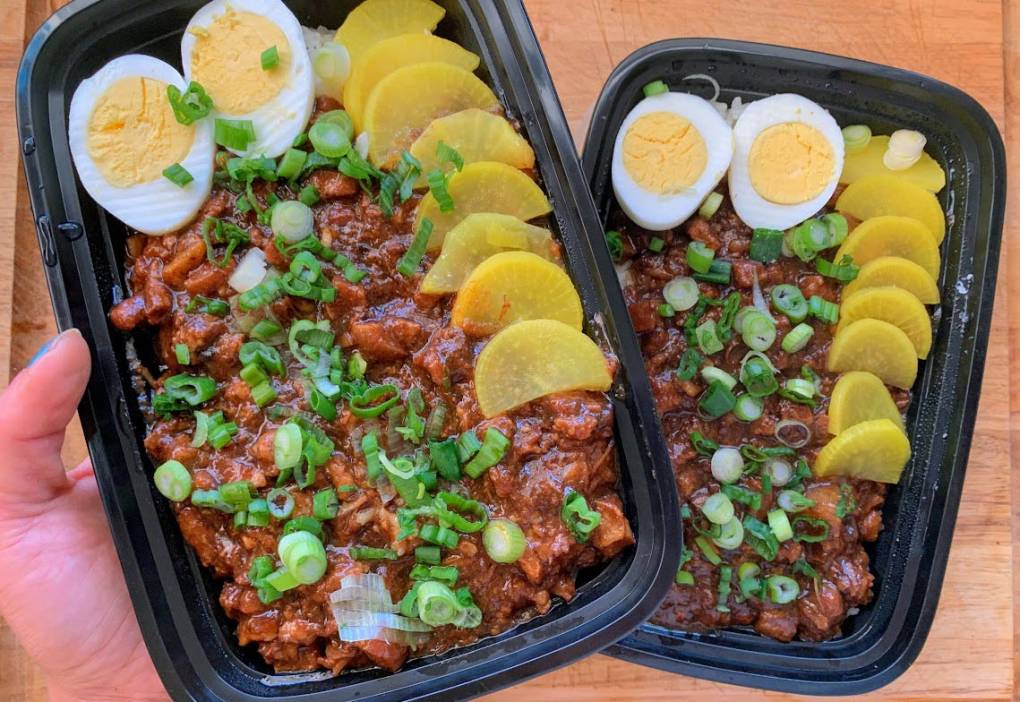
"content": "\u003cp>The most important thing is to not skimp out on the fat. That was the main lesson that Ashley Yan took away from annual trips to Taiwan, where she fell in love with lu rou fan, the \u003ca href=\"https://www.kqed.org/arts/13897498/mama-liu-lu-rou-fan-taiwanese-food-comic\" target=\"_blank\" rel=\"noopener noreferrer\">classic Taiwanese dish of braised pork belly over rice\u003c/a>. Here in the Bay Area? If she found the dish at all, it was almost always made with ground pork instead of pork belly. It never had the fatty richness that she remembered.\u003c/p>\n\u003cp>So after she was laid off from her day job with the pandemic still in full swing, Yan decided to start up a lu rou fan delivery service of her own. She launched \u003ca href=\"https://asyan77.wixsite.com/ashyansfood\">Ashyan’s Lu Ruo Fan\u003c/a> early last year out of a small kitchen in San Francisco’s Richmond District, delivering meals to customers in the northwestern part of the city. By the time she decided to take an extended break last February, she’d garnered a couple months’ worth of \u003ca href=\"https://www.yelp.com/biz/ashyans-lu-ruo-fan-san-francisco?\" target=\"_blank\" rel=\"noopener noreferrer\">stellar Yelp reviews\u003c/a>.\u003c/p>\n\u003cp>Now, Ashyan’s is back, and this time Yan is determined to share her lu rou fan with even more people in San Francisco and beyond. Her business is part of a growing wave of next-generation pop-ups and informal food entrepreneurs that have \u003ca href=\"https://www.kqed.org/arts/13897272/bay-area-taiwanese-food-scene-nostalgia\">reinvigorated the Bay Area’s Taiwanese food scene\u003c/a>.\u003c/p>\n\u003cp>“I always loved the little random shops on the street,” Yan says of the lu rou fan stalls in Taiwan. “That’s what I envisioned and what I wanted.”\u003c/p>\n\u003cfigure id=\"attachment_13910674\" class=\"wp-caption alignnone\" style=\"max-width: 1139px\">\u003cimg loading=\"lazy\" decoding=\"async\" class=\"size-full wp-image-13910674\" src=\"https://ww2.kqed.org/app/uploads/sites/2/2022/03/IMG_1819.jpg\" alt=\"Pieces of hand-cut pork belly simmering in the pan.\" width=\"1139\" height=\"854\" srcset=\"https://cdn.kqed.org/wp-content/uploads/sites/2/2022/03/IMG_1819.jpg 1139w, https://cdn.kqed.org/wp-content/uploads/sites/2/2022/03/IMG_1819-800x600.jpg 800w, https://cdn.kqed.org/wp-content/uploads/sites/2/2022/03/IMG_1819-1020x765.jpg 1020w, https://cdn.kqed.org/wp-content/uploads/sites/2/2022/03/IMG_1819-160x120.jpg 160w, https://cdn.kqed.org/wp-content/uploads/sites/2/2022/03/IMG_1819-768x576.jpg 768w\" sizes=\"(max-width: 1139px) 100vw, 1139px\">\u003cfigcaption class=\"wp-caption-text\">To give her lu rou fan the luxurious richness that she wanted, Yan uses hand-cut pork belly that’s 70% fat. \u003ccite>(Ashyan's Lu Rou Fan)\u003c/cite>\u003c/figcaption>\u003c/figure>\n\u003cp>In order to capture that elusive taste, Yan adheres to what she calls the “golden ratio”: pork belly that is roughly 70% fat and 30% meat. Searing off the slabs of pork belly and cutting them up by hand is by far the most labor-intensive part of the cooking process, so Yan says she understands why local restaurants would choose to substitute ground pork.\u003c/p>\n\u003cp>[ad fullwidth]\u003c/p>\n\u003cp>But there’s no comparing the taste and texture. Yan’s lu rou fan isn’t as salty as other local versions, nor does it have the tinge of sweetness that you get with recipes that are heavier on the rock sugar. What it does have, however, is a rich depth of flavor that comes from all of the rendered pork fat that soaks into the rice.\u003c/p>\n\u003cp>“It’s comfort food at its core, and that’s what I want to keep it as,” Yan says.\u003c/p>\n\u003cp>For now, the lu rou fan is the only featured menu item. For $16, it’s a complete meal that comes with a hard-boiled egg and a few slices of pickled daikon to cut into the heaviness of the meat. Recently she also included a tangy salad studded with colorful bell peppers and kalamata olives—a bit of a fresh, light California touch.\u003c/p>\n\u003cp>[aside postID='arts_13897272,arts_13897498,arts_13901982']Up until this point, Yan has only had the capacity to do about 30 or 35 orders at a time, so she hasn’t had to do much marketing. Her email list, mostly collected from her initial posts on Next Door and her neighborhood “Buy Nothing” page on Facebook, has been robust enough to allow her to sell out just hours after she opens her online pre-ordering form each time.\u003c/p>\n\u003cp>Now Yan, who worked in the Bay Area restaurant industry for 14 years, mostly as a server and event planner, is thinking about how to best take Ashyan’s to the next level. For the next few months, at least, she’ll continue to operate on a small scale, selling her lu rou fan about three days a month—two days for delivery in the Richmond, Lone Mountain and Laurel Heights neighborhoods, and one day for pickup at her kitchen in the Richmond.\u003c/p>\n\u003cp>But Yan is also looking to extend her reach. She’s exploring the possibility of working out of kitchens in Oakland and Redwood City, and she’s also accepting inquiries for catering orders from customers down the Peninsula and beyond. If all goes well, eventually she’d like to turn Ashyan’s Lu Ruo Fan into a food truck or a small brick-and-mortar restaurant.\u003c/p>\n\u003cp>\u003cimg loading=\"lazy\" decoding=\"async\" class=\"aligncenter size-full wp-image-12127869\" src=\"https://ww2.kqed.org/app/uploads/sites/2/2016/09/Q.Logo_.Break_.jpg\" alt=\"\" width=\"800\" height=\"78\" srcset=\"https://cdn.kqed.org/wp-content/uploads/sites/2/2016/09/Q.Logo_.Break_.jpg 800w, https://cdn.kqed.org/wp-content/uploads/sites/2/2016/09/Q.Logo_.Break_-400x39.jpg 400w, https://cdn.kqed.org/wp-content/uploads/sites/2/2016/09/Q.Logo_.Break_-768x75.jpg 768w\" sizes=\"(max-width: 800px) 100vw, 800px\">\u003c/p>\n\u003cp>\u003c/p>\n\u003cp>\u003ci>The next lu rou fan sale dates for \u003ca href=\"https://www.instagram.com/ashyanfoods/\" target=\"_blank\" rel=\"noopener noreferrer\">Ashyan’s Lu Ruo Fan\u003c/a>\u003ci> will be on March 30 and 31 (for delivery) and April 1 (for pickup). Customers can place orders via the \u003ca href=\"https://asyan77.wixsite.com/ashyansfood\" target=\"_blank\" rel=\"noopener noreferrer\">online order form\u003c/a>. For the latest updates, sign up for the business’ \u003ca href=\"https://asyan77.wixsite.com/ashyansfood\" target=\"_blank\" rel=\"noopener noreferrer\">email list\u003c/a>.\u003c/i>\u003c/i>\u003c/p>\n\n",
"stats": {
"hasVideo": false,
"hasChartOrMap": false,
"hasAudio": false,
"hasPolis": false,
"wordCount": 798,
"hasGoogleForm": false,
"hasGallery": false,
"hasHearkenModule": false,
"iframeSrcs": [],
"paragraphCount": 15
},
"modified": 1705007083,
"excerpt": "Ashyan’s Lu Rou Fan sells classic Taiwanese comfort food for pickup and delivery in the Richmond District.",
"headData": {
"twImgId": "",
"twTitle": "This Taiwanese Braised Pork Rice Is All About the Fat",
"socialTitle": "Ashyan’s Lu Ruo Fan Brings Taiwanese Braised Pork Rice to SF %%page%% %%sep%% KQED",
"ogTitle": "This Taiwanese Braised Pork Rice Is All About the Fat",
"ogImgId": "",
"twDescription": "",
"description": "Ashyan’s Lu Rou Fan sells classic Taiwanese comfort food for pickup and delivery in the Richmond District.",
"title": "Ashyan’s Lu Ruo Fan Brings Taiwanese Braised Pork Rice to SF | KQED",
"ogDescription": "",
"schema": {
"@context": "https://schema.org",
"@type": "Article",
"headline": "This Taiwanese Braised Pork Rice Is All About the Fat",
"datePublished": "2022-03-16T14:40:01-07:00",
"dateModified": "2024-01-11T13:04:43-08:00",
"image": "https://cdn.kqed.org/wp-content/uploads/2020/02/KQED-OG-Image@1x.png"
}
},
"guestAuthors": [],
"slug": "ashyans-lu-rou-fan-taiwanese-braised-pork-rice-richmond-san-francisco",
"status": "publish",
"sourceUrl": "/food/",
"templateType": "standard",
"excludeFromSiteSearch": "Include",
"featuredImageType": "standard",
"sticky": false,
"source": "Food",
"path": "/arts/13910664/ashyans-lu-rou-fan-taiwanese-braised-pork-rice-richmond-san-francisco",
"audioTrackLength": null,
"parsedContent": [
{
"type": "contentString",
"content": "\u003cdiv class=\"post-body\">\u003cp>\u003cp>The most important thing is to not skimp out on the fat. That was the main lesson that Ashley Yan took away from annual trips to Taiwan, where she fell in love with lu rou fan, the \u003ca href=\"https://www.kqed.org/arts/13897498/mama-liu-lu-rou-fan-taiwanese-food-comic\" target=\"_blank\" rel=\"noopener noreferrer\">classic Taiwanese dish of braised pork belly over rice\u003c/a>. Here in the Bay Area? If she found the dish at all, it was almost always made with ground pork instead of pork belly. It never had the fatty richness that she remembered.\u003c/p>\n\u003cp>So after she was laid off from her day job with the pandemic still in full swing, Yan decided to start up a lu rou fan delivery service of her own. She launched \u003ca href=\"https://asyan77.wixsite.com/ashyansfood\">Ashyan’s Lu Ruo Fan\u003c/a> early last year out of a small kitchen in San Francisco’s Richmond District, delivering meals to customers in the northwestern part of the city. By the time she decided to take an extended break last February, she’d garnered a couple months’ worth of \u003ca href=\"https://www.yelp.com/biz/ashyans-lu-ruo-fan-san-francisco?\" target=\"_blank\" rel=\"noopener noreferrer\">stellar Yelp reviews\u003c/a>.\u003c/p>\n\u003cp>Now, Ashyan’s is back, and this time Yan is determined to share her lu rou fan with even more people in San Francisco and beyond. Her business is part of a growing wave of next-generation pop-ups and informal food entrepreneurs that have \u003ca href=\"https://www.kqed.org/arts/13897272/bay-area-taiwanese-food-scene-nostalgia\">reinvigorated the Bay Area’s Taiwanese food scene\u003c/a>.\u003c/p>\n\u003cp>“I always loved the little random shops on the street,” Yan says of the lu rou fan stalls in Taiwan. “That’s what I envisioned and what I wanted.”\u003c/p>\n\u003cfigure id=\"attachment_13910674\" class=\"wp-caption alignnone\" style=\"max-width: 1139px\">\u003cimg loading=\"lazy\" decoding=\"async\" class=\"size-full wp-image-13910674\" src=\"https://ww2.kqed.org/app/uploads/sites/2/2022/03/IMG_1819.jpg\" alt=\"Pieces of hand-cut pork belly simmering in the pan.\" width=\"1139\" height=\"854\" srcset=\"https://cdn.kqed.org/wp-content/uploads/sites/2/2022/03/IMG_1819.jpg 1139w, https://cdn.kqed.org/wp-content/uploads/sites/2/2022/03/IMG_1819-800x600.jpg 800w, https://cdn.kqed.org/wp-content/uploads/sites/2/2022/03/IMG_1819-1020x765.jpg 1020w, https://cdn.kqed.org/wp-content/uploads/sites/2/2022/03/IMG_1819-160x120.jpg 160w, https://cdn.kqed.org/wp-content/uploads/sites/2/2022/03/IMG_1819-768x576.jpg 768w\" sizes=\"(max-width: 1139px) 100vw, 1139px\">\u003cfigcaption class=\"wp-caption-text\">To give her lu rou fan the luxurious richness that she wanted, Yan uses hand-cut pork belly that’s 70% fat. \u003ccite>(Ashyan's Lu Rou Fan)\u003c/cite>\u003c/figcaption>\u003c/figure>\n\u003cp>In order to capture that elusive taste, Yan adheres to what she calls the “golden ratio”: pork belly that is roughly 70% fat and 30% meat. Searing off the slabs of pork belly and cutting them up by hand is by far the most labor-intensive part of the cooking process, so Yan says she understands why local restaurants would choose to substitute ground pork.\u003c/p>\n\u003cp>\u003c/p>\u003c/div>",
"attributes": {
"named": {},
"numeric": []
}
},
{
"type": "component",
"content": "",
"name": "ad",
"attributes": {
"named": {
"label": "fullwidth"
},
"numeric": [
"fullwidth"
]
}
},
{
"type": "contentString",
"content": "\u003cdiv class=\"post-body\">\u003cp>\u003c/p>\n\u003cp>But there’s no comparing the taste and texture. Yan’s lu rou fan isn’t as salty as other local versions, nor does it have the tinge of sweetness that you get with recipes that are heavier on the rock sugar. What it does have, however, is a rich depth of flavor that comes from all of the rendered pork fat that soaks into the rice.\u003c/p>\n\u003cp>“It’s comfort food at its core, and that’s what I want to keep it as,” Yan says.\u003c/p>\n\u003cp>For now, the lu rou fan is the only featured menu item. For $16, it’s a complete meal that comes with a hard-boiled egg and a few slices of pickled daikon to cut into the heaviness of the meat. Recently she also included a tangy salad studded with colorful bell peppers and kalamata olives—a bit of a fresh, light California touch.\u003c/p>\n\u003cp>\u003c/p>\u003c/div>",
"attributes": {
"named": {},
"numeric": []
}
},
{
"type": "component",
"content": "",
"name": "aside",
"attributes": {
"named": {
"postid": "arts_13897272,arts_13897498,arts_13901982",
"label": ""
},
"numeric": []
}
},
{
"type": "contentString",
"content": "\u003cdiv class=\"post-body\">\u003cp>Up until this point, Yan has only had the capacity to do about 30 or 35 orders at a time, so she hasn’t had to do much marketing. Her email list, mostly collected from her initial posts on Next Door and her neighborhood “Buy Nothing” page on Facebook, has been robust enough to allow her to sell out just hours after she opens her online pre-ordering form each time.\u003c/p>\n\u003cp>Now Yan, who worked in the Bay Area restaurant industry for 14 years, mostly as a server and event planner, is thinking about how to best take Ashyan’s to the next level. For the next few months, at least, she’ll continue to operate on a small scale, selling her lu rou fan about three days a month—two days for delivery in the Richmond, Lone Mountain and Laurel Heights neighborhoods, and one day for pickup at her kitchen in the Richmond.\u003c/p>\n\u003cp>But Yan is also looking to extend her reach. She’s exploring the possibility of working out of kitchens in Oakland and Redwood City, and she’s also accepting inquiries for catering orders from customers down the Peninsula and beyond. If all goes well, eventually she’d like to turn Ashyan’s Lu Ruo Fan into a food truck or a small brick-and-mortar restaurant.\u003c/p>\n\u003cp>\u003cimg loading=\"lazy\" decoding=\"async\" class=\"aligncenter size-full wp-image-12127869\" src=\"https://ww2.kqed.org/app/uploads/sites/2/2016/09/Q.Logo_.Break_.jpg\" alt=\"\" width=\"800\" height=\"78\" srcset=\"https://cdn.kqed.org/wp-content/uploads/sites/2/2016/09/Q.Logo_.Break_.jpg 800w, https://cdn.kqed.org/wp-content/uploads/sites/2/2016/09/Q.Logo_.Break_-400x39.jpg 400w, https://cdn.kqed.org/wp-content/uploads/sites/2/2016/09/Q.Logo_.Break_-768x75.jpg 768w\" sizes=\"(max-width: 800px) 100vw, 800px\">\u003c/p>\n\u003cp>\u003c/p>\n\u003cp>\u003ci>The next lu rou fan sale dates for \u003ca href=\"https://www.instagram.com/ashyanfoods/\" target=\"_blank\" rel=\"noopener noreferrer\">Ashyan’s Lu Ruo Fan\u003c/a>\u003ci> will be on March 30 and 31 (for delivery) and April 1 (for pickup). Customers can place orders via the \u003ca href=\"https://asyan77.wixsite.com/ashyansfood\" target=\"_blank\" rel=\"noopener noreferrer\">online order form\u003c/a>. For the latest updates, sign up for the business’ \u003ca href=\"https://asyan77.wixsite.com/ashyansfood\" target=\"_blank\" rel=\"noopener noreferrer\">email list\u003c/a>.\u003c/i>\u003c/i>\u003c/p>\n\n\u003c/div>\u003c/p>",
"attributes": {
"named": {},
"numeric": []
}
}
],
"link": "/arts/13910664/ashyans-lu-rou-fan-taiwanese-braised-pork-rice-richmond-san-francisco",
"authors": [
"11743"
],
"programs": [
"arts_140"
],
"categories": [
"arts_1",
"arts_12276"
],
"tags": [
"arts_10278",
"arts_14089",
"arts_1146",
"arts_15151",
"arts_585"
],
"featImg": "arts_13910673",
"label": "source_arts_13910664"
},
"arts_13910221": {
"type": "posts",
"id": "arts_13910221",
"meta": {
"index": "posts_1716263798",
"site": "arts",
"id": "13910221",
"score": null,
"sort": [
1646774339000
]
},
"parent": 0,
"labelTerm": {
"site": "arts"
},
"blocks": [],
"publishDate": 1646774339,
"format": "standard",
"title": "Hip-Hop Collective Family Not a Group Lives Up to Its Name",
"headTitle": "Hip-Hop Collective Family Not a Group Lives Up to Its Name | KQED",
"content": "\u003cp>You can’t stop artists from coming together. Hit ’em with a global pandemic, gas prices that are through the roof, housing costs through the stratosphere and a long list of music venues that have closed down—whatever. \u003cem>Artists are going to be artist\u003c/em>s. They’re going to come together to create, and I’m all here for it.\u003c/p>\n\u003cp>In San Francisco, there’s a very large and extremely talented faction of lyricists, singers, DJs and musicians who are coming together, creating moments and memories, and having fun while doing so.\u003c/p>\n\u003cp>On Wednesday Night the 17-member collective known as \u003ca href=\"https://www.instagram.com/p/CanQJz3PEDZ/\" target=\"_blank\" rel=\"noopener noreferrer\">Family Not A Group\u003c/a> is set to hit the stage, collectively.\u003c/p>\n\u003cfigure id=\"attachment_13910243\" class=\"wp-caption aligncenter\" style=\"max-width: 480px\">\u003cimg loading=\"lazy\" decoding=\"async\" class=\"size-full wp-image-13910243\" src=\"https://ww2.kqed.org/app/uploads/sites/2/2022/03/275101607_1137619633707634_4938611485133538895_n.jpg\" alt=\"The night Family Not a Group came together in New York.\" width=\"480\" height=\"640\" srcset=\"https://cdn.kqed.org/wp-content/uploads/sites/2/2022/03/275101607_1137619633707634_4938611485133538895_n.jpg 480w, https://cdn.kqed.org/wp-content/uploads/sites/2/2022/03/275101607_1137619633707634_4938611485133538895_n-160x213.jpg 160w\" sizes=\"(max-width: 480px) 100vw, 480px\">\u003cfigcaption class=\"wp-caption-text\">The night Family Not a Group came together in New York. \u003ccite>(Via Baghead)\u003c/cite>\u003c/figcaption>\u003c/figure>\n\u003cp>They’re scheduled to perform at The Chapel, and the \u003ca href=\"https://thechapelsf.com/e/269265027947/?utm_source=fb1&utm_medium=shr\" target=\"_blank\" rel=\"noopener noreferrer\">March 9 show\u003c/a> will be the ensemble’s first major performance in their hometown of San Francisco. The show will be headlined by two artists who aren’t officially in the collective, but they’re “family friends”—singer \u003ca href=\"https://www.instagram.com/astu.music/\" target=\"_blank\" rel=\"noopener noreferrer\">Astu\u003c/a> and lyricists-slash-vocalist \u003ca href=\"https://www.instagram.com/jadaimani510/\" target=\"_blank\" rel=\"noopener noreferrer\">Jada Imani\u003c/a>. They’ll be flanked by performances from \u003ca href=\"https://www.instagram.com/baghead.fng/\" target=\"_blank\" rel=\"noopener noreferrer\">Baghead\u003c/a>, \u003ca href=\"https://www.instagram.com/aft.fng/\" target=\"_blank\" rel=\"noopener noreferrer\">Afterthought\u003c/a> and \u003ca href=\"https://www.instagram.com/ozersf/\" target=\"_blank\" rel=\"noopener noreferrer\">Ozer, \u003c/a>who are just three of the 17-member conglomerate.\u003c/p>\n\u003cp>Along with Baghead, Afterthought and Ozer, there’s \u003ca href=\"https://www.instagram.com/bae.areash/\" target=\"_blank\" rel=\"noopener noreferrer\">ASH\u003c/a>, \u003ca href=\"https://www.instagram.com/serg.fng/\" target=\"_blank\" rel=\"noopener noreferrer\">Serg2x\u003c/a>, \u003ca href=\"https://www.instagram.com/everybodylovezmike/\" target=\"_blank\" rel=\"noopener noreferrer\">Mike Evans Jr.\u003c/a>, \u003ca href=\"https://www.instagram.com/thejenset/\" target=\"_blank\" rel=\"noopener noreferrer\">Jenset\u003c/a>, \u003ca href=\"https://www.instagram.com/maya_canales/\" target=\"_blank\" rel=\"noopener noreferrer\">Maya Canales\u003c/a>, \u003ca href=\"https://www.instagram.com/captain_cuadra/\" target=\"_blank\" rel=\"noopener noreferrer\">Grand-O\u003c/a>, \u003ca href=\"https://www.instagram.com/maddamcyn/\" target=\"_blank\" rel=\"noopener noreferrer\">Cynny\u003c/a>, \u003ca href=\"https://www.instagram.com/professagabel/\" target=\"_blank\" rel=\"noopener noreferrer\">Professa Gabel\u003c/a>, \u003ca href=\"https://www.instagram.com/ap.fng/\" target=\"_blank\" rel=\"noopener noreferrer\">AP\u003c/a>, \u003ca href=\"https://www.instagram.com/kaly_incognegreaux/\" target=\"_blank\" rel=\"noopener noreferrer\">Kaly Jay\u003c/a>, \u003ca href=\"https://www.instagram.com/sayheykiid/\" target=\"_blank\" rel=\"noopener noreferrer\">DJSAY\u003c/a>, \u003ca href=\"https://www.instagram.com/shotbyjesstarantino/\" target=\"_blank\" rel=\"noopener noreferrer\">JessTarantino\u003c/a>, \u003ca href=\"https://www.instagram.com/sunday.fng/\" target=\"_blank\" rel=\"noopener noreferrer\">SundaY\u003c/a> and \u003ca href=\"https://www.instagram.com/easweh/\" target=\"_blank\" rel=\"noopener noreferrer\">EaSWay\u003c/a>.\u003c/p>\n\u003cp>[ad fullwidth]\u003c/p>\n\u003cp>The majority of the camp is from the City, with some folks hailing from other areas of the Bay, but the team’s origin story starts at a show in the Big Apple.\u003c/p>\n\u003cp>“When we went to New York, we performed at East Berlin,” Ozer tells me during a phone call. The crew did a show called “The Frisco Invasion” at the intimate, popular venue in The East Village. A couple things went wrong. Notably, the computer died before the show started and required someone to make an hour-long trek to get a replacement. But the show was good.\u003c/p>\n\u003cp>“I can’t remember if it was the venue manager or the sound engineer, but they said we killed it,” Ozer reflects. “The next day we talked amongst ourselves and said we’ve got something special here… and that’s how Family Not a Group was born.”\u003c/p>\n\u003cfigure id=\"attachment_13910246\" class=\"wp-caption alignnone\" style=\"max-width: 480px\">\u003cimg loading=\"lazy\" decoding=\"async\" class=\"size-full wp-image-13910246\" src=\"https://ww2.kqed.org/app/uploads/sites/2/2022/03/274938446_2055319477973887_2719572190814469886_n.jpg\" alt=\"Family Not a Group members pose for a photo while rocking a show in San Francisco last year. \" width=\"480\" height=\"359\" srcset=\"https://cdn.kqed.org/wp-content/uploads/sites/2/2022/03/274938446_2055319477973887_2719572190814469886_n.jpg 480w, https://cdn.kqed.org/wp-content/uploads/sites/2/2022/03/274938446_2055319477973887_2719572190814469886_n-160x120.jpg 160w\" sizes=\"(max-width: 480px) 100vw, 480px\">\u003cfigcaption class=\"wp-caption-text\">Family Not a Group members pose for a photo while rocking a show in San Francisco last year. \u003ccite>(Via Baghead)\u003c/cite>\u003c/figcaption>\u003c/figure>\n\u003cp>Before that show, the nucleus had been forming. The individual artists would constantly support one another, showing up to performances and appearing on each other’s projects.\u003c/p>\n\u003cp>On Ozer’s latest album, \u003cem>Lost In Translation\u003c/em>, which dropped in July of last year, there are appearances from crew members Kaly Jay, EaSWay, Professa Gabel and more. [aside postid='arts_13908051']\u003c/p>\n\u003cp>The project is a lyrical exploration into some of the darker moments in Ozer’s life, and how he and his loved ones have persevered. He speaks on an incident that led to his father’s incarceration, and references his mother’s attempt at taking her own life.\u003c/p>\n\u003cp>[ad floatright]\u003c/p>\n\u003cp>On the track “Purposeful,” the rapper from Bayview recites, “Shit, I got some skeleton in my footlocker / eye open, I know God not the only one watchin’. / Under fire, smoke in the air, we went through madness / hands full, it’s gettin’ hard to carry the baggage.”\u003c/p>\n\u003cdiv>\n\u003cp>At the end of a track with Lex Culture, “All Falls Down,” Ozer shares an intimate voice note. “I recorded that the night my grandfather died,” Ozer tells me “That takes me back to that night—it was a real moment for me.”\u003c/p>\n\u003cp>He plays with the concept of devils and angels in the song “D & A.” The track is a bit of a double-entendre, referring to humans’ genetic code and how we’re composed of both good and evil.\u003c/p>\n\u003cp>\u003ciframe loading=\"lazy\" title=\"Ozer - Purposeful (Official Music Video)\" width=\"640\" height=\"360\" src=\"https://www.youtube.com/embed/YtD43HD7Lsw?feature=oembed\" frameborder=\"0\" allow=\"accelerometer; autoplay; clipboard-write; encrypted-media; gyroscope; picture-in-picture; web-share\" allowfullscreen>\u003c/iframe>\u003c/p>\n\u003cp>The etymology of the name “Ozer,” also has two paths: one is a biblical reference and the other is slang for moving drugs.\u003c/p>\n\u003cp>As a teenager he sat in a barbershop when one of his father’s friends walked in, asking if he was “Little O?” After confirming that he is indeed his father’s son, the man donned the name “Little Ozer” on him. Little Ozer went back to his father, telling him that he planned on taking his title, “He was like, ‘You know what that means?'”\u003c/p>\n\u003cp>His father explained that they called him Ozer because he used to push a lot of ounces. Then “Little Ozer” did more research on the name, and found that it also means “God’s Helper” in Hebrew.\u003c/p>\n\u003cdiv>“It has a bad meaning and a good meaning, which represents human life in general,” Ozer tells me in the same deep-raspy voice he uses to deliver his lyrics.\u003c/div>\n\u003cdiv>\u003c/div>\n\u003cfigure id=\"attachment_13910247\" class=\"wp-caption alignright\" style=\"max-width: 360px\">\u003cimg loading=\"lazy\" decoding=\"async\" class=\"size-full wp-image-13910247\" src=\"https://ww2.kqed.org/app/uploads/sites/2/2022/03/275064560_152395647170136_2834243853751829814_n.jpg\" alt=\"Ozer rocks the mic with his shirt off.\" width=\"360\" height=\"640\" srcset=\"https://cdn.kqed.org/wp-content/uploads/sites/2/2022/03/275064560_152395647170136_2834243853751829814_n.jpg 360w, https://cdn.kqed.org/wp-content/uploads/sites/2/2022/03/275064560_152395647170136_2834243853751829814_n-160x284.jpg 160w\" sizes=\"(max-width: 360px) 100vw, 360px\">\u003cfigcaption class=\"wp-caption-text\">Ozer rocks the mic with his shirt off. \u003ccite>(Ken IV)\u003c/cite>\u003c/figcaption>\u003c/figure>\n\u003cp>Destined for this path, Ozer’s grandmother told him he’d be a preacher, but he said it was something he couldn’t foresee. Now as an MC he says he’s reaching people, and he’s looking to keep spreading the word this Wednesday.\u003c/p>\n\u003c/div>\n\u003cdiv>The goal of Family Not a Group’s live shows is to “provide a memorable experience to everybody who comes to the show,” Ozer says. “It’s called ‘a family service,’ so it’s going to make you feel like family, and you’ll have a deeper connection to each artist that you see.”\u003c/div>\n\u003cdiv>\u003c/div>\n\u003cdiv>The lineup is full of talented artists I’ve been following. Last year I did \u003ca href=\"https://www.kqed.org/arts/13895377/rightnowish-baghead-cerealforthekids\" target=\"_blank\" rel=\"noopener noreferrer\">a podcast interview\u003c/a> with Baghead, who along with \u003ca href=\"https://www.instagram.com/cerealforthekids/\" target=\"_blank\" rel=\"noopener noreferrer\">Cereal For The Kids\u003c/a>, published a film and audio project called \u003ca href=\"https://www.youtube.com/watch?v=cWmX3Y5GnP8\" target=\"_blank\" rel=\"noopener noreferrer\">“Dedicated To Those Who.”\u003c/a> \u003ca href=\"https://www.kqed.org/arts/13892200/musicians-to-know-jada-imani-on-vibing-with-hawaiian-frogs-and-riffing-off-mac-dre\" target=\"_blank\" rel=\"noopener noreferrer\">Jada Imani\u003c/a> was the subject of an interview from January of last year. I’ve hosted separate events where both Astu and Afterthought (and the band he’s a part of, The Top Chefs) have performed.\u003c/div>\n\u003cdiv>\u003c/div>\n\u003cdiv>I’ve also seen performances by a few of the other members of Family Not a Group, but I’ve yet to see Ozer. Before I got off the phone, I let him know that we’ll cross paths in due time. But what I didn’t explicitly tell him is that his words have already reached me—without having seen him in person yet.\u003c/div>\n\u003cdiv>\u003c/div>\n\u003cdiv>\u003cimg loading=\"lazy\" decoding=\"async\" class=\"aligncenter size-medium wp-image-12127869\" src=\"https://ww2.kqed.org/app/uploads/sites/2/2016/09/Q.Logo_.Break_-800x78.jpg\" alt=\"\" width=\"800\" height=\"78\" srcset=\"https://cdn.kqed.org/wp-content/uploads/sites/2/2016/09/Q.Logo_.Break_.jpg 800w, https://cdn.kqed.org/wp-content/uploads/sites/2/2016/09/Q.Logo_.Break_-400x39.jpg 400w, https://cdn.kqed.org/wp-content/uploads/sites/2/2016/09/Q.Logo_.Break_-768x75.jpg 768w\" sizes=\"(max-width: 800px) 100vw, 800px\">\u003c/div>\n\u003cdiv>\u003cem>Family Not a Group presents “\u003ca href=\"https://thechapelsf.com/e/269265027947/?utm_source=fb1&utm_medium=shr\" target=\"_blank\" rel=\"noopener noreferrer\">A Family Service\u003c/a>” at The Chapel in San Francisco on March 9, with performances by Ozer, Astu, Jada Imani and Afterthought. \u003c/em>\u003c/div>\n\n",
"stats": {
"hasVideo": true,
"hasChartOrMap": false,
"hasAudio": false,
"hasPolis": false,
"wordCount": 1163,
"hasGoogleForm": false,
"hasGallery": false,
"hasHearkenModule": false,
"iframeSrcs": [],
"paragraphCount": 21
},
"modified": 1707844792,
"excerpt": "Seventeen artists united for one cause: to create!",
"headData": {
"twImgId": "",
"twTitle": "",
"ogTitle": "",
"ogImgId": "",
"twDescription": "",
"description": "Seventeen artists united for one cause: to create!",
"title": "Hip-Hop Collective Family Not a Group Lives Up to Its Name | KQED",
"ogDescription": "",
"schema": {
"@context": "https://schema.org",
"@type": "Article",
"headline": "Hip-Hop Collective Family Not a Group Lives Up to Its Name",
"datePublished": "2022-03-08T13:18:59-08:00",
"dateModified": "2024-02-13T09:19:52-08:00",
"image": "https://cdn.kqed.org/wp-content/uploads/2020/02/KQED-OG-Image@1x.png"
}
},
"guestAuthors": [],
"slug": "family-not-a-group-san-francisco-rap",
"status": "publish",
"templateType": "standard",
"excludeFromSiteSearch": "Include",
"featuredImageType": "standard",
"sticky": false,
"subhead": "17 artists with one cause: to create! ",
"articleAge": "0",
"path": "/arts/13910221/family-not-a-group-san-francisco-rap",
"audioTrackLength": null,
"parsedContent": [
{
"type": "contentString",
"content": "\u003cdiv class=\"post-body\">\u003cp>\u003cp>You can’t stop artists from coming together. Hit ’em with a global pandemic, gas prices that are through the roof, housing costs through the stratosphere and a long list of music venues that have closed down—whatever. \u003cem>Artists are going to be artist\u003c/em>s. They’re going to come together to create, and I’m all here for it.\u003c/p>\n\u003cp>In San Francisco, there’s a very large and extremely talented faction of lyricists, singers, DJs and musicians who are coming together, creating moments and memories, and having fun while doing so.\u003c/p>\n\u003cp>On Wednesday Night the 17-member collective known as \u003ca href=\"https://www.instagram.com/p/CanQJz3PEDZ/\" target=\"_blank\" rel=\"noopener noreferrer\">Family Not A Group\u003c/a> is set to hit the stage, collectively.\u003c/p>\n\u003cfigure id=\"attachment_13910243\" class=\"wp-caption aligncenter\" style=\"max-width: 480px\">\u003cimg loading=\"lazy\" decoding=\"async\" class=\"size-full wp-image-13910243\" src=\"https://ww2.kqed.org/app/uploads/sites/2/2022/03/275101607_1137619633707634_4938611485133538895_n.jpg\" alt=\"The night Family Not a Group came together in New York.\" width=\"480\" height=\"640\" srcset=\"https://cdn.kqed.org/wp-content/uploads/sites/2/2022/03/275101607_1137619633707634_4938611485133538895_n.jpg 480w, https://cdn.kqed.org/wp-content/uploads/sites/2/2022/03/275101607_1137619633707634_4938611485133538895_n-160x213.jpg 160w\" sizes=\"(max-width: 480px) 100vw, 480px\">\u003cfigcaption class=\"wp-caption-text\">The night Family Not a Group came together in New York. \u003ccite>(Via Baghead)\u003c/cite>\u003c/figcaption>\u003c/figure>\n\u003cp>They’re scheduled to perform at The Chapel, and the \u003ca href=\"https://thechapelsf.com/e/269265027947/?utm_source=fb1&utm_medium=shr\" target=\"_blank\" rel=\"noopener noreferrer\">March 9 show\u003c/a> will be the ensemble’s first major performance in their hometown of San Francisco. The show will be headlined by two artists who aren’t officially in the collective, but they’re “family friends”—singer \u003ca href=\"https://www.instagram.com/astu.music/\" target=\"_blank\" rel=\"noopener noreferrer\">Astu\u003c/a> and lyricists-slash-vocalist \u003ca href=\"https://www.instagram.com/jadaimani510/\" target=\"_blank\" rel=\"noopener noreferrer\">Jada Imani\u003c/a>. They’ll be flanked by performances from \u003ca href=\"https://www.instagram.com/baghead.fng/\" target=\"_blank\" rel=\"noopener noreferrer\">Baghead\u003c/a>, \u003ca href=\"https://www.instagram.com/aft.fng/\" target=\"_blank\" rel=\"noopener noreferrer\">Afterthought\u003c/a> and \u003ca href=\"https://www.instagram.com/ozersf/\" target=\"_blank\" rel=\"noopener noreferrer\">Ozer, \u003c/a>who are just three of the 17-member conglomerate.\u003c/p>\n\u003cp>Along with Baghead, Afterthought and Ozer, there’s \u003ca href=\"https://www.instagram.com/bae.areash/\" target=\"_blank\" rel=\"noopener noreferrer\">ASH\u003c/a>, \u003ca href=\"https://www.instagram.com/serg.fng/\" target=\"_blank\" rel=\"noopener noreferrer\">Serg2x\u003c/a>, \u003ca href=\"https://www.instagram.com/everybodylovezmike/\" target=\"_blank\" rel=\"noopener noreferrer\">Mike Evans Jr.\u003c/a>, \u003ca href=\"https://www.instagram.com/thejenset/\" target=\"_blank\" rel=\"noopener noreferrer\">Jenset\u003c/a>, \u003ca href=\"https://www.instagram.com/maya_canales/\" target=\"_blank\" rel=\"noopener noreferrer\">Maya Canales\u003c/a>, \u003ca href=\"https://www.instagram.com/captain_cuadra/\" target=\"_blank\" rel=\"noopener noreferrer\">Grand-O\u003c/a>, \u003ca href=\"https://www.instagram.com/maddamcyn/\" target=\"_blank\" rel=\"noopener noreferrer\">Cynny\u003c/a>, \u003ca href=\"https://www.instagram.com/professagabel/\" target=\"_blank\" rel=\"noopener noreferrer\">Professa Gabel\u003c/a>, \u003ca href=\"https://www.instagram.com/ap.fng/\" target=\"_blank\" rel=\"noopener noreferrer\">AP\u003c/a>, \u003ca href=\"https://www.instagram.com/kaly_incognegreaux/\" target=\"_blank\" rel=\"noopener noreferrer\">Kaly Jay\u003c/a>, \u003ca href=\"https://www.instagram.com/sayheykiid/\" target=\"_blank\" rel=\"noopener noreferrer\">DJSAY\u003c/a>, \u003ca href=\"https://www.instagram.com/shotbyjesstarantino/\" target=\"_blank\" rel=\"noopener noreferrer\">JessTarantino\u003c/a>, \u003ca href=\"https://www.instagram.com/sunday.fng/\" target=\"_blank\" rel=\"noopener noreferrer\">SundaY\u003c/a> and \u003ca href=\"https://www.instagram.com/easweh/\" target=\"_blank\" rel=\"noopener noreferrer\">EaSWay\u003c/a>.\u003c/p>\n\u003cp>\u003c/p>\u003c/div>",
"attributes": {
"named": {},
"numeric": []
}
},
{
"type": "component",
"content": "",
"name": "ad",
"attributes": {
"named": {
"label": "fullwidth"
},
"numeric": [
"fullwidth"
]
}
},
{
"type": "contentString",
"content": "\u003cdiv class=\"post-body\">\u003cp>\u003c/p>\n\u003cp>The majority of the camp is from the City, with some folks hailing from other areas of the Bay, but the team’s origin story starts at a show in the Big Apple.\u003c/p>\n\u003cp>“When we went to New York, we performed at East Berlin,” Ozer tells me during a phone call. The crew did a show called “The Frisco Invasion” at the intimate, popular venue in The East Village. A couple things went wrong. Notably, the computer died before the show started and required someone to make an hour-long trek to get a replacement. But the show was good.\u003c/p>\n\u003cp>“I can’t remember if it was the venue manager or the sound engineer, but they said we killed it,” Ozer reflects. “The next day we talked amongst ourselves and said we’ve got something special here… and that’s how Family Not a Group was born.”\u003c/p>\n\u003cfigure id=\"attachment_13910246\" class=\"wp-caption alignnone\" style=\"max-width: 480px\">\u003cimg loading=\"lazy\" decoding=\"async\" class=\"size-full wp-image-13910246\" src=\"https://ww2.kqed.org/app/uploads/sites/2/2022/03/274938446_2055319477973887_2719572190814469886_n.jpg\" alt=\"Family Not a Group members pose for a photo while rocking a show in San Francisco last year. \" width=\"480\" height=\"359\" srcset=\"https://cdn.kqed.org/wp-content/uploads/sites/2/2022/03/274938446_2055319477973887_2719572190814469886_n.jpg 480w, https://cdn.kqed.org/wp-content/uploads/sites/2/2022/03/274938446_2055319477973887_2719572190814469886_n-160x120.jpg 160w\" sizes=\"(max-width: 480px) 100vw, 480px\">\u003cfigcaption class=\"wp-caption-text\">Family Not a Group members pose for a photo while rocking a show in San Francisco last year. \u003ccite>(Via Baghead)\u003c/cite>\u003c/figcaption>\u003c/figure>\n\u003cp>Before that show, the nucleus had been forming. The individual artists would constantly support one another, showing up to performances and appearing on each other’s projects.\u003c/p>\n\u003cp>On Ozer’s latest album, \u003cem>Lost In Translation\u003c/em>, which dropped in July of last year, there are appearances from crew members Kaly Jay, EaSWay, Professa Gabel and more. \u003c/p>\u003c/div>",
"attributes": {
"named": {},
"numeric": []
}
},
{
"type": "component",
"content": "",
"name": "aside",
"attributes": {
"named": {
"postid": "arts_13908051",
"label": ""
},
"numeric": []
}
},
{
"type": "contentString",
"content": "\u003cdiv class=\"post-body\">\u003cp>\u003c/p>\n\u003cp>The project is a lyrical exploration into some of the darker moments in Ozer’s life, and how he and his loved ones have persevered. He speaks on an incident that led to his father’s incarceration, and references his mother’s attempt at taking her own life.\u003c/p>\n\u003cp>\u003c/p>\u003c/div>",
"attributes": {
"named": {},
"numeric": []
}
},
{
"type": "component",
"content": "",
"name": "ad",
"attributes": {
"named": {
"label": "floatright"
},
"numeric": [
"floatright"
]
}
},
{
"type": "contentString",
"content": "\u003cdiv class=\"post-body\">\u003cp>\u003c/p>\n\u003cp>On the track “Purposeful,” the rapper from Bayview recites, “Shit, I got some skeleton in my footlocker / eye open, I know God not the only one watchin’. / Under fire, smoke in the air, we went through madness / hands full, it’s gettin’ hard to carry the baggage.”\u003c/p>\n\u003cdiv>\n\u003cp>At the end of a track with Lex Culture, “All Falls Down,” Ozer shares an intimate voice note. “I recorded that the night my grandfather died,” Ozer tells me “That takes me back to that night—it was a real moment for me.”\u003c/p>\n\u003cp>He plays with the concept of devils and angels in the song “D & A.” The track is a bit of a double-entendre, referring to humans’ genetic code and how we’re composed of both good and evil.\u003c/p>\n\u003cp>\u003ciframe loading=\"lazy\" title=\"Ozer - Purposeful (Official Music Video)\" width=\"640\" height=\"360\" src=\"https://www.youtube.com/embed/YtD43HD7Lsw?feature=oembed\" frameborder=\"0\" allow=\"accelerometer; autoplay; clipboard-write; encrypted-media; gyroscope; picture-in-picture; web-share\" allowfullscreen>\u003c/iframe>\u003c/p>\n\u003cp>The etymology of the name “Ozer,” also has two paths: one is a biblical reference and the other is slang for moving drugs.\u003c/p>\n\u003cp>As a teenager he sat in a barbershop when one of his father’s friends walked in, asking if he was “Little O?” After confirming that he is indeed his father’s son, the man donned the name “Little Ozer” on him. Little Ozer went back to his father, telling him that he planned on taking his title, “He was like, ‘You know what that means?'”\u003c/p>\n\u003cp>His father explained that they called him Ozer because he used to push a lot of ounces. Then “Little Ozer” did more research on the name, and found that it also means “God’s Helper” in Hebrew.\u003c/p>\n\u003cdiv>“It has a bad meaning and a good meaning, which represents human life in general,” Ozer tells me in the same deep-raspy voice he uses to deliver his lyrics.\u003c/div>\n\u003cdiv>\u003c/div>\n\u003cfigure id=\"attachment_13910247\" class=\"wp-caption alignright\" style=\"max-width: 360px\">\u003cimg loading=\"lazy\" decoding=\"async\" class=\"size-full wp-image-13910247\" src=\"https://ww2.kqed.org/app/uploads/sites/2/2022/03/275064560_152395647170136_2834243853751829814_n.jpg\" alt=\"Ozer rocks the mic with his shirt off.\" width=\"360\" height=\"640\" srcset=\"https://cdn.kqed.org/wp-content/uploads/sites/2/2022/03/275064560_152395647170136_2834243853751829814_n.jpg 360w, https://cdn.kqed.org/wp-content/uploads/sites/2/2022/03/275064560_152395647170136_2834243853751829814_n-160x284.jpg 160w\" sizes=\"(max-width: 360px) 100vw, 360px\">\u003cfigcaption class=\"wp-caption-text\">Ozer rocks the mic with his shirt off. \u003ccite>(Ken IV)\u003c/cite>\u003c/figcaption>\u003c/figure>\n\u003cp>Destined for this path, Ozer’s grandmother told him he’d be a preacher, but he said it was something he couldn’t foresee. Now as an MC he says he’s reaching people, and he’s looking to keep spreading the word this Wednesday.\u003c/p>\n\u003c/div>\n\u003cdiv>The goal of Family Not a Group’s live shows is to “provide a memorable experience to everybody who comes to the show,” Ozer says. “It’s called ‘a family service,’ so it’s going to make you feel like family, and you’ll have a deeper connection to each artist that you see.”\u003c/div>\n\u003cdiv>\u003c/div>\n\u003cdiv>The lineup is full of talented artists I’ve been following. Last year I did \u003ca href=\"https://www.kqed.org/arts/13895377/rightnowish-baghead-cerealforthekids\" target=\"_blank\" rel=\"noopener noreferrer\">a podcast interview\u003c/a> with Baghead, who along with \u003ca href=\"https://www.instagram.com/cerealforthekids/\" target=\"_blank\" rel=\"noopener noreferrer\">Cereal For The Kids\u003c/a>, published a film and audio project called \u003ca href=\"https://www.youtube.com/watch?v=cWmX3Y5GnP8\" target=\"_blank\" rel=\"noopener noreferrer\">“Dedicated To Those Who.”\u003c/a> \u003ca href=\"https://www.kqed.org/arts/13892200/musicians-to-know-jada-imani-on-vibing-with-hawaiian-frogs-and-riffing-off-mac-dre\" target=\"_blank\" rel=\"noopener noreferrer\">Jada Imani\u003c/a> was the subject of an interview from January of last year. I’ve hosted separate events where both Astu and Afterthought (and the band he’s a part of, The Top Chefs) have performed.\u003c/div>\n\u003cdiv>\u003c/div>\n\u003cdiv>I’ve also seen performances by a few of the other members of Family Not a Group, but I’ve yet to see Ozer. Before I got off the phone, I let him know that we’ll cross paths in due time. But what I didn’t explicitly tell him is that his words have already reached me—without having seen him in person yet.\u003c/div>\n\u003cdiv>\u003c/div>\n\u003cdiv>\u003cimg loading=\"lazy\" decoding=\"async\" class=\"aligncenter size-medium wp-image-12127869\" src=\"https://ww2.kqed.org/app/uploads/sites/2/2016/09/Q.Logo_.Break_-800x78.jpg\" alt=\"\" width=\"800\" height=\"78\" srcset=\"https://cdn.kqed.org/wp-content/uploads/sites/2/2016/09/Q.Logo_.Break_.jpg 800w, https://cdn.kqed.org/wp-content/uploads/sites/2/2016/09/Q.Logo_.Break_-400x39.jpg 400w, https://cdn.kqed.org/wp-content/uploads/sites/2/2016/09/Q.Logo_.Break_-768x75.jpg 768w\" sizes=\"(max-width: 800px) 100vw, 800px\">\u003c/div>\n\u003cdiv>\u003cem>Family Not a Group presents “\u003ca href=\"https://thechapelsf.com/e/269265027947/?utm_source=fb1&utm_medium=shr\" target=\"_blank\" rel=\"noopener noreferrer\">A Family Service\u003c/a>” at The Chapel in San Francisco on March 9, with performances by Ozer, Astu, Jada Imani and Afterthought. \u003c/em>\u003c/div>\n\n\u003c/div>\u003c/p>",
"attributes": {
"named": {},
"numeric": []
}
}
],
"link": "/arts/13910221/family-not-a-group-san-francisco-rap",
"authors": [
"11491"
],
"categories": [
"arts_1"
],
"tags": [
"arts_4018",
"arts_21930",
"arts_10278",
"arts_831",
"arts_11028",
"arts_16875",
"arts_16880",
"arts_924",
"arts_1146",
"arts_585"
],
"featImg": "arts_13910245",
"label": "arts"
},
"arts_13909273": {
"type": "posts",
"id": "arts_13909273",
"meta": {
"index": "posts_1716263798",
"site": "arts",
"id": "13909273",
"score": null,
"sort": [
1644611204000
]
},
"parent": 0,
"labelTerm": {
"site": "arts",
"term": 140
},
"blocks": [],
"publishDate": 1644611204,
"format": "standard",
"title": "I Didn’t Hate the ‘Imagine Picasso’ Immersive Exhibition",
"headTitle": "I Didn’t Hate the ‘Imagine Picasso’ Immersive Exhibition | KQED",
"content": "\u003cp>It turns out not all immersive exhibitions are created equal.\u003c/p>\n\u003cp>I can’t believe I’m writing this, but I didn’t hate \u003ci>\u003ca href=\"https://www.imagine-picasso.com/san-francisco/#\" rel=\"noopener noreferrer\" target=\"_blank\">Imagine Picasso\u003c/a>\u003c/i>, San Francisco’s newest projected light display of paintings by a dead European man. \u003c/p>\n\u003cp>[aside postID='arts_13894558']You may have heard of \u003ci>\u003ca href=\"https://www.kqed.org/arts/13894558/immersive-van-gogh-review-san-francisco\" rel=\"noopener noreferrer\" target=\"_blank\">Immersive van Gogh\u003c/a>\u003c/i>, an “experience” at SVN West that courted us with cheesy “Gogh” puns and up-sold audiences on posters and cushions. In that presentation, van Gogh’s paintings came to life in bizarre and illogical ways. Édith Piaf sang the very French anthem \u003ci>Non, je ne regrette rien\u003c/i> while we looked at morphing images of the Dutch painter’s work. The whole thing was a vortex of animated brush strokes and painterly special effects that told you nothing about how the images were created, why van Gogh’s particular compositions carry such emotional weight or what the trajectory of his short, prolific career looked like. \u003c/p>\n\u003cp>\u003ci>Imagine Picasso\u003c/i> proves there’s an alternative to the funhouse model of immersive displays. Created by Annabelle Mauger and Julien Baron, the show is making its U.S. debut in San Francisco after stints in Lyon, Quebec and Vancouver. \u003ci>Imagine Picasso\u003c/i> occupies three “rooms” inside San Francisco’s Armory building (the former Kink.com headquarters) below the 80-foot ceilings of the former drill court.\u003c/p>\n\u003cp>The first room, a holding area before the official start of the show, is all sepia-toned photographs and red velvety couches—a version of Paris meant to introduce us to the kind of ambiance Pablo Picasso (“the most French Spanish artist,” according to one of the presenters) might have enjoyed in the first half of the 20th century. \u003c/p>\n\u003cp>[ad fullwidth]\u003c/p>\n\u003cp>To the right, a full gift shop, because of course.\u003c/p>\n\u003cfigure id=\"attachment_13909276\" class=\"wp-caption aligncenter\" style=\"max-width: 1200px\">\u003cimg loading=\"lazy\" decoding=\"async\" src=\"https://ww2.kqed.org/app/uploads/sites/2/2022/02/BioRoom_1200.jpg\" alt=\"Projected black and white images on standing screens\" width=\"1200\" height=\"800\" class=\"size-full wp-image-13909276\" srcset=\"https://cdn.kqed.org/wp-content/uploads/sites/2/2022/02/BioRoom_1200.jpg 1200w, https://cdn.kqed.org/wp-content/uploads/sites/2/2022/02/BioRoom_1200-800x533.jpg 800w, https://cdn.kqed.org/wp-content/uploads/sites/2/2022/02/BioRoom_1200-1020x680.jpg 1020w, https://cdn.kqed.org/wp-content/uploads/sites/2/2022/02/BioRoom_1200-160x107.jpg 160w, https://cdn.kqed.org/wp-content/uploads/sites/2/2022/02/BioRoom_1200-768x512.jpg 768w\" sizes=\"(max-width: 1200px) 100vw, 1200px\">\u003cfigcaption class=\"wp-caption-text\">A view of ‘Imagine Picasso’ that provides an introduction to Pablo Picasso’s life and work. \u003ccite>(Courtesy Imagine Picasso)\u003c/cite>\u003c/figcaption>\u003c/figure>\n\u003cp>After the lounge, the presentation begins, surprisingly, with biography (previous “experiences” have set my bar so incredibly low). This room is lined on both sides with large text panels detailing Picasso’s life and the bodies of work he produced, with some glancing mentions of a “family crisis” and a “secret affair” that hint at his womanizing. Between the two walls of text: delicate scrims upon which black-and-white still and moving images of the artist are projected. \u003c/p>\n\u003cp>The effect here is quite lovely, if a bit chaotic. Light spilling through the transparent fabric falls at an angle against the floor. Images and sounds overlap. Dramatic quotes—Picasso is very quotable—about the importance of art and life and blood periodically flash in white text. \u003c/p>\n\u003cp>[aside postID='arts_13861247']Whether one chooses to read the (many) words on those panels is up to you. At least the creators of \u003ci>Imagine Picasso\u003c/i> give us the option of learning more. Immersive exhibition naysayers are often seen as snobs, privileging the individual artwork over the democratic and widely dispersed experience of many. But the flip side is no better: too many of these shows treat viewers as if they have no curiosity about the images they’re enjoying.\u003c/p>\n\u003cp>Which brings us to the main event. I was honestly unprepared for this. Did you know the Armory is the largest column-free enclosed space in San Francisco? The expanse is destabilizing. Compounding that, \u003ci>Imagine Picasso\u003c/i>’s projections spread across at least 20-foot-high walls, the wooden floor and numerous angular 3D shapes. The scene turns paintings into futuristic shards amid a precisely rendered digital wonderland.\u003c/p>\n\u003cfigure id=\"attachment_13909277\" class=\"wp-caption aligncenter\" style=\"max-width: 1200px\">\u003cimg loading=\"lazy\" decoding=\"async\" src=\"https://ww2.kqed.org/app/uploads/sites/2/2022/02/Guernica_1200.jpg\" alt=\"Black and white images of suffering projected on walls and angular shapes\" width=\"1200\" height=\"800\" class=\"size-full wp-image-13909277\" srcset=\"https://cdn.kqed.org/wp-content/uploads/sites/2/2022/02/Guernica_1200.jpg 1200w, https://cdn.kqed.org/wp-content/uploads/sites/2/2022/02/Guernica_1200-800x533.jpg 800w, https://cdn.kqed.org/wp-content/uploads/sites/2/2022/02/Guernica_1200-1020x680.jpg 1020w, https://cdn.kqed.org/wp-content/uploads/sites/2/2022/02/Guernica_1200-160x107.jpg 160w, https://cdn.kqed.org/wp-content/uploads/sites/2/2022/02/Guernica_1200-768x512.jpg 768w\" sizes=\"(max-width: 1200px) 100vw, 1200px\">\u003cfigcaption class=\"wp-caption-text\">Projected images from ‘Guernica,’ Picasso’s response to the 1937 bombing of Guernica, Spain by Nazi Germany and Fascist Italy. \u003ccite>(Courtesy Imagine Picasso)\u003c/cite>\u003c/figcaption>\u003c/figure>\n\u003cp>In her introductory remarks, Mauger said that while she would never animate a painting (no small amount of shade for \u003ci>Immersive van Gogh\u003c/i> here), “there is no gravity” in \u003ci>Imagine Picasso\u003c/i>. In addition to wild distortions in scale, a painting might be tilted askew, one aspect of it isolated from its surroundings and repeated across a variety of surfaces, becoming more of a motif than an aspect of a larger whole. \u003c/p>\n\u003cp>The show cycles through a series of short chapters, each no more than a few minutes in length. Nothing moves or “comes to life” in an outrageous way. The most dynamic effect is a kind of Ken Burns zoom and pan. The music is understated, sometimes even somber. (Though I remain adamant it is extremely awkward to turn \u003ci>\u003ca href=\"https://www.museoreinasofia.es/en/collection/artwork/guernica\" rel=\"noopener noreferrer\" target=\"_blank\">Guernica\u003c/a>\u003c/i> into a fragmented immersive display—leave this anti-fascist painting alone.)\u003c/p>\n\u003cp>Barring that, it’s … cool. Like truly, pretty cool. It even kind of makes sense for Picasso (because really, any graphic, colorful, interesting images would do well under this type of treatment). One might say it takes Cubism and makes it even more fractured, more futuristic.\u003c/p>\n\u003cp>The thing that most endeared me to \u003ci>Imagine Picasso\u003c/i> appeared on my way out: one long wall showing images of the over 200 paintings sourced for this display. Their titles, their dates and where they’re housed were all included. It felt like a small miracle.\u003c/p>\n\u003cfigure id=\"attachment_13909279\" class=\"wp-caption aligncenter\" style=\"max-width: 1200px\">\u003cimg loading=\"lazy\" decoding=\"async\" src=\"https://ww2.kqed.org/app/uploads/sites/2/2022/02/PaintingWall_1200.jpg\" alt=\"Small images of paintings against a black wall extending into distance\" width=\"1200\" height=\"800\" class=\"size-full wp-image-13909279\" srcset=\"https://cdn.kqed.org/wp-content/uploads/sites/2/2022/02/PaintingWall_1200.jpg 1200w, https://cdn.kqed.org/wp-content/uploads/sites/2/2022/02/PaintingWall_1200-800x533.jpg 800w, https://cdn.kqed.org/wp-content/uploads/sites/2/2022/02/PaintingWall_1200-1020x680.jpg 1020w, https://cdn.kqed.org/wp-content/uploads/sites/2/2022/02/PaintingWall_1200-160x107.jpg 160w, https://cdn.kqed.org/wp-content/uploads/sites/2/2022/02/PaintingWall_1200-768x512.jpg 768w\" sizes=\"(max-width: 1200px) 100vw, 1200px\">\u003cfigcaption class=\"wp-caption-text\">The wall documenting the source materials for ‘Imagine Picasso’s projections. \u003ccite>(Courtesy Imagine Picasso)\u003c/cite>\u003c/figcaption>\u003c/figure>\n\u003cp>Immersive shows so often seem to scoff at the idea of \u003ca href=\"https://www.kqed.org/arts/13894558/immersive-van-gogh-review-san-francisco\" rel=\"noopener noreferrer\" target=\"_blank\">the original art\u003c/a>, the \u003ca href=\"https://www.kqed.org/arts/13861247/the-90s-experience-instagram\" rel=\"noopener noreferrer\" target=\"_blank\">lived experience of a certain time\u003c/a> or the joy of seeking out a specific pleasure (see: \u003ca href=\"https://sfist.com/2021/07/26/the-museum-of-ice-cream-is-dunzo/\" rel=\"noopener noreferrer\" target=\"_blank\">eating ice cream\u003c/a>). Like malls, we allow these presentations to put dull approximations of real things under one convenient roof. In \u003ci>Imagine Picasso\u003c/i>, I found at least a small thread back to the objects and the artist fueling its $40–$50 ticket sales.\u003c/p>\n\u003cp>\u003cimg loading=\"lazy\" decoding=\"async\" src=\"https://ww2.kqed.org/app/uploads/sites/2/2016/09/Q.Logo_.Break_.jpg\" alt=\"\" width=\"800\" height=\"78\" class=\"aligncenter size-full wp-image-12127869\" srcset=\"https://cdn.kqed.org/wp-content/uploads/sites/2/2016/09/Q.Logo_.Break_.jpg 800w, https://cdn.kqed.org/wp-content/uploads/sites/2/2016/09/Q.Logo_.Break_-400x39.jpg 400w, https://cdn.kqed.org/wp-content/uploads/sites/2/2016/09/Q.Logo_.Break_-768x75.jpg 768w\" sizes=\"(max-width: 800px) 100vw, 800px\">\u003c/p>\n\u003cp>\u003c/p>\n\u003cp>\u003ci>‘Imagine Picasso’ is on view at the Armory (1800 Mission St., San Francisco) through March 27. \u003ca href=\"https://www.imagine-picasso.com/san-francisco/\" rel=\"noopener noreferrer\" target=\"_blank\">Details here\u003c/a>.\u003c/i>\u003c/p>\n\n",
"stats": {
"hasVideo": false,
"hasChartOrMap": false,
"hasAudio": false,
"hasPolis": false,
"wordCount": 992,
"hasGoogleForm": false,
"hasGallery": false,
"hasHearkenModule": false,
"iframeSrcs": [],
"paragraphCount": 19
},
"modified": 1705007200,
"excerpt": "The latest immersive show to land in San Francisco is surprisingly... cool?",
"headData": {
"twImgId": "",
"twTitle": "I Didn’t Hate the ‘Imagine Picasso’ Immersive Exhibition",
"socialTitle": "Review: SF’s ‘Immersive Picasso’ is Surprisingly Not Bad %%page%% %%sep%% KQED",
"ogTitle": "I Didn’t Hate the ‘Imagine Picasso’ Immersive Exhibition",
"ogImgId": "",
"twDescription": "",
"description": "The latest immersive show to land in San Francisco actually provides context and meaning to its art projections.",
"socialDescription": "The latest immersive show to land in San Francisco actually provides context and meaning to its art projections.",
"title": "Review: SF’s ‘Immersive Picasso’ is Surprisingly Not Bad | KQED",
"ogDescription": "",
"schema": {
"@context": "https://schema.org",
"@type": "Article",
"headline": "I Didn’t Hate the ‘Imagine Picasso’ Immersive Exhibition",
"datePublished": "2022-02-11T12:26:44-08:00",
"dateModified": "2024-01-11T13:06:40-08:00",
"image": "https://cdn.kqed.org/wp-content/uploads/2020/02/KQED-OG-Image@1x.png"
}
},
"guestAuthors": [],
"slug": "review-imagine-picasso-immersive-san-francisco",
"status": "publish",
"templateType": "standard",
"excludeFromSiteSearch": "Include",
"featuredImageType": "standard",
"sticky": false,
"path": "/arts/13909273/review-imagine-picasso-immersive-san-francisco",
"audioTrackLength": null,
"parsedContent": [
{
"type": "contentString",
"content": "\u003cdiv class=\"post-body\">\u003cp>\u003cp>It turns out not all immersive exhibitions are created equal.\u003c/p>\n\u003cp>I can’t believe I’m writing this, but I didn’t hate \u003ci>\u003ca href=\"https://www.imagine-picasso.com/san-francisco/#\" rel=\"noopener noreferrer\" target=\"_blank\">Imagine Picasso\u003c/a>\u003c/i>, San Francisco’s newest projected light display of paintings by a dead European man. \u003c/p>\n\u003cp>\u003c/p>\u003c/div>",
"attributes": {
"named": {},
"numeric": []
}
},
{
"type": "component",
"content": "",
"name": "aside",
"attributes": {
"named": {
"postid": "arts_13894558",
"label": ""
},
"numeric": []
}
},
{
"type": "contentString",
"content": "\u003cdiv class=\"post-body\">\u003cp>You may have heard of \u003ci>\u003ca href=\"https://www.kqed.org/arts/13894558/immersive-van-gogh-review-san-francisco\" rel=\"noopener noreferrer\" target=\"_blank\">Immersive van Gogh\u003c/a>\u003c/i>, an “experience” at SVN West that courted us with cheesy “Gogh” puns and up-sold audiences on posters and cushions. In that presentation, van Gogh’s paintings came to life in bizarre and illogical ways. Édith Piaf sang the very French anthem \u003ci>Non, je ne regrette rien\u003c/i> while we looked at morphing images of the Dutch painter’s work. The whole thing was a vortex of animated brush strokes and painterly special effects that told you nothing about how the images were created, why van Gogh’s particular compositions carry such emotional weight or what the trajectory of his short, prolific career looked like. \u003c/p>\n\u003cp>\u003ci>Imagine Picasso\u003c/i> proves there’s an alternative to the funhouse model of immersive displays. Created by Annabelle Mauger and Julien Baron, the show is making its U.S. debut in San Francisco after stints in Lyon, Quebec and Vancouver. \u003ci>Imagine Picasso\u003c/i> occupies three “rooms” inside San Francisco’s Armory building (the former Kink.com headquarters) below the 80-foot ceilings of the former drill court.\u003c/p>\n\u003cp>The first room, a holding area before the official start of the show, is all sepia-toned photographs and red velvety couches—a version of Paris meant to introduce us to the kind of ambiance Pablo Picasso (“the most French Spanish artist,” according to one of the presenters) might have enjoyed in the first half of the 20th century. \u003c/p>\n\u003cp>\u003c/p>\u003c/div>",
"attributes": {
"named": {},
"numeric": []
}
},
{
"type": "component",
"content": "",
"name": "ad",
"attributes": {
"named": {
"label": "fullwidth"
},
"numeric": [
"fullwidth"
]
}
},
{
"type": "contentString",
"content": "\u003cdiv class=\"post-body\">\u003cp>\u003c/p>\n\u003cp>To the right, a full gift shop, because of course.\u003c/p>\n\u003cfigure id=\"attachment_13909276\" class=\"wp-caption aligncenter\" style=\"max-width: 1200px\">\u003cimg loading=\"lazy\" decoding=\"async\" src=\"https://ww2.kqed.org/app/uploads/sites/2/2022/02/BioRoom_1200.jpg\" alt=\"Projected black and white images on standing screens\" width=\"1200\" height=\"800\" class=\"size-full wp-image-13909276\" srcset=\"https://cdn.kqed.org/wp-content/uploads/sites/2/2022/02/BioRoom_1200.jpg 1200w, https://cdn.kqed.org/wp-content/uploads/sites/2/2022/02/BioRoom_1200-800x533.jpg 800w, https://cdn.kqed.org/wp-content/uploads/sites/2/2022/02/BioRoom_1200-1020x680.jpg 1020w, https://cdn.kqed.org/wp-content/uploads/sites/2/2022/02/BioRoom_1200-160x107.jpg 160w, https://cdn.kqed.org/wp-content/uploads/sites/2/2022/02/BioRoom_1200-768x512.jpg 768w\" sizes=\"(max-width: 1200px) 100vw, 1200px\">\u003cfigcaption class=\"wp-caption-text\">A view of ‘Imagine Picasso’ that provides an introduction to Pablo Picasso’s life and work. \u003ccite>(Courtesy Imagine Picasso)\u003c/cite>\u003c/figcaption>\u003c/figure>\n\u003cp>After the lounge, the presentation begins, surprisingly, with biography (previous “experiences” have set my bar so incredibly low). This room is lined on both sides with large text panels detailing Picasso’s life and the bodies of work he produced, with some glancing mentions of a “family crisis” and a “secret affair” that hint at his womanizing. Between the two walls of text: delicate scrims upon which black-and-white still and moving images of the artist are projected. \u003c/p>\n\u003cp>The effect here is quite lovely, if a bit chaotic. Light spilling through the transparent fabric falls at an angle against the floor. Images and sounds overlap. Dramatic quotes—Picasso is very quotable—about the importance of art and life and blood periodically flash in white text. \u003c/p>\n\u003cp>\u003c/p>\u003c/div>",
"attributes": {
"named": {},
"numeric": []
}
},
{
"type": "component",
"content": "",
"name": "aside",
"attributes": {
"named": {
"postid": "arts_13861247",
"label": ""
},
"numeric": []
}
},
{
"type": "contentString",
"content": "\u003cdiv class=\"post-body\">\u003cp>Whether one chooses to read the (many) words on those panels is up to you. At least the creators of \u003ci>Imagine Picasso\u003c/i> give us the option of learning more. Immersive exhibition naysayers are often seen as snobs, privileging the individual artwork over the democratic and widely dispersed experience of many. But the flip side is no better: too many of these shows treat viewers as if they have no curiosity about the images they’re enjoying.\u003c/p>\n\u003cp>Which brings us to the main event. I was honestly unprepared for this. Did you know the Armory is the largest column-free enclosed space in San Francisco? The expanse is destabilizing. Compounding that, \u003ci>Imagine Picasso\u003c/i>’s projections spread across at least 20-foot-high walls, the wooden floor and numerous angular 3D shapes. The scene turns paintings into futuristic shards amid a precisely rendered digital wonderland.\u003c/p>\n\u003cfigure id=\"attachment_13909277\" class=\"wp-caption aligncenter\" style=\"max-width: 1200px\">\u003cimg loading=\"lazy\" decoding=\"async\" src=\"https://ww2.kqed.org/app/uploads/sites/2/2022/02/Guernica_1200.jpg\" alt=\"Black and white images of suffering projected on walls and angular shapes\" width=\"1200\" height=\"800\" class=\"size-full wp-image-13909277\" srcset=\"https://cdn.kqed.org/wp-content/uploads/sites/2/2022/02/Guernica_1200.jpg 1200w, https://cdn.kqed.org/wp-content/uploads/sites/2/2022/02/Guernica_1200-800x533.jpg 800w, https://cdn.kqed.org/wp-content/uploads/sites/2/2022/02/Guernica_1200-1020x680.jpg 1020w, https://cdn.kqed.org/wp-content/uploads/sites/2/2022/02/Guernica_1200-160x107.jpg 160w, https://cdn.kqed.org/wp-content/uploads/sites/2/2022/02/Guernica_1200-768x512.jpg 768w\" sizes=\"(max-width: 1200px) 100vw, 1200px\">\u003cfigcaption class=\"wp-caption-text\">Projected images from ‘Guernica,’ Picasso’s response to the 1937 bombing of Guernica, Spain by Nazi Germany and Fascist Italy. \u003ccite>(Courtesy Imagine Picasso)\u003c/cite>\u003c/figcaption>\u003c/figure>\n\u003cp>In her introductory remarks, Mauger said that while she would never animate a painting (no small amount of shade for \u003ci>Immersive van Gogh\u003c/i> here), “there is no gravity” in \u003ci>Imagine Picasso\u003c/i>. In addition to wild distortions in scale, a painting might be tilted askew, one aspect of it isolated from its surroundings and repeated across a variety of surfaces, becoming more of a motif than an aspect of a larger whole. \u003c/p>\n\u003cp>The show cycles through a series of short chapters, each no more than a few minutes in length. Nothing moves or “comes to life” in an outrageous way. The most dynamic effect is a kind of Ken Burns zoom and pan. The music is understated, sometimes even somber. (Though I remain adamant it is extremely awkward to turn \u003ci>\u003ca href=\"https://www.museoreinasofia.es/en/collection/artwork/guernica\" rel=\"noopener noreferrer\" target=\"_blank\">Guernica\u003c/a>\u003c/i> into a fragmented immersive display—leave this anti-fascist painting alone.)\u003c/p>\n\u003cp>Barring that, it’s … cool. Like truly, pretty cool. It even kind of makes sense for Picasso (because really, any graphic, colorful, interesting images would do well under this type of treatment). One might say it takes Cubism and makes it even more fractured, more futuristic.\u003c/p>\n\u003cp>The thing that most endeared me to \u003ci>Imagine Picasso\u003c/i> appeared on my way out: one long wall showing images of the over 200 paintings sourced for this display. Their titles, their dates and where they’re housed were all included. It felt like a small miracle.\u003c/p>\n\u003cfigure id=\"attachment_13909279\" class=\"wp-caption aligncenter\" style=\"max-width: 1200px\">\u003cimg loading=\"lazy\" decoding=\"async\" src=\"https://ww2.kqed.org/app/uploads/sites/2/2022/02/PaintingWall_1200.jpg\" alt=\"Small images of paintings against a black wall extending into distance\" width=\"1200\" height=\"800\" class=\"size-full wp-image-13909279\" srcset=\"https://cdn.kqed.org/wp-content/uploads/sites/2/2022/02/PaintingWall_1200.jpg 1200w, https://cdn.kqed.org/wp-content/uploads/sites/2/2022/02/PaintingWall_1200-800x533.jpg 800w, https://cdn.kqed.org/wp-content/uploads/sites/2/2022/02/PaintingWall_1200-1020x680.jpg 1020w, https://cdn.kqed.org/wp-content/uploads/sites/2/2022/02/PaintingWall_1200-160x107.jpg 160w, https://cdn.kqed.org/wp-content/uploads/sites/2/2022/02/PaintingWall_1200-768x512.jpg 768w\" sizes=\"(max-width: 1200px) 100vw, 1200px\">\u003cfigcaption class=\"wp-caption-text\">The wall documenting the source materials for ‘Imagine Picasso’s projections. \u003ccite>(Courtesy Imagine Picasso)\u003c/cite>\u003c/figcaption>\u003c/figure>\n\u003cp>Immersive shows so often seem to scoff at the idea of \u003ca href=\"https://www.kqed.org/arts/13894558/immersive-van-gogh-review-san-francisco\" rel=\"noopener noreferrer\" target=\"_blank\">the original art\u003c/a>, the \u003ca href=\"https://www.kqed.org/arts/13861247/the-90s-experience-instagram\" rel=\"noopener noreferrer\" target=\"_blank\">lived experience of a certain time\u003c/a> or the joy of seeking out a specific pleasure (see: \u003ca href=\"https://sfist.com/2021/07/26/the-museum-of-ice-cream-is-dunzo/\" rel=\"noopener noreferrer\" target=\"_blank\">eating ice cream\u003c/a>). Like malls, we allow these presentations to put dull approximations of real things under one convenient roof. In \u003ci>Imagine Picasso\u003c/i>, I found at least a small thread back to the objects and the artist fueling its $40–$50 ticket sales.\u003c/p>\n\u003cp>\u003cimg loading=\"lazy\" decoding=\"async\" src=\"https://ww2.kqed.org/app/uploads/sites/2/2016/09/Q.Logo_.Break_.jpg\" alt=\"\" width=\"800\" height=\"78\" class=\"aligncenter size-full wp-image-12127869\" srcset=\"https://cdn.kqed.org/wp-content/uploads/sites/2/2016/09/Q.Logo_.Break_.jpg 800w, https://cdn.kqed.org/wp-content/uploads/sites/2/2016/09/Q.Logo_.Break_-400x39.jpg 400w, https://cdn.kqed.org/wp-content/uploads/sites/2/2016/09/Q.Logo_.Break_-768x75.jpg 768w\" sizes=\"(max-width: 800px) 100vw, 800px\">\u003c/p>\n\u003cp>\u003c/p>\n\u003cp>\u003ci>‘Imagine Picasso’ is on view at the Armory (1800 Mission St., San Francisco) through March 27. \u003ca href=\"https://www.imagine-picasso.com/san-francisco/\" rel=\"noopener noreferrer\" target=\"_blank\">Details here\u003c/a>.\u003c/i>\u003c/p>\n\n\u003c/div>\u003c/p>",
"attributes": {
"named": {},
"numeric": []
}
}
],
"link": "/arts/13909273/review-imagine-picasso-immersive-san-francisco",
"authors": [
"61"
],
"programs": [
"arts_140"
],
"categories": [
"arts_1",
"arts_70"
],
"tags": [
"arts_10342",
"arts_10278",
"arts_3874",
"arts_769",
"arts_1146",
"arts_1935",
"arts_585",
"arts_901"
],
"featImg": "arts_13909278",
"label": "arts_140"
},
"arts_13909240": {
"type": "posts",
"id": "arts_13909240",
"meta": {
"index": "posts_1716263798",
"site": "arts",
"id": "13909240",
"score": null,
"sort": [
1644601943000
]
},
"parent": 0,
"labelTerm": {
"site": "arts"
},
"blocks": [],
"publishDate": 1644601943,
"format": "standard",
"title": "Remembering Mac McGinnes, SF Art Collector and Raconteur",
"headTitle": "Remembering Mac McGinnes, SF Art Collector and Raconteur | KQED",
"content": "\u003cp>“Mac’s apartment was a universe,” said artist Léonie Guyer when I phoned her a few days after our friend Mac McGinnes’ death. The San Francisco art collector, writer and culture enthusiast died in hospice on Jan. 9, 2022. \u003c/p>\n\u003cp>I met Mac through the collection he built at his Turk Street home, when I borrowed his autoerotic Colter Jacobsen drawings \u003cem>second hand strokes 1 & 2\u003c/em> (2003) for the exhibition organized by my California College of the Arts curatorial practice class, \u003cem>\u003ca href=\"https://wattis.org/our-program/on-view/artwork-for-bedrooms-2018\" rel=\"noopener noreferrer\" target=\"_blank\">Artwork for Bedrooms\u003c/a>\u003c/em>, in 2018. \u003c/p>\n\u003cp>Looking back, the prevailing characteristics of that Wattis Institute show—fragile, poetic, often smaller works on found paper, wood or other matter—persisted in Mac’s collection. His bedroom walls were orange, his bathroom lime green, his kitchen yellow, and his living room a dark turquoise. Save for the self-portrait by Alex Katz centered on one of those turquoise walls, his collection covered these colorful backdrops salon-style. \u003c/p>\n\u003cfigure id=\"attachment_13909297\" class=\"wp-caption aligncenter\" style=\"max-width: 1200px\">\u003cimg loading=\"lazy\" decoding=\"async\" src=\"https://ww2.kqed.org/app/uploads/sites/2/2022/02/MAC_02_1200.jpg\" alt=\"Spacious room with bay windows, lots of art and books\" width=\"1200\" height=\"923\" class=\"size-full wp-image-13909297\" srcset=\"https://cdn.kqed.org/wp-content/uploads/sites/2/2022/02/MAC_02_1200.jpg 1200w, https://cdn.kqed.org/wp-content/uploads/sites/2/2022/02/MAC_02_1200-800x615.jpg 800w, https://cdn.kqed.org/wp-content/uploads/sites/2/2022/02/MAC_02_1200-1020x785.jpg 1020w, https://cdn.kqed.org/wp-content/uploads/sites/2/2022/02/MAC_02_1200-160x123.jpg 160w, https://cdn.kqed.org/wp-content/uploads/sites/2/2022/02/MAC_02_1200-768x591.jpg 768w\" sizes=\"(max-width: 1200px) 100vw, 1200px\">\u003cfigcaption class=\"wp-caption-text\">A view of Mac McGinnes’ apartment, with the Alex Katz painting at left. \u003ccite>(Courtesy Amy Trachtenberg)\u003c/cite>\u003c/figcaption>\u003c/figure>\n\u003cp>Mac knew many of the makers, and arranged artists (via their art) in conversation with one another. A Joe Brainard collage was in his bathroom above the hand towel. A small paper littered with J.B. Murray’s illegible, mystical scrawl hung next to his bed. Chris Johanson’s scrappy, tongue-in-cheek renditions of urbanites and loud text works by Cliff Hengst lived on the main bedroom walls, with Guyer’s talismanic drawings positioned nearby as quiet observers. \u003c/p>\n\u003cp>His arrangements were like his dinner parties, and Jacobsen recalls the combinations of people as similarly intentional. They were, he says, “always lovely and exciting—sometimes old acquaintances and sometimes strangers … always warm and a lot of wine.” \u003c/p>\n\u003cp>[ad fullwidth]\u003c/p>\n\u003cp>Born in 1939 in small-town Florida, Mac made his way to New York and Chicago to work gallery and theater production jobs before landing in San Francisco in the 1980s. It feels redundant to go further into the facts of his 82 years, as he made a point to speak and write about his personal history in two pieces for SFMOMA’s \u003cem>Open Space\u003c/em>: A \u003ca href=\"https://openspace.sfmoma.org/2021/04/distant-voices/\" rel=\"noopener noreferrer\" target=\"_blank\">2018 interview\u003c/a> with curator and friend Constance Lewallen and \u003ca href=\"https://openspace.sfmoma.org/2021/04/distant-voices/\" rel=\"noopener noreferrer\" target=\"_blank\">a short account\u003c/a> of his childhood on the WWII homefront.\u003c/p>\n\u003cfigure id=\"attachment_13909296\" class=\"wp-caption aligncenter\" style=\"max-width: 1200px\">\u003cimg loading=\"lazy\" decoding=\"async\" src=\"https://ww2.kqed.org/app/uploads/sites/2/2022/02/Mac_03_1200.jpg\" alt=\"A young man and an older man look at each other at a restaurant table\" width=\"1200\" height=\"900\" class=\"size-full wp-image-13909296\" srcset=\"https://cdn.kqed.org/wp-content/uploads/sites/2/2022/02/Mac_03_1200.jpg 1200w, https://cdn.kqed.org/wp-content/uploads/sites/2/2022/02/Mac_03_1200-800x600.jpg 800w, https://cdn.kqed.org/wp-content/uploads/sites/2/2022/02/Mac_03_1200-1020x765.jpg 1020w, https://cdn.kqed.org/wp-content/uploads/sites/2/2022/02/Mac_03_1200-160x120.jpg 160w, https://cdn.kqed.org/wp-content/uploads/sites/2/2022/02/Mac_03_1200-768x576.jpg 768w\" sizes=\"(max-width: 1200px) 100vw, 1200px\">\u003cfigcaption class=\"wp-caption-text\">Ajit Chauhan and Mac McGinnes. \u003ccite>(Courtesy Amy Trachtenberg)\u003c/cite>\u003c/figcaption>\u003c/figure>\n\u003cp>This isn’t to say Mac’s story isn’t remarkable. Working at Fischbach Gallery in New York the 1960s and 70s he inhabited avant garde poetry and art circles. He knew the now-lauded greats and had opinions about them, remarking how performances by Vito Acconci or Jack Smith, now considered the gods of the downtown scene, were “incorrigible” (said with an eye roll). Artist and friend Ajit Chauhan recalls Mac saying he was on the street when Trisha Brown performed \u003cem>\u003ca href=\"https://trishabrowncompany.org/repertory/man-walking-down-the-side-of-a-building.html\" rel=\"noopener noreferrer\" target=\"_blank\">Man Walking Down the Side of a Building\u003c/a>\u003c/em> in 1970. \u003c/p>\n\u003cp>A familiar face at art openings and poetry readings, and a producer for the Poets Theater, Mac loved how creative worlds intersected in San Francisco. But even as a high-culture polyglot, that wild, swampy Florida boyhood never left him. Vincent Katz, who Mac met through his parents Alex and Ada Katz, remembers Mac visiting his family when his father did a residency in West Virginia. Arriving in boots and army fatigues, Mac took Vincent to nearby stock car races. Artist Amy Trachtenberg, who met Mac working at Philippe Bonnafont Gallery in North Beach in the 1980s, says Mac became a fixture in her family’s home. He gave her sons frogs, which led to a fixation with cold-blooded creatures that has continued into their adulthood (one has a six-foot-long iguana). \u003c/p>\n\u003cfigure id=\"attachment_13909248\" class=\"wp-caption aligncenter\" style=\"max-width: 1200px\">\u003cimg loading=\"lazy\" decoding=\"async\" src=\"https://ww2.kqed.org/app/uploads/sites/2/2022/02/Maddie-1-scaled-e1644540025928.jpg\" alt=\"An older man and a younger woman in a face mask pose for camera\" width=\"1200\" height=\"900\" class=\"size-full wp-image-13909248\" srcset=\"https://cdn.kqed.org/wp-content/uploads/sites/2/2022/02/Maddie-1-scaled-e1644540025928.jpg 1200w, https://cdn.kqed.org/wp-content/uploads/sites/2/2022/02/Maddie-1-scaled-e1644540025928-800x600.jpg 800w, https://cdn.kqed.org/wp-content/uploads/sites/2/2022/02/Maddie-1-scaled-e1644540025928-1020x765.jpg 1020w, https://cdn.kqed.org/wp-content/uploads/sites/2/2022/02/Maddie-1-scaled-e1644540025928-160x120.jpg 160w, https://cdn.kqed.org/wp-content/uploads/sites/2/2022/02/Maddie-1-scaled-e1644540025928-768x576.jpg 768w\" sizes=\"(max-width: 1200px) 100vw, 1200px\">\u003cfigcaption class=\"wp-caption-text\">Mac McGinnes and the author, Maddie Klett. \u003ccite>(Courtesy Maddie Klett)\u003c/cite>\u003c/figcaption>\u003c/figure>\n\u003cp>I met Mac in my mid-20s, and I am not the only young person with whom he built an intergenerational friendship. Sophie Appel and Cole Solinger, who run the art space \u003ca href=\"https://www.instagram.com/delaplanesf/\" rel=\"noopener noreferrer\" target=\"_blank\">Delaplane\u003c/a> in the Mission, were close to Mac in recent years. All of us admired Mac’s come-as-you-are, no fuss presence, and his acutely observational way of moving through the world. Appel made a point to record him speaking. In one recording, he describes encountering a band of very old and very young men playing music who “were out of tune in the most wonderful way.” Solinger asked Mac about a sealed jar containing blue jay feathers, dice, and a scrap of paper with an esoteric note. He found it under a tree in Buena Vista Park in the 80s, never opened it, and considered it his most prized possession. \u003c/p>\n\u003cp>The jar, Solinger and I concurred in a recent call, feels like a microcosm of Mac’s apartment; it is its own swirling little world. The apartment was even more of a universe these last few years, as Mac recovered from a broken femur before quarantining during the pandemic. He watched a full opera every day. He embarked on building an aquarium for the sole purpose of tending to the plants (the fish only there to complete this aquascape). He told me was rereading books he hadn’t touched in 30 years. And he wrote. In his \u003ca href=\"https://openspace.sfmoma.org/2021/04/distant-voices/\" rel=\"noopener noreferrer\" target=\"_blank\">\u003cem>Open Space\u003c/em> essay\u003c/a>, Mac talks about the early days of lockdown—when most of us were struggling with the isolation and slowdown—with such peace. \u003c/p>\n\u003cp>His is a San Francisco life and story that encapsulates the heartbeat of the place. Not the tired boom-and-bust story, but of the possibilities of living at land’s end: where you can let your freak flag fly, or not. \u003c/p>\n\u003cp>Mac lived decisively. He donated the majority of his art to the Berkeley Art Museum and Pacific Film Archive. Despite his magpie impulse for collecting, during his last months in hospice he was adamant about visitors not bringing anything but themselves. “No possessions!” he said. \u003c/p>\n\u003cp>\u003c/p>\n\u003cp>Mac crossed over, and now his presence is dispersed among those who knew him and throughout the streets he walked. Magic.\u003c/p>\n\n",
"stats": {
"hasVideo": false,
"hasChartOrMap": false,
"hasAudio": false,
"hasPolis": false,
"wordCount": 1028,
"hasGoogleForm": false,
"hasGallery": false,
"hasHearkenModule": false,
"iframeSrcs": [],
"paragraphCount": 15
},
"modified": 1705007205,
"excerpt": "The writer and culture enthusiast was known to friends for his come-as-you-are, no fuss presence.",
"headData": {
"twImgId": "",
"twTitle": "",
"ogTitle": "",
"ogImgId": "",
"twDescription": "",
"description": "The writer and culture enthusiast was known to friends for his come-as-you-are, no fuss presence.",
"title": "Remembering Mac McGinnes, SF Art Collector and Raconteur | KQED",
"ogDescription": "",
"schema": {
"@context": "https://schema.org",
"@type": "Article",
"headline": "Remembering Mac McGinnes, SF Art Collector and Raconteur",
"datePublished": "2022-02-11T09:52:23-08:00",
"dateModified": "2024-01-11T13:06:45-08:00",
"image": "https://cdn.kqed.org/wp-content/uploads/2020/02/KQED-OG-Image@1x.png"
}
},
"guestAuthors": [],
"slug": "remembering-mac-mcginnes-sf-art-collector-and-raconteur",
"status": "publish",
"templateType": "standard",
"nprByline": "Maddie Klett",
"excludeFromSiteSearch": "Include",
"featuredImageType": "standard",
"sticky": false,
"showOnAuthorArchivePages": "No",
"articleAge": "0",
"path": "/arts/13909240/remembering-mac-mcginnes-sf-art-collector-and-raconteur",
"audioTrackLength": null,
"parsedContent": [
{
"type": "contentString",
"content": "\u003cdiv class=\"post-body\">\u003cp>\u003cp>“Mac’s apartment was a universe,” said artist Léonie Guyer when I phoned her a few days after our friend Mac McGinnes’ death. The San Francisco art collector, writer and culture enthusiast died in hospice on Jan. 9, 2022. \u003c/p>\n\u003cp>I met Mac through the collection he built at his Turk Street home, when I borrowed his autoerotic Colter Jacobsen drawings \u003cem>second hand strokes 1 & 2\u003c/em> (2003) for the exhibition organized by my California College of the Arts curatorial practice class, \u003cem>\u003ca href=\"https://wattis.org/our-program/on-view/artwork-for-bedrooms-2018\" rel=\"noopener noreferrer\" target=\"_blank\">Artwork for Bedrooms\u003c/a>\u003c/em>, in 2018. \u003c/p>\n\u003cp>Looking back, the prevailing characteristics of that Wattis Institute show—fragile, poetic, often smaller works on found paper, wood or other matter—persisted in Mac’s collection. His bedroom walls were orange, his bathroom lime green, his kitchen yellow, and his living room a dark turquoise. Save for the self-portrait by Alex Katz centered on one of those turquoise walls, his collection covered these colorful backdrops salon-style. \u003c/p>\n\u003cfigure id=\"attachment_13909297\" class=\"wp-caption aligncenter\" style=\"max-width: 1200px\">\u003cimg loading=\"lazy\" decoding=\"async\" src=\"https://ww2.kqed.org/app/uploads/sites/2/2022/02/MAC_02_1200.jpg\" alt=\"Spacious room with bay windows, lots of art and books\" width=\"1200\" height=\"923\" class=\"size-full wp-image-13909297\" srcset=\"https://cdn.kqed.org/wp-content/uploads/sites/2/2022/02/MAC_02_1200.jpg 1200w, https://cdn.kqed.org/wp-content/uploads/sites/2/2022/02/MAC_02_1200-800x615.jpg 800w, https://cdn.kqed.org/wp-content/uploads/sites/2/2022/02/MAC_02_1200-1020x785.jpg 1020w, https://cdn.kqed.org/wp-content/uploads/sites/2/2022/02/MAC_02_1200-160x123.jpg 160w, https://cdn.kqed.org/wp-content/uploads/sites/2/2022/02/MAC_02_1200-768x591.jpg 768w\" sizes=\"(max-width: 1200px) 100vw, 1200px\">\u003cfigcaption class=\"wp-caption-text\">A view of Mac McGinnes’ apartment, with the Alex Katz painting at left. \u003ccite>(Courtesy Amy Trachtenberg)\u003c/cite>\u003c/figcaption>\u003c/figure>\n\u003cp>Mac knew many of the makers, and arranged artists (via their art) in conversation with one another. A Joe Brainard collage was in his bathroom above the hand towel. A small paper littered with J.B. Murray’s illegible, mystical scrawl hung next to his bed. Chris Johanson’s scrappy, tongue-in-cheek renditions of urbanites and loud text works by Cliff Hengst lived on the main bedroom walls, with Guyer’s talismanic drawings positioned nearby as quiet observers. \u003c/p>\n\u003cp>His arrangements were like his dinner parties, and Jacobsen recalls the combinations of people as similarly intentional. They were, he says, “always lovely and exciting—sometimes old acquaintances and sometimes strangers … always warm and a lot of wine.” \u003c/p>\n\u003cp>\u003c/p>\u003c/div>",
"attributes": {
"named": {},
"numeric": []
}
},
{
"type": "component",
"content": "",
"name": "ad",
"attributes": {
"named": {
"label": "fullwidth"
},
"numeric": [
"fullwidth"
]
}
},
{
"type": "contentString",
"content": "\u003cdiv class=\"post-body\">\u003cp>\u003c/p>\n\u003cp>Born in 1939 in small-town Florida, Mac made his way to New York and Chicago to work gallery and theater production jobs before landing in San Francisco in the 1980s. It feels redundant to go further into the facts of his 82 years, as he made a point to speak and write about his personal history in two pieces for SFMOMA’s \u003cem>Open Space\u003c/em>: A \u003ca href=\"https://openspace.sfmoma.org/2021/04/distant-voices/\" rel=\"noopener noreferrer\" target=\"_blank\">2018 interview\u003c/a> with curator and friend Constance Lewallen and \u003ca href=\"https://openspace.sfmoma.org/2021/04/distant-voices/\" rel=\"noopener noreferrer\" target=\"_blank\">a short account\u003c/a> of his childhood on the WWII homefront.\u003c/p>\n\u003cfigure id=\"attachment_13909296\" class=\"wp-caption aligncenter\" style=\"max-width: 1200px\">\u003cimg loading=\"lazy\" decoding=\"async\" src=\"https://ww2.kqed.org/app/uploads/sites/2/2022/02/Mac_03_1200.jpg\" alt=\"A young man and an older man look at each other at a restaurant table\" width=\"1200\" height=\"900\" class=\"size-full wp-image-13909296\" srcset=\"https://cdn.kqed.org/wp-content/uploads/sites/2/2022/02/Mac_03_1200.jpg 1200w, https://cdn.kqed.org/wp-content/uploads/sites/2/2022/02/Mac_03_1200-800x600.jpg 800w, https://cdn.kqed.org/wp-content/uploads/sites/2/2022/02/Mac_03_1200-1020x765.jpg 1020w, https://cdn.kqed.org/wp-content/uploads/sites/2/2022/02/Mac_03_1200-160x120.jpg 160w, https://cdn.kqed.org/wp-content/uploads/sites/2/2022/02/Mac_03_1200-768x576.jpg 768w\" sizes=\"(max-width: 1200px) 100vw, 1200px\">\u003cfigcaption class=\"wp-caption-text\">Ajit Chauhan and Mac McGinnes. \u003ccite>(Courtesy Amy Trachtenberg)\u003c/cite>\u003c/figcaption>\u003c/figure>\n\u003cp>This isn’t to say Mac’s story isn’t remarkable. Working at Fischbach Gallery in New York the 1960s and 70s he inhabited avant garde poetry and art circles. He knew the now-lauded greats and had opinions about them, remarking how performances by Vito Acconci or Jack Smith, now considered the gods of the downtown scene, were “incorrigible” (said with an eye roll). Artist and friend Ajit Chauhan recalls Mac saying he was on the street when Trisha Brown performed \u003cem>\u003ca href=\"https://trishabrowncompany.org/repertory/man-walking-down-the-side-of-a-building.html\" rel=\"noopener noreferrer\" target=\"_blank\">Man Walking Down the Side of a Building\u003c/a>\u003c/em> in 1970. \u003c/p>\n\u003cp>A familiar face at art openings and poetry readings, and a producer for the Poets Theater, Mac loved how creative worlds intersected in San Francisco. But even as a high-culture polyglot, that wild, swampy Florida boyhood never left him. Vincent Katz, who Mac met through his parents Alex and Ada Katz, remembers Mac visiting his family when his father did a residency in West Virginia. Arriving in boots and army fatigues, Mac took Vincent to nearby stock car races. Artist Amy Trachtenberg, who met Mac working at Philippe Bonnafont Gallery in North Beach in the 1980s, says Mac became a fixture in her family’s home. He gave her sons frogs, which led to a fixation with cold-blooded creatures that has continued into their adulthood (one has a six-foot-long iguana). \u003c/p>\n\u003cfigure id=\"attachment_13909248\" class=\"wp-caption aligncenter\" style=\"max-width: 1200px\">\u003cimg loading=\"lazy\" decoding=\"async\" src=\"https://ww2.kqed.org/app/uploads/sites/2/2022/02/Maddie-1-scaled-e1644540025928.jpg\" alt=\"An older man and a younger woman in a face mask pose for camera\" width=\"1200\" height=\"900\" class=\"size-full wp-image-13909248\" srcset=\"https://cdn.kqed.org/wp-content/uploads/sites/2/2022/02/Maddie-1-scaled-e1644540025928.jpg 1200w, https://cdn.kqed.org/wp-content/uploads/sites/2/2022/02/Maddie-1-scaled-e1644540025928-800x600.jpg 800w, https://cdn.kqed.org/wp-content/uploads/sites/2/2022/02/Maddie-1-scaled-e1644540025928-1020x765.jpg 1020w, https://cdn.kqed.org/wp-content/uploads/sites/2/2022/02/Maddie-1-scaled-e1644540025928-160x120.jpg 160w, https://cdn.kqed.org/wp-content/uploads/sites/2/2022/02/Maddie-1-scaled-e1644540025928-768x576.jpg 768w\" sizes=\"(max-width: 1200px) 100vw, 1200px\">\u003cfigcaption class=\"wp-caption-text\">Mac McGinnes and the author, Maddie Klett. \u003ccite>(Courtesy Maddie Klett)\u003c/cite>\u003c/figcaption>\u003c/figure>\n\u003cp>I met Mac in my mid-20s, and I am not the only young person with whom he built an intergenerational friendship. Sophie Appel and Cole Solinger, who run the art space \u003ca href=\"https://www.instagram.com/delaplanesf/\" rel=\"noopener noreferrer\" target=\"_blank\">Delaplane\u003c/a> in the Mission, were close to Mac in recent years. All of us admired Mac’s come-as-you-are, no fuss presence, and his acutely observational way of moving through the world. Appel made a point to record him speaking. In one recording, he describes encountering a band of very old and very young men playing music who “were out of tune in the most wonderful way.” Solinger asked Mac about a sealed jar containing blue jay feathers, dice, and a scrap of paper with an esoteric note. He found it under a tree in Buena Vista Park in the 80s, never opened it, and considered it his most prized possession. \u003c/p>\n\u003cp>The jar, Solinger and I concurred in a recent call, feels like a microcosm of Mac’s apartment; it is its own swirling little world. The apartment was even more of a universe these last few years, as Mac recovered from a broken femur before quarantining during the pandemic. He watched a full opera every day. He embarked on building an aquarium for the sole purpose of tending to the plants (the fish only there to complete this aquascape). He told me was rereading books he hadn’t touched in 30 years. And he wrote. In his \u003ca href=\"https://openspace.sfmoma.org/2021/04/distant-voices/\" rel=\"noopener noreferrer\" target=\"_blank\">\u003cem>Open Space\u003c/em> essay\u003c/a>, Mac talks about the early days of lockdown—when most of us were struggling with the isolation and slowdown—with such peace. \u003c/p>\n\u003cp>His is a San Francisco life and story that encapsulates the heartbeat of the place. Not the tired boom-and-bust story, but of the possibilities of living at land’s end: where you can let your freak flag fly, or not. \u003c/p>\n\u003cp>Mac lived decisively. He donated the majority of his art to the Berkeley Art Museum and Pacific Film Archive. Despite his magpie impulse for collecting, during his last months in hospice he was adamant about visitors not bringing anything but themselves. “No possessions!” he said. \u003c/p>\n\u003cp>\u003c/p>\n\u003cp>Mac crossed over, and now his presence is dispersed among those who knew him and throughout the streets he walked. Magic.\u003c/p>\n\n\u003c/div>\u003c/p>",
"attributes": {
"named": {},
"numeric": []
}
}
],
"link": "/arts/13909240/remembering-mac-mcginnes-sf-art-collector-and-raconteur",
"authors": [
"byline_arts_13909240"
],
"categories": [
"arts_1"
],
"tags": [
"arts_10278",
"arts_1091",
"arts_1146"
],
"featImg": "arts_13909291",
"label": "arts"
},
"arts_13909188": {
"type": "posts",
"id": "arts_13909188",
"meta": {
"index": "posts_1716263798",
"site": "arts",
"id": "13909188",
"score": null,
"sort": [
1644537464000
]
},
"parent": 0,
"labelTerm": {
"site": "arts",
"term": 140
},
"blocks": [],
"publishDate": 1644537464,
"format": "standard",
"title": "It's a New Era for Audium, San Francisco's 'Theater of Sound'",
"headTitle": "It’s a New Era for Audium, San Francisco’s ‘Theater of Sound’ | KQED",
"content": "\u003cp>It’s a Wednesday night in San Francisco, and I’m sitting in pitch-black darkness. In one minute, I’m sailing on the sea, and the next minute I’m in an airplane with loose, squeaky wings. Eventually I’m floating through a glass factory. Then the lights come up, and I’m back in a futuristic-looking room on Bush Street, snapped out of my reverie. \u003c/p>\n\u003cp>Since its opening here in 1975, this room, \u003ca href=\"https://www.audium.org/\" rel=\"noopener noreferrer\" target=\"_blank\">Audium\u003c/a>, has been one of San Francisco’s most adventurous first dates. Billing itself as a “theater of sound,” Audium hosts attendees in a circle and pipes experimental music, noises, and soundscapes out of the walls, floor and ceiling in total darkness. Call it surround-sound gone berserk.\u003c/p>\n\u003cp>Or, in the words of Audium’s director David Shaff: “There’s 176 speakers, we turn the lights out, you listen for an hour, and hopefully it takes you somewhere.”\u003c/p>\n\u003cfigure id=\"attachment_13909229\" class=\"wp-caption aligncenter\" style=\"max-width: 800px\">\u003cimg loading=\"lazy\" decoding=\"async\" src=\"https://ww2.kqed.org/app/uploads/sites/2/2022/02/Audium.Room_-800x600.jpg\" alt=\"\" width=\"800\" height=\"600\" class=\"size-medium wp-image-13909229\" srcset=\"https://cdn.kqed.org/wp-content/uploads/sites/2/2022/02/Audium.Room_-800x600.jpg 800w, https://cdn.kqed.org/wp-content/uploads/sites/2/2022/02/Audium.Room_-1020x765.jpg 1020w, https://cdn.kqed.org/wp-content/uploads/sites/2/2022/02/Audium.Room_-160x120.jpg 160w, https://cdn.kqed.org/wp-content/uploads/sites/2/2022/02/Audium.Room_-768x576.jpg 768w, https://cdn.kqed.org/wp-content/uploads/sites/2/2022/02/Audium.Room_-1536x1152.jpg 1536w, https://cdn.kqed.org/wp-content/uploads/sites/2/2022/02/Audium.Room_.jpg 1920w\" sizes=\"(max-width: 800px) 100vw, 800px\">\u003cfigcaption class=\"wp-caption-text\">The listening room at Audium, seen from the control booth, is outfitted with 176 speakers. \u003ccite>(Gabe Meline/KQED)\u003c/cite>\u003c/figcaption>\u003c/figure>\n\u003cp>For over 50 years (the venue’s first location opened in 1967), the sound composition at Audium was programmed solely by co-founder Stan Shaff. In 2018, his son David began sharing the control booth. Now, Audium’s first-ever residency program is providing the Bay Area’s deep listeners with new work by three young Bay Area artists: Victoria Shen, Alexa Burrell, and Noah Berrie.\u003c/p>\n\u003cp>And if the final rehearsal for \u003cem>\u003ca href=\"https://www.audium.org/new-voices/\" rel=\"noopener noreferrer\" target=\"_blank\">New Voices\u003c/a>\u003c/em> is any indication, they’ve brought a fresh approach and truly imagined Audium as, in the words of Shaff, a “composable being” unto itself.\u003c/p>\n\u003cp>[ad fullwidth]\u003c/p>\n\u003cp>Shen’s \u003cem>Terpsichore\u003c/em> is an homage to Audium, mixing her own analog background as a builder of modular synthesizers and \u003ca href=\"https://twitter.com/evicshen/status/1403368102742532096\" rel=\"noopener noreferrer\" target=\"_blank\">turntable manipulator\u003c/a> with the space’s new digital setup. \u003cem>A(void Fire)\u003c/em> by Alexa Burrell is an “Afro-surrealist techno-horror fairytale” influenced by surviving the 2016 Ghost Ship warehouse fire, and the 2017 wildfires that burned down her mother’s house. Noah Berrie’s \u003cem>Organ Music\u003c/em> draws on voice, skin textures and other “bodily things,” with a custom-built instrument to augment the soundscape.\u003c/p>\n\u003cp>None of the three had visited Audium before applying to the residency, but all show a deep respect for the venue. Burrell calls it a “deeply emotional and spiritual” experience to sit in darkness and “sink into listening and hearing.” \u003c/p>\n\u003cfigure id=\"attachment_13909227\" class=\"wp-caption aligncenter\" style=\"max-width: 800px\">\u003cimg loading=\"lazy\" decoding=\"async\" src=\"https://ww2.kqed.org/app/uploads/sites/2/2022/02/Audium.DavidSheff-800x600.jpg\" alt=\"\" width=\"800\" height=\"600\" class=\"size-medium wp-image-13909227\" srcset=\"https://cdn.kqed.org/wp-content/uploads/sites/2/2022/02/Audium.DavidSheff-800x600.jpg 800w, https://cdn.kqed.org/wp-content/uploads/sites/2/2022/02/Audium.DavidSheff-1020x765.jpg 1020w, https://cdn.kqed.org/wp-content/uploads/sites/2/2022/02/Audium.DavidSheff-160x120.jpg 160w, https://cdn.kqed.org/wp-content/uploads/sites/2/2022/02/Audium.DavidSheff-768x576.jpg 768w, https://cdn.kqed.org/wp-content/uploads/sites/2/2022/02/Audium.DavidSheff-1536x1152.jpg 1536w, https://cdn.kqed.org/wp-content/uploads/sites/2/2022/02/Audium.DavidSheff.jpg 1920w\" sizes=\"(max-width: 800px) 100vw, 800px\">\u003cfigcaption class=\"wp-caption-text\">David Shaff sits at Audium’s master control. \u003ccite>(Gabe Meline/KQED)\u003c/cite>\u003c/figcaption>\u003c/figure>\n\u003cp>Shaff tells me that he was intentionally looking for artists who work outside of his father’s magnetic-tape, musique-concrète style; “people who can have a conversation with this place, and figure out what works and what doesn’t,’ he says. “That was the conversation that Dad was having for 50 years, but it was just one conversation.”\u003c/p>\n\u003cp>The elder Shaff, now 92 and still involved in a consulting capacity, made Audium a destination. Musicians like Pierre Henry and members of the Grateful Dead and the Sun Ra Arkestra would come to marinate within its walls. Engineers from Dolby, Disney and Meyer Sound also visited, drawing on its pioneering approach to inform their own digital sound advances.\u003c/p>\n\u003cp>During the pandemic, Audium itself used the downtime to switch over to digital. The sound is crisp and clean now out of each speaker, Shaff says, instead of being “smudged” into certain areas of the room.\u003c/p>\n\u003cp>And while there may be longtime Audium fans dismayed that the old Ampex reel-to-reel tape console now sits unused, and the old analog board with its knobs and switches is dismantled and perched on its side, the digital shift befits Audium’s spirit of exploration and newness. (It doesn’t seem to have changed Audium’s core mission, either. On a butcher-paper brainstorm for Audium’s future hanging on the office wall, under a section titled “Values,” I notice that someone’s written, “Money: OK, if there is intent. Art + Listening = #1.”) \u003c/p>\n\u003cfigure id=\"attachment_13909294\" class=\"wp-caption aligncenter\" style=\"max-width: 800px\">\u003cimg loading=\"lazy\" decoding=\"async\" src=\"https://ww2.kqed.org/app/uploads/sites/2/2022/02/Audium.Tape_.2-800x600.jpg\" alt=\"\" width=\"800\" height=\"600\" class=\"size-medium wp-image-13909294\" srcset=\"https://cdn.kqed.org/wp-content/uploads/sites/2/2022/02/Audium.Tape_.2-800x600.jpg 800w, https://cdn.kqed.org/wp-content/uploads/sites/2/2022/02/Audium.Tape_.2-1020x765.jpg 1020w, https://cdn.kqed.org/wp-content/uploads/sites/2/2022/02/Audium.Tape_.2-160x120.jpg 160w, https://cdn.kqed.org/wp-content/uploads/sites/2/2022/02/Audium.Tape_.2-768x576.jpg 768w, https://cdn.kqed.org/wp-content/uploads/sites/2/2022/02/Audium.Tape_.2-1536x1152.jpg 1536w, https://cdn.kqed.org/wp-content/uploads/sites/2/2022/02/Audium.Tape_.2.jpg 1920w\" sizes=\"(max-width: 800px) 100vw, 800px\">\u003cfigcaption class=\"wp-caption-text\">The old Ampex tape console at Audium. \u003ccite>(Gabe Meline/KQED)\u003c/cite>\u003c/figcaption>\u003c/figure>\n\u003cp>Shaff plans to make residencies with Bay Area artists an annual tradition—along with inviting others in for a month at a time, like Amy X Neuburg’s takeover of the space this coming July. But he’s keeping one foot firmly planted in its history, and the irreplaceable legacy of the family business.\u003c/p>\n\u003cp>Before the crew takes a pizza-and-beer break out on the sidewalk beneath Audium’s distinctive \u003ca href=\"https://www.pinterest.ch/pin/53198839328553529/\" rel=\"noopener noreferrer\" target=\"_blank\">wooden facade\u003c/a>, Shen says it best: “It’s one of the last cool, weird, old-school things in San Francisco.”\u003c/p>\n\u003cp>\u003cimg loading=\"lazy\" decoding=\"async\" src=\"https://ww2.kqed.org/app/uploads/sites/2/2016/09/Q.Logo_.Break_.jpg\" alt=\"\" width=\"800\" height=\"78\" class=\"aligncenter size-full wp-image-12127869\" srcset=\"https://cdn.kqed.org/wp-content/uploads/sites/2/2016/09/Q.Logo_.Break_.jpg 800w, https://cdn.kqed.org/wp-content/uploads/sites/2/2016/09/Q.Logo_.Break_-400x39.jpg 400w, https://cdn.kqed.org/wp-content/uploads/sites/2/2016/09/Q.Logo_.Break_-768x75.jpg 768w\" sizes=\"(max-width: 800px) 100vw, 800px\">\u003c/p>\n\u003cp>\u003c/p>\n\u003cp>\u003cem>‘New Voices’ opens Thursday, Feb. 10 and runs through April 2 at Audium (1616 Bush St., San Francisco). \u003ca href=\"https://www.audium.org/new-voices/\" rel=\"noopener noreferrer\" target=\"_blank\">Details here\u003c/a>. \u003c/em>\u003c/p>\n\n",
"stats": {
"hasVideo": false,
"hasChartOrMap": false,
"hasAudio": false,
"hasPolis": false,
"wordCount": 838,
"hasGoogleForm": false,
"hasGallery": false,
"hasHearkenModule": false,
"iframeSrcs": [],
"paragraphCount": 17
},
"modified": 1705007208,
"excerpt": "Audium's first-ever residency program brings new sound artists to the 55-year-old institution. ",
"headData": {
"twImgId": "",
"twTitle": "It's a New Era for Audium, San Francisco's 'Theater of Sound'",
"socialTitle": "Audium’s New Residency Program in San Francisco %%page%% %%sep%% KQED",
"ogTitle": "It's a New Era for Audium, San Francisco's 'Theater of Sound'",
"ogImgId": "",
"twDescription": "Audium's first-ever residency program brings new composers into the 55-year-old institution.",
"description": "Audium's first-ever residency program brings new sound artists to the 55-year-old institution. ",
"title": "Audium’s New Residency Program in San Francisco | KQED",
"ogDescription": "Audium's first-ever residency program brings new composers into the 55-year-old institution.",
"schema": {
"@context": "https://schema.org",
"@type": "Article",
"headline": "It's a New Era for Audium, San Francisco's 'Theater of Sound'",
"datePublished": "2022-02-10T15:57:44-08:00",
"dateModified": "2024-01-11T13:06:48-08:00",
"image": "https://cdn.kqed.org/wp-content/uploads/2020/02/KQED-OG-Image@1x.png"
}
},
"guestAuthors": [],
"slug": "audium-residency-san-francisco-sound",
"status": "publish",
"templateType": "standard",
"excludeFromSiteSearch": "Include",
"featuredImageType": "standard",
"sticky": false,
"path": "/arts/13909188/audium-residency-san-francisco-sound",
"audioTrackLength": null,
"parsedContent": [
{
"type": "contentString",
"content": "\u003cdiv class=\"post-body\">\u003cp>\u003cp>It’s a Wednesday night in San Francisco, and I’m sitting in pitch-black darkness. In one minute, I’m sailing on the sea, and the next minute I’m in an airplane with loose, squeaky wings. Eventually I’m floating through a glass factory. Then the lights come up, and I’m back in a futuristic-looking room on Bush Street, snapped out of my reverie. \u003c/p>\n\u003cp>Since its opening here in 1975, this room, \u003ca href=\"https://www.audium.org/\" rel=\"noopener noreferrer\" target=\"_blank\">Audium\u003c/a>, has been one of San Francisco’s most adventurous first dates. Billing itself as a “theater of sound,” Audium hosts attendees in a circle and pipes experimental music, noises, and soundscapes out of the walls, floor and ceiling in total darkness. Call it surround-sound gone berserk.\u003c/p>\n\u003cp>Or, in the words of Audium’s director David Shaff: “There’s 176 speakers, we turn the lights out, you listen for an hour, and hopefully it takes you somewhere.”\u003c/p>\n\u003cfigure id=\"attachment_13909229\" class=\"wp-caption aligncenter\" style=\"max-width: 800px\">\u003cimg loading=\"lazy\" decoding=\"async\" src=\"https://ww2.kqed.org/app/uploads/sites/2/2022/02/Audium.Room_-800x600.jpg\" alt=\"\" width=\"800\" height=\"600\" class=\"size-medium wp-image-13909229\" srcset=\"https://cdn.kqed.org/wp-content/uploads/sites/2/2022/02/Audium.Room_-800x600.jpg 800w, https://cdn.kqed.org/wp-content/uploads/sites/2/2022/02/Audium.Room_-1020x765.jpg 1020w, https://cdn.kqed.org/wp-content/uploads/sites/2/2022/02/Audium.Room_-160x120.jpg 160w, https://cdn.kqed.org/wp-content/uploads/sites/2/2022/02/Audium.Room_-768x576.jpg 768w, https://cdn.kqed.org/wp-content/uploads/sites/2/2022/02/Audium.Room_-1536x1152.jpg 1536w, https://cdn.kqed.org/wp-content/uploads/sites/2/2022/02/Audium.Room_.jpg 1920w\" sizes=\"(max-width: 800px) 100vw, 800px\">\u003cfigcaption class=\"wp-caption-text\">The listening room at Audium, seen from the control booth, is outfitted with 176 speakers. \u003ccite>(Gabe Meline/KQED)\u003c/cite>\u003c/figcaption>\u003c/figure>\n\u003cp>For over 50 years (the venue’s first location opened in 1967), the sound composition at Audium was programmed solely by co-founder Stan Shaff. In 2018, his son David began sharing the control booth. Now, Audium’s first-ever residency program is providing the Bay Area’s deep listeners with new work by three young Bay Area artists: Victoria Shen, Alexa Burrell, and Noah Berrie.\u003c/p>\n\u003cp>And if the final rehearsal for \u003cem>\u003ca href=\"https://www.audium.org/new-voices/\" rel=\"noopener noreferrer\" target=\"_blank\">New Voices\u003c/a>\u003c/em> is any indication, they’ve brought a fresh approach and truly imagined Audium as, in the words of Shaff, a “composable being” unto itself.\u003c/p>\n\u003cp>\u003c/p>\u003c/div>",
"attributes": {
"named": {},
"numeric": []
}
},
{
"type": "component",
"content": "",
"name": "ad",
"attributes": {
"named": {
"label": "fullwidth"
},
"numeric": [
"fullwidth"
]
}
},
{
"type": "contentString",
"content": "\u003cdiv class=\"post-body\">\u003cp>\u003c/p>\n\u003cp>Shen’s \u003cem>Terpsichore\u003c/em> is an homage to Audium, mixing her own analog background as a builder of modular synthesizers and \u003ca href=\"https://twitter.com/evicshen/status/1403368102742532096\" rel=\"noopener noreferrer\" target=\"_blank\">turntable manipulator\u003c/a> with the space’s new digital setup. \u003cem>A(void Fire)\u003c/em> by Alexa Burrell is an “Afro-surrealist techno-horror fairytale” influenced by surviving the 2016 Ghost Ship warehouse fire, and the 2017 wildfires that burned down her mother’s house. Noah Berrie’s \u003cem>Organ Music\u003c/em> draws on voice, skin textures and other “bodily things,” with a custom-built instrument to augment the soundscape.\u003c/p>\n\u003cp>None of the three had visited Audium before applying to the residency, but all show a deep respect for the venue. Burrell calls it a “deeply emotional and spiritual” experience to sit in darkness and “sink into listening and hearing.” \u003c/p>\n\u003cfigure id=\"attachment_13909227\" class=\"wp-caption aligncenter\" style=\"max-width: 800px\">\u003cimg loading=\"lazy\" decoding=\"async\" src=\"https://ww2.kqed.org/app/uploads/sites/2/2022/02/Audium.DavidSheff-800x600.jpg\" alt=\"\" width=\"800\" height=\"600\" class=\"size-medium wp-image-13909227\" srcset=\"https://cdn.kqed.org/wp-content/uploads/sites/2/2022/02/Audium.DavidSheff-800x600.jpg 800w, https://cdn.kqed.org/wp-content/uploads/sites/2/2022/02/Audium.DavidSheff-1020x765.jpg 1020w, https://cdn.kqed.org/wp-content/uploads/sites/2/2022/02/Audium.DavidSheff-160x120.jpg 160w, https://cdn.kqed.org/wp-content/uploads/sites/2/2022/02/Audium.DavidSheff-768x576.jpg 768w, https://cdn.kqed.org/wp-content/uploads/sites/2/2022/02/Audium.DavidSheff-1536x1152.jpg 1536w, https://cdn.kqed.org/wp-content/uploads/sites/2/2022/02/Audium.DavidSheff.jpg 1920w\" sizes=\"(max-width: 800px) 100vw, 800px\">\u003cfigcaption class=\"wp-caption-text\">David Shaff sits at Audium’s master control. \u003ccite>(Gabe Meline/KQED)\u003c/cite>\u003c/figcaption>\u003c/figure>\n\u003cp>Shaff tells me that he was intentionally looking for artists who work outside of his father’s magnetic-tape, musique-concrète style; “people who can have a conversation with this place, and figure out what works and what doesn’t,’ he says. “That was the conversation that Dad was having for 50 years, but it was just one conversation.”\u003c/p>\n\u003cp>The elder Shaff, now 92 and still involved in a consulting capacity, made Audium a destination. Musicians like Pierre Henry and members of the Grateful Dead and the Sun Ra Arkestra would come to marinate within its walls. Engineers from Dolby, Disney and Meyer Sound also visited, drawing on its pioneering approach to inform their own digital sound advances.\u003c/p>\n\u003cp>During the pandemic, Audium itself used the downtime to switch over to digital. The sound is crisp and clean now out of each speaker, Shaff says, instead of being “smudged” into certain areas of the room.\u003c/p>\n\u003cp>And while there may be longtime Audium fans dismayed that the old Ampex reel-to-reel tape console now sits unused, and the old analog board with its knobs and switches is dismantled and perched on its side, the digital shift befits Audium’s spirit of exploration and newness. (It doesn’t seem to have changed Audium’s core mission, either. On a butcher-paper brainstorm for Audium’s future hanging on the office wall, under a section titled “Values,” I notice that someone’s written, “Money: OK, if there is intent. Art + Listening = #1.”) \u003c/p>\n\u003cfigure id=\"attachment_13909294\" class=\"wp-caption aligncenter\" style=\"max-width: 800px\">\u003cimg loading=\"lazy\" decoding=\"async\" src=\"https://ww2.kqed.org/app/uploads/sites/2/2022/02/Audium.Tape_.2-800x600.jpg\" alt=\"\" width=\"800\" height=\"600\" class=\"size-medium wp-image-13909294\" srcset=\"https://cdn.kqed.org/wp-content/uploads/sites/2/2022/02/Audium.Tape_.2-800x600.jpg 800w, https://cdn.kqed.org/wp-content/uploads/sites/2/2022/02/Audium.Tape_.2-1020x765.jpg 1020w, https://cdn.kqed.org/wp-content/uploads/sites/2/2022/02/Audium.Tape_.2-160x120.jpg 160w, https://cdn.kqed.org/wp-content/uploads/sites/2/2022/02/Audium.Tape_.2-768x576.jpg 768w, https://cdn.kqed.org/wp-content/uploads/sites/2/2022/02/Audium.Tape_.2-1536x1152.jpg 1536w, https://cdn.kqed.org/wp-content/uploads/sites/2/2022/02/Audium.Tape_.2.jpg 1920w\" sizes=\"(max-width: 800px) 100vw, 800px\">\u003cfigcaption class=\"wp-caption-text\">The old Ampex tape console at Audium. \u003ccite>(Gabe Meline/KQED)\u003c/cite>\u003c/figcaption>\u003c/figure>\n\u003cp>Shaff plans to make residencies with Bay Area artists an annual tradition—along with inviting others in for a month at a time, like Amy X Neuburg’s takeover of the space this coming July. But he’s keeping one foot firmly planted in its history, and the irreplaceable legacy of the family business.\u003c/p>\n\u003cp>Before the crew takes a pizza-and-beer break out on the sidewalk beneath Audium’s distinctive \u003ca href=\"https://www.pinterest.ch/pin/53198839328553529/\" rel=\"noopener noreferrer\" target=\"_blank\">wooden facade\u003c/a>, Shen says it best: “It’s one of the last cool, weird, old-school things in San Francisco.”\u003c/p>\n\u003cp>\u003cimg loading=\"lazy\" decoding=\"async\" src=\"https://ww2.kqed.org/app/uploads/sites/2/2016/09/Q.Logo_.Break_.jpg\" alt=\"\" width=\"800\" height=\"78\" class=\"aligncenter size-full wp-image-12127869\" srcset=\"https://cdn.kqed.org/wp-content/uploads/sites/2/2016/09/Q.Logo_.Break_.jpg 800w, https://cdn.kqed.org/wp-content/uploads/sites/2/2016/09/Q.Logo_.Break_-400x39.jpg 400w, https://cdn.kqed.org/wp-content/uploads/sites/2/2016/09/Q.Logo_.Break_-768x75.jpg 768w\" sizes=\"(max-width: 800px) 100vw, 800px\">\u003c/p>\n\u003cp>\u003c/p>\n\u003cp>\u003cem>‘New Voices’ opens Thursday, Feb. 10 and runs through April 2 at Audium (1616 Bush St., San Francisco). \u003ca href=\"https://www.audium.org/new-voices/\" rel=\"noopener noreferrer\" target=\"_blank\">Details here\u003c/a>. \u003c/em>\u003c/p>\n\n\u003c/div>\u003c/p>",
"attributes": {
"named": {},
"numeric": []
}
}
],
"link": "/arts/13909188/audium-residency-san-francisco-sound",
"authors": [
"185"
],
"programs": [
"arts_140"
],
"categories": [
"arts_1",
"arts_69"
],
"tags": [
"arts_16655",
"arts_16679",
"arts_1501",
"arts_3607",
"arts_10278",
"arts_1146",
"arts_16678",
"arts_585"
],
"featImg": "arts_13909230",
"label": "arts_140"
},
"arts_13909162": {
"type": "posts",
"id": "arts_13909162",
"meta": {
"index": "posts_1716263798",
"site": "arts",
"id": "13909162",
"score": null,
"sort": [
1644438718000
]
},
"parent": 0,
"labelTerm": {
"site": "arts"
},
"blocks": [],
"publishDate": 1644438718,
"format": "standard",
"title": "SFMOMA’s Getting a New Director: Christopher Bedford",
"headTitle": "SFMOMA’s Getting a New Director: Christopher Bedford | KQED",
"content": "\u003cp>The San Francisco Museum of Modern Art \u003ca href=\"https://www.sfmoma.org/press-release/sfmoma-announces-christopher-bedford-as-its-new-director-marking-reimagined-vision-for-the-museum-and-its-community/\" rel=\"noopener noreferrer\" target=\"_blank\">announced today\u003c/a> the appointment of Christopher Bedford as the museum’s new director. Bedford joins SFMOMA from the Baltimore Museum of Art, where he has been director since 2016.\u003c/p>\n\u003cp>[aside postID='arts_13892466']The news comes exactly a year after SFMOMA director \u003ca href=\"https://www.kqed.org/arts/13892466/sfmoma-director-neal-benezra-steps-down\" rel=\"noopener noreferrer\" target=\"_blank\">Neal Benezra announced\u003c/a> he would be stepping down from his role after nearly two decades in the position.\u003c/p>\n\u003cp>“Bedford has been selected to create change, realize SFMOMA’s values, further the museum’s ability to serve both its local Bay Area community and the international art world and lead the museum towards a successful, purposeful and equitable future,” the museum press release reads.\u003c/p>\n\u003cp>In an email to the \u003ci>New York Times\u003c/i>, SFMOMA board member Pamela J. Joyner directly addressed the optics of replacing a white male director with a white male director, especially after SFMOMA’s \u003ca href=\"https://www.kqed.org/arts/13881257/sfmoma-faces-censorship-racism-accusations-over-george-floyd-response\" rel=\"noopener noreferrer\" target=\"_blank\">much-publicized struggles\u003c/a> in the wake of the 2020 Black Lives Matter protests and the subsequent departures of five high-level museum employees, including senior curator \u003ca href=\"https://www.kqed.org/arts/13883305/sfmoma-senior-curator-gary-garrels-resigns-after-reverse-discrimination-comments\" rel=\"noopener noreferrer\" target=\"_blank\">Gary Garrels\u003c/a>.\u003c/p>\n\u003cp>“Though he is not a woman or a person of color, and I understand how that may be an unexpected outcome,” Joyner told the \u003ci>Times\u003c/i>, “I believe he will materially promote the visibility and best interest of those groups based on his past performance.”\u003c/p>\n\u003cp>[ad fullwidth]\u003c/p>\n\u003cp>Today’s announcement cited Bedford’s involvement in projects like Mark Bradford’s presentation for the U.S. Pavilion at the Venice Biennale 2017 and a Mickalene Thomas commission by the Baltimore Museum of Art that transformed a museum lobby into “a living room for the city.” Before coming to Baltimore, Bedford was the director of the Rose Art Museum at Brandeis University. He has also held curatorial positions at the Wexner Center for the Arts at Ohio State University, the Los Angeles County Museum of Art and the J. Paul Getty Museum.\u003c/p>\n\u003cp>\u003c/p>\n\u003cp>Bedford will step into his new role (formally titled the “Helen and Charles Schwab Director”) at SFMOMA in June.\u003c/p>\n\n",
"stats": {
"hasVideo": false,
"hasChartOrMap": false,
"hasAudio": false,
"hasPolis": false,
"wordCount": 347,
"hasGoogleForm": false,
"hasGallery": false,
"hasHearkenModule": false,
"iframeSrcs": [],
"paragraphCount": 9
},
"modified": 1705007217,
"excerpt": "The new director comes to San Francisco from the Baltimore Museum of Art. ",
"headData": {
"twImgId": "",
"twTitle": "",
"ogTitle": "",
"ogImgId": "",
"twDescription": "",
"description": "The new director comes to San Francisco from the Baltimore Museum of Art. ",
"title": "SFMOMA’s Getting a New Director: Christopher Bedford | KQED",
"ogDescription": "",
"schema": {
"@context": "https://schema.org",
"@type": "Article",
"headline": "SFMOMA’s Getting a New Director: Christopher Bedford",
"datePublished": "2022-02-09T12:31:58-08:00",
"dateModified": "2024-01-11T13:06:57-08:00",
"image": "https://cdn.kqed.org/wp-content/uploads/2020/02/KQED-OG-Image@1x.png"
}
},
"guestAuthors": [],
"slug": "sfmoma-new-director-christopher-bedford",
"status": "publish",
"templateType": "standard",
"excludeFromSiteSearch": "Include",
"featuredImageType": "standard",
"sticky": false,
"path": "/arts/13909162/sfmoma-new-director-christopher-bedford",
"audioTrackLength": null,
"parsedContent": [
{
"type": "contentString",
"content": "\u003cdiv class=\"post-body\">\u003cp>\u003cp>The San Francisco Museum of Modern Art \u003ca href=\"https://www.sfmoma.org/press-release/sfmoma-announces-christopher-bedford-as-its-new-director-marking-reimagined-vision-for-the-museum-and-its-community/\" rel=\"noopener noreferrer\" target=\"_blank\">announced today\u003c/a> the appointment of Christopher Bedford as the museum’s new director. Bedford joins SFMOMA from the Baltimore Museum of Art, where he has been director since 2016.\u003c/p>\n\u003cp>\u003c/p>\u003c/div>",
"attributes": {
"named": {},
"numeric": []
}
},
{
"type": "component",
"content": "",
"name": "aside",
"attributes": {
"named": {
"postid": "arts_13892466",
"label": ""
},
"numeric": []
}
},
{
"type": "contentString",
"content": "\u003cdiv class=\"post-body\">\u003cp>The news comes exactly a year after SFMOMA director \u003ca href=\"https://www.kqed.org/arts/13892466/sfmoma-director-neal-benezra-steps-down\" rel=\"noopener noreferrer\" target=\"_blank\">Neal Benezra announced\u003c/a> he would be stepping down from his role after nearly two decades in the position.\u003c/p>\n\u003cp>“Bedford has been selected to create change, realize SFMOMA’s values, further the museum’s ability to serve both its local Bay Area community and the international art world and lead the museum towards a successful, purposeful and equitable future,” the museum press release reads.\u003c/p>\n\u003cp>In an email to the \u003ci>New York Times\u003c/i>, SFMOMA board member Pamela J. Joyner directly addressed the optics of replacing a white male director with a white male director, especially after SFMOMA’s \u003ca href=\"https://www.kqed.org/arts/13881257/sfmoma-faces-censorship-racism-accusations-over-george-floyd-response\" rel=\"noopener noreferrer\" target=\"_blank\">much-publicized struggles\u003c/a> in the wake of the 2020 Black Lives Matter protests and the subsequent departures of five high-level museum employees, including senior curator \u003ca href=\"https://www.kqed.org/arts/13883305/sfmoma-senior-curator-gary-garrels-resigns-after-reverse-discrimination-comments\" rel=\"noopener noreferrer\" target=\"_blank\">Gary Garrels\u003c/a>.\u003c/p>\n\u003cp>“Though he is not a woman or a person of color, and I understand how that may be an unexpected outcome,” Joyner told the \u003ci>Times\u003c/i>, “I believe he will materially promote the visibility and best interest of those groups based on his past performance.”\u003c/p>\n\u003cp>\u003c/p>\u003c/div>",
"attributes": {
"named": {},
"numeric": []
}
},
{
"type": "component",
"content": "",
"name": "ad",
"attributes": {
"named": {
"label": "fullwidth"
},
"numeric": [
"fullwidth"
]
}
},
{
"type": "contentString",
"content": "\u003cdiv class=\"post-body\">\u003cp>\u003c/p>\n\u003cp>Today’s announcement cited Bedford’s involvement in projects like Mark Bradford’s presentation for the U.S. Pavilion at the Venice Biennale 2017 and a Mickalene Thomas commission by the Baltimore Museum of Art that transformed a museum lobby into “a living room for the city.” Before coming to Baltimore, Bedford was the director of the Rose Art Museum at Brandeis University. He has also held curatorial positions at the Wexner Center for the Arts at Ohio State University, the Los Angeles County Museum of Art and the J. Paul Getty Museum.\u003c/p>\n\u003cp>\u003c/p>\n\u003cp>Bedford will step into his new role (formally titled the “Helen and Charles Schwab Director”) at SFMOMA in June.\u003c/p>\n\n\u003c/div>\u003c/p>",
"attributes": {
"named": {},
"numeric": []
}
}
],
"link": "/arts/13909162/sfmoma-new-director-christopher-bedford",
"authors": [
"61"
],
"categories": [
"arts_1",
"arts_235",
"arts_70"
],
"tags": [
"arts_3156",
"arts_3648",
"arts_5441",
"arts_1146",
"arts_1381"
],
"featImg": "arts_13909164",
"label": "arts"
},
"arts_13908311": {
"type": "posts",
"id": "arts_13908311",
"meta": {
"index": "posts_1716263798",
"site": "arts",
"id": "13908311",
"score": null,
"sort": [
1642614409000
]
},
"parent": 0,
"labelTerm": {
"site": "arts"
},
"blocks": [],
"publishDate": 1642614409,
"format": "standard",
"title": "Castro Theatre to Become Live Music and Events Venue After Renovation",
"headTitle": "Castro Theatre to Become Live Music and Events Venue After Renovation | KQED",
"content": "\u003cp>The Castro Theatre, a 100-year-old jewel of the film community in San Francisco, is set to become a live music and events venue after a year-long makeover. The renovated theater will broaden its programming to include “comedy, music, film, community and private events and more,” according to \u003ca href=\"https://apeconcerts.com/venues/castro-theatre/\" rel=\"noopener noreferrer\" target=\"_blank\">a statement\u003c/a> by the new operators.\u003c/p>\n\u003cp>The theater will be managed by Another Planet Entertainment, the Bay Area-based live music promoter which co-produces the Outside Lands music festival and operates the Bill Graham Civic Auditorium, the Greek Theatre, the Fox Theatre, the Independent and other music venues. Another Planet does not operate any movie theaters, or venues with regular film programming.\u003c/p>\n\u003cp>Currently it is unclear exactly how much film will be shown at the renovated Castro Theatre. Speaking with KQED on Wednesday, Another Planet CEO Gregg Perloff repeatedly said it was too soon to tell.\u003c/p>\n\u003cp>“I know this isn’t a great answer for you, but we’ve just started,” Perloff said, in response to questions about film programming. “This is really our first week talking to people. And we plan on talking to a lot of people in the community. And of course all the people who have rented the theater—find out what it is they’re all about and what they plan on doing. So I can’t give you definitive answers right now.”\u003c/p>\n\u003cp>As of Wednesday, Another Planet had not been been in touch with any independent film bookers who would book a regular daily schedule of films, Perloff said. \u003c/p>\n\u003cfigure id=\"attachment_13908354\" class=\"wp-caption aligncenter\" style=\"max-width: 800px\">\u003cimg loading=\"lazy\" decoding=\"async\" src=\"https://ww2.kqed.org/app/uploads/sites/2/2022/01/Castro.Street-800x533.jpg\" alt=\"\" width=\"800\" height=\"533\" class=\"size-medium wp-image-13908354\" srcset=\"https://cdn.kqed.org/wp-content/uploads/sites/2/2022/01/Castro.Street-800x533.jpg 800w, https://cdn.kqed.org/wp-content/uploads/sites/2/2022/01/Castro.Street-1020x680.jpg 1020w, https://cdn.kqed.org/wp-content/uploads/sites/2/2022/01/Castro.Street-160x107.jpg 160w, https://cdn.kqed.org/wp-content/uploads/sites/2/2022/01/Castro.Street-768x512.jpg 768w, https://cdn.kqed.org/wp-content/uploads/sites/2/2022/01/Castro.Street-1536x1024.jpg 1536w, https://cdn.kqed.org/wp-content/uploads/sites/2/2022/01/Castro.Street.jpg 1920w\" sizes=\"(max-width: 800px) 100vw, 800px\">\u003cfigcaption class=\"wp-caption-text\">The Castro Theatre has been a central fixture of San Francisco’s Castro District since 1922. \u003ccite>(Tobias Kleinlercher / Wikipedia)\u003c/cite>\u003c/figcaption>\u003c/figure>\n\u003cp>“You don’t want to change the historic nature of the theatre,” said Perloff. “We absolutely want to do film. We absolutely want to honor the LGBTQ community. And so, what they’ve historically done, we want to do a lot of that. We also want to add to it by doing other things. What those other things are? Could be a lecture. Could be comedy. Could be music. We plan to try anything.”\u003c/p>\n\u003cp>[ad fullwidth]\u003c/p>\n\u003cp>For the past decade, the Castro Theatre had been booked by Keith Arnold, whose experience working with Berkeley’s Fine Arts Cinema and the Sundance Film Festival informed the Castro’s repertory programming, which included movies both new and old on a daily basis. The Castro Theatre has also long been home to several film festivals like Frameline, the San Francisco Silent Film Festival, and the San Francisco Jewish Film Festival, among others.\u003c/p>\n\u003cp>Existing contracts with the Castro are being honored before renovation begins, Perloff said. Frameline’s executive director James Woolley said, in an email to KQED: “We are pleased to confirm that the Frameline46 San Francisco International LGBTQ+ Film Festival will proceed at the Castro Theatre, June 16-26, 2022.”\u003c/p>\n\u003cp>SFFILM, the San Francisco International Film Festival, is still scheduled to run April 21–May 1 this year, as well. (The Noir City film festival had planned to move to the Grand Lake Theatre in Oakland this month before postponing due to the spread of the omicron variant.) \u003c/p>\n\u003cp>Construction on the theater will begin later this year.\u003c/p>\n\u003cfigure id=\"attachment_13827376\" class=\"wp-caption aligncenter\" style=\"max-width: 800px\">\u003cimg loading=\"lazy\" decoding=\"async\" src=\"https://ww2.kqed.org/app/uploads/sites/2/2018/03/SFIFFLogo_COVER-800x450.jpg\" alt=\"\" width=\"800\" height=\"450\" class=\"size-medium wp-image-13827376\" srcset=\"https://cdn.kqed.org/wp-content/uploads/sites/2/2018/03/SFIFFLogo_COVER-800x450.jpg 800w, https://cdn.kqed.org/wp-content/uploads/sites/2/2018/03/SFIFFLogo_COVER-160x90.jpg 160w, https://cdn.kqed.org/wp-content/uploads/sites/2/2018/03/SFIFFLogo_COVER-768x432.jpg 768w, https://cdn.kqed.org/wp-content/uploads/sites/2/2018/03/SFIFFLogo_COVER-1020x574.jpg 1020w, https://cdn.kqed.org/wp-content/uploads/sites/2/2018/03/SFIFFLogo_COVER.jpg 1920w, https://cdn.kqed.org/wp-content/uploads/sites/2/2018/03/SFIFFLogo_COVER-1180x664.jpg 1180w, https://cdn.kqed.org/wp-content/uploads/sites/2/2018/03/SFIFFLogo_COVER-960x540.jpg 960w, https://cdn.kqed.org/wp-content/uploads/sites/2/2018/03/SFIFFLogo_COVER-240x135.jpg 240w, https://cdn.kqed.org/wp-content/uploads/sites/2/2018/03/SFIFFLogo_COVER-375x211.jpg 375w, https://cdn.kqed.org/wp-content/uploads/sites/2/2018/03/SFIFFLogo_COVER-520x293.jpg 520w\" sizes=\"(max-width: 800px) 100vw, 800px\">\u003cfigcaption class=\"wp-caption-text\">A packed house at the Castro Theatre. \u003ccite>(Courtesy of SFFILM)\u003c/cite>\u003c/figcaption>\u003c/figure>\n\u003cp>“The Castro Theatre is a wonderful building that we will upgrade for more use in the future,” said Perloff in a \u003ca href=\"https://apeconcerts.com/venues/castro-theatre/\" rel=\"noopener noreferrer\" target=\"_blank\">statement\u003c/a> Wednesday morning. “We want to activate and re-energize the building, making improvements to the customer and artist experience, including dressing room upgrades, restoring the marquee and blade and expanding food and beverage service.” \u003c/p>\n\u003cp>Additional upgrades would include a new sound system, sound, lighting, production, and heating and air conditioning system. An expanded backstage and lobby and a renovated marquee are planned, along with a restoration of the theater’s iconic neon sign. \u003c/p>\n\u003cp>Chris Nasser Padian, the vice president of Bay Properties Inc., which owns the Castro Theatre, called Another Planet “an ideal partner” for the Castro, “as they have a rich history with the City and in rehabilitating historic venues.”\u003c/p>\n\u003cp>Perloff said that Another Planet approached the Nasser family to make a deal for the building, and that, to his knowledge, no other promoters were in contention for management of the theater. \u003c/p>\n\u003cp>https://www.instagram.com/p/CY69fTPrI4G/\u003c/p>\n\u003cp>Today’s news answers a long-standing question on the lips of moviegoers over the past year and a half.\u003c/p>\n\u003cp>During the pandemic, while other independent movie theaters like the Roxie Theatre, the Balboa Theatre and the New Parkway Theatre cautiously re-opened, the Castro Theatre sat conspicuously dark, hosting occasional one-off concerts and events.\u003c/p>\n\u003cp>Most recently, the theatre hosted the world premiere for \u003cem>The Matrix Resurrections\u003c/em> and a special screening of \u003cem>West Side Story\u003c/em> with Rita Moreno in attendance.\u003c/p>\n\u003cp>A fundraising campaign for a new organ at the Castro Theatre, to be played by beloved fixture David Hegarty, had \u003ca href=\"https://hoodline.com/2021/01/castro-theatre-s-massive-new-hybrid-organ-may-get-installed-in-time-for-cinemas-to-reopen/\" rel=\"noopener noreferrer\" target=\"_blank\">recently raised\u003c/a> over $800,000 in donations. Perloff said that while there are no renovation plans for the stage that would make it impossible to install the organ, Another Planet has yet to get specifications for it.\u003c/p>\n\u003cp>“We got kind of thrown a curveball by this idea of a new organ,” Perloff said, adding that Another Planet has been in touch with Hegarty and the nonprofit CODA. “This is the kind of thing we’re dealing with in working out our construction plans: what does the organ need? So we’re certainly working or planning on working with CODA.”\u003c/p>\n\u003cp>Asked about moviegoers who think of the Castro Theatre as a family member, and are worried that they’re losing it forever, Perloff emphasized the upcoming restoration.\u003c/p>\n\u003cp>“They’re not losing it,” Perloff said of the Castro. “This is a labor of love for us. We make our money doing big shows like Outside Lands. What we’re doing is: this is a diamond, and we’re polishing the diamond. That’s how you should look at it.”\u003c/p>\n\u003cp>\u003c/p>\n\u003cp>A grand reopening for the theater is scheduled for 2023. \u003c/p>\n\n",
"stats": {
"hasVideo": false,
"hasChartOrMap": false,
"hasAudio": false,
"hasPolis": false,
"wordCount": 1048,
"hasGoogleForm": false,
"hasGallery": false,
"hasHearkenModule": false,
"iframeSrcs": [],
"paragraphCount": 24
},
"modified": 1705007298,
"excerpt": "Concerts, comedy and live events are coming to a renovated Castro Theatre next year. ",
"headData": {
"twImgId": "",
"twTitle": "",
"ogTitle": "",
"ogImgId": "",
"twDescription": "",
"description": "Concerts, comedy and live events are coming to a renovated Castro Theatre next year. ",
"title": "Castro Theatre to Become Live Music and Events Venue After Renovation | KQED",
"ogDescription": "",
"schema": {
"@context": "https://schema.org",
"@type": "Article",
"headline": "Castro Theatre to Become Live Music and Events Venue After Renovation",
"datePublished": "2022-01-19T09:46:49-08:00",
"dateModified": "2024-01-11T13:08:18-08:00",
"image": "https://cdn.kqed.org/wp-content/uploads/2020/02/KQED-OG-Image@1x.png"
}
},
"guestAuthors": [],
"slug": "castro-theatre-to-become-live-music-and-events-venue-after-renovation",
"status": "publish",
"templateType": "standard",
"excludeFromSiteSearch": "Include",
"featuredImageType": "standard",
"sticky": false,
"path": "/arts/13908311/castro-theatre-to-become-live-music-and-events-venue-after-renovation",
"audioTrackLength": null,
"parsedContent": [
{
"type": "contentString",
"content": "\u003cdiv class=\"post-body\">\u003cp>\u003cp>The Castro Theatre, a 100-year-old jewel of the film community in San Francisco, is set to become a live music and events venue after a year-long makeover. The renovated theater will broaden its programming to include “comedy, music, film, community and private events and more,” according to \u003ca href=\"https://apeconcerts.com/venues/castro-theatre/\" rel=\"noopener noreferrer\" target=\"_blank\">a statement\u003c/a> by the new operators.\u003c/p>\n\u003cp>The theater will be managed by Another Planet Entertainment, the Bay Area-based live music promoter which co-produces the Outside Lands music festival and operates the Bill Graham Civic Auditorium, the Greek Theatre, the Fox Theatre, the Independent and other music venues. Another Planet does not operate any movie theaters, or venues with regular film programming.\u003c/p>\n\u003cp>Currently it is unclear exactly how much film will be shown at the renovated Castro Theatre. Speaking with KQED on Wednesday, Another Planet CEO Gregg Perloff repeatedly said it was too soon to tell.\u003c/p>\n\u003cp>“I know this isn’t a great answer for you, but we’ve just started,” Perloff said, in response to questions about film programming. “This is really our first week talking to people. And we plan on talking to a lot of people in the community. And of course all the people who have rented the theater—find out what it is they’re all about and what they plan on doing. So I can’t give you definitive answers right now.”\u003c/p>\n\u003cp>As of Wednesday, Another Planet had not been been in touch with any independent film bookers who would book a regular daily schedule of films, Perloff said. \u003c/p>\n\u003cfigure id=\"attachment_13908354\" class=\"wp-caption aligncenter\" style=\"max-width: 800px\">\u003cimg loading=\"lazy\" decoding=\"async\" src=\"https://ww2.kqed.org/app/uploads/sites/2/2022/01/Castro.Street-800x533.jpg\" alt=\"\" width=\"800\" height=\"533\" class=\"size-medium wp-image-13908354\" srcset=\"https://cdn.kqed.org/wp-content/uploads/sites/2/2022/01/Castro.Street-800x533.jpg 800w, https://cdn.kqed.org/wp-content/uploads/sites/2/2022/01/Castro.Street-1020x680.jpg 1020w, https://cdn.kqed.org/wp-content/uploads/sites/2/2022/01/Castro.Street-160x107.jpg 160w, https://cdn.kqed.org/wp-content/uploads/sites/2/2022/01/Castro.Street-768x512.jpg 768w, https://cdn.kqed.org/wp-content/uploads/sites/2/2022/01/Castro.Street-1536x1024.jpg 1536w, https://cdn.kqed.org/wp-content/uploads/sites/2/2022/01/Castro.Street.jpg 1920w\" sizes=\"(max-width: 800px) 100vw, 800px\">\u003cfigcaption class=\"wp-caption-text\">The Castro Theatre has been a central fixture of San Francisco’s Castro District since 1922. \u003ccite>(Tobias Kleinlercher / Wikipedia)\u003c/cite>\u003c/figcaption>\u003c/figure>\n\u003cp>“You don’t want to change the historic nature of the theatre,” said Perloff. “We absolutely want to do film. We absolutely want to honor the LGBTQ community. And so, what they’ve historically done, we want to do a lot of that. We also want to add to it by doing other things. What those other things are? Could be a lecture. Could be comedy. Could be music. We plan to try anything.”\u003c/p>\n\u003cp>\u003c/p>\u003c/div>",
"attributes": {
"named": {},
"numeric": []
}
},
{
"type": "component",
"content": "",
"name": "ad",
"attributes": {
"named": {
"label": "fullwidth"
},
"numeric": [
"fullwidth"
]
}
},
{
"type": "contentString",
"content": "\u003cdiv class=\"post-body\">\u003cp>\u003c/p>\n\u003cp>For the past decade, the Castro Theatre had been booked by Keith Arnold, whose experience working with Berkeley’s Fine Arts Cinema and the Sundance Film Festival informed the Castro’s repertory programming, which included movies both new and old on a daily basis. The Castro Theatre has also long been home to several film festivals like Frameline, the San Francisco Silent Film Festival, and the San Francisco Jewish Film Festival, among others.\u003c/p>\n\u003cp>Existing contracts with the Castro are being honored before renovation begins, Perloff said. Frameline’s executive director James Woolley said, in an email to KQED: “We are pleased to confirm that the Frameline46 San Francisco International LGBTQ+ Film Festival will proceed at the Castro Theatre, June 16-26, 2022.”\u003c/p>\n\u003cp>SFFILM, the San Francisco International Film Festival, is still scheduled to run April 21–May 1 this year, as well. (The Noir City film festival had planned to move to the Grand Lake Theatre in Oakland this month before postponing due to the spread of the omicron variant.) \u003c/p>\n\u003cp>Construction on the theater will begin later this year.\u003c/p>\n\u003cfigure id=\"attachment_13827376\" class=\"wp-caption aligncenter\" style=\"max-width: 800px\">\u003cimg loading=\"lazy\" decoding=\"async\" src=\"https://ww2.kqed.org/app/uploads/sites/2/2018/03/SFIFFLogo_COVER-800x450.jpg\" alt=\"\" width=\"800\" height=\"450\" class=\"size-medium wp-image-13827376\" srcset=\"https://cdn.kqed.org/wp-content/uploads/sites/2/2018/03/SFIFFLogo_COVER-800x450.jpg 800w, https://cdn.kqed.org/wp-content/uploads/sites/2/2018/03/SFIFFLogo_COVER-160x90.jpg 160w, https://cdn.kqed.org/wp-content/uploads/sites/2/2018/03/SFIFFLogo_COVER-768x432.jpg 768w, https://cdn.kqed.org/wp-content/uploads/sites/2/2018/03/SFIFFLogo_COVER-1020x574.jpg 1020w, https://cdn.kqed.org/wp-content/uploads/sites/2/2018/03/SFIFFLogo_COVER.jpg 1920w, https://cdn.kqed.org/wp-content/uploads/sites/2/2018/03/SFIFFLogo_COVER-1180x664.jpg 1180w, https://cdn.kqed.org/wp-content/uploads/sites/2/2018/03/SFIFFLogo_COVER-960x540.jpg 960w, https://cdn.kqed.org/wp-content/uploads/sites/2/2018/03/SFIFFLogo_COVER-240x135.jpg 240w, https://cdn.kqed.org/wp-content/uploads/sites/2/2018/03/SFIFFLogo_COVER-375x211.jpg 375w, https://cdn.kqed.org/wp-content/uploads/sites/2/2018/03/SFIFFLogo_COVER-520x293.jpg 520w\" sizes=\"(max-width: 800px) 100vw, 800px\">\u003cfigcaption class=\"wp-caption-text\">A packed house at the Castro Theatre. \u003ccite>(Courtesy of SFFILM)\u003c/cite>\u003c/figcaption>\u003c/figure>\n\u003cp>“The Castro Theatre is a wonderful building that we will upgrade for more use in the future,” said Perloff in a \u003ca href=\"https://apeconcerts.com/venues/castro-theatre/\" rel=\"noopener noreferrer\" target=\"_blank\">statement\u003c/a> Wednesday morning. “We want to activate and re-energize the building, making improvements to the customer and artist experience, including dressing room upgrades, restoring the marquee and blade and expanding food and beverage service.” \u003c/p>\n\u003cp>Additional upgrades would include a new sound system, sound, lighting, production, and heating and air conditioning system. An expanded backstage and lobby and a renovated marquee are planned, along with a restoration of the theater’s iconic neon sign. \u003c/p>\n\u003cp>Chris Nasser Padian, the vice president of Bay Properties Inc., which owns the Castro Theatre, called Another Planet “an ideal partner” for the Castro, “as they have a rich history with the City and in rehabilitating historic venues.”\u003c/p>\n\u003cp>Perloff said that Another Planet approached the Nasser family to make a deal for the building, and that, to his knowledge, no other promoters were in contention for management of the theater. \u003c/p>\u003c/p>\u003c/div>",
"attributes": {
"named": {},
"numeric": []
}
},
{
"type": "component",
"content": "",
"name": "instagramLink",
"attributes": {
"named": {
"instagramUrl": "https://www.instagram.com/p/CY69fTPrI4G/"
},
"numeric": []
}
},
{
"type": "contentString",
"content": "\u003cdiv class=\"post-body\">\u003cp>\u003cp>Today’s news answers a long-standing question on the lips of moviegoers over the past year and a half.\u003c/p>\n\u003cp>During the pandemic, while other independent movie theaters like the Roxie Theatre, the Balboa Theatre and the New Parkway Theatre cautiously re-opened, the Castro Theatre sat conspicuously dark, hosting occasional one-off concerts and events.\u003c/p>\n\u003cp>Most recently, the theatre hosted the world premiere for \u003cem>The Matrix Resurrections\u003c/em> and a special screening of \u003cem>West Side Story\u003c/em> with Rita Moreno in attendance.\u003c/p>\n\u003cp>A fundraising campaign for a new organ at the Castro Theatre, to be played by beloved fixture David Hegarty, had \u003ca href=\"https://hoodline.com/2021/01/castro-theatre-s-massive-new-hybrid-organ-may-get-installed-in-time-for-cinemas-to-reopen/\" rel=\"noopener noreferrer\" target=\"_blank\">recently raised\u003c/a> over $800,000 in donations. Perloff said that while there are no renovation plans for the stage that would make it impossible to install the organ, Another Planet has yet to get specifications for it.\u003c/p>\n\u003cp>“We got kind of thrown a curveball by this idea of a new organ,” Perloff said, adding that Another Planet has been in touch with Hegarty and the nonprofit CODA. “This is the kind of thing we’re dealing with in working out our construction plans: what does the organ need? So we’re certainly working or planning on working with CODA.”\u003c/p>\n\u003cp>Asked about moviegoers who think of the Castro Theatre as a family member, and are worried that they’re losing it forever, Perloff emphasized the upcoming restoration.\u003c/p>\n\u003cp>“They’re not losing it,” Perloff said of the Castro. “This is a labor of love for us. We make our money doing big shows like Outside Lands. What we’re doing is: this is a diamond, and we’re polishing the diamond. That’s how you should look at it.”\u003c/p>\n\u003cp>\u003c/p>\n\u003cp>A grand reopening for the theater is scheduled for 2023. \u003c/p>\n\n\u003c/div>\u003c/p>",
"attributes": {
"named": {},
"numeric": []
}
}
],
"link": "/arts/13908311/castro-theatre-to-become-live-music-and-events-venue-after-renovation",
"authors": [
"185"
],
"categories": [
"arts_1",
"arts_74",
"arts_69",
"arts_235"
],
"tags": [
"arts_6192",
"arts_3547",
"arts_3670",
"arts_6476",
"arts_10342",
"arts_10278",
"arts_5544",
"arts_1146"
],
"featImg": "arts_13887089",
"label": "arts"
},
"arts_13905421": {
"type": "posts",
"id": "arts_13905421",
"meta": {
"index": "posts_1716263798",
"site": "arts",
"id": "13905421",
"score": null,
"sort": [
1639587635000
]
},
"guestAuthors": [],
"slug": "crocheted-animals-trees-diamond-heights-huib-petersen",
"title": "Meet the Man Behind the Crocheted Animals of Diamond Heights",
"publishDate": 1639587635,
"format": "standard",
"headTitle": "Meet the Man Behind the Crocheted Animals of Diamond Heights | KQED",
"labelTerm": {
"site": "arts"
},
"content": "\u003cp>In October, Huib Petersen stepped out of his home in Diamond Heights and found a rock with a face painted on it. Under the rock was a note that read, “Dear Neighvor, My name is Siena. I am 7 years old. I am in 2nd grade. I was wondering if you can help me with a school project. Could you make a crochet koala. How much will it cust? Thank you.”\u003c/p>\n\u003cp>It wasn’t the first time neighborhood children called on Petersen in this way. Prompted by the joyful array of crocheted creatures he leaves nestled in trees around the neighborhood, local kids have made a point to find out who Petersen is and where exactly he lives. Petersen has spent the last six years seeking out good tree branches, creating animals he thinks would fit in them, then hanging them up during the day when most of his neighbors are in work or at school. In the course of doing so, Petersen has slowly—single-handedly—turned a two-block stretch of Diamond Street into a toy zoo of sorts.\u003c/p>\n\u003cp>“I got a lot of reactions from people,” Petersen told KQED during an afternoon stroll to see the tree dwellers, “so I kept doing it. Because of the animals, I know most of my neighbors now. And my neighbors know each other. It is just so lovely seeing them outside, looking at the trees. ‘Oh, there’s a new one!’”\u003c/p>\n\u003cfigure id=\"attachment_13907017\" class=\"wp-caption aligncenter\" style=\"max-width: 800px\">\u003cimg loading=\"lazy\" decoding=\"async\" class=\"size-medium wp-image-13907017\" src=\"https://ww2.kqed.org/app/uploads/sites/2/2021/12/goat-bat-800x470.jpg\" alt=\"Left: A crocheted brown goat with a round pink nose peaks over a tree branch. Right: A purple and black bat with fangs hangs upside down from a tree branch.\" width=\"800\" height=\"470\" srcset=\"https://cdn.kqed.org/wp-content/uploads/sites/2/2021/12/goat-bat-800x470.jpg 800w, https://cdn.kqed.org/wp-content/uploads/sites/2/2021/12/goat-bat-1020x599.jpg 1020w, https://cdn.kqed.org/wp-content/uploads/sites/2/2021/12/goat-bat-160x94.jpg 160w, https://cdn.kqed.org/wp-content/uploads/sites/2/2021/12/goat-bat-768x451.jpg 768w, https://cdn.kqed.org/wp-content/uploads/sites/2/2021/12/goat-bat-1536x902.jpg 1536w, https://cdn.kqed.org/wp-content/uploads/sites/2/2021/12/goat-bat-2048x1202.jpg 2048w, https://cdn.kqed.org/wp-content/uploads/sites/2/2021/12/goat-bat-1920x1127.jpg 1920w\" sizes=\"(max-width: 800px) 100vw, 800px\">\u003cfigcaption class=\"wp-caption-text\">Petersen made the bat as a Halloween decoration but was quickly commissioned to make more for Castro and Diamond Heights residents. \u003ccite>(Huib Petersen)\u003c/cite>\u003c/figcaption>\u003c/figure>\n\u003cp>Petersen and his husband Jeffrey Tumlin moved to Diamond Heights seven years ago. Initially, his community contributions manifested as crocheted gifts he would hand out to local children. But after the shock and drama of the 2016 election, Petersen made a concerted effort to seek out more joy, and figure out better ways to spread it.\u003c/p>\n\u003cp>[aside postid='news_11688020']“We got Mr. Trump elected and that just hurt my heart,” Petersen says now. “And I saw at City Hall, someone was making these \u003ca href=\"https://www.kqed.org/news/11688020/whos-behind-the-knitted-animals-in-san-franciscos-civic-center\" target=\"_blank\" rel=\"noopener noreferrer\">enormous giraffes wrapped around the trees\u003c/a>. I saw that and I thought, ‘Oh, I can do that too. But smaller and everywhere in my neighborhood.’ Just for the fun of it.”\u003c/p>\n\u003cp>[ad fullwidth]\u003c/p>\n\u003cp>“I wasn’t really doing it for the neighborhood,” he laughs impishly, “I was really doing it for myself.”\u003c/p>\n\u003cfigure id=\"attachment_13907019\" class=\"wp-caption aligncenter\" style=\"max-width: 800px\">\u003cimg loading=\"lazy\" decoding=\"async\" class=\"size-medium wp-image-13907019\" src=\"https://ww2.kqed.org/app/uploads/sites/2/2021/12/Screen-Shot-2021-12-08-at-10.33.03-AM-800x795.png\" alt=\"A white man with a bald head, short white goatee beard and septum piercing smiles warmly in front of a red brick wall.\" width=\"800\" height=\"795\" srcset=\"https://cdn.kqed.org/wp-content/uploads/sites/2/2021/12/Screen-Shot-2021-12-08-at-10.33.03-AM-800x795.png 800w, https://cdn.kqed.org/wp-content/uploads/sites/2/2021/12/Screen-Shot-2021-12-08-at-10.33.03-AM-1020x1014.png 1020w, https://cdn.kqed.org/wp-content/uploads/sites/2/2021/12/Screen-Shot-2021-12-08-at-10.33.03-AM-160x159.png 160w, https://cdn.kqed.org/wp-content/uploads/sites/2/2021/12/Screen-Shot-2021-12-08-at-10.33.03-AM-768x763.png 768w, https://cdn.kqed.org/wp-content/uploads/sites/2/2021/12/Screen-Shot-2021-12-08-at-10.33.03-AM-1536x1527.png 1536w, https://cdn.kqed.org/wp-content/uploads/sites/2/2021/12/Screen-Shot-2021-12-08-at-10.33.03-AM.png 1698w\" sizes=\"(max-width: 800px) 100vw, 800px\">\u003cfigcaption class=\"wp-caption-text\">Huib Petersen. \u003ccite>(Courtesy of Huib Petersen)\u003c/cite>\u003c/figcaption>\u003c/figure>\n\u003cp>By day, Petersen is a \u003ca href=\"https://www.petersenarts.com/\" target=\"_blank\" rel=\"noopener noreferrer\">jewelry designer\u003c/a> with an extraordinary gift for bead work. His passion for needle crafts started as a young child growing up in Holland. When he was six, his grandmother showed him how to crochet on his fingers. Around that time, he also taught himself how to knit by watching his mother making garments. “She wouldn’t teach me because I was a boy,” Petersen explains. “But because I was looking at my mother from this side, I did everything the other way around. I started everything mirrored-wise. And I’ve been doing it ever since.”\u003c/p>\n\u003cp>A single animal can take Petersen up to a week to make, but he revels in the time-consuming work. He creates the animals in the evening, while his husband catches up on movies and TV shows. “My husband’s relaxation is sitting in front of the TV,” Petersen says. “My hands have to do something or else I get very bored. I cannot sit still.”\u003c/p>\n\u003cp>Though Petersen doesn’t design the animals from scratch—instead using patterns from Revelry and Etsy as jumping off points—one of the things that makes his zoo so appealing is the child-like joy he injects into each of his creatures. On our walk, when the mild-mannered maker notices a wolf he made has slumped to one side on its branch, he laughs. “Well, that’s okay,” he says. “Wolves are a little bit crooked anyway. You cannot trust them.”\u003c/p>\n\u003cfigure id=\"attachment_13907020\" class=\"wp-caption aligncenter\" style=\"max-width: 800px\">\u003cimg loading=\"lazy\" decoding=\"async\" class=\"size-medium wp-image-13907020\" src=\"https://ww2.kqed.org/app/uploads/sites/2/2021/12/weathered-800x470.jpg\" alt=\"Left: A crocheted sloth with googly eyes hangs upside down from its tail on a tree branch. Right: Blue, red, pink and purple crocheted crabs sit on the side of a tree branch.\" width=\"800\" height=\"470\" srcset=\"https://cdn.kqed.org/wp-content/uploads/sites/2/2021/12/weathered-800x470.jpg 800w, https://cdn.kqed.org/wp-content/uploads/sites/2/2021/12/weathered-1020x599.jpg 1020w, https://cdn.kqed.org/wp-content/uploads/sites/2/2021/12/weathered-160x94.jpg 160w, https://cdn.kqed.org/wp-content/uploads/sites/2/2021/12/weathered-768x451.jpg 768w, https://cdn.kqed.org/wp-content/uploads/sites/2/2021/12/weathered-1536x902.jpg 1536w, https://cdn.kqed.org/wp-content/uploads/sites/2/2021/12/weathered-2048x1202.jpg 2048w, https://cdn.kqed.org/wp-content/uploads/sites/2/2021/12/weathered-1920x1127.jpg 1920w\" sizes=\"(max-width: 800px) 100vw, 800px\">\u003cfigcaption class=\"wp-caption-text\">A group of Petersen’s tree creatures caught just after a rain shower.\u003c/figcaption>\u003c/figure>\n\u003cp>At this stage, some of the animals are more weathered than others, and some have disappeared entirely. (“They’re presents to the city, and the city takes them every now and again,” Petersen shrugs.) He is careful to maintain his menagerie as best as he can though. He re-positions and re-attaches older, slipping animals. He relocates ones attached to trees that have died. And he temporarily moves any that happen to be outside homes that are being painted or renovated. He, like the rest of the neighborhood, see the animals as “a little treasure hunt.”\u003c/p>\n\u003cp>For years, the Diamond Heights animals were simply a quirk of the neighborhood, mostly enjoyed by those that lived there. But during 2020’s prolonged shelter-in-place order, people from other parts of the city started visiting the animals on hikes. They were a fun addition to the teddy bear hunts already happening in many families. And they were a much-needed distraction from the day-to-day stresses of the pandemic.\u003c/p>\n\u003cfigure id=\"attachment_13907022\" class=\"wp-caption alignnone\" style=\"max-width: 800px\">\u003cimg loading=\"lazy\" decoding=\"async\" class=\"size-medium wp-image-13907022\" src=\"https://ww2.kqed.org/app/uploads/sites/2/2021/12/octopus-1-800x470.jpg\" alt=\"Left: A luminous green, yellow and purple octopus sits on top of a tangled succulent plant. Right: An orange and yellow octopus sits in a tree, its long tentacles extending down the trunk.\" width=\"800\" height=\"470\">\u003cfigcaption class=\"wp-caption-text\">Two of Petersen’s octopuses, hanging out in Diamond Heights. \u003ccite>(Huib Petersen/ Rae Alexandra)\u003c/cite>\u003c/figcaption>\u003c/figure>\n\u003cp>It is clear from spending even a small amount of time in the vicinity that the grown-ups of Diamond Heights seem to like the animals almost as much as the kids do. The first time I stopped to take a photo of one—a goofy sloth hanging upside down by its ankles—a passing man stopped and, entirely unprompted, directed me to a tree further up the street. “You’ve gotta go see the monkeys!” he grinned.\u003c/p>\n\u003cp>[aside postid='arts_13890578']The monkeys in question were the result of another personal request from nearby children. Two siblings wanted monkeys on the street to represent the four people in their household. Petersen dutifully obliged. “Those kids stole my heart from the first moment I saw them,” he says. So when the children returned with a friend and asked for some crocheted witch’s hats for Halloween, he made those too. Despite offers from parents to pay for his creations, Petersen always politely declines. Instead, he asks people to pay the kindness forward and donate money to charity.\u003c/p>\n\u003cp>Which brings us back to that request for a koala from the 7-year-old Siena. The note she left outside Petersen’s house had her mother’s phone number on the back. When he reached out to her for more details, he found out that the koala would be for a school project—a secret garden. Siena wanted there to be an animal hidden in the trees there too, just like the ones on her street. Petersen ultimately made two—one for the garden and one for Siena to keep at home. In return, her family \u003ca href=\"https://gifts.worldwildlife.org/gift-center/gifts/Species-Adoptions/Koala.aspx?sc=AWY2104OQ19298A03752RX&gclid=Cj0KCQiAzMGNBhCyARIsANpUkzOujh8LYIheNNthF6BDlXU5ANwtcFUtGE9LNuYy3BXJrt_77ArwGfEaAi7iEALw_wcB\" target=\"_blank\" rel=\"noopener noreferrer\">adopted a koala\u003c/a> through the World Wildlife Fund.\u003c/p>\n\u003cfigure id=\"attachment_13907025\" class=\"wp-caption aligncenter\" style=\"max-width: 800px\">\u003cimg loading=\"lazy\" decoding=\"async\" class=\"size-medium wp-image-13907025\" src=\"https://ww2.kqed.org/app/uploads/sites/2/2021/12/Screen-Shot-2021-12-08-at-10.53.26-AM-800x597.png\" alt=\"\" width=\"800\" height=\"597\" srcset=\"https://cdn.kqed.org/wp-content/uploads/sites/2/2021/12/Screen-Shot-2021-12-08-at-10.53.26-AM-800x597.png 800w, https://cdn.kqed.org/wp-content/uploads/sites/2/2021/12/Screen-Shot-2021-12-08-at-10.53.26-AM-1020x761.png 1020w, https://cdn.kqed.org/wp-content/uploads/sites/2/2021/12/Screen-Shot-2021-12-08-at-10.53.26-AM-160x119.png 160w, https://cdn.kqed.org/wp-content/uploads/sites/2/2021/12/Screen-Shot-2021-12-08-at-10.53.26-AM-768x573.png 768w, https://cdn.kqed.org/wp-content/uploads/sites/2/2021/12/Screen-Shot-2021-12-08-at-10.53.26-AM-1536x1147.png 1536w, https://cdn.kqed.org/wp-content/uploads/sites/2/2021/12/Screen-Shot-2021-12-08-at-10.53.26-AM-1920x1433.png 1920w, https://cdn.kqed.org/wp-content/uploads/sites/2/2021/12/Screen-Shot-2021-12-08-at-10.53.26-AM.png 2020w\" sizes=\"(max-width: 800px) 100vw, 800px\">\u003cfigcaption class=\"wp-caption-text\">The crocheted koalas, one wearing a coral and yellow backpack “for eucalyptus treats,” the other wearing a transparent tutu, “because everyone is happier in a tutu.” \u003ccite>(Courtesy of Jeffrey Tumlin)\u003c/cite>\u003c/figcaption>\u003c/figure>\n\u003cp>Asked if he has any new animals planned for the neighborhood, Petersen pauses, unsure if he wants to spoil the surprise. “I still have a lot of them that I want to make,” he says. “There are grasshoppers at my house. And a praying mantis that I am really interested in making. And a couple of gnomes that I think are very funny. So there are still things coming up.”\u003c/p>\n\u003cp>Petersen is also planning to make some little monsters for a tree outside a nearby school. He recently made some for the windows of \u003ca href=\"https://imagiknit.com/\" target=\"_blank\" rel=\"noopener noreferrer\">ImagiKnit\u003c/a> as Halloween decorations. So many people tried to buy them that the Castro Street craft store had to start selling them.\u003c/p>\n\u003cfigure id=\"attachment_13906855\" class=\"wp-caption alignnone\" style=\"max-width: 800px\">\u003cimg loading=\"lazy\" decoding=\"async\" class=\"size-medium wp-image-13906855\" src=\"https://ww2.kqed.org/app/uploads/sites/2/2021/12/Imagine-Knit-Monsters-800x267.jpg\" alt=\"Pink, green and purple crocheted monsters with big eyes and underbites from the window of Imagine Knit in San Francisco's Castro District.\" width=\"800\" height=\"267\" srcset=\"https://cdn.kqed.org/wp-content/uploads/sites/2/2021/12/Imagine-Knit-Monsters-800x267.jpg 800w, https://cdn.kqed.org/wp-content/uploads/sites/2/2021/12/Imagine-Knit-Monsters-1020x340.jpg 1020w, https://cdn.kqed.org/wp-content/uploads/sites/2/2021/12/Imagine-Knit-Monsters-160x53.jpg 160w, https://cdn.kqed.org/wp-content/uploads/sites/2/2021/12/Imagine-Knit-Monsters-768x256.jpg 768w, https://cdn.kqed.org/wp-content/uploads/sites/2/2021/12/Imagine-Knit-Monsters-1536x512.jpg 1536w, https://cdn.kqed.org/wp-content/uploads/sites/2/2021/12/Imagine-Knit-Monsters-2048x683.jpg 2048w, https://cdn.kqed.org/wp-content/uploads/sites/2/2021/12/Imagine-Knit-Monsters-1920x640.jpg 1920w\" sizes=\"(max-width: 800px) 100vw, 800px\">\u003cfigcaption class=\"wp-caption-text\">Petersen’s crochet monsters as seen in ImagiKnit. \u003ccite>(Rae Alexandra)\u003c/cite>\u003c/figcaption>\u003c/figure>\n\u003cp>Petersen himself is modest about his creations and tells me he’s not sure what all the fuss is about. Still, he keeps creating, motivated by his own positivity and community spirit that he sees reflected back in his neighbors.\u003c/p>\n\u003cp>[ad floatright]\u003c/p>\n\u003cp>“I hope this might inspire kindness and creativity,” he says. “It’s just a nice thing. And I do it for the fun of it.”\u003c/p>\n\n",
"blocks": [],
"excerpt": "Huib Petersen has become a local celebrity by placing crocheted animals in trees—to the delight of children and adults.",
"status": "publish",
"parent": 0,
"modified": 1726771245,
"stats": {
"hasAudio": false,
"hasVideo": false,
"hasChartOrMap": false,
"iframeSrcs": [],
"hasGoogleForm": false,
"hasGallery": false,
"hasHearkenModule": false,
"hasPolis": false,
"paragraphCount": 20,
"wordCount": 1432
},
"headData": {
"title": "Meet the Man Behind the Crocheted Animals of Diamond Heights | KQED",
"description": "Huib Petersen has become a local celebrity by placing crocheted animals in trees—to the delight of children and adults.",
"ogTitle": "",
"ogDescription": "",
"ogImgId": "",
"twTitle": "",
"twDescription": "",
"twImgId": "",
"schema": {
"@context": "https://schema.org",
"@type": "Article",
"headline": "Meet the Man Behind the Crocheted Animals of Diamond Heights",
"datePublished": "2021-12-15T09:00:35-08:00",
"dateModified": "2024-09-19T11:40:45-07:00",
"image": "https://cdn.kqed.org/wp-content/uploads/2020/02/KQED-OG-Image@1x.png"
}
},
"sticky": false,
"templateType": "standard",
"featuredImageType": "standard",
"excludeFromSiteSearch": "Include",
"path": "/arts/13905421/crocheted-animals-trees-diamond-heights-huib-petersen",
"audioTrackLength": null,
"parsedContent": [
{
"type": "contentString",
"content": "\u003cdiv class=\"post-body\">\u003cp>\u003cp>In October, Huib Petersen stepped out of his home in Diamond Heights and found a rock with a face painted on it. Under the rock was a note that read, “Dear Neighvor, My name is Siena. I am 7 years old. I am in 2nd grade. I was wondering if you can help me with a school project. Could you make a crochet koala. How much will it cust? Thank you.”\u003c/p>\n\u003cp>It wasn’t the first time neighborhood children called on Petersen in this way. Prompted by the joyful array of crocheted creatures he leaves nestled in trees around the neighborhood, local kids have made a point to find out who Petersen is and where exactly he lives. Petersen has spent the last six years seeking out good tree branches, creating animals he thinks would fit in them, then hanging them up during the day when most of his neighbors are in work or at school. In the course of doing so, Petersen has slowly—single-handedly—turned a two-block stretch of Diamond Street into a toy zoo of sorts.\u003c/p>\n\u003cp>“I got a lot of reactions from people,” Petersen told KQED during an afternoon stroll to see the tree dwellers, “so I kept doing it. Because of the animals, I know most of my neighbors now. And my neighbors know each other. It is just so lovely seeing them outside, looking at the trees. ‘Oh, there’s a new one!’”\u003c/p>\n\u003cfigure id=\"attachment_13907017\" class=\"wp-caption aligncenter\" style=\"max-width: 800px\">\u003cimg loading=\"lazy\" decoding=\"async\" class=\"size-medium wp-image-13907017\" src=\"https://ww2.kqed.org/app/uploads/sites/2/2021/12/goat-bat-800x470.jpg\" alt=\"Left: A crocheted brown goat with a round pink nose peaks over a tree branch. Right: A purple and black bat with fangs hangs upside down from a tree branch.\" width=\"800\" height=\"470\" srcset=\"https://cdn.kqed.org/wp-content/uploads/sites/2/2021/12/goat-bat-800x470.jpg 800w, https://cdn.kqed.org/wp-content/uploads/sites/2/2021/12/goat-bat-1020x599.jpg 1020w, https://cdn.kqed.org/wp-content/uploads/sites/2/2021/12/goat-bat-160x94.jpg 160w, https://cdn.kqed.org/wp-content/uploads/sites/2/2021/12/goat-bat-768x451.jpg 768w, https://cdn.kqed.org/wp-content/uploads/sites/2/2021/12/goat-bat-1536x902.jpg 1536w, https://cdn.kqed.org/wp-content/uploads/sites/2/2021/12/goat-bat-2048x1202.jpg 2048w, https://cdn.kqed.org/wp-content/uploads/sites/2/2021/12/goat-bat-1920x1127.jpg 1920w\" sizes=\"(max-width: 800px) 100vw, 800px\">\u003cfigcaption class=\"wp-caption-text\">Petersen made the bat as a Halloween decoration but was quickly commissioned to make more for Castro and Diamond Heights residents. \u003ccite>(Huib Petersen)\u003c/cite>\u003c/figcaption>\u003c/figure>\n\u003cp>Petersen and his husband Jeffrey Tumlin moved to Diamond Heights seven years ago. Initially, his community contributions manifested as crocheted gifts he would hand out to local children. But after the shock and drama of the 2016 election, Petersen made a concerted effort to seek out more joy, and figure out better ways to spread it.\u003c/p>\n\u003cp>\u003c/p>\u003c/div>",
"attributes": {
"named": {},
"numeric": []
}
},
{
"type": "component",
"content": "",
"name": "aside",
"attributes": {
"named": {
"postid": "news_11688020",
"label": ""
},
"numeric": []
}
},
{
"type": "contentString",
"content": "\u003cdiv class=\"post-body\">\u003cp>“We got Mr. Trump elected and that just hurt my heart,” Petersen says now. “And I saw at City Hall, someone was making these \u003ca href=\"https://www.kqed.org/news/11688020/whos-behind-the-knitted-animals-in-san-franciscos-civic-center\" target=\"_blank\" rel=\"noopener noreferrer\">enormous giraffes wrapped around the trees\u003c/a>. I saw that and I thought, ‘Oh, I can do that too. But smaller and everywhere in my neighborhood.’ Just for the fun of it.”\u003c/p>\n\u003cp>\u003c/p>\u003c/div>",
"attributes": {
"named": {},
"numeric": []
}
},
{
"type": "component",
"content": "",
"name": "ad",
"attributes": {
"named": {
"label": "fullwidth"
},
"numeric": [
"fullwidth"
]
}
},
{
"type": "contentString",
"content": "\u003cdiv class=\"post-body\">\u003cp>\u003c/p>\n\u003cp>“I wasn’t really doing it for the neighborhood,” he laughs impishly, “I was really doing it for myself.”\u003c/p>\n\u003cfigure id=\"attachment_13907019\" class=\"wp-caption aligncenter\" style=\"max-width: 800px\">\u003cimg loading=\"lazy\" decoding=\"async\" class=\"size-medium wp-image-13907019\" src=\"https://ww2.kqed.org/app/uploads/sites/2/2021/12/Screen-Shot-2021-12-08-at-10.33.03-AM-800x795.png\" alt=\"A white man with a bald head, short white goatee beard and septum piercing smiles warmly in front of a red brick wall.\" width=\"800\" height=\"795\" srcset=\"https://cdn.kqed.org/wp-content/uploads/sites/2/2021/12/Screen-Shot-2021-12-08-at-10.33.03-AM-800x795.png 800w, https://cdn.kqed.org/wp-content/uploads/sites/2/2021/12/Screen-Shot-2021-12-08-at-10.33.03-AM-1020x1014.png 1020w, https://cdn.kqed.org/wp-content/uploads/sites/2/2021/12/Screen-Shot-2021-12-08-at-10.33.03-AM-160x159.png 160w, https://cdn.kqed.org/wp-content/uploads/sites/2/2021/12/Screen-Shot-2021-12-08-at-10.33.03-AM-768x763.png 768w, https://cdn.kqed.org/wp-content/uploads/sites/2/2021/12/Screen-Shot-2021-12-08-at-10.33.03-AM-1536x1527.png 1536w, https://cdn.kqed.org/wp-content/uploads/sites/2/2021/12/Screen-Shot-2021-12-08-at-10.33.03-AM.png 1698w\" sizes=\"(max-width: 800px) 100vw, 800px\">\u003cfigcaption class=\"wp-caption-text\">Huib Petersen. \u003ccite>(Courtesy of Huib Petersen)\u003c/cite>\u003c/figcaption>\u003c/figure>\n\u003cp>By day, Petersen is a \u003ca href=\"https://www.petersenarts.com/\" target=\"_blank\" rel=\"noopener noreferrer\">jewelry designer\u003c/a> with an extraordinary gift for bead work. His passion for needle crafts started as a young child growing up in Holland. When he was six, his grandmother showed him how to crochet on his fingers. Around that time, he also taught himself how to knit by watching his mother making garments. “She wouldn’t teach me because I was a boy,” Petersen explains. “But because I was looking at my mother from this side, I did everything the other way around. I started everything mirrored-wise. And I’ve been doing it ever since.”\u003c/p>\n\u003cp>A single animal can take Petersen up to a week to make, but he revels in the time-consuming work. He creates the animals in the evening, while his husband catches up on movies and TV shows. “My husband’s relaxation is sitting in front of the TV,” Petersen says. “My hands have to do something or else I get very bored. I cannot sit still.”\u003c/p>\n\u003cp>Though Petersen doesn’t design the animals from scratch—instead using patterns from Revelry and Etsy as jumping off points—one of the things that makes his zoo so appealing is the child-like joy he injects into each of his creatures. On our walk, when the mild-mannered maker notices a wolf he made has slumped to one side on its branch, he laughs. “Well, that’s okay,” he says. “Wolves are a little bit crooked anyway. You cannot trust them.”\u003c/p>\n\u003cfigure id=\"attachment_13907020\" class=\"wp-caption aligncenter\" style=\"max-width: 800px\">\u003cimg loading=\"lazy\" decoding=\"async\" class=\"size-medium wp-image-13907020\" src=\"https://ww2.kqed.org/app/uploads/sites/2/2021/12/weathered-800x470.jpg\" alt=\"Left: A crocheted sloth with googly eyes hangs upside down from its tail on a tree branch. Right: Blue, red, pink and purple crocheted crabs sit on the side of a tree branch.\" width=\"800\" height=\"470\" srcset=\"https://cdn.kqed.org/wp-content/uploads/sites/2/2021/12/weathered-800x470.jpg 800w, https://cdn.kqed.org/wp-content/uploads/sites/2/2021/12/weathered-1020x599.jpg 1020w, https://cdn.kqed.org/wp-content/uploads/sites/2/2021/12/weathered-160x94.jpg 160w, https://cdn.kqed.org/wp-content/uploads/sites/2/2021/12/weathered-768x451.jpg 768w, https://cdn.kqed.org/wp-content/uploads/sites/2/2021/12/weathered-1536x902.jpg 1536w, https://cdn.kqed.org/wp-content/uploads/sites/2/2021/12/weathered-2048x1202.jpg 2048w, https://cdn.kqed.org/wp-content/uploads/sites/2/2021/12/weathered-1920x1127.jpg 1920w\" sizes=\"(max-width: 800px) 100vw, 800px\">\u003cfigcaption class=\"wp-caption-text\">A group of Petersen’s tree creatures caught just after a rain shower.\u003c/figcaption>\u003c/figure>\n\u003cp>At this stage, some of the animals are more weathered than others, and some have disappeared entirely. (“They’re presents to the city, and the city takes them every now and again,” Petersen shrugs.) He is careful to maintain his menagerie as best as he can though. He re-positions and re-attaches older, slipping animals. He relocates ones attached to trees that have died. And he temporarily moves any that happen to be outside homes that are being painted or renovated. He, like the rest of the neighborhood, see the animals as “a little treasure hunt.”\u003c/p>\n\u003cp>For years, the Diamond Heights animals were simply a quirk of the neighborhood, mostly enjoyed by those that lived there. But during 2020’s prolonged shelter-in-place order, people from other parts of the city started visiting the animals on hikes. They were a fun addition to the teddy bear hunts already happening in many families. And they were a much-needed distraction from the day-to-day stresses of the pandemic.\u003c/p>\n\u003cfigure id=\"attachment_13907022\" class=\"wp-caption alignnone\" style=\"max-width: 800px\">\u003cimg loading=\"lazy\" decoding=\"async\" class=\"size-medium wp-image-13907022\" src=\"https://ww2.kqed.org/app/uploads/sites/2/2021/12/octopus-1-800x470.jpg\" alt=\"Left: A luminous green, yellow and purple octopus sits on top of a tangled succulent plant. Right: An orange and yellow octopus sits in a tree, its long tentacles extending down the trunk.\" width=\"800\" height=\"470\">\u003cfigcaption class=\"wp-caption-text\">Two of Petersen’s octopuses, hanging out in Diamond Heights. \u003ccite>(Huib Petersen/ Rae Alexandra)\u003c/cite>\u003c/figcaption>\u003c/figure>\n\u003cp>It is clear from spending even a small amount of time in the vicinity that the grown-ups of Diamond Heights seem to like the animals almost as much as the kids do. The first time I stopped to take a photo of one—a goofy sloth hanging upside down by its ankles—a passing man stopped and, entirely unprompted, directed me to a tree further up the street. “You’ve gotta go see the monkeys!” he grinned.\u003c/p>\n\u003cp>\u003c/p>\u003c/div>",
"attributes": {
"named": {},
"numeric": []
}
},
{
"type": "component",
"content": "",
"name": "aside",
"attributes": {
"named": {
"postid": "arts_13890578",
"label": ""
},
"numeric": []
}
},
{
"type": "contentString",
"content": "\u003cdiv class=\"post-body\">\u003cp>The monkeys in question were the result of another personal request from nearby children. Two siblings wanted monkeys on the street to represent the four people in their household. Petersen dutifully obliged. “Those kids stole my heart from the first moment I saw them,” he says. So when the children returned with a friend and asked for some crocheted witch’s hats for Halloween, he made those too. Despite offers from parents to pay for his creations, Petersen always politely declines. Instead, he asks people to pay the kindness forward and donate money to charity.\u003c/p>\n\u003cp>Which brings us back to that request for a koala from the 7-year-old Siena. The note she left outside Petersen’s house had her mother’s phone number on the back. When he reached out to her for more details, he found out that the koala would be for a school project—a secret garden. Siena wanted there to be an animal hidden in the trees there too, just like the ones on her street. Petersen ultimately made two—one for the garden and one for Siena to keep at home. In return, her family \u003ca href=\"https://gifts.worldwildlife.org/gift-center/gifts/Species-Adoptions/Koala.aspx?sc=AWY2104OQ19298A03752RX&gclid=Cj0KCQiAzMGNBhCyARIsANpUkzOujh8LYIheNNthF6BDlXU5ANwtcFUtGE9LNuYy3BXJrt_77ArwGfEaAi7iEALw_wcB\" target=\"_blank\" rel=\"noopener noreferrer\">adopted a koala\u003c/a> through the World Wildlife Fund.\u003c/p>\n\u003cfigure id=\"attachment_13907025\" class=\"wp-caption aligncenter\" style=\"max-width: 800px\">\u003cimg loading=\"lazy\" decoding=\"async\" class=\"size-medium wp-image-13907025\" src=\"https://ww2.kqed.org/app/uploads/sites/2/2021/12/Screen-Shot-2021-12-08-at-10.53.26-AM-800x597.png\" alt=\"\" width=\"800\" height=\"597\" srcset=\"https://cdn.kqed.org/wp-content/uploads/sites/2/2021/12/Screen-Shot-2021-12-08-at-10.53.26-AM-800x597.png 800w, https://cdn.kqed.org/wp-content/uploads/sites/2/2021/12/Screen-Shot-2021-12-08-at-10.53.26-AM-1020x761.png 1020w, https://cdn.kqed.org/wp-content/uploads/sites/2/2021/12/Screen-Shot-2021-12-08-at-10.53.26-AM-160x119.png 160w, https://cdn.kqed.org/wp-content/uploads/sites/2/2021/12/Screen-Shot-2021-12-08-at-10.53.26-AM-768x573.png 768w, https://cdn.kqed.org/wp-content/uploads/sites/2/2021/12/Screen-Shot-2021-12-08-at-10.53.26-AM-1536x1147.png 1536w, https://cdn.kqed.org/wp-content/uploads/sites/2/2021/12/Screen-Shot-2021-12-08-at-10.53.26-AM-1920x1433.png 1920w, https://cdn.kqed.org/wp-content/uploads/sites/2/2021/12/Screen-Shot-2021-12-08-at-10.53.26-AM.png 2020w\" sizes=\"(max-width: 800px) 100vw, 800px\">\u003cfigcaption class=\"wp-caption-text\">The crocheted koalas, one wearing a coral and yellow backpack “for eucalyptus treats,” the other wearing a transparent tutu, “because everyone is happier in a tutu.” \u003ccite>(Courtesy of Jeffrey Tumlin)\u003c/cite>\u003c/figcaption>\u003c/figure>\n\u003cp>Asked if he has any new animals planned for the neighborhood, Petersen pauses, unsure if he wants to spoil the surprise. “I still have a lot of them that I want to make,” he says. “There are grasshoppers at my house. And a praying mantis that I am really interested in making. And a couple of gnomes that I think are very funny. So there are still things coming up.”\u003c/p>\n\u003cp>Petersen is also planning to make some little monsters for a tree outside a nearby school. He recently made some for the windows of \u003ca href=\"https://imagiknit.com/\" target=\"_blank\" rel=\"noopener noreferrer\">ImagiKnit\u003c/a> as Halloween decorations. So many people tried to buy them that the Castro Street craft store had to start selling them.\u003c/p>\n\u003cfigure id=\"attachment_13906855\" class=\"wp-caption alignnone\" style=\"max-width: 800px\">\u003cimg loading=\"lazy\" decoding=\"async\" class=\"size-medium wp-image-13906855\" src=\"https://ww2.kqed.org/app/uploads/sites/2/2021/12/Imagine-Knit-Monsters-800x267.jpg\" alt=\"Pink, green and purple crocheted monsters with big eyes and underbites from the window of Imagine Knit in San Francisco's Castro District.\" width=\"800\" height=\"267\" srcset=\"https://cdn.kqed.org/wp-content/uploads/sites/2/2021/12/Imagine-Knit-Monsters-800x267.jpg 800w, https://cdn.kqed.org/wp-content/uploads/sites/2/2021/12/Imagine-Knit-Monsters-1020x340.jpg 1020w, https://cdn.kqed.org/wp-content/uploads/sites/2/2021/12/Imagine-Knit-Monsters-160x53.jpg 160w, https://cdn.kqed.org/wp-content/uploads/sites/2/2021/12/Imagine-Knit-Monsters-768x256.jpg 768w, https://cdn.kqed.org/wp-content/uploads/sites/2/2021/12/Imagine-Knit-Monsters-1536x512.jpg 1536w, https://cdn.kqed.org/wp-content/uploads/sites/2/2021/12/Imagine-Knit-Monsters-2048x683.jpg 2048w, https://cdn.kqed.org/wp-content/uploads/sites/2/2021/12/Imagine-Knit-Monsters-1920x640.jpg 1920w\" sizes=\"(max-width: 800px) 100vw, 800px\">\u003cfigcaption class=\"wp-caption-text\">Petersen’s crochet monsters as seen in ImagiKnit. \u003ccite>(Rae Alexandra)\u003c/cite>\u003c/figcaption>\u003c/figure>\n\u003cp>Petersen himself is modest about his creations and tells me he’s not sure what all the fuss is about. Still, he keeps creating, motivated by his own positivity and community spirit that he sees reflected back in his neighbors.\u003c/p>\n\u003cp>\u003c/p>\u003c/div>",
"attributes": {
"named": {},
"numeric": []
}
},
{
"type": "component",
"content": "",
"name": "ad",
"attributes": {
"named": {
"label": "floatright"
},
"numeric": [
"floatright"
]
}
},
{
"type": "contentString",
"content": "\u003cdiv class=\"post-body\">\u003cp>\u003c/p>\n\u003cp>“I hope this might inspire kindness and creativity,” he says. “It’s just a nice thing. And I do it for the fun of it.”\u003c/p>\n\n\u003c/div>\u003c/p>",
"attributes": {
"named": {},
"numeric": []
}
}
],
"link": "/arts/13905421/crocheted-animals-trees-diamond-heights-huib-petersen",
"authors": [
"11242"
],
"categories": [
"arts_1"
],
"tags": [
"arts_9124",
"arts_8167",
"arts_5684",
"arts_10278",
"arts_1146"
],
"featImg": "arts_13907016",
"label": "arts"
},
"arts_13905452": {
"type": "posts",
"id": "arts_13905452",
"meta": {
"index": "posts_1716263798",
"site": "arts",
"id": "13905452",
"score": null,
"sort": [
1635972591000
]
},
"guestAuthors": [],
"slug": "kinetic-light",
"title": "Kinetic Light Dancers Take Disability Arts to New Heights",
"publishDate": 1635972591,
"format": "video",
"headTitle": "Kinetic Light Dancers Take Disability Arts to New Heights | KQED",
"labelTerm": {
"term": 4422,
"site": "arts"
},
"content": "\u003cp>This episode of \u003cem>\u003ca href=\"https://youtube.com/playlist?list=PLeGdTT0--8KhbKEVbBBpeaZd9fAznBzz9\" target=\"_blank\" rel=\"noopener noreferrer\">If Cities Could Dance\u003c/a>\u003c/em> is presented in several accessible versions. Each is the same work, hosted on Youtube, and provides a different encounter:\u003c/p>\n\u003cp>\u003ca href=\"https://youtu.be/r0ty_1A5WfE\" target=\"_blank\" rel=\"noopener noreferrer\">Video with American Sign Language, Open Captions, Audio Description, and Closed Captions.\u003c/a>\u003c/p>\n\u003cp>\u003ca href=\"https://youtu.be/t5eaaI54zz8\" target=\"_blank\" rel=\"noopener noreferrer\">Video with Open Captions, Audio Description, and Closed Captions.\u003c/a>\u003c/p>\n\u003cp>\u003ca href=\"https://youtu.be/Pltu4IbNvxA\" target=\"_blank\" rel=\"noopener noreferrer\">Video with Closed Captions only.\u003c/a>\u003c/p>\n\u003cp>\u003ca href=\"https://ww2.kqed.org/app/uploads/sites/2/2021/11/Kinetic-Light-Audio.mp3\">Audio only.\u003c/a>\u003c/p>\n\u003cp>[ad fullwidth]\u003c/p>\n\u003cp>\u003ca href=\"https://ww2.kqed.org/app/uploads/sites/2/2021/11/ICCD407-Kinetic-Light-Captions-w-Timestamps.pdf\">Enhanced Transcript with Timecodes.\u003c/a> (PDF)\u003c/p>\n\u003cp>\u003ca href=\"https://ww2.kqed.org/app/uploads/sites/2/2021/11/KineticLightTranscriptNoTimecodes.pdf\">Enhanced Transcript without Timecodes.\u003c/a> (PDF)\u003c/p>\n\u003cp>\u003cem>The episode features American Sign Language by interpreter Angela Vilavong, who collaborated with interpreter Pilar Marsh. The voice-over appears in the integrated open captions (OC,) which are visible at the bottom of the screen. Audio Description (AD) includes a verbal description of the episode, with narration by Rebecca Singh. The Audio Description can optionally be downloaded as a separate audio file, and a transcript of the Audio Description and voice-over are also available for download to experience alongside the episode.\u003c/em>\u003c/p>\n\u003cp>For the disability arts ensemble Kinetic Light, whose members are spread across the country, working on their forthcoming piece \u003cem>Wired\u003c/em> in the San Francisco Bay Area has been a kind of coming home. Not only because dancer Jerron Herman grew up in Alameda, or because artistic director Alice Sheppard performed with AXIS Dance Company, but because of the region’s role in the history of the disability rights movement, which started in Berkeley in the 1960s.\u003c/p>\n\u003cp>Today, Berkeley’s Ed Roberts Campus stands as a physical reminder of those demonstrations, struggles and achievements — and a testament to the ways access can create welcoming, equitable and just spaces. “\u003cspan style=\"font-weight: 400\">We’re at home physically in a way we are in so few other places,” Kinetic Light artist and engineer Laurel Lawson says of the campus, which has what she describes as one of the “great ramps of the world.” \u003c/span>\u003c/p>\n\u003cp>“Places where I can say somebody thought about me when they were designing this — that sparks joy,” Lawson says. “That sparks a desire to explore and to find out what the designer might have had in mind. It’s like an artistic collaboration.”\u003c/p>\n\u003cfigure id=\"attachment_13905736\" class=\"wp-caption aligncenter\" style=\"max-width: 800px\">\u003ca href=\"https://ww2.kqed.org/app/uploads/sites/2/2021/11/aliceLaureldancing.jpg\">\u003cimg loading=\"lazy\" decoding=\"async\" class=\"wp-image-13905736 size-medium\" src=\"https://ww2.kqed.org/app/uploads/sites/2/2021/11/aliceLaureldancing-800x450.jpg\" alt=\"Disabled dancers Alice Sheppard and Laurel Lawson dance, holding hands as they face each other in their chairs. \" width=\"800\" height=\"450\" srcset=\"https://cdn.kqed.org/wp-content/uploads/sites/2/2021/11/aliceLaureldancing-800x450.jpg 800w, https://cdn.kqed.org/wp-content/uploads/sites/2/2021/11/aliceLaureldancing-1020x574.jpg 1020w, https://cdn.kqed.org/wp-content/uploads/sites/2/2021/11/aliceLaureldancing-160x90.jpg 160w, https://cdn.kqed.org/wp-content/uploads/sites/2/2021/11/aliceLaureldancing-768x432.jpg 768w, https://cdn.kqed.org/wp-content/uploads/sites/2/2021/11/aliceLaureldancing-1536x864.jpg 1536w, https://cdn.kqed.org/wp-content/uploads/sites/2/2021/11/aliceLaureldancing.jpg 1920w\" sizes=\"(max-width: 800px) 100vw, 800px\">\u003c/a>\u003cfigcaption class=\"wp-caption-text\">Members of Kinetic Light took time off from their technical residency for “Wired,” to visit the universally accessible Ed Roberts Campus in Berkeley. \u003ccite>(Kelly Whalen)\u003c/cite>\u003c/figcaption>\u003c/figure>\n\u003cp>\u003ca href=\"https://kineticlight.org\" target=\"_blank\" rel=\"noopener noreferrer\">Kinetic Light\u003c/a>, founded in 2016, seeks out a similar quality of engagement with audiences when creating their own productions. Lighting and projection designer Michael Maag describes the group as much more than a dance company. The ensemble is led by disabled artists, collaborates regularly with disabled artists across disciplines, and includes a uniquely talented and experienced group of professionals who work together on production, technical, artistic, and administrative aspects of the company.\u003c/p>\n\u003cp>Each decision Maag makes with regards to lighting is rooted in the company’s ongoing conversations about an artistic and aesthetic disability lens, about wheelchairs as extensions of a dancer’s embodiment. “I want to create lighting for the people that experience the world the way that I do,” Maag explains.\u003c/p>\n\u003cp>“Once you commit to imagining a disabled audience as primary and not as incidental,” Sheppard says. “It changes the understanding of the work.”\u003c/p>\n\u003cp>Perhaps most importantly, to Kinetic Light, access is not a static checklist, but a promise and continual learning process. The company engages with the disability community constantly, conducting extensive audience research in the making of their work. As Maag says, “It’s a two-way conversation when we present our work and audience members experience it.”\u003c/p>\n\u003cfigure id=\"attachment_13905737\" class=\"wp-caption aligncenter\" style=\"max-width: 800px\">\u003ca href=\"https://ww2.kqed.org/app/uploads/sites/2/2021/11/ICCD407_groupshotoutsideZSpace.jpg\">\u003cimg loading=\"lazy\" decoding=\"async\" class=\"wp-image-13905737 size-medium\" src=\"https://ww2.kqed.org/app/uploads/sites/2/2021/11/ICCD407_groupshotoutsideZSpace-800x450.jpg\" alt=\"Alice, Michael, and Laurel sit in their chairs, while Jerron stands leaning against the back of Laurel’s chair, in front of the ramp to the brick warehouse performance space.\" width=\"800\" height=\"450\" srcset=\"https://cdn.kqed.org/wp-content/uploads/sites/2/2021/11/ICCD407_groupshotoutsideZSpace-800x450.jpg 800w, https://cdn.kqed.org/wp-content/uploads/sites/2/2021/11/ICCD407_groupshotoutsideZSpace-1020x574.jpg 1020w, https://cdn.kqed.org/wp-content/uploads/sites/2/2021/11/ICCD407_groupshotoutsideZSpace-160x90.jpg 160w, https://cdn.kqed.org/wp-content/uploads/sites/2/2021/11/ICCD407_groupshotoutsideZSpace-768x432.jpg 768w, https://cdn.kqed.org/wp-content/uploads/sites/2/2021/11/ICCD407_groupshotoutsideZSpace-1536x864.jpg 1536w, https://cdn.kqed.org/wp-content/uploads/sites/2/2021/11/ICCD407_groupshotoutsideZSpace.jpg 1819w\" sizes=\"(max-width: 800px) 100vw, 800px\">\u003c/a>\u003cfigcaption class=\"wp-caption-text\">From left to right, Laurel, Jerron, Alice and Michael, in front of Z Space in San Francisco, CA. \u003ccite>(Peter Ruocco)\u003c/cite>\u003c/figcaption>\u003c/figure>\n\u003cp>While many performing arts companies increasingly integrate audio description to provide non-visual audience members with verbal descriptions of the on-stage action, and caption their videos or include an ASL interpreter in documentation, Kinetic Light is interested in offering audiences choice as they experience a performance. In conjunction with their 2018 production \u003cem>DESCENT\u003c/em>, Lawson developed the app \u003ca href=\"https://kineticlight.org/audimance\" target=\"_blank\" rel=\"noopener noreferrer\">\u003cspan style=\"font-weight: 400\">Audimance\u003c/span>\u003c/a>\u003cspan style=\"font-weight: 400\">. Users can select and shift from a variety of different styles of description (screenplay, sounds of the dancers’ bodies, a poetic rendition), choosing a focus that works for them.\u003c/span>\u003c/p>\n\u003cp>Sheppard references an idea from \u003ca href=\"https://vcresearch.berkeley.edu/faculty/georgina-kleege\" target=\"_blank\" rel=\"noopener noreferrer\">Georgina Kleege\u003c/a>, noted UC Berkeley professor who writes about access, disability and the arts (and advised on the creation of Audimance). “If someone in the audience gasps,” Sheppard explains, “the thing that produced that gasp should be available to everyone. Otherwise, why are you here?”\u003c/p>\n\u003cp>The company’s artists describe this approach as aesthetic equity.\u003c/p>\n\u003cfigure id=\"attachment_13905739\" class=\"wp-caption aligncenter\" style=\"max-width: 800px\">\u003ca href=\"https://ww2.kqed.org/app/uploads/sites/2/2021/11/jerronwrappedinwire2-2.jpg\">\u003cimg loading=\"lazy\" decoding=\"async\" class=\"wp-image-13905739 size-medium\" src=\"https://ww2.kqed.org/app/uploads/sites/2/2021/11/jerronwrappedinwire2-2-800x450.jpg\" alt=\"Kinetic Light dancer Jerron Herman dances wrapped in barb wire for technical rehearsals of “Wired.”\" width=\"800\" height=\"450\" srcset=\"https://cdn.kqed.org/wp-content/uploads/sites/2/2021/11/jerronwrappedinwire2-2-800x450.jpg 800w, https://cdn.kqed.org/wp-content/uploads/sites/2/2021/11/jerronwrappedinwire2-2-1020x574.jpg 1020w, https://cdn.kqed.org/wp-content/uploads/sites/2/2021/11/jerronwrappedinwire2-2-160x90.jpg 160w, https://cdn.kqed.org/wp-content/uploads/sites/2/2021/11/jerronwrappedinwire2-2-768x432.jpg 768w, https://cdn.kqed.org/wp-content/uploads/sites/2/2021/11/jerronwrappedinwire2-2-1536x864.jpg 1536w, https://cdn.kqed.org/wp-content/uploads/sites/2/2021/11/jerronwrappedinwire2-2.jpg 1920w\" sizes=\"(max-width: 800px) 100vw, 800px\">\u003c/a>\u003cfigcaption class=\"wp-caption-text\">Jerron Herman, in rehearsals at Z Space, says he felt a strong sense of independence growing up in the Bay Area, home of the disability rights movement. \u003ccite>(Peter Ruocco)\u003c/cite>\u003c/figcaption>\u003c/figure>\n\u003cp>\u003cem>Wired\u003c/em>, Kinetic Light’s first aerial production, will premiere in 2022 after pandemic-related delays and shifts in production. The show uses sound, light and movement to reflect on the stories and history of barbed wire, and how it has been used to separate people, groups, and movements on the basis of gender, race, sexuality and disability. As with previous work, the form and presentation of \u003cem>Wired\u003c/em> are both deeply rooted in access. Considering the ways people will encounter the work is inextricable from the process of fine-tuning the technical aspects of complex aerial choreography.\u003c/p>\n\u003cp>Thirty years after the passing of the American with Disabilities Act, the conversation around access has renewed energy, due in large part to the effects of COVID-19 on remote work, learning and entertainment. But access is too often approached as an accommodation or service, says Sheppard, which treats disabled people as different and lesser. Kinetic Light models a different relationship for those seeking to push the conversation about disability ever further.\u003c/p>\n\u003cp>“For us, access is a creative force,” Sheppard says, “It is a culture … how we want to be together and how we want our audiences to be with us.” — \u003ci>Article written by Sarah Hotchkiss\u003c/i>\u003c/p>\n\u003cp>Image Descriptions (in order of article):\u003c/p>\n\u003cp>A wide shot of three dancers on a dimly lit stage; the floor is awash in patterned green and blue light. Two dancers in wheelchairs hover above the ground, each with one arm extended up, holding on to a thick cable; Alice Sheppard is a multiracial Black woman with coffee-colored skin and short curly hair, and Laurel Lawson is a white woman with very short cropped hair. They each gaze at and tilt down toward Jerron Herman, a dark-skinned Black man with blonde hair who is crouched between them, wrapped in barbed wire. All dancers are wearing shimmery green and gold costumes. White Text: “BAY AREA: Disability Arts / IF CITIES COULD DANCE”\u003c/p>\n\u003cp>Kinetic Light dancers Laurel Lawson, a white woman with very short cropped brown hair\u003cb>,\u003c/b>\u003cspan style=\"font-weight: 400\"> and Alice Sheppard, a multiracial Black woman with coffee-colored skin and short curly brown hair, are holding both hands as they face each other in their chairs. Laurel is wearing a gray tank top and black leggings; Alice is wearing a pink and purple long-sleeved top with black leggings. They’re dancing in the lobby of the Ed Roberts Campus, with a historical black-and-white photo mural in the background, polished floors and curved red ramp behind them.\u003c/span>\u003c/p>\n\u003cp>A wide shot of the four members of the Kinetic Light disability arts ensemble pose in front of the Z Space building in San Francisco, CA. Alice is a multiracial Black woman with coffee-colored skin and short curly hair. She wears a pink hoodie, tan puffy vest, shimmery leggings and sheepskin boots; she leans back in her chair, balancing. Michael Maag, a white man with long white hair and beard, is wearing a black, short-sleeved cotton shirt, jeans and black sneakers; he poses in his chair, hand on his lap. Laurel is a white woman with very short cropped hair wearing a white, long-sleeved top, shimmery blue leggings and tan leather boots; she sits in her chair and holds her hands together. Jerron Herman, a dark-skinned Black man with blonde hair wears a black long-sleeved top with a yellow tank over it with black jeans and sneakers as he stands behind Laurel and rests his arm on her chair.\u003c/p>\n\u003cp>Kinetic Light dancer Jerron Herman, a dark-skinned Black man with blonde hair and dark moustache, \u003cspan style=\"font-weight: 400\">is kneeling on his left leg on a stage illuminated by a white spotlight and smoke. He wears a loose black tunic-like hooded top with shimmery leggings and is barefoot; barbed wire is coiled around his upper torso. His right arm is stretched over his head in a curved arc, while his left arm is tucked close to his chest. He looks upward with his mouth slightly open in an expression of deep concentration.\u003cbr>\n\u003c/span>\u003c/p>\n\u003cp> \u003c/p>\n\u003cp>[ad floatright]\u003c/p>\n\u003cp> \u003c/p>\n\n",
"blocks": [],
"excerpt": "Experience disabled artists create a thrilling aerial performance in the SF Bay Area, home of the disability rights movement.",
"status": "publish",
"parent": 0,
"modified": 1726705692,
"stats": {
"hasAudio": false,
"hasVideo": false,
"hasChartOrMap": false,
"iframeSrcs": [],
"hasGoogleForm": false,
"hasGallery": false,
"hasHearkenModule": false,
"hasPolis": false,
"paragraphCount": 28,
"wordCount": 1482
},
"headData": {
"title": "Kinetic Light Dancers Take Disability Arts to New Heights | KQED",
"description": "Experience disabled artists create a thrilling aerial dance performance in the San Francisco Bay Area, home of the disability rights movement.",
"ogTitle": "",
"ogDescription": "",
"ogImgId": "",
"twTitle": "",
"twDescription": "",
"twImgId": "",
"socialDescription": "Experience disabled artists create a thrilling aerial dance performance in the San Francisco Bay Area, home of the disability rights movement.",
"schema": {
"@context": "https://schema.org",
"@type": "Article",
"headline": "Kinetic Light Dancers Take Disability Arts to New Heights",
"datePublished": "2021-11-03T13:49:51-07:00",
"dateModified": "2024-09-18T17:28:12-07:00",
"image": "https://cdn.kqed.org/wp-content/uploads/2020/02/KQED-OG-Image@1x.png"
}
},
"videoEmbed": "https://youtu.be/r0ty_1A5WfE",
"pbsMediaId": "3071279192",
"sticky": false,
"nprByline": "Kelly Whalen, Isara Krieger",
"templateType": "standard",
"featuredImageType": "standard",
"excludeFromSiteSearch": "Include",
"showOnAuthorArchivePages": "No",
"path": "/arts/13905452/kinetic-light",
"audioUrl": "https://ww2.kqed.org/app/uploads/sites/2/2021/11/Kinetic-Light-Audio.mp3",
"audioDuration": null,
"audioTrackLength": null,
"parsedContent": [
{
"type": "contentString",
"content": "\u003cdiv class=\"post-body\">\u003cp>\u003cp>This episode of \u003cem>\u003ca href=\"https://youtube.com/playlist?list=PLeGdTT0--8KhbKEVbBBpeaZd9fAznBzz9\" target=\"_blank\" rel=\"noopener noreferrer\">If Cities Could Dance\u003c/a>\u003c/em> is presented in several accessible versions. Each is the same work, hosted on Youtube, and provides a different encounter:\u003c/p>\n\u003cp>\u003ca href=\"https://youtu.be/r0ty_1A5WfE\" target=\"_blank\" rel=\"noopener noreferrer\">Video with American Sign Language, Open Captions, Audio Description, and Closed Captions.\u003c/a>\u003c/p>\n\u003cp>\u003ca href=\"https://youtu.be/t5eaaI54zz8\" target=\"_blank\" rel=\"noopener noreferrer\">Video with Open Captions, Audio Description, and Closed Captions.\u003c/a>\u003c/p>\n\u003cp>\u003ca href=\"https://youtu.be/Pltu4IbNvxA\" target=\"_blank\" rel=\"noopener noreferrer\">Video with Closed Captions only.\u003c/a>\u003c/p>\n\u003cp>\u003ca href=\"https://ww2.kqed.org/app/uploads/sites/2/2021/11/Kinetic-Light-Audio.mp3\">Audio only.\u003c/a>\u003c/p>\n\u003cp>\u003c/p>\u003c/div>",
"attributes": {
"named": {},
"numeric": []
}
},
{
"type": "component",
"content": "",
"name": "ad",
"attributes": {
"named": {
"label": "fullwidth"
},
"numeric": [
"fullwidth"
]
}
},
{
"type": "contentString",
"content": "\u003cdiv class=\"post-body\">\u003cp>\u003c/p>\n\u003cp>\u003ca href=\"https://ww2.kqed.org/app/uploads/sites/2/2021/11/ICCD407-Kinetic-Light-Captions-w-Timestamps.pdf\">Enhanced Transcript with Timecodes.\u003c/a> (PDF)\u003c/p>\n\u003cp>\u003ca href=\"https://ww2.kqed.org/app/uploads/sites/2/2021/11/KineticLightTranscriptNoTimecodes.pdf\">Enhanced Transcript without Timecodes.\u003c/a> (PDF)\u003c/p>\n\u003cp>\u003cem>The episode features American Sign Language by interpreter Angela Vilavong, who collaborated with interpreter Pilar Marsh. The voice-over appears in the integrated open captions (OC,) which are visible at the bottom of the screen. Audio Description (AD) includes a verbal description of the episode, with narration by Rebecca Singh. The Audio Description can optionally be downloaded as a separate audio file, and a transcript of the Audio Description and voice-over are also available for download to experience alongside the episode.\u003c/em>\u003c/p>\n\u003cp>For the disability arts ensemble Kinetic Light, whose members are spread across the country, working on their forthcoming piece \u003cem>Wired\u003c/em> in the San Francisco Bay Area has been a kind of coming home. Not only because dancer Jerron Herman grew up in Alameda, or because artistic director Alice Sheppard performed with AXIS Dance Company, but because of the region’s role in the history of the disability rights movement, which started in Berkeley in the 1960s.\u003c/p>\n\u003cp>Today, Berkeley’s Ed Roberts Campus stands as a physical reminder of those demonstrations, struggles and achievements — and a testament to the ways access can create welcoming, equitable and just spaces. “\u003cspan style=\"font-weight: 400\">We’re at home physically in a way we are in so few other places,” Kinetic Light artist and engineer Laurel Lawson says of the campus, which has what she describes as one of the “great ramps of the world.” \u003c/span>\u003c/p>\n\u003cp>“Places where I can say somebody thought about me when they were designing this — that sparks joy,” Lawson says. “That sparks a desire to explore and to find out what the designer might have had in mind. It’s like an artistic collaboration.”\u003c/p>\n\u003cfigure id=\"attachment_13905736\" class=\"wp-caption aligncenter\" style=\"max-width: 800px\">\u003ca href=\"https://ww2.kqed.org/app/uploads/sites/2/2021/11/aliceLaureldancing.jpg\">\u003cimg loading=\"lazy\" decoding=\"async\" class=\"wp-image-13905736 size-medium\" src=\"https://ww2.kqed.org/app/uploads/sites/2/2021/11/aliceLaureldancing-800x450.jpg\" alt=\"Disabled dancers Alice Sheppard and Laurel Lawson dance, holding hands as they face each other in their chairs. \" width=\"800\" height=\"450\" srcset=\"https://cdn.kqed.org/wp-content/uploads/sites/2/2021/11/aliceLaureldancing-800x450.jpg 800w, https://cdn.kqed.org/wp-content/uploads/sites/2/2021/11/aliceLaureldancing-1020x574.jpg 1020w, https://cdn.kqed.org/wp-content/uploads/sites/2/2021/11/aliceLaureldancing-160x90.jpg 160w, https://cdn.kqed.org/wp-content/uploads/sites/2/2021/11/aliceLaureldancing-768x432.jpg 768w, https://cdn.kqed.org/wp-content/uploads/sites/2/2021/11/aliceLaureldancing-1536x864.jpg 1536w, https://cdn.kqed.org/wp-content/uploads/sites/2/2021/11/aliceLaureldancing.jpg 1920w\" sizes=\"(max-width: 800px) 100vw, 800px\">\u003c/a>\u003cfigcaption class=\"wp-caption-text\">Members of Kinetic Light took time off from their technical residency for “Wired,” to visit the universally accessible Ed Roberts Campus in Berkeley. \u003ccite>(Kelly Whalen)\u003c/cite>\u003c/figcaption>\u003c/figure>\n\u003cp>\u003ca href=\"https://kineticlight.org\" target=\"_blank\" rel=\"noopener noreferrer\">Kinetic Light\u003c/a>, founded in 2016, seeks out a similar quality of engagement with audiences when creating their own productions. Lighting and projection designer Michael Maag describes the group as much more than a dance company. The ensemble is led by disabled artists, collaborates regularly with disabled artists across disciplines, and includes a uniquely talented and experienced group of professionals who work together on production, technical, artistic, and administrative aspects of the company.\u003c/p>\n\u003cp>Each decision Maag makes with regards to lighting is rooted in the company’s ongoing conversations about an artistic and aesthetic disability lens, about wheelchairs as extensions of a dancer’s embodiment. “I want to create lighting for the people that experience the world the way that I do,” Maag explains.\u003c/p>\n\u003cp>“Once you commit to imagining a disabled audience as primary and not as incidental,” Sheppard says. “It changes the understanding of the work.”\u003c/p>\n\u003cp>Perhaps most importantly, to Kinetic Light, access is not a static checklist, but a promise and continual learning process. The company engages with the disability community constantly, conducting extensive audience research in the making of their work. As Maag says, “It’s a two-way conversation when we present our work and audience members experience it.”\u003c/p>\n\u003cfigure id=\"attachment_13905737\" class=\"wp-caption aligncenter\" style=\"max-width: 800px\">\u003ca href=\"https://ww2.kqed.org/app/uploads/sites/2/2021/11/ICCD407_groupshotoutsideZSpace.jpg\">\u003cimg loading=\"lazy\" decoding=\"async\" class=\"wp-image-13905737 size-medium\" src=\"https://ww2.kqed.org/app/uploads/sites/2/2021/11/ICCD407_groupshotoutsideZSpace-800x450.jpg\" alt=\"Alice, Michael, and Laurel sit in their chairs, while Jerron stands leaning against the back of Laurel’s chair, in front of the ramp to the brick warehouse performance space.\" width=\"800\" height=\"450\" srcset=\"https://cdn.kqed.org/wp-content/uploads/sites/2/2021/11/ICCD407_groupshotoutsideZSpace-800x450.jpg 800w, https://cdn.kqed.org/wp-content/uploads/sites/2/2021/11/ICCD407_groupshotoutsideZSpace-1020x574.jpg 1020w, https://cdn.kqed.org/wp-content/uploads/sites/2/2021/11/ICCD407_groupshotoutsideZSpace-160x90.jpg 160w, https://cdn.kqed.org/wp-content/uploads/sites/2/2021/11/ICCD407_groupshotoutsideZSpace-768x432.jpg 768w, https://cdn.kqed.org/wp-content/uploads/sites/2/2021/11/ICCD407_groupshotoutsideZSpace-1536x864.jpg 1536w, https://cdn.kqed.org/wp-content/uploads/sites/2/2021/11/ICCD407_groupshotoutsideZSpace.jpg 1819w\" sizes=\"(max-width: 800px) 100vw, 800px\">\u003c/a>\u003cfigcaption class=\"wp-caption-text\">From left to right, Laurel, Jerron, Alice and Michael, in front of Z Space in San Francisco, CA. \u003ccite>(Peter Ruocco)\u003c/cite>\u003c/figcaption>\u003c/figure>\n\u003cp>While many performing arts companies increasingly integrate audio description to provide non-visual audience members with verbal descriptions of the on-stage action, and caption their videos or include an ASL interpreter in documentation, Kinetic Light is interested in offering audiences choice as they experience a performance. In conjunction with their 2018 production \u003cem>DESCENT\u003c/em>, Lawson developed the app \u003ca href=\"https://kineticlight.org/audimance\" target=\"_blank\" rel=\"noopener noreferrer\">\u003cspan style=\"font-weight: 400\">Audimance\u003c/span>\u003c/a>\u003cspan style=\"font-weight: 400\">. Users can select and shift from a variety of different styles of description (screenplay, sounds of the dancers’ bodies, a poetic rendition), choosing a focus that works for them.\u003c/span>\u003c/p>\n\u003cp>Sheppard references an idea from \u003ca href=\"https://vcresearch.berkeley.edu/faculty/georgina-kleege\" target=\"_blank\" rel=\"noopener noreferrer\">Georgina Kleege\u003c/a>, noted UC Berkeley professor who writes about access, disability and the arts (and advised on the creation of Audimance). “If someone in the audience gasps,” Sheppard explains, “the thing that produced that gasp should be available to everyone. Otherwise, why are you here?”\u003c/p>\n\u003cp>The company’s artists describe this approach as aesthetic equity.\u003c/p>\n\u003cfigure id=\"attachment_13905739\" class=\"wp-caption aligncenter\" style=\"max-width: 800px\">\u003ca href=\"https://ww2.kqed.org/app/uploads/sites/2/2021/11/jerronwrappedinwire2-2.jpg\">\u003cimg loading=\"lazy\" decoding=\"async\" class=\"wp-image-13905739 size-medium\" src=\"https://ww2.kqed.org/app/uploads/sites/2/2021/11/jerronwrappedinwire2-2-800x450.jpg\" alt=\"Kinetic Light dancer Jerron Herman dances wrapped in barb wire for technical rehearsals of “Wired.”\" width=\"800\" height=\"450\" srcset=\"https://cdn.kqed.org/wp-content/uploads/sites/2/2021/11/jerronwrappedinwire2-2-800x450.jpg 800w, https://cdn.kqed.org/wp-content/uploads/sites/2/2021/11/jerronwrappedinwire2-2-1020x574.jpg 1020w, https://cdn.kqed.org/wp-content/uploads/sites/2/2021/11/jerronwrappedinwire2-2-160x90.jpg 160w, https://cdn.kqed.org/wp-content/uploads/sites/2/2021/11/jerronwrappedinwire2-2-768x432.jpg 768w, https://cdn.kqed.org/wp-content/uploads/sites/2/2021/11/jerronwrappedinwire2-2-1536x864.jpg 1536w, https://cdn.kqed.org/wp-content/uploads/sites/2/2021/11/jerronwrappedinwire2-2.jpg 1920w\" sizes=\"(max-width: 800px) 100vw, 800px\">\u003c/a>\u003cfigcaption class=\"wp-caption-text\">Jerron Herman, in rehearsals at Z Space, says he felt a strong sense of independence growing up in the Bay Area, home of the disability rights movement. \u003ccite>(Peter Ruocco)\u003c/cite>\u003c/figcaption>\u003c/figure>\n\u003cp>\u003cem>Wired\u003c/em>, Kinetic Light’s first aerial production, will premiere in 2022 after pandemic-related delays and shifts in production. The show uses sound, light and movement to reflect on the stories and history of barbed wire, and how it has been used to separate people, groups, and movements on the basis of gender, race, sexuality and disability. As with previous work, the form and presentation of \u003cem>Wired\u003c/em> are both deeply rooted in access. Considering the ways people will encounter the work is inextricable from the process of fine-tuning the technical aspects of complex aerial choreography.\u003c/p>\n\u003cp>Thirty years after the passing of the American with Disabilities Act, the conversation around access has renewed energy, due in large part to the effects of COVID-19 on remote work, learning and entertainment. But access is too often approached as an accommodation or service, says Sheppard, which treats disabled people as different and lesser. Kinetic Light models a different relationship for those seeking to push the conversation about disability ever further.\u003c/p>\n\u003cp>“For us, access is a creative force,” Sheppard says, “It is a culture … how we want to be together and how we want our audiences to be with us.” — \u003ci>Article written by Sarah Hotchkiss\u003c/i>\u003c/p>\n\u003cp>Image Descriptions (in order of article):\u003c/p>\n\u003cp>A wide shot of three dancers on a dimly lit stage; the floor is awash in patterned green and blue light. Two dancers in wheelchairs hover above the ground, each with one arm extended up, holding on to a thick cable; Alice Sheppard is a multiracial Black woman with coffee-colored skin and short curly hair, and Laurel Lawson is a white woman with very short cropped hair. They each gaze at and tilt down toward Jerron Herman, a dark-skinned Black man with blonde hair who is crouched between them, wrapped in barbed wire. All dancers are wearing shimmery green and gold costumes. White Text: “BAY AREA: Disability Arts / IF CITIES COULD DANCE”\u003c/p>\n\u003cp>Kinetic Light dancers Laurel Lawson, a white woman with very short cropped brown hair\u003cb>,\u003c/b>\u003cspan style=\"font-weight: 400\"> and Alice Sheppard, a multiracial Black woman with coffee-colored skin and short curly brown hair, are holding both hands as they face each other in their chairs. Laurel is wearing a gray tank top and black leggings; Alice is wearing a pink and purple long-sleeved top with black leggings. They’re dancing in the lobby of the Ed Roberts Campus, with a historical black-and-white photo mural in the background, polished floors and curved red ramp behind them.\u003c/span>\u003c/p>\n\u003cp>A wide shot of the four members of the Kinetic Light disability arts ensemble pose in front of the Z Space building in San Francisco, CA. Alice is a multiracial Black woman with coffee-colored skin and short curly hair. She wears a pink hoodie, tan puffy vest, shimmery leggings and sheepskin boots; she leans back in her chair, balancing. Michael Maag, a white man with long white hair and beard, is wearing a black, short-sleeved cotton shirt, jeans and black sneakers; he poses in his chair, hand on his lap. Laurel is a white woman with very short cropped hair wearing a white, long-sleeved top, shimmery blue leggings and tan leather boots; she sits in her chair and holds her hands together. Jerron Herman, a dark-skinned Black man with blonde hair wears a black long-sleeved top with a yellow tank over it with black jeans and sneakers as he stands behind Laurel and rests his arm on her chair.\u003c/p>\n\u003cp>Kinetic Light dancer Jerron Herman, a dark-skinned Black man with blonde hair and dark moustache, \u003cspan style=\"font-weight: 400\">is kneeling on his left leg on a stage illuminated by a white spotlight and smoke. He wears a loose black tunic-like hooded top with shimmery leggings and is barefoot; barbed wire is coiled around his upper torso. His right arm is stretched over his head in a curved arc, while his left arm is tucked close to his chest. He looks upward with his mouth slightly open in an expression of deep concentration.\u003cbr>\n\u003c/span>\u003c/p>\n\u003cp> \u003c/p>\n\u003cp>\u003c/p>\u003c/div>",
"attributes": {
"named": {},
"numeric": []
}
},
{
"type": "component",
"content": "",
"name": "ad",
"attributes": {
"named": {
"label": "floatright"
},
"numeric": [
"floatright"
]
}
},
{
"type": "contentString",
"content": "\u003cdiv class=\"post-body\">\u003cp>\u003c/p>\n\u003cp> \u003c/p>\n\n\u003c/div>\u003c/p>",
"attributes": {
"named": {},
"numeric": []
}
}
],
"link": "/arts/13905452/kinetic-light",
"authors": [
"byline_arts_13905452"
],
"series": [
"arts_4422"
],
"categories": [
"arts_1",
"arts_22189"
],
"tags": [
"arts_11374",
"arts_2944",
"arts_1331",
"arts_1270",
"arts_879",
"arts_11238",
"arts_9693",
"arts_10278",
"arts_2640",
"arts_4522",
"arts_4524",
"arts_7408",
"arts_596",
"arts_1146",
"arts_4204",
"arts_1007"
],
"featImg": "arts_13905760",
"label": "arts_4422"
},
"arts_13904786": {
"type": "posts",
"id": "arts_13904786",
"meta": {
"index": "posts_1716263798",
"site": "arts",
"id": "13904786",
"score": null,
"sort": [
1634590901000
]
},
"parent": 0,
"labelTerm": {
"site": "arts"
},
"blocks": [],
"publishDate": 1634590901,
"format": "standard",
"title": "Man Falls to Death at Phish Concert at Chase Center, 2 Others Injured",
"headTitle": "Man Falls to Death at Phish Concert at Chase Center, 2 Others Injured | KQED",
"content": "\u003cp>\u003cstrong>Update, Oct. 20, 4:58pm: \u003c/strong>The San Francisco Police Department identified the man who died Oct. 17 at Chase Center as 47-year-old Ryan Prosser. An SFPD spokesperson says there was evidence that he jumped from an upper level of the venue. The second fall at the venue appeared to have been an accident, police and witnesses say. \u003ca href=\"https://www.kqed.org/arts/13904860/chase-center-under-inspection-after-deadly-fall-at-phish-show\" target=\"_blank\" rel=\"noopener noreferrer\">The San Francisco Department of Building Inspection plans to inspect the venue\u003c/a>. [aside postid='arts_13904860']\u003c/p>\n\u003cp>\u003cstrong>Original post: \u003c/strong>\u003c/p>\n\u003cp>A man fell to his death at the Phish concert at Chase Center on Sunday, and two other people were injured in a separate fall less than an hour later.\u003c/p>\n\u003cp>A San Francisco Police Department spokesperson tells KQED that at 8:55pm on Oct. 17, numerous people alerted officers about a person in need of medical attention. When police arrived, they found a man injured from a possible fall and called medics.\u003c/p>\n\u003cp>“Medics arrived and immediately provided medical treatment, but despite the efforts of the emergency responders the victim succumbed to his injuries and was declared deceased,” Officer Robert Rueca wrote in an email.\u003c/p>\n\u003cp>[ad fullwidth]\u003c/p>\n\u003cp>Rueca added that the Office of the Chief Medical Examiner is investigating the cause of death, and that police found no evidence of foul play. Police have not released the name of the deceased.\u003c/p>\n\u003cp>Almost an hour later, at 9:45pm, officers and medics responded to another report of a man falling at the concert. That man, and a second man he landed on, were taken to the hospital with non-life threatening injuries.\u003c/p>\n\u003cp>On social media, concert attendees who witnessed the tragedies reflected on the traumatic experience. “The sound and scene were incredible and horrifying,” \u003ca href=\"https://www.reddit.com/r/phish/comments/qao0eo/jumper_landed_5_feet_behind_me_im_really_not_ok/\" target=\"_blank\" rel=\"noopener noreferrer\">wrote a Reddit user\u003c/a> going by @delete_if_u_r_sure, referring to the first incident. He wrote that he and his son were two rows away from where the deceased man landed.\u003c/p>\n\u003cp>“Today, I feel for the community and especially for the family/friends of the jumper and all the people in 115-117 who got some undeserved wartime-like images – many while tripping,” he added.\u003c/p>\n\u003cp>A concertgoer named Juliet Biton \u003ca href=\"https://www.sfchronicle.com/sf/article/One-dead-one-seriously-injured-after-Phish-16543193.php\" target=\"_blank\" rel=\"noopener noreferrer\">told \u003cem>San Francisco Chronicle\u003c/em>\u003c/a> that within two minutes of one of the incidents, Chase Center personnel cleared out the area and put black tarp over the seats so that medics could attend to the injured.\u003c/p>\n\u003cp>Phish’s representative declined to comment, and the band has not posted about the incident on social media as of Monday afternoon.\u003c/p>\n\u003cp>Chase Center deferred questions to the police department. “We extend our heartfelt condolences to the guest’s loved ones,” the venue’s spokesperson wrote. “We are working with the local authorities to determine exactly what happened.”\u003c/p>\n\u003cp>\u003c/p>\n\u003cp>\u003cem>This is a developing story and may be updated. \u003c/em>\u003c/p>\n\n",
"stats": {
"hasVideo": false,
"hasChartOrMap": false,
"hasAudio": false,
"hasPolis": false,
"wordCount": 465,
"hasGoogleForm": false,
"hasGallery": false,
"hasHearkenModule": false,
"iframeSrcs": [],
"paragraphCount": 15
},
"modified": 1705007596,
"excerpt": "Police say they're investigating the death. ",
"headData": {
"twImgId": "",
"twTitle": "",
"ogTitle": "",
"ogImgId": "",
"twDescription": "",
"description": "Police say they're investigating the death. ",
"title": "Man Falls to Death at Phish Concert at Chase Center, 2 Others Injured | KQED",
"ogDescription": "",
"schema": {
"@context": "https://schema.org",
"@type": "Article",
"headline": "Man Falls to Death at Phish Concert at Chase Center, 2 Others Injured",
"datePublished": "2021-10-18T14:01:41-07:00",
"dateModified": "2024-01-11T13:13:16-08:00",
"image": "https://cdn.kqed.org/wp-content/uploads/2020/02/KQED-OG-Image@1x.png"
}
},
"guestAuthors": [],
"slug": "man-falls-to-death-at-phish-concert-at-chase-center-2-others-injured",
"status": "publish",
"templateType": "standard",
"featuredImageType": "standard",
"sticky": false,
"path": "/arts/13904786/man-falls-to-death-at-phish-concert-at-chase-center-2-others-injured",
"audioTrackLength": null,
"parsedContent": [
{
"type": "contentString",
"content": "\u003cdiv class=\"post-body\">\u003cp>\u003cp>\u003cstrong>Update, Oct. 20, 4:58pm: \u003c/strong>The San Francisco Police Department identified the man who died Oct. 17 at Chase Center as 47-year-old Ryan Prosser. An SFPD spokesperson says there was evidence that he jumped from an upper level of the venue. The second fall at the venue appeared to have been an accident, police and witnesses say. \u003ca href=\"https://www.kqed.org/arts/13904860/chase-center-under-inspection-after-deadly-fall-at-phish-show\" target=\"_blank\" rel=\"noopener noreferrer\">The San Francisco Department of Building Inspection plans to inspect the venue\u003c/a>. \u003c/p>\u003c/div>",
"attributes": {
"named": {},
"numeric": []
}
},
{
"type": "component",
"content": "",
"name": "aside",
"attributes": {
"named": {
"postid": "arts_13904860",
"label": ""
},
"numeric": []
}
},
{
"type": "contentString",
"content": "\u003cdiv class=\"post-body\">\u003cp>\u003c/p>\n\u003cp>\u003cstrong>Original post: \u003c/strong>\u003c/p>\n\u003cp>A man fell to his death at the Phish concert at Chase Center on Sunday, and two other people were injured in a separate fall less than an hour later.\u003c/p>\n\u003cp>A San Francisco Police Department spokesperson tells KQED that at 8:55pm on Oct. 17, numerous people alerted officers about a person in need of medical attention. When police arrived, they found a man injured from a possible fall and called medics.\u003c/p>\n\u003cp>“Medics arrived and immediately provided medical treatment, but despite the efforts of the emergency responders the victim succumbed to his injuries and was declared deceased,” Officer Robert Rueca wrote in an email.\u003c/p>\n\u003cp>\u003c/p>\u003c/div>",
"attributes": {
"named": {},
"numeric": []
}
},
{
"type": "component",
"content": "",
"name": "ad",
"attributes": {
"named": {
"label": "fullwidth"
},
"numeric": [
"fullwidth"
]
}
},
{
"type": "contentString",
"content": "\u003cdiv class=\"post-body\">\u003cp>\u003c/p>\n\u003cp>Rueca added that the Office of the Chief Medical Examiner is investigating the cause of death, and that police found no evidence of foul play. Police have not released the name of the deceased.\u003c/p>\n\u003cp>Almost an hour later, at 9:45pm, officers and medics responded to another report of a man falling at the concert. That man, and a second man he landed on, were taken to the hospital with non-life threatening injuries.\u003c/p>\n\u003cp>On social media, concert attendees who witnessed the tragedies reflected on the traumatic experience. “The sound and scene were incredible and horrifying,” \u003ca href=\"https://www.reddit.com/r/phish/comments/qao0eo/jumper_landed_5_feet_behind_me_im_really_not_ok/\" target=\"_blank\" rel=\"noopener noreferrer\">wrote a Reddit user\u003c/a> going by @delete_if_u_r_sure, referring to the first incident. He wrote that he and his son were two rows away from where the deceased man landed.\u003c/p>\n\u003cp>“Today, I feel for the community and especially for the family/friends of the jumper and all the people in 115-117 who got some undeserved wartime-like images – many while tripping,” he added.\u003c/p>\n\u003cp>A concertgoer named Juliet Biton \u003ca href=\"https://www.sfchronicle.com/sf/article/One-dead-one-seriously-injured-after-Phish-16543193.php\" target=\"_blank\" rel=\"noopener noreferrer\">told \u003cem>San Francisco Chronicle\u003c/em>\u003c/a> that within two minutes of one of the incidents, Chase Center personnel cleared out the area and put black tarp over the seats so that medics could attend to the injured.\u003c/p>\n\u003cp>Phish’s representative declined to comment, and the band has not posted about the incident on social media as of Monday afternoon.\u003c/p>\n\u003cp>Chase Center deferred questions to the police department. “We extend our heartfelt condolences to the guest’s loved ones,” the venue’s spokesperson wrote. “We are working with the local authorities to determine exactly what happened.”\u003c/p>\n\u003cp>\u003c/p>\n\u003cp>\u003cem>This is a developing story and may be updated. \u003c/em>\u003c/p>\n\n\u003c/div>\u003c/p>",
"attributes": {
"named": {},
"numeric": []
}
}
],
"link": "/arts/13904786/man-falls-to-death-at-phish-concert-at-chase-center-2-others-injured",
"authors": [
"11387"
],
"categories": [
"arts_1",
"arts_235"
],
"tags": [
"arts_6926",
"arts_10278",
"arts_1146"
],
"featImg": "arts_13904795",
"label": "arts"
},
"arts_13902953": {
"type": "posts",
"id": "arts_13902953",
"meta": {
"index": "posts_1716263798",
"site": "arts",
"id": "13902953",
"score": null,
"sort": [
1634140852000
]
},
"guestAuthors": [],
"slug": "alternative-voices-1980s-san-francisco-punk-jeanne-hansen-photography-jonah-raskin",
"title": "A Portal to San Francisco’s Punk Rock Past",
"publishDate": 1634140852,
"format": "standard",
"headTitle": "A Portal to San Francisco’s Punk Rock Past | KQED",
"labelTerm": {
"site": "arts"
},
"content": "\u003cp>A topless bride entering a nightclub, bouquet in one hand, cigarette in the other. Performance art presented in a literal pit on Valencia Street. A band meeting held in the sliver of space between two houses. All are moments from \u003cem>Alternative Voices—\u003c/em>an exhibit featuring black-and-white photos by \u003ca href=\"https://www.jeannemhansen.com/\" target=\"_blank\" rel=\"noopener noreferrer\">Jeanne Hansen\u003c/a>, taken in and around San Francisco’s underground 1980s punk scene.\u003c/p>\n\u003cp>Displayed on the lower level of the San Francisco Public Library and accompanied by interviews by \u003ca href=\"http://jonahraskinwriter.com/\" target=\"_blank\" rel=\"noopener noreferrer\">Jonah Raskin\u003c/a> with 16 scene regulars from the era, \u003cem>Alternative Voices\u003c/em> offers snippets from \u003ca href=\"https://www.jeannemhansen.com/books/alternative-voices\" target=\"_blank\" rel=\"noopener noreferrer\">Hansen and Raskin’s new book\u003c/a> of the same name, alongside zines, flyers and other ephemera. The exhibit works as a time machine back to a San Francisco long since vanished, and a window into the shows, protests, punk houses and venues of the period.\u003c/p>\n\u003cfigure id=\"attachment_13904502\" class=\"wp-caption alignnone\" style=\"max-width: 800px\">\u003cimg loading=\"lazy\" decoding=\"async\" class=\"size-medium wp-image-13904502\" src=\"https://ww2.kqed.org/app/uploads/sites/2/2021/10/Screen-Shot-2021-10-12-at-11.59.30-AM-800x532.png\" alt=\"\" width=\"800\" height=\"532\" srcset=\"https://cdn.kqed.org/wp-content/uploads/sites/2/2021/10/Screen-Shot-2021-10-12-at-11.59.30-AM-800x532.png 800w, https://cdn.kqed.org/wp-content/uploads/sites/2/2021/10/Screen-Shot-2021-10-12-at-11.59.30-AM-1020x678.png 1020w, https://cdn.kqed.org/wp-content/uploads/sites/2/2021/10/Screen-Shot-2021-10-12-at-11.59.30-AM-160x106.png 160w, https://cdn.kqed.org/wp-content/uploads/sites/2/2021/10/Screen-Shot-2021-10-12-at-11.59.30-AM-768x510.png 768w, https://cdn.kqed.org/wp-content/uploads/sites/2/2021/10/Screen-Shot-2021-10-12-at-11.59.30-AM-1536x1021.png 1536w, https://cdn.kqed.org/wp-content/uploads/sites/2/2021/10/Screen-Shot-2021-10-12-at-11.59.30-AM.png 1890w\" sizes=\"(max-width: 800px) 100vw, 800px\">\u003cfigcaption class=\"wp-caption-text\">A protest incorporating street theater by The Urban Rats, Valencia and 16th, 1983. \u003ccite>(Jeanne Hansen)\u003c/cite>\u003c/figcaption>\u003c/figure>\n\u003cp>[aside postid='arts_13871151']The venues, in particular, offer vivid context for where all the action used to be. Before The Stud became a beloved landmark, it was Club Nine, punk rock venue. Where Amado’s now stands at 998 Valencia, there was The Offensive—a venue perfectly in line with its next-door neighbor, the (still standing) \u003ca href=\"http://www.atasite.org/about/\" target=\"_blank\" rel=\"noopener noreferrer\">Artists’ Television Access\u003c/a> performance space. There was Club Foot in the Bayview, which spawned a house band called the \u003ca href=\"https://en.wikipedia.org/wiki/Club_Foot_Orchestra\" target=\"_blank\" rel=\"noopener noreferrer\">Club Foot Orchestra\u003c/a> that still performs today. What was once The Sound of Music at 162 Turk Street is now just another \u003ca href=\"https://www.loopnet.com/property/162-Turk-St-San-Francisco-CA-94102/06075-0339%20009/\" target=\"_blank\" rel=\"noopener noreferrer\">nondescript building\u003c/a> in the Tenderloin. And one has to wonder which apartment block on 15th and Ramona once housed a club named Attitude.\u003c/p>\n\u003cp>Most fascinating of all was The Deaf Club, upstairs at 530 Valencia (now \u003ca href=\"https://www.yelp.com/biz/los-amigos-s-f-cuisine-san-francisco\" target=\"_blank\" rel=\"noopener noreferrer\">Los Amigos\u003c/a> restaurant). By day, the venue was a community center for the deaf. By night, Daphne Hanrahan, then-manager of The Offs, would rent the club to put on punk shows. Deaf patrons quickly discovered that they loved the genre, and became regular attendees. \u003ca href=\"https://dangerousminds.net/comments/the_roots_of_san_francisco_punk_the_deaf_club_1978-1980\" target=\"_blank\" rel=\"noopener noreferrer\">Penelope Houston of The Avengers\u003c/a> (not featured in \u003cem>Alternative Voices\u003c/em>) once said of the club: “It was kind of amazing. I think they were dancing to the vibrations. The deaf people were amused that all these punks wanted to come in and rent their room and have these shows.” \u003cem>Alternative Voices\u003c/em> features footage of a 1979 show at the club, borrowed from BAMPFA.\u003c/p>\n\u003cp>https://www.youtube.com/watch?v=cuteRr0eq5s&t=65s\u003c/p>\n\u003cp>[ad fullwidth]\u003c/p>\n\u003cp>Where this exhibit gets stymied, however, is in its presentation of the interviews from the book. The photos lose some of their immediacy and impact because of the sheer length—and number—of interview texts also on the walls. \u003cem>Alternative Voices\u003c/em> would have greatly benefited by using select quotes from these conversations under each of the photos to contextualize them. Instead, attendees are met with scores of paragraphs from people they’ve likely never heard of.\u003c/p>\n\u003cp>The issue is exacerbated by the narrow demographics of the interview pool. Eleven of the subjects are men, five are women (two of whom come from the same band, Frightwig), and all of them appear to be white, undercutting many of their mid-interview assertions about diversity within the scene.\u003c/p>\n\u003cfigure id=\"attachment_13902959\" class=\"wp-caption aligncenter\" style=\"max-width: 800px\">\u003cimg loading=\"lazy\" decoding=\"async\" class=\"size-medium wp-image-13902959\" src=\"https://ww2.kqed.org/app/uploads/sites/2/2021/09/Screen-Shot-2021-09-13-at-2.47.13-PM-800x526.png\" alt=\"A woman with very short, cropped hair sits behind a radio mic and audio equipment, including an old fashioned switchboard telephone. Two men stand in front of her, also with radio microphones.\" width=\"800\" height=\"526\" srcset=\"https://cdn.kqed.org/wp-content/uploads/sites/2/2021/09/Screen-Shot-2021-09-13-at-2.47.13-PM-800x526.png 800w, https://cdn.kqed.org/wp-content/uploads/sites/2/2021/09/Screen-Shot-2021-09-13-at-2.47.13-PM-1020x671.png 1020w, https://cdn.kqed.org/wp-content/uploads/sites/2/2021/09/Screen-Shot-2021-09-13-at-2.47.13-PM-160x105.png 160w, https://cdn.kqed.org/wp-content/uploads/sites/2/2021/09/Screen-Shot-2021-09-13-at-2.47.13-PM-768x505.png 768w, https://cdn.kqed.org/wp-content/uploads/sites/2/2021/09/Screen-Shot-2021-09-13-at-2.47.13-PM-1536x1010.png 1536w, https://cdn.kqed.org/wp-content/uploads/sites/2/2021/09/Screen-Shot-2021-09-13-at-2.47.13-PM.png 1894w\" sizes=\"(max-width: 800px) 100vw, 800px\">\u003cfigcaption class=\"wp-caption-text\">Maximumrocknroll on KPFA. (L–R) Ruth Schwartz, Jeff Bale and Tim Yohannan in Berkeley, 1983. Yohannan founded the now legendary punk fanzine in 1982. MRR Radio still puts out weekly episodes. \u003ccite>(Courtesy of San Francisco Public Library/ Jeanne M. Hansen )\u003c/cite>\u003c/figcaption>\u003c/figure>\n\u003cp>“When the punk scene first started, it meant everything from three-chord hardcore bands to the most experimental performance art and everything in between,” says Robin Balliger from The Appliances in her displayed interview. “There was a lot of crossover with Black music and hip-hop. That’s missing from the history.”\u003c/p>\n\u003cp>It’s also missing from this exhibition.\u003c/p>\n\u003cp>In his interview, Matt Callahan from \u003ca href=\"https://www.youtube.com/watch?v=Uv1MGqznwjA\" target=\"_blank\" rel=\"noopener noreferrer\">The Looters\u003c/a> says, “We did our best to break the music industry’s rules and undermine white supremacy, which Reagan helped to boost.” It would have been significantly more meaningful to hear more about this—and about operating in a white-dominated scene—from one of Callahan’s Black bandmates. Drummer Ahaguna Sun, for example, who currently resides in Sacramento.\u003c/p>\n\u003cfigure id=\"attachment_13904478\" class=\"wp-caption aligncenter\" style=\"max-width: 800px\">\u003cimg loading=\"lazy\" decoding=\"async\" class=\"size-medium wp-image-13904478\" src=\"https://ww2.kqed.org/app/uploads/sites/2/2021/10/Screen-Shot-2021-10-11-at-4.50.37-PM-800x546.png\" alt=\"\" width=\"800\" height=\"546\" srcset=\"https://cdn.kqed.org/wp-content/uploads/sites/2/2021/10/Screen-Shot-2021-10-11-at-4.50.37-PM-800x546.png 800w, https://cdn.kqed.org/wp-content/uploads/sites/2/2021/10/Screen-Shot-2021-10-11-at-4.50.37-PM-1020x696.png 1020w, https://cdn.kqed.org/wp-content/uploads/sites/2/2021/10/Screen-Shot-2021-10-11-at-4.50.37-PM-160x109.png 160w, https://cdn.kqed.org/wp-content/uploads/sites/2/2021/10/Screen-Shot-2021-10-11-at-4.50.37-PM-768x524.png 768w, https://cdn.kqed.org/wp-content/uploads/sites/2/2021/10/Screen-Shot-2021-10-11-at-4.50.37-PM-1536x1049.png 1536w, https://cdn.kqed.org/wp-content/uploads/sites/2/2021/10/Screen-Shot-2021-10-11-at-4.50.37-PM.png 1778w\" sizes=\"(max-width: 800px) 100vw, 800px\">\u003cfigcaption class=\"wp-caption-text\">Stannous Flouride attracts attention on a BART escalator, sometime in the early 1980s. \u003ccite>(Jeanne Hansen)\u003c/cite>\u003c/figcaption>\u003c/figure>\n\u003cp>If you’re patient enough to wade through information about people’s hometowns and schools—details best left in the book—some of the stories in \u003cem>Alternative Voices\u003c/em>‘ interviews are very entertaining.\u003c/p>\n\u003cp>Tony Labat, a local artist, shares a tale about one of the most terrifying nights of his life. “When Club Nine was about to open, I decided to do a kind of stunt, and bring attention to the event,” he says. “I climbed a flagpole about twelve feet high with the help of a ladder, and sat on a little platform for about six hours. I’m super afraid of heights and was shaking the whole time.”\u003c/p>\n\u003cp>One of Hansen’s photos captures Labat perched precariously on the top of the flagpole.\u003c/p>\n\u003cp>[aside postid='arts_13894169']\u003cem>Damage\u003c/em> writer and Deaf Club door guy Stannous Flouride offers some colorful notes about squatting. “I was part of the Suicide Club,” Flouride explains, “an early expression of urban spelunkers, who went on outings at the abandoned National Guard Armory at 15th and Mission and at the Hamm’s Brewery on 16th and Potrero. Someone got a hold of a jackhammer, which we used to take out the doors and open holes in the giant tanks, and make living spaces. Punks moved in and squatted. It became known as The Vats.” \u003cem>[Editor’s note: Punk rock memories are famously fallible. The Hamm’s brewery, and The Vats squat, was not at 16th and Potrero; it was at 1550 Bryant. The Armory was not 15th and Mission, but was and still stands at 14th and Mission.] \u003c/em>\u003c/p>\n\u003cp>Ultimately, \u003cem>Alternative Voices\u003c/em> does do a very good job at encapsulating a very specific underground moment in San Francisco history—and it benefits from staying focused on the periphery. Though Dead Kennedys and Flipper get passing mentions, the better-known San Francisco punk artists of the era are decidedly not the focus here. Hansen’s lens was, instead, trained on the scrappers and rabble-rousers at the back of the room. Because of that, the scene she presents here still feels fresh, even after 40 years.\u003c/p>\n\u003cp>\u003cimg loading=\"lazy\" decoding=\"async\" class=\"aligncenter size-medium wp-image-12127869\" src=\"https://ww2.kqed.org/arts/wp-content/uploads/sites/2/2016/09/Q.Logo_.Break_-800x78.jpg\" alt=\"\" width=\"800\" height=\"78\" srcset=\"https://cdn.kqed.org/wp-content/uploads/sites/2/2016/09/Q.Logo_.Break_.jpg 800w, https://cdn.kqed.org/wp-content/uploads/sites/2/2016/09/Q.Logo_.Break_-400x39.jpg 400w, https://cdn.kqed.org/wp-content/uploads/sites/2/2016/09/Q.Logo_.Break_-768x75.jpg 768w\" sizes=\"(max-width: 800px) 100vw, 800px\">\u003c/p>\n\u003cp>[ad floatright]\u003c/p>\n\u003cp>\u003cem>‘Alternative Voices’ is on display at the Central Library’s Jewett Gallery through Jan. 23, 2022. \u003ca href=\"https://sfpl.org/exhibits/alternative-voices\" target=\"_blank\" rel=\"noopener noreferrer\">Exhibition details here\u003c/a>. The \u003ca href=\"https://www.jeannemhansen.com/books/alternative-voices\" target=\"_blank\" rel=\"noopener noreferrer\">‘Alternative Voices’ book\u003c/a> is out now.\u003c/em>\u003c/p>\n\n",
"blocks": [],
"excerpt": "'Alternative Voices' offers an insider's look at 1980s San Francisco subculture through photos and interviews. ",
"status": "publish",
"parent": 0,
"modified": 1726771261,
"stats": {
"hasAudio": false,
"hasVideo": true,
"hasChartOrMap": false,
"iframeSrcs": [],
"hasGoogleForm": false,
"hasGallery": false,
"hasHearkenModule": false,
"hasPolis": false,
"paragraphCount": 18,
"wordCount": 1139
},
"headData": {
"title": "Punk Rock Photos from 1980s San Francisco on View | KQED",
"description": "'Alternative Voices' offers an insider's look at 1980s San Francisco subculture through photos and interviews. ",
"ogTitle": "A Portal to San Francisco’s Punk Rock Past",
"ogDescription": "",
"ogImgId": "",
"twTitle": "A Portal to San Francisco’s Punk Rock Past",
"twDescription": "",
"twImgId": "",
"socialTitle": "Punk Rock Photos from 1980s San Francisco on View %%page%% %%sep%% KQED",
"schema": {
"@context": "https://schema.org",
"@type": "Article",
"headline": "A Portal to San Francisco’s Punk Rock Past",
"datePublished": "2021-10-13T09:00:52-07:00",
"dateModified": "2024-09-19T11:41:01-07:00",
"image": "https://cdn.kqed.org/wp-content/uploads/2020/02/KQED-OG-Image@1x.png"
}
},
"sticky": false,
"templateType": "standard",
"featuredImageType": "standard",
"excludeFromSiteSearch": "Include",
"path": "/arts/13902953/alternative-voices-1980s-san-francisco-punk-jeanne-hansen-photography-jonah-raskin",
"audioTrackLength": null,
"parsedContent": [
{
"type": "contentString",
"content": "\u003cdiv class=\"post-body\">\u003cp>\u003cp>A topless bride entering a nightclub, bouquet in one hand, cigarette in the other. Performance art presented in a literal pit on Valencia Street. A band meeting held in the sliver of space between two houses. All are moments from \u003cem>Alternative Voices—\u003c/em>an exhibit featuring black-and-white photos by \u003ca href=\"https://www.jeannemhansen.com/\" target=\"_blank\" rel=\"noopener noreferrer\">Jeanne Hansen\u003c/a>, taken in and around San Francisco’s underground 1980s punk scene.\u003c/p>\n\u003cp>Displayed on the lower level of the San Francisco Public Library and accompanied by interviews by \u003ca href=\"http://jonahraskinwriter.com/\" target=\"_blank\" rel=\"noopener noreferrer\">Jonah Raskin\u003c/a> with 16 scene regulars from the era, \u003cem>Alternative Voices\u003c/em> offers snippets from \u003ca href=\"https://www.jeannemhansen.com/books/alternative-voices\" target=\"_blank\" rel=\"noopener noreferrer\">Hansen and Raskin’s new book\u003c/a> of the same name, alongside zines, flyers and other ephemera. The exhibit works as a time machine back to a San Francisco long since vanished, and a window into the shows, protests, punk houses and venues of the period.\u003c/p>\n\u003cfigure id=\"attachment_13904502\" class=\"wp-caption alignnone\" style=\"max-width: 800px\">\u003cimg loading=\"lazy\" decoding=\"async\" class=\"size-medium wp-image-13904502\" src=\"https://ww2.kqed.org/app/uploads/sites/2/2021/10/Screen-Shot-2021-10-12-at-11.59.30-AM-800x532.png\" alt=\"\" width=\"800\" height=\"532\" srcset=\"https://cdn.kqed.org/wp-content/uploads/sites/2/2021/10/Screen-Shot-2021-10-12-at-11.59.30-AM-800x532.png 800w, https://cdn.kqed.org/wp-content/uploads/sites/2/2021/10/Screen-Shot-2021-10-12-at-11.59.30-AM-1020x678.png 1020w, https://cdn.kqed.org/wp-content/uploads/sites/2/2021/10/Screen-Shot-2021-10-12-at-11.59.30-AM-160x106.png 160w, https://cdn.kqed.org/wp-content/uploads/sites/2/2021/10/Screen-Shot-2021-10-12-at-11.59.30-AM-768x510.png 768w, https://cdn.kqed.org/wp-content/uploads/sites/2/2021/10/Screen-Shot-2021-10-12-at-11.59.30-AM-1536x1021.png 1536w, https://cdn.kqed.org/wp-content/uploads/sites/2/2021/10/Screen-Shot-2021-10-12-at-11.59.30-AM.png 1890w\" sizes=\"(max-width: 800px) 100vw, 800px\">\u003cfigcaption class=\"wp-caption-text\">A protest incorporating street theater by The Urban Rats, Valencia and 16th, 1983. \u003ccite>(Jeanne Hansen)\u003c/cite>\u003c/figcaption>\u003c/figure>\n\u003cp>\u003c/p>\u003c/div>",
"attributes": {
"named": {},
"numeric": []
}
},
{
"type": "component",
"content": "",
"name": "aside",
"attributes": {
"named": {
"postid": "arts_13871151",
"label": ""
},
"numeric": []
}
},
{
"type": "contentString",
"content": "\u003cdiv class=\"post-body\">\u003cp>The venues, in particular, offer vivid context for where all the action used to be. Before The Stud became a beloved landmark, it was Club Nine, punk rock venue. Where Amado’s now stands at 998 Valencia, there was The Offensive—a venue perfectly in line with its next-door neighbor, the (still standing) \u003ca href=\"http://www.atasite.org/about/\" target=\"_blank\" rel=\"noopener noreferrer\">Artists’ Television Access\u003c/a> performance space. There was Club Foot in the Bayview, which spawned a house band called the \u003ca href=\"https://en.wikipedia.org/wiki/Club_Foot_Orchestra\" target=\"_blank\" rel=\"noopener noreferrer\">Club Foot Orchestra\u003c/a> that still performs today. What was once The Sound of Music at 162 Turk Street is now just another \u003ca href=\"https://www.loopnet.com/property/162-Turk-St-San-Francisco-CA-94102/06075-0339%20009/\" target=\"_blank\" rel=\"noopener noreferrer\">nondescript building\u003c/a> in the Tenderloin. And one has to wonder which apartment block on 15th and Ramona once housed a club named Attitude.\u003c/p>\n\u003cp>Most fascinating of all was The Deaf Club, upstairs at 530 Valencia (now \u003ca href=\"https://www.yelp.com/biz/los-amigos-s-f-cuisine-san-francisco\" target=\"_blank\" rel=\"noopener noreferrer\">Los Amigos\u003c/a> restaurant). By day, the venue was a community center for the deaf. By night, Daphne Hanrahan, then-manager of The Offs, would rent the club to put on punk shows. Deaf patrons quickly discovered that they loved the genre, and became regular attendees. \u003ca href=\"https://dangerousminds.net/comments/the_roots_of_san_francisco_punk_the_deaf_club_1978-1980\" target=\"_blank\" rel=\"noopener noreferrer\">Penelope Houston of The Avengers\u003c/a> (not featured in \u003cem>Alternative Voices\u003c/em>) once said of the club: “It was kind of amazing. I think they were dancing to the vibrations. The deaf people were amused that all these punks wanted to come in and rent their room and have these shows.” \u003cem>Alternative Voices\u003c/em> features footage of a 1979 show at the club, borrowed from BAMPFA.\u003c/p>\u003c/p>\u003cp>\u003cspan class='utils-parseShortcode-shortcodes-__youtubeShortcode__embedYoutube'>\n \u003cspan class='utils-parseShortcode-shortcodes-__youtubeShortcode__embedYoutubeInside'>\n \u003ciframe\n loading='lazy'\n class='utils-parseShortcode-shortcodes-__youtubeShortcode__youtubePlayer'\n type='text/html'\n src='//www.youtube.com/embed/cuteRr0eq5s'\n title='//www.youtube.com/embed/cuteRr0eq5s'\n allowfullscreen='true'\n style='border:0;'>\u003c/iframe>\n \u003c/span>\n \u003c/span>\u003c/p>\u003cp>\u003cp>\u003c/p>\u003c/div>",
"attributes": {
"named": {},
"numeric": []
}
},
{
"type": "component",
"content": "",
"name": "ad",
"attributes": {
"named": {
"label": "fullwidth"
},
"numeric": [
"fullwidth"
]
}
},
{
"type": "contentString",
"content": "\u003cdiv class=\"post-body\">\u003cp>\u003c/p>\n\u003cp>Where this exhibit gets stymied, however, is in its presentation of the interviews from the book. The photos lose some of their immediacy and impact because of the sheer length—and number—of interview texts also on the walls. \u003cem>Alternative Voices\u003c/em> would have greatly benefited by using select quotes from these conversations under each of the photos to contextualize them. Instead, attendees are met with scores of paragraphs from people they’ve likely never heard of.\u003c/p>\n\u003cp>The issue is exacerbated by the narrow demographics of the interview pool. Eleven of the subjects are men, five are women (two of whom come from the same band, Frightwig), and all of them appear to be white, undercutting many of their mid-interview assertions about diversity within the scene.\u003c/p>\n\u003cfigure id=\"attachment_13902959\" class=\"wp-caption aligncenter\" style=\"max-width: 800px\">\u003cimg loading=\"lazy\" decoding=\"async\" class=\"size-medium wp-image-13902959\" src=\"https://ww2.kqed.org/app/uploads/sites/2/2021/09/Screen-Shot-2021-09-13-at-2.47.13-PM-800x526.png\" alt=\"A woman with very short, cropped hair sits behind a radio mic and audio equipment, including an old fashioned switchboard telephone. Two men stand in front of her, also with radio microphones.\" width=\"800\" height=\"526\" srcset=\"https://cdn.kqed.org/wp-content/uploads/sites/2/2021/09/Screen-Shot-2021-09-13-at-2.47.13-PM-800x526.png 800w, https://cdn.kqed.org/wp-content/uploads/sites/2/2021/09/Screen-Shot-2021-09-13-at-2.47.13-PM-1020x671.png 1020w, https://cdn.kqed.org/wp-content/uploads/sites/2/2021/09/Screen-Shot-2021-09-13-at-2.47.13-PM-160x105.png 160w, https://cdn.kqed.org/wp-content/uploads/sites/2/2021/09/Screen-Shot-2021-09-13-at-2.47.13-PM-768x505.png 768w, https://cdn.kqed.org/wp-content/uploads/sites/2/2021/09/Screen-Shot-2021-09-13-at-2.47.13-PM-1536x1010.png 1536w, https://cdn.kqed.org/wp-content/uploads/sites/2/2021/09/Screen-Shot-2021-09-13-at-2.47.13-PM.png 1894w\" sizes=\"(max-width: 800px) 100vw, 800px\">\u003cfigcaption class=\"wp-caption-text\">Maximumrocknroll on KPFA. (L–R) Ruth Schwartz, Jeff Bale and Tim Yohannan in Berkeley, 1983. Yohannan founded the now legendary punk fanzine in 1982. MRR Radio still puts out weekly episodes. \u003ccite>(Courtesy of San Francisco Public Library/ Jeanne M. Hansen )\u003c/cite>\u003c/figcaption>\u003c/figure>\n\u003cp>“When the punk scene first started, it meant everything from three-chord hardcore bands to the most experimental performance art and everything in between,” says Robin Balliger from The Appliances in her displayed interview. “There was a lot of crossover with Black music and hip-hop. That’s missing from the history.”\u003c/p>\n\u003cp>It’s also missing from this exhibition.\u003c/p>\n\u003cp>In his interview, Matt Callahan from \u003ca href=\"https://www.youtube.com/watch?v=Uv1MGqznwjA\" target=\"_blank\" rel=\"noopener noreferrer\">The Looters\u003c/a> says, “We did our best to break the music industry’s rules and undermine white supremacy, which Reagan helped to boost.” It would have been significantly more meaningful to hear more about this—and about operating in a white-dominated scene—from one of Callahan’s Black bandmates. Drummer Ahaguna Sun, for example, who currently resides in Sacramento.\u003c/p>\n\u003cfigure id=\"attachment_13904478\" class=\"wp-caption aligncenter\" style=\"max-width: 800px\">\u003cimg loading=\"lazy\" decoding=\"async\" class=\"size-medium wp-image-13904478\" src=\"https://ww2.kqed.org/app/uploads/sites/2/2021/10/Screen-Shot-2021-10-11-at-4.50.37-PM-800x546.png\" alt=\"\" width=\"800\" height=\"546\" srcset=\"https://cdn.kqed.org/wp-content/uploads/sites/2/2021/10/Screen-Shot-2021-10-11-at-4.50.37-PM-800x546.png 800w, https://cdn.kqed.org/wp-content/uploads/sites/2/2021/10/Screen-Shot-2021-10-11-at-4.50.37-PM-1020x696.png 1020w, https://cdn.kqed.org/wp-content/uploads/sites/2/2021/10/Screen-Shot-2021-10-11-at-4.50.37-PM-160x109.png 160w, https://cdn.kqed.org/wp-content/uploads/sites/2/2021/10/Screen-Shot-2021-10-11-at-4.50.37-PM-768x524.png 768w, https://cdn.kqed.org/wp-content/uploads/sites/2/2021/10/Screen-Shot-2021-10-11-at-4.50.37-PM-1536x1049.png 1536w, https://cdn.kqed.org/wp-content/uploads/sites/2/2021/10/Screen-Shot-2021-10-11-at-4.50.37-PM.png 1778w\" sizes=\"(max-width: 800px) 100vw, 800px\">\u003cfigcaption class=\"wp-caption-text\">Stannous Flouride attracts attention on a BART escalator, sometime in the early 1980s. \u003ccite>(Jeanne Hansen)\u003c/cite>\u003c/figcaption>\u003c/figure>\n\u003cp>If you’re patient enough to wade through information about people’s hometowns and schools—details best left in the book—some of the stories in \u003cem>Alternative Voices\u003c/em>‘ interviews are very entertaining.\u003c/p>\n\u003cp>Tony Labat, a local artist, shares a tale about one of the most terrifying nights of his life. “When Club Nine was about to open, I decided to do a kind of stunt, and bring attention to the event,” he says. “I climbed a flagpole about twelve feet high with the help of a ladder, and sat on a little platform for about six hours. I’m super afraid of heights and was shaking the whole time.”\u003c/p>\n\u003cp>One of Hansen’s photos captures Labat perched precariously on the top of the flagpole.\u003c/p>\n\u003cp>\u003c/p>\u003c/div>",
"attributes": {
"named": {},
"numeric": []
}
},
{
"type": "component",
"content": "",
"name": "aside",
"attributes": {
"named": {
"postid": "arts_13894169",
"label": ""
},
"numeric": []
}
},
{
"type": "contentString",
"content": "\u003cdiv class=\"post-body\">\u003cp>\u003cem>Damage\u003c/em> writer and Deaf Club door guy Stannous Flouride offers some colorful notes about squatting. “I was part of the Suicide Club,” Flouride explains, “an early expression of urban spelunkers, who went on outings at the abandoned National Guard Armory at 15th and Mission and at the Hamm’s Brewery on 16th and Potrero. Someone got a hold of a jackhammer, which we used to take out the doors and open holes in the giant tanks, and make living spaces. Punks moved in and squatted. It became known as The Vats.” \u003cem>[Editor’s note: Punk rock memories are famously fallible. The Hamm’s brewery, and The Vats squat, was not at 16th and Potrero; it was at 1550 Bryant. The Armory was not 15th and Mission, but was and still stands at 14th and Mission.] \u003c/em>\u003c/p>\n\u003cp>Ultimately, \u003cem>Alternative Voices\u003c/em> does do a very good job at encapsulating a very specific underground moment in San Francisco history—and it benefits from staying focused on the periphery. Though Dead Kennedys and Flipper get passing mentions, the better-known San Francisco punk artists of the era are decidedly not the focus here. Hansen’s lens was, instead, trained on the scrappers and rabble-rousers at the back of the room. Because of that, the scene she presents here still feels fresh, even after 40 years.\u003c/p>\n\u003cp>\u003cimg loading=\"lazy\" decoding=\"async\" class=\"aligncenter size-medium wp-image-12127869\" src=\"https://ww2.kqed.org/arts/wp-content/uploads/sites/2/2016/09/Q.Logo_.Break_-800x78.jpg\" alt=\"\" width=\"800\" height=\"78\" srcset=\"https://cdn.kqed.org/wp-content/uploads/sites/2/2016/09/Q.Logo_.Break_.jpg 800w, https://cdn.kqed.org/wp-content/uploads/sites/2/2016/09/Q.Logo_.Break_-400x39.jpg 400w, https://cdn.kqed.org/wp-content/uploads/sites/2/2016/09/Q.Logo_.Break_-768x75.jpg 768w\" sizes=\"(max-width: 800px) 100vw, 800px\">\u003c/p>\n\u003cp>\u003c/p>\u003c/div>",
"attributes": {
"named": {},
"numeric": []
}
},
{
"type": "component",
"content": "",
"name": "ad",
"attributes": {
"named": {
"label": "floatright"
},
"numeric": [
"floatright"
]
}
},
{
"type": "contentString",
"content": "\u003cdiv class=\"post-body\">\u003cp>\u003c/p>\n\u003cp>\u003cem>‘Alternative Voices’ is on display at the Central Library’s Jewett Gallery through Jan. 23, 2022. \u003ca href=\"https://sfpl.org/exhibits/alternative-voices\" target=\"_blank\" rel=\"noopener noreferrer\">Exhibition details here\u003c/a>. The \u003ca href=\"https://www.jeannemhansen.com/books/alternative-voices\" target=\"_blank\" rel=\"noopener noreferrer\">‘Alternative Voices’ book\u003c/a> is out now.\u003c/em>\u003c/p>\n\n\u003c/div>\u003c/p>",
"attributes": {
"named": {},
"numeric": []
}
}
],
"link": "/arts/13902953/alternative-voices-1980s-san-francisco-punk-jeanne-hansen-photography-jonah-raskin",
"authors": [
"11242"
],
"categories": [
"arts_1",
"arts_7862",
"arts_75"
],
"tags": [
"arts_9964",
"arts_10278",
"arts_822",
"arts_913",
"arts_1146",
"arts_3573"
],
"featImg": "arts_13904503",
"label": "arts"
},
"arts_13903231": {
"type": "posts",
"id": "arts_13903231",
"meta": {
"index": "posts_1716263798",
"site": "arts",
"id": "13903231",
"score": null,
"sort": [
1631872836000
]
},
"parent": 0,
"labelTerm": {},
"blocks": [],
"publishDate": 1631872836,
"format": "standard",
"title": "2,000 Degrees: Glassblowing in the Bayview",
"headTitle": "2,000 Degrees: Glassblowing in the Bayview | KQED",
"content": "\u003cp>\u003c!-- iframe plugin v.4.3 wordpress.org/plugins/iframe/ -->\u003cbr>\n\u003ciframe loading=\"lazy\" frameborder=\"0\" height=\"200\" scrolling=\"no\" src=\"https://playlist.megaphone.fm?e=KQINC8427110033\" width=\"100%\" class=\"iframe-class\">\u003c/iframe>\u003c/p>\n\u003cp>The art of glassblowing dates back to the first century AD. But these days you can see it practiced as artist sculpt molten glass with steel tools to create everything from high-priced chandeliers to inexpensive Christmas ornaments. It’s nothing short of alchemy. And though many of the techniques have been around for centuries, I’m not sure old school glassblowers were making \u003ca href=\"https://www.instagram.com/p/CNsiCHCnfpw/\">glass carnivorous plants\u003c/a> to decorate their walls.\u003c/p>\n\u003cp>At San Francisco’s \u003ca href=\"https://www.publicglass.org/\" target=\"_blank\" rel=\"noopener noreferrer\">Public Glass\u003c/a>, locals have the opportunity to get hands on experience in this ancient and evolving craft.\u003c/p>\n\u003cp>The organization’s executive director, Nathan Watson, says his mission is to ensure that Public Glass isn’t just located in the Bayview neighborhood, but actually involves community members in their work.\u003c/p>\n\u003cfigure id=\"attachment_13903235\" class=\"wp-caption alignnone\" style=\"max-width: 800px\">\u003cimg loading=\"lazy\" decoding=\"async\" class=\"size-medium wp-image-13903235\" src=\"https://ww2.kqed.org/app/uploads/sites/2/2021/09/Image-from-iOS-12-800x535.jpg\" alt=\"Nathan Watson, Executive Director of Public Glass, poses for a photo as he wears a white t-shirt and a bandana around his neck.\" width=\"800\" height=\"535\" srcset=\"https://cdn.kqed.org/wp-content/uploads/sites/2/2021/09/Image-from-iOS-12-800x535.jpg 800w, https://cdn.kqed.org/wp-content/uploads/sites/2/2021/09/Image-from-iOS-12-1020x682.jpg 1020w, https://cdn.kqed.org/wp-content/uploads/sites/2/2021/09/Image-from-iOS-12-160x107.jpg 160w, https://cdn.kqed.org/wp-content/uploads/sites/2/2021/09/Image-from-iOS-12-768x513.jpg 768w, https://cdn.kqed.org/wp-content/uploads/sites/2/2021/09/Image-from-iOS-12-1536x1027.jpg 1536w, https://cdn.kqed.org/wp-content/uploads/sites/2/2021/09/Image-from-iOS-12.jpg 1616w\" sizes=\"(max-width: 800px) 100vw, 800px\">\u003cfigcaption class=\"wp-caption-text\">Nathan Watson, Executive Director of Public Glass. \u003ccite>(Pendarvis Harshaw)\u003c/cite>\u003c/figcaption>\u003c/figure>\n\u003cp>Just last month, Public Glass completed their \u003ca href=\"https://www.instagram.com/p/CSpvJ4spjmk/\" target=\"_blank\" rel=\"noopener noreferrer\">Bayview Gateway Project,\u003c/a> a set of eight-foot tall concrete letters adorned with mosaic tiles made from old glass objects that community members donated; the letters read “BAYVIEW” and are located at \u003cspan style=\"font-weight: 400\">Third Street and Meade Avenue. \u003c/span>\u003c/p>\n\u003cp>Although some glassblowing artists have recently returned to the studio, traditional classes aren’t currently open to the public due to COVID-19 safety precautions. But the organization will be hosting an \u003ca href=\"https://www.instagram.com/p/CTk1jyeP7i6/\" target=\"_blank\" rel=\"noopener noreferrer\">open house on October 16 and 17.\u003c/a>\u003c/p>\n\u003cp>Ahead of that event, the Rightnowish team caught up with Nate inside the glassblowing studio, and discussed what it means to lead an organization that’s keeping this ancient art form going by bringing community members into the fold.\u003c/p>\n\u003cfigure id=\"attachment_13903237\" class=\"wp-caption alignnone\" style=\"max-width: 800px\">\u003cimg loading=\"lazy\" decoding=\"async\" class=\"size-medium wp-image-13903237\" src=\"https://ww2.kqed.org/app/uploads/sites/2/2021/09/Image-from-iOS-12-copy-800x535.jpg\" alt=\"Taking some molten glass out of a fiery glory hole in preparation to mold it into a a beautiful object.\" width=\"800\" height=\"535\" srcset=\"https://cdn.kqed.org/wp-content/uploads/sites/2/2021/09/Image-from-iOS-12-copy-800x535.jpg 800w, https://cdn.kqed.org/wp-content/uploads/sites/2/2021/09/Image-from-iOS-12-copy-1020x682.jpg 1020w, https://cdn.kqed.org/wp-content/uploads/sites/2/2021/09/Image-from-iOS-12-copy-160x107.jpg 160w, https://cdn.kqed.org/wp-content/uploads/sites/2/2021/09/Image-from-iOS-12-copy-768x513.jpg 768w, https://cdn.kqed.org/wp-content/uploads/sites/2/2021/09/Image-from-iOS-12-copy-1536x1027.jpg 1536w, https://cdn.kqed.org/wp-content/uploads/sites/2/2021/09/Image-from-iOS-12-copy.jpg 1616w\" sizes=\"(max-width: 800px) 100vw, 800px\">\u003cfigcaption class=\"wp-caption-text\">Taking some molten glass out of a fiery glory hole in preparation to mold it into a a beautiful object. \u003ccite>(Pendarvis Harshaw)\u003c/cite>\u003c/figcaption>\u003c/figure>\n\u003cp>\u003cimg loading=\"lazy\" decoding=\"async\" class=\"aligncenter size-full wp-image-12127869\" src=\"https://ww2.kqed.org/app/uploads/sites/2/2016/09/Q.Logo_.Break_.jpg\" alt=\"\" width=\"800\" height=\"78\" srcset=\"https://cdn.kqed.org/wp-content/uploads/sites/2/2016/09/Q.Logo_.Break_.jpg 800w, https://cdn.kqed.org/wp-content/uploads/sites/2/2016/09/Q.Logo_.Break_-400x39.jpg 400w, https://cdn.kqed.org/wp-content/uploads/sites/2/2016/09/Q.Logo_.Break_-768x75.jpg 768w\" sizes=\"(max-width: 800px) 100vw, 800px\">\u003c/p>\n\u003cp>\u003cstrong>\u003cem>Rightnowish is an arts and culture podcast produced at KQED. Listen to it wherever you get your podcasts or click the play button at the top of this page and subscribe to the show on \u003ca href=\"https://www.npr.org/podcasts/721590300/rightnowish\">NPR One\u003c/a>, \u003ca href=\"https://open.spotify.com/show/7kEJuafTzTVan7B78ttz1I\">Spotify\u003c/a>, \u003ca href=\"https://podcasts.apple.com/us/podcast/rightnowish/id1482187648\">Apple Podcasts\u003c/a>, \u003ca href=\"https://tunein.com/podcasts/Arts--Culture-Podcasts/Rightnowish-p1258245/\">TuneIn\u003c/a>, \u003ca href=\"https://www.stitcher.com/podcast/kqed/rightnowish\">Stitcher\u003c/a> or wherever you get your podcasts. \u003c/em>\u003c/strong>\u003c/p>\n\u003cp>[ad fullwidth]\u003c/p>\n\u003cp>\u003c/p>\n",
"stats": {
"hasVideo": false,
"hasChartOrMap": false,
"hasAudio": true,
"hasPolis": false,
"wordCount": 337,
"hasGoogleForm": false,
"hasGallery": false,
"hasHearkenModule": false,
"iframeSrcs": [],
"paragraphCount": 11
},
"modified": 1705007735,
"excerpt": "Nathan Watson and Public Glass are using molten glass to build community.",
"headData": {
"twImgId": "",
"twTitle": "",
"ogTitle": "",
"ogImgId": "",
"twDescription": "",
"description": "Nathan Watson and Public Glass are using molten glass to build community.",
"title": "2,000 Degrees: Glassblowing in the Bayview | KQED",
"ogDescription": "",
"schema": {
"@context": "https://schema.org",
"@type": "Article",
"headline": "2,000 Degrees: Glassblowing in the Bayview",
"datePublished": "2021-09-17T03:00:36-07:00",
"dateModified": "2024-01-11T13:15:35-08:00",
"image": "https://cdn.kqed.org/wp-content/uploads/2020/02/KQED-OG-Image@1x.png"
}
},
"guestAuthors": [],
"slug": "2000-degrees-glassblowing-in-the-bayview",
"status": "publish",
"sourceUrl": "https://www.kqed.org/podcasts/rightnowish",
"templateType": "standard",
"audioUrl": "https://www.podtrac.com/pts/redirect.mp3/traffic.megaphone.fm/KQINC8427110033.mp3?updated=1631818403",
"featuredImageType": "standard",
"sticky": false,
"source": "Rightnowish",
"path": "/arts/13903231/2000-degrees-glassblowing-in-the-bayview",
"audioTrackLength": null,
"parsedContent": [
{
"type": "contentString",
"content": "\u003cdiv class=\"post-body\">\u003cp>\u003cp>\u003c!-- iframe plugin v.4.3 wordpress.org/plugins/iframe/ -->\u003cbr>\n\u003ciframe loading=\"lazy\" frameborder=\"0\" height=\"200\" scrolling=\"no\" src=\"https://playlist.megaphone.fm?e=KQINC8427110033\" width=\"100%\" class=\"iframe-class\">\u003c/iframe>\u003c/p>\n\u003cp>The art of glassblowing dates back to the first century AD. But these days you can see it practiced as artist sculpt molten glass with steel tools to create everything from high-priced chandeliers to inexpensive Christmas ornaments. It’s nothing short of alchemy. And though many of the techniques have been around for centuries, I’m not sure old school glassblowers were making \u003ca href=\"https://www.instagram.com/p/CNsiCHCnfpw/\">glass carnivorous plants\u003c/a> to decorate their walls.\u003c/p>\n\u003cp>At San Francisco’s \u003ca href=\"https://www.publicglass.org/\" target=\"_blank\" rel=\"noopener noreferrer\">Public Glass\u003c/a>, locals have the opportunity to get hands on experience in this ancient and evolving craft.\u003c/p>\n\u003cp>The organization’s executive director, Nathan Watson, says his mission is to ensure that Public Glass isn’t just located in the Bayview neighborhood, but actually involves community members in their work.\u003c/p>\n\u003cfigure id=\"attachment_13903235\" class=\"wp-caption alignnone\" style=\"max-width: 800px\">\u003cimg loading=\"lazy\" decoding=\"async\" class=\"size-medium wp-image-13903235\" src=\"https://ww2.kqed.org/app/uploads/sites/2/2021/09/Image-from-iOS-12-800x535.jpg\" alt=\"Nathan Watson, Executive Director of Public Glass, poses for a photo as he wears a white t-shirt and a bandana around his neck.\" width=\"800\" height=\"535\" srcset=\"https://cdn.kqed.org/wp-content/uploads/sites/2/2021/09/Image-from-iOS-12-800x535.jpg 800w, https://cdn.kqed.org/wp-content/uploads/sites/2/2021/09/Image-from-iOS-12-1020x682.jpg 1020w, https://cdn.kqed.org/wp-content/uploads/sites/2/2021/09/Image-from-iOS-12-160x107.jpg 160w, https://cdn.kqed.org/wp-content/uploads/sites/2/2021/09/Image-from-iOS-12-768x513.jpg 768w, https://cdn.kqed.org/wp-content/uploads/sites/2/2021/09/Image-from-iOS-12-1536x1027.jpg 1536w, https://cdn.kqed.org/wp-content/uploads/sites/2/2021/09/Image-from-iOS-12.jpg 1616w\" sizes=\"(max-width: 800px) 100vw, 800px\">\u003cfigcaption class=\"wp-caption-text\">Nathan Watson, Executive Director of Public Glass. \u003ccite>(Pendarvis Harshaw)\u003c/cite>\u003c/figcaption>\u003c/figure>\n\u003cp>Just last month, Public Glass completed their \u003ca href=\"https://www.instagram.com/p/CSpvJ4spjmk/\" target=\"_blank\" rel=\"noopener noreferrer\">Bayview Gateway Project,\u003c/a> a set of eight-foot tall concrete letters adorned with mosaic tiles made from old glass objects that community members donated; the letters read “BAYVIEW” and are located at \u003cspan style=\"font-weight: 400\">Third Street and Meade Avenue. \u003c/span>\u003c/p>\n\u003cp>Although some glassblowing artists have recently returned to the studio, traditional classes aren’t currently open to the public due to COVID-19 safety precautions. But the organization will be hosting an \u003ca href=\"https://www.instagram.com/p/CTk1jyeP7i6/\" target=\"_blank\" rel=\"noopener noreferrer\">open house on October 16 and 17.\u003c/a>\u003c/p>\n\u003cp>Ahead of that event, the Rightnowish team caught up with Nate inside the glassblowing studio, and discussed what it means to lead an organization that’s keeping this ancient art form going by bringing community members into the fold.\u003c/p>\n\u003cfigure id=\"attachment_13903237\" class=\"wp-caption alignnone\" style=\"max-width: 800px\">\u003cimg loading=\"lazy\" decoding=\"async\" class=\"size-medium wp-image-13903237\" src=\"https://ww2.kqed.org/app/uploads/sites/2/2021/09/Image-from-iOS-12-copy-800x535.jpg\" alt=\"Taking some molten glass out of a fiery glory hole in preparation to mold it into a a beautiful object.\" width=\"800\" height=\"535\" srcset=\"https://cdn.kqed.org/wp-content/uploads/sites/2/2021/09/Image-from-iOS-12-copy-800x535.jpg 800w, https://cdn.kqed.org/wp-content/uploads/sites/2/2021/09/Image-from-iOS-12-copy-1020x682.jpg 1020w, https://cdn.kqed.org/wp-content/uploads/sites/2/2021/09/Image-from-iOS-12-copy-160x107.jpg 160w, https://cdn.kqed.org/wp-content/uploads/sites/2/2021/09/Image-from-iOS-12-copy-768x513.jpg 768w, https://cdn.kqed.org/wp-content/uploads/sites/2/2021/09/Image-from-iOS-12-copy-1536x1027.jpg 1536w, https://cdn.kqed.org/wp-content/uploads/sites/2/2021/09/Image-from-iOS-12-copy.jpg 1616w\" sizes=\"(max-width: 800px) 100vw, 800px\">\u003cfigcaption class=\"wp-caption-text\">Taking some molten glass out of a fiery glory hole in preparation to mold it into a a beautiful object. \u003ccite>(Pendarvis Harshaw)\u003c/cite>\u003c/figcaption>\u003c/figure>\n\u003cp>\u003cimg loading=\"lazy\" decoding=\"async\" class=\"aligncenter size-full wp-image-12127869\" src=\"https://ww2.kqed.org/app/uploads/sites/2/2016/09/Q.Logo_.Break_.jpg\" alt=\"\" width=\"800\" height=\"78\" srcset=\"https://cdn.kqed.org/wp-content/uploads/sites/2/2016/09/Q.Logo_.Break_.jpg 800w, https://cdn.kqed.org/wp-content/uploads/sites/2/2016/09/Q.Logo_.Break_-400x39.jpg 400w, https://cdn.kqed.org/wp-content/uploads/sites/2/2016/09/Q.Logo_.Break_-768x75.jpg 768w\" sizes=\"(max-width: 800px) 100vw, 800px\">\u003c/p>\n\u003cp>\u003cstrong>\u003cem>Rightnowish is an arts and culture podcast produced at KQED. Listen to it wherever you get your podcasts or click the play button at the top of this page and subscribe to the show on \u003ca href=\"https://www.npr.org/podcasts/721590300/rightnowish\">NPR One\u003c/a>, \u003ca href=\"https://open.spotify.com/show/7kEJuafTzTVan7B78ttz1I\">Spotify\u003c/a>, \u003ca href=\"https://podcasts.apple.com/us/podcast/rightnowish/id1482187648\">Apple Podcasts\u003c/a>, \u003ca href=\"https://tunein.com/podcasts/Arts--Culture-Podcasts/Rightnowish-p1258245/\">TuneIn\u003c/a>, \u003ca href=\"https://www.stitcher.com/podcast/kqed/rightnowish\">Stitcher\u003c/a> or wherever you get your podcasts. \u003c/em>\u003c/strong>\u003c/p>\n\u003cp>\u003c/p>\u003c/div>",
"attributes": {
"named": {},
"numeric": []
}
},
{
"type": "component",
"content": "",
"name": "ad",
"attributes": {
"named": {
"label": "fullwidth"
},
"numeric": [
"fullwidth"
]
}
},
{
"type": "contentString",
"content": "\u003cdiv class=\"post-body\">\u003cp>\u003c/p>\n\u003cp>\u003c/p>\n\u003c/div>\u003c/p>",
"attributes": {
"named": {},
"numeric": []
}
}
],
"link": "/arts/13903231/2000-degrees-glassblowing-in-the-bayview",
"authors": [
"11491",
"11528"
],
"programs": [
"arts_8720"
],
"categories": [
"arts_1",
"arts_21759"
],
"tags": [
"arts_4018",
"arts_1118",
"arts_6764",
"arts_1146",
"arts_9510"
],
"featImg": "arts_13903262",
"label": "source_arts_13903231"
}
},
"podcastsReducer": {
"isFetching": false,
"fetchFailed": false,
"hasFetched": false,
"podcasts": {}
},
"radioProgramsReducer": {
"isFetching": false,
"fetchFailed": false,
"hasFetched": false,
"radioPrograms": {}
},
"radioSearchSegmentsReducer": {},
"programsReducer": {
"all-things-considered": {
"id": "all-things-considered",
"title": "All Things Considered",
"info": "Every weekday, \u003cem>All Things Considered\u003c/em> hosts Robert Siegel, Audie Cornish, Ari Shapiro, and Kelly McEvers present the program's trademark mix of news, interviews, commentaries, reviews, and offbeat features. Michel Martin hosts on the weekends.",
"airtime": "MON-FRI 1pm-2pm, 4:30pm-6:30pm\u003cbr />SAT-SUN 5pm-6pm",
"imageSrc": "https://cdn.kqed.org/wp-content/uploads/2024/04/All-Things-Considered-Podcast-Tile-360x360-1.jpg",
"officialWebsiteLink": "https://www.npr.org/programs/all-things-considered/",
"meta": {
"site": "news",
"source": "npr"
},
"link": "/radio/program/all-things-considered"
},
"american-suburb-podcast": {
"id": "american-suburb-podcast",
"title": "American Suburb: The Podcast",
"tagline": "The flip side of gentrification, told through one town",
"info": "Gentrification is changing cities across America, forcing people from neighborhoods they have long called home. Call them the displaced. Now those priced out of the Bay Area are looking for a better life in an unlikely place. American Suburb follows this migration to one California town along the Delta, 45 miles from San Francisco. But is this once sleepy suburb ready for them?",
"imageSrc": "https://cdn.kqed.org/wp-content/uploads/2024/04/American-Suburb-Podcast-Tile-703x703-1.jpg",
"officialWebsiteLink": "/news/series/american-suburb-podcast",
"meta": {
"site": "news",
"source": "kqed",
"order": 19
},
"link": "/news/series/american-suburb-podcast/",
"subscribe": {
"npr": "https://rpb3r.app.goo.gl/RBrW",
"apple": "https://itunes.apple.com/WebObjects/MZStore.woa/wa/viewPodcast?mt=2&id=1287748328",
"tuneIn": "https://tunein.com/radio/American-Suburb-p1086805/",
"rss": "https://ww2.kqed.org/news/series/american-suburb-podcast/feed/podcast",
"google": "https://podcasts.google.com/feed/aHR0cHM6Ly9mZWVkcy5tZWdhcGhvbmUuZm0vS1FJTkMzMDExODgxNjA5"
}
},
"baycurious": {
"id": "baycurious",
"title": "Bay Curious",
"tagline": "Exploring the Bay Area, one question at a time",
"info": "KQED’s new podcast, Bay Curious, gets to the bottom of the mysteries — both profound and peculiar — that give the Bay Area its unique identity. And we’ll do it with your help! You ask the questions. You decide what Bay Curious investigates. And you join us on the journey to find the answers.",
"imageSrc": "https://cdn.kqed.org/wp-content/uploads/2024/04/Bay-Curious-Podcast-Tile-703x703-1.jpg",
"imageAlt": "KQED Bay Curious",
"officialWebsiteLink": "/news/series/baycurious",
"meta": {
"site": "news",
"source": "kqed",
"order": 3
},
"link": "/podcasts/baycurious",
"subscribe": {
"apple": "https://podcasts.apple.com/us/podcast/bay-curious/id1172473406",
"npr": "https://www.npr.org/podcasts/500557090/bay-curious",
"rss": "https://ww2.kqed.org/news/category/bay-curious-podcast/feed/podcast",
"amazon": "https://music.amazon.com/podcasts/9a90d476-aa04-455d-9a4c-0871ed6216d4/bay-curious",
"stitcher": "https://www.stitcher.com/podcast/kqed/bay-curious",
"spotify": "https://open.spotify.com/show/6O76IdmhixfijmhTZLIJ8k"
}
},
"bbc-world-service": {
"id": "bbc-world-service",
"title": "BBC World Service",
"info": "The day's top stories from BBC News compiled twice daily in the week, once at weekends.",
"airtime": "MON-FRI 9pm-10pm, TUE-FRI 1am-2am",
"imageSrc": "https://cdn.kqed.org/wp-content/uploads/2024/04/BBC-World-Service-Podcast-Tile-360x360-1.jpg",
"officialWebsiteLink": "https://www.bbc.co.uk/sounds/play/live:bbc_world_service",
"meta": {
"site": "news",
"source": "BBC World Service"
},
"link": "/radio/program/bbc-world-service",
"subscribe": {
"apple": "https://itunes.apple.com/us/podcast/global-news-podcast/id135067274?mt=2",
"tuneIn": "https://tunein.com/radio/BBC-World-Service-p455581/",
"rss": "https://podcasts.files.bbci.co.uk/p02nq0gn.rss"
}
},
"californiareport": {
"id": "californiareport",
"title": "The California Report",
"tagline": "California, day by day",
"info": "KQED’s statewide radio news program providing daily coverage of issues, trends and public policy decisions.",
"imageSrc": "https://cdn.kqed.org/wp-content/uploads/2024/04/The-California-Report-Podcast-Tile-703x703-1.jpg",
"imageAlt": "KQED The California Report",
"officialWebsiteLink": "/californiareport",
"meta": {
"site": "news",
"source": "kqed",
"order": 8
},
"link": "/californiareport",
"subscribe": {
"apple": "https://podcasts.apple.com/us/podcast/kqeds-the-california-report/id79681292",
"amazon": "https://music.amazon.com/podcasts/26099305-72af-4542-9dde-ac1807fe36d5/kqed-s-the-california-report",
"npr": "https://www.npr.org/podcasts/432285393/the-california-report",
"stitcher": "https://www.stitcher.com/podcast/kqedfm-kqeds-the-california-report-podcast-8838",
"rss": "https://ww2.kqed.org/news/tag/tcram/feed/podcast"
}
},
"californiareportmagazine": {
"id": "californiareportmagazine",
"title": "The California Report Magazine",
"tagline": "Your state, your stories",
"info": "Every week, The California Report Magazine takes you on a road trip for the ears: to visit the places and meet the people who make California unique. The in-depth storytelling podcast from the California Report.",
"airtime": "FRI 4:30pm-5pm, 6:30pm-7pm, 11pm-11:30pm",
"imageSrc": "https://cdn.kqed.org/wp-content/uploads/2024/04/The-California-Report-Magazine-Podcast-Tile-703x703-1.jpg",
"imageAlt": "KQED The California Report Magazine",
"officialWebsiteLink": "/californiareportmagazine",
"meta": {
"site": "news",
"source": "kqed",
"order": 10
},
"link": "/californiareportmagazine",
"subscribe": {
"apple": "https://podcasts.apple.com/us/podcast/the-california-report-magazine/id1314750545",
"google": "https://podcasts.google.com/feed/aHR0cHM6Ly9mZWVkcy5tZWdhcGhvbmUuZm0vS1FJTkM3NjkwNjk1OTAz",
"npr": "https://www.npr.org/podcasts/564733126/the-california-report-magazine",
"stitcher": "https://www.stitcher.com/podcast/kqed/the-california-report-magazine",
"rss": "https://ww2.kqed.org/news/tag/tcrmag/feed/podcast"
}
},
"city-arts": {
"id": "city-arts",
"title": "City Arts & Lectures",
"info": "A one-hour radio program to hear celebrated writers, artists and thinkers address contemporary ideas and values, often discussing the creative process. Please note: tapes or transcripts are not available",
"imageSrc": "https://ww2.kqed.org/radio/wp-content/uploads/sites/50/2018/05/cityartsandlecture-300x300.jpg",
"officialWebsiteLink": "https://www.cityarts.net/",
"airtime": "SUN 1pm-2pm, TUE 10pm, WED 1am",
"meta": {
"site": "news",
"source": "City Arts & Lectures"
},
"link": "https://www.cityarts.net",
"subscribe": {
"tuneIn": "https://tunein.com/radio/City-Arts-and-Lectures-p692/",
"rss": "https://www.cityarts.net/feed/"
}
},
"closealltabs": {
"id": "closealltabs",
"title": "Close All Tabs",
"tagline": "Your irreverent guide to the trends redefining our world",
"info": "Close All Tabs breaks down how digital culture shapes our world through thoughtful insights and irreverent humor.",
"imageSrc": "https://cdn.kqed.org/wp-content/uploads/2025/02/CAT_2_Tile-scaled.jpg",
"imageAlt": "KQED Close All Tabs",
"officialWebsiteLink": "/podcasts/closealltabs",
"meta": {
"site": "news",
"source": "kqed",
"order": 1
},
"link": "/podcasts/closealltabs",
"subscribe": {
"apple": "https://podcasts.apple.com/us/podcast/close-all-tabs/id214663465",
"rss": "https://feeds.megaphone.fm/KQINC6993880386",
"amazon": "https://music.amazon.com/podcasts/92d9d4ac-67a3-4eed-b10a-fb45d45b1ef2/close-all-tabs",
"spotify": "https://open.spotify.com/show/6LAJFHnGK1pYXYzv6SIol6?si=deb0cae19813417c"
}
},
"code-switch-life-kit": {
"id": "code-switch-life-kit",
"title": "Code Switch / Life Kit",
"info": "\u003cem>Code Switch\u003c/em>, which listeners will hear in the first part of the hour, has fearless and much-needed conversations about race. Hosted by journalists of color, the show tackles the subject of race head-on, exploring how it impacts every part of society — from politics and pop culture to history, sports and more.\u003cbr />\u003cbr />\u003cem>Life Kit\u003c/em>, which will be in the second part of the hour, guides you through spaces and feelings no one prepares you for — from finances to mental health, from workplace microaggressions to imposter syndrome, from relationships to parenting. The show features experts with real world experience and shares their knowledge. Because everyone needs a little help being human.\u003cbr />\u003cbr />\u003ca href=\"https://www.npr.org/podcasts/510312/codeswitch\">\u003cem>Code Switch\u003c/em> offical site and podcast\u003c/a>\u003cbr />\u003ca href=\"https://www.npr.org/lifekit\">\u003cem>Life Kit\u003c/em> offical site and podcast\u003c/a>\u003cbr />",
"airtime": "SUN 9pm-10pm",
"imageSrc": "https://cdn.kqed.org/wp-content/uploads/2024/04/Code-Switch-Life-Kit-Podcast-Tile-360x360-1.jpg",
"meta": {
"site": "radio",
"source": "npr"
},
"link": "/radio/program/code-switch-life-kit",
"subscribe": {
"apple": "https://podcasts.apple.com/podcast/1112190608?mt=2&at=11l79Y&ct=nprdirectory",
"google": "https://podcasts.google.com/feed/aHR0cHM6Ly93d3cubnByLm9yZy9yc3MvcG9kY2FzdC5waHA_aWQ9NTEwMzEy",
"spotify": "https://open.spotify.com/show/3bExJ9JQpkwNhoHvaIIuyV",
"rss": "https://feeds.npr.org/510312/podcast.xml"
}
},
"commonwealth-club": {
"id": "commonwealth-club",
"title": "Commonwealth Club of California Podcast",
"info": "The Commonwealth Club of California is the nation's oldest and largest public affairs forum. As a non-partisan forum, The Club brings to the public airwaves diverse viewpoints on important topics. The Club's weekly radio broadcast - the oldest in the U.S., dating back to 1924 - is carried across the nation on public radio stations and is now podcasting. Our website archive features audio of our recent programs, as well as selected speeches from our long and distinguished history. This podcast feed is usually updated twice a week and is always un-edited.",
"airtime": "THU 10pm, FRI 1am",
"imageSrc": "https://cdn.kqed.org/wp-content/uploads/2024/04/Commonwealth-Club-Podcast-Tile-360x360-1.jpg",
"officialWebsiteLink": "https://www.commonwealthclub.org/podcasts",
"meta": {
"site": "news",
"source": "Commonwealth Club of California"
},
"link": "/radio/program/commonwealth-club",
"subscribe": {
"apple": "https://itunes.apple.com/us/podcast/commonwealth-club-of-california-podcast/id976334034?mt=2",
"google": "https://podcasts.google.com/feed/aHR0cDovL3d3dy5jb21tb253ZWFsdGhjbHViLm9yZy9hdWRpby9wb2RjYXN0L3dlZWtseS54bWw",
"tuneIn": "https://tunein.com/radio/Commonwealth-Club-of-California-p1060/"
}
},
"forum": {
"id": "forum",
"title": "Forum",
"tagline": "The conversation starts here",
"info": "KQED’s live call-in program discussing local, state, national and international issues, as well as in-depth interviews.",
"airtime": "MON-FRI 9am-11am, 10pm-11pm",
"imageSrc": "https://cdn.kqed.org/wp-content/uploads/2024/04/Forum-Podcast-Tile-703x703-1.jpg",
"imageAlt": "KQED Forum with Mina Kim and Alexis Madrigal",
"officialWebsiteLink": "/forum",
"meta": {
"site": "news",
"source": "kqed",
"order": 9
},
"link": "/forum",
"subscribe": {
"apple": "https://podcasts.apple.com/us/podcast/kqeds-forum/id73329719",
"google": "https://podcasts.google.com/feed/aHR0cHM6Ly9mZWVkcy5tZWdhcGhvbmUuZm0vS1FJTkM5NTU3MzgxNjMz",
"npr": "https://www.npr.org/podcasts/432307980/forum",
"stitcher": "https://www.stitcher.com/podcast/kqedfm-kqeds-forum-podcast",
"rss": "https://feeds.megaphone.fm/KQINC9557381633"
}
},
"freakonomics-radio": {
"id": "freakonomics-radio",
"title": "Freakonomics Radio",
"info": "Freakonomics Radio is a one-hour award-winning podcast and public-radio project hosted by Stephen Dubner, with co-author Steve Levitt as a regular guest. It is produced in partnership with WNYC.",
"imageSrc": "https://ww2.kqed.org/news/wp-content/uploads/sites/10/2018/05/freakonomicsRadio.png",
"officialWebsiteLink": "http://freakonomics.com/",
"airtime": "SUN 1am-2am, SAT 3pm-4pm",
"meta": {
"site": "radio",
"source": "WNYC"
},
"link": "/radio/program/freakonomics-radio",
"subscribe": {
"npr": "https://rpb3r.app.goo.gl/4s8b",
"apple": "https://itunes.apple.com/us/podcast/freakonomics-radio/id354668519",
"tuneIn": "https://tunein.com/podcasts/WNYC-Podcasts/Freakonomics-Radio-p272293/",
"rss": "https://feeds.feedburner.com/freakonomicsradio"
}
},
"fresh-air": {
"id": "fresh-air",
"title": "Fresh Air",
"info": "Hosted by Terry Gross, \u003cem>Fresh Air from WHYY\u003c/em> is the Peabody Award-winning weekday magazine of contemporary arts and issues. One of public radio's most popular programs, Fresh Air features intimate conversations with today's biggest luminaries.",
"airtime": "MON-FRI 7pm-8pm",
"imageSrc": "https://cdn.kqed.org/wp-content/uploads/2024/04/Fresh-Air-Podcast-Tile-360x360-1.jpg",
"officialWebsiteLink": "https://www.npr.org/programs/fresh-air/",
"meta": {
"site": "radio",
"source": "npr"
},
"link": "/radio/program/fresh-air",
"subscribe": {
"npr": "https://rpb3r.app.goo.gl/4s8b",
"apple": "https://itunes.apple.com/WebObjects/MZStore.woa/wa/viewPodcast?s=143441&mt=2&id=214089682&at=11l79Y&ct=nprdirectory",
"tuneIn": "https://tunein.com/radio/Fresh-Air-p17/",
"rss": "https://feeds.npr.org/381444908/podcast.xml"
}
},
"here-and-now": {
"id": "here-and-now",
"title": "Here & Now",
"info": "A live production of NPR and WBUR Boston, in collaboration with stations across the country, Here & Now reflects the fluid world of news as it's happening in the middle of the day, with timely, in-depth news, interviews and conversation. Hosted by Robin Young, Jeremy Hobson and Tonya Mosley.",
"airtime": "MON-THU 11am-12pm",
"imageSrc": "https://cdn.kqed.org/wp-content/uploads/2024/04/Here-And-Now-Podcast-Tile-360x360-1.jpg",
"officialWebsiteLink": "http://www.wbur.org/hereandnow",
"meta": {
"site": "news",
"source": "npr"
},
"link": "/radio/program/here-and-now",
"subsdcribe": {
"apple": "https://itunes.apple.com/WebObjects/MZStore.woa/wa/viewPodcast?mt=2&id=426698661",
"tuneIn": "https://tunein.com/radio/Here--Now-p211/",
"rss": "https://feeds.npr.org/510051/podcast.xml"
}
},
"hidden-brain": {
"id": "hidden-brain",
"title": "Hidden Brain",
"info": "Shankar Vedantam uses science and storytelling to reveal the unconscious patterns that drive human behavior, shape our choices and direct our relationships.",
"imageSrc": "https://ww2.kqed.org/radio/wp-content/uploads/sites/50/2018/05/hiddenbrain.jpg",
"officialWebsiteLink": "https://www.npr.org/series/423302056/hidden-brain",
"airtime": "SUN 7pm-8pm",
"meta": {
"site": "news",
"source": "NPR"
},
"link": "/radio/program/hidden-brain",
"subscribe": {
"apple": "https://itunes.apple.com/us/podcast/hidden-brain/id1028908750?mt=2",
"tuneIn": "https://tunein.com/podcasts/Science-Podcasts/Hidden-Brain-p787503/",
"rss": "https://feeds.npr.org/510308/podcast.xml"
}
},
"how-i-built-this": {
"id": "how-i-built-this",
"title": "How I Built This with Guy Raz",
"info": "Guy Raz dives into the stories behind some of the world's best known companies. How I Built This weaves a narrative journey about innovators, entrepreneurs and idealists—and the movements they built.",
"imageSrc": "https://ww2.kqed.org/news/wp-content/uploads/sites/10/2018/05/howIBuiltThis.png",
"officialWebsiteLink": "https://www.npr.org/podcasts/510313/how-i-built-this",
"airtime": "SUN 7:30pm-8pm",
"meta": {
"site": "news",
"source": "npr"
},
"link": "/radio/program/how-i-built-this",
"subscribe": {
"npr": "https://rpb3r.app.goo.gl/3zxy",
"apple": "https://itunes.apple.com/us/podcast/how-i-built-this-with-guy-raz/id1150510297?mt=2",
"tuneIn": "https://tunein.com/podcasts/Arts--Culture-Podcasts/How-I-Built-This-p910896/",
"rss": "https://feeds.npr.org/510313/podcast.xml"
}
},
"hyphenacion": {
"id": "hyphenacion",
"title": "Hyphenación",
"tagline": "Where conversation and cultura meet",
"info": "What kind of no sabo word is Hyphenación? For us, it’s about living within a hyphenation. Like being a third-gen Mexican-American from the Texas border now living that Bay Area Chicano life. Like Xorje! Each week we bring together a couple of hyphenated Latinos to talk all about personal life choices: family, careers, relationships, belonging … everything is on the table. ",
"imageSrc": "https://cdn.kqed.org/wp-content/uploads/2025/03/Hyphenacion_FinalAssets_PodcastTile.png",
"imageAlt": "KQED Hyphenación",
"officialWebsiteLink": "/podcasts/hyphenacion",
"meta": {
"site": "news",
"source": "kqed",
"order": 15
},
"link": "/podcasts/hyphenacion",
"subscribe": {
"apple": "https://podcasts.apple.com/us/podcast/hyphenaci%C3%B3n/id1191591838",
"spotify": "https://open.spotify.com/show/2p3Fifq96nw9BPcmFdIq0o?si=39209f7b25774f38",
"youtube": "https://www.youtube.com/c/kqedarts",
"amazon": "https://music.amazon.com/podcasts/6c3dd23c-93fb-4aab-97ba-1725fa6315f1/hyphenaci%C3%B3n",
"rss": "https://feeds.megaphone.fm/KQINC2275451163"
}
},
"jerrybrown": {
"id": "jerrybrown",
"title": "The Political Mind of Jerry Brown",
"tagline": "Lessons from a lifetime in politics",
"info": "The Political Mind of Jerry Brown brings listeners the wisdom of the former Governor, Mayor, and presidential candidate. Scott Shafer interviewed Brown for more than 40 hours, covering the former governor's life and half-century in the political game – and Brown has some lessons he'd like to share. ",
"imageSrc": "https://cdn.kqed.org/wp-content/uploads/2024/04/The-Political-Mind-of-Jerry-Brown-Podcast-Tile-703x703-1.jpg",
"imageAlt": "KQED The Political Mind of Jerry Brown",
"officialWebsiteLink": "/podcasts/jerrybrown",
"meta": {
"site": "news",
"source": "kqed",
"order": 18
},
"link": "/podcasts/jerrybrown",
"subscribe": {
"npr": "https://www.npr.org/podcasts/790253322/the-political-mind-of-jerry-brown",
"apple": "https://itunes.apple.com/us/podcast/id1492194549",
"rss": "https://ww2.kqed.org/news/series/jerrybrown/feed/podcast/",
"tuneIn": "http://tun.in/pjGcK",
"stitcher": "https://www.stitcher.com/podcast/kqed/the-political-mind-of-jerry-brown",
"spotify": "https://open.spotify.com/show/54C1dmuyFyKMFttY6X2j6r?si=K8SgRCoISNK6ZbjpXrX5-w",
"amazon": "https://music.amazon.com/podcasts/44420f75-3b0e-4301-ab3b-16da6b09e543/the-political-mind-of-jerry-brown"
}
},
"latino-usa": {
"id": "latino-usa",
"title": "Latino USA",
"airtime": "MON 1am-2am, SUN 6pm-7pm",
"info": "Latino USA, the radio journal of news and culture, is the only national, English-language radio program produced from a Latino perspective.",
"imageSrc": "https://ww2.kqed.org/radio/wp-content/uploads/sites/50/2018/04/latinoUsa.jpg",
"officialWebsiteLink": "http://latinousa.org/",
"meta": {
"site": "news",
"source": "npr"
},
"link": "/radio/program/latino-usa",
"subscribe": {
"npr": "https://rpb3r.app.goo.gl/xtTd",
"apple": "https://itunes.apple.com/WebObjects/MZStore.woa/wa/viewPodcast?s=143441&mt=2&id=79681317&at=11l79Y&ct=nprdirectory",
"tuneIn": "https://tunein.com/radio/Latino-USA-p621/",
"rss": "https://feeds.npr.org/510016/podcast.xml"
}
},
"marketplace": {
"id": "marketplace",
"title": "Marketplace",
"info": "Our flagship program, helmed by Kai Ryssdal, examines what the day in money delivered, through stories, conversations, newsworthy numbers and more. Updated Monday through Friday at about 3:30 p.m. PT.",
"airtime": "MON-FRI 4pm-4:30pm, MON-WED 6:30pm-7pm",
"imageSrc": "https://cdn.kqed.org/wp-content/uploads/2024/04/Marketplace-Podcast-Tile-360x360-1.jpg",
"officialWebsiteLink": "https://www.marketplace.org/",
"meta": {
"site": "news",
"source": "American Public Media"
},
"link": "/radio/program/marketplace",
"subscribe": {
"apple": "https://itunes.apple.com/WebObjects/MZStore.woa/wa/viewPodcast?s=143441&mt=2&id=201853034&at=11l79Y&ct=nprdirectory",
"tuneIn": "https://tunein.com/radio/APM-Marketplace-p88/",
"rss": "https://feeds.publicradio.org/public_feeds/marketplace-pm/rss/rss"
}
},
"masters-of-scale": {
"id": "masters-of-scale",
"title": "Masters of Scale",
"info": "Masters of Scale is an original podcast in which LinkedIn co-founder and Greylock Partner Reid Hoffman sets out to describe and prove theories that explain how great entrepreneurs take their companies from zero to a gazillion in ingenious fashion.",
"airtime": "Every other Wednesday June 12 through October 16 at 8pm (repeats Thursdays at 2am)",
"imageSrc": "https://cdn.kqed.org/wp-content/uploads/2024/04/Masters-of-Scale-Podcast-Tile-360x360-1.jpg",
"officialWebsiteLink": "https://mastersofscale.com/",
"meta": {
"site": "radio",
"source": "WaitWhat"
},
"link": "/radio/program/masters-of-scale",
"subscribe": {
"apple": "http://mastersofscale.app.link/",
"rss": "https://rss.art19.com/masters-of-scale"
}
},
"mindshift": {
"id": "mindshift",
"title": "MindShift",
"tagline": "A podcast about the future of learning and how we raise our kids",
"info": "The MindShift podcast explores the innovations in education that are shaping how kids learn. Hosts Ki Sung and Katrina Schwartz introduce listeners to educators, researchers, parents and students who are developing effective ways to improve how kids learn. We cover topics like how fed-up administrators are developing surprising tactics to deal with classroom disruptions; how listening to podcasts are helping kids develop reading skills; the consequences of overparenting; and why interdisciplinary learning can engage students on all ends of the traditional achievement spectrum. This podcast is part of the MindShift education site, a division of KQED News. KQED is an NPR/PBS member station based in San Francisco. You can also visit the MindShift website for episodes and supplemental blog posts or tweet us \u003ca href=\"https://twitter.com/MindShiftKQED\">@MindShiftKQED\u003c/a> or visit us at \u003ca href=\"/mindshift\">MindShift.KQED.org\u003c/a>",
"imageSrc": "https://cdn.kqed.org/wp-content/uploads/2024/04/Mindshift-Podcast-Tile-703x703-1.jpg",
"imageAlt": "KQED MindShift: How We Will Learn",
"officialWebsiteLink": "/mindshift/",
"meta": {
"site": "news",
"source": "kqed",
"order": 12
},
"link": "/podcasts/mindshift",
"subscribe": {
"apple": "https://podcasts.apple.com/us/podcast/mindshift-podcast/id1078765985",
"google": "https://podcasts.google.com/feed/aHR0cHM6Ly9mZWVkcy5tZWdhcGhvbmUuZm0vS1FJTkM1NzY0NjAwNDI5",
"npr": "https://www.npr.org/podcasts/464615685/mind-shift-podcast",
"stitcher": "https://www.stitcher.com/podcast/kqed/stories-teachers-share",
"spotify": "https://open.spotify.com/show/0MxSpNYZKNprFLCl7eEtyx"
}
},
"morning-edition": {
"id": "morning-edition",
"title": "Morning Edition",
"info": "\u003cem>Morning Edition\u003c/em> takes listeners around the country and the world with multi-faceted stories and commentaries every weekday. Hosts Steve Inskeep, David Greene and Rachel Martin bring you the latest breaking news and features to prepare you for the day.",
"airtime": "MON-FRI 3am-9am",
"imageSrc": "https://cdn.kqed.org/wp-content/uploads/2024/04/Morning-Edition-Podcast-Tile-360x360-1.jpg",
"officialWebsiteLink": "https://www.npr.org/programs/morning-edition/",
"meta": {
"site": "news",
"source": "npr"
},
"link": "/radio/program/morning-edition"
},
"onourwatch": {
"id": "onourwatch",
"title": "On Our Watch",
"tagline": "Deeply-reported investigative journalism",
"info": "For decades, the process for how police police themselves has been inconsistent – if not opaque. In some states, like California, these proceedings were completely hidden. After a new police transparency law unsealed scores of internal affairs files, our reporters set out to examine these cases and the shadow world of police discipline. On Our Watch brings listeners into the rooms where officers are questioned and witnesses are interrogated to find out who this system is really protecting. Is it the officers, or the public they've sworn to serve?",
"imageSrc": "https://cdn.kqed.org/wp-content/uploads/2024/04/On-Our-Watch-Podcast-Tile-703x703-1.jpg",
"imageAlt": "On Our Watch from NPR and KQED",
"officialWebsiteLink": "/podcasts/onourwatch",
"meta": {
"site": "news",
"source": "kqed",
"order": 11
},
"link": "/podcasts/onourwatch",
"subscribe": {
"apple": "https://podcasts.apple.com/podcast/id1567098962",
"google": "https://podcasts.google.com/feed/aHR0cHM6Ly9mZWVkcy5ucHIub3JnLzUxMDM2MC9wb2RjYXN0LnhtbD9zYz1nb29nbGVwb2RjYXN0cw",
"npr": "https://rpb3r.app.goo.gl/onourwatch",
"spotify": "https://open.spotify.com/show/0OLWoyizopu6tY1XiuX70x",
"tuneIn": "https://tunein.com/radio/On-Our-Watch-p1436229/",
"stitcher": "https://www.stitcher.com/show/on-our-watch",
"rss": "https://feeds.npr.org/510360/podcast.xml"
}
},
"on-the-media": {
"id": "on-the-media",
"title": "On The Media",
"info": "Our weekly podcast explores how the media 'sausage' is made, casts an incisive eye on fluctuations in the marketplace of ideas, and examines threats to the freedom of information and expression in America and abroad. For one hour a week, the show tries to lift the veil from the process of \"making media,\" especially news media, because it's through that lens that we see the world and the world sees us",
"airtime": "SUN 2pm-3pm, MON 12am-1am",
"imageSrc": "https://ww2.kqed.org/radio/wp-content/uploads/sites/50/2018/04/onTheMedia.png",
"officialWebsiteLink": "https://www.wnycstudios.org/shows/otm",
"meta": {
"site": "news",
"source": "wnyc"
},
"link": "/radio/program/on-the-media",
"subscribe": {
"apple": "https://itunes.apple.com/us/podcast/on-the-media/id73330715?mt=2",
"tuneIn": "https://tunein.com/radio/On-the-Media-p69/",
"rss": "http://feeds.wnyc.org/onthemedia"
}
},
"pbs-newshour": {
"id": "pbs-newshour",
"title": "PBS NewsHour",
"info": "Analysis, background reports and updates from the PBS NewsHour putting today's news in context.",
"airtime": "MON-FRI 3pm-4pm",
"imageSrc": "https://cdn.kqed.org/wp-content/uploads/2024/04/PBS-News-Hour-Podcast-Tile-360x360-1.jpg",
"officialWebsiteLink": "https://www.pbs.org/newshour/",
"meta": {
"site": "news",
"source": "pbs"
},
"link": "/radio/program/pbs-newshour",
"subscribe": {
"apple": "https://itunes.apple.com/us/podcast/pbs-newshour-full-show/id394432287?mt=2",
"tuneIn": "https://tunein.com/radio/PBS-NewsHour---Full-Show-p425698/",
"rss": "https://www.pbs.org/newshour/feeds/rss/podcasts/show"
}
},
"perspectives": {
"id": "perspectives",
"title": "Perspectives",
"tagline": "KQED's series of daily listener commentaries since 1991",
"info": "KQED's series of daily listener commentaries since 1991.",
"imageSrc": "https://cdn.kqed.org/wp-content/uploads/2025/01/Perspectives_Tile_Final.jpg",
"imageAlt": "KQED Perspectives",
"officialWebsiteLink": "/perspectives/",
"meta": {
"site": "radio",
"source": "kqed",
"order": 14
},
"link": "/perspectives",
"subscribe": {
"apple": "https://podcasts.apple.com/us/podcast/id73801135",
"npr": "https://www.npr.org/podcasts/432309616/perspectives",
"rss": "https://ww2.kqed.org/perspectives/category/perspectives/feed/",
"google": "https://podcasts.google.com/feed/aHR0cHM6Ly93dzIua3FlZC5vcmcvcGVyc3BlY3RpdmVzL2NhdGVnb3J5L3BlcnNwZWN0aXZlcy9mZWVkLw"
}
},
"planet-money": {
"id": "planet-money",
"title": "Planet Money",
"info": "The economy explained. Imagine you could call up a friend and say, Meet me at the bar and tell me what's going on with the economy. Now imagine that's actually a fun evening.",
"airtime": "SUN 3pm-4pm",
"imageSrc": "https://ww2.kqed.org/radio/wp-content/uploads/sites/50/2018/04/planetmoney.jpg",
"officialWebsiteLink": "https://www.npr.org/sections/money/",
"meta": {
"site": "news",
"source": "npr"
},
"link": "/radio/program/planet-money",
"subscribe": {
"npr": "https://rpb3r.app.goo.gl/M4f5",
"apple": "https://itunes.apple.com/us/podcast/planet-money/id290783428?mt=2",
"tuneIn": "https://tunein.com/podcasts/Business--Economics-Podcasts/Planet-Money-p164680/",
"rss": "https://feeds.npr.org/510289/podcast.xml"
}
},
"politicalbreakdown": {
"id": "politicalbreakdown",
"title": "Political Breakdown",
"tagline": "Politics from a personal perspective",
"info": "Political Breakdown is a new series that explores the political intersection of California and the nation. Each week hosts Scott Shafer and Marisa Lagos are joined with a new special guest to unpack politics -- with personality — and offer an insider’s glimpse at how politics happens.",
"airtime": "THU 6:30pm-7pm",
"imageSrc": "https://cdn.kqed.org/wp-content/uploads/2024/04/Political-Breakdown-2024-Podcast-Tile-703x703-1.jpg",
"imageAlt": "KQED Political Breakdown",
"officialWebsiteLink": "/podcasts/politicalbreakdown",
"meta": {
"site": "radio",
"source": "kqed",
"order": 5
},
"link": "/podcasts/politicalbreakdown",
"subscribe": {
"apple": "https://podcasts.apple.com/us/podcast/political-breakdown/id1327641087",
"amazon": "https://music.amazon.com/podcasts/e0c2d153-ad36-4c8d-901d-f1da6a724824/political-breakdown",
"npr": "https://www.npr.org/podcasts/572155894/political-breakdown",
"stitcher": "https://www.stitcher.com/podcast/kqed/political-breakdown",
"spotify": "https://open.spotify.com/show/07RVyIjIdk2WDuVehvBMoN",
"rss": "https://ww2.kqed.org/news/tag/political-breakdown/feed/podcast"
}
},
"possible": {
"id": "possible",
"title": "Possible",
"info": "Possible is hosted by entrepreneur Reid Hoffman and writer Aria Finger. Together in Possible, Hoffman and Finger lead enlightening discussions about building a brighter collective future. The show features interviews with visionary guests like Trevor Noah, Sam Altman and Janette Sadik-Khan. Possible paints an optimistic portrait of the world we can create through science, policy, business, art and our shared humanity. It asks: What if everything goes right for once? How can we get there? Each episode also includes a short fiction story generated by advanced AI GPT-4, serving as a thought-provoking springboard to speculate how humanity could leverage technology for good.",
"airtime": "SUN 2pm",
"imageSrc": "https://cdn.kqed.org/wp-content/uploads/2024/04/Possible-Podcast-Tile-360x360-1.jpg",
"officialWebsiteLink": "https://www.possible.fm/",
"meta": {
"site": "news",
"source": "Possible"
},
"link": "/radio/program/possible",
"subscribe": {
"apple": "https://podcasts.apple.com/us/podcast/possible/id1677184070",
"spotify": "https://open.spotify.com/show/730YpdUSNlMyPQwNnyjp4k"
}
},
"pri-the-world": {
"id": "pri-the-world",
"title": "PRI's The World: Latest Edition",
"info": "Each weekday, host Marco Werman and his team of producers bring you the world's most interesting stories in an hour of radio that reminds us just how small our planet really is.",
"airtime": "MON-FRI 2pm-3pm",
"imageSrc": "https://cdn.kqed.org/wp-content/uploads/2024/04/The-World-Podcast-Tile-360x360-1.jpg",
"officialWebsiteLink": "https://www.pri.org/programs/the-world",
"meta": {
"site": "news",
"source": "PRI"
},
"link": "/radio/program/pri-the-world",
"subscribe": {
"apple": "https://itunes.apple.com/us/podcast/pris-the-world-latest-edition/id278196007?mt=2",
"tuneIn": "https://tunein.com/podcasts/News--Politics-Podcasts/PRIs-The-World-p24/",
"rss": "http://feeds.feedburner.com/pri/theworld"
}
},
"radiolab": {
"id": "radiolab",
"title": "Radiolab",
"info": "A two-time Peabody Award-winner, Radiolab is an investigation told through sounds and stories, and centered around one big idea. In the Radiolab world, information sounds like music and science and culture collide. Hosted by Jad Abumrad and Robert Krulwich, the show is designed for listeners who demand skepticism, but appreciate wonder. WNYC Studios is the producer of other leading podcasts including Freakonomics Radio, Death, Sex & Money, On the Media and many more.",
"airtime": "SUN 12am-1am, SAT 2pm-3pm",
"imageSrc": "https://ww2.kqed.org/radio/wp-content/uploads/sites/50/2018/04/radiolab1400.png",
"officialWebsiteLink": "https://www.wnycstudios.org/shows/radiolab/",
"meta": {
"site": "science",
"source": "WNYC"
},
"link": "/radio/program/radiolab",
"subscribe": {
"apple": "https://itunes.apple.com/us/podcast/radiolab/id152249110?mt=2",
"tuneIn": "https://tunein.com/radio/RadioLab-p68032/",
"rss": "https://feeds.wnyc.org/radiolab"
}
},
"reveal": {
"id": "reveal",
"title": "Reveal",
"info": "Created by The Center for Investigative Reporting and PRX, Reveal is public radios first one-hour weekly radio show and podcast dedicated to investigative reporting. Credible, fact based and without a partisan agenda, Reveal combines the power and artistry of driveway moment storytelling with data-rich reporting on critically important issues. The result is stories that inform and inspire, arming our listeners with information to right injustices, hold the powerful accountable and improve lives.Reveal is hosted by Al Letson and showcases the award-winning work of CIR and newsrooms large and small across the nation. In a radio and podcast market crowded with choices, Reveal focuses on important and often surprising stories that illuminate the world for our listeners.",
"airtime": "SAT 4pm-5pm",
"imageSrc": "https://ww2.kqed.org/radio/wp-content/uploads/sites/50/2018/04/reveal300px.png",
"officialWebsiteLink": "https://www.revealnews.org/episodes/",
"meta": {
"site": "news",
"source": "npr"
},
"link": "/radio/program/reveal",
"subscribe": {
"apple": "https://itunes.apple.com/us/podcast/reveal/id886009669",
"tuneIn": "https://tunein.com/radio/Reveal-p679597/",
"rss": "http://feeds.revealradio.org/revealpodcast"
}
},
"rightnowish": {
"id": "rightnowish",
"title": "Rightnowish",
"tagline": "Art is where you find it",
"info": "Rightnowish digs into life in the Bay Area right now… ish. Journalist Pendarvis Harshaw takes us to galleries painted on the sides of liquor stores in West Oakland. We'll dance in warehouses in the Bayview, make smoothies with kids in South Berkeley, and listen to classical music in a 1984 Cutlass Supreme in Richmond. Every week, Pen talks to movers and shakers about how the Bay Area shapes what they create, and how they shape the place we call home.",
"imageSrc": "https://cdn.kqed.org/wp-content/uploads/2024/04/Rightnowish-Podcast-Tile-500x500-1.jpg",
"imageAlt": "KQED Rightnowish with Pendarvis Harshaw",
"officialWebsiteLink": "/podcasts/rightnowish",
"meta": {
"site": "arts",
"source": "kqed",
"order": 16
},
"link": "/podcasts/rightnowish",
"subscribe": {
"npr": "https://www.npr.org/podcasts/721590300/rightnowish",
"rss": "https://ww2.kqed.org/arts/programs/rightnowish/feed/podcast",
"apple": "https://podcasts.apple.com/us/podcast/rightnowish/id1482187648",
"stitcher": "https://www.stitcher.com/podcast/kqed/rightnowish",
"google": "https://podcasts.google.com/feed/aHR0cHM6Ly9mZWVkcy5tZWdhcGhvbmUuZm0vS1FJTkMxMjU5MTY3NDc4",
"spotify": "https://open.spotify.com/show/7kEJuafTzTVan7B78ttz1I"
}
},
"science-friday": {
"id": "science-friday",
"title": "Science Friday",
"info": "Science Friday is a weekly science talk show, broadcast live over public radio stations nationwide. Each week, the show focuses on science topics that are in the news and tries to bring an educated, balanced discussion to bear on the scientific issues at hand. Panels of expert guests join host Ira Flatow, a veteran science journalist, to discuss science and to take questions from listeners during the call-in portion of the program.",
"airtime": "FRI 11am-1pm",
"imageSrc": "https://cdn.kqed.org/wp-content/uploads/2024/04/Science-Friday-Podcast-Tile-360x360-1.jpg",
"officialWebsiteLink": "https://www.wnycstudios.org/shows/science-friday",
"meta": {
"site": "news",
"source": "npr"
},
"link": "/radio/program/science-friday",
"subscribe": {
"apple": "https://itunes.apple.com/WebObjects/MZStore.woa/wa/viewPodcast?s=143441&mt=2&id=73329284&at=11l79Y&ct=nprdirectory",
"tuneIn": "https://tunein.com/radio/Science-Friday-p394/",
"rss": "http://feeds.wnyc.org/science-friday"
}
},
"snap-judgment": {
"id": "snap-judgment",
"title": "Snap Judgment",
"tagline": "Real stories with killer beats",
"info": "The Snap Judgment radio show and podcast mixes real stories with killer beats to produce cinematic, dramatic radio. Snap's musical brand of storytelling dares listeners to see the world through the eyes of another. This is storytelling... with a BEAT!! Snap first aired on public radio stations nationwide in July 2010. Today, Snap Judgment airs on over 450 public radio stations and is brought to the airwaves by KQED & PRX.",
"airtime": "SAT 1pm-2pm, 9pm-10pm",
"imageSrc": "https://cdn.kqed.org/wp-content/uploads/2024/05/Snap-Judgment-Podcast-Tile-703x703-1.jpg",
"imageAlt": "KQED Snap Judgment",
"officialWebsiteLink": "https://snapjudgment.org",
"meta": {
"site": "arts",
"source": "kqed",
"order": 4
},
"link": "https://snapjudgment.org",
"subscribe": {
"apple": "https://podcasts.apple.com/us/podcast/snap-judgment/id283657561",
"npr": "https://www.npr.org/podcasts/449018144/snap-judgment",
"stitcher": "https://www.pandora.com/podcast/snap-judgment/PC:241?source=stitcher-sunset",
"spotify": "https://open.spotify.com/show/3Cct7ZWmxHNAtLgBTqjC5v",
"rss": "https://snap.feed.snapjudgment.org/"
}
},
"soldout": {
"id": "soldout",
"title": "SOLD OUT: Rethinking Housing in America",
"tagline": "A new future for housing",
"info": "Sold Out: Rethinking Housing in America",
"imageSrc": "https://cdn.kqed.org/wp-content/uploads/2024/04/Sold-Out-Podcast-Tile-703x703-1.jpg",
"imageAlt": "KQED Sold Out: Rethinking Housing in America",
"officialWebsiteLink": "/podcasts/soldout",
"meta": {
"site": "news",
"source": "kqed",
"order": 13
},
"link": "/podcasts/soldout",
"subscribe": {
"npr": "https://www.npr.org/podcasts/911586047/s-o-l-d-o-u-t-a-new-future-for-housing",
"apple": "https://podcasts.apple.com/us/podcast/introducing-sold-out-rethinking-housing-in-america/id1531354937",
"rss": "https://feeds.megaphone.fm/soldout",
"spotify": "https://open.spotify.com/show/38dTBSk2ISFoPiyYNoKn1X",
"stitcher": "https://www.stitcher.com/podcast/kqed/sold-out-rethinking-housing-in-america",
"tunein": "https://tunein.com/radio/SOLD-OUT-Rethinking-Housing-in-America-p1365871/"
}
},
"spooked": {
"id": "spooked",
"title": "Spooked",
"tagline": "True-life supernatural stories",
"info": "",
"imageSrc": "https://cdn.kqed.org/wp-content/uploads/2024/10/Spooked-Podcast-Tile-703x703-1.jpg",
"imageAlt": "KQED Spooked",
"officialWebsiteLink": "https://spookedpodcast.org/",
"meta": {
"site": "news",
"source": "kqed",
"order": 7
},
"link": "https://spookedpodcast.org/",
"subscribe": {
"apple": "https://podcasts.apple.com/us/podcast/spooked/id1279361017",
"npr": "https://www.npr.org/podcasts/549547848/snap-judgment-presents-spooked",
"spotify": "https://open.spotify.com/show/76571Rfl3m7PLJQZKQIGCT",
"rss": "https://feeds.simplecast.com/TBotaapn"
}
},
"tech-nation": {
"id": "tech-nation",
"title": "Tech Nation Radio Podcast",
"info": "Tech Nation is a weekly public radio program, hosted by Dr. Moira Gunn. Founded in 1993, it has grown from a simple interview show to a multi-faceted production, featuring conversations with noted technology and science leaders, and a weekly science and technology-related commentary.",
"airtime": "FRI 10pm",
"imageSrc": "https://cdn.kqed.org/wp-content/uploads/2024/04/Tech-Nation-Radio-Podcast-Tile-360x360-1.jpg",
"officialWebsiteLink": "http://technation.podomatic.com/",
"meta": {
"site": "science",
"source": "Tech Nation Media"
},
"link": "/radio/program/tech-nation",
"subscribe": {
"rss": "https://technation.podomatic.com/rss2.xml"
}
},
"ted-radio-hour": {
"id": "ted-radio-hour",
"title": "TED Radio Hour",
"info": "The TED Radio Hour is a journey through fascinating ideas, astonishing inventions, fresh approaches to old problems, and new ways to think and create.",
"airtime": "SUN 3pm-4pm, SAT 10pm-11pm",
"imageSrc": "https://ww2.kqed.org/radio/wp-content/uploads/sites/50/2018/04/tedRadioHour.jpg",
"officialWebsiteLink": "https://www.npr.org/programs/ted-radio-hour/?showDate=2018-06-22",
"meta": {
"site": "news",
"source": "npr"
},
"link": "/radio/program/ted-radio-hour",
"subscribe": {
"npr": "https://rpb3r.app.goo.gl/8vsS",
"apple": "https://itunes.apple.com/WebObjects/MZStore.woa/wa/viewPodcast?s=143441&mt=2&id=523121474&at=11l79Y&ct=nprdirectory",
"tuneIn": "https://tunein.com/radio/TED-Radio-Hour-p418021/",
"rss": "https://feeds.npr.org/510298/podcast.xml"
}
},
"thebay": {
"id": "thebay",
"title": "The Bay",
"tagline": "Local news to keep you rooted",
"info": "Host Devin Katayama walks you through the biggest story of the day with reporters and newsmakers.",
"imageSrc": "https://cdn.kqed.org/wp-content/uploads/2024/04/The-Bay-Podcast-Tile-703x703-1.jpg",
"imageAlt": "KQED The Bay",
"officialWebsiteLink": "/podcasts/thebay",
"meta": {
"site": "radio",
"source": "kqed",
"order": 2
},
"link": "/podcasts/thebay",
"subscribe": {
"apple": "https://podcasts.apple.com/us/podcast/the-bay/id1350043452",
"amazon": "https://music.amazon.com/podcasts/d800ea4c-7a2c-42f2-b861-edaf78a5db0b/the-bay",
"npr": "https://www.npr.org/podcasts/586725995/the-bay",
"stitcher": "https://www.stitcher.com/podcast/kqed/the-bay",
"spotify": "https://open.spotify.com/show/4BIKBKIujizLHlIlBNaAqQ",
"rss": "https://feeds.megaphone.fm/KQINC8259786327"
}
},
"thelatest": {
"id": "thelatest",
"title": "The Latest",
"tagline": "Trusted local news in real time",
"info": "",
"imageSrc": "https://cdn.kqed.org/wp-content/uploads/2025/05/The-Latest-2025-Podcast-Tile-703x703-1.jpg",
"imageAlt": "KQED The Latest",
"officialWebsiteLink": "/thelatest",
"meta": {
"site": "news",
"source": "kqed",
"order": 6
},
"link": "/thelatest",
"subscribe": {
"apple": "https://podcasts.apple.com/us/podcast/the-latest-from-kqed/id1197721799",
"npr": "https://www.npr.org/podcasts/1257949365/the-latest-from-k-q-e-d",
"spotify": "https://open.spotify.com/show/5KIIXMgM9GTi5AepwOYvIZ?si=bd3053fec7244dba",
"rss": "https://feeds.megaphone.fm/KQINC9137121918"
}
},
"theleap": {
"id": "theleap",
"title": "The Leap",
"tagline": "What if you closed your eyes, and jumped?",
"info": "Stories about people making dramatic, risky changes, told by award-winning public radio reporter Judy Campbell.",
"imageSrc": "https://cdn.kqed.org/wp-content/uploads/2024/04/The-Leap-Podcast-Tile-703x703-1.jpg",
"imageAlt": "KQED The Leap",
"officialWebsiteLink": "/podcasts/theleap",
"meta": {
"site": "news",
"source": "kqed",
"order": 17
},
"link": "/podcasts/theleap",
"subscribe": {
"apple": "https://podcasts.apple.com/us/podcast/the-leap/id1046668171",
"npr": "https://www.npr.org/podcasts/447248267/the-leap",
"stitcher": "https://www.stitcher.com/podcast/kqed/the-leap",
"spotify": "https://open.spotify.com/show/3sSlVHHzU0ytLwuGs1SD1U",
"rss": "https://ww2.kqed.org/news/programs/the-leap/feed/podcast"
}
},
"the-moth-radio-hour": {
"id": "the-moth-radio-hour",
"title": "The Moth Radio Hour",
"info": "Since its launch in 1997, The Moth has presented thousands of true stories, told live and without notes, to standing-room-only crowds worldwide. Moth storytellers stand alone, under a spotlight, with only a microphone and a roomful of strangers. The storyteller and the audience embark on a high-wire act of shared experience which is both terrifying and exhilarating. Since 2008, The Moth podcast has featured many of our favorite stories told live on Moth stages around the country. For information on all of our programs and live events, visit themoth.org.",
"airtime": "SAT 8pm-9pm and SUN 11am-12pm",
"imageSrc": "https://ww2.kqed.org/radio/wp-content/uploads/sites/50/2018/04/theMoth.jpg",
"officialWebsiteLink": "https://themoth.org/",
"meta": {
"site": "arts",
"source": "prx"
},
"link": "/radio/program/the-moth-radio-hour",
"subscribe": {
"apple": "https://itunes.apple.com/us/podcast/the-moth-podcast/id275699983?mt=2",
"tuneIn": "https://tunein.com/radio/The-Moth-p273888/",
"rss": "http://feeds.themoth.org/themothpodcast"
}
},
"the-new-yorker-radio-hour": {
"id": "the-new-yorker-radio-hour",
"title": "The New Yorker Radio Hour",
"info": "The New Yorker Radio Hour is a weekly program presented by the magazine's editor, David Remnick, and produced by WNYC Studios and The New Yorker. Each episode features a diverse mix of interviews, profiles, storytelling, and an occasional burst of humor inspired by the magazine, and shaped by its writers, artists, and editors. This isn't a radio version of a magazine, but something all its own, reflecting the rich possibilities of audio storytelling and conversation. Theme music for the show was composed and performed by Merrill Garbus of tUnE-YArDs.",
"airtime": "SAT 10am-11am",
"imageSrc": "https://cdn.kqed.org/wp-content/uploads/2024/04/The-New-Yorker-Podcast-Tile-360x360-1.jpg",
"officialWebsiteLink": "https://www.wnycstudios.org/shows/tnyradiohour",
"meta": {
"site": "arts",
"source": "WNYC"
},
"link": "/radio/program/the-new-yorker-radio-hour",
"subscribe": {
"apple": "https://itunes.apple.com/us/podcast/id1050430296",
"tuneIn": "https://tunein.com/podcasts/WNYC-Podcasts/New-Yorker-Radio-Hour-p803804/",
"rss": "https://feeds.feedburner.com/newyorkerradiohour"
}
},
"the-sam-sanders-show": {
"id": "the-sam-sanders-show",
"title": "The Sam Sanders Show",
"info": "One of public radio's most dynamic voices, Sam Sanders helped launch The NPR Politics Podcast and hosted NPR's hit show It's Been A Minute. Now, the award-winning host returns with something brand new, The Sam Sanders Show. Every week, Sam Sanders and friends dig into the culture that shapes our lives: what's driving the biggest trends, how artists really think, and even the memes you can't stop scrolling past. Sam is beloved for his way of unpacking the world and bringing you up close to fresh currents and engaging conversations. The Sam Sanders Show is smart, funny and always a good time.",
"airtime": "FRI 12-1pm AND SAT 11am-12pm",
"imageSrc": "https://cdn.kqed.org/wp-content/uploads/2025/11/The-Sam-Sanders-Show-Podcast-Tile-400x400-1.jpg",
"officialWebsiteLink": "https://www.kcrw.com/shows/the-sam-sanders-show/latest",
"meta": {
"site": "arts",
"source": "KCRW"
},
"link": "https://www.kcrw.com/shows/the-sam-sanders-show/latest",
"subscribe": {
"rss": "https://feed.cdnstream1.com/zjb/feed/download/ac/28/59/ac28594c-e1d0-4231-8728-61865cdc80e8.xml"
}
},
"the-splendid-table": {
"id": "the-splendid-table",
"title": "The Splendid Table",
"info": "\u003cem>The Splendid Table\u003c/em> hosts our nation's conversations about cooking, sustainability and food culture.",
"imageSrc": "https://cdn.kqed.org/wp-content/uploads/2024/04/The-Splendid-Table-Podcast-Tile-360x360-1.jpg",
"officialWebsiteLink": "https://www.splendidtable.org/",
"airtime": "SUN 10-11 pm",
"meta": {
"site": "radio",
"source": "npr"
},
"link": "/radio/program/the-splendid-table"
},
"this-american-life": {
"id": "this-american-life",
"title": "This American Life",
"info": "This American Life is a weekly public radio show, heard by 2.2 million people on more than 500 stations. Another 2.5 million people download the weekly podcast. It is hosted by Ira Glass, produced in collaboration with Chicago Public Media, delivered to stations by PRX The Public Radio Exchange, and has won all of the major broadcasting awards.",
"airtime": "SAT 12pm-1pm, 7pm-8pm",
"imageSrc": "https://ww2.kqed.org/radio/wp-content/uploads/sites/50/2018/04/thisAmericanLife.png",
"officialWebsiteLink": "https://www.thisamericanlife.org/",
"meta": {
"site": "news",
"source": "wbez"
},
"link": "/radio/program/this-american-life",
"subscribe": {
"apple": "https://itunes.apple.com/WebObjects/MZStore.woa/wa/viewPodcast?s=143441&mt=2&id=201671138&at=11l79Y&ct=nprdirectory",
"rss": "https://www.thisamericanlife.org/podcast/rss.xml"
}
},
"tinydeskradio": {
"id": "tinydeskradio",
"title": "Tiny Desk Radio",
"info": "We're bringing the best of Tiny Desk to the airwaves, only on public radio.",
"airtime": "SUN 8pm and SAT 9pm",
"imageSrc": "https://cdn.kqed.org/wp-content/uploads/2025/04/300x300-For-Member-Station-Logo-Tiny-Desk-Radio-@2x.png",
"officialWebsiteLink": "https://www.npr.org/series/g-s1-52030/tiny-desk-radio",
"meta": {
"site": "news",
"source": "npr"
},
"link": "/radio/program/tinydeskradio",
"subscribe": {
"rss": "https://feeds.npr.org/g-s1-52030/rss.xml"
}
},
"wait-wait-dont-tell-me": {
"id": "wait-wait-dont-tell-me",
"title": "Wait Wait... Don't Tell Me!",
"info": "Peter Sagal and Bill Kurtis host the weekly NPR News quiz show alongside some of the best and brightest news and entertainment personalities.",
"airtime": "SUN 10am-11am, SAT 11am-12pm, SAT 6pm-7pm",
"imageSrc": "https://cdn.kqed.org/wp-content/uploads/2024/04/Wait-Wait-Podcast-Tile-300x300-1.jpg",
"officialWebsiteLink": "https://www.npr.org/programs/wait-wait-dont-tell-me/",
"meta": {
"site": "news",
"source": "npr"
},
"link": "/radio/program/wait-wait-dont-tell-me",
"subscribe": {
"npr": "https://rpb3r.app.goo.gl/Xogv",
"apple": "https://itunes.apple.com/WebObjects/MZStore.woa/wa/viewPodcast?s=143441&mt=2&id=121493804&at=11l79Y&ct=nprdirectory",
"tuneIn": "https://tunein.com/radio/Wait-Wait-Dont-Tell-Me-p46/",
"rss": "https://feeds.npr.org/344098539/podcast.xml"
}
},
"weekend-edition-saturday": {
"id": "weekend-edition-saturday",
"title": "Weekend Edition Saturday",
"info": "Weekend Edition Saturday wraps up the week's news and offers a mix of analysis and features on a wide range of topics, including arts, sports, entertainment, and human interest stories. The two-hour program is hosted by NPR's Peabody Award-winning Scott Simon.",
"airtime": "SAT 5am-10am",
"imageSrc": "https://cdn.kqed.org/wp-content/uploads/2024/04/Weekend-Edition-Podcast-Tile-360x360-1.jpg",
"officialWebsiteLink": "https://www.npr.org/programs/weekend-edition-saturday/",
"meta": {
"site": "news",
"source": "npr"
},
"link": "/radio/program/weekend-edition-saturday"
},
"weekend-edition-sunday": {
"id": "weekend-edition-sunday",
"title": "Weekend Edition Sunday",
"info": "Weekend Edition Sunday features interviews with newsmakers, artists, scientists, politicians, musicians, writers, theologians and historians. The program has covered news events from Nelson Mandela's 1990 release from a South African prison to the capture of Saddam Hussein.",
"airtime": "SUN 5am-10am",
"imageSrc": "https://cdn.kqed.org/wp-content/uploads/2024/04/Weekend-Edition-Podcast-Tile-360x360-1.jpg",
"officialWebsiteLink": "https://www.npr.org/programs/weekend-edition-sunday/",
"meta": {
"site": "news",
"source": "npr"
},
"link": "/radio/program/weekend-edition-sunday"
}
},
"racesReducer": {},
"racesGenElectionReducer": {},
"racesGenElection2026Reducer": {},
"radioSchedulesReducer": {},
"listsReducer": {
"posts/arts?tag=san-francisco": {
"isFetching": false,
"latestQuery": {
"from": 492,
"size": 12
},
"vitalsOnly": false,
"totalRequested": 12,
"isLoading": false,
"isLoadingMore": true,
"total": {
"value": 616,
"relation": "eq"
},
"items": [
"arts_13910664",
"arts_13910221",
"arts_13909273",
"arts_13909240",
"arts_13909188",
"arts_13909162",
"arts_13908311",
"arts_13905421",
"arts_13905452",
"arts_13904786",
"arts_13902953",
"arts_13903231"
],
"complete": true
}
},
"recallGuideReducer": {
"intros": {},
"policy": {},
"candidates": {}
},
"savedArticleReducer": {
"articles": [],
"status": {}
},
"newslettersReducer": {
"isFetching": false,
"fetchFailed": false,
"hasFetched": false,
"newsletters": {},
"isSubscribing": false,
"isUnsubscribing": false,
"subscribedNewsletters": {}
},
"termsReducer": {
"about": {
"name": "About",
"type": "terms",
"id": "about",
"slug": "about",
"link": "/about",
"taxonomy": "site"
},
"arts": {
"name": "Arts & Culture",
"grouping": [
"arts",
"pop",
"trulyca"
],
"description": "KQED Arts provides daily in-depth coverage of the Bay Area's music, art, film, performing arts, literature and arts news, as well as cultural commentary and criticism.",
"type": "terms",
"id": "arts",
"slug": "arts",
"link": "/arts",
"taxonomy": "site"
},
"artschool": {
"name": "Art School",
"parent": "arts",
"type": "terms",
"id": "artschool",
"slug": "artschool",
"link": "/artschool",
"taxonomy": "site"
},
"bayareabites": {
"name": "KQED food",
"grouping": [
"food",
"bayareabites",
"checkplease"
],
"parent": "food",
"type": "terms",
"id": "bayareabites",
"slug": "bayareabites",
"link": "/food",
"taxonomy": "site"
},
"bayareahiphop": {
"name": "Bay Area Hiphop",
"type": "terms",
"id": "bayareahiphop",
"slug": "bayareahiphop",
"link": "/bayareahiphop",
"taxonomy": "site"
},
"campaign21": {
"name": "Campaign 21",
"type": "terms",
"id": "campaign21",
"slug": "campaign21",
"link": "/campaign21",
"taxonomy": "site"
},
"careers": {
"name": "Careers",
"type": "terms",
"id": "careers",
"slug": "careers",
"link": "/careers",
"taxonomy": "site"
},
"checkplease": {
"name": "KQED food",
"grouping": [
"food",
"bayareabites",
"checkplease"
],
"parent": "food",
"type": "terms",
"id": "checkplease",
"slug": "checkplease",
"link": "/food",
"taxonomy": "site"
},
"education": {
"name": "Education",
"grouping": [
"education"
],
"type": "terms",
"id": "education",
"slug": "education",
"link": "/education",
"taxonomy": "site"
},
"elections": {
"name": "Elections",
"type": "terms",
"id": "elections",
"slug": "elections",
"link": "/elections",
"taxonomy": "site"
},
"events": {
"name": "Events",
"type": "terms",
"id": "events",
"slug": "events",
"link": "/events",
"taxonomy": "site"
},
"event": {
"name": "Event",
"alias": "events",
"type": "terms",
"id": "event",
"slug": "event",
"link": "/event",
"taxonomy": "site"
},
"filmschoolshorts": {
"name": "Film School Shorts",
"type": "terms",
"id": "filmschoolshorts",
"slug": "filmschoolshorts",
"link": "/filmschoolshorts",
"taxonomy": "site"
},
"food": {
"name": "KQED food",
"grouping": [
"food",
"bayareabites",
"checkplease"
],
"type": "terms",
"id": "food",
"slug": "food",
"link": "/food",
"taxonomy": "site"
},
"forum": {
"name": "Forum",
"relatedContentQuery": "posts/forum?",
"parent": "news",
"type": "terms",
"id": "forum",
"slug": "forum",
"link": "/forum",
"taxonomy": "site"
},
"futureofyou": {
"name": "Future of You",
"grouping": [
"science",
"futureofyou"
],
"parent": "science",
"type": "terms",
"id": "futureofyou",
"slug": "futureofyou",
"link": "/futureofyou",
"taxonomy": "site"
},
"jpepinheart": {
"name": "KQED food",
"relatedContentQuery": "posts/food,bayareabites,checkplease",
"parent": "food",
"type": "terms",
"id": "jpepinheart",
"slug": "jpepinheart",
"link": "/food",
"taxonomy": "site"
},
"liveblog": {
"name": "Live Blog",
"type": "terms",
"id": "liveblog",
"slug": "liveblog",
"link": "/liveblog",
"taxonomy": "site"
},
"livetv": {
"name": "Live TV",
"parent": "tv",
"type": "terms",
"id": "livetv",
"slug": "livetv",
"link": "/livetv",
"taxonomy": "site"
},
"lowdown": {
"name": "The Lowdown",
"relatedContentQuery": "posts/lowdown?",
"parent": "news",
"type": "terms",
"id": "lowdown",
"slug": "lowdown",
"link": "/lowdown",
"taxonomy": "site"
},
"mindshift": {
"name": "Mindshift",
"parent": "news",
"description": "MindShift explores the future of education by highlighting the innovative – and sometimes counterintuitive – ways educators and parents are helping all children succeed.",
"type": "terms",
"id": "mindshift",
"slug": "mindshift",
"link": "/mindshift",
"taxonomy": "site"
},
"news": {
"name": "News",
"grouping": [
"news",
"forum"
],
"type": "terms",
"id": "news",
"slug": "news",
"link": "/news",
"taxonomy": "site"
},
"newsletters": {
"name": "newsletters",
"type": "terms",
"id": "newsletters",
"slug": "newsletters",
"link": "/newsletters",
"taxonomy": "site"
},
"perspectives": {
"name": "Perspectives",
"parent": "radio",
"type": "terms",
"id": "perspectives",
"slug": "perspectives",
"link": "/perspectives",
"taxonomy": "site"
},
"podcasts": {
"name": "Podcasts",
"type": "terms",
"id": "podcasts",
"slug": "podcasts",
"link": "/podcasts",
"taxonomy": "site"
},
"pop": {
"name": "Pop",
"parent": "arts",
"type": "terms",
"id": "pop",
"slug": "pop",
"link": "/pop",
"taxonomy": "site"
},
"pressroom": {
"name": "Pressroom",
"type": "terms",
"id": "pressroom",
"slug": "pressroom",
"link": "/pressroom",
"taxonomy": "site"
},
"quest": {
"name": "Quest",
"parent": "science",
"type": "terms",
"id": "quest",
"slug": "quest",
"link": "/quest",
"taxonomy": "site"
},
"radio": {
"name": "Radio",
"grouping": [
"forum",
"perspectives"
],
"description": "Listen to KQED Public Radio – home of Forum and The California Report – on 88.5 FM in San Francisco, 89.3 FM in Sacramento, 88.3 FM in Santa Rosa and 88.1 FM in Martinez.",
"type": "terms",
"id": "radio",
"slug": "radio",
"link": "/radio",
"taxonomy": "site"
},
"root": {
"name": "KQED",
"image": "https://ww2.kqed.org/app/uploads/2020/02/KQED-OG-Image@1x.png",
"imageWidth": 1200,
"imageHeight": 630,
"headData": {
"title": "KQED | News, Radio, Podcasts, TV | Public Media for Northern California",
"description": "KQED provides public radio, television, and independent reporting on issues that matter to the Bay Area. We’re the NPR and PBS member station for Northern California."
},
"type": "terms",
"id": "root",
"slug": "root",
"link": "/root",
"taxonomy": "site"
},
"science": {
"name": "Science",
"grouping": [
"science",
"futureofyou"
],
"description": "KQED Science brings you award-winning science and environment coverage from the Bay Area and beyond.",
"type": "terms",
"id": "science",
"slug": "science",
"link": "/science",
"taxonomy": "site"
},
"stateofhealth": {
"name": "State of Health",
"parent": "science",
"type": "terms",
"id": "stateofhealth",
"slug": "stateofhealth",
"link": "/stateofhealth",
"taxonomy": "site"
},
"support": {
"name": "Support",
"type": "terms",
"id": "support",
"slug": "support",
"link": "/support",
"taxonomy": "site"
},
"thedolist": {
"name": "The Do List",
"parent": "arts",
"type": "terms",
"id": "thedolist",
"slug": "thedolist",
"link": "/thedolist",
"taxonomy": "site"
},
"trulyca": {
"name": "Truly CA",
"grouping": [
"arts",
"pop",
"trulyca"
],
"parent": "arts",
"type": "terms",
"id": "trulyca",
"slug": "trulyca",
"link": "/trulyca",
"taxonomy": "site"
},
"tv": {
"name": "TV",
"type": "terms",
"id": "tv",
"slug": "tv",
"link": "/tv",
"taxonomy": "site"
},
"voterguide": {
"name": "Voter Guide",
"parent": "elections",
"alias": "elections",
"type": "terms",
"id": "voterguide",
"slug": "voterguide",
"link": "/voterguide",
"taxonomy": "site"
},
"guiaelectoral": {
"name": "Guia Electoral",
"parent": "elections",
"alias": "elections",
"type": "terms",
"id": "guiaelectoral",
"slug": "guiaelectoral",
"link": "/guiaelectoral",
"taxonomy": "site"
},
"arts_tag_san-francisco": {
"isLoading": true
},
"arts_1146": {
"type": "terms",
"id": "arts_1146",
"meta": {
"index": "terms_1716263798",
"site": "arts",
"id": "1146",
"found": true
},
"relationships": {},
"featImg": null,
"name": "San Francisco",
"description": null,
"taxonomy": "tag",
"headData": {
"twImgId": null,
"twTitle": null,
"ogTitle": null,
"ogImgId": null,
"twDescription": null,
"description": null,
"title": "San Francisco Archives | KQED Arts",
"ogDescription": null
},
"ttid": 701,
"slug": "san-francisco",
"isLoading": false,
"link": "/arts/tag/san-francisco"
},
"source_arts_13910664": {
"type": "terms",
"id": "source_arts_13910664",
"meta": {
"override": true
},
"name": "Food",
"link": "/food/",
"isLoading": false
},
"source_arts_13903231": {
"type": "terms",
"id": "source_arts_13903231",
"meta": {
"override": true
},
"name": "Rightnowish",
"link": "https://www.kqed.org/podcasts/rightnowish",
"isLoading": false
},
"arts_140": {
"type": "terms",
"id": "arts_140",
"meta": {
"index": "terms_1716263798",
"site": "arts",
"id": "140",
"found": true
},
"relationships": {},
"name": "The Do List",
"slug": "the-do-list",
"taxonomy": "program",
"description": null,
"featImg": "https://cdn.kqed.org/wp-content/uploads/sites/2/2015/11/The-Do-LIst-logo-2014-horizontal-015.png",
"headData": {
"title": "The Do List Archives | KQED Arts",
"description": null,
"ogTitle": null,
"ogDescription": null,
"ogImgId": null,
"twTitle": null,
"twDescription": null,
"twImgId": null
},
"ttid": 141,
"isLoading": false,
"link": "/arts/program/the-do-list"
},
"arts_1": {
"type": "terms",
"id": "arts_1",
"meta": {
"index": "terms_1716263798",
"site": "arts",
"id": "1",
"found": true
},
"relationships": {},
"featImg": null,
"name": "Arts",
"description": null,
"taxonomy": "category",
"headData": {
"twImgId": null,
"twTitle": null,
"ogTitle": null,
"ogImgId": null,
"twDescription": null,
"description": null,
"title": "Arts Archives | KQED Arts",
"ogDescription": null
},
"ttid": 1,
"slug": "arts",
"isLoading": false,
"link": "/arts/category/arts"
},
"arts_12276": {
"type": "terms",
"id": "arts_12276",
"meta": {
"index": "terms_1716263798",
"site": "arts",
"id": "12276",
"found": true
},
"relationships": {},
"featImg": null,
"name": "Food",
"description": null,
"taxonomy": "category",
"headData": {
"twImgId": null,
"twTitle": null,
"ogTitle": null,
"ogImgId": null,
"twDescription": null,
"description": "Explore the Bay Area culinary scene through KQED's food stories, recipes, dining experiences, and stories from the diverse tastemakers that define the Bay's cuisines.",
"title": "Bay Area Food Archives, Articles, News, and Reviews | KQED",
"ogDescription": null
},
"ttid": 12288,
"slug": "food",
"isLoading": false,
"link": "/arts/category/food"
},
"arts_10278": {
"type": "terms",
"id": "arts_10278",
"meta": {
"index": "terms_1716263798",
"site": "arts",
"id": "10278",
"found": true
},
"relationships": {},
"featImg": null,
"name": "featured-arts",
"description": null,
"taxonomy": "tag",
"headData": {
"twImgId": null,
"twTitle": null,
"ogTitle": null,
"ogImgId": null,
"twDescription": null,
"description": null,
"title": "featured-arts Archives | KQED Arts",
"ogDescription": null
},
"ttid": 10290,
"slug": "featured-arts",
"isLoading": false,
"link": "/arts/tag/featured-arts"
},
"arts_14089": {
"type": "terms",
"id": "arts_14089",
"meta": {
"index": "terms_1716263798",
"site": "arts",
"id": "14089",
"found": true
},
"relationships": {},
"featImg": null,
"name": "pop-up",
"description": null,
"taxonomy": "tag",
"headData": {
"twImgId": null,
"twTitle": null,
"ogTitle": null,
"ogImgId": null,
"twDescription": null,
"description": null,
"title": "pop-up Archives | KQED Arts",
"ogDescription": null
},
"ttid": 14101,
"slug": "pop-up",
"isLoading": false,
"link": "/arts/tag/pop-up"
},
"arts_15151": {
"type": "terms",
"id": "arts_15151",
"meta": {
"index": "terms_1716263798",
"site": "arts",
"id": "15151",
"found": true
},
"relationships": {},
"featImg": null,
"name": "taiwanese food",
"description": null,
"taxonomy": "tag",
"headData": {
"twImgId": null,
"twTitle": null,
"ogTitle": null,
"ogImgId": null,
"twDescription": null,
"description": null,
"title": "taiwanese food Archives | KQED Arts",
"ogDescription": null
},
"ttid": 15163,
"slug": "taiwanese-food",
"isLoading": false,
"link": "/arts/tag/taiwanese-food"
},
"arts_585": {
"type": "terms",
"id": "arts_585",
"meta": {
"index": "terms_1716263798",
"site": "arts",
"id": "585",
"found": true
},
"relationships": {},
"featImg": null,
"name": "thedolist",
"description": null,
"taxonomy": "tag",
"headData": {
"twImgId": null,
"twTitle": null,
"ogTitle": null,
"ogImgId": null,
"twDescription": null,
"description": null,
"title": "thedolist Archives | KQED Arts",
"ogDescription": null
},
"ttid": 590,
"slug": "thedolist",
"isLoading": false,
"link": "/arts/tag/thedolist"
},
"arts_4018": {
"type": "terms",
"id": "arts_4018",
"meta": {
"index": "terms_1716263798",
"site": "arts",
"id": "4018",
"found": true
},
"relationships": {},
"featImg": null,
"name": "bayview",
"description": null,
"taxonomy": "tag",
"headData": {
"twImgId": null,
"twTitle": null,
"ogTitle": null,
"ogImgId": null,
"twDescription": null,
"description": null,
"title": "bayview Archives | KQED Arts",
"ogDescription": null
},
"ttid": 4030,
"slug": "bayview",
"isLoading": false,
"link": "/arts/tag/bayview"
},
"arts_21930": {
"type": "terms",
"id": "arts_21930",
"meta": {
"index": "terms_1716263798",
"site": "arts",
"id": "21930",
"found": true
},
"relationships": {},
"featImg": null,
"name": "Family Not a Group",
"description": null,
"taxonomy": "tag",
"headData": {
"twImgId": null,
"twTitle": null,
"ogTitle": null,
"ogImgId": null,
"twDescription": null,
"description": null,
"title": "Family Not a Group Archives | KQED Arts",
"ogDescription": null
},
"ttid": 21942,
"slug": "family-not-a-group",
"isLoading": false,
"link": "/arts/tag/family-not-a-group"
},
"arts_831": {
"type": "terms",
"id": "arts_831",
"meta": {
"index": "terms_1716263798",
"site": "arts",
"id": "831",
"found": true
},
"relationships": {},
"featImg": null,
"name": "Hip Hop",
"description": null,
"taxonomy": "tag",
"headData": {
"twImgId": null,
"twTitle": null,
"socialTitle": "Fresh Off the Streets: Get Amped by the Bay's Hottest Hip-Hop Stories",
"ogTitle": null,
"ogImgId": null,
"twDescription": null,
"description": "Discover rising stars, hidden gems, and live events that'll keep your head nodding. Find your next favorite local hip hop artist right here.",
"metaRobotsNoIndex": "index",
"title": "Fresh Off the Streets: Get Amped by the Bay's Hottest Hip-Hop Stories",
"ogDescription": null
},
"ttid": 849,
"slug": "hip-hop",
"isLoading": false,
"link": "/arts/tag/hip-hop"
},
"arts_11028": {
"type": "terms",
"id": "arts_11028",
"meta": {
"index": "terms_1716263798",
"site": "arts",
"id": "11028",
"found": true
},
"relationships": {},
"featImg": null,
"name": "Jada Imani",
"description": null,
"taxonomy": "tag",
"headData": {
"twImgId": null,
"twTitle": null,
"ogTitle": null,
"ogImgId": null,
"twDescription": null,
"description": null,
"title": "Jada Imani Archives | KQED Arts",
"ogDescription": null
},
"ttid": 11040,
"slug": "jada-imani",
"isLoading": false,
"link": "/arts/tag/jada-imani"
},
"arts_16875": {
"type": "terms",
"id": "arts_16875",
"meta": {
"index": "terms_1716263798",
"site": "arts",
"id": "16875",
"found": true
},
"relationships": {},
"featImg": null,
"name": "Mike Evans Jr",
"description": null,
"taxonomy": "tag",
"headData": {
"twImgId": null,
"twTitle": null,
"ogTitle": null,
"ogImgId": null,
"twDescription": null,
"description": null,
"title": "Mike Evans Jr Archives | KQED Arts",
"ogDescription": null
},
"ttid": 16887,
"slug": "mike-evans-jr",
"isLoading": false,
"link": "/arts/tag/mike-evans-jr"
},
"arts_16880": {
"type": "terms",
"id": "arts_16880",
"meta": {
"index": "terms_1716263798",
"site": "arts",
"id": "16880",
"found": true
},
"relationships": {},
"featImg": null,
"name": "Professa Gabel",
"description": null,
"taxonomy": "tag",
"headData": {
"twImgId": null,
"twTitle": null,
"ogTitle": null,
"ogImgId": null,
"twDescription": null,
"description": null,
"title": "Professa Gabel Archives | KQED Arts",
"ogDescription": null
},
"ttid": 16892,
"slug": "professa-gabel",
"isLoading": false,
"link": "/arts/tag/professa-gabel"
},
"arts_924": {
"type": "terms",
"id": "arts_924",
"meta": {
"index": "terms_1716263798",
"site": "arts",
"id": "924",
"found": true
},
"relationships": {},
"featImg": null,
"name": "R&B",
"description": null,
"taxonomy": "tag",
"headData": {
"twImgId": null,
"twTitle": null,
"ogTitle": null,
"ogImgId": null,
"twDescription": null,
"description": null,
"title": "R&B Archives | KQED Arts",
"ogDescription": null
},
"ttid": 942,
"slug": "rb",
"isLoading": false,
"link": "/arts/tag/rb"
},
"arts_70": {
"type": "terms",
"id": "arts_70",
"meta": {
"index": "terms_1716263798",
"site": "arts",
"id": "70",
"found": true
},
"relationships": {},
"featImg": null,
"name": "Visual Arts",
"description": null,
"taxonomy": "category",
"headData": {
"twImgId": null,
"twTitle": null,
"ogTitle": null,
"ogImgId": null,
"twDescription": null,
"description": null,
"title": "Visual Arts Archives | KQED Arts",
"ogDescription": null
},
"ttid": 71,
"slug": "visualarts",
"isLoading": false,
"link": "/arts/category/visualarts"
},
"arts_10342": {
"type": "terms",
"id": "arts_10342",
"meta": {
"index": "terms_1716263798",
"site": "arts",
"id": "10342",
"found": true
},
"relationships": {},
"featImg": null,
"name": "editorspick",
"description": null,
"taxonomy": "tag",
"headData": {
"twImgId": null,
"twTitle": null,
"ogTitle": null,
"ogImgId": null,
"twDescription": null,
"description": null,
"title": "editorspick Archives | KQED Arts",
"ogDescription": null
},
"ttid": 10354,
"slug": "editorspick",
"isLoading": false,
"link": "/arts/tag/editorspick"
},
"arts_3874": {
"type": "terms",
"id": "arts_3874",
"meta": {
"index": "terms_1716263798",
"site": "arts",
"id": "3874",
"found": true
},
"relationships": {},
"featImg": null,
"name": "Kink.com",
"description": null,
"taxonomy": "tag",
"headData": {
"twImgId": null,
"twTitle": null,
"ogTitle": null,
"ogImgId": null,
"twDescription": null,
"description": null,
"title": "Kink.com Archives | KQED Arts",
"ogDescription": null
},
"ttid": 3886,
"slug": "kink-com",
"isLoading": false,
"link": "/arts/tag/kink-com"
},
"arts_769": {
"type": "terms",
"id": "arts_769",
"meta": {
"index": "terms_1716263798",
"site": "arts",
"id": "769",
"found": true
},
"relationships": {},
"featImg": null,
"name": "review",
"description": null,
"taxonomy": "tag",
"headData": {
"twImgId": null,
"twTitle": null,
"ogTitle": null,
"ogImgId": null,
"twDescription": null,
"description": null,
"title": "review Archives | KQED Arts",
"ogDescription": null
},
"ttid": 787,
"slug": "review",
"isLoading": false,
"link": "/arts/tag/review"
},
"arts_1935": {
"type": "terms",
"id": "arts_1935",
"meta": {
"index": "terms_1716263798",
"site": "arts",
"id": "1935",
"found": true
},
"relationships": {},
"featImg": null,
"name": "tech",
"description": null,
"taxonomy": "tag",
"headData": {
"twImgId": null,
"twTitle": null,
"ogTitle": null,
"ogImgId": null,
"twDescription": null,
"description": null,
"title": "tech Archives | KQED Arts",
"ogDescription": null
},
"ttid": 1947,
"slug": "tech",
"isLoading": false,
"link": "/arts/tag/tech"
},
"arts_901": {
"type": "terms",
"id": "arts_901",
"meta": {
"index": "terms_1716263798",
"site": "arts",
"id": "901",
"found": true
},
"relationships": {},
"featImg": null,
"name": "visual art",
"description": null,
"taxonomy": "tag",
"headData": {
"twImgId": null,
"twTitle": null,
"ogTitle": null,
"ogImgId": null,
"twDescription": null,
"description": null,
"title": "visual art Archives | KQED Arts",
"ogDescription": null
},
"ttid": 919,
"slug": "visual-art",
"isLoading": false,
"link": "/arts/tag/visual-art"
},
"arts_1091": {
"type": "terms",
"id": "arts_1091",
"meta": {
"index": "terms_1716263798",
"site": "arts",
"id": "1091",
"found": true
},
"relationships": {},
"featImg": null,
"name": "obit",
"description": null,
"taxonomy": "tag",
"headData": {
"twImgId": null,
"twTitle": null,
"ogTitle": null,
"ogImgId": null,
"twDescription": null,
"description": null,
"title": "obit Archives | KQED Arts",
"ogDescription": null
},
"ttid": 1108,
"slug": "obit",
"isLoading": false,
"link": "/arts/tag/obit"
},
"arts_69": {
"type": "terms",
"id": "arts_69",
"meta": {
"index": "terms_1716263798",
"site": "arts",
"id": "69",
"found": true
},
"relationships": {},
"featImg": null,
"name": "Music",
"description": null,
"taxonomy": "category",
"headData": {
"twImgId": null,
"twTitle": null,
"ogTitle": null,
"ogImgId": null,
"twDescription": null,
"description": null,
"title": "Music Archives | KQED Arts",
"ogDescription": null
},
"ttid": 70,
"slug": "music",
"isLoading": false,
"link": "/arts/category/music"
},
"arts_16655": {
"type": "terms",
"id": "arts_16655",
"meta": {
"index": "terms_1716263798",
"site": "arts",
"id": "16655",
"found": true
},
"relationships": {},
"featImg": null,
"name": "audium",
"description": null,
"taxonomy": "tag",
"headData": {
"twImgId": null,
"twTitle": null,
"ogTitle": null,
"ogImgId": null,
"twDescription": null,
"description": null,
"title": "audium Archives | KQED Arts",
"ogDescription": null
},
"ttid": 16667,
"slug": "audium",
"isLoading": false,
"link": "/arts/tag/audium"
},
"arts_16679": {
"type": "terms",
"id": "arts_16679",
"meta": {
"index": "terms_1716263798",
"site": "arts",
"id": "16679",
"found": true
},
"relationships": {},
"featImg": null,
"name": "david shaff",
"description": null,
"taxonomy": "tag",
"headData": {
"twImgId": null,
"twTitle": null,
"ogTitle": null,
"ogImgId": null,
"twDescription": null,
"description": null,
"title": "david shaff Archives | KQED Arts",
"ogDescription": null
},
"ttid": 16691,
"slug": "david-shaff",
"isLoading": false,
"link": "/arts/tag/david-shaff"
},
"arts_1501": {
"type": "terms",
"id": "arts_1501",
"meta": {
"index": "terms_1716263798",
"site": "arts",
"id": "1501",
"found": true
},
"relationships": {},
"featImg": null,
"name": "electronic music",
"description": null,
"taxonomy": "tag",
"headData": {
"twImgId": null,
"twTitle": null,
"ogTitle": null,
"ogImgId": null,
"twDescription": null,
"description": null,
"title": "electronic music Archives | KQED Arts",
"ogDescription": null
},
"ttid": 1513,
"slug": "electronic-music",
"isLoading": false,
"link": "/arts/tag/electronic-music"
},
"arts_3607": {
"type": "terms",
"id": "arts_3607",
"meta": {
"index": "terms_1716263798",
"site": "arts",
"id": "3607",
"found": true
},
"relationships": {},
"featImg": null,
"name": "experimental music",
"description": null,
"taxonomy": "tag",
"headData": {
"twImgId": null,
"twTitle": null,
"ogTitle": null,
"ogImgId": null,
"twDescription": null,
"description": null,
"title": "experimental music Archives | KQED Arts",
"ogDescription": null
},
"ttid": 3619,
"slug": "experimental-music",
"isLoading": false,
"link": "/arts/tag/experimental-music"
},
"arts_16678": {
"type": "terms",
"id": "arts_16678",
"meta": {
"index": "terms_1716263798",
"site": "arts",
"id": "16678",
"found": true
},
"relationships": {},
"featImg": null,
"name": "stan shaff",
"description": null,
"taxonomy": "tag",
"headData": {
"twImgId": null,
"twTitle": null,
"ogTitle": null,
"ogImgId": null,
"twDescription": null,
"description": null,
"title": "stan shaff Archives | KQED Arts",
"ogDescription": null
},
"ttid": 16690,
"slug": "stan-shaff",
"isLoading": false,
"link": "/arts/tag/stan-shaff"
},
"arts_235": {
"type": "terms",
"id": "arts_235",
"meta": {
"index": "terms_1716263798",
"site": "arts",
"id": "235",
"found": true
},
"relationships": {},
"featImg": null,
"name": "News",
"description": null,
"taxonomy": "category",
"headData": {
"twImgId": null,
"twTitle": null,
"ogTitle": null,
"ogImgId": null,
"twDescription": null,
"description": null,
"title": "News Archives | KQED Arts",
"ogDescription": null
},
"ttid": 236,
"slug": "news",
"isLoading": false,
"link": "/arts/category/news"
},
"arts_3156": {
"type": "terms",
"id": "arts_3156",
"meta": {
"index": "terms_1716263798",
"site": "arts",
"id": "3156",
"found": true
},
"relationships": {},
"featImg": null,
"name": "Black Lives Matter",
"description": null,
"taxonomy": "tag",
"headData": {
"twImgId": null,
"twTitle": null,
"ogTitle": null,
"ogImgId": null,
"twDescription": null,
"description": null,
"title": "Black Lives Matter Archives | KQED Arts",
"ogDescription": null
},
"ttid": 3168,
"slug": "black-lives-matter",
"isLoading": false,
"link": "/arts/tag/black-lives-matter"
},
"arts_3648": {
"type": "terms",
"id": "arts_3648",
"meta": {
"index": "terms_1716263798",
"site": "arts",
"id": "3648",
"found": true
},
"relationships": {},
"featImg": null,
"name": "museums",
"description": null,
"taxonomy": "tag",
"headData": {
"twImgId": null,
"twTitle": null,
"ogTitle": null,
"ogImgId": null,
"twDescription": null,
"description": null,
"title": "museums Archives | KQED Arts",
"ogDescription": null
},
"ttid": 3660,
"slug": "museums",
"isLoading": false,
"link": "/arts/tag/museums"
},
"arts_5441": {
"type": "terms",
"id": "arts_5441",
"meta": {
"index": "terms_1716263798",
"site": "arts",
"id": "5441",
"found": true
},
"relationships": {},
"featImg": null,
"name": "neal benezra",
"description": null,
"taxonomy": "tag",
"headData": {
"twImgId": null,
"twTitle": null,
"ogTitle": null,
"ogImgId": null,
"twDescription": null,
"description": null,
"title": "neal benezra Archives | KQED Arts",
"ogDescription": null
},
"ttid": 5453,
"slug": "neal-benezra",
"isLoading": false,
"link": "/arts/tag/neal-benezra"
},
"arts_1381": {
"type": "terms",
"id": "arts_1381",
"meta": {
"index": "terms_1716263798",
"site": "arts",
"id": "1381",
"found": true
},
"relationships": {},
"featImg": null,
"name": "SFMOMA",
"description": null,
"taxonomy": "tag",
"headData": {
"twImgId": null,
"twTitle": null,
"ogTitle": null,
"ogImgId": null,
"twDescription": null,
"description": null,
"title": "SFMOMA Archives | KQED Arts",
"ogDescription": null
},
"ttid": 1393,
"slug": "sfmoma",
"isLoading": false,
"link": "/arts/tag/sfmoma"
},
"arts_74": {
"type": "terms",
"id": "arts_74",
"meta": {
"index": "terms_1716263798",
"site": "arts",
"id": "74",
"found": true
},
"relationships": {},
"featImg": null,
"name": "Movies",
"description": null,
"taxonomy": "category",
"headData": {
"twImgId": null,
"twTitle": null,
"ogTitle": null,
"ogImgId": null,
"twDescription": null,
"description": null,
"title": "Movies Archives | KQED Arts",
"ogDescription": null
},
"ttid": 75,
"slug": "movies",
"isLoading": false,
"link": "/arts/category/movies"
},
"arts_6192": {
"type": "terms",
"id": "arts_6192",
"meta": {
"index": "terms_1716263798",
"site": "arts",
"id": "6192",
"found": true
},
"relationships": {},
"featImg": null,
"name": "another planet entertainment",
"description": null,
"taxonomy": "tag",
"headData": {
"twImgId": null,
"twTitle": null,
"ogTitle": null,
"ogImgId": null,
"twDescription": null,
"description": null,
"title": "another planet entertainment Archives | KQED Arts",
"ogDescription": null
},
"ttid": 6204,
"slug": "another-planet-entertainment",
"isLoading": false,
"link": "/arts/tag/another-planet-entertainment"
},
"arts_3547": {
"type": "terms",
"id": "arts_3547",
"meta": {
"index": "terms_1716263798",
"site": "arts",
"id": "3547",
"found": true
},
"relationships": {},
"featImg": null,
"name": "castro",
"description": null,
"taxonomy": "tag",
"headData": {
"twImgId": null,
"twTitle": null,
"ogTitle": null,
"ogImgId": null,
"twDescription": null,
"description": null,
"title": "castro Archives | KQED Arts",
"ogDescription": null
},
"ttid": 3559,
"slug": "castro",
"isLoading": false,
"link": "/arts/tag/castro"
},
"arts_3670": {
"type": "terms",
"id": "arts_3670",
"meta": {
"index": "terms_1716263798",
"site": "arts",
"id": "3670",
"found": true
},
"relationships": {},
"featImg": null,
"name": "castro theater",
"description": null,
"taxonomy": "tag",
"headData": {
"twImgId": null,
"twTitle": null,
"ogTitle": null,
"ogImgId": null,
"twDescription": null,
"description": null,
"title": "castro theater Archives | KQED Arts",
"ogDescription": null
},
"ttid": 3682,
"slug": "castro-theater",
"isLoading": false,
"link": "/arts/tag/castro-theater"
},
"arts_6476": {
"type": "terms",
"id": "arts_6476",
"meta": {
"index": "terms_1716263798",
"site": "arts",
"id": "6476",
"found": true
},
"relationships": {},
"featImg": null,
"name": "castro theatre",
"description": null,
"taxonomy": "tag",
"headData": {
"twImgId": null,
"twTitle": null,
"ogTitle": null,
"ogImgId": null,
"twDescription": null,
"description": null,
"title": "castro theatre Archives | KQED Arts",
"ogDescription": null
},
"ttid": 6488,
"slug": "castro-theatre",
"isLoading": false,
"link": "/arts/tag/castro-theatre"
},
"arts_5544": {
"type": "terms",
"id": "arts_5544",
"meta": {
"index": "terms_1716263798",
"site": "arts",
"id": "5544",
"found": true
},
"relationships": {},
"featImg": null,
"name": "movie theaters",
"description": null,
"taxonomy": "tag",
"headData": {
"twImgId": null,
"twTitle": null,
"ogTitle": null,
"ogImgId": null,
"twDescription": null,
"description": null,
"title": "movie theaters Archives | KQED Arts",
"ogDescription": null
},
"ttid": 5556,
"slug": "movie-theaters",
"isLoading": false,
"link": "/arts/tag/movie-theaters"
},
"arts_9124": {
"type": "terms",
"id": "arts_9124",
"meta": {
"index": "terms_1716263798",
"site": "arts",
"id": "9124",
"found": true
},
"relationships": {},
"name": "Animals",
"slug": "animals",
"taxonomy": "tag",
"description": null,
"featImg": null,
"headData": {
"title": "Animals | KQED Arts",
"description": null,
"ogTitle": null,
"ogDescription": null,
"ogImgId": null,
"twTitle": null,
"twDescription": null,
"twImgId": null
},
"ttid": 9136,
"isLoading": false,
"link": "/arts/tag/animals"
},
"arts_8167": {
"type": "terms",
"id": "arts_8167",
"meta": {
"index": "terms_1716263798",
"site": "arts",
"id": "8167",
"found": true
},
"relationships": {},
"featImg": null,
"name": "community",
"description": null,
"taxonomy": "tag",
"headData": {
"twImgId": null,
"twTitle": null,
"ogTitle": null,
"ogImgId": null,
"twDescription": null,
"description": null,
"title": "community Archives | KQED Arts",
"ogDescription": null
},
"ttid": 8179,
"slug": "community",
"isLoading": false,
"link": "/arts/tag/community"
},
"arts_5684": {
"type": "terms",
"id": "arts_5684",
"meta": {
"index": "terms_1716263798",
"site": "arts",
"id": "5684",
"found": true
},
"relationships": {},
"featImg": null,
"name": "craft",
"description": null,
"taxonomy": "tag",
"headData": {
"twImgId": null,
"twTitle": null,
"ogTitle": null,
"ogImgId": null,
"twDescription": null,
"description": null,
"title": "craft Archives | KQED Arts",
"ogDescription": null
},
"ttid": 5696,
"slug": "craft",
"isLoading": false,
"link": "/arts/tag/craft"
},
"arts_4422": {
"type": "terms",
"id": "arts_4422",
"meta": {
"index": "terms_1716263798",
"site": "arts",
"id": "4422",
"found": true
},
"relationships": {},
"featImg": null,
"name": "If Cities Could Dance: A Video Series",
"description": null,
"taxonomy": "series",
"headData": {
"twImgId": null,
"twTitle": null,
"ogTitle": null,
"ogImgId": null,
"twDescription": null,
"description": null,
"title": "If Cities Could Dance: A Video Series Archives | KQED Arts",
"ogDescription": null
},
"ttid": 4434,
"slug": "ifcitiescoulddance",
"isLoading": false,
"link": "/arts/series/ifcitiescoulddance"
},
"arts_22189": {
"type": "terms",
"id": "arts_22189",
"meta": {
"index": "terms_1716263798",
"site": "arts",
"id": "22189",
"found": true
},
"relationships": {},
"name": "Video",
"slug": "video",
"taxonomy": "category",
"description": null,
"featImg": null,
"headData": {
"title": "Video Archives | KQED Arts",
"description": null,
"ogTitle": null,
"ogDescription": null,
"ogImgId": null,
"twTitle": null,
"twDescription": null,
"twImgId": null
},
"ttid": 22201,
"isLoading": false,
"link": "/arts/category/video"
},
"arts_11374": {
"type": "terms",
"id": "arts_11374",
"meta": {
"index": "terms_1716263798",
"site": "arts",
"id": "11374",
"found": true
},
"relationships": {},
"featImg": null,
"name": "arts-featured",
"description": null,
"taxonomy": "tag",
"headData": {
"twImgId": null,
"twTitle": null,
"ogTitle": null,
"ogImgId": null,
"twDescription": null,
"description": null,
"title": "arts-featured Archives | KQED Arts",
"ogDescription": null
},
"ttid": 11386,
"slug": "arts-featured",
"isLoading": false,
"link": "/arts/tag/arts-featured"
},
"arts_2944": {
"type": "terms",
"id": "arts_2944",
"meta": {
"index": "terms_1716263798",
"site": "arts",
"id": "2944",
"found": true
},
"relationships": {},
"featImg": null,
"name": "arts-video",
"description": null,
"taxonomy": "tag",
"headData": {
"twImgId": null,
"twTitle": null,
"ogTitle": null,
"ogImgId": null,
"twDescription": null,
"description": null,
"title": "arts-video Archives | KQED Arts",
"ogDescription": null
},
"ttid": 2956,
"slug": "arts-video",
"isLoading": false,
"link": "/arts/tag/arts-video"
},
"arts_1331": {
"type": "terms",
"id": "arts_1331",
"meta": {
"index": "terms_1716263798",
"site": "arts",
"id": "1331",
"found": true
},
"relationships": {},
"featImg": null,
"name": "bay area",
"description": null,
"taxonomy": "tag",
"headData": {
"twImgId": null,
"twTitle": null,
"ogTitle": null,
"ogImgId": null,
"twDescription": null,
"description": null,
"title": "bay area Archives | KQED Arts",
"ogDescription": null
},
"ttid": 1343,
"slug": "bay-area",
"isLoading": false,
"link": "/arts/tag/bay-area"
},
"arts_1270": {
"type": "terms",
"id": "arts_1270",
"meta": {
"index": "terms_1716263798",
"site": "arts",
"id": "1270",
"found": true
},
"relationships": {},
"featImg": null,
"name": "Berkeley",
"description": null,
"taxonomy": "tag",
"headData": {
"twImgId": null,
"twTitle": null,
"ogTitle": null,
"ogImgId": null,
"twDescription": null,
"description": null,
"title": "Berkeley Archives | KQED Arts",
"ogDescription": null
},
"ttid": 1282,
"slug": "berkeley",
"isLoading": false,
"link": "/arts/tag/berkeley"
},
"arts_879": {
"type": "terms",
"id": "arts_879",
"meta": {
"index": "terms_1716263798",
"site": "arts",
"id": "879",
"found": true
},
"relationships": {},
"featImg": null,
"name": "dance",
"description": "Covering dance events in the Bay Area and more.",
"taxonomy": "tag",
"headData": {
"twImgId": null,
"twTitle": null,
"ogTitle": null,
"ogImgId": null,
"twDescription": null,
"description": "Covering dance events in the Bay Area and more.",
"title": "dance Archives | KQED Arts",
"ogDescription": null
},
"ttid": 897,
"slug": "dance",
"isLoading": false,
"link": "/arts/tag/dance"
},
"arts_11238": {
"type": "terms",
"id": "arts_11238",
"meta": {
"index": "terms_1716263798",
"site": "arts",
"id": "11238",
"found": true
},
"relationships": {},
"featImg": null,
"name": "dance video",
"description": null,
"taxonomy": "tag",
"headData": {
"twImgId": null,
"twTitle": null,
"ogTitle": null,
"ogImgId": null,
"twDescription": null,
"description": null,
"title": "dance video Archives | KQED Arts",
"ogDescription": null
},
"ttid": 11250,
"slug": "dance-video",
"isLoading": false,
"link": "/arts/tag/dance-video"
},
"arts_9693": {
"type": "terms",
"id": "arts_9693",
"meta": {
"index": "terms_1716263798",
"site": "arts",
"id": "9693",
"found": true
},
"relationships": {},
"featImg": null,
"name": "disability",
"description": null,
"taxonomy": "tag",
"headData": {
"twImgId": null,
"twTitle": null,
"ogTitle": null,
"ogImgId": null,
"twDescription": null,
"description": null,
"title": "disability Archives | KQED Arts",
"ogDescription": null
},
"ttid": 9705,
"slug": "disability",
"isLoading": false,
"link": "/arts/tag/disability"
},
"arts_2640": {
"type": "terms",
"id": "arts_2640",
"meta": {
"index": "terms_1716263798",
"site": "arts",
"id": "2640",
"found": true
},
"relationships": {},
"featImg": null,
"name": "history",
"description": null,
"taxonomy": "tag",
"headData": {
"twImgId": null,
"twTitle": null,
"ogTitle": null,
"ogImgId": null,
"twDescription": null,
"description": null,
"title": "history Archives | KQED Arts",
"ogDescription": null
},
"ttid": 2652,
"slug": "history",
"isLoading": false,
"link": "/arts/tag/history"
},
"arts_4522": {
"type": "terms",
"id": "arts_4522",
"meta": {
"index": "terms_1716263798",
"site": "arts",
"id": "4522",
"found": true
},
"relationships": {},
"featImg": null,
"name": "if cities could dance",
"description": null,
"taxonomy": "tag",
"headData": {
"twImgId": null,
"twTitle": null,
"ogTitle": null,
"ogImgId": null,
"twDescription": null,
"description": null,
"title": "if cities could dance Archives | KQED Arts",
"ogDescription": null
},
"ttid": 4534,
"slug": "if-cities-could-dance",
"isLoading": false,
"link": "/arts/tag/if-cities-could-dance"
},
"arts_4524": {
"type": "terms",
"id": "arts_4524",
"meta": {
"index": "terms_1716263798",
"site": "arts",
"id": "4524",
"found": true
},
"relationships": {},
"featImg": null,
"name": "if-cities-could-dance-featured",
"description": null,
"taxonomy": "tag",
"headData": {
"twImgId": null,
"twTitle": null,
"ogTitle": null,
"ogImgId": null,
"twDescription": null,
"description": null,
"title": "if-cities-could-dance-featured Archives | KQED Arts",
"ogDescription": null
},
"ttid": 4536,
"slug": "if-cities-could-dance-featured",
"isLoading": false,
"link": "/arts/tag/if-cities-could-dance-featured"
},
"arts_7408": {
"type": "terms",
"id": "arts_7408",
"meta": {
"index": "terms_1716263798",
"site": "arts",
"id": "7408",
"found": true
},
"relationships": {},
"featImg": null,
"name": "modern dance",
"description": null,
"taxonomy": "tag",
"headData": {
"twImgId": null,
"twTitle": null,
"ogTitle": null,
"ogImgId": null,
"twDescription": null,
"description": null,
"title": "modern dance Archives | KQED Arts",
"ogDescription": null
},
"ttid": 7420,
"slug": "modern-dance",
"isLoading": false,
"link": "/arts/tag/modern-dance"
},
"arts_596": {
"type": "terms",
"id": "arts_596",
"meta": {
"index": "terms_1716263798",
"site": "arts",
"id": "596",
"found": true
},
"relationships": {},
"featImg": null,
"name": "ntv",
"description": null,
"taxonomy": "tag",
"headData": {
"twImgId": null,
"twTitle": null,
"ogTitle": null,
"ogImgId": null,
"twDescription": null,
"description": null,
"title": "ntv Archives | KQED Arts",
"ogDescription": null
},
"ttid": 602,
"slug": "ntv",
"isLoading": false,
"link": "/arts/tag/ntv"
},
"arts_4204": {
"type": "terms",
"id": "arts_4204",
"meta": {
"index": "terms_1716263798",
"site": "arts",
"id": "4204",
"found": true
},
"relationships": {},
"featImg": null,
"name": "top video",
"description": null,
"taxonomy": "tag",
"headData": {
"twImgId": null,
"twTitle": null,
"ogTitle": null,
"ogImgId": null,
"twDescription": null,
"description": null,
"title": "top video Archives | KQED Arts",
"ogDescription": null
},
"ttid": 4216,
"slug": "top-video",
"isLoading": false,
"link": "/arts/tag/top-video"
},
"arts_1007": {
"type": "terms",
"id": "arts_1007",
"meta": {
"index": "terms_1716263798",
"site": "arts",
"id": "1007",
"found": true
},
"relationships": {},
"featImg": null,
"name": "video",
"description": null,
"taxonomy": "tag",
"headData": {
"twImgId": null,
"twTitle": null,
"ogTitle": null,
"ogImgId": null,
"twDescription": null,
"description": null,
"title": "video Archives | KQED Arts",
"ogDescription": null
},
"ttid": 1024,
"slug": "video",
"isLoading": false,
"link": "/arts/tag/video"
},
"arts_6926": {
"type": "terms",
"id": "arts_6926",
"meta": {
"index": "terms_1716263798",
"site": "arts",
"id": "6926",
"found": true
},
"relationships": {},
"featImg": null,
"name": "chase center",
"description": null,
"taxonomy": "tag",
"headData": {
"twImgId": null,
"twTitle": null,
"ogTitle": null,
"ogImgId": null,
"twDescription": null,
"description": null,
"title": "chase center Archives | KQED Arts",
"ogDescription": null
},
"ttid": 6938,
"slug": "chase-center",
"isLoading": false,
"link": "/arts/tag/chase-center"
},
"arts_7862": {
"type": "terms",
"id": "arts_7862",
"meta": {
"index": "terms_1716263798",
"site": "arts",
"id": "7862",
"found": true
},
"relationships": {},
"featImg": null,
"name": "History",
"description": null,
"taxonomy": "category",
"headData": {
"twImgId": null,
"twTitle": null,
"ogTitle": null,
"ogImgId": null,
"twDescription": null,
"description": null,
"title": "History Archives | KQED Arts",
"ogDescription": null
},
"ttid": 7874,
"slug": "history",
"isLoading": false,
"link": "/arts/category/history"
},
"arts_75": {
"type": "terms",
"id": "arts_75",
"meta": {
"index": "terms_1716263798",
"site": "arts",
"id": "75",
"found": true
},
"relationships": {},
"featImg": null,
"name": "Pop Culture",
"description": null,
"taxonomy": "category",
"headData": {
"twImgId": null,
"twTitle": null,
"ogTitle": null,
"ogImgId": null,
"twDescription": null,
"description": null,
"title": "Pop Culture Archives | KQED Arts",
"ogDescription": null
},
"ttid": 76,
"slug": "popculture",
"isLoading": false,
"link": "/arts/category/popculture"
},
"arts_9964": {
"type": "terms",
"id": "arts_9964",
"meta": {
"index": "terms_1716263798",
"site": "arts",
"id": "9964",
"found": true
},
"relationships": {},
"featImg": null,
"name": "bay area punk",
"description": null,
"taxonomy": "tag",
"headData": {
"twImgId": null,
"twTitle": null,
"ogTitle": null,
"ogImgId": null,
"twDescription": null,
"description": null,
"title": "bay area punk Archives | KQED Arts",
"ogDescription": null
},
"ttid": 9976,
"slug": "bay-area-punk",
"isLoading": false,
"link": "/arts/tag/bay-area-punk"
},
"arts_822": {
"type": "terms",
"id": "arts_822",
"meta": {
"index": "terms_1716263798",
"site": "arts",
"id": "822",
"found": true
},
"relationships": {},
"featImg": null,
"name": "photography",
"description": null,
"taxonomy": "tag",
"headData": {
"twImgId": null,
"twTitle": null,
"ogTitle": null,
"ogImgId": null,
"twDescription": null,
"description": null,
"title": "photography Archives | KQED Arts",
"ogDescription": null
},
"ttid": 840,
"slug": "photography",
"isLoading": false,
"link": "/arts/tag/photography"
},
"arts_913": {
"type": "terms",
"id": "arts_913",
"meta": {
"index": "terms_1716263798",
"site": "arts",
"id": "913",
"found": true
},
"relationships": {},
"featImg": null,
"name": "punk",
"description": null,
"taxonomy": "tag",
"headData": {
"twImgId": null,
"twTitle": null,
"ogTitle": null,
"ogImgId": null,
"twDescription": null,
"description": null,
"title": "punk Archives | KQED Arts",
"ogDescription": null
},
"ttid": 931,
"slug": "punk",
"isLoading": false,
"link": "/arts/tag/punk"
},
"arts_3573": {
"type": "terms",
"id": "arts_3573",
"meta": {
"index": "terms_1716263798",
"site": "arts",
"id": "3573",
"found": true
},
"relationships": {},
"featImg": null,
"name": "San Francisco Public Library",
"description": null,
"taxonomy": "tag",
"headData": {
"twImgId": null,
"twTitle": null,
"ogTitle": null,
"ogImgId": null,
"twDescription": null,
"description": null,
"title": "San Francisco Public Library Archives | KQED Arts",
"ogDescription": null
},
"ttid": 3585,
"slug": "san-francisco-public-library",
"isLoading": false,
"link": "/arts/tag/san-francisco-public-library"
},
"arts_8720": {
"type": "terms",
"id": "arts_8720",
"meta": {
"index": "terms_1716263798",
"site": "arts",
"id": "8720",
"found": true
},
"relationships": {},
"featImg": null,
"name": "Rightnowish",
"description": null,
"taxonomy": "program",
"headData": {
"twImgId": null,
"twTitle": null,
"ogTitle": null,
"ogImgId": null,
"twDescription": null,
"description": null,
"title": "Rightnowish Archives | KQED Arts",
"ogDescription": null
},
"ttid": 8732,
"slug": "rightnowish",
"isLoading": false,
"link": "/arts/program/rightnowish"
},
"arts_21759": {
"type": "terms",
"id": "arts_21759",
"meta": {
"index": "terms_1716263798",
"site": "arts",
"id": "21759",
"found": true
},
"relationships": {},
"featImg": null,
"name": "Podcast",
"description": null,
"taxonomy": "category",
"headData": {
"twImgId": null,
"twTitle": null,
"ogTitle": null,
"ogImgId": null,
"twDescription": null,
"description": null,
"title": "Podcast Archives | KQED Arts",
"ogDescription": null
},
"ttid": 21771,
"slug": "podcast",
"isLoading": false,
"link": "/arts/category/podcast"
},
"arts_1118": {
"type": "terms",
"id": "arts_1118",
"meta": {
"index": "terms_1716263798",
"site": "arts",
"id": "1118",
"found": true
},
"relationships": {},
"featImg": null,
"name": "featured",
"description": null,
"taxonomy": "tag",
"headData": {
"twImgId": null,
"twTitle": null,
"ogTitle": null,
"ogImgId": null,
"twDescription": null,
"description": null,
"title": "featured Archives | KQED Arts",
"ogDescription": null
},
"ttid": 1135,
"slug": "featured",
"isLoading": false,
"link": "/arts/tag/featured"
},
"arts_6764": {
"type": "terms",
"id": "arts_6764",
"meta": {
"index": "terms_1716263798",
"site": "arts",
"id": "6764",
"found": true
},
"relationships": {},
"featImg": "https://ww2.kqed.org/app/uploads/sites/2/2019/02/Rightnowish-Link-for-Social.jpg",
"name": "Rightnowish",
"description": "Art is where you find it. Each week, follow lifelong Oaklander, Pendarvis Harshaw, on a brief but memorable trip through the Bay Area’s creative hubs. ",
"taxonomy": "tag",
"headData": {
"twImgId": null,
"twTitle": null,
"ogTitle": null,
"ogImgId": null,
"twDescription": null,
"description": "Art is where you find it. Each week, follow lifelong Oaklander, Pendarvis Harshaw, on a brief but memorable trip through the Bay Area’s creative hubs.",
"title": "Rightnowish Archives | KQED Arts",
"ogDescription": null
},
"ttid": 6776,
"slug": "rightnowish",
"isLoading": false,
"link": "/arts/tag/rightnowish"
},
"arts_9510": {
"type": "terms",
"id": "arts_9510",
"meta": {
"index": "terms_1716263798",
"site": "arts",
"id": "9510",
"found": true
},
"relationships": {},
"featImg": null,
"name": "sfsu",
"description": null,
"taxonomy": "tag",
"headData": {
"twImgId": null,
"twTitle": null,
"ogTitle": null,
"ogImgId": null,
"twDescription": null,
"description": null,
"title": "sfsu Archives | KQED Arts",
"ogDescription": null
},
"ttid": 9522,
"slug": "sfsu",
"isLoading": false,
"link": "/arts/tag/sfsu"
}
},
"userPermissionsReducer": {
"wpLoggedIn": false
},
"eventsReducer": {},
"fssReducer": {},
"tvDailyScheduleReducer": {},
"tvWeeklyScheduleReducer": {},
"tvPrimetimeScheduleReducer": {},
"tvMonthlyScheduleReducer": {},
"userAccountReducer": {
"user": {
"email": null,
"emailStatus": "EMAIL_UNVALIDATED",
"loggedStatus": "LOGGED_OUT",
"loggingChecked": false,
"articles": [],
"firstName": null,
"lastName": null,
"phoneNumber": null,
"fetchingMembership": false,
"membershipError": false,
"memberships": [
{
"id": null,
"startDate": null,
"firstName": null,
"lastName": null,
"familyNumber": null,
"memberNumber": null,
"memberSince": null,
"expirationDate": null,
"pfsEligible": false,
"isSustaining": false,
"membershipLevel": "Prospect",
"membershipStatus": "Non Member",
"lastGiftDate": null,
"renewalDate": null,
"lastDonationAmount": null
}
]
},
"authModal": {
"isOpen": false,
"view": "LANDING_VIEW"
},
"error": null
},
"youthMediaReducer": {},
"checkPleaseReducer": {
"filterData": {
"region": {
"key": "Restaurant Region",
"filters": [
"Any Region"
]
},
"cuisine": {
"key": "Restaurant Cuisine",
"filters": [
"Any Cuisine"
]
}
},
"restaurantDataById": {},
"restaurantIdsSorted": [],
"error": null
},
"userAgentReducer": {
"userAgent": "Mozilla/5.0 AppleWebKit/537.36 (KHTML, like Gecko; compatible; ClaudeBot/1.0; +claudebot@anthropic.com)",
"isBot": true
},
"requestOutcomesReducer": {
"notFound": []
}
}