window.__IS_SSR__=true
window.__INITIAL_STATE__={
"attachmentsReducer": {
"audio_0": {
"type": "attachments",
"id": "audio_0",
"imgSizes": {
"kqedFullSize": {
"file": "https://ww2.kqed.org/news/wp-content/themes/KQED-unified/img/audio_bgs/background0.jpg"
}
}
},
"audio_1": {
"type": "attachments",
"id": "audio_1",
"imgSizes": {
"kqedFullSize": {
"file": "https://ww2.kqed.org/news/wp-content/themes/KQED-unified/img/audio_bgs/background1.jpg"
}
}
},
"audio_2": {
"type": "attachments",
"id": "audio_2",
"imgSizes": {
"kqedFullSize": {
"file": "https://ww2.kqed.org/news/wp-content/themes/KQED-unified/img/audio_bgs/background2.jpg"
}
}
},
"audio_3": {
"type": "attachments",
"id": "audio_3",
"imgSizes": {
"kqedFullSize": {
"file": "https://ww2.kqed.org/news/wp-content/themes/KQED-unified/img/audio_bgs/background3.jpg"
}
}
},
"audio_4": {
"type": "attachments",
"id": "audio_4",
"imgSizes": {
"kqedFullSize": {
"file": "https://ww2.kqed.org/news/wp-content/themes/KQED-unified/img/audio_bgs/background4.jpg"
}
}
},
"placeholder": {
"type": "attachments",
"id": "placeholder",
"imgSizes": {
"thumbnail": {
"file": "https://cdn.kqed.org/wp-content/uploads/2024/12/KQED-Default-Image-816638274-2000x1333-1-160x107.jpg",
"width": 160,
"height": 107,
"mimeType": "image/jpeg"
},
"medium": {
"file": "https://cdn.kqed.org/wp-content/uploads/2024/12/KQED-Default-Image-816638274-2000x1333-1-800x533.jpg",
"width": 800,
"height": 533,
"mimeType": "image/jpeg"
},
"medium_large": {
"file": "https://cdn.kqed.org/wp-content/uploads/2024/12/KQED-Default-Image-816638274-2000x1333-1-768x512.jpg",
"width": 768,
"height": 512,
"mimeType": "image/jpeg"
},
"large": {
"file": "https://cdn.kqed.org/wp-content/uploads/2024/12/KQED-Default-Image-816638274-2000x1333-1-1020x680.jpg",
"width": 1020,
"height": 680,
"mimeType": "image/jpeg"
},
"1536x1536": {
"file": "https://cdn.kqed.org/wp-content/uploads/2024/12/KQED-Default-Image-816638274-2000x1333-1-1536x1024.jpg",
"width": 1536,
"height": 1024,
"mimeType": "image/jpeg"
},
"fd-lrg": {
"file": "https://cdn.kqed.org/wp-content/uploads/2024/12/KQED-Default-Image-816638274-2000x1333-1-1536x1024.jpg",
"width": 1536,
"height": 1024,
"mimeType": "image/jpeg"
},
"fd-med": {
"file": "https://cdn.kqed.org/wp-content/uploads/2024/12/KQED-Default-Image-816638274-2000x1333-1-1020x680.jpg",
"width": 1020,
"height": 680,
"mimeType": "image/jpeg"
},
"fd-sm": {
"file": "https://cdn.kqed.org/wp-content/uploads/2024/12/KQED-Default-Image-816638274-2000x1333-1-800x533.jpg",
"width": 800,
"height": 533,
"mimeType": "image/jpeg"
},
"post-thumbnail": {
"file": "https://cdn.kqed.org/wp-content/uploads/2024/12/KQED-Default-Image-816638274-2000x1333-1-672x372.jpg",
"width": 672,
"height": 372,
"mimeType": "image/jpeg"
},
"twentyfourteen-full-width": {
"file": "https://cdn.kqed.org/wp-content/uploads/2024/12/KQED-Default-Image-816638274-2000x1333-1-1038x576.jpg",
"width": 1038,
"height": 576,
"mimeType": "image/jpeg"
},
"xxsmall": {
"file": "https://cdn.kqed.org/wp-content/uploads/2024/12/KQED-Default-Image-816638274-2000x1333-1-160x107.jpg",
"width": 160,
"height": 107,
"mimeType": "image/jpeg"
},
"xsmall": {
"file": "https://cdn.kqed.org/wp-content/uploads/2024/12/KQED-Default-Image-816638274-2000x1333-1-672x372.jpg",
"width": 672,
"height": 372,
"mimeType": "image/jpeg"
},
"small": {
"file": "https://cdn.kqed.org/wp-content/uploads/2024/12/KQED-Default-Image-816638274-2000x1333-1-672x372.jpg",
"width": 672,
"height": 372,
"mimeType": "image/jpeg"
},
"xlarge": {
"file": "https://cdn.kqed.org/wp-content/uploads/2024/12/KQED-Default-Image-816638274-2000x1333-1-1020x680.jpg",
"width": 1020,
"height": 680,
"mimeType": "image/jpeg"
},
"full-width": {
"file": "https://cdn.kqed.org/wp-content/uploads/2024/12/KQED-Default-Image-816638274-2000x1333-1-1920x1280.jpg",
"width": 1920,
"height": 1280,
"mimeType": "image/jpeg"
},
"guest-author-32": {
"file": "https://cdn.kqed.org/wp-content/uploads/2025/01/KQED-Default-Image-816638274-1333x1333-1-160x160.jpg",
"width": 32,
"height": 32,
"mimeType": "image/jpeg"
},
"guest-author-50": {
"file": "https://cdn.kqed.org/wp-content/uploads/2025/01/KQED-Default-Image-816638274-1333x1333-1-160x160.jpg",
"width": 50,
"height": 50,
"mimeType": "image/jpeg"
},
"guest-author-64": {
"file": "https://cdn.kqed.org/wp-content/uploads/2025/01/KQED-Default-Image-816638274-1333x1333-1-160x160.jpg",
"width": 64,
"height": 64,
"mimeType": "image/jpeg"
},
"guest-author-96": {
"file": "https://cdn.kqed.org/wp-content/uploads/2025/01/KQED-Default-Image-816638274-1333x1333-1-160x160.jpg",
"width": 96,
"height": 96,
"mimeType": "image/jpeg"
},
"guest-author-128": {
"file": "https://cdn.kqed.org/wp-content/uploads/2025/01/KQED-Default-Image-816638274-1333x1333-1-160x160.jpg",
"width": 128,
"height": 128,
"mimeType": "image/jpeg"
},
"detail": {
"file": "https://cdn.kqed.org/wp-content/uploads/2025/01/KQED-Default-Image-816638274-1333x1333-1-160x160.jpg",
"width": 160,
"height": 160,
"mimeType": "image/jpeg"
},
"kqedFullSize": {
"file": "https://cdn.kqed.org/wp-content/uploads/2024/12/KQED-Default-Image-816638274-2000x1333-1.jpg",
"width": 2000,
"height": 1333
}
}
},
"arts_13975254": {
"type": "attachments",
"id": "arts_13975254",
"meta": {
"index": "attachments_1716263798",
"site": "arts",
"id": "13975254",
"found": true
},
"title": "drawing room annex",
"publishDate": 1745457125,
"status": "inherit",
"parent": 13975248,
"modified": 1745457246,
"caption": "A participant in The Drawing Room Annex's ‘High School Art Show’ in 2022. ",
"credit": "Courtesy of The Drawing Room Annex",
"altTag": "A teenage girl with blue hair wearing a white t-shirt and black jeans stands next a wall of artwork while a cameraman films her.",
"description": null,
"imgSizes": {
"medium": {
"file": "https://cdn.kqed.org/wp-content/uploads/sites/2/2025/04/drawing-room-annex-800x533.png",
"width": 800,
"height": 533,
"mimeType": "image/png"
},
"large": {
"file": "https://cdn.kqed.org/wp-content/uploads/sites/2/2025/04/drawing-room-annex-1020x680.png",
"width": 1020,
"height": 680,
"mimeType": "image/png"
},
"thumbnail": {
"file": "https://cdn.kqed.org/wp-content/uploads/sites/2/2025/04/drawing-room-annex-160x107.png",
"width": 160,
"height": 107,
"mimeType": "image/png"
},
"medium_large": {
"file": "https://cdn.kqed.org/wp-content/uploads/sites/2/2025/04/drawing-room-annex-768x512.png",
"width": 768,
"height": 512,
"mimeType": "image/png"
},
"1536x1536": {
"file": "https://cdn.kqed.org/wp-content/uploads/sites/2/2025/04/drawing-room-annex-1536x1024.png",
"width": 1536,
"height": 1024,
"mimeType": "image/png"
},
"post-thumbnail": {
"file": "https://cdn.kqed.org/wp-content/uploads/sites/2/2025/04/drawing-room-annex-672x372.png",
"width": 672,
"height": 372,
"mimeType": "image/png"
},
"twentyfourteen-full-width": {
"file": "https://cdn.kqed.org/wp-content/uploads/sites/2/2025/04/drawing-room-annex-1038x576.png",
"width": 1038,
"height": 576,
"mimeType": "image/png"
},
"full-width": {
"file": "https://cdn.kqed.org/wp-content/uploads/sites/2/2025/04/drawing-room-annex-1920x1280.png",
"width": 1920,
"height": 1280,
"mimeType": "image/png"
},
"kqedFullSize": {
"file": "https://cdn.kqed.org/wp-content/uploads/sites/2/2025/04/drawing-room-annex.png",
"width": 2000,
"height": 1333
}
},
"isLoading": false,
"fetchFailed": false
},
"arts_13974669": {
"type": "attachments",
"id": "arts_13974669",
"meta": {
"index": "attachments_1716263798",
"site": "arts",
"id": "13974669",
"found": true
},
"title": "L Lindell",
"publishDate": 1744761876,
"status": "inherit",
"parent": 13974647,
"modified": 1744761912,
"caption": "‘We All Got Something’ by Lawrence Lindell.",
"credit": "Drawn & Quarterly",
"altTag": "A yellow book cover featuring an illustration of a man wearing glasses with his arms raised in despair, full of knots.",
"description": null,
"imgSizes": {
"medium": {
"file": "https://cdn.kqed.org/wp-content/uploads/sites/2/2025/04/L-Lindell-1-800x488.png",
"width": 800,
"height": 488,
"mimeType": "image/png"
},
"large": {
"file": "https://cdn.kqed.org/wp-content/uploads/sites/2/2025/04/L-Lindell-1-1020x622.png",
"width": 1020,
"height": 622,
"mimeType": "image/png"
},
"thumbnail": {
"file": "https://cdn.kqed.org/wp-content/uploads/sites/2/2025/04/L-Lindell-1-160x98.png",
"width": 160,
"height": 98,
"mimeType": "image/png"
},
"medium_large": {
"file": "https://cdn.kqed.org/wp-content/uploads/sites/2/2025/04/L-Lindell-1-768x468.png",
"width": 768,
"height": 468,
"mimeType": "image/png"
},
"1536x1536": {
"file": "https://cdn.kqed.org/wp-content/uploads/sites/2/2025/04/L-Lindell-1-1536x937.png",
"width": 1536,
"height": 937,
"mimeType": "image/png"
},
"post-thumbnail": {
"file": "https://cdn.kqed.org/wp-content/uploads/sites/2/2025/04/L-Lindell-1-672x372.png",
"width": 672,
"height": 372,
"mimeType": "image/png"
},
"twentyfourteen-full-width": {
"file": "https://cdn.kqed.org/wp-content/uploads/sites/2/2025/04/L-Lindell-1-1038x576.png",
"width": 1038,
"height": 576,
"mimeType": "image/png"
},
"full-width": {
"file": "https://cdn.kqed.org/wp-content/uploads/sites/2/2025/04/L-Lindell-1-1920x1171.png",
"width": 1920,
"height": 1171,
"mimeType": "image/png"
},
"kqedFullSize": {
"file": "https://cdn.kqed.org/wp-content/uploads/sites/2/2025/04/L-Lindell-1.png",
"width": 2000,
"height": 1220
}
},
"isLoading": false,
"fetchFailed": false
},
"arts_13975005": {
"type": "attachments",
"id": "arts_13975005",
"meta": {
"index": "attachments_1716263798",
"site": "arts",
"id": "13975005",
"found": true
},
"title": "Screenshot-2025-04-21-at-4.07.56 PM",
"publishDate": 1745277211,
"status": "inherit",
"parent": 13974977,
"modified": 1745277264,
"caption": "‘History of the Bay’ host Dregs One interviews Bay Area rap icon Too Short for the podcast's 100th episode. ",
"credit": "History of the Bay/EMPIRE",
"altTag": null,
"description": null,
"imgSizes": {
"medium": {
"file": "https://cdn.kqed.org/wp-content/uploads/sites/2/2025/04/Screenshot-2025-04-21-at-4.07.56 PM-800x450.jpg",
"width": 800,
"height": 450,
"mimeType": "image/jpeg"
},
"large": {
"file": "https://cdn.kqed.org/wp-content/uploads/sites/2/2025/04/Screenshot-2025-04-21-at-4.07.56 PM-1020x574.jpg",
"width": 1020,
"height": 574,
"mimeType": "image/jpeg"
},
"thumbnail": {
"file": "https://cdn.kqed.org/wp-content/uploads/sites/2/2025/04/Screenshot-2025-04-21-at-4.07.56 PM-160x90.jpg",
"width": 160,
"height": 90,
"mimeType": "image/jpeg"
},
"medium_large": {
"file": "https://cdn.kqed.org/wp-content/uploads/sites/2/2025/04/Screenshot-2025-04-21-at-4.07.56 PM-768x432.jpg",
"width": 768,
"height": 432,
"mimeType": "image/jpeg"
},
"1536x1536": {
"file": "https://cdn.kqed.org/wp-content/uploads/sites/2/2025/04/Screenshot-2025-04-21-at-4.07.56 PM-1536x864.jpg",
"width": 1536,
"height": 864,
"mimeType": "image/jpeg"
},
"post-thumbnail": {
"file": "https://cdn.kqed.org/wp-content/uploads/sites/2/2025/04/Screenshot-2025-04-21-at-4.07.56 PM-672x372.jpg",
"width": 672,
"height": 372,
"mimeType": "image/jpeg"
},
"twentyfourteen-full-width": {
"file": "https://cdn.kqed.org/wp-content/uploads/sites/2/2025/04/Screenshot-2025-04-21-at-4.07.56 PM-1038x576.jpg",
"width": 1038,
"height": 576,
"mimeType": "image/jpeg"
},
"full-width": {
"file": "https://cdn.kqed.org/wp-content/uploads/sites/2/2025/04/Screenshot-2025-04-21-at-4.07.56 PM-1920x1080.jpg",
"width": 1920,
"height": 1080,
"mimeType": "image/jpeg"
},
"kqedFullSize": {
"file": "https://cdn.kqed.org/wp-content/uploads/sites/2/2025/04/Screenshot-2025-04-21-at-4.07.56 PM.jpg",
"width": 2000,
"height": 1125
}
},
"isLoading": false,
"fetchFailed": false
},
"arts_13974857": {
"type": "attachments",
"id": "arts_13974857",
"meta": {
"index": "attachments_1716263798",
"site": "arts",
"id": "13974857",
"found": true
},
"title": "Photo-by-Alyse-Panitz-Photography,-courtesy-of-Mid-Market-Foundation",
"publishDate": 1744998868,
"status": "inherit",
"parent": 0,
"modified": 1745006044,
"caption": "Bandaloop performs at ‘UNSTAGED - Live on Mid-Market.’ ",
"credit": "Alyse Panitz Photography",
"altTag": null,
"description": null,
"imgSizes": {
"medium": {
"file": "https://cdn.kqed.org/wp-content/uploads/sites/2/2025/04/Photo-by-Alyse-Panitz-Photography-courtesy-of-Mid-Market-Foundation-800x533.jpg",
"width": 800,
"height": 533,
"mimeType": "image/jpeg"
},
"large": {
"file": "https://cdn.kqed.org/wp-content/uploads/sites/2/2025/04/Photo-by-Alyse-Panitz-Photography-courtesy-of-Mid-Market-Foundation-1020x680.jpg",
"width": 1020,
"height": 680,
"mimeType": "image/jpeg"
},
"thumbnail": {
"file": "https://cdn.kqed.org/wp-content/uploads/sites/2/2025/04/Photo-by-Alyse-Panitz-Photography-courtesy-of-Mid-Market-Foundation-160x107.jpg",
"width": 160,
"height": 107,
"mimeType": "image/jpeg"
},
"medium_large": {
"file": "https://cdn.kqed.org/wp-content/uploads/sites/2/2025/04/Photo-by-Alyse-Panitz-Photography-courtesy-of-Mid-Market-Foundation-768x512.jpg",
"width": 768,
"height": 512,
"mimeType": "image/jpeg"
},
"1536x1536": {
"file": "https://cdn.kqed.org/wp-content/uploads/sites/2/2025/04/Photo-by-Alyse-Panitz-Photography-courtesy-of-Mid-Market-Foundation-1536x1024.jpg",
"width": 1536,
"height": 1024,
"mimeType": "image/jpeg"
},
"post-thumbnail": {
"file": "https://cdn.kqed.org/wp-content/uploads/sites/2/2025/04/Photo-by-Alyse-Panitz-Photography-courtesy-of-Mid-Market-Foundation-672x372.jpg",
"width": 672,
"height": 372,
"mimeType": "image/jpeg"
},
"twentyfourteen-full-width": {
"file": "https://cdn.kqed.org/wp-content/uploads/sites/2/2025/04/Photo-by-Alyse-Panitz-Photography-courtesy-of-Mid-Market-Foundation-1038x576.jpg",
"width": 1038,
"height": 576,
"mimeType": "image/jpeg"
},
"full-width": {
"file": "https://cdn.kqed.org/wp-content/uploads/sites/2/2025/04/Photo-by-Alyse-Panitz-Photography-courtesy-of-Mid-Market-Foundation-1920x1280.jpg",
"width": 1920,
"height": 1280,
"mimeType": "image/jpeg"
},
"kqedFullSize": {
"file": "https://cdn.kqed.org/wp-content/uploads/sites/2/2025/04/Photo-by-Alyse-Panitz-Photography-courtesy-of-Mid-Market-Foundation.jpg",
"width": 2000,
"height": 1333
}
},
"isLoading": false,
"fetchFailed": false
},
"arts_13974475": {
"type": "attachments",
"id": "arts_13974475",
"meta": {
"index": "attachments_1716263798",
"site": "arts",
"id": "13974475",
"found": true
},
"title": "20250410_EDWARDIANCHOCOLATEBUNNIES_GC-5-KQED",
"publishDate": 1744650533,
"status": "inherit",
"parent": 0,
"modified": 1744746814,
"caption": "David Upchurch shows off \"Mary,\" one of the elaborately detailed chocolate bunnies that he makes during Easter season, at the Thursday Marin Farmers Market in San Rafael on April 10, 2025.",
"credit": "Gina Castro/KQED",
"altTag": "An elaborately detailed chocolate bunny held by a man in a pink linen shirt.",
"description": null,
"imgSizes": {
"medium": {
"file": "https://cdn.kqed.org/wp-content/uploads/sites/2/2025/04/20250410_EDWARDIANCHOCOLATEBUNNIES_GC-5-KQED-800x533.jpg",
"width": 800,
"height": 533,
"mimeType": "image/jpeg"
},
"large": {
"file": "https://cdn.kqed.org/wp-content/uploads/sites/2/2025/04/20250410_EDWARDIANCHOCOLATEBUNNIES_GC-5-KQED-1020x680.jpg",
"width": 1020,
"height": 680,
"mimeType": "image/jpeg"
},
"thumbnail": {
"file": "https://cdn.kqed.org/wp-content/uploads/sites/2/2025/04/20250410_EDWARDIANCHOCOLATEBUNNIES_GC-5-KQED-160x107.jpg",
"width": 160,
"height": 107,
"mimeType": "image/jpeg"
},
"medium_large": {
"file": "https://cdn.kqed.org/wp-content/uploads/sites/2/2025/04/20250410_EDWARDIANCHOCOLATEBUNNIES_GC-5-KQED-768x512.jpg",
"width": 768,
"height": 512,
"mimeType": "image/jpeg"
},
"1536x1536": {
"file": "https://cdn.kqed.org/wp-content/uploads/sites/2/2025/04/20250410_EDWARDIANCHOCOLATEBUNNIES_GC-5-KQED-1536x1024.jpg",
"width": 1536,
"height": 1024,
"mimeType": "image/jpeg"
},
"post-thumbnail": {
"file": "https://cdn.kqed.org/wp-content/uploads/sites/2/2025/04/20250410_EDWARDIANCHOCOLATEBUNNIES_GC-5-KQED-672x372.jpg",
"width": 672,
"height": 372,
"mimeType": "image/jpeg"
},
"twentyfourteen-full-width": {
"file": "https://cdn.kqed.org/wp-content/uploads/sites/2/2025/04/20250410_EDWARDIANCHOCOLATEBUNNIES_GC-5-KQED-1038x576.jpg",
"width": 1038,
"height": 576,
"mimeType": "image/jpeg"
},
"full-width": {
"file": "https://cdn.kqed.org/wp-content/uploads/sites/2/2025/04/20250410_EDWARDIANCHOCOLATEBUNNIES_GC-5-KQED-1920x1280.jpg",
"width": 1920,
"height": 1280,
"mimeType": "image/jpeg"
},
"kqedFullSize": {
"file": "https://cdn.kqed.org/wp-content/uploads/sites/2/2025/04/20250410_EDWARDIANCHOCOLATEBUNNIES_GC-5-KQED.jpg",
"width": 2000,
"height": 1333
}
},
"isLoading": false,
"fetchFailed": false
},
"arts_10220518": {
"type": "attachments",
"id": "arts_10220518",
"meta": {
"index": "attachments_1716263798",
"site": "arts",
"id": "10220518",
"found": true
},
"title": null,
"publishDate": 1418713248,
"status": "inherit",
"parent": 10220517,
"modified": 1744749335,
"caption": "Installation view of Bob Miller's \u003ci>Sun Painting\u003c/i>, 1970. Miller's early work at the Exploratorium led to the creation of the artist-in-residence program. ",
"credit": "Courtesy of the Exploratorium",
"altTag": "Bob Miller, Sun Painting; Courtesy of the Exploratorium.",
"description": null,
"imgSizes": {
"thumbnail": {
"file": "https://cdn.kqed.org/wp-content/uploads/sites/2/2014/12/sun_painting-400x300.jpg",
"width": 400,
"height": 300,
"mimeType": "image/jpeg"
},
"post-thumbnail": {
"file": "https://cdn.kqed.org/wp-content/uploads/sites/2/2014/12/sun_painting-500x372.jpg",
"width": 500,
"height": 372,
"mimeType": "image/jpeg"
},
"guest-author-32": {
"file": "https://cdn.kqed.org/wp-content/uploads/sites/2/2014/12/sun_painting-32x32.jpg",
"width": 32,
"height": 32,
"mimeType": "image/jpeg"
},
"guest-author-64": {
"file": "https://cdn.kqed.org/wp-content/uploads/sites/2/2014/12/sun_painting-64x64.jpg",
"width": 64,
"height": 64,
"mimeType": "image/jpeg"
},
"guest-author-96": {
"file": "https://cdn.kqed.org/wp-content/uploads/sites/2/2014/12/sun_painting-96x96.jpg",
"width": 96,
"height": 96,
"mimeType": "image/jpeg"
},
"guest-author-128": {
"file": "https://cdn.kqed.org/wp-content/uploads/sites/2/2014/12/sun_painting-128x128.jpg",
"width": 128,
"height": 128,
"mimeType": "image/jpeg"
},
"detail": {
"file": "https://cdn.kqed.org/wp-content/uploads/sites/2/2014/12/sun_painting-75x75.jpg",
"width": 75,
"height": 75,
"mimeType": "image/jpeg"
},
"kqedFullSize": {
"file": "https://cdn.kqed.org/wp-content/uploads/sites/2/2014/12/sun_painting.jpg",
"width": 500,
"height": 375
}
},
"isLoading": false,
"fetchFailed": false
},
"arts_13974619": {
"type": "attachments",
"id": "arts_13974619",
"meta": {
"index": "attachments_1716263798",
"site": "arts",
"id": "13974619",
"found": true
},
"title": "VIVIENS_WILD_RIDE_1",
"publishDate": 1744742468,
"status": "inherit",
"parent": 13974577,
"modified": 1744742570,
"caption": "Vivien Hillgrove in a still from ‘Vivien's Wild Ride,’ a personal documentary from the veteran Bay Area film editor. ",
"credit": "Courtesy SFFILM",
"altTag": "A woman in short blonde hair and a white top spools 35mm film through an editing machine.",
"description": null,
"imgSizes": {
"medium": {
"file": "https://cdn.kqed.org/wp-content/uploads/sites/2/2025/04/VIVIENS_WILD_RIDE_1-800x450.jpg",
"width": 800,
"height": 450,
"mimeType": "image/jpeg"
},
"large": {
"file": "https://cdn.kqed.org/wp-content/uploads/sites/2/2025/04/VIVIENS_WILD_RIDE_1-1020x574.jpg",
"width": 1020,
"height": 574,
"mimeType": "image/jpeg"
},
"thumbnail": {
"file": "https://cdn.kqed.org/wp-content/uploads/sites/2/2025/04/VIVIENS_WILD_RIDE_1-160x90.jpg",
"width": 160,
"height": 90,
"mimeType": "image/jpeg"
},
"medium_large": {
"file": "https://cdn.kqed.org/wp-content/uploads/sites/2/2025/04/VIVIENS_WILD_RIDE_1-768x432.jpg",
"width": 768,
"height": 432,
"mimeType": "image/jpeg"
},
"1536x1536": {
"file": "https://cdn.kqed.org/wp-content/uploads/sites/2/2025/04/VIVIENS_WILD_RIDE_1-1536x864.jpg",
"width": 1536,
"height": 864,
"mimeType": "image/jpeg"
},
"post-thumbnail": {
"file": "https://cdn.kqed.org/wp-content/uploads/sites/2/2025/04/VIVIENS_WILD_RIDE_1-672x372.jpg",
"width": 672,
"height": 372,
"mimeType": "image/jpeg"
},
"twentyfourteen-full-width": {
"file": "https://cdn.kqed.org/wp-content/uploads/sites/2/2025/04/VIVIENS_WILD_RIDE_1-1038x576.jpg",
"width": 1038,
"height": 576,
"mimeType": "image/jpeg"
},
"kqedFullSize": {
"file": "https://cdn.kqed.org/wp-content/uploads/sites/2/2025/04/VIVIENS_WILD_RIDE_1.jpg",
"width": 1894,
"height": 1065
}
},
"isLoading": false,
"fetchFailed": false
},
"arts_13974544": {
"type": "attachments",
"id": "arts_13974544",
"meta": {
"index": "attachments_1716263798",
"site": "arts",
"id": "13974544",
"found": true
},
"title": "IndieFest outside Roxie",
"publishDate": 1744672402,
"status": "inherit",
"parent": 13974460,
"modified": 1744672432,
"caption": "A crowd gathers for IndieFest at the Roxie Theater in San Francisco. ",
"credit": "Courtesy Roxie Theater",
"altTag": null,
"description": null,
"imgSizes": {
"medium": {
"file": "https://cdn.kqed.org/wp-content/uploads/sites/2/2025/04/IndieFest-outside-Roxie-800x600.jpg",
"width": 800,
"height": 600,
"mimeType": "image/jpeg"
},
"large": {
"file": "https://cdn.kqed.org/wp-content/uploads/sites/2/2025/04/IndieFest-outside-Roxie-1020x765.jpg",
"width": 1020,
"height": 765,
"mimeType": "image/jpeg"
},
"thumbnail": {
"file": "https://cdn.kqed.org/wp-content/uploads/sites/2/2025/04/IndieFest-outside-Roxie-160x120.jpg",
"width": 160,
"height": 120,
"mimeType": "image/jpeg"
},
"medium_large": {
"file": "https://cdn.kqed.org/wp-content/uploads/sites/2/2025/04/IndieFest-outside-Roxie-768x576.jpg",
"width": 768,
"height": 576,
"mimeType": "image/jpeg"
},
"1536x1536": {
"file": "https://cdn.kqed.org/wp-content/uploads/sites/2/2025/04/IndieFest-outside-Roxie-1536x1152.jpg",
"width": 1536,
"height": 1152,
"mimeType": "image/jpeg"
},
"post-thumbnail": {
"file": "https://cdn.kqed.org/wp-content/uploads/sites/2/2025/04/IndieFest-outside-Roxie-672x372.jpg",
"width": 672,
"height": 372,
"mimeType": "image/jpeg"
},
"twentyfourteen-full-width": {
"file": "https://cdn.kqed.org/wp-content/uploads/sites/2/2025/04/IndieFest-outside-Roxie-1038x576.jpg",
"width": 1038,
"height": 576,
"mimeType": "image/jpeg"
},
"full-width": {
"file": "https://cdn.kqed.org/wp-content/uploads/sites/2/2025/04/IndieFest-outside-Roxie-1920x1440.jpg",
"width": 1920,
"height": 1440,
"mimeType": "image/jpeg"
},
"kqedFullSize": {
"file": "https://cdn.kqed.org/wp-content/uploads/sites/2/2025/04/IndieFest-outside-Roxie.jpg",
"width": 2048,
"height": 1536
}
},
"isLoading": false,
"fetchFailed": false
},
"arts_13974503": {
"type": "attachments",
"id": "arts_13974503",
"meta": {
"index": "attachments_1716263798",
"site": "arts",
"id": "13974503",
"found": true
},
"title": "magdalen feb 1925",
"publishDate": 1744659187,
"status": "inherit",
"parent": 13974380,
"modified": 1744662603,
"caption": "The Magdalen Asylum in February 1925, after it had been renamed St. Catherine's Home. The institution stood on grounds that are now part of San Francisco General Hospital, at Potrero Avenue and 20th Street.",
"credit": "Online Archive of California",
"altTag": "A sepiatoned archival photo of a hotel-like building, with a brick facade and many windows, surrounded by a white fence and large gate adorned with a cross.",
"description": null,
"imgSizes": {
"medium": {
"file": "https://cdn.kqed.org/wp-content/uploads/sites/2/2025/04/magdalen-feb-1925-800x554.jpg",
"width": 800,
"height": 554,
"mimeType": "image/jpeg"
},
"large": {
"file": "https://cdn.kqed.org/wp-content/uploads/sites/2/2025/04/magdalen-feb-1925-1020x706.jpg",
"width": 1020,
"height": 706,
"mimeType": "image/jpeg"
},
"thumbnail": {
"file": "https://cdn.kqed.org/wp-content/uploads/sites/2/2025/04/magdalen-feb-1925-160x111.jpg",
"width": 160,
"height": 111,
"mimeType": "image/jpeg"
},
"medium_large": {
"file": "https://cdn.kqed.org/wp-content/uploads/sites/2/2025/04/magdalen-feb-1925-768x532.jpg",
"width": 768,
"height": 532,
"mimeType": "image/jpeg"
},
"1536x1536": {
"file": "https://cdn.kqed.org/wp-content/uploads/sites/2/2025/04/magdalen-feb-1925-1536x1064.jpg",
"width": 1536,
"height": 1064,
"mimeType": "image/jpeg"
},
"post-thumbnail": {
"file": "https://cdn.kqed.org/wp-content/uploads/sites/2/2025/04/magdalen-feb-1925-672x372.jpg",
"width": 672,
"height": 372,
"mimeType": "image/jpeg"
},
"twentyfourteen-full-width": {
"file": "https://cdn.kqed.org/wp-content/uploads/sites/2/2025/04/magdalen-feb-1925-1038x576.jpg",
"width": 1038,
"height": 576,
"mimeType": "image/jpeg"
},
"full-width": {
"file": "https://cdn.kqed.org/wp-content/uploads/sites/2/2025/04/magdalen-feb-1925-1920x1330.jpg",
"width": 1920,
"height": 1330,
"mimeType": "image/jpeg"
},
"kqedFullSize": {
"file": "https://cdn.kqed.org/wp-content/uploads/sites/2/2025/04/magdalen-feb-1925.jpg",
"width": 2000,
"height": 1385
}
},
"isLoading": false,
"fetchFailed": false
},
"arts_13974425": {
"type": "attachments",
"id": "arts_13974425",
"meta": {
"index": "attachments_1716263798",
"site": "arts",
"id": "13974425",
"found": true
},
"title": "20240410_GiantNakedLadyEmbarcadero_GC-10_qed",
"publishDate": 1744392480,
"status": "inherit",
"parent": 13974401,
"modified": 1744420488,
"caption": "People gather for the April 10, 2025 press preview of 'R-Evolution, a 45-foot metal statue created by Petaluma artist Marco Cochrane, installed at Embarcadero Plaza in San Francisco.",
"credit": "Gina Castro/KQED",
"altTag": "giant metal mesh sculpture of nude woman in front of SF Ferry Building, crowd below",
"description": null,
"imgSizes": {
"medium": {
"file": "https://cdn.kqed.org/wp-content/uploads/sites/2/2025/04/20240410_GiantNakedLadyEmbarcadero_GC-10_qed-800x533.jpg",
"width": 800,
"height": 533,
"mimeType": "image/jpeg"
},
"large": {
"file": "https://cdn.kqed.org/wp-content/uploads/sites/2/2025/04/20240410_GiantNakedLadyEmbarcadero_GC-10_qed-1020x680.jpg",
"width": 1020,
"height": 680,
"mimeType": "image/jpeg"
},
"thumbnail": {
"file": "https://cdn.kqed.org/wp-content/uploads/sites/2/2025/04/20240410_GiantNakedLadyEmbarcadero_GC-10_qed-160x107.jpg",
"width": 160,
"height": 107,
"mimeType": "image/jpeg"
},
"medium_large": {
"file": "https://cdn.kqed.org/wp-content/uploads/sites/2/2025/04/20240410_GiantNakedLadyEmbarcadero_GC-10_qed-768x512.jpg",
"width": 768,
"height": 512,
"mimeType": "image/jpeg"
},
"1536x1536": {
"file": "https://cdn.kqed.org/wp-content/uploads/sites/2/2025/04/20240410_GiantNakedLadyEmbarcadero_GC-10_qed-1536x1024.jpg",
"width": 1536,
"height": 1024,
"mimeType": "image/jpeg"
},
"post-thumbnail": {
"file": "https://cdn.kqed.org/wp-content/uploads/sites/2/2025/04/20240410_GiantNakedLadyEmbarcadero_GC-10_qed-672x372.jpg",
"width": 672,
"height": 372,
"mimeType": "image/jpeg"
},
"twentyfourteen-full-width": {
"file": "https://cdn.kqed.org/wp-content/uploads/sites/2/2025/04/20240410_GiantNakedLadyEmbarcadero_GC-10_qed-1038x576.jpg",
"width": 1038,
"height": 576,
"mimeType": "image/jpeg"
},
"full-width": {
"file": "https://cdn.kqed.org/wp-content/uploads/sites/2/2025/04/20240410_GiantNakedLadyEmbarcadero_GC-10_qed-1920x1280.jpg",
"width": 1920,
"height": 1280,
"mimeType": "image/jpeg"
},
"kqedFullSize": {
"file": "https://cdn.kqed.org/wp-content/uploads/sites/2/2025/04/20240410_GiantNakedLadyEmbarcadero_GC-10_qed.jpg",
"width": 2000,
"height": 1333
}
},
"isLoading": false,
"fetchFailed": false
},
"arts_13974318": {
"type": "attachments",
"id": "arts_13974318",
"meta": {
"index": "attachments_1716263798",
"site": "arts",
"id": "13974318",
"found": true
},
"title": "GettyImages-1298726474-cropped",
"publishDate": 1744245785,
"status": "inherit",
"parent": 13974308,
"modified": 1744245820,
"caption": "A view of Crissy Field and the Golden Gate bridge seen through the windows of the old Burger King restaurant in the Presidio in San Francisco on Friday, June 28, 2013. The restaurant was torn down in 2018 to make way for the new Presidio Tunnel Tops park.",
"credit": "Photo by Liz Hafalia/San Francisco Chronicle via Getty Images",
"altTag": "View of the fog-covered Golden Gate Bridge as seen through large, arched windows.",
"description": null,
"imgSizes": {
"medium": {
"file": "https://cdn.kqed.org/wp-content/uploads/sites/2/2025/04/GettyImages-1298726474-cropped-800x450.jpg",
"width": 800,
"height": 450,
"mimeType": "image/jpeg"
},
"large": {
"file": "https://cdn.kqed.org/wp-content/uploads/sites/2/2025/04/GettyImages-1298726474-cropped-1020x574.jpg",
"width": 1020,
"height": 574,
"mimeType": "image/jpeg"
},
"thumbnail": {
"file": "https://cdn.kqed.org/wp-content/uploads/sites/2/2025/04/GettyImages-1298726474-cropped-160x90.jpg",
"width": 160,
"height": 90,
"mimeType": "image/jpeg"
},
"medium_large": {
"file": "https://cdn.kqed.org/wp-content/uploads/sites/2/2025/04/GettyImages-1298726474-cropped-768x432.jpg",
"width": 768,
"height": 432,
"mimeType": "image/jpeg"
},
"1536x1536": {
"file": "https://cdn.kqed.org/wp-content/uploads/sites/2/2025/04/GettyImages-1298726474-cropped-1536x864.jpg",
"width": 1536,
"height": 864,
"mimeType": "image/jpeg"
},
"post-thumbnail": {
"file": "https://cdn.kqed.org/wp-content/uploads/sites/2/2025/04/GettyImages-1298726474-cropped-672x372.jpg",
"width": 672,
"height": 372,
"mimeType": "image/jpeg"
},
"twentyfourteen-full-width": {
"file": "https://cdn.kqed.org/wp-content/uploads/sites/2/2025/04/GettyImages-1298726474-cropped-1038x576.jpg",
"width": 1038,
"height": 576,
"mimeType": "image/jpeg"
},
"full-width": {
"file": "https://cdn.kqed.org/wp-content/uploads/sites/2/2025/04/GettyImages-1298726474-cropped-1920x1080.jpg",
"width": 1920,
"height": 1080,
"mimeType": "image/jpeg"
},
"kqedFullSize": {
"file": "https://cdn.kqed.org/wp-content/uploads/sites/2/2025/04/GettyImages-1298726474-cropped.jpg",
"width": 2000,
"height": 1125
}
},
"isLoading": false,
"fetchFailed": false
},
"arts_13974224": {
"type": "attachments",
"id": "arts_13974224",
"meta": {
"index": "attachments_1716263798",
"site": "arts",
"id": "13974224",
"found": true
},
"title": "Live from Detroit: The Concert at Michigan Central",
"publishDate": 1744134559,
"status": "inherit",
"parent": 13974214,
"modified": 1744168003,
"caption": "Diana Ross performs at Live from Detroit: The Concert at Michigan Central on June 6, 2024 in Detroit, Michigan. ",
"credit": "Scott Legato/Getty Images",
"altTag": "Diana Ross smiles and holds a mic as her tulle orange gown billows in the wind during an outdoor concert.",
"description": null,
"imgSizes": {
"medium": {
"file": "https://cdn.kqed.org/wp-content/uploads/sites/2/2025/04/GettyImages-2159811667-800x571.jpg",
"width": 800,
"height": 571,
"mimeType": "image/jpeg"
},
"large": {
"file": "https://cdn.kqed.org/wp-content/uploads/sites/2/2025/04/GettyImages-2159811667-1020x728.jpg",
"width": 1020,
"height": 728,
"mimeType": "image/jpeg"
},
"thumbnail": {
"file": "https://cdn.kqed.org/wp-content/uploads/sites/2/2025/04/GettyImages-2159811667-160x114.jpg",
"width": 160,
"height": 114,
"mimeType": "image/jpeg"
},
"medium_large": {
"file": "https://cdn.kqed.org/wp-content/uploads/sites/2/2025/04/GettyImages-2159811667-768x548.jpg",
"width": 768,
"height": 548,
"mimeType": "image/jpeg"
},
"post-thumbnail": {
"file": "https://cdn.kqed.org/wp-content/uploads/sites/2/2025/04/GettyImages-2159811667-672x372.jpg",
"width": 672,
"height": 372,
"mimeType": "image/jpeg"
},
"twentyfourteen-full-width": {
"file": "https://cdn.kqed.org/wp-content/uploads/sites/2/2025/04/GettyImages-2159811667-1024x576.jpg",
"width": 1024,
"height": 576,
"mimeType": "image/jpeg"
},
"kqedFullSize": {
"file": "https://cdn.kqed.org/wp-content/uploads/sites/2/2025/04/GettyImages-2159811667.jpg",
"width": 1024,
"height": 731
}
},
"isLoading": false,
"fetchFailed": false
}
},
"audioPlayerReducer": {
"postId": "stream_live",
"isPaused": true,
"isPlaying": false,
"pfsActive": false,
"pledgeModalIsOpen": true,
"playerDrawerIsOpen": false,
"liveAudioPlayStartedAt": 0,
"liveAudioPlayContext": ""
},
"authorsReducer": {
"mfox": {
"type": "authors",
"id": "22",
"meta": {
"index": "authors_1716337520",
"id": "22",
"found": true
},
"name": "Michael Fox",
"firstName": "Michael",
"lastName": "Fox",
"slug": "mfox",
"email": "foxonfilm@yahoo.com",
"display_author_email": false,
"staff_mastheads": [],
"title": "KQED Contributor",
"bio": "Michael Fox has written about film for dozens of publications since 1987. He is a founding member of the San Francisco Bay Area Film Critics Circle.",
"avatar": "https://secure.gravatar.com/avatar/d9849d6c659c41414795c471d907bb97b396e2a32b88e20e6ff66f65fbdd6dcd?s=600&d=blank&r=g",
"twitter": null,
"bluesky": null,
"facebook": null,
"instagram": null,
"linkedin": null,
"sites": [
{
"site": "arts",
"roles": [
"Contributor",
"contributor"
]
}
],
"headData": {
"title": "Michael Fox | KQED",
"description": "KQED Contributor",
"ogImgSrc": "https://secure.gravatar.com/avatar/d9849d6c659c41414795c471d907bb97b396e2a32b88e20e6ff66f65fbdd6dcd?s=600&d=blank&r=g",
"twImgSrc": "https://secure.gravatar.com/avatar/d9849d6c659c41414795c471d907bb97b396e2a32b88e20e6ff66f65fbdd6dcd?s=600&d=blank&r=g"
},
"isLoading": false,
"link": "/author/mfox"
},
"shotchkiss": {
"type": "authors",
"id": "61",
"meta": {
"index": "authors_1716337520",
"id": "61",
"found": true
},
"name": "Sarah Hotchkiss",
"firstName": "Sarah",
"lastName": "Hotchkiss",
"slug": "shotchkiss",
"email": "shotchkiss@kqed.org",
"display_author_email": true,
"staff_mastheads": [
"arts"
],
"title": "Senior Editor",
"bio": "Sarah Hotchkiss is a San Francisco \u003ca href=\"http://www.sarahhotchkiss.com\">artist\u003c/a> and arts writer. In 2019, she received the Dorothea & Leo Rabkin Foundation grant for visual art journalism and in 2020 she received a Society of Professional Journalists, Northern California award for excellence in arts and culture reporting.",
"avatar": "https://secure.gravatar.com/avatar/bc662df144b3d27fd8b1b6f1c2a420d34e91e53154d411bb7ad353cc8b6cea8d?s=600&d=blank&r=g",
"twitter": null,
"bluesky": null,
"facebook": null,
"instagram": null,
"linkedin": null,
"sites": [
{
"site": "",
"roles": [
"editor"
]
},
{
"site": "arts",
"roles": [
"Contributor",
"administrator"
]
},
{
"site": "artschool",
"roles": [
"administrator"
]
},
{
"site": "news",
"roles": [
"editor"
]
},
{
"site": "pop",
"roles": [
"administrator"
]
},
{
"site": "bayareabites",
"roles": [
"editor"
]
},
{
"site": "spark",
"roles": [
"editor"
]
},
{
"site": "checkplease",
"roles": [
"editor"
]
}
],
"headData": {
"title": "Sarah Hotchkiss | KQED",
"description": "Senior Editor",
"ogImgSrc": "https://secure.gravatar.com/avatar/bc662df144b3d27fd8b1b6f1c2a420d34e91e53154d411bb7ad353cc8b6cea8d?s=600&d=blank&r=g",
"twImgSrc": "https://secure.gravatar.com/avatar/bc662df144b3d27fd8b1b6f1c2a420d34e91e53154d411bb7ad353cc8b6cea8d?s=600&d=blank&r=g"
},
"isLoading": false,
"link": "/author/shotchkiss"
},
"gmeline": {
"type": "authors",
"id": "185",
"meta": {
"index": "authors_1716337520",
"id": "185",
"found": true
},
"name": "Gabe Meline",
"firstName": "Gabe",
"lastName": "Meline",
"slug": "gmeline",
"email": "gmeline@kqed.org",
"display_author_email": true,
"staff_mastheads": [
"arts"
],
"title": "Senior Editor, KQED Arts & Culture",
"bio": "Gabe Meline entered journalism at age 15 making photocopied zines, and has since earned awards from the Edward R. Murrow Awards, the Society for Professional Journalists, the Online Journalism Awards, the Association of Alternative Newsweeklies and the California Newspaper Publishers Association. Prior to KQED, he was the editor of the \u003cem>North Bay Bohemian\u003c/em> and a touring musician. He lives with his wife and daughter in his hometown of Santa Rosa, CA.",
"avatar": "https://secure.gravatar.com/avatar/5bebe57be0d8bc2dd318934feb47299e2d2d10cba28d09d8d7afb389a2ce2bdd?s=600&d=blank&r=g",
"twitter": null,
"bluesky": null,
"facebook": null,
"instagram": null,
"linkedin": null,
"sites": [
{
"site": "",
"roles": [
"editor"
]
},
{
"site": "arts",
"roles": [
"administrator"
]
},
{
"site": "artschool",
"roles": [
"editor"
]
},
{
"site": "news",
"roles": [
"author"
]
},
{
"site": "pop",
"roles": [
"editor"
]
},
{
"site": "bayareabites",
"roles": [
"editor"
]
},
{
"site": "food",
"roles": [
"editor"
]
},
{
"site": "forum",
"roles": [
"administrator"
]
},
{
"site": "liveblog",
"roles": [
"editor"
]
},
{
"site": "hiphop",
"roles": [
"editor"
]
}
],
"headData": {
"title": "Gabe Meline | KQED",
"description": "Senior Editor, KQED Arts & Culture",
"ogImgSrc": "https://secure.gravatar.com/avatar/5bebe57be0d8bc2dd318934feb47299e2d2d10cba28d09d8d7afb389a2ce2bdd?s=600&d=blank&r=g",
"twImgSrc": "https://secure.gravatar.com/avatar/5bebe57be0d8bc2dd318934feb47299e2d2d10cba28d09d8d7afb389a2ce2bdd?s=600&d=blank&r=g"
},
"isLoading": false,
"link": "/author/gmeline"
},
"ralexandra": {
"type": "authors",
"id": "11242",
"meta": {
"index": "authors_1716337520",
"id": "11242",
"found": true
},
"name": "Rae Alexandra",
"firstName": "Rae",
"lastName": "Alexandra",
"slug": "ralexandra",
"email": "ralexandra@kqed.org",
"display_author_email": true,
"staff_mastheads": [],
"title": "Reporter/Producer",
"bio": "Rae Alexandra is a Reporter/Producer for KQED Arts & Culture, and the creator/author of the \u003ca href=\"https://www.kqed.org/arts/program/rebel-girls-from-bay-area-history\">Rebel Girls From Bay Area History\u003c/a> and \u003ca href=\"https://www.kqed.org/bizarrebayarea\">Bizarre Bay Area\u003c/a> series. Her debut book, \u003ca href=\"https://citylights.com/politics-current-events-history/unsung-heroines35-women-who-changed/\">Unsung Heroines: 35 Women Who Changed the Bay Area\u003c/a> was published by City Lights in March 2026. In 2023, Rae was awarded an SPJ Excellence in Journalism Award for Arts & Culture. Rae was born and raised in Wales and subsequently — even after two decades in Northern California — still uses phrases that regularly baffle her coworkers.",
"avatar": "https://secure.gravatar.com/avatar/edfee8176c80cc0a382b051190f5341997df378a934a5774dcb0977732dfd401?s=600&d=blank&r=g",
"twitter": null,
"bluesky": null,
"facebook": null,
"instagram": null,
"linkedin": null,
"sites": [
{
"site": "arts",
"roles": [
"subscriber"
]
},
{
"site": "news",
"roles": [
"subscriber"
]
},
{
"site": "pop",
"roles": [
"subscriber"
]
},
{
"site": "bayareabites",
"roles": [
"subscriber"
]
},
{
"site": "science",
"roles": [
"subscriber"
]
}
],
"headData": {
"title": "Rae Alexandra | KQED",
"description": "Reporter/Producer",
"ogImgSrc": "https://secure.gravatar.com/avatar/edfee8176c80cc0a382b051190f5341997df378a934a5774dcb0977732dfd401?s=600&d=blank&r=g",
"twImgSrc": "https://secure.gravatar.com/avatar/edfee8176c80cc0a382b051190f5341997df378a934a5774dcb0977732dfd401?s=600&d=blank&r=g"
},
"isLoading": false,
"link": "/author/ralexandra"
},
"nvoynovskaya": {
"type": "authors",
"id": "11387",
"meta": {
"index": "authors_1716337520",
"id": "11387",
"found": true
},
"name": "Nastia Voynovskaya",
"firstName": "Nastia",
"lastName": "Voynovskaya",
"slug": "nvoynovskaya",
"email": "nvoynovskaya@kqed.org",
"display_author_email": false,
"staff_mastheads": [
"arts"
],
"title": "Editor and reporter",
"bio": "Nastia Voynovskaya is a reporter, editor and host at KQED Arts & Culture. She's been covering the arts in the Bay Area for over a decade, with a focus on music, queer culture, labor issues and grassroots organizing. She has edited KQED story series such as Trans Bay: A History of San Francisco's Gender-Diverse Community, and co-created KQED's Bay Area hip-hop history project, That's My Word. Nastia's work has been recognized by the Society of Professional Journalists and San Francisco Press Club. She regularly appears on podcasts and radio programs, including NPR's All Songs Considered, and hosts live events where music, culture and conversation meet.",
"avatar": "https://secure.gravatar.com/avatar/5025ee460e5a85d69ca20ea6c6f2f80d7e17795c828f61ea3aecfcd924e9042e?s=600&d=blank&r=g",
"twitter": null,
"bluesky": null,
"facebook": null,
"instagram": "https://www.instagram.com/nananastia/",
"linkedin": null,
"sites": [
{
"site": "",
"roles": [
"editor"
]
},
{
"site": "arts",
"roles": [
"administrator"
]
},
{
"site": "news",
"roles": [
"editor"
]
},
{
"site": "pop",
"roles": [
"administrator"
]
},
{
"site": "bayareabites",
"roles": [
"editor"
]
},
{
"site": "podcasts",
"roles": [
"editor"
]
},
{
"site": "hiphop",
"roles": [
"editor"
]
}
],
"headData": {
"title": "Nastia Voynovskaya | KQED",
"description": "Editor and reporter",
"ogImgSrc": "https://secure.gravatar.com/avatar/5025ee460e5a85d69ca20ea6c6f2f80d7e17795c828f61ea3aecfcd924e9042e?s=600&d=blank&r=g",
"twImgSrc": "https://secure.gravatar.com/avatar/5025ee460e5a85d69ca20ea6c6f2f80d7e17795c828f61ea3aecfcd924e9042e?s=600&d=blank&r=g"
},
"isLoading": false,
"link": "/author/nvoynovskaya"
},
"rockyrivera": {
"type": "authors",
"id": "11846",
"meta": {
"index": "authors_1716337520",
"id": "11846",
"found": true
},
"name": "Rocky Rivera",
"firstName": "Rocky",
"lastName": "Rivera",
"slug": "rockyrivera",
"email": "ms.rocky.rivera@gmail.com",
"display_author_email": false,
"staff_mastheads": [],
"title": "KQED Contributor",
"bio": "Rocky Rivera is a journalist, emcee, author and activist from San Francisco. She has released four albums through her label, Beatrock Music, and a ten-volume mixtape series with DJ Roza. She released her first book in 2021, entitled \u003cem>Snakeskin: Essays by Rocky Rivera\u003c/em>. Her latest album dropped in September 2024 and is called \"Long Kiss Goodnight\" with emcee/producer Otayo Dubb. She currently writes the Frisco Foodies column as a love letter to her hometown.",
"avatar": "https://secure.gravatar.com/avatar/946241ee2c59e6040607dfc75240d91b?s=600&d=blank&r=g",
"twitter": null,
"facebook": "https://m.facebook.com/rockyriveramusic",
"instagram": "https://instagram.com/rockyrivera",
"linkedin": "https://www.linkedin.com/in/krishtinedeleon/",
"sites": [
{
"site": "arts",
"roles": [
"author"
]
}
],
"headData": {
"title": "Rocky Rivera | KQED",
"description": "KQED Contributor",
"ogImgSrc": "https://secure.gravatar.com/avatar/946241ee2c59e6040607dfc75240d91b?s=600&d=blank&r=g",
"twImgSrc": "https://secure.gravatar.com/avatar/946241ee2c59e6040607dfc75240d91b?s=600&d=blank&r=g"
},
"isLoading": false,
"link": "/author/rockyrivera"
},
"bduffett": {
"type": "authors",
"id": "11902",
"meta": {
"index": "authors_1716337520",
"id": "11902",
"found": true
},
"name": "Becky Duffett",
"firstName": "Becky",
"lastName": "Duffett",
"slug": "bduffett",
"email": "duffettr@gmail.com",
"display_author_email": false,
"staff_mastheads": [],
"title": "KQED Contributor",
"bio": null,
"avatar": "https://secure.gravatar.com/avatar/e5baf1733e81ecc5f55104a3c095028c?s=600&d=blank&r=g",
"twitter": null,
"facebook": null,
"instagram": null,
"linkedin": null,
"sites": [
{
"site": "arts",
"roles": [
"contributor"
]
}
],
"headData": {
"title": "Becky Duffett | KQED",
"description": "KQED Contributor",
"ogImgSrc": "https://secure.gravatar.com/avatar/e5baf1733e81ecc5f55104a3c095028c?s=600&d=blank&r=g",
"twImgSrc": "https://secure.gravatar.com/avatar/e5baf1733e81ecc5f55104a3c095028c?s=600&d=blank&r=g"
},
"isLoading": false,
"link": "/author/bduffett"
}
},
"pagesReducer": {
"arts_tag_san-francisco": {
"type": "terms",
"id": "arts_1146",
"meta": {
"index": "terms_1716263798",
"site": "arts",
"id": "1146",
"score": 6.722821
},
"featImg": null,
"name": "San Francisco",
"description": null,
"taxonomy": "tag",
"headData": {
"twImgId": null,
"twTitle": null,
"ogTitle": null,
"ogImgId": null,
"twDescription": null,
"description": null,
"title": "San Francisco Archives | KQED Arts",
"ogDescription": null
},
"ttid": 701,
"slug": "san-francisco",
"isLoading": false,
"title": "San Francisco",
"pageMeta": {
"site": "arts",
"WpPageTemplate": "page-topic-editorial",
"currentPage": 17
},
"blocks": [
{
"blockName": "kqed/post-list",
"attrs": {
"layout": "cardArticle2",
"query": "posts/arts?tag=san-francisco",
"seeMore": false,
"paginated": true,
"page": 17
}
},
{
"blockName": "kqed/ad"
}
]
}
},
"pfsSessionReducer": {},
"postsReducer": {
"stream_live": {
"type": "live",
"id": "stream_live",
"audioUrl": "https://streams.kqed.org/kqedradio",
"title": "Live Stream",
"excerpt": "Live Stream information currently unavailable.",
"link": "/radio",
"featImg": "",
"label": {
"name": "KQED Live",
"link": "/"
}
},
"stream_kqedNewscast": {
"type": "posts",
"id": "stream_kqedNewscast",
"audioUrl": "https://www.kqed.org/.stream/anon/radio/RDnews/newscast.mp3?_=1",
"title": "KQED Newscast",
"featImg": "",
"label": {
"name": "88.5 FM",
"link": "/"
}
},
"arts_13975248": {
"type": "posts",
"id": "arts_13975248",
"meta": {
"index": "posts_1716263798",
"site": "arts",
"id": "13975248",
"score": null,
"sort": [
1745504734000
]
},
"guestAuthors": [],
"slug": "mission-district-gallery-san-francisco-high-school-call-for-artists-high-school-exhibition-2025",
"title": "This Mission District Art Gallery Wants Submissions From High School Teens",
"publishDate": 1745504734,
"format": "standard",
"headTitle": "This Mission District Art Gallery Wants Submissions From High School Teens | KQED",
"labelTerm": {
"site": "arts"
},
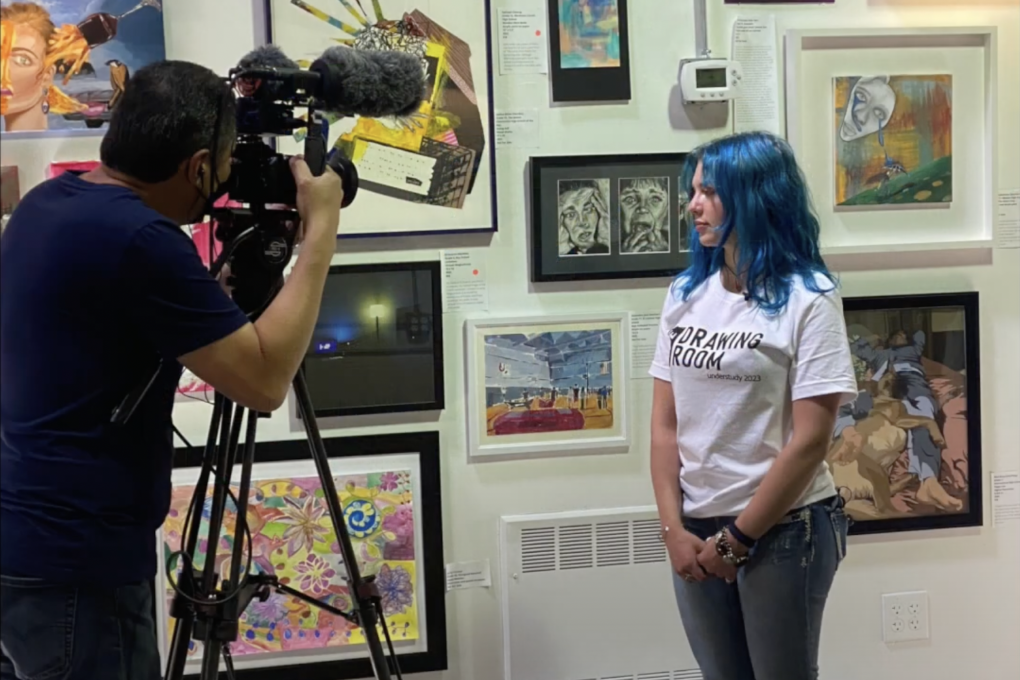
"content": "\u003cp>The clock is ticking for \u003ca href=\"https://www.kqed.org/arts/13975081/art-school-degrees-bay-area-closures\">student artists\u003c/a> in San Francisco to submit their work for a major \u003ca href=\"https://www.kqed.org/arts/tag/mission-district\">Mission District\u003c/a> art show held in May and June.\u003c/p>\n\u003cp>For the past two weeks, the \u003ca href=\"https://drawingroominc.org/\">Drawing Room Annex\u003c/a> at 599 Valencia Street has been accepting submissions for its second-ever \u003cem>High School Art Show\u003c/em> in San Francisco. The deadline for submissions is this Sunday, April 27, at 6 p.m. Those unable to deliver art in person may also do so online via \u003ca href=\"https://drawingroominc.org/pages/the-high-school-art-show-2025?mc_cid=08997340b7&mc_eid=9f3df90253\">the Annex’s website\u003c/a>. The theme of the show is \u003cem>We Are/I Am: Art and Identity\u003c/em>.\u003c/p>\n\u003cp>[aside postid='arts_13972197']“We encourage students to submit a piece of work that best represents them,” the Annex states on its submissions page. “We have a very large space to fill with visual art, as well as space to host live performances in music and poetry/spoken word. We want people to see, hear and experience what you are creating!”\u003c/p>\n\u003cp>Photography, video and digital artworks are being accepted, in addition to more traditional formats like painting and sculpture. Members of the gallery will also be on hand to assist students with matting, framing and other art prep. Artists are asked to submit one piece of art only.\u003c/p>\n\u003cp>The Drawing Room Annex’s previous \u003cem>High School Art Show\u003c/em> took place in 2022, and exhibited the work of over 350 students from over 20 San Francisco schools.\u003c/p>\n\u003cp>[ad fullwidth]\u003c/p>\n\u003cp>https://www.youtube.com/watch?v=LJBc3Ic7mmo\u003c/p>\n\u003cp>This year’s opening reception will take place on May 3 from 4-9 p.m., and the exhibition will run through June 15, 2025.\u003c/p>\n\u003cp>\u003c/p>\n\u003cp>The Annex emphasizes to students: “We want to share this space with you and provide an opportunity to for you to show your artwork and creativity. This exhibition will demonstrate the importance of art in our daily lives and its critical role for teenagers — especially now.”\u003c/p>\n\n",
"blocks": [],
"excerpt": "The Drawing Room Annex is accepting artworks from San Francisco students for a special exhibition.",
"status": "publish",
"parent": 0,
"modified": 1745504926,
"stats": {
"hasAudio": false,
"hasVideo": true,
"hasChartOrMap": false,
"iframeSrcs": [],
"hasGoogleForm": false,
"hasGallery": false,
"hasHearkenModule": false,
"hasPolis": false,
"paragraphCount": 9,
"wordCount": 322
},
"headData": {
"title": "High School Artists Needed for San Francisco Exhibit | KQED",
"description": "The Drawing Room Annex is accepting artworks from San Francisco students for a special exhibition.",
"ogTitle": "This Mission District Art Gallery Wants Submissions From High School Teens",
"ogDescription": "",
"ogImgId": "",
"twTitle": "This Mission District Art Gallery Wants Submissions From High School Teens",
"twDescription": "",
"twImgId": "",
"socialTitle": "High School Artists Needed for San Francisco Exhibit %%page%% %%sep%% KQED",
"schema": {
"@context": "https://schema.org",
"@type": "Article",
"headline": "This Mission District Art Gallery Wants Submissions From High School Teens",
"datePublished": "2025-04-24T07:25:34-07:00",
"dateModified": "2025-04-24T07:28:46-07:00",
"image": "https://cdn.kqed.org/wp-content/uploads/2020/02/KQED-OG-Image@1x.png"
}
},
"sticky": false,
"nprStoryId": "kqed-13975248",
"templateType": "standard",
"featuredImageType": "standard",
"excludeFromSiteSearch": "Include",
"articleAge": "0",
"path": "/arts/13975248/mission-district-gallery-san-francisco-high-school-call-for-artists-high-school-exhibition-2025",
"audioTrackLength": null,
"parsedContent": [
{
"type": "contentString",
"content": "\u003cdiv class=\"post-body\">\u003cp>\u003cp>The clock is ticking for \u003ca href=\"https://www.kqed.org/arts/13975081/art-school-degrees-bay-area-closures\">student artists\u003c/a> in San Francisco to submit their work for a major \u003ca href=\"https://www.kqed.org/arts/tag/mission-district\">Mission District\u003c/a> art show held in May and June.\u003c/p>\n\u003cp>For the past two weeks, the \u003ca href=\"https://drawingroominc.org/\">Drawing Room Annex\u003c/a> at 599 Valencia Street has been accepting submissions for its second-ever \u003cem>High School Art Show\u003c/em> in San Francisco. The deadline for submissions is this Sunday, April 27, at 6 p.m. Those unable to deliver art in person may also do so online via \u003ca href=\"https://drawingroominc.org/pages/the-high-school-art-show-2025?mc_cid=08997340b7&mc_eid=9f3df90253\">the Annex’s website\u003c/a>. The theme of the show is \u003cem>We Are/I Am: Art and Identity\u003c/em>.\u003c/p>\n\u003cp>\u003c/p>\u003c/div>",
"attributes": {
"named": {},
"numeric": []
}
},
{
"type": "component",
"content": "",
"name": "aside",
"attributes": {
"named": {
"postid": "arts_13972197",
"label": ""
},
"numeric": []
}
},
{
"type": "contentString",
"content": "\u003cdiv class=\"post-body\">\u003cp>“We encourage students to submit a piece of work that best represents them,” the Annex states on its submissions page. “We have a very large space to fill with visual art, as well as space to host live performances in music and poetry/spoken word. We want people to see, hear and experience what you are creating!”\u003c/p>\n\u003cp>Photography, video and digital artworks are being accepted, in addition to more traditional formats like painting and sculpture. Members of the gallery will also be on hand to assist students with matting, framing and other art prep. Artists are asked to submit one piece of art only.\u003c/p>\n\u003cp>The Drawing Room Annex’s previous \u003cem>High School Art Show\u003c/em> took place in 2022, and exhibited the work of over 350 students from over 20 San Francisco schools.\u003c/p>\n\u003cp>\u003c/p>\u003c/div>",
"attributes": {
"named": {},
"numeric": []
}
},
{
"type": "component",
"content": "",
"name": "ad",
"attributes": {
"named": {
"label": "fullwidth"
},
"numeric": [
"fullwidth"
]
}
},
{
"type": "contentString",
"content": "\u003cdiv class=\"post-body\">\u003cp>\u003c/p>\u003c/p>\u003cp>\u003cspan class='utils-parseShortcode-shortcodes-__youtubeShortcode__embedYoutube'>\n \u003cspan class='utils-parseShortcode-shortcodes-__youtubeShortcode__embedYoutubeInside'>\n \u003ciframe\n loading='lazy'\n class='utils-parseShortcode-shortcodes-__youtubeShortcode__youtubePlayer'\n type='text/html'\n src='//www.youtube.com/embed/LJBc3Ic7mmo'\n title='//www.youtube.com/embed/LJBc3Ic7mmo'\n allowfullscreen='true'\n style='border:0;'>\u003c/iframe>\n \u003c/span>\n \u003c/span>\u003c/p>\u003cp>\u003cp>This year’s opening reception will take place on May 3 from 4-9 p.m., and the exhibition will run through June 15, 2025.\u003c/p>\n\u003cp>\u003c/p>\n\u003cp>The Annex emphasizes to students: “We want to share this space with you and provide an opportunity to for you to show your artwork and creativity. This exhibition will demonstrate the importance of art in our daily lives and its critical role for teenagers — especially now.”\u003c/p>\n\n\u003c/div>\u003c/p>",
"attributes": {
"named": {},
"numeric": []
}
}
],
"link": "/arts/13975248/mission-district-gallery-san-francisco-high-school-call-for-artists-high-school-exhibition-2025",
"authors": [
"11242"
],
"categories": [
"arts_1",
"arts_70"
],
"tags": [
"arts_3649",
"arts_930",
"arts_1257",
"arts_1146",
"arts_5658"
],
"featImg": "arts_13975254",
"label": "arts"
},
"arts_13974647": {
"type": "posts",
"id": "arts_13974647",
"meta": {
"index": "posts_1716263798",
"site": "arts",
"id": "13974647",
"score": null,
"sort": [
1745334058000
]
},
"guestAuthors": [],
"slug": "we-all-got-something-graphic-novel-review-san-francisco-zine-fest-tribute-lawrence-lindell",
"title": "‘We All Got Something’ Is a Heartfelt Tribute to Grace — and SF’s Zine Community",
"publishDate": 1745334058,
"format": "aside",
"headTitle": "‘We All Got Something’ Is a Heartfelt Tribute to Grace — and SF’s Zine Community | KQED",
"labelTerm": {},
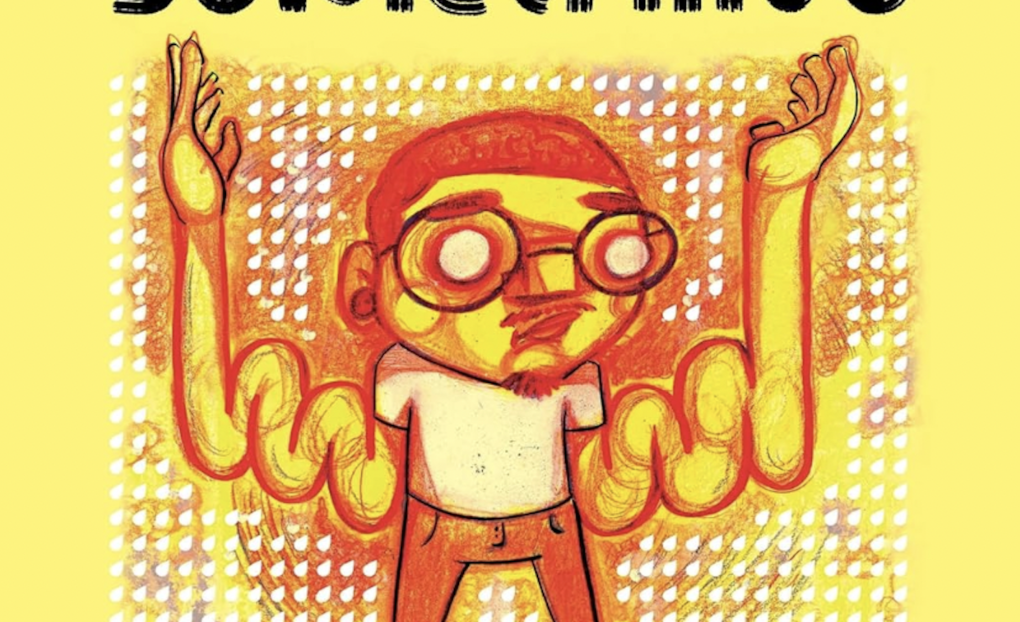
"content": "\u003cfigure id=\"attachment_13974668\" class=\"wp-caption aligncenter\" style=\"max-width: 1457px\">\u003cimg loading=\"lazy\" decoding=\"async\" class=\"size-full wp-image-13974668\" src=\"https://cdn.kqed.org/wp-content/uploads/sites/2/2025/04/L-Lindell.png\" alt=\"A yellow book cover featuring an illustration of a man wearing glasses with his arms raised in despair, full of knots.\" width=\"1457\" height=\"2000\" srcset=\"https://cdn.kqed.org/wp-content/uploads/sites/2/2025/04/L-Lindell.png 1457w, https://cdn.kqed.org/wp-content/uploads/sites/2/2025/04/L-Lindell-800x1098.png 800w, https://cdn.kqed.org/wp-content/uploads/sites/2/2025/04/L-Lindell-1020x1400.png 1020w, https://cdn.kqed.org/wp-content/uploads/sites/2/2025/04/L-Lindell-160x220.png 160w, https://cdn.kqed.org/wp-content/uploads/sites/2/2025/04/L-Lindell-768x1054.png 768w, https://cdn.kqed.org/wp-content/uploads/sites/2/2025/04/L-Lindell-1119x1536.png 1119w\" sizes=\"auto, (max-width: 1457px) 100vw, 1457px\">\u003cfigcaption class=\"wp-caption-text\">‘We All Got Something’ by Lawrence Lindell. \u003ccite>(Drawn & Quarterly)\u003c/cite>\u003c/figcaption>\u003c/figure>\n\u003cp>At first glance, Lawrence Lindell’s new graphic novel \u003cem>We All Got Something\u003c/em> is about \u003ca href=\"https://www.kqed.org/news/tag/mental-health\">mental health\u003c/a>, trauma and feeling perpetually misunderstood.\u003c/p>\n\u003cp>[aside postid='arts_13972135']By the end of the book’s 170 pages, however, you realize this is ultimately a story about grace. The importance of offering grace to those around us, even when they don’t always deserve it. Giving grace to ourselves when we’re in the process of healing. And the deep and lasting difference grace can make when we’re on the receiving end of it.\u003c/p>\n\u003cp>\u003cem>We All Got Something\u003c/em> walks us through Lindell’s recovery process after a series of terrible events befell him: a painful breakup, a random act of violence, a failed attempt to relocate overseas. The story begins with his struggle to get back in step with his old life in Compton — with his art, his music, his family and his own mind.\u003c/p>\n\u003cp>At times, Lindell’s sense of isolation is so palpable, the pages with zero dialogue feel louder and more claustrophobic than those with words.\u003c/p>\n\u003cfigure id=\"attachment_13974671\" class=\"wp-caption aligncenter\" style=\"max-width: 1920px\">\u003cimg loading=\"lazy\" decoding=\"async\" class=\"size-full wp-image-13974671\" src=\"https://cdn.kqed.org/wp-content/uploads/sites/2/2025/04/brotha-lawrence-scaled-e1744762432528.jpg\" alt=\"Black and white comic book panels convey a young man's embarassment at being called on in church by his pastor, while the congregation watches on.\" width=\"1920\" height=\"1188\">\u003cfigcaption class=\"wp-caption-text\">A moment of creeping self-consciousness in ‘We All Got Something’ by Lawrence Lindell. \u003ccite>(Drawn & Quarterly)\u003c/cite>\u003c/figcaption>\u003c/figure>\n\u003cp>In this, Lindell’s second graphic novel for Canadian comic company \u003ca href=\"https://drawnandquarterly.com/\">Drawn & Quarterly\u003c/a>, the now–San Francisco-based cartoonist has crafted a story that consistently succeeds in stirring big emotions. Heartbreak, giddiness, despair and hope all leap off the page, despite the book’s black-and-white format and casual illustration style. In Lindell’s hands, even the simplest of illustrated text exchanges can convey a gut punch. That’s a testament to how effectively he imbues his work with vulnerability and honesty — even when doing so doesn’t present himself in the most flattering light.\u003c/p>\n\u003cp>[ad fullwidth]\u003c/p>\n\u003cp>\u003cem>We All Got Something\u003c/em> is relatable for any artist who has ever questioned their creative path, any creator under pressure to quit, and any misfit who’s struggled to find their place in the world. San Francisco doesn’t appear until three-quarters of the way through, but once it’s there — specifically at \u003ca href=\"https://www.kqed.org/arts/13921425/bay-area-queer-zine-fest-comics-diy-2022\">SF Zine Fest\u003c/a> — we see Lindell turn a corner and find his light again. When the title of the book finally shows up in the text, butterflies are all but inevitable.\u003c/p>\n\u003chr>\n\u003cp>\u003c/p>\n\u003cp>\u003cem>\u003ca href=\"https://drawnandquarterly.com/books/we-all-got-something/\">‘We All Got Something’ by Lawrence Lindell\u003c/a> is out April 29, 2025, via Drawn & Quarterly.\u003c/em>\u003c/p>\n\n",
"blocks": [],
"excerpt": "San Francisco-based cartoonist Lawrence Lindell’s new graphic novel traces his journey out of a major life rut.",
"status": "publish",
"parent": 0,
"modified": 1745263332,
"stats": {
"hasAudio": false,
"hasVideo": false,
"hasChartOrMap": false,
"iframeSrcs": [],
"hasGoogleForm": false,
"hasGallery": false,
"hasHearkenModule": false,
"hasPolis": false,
"paragraphCount": 9,
"wordCount": 429
},
"headData": {
"title": "Comics Review: ‘We All Got Something’ by Lawrence Lindell | KQED",
"description": "San Francisco-based cartoonist Lawrence Lindell’s new graphic novel traces his journey out of a major life rut.",
"ogTitle": "‘We All Got Something’ Is a Heartfelt Tribute to Grace — and SF’s Zine Community",
"ogDescription": "",
"ogImgId": "",
"twTitle": "‘We All Got Something’ Is a Heartfelt Tribute to Grace — and SF’s Zine Community",
"twDescription": "",
"twImgId": "",
"socialTitle": "Comics Review: ‘We All Got Something’ by Lawrence Lindell %%page%% %%sep%% KQED",
"schema": {
"@context": "https://schema.org",
"@type": "Article",
"headline": "‘We All Got Something’ Is a Heartfelt Tribute to Grace — and SF’s Zine Community",
"datePublished": "2025-04-22T08:00:58-07:00",
"dateModified": "2025-04-21T12:22:12-07:00",
"image": "https://cdn.kqed.org/wp-content/uploads/2020/02/KQED-OG-Image@1x.png"
}
},
"source": "The Do List",
"sourceUrl": "https://www.kqed.org/thedolist",
"sticky": false,
"templateType": "standard",
"featuredImageType": "standard",
"excludeFromSiteSearch": "Include",
"articleAge": "0",
"path": "/arts/13974647/we-all-got-something-graphic-novel-review-san-francisco-zine-fest-tribute-lawrence-lindell",
"audioTrackLength": null,
"parsedContent": [
{
"type": "contentString",
"content": "\u003cdiv class=\"post-body\">\u003cp>\u003cfigure id=\"attachment_13974668\" class=\"wp-caption aligncenter\" style=\"max-width: 1457px\">\u003cimg loading=\"lazy\" decoding=\"async\" class=\"size-full wp-image-13974668\" src=\"https://cdn.kqed.org/wp-content/uploads/sites/2/2025/04/L-Lindell.png\" alt=\"A yellow book cover featuring an illustration of a man wearing glasses with his arms raised in despair, full of knots.\" width=\"1457\" height=\"2000\" srcset=\"https://cdn.kqed.org/wp-content/uploads/sites/2/2025/04/L-Lindell.png 1457w, https://cdn.kqed.org/wp-content/uploads/sites/2/2025/04/L-Lindell-800x1098.png 800w, https://cdn.kqed.org/wp-content/uploads/sites/2/2025/04/L-Lindell-1020x1400.png 1020w, https://cdn.kqed.org/wp-content/uploads/sites/2/2025/04/L-Lindell-160x220.png 160w, https://cdn.kqed.org/wp-content/uploads/sites/2/2025/04/L-Lindell-768x1054.png 768w, https://cdn.kqed.org/wp-content/uploads/sites/2/2025/04/L-Lindell-1119x1536.png 1119w\" sizes=\"auto, (max-width: 1457px) 100vw, 1457px\">\u003cfigcaption class=\"wp-caption-text\">‘We All Got Something’ by Lawrence Lindell. \u003ccite>(Drawn & Quarterly)\u003c/cite>\u003c/figcaption>\u003c/figure>\n\u003cp>At first glance, Lawrence Lindell’s new graphic novel \u003cem>We All Got Something\u003c/em> is about \u003ca href=\"https://www.kqed.org/news/tag/mental-health\">mental health\u003c/a>, trauma and feeling perpetually misunderstood.\u003c/p>\n\u003cp>\u003c/p>\u003c/div>",
"attributes": {
"named": {},
"numeric": []
}
},
{
"type": "component",
"content": "",
"name": "aside",
"attributes": {
"named": {
"postid": "arts_13972135",
"label": ""
},
"numeric": []
}
},
{
"type": "contentString",
"content": "\u003cdiv class=\"post-body\">\u003cp>By the end of the book’s 170 pages, however, you realize this is ultimately a story about grace. The importance of offering grace to those around us, even when they don’t always deserve it. Giving grace to ourselves when we’re in the process of healing. And the deep and lasting difference grace can make when we’re on the receiving end of it.\u003c/p>\n\u003cp>\u003cem>We All Got Something\u003c/em> walks us through Lindell’s recovery process after a series of terrible events befell him: a painful breakup, a random act of violence, a failed attempt to relocate overseas. The story begins with his struggle to get back in step with his old life in Compton — with his art, his music, his family and his own mind.\u003c/p>\n\u003cp>At times, Lindell’s sense of isolation is so palpable, the pages with zero dialogue feel louder and more claustrophobic than those with words.\u003c/p>\n\u003cfigure id=\"attachment_13974671\" class=\"wp-caption aligncenter\" style=\"max-width: 1920px\">\u003cimg loading=\"lazy\" decoding=\"async\" class=\"size-full wp-image-13974671\" src=\"https://cdn.kqed.org/wp-content/uploads/sites/2/2025/04/brotha-lawrence-scaled-e1744762432528.jpg\" alt=\"Black and white comic book panels convey a young man's embarassment at being called on in church by his pastor, while the congregation watches on.\" width=\"1920\" height=\"1188\">\u003cfigcaption class=\"wp-caption-text\">A moment of creeping self-consciousness in ‘We All Got Something’ by Lawrence Lindell. \u003ccite>(Drawn & Quarterly)\u003c/cite>\u003c/figcaption>\u003c/figure>\n\u003cp>In this, Lindell’s second graphic novel for Canadian comic company \u003ca href=\"https://drawnandquarterly.com/\">Drawn & Quarterly\u003c/a>, the now–San Francisco-based cartoonist has crafted a story that consistently succeeds in stirring big emotions. Heartbreak, giddiness, despair and hope all leap off the page, despite the book’s black-and-white format and casual illustration style. In Lindell’s hands, even the simplest of illustrated text exchanges can convey a gut punch. That’s a testament to how effectively he imbues his work with vulnerability and honesty — even when doing so doesn’t present himself in the most flattering light.\u003c/p>\n\u003cp>\u003c/p>\u003c/div>",
"attributes": {
"named": {},
"numeric": []
}
},
{
"type": "component",
"content": "",
"name": "ad",
"attributes": {
"named": {
"label": "fullwidth"
},
"numeric": [
"fullwidth"
]
}
},
{
"type": "contentString",
"content": "\u003cdiv class=\"post-body\">\u003cp>\u003c/p>\n\u003cp>\u003cem>We All Got Something\u003c/em> is relatable for any artist who has ever questioned their creative path, any creator under pressure to quit, and any misfit who’s struggled to find their place in the world. San Francisco doesn’t appear until three-quarters of the way through, but once it’s there — specifically at \u003ca href=\"https://www.kqed.org/arts/13921425/bay-area-queer-zine-fest-comics-diy-2022\">SF Zine Fest\u003c/a> — we see Lindell turn a corner and find his light again. When the title of the book finally shows up in the text, butterflies are all but inevitable.\u003c/p>\n\u003chr>\n\u003cp>\u003c/p>\n\u003cp>\u003cem>\u003ca href=\"https://drawnandquarterly.com/books/we-all-got-something/\">‘We All Got Something’ by Lawrence Lindell\u003c/a> is out April 29, 2025, via Drawn & Quarterly.\u003c/em>\u003c/p>\n\n\u003c/div>\u003c/p>",
"attributes": {
"named": {},
"numeric": []
}
}
],
"link": "/arts/13974647/we-all-got-something-graphic-novel-review-san-francisco-zine-fest-tribute-lawrence-lindell",
"authors": [
"11242"
],
"programs": [
"arts_140"
],
"categories": [
"arts_1",
"arts_73",
"arts_22313"
],
"tags": [
"arts_10278",
"arts_10629",
"arts_1146",
"arts_585",
"arts_914"
],
"featImg": "arts_13974669",
"label": "source_arts_13974647"
},
"arts_13974977": {
"type": "posts",
"id": "arts_13974977",
"meta": {
"index": "posts_1716263798",
"site": "arts",
"id": "13974977",
"score": null,
"sort": [
1745278905000
]
},
"guestAuthors": [],
"slug": "history-of-the-bay-podcast-100-episodes-too-short-bay-area",
"title": "After 100 Episodes, ‘History of the Bay’ Expands Its Horizons",
"publishDate": 1745278905,
"format": "standard",
"headTitle": "After 100 Episodes, ‘History of the Bay’ Expands Its Horizons | KQED",
"labelTerm": {
"site": "arts"
},
"content": "\u003cp>When \u003ca href=\"https://www.kqed.org/arts/13916721/sucka-free-history-with-dregs-one\">Dregs One\u003c/a> finally met \u003ca href=\"https://www.kqed.org/arts/tag/too-short\">Too Short\u003c/a> face-to-face this past February, during NBA All-Star weekend in San Francisco, the two weren’t exactly strangers. Short, of course, is a Bay Area rap icon, now 22 albums deep in the game — and he’d definitely noticed Dregs’ work to tell the stories of the region’s hip-hop producers, graffiti artists and rap pioneers on his \u003cem>\u003ca href=\"https://creators.spotify.com/pod/profile/historyofthebay/\">History of the Bay\u003c/a>\u003c/em> podcast.\u003c/p>\n\u003cp>It was only fitting, then, that Too Short be the guest on the landmark 100th episode of \u003cem>History of the Bay\u003c/em> — an appearance that Dregs tells KQED has been a longtime goal. Short’s been “very supportive since the beginning, in terms of commenting, sharing and engaging on social media,” allowing for what’s usually an hour- or hour-and-a-half-long conversation on the podcast to last for more than two hours.\u003c/p>\n\u003cp>[aside postID='arts_13916721']It’s the culmination of a long road for \u003cem>History of the Bay\u003c/em>, which began in early 2022 as short TikToks. Onscreen, Dregs would summarize entire careers or scenes in in 60 seconds or less. (The first two? Graffiti spot Psycho City and Tupac Shakur.) Some blew up with as many as half a million views, and six months later, the podcast was born — a way to stretch out beyond TikTok’s time limitations and hear from the artists themselves.\u003c/p>\n\u003cp>Now, Dregs is expanding yet again. Episode No. 101 will feature actor Danny Glover, and Dregs wants to host more actors, activists, journalists and musicians of different genres on \u003cem>History of the Bay\u003c/em>.\u003c/p>\n\u003cp>“I’d actually be interested in like, regular people. School teachers!” Dregs says. “I want to get this podcast to where it doesn’t really matter who I have on, the audience is strong enough to trust me to know that whatever story gets told will be interesting.”\u003c/p>\n\u003cp>[ad fullwidth]\u003c/p>\n\u003cp>[aside postID='arts_13973907']It’s also been a time of literal expansion for the podcast, which recently moved to the office of record label EMPIRE, whose sponsorship comes with a small production team, including videographer Trevor Potter and production manager Jazmin Ontiveros. Having the support of EMPIRE’s CEO Ghazi Shami “really means a lot to me,” Dregs says. “This culture is important to him.”\u003c/p>\n\u003cp>And while reporting on said culture can involve egos, beef and grudges, Dregs has enough street knowledge to sidestep them (“it’s really served me well by going out of my way to not be messy,” he says). He intersperses interviews of rappers like Philthy Rich, Messy Marv and LaRussell with graphic designers like \u003ca href=\"https://www.youtube.com/watch?v=ZErUFFA8SR0\">Shemp\u003c/a> or personal injury billboard queen \u003ca href=\"https://www.youtube.com/watch?v=xc531VHZUN4\">Anh Phoong\u003c/a>. And, for October, he’s already planning a return of the \u003ca href=\"https://www.kqed.org/arts/13931387/photos-history-of-the-bay-day-party-dregs-one-review\">\u003cem>History of the Bay\u003c/em> live event\u003c/a> at the Midway in San Francisco.\u003c/p>\n\u003cp>As for what the podcast might look like another 100 episodes from now, Dregs says he just wants to continue pushing Bay Area culture to an international audience, “so they learn about the Bay and start appreciating it more.”\u003c/p>\n\u003chr>\n\u003cp>\u003c/p>\n\u003cp>\u003cem>‘History of the Bay’ drops new episodes weekly, and can be found on \u003ca href=\"https://creators.spotify.com/pod/profile/historyofthebay/\">podcast platforms\u003c/a> and \u003ca href=\"https://www.youtube.com/playlist?list=PLrcnRVZo1Y9S-8xIlv8knxRcYwCqsu1OC\">YouTube\u003c/a>.\u003c/em>\u003c/p>\n\n",
"blocks": [],
"excerpt": "With a new studio and broader focus, Dregs One is committed to bringing Bay Area street culture to the world.",
"status": "publish",
"parent": 0,
"modified": 1745278975,
"stats": {
"hasAudio": false,
"hasVideo": false,
"hasChartOrMap": false,
"iframeSrcs": [],
"hasGoogleForm": false,
"hasGallery": false,
"hasHearkenModule": false,
"hasPolis": false,
"paragraphCount": 11,
"wordCount": 552
},
"headData": {
"title": "After 100 Episodes, ‘History of the Bay’ Expands Its Horizons | KQED",
"description": "With a new studio and broader focus, Dregs One is committed to bringing Bay Area street culture to the world.",
"ogTitle": "",
"ogDescription": "",
"ogImgId": "",
"twTitle": "",
"twDescription": "",
"twImgId": "",
"schema": {
"@context": "https://schema.org",
"@type": "Article",
"headline": "After 100 Episodes, ‘History of the Bay’ Expands Its Horizons",
"datePublished": "2025-04-21T16:41:45-07:00",
"dateModified": "2025-04-21T16:42:55-07:00",
"image": "https://cdn.kqed.org/wp-content/uploads/2020/02/KQED-OG-Image@1x.png"
}
},
"sticky": false,
"nprStoryId": "kqed-13974977",
"templateType": "standard",
"featuredImageType": "standard",
"excludeFromSiteSearch": "Include",
"articleAge": "0",
"path": "/arts/13974977/history-of-the-bay-podcast-100-episodes-too-short-bay-area",
"audioTrackLength": null,
"parsedContent": [
{
"type": "contentString",
"content": "\u003cdiv class=\"post-body\">\u003cp>\u003cp>When \u003ca href=\"https://www.kqed.org/arts/13916721/sucka-free-history-with-dregs-one\">Dregs One\u003c/a> finally met \u003ca href=\"https://www.kqed.org/arts/tag/too-short\">Too Short\u003c/a> face-to-face this past February, during NBA All-Star weekend in San Francisco, the two weren’t exactly strangers. Short, of course, is a Bay Area rap icon, now 22 albums deep in the game — and he’d definitely noticed Dregs’ work to tell the stories of the region’s hip-hop producers, graffiti artists and rap pioneers on his \u003cem>\u003ca href=\"https://creators.spotify.com/pod/profile/historyofthebay/\">History of the Bay\u003c/a>\u003c/em> podcast.\u003c/p>\n\u003cp>It was only fitting, then, that Too Short be the guest on the landmark 100th episode of \u003cem>History of the Bay\u003c/em> — an appearance that Dregs tells KQED has been a longtime goal. Short’s been “very supportive since the beginning, in terms of commenting, sharing and engaging on social media,” allowing for what’s usually an hour- or hour-and-a-half-long conversation on the podcast to last for more than two hours.\u003c/p>\n\u003cp>\u003c/p>\u003c/div>",
"attributes": {
"named": {},
"numeric": []
}
},
{
"type": "component",
"content": "",
"name": "aside",
"attributes": {
"named": {
"postid": "arts_13916721",
"label": ""
},
"numeric": []
}
},
{
"type": "contentString",
"content": "\u003cdiv class=\"post-body\">\u003cp>It’s the culmination of a long road for \u003cem>History of the Bay\u003c/em>, which began in early 2022 as short TikToks. Onscreen, Dregs would summarize entire careers or scenes in in 60 seconds or less. (The first two? Graffiti spot Psycho City and Tupac Shakur.) Some blew up with as many as half a million views, and six months later, the podcast was born — a way to stretch out beyond TikTok’s time limitations and hear from the artists themselves.\u003c/p>\n\u003cp>Now, Dregs is expanding yet again. Episode No. 101 will feature actor Danny Glover, and Dregs wants to host more actors, activists, journalists and musicians of different genres on \u003cem>History of the Bay\u003c/em>.\u003c/p>\n\u003cp>“I’d actually be interested in like, regular people. School teachers!” Dregs says. “I want to get this podcast to where it doesn’t really matter who I have on, the audience is strong enough to trust me to know that whatever story gets told will be interesting.”\u003c/p>\n\u003cp>\u003c/p>\u003c/div>",
"attributes": {
"named": {},
"numeric": []
}
},
{
"type": "component",
"content": "",
"name": "ad",
"attributes": {
"named": {
"label": "fullwidth"
},
"numeric": [
"fullwidth"
]
}
},
{
"type": "contentString",
"content": "\u003cdiv class=\"post-body\">\u003cp>\u003c/p>\n\u003cp>\u003c/p>\u003c/div>",
"attributes": {
"named": {},
"numeric": []
}
},
{
"type": "component",
"content": "",
"name": "aside",
"attributes": {
"named": {
"postid": "arts_13973907",
"label": ""
},
"numeric": []
}
},
{
"type": "contentString",
"content": "\u003cdiv class=\"post-body\">\u003cp>It’s also been a time of literal expansion for the podcast, which recently moved to the office of record label EMPIRE, whose sponsorship comes with a small production team, including videographer Trevor Potter and production manager Jazmin Ontiveros. Having the support of EMPIRE’s CEO Ghazi Shami “really means a lot to me,” Dregs says. “This culture is important to him.”\u003c/p>\n\u003cp>And while reporting on said culture can involve egos, beef and grudges, Dregs has enough street knowledge to sidestep them (“it’s really served me well by going out of my way to not be messy,” he says). He intersperses interviews of rappers like Philthy Rich, Messy Marv and LaRussell with graphic designers like \u003ca href=\"https://www.youtube.com/watch?v=ZErUFFA8SR0\">Shemp\u003c/a> or personal injury billboard queen \u003ca href=\"https://www.youtube.com/watch?v=xc531VHZUN4\">Anh Phoong\u003c/a>. And, for October, he’s already planning a return of the \u003ca href=\"https://www.kqed.org/arts/13931387/photos-history-of-the-bay-day-party-dregs-one-review\">\u003cem>History of the Bay\u003c/em> live event\u003c/a> at the Midway in San Francisco.\u003c/p>\n\u003cp>As for what the podcast might look like another 100 episodes from now, Dregs says he just wants to continue pushing Bay Area culture to an international audience, “so they learn about the Bay and start appreciating it more.”\u003c/p>\n\u003chr>\n\u003cp>\u003c/p>\n\u003cp>\u003cem>‘History of the Bay’ drops new episodes weekly, and can be found on \u003ca href=\"https://creators.spotify.com/pod/profile/historyofthebay/\">podcast platforms\u003c/a> and \u003ca href=\"https://www.youtube.com/playlist?list=PLrcnRVZo1Y9S-8xIlv8knxRcYwCqsu1OC\">YouTube\u003c/a>.\u003c/em>\u003c/p>\n\n\u003c/div>\u003c/p>",
"attributes": {
"named": {},
"numeric": []
}
}
],
"link": "/arts/13974977/history-of-the-bay-podcast-100-episodes-too-short-bay-area",
"authors": [
"185"
],
"categories": [
"arts_1",
"arts_76",
"arts_7862",
"arts_69"
],
"tags": [
"arts_2457",
"arts_831",
"arts_3837",
"arts_974",
"arts_1146",
"arts_19347",
"arts_3478"
],
"featImg": "arts_13975005",
"label": "arts"
},
"arts_13974853": {
"type": "posts",
"id": "arts_13974853",
"meta": {
"index": "posts_1716263798",
"site": "arts",
"id": "13974853",
"score": null,
"sort": [
1745008256000
]
},
"guestAuthors": [],
"slug": "san-francisco-culture-forward-grants-awardees",
"title": "First Round of Awardees Announced for San Francisco’s Culture Forward Grants",
"publishDate": 1745008256,
"format": "standard",
"headTitle": "First Round of Awardees Announced for San Francisco’s Culture Forward Grants | KQED",
"labelTerm": {
"site": "arts"
},
"content": "\u003cp>In a press conference on Friday with \u003ca href=\"https://www.kqed.org/arts/tag/san-francisco\">San Francisco\u003c/a> Mayor Daniel Lurie, the first-ever recipients of \u003ca href=\"https://www.kqed.org/arts/13967182/svane-family-foundation-culture-forward-grant\">Culture Forward grants\u003c/a> were announced.\u003c/p>\n\u003cp>Funded by the Svane Family Foundation and meant to revitalize the city’s downtown, the Culture Forward initiative plans to award $5 million over the next three years to artists and organizations for creative projects that can attract “students, young professionals and families” to the city core.\u003c/p>\n\u003cp>While the grants are open to applicants outside of the Bay Area, the first cohort of grant recipients are all local.\u003c/p>\n\u003cfigure id=\"attachment_13974860\" class=\"wp-caption aligncenter\" style=\"max-width: 2000px\">\u003cimg loading=\"lazy\" decoding=\"async\" class=\"size-full wp-image-13974860\" src=\"https://cdn.kqed.org/wp-content/uploads/sites/2/2025/04/Courtesy-of-Unity-Press-Skateboarding.jpg\" alt=\"\" width=\"2000\" height=\"1334\" srcset=\"https://cdn.kqed.org/wp-content/uploads/sites/2/2025/04/Courtesy-of-Unity-Press-Skateboarding.jpg 2000w, https://cdn.kqed.org/wp-content/uploads/sites/2/2025/04/Courtesy-of-Unity-Press-Skateboarding-800x534.jpg 800w, https://cdn.kqed.org/wp-content/uploads/sites/2/2025/04/Courtesy-of-Unity-Press-Skateboarding-1020x680.jpg 1020w, https://cdn.kqed.org/wp-content/uploads/sites/2/2025/04/Courtesy-of-Unity-Press-Skateboarding-160x107.jpg 160w, https://cdn.kqed.org/wp-content/uploads/sites/2/2025/04/Courtesy-of-Unity-Press-Skateboarding-768x512.jpg 768w, https://cdn.kqed.org/wp-content/uploads/sites/2/2025/04/Courtesy-of-Unity-Press-Skateboarding-1536x1025.jpg 1536w, https://cdn.kqed.org/wp-content/uploads/sites/2/2025/04/Courtesy-of-Unity-Press-Skateboarding-1920x1281.jpg 1920w\" sizes=\"auto, (max-width: 2000px) 100vw, 2000px\">\u003cfigcaption class=\"wp-caption-text\">A crowd gathers at Unity Fest, a celebration of queer skateboarding, in October 2024. \u003ccite>(Courtesy Unity Press & Skateboarding)\u003c/cite>\u003c/figcaption>\u003c/figure>\n\u003cp>The initial recipients and their projects are:\u003c/p>\n\u003cp>\u003cstrong>Chinese Culture Foundation of San Francisco\u003c/strong>: $50,000 for a street festival along Chinatown’s Grant Avenue with large-scale installations and performances, celebrating the Chinese Culture Center’s 60th anniversary.\u003c/p>\n\u003cp>[ad fullwidth]\u003c/p>\n\u003cp>\u003cstrong>City Arts & Lectures\u003c/strong>: $25,000 for a salon series featuring live conversations with artists and thinkers, and interactivity with the audience.\u003c/p>\n\u003cp>\u003cstrong>Jeffrey Cheung / Unity Press & Skateboarding\u003c/strong>: $100,000 for a celebration of queer, trans and BIPOC communities through art, skateboarding and music events in downtown venues and public spaces.\u003c/p>\n\u003cp>\u003cstrong>Market Street Arts / Mid-Market Foundation\u003c/strong>: $75,000 for the return of \u003cem>UNSTAGED – Live on Mid-Market\u003c/em>, a festival including performance, public art and live events.\u003c/p>\n\u003cp>[aside postID='arts_13974119']\u003cstrong>SFFILM\u003c/strong>: $50,000 for a series of 12 film events for students, educators and families at SFMOMA with filmmaker Q&As and screenings.\u003c/p>\n\u003cp>\u003cstrong>SFJAZZ\u003c/strong>: $50,000 for a series of community-focused jazz events combining live music, visual art, food and local markets.\u003c/p>\n\u003cp>\u003cstrong>SOMArts Cultural Center\u003c/strong>: $25,000 for a workshop series focused on LGBTQ+ culture culminating in an all-ages fashion show and community Vogue Ball in SoMa.\u003c/p>\n\u003cp>\u003cstrong>Tenderloin Museum\u003c/strong>: $50,000 for the museum’s 10-year anniversary programming, a year-long celebration with storytelling and multidisciplinary events highlighting the neighborhood’s legacy.\u003c/p>\n\u003cp>\u003cstrong>David Wilson\u003c/strong>: $25,000 for a participatory art installation using site-specific painting, sound and maps to take participants on a journey across downtown, accompanied by an exhibition and event series.\u003c/p>\n\u003cp>\u003cstrong>Yerba Buena Gardens Festival\u003c/strong>: $75,000 for the return of the Children’s Gardens Series, a family series with 22 free outdoor performances of dance, theater and music.\u003c/p>\n\u003cfigure id=\"attachment_13974858\" class=\"wp-caption aligncenter\" style=\"max-width: 2000px\">\u003cimg loading=\"lazy\" decoding=\"async\" class=\"size-full wp-image-13974858\" src=\"https://cdn.kqed.org/wp-content/uploads/sites/2/2025/04/Courtesy-of-Yerba-Buena-Gardens.jpg\" alt=\"\" width=\"2000\" height=\"1331\" srcset=\"https://cdn.kqed.org/wp-content/uploads/sites/2/2025/04/Courtesy-of-Yerba-Buena-Gardens.jpg 2000w, https://cdn.kqed.org/wp-content/uploads/sites/2/2025/04/Courtesy-of-Yerba-Buena-Gardens-800x532.jpg 800w, https://cdn.kqed.org/wp-content/uploads/sites/2/2025/04/Courtesy-of-Yerba-Buena-Gardens-1020x679.jpg 1020w, https://cdn.kqed.org/wp-content/uploads/sites/2/2025/04/Courtesy-of-Yerba-Buena-Gardens-160x106.jpg 160w, https://cdn.kqed.org/wp-content/uploads/sites/2/2025/04/Courtesy-of-Yerba-Buena-Gardens-768x511.jpg 768w, https://cdn.kqed.org/wp-content/uploads/sites/2/2025/04/Courtesy-of-Yerba-Buena-Gardens-1536x1022.jpg 1536w, https://cdn.kqed.org/wp-content/uploads/sites/2/2025/04/Courtesy-of-Yerba-Buena-Gardens-1920x1278.jpg 1920w\" sizes=\"auto, (max-width: 2000px) 100vw, 2000px\">\u003cfigcaption class=\"wp-caption-text\">A performance at the Yerba Buena Gardens Festival, a recipient of this year’s Culture Forward grant. \u003ccite>(Courtesy Yerba Buena Gardens Festival)\u003c/cite>\u003c/figcaption>\u003c/figure>\n\u003cp>“As mayor, my job is to make downtown clean and safe, and create the conditions for people to want to return. I believe a thriving arts and culture scene is crucial to that work,” Mayor Lurie said in a statement.\u003c/p>\n\u003cp>Joining Mayor Lurie were former Zendesk CEO Mikkel Svane and Ella Svane of the Svane Family Foundation, along with program consultant lead Kelsey Issel. The Svane Family Foundation has previously supported Bay Area artists with $10,000 grants during the pandemic, as well as a $1 million gift to the Fine Arts Museums of San Francisco to acquire 42 works by Bay Area artists from historically underrepresented backgrounds.\u003c/p>\n\u003cp>\u003c/p>\n\u003cp>Future Culture Forward recipients will be eligible for amounts ranging from $10,000–$100,000 for projects in the Financial District, SoMa, the Tenderloin, Civic Center, Mid-Market, Union Square, Tenderloin, Chinatown and Mission Bay. Applications, reviewed on a rolling basis, are available on \u003ca href=\"https://svanefamilyfoundation.submittable.com/submit\">the Culture Forward site\u003c/a>.\u003c/p>\n\n",
"blocks": [],
"excerpt": "The grants, totaling $525,000, will fund projects and performances to revitalize the city's downtown.",
"status": "publish",
"parent": 0,
"modified": 1745008328,
"stats": {
"hasAudio": false,
"hasVideo": false,
"hasChartOrMap": false,
"iframeSrcs": [],
"hasGoogleForm": false,
"hasGallery": false,
"hasHearkenModule": false,
"hasPolis": false,
"paragraphCount": 19,
"wordCount": 575
},
"headData": {
"title": "First Round of Awardees Announced for San Francisco’s Culture Forward Grants | KQED",
"description": "The grants, totaling $525,000, will fund projects and performances to revitalize the city's downtown.",
"ogTitle": "",
"ogDescription": "",
"ogImgId": "",
"twTitle": "",
"twDescription": "",
"twImgId": "",
"schema": {
"@context": "https://schema.org",
"@type": "Article",
"headline": "First Round of Awardees Announced for San Francisco’s Culture Forward Grants",
"datePublished": "2025-04-18T13:30:56-07:00",
"dateModified": "2025-04-18T13:32:08-07:00",
"image": "https://cdn.kqed.org/wp-content/uploads/2020/02/KQED-OG-Image@1x.png"
}
},
"sticky": false,
"nprStoryId": "kqed-13974853",
"templateType": "standard",
"featuredImageType": "standard",
"excludeFromSiteSearch": "Include",
"articleAge": "0",
"path": "/arts/13974853/san-francisco-culture-forward-grants-awardees",
"audioTrackLength": null,
"parsedContent": [
{
"type": "contentString",
"content": "\u003cdiv class=\"post-body\">\u003cp>\u003cp>In a press conference on Friday with \u003ca href=\"https://www.kqed.org/arts/tag/san-francisco\">San Francisco\u003c/a> Mayor Daniel Lurie, the first-ever recipients of \u003ca href=\"https://www.kqed.org/arts/13967182/svane-family-foundation-culture-forward-grant\">Culture Forward grants\u003c/a> were announced.\u003c/p>\n\u003cp>Funded by the Svane Family Foundation and meant to revitalize the city’s downtown, the Culture Forward initiative plans to award $5 million over the next three years to artists and organizations for creative projects that can attract “students, young professionals and families” to the city core.\u003c/p>\n\u003cp>While the grants are open to applicants outside of the Bay Area, the first cohort of grant recipients are all local.\u003c/p>\n\u003cfigure id=\"attachment_13974860\" class=\"wp-caption aligncenter\" style=\"max-width: 2000px\">\u003cimg loading=\"lazy\" decoding=\"async\" class=\"size-full wp-image-13974860\" src=\"https://cdn.kqed.org/wp-content/uploads/sites/2/2025/04/Courtesy-of-Unity-Press-Skateboarding.jpg\" alt=\"\" width=\"2000\" height=\"1334\" srcset=\"https://cdn.kqed.org/wp-content/uploads/sites/2/2025/04/Courtesy-of-Unity-Press-Skateboarding.jpg 2000w, https://cdn.kqed.org/wp-content/uploads/sites/2/2025/04/Courtesy-of-Unity-Press-Skateboarding-800x534.jpg 800w, https://cdn.kqed.org/wp-content/uploads/sites/2/2025/04/Courtesy-of-Unity-Press-Skateboarding-1020x680.jpg 1020w, https://cdn.kqed.org/wp-content/uploads/sites/2/2025/04/Courtesy-of-Unity-Press-Skateboarding-160x107.jpg 160w, https://cdn.kqed.org/wp-content/uploads/sites/2/2025/04/Courtesy-of-Unity-Press-Skateboarding-768x512.jpg 768w, https://cdn.kqed.org/wp-content/uploads/sites/2/2025/04/Courtesy-of-Unity-Press-Skateboarding-1536x1025.jpg 1536w, https://cdn.kqed.org/wp-content/uploads/sites/2/2025/04/Courtesy-of-Unity-Press-Skateboarding-1920x1281.jpg 1920w\" sizes=\"auto, (max-width: 2000px) 100vw, 2000px\">\u003cfigcaption class=\"wp-caption-text\">A crowd gathers at Unity Fest, a celebration of queer skateboarding, in October 2024. \u003ccite>(Courtesy Unity Press & Skateboarding)\u003c/cite>\u003c/figcaption>\u003c/figure>\n\u003cp>The initial recipients and their projects are:\u003c/p>\n\u003cp>\u003cstrong>Chinese Culture Foundation of San Francisco\u003c/strong>: $50,000 for a street festival along Chinatown’s Grant Avenue with large-scale installations and performances, celebrating the Chinese Culture Center’s 60th anniversary.\u003c/p>\n\u003cp>\u003c/p>\u003c/div>",
"attributes": {
"named": {},
"numeric": []
}
},
{
"type": "component",
"content": "",
"name": "ad",
"attributes": {
"named": {
"label": "fullwidth"
},
"numeric": [
"fullwidth"
]
}
},
{
"type": "contentString",
"content": "\u003cdiv class=\"post-body\">\u003cp>\u003c/p>\n\u003cp>\u003cstrong>City Arts & Lectures\u003c/strong>: $25,000 for a salon series featuring live conversations with artists and thinkers, and interactivity with the audience.\u003c/p>\n\u003cp>\u003cstrong>Jeffrey Cheung / Unity Press & Skateboarding\u003c/strong>: $100,000 for a celebration of queer, trans and BIPOC communities through art, skateboarding and music events in downtown venues and public spaces.\u003c/p>\n\u003cp>\u003cstrong>Market Street Arts / Mid-Market Foundation\u003c/strong>: $75,000 for the return of \u003cem>UNSTAGED – Live on Mid-Market\u003c/em>, a festival including performance, public art and live events.\u003c/p>\n\u003cp>\u003c/p>\u003c/div>",
"attributes": {
"named": {},
"numeric": []
}
},
{
"type": "component",
"content": "",
"name": "aside",
"attributes": {
"named": {
"postid": "arts_13974119",
"label": ""
},
"numeric": []
}
},
{
"type": "contentString",
"content": "\u003cdiv class=\"post-body\">\u003cp>\u003cstrong>SFFILM\u003c/strong>: $50,000 for a series of 12 film events for students, educators and families at SFMOMA with filmmaker Q&As and screenings.\u003c/p>\n\u003cp>\u003cstrong>SFJAZZ\u003c/strong>: $50,000 for a series of community-focused jazz events combining live music, visual art, food and local markets.\u003c/p>\n\u003cp>\u003cstrong>SOMArts Cultural Center\u003c/strong>: $25,000 for a workshop series focused on LGBTQ+ culture culminating in an all-ages fashion show and community Vogue Ball in SoMa.\u003c/p>\n\u003cp>\u003cstrong>Tenderloin Museum\u003c/strong>: $50,000 for the museum’s 10-year anniversary programming, a year-long celebration with storytelling and multidisciplinary events highlighting the neighborhood’s legacy.\u003c/p>\n\u003cp>\u003cstrong>David Wilson\u003c/strong>: $25,000 for a participatory art installation using site-specific painting, sound and maps to take participants on a journey across downtown, accompanied by an exhibition and event series.\u003c/p>\n\u003cp>\u003cstrong>Yerba Buena Gardens Festival\u003c/strong>: $75,000 for the return of the Children’s Gardens Series, a family series with 22 free outdoor performances of dance, theater and music.\u003c/p>\n\u003cfigure id=\"attachment_13974858\" class=\"wp-caption aligncenter\" style=\"max-width: 2000px\">\u003cimg loading=\"lazy\" decoding=\"async\" class=\"size-full wp-image-13974858\" src=\"https://cdn.kqed.org/wp-content/uploads/sites/2/2025/04/Courtesy-of-Yerba-Buena-Gardens.jpg\" alt=\"\" width=\"2000\" height=\"1331\" srcset=\"https://cdn.kqed.org/wp-content/uploads/sites/2/2025/04/Courtesy-of-Yerba-Buena-Gardens.jpg 2000w, https://cdn.kqed.org/wp-content/uploads/sites/2/2025/04/Courtesy-of-Yerba-Buena-Gardens-800x532.jpg 800w, https://cdn.kqed.org/wp-content/uploads/sites/2/2025/04/Courtesy-of-Yerba-Buena-Gardens-1020x679.jpg 1020w, https://cdn.kqed.org/wp-content/uploads/sites/2/2025/04/Courtesy-of-Yerba-Buena-Gardens-160x106.jpg 160w, https://cdn.kqed.org/wp-content/uploads/sites/2/2025/04/Courtesy-of-Yerba-Buena-Gardens-768x511.jpg 768w, https://cdn.kqed.org/wp-content/uploads/sites/2/2025/04/Courtesy-of-Yerba-Buena-Gardens-1536x1022.jpg 1536w, https://cdn.kqed.org/wp-content/uploads/sites/2/2025/04/Courtesy-of-Yerba-Buena-Gardens-1920x1278.jpg 1920w\" sizes=\"auto, (max-width: 2000px) 100vw, 2000px\">\u003cfigcaption class=\"wp-caption-text\">A performance at the Yerba Buena Gardens Festival, a recipient of this year’s Culture Forward grant. \u003ccite>(Courtesy Yerba Buena Gardens Festival)\u003c/cite>\u003c/figcaption>\u003c/figure>\n\u003cp>“As mayor, my job is to make downtown clean and safe, and create the conditions for people to want to return. I believe a thriving arts and culture scene is crucial to that work,” Mayor Lurie said in a statement.\u003c/p>\n\u003cp>Joining Mayor Lurie were former Zendesk CEO Mikkel Svane and Ella Svane of the Svane Family Foundation, along with program consultant lead Kelsey Issel. The Svane Family Foundation has previously supported Bay Area artists with $10,000 grants during the pandemic, as well as a $1 million gift to the Fine Arts Museums of San Francisco to acquire 42 works by Bay Area artists from historically underrepresented backgrounds.\u003c/p>\n\u003cp>\u003c/p>\n\u003cp>Future Culture Forward recipients will be eligible for amounts ranging from $10,000–$100,000 for projects in the Financial District, SoMa, the Tenderloin, Civic Center, Mid-Market, Union Square, Tenderloin, Chinatown and Mission Bay. Applications, reviewed on a rolling basis, are available on \u003ca href=\"https://svanefamilyfoundation.submittable.com/submit\">the Culture Forward site\u003c/a>.\u003c/p>\n\n\u003c/div>\u003c/p>",
"attributes": {
"named": {},
"numeric": []
}
}
],
"link": "/arts/13974853/san-francisco-culture-forward-grants-awardees",
"authors": [
"185"
],
"categories": [
"arts_1",
"arts_69"
],
"tags": [
"arts_22458",
"arts_22411",
"arts_3590",
"arts_1146"
],
"featImg": "arts_13974857",
"label": "arts"
},
"arts_13974630": {
"type": "posts",
"id": "arts_13974630",
"meta": {
"index": "posts_1716263798",
"site": "arts",
"id": "13974630",
"score": null,
"sort": [
1744750524000
]
},
"guestAuthors": [],
"slug": "easter-chocolate-bunnies-san-francisco-edwardian-david-upchurch",
"title": "Have You Spotted These Edwardian Chocolate Bunnies in San Francisco?",
"publishDate": 1744750524,
"format": "standard",
"headTitle": "Have You Spotted These Edwardian Chocolate Bunnies in San Francisco? | KQED",
"labelTerm": {},
"content": "\u003cp>Stroll through the Stonestown \u003ca href=\"https://www.kqed.org/arts/tag/farmers-market\">Farmers Market\u003c/a> on a sunny spring morning, and you might spot a stall smothered in chocolate. Behold, an array of bars, bonbons, chocolate caramels, dipped figs and — a particular treat for this time of year — a matching pair of remarkably detailed chocolate bunnies. The male bunny sports a waistcoat and walking stick; the female bunny swishes her skirt and carries a parasol.\u003c/p>\n\u003cp>“They’re in their Easter Sunday best,” says the maker, David Upchurch.\u003c/p>\n\u003cp>Upchurch was originally an architect before he fell in love with pastry in Paris and career-changed into chocolate. During the recession, starting in 2009, he trained at City College of San Francisco and San Francisco Baking Institute. For the next five years, he worked at Recchiuti Confections, the craft chocolate tastemaker with a reputation for pulling fresh flavors from the farmers market. Upchurch started his own super-small-batch business during lockdown in 2020. Today, he shares a tiny production kitchen in SoMa while applying for a cottage license to work out of his home in Noe Valley.\u003c/p>\n\u003cfigure id=\"attachment_13974476\" class=\"wp-caption alignnone\" style=\"max-width: 2000px\">\u003cimg loading=\"lazy\" decoding=\"async\" class=\"size-full wp-image-13974476\" src=\"https://cdn.kqed.org/wp-content/uploads/sites/2/2025/04/20250410_EDWARDIANCHOCOLATEBUNNIES_GC-7-KQED.jpg\" alt=\"A man in pink shirt and glasses shows chocolates to a small boy at his farmers market stand.\" width=\"2000\" height=\"1333\" srcset=\"https://cdn.kqed.org/wp-content/uploads/sites/2/2025/04/20250410_EDWARDIANCHOCOLATEBUNNIES_GC-7-KQED.jpg 2000w, https://cdn.kqed.org/wp-content/uploads/sites/2/2025/04/20250410_EDWARDIANCHOCOLATEBUNNIES_GC-7-KQED-800x533.jpg 800w, https://cdn.kqed.org/wp-content/uploads/sites/2/2025/04/20250410_EDWARDIANCHOCOLATEBUNNIES_GC-7-KQED-1020x680.jpg 1020w, https://cdn.kqed.org/wp-content/uploads/sites/2/2025/04/20250410_EDWARDIANCHOCOLATEBUNNIES_GC-7-KQED-160x107.jpg 160w, https://cdn.kqed.org/wp-content/uploads/sites/2/2025/04/20250410_EDWARDIANCHOCOLATEBUNNIES_GC-7-KQED-768x512.jpg 768w, https://cdn.kqed.org/wp-content/uploads/sites/2/2025/04/20250410_EDWARDIANCHOCOLATEBUNNIES_GC-7-KQED-1536x1024.jpg 1536w, https://cdn.kqed.org/wp-content/uploads/sites/2/2025/04/20250410_EDWARDIANCHOCOLATEBUNNIES_GC-7-KQED-1920x1280.jpg 1920w\" sizes=\"auto, (max-width: 2000px) 100vw, 2000px\">\u003cfigcaption class=\"wp-caption-text\">Upchurch, right, shows Lorenzo Paniagua, age 6, different types of chocolate at his farmers market stand. \u003ccite>(Gina Castro/KQED)\u003c/cite>\u003c/figcaption>\u003c/figure>\n\u003cp>He found the first male bunny while online shopping. As one does, Upchurch was doing a deep dive on eBay, shopping for antique chocolate molds. He scrolled across a dealer based in Brussels, who had a wide selection of molds from the early 20th century. He ordered a dozen, and the one of a male rabbit quickly became a favorite. It was made by Anton Reiche in Dresden, Germany, around 1920, Upchurch believes, according to its catalog number. “He’s extremely dapper,” Upchurch says. Many molds are designed to be perfectly symmetrical, but this rabbit has movement. “For lack of a better reference, he’s posed like a Neoclassical figure.”\u003c/p>\n\u003cp>He found the exact mate while browsing \u003ca href=\"https://omnivorebooks.myshopify.com\">Omnivore Books\u003c/a>. Like any good resident of Noe Valley, Upchurch likes chatting with bookmonger Celia Sack, owner of the only cookbook shop in San Francisco, which also carries vintage menus and assorted antiques. When he spotted the female bunny on her website, he scurried over. “It was total kismet,” Upchurch says. They’re a matching pair, from the exact same maker and time period. If anything, the female bunny was in even better shape. “She aged more gracefully.”\u003c/p>\n\u003cfigure id=\"attachment_13974477\" class=\"wp-caption alignnone\" style=\"max-width: 2000px\">\u003cimg loading=\"lazy\" decoding=\"async\" class=\"size-full wp-image-13974477\" src=\"https://cdn.kqed.org/wp-content/uploads/sites/2/2025/04/20250410_EDWARDIANCHOCOLATEBUNNIES_GC-13-KQED.jpg\" alt=\"A man smiles at the elaborate chocolate bunny that he holds in the palm of his hand.\" width=\"2000\" height=\"1333\" srcset=\"https://cdn.kqed.org/wp-content/uploads/sites/2/2025/04/20250410_EDWARDIANCHOCOLATEBUNNIES_GC-13-KQED.jpg 2000w, https://cdn.kqed.org/wp-content/uploads/sites/2/2025/04/20250410_EDWARDIANCHOCOLATEBUNNIES_GC-13-KQED-800x533.jpg 800w, https://cdn.kqed.org/wp-content/uploads/sites/2/2025/04/20250410_EDWARDIANCHOCOLATEBUNNIES_GC-13-KQED-1020x680.jpg 1020w, https://cdn.kqed.org/wp-content/uploads/sites/2/2025/04/20250410_EDWARDIANCHOCOLATEBUNNIES_GC-13-KQED-160x107.jpg 160w, https://cdn.kqed.org/wp-content/uploads/sites/2/2025/04/20250410_EDWARDIANCHOCOLATEBUNNIES_GC-13-KQED-768x512.jpg 768w, https://cdn.kqed.org/wp-content/uploads/sites/2/2025/04/20250410_EDWARDIANCHOCOLATEBUNNIES_GC-13-KQED-1536x1024.jpg 1536w, https://cdn.kqed.org/wp-content/uploads/sites/2/2025/04/20250410_EDWARDIANCHOCOLATEBUNNIES_GC-13-KQED-1920x1280.jpg 1920w\" sizes=\"auto, (max-width: 2000px) 100vw, 2000px\">\u003cfigcaption class=\"wp-caption-text\">Upchurch gazes lovingly at one of the chocolate bunnies he says reminds him of Mary Poppins. \u003ccite>(Gina Castro/KQED)\u003c/cite>\u003c/figcaption>\u003c/figure>\n\u003cp>Upchurch affectionately calls his rabbits Bert and Mary, after the chimney sweep and nanny in \u003cem>Mary Poppins\u003c/em>. Let’s call it loose inspiration because of course we’re hopping countries and years a smidge: \u003cem>Mary Poppins\u003c/em> is set in London in 1910 during the Edwardian era — King Edward ruled from 1901 to 1910, and the era continued until 1914. So technically these molds were made just after, but the bunnies do wear old-fashioned clothes. “The lady bunny reminds me of Mary Poppins with her flowing skirt, parasol and boots,” Upchurch says.\u003c/p>\n\u003cp>[ad fullwidth]\u003c/p>\n\u003cp>You may buy one of these bunnies in either milk or dark chocolate. Upchurch has a passion for sourcing more interesting and nuanced chocolate from \u003ca href=\"https://www.conexionchocolate.com/\">Conexión\u003c/a> in Ecuador, instead of the ubiquitous Valrhona from France or Callebaut from Belgium. The milk chocolate is 40 percent cacao, with a pretty caramel color and flavor, and rich mouthfeel thanks to milk from grass-fed cows in the Andes. The dark chocolate is 64 percent cacao, with light bitterness and nutty and citrusy notes of pecan and lemon.\u003c/p>\n\u003cfigure id=\"attachment_13974641\" class=\"wp-caption alignnone\" style=\"max-width: 2000px\">\u003cimg loading=\"lazy\" decoding=\"async\" class=\"size-full wp-image-13974641\" src=\"https://cdn.kqed.org/wp-content/uploads/sites/2/2025/04/20250410_EdwardianChocolateBunnies_GC-25_qed.jpg\" alt='A display of chocolate Easter bunnies wrapped in plastic. A chalkboard sign reads, \"Bunnies for Easter. Antique molds.\"' width=\"2000\" height=\"1333\" srcset=\"https://cdn.kqed.org/wp-content/uploads/sites/2/2025/04/20250410_EdwardianChocolateBunnies_GC-25_qed.jpg 2000w, https://cdn.kqed.org/wp-content/uploads/sites/2/2025/04/20250410_EdwardianChocolateBunnies_GC-25_qed-800x533.jpg 800w, https://cdn.kqed.org/wp-content/uploads/sites/2/2025/04/20250410_EdwardianChocolateBunnies_GC-25_qed-1020x680.jpg 1020w, https://cdn.kqed.org/wp-content/uploads/sites/2/2025/04/20250410_EdwardianChocolateBunnies_GC-25_qed-160x107.jpg 160w, https://cdn.kqed.org/wp-content/uploads/sites/2/2025/04/20250410_EdwardianChocolateBunnies_GC-25_qed-768x512.jpg 768w, https://cdn.kqed.org/wp-content/uploads/sites/2/2025/04/20250410_EdwardianChocolateBunnies_GC-25_qed-1536x1024.jpg 1536w, https://cdn.kqed.org/wp-content/uploads/sites/2/2025/04/20250410_EdwardianChocolateBunnies_GC-25_qed-1920x1280.jpg 1920w\" sizes=\"auto, (max-width: 2000px) 100vw, 2000px\">\u003cfigcaption class=\"wp-caption-text\">Upchurch’s farmers market stand, where he sells his Edwardian-style chocolate bunnies during Easter season.\u003c/figcaption>\u003c/figure>\n\u003cp>\u003cspan style=\"font-weight: 400\">\u003cspan style=\"color: #2b2b2b;font-weight: 400\">[aside postID='arts_13939223,arts_13956809,arts_13925984']\u003c/span>\u003c/span>The molds are made of tin, and it’s tricky working with antiques. Upchurch tempers the chocolate and starts brushing each mold by hand to hit every nook and cranny. He pours in a light layer, clamps the halves shut and turns to coat. Then he pours in a thick layer, lets the chocolate set for several minutes and turns out the excess, ultimately leaving a sturdy shell to set for several hours. The molds aren’t symmetrical, and they don’t always want to close tidily. Does it get messy? Of course. Upchurch has also invested in new plastic molds, available in the same pattern. They don’t have the same depth of detail, but they’re so much faster and easier to use.\u003c/p>\n\u003cp>He only makes a few dozen bunnies every year, so catch them if you can. Upchurch sells at the Stonestown Farmers Market on Sundays and Marin Farmers Market on Thursdays, as well as through a couple of shops like \u003ca href=\"https://www.chocolatecoveredsf.com\">Chocolate Covered\u003c/a> and \u003ca href=\"https://www.instagram.com/collagesf/\">Collage Gallery\u003c/a>. The rabbits are priced at $29 each, and yes of course, that’s more than your everyday drugstore bunny. Consider the quality and freshness of the chocolate, responsibly sourced from a farming cooperative and all shaped by hand. They stand about 7 inches tall and 3 inches around, so you’re holding between 5 to 7 ounces of good chocolate.\u003c/p>\n\u003cfigure id=\"attachment_13974478\" class=\"wp-caption alignnone\" style=\"max-width: 1333px\">\u003cimg loading=\"lazy\" decoding=\"async\" class=\"size-full wp-image-13974478\" src=\"https://cdn.kqed.org/wp-content/uploads/sites/2/2025/04/20250410_EDWARDIANCHOCOLATEBUNNIES_GC-17-KQED.jpg\" alt=\"An ornate chocolate bunny held in front of a colorful spring bouquet.\" width=\"1333\" height=\"2000\" srcset=\"https://cdn.kqed.org/wp-content/uploads/sites/2/2025/04/20250410_EDWARDIANCHOCOLATEBUNNIES_GC-17-KQED.jpg 1333w, https://cdn.kqed.org/wp-content/uploads/sites/2/2025/04/20250410_EDWARDIANCHOCOLATEBUNNIES_GC-17-KQED-800x1200.jpg 800w, https://cdn.kqed.org/wp-content/uploads/sites/2/2025/04/20250410_EDWARDIANCHOCOLATEBUNNIES_GC-17-KQED-1020x1530.jpg 1020w, https://cdn.kqed.org/wp-content/uploads/sites/2/2025/04/20250410_EDWARDIANCHOCOLATEBUNNIES_GC-17-KQED-160x240.jpg 160w, https://cdn.kqed.org/wp-content/uploads/sites/2/2025/04/20250410_EDWARDIANCHOCOLATEBUNNIES_GC-17-KQED-768x1152.jpg 768w, https://cdn.kqed.org/wp-content/uploads/sites/2/2025/04/20250410_EDWARDIANCHOCOLATEBUNNIES_GC-17-KQED-1024x1536.jpg 1024w\" sizes=\"auto, (max-width: 1333px) 100vw, 1333px\">\u003cfigcaption class=\"wp-caption-text\">A close-up of “Mary,” who stands about 7 inches tall. \u003ccite>(Gina Castro/KQED)\u003c/cite>\u003c/figcaption>\u003c/figure>\n\u003cp>When the bunnies surely sell out, do not despair. Upchurch has a few other Easter treats, including smash eggs, caramel eggs and peanut butter bunny bars. Of course, there are also many talented confectioners in the Bay Area, happy to help fill baskets — \u003ca href=\"https://www.dandelionchocolate.com/products/easter-egg\">Dandelion\u003c/a> has marshmallow eggs, and \u003ca href=\"https://www.recchiuti.com/products/easter-eggs\">Recchiuti\u003c/a> offers ganache eggs, along with \u003ca href=\"https://www.elbowchocolates.com/easter-8-piece-chocolates.html\">Christopher Elbow\u003c/a>’s spaceship bunnies, \u003ca href=\"https://www.socolachocolates.com/collections/all/products/easter-egg-hunt-bars\">Socola\u003c/a>’s egg hunt bars, \u003ca href=\"https://www.formosachocolates.com/products/spring-2025-bonbon-collection\">Formosa\u003c/a>’s bonbon chicks and many more.\u003c/p>\n\u003cp>Yet there’s something so enchanting about an early 20th century chocolate bunny, hopping between our elegant Edwardian homes painted in pastel colors in misty San Francisco. “Oh absolutely,” Upchurch agrees. “They’re very much at home here.”\u003c/p>\n\u003chr>\n\u003cp>\u003c/p>\n\u003cp>\u003ci>David Upchurch Chocolatier sells at the \u003c/i>\u003ca href=\"https://www.agriculturalinstitute.org/stonestown\">\u003ci>Stonestown Farmers Market\u003c/i>\u003c/a>\u003ci> in San Francisco on Sundays from 9 a.m.–1 p.m. and at the \u003c/i>\u003ca href=\"https://www.agriculturalinstitute.org/thursday-marin\">\u003ci>Marin Farmers Market\u003c/i>\u003c/a>\u003ci> in San Rafael on Thursdays from 8 a.m.–1 p.m. A limited number of chocolate bunnies are available until sold out.\u003c/i>\u003c/p>\n\n",
"blocks": [],
"excerpt": "Chocolatier David Upchurch busts out a pair of detailed vintage molds just in time for Easter. ",
"status": "publish",
"parent": 0,
"modified": 1744844421,
"stats": {
"hasAudio": false,
"hasVideo": false,
"hasChartOrMap": false,
"iframeSrcs": [],
"hasGoogleForm": false,
"hasGallery": false,
"hasHearkenModule": false,
"hasPolis": false,
"paragraphCount": 14,
"wordCount": 1057
},
"headData": {
"title": "Have You Spotted These Edwardian Chocolate Bunnies in San Francisco? | KQED",
"description": "Chocolatier David Upchurch busts out a pair of detailed vintage molds just in time for Easter. ",
"ogTitle": "",
"ogDescription": "",
"ogImgId": "",
"twTitle": "",
"twDescription": "",
"twImgId": "",
"schema": {
"@context": "https://schema.org",
"@type": "Article",
"headline": "Have You Spotted These Edwardian Chocolate Bunnies in San Francisco?",
"datePublished": "2025-04-15T13:55:24-07:00",
"dateModified": "2025-04-16T16:00:21-07:00",
"image": "https://cdn.kqed.org/wp-content/uploads/2020/02/KQED-OG-Image@1x.png"
}
},
"source": "Food",
"sourceUrl": "https://www.kqed.org/food",
"sticky": false,
"nprStoryId": "kqed-13974630",
"templateType": "standard",
"featuredImageType": "standard",
"excludeFromSiteSearch": "Include",
"articleAge": "0",
"path": "/arts/13974630/easter-chocolate-bunnies-san-francisco-edwardian-david-upchurch",
"audioTrackLength": null,
"parsedContent": [
{
"type": "contentString",
"content": "\u003cdiv class=\"post-body\">\u003cp>\u003cp>Stroll through the Stonestown \u003ca href=\"https://www.kqed.org/arts/tag/farmers-market\">Farmers Market\u003c/a> on a sunny spring morning, and you might spot a stall smothered in chocolate. Behold, an array of bars, bonbons, chocolate caramels, dipped figs and — a particular treat for this time of year — a matching pair of remarkably detailed chocolate bunnies. The male bunny sports a waistcoat and walking stick; the female bunny swishes her skirt and carries a parasol.\u003c/p>\n\u003cp>“They’re in their Easter Sunday best,” says the maker, David Upchurch.\u003c/p>\n\u003cp>Upchurch was originally an architect before he fell in love with pastry in Paris and career-changed into chocolate. During the recession, starting in 2009, he trained at City College of San Francisco and San Francisco Baking Institute. For the next five years, he worked at Recchiuti Confections, the craft chocolate tastemaker with a reputation for pulling fresh flavors from the farmers market. Upchurch started his own super-small-batch business during lockdown in 2020. Today, he shares a tiny production kitchen in SoMa while applying for a cottage license to work out of his home in Noe Valley.\u003c/p>\n\u003cfigure id=\"attachment_13974476\" class=\"wp-caption alignnone\" style=\"max-width: 2000px\">\u003cimg loading=\"lazy\" decoding=\"async\" class=\"size-full wp-image-13974476\" src=\"https://cdn.kqed.org/wp-content/uploads/sites/2/2025/04/20250410_EDWARDIANCHOCOLATEBUNNIES_GC-7-KQED.jpg\" alt=\"A man in pink shirt and glasses shows chocolates to a small boy at his farmers market stand.\" width=\"2000\" height=\"1333\" srcset=\"https://cdn.kqed.org/wp-content/uploads/sites/2/2025/04/20250410_EDWARDIANCHOCOLATEBUNNIES_GC-7-KQED.jpg 2000w, https://cdn.kqed.org/wp-content/uploads/sites/2/2025/04/20250410_EDWARDIANCHOCOLATEBUNNIES_GC-7-KQED-800x533.jpg 800w, https://cdn.kqed.org/wp-content/uploads/sites/2/2025/04/20250410_EDWARDIANCHOCOLATEBUNNIES_GC-7-KQED-1020x680.jpg 1020w, https://cdn.kqed.org/wp-content/uploads/sites/2/2025/04/20250410_EDWARDIANCHOCOLATEBUNNIES_GC-7-KQED-160x107.jpg 160w, https://cdn.kqed.org/wp-content/uploads/sites/2/2025/04/20250410_EDWARDIANCHOCOLATEBUNNIES_GC-7-KQED-768x512.jpg 768w, https://cdn.kqed.org/wp-content/uploads/sites/2/2025/04/20250410_EDWARDIANCHOCOLATEBUNNIES_GC-7-KQED-1536x1024.jpg 1536w, https://cdn.kqed.org/wp-content/uploads/sites/2/2025/04/20250410_EDWARDIANCHOCOLATEBUNNIES_GC-7-KQED-1920x1280.jpg 1920w\" sizes=\"auto, (max-width: 2000px) 100vw, 2000px\">\u003cfigcaption class=\"wp-caption-text\">Upchurch, right, shows Lorenzo Paniagua, age 6, different types of chocolate at his farmers market stand. \u003ccite>(Gina Castro/KQED)\u003c/cite>\u003c/figcaption>\u003c/figure>\n\u003cp>He found the first male bunny while online shopping. As one does, Upchurch was doing a deep dive on eBay, shopping for antique chocolate molds. He scrolled across a dealer based in Brussels, who had a wide selection of molds from the early 20th century. He ordered a dozen, and the one of a male rabbit quickly became a favorite. It was made by Anton Reiche in Dresden, Germany, around 1920, Upchurch believes, according to its catalog number. “He’s extremely dapper,” Upchurch says. Many molds are designed to be perfectly symmetrical, but this rabbit has movement. “For lack of a better reference, he’s posed like a Neoclassical figure.”\u003c/p>\n\u003cp>He found the exact mate while browsing \u003ca href=\"https://omnivorebooks.myshopify.com\">Omnivore Books\u003c/a>. Like any good resident of Noe Valley, Upchurch likes chatting with bookmonger Celia Sack, owner of the only cookbook shop in San Francisco, which also carries vintage menus and assorted antiques. When he spotted the female bunny on her website, he scurried over. “It was total kismet,” Upchurch says. They’re a matching pair, from the exact same maker and time period. If anything, the female bunny was in even better shape. “She aged more gracefully.”\u003c/p>\n\u003cfigure id=\"attachment_13974477\" class=\"wp-caption alignnone\" style=\"max-width: 2000px\">\u003cimg loading=\"lazy\" decoding=\"async\" class=\"size-full wp-image-13974477\" src=\"https://cdn.kqed.org/wp-content/uploads/sites/2/2025/04/20250410_EDWARDIANCHOCOLATEBUNNIES_GC-13-KQED.jpg\" alt=\"A man smiles at the elaborate chocolate bunny that he holds in the palm of his hand.\" width=\"2000\" height=\"1333\" srcset=\"https://cdn.kqed.org/wp-content/uploads/sites/2/2025/04/20250410_EDWARDIANCHOCOLATEBUNNIES_GC-13-KQED.jpg 2000w, https://cdn.kqed.org/wp-content/uploads/sites/2/2025/04/20250410_EDWARDIANCHOCOLATEBUNNIES_GC-13-KQED-800x533.jpg 800w, https://cdn.kqed.org/wp-content/uploads/sites/2/2025/04/20250410_EDWARDIANCHOCOLATEBUNNIES_GC-13-KQED-1020x680.jpg 1020w, https://cdn.kqed.org/wp-content/uploads/sites/2/2025/04/20250410_EDWARDIANCHOCOLATEBUNNIES_GC-13-KQED-160x107.jpg 160w, https://cdn.kqed.org/wp-content/uploads/sites/2/2025/04/20250410_EDWARDIANCHOCOLATEBUNNIES_GC-13-KQED-768x512.jpg 768w, https://cdn.kqed.org/wp-content/uploads/sites/2/2025/04/20250410_EDWARDIANCHOCOLATEBUNNIES_GC-13-KQED-1536x1024.jpg 1536w, https://cdn.kqed.org/wp-content/uploads/sites/2/2025/04/20250410_EDWARDIANCHOCOLATEBUNNIES_GC-13-KQED-1920x1280.jpg 1920w\" sizes=\"auto, (max-width: 2000px) 100vw, 2000px\">\u003cfigcaption class=\"wp-caption-text\">Upchurch gazes lovingly at one of the chocolate bunnies he says reminds him of Mary Poppins. \u003ccite>(Gina Castro/KQED)\u003c/cite>\u003c/figcaption>\u003c/figure>\n\u003cp>Upchurch affectionately calls his rabbits Bert and Mary, after the chimney sweep and nanny in \u003cem>Mary Poppins\u003c/em>. Let’s call it loose inspiration because of course we’re hopping countries and years a smidge: \u003cem>Mary Poppins\u003c/em> is set in London in 1910 during the Edwardian era — King Edward ruled from 1901 to 1910, and the era continued until 1914. So technically these molds were made just after, but the bunnies do wear old-fashioned clothes. “The lady bunny reminds me of Mary Poppins with her flowing skirt, parasol and boots,” Upchurch says.\u003c/p>\n\u003cp>\u003c/p>\u003c/div>",
"attributes": {
"named": {},
"numeric": []
}
},
{
"type": "component",
"content": "",
"name": "ad",
"attributes": {
"named": {
"label": "fullwidth"
},
"numeric": [
"fullwidth"
]
}
},
{
"type": "contentString",
"content": "\u003cdiv class=\"post-body\">\u003cp>\u003c/p>\n\u003cp>You may buy one of these bunnies in either milk or dark chocolate. Upchurch has a passion for sourcing more interesting and nuanced chocolate from \u003ca href=\"https://www.conexionchocolate.com/\">Conexión\u003c/a> in Ecuador, instead of the ubiquitous Valrhona from France or Callebaut from Belgium. The milk chocolate is 40 percent cacao, with a pretty caramel color and flavor, and rich mouthfeel thanks to milk from grass-fed cows in the Andes. The dark chocolate is 64 percent cacao, with light bitterness and nutty and citrusy notes of pecan and lemon.\u003c/p>\n\u003cfigure id=\"attachment_13974641\" class=\"wp-caption alignnone\" style=\"max-width: 2000px\">\u003cimg loading=\"lazy\" decoding=\"async\" class=\"size-full wp-image-13974641\" src=\"https://cdn.kqed.org/wp-content/uploads/sites/2/2025/04/20250410_EdwardianChocolateBunnies_GC-25_qed.jpg\" alt='A display of chocolate Easter bunnies wrapped in plastic. A chalkboard sign reads, \"Bunnies for Easter. Antique molds.\"' width=\"2000\" height=\"1333\" srcset=\"https://cdn.kqed.org/wp-content/uploads/sites/2/2025/04/20250410_EdwardianChocolateBunnies_GC-25_qed.jpg 2000w, https://cdn.kqed.org/wp-content/uploads/sites/2/2025/04/20250410_EdwardianChocolateBunnies_GC-25_qed-800x533.jpg 800w, https://cdn.kqed.org/wp-content/uploads/sites/2/2025/04/20250410_EdwardianChocolateBunnies_GC-25_qed-1020x680.jpg 1020w, https://cdn.kqed.org/wp-content/uploads/sites/2/2025/04/20250410_EdwardianChocolateBunnies_GC-25_qed-160x107.jpg 160w, https://cdn.kqed.org/wp-content/uploads/sites/2/2025/04/20250410_EdwardianChocolateBunnies_GC-25_qed-768x512.jpg 768w, https://cdn.kqed.org/wp-content/uploads/sites/2/2025/04/20250410_EdwardianChocolateBunnies_GC-25_qed-1536x1024.jpg 1536w, https://cdn.kqed.org/wp-content/uploads/sites/2/2025/04/20250410_EdwardianChocolateBunnies_GC-25_qed-1920x1280.jpg 1920w\" sizes=\"auto, (max-width: 2000px) 100vw, 2000px\">\u003cfigcaption class=\"wp-caption-text\">Upchurch’s farmers market stand, where he sells his Edwardian-style chocolate bunnies during Easter season.\u003c/figcaption>\u003c/figure>\n\u003cp>\u003cspan style=\"font-weight: 400\">\u003cspan style=\"color: #2b2b2b;font-weight: 400\">\u003c/p>\u003c/div>",
"attributes": {
"named": {},
"numeric": []
}
},
{
"type": "component",
"content": "",
"name": "aside",
"attributes": {
"named": {
"postid": "arts_13939223,arts_13956809,arts_13925984",
"label": ""
},
"numeric": []
}
},
{
"type": "contentString",
"content": "\u003cdiv class=\"post-body\">\u003cp>\u003c/span>\u003c/span>The molds are made of tin, and it’s tricky working with antiques. Upchurch tempers the chocolate and starts brushing each mold by hand to hit every nook and cranny. He pours in a light layer, clamps the halves shut and turns to coat. Then he pours in a thick layer, lets the chocolate set for several minutes and turns out the excess, ultimately leaving a sturdy shell to set for several hours. The molds aren’t symmetrical, and they don’t always want to close tidily. Does it get messy? Of course. Upchurch has also invested in new plastic molds, available in the same pattern. They don’t have the same depth of detail, but they’re so much faster and easier to use.\u003c/p>\n\u003cp>He only makes a few dozen bunnies every year, so catch them if you can. Upchurch sells at the Stonestown Farmers Market on Sundays and Marin Farmers Market on Thursdays, as well as through a couple of shops like \u003ca href=\"https://www.chocolatecoveredsf.com\">Chocolate Covered\u003c/a> and \u003ca href=\"https://www.instagram.com/collagesf/\">Collage Gallery\u003c/a>. The rabbits are priced at $29 each, and yes of course, that’s more than your everyday drugstore bunny. Consider the quality and freshness of the chocolate, responsibly sourced from a farming cooperative and all shaped by hand. They stand about 7 inches tall and 3 inches around, so you’re holding between 5 to 7 ounces of good chocolate.\u003c/p>\n\u003cfigure id=\"attachment_13974478\" class=\"wp-caption alignnone\" style=\"max-width: 1333px\">\u003cimg loading=\"lazy\" decoding=\"async\" class=\"size-full wp-image-13974478\" src=\"https://cdn.kqed.org/wp-content/uploads/sites/2/2025/04/20250410_EDWARDIANCHOCOLATEBUNNIES_GC-17-KQED.jpg\" alt=\"An ornate chocolate bunny held in front of a colorful spring bouquet.\" width=\"1333\" height=\"2000\" srcset=\"https://cdn.kqed.org/wp-content/uploads/sites/2/2025/04/20250410_EDWARDIANCHOCOLATEBUNNIES_GC-17-KQED.jpg 1333w, https://cdn.kqed.org/wp-content/uploads/sites/2/2025/04/20250410_EDWARDIANCHOCOLATEBUNNIES_GC-17-KQED-800x1200.jpg 800w, https://cdn.kqed.org/wp-content/uploads/sites/2/2025/04/20250410_EDWARDIANCHOCOLATEBUNNIES_GC-17-KQED-1020x1530.jpg 1020w, https://cdn.kqed.org/wp-content/uploads/sites/2/2025/04/20250410_EDWARDIANCHOCOLATEBUNNIES_GC-17-KQED-160x240.jpg 160w, https://cdn.kqed.org/wp-content/uploads/sites/2/2025/04/20250410_EDWARDIANCHOCOLATEBUNNIES_GC-17-KQED-768x1152.jpg 768w, https://cdn.kqed.org/wp-content/uploads/sites/2/2025/04/20250410_EDWARDIANCHOCOLATEBUNNIES_GC-17-KQED-1024x1536.jpg 1024w\" sizes=\"auto, (max-width: 1333px) 100vw, 1333px\">\u003cfigcaption class=\"wp-caption-text\">A close-up of “Mary,” who stands about 7 inches tall. \u003ccite>(Gina Castro/KQED)\u003c/cite>\u003c/figcaption>\u003c/figure>\n\u003cp>When the bunnies surely sell out, do not despair. Upchurch has a few other Easter treats, including smash eggs, caramel eggs and peanut butter bunny bars. Of course, there are also many talented confectioners in the Bay Area, happy to help fill baskets — \u003ca href=\"https://www.dandelionchocolate.com/products/easter-egg\">Dandelion\u003c/a> has marshmallow eggs, and \u003ca href=\"https://www.recchiuti.com/products/easter-eggs\">Recchiuti\u003c/a> offers ganache eggs, along with \u003ca href=\"https://www.elbowchocolates.com/easter-8-piece-chocolates.html\">Christopher Elbow\u003c/a>’s spaceship bunnies, \u003ca href=\"https://www.socolachocolates.com/collections/all/products/easter-egg-hunt-bars\">Socola\u003c/a>’s egg hunt bars, \u003ca href=\"https://www.formosachocolates.com/products/spring-2025-bonbon-collection\">Formosa\u003c/a>’s bonbon chicks and many more.\u003c/p>\n\u003cp>Yet there’s something so enchanting about an early 20th century chocolate bunny, hopping between our elegant Edwardian homes painted in pastel colors in misty San Francisco. “Oh absolutely,” Upchurch agrees. “They’re very much at home here.”\u003c/p>\n\u003chr>\n\u003cp>\u003c/p>\n\u003cp>\u003ci>David Upchurch Chocolatier sells at the \u003c/i>\u003ca href=\"https://www.agriculturalinstitute.org/stonestown\">\u003ci>Stonestown Farmers Market\u003c/i>\u003c/a>\u003ci> in San Francisco on Sundays from 9 a.m.–1 p.m. and at the \u003c/i>\u003ca href=\"https://www.agriculturalinstitute.org/thursday-marin\">\u003ci>Marin Farmers Market\u003c/i>\u003c/a>\u003ci> in San Rafael on Thursdays from 8 a.m.–1 p.m. A limited number of chocolate bunnies are available until sold out.\u003c/i>\u003c/p>\n\n\u003c/div>\u003c/p>",
"attributes": {
"named": {},
"numeric": []
}
}
],
"link": "/arts/13974630/easter-chocolate-bunnies-san-francisco-edwardian-david-upchurch",
"authors": [
"11902"
],
"programs": [
"arts_140"
],
"categories": [
"arts_1",
"arts_12276"
],
"tags": [
"arts_8796",
"arts_22099",
"arts_10278",
"arts_1297",
"arts_1146"
],
"featImg": "arts_13974475",
"label": "source_arts_13974630"
},
"arts_13974632": {
"type": "posts",
"id": "arts_13974632",
"meta": {
"index": "posts_1716263798",
"site": "arts",
"id": "13974632",
"score": null,
"sort": [
1744749959000
]
},
"guestAuthors": [],
"slug": "exploratorium-artist-in-residence-applications-open-call",
"title": "You Could Be the Exploratorium’s Next Artist in Residence",
"publishDate": 1744749959,
"format": "standard",
"headTitle": "You Could Be the Exploratorium’s Next Artist in Residence | KQED",
"labelTerm": {
"site": "arts"
},
"content": "\u003cp>For the first time in its 56-year history, the \u003ca href=\"https://www.kqed.org/arts/tag/exploratorium\">Exploratorium\u003c/a> has announced an open call for its next artist in residence.\u003c/p>\n\u003cp>The San Francisco science and art museum has hosted an artist-in-residence program since 1974, with alumni including \u003ca href=\"https://www.kqed.org/arts/tag/ruth-asawa\">Ruth Asawa\u003c/a>, \u003ca href=\"https://www.kqed.org/forum/311131000/brian-eno\">Brian Eno\u003c/a> and \u003ca href=\"https://ww2.kqed.org/spark/ned-kahn/\">Ned Kahn\u003c/a>. Artists for the program have always been chosen internally — until now.\u003c/p>\n\u003cp>Applications for the 2025-2026 artist-in-residence program \u003ca href=\"https://www.exploratorium.edu/arts/artist-residence\">opened today\u003c/a>, April 15, and will continue to be accepted through May 30.\u003c/p>\n\u003cp>In addition to support for projects and travel, artists in residence receive access to the Exploratorium’s facilities on Pier 15, as well as the input and expertise of its staff. The position includes a $15,000 annual stipend.[aside postID=arts_13974032 hero='https://cdn.kqed.org/wp-content/uploads/sites/2/2025/04/21_Artist-Ruth-Asawa-making-wire-sculptures_2000-cropped.jpg']Collaboration and innovation are key aspects of each Exploratorium residency, which typically lasts for two years. According to the Exploratorium’s guidelines, applicants to the the program “should be inherently curious and deeply invested in inquiry as a part of their practice.”\u003c/p>\n\u003cp>Projects that have resulted from the residency span the worlds of theater, film, immersive art, walking tours and the online space. The Exploratorium’s current artist in residence, \u003ca href=\"https://catiecuan.com/\">Dr. Catie Cuan\u003c/a>, is both a roboticist and dancer.\u003c/p>\n\u003cp>[ad fullwidth]\u003c/p>\n\u003cp>“Art has been fundamental to the Exploratorium since its founding,” project director Ann Meisinger said in a statement, “and we’re delighted to expand our artist community and connect with curious artists who share our passion for exploring the world through asking questions, experimentation, and exploring perception.”\u003c/p>\n\u003cp>\u003c/p>\n\u003cp>Informational sessions are planned on April 24 and May 16 for interested applicants. More information can be found via \u003ca href=\"http://exploratorium.edu/arts/artist-residence\">the Exploratorium’s site\u003c/a>.\u003c/p>\n\n",
"blocks": [],
"excerpt": "For the first time ever, the Exploratorium has announced an open call for its next artist in residence.",
"status": "publish",
"parent": 0,
"modified": 1744749959,
"stats": {
"hasAudio": false,
"hasVideo": false,
"hasChartOrMap": false,
"iframeSrcs": [],
"hasGoogleForm": false,
"hasGallery": false,
"hasHearkenModule": false,
"hasPolis": false,
"paragraphCount": 9,
"wordCount": 306
},
"headData": {
"title": "You Could Be the Exploratorium’s Next Artist in Residence | KQED",
"description": "For the first time ever, the Exploratorium has announced an open call for its next artist in residence.",
"ogTitle": "",
"ogDescription": "",
"ogImgId": "",
"twTitle": "",
"twDescription": "",
"twImgId": "",
"schema": {
"@context": "https://schema.org",
"@type": "Article",
"headline": "You Could Be the Exploratorium’s Next Artist in Residence",
"datePublished": "2025-04-15T13:45:59-07:00",
"dateModified": "2025-04-15T13:45:59-07:00",
"image": "https://cdn.kqed.org/wp-content/uploads/2020/02/KQED-OG-Image@1x.png"
}
},
"sticky": false,
"nprStoryId": "kqed-13974632",
"templateType": "standard",
"featuredImageType": "standard",
"excludeFromSiteSearch": "Include",
"articleAge": "0",
"path": "/arts/13974632/exploratorium-artist-in-residence-applications-open-call",
"audioTrackLength": null,
"parsedContent": [
{
"type": "contentString",
"content": "\u003cdiv class=\"post-body\">\u003cp>\u003cp>For the first time in its 56-year history, the \u003ca href=\"https://www.kqed.org/arts/tag/exploratorium\">Exploratorium\u003c/a> has announced an open call for its next artist in residence.\u003c/p>\n\u003cp>The San Francisco science and art museum has hosted an artist-in-residence program since 1974, with alumni including \u003ca href=\"https://www.kqed.org/arts/tag/ruth-asawa\">Ruth Asawa\u003c/a>, \u003ca href=\"https://www.kqed.org/forum/311131000/brian-eno\">Brian Eno\u003c/a> and \u003ca href=\"https://ww2.kqed.org/spark/ned-kahn/\">Ned Kahn\u003c/a>. Artists for the program have always been chosen internally — until now.\u003c/p>\n\u003cp>Applications for the 2025-2026 artist-in-residence program \u003ca href=\"https://www.exploratorium.edu/arts/artist-residence\">opened today\u003c/a>, April 15, and will continue to be accepted through May 30.\u003c/p>\n\u003cp>In addition to support for projects and travel, artists in residence receive access to the Exploratorium’s facilities on Pier 15, as well as the input and expertise of its staff. The position includes a $15,000 annual stipend.\u003c/p>\u003c/div>",
"attributes": {
"named": {},
"numeric": []
}
},
{
"type": "component",
"content": "",
"name": "aside",
"attributes": {
"named": {
"postid": "arts_13974032",
"hero": "https://cdn.kqed.org/wp-content/uploads/sites/2/2025/04/21_Artist-Ruth-Asawa-making-wire-sculptures_2000-cropped.jpg",
"label": ""
},
"numeric": []
}
},
{
"type": "contentString",
"content": "\u003cdiv class=\"post-body\">\u003cp>Collaboration and innovation are key aspects of each Exploratorium residency, which typically lasts for two years. According to the Exploratorium’s guidelines, applicants to the the program “should be inherently curious and deeply invested in inquiry as a part of their practice.”\u003c/p>\n\u003cp>Projects that have resulted from the residency span the worlds of theater, film, immersive art, walking tours and the online space. The Exploratorium’s current artist in residence, \u003ca href=\"https://catiecuan.com/\">Dr. Catie Cuan\u003c/a>, is both a roboticist and dancer.\u003c/p>\n\u003cp>\u003c/p>\u003c/div>",
"attributes": {
"named": {},
"numeric": []
}
},
{
"type": "component",
"content": "",
"name": "ad",
"attributes": {
"named": {
"label": "fullwidth"
},
"numeric": [
"fullwidth"
]
}
},
{
"type": "contentString",
"content": "\u003cdiv class=\"post-body\">\u003cp>\u003c/p>\n\u003cp>“Art has been fundamental to the Exploratorium since its founding,” project director Ann Meisinger said in a statement, “and we’re delighted to expand our artist community and connect with curious artists who share our passion for exploring the world through asking questions, experimentation, and exploring perception.”\u003c/p>\n\u003cp>\u003c/p>\n\u003cp>Informational sessions are planned on April 24 and May 16 for interested applicants. More information can be found via \u003ca href=\"http://exploratorium.edu/arts/artist-residence\">the Exploratorium’s site\u003c/a>.\u003c/p>\n\n\u003c/div>\u003c/p>",
"attributes": {
"named": {},
"numeric": []
}
}
],
"link": "/arts/13974632/exploratorium-artist-in-residence-applications-open-call",
"authors": [
"185"
],
"categories": [
"arts_1",
"arts_70"
],
"tags": [
"arts_2483",
"arts_10278",
"arts_1146"
],
"featImg": "arts_10220518",
"label": "arts"
},
"arts_13974577": {
"type": "posts",
"id": "arts_13974577",
"meta": {
"index": "posts_1716263798",
"site": "arts",
"id": "13974577",
"score": null,
"sort": [
1744743227000
]
},
"guestAuthors": [],
"slug": "viviens-wild-ride-documentary-review",
"title": "‘Vivien’s Wild Ride’ Is a Poignant Bay Area Time Capsule — With a Punch",
"publishDate": 1744743227,
"format": "standard",
"headTitle": "‘Vivien’s Wild Ride’ Is a Poignant Bay Area Time Capsule — With a Punch | KQED",
"labelTerm": {},
"content": "\u003cp>The real art of \u003ca href=\"https://www.kqed.org/arts/category/movies\">film\u003c/a> editing, Vivien Hillgrove tells us in her unexpected and beautiful first-person documentary \u003cem>Vivien’s Wild Ride\u003c/em>, is conveying “the story under the story.” Yes, we should be hooked and held by the plot, the characters’ journey and dramatic events. But the essence of a film — its themes and emotional power — is expressed between the lines.\u003c/p>\n\u003cp>\u003cem>Vivien’s Wild Ride\u003c/em>, the Bay Area native’s directorial debut after half a century editing sound and picture for a bevy of landmark local feature films and documentaries, has its \u003ca href=\"https://sffilm.org/event/viviens-wild-ride/\" target=\"_blank\" rel=\"noopener\">world premiere\u003c/a> on Friday, April 18 at the Premier Theatre in the Presidio and Saturday, April 19 at BAMPFA in Berkeley as part of SFFILM’s annual \u003ca href=\"https://sffilm.org/\" target=\"_blank\" rel=\"noopener\">San Francisco International Film Festival\u003c/a>.\u003c/p>\n\u003cp>Hillgrove’s initial idea was to write a book for the daughter she was forced to give up for adoption while in her teens in the early 1960s — a memoir of a now-forgotten conservative era for young women. That era abruptly ended (in San Francisco, at least) in splinters and cracks, with Hillgrove seizing the moment to discover and then reinvent herself, both as a lesbian (“a sort of criminal euphoria of freedom,” she describes it in \u003cem>Vivien’s Wild Ride\u003c/em>) and as a largely self-taught sound and picture editor at the production and postproduction company Studio 16.[aside postID=arts_13974460 hero='https://cdn.kqed.org/wp-content/uploads/sites/2/2025/04/IndieFest-outside-Roxie.jpg']Although her métier has long been thinking in pictures, Hillgrove, 78, didn’t conceive of putting her story on film at first. Perhaps it’s her temperament; she’s a collaborator more than an initiator. Maybe it’s her core motivation to solve the puzzle or mystery of each movie project — “How does all this shit go together?” she puts it succinctly — rather than create one. But there’s another factor, too: the macular degeneration gradually taking her eyesight.\u003c/p>\n\u003cp>Hillgrove eventually came to embrace the notion of a film, inspired by dreams and random mental images. “I went to the \u003ca href=\"https://www.kqed.org/news/11742759/california-sound-the-visually-impaired-learn-to-listen-at-santa-rosas-earle-baum-center\">Earle Baum Center of the Blind\u003c/a> [in Santa Rosa, not far from where Hillgrove and wife Karen Brocco live],” she recounts in a phone interview, “and I saw this labyrinth and I just went, ‘Wowie zowie, what would this look like at night?’ It looks like the constellations.”\u003c/p>\n\u003cp>\u003cem>Vivien’s Wild Ride\u003c/em> abounds with poetic shots and metaphorical compositions that invite the viewer to access “the story under the story.” Bay Area audiences, in particular, will take pleasure in Hillgrove’s deployment of the traditional elements of documentary filmmaking, such as family photographs, archival footage of San Francisco and clips from some of the famous films that Hillgrove edited (dialogue for producer Saul Zaentz’s \u003cem>Amadeus\u003c/em>, picture for Philip Kaufman’s \u003cem>The Unbearable Lightness of Being\u003c/em> and \u003cem>Henry & June\u003c/em>, Lourdes Portillo’s \u003cem>Señorita Extraviada/Missing Young Woman\u003c/em>).\u003c/p>\n\u003cp>First-person documentaries typically offer irresistible, confessional intimacy. At the same time, they run the risk of becoming self-indulgent or insular. Hillgrove’s formative years as a commercial editor working on everything from industrials (corporate films) to adult films (she cut \u003cem>Easy Come Easy Go\u003c/em> and \u003cem>Frisco Fiasco\u003c/em> under the pseudonym Lorraine Sprocket, a joke that plainly predates the digital age) trained her to put the viewer first.\u003c/p>\n\u003cp>“The audience was constantly on my mind” while making \u003cem>Vivien’s Wild Ride\u003c/em>, she declares. “Because it’s always a conversation between a filmmaker and an audience.”[aside postID=arts_13973907 hero='https://cdn.kqed.org/wp-content/uploads/sites/2/2025/04/freaky-tales-illustration_3.jpg']Hillgrove praises a particular approach of Academy Award-winning editor Walter Murch. “He takes a tiny little cutout of a person and puts it on the screen of his editing machine to constantly remind him that you are talking to somebody. You are sharing love and all those esoteric things that . . . you can’t \u003cem>tell\u003c/em> people about, you have to allow them to feel.”\u003c/p>\n\u003cp>Even a non-connoisseur of film editing will appreciate the skill with which Hillgrove and co-editor Eric M. Ivey intertwine the narratives of her life. Techniques such as foreshadowing and flashbacks are used to transform what could be a clunky, episodic account into a fluid representation of the way we experience our lives as an amalgam of naiveté, pain, wisdom, love, memory and (if we’re lucky) reconciliation.\u003c/p>\n\u003cp>[ad fullwidth]\u003c/p>\n\u003cp>Amidst that flow, \u003cem>Vivien’s Wild Ride\u003c/em> plays at points as an affectionate rear-view snapshot of the earthshaking ’70s and ’80s Bay Area narrative film scene, and as a harrowing chronicle of a vibrant Golden Ager adjusting to diminished vision. Crucially, Hillgrove explores another personal concern that lifts the film beyond familiar subjects into the complicated realm of adult adopted children.\u003c/p>\n\u003cp>“I wanted the film to follow what happened in terms of my awareness of what happened to Kathleen,” Hillgrove explains. “Most people expect it to be a happy ending — which it is in a way — but it goes through this really dark period that I did not find out about until she was in her 50s.”\u003c/p>\n\u003cp>Hillgrove’s father played piano, and she had requested (among other things) that the adoption agency place Kathleen with a musical family. The agency paid no attention to the wishes of the mother in those days, it seems. And the system failed Kathleen, too, we learn.\u003c/p>\n\u003cp>Come for the story of \u003cem>Vivien’s Wild Ride\u003c/em>, but it’s the story under the story that makes the trip so rewarding.\u003c/p>\n\u003chr>\n\u003cp>\u003cem>‘\u003ca href=\"https://www.pbs.org/independentlens/documentaries/viviens-wild-ride/\">Vivien’s Wild Ride\u003c/a>’ premieres Jan. 26, 2026 on ‘Independent Lens.’\u003c/em>\u003c/p>\n\u003cp>\u003c/p>\n",
"blocks": [],
"excerpt": "Longtime Bay Area editor Vivien Hillgrove has made an artful, deeply rewarding first-person documentary.",
"status": "publish",
"parent": 0,
"modified": 1767917906,
"stats": {
"hasAudio": false,
"hasVideo": false,
"hasChartOrMap": false,
"iframeSrcs": [],
"hasGoogleForm": false,
"hasGallery": false,
"hasHearkenModule": false,
"hasPolis": false,
"paragraphCount": 15,
"wordCount": 998
},
"headData": {
"title": "‘Vivien’s Wild Ride’ Is a Poignant Bay Area Time Capsule — With a Punch | KQED",
"description": "Longtime Bay Area editor Vivien Hillgrove has made an artful, deeply rewarding first-person documentary.",
"ogTitle": "",
"ogDescription": "",
"ogImgId": "",
"twTitle": "",
"twDescription": "",
"twImgId": "",
"schema": {
"@context": "https://schema.org",
"@type": "Article",
"headline": "‘Vivien’s Wild Ride’ Is a Poignant Bay Area Time Capsule — With a Punch",
"datePublished": "2025-04-15T11:53:47-07:00",
"dateModified": "2026-01-08T16:18:26-08:00",
"image": "https://cdn.kqed.org/wp-content/uploads/2020/02/KQED-OG-Image@1x.png"
}
},
"primaryCategory": {
"termId": 74,
"slug": "movies",
"name": "Movies"
},
"source": "The Do List",
"sourceUrl": "https://www.kqed.org/thedolist",
"sticky": false,
"nprStoryId": "kqed-13974577",
"templateType": "standard",
"featuredImageType": "standard",
"excludeFromSiteSearch": "Include",
"articleAge": "0",
"path": "/arts/13974577/viviens-wild-ride-documentary-review",
"audioTrackLength": null,
"parsedContent": [
{
"type": "contentString",
"content": "\u003cdiv class=\"post-body\">\u003cp>\u003cp>The real art of \u003ca href=\"https://www.kqed.org/arts/category/movies\">film\u003c/a> editing, Vivien Hillgrove tells us in her unexpected and beautiful first-person documentary \u003cem>Vivien’s Wild Ride\u003c/em>, is conveying “the story under the story.” Yes, we should be hooked and held by the plot, the characters’ journey and dramatic events. But the essence of a film — its themes and emotional power — is expressed between the lines.\u003c/p>\n\u003cp>\u003cem>Vivien’s Wild Ride\u003c/em>, the Bay Area native’s directorial debut after half a century editing sound and picture for a bevy of landmark local feature films and documentaries, has its \u003ca href=\"https://sffilm.org/event/viviens-wild-ride/\" target=\"_blank\" rel=\"noopener\">world premiere\u003c/a> on Friday, April 18 at the Premier Theatre in the Presidio and Saturday, April 19 at BAMPFA in Berkeley as part of SFFILM’s annual \u003ca href=\"https://sffilm.org/\" target=\"_blank\" rel=\"noopener\">San Francisco International Film Festival\u003c/a>.\u003c/p>\n\u003cp>Hillgrove’s initial idea was to write a book for the daughter she was forced to give up for adoption while in her teens in the early 1960s — a memoir of a now-forgotten conservative era for young women. That era abruptly ended (in San Francisco, at least) in splinters and cracks, with Hillgrove seizing the moment to discover and then reinvent herself, both as a lesbian (“a sort of criminal euphoria of freedom,” she describes it in \u003cem>Vivien’s Wild Ride\u003c/em>) and as a largely self-taught sound and picture editor at the production and postproduction company Studio 16.\u003c/p>\u003c/div>",
"attributes": {
"named": {},
"numeric": []
}
},
{
"type": "component",
"content": "",
"name": "aside",
"attributes": {
"named": {
"postid": "arts_13974460",
"hero": "https://cdn.kqed.org/wp-content/uploads/sites/2/2025/04/IndieFest-outside-Roxie.jpg",
"label": ""
},
"numeric": []
}
},
{
"type": "contentString",
"content": "\u003cdiv class=\"post-body\">\u003cp>Although her métier has long been thinking in pictures, Hillgrove, 78, didn’t conceive of putting her story on film at first. Perhaps it’s her temperament; she’s a collaborator more than an initiator. Maybe it’s her core motivation to solve the puzzle or mystery of each movie project — “How does all this shit go together?” she puts it succinctly — rather than create one. But there’s another factor, too: the macular degeneration gradually taking her eyesight.\u003c/p>\n\u003cp>Hillgrove eventually came to embrace the notion of a film, inspired by dreams and random mental images. “I went to the \u003ca href=\"https://www.kqed.org/news/11742759/california-sound-the-visually-impaired-learn-to-listen-at-santa-rosas-earle-baum-center\">Earle Baum Center of the Blind\u003c/a> [in Santa Rosa, not far from where Hillgrove and wife Karen Brocco live],” she recounts in a phone interview, “and I saw this labyrinth and I just went, ‘Wowie zowie, what would this look like at night?’ It looks like the constellations.”\u003c/p>\n\u003cp>\u003cem>Vivien’s Wild Ride\u003c/em> abounds with poetic shots and metaphorical compositions that invite the viewer to access “the story under the story.” Bay Area audiences, in particular, will take pleasure in Hillgrove’s deployment of the traditional elements of documentary filmmaking, such as family photographs, archival footage of San Francisco and clips from some of the famous films that Hillgrove edited (dialogue for producer Saul Zaentz’s \u003cem>Amadeus\u003c/em>, picture for Philip Kaufman’s \u003cem>The Unbearable Lightness of Being\u003c/em> and \u003cem>Henry & June\u003c/em>, Lourdes Portillo’s \u003cem>Señorita Extraviada/Missing Young Woman\u003c/em>).\u003c/p>\n\u003cp>First-person documentaries typically offer irresistible, confessional intimacy. At the same time, they run the risk of becoming self-indulgent or insular. Hillgrove’s formative years as a commercial editor working on everything from industrials (corporate films) to adult films (she cut \u003cem>Easy Come Easy Go\u003c/em> and \u003cem>Frisco Fiasco\u003c/em> under the pseudonym Lorraine Sprocket, a joke that plainly predates the digital age) trained her to put the viewer first.\u003c/p>\n\u003cp>“The audience was constantly on my mind” while making \u003cem>Vivien’s Wild Ride\u003c/em>, she declares. “Because it’s always a conversation between a filmmaker and an audience.”\u003c/p>\u003c/div>",
"attributes": {
"named": {},
"numeric": []
}
},
{
"type": "component",
"content": "",
"name": "aside",
"attributes": {
"named": {
"postid": "arts_13973907",
"hero": "https://cdn.kqed.org/wp-content/uploads/sites/2/2025/04/freaky-tales-illustration_3.jpg",
"label": ""
},
"numeric": []
}
},
{
"type": "contentString",
"content": "\u003cdiv class=\"post-body\">\u003cp>Hillgrove praises a particular approach of Academy Award-winning editor Walter Murch. “He takes a tiny little cutout of a person and puts it on the screen of his editing machine to constantly remind him that you are talking to somebody. You are sharing love and all those esoteric things that . . . you can’t \u003cem>tell\u003c/em> people about, you have to allow them to feel.”\u003c/p>\n\u003cp>Even a non-connoisseur of film editing will appreciate the skill with which Hillgrove and co-editor Eric M. Ivey intertwine the narratives of her life. Techniques such as foreshadowing and flashbacks are used to transform what could be a clunky, episodic account into a fluid representation of the way we experience our lives as an amalgam of naiveté, pain, wisdom, love, memory and (if we’re lucky) reconciliation.\u003c/p>\n\u003cp>\u003c/p>\u003c/div>",
"attributes": {
"named": {},
"numeric": []
}
},
{
"type": "component",
"content": "",
"name": "ad",
"attributes": {
"named": {
"label": "fullwidth"
},
"numeric": [
"fullwidth"
]
}
},
{
"type": "contentString",
"content": "\u003cdiv class=\"post-body\">\u003cp>\u003c/p>\n\u003cp>Amidst that flow, \u003cem>Vivien’s Wild Ride\u003c/em> plays at points as an affectionate rear-view snapshot of the earthshaking ’70s and ’80s Bay Area narrative film scene, and as a harrowing chronicle of a vibrant Golden Ager adjusting to diminished vision. Crucially, Hillgrove explores another personal concern that lifts the film beyond familiar subjects into the complicated realm of adult adopted children.\u003c/p>\n\u003cp>“I wanted the film to follow what happened in terms of my awareness of what happened to Kathleen,” Hillgrove explains. “Most people expect it to be a happy ending — which it is in a way — but it goes through this really dark period that I did not find out about until she was in her 50s.”\u003c/p>\n\u003cp>Hillgrove’s father played piano, and she had requested (among other things) that the adoption agency place Kathleen with a musical family. The agency paid no attention to the wishes of the mother in those days, it seems. And the system failed Kathleen, too, we learn.\u003c/p>\n\u003cp>Come for the story of \u003cem>Vivien’s Wild Ride\u003c/em>, but it’s the story under the story that makes the trip so rewarding.\u003c/p>\n\u003chr>\n\u003cp>\u003cem>‘\u003ca href=\"https://www.pbs.org/independentlens/documentaries/viviens-wild-ride/\">Vivien’s Wild Ride\u003c/a>’ premieres Jan. 26, 2026 on ‘Independent Lens.’\u003c/em>\u003c/p>\n\u003cp>\u003c/p>\n\u003c/div>\u003c/p>",
"attributes": {
"named": {},
"numeric": []
}
}
],
"link": "/arts/13974577/viviens-wild-ride-documentary-review",
"authors": [
"22"
],
"categories": [
"arts_1",
"arts_74",
"arts_22313"
],
"tags": [
"arts_2227",
"arts_1270",
"arts_21850",
"arts_13672",
"arts_769",
"arts_1146",
"arts_2721",
"arts_585"
],
"featImg": "arts_13974619",
"label": "source_arts_13974577"
},
"arts_13974460": {
"type": "posts",
"id": "arts_13974460",
"meta": {
"index": "posts_1716263798",
"site": "arts",
"id": "13974460",
"score": null,
"sort": [
1744674960000
]
},
"guestAuthors": [],
"slug": "roxie-theater-buy-the-building-san-francisco",
"title": "San Francisco’s 112-Year-Old Roxie Theater to Buy Its Building",
"publishDate": 1744674960,
"format": "standard",
"headTitle": "San Francisco’s 112-Year-Old Roxie Theater to Buy Its Building | KQED",
"labelTerm": {
"site": "arts"
},
"content": "\u003cp>The nonprofit group that operates the \u003ca href=\"https://www.kqed.org/arts/tag/roxie-theater\">Roxie Theater\u003c/a>, the 112-year-old theater which for a half-century has shown arthouse and independent films in San Francisco, is on the verge of buying its \u003ca href=\"https://www.kqed.org/arts/tag/mission-district\">Mission District\u003c/a> building.\u003c/p>\n\u003cp>The Roxie entered into an agreement last year with its landlord of 45 years to purchase the 16th Street property, a sale which is expected to close in 2025. The sale would include the theater’s main auditorium, its smaller Little Roxie theater two doors down, and a space between the two currently home to cocktail bar Dalva.\u003c/p>\n\u003cp>“Nonprofits owning their own space is so critical to their sustainability. And I think we need a story of hope right now, for San Francisco, and for arts and culture,” said the Roxie’s executive director, Lex Sloan.\u003c/p>\n\u003cfigure id=\"attachment_13974550\" class=\"wp-caption aligncenter\" style=\"max-width: 2560px\">\u003cimg loading=\"lazy\" decoding=\"async\" class=\"size-full wp-image-13974550\" src=\"https://cdn.kqed.org/wp-content/uploads/sites/2/2025/04/Big-Roxie-empty-scaled.jpg\" alt=\"\" width=\"2560\" height=\"1708\" srcset=\"https://cdn.kqed.org/wp-content/uploads/sites/2/2025/04/Big-Roxie-empty-scaled.jpg 2560w, https://cdn.kqed.org/wp-content/uploads/sites/2/2025/04/Big-Roxie-empty-800x534.jpg 800w, https://cdn.kqed.org/wp-content/uploads/sites/2/2025/04/Big-Roxie-empty-1020x680.jpg 1020w, https://cdn.kqed.org/wp-content/uploads/sites/2/2025/04/Big-Roxie-empty-160x107.jpg 160w, https://cdn.kqed.org/wp-content/uploads/sites/2/2025/04/Big-Roxie-empty-768x512.jpg 768w, https://cdn.kqed.org/wp-content/uploads/sites/2/2025/04/Big-Roxie-empty-1536x1025.jpg 1536w, https://cdn.kqed.org/wp-content/uploads/sites/2/2025/04/Big-Roxie-empty-2048x1366.jpg 2048w, https://cdn.kqed.org/wp-content/uploads/sites/2/2025/04/Big-Roxie-empty-1920x1281.jpg 1920w\" sizes=\"auto, (max-width: 2560px) 100vw, 2560px\">\u003cfigcaption class=\"wp-caption-text\">The auditorium at the Roxie Theater. \u003ccite>(Courtesy Roxie Theater)\u003c/cite>\u003c/figcaption>\u003c/figure>\n\u003cp>Sloan said discussions between the Roxie and the owners about a potential sale have been ongoing for years. In 2022, the \u003ca href=\"https://www.kqed.org/arts/tag/san-francisco-arts-commission\">San Francisco Arts Commission\u003c/a> awarded the Roxie a $50,000 grant to create and implement a fundraising campaign toward the purchase.\u003c/p>\n\u003cp>That campaign’s “silent phase” has already raised nearly $5.5 million of the Roxie’s $7 million goal, with most coming from large donors, including a leading gift from the \u003ca href=\"https://www.kqed.org/arts/tag/rainin-foundation\">Kenneth Rainin Foundation\u003c/a>. Now, the Roxie is reaching out to the public to close the $1.5 million gap.\u003c/p>\n\u003cp>[ad fullwidth]\u003c/p>\n\u003cp>Sloan declined to reveal the purchase price for the property, although she conceded that it is lower than $7 million. The higher fundraising goal, she explained, will provide a comfortable pad for the future, and allow the theater to address deferred maintenance and expand its programming options.\u003c/p>\n\u003cfigure id=\"attachment_13974547\" class=\"wp-caption aligncenter\" style=\"max-width: 2560px\">\u003cimg loading=\"lazy\" decoding=\"async\" class=\"size-full wp-image-13974547\" src=\"https://cdn.kqed.org/wp-content/uploads/sites/2/2025/04/Old-Roxie-exterior-scaled.jpeg\" alt=\"\" width=\"2560\" height=\"1845\" srcset=\"https://cdn.kqed.org/wp-content/uploads/sites/2/2025/04/Old-Roxie-exterior-scaled.jpeg 2560w, https://cdn.kqed.org/wp-content/uploads/sites/2/2025/04/Old-Roxie-exterior-800x577.jpeg 800w, https://cdn.kqed.org/wp-content/uploads/sites/2/2025/04/Old-Roxie-exterior-1020x735.jpeg 1020w, https://cdn.kqed.org/wp-content/uploads/sites/2/2025/04/Old-Roxie-exterior-160x115.jpeg 160w, https://cdn.kqed.org/wp-content/uploads/sites/2/2025/04/Old-Roxie-exterior-768x554.jpeg 768w, https://cdn.kqed.org/wp-content/uploads/sites/2/2025/04/Old-Roxie-exterior-1536x1107.jpeg 1536w, https://cdn.kqed.org/wp-content/uploads/sites/2/2025/04/Old-Roxie-exterior-2048x1476.jpeg 2048w, https://cdn.kqed.org/wp-content/uploads/sites/2/2025/04/Old-Roxie-exterior-1920x1384.jpeg 1920w\" sizes=\"auto, (max-width: 2560px) 100vw, 2560px\">\u003cfigcaption class=\"wp-caption-text\">The Roxie Theater in the mid-19th century. \u003ccite>(Courtesy Roxie Theater)\u003c/cite>\u003c/figcaption>\u003c/figure>\n\u003cp>The theater currently starts most screenings at 6 p.m., Sloan said, and has slowly begun adding earlier shows, as well as thinking about off-site satellite events. Acknowledging that it may be a “dream,” Sloan even suggested: “What if there was a rooftop cinema?”\u003c/p>\n\u003cp>One thing the theater cannot do is expand physically beyond its current footprint. Sloan said there were no plans to knock down any walls, or take over the existing Dalva space. As part of the sale, the Roxie will become Dalva’s landlords.\u003c/p>\n\u003cp>The property is owned by the Abecassis family, whose patriarch Samuel Abecassis bought it in 1989. Samuel died in 2000, and the building has been owned ever since by the family, who understand the Roxie’s importance to the neighborhood, Sloan said.\u003c/p>\n\u003cfigure id=\"attachment_13974548\" class=\"wp-caption aligncenter\" style=\"max-width: 1708px\">\u003cimg loading=\"lazy\" decoding=\"async\" class=\"size-full wp-image-13974548\" src=\"https://cdn.kqed.org/wp-content/uploads/sites/2/2025/04/Academy-Award-winner-Ryusuke-Hamaguchi-with-DRIVE-MY-CAR-in-2022-photo-credit-Gene-X-Hwang-scaled.jpg\" alt=\"\" width=\"1708\" height=\"2560\" srcset=\"https://cdn.kqed.org/wp-content/uploads/sites/2/2025/04/Academy-Award-winner-Ryusuke-Hamaguchi-with-DRIVE-MY-CAR-in-2022-photo-credit-Gene-X-Hwang-scaled.jpg 1708w, https://cdn.kqed.org/wp-content/uploads/sites/2/2025/04/Academy-Award-winner-Ryusuke-Hamaguchi-with-DRIVE-MY-CAR-in-2022-photo-credit-Gene-X-Hwang-800x1199.jpg 800w, https://cdn.kqed.org/wp-content/uploads/sites/2/2025/04/Academy-Award-winner-Ryusuke-Hamaguchi-with-DRIVE-MY-CAR-in-2022-photo-credit-Gene-X-Hwang-1020x1529.jpg 1020w, https://cdn.kqed.org/wp-content/uploads/sites/2/2025/04/Academy-Award-winner-Ryusuke-Hamaguchi-with-DRIVE-MY-CAR-in-2022-photo-credit-Gene-X-Hwang-160x240.jpg 160w, https://cdn.kqed.org/wp-content/uploads/sites/2/2025/04/Academy-Award-winner-Ryusuke-Hamaguchi-with-DRIVE-MY-CAR-in-2022-photo-credit-Gene-X-Hwang-768x1151.jpg 768w, https://cdn.kqed.org/wp-content/uploads/sites/2/2025/04/Academy-Award-winner-Ryusuke-Hamaguchi-with-DRIVE-MY-CAR-in-2022-photo-credit-Gene-X-Hwang-1025x1536.jpg 1025w, https://cdn.kqed.org/wp-content/uploads/sites/2/2025/04/Academy-Award-winner-Ryusuke-Hamaguchi-with-DRIVE-MY-CAR-in-2022-photo-credit-Gene-X-Hwang-1366x2048.jpg 1366w, https://cdn.kqed.org/wp-content/uploads/sites/2/2025/04/Academy-Award-winner-Ryusuke-Hamaguchi-with-DRIVE-MY-CAR-in-2022-photo-credit-Gene-X-Hwang-1920x2879.jpg 1920w\" sizes=\"auto, (max-width: 1708px) 100vw, 1708px\">\u003cfigcaption class=\"wp-caption-text\">Academy Award winner Ryusuke Hamaguchi appears at a Roxie Theater screening of ‘Drive My Car’ in 2022. \u003ccite>(Gene X. Hwang)\u003c/cite>\u003c/figcaption>\u003c/figure>\n\u003cp>Sloan called the Abecassis family “incredible partners throughout the last 40 years,” noting that their rent was reduced by 50% when the theater was forced to close due to the COVID pandemic. (The Roxie also took that time to \u003ca href=\"https://www.kqed.org/arts/13899598/bay-area-historic-movie-theaters-move-towards-greater-accessibility\">upgrade its disability access\u003c/a>.)\u003c/p>\n\u003cp>Over the years, the Roxie has hosted a who’s who of figures from the film world, including Akira Kurosawa, Barry Jenkins, Errol Morris and film critics Gene Siskel and Roger Ebert. On April 21, body horror director David Cronenberg is a special guest.\u003c/p>\n\u003cp>And while movie theaters continue to close nationwide, support for the Roxie has been strong, Sloan said.\u003c/p>\n\u003cp>\u003c/p>\n\u003cp>“We’ve certainly seen, in the last year, audiences returning to the theater in ways that we didn’t even see before COVID. It gives me hope, every day, when I walk out and see the line around the block for a film.”\u003c/p>\n\n",
"blocks": [],
"excerpt": "The arthouse theater has launched a fundraising campaign to stay in the Mission District permanently.",
"status": "publish",
"parent": 0,
"modified": 1744674960,
"stats": {
"hasAudio": false,
"hasVideo": false,
"hasChartOrMap": false,
"iframeSrcs": [],
"hasGoogleForm": false,
"hasGallery": false,
"hasHearkenModule": false,
"hasPolis": false,
"paragraphCount": 15,
"wordCount": 614
},
"headData": {
"title": "San Francisco’s 112-Year-Old Roxie Theater to Buy Its Building | KQED",
"description": "The arthouse theater has launched a fundraising campaign to stay in the Mission District permanently.",
"ogTitle": "",
"ogDescription": "",
"ogImgId": "",
"twTitle": "",
"twDescription": "",
"twImgId": "",
"schema": {
"@context": "https://schema.org",
"@type": "Article",
"headline": "San Francisco’s 112-Year-Old Roxie Theater to Buy Its Building",
"datePublished": "2025-04-14T16:56:00-07:00",
"dateModified": "2025-04-14T16:56:00-07:00",
"image": "https://cdn.kqed.org/wp-content/uploads/2020/02/KQED-OG-Image@1x.png"
}
},
"sticky": false,
"nprStoryId": "kqed-13974460",
"templateType": "standard",
"featuredImageType": "standard",
"excludeFromSiteSearch": "Include",
"articleAge": "0",
"path": "/arts/13974460/roxie-theater-buy-the-building-san-francisco",
"audioTrackLength": null,
"parsedContent": [
{
"type": "contentString",
"content": "\u003cdiv class=\"post-body\">\u003cp>\u003cp>The nonprofit group that operates the \u003ca href=\"https://www.kqed.org/arts/tag/roxie-theater\">Roxie Theater\u003c/a>, the 112-year-old theater which for a half-century has shown arthouse and independent films in San Francisco, is on the verge of buying its \u003ca href=\"https://www.kqed.org/arts/tag/mission-district\">Mission District\u003c/a> building.\u003c/p>\n\u003cp>The Roxie entered into an agreement last year with its landlord of 45 years to purchase the 16th Street property, a sale which is expected to close in 2025. The sale would include the theater’s main auditorium, its smaller Little Roxie theater two doors down, and a space between the two currently home to cocktail bar Dalva.\u003c/p>\n\u003cp>“Nonprofits owning their own space is so critical to their sustainability. And I think we need a story of hope right now, for San Francisco, and for arts and culture,” said the Roxie’s executive director, Lex Sloan.\u003c/p>\n\u003cfigure id=\"attachment_13974550\" class=\"wp-caption aligncenter\" style=\"max-width: 2560px\">\u003cimg loading=\"lazy\" decoding=\"async\" class=\"size-full wp-image-13974550\" src=\"https://cdn.kqed.org/wp-content/uploads/sites/2/2025/04/Big-Roxie-empty-scaled.jpg\" alt=\"\" width=\"2560\" height=\"1708\" srcset=\"https://cdn.kqed.org/wp-content/uploads/sites/2/2025/04/Big-Roxie-empty-scaled.jpg 2560w, https://cdn.kqed.org/wp-content/uploads/sites/2/2025/04/Big-Roxie-empty-800x534.jpg 800w, https://cdn.kqed.org/wp-content/uploads/sites/2/2025/04/Big-Roxie-empty-1020x680.jpg 1020w, https://cdn.kqed.org/wp-content/uploads/sites/2/2025/04/Big-Roxie-empty-160x107.jpg 160w, https://cdn.kqed.org/wp-content/uploads/sites/2/2025/04/Big-Roxie-empty-768x512.jpg 768w, https://cdn.kqed.org/wp-content/uploads/sites/2/2025/04/Big-Roxie-empty-1536x1025.jpg 1536w, https://cdn.kqed.org/wp-content/uploads/sites/2/2025/04/Big-Roxie-empty-2048x1366.jpg 2048w, https://cdn.kqed.org/wp-content/uploads/sites/2/2025/04/Big-Roxie-empty-1920x1281.jpg 1920w\" sizes=\"auto, (max-width: 2560px) 100vw, 2560px\">\u003cfigcaption class=\"wp-caption-text\">The auditorium at the Roxie Theater. \u003ccite>(Courtesy Roxie Theater)\u003c/cite>\u003c/figcaption>\u003c/figure>\n\u003cp>Sloan said discussions between the Roxie and the owners about a potential sale have been ongoing for years. In 2022, the \u003ca href=\"https://www.kqed.org/arts/tag/san-francisco-arts-commission\">San Francisco Arts Commission\u003c/a> awarded the Roxie a $50,000 grant to create and implement a fundraising campaign toward the purchase.\u003c/p>\n\u003cp>That campaign’s “silent phase” has already raised nearly $5.5 million of the Roxie’s $7 million goal, with most coming from large donors, including a leading gift from the \u003ca href=\"https://www.kqed.org/arts/tag/rainin-foundation\">Kenneth Rainin Foundation\u003c/a>. Now, the Roxie is reaching out to the public to close the $1.5 million gap.\u003c/p>\n\u003cp>\u003c/p>\u003c/div>",
"attributes": {
"named": {},
"numeric": []
}
},
{
"type": "component",
"content": "",
"name": "ad",
"attributes": {
"named": {
"label": "fullwidth"
},
"numeric": [
"fullwidth"
]
}
},
{
"type": "contentString",
"content": "\u003cdiv class=\"post-body\">\u003cp>\u003c/p>\n\u003cp>Sloan declined to reveal the purchase price for the property, although she conceded that it is lower than $7 million. The higher fundraising goal, she explained, will provide a comfortable pad for the future, and allow the theater to address deferred maintenance and expand its programming options.\u003c/p>\n\u003cfigure id=\"attachment_13974547\" class=\"wp-caption aligncenter\" style=\"max-width: 2560px\">\u003cimg loading=\"lazy\" decoding=\"async\" class=\"size-full wp-image-13974547\" src=\"https://cdn.kqed.org/wp-content/uploads/sites/2/2025/04/Old-Roxie-exterior-scaled.jpeg\" alt=\"\" width=\"2560\" height=\"1845\" srcset=\"https://cdn.kqed.org/wp-content/uploads/sites/2/2025/04/Old-Roxie-exterior-scaled.jpeg 2560w, https://cdn.kqed.org/wp-content/uploads/sites/2/2025/04/Old-Roxie-exterior-800x577.jpeg 800w, https://cdn.kqed.org/wp-content/uploads/sites/2/2025/04/Old-Roxie-exterior-1020x735.jpeg 1020w, https://cdn.kqed.org/wp-content/uploads/sites/2/2025/04/Old-Roxie-exterior-160x115.jpeg 160w, https://cdn.kqed.org/wp-content/uploads/sites/2/2025/04/Old-Roxie-exterior-768x554.jpeg 768w, https://cdn.kqed.org/wp-content/uploads/sites/2/2025/04/Old-Roxie-exterior-1536x1107.jpeg 1536w, https://cdn.kqed.org/wp-content/uploads/sites/2/2025/04/Old-Roxie-exterior-2048x1476.jpeg 2048w, https://cdn.kqed.org/wp-content/uploads/sites/2/2025/04/Old-Roxie-exterior-1920x1384.jpeg 1920w\" sizes=\"auto, (max-width: 2560px) 100vw, 2560px\">\u003cfigcaption class=\"wp-caption-text\">The Roxie Theater in the mid-19th century. \u003ccite>(Courtesy Roxie Theater)\u003c/cite>\u003c/figcaption>\u003c/figure>\n\u003cp>The theater currently starts most screenings at 6 p.m., Sloan said, and has slowly begun adding earlier shows, as well as thinking about off-site satellite events. Acknowledging that it may be a “dream,” Sloan even suggested: “What if there was a rooftop cinema?”\u003c/p>\n\u003cp>One thing the theater cannot do is expand physically beyond its current footprint. Sloan said there were no plans to knock down any walls, or take over the existing Dalva space. As part of the sale, the Roxie will become Dalva’s landlords.\u003c/p>\n\u003cp>The property is owned by the Abecassis family, whose patriarch Samuel Abecassis bought it in 1989. Samuel died in 2000, and the building has been owned ever since by the family, who understand the Roxie’s importance to the neighborhood, Sloan said.\u003c/p>\n\u003cfigure id=\"attachment_13974548\" class=\"wp-caption aligncenter\" style=\"max-width: 1708px\">\u003cimg loading=\"lazy\" decoding=\"async\" class=\"size-full wp-image-13974548\" src=\"https://cdn.kqed.org/wp-content/uploads/sites/2/2025/04/Academy-Award-winner-Ryusuke-Hamaguchi-with-DRIVE-MY-CAR-in-2022-photo-credit-Gene-X-Hwang-scaled.jpg\" alt=\"\" width=\"1708\" height=\"2560\" srcset=\"https://cdn.kqed.org/wp-content/uploads/sites/2/2025/04/Academy-Award-winner-Ryusuke-Hamaguchi-with-DRIVE-MY-CAR-in-2022-photo-credit-Gene-X-Hwang-scaled.jpg 1708w, https://cdn.kqed.org/wp-content/uploads/sites/2/2025/04/Academy-Award-winner-Ryusuke-Hamaguchi-with-DRIVE-MY-CAR-in-2022-photo-credit-Gene-X-Hwang-800x1199.jpg 800w, https://cdn.kqed.org/wp-content/uploads/sites/2/2025/04/Academy-Award-winner-Ryusuke-Hamaguchi-with-DRIVE-MY-CAR-in-2022-photo-credit-Gene-X-Hwang-1020x1529.jpg 1020w, https://cdn.kqed.org/wp-content/uploads/sites/2/2025/04/Academy-Award-winner-Ryusuke-Hamaguchi-with-DRIVE-MY-CAR-in-2022-photo-credit-Gene-X-Hwang-160x240.jpg 160w, https://cdn.kqed.org/wp-content/uploads/sites/2/2025/04/Academy-Award-winner-Ryusuke-Hamaguchi-with-DRIVE-MY-CAR-in-2022-photo-credit-Gene-X-Hwang-768x1151.jpg 768w, https://cdn.kqed.org/wp-content/uploads/sites/2/2025/04/Academy-Award-winner-Ryusuke-Hamaguchi-with-DRIVE-MY-CAR-in-2022-photo-credit-Gene-X-Hwang-1025x1536.jpg 1025w, https://cdn.kqed.org/wp-content/uploads/sites/2/2025/04/Academy-Award-winner-Ryusuke-Hamaguchi-with-DRIVE-MY-CAR-in-2022-photo-credit-Gene-X-Hwang-1366x2048.jpg 1366w, https://cdn.kqed.org/wp-content/uploads/sites/2/2025/04/Academy-Award-winner-Ryusuke-Hamaguchi-with-DRIVE-MY-CAR-in-2022-photo-credit-Gene-X-Hwang-1920x2879.jpg 1920w\" sizes=\"auto, (max-width: 1708px) 100vw, 1708px\">\u003cfigcaption class=\"wp-caption-text\">Academy Award winner Ryusuke Hamaguchi appears at a Roxie Theater screening of ‘Drive My Car’ in 2022. \u003ccite>(Gene X. Hwang)\u003c/cite>\u003c/figcaption>\u003c/figure>\n\u003cp>Sloan called the Abecassis family “incredible partners throughout the last 40 years,” noting that their rent was reduced by 50% when the theater was forced to close due to the COVID pandemic. (The Roxie also took that time to \u003ca href=\"https://www.kqed.org/arts/13899598/bay-area-historic-movie-theaters-move-towards-greater-accessibility\">upgrade its disability access\u003c/a>.)\u003c/p>\n\u003cp>Over the years, the Roxie has hosted a who’s who of figures from the film world, including Akira Kurosawa, Barry Jenkins, Errol Morris and film critics Gene Siskel and Roger Ebert. On April 21, body horror director David Cronenberg is a special guest.\u003c/p>\n\u003cp>And while movie theaters continue to close nationwide, support for the Roxie has been strong, Sloan said.\u003c/p>\n\u003cp>\u003c/p>\n\u003cp>“We’ve certainly seen, in the last year, audiences returning to the theater in ways that we didn’t even see before COVID. It gives me hope, every day, when I walk out and see the line around the block for a film.”\u003c/p>\n\n\u003c/div>\u003c/p>",
"attributes": {
"named": {},
"numeric": []
}
}
],
"link": "/arts/13974460/roxie-theater-buy-the-building-san-francisco",
"authors": [
"185"
],
"categories": [
"arts_1",
"arts_74",
"arts_235"
],
"tags": [
"arts_10278",
"arts_1257",
"arts_5544",
"arts_3163",
"arts_1146"
],
"featImg": "arts_13974544",
"label": "arts"
},
"arts_13974380": {
"type": "posts",
"id": "arts_13974380",
"meta": {
"index": "posts_1716263798",
"site": "arts",
"id": "13974380",
"score": null,
"sort": [
1744668372000
]
},
"guestAuthors": [],
"slug": "san-francisco-magdalen-asylum-history-wayward-girls-catholic-history",
"title": "Honoring the Girls Incarcerated in San Francisco’s Magdalen Asylum",
"publishDate": 1744668372,
"format": "standard",
"headTitle": "Honoring the Girls Incarcerated in San Francisco’s Magdalen Asylum | KQED",
"labelTerm": {
"term": 140,
"site": "arts"
},
"content": "\u003cp>If you’ve heard about \u003ca href=\"https://www.kqed.org/arts/13940076/the-woman-in-the-wall-series-review-magdalene-laundries-crime-thriller\">Magdalene Asylums\u003c/a>, you likely associate them with Ireland. Between 1767 and 1996, these Catholic institutions incarcerated girls who were considered somehow wayward. The young women were forced into unpaid work, denied a formal education and deprived of many basic necessities. Babies born in the asylums — referred to as “laundries” — were routinely taken from their mothers and put up for adoption without consent.\u003c/p>\n\u003cp>But did you know San Francisco once had its own Magdalen Asylum?\u003c/p>\n\u003cp>[aside postid='arts_13933542']On the site where San Francisco General Hospital now stands, a group of Irish nuns called the Sisters of Mercy opened an institution that was, at the time of its founding in 1856, a refuge for sex workers. Twelve years later, the Magdalen Asylum (today it’s unclear why the ‘e’ was dropped from the original Irish spelling of Magdalene) began taking in girls and women who had more generally been deemed in some way delinquent. These included petty criminals, “vagrants,” girls whose morals had been put into question and teens who lacked parental supervision.\u003c/p>\n\u003cp>Their stories have now been compiled into a database by San Francisco-based author and historian Beth Winegarner, who is determined to see that both the asylum and, more importantly, the girls are not forgotten. Winegarner stumbled across the existence of the Magdalen Asylum in the course of researching her fascinating 2023 book \u003ca href=\"https://www.kqed.org/arts/13933542/san-franciscos-forgotten-cemeteries-review-beth-winegarner-colma-history\">\u003cem>San Francisco’s Forgotten Cemeteries\u003c/em>\u003c/a>. (A graveyard had been on site for the nuns who died there.)\u003c/p>\n\u003cp>KQED Arts met up with Winegarner outside SF General’s Behavioral Health building — the site of the old asylum — to learn more about the database and San Francisco’s Magdalen Asylum.\u003c/p>\n\u003cfigure id=\"attachment_13974529\" class=\"wp-caption aligncenter\" style=\"max-width: 2000px\">\u003cimg loading=\"lazy\" decoding=\"async\" class=\"size-full wp-image-13974529\" src=\"https://cdn.kqed.org/wp-content/uploads/sites/2/2025/04/bw-grotto.jpg\" alt=\"A white woman in a long green dress and black sweater stands at a barricade outside a plant-covered stone structure containing an altar.\" width=\"2000\" height=\"1500\" srcset=\"https://cdn.kqed.org/wp-content/uploads/sites/2/2025/04/bw-grotto.jpg 2000w, https://cdn.kqed.org/wp-content/uploads/sites/2/2025/04/bw-grotto-800x600.jpg 800w, https://cdn.kqed.org/wp-content/uploads/sites/2/2025/04/bw-grotto-1020x765.jpg 1020w, https://cdn.kqed.org/wp-content/uploads/sites/2/2025/04/bw-grotto-160x120.jpg 160w, https://cdn.kqed.org/wp-content/uploads/sites/2/2025/04/bw-grotto-768x576.jpg 768w, https://cdn.kqed.org/wp-content/uploads/sites/2/2025/04/bw-grotto-1536x1152.jpg 1536w, https://cdn.kqed.org/wp-content/uploads/sites/2/2025/04/bw-grotto-1920x1440.jpg 1920w\" sizes=\"auto, (max-width: 2000px) 100vw, 2000px\">\u003cfigcaption class=\"wp-caption-text\">Beth Winegarner stands at what is left of a Catholic grotto outside the behavioral health building at SF General Hospital. The grotto was once part of an institution for wayward girls that stood on the grounds. \u003ccite>(Rae Alexandra)\u003c/cite>\u003c/figcaption>\u003c/figure>\n\u003cp>\u003cstrong>What made you want to build a database about these long-forgotten asylum residents?\u003c/strong>\u003c/p>\n\u003cp>[ad fullwidth]\u003c/p>\n\u003cp>There’s a really great digital newspaper archive, and I kept finding articles about the teen girls who were in court and sent here. They were always very sensationalized. I decided that I was going to do clippings of all of them, and post one a day for a year. I did all of that on Twitter, and about halfway through, Elon Musk bought Twitter. So last summer, I started the process of transferring things over to my website, and then I expanded it from just the clippings to getting all the census records that I could find, and transcribing the registers — which was a pain in the butt!\u003c/p>\n\u003cp>\u003cstrong>Did you find yourself getting emotionally attached to some of the residents?\u003c/strong>\u003c/p>\n\u003cp>Yeah. There were a number who were in and out. Some of the really sassy ones from the newspapers. This one 10-year-old girl just walked into a house, took a purse, and then bought two dolls and some candy and went to see some plays. And then another girl who took a series of trains, stayed at fancy hotels and then went to Napa and rode horses.\u003c/p>\n\u003cp>\u003cstrong>Were there any memorably strange reasons girls ended up here?\u003c/strong>\u003c/p>\n\u003cp>In one case [from 1897], one girl was staying with a woman who had a Black man in her home and they like were like ‘We can’t let this happen!’ There was this word ‘incorrigible’ that got used a lot too. And I read into that, like, neurodivergence. ‘I don’t know what to do with this girl. She won’t do anything I tell her.’\u003c/p>\n\u003cp>\u003cstrong>Were you able to get any impressions about the nuns that were running the place?\u003c/strong>\u003c/p>\n\u003cp>There’s an early register kept by the nuns between, I think, 1857 and 1872. Sometimes they would just write a line, but sometimes they would write half a page about this poor unfortunate woman, blah, blah, blah. It’s hard to tell the question of the nuns’ personalities because a lot of it was coming from a very morality-based interpretation of what was going on in people’s lives.\u003c/p>\n\u003cfigure id=\"attachment_13974530\" class=\"wp-caption aligncenter\" style=\"max-width: 2000px\">\u003cimg loading=\"lazy\" decoding=\"async\" class=\"size-full wp-image-13974530\" src=\"https://cdn.kqed.org/wp-content/uploads/sites/2/2025/04/grotto-plaque.jpg\" alt=\"An engraved piece of stone with white lillies resting on it. The stone carving reads: 'This grotto was erected in honor of the Mother of God by kind donors. The Statue was presented by Mr. Henry Hoffmann. March 25, 1916.'\" width=\"2000\" height=\"1624\" srcset=\"https://cdn.kqed.org/wp-content/uploads/sites/2/2025/04/grotto-plaque.jpg 2000w, https://cdn.kqed.org/wp-content/uploads/sites/2/2025/04/grotto-plaque-800x650.jpg 800w, https://cdn.kqed.org/wp-content/uploads/sites/2/2025/04/grotto-plaque-1020x828.jpg 1020w, https://cdn.kqed.org/wp-content/uploads/sites/2/2025/04/grotto-plaque-160x130.jpg 160w, https://cdn.kqed.org/wp-content/uploads/sites/2/2025/04/grotto-plaque-768x624.jpg 768w, https://cdn.kqed.org/wp-content/uploads/sites/2/2025/04/grotto-plaque-1536x1247.jpg 1536w, https://cdn.kqed.org/wp-content/uploads/sites/2/2025/04/grotto-plaque-1920x1559.jpg 1920w\" sizes=\"auto, (max-width: 2000px) 100vw, 2000px\">\u003cfigcaption class=\"wp-caption-text\">A surviving dedication from 1916, at the grotto that still stands on SF General grounds. \u003ccite>(Rae Alexandra)\u003c/cite>\u003c/figcaption>\u003c/figure>\n\u003cp>\u003cstrong>You mentioned, in a \u003ca href=\"https://missionlocal.org/2022/07/sfs-magdalen-asylum/\">\u003cem>Mission Local\u003c/em> article\u003c/a> about the asylum, that the Sisters of Mercy were involved in running a few other institutions in the city. Do you know anything about those? \u003c/strong>\u003c/p>\n\u003cp>I haven’t looked into them. I have started a little bit of research into an orphanage that was run by the Roman Catholic Church called Mount St. Joseph’s. If you were pregnant here [at the asylum] and you gave birth at the hospital, your baby would often go to that institution. The nuns would write it down: ‘Baby taken to the Mount St. Joseph’s Orphanage.’ And they had a terrible mortality rate for infants — understandably, because they were separated from their mothers.\u003c/p>\n\u003cp>\u003cstrong>The Irish Magdalene institutions were typically run as laundries. Was that not the case in San Francisco?\u003c/strong>\u003c/p>\n\u003cp>Predominantly, they were doing needlework — embroidery, stitching. There were some ads in the paper that were like, ‘If you need fine needlework done, come look us up.’ I found some online auction for an item that was produced [in the asylum], and it was this heavily embroidered cross on satin.\u003c/p>\n\u003cp>\u003cstrong>How did the girls get released from the asylum? \u003c/strong>\u003c/p>\n\u003cp>My interpretation is that some were just let out at the age of 18. In other cases, somebody had to petition to get them out, even though they were of age. A third way was if they had a reasonably respectable man who would marry them.\u003c/p>\n\u003cp>\u003cstrong>I was surprised to hear that it was only nuns in the cemetery here. I assumed there would have been girls and infants too.\u003c/strong>\u003c/p>\n\u003cp>Some girls died here, some died in the hospital. The ones that I’ve been able to trace were predominantly buried in the Catholic cemetery, \u003ca href=\"https://www.opensfhistory.org/osfhcrucible/2018/04/01/calvary-cemetery-a-closer-look/\">Calvary\u003c/a> [in San Francisco’s Anza Vista neighborhood]. There was evidence that there was one Indigenous girl who died here and was buried here. I have records of who was officially buried here and who was officially dug up and reburied in Colma — and she’s not listed. But her death record says she was buried here.\u003c/p>\n\u003cp>\u003cstrong>What do you think happened to her? \u003c/strong>\u003c/p>\n\u003cp>I hope that they got her remains out when they moved everybody else. There is no record of them finding any remains when they were putting this [current behavioral health] building up.\u003c/p>\n\u003cfigure id=\"attachment_13974531\" class=\"wp-caption aligncenter\" style=\"max-width: 1500px\">\u003cimg loading=\"lazy\" decoding=\"async\" class=\"size-full wp-image-13974531\" src=\"https://cdn.kqed.org/wp-content/uploads/sites/2/2025/04/beth-bench.jpg\" alt=\"A white woman wearing a green dress and black sweater sits under the shade of some trees on a stone bench.\" width=\"1500\" height=\"2000\" srcset=\"https://cdn.kqed.org/wp-content/uploads/sites/2/2025/04/beth-bench.jpg 1500w, https://cdn.kqed.org/wp-content/uploads/sites/2/2025/04/beth-bench-800x1067.jpg 800w, https://cdn.kqed.org/wp-content/uploads/sites/2/2025/04/beth-bench-1020x1360.jpg 1020w, https://cdn.kqed.org/wp-content/uploads/sites/2/2025/04/beth-bench-160x213.jpg 160w, https://cdn.kqed.org/wp-content/uploads/sites/2/2025/04/beth-bench-768x1024.jpg 768w, https://cdn.kqed.org/wp-content/uploads/sites/2/2025/04/beth-bench-1152x1536.jpg 1152w\" sizes=\"auto, (max-width: 1500px) 100vw, 1500px\">\u003cfigcaption class=\"wp-caption-text\">Beth Winegarner at the site of San Francisco’s old Magdalen Asylum. \u003ccite>(Rae Alexandra)\u003c/cite>\u003c/figcaption>\u003c/figure>\n\u003cp>\u003cstrong>Between around 1904 and 1932, the asylum was renamed Saint Catherine’s. Why?\u003c/strong>\u003c/p>\n\u003cp>It largely served the same purpose. It just changed names around about the same time it stopped being the Sisters of Mercy running it. [It got passed to] another Catholic institution, the Order of the Good Shepherd. As far as I can tell, later on, it started functioning like a nursing home for elderly women, particularly widows.\u003c/p>\n\u003cp>\u003cstrong>Do you know the reason behind it closing in 1932?\u003c/strong>\u003c/p>\n\u003cp>Mainly because the city wanted the land. I know that the [asylum] population was much smaller in the 1930 census — about 100 people.\u003c/p>\n\u003cp>\u003cstrong>This database has involved a massive amount of research for you. What was your main motivation behind making it? \u003c/strong>\u003c/p>\n\u003cp>It was clear to me when I was finding those articles that they were trying to name and shame the teen girls. Also, I’m aware that the institutions, particularly in Ireland, have done their best to hide the names of anybody who was ever incarcerated. So for me, it felt important to name them in another context. These people deserve to not be forgotten and erased.\u003c/p>\n\u003chr>\n\u003cp>[ad floatright]\u003c/p>\n\u003cp>\u003cem>Beth Winegarner’s database of girls incarcerated in San Francisco’s Magdalen Asylum can be found at \u003ca href=\"https://www.bethwinegarner.com/magdalen-asylum-girls\">her website\u003c/a>.\u003c/em>\u003c/p>\n\n",
"blocks": [],
"excerpt": "The Catholic institution, run by nuns, housed hundreds of ‘incorrigible’ teen girls.",
"status": "publish",
"parent": 0,
"modified": 1747844842,
"stats": {
"hasAudio": false,
"hasVideo": false,
"hasChartOrMap": false,
"iframeSrcs": [],
"hasGoogleForm": false,
"hasGallery": false,
"hasHearkenModule": false,
"hasPolis": false,
"paragraphCount": 32,
"wordCount": 1360
},
"headData": {
"title": "San Francisco’s Forgotten Asylum for Delinquent Girls | KQED",
"description": "The Catholic institution, run by nuns, housed hundreds of ‘incorrigible’ teen girls.",
"ogTitle": "Honoring the Girls Incarcerated in San Francisco’s Magdalen Asylum",
"ogDescription": "",
"ogImgId": "",
"twTitle": "Honoring the Girls Incarcerated in San Francisco’s Magdalen Asylum",
"twDescription": "",
"twImgId": "",
"socialTitle": "San Francisco’s Forgotten Asylum for Delinquent Girls%%page%% %%sep%% KQED",
"schema": {
"@context": "https://schema.org",
"@type": "Article",
"headline": "Honoring the Girls Incarcerated in San Francisco’s Magdalen Asylum",
"datePublished": "2025-04-14T15:06:12-07:00",
"dateModified": "2025-05-21T09:27:22-07:00",
"image": "https://cdn.kqed.org/wp-content/uploads/2020/02/KQED-OG-Image@1x.png"
}
},
"audioUrl": "https://traffic.omny.fm/d/clips/0af137ef-751e-4b19-a055-aaef00d2d578/ffca7e9f-6831-4[…]f-aaef00f5a073/c1a93c62-1feb-470f-a79b-b2d4012e29f9/audio.mp3",
"sticky": false,
"nprStoryId": "kqed-13974380",
"templateType": "standard",
"featuredImageType": "standard",
"excludeFromSiteSearch": "Include",
"articleAge": "0",
"path": "/arts/13974380/san-francisco-magdalen-asylum-history-wayward-girls-catholic-history",
"audioTrackLength": null,
"parsedContent": [
{
"type": "contentString",
"content": "\u003cdiv class=\"post-body\">\u003cp>\u003cp>If you’ve heard about \u003ca href=\"https://www.kqed.org/arts/13940076/the-woman-in-the-wall-series-review-magdalene-laundries-crime-thriller\">Magdalene Asylums\u003c/a>, you likely associate them with Ireland. Between 1767 and 1996, these Catholic institutions incarcerated girls who were considered somehow wayward. The young women were forced into unpaid work, denied a formal education and deprived of many basic necessities. Babies born in the asylums — referred to as “laundries” — were routinely taken from their mothers and put up for adoption without consent.\u003c/p>\n\u003cp>But did you know San Francisco once had its own Magdalen Asylum?\u003c/p>\n\u003cp>\u003c/p>\u003c/div>",
"attributes": {
"named": {},
"numeric": []
}
},
{
"type": "component",
"content": "",
"name": "aside",
"attributes": {
"named": {
"postid": "arts_13933542",
"label": ""
},
"numeric": []
}
},
{
"type": "contentString",
"content": "\u003cdiv class=\"post-body\">\u003cp>On the site where San Francisco General Hospital now stands, a group of Irish nuns called the Sisters of Mercy opened an institution that was, at the time of its founding in 1856, a refuge for sex workers. Twelve years later, the Magdalen Asylum (today it’s unclear why the ‘e’ was dropped from the original Irish spelling of Magdalene) began taking in girls and women who had more generally been deemed in some way delinquent. These included petty criminals, “vagrants,” girls whose morals had been put into question and teens who lacked parental supervision.\u003c/p>\n\u003cp>Their stories have now been compiled into a database by San Francisco-based author and historian Beth Winegarner, who is determined to see that both the asylum and, more importantly, the girls are not forgotten. Winegarner stumbled across the existence of the Magdalen Asylum in the course of researching her fascinating 2023 book \u003ca href=\"https://www.kqed.org/arts/13933542/san-franciscos-forgotten-cemeteries-review-beth-winegarner-colma-history\">\u003cem>San Francisco’s Forgotten Cemeteries\u003c/em>\u003c/a>. (A graveyard had been on site for the nuns who died there.)\u003c/p>\n\u003cp>KQED Arts met up with Winegarner outside SF General’s Behavioral Health building — the site of the old asylum — to learn more about the database and San Francisco’s Magdalen Asylum.\u003c/p>\n\u003cfigure id=\"attachment_13974529\" class=\"wp-caption aligncenter\" style=\"max-width: 2000px\">\u003cimg loading=\"lazy\" decoding=\"async\" class=\"size-full wp-image-13974529\" src=\"https://cdn.kqed.org/wp-content/uploads/sites/2/2025/04/bw-grotto.jpg\" alt=\"A white woman in a long green dress and black sweater stands at a barricade outside a plant-covered stone structure containing an altar.\" width=\"2000\" height=\"1500\" srcset=\"https://cdn.kqed.org/wp-content/uploads/sites/2/2025/04/bw-grotto.jpg 2000w, https://cdn.kqed.org/wp-content/uploads/sites/2/2025/04/bw-grotto-800x600.jpg 800w, https://cdn.kqed.org/wp-content/uploads/sites/2/2025/04/bw-grotto-1020x765.jpg 1020w, https://cdn.kqed.org/wp-content/uploads/sites/2/2025/04/bw-grotto-160x120.jpg 160w, https://cdn.kqed.org/wp-content/uploads/sites/2/2025/04/bw-grotto-768x576.jpg 768w, https://cdn.kqed.org/wp-content/uploads/sites/2/2025/04/bw-grotto-1536x1152.jpg 1536w, https://cdn.kqed.org/wp-content/uploads/sites/2/2025/04/bw-grotto-1920x1440.jpg 1920w\" sizes=\"auto, (max-width: 2000px) 100vw, 2000px\">\u003cfigcaption class=\"wp-caption-text\">Beth Winegarner stands at what is left of a Catholic grotto outside the behavioral health building at SF General Hospital. The grotto was once part of an institution for wayward girls that stood on the grounds. \u003ccite>(Rae Alexandra)\u003c/cite>\u003c/figcaption>\u003c/figure>\n\u003cp>\u003cstrong>What made you want to build a database about these long-forgotten asylum residents?\u003c/strong>\u003c/p>\n\u003cp>\u003c/p>\u003c/div>",
"attributes": {
"named": {},
"numeric": []
}
},
{
"type": "component",
"content": "",
"name": "ad",
"attributes": {
"named": {
"label": "fullwidth"
},
"numeric": [
"fullwidth"
]
}
},
{
"type": "contentString",
"content": "\u003cdiv class=\"post-body\">\u003cp>\u003c/p>\n\u003cp>There’s a really great digital newspaper archive, and I kept finding articles about the teen girls who were in court and sent here. They were always very sensationalized. I decided that I was going to do clippings of all of them, and post one a day for a year. I did all of that on Twitter, and about halfway through, Elon Musk bought Twitter. So last summer, I started the process of transferring things over to my website, and then I expanded it from just the clippings to getting all the census records that I could find, and transcribing the registers — which was a pain in the butt!\u003c/p>\n\u003cp>\u003cstrong>Did you find yourself getting emotionally attached to some of the residents?\u003c/strong>\u003c/p>\n\u003cp>Yeah. There were a number who were in and out. Some of the really sassy ones from the newspapers. This one 10-year-old girl just walked into a house, took a purse, and then bought two dolls and some candy and went to see some plays. And then another girl who took a series of trains, stayed at fancy hotels and then went to Napa and rode horses.\u003c/p>\n\u003cp>\u003cstrong>Were there any memorably strange reasons girls ended up here?\u003c/strong>\u003c/p>\n\u003cp>In one case [from 1897], one girl was staying with a woman who had a Black man in her home and they like were like ‘We can’t let this happen!’ There was this word ‘incorrigible’ that got used a lot too. And I read into that, like, neurodivergence. ‘I don’t know what to do with this girl. She won’t do anything I tell her.’\u003c/p>\n\u003cp>\u003cstrong>Were you able to get any impressions about the nuns that were running the place?\u003c/strong>\u003c/p>\n\u003cp>There’s an early register kept by the nuns between, I think, 1857 and 1872. Sometimes they would just write a line, but sometimes they would write half a page about this poor unfortunate woman, blah, blah, blah. It’s hard to tell the question of the nuns’ personalities because a lot of it was coming from a very morality-based interpretation of what was going on in people’s lives.\u003c/p>\n\u003cfigure id=\"attachment_13974530\" class=\"wp-caption aligncenter\" style=\"max-width: 2000px\">\u003cimg loading=\"lazy\" decoding=\"async\" class=\"size-full wp-image-13974530\" src=\"https://cdn.kqed.org/wp-content/uploads/sites/2/2025/04/grotto-plaque.jpg\" alt=\"An engraved piece of stone with white lillies resting on it. The stone carving reads: 'This grotto was erected in honor of the Mother of God by kind donors. The Statue was presented by Mr. Henry Hoffmann. March 25, 1916.'\" width=\"2000\" height=\"1624\" srcset=\"https://cdn.kqed.org/wp-content/uploads/sites/2/2025/04/grotto-plaque.jpg 2000w, https://cdn.kqed.org/wp-content/uploads/sites/2/2025/04/grotto-plaque-800x650.jpg 800w, https://cdn.kqed.org/wp-content/uploads/sites/2/2025/04/grotto-plaque-1020x828.jpg 1020w, https://cdn.kqed.org/wp-content/uploads/sites/2/2025/04/grotto-plaque-160x130.jpg 160w, https://cdn.kqed.org/wp-content/uploads/sites/2/2025/04/grotto-plaque-768x624.jpg 768w, https://cdn.kqed.org/wp-content/uploads/sites/2/2025/04/grotto-plaque-1536x1247.jpg 1536w, https://cdn.kqed.org/wp-content/uploads/sites/2/2025/04/grotto-plaque-1920x1559.jpg 1920w\" sizes=\"auto, (max-width: 2000px) 100vw, 2000px\">\u003cfigcaption class=\"wp-caption-text\">A surviving dedication from 1916, at the grotto that still stands on SF General grounds. \u003ccite>(Rae Alexandra)\u003c/cite>\u003c/figcaption>\u003c/figure>\n\u003cp>\u003cstrong>You mentioned, in a \u003ca href=\"https://missionlocal.org/2022/07/sfs-magdalen-asylum/\">\u003cem>Mission Local\u003c/em> article\u003c/a> about the asylum, that the Sisters of Mercy were involved in running a few other institutions in the city. Do you know anything about those? \u003c/strong>\u003c/p>\n\u003cp>I haven’t looked into them. I have started a little bit of research into an orphanage that was run by the Roman Catholic Church called Mount St. Joseph’s. If you were pregnant here [at the asylum] and you gave birth at the hospital, your baby would often go to that institution. The nuns would write it down: ‘Baby taken to the Mount St. Joseph’s Orphanage.’ And they had a terrible mortality rate for infants — understandably, because they were separated from their mothers.\u003c/p>\n\u003cp>\u003cstrong>The Irish Magdalene institutions were typically run as laundries. Was that not the case in San Francisco?\u003c/strong>\u003c/p>\n\u003cp>Predominantly, they were doing needlework — embroidery, stitching. There were some ads in the paper that were like, ‘If you need fine needlework done, come look us up.’ I found some online auction for an item that was produced [in the asylum], and it was this heavily embroidered cross on satin.\u003c/p>\n\u003cp>\u003cstrong>How did the girls get released from the asylum? \u003c/strong>\u003c/p>\n\u003cp>My interpretation is that some were just let out at the age of 18. In other cases, somebody had to petition to get them out, even though they were of age. A third way was if they had a reasonably respectable man who would marry them.\u003c/p>\n\u003cp>\u003cstrong>I was surprised to hear that it was only nuns in the cemetery here. I assumed there would have been girls and infants too.\u003c/strong>\u003c/p>\n\u003cp>Some girls died here, some died in the hospital. The ones that I’ve been able to trace were predominantly buried in the Catholic cemetery, \u003ca href=\"https://www.opensfhistory.org/osfhcrucible/2018/04/01/calvary-cemetery-a-closer-look/\">Calvary\u003c/a> [in San Francisco’s Anza Vista neighborhood]. There was evidence that there was one Indigenous girl who died here and was buried here. I have records of who was officially buried here and who was officially dug up and reburied in Colma — and she’s not listed. But her death record says she was buried here.\u003c/p>\n\u003cp>\u003cstrong>What do you think happened to her? \u003c/strong>\u003c/p>\n\u003cp>I hope that they got her remains out when they moved everybody else. There is no record of them finding any remains when they were putting this [current behavioral health] building up.\u003c/p>\n\u003cfigure id=\"attachment_13974531\" class=\"wp-caption aligncenter\" style=\"max-width: 1500px\">\u003cimg loading=\"lazy\" decoding=\"async\" class=\"size-full wp-image-13974531\" src=\"https://cdn.kqed.org/wp-content/uploads/sites/2/2025/04/beth-bench.jpg\" alt=\"A white woman wearing a green dress and black sweater sits under the shade of some trees on a stone bench.\" width=\"1500\" height=\"2000\" srcset=\"https://cdn.kqed.org/wp-content/uploads/sites/2/2025/04/beth-bench.jpg 1500w, https://cdn.kqed.org/wp-content/uploads/sites/2/2025/04/beth-bench-800x1067.jpg 800w, https://cdn.kqed.org/wp-content/uploads/sites/2/2025/04/beth-bench-1020x1360.jpg 1020w, https://cdn.kqed.org/wp-content/uploads/sites/2/2025/04/beth-bench-160x213.jpg 160w, https://cdn.kqed.org/wp-content/uploads/sites/2/2025/04/beth-bench-768x1024.jpg 768w, https://cdn.kqed.org/wp-content/uploads/sites/2/2025/04/beth-bench-1152x1536.jpg 1152w\" sizes=\"auto, (max-width: 1500px) 100vw, 1500px\">\u003cfigcaption class=\"wp-caption-text\">Beth Winegarner at the site of San Francisco’s old Magdalen Asylum. \u003ccite>(Rae Alexandra)\u003c/cite>\u003c/figcaption>\u003c/figure>\n\u003cp>\u003cstrong>Between around 1904 and 1932, the asylum was renamed Saint Catherine’s. Why?\u003c/strong>\u003c/p>\n\u003cp>It largely served the same purpose. It just changed names around about the same time it stopped being the Sisters of Mercy running it. [It got passed to] another Catholic institution, the Order of the Good Shepherd. As far as I can tell, later on, it started functioning like a nursing home for elderly women, particularly widows.\u003c/p>\n\u003cp>\u003cstrong>Do you know the reason behind it closing in 1932?\u003c/strong>\u003c/p>\n\u003cp>Mainly because the city wanted the land. I know that the [asylum] population was much smaller in the 1930 census — about 100 people.\u003c/p>\n\u003cp>\u003cstrong>This database has involved a massive amount of research for you. What was your main motivation behind making it? \u003c/strong>\u003c/p>\n\u003cp>It was clear to me when I was finding those articles that they were trying to name and shame the teen girls. Also, I’m aware that the institutions, particularly in Ireland, have done their best to hide the names of anybody who was ever incarcerated. So for me, it felt important to name them in another context. These people deserve to not be forgotten and erased.\u003c/p>\n\u003chr>\n\u003cp>\u003c/p>\u003c/div>",
"attributes": {
"named": {},
"numeric": []
}
},
{
"type": "component",
"content": "",
"name": "ad",
"attributes": {
"named": {
"label": "floatright"
},
"numeric": [
"floatright"
]
}
},
{
"type": "contentString",
"content": "\u003cdiv class=\"post-body\">\u003cp>\u003c/p>\n\u003cp>\u003cem>Beth Winegarner’s database of girls incarcerated in San Francisco’s Magdalen Asylum can be found at \u003ca href=\"https://www.bethwinegarner.com/magdalen-asylum-girls\">her website\u003c/a>.\u003c/em>\u003c/p>\n\n\u003c/div>\u003c/p>",
"attributes": {
"named": {},
"numeric": []
}
}
],
"link": "/arts/13974380/san-francisco-magdalen-asylum-history-wayward-girls-catholic-history",
"authors": [
"11242"
],
"programs": [
"arts_140"
],
"categories": [
"arts_1",
"arts_7862"
],
"tags": [
"arts_10278",
"arts_1146",
"arts_585"
],
"featImg": "arts_13974503",
"label": "arts_140"
},
"arts_13974401": {
"type": "posts",
"id": "arts_13974401",
"meta": {
"index": "posts_1716263798",
"site": "arts",
"id": "13974401",
"score": null,
"sort": [
1744410913000
]
},
"guestAuthors": [],
"slug": "r-evolution-marco-cochrane-embarcadero-plaza-nude-woman-sculpture",
"title": "Nobody Asked for This",
"publishDate": 1744410913,
"format": "standard",
"headTitle": "Nobody Asked for This | KQED",
"labelTerm": {},
"content": "\u003cp>On April 10, Marco Cochrane’s 45-foot-tall metal sculpture of a nude woman, titled \u003ci>R-Evolution\u003c/i>, was unveiled to the public at San Francisco’s Embarcadero Plaza. She will stand there, her butt facing the Ferry Building, her mechanized chest “breathing” for one hour each day, for at least six months, possibly a whole year.\u003c/p>\n\u003cp>As I gazed up at this monumental steel and mesh sculpture on Thursday, I felt embarrassed for the city of San Francisco.\u003c/p>\n\u003cp>Look, I don’t write negative reviews often. When I do pan something, it’s in the interest of public service (\u003ca href=\"https://www.kqed.org/arts/13894558/immersive-van-gogh-review-san-francisco\">\u003ci>should\u003c/i> you pay $40 for that?\u003c/a>), and with the acknowledgement that I might not be the intended audience of a certain thing.\u003c/p>\n\u003cp>One of several problems with \u003ci>R-Evolution\u003c/i> is that we are \u003ci>all\u003c/i> the audience for this thing, and no one asked us if we wanted it.\u003c/p>\n\u003cfigure id=\"attachment_13974427\" class=\"wp-caption aligncenter\" style=\"max-width: 2000px\">\u003cimg loading=\"lazy\" decoding=\"async\" class=\"size-full wp-image-13974427\" src=\"https://cdn.kqed.org/wp-content/uploads/sites/2/2025/04/20240410_GiantNakedLadyEmbarcadero_GC-27_qed.jpg\" alt=\"view of backside of giant metal sculpture of nude woman, looking down Market Street\" width=\"2000\" height=\"1333\" srcset=\"https://cdn.kqed.org/wp-content/uploads/sites/2/2025/04/20240410_GiantNakedLadyEmbarcadero_GC-27_qed.jpg 2000w, https://cdn.kqed.org/wp-content/uploads/sites/2/2025/04/20240410_GiantNakedLadyEmbarcadero_GC-27_qed-800x533.jpg 800w, https://cdn.kqed.org/wp-content/uploads/sites/2/2025/04/20240410_GiantNakedLadyEmbarcadero_GC-27_qed-1020x680.jpg 1020w, https://cdn.kqed.org/wp-content/uploads/sites/2/2025/04/20240410_GiantNakedLadyEmbarcadero_GC-27_qed-160x107.jpg 160w, https://cdn.kqed.org/wp-content/uploads/sites/2/2025/04/20240410_GiantNakedLadyEmbarcadero_GC-27_qed-768x512.jpg 768w, https://cdn.kqed.org/wp-content/uploads/sites/2/2025/04/20240410_GiantNakedLadyEmbarcadero_GC-27_qed-1536x1024.jpg 1536w, https://cdn.kqed.org/wp-content/uploads/sites/2/2025/04/20240410_GiantNakedLadyEmbarcadero_GC-27_qed-1920x1280.jpg 1920w\" sizes=\"auto, (max-width: 2000px) 100vw, 2000px\">\u003cfigcaption class=\"wp-caption-text\">The view of ‘R-Evolution’ that greets people from the Ferry Building. \u003ccite>(Gina Castro/KQED)\u003c/cite>\u003c/figcaption>\u003c/figure>\n\u003cp>I admit, the Burning Man aesthetic is not my aesthetic. While \u003ci>R-Evolution\u003c/i> is certainly a feat of engineering and fabrication, it doesn’t succeed for me as a standalone artwork removed from the stark landscape and pounding EDM of the Playa. Also, why would we seek to occlude our \u003ca href=\"https://www.kqed.org/forum/2010101895411/forum-from-the-archives-what-the-ferry-building-tells-us-about-san-franciscos-history-of-reinvention\">hard-won view\u003c/a> of the Ferry Building?\u003c/p>\n\u003cp>[ad fullwidth]\u003c/p>\n\u003cp>[aside postID='arts_13972152']Embarcadero Plaza, shadeless, polarizing, is a complex site filled with real pieces of \u003ca href=\"https://www.sfchronicle.com/sf/article/embarcadero-vaillancourt-fountain-19591582.php\">architectural\u003c/a> and \u003ca href=\"https://youtu.be/hXrdZ5kWRqs?feature=shared\">cultural\u003c/a> history. (Save the Vaillancourt Fountain!) \u003ci>R-Evolution\u003c/i>, made for a party in the desert, has no relationship to its new urban surroundings and everyday city life.\u003c/p>\n\u003cp>And then there’s the “\u003ca href=\"https://www.marcocochrane.com/about\">feminism\u003c/a>” of it all.\u003c/p>\n\u003cp>San Francisco, like all American cities, has \u003ca href=\"https://www.kqed.org/news/11794018/san-francisco-report-reveals-large-discrepancy-of-public-spaces-named-after-women\">a major gender imbalance\u003c/a> when it comes to its public art — both in terms of who’s represented by it and who made it. We even passed a \u003ca href=\"https://www.kqed.org/news/11695768/s-f-moves-toward-requiring-more-representation-of-women-in-public-spaces\">2018 ordinance\u003c/a> declaring that a meager 30% of statues, street signs and parks on city-owned property should honor historical women. Since then, we’ve added \u003ca href=\"https://www.sfartscommission.org/content/dr-maya-angelou-monument\">just one such monument\u003c/a> to our Civic Art Collection.\u003c/p>\n\u003cfigure id=\"attachment_13974426\" class=\"wp-caption aligncenter\" style=\"max-width: 2000px\">\u003cimg loading=\"lazy\" decoding=\"async\" class=\"size-full wp-image-13974426\" src=\"https://cdn.kqed.org/wp-content/uploads/sites/2/2025/04/20240410_GiantNakedLadyEmbarcadero_GC-16_qed.jpg\" alt=\"woman stands next to man with mic\" width=\"2000\" height=\"1333\" srcset=\"https://cdn.kqed.org/wp-content/uploads/sites/2/2025/04/20240410_GiantNakedLadyEmbarcadero_GC-16_qed.jpg 2000w, https://cdn.kqed.org/wp-content/uploads/sites/2/2025/04/20240410_GiantNakedLadyEmbarcadero_GC-16_qed-800x533.jpg 800w, https://cdn.kqed.org/wp-content/uploads/sites/2/2025/04/20240410_GiantNakedLadyEmbarcadero_GC-16_qed-1020x680.jpg 1020w, https://cdn.kqed.org/wp-content/uploads/sites/2/2025/04/20240410_GiantNakedLadyEmbarcadero_GC-16_qed-160x107.jpg 160w, https://cdn.kqed.org/wp-content/uploads/sites/2/2025/04/20240410_GiantNakedLadyEmbarcadero_GC-16_qed-768x512.jpg 768w, https://cdn.kqed.org/wp-content/uploads/sites/2/2025/04/20240410_GiantNakedLadyEmbarcadero_GC-16_qed-1536x1024.jpg 1536w, https://cdn.kqed.org/wp-content/uploads/sites/2/2025/04/20240410_GiantNakedLadyEmbarcadero_GC-16_qed-1920x1280.jpg 1920w\" sizes=\"auto, (max-width: 2000px) 100vw, 2000px\">\u003cfigcaption class=\"wp-caption-text\">L–R: ‘R-Evolution’ model Deja Solis and artist Marco Cochrane at the April 10, 2025 press preview at Embarcadero Plaza. \u003ccite>(Gina Castro/KQED)\u003c/cite>\u003c/figcaption>\u003c/figure>\n\u003cp>And though \u003ci>R-Evolution\u003c/i> is based on real-life model Deja Solis (as impossibly proportioned as she seems), she is neither a historical figure nor named. That may be \u003ca href=\"https://www.kqed.org/pop/102774/rebel-girls-from-bay-area-history-alma-de-bretteville-spreckels-philanthropist-firecracker\">Alma de Bretteville Spreckels\u003c/a> atop the \u003ca href=\"https://en.wikipedia.org/wiki/Dewey_Monument\">Dewey Monument\u003c/a> in Union Square, but really she’s just a symbol of colonial military victory. People are tired of retrograde symbols; according to San Francisco’s \u003ca href=\"https://sfartscommission.org/sites/default/files/documents/SF_MMAC_Final_Report_07_2023.pdf\">Monuments and Memorials Advisory Committee\u003c/a>, the Dewey Monument is one of the least-liked monuments in the Civic Art Collection.\u003c/p>\n\u003cp>\u003ci>R-Evolution\u003c/i>, in a very old-fashioned way, is not a singular person, but a self-declared symbol of “divine feminine energy” — a giant nude sculpture of a woman made by a man. We should know by now that a depiction of a woman is not inherently feminist.\u003c/p>\n\u003cp>But when we give our public space over to third-party art agencies and privately funded artwork, maybe all we can expect is out-of-place aesthetics and half-baked messages of representation. (Similarly plopped-down temporary artworks now dot the \u003ca href=\"https://www.kqed.org/arts/13973169/temporary-public-art-great-highway-ocean-beach-plans\">Great Highway\u003c/a> and \u003ca href=\"https://goldenmileproject.org/\">JFK Drive\u003c/a>, thanks to agencies like \u003ca href=\"https://building180.com/\">Building 180\u003c/a> and \u003ca href=\"https://illuminate.org/\">Illuminate\u003c/a>.)\u003c/p>\n\u003cfigure id=\"attachment_13974428\" class=\"wp-caption aligncenter\" style=\"max-width: 2000px\">\u003cimg loading=\"lazy\" decoding=\"async\" class=\"size-full wp-image-13974428\" src=\"https://cdn.kqed.org/wp-content/uploads/sites/2/2025/04/20240410_GiantNakedLadyEmbarcadero_GC-17_qed.jpg\" alt=\"nine people stand on platform in mountain yoga pose with eyes closed, giant sculpture legs behind them\" width=\"2000\" height=\"1333\" srcset=\"https://cdn.kqed.org/wp-content/uploads/sites/2/2025/04/20240410_GiantNakedLadyEmbarcadero_GC-17_qed.jpg 2000w, https://cdn.kqed.org/wp-content/uploads/sites/2/2025/04/20240410_GiantNakedLadyEmbarcadero_GC-17_qed-800x533.jpg 800w, https://cdn.kqed.org/wp-content/uploads/sites/2/2025/04/20240410_GiantNakedLadyEmbarcadero_GC-17_qed-1020x680.jpg 1020w, https://cdn.kqed.org/wp-content/uploads/sites/2/2025/04/20240410_GiantNakedLadyEmbarcadero_GC-17_qed-160x107.jpg 160w, https://cdn.kqed.org/wp-content/uploads/sites/2/2025/04/20240410_GiantNakedLadyEmbarcadero_GC-17_qed-768x512.jpg 768w, https://cdn.kqed.org/wp-content/uploads/sites/2/2025/04/20240410_GiantNakedLadyEmbarcadero_GC-17_qed-1536x1024.jpg 1536w, https://cdn.kqed.org/wp-content/uploads/sites/2/2025/04/20240410_GiantNakedLadyEmbarcadero_GC-17_qed-1920x1280.jpg 1920w\" sizes=\"auto, (max-width: 2000px) 100vw, 2000px\">\u003cfigcaption class=\"wp-caption-text\">Representatives of the San Francisco Arts Commission, the Port of San Francisco, Recreation and Parks, Building 180 and, at center, model Deja Solis and artist Marco Cochrane, imitate the pose of ‘R-Evolution’ at Embarcadero Plaza. \u003ccite>(Gina Castro/KQED)\u003c/cite>\u003c/figcaption>\u003c/figure>\n\u003cp>So how did \u003ci>R-Evolution\u003c/i> even get here?\u003c/p>\n\u003cp>The sculpture, which was built on Treasure Island and debuted at Burning Man in 2015, was originally meant for temporary installation at Union Square. The \u003ca href=\"https://visitunionsquaresf.com/\">Union Square Alliance\u003c/a>, which includes neighborhood business owners, was very excited for the attention (and foot traffic) the sculpture might bring to the beleaguered commercial district. But at the last minute, engineers deemed the 32,000-pound sculpture too heavy for the plaza tiles and the garage below.\u003c/p>\n\u003cp>The Recreation and Parks Department pivoted to another location: Embarcadero Plaza. In a March 3 meeting, when the San Francisco Arts Commission approved the installation in an 11-to-1 vote, several commissioners noted the sculpture is “controversial.”\u003c/p>\n\u003cp>Commissioner JD Beltran, the lone nay, noted that had this been an SFAC commission, “one of the things that \u003ci>we\u003c/i> do, that has not been done … is that we seek pretty extensive public comment about the effect of the statue on the community.”\u003c/p>\n\u003cfigure id=\"attachment_13974429\" class=\"wp-caption aligncenter\" style=\"max-width: 2000px\">\u003cimg loading=\"lazy\" decoding=\"async\" class=\"size-full wp-image-13974429\" src=\"https://cdn.kqed.org/wp-content/uploads/sites/2/2025/04/20240410_GiantNakedLadyEmbarcadero_GC-28_qed.jpg\" alt=\"person shades eyes and looks up next to giant metal mesh foot\" width=\"2000\" height=\"1333\" srcset=\"https://cdn.kqed.org/wp-content/uploads/sites/2/2025/04/20240410_GiantNakedLadyEmbarcadero_GC-28_qed.jpg 2000w, https://cdn.kqed.org/wp-content/uploads/sites/2/2025/04/20240410_GiantNakedLadyEmbarcadero_GC-28_qed-800x533.jpg 800w, https://cdn.kqed.org/wp-content/uploads/sites/2/2025/04/20240410_GiantNakedLadyEmbarcadero_GC-28_qed-1020x680.jpg 1020w, https://cdn.kqed.org/wp-content/uploads/sites/2/2025/04/20240410_GiantNakedLadyEmbarcadero_GC-28_qed-160x107.jpg 160w, https://cdn.kqed.org/wp-content/uploads/sites/2/2025/04/20240410_GiantNakedLadyEmbarcadero_GC-28_qed-768x512.jpg 768w, https://cdn.kqed.org/wp-content/uploads/sites/2/2025/04/20240410_GiantNakedLadyEmbarcadero_GC-28_qed-1536x1024.jpg 1536w, https://cdn.kqed.org/wp-content/uploads/sites/2/2025/04/20240410_GiantNakedLadyEmbarcadero_GC-28_qed-1920x1280.jpg 1920w\" sizes=\"auto, (max-width: 2000px) 100vw, 2000px\">\u003cfigcaption class=\"wp-caption-text\">A person looks up at ‘R-Evolution’ in Embarcadero Plaza on April 10, 2025. \u003ccite>(Gina Castro/KQED)\u003c/cite>\u003c/figcaption>\u003c/figure>\n\u003cp>Because \u003ci>R-Evolution\u003c/i> is a temporary installation, privately funded by the \u003ca href=\"https://sijbrandijfoundation.org/\">Sijbrandij Foundation\u003c/a>, organized by Building 180, and hosted by Recreation and Parks, it did not go through a period of public feedback. The commission received just \u003ca href=\"https://media.api.sf.gov/documents/Written_public_comment_-_Full_Commission_March_3_2025.pdf\">three emails\u003c/a> prior to their March 3 meeting, most worried about the sculpture’s effect on plaza vendors.\u003c/p>\n\u003cp>[aside postID='arts_13974032']In contrast, the \u003ca href=\"https://www.sfmta.com/projects/potrero-yard-modernization-project\">Potrero Yard Modernization Project\u003c/a>, a bus maintenance facility and affordable housing development set to be built across the street from KQED, allowed for two weeks of comment on its public art components. Posters put up around the neighborhood made sure everyone in the vicinity knew how to add their two cents.\u003c/p>\n\u003cp>Ultimately the review panel for the bus depot may not choose the art I would like to see from my office window, but that’s OK. My opinion was requested and absorbed by someone at some point in the decision-making process. I am the public, I had a say in my art.\u003c/p>\n\u003cp>\u003c/p>\n\u003cp>\u003ci>R-Evolution\u003c/i> is public art only in the most literal sense: It exists in public space. But the public — as in, the people — had nothing to do with it.\u003c/p>\n\n",
"blocks": [],
"excerpt": "Marco Cochrane’s 45-foot-tall sculpture of a nude woman will stand at Embarcadero Plaza in San Francisco for up to a year.",
"status": "publish",
"parent": 0,
"modified": 1744483806,
"stats": {
"hasAudio": false,
"hasVideo": false,
"hasChartOrMap": false,
"iframeSrcs": [],
"hasGoogleForm": false,
"hasGallery": false,
"hasHearkenModule": false,
"hasPolis": false,
"paragraphCount": 21,
"wordCount": 1002
},
"headData": {
"title": "At Embarcadero Plaza, a Giant Nude Sculpture Nobody Asked For | KQED",
"description": "Marco Cochrane’s 45-foot-tall sculpture ‘R-Evolution’ will stand at Embarcadero Plaza for up to a year.",
"ogTitle": "",
"ogDescription": "",
"ogImgId": "",
"twTitle": "",
"twDescription": "",
"twImgId": "",
"socialTitle": "At Embarcadero Plaza, a Giant Nude Sculpture Nobody Asked For %%page%% %%sep%% KQED",
"socialDescription": "Marco Cochrane’s 45-foot-tall sculpture ‘R-Evolution’ will stand at Embarcadero Plaza for up to a year.",
"schema": {
"@context": "https://schema.org",
"@type": "Article",
"headline": "Nobody Asked for This",
"datePublished": "2025-04-11T15:35:13-07:00",
"dateModified": "2025-04-12T11:50:06-07:00",
"image": "https://cdn.kqed.org/wp-content/uploads/2020/02/KQED-OG-Image@1x.png"
}
},
"source": "Commentary",
"sourceUrl": "https://www.kqed.org/arts/category/commentary",
"sticky": false,
"nprStoryId": "kqed-13974401",
"templateType": "standard",
"featuredImageType": "standard",
"excludeFromSiteSearch": "Include",
"articleAge": "0",
"path": "/arts/13974401/r-evolution-marco-cochrane-embarcadero-plaza-nude-woman-sculpture",
"audioTrackLength": null,
"parsedContent": [
{
"type": "contentString",
"content": "\u003cdiv class=\"post-body\">\u003cp>\u003cp>On April 10, Marco Cochrane’s 45-foot-tall metal sculpture of a nude woman, titled \u003ci>R-Evolution\u003c/i>, was unveiled to the public at San Francisco’s Embarcadero Plaza. She will stand there, her butt facing the Ferry Building, her mechanized chest “breathing” for one hour each day, for at least six months, possibly a whole year.\u003c/p>\n\u003cp>As I gazed up at this monumental steel and mesh sculpture on Thursday, I felt embarrassed for the city of San Francisco.\u003c/p>\n\u003cp>Look, I don’t write negative reviews often. When I do pan something, it’s in the interest of public service (\u003ca href=\"https://www.kqed.org/arts/13894558/immersive-van-gogh-review-san-francisco\">\u003ci>should\u003c/i> you pay $40 for that?\u003c/a>), and with the acknowledgement that I might not be the intended audience of a certain thing.\u003c/p>\n\u003cp>One of several problems with \u003ci>R-Evolution\u003c/i> is that we are \u003ci>all\u003c/i> the audience for this thing, and no one asked us if we wanted it.\u003c/p>\n\u003cfigure id=\"attachment_13974427\" class=\"wp-caption aligncenter\" style=\"max-width: 2000px\">\u003cimg loading=\"lazy\" decoding=\"async\" class=\"size-full wp-image-13974427\" src=\"https://cdn.kqed.org/wp-content/uploads/sites/2/2025/04/20240410_GiantNakedLadyEmbarcadero_GC-27_qed.jpg\" alt=\"view of backside of giant metal sculpture of nude woman, looking down Market Street\" width=\"2000\" height=\"1333\" srcset=\"https://cdn.kqed.org/wp-content/uploads/sites/2/2025/04/20240410_GiantNakedLadyEmbarcadero_GC-27_qed.jpg 2000w, https://cdn.kqed.org/wp-content/uploads/sites/2/2025/04/20240410_GiantNakedLadyEmbarcadero_GC-27_qed-800x533.jpg 800w, https://cdn.kqed.org/wp-content/uploads/sites/2/2025/04/20240410_GiantNakedLadyEmbarcadero_GC-27_qed-1020x680.jpg 1020w, https://cdn.kqed.org/wp-content/uploads/sites/2/2025/04/20240410_GiantNakedLadyEmbarcadero_GC-27_qed-160x107.jpg 160w, https://cdn.kqed.org/wp-content/uploads/sites/2/2025/04/20240410_GiantNakedLadyEmbarcadero_GC-27_qed-768x512.jpg 768w, https://cdn.kqed.org/wp-content/uploads/sites/2/2025/04/20240410_GiantNakedLadyEmbarcadero_GC-27_qed-1536x1024.jpg 1536w, https://cdn.kqed.org/wp-content/uploads/sites/2/2025/04/20240410_GiantNakedLadyEmbarcadero_GC-27_qed-1920x1280.jpg 1920w\" sizes=\"auto, (max-width: 2000px) 100vw, 2000px\">\u003cfigcaption class=\"wp-caption-text\">The view of ‘R-Evolution’ that greets people from the Ferry Building. \u003ccite>(Gina Castro/KQED)\u003c/cite>\u003c/figcaption>\u003c/figure>\n\u003cp>I admit, the Burning Man aesthetic is not my aesthetic. While \u003ci>R-Evolution\u003c/i> is certainly a feat of engineering and fabrication, it doesn’t succeed for me as a standalone artwork removed from the stark landscape and pounding EDM of the Playa. Also, why would we seek to occlude our \u003ca href=\"https://www.kqed.org/forum/2010101895411/forum-from-the-archives-what-the-ferry-building-tells-us-about-san-franciscos-history-of-reinvention\">hard-won view\u003c/a> of the Ferry Building?\u003c/p>\n\u003cp>\u003c/p>\u003c/div>",
"attributes": {
"named": {},
"numeric": []
}
},
{
"type": "component",
"content": "",
"name": "ad",
"attributes": {
"named": {
"label": "fullwidth"
},
"numeric": [
"fullwidth"
]
}
},
{
"type": "contentString",
"content": "\u003cdiv class=\"post-body\">\u003cp>\u003c/p>\n\u003cp>\u003c/p>\u003c/div>",
"attributes": {
"named": {},
"numeric": []
}
},
{
"type": "component",
"content": "",
"name": "aside",
"attributes": {
"named": {
"postid": "arts_13972152",
"label": ""
},
"numeric": []
}
},
{
"type": "contentString",
"content": "\u003cdiv class=\"post-body\">\u003cp>Embarcadero Plaza, shadeless, polarizing, is a complex site filled with real pieces of \u003ca href=\"https://www.sfchronicle.com/sf/article/embarcadero-vaillancourt-fountain-19591582.php\">architectural\u003c/a> and \u003ca href=\"https://youtu.be/hXrdZ5kWRqs?feature=shared\">cultural\u003c/a> history. (Save the Vaillancourt Fountain!) \u003ci>R-Evolution\u003c/i>, made for a party in the desert, has no relationship to its new urban surroundings and everyday city life.\u003c/p>\n\u003cp>And then there’s the “\u003ca href=\"https://www.marcocochrane.com/about\">feminism\u003c/a>” of it all.\u003c/p>\n\u003cp>San Francisco, like all American cities, has \u003ca href=\"https://www.kqed.org/news/11794018/san-francisco-report-reveals-large-discrepancy-of-public-spaces-named-after-women\">a major gender imbalance\u003c/a> when it comes to its public art — both in terms of who’s represented by it and who made it. We even passed a \u003ca href=\"https://www.kqed.org/news/11695768/s-f-moves-toward-requiring-more-representation-of-women-in-public-spaces\">2018 ordinance\u003c/a> declaring that a meager 30% of statues, street signs and parks on city-owned property should honor historical women. Since then, we’ve added \u003ca href=\"https://www.sfartscommission.org/content/dr-maya-angelou-monument\">just one such monument\u003c/a> to our Civic Art Collection.\u003c/p>\n\u003cfigure id=\"attachment_13974426\" class=\"wp-caption aligncenter\" style=\"max-width: 2000px\">\u003cimg loading=\"lazy\" decoding=\"async\" class=\"size-full wp-image-13974426\" src=\"https://cdn.kqed.org/wp-content/uploads/sites/2/2025/04/20240410_GiantNakedLadyEmbarcadero_GC-16_qed.jpg\" alt=\"woman stands next to man with mic\" width=\"2000\" height=\"1333\" srcset=\"https://cdn.kqed.org/wp-content/uploads/sites/2/2025/04/20240410_GiantNakedLadyEmbarcadero_GC-16_qed.jpg 2000w, https://cdn.kqed.org/wp-content/uploads/sites/2/2025/04/20240410_GiantNakedLadyEmbarcadero_GC-16_qed-800x533.jpg 800w, https://cdn.kqed.org/wp-content/uploads/sites/2/2025/04/20240410_GiantNakedLadyEmbarcadero_GC-16_qed-1020x680.jpg 1020w, https://cdn.kqed.org/wp-content/uploads/sites/2/2025/04/20240410_GiantNakedLadyEmbarcadero_GC-16_qed-160x107.jpg 160w, https://cdn.kqed.org/wp-content/uploads/sites/2/2025/04/20240410_GiantNakedLadyEmbarcadero_GC-16_qed-768x512.jpg 768w, https://cdn.kqed.org/wp-content/uploads/sites/2/2025/04/20240410_GiantNakedLadyEmbarcadero_GC-16_qed-1536x1024.jpg 1536w, https://cdn.kqed.org/wp-content/uploads/sites/2/2025/04/20240410_GiantNakedLadyEmbarcadero_GC-16_qed-1920x1280.jpg 1920w\" sizes=\"auto, (max-width: 2000px) 100vw, 2000px\">\u003cfigcaption class=\"wp-caption-text\">L–R: ‘R-Evolution’ model Deja Solis and artist Marco Cochrane at the April 10, 2025 press preview at Embarcadero Plaza. \u003ccite>(Gina Castro/KQED)\u003c/cite>\u003c/figcaption>\u003c/figure>\n\u003cp>And though \u003ci>R-Evolution\u003c/i> is based on real-life model Deja Solis (as impossibly proportioned as she seems), she is neither a historical figure nor named. That may be \u003ca href=\"https://www.kqed.org/pop/102774/rebel-girls-from-bay-area-history-alma-de-bretteville-spreckels-philanthropist-firecracker\">Alma de Bretteville Spreckels\u003c/a> atop the \u003ca href=\"https://en.wikipedia.org/wiki/Dewey_Monument\">Dewey Monument\u003c/a> in Union Square, but really she’s just a symbol of colonial military victory. People are tired of retrograde symbols; according to San Francisco’s \u003ca href=\"https://sfartscommission.org/sites/default/files/documents/SF_MMAC_Final_Report_07_2023.pdf\">Monuments and Memorials Advisory Committee\u003c/a>, the Dewey Monument is one of the least-liked monuments in the Civic Art Collection.\u003c/p>\n\u003cp>\u003ci>R-Evolution\u003c/i>, in a very old-fashioned way, is not a singular person, but a self-declared symbol of “divine feminine energy” — a giant nude sculpture of a woman made by a man. We should know by now that a depiction of a woman is not inherently feminist.\u003c/p>\n\u003cp>But when we give our public space over to third-party art agencies and privately funded artwork, maybe all we can expect is out-of-place aesthetics and half-baked messages of representation. (Similarly plopped-down temporary artworks now dot the \u003ca href=\"https://www.kqed.org/arts/13973169/temporary-public-art-great-highway-ocean-beach-plans\">Great Highway\u003c/a> and \u003ca href=\"https://goldenmileproject.org/\">JFK Drive\u003c/a>, thanks to agencies like \u003ca href=\"https://building180.com/\">Building 180\u003c/a> and \u003ca href=\"https://illuminate.org/\">Illuminate\u003c/a>.)\u003c/p>\n\u003cfigure id=\"attachment_13974428\" class=\"wp-caption aligncenter\" style=\"max-width: 2000px\">\u003cimg loading=\"lazy\" decoding=\"async\" class=\"size-full wp-image-13974428\" src=\"https://cdn.kqed.org/wp-content/uploads/sites/2/2025/04/20240410_GiantNakedLadyEmbarcadero_GC-17_qed.jpg\" alt=\"nine people stand on platform in mountain yoga pose with eyes closed, giant sculpture legs behind them\" width=\"2000\" height=\"1333\" srcset=\"https://cdn.kqed.org/wp-content/uploads/sites/2/2025/04/20240410_GiantNakedLadyEmbarcadero_GC-17_qed.jpg 2000w, https://cdn.kqed.org/wp-content/uploads/sites/2/2025/04/20240410_GiantNakedLadyEmbarcadero_GC-17_qed-800x533.jpg 800w, https://cdn.kqed.org/wp-content/uploads/sites/2/2025/04/20240410_GiantNakedLadyEmbarcadero_GC-17_qed-1020x680.jpg 1020w, https://cdn.kqed.org/wp-content/uploads/sites/2/2025/04/20240410_GiantNakedLadyEmbarcadero_GC-17_qed-160x107.jpg 160w, https://cdn.kqed.org/wp-content/uploads/sites/2/2025/04/20240410_GiantNakedLadyEmbarcadero_GC-17_qed-768x512.jpg 768w, https://cdn.kqed.org/wp-content/uploads/sites/2/2025/04/20240410_GiantNakedLadyEmbarcadero_GC-17_qed-1536x1024.jpg 1536w, https://cdn.kqed.org/wp-content/uploads/sites/2/2025/04/20240410_GiantNakedLadyEmbarcadero_GC-17_qed-1920x1280.jpg 1920w\" sizes=\"auto, (max-width: 2000px) 100vw, 2000px\">\u003cfigcaption class=\"wp-caption-text\">Representatives of the San Francisco Arts Commission, the Port of San Francisco, Recreation and Parks, Building 180 and, at center, model Deja Solis and artist Marco Cochrane, imitate the pose of ‘R-Evolution’ at Embarcadero Plaza. \u003ccite>(Gina Castro/KQED)\u003c/cite>\u003c/figcaption>\u003c/figure>\n\u003cp>So how did \u003ci>R-Evolution\u003c/i> even get here?\u003c/p>\n\u003cp>The sculpture, which was built on Treasure Island and debuted at Burning Man in 2015, was originally meant for temporary installation at Union Square. The \u003ca href=\"https://visitunionsquaresf.com/\">Union Square Alliance\u003c/a>, which includes neighborhood business owners, was very excited for the attention (and foot traffic) the sculpture might bring to the beleaguered commercial district. But at the last minute, engineers deemed the 32,000-pound sculpture too heavy for the plaza tiles and the garage below.\u003c/p>\n\u003cp>The Recreation and Parks Department pivoted to another location: Embarcadero Plaza. In a March 3 meeting, when the San Francisco Arts Commission approved the installation in an 11-to-1 vote, several commissioners noted the sculpture is “controversial.”\u003c/p>\n\u003cp>Commissioner JD Beltran, the lone nay, noted that had this been an SFAC commission, “one of the things that \u003ci>we\u003c/i> do, that has not been done … is that we seek pretty extensive public comment about the effect of the statue on the community.”\u003c/p>\n\u003cfigure id=\"attachment_13974429\" class=\"wp-caption aligncenter\" style=\"max-width: 2000px\">\u003cimg loading=\"lazy\" decoding=\"async\" class=\"size-full wp-image-13974429\" src=\"https://cdn.kqed.org/wp-content/uploads/sites/2/2025/04/20240410_GiantNakedLadyEmbarcadero_GC-28_qed.jpg\" alt=\"person shades eyes and looks up next to giant metal mesh foot\" width=\"2000\" height=\"1333\" srcset=\"https://cdn.kqed.org/wp-content/uploads/sites/2/2025/04/20240410_GiantNakedLadyEmbarcadero_GC-28_qed.jpg 2000w, https://cdn.kqed.org/wp-content/uploads/sites/2/2025/04/20240410_GiantNakedLadyEmbarcadero_GC-28_qed-800x533.jpg 800w, https://cdn.kqed.org/wp-content/uploads/sites/2/2025/04/20240410_GiantNakedLadyEmbarcadero_GC-28_qed-1020x680.jpg 1020w, https://cdn.kqed.org/wp-content/uploads/sites/2/2025/04/20240410_GiantNakedLadyEmbarcadero_GC-28_qed-160x107.jpg 160w, https://cdn.kqed.org/wp-content/uploads/sites/2/2025/04/20240410_GiantNakedLadyEmbarcadero_GC-28_qed-768x512.jpg 768w, https://cdn.kqed.org/wp-content/uploads/sites/2/2025/04/20240410_GiantNakedLadyEmbarcadero_GC-28_qed-1536x1024.jpg 1536w, https://cdn.kqed.org/wp-content/uploads/sites/2/2025/04/20240410_GiantNakedLadyEmbarcadero_GC-28_qed-1920x1280.jpg 1920w\" sizes=\"auto, (max-width: 2000px) 100vw, 2000px\">\u003cfigcaption class=\"wp-caption-text\">A person looks up at ‘R-Evolution’ in Embarcadero Plaza on April 10, 2025. \u003ccite>(Gina Castro/KQED)\u003c/cite>\u003c/figcaption>\u003c/figure>\n\u003cp>Because \u003ci>R-Evolution\u003c/i> is a temporary installation, privately funded by the \u003ca href=\"https://sijbrandijfoundation.org/\">Sijbrandij Foundation\u003c/a>, organized by Building 180, and hosted by Recreation and Parks, it did not go through a period of public feedback. The commission received just \u003ca href=\"https://media.api.sf.gov/documents/Written_public_comment_-_Full_Commission_March_3_2025.pdf\">three emails\u003c/a> prior to their March 3 meeting, most worried about the sculpture’s effect on plaza vendors.\u003c/p>\n\u003cp>\u003c/p>\u003c/div>",
"attributes": {
"named": {},
"numeric": []
}
},
{
"type": "component",
"content": "",
"name": "aside",
"attributes": {
"named": {
"postid": "arts_13974032",
"label": ""
},
"numeric": []
}
},
{
"type": "contentString",
"content": "\u003cdiv class=\"post-body\">\u003cp>In contrast, the \u003ca href=\"https://www.sfmta.com/projects/potrero-yard-modernization-project\">Potrero Yard Modernization Project\u003c/a>, a bus maintenance facility and affordable housing development set to be built across the street from KQED, allowed for two weeks of comment on its public art components. Posters put up around the neighborhood made sure everyone in the vicinity knew how to add their two cents.\u003c/p>\n\u003cp>Ultimately the review panel for the bus depot may not choose the art I would like to see from my office window, but that’s OK. My opinion was requested and absorbed by someone at some point in the decision-making process. I am the public, I had a say in my art.\u003c/p>\n\u003cp>\u003c/p>\n\u003cp>\u003ci>R-Evolution\u003c/i> is public art only in the most literal sense: It exists in public space. But the public — as in, the people — had nothing to do with it.\u003c/p>\n\n\u003c/div>\u003c/p>",
"attributes": {
"named": {},
"numeric": []
}
}
],
"link": "/arts/13974401/r-evolution-marco-cochrane-embarcadero-plaza-nude-woman-sculpture",
"authors": [
"61"
],
"categories": [
"arts_1",
"arts_2303",
"arts_70"
],
"tags": [
"arts_1398",
"arts_2767",
"arts_10342",
"arts_10278",
"arts_10422",
"arts_2628",
"arts_1146"
],
"featImg": "arts_13974425",
"label": "source_arts_13974401"
},
"arts_13974308": {
"type": "posts",
"id": "arts_13974308",
"meta": {
"index": "posts_1716263798",
"site": "arts",
"id": "13974308",
"score": null,
"sort": [
1744306368000
]
},
"guestAuthors": [],
"slug": "presidio-burger-king-tunnel-tops-trump-threats-san-francisco",
"title": "The Presidio Burger King Was My Childhood Happy Place",
"publishDate": 1744306368,
"format": "aside",
"headTitle": "The Presidio Burger King Was My Childhood Happy Place | KQED",
"labelTerm": {},
"content": "\u003cfigure id=\"attachment_13974316\" class=\"wp-caption alignnone\" style=\"max-width: 2560px\">\u003cimg loading=\"lazy\" decoding=\"async\" class=\"size-full wp-image-13974316\" src=\"https://cdn.kqed.org/wp-content/uploads/sites/2/2025/04/GettyImages-1298726474-scaled.jpg\" alt=\"View of the fog-covered Golden Gate Bridge as seen through large, arched windows.\" width=\"2560\" height=\"1935\" srcset=\"https://cdn.kqed.org/wp-content/uploads/sites/2/2025/04/GettyImages-1298726474-scaled.jpg 2560w, https://cdn.kqed.org/wp-content/uploads/sites/2/2025/04/GettyImages-1298726474-800x605.jpg 800w, https://cdn.kqed.org/wp-content/uploads/sites/2/2025/04/GettyImages-1298726474-1020x771.jpg 1020w, https://cdn.kqed.org/wp-content/uploads/sites/2/2025/04/GettyImages-1298726474-160x121.jpg 160w, https://cdn.kqed.org/wp-content/uploads/sites/2/2025/04/GettyImages-1298726474-768x580.jpg 768w, https://cdn.kqed.org/wp-content/uploads/sites/2/2025/04/GettyImages-1298726474-1536x1161.jpg 1536w, https://cdn.kqed.org/wp-content/uploads/sites/2/2025/04/GettyImages-1298726474-2048x1548.jpg 2048w, https://cdn.kqed.org/wp-content/uploads/sites/2/2025/04/GettyImages-1298726474-1920x1451.jpg 1920w\" sizes=\"auto, (max-width: 2560px) 100vw, 2560px\">\u003cfigcaption class=\"wp-caption-text\">A view of Crissy Field and the Golden Gate bridge seen through the windows of the old Burger King restaurant in the Presidio in San Francisco on Friday, June 28, 2013. The restaurant was torn down in 2018 to make way for the new Presidio Tunnel Tops park. \u003ccite>(Photo by Liz Hafalia/San Francisco Chronicle via Getty Images)\u003c/cite>\u003c/figcaption>\u003c/figure>\n\u003cp>\u003cstrong>\u003cem>\u003ca href=\"https://www.kqed.org/arts/tag/frisco-foodies\">Frisco Foodies\u003c/a> is a recurring column in which a San Francisco local shares food memories of growing up in a now rapidly changing city.\u003c/em>\u003c/strong>\u003c/p>\n\u003cp>[dropcap]A[/dropcap]s a proud millennial, there are certain foods that are intimately connected to my memories of childhood: pizza-flavored tortilla chips, sparkling fruit juices bottled like wine coolers, and Crystal Pepsi. So when I dip a salty French fry into buttermilk ranch, I’m immediately brought back to Sunday swim lessons with my sisters at the Presidio. Afterwards, our dad would take us to what must have been the \u003ca href=\"https://www.sfexaminer.com/news/beautiful-memories-of-the-presidio-s-beautiful-burger-king/article_4d6ce03e-a273-553a-a505-2f138af7169f.html\">most beautiful Burger King in the world\u003c/a>, on Doyle Drive, for what became our weekly fries-and-ranch tradition. To me, the combination was a revelation: the saltiness of the fries offset by that buttermilk tang — all while I looked through the arched windows facing the foggy Golden Gate Bridge. (In those days, the fog was ever-present, ruining summer birthday picnics and July fireworks plans.)\u003c/p>\n\u003cp>Other times, we would spend the whole day out on the Presidio, which was still an active military base at the time. We’d drive from our home on Treasure Island across the Bay Bridge, through Broadway where I would peek through my hands at the fluorescent strip club signs, past the Palace of Fine Arts where we occasionally fed the ducks, past the Exploratorium, and through the security gates onto the base. After stopping to eat at that same Burger King, we would backtrack to pick my mom up from her job at the Letterman Army Hospital. Then we’d all go off to explore the bluffs overlooking the ocean together.\u003c/p>\n\u003cp>All of these memories gave me a special affinity for this northwestern portion of San Francisco. I was alarmed, then, when in February the incoming Trump administration \u003ca href=\"https://www.whitehouse.gov/presidential-actions/2025/02/commencing-the-reduction-of-the-federal-bureaucracy/\">announced plans\u003c/a> to slash “unnecessary” government spending by \u003ca href=\"https://www.kqed.org/news/12027864/trump-moves-slash-presidio-trust-agency-runs-historic-sf-park\">all but eliminating the Presidio Trust\u003c/a>, the federal agency that has managed most of the park since 1996. When the military handed the park over to the National Park Service, the Trust set up a unique revenue model that allowed the Presidio to achieve financial independence by renting out its historic buildings — a model of federal and community partnership meant to protect the park against threats like this. In fact, the Presidio hasn’t received any funding from Congress \u003ca href=\"https://www.kqed.org/news/12027864/trump-moves-slash-presidio-trust-agency-runs-historic-sf-park\">since 2013\u003c/a>. Still, Presidio supporters can’t help but worry what Trump’s executive order might mean for the future of the park.\u003c/p>\n\u003cfigure id=\"attachment_13974325\" class=\"wp-caption alignnone\" style=\"max-width: 1920px\">\u003cimg loading=\"lazy\" decoding=\"async\" class=\"size-full wp-image-13974325\" src=\"https://cdn.kqed.org/wp-content/uploads/sites/2/2025/04/vintage-presidio-scaled.jpg\" alt=\"A girl playing on a metal structure at an old military fort.\" width=\"1920\" height=\"2560\" srcset=\"https://cdn.kqed.org/wp-content/uploads/sites/2/2025/04/vintage-presidio-scaled.jpg 1920w, https://cdn.kqed.org/wp-content/uploads/sites/2/2025/04/vintage-presidio-800x1067.jpg 800w, https://cdn.kqed.org/wp-content/uploads/sites/2/2025/04/vintage-presidio-1020x1360.jpg 1020w, https://cdn.kqed.org/wp-content/uploads/sites/2/2025/04/vintage-presidio-160x213.jpg 160w, https://cdn.kqed.org/wp-content/uploads/sites/2/2025/04/vintage-presidio-768x1024.jpg 768w, https://cdn.kqed.org/wp-content/uploads/sites/2/2025/04/vintage-presidio-1152x1536.jpg 1152w, https://cdn.kqed.org/wp-content/uploads/sites/2/2025/04/vintage-presidio-1536x2048.jpg 1536w\" sizes=\"auto, (max-width: 1920px) 100vw, 1920px\">\u003cfigcaption class=\"wp-caption-text\">The author playing on part of the old Presidio fort when she was a child. \u003ccite>(Courtesy of Rocky Rivera)\u003c/cite>\u003c/figcaption>\u003c/figure>\n\u003cp>What I didn’t realize when I was a kid was that it’s only in the last 30 years, since the handover, that the Presidio has been widely accessible to the general public. Back when I used to visit with my family, I was part of a special minority of City kids who got to experience the entire park for free, thanks to my dad’s service in the U.S. Navy. And according to \u003ca href=\"https://wp.presidio.gov/wp-content/uploads/2023/07/Presidio-Visitation-Data-Summary-Report_09.2022.pdf\">Presidio’s own internal visitor data\u003c/a>, as recently as 2008 the park was mostly frequented by high-income residents from the five closest zip codes in San Francisco, and only 5% were “first-time” visitors. Back then, the park’s visitor numbers fell far short of reflecting the Bay Area’s racial diversity, with a disproportionately low percentage of Black and brown visitors. The truth is, for a long time, only a privileged few were lucky enough to spend time in the Presidio — or even knew it existed at all.\u003c/p>\n\u003cp>[ad fullwidth]\u003c/p>\n\u003cp>These days, however, the park’s diversity numbers track much closer to the overall demographics of the Bay. And new initiatives like the Presidio Tunnel Tops park, with its big play structures and grassy picnic grounds, make today’s Presidio feel even more family-friendly during a time when San Francisco as a whole has gotten \u003ca href=\"https://sfist.com/2021/08/13/san-francisco-only-got-more-childless-in-the-last-decade/\">more childless\u003c/a>. In that way, Trump’s threats are coming at a time when the park is as open and welcoming as it has ever been.\u003c/p>\n\u003cp>Recently I decided to bring my kids to the Presidio, hoping to help them make their own memories there. We made the same drive across the bridge and through the park’s main gates on a beautiful Sunday morning. We headed to the Yoda statue first. My partner, Bam, a Star Wars fanatic, had been hoping to pass on the love of the franchise to my six-year-old daughter. It was a fun surprise to see R2-D2 and C-3PO peeking through the office windows at LucasFilm’s Letterman Digital Arts Center, which occupies the site of the old military hospital where my mom used to work. Afterwards, we checked out Andy Goldsworthy’s public art display, \u003ca href=\"https://presidio.gov/explore/attractions/andy-goldsworthys-wood-line\">Wood Line\u003c/a>, a 1,200-foot winding tree path of reclaimed eucalyptus branches. The installation snaked uphill through the trees, and my daughter hopped atop the curving backside like she was riding a mythical beast. We spotted a great blue heron in a field near a busy street, like something right out of a Studio Ghibli movie.\u003c/p>\n\u003cfigure id=\"attachment_13974329\" class=\"wp-caption alignnone\" style=\"max-width: 1920px\">\u003cimg loading=\"lazy\" decoding=\"async\" class=\"size-full wp-image-13974329\" src=\"https://cdn.kqed.org/wp-content/uploads/sites/2/2025/04/presidio-woods-scaled.jpg\" alt=\"A mother and her you child walk hand in hand in the woods.\" width=\"1920\" height=\"2560\" srcset=\"https://cdn.kqed.org/wp-content/uploads/sites/2/2025/04/presidio-woods-scaled.jpg 1920w, https://cdn.kqed.org/wp-content/uploads/sites/2/2025/04/presidio-woods-800x1067.jpg 800w, https://cdn.kqed.org/wp-content/uploads/sites/2/2025/04/presidio-woods-1020x1360.jpg 1020w, https://cdn.kqed.org/wp-content/uploads/sites/2/2025/04/presidio-woods-160x213.jpg 160w, https://cdn.kqed.org/wp-content/uploads/sites/2/2025/04/presidio-woods-768x1024.jpg 768w, https://cdn.kqed.org/wp-content/uploads/sites/2/2025/04/presidio-woods-1152x1536.jpg 1152w, https://cdn.kqed.org/wp-content/uploads/sites/2/2025/04/presidio-woods-1536x2048.jpg 1536w\" sizes=\"auto, (max-width: 1920px) 100vw, 1920px\">\u003cfigcaption class=\"wp-caption-text\">The author and her family walk along Andy Goldsworthy’s “Wood Line” installation in the Presidio. \u003ccite>(Courtesy of Rocky Rivera)\u003c/cite>\u003c/figcaption>\u003c/figure>\n\u003cp>Finally, we arrived at the Presidio Tunnel Tops. Completed in the summer of 2022 by the same firm that designed the High Line in New York, the new park reconnects two parts of the Presidio that had been separated by Doyle Drive. In order to build it, my beloved \u003ca href=\"https://www.youtube.com/watch?v=gbBUzbAnDSY&t=63s\">Burger King had to be demolished\u003c/a>. The exact spot where the restaurant stood is now occupied by the park’s \u003ca href=\"https://www.parksconservancy.org/location/cliff-walk-presidio-tunnel-tops\">Cliff Walk\u003c/a>, where you can still experience that breathtaking Golden Gate Bridge view for free.\u003c/p>\n\u003cp>In a busy all-gender bathroom near the entrance to the Tunnel Tops, everyone seemed completely unbothered despite the ongoing national debate over bathroom bans. I was getting major green flags from the place, with its ADA-friendly community shuttles and placards boasting about how it was a “cultural crossroads.” As we meandered downhill, we saw signs sharing the history of the Ohlone and Miwok peoples who lived on this land before the 200-year U.S. military occupation. I was surprised to find out that 400 \u003ca href=\"https://www.nps.gov/prsf/learn/historyculture/buffalo-soldiers.htm\">Buffalo Soldiers\u003c/a> were buried here, many of whom were stationed at the Presidio before being shipped overseas to fight in the little-known Philippine-American War.\u003c/p>\n\u003cfigure id=\"attachment_13974332\" class=\"wp-caption alignnone\" style=\"max-width: 1920px\">\u003cimg loading=\"lazy\" decoding=\"async\" class=\"size-full wp-image-13974332\" src=\"https://cdn.kqed.org/wp-content/uploads/sites/2/2025/04/presidio-bridge-view-scaled.jpg\" alt=\"A young girl in a red jacket poses for a photo with the Golden Gate Bridge visible in the background.\" width=\"1920\" height=\"2560\" srcset=\"https://cdn.kqed.org/wp-content/uploads/sites/2/2025/04/presidio-bridge-view-scaled.jpg 1920w, https://cdn.kqed.org/wp-content/uploads/sites/2/2025/04/presidio-bridge-view-800x1067.jpg 800w, https://cdn.kqed.org/wp-content/uploads/sites/2/2025/04/presidio-bridge-view-1020x1360.jpg 1020w, https://cdn.kqed.org/wp-content/uploads/sites/2/2025/04/presidio-bridge-view-160x213.jpg 160w, https://cdn.kqed.org/wp-content/uploads/sites/2/2025/04/presidio-bridge-view-768x1024.jpg 768w, https://cdn.kqed.org/wp-content/uploads/sites/2/2025/04/presidio-bridge-view-1152x1536.jpg 1152w, https://cdn.kqed.org/wp-content/uploads/sites/2/2025/04/presidio-bridge-view-1536x2048.jpg 1536w\" sizes=\"auto, (max-width: 1920px) 100vw, 1920px\">\u003cfigcaption class=\"wp-caption-text\">The author’s six-year-old daughter poses for a photo showing off the view from the old Presidio Burger King. Now’s it’s part of the park’s Cliff Walk. \u003ccite>(Rocky Rivera)\u003c/cite>\u003c/figcaption>\u003c/figure>\n\u003cp>When we finished our walk at the play structures, the sun broke through and warmed us right up. My stomach was still grumbling in memory of those fries dipped in ranch, but knowing that the old Burger King was demolished for a greater good helped soften the blow.\u003c/p>\n\u003cp>\u003cspan style=\"font-weight: 400\">[aside postID='arts_13969477,arts_13929836,news_12027864']\u003c/span>Fortunately, the new Presidio has plenty of good things to eat as well. On the main lawn, we spotted four or five food trucks we recognized. I grabbed a couple tofu bao from Chairman Bao while my son grabbed a chicken tikka masala bowl from Curry Up Now. It was nice to have a range of healthier options even if we were eating on the go. (By summertime, the Trust plans to open a mess hall–style food court and up its food truck rotation to seven days a week.) Across the lawn was Dalida, a swanky, James Beard–acclaimed Mediterranean restaurant that opened here a couple years ago. Though I was eager to try it, I also wanted to keep San Francisco — especially this side of the city — at least somewhat affordable. As kids, we would drive through Pacific Heights playing “Which Mansion Is Mine,” but the area was never home to many families of color. Even now, I won’t be staying overnight at the Presidio Lodge anytime soon. I was happy to keep the day visit, before the fog rolled in through the eucalyptus grove and chilled the historic buildings into a haunted pallor.\u003c/p>\n\u003cfigure id=\"attachment_13974334\" class=\"wp-caption alignnone\" style=\"max-width: 2000px\">\u003cimg loading=\"lazy\" decoding=\"async\" class=\"size-full wp-image-13974334\" src=\"https://cdn.kqed.org/wp-content/uploads/sites/2/2025/04/presidio-lawn.jpg\" alt=\"A girl squats on a grassy lawn on a sunny day.\" width=\"2000\" height=\"1125\" srcset=\"https://cdn.kqed.org/wp-content/uploads/sites/2/2025/04/presidio-lawn.jpg 2000w, https://cdn.kqed.org/wp-content/uploads/sites/2/2025/04/presidio-lawn-800x450.jpg 800w, https://cdn.kqed.org/wp-content/uploads/sites/2/2025/04/presidio-lawn-1020x574.jpg 1020w, https://cdn.kqed.org/wp-content/uploads/sites/2/2025/04/presidio-lawn-160x90.jpg 160w, https://cdn.kqed.org/wp-content/uploads/sites/2/2025/04/presidio-lawn-768x432.jpg 768w, https://cdn.kqed.org/wp-content/uploads/sites/2/2025/04/presidio-lawn-1536x864.jpg 1536w, https://cdn.kqed.org/wp-content/uploads/sites/2/2025/04/presidio-lawn-1920x1080.jpg 1920w\" sizes=\"auto, (max-width: 2000px) 100vw, 2000px\">\u003cfigcaption class=\"wp-caption-text\">The main lawn at the Presidio, where food trucks often gather. \u003ccite>(Rocky Rivera)\u003c/cite>\u003c/figcaption>\u003c/figure>\n\u003cp>Afterwards, as I drove back through the city the way I came, I thought about all the families like mine enjoying their Sunday in the Presidio, and how glad I was that it was no longer limited to an exceptional few who got to enjoy the park the way it was meant to be enjoyed — even if I still am one of the only City kids among my friends who knows how to swim.\u003c/p>\n\u003cp>Even now, in the face of Trump’s executive order, I feel great relief knowing that community stewards have always worked to keep the park self-sustaining so all of us can continue to enjoy that view I hold near and dear to my heart. No matter how much the Presidio has changed since I was a kid, I consider it at least one thing San Francisco got right for its residents.\u003c/p>\n\u003cp>[ad floatright]\u003c/p>\n\u003cp>\u003cem>\u003ca href=\"https://www.kqed.org/arts/13921079/mom-tribute-dia-de-los-muertos-filipino-food-altar-frisco-foodies\">Rocky Rivera\u003c/a> is a journalist, emcee, author and activist from San Francisco. She has released four albums through her label, Beatrock Music, and a ten-volume mixtape series with DJ Roza — her most recent album,\u003c/em> Long Kiss Goodnight\u003cem>, dropped in Sept. 2024\u003c/em>.\u003cem> She released her first book, entitled \u003c/em>Snakeskin: Essays by Rocky Rivera, \u003cem>in 2021\u003c/em>\u003cem>.\u003c/em>\u003c/p>\n\n",
"blocks": [],
"excerpt": "In the face of Trump’s threats, the Presidio is now more open and accessible than ever. ",
"status": "publish",
"parent": 0,
"modified": 1745354036,
"stats": {
"hasAudio": false,
"hasVideo": false,
"hasChartOrMap": false,
"iframeSrcs": [],
"hasGoogleForm": false,
"hasGallery": false,
"hasHearkenModule": false,
"hasPolis": false,
"paragraphCount": 16,
"wordCount": 1677
},
"headData": {
"title": "The Presidio Burger King Was My Childhood Happy Place | KQED",
"description": "In the face of Trump’s threats, the Presidio is now more open and accessible than ever. ",
"ogTitle": "The Presidio Burger King Was My Childhood Happy Place",
"ogDescription": "",
"ogImgId": "",
"twTitle": "The Presidio Burger King Was My Childhood Happy Place",
"twDescription": "",
"twImgId": "",
"socialTitle": "The Presidio Burger King Was My Childhood Happy Place%%page%% %%sep%% KQED",
"schema": {
"@context": "https://schema.org",
"@type": "Article",
"headline": "The Presidio Burger King Was My Childhood Happy Place",
"datePublished": "2025-04-10T10:32:48-07:00",
"dateModified": "2025-04-22T13:33:56-07:00",
"image": "https://cdn.kqed.org/wp-content/uploads/2020/02/KQED-OG-Image@1x.png"
}
},
"source": "Frisco Foodies",
"sourceUrl": "https://www.kqed.org/arts/tag/frisco-foodies",
"sticky": false,
"nprStoryId": "kqed-13974308",
"templateType": "standard",
"featuredImageType": "standard",
"excludeFromSiteSearch": "Include",
"articleAge": "0",
"path": "/arts/13974308/presidio-burger-king-tunnel-tops-trump-threats-san-francisco",
"audioTrackLength": null,
"parsedContent": [
{
"type": "contentString",
"content": "\u003cdiv class=\"post-body\">\u003cp>\u003cfigure id=\"attachment_13974316\" class=\"wp-caption alignnone\" style=\"max-width: 2560px\">\u003cimg loading=\"lazy\" decoding=\"async\" class=\"size-full wp-image-13974316\" src=\"https://cdn.kqed.org/wp-content/uploads/sites/2/2025/04/GettyImages-1298726474-scaled.jpg\" alt=\"View of the fog-covered Golden Gate Bridge as seen through large, arched windows.\" width=\"2560\" height=\"1935\" srcset=\"https://cdn.kqed.org/wp-content/uploads/sites/2/2025/04/GettyImages-1298726474-scaled.jpg 2560w, https://cdn.kqed.org/wp-content/uploads/sites/2/2025/04/GettyImages-1298726474-800x605.jpg 800w, https://cdn.kqed.org/wp-content/uploads/sites/2/2025/04/GettyImages-1298726474-1020x771.jpg 1020w, https://cdn.kqed.org/wp-content/uploads/sites/2/2025/04/GettyImages-1298726474-160x121.jpg 160w, https://cdn.kqed.org/wp-content/uploads/sites/2/2025/04/GettyImages-1298726474-768x580.jpg 768w, https://cdn.kqed.org/wp-content/uploads/sites/2/2025/04/GettyImages-1298726474-1536x1161.jpg 1536w, https://cdn.kqed.org/wp-content/uploads/sites/2/2025/04/GettyImages-1298726474-2048x1548.jpg 2048w, https://cdn.kqed.org/wp-content/uploads/sites/2/2025/04/GettyImages-1298726474-1920x1451.jpg 1920w\" sizes=\"auto, (max-width: 2560px) 100vw, 2560px\">\u003cfigcaption class=\"wp-caption-text\">A view of Crissy Field and the Golden Gate bridge seen through the windows of the old Burger King restaurant in the Presidio in San Francisco on Friday, June 28, 2013. The restaurant was torn down in 2018 to make way for the new Presidio Tunnel Tops park. \u003ccite>(Photo by Liz Hafalia/San Francisco Chronicle via Getty Images)\u003c/cite>\u003c/figcaption>\u003c/figure>\n\u003cp>\u003cstrong>\u003cem>\u003ca href=\"https://www.kqed.org/arts/tag/frisco-foodies\">Frisco Foodies\u003c/a> is a recurring column in which a San Francisco local shares food memories of growing up in a now rapidly changing city.\u003c/em>\u003c/strong>\u003c/p>\n\u003cp>\u003c/p>\u003cp>\u003cspan class=\"utils-parseShortcode-shortcodes-__dropcapShortcode__dropcap\">A\u003c/span>\u003c/p>\u003cp>s a proud millennial, there are certain foods that are intimately connected to my memories of childhood: pizza-flavored tortilla chips, sparkling fruit juices bottled like wine coolers, and Crystal Pepsi. So when I dip a salty French fry into buttermilk ranch, I’m immediately brought back to Sunday swim lessons with my sisters at the Presidio. Afterwards, our dad would take us to what must have been the \u003ca href=\"https://www.sfexaminer.com/news/beautiful-memories-of-the-presidio-s-beautiful-burger-king/article_4d6ce03e-a273-553a-a505-2f138af7169f.html\">most beautiful Burger King in the world\u003c/a>, on Doyle Drive, for what became our weekly fries-and-ranch tradition. To me, the combination was a revelation: the saltiness of the fries offset by that buttermilk tang — all while I looked through the arched windows facing the foggy Golden Gate Bridge. (In those days, the fog was ever-present, ruining summer birthday picnics and July fireworks plans.)\u003c/p>\n\u003cp>Other times, we would spend the whole day out on the Presidio, which was still an active military base at the time. We’d drive from our home on Treasure Island across the Bay Bridge, through Broadway where I would peek through my hands at the fluorescent strip club signs, past the Palace of Fine Arts where we occasionally fed the ducks, past the Exploratorium, and through the security gates onto the base. After stopping to eat at that same Burger King, we would backtrack to pick my mom up from her job at the Letterman Army Hospital. Then we’d all go off to explore the bluffs overlooking the ocean together.\u003c/p>\n\u003cp>All of these memories gave me a special affinity for this northwestern portion of San Francisco. I was alarmed, then, when in February the incoming Trump administration \u003ca href=\"https://www.whitehouse.gov/presidential-actions/2025/02/commencing-the-reduction-of-the-federal-bureaucracy/\">announced plans\u003c/a> to slash “unnecessary” government spending by \u003ca href=\"https://www.kqed.org/news/12027864/trump-moves-slash-presidio-trust-agency-runs-historic-sf-park\">all but eliminating the Presidio Trust\u003c/a>, the federal agency that has managed most of the park since 1996. When the military handed the park over to the National Park Service, the Trust set up a unique revenue model that allowed the Presidio to achieve financial independence by renting out its historic buildings — a model of federal and community partnership meant to protect the park against threats like this. In fact, the Presidio hasn’t received any funding from Congress \u003ca href=\"https://www.kqed.org/news/12027864/trump-moves-slash-presidio-trust-agency-runs-historic-sf-park\">since 2013\u003c/a>. Still, Presidio supporters can’t help but worry what Trump’s executive order might mean for the future of the park.\u003c/p>\n\u003cfigure id=\"attachment_13974325\" class=\"wp-caption alignnone\" style=\"max-width: 1920px\">\u003cimg loading=\"lazy\" decoding=\"async\" class=\"size-full wp-image-13974325\" src=\"https://cdn.kqed.org/wp-content/uploads/sites/2/2025/04/vintage-presidio-scaled.jpg\" alt=\"A girl playing on a metal structure at an old military fort.\" width=\"1920\" height=\"2560\" srcset=\"https://cdn.kqed.org/wp-content/uploads/sites/2/2025/04/vintage-presidio-scaled.jpg 1920w, https://cdn.kqed.org/wp-content/uploads/sites/2/2025/04/vintage-presidio-800x1067.jpg 800w, https://cdn.kqed.org/wp-content/uploads/sites/2/2025/04/vintage-presidio-1020x1360.jpg 1020w, https://cdn.kqed.org/wp-content/uploads/sites/2/2025/04/vintage-presidio-160x213.jpg 160w, https://cdn.kqed.org/wp-content/uploads/sites/2/2025/04/vintage-presidio-768x1024.jpg 768w, https://cdn.kqed.org/wp-content/uploads/sites/2/2025/04/vintage-presidio-1152x1536.jpg 1152w, https://cdn.kqed.org/wp-content/uploads/sites/2/2025/04/vintage-presidio-1536x2048.jpg 1536w\" sizes=\"auto, (max-width: 1920px) 100vw, 1920px\">\u003cfigcaption class=\"wp-caption-text\">The author playing on part of the old Presidio fort when she was a child. \u003ccite>(Courtesy of Rocky Rivera)\u003c/cite>\u003c/figcaption>\u003c/figure>\n\u003cp>What I didn’t realize when I was a kid was that it’s only in the last 30 years, since the handover, that the Presidio has been widely accessible to the general public. Back when I used to visit with my family, I was part of a special minority of City kids who got to experience the entire park for free, thanks to my dad’s service in the U.S. Navy. And according to \u003ca href=\"https://wp.presidio.gov/wp-content/uploads/2023/07/Presidio-Visitation-Data-Summary-Report_09.2022.pdf\">Presidio’s own internal visitor data\u003c/a>, as recently as 2008 the park was mostly frequented by high-income residents from the five closest zip codes in San Francisco, and only 5% were “first-time” visitors. Back then, the park’s visitor numbers fell far short of reflecting the Bay Area’s racial diversity, with a disproportionately low percentage of Black and brown visitors. The truth is, for a long time, only a privileged few were lucky enough to spend time in the Presidio — or even knew it existed at all.\u003c/p>\n\u003cp>\u003c/p>\u003c/div>",
"attributes": {
"named": {},
"numeric": []
}
},
{
"type": "component",
"content": "",
"name": "ad",
"attributes": {
"named": {
"label": "fullwidth"
},
"numeric": [
"fullwidth"
]
}
},
{
"type": "contentString",
"content": "\u003cdiv class=\"post-body\">\u003cp>\u003c/p>\n\u003cp>These days, however, the park’s diversity numbers track much closer to the overall demographics of the Bay. And new initiatives like the Presidio Tunnel Tops park, with its big play structures and grassy picnic grounds, make today’s Presidio feel even more family-friendly during a time when San Francisco as a whole has gotten \u003ca href=\"https://sfist.com/2021/08/13/san-francisco-only-got-more-childless-in-the-last-decade/\">more childless\u003c/a>. In that way, Trump’s threats are coming at a time when the park is as open and welcoming as it has ever been.\u003c/p>\n\u003cp>Recently I decided to bring my kids to the Presidio, hoping to help them make their own memories there. We made the same drive across the bridge and through the park’s main gates on a beautiful Sunday morning. We headed to the Yoda statue first. My partner, Bam, a Star Wars fanatic, had been hoping to pass on the love of the franchise to my six-year-old daughter. It was a fun surprise to see R2-D2 and C-3PO peeking through the office windows at LucasFilm’s Letterman Digital Arts Center, which occupies the site of the old military hospital where my mom used to work. Afterwards, we checked out Andy Goldsworthy’s public art display, \u003ca href=\"https://presidio.gov/explore/attractions/andy-goldsworthys-wood-line\">Wood Line\u003c/a>, a 1,200-foot winding tree path of reclaimed eucalyptus branches. The installation snaked uphill through the trees, and my daughter hopped atop the curving backside like she was riding a mythical beast. We spotted a great blue heron in a field near a busy street, like something right out of a Studio Ghibli movie.\u003c/p>\n\u003cfigure id=\"attachment_13974329\" class=\"wp-caption alignnone\" style=\"max-width: 1920px\">\u003cimg loading=\"lazy\" decoding=\"async\" class=\"size-full wp-image-13974329\" src=\"https://cdn.kqed.org/wp-content/uploads/sites/2/2025/04/presidio-woods-scaled.jpg\" alt=\"A mother and her you child walk hand in hand in the woods.\" width=\"1920\" height=\"2560\" srcset=\"https://cdn.kqed.org/wp-content/uploads/sites/2/2025/04/presidio-woods-scaled.jpg 1920w, https://cdn.kqed.org/wp-content/uploads/sites/2/2025/04/presidio-woods-800x1067.jpg 800w, https://cdn.kqed.org/wp-content/uploads/sites/2/2025/04/presidio-woods-1020x1360.jpg 1020w, https://cdn.kqed.org/wp-content/uploads/sites/2/2025/04/presidio-woods-160x213.jpg 160w, https://cdn.kqed.org/wp-content/uploads/sites/2/2025/04/presidio-woods-768x1024.jpg 768w, https://cdn.kqed.org/wp-content/uploads/sites/2/2025/04/presidio-woods-1152x1536.jpg 1152w, https://cdn.kqed.org/wp-content/uploads/sites/2/2025/04/presidio-woods-1536x2048.jpg 1536w\" sizes=\"auto, (max-width: 1920px) 100vw, 1920px\">\u003cfigcaption class=\"wp-caption-text\">The author and her family walk along Andy Goldsworthy’s “Wood Line” installation in the Presidio. \u003ccite>(Courtesy of Rocky Rivera)\u003c/cite>\u003c/figcaption>\u003c/figure>\n\u003cp>Finally, we arrived at the Presidio Tunnel Tops. Completed in the summer of 2022 by the same firm that designed the High Line in New York, the new park reconnects two parts of the Presidio that had been separated by Doyle Drive. In order to build it, my beloved \u003ca href=\"https://www.youtube.com/watch?v=gbBUzbAnDSY&t=63s\">Burger King had to be demolished\u003c/a>. The exact spot where the restaurant stood is now occupied by the park’s \u003ca href=\"https://www.parksconservancy.org/location/cliff-walk-presidio-tunnel-tops\">Cliff Walk\u003c/a>, where you can still experience that breathtaking Golden Gate Bridge view for free.\u003c/p>\n\u003cp>In a busy all-gender bathroom near the entrance to the Tunnel Tops, everyone seemed completely unbothered despite the ongoing national debate over bathroom bans. I was getting major green flags from the place, with its ADA-friendly community shuttles and placards boasting about how it was a “cultural crossroads.” As we meandered downhill, we saw signs sharing the history of the Ohlone and Miwok peoples who lived on this land before the 200-year U.S. military occupation. I was surprised to find out that 400 \u003ca href=\"https://www.nps.gov/prsf/learn/historyculture/buffalo-soldiers.htm\">Buffalo Soldiers\u003c/a> were buried here, many of whom were stationed at the Presidio before being shipped overseas to fight in the little-known Philippine-American War.\u003c/p>\n\u003cfigure id=\"attachment_13974332\" class=\"wp-caption alignnone\" style=\"max-width: 1920px\">\u003cimg loading=\"lazy\" decoding=\"async\" class=\"size-full wp-image-13974332\" src=\"https://cdn.kqed.org/wp-content/uploads/sites/2/2025/04/presidio-bridge-view-scaled.jpg\" alt=\"A young girl in a red jacket poses for a photo with the Golden Gate Bridge visible in the background.\" width=\"1920\" height=\"2560\" srcset=\"https://cdn.kqed.org/wp-content/uploads/sites/2/2025/04/presidio-bridge-view-scaled.jpg 1920w, https://cdn.kqed.org/wp-content/uploads/sites/2/2025/04/presidio-bridge-view-800x1067.jpg 800w, https://cdn.kqed.org/wp-content/uploads/sites/2/2025/04/presidio-bridge-view-1020x1360.jpg 1020w, https://cdn.kqed.org/wp-content/uploads/sites/2/2025/04/presidio-bridge-view-160x213.jpg 160w, https://cdn.kqed.org/wp-content/uploads/sites/2/2025/04/presidio-bridge-view-768x1024.jpg 768w, https://cdn.kqed.org/wp-content/uploads/sites/2/2025/04/presidio-bridge-view-1152x1536.jpg 1152w, https://cdn.kqed.org/wp-content/uploads/sites/2/2025/04/presidio-bridge-view-1536x2048.jpg 1536w\" sizes=\"auto, (max-width: 1920px) 100vw, 1920px\">\u003cfigcaption class=\"wp-caption-text\">The author’s six-year-old daughter poses for a photo showing off the view from the old Presidio Burger King. Now’s it’s part of the park’s Cliff Walk. \u003ccite>(Rocky Rivera)\u003c/cite>\u003c/figcaption>\u003c/figure>\n\u003cp>When we finished our walk at the play structures, the sun broke through and warmed us right up. My stomach was still grumbling in memory of those fries dipped in ranch, but knowing that the old Burger King was demolished for a greater good helped soften the blow.\u003c/p>\n\u003cp>\u003cspan style=\"font-weight: 400\">\u003c/p>\u003c/div>",
"attributes": {
"named": {},
"numeric": []
}
},
{
"type": "component",
"content": "",
"name": "aside",
"attributes": {
"named": {
"postid": "arts_13969477,arts_13929836,news_12027864",
"label": ""
},
"numeric": []
}
},
{
"type": "contentString",
"content": "\u003cdiv class=\"post-body\">\u003cp>\u003c/span>Fortunately, the new Presidio has plenty of good things to eat as well. On the main lawn, we spotted four or five food trucks we recognized. I grabbed a couple tofu bao from Chairman Bao while my son grabbed a chicken tikka masala bowl from Curry Up Now. It was nice to have a range of healthier options even if we were eating on the go. (By summertime, the Trust plans to open a mess hall–style food court and up its food truck rotation to seven days a week.) Across the lawn was Dalida, a swanky, James Beard–acclaimed Mediterranean restaurant that opened here a couple years ago. Though I was eager to try it, I also wanted to keep San Francisco — especially this side of the city — at least somewhat affordable. As kids, we would drive through Pacific Heights playing “Which Mansion Is Mine,” but the area was never home to many families of color. Even now, I won’t be staying overnight at the Presidio Lodge anytime soon. I was happy to keep the day visit, before the fog rolled in through the eucalyptus grove and chilled the historic buildings into a haunted pallor.\u003c/p>\n\u003cfigure id=\"attachment_13974334\" class=\"wp-caption alignnone\" style=\"max-width: 2000px\">\u003cimg loading=\"lazy\" decoding=\"async\" class=\"size-full wp-image-13974334\" src=\"https://cdn.kqed.org/wp-content/uploads/sites/2/2025/04/presidio-lawn.jpg\" alt=\"A girl squats on a grassy lawn on a sunny day.\" width=\"2000\" height=\"1125\" srcset=\"https://cdn.kqed.org/wp-content/uploads/sites/2/2025/04/presidio-lawn.jpg 2000w, https://cdn.kqed.org/wp-content/uploads/sites/2/2025/04/presidio-lawn-800x450.jpg 800w, https://cdn.kqed.org/wp-content/uploads/sites/2/2025/04/presidio-lawn-1020x574.jpg 1020w, https://cdn.kqed.org/wp-content/uploads/sites/2/2025/04/presidio-lawn-160x90.jpg 160w, https://cdn.kqed.org/wp-content/uploads/sites/2/2025/04/presidio-lawn-768x432.jpg 768w, https://cdn.kqed.org/wp-content/uploads/sites/2/2025/04/presidio-lawn-1536x864.jpg 1536w, https://cdn.kqed.org/wp-content/uploads/sites/2/2025/04/presidio-lawn-1920x1080.jpg 1920w\" sizes=\"auto, (max-width: 2000px) 100vw, 2000px\">\u003cfigcaption class=\"wp-caption-text\">The main lawn at the Presidio, where food trucks often gather. \u003ccite>(Rocky Rivera)\u003c/cite>\u003c/figcaption>\u003c/figure>\n\u003cp>Afterwards, as I drove back through the city the way I came, I thought about all the families like mine enjoying their Sunday in the Presidio, and how glad I was that it was no longer limited to an exceptional few who got to enjoy the park the way it was meant to be enjoyed — even if I still am one of the only City kids among my friends who knows how to swim.\u003c/p>\n\u003cp>Even now, in the face of Trump’s executive order, I feel great relief knowing that community stewards have always worked to keep the park self-sustaining so all of us can continue to enjoy that view I hold near and dear to my heart. No matter how much the Presidio has changed since I was a kid, I consider it at least one thing San Francisco got right for its residents.\u003c/p>\n\u003cp>\u003c/p>\u003c/div>",
"attributes": {
"named": {},
"numeric": []
}
},
{
"type": "component",
"content": "",
"name": "ad",
"attributes": {
"named": {
"label": "floatright"
},
"numeric": [
"floatright"
]
}
},
{
"type": "contentString",
"content": "\u003cdiv class=\"post-body\">\u003cp>\u003c/p>\n\u003cp>\u003cem>\u003ca href=\"https://www.kqed.org/arts/13921079/mom-tribute-dia-de-los-muertos-filipino-food-altar-frisco-foodies\">Rocky Rivera\u003c/a> is a journalist, emcee, author and activist from San Francisco. She has released four albums through her label, Beatrock Music, and a ten-volume mixtape series with DJ Roza — her most recent album,\u003c/em> Long Kiss Goodnight\u003cem>, dropped in Sept. 2024\u003c/em>.\u003cem> She released her first book, entitled \u003c/em>Snakeskin: Essays by Rocky Rivera, \u003cem>in 2021\u003c/em>\u003cem>.\u003c/em>\u003c/p>\n\n\u003c/div>\u003c/p>",
"attributes": {
"named": {},
"numeric": []
}
}
],
"link": "/arts/13974308/presidio-burger-king-tunnel-tops-trump-threats-san-francisco",
"authors": [
"11846"
],
"categories": [
"arts_1",
"arts_12276"
],
"tags": [
"arts_10278",
"arts_18971",
"arts_10426",
"arts_22216",
"arts_1146",
"arts_22412"
],
"featImg": "arts_13974318",
"label": "source_arts_13974308"
},
"arts_13974214": {
"type": "posts",
"id": "arts_13974214",
"meta": {
"index": "posts_1716263798",
"site": "arts",
"id": "13974214",
"score": null,
"sort": [
1744135941000
]
},
"guestAuthors": [],
"slug": "stern-grove-2025-lineup-free-concerts-diana-ross-san-francisco",
"title": "Diana Ross to Headline Stern Grove Festival; Full Lineup Announced",
"publishDate": 1744135941,
"format": "standard",
"headTitle": "Diana Ross to Headline Stern Grove Festival; Full Lineup Announced | KQED",
"labelTerm": {
"term": 140,
"site": "arts"
},
"content": "\u003cp>The \u003ca href=\"https://www.sterngrove.org/lineup\">Stern Grove Festival\u003c/a>, San Francisco’s long-running free concert series, just announced its return to the meadow for another summer of shows.\u003c/p>\n\u003cp>The festival’s “Big Picnic” season finale concert and fundraiser has been extended to two days of music, with reggae legends Damian “Jr. Gong” Marley and Stephen Marley headlining Aug. 16 and disco queen Diana Ross headlining Aug. 17.\u003c/p>\n\u003cp>Stern Grove kicks off June 15 with soul band the California Honeydrops, with support from The Dip. On June 22, hip-house vocalist Channel Tres brings ice-cold rhymes and four-on-the-floor beats to the park, with experimental R&B singer Astu opening. Alternative icons Sleater-Kinney headline on June 29, with rising East Bay punk band Destroy Boys kicking off the mosh pit.\u003c/p>\n\u003cp>The San Francisco Symphony performs July 6 with ukulele virtuoso Taimane. Electro-pop band Phantogram and singer-songrwriter Ha Vay take the stage on July 13. On July 20, Girl Talk, whose mashups ruled the 2000s, promises to get the dance floor moving along with neo-funk band Chromeo. Country crooner Orville Peck performs with Jaime Wyatt on July 29. [aside postid='arts_13967557']\u003c/p>\n\u003cp>On August 3, Bay Area greats Michael Franti & Spearhead bring hip-hop, soul and reggae fusion to the stage, with an opening set from Kev Choice’s jazz-funk band Black London. (Choice, a classically trained pianist and hip-hop artist, began his career as a sideman on a world tour with Franti in the early 2000s.) And on August 10, Oakland funk legends the Pointer Sisters take the stage with an opening set from venerable MC Lyrics Born.\u003c/p>\n\u003cp>[ad fullwidth]\u003c/p>\n\u003cp>While Stern Grove is free to attend, this year the festival has introduced a new ticketing system. To reserve spots, fans must enter a lottery that opens over a month before each show. The first drawing, for the California Honeydrops, is on May 4.\u003c/p>\n\u003chr>\n\u003cp>\u003c/p>\n\u003cp>\u003cem>Stern Grove takes place at Sigmund Stern Grove Meadow in San Francisco on Sundays, June 15–Aug. 17. \u003ca href=\"https://www.sterngrove.org/lineup\">Tickets and details here\u003c/a>.\u003c/em>\u003c/p>\n\n",
"blocks": [],
"excerpt": "The free summer concert series returns with Damian & Stephen Marley, Sleater-Kinney, Girl Talk and more.",
"status": "publish",
"parent": 0,
"modified": 1744168033,
"stats": {
"hasAudio": false,
"hasVideo": false,
"hasChartOrMap": false,
"iframeSrcs": [],
"hasGoogleForm": false,
"hasGallery": false,
"hasHearkenModule": false,
"hasPolis": false,
"paragraphCount": 9,
"wordCount": 349
},
"headData": {
"title": "Diana Ross to Headline Stern Grove Festival; Full Lineup Announced | KQED",
"description": "The free summer concert series returns with Damian & Stephen Marley, Sleater-Kinney, Girl Talk and more.",
"ogTitle": "",
"ogDescription": "",
"ogImgId": "",
"twTitle": "",
"twDescription": "",
"twImgId": "",
"schema": {
"@context": "https://schema.org",
"@type": "Article",
"headline": "Diana Ross to Headline Stern Grove Festival; Full Lineup Announced",
"datePublished": "2025-04-08T11:12:21-07:00",
"dateModified": "2025-04-08T20:07:13-07:00",
"image": "https://cdn.kqed.org/wp-content/uploads/2020/02/KQED-OG-Image@1x.png"
}
},
"sticky": false,
"nprStoryId": "kqed-13974214",
"templateType": "standard",
"featuredImageType": "standard",
"excludeFromSiteSearch": "Include",
"articleAge": "0",
"path": "/arts/13974214/stern-grove-2025-lineup-free-concerts-diana-ross-san-francisco",
"audioTrackLength": null,
"parsedContent": [
{
"type": "contentString",
"content": "\u003cdiv class=\"post-body\">\u003cp>\u003cp>The \u003ca href=\"https://www.sterngrove.org/lineup\">Stern Grove Festival\u003c/a>, San Francisco’s long-running free concert series, just announced its return to the meadow for another summer of shows.\u003c/p>\n\u003cp>The festival’s “Big Picnic” season finale concert and fundraiser has been extended to two days of music, with reggae legends Damian “Jr. Gong” Marley and Stephen Marley headlining Aug. 16 and disco queen Diana Ross headlining Aug. 17.\u003c/p>\n\u003cp>Stern Grove kicks off June 15 with soul band the California Honeydrops, with support from The Dip. On June 22, hip-house vocalist Channel Tres brings ice-cold rhymes and four-on-the-floor beats to the park, with experimental R&B singer Astu opening. Alternative icons Sleater-Kinney headline on June 29, with rising East Bay punk band Destroy Boys kicking off the mosh pit.\u003c/p>\n\u003cp>The San Francisco Symphony performs July 6 with ukulele virtuoso Taimane. Electro-pop band Phantogram and singer-songrwriter Ha Vay take the stage on July 13. On July 20, Girl Talk, whose mashups ruled the 2000s, promises to get the dance floor moving along with neo-funk band Chromeo. Country crooner Orville Peck performs with Jaime Wyatt on July 29. \u003c/p>\u003c/div>",
"attributes": {
"named": {},
"numeric": []
}
},
{
"type": "component",
"content": "",
"name": "aside",
"attributes": {
"named": {
"postid": "arts_13967557",
"label": ""
},
"numeric": []
}
},
{
"type": "contentString",
"content": "\u003cdiv class=\"post-body\">\u003cp>\u003c/p>\n\u003cp>On August 3, Bay Area greats Michael Franti & Spearhead bring hip-hop, soul and reggae fusion to the stage, with an opening set from Kev Choice’s jazz-funk band Black London. (Choice, a classically trained pianist and hip-hop artist, began his career as a sideman on a world tour with Franti in the early 2000s.) And on August 10, Oakland funk legends the Pointer Sisters take the stage with an opening set from venerable MC Lyrics Born.\u003c/p>\n\u003cp>\u003c/p>\u003c/div>",
"attributes": {
"named": {},
"numeric": []
}
},
{
"type": "component",
"content": "",
"name": "ad",
"attributes": {
"named": {
"label": "fullwidth"
},
"numeric": [
"fullwidth"
]
}
},
{
"type": "contentString",
"content": "\u003cdiv class=\"post-body\">\u003cp>\u003c/p>\n\u003cp>While Stern Grove is free to attend, this year the festival has introduced a new ticketing system. To reserve spots, fans must enter a lottery that opens over a month before each show. The first drawing, for the California Honeydrops, is on May 4.\u003c/p>\n\u003chr>\n\u003cp>\u003c/p>\n\u003cp>\u003cem>Stern Grove takes place at Sigmund Stern Grove Meadow in San Francisco on Sundays, June 15–Aug. 17. \u003ca href=\"https://www.sterngrove.org/lineup\">Tickets and details here\u003c/a>.\u003c/em>\u003c/p>\n\n\u003c/div>\u003c/p>",
"attributes": {
"named": {},
"numeric": []
}
}
],
"link": "/arts/13974214/stern-grove-2025-lineup-free-concerts-diana-ross-san-francisco",
"authors": [
"11387"
],
"programs": [
"arts_140"
],
"categories": [
"arts_1",
"arts_69",
"arts_235"
],
"tags": [
"arts_10278",
"arts_5371",
"arts_1146",
"arts_1788",
"arts_585"
],
"featImg": "arts_13974224",
"label": "arts_140"
}
},
"podcastsReducer": {
"isFetching": false,
"fetchFailed": false,
"hasFetched": false,
"podcasts": {}
},
"radioProgramsReducer": {
"isFetching": false,
"fetchFailed": false,
"hasFetched": false,
"radioPrograms": {}
},
"radioSearchSegmentsReducer": {},
"programsReducer": {
"all-things-considered": {
"id": "all-things-considered",
"title": "All Things Considered",
"info": "Every weekday, \u003cem>All Things Considered\u003c/em> hosts Robert Siegel, Audie Cornish, Ari Shapiro, and Kelly McEvers present the program's trademark mix of news, interviews, commentaries, reviews, and offbeat features. Michel Martin hosts on the weekends.",
"airtime": "MON-FRI 1pm-2pm, 4:30pm-6:30pm\u003cbr />SAT-SUN 5pm-6pm",
"imageSrc": "https://cdn.kqed.org/wp-content/uploads/2024/04/All-Things-Considered-Podcast-Tile-360x360-1.jpg",
"officialWebsiteLink": "https://www.npr.org/programs/all-things-considered/",
"meta": {
"site": "news",
"source": "npr"
},
"link": "/radio/program/all-things-considered"
},
"american-suburb-podcast": {
"id": "american-suburb-podcast",
"title": "American Suburb: The Podcast",
"tagline": "The flip side of gentrification, told through one town",
"info": "Gentrification is changing cities across America, forcing people from neighborhoods they have long called home. Call them the displaced. Now those priced out of the Bay Area are looking for a better life in an unlikely place. American Suburb follows this migration to one California town along the Delta, 45 miles from San Francisco. But is this once sleepy suburb ready for them?",
"imageSrc": "https://cdn.kqed.org/wp-content/uploads/2024/04/American-Suburb-Podcast-Tile-703x703-1.jpg",
"officialWebsiteLink": "/news/series/american-suburb-podcast",
"meta": {
"site": "news",
"source": "kqed",
"order": 19
},
"link": "/news/series/american-suburb-podcast/",
"subscribe": {
"npr": "https://rpb3r.app.goo.gl/RBrW",
"apple": "https://itunes.apple.com/WebObjects/MZStore.woa/wa/viewPodcast?mt=2&id=1287748328",
"tuneIn": "https://tunein.com/radio/American-Suburb-p1086805/",
"rss": "https://ww2.kqed.org/news/series/american-suburb-podcast/feed/podcast",
"google": "https://podcasts.google.com/feed/aHR0cHM6Ly9mZWVkcy5tZWdhcGhvbmUuZm0vS1FJTkMzMDExODgxNjA5"
}
},
"baycurious": {
"id": "baycurious",
"title": "Bay Curious",
"tagline": "Exploring the Bay Area, one question at a time",
"info": "KQED’s new podcast, Bay Curious, gets to the bottom of the mysteries — both profound and peculiar — that give the Bay Area its unique identity. And we’ll do it with your help! You ask the questions. You decide what Bay Curious investigates. And you join us on the journey to find the answers.",
"imageSrc": "https://cdn.kqed.org/wp-content/uploads/2024/04/Bay-Curious-Podcast-Tile-703x703-1.jpg",
"imageAlt": "KQED Bay Curious",
"officialWebsiteLink": "/news/series/baycurious",
"meta": {
"site": "news",
"source": "kqed",
"order": 3
},
"link": "/podcasts/baycurious",
"subscribe": {
"apple": "https://podcasts.apple.com/us/podcast/bay-curious/id1172473406",
"npr": "https://www.npr.org/podcasts/500557090/bay-curious",
"rss": "https://ww2.kqed.org/news/category/bay-curious-podcast/feed/podcast",
"amazon": "https://music.amazon.com/podcasts/9a90d476-aa04-455d-9a4c-0871ed6216d4/bay-curious",
"stitcher": "https://www.stitcher.com/podcast/kqed/bay-curious",
"spotify": "https://open.spotify.com/show/6O76IdmhixfijmhTZLIJ8k"
}
},
"bbc-world-service": {
"id": "bbc-world-service",
"title": "BBC World Service",
"info": "The day's top stories from BBC News compiled twice daily in the week, once at weekends.",
"airtime": "MON-FRI 9pm-10pm, TUE-FRI 1am-2am",
"imageSrc": "https://cdn.kqed.org/wp-content/uploads/2024/04/BBC-World-Service-Podcast-Tile-360x360-1.jpg",
"officialWebsiteLink": "https://www.bbc.co.uk/sounds/play/live:bbc_world_service",
"meta": {
"site": "news",
"source": "BBC World Service"
},
"link": "/radio/program/bbc-world-service",
"subscribe": {
"apple": "https://itunes.apple.com/us/podcast/global-news-podcast/id135067274?mt=2",
"tuneIn": "https://tunein.com/radio/BBC-World-Service-p455581/",
"rss": "https://podcasts.files.bbci.co.uk/p02nq0gn.rss"
}
},
"californiareport": {
"id": "californiareport",
"title": "The California Report",
"tagline": "California, day by day",
"info": "KQED’s statewide radio news program providing daily coverage of issues, trends and public policy decisions.",
"imageSrc": "https://cdn.kqed.org/wp-content/uploads/2024/04/The-California-Report-Podcast-Tile-703x703-1.jpg",
"imageAlt": "KQED The California Report",
"officialWebsiteLink": "/californiareport",
"meta": {
"site": "news",
"source": "kqed",
"order": 8
},
"link": "/californiareport",
"subscribe": {
"apple": "https://podcasts.apple.com/us/podcast/kqeds-the-california-report/id79681292",
"amazon": "https://music.amazon.com/podcasts/26099305-72af-4542-9dde-ac1807fe36d5/kqed-s-the-california-report",
"npr": "https://www.npr.org/podcasts/432285393/the-california-report",
"stitcher": "https://www.stitcher.com/podcast/kqedfm-kqeds-the-california-report-podcast-8838",
"rss": "https://ww2.kqed.org/news/tag/tcram/feed/podcast"
}
},
"californiareportmagazine": {
"id": "californiareportmagazine",
"title": "The California Report Magazine",
"tagline": "Your state, your stories",
"info": "Every week, The California Report Magazine takes you on a road trip for the ears: to visit the places and meet the people who make California unique. The in-depth storytelling podcast from the California Report.",
"airtime": "FRI 4:30pm-5pm, 6:30pm-7pm, 11pm-11:30pm",
"imageSrc": "https://cdn.kqed.org/wp-content/uploads/2024/04/The-California-Report-Magazine-Podcast-Tile-703x703-1.jpg",
"imageAlt": "KQED The California Report Magazine",
"officialWebsiteLink": "/californiareportmagazine",
"meta": {
"site": "news",
"source": "kqed",
"order": 10
},
"link": "/californiareportmagazine",
"subscribe": {
"apple": "https://podcasts.apple.com/us/podcast/the-california-report-magazine/id1314750545",
"google": "https://podcasts.google.com/feed/aHR0cHM6Ly9mZWVkcy5tZWdhcGhvbmUuZm0vS1FJTkM3NjkwNjk1OTAz",
"npr": "https://www.npr.org/podcasts/564733126/the-california-report-magazine",
"stitcher": "https://www.stitcher.com/podcast/kqed/the-california-report-magazine",
"rss": "https://ww2.kqed.org/news/tag/tcrmag/feed/podcast"
}
},
"city-arts": {
"id": "city-arts",
"title": "City Arts & Lectures",
"info": "A one-hour radio program to hear celebrated writers, artists and thinkers address contemporary ideas and values, often discussing the creative process. Please note: tapes or transcripts are not available",
"imageSrc": "https://ww2.kqed.org/radio/wp-content/uploads/sites/50/2018/05/cityartsandlecture-300x300.jpg",
"officialWebsiteLink": "https://www.cityarts.net/",
"airtime": "SUN 1pm-2pm, TUE 10pm, WED 1am",
"meta": {
"site": "news",
"source": "City Arts & Lectures"
},
"link": "https://www.cityarts.net",
"subscribe": {
"tuneIn": "https://tunein.com/radio/City-Arts-and-Lectures-p692/",
"rss": "https://www.cityarts.net/feed/"
}
},
"closealltabs": {
"id": "closealltabs",
"title": "Close All Tabs",
"tagline": "Your irreverent guide to the trends redefining our world",
"info": "Close All Tabs breaks down how digital culture shapes our world through thoughtful insights and irreverent humor.",
"imageSrc": "https://cdn.kqed.org/wp-content/uploads/2025/02/CAT_2_Tile-scaled.jpg",
"imageAlt": "KQED Close All Tabs",
"officialWebsiteLink": "/podcasts/closealltabs",
"meta": {
"site": "news",
"source": "kqed",
"order": 1
},
"link": "/podcasts/closealltabs",
"subscribe": {
"apple": "https://podcasts.apple.com/us/podcast/close-all-tabs/id214663465",
"rss": "https://feeds.megaphone.fm/KQINC6993880386",
"amazon": "https://music.amazon.com/podcasts/92d9d4ac-67a3-4eed-b10a-fb45d45b1ef2/close-all-tabs",
"spotify": "https://open.spotify.com/show/6LAJFHnGK1pYXYzv6SIol6?si=deb0cae19813417c"
}
},
"code-switch-life-kit": {
"id": "code-switch-life-kit",
"title": "Code Switch / Life Kit",
"info": "\u003cem>Code Switch\u003c/em>, which listeners will hear in the first part of the hour, has fearless and much-needed conversations about race. Hosted by journalists of color, the show tackles the subject of race head-on, exploring how it impacts every part of society — from politics and pop culture to history, sports and more.\u003cbr />\u003cbr />\u003cem>Life Kit\u003c/em>, which will be in the second part of the hour, guides you through spaces and feelings no one prepares you for — from finances to mental health, from workplace microaggressions to imposter syndrome, from relationships to parenting. The show features experts with real world experience and shares their knowledge. Because everyone needs a little help being human.\u003cbr />\u003cbr />\u003ca href=\"https://www.npr.org/podcasts/510312/codeswitch\">\u003cem>Code Switch\u003c/em> offical site and podcast\u003c/a>\u003cbr />\u003ca href=\"https://www.npr.org/lifekit\">\u003cem>Life Kit\u003c/em> offical site and podcast\u003c/a>\u003cbr />",
"airtime": "SUN 9pm-10pm",
"imageSrc": "https://cdn.kqed.org/wp-content/uploads/2024/04/Code-Switch-Life-Kit-Podcast-Tile-360x360-1.jpg",
"meta": {
"site": "radio",
"source": "npr"
},
"link": "/radio/program/code-switch-life-kit",
"subscribe": {
"apple": "https://podcasts.apple.com/podcast/1112190608?mt=2&at=11l79Y&ct=nprdirectory",
"google": "https://podcasts.google.com/feed/aHR0cHM6Ly93d3cubnByLm9yZy9yc3MvcG9kY2FzdC5waHA_aWQ9NTEwMzEy",
"spotify": "https://open.spotify.com/show/3bExJ9JQpkwNhoHvaIIuyV",
"rss": "https://feeds.npr.org/510312/podcast.xml"
}
},
"commonwealth-club": {
"id": "commonwealth-club",
"title": "Commonwealth Club of California Podcast",
"info": "The Commonwealth Club of California is the nation's oldest and largest public affairs forum. As a non-partisan forum, The Club brings to the public airwaves diverse viewpoints on important topics. The Club's weekly radio broadcast - the oldest in the U.S., dating back to 1924 - is carried across the nation on public radio stations and is now podcasting. Our website archive features audio of our recent programs, as well as selected speeches from our long and distinguished history. This podcast feed is usually updated twice a week and is always un-edited.",
"airtime": "THU 10pm, FRI 1am",
"imageSrc": "https://cdn.kqed.org/wp-content/uploads/2024/04/Commonwealth-Club-Podcast-Tile-360x360-1.jpg",
"officialWebsiteLink": "https://www.commonwealthclub.org/podcasts",
"meta": {
"site": "news",
"source": "Commonwealth Club of California"
},
"link": "/radio/program/commonwealth-club",
"subscribe": {
"apple": "https://itunes.apple.com/us/podcast/commonwealth-club-of-california-podcast/id976334034?mt=2",
"google": "https://podcasts.google.com/feed/aHR0cDovL3d3dy5jb21tb253ZWFsdGhjbHViLm9yZy9hdWRpby9wb2RjYXN0L3dlZWtseS54bWw",
"tuneIn": "https://tunein.com/radio/Commonwealth-Club-of-California-p1060/"
}
},
"forum": {
"id": "forum",
"title": "Forum",
"tagline": "The conversation starts here",
"info": "KQED’s live call-in program discussing local, state, national and international issues, as well as in-depth interviews.",
"airtime": "MON-FRI 9am-11am, 10pm-11pm",
"imageSrc": "https://cdn.kqed.org/wp-content/uploads/2024/04/Forum-Podcast-Tile-703x703-1.jpg",
"imageAlt": "KQED Forum with Mina Kim and Alexis Madrigal",
"officialWebsiteLink": "/forum",
"meta": {
"site": "news",
"source": "kqed",
"order": 9
},
"link": "/forum",
"subscribe": {
"apple": "https://podcasts.apple.com/us/podcast/kqeds-forum/id73329719",
"google": "https://podcasts.google.com/feed/aHR0cHM6Ly9mZWVkcy5tZWdhcGhvbmUuZm0vS1FJTkM5NTU3MzgxNjMz",
"npr": "https://www.npr.org/podcasts/432307980/forum",
"stitcher": "https://www.stitcher.com/podcast/kqedfm-kqeds-forum-podcast",
"rss": "https://feeds.megaphone.fm/KQINC9557381633"
}
},
"freakonomics-radio": {
"id": "freakonomics-radio",
"title": "Freakonomics Radio",
"info": "Freakonomics Radio is a one-hour award-winning podcast and public-radio project hosted by Stephen Dubner, with co-author Steve Levitt as a regular guest. It is produced in partnership with WNYC.",
"imageSrc": "https://ww2.kqed.org/news/wp-content/uploads/sites/10/2018/05/freakonomicsRadio.png",
"officialWebsiteLink": "http://freakonomics.com/",
"airtime": "SUN 1am-2am, SAT 3pm-4pm",
"meta": {
"site": "radio",
"source": "WNYC"
},
"link": "/radio/program/freakonomics-radio",
"subscribe": {
"npr": "https://rpb3r.app.goo.gl/4s8b",
"apple": "https://itunes.apple.com/us/podcast/freakonomics-radio/id354668519",
"tuneIn": "https://tunein.com/podcasts/WNYC-Podcasts/Freakonomics-Radio-p272293/",
"rss": "https://feeds.feedburner.com/freakonomicsradio"
}
},
"fresh-air": {
"id": "fresh-air",
"title": "Fresh Air",
"info": "Hosted by Terry Gross, \u003cem>Fresh Air from WHYY\u003c/em> is the Peabody Award-winning weekday magazine of contemporary arts and issues. One of public radio's most popular programs, Fresh Air features intimate conversations with today's biggest luminaries.",
"airtime": "MON-FRI 7pm-8pm",
"imageSrc": "https://cdn.kqed.org/wp-content/uploads/2024/04/Fresh-Air-Podcast-Tile-360x360-1.jpg",
"officialWebsiteLink": "https://www.npr.org/programs/fresh-air/",
"meta": {
"site": "radio",
"source": "npr"
},
"link": "/radio/program/fresh-air",
"subscribe": {
"npr": "https://rpb3r.app.goo.gl/4s8b",
"apple": "https://itunes.apple.com/WebObjects/MZStore.woa/wa/viewPodcast?s=143441&mt=2&id=214089682&at=11l79Y&ct=nprdirectory",
"tuneIn": "https://tunein.com/radio/Fresh-Air-p17/",
"rss": "https://feeds.npr.org/381444908/podcast.xml"
}
},
"here-and-now": {
"id": "here-and-now",
"title": "Here & Now",
"info": "A live production of NPR and WBUR Boston, in collaboration with stations across the country, Here & Now reflects the fluid world of news as it's happening in the middle of the day, with timely, in-depth news, interviews and conversation. Hosted by Robin Young, Jeremy Hobson and Tonya Mosley.",
"airtime": "MON-THU 11am-12pm",
"imageSrc": "https://cdn.kqed.org/wp-content/uploads/2024/04/Here-And-Now-Podcast-Tile-360x360-1.jpg",
"officialWebsiteLink": "http://www.wbur.org/hereandnow",
"meta": {
"site": "news",
"source": "npr"
},
"link": "/radio/program/here-and-now",
"subsdcribe": {
"apple": "https://itunes.apple.com/WebObjects/MZStore.woa/wa/viewPodcast?mt=2&id=426698661",
"tuneIn": "https://tunein.com/radio/Here--Now-p211/",
"rss": "https://feeds.npr.org/510051/podcast.xml"
}
},
"hidden-brain": {
"id": "hidden-brain",
"title": "Hidden Brain",
"info": "Shankar Vedantam uses science and storytelling to reveal the unconscious patterns that drive human behavior, shape our choices and direct our relationships.",
"imageSrc": "https://ww2.kqed.org/radio/wp-content/uploads/sites/50/2018/05/hiddenbrain.jpg",
"officialWebsiteLink": "https://www.npr.org/series/423302056/hidden-brain",
"airtime": "SUN 7pm-8pm",
"meta": {
"site": "news",
"source": "NPR"
},
"link": "/radio/program/hidden-brain",
"subscribe": {
"apple": "https://itunes.apple.com/us/podcast/hidden-brain/id1028908750?mt=2",
"tuneIn": "https://tunein.com/podcasts/Science-Podcasts/Hidden-Brain-p787503/",
"rss": "https://feeds.npr.org/510308/podcast.xml"
}
},
"how-i-built-this": {
"id": "how-i-built-this",
"title": "How I Built This with Guy Raz",
"info": "Guy Raz dives into the stories behind some of the world's best known companies. How I Built This weaves a narrative journey about innovators, entrepreneurs and idealists—and the movements they built.",
"imageSrc": "https://ww2.kqed.org/news/wp-content/uploads/sites/10/2018/05/howIBuiltThis.png",
"officialWebsiteLink": "https://www.npr.org/podcasts/510313/how-i-built-this",
"airtime": "SUN 7:30pm-8pm",
"meta": {
"site": "news",
"source": "npr"
},
"link": "/radio/program/how-i-built-this",
"subscribe": {
"npr": "https://rpb3r.app.goo.gl/3zxy",
"apple": "https://itunes.apple.com/us/podcast/how-i-built-this-with-guy-raz/id1150510297?mt=2",
"tuneIn": "https://tunein.com/podcasts/Arts--Culture-Podcasts/How-I-Built-This-p910896/",
"rss": "https://feeds.npr.org/510313/podcast.xml"
}
},
"hyphenacion": {
"id": "hyphenacion",
"title": "Hyphenación",
"tagline": "Where conversation and cultura meet",
"info": "What kind of no sabo word is Hyphenación? For us, it’s about living within a hyphenation. Like being a third-gen Mexican-American from the Texas border now living that Bay Area Chicano life. Like Xorje! Each week we bring together a couple of hyphenated Latinos to talk all about personal life choices: family, careers, relationships, belonging … everything is on the table. ",
"imageSrc": "https://cdn.kqed.org/wp-content/uploads/2025/03/Hyphenacion_FinalAssets_PodcastTile.png",
"imageAlt": "KQED Hyphenación",
"officialWebsiteLink": "/podcasts/hyphenacion",
"meta": {
"site": "news",
"source": "kqed",
"order": 15
},
"link": "/podcasts/hyphenacion",
"subscribe": {
"apple": "https://podcasts.apple.com/us/podcast/hyphenaci%C3%B3n/id1191591838",
"spotify": "https://open.spotify.com/show/2p3Fifq96nw9BPcmFdIq0o?si=39209f7b25774f38",
"youtube": "https://www.youtube.com/c/kqedarts",
"amazon": "https://music.amazon.com/podcasts/6c3dd23c-93fb-4aab-97ba-1725fa6315f1/hyphenaci%C3%B3n",
"rss": "https://feeds.megaphone.fm/KQINC2275451163"
}
},
"jerrybrown": {
"id": "jerrybrown",
"title": "The Political Mind of Jerry Brown",
"tagline": "Lessons from a lifetime in politics",
"info": "The Political Mind of Jerry Brown brings listeners the wisdom of the former Governor, Mayor, and presidential candidate. Scott Shafer interviewed Brown for more than 40 hours, covering the former governor's life and half-century in the political game – and Brown has some lessons he'd like to share. ",
"imageSrc": "https://cdn.kqed.org/wp-content/uploads/2024/04/The-Political-Mind-of-Jerry-Brown-Podcast-Tile-703x703-1.jpg",
"imageAlt": "KQED The Political Mind of Jerry Brown",
"officialWebsiteLink": "/podcasts/jerrybrown",
"meta": {
"site": "news",
"source": "kqed",
"order": 18
},
"link": "/podcasts/jerrybrown",
"subscribe": {
"npr": "https://www.npr.org/podcasts/790253322/the-political-mind-of-jerry-brown",
"apple": "https://itunes.apple.com/us/podcast/id1492194549",
"rss": "https://ww2.kqed.org/news/series/jerrybrown/feed/podcast/",
"tuneIn": "http://tun.in/pjGcK",
"stitcher": "https://www.stitcher.com/podcast/kqed/the-political-mind-of-jerry-brown",
"spotify": "https://open.spotify.com/show/54C1dmuyFyKMFttY6X2j6r?si=K8SgRCoISNK6ZbjpXrX5-w",
"amazon": "https://music.amazon.com/podcasts/44420f75-3b0e-4301-ab3b-16da6b09e543/the-political-mind-of-jerry-brown"
}
},
"latino-usa": {
"id": "latino-usa",
"title": "Latino USA",
"airtime": "MON 1am-2am, SUN 6pm-7pm",
"info": "Latino USA, the radio journal of news and culture, is the only national, English-language radio program produced from a Latino perspective.",
"imageSrc": "https://ww2.kqed.org/radio/wp-content/uploads/sites/50/2018/04/latinoUsa.jpg",
"officialWebsiteLink": "http://latinousa.org/",
"meta": {
"site": "news",
"source": "npr"
},
"link": "/radio/program/latino-usa",
"subscribe": {
"npr": "https://rpb3r.app.goo.gl/xtTd",
"apple": "https://itunes.apple.com/WebObjects/MZStore.woa/wa/viewPodcast?s=143441&mt=2&id=79681317&at=11l79Y&ct=nprdirectory",
"tuneIn": "https://tunein.com/radio/Latino-USA-p621/",
"rss": "https://feeds.npr.org/510016/podcast.xml"
}
},
"marketplace": {
"id": "marketplace",
"title": "Marketplace",
"info": "Our flagship program, helmed by Kai Ryssdal, examines what the day in money delivered, through stories, conversations, newsworthy numbers and more. Updated Monday through Friday at about 3:30 p.m. PT.",
"airtime": "MON-FRI 4pm-4:30pm, MON-WED 6:30pm-7pm",
"imageSrc": "https://cdn.kqed.org/wp-content/uploads/2024/04/Marketplace-Podcast-Tile-360x360-1.jpg",
"officialWebsiteLink": "https://www.marketplace.org/",
"meta": {
"site": "news",
"source": "American Public Media"
},
"link": "/radio/program/marketplace",
"subscribe": {
"apple": "https://itunes.apple.com/WebObjects/MZStore.woa/wa/viewPodcast?s=143441&mt=2&id=201853034&at=11l79Y&ct=nprdirectory",
"tuneIn": "https://tunein.com/radio/APM-Marketplace-p88/",
"rss": "https://feeds.publicradio.org/public_feeds/marketplace-pm/rss/rss"
}
},
"masters-of-scale": {
"id": "masters-of-scale",
"title": "Masters of Scale",
"info": "Masters of Scale is an original podcast in which LinkedIn co-founder and Greylock Partner Reid Hoffman sets out to describe and prove theories that explain how great entrepreneurs take their companies from zero to a gazillion in ingenious fashion.",
"airtime": "Every other Wednesday June 12 through October 16 at 8pm (repeats Thursdays at 2am)",
"imageSrc": "https://cdn.kqed.org/wp-content/uploads/2024/04/Masters-of-Scale-Podcast-Tile-360x360-1.jpg",
"officialWebsiteLink": "https://mastersofscale.com/",
"meta": {
"site": "radio",
"source": "WaitWhat"
},
"link": "/radio/program/masters-of-scale",
"subscribe": {
"apple": "http://mastersofscale.app.link/",
"rss": "https://rss.art19.com/masters-of-scale"
}
},
"mindshift": {
"id": "mindshift",
"title": "MindShift",
"tagline": "A podcast about the future of learning and how we raise our kids",
"info": "The MindShift podcast explores the innovations in education that are shaping how kids learn. Hosts Ki Sung and Katrina Schwartz introduce listeners to educators, researchers, parents and students who are developing effective ways to improve how kids learn. We cover topics like how fed-up administrators are developing surprising tactics to deal with classroom disruptions; how listening to podcasts are helping kids develop reading skills; the consequences of overparenting; and why interdisciplinary learning can engage students on all ends of the traditional achievement spectrum. This podcast is part of the MindShift education site, a division of KQED News. KQED is an NPR/PBS member station based in San Francisco. You can also visit the MindShift website for episodes and supplemental blog posts or tweet us \u003ca href=\"https://twitter.com/MindShiftKQED\">@MindShiftKQED\u003c/a> or visit us at \u003ca href=\"/mindshift\">MindShift.KQED.org\u003c/a>",
"imageSrc": "https://cdn.kqed.org/wp-content/uploads/2024/04/Mindshift-Podcast-Tile-703x703-1.jpg",
"imageAlt": "KQED MindShift: How We Will Learn",
"officialWebsiteLink": "/mindshift/",
"meta": {
"site": "news",
"source": "kqed",
"order": 12
},
"link": "/podcasts/mindshift",
"subscribe": {
"apple": "https://podcasts.apple.com/us/podcast/mindshift-podcast/id1078765985",
"google": "https://podcasts.google.com/feed/aHR0cHM6Ly9mZWVkcy5tZWdhcGhvbmUuZm0vS1FJTkM1NzY0NjAwNDI5",
"npr": "https://www.npr.org/podcasts/464615685/mind-shift-podcast",
"stitcher": "https://www.stitcher.com/podcast/kqed/stories-teachers-share",
"spotify": "https://open.spotify.com/show/0MxSpNYZKNprFLCl7eEtyx"
}
},
"morning-edition": {
"id": "morning-edition",
"title": "Morning Edition",
"info": "\u003cem>Morning Edition\u003c/em> takes listeners around the country and the world with multi-faceted stories and commentaries every weekday. Hosts Steve Inskeep, David Greene and Rachel Martin bring you the latest breaking news and features to prepare you for the day.",
"airtime": "MON-FRI 3am-9am",
"imageSrc": "https://cdn.kqed.org/wp-content/uploads/2024/04/Morning-Edition-Podcast-Tile-360x360-1.jpg",
"officialWebsiteLink": "https://www.npr.org/programs/morning-edition/",
"meta": {
"site": "news",
"source": "npr"
},
"link": "/radio/program/morning-edition"
},
"onourwatch": {
"id": "onourwatch",
"title": "On Our Watch",
"tagline": "Deeply-reported investigative journalism",
"info": "For decades, the process for how police police themselves has been inconsistent – if not opaque. In some states, like California, these proceedings were completely hidden. After a new police transparency law unsealed scores of internal affairs files, our reporters set out to examine these cases and the shadow world of police discipline. On Our Watch brings listeners into the rooms where officers are questioned and witnesses are interrogated to find out who this system is really protecting. Is it the officers, or the public they've sworn to serve?",
"imageSrc": "https://cdn.kqed.org/wp-content/uploads/2024/04/On-Our-Watch-Podcast-Tile-703x703-1.jpg",
"imageAlt": "On Our Watch from NPR and KQED",
"officialWebsiteLink": "/podcasts/onourwatch",
"meta": {
"site": "news",
"source": "kqed",
"order": 11
},
"link": "/podcasts/onourwatch",
"subscribe": {
"apple": "https://podcasts.apple.com/podcast/id1567098962",
"google": "https://podcasts.google.com/feed/aHR0cHM6Ly9mZWVkcy5ucHIub3JnLzUxMDM2MC9wb2RjYXN0LnhtbD9zYz1nb29nbGVwb2RjYXN0cw",
"npr": "https://rpb3r.app.goo.gl/onourwatch",
"spotify": "https://open.spotify.com/show/0OLWoyizopu6tY1XiuX70x",
"tuneIn": "https://tunein.com/radio/On-Our-Watch-p1436229/",
"stitcher": "https://www.stitcher.com/show/on-our-watch",
"rss": "https://feeds.npr.org/510360/podcast.xml"
}
},
"on-the-media": {
"id": "on-the-media",
"title": "On The Media",
"info": "Our weekly podcast explores how the media 'sausage' is made, casts an incisive eye on fluctuations in the marketplace of ideas, and examines threats to the freedom of information and expression in America and abroad. For one hour a week, the show tries to lift the veil from the process of \"making media,\" especially news media, because it's through that lens that we see the world and the world sees us",
"airtime": "SUN 2pm-3pm, MON 12am-1am",
"imageSrc": "https://ww2.kqed.org/radio/wp-content/uploads/sites/50/2018/04/onTheMedia.png",
"officialWebsiteLink": "https://www.wnycstudios.org/shows/otm",
"meta": {
"site": "news",
"source": "wnyc"
},
"link": "/radio/program/on-the-media",
"subscribe": {
"apple": "https://itunes.apple.com/us/podcast/on-the-media/id73330715?mt=2",
"tuneIn": "https://tunein.com/radio/On-the-Media-p69/",
"rss": "http://feeds.wnyc.org/onthemedia"
}
},
"pbs-newshour": {
"id": "pbs-newshour",
"title": "PBS NewsHour",
"info": "Analysis, background reports and updates from the PBS NewsHour putting today's news in context.",
"airtime": "MON-FRI 3pm-4pm",
"imageSrc": "https://cdn.kqed.org/wp-content/uploads/2024/04/PBS-News-Hour-Podcast-Tile-360x360-1.jpg",
"officialWebsiteLink": "https://www.pbs.org/newshour/",
"meta": {
"site": "news",
"source": "pbs"
},
"link": "/radio/program/pbs-newshour",
"subscribe": {
"apple": "https://itunes.apple.com/us/podcast/pbs-newshour-full-show/id394432287?mt=2",
"tuneIn": "https://tunein.com/radio/PBS-NewsHour---Full-Show-p425698/",
"rss": "https://www.pbs.org/newshour/feeds/rss/podcasts/show"
}
},
"perspectives": {
"id": "perspectives",
"title": "Perspectives",
"tagline": "KQED's series of daily listener commentaries since 1991",
"info": "KQED's series of daily listener commentaries since 1991.",
"imageSrc": "https://cdn.kqed.org/wp-content/uploads/2025/01/Perspectives_Tile_Final.jpg",
"imageAlt": "KQED Perspectives",
"officialWebsiteLink": "/perspectives/",
"meta": {
"site": "radio",
"source": "kqed",
"order": 14
},
"link": "/perspectives",
"subscribe": {
"apple": "https://podcasts.apple.com/us/podcast/id73801135",
"npr": "https://www.npr.org/podcasts/432309616/perspectives",
"rss": "https://ww2.kqed.org/perspectives/category/perspectives/feed/",
"google": "https://podcasts.google.com/feed/aHR0cHM6Ly93dzIua3FlZC5vcmcvcGVyc3BlY3RpdmVzL2NhdGVnb3J5L3BlcnNwZWN0aXZlcy9mZWVkLw"
}
},
"planet-money": {
"id": "planet-money",
"title": "Planet Money",
"info": "The economy explained. Imagine you could call up a friend and say, Meet me at the bar and tell me what's going on with the economy. Now imagine that's actually a fun evening.",
"airtime": "SUN 3pm-4pm",
"imageSrc": "https://ww2.kqed.org/radio/wp-content/uploads/sites/50/2018/04/planetmoney.jpg",
"officialWebsiteLink": "https://www.npr.org/sections/money/",
"meta": {
"site": "news",
"source": "npr"
},
"link": "/radio/program/planet-money",
"subscribe": {
"npr": "https://rpb3r.app.goo.gl/M4f5",
"apple": "https://itunes.apple.com/us/podcast/planet-money/id290783428?mt=2",
"tuneIn": "https://tunein.com/podcasts/Business--Economics-Podcasts/Planet-Money-p164680/",
"rss": "https://feeds.npr.org/510289/podcast.xml"
}
},
"politicalbreakdown": {
"id": "politicalbreakdown",
"title": "Political Breakdown",
"tagline": "Politics from a personal perspective",
"info": "Political Breakdown is a new series that explores the political intersection of California and the nation. Each week hosts Scott Shafer and Marisa Lagos are joined with a new special guest to unpack politics -- with personality — and offer an insider’s glimpse at how politics happens.",
"airtime": "THU 6:30pm-7pm",
"imageSrc": "https://cdn.kqed.org/wp-content/uploads/2024/04/Political-Breakdown-2024-Podcast-Tile-703x703-1.jpg",
"imageAlt": "KQED Political Breakdown",
"officialWebsiteLink": "/podcasts/politicalbreakdown",
"meta": {
"site": "radio",
"source": "kqed",
"order": 5
},
"link": "/podcasts/politicalbreakdown",
"subscribe": {
"apple": "https://podcasts.apple.com/us/podcast/political-breakdown/id1327641087",
"amazon": "https://music.amazon.com/podcasts/e0c2d153-ad36-4c8d-901d-f1da6a724824/political-breakdown",
"npr": "https://www.npr.org/podcasts/572155894/political-breakdown",
"stitcher": "https://www.stitcher.com/podcast/kqed/political-breakdown",
"spotify": "https://open.spotify.com/show/07RVyIjIdk2WDuVehvBMoN",
"rss": "https://ww2.kqed.org/news/tag/political-breakdown/feed/podcast"
}
},
"possible": {
"id": "possible",
"title": "Possible",
"info": "Possible is hosted by entrepreneur Reid Hoffman and writer Aria Finger. Together in Possible, Hoffman and Finger lead enlightening discussions about building a brighter collective future. The show features interviews with visionary guests like Trevor Noah, Sam Altman and Janette Sadik-Khan. Possible paints an optimistic portrait of the world we can create through science, policy, business, art and our shared humanity. It asks: What if everything goes right for once? How can we get there? Each episode also includes a short fiction story generated by advanced AI GPT-4, serving as a thought-provoking springboard to speculate how humanity could leverage technology for good.",
"airtime": "SUN 2pm",
"imageSrc": "https://cdn.kqed.org/wp-content/uploads/2024/04/Possible-Podcast-Tile-360x360-1.jpg",
"officialWebsiteLink": "https://www.possible.fm/",
"meta": {
"site": "news",
"source": "Possible"
},
"link": "/radio/program/possible",
"subscribe": {
"apple": "https://podcasts.apple.com/us/podcast/possible/id1677184070",
"spotify": "https://open.spotify.com/show/730YpdUSNlMyPQwNnyjp4k"
}
},
"pri-the-world": {
"id": "pri-the-world",
"title": "PRI's The World: Latest Edition",
"info": "Each weekday, host Marco Werman and his team of producers bring you the world's most interesting stories in an hour of radio that reminds us just how small our planet really is.",
"airtime": "MON-FRI 2pm-3pm",
"imageSrc": "https://cdn.kqed.org/wp-content/uploads/2024/04/The-World-Podcast-Tile-360x360-1.jpg",
"officialWebsiteLink": "https://www.pri.org/programs/the-world",
"meta": {
"site": "news",
"source": "PRI"
},
"link": "/radio/program/pri-the-world",
"subscribe": {
"apple": "https://itunes.apple.com/us/podcast/pris-the-world-latest-edition/id278196007?mt=2",
"tuneIn": "https://tunein.com/podcasts/News--Politics-Podcasts/PRIs-The-World-p24/",
"rss": "http://feeds.feedburner.com/pri/theworld"
}
},
"radiolab": {
"id": "radiolab",
"title": "Radiolab",
"info": "A two-time Peabody Award-winner, Radiolab is an investigation told through sounds and stories, and centered around one big idea. In the Radiolab world, information sounds like music and science and culture collide. Hosted by Jad Abumrad and Robert Krulwich, the show is designed for listeners who demand skepticism, but appreciate wonder. WNYC Studios is the producer of other leading podcasts including Freakonomics Radio, Death, Sex & Money, On the Media and many more.",
"airtime": "SUN 12am-1am, SAT 2pm-3pm",
"imageSrc": "https://ww2.kqed.org/radio/wp-content/uploads/sites/50/2018/04/radiolab1400.png",
"officialWebsiteLink": "https://www.wnycstudios.org/shows/radiolab/",
"meta": {
"site": "science",
"source": "WNYC"
},
"link": "/radio/program/radiolab",
"subscribe": {
"apple": "https://itunes.apple.com/us/podcast/radiolab/id152249110?mt=2",
"tuneIn": "https://tunein.com/radio/RadioLab-p68032/",
"rss": "https://feeds.wnyc.org/radiolab"
}
},
"reveal": {
"id": "reveal",
"title": "Reveal",
"info": "Created by The Center for Investigative Reporting and PRX, Reveal is public radios first one-hour weekly radio show and podcast dedicated to investigative reporting. Credible, fact based and without a partisan agenda, Reveal combines the power and artistry of driveway moment storytelling with data-rich reporting on critically important issues. The result is stories that inform and inspire, arming our listeners with information to right injustices, hold the powerful accountable and improve lives.Reveal is hosted by Al Letson and showcases the award-winning work of CIR and newsrooms large and small across the nation. In a radio and podcast market crowded with choices, Reveal focuses on important and often surprising stories that illuminate the world for our listeners.",
"airtime": "SAT 4pm-5pm",
"imageSrc": "https://ww2.kqed.org/radio/wp-content/uploads/sites/50/2018/04/reveal300px.png",
"officialWebsiteLink": "https://www.revealnews.org/episodes/",
"meta": {
"site": "news",
"source": "npr"
},
"link": "/radio/program/reveal",
"subscribe": {
"apple": "https://itunes.apple.com/us/podcast/reveal/id886009669",
"tuneIn": "https://tunein.com/radio/Reveal-p679597/",
"rss": "http://feeds.revealradio.org/revealpodcast"
}
},
"rightnowish": {
"id": "rightnowish",
"title": "Rightnowish",
"tagline": "Art is where you find it",
"info": "Rightnowish digs into life in the Bay Area right now… ish. Journalist Pendarvis Harshaw takes us to galleries painted on the sides of liquor stores in West Oakland. We'll dance in warehouses in the Bayview, make smoothies with kids in South Berkeley, and listen to classical music in a 1984 Cutlass Supreme in Richmond. Every week, Pen talks to movers and shakers about how the Bay Area shapes what they create, and how they shape the place we call home.",
"imageSrc": "https://cdn.kqed.org/wp-content/uploads/2024/04/Rightnowish-Podcast-Tile-500x500-1.jpg",
"imageAlt": "KQED Rightnowish with Pendarvis Harshaw",
"officialWebsiteLink": "/podcasts/rightnowish",
"meta": {
"site": "arts",
"source": "kqed",
"order": 16
},
"link": "/podcasts/rightnowish",
"subscribe": {
"npr": "https://www.npr.org/podcasts/721590300/rightnowish",
"rss": "https://ww2.kqed.org/arts/programs/rightnowish/feed/podcast",
"apple": "https://podcasts.apple.com/us/podcast/rightnowish/id1482187648",
"stitcher": "https://www.stitcher.com/podcast/kqed/rightnowish",
"google": "https://podcasts.google.com/feed/aHR0cHM6Ly9mZWVkcy5tZWdhcGhvbmUuZm0vS1FJTkMxMjU5MTY3NDc4",
"spotify": "https://open.spotify.com/show/7kEJuafTzTVan7B78ttz1I"
}
},
"science-friday": {
"id": "science-friday",
"title": "Science Friday",
"info": "Science Friday is a weekly science talk show, broadcast live over public radio stations nationwide. Each week, the show focuses on science topics that are in the news and tries to bring an educated, balanced discussion to bear on the scientific issues at hand. Panels of expert guests join host Ira Flatow, a veteran science journalist, to discuss science and to take questions from listeners during the call-in portion of the program.",
"airtime": "FRI 11am-1pm",
"imageSrc": "https://cdn.kqed.org/wp-content/uploads/2024/04/Science-Friday-Podcast-Tile-360x360-1.jpg",
"officialWebsiteLink": "https://www.wnycstudios.org/shows/science-friday",
"meta": {
"site": "news",
"source": "npr"
},
"link": "/radio/program/science-friday",
"subscribe": {
"apple": "https://itunes.apple.com/WebObjects/MZStore.woa/wa/viewPodcast?s=143441&mt=2&id=73329284&at=11l79Y&ct=nprdirectory",
"tuneIn": "https://tunein.com/radio/Science-Friday-p394/",
"rss": "http://feeds.wnyc.org/science-friday"
}
},
"snap-judgment": {
"id": "snap-judgment",
"title": "Snap Judgment",
"tagline": "Real stories with killer beats",
"info": "The Snap Judgment radio show and podcast mixes real stories with killer beats to produce cinematic, dramatic radio. Snap's musical brand of storytelling dares listeners to see the world through the eyes of another. This is storytelling... with a BEAT!! Snap first aired on public radio stations nationwide in July 2010. Today, Snap Judgment airs on over 450 public radio stations and is brought to the airwaves by KQED & PRX.",
"airtime": "SAT 1pm-2pm, 9pm-10pm",
"imageSrc": "https://cdn.kqed.org/wp-content/uploads/2024/05/Snap-Judgment-Podcast-Tile-703x703-1.jpg",
"imageAlt": "KQED Snap Judgment",
"officialWebsiteLink": "https://snapjudgment.org",
"meta": {
"site": "arts",
"source": "kqed",
"order": 4
},
"link": "https://snapjudgment.org",
"subscribe": {
"apple": "https://podcasts.apple.com/us/podcast/snap-judgment/id283657561",
"npr": "https://www.npr.org/podcasts/449018144/snap-judgment",
"stitcher": "https://www.pandora.com/podcast/snap-judgment/PC:241?source=stitcher-sunset",
"spotify": "https://open.spotify.com/show/3Cct7ZWmxHNAtLgBTqjC5v",
"rss": "https://snap.feed.snapjudgment.org/"
}
},
"soldout": {
"id": "soldout",
"title": "SOLD OUT: Rethinking Housing in America",
"tagline": "A new future for housing",
"info": "Sold Out: Rethinking Housing in America",
"imageSrc": "https://cdn.kqed.org/wp-content/uploads/2024/04/Sold-Out-Podcast-Tile-703x703-1.jpg",
"imageAlt": "KQED Sold Out: Rethinking Housing in America",
"officialWebsiteLink": "/podcasts/soldout",
"meta": {
"site": "news",
"source": "kqed",
"order": 13
},
"link": "/podcasts/soldout",
"subscribe": {
"npr": "https://www.npr.org/podcasts/911586047/s-o-l-d-o-u-t-a-new-future-for-housing",
"apple": "https://podcasts.apple.com/us/podcast/introducing-sold-out-rethinking-housing-in-america/id1531354937",
"rss": "https://feeds.megaphone.fm/soldout",
"spotify": "https://open.spotify.com/show/38dTBSk2ISFoPiyYNoKn1X",
"stitcher": "https://www.stitcher.com/podcast/kqed/sold-out-rethinking-housing-in-america",
"tunein": "https://tunein.com/radio/SOLD-OUT-Rethinking-Housing-in-America-p1365871/"
}
},
"spooked": {
"id": "spooked",
"title": "Spooked",
"tagline": "True-life supernatural stories",
"info": "",
"imageSrc": "https://cdn.kqed.org/wp-content/uploads/2024/10/Spooked-Podcast-Tile-703x703-1.jpg",
"imageAlt": "KQED Spooked",
"officialWebsiteLink": "https://spookedpodcast.org/",
"meta": {
"site": "news",
"source": "kqed",
"order": 7
},
"link": "https://spookedpodcast.org/",
"subscribe": {
"apple": "https://podcasts.apple.com/us/podcast/spooked/id1279361017",
"npr": "https://www.npr.org/podcasts/549547848/snap-judgment-presents-spooked",
"spotify": "https://open.spotify.com/show/76571Rfl3m7PLJQZKQIGCT",
"rss": "https://feeds.simplecast.com/TBotaapn"
}
},
"tech-nation": {
"id": "tech-nation",
"title": "Tech Nation Radio Podcast",
"info": "Tech Nation is a weekly public radio program, hosted by Dr. Moira Gunn. Founded in 1993, it has grown from a simple interview show to a multi-faceted production, featuring conversations with noted technology and science leaders, and a weekly science and technology-related commentary.",
"airtime": "FRI 10pm",
"imageSrc": "https://cdn.kqed.org/wp-content/uploads/2024/04/Tech-Nation-Radio-Podcast-Tile-360x360-1.jpg",
"officialWebsiteLink": "http://technation.podomatic.com/",
"meta": {
"site": "science",
"source": "Tech Nation Media"
},
"link": "/radio/program/tech-nation",
"subscribe": {
"rss": "https://technation.podomatic.com/rss2.xml"
}
},
"ted-radio-hour": {
"id": "ted-radio-hour",
"title": "TED Radio Hour",
"info": "The TED Radio Hour is a journey through fascinating ideas, astonishing inventions, fresh approaches to old problems, and new ways to think and create.",
"airtime": "SUN 3pm-4pm, SAT 10pm-11pm",
"imageSrc": "https://ww2.kqed.org/radio/wp-content/uploads/sites/50/2018/04/tedRadioHour.jpg",
"officialWebsiteLink": "https://www.npr.org/programs/ted-radio-hour/?showDate=2018-06-22",
"meta": {
"site": "news",
"source": "npr"
},
"link": "/radio/program/ted-radio-hour",
"subscribe": {
"npr": "https://rpb3r.app.goo.gl/8vsS",
"apple": "https://itunes.apple.com/WebObjects/MZStore.woa/wa/viewPodcast?s=143441&mt=2&id=523121474&at=11l79Y&ct=nprdirectory",
"tuneIn": "https://tunein.com/radio/TED-Radio-Hour-p418021/",
"rss": "https://feeds.npr.org/510298/podcast.xml"
}
},
"thebay": {
"id": "thebay",
"title": "The Bay",
"tagline": "Local news to keep you rooted",
"info": "Host Devin Katayama walks you through the biggest story of the day with reporters and newsmakers.",
"imageSrc": "https://cdn.kqed.org/wp-content/uploads/2024/04/The-Bay-Podcast-Tile-703x703-1.jpg",
"imageAlt": "KQED The Bay",
"officialWebsiteLink": "/podcasts/thebay",
"meta": {
"site": "radio",
"source": "kqed",
"order": 2
},
"link": "/podcasts/thebay",
"subscribe": {
"apple": "https://podcasts.apple.com/us/podcast/the-bay/id1350043452",
"amazon": "https://music.amazon.com/podcasts/d800ea4c-7a2c-42f2-b861-edaf78a5db0b/the-bay",
"npr": "https://www.npr.org/podcasts/586725995/the-bay",
"stitcher": "https://www.stitcher.com/podcast/kqed/the-bay",
"spotify": "https://open.spotify.com/show/4BIKBKIujizLHlIlBNaAqQ",
"rss": "https://feeds.megaphone.fm/KQINC8259786327"
}
},
"thelatest": {
"id": "thelatest",
"title": "The Latest",
"tagline": "Trusted local news in real time",
"info": "",
"imageSrc": "https://cdn.kqed.org/wp-content/uploads/2025/05/The-Latest-2025-Podcast-Tile-703x703-1.jpg",
"imageAlt": "KQED The Latest",
"officialWebsiteLink": "/thelatest",
"meta": {
"site": "news",
"source": "kqed",
"order": 6
},
"link": "/thelatest",
"subscribe": {
"apple": "https://podcasts.apple.com/us/podcast/the-latest-from-kqed/id1197721799",
"npr": "https://www.npr.org/podcasts/1257949365/the-latest-from-k-q-e-d",
"spotify": "https://open.spotify.com/show/5KIIXMgM9GTi5AepwOYvIZ?si=bd3053fec7244dba",
"rss": "https://feeds.megaphone.fm/KQINC9137121918"
}
},
"theleap": {
"id": "theleap",
"title": "The Leap",
"tagline": "What if you closed your eyes, and jumped?",
"info": "Stories about people making dramatic, risky changes, told by award-winning public radio reporter Judy Campbell.",
"imageSrc": "https://cdn.kqed.org/wp-content/uploads/2024/04/The-Leap-Podcast-Tile-703x703-1.jpg",
"imageAlt": "KQED The Leap",
"officialWebsiteLink": "/podcasts/theleap",
"meta": {
"site": "news",
"source": "kqed",
"order": 17
},
"link": "/podcasts/theleap",
"subscribe": {
"apple": "https://podcasts.apple.com/us/podcast/the-leap/id1046668171",
"npr": "https://www.npr.org/podcasts/447248267/the-leap",
"stitcher": "https://www.stitcher.com/podcast/kqed/the-leap",
"spotify": "https://open.spotify.com/show/3sSlVHHzU0ytLwuGs1SD1U",
"rss": "https://ww2.kqed.org/news/programs/the-leap/feed/podcast"
}
},
"the-moth-radio-hour": {
"id": "the-moth-radio-hour",
"title": "The Moth Radio Hour",
"info": "Since its launch in 1997, The Moth has presented thousands of true stories, told live and without notes, to standing-room-only crowds worldwide. Moth storytellers stand alone, under a spotlight, with only a microphone and a roomful of strangers. The storyteller and the audience embark on a high-wire act of shared experience which is both terrifying and exhilarating. Since 2008, The Moth podcast has featured many of our favorite stories told live on Moth stages around the country. For information on all of our programs and live events, visit themoth.org.",
"airtime": "SAT 8pm-9pm and SUN 11am-12pm",
"imageSrc": "https://ww2.kqed.org/radio/wp-content/uploads/sites/50/2018/04/theMoth.jpg",
"officialWebsiteLink": "https://themoth.org/",
"meta": {
"site": "arts",
"source": "prx"
},
"link": "/radio/program/the-moth-radio-hour",
"subscribe": {
"apple": "https://itunes.apple.com/us/podcast/the-moth-podcast/id275699983?mt=2",
"tuneIn": "https://tunein.com/radio/The-Moth-p273888/",
"rss": "http://feeds.themoth.org/themothpodcast"
}
},
"the-new-yorker-radio-hour": {
"id": "the-new-yorker-radio-hour",
"title": "The New Yorker Radio Hour",
"info": "The New Yorker Radio Hour is a weekly program presented by the magazine's editor, David Remnick, and produced by WNYC Studios and The New Yorker. Each episode features a diverse mix of interviews, profiles, storytelling, and an occasional burst of humor inspired by the magazine, and shaped by its writers, artists, and editors. This isn't a radio version of a magazine, but something all its own, reflecting the rich possibilities of audio storytelling and conversation. Theme music for the show was composed and performed by Merrill Garbus of tUnE-YArDs.",
"airtime": "SAT 10am-11am",
"imageSrc": "https://cdn.kqed.org/wp-content/uploads/2024/04/The-New-Yorker-Podcast-Tile-360x360-1.jpg",
"officialWebsiteLink": "https://www.wnycstudios.org/shows/tnyradiohour",
"meta": {
"site": "arts",
"source": "WNYC"
},
"link": "/radio/program/the-new-yorker-radio-hour",
"subscribe": {
"apple": "https://itunes.apple.com/us/podcast/id1050430296",
"tuneIn": "https://tunein.com/podcasts/WNYC-Podcasts/New-Yorker-Radio-Hour-p803804/",
"rss": "https://feeds.feedburner.com/newyorkerradiohour"
}
},
"the-sam-sanders-show": {
"id": "the-sam-sanders-show",
"title": "The Sam Sanders Show",
"info": "One of public radio's most dynamic voices, Sam Sanders helped launch The NPR Politics Podcast and hosted NPR's hit show It's Been A Minute. Now, the award-winning host returns with something brand new, The Sam Sanders Show. Every week, Sam Sanders and friends dig into the culture that shapes our lives: what's driving the biggest trends, how artists really think, and even the memes you can't stop scrolling past. Sam is beloved for his way of unpacking the world and bringing you up close to fresh currents and engaging conversations. The Sam Sanders Show is smart, funny and always a good time.",
"airtime": "FRI 12-1pm AND SAT 11am-12pm",
"imageSrc": "https://cdn.kqed.org/wp-content/uploads/2025/11/The-Sam-Sanders-Show-Podcast-Tile-400x400-1.jpg",
"officialWebsiteLink": "https://www.kcrw.com/shows/the-sam-sanders-show/latest",
"meta": {
"site": "arts",
"source": "KCRW"
},
"link": "https://www.kcrw.com/shows/the-sam-sanders-show/latest",
"subscribe": {
"rss": "https://feed.cdnstream1.com/zjb/feed/download/ac/28/59/ac28594c-e1d0-4231-8728-61865cdc80e8.xml"
}
},
"the-splendid-table": {
"id": "the-splendid-table",
"title": "The Splendid Table",
"info": "\u003cem>The Splendid Table\u003c/em> hosts our nation's conversations about cooking, sustainability and food culture.",
"imageSrc": "https://cdn.kqed.org/wp-content/uploads/2024/04/The-Splendid-Table-Podcast-Tile-360x360-1.jpg",
"officialWebsiteLink": "https://www.splendidtable.org/",
"airtime": "SUN 10-11 pm",
"meta": {
"site": "radio",
"source": "npr"
},
"link": "/radio/program/the-splendid-table"
},
"this-american-life": {
"id": "this-american-life",
"title": "This American Life",
"info": "This American Life is a weekly public radio show, heard by 2.2 million people on more than 500 stations. Another 2.5 million people download the weekly podcast. It is hosted by Ira Glass, produced in collaboration with Chicago Public Media, delivered to stations by PRX The Public Radio Exchange, and has won all of the major broadcasting awards.",
"airtime": "SAT 12pm-1pm, 7pm-8pm",
"imageSrc": "https://ww2.kqed.org/radio/wp-content/uploads/sites/50/2018/04/thisAmericanLife.png",
"officialWebsiteLink": "https://www.thisamericanlife.org/",
"meta": {
"site": "news",
"source": "wbez"
},
"link": "/radio/program/this-american-life",
"subscribe": {
"apple": "https://itunes.apple.com/WebObjects/MZStore.woa/wa/viewPodcast?s=143441&mt=2&id=201671138&at=11l79Y&ct=nprdirectory",
"rss": "https://www.thisamericanlife.org/podcast/rss.xml"
}
},
"tinydeskradio": {
"id": "tinydeskradio",
"title": "Tiny Desk Radio",
"info": "We're bringing the best of Tiny Desk to the airwaves, only on public radio.",
"airtime": "SUN 8pm and SAT 9pm",
"imageSrc": "https://cdn.kqed.org/wp-content/uploads/2025/04/300x300-For-Member-Station-Logo-Tiny-Desk-Radio-@2x.png",
"officialWebsiteLink": "https://www.npr.org/series/g-s1-52030/tiny-desk-radio",
"meta": {
"site": "news",
"source": "npr"
},
"link": "/radio/program/tinydeskradio",
"subscribe": {
"rss": "https://feeds.npr.org/g-s1-52030/rss.xml"
}
},
"wait-wait-dont-tell-me": {
"id": "wait-wait-dont-tell-me",
"title": "Wait Wait... Don't Tell Me!",
"info": "Peter Sagal and Bill Kurtis host the weekly NPR News quiz show alongside some of the best and brightest news and entertainment personalities.",
"airtime": "SUN 10am-11am, SAT 11am-12pm, SAT 6pm-7pm",
"imageSrc": "https://cdn.kqed.org/wp-content/uploads/2024/04/Wait-Wait-Podcast-Tile-300x300-1.jpg",
"officialWebsiteLink": "https://www.npr.org/programs/wait-wait-dont-tell-me/",
"meta": {
"site": "news",
"source": "npr"
},
"link": "/radio/program/wait-wait-dont-tell-me",
"subscribe": {
"npr": "https://rpb3r.app.goo.gl/Xogv",
"apple": "https://itunes.apple.com/WebObjects/MZStore.woa/wa/viewPodcast?s=143441&mt=2&id=121493804&at=11l79Y&ct=nprdirectory",
"tuneIn": "https://tunein.com/radio/Wait-Wait-Dont-Tell-Me-p46/",
"rss": "https://feeds.npr.org/344098539/podcast.xml"
}
},
"weekend-edition-saturday": {
"id": "weekend-edition-saturday",
"title": "Weekend Edition Saturday",
"info": "Weekend Edition Saturday wraps up the week's news and offers a mix of analysis and features on a wide range of topics, including arts, sports, entertainment, and human interest stories. The two-hour program is hosted by NPR's Peabody Award-winning Scott Simon.",
"airtime": "SAT 5am-10am",
"imageSrc": "https://cdn.kqed.org/wp-content/uploads/2024/04/Weekend-Edition-Podcast-Tile-360x360-1.jpg",
"officialWebsiteLink": "https://www.npr.org/programs/weekend-edition-saturday/",
"meta": {
"site": "news",
"source": "npr"
},
"link": "/radio/program/weekend-edition-saturday"
},
"weekend-edition-sunday": {
"id": "weekend-edition-sunday",
"title": "Weekend Edition Sunday",
"info": "Weekend Edition Sunday features interviews with newsmakers, artists, scientists, politicians, musicians, writers, theologians and historians. The program has covered news events from Nelson Mandela's 1990 release from a South African prison to the capture of Saddam Hussein.",
"airtime": "SUN 5am-10am",
"imageSrc": "https://cdn.kqed.org/wp-content/uploads/2024/04/Weekend-Edition-Podcast-Tile-360x360-1.jpg",
"officialWebsiteLink": "https://www.npr.org/programs/weekend-edition-sunday/",
"meta": {
"site": "news",
"source": "npr"
},
"link": "/radio/program/weekend-edition-sunday"
}
},
"racesReducer": {},
"racesGenElectionReducer": {},
"racesGenElection2026Reducer": {},
"radioSchedulesReducer": {},
"listsReducer": {
"posts/arts?tag=san-francisco": {
"isFetching": false,
"latestQuery": {
"from": 192,
"size": 12
},
"vitalsOnly": false,
"totalRequested": 12,
"isLoading": false,
"isLoadingMore": true,
"total": {
"value": 616,
"relation": "eq"
},
"items": [
"arts_13975248",
"arts_13974647",
"arts_13974977",
"arts_13974853",
"arts_13974630",
"arts_13974632",
"arts_13974577",
"arts_13974460",
"arts_13974380",
"arts_13974401",
"arts_13974308",
"arts_13974214"
],
"complete": true
}
},
"recallGuideReducer": {
"intros": {},
"policy": {},
"candidates": {}
},
"savedArticleReducer": {
"articles": [],
"status": {}
},
"newslettersReducer": {
"isFetching": false,
"fetchFailed": false,
"hasFetched": false,
"newsletters": {},
"isSubscribing": false,
"isUnsubscribing": false,
"subscribedNewsletters": {}
},
"termsReducer": {
"about": {
"name": "About",
"type": "terms",
"id": "about",
"slug": "about",
"link": "/about",
"taxonomy": "site"
},
"arts": {
"name": "Arts & Culture",
"grouping": [
"arts",
"pop",
"trulyca"
],
"description": "KQED Arts provides daily in-depth coverage of the Bay Area's music, art, film, performing arts, literature and arts news, as well as cultural commentary and criticism.",
"type": "terms",
"id": "arts",
"slug": "arts",
"link": "/arts",
"taxonomy": "site"
},
"artschool": {
"name": "Art School",
"parent": "arts",
"type": "terms",
"id": "artschool",
"slug": "artschool",
"link": "/artschool",
"taxonomy": "site"
},
"bayareabites": {
"name": "KQED food",
"grouping": [
"food",
"bayareabites",
"checkplease"
],
"parent": "food",
"type": "terms",
"id": "bayareabites",
"slug": "bayareabites",
"link": "/food",
"taxonomy": "site"
},
"bayareahiphop": {
"name": "Bay Area Hiphop",
"type": "terms",
"id": "bayareahiphop",
"slug": "bayareahiphop",
"link": "/bayareahiphop",
"taxonomy": "site"
},
"campaign21": {
"name": "Campaign 21",
"type": "terms",
"id": "campaign21",
"slug": "campaign21",
"link": "/campaign21",
"taxonomy": "site"
},
"careers": {
"name": "Careers",
"type": "terms",
"id": "careers",
"slug": "careers",
"link": "/careers",
"taxonomy": "site"
},
"checkplease": {
"name": "KQED food",
"grouping": [
"food",
"bayareabites",
"checkplease"
],
"parent": "food",
"type": "terms",
"id": "checkplease",
"slug": "checkplease",
"link": "/food",
"taxonomy": "site"
},
"education": {
"name": "Education",
"grouping": [
"education"
],
"type": "terms",
"id": "education",
"slug": "education",
"link": "/education",
"taxonomy": "site"
},
"elections": {
"name": "Elections",
"type": "terms",
"id": "elections",
"slug": "elections",
"link": "/elections",
"taxonomy": "site"
},
"events": {
"name": "Events",
"type": "terms",
"id": "events",
"slug": "events",
"link": "/events",
"taxonomy": "site"
},
"event": {
"name": "Event",
"alias": "events",
"type": "terms",
"id": "event",
"slug": "event",
"link": "/event",
"taxonomy": "site"
},
"filmschoolshorts": {
"name": "Film School Shorts",
"type": "terms",
"id": "filmschoolshorts",
"slug": "filmschoolshorts",
"link": "/filmschoolshorts",
"taxonomy": "site"
},
"food": {
"name": "KQED food",
"grouping": [
"food",
"bayareabites",
"checkplease"
],
"type": "terms",
"id": "food",
"slug": "food",
"link": "/food",
"taxonomy": "site"
},
"forum": {
"name": "Forum",
"relatedContentQuery": "posts/forum?",
"parent": "news",
"type": "terms",
"id": "forum",
"slug": "forum",
"link": "/forum",
"taxonomy": "site"
},
"futureofyou": {
"name": "Future of You",
"grouping": [
"science",
"futureofyou"
],
"parent": "science",
"type": "terms",
"id": "futureofyou",
"slug": "futureofyou",
"link": "/futureofyou",
"taxonomy": "site"
},
"jpepinheart": {
"name": "KQED food",
"relatedContentQuery": "posts/food,bayareabites,checkplease",
"parent": "food",
"type": "terms",
"id": "jpepinheart",
"slug": "jpepinheart",
"link": "/food",
"taxonomy": "site"
},
"liveblog": {
"name": "Live Blog",
"type": "terms",
"id": "liveblog",
"slug": "liveblog",
"link": "/liveblog",
"taxonomy": "site"
},
"livetv": {
"name": "Live TV",
"parent": "tv",
"type": "terms",
"id": "livetv",
"slug": "livetv",
"link": "/livetv",
"taxonomy": "site"
},
"lowdown": {
"name": "The Lowdown",
"relatedContentQuery": "posts/lowdown?",
"parent": "news",
"type": "terms",
"id": "lowdown",
"slug": "lowdown",
"link": "/lowdown",
"taxonomy": "site"
},
"mindshift": {
"name": "Mindshift",
"parent": "news",
"description": "MindShift explores the future of education by highlighting the innovative – and sometimes counterintuitive – ways educators and parents are helping all children succeed.",
"type": "terms",
"id": "mindshift",
"slug": "mindshift",
"link": "/mindshift",
"taxonomy": "site"
},
"news": {
"name": "News",
"grouping": [
"news",
"forum"
],
"type": "terms",
"id": "news",
"slug": "news",
"link": "/news",
"taxonomy": "site"
},
"newsletters": {
"name": "newsletters",
"type": "terms",
"id": "newsletters",
"slug": "newsletters",
"link": "/newsletters",
"taxonomy": "site"
},
"perspectives": {
"name": "Perspectives",
"parent": "radio",
"type": "terms",
"id": "perspectives",
"slug": "perspectives",
"link": "/perspectives",
"taxonomy": "site"
},
"podcasts": {
"name": "Podcasts",
"type": "terms",
"id": "podcasts",
"slug": "podcasts",
"link": "/podcasts",
"taxonomy": "site"
},
"pop": {
"name": "Pop",
"parent": "arts",
"type": "terms",
"id": "pop",
"slug": "pop",
"link": "/pop",
"taxonomy": "site"
},
"pressroom": {
"name": "Pressroom",
"type": "terms",
"id": "pressroom",
"slug": "pressroom",
"link": "/pressroom",
"taxonomy": "site"
},
"quest": {
"name": "Quest",
"parent": "science",
"type": "terms",
"id": "quest",
"slug": "quest",
"link": "/quest",
"taxonomy": "site"
},
"radio": {
"name": "Radio",
"grouping": [
"forum",
"perspectives"
],
"description": "Listen to KQED Public Radio – home of Forum and The California Report – on 88.5 FM in San Francisco, 89.3 FM in Sacramento, 88.3 FM in Santa Rosa and 88.1 FM in Martinez.",
"type": "terms",
"id": "radio",
"slug": "radio",
"link": "/radio",
"taxonomy": "site"
},
"root": {
"name": "KQED",
"image": "https://ww2.kqed.org/app/uploads/2020/02/KQED-OG-Image@1x.png",
"imageWidth": 1200,
"imageHeight": 630,
"headData": {
"title": "KQED | News, Radio, Podcasts, TV | Public Media for Northern California",
"description": "KQED provides public radio, television, and independent reporting on issues that matter to the Bay Area. We’re the NPR and PBS member station for Northern California."
},
"type": "terms",
"id": "root",
"slug": "root",
"link": "/root",
"taxonomy": "site"
},
"science": {
"name": "Science",
"grouping": [
"science",
"futureofyou"
],
"description": "KQED Science brings you award-winning science and environment coverage from the Bay Area and beyond.",
"type": "terms",
"id": "science",
"slug": "science",
"link": "/science",
"taxonomy": "site"
},
"stateofhealth": {
"name": "State of Health",
"parent": "science",
"type": "terms",
"id": "stateofhealth",
"slug": "stateofhealth",
"link": "/stateofhealth",
"taxonomy": "site"
},
"support": {
"name": "Support",
"type": "terms",
"id": "support",
"slug": "support",
"link": "/support",
"taxonomy": "site"
},
"thedolist": {
"name": "The Do List",
"parent": "arts",
"type": "terms",
"id": "thedolist",
"slug": "thedolist",
"link": "/thedolist",
"taxonomy": "site"
},
"trulyca": {
"name": "Truly CA",
"grouping": [
"arts",
"pop",
"trulyca"
],
"parent": "arts",
"type": "terms",
"id": "trulyca",
"slug": "trulyca",
"link": "/trulyca",
"taxonomy": "site"
},
"tv": {
"name": "TV",
"type": "terms",
"id": "tv",
"slug": "tv",
"link": "/tv",
"taxonomy": "site"
},
"voterguide": {
"name": "Voter Guide",
"parent": "elections",
"alias": "elections",
"type": "terms",
"id": "voterguide",
"slug": "voterguide",
"link": "/voterguide",
"taxonomy": "site"
},
"guiaelectoral": {
"name": "Guia Electoral",
"parent": "elections",
"alias": "elections",
"type": "terms",
"id": "guiaelectoral",
"slug": "guiaelectoral",
"link": "/guiaelectoral",
"taxonomy": "site"
},
"arts_tag_san-francisco": {
"isLoading": true
},
"arts_1146": {
"type": "terms",
"id": "arts_1146",
"meta": {
"index": "terms_1716263798",
"site": "arts",
"id": "1146",
"found": true
},
"relationships": {},
"featImg": null,
"name": "San Francisco",
"description": null,
"taxonomy": "tag",
"headData": {
"twImgId": null,
"twTitle": null,
"ogTitle": null,
"ogImgId": null,
"twDescription": null,
"description": null,
"title": "San Francisco Archives | KQED Arts",
"ogDescription": null
},
"ttid": 701,
"slug": "san-francisco",
"isLoading": false,
"link": "/arts/tag/san-francisco"
},
"source_arts_13974647": {
"type": "terms",
"id": "source_arts_13974647",
"meta": {
"override": true
},
"name": "The Do List",
"link": "https://www.kqed.org/thedolist",
"isLoading": false
},
"source_arts_13974630": {
"type": "terms",
"id": "source_arts_13974630",
"meta": {
"override": true
},
"name": "Food",
"link": "https://www.kqed.org/food",
"isLoading": false
},
"source_arts_13974577": {
"type": "terms",
"id": "source_arts_13974577",
"meta": {
"override": true
},
"name": "The Do List",
"link": "https://www.kqed.org/thedolist",
"isLoading": false
},
"source_arts_13974401": {
"type": "terms",
"id": "source_arts_13974401",
"meta": {
"override": true
},
"name": "Commentary",
"link": "https://www.kqed.org/arts/category/commentary",
"isLoading": false
},
"source_arts_13974308": {
"type": "terms",
"id": "source_arts_13974308",
"meta": {
"override": true
},
"name": "Frisco Foodies",
"link": "https://www.kqed.org/arts/tag/frisco-foodies",
"isLoading": false
},
"arts_1": {
"type": "terms",
"id": "arts_1",
"meta": {
"index": "terms_1716263798",
"site": "arts",
"id": "1",
"found": true
},
"relationships": {},
"featImg": null,
"name": "Arts",
"description": null,
"taxonomy": "category",
"headData": {
"twImgId": null,
"twTitle": null,
"ogTitle": null,
"ogImgId": null,
"twDescription": null,
"description": null,
"title": "Arts Archives | KQED Arts",
"ogDescription": null
},
"ttid": 1,
"slug": "arts",
"isLoading": false,
"link": "/arts/category/arts"
},
"arts_70": {
"type": "terms",
"id": "arts_70",
"meta": {
"index": "terms_1716263798",
"site": "arts",
"id": "70",
"found": true
},
"relationships": {},
"featImg": null,
"name": "Visual Arts",
"description": null,
"taxonomy": "category",
"headData": {
"twImgId": null,
"twTitle": null,
"ogTitle": null,
"ogImgId": null,
"twDescription": null,
"description": null,
"title": "Visual Arts Archives | KQED Arts",
"ogDescription": null
},
"ttid": 71,
"slug": "visualarts",
"isLoading": false,
"link": "/arts/category/visualarts"
},
"arts_3649": {
"type": "terms",
"id": "arts_3649",
"meta": {
"index": "terms_1716263798",
"site": "arts",
"id": "3649",
"found": true
},
"relationships": {},
"featImg": null,
"name": "galleries",
"description": null,
"taxonomy": "tag",
"headData": {
"twImgId": null,
"twTitle": null,
"ogTitle": null,
"ogImgId": null,
"twDescription": null,
"description": null,
"title": "galleries Archives | KQED Arts",
"ogDescription": null
},
"ttid": 3661,
"slug": "galleries",
"isLoading": false,
"link": "/arts/tag/galleries"
},
"arts_930": {
"type": "terms",
"id": "arts_930",
"meta": {
"index": "terms_1716263798",
"site": "arts",
"id": "930",
"found": true
},
"relationships": {},
"featImg": null,
"name": "kids",
"description": null,
"taxonomy": "tag",
"headData": {
"twImgId": null,
"twTitle": null,
"ogTitle": null,
"ogImgId": null,
"twDescription": null,
"description": null,
"title": "kids Archives | KQED Arts",
"ogDescription": null
},
"ttid": 948,
"slug": "kids",
"isLoading": false,
"link": "/arts/tag/kids"
},
"arts_1257": {
"type": "terms",
"id": "arts_1257",
"meta": {
"index": "terms_1716263798",
"site": "arts",
"id": "1257",
"found": true
},
"relationships": {},
"featImg": null,
"name": "Mission District",
"description": null,
"taxonomy": "tag",
"headData": {
"twImgId": null,
"twTitle": null,
"ogTitle": null,
"ogImgId": null,
"twDescription": null,
"description": null,
"title": "Mission District Archives | KQED Arts",
"ogDescription": null
},
"ttid": 1269,
"slug": "mission-district",
"isLoading": false,
"link": "/arts/tag/mission-district"
},
"arts_5658": {
"type": "terms",
"id": "arts_5658",
"meta": {
"index": "terms_1716263798",
"site": "arts",
"id": "5658",
"found": true
},
"relationships": {},
"featImg": null,
"name": "teenagers",
"description": null,
"taxonomy": "tag",
"headData": {
"twImgId": null,
"twTitle": null,
"ogTitle": null,
"ogImgId": null,
"twDescription": null,
"description": null,
"title": "teenagers Archives | KQED Arts",
"ogDescription": null
},
"ttid": 5670,
"slug": "teenagers",
"isLoading": false,
"link": "/arts/tag/teenagers"
},
"arts_21866": {
"type": "terms",
"id": "arts_21866",
"meta": {
"index": "terms_1716263798",
"site": "arts",
"id": "21866",
"found": true
},
"relationships": {},
"featImg": null,
"name": "Arts and Culture",
"description": null,
"taxonomy": "interest",
"headData": {
"twImgId": null,
"twTitle": null,
"ogTitle": null,
"ogImgId": null,
"twDescription": null,
"description": null,
"title": "Arts and Culture Archives | KQED Arts",
"ogDescription": null
},
"ttid": 21878,
"slug": "arts-and-culture",
"isLoading": false,
"link": "/arts/interest/arts-and-culture"
},
"arts_21868": {
"type": "terms",
"id": "arts_21868",
"meta": {
"index": "terms_1716263798",
"site": "arts",
"id": "21868",
"found": true
},
"relationships": {},
"featImg": null,
"name": "California",
"description": null,
"taxonomy": "interest",
"headData": {
"twImgId": null,
"twTitle": null,
"ogTitle": null,
"ogImgId": null,
"twDescription": null,
"description": null,
"title": "California Archives | KQED Arts",
"ogDescription": null
},
"ttid": 21880,
"slug": "california",
"isLoading": false,
"link": "/arts/interest/california"
},
"arts_21870": {
"type": "terms",
"id": "arts_21870",
"meta": {
"index": "terms_1716263798",
"site": "arts",
"id": "21870",
"found": true
},
"relationships": {},
"featImg": null,
"name": "Events",
"description": null,
"taxonomy": "interest",
"headData": {
"twImgId": null,
"twTitle": null,
"ogTitle": null,
"ogImgId": null,
"twDescription": null,
"description": null,
"title": "Events Archives | KQED Arts",
"ogDescription": null
},
"ttid": 21882,
"slug": "events",
"isLoading": false,
"link": "/arts/interest/events"
},
"arts_21859": {
"type": "terms",
"id": "arts_21859",
"meta": {
"index": "terms_1716263798",
"site": "arts",
"id": "21859",
"found": true
},
"relationships": {},
"featImg": null,
"name": "San Francisco",
"description": null,
"taxonomy": "interest",
"headData": {
"twImgId": null,
"twTitle": null,
"ogTitle": null,
"ogImgId": null,
"twDescription": null,
"description": null,
"title": "San Francisco Archives | KQED Arts",
"ogDescription": null
},
"ttid": 21871,
"slug": "san-francisco",
"isLoading": false,
"link": "/arts/interest/san-francisco"
},
"arts_140": {
"type": "terms",
"id": "arts_140",
"meta": {
"index": "terms_1716263798",
"site": "arts",
"id": "140",
"found": true
},
"relationships": {},
"name": "The Do List",
"slug": "the-do-list",
"taxonomy": "program",
"description": null,
"featImg": "https://cdn.kqed.org/wp-content/uploads/sites/2/2015/11/The-Do-LIst-logo-2014-horizontal-015.png",
"headData": {
"title": "The Do List Archives | KQED Arts",
"description": null,
"ogTitle": null,
"ogDescription": null,
"ogImgId": null,
"twTitle": null,
"twDescription": null,
"twImgId": null
},
"ttid": 141,
"isLoading": false,
"link": "/arts/program/the-do-list"
},
"arts_73": {
"type": "terms",
"id": "arts_73",
"meta": {
"index": "terms_1716263798",
"site": "arts",
"id": "73",
"found": true
},
"relationships": {},
"featImg": null,
"name": "Books",
"description": null,
"taxonomy": "category",
"headData": {
"twImgId": null,
"twTitle": null,
"ogTitle": null,
"ogImgId": null,
"twDescription": null,
"description": null,
"title": "Books Archives | KQED Arts",
"ogDescription": null
},
"ttid": 74,
"slug": "literature",
"isLoading": false,
"link": "/arts/category/literature"
},
"arts_22313": {
"type": "terms",
"id": "arts_22313",
"meta": {
"index": "terms_1716263798",
"site": "arts",
"id": "22313",
"found": true
},
"relationships": {},
"name": "The Do List",
"slug": "the-do-list",
"taxonomy": "category",
"description": null,
"featImg": null,
"headData": {
"title": "The Do List | KQED Arts",
"description": null,
"ogTitle": null,
"ogDescription": null,
"ogImgId": null,
"twTitle": null,
"twDescription": null,
"twImgId": null
},
"ttid": 22325,
"isLoading": false,
"link": "/arts/category/the-do-list"
},
"arts_10278": {
"type": "terms",
"id": "arts_10278",
"meta": {
"index": "terms_1716263798",
"site": "arts",
"id": "10278",
"found": true
},
"relationships": {},
"featImg": null,
"name": "featured-arts",
"description": null,
"taxonomy": "tag",
"headData": {
"twImgId": null,
"twTitle": null,
"ogTitle": null,
"ogImgId": null,
"twDescription": null,
"description": null,
"title": "featured-arts Archives | KQED Arts",
"ogDescription": null
},
"ttid": 10290,
"slug": "featured-arts",
"isLoading": false,
"link": "/arts/tag/featured-arts"
},
"arts_10629": {
"type": "terms",
"id": "arts_10629",
"meta": {
"index": "terms_1716263798",
"site": "arts",
"id": "10629",
"found": true
},
"relationships": {},
"name": "Graphic Novels",
"slug": "graphic-novels",
"taxonomy": "tag",
"description": null,
"featImg": null,
"headData": {
"title": "Graphic Novels | KQED Arts",
"description": null,
"ogTitle": null,
"ogDescription": null,
"ogImgId": null,
"twTitle": null,
"twDescription": null,
"twImgId": null
},
"ttid": 10641,
"isLoading": false,
"link": "/arts/tag/graphic-novels"
},
"arts_585": {
"type": "terms",
"id": "arts_585",
"meta": {
"index": "terms_1716263798",
"site": "arts",
"id": "585",
"found": true
},
"relationships": {},
"featImg": null,
"name": "thedolist",
"description": null,
"taxonomy": "tag",
"headData": {
"twImgId": null,
"twTitle": null,
"ogTitle": null,
"ogImgId": null,
"twDescription": null,
"description": null,
"title": "thedolist Archives | KQED Arts",
"ogDescription": null
},
"ttid": 590,
"slug": "thedolist",
"isLoading": false,
"link": "/arts/tag/thedolist"
},
"arts_914": {
"type": "terms",
"id": "arts_914",
"meta": {
"index": "terms_1716263798",
"site": "arts",
"id": "914",
"found": true
},
"relationships": {},
"featImg": null,
"name": "zines",
"description": null,
"taxonomy": "tag",
"headData": {
"twImgId": null,
"twTitle": null,
"ogTitle": null,
"ogImgId": null,
"twDescription": null,
"description": null,
"title": "zines Archives | KQED Arts",
"ogDescription": null
},
"ttid": 932,
"slug": "zines",
"isLoading": false,
"link": "/arts/tag/zines"
},
"arts_21879": {
"type": "terms",
"id": "arts_21879",
"meta": {
"index": "terms_1716263798",
"site": "arts",
"id": "21879",
"found": true
},
"relationships": {},
"featImg": null,
"name": "Entertainment",
"description": null,
"taxonomy": "interest",
"headData": {
"twImgId": null,
"twTitle": null,
"ogTitle": null,
"ogImgId": null,
"twDescription": null,
"description": null,
"title": "Entertainment Archives | KQED Arts",
"ogDescription": null
},
"ttid": 21891,
"slug": "entertainment",
"isLoading": false,
"link": "/arts/interest/entertainment"
},
"arts_76": {
"type": "terms",
"id": "arts_76",
"meta": {
"index": "terms_1716263798",
"site": "arts",
"id": "76",
"found": true
},
"relationships": {},
"featImg": null,
"name": "Fashion/Design",
"description": null,
"taxonomy": "category",
"headData": {
"twImgId": null,
"twTitle": null,
"ogTitle": null,
"ogImgId": null,
"twDescription": null,
"description": null,
"title": "Fashion/Design Archives | KQED Arts",
"ogDescription": null
},
"ttid": 77,
"slug": "design",
"isLoading": false,
"link": "/arts/category/design"
},
"arts_7862": {
"type": "terms",
"id": "arts_7862",
"meta": {
"index": "terms_1716263798",
"site": "arts",
"id": "7862",
"found": true
},
"relationships": {},
"featImg": null,
"name": "History",
"description": null,
"taxonomy": "category",
"headData": {
"twImgId": null,
"twTitle": null,
"ogTitle": null,
"ogImgId": null,
"twDescription": null,
"description": null,
"title": "History Archives | KQED Arts",
"ogDescription": null
},
"ttid": 7874,
"slug": "history",
"isLoading": false,
"link": "/arts/category/history"
},
"arts_69": {
"type": "terms",
"id": "arts_69",
"meta": {
"index": "terms_1716263798",
"site": "arts",
"id": "69",
"found": true
},
"relationships": {},
"featImg": null,
"name": "Music",
"description": null,
"taxonomy": "category",
"headData": {
"twImgId": null,
"twTitle": null,
"ogTitle": null,
"ogImgId": null,
"twDescription": null,
"description": null,
"title": "Music Archives | KQED Arts",
"ogDescription": null
},
"ttid": 70,
"slug": "music",
"isLoading": false,
"link": "/arts/category/music"
},
"arts_2457": {
"type": "terms",
"id": "arts_2457",
"meta": {
"index": "terms_1716263798",
"site": "arts",
"id": "2457",
"found": true
},
"relationships": {},
"featImg": null,
"name": "Empire",
"description": null,
"taxonomy": "tag",
"headData": {
"twImgId": null,
"twTitle": null,
"ogTitle": null,
"ogImgId": null,
"twDescription": null,
"description": null,
"title": "Empire Archives | KQED Arts",
"ogDescription": null
},
"ttid": 2469,
"slug": "empire",
"isLoading": false,
"link": "/arts/tag/empire"
},
"arts_831": {
"type": "terms",
"id": "arts_831",
"meta": {
"index": "terms_1716263798",
"site": "arts",
"id": "831",
"found": true
},
"relationships": {},
"featImg": null,
"name": "Hip Hop",
"description": null,
"taxonomy": "tag",
"headData": {
"twImgId": null,
"twTitle": null,
"socialTitle": "Fresh Off the Streets: Get Amped by the Bay's Hottest Hip-Hop Stories",
"ogTitle": null,
"ogImgId": null,
"twDescription": null,
"description": "Discover rising stars, hidden gems, and live events that'll keep your head nodding. Find your next favorite local hip hop artist right here.",
"metaRobotsNoIndex": "index",
"title": "Fresh Off the Streets: Get Amped by the Bay's Hottest Hip-Hop Stories",
"ogDescription": null
},
"ttid": 849,
"slug": "hip-hop",
"isLoading": false,
"link": "/arts/tag/hip-hop"
},
"arts_3837": {
"type": "terms",
"id": "arts_3837",
"meta": {
"index": "terms_1716263798",
"site": "arts",
"id": "3837",
"found": true
},
"relationships": {},
"featImg": null,
"name": "podcasts",
"description": null,
"taxonomy": "tag",
"headData": {
"twImgId": null,
"twTitle": null,
"ogTitle": null,
"ogImgId": null,
"twDescription": null,
"description": null,
"title": "podcasts Archives | KQED Arts",
"ogDescription": null
},
"ttid": 3849,
"slug": "podcasts",
"isLoading": false,
"link": "/arts/tag/podcasts"
},
"arts_974": {
"type": "terms",
"id": "arts_974",
"meta": {
"index": "terms_1716263798",
"site": "arts",
"id": "974",
"found": true
},
"relationships": {},
"featImg": null,
"name": "rap",
"description": null,
"taxonomy": "tag",
"headData": {
"twImgId": null,
"twTitle": null,
"ogTitle": null,
"ogImgId": null,
"twDescription": null,
"description": null,
"title": "rap Archives | KQED Arts",
"ogDescription": null
},
"ttid": 992,
"slug": "rap",
"isLoading": false,
"link": "/arts/tag/rap"
},
"arts_19347": {
"type": "terms",
"id": "arts_19347",
"meta": {
"index": "terms_1716263798",
"site": "arts",
"id": "19347",
"found": true
},
"relationships": {},
"featImg": null,
"name": "tmw-latest",
"description": null,
"taxonomy": "tag",
"headData": {
"twImgId": null,
"twTitle": null,
"ogTitle": null,
"ogImgId": null,
"twDescription": null,
"description": null,
"title": "tmw-latest Archives | KQED Arts",
"ogDescription": null
},
"ttid": 19359,
"slug": "tmw-latest",
"isLoading": false,
"link": "/arts/tag/tmw-latest"
},
"arts_3478": {
"type": "terms",
"id": "arts_3478",
"meta": {
"index": "terms_1716263798",
"site": "arts",
"id": "3478",
"found": true
},
"relationships": {},
"featImg": null,
"name": "Too Short",
"description": null,
"taxonomy": "tag",
"headData": {
"twImgId": null,
"twTitle": null,
"ogTitle": null,
"ogImgId": null,
"twDescription": null,
"description": null,
"title": "Too Short Archives | KQED Arts",
"ogDescription": null
},
"ttid": 3490,
"slug": "too-short",
"isLoading": false,
"link": "/arts/tag/too-short"
},
"arts_22458": {
"type": "terms",
"id": "arts_22458",
"meta": {
"index": "terms_1716263798",
"site": "arts",
"id": "22458",
"found": true
},
"relationships": {},
"name": "daniel lurie",
"slug": "daniel-lurie",
"taxonomy": "tag",
"description": null,
"featImg": null,
"headData": {
"title": "daniel lurie | KQED Arts",
"description": null,
"ogTitle": null,
"ogDescription": null,
"ogImgId": null,
"twTitle": null,
"twDescription": null,
"twImgId": null
},
"ttid": 22470,
"isLoading": false,
"link": "/arts/tag/daniel-lurie"
},
"arts_22411": {
"type": "terms",
"id": "arts_22411",
"meta": {
"index": "terms_1716263798",
"site": "arts",
"id": "22411",
"found": true
},
"relationships": {},
"name": "funding",
"slug": "funding",
"taxonomy": "tag",
"description": null,
"featImg": null,
"headData": {
"title": "funding | KQED Arts",
"description": null,
"ogTitle": null,
"ogDescription": null,
"ogImgId": null,
"twTitle": null,
"twDescription": null,
"twImgId": null
},
"ttid": 22423,
"isLoading": false,
"link": "/arts/tag/funding"
},
"arts_3590": {
"type": "terms",
"id": "arts_3590",
"meta": {
"index": "terms_1716263798",
"site": "arts",
"id": "3590",
"found": true
},
"relationships": {},
"featImg": null,
"name": "grants",
"description": null,
"taxonomy": "tag",
"headData": {
"twImgId": null,
"twTitle": null,
"ogTitle": null,
"ogImgId": null,
"twDescription": null,
"description": null,
"title": "grants Archives | KQED Arts",
"ogDescription": null
},
"ttid": 3602,
"slug": "grants",
"isLoading": false,
"link": "/arts/tag/grants"
},
"arts_12276": {
"type": "terms",
"id": "arts_12276",
"meta": {
"index": "terms_1716263798",
"site": "arts",
"id": "12276",
"found": true
},
"relationships": {},
"featImg": null,
"name": "Food",
"description": null,
"taxonomy": "category",
"headData": {
"twImgId": null,
"twTitle": null,
"ogTitle": null,
"ogImgId": null,
"twDescription": null,
"description": "Explore the Bay Area culinary scene through KQED's food stories, recipes, dining experiences, and stories from the diverse tastemakers that define the Bay's cuisines.",
"title": "Bay Area Food Archives, Articles, News, and Reviews | KQED",
"ogDescription": null
},
"ttid": 12288,
"slug": "food",
"isLoading": false,
"link": "/arts/category/food"
},
"arts_8796": {
"type": "terms",
"id": "arts_8796",
"meta": {
"index": "terms_1716263798",
"site": "arts",
"id": "8796",
"found": true
},
"relationships": {},
"featImg": null,
"name": "candy",
"description": null,
"taxonomy": "tag",
"headData": {
"twImgId": null,
"twTitle": null,
"ogTitle": null,
"ogImgId": null,
"twDescription": null,
"description": null,
"title": "candy Archives | KQED Arts",
"ogDescription": null
},
"ttid": 8808,
"slug": "candy",
"isLoading": false,
"link": "/arts/tag/candy"
},
"arts_22099": {
"type": "terms",
"id": "arts_22099",
"meta": {
"index": "terms_1716263798",
"site": "arts",
"id": "22099",
"found": true
},
"relationships": {},
"featImg": null,
"name": "farmers market",
"description": null,
"taxonomy": "tag",
"headData": {
"twImgId": null,
"twTitle": null,
"ogTitle": null,
"ogImgId": null,
"twDescription": null,
"description": null,
"title": "farmers market Archives | KQED Arts",
"ogDescription": null
},
"ttid": 22111,
"slug": "farmers-market",
"isLoading": false,
"link": "/arts/tag/farmers-market"
},
"arts_1297": {
"type": "terms",
"id": "arts_1297",
"meta": {
"index": "terms_1716263798",
"site": "arts",
"id": "1297",
"found": true
},
"relationships": {},
"featImg": null,
"name": "food",
"description": null,
"taxonomy": "tag",
"headData": {
"twImgId": null,
"twTitle": null,
"ogTitle": null,
"ogImgId": null,
"twDescription": null,
"description": null,
"title": "food Archives | KQED Arts",
"ogDescription": null
},
"ttid": 1309,
"slug": "food",
"isLoading": false,
"link": "/arts/tag/food"
},
"arts_21865": {
"type": "terms",
"id": "arts_21865",
"meta": {
"index": "terms_1716263798",
"site": "arts",
"id": "21865",
"found": true
},
"relationships": {},
"featImg": null,
"name": "Food and Drink",
"description": null,
"taxonomy": "interest",
"headData": {
"twImgId": null,
"twTitle": null,
"ogTitle": null,
"ogImgId": null,
"twDescription": null,
"description": null,
"title": "Food and Drink Archives | KQED Arts",
"ogDescription": null
},
"ttid": 21877,
"slug": "food-and-drink",
"isLoading": false,
"link": "/arts/interest/food-and-drink"
},
"arts_21873": {
"type": "terms",
"id": "arts_21873",
"meta": {
"index": "terms_1716263798",
"site": "arts",
"id": "21873",
"found": true
},
"relationships": {},
"featImg": null,
"name": "North Bay",
"description": null,
"taxonomy": "interest",
"headData": {
"twImgId": null,
"twTitle": null,
"ogTitle": null,
"ogImgId": null,
"twDescription": null,
"description": null,
"title": "North Bay Archives | KQED Arts",
"ogDescription": null
},
"ttid": 21885,
"slug": "north-bay",
"isLoading": false,
"link": "/arts/interest/north-bay"
},
"arts_2483": {
"type": "terms",
"id": "arts_2483",
"meta": {
"index": "terms_1716263798",
"site": "arts",
"id": "2483",
"found": true
},
"relationships": {},
"name": "Exploratorium",
"slug": "exploratorium",
"taxonomy": "tag",
"description": null,
"featImg": null,
"headData": {
"title": "Exploratorium | KQED Arts",
"description": null,
"ogTitle": null,
"ogDescription": null,
"ogImgId": null,
"twTitle": null,
"twDescription": null,
"twImgId": null
},
"ttid": 2495,
"isLoading": false,
"link": "/arts/tag/exploratorium"
},
"arts_21867": {
"type": "terms",
"id": "arts_21867",
"meta": {
"index": "terms_1716263798",
"site": "arts",
"id": "21867",
"found": true
},
"relationships": {},
"featImg": null,
"name": "Science",
"description": null,
"taxonomy": "interest",
"headData": {
"twImgId": null,
"twTitle": null,
"ogTitle": null,
"ogImgId": null,
"twDescription": null,
"description": null,
"title": "Science Archives | KQED Arts",
"ogDescription": null
},
"ttid": 21879,
"slug": "science",
"isLoading": false,
"link": "/arts/interest/science"
},
"arts_74": {
"type": "terms",
"id": "arts_74",
"meta": {
"index": "terms_1716263798",
"site": "arts",
"id": "74",
"found": true
},
"relationships": {},
"featImg": null,
"name": "Movies",
"description": null,
"taxonomy": "category",
"headData": {
"twImgId": null,
"twTitle": null,
"ogTitle": null,
"ogImgId": null,
"twDescription": null,
"description": null,
"title": "Movies Archives | KQED Arts",
"ogDescription": null
},
"ttid": 75,
"slug": "movies",
"isLoading": false,
"link": "/arts/category/movies"
},
"arts_2227": {
"type": "terms",
"id": "arts_2227",
"meta": {
"index": "terms_1716263798",
"site": "arts",
"id": "2227",
"found": true
},
"relationships": {},
"featImg": null,
"name": "BAMPFA",
"description": null,
"taxonomy": "tag",
"headData": {
"twImgId": null,
"twTitle": null,
"ogTitle": null,
"ogImgId": null,
"twDescription": null,
"description": null,
"title": "BAMPFA Archives | KQED Arts",
"ogDescription": null
},
"ttid": 2239,
"slug": "bampfa",
"isLoading": false,
"link": "/arts/tag/bampfa"
},
"arts_1270": {
"type": "terms",
"id": "arts_1270",
"meta": {
"index": "terms_1716263798",
"site": "arts",
"id": "1270",
"found": true
},
"relationships": {},
"featImg": null,
"name": "Berkeley",
"description": null,
"taxonomy": "tag",
"headData": {
"twImgId": null,
"twTitle": null,
"ogTitle": null,
"ogImgId": null,
"twDescription": null,
"description": null,
"title": "Berkeley Archives | KQED Arts",
"ogDescription": null
},
"ttid": 1282,
"slug": "berkeley",
"isLoading": false,
"link": "/arts/tag/berkeley"
},
"arts_21850": {
"type": "terms",
"id": "arts_21850",
"meta": {
"index": "terms_1716263798",
"site": "arts",
"id": "21850",
"found": true
},
"relationships": {},
"featImg": null,
"name": "Disabilities",
"description": null,
"taxonomy": "tag",
"headData": {
"twImgId": null,
"twTitle": null,
"ogTitle": null,
"ogImgId": null,
"twDescription": null,
"description": null,
"title": "Disabilities Archives | KQED Arts",
"ogDescription": null
},
"ttid": 21862,
"slug": "disabilities",
"isLoading": false,
"link": "/arts/tag/disabilities"
},
"arts_13672": {
"type": "terms",
"id": "arts_13672",
"meta": {
"index": "terms_1716263798",
"site": "arts",
"id": "13672",
"found": true
},
"relationships": {},
"name": "Documentaries",
"slug": "documentaries",
"taxonomy": "tag",
"description": null,
"featImg": null,
"headData": {
"title": "Documentaries | KQED Arts",
"description": null,
"ogTitle": null,
"ogDescription": null,
"ogImgId": null,
"twTitle": null,
"twDescription": null,
"twImgId": null
},
"ttid": 13684,
"isLoading": false,
"link": "/arts/tag/documentaries"
},
"arts_769": {
"type": "terms",
"id": "arts_769",
"meta": {
"index": "terms_1716263798",
"site": "arts",
"id": "769",
"found": true
},
"relationships": {},
"featImg": null,
"name": "review",
"description": null,
"taxonomy": "tag",
"headData": {
"twImgId": null,
"twTitle": null,
"ogTitle": null,
"ogImgId": null,
"twDescription": null,
"description": null,
"title": "review Archives | KQED Arts",
"ogDescription": null
},
"ttid": 787,
"slug": "review",
"isLoading": false,
"link": "/arts/tag/review"
},
"arts_2721": {
"type": "terms",
"id": "arts_2721",
"meta": {
"index": "terms_1716263798",
"site": "arts",
"id": "2721",
"found": true
},
"relationships": {},
"featImg": null,
"name": "Santa Rosa",
"description": null,
"taxonomy": "tag",
"headData": {
"twImgId": null,
"twTitle": null,
"ogTitle": null,
"ogImgId": null,
"twDescription": null,
"description": null,
"title": "Santa Rosa Archives | KQED Arts",
"ogDescription": null
},
"ttid": 2733,
"slug": "santa-rosa",
"isLoading": false,
"link": "/arts/tag/santa-rosa"
},
"arts_21872": {
"type": "terms",
"id": "arts_21872",
"meta": {
"index": "terms_1716263798",
"site": "arts",
"id": "21872",
"found": true
},
"relationships": {},
"featImg": null,
"name": "Berkeley",
"description": null,
"taxonomy": "interest",
"headData": {
"twImgId": null,
"twTitle": null,
"ogTitle": null,
"ogImgId": null,
"twDescription": null,
"description": null,
"title": "Berkeley Archives | KQED Arts",
"ogDescription": null
},
"ttid": 21884,
"slug": "berkeley",
"isLoading": false,
"link": "/arts/interest/berkeley"
},
"arts_235": {
"type": "terms",
"id": "arts_235",
"meta": {
"index": "terms_1716263798",
"site": "arts",
"id": "235",
"found": true
},
"relationships": {},
"featImg": null,
"name": "News",
"description": null,
"taxonomy": "category",
"headData": {
"twImgId": null,
"twTitle": null,
"ogTitle": null,
"ogImgId": null,
"twDescription": null,
"description": null,
"title": "News Archives | KQED Arts",
"ogDescription": null
},
"ttid": 236,
"slug": "news",
"isLoading": false,
"link": "/arts/category/news"
},
"arts_5544": {
"type": "terms",
"id": "arts_5544",
"meta": {
"index": "terms_1716263798",
"site": "arts",
"id": "5544",
"found": true
},
"relationships": {},
"featImg": null,
"name": "movie theaters",
"description": null,
"taxonomy": "tag",
"headData": {
"twImgId": null,
"twTitle": null,
"ogTitle": null,
"ogImgId": null,
"twDescription": null,
"description": null,
"title": "movie theaters Archives | KQED Arts",
"ogDescription": null
},
"ttid": 5556,
"slug": "movie-theaters",
"isLoading": false,
"link": "/arts/tag/movie-theaters"
},
"arts_3163": {
"type": "terms",
"id": "arts_3163",
"meta": {
"index": "terms_1716263798",
"site": "arts",
"id": "3163",
"found": true
},
"relationships": {},
"featImg": null,
"name": "Roxie Theater",
"description": null,
"taxonomy": "tag",
"headData": {
"twImgId": null,
"twTitle": null,
"ogTitle": null,
"ogImgId": null,
"twDescription": null,
"description": null,
"title": "Roxie Theater Archives | KQED Arts",
"ogDescription": null
},
"ttid": 3175,
"slug": "roxie-theater",
"isLoading": false,
"link": "/arts/tag/roxie-theater"
},
"arts_21863": {
"type": "terms",
"id": "arts_21863",
"meta": {
"index": "terms_1716263798",
"site": "arts",
"id": "21863",
"found": true
},
"relationships": {},
"featImg": null,
"name": "News",
"description": null,
"taxonomy": "interest",
"headData": {
"twImgId": null,
"twTitle": null,
"ogTitle": null,
"ogImgId": null,
"twDescription": null,
"description": null,
"title": "News Archives | KQED Arts",
"ogDescription": null
},
"ttid": 21875,
"slug": "news",
"isLoading": false,
"link": "/arts/interest/news"
},
"arts_21875": {
"type": "terms",
"id": "arts_21875",
"meta": {
"index": "terms_1716263798",
"site": "arts",
"id": "21875",
"found": true
},
"relationships": {},
"featImg": null,
"name": "Criminal Justice",
"description": null,
"taxonomy": "interest",
"headData": {
"twImgId": null,
"twTitle": null,
"ogTitle": null,
"ogImgId": null,
"twDescription": null,
"description": null,
"title": "Criminal Justice Archives | KQED Arts",
"ogDescription": null
},
"ttid": 21887,
"slug": "criminal-justice",
"isLoading": false,
"link": "/arts/interest/criminal-justice"
},
"arts_2303": {
"type": "terms",
"id": "arts_2303",
"meta": {
"index": "terms_1716263798",
"site": "arts",
"id": "2303",
"found": true
},
"relationships": {},
"featImg": null,
"name": "Commentary",
"description": null,
"taxonomy": "category",
"headData": {
"twImgId": null,
"twTitle": null,
"ogTitle": null,
"ogImgId": null,
"twDescription": null,
"description": null,
"title": "Commentary Archives | KQED Arts",
"ogDescription": null
},
"ttid": 2315,
"slug": "commentary",
"isLoading": false,
"link": "/arts/category/commentary"
},
"arts_1398": {
"type": "terms",
"id": "arts_1398",
"meta": {
"index": "terms_1716263798",
"site": "arts",
"id": "1398",
"found": true
},
"relationships": {},
"featImg": null,
"name": "California",
"description": null,
"taxonomy": "tag",
"headData": {
"twImgId": null,
"twTitle": null,
"ogTitle": null,
"ogImgId": null,
"twDescription": null,
"description": null,
"title": "California Archives | KQED Arts",
"ogDescription": null
},
"ttid": 1410,
"slug": "california",
"isLoading": false,
"link": "/arts/tag/california"
},
"arts_2767": {
"type": "terms",
"id": "arts_2767",
"meta": {
"index": "terms_1716263798",
"site": "arts",
"id": "2767",
"found": true
},
"relationships": {},
"featImg": null,
"name": "commentary",
"description": null,
"taxonomy": "tag",
"headData": {
"twImgId": null,
"twTitle": null,
"ogTitle": null,
"ogImgId": null,
"twDescription": null,
"description": null,
"title": "commentary Archives | KQED Arts",
"ogDescription": null
},
"ttid": 2779,
"slug": "commentary",
"isLoading": false,
"link": "/arts/tag/commentary"
},
"arts_10342": {
"type": "terms",
"id": "arts_10342",
"meta": {
"index": "terms_1716263798",
"site": "arts",
"id": "10342",
"found": true
},
"relationships": {},
"featImg": null,
"name": "editorspick",
"description": null,
"taxonomy": "tag",
"headData": {
"twImgId": null,
"twTitle": null,
"ogTitle": null,
"ogImgId": null,
"twDescription": null,
"description": null,
"title": "editorspick Archives | KQED Arts",
"ogDescription": null
},
"ttid": 10354,
"slug": "editorspick",
"isLoading": false,
"link": "/arts/tag/editorspick"
},
"arts_10422": {
"type": "terms",
"id": "arts_10422",
"meta": {
"index": "terms_1716263798",
"site": "arts",
"id": "10422",
"found": true
},
"relationships": {},
"featImg": null,
"name": "featured-news",
"description": null,
"taxonomy": "tag",
"headData": {
"twImgId": null,
"twTitle": null,
"ogTitle": null,
"ogImgId": null,
"twDescription": null,
"description": null,
"title": "featured-news Archives | KQED Arts",
"ogDescription": null
},
"ttid": 10434,
"slug": "featured-news",
"isLoading": false,
"link": "/arts/tag/featured-news"
},
"arts_2628": {
"type": "terms",
"id": "arts_2628",
"meta": {
"index": "terms_1716263798",
"site": "arts",
"id": "2628",
"found": true
},
"relationships": {},
"name": "Public Art",
"slug": "public-art",
"taxonomy": "tag",
"description": null,
"featImg": null,
"headData": {
"title": "Public Art | KQED Arts",
"description": null,
"ogTitle": null,
"ogDescription": null,
"ogImgId": null,
"twTitle": null,
"twDescription": null,
"twImgId": null
},
"ttid": 2640,
"isLoading": false,
"link": "/arts/tag/public-art"
},
"arts_18971": {
"type": "terms",
"id": "arts_18971",
"meta": {
"index": "terms_1716263798",
"site": "arts",
"id": "18971",
"found": true
},
"relationships": {},
"featImg": null,
"name": "frisco foodies",
"description": null,
"taxonomy": "tag",
"headData": {
"twImgId": null,
"twTitle": null,
"ogTitle": null,
"ogImgId": null,
"twDescription": null,
"description": null,
"title": "frisco foodies Archives | KQED Arts",
"ogDescription": null
},
"ttid": 18983,
"slug": "frisco-foodies",
"isLoading": false,
"link": "/arts/tag/frisco-foodies"
},
"arts_10426": {
"type": "terms",
"id": "arts_10426",
"meta": {
"index": "terms_1716263798",
"site": "arts",
"id": "10426",
"found": true
},
"relationships": {},
"featImg": null,
"name": "personal essay",
"description": null,
"taxonomy": "tag",
"headData": {
"twImgId": null,
"twTitle": null,
"ogTitle": null,
"ogImgId": null,
"twDescription": null,
"description": null,
"title": "personal essay Archives | KQED Arts",
"ogDescription": null
},
"ttid": 10438,
"slug": "personal-essay",
"isLoading": false,
"link": "/arts/tag/personal-essay"
},
"arts_22216": {
"type": "terms",
"id": "arts_22216",
"meta": {
"index": "terms_1716263798",
"site": "arts",
"id": "22216",
"found": true
},
"relationships": {},
"name": "presidio",
"slug": "presidio",
"taxonomy": "tag",
"description": null,
"featImg": null,
"headData": {
"title": "presidio Archives | KQED Arts",
"description": null,
"ogTitle": null,
"ogDescription": null,
"ogImgId": null,
"twTitle": null,
"twDescription": null,
"twImgId": null
},
"ttid": 22228,
"isLoading": false,
"link": "/arts/tag/presidio"
},
"arts_22412": {
"type": "terms",
"id": "arts_22412",
"meta": {
"index": "terms_1716263798",
"site": "arts",
"id": "22412",
"found": true
},
"relationships": {},
"name": "trump",
"slug": "trump",
"taxonomy": "tag",
"description": null,
"featImg": null,
"headData": {
"title": "trump | KQED Arts",
"description": null,
"ogTitle": null,
"ogDescription": null,
"ogImgId": null,
"twTitle": null,
"twDescription": null,
"twImgId": null
},
"ttid": 22424,
"isLoading": false,
"link": "/arts/tag/trump"
},
"arts_5371": {
"type": "terms",
"id": "arts_5371",
"meta": {
"index": "terms_1716263798",
"site": "arts",
"id": "5371",
"found": true
},
"relationships": {},
"featImg": null,
"name": "Kev Choice",
"description": null,
"taxonomy": "tag",
"headData": {
"twImgId": null,
"twTitle": null,
"ogTitle": null,
"ogImgId": null,
"twDescription": null,
"description": null,
"title": "Kev Choice Archives | KQED Arts",
"ogDescription": null
},
"ttid": 5383,
"slug": "kev-choice",
"isLoading": false,
"link": "/arts/tag/kev-choice"
},
"arts_1788": {
"type": "terms",
"id": "arts_1788",
"meta": {
"index": "terms_1716263798",
"site": "arts",
"id": "1788",
"found": true
},
"relationships": {},
"featImg": null,
"name": "stern grove",
"description": null,
"taxonomy": "tag",
"headData": {
"twImgId": null,
"twTitle": null,
"ogTitle": null,
"ogImgId": null,
"twDescription": null,
"description": null,
"title": "stern grove Archives | KQED Arts",
"ogDescription": null
},
"ttid": 1800,
"slug": "stern-grove",
"isLoading": false,
"link": "/arts/tag/stern-grove"
}
},
"userPermissionsReducer": {
"wpLoggedIn": false
},
"eventsReducer": {},
"fssReducer": {},
"tvDailyScheduleReducer": {},
"tvWeeklyScheduleReducer": {},
"tvPrimetimeScheduleReducer": {},
"tvMonthlyScheduleReducer": {},
"userAccountReducer": {
"user": {
"email": null,
"emailStatus": "EMAIL_UNVALIDATED",
"loggedStatus": "LOGGED_OUT",
"loggingChecked": false,
"articles": [],
"firstName": null,
"lastName": null,
"phoneNumber": null,
"fetchingMembership": false,
"membershipError": false,
"memberships": [
{
"id": null,
"startDate": null,
"firstName": null,
"lastName": null,
"familyNumber": null,
"memberNumber": null,
"memberSince": null,
"expirationDate": null,
"pfsEligible": false,
"isSustaining": false,
"membershipLevel": "Prospect",
"membershipStatus": "Non Member",
"lastGiftDate": null,
"renewalDate": null,
"lastDonationAmount": null
}
]
},
"authModal": {
"isOpen": false,
"view": "LANDING_VIEW"
},
"error": null
},
"youthMediaReducer": {},
"checkPleaseReducer": {
"filterData": {
"region": {
"key": "Restaurant Region",
"filters": [
"Any Region"
]
},
"cuisine": {
"key": "Restaurant Cuisine",
"filters": [
"Any Cuisine"
]
}
},
"restaurantDataById": {},
"restaurantIdsSorted": [],
"error": null
},
"userAgentReducer": {
"userAgent": "Mozilla/5.0 AppleWebKit/537.36 (KHTML, like Gecko; compatible; ClaudeBot/1.0; +claudebot@anthropic.com)",
"isBot": true
},
"requestOutcomesReducer": {
"notFound": []
}
}