window.__IS_SSR__=true
window.__INITIAL_STATE__={
"attachmentsReducer": {
"audio_0": {
"type": "attachments",
"id": "audio_0",
"imgSizes": {
"kqedFullSize": {
"file": "https://ww2.kqed.org/news/wp-content/themes/KQED-unified/img/audio_bgs/background0.jpg"
}
}
},
"audio_1": {
"type": "attachments",
"id": "audio_1",
"imgSizes": {
"kqedFullSize": {
"file": "https://ww2.kqed.org/news/wp-content/themes/KQED-unified/img/audio_bgs/background1.jpg"
}
}
},
"audio_2": {
"type": "attachments",
"id": "audio_2",
"imgSizes": {
"kqedFullSize": {
"file": "https://ww2.kqed.org/news/wp-content/themes/KQED-unified/img/audio_bgs/background2.jpg"
}
}
},
"audio_3": {
"type": "attachments",
"id": "audio_3",
"imgSizes": {
"kqedFullSize": {
"file": "https://ww2.kqed.org/news/wp-content/themes/KQED-unified/img/audio_bgs/background3.jpg"
}
}
},
"audio_4": {
"type": "attachments",
"id": "audio_4",
"imgSizes": {
"kqedFullSize": {
"file": "https://ww2.kqed.org/news/wp-content/themes/KQED-unified/img/audio_bgs/background4.jpg"
}
}
},
"placeholder": {
"type": "attachments",
"id": "placeholder",
"imgSizes": {
"thumbnail": {
"file": "https://cdn.kqed.org/wp-content/uploads/2024/12/KQED-Default-Image-816638274-2000x1333-1-160x107.jpg",
"width": 160,
"height": 107,
"mimeType": "image/jpeg"
},
"medium": {
"file": "https://cdn.kqed.org/wp-content/uploads/2024/12/KQED-Default-Image-816638274-2000x1333-1-800x533.jpg",
"width": 800,
"height": 533,
"mimeType": "image/jpeg"
},
"medium_large": {
"file": "https://cdn.kqed.org/wp-content/uploads/2024/12/KQED-Default-Image-816638274-2000x1333-1-768x512.jpg",
"width": 768,
"height": 512,
"mimeType": "image/jpeg"
},
"large": {
"file": "https://cdn.kqed.org/wp-content/uploads/2024/12/KQED-Default-Image-816638274-2000x1333-1-1020x680.jpg",
"width": 1020,
"height": 680,
"mimeType": "image/jpeg"
},
"1536x1536": {
"file": "https://cdn.kqed.org/wp-content/uploads/2024/12/KQED-Default-Image-816638274-2000x1333-1-1536x1024.jpg",
"width": 1536,
"height": 1024,
"mimeType": "image/jpeg"
},
"fd-lrg": {
"file": "https://cdn.kqed.org/wp-content/uploads/2024/12/KQED-Default-Image-816638274-2000x1333-1-1536x1024.jpg",
"width": 1536,
"height": 1024,
"mimeType": "image/jpeg"
},
"fd-med": {
"file": "https://cdn.kqed.org/wp-content/uploads/2024/12/KQED-Default-Image-816638274-2000x1333-1-1020x680.jpg",
"width": 1020,
"height": 680,
"mimeType": "image/jpeg"
},
"fd-sm": {
"file": "https://cdn.kqed.org/wp-content/uploads/2024/12/KQED-Default-Image-816638274-2000x1333-1-800x533.jpg",
"width": 800,
"height": 533,
"mimeType": "image/jpeg"
},
"post-thumbnail": {
"file": "https://cdn.kqed.org/wp-content/uploads/2024/12/KQED-Default-Image-816638274-2000x1333-1-672x372.jpg",
"width": 672,
"height": 372,
"mimeType": "image/jpeg"
},
"twentyfourteen-full-width": {
"file": "https://cdn.kqed.org/wp-content/uploads/2024/12/KQED-Default-Image-816638274-2000x1333-1-1038x576.jpg",
"width": 1038,
"height": 576,
"mimeType": "image/jpeg"
},
"xxsmall": {
"file": "https://cdn.kqed.org/wp-content/uploads/2024/12/KQED-Default-Image-816638274-2000x1333-1-160x107.jpg",
"width": 160,
"height": 107,
"mimeType": "image/jpeg"
},
"xsmall": {
"file": "https://cdn.kqed.org/wp-content/uploads/2024/12/KQED-Default-Image-816638274-2000x1333-1-672x372.jpg",
"width": 672,
"height": 372,
"mimeType": "image/jpeg"
},
"small": {
"file": "https://cdn.kqed.org/wp-content/uploads/2024/12/KQED-Default-Image-816638274-2000x1333-1-672x372.jpg",
"width": 672,
"height": 372,
"mimeType": "image/jpeg"
},
"xlarge": {
"file": "https://cdn.kqed.org/wp-content/uploads/2024/12/KQED-Default-Image-816638274-2000x1333-1-1020x680.jpg",
"width": 1020,
"height": 680,
"mimeType": "image/jpeg"
},
"full-width": {
"file": "https://cdn.kqed.org/wp-content/uploads/2024/12/KQED-Default-Image-816638274-2000x1333-1-1920x1280.jpg",
"width": 1920,
"height": 1280,
"mimeType": "image/jpeg"
},
"guest-author-32": {
"file": "https://cdn.kqed.org/wp-content/uploads/2025/01/KQED-Default-Image-816638274-1333x1333-1-160x160.jpg",
"width": 32,
"height": 32,
"mimeType": "image/jpeg"
},
"guest-author-50": {
"file": "https://cdn.kqed.org/wp-content/uploads/2025/01/KQED-Default-Image-816638274-1333x1333-1-160x160.jpg",
"width": 50,
"height": 50,
"mimeType": "image/jpeg"
},
"guest-author-64": {
"file": "https://cdn.kqed.org/wp-content/uploads/2025/01/KQED-Default-Image-816638274-1333x1333-1-160x160.jpg",
"width": 64,
"height": 64,
"mimeType": "image/jpeg"
},
"guest-author-96": {
"file": "https://cdn.kqed.org/wp-content/uploads/2025/01/KQED-Default-Image-816638274-1333x1333-1-160x160.jpg",
"width": 96,
"height": 96,
"mimeType": "image/jpeg"
},
"guest-author-128": {
"file": "https://cdn.kqed.org/wp-content/uploads/2025/01/KQED-Default-Image-816638274-1333x1333-1-160x160.jpg",
"width": 128,
"height": 128,
"mimeType": "image/jpeg"
},
"detail": {
"file": "https://cdn.kqed.org/wp-content/uploads/2025/01/KQED-Default-Image-816638274-1333x1333-1-160x160.jpg",
"width": 160,
"height": 160,
"mimeType": "image/jpeg"
},
"kqedFullSize": {
"file": "https://cdn.kqed.org/wp-content/uploads/2024/12/KQED-Default-Image-816638274-2000x1333-1.jpg",
"width": 2000,
"height": 1333
}
}
},
"arts_13887872": {
"type": "attachments",
"id": "arts_13887872",
"meta": {
"index": "attachments_1716263798",
"site": "arts",
"id": "13887872",
"found": true
},
"parent": 13887871,
"imgSizes": {
"twentyfourteen-full-width": {
"file": "https://ww2.kqed.org/app/uploads/sites/2/2020/10/david-byrne-s-american-utopia_custom-f9ecc0c8a1f1a3bfbf6e8f25b3be52bd64b1dd10-1038x576.jpg",
"width": 1038,
"mimeType": "image/jpeg",
"height": 576
},
"thumbnail": {
"file": "https://ww2.kqed.org/app/uploads/sites/2/2020/10/david-byrne-s-american-utopia_custom-f9ecc0c8a1f1a3bfbf6e8f25b3be52bd64b1dd10-160x107.jpg",
"width": 160,
"mimeType": "image/jpeg",
"height": 107
},
"post-thumbnail": {
"file": "https://ww2.kqed.org/app/uploads/sites/2/2020/10/david-byrne-s-american-utopia_custom-f9ecc0c8a1f1a3bfbf6e8f25b3be52bd64b1dd10-672x372.jpg",
"width": 672,
"mimeType": "image/jpeg",
"height": 372
},
"kqedFullSize": {
"file": "https://ww2.kqed.org/app/uploads/sites/2/2020/10/david-byrne-s-american-utopia_custom-f9ecc0c8a1f1a3bfbf6e8f25b3be52bd64b1dd10.jpg",
"width": 1920,
"height": 1278
},
"large": {
"file": "https://ww2.kqed.org/app/uploads/sites/2/2020/10/david-byrne-s-american-utopia_custom-f9ecc0c8a1f1a3bfbf6e8f25b3be52bd64b1dd10-1020x679.jpg",
"width": 1020,
"mimeType": "image/jpeg",
"height": 679
},
"1536x1536": {
"file": "https://ww2.kqed.org/app/uploads/sites/2/2020/10/david-byrne-s-american-utopia_custom-f9ecc0c8a1f1a3bfbf6e8f25b3be52bd64b1dd10-1536x1022.jpg",
"width": 1536,
"mimeType": "image/jpeg",
"height": 1022
},
"medium": {
"file": "https://ww2.kqed.org/app/uploads/sites/2/2020/10/david-byrne-s-american-utopia_custom-f9ecc0c8a1f1a3bfbf6e8f25b3be52bd64b1dd10-800x533.jpg",
"width": 800,
"mimeType": "image/jpeg",
"height": 533
},
"medium_large": {
"file": "https://ww2.kqed.org/app/uploads/sites/2/2020/10/david-byrne-s-american-utopia_custom-f9ecc0c8a1f1a3bfbf6e8f25b3be52bd64b1dd10-768x511.jpg",
"width": 768,
"mimeType": "image/jpeg",
"height": 511
}
},
"publishDate": 1602627356,
"modified": 1602627790,
"caption": "HBO's 'David Byrne's American Utopia' captures a live performance of Byrne's acclaimed Broadway show.",
"description": "HBO's 'David Byrne's American Utopia' captures a live performance of Byrne's acclaimed Broadway show.",
"title": "HBO's 'David Byrne's American Utopia' captures a live performance of Byrne's acclaimed Broadway show.",
"credit": "David Lee/HBO",
"status": "inherit",
"isLoading": false,
"fetchFailed": false
},
"arts_13887058": {
"type": "attachments",
"id": "arts_13887058",
"meta": {
"index": "attachments_1716263798",
"site": "arts",
"id": "13887058",
"found": true
},
"parent": 13887038,
"imgSizes": {
"twentyfourteen-full-width": {
"file": "https://ww2.kqed.org/app/uploads/sites/2/2020/09/Sam-Jones-1038x576.jpg",
"width": 1038,
"mimeType": "image/jpeg",
"height": 576
},
"thumbnail": {
"file": "https://ww2.kqed.org/app/uploads/sites/2/2020/09/Sam-Jones-160x99.jpg",
"width": 160,
"mimeType": "image/jpeg",
"height": 99
},
"post-thumbnail": {
"file": "https://ww2.kqed.org/app/uploads/sites/2/2020/09/Sam-Jones-672x372.jpg",
"width": 672,
"mimeType": "image/jpeg",
"height": 372
},
"kqedFullSize": {
"file": "https://ww2.kqed.org/app/uploads/sites/2/2020/09/Sam-Jones-scaled-e1601359635368.jpg",
"width": 1920,
"height": 1188
},
"2048x2048": {
"file": "https://ww2.kqed.org/app/uploads/sites/2/2020/09/Sam-Jones-2048x1267.jpg",
"width": 2048,
"mimeType": "image/jpeg",
"height": 1267
},
"large": {
"file": "https://ww2.kqed.org/app/uploads/sites/2/2020/09/Sam-Jones-1020x631.jpg",
"width": 1020,
"mimeType": "image/jpeg",
"height": 631
},
"1536x1536": {
"file": "https://ww2.kqed.org/app/uploads/sites/2/2020/09/Sam-Jones-1536x951.jpg",
"width": 1536,
"mimeType": "image/jpeg",
"height": 951
},
"full-width": {
"file": "https://ww2.kqed.org/app/uploads/sites/2/2020/09/Sam-Jones-1920x1188.jpg",
"width": 1920,
"mimeType": "image/jpeg",
"height": 1188
},
"medium": {
"file": "https://ww2.kqed.org/app/uploads/sites/2/2020/09/Sam-Jones-800x495.jpg",
"width": 800,
"mimeType": "image/jpeg",
"height": 495
},
"medium_large": {
"file": "https://ww2.kqed.org/app/uploads/sites/2/2020/09/Sam-Jones-768x475.jpg",
"width": 768,
"mimeType": "image/jpeg",
"height": 475
}
},
"publishDate": 1601359613,
"modified": 1601361585,
"caption": "Who needs to hire Sharon Stone to play Sam Jones when you have... this cat?",
"description": "Who needs to hire Sharon Stone to play Sam Jones when you have... this cat?",
"title": "Who needs to hire Sharon Stone to play Sam Jones when you have... this cat?",
"credit": "Instagram/ @alexandrakyle",
"status": "inherit",
"isLoading": false,
"fetchFailed": false
},
"arts_13886348": {
"type": "attachments",
"id": "arts_13886348",
"meta": {
"index": "attachments_1716263798",
"site": "arts",
"id": "13886348",
"found": true
},
"parent": 13886347,
"imgSizes": {
"twentyfourteen-full-width": {
"file": "https://ww2.kqed.org/app/uploads/sites/2/2020/09/jude-law_0-1-_wide-e9064bf7c830bfa834880a53d8ebf65d33d77900-1038x576.jpg",
"width": 1038,
"mimeType": "image/jpeg",
"height": 576
},
"thumbnail": {
"file": "https://ww2.kqed.org/app/uploads/sites/2/2020/09/jude-law_0-1-_wide-e9064bf7c830bfa834880a53d8ebf65d33d77900-160x90.jpg",
"width": 160,
"mimeType": "image/jpeg",
"height": 90
},
"post-thumbnail": {
"file": "https://ww2.kqed.org/app/uploads/sites/2/2020/09/jude-law_0-1-_wide-e9064bf7c830bfa834880a53d8ebf65d33d77900-672x372.jpg",
"width": 672,
"mimeType": "image/jpeg",
"height": 372
},
"kqedFullSize": {
"file": "https://ww2.kqed.org/app/uploads/sites/2/2020/09/jude-law_0-1-_wide-e9064bf7c830bfa834880a53d8ebf65d33d77900.jpg",
"width": 1920,
"height": 1080
},
"large": {
"file": "https://ww2.kqed.org/app/uploads/sites/2/2020/09/jude-law_0-1-_wide-e9064bf7c830bfa834880a53d8ebf65d33d77900-1020x574.jpg",
"width": 1020,
"mimeType": "image/jpeg",
"height": 574
},
"1536x1536": {
"file": "https://ww2.kqed.org/app/uploads/sites/2/2020/09/jude-law_0-1-_wide-e9064bf7c830bfa834880a53d8ebf65d33d77900-1536x864.jpg",
"width": 1536,
"mimeType": "image/jpeg",
"height": 864
},
"medium": {
"file": "https://ww2.kqed.org/app/uploads/sites/2/2020/09/jude-law_0-1-_wide-e9064bf7c830bfa834880a53d8ebf65d33d77900-800x450.jpg",
"width": 800,
"mimeType": "image/jpeg",
"height": 450
},
"medium_large": {
"file": "https://ww2.kqed.org/app/uploads/sites/2/2020/09/jude-law_0-1-_wide-e9064bf7c830bfa834880a53d8ebf65d33d77900-768x432.jpg",
"width": 768,
"mimeType": "image/jpeg",
"height": 432
}
},
"publishDate": 1600204354,
"modified": 1600212204,
"caption": "Jude Law plays a man who's in over his head in HBO's 'The Third Day.'",
"description": "Jude Law plays a man who's in over his head in HBO's 'The Third Day.'",
"title": "Jude Law plays a man who's in over his head in HBO's 'The Third Day.'",
"credit": "Robert Ludovic/HBO",
"status": "inherit",
"isLoading": false,
"fetchFailed": false
},
"arts_13885433": {
"type": "attachments",
"id": "arts_13885433",
"meta": {
"index": "attachments_1716263798",
"site": "arts",
"id": "13885433",
"found": true
},
"parent": 13885432,
"imgSizes": {
"twentyfourteen-full-width": {
"file": "https://ww2.kqed.org/app/uploads/sites/2/2020/08/cap-photo-21-01_22_23_16_wide-e616ddb333d94b48fe7c6c2ae730f9ac9ab5d96c-1038x576.jpg",
"width": 1038,
"mimeType": "image/jpeg",
"height": 576
},
"thumbnail": {
"file": "https://ww2.kqed.org/app/uploads/sites/2/2020/08/cap-photo-21-01_22_23_16_wide-e616ddb333d94b48fe7c6c2ae730f9ac9ab5d96c-160x90.jpg",
"width": 160,
"mimeType": "image/jpeg",
"height": 90
},
"post-thumbnail": {
"file": "https://ww2.kqed.org/app/uploads/sites/2/2020/08/cap-photo-21-01_22_23_16_wide-e616ddb333d94b48fe7c6c2ae730f9ac9ab5d96c-672x372.jpg",
"width": 672,
"mimeType": "image/jpeg",
"height": 372
},
"kqedFullSize": {
"file": "https://ww2.kqed.org/app/uploads/sites/2/2020/08/cap-photo-21-01_22_23_16_wide-e616ddb333d94b48fe7c6c2ae730f9ac9ab5d96c.jpg",
"width": 1846,
"height": 1038
},
"large": {
"file": "https://ww2.kqed.org/app/uploads/sites/2/2020/08/cap-photo-21-01_22_23_16_wide-e616ddb333d94b48fe7c6c2ae730f9ac9ab5d96c-1020x574.jpg",
"width": 1020,
"mimeType": "image/jpeg",
"height": 574
},
"1536x1536": {
"file": "https://ww2.kqed.org/app/uploads/sites/2/2020/08/cap-photo-21-01_22_23_16_wide-e616ddb333d94b48fe7c6c2ae730f9ac9ab5d96c-1536x864.jpg",
"width": 1536,
"mimeType": "image/jpeg",
"height": 864
},
"medium": {
"file": "https://ww2.kqed.org/app/uploads/sites/2/2020/08/cap-photo-21-01_22_23_16_wide-e616ddb333d94b48fe7c6c2ae730f9ac9ab5d96c-800x450.jpg",
"width": 800,
"mimeType": "image/jpeg",
"height": 450
},
"medium_large": {
"file": "https://ww2.kqed.org/app/uploads/sites/2/2020/08/cap-photo-21-01_22_23_16_wide-e616ddb333d94b48fe7c6c2ae730f9ac9ab5d96c-768x432.jpg",
"width": 768,
"mimeType": "image/jpeg",
"height": 432
}
},
"publishDate": 1598562020,
"modified": 1598562531,
"caption": "Grainy footage of kids getting ready to fly down dangerous rides is the most striking image in the documentary 'Class Action Park.'",
"description": "Grainy footage of kids getting ready to fly down dangerous rides is the most striking image in the documentary 'Class Action Park.'",
"title": "Grainy footage of kids getting ready to fly down dangerous rides is the most striking image in the documentary 'Class Action Park.'",
"credit": "HBO Max",
"status": "inherit",
"isLoading": false,
"fetchFailed": false
},
"arts_13884890": {
"type": "attachments",
"id": "arts_13884890",
"meta": {
"index": "attachments_1716263798",
"site": "arts",
"id": "13884890",
"found": true
},
"parent": 13884889,
"imgSizes": {
"twentyfourteen-full-width": {
"file": "https://ww2.kqed.org/app/uploads/sites/2/2020/08/courtney-b_wide-49e50fe1759dc2cfe25fb896e98f360662589b75-1038x576.jpg",
"width": 1038,
"mimeType": "image/jpeg",
"height": 576
},
"thumbnail": {
"file": "https://ww2.kqed.org/app/uploads/sites/2/2020/08/courtney-b_wide-49e50fe1759dc2cfe25fb896e98f360662589b75-160x90.jpg",
"width": 160,
"mimeType": "image/jpeg",
"height": 90
},
"post-thumbnail": {
"file": "https://ww2.kqed.org/app/uploads/sites/2/2020/08/courtney-b_wide-49e50fe1759dc2cfe25fb896e98f360662589b75-672x372.jpg",
"width": 672,
"mimeType": "image/jpeg",
"height": 372
},
"kqedFullSize": {
"file": "https://ww2.kqed.org/app/uploads/sites/2/2020/08/courtney-b_wide-49e50fe1759dc2cfe25fb896e98f360662589b75.jpg",
"width": 1816,
"height": 1021
},
"large": {
"file": "https://ww2.kqed.org/app/uploads/sites/2/2020/08/courtney-b_wide-49e50fe1759dc2cfe25fb896e98f360662589b75-1020x573.jpg",
"width": 1020,
"mimeType": "image/jpeg",
"height": 573
},
"1536x1536": {
"file": "https://ww2.kqed.org/app/uploads/sites/2/2020/08/courtney-b_wide-49e50fe1759dc2cfe25fb896e98f360662589b75-1536x864.jpg",
"width": 1536,
"mimeType": "image/jpeg",
"height": 864
},
"medium": {
"file": "https://ww2.kqed.org/app/uploads/sites/2/2020/08/courtney-b_wide-49e50fe1759dc2cfe25fb896e98f360662589b75-800x450.jpg",
"width": 800,
"mimeType": "image/jpeg",
"height": 450
},
"medium_large": {
"file": "https://ww2.kqed.org/app/uploads/sites/2/2020/08/courtney-b_wide-49e50fe1759dc2cfe25fb896e98f360662589b75-768x432.jpg",
"width": 768,
"mimeType": "image/jpeg",
"height": 432
}
},
"publishDate": 1597691092,
"modified": 1597691799,
"caption": "Halt! Cthulhu goes there? (L to R):Uncle George (Courtney B. Vance), Atticus (Jonathan Majors) and Letitia (Jurnee Smollett) in HBO's 'Lovecraft Country.'",
"description": "Halt! Cthulhu goes there? (L to R):Uncle George (Courtney B. Vance), Atticus (Jonathan Majors) and Letitia (Jurnee Smollett) in HBO's 'Lovecraft Country.'",
"title": "Halt! Cthulhu goes there? (L to R):Uncle George (Courtney B. Vance), Atticus (Jonathan Majors) and Letitia (Jurnee Smollett) in HBO's 'Lovecraft Country.'",
"credit": "HBO/ Eli Joshua Ade",
"status": "inherit",
"isLoading": false,
"fetchFailed": false
},
"arts_13884270": {
"type": "attachments",
"id": "arts_13884270",
"meta": {
"index": "attachments_1716263798",
"site": "arts",
"id": "13884270",
"found": true
},
"parent": 13884214,
"imgSizes": {
"twentyfourteen-full-width": {
"file": "https://ww2.kqed.org/app/uploads/sites/2/2020/08/HBO-Shows-1038x576.jpg",
"width": 1038,
"mimeType": "image/jpeg",
"height": 576
},
"thumbnail": {
"file": "https://ww2.kqed.org/app/uploads/sites/2/2020/08/HBO-Shows-160x94.jpg",
"width": 160,
"mimeType": "image/jpeg",
"height": 94
},
"post-thumbnail": {
"file": "https://ww2.kqed.org/app/uploads/sites/2/2020/08/HBO-Shows-672x372.jpg",
"width": 672,
"mimeType": "image/jpeg",
"height": 372
},
"kqedFullSize": {
"file": "https://ww2.kqed.org/app/uploads/sites/2/2020/08/HBO-Shows-scaled.jpg",
"width": 2560,
"height": 1503
},
"2048x2048": {
"file": "https://ww2.kqed.org/app/uploads/sites/2/2020/08/HBO-Shows-2048x1202.jpg",
"width": 2048,
"mimeType": "image/jpeg",
"height": 1202
},
"large": {
"file": "https://ww2.kqed.org/app/uploads/sites/2/2020/08/HBO-Shows-1020x599.jpg",
"width": 1020,
"mimeType": "image/jpeg",
"height": 599
},
"1536x1536": {
"file": "https://ww2.kqed.org/app/uploads/sites/2/2020/08/HBO-Shows-1536x902.jpg",
"width": 1536,
"mimeType": "image/jpeg",
"height": 902
},
"full-width": {
"file": "https://ww2.kqed.org/app/uploads/sites/2/2020/08/HBO-Shows-1920x1127.jpg",
"width": 1920,
"mimeType": "image/jpeg",
"height": 1127
},
"medium": {
"file": "https://ww2.kqed.org/app/uploads/sites/2/2020/08/HBO-Shows-800x470.jpg",
"width": 800,
"mimeType": "image/jpeg",
"height": 470
},
"medium_large": {
"file": "https://ww2.kqed.org/app/uploads/sites/2/2020/08/HBO-Shows-768x451.jpg",
"width": 768,
"mimeType": "image/jpeg",
"height": 451
}
},
"publishDate": 1596569820,
"modified": 1596569915,
"caption": "(L) Michelle McNamara of 'I'll Be Gone in the Dark'; (R) Michaela Coel of 'I May Destroy You'.",
"description": "(L) Michelle McNamara of 'I'll Be Gone in the Dark'; (R) Michaela Coel of 'I May Destroy You'.",
"title": "(L) Michelle McNamara of 'I'll Be Gone in the Dark'; (R) Michaela Coel of 'I May Destroy You'.",
"credit": "HBO",
"status": "inherit",
"isLoading": false,
"fetchFailed": false
},
"arts_13883800": {
"type": "attachments",
"id": "arts_13883800",
"meta": {
"index": "attachments_1716263798",
"site": "arts",
"id": "13883800",
"found": true
},
"parent": 13883799,
"imgSizes": {
"twentyfourteen-full-width": {
"file": "https://ww2.kqed.org/app/uploads/sites/2/2020/07/iwjsfgdq_wide-3c9221f5cdeb41ace3b253e453f7dae13ac6e4a3-1038x576.jpe",
"width": 1038,
"mimeType": "image/jpeg",
"height": 576
},
"thumbnail": {
"file": "https://ww2.kqed.org/app/uploads/sites/2/2020/07/iwjsfgdq_wide-3c9221f5cdeb41ace3b253e453f7dae13ac6e4a3-160x90.jpe",
"width": 160,
"mimeType": "image/jpeg",
"height": 90
},
"post-thumbnail": {
"file": "https://ww2.kqed.org/app/uploads/sites/2/2020/07/iwjsfgdq_wide-3c9221f5cdeb41ace3b253e453f7dae13ac6e4a3-672x372.jpe",
"width": 672,
"mimeType": "image/jpeg",
"height": 372
},
"kqedFullSize": {
"file": "https://ww2.kqed.org/app/uploads/sites/2/2020/07/iwjsfgdq_wide-3c9221f5cdeb41ace3b253e453f7dae13ac6e4a3.jpe",
"width": 1276,
"height": 717
},
"large": {
"file": "https://ww2.kqed.org/app/uploads/sites/2/2020/07/iwjsfgdq_wide-3c9221f5cdeb41ace3b253e453f7dae13ac6e4a3-1020x573.jpe",
"width": 1020,
"mimeType": "image/jpeg",
"height": 573
},
"medium": {
"file": "https://ww2.kqed.org/app/uploads/sites/2/2020/07/iwjsfgdq_wide-3c9221f5cdeb41ace3b253e453f7dae13ac6e4a3-800x450.jpe",
"width": 800,
"mimeType": "image/jpeg",
"height": 450
},
"medium_large": {
"file": "https://ww2.kqed.org/app/uploads/sites/2/2020/07/iwjsfgdq_wide-3c9221f5cdeb41ace3b253e453f7dae13ac6e4a3-768x432.jpe",
"width": 768,
"mimeType": "image/jpeg",
"height": 432
}
},
"publishDate": 1595530291,
"modified": 1595531571,
"caption": "Arabella (Michaela Coel) attends a support meeting with other survivors of sexual assault on HBO's 'I May Destroy You.' ",
"description": "Arabella (Michaela Coel) attends a support meeting with other survivors of sexual assault on HBO's 'I May Destroy You.' ",
"title": "Arabella (Michaela Coel) attends a support meeting with other survivors of sexual assault on HBO's 'I May Destroy You.'",
"credit": "HBO",
"status": "inherit",
"isLoading": false,
"fetchFailed": false
},
"arts_13883103": {
"type": "attachments",
"id": "arts_13883103",
"meta": {
"index": "attachments_1716263798",
"site": "arts",
"id": "13883103",
"found": true
},
"parent": 13883102,
"imgSizes": {
"twentyfourteen-full-width": {
"file": "https://ww2.kqed.org/app/uploads/sites/2/2020/07/2020-07-08_wide-74036a42deacda7a62466e591e2bca4f5c788d20-1038x576.jpg",
"width": 1038,
"mimeType": "image/jpeg",
"height": 576
},
"thumbnail": {
"file": "https://ww2.kqed.org/app/uploads/sites/2/2020/07/2020-07-08_wide-74036a42deacda7a62466e591e2bca4f5c788d20-160x90.jpg",
"width": 160,
"mimeType": "image/jpeg",
"height": 90
},
"post-thumbnail": {
"file": "https://ww2.kqed.org/app/uploads/sites/2/2020/07/2020-07-08_wide-74036a42deacda7a62466e591e2bca4f5c788d20-672x372.jpg",
"width": 672,
"mimeType": "image/jpeg",
"height": 372
},
"kqedFullSize": {
"file": "https://ww2.kqed.org/app/uploads/sites/2/2020/07/2020-07-08_wide-74036a42deacda7a62466e591e2bca4f5c788d20-e1594234494674.jpg",
"width": 1899,
"height": 1068
},
"large": {
"file": "https://ww2.kqed.org/app/uploads/sites/2/2020/07/2020-07-08_wide-74036a42deacda7a62466e591e2bca4f5c788d20-1020x574.jpg",
"width": 1020,
"mimeType": "image/jpeg",
"height": 574
},
"1536x1536": {
"file": "https://ww2.kqed.org/app/uploads/sites/2/2020/07/2020-07-08_wide-74036a42deacda7a62466e591e2bca4f5c788d20-1536x864.jpg",
"width": 1536,
"mimeType": "image/jpeg",
"height": 864
},
"medium": {
"file": "https://ww2.kqed.org/app/uploads/sites/2/2020/07/2020-07-08_wide-74036a42deacda7a62466e591e2bca4f5c788d20-800x450.jpg",
"width": 800,
"mimeType": "image/jpeg",
"height": 450
},
"medium_large": {
"file": "https://ww2.kqed.org/app/uploads/sites/2/2020/07/2020-07-08_wide-74036a42deacda7a62466e591e2bca4f5c788d20-768x432.jpg",
"width": 768,
"mimeType": "image/jpeg",
"height": 432
}
},
"publishDate": 1594233932,
"modified": 1594234631,
"caption": "The identities of LGBTQ people in 'Welcome to Chechnya' have been obscured for their own safety. ",
"description": "The identities of LGBTQ people in 'Welcome to Chechnya' have been obscured for their own safety. ",
"title": "The identities of LGBTQ people in 'Welcome to Chechnya' have been obscured for their own safety.",
"credit": "HBO",
"status": "inherit",
"isLoading": false,
"fetchFailed": false
},
"arts_13881517": {
"type": "attachments",
"id": "arts_13881517",
"meta": {
"index": "attachments_1716263798",
"site": "arts",
"id": "13881517",
"found": true
},
"parent": 13881516,
"imgSizes": {
"twentyfourteen-full-width": {
"file": "https://ww2.kqed.org/app/uploads/sites/2/2020/06/michaela-coel_wide-63f174ec90d9cdd3d59b08e554858b2dd8ef2eef-1038x576.jpg",
"width": 1038,
"mimeType": "image/jpeg",
"height": 576
},
"thumbnail": {
"file": "https://ww2.kqed.org/app/uploads/sites/2/2020/06/michaela-coel_wide-63f174ec90d9cdd3d59b08e554858b2dd8ef2eef-160x90.jpg",
"width": 160,
"mimeType": "image/jpeg",
"height": 90
},
"post-thumbnail": {
"file": "https://ww2.kqed.org/app/uploads/sites/2/2020/06/michaela-coel_wide-63f174ec90d9cdd3d59b08e554858b2dd8ef2eef-672x372.jpg",
"width": 672,
"mimeType": "image/jpeg",
"height": 372
},
"kqedFullSize": {
"file": "https://ww2.kqed.org/app/uploads/sites/2/2020/06/michaela-coel_wide-63f174ec90d9cdd3d59b08e554858b2dd8ef2eef.jpg",
"width": 1920,
"height": 1080
},
"large": {
"file": "https://ww2.kqed.org/app/uploads/sites/2/2020/06/michaela-coel_wide-63f174ec90d9cdd3d59b08e554858b2dd8ef2eef-1020x574.jpg",
"width": 1020,
"mimeType": "image/jpeg",
"height": 574
},
"full-width": {
"file": "https://ww2.kqed.org/app/uploads/sites/2/2020/06/michaela-coel_wide-63f174ec90d9cdd3d59b08e554858b2dd8ef2eef-1920x1080.jpg",
"width": 1920,
"mimeType": "image/jpeg",
"height": 1080
},
"medium": {
"file": "https://ww2.kqed.org/app/uploads/sites/2/2020/06/michaela-coel_wide-63f174ec90d9cdd3d59b08e554858b2dd8ef2eef-800x450.jpg",
"width": 800,
"mimeType": "image/jpeg",
"height": 450
},
"medium_large": {
"file": "https://ww2.kqed.org/app/uploads/sites/2/2020/06/michaela-coel_wide-63f174ec90d9cdd3d59b08e554858b2dd8ef2eef-768x432.jpg",
"width": 768,
"mimeType": "image/jpeg",
"height": 432
}
},
"publishDate": 1591643146,
"modified": 1591643697,
"caption": "Michaela Coel plays Arabella in the HBO drama she created, 'I May Destroy You.'",
"description": "Michaela Coel plays Arabella in the HBO drama she created, 'I May Destroy You.'",
"title": "Michaela Coel plays Arabella in the HBO drama she created, 'I May Destroy You.'",
"credit": "Laura Radford/HBO",
"status": "inherit",
"isLoading": false,
"fetchFailed": false
},
"arts_13881065": {
"type": "attachments",
"id": "arts_13881065",
"meta": {
"index": "attachments_1716263798",
"site": "arts",
"id": "13881065",
"found": true
},
"parent": 13881064,
"imgSizes": {
"twentyfourteen-full-width": {
"file": "https://ww2.kqed.org/app/uploads/sites/2/2020/05/love-life_wide-9cf317e5ffbcced22052524d48c42aeac3d08689-1038x576.jpg",
"width": 1038,
"mimeType": "image/jpeg",
"height": 576
},
"thumbnail": {
"file": "https://ww2.kqed.org/app/uploads/sites/2/2020/05/love-life_wide-9cf317e5ffbcced22052524d48c42aeac3d08689-160x90.jpg",
"width": 160,
"mimeType": "image/jpeg",
"height": 90
},
"post-thumbnail": {
"file": "https://ww2.kqed.org/app/uploads/sites/2/2020/05/love-life_wide-9cf317e5ffbcced22052524d48c42aeac3d08689-672x372.jpg",
"width": 672,
"mimeType": "image/jpeg",
"height": 372
},
"kqedFullSize": {
"file": "https://ww2.kqed.org/app/uploads/sites/2/2020/05/love-life_wide-9cf317e5ffbcced22052524d48c42aeac3d08689.jpg",
"width": 1461,
"height": 822
},
"large": {
"file": "https://ww2.kqed.org/app/uploads/sites/2/2020/05/love-life_wide-9cf317e5ffbcced22052524d48c42aeac3d08689-1020x574.jpg",
"width": 1020,
"mimeType": "image/jpeg",
"height": 574
},
"medium": {
"file": "https://ww2.kqed.org/app/uploads/sites/2/2020/05/love-life_wide-9cf317e5ffbcced22052524d48c42aeac3d08689-800x450.jpg",
"width": 800,
"mimeType": "image/jpeg",
"height": 450
},
"medium_large": {
"file": "https://ww2.kqed.org/app/uploads/sites/2/2020/05/love-life_wide-9cf317e5ffbcced22052524d48c42aeac3d08689-768x432.jpg",
"width": 768,
"mimeType": "image/jpeg",
"height": 432
}
},
"publishDate": 1590604347,
"modified": 1590605134,
"caption": "Darby (Anna Kendrick) waiting for love in 'Love Life,' an original series launching with HBO Max.",
"description": "Darby (Anna Kendrick) waiting for love in 'Love Life,' an original series launching with HBO Max.",
"title": "Darby (Anna Kendrick) waiting for love in 'Love Life,' an original series launching with HBO Max.",
"credit": "HBO Max",
"status": "inherit",
"isLoading": false,
"fetchFailed": false
},
"arts_13878584": {
"type": "attachments",
"id": "arts_13878584",
"meta": {
"index": "attachments_1716263798",
"site": "arts",
"id": "13878584",
"found": true
},
"parent": 13878583,
"imgSizes": {
"twentyfourteen-full-width": {
"file": "https://ww2.kqed.org/app/uploads/sites/2/2020/04/domhnall-gleeson-merritt-wever_wide-f1ac2f0b2ccc07ddb3e8328ad81488b64267bfe5-1038x576.jpg",
"width": 1038,
"mimeType": "image/jpeg",
"height": 576
},
"thumbnail": {
"file": "https://ww2.kqed.org/app/uploads/sites/2/2020/04/domhnall-gleeson-merritt-wever_wide-f1ac2f0b2ccc07ddb3e8328ad81488b64267bfe5-160x90.jpg",
"width": 160,
"mimeType": "image/jpeg",
"height": 90
},
"post-thumbnail": {
"file": "https://ww2.kqed.org/app/uploads/sites/2/2020/04/domhnall-gleeson-merritt-wever_wide-f1ac2f0b2ccc07ddb3e8328ad81488b64267bfe5-672x372.jpg",
"width": 672,
"mimeType": "image/jpeg",
"height": 372
},
"kqedFullSize": {
"file": "https://ww2.kqed.org/app/uploads/sites/2/2020/04/domhnall-gleeson-merritt-wever_wide-f1ac2f0b2ccc07ddb3e8328ad81488b64267bfe5-e1586804602785.jpg",
"width": 1916,
"height": 1078
},
"large": {
"file": "https://ww2.kqed.org/app/uploads/sites/2/2020/04/domhnall-gleeson-merritt-wever_wide-f1ac2f0b2ccc07ddb3e8328ad81488b64267bfe5-1020x574.jpg",
"width": 1020,
"mimeType": "image/jpeg",
"height": 574
},
"medium": {
"file": "https://ww2.kqed.org/app/uploads/sites/2/2020/04/domhnall-gleeson-merritt-wever_wide-f1ac2f0b2ccc07ddb3e8328ad81488b64267bfe5-800x450.jpg",
"width": 800,
"mimeType": "image/jpeg",
"height": 450
},
"medium_large": {
"file": "https://ww2.kqed.org/app/uploads/sites/2/2020/04/domhnall-gleeson-merritt-wever_wide-f1ac2f0b2ccc07ddb3e8328ad81488b64267bfe5-768x432.jpg",
"width": 768,
"mimeType": "image/jpeg",
"height": 432
}
},
"publishDate": 1586803821,
"modified": 1586805214,
"caption": "Billy (Domhnall Gleeson) and Ruby (Merritt Wever) star in HBO's spiky romantic comedy 'Run.'",
"description": "Billy (Domhnall Gleeson) and Ruby (Merritt Wever) star in HBO's spiky romantic comedy 'Run.'",
"title": "Billy (Domhnall Gleeson) and Ruby (Merritt Wever) star in HBO's spiky romantic comedy 'Run.'",
"credit": null,
"status": "inherit",
"isLoading": false,
"fetchFailed": false
},
"arts_13876740": {
"type": "attachments",
"id": "arts_13876740",
"meta": {
"index": "attachments_1716263798",
"site": "arts",
"id": "13876740",
"found": true
},
"parent": 13876739,
"imgSizes": {
"twentyfourteen-full-width": {
"file": "https://ww2.kqed.org/app/uploads/sites/2/2020/03/maxresdefault-1038x576.jpg",
"width": 1038,
"mimeType": "image/jpeg",
"height": 576
},
"thumbnail": {
"file": "https://ww2.kqed.org/app/uploads/sites/2/2020/03/maxresdefault-160x90.jpg",
"width": 160,
"mimeType": "image/jpeg",
"height": 90
},
"post-thumbnail": {
"file": "https://ww2.kqed.org/app/uploads/sites/2/2020/03/maxresdefault-672x372.jpg",
"width": 672,
"mimeType": "image/jpeg",
"height": 372
},
"kqedFullSize": {
"file": "https://ww2.kqed.org/app/uploads/sites/2/2020/03/maxresdefault.jpg",
"width": 1280,
"height": 720
},
"large": {
"file": "https://ww2.kqed.org/app/uploads/sites/2/2020/03/maxresdefault-1020x574.jpg",
"width": 1020,
"mimeType": "image/jpeg",
"height": 574
},
"medium": {
"file": "https://ww2.kqed.org/app/uploads/sites/2/2020/03/maxresdefault-800x450.jpg",
"width": 800,
"mimeType": "image/jpeg",
"height": 450
},
"medium_large": {
"file": "https://ww2.kqed.org/app/uploads/sites/2/2020/03/maxresdefault-768x432.jpg",
"width": 768,
"mimeType": "image/jpeg",
"height": 432
}
},
"publishDate": 1584381554,
"modified": 1584381762,
"caption": "John Oliver recording 'Last Week Tonight' from a stripped down location on Sunday March 15, 2020.",
"description": "John Oliver recording 'Last Week Tonight' from a stripped down location on Sunday March 15, 2020.",
"title": "John Oliver recording 'Last Week Tonight' from a stripped down location on Sunday March 15, 2020.",
"credit": "HBO",
"status": "inherit",
"isLoading": false,
"fetchFailed": false
}
},
"audioPlayerReducer": {
"postId": "stream_live",
"isPaused": true,
"isPlaying": false,
"pfsActive": false,
"pledgeModalIsOpen": true,
"playerDrawerIsOpen": false,
"liveAudioPlayStartedAt": 0,
"liveAudioPlayContext": ""
},
"authorsReducer": {
"byline_arts_13887871": {
"type": "authors",
"id": "byline_arts_13887871",
"meta": {
"override": true
},
"slug": "byline_arts_13887871",
"name": "John Powers",
"isLoading": false
},
"byline_arts_13886347": {
"type": "authors",
"id": "byline_arts_13886347",
"meta": {
"override": true
},
"slug": "byline_arts_13886347",
"name": "Linda Holmes",
"isLoading": false
},
"byline_arts_13885432": {
"type": "authors",
"id": "byline_arts_13885432",
"meta": {
"override": true
},
"slug": "byline_arts_13885432",
"name": "Linda Holmes",
"isLoading": false
},
"byline_arts_13884889": {
"type": "authors",
"id": "byline_arts_13884889",
"meta": {
"override": true
},
"slug": "byline_arts_13884889",
"name": "Glen Weldon",
"isLoading": false
},
"byline_arts_13883799": {
"type": "authors",
"id": "byline_arts_13883799",
"meta": {
"override": true
},
"slug": "byline_arts_13883799",
"name": "Terry Gross",
"isLoading": false
},
"byline_arts_13883102": {
"type": "authors",
"id": "byline_arts_13883102",
"meta": {
"override": true
},
"slug": "byline_arts_13883102",
"name": "Justin Chang",
"isLoading": false
},
"byline_arts_13881516": {
"type": "authors",
"id": "byline_arts_13881516",
"meta": {
"override": true
},
"slug": "byline_arts_13881516",
"name": "Linda Holmes",
"isLoading": false
},
"byline_arts_13881064": {
"type": "authors",
"id": "byline_arts_13881064",
"meta": {
"override": true
},
"slug": "byline_arts_13881064",
"name": "Glen Weldon",
"isLoading": false
},
"byline_arts_13878583": {
"type": "authors",
"id": "byline_arts_13878583",
"meta": {
"override": true
},
"slug": "byline_arts_13878583",
"name": "Glen Weldon",
"isLoading": false
},
"ralexandra": {
"type": "authors",
"id": "11242",
"meta": {
"index": "authors_1716337520",
"id": "11242",
"found": true
},
"name": "Rae Alexandra",
"firstName": "Rae",
"lastName": "Alexandra",
"slug": "ralexandra",
"email": "ralexandra@kqed.org",
"display_author_email": true,
"staff_mastheads": [
"arts"
],
"title": "Reporter/Producer",
"bio": "Rae Alexandra is a Reporter/Producer for KQED Arts & Culture, and the creator/author of the \u003ca href=\"https://www.kqed.org/arts/program/rebel-girls-from-bay-area-history\">Rebel Girls From Bay Area History\u003c/a> and \u003ca href=\"https://www.kqed.org/bizarrebayarea\">Bizarre Bay Area\u003c/a> series. Her debut book, \u003ca href=\"https://citylights.com/politics-current-events-history/unsung-heroines35-women-who-changed/\">Unsung Heroines: 35 Women Who Changed the Bay Area\u003c/a> was published by City Lights in March 2026. In 2023, Rae was awarded an SPJ Excellence in Journalism Award for Arts & Culture. Rae was born and raised in Wales and subsequently — even after two decades in Northern California — still uses phrases that regularly baffle her coworkers.",
"avatar": "https://secure.gravatar.com/avatar/edfee8176c80cc0a382b051190f5341997df378a934a5774dcb0977732dfd401?s=600&d=blank&r=g",
"twitter": null,
"bluesky": null,
"facebook": null,
"instagram": null,
"linkedin": null,
"sites": [
{
"site": "arts",
"roles": [
"editor"
]
},
{
"site": "news",
"roles": [
"editor"
]
},
{
"site": "pop",
"roles": [
"editor"
]
},
{
"site": "bayareabites",
"roles": [
"editor"
]
},
{
"site": "science",
"roles": [
"editor"
]
}
],
"headData": {
"title": "Rae Alexandra | KQED",
"description": "Reporter/Producer",
"ogImgSrc": "https://secure.gravatar.com/avatar/edfee8176c80cc0a382b051190f5341997df378a934a5774dcb0977732dfd401?s=600&d=blank&r=g",
"twImgSrc": "https://secure.gravatar.com/avatar/edfee8176c80cc0a382b051190f5341997df378a934a5774dcb0977732dfd401?s=600&d=blank&r=g"
},
"isLoading": false,
"link": "/author/ralexandra"
}
},
"pagesReducer": {
"arts_tag_hbo": {
"type": "terms",
"id": "arts_8350",
"meta": {
"index": "terms_1716263798",
"site": "arts",
"id": "8350",
"score": 9.553133
},
"featImg": null,
"name": "HBO",
"description": null,
"taxonomy": "tag",
"headData": {
"twImgId": null,
"twTitle": null,
"ogTitle": null,
"ogImgId": null,
"twDescription": null,
"description": null,
"title": "HBO Archives | KQED Arts",
"ogDescription": null
},
"ttid": 8362,
"slug": "hbo",
"isLoading": false,
"title": "HBO",
"pageMeta": {
"site": "arts",
"WpPageTemplate": "page-topic-editorial",
"currentPage": 7
},
"blocks": [
{
"blockName": "kqed/post-list",
"attrs": {
"layout": "cardArticle2",
"query": "posts/arts?tag=hbo",
"seeMore": false,
"paginated": true,
"page": 7
}
},
{
"blockName": "kqed/ad"
}
]
}
},
"pfsSessionReducer": {},
"postsReducer": {
"stream_live": {
"type": "live",
"id": "stream_live",
"audioUrl": "https://streams.kqed.org/kqedradio",
"title": "Live Stream",
"excerpt": "Live Stream information currently unavailable.",
"link": "/radio",
"featImg": "",
"label": {
"name": "KQED Live",
"link": "/"
}
},
"stream_kqedNewscast": {
"type": "posts",
"id": "stream_kqedNewscast",
"audioUrl": "https://www.kqed.org/.stream/anon/radio/RDnews/newscast.mp3?_=1",
"title": "KQED Newscast",
"featImg": "",
"label": {
"name": "88.5 FM",
"link": "/"
}
},
"arts_13887871": {
"type": "posts",
"id": "arts_13887871",
"meta": {
"index": "posts_1716263798",
"site": "arts",
"id": "13887871",
"score": null,
"sort": [
1602627875000
]
},
"parent": 0,
"labelTerm": {
"site": "arts",
"term": 137
},
"blocks": [],
"publishDate": 1602627875,
"format": "standard",
"title": "David Byrne and Spike Lee Conjure Up a Joyous Vision of 'American Utopia'",
"headTitle": "David Byrne and Spike Lee Conjure Up a Joyous Vision of ‘American Utopia’ | KQED",
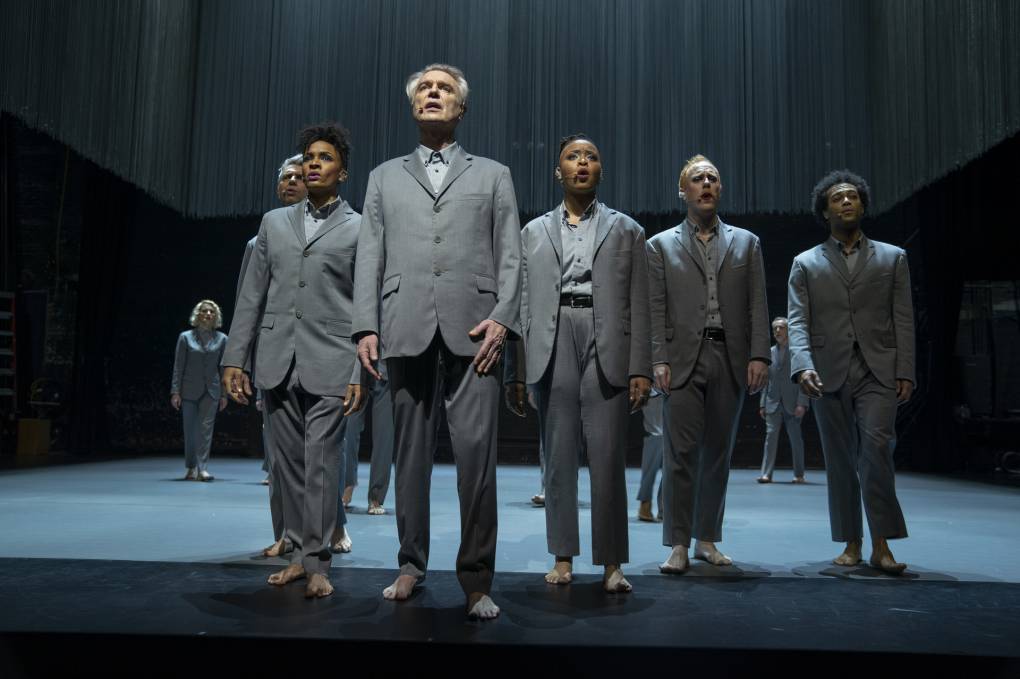
"content": "\u003cp>Back when the Nazis were running roughshod over his homeland, \u003ca href=\"https://www.npr.org/artists/15294092/bertolt-brecht\" target=\"_blank\" rel=\"noopener noreferrer\">Bertolt Brecht\u003c/a> wrote a short poem that asked, “In the dark times, will there still be singing?” And it gave a reply: “Yes, there will be singing. About the dark times.”\u003c/p>\n\u003cp>Of course, there are many ways of singing about darkness. One is to celebrate hope. That’s what’s on offer in HBO’s \u003cem>David Byrne’s American Utopia\u003c/em>, a joyous blend of song, dance and revival meeting. The film, which captures a live performance of Byrne’s acclaimed Broadway show, was directed by \u003ca href=\"https://www.npr.org/2017/12/14/570761380/31-years-later-spike-lees-got-a-fresh-take-on-shes-gotta-have-it\" target=\"_blank\" rel=\"noopener noreferrer\">Spike Lee\u003c/a>.\u003c/p>\n\u003cp>Now, Spike might not be the first person you’d expect to click with Byrne, a guy I don’t exactly picture yelling courtside at a Knicks game. Yet Lee is terrific at filming live performances, and his swooping, shrewdly observant camera meshes perfectly with Byrne’s layered and rousing sense of musical theater. This is one show you can dance to.\u003c/p>\n\u003cp>\u003cem>American Utopia\u003c/em> starts with Byrne, barefoot in a silver-gray suit, holding a model of the brain and pondering different ideas of connection. He’s gradually joined by his equally barefoot co-stars, also uniformed in silver-gray suits, who sing, dance and play hand-held instruments as they perform nearly 20 Byrne songs, from his Talking Heads classics to his more recent solo work. Thanks to wireless technology, everyone moves around the stage in seemingly total freedom.\u003c/p>\n\u003cp>Byrne’s work has long been obsessed with the many ways of being imprisoned—in oneself, in an addiction to things, in a meaningless life—and equally attuned to different forms of escape. \u003cem>American Utopia\u003c/em> features a series of songs that ask questions about the meaning of home. The answers range from the welcoming good spirits of “Everybody’s Coming to My House” to the rowdier energies found in \u003ca href=\"https://www.npr.org/artists/15321830/talking-heads\" target=\"_blank\" rel=\"noopener noreferrer\">Talking Heads\u003c/a>‘ party song “Burning Down the House.”\u003c/p>\n\u003cp>[ad fullwidth]\u003c/p>\n\u003cp>https://www.youtube.com/watch?v=lg4hcgtjDPc\u003c/p>\n\u003cp>In fact, the show isn’t actually about burning anything down. It’s about conjuring an image of an American utopia. You’ll be relieved to hear that Byrne is not hectoring. Yes, he gives a little speech about the need to vote—but he doesn’t say who for. And yes, Byrne points out that many of his cast members are immigrants, as is he—a naturalized American born in Scotland. Yet his vision of utopia is not any kind of political program. It’s the show itself.\u003c/p>\n\u003cp>For Byrne, utopia is about embracing difference. It’s about men and women from a diversity of races and cultures coming together to create something new, alive and beautiful that helps people connect. While Byrne starts alone on the stage, by the grand finale, he and his co-stars are marching through the aisles singing the cheery song “Road to Nowhere.” Everybody’s together on-screen—even the audience.\u003c/p>\n\u003cp>In a way, the show echoes Byrne’s own artistic transformation. Back in his early, post-punk days, he was almost a parody of the nerdy, angst-riddled white guy. With his on-stage tics and spasms, he seemed a bit like \u003cem>Psycho\u003c/em>‘s \u003ca href=\"https://www.npr.org/templates/story/story.php?storyId=91947125\" target=\"_blank\" rel=\"noopener noreferrer\">Norman Bates,\u003c/a> if Norman hadn’t turned into his dead mother but instead gone to art school. What liberated him seems to have been his encounter with Black music, both American funk and the complex rhythms of Brazil. Byrne’s persona became sunnier and more communal, as you could see in Jonathan Demme’s great 1984 concert film \u003cem>Stop Making Sense\u003c/em>, where Byrne and his fellow Talking Heads exude sheer collective joy.\u003c/p>\n\u003cp>Now, the skeptic in me feels obliged to note one limitation of the show’s communitarian notion of utopia. Byrne writes and sings lead on all the songs—he’s obviously the star. Everybody else plays second fiddle, and while they clearly enjoy performing, I suspect being a backup is not how \u003cem>they\u003c/em> view utopia.\u003c/p>\n\u003cp>Yet if Byrne doesn’t always rise above stardom’s privilege, he is attuned to other ways he’s privileged. He realizes that the show’s upbeat vibe could easily turn into feelgood kitsch that feels disconnected from present-day reality. He puts some political steel in the show’s spine by including a startling rendition of the \u003ca href=\"https://www.npr.org/2020/05/18/856841290/janelle-mon-e-wants-to-represent-the-underdog-in-music-and-onscreen\" target=\"_blank\" rel=\"noopener noreferrer\">Janelle Monáe\u003c/a> protest song, “\u003ca href=\"https://www.npr.org/sections/allsongs/2015/08/18/385202798/janelle-mon-e-releases-visceral-protest-song-hell-you-talmbout\" target=\"_blank\" rel=\"noopener noreferrer\">Hell You Talmbout\u003c/a>,” whose lyrics are basically the names of African Americans who have died at police hands or from racial violence.\u003c/p>\n\u003cp>\u003c/p>\n\u003cp>This powerful song is political in the way Byrne’s talk about voting is not. Yet its presence offers a necessary reminder that any utopia begins in a world that is painfully far from perfect. You can only sing yourself through the dark times if you don’t forget how dark they can be.\u003c/p>\n\u003cdiv class=\"fullattribution\">\u003cem>Copyright 2020 Fresh Air. To see more, visit \u003ca href=\"http://www.npr.org/programs/fresh-air/\" target=\"_blank\" rel=\"noopener noreferrer\">Fresh Air\u003c/a>.\u003cimg decoding=\"async\" src=\"https://www.google-analytics.com/__utm.gif?utmac=UA-5828686-4&utmdt=David+Byrne+And+Spike+Lee+Conjure+Up+A+Joyous+Vision+Of+%27American+Utopia%27+&utme=8(APIKey)9(MDAxOTAwOTE4MDEyMTkxMDAzNjczZDljZA004)\">\u003c/em>\u003c/div>\n\n",
"stats": {
"hasVideo": true,
"hasChartOrMap": false,
"hasAudio": false,
"hasPolis": false,
"wordCount": 853,
"hasGoogleForm": false,
"hasGallery": false,
"hasHearkenModule": false,
"iframeSrcs": [],
"paragraphCount": 13
},
"modified": 1705019993,
"excerpt": "Lee's new film for HBO captures a live performance of Byrne's acclaimed Broadway show, 'David Byrne's American Utopia.' ",
"headData": {
"twImgId": "",
"twTitle": "",
"ogTitle": "",
"ogImgId": "",
"twDescription": "",
"description": "Lee's new film for HBO captures a live performance of Byrne's acclaimed Broadway show, 'David Byrne's American Utopia.' ",
"title": "David Byrne and Spike Lee Conjure Up a Joyous Vision of 'American Utopia' | KQED",
"ogDescription": "",
"schema": {
"@context": "https://schema.org",
"@type": "Article",
"headline": "David Byrne and Spike Lee Conjure Up a Joyous Vision of 'American Utopia'",
"datePublished": "2020-10-13T15:24:35-07:00",
"dateModified": "2024-01-11T16:39:53-08:00",
"image": "https://cdn.kqed.org/wp-content/uploads/2020/02/KQED-OG-Image@1x.png"
}
},
"guestAuthors": [],
"slug": "david-byrne-and-spike-lee-conjure-up-a-joyous-vision-of-american-utopia",
"status": "publish",
"nprApiLink": "http://api.npr.org/query?id=923258756&apiKey=MDAxOTAwOTE4MDEyMTkxMDAzNjczZDljZA004",
"templateType": "standard",
"nprStoryDate": "Tue, 13 Oct 2020 14:48:41 -0400",
"nprLastModifiedDate": "Tue, 13 Oct 2020 14:49:40 -0400",
"featuredImageType": "standard",
"nprHtmlLink": "https://www.npr.org/2020/10/13/923258756/david-byrne-and-spike-lee-conjure-up-a-joyous-vision-of-american-utopia?ft=nprml&f=923258756",
"nprAudio": "https://ondemand.npr.org/anon.npr-mp3/npr/fa/2020/10/20201013_fa_02.mp3?orgId=427869011&topicId=4467349&d=500&p=13&story=923258756&ft=nprml&f=923258756",
"nprImageAgency": "HBO",
"nprAudioM3u": "http://api.npr.org/m3u/1923314145-90c31b.m3u?orgId=427869011&topicId=4467349&d=500&p=13&story=923258756&ft=nprml&f=923258756",
"nprStoryId": "923258756",
"nprByline": "John Powers",
"sticky": false,
"nprImageCredit": "David Lee",
"nprRetrievedStory": "1",
"nprPubDate": "Tue, 13 Oct 2020 14:52:00 -0400",
"path": "/arts/13887871/david-byrne-and-spike-lee-conjure-up-a-joyous-vision-of-american-utopia",
"audioUrl": "https://ondemand.npr.org/anon.npr-mp3/npr/fa/2020/10/20201013_fa_02.mp3?orgId=427869011&topicId=4467349&d=500&p=13&story=923258756&ft=nprml&f=923258756",
"audioTrackLength": null,
"parsedContent": [
{
"type": "contentString",
"content": "\u003cdiv class=\"post-body\">\u003cp>\u003cp>Back when the Nazis were running roughshod over his homeland, \u003ca href=\"https://www.npr.org/artists/15294092/bertolt-brecht\" target=\"_blank\" rel=\"noopener noreferrer\">Bertolt Brecht\u003c/a> wrote a short poem that asked, “In the dark times, will there still be singing?” And it gave a reply: “Yes, there will be singing. About the dark times.”\u003c/p>\n\u003cp>Of course, there are many ways of singing about darkness. One is to celebrate hope. That’s what’s on offer in HBO’s \u003cem>David Byrne’s American Utopia\u003c/em>, a joyous blend of song, dance and revival meeting. The film, which captures a live performance of Byrne’s acclaimed Broadway show, was directed by \u003ca href=\"https://www.npr.org/2017/12/14/570761380/31-years-later-spike-lees-got-a-fresh-take-on-shes-gotta-have-it\" target=\"_blank\" rel=\"noopener noreferrer\">Spike Lee\u003c/a>.\u003c/p>\n\u003cp>Now, Spike might not be the first person you’d expect to click with Byrne, a guy I don’t exactly picture yelling courtside at a Knicks game. Yet Lee is terrific at filming live performances, and his swooping, shrewdly observant camera meshes perfectly with Byrne’s layered and rousing sense of musical theater. This is one show you can dance to.\u003c/p>\n\u003cp>\u003cem>American Utopia\u003c/em> starts with Byrne, barefoot in a silver-gray suit, holding a model of the brain and pondering different ideas of connection. He’s gradually joined by his equally barefoot co-stars, also uniformed in silver-gray suits, who sing, dance and play hand-held instruments as they perform nearly 20 Byrne songs, from his Talking Heads classics to his more recent solo work. Thanks to wireless technology, everyone moves around the stage in seemingly total freedom.\u003c/p>\n\u003cp>Byrne’s work has long been obsessed with the many ways of being imprisoned—in oneself, in an addiction to things, in a meaningless life—and equally attuned to different forms of escape. \u003cem>American Utopia\u003c/em> features a series of songs that ask questions about the meaning of home. The answers range from the welcoming good spirits of “Everybody’s Coming to My House” to the rowdier energies found in \u003ca href=\"https://www.npr.org/artists/15321830/talking-heads\" target=\"_blank\" rel=\"noopener noreferrer\">Talking Heads\u003c/a>‘ party song “Burning Down the House.”\u003c/p>\n\u003cp>\u003c/p>\u003c/div>",
"attributes": {
"named": {},
"numeric": []
}
},
{
"type": "component",
"content": "",
"name": "ad",
"attributes": {
"named": {
"label": "fullwidth"
},
"numeric": [
"fullwidth"
]
}
},
{
"type": "contentString",
"content": "\u003cdiv class=\"post-body\">\u003cp>\u003c/p>\u003c/p>\u003cp>\u003cspan class='utils-parseShortcode-shortcodes-__youtubeShortcode__embedYoutube'>\n \u003cspan class='utils-parseShortcode-shortcodes-__youtubeShortcode__embedYoutubeInside'>\n \u003ciframe\n loading='lazy'\n class='utils-parseShortcode-shortcodes-__youtubeShortcode__youtubePlayer'\n type='text/html'\n src='//www.youtube.com/embed/lg4hcgtjDPc'\n title='//www.youtube.com/embed/lg4hcgtjDPc'\n allowfullscreen='true'\n style='border:0;'>\u003c/iframe>\n \u003c/span>\n \u003c/span>\u003c/p>\u003cp>\u003cp>In fact, the show isn’t actually about burning anything down. It’s about conjuring an image of an American utopia. You’ll be relieved to hear that Byrne is not hectoring. Yes, he gives a little speech about the need to vote—but he doesn’t say who for. And yes, Byrne points out that many of his cast members are immigrants, as is he—a naturalized American born in Scotland. Yet his vision of utopia is not any kind of political program. It’s the show itself.\u003c/p>\n\u003cp>For Byrne, utopia is about embracing difference. It’s about men and women from a diversity of races and cultures coming together to create something new, alive and beautiful that helps people connect. While Byrne starts alone on the stage, by the grand finale, he and his co-stars are marching through the aisles singing the cheery song “Road to Nowhere.” Everybody’s together on-screen—even the audience.\u003c/p>\n\u003cp>In a way, the show echoes Byrne’s own artistic transformation. Back in his early, post-punk days, he was almost a parody of the nerdy, angst-riddled white guy. With his on-stage tics and spasms, he seemed a bit like \u003cem>Psycho\u003c/em>‘s \u003ca href=\"https://www.npr.org/templates/story/story.php?storyId=91947125\" target=\"_blank\" rel=\"noopener noreferrer\">Norman Bates,\u003c/a> if Norman hadn’t turned into his dead mother but instead gone to art school. What liberated him seems to have been his encounter with Black music, both American funk and the complex rhythms of Brazil. Byrne’s persona became sunnier and more communal, as you could see in Jonathan Demme’s great 1984 concert film \u003cem>Stop Making Sense\u003c/em>, where Byrne and his fellow Talking Heads exude sheer collective joy.\u003c/p>\n\u003cp>Now, the skeptic in me feels obliged to note one limitation of the show’s communitarian notion of utopia. Byrne writes and sings lead on all the songs—he’s obviously the star. Everybody else plays second fiddle, and while they clearly enjoy performing, I suspect being a backup is not how \u003cem>they\u003c/em> view utopia.\u003c/p>\n\u003cp>Yet if Byrne doesn’t always rise above stardom’s privilege, he is attuned to other ways he’s privileged. He realizes that the show’s upbeat vibe could easily turn into feelgood kitsch that feels disconnected from present-day reality. He puts some political steel in the show’s spine by including a startling rendition of the \u003ca href=\"https://www.npr.org/2020/05/18/856841290/janelle-mon-e-wants-to-represent-the-underdog-in-music-and-onscreen\" target=\"_blank\" rel=\"noopener noreferrer\">Janelle Monáe\u003c/a> protest song, “\u003ca href=\"https://www.npr.org/sections/allsongs/2015/08/18/385202798/janelle-mon-e-releases-visceral-protest-song-hell-you-talmbout\" target=\"_blank\" rel=\"noopener noreferrer\">Hell You Talmbout\u003c/a>,” whose lyrics are basically the names of African Americans who have died at police hands or from racial violence.\u003c/p>\n\u003cp>\u003c/p>\n\u003cp>This powerful song is political in the way Byrne’s talk about voting is not. Yet its presence offers a necessary reminder that any utopia begins in a world that is painfully far from perfect. You can only sing yourself through the dark times if you don’t forget how dark they can be.\u003c/p>\n\u003cdiv class=\"fullattribution\">\u003cem>Copyright 2020 Fresh Air. To see more, visit \u003ca href=\"http://www.npr.org/programs/fresh-air/\" target=\"_blank\" rel=\"noopener noreferrer\">Fresh Air\u003c/a>.\u003cimg decoding=\"async\" src=\"https://www.google-analytics.com/__utm.gif?utmac=UA-5828686-4&utmdt=David+Byrne+And+Spike+Lee+Conjure+Up+A+Joyous+Vision+Of+%27American+Utopia%27+&utme=8(APIKey)9(MDAxOTAwOTE4MDEyMTkxMDAzNjczZDljZA004)\">\u003c/em>\u003c/div>\n\n\u003c/div>\u003c/p>",
"attributes": {
"named": {},
"numeric": []
}
}
],
"link": "/arts/13887871/david-byrne-and-spike-lee-conjure-up-a-joyous-vision-of-american-utopia",
"authors": [
"byline_arts_13887871"
],
"categories": [
"arts_1"
],
"tags": [
"arts_2347",
"arts_12467",
"arts_8350",
"arts_4001"
],
"affiliates": [
"arts_137"
],
"featImg": "arts_13887872",
"label": "arts_137"
},
"arts_13887038": {
"type": "posts",
"id": "arts_13887038",
"meta": {
"index": "posts_1716263798",
"site": "arts",
"id": "13887038",
"score": null,
"sort": [
1601393463000
]
},
"parent": 0,
"labelTerm": {
"site": "arts",
"term": 140
},
"blocks": [],
"publishDate": 1601393463,
"format": "standard",
"title": "Watch: ‘Sex and the City’ Reenactments, Only Samantha is a Cat",
"headTitle": "Watch: ‘Sex and the City’ Reenactments, Only Samantha is a Cat | KQED",
"content": "\u003cp>Last week, Cynthia Nixon endorsed Sharon Stone to play Samantha Jones in \u003cem>Sex and the City 3\u003c/em>—and Stone told \u003cem>CNN\u003c/em> it would be an “\u003ca href=\"https://www.cnn.com/2020/09/24/entertainment/cynthia-nixon-sharon-stone-sex-city/index.html\" target=\"_blank\" rel=\"noopener noreferrer\">honor\u003c/a>.” As most fans of the hugely popular HBO series already know, the follow up to 2010’s \u003cem>Sex and the City 2\u003c/em> movie was abandoned indefinitely after Kim Cattrall refused to participate. If anyone else could make the role of Samantha their own, it’s probably Stone. [aside postid='arts_13886425']\u003c/p>\n\u003cp>Before anyone starts drawing up expensive contracts though, it should be known that an alternative option has just sashayed into the picture. She’s a cat, she’s willing to wear a wig, and her owner has been making some very funny \u003cem>SATC\u003c/em> reenactment videos with her.\u003c/p>\n\u003cp>Actress and writer \u003ca href=\"https://www.imdb.com/name/nm0477363/\" target=\"_blank\" rel=\"noopener noreferrer\">Alexandra Kyle\u003c/a> brilliantly mimes along with the Carrie, Miranda and Charlotte dialogue (complete with appropriate dress and mannerisms) and then she leaves all of the Samantha content to her cat. The end result is considerably more fun to watch than \u003cem>Sex and the City 2\u003c/em> was.\u003c/p>\n\u003cp>Here’s that time Carrie filled out a dating service application:\u003c/p>\n\u003cp>https://www.instagram.com/p/CE18n_epemI/\u003c/p>\n\u003cp>[ad fullwidth]\u003c/p>\n\u003cp>And that time Aiden proposed to Carrie:\u003c/p>\n\u003cp>https://www.instagram.com/p/CFHu6bcJJwc/\u003c/p>\n\u003cp>And that time Berger dumped Carrie via Post-it:\u003c/p>\n\u003cp>https://www.instagram.com/p/CFqCSsspReE/\u003c/p>\n\u003cp>And—of course—that time Carrie cheated with Big:\u003c/p>\n\u003cp>https://www.instagram.com/p/CEhcCW4J-GH/\u003c/p>\n\u003cp>Kyle only commenced acting with her cat at the start of August, presumably driven to it by sheltering in place for too long. Initially the duo were reenacting scenes from \u003cem>The Hills\u003c/em> (the \u003ca href=\"https://www.instagram.com/p/CDZfFSCJADy/\" target=\"_blank\" rel=\"noopener noreferrer\">cat was Lauren Conrad\u003c/a>), along with \u003ca href=\"https://www.instagram.com/p/CE9mJGQJPmI/\" target=\"_blank\" rel=\"noopener noreferrer\">a moment from \u003cem>Mean Girls\u003c/em>\u003c/a>. More recently, they did some very convincing dramatic work as Skyler and Walter White in \u003cem>Breaking Bad\u003c/em>:\u003c/p>\n\u003cp>https://www.instagram.com/p/CFe0mQoJIJh/\u003c/p>\n\u003cp>\u003c/p>\n\u003cp>But it’s with \u003cem>Sex and the City\u003c/em> that these two have really found their sweet spot. The dramatic partnership is in its very earliest stages—the four videos above are it for Kyle and cat’s \u003cem>SATC\u003c/em> content so far. But with 94 episodes and two movies to play with, this might be a gift that keeps on giving for months for come. Hell, we may not even need a third \u003cem>Sex and the City\u003c/em> movie now.\u003c/p>\n\n",
"stats": {
"hasVideo": false,
"hasChartOrMap": false,
"hasAudio": false,
"hasPolis": false,
"wordCount": 393,
"hasGoogleForm": false,
"hasGallery": false,
"hasHearkenModule": false,
"iframeSrcs": [],
"paragraphCount": 11
},
"modified": 1705020067,
"excerpt": "‘Sex and the City 3’ was abandoned after Kim Cattrall ditched the role of Samantha. But fear not—there’s a cat for that.",
"headData": {
"twImgId": "",
"twTitle": "",
"ogTitle": "",
"ogImgId": "",
"twDescription": "",
"description": "‘Sex and the City 3’ was abandoned after Kim Cattrall ditched the role of Samantha. But fear not—there’s a cat for that.",
"title": "Watch: ‘Sex and the City’ Reenactments, Only Samantha is a Cat | KQED",
"ogDescription": "",
"schema": {
"@context": "https://schema.org",
"@type": "Article",
"headline": "Watch: ‘Sex and the City’ Reenactments, Only Samantha is a Cat",
"datePublished": "2020-09-29T08:31:03-07:00",
"dateModified": "2024-01-11T16:41:07-08:00",
"image": "https://cdn.kqed.org/wp-content/uploads/2020/02/KQED-OG-Image@1x.png"
}
},
"guestAuthors": [],
"slug": "watch-sex-and-the-city-reenactments-only-samantha-is-a-cat",
"status": "publish",
"templateType": "standard",
"featuredImageType": "standard",
"sticky": false,
"path": "/arts/13887038/watch-sex-and-the-city-reenactments-only-samantha-is-a-cat",
"audioTrackLength": null,
"parsedContent": [
{
"type": "contentString",
"content": "\u003cdiv class=\"post-body\">\u003cp>\u003cp>Last week, Cynthia Nixon endorsed Sharon Stone to play Samantha Jones in \u003cem>Sex and the City 3\u003c/em>—and Stone told \u003cem>CNN\u003c/em> it would be an “\u003ca href=\"https://www.cnn.com/2020/09/24/entertainment/cynthia-nixon-sharon-stone-sex-city/index.html\" target=\"_blank\" rel=\"noopener noreferrer\">honor\u003c/a>.” As most fans of the hugely popular HBO series already know, the follow up to 2010’s \u003cem>Sex and the City 2\u003c/em> movie was abandoned indefinitely after Kim Cattrall refused to participate. If anyone else could make the role of Samantha their own, it’s probably Stone. \u003c/p>\u003c/div>",
"attributes": {
"named": {},
"numeric": []
}
},
{
"type": "component",
"content": "",
"name": "aside",
"attributes": {
"named": {
"postid": "arts_13886425",
"label": ""
},
"numeric": []
}
},
{
"type": "contentString",
"content": "\u003cdiv class=\"post-body\">\u003cp>\u003c/p>\n\u003cp>Before anyone starts drawing up expensive contracts though, it should be known that an alternative option has just sashayed into the picture. She’s a cat, she’s willing to wear a wig, and her owner has been making some very funny \u003cem>SATC\u003c/em> reenactment videos with her.\u003c/p>\n\u003cp>Actress and writer \u003ca href=\"https://www.imdb.com/name/nm0477363/\" target=\"_blank\" rel=\"noopener noreferrer\">Alexandra Kyle\u003c/a> brilliantly mimes along with the Carrie, Miranda and Charlotte dialogue (complete with appropriate dress and mannerisms) and then she leaves all of the Samantha content to her cat. The end result is considerably more fun to watch than \u003cem>Sex and the City 2\u003c/em> was.\u003c/p>\n\u003cp>Here’s that time Carrie filled out a dating service application:\u003c/p>\u003c/p>\u003c/div>",
"attributes": {
"named": {},
"numeric": []
}
},
{
"type": "component",
"content": "",
"name": "instagramLink",
"attributes": {
"named": {
"instagramUrl": "https://www.instagram.com/p/CE18n_epemI/"
},
"numeric": []
}
},
{
"type": "contentString",
"content": "\u003cdiv class=\"post-body\">\u003cp>\u003cp>\u003c/p>\u003c/div>",
"attributes": {
"named": {},
"numeric": []
}
},
{
"type": "component",
"content": "",
"name": "ad",
"attributes": {
"named": {
"label": "fullwidth"
},
"numeric": [
"fullwidth"
]
}
},
{
"type": "contentString",
"content": "\u003cdiv class=\"post-body\">\u003cp>\u003c/p>\n\u003cp>And that time Aiden proposed to Carrie:\u003c/p>\u003c/p>\u003c/div>",
"attributes": {
"named": {},
"numeric": []
}
},
{
"type": "component",
"content": "",
"name": "instagramLink",
"attributes": {
"named": {
"instagramUrl": "https://www.instagram.com/p/CFHu6bcJJwc/"
},
"numeric": []
}
},
{
"type": "contentString",
"content": "\u003cdiv class=\"post-body\">\u003cp>\u003cp>And that time Berger dumped Carrie via Post-it:\u003c/p>\u003c/p>\u003c/div>",
"attributes": {
"named": {},
"numeric": []
}
},
{
"type": "component",
"content": "",
"name": "instagramLink",
"attributes": {
"named": {
"instagramUrl": "https://www.instagram.com/p/CFqCSsspReE/"
},
"numeric": []
}
},
{
"type": "contentString",
"content": "\u003cdiv class=\"post-body\">\u003cp>\u003cp>And—of course—that time Carrie cheated with Big:\u003c/p>\u003c/p>\u003c/div>",
"attributes": {
"named": {},
"numeric": []
}
},
{
"type": "component",
"content": "",
"name": "instagramLink",
"attributes": {
"named": {
"instagramUrl": "https://www.instagram.com/p/CEhcCW4J-GH/"
},
"numeric": []
}
},
{
"type": "contentString",
"content": "\u003cdiv class=\"post-body\">\u003cp>\u003cp>Kyle only commenced acting with her cat at the start of August, presumably driven to it by sheltering in place for too long. Initially the duo were reenacting scenes from \u003cem>The Hills\u003c/em> (the \u003ca href=\"https://www.instagram.com/p/CDZfFSCJADy/\" target=\"_blank\" rel=\"noopener noreferrer\">cat was Lauren Conrad\u003c/a>), along with \u003ca href=\"https://www.instagram.com/p/CE9mJGQJPmI/\" target=\"_blank\" rel=\"noopener noreferrer\">a moment from \u003cem>Mean Girls\u003c/em>\u003c/a>. More recently, they did some very convincing dramatic work as Skyler and Walter White in \u003cem>Breaking Bad\u003c/em>:\u003c/p>\u003c/p>\u003c/div>",
"attributes": {
"named": {},
"numeric": []
}
},
{
"type": "component",
"content": "",
"name": "instagramLink",
"attributes": {
"named": {
"instagramUrl": "https://www.instagram.com/p/CFe0mQoJIJh/"
},
"numeric": []
}
},
{
"type": "contentString",
"content": "\u003cdiv class=\"post-body\">\u003cp>\u003cp>\u003c/p>\n\u003cp>But it’s with \u003cem>Sex and the City\u003c/em> that these two have really found their sweet spot. The dramatic partnership is in its very earliest stages—the four videos above are it for Kyle and cat’s \u003cem>SATC\u003c/em> content so far. But with 94 episodes and two movies to play with, this might be a gift that keeps on giving for months for come. Hell, we may not even need a third \u003cem>Sex and the City\u003c/em> movie now.\u003c/p>\n\n\u003c/div>\u003c/p>",
"attributes": {
"named": {},
"numeric": []
}
}
],
"link": "/arts/13887038/watch-sex-and-the-city-reenactments-only-samantha-is-a-cat",
"authors": [
"11242"
],
"programs": [
"arts_140"
],
"categories": [
"arts_1",
"arts_75"
],
"tags": [
"arts_9340",
"arts_4295",
"arts_977",
"arts_8350",
"arts_2098",
"arts_10416",
"arts_5422",
"arts_2391",
"arts_585"
],
"featImg": "arts_13887058",
"label": "arts_140"
},
"arts_13886347": {
"type": "posts",
"id": "arts_13886347",
"meta": {
"index": "posts_1716263798",
"site": "arts",
"id": "13886347",
"score": null,
"sort": [
1600212892000
]
},
"parent": 0,
"labelTerm": {
"site": "arts",
"term": 137
},
"blocks": [],
"publishDate": 1600212892,
"format": "standard",
"title": "'The Third Day' Makes Mysterious But Predictable Promises",
"headTitle": "‘The Third Day’ Makes Mysterious But Predictable Promises | KQED",
"content": "\u003cp>A community of strange locals, closed-mouthed about their history and their practices but firmly separated from most of society, is a staple of mystery stories. So is the person who stumbles upon them, fascinated and frightened and seduced by the unknown.\u003c/p>\n\u003cp>That’s the basic set-up for \u003cem>The Third Day\u003c/em>, a six-part HBO miniseries that premiered Monday night. Jude Law stars as Sam, a man we first meet while he’s in the middle of a frantic phone call, stopped by the side of a deserted road. We quickly learn that he’s got problems at home, but he’s also on his way to complete a ritual related to grief in his past. He encounters a young teenager in distress, and he wants to help her and take her home, so he follows her directions to Osea Island. Sam finds it—you guessed it—odd, beguiling, confusing, full of mystery.\u003c/p>\n\u003cp>The series is divided into two parts. We will follow Sam’s story for the first three episodes, called “Summer,” and then we will follow a woman named Helen (Naomie Harris) and her daughters—who also find themselves at Osea Island—for three episodes, called “Winter.” How this all comes together into a single narrative is something it wouldn’t be fair to explain (critics were given five out of the six episodes, making reviewing it something of a challenge).\u003c/p>\n\u003cp>\u003cem>The Third Day \u003c/em>is an effective creepy mystery in the early going, setting up question after question—\u003cem>why did that person do that? What is he talking about? What’s that mysterious-looking thing?—\u003c/em>that it will eventually have to answer in order to be satisfying. Many of those questions are answered over the course of the first five episodes, and they do hang together in a coherent fashion. The problem is that the story they tell isn’t all that interesting, nor is it outside the … well, the expected set of explanations for a community of creepy locals. It calls back to numerous other stories of those who stumble into towns from which they probably should skedaddle posthaste, to the point where you could almost diagram at the beginning the flow chart of options for where this is all going, and you wouldn’t have to move very far off the chart by the end.\u003c/p>\n\u003cp>https://www.youtube.com/watch?v=T43V6z9wYyE\u003c/p>\n\u003cp>[ad fullwidth]\u003c/p>\n\u003cp>Law is a talented actor who’s expanded his image since his impossibly pretty youth, and this is certainly one of his less glamorous roles. (But let’s face it: He’s still one of the most facially symmetrical actors we have.) He’s always been more interesting when used at an angle, either in a way that makes his beauty tragic (as in \u003cem>The Talented Mr. Ripley\u003c/em>) or that transforms his charisma into something almost grotesque (as in \u003cem>Spy\u003c/em>). Sam is certainly a tortured man with a pained history that gives Law a lot of room to emote, but is the character particularly \u003cem>complex\u003c/em>? I’m not sure. It feels at times like \u003cem>The Third Day \u003c/em>has confusion where it should have nuance, the blunt sense that you’re waiting for an envelope to be opened where you should feel engrossed in the fates of the characters.\u003c/p>\n\u003cp>The cast is solid, even outside of Law, who carries the first half: Harris is a good and protective mom, Emily Watson is fun as one of the townspeople whose entire demeanor should be a red flag for Sam, and Katherine Waterston is just the right amount of normal as a woman who explains to Sam that she came to Osea to study it. It’s possible that choosing any of those characters, rather than Sam, to carry the first three episodes might have been wise, if only to change up the point of view.\u003c/p>\n\u003cp>\u003c/p>\n\u003cp>It’s hard to knock a show that knows what its mood is (in this case, creeping dread) and carries it through. Genre pieces feel like the genres they belong to, and it’s unfair to ding them for that. But there’s something that just never quite takes off about these five installments (I’d love to tell you whether the sixth solves the problem, but who knows?). The setting is there, but there’s something disappointing about the reveals, and a little hollow. You want the resolution to a mystery to be expansive like an essay, not just a multiple-choice question where you can finally circle the right answer.\u003c/p>\n\u003cdiv class=\"fullattribution\">\u003cem>Copyright 2020 NPR. To see more, visit \u003ca href=\"https://www.npr.org\" target=\"_blank\" rel=\"noopener noreferrer\">NPR\u003c/a>.\u003cimg decoding=\"async\" src=\"https://www.google-analytics.com/__utm.gif?utmac=UA-5828686-4&utmdt=%27The+Third+Day%27+Makes+Mysterious+But+Predictable+Promises&utme=8(APIKey)9(MDAxOTAwOTE4MDEyMTkxMDAzNjczZDljZA004)\">\u003c/em>\u003c/div>\n\n",
"stats": {
"hasVideo": true,
"hasChartOrMap": false,
"hasAudio": false,
"hasPolis": false,
"wordCount": 794,
"hasGoogleForm": false,
"hasGallery": false,
"hasHearkenModule": false,
"iframeSrcs": [],
"paragraphCount": 9
},
"modified": 1705020135,
"excerpt": "HBO's 'The Third Day' is a tale of outsiders in a community of mysterious locals—and can feel a tad familiar because of it.",
"headData": {
"twImgId": "",
"twTitle": "",
"ogTitle": "",
"ogImgId": "",
"twDescription": "",
"description": "HBO's 'The Third Day' is a tale of outsiders in a community of mysterious locals—and can feel a tad familiar because of it.",
"title": "'The Third Day' Makes Mysterious But Predictable Promises | KQED",
"ogDescription": "",
"schema": {
"@context": "https://schema.org",
"@type": "Article",
"headline": "'The Third Day' Makes Mysterious But Predictable Promises",
"datePublished": "2020-09-15T16:34:52-07:00",
"dateModified": "2024-01-11T16:42:15-08:00",
"image": "https://cdn.kqed.org/wp-content/uploads/2020/02/KQED-OG-Image@1x.png"
}
},
"guestAuthors": [],
"slug": "the-third-day-makes-mysterious-but-predictable-promises",
"status": "publish",
"nprApiLink": "http://api.npr.org/query?id=912693066&apiKey=MDAxOTAwOTE4MDEyMTkxMDAzNjczZDljZA004",
"templateType": "standard",
"nprStoryDate": "Tue, 15 Sep 2020 05:20:00 -0400",
"nprLastModifiedDate": "Tue, 15 Sep 2020 05:42:02 -0400",
"featuredImageType": "standard",
"nprHtmlLink": "https://www.npr.org/2020/09/15/912693066/the-third-day-makes-mysterious-but-predictable-promises?ft=nprml&f=912693066",
"nprImageAgency": "HBO",
"nprStoryId": "912693066",
"nprByline": "Linda Holmes",
"sticky": false,
"nprImageCredit": "Robert Ludovic",
"nprRetrievedStory": "1",
"nprPubDate": "Tue, 15 Sep 2020 05:42:00 -0400",
"path": "/arts/13886347/the-third-day-makes-mysterious-but-predictable-promises",
"audioTrackLength": null,
"parsedContent": [
{
"type": "contentString",
"content": "\u003cdiv class=\"post-body\">\u003cp>\u003cp>A community of strange locals, closed-mouthed about their history and their practices but firmly separated from most of society, is a staple of mystery stories. So is the person who stumbles upon them, fascinated and frightened and seduced by the unknown.\u003c/p>\n\u003cp>That’s the basic set-up for \u003cem>The Third Day\u003c/em>, a six-part HBO miniseries that premiered Monday night. Jude Law stars as Sam, a man we first meet while he’s in the middle of a frantic phone call, stopped by the side of a deserted road. We quickly learn that he’s got problems at home, but he’s also on his way to complete a ritual related to grief in his past. He encounters a young teenager in distress, and he wants to help her and take her home, so he follows her directions to Osea Island. Sam finds it—you guessed it—odd, beguiling, confusing, full of mystery.\u003c/p>\n\u003cp>The series is divided into two parts. We will follow Sam’s story for the first three episodes, called “Summer,” and then we will follow a woman named Helen (Naomie Harris) and her daughters—who also find themselves at Osea Island—for three episodes, called “Winter.” How this all comes together into a single narrative is something it wouldn’t be fair to explain (critics were given five out of the six episodes, making reviewing it something of a challenge).\u003c/p>\n\u003cp>\u003cem>The Third Day \u003c/em>is an effective creepy mystery in the early going, setting up question after question—\u003cem>why did that person do that? What is he talking about? What’s that mysterious-looking thing?—\u003c/em>that it will eventually have to answer in order to be satisfying. Many of those questions are answered over the course of the first five episodes, and they do hang together in a coherent fashion. The problem is that the story they tell isn’t all that interesting, nor is it outside the … well, the expected set of explanations for a community of creepy locals. It calls back to numerous other stories of those who stumble into towns from which they probably should skedaddle posthaste, to the point where you could almost diagram at the beginning the flow chart of options for where this is all going, and you wouldn’t have to move very far off the chart by the end.\u003c/p>\u003c/p>\u003cp>\u003cspan class='utils-parseShortcode-shortcodes-__youtubeShortcode__embedYoutube'>\n \u003cspan class='utils-parseShortcode-shortcodes-__youtubeShortcode__embedYoutubeInside'>\n \u003ciframe\n loading='lazy'\n class='utils-parseShortcode-shortcodes-__youtubeShortcode__youtubePlayer'\n type='text/html'\n src='//www.youtube.com/embed/T43V6z9wYyE'\n title='//www.youtube.com/embed/T43V6z9wYyE'\n allowfullscreen='true'\n style='border:0;'>\u003c/iframe>\n \u003c/span>\n \u003c/span>\u003c/p>\u003cp>\u003cp>\u003c/p>\u003c/div>",
"attributes": {
"named": {},
"numeric": []
}
},
{
"type": "component",
"content": "",
"name": "ad",
"attributes": {
"named": {
"label": "fullwidth"
},
"numeric": [
"fullwidth"
]
}
},
{
"type": "contentString",
"content": "\u003cdiv class=\"post-body\">\u003cp>\u003c/p>\n\u003cp>Law is a talented actor who’s expanded his image since his impossibly pretty youth, and this is certainly one of his less glamorous roles. (But let’s face it: He’s still one of the most facially symmetrical actors we have.) He’s always been more interesting when used at an angle, either in a way that makes his beauty tragic (as in \u003cem>The Talented Mr. Ripley\u003c/em>) or that transforms his charisma into something almost grotesque (as in \u003cem>Spy\u003c/em>). Sam is certainly a tortured man with a pained history that gives Law a lot of room to emote, but is the character particularly \u003cem>complex\u003c/em>? I’m not sure. It feels at times like \u003cem>The Third Day \u003c/em>has confusion where it should have nuance, the blunt sense that you’re waiting for an envelope to be opened where you should feel engrossed in the fates of the characters.\u003c/p>\n\u003cp>The cast is solid, even outside of Law, who carries the first half: Harris is a good and protective mom, Emily Watson is fun as one of the townspeople whose entire demeanor should be a red flag for Sam, and Katherine Waterston is just the right amount of normal as a woman who explains to Sam that she came to Osea to study it. It’s possible that choosing any of those characters, rather than Sam, to carry the first three episodes might have been wise, if only to change up the point of view.\u003c/p>\n\u003cp>\u003c/p>\n\u003cp>It’s hard to knock a show that knows what its mood is (in this case, creeping dread) and carries it through. Genre pieces feel like the genres they belong to, and it’s unfair to ding them for that. But there’s something that just never quite takes off about these five installments (I’d love to tell you whether the sixth solves the problem, but who knows?). The setting is there, but there’s something disappointing about the reveals, and a little hollow. You want the resolution to a mystery to be expansive like an essay, not just a multiple-choice question where you can finally circle the right answer.\u003c/p>\n\u003cdiv class=\"fullattribution\">\u003cem>Copyright 2020 NPR. To see more, visit \u003ca href=\"https://www.npr.org\" target=\"_blank\" rel=\"noopener noreferrer\">NPR\u003c/a>.\u003cimg decoding=\"async\" src=\"https://www.google-analytics.com/__utm.gif?utmac=UA-5828686-4&utmdt=%27The+Third+Day%27+Makes+Mysterious+But+Predictable+Promises&utme=8(APIKey)9(MDAxOTAwOTE4MDEyMTkxMDAzNjczZDljZA004)\">\u003c/em>\u003c/div>\n\n\u003c/div>\u003c/p>",
"attributes": {
"named": {},
"numeric": []
}
}
],
"link": "/arts/13886347/the-third-day-makes-mysterious-but-predictable-promises",
"authors": [
"byline_arts_13886347"
],
"categories": [
"arts_1",
"arts_990"
],
"tags": [
"arts_977",
"arts_8350"
],
"affiliates": [
"arts_137"
],
"featImg": "arts_13886348",
"label": "arts_137"
},
"arts_13885432": {
"type": "posts",
"id": "arts_13885432",
"meta": {
"index": "posts_1716263798",
"site": "arts",
"id": "13885432",
"score": null,
"sort": [
1598563045000
]
},
"parent": 0,
"labelTerm": {
"site": "arts",
"term": 137
},
"blocks": [],
"publishDate": 1598563045,
"format": "standard",
"title": "'Class Action Park' Remembers the Perils of a Really Good Time",
"headTitle": "‘Class Action Park’ Remembers the Perils of a Really Good Time | KQED",
"content": "\u003cp>There’s a species of giddy nostalgia that involves laughing off what you barely survived. It can be even more powerful if, at the time, you didn’t know how lucky you got. It’s the nostalgia of near-miss childhood accidents and times you almost set the house on fire, and of things that fell from the ceiling a foot from your head. It’s also the nostalgia of the new documentary \u003cem>Class Action Park\u003c/em>.\u003c/p>\n\u003cp>Made by Seth Porges and Chris Charles Scott, the film chronicles Action Park, the New Jersey waterslide park that opened in 1978, enjoyed great popularity in the 1980s and is now remembered in part for the injuries and deaths that gave it its nickname and contributed to knocking it out of business in 1996. Some parks have themes like the Wild West or futurism or countries of the world; Action Park’s theme was deregulation. With roots in Wall Street arrogance and an apparent ability to wiggle around any legal obstacle its leadership encountered, the park was built around one question: \u003cem>Who says we can’t?\u003c/em>\u003c/p>\n\u003cp>Not surprisingly, it was very popular with teenagers, many of whom have a similar philosophy but not the money to translate it into physical reality. It was run by kids, too. Employees (mostly boys) who are now middle-aged men remember workers as young as 14, in flagrant violation of labor laws, being put in charge of operating rides that were unsafe to begin with. According to those who were there, the rides—built without relevant know-how or concern for safety, but with lots of drive to make everything more exciting—took out teeth, dislocated shoulders, gashed foreheads and laid down friction burns all along arms and legs.\u003c/p>\n\u003cp>More importantly, the film says, people died. Three drowned in the wave pool. One was thrown from a ride onto rocks the park had been told to remove. One was electrocuted after falling into water near submerged machinery. The park had to buy its own ambulances, so thoroughly was it monopolizing local emergency-response resources.\u003c/p>\n\u003cp>To top it all off, the liability insurance the park supposedly had was with a company park owner Gene Mulvihill set up for himself in the Cayman Islands. According to this telling, if you sued, he fought. If you won, he didn’t pay until the marshals came to the park to collect. All told, this could have been a film with the fully dark tone of an Alex Gibney exposé, but it isn’t that.\u003c/p>\n\u003cp>[ad fullwidth]\u003c/p>\n\u003cp>Because the people who remember Action Park want you to know it wasn’t all bad.\u003c/p>\n\u003cp>https://www.youtube.com/watch?v=mqg48h_uKYM\u003c/p>\n\u003cp>There is, you see, that giddy nostalgia—even a genuine, rollicking humor—in the recollections of parkgoers and employees about what it was like to visit a water park essentially built to be out of control. They say it was wild, it was exciting, it was a place to test your courage. It was fun and weird, and kids ran it without much adult supervision. People drank too much and crashed sleds and fought and, yes, they got hurt, but in its own way, it was a really good time. That’s what they all say. That’s why Jimmy Kimmel and Johnny Knoxville are grinning in a piece of old footage where they’re chatting about how dangerous everything was. It wasn’t some secret, underground den of iniquity, either: MTV filmed an episode of \u003cem>Headbangers Ball \u003c/em>there with Alice in Chains. There were TV commercials. Its dangers got written up in the paper—which, of course, made kids want to visit even more.\u003c/p>\n\u003cfigure id=\"attachment_13885440\" class=\"wp-caption alignright\" style=\"max-width: 244px\">\u003cimg loading=\"lazy\" decoding=\"async\" class=\"size-full wp-image-13885440\" src=\"https://ww2.kqed.org/app/uploads/sites/2/2020/08/Screen-Shot-2020-08-27-at-2.15.31-PM.png\" alt=\"Chris Gethard provides some of the smartest and funniest reflections in 'Class Action Park.'\" width=\"244\" height=\"229\" srcset=\"https://cdn.kqed.org/wp-content/uploads/sites/2/2020/08/Screen-Shot-2020-08-27-at-2.15.31-PM.png 244w, https://cdn.kqed.org/wp-content/uploads/sites/2/2020/08/Screen-Shot-2020-08-27-at-2.15.31-PM-160x150.png 160w\" sizes=\"(max-width: 244px) 100vw, 244px\">\u003cfigcaption class=\"wp-caption-text\">Chris Gethard provides some of the smartest and funniest reflections in ‘Class Action Park.’ \u003ccite>(HBO Max)\u003c/cite>\u003c/figcaption>\u003c/figure>\n\u003cp>That’s why the filmmakers were so smart to turn to one of our great cultural commentators on comedy/tragedy juxtapositions: comedian Chris Gethard. Gethard has done \u003ca href=\"https://www.npr.org/2017/05/06/526892264/chris-gethardisnt-kidding-about-career--suicide\" target=\"_blank\" rel=\"noopener noreferrer\">comedy about his own suicide attempt\u003c/a> and, as it turns out, he was an avid attendee at Action Park (he even talked about it on his 2019 album \u003cem>Taylor Ham, Egg and Cheese\u003c/em>, which is entirely about New Jersey). His descriptions of what the rides were like are uproariously funny, but more than any of the other people interviewed, he reckons with the limitations of nostalgia for the childhood risks you took, even if you had fun. More than anyone, he’s willing to say that the fact that something was fun, that you smile and laugh when you remember it, doesn’t mean it’s good that it happened. He talks, with admirable directness, about the fundamental conflict between how things feel when they happen to you and how you look back at them later, and that applies to a lot more than just dangerous amusement parks.\u003c/p>\n\u003cp>I don’t know that anyone else could have brought the perspective to this that Gethard does. Everyone else who isn’t directly a victim of the park’s dangers comes off as perhaps a touch too glib, a little too impressed with the bad-assery of it all, a little too willing to sound convinced that it was a good thing that kids weren’t so soft back then. Because, yes, you do get some of the expected comments about how kids aren’t allowed to ride their bikes 15 miles each way to a water park anymore, and how in the 1980s, “we” as teenagers were carefree and happy (take note: “we,” as always, is not applicable to everyone). But it’s Gethard who’s the most determined to hold in his head simultaneously the appeal of nostalgia and its traps. It’s his commentary that can comfortably live beside both the reminiscences of the people whose memories of Action Park are mostly funny and the interview with the mother of one of the boys who died there.\u003c/p>\n\u003cp>They hit the sweet spot with this movie, in that it’s a film that will work for people who knew all about Action Park (or Class Action Park, or Traction Park, or another of its nicknames), but also for people who didn’t, really. There’s plenty of retracing of the park’s rocky, slippery steps, but also a lingering, underlying quandary with broad application: “How do I put context around this experience that I enjoyed, but that I almost certainly would not have had in a better-run world?” Or perhaps, “How do I make peace with having enjoyed something that hurt people, but not because of anything I did?”\u003c/p>\n\u003cp>It’s a great story, well told. And while there are threads that could have been more thoroughly pursued (particularly allegations about Mulvihill’s influence on local politicians, who had known about the park’s safety record for years), what emerges is both a solid history of the park and a surprisingly thoughtful piece about how we contextualize our own childhoods.\u003c/p>\n\u003cp>[ad floatright]\u003c/p>\n\u003cp>\u003cem>\u003cstrong>Class Action Park \u003c/strong>\u003c/em>\u003cstrong>comes to HBO MAX on Thursday. \u003c/strong>\u003c/p>\n\u003cdiv class=\"fullattribution\">\u003cem>Copyright 2020 NPR. To see more, visit \u003ca href=\"https://www.npr.org\" target=\"_blank\" rel=\"noopener noreferrer\">NPR\u003c/a>.\u003cimg decoding=\"async\" src=\"https://www.google-analytics.com/__utm.gif?utmac=UA-5828686-4&utmdt=%27Class+Action+Park%27+Remembers+The+Perils+Of+A+Really+Good+Time&utme=8(APIKey)9(MDAxOTAwOTE4MDEyMTkxMDAzNjczZDljZA004)\">\u003c/em>\u003c/div>\n\n",
"stats": {
"hasVideo": true,
"hasChartOrMap": false,
"hasAudio": false,
"hasPolis": false,
"wordCount": 1223,
"hasGoogleForm": false,
"hasGallery": false,
"hasHearkenModule": false,
"iframeSrcs": [],
"paragraphCount": 14
},
"modified": 1705020215,
"excerpt": "The HBO documentary 'Class Action Park' tells the story of an extremely dangerous, yet beloved, New Jersey theme park.",
"headData": {
"twImgId": "",
"twTitle": "",
"ogTitle": "",
"ogImgId": "",
"twDescription": "",
"description": "The HBO documentary 'Class Action Park' tells the story of an extremely dangerous, yet beloved, New Jersey theme park.",
"title": "'Class Action Park' Remembers the Perils of a Really Good Time | KQED",
"ogDescription": "",
"schema": {
"@context": "https://schema.org",
"@type": "Article",
"headline": "'Class Action Park' Remembers the Perils of a Really Good Time",
"datePublished": "2020-08-27T14:17:25-07:00",
"dateModified": "2024-01-11T16:43:35-08:00",
"image": "https://cdn.kqed.org/wp-content/uploads/2020/02/KQED-OG-Image@1x.png"
}
},
"guestAuthors": [],
"slug": "class-action-park-remembers-the-perils-of-a-really-good-time",
"status": "publish",
"nprApiLink": "http://api.npr.org/query?id=906200363&apiKey=MDAxOTAwOTE4MDEyMTkxMDAzNjczZDljZA004",
"templateType": "standard",
"nprByline": "Linda Holmes",
"nprStoryDate": "Thu, 27 Aug 2020 05:01:06 -0400",
"nprLastModifiedDate": "Thu, 27 Aug 2020 05:01:06 -0400",
"featuredImageType": "standard",
"sticky": false,
"nprHtmlLink": "https://www.npr.org/2020/08/27/906200363/class-action-park-remembers-the-perils-of-a-really-good-time?ft=nprml&f=906200363",
"nprImageAgency": "HBO Max",
"nprStoryId": "906200363",
"nprRetrievedStory": "1",
"nprPubDate": "Thu, 27 Aug 2020 05:01:00 -0400",
"path": "/arts/13885432/class-action-park-remembers-the-perils-of-a-really-good-time",
"audioTrackLength": null,
"parsedContent": [
{
"type": "contentString",
"content": "\u003cdiv class=\"post-body\">\u003cp>\u003cp>There’s a species of giddy nostalgia that involves laughing off what you barely survived. It can be even more powerful if, at the time, you didn’t know how lucky you got. It’s the nostalgia of near-miss childhood accidents and times you almost set the house on fire, and of things that fell from the ceiling a foot from your head. It’s also the nostalgia of the new documentary \u003cem>Class Action Park\u003c/em>.\u003c/p>\n\u003cp>Made by Seth Porges and Chris Charles Scott, the film chronicles Action Park, the New Jersey waterslide park that opened in 1978, enjoyed great popularity in the 1980s and is now remembered in part for the injuries and deaths that gave it its nickname and contributed to knocking it out of business in 1996. Some parks have themes like the Wild West or futurism or countries of the world; Action Park’s theme was deregulation. With roots in Wall Street arrogance and an apparent ability to wiggle around any legal obstacle its leadership encountered, the park was built around one question: \u003cem>Who says we can’t?\u003c/em>\u003c/p>\n\u003cp>Not surprisingly, it was very popular with teenagers, many of whom have a similar philosophy but not the money to translate it into physical reality. It was run by kids, too. Employees (mostly boys) who are now middle-aged men remember workers as young as 14, in flagrant violation of labor laws, being put in charge of operating rides that were unsafe to begin with. According to those who were there, the rides—built without relevant know-how or concern for safety, but with lots of drive to make everything more exciting—took out teeth, dislocated shoulders, gashed foreheads and laid down friction burns all along arms and legs.\u003c/p>\n\u003cp>More importantly, the film says, people died. Three drowned in the wave pool. One was thrown from a ride onto rocks the park had been told to remove. One was electrocuted after falling into water near submerged machinery. The park had to buy its own ambulances, so thoroughly was it monopolizing local emergency-response resources.\u003c/p>\n\u003cp>To top it all off, the liability insurance the park supposedly had was with a company park owner Gene Mulvihill set up for himself in the Cayman Islands. According to this telling, if you sued, he fought. If you won, he didn’t pay until the marshals came to the park to collect. All told, this could have been a film with the fully dark tone of an Alex Gibney exposé, but it isn’t that.\u003c/p>\n\u003cp>\u003c/p>\u003c/div>",
"attributes": {
"named": {},
"numeric": []
}
},
{
"type": "component",
"content": "",
"name": "ad",
"attributes": {
"named": {
"label": "fullwidth"
},
"numeric": [
"fullwidth"
]
}
},
{
"type": "contentString",
"content": "\u003cdiv class=\"post-body\">\u003cp>\u003c/p>\n\u003cp>Because the people who remember Action Park want you to know it wasn’t all bad.\u003c/p>\u003c/p>\u003cp>\u003cspan class='utils-parseShortcode-shortcodes-__youtubeShortcode__embedYoutube'>\n \u003cspan class='utils-parseShortcode-shortcodes-__youtubeShortcode__embedYoutubeInside'>\n \u003ciframe\n loading='lazy'\n class='utils-parseShortcode-shortcodes-__youtubeShortcode__youtubePlayer'\n type='text/html'\n src='//www.youtube.com/embed/mqg48h_uKYM'\n title='//www.youtube.com/embed/mqg48h_uKYM'\n allowfullscreen='true'\n style='border:0;'>\u003c/iframe>\n \u003c/span>\n \u003c/span>\u003c/p>\u003cp>\u003cp>There is, you see, that giddy nostalgia—even a genuine, rollicking humor—in the recollections of parkgoers and employees about what it was like to visit a water park essentially built to be out of control. They say it was wild, it was exciting, it was a place to test your courage. It was fun and weird, and kids ran it without much adult supervision. People drank too much and crashed sleds and fought and, yes, they got hurt, but in its own way, it was a really good time. That’s what they all say. That’s why Jimmy Kimmel and Johnny Knoxville are grinning in a piece of old footage where they’re chatting about how dangerous everything was. It wasn’t some secret, underground den of iniquity, either: MTV filmed an episode of \u003cem>Headbangers Ball \u003c/em>there with Alice in Chains. There were TV commercials. Its dangers got written up in the paper—which, of course, made kids want to visit even more.\u003c/p>\n\u003cfigure id=\"attachment_13885440\" class=\"wp-caption alignright\" style=\"max-width: 244px\">\u003cimg loading=\"lazy\" decoding=\"async\" class=\"size-full wp-image-13885440\" src=\"https://ww2.kqed.org/app/uploads/sites/2/2020/08/Screen-Shot-2020-08-27-at-2.15.31-PM.png\" alt=\"Chris Gethard provides some of the smartest and funniest reflections in 'Class Action Park.'\" width=\"244\" height=\"229\" srcset=\"https://cdn.kqed.org/wp-content/uploads/sites/2/2020/08/Screen-Shot-2020-08-27-at-2.15.31-PM.png 244w, https://cdn.kqed.org/wp-content/uploads/sites/2/2020/08/Screen-Shot-2020-08-27-at-2.15.31-PM-160x150.png 160w\" sizes=\"(max-width: 244px) 100vw, 244px\">\u003cfigcaption class=\"wp-caption-text\">Chris Gethard provides some of the smartest and funniest reflections in ‘Class Action Park.’ \u003ccite>(HBO Max)\u003c/cite>\u003c/figcaption>\u003c/figure>\n\u003cp>That’s why the filmmakers were so smart to turn to one of our great cultural commentators on comedy/tragedy juxtapositions: comedian Chris Gethard. Gethard has done \u003ca href=\"https://www.npr.org/2017/05/06/526892264/chris-gethardisnt-kidding-about-career--suicide\" target=\"_blank\" rel=\"noopener noreferrer\">comedy about his own suicide attempt\u003c/a> and, as it turns out, he was an avid attendee at Action Park (he even talked about it on his 2019 album \u003cem>Taylor Ham, Egg and Cheese\u003c/em>, which is entirely about New Jersey). His descriptions of what the rides were like are uproariously funny, but more than any of the other people interviewed, he reckons with the limitations of nostalgia for the childhood risks you took, even if you had fun. More than anyone, he’s willing to say that the fact that something was fun, that you smile and laugh when you remember it, doesn’t mean it’s good that it happened. He talks, with admirable directness, about the fundamental conflict between how things feel when they happen to you and how you look back at them later, and that applies to a lot more than just dangerous amusement parks.\u003c/p>\n\u003cp>I don’t know that anyone else could have brought the perspective to this that Gethard does. Everyone else who isn’t directly a victim of the park’s dangers comes off as perhaps a touch too glib, a little too impressed with the bad-assery of it all, a little too willing to sound convinced that it was a good thing that kids weren’t so soft back then. Because, yes, you do get some of the expected comments about how kids aren’t allowed to ride their bikes 15 miles each way to a water park anymore, and how in the 1980s, “we” as teenagers were carefree and happy (take note: “we,” as always, is not applicable to everyone). But it’s Gethard who’s the most determined to hold in his head simultaneously the appeal of nostalgia and its traps. It’s his commentary that can comfortably live beside both the reminiscences of the people whose memories of Action Park are mostly funny and the interview with the mother of one of the boys who died there.\u003c/p>\n\u003cp>They hit the sweet spot with this movie, in that it’s a film that will work for people who knew all about Action Park (or Class Action Park, or Traction Park, or another of its nicknames), but also for people who didn’t, really. There’s plenty of retracing of the park’s rocky, slippery steps, but also a lingering, underlying quandary with broad application: “How do I put context around this experience that I enjoyed, but that I almost certainly would not have had in a better-run world?” Or perhaps, “How do I make peace with having enjoyed something that hurt people, but not because of anything I did?”\u003c/p>\n\u003cp>It’s a great story, well told. And while there are threads that could have been more thoroughly pursued (particularly allegations about Mulvihill’s influence on local politicians, who had known about the park’s safety record for years), what emerges is both a solid history of the park and a surprisingly thoughtful piece about how we contextualize our own childhoods.\u003c/p>\n\u003cp>\u003c/p>\u003c/div>",
"attributes": {
"named": {},
"numeric": []
}
},
{
"type": "component",
"content": "",
"name": "ad",
"attributes": {
"named": {
"label": "floatright"
},
"numeric": [
"floatright"
]
}
},
{
"type": "contentString",
"content": "\u003cdiv class=\"post-body\">\u003cp>\u003c/p>\n\u003cp>\u003cem>\u003cstrong>Class Action Park \u003c/strong>\u003c/em>\u003cstrong>comes to HBO MAX on Thursday. \u003c/strong>\u003c/p>\n\u003cdiv class=\"fullattribution\">\u003cem>Copyright 2020 NPR. To see more, visit \u003ca href=\"https://www.npr.org\" target=\"_blank\" rel=\"noopener noreferrer\">NPR\u003c/a>.\u003cimg decoding=\"async\" src=\"https://www.google-analytics.com/__utm.gif?utmac=UA-5828686-4&utmdt=%27Class+Action+Park%27+Remembers+The+Perils+Of+A+Really+Good+Time&utme=8(APIKey)9(MDAxOTAwOTE4MDEyMTkxMDAzNjczZDljZA004)\">\u003c/em>\u003c/div>\n\n\u003c/div>\u003c/p>",
"attributes": {
"named": {},
"numeric": []
}
}
],
"link": "/arts/13885432/class-action-park-remembers-the-perils-of-a-really-good-time",
"authors": [
"byline_arts_13885432"
],
"categories": [
"arts_1",
"arts_74",
"arts_990"
],
"tags": [
"arts_13672",
"arts_8350",
"arts_11186",
"arts_11994"
],
"affiliates": [
"arts_137"
],
"featImg": "arts_13885433",
"label": "arts_137"
},
"arts_13884889": {
"type": "posts",
"id": "arts_13884889",
"meta": {
"index": "posts_1716263798",
"site": "arts",
"id": "13884889",
"score": null,
"sort": [
1597691836000
]
},
"parent": 0,
"labelTerm": {
"site": "arts",
"term": 137
},
"blocks": [],
"publishDate": 1597691836,
"format": "standard",
"title": "'Lovecraft Country': Facing Monsters—And a Monstrous History",
"headTitle": "‘Lovecraft Country’: Facing Monsters—And a Monstrous History | KQED",
"content": "\u003cp>Here is a list of things that the HBO series \u003cem>Lovecraft Country\u003c/em>, which premiered Sunday, August 16th, has in common with the 2018 film \u003cem>Green Book\u003c/em>:\u003c/p>\n\u003cp>1. Setting: Jim Crow-era America\u003c/p>\n\u003cp>2. Acting: Subtle, nuanced performances (Viggo Mortenen’s \u003cem>dese\u003c/em>-and-\u003cem>dose Green Book\u003c/em> gangster notwithstanding).\u003c/p>\n\u003cp>3. Subject: Story features a road trip involving a travel guidebook written to inform Black people where they can safely eat and stay. (\u003cem>Green Book\u003c/em>: Entire film; \u003cem>Lovecraft Country\u003c/em>: Opening episodes only.)\u003c/p>\n\u003cp>And here is a brief, incomplete list of the things that \u003cem>Lovecraft Country \u003c/em>prominently features that \u003cem>Green Book\u003c/em> emphatically does not:\u003c/p>\n\u003cp>[ad fullwidth]\u003c/p>\n\u003cp>1. A story centered on the lives of Black characters.\u003c/p>\n\u003cp>2. Black characters with agency, absent any White Savior narrative.\u003c/p>\n\u003cp>3. Shoggoths.\u003c/p>\n\u003cp>Shoggoths, of course, are creatures imagined by writer H.P. Lovecraft—blobs covered with eyes that continuously arise and dissolve back into their putrid, pulsating flesh. (The Shoggoths of \u003cem>Lovecraft Country\u003c/em> are shaped more like Pit-bulls than protoplasm, though they’ve got that whole creepy-eyes thing covered.)\u003c/p>\n\u003cp>\u003cem>Lovecraft Country\u003c/em> is only the latest in a series of movies, television series and novels to engage with America’s greatest moral, economic, social and psychological wound—the legacy of slavery—by way of the fantastic. Creators like Jordan Peele, Damon Lindelof, Toni Morrison and Colson Whitehead didn’t avail themselves of, respectively, body-swapping, superheroes, an angry ghost and an entirely literal subterranean mass-transit system as a means to distract from, or to trivialize, racial injustice. No: They knew that when grappling with a foundational truth so huge and ugly and painful, utilizing the metaphorical imagery of science-fiction and horror offered them a fresh way in—an opportunity to get their audiences to re-examine, to re-\u003cem>feel\u003c/em>, the enduring impact of that evil.\u003c/p>\n\u003cp>https://www.youtube.com/watch?v=dvamPJp17Ds\u003c/p>\n\u003cp>Horrors so great and terrible as to stagger the human mind? That was H.P. Lovecraft’s whole schtick. He stuffed his fiction with various and sundry eldtrich squamous tentacled oozy ancient malevolent beasties, the very sight of which proved so incomprehensible to us poor human schmoes it would instantly reduce us to gibbering wretches.\u003c/p>\n\u003cp>It’s that precise affinity—slavery as abject, ungraspable, soul-devouring horror—that writer Matt Ruff’s 2016 novel, upon which the HBO series is based, cleverly explored. Creator and showrunner Misha Green (alongside executive producers Peele and J.J. Abrams, among others) doubles down, threading the novel’s central plotline through a series of eldritch-monster-of-the-week episodes.\u003c/p>\n\u003cp>Atticus ‘Tic’ Freeman (Jonathan Majors) travels from the Jim Crow South to Chicago in response to a letter from his estranged, missing father (Michael Kenneth Williams). With his Uncle George (Courtney B. Vance) and childhood friend Letitia (Jurnee Smollett), he embarks upon a cross-country trip in search of his father, encountering horrors both all-too-familiar (bigoted cops of various stripes) and otherworldly (Shoggoth-hound-thingies, ghosts, the odd uber-Aryan wizard, etc.).\u003c/p>\n\u003cp>Though it’s sure to be compared to \u003cem>Watchmen\u003c/em>, given both its prominent HBO Sunday night berth and its determination to view race in America through the prism of science fiction, \u003cem>Lovecraft Country\u003c/em> is lighter in tone, and far pulpier in sensibility, than Lindelof’s comparatively grand, sweeping epic. It’s much more apt to go looser and loopier, sprinkling magic spells, sacred codexes, secret passages and the occasional light tomb-raiding into the mix. It’s also far more eager to serve up the satisfyingly grisly thrills of pulp horror—bad guys getting their bloody, cosmic comeuppance, for example.\u003c/p>\n\u003cp>But for every fun, if wildly anachronistic, element—needle-drops like Rihanna’s “Bitch Better Have My Money,” say, or abdominal muscles like Majors’—\u003cem>Lovecraft Country \u003c/em>is always careful to re-center itself on its characters, and their hemmed-in status as Black women and men in 1950s America. Between every narrow escape and exposition dump about “finding the missing pages from the forbidden tome” or whatever, it gives its characters and their relationships breathing room. Case in point: Letitia’s contentious bond with her sardonic, disapproving sister Ruby (the quietly astonishing Wunmi Mosaku, in a warm, deeply compelling performance) gets a chance to grow and complicate. And in a later episodes (only the first five were screened for press), Ruby happily manages to step off the sidelines and mix it up with the series’ deep, abiding weirdness.\u003c/p>\n\u003cp>Majors, compelling in \u003cem>The Last Black Man in San Francisco\u003c/em> and \u003cem>Da 5 Bloods\u003c/em>, seems stern, even stoic at first, but soon lets his character’s nerdiness bubble up. As she was in \u003cem>Birds of Prey\u003c/em>, Smollett is fast and funny when the script demands it, and fiercely physical when it comes time to fight back against whatever nasty piece of business the universe is setting against her, this week.\u003c/p>\n\u003cp>That H.P. Lovecraft—troubled, imaginative, racist—should inspire a book and a series that centers Black characters, and that expressly uses his own creations to flesh out the inner lives he denied them in his own work, was not something he could have imagined. You can’t help but wonder what the guy’d do, were he to somehow find himself confronted with that knowledge, a truth his White-supremacist mind could not begin to comprehend.\u003c/p>\n\u003cp>I mean.\u003c/p>\n\u003cp>There’d … there’d probably be gibbering, right?\u003c/p>\n\u003cp>Gotta figure.\u003c/p>\n\u003cp>\u003c/p>\n\u003cp>Stands to reason.\u003c/p>\n\u003cdiv class=\"fullattribution\">\u003cem>Copyright 2020 NPR. To see more, visit \u003ca href=\"https://www.npr.org\" target=\"_blank\" rel=\"noopener noreferrer\">NPR\u003c/a>.\u003c/em>\u003cimg decoding=\"async\" src=\"https://www.google-analytics.com/__utm.gif?utmac=UA-5828686-4&utmdt=%27Lovecraft+Country%27%3A+Facing+Monsters+%E2%80%94And+A+Monstrous+History&utme=8(APIKey)9(MDAxOTAwOTE4MDEyMTkxMDAzNjczZDljZA004)\">\u003c/div>\n\n",
"stats": {
"hasVideo": true,
"hasChartOrMap": false,
"hasAudio": false,
"hasPolis": false,
"wordCount": 944,
"hasGoogleForm": false,
"hasGallery": false,
"hasHearkenModule": false,
"iframeSrcs": [],
"paragraphCount": 23
},
"modified": 1705020276,
"excerpt": "HBO's new dark fantasy series serves up satisfyingly pulpy thrills even as it examines the enduring legacy of slavery.",
"headData": {
"twImgId": "",
"twTitle": "",
"ogTitle": "",
"ogImgId": "",
"twDescription": "",
"description": "HBO's new dark fantasy series serves up satisfyingly pulpy thrills even as it examines the enduring legacy of slavery.",
"title": "'Lovecraft Country': Facing Monsters—And a Monstrous History | KQED",
"ogDescription": "",
"schema": {
"@context": "https://schema.org",
"@type": "Article",
"headline": "'Lovecraft Country': Facing Monsters—And a Monstrous History",
"datePublished": "2020-08-17T12:17:16-07:00",
"dateModified": "2024-01-11T16:44:36-08:00",
"image": "https://cdn.kqed.org/wp-content/uploads/2020/02/KQED-OG-Image@1x.png"
}
},
"guestAuthors": [],
"slug": "lovecraft-country-facing-monsters-and-a-monstrous-history",
"status": "publish",
"nprApiLink": "http://api.npr.org/query?id=901256615&apiKey=MDAxOTAwOTE4MDEyMTkxMDAzNjczZDljZA004",
"templateType": "standard",
"nprStoryDate": "Sun, 16 Aug 2020 07:00:30 -0400",
"nprLastModifiedDate": "Sun, 16 Aug 2020 07:00:30 -0400",
"featuredImageType": "standard",
"nprHtmlLink": "https://www.npr.org/2020/08/16/901256615/lovecraft-country-facing-monsters-and-a-monstrous-history?ft=nprml&f=901256615",
"nprImageAgency": "HBO",
"nprStoryId": "901256615",
"nprByline": "Glen Weldon",
"sticky": false,
"nprImageCredit": "Eli Joshua Ade ",
"nprRetrievedStory": "1",
"nprPubDate": "Sun, 16 Aug 2020 07:00:00 -0400",
"path": "/arts/13884889/lovecraft-country-facing-monsters-and-a-monstrous-history",
"audioTrackLength": null,
"parsedContent": [
{
"type": "contentString",
"content": "\u003cdiv class=\"post-body\">\u003cp>\u003cp>Here is a list of things that the HBO series \u003cem>Lovecraft Country\u003c/em>, which premiered Sunday, August 16th, has in common with the 2018 film \u003cem>Green Book\u003c/em>:\u003c/p>\n\u003cp>1. Setting: Jim Crow-era America\u003c/p>\n\u003cp>2. Acting: Subtle, nuanced performances (Viggo Mortenen’s \u003cem>dese\u003c/em>-and-\u003cem>dose Green Book\u003c/em> gangster notwithstanding).\u003c/p>\n\u003cp>3. Subject: Story features a road trip involving a travel guidebook written to inform Black people where they can safely eat and stay. (\u003cem>Green Book\u003c/em>: Entire film; \u003cem>Lovecraft Country\u003c/em>: Opening episodes only.)\u003c/p>\n\u003cp>And here is a brief, incomplete list of the things that \u003cem>Lovecraft Country \u003c/em>prominently features that \u003cem>Green Book\u003c/em> emphatically does not:\u003c/p>\n\u003cp>\u003c/p>\u003c/div>",
"attributes": {
"named": {},
"numeric": []
}
},
{
"type": "component",
"content": "",
"name": "ad",
"attributes": {
"named": {
"label": "fullwidth"
},
"numeric": [
"fullwidth"
]
}
},
{
"type": "contentString",
"content": "\u003cdiv class=\"post-body\">\u003cp>\u003c/p>\n\u003cp>1. A story centered on the lives of Black characters.\u003c/p>\n\u003cp>2. Black characters with agency, absent any White Savior narrative.\u003c/p>\n\u003cp>3. Shoggoths.\u003c/p>\n\u003cp>Shoggoths, of course, are creatures imagined by writer H.P. Lovecraft—blobs covered with eyes that continuously arise and dissolve back into their putrid, pulsating flesh. (The Shoggoths of \u003cem>Lovecraft Country\u003c/em> are shaped more like Pit-bulls than protoplasm, though they’ve got that whole creepy-eyes thing covered.)\u003c/p>\n\u003cp>\u003cem>Lovecraft Country\u003c/em> is only the latest in a series of movies, television series and novels to engage with America’s greatest moral, economic, social and psychological wound—the legacy of slavery—by way of the fantastic. Creators like Jordan Peele, Damon Lindelof, Toni Morrison and Colson Whitehead didn’t avail themselves of, respectively, body-swapping, superheroes, an angry ghost and an entirely literal subterranean mass-transit system as a means to distract from, or to trivialize, racial injustice. No: They knew that when grappling with a foundational truth so huge and ugly and painful, utilizing the metaphorical imagery of science-fiction and horror offered them a fresh way in—an opportunity to get their audiences to re-examine, to re-\u003cem>feel\u003c/em>, the enduring impact of that evil.\u003c/p>\u003c/p>\u003cp>\u003cspan class='utils-parseShortcode-shortcodes-__youtubeShortcode__embedYoutube'>\n \u003cspan class='utils-parseShortcode-shortcodes-__youtubeShortcode__embedYoutubeInside'>\n \u003ciframe\n loading='lazy'\n class='utils-parseShortcode-shortcodes-__youtubeShortcode__youtubePlayer'\n type='text/html'\n src='//www.youtube.com/embed/dvamPJp17Ds'\n title='//www.youtube.com/embed/dvamPJp17Ds'\n allowfullscreen='true'\n style='border:0;'>\u003c/iframe>\n \u003c/span>\n \u003c/span>\u003c/p>\u003cp>\u003cp>Horrors so great and terrible as to stagger the human mind? That was H.P. Lovecraft’s whole schtick. He stuffed his fiction with various and sundry eldtrich squamous tentacled oozy ancient malevolent beasties, the very sight of which proved so incomprehensible to us poor human schmoes it would instantly reduce us to gibbering wretches.\u003c/p>\n\u003cp>It’s that precise affinity—slavery as abject, ungraspable, soul-devouring horror—that writer Matt Ruff’s 2016 novel, upon which the HBO series is based, cleverly explored. Creator and showrunner Misha Green (alongside executive producers Peele and J.J. Abrams, among others) doubles down, threading the novel’s central plotline through a series of eldritch-monster-of-the-week episodes.\u003c/p>\n\u003cp>Atticus ‘Tic’ Freeman (Jonathan Majors) travels from the Jim Crow South to Chicago in response to a letter from his estranged, missing father (Michael Kenneth Williams). With his Uncle George (Courtney B. Vance) and childhood friend Letitia (Jurnee Smollett), he embarks upon a cross-country trip in search of his father, encountering horrors both all-too-familiar (bigoted cops of various stripes) and otherworldly (Shoggoth-hound-thingies, ghosts, the odd uber-Aryan wizard, etc.).\u003c/p>\n\u003cp>Though it’s sure to be compared to \u003cem>Watchmen\u003c/em>, given both its prominent HBO Sunday night berth and its determination to view race in America through the prism of science fiction, \u003cem>Lovecraft Country\u003c/em> is lighter in tone, and far pulpier in sensibility, than Lindelof’s comparatively grand, sweeping epic. It’s much more apt to go looser and loopier, sprinkling magic spells, sacred codexes, secret passages and the occasional light tomb-raiding into the mix. It’s also far more eager to serve up the satisfyingly grisly thrills of pulp horror—bad guys getting their bloody, cosmic comeuppance, for example.\u003c/p>\n\u003cp>But for every fun, if wildly anachronistic, element—needle-drops like Rihanna’s “Bitch Better Have My Money,” say, or abdominal muscles like Majors’—\u003cem>Lovecraft Country \u003c/em>is always careful to re-center itself on its characters, and their hemmed-in status as Black women and men in 1950s America. Between every narrow escape and exposition dump about “finding the missing pages from the forbidden tome” or whatever, it gives its characters and their relationships breathing room. Case in point: Letitia’s contentious bond with her sardonic, disapproving sister Ruby (the quietly astonishing Wunmi Mosaku, in a warm, deeply compelling performance) gets a chance to grow and complicate. And in a later episodes (only the first five were screened for press), Ruby happily manages to step off the sidelines and mix it up with the series’ deep, abiding weirdness.\u003c/p>\n\u003cp>Majors, compelling in \u003cem>The Last Black Man in San Francisco\u003c/em> and \u003cem>Da 5 Bloods\u003c/em>, seems stern, even stoic at first, but soon lets his character’s nerdiness bubble up. As she was in \u003cem>Birds of Prey\u003c/em>, Smollett is fast and funny when the script demands it, and fiercely physical when it comes time to fight back against whatever nasty piece of business the universe is setting against her, this week.\u003c/p>\n\u003cp>That H.P. Lovecraft—troubled, imaginative, racist—should inspire a book and a series that centers Black characters, and that expressly uses his own creations to flesh out the inner lives he denied them in his own work, was not something he could have imagined. You can’t help but wonder what the guy’d do, were he to somehow find himself confronted with that knowledge, a truth his White-supremacist mind could not begin to comprehend.\u003c/p>\n\u003cp>I mean.\u003c/p>\n\u003cp>There’d … there’d probably be gibbering, right?\u003c/p>\n\u003cp>Gotta figure.\u003c/p>\n\u003cp>\u003c/p>\n\u003cp>Stands to reason.\u003c/p>\n\u003cdiv class=\"fullattribution\">\u003cem>Copyright 2020 NPR. To see more, visit \u003ca href=\"https://www.npr.org\" target=\"_blank\" rel=\"noopener noreferrer\">NPR\u003c/a>.\u003c/em>\u003cimg decoding=\"async\" src=\"https://www.google-analytics.com/__utm.gif?utmac=UA-5828686-4&utmdt=%27Lovecraft+Country%27%3A+Facing+Monsters+%E2%80%94And+A+Monstrous+History&utme=8(APIKey)9(MDAxOTAwOTE4MDEyMTkxMDAzNjczZDljZA004)\">\u003c/div>\n\n\u003c/div>\u003c/p>",
"attributes": {
"named": {},
"numeric": []
}
}
],
"link": "/arts/13884889/lovecraft-country-facing-monsters-and-a-monstrous-history",
"authors": [
"byline_arts_13884889"
],
"categories": [
"arts_1",
"arts_990"
],
"tags": [
"arts_8350",
"arts_11854"
],
"affiliates": [
"arts_137"
],
"featImg": "arts_13884890",
"label": "arts_137"
},
"arts_13884214": {
"type": "posts",
"id": "arts_13884214",
"meta": {
"index": "posts_1716263798",
"site": "arts",
"id": "13884214",
"score": null,
"sort": [
1596586165000
]
},
"parent": 0,
"labelTerm": {
"site": "arts"
},
"blocks": [],
"publishDate": 1596586165,
"format": "standard",
"title": "How ‘I’ll Be Gone in the Dark’ and ‘I May Destroy You’ Humanize Rape Survivors",
"headTitle": "How ‘I’ll Be Gone in the Dark’ and ‘I May Destroy You’ Humanize Rape Survivors | KQED",
"content": "\u003cp>[dropcap]I[/dropcap]n a year that has consisted of nonstop twists, two of 2020’s greatest TV triumphs, \u003cem>I May Destroy You\u003c/em> and \u003cem>I’ll Be Gone in the Dark\u003c/em>, remain surprising. Not just because of their groundbreaking depictions of sexual assault and its fallout, but also because they’ve reached audiences via HBO—one of TV’s biggest historical offenders when it comes to mishandling the topic.\u003c/p>\n\u003cp>\u003cimg loading=\"lazy\" decoding=\"async\" class=\"alignright size-full wp-image-13882786\" src=\"https://ww2.kqed.org/app/uploads/sites/2/2020/07/Rae-Alexandra-KQED_180_final.jpg\" alt=\"\" width=\"180\" height=\"198\" srcset=\"https://cdn.kqed.org/wp-content/uploads/sites/2/2020/07/Rae-Alexandra-KQED_180_final.jpg 180w, https://cdn.kqed.org/wp-content/uploads/sites/2/2020/07/Rae-Alexandra-KQED_180_final-160x176.jpg 160w\" sizes=\"(max-width: 180px) 100vw, 180px\">HBO’s awful track record has, in fairness, been symbolic of the ways all TV networks do a disservice to sexual assault victims and rape survivors. It’s the channel that brought us \u003cem>Game of Thrones\u003c/em>—a series that started out casually depicting sexual assault as background color, then later \u003ca href=\"https://www.esquire.com/entertainment/tv/a27099255/game-of-thrones-treatment-of-women-controversy-legacy/\" target=\"_blank\" rel=\"noopener noreferrer\">escalated\u003c/a> to using the rape of women to advance male characters’ plots. HBO gave us gratuitous rape scenes in \u003ci>Oz\u003c/i>, \u003cem>Carnivale\u003c/em> and more recently, \u003cem>Euphoria\u003c/em>. It took strong female characters from \u003cem>The Sopranos\u003c/em> and \u003cem>Treme\u003c/em> down a peg or two with rape storylines that went nowhere. It gave a trusted journalist in \u003cem>The Newsroom\u003c/em> the task of nobly telling a credible rape survivor to not speak up about her attacker. And it even had a male rape survivor in \u003cem>True Blood\u003c/em> utter the phrase: “Maybe God’s like, ‘Jason Stackhouse, you have f–ked too many hot women. Now let’s see how you like it.” [aside postid='pop_106415']\u003c/p>\n\u003cp>\u003cem>Big Little Lies\u003c/em> was the first HBO show to break from this pattern. But the intelligent, expansive and empathetic explorations of rape and its fallout in \u003cem>I’ll Be Gone in the Dark\u003c/em> and \u003cem>I May Destroy You\u003c/em> represent a giant leap forward for the channel.\u003c/p>\n\u003cp>[dropcap]T[/dropcap]he Liz Garbus-directed \u003cem>I’ll Be Gone in the Dark\u003c/em> (which concluded Sunday) is an astonishing work of true crime documentary that’s equal parts chilling, devastating and life-affirming. Based on Michelle McNamara’s book chronicling her hunt for Golden State Killer Joseph DeAngelo, \u003cem>I’ll Be Gone\u003c/em>’s six episodes are unflinching in the way they handle both the long-unsolved case and McNamara’s personal life.\u003c/p>\n\u003cp>The series deftly demonstrates the way rape can permanently impact not just the survivors of it—who, here, are given ample space to describe their own attacks, as well as their lifelong coping mechanisms—but also their partners, their families and their extended communities. It even gives space to the relatives of DeAngelo to talk about their own devastation, as well as the family’s history with abuse and sexual violence that may have influenced DeAngelo’s predation.\u003c/p>\n\u003cp>https://www.youtube.com/watch?v=6_EVR1fI68o\u003c/p>\n\u003cp>The genesis of the series is in the personal details of McNamara’s life, and her repeated run-ins with the orbits of sexual predators. When she was 14, the rape and murder of her 24-year-old neighbor, Kathleen Lombardo, prompted McNamara’s fascination with unsolved crime. She was assaulted by an older boss while working in Northern Ireland. And later, the self-medicating that ultimately led to McNamara’s accidental death was likely an attempt to cope with the details of the Golden State Killer case, an investigation that took up much of her personal time.\u003c/p>\n\u003cp>But the starkest difference between traditional TV depictions of rape and what we see in \u003cem>I’ll Be Gone in the Dark\u003c/em> is how the men around the survivors deal with it. Here, when their loved ones are assaulted, it doesn’t spur men into action, or revenge, or suddenly transform them into saviors. It merely plummets them into a pain and confusion that they overwhelmingly struggle to articulate.\u003c/p>\n\u003cp>One survivor, Linda O’Dell, recalls asking her husband if he wanted to know what had happened. “He goes, ‘I know what happened,’” she recalls. “And he said, ‘I don’t wanna talk about it.’ He said, ‘I got rid of your pajamas and you don’t have to see those anymore.’ And I said, ‘Okay.’” Later, she says her son didn’t want her to be interviewed on camera for \u003cem>I’ll Be Gone in the Dark\u003c/em>.\u003c/p>\n\u003cp>[ad fullwidth]\u003c/p>\n\u003cp>Another survivor, Kris Pedretti, describes her father overhearing her talking about her assault on the phone with a friend. “I got in \u003cem>a lot\u003c/em> of trouble for telling anybody,” she recalls.\u003c/p>\n\u003cp>Gay and Bob Hardwick are the only couple whose marriage survived an attack by the Golden State Killer. (Bob utters a perplexed “jeez” when he finds this out.) As was typical, the couple were separated during the attack. Bob was left tied up in one room, plates stacked on his back and told not to move or his wife would be killed. Gay was taken in the other room and repeatedly sexually assaulted.\u003c/p>\n\u003cp>In Episode 2, as Gay calmly tells her story in detail, it’s Bob who looks shellshocked. He glances at his wife sporadically, mouth slightly agape. He gets flushed, he sighs deeply, he avoids eye contact with everyone in the room for minutes at a time. Eventually, he confesses: “My defense mechanisms have blocked everything out. Even some of my best friends said at the time ‘What? You couldn’t do anything?’”\u003c/p>\n\u003cp>The show is unique in its ability to present the impact of the attacks on the men around the survivors, without once stealing focus from the women. It is the women who are the strong ones here. That dynamic is emphasized further in the series finale when survivors get together to talk and bond over their shared experiences. In the face of their strength and grace, it’s McNamara’s husband, Patton Oswalt, who is seen with tears in his eyes. “This has made me feel a thousand percent better,” he tells the women at one point, “getting to see you living and moving around in the world.”\u003c/p>\n\u003cp>[dropcap]W[/dropcap]here \u003cem>I’ll Be Gone in the Dark\u003c/em> demonstrates how longterm survival is possible, \u003cem>I May Destroy You\u003c/em> depicts rape, assault, consent, sexual morality and everything that can happen in the grey areas. It, like \u003cem>I’ll Be Gone in the Dark\u003c/em>, is expansive to the point of being occasionally overwhelming. This is due in part to the story being based on the real-life experiences of the show’s star and writer, Michaela Coel.[aside postid='arts_13883799']\u003c/p>\n\u003cp>First, Coel’s character Arabella is drugged and raped. Later, a partner removes a condom during sex without her permission. An action, she is surprised to find out, which also falls under the legal parameters of rape. She thinks back on teenage incidents where she sided with exploitative boys, and misunderstood revenge-seeking girls. Her gay best friend is assaulted by a man and dismissed by police because it happened during an encounter that began as consensual. Her other best friend ends up in a three-way with two men who’ve pretended to be strangers to facilitate it.\u003c/p>\n\u003cp>https://www.youtube.com/watch?v=DTjlurdbNnw\u003c/p>\n\u003cp>By the start of Episode 8, Arabella has begun to figure out that the people who exploit others for their own sexual gratification aren’t all boogiemen like the one we meet in the finale of \u003cem>I’ll Be Gone in the Dark\u003c/em>, or the one who drugs and rapes her in \u003cem>I May Destroy You\u003c/em>’s first episode. Most who sexually assault, she concludes in a speech to her survivor’s group, walk a fine line to get away with sexually exploiting others—they push boundaries to figure out the maximum of what they can get away with. (That sentiment is paralleled in \u003cem>I’ll Be Gone in the Dark\u003c/em>, as we hear how DeAngelo escalated from ransacking houses, to raping at least 50 women, to murdering 13 people.)\u003c/p>\n\u003cp>The thing that distinguishes both \u003cem>I’ll Be Gone in the Dark\u003c/em> and \u003cem>I May Destroy You\u003c/em> is the fact that the voices of real-life survivors form the centers of both narratives. Everything else—details about law enforcement, friends, families—fans out from there. That allows complex narratives to obliterate old TV tropes, and it permits horrifying details without stepping into exploitative territory. Perhaps most crucially of all, both shows offer separate but similar examples of how to humanize survivors.\u003c/p>\n\u003cp>If a channel with HBO’s track record can manage it, there’s no reason other TV networks can’t.\u003c/p>\n\u003cp>[ad floatright]\u003c/p>\n",
"stats": {
"hasVideo": true,
"hasChartOrMap": false,
"hasAudio": false,
"hasPolis": false,
"wordCount": 1467,
"hasGoogleForm": false,
"hasGallery": false,
"hasHearkenModule": false,
"iframeSrcs": [],
"paragraphCount": 19
},
"modified": 1705020331,
"excerpt": "In two shows based on real-life experiences, HBO sets a new tone for depictions of sexual assault.",
"headData": {
"twImgId": "",
"twTitle": "",
"ogTitle": "",
"ogImgId": "",
"twDescription": "",
"description": "In two shows based on real-life experiences, HBO sets a new tone for depictions of sexual assault.",
"title": "How ‘I’ll Be Gone in the Dark’ and ‘I May Destroy You’ Humanize Rape Survivors | KQED",
"ogDescription": "",
"schema": {
"@context": "https://schema.org",
"@type": "Article",
"headline": "How ‘I’ll Be Gone in the Dark’ and ‘I May Destroy You’ Humanize Rape Survivors",
"datePublished": "2020-08-04T17:09:25-07:00",
"dateModified": "2024-01-11T16:45:31-08:00",
"image": "https://cdn.kqed.org/wp-content/uploads/2020/02/KQED-OG-Image@1x.png"
}
},
"guestAuthors": [],
"slug": "how-ill-be-gone-in-the-dark-and-i-may-destroy-you-humanize-rape-survivors",
"status": "publish",
"templateType": "standard",
"featuredImageType": "standard",
"sticky": false,
"path": "/arts/13884214/how-ill-be-gone-in-the-dark-and-i-may-destroy-you-humanize-rape-survivors",
"audioTrackLength": null,
"parsedContent": [
{
"type": "contentString",
"content": "\u003cdiv class=\"post-body\">\u003cp>\u003cp>\u003c/p>\u003cp>\u003cspan class=\"utils-parseShortcode-shortcodes-__dropcapShortcode__dropcap\">I\u003c/span>\u003c/p>\u003cp>n a year that has consisted of nonstop twists, two of 2020’s greatest TV triumphs, \u003cem>I May Destroy You\u003c/em> and \u003cem>I’ll Be Gone in the Dark\u003c/em>, remain surprising. Not just because of their groundbreaking depictions of sexual assault and its fallout, but also because they’ve reached audiences via HBO—one of TV’s biggest historical offenders when it comes to mishandling the topic.\u003c/p>\n\u003cp>\u003cimg loading=\"lazy\" decoding=\"async\" class=\"alignright size-full wp-image-13882786\" src=\"https://ww2.kqed.org/app/uploads/sites/2/2020/07/Rae-Alexandra-KQED_180_final.jpg\" alt=\"\" width=\"180\" height=\"198\" srcset=\"https://cdn.kqed.org/wp-content/uploads/sites/2/2020/07/Rae-Alexandra-KQED_180_final.jpg 180w, https://cdn.kqed.org/wp-content/uploads/sites/2/2020/07/Rae-Alexandra-KQED_180_final-160x176.jpg 160w\" sizes=\"(max-width: 180px) 100vw, 180px\">HBO’s awful track record has, in fairness, been symbolic of the ways all TV networks do a disservice to sexual assault victims and rape survivors. It’s the channel that brought us \u003cem>Game of Thrones\u003c/em>—a series that started out casually depicting sexual assault as background color, then later \u003ca href=\"https://www.esquire.com/entertainment/tv/a27099255/game-of-thrones-treatment-of-women-controversy-legacy/\" target=\"_blank\" rel=\"noopener noreferrer\">escalated\u003c/a> to using the rape of women to advance male characters’ plots. HBO gave us gratuitous rape scenes in \u003ci>Oz\u003c/i>, \u003cem>Carnivale\u003c/em> and more recently, \u003cem>Euphoria\u003c/em>. It took strong female characters from \u003cem>The Sopranos\u003c/em> and \u003cem>Treme\u003c/em> down a peg or two with rape storylines that went nowhere. It gave a trusted journalist in \u003cem>The Newsroom\u003c/em> the task of nobly telling a credible rape survivor to not speak up about her attacker. And it even had a male rape survivor in \u003cem>True Blood\u003c/em> utter the phrase: “Maybe God’s like, ‘Jason Stackhouse, you have f–ked too many hot women. Now let’s see how you like it.” \u003c/p>\u003c/div>",
"attributes": {
"named": {},
"numeric": []
}
},
{
"type": "component",
"content": "",
"name": "aside",
"attributes": {
"named": {
"postid": "pop_106415",
"label": ""
},
"numeric": []
}
},
{
"type": "contentString",
"content": "\u003cdiv class=\"post-body\">\u003cp>\u003c/p>\n\u003cp>\u003cem>Big Little Lies\u003c/em> was the first HBO show to break from this pattern. But the intelligent, expansive and empathetic explorations of rape and its fallout in \u003cem>I’ll Be Gone in the Dark\u003c/em> and \u003cem>I May Destroy You\u003c/em> represent a giant leap forward for the channel.\u003c/p>\n\u003cp>\u003c/p>\u003cp>\u003cspan class=\"utils-parseShortcode-shortcodes-__dropcapShortcode__dropcap\">T\u003c/span>\u003c/p>\u003cp>he Liz Garbus-directed \u003cem>I’ll Be Gone in the Dark\u003c/em> (which concluded Sunday) is an astonishing work of true crime documentary that’s equal parts chilling, devastating and life-affirming. Based on Michelle McNamara’s book chronicling her hunt for Golden State Killer Joseph DeAngelo, \u003cem>I’ll Be Gone\u003c/em>’s six episodes are unflinching in the way they handle both the long-unsolved case and McNamara’s personal life.\u003c/p>\n\u003cp>The series deftly demonstrates the way rape can permanently impact not just the survivors of it—who, here, are given ample space to describe their own attacks, as well as their lifelong coping mechanisms—but also their partners, their families and their extended communities. It even gives space to the relatives of DeAngelo to talk about their own devastation, as well as the family’s history with abuse and sexual violence that may have influenced DeAngelo’s predation.\u003c/p>\u003c/p>\u003cp>\u003cspan class='utils-parseShortcode-shortcodes-__youtubeShortcode__embedYoutube'>\n \u003cspan class='utils-parseShortcode-shortcodes-__youtubeShortcode__embedYoutubeInside'>\n \u003ciframe\n loading='lazy'\n class='utils-parseShortcode-shortcodes-__youtubeShortcode__youtubePlayer'\n type='text/html'\n src='//www.youtube.com/embed/6_EVR1fI68o'\n title='//www.youtube.com/embed/6_EVR1fI68o'\n allowfullscreen='true'\n style='border:0;'>\u003c/iframe>\n \u003c/span>\n \u003c/span>\u003c/p>\u003cp>\u003cp>The genesis of the series is in the personal details of McNamara’s life, and her repeated run-ins with the orbits of sexual predators. When she was 14, the rape and murder of her 24-year-old neighbor, Kathleen Lombardo, prompted McNamara’s fascination with unsolved crime. She was assaulted by an older boss while working in Northern Ireland. And later, the self-medicating that ultimately led to McNamara’s accidental death was likely an attempt to cope with the details of the Golden State Killer case, an investigation that took up much of her personal time.\u003c/p>\n\u003cp>But the starkest difference between traditional TV depictions of rape and what we see in \u003cem>I’ll Be Gone in the Dark\u003c/em> is how the men around the survivors deal with it. Here, when their loved ones are assaulted, it doesn’t spur men into action, or revenge, or suddenly transform them into saviors. It merely plummets them into a pain and confusion that they overwhelmingly struggle to articulate.\u003c/p>\n\u003cp>One survivor, Linda O’Dell, recalls asking her husband if he wanted to know what had happened. “He goes, ‘I know what happened,’” she recalls. “And he said, ‘I don’t wanna talk about it.’ He said, ‘I got rid of your pajamas and you don’t have to see those anymore.’ And I said, ‘Okay.’” Later, she says her son didn’t want her to be interviewed on camera for \u003cem>I’ll Be Gone in the Dark\u003c/em>.\u003c/p>\n\u003cp>\u003c/p>\u003c/div>",
"attributes": {
"named": {},
"numeric": []
}
},
{
"type": "component",
"content": "",
"name": "ad",
"attributes": {
"named": {
"label": "fullwidth"
},
"numeric": [
"fullwidth"
]
}
},
{
"type": "contentString",
"content": "\u003cdiv class=\"post-body\">\u003cp>\u003c/p>\n\u003cp>Another survivor, Kris Pedretti, describes her father overhearing her talking about her assault on the phone with a friend. “I got in \u003cem>a lot\u003c/em> of trouble for telling anybody,” she recalls.\u003c/p>\n\u003cp>Gay and Bob Hardwick are the only couple whose marriage survived an attack by the Golden State Killer. (Bob utters a perplexed “jeez” when he finds this out.) As was typical, the couple were separated during the attack. Bob was left tied up in one room, plates stacked on his back and told not to move or his wife would be killed. Gay was taken in the other room and repeatedly sexually assaulted.\u003c/p>\n\u003cp>In Episode 2, as Gay calmly tells her story in detail, it’s Bob who looks shellshocked. He glances at his wife sporadically, mouth slightly agape. He gets flushed, he sighs deeply, he avoids eye contact with everyone in the room for minutes at a time. Eventually, he confesses: “My defense mechanisms have blocked everything out. Even some of my best friends said at the time ‘What? You couldn’t do anything?’”\u003c/p>\n\u003cp>The show is unique in its ability to present the impact of the attacks on the men around the survivors, without once stealing focus from the women. It is the women who are the strong ones here. That dynamic is emphasized further in the series finale when survivors get together to talk and bond over their shared experiences. In the face of their strength and grace, it’s McNamara’s husband, Patton Oswalt, who is seen with tears in his eyes. “This has made me feel a thousand percent better,” he tells the women at one point, “getting to see you living and moving around in the world.”\u003c/p>\n\u003cp>\u003c/p>\u003cp>\u003cspan class=\"utils-parseShortcode-shortcodes-__dropcapShortcode__dropcap\">W\u003c/span>\u003c/p>\u003cp>here \u003cem>I’ll Be Gone in the Dark\u003c/em> demonstrates how longterm survival is possible, \u003cem>I May Destroy You\u003c/em> depicts rape, assault, consent, sexual morality and everything that can happen in the grey areas. It, like \u003cem>I’ll Be Gone in the Dark\u003c/em>, is expansive to the point of being occasionally overwhelming. This is due in part to the story being based on the real-life experiences of the show’s star and writer, Michaela Coel.\u003c/p>\u003c/div>",
"attributes": {
"named": {},
"numeric": []
}
},
{
"type": "component",
"content": "",
"name": "aside",
"attributes": {
"named": {
"postid": "arts_13883799",
"label": ""
},
"numeric": []
}
},
{
"type": "contentString",
"content": "\u003cdiv class=\"post-body\">\u003cp>\u003c/p>\n\u003cp>First, Coel’s character Arabella is drugged and raped. Later, a partner removes a condom during sex without her permission. An action, she is surprised to find out, which also falls under the legal parameters of rape. She thinks back on teenage incidents where she sided with exploitative boys, and misunderstood revenge-seeking girls. Her gay best friend is assaulted by a man and dismissed by police because it happened during an encounter that began as consensual. Her other best friend ends up in a three-way with two men who’ve pretended to be strangers to facilitate it.\u003c/p>\u003c/p>\u003cp>\u003cspan class='utils-parseShortcode-shortcodes-__youtubeShortcode__embedYoutube'>\n \u003cspan class='utils-parseShortcode-shortcodes-__youtubeShortcode__embedYoutubeInside'>\n \u003ciframe\n loading='lazy'\n class='utils-parseShortcode-shortcodes-__youtubeShortcode__youtubePlayer'\n type='text/html'\n src='//www.youtube.com/embed/DTjlurdbNnw'\n title='//www.youtube.com/embed/DTjlurdbNnw'\n allowfullscreen='true'\n style='border:0;'>\u003c/iframe>\n \u003c/span>\n \u003c/span>\u003c/p>\u003cp>\u003cp>By the start of Episode 8, Arabella has begun to figure out that the people who exploit others for their own sexual gratification aren’t all boogiemen like the one we meet in the finale of \u003cem>I’ll Be Gone in the Dark\u003c/em>, or the one who drugs and rapes her in \u003cem>I May Destroy You\u003c/em>’s first episode. Most who sexually assault, she concludes in a speech to her survivor’s group, walk a fine line to get away with sexually exploiting others—they push boundaries to figure out the maximum of what they can get away with. (That sentiment is paralleled in \u003cem>I’ll Be Gone in the Dark\u003c/em>, as we hear how DeAngelo escalated from ransacking houses, to raping at least 50 women, to murdering 13 people.)\u003c/p>\n\u003cp>The thing that distinguishes both \u003cem>I’ll Be Gone in the Dark\u003c/em> and \u003cem>I May Destroy You\u003c/em> is the fact that the voices of real-life survivors form the centers of both narratives. Everything else—details about law enforcement, friends, families—fans out from there. That allows complex narratives to obliterate old TV tropes, and it permits horrifying details without stepping into exploitative territory. Perhaps most crucially of all, both shows offer separate but similar examples of how to humanize survivors.\u003c/p>\n\u003cp>If a channel with HBO’s track record can manage it, there’s no reason other TV networks can’t.\u003c/p>\n\u003cp>\u003c/p>\u003c/div>",
"attributes": {
"named": {},
"numeric": []
}
},
{
"type": "component",
"content": "",
"name": "ad",
"attributes": {
"named": {
"label": "floatright"
},
"numeric": [
"floatright"
]
}
},
{
"type": "contentString",
"content": "\u003cdiv class=\"post-body\">\u003cp>\u003c/p>\n\u003c/div>\u003c/p>",
"attributes": {
"named": {},
"numeric": []
}
}
],
"link": "/arts/13884214/how-ill-be-gone-in-the-dark-and-i-may-destroy-you-humanize-rape-survivors",
"authors": [
"11242"
],
"categories": [
"arts_1",
"arts_75",
"arts_990"
],
"tags": [
"arts_549",
"arts_10278",
"arts_8350",
"arts_2462",
"arts_5422"
],
"featImg": "arts_13884270",
"label": "arts"
},
"arts_13883799": {
"type": "posts",
"id": "arts_13883799",
"meta": {
"index": "posts_1716263798",
"site": "arts",
"id": "13883799",
"score": null,
"sort": [
1595531624000
]
},
"parent": 0,
"labelTerm": {
"site": "arts",
"term": 137
},
"blocks": [],
"publishDate": 1595531624,
"format": "standard",
"title": "'I May Destroy You' Let Michaela Coel Explore Dangerous Areas in a Safe Place",
"headTitle": "‘I May Destroy You’ Let Michaela Coel Explore Dangerous Areas in a Safe Place | KQED",
"content": "\u003cp>\u003cem>Note: This interview discusses, and the show contains, scenes depicting, and stories about, sexual assault.\u003c/em>\u003c/p>\n\u003cp>The new HBO series \u003cem>I May Destroy You\u003c/em> is a stylish, sometimes funny drama about a very serious subject: rape and sexual assault.\u003c/p>\n\u003cp>The series centers on Arabella, a young writer who is raped after her drink is spiked at a bar. Michaela Coel, the show’s creator, writer, director and star, was assaulted in a similar way when she was writing and starring in her first TV series, \u003cem>Chewing Gum\u003c/em>.\u003c/p>\n\u003cp>Coel says she initially wanted to create a series about sexual assault because of her own experiences. But as she heard from other people who had similar stories, she began to think more broadly.\u003c/p>\n\u003cp>“I realized that many people had some sort of experience that was connected to mine,” she says. “There were so many different ways to explore consent and how it affects us today. What better place for a story than one that I felt many people could find an identification in?”\u003c/p>\n\u003cp>[ad fullwidth]\u003c/p>\n\u003cp>Writing the show was especially difficult: “It almost sent me around the bend, back into the shock,” she says. “I was probably already suffering from PTSD.”\u003c/p>\n\u003cp>But Coel says that acting was a different story: “We had a therapist that was on site at all times, so it felt like I could be safe to explore very dangerous areas in a very safe playground.”\u003c/p>\n\u003cp>https://www.youtube.com/watch?v=DTjlurdbNnw\u003c/p>\n\u003chr>\n\u003ch3>\u003cstrong>Interview Highlights\u003c/strong>\u003c/h3>\n\u003cp>\u003cstrong>On piecing together what happened to her after she was drugged and raped \u003c/strong>\u003c/p>\n\u003cp>In many ways, Arabella’s story … is very similar to mine, but there are differences that I’ve intentionally kept so there’s always a distinction between myself and Arabella. But yes, I was writing all night in the production office that I was making a TV show for, and went on a break to meet my friend in a bar. And I had a drink, [I blacked out], and then I was back at work typing and finishing the episode that was due and didn’t quite realize my phone was smashed.\u003c/p>\n\u003cp>I was a mess, but I didn’t quite connect the dots until I had a flashback. And then, yes, I had friends who helped me going through Uber receipts, bank statements, calling other friends to literally try and gather the pieces. So our stories are different, but there are many, many similarities. …\u003c/p>\n\u003cp>It’s such a strange experience. And I think for a lot of people, they don’t even have a flashback at all. It’s even stranger that I had a flash that enabled me to end up going to the police to give DNA swabs, or all these things technically should never have happened. I wasn’t supposed to remember anything. It’s troubling.\u003c/p>\n\u003cp>\u003cstrong>On relating to how Arabella minimizes what’s happened to her because of other suffering in the world\u003c/strong>\u003c/p>\n\u003cp>I definitely look at myself and my tendency to look out instead of looking in and sometimes looking out is almost an escape from looking in. So, yes, there are hungry children. There is a war in Syria. Not everybody [has] a smartphone. And within this world, you were raped. … If you’re using the outside world to escape your introspection, I think that’s where Arabella goes wrong and where I’ve definitely gone wrong in my life.\u003c/p>\n\u003cp>\u003cstrong>On rethinking her relationship with social media \u003c/strong>\u003c/p>\n\u003cp>I used to spend a lot of time on social media, scrolling. I loved being on Instagram Live. It felt very natural for me to start a live feed and to share my thoughts and to read the thoughts of other people and to constantly be engaging. I would make yoga videos for Instagram. I wonder, for me, whether I was feeling alone and feeling very marginalized and like I needed to connect, but was perhaps too unaware of how to connect with myself and my trauma and even my friends, and so it seemed like a very easy way to connect with loads of people. But very similar to Arabella, I did realize that to kind of go on the journey of introspection that I wanted to go on, and that I needed to go on to make the show, I would have to severely limit my time and cleanse my algorithms and the people I was following, to just quiet down the noise the social media makes.\u003c/p>\n\u003cp>\u003cstrong>On how she learned to write for TV for her first series,\u003c/strong>\u003cstrong>\u003cem> Chewing Gum\u003c/em>\u003c/strong>\u003c/p>\n\u003cp>I Googled “how to write a series.” … It was so helpful. … [I learned] structure, understanding a comedy, and ending on a high before the commercial break and setting up the world of the character, the structure of acts, whether you’re doing a 5-act structure or 3-act structure. It gave me information that I think was definitely helpful. I already had my ideas and I had \u003cem>Chewing Gum Dreams\u003c/em> the play, but was attempting to write it in the television world, which I had very little idea about, other than being in a few TV shows.\u003c/p>\n\u003cp>\u003cstrong>On joining the Pentacostal Church as a teenager and speaking in tongues\u003c/strong>\u003c/p>\n\u003cp>We would do this thing called prayer in the park, and one of those prayer days, that was when I first spoke in tongues. … I think it did come out of me unprovoked, and I was definitely having an experience of something beyond and I liken that very much to the writing process when I don’t necessarily know what I’m going to write, but I put my fingers on the keypad and something flows. It’s also like improvising as a comedy group in English. This just happens to be tongues. And it’s unexplainable. But, yet, it does happen. …\u003c/p>\n\u003cp>I remember being very emotional. Very, very, very emotional. And then life carries on as normal. And I think I even got some, “Congratulations! Welcome, tongue speaker! You have spoken in tongues!” Sometimes I’d be in church and I’d speak in tongues again. I definitely don’t speak in tongues anymore, but when I meditate, sometimes I cry.\u003c/p>\n\u003cp>\u003cstrong>On reflecting on the way she is perceived as a Black British person compared to how her Black friends are perceived in the U.S. \u003c/strong>\u003c/p>\n\u003cp>I do have some Black friends in America, and I think we find it fascinating and discuss these things quite a lot. … I do hear from some of my friends that in America, people like me who are British African, are seen differently as people who are African American. Perhaps there’s a strange privilege being me in America that is denied to people who are African American. And I don’t know whether it’s because I don’t share that history, of slavery, being the descendants of slaves, that African Americans do with people in America. …\u003c/p>\n\u003cp>[There’s also] something about the accent. I think Britain has done a very good job of perpetuating the narrative of being very fine and fancy and elegant. And I think this somehow enters the minds of Americans when they hear it—which, it’s interesting, because it’s not real. It’s not real at all! It’s all based on these stereotypes and prejudices. I sometimes say, “I’ve dropped out of college three times. But my voice is giving you a different story!”\u003c/p>\n\u003cp>[ad floatright]\u003c/p>\n\u003cp>\u003cem>Lauren Krenzel and Seth Kelley produced and edited this interview for broadcast. Bridget Bentz, Molly Seavy-Nesper and Beth Novey adapted it for the Web.\u003c/em>\u003c/p>\n\u003cdiv class=\"fullattribution\">\u003cem>Copyright 2020 Fresh Air. To see more, visit \u003ca href=\"http://www.npr.org/programs/fresh-air/\" target=\"_blank\" rel=\"noopener noreferrer\">Fresh Air\u003c/a>.\u003c/em>\u003cimg decoding=\"async\" src=\"https://www.google-analytics.com/__utm.gif?utmac=UA-5828686-4&utmdt=%27I+May+Destroy+You%27+Let+Michaela+Coel+Explore+Dangerous+Areas+In+A+Safe+Place&utme=8(APIKey)9(MDAxOTAwOTE4MDEyMTkxMDAzNjczZDljZA004)\">\u003c/div>\n\n",
"stats": {
"hasVideo": true,
"hasChartOrMap": false,
"hasAudio": false,
"hasPolis": false,
"wordCount": 1333,
"hasGoogleForm": false,
"hasGallery": false,
"hasHearkenModule": false,
"iframeSrcs": [],
"paragraphCount": 26
},
"modified": 1705020385,
"excerpt": "Coel wrote, directed and stars in the HBO show, which is based on her own experience of being drugged and sexually assaulted.",
"headData": {
"twImgId": "",
"twTitle": "",
"ogTitle": "",
"ogImgId": "",
"twDescription": "",
"description": "Coel wrote, directed and stars in the HBO show, which is based on her own experience of being drugged and sexually assaulted.",
"title": "'I May Destroy You' Let Michaela Coel Explore Dangerous Areas in a Safe Place | KQED",
"ogDescription": "",
"schema": {
"@context": "https://schema.org",
"@type": "Article",
"headline": "'I May Destroy You' Let Michaela Coel Explore Dangerous Areas in a Safe Place",
"datePublished": "2020-07-23T12:13:44-07:00",
"dateModified": "2024-01-11T16:46:25-08:00",
"image": "https://cdn.kqed.org/wp-content/uploads/2020/02/KQED-OG-Image@1x.png"
}
},
"guestAuthors": [],
"slug": "i-may-destroy-you-let-michaela-coel-explore-dangerous-areas-in-a-safe-place",
"status": "publish",
"nprApiLink": "http://api.npr.org/query?id=891856632&apiKey=MDAxOTAwOTE4MDEyMTkxMDAzNjczZDljZA004",
"templateType": "standard",
"nprStoryDate": "Wed, 22 Jul 2020 12:19:16 -0400",
"nprLastModifiedDate": "Wed, 22 Jul 2020 12:22:25 -0400",
"featuredImageType": "standard",
"nprHtmlLink": "https://www.npr.org/2020/07/22/891856632/i-may-destroy-you-let-michaela-coel-explore-dangerous-areas-in-a-safe-place?ft=nprml&f=891856632",
"nprAudio": "https://ondemand.npr.org/anon.npr-mp3/npr/fa/2020/07/20200722_fa_01.mp3?orgId=427869011&topicId=1138&d=2149&p=13&story=891856632&ft=nprml&f=891856632",
"nprImageAgency": "HBO",
"nprAudioM3u": "http://api.npr.org/m3u/1894282994-acb9a5.m3u?orgId=427869011&topicId=1138&d=2149&p=13&story=891856632&ft=nprml&f=891856632",
"nprStoryId": "891856632",
"nprByline": "Terry Gross",
"sticky": false,
"nprRetrievedStory": "1",
"nprPubDate": "Wed, 22 Jul 2020 14:10:00 -0400",
"path": "/arts/13883799/i-may-destroy-you-let-michaela-coel-explore-dangerous-areas-in-a-safe-place",
"audioUrl": "https://ondemand.npr.org/anon.npr-mp3/npr/fa/2020/07/20200722_fa_01.mp3?orgId=427869011&topicId=1138&d=2149&p=13&story=891856632&ft=nprml&f=891856632",
"audioTrackLength": null,
"parsedContent": [
{
"type": "contentString",
"content": "\u003cdiv class=\"post-body\">\u003cp>\u003cp>\u003cem>Note: This interview discusses, and the show contains, scenes depicting, and stories about, sexual assault.\u003c/em>\u003c/p>\n\u003cp>The new HBO series \u003cem>I May Destroy You\u003c/em> is a stylish, sometimes funny drama about a very serious subject: rape and sexual assault.\u003c/p>\n\u003cp>The series centers on Arabella, a young writer who is raped after her drink is spiked at a bar. Michaela Coel, the show’s creator, writer, director and star, was assaulted in a similar way when she was writing and starring in her first TV series, \u003cem>Chewing Gum\u003c/em>.\u003c/p>\n\u003cp>Coel says she initially wanted to create a series about sexual assault because of her own experiences. But as she heard from other people who had similar stories, she began to think more broadly.\u003c/p>\n\u003cp>“I realized that many people had some sort of experience that was connected to mine,” she says. “There were so many different ways to explore consent and how it affects us today. What better place for a story than one that I felt many people could find an identification in?”\u003c/p>\n\u003cp>\u003c/p>\u003c/div>",
"attributes": {
"named": {},
"numeric": []
}
},
{
"type": "component",
"content": "",
"name": "ad",
"attributes": {
"named": {
"label": "fullwidth"
},
"numeric": [
"fullwidth"
]
}
},
{
"type": "contentString",
"content": "\u003cdiv class=\"post-body\">\u003cp>\u003c/p>\n\u003cp>Writing the show was especially difficult: “It almost sent me around the bend, back into the shock,” she says. “I was probably already suffering from PTSD.”\u003c/p>\n\u003cp>But Coel says that acting was a different story: “We had a therapist that was on site at all times, so it felt like I could be safe to explore very dangerous areas in a very safe playground.”\u003c/p>\u003c/p>\u003cp>\u003cspan class='utils-parseShortcode-shortcodes-__youtubeShortcode__embedYoutube'>\n \u003cspan class='utils-parseShortcode-shortcodes-__youtubeShortcode__embedYoutubeInside'>\n \u003ciframe\n loading='lazy'\n class='utils-parseShortcode-shortcodes-__youtubeShortcode__youtubePlayer'\n type='text/html'\n src='//www.youtube.com/embed/DTjlurdbNnw'\n title='//www.youtube.com/embed/DTjlurdbNnw'\n allowfullscreen='true'\n style='border:0;'>\u003c/iframe>\n \u003c/span>\n \u003c/span>\u003c/p>\u003cp>\u003chr>\n\u003ch3>\u003cstrong>Interview Highlights\u003c/strong>\u003c/h3>\n\u003cp>\u003cstrong>On piecing together what happened to her after she was drugged and raped \u003c/strong>\u003c/p>\n\u003cp>In many ways, Arabella’s story … is very similar to mine, but there are differences that I’ve intentionally kept so there’s always a distinction between myself and Arabella. But yes, I was writing all night in the production office that I was making a TV show for, and went on a break to meet my friend in a bar. And I had a drink, [I blacked out], and then I was back at work typing and finishing the episode that was due and didn’t quite realize my phone was smashed.\u003c/p>\n\u003cp>I was a mess, but I didn’t quite connect the dots until I had a flashback. And then, yes, I had friends who helped me going through Uber receipts, bank statements, calling other friends to literally try and gather the pieces. So our stories are different, but there are many, many similarities. …\u003c/p>\n\u003cp>It’s such a strange experience. And I think for a lot of people, they don’t even have a flashback at all. It’s even stranger that I had a flash that enabled me to end up going to the police to give DNA swabs, or all these things technically should never have happened. I wasn’t supposed to remember anything. It’s troubling.\u003c/p>\n\u003cp>\u003cstrong>On relating to how Arabella minimizes what’s happened to her because of other suffering in the world\u003c/strong>\u003c/p>\n\u003cp>I definitely look at myself and my tendency to look out instead of looking in and sometimes looking out is almost an escape from looking in. So, yes, there are hungry children. There is a war in Syria. Not everybody [has] a smartphone. And within this world, you were raped. … If you’re using the outside world to escape your introspection, I think that’s where Arabella goes wrong and where I’ve definitely gone wrong in my life.\u003c/p>\n\u003cp>\u003cstrong>On rethinking her relationship with social media \u003c/strong>\u003c/p>\n\u003cp>I used to spend a lot of time on social media, scrolling. I loved being on Instagram Live. It felt very natural for me to start a live feed and to share my thoughts and to read the thoughts of other people and to constantly be engaging. I would make yoga videos for Instagram. I wonder, for me, whether I was feeling alone and feeling very marginalized and like I needed to connect, but was perhaps too unaware of how to connect with myself and my trauma and even my friends, and so it seemed like a very easy way to connect with loads of people. But very similar to Arabella, I did realize that to kind of go on the journey of introspection that I wanted to go on, and that I needed to go on to make the show, I would have to severely limit my time and cleanse my algorithms and the people I was following, to just quiet down the noise the social media makes.\u003c/p>\n\u003cp>\u003cstrong>On how she learned to write for TV for her first series,\u003c/strong>\u003cstrong>\u003cem> Chewing Gum\u003c/em>\u003c/strong>\u003c/p>\n\u003cp>I Googled “how to write a series.” … It was so helpful. … [I learned] structure, understanding a comedy, and ending on a high before the commercial break and setting up the world of the character, the structure of acts, whether you’re doing a 5-act structure or 3-act structure. It gave me information that I think was definitely helpful. I already had my ideas and I had \u003cem>Chewing Gum Dreams\u003c/em> the play, but was attempting to write it in the television world, which I had very little idea about, other than being in a few TV shows.\u003c/p>\n\u003cp>\u003cstrong>On joining the Pentacostal Church as a teenager and speaking in tongues\u003c/strong>\u003c/p>\n\u003cp>We would do this thing called prayer in the park, and one of those prayer days, that was when I first spoke in tongues. … I think it did come out of me unprovoked, and I was definitely having an experience of something beyond and I liken that very much to the writing process when I don’t necessarily know what I’m going to write, but I put my fingers on the keypad and something flows. It’s also like improvising as a comedy group in English. This just happens to be tongues. And it’s unexplainable. But, yet, it does happen. …\u003c/p>\n\u003cp>I remember being very emotional. Very, very, very emotional. And then life carries on as normal. And I think I even got some, “Congratulations! Welcome, tongue speaker! You have spoken in tongues!” Sometimes I’d be in church and I’d speak in tongues again. I definitely don’t speak in tongues anymore, but when I meditate, sometimes I cry.\u003c/p>\n\u003cp>\u003cstrong>On reflecting on the way she is perceived as a Black British person compared to how her Black friends are perceived in the U.S. \u003c/strong>\u003c/p>\n\u003cp>I do have some Black friends in America, and I think we find it fascinating and discuss these things quite a lot. … I do hear from some of my friends that in America, people like me who are British African, are seen differently as people who are African American. Perhaps there’s a strange privilege being me in America that is denied to people who are African American. And I don’t know whether it’s because I don’t share that history, of slavery, being the descendants of slaves, that African Americans do with people in America. …\u003c/p>\n\u003cp>[There’s also] something about the accent. I think Britain has done a very good job of perpetuating the narrative of being very fine and fancy and elegant. And I think this somehow enters the minds of Americans when they hear it—which, it’s interesting, because it’s not real. It’s not real at all! It’s all based on these stereotypes and prejudices. I sometimes say, “I’ve dropped out of college three times. But my voice is giving you a different story!”\u003c/p>\n\u003cp>\u003c/p>\u003c/div>",
"attributes": {
"named": {},
"numeric": []
}
},
{
"type": "component",
"content": "",
"name": "ad",
"attributes": {
"named": {
"label": "floatright"
},
"numeric": [
"floatright"
]
}
},
{
"type": "contentString",
"content": "\u003cdiv class=\"post-body\">\u003cp>\u003c/p>\n\u003cp>\u003cem>Lauren Krenzel and Seth Kelley produced and edited this interview for broadcast. Bridget Bentz, Molly Seavy-Nesper and Beth Novey adapted it for the Web.\u003c/em>\u003c/p>\n\u003cdiv class=\"fullattribution\">\u003cem>Copyright 2020 Fresh Air. To see more, visit \u003ca href=\"http://www.npr.org/programs/fresh-air/\" target=\"_blank\" rel=\"noopener noreferrer\">Fresh Air\u003c/a>.\u003c/em>\u003cimg decoding=\"async\" src=\"https://www.google-analytics.com/__utm.gif?utmac=UA-5828686-4&utmdt=%27I+May+Destroy+You%27+Let+Michaela+Coel+Explore+Dangerous+Areas+In+A+Safe+Place&utme=8(APIKey)9(MDAxOTAwOTE4MDEyMTkxMDAzNjczZDljZA004)\">\u003c/div>\n\n\u003c/div>\u003c/p>",
"attributes": {
"named": {},
"numeric": []
}
}
],
"link": "/arts/13883799/i-may-destroy-you-let-michaela-coel-explore-dangerous-areas-in-a-safe-place",
"authors": [
"byline_arts_13883799"
],
"categories": [
"arts_1",
"arts_990"
],
"tags": [
"arts_8350"
],
"affiliates": [
"arts_137"
],
"featImg": "arts_13883800",
"label": "arts_137"
},
"arts_13883102": {
"type": "posts",
"id": "arts_13883102",
"meta": {
"index": "posts_1716263798",
"site": "arts",
"id": "13883102",
"score": null,
"sort": [
1594235110000
]
},
"guestAuthors": [],
"slug": "welcome-to-chechnya-chronicles-abuses-against-its-lgbtq-citizens",
"title": "'Welcome to Chechnya' Chronicles Abuses Against its LGBTQ Citizens",
"publishDate": 1594235110,
"format": "standard",
"headTitle": "‘Welcome to Chechnya’ Chronicles Abuses Against its LGBTQ Citizens | KQED",
"labelTerm": {
"term": 137,
"site": "arts"
},
"content": "\u003cp>\u003cem>Welcome to Chechnya\u003c/em> is a grimly ironic title for a documentary that plays like a chilling undercover thriller. The camerawork is rough and ragged; the sense of menace is palpable.\u003c/p>\n\u003cp>The movie opens on a dark street in the southern Russian republic of Chechnya, where a man smokes a cigarette and arranges secret meetings and transports by phone. This is David Isteev, a crisis intervention coordinator for the \u003ca href=\"https://www.lgbtnet.org/en\" target=\"_blank\" rel=\"noopener noreferrer\">Russian LGBT Network\u003c/a>, and he spends his days helping gay and transgender Chechens flee a place where they are no longer safe.\u003c/p>\n\u003cp>Homosexuality and gender nonconformity have long been frowned upon in Chechen society. But things got much worse in early 2017, when the leader of the republic, \u003ca href=\"https://www.npr.org/sections/parallels/2016/01/28/464552123/chechnyas-strongman-praises-putin-threatens-traitors\" target=\"_blank\" rel=\"noopener noreferrer\">Ramzan Kadyrov\u003c/a>, a strongman with close ties to Russian President Vladimir Putin, began a violent purge of anyone suspected of being gay or transgender.\u003c/p>\n\u003cp>It began with a drug raid when police arrested a young man and found sexually explicit images of men on his phone. He was tortured and forced to name those men, who were then also arrested, tortured and forced to name others, setting off a horrific chain reaction. Some of the men were released—with the expectation that their own relatives would kill them, since the stigma of homosexuality runs deep in this ultra-conservative, primarily Muslim society.\u003c/p>\n\u003cp>The journalist and filmmaker \u003ca href=\"https://www.npr.org/2020/06/28/884458992/interview-with-the-director-of-welcome-to-chechnya\" target=\"_blank\" rel=\"noopener noreferrer\">David France\u003c/a> was first alerted to this crisis by Masha Gessen’s \u003ca href=\"https://www.newyorker.com/magazine/2017/07/03/the-gay-men-who-fled-chechnyas-purge\" target=\"_blank\" rel=\"noopener noreferrer\">2017 \u003cem>New Yorker\u003c/em> article\u003c/a> and decided to make it the subject of his next film. He embedded himself with Isteev and another activist, Olga Baranova, and began filming some of the young people who turned to them for help. For security reasons, these individuals are introduced with aliases, and their circumstances and whereabouts are left deliberately vague.\u003c/p>\n\u003cp>[ad fullwidth]\u003c/p>\n\u003cp>But as the movie tells us upfront, France took an extraordinary step to protect their identities further, using sophisticated facial-disguise technology. Many of the faces we see are actually the faces of people from outside Chechnya, who lent their likenesses to the film.\u003c/p>\n\u003cp>https://www.youtube.com/watch?v=_2KMm49B6pE\u003c/p>\n\u003cp>It’s a bold gambit that may put off those who find it too duplicitous in the context of a documentary. But I found it remarkably effective in the way it lets these young men and women tell their stories and express a level of emotion that would have been lost if they had been filmed with blurred faces or in heavy shadows. Giving them different faces also makes a kind of poetic sense: It’s a reminder that to be LGBTQ in a repressive society is to never feel comfortable in your own skin.\u003c/p>\n\u003cp>One of these digitally altered subjects is a 21-year-old lesbian introduced as “Anya,” whose uncle knows her sexual orientation and demands that she sleep with him or risk being outed to her father, a powerful Chechen official. Anya decides to escape, but that isn’t so easy with the authorities soon hot on her trail. The Russian LGBT Network moves her into an apartment where she must hole up for weeks on end, waiting for a travel visa that might never arrive.\u003c/p>\n\u003cp>Similarly harrowing, but also more hopeful, is the experience of a 30-year-old Russian businessman, here called “Grisha,” who was detained and beaten for 12 days during a trip to Chechnya. The Network helps him move to an undisclosed location in Europe with his boyfriend of 10 years. Fortunately, the brave Grisha has the support of his immediate family, who decide to move with him; as his mother notes in one poignant scene, her loyalty is to her family—not to an oppressive government.\u003c/p>\n\u003cp>\u003cem>Welcome to Chechnya\u003c/em> pays important tribute to the courage of its subjects, including activists like Isteev and Baranova, who risk their own persecution and exposure. The mere presence of France’s camera might endanger their lives and their work, but it’s also crucial to drawing international attention to the Chechen government’s abuses. We see some of those abuses in the movie’s most disturbing footage, much of it secretly filmed on cell phones and spliced into the film in brief jolts.\u003c/p>\n\u003cp>\u003c/p>\n\u003cp>In one video, an incarcerated man is sexually assaulted off-camera by police. In another, a woman is attacked by a relative who—it’s implied but not shown—proceeds to bludgeon her to death. These are ghastly images, and I’m not convinced the film needed all of them to convey the full horror of what’s going on. But there’s no doubting the depth of its fury and anguish on behalf of the victims and survivors we see—and the many, many more that we don’t.\u003c/p>\n\u003cdiv class=\"fullattribution\">\u003cem>Copyright 2020 Fresh Air. To see more, visit \u003ca href=\"http://www.npr.org/programs/fresh-air/\" target=\"_blank\" rel=\"noopener noreferrer\">Fresh Air\u003c/a>.\u003cimg decoding=\"async\" src=\"https://www.google-analytics.com/__utm.gif?utmac=UA-5828686-4&utmdt=%27Welcome+To+Chechnya%27+Chronicles+Abuses+Against+Its+LGBTQ+Citizens&utme=8(APIKey)9(MDAxOTAwOTE4MDEyMTkxMDAzNjczZDljZA004)\">\u003c/em>\u003c/div>\n\n",
"blocks": [],
"excerpt": "David France's documentary chronicles the persecution of LGBTQ youth in an ultra-conservative society.",
"status": "publish",
"parent": 0,
"modified": 1741366943,
"stats": {
"hasAudio": false,
"hasVideo": true,
"hasChartOrMap": false,
"iframeSrcs": [],
"hasGoogleForm": false,
"hasGallery": false,
"hasHearkenModule": false,
"hasPolis": false,
"paragraphCount": 13,
"wordCount": 813
},
"headData": {
"title": "'Welcome to Chechnya' Chronicles Abuses Against its LGBTQ Citizens | KQED",
"description": "David France's documentary chronicles the persecution of LGBTQ youth in an ultra-conservative society.",
"ogTitle": "",
"ogDescription": "",
"ogImgId": "",
"twTitle": "",
"twDescription": "",
"twImgId": "",
"schema": {
"@context": "https://schema.org",
"@type": "Article",
"headline": "'Welcome to Chechnya' Chronicles Abuses Against its LGBTQ Citizens",
"datePublished": "2020-07-08T12:05:10-07:00",
"dateModified": "2025-03-07T09:02:23-08:00",
"image": "https://cdn.kqed.org/wp-content/uploads/2020/02/KQED-OG-Image@1x.png"
}
},
"sticky": false,
"nprByline": "Justin Chang",
"nprImageAgency": "HBO Max",
"nprStoryId": "888800533",
"nprApiLink": "http://api.npr.org/query?id=888800533&apiKey=MDAxOTAwOTE4MDEyMTkxMDAzNjczZDljZA004",
"nprHtmlLink": "https://www.npr.org/2020/07/08/888800533/welcome-to-chechnya-chronicles-abuses-against-its-lgbtq-citizens?ft=nprml&f=888800533",
"nprRetrievedStory": "1",
"nprPubDate": "Wed, 08 Jul 2020 13:50:00 -0400",
"nprStoryDate": "Wed, 08 Jul 2020 13:21:13 -0400",
"nprLastModifiedDate": "Wed, 08 Jul 2020 13:50:01 -0400",
"nprAudio": "https://ondemand.npr.org/anon.npr-mp3/npr/fa/2020/07/20200708_fa_03.mp3?orgId=427869011&topicId=4467349&d=302&p=13&story=888800533&ft=nprml&f=888800533",
"nprAudioM3u": "http://api.npr.org/m3u/1888993344-753232.m3u?orgId=427869011&topicId=4467349&d=302&p=13&story=888800533&ft=nprml&f=888800533",
"templateType": "standard",
"featuredImageType": "standard",
"path": "/arts/13883102/welcome-to-chechnya-chronicles-abuses-against-its-lgbtq-citizens",
"audioUrl": "https://ondemand.npr.org/anon.npr-mp3/npr/fa/2020/07/20200708_fa_03.mp3?orgId=427869011&topicId=4467349&d=302&p=13&story=888800533&ft=nprml&f=888800533",
"audioTrackLength": null,
"parsedContent": [
{
"type": "contentString",
"content": "\u003cdiv class=\"post-body\">\u003cp>\u003cp>\u003cem>Welcome to Chechnya\u003c/em> is a grimly ironic title for a documentary that plays like a chilling undercover thriller. The camerawork is rough and ragged; the sense of menace is palpable.\u003c/p>\n\u003cp>The movie opens on a dark street in the southern Russian republic of Chechnya, where a man smokes a cigarette and arranges secret meetings and transports by phone. This is David Isteev, a crisis intervention coordinator for the \u003ca href=\"https://www.lgbtnet.org/en\" target=\"_blank\" rel=\"noopener noreferrer\">Russian LGBT Network\u003c/a>, and he spends his days helping gay and transgender Chechens flee a place where they are no longer safe.\u003c/p>\n\u003cp>Homosexuality and gender nonconformity have long been frowned upon in Chechen society. But things got much worse in early 2017, when the leader of the republic, \u003ca href=\"https://www.npr.org/sections/parallels/2016/01/28/464552123/chechnyas-strongman-praises-putin-threatens-traitors\" target=\"_blank\" rel=\"noopener noreferrer\">Ramzan Kadyrov\u003c/a>, a strongman with close ties to Russian President Vladimir Putin, began a violent purge of anyone suspected of being gay or transgender.\u003c/p>\n\u003cp>It began with a drug raid when police arrested a young man and found sexually explicit images of men on his phone. He was tortured and forced to name those men, who were then also arrested, tortured and forced to name others, setting off a horrific chain reaction. Some of the men were released—with the expectation that their own relatives would kill them, since the stigma of homosexuality runs deep in this ultra-conservative, primarily Muslim society.\u003c/p>\n\u003cp>The journalist and filmmaker \u003ca href=\"https://www.npr.org/2020/06/28/884458992/interview-with-the-director-of-welcome-to-chechnya\" target=\"_blank\" rel=\"noopener noreferrer\">David France\u003c/a> was first alerted to this crisis by Masha Gessen’s \u003ca href=\"https://www.newyorker.com/magazine/2017/07/03/the-gay-men-who-fled-chechnyas-purge\" target=\"_blank\" rel=\"noopener noreferrer\">2017 \u003cem>New Yorker\u003c/em> article\u003c/a> and decided to make it the subject of his next film. He embedded himself with Isteev and another activist, Olga Baranova, and began filming some of the young people who turned to them for help. For security reasons, these individuals are introduced with aliases, and their circumstances and whereabouts are left deliberately vague.\u003c/p>\n\u003cp>\u003c/p>\u003c/div>",
"attributes": {
"named": {},
"numeric": []
}
},
{
"type": "component",
"content": "",
"name": "ad",
"attributes": {
"named": {
"label": "fullwidth"
},
"numeric": [
"fullwidth"
]
}
},
{
"type": "contentString",
"content": "\u003cdiv class=\"post-body\">\u003cp>\u003c/p>\n\u003cp>But as the movie tells us upfront, France took an extraordinary step to protect their identities further, using sophisticated facial-disguise technology. Many of the faces we see are actually the faces of people from outside Chechnya, who lent their likenesses to the film.\u003c/p>\u003c/p>\u003cp>\u003cspan class='utils-parseShortcode-shortcodes-__youtubeShortcode__embedYoutube'>\n \u003cspan class='utils-parseShortcode-shortcodes-__youtubeShortcode__embedYoutubeInside'>\n \u003ciframe\n loading='lazy'\n class='utils-parseShortcode-shortcodes-__youtubeShortcode__youtubePlayer'\n type='text/html'\n src='//www.youtube.com/embed/_2KMm49B6pE'\n title='//www.youtube.com/embed/_2KMm49B6pE'\n allowfullscreen='true'\n style='border:0;'>\u003c/iframe>\n \u003c/span>\n \u003c/span>\u003c/p>\u003cp>\u003cp>It’s a bold gambit that may put off those who find it too duplicitous in the context of a documentary. But I found it remarkably effective in the way it lets these young men and women tell their stories and express a level of emotion that would have been lost if they had been filmed with blurred faces or in heavy shadows. Giving them different faces also makes a kind of poetic sense: It’s a reminder that to be LGBTQ in a repressive society is to never feel comfortable in your own skin.\u003c/p>\n\u003cp>One of these digitally altered subjects is a 21-year-old lesbian introduced as “Anya,” whose uncle knows her sexual orientation and demands that she sleep with him or risk being outed to her father, a powerful Chechen official. Anya decides to escape, but that isn’t so easy with the authorities soon hot on her trail. The Russian LGBT Network moves her into an apartment where she must hole up for weeks on end, waiting for a travel visa that might never arrive.\u003c/p>\n\u003cp>Similarly harrowing, but also more hopeful, is the experience of a 30-year-old Russian businessman, here called “Grisha,” who was detained and beaten for 12 days during a trip to Chechnya. The Network helps him move to an undisclosed location in Europe with his boyfriend of 10 years. Fortunately, the brave Grisha has the support of his immediate family, who decide to move with him; as his mother notes in one poignant scene, her loyalty is to her family—not to an oppressive government.\u003c/p>\n\u003cp>\u003cem>Welcome to Chechnya\u003c/em> pays important tribute to the courage of its subjects, including activists like Isteev and Baranova, who risk their own persecution and exposure. The mere presence of France’s camera might endanger their lives and their work, but it’s also crucial to drawing international attention to the Chechen government’s abuses. We see some of those abuses in the movie’s most disturbing footage, much of it secretly filmed on cell phones and spliced into the film in brief jolts.\u003c/p>\n\u003cp>\u003c/p>\n\u003cp>In one video, an incarcerated man is sexually assaulted off-camera by police. In another, a woman is attacked by a relative who—it’s implied but not shown—proceeds to bludgeon her to death. These are ghastly images, and I’m not convinced the film needed all of them to convey the full horror of what’s going on. But there’s no doubting the depth of its fury and anguish on behalf of the victims and survivors we see—and the many, many more that we don’t.\u003c/p>\n\u003cdiv class=\"fullattribution\">\u003cem>Copyright 2020 Fresh Air. To see more, visit \u003ca href=\"http://www.npr.org/programs/fresh-air/\" target=\"_blank\" rel=\"noopener noreferrer\">Fresh Air\u003c/a>.\u003cimg decoding=\"async\" src=\"https://www.google-analytics.com/__utm.gif?utmac=UA-5828686-4&utmdt=%27Welcome+To+Chechnya%27+Chronicles+Abuses+Against+Its+LGBTQ+Citizens&utme=8(APIKey)9(MDAxOTAwOTE4MDEyMTkxMDAzNjczZDljZA004)\">\u003c/em>\u003c/div>\n\n\u003c/div>\u003c/p>",
"attributes": {
"named": {},
"numeric": []
}
}
],
"link": "/arts/13883102/welcome-to-chechnya-chronicles-abuses-against-its-lgbtq-citizens",
"authors": [
"byline_arts_13883102"
],
"categories": [
"arts_1",
"arts_74",
"arts_75"
],
"tags": [
"arts_13672",
"arts_8350",
"arts_3226"
],
"affiliates": [
"arts_137"
],
"featImg": "arts_13883103",
"label": "arts_137"
},
"arts_13881516": {
"type": "posts",
"id": "arts_13881516",
"meta": {
"index": "posts_1716263798",
"site": "arts",
"id": "13881516",
"score": null,
"sort": [
1591643738000
]
},
"parent": 0,
"labelTerm": {
"site": "arts",
"term": 137
},
"blocks": [],
"publishDate": 1591643738,
"format": "standard",
"title": "'I May Destroy You' is HBO's New Unforgettable, Unmissable Drama",
"headTitle": "‘I May Destroy You’ is HBO’s New Unforgettable, Unmissable Drama | KQED",
"content": "\u003cp>\u003cem>Note: This review discusses, and the show contains, scenes depicting, and stories about, sexual assault. \u003c/em>\u003c/p>\n\u003cp>In the first episode of the HBO series \u003cem>I May Destroy You\u003c/em>, Arabella has other things going on before she’s sexually assaulted. She’s trying to meet a book deadline, and she’s worried she can’t, and in the great tradition of writers doing everything else when they can’t write, she steps out for a drink. When she next comes to, she realizes she was drugged and assaulted.\u003c/p>\n\u003cp>But before that, she has friends, she has family, she’s struggling with her path from social media breakout star to author, and she’s navigating a long-distance relationship with a man she met in Italy, where she meant to be writing but then didn’t, quite. Played by creator Michaela Coel, also the writer and star of \u003cem>Chewing Gum\u003c/em>, she’s not a character constructed to be traumatized; she’s a character, full stop.\u003c/p>\n\u003cp>\u003cem>I May Destroy You \u003c/em>is about sexual violence and consent; those themes come up over and over in different stories that change characters in different ways. But it avoids the flatness that would come from drama as a didactic explainer. Arabella’s is a story that widens out to show how being assaulted affects her sex life, her relationships with her friends and her family, her career, her aspirations, and her health. It documents the police investigation without centering it. This is not a whodunit, even though Arabella’s drive to understand what happened propels some of the plot.\u003c/p>\n\u003cp>Coel doesn’t just star in the series. She wrote these 12 episodes herself. She co-directed much of the season with Sam Miller, who’s worked on \u003cem>Luther \u003c/em>and on episodes of everything from \u003cem>Luke Cage \u003c/em>to \u003cem>American Crime\u003c/em>. She’s a producer and the star. Her face is the series’ indelible image. And she based the story of Arabella’s assault on \u003ca href=\"https://www.essence.com/entertainment/michaela-coel-hbo-i-may-destroy-you/\" target=\"_blank\" rel=\"noopener noreferrer\">a night in her own life\u003c/a>. It is, transparently, the most personal of projects.\u003c/p>\n\u003cp>[ad fullwidth]\u003c/p>\n\u003cp>You see that personal passion-project quality not only in the writing, but in the way Coel and Miller manage the visual language. The wardrobe and hair and knockabout style of filming conversations among friends are unobtrusive and casual in many stretches of the story, which build to those moments when they are emphatically not. This is not a twitchy, self-conscious style that draws attention to itself for no reason; it’s a reservation of visual emphasis for the places where it belongs. Arabella changes her hair, or she puts on a Halloween costume, and the air around her changes, too. It doesn’t look or sound like any other story. With that said, it also makes excellent use some of the best techniques that have emerged in recent television, including episodes that pause the narrative to pay attention to a different point of view, or a different point in time, to enrich the main story thread.\u003c/p>\n\u003cp>In the early going, \u003cem>I May Destroy You \u003c/em>can feel disorienting, because its upending of conventional crime and trauma story structures is so thorough. If you went in not knowing it was a story about sexual assault, you could watch most of the first episode as a day-in-the-life pilot for a quirky half-hour about a wandering millennial, about the publishing industry, about dating apps, and about social media in general. But this is the wisdom of the writing, at its core: This is how you demonstrate that Arabella existed in full before she was assaulted. She \u003cem>already \u003c/em>had a story unfolding, and a life that a series about her could have followed. She wasn’t simply suspended in air, waiting for something narratively important to happen to her.\u003c/p>\n\u003cp>And just as she had a story already, Arabella had a personality already, and Coel resolutely draws her as a woman who is both traumatized and flawed. The rounded character she would have been in that quirky half-hour about the millennial and the book contract, she still is. She can be insensitive and mean, and she can be just as unaware of other people’s experiences and needs as they are of hers. Arabella and her friends—best friend Terry (Weruche Opia), friends Kwame (Paapa Essiedu) and Simon (Ami Ameen), dreamy Italian boyfriend Biagio (Marouane Zotti)—exist in a web of connections in which they hurt and are hurt, sometimes right and sometimes not. They both buoy and disappoint each other, making \u003cem>I May Destroy You \u003c/em>an outstanding examination of friendship as much as anything.\u003c/p>\n\u003cp>It sometimes helps, when encouraging people to try out an unconventionally structured show, to provide a hint that the overall shape of the story will satisfy. Let’s say only this: After 12 episodes, there is a gut-punch brilliance to how Arabella’s story is brought to a close that it would be wildly unfair to spoil. But know that Coel concludes in a way that’s both formally clever—that feels too slight, but it’s true—and dramatically satisfying. It is the holy grail of a certain kind of drama to find an ending that seems, in retrospect, both surprising and inevitable. And it’s very hard to get that right, but she got there.\u003c/p>\n\u003cp>It’s significant that HBO (together with the BBC) has produced this show at all, particularly given its \u003ca href=\"https://www.huffpost.com/entry/hbo-diversity_n_4899679\" target=\"_blank\" rel=\"noopener noreferrer\">dismal record\u003c/a> when it comes to the diversity of voices that get to make the highly personal, idiosyncratic dramas that have built the brand. (And it’s worth emphasizing, perhaps, that despite being a half-hour show from a woman whose last big project was very funny, this is a drama series.) But it’s equally encouraging, if your eye is on what television networks are supporting, that the show is so particular, and that it comes from a voice that’s so fresh, and that it leads with a frankness that a lot of conventional “gritty” drama series cannot match.\u003c/p>\n\u003cp>[ad floatright]\u003c/p>\n\u003cp>And ultimately, this is a chance to watch a brilliant lead performance. It’s tricky to call an actor mesmerizing, for fear of making her power seem magical rather than the result of craft. But Coel here is magnetic and memorable, for sure, and you won’t be able to take your eyes off her.\u003c/p>\n\u003cdiv class=\"fullattribution\">\u003cem>Copyright 2020 NPR. To see more, visit \u003ca href=\"https://www.npr.org\" target=\"_blank\" rel=\"noopener noreferrer\">NPR\u003c/a>.\u003cimg decoding=\"async\" src=\"https://www.google-analytics.com/__utm.gif?utmac=UA-5828686-4&utmdt=%27I+May+Destroy+You%27+Is+HBO%27s+New+Unforgettable%2C+Unmissable+Drama&utme=8(APIKey)9(MDAxOTAwOTE4MDEyMTkxMDAzNjczZDljZA004)\">\u003c/em>\u003c/div>\n\n",
"stats": {
"hasVideo": false,
"hasChartOrMap": false,
"hasAudio": false,
"hasPolis": false,
"wordCount": 1107,
"hasGoogleForm": false,
"hasGallery": false,
"hasHearkenModule": false,
"iframeSrcs": [],
"paragraphCount": 13
},
"modified": 1705020625,
"excerpt": "A new drama series showcases writer and actor Michaela Coel in the story of a woman whose life is upended by sexual assault. ",
"headData": {
"twImgId": "",
"twTitle": "",
"ogTitle": "",
"ogImgId": "",
"twDescription": "",
"description": "A new drama series showcases writer and actor Michaela Coel in the story of a woman whose life is upended by sexual assault. ",
"title": "'I May Destroy You' is HBO's New Unforgettable, Unmissable Drama | KQED",
"ogDescription": "",
"schema": {
"@context": "https://schema.org",
"@type": "Article",
"headline": "'I May Destroy You' is HBO's New Unforgettable, Unmissable Drama",
"datePublished": "2020-06-08T12:15:38-07:00",
"dateModified": "2024-01-11T16:50:25-08:00",
"image": "https://cdn.kqed.org/wp-content/uploads/2020/02/KQED-OG-Image@1x.png"
}
},
"guestAuthors": [],
"slug": "i-may-destroy-you-is-hbos-new-unforgettable-unmissable-drama",
"status": "publish",
"nprApiLink": "http://api.npr.org/query?id=871472968&apiKey=MDAxOTAwOTE4MDEyMTkxMDAzNjczZDljZA004",
"templateType": "standard",
"nprStoryDate": "Sun, 07 Jun 2020 05:00:25 -0400",
"nprLastModifiedDate": "Sun, 07 Jun 2020 07:23:14 -0400",
"featuredImageType": "standard",
"nprHtmlLink": "https://www.npr.org/2020/06/07/871472968/i-may-destroy-you-is-hbo-s-new-unforgettable-unmissable-drama?ft=nprml&f=871472968",
"nprImageAgency": "HBO",
"nprStoryId": "871472968",
"nprByline": "Linda Holmes",
"sticky": false,
"nprImageCredit": "Laura Radford",
"nprRetrievedStory": "1",
"nprPubDate": "Sun, 07 Jun 2020 05:00:00 -0400",
"path": "/arts/13881516/i-may-destroy-you-is-hbos-new-unforgettable-unmissable-drama",
"audioTrackLength": null,
"parsedContent": [
{
"type": "contentString",
"content": "\u003cdiv class=\"post-body\">\u003cp>\u003cp>\u003cem>Note: This review discusses, and the show contains, scenes depicting, and stories about, sexual assault. \u003c/em>\u003c/p>\n\u003cp>In the first episode of the HBO series \u003cem>I May Destroy You\u003c/em>, Arabella has other things going on before she’s sexually assaulted. She’s trying to meet a book deadline, and she’s worried she can’t, and in the great tradition of writers doing everything else when they can’t write, she steps out for a drink. When she next comes to, she realizes she was drugged and assaulted.\u003c/p>\n\u003cp>But before that, she has friends, she has family, she’s struggling with her path from social media breakout star to author, and she’s navigating a long-distance relationship with a man she met in Italy, where she meant to be writing but then didn’t, quite. Played by creator Michaela Coel, also the writer and star of \u003cem>Chewing Gum\u003c/em>, she’s not a character constructed to be traumatized; she’s a character, full stop.\u003c/p>\n\u003cp>\u003cem>I May Destroy You \u003c/em>is about sexual violence and consent; those themes come up over and over in different stories that change characters in different ways. But it avoids the flatness that would come from drama as a didactic explainer. Arabella’s is a story that widens out to show how being assaulted affects her sex life, her relationships with her friends and her family, her career, her aspirations, and her health. It documents the police investigation without centering it. This is not a whodunit, even though Arabella’s drive to understand what happened propels some of the plot.\u003c/p>\n\u003cp>Coel doesn’t just star in the series. She wrote these 12 episodes herself. She co-directed much of the season with Sam Miller, who’s worked on \u003cem>Luther \u003c/em>and on episodes of everything from \u003cem>Luke Cage \u003c/em>to \u003cem>American Crime\u003c/em>. She’s a producer and the star. Her face is the series’ indelible image. And she based the story of Arabella’s assault on \u003ca href=\"https://www.essence.com/entertainment/michaela-coel-hbo-i-may-destroy-you/\" target=\"_blank\" rel=\"noopener noreferrer\">a night in her own life\u003c/a>. It is, transparently, the most personal of projects.\u003c/p>\n\u003cp>\u003c/p>\u003c/div>",
"attributes": {
"named": {},
"numeric": []
}
},
{
"type": "component",
"content": "",
"name": "ad",
"attributes": {
"named": {
"label": "fullwidth"
},
"numeric": [
"fullwidth"
]
}
},
{
"type": "contentString",
"content": "\u003cdiv class=\"post-body\">\u003cp>\u003c/p>\n\u003cp>You see that personal passion-project quality not only in the writing, but in the way Coel and Miller manage the visual language. The wardrobe and hair and knockabout style of filming conversations among friends are unobtrusive and casual in many stretches of the story, which build to those moments when they are emphatically not. This is not a twitchy, self-conscious style that draws attention to itself for no reason; it’s a reservation of visual emphasis for the places where it belongs. Arabella changes her hair, or she puts on a Halloween costume, and the air around her changes, too. It doesn’t look or sound like any other story. With that said, it also makes excellent use some of the best techniques that have emerged in recent television, including episodes that pause the narrative to pay attention to a different point of view, or a different point in time, to enrich the main story thread.\u003c/p>\n\u003cp>In the early going, \u003cem>I May Destroy You \u003c/em>can feel disorienting, because its upending of conventional crime and trauma story structures is so thorough. If you went in not knowing it was a story about sexual assault, you could watch most of the first episode as a day-in-the-life pilot for a quirky half-hour about a wandering millennial, about the publishing industry, about dating apps, and about social media in general. But this is the wisdom of the writing, at its core: This is how you demonstrate that Arabella existed in full before she was assaulted. She \u003cem>already \u003c/em>had a story unfolding, and a life that a series about her could have followed. She wasn’t simply suspended in air, waiting for something narratively important to happen to her.\u003c/p>\n\u003cp>And just as she had a story already, Arabella had a personality already, and Coel resolutely draws her as a woman who is both traumatized and flawed. The rounded character she would have been in that quirky half-hour about the millennial and the book contract, she still is. She can be insensitive and mean, and she can be just as unaware of other people’s experiences and needs as they are of hers. Arabella and her friends—best friend Terry (Weruche Opia), friends Kwame (Paapa Essiedu) and Simon (Ami Ameen), dreamy Italian boyfriend Biagio (Marouane Zotti)—exist in a web of connections in which they hurt and are hurt, sometimes right and sometimes not. They both buoy and disappoint each other, making \u003cem>I May Destroy You \u003c/em>an outstanding examination of friendship as much as anything.\u003c/p>\n\u003cp>It sometimes helps, when encouraging people to try out an unconventionally structured show, to provide a hint that the overall shape of the story will satisfy. Let’s say only this: After 12 episodes, there is a gut-punch brilliance to how Arabella’s story is brought to a close that it would be wildly unfair to spoil. But know that Coel concludes in a way that’s both formally clever—that feels too slight, but it’s true—and dramatically satisfying. It is the holy grail of a certain kind of drama to find an ending that seems, in retrospect, both surprising and inevitable. And it’s very hard to get that right, but she got there.\u003c/p>\n\u003cp>It’s significant that HBO (together with the BBC) has produced this show at all, particularly given its \u003ca href=\"https://www.huffpost.com/entry/hbo-diversity_n_4899679\" target=\"_blank\" rel=\"noopener noreferrer\">dismal record\u003c/a> when it comes to the diversity of voices that get to make the highly personal, idiosyncratic dramas that have built the brand. (And it’s worth emphasizing, perhaps, that despite being a half-hour show from a woman whose last big project was very funny, this is a drama series.) But it’s equally encouraging, if your eye is on what television networks are supporting, that the show is so particular, and that it comes from a voice that’s so fresh, and that it leads with a frankness that a lot of conventional “gritty” drama series cannot match.\u003c/p>\n\u003cp>\u003c/p>\u003c/div>",
"attributes": {
"named": {},
"numeric": []
}
},
{
"type": "component",
"content": "",
"name": "ad",
"attributes": {
"named": {
"label": "floatright"
},
"numeric": [
"floatright"
]
}
},
{
"type": "contentString",
"content": "\u003cdiv class=\"post-body\">\u003cp>\u003c/p>\n\u003cp>And ultimately, this is a chance to watch a brilliant lead performance. It’s tricky to call an actor mesmerizing, for fear of making her power seem magical rather than the result of craft. But Coel here is magnetic and memorable, for sure, and you won’t be able to take your eyes off her.\u003c/p>\n\u003cdiv class=\"fullattribution\">\u003cem>Copyright 2020 NPR. To see more, visit \u003ca href=\"https://www.npr.org\" target=\"_blank\" rel=\"noopener noreferrer\">NPR\u003c/a>.\u003cimg decoding=\"async\" src=\"https://www.google-analytics.com/__utm.gif?utmac=UA-5828686-4&utmdt=%27I+May+Destroy+You%27+Is+HBO%27s+New+Unforgettable%2C+Unmissable+Drama&utme=8(APIKey)9(MDAxOTAwOTE4MDEyMTkxMDAzNjczZDljZA004)\">\u003c/em>\u003c/div>\n\n\u003c/div>\u003c/p>",
"attributes": {
"named": {},
"numeric": []
}
}
],
"link": "/arts/13881516/i-may-destroy-you-is-hbos-new-unforgettable-unmissable-drama",
"authors": [
"byline_arts_13881516"
],
"categories": [
"arts_1",
"arts_75",
"arts_990"
],
"tags": [
"arts_8084",
"arts_8350",
"arts_2462"
],
"affiliates": [
"arts_137"
],
"featImg": "arts_13881517",
"label": "arts_137"
},
"arts_13881064": {
"type": "posts",
"id": "arts_13881064",
"meta": {
"index": "posts_1716263798",
"site": "arts",
"id": "13881064",
"score": null,
"sort": [
1590605236000
]
},
"parent": 0,
"labelTerm": {
"site": "arts",
"term": 137
},
"blocks": [],
"publishDate": 1590605236,
"format": "standard",
"title": "HBO Max's Original Series: A Guide For the Perplexed",
"headTitle": "HBO Max’s Original Series: A Guide For the Perplexed | KQED",
"content": "\u003cp>HBO Max, WarnerMedia’s new streaming service launching Wednesday, grants subscribers access to all HBO series and hundreds of movies, as well as some shows in the Warners stable that were originally broadcast on other networks—like \u003cem>The Fresh Prince of Bel-Air\u003c/em> and \u003cem>The Big Bang Theory\u003c/em>.\u003c/p>\n\u003cp>The service also launches with a handful of original series. We’ve got a quick preview of those that were made available to media early.\u003c/p>\n\u003cp>\u003cstrong>Craftopia\u003c/strong>\u003c/p>\n\u003cp>https://www.youtube.com/watch?v=vXzRha-pKLw\u003c/p>\n\u003cp>A number of reality-show formats, including \u003cem>MasterChef \u003c/em>and \u003cem>Project Runway\u003c/em>, have created kid versions in recent years with varying degrees of success. It makes sense to try a crafting show where kids work under the watchful eyes of various YouTube and other crafting types. The drawback is the production style, which calls to mind a half-hour toy ad, where you constantly expect someone to pop out and say “Oh, boy!” But the kids are still really talented (it’s worth checking out the first episode just for the boy whose speed-crochet skills are very social-media-friendly), and it might be that with the eye of a kid rather than an adult, the relentlessly cheerful “Time For The Bedazzling Adventures Of Unicorn Planet!!” feel of it might be more appealing. — \u003cem>LH\u003c/em>\u003c/p>\n\u003cp>[ad fullwidth]\u003c/p>\n\u003cp>\u003cstrong>Legendary\u003c/strong>\u003c/p>\n\u003cp>https://www.youtube.com/watch?v=UYepGZuRLhA\u003c/p>\n\u003cp>At last, a televised ballroom competition without a single foxtrot, quickstep, Paso Doble or D-list celebrity in sight. That’s because this exuberant, compelling series is all about ballrooms as in \u003cem>Paris is Burning\u003c/em> and \u003cem>Pose\u003c/em>, wherein teams from eight Houses compete against each other in a series of nine themed Balls with routines that combine intricate choreography, joyous freestyle and precise vogueing. The show nails the mix of personal backstories and barn-burning performances, and the teams are insanely charismatic. — \u003cem>GW\u003c/em>\u003c/p>\n\u003cp>\u003cstrong>Looney Tunes Cartoons\u003c/strong>\u003c/p>\n\u003cp>https://www.youtube.com/watch?v=nalw1XRAiMI\u003c/p>\n\u003cp>Each episode consists of a roughly 7-minute short, a 30-second interstitial gag, and a second 4-to-5-minute short. The cast is familiar—Bugs, Porky, Daffy, Elmer, Yosemite Sam—but viewers expecting the watered-down, conflict-averse, Won’t-Somebody-Think-Of-The-Children? ‘toons of the ’70s will be surprised. There’s a decided commitment to delivering old-school Looney Tunes action and gags—that means lots of slapstick violence, wisecracks, a reversion to character designs from the early 1940s, and good old-fashioned cross-dressing. — \u003cem>GW\u003c/em>\u003c/p>\n\u003cp>\u003cstrong>Love Life\u003c/strong>\u003c/p>\n\u003cp>https://www.youtube.com/watch?v=uZp_g271jpo\u003c/p>\n\u003cp>It’s hard to know what to make of this ten-part anthology series about the series of loves in the life (get it?) of one woman named Darby (Anna Kendrick). On the one hand, a lot of it is charming and extremely relatable to anyone who’s lost a lot of time to regrettable pursuits of unpromising relationships. It has a very fine supporting turn from Zoë Chao (who, happily, is all over the place right now, also delightfully playing a lighter take on the best friend in the film \u003cem>The High Note\u003c/em>), and Kendrick has a real gift for this kind of knockabout chatty comedy. Unfortunately, it seems like the whole thing is supposed to be heading toward a circular, lessons-learned ending that will be revealed in the two final episodes that weren’t given to press for early viewing. If it goes where it seems to be going, it might wrap up really well. If it goes in the other way that’s easy to imagine (sorry to be vague; it’s the best available option), it might be hugely frustrating. But the performances from Kendrick and Chao (and a mega-charming Jin Ha as practically the only decent dude in Darby’s life) make it a pretty pleasant eight episodes to watch. Those last two: Who knows? — \u003cem>LH\u003c/em>\u003c/p>\n\u003cp>\u003cstrong>On The Record\u003c/strong>\u003c/p>\n\u003cp>https://www.youtube.com/watch?v=9bgVmjX86bQ\u003c/p>\n\u003cp>This one wasn’t offered to press for review, but it’s a documentary tracing the claims of women who have accused music megaproducer Russell Simmons of sexual assault. It premiered at Sundance this year, and it comes from Kirby Dick and Amy Ziering, who also made \u003cem>The Hunting Ground \u003c/em>and \u003cem>The Invisible War\u003c/em>, both of which are also about sexual assault. — \u003cem>LH\u003c/em>\u003c/p>\n\u003cp>\u003cstrong>Search Party\u003c/strong>\u003c/p>\n\u003cp>https://www.youtube.com/watch?v=oZQ8wJXPZvI\u003c/p>\n\u003cp>The service launches with the first two seasons of the scabrously funny series \u003cem>Search Party\u003c/em> (late of TBS). The story of four self-involved New York millennials who take it upon themselves to investigate the disappearance of a young woman started off as a mystery in season one, and became a thriller in season two. The throughline: sharp dialogue; hilariously repellent characters; and standout performances from its leads, which include Alia Shawkat and John Early. Season three will premiere on Thursday, June 25. — \u003cem>GW\u003c/em>\u003c/p>\n\u003cp>\u003cstrong>The Not-Too-Late Show With Elmo\u003c/strong>\u003c/p>\n\u003cp>https://www.youtube.com/watch?v=OpsiesXLp14\u003c/p>\n\u003cp>\u003c/p>\n\u003cp>We could talk about the idea of the \u003cem>Sesame Street \u003c/em>family sending up late-night talk shows, and I could point out that the 15-minute running time makes it a better choice for an actual settling-down routine for a small child than it would be if it were longer. I could point out that John Mulaney makes a better guest than Jimmy Fallon because Mulaney introduces an element of weirdness, of dry humor almost reminiscent of the Playhouse once owned by a certain Pee-wee. But in the end … it’s Elmo. Elmo is the cilantro of children’s television: either you are extremely in or you are extremely out. It’s unlikely that this relatively breezy little bauble will either turn you against Elmo, if you are among his fans, or turn you on to Elmo, if you are among his detractors. But the idea of Kacey Musgraves singing “Rubber Duckie” or Mulaney greeting sidekick Cookie Monster is not without its charms, even if it’s a little unsettling to look this much at Cookie Monster’s legs. — \u003cem>LH\u003c/em>\u003c/p>\n\u003cdiv class=\"fullattribution\">\u003cem>Copyright 2020 NPR. To see more, visit \u003ca href=\"https://www.npr.org\" target=\"_blank\" rel=\"noopener noreferrer\">NPR\u003c/a>.\u003cimg decoding=\"async\" src=\"https://www.google-analytics.com/__utm.gif?utmac=UA-5828686-4&utmdt=HBO+Max%27s+Original+Series%3A+A+Guide+For+The+Perplexed&utme=8(APIKey)9(MDAxOTAwOTE4MDEyMTkxMDAzNjczZDljZA004)\">\u003c/em>\u003c/div>\n\n",
"stats": {
"hasVideo": true,
"hasChartOrMap": false,
"hasAudio": false,
"hasPolis": false,
"wordCount": 1052,
"hasGoogleForm": false,
"hasGallery": false,
"hasHearkenModule": false,
"iframeSrcs": [],
"paragraphCount": 18
},
"modified": 1705020666,
"excerpt": "The new streaming service launches with a handful of original series, featuring ballroom culture, Anna Kendrick, Elmo and crafting. We take a look at what's on offer.",
"headData": {
"twImgId": "",
"twTitle": "",
"ogTitle": "",
"ogImgId": "",
"twDescription": "",
"description": "The new streaming service launches with a handful of original series, featuring ballroom culture, Anna Kendrick, Elmo and crafting. We take a look at what's on offer.",
"title": "HBO Max's Original Series: A Guide For the Perplexed | KQED",
"ogDescription": "",
"schema": {
"@context": "https://schema.org",
"@type": "Article",
"headline": "HBO Max's Original Series: A Guide For the Perplexed",
"datePublished": "2020-05-27T11:47:16-07:00",
"dateModified": "2024-01-11T16:51:06-08:00",
"image": "https://cdn.kqed.org/wp-content/uploads/2020/02/KQED-OG-Image@1x.png"
}
},
"guestAuthors": [],
"slug": "hbo-maxs-original-series-a-guide-for-the-perplexed",
"status": "publish",
"nprApiLink": "http://api.npr.org/query?id=858706029&apiKey=MDAxOTAwOTE4MDEyMTkxMDAzNjczZDljZA004",
"templateType": "standard",
"nprByline": "Glen Weldon",
"nprStoryDate": "Wed, 27 May 2020 05:01:04 -0400",
"nprLastModifiedDate": "Wed, 27 May 2020 05:01:04 -0400",
"featuredImageType": "standard",
"sticky": false,
"nprHtmlLink": "https://www.npr.org/2020/05/27/858706029/hbo-maxs-original-series-a-guide-for-the-perplexed?ft=nprml&f=858706029",
"nprImageAgency": "HBO Max",
"nprStoryId": "858706029",
"nprRetrievedStory": "1",
"nprPubDate": "Wed, 27 May 2020 05:01:00 -0400",
"path": "/arts/13881064/hbo-maxs-original-series-a-guide-for-the-perplexed",
"audioTrackLength": null,
"parsedContent": [
{
"type": "contentString",
"content": "\u003cdiv class=\"post-body\">\u003cp>\u003cp>HBO Max, WarnerMedia’s new streaming service launching Wednesday, grants subscribers access to all HBO series and hundreds of movies, as well as some shows in the Warners stable that were originally broadcast on other networks—like \u003cem>The Fresh Prince of Bel-Air\u003c/em> and \u003cem>The Big Bang Theory\u003c/em>.\u003c/p>\n\u003cp>The service also launches with a handful of original series. We’ve got a quick preview of those that were made available to media early.\u003c/p>\n\u003cp>\u003cstrong>Craftopia\u003c/strong>\u003c/p>\u003c/p>\u003cp>\u003cspan class='utils-parseShortcode-shortcodes-__youtubeShortcode__embedYoutube'>\n \u003cspan class='utils-parseShortcode-shortcodes-__youtubeShortcode__embedYoutubeInside'>\n \u003ciframe\n loading='lazy'\n class='utils-parseShortcode-shortcodes-__youtubeShortcode__youtubePlayer'\n type='text/html'\n src='//www.youtube.com/embed/vXzRha-pKLw'\n title='//www.youtube.com/embed/vXzRha-pKLw'\n allowfullscreen='true'\n style='border:0;'>\u003c/iframe>\n \u003c/span>\n \u003c/span>\u003c/p>\u003cp>\u003cp>A number of reality-show formats, including \u003cem>MasterChef \u003c/em>and \u003cem>Project Runway\u003c/em>, have created kid versions in recent years with varying degrees of success. It makes sense to try a crafting show where kids work under the watchful eyes of various YouTube and other crafting types. The drawback is the production style, which calls to mind a half-hour toy ad, where you constantly expect someone to pop out and say “Oh, boy!” But the kids are still really talented (it’s worth checking out the first episode just for the boy whose speed-crochet skills are very social-media-friendly), and it might be that with the eye of a kid rather than an adult, the relentlessly cheerful “Time For The Bedazzling Adventures Of Unicorn Planet!!” feel of it might be more appealing. — \u003cem>LH\u003c/em>\u003c/p>\n\u003cp>\u003c/p>\u003c/div>",
"attributes": {
"named": {},
"numeric": []
}
},
{
"type": "component",
"content": "",
"name": "ad",
"attributes": {
"named": {
"label": "fullwidth"
},
"numeric": [
"fullwidth"
]
}
},
{
"type": "contentString",
"content": "\u003cdiv class=\"post-body\">\u003cp>\u003c/p>\n\u003cp>\u003cstrong>Legendary\u003c/strong>\u003c/p>\u003c/p>\u003cp>\u003cspan class='utils-parseShortcode-shortcodes-__youtubeShortcode__embedYoutube'>\n \u003cspan class='utils-parseShortcode-shortcodes-__youtubeShortcode__embedYoutubeInside'>\n \u003ciframe\n loading='lazy'\n class='utils-parseShortcode-shortcodes-__youtubeShortcode__youtubePlayer'\n type='text/html'\n src='//www.youtube.com/embed/UYepGZuRLhA'\n title='//www.youtube.com/embed/UYepGZuRLhA'\n allowfullscreen='true'\n style='border:0;'>\u003c/iframe>\n \u003c/span>\n \u003c/span>\u003c/p>\u003cp>\u003cp>At last, a televised ballroom competition without a single foxtrot, quickstep, Paso Doble or D-list celebrity in sight. That’s because this exuberant, compelling series is all about ballrooms as in \u003cem>Paris is Burning\u003c/em> and \u003cem>Pose\u003c/em>, wherein teams from eight Houses compete against each other in a series of nine themed Balls with routines that combine intricate choreography, joyous freestyle and precise vogueing. The show nails the mix of personal backstories and barn-burning performances, and the teams are insanely charismatic. — \u003cem>GW\u003c/em>\u003c/p>\n\u003cp>\u003cstrong>Looney Tunes Cartoons\u003c/strong>\u003c/p>\u003c/p>\u003cp>\u003cspan class='utils-parseShortcode-shortcodes-__youtubeShortcode__embedYoutube'>\n \u003cspan class='utils-parseShortcode-shortcodes-__youtubeShortcode__embedYoutubeInside'>\n \u003ciframe\n loading='lazy'\n class='utils-parseShortcode-shortcodes-__youtubeShortcode__youtubePlayer'\n type='text/html'\n src='//www.youtube.com/embed/nalw1XRAiMI'\n title='//www.youtube.com/embed/nalw1XRAiMI'\n allowfullscreen='true'\n style='border:0;'>\u003c/iframe>\n \u003c/span>\n \u003c/span>\u003c/p>\u003cp>\u003cp>Each episode consists of a roughly 7-minute short, a 30-second interstitial gag, and a second 4-to-5-minute short. The cast is familiar—Bugs, Porky, Daffy, Elmer, Yosemite Sam—but viewers expecting the watered-down, conflict-averse, Won’t-Somebody-Think-Of-The-Children? ‘toons of the ’70s will be surprised. There’s a decided commitment to delivering old-school Looney Tunes action and gags—that means lots of slapstick violence, wisecracks, a reversion to character designs from the early 1940s, and good old-fashioned cross-dressing. — \u003cem>GW\u003c/em>\u003c/p>\n\u003cp>\u003cstrong>Love Life\u003c/strong>\u003c/p>\u003c/p>\u003cp>\u003cspan class='utils-parseShortcode-shortcodes-__youtubeShortcode__embedYoutube'>\n \u003cspan class='utils-parseShortcode-shortcodes-__youtubeShortcode__embedYoutubeInside'>\n \u003ciframe\n loading='lazy'\n class='utils-parseShortcode-shortcodes-__youtubeShortcode__youtubePlayer'\n type='text/html'\n src='//www.youtube.com/embed/uZp_g271jpo'\n title='//www.youtube.com/embed/uZp_g271jpo'\n allowfullscreen='true'\n style='border:0;'>\u003c/iframe>\n \u003c/span>\n \u003c/span>\u003c/p>\u003cp>\u003cp>It’s hard to know what to make of this ten-part anthology series about the series of loves in the life (get it?) of one woman named Darby (Anna Kendrick). On the one hand, a lot of it is charming and extremely relatable to anyone who’s lost a lot of time to regrettable pursuits of unpromising relationships. It has a very fine supporting turn from Zoë Chao (who, happily, is all over the place right now, also delightfully playing a lighter take on the best friend in the film \u003cem>The High Note\u003c/em>), and Kendrick has a real gift for this kind of knockabout chatty comedy. Unfortunately, it seems like the whole thing is supposed to be heading toward a circular, lessons-learned ending that will be revealed in the two final episodes that weren’t given to press for early viewing. If it goes where it seems to be going, it might wrap up really well. If it goes in the other way that’s easy to imagine (sorry to be vague; it’s the best available option), it might be hugely frustrating. But the performances from Kendrick and Chao (and a mega-charming Jin Ha as practically the only decent dude in Darby’s life) make it a pretty pleasant eight episodes to watch. Those last two: Who knows? — \u003cem>LH\u003c/em>\u003c/p>\n\u003cp>\u003cstrong>On The Record\u003c/strong>\u003c/p>\u003c/p>\u003cp>\u003cspan class='utils-parseShortcode-shortcodes-__youtubeShortcode__embedYoutube'>\n \u003cspan class='utils-parseShortcode-shortcodes-__youtubeShortcode__embedYoutubeInside'>\n \u003ciframe\n loading='lazy'\n class='utils-parseShortcode-shortcodes-__youtubeShortcode__youtubePlayer'\n type='text/html'\n src='//www.youtube.com/embed/9bgVmjX86bQ'\n title='//www.youtube.com/embed/9bgVmjX86bQ'\n allowfullscreen='true'\n style='border:0;'>\u003c/iframe>\n \u003c/span>\n \u003c/span>\u003c/p>\u003cp>\u003cp>This one wasn’t offered to press for review, but it’s a documentary tracing the claims of women who have accused music megaproducer Russell Simmons of sexual assault. It premiered at Sundance this year, and it comes from Kirby Dick and Amy Ziering, who also made \u003cem>The Hunting Ground \u003c/em>and \u003cem>The Invisible War\u003c/em>, both of which are also about sexual assault. — \u003cem>LH\u003c/em>\u003c/p>\n\u003cp>\u003cstrong>Search Party\u003c/strong>\u003c/p>\u003c/p>\u003cp>\u003cspan class='utils-parseShortcode-shortcodes-__youtubeShortcode__embedYoutube'>\n \u003cspan class='utils-parseShortcode-shortcodes-__youtubeShortcode__embedYoutubeInside'>\n \u003ciframe\n loading='lazy'\n class='utils-parseShortcode-shortcodes-__youtubeShortcode__youtubePlayer'\n type='text/html'\n src='//www.youtube.com/embed/oZQ8wJXPZvI'\n title='//www.youtube.com/embed/oZQ8wJXPZvI'\n allowfullscreen='true'\n style='border:0;'>\u003c/iframe>\n \u003c/span>\n \u003c/span>\u003c/p>\u003cp>\u003cp>The service launches with the first two seasons of the scabrously funny series \u003cem>Search Party\u003c/em> (late of TBS). The story of four self-involved New York millennials who take it upon themselves to investigate the disappearance of a young woman started off as a mystery in season one, and became a thriller in season two. The throughline: sharp dialogue; hilariously repellent characters; and standout performances from its leads, which include Alia Shawkat and John Early. Season three will premiere on Thursday, June 25. — \u003cem>GW\u003c/em>\u003c/p>\n\u003cp>\u003cstrong>The Not-Too-Late Show With Elmo\u003c/strong>\u003c/p>\u003c/p>\u003cp>\u003cspan class='utils-parseShortcode-shortcodes-__youtubeShortcode__embedYoutube'>\n \u003cspan class='utils-parseShortcode-shortcodes-__youtubeShortcode__embedYoutubeInside'>\n \u003ciframe\n loading='lazy'\n class='utils-parseShortcode-shortcodes-__youtubeShortcode__youtubePlayer'\n type='text/html'\n src='//www.youtube.com/embed/OpsiesXLp14'\n title='//www.youtube.com/embed/OpsiesXLp14'\n allowfullscreen='true'\n style='border:0;'>\u003c/iframe>\n \u003c/span>\n \u003c/span>\u003c/p>\u003cp>\u003cp>\u003c/p>\n\u003cp>We could talk about the idea of the \u003cem>Sesame Street \u003c/em>family sending up late-night talk shows, and I could point out that the 15-minute running time makes it a better choice for an actual settling-down routine for a small child than it would be if it were longer. I could point out that John Mulaney makes a better guest than Jimmy Fallon because Mulaney introduces an element of weirdness, of dry humor almost reminiscent of the Playhouse once owned by a certain Pee-wee. But in the end … it’s Elmo. Elmo is the cilantro of children’s television: either you are extremely in or you are extremely out. It’s unlikely that this relatively breezy little bauble will either turn you against Elmo, if you are among his fans, or turn you on to Elmo, if you are among his detractors. But the idea of Kacey Musgraves singing “Rubber Duckie” or Mulaney greeting sidekick Cookie Monster is not without its charms, even if it’s a little unsettling to look this much at Cookie Monster’s legs. — \u003cem>LH\u003c/em>\u003c/p>\n\u003cdiv class=\"fullattribution\">\u003cem>Copyright 2020 NPR. To see more, visit \u003ca href=\"https://www.npr.org\" target=\"_blank\" rel=\"noopener noreferrer\">NPR\u003c/a>.\u003cimg decoding=\"async\" src=\"https://www.google-analytics.com/__utm.gif?utmac=UA-5828686-4&utmdt=HBO+Max%27s+Original+Series%3A+A+Guide+For+The+Perplexed&utme=8(APIKey)9(MDAxOTAwOTE4MDEyMTkxMDAzNjczZDljZA004)\">\u003c/em>\u003c/div>\n\n\u003c/div>\u003c/p>",
"attributes": {
"named": {},
"numeric": []
}
}
],
"link": "/arts/13881064/hbo-maxs-original-series-a-guide-for-the-perplexed",
"authors": [
"byline_arts_13881064"
],
"categories": [
"arts_1",
"arts_990"
],
"tags": [
"arts_2798",
"arts_8350",
"arts_11186"
],
"affiliates": [
"arts_137"
],
"featImg": "arts_13881065",
"label": "arts_137"
},
"arts_13878583": {
"type": "posts",
"id": "arts_13878583",
"meta": {
"index": "posts_1716263798",
"site": "arts",
"id": "13878583",
"score": null,
"sort": [
1586805507000
]
},
"parent": 0,
"labelTerm": {
"site": "arts",
"term": 137
},
"blocks": [],
"publishDate": 1586805507,
"format": "standard",
"title": "'Run,' Do Not Walk: HBO's New Smart, Spiky, Sexy Comedy/Thriller",
"headTitle": "‘Run,’ Do Not Walk: HBO’s New Smart, Spiky, Sexy Comedy/Thriller | KQED",
"content": "\u003cp>The premise is big, bold, even broad: When they broke up in college, fifteen years ago, Ruby (Merritt Wever) and Billy (Domhnall Gleeson) promised each other that if either one of them ever texted the word “RUN” to the other … \u003cem>and \u003c/em>the other texted it back, they would drop everything and meet in Grand Central Station, hop on a cross-country train, and see what happened.\u003c/p>\n\u003cp>See? Big idea. High concept. Great elevator pitch. Sold in the room.\u003c/p>\n\u003cp>The execution, as it’s carried out by Wever, Gleeson and showrunner Vicky Jones, is smartly, bracingly small. Grounded. Precise. Detailed. Real.\u003c/p>\n\u003cp>That contrast is why HBO’s \u003cem>Run \u003c/em>is the best new show of 2020.\u003c/p>\n\u003cp>The notion of running away from your commitments to hook up with an ex is, after all, quite literally an escapist fantasy. It seems like it to us, and it seems like it to Ruby and Billy. The fun of the opening few minutes of the seven-episode series (five of which have been screened for press) is the thrill of chasing an impulse. They’re having a ball, and so are we.\u003c/p>\n\u003cp>[ad fullwidth]\u003c/p>\n\u003cp>But impulsive actions bring a kind of joy that’s bound up with disorder. Chaos isn’t a by-product, it’s part of the appeal. \u003cem>Run \u003c/em>knows that—and it knows that when Ruby and Billy do see each other again, they will each come to that encounter with the conviction that the past fifteen years of their real lives never happened, that they can pick up where they left off, that they can be the selves they were 15 years ago.\u003c/p>\n\u003cp>They can’t, of course, and the many tiny ways this begins to dawn on them—we watch it happening in the tilt of Wever’s head, in the way Gleeson’s eyes jitter in his face—makes for a kind of ruefully knowing comedy. We can see how much they’ve idealized this reunion over the years, which makes every moment they actually spend together sexy, and dangerous—and fragile.\u003c/p>\n\u003cp>https://www.youtube.com/watch?v=x9gnW8TAP2U\u003c/p>\n\u003cp>Again and again, their idyll threatens to shatter—a bit of flirty banter goes awry, or a wave of guilt crashes over one or the other, or a muttered aside inflicts a deep wound. But they keep coming back, and before too long the pressures that endanger their time together shift from internal to external. This transition happens a few episodes in, when the series slides from rom-com to thriller… um …-com.\u003c/p>\n\u003cp>Creator Vicky Jones, who directed the original stage version of \u003cem>Fleabag\u003c/em>, plays with time in a smart, revealing way. We do get flashbacks, but they aren’t what we’re expecting to see—college-age Ruby and Billy, making the pact—they’re moments that, doled out over the course of the series as they are, directly affect our perceptions of these characters in the current moment. They don’t fill in tedious backstory, they change our understanding of what we’re seeing. The show knows that we’ve got everything we need to know about that college relationship—Wever and Gleeson are showing it to us every moment they share the screen.\u003c/p>\n\u003cp>Wever is great, here—sliding her warm, lilting voice up and down her register in a way that switches from flirty to furious and back again, often within a single line of dialogue. Gleeson is funny without ever lunging at a joke (note the way he subtly dials up his Irish accent to Full Lucky Charms Leprechaun, when someone whose help he requires tells him they’re part Irish). The performances are layered enough for us to look past Ruby’s selfishness and Billy’s shadiness and still root for them. Even Rich Sommer, as the husband Ruby left in the lurch, gets a scene or two to invest his character with deeper levels than expected.\u003c/p>\n\u003cp>Executive produced by Phoebe Waller-Bridge (who shows up for a brief cameo), \u003cem>Run \u003c/em>shares a sensibility with both \u003cem>Fleabag \u003c/em>and \u003cem>Killing Eve\u003c/em>—a clear-eyed intelligence about adult sexuality combined with a sense of humor that explores interpersonal dynamics without relying on familiar tropes. In fact, that mid-season turn from romantic comedy to thriller feels like a transition from \u003cem>Fleabag \u003c/em>(smart, sexy comedy) to \u003cem>Killing Eve\u003c/em> (propulsive, twisty plot, raised stakes).\u003c/p>\n\u003cp>\u003c/p>\n\u003cp>Which is not to say that anything about \u003cem>Run \u003c/em>feels derivative of those shows. It’s its own thing, clearly, and what that is happens to be just what this cultural moment demands—two actors at the top of their game in a story that’s fun, funny, sexy and, more than anything else, smart.\u003c/p>\n\u003cdiv class=\"fullattribution\">\u003cem>Copyright 2020 NPR. To see more, visit \u003ca href=\"https://www.npr.org\" target=\"_blank\" rel=\"noopener noreferrer\">NPR\u003c/a>.\u003cimg decoding=\"async\" src=\"https://www.google-analytics.com/__utm.gif?utmac=UA-5828686-4&utmdt=%27Run%2C%27+Do+Not+Walk%3A+HBO%27s+New+Smart%2C+Spiky%2C+Sexy+Comedy%2FThriller&utme=8(APIKey)9(MDAxOTAwOTE4MDEyMTkxMDAzNjczZDljZA004)\">\u003c/em>\u003c/div>\n\n",
"stats": {
"hasVideo": true,
"hasChartOrMap": false,
"hasAudio": false,
"hasPolis": false,
"wordCount": 825,
"hasGoogleForm": false,
"hasGallery": false,
"hasHearkenModule": false,
"iframeSrcs": [],
"paragraphCount": 14
},
"modified": 1705020905,
"excerpt": "Merritt Wever and Domhnall Gleeson star in the best new show of 2020, as a pair of ex-lovers who reunite impulsively.",
"headData": {
"twImgId": "",
"twTitle": "",
"ogTitle": "",
"ogImgId": "",
"twDescription": "",
"description": "Merritt Wever and Domhnall Gleeson star in the best new show of 2020, as a pair of ex-lovers who reunite impulsively.",
"title": "'Run,' Do Not Walk: HBO's New Smart, Spiky, Sexy Comedy/Thriller | KQED",
"ogDescription": "",
"schema": {
"@context": "https://schema.org",
"@type": "Article",
"headline": "'Run,' Do Not Walk: HBO's New Smart, Spiky, Sexy Comedy/Thriller",
"datePublished": "2020-04-13T12:18:27-07:00",
"dateModified": "2024-01-11T16:55:05-08:00",
"image": "https://cdn.kqed.org/wp-content/uploads/2020/02/KQED-OG-Image@1x.png"
}
},
"guestAuthors": [],
"slug": "run-do-not-walk-hbos-new-smart-spiky-sexy-comedy-thriller",
"status": "publish",
"nprApiLink": "http://api.npr.org/query?id=830698813&apiKey=MDAxOTAwOTE4MDEyMTkxMDAzNjczZDljZA004",
"templateType": "standard",
"nprByline": "Glen Weldon",
"nprStoryDate": "Sun, 12 Apr 2020 07:00:51 -0400",
"nprLastModifiedDate": "Sun, 12 Apr 2020 07:00:51 -0400",
"featuredImageType": "standard",
"sticky": false,
"nprHtmlLink": "https://www.npr.org/2020/04/12/830698813/run-do-not-walk-hbo-s-new-smart-spiky-sexy-comedy-thriller?ft=nprml&f=830698813",
"nprImageAgency": "HBO",
"nprStoryId": "830698813",
"nprRetrievedStory": "1",
"nprPubDate": "Sun, 12 Apr 2020 07:00:00 -0400",
"path": "/arts/13878583/run-do-not-walk-hbos-new-smart-spiky-sexy-comedy-thriller",
"audioTrackLength": null,
"parsedContent": [
{
"type": "contentString",
"content": "\u003cdiv class=\"post-body\">\u003cp>\u003cp>The premise is big, bold, even broad: When they broke up in college, fifteen years ago, Ruby (Merritt Wever) and Billy (Domhnall Gleeson) promised each other that if either one of them ever texted the word “RUN” to the other … \u003cem>and \u003c/em>the other texted it back, they would drop everything and meet in Grand Central Station, hop on a cross-country train, and see what happened.\u003c/p>\n\u003cp>See? Big idea. High concept. Great elevator pitch. Sold in the room.\u003c/p>\n\u003cp>The execution, as it’s carried out by Wever, Gleeson and showrunner Vicky Jones, is smartly, bracingly small. Grounded. Precise. Detailed. Real.\u003c/p>\n\u003cp>That contrast is why HBO’s \u003cem>Run \u003c/em>is the best new show of 2020.\u003c/p>\n\u003cp>The notion of running away from your commitments to hook up with an ex is, after all, quite literally an escapist fantasy. It seems like it to us, and it seems like it to Ruby and Billy. The fun of the opening few minutes of the seven-episode series (five of which have been screened for press) is the thrill of chasing an impulse. They’re having a ball, and so are we.\u003c/p>\n\u003cp>\u003c/p>\u003c/div>",
"attributes": {
"named": {},
"numeric": []
}
},
{
"type": "component",
"content": "",
"name": "ad",
"attributes": {
"named": {
"label": "fullwidth"
},
"numeric": [
"fullwidth"
]
}
},
{
"type": "contentString",
"content": "\u003cdiv class=\"post-body\">\u003cp>\u003c/p>\n\u003cp>But impulsive actions bring a kind of joy that’s bound up with disorder. Chaos isn’t a by-product, it’s part of the appeal. \u003cem>Run \u003c/em>knows that—and it knows that when Ruby and Billy do see each other again, they will each come to that encounter with the conviction that the past fifteen years of their real lives never happened, that they can pick up where they left off, that they can be the selves they were 15 years ago.\u003c/p>\n\u003cp>They can’t, of course, and the many tiny ways this begins to dawn on them—we watch it happening in the tilt of Wever’s head, in the way Gleeson’s eyes jitter in his face—makes for a kind of ruefully knowing comedy. We can see how much they’ve idealized this reunion over the years, which makes every moment they actually spend together sexy, and dangerous—and fragile.\u003c/p>\u003c/p>\u003cp>\u003cspan class='utils-parseShortcode-shortcodes-__youtubeShortcode__embedYoutube'>\n \u003cspan class='utils-parseShortcode-shortcodes-__youtubeShortcode__embedYoutubeInside'>\n \u003ciframe\n loading='lazy'\n class='utils-parseShortcode-shortcodes-__youtubeShortcode__youtubePlayer'\n type='text/html'\n src='//www.youtube.com/embed/x9gnW8TAP2U'\n title='//www.youtube.com/embed/x9gnW8TAP2U'\n allowfullscreen='true'\n style='border:0;'>\u003c/iframe>\n \u003c/span>\n \u003c/span>\u003c/p>\u003cp>\u003cp>Again and again, their idyll threatens to shatter—a bit of flirty banter goes awry, or a wave of guilt crashes over one or the other, or a muttered aside inflicts a deep wound. But they keep coming back, and before too long the pressures that endanger their time together shift from internal to external. This transition happens a few episodes in, when the series slides from rom-com to thriller… um …-com.\u003c/p>\n\u003cp>Creator Vicky Jones, who directed the original stage version of \u003cem>Fleabag\u003c/em>, plays with time in a smart, revealing way. We do get flashbacks, but they aren’t what we’re expecting to see—college-age Ruby and Billy, making the pact—they’re moments that, doled out over the course of the series as they are, directly affect our perceptions of these characters in the current moment. They don’t fill in tedious backstory, they change our understanding of what we’re seeing. The show knows that we’ve got everything we need to know about that college relationship—Wever and Gleeson are showing it to us every moment they share the screen.\u003c/p>\n\u003cp>Wever is great, here—sliding her warm, lilting voice up and down her register in a way that switches from flirty to furious and back again, often within a single line of dialogue. Gleeson is funny without ever lunging at a joke (note the way he subtly dials up his Irish accent to Full Lucky Charms Leprechaun, when someone whose help he requires tells him they’re part Irish). The performances are layered enough for us to look past Ruby’s selfishness and Billy’s shadiness and still root for them. Even Rich Sommer, as the husband Ruby left in the lurch, gets a scene or two to invest his character with deeper levels than expected.\u003c/p>\n\u003cp>Executive produced by Phoebe Waller-Bridge (who shows up for a brief cameo), \u003cem>Run \u003c/em>shares a sensibility with both \u003cem>Fleabag \u003c/em>and \u003cem>Killing Eve\u003c/em>—a clear-eyed intelligence about adult sexuality combined with a sense of humor that explores interpersonal dynamics without relying on familiar tropes. In fact, that mid-season turn from romantic comedy to thriller feels like a transition from \u003cem>Fleabag \u003c/em>(smart, sexy comedy) to \u003cem>Killing Eve\u003c/em> (propulsive, twisty plot, raised stakes).\u003c/p>\n\u003cp>\u003c/p>\n\u003cp>Which is not to say that anything about \u003cem>Run \u003c/em>feels derivative of those shows. It’s its own thing, clearly, and what that is happens to be just what this cultural moment demands—two actors at the top of their game in a story that’s fun, funny, sexy and, more than anything else, smart.\u003c/p>\n\u003cdiv class=\"fullattribution\">\u003cem>Copyright 2020 NPR. To see more, visit \u003ca href=\"https://www.npr.org\" target=\"_blank\" rel=\"noopener noreferrer\">NPR\u003c/a>.\u003cimg decoding=\"async\" src=\"https://www.google-analytics.com/__utm.gif?utmac=UA-5828686-4&utmdt=%27Run%2C%27+Do+Not+Walk%3A+HBO%27s+New+Smart%2C+Spiky%2C+Sexy+Comedy%2FThriller&utme=8(APIKey)9(MDAxOTAwOTE4MDEyMTkxMDAzNjczZDljZA004)\">\u003c/em>\u003c/div>\n\n\u003c/div>\u003c/p>",
"attributes": {
"named": {},
"numeric": []
}
}
],
"link": "/arts/13878583/run-do-not-walk-hbos-new-smart-spiky-sexy-comedy-thriller",
"authors": [
"byline_arts_13878583"
],
"categories": [
"arts_1",
"arts_75",
"arts_990"
],
"tags": [
"arts_8350",
"arts_10671"
],
"affiliates": [
"arts_137"
],
"featImg": "arts_13878584",
"label": "arts_137"
},
"arts_13876739": {
"type": "posts",
"id": "arts_13876739",
"meta": {
"index": "posts_1716263798",
"site": "arts",
"id": "13876739",
"score": null,
"sort": [
1584386934000
]
},
"parent": 0,
"labelTerm": {
"site": "arts"
},
"blocks": [],
"publishDate": 1584386934,
"format": "standard",
"title": "Watch John Oliver Sum Up Everything You Need to Know About Coronavirus",
"headTitle": "Watch John Oliver Sum Up Everything You Need to Know About Coronavirus | KQED",
"content": "\u003cp>In the six years it’s been on air, \u003cem>Last Week Tonight With John Oliver\u003c/em> has proven itself particularly adept at summing up complex issues in a way that’s consistently informative and—by some miracle—funny. Sunday’s coronavirus episode was the pinnacle of that, despite being presented on a jarringly stripped down set.\u003c/p>\n\u003cp>“This is weird, isn’t it?” Oliver began. “This is definitely weird. As you can clearly tell, this is not going to be our usual show this week. For a start, there is no audience, and also we’re not even in our usual studio. Partly because we do like to shake things up whenever we can, and also partly because our actual studio might be full of coronavirus.”\u003c/p>\n\u003cp>Oliver explained that confirmed cases of the illness were found in the CBS Broadcast Center and the \u003cem>Last Week Tonight\u003c/em> office building. He then launched into a 20-minute summary of everything Americans need to know about coronavirus right now.\u003c/p>\n\u003cp>The episode contained good advice on how to stay safe, a summary of “harmful bullshit” spread by misinformed people (including the president), pointers about how to help out in your community, and important warnings from \u003ca href=\"https://www.c-span.org/person/?anthonyfauci\" target=\"_blank\" rel=\"noopener noreferrer\">Dr. Anthony Fauci\u003c/a> that you may not have heard unless you watch C-Span. There were even 30 seconds set aside to feel “selfish anger” about whatever events you’re missing in the coming weeks.\u003c/p>\n\u003cp>Between the white background, lack of audience laughter and Oliver’s more serious moments, the episode occasionally veered into feeling borderline apocalyptic. “I know things are currently very scary,” he concluded. “And things are going to be weird for a while. For weeks and, honestly, more likely months… We’re going to need to look out for one another. … This is going to be an unsettling and potentially lonely time.”\u003c/p>\n\u003cp>[ad fullwidth]\u003c/p>\n\u003cp>But yes, \u003cem>Last Week Tonight\u003c/em>‘s humor was still peppered throughout, thanks to a TikTok hamster, hashtag feminism and making light of the studio set up. “We’re currently taping this with a very limited crew on this white void set,” Oliver said at one point. “It kind of looks like the place movie characters go when they’ve just died—or where they shot the Cars For Kids commercial. Very much, by the way, the coronavirus of commercials, in that it is horrifically infectious and ruins people’s lives.”\u003c/p>\n\u003cp>In closing, Oliver said: “We will be back in some form, some time in the future. Until then, stay safe. Goodnight.”\u003c/p>\n\u003cp>https://www.youtube.com/watch?v=_066dEkycr4\u003c/p>\n\u003cp>\u003c/p>\n\u003cp> \u003c/p>\n\n",
"stats": {
"hasVideo": true,
"hasChartOrMap": false,
"hasAudio": false,
"hasPolis": false,
"wordCount": 460,
"hasGoogleForm": false,
"hasGallery": false,
"hasHearkenModule": false,
"iframeSrcs": [],
"paragraphCount": 9
},
"modified": 1705021078,
"excerpt": "HBO's 'Last Week Tonight' felt a little apocalyptic on Sunday night, but the information in it was invaluable. ",
"headData": {
"twImgId": "",
"twTitle": "",
"ogTitle": "",
"ogImgId": "",
"twDescription": "",
"description": "HBO's 'Last Week Tonight' felt a little apocalyptic on Sunday night, but the information in it was invaluable. ",
"title": "Watch John Oliver Sum Up Everything You Need to Know About Coronavirus | KQED",
"ogDescription": "",
"schema": {
"@context": "https://schema.org",
"@type": "Article",
"headline": "Watch John Oliver Sum Up Everything You Need to Know About Coronavirus",
"datePublished": "2020-03-16T12:28:54-07:00",
"dateModified": "2024-01-11T16:57:58-08:00",
"image": "https://cdn.kqed.org/wp-content/uploads/2020/02/KQED-OG-Image@1x.png"
}
},
"guestAuthors": [],
"slug": "watch-john-oliver-sum-up-everything-you-need-to-know-about-coronavirus",
"status": "publish",
"templateType": "standard",
"featuredImageType": "standard",
"sticky": false,
"path": "/arts/13876739/watch-john-oliver-sum-up-everything-you-need-to-know-about-coronavirus",
"audioTrackLength": null,
"parsedContent": [
{
"type": "contentString",
"content": "\u003cdiv class=\"post-body\">\u003cp>\u003cp>In the six years it’s been on air, \u003cem>Last Week Tonight With John Oliver\u003c/em> has proven itself particularly adept at summing up complex issues in a way that’s consistently informative and—by some miracle—funny. Sunday’s coronavirus episode was the pinnacle of that, despite being presented on a jarringly stripped down set.\u003c/p>\n\u003cp>“This is weird, isn’t it?” Oliver began. “This is definitely weird. As you can clearly tell, this is not going to be our usual show this week. For a start, there is no audience, and also we’re not even in our usual studio. Partly because we do like to shake things up whenever we can, and also partly because our actual studio might be full of coronavirus.”\u003c/p>\n\u003cp>Oliver explained that confirmed cases of the illness were found in the CBS Broadcast Center and the \u003cem>Last Week Tonight\u003c/em> office building. He then launched into a 20-minute summary of everything Americans need to know about coronavirus right now.\u003c/p>\n\u003cp>The episode contained good advice on how to stay safe, a summary of “harmful bullshit” spread by misinformed people (including the president), pointers about how to help out in your community, and important warnings from \u003ca href=\"https://www.c-span.org/person/?anthonyfauci\" target=\"_blank\" rel=\"noopener noreferrer\">Dr. Anthony Fauci\u003c/a> that you may not have heard unless you watch C-Span. There were even 30 seconds set aside to feel “selfish anger” about whatever events you’re missing in the coming weeks.\u003c/p>\n\u003cp>Between the white background, lack of audience laughter and Oliver’s more serious moments, the episode occasionally veered into feeling borderline apocalyptic. “I know things are currently very scary,” he concluded. “And things are going to be weird for a while. For weeks and, honestly, more likely months… We’re going to need to look out for one another. … This is going to be an unsettling and potentially lonely time.”\u003c/p>\n\u003cp>\u003c/p>\u003c/div>",
"attributes": {
"named": {},
"numeric": []
}
},
{
"type": "component",
"content": "",
"name": "ad",
"attributes": {
"named": {
"label": "fullwidth"
},
"numeric": [
"fullwidth"
]
}
},
{
"type": "contentString",
"content": "\u003cdiv class=\"post-body\">\u003cp>\u003c/p>\n\u003cp>But yes, \u003cem>Last Week Tonight\u003c/em>‘s humor was still peppered throughout, thanks to a TikTok hamster, hashtag feminism and making light of the studio set up. “We’re currently taping this with a very limited crew on this white void set,” Oliver said at one point. “It kind of looks like the place movie characters go when they’ve just died—or where they shot the Cars For Kids commercial. Very much, by the way, the coronavirus of commercials, in that it is horrifically infectious and ruins people’s lives.”\u003c/p>\n\u003cp>In closing, Oliver said: “We will be back in some form, some time in the future. Until then, stay safe. Goodnight.”\u003c/p>\u003c/p>\u003cp>\u003cspan class='utils-parseShortcode-shortcodes-__youtubeShortcode__embedYoutube'>\n \u003cspan class='utils-parseShortcode-shortcodes-__youtubeShortcode__embedYoutubeInside'>\n \u003ciframe\n loading='lazy'\n class='utils-parseShortcode-shortcodes-__youtubeShortcode__youtubePlayer'\n type='text/html'\n src='//www.youtube.com/embed/_066dEkycr4'\n title='//www.youtube.com/embed/_066dEkycr4'\n allowfullscreen='true'\n style='border:0;'>\u003c/iframe>\n \u003c/span>\n \u003c/span>\u003c/p>\u003cp>\u003cp>\u003c/p>\n\u003cp> \u003c/p>\n\n\u003c/div>\u003c/p>",
"attributes": {
"named": {},
"numeric": []
}
}
],
"link": "/arts/13876739/watch-john-oliver-sum-up-everything-you-need-to-know-about-coronavirus",
"authors": [
"11242"
],
"categories": [
"arts_235",
"arts_990"
],
"tags": [
"arts_549",
"arts_10126",
"arts_8350",
"arts_5422"
],
"featImg": "arts_13876740",
"label": "arts"
}
},
"podcastsReducer": {
"isFetching": false,
"fetchFailed": false,
"hasFetched": false,
"podcasts": {}
},
"radioProgramsReducer": {
"isFetching": false,
"fetchFailed": false,
"hasFetched": false,
"radioPrograms": {}
},
"programsReducer": {
"all-things-considered": {
"id": "all-things-considered",
"title": "All Things Considered",
"info": "Every weekday, \u003cem>All Things Considered\u003c/em> hosts Robert Siegel, Audie Cornish, Ari Shapiro, and Kelly McEvers present the program's trademark mix of news, interviews, commentaries, reviews, and offbeat features. Michel Martin hosts on the weekends.",
"airtime": "MON-FRI 1pm-2pm, 4:30pm-6:30pm\u003cbr />SAT-SUN 5pm-6pm",
"imageSrc": "https://cdn.kqed.org/wp-content/uploads/2024/04/All-Things-Considered-Podcast-Tile-360x360-1.jpg",
"officialWebsiteLink": "https://www.npr.org/programs/all-things-considered/",
"meta": {
"site": "news",
"source": "npr"
},
"link": "/radio/program/all-things-considered"
},
"american-suburb-podcast": {
"id": "american-suburb-podcast",
"title": "American Suburb: The Podcast",
"tagline": "The flip side of gentrification, told through one town",
"info": "Gentrification is changing cities across America, forcing people from neighborhoods they have long called home. Call them the displaced. Now those priced out of the Bay Area are looking for a better life in an unlikely place. American Suburb follows this migration to one California town along the Delta, 45 miles from San Francisco. But is this once sleepy suburb ready for them?",
"imageSrc": "https://cdn.kqed.org/wp-content/uploads/2024/04/American-Suburb-Podcast-Tile-703x703-1.jpg",
"officialWebsiteLink": "/news/series/american-suburb-podcast",
"meta": {
"site": "news",
"source": "kqed",
"order": 19
},
"link": "/news/series/american-suburb-podcast/",
"subscribe": {
"npr": "https://rpb3r.app.goo.gl/RBrW",
"apple": "https://itunes.apple.com/WebObjects/MZStore.woa/wa/viewPodcast?mt=2&id=1287748328",
"tuneIn": "https://tunein.com/radio/American-Suburb-p1086805/",
"rss": "https://ww2.kqed.org/news/series/american-suburb-podcast/feed/podcast",
"google": "https://podcasts.google.com/feed/aHR0cHM6Ly9mZWVkcy5tZWdhcGhvbmUuZm0vS1FJTkMzMDExODgxNjA5"
}
},
"baycurious": {
"id": "baycurious",
"title": "Bay Curious",
"tagline": "Exploring the Bay Area, one question at a time",
"info": "KQED’s new podcast, Bay Curious, gets to the bottom of the mysteries — both profound and peculiar — that give the Bay Area its unique identity. And we’ll do it with your help! You ask the questions. You decide what Bay Curious investigates. And you join us on the journey to find the answers.",
"imageSrc": "https://cdn.kqed.org/wp-content/uploads/2024/04/Bay-Curious-Podcast-Tile-703x703-1.jpg",
"imageAlt": "KQED Bay Curious",
"officialWebsiteLink": "/news/series/baycurious",
"meta": {
"site": "news",
"source": "kqed",
"order": 3
},
"link": "/podcasts/baycurious",
"subscribe": {
"apple": "https://podcasts.apple.com/us/podcast/bay-curious/id1172473406",
"npr": "https://www.npr.org/podcasts/500557090/bay-curious",
"rss": "https://ww2.kqed.org/news/category/bay-curious-podcast/feed/podcast",
"amazon": "https://music.amazon.com/podcasts/9a90d476-aa04-455d-9a4c-0871ed6216d4/bay-curious",
"stitcher": "https://www.stitcher.com/podcast/kqed/bay-curious",
"spotify": "https://open.spotify.com/show/6O76IdmhixfijmhTZLIJ8k"
}
},
"bbc-world-service": {
"id": "bbc-world-service",
"title": "BBC World Service",
"info": "The day's top stories from BBC News compiled twice daily in the week, once at weekends.",
"airtime": "MON-FRI 9pm-10pm, TUE-FRI 1am-2am",
"imageSrc": "https://cdn.kqed.org/wp-content/uploads/2024/04/BBC-World-Service-Podcast-Tile-360x360-1.jpg",
"officialWebsiteLink": "https://www.bbc.co.uk/sounds/play/live:bbc_world_service",
"meta": {
"site": "news",
"source": "BBC World Service"
},
"link": "/radio/program/bbc-world-service",
"subscribe": {
"apple": "https://itunes.apple.com/us/podcast/global-news-podcast/id135067274?mt=2",
"tuneIn": "https://tunein.com/radio/BBC-World-Service-p455581/",
"rss": "https://podcasts.files.bbci.co.uk/p02nq0gn.rss"
}
},
"californiareport": {
"id": "californiareport",
"title": "The California Report",
"tagline": "California, day by day",
"info": "KQED’s statewide radio news program providing daily coverage of issues, trends and public policy decisions.",
"imageSrc": "https://cdn.kqed.org/wp-content/uploads/2024/04/The-California-Report-Podcast-Tile-703x703-1.jpg",
"imageAlt": "KQED The California Report",
"officialWebsiteLink": "/californiareport",
"meta": {
"site": "news",
"source": "kqed",
"order": 8
},
"link": "/californiareport",
"subscribe": {
"apple": "https://podcasts.apple.com/us/podcast/kqeds-the-california-report/id79681292",
"amazon": "https://music.amazon.com/podcasts/26099305-72af-4542-9dde-ac1807fe36d5/kqed-s-the-california-report",
"npr": "https://www.npr.org/podcasts/432285393/the-california-report",
"stitcher": "https://www.stitcher.com/podcast/kqedfm-kqeds-the-california-report-podcast-8838",
"rss": "https://ww2.kqed.org/news/tag/tcram/feed/podcast"
}
},
"californiareportmagazine": {
"id": "californiareportmagazine",
"title": "The California Report Magazine",
"tagline": "Your state, your stories",
"info": "Every week, The California Report Magazine takes you on a road trip for the ears: to visit the places and meet the people who make California unique. The in-depth storytelling podcast from the California Report.",
"airtime": "FRI 4:30pm-5pm, 6:30pm-7pm, 11pm-11:30pm",
"imageSrc": "https://cdn.kqed.org/wp-content/uploads/2024/04/The-California-Report-Magazine-Podcast-Tile-703x703-1.jpg",
"imageAlt": "KQED The California Report Magazine",
"officialWebsiteLink": "/californiareportmagazine",
"meta": {
"site": "news",
"source": "kqed",
"order": 10
},
"link": "/californiareportmagazine",
"subscribe": {
"apple": "https://podcasts.apple.com/us/podcast/the-california-report-magazine/id1314750545",
"google": "https://podcasts.google.com/feed/aHR0cHM6Ly9mZWVkcy5tZWdhcGhvbmUuZm0vS1FJTkM3NjkwNjk1OTAz",
"npr": "https://www.npr.org/podcasts/564733126/the-california-report-magazine",
"stitcher": "https://www.stitcher.com/podcast/kqed/the-california-report-magazine",
"rss": "https://ww2.kqed.org/news/tag/tcrmag/feed/podcast"
}
},
"city-arts": {
"id": "city-arts",
"title": "City Arts & Lectures",
"info": "A one-hour radio program to hear celebrated writers, artists and thinkers address contemporary ideas and values, often discussing the creative process. Please note: tapes or transcripts are not available",
"imageSrc": "https://ww2.kqed.org/radio/wp-content/uploads/sites/50/2018/05/cityartsandlecture-300x300.jpg",
"officialWebsiteLink": "https://www.cityarts.net/",
"airtime": "SUN 1pm-2pm, TUE 10pm, WED 1am",
"meta": {
"site": "news",
"source": "City Arts & Lectures"
},
"link": "https://www.cityarts.net",
"subscribe": {
"tuneIn": "https://tunein.com/radio/City-Arts-and-Lectures-p692/",
"rss": "https://www.cityarts.net/feed/"
}
},
"closealltabs": {
"id": "closealltabs",
"title": "Close All Tabs",
"tagline": "Your irreverent guide to the trends redefining our world",
"info": "Close All Tabs breaks down how digital culture shapes our world through thoughtful insights and irreverent humor.",
"imageSrc": "https://cdn.kqed.org/wp-content/uploads/2025/02/CAT_2_Tile-scaled.jpg",
"imageAlt": "KQED Close All Tabs",
"officialWebsiteLink": "/podcasts/closealltabs",
"meta": {
"site": "news",
"source": "kqed",
"order": 1
},
"link": "/podcasts/closealltabs",
"subscribe": {
"apple": "https://podcasts.apple.com/us/podcast/close-all-tabs/id214663465",
"rss": "https://feeds.megaphone.fm/KQINC6993880386",
"amazon": "https://music.amazon.com/podcasts/92d9d4ac-67a3-4eed-b10a-fb45d45b1ef2/close-all-tabs",
"spotify": "https://open.spotify.com/show/6LAJFHnGK1pYXYzv6SIol6?si=deb0cae19813417c"
}
},
"code-switch-life-kit": {
"id": "code-switch-life-kit",
"title": "Code Switch / Life Kit",
"info": "\u003cem>Code Switch\u003c/em>, which listeners will hear in the first part of the hour, has fearless and much-needed conversations about race. Hosted by journalists of color, the show tackles the subject of race head-on, exploring how it impacts every part of society — from politics and pop culture to history, sports and more.\u003cbr />\u003cbr />\u003cem>Life Kit\u003c/em>, which will be in the second part of the hour, guides you through spaces and feelings no one prepares you for — from finances to mental health, from workplace microaggressions to imposter syndrome, from relationships to parenting. The show features experts with real world experience and shares their knowledge. Because everyone needs a little help being human.\u003cbr />\u003cbr />\u003ca href=\"https://www.npr.org/podcasts/510312/codeswitch\">\u003cem>Code Switch\u003c/em> offical site and podcast\u003c/a>\u003cbr />\u003ca href=\"https://www.npr.org/lifekit\">\u003cem>Life Kit\u003c/em> offical site and podcast\u003c/a>\u003cbr />",
"airtime": "SUN 9pm-10pm",
"imageSrc": "https://cdn.kqed.org/wp-content/uploads/2024/04/Code-Switch-Life-Kit-Podcast-Tile-360x360-1.jpg",
"meta": {
"site": "radio",
"source": "npr"
},
"link": "/radio/program/code-switch-life-kit",
"subscribe": {
"apple": "https://podcasts.apple.com/podcast/1112190608?mt=2&at=11l79Y&ct=nprdirectory",
"google": "https://podcasts.google.com/feed/aHR0cHM6Ly93d3cubnByLm9yZy9yc3MvcG9kY2FzdC5waHA_aWQ9NTEwMzEy",
"spotify": "https://open.spotify.com/show/3bExJ9JQpkwNhoHvaIIuyV",
"rss": "https://feeds.npr.org/510312/podcast.xml"
}
},
"commonwealth-club": {
"id": "commonwealth-club",
"title": "Commonwealth Club of California Podcast",
"info": "The Commonwealth Club of California is the nation's oldest and largest public affairs forum. As a non-partisan forum, The Club brings to the public airwaves diverse viewpoints on important topics. The Club's weekly radio broadcast - the oldest in the U.S., dating back to 1924 - is carried across the nation on public radio stations and is now podcasting. Our website archive features audio of our recent programs, as well as selected speeches from our long and distinguished history. This podcast feed is usually updated twice a week and is always un-edited.",
"airtime": "THU 10pm, FRI 1am",
"imageSrc": "https://cdn.kqed.org/wp-content/uploads/2024/04/Commonwealth-Club-Podcast-Tile-360x360-1.jpg",
"officialWebsiteLink": "https://www.commonwealthclub.org/podcasts",
"meta": {
"site": "news",
"source": "Commonwealth Club of California"
},
"link": "/radio/program/commonwealth-club",
"subscribe": {
"apple": "https://itunes.apple.com/us/podcast/commonwealth-club-of-california-podcast/id976334034?mt=2",
"google": "https://podcasts.google.com/feed/aHR0cDovL3d3dy5jb21tb253ZWFsdGhjbHViLm9yZy9hdWRpby9wb2RjYXN0L3dlZWtseS54bWw",
"tuneIn": "https://tunein.com/radio/Commonwealth-Club-of-California-p1060/"
}
},
"forum": {
"id": "forum",
"title": "Forum",
"tagline": "The conversation starts here",
"info": "KQED’s live call-in program discussing local, state, national and international issues, as well as in-depth interviews.",
"airtime": "MON-FRI 9am-11am, 10pm-11pm",
"imageSrc": "https://cdn.kqed.org/wp-content/uploads/2024/04/Forum-Podcast-Tile-703x703-1.jpg",
"imageAlt": "KQED Forum with Mina Kim and Alexis Madrigal",
"officialWebsiteLink": "/forum",
"meta": {
"site": "news",
"source": "kqed",
"order": 9
},
"link": "/forum",
"subscribe": {
"apple": "https://podcasts.apple.com/us/podcast/kqeds-forum/id73329719",
"google": "https://podcasts.google.com/feed/aHR0cHM6Ly9mZWVkcy5tZWdhcGhvbmUuZm0vS1FJTkM5NTU3MzgxNjMz",
"npr": "https://www.npr.org/podcasts/432307980/forum",
"stitcher": "https://www.stitcher.com/podcast/kqedfm-kqeds-forum-podcast",
"rss": "https://feeds.megaphone.fm/KQINC9557381633"
}
},
"freakonomics-radio": {
"id": "freakonomics-radio",
"title": "Freakonomics Radio",
"info": "Freakonomics Radio is a one-hour award-winning podcast and public-radio project hosted by Stephen Dubner, with co-author Steve Levitt as a regular guest. It is produced in partnership with WNYC.",
"imageSrc": "https://ww2.kqed.org/news/wp-content/uploads/sites/10/2018/05/freakonomicsRadio.png",
"officialWebsiteLink": "http://freakonomics.com/",
"airtime": "SUN 1am-2am, SAT 3pm-4pm",
"meta": {
"site": "radio",
"source": "WNYC"
},
"link": "/radio/program/freakonomics-radio",
"subscribe": {
"npr": "https://rpb3r.app.goo.gl/4s8b",
"apple": "https://itunes.apple.com/us/podcast/freakonomics-radio/id354668519",
"tuneIn": "https://tunein.com/podcasts/WNYC-Podcasts/Freakonomics-Radio-p272293/",
"rss": "https://feeds.feedburner.com/freakonomicsradio"
}
},
"fresh-air": {
"id": "fresh-air",
"title": "Fresh Air",
"info": "Hosted by Terry Gross, \u003cem>Fresh Air from WHYY\u003c/em> is the Peabody Award-winning weekday magazine of contemporary arts and issues. One of public radio's most popular programs, Fresh Air features intimate conversations with today's biggest luminaries.",
"airtime": "MON-FRI 7pm-8pm",
"imageSrc": "https://cdn.kqed.org/wp-content/uploads/2024/04/Fresh-Air-Podcast-Tile-360x360-1.jpg",
"officialWebsiteLink": "https://www.npr.org/programs/fresh-air/",
"meta": {
"site": "radio",
"source": "npr"
},
"link": "/radio/program/fresh-air",
"subscribe": {
"npr": "https://rpb3r.app.goo.gl/4s8b",
"apple": "https://itunes.apple.com/WebObjects/MZStore.woa/wa/viewPodcast?s=143441&mt=2&id=214089682&at=11l79Y&ct=nprdirectory",
"tuneIn": "https://tunein.com/radio/Fresh-Air-p17/",
"rss": "https://feeds.npr.org/381444908/podcast.xml"
}
},
"here-and-now": {
"id": "here-and-now",
"title": "Here & Now",
"info": "A live production of NPR and WBUR Boston, in collaboration with stations across the country, Here & Now reflects the fluid world of news as it's happening in the middle of the day, with timely, in-depth news, interviews and conversation. Hosted by Robin Young, Jeremy Hobson and Tonya Mosley.",
"airtime": "MON-THU 11am-12pm",
"imageSrc": "https://cdn.kqed.org/wp-content/uploads/2024/04/Here-And-Now-Podcast-Tile-360x360-1.jpg",
"officialWebsiteLink": "http://www.wbur.org/hereandnow",
"meta": {
"site": "news",
"source": "npr"
},
"link": "/radio/program/here-and-now",
"subsdcribe": {
"apple": "https://itunes.apple.com/WebObjects/MZStore.woa/wa/viewPodcast?mt=2&id=426698661",
"tuneIn": "https://tunein.com/radio/Here--Now-p211/",
"rss": "https://feeds.npr.org/510051/podcast.xml"
}
},
"hidden-brain": {
"id": "hidden-brain",
"title": "Hidden Brain",
"info": "Shankar Vedantam uses science and storytelling to reveal the unconscious patterns that drive human behavior, shape our choices and direct our relationships.",
"imageSrc": "https://ww2.kqed.org/radio/wp-content/uploads/sites/50/2018/05/hiddenbrain.jpg",
"officialWebsiteLink": "https://www.npr.org/series/423302056/hidden-brain",
"airtime": "SUN 7pm-8pm",
"meta": {
"site": "news",
"source": "NPR"
},
"link": "/radio/program/hidden-brain",
"subscribe": {
"apple": "https://itunes.apple.com/us/podcast/hidden-brain/id1028908750?mt=2",
"tuneIn": "https://tunein.com/podcasts/Science-Podcasts/Hidden-Brain-p787503/",
"rss": "https://feeds.npr.org/510308/podcast.xml"
}
},
"how-i-built-this": {
"id": "how-i-built-this",
"title": "How I Built This with Guy Raz",
"info": "Guy Raz dives into the stories behind some of the world's best known companies. How I Built This weaves a narrative journey about innovators, entrepreneurs and idealists—and the movements they built.",
"imageSrc": "https://ww2.kqed.org/news/wp-content/uploads/sites/10/2018/05/howIBuiltThis.png",
"officialWebsiteLink": "https://www.npr.org/podcasts/510313/how-i-built-this",
"airtime": "SUN 7:30pm-8pm",
"meta": {
"site": "news",
"source": "npr"
},
"link": "/radio/program/how-i-built-this",
"subscribe": {
"npr": "https://rpb3r.app.goo.gl/3zxy",
"apple": "https://itunes.apple.com/us/podcast/how-i-built-this-with-guy-raz/id1150510297?mt=2",
"tuneIn": "https://tunein.com/podcasts/Arts--Culture-Podcasts/How-I-Built-This-p910896/",
"rss": "https://feeds.npr.org/510313/podcast.xml"
}
},
"hyphenacion": {
"id": "hyphenacion",
"title": "Hyphenación",
"tagline": "Where conversation and cultura meet",
"info": "What kind of no sabo word is Hyphenación? For us, it’s about living within a hyphenation. Like being a third-gen Mexican-American from the Texas border now living that Bay Area Chicano life. Like Xorje! Each week we bring together a couple of hyphenated Latinos to talk all about personal life choices: family, careers, relationships, belonging … everything is on the table. ",
"imageSrc": "https://cdn.kqed.org/wp-content/uploads/2025/03/Hyphenacion_FinalAssets_PodcastTile.png",
"imageAlt": "KQED Hyphenación",
"officialWebsiteLink": "/podcasts/hyphenacion",
"meta": {
"site": "news",
"source": "kqed",
"order": 15
},
"link": "/podcasts/hyphenacion",
"subscribe": {
"apple": "https://podcasts.apple.com/us/podcast/hyphenaci%C3%B3n/id1191591838",
"spotify": "https://open.spotify.com/show/2p3Fifq96nw9BPcmFdIq0o?si=39209f7b25774f38",
"youtube": "https://www.youtube.com/c/kqedarts",
"amazon": "https://music.amazon.com/podcasts/6c3dd23c-93fb-4aab-97ba-1725fa6315f1/hyphenaci%C3%B3n",
"rss": "https://feeds.megaphone.fm/KQINC2275451163"
}
},
"jerrybrown": {
"id": "jerrybrown",
"title": "The Political Mind of Jerry Brown",
"tagline": "Lessons from a lifetime in politics",
"info": "The Political Mind of Jerry Brown brings listeners the wisdom of the former Governor, Mayor, and presidential candidate. Scott Shafer interviewed Brown for more than 40 hours, covering the former governor's life and half-century in the political game – and Brown has some lessons he'd like to share. ",
"imageSrc": "https://cdn.kqed.org/wp-content/uploads/2024/04/The-Political-Mind-of-Jerry-Brown-Podcast-Tile-703x703-1.jpg",
"imageAlt": "KQED The Political Mind of Jerry Brown",
"officialWebsiteLink": "/podcasts/jerrybrown",
"meta": {
"site": "news",
"source": "kqed",
"order": 18
},
"link": "/podcasts/jerrybrown",
"subscribe": {
"npr": "https://www.npr.org/podcasts/790253322/the-political-mind-of-jerry-brown",
"apple": "https://itunes.apple.com/us/podcast/id1492194549",
"rss": "https://ww2.kqed.org/news/series/jerrybrown/feed/podcast/",
"tuneIn": "http://tun.in/pjGcK",
"stitcher": "https://www.stitcher.com/podcast/kqed/the-political-mind-of-jerry-brown",
"spotify": "https://open.spotify.com/show/54C1dmuyFyKMFttY6X2j6r?si=K8SgRCoISNK6ZbjpXrX5-w",
"amazon": "https://music.amazon.com/podcasts/44420f75-3b0e-4301-ab3b-16da6b09e543/the-political-mind-of-jerry-brown"
}
},
"latino-usa": {
"id": "latino-usa",
"title": "Latino USA",
"airtime": "MON 1am-2am, SUN 6pm-7pm",
"info": "Latino USA, the radio journal of news and culture, is the only national, English-language radio program produced from a Latino perspective.",
"imageSrc": "https://ww2.kqed.org/radio/wp-content/uploads/sites/50/2018/04/latinoUsa.jpg",
"officialWebsiteLink": "http://latinousa.org/",
"meta": {
"site": "news",
"source": "npr"
},
"link": "/radio/program/latino-usa",
"subscribe": {
"npr": "https://rpb3r.app.goo.gl/xtTd",
"apple": "https://itunes.apple.com/WebObjects/MZStore.woa/wa/viewPodcast?s=143441&mt=2&id=79681317&at=11l79Y&ct=nprdirectory",
"tuneIn": "https://tunein.com/radio/Latino-USA-p621/",
"rss": "https://feeds.npr.org/510016/podcast.xml"
}
},
"marketplace": {
"id": "marketplace",
"title": "Marketplace",
"info": "Our flagship program, helmed by Kai Ryssdal, examines what the day in money delivered, through stories, conversations, newsworthy numbers and more. Updated Monday through Friday at about 3:30 p.m. PT.",
"airtime": "MON-FRI 4pm-4:30pm, MON-WED 6:30pm-7pm",
"imageSrc": "https://cdn.kqed.org/wp-content/uploads/2024/04/Marketplace-Podcast-Tile-360x360-1.jpg",
"officialWebsiteLink": "https://www.marketplace.org/",
"meta": {
"site": "news",
"source": "American Public Media"
},
"link": "/radio/program/marketplace",
"subscribe": {
"apple": "https://itunes.apple.com/WebObjects/MZStore.woa/wa/viewPodcast?s=143441&mt=2&id=201853034&at=11l79Y&ct=nprdirectory",
"tuneIn": "https://tunein.com/radio/APM-Marketplace-p88/",
"rss": "https://feeds.publicradio.org/public_feeds/marketplace-pm/rss/rss"
}
},
"masters-of-scale": {
"id": "masters-of-scale",
"title": "Masters of Scale",
"info": "Masters of Scale is an original podcast in which LinkedIn co-founder and Greylock Partner Reid Hoffman sets out to describe and prove theories that explain how great entrepreneurs take their companies from zero to a gazillion in ingenious fashion.",
"airtime": "Every other Wednesday June 12 through October 16 at 8pm (repeats Thursdays at 2am)",
"imageSrc": "https://cdn.kqed.org/wp-content/uploads/2024/04/Masters-of-Scale-Podcast-Tile-360x360-1.jpg",
"officialWebsiteLink": "https://mastersofscale.com/",
"meta": {
"site": "radio",
"source": "WaitWhat"
},
"link": "/radio/program/masters-of-scale",
"subscribe": {
"apple": "http://mastersofscale.app.link/",
"rss": "https://rss.art19.com/masters-of-scale"
}
},
"mindshift": {
"id": "mindshift",
"title": "MindShift",
"tagline": "A podcast about the future of learning and how we raise our kids",
"info": "The MindShift podcast explores the innovations in education that are shaping how kids learn. Hosts Ki Sung and Katrina Schwartz introduce listeners to educators, researchers, parents and students who are developing effective ways to improve how kids learn. We cover topics like how fed-up administrators are developing surprising tactics to deal with classroom disruptions; how listening to podcasts are helping kids develop reading skills; the consequences of overparenting; and why interdisciplinary learning can engage students on all ends of the traditional achievement spectrum. This podcast is part of the MindShift education site, a division of KQED News. KQED is an NPR/PBS member station based in San Francisco. You can also visit the MindShift website for episodes and supplemental blog posts or tweet us \u003ca href=\"https://twitter.com/MindShiftKQED\">@MindShiftKQED\u003c/a> or visit us at \u003ca href=\"/mindshift\">MindShift.KQED.org\u003c/a>",
"imageSrc": "https://cdn.kqed.org/wp-content/uploads/2024/04/Mindshift-Podcast-Tile-703x703-1.jpg",
"imageAlt": "KQED MindShift: How We Will Learn",
"officialWebsiteLink": "/mindshift/",
"meta": {
"site": "news",
"source": "kqed",
"order": 12
},
"link": "/podcasts/mindshift",
"subscribe": {
"apple": "https://podcasts.apple.com/us/podcast/mindshift-podcast/id1078765985",
"google": "https://podcasts.google.com/feed/aHR0cHM6Ly9mZWVkcy5tZWdhcGhvbmUuZm0vS1FJTkM1NzY0NjAwNDI5",
"npr": "https://www.npr.org/podcasts/464615685/mind-shift-podcast",
"stitcher": "https://www.stitcher.com/podcast/kqed/stories-teachers-share",
"spotify": "https://open.spotify.com/show/0MxSpNYZKNprFLCl7eEtyx"
}
},
"morning-edition": {
"id": "morning-edition",
"title": "Morning Edition",
"info": "\u003cem>Morning Edition\u003c/em> takes listeners around the country and the world with multi-faceted stories and commentaries every weekday. Hosts Steve Inskeep, David Greene and Rachel Martin bring you the latest breaking news and features to prepare you for the day.",
"airtime": "MON-FRI 3am-9am",
"imageSrc": "https://cdn.kqed.org/wp-content/uploads/2024/04/Morning-Edition-Podcast-Tile-360x360-1.jpg",
"officialWebsiteLink": "https://www.npr.org/programs/morning-edition/",
"meta": {
"site": "news",
"source": "npr"
},
"link": "/radio/program/morning-edition"
},
"onourwatch": {
"id": "onourwatch",
"title": "On Our Watch",
"tagline": "Deeply-reported investigative journalism",
"info": "For decades, the process for how police police themselves has been inconsistent – if not opaque. In some states, like California, these proceedings were completely hidden. After a new police transparency law unsealed scores of internal affairs files, our reporters set out to examine these cases and the shadow world of police discipline. On Our Watch brings listeners into the rooms where officers are questioned and witnesses are interrogated to find out who this system is really protecting. Is it the officers, or the public they've sworn to serve?",
"imageSrc": "https://cdn.kqed.org/wp-content/uploads/2024/04/On-Our-Watch-Podcast-Tile-703x703-1.jpg",
"imageAlt": "On Our Watch from NPR and KQED",
"officialWebsiteLink": "/podcasts/onourwatch",
"meta": {
"site": "news",
"source": "kqed",
"order": 11
},
"link": "/podcasts/onourwatch",
"subscribe": {
"apple": "https://podcasts.apple.com/podcast/id1567098962",
"google": "https://podcasts.google.com/feed/aHR0cHM6Ly9mZWVkcy5ucHIub3JnLzUxMDM2MC9wb2RjYXN0LnhtbD9zYz1nb29nbGVwb2RjYXN0cw",
"npr": "https://rpb3r.app.goo.gl/onourwatch",
"spotify": "https://open.spotify.com/show/0OLWoyizopu6tY1XiuX70x",
"tuneIn": "https://tunein.com/radio/On-Our-Watch-p1436229/",
"stitcher": "https://www.stitcher.com/show/on-our-watch",
"rss": "https://feeds.npr.org/510360/podcast.xml"
}
},
"on-the-media": {
"id": "on-the-media",
"title": "On The Media",
"info": "Our weekly podcast explores how the media 'sausage' is made, casts an incisive eye on fluctuations in the marketplace of ideas, and examines threats to the freedom of information and expression in America and abroad. For one hour a week, the show tries to lift the veil from the process of \"making media,\" especially news media, because it's through that lens that we see the world and the world sees us",
"airtime": "SUN 2pm-3pm, MON 12am-1am",
"imageSrc": "https://ww2.kqed.org/radio/wp-content/uploads/sites/50/2018/04/onTheMedia.png",
"officialWebsiteLink": "https://www.wnycstudios.org/shows/otm",
"meta": {
"site": "news",
"source": "wnyc"
},
"link": "/radio/program/on-the-media",
"subscribe": {
"apple": "https://itunes.apple.com/us/podcast/on-the-media/id73330715?mt=2",
"tuneIn": "https://tunein.com/radio/On-the-Media-p69/",
"rss": "http://feeds.wnyc.org/onthemedia"
}
},
"pbs-newshour": {
"id": "pbs-newshour",
"title": "PBS NewsHour",
"info": "Analysis, background reports and updates from the PBS NewsHour putting today's news in context.",
"airtime": "MON-FRI 3pm-4pm",
"imageSrc": "https://cdn.kqed.org/wp-content/uploads/2024/04/PBS-News-Hour-Podcast-Tile-360x360-1.jpg",
"officialWebsiteLink": "https://www.pbs.org/newshour/",
"meta": {
"site": "news",
"source": "pbs"
},
"link": "/radio/program/pbs-newshour",
"subscribe": {
"apple": "https://itunes.apple.com/us/podcast/pbs-newshour-full-show/id394432287?mt=2",
"tuneIn": "https://tunein.com/radio/PBS-NewsHour---Full-Show-p425698/",
"rss": "https://www.pbs.org/newshour/feeds/rss/podcasts/show"
}
},
"perspectives": {
"id": "perspectives",
"title": "Perspectives",
"tagline": "KQED's series of daily listener commentaries since 1991",
"info": "KQED's series of daily listener commentaries since 1991.",
"imageSrc": "https://cdn.kqed.org/wp-content/uploads/2025/01/Perspectives_Tile_Final.jpg",
"imageAlt": "KQED Perspectives",
"officialWebsiteLink": "/perspectives/",
"meta": {
"site": "radio",
"source": "kqed",
"order": 14
},
"link": "/perspectives",
"subscribe": {
"apple": "https://podcasts.apple.com/us/podcast/id73801135",
"npr": "https://www.npr.org/podcasts/432309616/perspectives",
"rss": "https://ww2.kqed.org/perspectives/category/perspectives/feed/",
"google": "https://podcasts.google.com/feed/aHR0cHM6Ly93dzIua3FlZC5vcmcvcGVyc3BlY3RpdmVzL2NhdGVnb3J5L3BlcnNwZWN0aXZlcy9mZWVkLw"
}
},
"planet-money": {
"id": "planet-money",
"title": "Planet Money",
"info": "The economy explained. Imagine you could call up a friend and say, Meet me at the bar and tell me what's going on with the economy. Now imagine that's actually a fun evening.",
"airtime": "SUN 3pm-4pm",
"imageSrc": "https://ww2.kqed.org/radio/wp-content/uploads/sites/50/2018/04/planetmoney.jpg",
"officialWebsiteLink": "https://www.npr.org/sections/money/",
"meta": {
"site": "news",
"source": "npr"
},
"link": "/radio/program/planet-money",
"subscribe": {
"npr": "https://rpb3r.app.goo.gl/M4f5",
"apple": "https://itunes.apple.com/us/podcast/planet-money/id290783428?mt=2",
"tuneIn": "https://tunein.com/podcasts/Business--Economics-Podcasts/Planet-Money-p164680/",
"rss": "https://feeds.npr.org/510289/podcast.xml"
}
},
"politicalbreakdown": {
"id": "politicalbreakdown",
"title": "Political Breakdown",
"tagline": "Politics from a personal perspective",
"info": "Political Breakdown is a new series that explores the political intersection of California and the nation. Each week hosts Scott Shafer and Marisa Lagos are joined with a new special guest to unpack politics -- with personality — and offer an insider’s glimpse at how politics happens.",
"airtime": "THU 6:30pm-7pm",
"imageSrc": "https://cdn.kqed.org/wp-content/uploads/2024/04/Political-Breakdown-2024-Podcast-Tile-703x703-1.jpg",
"imageAlt": "KQED Political Breakdown",
"officialWebsiteLink": "/podcasts/politicalbreakdown",
"meta": {
"site": "radio",
"source": "kqed",
"order": 5
},
"link": "/podcasts/politicalbreakdown",
"subscribe": {
"apple": "https://podcasts.apple.com/us/podcast/political-breakdown/id1327641087",
"amazon": "https://music.amazon.com/podcasts/e0c2d153-ad36-4c8d-901d-f1da6a724824/political-breakdown",
"npr": "https://www.npr.org/podcasts/572155894/political-breakdown",
"stitcher": "https://www.stitcher.com/podcast/kqed/political-breakdown",
"spotify": "https://open.spotify.com/show/07RVyIjIdk2WDuVehvBMoN",
"rss": "https://ww2.kqed.org/news/tag/political-breakdown/feed/podcast"
}
},
"possible": {
"id": "possible",
"title": "Possible",
"info": "Possible is hosted by entrepreneur Reid Hoffman and writer Aria Finger. Together in Possible, Hoffman and Finger lead enlightening discussions about building a brighter collective future. The show features interviews with visionary guests like Trevor Noah, Sam Altman and Janette Sadik-Khan. Possible paints an optimistic portrait of the world we can create through science, policy, business, art and our shared humanity. It asks: What if everything goes right for once? How can we get there? Each episode also includes a short fiction story generated by advanced AI GPT-4, serving as a thought-provoking springboard to speculate how humanity could leverage technology for good.",
"airtime": "SUN 2pm",
"imageSrc": "https://cdn.kqed.org/wp-content/uploads/2024/04/Possible-Podcast-Tile-360x360-1.jpg",
"officialWebsiteLink": "https://www.possible.fm/",
"meta": {
"site": "news",
"source": "Possible"
},
"link": "/radio/program/possible",
"subscribe": {
"apple": "https://podcasts.apple.com/us/podcast/possible/id1677184070",
"spotify": "https://open.spotify.com/show/730YpdUSNlMyPQwNnyjp4k"
}
},
"pri-the-world": {
"id": "pri-the-world",
"title": "PRI's The World: Latest Edition",
"info": "Each weekday, host Marco Werman and his team of producers bring you the world's most interesting stories in an hour of radio that reminds us just how small our planet really is.",
"airtime": "MON-FRI 2pm-3pm",
"imageSrc": "https://cdn.kqed.org/wp-content/uploads/2024/04/The-World-Podcast-Tile-360x360-1.jpg",
"officialWebsiteLink": "https://www.pri.org/programs/the-world",
"meta": {
"site": "news",
"source": "PRI"
},
"link": "/radio/program/pri-the-world",
"subscribe": {
"apple": "https://itunes.apple.com/us/podcast/pris-the-world-latest-edition/id278196007?mt=2",
"tuneIn": "https://tunein.com/podcasts/News--Politics-Podcasts/PRIs-The-World-p24/",
"rss": "http://feeds.feedburner.com/pri/theworld"
}
},
"radiolab": {
"id": "radiolab",
"title": "Radiolab",
"info": "A two-time Peabody Award-winner, Radiolab is an investigation told through sounds and stories, and centered around one big idea. In the Radiolab world, information sounds like music and science and culture collide. Hosted by Jad Abumrad and Robert Krulwich, the show is designed for listeners who demand skepticism, but appreciate wonder. WNYC Studios is the producer of other leading podcasts including Freakonomics Radio, Death, Sex & Money, On the Media and many more.",
"airtime": "SUN 12am-1am, SAT 2pm-3pm",
"imageSrc": "https://ww2.kqed.org/radio/wp-content/uploads/sites/50/2018/04/radiolab1400.png",
"officialWebsiteLink": "https://www.wnycstudios.org/shows/radiolab/",
"meta": {
"site": "science",
"source": "WNYC"
},
"link": "/radio/program/radiolab",
"subscribe": {
"apple": "https://itunes.apple.com/us/podcast/radiolab/id152249110?mt=2",
"tuneIn": "https://tunein.com/radio/RadioLab-p68032/",
"rss": "https://feeds.wnyc.org/radiolab"
}
},
"reveal": {
"id": "reveal",
"title": "Reveal",
"info": "Created by The Center for Investigative Reporting and PRX, Reveal is public radios first one-hour weekly radio show and podcast dedicated to investigative reporting. Credible, fact based and without a partisan agenda, Reveal combines the power and artistry of driveway moment storytelling with data-rich reporting on critically important issues. The result is stories that inform and inspire, arming our listeners with information to right injustices, hold the powerful accountable and improve lives.Reveal is hosted by Al Letson and showcases the award-winning work of CIR and newsrooms large and small across the nation. In a radio and podcast market crowded with choices, Reveal focuses on important and often surprising stories that illuminate the world for our listeners.",
"airtime": "SAT 4pm-5pm",
"imageSrc": "https://ww2.kqed.org/radio/wp-content/uploads/sites/50/2018/04/reveal300px.png",
"officialWebsiteLink": "https://www.revealnews.org/episodes/",
"meta": {
"site": "news",
"source": "npr"
},
"link": "/radio/program/reveal",
"subscribe": {
"apple": "https://itunes.apple.com/us/podcast/reveal/id886009669",
"tuneIn": "https://tunein.com/radio/Reveal-p679597/",
"rss": "http://feeds.revealradio.org/revealpodcast"
}
},
"rightnowish": {
"id": "rightnowish",
"title": "Rightnowish",
"tagline": "Art is where you find it",
"info": "Rightnowish digs into life in the Bay Area right now… ish. Journalist Pendarvis Harshaw takes us to galleries painted on the sides of liquor stores in West Oakland. We'll dance in warehouses in the Bayview, make smoothies with kids in South Berkeley, and listen to classical music in a 1984 Cutlass Supreme in Richmond. Every week, Pen talks to movers and shakers about how the Bay Area shapes what they create, and how they shape the place we call home.",
"imageSrc": "https://cdn.kqed.org/wp-content/uploads/2024/04/Rightnowish-Podcast-Tile-500x500-1.jpg",
"imageAlt": "KQED Rightnowish with Pendarvis Harshaw",
"officialWebsiteLink": "/podcasts/rightnowish",
"meta": {
"site": "arts",
"source": "kqed",
"order": 16
},
"link": "/podcasts/rightnowish",
"subscribe": {
"npr": "https://www.npr.org/podcasts/721590300/rightnowish",
"rss": "https://ww2.kqed.org/arts/programs/rightnowish/feed/podcast",
"apple": "https://podcasts.apple.com/us/podcast/rightnowish/id1482187648",
"stitcher": "https://www.stitcher.com/podcast/kqed/rightnowish",
"google": "https://podcasts.google.com/feed/aHR0cHM6Ly9mZWVkcy5tZWdhcGhvbmUuZm0vS1FJTkMxMjU5MTY3NDc4",
"spotify": "https://open.spotify.com/show/7kEJuafTzTVan7B78ttz1I"
}
},
"science-friday": {
"id": "science-friday",
"title": "Science Friday",
"info": "Science Friday is a weekly science talk show, broadcast live over public radio stations nationwide. Each week, the show focuses on science topics that are in the news and tries to bring an educated, balanced discussion to bear on the scientific issues at hand. Panels of expert guests join host Ira Flatow, a veteran science journalist, to discuss science and to take questions from listeners during the call-in portion of the program.",
"airtime": "FRI 11am-1pm",
"imageSrc": "https://cdn.kqed.org/wp-content/uploads/2024/04/Science-Friday-Podcast-Tile-360x360-1.jpg",
"officialWebsiteLink": "https://www.wnycstudios.org/shows/science-friday",
"meta": {
"site": "news",
"source": "npr"
},
"link": "/radio/program/science-friday",
"subscribe": {
"apple": "https://itunes.apple.com/WebObjects/MZStore.woa/wa/viewPodcast?s=143441&mt=2&id=73329284&at=11l79Y&ct=nprdirectory",
"tuneIn": "https://tunein.com/radio/Science-Friday-p394/",
"rss": "http://feeds.wnyc.org/science-friday"
}
},
"snap-judgment": {
"id": "snap-judgment",
"title": "Snap Judgment",
"tagline": "Real stories with killer beats",
"info": "The Snap Judgment radio show and podcast mixes real stories with killer beats to produce cinematic, dramatic radio. Snap's musical brand of storytelling dares listeners to see the world through the eyes of another. This is storytelling... with a BEAT!! Snap first aired on public radio stations nationwide in July 2010. Today, Snap Judgment airs on over 450 public radio stations and is brought to the airwaves by KQED & PRX.",
"airtime": "SAT 1pm-2pm, 9pm-10pm",
"imageSrc": "https://cdn.kqed.org/wp-content/uploads/2024/05/Snap-Judgment-Podcast-Tile-703x703-1.jpg",
"imageAlt": "KQED Snap Judgment",
"officialWebsiteLink": "https://snapjudgment.org",
"meta": {
"site": "arts",
"source": "kqed",
"order": 4
},
"link": "https://snapjudgment.org",
"subscribe": {
"apple": "https://podcasts.apple.com/us/podcast/snap-judgment/id283657561",
"npr": "https://www.npr.org/podcasts/449018144/snap-judgment",
"stitcher": "https://www.pandora.com/podcast/snap-judgment/PC:241?source=stitcher-sunset",
"spotify": "https://open.spotify.com/show/3Cct7ZWmxHNAtLgBTqjC5v",
"rss": "https://snap.feed.snapjudgment.org/"
}
},
"soldout": {
"id": "soldout",
"title": "SOLD OUT: Rethinking Housing in America",
"tagline": "A new future for housing",
"info": "Sold Out: Rethinking Housing in America",
"imageSrc": "https://cdn.kqed.org/wp-content/uploads/2024/04/Sold-Out-Podcast-Tile-703x703-1.jpg",
"imageAlt": "KQED Sold Out: Rethinking Housing in America",
"officialWebsiteLink": "/podcasts/soldout",
"meta": {
"site": "news",
"source": "kqed",
"order": 13
},
"link": "/podcasts/soldout",
"subscribe": {
"npr": "https://www.npr.org/podcasts/911586047/s-o-l-d-o-u-t-a-new-future-for-housing",
"apple": "https://podcasts.apple.com/us/podcast/introducing-sold-out-rethinking-housing-in-america/id1531354937",
"rss": "https://feeds.megaphone.fm/soldout",
"spotify": "https://open.spotify.com/show/38dTBSk2ISFoPiyYNoKn1X",
"stitcher": "https://www.stitcher.com/podcast/kqed/sold-out-rethinking-housing-in-america",
"tunein": "https://tunein.com/radio/SOLD-OUT-Rethinking-Housing-in-America-p1365871/"
}
},
"spooked": {
"id": "spooked",
"title": "Spooked",
"tagline": "True-life supernatural stories",
"info": "",
"imageSrc": "https://cdn.kqed.org/wp-content/uploads/2024/10/Spooked-Podcast-Tile-703x703-1.jpg",
"imageAlt": "KQED Spooked",
"officialWebsiteLink": "https://spookedpodcast.org/",
"meta": {
"site": "news",
"source": "kqed",
"order": 7
},
"link": "https://spookedpodcast.org/",
"subscribe": {
"apple": "https://podcasts.apple.com/us/podcast/spooked/id1279361017",
"npr": "https://www.npr.org/podcasts/549547848/snap-judgment-presents-spooked",
"spotify": "https://open.spotify.com/show/76571Rfl3m7PLJQZKQIGCT",
"rss": "https://feeds.simplecast.com/TBotaapn"
}
},
"tech-nation": {
"id": "tech-nation",
"title": "Tech Nation Radio Podcast",
"info": "Tech Nation is a weekly public radio program, hosted by Dr. Moira Gunn. Founded in 1993, it has grown from a simple interview show to a multi-faceted production, featuring conversations with noted technology and science leaders, and a weekly science and technology-related commentary.",
"airtime": "FRI 10pm",
"imageSrc": "https://cdn.kqed.org/wp-content/uploads/2024/04/Tech-Nation-Radio-Podcast-Tile-360x360-1.jpg",
"officialWebsiteLink": "http://technation.podomatic.com/",
"meta": {
"site": "science",
"source": "Tech Nation Media"
},
"link": "/radio/program/tech-nation",
"subscribe": {
"rss": "https://technation.podomatic.com/rss2.xml"
}
},
"ted-radio-hour": {
"id": "ted-radio-hour",
"title": "TED Radio Hour",
"info": "The TED Radio Hour is a journey through fascinating ideas, astonishing inventions, fresh approaches to old problems, and new ways to think and create.",
"airtime": "SUN 3pm-4pm, SAT 10pm-11pm",
"imageSrc": "https://ww2.kqed.org/radio/wp-content/uploads/sites/50/2018/04/tedRadioHour.jpg",
"officialWebsiteLink": "https://www.npr.org/programs/ted-radio-hour/?showDate=2018-06-22",
"meta": {
"site": "news",
"source": "npr"
},
"link": "/radio/program/ted-radio-hour",
"subscribe": {
"npr": "https://rpb3r.app.goo.gl/8vsS",
"apple": "https://itunes.apple.com/WebObjects/MZStore.woa/wa/viewPodcast?s=143441&mt=2&id=523121474&at=11l79Y&ct=nprdirectory",
"tuneIn": "https://tunein.com/radio/TED-Radio-Hour-p418021/",
"rss": "https://feeds.npr.org/510298/podcast.xml"
}
},
"thebay": {
"id": "thebay",
"title": "The Bay",
"tagline": "Local news to keep you rooted",
"info": "Host Devin Katayama walks you through the biggest story of the day with reporters and newsmakers.",
"imageSrc": "https://cdn.kqed.org/wp-content/uploads/2024/04/The-Bay-Podcast-Tile-703x703-1.jpg",
"imageAlt": "KQED The Bay",
"officialWebsiteLink": "/podcasts/thebay",
"meta": {
"site": "radio",
"source": "kqed",
"order": 2
},
"link": "/podcasts/thebay",
"subscribe": {
"apple": "https://podcasts.apple.com/us/podcast/the-bay/id1350043452",
"amazon": "https://music.amazon.com/podcasts/d800ea4c-7a2c-42f2-b861-edaf78a5db0b/the-bay",
"npr": "https://www.npr.org/podcasts/586725995/the-bay",
"stitcher": "https://www.stitcher.com/podcast/kqed/the-bay",
"spotify": "https://open.spotify.com/show/4BIKBKIujizLHlIlBNaAqQ",
"rss": "https://feeds.megaphone.fm/KQINC8259786327"
}
},
"thelatest": {
"id": "thelatest",
"title": "The Latest",
"tagline": "Trusted local news in real time",
"info": "",
"imageSrc": "https://cdn.kqed.org/wp-content/uploads/2025/05/The-Latest-2025-Podcast-Tile-703x703-1.jpg",
"imageAlt": "KQED The Latest",
"officialWebsiteLink": "/thelatest",
"meta": {
"site": "news",
"source": "kqed",
"order": 6
},
"link": "/thelatest",
"subscribe": {
"apple": "https://podcasts.apple.com/us/podcast/the-latest-from-kqed/id1197721799",
"npr": "https://www.npr.org/podcasts/1257949365/the-latest-from-k-q-e-d",
"spotify": "https://open.spotify.com/show/5KIIXMgM9GTi5AepwOYvIZ?si=bd3053fec7244dba",
"rss": "https://feeds.megaphone.fm/KQINC9137121918"
}
},
"theleap": {
"id": "theleap",
"title": "The Leap",
"tagline": "What if you closed your eyes, and jumped?",
"info": "Stories about people making dramatic, risky changes, told by award-winning public radio reporter Judy Campbell.",
"imageSrc": "https://cdn.kqed.org/wp-content/uploads/2024/04/The-Leap-Podcast-Tile-703x703-1.jpg",
"imageAlt": "KQED The Leap",
"officialWebsiteLink": "/podcasts/theleap",
"meta": {
"site": "news",
"source": "kqed",
"order": 17
},
"link": "/podcasts/theleap",
"subscribe": {
"apple": "https://podcasts.apple.com/us/podcast/the-leap/id1046668171",
"npr": "https://www.npr.org/podcasts/447248267/the-leap",
"stitcher": "https://www.stitcher.com/podcast/kqed/the-leap",
"spotify": "https://open.spotify.com/show/3sSlVHHzU0ytLwuGs1SD1U",
"rss": "https://ww2.kqed.org/news/programs/the-leap/feed/podcast"
}
},
"the-moth-radio-hour": {
"id": "the-moth-radio-hour",
"title": "The Moth Radio Hour",
"info": "Since its launch in 1997, The Moth has presented thousands of true stories, told live and without notes, to standing-room-only crowds worldwide. Moth storytellers stand alone, under a spotlight, with only a microphone and a roomful of strangers. The storyteller and the audience embark on a high-wire act of shared experience which is both terrifying and exhilarating. Since 2008, The Moth podcast has featured many of our favorite stories told live on Moth stages around the country. For information on all of our programs and live events, visit themoth.org.",
"airtime": "SAT 8pm-9pm and SUN 11am-12pm",
"imageSrc": "https://ww2.kqed.org/radio/wp-content/uploads/sites/50/2018/04/theMoth.jpg",
"officialWebsiteLink": "https://themoth.org/",
"meta": {
"site": "arts",
"source": "prx"
},
"link": "/radio/program/the-moth-radio-hour",
"subscribe": {
"apple": "https://itunes.apple.com/us/podcast/the-moth-podcast/id275699983?mt=2",
"tuneIn": "https://tunein.com/radio/The-Moth-p273888/",
"rss": "http://feeds.themoth.org/themothpodcast"
}
},
"the-new-yorker-radio-hour": {
"id": "the-new-yorker-radio-hour",
"title": "The New Yorker Radio Hour",
"info": "The New Yorker Radio Hour is a weekly program presented by the magazine's editor, David Remnick, and produced by WNYC Studios and The New Yorker. Each episode features a diverse mix of interviews, profiles, storytelling, and an occasional burst of humor inspired by the magazine, and shaped by its writers, artists, and editors. This isn't a radio version of a magazine, but something all its own, reflecting the rich possibilities of audio storytelling and conversation. Theme music for the show was composed and performed by Merrill Garbus of tUnE-YArDs.",
"airtime": "SAT 10am-11am",
"imageSrc": "https://cdn.kqed.org/wp-content/uploads/2024/04/The-New-Yorker-Podcast-Tile-360x360-1.jpg",
"officialWebsiteLink": "https://www.wnycstudios.org/shows/tnyradiohour",
"meta": {
"site": "arts",
"source": "WNYC"
},
"link": "/radio/program/the-new-yorker-radio-hour",
"subscribe": {
"apple": "https://itunes.apple.com/us/podcast/id1050430296",
"tuneIn": "https://tunein.com/podcasts/WNYC-Podcasts/New-Yorker-Radio-Hour-p803804/",
"rss": "https://feeds.feedburner.com/newyorkerradiohour"
}
},
"the-sam-sanders-show": {
"id": "the-sam-sanders-show",
"title": "The Sam Sanders Show",
"info": "One of public radio's most dynamic voices, Sam Sanders helped launch The NPR Politics Podcast and hosted NPR's hit show It's Been A Minute. Now, the award-winning host returns with something brand new, The Sam Sanders Show. Every week, Sam Sanders and friends dig into the culture that shapes our lives: what's driving the biggest trends, how artists really think, and even the memes you can't stop scrolling past. Sam is beloved for his way of unpacking the world and bringing you up close to fresh currents and engaging conversations. The Sam Sanders Show is smart, funny and always a good time.",
"airtime": "FRI 12-1pm AND SAT 11am-12pm",
"imageSrc": "https://cdn.kqed.org/wp-content/uploads/2025/11/The-Sam-Sanders-Show-Podcast-Tile-400x400-1.jpg",
"officialWebsiteLink": "https://www.kcrw.com/shows/the-sam-sanders-show/latest",
"meta": {
"site": "arts",
"source": "KCRW"
},
"link": "https://www.kcrw.com/shows/the-sam-sanders-show/latest",
"subscribe": {
"rss": "https://feed.cdnstream1.com/zjb/feed/download/ac/28/59/ac28594c-e1d0-4231-8728-61865cdc80e8.xml"
}
},
"the-splendid-table": {
"id": "the-splendid-table",
"title": "The Splendid Table",
"info": "\u003cem>The Splendid Table\u003c/em> hosts our nation's conversations about cooking, sustainability and food culture.",
"imageSrc": "https://cdn.kqed.org/wp-content/uploads/2024/04/The-Splendid-Table-Podcast-Tile-360x360-1.jpg",
"officialWebsiteLink": "https://www.splendidtable.org/",
"airtime": "SUN 10-11 pm",
"meta": {
"site": "radio",
"source": "npr"
},
"link": "/radio/program/the-splendid-table"
},
"this-american-life": {
"id": "this-american-life",
"title": "This American Life",
"info": "This American Life is a weekly public radio show, heard by 2.2 million people on more than 500 stations. Another 2.5 million people download the weekly podcast. It is hosted by Ira Glass, produced in collaboration with Chicago Public Media, delivered to stations by PRX The Public Radio Exchange, and has won all of the major broadcasting awards.",
"airtime": "SAT 12pm-1pm, 7pm-8pm",
"imageSrc": "https://ww2.kqed.org/radio/wp-content/uploads/sites/50/2018/04/thisAmericanLife.png",
"officialWebsiteLink": "https://www.thisamericanlife.org/",
"meta": {
"site": "news",
"source": "wbez"
},
"link": "/radio/program/this-american-life",
"subscribe": {
"apple": "https://itunes.apple.com/WebObjects/MZStore.woa/wa/viewPodcast?s=143441&mt=2&id=201671138&at=11l79Y&ct=nprdirectory",
"rss": "https://www.thisamericanlife.org/podcast/rss.xml"
}
},
"tinydeskradio": {
"id": "tinydeskradio",
"title": "Tiny Desk Radio",
"info": "We're bringing the best of Tiny Desk to the airwaves, only on public radio.",
"airtime": "SUN 8pm and SAT 9pm",
"imageSrc": "https://cdn.kqed.org/wp-content/uploads/2025/04/300x300-For-Member-Station-Logo-Tiny-Desk-Radio-@2x.png",
"officialWebsiteLink": "https://www.npr.org/series/g-s1-52030/tiny-desk-radio",
"meta": {
"site": "news",
"source": "npr"
},
"link": "/radio/program/tinydeskradio",
"subscribe": {
"rss": "https://feeds.npr.org/g-s1-52030/rss.xml"
}
},
"wait-wait-dont-tell-me": {
"id": "wait-wait-dont-tell-me",
"title": "Wait Wait... Don't Tell Me!",
"info": "Peter Sagal and Bill Kurtis host the weekly NPR News quiz show alongside some of the best and brightest news and entertainment personalities.",
"airtime": "SUN 10am-11am, SAT 11am-12pm, SAT 6pm-7pm",
"imageSrc": "https://cdn.kqed.org/wp-content/uploads/2024/04/Wait-Wait-Podcast-Tile-300x300-1.jpg",
"officialWebsiteLink": "https://www.npr.org/programs/wait-wait-dont-tell-me/",
"meta": {
"site": "news",
"source": "npr"
},
"link": "/radio/program/wait-wait-dont-tell-me",
"subscribe": {
"npr": "https://rpb3r.app.goo.gl/Xogv",
"apple": "https://itunes.apple.com/WebObjects/MZStore.woa/wa/viewPodcast?s=143441&mt=2&id=121493804&at=11l79Y&ct=nprdirectory",
"tuneIn": "https://tunein.com/radio/Wait-Wait-Dont-Tell-Me-p46/",
"rss": "https://feeds.npr.org/344098539/podcast.xml"
}
},
"weekend-edition-saturday": {
"id": "weekend-edition-saturday",
"title": "Weekend Edition Saturday",
"info": "Weekend Edition Saturday wraps up the week's news and offers a mix of analysis and features on a wide range of topics, including arts, sports, entertainment, and human interest stories. The two-hour program is hosted by NPR's Peabody Award-winning Scott Simon.",
"airtime": "SAT 5am-10am",
"imageSrc": "https://cdn.kqed.org/wp-content/uploads/2024/04/Weekend-Edition-Podcast-Tile-360x360-1.jpg",
"officialWebsiteLink": "https://www.npr.org/programs/weekend-edition-saturday/",
"meta": {
"site": "news",
"source": "npr"
},
"link": "/radio/program/weekend-edition-saturday"
},
"weekend-edition-sunday": {
"id": "weekend-edition-sunday",
"title": "Weekend Edition Sunday",
"info": "Weekend Edition Sunday features interviews with newsmakers, artists, scientists, politicians, musicians, writers, theologians and historians. The program has covered news events from Nelson Mandela's 1990 release from a South African prison to the capture of Saddam Hussein.",
"airtime": "SUN 5am-10am",
"imageSrc": "https://cdn.kqed.org/wp-content/uploads/2024/04/Weekend-Edition-Podcast-Tile-360x360-1.jpg",
"officialWebsiteLink": "https://www.npr.org/programs/weekend-edition-sunday/",
"meta": {
"site": "news",
"source": "npr"
},
"link": "/radio/program/weekend-edition-sunday"
}
},
"racesReducer": {},
"racesGenElectionReducer": {},
"racesGenElection2026Reducer": {},
"radioSchedulesReducer": {},
"listsReducer": {
"posts/arts?tag=hbo": {
"isFetching": false,
"latestQuery": {
"from": 72,
"size": 12
},
"vitalsOnly": false,
"totalRequested": 12,
"isLoading": false,
"isLoadingMore": true,
"total": {
"value": 92,
"relation": "eq"
},
"items": [
"arts_13887871",
"arts_13887038",
"arts_13886347",
"arts_13885432",
"arts_13884889",
"arts_13884214",
"arts_13883799",
"arts_13883102",
"arts_13881516",
"arts_13881064",
"arts_13878583",
"arts_13876739"
],
"complete": true
}
},
"recallGuideReducer": {
"intros": {},
"policy": {},
"candidates": {}
},
"savedArticleReducer": {
"articles": [],
"status": {}
},
"newslettersReducer": {
"isFetching": false,
"fetchFailed": false,
"hasFetched": false,
"newsletters": {},
"isSubscribing": false,
"isUnsubscribing": false,
"subscribedNewsletters": {}
},
"termsReducer": {
"about": {
"name": "About",
"type": "terms",
"id": "about",
"slug": "about",
"link": "/about",
"taxonomy": "site"
},
"arts": {
"name": "Arts & Culture",
"grouping": [
"arts",
"pop",
"trulyca"
],
"description": "KQED Arts provides daily in-depth coverage of the Bay Area's music, art, film, performing arts, literature and arts news, as well as cultural commentary and criticism.",
"type": "terms",
"id": "arts",
"slug": "arts",
"link": "/arts",
"taxonomy": "site"
},
"artschool": {
"name": "Art School",
"parent": "arts",
"type": "terms",
"id": "artschool",
"slug": "artschool",
"link": "/artschool",
"taxonomy": "site"
},
"bayareabites": {
"name": "KQED food",
"grouping": [
"food",
"bayareabites",
"checkplease"
],
"parent": "food",
"type": "terms",
"id": "bayareabites",
"slug": "bayareabites",
"link": "/food",
"taxonomy": "site"
},
"bayareahiphop": {
"name": "Bay Area Hiphop",
"type": "terms",
"id": "bayareahiphop",
"slug": "bayareahiphop",
"link": "/bayareahiphop",
"taxonomy": "site"
},
"campaign21": {
"name": "Campaign 21",
"type": "terms",
"id": "campaign21",
"slug": "campaign21",
"link": "/campaign21",
"taxonomy": "site"
},
"careers": {
"name": "Careers",
"type": "terms",
"id": "careers",
"slug": "careers",
"link": "/careers",
"taxonomy": "site"
},
"checkplease": {
"name": "KQED food",
"grouping": [
"food",
"bayareabites",
"checkplease"
],
"parent": "food",
"type": "terms",
"id": "checkplease",
"slug": "checkplease",
"link": "/food",
"taxonomy": "site"
},
"education": {
"name": "Education",
"grouping": [
"education"
],
"type": "terms",
"id": "education",
"slug": "education",
"link": "/education",
"taxonomy": "site"
},
"elections": {
"name": "Elections",
"type": "terms",
"id": "elections",
"slug": "elections",
"link": "/elections",
"taxonomy": "site"
},
"events": {
"name": "Events",
"type": "terms",
"id": "events",
"slug": "events",
"link": "/events",
"taxonomy": "site"
},
"event": {
"name": "Event",
"alias": "events",
"type": "terms",
"id": "event",
"slug": "event",
"link": "/event",
"taxonomy": "site"
},
"filmschoolshorts": {
"name": "Film School Shorts",
"type": "terms",
"id": "filmschoolshorts",
"slug": "filmschoolshorts",
"link": "/filmschoolshorts",
"taxonomy": "site"
},
"food": {
"name": "KQED food",
"grouping": [
"food",
"bayareabites",
"checkplease"
],
"type": "terms",
"id": "food",
"slug": "food",
"link": "/food",
"taxonomy": "site"
},
"forum": {
"name": "Forum",
"relatedContentQuery": "posts/forum?",
"parent": "news",
"type": "terms",
"id": "forum",
"slug": "forum",
"link": "/forum",
"taxonomy": "site"
},
"futureofyou": {
"name": "Future of You",
"grouping": [
"science",
"futureofyou"
],
"parent": "science",
"type": "terms",
"id": "futureofyou",
"slug": "futureofyou",
"link": "/futureofyou",
"taxonomy": "site"
},
"jpepinheart": {
"name": "KQED food",
"relatedContentQuery": "posts/food,bayareabites,checkplease",
"parent": "food",
"type": "terms",
"id": "jpepinheart",
"slug": "jpepinheart",
"link": "/food",
"taxonomy": "site"
},
"liveblog": {
"name": "Live Blog",
"type": "terms",
"id": "liveblog",
"slug": "liveblog",
"link": "/liveblog",
"taxonomy": "site"
},
"livetv": {
"name": "Live TV",
"parent": "tv",
"type": "terms",
"id": "livetv",
"slug": "livetv",
"link": "/livetv",
"taxonomy": "site"
},
"lowdown": {
"name": "The Lowdown",
"relatedContentQuery": "posts/lowdown?",
"parent": "news",
"type": "terms",
"id": "lowdown",
"slug": "lowdown",
"link": "/lowdown",
"taxonomy": "site"
},
"mindshift": {
"name": "Mindshift",
"parent": "news",
"description": "MindShift explores the future of education by highlighting the innovative – and sometimes counterintuitive – ways educators and parents are helping all children succeed.",
"type": "terms",
"id": "mindshift",
"slug": "mindshift",
"link": "/mindshift",
"taxonomy": "site"
},
"news": {
"name": "News",
"grouping": [
"news",
"forum"
],
"type": "terms",
"id": "news",
"slug": "news",
"link": "/news",
"taxonomy": "site"
},
"newsletters": {
"name": "newsletters",
"type": "terms",
"id": "newsletters",
"slug": "newsletters",
"link": "/newsletters",
"taxonomy": "site"
},
"perspectives": {
"name": "Perspectives",
"parent": "radio",
"type": "terms",
"id": "perspectives",
"slug": "perspectives",
"link": "/perspectives",
"taxonomy": "site"
},
"podcasts": {
"name": "Podcasts",
"type": "terms",
"id": "podcasts",
"slug": "podcasts",
"link": "/podcasts",
"taxonomy": "site"
},
"pop": {
"name": "Pop",
"parent": "arts",
"type": "terms",
"id": "pop",
"slug": "pop",
"link": "/pop",
"taxonomy": "site"
},
"pressroom": {
"name": "Pressroom",
"type": "terms",
"id": "pressroom",
"slug": "pressroom",
"link": "/pressroom",
"taxonomy": "site"
},
"quest": {
"name": "Quest",
"parent": "science",
"type": "terms",
"id": "quest",
"slug": "quest",
"link": "/quest",
"taxonomy": "site"
},
"radio": {
"name": "Radio",
"grouping": [
"forum",
"perspectives"
],
"description": "Listen to KQED Public Radio – home of Forum and The California Report – on 88.5 FM in San Francisco, 89.3 FM in Sacramento, 88.3 FM in Santa Rosa and 88.1 FM in Martinez.",
"type": "terms",
"id": "radio",
"slug": "radio",
"link": "/radio",
"taxonomy": "site"
},
"root": {
"name": "KQED",
"image": "https://ww2.kqed.org/app/uploads/2020/02/KQED-OG-Image@1x.png",
"imageWidth": 1200,
"imageHeight": 630,
"headData": {
"title": "KQED | News, Radio, Podcasts, TV | Public Media for Northern California",
"description": "KQED provides public radio, television, and independent reporting on issues that matter to the Bay Area. We’re the NPR and PBS member station for Northern California."
},
"type": "terms",
"id": "root",
"slug": "root",
"link": "/root",
"taxonomy": "site"
},
"science": {
"name": "Science",
"grouping": [
"science",
"futureofyou"
],
"description": "KQED Science brings you award-winning science and environment coverage from the Bay Area and beyond.",
"type": "terms",
"id": "science",
"slug": "science",
"link": "/science",
"taxonomy": "site"
},
"stateofhealth": {
"name": "State of Health",
"parent": "science",
"type": "terms",
"id": "stateofhealth",
"slug": "stateofhealth",
"link": "/stateofhealth",
"taxonomy": "site"
},
"support": {
"name": "Support",
"type": "terms",
"id": "support",
"slug": "support",
"link": "/support",
"taxonomy": "site"
},
"thedolist": {
"name": "The Do List",
"parent": "arts",
"type": "terms",
"id": "thedolist",
"slug": "thedolist",
"link": "/thedolist",
"taxonomy": "site"
},
"trulyca": {
"name": "Truly CA",
"grouping": [
"arts",
"pop",
"trulyca"
],
"parent": "arts",
"type": "terms",
"id": "trulyca",
"slug": "trulyca",
"link": "/trulyca",
"taxonomy": "site"
},
"tv": {
"name": "TV",
"type": "terms",
"id": "tv",
"slug": "tv",
"link": "/tv",
"taxonomy": "site"
},
"voterguide": {
"name": "Voter Guide",
"parent": "elections",
"alias": "elections",
"type": "terms",
"id": "voterguide",
"slug": "voterguide",
"link": "/voterguide",
"taxonomy": "site"
},
"guiaelectoral": {
"name": "Guia Electoral",
"parent": "elections",
"alias": "elections",
"type": "terms",
"id": "guiaelectoral",
"slug": "guiaelectoral",
"link": "/guiaelectoral",
"taxonomy": "site"
},
"arts_tag_hbo": {
"isLoading": true
},
"arts_8350": {
"type": "terms",
"id": "arts_8350",
"meta": {
"index": "terms_1716263798",
"site": "arts",
"id": "8350",
"found": true
},
"relationships": {},
"featImg": null,
"name": "HBO",
"description": null,
"taxonomy": "tag",
"headData": {
"twImgId": null,
"twTitle": null,
"ogTitle": null,
"ogImgId": null,
"twDescription": null,
"description": null,
"title": "HBO Archives | KQED Arts",
"ogDescription": null
},
"ttid": 8362,
"slug": "hbo",
"isLoading": false,
"link": "/arts/tag/hbo"
},
"arts_1": {
"type": "terms",
"id": "arts_1",
"meta": {
"index": "terms_1716263798",
"site": "arts",
"id": "1",
"found": true
},
"relationships": {},
"featImg": null,
"name": "Arts",
"description": null,
"taxonomy": "category",
"headData": {
"twImgId": null,
"twTitle": null,
"ogTitle": null,
"ogImgId": null,
"twDescription": null,
"description": null,
"title": "Arts Archives | KQED Arts",
"ogDescription": null
},
"ttid": 1,
"slug": "arts",
"isLoading": false,
"link": "/arts/category/arts"
},
"arts_2347": {
"type": "terms",
"id": "arts_2347",
"meta": {
"index": "terms_1716263798",
"site": "arts",
"id": "2347",
"found": true
},
"relationships": {},
"featImg": null,
"name": "broadway",
"description": null,
"taxonomy": "tag",
"headData": {
"twImgId": null,
"twTitle": null,
"ogTitle": null,
"ogImgId": null,
"twDescription": null,
"description": null,
"title": "broadway Archives | KQED Arts",
"ogDescription": null
},
"ttid": 2359,
"slug": "broadway",
"isLoading": false,
"link": "/arts/tag/broadway"
},
"arts_12467": {
"type": "terms",
"id": "arts_12467",
"meta": {
"index": "terms_1716263798",
"site": "arts",
"id": "12467",
"found": true
},
"relationships": {},
"featImg": null,
"name": "David Byrne",
"description": null,
"taxonomy": "tag",
"headData": {
"twImgId": null,
"twTitle": null,
"ogTitle": null,
"ogImgId": null,
"twDescription": null,
"description": null,
"title": "David Byrne Archives | KQED Arts",
"ogDescription": null
},
"ttid": 12479,
"slug": "david-byrne",
"isLoading": false,
"link": "/arts/tag/david-byrne"
},
"arts_4001": {
"type": "terms",
"id": "arts_4001",
"meta": {
"index": "terms_1716263798",
"site": "arts",
"id": "4001",
"found": true
},
"relationships": {},
"featImg": null,
"name": "janelle monae",
"description": null,
"taxonomy": "tag",
"headData": {
"twImgId": null,
"twTitle": null,
"ogTitle": null,
"ogImgId": null,
"twDescription": null,
"description": null,
"title": "janelle monae Archives | KQED Arts",
"ogDescription": null
},
"ttid": 4013,
"slug": "janelle-monae",
"isLoading": false,
"link": "/arts/tag/janelle-monae"
},
"arts_137": {
"type": "terms",
"id": "arts_137",
"meta": {
"index": "terms_1716263798",
"site": "arts",
"id": "137",
"found": true
},
"relationships": {},
"featImg": "https://ww2.kqed.org/app/uploads/sites/2/2014/04/logo-npr-lg1.png",
"name": "NPR",
"description": null,
"taxonomy": "affiliate",
"headData": {
"twImgId": null,
"twTitle": null,
"ogTitle": null,
"ogImgId": null,
"twDescription": null,
"description": null,
"title": "NPR Archives | KQED Arts",
"ogDescription": null
},
"ttid": 138,
"slug": "npr",
"isLoading": false,
"link": "/arts/affiliate/npr"
},
"arts_140": {
"type": "terms",
"id": "arts_140",
"meta": {
"index": "terms_1716263798",
"site": "arts",
"id": "140",
"found": true
},
"relationships": {},
"name": "The Do List",
"slug": "the-do-list",
"taxonomy": "program",
"description": null,
"featImg": "https://cdn.kqed.org/wp-content/uploads/sites/2/2015/11/The-Do-LIst-logo-2014-horizontal-015.png",
"headData": {
"title": "The Do List Archives | KQED Arts",
"description": null,
"ogTitle": null,
"ogDescription": null,
"ogImgId": null,
"twTitle": null,
"twDescription": null,
"twImgId": null
},
"ttid": 141,
"isLoading": false,
"link": "/arts/program/the-do-list"
},
"arts_75": {
"type": "terms",
"id": "arts_75",
"meta": {
"index": "terms_1716263798",
"site": "arts",
"id": "75",
"found": true
},
"relationships": {},
"featImg": null,
"name": "Pop Culture",
"description": null,
"taxonomy": "category",
"headData": {
"twImgId": null,
"twTitle": null,
"ogTitle": null,
"ogImgId": null,
"twDescription": null,
"description": null,
"title": "Pop Culture Archives | KQED Arts",
"ogDescription": null
},
"ttid": 76,
"slug": "popculture",
"isLoading": false,
"link": "/arts/category/popculture"
},
"arts_9340": {
"type": "terms",
"id": "arts_9340",
"meta": {
"index": "terms_1716263798",
"site": "arts",
"id": "9340",
"found": true
},
"relationships": {},
"featImg": null,
"name": "cats",
"description": null,
"taxonomy": "tag",
"headData": {
"twImgId": null,
"twTitle": null,
"ogTitle": null,
"ogImgId": null,
"twDescription": null,
"description": null,
"title": "cats Archives | KQED Arts",
"ogDescription": null
},
"ttid": 9352,
"slug": "cats",
"isLoading": false,
"link": "/arts/tag/cats"
},
"arts_4295": {
"type": "terms",
"id": "arts_4295",
"meta": {
"index": "terms_1716263798",
"site": "arts",
"id": "4295",
"found": true
},
"relationships": {},
"featImg": null,
"name": "Cynthia Nixon",
"description": null,
"taxonomy": "tag",
"headData": {
"twImgId": null,
"twTitle": null,
"ogTitle": null,
"ogImgId": null,
"twDescription": null,
"description": null,
"title": "Cynthia Nixon Archives | KQED Arts",
"ogDescription": null
},
"ttid": 4307,
"slug": "cynthia-nixon",
"isLoading": false,
"link": "/arts/tag/cynthia-nixon"
},
"arts_977": {
"type": "terms",
"id": "arts_977",
"meta": {
"index": "terms_1716263798",
"site": "arts",
"id": "977",
"found": true
},
"relationships": {},
"name": "Film",
"slug": "film",
"taxonomy": "tag",
"description": null,
"featImg": null,
"headData": {
"title": "Film Archives | KQED Arts",
"description": null,
"ogTitle": null,
"ogDescription": null,
"ogImgId": null,
"twTitle": null,
"twDescription": null,
"twImgId": null
},
"ttid": 995,
"isLoading": false,
"link": "/arts/tag/film"
},
"arts_2098": {
"type": "terms",
"id": "arts_2098",
"meta": {
"index": "terms_1716263798",
"site": "arts",
"id": "2098",
"found": true
},
"relationships": {},
"featImg": null,
"name": "instagram",
"description": null,
"taxonomy": "tag",
"headData": {
"twImgId": null,
"twTitle": null,
"ogTitle": null,
"ogImgId": null,
"twDescription": null,
"description": null,
"title": "instagram Archives | KQED Arts",
"ogDescription": null
},
"ttid": 2110,
"slug": "instagram",
"isLoading": false,
"link": "/arts/tag/instagram"
},
"arts_10416": {
"type": "terms",
"id": "arts_10416",
"meta": {
"index": "terms_1716263798",
"site": "arts",
"id": "10416",
"found": true
},
"relationships": {},
"featImg": null,
"name": "shelter in place",
"description": null,
"taxonomy": "tag",
"headData": {
"twImgId": null,
"twTitle": null,
"ogTitle": null,
"ogImgId": null,
"twDescription": null,
"description": null,
"title": "shelter in place Archives | KQED Arts",
"ogDescription": null
},
"ttid": 10428,
"slug": "shelter-in-place",
"isLoading": false,
"link": "/arts/tag/shelter-in-place"
},
"arts_5422": {
"type": "terms",
"id": "arts_5422",
"meta": {
"index": "terms_1716263798",
"site": "arts",
"id": "5422",
"found": true
},
"relationships": {},
"featImg": null,
"name": "television",
"description": null,
"taxonomy": "tag",
"headData": {
"twImgId": null,
"twTitle": null,
"ogTitle": null,
"ogImgId": null,
"twDescription": null,
"description": null,
"title": "television Archives | KQED Arts",
"ogDescription": null
},
"ttid": 5434,
"slug": "television",
"isLoading": false,
"link": "/arts/tag/television"
},
"arts_2391": {
"type": "terms",
"id": "arts_2391",
"meta": {
"index": "terms_1716263798",
"site": "arts",
"id": "2391",
"found": true
},
"relationships": {},
"featImg": null,
"name": "the internet",
"description": null,
"taxonomy": "tag",
"headData": {
"twImgId": null,
"twTitle": null,
"ogTitle": null,
"ogImgId": null,
"twDescription": null,
"description": null,
"title": "the internet Archives | KQED Arts",
"ogDescription": null
},
"ttid": 2403,
"slug": "the-internet",
"isLoading": false,
"link": "/arts/tag/the-internet"
},
"arts_585": {
"type": "terms",
"id": "arts_585",
"meta": {
"index": "terms_1716263798",
"site": "arts",
"id": "585",
"found": true
},
"relationships": {},
"featImg": null,
"name": "thedolist",
"description": null,
"taxonomy": "tag",
"headData": {
"twImgId": null,
"twTitle": null,
"ogTitle": null,
"ogImgId": null,
"twDescription": null,
"description": null,
"title": "thedolist Archives | KQED Arts",
"ogDescription": null
},
"ttid": 590,
"slug": "thedolist",
"isLoading": false,
"link": "/arts/tag/thedolist"
},
"arts_990": {
"type": "terms",
"id": "arts_990",
"meta": {
"index": "terms_1716263798",
"site": "arts",
"id": "990",
"found": true
},
"relationships": {},
"featImg": null,
"name": "TV",
"description": null,
"taxonomy": "category",
"headData": {
"twImgId": null,
"twTitle": null,
"ogTitle": null,
"ogImgId": null,
"twDescription": null,
"description": null,
"title": "TV Archives | KQED Arts",
"ogDescription": null
},
"ttid": 1008,
"slug": "tv",
"isLoading": false,
"link": "/arts/category/tv"
},
"arts_74": {
"type": "terms",
"id": "arts_74",
"meta": {
"index": "terms_1716263798",
"site": "arts",
"id": "74",
"found": true
},
"relationships": {},
"featImg": null,
"name": "Movies",
"description": null,
"taxonomy": "category",
"headData": {
"twImgId": null,
"twTitle": null,
"ogTitle": null,
"ogImgId": null,
"twDescription": null,
"description": null,
"title": "Movies Archives | KQED Arts",
"ogDescription": null
},
"ttid": 75,
"slug": "movies",
"isLoading": false,
"link": "/arts/category/movies"
},
"arts_13672": {
"type": "terms",
"id": "arts_13672",
"meta": {
"index": "terms_1716263798",
"site": "arts",
"id": "13672",
"found": true
},
"relationships": {},
"name": "Documentaries",
"slug": "documentaries",
"taxonomy": "tag",
"description": null,
"featImg": null,
"headData": {
"title": "Documentaries | KQED Arts",
"description": null,
"ogTitle": null,
"ogDescription": null,
"ogImgId": null,
"twTitle": null,
"twDescription": null,
"twImgId": null
},
"ttid": 13684,
"isLoading": false,
"link": "/arts/tag/documentaries"
},
"arts_11186": {
"type": "terms",
"id": "arts_11186",
"meta": {
"index": "terms_1716263798",
"site": "arts",
"id": "11186",
"found": true
},
"relationships": {},
"featImg": null,
"name": "HBO Max",
"description": null,
"taxonomy": "tag",
"headData": {
"twImgId": null,
"twTitle": null,
"ogTitle": null,
"ogImgId": null,
"twDescription": null,
"description": null,
"title": "HBO Max Archives | KQED Arts",
"ogDescription": null
},
"ttid": 11198,
"slug": "hbo-max",
"isLoading": false,
"link": "/arts/tag/hbo-max"
},
"arts_11994": {
"type": "terms",
"id": "arts_11994",
"meta": {
"index": "terms_1716263798",
"site": "arts",
"id": "11994",
"found": true
},
"relationships": {},
"featImg": null,
"name": "New Jersey",
"description": null,
"taxonomy": "tag",
"headData": {
"twImgId": null,
"twTitle": null,
"ogTitle": null,
"ogImgId": null,
"twDescription": null,
"description": null,
"title": "New Jersey Archives | KQED Arts",
"ogDescription": null
},
"ttid": 12006,
"slug": "new-jersey",
"isLoading": false,
"link": "/arts/tag/new-jersey"
},
"arts_11854": {
"type": "terms",
"id": "arts_11854",
"meta": {
"index": "terms_1716263798",
"site": "arts",
"id": "11854",
"found": true
},
"relationships": {},
"featImg": null,
"name": "HP Lovecraft",
"description": null,
"taxonomy": "tag",
"headData": {
"twImgId": null,
"twTitle": null,
"ogTitle": null,
"ogImgId": null,
"twDescription": null,
"description": null,
"title": "HP Lovecraft Archives | KQED Arts",
"ogDescription": null
},
"ttid": 11866,
"slug": "hp-lovecraft",
"isLoading": false,
"link": "/arts/tag/hp-lovecraft"
},
"arts_549": {
"type": "terms",
"id": "arts_549",
"meta": {
"index": "terms_1716263798",
"site": "arts",
"id": "549",
"found": true
},
"relationships": {},
"featImg": null,
"name": "comedy",
"description": null,
"taxonomy": "tag",
"headData": {
"twImgId": null,
"twTitle": null,
"ogTitle": null,
"ogImgId": null,
"twDescription": null,
"description": null,
"title": "comedy Archives | KQED Arts",
"ogDescription": null
},
"ttid": 550,
"slug": "comedy",
"isLoading": false,
"link": "/arts/tag/comedy"
},
"arts_10278": {
"type": "terms",
"id": "arts_10278",
"meta": {
"index": "terms_1716263798",
"site": "arts",
"id": "10278",
"found": true
},
"relationships": {},
"featImg": null,
"name": "featured-arts",
"description": null,
"taxonomy": "tag",
"headData": {
"twImgId": null,
"twTitle": null,
"ogTitle": null,
"ogImgId": null,
"twDescription": null,
"description": null,
"title": "featured-arts Archives | KQED Arts",
"ogDescription": null
},
"ttid": 10290,
"slug": "featured-arts",
"isLoading": false,
"link": "/arts/tag/featured-arts"
},
"arts_2462": {
"type": "terms",
"id": "arts_2462",
"meta": {
"index": "terms_1716263798",
"site": "arts",
"id": "2462",
"found": true
},
"relationships": {},
"featImg": null,
"name": "sexual assault",
"description": null,
"taxonomy": "tag",
"headData": {
"twImgId": null,
"twTitle": null,
"ogTitle": null,
"ogImgId": null,
"twDescription": null,
"description": null,
"title": "sexual assault Archives | KQED Arts",
"ogDescription": null
},
"ttid": 2474,
"slug": "sexual-assault",
"isLoading": false,
"link": "/arts/tag/sexual-assault"
},
"arts_3226": {
"type": "terms",
"id": "arts_3226",
"meta": {
"index": "terms_1716263798",
"site": "arts",
"id": "3226",
"found": true
},
"relationships": {},
"name": "LGBTQ+",
"slug": "lgbtq",
"taxonomy": "tag",
"description": null,
"featImg": null,
"headData": {
"title": "LGBTQ+ | KQED Arts",
"description": null,
"ogTitle": null,
"ogDescription": null,
"ogImgId": null,
"twTitle": null,
"twDescription": null,
"twImgId": null
},
"ttid": 3238,
"isLoading": false,
"link": "/arts/tag/lgbtq"
},
"arts_8084": {
"type": "terms",
"id": "arts_8084",
"meta": {
"index": "terms_1716263798",
"site": "arts",
"id": "8084",
"found": true
},
"relationships": {},
"featImg": null,
"name": "BBC",
"description": null,
"taxonomy": "tag",
"headData": {
"twImgId": null,
"twTitle": null,
"ogTitle": null,
"ogImgId": null,
"twDescription": null,
"description": null,
"title": "BBC Archives | KQED Arts",
"ogDescription": null
},
"ttid": 8096,
"slug": "bbc",
"isLoading": false,
"link": "/arts/tag/bbc"
},
"arts_2798": {
"type": "terms",
"id": "arts_2798",
"meta": {
"index": "terms_1716263798",
"site": "arts",
"id": "2798",
"found": true
},
"relationships": {},
"name": "#MeToo",
"slug": "metoo",
"taxonomy": "tag",
"description": null,
"featImg": null,
"headData": {
"title": "#MeToo | KQED Arts",
"description": null,
"ogTitle": null,
"ogDescription": null,
"ogImgId": null,
"twTitle": null,
"twDescription": null,
"twImgId": null
},
"ttid": 2810,
"isLoading": false,
"link": "/arts/tag/metoo"
},
"arts_10671": {
"type": "terms",
"id": "arts_10671",
"meta": {
"index": "terms_1716263798",
"site": "arts",
"id": "10671",
"found": true
},
"relationships": {},
"featImg": null,
"name": "Phoebe Waller-Bridge",
"description": null,
"taxonomy": "tag",
"headData": {
"twImgId": null,
"twTitle": null,
"ogTitle": null,
"ogImgId": null,
"twDescription": null,
"description": null,
"title": "Phoebe Waller-Bridge Archives | KQED Arts",
"ogDescription": null
},
"ttid": 10683,
"slug": "phoebe-waller-bridge",
"isLoading": false,
"link": "/arts/tag/phoebe-waller-bridge"
},
"arts_235": {
"type": "terms",
"id": "arts_235",
"meta": {
"index": "terms_1716263798",
"site": "arts",
"id": "235",
"found": true
},
"relationships": {},
"featImg": null,
"name": "News",
"description": null,
"taxonomy": "category",
"headData": {
"twImgId": null,
"twTitle": null,
"ogTitle": null,
"ogImgId": null,
"twDescription": null,
"description": null,
"title": "News Archives | KQED Arts",
"ogDescription": null
},
"ttid": 236,
"slug": "news",
"isLoading": false,
"link": "/arts/category/news"
},
"arts_10126": {
"type": "terms",
"id": "arts_10126",
"meta": {
"index": "terms_1716263798",
"site": "arts",
"id": "10126",
"found": true
},
"relationships": {},
"featImg": null,
"name": "coronavirus",
"description": null,
"taxonomy": "tag",
"headData": {
"twImgId": null,
"twTitle": null,
"ogTitle": null,
"ogImgId": null,
"twDescription": null,
"description": null,
"title": "coronavirus Archives | KQED Arts",
"ogDescription": null
},
"ttid": 10138,
"slug": "coronavirus",
"isLoading": false,
"link": "/arts/tag/coronavirus"
}
},
"userPermissionsReducer": {
"wpLoggedIn": false
},
"eventsReducer": {},
"fssReducer": {},
"tvDailyScheduleReducer": {},
"tvWeeklyScheduleReducer": {},
"tvPrimetimeScheduleReducer": {},
"tvMonthlyScheduleReducer": {},
"userAccountReducer": {
"user": {
"email": null,
"emailStatus": "EMAIL_UNVALIDATED",
"loggedStatus": "LOGGED_OUT",
"loggingChecked": false,
"articles": [],
"firstName": null,
"lastName": null,
"phoneNumber": null,
"fetchingMembership": false,
"membershipError": false,
"memberships": [
{
"id": null,
"startDate": null,
"firstName": null,
"lastName": null,
"familyNumber": null,
"memberNumber": null,
"memberSince": null,
"expirationDate": null,
"pfsEligible": false,
"isSustaining": false,
"membershipLevel": "Prospect",
"membershipStatus": "Non Member",
"lastGiftDate": null,
"renewalDate": null,
"lastDonationAmount": null
}
]
},
"authModal": {
"isOpen": false,
"view": "LANDING_VIEW"
},
"error": null
},
"youthMediaReducer": {},
"checkPleaseReducer": {
"filterData": {
"region": {
"key": "Restaurant Region",
"filters": [
"Any Region"
]
},
"cuisine": {
"key": "Restaurant Cuisine",
"filters": [
"Any Cuisine"
]
}
},
"restaurantDataById": {},
"restaurantIdsSorted": [],
"error": null
},
"userAgentReducer": {
"userAgent": "Mozilla/5.0 AppleWebKit/537.36 (KHTML, like Gecko; compatible; ClaudeBot/1.0; +claudebot@anthropic.com)",
"isBot": true
}
}