window.__IS_SSR__=true
window.__INITIAL_STATE__={
"attachmentsReducer": {
"audio_0": {
"type": "attachments",
"id": "audio_0",
"imgSizes": {
"kqedFullSize": {
"file": "https://ww2.kqed.org/news/wp-content/themes/KQED-unified/img/audio_bgs/background0.jpg"
}
}
},
"audio_1": {
"type": "attachments",
"id": "audio_1",
"imgSizes": {
"kqedFullSize": {
"file": "https://ww2.kqed.org/news/wp-content/themes/KQED-unified/img/audio_bgs/background1.jpg"
}
}
},
"audio_2": {
"type": "attachments",
"id": "audio_2",
"imgSizes": {
"kqedFullSize": {
"file": "https://ww2.kqed.org/news/wp-content/themes/KQED-unified/img/audio_bgs/background2.jpg"
}
}
},
"audio_3": {
"type": "attachments",
"id": "audio_3",
"imgSizes": {
"kqedFullSize": {
"file": "https://ww2.kqed.org/news/wp-content/themes/KQED-unified/img/audio_bgs/background3.jpg"
}
}
},
"audio_4": {
"type": "attachments",
"id": "audio_4",
"imgSizes": {
"kqedFullSize": {
"file": "https://ww2.kqed.org/news/wp-content/themes/KQED-unified/img/audio_bgs/background4.jpg"
}
}
},
"placeholder": {
"type": "attachments",
"id": "placeholder",
"imgSizes": {
"thumbnail": {
"file": "https://cdn.kqed.org/wp-content/uploads/2024/12/KQED-Default-Image-816638274-2000x1333-1-160x107.jpg",
"width": 160,
"height": 107,
"mimeType": "image/jpeg"
},
"medium": {
"file": "https://cdn.kqed.org/wp-content/uploads/2024/12/KQED-Default-Image-816638274-2000x1333-1-800x533.jpg",
"width": 800,
"height": 533,
"mimeType": "image/jpeg"
},
"medium_large": {
"file": "https://cdn.kqed.org/wp-content/uploads/2024/12/KQED-Default-Image-816638274-2000x1333-1-768x512.jpg",
"width": 768,
"height": 512,
"mimeType": "image/jpeg"
},
"large": {
"file": "https://cdn.kqed.org/wp-content/uploads/2024/12/KQED-Default-Image-816638274-2000x1333-1-1020x680.jpg",
"width": 1020,
"height": 680,
"mimeType": "image/jpeg"
},
"1536x1536": {
"file": "https://cdn.kqed.org/wp-content/uploads/2024/12/KQED-Default-Image-816638274-2000x1333-1-1536x1024.jpg",
"width": 1536,
"height": 1024,
"mimeType": "image/jpeg"
},
"fd-lrg": {
"file": "https://cdn.kqed.org/wp-content/uploads/2024/12/KQED-Default-Image-816638274-2000x1333-1-1536x1024.jpg",
"width": 1536,
"height": 1024,
"mimeType": "image/jpeg"
},
"fd-med": {
"file": "https://cdn.kqed.org/wp-content/uploads/2024/12/KQED-Default-Image-816638274-2000x1333-1-1020x680.jpg",
"width": 1020,
"height": 680,
"mimeType": "image/jpeg"
},
"fd-sm": {
"file": "https://cdn.kqed.org/wp-content/uploads/2024/12/KQED-Default-Image-816638274-2000x1333-1-800x533.jpg",
"width": 800,
"height": 533,
"mimeType": "image/jpeg"
},
"post-thumbnail": {
"file": "https://cdn.kqed.org/wp-content/uploads/2024/12/KQED-Default-Image-816638274-2000x1333-1-672x372.jpg",
"width": 672,
"height": 372,
"mimeType": "image/jpeg"
},
"twentyfourteen-full-width": {
"file": "https://cdn.kqed.org/wp-content/uploads/2024/12/KQED-Default-Image-816638274-2000x1333-1-1038x576.jpg",
"width": 1038,
"height": 576,
"mimeType": "image/jpeg"
},
"xxsmall": {
"file": "https://cdn.kqed.org/wp-content/uploads/2024/12/KQED-Default-Image-816638274-2000x1333-1-160x107.jpg",
"width": 160,
"height": 107,
"mimeType": "image/jpeg"
},
"xsmall": {
"file": "https://cdn.kqed.org/wp-content/uploads/2024/12/KQED-Default-Image-816638274-2000x1333-1-672x372.jpg",
"width": 672,
"height": 372,
"mimeType": "image/jpeg"
},
"small": {
"file": "https://cdn.kqed.org/wp-content/uploads/2024/12/KQED-Default-Image-816638274-2000x1333-1-672x372.jpg",
"width": 672,
"height": 372,
"mimeType": "image/jpeg"
},
"xlarge": {
"file": "https://cdn.kqed.org/wp-content/uploads/2024/12/KQED-Default-Image-816638274-2000x1333-1-1020x680.jpg",
"width": 1020,
"height": 680,
"mimeType": "image/jpeg"
},
"full-width": {
"file": "https://cdn.kqed.org/wp-content/uploads/2024/12/KQED-Default-Image-816638274-2000x1333-1-1920x1280.jpg",
"width": 1920,
"height": 1280,
"mimeType": "image/jpeg"
},
"guest-author-32": {
"file": "https://cdn.kqed.org/wp-content/uploads/2025/01/KQED-Default-Image-816638274-1333x1333-1-160x160.jpg",
"width": 32,
"height": 32,
"mimeType": "image/jpeg"
},
"guest-author-50": {
"file": "https://cdn.kqed.org/wp-content/uploads/2025/01/KQED-Default-Image-816638274-1333x1333-1-160x160.jpg",
"width": 50,
"height": 50,
"mimeType": "image/jpeg"
},
"guest-author-64": {
"file": "https://cdn.kqed.org/wp-content/uploads/2025/01/KQED-Default-Image-816638274-1333x1333-1-160x160.jpg",
"width": 64,
"height": 64,
"mimeType": "image/jpeg"
},
"guest-author-96": {
"file": "https://cdn.kqed.org/wp-content/uploads/2025/01/KQED-Default-Image-816638274-1333x1333-1-160x160.jpg",
"width": 96,
"height": 96,
"mimeType": "image/jpeg"
},
"guest-author-128": {
"file": "https://cdn.kqed.org/wp-content/uploads/2025/01/KQED-Default-Image-816638274-1333x1333-1-160x160.jpg",
"width": 128,
"height": 128,
"mimeType": "image/jpeg"
},
"detail": {
"file": "https://cdn.kqed.org/wp-content/uploads/2025/01/KQED-Default-Image-816638274-1333x1333-1-160x160.jpg",
"width": 160,
"height": 160,
"mimeType": "image/jpeg"
},
"kqedFullSize": {
"file": "https://cdn.kqed.org/wp-content/uploads/2024/12/KQED-Default-Image-816638274-2000x1333-1.jpg",
"width": 2000,
"height": 1333
}
}
},
"arts_13920583": {
"type": "attachments",
"id": "arts_13920583",
"meta": {
"index": "attachments_1716263798",
"site": "arts",
"id": "13920583",
"found": true
},
"parent": 13920581,
"imgSizes": {
"twentyfourteen-full-width": {
"file": "https://ww2.kqed.org/app/uploads/sites/2/2022/10/casa-borinquena_rice-plate-crop-1038x576.jpg",
"width": 1038,
"mimeType": "image/jpeg",
"height": 576
},
"thumbnail": {
"file": "https://ww2.kqed.org/app/uploads/sites/2/2022/10/casa-borinquena_rice-plate-crop-160x100.jpg",
"width": 160,
"mimeType": "image/jpeg",
"height": 100
},
"post-thumbnail": {
"file": "https://ww2.kqed.org/app/uploads/sites/2/2022/10/casa-borinquena_rice-plate-crop-672x372.jpg",
"width": 672,
"mimeType": "image/jpeg",
"height": 372
},
"kqedFullSize": {
"file": "https://ww2.kqed.org/app/uploads/sites/2/2022/10/casa-borinquena_rice-plate-crop.jpg",
"width": 1920,
"height": 1200
},
"large": {
"file": "https://ww2.kqed.org/app/uploads/sites/2/2022/10/casa-borinquena_rice-plate-crop-1020x638.jpg",
"width": 1020,
"mimeType": "image/jpeg",
"height": 638
},
"1536x1536": {
"file": "https://ww2.kqed.org/app/uploads/sites/2/2022/10/casa-borinquena_rice-plate-crop-1536x960.jpg",
"width": 1536,
"mimeType": "image/jpeg",
"height": 960
},
"medium": {
"file": "https://ww2.kqed.org/app/uploads/sites/2/2022/10/casa-borinquena_rice-plate-crop-800x500.jpg",
"width": 800,
"mimeType": "image/jpeg",
"height": 500
},
"medium_large": {
"file": "https://ww2.kqed.org/app/uploads/sites/2/2022/10/casa-borinquena_rice-plate-crop-768x480.jpg",
"width": 768,
"mimeType": "image/jpeg",
"height": 480
}
},
"publishDate": 1666208119,
"modified": 1666208770,
"caption": "At Casa Borinqueña, everything on the menu is vegan, including this classic plate of pastelillos, \"chicken\" and arroz con gandules.",
"description": null,
"title": "casa borinquena_rice plate-crop",
"credit": "Nicola Parisi",
"status": "inherit",
"altTag": "Overhead shot of a plate of Puerto Rican food: fried empanadas, plantains, chicken, and yellow rice.",
"isLoading": false,
"fetchFailed": false
},
"arts_13920346": {
"type": "attachments",
"id": "arts_13920346",
"meta": {
"index": "attachments_1716263798",
"site": "arts",
"id": "13920346",
"found": true
},
"parent": 13920345,
"imgSizes": {
"twentyfourteen-full-width": {
"file": "https://ww2.kqed.org/app/uploads/sites/2/2022/10/kaspers_golden_arches_malcolm_ryder-1038x576.jpg",
"width": 1038,
"mimeType": "image/jpeg",
"height": 576
},
"thumbnail": {
"file": "https://ww2.kqed.org/app/uploads/sites/2/2022/10/kaspers_golden_arches_malcolm_ryder-160x90.jpg",
"width": 160,
"mimeType": "image/jpeg",
"height": 90
},
"post-thumbnail": {
"file": "https://ww2.kqed.org/app/uploads/sites/2/2022/10/kaspers_golden_arches_malcolm_ryder-672x372.jpg",
"width": 672,
"mimeType": "image/jpeg",
"height": 372
},
"kqedFullSize": {
"file": "https://ww2.kqed.org/app/uploads/sites/2/2022/10/kaspers_golden_arches_malcolm_ryder-scaled.jpg",
"width": 2560,
"height": 1440
},
"2048x2048": {
"file": "https://ww2.kqed.org/app/uploads/sites/2/2022/10/kaspers_golden_arches_malcolm_ryder-2048x1152.jpg",
"width": 2048,
"mimeType": "image/jpeg",
"height": 1152
},
"large": {
"file": "https://ww2.kqed.org/app/uploads/sites/2/2022/10/kaspers_golden_arches_malcolm_ryder-1020x574.jpg",
"width": 1020,
"mimeType": "image/jpeg",
"height": 574
},
"1536x1536": {
"file": "https://ww2.kqed.org/app/uploads/sites/2/2022/10/kaspers_golden_arches_malcolm_ryder-1536x864.jpg",
"width": 1536,
"mimeType": "image/jpeg",
"height": 864
},
"full-width": {
"file": "https://ww2.kqed.org/app/uploads/sites/2/2022/10/kaspers_golden_arches_malcolm_ryder-1920x1080.jpg",
"width": 1920,
"mimeType": "image/jpeg",
"height": 1080
},
"medium": {
"file": "https://ww2.kqed.org/app/uploads/sites/2/2022/10/kaspers_golden_arches_malcolm_ryder-800x450.jpg",
"width": 800,
"mimeType": "image/jpeg",
"height": 450
},
"medium_large": {
"file": "https://ww2.kqed.org/app/uploads/sites/2/2022/10/kaspers_golden_arches_malcolm_ryder-768x432.jpg",
"width": 768,
"mimeType": "image/jpeg",
"height": 432
}
},
"publishDate": 1665690982,
"modified": 1665694165,
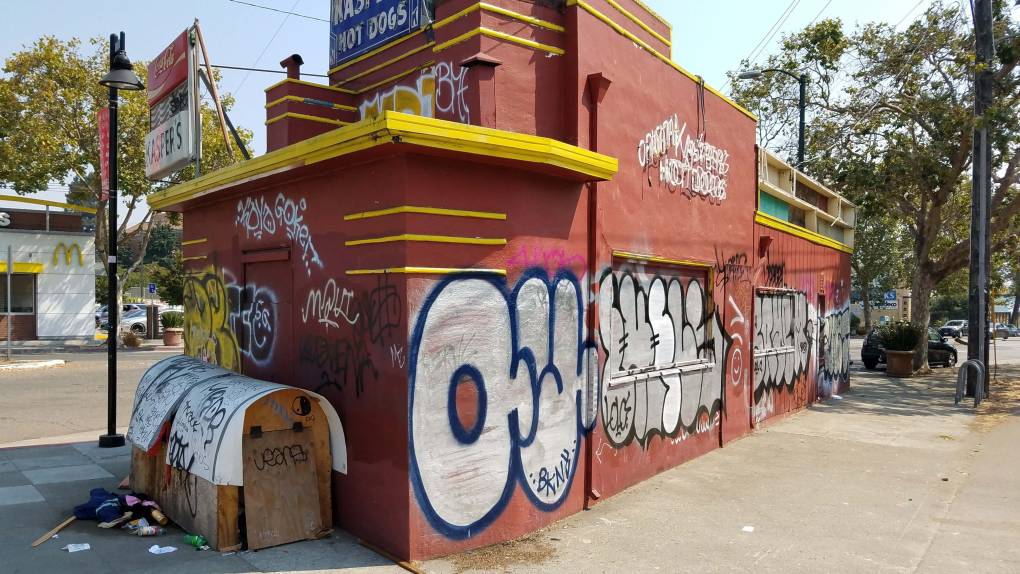
"caption": "Malcolm Ryder's photo exhibit, \"Thirteen Ways of Looking at Kasper's,\" documents the iconic hot dog institution and the changing neighborhood elements surrounding it. This photograph is entitled \"Golden Arches.\"",
"description": null,
"title": "kaspers_golden_arches_malcolm_ryder",
"credit": "Malcolm Ryder",
"status": "inherit",
"altTag": "A side profile of Kasper's, a local hot dog business, with a McDonalds in the background. Graffiti cover the sides, and it appears that a homeless person is living on one side of the walls.",
"isLoading": false,
"fetchFailed": false
},
"arts_13920295": {
"type": "attachments",
"id": "arts_13920295",
"meta": {
"index": "attachments_1716263798",
"site": "arts",
"id": "13920295",
"found": true
},
"parent": 13920290,
"imgSizes": {
"twentyfourteen-full-width": {
"file": "https://ww2.kqed.org/app/uploads/sites/2/2022/10/GettyImages-1242442658-1038x576.jpg",
"width": 1038,
"mimeType": "image/jpeg",
"height": 576
},
"thumbnail": {
"file": "https://ww2.kqed.org/app/uploads/sites/2/2022/10/GettyImages-1242442658-160x107.jpg",
"width": 160,
"mimeType": "image/jpeg",
"height": 107
},
"post-thumbnail": {
"file": "https://ww2.kqed.org/app/uploads/sites/2/2022/10/GettyImages-1242442658-672x372.jpg",
"width": 672,
"mimeType": "image/jpeg",
"height": 372
},
"kqedFullSize": {
"file": "https://ww2.kqed.org/app/uploads/sites/2/2022/10/GettyImages-1242442658-scaled-e1665599554542.jpg",
"width": 1920,
"height": 1280
},
"2048x2048": {
"file": "https://ww2.kqed.org/app/uploads/sites/2/2022/10/GettyImages-1242442658-2048x1365.jpg",
"width": 2048,
"mimeType": "image/jpeg",
"height": 1365
},
"large": {
"file": "https://ww2.kqed.org/app/uploads/sites/2/2022/10/GettyImages-1242442658-1020x680.jpg",
"width": 1020,
"mimeType": "image/jpeg",
"height": 680
},
"1536x1536": {
"file": "https://ww2.kqed.org/app/uploads/sites/2/2022/10/GettyImages-1242442658-1536x1024.jpg",
"width": 1536,
"mimeType": "image/jpeg",
"height": 1024
},
"full-width": {
"file": "https://ww2.kqed.org/app/uploads/sites/2/2022/10/GettyImages-1242442658-1920x1280.jpg",
"width": 1920,
"mimeType": "image/jpeg",
"height": 1280
},
"medium": {
"file": "https://ww2.kqed.org/app/uploads/sites/2/2022/10/GettyImages-1242442658-800x533.jpg",
"width": 800,
"mimeType": "image/jpeg",
"height": 533
},
"medium_large": {
"file": "https://ww2.kqed.org/app/uploads/sites/2/2022/10/GettyImages-1242442658-768x512.jpg",
"width": 768,
"mimeType": "image/jpeg",
"height": 512
}
},
"publishDate": 1665599295,
"modified": 1665599592,
"caption": "Emma D'Arcy at the 'House of the Dragon' European premiere in August, probably looking forward to getting their hands on a Negroni sbagliato.",
"description": null,
"title": "Emma D'Arcy at the 'House of the Dragon' European premiere in August, probably looking forward to getting their hands on a Negroni sbagliato.",
"credit": "WESLEY DE WIT/ANP/AFP via Getty Images",
"status": "inherit",
"altTag": "An androgynous white person with short slicked back blonde hair and dramatic pink makeup stands on a red carpet wearing an oversized blue suit jacket.",
"isLoading": false,
"fetchFailed": false
},
"arts_13920077": {
"type": "attachments",
"id": "arts_13920077",
"meta": {
"index": "attachments_1716263798",
"site": "arts",
"id": "13920077",
"found": true
},
"parent": 13920076,
"imgSizes": {
"twentyfourteen-full-width": {
"file": "https://ww2.kqed.org/app/uploads/sites/2/2022/10/provecho_featured-crop_alanchazaro-1038x576.jpg",
"width": 1038,
"mimeType": "image/jpeg",
"height": 576
},
"thumbnail": {
"file": "https://ww2.kqed.org/app/uploads/sites/2/2022/10/provecho_featured-crop_alanchazaro-160x90.jpg",
"width": 160,
"mimeType": "image/jpeg",
"height": 90
},
"post-thumbnail": {
"file": "https://ww2.kqed.org/app/uploads/sites/2/2022/10/provecho_featured-crop_alanchazaro-672x372.jpg",
"width": 672,
"mimeType": "image/jpeg",
"height": 372
},
"kqedFullSize": {
"file": "https://ww2.kqed.org/app/uploads/sites/2/2022/10/provecho_featured-crop_alanchazaro-scaled.jpg",
"width": 2560,
"height": 1440
},
"2048x2048": {
"file": "https://ww2.kqed.org/app/uploads/sites/2/2022/10/provecho_featured-crop_alanchazaro-2048x1152.jpg",
"width": 2048,
"mimeType": "image/jpeg",
"height": 1152
},
"large": {
"file": "https://ww2.kqed.org/app/uploads/sites/2/2022/10/provecho_featured-crop_alanchazaro-1020x574.jpg",
"width": 1020,
"mimeType": "image/jpeg",
"height": 574
},
"1536x1536": {
"file": "https://ww2.kqed.org/app/uploads/sites/2/2022/10/provecho_featured-crop_alanchazaro-1536x864.jpg",
"width": 1536,
"mimeType": "image/jpeg",
"height": 864
},
"full-width": {
"file": "https://ww2.kqed.org/app/uploads/sites/2/2022/10/provecho_featured-crop_alanchazaro-1920x1080.jpg",
"width": 1920,
"mimeType": "image/jpeg",
"height": 1080
},
"medium": {
"file": "https://ww2.kqed.org/app/uploads/sites/2/2022/10/provecho_featured-crop_alanchazaro-800x450.jpg",
"width": 800,
"mimeType": "image/jpeg",
"height": 450
},
"medium_large": {
"file": "https://ww2.kqed.org/app/uploads/sites/2/2022/10/provecho_featured-crop_alanchazaro-768x432.jpg",
"width": 768,
"mimeType": "image/jpeg",
"height": 432
}
},
"publishDate": 1665080239,
"modified": 1665080749,
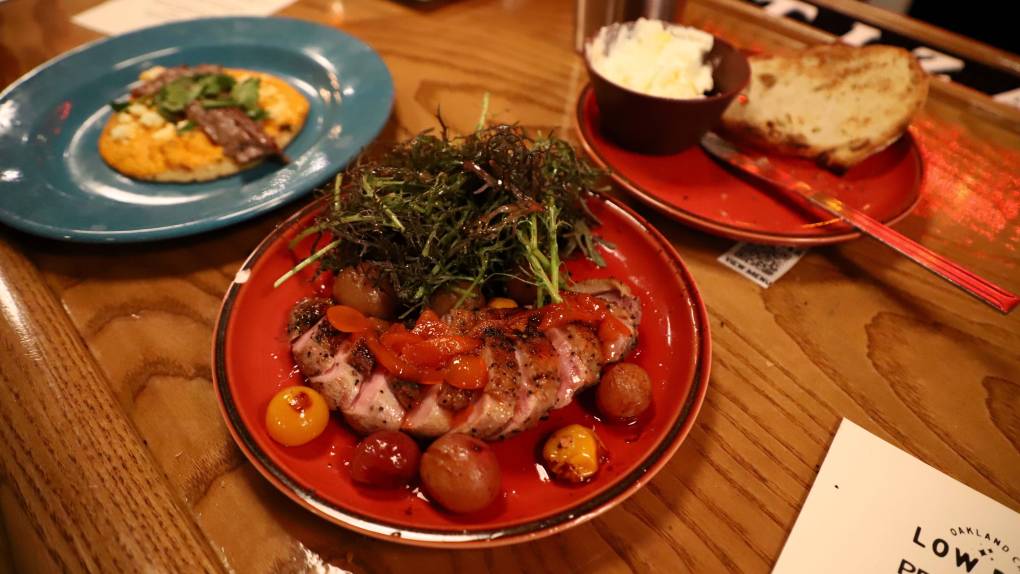
"caption": "Elegant dishes, such as the pan seared duck breast (center) and memelas de cecina (left), are Provecho's main attraction.",
"description": null,
"title": "provecho_featured-crop_alanchazaro",
"credit": "Alan Chazaro",
"status": "inherit",
"altTag": "three colorful plates of food, including pan seared duck, are on display at Low Bar in Oakland",
"isLoading": false,
"fetchFailed": false
},
"arts_13920063": {
"type": "attachments",
"id": "arts_13920063",
"meta": {
"index": "attachments_1716263798",
"site": "arts",
"id": "13920063",
"found": true
},
"parent": 13920057,
"imgSizes": {
"twentyfourteen-full-width": {
"file": "https://ww2.kqed.org/app/uploads/sites/2/2022/10/jaggery-featured-crop-1038x576.jpg",
"width": 1038,
"mimeType": "image/jpeg",
"height": 576
},
"thumbnail": {
"file": "https://ww2.kqed.org/app/uploads/sites/2/2022/10/jaggery-featured-crop-160x90.jpg",
"width": 160,
"mimeType": "image/jpeg",
"height": 90
},
"post-thumbnail": {
"file": "https://ww2.kqed.org/app/uploads/sites/2/2022/10/jaggery-featured-crop-672x372.jpg",
"width": 672,
"mimeType": "image/jpeg",
"height": 372
},
"kqedFullSize": {
"file": "https://ww2.kqed.org/app/uploads/sites/2/2022/10/jaggery-featured-crop.jpg",
"width": 2048,
"height": 1152
},
"large": {
"file": "https://ww2.kqed.org/app/uploads/sites/2/2022/10/jaggery-featured-crop-1020x574.jpg",
"width": 1020,
"mimeType": "image/jpeg",
"height": 574
},
"1536x1536": {
"file": "https://ww2.kqed.org/app/uploads/sites/2/2022/10/jaggery-featured-crop-1536x864.jpg",
"width": 1536,
"mimeType": "image/jpeg",
"height": 864
},
"full-width": {
"file": "https://ww2.kqed.org/app/uploads/sites/2/2022/10/jaggery-featured-crop-1920x1080.jpg",
"width": 1920,
"mimeType": "image/jpeg",
"height": 1080
},
"medium": {
"file": "https://ww2.kqed.org/app/uploads/sites/2/2022/10/jaggery-featured-crop-800x450.jpg",
"width": 800,
"mimeType": "image/jpeg",
"height": 450
},
"medium_large": {
"file": "https://ww2.kqed.org/app/uploads/sites/2/2022/10/jaggery-featured-crop-768x432.jpg",
"width": 768,
"mimeType": "image/jpeg",
"height": 432
}
},
"publishDate": 1665074468,
"modified": 1665074688,
"caption": "Diaspora Co.'s new \"Madhur Jaggery\" is produced by the Randive family at their facility in Daund, India.",
"description": null,
"title": "jaggery-featured-crop",
"credit": "Courtesy of Diaspora Co.",
"status": "inherit",
"altTag": "Syrupy brown sugarcane juice is scraped with a metal tool as part of the process for making jaggery.",
"isLoading": false,
"fetchFailed": false
},
"arts_13919704": {
"type": "attachments",
"id": "arts_13919704",
"meta": {
"index": "attachments_1716263798",
"site": "arts",
"id": "13919704",
"found": true
},
"parent": 13919491,
"imgSizes": {
"twentyfourteen-full-width": {
"file": "https://ww2.kqed.org/app/uploads/sites/2/2022/09/Elena-Zelayeta-1038x576.png",
"width": 1038,
"mimeType": "image/png",
"height": 576
},
"thumbnail": {
"file": "https://ww2.kqed.org/app/uploads/sites/2/2022/09/Elena-Zelayeta-160x90.png",
"width": 160,
"mimeType": "image/png",
"height": 90
},
"post-thumbnail": {
"file": "https://ww2.kqed.org/app/uploads/sites/2/2022/09/Elena-Zelayeta-672x372.png",
"width": 672,
"mimeType": "image/png",
"height": 372
},
"kqedFullSize": {
"file": "https://ww2.kqed.org/app/uploads/sites/2/2022/09/Elena-Zelayeta.png",
"width": 1920,
"height": 1080
},
"large": {
"file": "https://ww2.kqed.org/app/uploads/sites/2/2022/09/Elena-Zelayeta-1020x574.png",
"width": 1020,
"mimeType": "image/png",
"height": 574
},
"1536x1536": {
"file": "https://ww2.kqed.org/app/uploads/sites/2/2022/09/Elena-Zelayeta-1536x864.png",
"width": 1536,
"mimeType": "image/png",
"height": 864
},
"medium": {
"file": "https://ww2.kqed.org/app/uploads/sites/2/2022/09/Elena-Zelayeta-800x450.png",
"width": 800,
"mimeType": "image/png",
"height": 450
},
"medium_large": {
"file": "https://ww2.kqed.org/app/uploads/sites/2/2022/09/Elena-Zelayeta-768x432.png",
"width": 768,
"mimeType": "image/png",
"height": 432
}
},
"publishDate": 1664308864,
"modified": 1664308921,
"caption": null,
"description": null,
"title": "Elena Zelayeta",
"credit": null,
"status": "inherit",
"altTag": "A plump middle aged woman smiles contentedly in a kitchen.",
"isLoading": false,
"fetchFailed": false
},
"arts_13919200": {
"type": "attachments",
"id": "arts_13919200",
"meta": {
"index": "attachments_1716263798",
"site": "arts",
"id": "13919200",
"found": true
},
"parent": 13919177,
"imgSizes": {
"twentyfourteen-full-width": {
"file": "https://ww2.kqed.org/app/uploads/sites/2/2022/09/illyanna-headshot_book_COVER-B-1038x576.jpg",
"width": 1038,
"mimeType": "image/jpeg",
"height": 576
},
"thumbnail": {
"file": "https://ww2.kqed.org/app/uploads/sites/2/2022/09/illyanna-headshot_book_COVER-B-160x90.jpg",
"width": 160,
"mimeType": "image/jpeg",
"height": 90
},
"post-thumbnail": {
"file": "https://ww2.kqed.org/app/uploads/sites/2/2022/09/illyanna-headshot_book_COVER-B-672x372.jpg",
"width": 672,
"mimeType": "image/jpeg",
"height": 372
},
"kqedFullSize": {
"file": "https://ww2.kqed.org/app/uploads/sites/2/2022/09/illyanna-headshot_book_COVER-B.jpg",
"width": 1920,
"height": 1080
},
"large": {
"file": "https://ww2.kqed.org/app/uploads/sites/2/2022/09/illyanna-headshot_book_COVER-B-1020x574.jpg",
"width": 1020,
"mimeType": "image/jpeg",
"height": 574
},
"1536x1536": {
"file": "https://ww2.kqed.org/app/uploads/sites/2/2022/09/illyanna-headshot_book_COVER-B-1536x864.jpg",
"width": 1536,
"mimeType": "image/jpeg",
"height": 864
},
"medium": {
"file": "https://ww2.kqed.org/app/uploads/sites/2/2022/09/illyanna-headshot_book_COVER-B-800x450.jpg",
"width": 800,
"mimeType": "image/jpeg",
"height": 450
},
"medium_large": {
"file": "https://ww2.kqed.org/app/uploads/sites/2/2022/09/illyanna-headshot_book_COVER-B-768x432.jpg",
"width": 768,
"mimeType": "image/jpeg",
"height": 432
}
},
"publishDate": 1663273346,
"modified": 1663273863,
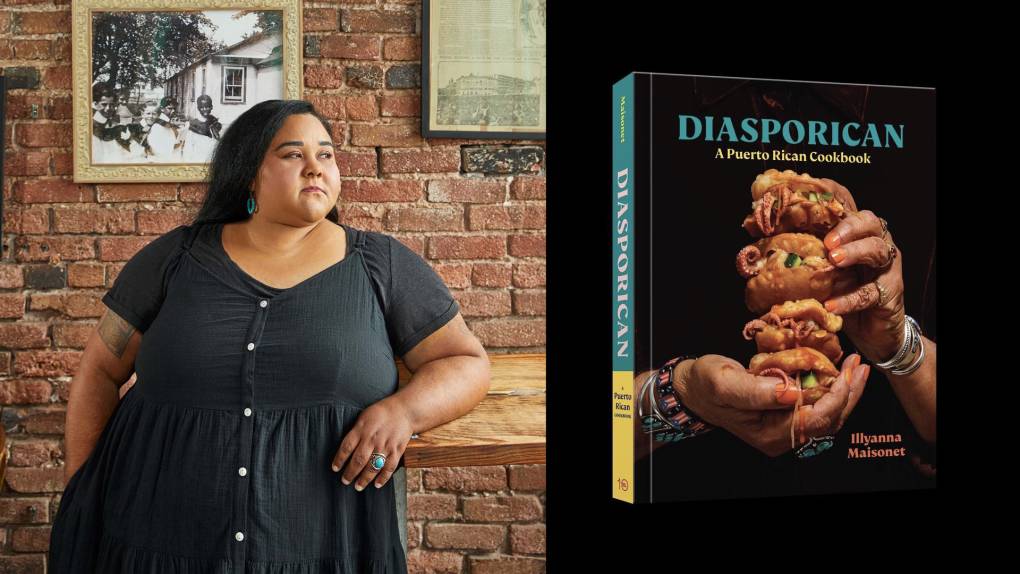
"caption": "Illyanna Maisonet new cookbook is a document of her experience as a Puerto Rican living in diaspora in California.",
"description": null,
"title": "illyanna-headshot_book_COVER-B",
"credit": "Headshot by Gabriela Hasbun; book cover courtesy of Ten Speed Press",
"status": "inherit",
"altTag": "A split image with the author's headshot (a woman leaning against a counter in front of a brick wall) on the left and a book cover on the right—the text reads: \"Diasporican: A Puerto Rican Cookbook.\"",
"isLoading": false,
"fetchFailed": false
},
"arts_13919226": {
"type": "attachments",
"id": "arts_13919226",
"meta": {
"index": "attachments_1716263798",
"site": "arts",
"id": "13919226",
"found": true
},
"parent": 13919177,
"imgSizes": {
"twentyfourteen-full-width": {
"file": "https://ww2.kqed.org/app/uploads/sites/2/2022/09/TOSTONES_Page_1_Image_0001_rotated-1038x576.jpg",
"width": 1038,
"mimeType": "image/jpeg",
"height": 576
},
"thumbnail": {
"file": "https://ww2.kqed.org/app/uploads/sites/2/2022/09/TOSTONES_Page_1_Image_0001_rotated-160x128.jpg",
"width": 160,
"mimeType": "image/jpeg",
"height": 128
},
"post-thumbnail": {
"file": "https://ww2.kqed.org/app/uploads/sites/2/2022/09/TOSTONES_Page_1_Image_0001_rotated-672x372.jpg",
"width": 672,
"mimeType": "image/jpeg",
"height": 372
},
"kqedFullSize": {
"file": "https://ww2.kqed.org/app/uploads/sites/2/2022/09/TOSTONES_Page_1_Image_0001_rotated.jpg",
"width": 1920,
"height": 1539
},
"large": {
"file": "https://ww2.kqed.org/app/uploads/sites/2/2022/09/TOSTONES_Page_1_Image_0001_rotated-1020x818.jpg",
"width": 1020,
"mimeType": "image/jpeg",
"height": 818
},
"1536x1536": {
"file": "https://ww2.kqed.org/app/uploads/sites/2/2022/09/TOSTONES_Page_1_Image_0001_rotated-1536x1231.jpg",
"width": 1536,
"mimeType": "image/jpeg",
"height": 1231
},
"medium": {
"file": "https://ww2.kqed.org/app/uploads/sites/2/2022/09/TOSTONES_Page_1_Image_0001_rotated-800x641.jpg",
"width": 800,
"mimeType": "image/jpeg",
"height": 641
},
"medium_large": {
"file": "https://ww2.kqed.org/app/uploads/sites/2/2022/09/TOSTONES_Page_1_Image_0001_rotated-768x616.jpg",
"width": 768,
"mimeType": "image/jpeg",
"height": 616
}
},
"publishDate": 1663276750,
"modified": 1663276786,
"caption": "Maisonet's recipe for tostones includes options for two different dipping sauces.",
"description": null,
"title": "TOSTONES_Page_1_Image_0001_rotated",
"credit": "Photo by Dan Liberti, courtesy of Ten Speed Press",
"status": "inherit",
"altTag": "Overhead shot of thin, crispy tostones against a green backdrop, with two dipping sauces on the side.",
"isLoading": false,
"fetchFailed": false
},
"arts_13919186": {
"type": "attachments",
"id": "arts_13919186",
"meta": {
"index": "attachments_1716263798",
"site": "arts",
"id": "13919186",
"found": true
},
"parent": 13919178,
"imgSizes": {
"twentyfourteen-full-width": {
"file": "https://ww2.kqed.org/app/uploads/sites/2/2022/09/YOGA.00_05_18_04.Still015-1038x576.jpg",
"width": 1038,
"mimeType": "image/jpeg",
"height": 576
},
"thumbnail": {
"file": "https://ww2.kqed.org/app/uploads/sites/2/2022/09/YOGA.00_05_18_04.Still015-160x90.jpg",
"width": 160,
"mimeType": "image/jpeg",
"height": 90
},
"post-thumbnail": {
"file": "https://ww2.kqed.org/app/uploads/sites/2/2022/09/YOGA.00_05_18_04.Still015-672x372.jpg",
"width": 672,
"mimeType": "image/jpeg",
"height": 372
},
"kqedFullSize": {
"file": "https://ww2.kqed.org/app/uploads/sites/2/2022/09/YOGA.00_05_18_04.Still015.jpg",
"width": 1920,
"height": 1080
},
"large": {
"file": "https://ww2.kqed.org/app/uploads/sites/2/2022/09/YOGA.00_05_18_04.Still015-1020x574.jpg",
"width": 1020,
"mimeType": "image/jpeg",
"height": 574
},
"1536x1536": {
"file": "https://ww2.kqed.org/app/uploads/sites/2/2022/09/YOGA.00_05_18_04.Still015-1536x864.jpg",
"width": 1536,
"mimeType": "image/jpeg",
"height": 864
},
"medium": {
"file": "https://ww2.kqed.org/app/uploads/sites/2/2022/09/YOGA.00_05_18_04.Still015-800x450.jpg",
"width": 800,
"mimeType": "image/jpeg",
"height": 450
},
"medium_large": {
"file": "https://ww2.kqed.org/app/uploads/sites/2/2022/09/YOGA.00_05_18_04.Still015-768x432.jpg",
"width": 768,
"mimeType": "image/jpeg",
"height": 432
}
},
"publishDate": 1663271501,
"modified": 1663271546,
"caption": "Tristan Cunningham stars in 'Normal Ain't Normal.'",
"description": null,
"title": "YOGA.00_05_18_04.Still015",
"credit": "Offsides Productions",
"status": "inherit",
"altTag": null,
"isLoading": false,
"fetchFailed": false
},
"arts_13919131": {
"type": "attachments",
"id": "arts_13919131",
"meta": {
"index": "attachments_1716263798",
"site": "arts",
"id": "13919131",
"found": true
},
"parent": 13919124,
"imgSizes": {
"twentyfourteen-full-width": {
"file": "https://ww2.kqed.org/app/uploads/sites/2/2022/09/ale_industries_turfienz24_martin_wilson-1038x576.jpg",
"width": 1038,
"mimeType": "image/jpeg",
"height": 576
},
"thumbnail": {
"file": "https://ww2.kqed.org/app/uploads/sites/2/2022/09/ale_industries_turfienz24_martin_wilson-160x100.jpg",
"width": 160,
"mimeType": "image/jpeg",
"height": 100
},
"post-thumbnail": {
"file": "https://ww2.kqed.org/app/uploads/sites/2/2022/09/ale_industries_turfienz24_martin_wilson-672x372.jpg",
"width": 672,
"mimeType": "image/jpeg",
"height": 372
},
"kqedFullSize": {
"file": "https://ww2.kqed.org/app/uploads/sites/2/2022/09/ale_industries_turfienz24_martin_wilson-scaled.jpg",
"width": 2560,
"height": 1600
},
"2048x2048": {
"file": "https://ww2.kqed.org/app/uploads/sites/2/2022/09/ale_industries_turfienz24_martin_wilson-2048x1280.jpg",
"width": 2048,
"mimeType": "image/jpeg",
"height": 1280
},
"large": {
"file": "https://ww2.kqed.org/app/uploads/sites/2/2022/09/ale_industries_turfienz24_martin_wilson-1020x637.jpg",
"width": 1020,
"mimeType": "image/jpeg",
"height": 637
},
"1536x1536": {
"file": "https://ww2.kqed.org/app/uploads/sites/2/2022/09/ale_industries_turfienz24_martin_wilson-1536x960.jpg",
"width": 1536,
"mimeType": "image/jpeg",
"height": 960
},
"full-width": {
"file": "https://ww2.kqed.org/app/uploads/sites/2/2022/09/ale_industries_turfienz24_martin_wilson-1920x1200.jpg",
"width": 1920,
"mimeType": "image/jpeg",
"height": 1200
},
"medium": {
"file": "https://ww2.kqed.org/app/uploads/sites/2/2022/09/ale_industries_turfienz24_martin_wilson-800x500.jpg",
"width": 800,
"mimeType": "image/jpeg",
"height": 500
},
"medium_large": {
"file": "https://ww2.kqed.org/app/uploads/sites/2/2022/09/ale_industries_turfienz24_martin_wilson-768x480.jpg",
"width": 768,
"mimeType": "image/jpeg",
"height": 480
}
},
"publishDate": 1663197710,
"modified": 1663198030,
"caption": "TurfFeinz Crew poses inside Ale Industries, where they will be releasing their beer collaboration on Sat., Sep. 17.",
"description": null,
"title": "ale_industries_turfienz24_martin_wilson",
"credit": "Martin Wilson",
"status": "inherit",
"altTag": "a group of six dancers pose inside of Ale Industries brewery in Oakland",
"isLoading": false,
"fetchFailed": false
},
"arts_13919033": {
"type": "attachments",
"id": "arts_13919033",
"meta": {
"index": "attachments_1716263798",
"site": "arts",
"id": "13919033",
"found": true
},
"parent": 13919032,
"imgSizes": {
"twentyfourteen-full-width": {
"file": "https://ww2.kqed.org/app/uploads/sites/2/2022/09/norte54_raquel_plating_cropped-1038x576.jpg",
"width": 1038,
"mimeType": "image/jpeg",
"height": 576
},
"thumbnail": {
"file": "https://ww2.kqed.org/app/uploads/sites/2/2022/09/norte54_raquel_plating_cropped-160x90.jpg",
"width": 160,
"mimeType": "image/jpeg",
"height": 90
},
"post-thumbnail": {
"file": "https://ww2.kqed.org/app/uploads/sites/2/2022/09/norte54_raquel_plating_cropped-672x372.jpg",
"width": 672,
"mimeType": "image/jpeg",
"height": 372
},
"kqedFullSize": {
"file": "https://ww2.kqed.org/app/uploads/sites/2/2022/09/norte54_raquel_plating_cropped-scaled.jpg",
"width": 2560,
"height": 1440
},
"2048x2048": {
"file": "https://ww2.kqed.org/app/uploads/sites/2/2022/09/norte54_raquel_plating_cropped-2048x1152.jpg",
"width": 2048,
"mimeType": "image/jpeg",
"height": 1152
},
"large": {
"file": "https://ww2.kqed.org/app/uploads/sites/2/2022/09/norte54_raquel_plating_cropped-1020x574.jpg",
"width": 1020,
"mimeType": "image/jpeg",
"height": 574
},
"1536x1536": {
"file": "https://ww2.kqed.org/app/uploads/sites/2/2022/09/norte54_raquel_plating_cropped-1536x864.jpg",
"width": 1536,
"mimeType": "image/jpeg",
"height": 864
},
"full-width": {
"file": "https://ww2.kqed.org/app/uploads/sites/2/2022/09/norte54_raquel_plating_cropped-1920x1080.jpg",
"width": 1920,
"mimeType": "image/jpeg",
"height": 1080
},
"medium": {
"file": "https://ww2.kqed.org/app/uploads/sites/2/2022/09/norte54_raquel_plating_cropped-800x450.jpg",
"width": 800,
"mimeType": "image/jpeg",
"height": 450
},
"medium_large": {
"file": "https://ww2.kqed.org/app/uploads/sites/2/2022/09/norte54_raquel_plating_cropped-768x432.jpg",
"width": 768,
"mimeType": "image/jpeg",
"height": 432
}
},
"publishDate": 1663028189,
"modified": 1663028413,
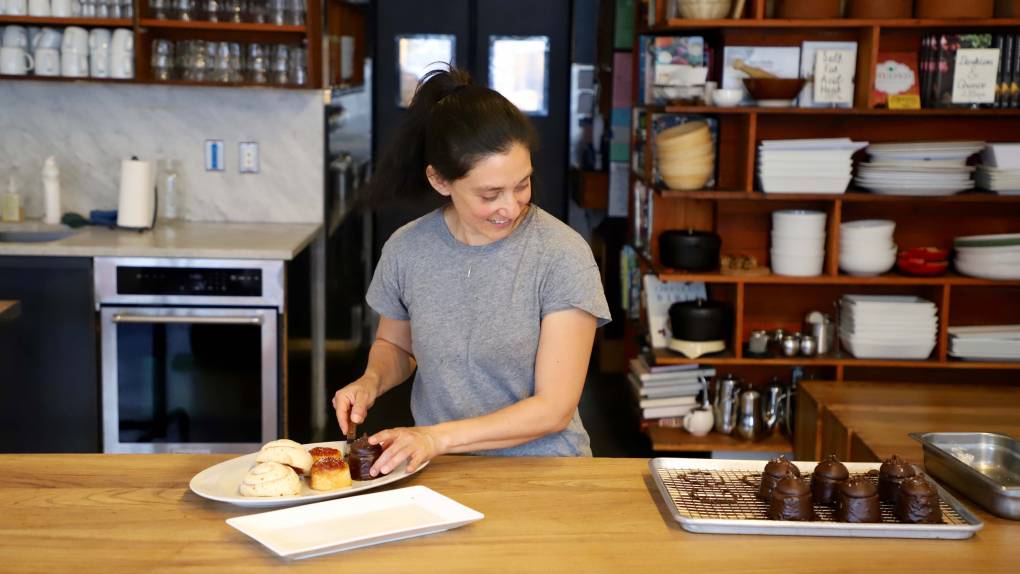
"caption": "Norte 54's founder, Raquel Goldman, plates pan dulce at Nopalito's 18th St. location.",
"description": null,
"title": "norte54_raquel_plating_cropped",
"credit": "Alan Chazaro",
"status": "inherit",
"altTag": "woman stands at a large wooden table, serving Mexican American pastries with a knife",
"isLoading": false,
"fetchFailed": false
},
"arts_13919034": {
"type": "attachments",
"id": "arts_13919034",
"meta": {
"index": "attachments_1716263798",
"site": "arts",
"id": "13919034",
"found": true
},
"parent": 13919032,
"imgSizes": {
"twentyfourteen-full-width": {
"file": "https://ww2.kqed.org/app/uploads/sites/2/2022/09/norte54_box-1038x576.jpg",
"width": 1038,
"mimeType": "image/jpeg",
"height": 576
},
"thumbnail": {
"file": "https://ww2.kqed.org/app/uploads/sites/2/2022/09/norte54_box-160x107.jpg",
"width": 160,
"mimeType": "image/jpeg",
"height": 107
},
"post-thumbnail": {
"file": "https://ww2.kqed.org/app/uploads/sites/2/2022/09/norte54_box-672x372.jpg",
"width": 672,
"mimeType": "image/jpeg",
"height": 372
},
"kqedFullSize": {
"file": "https://ww2.kqed.org/app/uploads/sites/2/2022/09/norte54_box-scaled.jpg",
"width": 2560,
"height": 1707
},
"2048x2048": {
"file": "https://ww2.kqed.org/app/uploads/sites/2/2022/09/norte54_box-2048x1365.jpg",
"width": 2048,
"mimeType": "image/jpeg",
"height": 1365
},
"large": {
"file": "https://ww2.kqed.org/app/uploads/sites/2/2022/09/norte54_box-1020x680.jpg",
"width": 1020,
"mimeType": "image/jpeg",
"height": 680
},
"1536x1536": {
"file": "https://ww2.kqed.org/app/uploads/sites/2/2022/09/norte54_box-1536x1024.jpg",
"width": 1536,
"mimeType": "image/jpeg",
"height": 1024
},
"full-width": {
"file": "https://ww2.kqed.org/app/uploads/sites/2/2022/09/norte54_box-1920x1280.jpg",
"width": 1920,
"mimeType": "image/jpeg",
"height": 1280
},
"medium": {
"file": "https://ww2.kqed.org/app/uploads/sites/2/2022/09/norte54_box-800x533.jpg",
"width": 800,
"mimeType": "image/jpeg",
"height": 533
},
"medium_large": {
"file": "https://ww2.kqed.org/app/uploads/sites/2/2022/09/norte54_box-768x512.jpg",
"width": 768,
"mimeType": "image/jpeg",
"height": 512
}
},
"publishDate": 1663028867,
"modified": 1663028945,
"caption": "A to-go box filled with a variety of Mexican pastries.",
"description": null,
"title": "norte54_box",
"credit": "Alan Chazaro",
"status": "inherit",
"altTag": "a to-go box filled with a variety of Mexican pastries",
"isLoading": false,
"fetchFailed": false
},
"arts_13918995": {
"type": "attachments",
"id": "arts_13918995",
"meta": {
"index": "attachments_1716263798",
"site": "arts",
"id": "13918995",
"found": true
},
"parent": 13918993,
"imgSizes": {
"twentyfourteen-full-width": {
"file": "https://ww2.kqed.org/app/uploads/sites/2/2022/09/dragon-gate-idiot-noodles-crop-1038x576.jpg",
"width": 1038,
"mimeType": "image/jpeg",
"height": 576
},
"thumbnail": {
"file": "https://ww2.kqed.org/app/uploads/sites/2/2022/09/dragon-gate-idiot-noodles-crop-160x90.jpg",
"width": 160,
"mimeType": "image/jpeg",
"height": 90
},
"post-thumbnail": {
"file": "https://ww2.kqed.org/app/uploads/sites/2/2022/09/dragon-gate-idiot-noodles-crop-672x372.jpg",
"width": 672,
"mimeType": "image/jpeg",
"height": 372
},
"kqedFullSize": {
"file": "https://ww2.kqed.org/app/uploads/sites/2/2022/09/dragon-gate-idiot-noodles-crop.jpg",
"width": 1280,
"height": 720
},
"large": {
"file": "https://ww2.kqed.org/app/uploads/sites/2/2022/09/dragon-gate-idiot-noodles-crop-1020x574.jpg",
"width": 1020,
"mimeType": "image/jpeg",
"height": 574
},
"medium": {
"file": "https://ww2.kqed.org/app/uploads/sites/2/2022/09/dragon-gate-idiot-noodles-crop-800x450.jpg",
"width": 800,
"mimeType": "image/jpeg",
"height": 450
},
"medium_large": {
"file": "https://ww2.kqed.org/app/uploads/sites/2/2022/09/dragon-gate-idiot-noodles-crop-768x432.jpg",
"width": 768,
"mimeType": "image/jpeg",
"height": 432
}
},
"publishDate": 1663004209,
"modified": 1663005802,
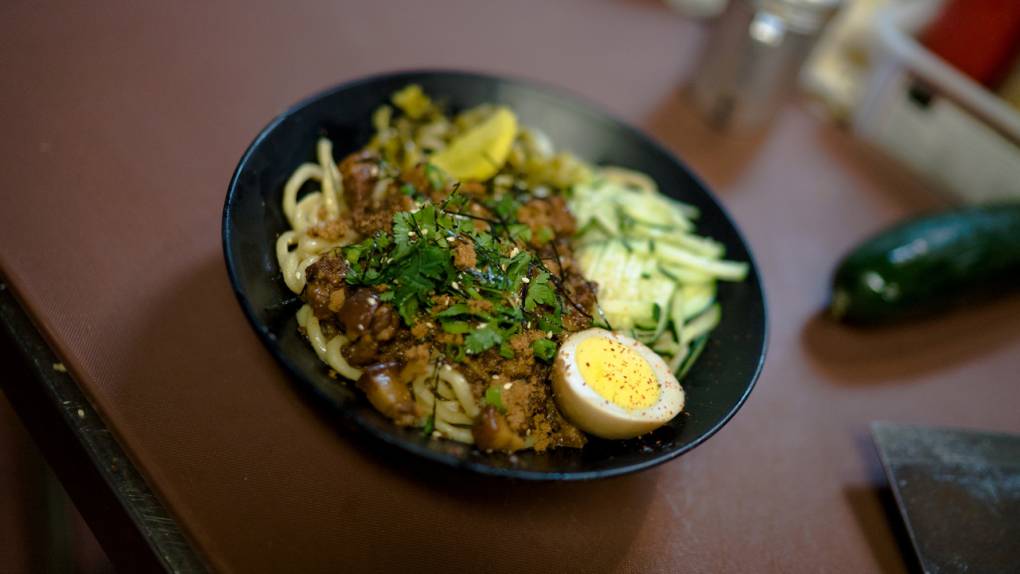
"caption": "The \"idiot noodles\" are one of the signature dishes at Dragon Gate, a popular Taiwanese restaurant reopening in Jack London Square in early 2023.",
"description": null,
"title": "dragon gate idiot noodles-crop",
"credit": "Courtesy of Dragon Gate/Visit Oakland",
"status": "inherit",
"altTag": "A bowl of noodles topped with meat sauce, slivered cucumbers and half a hard-boiled egg.",
"isLoading": false,
"fetchFailed": false
},
"arts_13918857": {
"type": "attachments",
"id": "arts_13918857",
"meta": {
"index": "attachments_1716263798",
"site": "arts",
"id": "13918857",
"found": true
},
"parent": 13918671,
"imgSizes": {
"twentyfourteen-full-width": {
"file": "https://ww2.kqed.org/app/uploads/sites/2/2022/09/JLatelymain-1038x576.png",
"width": 1038,
"mimeType": "image/png",
"height": 576
},
"thumbnail": {
"file": "https://ww2.kqed.org/app/uploads/sites/2/2022/09/JLatelymain-160x90.png",
"width": 160,
"mimeType": "image/png",
"height": 90
},
"post-thumbnail": {
"file": "https://ww2.kqed.org/app/uploads/sites/2/2022/09/JLatelymain-672x372.png",
"width": 672,
"mimeType": "image/png",
"height": 372
},
"kqedFullSize": {
"file": "https://ww2.kqed.org/app/uploads/sites/2/2022/09/JLatelymain.png",
"width": 1920,
"height": 1080
},
"large": {
"file": "https://ww2.kqed.org/app/uploads/sites/2/2022/09/JLatelymain-1020x574.png",
"width": 1020,
"mimeType": "image/png",
"height": 574
},
"1536x1536": {
"file": "https://ww2.kqed.org/app/uploads/sites/2/2022/09/JLatelymain-1536x864.png",
"width": 1536,
"mimeType": "image/png",
"height": 864
},
"medium": {
"file": "https://ww2.kqed.org/app/uploads/sites/2/2022/09/JLatelymain-800x450.png",
"width": 800,
"mimeType": "image/png",
"height": 450
},
"medium_large": {
"file": "https://ww2.kqed.org/app/uploads/sites/2/2022/09/JLatelymain-768x432.png",
"width": 768,
"mimeType": "image/png",
"height": 432
}
},
"publishDate": 1662595528,
"modified": 1662595638,
"caption": "(L–R) Khyenci, Ian Kelly, J.Lately and Loe Gino in the \"Good Lasts\" video.",
"description": null,
"title": "JLatelymain",
"credit": "Kayla de Guzman",
"status": "inherit",
"altTag": null,
"isLoading": false,
"fetchFailed": false
}
},
"audioPlayerReducer": {
"postId": "stream_live",
"isPaused": true,
"isPlaying": false,
"pfsActive": false,
"pledgeModalIsOpen": true,
"playerDrawerIsOpen": false,
"liveAudioPlayStartedAt": 0,
"liveAudioPlayContext": ""
},
"authorsReducer": {
"byline_arts_13920581": {
"type": "authors",
"id": "byline_arts_13920581",
"meta": {
"override": true
},
"slug": "byline_arts_13920581",
"name": "Paloma Cortes",
"isLoading": false
},
"byline_arts_13920290": {
"type": "authors",
"id": "byline_arts_13920290",
"meta": {
"override": true
},
"slug": "byline_arts_13920290",
"name": "Dani Nett",
"isLoading": false
},
"ralexandra": {
"type": "authors",
"id": "11242",
"meta": {
"index": "authors_1716337520",
"id": "11242",
"found": true
},
"name": "Rae Alexandra",
"firstName": "Rae",
"lastName": "Alexandra",
"slug": "ralexandra",
"email": "ralexandra@kqed.org",
"display_author_email": true,
"staff_mastheads": [],
"title": "Reporter/Producer",
"bio": "Rae Alexandra is a Reporter/Producer for KQED Arts & Culture, and the creator/author of the \u003ca href=\"https://www.kqed.org/arts/program/rebel-girls-from-bay-area-history\">Rebel Girls From Bay Area History\u003c/a> and \u003ca href=\"https://www.kqed.org/bizarrebayarea\">Bizarre Bay Area\u003c/a> series. Her debut book, \u003ca href=\"https://citylights.com/politics-current-events-history/unsung-heroines35-women-who-changed/\">Unsung Heroines: 35 Women Who Changed the Bay Area\u003c/a> was published by City Lights in March 2026. In 2023, Rae was awarded an SPJ Excellence in Journalism Award for Arts & Culture. Rae was born and raised in Wales and subsequently — even after two decades in Northern California — still uses phrases that regularly baffle her coworkers.",
"avatar": "https://secure.gravatar.com/avatar/edfee8176c80cc0a382b051190f5341997df378a934a5774dcb0977732dfd401?s=600&d=blank&r=g",
"twitter": null,
"bluesky": null,
"facebook": null,
"instagram": null,
"linkedin": null,
"sites": [
{
"site": "arts",
"roles": [
"subscriber"
]
},
{
"site": "news",
"roles": [
"subscriber"
]
},
{
"site": "pop",
"roles": [
"subscriber"
]
},
{
"site": "bayareabites",
"roles": [
"subscriber"
]
},
{
"site": "science",
"roles": [
"subscriber"
]
}
],
"headData": {
"title": "Rae Alexandra | KQED",
"description": "Reporter/Producer",
"ogImgSrc": "https://secure.gravatar.com/avatar/edfee8176c80cc0a382b051190f5341997df378a934a5774dcb0977732dfd401?s=600&d=blank&r=g",
"twImgSrc": "https://secure.gravatar.com/avatar/edfee8176c80cc0a382b051190f5341997df378a934a5774dcb0977732dfd401?s=600&d=blank&r=g"
},
"isLoading": false,
"link": "/author/ralexandra"
},
"nvoynovskaya": {
"type": "authors",
"id": "11387",
"meta": {
"index": "authors_1716337520",
"id": "11387",
"found": true
},
"name": "Nastia Voynovskaya",
"firstName": "Nastia",
"lastName": "Voynovskaya",
"slug": "nvoynovskaya",
"email": "nvoynovskaya@kqed.org",
"display_author_email": false,
"staff_mastheads": [
"arts"
],
"title": "Editor and reporter",
"bio": "Nastia Voynovskaya is a reporter, editor and host at KQED Arts & Culture. She's been covering the arts in the Bay Area for over a decade, with a focus on music, queer culture, labor issues and grassroots organizing. She has edited KQED story series such as Trans Bay: A History of San Francisco's Gender-Diverse Community, and co-created KQED's Bay Area hip-hop history project, That's My Word. Nastia's work has been recognized by the Society of Professional Journalists and San Francisco Press Club. She regularly appears on podcasts and radio programs, including NPR's All Songs Considered, and hosts live events where music, culture and conversation meet.",
"avatar": "https://secure.gravatar.com/avatar/5025ee460e5a85d69ca20ea6c6f2f80d7e17795c828f61ea3aecfcd924e9042e?s=600&d=blank&r=g",
"twitter": null,
"bluesky": null,
"facebook": null,
"instagram": "https://www.instagram.com/nananastia/",
"linkedin": null,
"sites": [
{
"site": "",
"roles": [
"editor"
]
},
{
"site": "arts",
"roles": [
"administrator"
]
},
{
"site": "news",
"roles": [
"editor"
]
},
{
"site": "pop",
"roles": [
"administrator"
]
},
{
"site": "bayareabites",
"roles": [
"editor"
]
},
{
"site": "podcasts",
"roles": [
"editor"
]
},
{
"site": "hiphop",
"roles": [
"editor"
]
}
],
"headData": {
"title": "Nastia Voynovskaya | KQED",
"description": "Editor and reporter",
"ogImgSrc": "https://secure.gravatar.com/avatar/5025ee460e5a85d69ca20ea6c6f2f80d7e17795c828f61ea3aecfcd924e9042e?s=600&d=blank&r=g",
"twImgSrc": "https://secure.gravatar.com/avatar/5025ee460e5a85d69ca20ea6c6f2f80d7e17795c828f61ea3aecfcd924e9042e?s=600&d=blank&r=g"
},
"isLoading": false,
"link": "/author/nvoynovskaya"
},
"ogpenn": {
"type": "authors",
"id": "11491",
"meta": {
"index": "authors_1716337520",
"id": "11491",
"found": true
},
"name": "Pendarvis Harshaw",
"firstName": "Pendarvis",
"lastName": "Harshaw",
"slug": "ogpenn",
"email": "ogpenn@gmail.com",
"display_author_email": false,
"staff_mastheads": [
"arts"
],
"title": "Community Engagement Reporter",
"bio": "Pendarvis Harshaw is an educator, host and writer with KQED Arts.",
"avatar": "https://secure.gravatar.com/avatar/972b77ee8e3f346ae2b00622661187fbfabd059b5693bbdc1475ea7a722fd4cd?s=600&d=blank&r=g",
"twitter": null,
"bluesky": null,
"facebook": null,
"instagram": "ogpenn",
"linkedin": null,
"sites": [
{
"site": "arts",
"roles": [
"administrator"
]
},
{
"site": "news",
"roles": [
"editor"
]
},
{
"site": "bayareabites",
"roles": [
"author"
]
},
{
"site": "hiphop",
"roles": [
"editor"
]
}
],
"headData": {
"title": "Pendarvis Harshaw | KQED",
"description": "Community Engagement Reporter",
"ogImgSrc": "https://secure.gravatar.com/avatar/972b77ee8e3f346ae2b00622661187fbfabd059b5693bbdc1475ea7a722fd4cd?s=600&d=blank&r=g",
"twImgSrc": "https://secure.gravatar.com/avatar/972b77ee8e3f346ae2b00622661187fbfabd059b5693bbdc1475ea7a722fd4cd?s=600&d=blank&r=g"
},
"isLoading": false,
"link": "/author/ogpenn"
},
"ltsai": {
"type": "authors",
"id": "11743",
"meta": {
"index": "authors_1716337520",
"id": "11743",
"found": true
},
"name": "Luke Tsai",
"firstName": "Luke",
"lastName": "Tsai",
"slug": "ltsai",
"email": "ltsai@kqed.org",
"display_author_email": true,
"staff_mastheads": [
"arts"
],
"title": "Food Editor",
"bio": "Luke Tsai is KQED's food editor and resident stinky tofu connoisseur. Prior to KQED, he was an editor at Eater SF, \u003cem>San Francisco \u003c/em>magazine, and the \u003cem>East Bay Express\u003c/em>, and his work has also appeared in TASTE, the \u003cem>San Francisco Chronicle\u003c/em>, and the \u003cem>Best Food Writing\u003c/em> anthology. When he isn't writing or editing, you'll find him eating most everything he can get his hands on.",
"avatar": "https://secure.gravatar.com/avatar/1e59b45bf191526e7339d6ba46e33a57b2030d25c27660ecc64ea3cb863e34f7?s=600&d=blank&r=g",
"twitter": "theluketsai",
"bluesky": null,
"facebook": null,
"instagram": null,
"linkedin": null,
"sites": [
{
"site": "",
"roles": [
"editor"
]
},
{
"site": "arts",
"roles": [
"administrator"
]
},
{
"site": "news",
"roles": [
"editor",
"contributor"
]
},
{
"site": "bayareabites",
"roles": [
"editor"
]
},
{
"site": "food",
"roles": [
"editor"
]
}
],
"headData": {
"title": "Luke Tsai | KQED",
"description": "Food Editor",
"ogImgSrc": "https://secure.gravatar.com/avatar/1e59b45bf191526e7339d6ba46e33a57b2030d25c27660ecc64ea3cb863e34f7?s=600&d=blank&r=g",
"twImgSrc": "https://secure.gravatar.com/avatar/1e59b45bf191526e7339d6ba46e33a57b2030d25c27660ecc64ea3cb863e34f7?s=600&d=blank&r=g"
},
"isLoading": false,
"link": "/author/ltsai"
},
"achazaro": {
"type": "authors",
"id": "11748",
"meta": {
"index": "authors_1716337520",
"id": "11748",
"found": true
},
"name": "Alan Chazaro",
"firstName": "Alan",
"lastName": "Chazaro",
"slug": "achazaro",
"email": "agchazaro@gmail.com",
"display_author_email": true,
"staff_mastheads": [],
"title": "Food Writer and Reporter",
"bio": "Alan Chazaro is the author of \u003cem>This Is Not a Frank Ocean Cover Album\u003c/em> (Black Lawrence Press, 2019), \u003cem>Piñata Theory\u003c/em> (Black Lawrence Press, 2020), and \u003cem>Notes from the Eastern Span of the Bay Bridge\u003c/em> (Ghost City Press, 2021). He is a graduate of June Jordan’s Poetry for the People program at UC Berkeley and a former Lawrence Ferlinghetti Fellow at the University of San Francisco. He writes about sports, food, art, music, education, and culture while repping the Bay on \u003ca href=\"https://twitter.com/alan_chazaro\">Twitter\u003c/a> and \u003ca href=\"https://www.instagram.com/alan_chazaro/?hl=en\">Instagram\u003c/a> at @alan_chazaro.",
"avatar": "https://secure.gravatar.com/avatar/ea8b6dd970fc5c29e7a188e7d5861df7?s=600&d=blank&r=g",
"twitter": "alan_chazaro",
"facebook": null,
"instagram": null,
"linkedin": null,
"sites": [
{
"site": "arts",
"roles": [
"contributor"
]
},
{
"site": "news",
"roles": [
"editor"
]
}
],
"headData": {
"title": "Alan Chazaro | KQED",
"description": "Food Writer and Reporter",
"ogImgSrc": "https://secure.gravatar.com/avatar/ea8b6dd970fc5c29e7a188e7d5861df7?s=600&d=blank&r=g",
"twImgSrc": "https://secure.gravatar.com/avatar/ea8b6dd970fc5c29e7a188e7d5861df7?s=600&d=blank&r=g"
},
"isLoading": false,
"link": "/author/achazaro"
}
},
"pagesReducer": {
"arts_tag_food": {
"type": "terms",
"id": "arts_1297",
"meta": {
"index": "terms_1716263798",
"site": "arts",
"id": "1297",
"score": 7.4242826
},
"featImg": null,
"name": "food",
"description": null,
"taxonomy": "tag",
"headData": {
"twImgId": null,
"twTitle": null,
"ogTitle": null,
"ogImgId": null,
"twDescription": null,
"description": null,
"title": "food Archives | KQED Arts",
"ogDescription": null
},
"ttid": 1309,
"slug": "food",
"isLoading": false,
"title": "food",
"pageMeta": {
"site": "arts",
"WpPageTemplate": "page-topic-editorial",
"currentPage": 29
},
"blocks": [
{
"blockName": "kqed/post-list",
"attrs": {
"layout": "cardArticle2",
"query": "posts/arts?tag=food",
"seeMore": false,
"paginated": true,
"page": 29
}
},
{
"blockName": "kqed/ad"
}
]
}
},
"pfsSessionReducer": {},
"postsReducer": {
"stream_live": {
"type": "live",
"id": "stream_live",
"audioUrl": "https://streams.kqed.org/kqedradio",
"title": "Live Stream",
"excerpt": "Live Stream information currently unavailable.",
"link": "/radio",
"featImg": "",
"label": {
"name": "KQED Live",
"link": "/"
}
},
"stream_kqedNewscast": {
"type": "posts",
"id": "stream_kqedNewscast",
"audioUrl": "https://www.kqed.org/.stream/anon/radio/RDnews/newscast.mp3?_=1",
"title": "KQED Newscast",
"featImg": "",
"label": {
"name": "88.5 FM",
"link": "/"
}
},
"arts_13920581": {
"type": "posts",
"id": "arts_13920581",
"meta": {
"index": "posts_1716263798",
"site": "arts",
"id": "13920581",
"score": null,
"sort": [
1666210141000
]
},
"parent": 0,
"labelTerm": {},
"blocks": [],
"publishDate": 1666210141,
"format": "standard",
"title": "The Bay Area's First Vegan Puerto Rican Restaurant Doesn't Skimp on Flavor",
"headTitle": "The Bay Area’s First Vegan Puerto Rican Restaurant Doesn’t Skimp on Flavor | KQED",
"content": "\u003cp>When you step inside Lourdes Marquez-Nau’s new restaurant, \u003ca href=\"https://www.instagram.com/casaborinquena/\">Casa Borinqueña\u003c/a>, you’ll see Puerto Rican art hanging on its bright yellow walls, pilónes (indigenous wooden mortars) on the countertop and other cultural artifacts spread around the restaurant. You’ll see photographs that the chef captured — street scenes and beach landscapes in El Viejo San Juan and her hometown of Camuy. Even the restaurant’s logo is a statement of Puerto Rican pride: It’s a mock-up of Marquez-Nau’s grandmother’s home on the island.\u003c/p>\n\u003cp>What you won’t find at Casa Borinqueña, however, is any meat on the menu.\u003c/p>\n\u003cp>Since 2018, Marquez-Nau, who also goes by Chef Lulu, has offered vegan options at her pop-ups, especially after she adopted a vegan diet herself during the pandemic. But, the chef’s new North Oakland location will be a 100% plant-based Puerto Rican restaurant — the first of its kind in the Bay Area. \u003c/p>\n\u003cp>In the classic image of a Puerto Rican meal, a hefty amount of juicy, marinated meat gets paired with rice and beans. Casa Borinqueña was no different when it first started out. \u003c/p>\n\u003cp>At her pop-ups and catering gigs around the Bay Area, Marquez-Nau’s popular dishes included her arroz mamposteao (a Puerto Rican fried rice made with smoked ham or bacon) and her pernil, the cuisine’s famous slow-roasted marinated pork. These classics were some of the chef’s own childhood favorites, after all.\u003c/p>\n\u003cp>[ad fullwidth]\u003c/p>\n\u003cp>During the pandemic, however, Marquez-Nau started reflecting on her health and the way her body was feeling. “I just said, ‘It’s time to start cutting things out of my diet,’” Marquez-Nau shares. “It was about my health and me not being able to [simply] go to the gym.” Fast forward to 2020, and the chef cut all animal products out of her diet. For a while she still served meat dishes at her pop-up, but in time the chef felt it was important to have her business honestly reflect who she was. She decided to make Casa Borinqueña completely vegan. \u003c/p>\n\u003cfigure id=\"attachment_13920584\" class=\"wp-caption alignnone\" style=\"max-width: 1920px\">\u003cimg loading=\"lazy\" decoding=\"async\" class=\"size-full wp-image-13920584\" src=\"https://ww2.kqed.org/app/uploads/sites/2/2022/10/casa-borinquena_shrimp-mofongo.jpg\" alt=\"A plate of shrimp mofongo against a dark blue backdrop.\" width=\"1920\" height=\"1536\" srcset=\"https://cdn.kqed.org/wp-content/uploads/sites/2/2022/10/casa-borinquena_shrimp-mofongo.jpg 1920w, https://cdn.kqed.org/wp-content/uploads/sites/2/2022/10/casa-borinquena_shrimp-mofongo-800x640.jpg 800w, https://cdn.kqed.org/wp-content/uploads/sites/2/2022/10/casa-borinquena_shrimp-mofongo-1020x816.jpg 1020w, https://cdn.kqed.org/wp-content/uploads/sites/2/2022/10/casa-borinquena_shrimp-mofongo-160x128.jpg 160w, https://cdn.kqed.org/wp-content/uploads/sites/2/2022/10/casa-borinquena_shrimp-mofongo-768x614.jpg 768w, https://cdn.kqed.org/wp-content/uploads/sites/2/2022/10/casa-borinquena_shrimp-mofongo-1536x1229.jpg 1536w\" sizes=\"(max-width: 1920px) 100vw, 1920px\">\u003cfigcaption class=\"wp-caption-text\">Chef Lourdes Marquez-Nau says it’s the sofrito — not the meat — that provides the flavor to dishes like her shrimp mofongo, which she makes with plant-based shrimp. \u003ccite>(Nicola Parisi)\u003c/cite>\u003c/figcaption>\u003c/figure>\n\u003cp>For Marquez-Nau, the process of veganizing traditionally Puerto Rican recipes hasn’t been as difficult as you might predict. She explains that the base of all Puerto Rican cuisine isn’t the meat itself but the sofrito — a mixture of herbs and vegetables combined with cooking oil to enhance the flavor of almost every dish. \u003c/p>\n\u003cp>“Meat doesn’t have a flavor. We introduce the flavor,” says Marquez-Nau. “The texture of the meat may be different, but the flavor is there. It’s a matter of having the same approach [when cooking vegan food].” \u003c/p>\n\u003cp>The chef still infuses each dish with sofrito and sources 75% of her ingredients from Puerto Rico. The only difference is that Marquez-Nau now uses meat alternatives like the soy-based ones made by Impossible Foods. \u003c/p>\n\u003cp>“I wanted to stay traditional, so I treat vegan meat similar to how I would treat regular meat,” she shares. “Whatever [seasonings] I would use on my pork, I now use on my vegan pork.”\u003c/p>\n\u003cfigure id=\"attachment_13920585\" class=\"wp-caption alignnone\" style=\"max-width: 1920px\">\u003cimg loading=\"lazy\" decoding=\"async\" class=\"size-full wp-image-13920585\" src=\"https://ww2.kqed.org/app/uploads/sites/2/2022/10/casa-borinquena_mofongo-burger.jpg\" alt=\"A vegan burger with mofongo (fried mashed plantains) serving as the bun.\" width=\"1920\" height=\"2400\" srcset=\"https://cdn.kqed.org/wp-content/uploads/sites/2/2022/10/casa-borinquena_mofongo-burger.jpg 1920w, https://cdn.kqed.org/wp-content/uploads/sites/2/2022/10/casa-borinquena_mofongo-burger-800x1000.jpg 800w, https://cdn.kqed.org/wp-content/uploads/sites/2/2022/10/casa-borinquena_mofongo-burger-1020x1275.jpg 1020w, https://cdn.kqed.org/wp-content/uploads/sites/2/2022/10/casa-borinquena_mofongo-burger-160x200.jpg 160w, https://cdn.kqed.org/wp-content/uploads/sites/2/2022/10/casa-borinquena_mofongo-burger-768x960.jpg 768w, https://cdn.kqed.org/wp-content/uploads/sites/2/2022/10/casa-borinquena_mofongo-burger-1229x1536.jpg 1229w, https://cdn.kqed.org/wp-content/uploads/sites/2/2022/10/casa-borinquena_mofongo-burger-1638x2048.jpg 1638w\" sizes=\"(max-width: 1920px) 100vw, 1920px\">\u003cfigcaption class=\"wp-caption-text\">The vegan burger features a mofongo “bun” and Impossible Foods plant-based beef patties. \u003ccite>(Nicola Parisi)\u003c/cite>\u003c/figcaption>\u003c/figure>\n\u003cp>Now that she has a brick-and-mortar restaurant, Marquez-Nau will expand Casa Borinqueña’s menu with new items such as plant-based pastelón (a multi-layered dish akin to a Puerto Rican plantain lasagna), coffee sourced from the island and a kind of sweet, coiled pastry called pan de Mallorca. She’ll also serve the creamy coconut drink known as a coquito — an alcohol-free version until the restaurant receives its beer-and-wine license.\u003c/p>\n\u003cp>Part of Marquez-Nau’s motivation in opening the restaurant is how common health issues like diabetes and high cholesterol are within the Latin American community, much of which doesn’t have access to healthcare. Genetics contribute to this, but Marquez-Nau believes excessive meat consumption is also a big factor. That’s why she’s dedicated to making her plant-based food accessible to everyone, especially communities of color. After all, vegan food can cost a pretty penny. In hopes of helping to bridge that gap, the restaurant will implement a “Pay What You Can Tuesday” when it will serve dishes on a voluntary donation basis. \u003c/p>\n\u003cp>“There’s a huge disparity between healthy eating and communities of color because they can’t have access to healthy food,” says Marquez-Nau. “Why shouldn’t we give back as a vegan community?” \u003c/p>\n\u003cp>Although her transition to becoming a vegan chef has had a positive effect on Marquez-Nau’s well-being, she has often felt unsupported by her community. The responses she received from Puerto Ricans ranged from “how dare you do this to Puerto Rican cuisine” to “your business isn’t going to be successful.” At times, she felt as though she had been rejected from her own culture. \u003c/p>\n\u003cp>“It was just so negative. This was a difficult time in my life when I was going through a transition, and that feedback was really bad for me,” Marquez-Nau shares. “It had me questioning everything I was doing.” \u003c/p>\n\u003cp>Still, the chef stayed devoted to her plant-based brainchild, and, as a silver lining, she found that she had been embraced by a new group of people: vegans. “I got away from that and moved forward,” the chef says. “Whoever respects me and welcomes me are my kind of people.”\u003c/p>\n\u003cfigure id=\"attachment_13920586\" class=\"wp-caption alignnone\" style=\"max-width: 1920px\">\u003cimg loading=\"lazy\" decoding=\"async\" class=\"size-full wp-image-13920586\" src=\"https://ww2.kqed.org/app/uploads/sites/2/2022/10/casa-borinquena_facade.jpg\" alt='Yellow facade of a restaurant, with a sign that reads \"Casa Borinqueña.\"' width=\"1920\" height=\"1440\" srcset=\"https://cdn.kqed.org/wp-content/uploads/sites/2/2022/10/casa-borinquena_facade.jpg 1920w, https://cdn.kqed.org/wp-content/uploads/sites/2/2022/10/casa-borinquena_facade-800x600.jpg 800w, https://cdn.kqed.org/wp-content/uploads/sites/2/2022/10/casa-borinquena_facade-1020x765.jpg 1020w, https://cdn.kqed.org/wp-content/uploads/sites/2/2022/10/casa-borinquena_facade-160x120.jpg 160w, https://cdn.kqed.org/wp-content/uploads/sites/2/2022/10/casa-borinquena_facade-768x576.jpg 768w, https://cdn.kqed.org/wp-content/uploads/sites/2/2022/10/casa-borinquena_facade-1536x1152.jpg 1536w\" sizes=\"(max-width: 1920px) 100vw, 1920px\">\u003cfigcaption class=\"wp-caption-text\">The logo for the restaurant is an image of Marquez-Nau’s grandmother’s house in Puerto Rico. \u003ccite>(Paloma Cortes)\u003c/cite>\u003c/figcaption>\u003c/figure>\n\u003cp>[aside postID='arts_13919177,arts_13910234,arts_13906738']For now, Marquez-Nau says, Casa Borinqueña is only being held back by the Alameda County Department of Environmental Health, which has kept the restaurant in limbo for the past six months. She’s hopeful, however, that she’ll be able to welcome the community into the space by the end of this year. \u003c/p>\n\u003cp>In the meantime, starting on Nov. 3, Casa Borinqueña will serve dinner three nights a week out of \u003ca href=\"https://plantedtable.com/\">Planted Table\u003c/a>, a plant-based meal delivery company based in Oakland’s Jack London neighborhood.\u003c/p>\n\u003cp>When the restaurant is finally able to hold its grand opening, Marquez-Nau plans to invite locals to celebrate not just Puerto Rican flavors but also the culture’s overall essence. There will be live bomba, drum circles and, of course, plenty of delicious vegan food.\u003c/p>\n\u003cp>“I want people to come and think this place feels like a home.”\u003c/p>\n\u003cp>\u003cimg loading=\"lazy\" decoding=\"async\" class=\"aligncenter size-full wp-image-12904247\" src=\"https://ww2.kqed.org/app/uploads/sites/2/2017/03/Q.Logo_.Break_-400x39.jpg\" alt=\"\" width=\"400\" height=\"39\" srcset=\"https://cdn.kqed.org/wp-content/uploads/sites/2/2017/03/Q.Logo_.Break_-400x39.jpg 400w, https://cdn.kqed.org/wp-content/uploads/sites/2/2017/03/Q.Logo_.Break_-400x39-160x16.jpg 160w, https://cdn.kqed.org/wp-content/uploads/sites/2/2017/03/Q.Logo_.Break_-400x39-240x23.jpg 240w, https://cdn.kqed.org/wp-content/uploads/sites/2/2017/03/Q.Logo_.Break_-400x39-375x37.jpg 375w\" sizes=\"(max-width: 400px) 100vw, 400px\">\u003c/p>\n\u003cp>[ad floatright]\u003c/p>\n\u003cp>\u003ca href=\"https://www.instagram.com/casaborinquena/\">\u003ci>Casa Borinqueña\u003c/i>\u003c/a>\u003ci> will open at 6211 Shattuck Ave. in Oakland in late 2022. Starting on Nov. 3, Marquez-Nau will offer both dine-in and pick-up service Thursday through Saturday, 5 p.m.–10 p.m., at \u003c/i>\u003ca href=\"https://www.instagram.com/plantedtable/?hl=en\">\u003ci>Planted Table\u003c/i>\u003c/a>\u003ci> (550 2nd St., Oakland).\u003c/i>\u003c/p>\n\n",
"stats": {
"hasVideo": false,
"hasChartOrMap": false,
"hasAudio": false,
"hasPolis": false,
"wordCount": 1268,
"hasGoogleForm": false,
"hasGallery": false,
"hasHearkenModule": false,
"iframeSrcs": [],
"paragraphCount": 24
},
"modified": 1705006252,
"excerpt": "Oakland's Casa Borinqueña bridges the gap between veganism and Puerto Rico's traditionally meat-heavy cuisine.",
"headData": {
"twImgId": "",
"twTitle": "",
"ogTitle": "",
"ogImgId": "",
"twDescription": "",
"description": "Oakland's Casa Borinqueña bridges the gap between veganism and Puerto Rico's traditionally meat-heavy cuisine.",
"title": "The Bay Area's First Vegan Puerto Rican Restaurant Doesn't Skimp on Flavor | KQED",
"ogDescription": "",
"schema": {
"@context": "https://schema.org",
"@type": "Article",
"headline": "The Bay Area's First Vegan Puerto Rican Restaurant Doesn't Skimp on Flavor",
"datePublished": "2022-10-19T13:09:01-07:00",
"dateModified": "2024-01-11T12:50:52-08:00",
"image": "https://cdn.kqed.org/wp-content/uploads/2020/02/KQED-OG-Image@1x.png"
}
},
"guestAuthors": [],
"slug": "vegan-puerto-rican-restaurant-casa-borinquena-oakland-opening",
"status": "publish",
"sourceUrl": "/food/",
"templateType": "standard",
"nprByline": "Paloma Cortes",
"excludeFromSiteSearch": "Include",
"featuredImageType": "standard",
"sticky": false,
"source": "Food",
"showOnAuthorArchivePages": "No",
"path": "/arts/13920581/vegan-puerto-rican-restaurant-casa-borinquena-oakland-opening",
"audioTrackLength": null,
"parsedContent": [
{
"type": "contentString",
"content": "\u003cdiv class=\"post-body\">\u003cp>\u003cp>When you step inside Lourdes Marquez-Nau’s new restaurant, \u003ca href=\"https://www.instagram.com/casaborinquena/\">Casa Borinqueña\u003c/a>, you’ll see Puerto Rican art hanging on its bright yellow walls, pilónes (indigenous wooden mortars) on the countertop and other cultural artifacts spread around the restaurant. You’ll see photographs that the chef captured — street scenes and beach landscapes in El Viejo San Juan and her hometown of Camuy. Even the restaurant’s logo is a statement of Puerto Rican pride: It’s a mock-up of Marquez-Nau’s grandmother’s home on the island.\u003c/p>\n\u003cp>What you won’t find at Casa Borinqueña, however, is any meat on the menu.\u003c/p>\n\u003cp>Since 2018, Marquez-Nau, who also goes by Chef Lulu, has offered vegan options at her pop-ups, especially after she adopted a vegan diet herself during the pandemic. But, the chef’s new North Oakland location will be a 100% plant-based Puerto Rican restaurant — the first of its kind in the Bay Area. \u003c/p>\n\u003cp>In the classic image of a Puerto Rican meal, a hefty amount of juicy, marinated meat gets paired with rice and beans. Casa Borinqueña was no different when it first started out. \u003c/p>\n\u003cp>At her pop-ups and catering gigs around the Bay Area, Marquez-Nau’s popular dishes included her arroz mamposteao (a Puerto Rican fried rice made with smoked ham or bacon) and her pernil, the cuisine’s famous slow-roasted marinated pork. These classics were some of the chef’s own childhood favorites, after all.\u003c/p>\n\u003cp>\u003c/p>\u003c/div>",
"attributes": {
"named": {},
"numeric": []
}
},
{
"type": "component",
"content": "",
"name": "ad",
"attributes": {
"named": {
"label": "fullwidth"
},
"numeric": [
"fullwidth"
]
}
},
{
"type": "contentString",
"content": "\u003cdiv class=\"post-body\">\u003cp>\u003c/p>\n\u003cp>During the pandemic, however, Marquez-Nau started reflecting on her health and the way her body was feeling. “I just said, ‘It’s time to start cutting things out of my diet,’” Marquez-Nau shares. “It was about my health and me not being able to [simply] go to the gym.” Fast forward to 2020, and the chef cut all animal products out of her diet. For a while she still served meat dishes at her pop-up, but in time the chef felt it was important to have her business honestly reflect who she was. She decided to make Casa Borinqueña completely vegan. \u003c/p>\n\u003cfigure id=\"attachment_13920584\" class=\"wp-caption alignnone\" style=\"max-width: 1920px\">\u003cimg loading=\"lazy\" decoding=\"async\" class=\"size-full wp-image-13920584\" src=\"https://ww2.kqed.org/app/uploads/sites/2/2022/10/casa-borinquena_shrimp-mofongo.jpg\" alt=\"A plate of shrimp mofongo against a dark blue backdrop.\" width=\"1920\" height=\"1536\" srcset=\"https://cdn.kqed.org/wp-content/uploads/sites/2/2022/10/casa-borinquena_shrimp-mofongo.jpg 1920w, https://cdn.kqed.org/wp-content/uploads/sites/2/2022/10/casa-borinquena_shrimp-mofongo-800x640.jpg 800w, https://cdn.kqed.org/wp-content/uploads/sites/2/2022/10/casa-borinquena_shrimp-mofongo-1020x816.jpg 1020w, https://cdn.kqed.org/wp-content/uploads/sites/2/2022/10/casa-borinquena_shrimp-mofongo-160x128.jpg 160w, https://cdn.kqed.org/wp-content/uploads/sites/2/2022/10/casa-borinquena_shrimp-mofongo-768x614.jpg 768w, https://cdn.kqed.org/wp-content/uploads/sites/2/2022/10/casa-borinquena_shrimp-mofongo-1536x1229.jpg 1536w\" sizes=\"(max-width: 1920px) 100vw, 1920px\">\u003cfigcaption class=\"wp-caption-text\">Chef Lourdes Marquez-Nau says it’s the sofrito — not the meat — that provides the flavor to dishes like her shrimp mofongo, which she makes with plant-based shrimp. \u003ccite>(Nicola Parisi)\u003c/cite>\u003c/figcaption>\u003c/figure>\n\u003cp>For Marquez-Nau, the process of veganizing traditionally Puerto Rican recipes hasn’t been as difficult as you might predict. She explains that the base of all Puerto Rican cuisine isn’t the meat itself but the sofrito — a mixture of herbs and vegetables combined with cooking oil to enhance the flavor of almost every dish. \u003c/p>\n\u003cp>“Meat doesn’t have a flavor. We introduce the flavor,” says Marquez-Nau. “The texture of the meat may be different, but the flavor is there. It’s a matter of having the same approach [when cooking vegan food].” \u003c/p>\n\u003cp>The chef still infuses each dish with sofrito and sources 75% of her ingredients from Puerto Rico. The only difference is that Marquez-Nau now uses meat alternatives like the soy-based ones made by Impossible Foods. \u003c/p>\n\u003cp>“I wanted to stay traditional, so I treat vegan meat similar to how I would treat regular meat,” she shares. “Whatever [seasonings] I would use on my pork, I now use on my vegan pork.”\u003c/p>\n\u003cfigure id=\"attachment_13920585\" class=\"wp-caption alignnone\" style=\"max-width: 1920px\">\u003cimg loading=\"lazy\" decoding=\"async\" class=\"size-full wp-image-13920585\" src=\"https://ww2.kqed.org/app/uploads/sites/2/2022/10/casa-borinquena_mofongo-burger.jpg\" alt=\"A vegan burger with mofongo (fried mashed plantains) serving as the bun.\" width=\"1920\" height=\"2400\" srcset=\"https://cdn.kqed.org/wp-content/uploads/sites/2/2022/10/casa-borinquena_mofongo-burger.jpg 1920w, https://cdn.kqed.org/wp-content/uploads/sites/2/2022/10/casa-borinquena_mofongo-burger-800x1000.jpg 800w, https://cdn.kqed.org/wp-content/uploads/sites/2/2022/10/casa-borinquena_mofongo-burger-1020x1275.jpg 1020w, https://cdn.kqed.org/wp-content/uploads/sites/2/2022/10/casa-borinquena_mofongo-burger-160x200.jpg 160w, https://cdn.kqed.org/wp-content/uploads/sites/2/2022/10/casa-borinquena_mofongo-burger-768x960.jpg 768w, https://cdn.kqed.org/wp-content/uploads/sites/2/2022/10/casa-borinquena_mofongo-burger-1229x1536.jpg 1229w, https://cdn.kqed.org/wp-content/uploads/sites/2/2022/10/casa-borinquena_mofongo-burger-1638x2048.jpg 1638w\" sizes=\"(max-width: 1920px) 100vw, 1920px\">\u003cfigcaption class=\"wp-caption-text\">The vegan burger features a mofongo “bun” and Impossible Foods plant-based beef patties. \u003ccite>(Nicola Parisi)\u003c/cite>\u003c/figcaption>\u003c/figure>\n\u003cp>Now that she has a brick-and-mortar restaurant, Marquez-Nau will expand Casa Borinqueña’s menu with new items such as plant-based pastelón (a multi-layered dish akin to a Puerto Rican plantain lasagna), coffee sourced from the island and a kind of sweet, coiled pastry called pan de Mallorca. She’ll also serve the creamy coconut drink known as a coquito — an alcohol-free version until the restaurant receives its beer-and-wine license.\u003c/p>\n\u003cp>Part of Marquez-Nau’s motivation in opening the restaurant is how common health issues like diabetes and high cholesterol are within the Latin American community, much of which doesn’t have access to healthcare. Genetics contribute to this, but Marquez-Nau believes excessive meat consumption is also a big factor. That’s why she’s dedicated to making her plant-based food accessible to everyone, especially communities of color. After all, vegan food can cost a pretty penny. In hopes of helping to bridge that gap, the restaurant will implement a “Pay What You Can Tuesday” when it will serve dishes on a voluntary donation basis. \u003c/p>\n\u003cp>“There’s a huge disparity between healthy eating and communities of color because they can’t have access to healthy food,” says Marquez-Nau. “Why shouldn’t we give back as a vegan community?” \u003c/p>\n\u003cp>Although her transition to becoming a vegan chef has had a positive effect on Marquez-Nau’s well-being, she has often felt unsupported by her community. The responses she received from Puerto Ricans ranged from “how dare you do this to Puerto Rican cuisine” to “your business isn’t going to be successful.” At times, she felt as though she had been rejected from her own culture. \u003c/p>\n\u003cp>“It was just so negative. This was a difficult time in my life when I was going through a transition, and that feedback was really bad for me,” Marquez-Nau shares. “It had me questioning everything I was doing.” \u003c/p>\n\u003cp>Still, the chef stayed devoted to her plant-based brainchild, and, as a silver lining, she found that she had been embraced by a new group of people: vegans. “I got away from that and moved forward,” the chef says. “Whoever respects me and welcomes me are my kind of people.”\u003c/p>\n\u003cfigure id=\"attachment_13920586\" class=\"wp-caption alignnone\" style=\"max-width: 1920px\">\u003cimg loading=\"lazy\" decoding=\"async\" class=\"size-full wp-image-13920586\" src=\"https://ww2.kqed.org/app/uploads/sites/2/2022/10/casa-borinquena_facade.jpg\" alt='Yellow facade of a restaurant, with a sign that reads \"Casa Borinqueña.\"' width=\"1920\" height=\"1440\" srcset=\"https://cdn.kqed.org/wp-content/uploads/sites/2/2022/10/casa-borinquena_facade.jpg 1920w, https://cdn.kqed.org/wp-content/uploads/sites/2/2022/10/casa-borinquena_facade-800x600.jpg 800w, https://cdn.kqed.org/wp-content/uploads/sites/2/2022/10/casa-borinquena_facade-1020x765.jpg 1020w, https://cdn.kqed.org/wp-content/uploads/sites/2/2022/10/casa-borinquena_facade-160x120.jpg 160w, https://cdn.kqed.org/wp-content/uploads/sites/2/2022/10/casa-borinquena_facade-768x576.jpg 768w, https://cdn.kqed.org/wp-content/uploads/sites/2/2022/10/casa-borinquena_facade-1536x1152.jpg 1536w\" sizes=\"(max-width: 1920px) 100vw, 1920px\">\u003cfigcaption class=\"wp-caption-text\">The logo for the restaurant is an image of Marquez-Nau’s grandmother’s house in Puerto Rico. \u003ccite>(Paloma Cortes)\u003c/cite>\u003c/figcaption>\u003c/figure>\n\u003cp>\u003c/p>\u003c/div>",
"attributes": {
"named": {},
"numeric": []
}
},
{
"type": "component",
"content": "",
"name": "aside",
"attributes": {
"named": {
"postid": "arts_13919177,arts_13910234,arts_13906738",
"label": ""
},
"numeric": []
}
},
{
"type": "contentString",
"content": "\u003cdiv class=\"post-body\">\u003cp>For now, Marquez-Nau says, Casa Borinqueña is only being held back by the Alameda County Department of Environmental Health, which has kept the restaurant in limbo for the past six months. She’s hopeful, however, that she’ll be able to welcome the community into the space by the end of this year. \u003c/p>\n\u003cp>In the meantime, starting on Nov. 3, Casa Borinqueña will serve dinner three nights a week out of \u003ca href=\"https://plantedtable.com/\">Planted Table\u003c/a>, a plant-based meal delivery company based in Oakland’s Jack London neighborhood.\u003c/p>\n\u003cp>When the restaurant is finally able to hold its grand opening, Marquez-Nau plans to invite locals to celebrate not just Puerto Rican flavors but also the culture’s overall essence. There will be live bomba, drum circles and, of course, plenty of delicious vegan food.\u003c/p>\n\u003cp>“I want people to come and think this place feels like a home.”\u003c/p>\n\u003cp>\u003cimg loading=\"lazy\" decoding=\"async\" class=\"aligncenter size-full wp-image-12904247\" src=\"https://ww2.kqed.org/app/uploads/sites/2/2017/03/Q.Logo_.Break_-400x39.jpg\" alt=\"\" width=\"400\" height=\"39\" srcset=\"https://cdn.kqed.org/wp-content/uploads/sites/2/2017/03/Q.Logo_.Break_-400x39.jpg 400w, https://cdn.kqed.org/wp-content/uploads/sites/2/2017/03/Q.Logo_.Break_-400x39-160x16.jpg 160w, https://cdn.kqed.org/wp-content/uploads/sites/2/2017/03/Q.Logo_.Break_-400x39-240x23.jpg 240w, https://cdn.kqed.org/wp-content/uploads/sites/2/2017/03/Q.Logo_.Break_-400x39-375x37.jpg 375w\" sizes=\"(max-width: 400px) 100vw, 400px\">\u003c/p>\n\u003cp>\u003c/p>\u003c/div>",
"attributes": {
"named": {},
"numeric": []
}
},
{
"type": "component",
"content": "",
"name": "ad",
"attributes": {
"named": {
"label": "floatright"
},
"numeric": [
"floatright"
]
}
},
{
"type": "contentString",
"content": "\u003cdiv class=\"post-body\">\u003cp>\u003c/p>\n\u003cp>\u003ca href=\"https://www.instagram.com/casaborinquena/\">\u003ci>Casa Borinqueña\u003c/i>\u003c/a>\u003ci> will open at 6211 Shattuck Ave. in Oakland in late 2022. Starting on Nov. 3, Marquez-Nau will offer both dine-in and pick-up service Thursday through Saturday, 5 p.m.–10 p.m., at \u003c/i>\u003ca href=\"https://www.instagram.com/plantedtable/?hl=en\">\u003ci>Planted Table\u003c/i>\u003c/a>\u003ci> (550 2nd St., Oakland).\u003c/i>\u003c/p>\n\n\u003c/div>\u003c/p>",
"attributes": {
"named": {},
"numeric": []
}
}
],
"link": "/arts/13920581/vegan-puerto-rican-restaurant-casa-borinquena-oakland-opening",
"authors": [
"byline_arts_13920581"
],
"categories": [
"arts_1",
"arts_12276"
],
"tags": [
"arts_10278",
"arts_1297",
"arts_1143",
"arts_4244",
"arts_14087"
],
"featImg": "arts_13920583",
"label": "source_arts_13920581"
},
"arts_13920345": {
"type": "posts",
"id": "arts_13920345",
"meta": {
"index": "posts_1716263798",
"site": "arts",
"id": "13920345",
"score": null,
"sort": [
1665695646000
]
},
"parent": 0,
"labelTerm": {},
"blocks": [],
"publishDate": 1665695646,
"format": "standard",
"title": "Photo Exhibit Celebrates the Original Kasper's, a Unique Corner of Oakland History",
"headTitle": "Photo Exhibit Celebrates the Original Kasper’s, a Unique Corner of Oakland History | KQED",
"content": "\u003cp>\u003cspan style=\"font-weight: 400\">There aren’t many old-school, immigrant-built, onion-slinging hot dog spots left in Oakland. But for anyone who grew up \u003c/span>\u003cspan style=\"font-weight: 400\">in the East Bay, Kasper’s (along with \u003c/span>\u003ca href=\"https://themonthly.com/kilduff1904/\">\u003cspan style=\"font-weight: 400\">family rival business, Casper’s\u003c/span>\u003c/a>\u003cspan style=\"font-weight: 400\">) has long been an unrivaled hot dog institution — rugged and reliable, like the blue-collar workers it has fed throughout the years.\u003c/span>\u003c/p>\n\u003cp>\u003cspan style=\"font-weight: 400\">And perhaps no other Kasper’s venue is as distinctly recognizable as the “Original Kasper’s” — a tiny, triangular outpost on 4521 Telegraph Ave. in Oakland.\u003c/span>\u003c/p>\n\u003cp>\u003cspan style=\"font-weight: 400\">Even though the Temescal location closed its doors in 2003, it has remained as an iconic reminder of the area’s food and architectural history. Indeed, the uniquely located and oddly undersized flatiron building — originally a gas station — has endured for nearly two decades without any indication of what would happen next. \u003c/span>\u003c/p>\n\u003cp>\u003cspan style=\"font-weight: 400\">During that time, graffiti artists have turned it into a de facto outdoor gallery, nearby high-rise apartments have multiplied around it and rent prices in the zip code have skyrocketed.\u003c/span>\u003c/p>\n\u003cp>\u003cspan style=\"font-weight: 400\">“The history of the building itself isn’t hard to find, but the mystery of why the owner let it sit there for 14 years was intriguing,” says \u003c/span>\u003ca href=\"https://www.malcolmryder.com/\">\u003cspan style=\"font-weight: 400\">Malcolm Ryder\u003c/span>\u003c/a>\u003cspan style=\"font-weight: 400\">, a local photographer who has documented the building’s transformation since 2015. “As time went by, I paid more attention. The changes became the subject matter.”\u003c/span>\u003c/p>\n\u003cp>[ad fullwidth]\u003c/p>\n\u003cp>\u003cspan style=\"font-weight: 400\">What results from Ryder’s obsession is a photo exhibit, playfully titled \u003c/span>\u003ca href=\"https://events.com/r/en_US/registration/13-ways-of-looking-at-kaspers-photo-series-opening-oakland-october-860362\">\u003cspan style=\"font-weight: 400\">“Thirteen Ways of Looking at Kasper’s,”\u003c/span>\u003c/a>\u003cspan style=\"font-weight: 400\"> which will debut at the Oakland Public Library’s Temescal branch on Saturday, Oct. 15. Created in partnership with Oakland-based writer Constance Hale, the exhibit serves as an invitation for residents to engage with the many flavors and iterations of the iconic (and often neglected) Original Kasper’s.\u003c/span>\u003c/p>\n\u003cfigure id=\"attachment_13920347\" class=\"wp-caption alignnone\" style=\"max-width: 800px\">\u003cimg loading=\"lazy\" decoding=\"async\" class=\"size-medium wp-image-13920347\" src=\"https://ww2.kqed.org/app/uploads/sites/2/2022/10/kaspers_be_safe_malcolm_ryder-800x1610.jpg\" alt=\"a side profile of the oddly shaped flatiron Kasper's building shows the thin, graffiti-covered corner of the iconic Oakland building\" width=\"800\" height=\"1610\" srcset=\"https://cdn.kqed.org/wp-content/uploads/sites/2/2022/10/kaspers_be_safe_malcolm_ryder-800x1610.jpg 800w, https://cdn.kqed.org/wp-content/uploads/sites/2/2022/10/kaspers_be_safe_malcolm_ryder-1020x2052.jpg 1020w, https://cdn.kqed.org/wp-content/uploads/sites/2/2022/10/kaspers_be_safe_malcolm_ryder-160x322.jpg 160w, https://cdn.kqed.org/wp-content/uploads/sites/2/2022/10/kaspers_be_safe_malcolm_ryder-768x1545.jpg 768w, https://cdn.kqed.org/wp-content/uploads/sites/2/2022/10/kaspers_be_safe_malcolm_ryder-763x1536.jpg 763w, https://cdn.kqed.org/wp-content/uploads/sites/2/2022/10/kaspers_be_safe_malcolm_ryder-1018x2048.jpg 1018w, https://cdn.kqed.org/wp-content/uploads/sites/2/2022/10/kaspers_be_safe_malcolm_ryder-scaled.jpg 1272w\" sizes=\"(max-width: 800px) 100vw, 800px\">\u003cfigcaption class=\"wp-caption-text\">The Original Kasper’s is known for its unique location and flatiron dimensions. \u003ccite>(Malcolm Ryder)\u003c/cite>\u003c/figcaption>\u003c/figure>\n\u003cp>\u003cspan style=\"font-weight: 400\">The series of shots, which span roughly seven years, are part of “\u003c/span>\u003ca href=\"https://www.oaktown.pictures/\">\u003cspan style=\"font-weight: 400\">Oaktown\u003c/span>\u003c/a>\u003cspan style=\"font-weight: 400\">,” a macro project that Ryder is compiling to trace the evolution of local spaces and businesses in the city. By zooming in on the ghost of Kasper’s on Telegraph, he’s putting larger questions about politics, social access, homelessness and public space into focus.\u003c/span>\u003c/p>\n\u003cp>\u003cspan style=\"font-weight: 400\">One of his photographs, “Golden Arches,” is framed in a way that accentuates Kasper’s graffiti-splashed walls with a makeshift shelter of boxes and discarded materials on the side while the corporate symbol of a McDonald’s arch peeks out from across the street. From that angle, it’s hard to miss the discrepancy of economic realities and food access that has troubled Bay Area cities like Oakland in times of gentrification and residential displacement.\u003c/span>\u003c/p>\n\u003cp>\u003cspan style=\"font-weight: 400\">[aside postID='arts_13920137,arts_13918017,arts_13894423']The whole series reminds viewers that Kasper’s is more than a place that used to (and will soon again) serve hot dogs. It’s about connectivity to home, about representation and preservation, about feeding a sense of communal pride.\u003c/span>\u003c/p>\n\u003cp>\u003cspan style=\"font-weight: 400\">In addition to honoring the longtime hot dog institution through a variety of poetic perspectives placed above the library’s bookshelves, the exhibit’s opening day event will include a slew of guests and hands-on activities. From Delency Parham (the \u003c/span>\u003ca href=\"https://soundcloud.com/hellablackpodcast\">\u003cspan style=\"font-weight: 400\">“Tales of the Town” podcast\u003c/span>\u003c/a>\u003cspan style=\"font-weight: 400\"> maker of oral histories for Black Oaklanders) to \u003c/span>\u003ca href=\"https://www.commonsarchive.net/hearhere-community-billboard\">\u003cspan style=\"font-weight: 400\">Hear Here Community Billboard\u003c/span>\u003c/a>\u003cspan style=\"font-weight: 400\"> (a roving vintage truck that displays local information for North Oakland residents), visitors will not only get to see Ryder’s documentation of Kasper’s but will also interact with the neighborhood’s current influencers and tastemakers. \u003c/span>\u003c/p>\n\u003cp>\u003cspan style=\"font-weight: 400\">Among the afternoon’s other highlights, a coloring book page of Kasper’s will be provided, allowing guests to interact with the building’s walls in the way graffiti artists have done in the past. And if those ingredients aren’t enough to appetize visitors, guests will have the chance to move actual pieces of the Kasper’s wall that were torn down for renovation and reassemble them, like a life-size jigsaw puzzle.\u003c/span>\u003c/p>\n\u003cp>\u003cspan style=\"font-weight: 400\">“We hope we can get others to pay more attention to what may otherwise be perceived as blight or vandalism and to see the stories of those who have lived or eaten here,” Hale says.\u003c/span>\u003c/p>\n\u003cfigure id=\"attachment_13920348\" class=\"wp-caption alignnone\" style=\"max-width: 800px\">\u003cimg loading=\"lazy\" decoding=\"async\" class=\"size-medium wp-image-13920348\" src=\"https://ww2.kqed.org/app/uploads/sites/2/2022/10/kaspers_portrait_alan_chazaro-800x534.jpg\" alt=\"exhibit organizers, Connie Hale (left) and Malcolm Ryder (right), stand proudly in front of the current Kasper's building in Oakland\" width=\"800\" height=\"534\" srcset=\"https://cdn.kqed.org/wp-content/uploads/sites/2/2022/10/kaspers_portrait_alan_chazaro-800x534.jpg 800w, https://cdn.kqed.org/wp-content/uploads/sites/2/2022/10/kaspers_portrait_alan_chazaro-1020x680.jpg 1020w, https://cdn.kqed.org/wp-content/uploads/sites/2/2022/10/kaspers_portrait_alan_chazaro-160x107.jpg 160w, https://cdn.kqed.org/wp-content/uploads/sites/2/2022/10/kaspers_portrait_alan_chazaro-768x512.jpg 768w, https://cdn.kqed.org/wp-content/uploads/sites/2/2022/10/kaspers_portrait_alan_chazaro-1536x1025.jpg 1536w, https://cdn.kqed.org/wp-content/uploads/sites/2/2022/10/kaspers_portrait_alan_chazaro-1920x1281.jpg 1920w, https://cdn.kqed.org/wp-content/uploads/sites/2/2022/10/kaspers_portrait_alan_chazaro.jpg 2048w\" sizes=\"(max-width: 800px) 100vw, 800px\">\u003cfigcaption class=\"wp-caption-text\">Connie Hale (left) and Malcolm Ryder (right) stand in front of Original Kasper’s on Telegraph Ave. in Oakland. \u003ccite>(Alan Chazaro)\u003c/cite>\u003c/figcaption>\u003c/figure>\n\u003cp>\u003cspan style=\"font-weight: 400\">Though exhibit organizers Ryder and Hale hoped to get Kasper’s hot dogs served at the event, they were unable to convince Kasper’s to supply the goods. Fans of the local chain can look forward to an even better consolation prize, however: The Temescal Kasper’s will reopen later this fall under the ownership of John and Vince Traverso, two brothers who own and operate \u003c/span>\u003ca href=\"https://sf.eater.com/2015/1/13/7540931/kingfish-pub-oakland-moving-video\">\u003cspan style=\"font-weight: 400\">the relocated Kingfish Pub\u003c/span>\u003c/a>\u003cspan style=\"font-weight: 400\"> a few blocks away.\u003c/span>\u003c/p>\n\u003cp>\u003cspan style=\"font-weight: 400\">“We want to keep it as original as possible with an updated code in the 21st century,” John Traverso tells me while serving an IPA at the nearby pub.\u003c/span>\u003c/p>\n\u003cp>\u003cspan style=\"font-weight: 400\">The reopened North Oakland venue will be the fifth Kasper’s in the Bay, with other locations in East Oakland, San Lorenzo, Castro Valley and Concord.\u003c/span>\u003c/p>\n\u003cp>\u003cspan style=\"font-weight: 400\">Once that moment arrives, I know my wife—a lifetime Kasper’s and Casper’s loyalist—and I will be among the first in line to get served.\u003c/span>\u003c/p>\n\u003cp>\u003cimg loading=\"lazy\" decoding=\"async\" class=\"size-full wp-image-12904247 aligncenter\" src=\"https://ww2.kqed.org/app/uploads/sites/2/2017/03/Q.Logo_.Break_-400x39.jpg\" alt=\"\" width=\"400\" height=\"39\" srcset=\"https://cdn.kqed.org/wp-content/uploads/sites/2/2017/03/Q.Logo_.Break_-400x39.jpg 400w, https://cdn.kqed.org/wp-content/uploads/sites/2/2017/03/Q.Logo_.Break_-400x39-160x16.jpg 160w, https://cdn.kqed.org/wp-content/uploads/sites/2/2017/03/Q.Logo_.Break_-400x39-240x23.jpg 240w, https://cdn.kqed.org/wp-content/uploads/sites/2/2017/03/Q.Logo_.Break_-400x39-375x37.jpg 375w\" sizes=\"(max-width: 400px) 100vw, 400px\">\u003c/p>\n\u003cp>\u003c/p>\n\u003cp>\u003cem>\u003ca href=\"https://events.com/r/en_US/registration/13-ways-of-looking-at-kaspers-photo-series-opening-oakland-october-860362\">\u003cspan style=\"font-weight: 400\">“Thirteen Ways of Looking at Kasper’s”\u003c/span>\u003c/a>\u003cspan style=\"font-weight: 400\"> will debut at the Oakland Public Library Temescal Branch (5205 Telegraph Ave., Oakland) on Saturday, Oct. 15 from 2 to 6 p.m. The photos will be on display until Jan. 15. Free.\u003c/span>\u003c/em>\u003c/p>\n\n",
"stats": {
"hasVideo": false,
"hasChartOrMap": false,
"hasAudio": false,
"hasPolis": false,
"wordCount": 974,
"hasGoogleForm": false,
"hasGallery": false,
"hasHearkenModule": false,
"iframeSrcs": [],
"paragraphCount": 20
},
"modified": 1705006273,
"excerpt": "As the iconic hot dog shop prepares to reopen, photographer Malcolm Ryder documents the evolution of the building and the neighborhood around it.",
"headData": {
"twImgId": "",
"twTitle": "",
"ogTitle": "",
"ogImgId": "",
"twDescription": "",
"description": "As the iconic hot dog shop prepares to reopen, photographer Malcolm Ryder documents the evolution of the building and the neighborhood around it.",
"title": "Photo Exhibit Celebrates the Original Kasper's, a Unique Corner of Oakland History | KQED",
"ogDescription": "",
"schema": {
"@context": "https://schema.org",
"@type": "Article",
"headline": "Photo Exhibit Celebrates the Original Kasper's, a Unique Corner of Oakland History",
"datePublished": "2022-10-13T14:14:06-07:00",
"dateModified": "2024-01-11T12:51:13-08:00",
"image": "https://cdn.kqed.org/wp-content/uploads/2020/02/KQED-OG-Image@1x.png"
}
},
"guestAuthors": [],
"slug": "kaspers-hot-dogs-photo-exhibit-oakland-reopening-malcolm-ryder",
"status": "publish",
"sourceUrl": "https://www.kqed.org/food",
"excludeFromSiteSearch": "Include",
"sticky": false,
"source": "Food",
"path": "/arts/13920345/kaspers-hot-dogs-photo-exhibit-oakland-reopening-malcolm-ryder",
"audioTrackLength": null,
"parsedContent": [
{
"type": "contentString",
"content": "\u003cdiv class=\"post-body\">\u003cp>\u003cp>\u003cspan style=\"font-weight: 400\">There aren’t many old-school, immigrant-built, onion-slinging hot dog spots left in Oakland. But for anyone who grew up \u003c/span>\u003cspan style=\"font-weight: 400\">in the East Bay, Kasper’s (along with \u003c/span>\u003ca href=\"https://themonthly.com/kilduff1904/\">\u003cspan style=\"font-weight: 400\">family rival business, Casper’s\u003c/span>\u003c/a>\u003cspan style=\"font-weight: 400\">) has long been an unrivaled hot dog institution — rugged and reliable, like the blue-collar workers it has fed throughout the years.\u003c/span>\u003c/p>\n\u003cp>\u003cspan style=\"font-weight: 400\">And perhaps no other Kasper’s venue is as distinctly recognizable as the “Original Kasper’s” — a tiny, triangular outpost on 4521 Telegraph Ave. in Oakland.\u003c/span>\u003c/p>\n\u003cp>\u003cspan style=\"font-weight: 400\">Even though the Temescal location closed its doors in 2003, it has remained as an iconic reminder of the area’s food and architectural history. Indeed, the uniquely located and oddly undersized flatiron building — originally a gas station — has endured for nearly two decades without any indication of what would happen next. \u003c/span>\u003c/p>\n\u003cp>\u003cspan style=\"font-weight: 400\">During that time, graffiti artists have turned it into a de facto outdoor gallery, nearby high-rise apartments have multiplied around it and rent prices in the zip code have skyrocketed.\u003c/span>\u003c/p>\n\u003cp>\u003cspan style=\"font-weight: 400\">“The history of the building itself isn’t hard to find, but the mystery of why the owner let it sit there for 14 years was intriguing,” says \u003c/span>\u003ca href=\"https://www.malcolmryder.com/\">\u003cspan style=\"font-weight: 400\">Malcolm Ryder\u003c/span>\u003c/a>\u003cspan style=\"font-weight: 400\">, a local photographer who has documented the building’s transformation since 2015. “As time went by, I paid more attention. The changes became the subject matter.”\u003c/span>\u003c/p>\n\u003cp>\u003c/p>\u003c/div>",
"attributes": {
"named": {},
"numeric": []
}
},
{
"type": "component",
"content": "",
"name": "ad",
"attributes": {
"named": {
"label": "fullwidth"
},
"numeric": [
"fullwidth"
]
}
},
{
"type": "contentString",
"content": "\u003cdiv class=\"post-body\">\u003cp>\u003c/p>\n\u003cp>\u003cspan style=\"font-weight: 400\">What results from Ryder’s obsession is a photo exhibit, playfully titled \u003c/span>\u003ca href=\"https://events.com/r/en_US/registration/13-ways-of-looking-at-kaspers-photo-series-opening-oakland-october-860362\">\u003cspan style=\"font-weight: 400\">“Thirteen Ways of Looking at Kasper’s,”\u003c/span>\u003c/a>\u003cspan style=\"font-weight: 400\"> which will debut at the Oakland Public Library’s Temescal branch on Saturday, Oct. 15. Created in partnership with Oakland-based writer Constance Hale, the exhibit serves as an invitation for residents to engage with the many flavors and iterations of the iconic (and often neglected) Original Kasper’s.\u003c/span>\u003c/p>\n\u003cfigure id=\"attachment_13920347\" class=\"wp-caption alignnone\" style=\"max-width: 800px\">\u003cimg loading=\"lazy\" decoding=\"async\" class=\"size-medium wp-image-13920347\" src=\"https://ww2.kqed.org/app/uploads/sites/2/2022/10/kaspers_be_safe_malcolm_ryder-800x1610.jpg\" alt=\"a side profile of the oddly shaped flatiron Kasper's building shows the thin, graffiti-covered corner of the iconic Oakland building\" width=\"800\" height=\"1610\" srcset=\"https://cdn.kqed.org/wp-content/uploads/sites/2/2022/10/kaspers_be_safe_malcolm_ryder-800x1610.jpg 800w, https://cdn.kqed.org/wp-content/uploads/sites/2/2022/10/kaspers_be_safe_malcolm_ryder-1020x2052.jpg 1020w, https://cdn.kqed.org/wp-content/uploads/sites/2/2022/10/kaspers_be_safe_malcolm_ryder-160x322.jpg 160w, https://cdn.kqed.org/wp-content/uploads/sites/2/2022/10/kaspers_be_safe_malcolm_ryder-768x1545.jpg 768w, https://cdn.kqed.org/wp-content/uploads/sites/2/2022/10/kaspers_be_safe_malcolm_ryder-763x1536.jpg 763w, https://cdn.kqed.org/wp-content/uploads/sites/2/2022/10/kaspers_be_safe_malcolm_ryder-1018x2048.jpg 1018w, https://cdn.kqed.org/wp-content/uploads/sites/2/2022/10/kaspers_be_safe_malcolm_ryder-scaled.jpg 1272w\" sizes=\"(max-width: 800px) 100vw, 800px\">\u003cfigcaption class=\"wp-caption-text\">The Original Kasper’s is known for its unique location and flatiron dimensions. \u003ccite>(Malcolm Ryder)\u003c/cite>\u003c/figcaption>\u003c/figure>\n\u003cp>\u003cspan style=\"font-weight: 400\">The series of shots, which span roughly seven years, are part of “\u003c/span>\u003ca href=\"https://www.oaktown.pictures/\">\u003cspan style=\"font-weight: 400\">Oaktown\u003c/span>\u003c/a>\u003cspan style=\"font-weight: 400\">,” a macro project that Ryder is compiling to trace the evolution of local spaces and businesses in the city. By zooming in on the ghost of Kasper’s on Telegraph, he’s putting larger questions about politics, social access, homelessness and public space into focus.\u003c/span>\u003c/p>\n\u003cp>\u003cspan style=\"font-weight: 400\">One of his photographs, “Golden Arches,” is framed in a way that accentuates Kasper’s graffiti-splashed walls with a makeshift shelter of boxes and discarded materials on the side while the corporate symbol of a McDonald’s arch peeks out from across the street. From that angle, it’s hard to miss the discrepancy of economic realities and food access that has troubled Bay Area cities like Oakland in times of gentrification and residential displacement.\u003c/span>\u003c/p>\n\u003cp>\u003cspan style=\"font-weight: 400\">\u003c/p>\u003c/div>",
"attributes": {
"named": {},
"numeric": []
}
},
{
"type": "component",
"content": "",
"name": "aside",
"attributes": {
"named": {
"postid": "arts_13920137,arts_13918017,arts_13894423",
"label": ""
},
"numeric": []
}
},
{
"type": "contentString",
"content": "\u003cdiv class=\"post-body\">\u003cp>The whole series reminds viewers that Kasper’s is more than a place that used to (and will soon again) serve hot dogs. It’s about connectivity to home, about representation and preservation, about feeding a sense of communal pride.\u003c/span>\u003c/p>\n\u003cp>\u003cspan style=\"font-weight: 400\">In addition to honoring the longtime hot dog institution through a variety of poetic perspectives placed above the library’s bookshelves, the exhibit’s opening day event will include a slew of guests and hands-on activities. From Delency Parham (the \u003c/span>\u003ca href=\"https://soundcloud.com/hellablackpodcast\">\u003cspan style=\"font-weight: 400\">“Tales of the Town” podcast\u003c/span>\u003c/a>\u003cspan style=\"font-weight: 400\"> maker of oral histories for Black Oaklanders) to \u003c/span>\u003ca href=\"https://www.commonsarchive.net/hearhere-community-billboard\">\u003cspan style=\"font-weight: 400\">Hear Here Community Billboard\u003c/span>\u003c/a>\u003cspan style=\"font-weight: 400\"> (a roving vintage truck that displays local information for North Oakland residents), visitors will not only get to see Ryder’s documentation of Kasper’s but will also interact with the neighborhood’s current influencers and tastemakers. \u003c/span>\u003c/p>\n\u003cp>\u003cspan style=\"font-weight: 400\">Among the afternoon’s other highlights, a coloring book page of Kasper’s will be provided, allowing guests to interact with the building’s walls in the way graffiti artists have done in the past. And if those ingredients aren’t enough to appetize visitors, guests will have the chance to move actual pieces of the Kasper’s wall that were torn down for renovation and reassemble them, like a life-size jigsaw puzzle.\u003c/span>\u003c/p>\n\u003cp>\u003cspan style=\"font-weight: 400\">“We hope we can get others to pay more attention to what may otherwise be perceived as blight or vandalism and to see the stories of those who have lived or eaten here,” Hale says.\u003c/span>\u003c/p>\n\u003cfigure id=\"attachment_13920348\" class=\"wp-caption alignnone\" style=\"max-width: 800px\">\u003cimg loading=\"lazy\" decoding=\"async\" class=\"size-medium wp-image-13920348\" src=\"https://ww2.kqed.org/app/uploads/sites/2/2022/10/kaspers_portrait_alan_chazaro-800x534.jpg\" alt=\"exhibit organizers, Connie Hale (left) and Malcolm Ryder (right), stand proudly in front of the current Kasper's building in Oakland\" width=\"800\" height=\"534\" srcset=\"https://cdn.kqed.org/wp-content/uploads/sites/2/2022/10/kaspers_portrait_alan_chazaro-800x534.jpg 800w, https://cdn.kqed.org/wp-content/uploads/sites/2/2022/10/kaspers_portrait_alan_chazaro-1020x680.jpg 1020w, https://cdn.kqed.org/wp-content/uploads/sites/2/2022/10/kaspers_portrait_alan_chazaro-160x107.jpg 160w, https://cdn.kqed.org/wp-content/uploads/sites/2/2022/10/kaspers_portrait_alan_chazaro-768x512.jpg 768w, https://cdn.kqed.org/wp-content/uploads/sites/2/2022/10/kaspers_portrait_alan_chazaro-1536x1025.jpg 1536w, https://cdn.kqed.org/wp-content/uploads/sites/2/2022/10/kaspers_portrait_alan_chazaro-1920x1281.jpg 1920w, https://cdn.kqed.org/wp-content/uploads/sites/2/2022/10/kaspers_portrait_alan_chazaro.jpg 2048w\" sizes=\"(max-width: 800px) 100vw, 800px\">\u003cfigcaption class=\"wp-caption-text\">Connie Hale (left) and Malcolm Ryder (right) stand in front of Original Kasper’s on Telegraph Ave. in Oakland. \u003ccite>(Alan Chazaro)\u003c/cite>\u003c/figcaption>\u003c/figure>\n\u003cp>\u003cspan style=\"font-weight: 400\">Though exhibit organizers Ryder and Hale hoped to get Kasper’s hot dogs served at the event, they were unable to convince Kasper’s to supply the goods. Fans of the local chain can look forward to an even better consolation prize, however: The Temescal Kasper’s will reopen later this fall under the ownership of John and Vince Traverso, two brothers who own and operate \u003c/span>\u003ca href=\"https://sf.eater.com/2015/1/13/7540931/kingfish-pub-oakland-moving-video\">\u003cspan style=\"font-weight: 400\">the relocated Kingfish Pub\u003c/span>\u003c/a>\u003cspan style=\"font-weight: 400\"> a few blocks away.\u003c/span>\u003c/p>\n\u003cp>\u003cspan style=\"font-weight: 400\">“We want to keep it as original as possible with an updated code in the 21st century,” John Traverso tells me while serving an IPA at the nearby pub.\u003c/span>\u003c/p>\n\u003cp>\u003cspan style=\"font-weight: 400\">The reopened North Oakland venue will be the fifth Kasper’s in the Bay, with other locations in East Oakland, San Lorenzo, Castro Valley and Concord.\u003c/span>\u003c/p>\n\u003cp>\u003cspan style=\"font-weight: 400\">Once that moment arrives, I know my wife—a lifetime Kasper’s and Casper’s loyalist—and I will be among the first in line to get served.\u003c/span>\u003c/p>\n\u003cp>\u003cimg loading=\"lazy\" decoding=\"async\" class=\"size-full wp-image-12904247 aligncenter\" src=\"https://ww2.kqed.org/app/uploads/sites/2/2017/03/Q.Logo_.Break_-400x39.jpg\" alt=\"\" width=\"400\" height=\"39\" srcset=\"https://cdn.kqed.org/wp-content/uploads/sites/2/2017/03/Q.Logo_.Break_-400x39.jpg 400w, https://cdn.kqed.org/wp-content/uploads/sites/2/2017/03/Q.Logo_.Break_-400x39-160x16.jpg 160w, https://cdn.kqed.org/wp-content/uploads/sites/2/2017/03/Q.Logo_.Break_-400x39-240x23.jpg 240w, https://cdn.kqed.org/wp-content/uploads/sites/2/2017/03/Q.Logo_.Break_-400x39-375x37.jpg 375w\" sizes=\"(max-width: 400px) 100vw, 400px\">\u003c/p>\n\u003cp>\u003c/p>\n\u003cp>\u003cem>\u003ca href=\"https://events.com/r/en_US/registration/13-ways-of-looking-at-kaspers-photo-series-opening-oakland-october-860362\">\u003cspan style=\"font-weight: 400\">“Thirteen Ways of Looking at Kasper’s”\u003c/span>\u003c/a>\u003cspan style=\"font-weight: 400\"> will debut at the Oakland Public Library Temescal Branch (5205 Telegraph Ave., Oakland) on Saturday, Oct. 15 from 2 to 6 p.m. The photos will be on display until Jan. 15. Free.\u003c/span>\u003c/em>\u003c/p>\n\n\u003c/div>\u003c/p>",
"attributes": {
"named": {},
"numeric": []
}
}
],
"link": "/arts/13920345/kaspers-hot-dogs-photo-exhibit-oakland-reopening-malcolm-ryder",
"authors": [
"11748"
],
"programs": [
"arts_140"
],
"categories": [
"arts_1",
"arts_12276",
"arts_70"
],
"tags": [
"arts_4178",
"arts_10278",
"arts_1297",
"arts_1143",
"arts_822",
"arts_585"
],
"featImg": "arts_13920346",
"label": "source_arts_13920345"
},
"arts_13920290": {
"type": "posts",
"id": "arts_13920290",
"meta": {
"index": "posts_1716263798",
"site": "arts",
"id": "13920290",
"score": null,
"sort": [
1665599780000
]
},
"parent": 0,
"labelTerm": {},
"blocks": [],
"publishDate": 1665599780,
"format": "standard",
"title": "Why Everyone is Talking About Negroni Sbagliato — And How to Make Your Own",
"headTitle": "Why Everyone is Talking About Negroni Sbagliato — And How to Make Your Own | KQED",
"content": "\u003cp>Move over, Aperol spritz. The reign of Negroni sbagliato has just begun.\u003c/p>\n\u003cp>The cocktail — made with Campari, sweet vermouth, and sparkling wine instead of the traditional gin — has taken over social media, thanks to a \u003ca href=\"https://www.tiktok.com/@hbomax/video/7149523510589754670?_r=1&_t=8WQ7RsdTACM&is_from_webapp=v1&item_id=7149523510589754670\" target=\"_blank\" rel=\"noopener noreferrer\">behind-the-scenes interview\u003c/a> promoting \u003cem>House of the Dragon\u003c/em> on HBO’s TikTok account.\u003c/p>\n\u003cblockquote class=\"tiktok-embed\" style=\"max-width: 605px;min-width: 325px\" cite=\"https://www.tiktok.com/@hbomax/video/7149523510589754670\" data-video-id=\"7149523510589754670\">\n\u003csection>\u003ca title=\"@hbomax\" href=\"https://www.tiktok.com/@hbomax?refer=embed\" target=\"_blank\" rel=\"noopener noreferrer\">@hbomax\u003c/a> I’ll take one of each. \u003ca title=\"houseofthedragon\" href=\"https://www.tiktok.com/tag/houseofthedragon?refer=embed\" target=\"_blank\" rel=\"noopener noreferrer\">#houseofthedragon\u003c/a> \u003ca title=\"♬ a negroni sbagliato w prosecco l hbo max - hbomax\" href=\"https://www.tiktok.com/music/a-negroni-sbagliato-w-prosecco-l-hbo-max-7149523537730997035?refer=embed\" target=\"_blank\" rel=\"noopener noreferrer\">♬ a negroni sbagliato w prosecco l hbo max – hbomax\u003c/a>\u003c/section>\n\u003c/blockquote>\n\u003cp>[tiktok]\u003c/p>\n\u003cp>In the clip, stars Emma D’Arcy and Olivia Cooke — who play the feuding Princess Rhaenyra and Queen Alicent respectively — are asking each other about their drink of choice in real life.\u003c/p>\n\u003cp>D’Arcy, who’s nonbinary, says they prefer a Negroni, before adding “\u003cem>sbagliato\u003c/em>” in their signature breathy voice. The actor then raises their eyebrows, leans in closer, and flirtatiously explains that it means “with prosecco in it.”\u003c/p>\n\u003cp>[ad fullwidth]\u003c/p>\n\u003cp>Cooke responds with an enthralled “Ooh, stunning.”\u003c/p>\n\u003cp>The interaction immediately went viral, especially among queer fans.\u003c/p>\n\u003cp>https://twitter.com/sckberry/status/1579469179534860294\u003c/p>\n\u003ch3>Bars are getting flooded with orders\u003c/h3>\n\u003cp>More than 15,000 TikTok videos have been posted using the original sound from the D’Arcy and Cooke interview, racking up millions of views.\u003c/p>\n\u003cp>Now, social media is full of people promising to rush to their local bar to order a “Negroni sbagliato with prosecco in it.” Mixologists and lifestyle accounts are \u003ca href=\"https://www.tiktok.com/@join_jules/video/7152252066084228395?_r=1&_t=8WQA8P9FPFi&is_from_webapp=v1&item_id=7152252066084228395\" target=\"_blank\" rel=\"noopener noreferrer\">sharing recipes.\u003c/a>\u003c/p>\n\u003cp>And bartenders are joking about needing to stock up on ingredients before there’s a shortage (which has happened before when other TikTok recipes went viral, with ingredients such as \u003ca href=\"https://www.eater.com/22832651/viral-tiktok-recipes-food-shortages\" target=\"_blank\" rel=\"noopener noreferrer\">Kewpie mayo and feta cheese\u003c/a>).\u003c/p>\n\u003cblockquote class=\"tiktok-embed\" style=\"max-width: 605px;min-width: 325px\" cite=\"https://www.tiktok.com/@raynemcgowan/video/7152957536277286190\" data-video-id=\"7152957536277286190\">\n\u003csection>\u003ca title=\"@raynemcgowan\" href=\"https://www.tiktok.com/@raynemcgowan?refer=embed\" target=\"_blank\" rel=\"noopener noreferrer\">@raynemcgowan\u003c/a> negroni 🔥 spagliato🔥🔥with prosecco in it 🥵 \u003ca title=\"wlwtiktok\" href=\"https://www.tiktok.com/tag/wlwtiktok?refer=embed\" target=\"_blank\" rel=\"noopener noreferrer\">#wlwtiktok\u003c/a> \u003ca title=\"lesbiansoftiktok\" href=\"https://www.tiktok.com/tag/lesbiansoftiktok?refer=embed\" target=\"_blank\" rel=\"noopener noreferrer\">#lesbiansoftiktok\u003c/a> \u003ca title=\"emmadarcy\" href=\"https://www.tiktok.com/tag/emmadarcy?refer=embed\" target=\"_blank\" rel=\"noopener noreferrer\">#emmadarcy\u003c/a> \u003ca title=\"cubbyholenyc\" href=\"https://www.tiktok.com/tag/cubbyholenyc?refer=embed\" target=\"_blank\" rel=\"noopener noreferrer\">#cubbyholenyc\u003c/a> \u003ca title=\"♬ original sound - Rayne McGowan\" href=\"https://www.tiktok.com/music/original-sound-7152957575422593834?refer=embed\" target=\"_blank\" rel=\"noopener noreferrer\">♬ original sound – Rayne McGowan\u003c/a>\u003c/section>\n\u003c/blockquote>\n\u003cp>[tiktok]\u003c/p>\n\u003ch3>But the meme is a bit of a misnomer\u003c/h3>\n\u003cp>While fans will forever know the meme as “Negroni… \u003cem>sbagliato… \u003c/em>with prosecco in it,” that’s not how someone would usually order it.\u003c/p>\n\u003cp>Sbagliato means “mistaken” or “broken” in Italian — a reference to substituting the gin in a traditional Negroni for sparkling wine. So saying “with prosecco” is \u003ca href=\"https://www.tiktok.com/@leah.kilpatrick/video/7152343541237452078?_r=1&_t=8WQA4RFHcEg&is_from_webapp=v1&item_id=7152343541237452078\" target=\"_blank\" rel=\"noopener noreferrer\">redundant\u003c/a>.\u003c/p>\n\u003cp>You can just order it as a sbagliato, experts say. Here’s \u003ca href=\"https://www.youtube.com/watch?v=_R5DKp2dwr0\" target=\"_blank\" rel=\"noopener noreferrer\">an example\u003c/a> of how to pronounce it.\u003c/p>\n\u003cp>https://twitter.com/jillboard/status/1579581191195619328\u003c/p>\n\u003ch3>How to make your own mistake\u003c/h3>\n\u003cp>If you want to give the sbagliato a whirl from the comfort of your own home — perhaps this Sunday while you’re watching \u003cem>House of the Dragon\u003c/em> — here’s what you’ll need.\u003c/p>\n\u003cp>The cocktail itself is simple. You’ll need three ingredients: Campari, sweet vermouth and prosecco. Some recipes suggest an equal 1:1:1 ratio, but you may want to adjust to your personal taste.\u003c/p>\n\u003cp>\u003c/p>\n\u003cp>\u003cstrong>A quick recipe:\u003c/strong>\u003c/p>\n\u003col>\n\u003cli>Add ice to your glass.\u003c/li>\n\u003cli>Pour in 1.5 oz of sweet vermouth.\u003c/li>\n\u003cli>Add 1.5 oz of Campari and stir.\u003c/li>\n\u003cli>Top off your glass with prosecco.\u003c/li>\n\u003cli>Add a slice of orange for garnish, if you’re so inclined.\u003c/li>\n\u003cli>Get in there and make Emma proud.\u003c/li>\n\u003c/ol>\n\u003cdiv class=\"fullattribution\">\u003cem>Copyright 2022 NPR. To see more, \u003ca href=\"https://www.npr.org\" target=\"_blank\" rel=\"noopener noreferrer\">visit NPR\u003c/a>.\u003cimg decoding=\"async\" src=\"https://www.google-analytics.com/__utm.gif?utmac=UA-5828686-4&utmdt=Why+everyone+is+talking+about+Negroni+sbagliato+%E2%80%94+and+how+to+make+your+own&utme=8(APIKey)9(MDAxOTAwOTE4MDEyMTkxMDAzNjczZDljZA004)\">\u003c/em>\u003c/div>\n\n",
"stats": {
"hasVideo": false,
"hasChartOrMap": false,
"hasAudio": false,
"hasPolis": false,
"wordCount": 532,
"hasGoogleForm": false,
"hasGallery": false,
"hasHearkenModule": false,
"iframeSrcs": [],
"paragraphCount": 19
},
"modified": 1705006278,
"excerpt": "'House of the Dragon' actor Emma D'Arcy said their favorite drink was a Negroni sbagliato. Now fans are ordering it in droves.",
"headData": {
"twImgId": "",
"twTitle": "",
"ogTitle": "",
"ogImgId": "",
"twDescription": "",
"description": "'House of the Dragon' actor Emma D'Arcy said their favorite drink was a Negroni sbagliato. Now fans are ordering it in droves.",
"title": "Why Everyone is Talking About Negroni Sbagliato — And How to Make Your Own | KQED",
"ogDescription": "",
"schema": {
"@context": "https://schema.org",
"@type": "Article",
"headline": "Why Everyone is Talking About Negroni Sbagliato — And How to Make Your Own",
"datePublished": "2022-10-12T11:36:20-07:00",
"dateModified": "2024-01-11T12:51:18-08:00",
"image": "https://cdn.kqed.org/wp-content/uploads/2020/02/KQED-OG-Image@1x.png"
}
},
"guestAuthors": [],
"slug": "why-everyone-is-talking-about-negroni-sbagliato-and-how-to-make-your-own",
"status": "publish",
"nprApiLink": "http://api.npr.org/query?id=1128006517&apiKey=MDAxOTAwOTE4MDEyMTkxMDAzNjczZDljZA004",
"templateType": "standard",
"nprStoryDate": "Tue, 11 Oct 2022 16:12:25 -0400",
"excludeFromSiteSearch": "Include",
"nprLastModifiedDate": "Tue, 11 Oct 2022 16:12:25 -0400",
"featuredImageType": "standard",
"nprHtmlLink": "https://www.npr.org/2022/10/11/1128006517/negroni-sbagliato-prosecco-rhaenyra-emma-darcy?ft=nprml&f=1128006517",
"source": "Food",
"nprStoryId": "1128006517",
"sourceUrl": "/food/",
"nprByline": "Dani Nett",
"sticky": false,
"showOnAuthorArchivePages": "No",
"nprRetrievedStory": "1",
"nprPubDate": "Tue, 11 Oct 2022 16:12:00 -0400",
"path": "/arts/13920290/why-everyone-is-talking-about-negroni-sbagliato-and-how-to-make-your-own",
"audioTrackLength": null,
"parsedContent": [
{
"type": "contentString",
"content": "\u003cdiv class=\"post-body\">\u003cp>\u003cp>Move over, Aperol spritz. The reign of Negroni sbagliato has just begun.\u003c/p>\n\u003cp>The cocktail — made with Campari, sweet vermouth, and sparkling wine instead of the traditional gin — has taken over social media, thanks to a \u003ca href=\"https://www.tiktok.com/@hbomax/video/7149523510589754670?_r=1&_t=8WQ7RsdTACM&is_from_webapp=v1&item_id=7149523510589754670\" target=\"_blank\" rel=\"noopener noreferrer\">behind-the-scenes interview\u003c/a> promoting \u003cem>House of the Dragon\u003c/em> on HBO’s TikTok account.\u003c/p>\n\u003cblockquote class=\"tiktok-embed\" style=\"max-width: 605px;min-width: 325px\" cite=\"https://www.tiktok.com/@hbomax/video/7149523510589754670\" data-video-id=\"7149523510589754670\">\n\u003csection>\u003ca title=\"@hbomax\" href=\"https://www.tiktok.com/@hbomax?refer=embed\" target=\"_blank\" rel=\"noopener noreferrer\">@hbomax\u003c/a> I’ll take one of each. \u003ca title=\"houseofthedragon\" href=\"https://www.tiktok.com/tag/houseofthedragon?refer=embed\" target=\"_blank\" rel=\"noopener noreferrer\">#houseofthedragon\u003c/a> \u003ca title=\"♬ a negroni sbagliato w prosecco l hbo max - hbomax\" href=\"https://www.tiktok.com/music/a-negroni-sbagliato-w-prosecco-l-hbo-max-7149523537730997035?refer=embed\" target=\"_blank\" rel=\"noopener noreferrer\">♬ a negroni sbagliato w prosecco l hbo max – hbomax\u003c/a>\u003c/section>\n\u003c/blockquote>\n\u003cp>\u003c/p>\u003c/div>",
"attributes": {
"named": {},
"numeric": []
}
},
{
"type": "component",
"content": "",
"name": "tiktok",
"attributes": {
"named": {
"label": ""
},
"numeric": []
}
},
{
"type": "contentString",
"content": "\u003cdiv class=\"post-body\">\u003cp>\u003c/p>\n\u003cp>In the clip, stars Emma D’Arcy and Olivia Cooke — who play the feuding Princess Rhaenyra and Queen Alicent respectively — are asking each other about their drink of choice in real life.\u003c/p>\n\u003cp>D’Arcy, who’s nonbinary, says they prefer a Negroni, before adding “\u003cem>sbagliato\u003c/em>” in their signature breathy voice. The actor then raises their eyebrows, leans in closer, and flirtatiously explains that it means “with prosecco in it.”\u003c/p>\n\u003cp>\u003c/p>\u003c/div>",
"attributes": {
"named": {},
"numeric": []
}
},
{
"type": "component",
"content": "",
"name": "ad",
"attributes": {
"named": {
"label": "fullwidth"
},
"numeric": [
"fullwidth"
]
}
},
{
"type": "contentString",
"content": "\u003cdiv class=\"post-body\">\u003cp>\u003c/p>\n\u003cp>Cooke responds with an enthralled “Ooh, stunning.”\u003c/p>\n\u003cp>The interaction immediately went viral, especially among queer fans.\u003c/p>\u003c/p>\u003c/div>",
"attributes": {
"named": {},
"numeric": []
}
},
{
"type": "component",
"content": "",
"name": "singleTwitterStatus",
"attributes": {
"named": {
"id": "1579469179534860294"
},
"numeric": []
}
},
{
"type": "contentString",
"content": "\u003cdiv class=\"post-body\">\u003cp>\n\u003ch3>Bars are getting flooded with orders\u003c/h3>\n\u003cp>More than 15,000 TikTok videos have been posted using the original sound from the D’Arcy and Cooke interview, racking up millions of views.\u003c/p>\n\u003cp>Now, social media is full of people promising to rush to their local bar to order a “Negroni sbagliato with prosecco in it.” Mixologists and lifestyle accounts are \u003ca href=\"https://www.tiktok.com/@join_jules/video/7152252066084228395?_r=1&_t=8WQA8P9FPFi&is_from_webapp=v1&item_id=7152252066084228395\" target=\"_blank\" rel=\"noopener noreferrer\">sharing recipes.\u003c/a>\u003c/p>\n\u003cp>And bartenders are joking about needing to stock up on ingredients before there’s a shortage (which has happened before when other TikTok recipes went viral, with ingredients such as \u003ca href=\"https://www.eater.com/22832651/viral-tiktok-recipes-food-shortages\" target=\"_blank\" rel=\"noopener noreferrer\">Kewpie mayo and feta cheese\u003c/a>).\u003c/p>\n\u003cblockquote class=\"tiktok-embed\" style=\"max-width: 605px;min-width: 325px\" cite=\"https://www.tiktok.com/@raynemcgowan/video/7152957536277286190\" data-video-id=\"7152957536277286190\">\n\u003csection>\u003ca title=\"@raynemcgowan\" href=\"https://www.tiktok.com/@raynemcgowan?refer=embed\" target=\"_blank\" rel=\"noopener noreferrer\">@raynemcgowan\u003c/a> negroni 🔥 spagliato🔥🔥with prosecco in it 🥵 \u003ca title=\"wlwtiktok\" href=\"https://www.tiktok.com/tag/wlwtiktok?refer=embed\" target=\"_blank\" rel=\"noopener noreferrer\">#wlwtiktok\u003c/a> \u003ca title=\"lesbiansoftiktok\" href=\"https://www.tiktok.com/tag/lesbiansoftiktok?refer=embed\" target=\"_blank\" rel=\"noopener noreferrer\">#lesbiansoftiktok\u003c/a> \u003ca title=\"emmadarcy\" href=\"https://www.tiktok.com/tag/emmadarcy?refer=embed\" target=\"_blank\" rel=\"noopener noreferrer\">#emmadarcy\u003c/a> \u003ca title=\"cubbyholenyc\" href=\"https://www.tiktok.com/tag/cubbyholenyc?refer=embed\" target=\"_blank\" rel=\"noopener noreferrer\">#cubbyholenyc\u003c/a> \u003ca title=\"♬ original sound - Rayne McGowan\" href=\"https://www.tiktok.com/music/original-sound-7152957575422593834?refer=embed\" target=\"_blank\" rel=\"noopener noreferrer\">♬ original sound – Rayne McGowan\u003c/a>\u003c/section>\n\u003c/blockquote>\n\u003cp>\u003c/p>\u003c/div>",
"attributes": {
"named": {},
"numeric": []
}
},
{
"type": "component",
"content": "",
"name": "tiktok",
"attributes": {
"named": {
"label": ""
},
"numeric": []
}
},
{
"type": "contentString",
"content": "\u003cdiv class=\"post-body\">\u003cp>\u003c/p>\n\u003ch3>But the meme is a bit of a misnomer\u003c/h3>\n\u003cp>While fans will forever know the meme as “Negroni… \u003cem>sbagliato… \u003c/em>with prosecco in it,” that’s not how someone would usually order it.\u003c/p>\n\u003cp>Sbagliato means “mistaken” or “broken” in Italian — a reference to substituting the gin in a traditional Negroni for sparkling wine. So saying “with prosecco” is \u003ca href=\"https://www.tiktok.com/@leah.kilpatrick/video/7152343541237452078?_r=1&_t=8WQA4RFHcEg&is_from_webapp=v1&item_id=7152343541237452078\" target=\"_blank\" rel=\"noopener noreferrer\">redundant\u003c/a>.\u003c/p>\n\u003cp>You can just order it as a sbagliato, experts say. Here’s \u003ca href=\"https://www.youtube.com/watch?v=_R5DKp2dwr0\" target=\"_blank\" rel=\"noopener noreferrer\">an example\u003c/a> of how to pronounce it.\u003c/p>\u003c/p>\u003c/div>",
"attributes": {
"named": {},
"numeric": []
}
},
{
"type": "component",
"content": "",
"name": "singleTwitterStatus",
"attributes": {
"named": {
"id": "1579581191195619328"
},
"numeric": []
}
},
{
"type": "contentString",
"content": "\u003cdiv class=\"post-body\">\u003cp>\n\u003ch3>How to make your own mistake\u003c/h3>\n\u003cp>If you want to give the sbagliato a whirl from the comfort of your own home — perhaps this Sunday while you’re watching \u003cem>House of the Dragon\u003c/em> — here’s what you’ll need.\u003c/p>\n\u003cp>The cocktail itself is simple. You’ll need three ingredients: Campari, sweet vermouth and prosecco. Some recipes suggest an equal 1:1:1 ratio, but you may want to adjust to your personal taste.\u003c/p>\n\u003cp>\u003c/p>\n\u003cp>\u003cstrong>A quick recipe:\u003c/strong>\u003c/p>\n\u003col>\n\u003cli>Add ice to your glass.\u003c/li>\n\u003cli>Pour in 1.5 oz of sweet vermouth.\u003c/li>\n\u003cli>Add 1.5 oz of Campari and stir.\u003c/li>\n\u003cli>Top off your glass with prosecco.\u003c/li>\n\u003cli>Add a slice of orange for garnish, if you’re so inclined.\u003c/li>\n\u003cli>Get in there and make Emma proud.\u003c/li>\n\u003c/ol>\n\u003cdiv class=\"fullattribution\">\u003cem>Copyright 2022 NPR. To see more, \u003ca href=\"https://www.npr.org\" target=\"_blank\" rel=\"noopener noreferrer\">visit NPR\u003c/a>.\u003cimg decoding=\"async\" src=\"https://www.google-analytics.com/__utm.gif?utmac=UA-5828686-4&utmdt=Why+everyone+is+talking+about+Negroni+sbagliato+%E2%80%94+and+how+to+make+your+own&utme=8(APIKey)9(MDAxOTAwOTE4MDEyMTkxMDAzNjczZDljZA004)\">\u003c/em>\u003c/div>\n\n\u003c/div>\u003c/p>",
"attributes": {
"named": {},
"numeric": []
}
}
],
"link": "/arts/13920290/why-everyone-is-talking-about-negroni-sbagliato-and-how-to-make-your-own",
"authors": [
"byline_arts_13920290"
],
"categories": [
"arts_1",
"arts_12276",
"arts_75"
],
"tags": [
"arts_1297",
"arts_1945",
"arts_8350",
"arts_8017"
],
"featImg": "arts_13920295",
"label": "source_arts_13920290"
},
"arts_13920076": {
"type": "posts",
"id": "arts_13920076",
"meta": {
"index": "posts_1716263798",
"site": "arts",
"id": "13920076",
"score": null,
"sort": [
1665159320000
]
},
"guestAuthors": [],
"slug": "provecho-oakland-oaxacan-pop-up-eder-ramirez-hella-hungry",
"title": "Oaxacan Elegance Is the Highlight at This Mexican American Pop-Up",
"publishDate": 1665159320,
"format": "standard",
"headTitle": "Oaxacan Elegance Is the Highlight at This Mexican American Pop-Up | KQED",
"labelTerm": {},
"content": "\u003cp>\u003cb>\u003ci>¡Hella Hungry! is a column about Bay Area foodmakers, exploring the region’s culinary cultures through the mouth of a first-generation local.\u003c/i>\u003c/b>\u003c/p>\n\u003cp>Mexican food in the United States often gets simplified into a handful of basic, delicious categories: tacos, burritos and maybe tamales or enchiladas.\u003c/p>\n\u003cp>But if you peel away the regional layers of Mexican cuisine, you’ll begin to discover the limitless multiverses that exist. Corn or flour tortillas? Salsa-bathed burrito or grilled? Corn husk or banana leaf to wrap your tamales? Stewed or deep fried chicharron? And that doesn’t even begin to scratch the surface. In truth, Mexico is one of the most complex culinary regions of the world: Each pueblo or city has its own palate of flavors, techniques and local ingredients.\u003c/p>\n\u003cp>Perhaps more than any other region, Oaxaca is a delicious microcosm of this wildly vast kaleidoscope. From specialty sauces like Oaxacan black mole to pizza-like tlayudas, Oaxaca is viewed, within Mexico, as the country’s gem of culinary tradition, serving dishes that can only be found along the country’s southern coast.\u003c/p>\n\u003cp>As the rich flavors of Oaxacan food have gained an international following, chefs like Ramirez who have familial ties to that region feel an even deeper connection to the cuisine — and a desire to maintain the area’s indigenous history.\u003c/p>\n\u003cp>[ad fullwidth]\u003c/p>\n\u003cp>“It’s about pride, hella pride,” says chef Eder Ramirez, who runs a \u003ca href=\"https://www.instagram.com/pro_ve_cho/\">Oaxacan-inspired food pop-up, Provecho\u003c/a>, around the Bay Area. “As soon as I think about what it means to be Oaxacan, culturally, it’s pride. Our food is a part of that.”\u003c/p>\n\u003cfigure id=\"attachment_13920078\" class=\"wp-caption alignnone\" style=\"max-width: 800px\">\u003cimg loading=\"lazy\" decoding=\"async\" class=\"size-medium wp-image-13920078\" src=\"https://ww2.kqed.org/app/uploads/sites/2/2022/10/provecho_eder_ramirez_alanchazaro-800x533.jpg\" alt=\"Chef Eder Ramirez stands in the kitchen while giving a peace sign\" width=\"800\" height=\"533\" srcset=\"https://cdn.kqed.org/wp-content/uploads/sites/2/2022/10/provecho_eder_ramirez_alanchazaro-800x533.jpg 800w, https://cdn.kqed.org/wp-content/uploads/sites/2/2022/10/provecho_eder_ramirez_alanchazaro-1020x680.jpg 1020w, https://cdn.kqed.org/wp-content/uploads/sites/2/2022/10/provecho_eder_ramirez_alanchazaro-160x107.jpg 160w, https://cdn.kqed.org/wp-content/uploads/sites/2/2022/10/provecho_eder_ramirez_alanchazaro-768x512.jpg 768w, https://cdn.kqed.org/wp-content/uploads/sites/2/2022/10/provecho_eder_ramirez_alanchazaro-1536x1024.jpg 1536w, https://cdn.kqed.org/wp-content/uploads/sites/2/2022/10/provecho_eder_ramirez_alanchazaro-2048x1365.jpg 2048w, https://cdn.kqed.org/wp-content/uploads/sites/2/2022/10/provecho_eder_ramirez_alanchazaro-1920x1280.jpg 1920w\" sizes=\"(max-width: 800px) 100vw, 800px\">\u003cfigcaption class=\"wp-caption-text\">Chef Eder Ramirez showcases his pride inside Low Bar’s kitchen. \u003ccite>(Alan Chazaro)\u003c/cite>\u003c/figcaption>\u003c/figure>\n\u003cp>His boldness and passion for Oaxacan traditions come across in the risks he takes in the kitchen. Known for experimentally-savvy dishes like confit leg of lamb with mint mole or pilte de pollo envuelto en yerba santa (chicken marinated in Mexican mother sauce, wrapped in yerba santa and encased in banana leaf), Ramirez is putting a multicultural, Northern Californian touch on family favorites.\u003c/p>\n\u003cp>I linked up with the Bay Area-based Oaxaqueño to learn about his connection to his homeland and how he uses Oaxacan inspiration to feed his community. Like Mexicans always say before enjoying a delicious meal, “provecho.”\u003c/p>\n\u003cp>\u003ci>This interview has been edited for length and clarity.\u003c/i>\u003c/p>\n\u003cp style=\"text-align: center\">********\u003c/p>\n\u003cp>\u003cb>KQED: How would you explain Oaxacan food for those who are unfamiliar with that region of Southern Mexican cuisine? We’re not just talking about tacos and burritos here.\u003c/b>\u003c/p>\n\u003cp>Southern Mexican food is personally my favorite. Oaxaca, but also the Yucatan. They have so many wild things that most people don’t know about — wild flavors. It’s special. They’re not heavily colonized so they’re not filled with bread and tons of fat. It relies more on herbs and freshness. It’s not as greasy. It’s floral. It’s hoja santa, hoja de agucate. It’s the difference of our pipian [a mole-like paste that uses pumpkin seeds and puréed greens] from others. Our pipian uses hoja santa. We also like to use guajes [river tamarind]; it’s a long pod, like a bean, but it’s a seed. These flavors are so unique. They almost seem foreign. That’s Oaxacan food for me.\u003c/p>\n\u003cp>\u003cb>What’s your connection to Oaxaca and how do you use that to inspire your work as a chef who serves a mix of clientele in the Bay Area?\u003c/b>\u003c/p>\n\u003cp>I’m from Madera in Central California — I was born here [in California] but got family over there [in Oaxaca]. I have immediate family there, in the Mixteca region. It’s funny, I have this one inspiration, Enrique Rivera, who was one of the first to put Mexican food on TV. He said, “I don’t need to make my grandmother’s dish.” I feel the same. He inspired me to think about Mexican food as something that can be elevated, not just tacos. At its core what I’m making is Oaxacan, but I’m also Californian. They are similar places in many ways. It’s about being resourceful with the bounty around you. Nowadays, everyone is getting their culinary game from Oaxaca. There’s a lot of hype for that region. But I didn’t know how special it all was until I left my home.\u003c/p>\n\u003cfigure id=\"attachment_13920079\" class=\"wp-caption alignnone\" style=\"max-width: 800px\">\u003cimg loading=\"lazy\" decoding=\"async\" class=\"size-medium wp-image-13920079\" src=\"https://ww2.kqed.org/app/uploads/sites/2/2022/10/provecho_ceviche_alanchazaro-800x1200.jpg\" alt=\"a white plate of raw tuna fish with floral and fruit garnishes\" width=\"800\" height=\"1200\" srcset=\"https://cdn.kqed.org/wp-content/uploads/sites/2/2022/10/provecho_ceviche_alanchazaro-800x1200.jpg 800w, https://cdn.kqed.org/wp-content/uploads/sites/2/2022/10/provecho_ceviche_alanchazaro-1020x1530.jpg 1020w, https://cdn.kqed.org/wp-content/uploads/sites/2/2022/10/provecho_ceviche_alanchazaro-160x240.jpg 160w, https://cdn.kqed.org/wp-content/uploads/sites/2/2022/10/provecho_ceviche_alanchazaro-768x1152.jpg 768w, https://cdn.kqed.org/wp-content/uploads/sites/2/2022/10/provecho_ceviche_alanchazaro-1024x1536.jpg 1024w, https://cdn.kqed.org/wp-content/uploads/sites/2/2022/10/provecho_ceviche_alanchazaro-1365x2048.jpg 1365w, https://cdn.kqed.org/wp-content/uploads/sites/2/2022/10/provecho_ceviche_alanchazaro-1920x2880.jpg 1920w, https://cdn.kqed.org/wp-content/uploads/sites/2/2022/10/provecho_ceviche_alanchazaro-scaled.jpg 1707w\" sizes=\"(max-width: 800px) 100vw, 800px\">\u003cfigcaption class=\"wp-caption-text\">Tuna, passion fruit leche de tigre, kumquat and gooseberries are an example of elevated Oaxacan inspiration. \u003ccite>(Alan Chazaro)\u003c/cite>\u003c/figcaption>\u003c/figure>\n\u003cp>\u003cb>When did you fall in love with cooking? When did it become your profession?\u003c/b>\u003c/p>\n\u003cp>Growing up, I always helped my grandmother — most of my family grew up doing farm labor — but my grandma was in the kitchen, making masa. I saw it as a chore. Once I arrived in the Bay Area in 2007, when I was 21, I started cooking for myself. Simple things: Trader Joe’s groceries. I was fresh here in San Francisco, a typical 20 year old, eating out. Going to the Mission to eat Mexican food — Farolito, Guadalajara. It felt different to me. What hit is that the Mexican food here just wasn’t the same. I don’t want to talk shit, but in the Valley, it’s a straight influx of Mexicans. It tastes like home cooking. Here, it didn’t feel like that to me. So I called my mom and spoke with my grandma to ask how to make certain dishes.\u003c/p>\n\u003cp>Around that time, I moved into a vegan household. I started trying more things, using meat substitutes. There weren’t too many vegan restaurants at the time back then. My journey started because I needed to cook for myself. How do I make a chile relleno but vegan? It pushed me to make food that is supposed to be super fatty but making it healthy. How do you do that? It was all home cooking.\u003c/p>\n\u003cp>I came to the Bay to do art, and I consider myself to be an artist still. I bounced around until a chef friend of mine invited me to work with her in 2016 at B Restaurant and Bar. They were doing oyster events, and it was all Mexicans and Central Americans in the kitchen. They took me in and put me on. I was watching YouTube; I didn’t go to culinary school. I was very creative and I wanted to learn. I get nerdy and obsess over things I want to become good at. The chef there gave me a chance as a line cook. I learned each day by just jumping in headstrong, without any formal training in restaurants.\u003c/p>\n\u003cp>After that, it felt really cool. It took off and I blossomed from there. My friends who were doing art shows asked me to sell food at their events. You just gotta have that Bay Area grind mentality where you’re working but also doing side work. I came up with a quick name [at the time]: Cocina Maiz. After that it became something I really liked and I started popping up regularly at \u003ca href=\"https://www.instagram.com/elismilehighclub/\">Eli’s Mile High Club\u003c/a>. If you want it, you can go get it. I just made it happen.\u003c/p>\n\u003cp>\u003cb>You add dashes of fusion to your dishes. What are some examples of dishes you’ve made that explore these cultural remixes, and why is that important to you?\u003c/b>\u003c/p>\n\u003cp>Technique is important. Watching my grandmother and remembering her cooking process — if you’ve been to a rancho, that is hard work. Making masa? That’s so much labor. And that’s just one aspect. You also have salsas and all that stuff. I gained all that growing up. Once I started working in other spaces, I began to learn other tools and techniques, like French fine dining or fast casual. That involved OG French brigade style. I learned about new things I was capable of making.\u003c/p>\n\u003cp>My oxtail dish, for example, that’s a very French thing to do. It’s braised with mezcal. I grew up eating caldo de res with bones in the soup. That’s Mexican. But the French thing to do is cutting it lengthwise and maybe add green sauce. I found that to be cool, but how would I do that with Mexican rice? So I made lamb chops with green mole — that felt European to me, lamb chops with mint sauce. Mexicans eat lamb, too — barbacoa, birria. But it’s prepared differently. We grew up eating borrego cooked in holes in the earth. But how can I do that in other contexts, Americanized? You’re constantly translating. You’re using other techniques for these things.\u003c/p>\n\u003cp>I just also happen to love Japanese food, so I allow that to pop up as tempura Baja tacos. There’s a lot of intersection with other cultures, and I want that to hit on that. I’m always trying to figure out how to do shit I like and bring that over into Mexican food without making it look like a Chevy’s (laughs).\u003c/p>\n\u003cfigure id=\"attachment_13920080\" class=\"wp-caption alignnone\" style=\"max-width: 800px\">\u003cimg loading=\"lazy\" decoding=\"async\" class=\"size-medium wp-image-13920080\" src=\"https://ww2.kqed.org/app/uploads/sites/2/2022/10/provecho_memela_alanchazaro-800x1200.jpg\" alt=\"a blue plate displays a Oaxacan empanada, which resembles a Mexican quesadilla\" width=\"800\" height=\"1200\" srcset=\"https://cdn.kqed.org/wp-content/uploads/sites/2/2022/10/provecho_memela_alanchazaro-800x1200.jpg 800w, https://cdn.kqed.org/wp-content/uploads/sites/2/2022/10/provecho_memela_alanchazaro-1020x1530.jpg 1020w, https://cdn.kqed.org/wp-content/uploads/sites/2/2022/10/provecho_memela_alanchazaro-160x240.jpg 160w, https://cdn.kqed.org/wp-content/uploads/sites/2/2022/10/provecho_memela_alanchazaro-768x1152.jpg 768w, https://cdn.kqed.org/wp-content/uploads/sites/2/2022/10/provecho_memela_alanchazaro-1024x1536.jpg 1024w, https://cdn.kqed.org/wp-content/uploads/sites/2/2022/10/provecho_memela_alanchazaro-1365x2048.jpg 1365w, https://cdn.kqed.org/wp-content/uploads/sites/2/2022/10/provecho_memela_alanchazaro-1920x2880.jpg 1920w, https://cdn.kqed.org/wp-content/uploads/sites/2/2022/10/provecho_memela_alanchazaro-scaled.jpg 1707w\" sizes=\"(max-width: 800px) 100vw, 800px\">\u003cfigcaption class=\"wp-caption-text\">Provecho’s Oaxacan empanada is a quesadilla with quesillo and pistachio salsa macha. \u003ccite>(Alan Chazaro)\u003c/cite>\u003c/figcaption>\u003c/figure>\n\u003cp>\u003cb>You use the phrase “Native powered” on social media. I’m drawn to it. What does that concept mean for you?\u003c/b>\u003c/p>\n\u003cp>There’s different areas in Oaxaca. There are about eight areas. The two biggest groups are Mixtec and Zapotec. You’ll see lots of villages speaking indigenous languages there. My parents weren’t taught Mixteco, but I had family members who spoke Mixteco and Trique, which is a dialect of Mixteco. So I grew up around that. But because of heavy racism in the States, I felt ashamed of these things. I wouldn’t even want to wear my huaraches. Unless you have a strong circle of elders to tell you it’s OK, most of us don’t feel connected to those traditions here in the U.S. We don’t have the time to articulate our feelings.\u003c/p>\n\u003cp>\u003cspan style=\"font-weight: 400\">[pullquote size=\"large\" align=\"right\" citation=\"Eder Ramirez, Provecho\"]“We are byproducts of our ancestors, and it’s ingrained in our DNA to know certain things. … My way of teaching or showing or offering to others is to preserve culture, and for me, it’s through food. It’s gonna be Mexican as fuck.”[/pullquote]\u003c/span>It wasn’t until I got older and started educating myself, reading and researching about people who resisted. That’s what native powered means to me. A resistance. In the U.S. and Mexico, we don’t always see ourselves as indigenous. Some “Whitexicans” might want to claim their Spanish side more. But for me, Mexico is the world’s biggest reservation. Once you delve past the ritzy hotel towns, you see what it is. Once you get to these areas, you get to your ancestors. Milpas are where you grow corn, beans, squash — replenishing the Earth without destroying the soil. It’s the way to grow symbiotically. It’s everywhere in Mexico, and it looks like a mess, but it’s synergy.\u003c/p>\n\u003cp>That’s all about education, sharing, representation, connecting with the youth. Everyone has their gifts. We are byproducts of our ancestors, and it’s ingrained in our DNA to know certain things. They’re memories passed on. My way of teaching or showing or offering to others is to preserve culture, and for me, it’s through food. It’s gonna be Mexican as fuck.\u003c/p>\n\u003cp>\u003cb>Memelas are a common Oaxacan dish you make. What are they?\u003c/b>\u003c/p>\n\u003cp>\u003cspan style=\"font-weight: 400\">[aside postID='arts_13919032,arts_13896221,arts_13913592']\u003c/span>I didn’t eat memelas growing up. I serve them, but because, since when you talk about Mexican food there’s so many regions, this is Oaxacan. When you get to Oaxaca, it goes even further into more regions. You have your moles, tlayudas, memelas, mezcal. That’s Oaxaca to most people. But every region in Oaxaca has their own ways of doing all of this.\u003c/p>\n\u003cp>Memelas are like picadas, or picadas Veracruzanas. It’s a thick tortilla with pinched sides, almost like a sope [a Mexican dish of a fried masa with mixed toppings; imagine an open-faced pupusa]. [Memelas are] even thinner, with pinched sides and a canal in the middle. You can eat them for breakfast or lunch. You add a little bit of oil and a Oaxacan lard mixed with pieces of chicharon, called asiento.Then some salsa y queso. I wanted to bring that, I wanted that to be my shit. My menu rotates, but I was told I should keep an item or two for consistency. Memelas are here to stay, and they’re Oaxacan.\u003c/p>\n\u003cp>\u003cb>How has the Bay Area influenced your cooking as a Mexican American?\u003c/b>\u003c/p>\n\u003cp>It’s not something I overtly think about, but it’s inherent in where I am. I’m using ingredients that are grown an hour north of me, in the North Bay. I get my fish from this region, too. And these things I make? They are sometimes a little extra. I’m doing a smoked pork belly taco… c’mon that’s extra as fuck. And what’s more extra than Bay Area culture? Bay Area culture is the most. You gotta have attitude; it’s not for the meek. You gotta have sazon in your energy. I can be calm and super chill, but when I do food, I am the most. I eat food like a motherfucker. Eating in East Oakland, everywhere.\u003c/p>\n\u003cp>You just get influenced by friends, by love, by your surroundings, and that’s all the Bay: this beautiful landscape. You drive past that gnarly part of the [Highway] 80 near Emeryville, then there’s this fuckin’ beautiful water right next to you. I pay a tax to be somewhere dope, and this place provides that. It shows up in what I cook.\u003c/p>\n\u003cp>\u003cimg loading=\"lazy\" decoding=\"async\" class=\"alignnone size-full wp-image-12904247\" src=\"https://ww2.kqed.org/app/uploads/sites/2/2017/03/Q.Logo_.Break_-400x39.jpg\" alt=\"\" width=\"400\" height=\"39\" srcset=\"https://cdn.kqed.org/wp-content/uploads/sites/2/2017/03/Q.Logo_.Break_-400x39.jpg 400w, https://cdn.kqed.org/wp-content/uploads/sites/2/2017/03/Q.Logo_.Break_-400x39-160x16.jpg 160w, https://cdn.kqed.org/wp-content/uploads/sites/2/2017/03/Q.Logo_.Break_-400x39-240x23.jpg 240w, https://cdn.kqed.org/wp-content/uploads/sites/2/2017/03/Q.Logo_.Break_-400x39-375x37.jpg 375w\" sizes=\"(max-width: 400px) 100vw, 400px\">\u003c/p>\n\u003cp>[ad floatright]\u003c/p>\n\u003cp>\u003ca href=\"https://www.instagram.com/pro_ve_cho/\">\u003ci>Provecho\u003c/i>\u003c/a>\u003ci> rotates locations weekly. Tuesdays at \u003c/i>\u003ca href=\"https://www.instagram.com/lowbaroakland/\">\u003ci>Low Bar\u003c/i>\u003c/a>\u003ci> (2300 Webster St., Oakland) from 5 p.m. until sell out. One Friday every month at \u003c/i>\u003ca href=\"https://www.instagram.com/crybabyoakland/\">\u003ci>Cry Baby\u003c/i>\u003c/a>\u003ci> (1928 Telegraph Ave., Oakland) from 5 p.m. until sell out. Supper Club, in Rockridge, is Ramirez’s monthly underground food event; \u003c/i>\u003ca href=\"https://www.instagram.com/p/CinqZmZP4h9/?utm_source=ig_web_copy_link\">\u003ci>limited tickets\u003c/i>\u003c/a>\u003ci> must be purchased in advance. He also serves private meal orders.\u003c/i>\u003c/p>\n\n",
"blocks": [],
"excerpt": "Provecho chef Eder Ramirez leans into Oaxacan pride with his menu of memelas, pilte de pollo and other 'elevated' regional dishes.",
"status": "publish",
"parent": 0,
"modified": 1727131928,
"stats": {
"hasAudio": false,
"hasVideo": false,
"hasChartOrMap": false,
"iframeSrcs": [],
"hasGoogleForm": false,
"hasGallery": false,
"hasHearkenModule": false,
"hasPolis": false,
"paragraphCount": 36,
"wordCount": 2484
},
"headData": {
"title": "Provecho, a Mexican American Pop-Up in Oakland, Serves Oaxacan Elegance | KQED",
"description": "Provecho chef Eder Ramirez leans into Oaxacan pride with his menu of memelas, pilte de pollo and other 'elevated' regional dishes.",
"ogTitle": "Oaxacan Elegance Is the Highlight at This Mexican American Pop-Up",
"ogDescription": "",
"ogImgId": "",
"twTitle": "Oaxacan Elegance Is the Highlight at This Mexican American Pop-Up",
"twDescription": "",
"twImgId": "",
"socialTitle": "Provecho, a Mexican American Pop-Up in Oakland, Serves Oaxacan Elegance %%page%% %%sep%% KQED",
"schema": {
"@context": "https://schema.org",
"@type": "Article",
"headline": "Oaxacan Elegance Is the Highlight at This Mexican American Pop-Up",
"datePublished": "2022-10-07T09:15:20-07:00",
"dateModified": "2024-09-23T15:52:08-07:00",
"image": "https://cdn.kqed.org/wp-content/uploads/2020/02/KQED-OG-Image@1x.png"
}
},
"source": "Food",
"sourceUrl": "https://www.kqed.org/food",
"sticky": false,
"excludeFromSiteSearch": "Include",
"articleAge": "0",
"path": "/arts/13920076/provecho-oakland-oaxacan-pop-up-eder-ramirez-hella-hungry",
"audioTrackLength": null,
"parsedContent": [
{
"type": "contentString",
"content": "\u003cdiv class=\"post-body\">\u003cp>\u003cp>\u003cb>\u003ci>¡Hella Hungry! is a column about Bay Area foodmakers, exploring the region’s culinary cultures through the mouth of a first-generation local.\u003c/i>\u003c/b>\u003c/p>\n\u003cp>Mexican food in the United States often gets simplified into a handful of basic, delicious categories: tacos, burritos and maybe tamales or enchiladas.\u003c/p>\n\u003cp>But if you peel away the regional layers of Mexican cuisine, you’ll begin to discover the limitless multiverses that exist. Corn or flour tortillas? Salsa-bathed burrito or grilled? Corn husk or banana leaf to wrap your tamales? Stewed or deep fried chicharron? And that doesn’t even begin to scratch the surface. In truth, Mexico is one of the most complex culinary regions of the world: Each pueblo or city has its own palate of flavors, techniques and local ingredients.\u003c/p>\n\u003cp>Perhaps more than any other region, Oaxaca is a delicious microcosm of this wildly vast kaleidoscope. From specialty sauces like Oaxacan black mole to pizza-like tlayudas, Oaxaca is viewed, within Mexico, as the country’s gem of culinary tradition, serving dishes that can only be found along the country’s southern coast.\u003c/p>\n\u003cp>As the rich flavors of Oaxacan food have gained an international following, chefs like Ramirez who have familial ties to that region feel an even deeper connection to the cuisine — and a desire to maintain the area’s indigenous history.\u003c/p>\n\u003cp>\u003c/p>\u003c/div>",
"attributes": {
"named": {},
"numeric": []
}
},
{
"type": "component",
"content": "",
"name": "ad",
"attributes": {
"named": {
"label": "fullwidth"
},
"numeric": [
"fullwidth"
]
}
},
{
"type": "contentString",
"content": "\u003cdiv class=\"post-body\">\u003cp>\u003c/p>\n\u003cp>“It’s about pride, hella pride,” says chef Eder Ramirez, who runs a \u003ca href=\"https://www.instagram.com/pro_ve_cho/\">Oaxacan-inspired food pop-up, Provecho\u003c/a>, around the Bay Area. “As soon as I think about what it means to be Oaxacan, culturally, it’s pride. Our food is a part of that.”\u003c/p>\n\u003cfigure id=\"attachment_13920078\" class=\"wp-caption alignnone\" style=\"max-width: 800px\">\u003cimg loading=\"lazy\" decoding=\"async\" class=\"size-medium wp-image-13920078\" src=\"https://ww2.kqed.org/app/uploads/sites/2/2022/10/provecho_eder_ramirez_alanchazaro-800x533.jpg\" alt=\"Chef Eder Ramirez stands in the kitchen while giving a peace sign\" width=\"800\" height=\"533\" srcset=\"https://cdn.kqed.org/wp-content/uploads/sites/2/2022/10/provecho_eder_ramirez_alanchazaro-800x533.jpg 800w, https://cdn.kqed.org/wp-content/uploads/sites/2/2022/10/provecho_eder_ramirez_alanchazaro-1020x680.jpg 1020w, https://cdn.kqed.org/wp-content/uploads/sites/2/2022/10/provecho_eder_ramirez_alanchazaro-160x107.jpg 160w, https://cdn.kqed.org/wp-content/uploads/sites/2/2022/10/provecho_eder_ramirez_alanchazaro-768x512.jpg 768w, https://cdn.kqed.org/wp-content/uploads/sites/2/2022/10/provecho_eder_ramirez_alanchazaro-1536x1024.jpg 1536w, https://cdn.kqed.org/wp-content/uploads/sites/2/2022/10/provecho_eder_ramirez_alanchazaro-2048x1365.jpg 2048w, https://cdn.kqed.org/wp-content/uploads/sites/2/2022/10/provecho_eder_ramirez_alanchazaro-1920x1280.jpg 1920w\" sizes=\"(max-width: 800px) 100vw, 800px\">\u003cfigcaption class=\"wp-caption-text\">Chef Eder Ramirez showcases his pride inside Low Bar’s kitchen. \u003ccite>(Alan Chazaro)\u003c/cite>\u003c/figcaption>\u003c/figure>\n\u003cp>His boldness and passion for Oaxacan traditions come across in the risks he takes in the kitchen. Known for experimentally-savvy dishes like confit leg of lamb with mint mole or pilte de pollo envuelto en yerba santa (chicken marinated in Mexican mother sauce, wrapped in yerba santa and encased in banana leaf), Ramirez is putting a multicultural, Northern Californian touch on family favorites.\u003c/p>\n\u003cp>I linked up with the Bay Area-based Oaxaqueño to learn about his connection to his homeland and how he uses Oaxacan inspiration to feed his community. Like Mexicans always say before enjoying a delicious meal, “provecho.”\u003c/p>\n\u003cp>\u003ci>This interview has been edited for length and clarity.\u003c/i>\u003c/p>\n\u003cp style=\"text-align: center\">********\u003c/p>\n\u003cp>\u003cb>KQED: How would you explain Oaxacan food for those who are unfamiliar with that region of Southern Mexican cuisine? We’re not just talking about tacos and burritos here.\u003c/b>\u003c/p>\n\u003cp>Southern Mexican food is personally my favorite. Oaxaca, but also the Yucatan. They have so many wild things that most people don’t know about — wild flavors. It’s special. They’re not heavily colonized so they’re not filled with bread and tons of fat. It relies more on herbs and freshness. It’s not as greasy. It’s floral. It’s hoja santa, hoja de agucate. It’s the difference of our pipian [a mole-like paste that uses pumpkin seeds and puréed greens] from others. Our pipian uses hoja santa. We also like to use guajes [river tamarind]; it’s a long pod, like a bean, but it’s a seed. These flavors are so unique. They almost seem foreign. That’s Oaxacan food for me.\u003c/p>\n\u003cp>\u003cb>What’s your connection to Oaxaca and how do you use that to inspire your work as a chef who serves a mix of clientele in the Bay Area?\u003c/b>\u003c/p>\n\u003cp>I’m from Madera in Central California — I was born here [in California] but got family over there [in Oaxaca]. I have immediate family there, in the Mixteca region. It’s funny, I have this one inspiration, Enrique Rivera, who was one of the first to put Mexican food on TV. He said, “I don’t need to make my grandmother’s dish.” I feel the same. He inspired me to think about Mexican food as something that can be elevated, not just tacos. At its core what I’m making is Oaxacan, but I’m also Californian. They are similar places in many ways. It’s about being resourceful with the bounty around you. Nowadays, everyone is getting their culinary game from Oaxaca. There’s a lot of hype for that region. But I didn’t know how special it all was until I left my home.\u003c/p>\n\u003cfigure id=\"attachment_13920079\" class=\"wp-caption alignnone\" style=\"max-width: 800px\">\u003cimg loading=\"lazy\" decoding=\"async\" class=\"size-medium wp-image-13920079\" src=\"https://ww2.kqed.org/app/uploads/sites/2/2022/10/provecho_ceviche_alanchazaro-800x1200.jpg\" alt=\"a white plate of raw tuna fish with floral and fruit garnishes\" width=\"800\" height=\"1200\" srcset=\"https://cdn.kqed.org/wp-content/uploads/sites/2/2022/10/provecho_ceviche_alanchazaro-800x1200.jpg 800w, https://cdn.kqed.org/wp-content/uploads/sites/2/2022/10/provecho_ceviche_alanchazaro-1020x1530.jpg 1020w, https://cdn.kqed.org/wp-content/uploads/sites/2/2022/10/provecho_ceviche_alanchazaro-160x240.jpg 160w, https://cdn.kqed.org/wp-content/uploads/sites/2/2022/10/provecho_ceviche_alanchazaro-768x1152.jpg 768w, https://cdn.kqed.org/wp-content/uploads/sites/2/2022/10/provecho_ceviche_alanchazaro-1024x1536.jpg 1024w, https://cdn.kqed.org/wp-content/uploads/sites/2/2022/10/provecho_ceviche_alanchazaro-1365x2048.jpg 1365w, https://cdn.kqed.org/wp-content/uploads/sites/2/2022/10/provecho_ceviche_alanchazaro-1920x2880.jpg 1920w, https://cdn.kqed.org/wp-content/uploads/sites/2/2022/10/provecho_ceviche_alanchazaro-scaled.jpg 1707w\" sizes=\"(max-width: 800px) 100vw, 800px\">\u003cfigcaption class=\"wp-caption-text\">Tuna, passion fruit leche de tigre, kumquat and gooseberries are an example of elevated Oaxacan inspiration. \u003ccite>(Alan Chazaro)\u003c/cite>\u003c/figcaption>\u003c/figure>\n\u003cp>\u003cb>When did you fall in love with cooking? When did it become your profession?\u003c/b>\u003c/p>\n\u003cp>Growing up, I always helped my grandmother — most of my family grew up doing farm labor — but my grandma was in the kitchen, making masa. I saw it as a chore. Once I arrived in the Bay Area in 2007, when I was 21, I started cooking for myself. Simple things: Trader Joe’s groceries. I was fresh here in San Francisco, a typical 20 year old, eating out. Going to the Mission to eat Mexican food — Farolito, Guadalajara. It felt different to me. What hit is that the Mexican food here just wasn’t the same. I don’t want to talk shit, but in the Valley, it’s a straight influx of Mexicans. It tastes like home cooking. Here, it didn’t feel like that to me. So I called my mom and spoke with my grandma to ask how to make certain dishes.\u003c/p>\n\u003cp>Around that time, I moved into a vegan household. I started trying more things, using meat substitutes. There weren’t too many vegan restaurants at the time back then. My journey started because I needed to cook for myself. How do I make a chile relleno but vegan? It pushed me to make food that is supposed to be super fatty but making it healthy. How do you do that? It was all home cooking.\u003c/p>\n\u003cp>I came to the Bay to do art, and I consider myself to be an artist still. I bounced around until a chef friend of mine invited me to work with her in 2016 at B Restaurant and Bar. They were doing oyster events, and it was all Mexicans and Central Americans in the kitchen. They took me in and put me on. I was watching YouTube; I didn’t go to culinary school. I was very creative and I wanted to learn. I get nerdy and obsess over things I want to become good at. The chef there gave me a chance as a line cook. I learned each day by just jumping in headstrong, without any formal training in restaurants.\u003c/p>\n\u003cp>After that, it felt really cool. It took off and I blossomed from there. My friends who were doing art shows asked me to sell food at their events. You just gotta have that Bay Area grind mentality where you’re working but also doing side work. I came up with a quick name [at the time]: Cocina Maiz. After that it became something I really liked and I started popping up regularly at \u003ca href=\"https://www.instagram.com/elismilehighclub/\">Eli’s Mile High Club\u003c/a>. If you want it, you can go get it. I just made it happen.\u003c/p>\n\u003cp>\u003cb>You add dashes of fusion to your dishes. What are some examples of dishes you’ve made that explore these cultural remixes, and why is that important to you?\u003c/b>\u003c/p>\n\u003cp>Technique is important. Watching my grandmother and remembering her cooking process — if you’ve been to a rancho, that is hard work. Making masa? That’s so much labor. And that’s just one aspect. You also have salsas and all that stuff. I gained all that growing up. Once I started working in other spaces, I began to learn other tools and techniques, like French fine dining or fast casual. That involved OG French brigade style. I learned about new things I was capable of making.\u003c/p>\n\u003cp>My oxtail dish, for example, that’s a very French thing to do. It’s braised with mezcal. I grew up eating caldo de res with bones in the soup. That’s Mexican. But the French thing to do is cutting it lengthwise and maybe add green sauce. I found that to be cool, but how would I do that with Mexican rice? So I made lamb chops with green mole — that felt European to me, lamb chops with mint sauce. Mexicans eat lamb, too — barbacoa, birria. But it’s prepared differently. We grew up eating borrego cooked in holes in the earth. But how can I do that in other contexts, Americanized? You’re constantly translating. You’re using other techniques for these things.\u003c/p>\n\u003cp>I just also happen to love Japanese food, so I allow that to pop up as tempura Baja tacos. There’s a lot of intersection with other cultures, and I want that to hit on that. I’m always trying to figure out how to do shit I like and bring that over into Mexican food without making it look like a Chevy’s (laughs).\u003c/p>\n\u003cfigure id=\"attachment_13920080\" class=\"wp-caption alignnone\" style=\"max-width: 800px\">\u003cimg loading=\"lazy\" decoding=\"async\" class=\"size-medium wp-image-13920080\" src=\"https://ww2.kqed.org/app/uploads/sites/2/2022/10/provecho_memela_alanchazaro-800x1200.jpg\" alt=\"a blue plate displays a Oaxacan empanada, which resembles a Mexican quesadilla\" width=\"800\" height=\"1200\" srcset=\"https://cdn.kqed.org/wp-content/uploads/sites/2/2022/10/provecho_memela_alanchazaro-800x1200.jpg 800w, https://cdn.kqed.org/wp-content/uploads/sites/2/2022/10/provecho_memela_alanchazaro-1020x1530.jpg 1020w, https://cdn.kqed.org/wp-content/uploads/sites/2/2022/10/provecho_memela_alanchazaro-160x240.jpg 160w, https://cdn.kqed.org/wp-content/uploads/sites/2/2022/10/provecho_memela_alanchazaro-768x1152.jpg 768w, https://cdn.kqed.org/wp-content/uploads/sites/2/2022/10/provecho_memela_alanchazaro-1024x1536.jpg 1024w, https://cdn.kqed.org/wp-content/uploads/sites/2/2022/10/provecho_memela_alanchazaro-1365x2048.jpg 1365w, https://cdn.kqed.org/wp-content/uploads/sites/2/2022/10/provecho_memela_alanchazaro-1920x2880.jpg 1920w, https://cdn.kqed.org/wp-content/uploads/sites/2/2022/10/provecho_memela_alanchazaro-scaled.jpg 1707w\" sizes=\"(max-width: 800px) 100vw, 800px\">\u003cfigcaption class=\"wp-caption-text\">Provecho’s Oaxacan empanada is a quesadilla with quesillo and pistachio salsa macha. \u003ccite>(Alan Chazaro)\u003c/cite>\u003c/figcaption>\u003c/figure>\n\u003cp>\u003cb>You use the phrase “Native powered” on social media. I’m drawn to it. What does that concept mean for you?\u003c/b>\u003c/p>\n\u003cp>There’s different areas in Oaxaca. There are about eight areas. The two biggest groups are Mixtec and Zapotec. You’ll see lots of villages speaking indigenous languages there. My parents weren’t taught Mixteco, but I had family members who spoke Mixteco and Trique, which is a dialect of Mixteco. So I grew up around that. But because of heavy racism in the States, I felt ashamed of these things. I wouldn’t even want to wear my huaraches. Unless you have a strong circle of elders to tell you it’s OK, most of us don’t feel connected to those traditions here in the U.S. We don’t have the time to articulate our feelings.\u003c/p>\n\u003cp>\u003cspan style=\"font-weight: 400\">\u003c/p>\u003c/div>",
"attributes": {
"named": {},
"numeric": []
}
},
{
"type": "component",
"content": "“We are byproducts of our ancestors, and it’s ingrained in our DNA to know certain things. … My way of teaching or showing or offering to others is to preserve culture, and for me, it’s through food. It’s gonna be Mexican as fuck.”",
"name": "pullquote",
"attributes": {
"named": {
"size": "large",
"align": "right",
"citation": "Eder Ramirez, Provecho",
"label": ""
},
"numeric": []
}
},
{
"type": "contentString",
"content": "\u003cdiv class=\"post-body\">\u003cp>\u003c/span>It wasn’t until I got older and started educating myself, reading and researching about people who resisted. That’s what native powered means to me. A resistance. In the U.S. and Mexico, we don’t always see ourselves as indigenous. Some “Whitexicans” might want to claim their Spanish side more. But for me, Mexico is the world’s biggest reservation. Once you delve past the ritzy hotel towns, you see what it is. Once you get to these areas, you get to your ancestors. Milpas are where you grow corn, beans, squash — replenishing the Earth without destroying the soil. It’s the way to grow symbiotically. It’s everywhere in Mexico, and it looks like a mess, but it’s synergy.\u003c/p>\n\u003cp>That’s all about education, sharing, representation, connecting with the youth. Everyone has their gifts. We are byproducts of our ancestors, and it’s ingrained in our DNA to know certain things. They’re memories passed on. My way of teaching or showing or offering to others is to preserve culture, and for me, it’s through food. It’s gonna be Mexican as fuck.\u003c/p>\n\u003cp>\u003cb>Memelas are a common Oaxacan dish you make. What are they?\u003c/b>\u003c/p>\n\u003cp>\u003cspan style=\"font-weight: 400\">\u003c/p>\u003c/div>",
"attributes": {
"named": {},
"numeric": []
}
},
{
"type": "component",
"content": "",
"name": "aside",
"attributes": {
"named": {
"postid": "arts_13919032,arts_13896221,arts_13913592",
"label": ""
},
"numeric": []
}
},
{
"type": "contentString",
"content": "\u003cdiv class=\"post-body\">\u003cp>\u003c/span>I didn’t eat memelas growing up. I serve them, but because, since when you talk about Mexican food there’s so many regions, this is Oaxacan. When you get to Oaxaca, it goes even further into more regions. You have your moles, tlayudas, memelas, mezcal. That’s Oaxaca to most people. But every region in Oaxaca has their own ways of doing all of this.\u003c/p>\n\u003cp>Memelas are like picadas, or picadas Veracruzanas. It’s a thick tortilla with pinched sides, almost like a sope [a Mexican dish of a fried masa with mixed toppings; imagine an open-faced pupusa]. [Memelas are] even thinner, with pinched sides and a canal in the middle. You can eat them for breakfast or lunch. You add a little bit of oil and a Oaxacan lard mixed with pieces of chicharon, called asiento.Then some salsa y queso. I wanted to bring that, I wanted that to be my shit. My menu rotates, but I was told I should keep an item or two for consistency. Memelas are here to stay, and they’re Oaxacan.\u003c/p>\n\u003cp>\u003cb>How has the Bay Area influenced your cooking as a Mexican American?\u003c/b>\u003c/p>\n\u003cp>It’s not something I overtly think about, but it’s inherent in where I am. I’m using ingredients that are grown an hour north of me, in the North Bay. I get my fish from this region, too. And these things I make? They are sometimes a little extra. I’m doing a smoked pork belly taco… c’mon that’s extra as fuck. And what’s more extra than Bay Area culture? Bay Area culture is the most. You gotta have attitude; it’s not for the meek. You gotta have sazon in your energy. I can be calm and super chill, but when I do food, I am the most. I eat food like a motherfucker. Eating in East Oakland, everywhere.\u003c/p>\n\u003cp>You just get influenced by friends, by love, by your surroundings, and that’s all the Bay: this beautiful landscape. You drive past that gnarly part of the [Highway] 80 near Emeryville, then there’s this fuckin’ beautiful water right next to you. I pay a tax to be somewhere dope, and this place provides that. It shows up in what I cook.\u003c/p>\n\u003cp>\u003cimg loading=\"lazy\" decoding=\"async\" class=\"alignnone size-full wp-image-12904247\" src=\"https://ww2.kqed.org/app/uploads/sites/2/2017/03/Q.Logo_.Break_-400x39.jpg\" alt=\"\" width=\"400\" height=\"39\" srcset=\"https://cdn.kqed.org/wp-content/uploads/sites/2/2017/03/Q.Logo_.Break_-400x39.jpg 400w, https://cdn.kqed.org/wp-content/uploads/sites/2/2017/03/Q.Logo_.Break_-400x39-160x16.jpg 160w, https://cdn.kqed.org/wp-content/uploads/sites/2/2017/03/Q.Logo_.Break_-400x39-240x23.jpg 240w, https://cdn.kqed.org/wp-content/uploads/sites/2/2017/03/Q.Logo_.Break_-400x39-375x37.jpg 375w\" sizes=\"(max-width: 400px) 100vw, 400px\">\u003c/p>\n\u003cp>\u003c/p>\u003c/div>",
"attributes": {
"named": {},
"numeric": []
}
},
{
"type": "component",
"content": "",
"name": "ad",
"attributes": {
"named": {
"label": "floatright"
},
"numeric": [
"floatright"
]
}
},
{
"type": "contentString",
"content": "\u003cdiv class=\"post-body\">\u003cp>\u003c/p>\n\u003cp>\u003ca href=\"https://www.instagram.com/pro_ve_cho/\">\u003ci>Provecho\u003c/i>\u003c/a>\u003ci> rotates locations weekly. Tuesdays at \u003c/i>\u003ca href=\"https://www.instagram.com/lowbaroakland/\">\u003ci>Low Bar\u003c/i>\u003c/a>\u003ci> (2300 Webster St., Oakland) from 5 p.m. until sell out. One Friday every month at \u003c/i>\u003ca href=\"https://www.instagram.com/crybabyoakland/\">\u003ci>Cry Baby\u003c/i>\u003c/a>\u003ci> (1928 Telegraph Ave., Oakland) from 5 p.m. until sell out. Supper Club, in Rockridge, is Ramirez’s monthly underground food event; \u003c/i>\u003ca href=\"https://www.instagram.com/p/CinqZmZP4h9/?utm_source=ig_web_copy_link\">\u003ci>limited tickets\u003c/i>\u003c/a>\u003ci> must be purchased in advance. He also serves private meal orders.\u003c/i>\u003c/p>\n\n\u003c/div>\u003c/p>",
"attributes": {
"named": {},
"numeric": []
}
}
],
"link": "/arts/13920076/provecho-oakland-oaxacan-pop-up-eder-ramirez-hella-hungry",
"authors": [
"11748"
],
"series": [
"arts_22307"
],
"categories": [
"arts_1",
"arts_12276"
],
"tags": [
"arts_2546",
"arts_10278",
"arts_1297",
"arts_17573",
"arts_877",
"arts_14985"
],
"featImg": "arts_13920077",
"label": "source_arts_13920076"
},
"arts_13920057": {
"type": "posts",
"id": "arts_13920057",
"meta": {
"index": "posts_1716263798",
"site": "arts",
"id": "13920057",
"score": null,
"sort": [
1665077484000
]
},
"parent": 0,
"labelTerm": {},
"blocks": [],
"publishDate": 1665077484,
"format": "standard",
"title": "Oakland’s Diaspora Co. Thinks You Should Put Jaggery in Everything",
"headTitle": "Oakland’s Diaspora Co. Thinks You Should Put Jaggery in Everything | KQED",
"content": "\u003cp>\u003cspan style=\"font-weight: 400\">[dropcap]E[/dropcap]very time Sana Javeri Kadri flies back to California from a visit to her hometown of Mumbai, India, she stuffs her suitcase full of treasure: hefty, golden-brown bricks of the South Asian sweetener known as jaggery. It’s been 10 years since Javeri Kadri, founder of Oakland-based spice company \u003c/span>\u003ca href=\"https://www.diasporaco.com/\">\u003cspan style=\"font-weight: 400\">Diaspora Co.\u003c/span>\u003c/a>\u003cspan style=\"font-weight: 400\">, first immigrated to the United States. And for 10 years now, she’s been lugging back this precious cargo. \u003c/span>\u003c/p>\n\u003cp>\u003cspan style=\"font-weight: 400\">What Javeri Kadri hadn’t thought to do until very recently, however, is to \u003c/span>\u003ci>\u003cspan style=\"font-weight: 400\">sell\u003c/span>\u003c/i>\u003cspan style=\"font-weight: 400\"> jaggery. This, despite the fact that her entire business is built around \u003c/span>\u003ca href=\"https://www.diasporaco.com/pages/about\">\u003cspan style=\"font-weight: 400\">sourcing single-origin spices from small farms in India\u003c/span>\u003c/a>\u003cspan style=\"font-weight: 400\">. It was just too troublesome, Javeri Kadri explains — there were too many regulations designed to protect the domestic sugar industry. \u003c/span>\u003c/p>\n\u003cp>\u003cspan style=\"font-weight: 400\">But a recent test batch that Diaspora Co. sold as part of its \u003c/span>\u003ca href=\"https://www.diasporaco.com/products/chai-kit?variant=41596798271659\">\u003cspan style=\"font-weight: 400\">chai kit\u003c/span>\u003c/a>\u003cspan style=\"font-weight: 400\"> was so wildly popular that Javeri Kadri decided to give it a go. \u003c/span>\u003ca href=\"https://www.instagram.com/p/CjTG_VzrwoM/\">\u003cspan style=\"font-weight: 400\">In an announcement\u003c/span>\u003c/a>\u003cspan style=\"font-weight: 400\"> that thrilled Indian home cooks, Michelin-pedigreed chefs and hardcore chai enthusiasts alike, Diaspora Co. is now selling jaggery online to customers anywhere in the U.S. (and \u003c/span>\u003ca href=\"https://www.diasporaco.com/pages/faq\">\u003cspan style=\"font-weight: 400\">beyond\u003c/span>\u003c/a>\u003cspan style=\"font-weight: 400\">).\u003c/span>\u003c/p>\n\u003cp>\u003cspan style=\"font-weight: 400\">Jaggery, at its core, is sugarcane juice that’s boiled down and caramelized until it’s one step away from becoming sugar, Javeri Kadri explains. “It’s like sugar’s unrefined, much more nutritionally dense cousin,” she says. “I’ve been referring to it jokingly as the ‘OG, pre-colonial sweetener.’” \u003c/span>\u003c/p>\n\u003cfigure id=\"attachment_13920067\" class=\"wp-caption alignnone\" style=\"max-width: 1365px\">\u003cimg loading=\"lazy\" decoding=\"async\" class=\"size-full wp-image-13920067\" src=\"https://ww2.kqed.org/app/uploads/sites/2/2022/10/diasporaco_Jaggery-blocks.jpg\" alt=\"Blocks of jaggery stacked on the ground, draped with colorful cloth.\" width=\"1365\" height=\"2048\" srcset=\"https://cdn.kqed.org/wp-content/uploads/sites/2/2022/10/diasporaco_Jaggery-blocks.jpg 1365w, https://cdn.kqed.org/wp-content/uploads/sites/2/2022/10/diasporaco_Jaggery-blocks-800x1200.jpg 800w, https://cdn.kqed.org/wp-content/uploads/sites/2/2022/10/diasporaco_Jaggery-blocks-1020x1530.jpg 1020w, https://cdn.kqed.org/wp-content/uploads/sites/2/2022/10/diasporaco_Jaggery-blocks-160x240.jpg 160w, https://cdn.kqed.org/wp-content/uploads/sites/2/2022/10/diasporaco_Jaggery-blocks-768x1152.jpg 768w, https://cdn.kqed.org/wp-content/uploads/sites/2/2022/10/diasporaco_Jaggery-blocks-1024x1536.jpg 1024w\" sizes=\"(max-width: 1365px) 100vw, 1365px\">\u003cfigcaption class=\"wp-caption-text\">Blocks of jaggery in its finished form at the Randive family’s facility in the Daund region of India. \u003ccite>(Courtesy of Diaspora Co.)\u003c/cite>\u003c/figcaption>\u003c/figure>\n\u003cp>\u003cspan style=\"font-weight: 400\">Up until this point, jaggery has received little mainstream attention in the U.S. But on the Indian subcontinent (and throughout much of Southeast Asia), many people use jaggery as their default sweetener, shaving chunks of it into a coarse powder. And in recent years, Javeri Kadri explains, the product has enjoyed a resurgence in India as health-conscious middle- and upperclass elites have started to use it more frequently as an “old-school ingredient” in place of refined white sugar. (Many Latin American food cultures use a similar unrefined sweetener known as panela.)\u003c/span>\u003c/p>\n\u003cp>[ad fullwidth]\u003c/p>\n\u003cp>\u003cspan style=\"font-weight: 400\">The important thing, Javeri Kadri notes, is that jaggery also tastes better than white sugar — or, perhaps more to the point, it actually \u003c/span>\u003ci>\u003cspan style=\"font-weight: 400\">has \u003c/span>\u003c/i>\u003cspan style=\"font-weight: 400\">a taste beyond just sweetness. As Javeri Kadri puts it, “Jaggery is not just lending sweetness, but it’s also lending a depth of flavor.” \u003c/span>\u003c/p>\n\u003cp>\u003cspan style=\"font-weight: 400\">“You can pick up hints of saltiness and earthiness,” says Nik Sharma, a Los Angeles-based cookbook author and former \u003c/span>\u003ci>\u003cspan style=\"font-weight: 400\">San Francisco Chronicle \u003c/span>\u003c/i>\u003cspan style=\"font-weight: 400\">food columnist. “It also has a unique, molasses-like caramel aroma to it.”\u003c/span>\u003c/p>\n\u003cp>\u003cspan style=\"font-weight: 400\">Sharma doesn’t limit his use of jaggery to its traditional Indian applications as the sweetener for masala chai and any number of curry recipes. His cookbook, \u003c/span>\u003ci>\u003cspan style=\"font-weight: 400\">Season, \u003c/span>\u003c/i>\u003cspan style=\"font-weight: 400\">includes a recipe for jaggery ice cream spiced with saffron and cardamom. And jaggery’s earthy, caramelly qualities also make it perfect for Western-style fall baking. Sharma uses it in place of brown sugar when baking chocolate chip cookies, snickerdoodles and ginger snaps. Javeri Kadri, for her part, uses it to sweeten her morning coffee.\u003c/span>\u003c/p>\n\u003cp>\u003cspan style=\"font-weight: 400\">Here in the U.S., however, jaggery is mostly only available in communities that have access to a South Asian grocery store, which likely gets the sweetener from a distributor “who bought it from a trader who bought it from another trader who bought it from another trader,” Javeri Kadri says. “It’s just as convoluted a supply chain as other spices.” \u003c/span>\u003c/p>\n\u003cp>\u003cspan style=\"font-weight: 400\">For that reason, she says, much of the jaggery she has purchased from Indian markets in the Bay Area hasn’t been very good, often tending toward dry and somewhat stale — hence the trips to bring it back from the source in India.\u003c/span>\u003c/p>\n\u003cfigure id=\"attachment_13920068\" class=\"wp-caption alignnone\" style=\"max-width: 1920px\">\u003cimg loading=\"lazy\" decoding=\"async\" class=\"size-full wp-image-13920068\" src=\"https://ww2.kqed.org/app/uploads/sites/2/2022/10/diasporaco_jaggery_SanaJaveriKadri.jpg\" alt=\"A smiling woman in a checkered pink and yellow apron shows off a box of jarred spices in a matching pink and yellow box. \" width=\"1920\" height=\"2410\" srcset=\"https://cdn.kqed.org/wp-content/uploads/sites/2/2022/10/diasporaco_jaggery_SanaJaveriKadri.jpg 1920w, https://cdn.kqed.org/wp-content/uploads/sites/2/2022/10/diasporaco_jaggery_SanaJaveriKadri-800x1004.jpg 800w, https://cdn.kqed.org/wp-content/uploads/sites/2/2022/10/diasporaco_jaggery_SanaJaveriKadri-1020x1280.jpg 1020w, https://cdn.kqed.org/wp-content/uploads/sites/2/2022/10/diasporaco_jaggery_SanaJaveriKadri-160x201.jpg 160w, https://cdn.kqed.org/wp-content/uploads/sites/2/2022/10/diasporaco_jaggery_SanaJaveriKadri-768x964.jpg 768w, https://cdn.kqed.org/wp-content/uploads/sites/2/2022/10/diasporaco_jaggery_SanaJaveriKadri-1224x1536.jpg 1224w, https://cdn.kqed.org/wp-content/uploads/sites/2/2022/10/diasporaco_jaggery_SanaJaveriKadri-1632x2048.jpg 1632w\" sizes=\"(max-width: 1920px) 100vw, 1920px\">\u003cfigcaption class=\"wp-caption-text\">Diaspora Co founder Sana Javeri Kadri shows off a box of her company’s spices, including its new “Madhur Jaggery.” \u003ccite>(Courtesy of Diaspora Co.)\u003c/cite>\u003c/figcaption>\u003c/figure>\n\u003cp>\u003cspan style=\"font-weight: 400\">When Diaspora Co. launched five years ago, the company’s explicit mission was to “decolonize” turmeric and the broader spice trade. You may recall 2016 as the year of the turmeric latte — or at least the year that Goop, Gwyneth Paltrow and the broader wellness industry \u003c/span>\u003ca href=\"https://www.nytimes.com/2017/01/19/magazine/a-grandmothers-secret-turmeric-prescription.html\">\u003cspan style=\"font-weight: 400\">turned the centuries-old Indian home remedy known as haldi doodh\u003c/span>\u003c/a>\u003cspan style=\"font-weight: 400\"> into a hip menu addition at American coffee shops. The wellness crowd’s subsequent obsession with turmeric itself usually \u003c/span>\u003ca href=\"https://food52.com/blog/19083-how-indian-is-your-turmeric-latte\">\u003cspan style=\"font-weight: 400\">stripped the spice from its specific Indian context\u003c/span>\u003c/a>\u003cspan style=\"font-weight: 400\">. \u003c/span>\u003c/p>\n\u003cp>\u003cspan style=\"font-weight: 400\">At the time, Javeri Kadri told \u003c/span>\u003ci>\u003cspan style=\"font-weight: 400\">San Francisco Magaz\u003c/span>\u003c/i>\u003cspan style=\"font-weight: 400\">ine that if turmeric was going to become this buzzy ingredient in the West, she at least wanted “\u003c/span>\u003ca href=\"https://digital.modernluxury.com/publication/?m=3609&i=469140&view=articleBrowser&article_id=2985421&ver=html5\">\u003cspan style=\"font-weight: 400\">brown farmers to make as much money off of it as possible\u003c/span>\u003c/a>\u003cspan style=\"font-weight: 400\">” — especially in light of the many centuries of history in which the space trade itself was a prominent driver of colonialism. So Javeri Kadri launched Diaspora Co. in 2017 as a direct-trade spice company that started out selling just one spice — pragati turmeric, a very potent, marigold-orange varietal that she sourced from a single farmer in India, paying roughly \u003c/span>\u003ca href=\"https://digital.modernluxury.com/publication/?m=3609&i=469140&view=articleBrowser&article_id=2985421&ver=html5\">\u003cspan style=\"font-weight: 400\">four times the commodity rate\u003c/span>\u003c/a>\u003cspan style=\"font-weight: 400\">.\u003c/span>\u003c/p>\n\u003cp>\u003cspan style=\"font-weight: 400\">[pullquote size=\"large\" align=\"right\"]“One difficult thing about trying to change the spice industry is that the food media tends to be more interested in identity politics than in the ethics of sourcing within a colonized industry such as the spice trade.”[/pullquote]Today, Diaspora Co. sells a full roster of 30 single-origin spices that it sources from 150 different farms spread across India and Sri Lanka. Its new “Madhur Jaggery” (“madhur,” a common Hindi name for a woman, means “sweet” or “gentle”) follows the same basic model. After tasting 12 jaggeries sourced from different farms in India, the company decided to buy jaggery from the Randive family, whose product was notable both for its depth of flavor and its \u003c/span>\u003ca href=\"https://www.kqed.org/bayareabites/126036/what-does-the-new-regenerative-organic-certification-mean-for-the-future-of-good-food\">\u003cspan style=\"font-weight: 400\">regenerative farming methods\u003c/span>\u003c/a>\u003cspan style=\"font-weight: 400\">. The family farm in India’s Daund region has been growing sugarcane organically for the past 14 years, processing it into jaggery mostly by hand. The Randives pulp the sugarcane down together with wild okra — to remove impurities, Javeri Kadri explains — and then boil down the juices and pulp in giant 12-foot vats.\u003c/span>\u003c/p>\n\u003cfigure id=\"attachment_13920071\" class=\"wp-caption alignnone\" style=\"max-width: 2048px\">\u003cimg loading=\"lazy\" decoding=\"async\" class=\"size-full wp-image-13920071\" src=\"https://ww2.kqed.org/app/uploads/sites/2/2022/10/diasporaco_jaggery_KantilalRandive.jpg\" alt=\"A man stands in a field of sugarcane, the stalks of sugarcane behind him rising above his head.\" width=\"2048\" height=\"1365\" srcset=\"https://cdn.kqed.org/wp-content/uploads/sites/2/2022/10/diasporaco_jaggery_KantilalRandive.jpg 2048w, https://cdn.kqed.org/wp-content/uploads/sites/2/2022/10/diasporaco_jaggery_KantilalRandive-800x533.jpg 800w, https://cdn.kqed.org/wp-content/uploads/sites/2/2022/10/diasporaco_jaggery_KantilalRandive-1020x680.jpg 1020w, https://cdn.kqed.org/wp-content/uploads/sites/2/2022/10/diasporaco_jaggery_KantilalRandive-160x107.jpg 160w, https://cdn.kqed.org/wp-content/uploads/sites/2/2022/10/diasporaco_jaggery_KantilalRandive-768x512.jpg 768w, https://cdn.kqed.org/wp-content/uploads/sites/2/2022/10/diasporaco_jaggery_KantilalRandive-1536x1024.jpg 1536w, https://cdn.kqed.org/wp-content/uploads/sites/2/2022/10/diasporaco_jaggery_KantilalRandive-1920x1280.jpg 1920w\" sizes=\"(max-width: 2048px) 100vw, 2048px\">\u003cfigcaption class=\"wp-caption-text\">Farmer Kantilal Randive stands in a field of sugarcane at his organic farm in the Daund region of India. \u003ccite>(Courtesy of Diaspora Co.)\u003c/cite>\u003c/figcaption>\u003c/figure>\n\u003cp>\u003cspan style=\"font-weight: 400\">For convenience, Diaspora Co. is selling the finished product in powder form rather than the traditional blocks — $8 for a 2.47-ounce jar or $25 for a 500-gram bag.\u003c/span>\u003c/p>\n\u003cp>\u003cspan style=\"font-weight: 400\">In the years since Diaspora Co.’s debut, the idea of “decolonizing” all kinds of different industries and products has gone mainstream. Folks have, variously, made it their mission to decolonize \u003c/span>\u003ca href=\"https://www.eater.com/21499205/black-indigenous-craft-chocolate-makers-history-industry\">\u003cspan style=\"font-weight: 400\">chocolate\u003c/span>\u003c/a>\u003cspan style=\"font-weight: 400\">, \u003c/span>\u003ca href=\"https://oaklandside.org/2022/05/18/oakland-rooftop-medicine-farm-whole-foods/\">\u003cspan style=\"font-weight: 400\">farmland\u003c/span>\u003c/a>\u003cspan style=\"font-weight: 400\"> and \u003c/span>\u003ca href=\"https://www.nytimes.com/2022/07/28/arts/design/raphael-montanez-ortiz-el-museuo-del-barrio.html\">\u003cspan style=\"font-weight: 400\">museums\u003c/span>\u003c/a>\u003cspan style=\"font-weight: 400\">, to name just a few recent examples. The term has also become a sort of shorthand to indicate that the people behind a particular business venture are non-white — and in that way, Javeri Kadri says, it’s largely lost its meaning.\u003c/span>\u003c/p>\n\u003cp>\u003cspan style=\"font-weight: 400\">[aside postID='arts_13912706,arts_13912976,arts_13919177']These days, Javeri Kadri says Diaspora Co. no longer uses the language of decolonization, instead preferring to reserve the term for indigenous activists who are pushing for \u003c/span>\u003ca href=\"https://www.kqed.org/news/11848769/the-east-bay-land-tax-that-supports-an-indigenous-women-led-trust\">\u003cspan style=\"font-weight: 400\">land rematriation\u003c/span>\u003c/a>\u003cspan style=\"font-weight: 400\">. “We can use ‘building a better spice trade’ or ‘giving power back to farmers,’” she says. “We don’t need that word.” \u003c/span>\u003c/p>\n\u003cp>\u003cspan style=\"font-weight: 400\">One difficult thing about trying to change the spice industry is that the food media tends to be more interested in identity politics than in the ethics of sourcing within a colonized industry such as the spice trade. And there’s no question: The rise of a company like Diaspora Co., with a queer immigrant woman like Javeri Kadri as its CEO, does represent an \u003ca href=\"https://sf.eater.com/21324312/diaspora-co-sana-javeri-kadri-sqirl-jam-collaboration\">important shift in power\u003c/a>. But what’s even \u003c/span>\u003ci>\u003cspan style=\"font-weight: 400\">more\u003c/span>\u003c/i>\u003cspan style=\"font-weight: 400\"> important, Javeri Kadri says, is for Diaspora Co. to make the best choices that it can make within the framework of capitalism—choices that benefit, rather than exploit, the farmers that they work with in India.\u003c/span>\u003c/p>\n\u003cp>\u003cspan style=\"font-weight: 400\">“Representation matters,” Javeri Kadri says. “But in order to change a system, you have to go deeper than that.” \u003c/span>\u003c/p>\n\u003cp>\u003cimg loading=\"lazy\" decoding=\"async\" class=\"aligncenter size-full wp-image-12904247\" src=\"https://ww2.kqed.org/app/uploads/sites/2/2017/03/Q.Logo_.Break_-400x39.jpg\" alt=\"\" width=\"400\" height=\"39\" srcset=\"https://cdn.kqed.org/wp-content/uploads/sites/2/2017/03/Q.Logo_.Break_-400x39.jpg 400w, https://cdn.kqed.org/wp-content/uploads/sites/2/2017/03/Q.Logo_.Break_-400x39-160x16.jpg 160w, https://cdn.kqed.org/wp-content/uploads/sites/2/2017/03/Q.Logo_.Break_-400x39-240x23.jpg 240w, https://cdn.kqed.org/wp-content/uploads/sites/2/2017/03/Q.Logo_.Break_-400x39-375x37.jpg 375w\" sizes=\"(max-width: 400px) 100vw, 400px\">\u003c/p>\n\u003cp>[ad floatright]\u003c/p>\n\u003cp>\u003cem>\u003cspan style=\"font-weight: 400\">Diaspora Co.’s jaggery is available for purchase \u003c/span>\u003ca href=\"https://www.diasporaco.com/products/madhur-jaggery?variant=42010287210667\">\u003cspan style=\"font-weight: 400\">online\u003c/span>\u003c/a>\u003cspan style=\"font-weight: 400\">. It ships throughout the U.S., as well as \u003c/span>\u003cspan style=\"font-weight: 400\">to \u003c/span>\u003ca href=\"https://www.diasporaco.com/pages/faq\">\u003cspan style=\"font-weight: 400\">Canada, Singapore, Indonesia, Japan, South Korea, Hong Kong, the EU and the UK\u003c/span>\u003c/a>\u003cspan style=\"font-weight: 400\">.\u003c/span>\u003c/em>\u003c/p>\n\n",
"stats": {
"hasVideo": false,
"hasChartOrMap": false,
"hasAudio": false,
"hasPolis": false,
"wordCount": 1468,
"hasGoogleForm": false,
"hasGallery": false,
"hasHearkenModule": false,
"iframeSrcs": [],
"paragraphCount": 22
},
"modified": 1705006300,
"excerpt": "The Oakland spice company is working with farmers in India to build a better spice trade.",
"headData": {
"twImgId": "",
"twTitle": "",
"ogTitle": "",
"ogImgId": "",
"twDescription": "",
"description": "The Oakland spice company is working with farmers in India to build a better spice trade.",
"title": "Oakland’s Diaspora Co. Thinks You Should Put Jaggery in Everything | KQED",
"ogDescription": "",
"schema": {
"@context": "https://schema.org",
"@type": "Article",
"headline": "Oakland’s Diaspora Co. Thinks You Should Put Jaggery in Everything",
"datePublished": "2022-10-06T10:31:24-07:00",
"dateModified": "2024-01-11T12:51:40-08:00",
"image": "https://cdn.kqed.org/wp-content/uploads/2020/02/KQED-OG-Image@1x.png"
}
},
"guestAuthors": [],
"slug": "diaspora-co-jaggery-decolonizing-oakland-spice-company",
"status": "publish",
"sourceUrl": "/food/",
"excludeFromSiteSearch": "Include",
"sticky": false,
"source": "Food",
"path": "/arts/13920057/diaspora-co-jaggery-decolonizing-oakland-spice-company",
"audioTrackLength": null,
"parsedContent": [
{
"type": "contentString",
"content": "\u003cdiv class=\"post-body\">\u003cp>\u003cp>\u003cspan style=\"font-weight: 400\">\u003c/p>\u003cp>\u003cspan class=\"utils-parseShortcode-shortcodes-__dropcapShortcode__dropcap\">E\u003c/span>\u003c/p>\u003cp>very time Sana Javeri Kadri flies back to California from a visit to her hometown of Mumbai, India, she stuffs her suitcase full of treasure: hefty, golden-brown bricks of the South Asian sweetener known as jaggery. It’s been 10 years since Javeri Kadri, founder of Oakland-based spice company \u003c/span>\u003ca href=\"https://www.diasporaco.com/\">\u003cspan style=\"font-weight: 400\">Diaspora Co.\u003c/span>\u003c/a>\u003cspan style=\"font-weight: 400\">, first immigrated to the United States. And for 10 years now, she’s been lugging back this precious cargo. \u003c/span>\u003c/p>\n\u003cp>\u003cspan style=\"font-weight: 400\">What Javeri Kadri hadn’t thought to do until very recently, however, is to \u003c/span>\u003ci>\u003cspan style=\"font-weight: 400\">sell\u003c/span>\u003c/i>\u003cspan style=\"font-weight: 400\"> jaggery. This, despite the fact that her entire business is built around \u003c/span>\u003ca href=\"https://www.diasporaco.com/pages/about\">\u003cspan style=\"font-weight: 400\">sourcing single-origin spices from small farms in India\u003c/span>\u003c/a>\u003cspan style=\"font-weight: 400\">. It was just too troublesome, Javeri Kadri explains — there were too many regulations designed to protect the domestic sugar industry. \u003c/span>\u003c/p>\n\u003cp>\u003cspan style=\"font-weight: 400\">But a recent test batch that Diaspora Co. sold as part of its \u003c/span>\u003ca href=\"https://www.diasporaco.com/products/chai-kit?variant=41596798271659\">\u003cspan style=\"font-weight: 400\">chai kit\u003c/span>\u003c/a>\u003cspan style=\"font-weight: 400\"> was so wildly popular that Javeri Kadri decided to give it a go. \u003c/span>\u003ca href=\"https://www.instagram.com/p/CjTG_VzrwoM/\">\u003cspan style=\"font-weight: 400\">In an announcement\u003c/span>\u003c/a>\u003cspan style=\"font-weight: 400\"> that thrilled Indian home cooks, Michelin-pedigreed chefs and hardcore chai enthusiasts alike, Diaspora Co. is now selling jaggery online to customers anywhere in the U.S. (and \u003c/span>\u003ca href=\"https://www.diasporaco.com/pages/faq\">\u003cspan style=\"font-weight: 400\">beyond\u003c/span>\u003c/a>\u003cspan style=\"font-weight: 400\">).\u003c/span>\u003c/p>\n\u003cp>\u003cspan style=\"font-weight: 400\">Jaggery, at its core, is sugarcane juice that’s boiled down and caramelized until it’s one step away from becoming sugar, Javeri Kadri explains. “It’s like sugar’s unrefined, much more nutritionally dense cousin,” she says. “I’ve been referring to it jokingly as the ‘OG, pre-colonial sweetener.’” \u003c/span>\u003c/p>\n\u003cfigure id=\"attachment_13920067\" class=\"wp-caption alignnone\" style=\"max-width: 1365px\">\u003cimg loading=\"lazy\" decoding=\"async\" class=\"size-full wp-image-13920067\" src=\"https://ww2.kqed.org/app/uploads/sites/2/2022/10/diasporaco_Jaggery-blocks.jpg\" alt=\"Blocks of jaggery stacked on the ground, draped with colorful cloth.\" width=\"1365\" height=\"2048\" srcset=\"https://cdn.kqed.org/wp-content/uploads/sites/2/2022/10/diasporaco_Jaggery-blocks.jpg 1365w, https://cdn.kqed.org/wp-content/uploads/sites/2/2022/10/diasporaco_Jaggery-blocks-800x1200.jpg 800w, https://cdn.kqed.org/wp-content/uploads/sites/2/2022/10/diasporaco_Jaggery-blocks-1020x1530.jpg 1020w, https://cdn.kqed.org/wp-content/uploads/sites/2/2022/10/diasporaco_Jaggery-blocks-160x240.jpg 160w, https://cdn.kqed.org/wp-content/uploads/sites/2/2022/10/diasporaco_Jaggery-blocks-768x1152.jpg 768w, https://cdn.kqed.org/wp-content/uploads/sites/2/2022/10/diasporaco_Jaggery-blocks-1024x1536.jpg 1024w\" sizes=\"(max-width: 1365px) 100vw, 1365px\">\u003cfigcaption class=\"wp-caption-text\">Blocks of jaggery in its finished form at the Randive family’s facility in the Daund region of India. \u003ccite>(Courtesy of Diaspora Co.)\u003c/cite>\u003c/figcaption>\u003c/figure>\n\u003cp>\u003cspan style=\"font-weight: 400\">Up until this point, jaggery has received little mainstream attention in the U.S. But on the Indian subcontinent (and throughout much of Southeast Asia), many people use jaggery as their default sweetener, shaving chunks of it into a coarse powder. And in recent years, Javeri Kadri explains, the product has enjoyed a resurgence in India as health-conscious middle- and upperclass elites have started to use it more frequently as an “old-school ingredient” in place of refined white sugar. (Many Latin American food cultures use a similar unrefined sweetener known as panela.)\u003c/span>\u003c/p>\n\u003cp>\u003c/p>\u003c/div>",
"attributes": {
"named": {},
"numeric": []
}
},
{
"type": "component",
"content": "",
"name": "ad",
"attributes": {
"named": {
"label": "fullwidth"
},
"numeric": [
"fullwidth"
]
}
},
{
"type": "contentString",
"content": "\u003cdiv class=\"post-body\">\u003cp>\u003c/p>\n\u003cp>\u003cspan style=\"font-weight: 400\">The important thing, Javeri Kadri notes, is that jaggery also tastes better than white sugar — or, perhaps more to the point, it actually \u003c/span>\u003ci>\u003cspan style=\"font-weight: 400\">has \u003c/span>\u003c/i>\u003cspan style=\"font-weight: 400\">a taste beyond just sweetness. As Javeri Kadri puts it, “Jaggery is not just lending sweetness, but it’s also lending a depth of flavor.” \u003c/span>\u003c/p>\n\u003cp>\u003cspan style=\"font-weight: 400\">“You can pick up hints of saltiness and earthiness,” says Nik Sharma, a Los Angeles-based cookbook author and former \u003c/span>\u003ci>\u003cspan style=\"font-weight: 400\">San Francisco Chronicle \u003c/span>\u003c/i>\u003cspan style=\"font-weight: 400\">food columnist. “It also has a unique, molasses-like caramel aroma to it.”\u003c/span>\u003c/p>\n\u003cp>\u003cspan style=\"font-weight: 400\">Sharma doesn’t limit his use of jaggery to its traditional Indian applications as the sweetener for masala chai and any number of curry recipes. His cookbook, \u003c/span>\u003ci>\u003cspan style=\"font-weight: 400\">Season, \u003c/span>\u003c/i>\u003cspan style=\"font-weight: 400\">includes a recipe for jaggery ice cream spiced with saffron and cardamom. And jaggery’s earthy, caramelly qualities also make it perfect for Western-style fall baking. Sharma uses it in place of brown sugar when baking chocolate chip cookies, snickerdoodles and ginger snaps. Javeri Kadri, for her part, uses it to sweeten her morning coffee.\u003c/span>\u003c/p>\n\u003cp>\u003cspan style=\"font-weight: 400\">Here in the U.S., however, jaggery is mostly only available in communities that have access to a South Asian grocery store, which likely gets the sweetener from a distributor “who bought it from a trader who bought it from another trader who bought it from another trader,” Javeri Kadri says. “It’s just as convoluted a supply chain as other spices.” \u003c/span>\u003c/p>\n\u003cp>\u003cspan style=\"font-weight: 400\">For that reason, she says, much of the jaggery she has purchased from Indian markets in the Bay Area hasn’t been very good, often tending toward dry and somewhat stale — hence the trips to bring it back from the source in India.\u003c/span>\u003c/p>\n\u003cfigure id=\"attachment_13920068\" class=\"wp-caption alignnone\" style=\"max-width: 1920px\">\u003cimg loading=\"lazy\" decoding=\"async\" class=\"size-full wp-image-13920068\" src=\"https://ww2.kqed.org/app/uploads/sites/2/2022/10/diasporaco_jaggery_SanaJaveriKadri.jpg\" alt=\"A smiling woman in a checkered pink and yellow apron shows off a box of jarred spices in a matching pink and yellow box. \" width=\"1920\" height=\"2410\" srcset=\"https://cdn.kqed.org/wp-content/uploads/sites/2/2022/10/diasporaco_jaggery_SanaJaveriKadri.jpg 1920w, https://cdn.kqed.org/wp-content/uploads/sites/2/2022/10/diasporaco_jaggery_SanaJaveriKadri-800x1004.jpg 800w, https://cdn.kqed.org/wp-content/uploads/sites/2/2022/10/diasporaco_jaggery_SanaJaveriKadri-1020x1280.jpg 1020w, https://cdn.kqed.org/wp-content/uploads/sites/2/2022/10/diasporaco_jaggery_SanaJaveriKadri-160x201.jpg 160w, https://cdn.kqed.org/wp-content/uploads/sites/2/2022/10/diasporaco_jaggery_SanaJaveriKadri-768x964.jpg 768w, https://cdn.kqed.org/wp-content/uploads/sites/2/2022/10/diasporaco_jaggery_SanaJaveriKadri-1224x1536.jpg 1224w, https://cdn.kqed.org/wp-content/uploads/sites/2/2022/10/diasporaco_jaggery_SanaJaveriKadri-1632x2048.jpg 1632w\" sizes=\"(max-width: 1920px) 100vw, 1920px\">\u003cfigcaption class=\"wp-caption-text\">Diaspora Co founder Sana Javeri Kadri shows off a box of her company’s spices, including its new “Madhur Jaggery.” \u003ccite>(Courtesy of Diaspora Co.)\u003c/cite>\u003c/figcaption>\u003c/figure>\n\u003cp>\u003cspan style=\"font-weight: 400\">When Diaspora Co. launched five years ago, the company’s explicit mission was to “decolonize” turmeric and the broader spice trade. You may recall 2016 as the year of the turmeric latte — or at least the year that Goop, Gwyneth Paltrow and the broader wellness industry \u003c/span>\u003ca href=\"https://www.nytimes.com/2017/01/19/magazine/a-grandmothers-secret-turmeric-prescription.html\">\u003cspan style=\"font-weight: 400\">turned the centuries-old Indian home remedy known as haldi doodh\u003c/span>\u003c/a>\u003cspan style=\"font-weight: 400\"> into a hip menu addition at American coffee shops. The wellness crowd’s subsequent obsession with turmeric itself usually \u003c/span>\u003ca href=\"https://food52.com/blog/19083-how-indian-is-your-turmeric-latte\">\u003cspan style=\"font-weight: 400\">stripped the spice from its specific Indian context\u003c/span>\u003c/a>\u003cspan style=\"font-weight: 400\">. \u003c/span>\u003c/p>\n\u003cp>\u003cspan style=\"font-weight: 400\">At the time, Javeri Kadri told \u003c/span>\u003ci>\u003cspan style=\"font-weight: 400\">San Francisco Magaz\u003c/span>\u003c/i>\u003cspan style=\"font-weight: 400\">ine that if turmeric was going to become this buzzy ingredient in the West, she at least wanted “\u003c/span>\u003ca href=\"https://digital.modernluxury.com/publication/?m=3609&i=469140&view=articleBrowser&article_id=2985421&ver=html5\">\u003cspan style=\"font-weight: 400\">brown farmers to make as much money off of it as possible\u003c/span>\u003c/a>\u003cspan style=\"font-weight: 400\">” — especially in light of the many centuries of history in which the space trade itself was a prominent driver of colonialism. So Javeri Kadri launched Diaspora Co. in 2017 as a direct-trade spice company that started out selling just one spice — pragati turmeric, a very potent, marigold-orange varietal that she sourced from a single farmer in India, paying roughly \u003c/span>\u003ca href=\"https://digital.modernluxury.com/publication/?m=3609&i=469140&view=articleBrowser&article_id=2985421&ver=html5\">\u003cspan style=\"font-weight: 400\">four times the commodity rate\u003c/span>\u003c/a>\u003cspan style=\"font-weight: 400\">.\u003c/span>\u003c/p>\n\u003cp>\u003cspan style=\"font-weight: 400\">\u003c/p>\u003c/div>",
"attributes": {
"named": {},
"numeric": []
}
},
{
"type": "component",
"content": "“One difficult thing about trying to change the spice industry is that the food media tends to be more interested in identity politics than in the ethics of sourcing within a colonized industry such as the spice trade.”",
"name": "pullquote",
"attributes": {
"named": {
"size": "large",
"align": "right",
"label": ""
},
"numeric": []
}
},
{
"type": "contentString",
"content": "\u003cdiv class=\"post-body\">\u003cp>Today, Diaspora Co. sells a full roster of 30 single-origin spices that it sources from 150 different farms spread across India and Sri Lanka. Its new “Madhur Jaggery” (“madhur,” a common Hindi name for a woman, means “sweet” or “gentle”) follows the same basic model. After tasting 12 jaggeries sourced from different farms in India, the company decided to buy jaggery from the Randive family, whose product was notable both for its depth of flavor and its \u003c/span>\u003ca href=\"https://www.kqed.org/bayareabites/126036/what-does-the-new-regenerative-organic-certification-mean-for-the-future-of-good-food\">\u003cspan style=\"font-weight: 400\">regenerative farming methods\u003c/span>\u003c/a>\u003cspan style=\"font-weight: 400\">. The family farm in India’s Daund region has been growing sugarcane organically for the past 14 years, processing it into jaggery mostly by hand. The Randives pulp the sugarcane down together with wild okra — to remove impurities, Javeri Kadri explains — and then boil down the juices and pulp in giant 12-foot vats.\u003c/span>\u003c/p>\n\u003cfigure id=\"attachment_13920071\" class=\"wp-caption alignnone\" style=\"max-width: 2048px\">\u003cimg loading=\"lazy\" decoding=\"async\" class=\"size-full wp-image-13920071\" src=\"https://ww2.kqed.org/app/uploads/sites/2/2022/10/diasporaco_jaggery_KantilalRandive.jpg\" alt=\"A man stands in a field of sugarcane, the stalks of sugarcane behind him rising above his head.\" width=\"2048\" height=\"1365\" srcset=\"https://cdn.kqed.org/wp-content/uploads/sites/2/2022/10/diasporaco_jaggery_KantilalRandive.jpg 2048w, https://cdn.kqed.org/wp-content/uploads/sites/2/2022/10/diasporaco_jaggery_KantilalRandive-800x533.jpg 800w, https://cdn.kqed.org/wp-content/uploads/sites/2/2022/10/diasporaco_jaggery_KantilalRandive-1020x680.jpg 1020w, https://cdn.kqed.org/wp-content/uploads/sites/2/2022/10/diasporaco_jaggery_KantilalRandive-160x107.jpg 160w, https://cdn.kqed.org/wp-content/uploads/sites/2/2022/10/diasporaco_jaggery_KantilalRandive-768x512.jpg 768w, https://cdn.kqed.org/wp-content/uploads/sites/2/2022/10/diasporaco_jaggery_KantilalRandive-1536x1024.jpg 1536w, https://cdn.kqed.org/wp-content/uploads/sites/2/2022/10/diasporaco_jaggery_KantilalRandive-1920x1280.jpg 1920w\" sizes=\"(max-width: 2048px) 100vw, 2048px\">\u003cfigcaption class=\"wp-caption-text\">Farmer Kantilal Randive stands in a field of sugarcane at his organic farm in the Daund region of India. \u003ccite>(Courtesy of Diaspora Co.)\u003c/cite>\u003c/figcaption>\u003c/figure>\n\u003cp>\u003cspan style=\"font-weight: 400\">For convenience, Diaspora Co. is selling the finished product in powder form rather than the traditional blocks — $8 for a 2.47-ounce jar or $25 for a 500-gram bag.\u003c/span>\u003c/p>\n\u003cp>\u003cspan style=\"font-weight: 400\">In the years since Diaspora Co.’s debut, the idea of “decolonizing” all kinds of different industries and products has gone mainstream. Folks have, variously, made it their mission to decolonize \u003c/span>\u003ca href=\"https://www.eater.com/21499205/black-indigenous-craft-chocolate-makers-history-industry\">\u003cspan style=\"font-weight: 400\">chocolate\u003c/span>\u003c/a>\u003cspan style=\"font-weight: 400\">, \u003c/span>\u003ca href=\"https://oaklandside.org/2022/05/18/oakland-rooftop-medicine-farm-whole-foods/\">\u003cspan style=\"font-weight: 400\">farmland\u003c/span>\u003c/a>\u003cspan style=\"font-weight: 400\"> and \u003c/span>\u003ca href=\"https://www.nytimes.com/2022/07/28/arts/design/raphael-montanez-ortiz-el-museuo-del-barrio.html\">\u003cspan style=\"font-weight: 400\">museums\u003c/span>\u003c/a>\u003cspan style=\"font-weight: 400\">, to name just a few recent examples. The term has also become a sort of shorthand to indicate that the people behind a particular business venture are non-white — and in that way, Javeri Kadri says, it’s largely lost its meaning.\u003c/span>\u003c/p>\n\u003cp>\u003cspan style=\"font-weight: 400\">\u003c/p>\u003c/div>",
"attributes": {
"named": {},
"numeric": []
}
},
{
"type": "component",
"content": "",
"name": "aside",
"attributes": {
"named": {
"postid": "arts_13912706,arts_13912976,arts_13919177",
"label": ""
},
"numeric": []
}
},
{
"type": "contentString",
"content": "\u003cdiv class=\"post-body\">\u003cp>These days, Javeri Kadri says Diaspora Co. no longer uses the language of decolonization, instead preferring to reserve the term for indigenous activists who are pushing for \u003c/span>\u003ca href=\"https://www.kqed.org/news/11848769/the-east-bay-land-tax-that-supports-an-indigenous-women-led-trust\">\u003cspan style=\"font-weight: 400\">land rematriation\u003c/span>\u003c/a>\u003cspan style=\"font-weight: 400\">. “We can use ‘building a better spice trade’ or ‘giving power back to farmers,’” she says. “We don’t need that word.” \u003c/span>\u003c/p>\n\u003cp>\u003cspan style=\"font-weight: 400\">One difficult thing about trying to change the spice industry is that the food media tends to be more interested in identity politics than in the ethics of sourcing within a colonized industry such as the spice trade. And there’s no question: The rise of a company like Diaspora Co., with a queer immigrant woman like Javeri Kadri as its CEO, does represent an \u003ca href=\"https://sf.eater.com/21324312/diaspora-co-sana-javeri-kadri-sqirl-jam-collaboration\">important shift in power\u003c/a>. But what’s even \u003c/span>\u003ci>\u003cspan style=\"font-weight: 400\">more\u003c/span>\u003c/i>\u003cspan style=\"font-weight: 400\"> important, Javeri Kadri says, is for Diaspora Co. to make the best choices that it can make within the framework of capitalism—choices that benefit, rather than exploit, the farmers that they work with in India.\u003c/span>\u003c/p>\n\u003cp>\u003cspan style=\"font-weight: 400\">“Representation matters,” Javeri Kadri says. “But in order to change a system, you have to go deeper than that.” \u003c/span>\u003c/p>\n\u003cp>\u003cimg loading=\"lazy\" decoding=\"async\" class=\"aligncenter size-full wp-image-12904247\" src=\"https://ww2.kqed.org/app/uploads/sites/2/2017/03/Q.Logo_.Break_-400x39.jpg\" alt=\"\" width=\"400\" height=\"39\" srcset=\"https://cdn.kqed.org/wp-content/uploads/sites/2/2017/03/Q.Logo_.Break_-400x39.jpg 400w, https://cdn.kqed.org/wp-content/uploads/sites/2/2017/03/Q.Logo_.Break_-400x39-160x16.jpg 160w, https://cdn.kqed.org/wp-content/uploads/sites/2/2017/03/Q.Logo_.Break_-400x39-240x23.jpg 240w, https://cdn.kqed.org/wp-content/uploads/sites/2/2017/03/Q.Logo_.Break_-400x39-375x37.jpg 375w\" sizes=\"(max-width: 400px) 100vw, 400px\">\u003c/p>\n\u003cp>\u003c/p>\u003c/div>",
"attributes": {
"named": {},
"numeric": []
}
},
{
"type": "component",
"content": "",
"name": "ad",
"attributes": {
"named": {
"label": "floatright"
},
"numeric": [
"floatright"
]
}
},
{
"type": "contentString",
"content": "\u003cdiv class=\"post-body\">\u003cp>\u003c/p>\n\u003cp>\u003cem>\u003cspan style=\"font-weight: 400\">Diaspora Co.’s jaggery is available for purchase \u003c/span>\u003ca href=\"https://www.diasporaco.com/products/madhur-jaggery?variant=42010287210667\">\u003cspan style=\"font-weight: 400\">online\u003c/span>\u003c/a>\u003cspan style=\"font-weight: 400\">. It ships throughout the U.S., as well as \u003c/span>\u003cspan style=\"font-weight: 400\">to \u003c/span>\u003ca href=\"https://www.diasporaco.com/pages/faq\">\u003cspan style=\"font-weight: 400\">Canada, Singapore, Indonesia, Japan, South Korea, Hong Kong, the EU and the UK\u003c/span>\u003c/a>\u003cspan style=\"font-weight: 400\">.\u003c/span>\u003c/em>\u003c/p>\n\n\u003c/div>\u003c/p>",
"attributes": {
"named": {},
"numeric": []
}
}
],
"link": "/arts/13920057/diaspora-co-jaggery-decolonizing-oakland-spice-company",
"authors": [
"11743"
],
"categories": [
"arts_1",
"arts_12276"
],
"tags": [
"arts_11323",
"arts_10278",
"arts_1297",
"arts_8238"
],
"featImg": "arts_13920063",
"label": "source_arts_13920057"
},
"arts_13919491": {
"type": "posts",
"id": "arts_13919491",
"meta": {
"index": "posts_1716263798",
"site": "arts",
"id": "13919491",
"score": null,
"sort": [
1664563512000
]
},
"guestAuthors": [],
"slug": "elena-zelayeta-mexican-cooking-san-francisco",
"title": "The Blind Chef Who Brought Mexican Food to the American Masses",
"publishDate": 1664563512,
"format": "standard",
"headTitle": "The Blind Chef Who Brought Mexican Food to the American Masses | KQED",
"labelTerm": {},
"content": "\u003cp>[dropcap]I[/dropcap]t was the strangest of restaurants. Situated on the top floor of a Green Street apartment building, diners were asked to leave their coats in a bedroom, walk through the kitchen to get to a table, and take a seat in one of four small, separate dining rooms.\u003c/p>\n\u003cp>Still, customers came from all over San Francisco, lining up in the hallway for a chance to eat at Elena Zelayeta’s apartment. Her cheese-stuffed green peppers, enchiladas and chilies rellenos were the stuff of legend around the city. And, if not for the depression, there’s a good chance no one would ever have tasted them.\u003c/p>\n\u003cp>[aside postid='arts_13906189']When 1930 began, Zelayeta was working as a secretary and her husband of five years, Lorenzo, was employed as a structural engineer. As soon as the depression hit, they both lost their jobs and had to scramble to support their four-year-old son, Lawrence. Zelayeta came up with the idea of opening a restaurant. She had learned to cook as a child from her Spanish mother and the chefs who worked at her parents’ hotel in El Mineral del Oro, a small mining town on the outskirts of Pachuca, Mexico. Concerned about being a good wife, Zelayeta had honed her culinary skills carefully after getting married.\u003c/p>\n\u003cp>Once Zelayeta started inviting the public into her home, the 32-year-old immediately took on a punishing schedule. She worked seven days a week, rising at 5 a.m. each day and working until midnight. It wasn’t easy, but Zelayeta greatly appreciated her faithful clientele. Not only was Mexican cuisine in general not yet popular with white diners, but hostilities towards Latinos were at an all-time high due to the national work shortage. Zelayeta’s cooking skills were enough to silence the skeptical and attract a diverse group of customers. At her restaurant’s peak popularity, she prepared and served over 100 meals a day.\u003c/p>\n\u003cp>Zelayeta’s faith and bravery had paid off. She would soon need more of both.\u003c/p>\n\u003cp>[ad fullwidth]\u003c/p>\n\u003cp>[dropcap]W[/dropcap]ithin three years of opening her apartment doors, Zelayeta’s popularity outgrew the space. She reopened her restaurant in a more formal setting: the \u003ca href=\"https://www.kinggeorge.com/\" target=\"_blank\" rel=\"noopener noreferrer\">King George Hotel\u003c/a> near Union Square. This time it had a name: Elena’s Mexican Village. By all accounts, it was a vibrant, colorful place to spend an evening. Zelayeta herself was known to emerge from the kitchen, greet people and dance joyfully through the dining room, much to customers’ delight.\u003c/p>\n\u003cp>[aside postid='arts_13909738']A twist of fate arrived in 1934. Zelayeta had been left with permanent eye damage after suffering a bout of scarlet fever as an infant. The popular chef noticed her eyes beginning to fall out of focus; she stopped being able to recognize customers at the restaurant until they were within inches. Zelayeta finally visited a doctor, who told her the situation was hopeless. A detached retina and severe cataract were about to render her blind, and there was no way to stop it. Compounding Zelayeta’s fears at the time was something else — she was pregnant.\u003c/p>\n\u003cp>As Zelayeta lost her sight, she fell into a deep depression. “At first I was in darkness,” she said later. “I had watched my sight go. I would look in the mirror, and gradually I saw my image growing dimmer and dimmer.” A few days after going completely blind, in total despair, Zelayeta attempted to throw herself from her seventh-story apartment window. Lorenzo caught her in the act and pulled her back from the ledge. Two months later, her second son was born. “Billy’s coming was like an Easter for me,” Zelayeta recognized later. “Not just a birth, but a rebirth.”\u003c/p>\n\u003cp>Still, the period after going blind was a tough one for Zelayeta. When she left the restaurant in the hands of other chefs, diners slowly stopped coming. At home, Zelayeta slowly learned how to live without sight while also fighting a deep depression. “For two years I was in the dark,” she said in a 1944 interview. “Then I said to myself, ‘Elena, you aren’t being anything but a burden to your family.’ So I changed.”\u003c/p>\n\u003cp>Zelayeta decided to live as she had before her sight loss. Gradually, she taught herself to cook again, relying on her sense of touch and smell to re-master her favorite dishes. She timed how long things had been in the oven based on radio programming. She started inviting more guests over, and attended movies and dances. She found silver linings in her sight loss. “To me, people cannot age,” she said later. “I can see them as I saw them 10 years ago. Young, pretty, never growing old.”\u003c/p>\n\u003cp>In 1944, Zelayeta turned a major corner. She began teaching cookery classes at the San Francisco Center for the Blind. That same year, the chef wrote and released her first book, \u003cem>Elena’s Famous Mexican and Spanish Recipes.\u003c/em> The tome included many of the dishes she had served in her restaurant, and her warm personality was a constant presence throughout. In her introduction, she noted that “All recipes have been thoroughly tested. All carry my wishes for \u003cem>buena suerte\u003c/em>!” The book was an immediate success and went on to sell half a million copies. Zelayeta was finally able to pay off the debts she’d accrued after she lost the restaurant.\u003c/p>\n\u003cp>[aside postid='arts_13906222']Zelayeta’s status as the only blind cooking teacher in the United States meant that her skills stayed in demand. At the invitation of the Mexican government, she visited Mexico City and established a rehabilitation program for people who had lost their sight. She also traveled all over America teaching blind students how to prepare their own meals. One of the things that made Zelayeta such a great teacher was her wicked sense of humor, captured in a 1950 Chicago Tribune story.\u003c/p>\n\u003cp>“Elena rocks with glee when she tells the story of the young lad who had just been blinded and was so despondent he wouldn’t bathe,” the paper reported. “Elena was going to see that he bathed, if she had to do the job herself. She escorted the boy to the bathroom while he protested in embarrassment. ‘What’s the difference — we’re both blind as bats!’ she jollied him.”\u003c/p>\n\u003cp>[dropcap]S[/dropcap]adly, in 1945, tragedy struck Zelayeta’s life once more. Her husband Lorenzo was killed in a catastrophic collision on Bayshore Highway when his car was flipped by a Greyhound bus. (\u003ca href=\"https://casetext.com/case/zelayeta-v-pacific-greyhound-lines\" target=\"_blank\" rel=\"noopener noreferrer\">Zelayeta would later win $75,000 in a wrongful death lawsuit\u003c/a>.)\u003c/p>\n\u003cp>Her grief, recovery and many experiences teaching blind students inspired Zelayeta’s second book, 1947’s \u003cem>Elena’s Lessons in Living\u003c/em>. It proved so uplifting and full of comforting wisdom, Zelayeta found herself inundated by strangers with personal questions and requests for advice — some of whom would show up to her home and knock on her door. She began speaking regularly at women’s clubs. Around this time, the president of Mexico even decorated Zelayeta for her “service to humanity.”\u003c/p>\n\u003cp>By 1950, Zelayeta was considered the foremost authority on Mexican cooking in America. So it made sense when a brand new San Francisco television station, KGO-TV, asked her to host her own show. She was the first Latina with a televised cooking show in the United States. For 15 minutes every Friday, \u003cem>\u003ca href=\"https://diva.sfsu.edu/collections/sfbatv/bundles/189406\" target=\"_blank\" rel=\"noopener noreferrer\">Fun to Eat with Elena\u003c/a> \u003c/em>announced its arrival with a catchy jingle and an image of her two books. During the show, her son Billy regularly appeared to fetch things from around the kitchen for her. Somebody had to. Every week, too, the crew attached strings to Zelayeta’s ankles and pulled on them to let her know which direction to turn for the camera.\u003c/p>\n\u003cp>Zelayeta’s ambitions grew further. In 1951, she opened \u003cem>Elena’s Food Specialties\u003c/em>, a frozen food enterprise run by her son Lawrence out of a building on South Van Ness in the Mission. The new affordability of home freezers allowed Zelayeta’s food to be enjoyed anywhere there were people with iceboxes. When not busy with her own company, she also served as a consultant to Lawry’s Foods Inc. in the development of Mexican products.\u003c/p>\n\u003cp>[aside postid='arts_13894842']As if that weren’t enough to keep Zelayeta busy, three more cookbooks followed. In 1952, \u003cem>Elena’s Fiesta Recipes\u003c/em> featured dishes she cooked for her own family. In 1958, \u003cem>Elena’s Secrets of Mexican Cooking\u003c/em> arrived and was hailed the “definitive volume on the subject” by the New York Times. The year 1967 brought \u003cem>Elena’s Favorite Foods, California\u003c/em> Style, a reflection on how Mexican and American cuisines had successfully mingled together. Somehow, Zelayeta also found time to write a memoir, titled simply \u003cem>Elena\u003c/em>.\u003c/p>\n\u003cp>Elena Zelayeta died in 1974 at the age of 76, following a stroke. Today, though her books are hard to find and her legacy has been largely forgotten, her influence looms large on Mexican food in Northern California. Perhaps even more importantly, Zelayeta lived her life as the very picture of creative resilience. She overcame tough odds again and again, and never lost her infectious smile, sharp sense of humor or desire to help others.\u003c/p>\n\u003cp>“Many of us want everyone to adjust to us,” she said in a 1950 interview. “We should begin with ourselves. There is little we can do about others. But there is much we can do to improve ourselves.”\u003c/p>\n\u003cp>\u003cimg loading=\"lazy\" decoding=\"async\" class=\"aligncenter size-medium wp-image-12127869\" src=\"https://ww2.kqed.org/arts/wp-content/uploads/sites/2/2016/09/Q.Logo_.Break_-800x78.jpg\" alt=\"\" width=\"800\" height=\"78\" srcset=\"https://cdn.kqed.org/wp-content/uploads/sites/2/2016/09/Q.Logo_.Break_.jpg 800w, https://cdn.kqed.org/wp-content/uploads/sites/2/2016/09/Q.Logo_.Break_-400x39.jpg 400w, https://cdn.kqed.org/wp-content/uploads/sites/2/2016/09/Q.Logo_.Break_-768x75.jpg 768w\" sizes=\"auto, (max-width: 800px) 100vw, 800px\">\u003c/p>\n\u003cp>\u003cem>To learn about other Rebel Girls from Bay Area History, visit the \u003ca href=\"https://www.kqed.org/rebelgirls\" target=\"_blank\" rel=\"noopener noreferrer\">Rebel Girls homepage\u003c/a>.\u003c/em>\u003c/p>\n\u003cp>[ad floatright]\u003c/p>\n\u003cp>\u003cem>A book celebrating women from the Rebel Girls series, \u003ca href=\"https://citylights.com/politics-current-events-history/unsung-heroines35-women-who-changed/\">‘Unsung Heroines: 35 Women Who Changed the Bay Area,’\u003c/a> is available now from City Lights.\u003c/em>\u003c/p>\n\n",
"blocks": [],
"excerpt": "Elena Zelayeta became the first Latina to host a televised cooking show in the United States.",
"status": "publish",
"parent": 0,
"modified": 1769719896,
"stats": {
"hasAudio": false,
"hasVideo": false,
"hasChartOrMap": false,
"iframeSrcs": [],
"hasGoogleForm": false,
"hasGallery": false,
"hasHearkenModule": false,
"hasPolis": false,
"paragraphCount": 25,
"wordCount": 1691
},
"headData": {
"title": "The Blind Chef Who Brought Mexican Food to the American Masses | KQED",
"description": "Elena Zelayeta became the first Latina to host a televised cooking show in the United States.",
"ogTitle": "",
"ogDescription": "",
"ogImgId": "",
"twTitle": "",
"twDescription": "",
"twImgId": "",
"schema": {
"@context": "https://schema.org",
"@type": "Article",
"headline": "The Blind Chef Who Brought Mexican Food to the American Masses",
"datePublished": "2022-09-30T11:45:12-07:00",
"dateModified": "2026-01-29T12:51:36-08:00",
"image": "https://cdn.kqed.org/wp-content/uploads/2020/02/KQED-OG-Image@1x.png"
}
},
"primaryCategory": {
"termId": 1,
"slug": "arts",
"name": "Arts"
},
"source": "Rebel Girls",
"sourceUrl": "https://www.kqed.org/rebelgirls",
"audioUrl": "https://traffic.omny.fm/d/clips/0af137ef-751e-4b19-a055-aaef00d2d578/ffca7e9f-6831-4[…]f-aaef00f5a073/f5d8c197-6275-4e2c-aab4-af410110b422/audio.mp3",
"sticky": false,
"WpOldSlug": "the-blind-chef-who-brought-mexican-food-to-the-american-masses",
"templateType": "standard",
"featuredImageType": "standard",
"excludeFromSiteSearch": "Include",
"articleAge": "0",
"path": "/arts/13919491/elena-zelayeta-mexican-cooking-san-francisco",
"audioTrackLength": null,
"parsedContent": [
{
"type": "contentString",
"content": "\u003cdiv class=\"post-body\">\u003cp>\u003cp>\u003c/p>\u003cp>\u003cspan class=\"utils-parseShortcode-shortcodes-__dropcapShortcode__dropcap\">I\u003c/span>\u003c/p>\u003cp>t was the strangest of restaurants. Situated on the top floor of a Green Street apartment building, diners were asked to leave their coats in a bedroom, walk through the kitchen to get to a table, and take a seat in one of four small, separate dining rooms.\u003c/p>\n\u003cp>Still, customers came from all over San Francisco, lining up in the hallway for a chance to eat at Elena Zelayeta’s apartment. Her cheese-stuffed green peppers, enchiladas and chilies rellenos were the stuff of legend around the city. And, if not for the depression, there’s a good chance no one would ever have tasted them.\u003c/p>\n\u003cp>\u003c/p>\u003c/div>",
"attributes": {
"named": {},
"numeric": []
}
},
{
"type": "component",
"content": "",
"name": "aside",
"attributes": {
"named": {
"postid": "arts_13906189",
"label": ""
},
"numeric": []
}
},
{
"type": "contentString",
"content": "\u003cdiv class=\"post-body\">\u003cp>When 1930 began, Zelayeta was working as a secretary and her husband of five years, Lorenzo, was employed as a structural engineer. As soon as the depression hit, they both lost their jobs and had to scramble to support their four-year-old son, Lawrence. Zelayeta came up with the idea of opening a restaurant. She had learned to cook as a child from her Spanish mother and the chefs who worked at her parents’ hotel in El Mineral del Oro, a small mining town on the outskirts of Pachuca, Mexico. Concerned about being a good wife, Zelayeta had honed her culinary skills carefully after getting married.\u003c/p>\n\u003cp>Once Zelayeta started inviting the public into her home, the 32-year-old immediately took on a punishing schedule. She worked seven days a week, rising at 5 a.m. each day and working until midnight. It wasn’t easy, but Zelayeta greatly appreciated her faithful clientele. Not only was Mexican cuisine in general not yet popular with white diners, but hostilities towards Latinos were at an all-time high due to the national work shortage. Zelayeta’s cooking skills were enough to silence the skeptical and attract a diverse group of customers. At her restaurant’s peak popularity, she prepared and served over 100 meals a day.\u003c/p>\n\u003cp>Zelayeta’s faith and bravery had paid off. She would soon need more of both.\u003c/p>\n\u003cp>\u003c/p>\u003c/div>",
"attributes": {
"named": {},
"numeric": []
}
},
{
"type": "component",
"content": "",
"name": "ad",
"attributes": {
"named": {
"label": "fullwidth"
},
"numeric": [
"fullwidth"
]
}
},
{
"type": "contentString",
"content": "\u003cdiv class=\"post-body\">\u003cp>\u003c/p>\n\u003cp>\u003c/p>\u003cp>\u003cspan class=\"utils-parseShortcode-shortcodes-__dropcapShortcode__dropcap\">W\u003c/span>\u003c/p>\u003cp>ithin three years of opening her apartment doors, Zelayeta’s popularity outgrew the space. She reopened her restaurant in a more formal setting: the \u003ca href=\"https://www.kinggeorge.com/\" target=\"_blank\" rel=\"noopener noreferrer\">King George Hotel\u003c/a> near Union Square. This time it had a name: Elena’s Mexican Village. By all accounts, it was a vibrant, colorful place to spend an evening. Zelayeta herself was known to emerge from the kitchen, greet people and dance joyfully through the dining room, much to customers’ delight.\u003c/p>\n\u003cp>\u003c/p>\u003c/div>",
"attributes": {
"named": {},
"numeric": []
}
},
{
"type": "component",
"content": "",
"name": "aside",
"attributes": {
"named": {
"postid": "arts_13909738",
"label": ""
},
"numeric": []
}
},
{
"type": "contentString",
"content": "\u003cdiv class=\"post-body\">\u003cp>A twist of fate arrived in 1934. Zelayeta had been left with permanent eye damage after suffering a bout of scarlet fever as an infant. The popular chef noticed her eyes beginning to fall out of focus; she stopped being able to recognize customers at the restaurant until they were within inches. Zelayeta finally visited a doctor, who told her the situation was hopeless. A detached retina and severe cataract were about to render her blind, and there was no way to stop it. Compounding Zelayeta’s fears at the time was something else — she was pregnant.\u003c/p>\n\u003cp>As Zelayeta lost her sight, she fell into a deep depression. “At first I was in darkness,” she said later. “I had watched my sight go. I would look in the mirror, and gradually I saw my image growing dimmer and dimmer.” A few days after going completely blind, in total despair, Zelayeta attempted to throw herself from her seventh-story apartment window. Lorenzo caught her in the act and pulled her back from the ledge. Two months later, her second son was born. “Billy’s coming was like an Easter for me,” Zelayeta recognized later. “Not just a birth, but a rebirth.”\u003c/p>\n\u003cp>Still, the period after going blind was a tough one for Zelayeta. When she left the restaurant in the hands of other chefs, diners slowly stopped coming. At home, Zelayeta slowly learned how to live without sight while also fighting a deep depression. “For two years I was in the dark,” she said in a 1944 interview. “Then I said to myself, ‘Elena, you aren’t being anything but a burden to your family.’ So I changed.”\u003c/p>\n\u003cp>Zelayeta decided to live as she had before her sight loss. Gradually, she taught herself to cook again, relying on her sense of touch and smell to re-master her favorite dishes. She timed how long things had been in the oven based on radio programming. She started inviting more guests over, and attended movies and dances. She found silver linings in her sight loss. “To me, people cannot age,” she said later. “I can see them as I saw them 10 years ago. Young, pretty, never growing old.”\u003c/p>\n\u003cp>In 1944, Zelayeta turned a major corner. She began teaching cookery classes at the San Francisco Center for the Blind. That same year, the chef wrote and released her first book, \u003cem>Elena’s Famous Mexican and Spanish Recipes.\u003c/em> The tome included many of the dishes she had served in her restaurant, and her warm personality was a constant presence throughout. In her introduction, she noted that “All recipes have been thoroughly tested. All carry my wishes for \u003cem>buena suerte\u003c/em>!” The book was an immediate success and went on to sell half a million copies. Zelayeta was finally able to pay off the debts she’d accrued after she lost the restaurant.\u003c/p>\n\u003cp>\u003c/p>\u003c/div>",
"attributes": {
"named": {},
"numeric": []
}
},
{
"type": "component",
"content": "",
"name": "aside",
"attributes": {
"named": {
"postid": "arts_13906222",
"label": ""
},
"numeric": []
}
},
{
"type": "contentString",
"content": "\u003cdiv class=\"post-body\">\u003cp>Zelayeta’s status as the only blind cooking teacher in the United States meant that her skills stayed in demand. At the invitation of the Mexican government, she visited Mexico City and established a rehabilitation program for people who had lost their sight. She also traveled all over America teaching blind students how to prepare their own meals. One of the things that made Zelayeta such a great teacher was her wicked sense of humor, captured in a 1950 Chicago Tribune story.\u003c/p>\n\u003cp>“Elena rocks with glee when she tells the story of the young lad who had just been blinded and was so despondent he wouldn’t bathe,” the paper reported. “Elena was going to see that he bathed, if she had to do the job herself. She escorted the boy to the bathroom while he protested in embarrassment. ‘What’s the difference — we’re both blind as bats!’ she jollied him.”\u003c/p>\n\u003cp>\u003c/p>\u003cp>\u003cspan class=\"utils-parseShortcode-shortcodes-__dropcapShortcode__dropcap\">S\u003c/span>\u003c/p>\u003cp>adly, in 1945, tragedy struck Zelayeta’s life once more. Her husband Lorenzo was killed in a catastrophic collision on Bayshore Highway when his car was flipped by a Greyhound bus. (\u003ca href=\"https://casetext.com/case/zelayeta-v-pacific-greyhound-lines\" target=\"_blank\" rel=\"noopener noreferrer\">Zelayeta would later win $75,000 in a wrongful death lawsuit\u003c/a>.)\u003c/p>\n\u003cp>Her grief, recovery and many experiences teaching blind students inspired Zelayeta’s second book, 1947’s \u003cem>Elena’s Lessons in Living\u003c/em>. It proved so uplifting and full of comforting wisdom, Zelayeta found herself inundated by strangers with personal questions and requests for advice — some of whom would show up to her home and knock on her door. She began speaking regularly at women’s clubs. Around this time, the president of Mexico even decorated Zelayeta for her “service to humanity.”\u003c/p>\n\u003cp>By 1950, Zelayeta was considered the foremost authority on Mexican cooking in America. So it made sense when a brand new San Francisco television station, KGO-TV, asked her to host her own show. She was the first Latina with a televised cooking show in the United States. For 15 minutes every Friday, \u003cem>\u003ca href=\"https://diva.sfsu.edu/collections/sfbatv/bundles/189406\" target=\"_blank\" rel=\"noopener noreferrer\">Fun to Eat with Elena\u003c/a> \u003c/em>announced its arrival with a catchy jingle and an image of her two books. During the show, her son Billy regularly appeared to fetch things from around the kitchen for her. Somebody had to. Every week, too, the crew attached strings to Zelayeta’s ankles and pulled on them to let her know which direction to turn for the camera.\u003c/p>\n\u003cp>Zelayeta’s ambitions grew further. In 1951, she opened \u003cem>Elena’s Food Specialties\u003c/em>, a frozen food enterprise run by her son Lawrence out of a building on South Van Ness in the Mission. The new affordability of home freezers allowed Zelayeta’s food to be enjoyed anywhere there were people with iceboxes. When not busy with her own company, she also served as a consultant to Lawry’s Foods Inc. in the development of Mexican products.\u003c/p>\n\u003cp>\u003c/p>\u003c/div>",
"attributes": {
"named": {},
"numeric": []
}
},
{
"type": "component",
"content": "",
"name": "aside",
"attributes": {
"named": {
"postid": "arts_13894842",
"label": ""
},
"numeric": []
}
},
{
"type": "contentString",
"content": "\u003cdiv class=\"post-body\">\u003cp>As if that weren’t enough to keep Zelayeta busy, three more cookbooks followed. In 1952, \u003cem>Elena’s Fiesta Recipes\u003c/em> featured dishes she cooked for her own family. In 1958, \u003cem>Elena’s Secrets of Mexican Cooking\u003c/em> arrived and was hailed the “definitive volume on the subject” by the New York Times. The year 1967 brought \u003cem>Elena’s Favorite Foods, California\u003c/em> Style, a reflection on how Mexican and American cuisines had successfully mingled together. Somehow, Zelayeta also found time to write a memoir, titled simply \u003cem>Elena\u003c/em>.\u003c/p>\n\u003cp>Elena Zelayeta died in 1974 at the age of 76, following a stroke. Today, though her books are hard to find and her legacy has been largely forgotten, her influence looms large on Mexican food in Northern California. Perhaps even more importantly, Zelayeta lived her life as the very picture of creative resilience. She overcame tough odds again and again, and never lost her infectious smile, sharp sense of humor or desire to help others.\u003c/p>\n\u003cp>“Many of us want everyone to adjust to us,” she said in a 1950 interview. “We should begin with ourselves. There is little we can do about others. But there is much we can do to improve ourselves.”\u003c/p>\n\u003cp>\u003cimg loading=\"lazy\" decoding=\"async\" class=\"aligncenter size-medium wp-image-12127869\" src=\"https://ww2.kqed.org/arts/wp-content/uploads/sites/2/2016/09/Q.Logo_.Break_-800x78.jpg\" alt=\"\" width=\"800\" height=\"78\" srcset=\"https://cdn.kqed.org/wp-content/uploads/sites/2/2016/09/Q.Logo_.Break_.jpg 800w, https://cdn.kqed.org/wp-content/uploads/sites/2/2016/09/Q.Logo_.Break_-400x39.jpg 400w, https://cdn.kqed.org/wp-content/uploads/sites/2/2016/09/Q.Logo_.Break_-768x75.jpg 768w\" sizes=\"auto, (max-width: 800px) 100vw, 800px\">\u003c/p>\n\u003cp>\u003cem>To learn about other Rebel Girls from Bay Area History, visit the \u003ca href=\"https://www.kqed.org/rebelgirls\" target=\"_blank\" rel=\"noopener noreferrer\">Rebel Girls homepage\u003c/a>.\u003c/em>\u003c/p>\n\u003cp>\u003c/p>\u003c/div>",
"attributes": {
"named": {},
"numeric": []
}
},
{
"type": "component",
"content": "",
"name": "ad",
"attributes": {
"named": {
"label": "floatright"
},
"numeric": [
"floatright"
]
}
},
{
"type": "contentString",
"content": "\u003cdiv class=\"post-body\">\u003cp>\u003c/p>\n\u003cp>\u003cem>A book celebrating women from the Rebel Girls series, \u003ca href=\"https://citylights.com/politics-current-events-history/unsung-heroines35-women-who-changed/\">‘Unsung Heroines: 35 Women Who Changed the Bay Area,’\u003c/a> is available now from City Lights.\u003c/em>\u003c/p>\n\n\u003c/div>\u003c/p>",
"attributes": {
"named": {},
"numeric": []
}
}
],
"link": "/arts/13919491/elena-zelayeta-mexican-cooking-san-francisco",
"authors": [
"11242"
],
"series": [
"arts_22303"
],
"categories": [
"arts_1",
"arts_7862"
],
"tags": [
"arts_1297",
"arts_2640",
"arts_1257",
"arts_21841"
],
"featImg": "arts_13919704",
"label": "source_arts_13919491"
},
"arts_13919177": {
"type": "posts",
"id": "arts_13919177",
"meta": {
"index": "posts_1716263798",
"site": "arts",
"id": "13919177",
"score": null,
"sort": [
1663276253000
]
},
"parent": 0,
"labelTerm": {},
"blocks": [],
"publishDate": 1663276253,
"format": "standard",
"title": "On Being ‘Diasporican’: A New Puerto Rican Cookbook Experiments Without Apology",
"headTitle": "On Being ‘Diasporican’: A New Puerto Rican Cookbook Experiments Without Apology | KQED",
"content": "\u003cp>\u003cspan style=\"font-weight: 400\">Illyanna Maisonet’s bona fides speak for themselves. \u003c/span>\u003c/p>\n\u003cp>\u003cspan style=\"font-weight: 400\">Her\u003c/span> \u003ca href=\"https://twitter.com/eatgordaeat/status/1129974952881377280\">\u003cspan style=\"font-weight: 400\">award-winning\u003c/span>\u003c/a>\u003cspan style=\"font-weight: 400\"> column about traditional Puerto Rican foodways in the \u003c/span>\u003ci>\u003cspan style=\"font-weight: 400\">San Francisco Chronicle \u003c/span>\u003c/i>\u003cspan style=\"font-weight: 400\">made Maisonet the first Puerto Rican food columnist in the United States. She is as fierce an advocate for the city of Sacramento as you will ever find—particularly when it comes to the immigrant and working-class food businesses that populate \u003c/span>\u003ca href=\"https://sf.eater.com/2020/4/14/21216944/south-sacramento-neighborhood-restaurants-coronavirus\">\u003cspan style=\"font-weight: 400\">her neighborhood in South Sacramento\u003c/span>\u003c/a>\u003cspan style=\"font-weight: 400\">. \u003c/span>\u003c/p>\n\u003cp>\u003cspan style=\"font-weight: 400\">And when the glossy food magazine \u003c/span>\u003ci>\u003cspan style=\"font-weight: 400\">Bon Appetit \u003c/span>\u003c/i>\u003cspan style=\"font-weight: 400\">had its racial reckoning moment of 2020, those who know Maisonet were not surprised that she was the one who kicked the whole thing off. Her series of tweets about the rationale the magazine offered for rejecting one of her pitches—and about the publication’s glaring lack of Puerto Rican food stories overall—ignited such a \u003c/span>\u003cspan style=\"font-weight: 400\">high-profile discussion of tokenism and racism in food media that the company eventually underwent a massive reshuffling of its leadership and staff. \u003c/span>\u003cspan style=\"font-weight: 400\">She’s never been shy about speaking truth to power.\u003c/span>\u003c/p>\n\u003cp>\u003cspan style=\"font-weight: 400\">She also happens to be a beautiful writer. Maisonet’s full powers are on display in her forthcoming debut cookbook, \u003c/span>\u003ca href=\"https://www.penguinrandomhouse.com/books/671586/diasporican-by-illyanna-maisonet-foreword-by-michael-w-twitty-photographs-by-dan-liberti-and--erika-p-rodriguez/\">\u003ci>\u003cspan style=\"font-weight: 400\">Diasporican: A Puerto Rican Cookbook\u003c/span>\u003c/i>\u003c/a>\u003cspan style=\"font-weight: 400\">. “Culantro,” she writes, describing an herb central to Puerto Rican cooking, “is like cilantro’s cousin who comes to visit from the hood. Yeah, they’re family. But it’s also way more ‘punchy,’ ‘vocal,’ ‘spirited’—all those politically correct euphemisms—and possibly wearing FUBU.” About the salted codfish fritters known as bacalaitos, Maisonet writes, “The center was toothsome like our gente’s—our people’s—resistance, salty from the tears we’ve shed, but the edges were delicate and vulnerable, like when we reveal our underbellies.”\u003c/span>\u003c/p>\n\u003cp>\u003cspan style=\"font-weight: 400\">As its title indicates, \u003c/span>\u003ci>\u003cspan style=\"font-weight: 400\">Diasporican\u003c/span>\u003c/i>\u003cspan style=\"font-weight: 400\"> isn’t meant to be some all-purpose handbook on Puerto Rican cooking. Instead, it’s specifically a book that documents Maisonet’s experience as a Puerto Rican living in the diaspora here in Northern California—and the way the mix of cultures here has informed her cooking. It’s a book that deals with grief and childhood trauma and the long-reaching effects of American colonialism. It’ll also make you want to drop everything and immediately cook up a pot of arroz con gandules or carne guisada, or a sizzling hot plate of tostones.\u003c/span>\u003c/p>\n\u003cp>[ad fullwidth]\u003c/p>\n\u003cp>\u003cspan style=\"font-weight: 400\">In advance of the book’s Oct. 18 release date, KQED chatted with Maisonet about nostalgia, the Bay Area’s (somewhat sparse) Puerto Rican food scene and why it took her six years to find a publisher for her book.\u003c/span>\u003c/p>\n\u003cp>\u003ci>\u003cspan style=\"font-weight: 400\">The following interview has been edited for length and clarity.\u003c/span>\u003c/i>\u003c/p>\n\u003cfigure id=\"attachment_13919206\" class=\"wp-caption alignnone\" style=\"max-width: 1920px\">\u003cimg loading=\"lazy\" decoding=\"async\" class=\"size-full wp-image-13919206\" src=\"https://ww2.kqed.org/app/uploads/sites/2/2022/09/TOSTONES_Page_1_Image_0001.jpg\" alt=\"Overhead shot of thin, crispy tostones against a green backdrop, with two dipping sauces on the side.\" width=\"1920\" height=\"2395\" srcset=\"https://cdn.kqed.org/wp-content/uploads/sites/2/2022/09/TOSTONES_Page_1_Image_0001.jpg 1920w, https://cdn.kqed.org/wp-content/uploads/sites/2/2022/09/TOSTONES_Page_1_Image_0001-800x998.jpg 800w, https://cdn.kqed.org/wp-content/uploads/sites/2/2022/09/TOSTONES_Page_1_Image_0001-1020x1272.jpg 1020w, https://cdn.kqed.org/wp-content/uploads/sites/2/2022/09/TOSTONES_Page_1_Image_0001-160x200.jpg 160w, https://cdn.kqed.org/wp-content/uploads/sites/2/2022/09/TOSTONES_Page_1_Image_0001-768x958.jpg 768w, https://cdn.kqed.org/wp-content/uploads/sites/2/2022/09/TOSTONES_Page_1_Image_0001-1231x1536.jpg 1231w, https://cdn.kqed.org/wp-content/uploads/sites/2/2022/09/TOSTONES_Page_1_Image_0001-1642x2048.jpg 1642w\" sizes=\"(max-width: 1920px) 100vw, 1920px\">\u003cfigcaption class=\"wp-caption-text\">Maisonet’s recipe for tostones includes options for two different dipping sauces. \u003ccite>(Photo by Dan Liberti, courtesy of Ten Speed Press)\u003c/cite>\u003c/figcaption>\u003c/figure>\n\u003chr>\n\u003cp>\u003cb>Despite the success of your \u003c/b>\u003ca href=\"https://www.sfchronicle.com/food/article/A-pilgrimage-to-the-keeper-of-Puerto-Rico-s-13619913.php\">\u003cb>\u003ci>Chronicle \u003c/i>\u003c/b>\u003cb>column\u003c/b>\u003c/a>\u003cb>, you (very publicly) had a difficult time finding a publisher for this cookbook. I remember seeing you \u003c/b>\u003ca href=\"https://twitter.com/eatgordaeat/status/1153405911332818949\">\u003cb>tweet about the multiple rejections you received\u003c/b>\u003c/a>\u003cb>. At one point the celebrated chef-humanitarian José Andrés even \u003c/b>\u003ca href=\"https://twitter.com/eatgordaeat/status/1153442797258547200?lang=en\">\u003cb>took up your cause\u003c/b>\u003c/a>\u003cb>—still to no avail. Why was the idea of a Puerto Rican cookbook such a hard sell, and how were you able to overcome that challenge?\u003c/b>\u003c/p>\n\u003cp>\u003cspan style=\"font-weight: 400\">I can only make assumptions based on my experiences. So when you see “101 Ways to Keto/Paleo/Instant Pot Vegan Beans” for the hundredth fucking time, and there are maybe 10 mass-published Puerto Rican cookbooks from the history of ever, you can only assume that the only difference between you and them is skin color. \u003c/span>\u003c/p>\n\u003cp>\u003cspan style=\"font-weight: 400\">That’s the only thing I can see. Because what everyone said—between the agents that rejected me and the editors that rejected me and the publishers that rejected me—they all had the same thing [to say], which was that there is no market for the book. \u003c/span>\u003c/p>\n\u003cp>\u003cspan style=\"font-weight: 400\">I personally think that they are underestimating their audience. In a way, they think consumers are stupid. Clearly we have totally evolved in the ways of global food to the point that Chinese food is not just this amalgamation of what Chinese immigrants \u003c/span>\u003ci>\u003cspan style=\"font-weight: 400\">think\u003c/span>\u003c/i>\u003cspan style=\"font-weight: 400\"> Americans want. Now, Chinese food is based on region, and people are requesting it by region. It’s the same thing for Mexican food. And the same thing can be done for other Latino foods. \u003c/span>\u003c/p>\n\u003cp>\u003cspan style=\"font-weight: 400\">They say, “There’s no market,” but technically there wasn’t a market for any of this shit to begin with.\u003c/span> \u003cspan style=\"font-weight: 400\">By the time I finally got my book published, that proposal had been schlepped around for six years. Almost everybody in the industry had seen it.\u003c/span>\u003c/p>\n\u003cp>\u003cspan style=\"font-weight: 400\">[pullquote size=\"large\" align=\"right\" citation=\"Illyanna Maisonet\"]“I literally got my offer the month that George Floyd got murdered. If that wouldn’t have happened, I can guarantee I wouldn’t be in the position that I am right now.”[/pullquote]I’m the kind of person who slips in through the cracks during a transition. So I was ready when 2020 hit and brands and publishers and everybody else were scrambling to do the performative activism and find content creators and artists of color. I was already ready.\u003c/span>\u003c/p>\n\u003cp>\u003cspan style=\"font-weight: 400\">I literally got my offer the month that George Floyd got murdered. If that wouldn’t have happened, I can guarantee I wouldn’t be in the position that I am right now.\u003c/span>\u003c/p>\n\u003cp>https://www.youtube.com/watch?v=0CMFJ-bC76w\u003c/p>\n\u003cp>\u003cb>A lot of what’s great about \u003c/b>\u003cb>\u003ci>Diasporican \u003c/i>\u003c/b>\u003cb>is how fresh and bold the writing voice is. Given how challenging it was for you to get your book deal to begin with, did you also have to really fight to keep that voice intact?\u003c/b>\u003c/p>\n\u003cp>\u003cspan style=\"font-weight: 400\">I know [my writing] is not for everyone because a woman already gave me two stars on \u003c/span>\u003ca href=\"https://www.netgalley.com/book/249548/reviews\">\u003cspan style=\"font-weight: 400\">NetGalley\u003c/span>\u003c/a>\u003cspan style=\"font-weight: 400\"> for cursing. [laughs]\u003c/span>\u003c/p>\n\u003cp>\u003cspan style=\"font-weight: 400\">But because I worked with [since-departed Ten Speed Press editor-in-chief] Lorena [Jones], I did not have to fight to have my voice heard. Remember, this was 2020. This was \u003c/span>\u003ca href=\"https://www.npr.org/2020/06/09/872697289/chief-editor-at-bon-app-tit-resigns-after-racially-offensive-photo-surfaces\">\u003cspan style=\"font-weight: 400\">post-\u003c/span>\u003ci>\u003cspan style=\"font-weight: 400\">Bon Appetit\u003c/span>\u003c/i>\u003cspan style=\"font-weight: 400\">, post dragging everyone on Twitter with screenshots\u003c/span>\u003c/a>\u003cspan style=\"font-weight: 400\">. Lorena already knew what she was getting into. \u003c/span>\u003c/p>\n\u003cp>\u003cspan style=\"font-weight: 400\">I feel like some people [in the publishing industry] are prepared to take the risk because they know that money can be made. But mostly, the people that we have to deal with are the middle man, like the acquisitions editors. They’re not hired to have that kind of risk assessment or vision. They’re just there to do what’s comfortable.\u003c/span>\u003c/p>\n\u003cp>\u003cspan style=\"font-weight: 400\">I didn’t have to go through a middle man. Lorena \u003c/span>\u003ci>\u003cspan style=\"font-weight: 400\">was \u003c/span>\u003c/i>\u003cspan style=\"font-weight: 400\">the man.\u003c/span>\u003c/p>\n\u003cp>\u003cb>Your book is chock full of delightful recipes, but it also deals with a lot of heavy subject matter—violence, grief, trauma. You write in the intro, “How I became a cook is not a romantic story…There would be no passing down of heirloom cookbooks (I don’t think my grandma ever owned a cookbook), words of encouragement, or time to enjoy a childhood.” While your cookbook \u003c/b>\u003cb>\u003ci>is\u003c/i>\u003c/b>\u003cb> nostalgic in certain ways, it also seems to be fighting against the sentimentality that pervades a lot of food writing, especially the kind trafficking in recipes passed down by grandmothers. Can you talk about the balance you wanted to strike?\u003c/b>\u003c/p>\n\u003cp>\u003cspan style=\"font-weight: 400\">I am a nostalgic person, but sometimes nostalgia can be very dangerous, like we’re living in the past or creating a more romanticized version of the past. I am and am not a romantic. I’m not in terms of American consumerism—chocolate and roses for Valentine’s Day. \u003c/span>\u003c/p>\n\u003cp>\u003cspan style=\"font-weight: 400\">But I am a romantic in the sense that I can see the beauty in a lot of shit that people pass every day. The reason I was able to come to the middle in the book is because so much time had already passed. (Also therapy. That shit really works!) I was able to dissect [my childhood], heal, and kind of see why my mom and grandma were the way that they were.\u003c/span>\u003c/p>\n\u003cp>\u003cspan style=\"font-weight: 400\">My grandma died in 2015; I started writing the book then. It’s kind of like my grief journey.\u003c/span>\u003c/p>\n\u003cfigure id=\"attachment_13919214\" class=\"wp-caption alignnone\" style=\"max-width: 1920px\">\u003cimg loading=\"lazy\" decoding=\"async\" class=\"size-full wp-image-13919214\" src=\"https://ww2.kqed.org/app/uploads/sites/2/2022/09/Carne-Guisada_Page_1_Image_0001.jpg\" alt=\"A plate of stewed beef over white rice, served on a green plate.\" width=\"1920\" height=\"2400\" srcset=\"https://cdn.kqed.org/wp-content/uploads/sites/2/2022/09/Carne-Guisada_Page_1_Image_0001.jpg 1920w, https://cdn.kqed.org/wp-content/uploads/sites/2/2022/09/Carne-Guisada_Page_1_Image_0001-800x1000.jpg 800w, https://cdn.kqed.org/wp-content/uploads/sites/2/2022/09/Carne-Guisada_Page_1_Image_0001-1020x1275.jpg 1020w, https://cdn.kqed.org/wp-content/uploads/sites/2/2022/09/Carne-Guisada_Page_1_Image_0001-160x200.jpg 160w, https://cdn.kqed.org/wp-content/uploads/sites/2/2022/09/Carne-Guisada_Page_1_Image_0001-768x960.jpg 768w, https://cdn.kqed.org/wp-content/uploads/sites/2/2022/09/Carne-Guisada_Page_1_Image_0001-1229x1536.jpg 1229w, https://cdn.kqed.org/wp-content/uploads/sites/2/2022/09/Carne-Guisada_Page_1_Image_0001-1638x2048.jpg 1638w\" sizes=\"(max-width: 1920px) 100vw, 1920px\">\u003cfigcaption class=\"wp-caption-text\">The cookbook is full of homey, satisfying recipes like Maisonet’s version of carne guisada, which she makes with beef chuck roast. \u003ccite>(Photo by Dan Liberti, courtesy of Ten Speed Press)\u003c/cite>\u003c/figcaption>\u003c/figure>\n\u003cp>\u003cb>What is the biggest misperception that people have about Puerto Rican food?\u003c/b>\u003c/p>\n\u003cp>\u003cspan style=\"font-weight: 400\">I feel like almost everyone I’ve spoken to thinks that Puerto Rican is spicy. But why would it be? We do have some condiments that make things spicy, but the food itself isn’t spicy. People are always surprised about that when they dig in. They’re expecting spice, and what they get is flavor. Those are the two things I always hear: “Oh, it’s not spicy” and “Oh, it’s so flavorful.”\u003c/span>\u003c/p>\n\u003cp>\u003cspan style=\"font-weight: 400\">Most people’s preconceptions are that French food is the top tier, be-all end-all. But there are other cultures that share the same [characteristics] when it comes to flavor complexities. In the Caribbean—and a lot of South America and Mexico—there’s a baseline of simple foods that are built with layers of flavor. That’s why a lot of my recipes can’t be whipped up quick.\u003c/span>\u003c/p>\n\u003cp>\u003cb>You write that \u003c/b>\u003cb>\u003ci>Diasporican\u003c/i>\u003c/b>\u003cb> isn’t strictly a Puerto Rican cookbook. Instead, you write lovingly about your neighborhood in Sacramento and about all of the ways that the ingredients and the different food cultures in California have influenced your cooking. Can you explain what you mean by “diasporican” and talk about a recipe that reflects that approach?\u003c/b>\u003c/p>\n\u003cp>\u003cspan style=\"font-weight: 400\">[aside postID='arts_13900311,arts_13906189,arts_13895601']I didn’t want the “Purity Ricans,” which is what I call them, to go in with the misconception that the book was only going to be purely traditional Puerto Rican recipes, the way their grandmother used to make it. (And by the way, a lot of their grandmothers are terrible cooks.) That’s the disclaimer: I already warned you. This book gave me the permission to accept that I’m not one of them Puerto Ricans. I was trying my damnedest to prove that I was. I’m not and that’s OK. \u003c/span>\u003c/p>\n\u003cp>\u003cspan style=\"font-weight: 400\">It allowed me to do more experimenting without apologizing because it’s \u003c/span>\u003ci>\u003cspan style=\"font-weight: 400\">my \u003c/span>\u003c/i>\u003cspan style=\"font-weight: 400\">experience as a Puerto Rican growing up in California in the Central Valley, where there were a ton of Mien, Hmong, Lao and Cambodian people, especially when I was growing up in the ’80s and ’90s. They were coming to the West out of the post-war trauma that they were going through.\u003c/span>\u003c/p>\n\u003cp>\u003cspan style=\"font-weight: 400\">Saying I’m a “diasporic” and from California allows me to do things like my \u003c/span>\u003ca href=\"https://www.instagram.com/p/CBdnHPnhUe7/\">\u003cspan style=\"font-weight: 400\">Puerto Rican laab\u003c/span>\u003c/a>\u003cspan style=\"font-weight: 400\">. That recipe was just me putting things together in my brain—the Lao family that I was living with [as a teenager] making papaya salad and laab, and noticing that a lot of the ingredients are really similar. Even though [Puerto Ricans] don’t use fish sauce or padaek, we do use a fresh herb base. That’s sofrito. I always add some at the end [of the cooking process] because it’s that wallop of flavor that I’m looking for. \u003c/span>\u003c/p>\n\u003cp>\u003cspan style=\"font-weight: 400\">In Lao food, they use a mortar and pestle; we use a pilon. They mash the garlic; we mash the garlic. They put in the shallots, we put in the onions. Then goes in the basil and the lemongrass and the tomatoes. I was like, \u003c/span>\u003ci>\u003cspan style=\"font-weight: 400\">Goddamn, that looks so similar to Puerto Rican food. \u003c/span>\u003c/i>\u003cspan style=\"font-weight: 400\">I wondered if I could merge the two. \u003c/span>\u003c/p>\n\u003cp>\u003cspan style=\"font-weight: 400\">So that laab dish is just another application of sofrito.\u003c/span>\u003c/p>\n\u003cp>https://www.instagram.com/p/CBdnHPnhUe7/\u003c/p>\n\u003cp>\u003cb>You have always been a \u003ca href=\"https://www.youtube.com/watch?v=c33UqJh-L_g\">big advocate for Puerto Rican food businesses\u003c/a> in Northern California. What are your strongest recommendations?\u003c/b>\u003c/p>\n\u003cp>\u003cspan style=\"font-weight: 400\">In San Francisco, the best place to go is \u003c/span>\u003ca href=\"https://www.instagram.com/parada22sf/\">\u003cspan style=\"font-weight: 400\">Parada 22\u003c/span>\u003c/a>\u003cspan style=\"font-weight: 400\">, but not everything is good. You’ve got to get the sampler. It comes with yucca, tostones, maduros, the pernil and fried chicken. It’s \u003c/span>\u003ci>\u003cspan style=\"font-weight: 400\">hella\u003c/span>\u003c/i>\u003cspan style=\"font-weight: 400\"> good—that’s the only thing I get there.\u003c/span>\u003c/p>\n\u003cp>\u003cspan style=\"font-weight: 400\">If you’re looking for vegan options, you can really only go to \u003c/span>\u003ca href=\"https://www.instagram.com/casaborinquena/?hl=en\">\u003cspan style=\"font-weight: 400\">Casa Borinqueña\u003c/span>\u003c/a>\u003cspan style=\"font-weight: 400\"> because \u003c/span>\u003ca href=\"https://sf.eater.com/2020/9/25/21456267/casa-borinquena-vegan-puerto-rican-mofongo-oakland\">\u003cspan style=\"font-weight: 400\">everybody else cooks with some kind of animal product\u003c/span>\u003c/a>\u003cspan style=\"font-weight: 400\">.\u003c/span>\u003c/p>\n\u003cp>\u003cspan style=\"font-weight: 400\">If you’re in the East Bay, your only option, in my opinion, is to go to \u003c/span>\u003ca href=\"https://www.instagram.com/laperlapuertoricancuisine/\">\u003cspan style=\"font-weight: 400\">La Perla\u003c/span>\u003c/a>\u003cspan style=\"font-weight: 400\">. They have really good bacalaitos, which is codfish fritters. And if you go on the weekend, they have amazing pernil, which is the roasted pork shoulder. They make it the good way where they get the skin nice and thin and crispy, which is super hard to do.\u003c/span>\u003c/p>\n\u003cp>\u003cimg loading=\"lazy\" decoding=\"async\" class=\"aligncenter size-full wp-image-12904247\" src=\"https://ww2.kqed.org/app/uploads/sites/2/2017/03/Q.Logo_.Break_-400x39.jpg\" alt=\"\" width=\"400\" height=\"39\" srcset=\"https://cdn.kqed.org/wp-content/uploads/sites/2/2017/03/Q.Logo_.Break_-400x39.jpg 400w, https://cdn.kqed.org/wp-content/uploads/sites/2/2017/03/Q.Logo_.Break_-400x39-160x16.jpg 160w, https://cdn.kqed.org/wp-content/uploads/sites/2/2017/03/Q.Logo_.Break_-400x39-240x23.jpg 240w, https://cdn.kqed.org/wp-content/uploads/sites/2/2017/03/Q.Logo_.Break_-400x39-375x37.jpg 375w\" sizes=\"(max-width: 400px) 100vw, 400px\">\u003c/p>\n\u003cp>[ad floatright]\u003c/p>\n\u003cp>\u003ca href=\"https://www.penguinrandomhouse.com/books/671586/diasporican-by-illyanna-maisonet-foreword-by-michael-w-twitty-photographs-by-dan-liberti-and--erika-p-rodriguez/\">\u003cspan style=\"font-weight: 400\">Diasporican\u003c/span>\u003c/a> \u003ci>\u003cspan style=\"font-weight: 400\">is out on Oct. 18 from Ten Speed Press. \u003c/span>\u003c/i>\u003c/p>\n\n",
"stats": {
"hasVideo": true,
"hasChartOrMap": false,
"hasAudio": false,
"hasPolis": false,
"wordCount": 2220,
"hasGoogleForm": false,
"hasGallery": false,
"hasHearkenModule": false,
"iframeSrcs": [],
"paragraphCount": 40
},
"modified": 1705006375,
"excerpt": "Illyanna Maisonet's cookbook features delicious, California-influenced recipes for classics like tostones and arroz con gandules.",
"headData": {
"twImgId": "arts_13919226",
"twTitle": "",
"ogTitle": "",
"ogImgId": "arts_13919226",
"twDescription": "",
"description": "Illyanna Maisonet's cookbook features delicious, California-influenced recipes for classics like tostones and arroz con gandules.",
"title": "On Being ‘Diasporican’: A New Puerto Rican Cookbook Experiments Without Apology | KQED",
"ogDescription": "",
"schema": {
"@context": "https://schema.org",
"@type": "Article",
"headline": "On Being ‘Diasporican’: A New Puerto Rican Cookbook Experiments Without Apology",
"datePublished": "2022-09-15T14:10:53-07:00",
"dateModified": "2024-01-11T12:52:55-08:00",
"image": "https://cdn.kqed.org/wp-content/uploads/2020/02/KQED-OG-Image@1x.png"
}
},
"guestAuthors": [],
"slug": "diasporican-puerto-rican-cookbook-illyanna-maisonet",
"status": "publish",
"sourceUrl": "/food/",
"excludeFromSiteSearch": "Include",
"sticky": false,
"source": "Food",
"path": "/arts/13919177/diasporican-puerto-rican-cookbook-illyanna-maisonet",
"audioTrackLength": null,
"parsedContent": [
{
"type": "contentString",
"content": "\u003cdiv class=\"post-body\">\u003cp>\u003cp>\u003cspan style=\"font-weight: 400\">Illyanna Maisonet’s bona fides speak for themselves. \u003c/span>\u003c/p>\n\u003cp>\u003cspan style=\"font-weight: 400\">Her\u003c/span> \u003ca href=\"https://twitter.com/eatgordaeat/status/1129974952881377280\">\u003cspan style=\"font-weight: 400\">award-winning\u003c/span>\u003c/a>\u003cspan style=\"font-weight: 400\"> column about traditional Puerto Rican foodways in the \u003c/span>\u003ci>\u003cspan style=\"font-weight: 400\">San Francisco Chronicle \u003c/span>\u003c/i>\u003cspan style=\"font-weight: 400\">made Maisonet the first Puerto Rican food columnist in the United States. She is as fierce an advocate for the city of Sacramento as you will ever find—particularly when it comes to the immigrant and working-class food businesses that populate \u003c/span>\u003ca href=\"https://sf.eater.com/2020/4/14/21216944/south-sacramento-neighborhood-restaurants-coronavirus\">\u003cspan style=\"font-weight: 400\">her neighborhood in South Sacramento\u003c/span>\u003c/a>\u003cspan style=\"font-weight: 400\">. \u003c/span>\u003c/p>\n\u003cp>\u003cspan style=\"font-weight: 400\">And when the glossy food magazine \u003c/span>\u003ci>\u003cspan style=\"font-weight: 400\">Bon Appetit \u003c/span>\u003c/i>\u003cspan style=\"font-weight: 400\">had its racial reckoning moment of 2020, those who know Maisonet were not surprised that she was the one who kicked the whole thing off. Her series of tweets about the rationale the magazine offered for rejecting one of her pitches—and about the publication’s glaring lack of Puerto Rican food stories overall—ignited such a \u003c/span>\u003cspan style=\"font-weight: 400\">high-profile discussion of tokenism and racism in food media that the company eventually underwent a massive reshuffling of its leadership and staff. \u003c/span>\u003cspan style=\"font-weight: 400\">She’s never been shy about speaking truth to power.\u003c/span>\u003c/p>\n\u003cp>\u003cspan style=\"font-weight: 400\">She also happens to be a beautiful writer. Maisonet’s full powers are on display in her forthcoming debut cookbook, \u003c/span>\u003ca href=\"https://www.penguinrandomhouse.com/books/671586/diasporican-by-illyanna-maisonet-foreword-by-michael-w-twitty-photographs-by-dan-liberti-and--erika-p-rodriguez/\">\u003ci>\u003cspan style=\"font-weight: 400\">Diasporican: A Puerto Rican Cookbook\u003c/span>\u003c/i>\u003c/a>\u003cspan style=\"font-weight: 400\">. “Culantro,” she writes, describing an herb central to Puerto Rican cooking, “is like cilantro’s cousin who comes to visit from the hood. Yeah, they’re family. But it’s also way more ‘punchy,’ ‘vocal,’ ‘spirited’—all those politically correct euphemisms—and possibly wearing FUBU.” About the salted codfish fritters known as bacalaitos, Maisonet writes, “The center was toothsome like our gente’s—our people’s—resistance, salty from the tears we’ve shed, but the edges were delicate and vulnerable, like when we reveal our underbellies.”\u003c/span>\u003c/p>\n\u003cp>\u003cspan style=\"font-weight: 400\">As its title indicates, \u003c/span>\u003ci>\u003cspan style=\"font-weight: 400\">Diasporican\u003c/span>\u003c/i>\u003cspan style=\"font-weight: 400\"> isn’t meant to be some all-purpose handbook on Puerto Rican cooking. Instead, it’s specifically a book that documents Maisonet’s experience as a Puerto Rican living in the diaspora here in Northern California—and the way the mix of cultures here has informed her cooking. It’s a book that deals with grief and childhood trauma and the long-reaching effects of American colonialism. It’ll also make you want to drop everything and immediately cook up a pot of arroz con gandules or carne guisada, or a sizzling hot plate of tostones.\u003c/span>\u003c/p>\n\u003cp>\u003c/p>\u003c/div>",
"attributes": {
"named": {},
"numeric": []
}
},
{
"type": "component",
"content": "",
"name": "ad",
"attributes": {
"named": {
"label": "fullwidth"
},
"numeric": [
"fullwidth"
]
}
},
{
"type": "contentString",
"content": "\u003cdiv class=\"post-body\">\u003cp>\u003c/p>\n\u003cp>\u003cspan style=\"font-weight: 400\">In advance of the book’s Oct. 18 release date, KQED chatted with Maisonet about nostalgia, the Bay Area’s (somewhat sparse) Puerto Rican food scene and why it took her six years to find a publisher for her book.\u003c/span>\u003c/p>\n\u003cp>\u003ci>\u003cspan style=\"font-weight: 400\">The following interview has been edited for length and clarity.\u003c/span>\u003c/i>\u003c/p>\n\u003cfigure id=\"attachment_13919206\" class=\"wp-caption alignnone\" style=\"max-width: 1920px\">\u003cimg loading=\"lazy\" decoding=\"async\" class=\"size-full wp-image-13919206\" src=\"https://ww2.kqed.org/app/uploads/sites/2/2022/09/TOSTONES_Page_1_Image_0001.jpg\" alt=\"Overhead shot of thin, crispy tostones against a green backdrop, with two dipping sauces on the side.\" width=\"1920\" height=\"2395\" srcset=\"https://cdn.kqed.org/wp-content/uploads/sites/2/2022/09/TOSTONES_Page_1_Image_0001.jpg 1920w, https://cdn.kqed.org/wp-content/uploads/sites/2/2022/09/TOSTONES_Page_1_Image_0001-800x998.jpg 800w, https://cdn.kqed.org/wp-content/uploads/sites/2/2022/09/TOSTONES_Page_1_Image_0001-1020x1272.jpg 1020w, https://cdn.kqed.org/wp-content/uploads/sites/2/2022/09/TOSTONES_Page_1_Image_0001-160x200.jpg 160w, https://cdn.kqed.org/wp-content/uploads/sites/2/2022/09/TOSTONES_Page_1_Image_0001-768x958.jpg 768w, https://cdn.kqed.org/wp-content/uploads/sites/2/2022/09/TOSTONES_Page_1_Image_0001-1231x1536.jpg 1231w, https://cdn.kqed.org/wp-content/uploads/sites/2/2022/09/TOSTONES_Page_1_Image_0001-1642x2048.jpg 1642w\" sizes=\"(max-width: 1920px) 100vw, 1920px\">\u003cfigcaption class=\"wp-caption-text\">Maisonet’s recipe for tostones includes options for two different dipping sauces. \u003ccite>(Photo by Dan Liberti, courtesy of Ten Speed Press)\u003c/cite>\u003c/figcaption>\u003c/figure>\n\u003chr>\n\u003cp>\u003cb>Despite the success of your \u003c/b>\u003ca href=\"https://www.sfchronicle.com/food/article/A-pilgrimage-to-the-keeper-of-Puerto-Rico-s-13619913.php\">\u003cb>\u003ci>Chronicle \u003c/i>\u003c/b>\u003cb>column\u003c/b>\u003c/a>\u003cb>, you (very publicly) had a difficult time finding a publisher for this cookbook. I remember seeing you \u003c/b>\u003ca href=\"https://twitter.com/eatgordaeat/status/1153405911332818949\">\u003cb>tweet about the multiple rejections you received\u003c/b>\u003c/a>\u003cb>. At one point the celebrated chef-humanitarian José Andrés even \u003c/b>\u003ca href=\"https://twitter.com/eatgordaeat/status/1153442797258547200?lang=en\">\u003cb>took up your cause\u003c/b>\u003c/a>\u003cb>—still to no avail. Why was the idea of a Puerto Rican cookbook such a hard sell, and how were you able to overcome that challenge?\u003c/b>\u003c/p>\n\u003cp>\u003cspan style=\"font-weight: 400\">I can only make assumptions based on my experiences. So when you see “101 Ways to Keto/Paleo/Instant Pot Vegan Beans” for the hundredth fucking time, and there are maybe 10 mass-published Puerto Rican cookbooks from the history of ever, you can only assume that the only difference between you and them is skin color. \u003c/span>\u003c/p>\n\u003cp>\u003cspan style=\"font-weight: 400\">That’s the only thing I can see. Because what everyone said—between the agents that rejected me and the editors that rejected me and the publishers that rejected me—they all had the same thing [to say], which was that there is no market for the book. \u003c/span>\u003c/p>\n\u003cp>\u003cspan style=\"font-weight: 400\">I personally think that they are underestimating their audience. In a way, they think consumers are stupid. Clearly we have totally evolved in the ways of global food to the point that Chinese food is not just this amalgamation of what Chinese immigrants \u003c/span>\u003ci>\u003cspan style=\"font-weight: 400\">think\u003c/span>\u003c/i>\u003cspan style=\"font-weight: 400\"> Americans want. Now, Chinese food is based on region, and people are requesting it by region. It’s the same thing for Mexican food. And the same thing can be done for other Latino foods. \u003c/span>\u003c/p>\n\u003cp>\u003cspan style=\"font-weight: 400\">They say, “There’s no market,” but technically there wasn’t a market for any of this shit to begin with.\u003c/span> \u003cspan style=\"font-weight: 400\">By the time I finally got my book published, that proposal had been schlepped around for six years. Almost everybody in the industry had seen it.\u003c/span>\u003c/p>\n\u003cp>\u003cspan style=\"font-weight: 400\">\u003c/p>\u003c/div>",
"attributes": {
"named": {},
"numeric": []
}
},
{
"type": "component",
"content": "“I literally got my offer the month that George Floyd got murdered. If that wouldn’t have happened, I can guarantee I wouldn’t be in the position that I am right now.”",
"name": "pullquote",
"attributes": {
"named": {
"size": "large",
"align": "right",
"citation": "Illyanna Maisonet",
"label": ""
},
"numeric": []
}
},
{
"type": "contentString",
"content": "\u003cdiv class=\"post-body\">\u003cp>I’m the kind of person who slips in through the cracks during a transition. So I was ready when 2020 hit and brands and publishers and everybody else were scrambling to do the performative activism and find content creators and artists of color. I was already ready.\u003c/span>\u003c/p>\n\u003cp>\u003cspan style=\"font-weight: 400\">I literally got my offer the month that George Floyd got murdered. If that wouldn’t have happened, I can guarantee I wouldn’t be in the position that I am right now.\u003c/span>\u003c/p>\u003c/p>\u003cp>\u003cspan class='utils-parseShortcode-shortcodes-__youtubeShortcode__embedYoutube'>\n \u003cspan class='utils-parseShortcode-shortcodes-__youtubeShortcode__embedYoutubeInside'>\n \u003ciframe\n loading='lazy'\n class='utils-parseShortcode-shortcodes-__youtubeShortcode__youtubePlayer'\n type='text/html'\n src='//www.youtube.com/embed/0CMFJ-bC76w'\n title='//www.youtube.com/embed/0CMFJ-bC76w'\n allowfullscreen='true'\n style='border:0;'>\u003c/iframe>\n \u003c/span>\n \u003c/span>\u003c/p>\u003cp>\u003cp>\u003cb>A lot of what’s great about \u003c/b>\u003cb>\u003ci>Diasporican \u003c/i>\u003c/b>\u003cb>is how fresh and bold the writing voice is. Given how challenging it was for you to get your book deal to begin with, did you also have to really fight to keep that voice intact?\u003c/b>\u003c/p>\n\u003cp>\u003cspan style=\"font-weight: 400\">I know [my writing] is not for everyone because a woman already gave me two stars on \u003c/span>\u003ca href=\"https://www.netgalley.com/book/249548/reviews\">\u003cspan style=\"font-weight: 400\">NetGalley\u003c/span>\u003c/a>\u003cspan style=\"font-weight: 400\"> for cursing. [laughs]\u003c/span>\u003c/p>\n\u003cp>\u003cspan style=\"font-weight: 400\">But because I worked with [since-departed Ten Speed Press editor-in-chief] Lorena [Jones], I did not have to fight to have my voice heard. Remember, this was 2020. This was \u003c/span>\u003ca href=\"https://www.npr.org/2020/06/09/872697289/chief-editor-at-bon-app-tit-resigns-after-racially-offensive-photo-surfaces\">\u003cspan style=\"font-weight: 400\">post-\u003c/span>\u003ci>\u003cspan style=\"font-weight: 400\">Bon Appetit\u003c/span>\u003c/i>\u003cspan style=\"font-weight: 400\">, post dragging everyone on Twitter with screenshots\u003c/span>\u003c/a>\u003cspan style=\"font-weight: 400\">. Lorena already knew what she was getting into. \u003c/span>\u003c/p>\n\u003cp>\u003cspan style=\"font-weight: 400\">I feel like some people [in the publishing industry] are prepared to take the risk because they know that money can be made. But mostly, the people that we have to deal with are the middle man, like the acquisitions editors. They’re not hired to have that kind of risk assessment or vision. They’re just there to do what’s comfortable.\u003c/span>\u003c/p>\n\u003cp>\u003cspan style=\"font-weight: 400\">I didn’t have to go through a middle man. Lorena \u003c/span>\u003ci>\u003cspan style=\"font-weight: 400\">was \u003c/span>\u003c/i>\u003cspan style=\"font-weight: 400\">the man.\u003c/span>\u003c/p>\n\u003cp>\u003cb>Your book is chock full of delightful recipes, but it also deals with a lot of heavy subject matter—violence, grief, trauma. You write in the intro, “How I became a cook is not a romantic story…There would be no passing down of heirloom cookbooks (I don’t think my grandma ever owned a cookbook), words of encouragement, or time to enjoy a childhood.” While your cookbook \u003c/b>\u003cb>\u003ci>is\u003c/i>\u003c/b>\u003cb> nostalgic in certain ways, it also seems to be fighting against the sentimentality that pervades a lot of food writing, especially the kind trafficking in recipes passed down by grandmothers. Can you talk about the balance you wanted to strike?\u003c/b>\u003c/p>\n\u003cp>\u003cspan style=\"font-weight: 400\">I am a nostalgic person, but sometimes nostalgia can be very dangerous, like we’re living in the past or creating a more romanticized version of the past. I am and am not a romantic. I’m not in terms of American consumerism—chocolate and roses for Valentine’s Day. \u003c/span>\u003c/p>\n\u003cp>\u003cspan style=\"font-weight: 400\">But I am a romantic in the sense that I can see the beauty in a lot of shit that people pass every day. The reason I was able to come to the middle in the book is because so much time had already passed. (Also therapy. That shit really works!) I was able to dissect [my childhood], heal, and kind of see why my mom and grandma were the way that they were.\u003c/span>\u003c/p>\n\u003cp>\u003cspan style=\"font-weight: 400\">My grandma died in 2015; I started writing the book then. It’s kind of like my grief journey.\u003c/span>\u003c/p>\n\u003cfigure id=\"attachment_13919214\" class=\"wp-caption alignnone\" style=\"max-width: 1920px\">\u003cimg loading=\"lazy\" decoding=\"async\" class=\"size-full wp-image-13919214\" src=\"https://ww2.kqed.org/app/uploads/sites/2/2022/09/Carne-Guisada_Page_1_Image_0001.jpg\" alt=\"A plate of stewed beef over white rice, served on a green plate.\" width=\"1920\" height=\"2400\" srcset=\"https://cdn.kqed.org/wp-content/uploads/sites/2/2022/09/Carne-Guisada_Page_1_Image_0001.jpg 1920w, https://cdn.kqed.org/wp-content/uploads/sites/2/2022/09/Carne-Guisada_Page_1_Image_0001-800x1000.jpg 800w, https://cdn.kqed.org/wp-content/uploads/sites/2/2022/09/Carne-Guisada_Page_1_Image_0001-1020x1275.jpg 1020w, https://cdn.kqed.org/wp-content/uploads/sites/2/2022/09/Carne-Guisada_Page_1_Image_0001-160x200.jpg 160w, https://cdn.kqed.org/wp-content/uploads/sites/2/2022/09/Carne-Guisada_Page_1_Image_0001-768x960.jpg 768w, https://cdn.kqed.org/wp-content/uploads/sites/2/2022/09/Carne-Guisada_Page_1_Image_0001-1229x1536.jpg 1229w, https://cdn.kqed.org/wp-content/uploads/sites/2/2022/09/Carne-Guisada_Page_1_Image_0001-1638x2048.jpg 1638w\" sizes=\"(max-width: 1920px) 100vw, 1920px\">\u003cfigcaption class=\"wp-caption-text\">The cookbook is full of homey, satisfying recipes like Maisonet’s version of carne guisada, which she makes with beef chuck roast. \u003ccite>(Photo by Dan Liberti, courtesy of Ten Speed Press)\u003c/cite>\u003c/figcaption>\u003c/figure>\n\u003cp>\u003cb>What is the biggest misperception that people have about Puerto Rican food?\u003c/b>\u003c/p>\n\u003cp>\u003cspan style=\"font-weight: 400\">I feel like almost everyone I’ve spoken to thinks that Puerto Rican is spicy. But why would it be? We do have some condiments that make things spicy, but the food itself isn’t spicy. People are always surprised about that when they dig in. They’re expecting spice, and what they get is flavor. Those are the two things I always hear: “Oh, it’s not spicy” and “Oh, it’s so flavorful.”\u003c/span>\u003c/p>\n\u003cp>\u003cspan style=\"font-weight: 400\">Most people’s preconceptions are that French food is the top tier, be-all end-all. But there are other cultures that share the same [characteristics] when it comes to flavor complexities. In the Caribbean—and a lot of South America and Mexico—there’s a baseline of simple foods that are built with layers of flavor. That’s why a lot of my recipes can’t be whipped up quick.\u003c/span>\u003c/p>\n\u003cp>\u003cb>You write that \u003c/b>\u003cb>\u003ci>Diasporican\u003c/i>\u003c/b>\u003cb> isn’t strictly a Puerto Rican cookbook. Instead, you write lovingly about your neighborhood in Sacramento and about all of the ways that the ingredients and the different food cultures in California have influenced your cooking. Can you explain what you mean by “diasporican” and talk about a recipe that reflects that approach?\u003c/b>\u003c/p>\n\u003cp>\u003cspan style=\"font-weight: 400\">\u003c/p>\u003c/div>",
"attributes": {
"named": {},
"numeric": []
}
},
{
"type": "component",
"content": "",
"name": "aside",
"attributes": {
"named": {
"postid": "arts_13900311,arts_13906189,arts_13895601",
"label": ""
},
"numeric": []
}
},
{
"type": "contentString",
"content": "\u003cdiv class=\"post-body\">\u003cp>I didn’t want the “Purity Ricans,” which is what I call them, to go in with the misconception that the book was only going to be purely traditional Puerto Rican recipes, the way their grandmother used to make it. (And by the way, a lot of their grandmothers are terrible cooks.) That’s the disclaimer: I already warned you. This book gave me the permission to accept that I’m not one of them Puerto Ricans. I was trying my damnedest to prove that I was. I’m not and that’s OK. \u003c/span>\u003c/p>\n\u003cp>\u003cspan style=\"font-weight: 400\">It allowed me to do more experimenting without apologizing because it’s \u003c/span>\u003ci>\u003cspan style=\"font-weight: 400\">my \u003c/span>\u003c/i>\u003cspan style=\"font-weight: 400\">experience as a Puerto Rican growing up in California in the Central Valley, where there were a ton of Mien, Hmong, Lao and Cambodian people, especially when I was growing up in the ’80s and ’90s. They were coming to the West out of the post-war trauma that they were going through.\u003c/span>\u003c/p>\n\u003cp>\u003cspan style=\"font-weight: 400\">Saying I’m a “diasporic” and from California allows me to do things like my \u003c/span>\u003ca href=\"https://www.instagram.com/p/CBdnHPnhUe7/\">\u003cspan style=\"font-weight: 400\">Puerto Rican laab\u003c/span>\u003c/a>\u003cspan style=\"font-weight: 400\">. That recipe was just me putting things together in my brain—the Lao family that I was living with [as a teenager] making papaya salad and laab, and noticing that a lot of the ingredients are really similar. Even though [Puerto Ricans] don’t use fish sauce or padaek, we do use a fresh herb base. That’s sofrito. I always add some at the end [of the cooking process] because it’s that wallop of flavor that I’m looking for. \u003c/span>\u003c/p>\n\u003cp>\u003cspan style=\"font-weight: 400\">In Lao food, they use a mortar and pestle; we use a pilon. They mash the garlic; we mash the garlic. They put in the shallots, we put in the onions. Then goes in the basil and the lemongrass and the tomatoes. I was like, \u003c/span>\u003ci>\u003cspan style=\"font-weight: 400\">Goddamn, that looks so similar to Puerto Rican food. \u003c/span>\u003c/i>\u003cspan style=\"font-weight: 400\">I wondered if I could merge the two. \u003c/span>\u003c/p>\n\u003cp>\u003cspan style=\"font-weight: 400\">So that laab dish is just another application of sofrito.\u003c/span>\u003c/p>\u003c/p>\u003c/div>",
"attributes": {
"named": {},
"numeric": []
}
},
{
"type": "component",
"content": "",
"name": "instagramLink",
"attributes": {
"named": {
"instagramUrl": "https://www.instagram.com/p/CBdnHPnhUe7/"
},
"numeric": []
}
},
{
"type": "contentString",
"content": "\u003cdiv class=\"post-body\">\u003cp>\u003cp>\u003cb>You have always been a \u003ca href=\"https://www.youtube.com/watch?v=c33UqJh-L_g\">big advocate for Puerto Rican food businesses\u003c/a> in Northern California. What are your strongest recommendations?\u003c/b>\u003c/p>\n\u003cp>\u003cspan style=\"font-weight: 400\">In San Francisco, the best place to go is \u003c/span>\u003ca href=\"https://www.instagram.com/parada22sf/\">\u003cspan style=\"font-weight: 400\">Parada 22\u003c/span>\u003c/a>\u003cspan style=\"font-weight: 400\">, but not everything is good. You’ve got to get the sampler. It comes with yucca, tostones, maduros, the pernil and fried chicken. It’s \u003c/span>\u003ci>\u003cspan style=\"font-weight: 400\">hella\u003c/span>\u003c/i>\u003cspan style=\"font-weight: 400\"> good—that’s the only thing I get there.\u003c/span>\u003c/p>\n\u003cp>\u003cspan style=\"font-weight: 400\">If you’re looking for vegan options, you can really only go to \u003c/span>\u003ca href=\"https://www.instagram.com/casaborinquena/?hl=en\">\u003cspan style=\"font-weight: 400\">Casa Borinqueña\u003c/span>\u003c/a>\u003cspan style=\"font-weight: 400\"> because \u003c/span>\u003ca href=\"https://sf.eater.com/2020/9/25/21456267/casa-borinquena-vegan-puerto-rican-mofongo-oakland\">\u003cspan style=\"font-weight: 400\">everybody else cooks with some kind of animal product\u003c/span>\u003c/a>\u003cspan style=\"font-weight: 400\">.\u003c/span>\u003c/p>\n\u003cp>\u003cspan style=\"font-weight: 400\">If you’re in the East Bay, your only option, in my opinion, is to go to \u003c/span>\u003ca href=\"https://www.instagram.com/laperlapuertoricancuisine/\">\u003cspan style=\"font-weight: 400\">La Perla\u003c/span>\u003c/a>\u003cspan style=\"font-weight: 400\">. They have really good bacalaitos, which is codfish fritters. And if you go on the weekend, they have amazing pernil, which is the roasted pork shoulder. They make it the good way where they get the skin nice and thin and crispy, which is super hard to do.\u003c/span>\u003c/p>\n\u003cp>\u003cimg loading=\"lazy\" decoding=\"async\" class=\"aligncenter size-full wp-image-12904247\" src=\"https://ww2.kqed.org/app/uploads/sites/2/2017/03/Q.Logo_.Break_-400x39.jpg\" alt=\"\" width=\"400\" height=\"39\" srcset=\"https://cdn.kqed.org/wp-content/uploads/sites/2/2017/03/Q.Logo_.Break_-400x39.jpg 400w, https://cdn.kqed.org/wp-content/uploads/sites/2/2017/03/Q.Logo_.Break_-400x39-160x16.jpg 160w, https://cdn.kqed.org/wp-content/uploads/sites/2/2017/03/Q.Logo_.Break_-400x39-240x23.jpg 240w, https://cdn.kqed.org/wp-content/uploads/sites/2/2017/03/Q.Logo_.Break_-400x39-375x37.jpg 375w\" sizes=\"(max-width: 400px) 100vw, 400px\">\u003c/p>\n\u003cp>\u003c/p>\u003c/div>",
"attributes": {
"named": {},
"numeric": []
}
},
{
"type": "component",
"content": "",
"name": "ad",
"attributes": {
"named": {
"label": "floatright"
},
"numeric": [
"floatright"
]
}
},
{
"type": "contentString",
"content": "\u003cdiv class=\"post-body\">\u003cp>\u003c/p>\n\u003cp>\u003ca href=\"https://www.penguinrandomhouse.com/books/671586/diasporican-by-illyanna-maisonet-foreword-by-michael-w-twitty-photographs-by-dan-liberti-and--erika-p-rodriguez/\">\u003cspan style=\"font-weight: 400\">Diasporican\u003c/span>\u003c/a> \u003ci>\u003cspan style=\"font-weight: 400\">is out on Oct. 18 from Ten Speed Press. \u003c/span>\u003c/i>\u003c/p>\n\n\u003c/div>\u003c/p>",
"attributes": {
"named": {},
"numeric": []
}
}
],
"link": "/arts/13919177/diasporican-puerto-rican-cookbook-illyanna-maisonet",
"authors": [
"11743"
],
"categories": [
"arts_1",
"arts_12276"
],
"tags": [
"arts_7446",
"arts_16106",
"arts_10278",
"arts_1297",
"arts_1050",
"arts_989",
"arts_5779"
],
"featImg": "arts_13919200",
"label": "source_arts_13919177"
},
"arts_13919178": {
"type": "posts",
"id": "arts_13919178",
"meta": {
"index": "posts_1716263798",
"site": "arts",
"id": "13919178",
"score": null,
"sort": [
1663271744000
]
},
"parent": 0,
"labelTerm": {
"site": "arts",
"term": 140
},
"blocks": [],
"publishDate": 1663271744,
"format": "standard",
"title": "Rosario Dawson’s New Oakland Web Series Premieres at the Oakland Museum",
"headTitle": "Rosario Dawson’s New Oakland Web Series Premieres at the Oakland Museum | KQED",
"content": "\u003cp>Before we all learned to accept our COVID-era existence, a lot of us spent the first year or two of the pandemic itching to go back to “normal.” But here in the Bay Area, with a housing crisis, out-of-reach cost of living and too many other issues to count, is the old “normal” really where we want to be?\u003c/p>\n\u003cp>That’s a question the new Oakland web series \u003ci>Normal Ain’t Normal\u003c/i> asks as it follows four characters grappling with today’s social struggles—including labor exploitation, rent hikes and, of course, the fallout of the pandemic. The show, created by Buzzfeed and \u003ca href=\"https://www.offsidesproductions.org/\" target=\"_blank\" rel=\"noopener noreferrer\">Offsides Productions\u003c/a>, promises to tackle these themes with humor and empathy, challenging viewers to redefine our social norms in the process.\u003c/p>\n\u003cp>https://youtu.be/TU3ymEGQU8U\u003c/p>\n\u003cp>If you’ve seen Offsides’ previous mini series, \u003ca href=\"https://www.kqed.org/arts/13866020/oakland-web-series-the-north-pole-goes-deep-on-immigration-in-new-season\" target=\"_blank\" rel=\"noopener noreferrer\">\u003ci>The North Pole\u003c/i>,\u003c/a> about a lovable trio of friends navigating gentrification and immigration issues in North Oakland, you’ll recognize this show’s mix of laughter, heart and real-world gravity. Rosario Dawson, who played a gutsy lawyer in the second \u003ci>North Pole\u003c/i> season, returns as co-producer and co-star. Yvan Iturriaga is back in the director’s seat, and \u003ci>Normal Ain’t Normal\u003c/i> also introduces a slate of Oakland’s cultural movers and shakers as collaborators.\u003c/p>\n\u003cp>Tommy Orange, author of the \u003ca href=\"https://www.kqed.org/arts/13835114/tommy-oranges-novel-there-there-is-a-gripping-portrait-of-oakland\" target=\"_blank\" rel=\"noopener noreferrer\">groundbreaking novel \u003ci>There There\u003c/i>\u003c/a>, which follows several generations of Native American characters in Oakland, comes on as a screenwriter. \u003ca href=\"https://www.kqed.org/forum/2010101888843/reem-assils-cookbook-arabiyya-weaves-recipes-for-resilience-with-reflections-on-the-arab-diaspora\" target=\"_blank\" rel=\"noopener noreferrer\">Chef Reem Assil\u003c/a>, an outspoken social justice advocate, makes her acting debut and is also a writer of the episode she stars in.\u003c/p>\n\u003cp>[ad fullwidth]\u003c/p>\n\u003cp>\u003c/p>\n\u003cp>The aforementioned creatives, plus co-star Tristan Cunningham and series co-creator Josh Healey, are coming to the Oakland Museum of California this Saturday, Sept. 17, for \u003ca href=\"https://normalaintnormal.brownpapertickets.com/\" target=\"_blank\" rel=\"noopener noreferrer\">two screening at 6pm and 8pm\u003c/a>, both followed by a Q&A. And \u003ci>Normal Ain’t Normal\u003c/i> debuts on Buzzfeed on Sept. 27 with weekly episodes to follow.\u003c/p>\n\n",
"stats": {
"hasVideo": false,
"hasChartOrMap": false,
"hasAudio": false,
"hasPolis": false,
"wordCount": 338,
"hasGoogleForm": false,
"hasGallery": false,
"hasHearkenModule": false,
"iframeSrcs": [],
"paragraphCount": 7
},
"modified": 1705006378,
"excerpt": "From the creators of 'The North Pole,' 'Normal Ain't Normal' tackles pandemic-era inequities with humor. ",
"headData": {
"twImgId": "",
"twTitle": "",
"ogTitle": "",
"ogImgId": "",
"twDescription": "",
"description": "From the creators of 'The North Pole,' 'Normal Ain't Normal' tackles pandemic-era inequities with humor. ",
"title": "Rosario Dawson’s New Oakland Web Series Premieres at the Oakland Museum | KQED",
"ogDescription": "",
"schema": {
"@context": "https://schema.org",
"@type": "Article",
"headline": "Rosario Dawson’s New Oakland Web Series Premieres at the Oakland Museum",
"datePublished": "2022-09-15T12:55:44-07:00",
"dateModified": "2024-01-11T12:52:58-08:00",
"image": "https://cdn.kqed.org/wp-content/uploads/2020/02/KQED-OG-Image@1x.png"
}
},
"guestAuthors": [],
"slug": "rosario-dawson-normal-aint-offsides-productions-oakland",
"status": "publish",
"templateType": "standard",
"excludeFromSiteSearch": "Include",
"featuredImageType": "standard",
"sticky": false,
"path": "/arts/13919178/rosario-dawson-normal-aint-offsides-productions-oakland",
"audioTrackLength": null,
"parsedContent": [
{
"type": "contentString",
"content": "\u003cdiv class=\"post-body\">\u003cp>\u003cp>Before we all learned to accept our COVID-era existence, a lot of us spent the first year or two of the pandemic itching to go back to “normal.” But here in the Bay Area, with a housing crisis, out-of-reach cost of living and too many other issues to count, is the old “normal” really where we want to be?\u003c/p>\n\u003cp>That’s a question the new Oakland web series \u003ci>Normal Ain’t Normal\u003c/i> asks as it follows four characters grappling with today’s social struggles—including labor exploitation, rent hikes and, of course, the fallout of the pandemic. The show, created by Buzzfeed and \u003ca href=\"https://www.offsidesproductions.org/\" target=\"_blank\" rel=\"noopener noreferrer\">Offsides Productions\u003c/a>, promises to tackle these themes with humor and empathy, challenging viewers to redefine our social norms in the process.\u003c/p>\u003c/p>\u003cp>\u003cspan class='utils-parseShortcode-shortcodes-__youtubeShortcode__embedYoutube'>\n \u003cspan class='utils-parseShortcode-shortcodes-__youtubeShortcode__embedYoutubeInside'>\n \u003ciframe\n loading='lazy'\n class='utils-parseShortcode-shortcodes-__youtubeShortcode__youtubePlayer'\n type='text/html'\n src='//www.youtube.com/embed/TU3ymEGQU8U'\n title='//www.youtube.com/embed/TU3ymEGQU8U'\n allowfullscreen='true'\n style='border:0;'>\u003c/iframe>\n \u003c/span>\n \u003c/span>\u003c/p>\u003cp>\u003cp>If you’ve seen Offsides’ previous mini series, \u003ca href=\"https://www.kqed.org/arts/13866020/oakland-web-series-the-north-pole-goes-deep-on-immigration-in-new-season\" target=\"_blank\" rel=\"noopener noreferrer\">\u003ci>The North Pole\u003c/i>,\u003c/a> about a lovable trio of friends navigating gentrification and immigration issues in North Oakland, you’ll recognize this show’s mix of laughter, heart and real-world gravity. Rosario Dawson, who played a gutsy lawyer in the second \u003ci>North Pole\u003c/i> season, returns as co-producer and co-star. Yvan Iturriaga is back in the director’s seat, and \u003ci>Normal Ain’t Normal\u003c/i> also introduces a slate of Oakland’s cultural movers and shakers as collaborators.\u003c/p>\n\u003cp>Tommy Orange, author of the \u003ca href=\"https://www.kqed.org/arts/13835114/tommy-oranges-novel-there-there-is-a-gripping-portrait-of-oakland\" target=\"_blank\" rel=\"noopener noreferrer\">groundbreaking novel \u003ci>There There\u003c/i>\u003c/a>, which follows several generations of Native American characters in Oakland, comes on as a screenwriter. \u003ca href=\"https://www.kqed.org/forum/2010101888843/reem-assils-cookbook-arabiyya-weaves-recipes-for-resilience-with-reflections-on-the-arab-diaspora\" target=\"_blank\" rel=\"noopener noreferrer\">Chef Reem Assil\u003c/a>, an outspoken social justice advocate, makes her acting debut and is also a writer of the episode she stars in.\u003c/p>\n\u003cp>\u003c/p>\u003c/div>",
"attributes": {
"named": {},
"numeric": []
}
},
{
"type": "component",
"content": "",
"name": "ad",
"attributes": {
"named": {
"label": "fullwidth"
},
"numeric": [
"fullwidth"
]
}
},
{
"type": "contentString",
"content": "\u003cdiv class=\"post-body\">\u003cp>\u003c/p>\n\u003cp>\u003c/p>\n\u003cp>The aforementioned creatives, plus co-star Tristan Cunningham and series co-creator Josh Healey, are coming to the Oakland Museum of California this Saturday, Sept. 17, for \u003ca href=\"https://normalaintnormal.brownpapertickets.com/\" target=\"_blank\" rel=\"noopener noreferrer\">two screening at 6pm and 8pm\u003c/a>, both followed by a Q&A. And \u003ci>Normal Ain’t Normal\u003c/i> debuts on Buzzfeed on Sept. 27 with weekly episodes to follow.\u003c/p>\n\n\u003c/div>\u003c/p>",
"attributes": {
"named": {},
"numeric": []
}
}
],
"link": "/arts/13919178/rosario-dawson-normal-aint-offsides-productions-oakland",
"authors": [
"11387"
],
"programs": [
"arts_140"
],
"categories": [
"arts_1",
"arts_990"
],
"tags": [
"arts_928",
"arts_1297",
"arts_2755",
"arts_585"
],
"featImg": "arts_13919186",
"label": "arts_140"
},
"arts_13919124": {
"type": "posts",
"id": "arts_13919124",
"meta": {
"index": "posts_1716263798",
"site": "arts",
"id": "13919124",
"score": null,
"sort": [
1663265710000
]
},
"parent": 0,
"labelTerm": {},
"blocks": [],
"publishDate": 1663265710,
"format": "standard",
"title": "One-of-a-Kind Release Party Combines Turf Dancing, Roller Skating and Beer",
"headTitle": "One-of-a-Kind Release Party Combines Turf Dancing, Roller Skating and Beer | KQED",
"content": "\u003cp>\u003cspan style=\"font-weight: 400\">When \u003c/span>\u003ca href=\"https://www.instagram.com/icecold3000/\">\u003cspan style=\"font-weight: 400\">Gary “Ice Cold 3000” Morgan\u003c/span>\u003c/a>\u003cspan style=\"font-weight: 400\">—a member of Oakland’s globally recognized \u003c/span>\u003ca href=\"https://www.instagram.com/theturffeinz/?hl=en\">\u003cspan style=\"font-weight: 400\">dance crew, TurfFeinz\u003c/span>\u003c/a>\u003cspan style=\"font-weight: 400\">—was growing up, he would attend the Boys and Girls Club on 85th and E.14th in East Oakland. \u003c/span>\u003c/p>\n\u003cp>\u003cspan style=\"font-weight: 400\">There, he met Stick, an OG community mentor who looked out for Morgan and his friends, encouraging the young men to use the basketball gym and dance room despite not being members. For years, Morgan jokingly told Stick that he would one day donate money to the Club so that other young Oaklanders could benefit from it, too. \u003c/span>\u003c/p>\n\u003cp>\u003cspan style=\"font-weight: 400\">Over a decade later, Morgan is keeping his word by hosting a one-of-a-kind event: \u003c/span>\u003ca href=\"https://drinkbaybeer.com/profiles/aleindustries/ale-industries-turf-skate-brewski\">\u003cspan style=\"font-weight: 400\">Turf Skate Brewski\u003c/span>\u003c/a>\u003cspan style=\"font-weight: 400\">. Not only will the evening feature a special-edition beer release from \u003c/span>\u003ca href=\"https://www.aleindustries.com/\">\u003cspan style=\"font-weight: 400\">Ale Industries\u003c/span>\u003c/a>\u003cspan style=\"font-weight: 400\">, but the TurfFeinz are also throwing \u003c/span>\u003ca href=\"https://www.youtube.com/watch?v=E0kaLabJOv8\">\u003cspan style=\"font-weight: 400\">a turf battle\u003c/span>\u003c/a>\u003cspan style=\"font-weight: 400\"> featuring dancers and roller skaters. Each turf dancer will pair up with a skater in a team-elimination style dance-off—something Morgan says has never been done. It’s a function that Morgan and his crew hope will merge Bay Area communities that don’t often overlap: turfers, roller skaters and beer drinkers.\u003c/span>\u003c/p>\n\u003cp>https://www.instagram.com/p/ChqIdIJgzIK/?hl=en\u003c/p>\n\u003cp>\u003cspan style=\"font-weight: 400\">A portion of the proceeds from the beer sales will go to the East Oakland chapter of the Boys and Girls Club, which Morgan says is in honor of Stick and other positive influences who looked out for him and his crew while they were coming up. Additional donations can be made at the event with a QR code, and will go towards TurfFeinz building a dance studio in their community—though they are only in the planning stages of this concept.\u003c/span>\u003c/p>\n\u003cp>[ad fullwidth]\u003c/p>\n\u003cp>\u003cspan style=\"font-weight: 400\">“We are a part of this community so we’re looking out for each other and merging different groups together,” says Morgan. “We just want people to come to the space to dance and enjoy themselves. Stick always made sure we stayed positive, so this is something we can do for him.”\u003c/span>\u003c/p>\n\u003cp>\u003cspan style=\"font-weight: 400\">The beer—appropriately titled “Town Feinz”—is a crisp Kolsch with 5.10 percent ABV (as a tribute to the 510 area code). It’s a typical release for Ale Industries, which continually puts out beers that represent Oakland’s cultural fabrics. Specifically, the brewery’s \u003c/span>\u003ca href=\"https://www.aleindustries.com/beer-tbk\">\u003cspan style=\"font-weight: 400\">Town Beer Collaboration Project\u003c/span>\u003c/a>\u003cspan style=\"font-weight: 400\"> partners with local orgs and businesses including \u003c/span>\u003ca href=\"https://www.aleindustries.com/blog-news/townroots\">\u003cspan style=\"font-weight: 400\">Oakland’s professional soccer team, Roots SC\u003c/span>\u003c/a>\u003cspan style=\"font-weight: 400\">, LGBT nonprofit Town Pride and even the Oakland Zoo.\u003c/span>\u003c/p>\n\u003cp>\u003cspan style=\"font-weight: 400\">“\u003c/span>\u003cspan style=\"font-weight: 400\">We are a small brewery, but we had one clear goal for a concept of Oakland at the front and center,” says \u003c/span>\u003cspan style=\"font-weight: 400\">Jonathan Acosta Rosales, the brewery’s director of marketing and distribution. “\u003c/span>\u003cspan style=\"font-weight: 400\">We wanted to do a limited edition label for specific organizations. We felt like we could do more in telling the stories with the labels, social media and elevating their platform.”\u003c/span>\u003c/p>\n\u003cfigure id=\"attachment_13919132\" class=\"wp-caption alignnone\" style=\"max-width: 800px\">\u003cimg loading=\"lazy\" decoding=\"async\" class=\"size-medium wp-image-13919132\" src=\"https://ww2.kqed.org/app/uploads/sites/2/2022/09/feinz-mock-800x1067.jpg\" alt=\"a white beer can with a colorful image of the facial silhouettes of local dancers and information about the beer\" width=\"800\" height=\"1067\" srcset=\"https://cdn.kqed.org/wp-content/uploads/sites/2/2022/09/feinz-mock-800x1067.jpg 800w, https://cdn.kqed.org/wp-content/uploads/sites/2/2022/09/feinz-mock-1020x1360.jpg 1020w, https://cdn.kqed.org/wp-content/uploads/sites/2/2022/09/feinz-mock-160x213.jpg 160w, https://cdn.kqed.org/wp-content/uploads/sites/2/2022/09/feinz-mock-768x1024.jpg 768w, https://cdn.kqed.org/wp-content/uploads/sites/2/2022/09/feinz-mock-1152x1536.jpg 1152w, https://cdn.kqed.org/wp-content/uploads/sites/2/2022/09/feinz-mock-1536x2048.jpg 1536w, https://cdn.kqed.org/wp-content/uploads/sites/2/2022/09/feinz-mock-scaled.jpg 1920w\" sizes=\"(max-width: 800px) 100vw, 800px\">\u003cfigcaption class=\"wp-caption-text\">A mock up design for the limited edition “Town Feinz” Kolsch. \u003ccite>(Courtesy of Ale Industries)\u003c/cite>\u003c/figcaption>\u003c/figure>\n\u003cp>\u003cspan style=\"font-weight: 400\">Ale Industries’ involvement with TurfFeinz is monumental, since the dance group has been at the forefront of turfing for decades. The group has been immortalized in murals around Oakland and regularly appears in music videos for rappers, most recently with LA’s YG, as well as \u003c/span>\u003ca href=\"https://www.youtube.com/watch?v=sp3697UNemg\">\u003cspan style=\"font-weight: 400\">local favorites like ALLBLACK and G-Eazy\u003c/span>\u003c/a>\u003cspan style=\"font-weight: 400\">. The dance form is unique to the East Bay and, with the help of TurfFeinz, has gone on to represent Northern California culture in international competitions and popular media such as \u003c/span>\u003ci>\u003cspan style=\"font-weight: 400\">Fortnite\u003c/span>\u003c/i>\u003cspan style=\"font-weight: 400\">.\u003c/span>\u003c/p>\n\u003cp>\u003cspan style=\"font-weight: 400\">[aside postID='arts_13902507,arts_13914400,arts_13917398']This Saturday night won’t just be about an ice-cold beer drop. It’ll equally be about Ice Cold 3000 and fellow TurfFeinz crew members—\u003c/span>\u003ca href=\"https://www.youtube.com/watch?v=qqkECFUbi7g\">\u003cspan style=\"font-weight: 400\">Chonkie (who created the “Smeez” dance)\u003c/span>\u003c/a>\u003cspan style=\"font-weight: 400\">, T7, Aktive, Kurry, Yaya and \u003c/span>\u003ca href=\"https://www.youtube.com/watch?v=uOzwlrR5uc4\">\u003cspan style=\"font-weight: 400\">Looney (founder of TurfFeinz)\u003c/span>\u003c/a>\u003cspan style=\"font-weight: 400\">—spilling their dance moves and unifying with roller skaters in a playful battle.\u003c/span>\u003c/p>\n\u003cp>\u003cspan style=\"font-weight: 400\">“It felt like an interesting idea to explore,” Morgan explains. “It’s gonna be a new thing for everybody, including us. This is the first time these three categories are coming together. We’re willing to take that risk.”\u003c/span>\u003c/p>\n\u003cp>\u003cspan style=\"font-weight: 400\">When it comes to originality and innovation, leave it up to these Bay Area favorites to brew up dance moves \u003c/span>\u003ci>\u003cspan style=\"font-weight: 400\">and\u003c/span>\u003c/i>\u003cspan style=\"font-weight: 400\"> beer notes that are truly expressive.\u003c/span>\u003c/p>\n\u003cp>\u003cspan style=\"font-weight: 400\">“\u003c/span>\u003cspan style=\"font-weight: 400\">It’s about elevating the presence of these Oakland legends in our community and aiding their goal to have a band studio for kids who don’t have an outlet to be creative,” Acosta Rosales adds. “Hopefully this helps them and helps us. Like the TurfFeinz say, ‘I shine, you shine, we shine together.’” \u003c/span>\u003c/p>\n\u003cp>\u003cimg loading=\"lazy\" decoding=\"async\" class=\"size-full wp-image-12904247 aligncenter\" src=\"https://ww2.kqed.org/app/uploads/sites/2/2017/03/Q.Logo_.Break_-400x39.jpg\" alt=\"\" width=\"400\" height=\"39\" srcset=\"https://cdn.kqed.org/wp-content/uploads/sites/2/2017/03/Q.Logo_.Break_-400x39.jpg 400w, https://cdn.kqed.org/wp-content/uploads/sites/2/2017/03/Q.Logo_.Break_-400x39-160x16.jpg 160w, https://cdn.kqed.org/wp-content/uploads/sites/2/2017/03/Q.Logo_.Break_-400x39-240x23.jpg 240w, https://cdn.kqed.org/wp-content/uploads/sites/2/2017/03/Q.Logo_.Break_-400x39-375x37.jpg 375w\" sizes=\"(max-width: 400px) 100vw, 400px\">\u003c/p>\n\u003cp>\u003c/p>\n\u003cp>\u003ca href=\"https://drinkbaybeer.com/profiles/aleindustries/ale-industries-turf-skate-brewski\">\u003ci>\u003cspan style=\"font-weight: 400\">Turf Skate Brewski\u003c/span>\u003c/i>\u003c/a>\u003ci>\u003cspan style=\"font-weight: 400\"> is happening at Ale Industries (3096 E 10th St, Oakland) on Saturday, Sept. 13, from 4–7pm. Free.\u003c/span>\u003c/i>\u003c/p>\n\n",
"stats": {
"hasVideo": false,
"hasChartOrMap": false,
"hasAudio": false,
"hasPolis": false,
"wordCount": 827,
"hasGoogleForm": false,
"hasGallery": false,
"hasHearkenModule": false,
"iframeSrcs": [],
"paragraphCount": 16
},
"modified": 1705006381,
"excerpt": "Oakland’s Ale Industries teams up with the legendary TurfFeinz dance crew.",
"headData": {
"twImgId": "",
"twTitle": "One-of-a-Kind Release Party Brings Together Turf Dancing, Roller Skating and Beer",
"socialTitle": "TurfFeinz and Ale Industries Bring Together Turf Dancing, Roller Skating and Beer %%page%% %%sep%% KQED",
"ogTitle": "One-of-a-Kind Release Party Brings Together Turf Dancing, Roller Skating and Beer",
"ogImgId": "",
"twDescription": "",
"description": "Oakland’s Ale Industries teams up with the legendary TurfFeinz dance crew.",
"title": "TurfFeinz and Ale Industries Bring Together Turf Dancing, Roller Skating and Beer | KQED",
"ogDescription": "",
"schema": {
"@context": "https://schema.org",
"@type": "Article",
"headline": "One-of-a-Kind Release Party Combines Turf Dancing, Roller Skating and Beer",
"datePublished": "2022-09-15T11:15:10-07:00",
"dateModified": "2024-01-11T12:53:01-08:00",
"image": "https://cdn.kqed.org/wp-content/uploads/2020/02/KQED-OG-Image@1x.png"
}
},
"guestAuthors": [],
"slug": "ale-industries-turffeinz-beer-release-dance-battle",
"status": "publish",
"sourceUrl": "/food/",
"excludeFromSiteSearch": "Include",
"sticky": false,
"source": "Food",
"articleAge": "0",
"path": "/arts/13919124/ale-industries-turffeinz-beer-release-dance-battle",
"audioTrackLength": null,
"parsedContent": [
{
"type": "contentString",
"content": "\u003cdiv class=\"post-body\">\u003cp>\u003cp>\u003cspan style=\"font-weight: 400\">When \u003c/span>\u003ca href=\"https://www.instagram.com/icecold3000/\">\u003cspan style=\"font-weight: 400\">Gary “Ice Cold 3000” Morgan\u003c/span>\u003c/a>\u003cspan style=\"font-weight: 400\">—a member of Oakland’s globally recognized \u003c/span>\u003ca href=\"https://www.instagram.com/theturffeinz/?hl=en\">\u003cspan style=\"font-weight: 400\">dance crew, TurfFeinz\u003c/span>\u003c/a>\u003cspan style=\"font-weight: 400\">—was growing up, he would attend the Boys and Girls Club on 85th and E.14th in East Oakland. \u003c/span>\u003c/p>\n\u003cp>\u003cspan style=\"font-weight: 400\">There, he met Stick, an OG community mentor who looked out for Morgan and his friends, encouraging the young men to use the basketball gym and dance room despite not being members. For years, Morgan jokingly told Stick that he would one day donate money to the Club so that other young Oaklanders could benefit from it, too. \u003c/span>\u003c/p>\n\u003cp>\u003cspan style=\"font-weight: 400\">Over a decade later, Morgan is keeping his word by hosting a one-of-a-kind event: \u003c/span>\u003ca href=\"https://drinkbaybeer.com/profiles/aleindustries/ale-industries-turf-skate-brewski\">\u003cspan style=\"font-weight: 400\">Turf Skate Brewski\u003c/span>\u003c/a>\u003cspan style=\"font-weight: 400\">. Not only will the evening feature a special-edition beer release from \u003c/span>\u003ca href=\"https://www.aleindustries.com/\">\u003cspan style=\"font-weight: 400\">Ale Industries\u003c/span>\u003c/a>\u003cspan style=\"font-weight: 400\">, but the TurfFeinz are also throwing \u003c/span>\u003ca href=\"https://www.youtube.com/watch?v=E0kaLabJOv8\">\u003cspan style=\"font-weight: 400\">a turf battle\u003c/span>\u003c/a>\u003cspan style=\"font-weight: 400\"> featuring dancers and roller skaters. Each turf dancer will pair up with a skater in a team-elimination style dance-off—something Morgan says has never been done. It’s a function that Morgan and his crew hope will merge Bay Area communities that don’t often overlap: turfers, roller skaters and beer drinkers.\u003c/span>\u003c/p>\u003c/p>\u003c/div>",
"attributes": {
"named": {},
"numeric": []
}
},
{
"type": "component",
"content": "",
"name": "instagramLink",
"attributes": {
"named": {
"instagramUrl": "https://www.instagram.com/p/ChqIdIJgzIK/?hl=en"
},
"numeric": []
}
},
{
"type": "contentString",
"content": "\u003cdiv class=\"post-body\">\u003cp>\u003cp>\u003cspan style=\"font-weight: 400\">A portion of the proceeds from the beer sales will go to the East Oakland chapter of the Boys and Girls Club, which Morgan says is in honor of Stick and other positive influences who looked out for him and his crew while they were coming up. Additional donations can be made at the event with a QR code, and will go towards TurfFeinz building a dance studio in their community—though they are only in the planning stages of this concept.\u003c/span>\u003c/p>\n\u003cp>\u003c/p>\u003c/div>",
"attributes": {
"named": {},
"numeric": []
}
},
{
"type": "component",
"content": "",
"name": "ad",
"attributes": {
"named": {
"label": "fullwidth"
},
"numeric": [
"fullwidth"
]
}
},
{
"type": "contentString",
"content": "\u003cdiv class=\"post-body\">\u003cp>\u003c/p>\n\u003cp>\u003cspan style=\"font-weight: 400\">“We are a part of this community so we’re looking out for each other and merging different groups together,” says Morgan. “We just want people to come to the space to dance and enjoy themselves. Stick always made sure we stayed positive, so this is something we can do for him.”\u003c/span>\u003c/p>\n\u003cp>\u003cspan style=\"font-weight: 400\">The beer—appropriately titled “Town Feinz”—is a crisp Kolsch with 5.10 percent ABV (as a tribute to the 510 area code). It’s a typical release for Ale Industries, which continually puts out beers that represent Oakland’s cultural fabrics. Specifically, the brewery’s \u003c/span>\u003ca href=\"https://www.aleindustries.com/beer-tbk\">\u003cspan style=\"font-weight: 400\">Town Beer Collaboration Project\u003c/span>\u003c/a>\u003cspan style=\"font-weight: 400\"> partners with local orgs and businesses including \u003c/span>\u003ca href=\"https://www.aleindustries.com/blog-news/townroots\">\u003cspan style=\"font-weight: 400\">Oakland’s professional soccer team, Roots SC\u003c/span>\u003c/a>\u003cspan style=\"font-weight: 400\">, LGBT nonprofit Town Pride and even the Oakland Zoo.\u003c/span>\u003c/p>\n\u003cp>\u003cspan style=\"font-weight: 400\">“\u003c/span>\u003cspan style=\"font-weight: 400\">We are a small brewery, but we had one clear goal for a concept of Oakland at the front and center,” says \u003c/span>\u003cspan style=\"font-weight: 400\">Jonathan Acosta Rosales, the brewery’s director of marketing and distribution. “\u003c/span>\u003cspan style=\"font-weight: 400\">We wanted to do a limited edition label for specific organizations. We felt like we could do more in telling the stories with the labels, social media and elevating their platform.”\u003c/span>\u003c/p>\n\u003cfigure id=\"attachment_13919132\" class=\"wp-caption alignnone\" style=\"max-width: 800px\">\u003cimg loading=\"lazy\" decoding=\"async\" class=\"size-medium wp-image-13919132\" src=\"https://ww2.kqed.org/app/uploads/sites/2/2022/09/feinz-mock-800x1067.jpg\" alt=\"a white beer can with a colorful image of the facial silhouettes of local dancers and information about the beer\" width=\"800\" height=\"1067\" srcset=\"https://cdn.kqed.org/wp-content/uploads/sites/2/2022/09/feinz-mock-800x1067.jpg 800w, https://cdn.kqed.org/wp-content/uploads/sites/2/2022/09/feinz-mock-1020x1360.jpg 1020w, https://cdn.kqed.org/wp-content/uploads/sites/2/2022/09/feinz-mock-160x213.jpg 160w, https://cdn.kqed.org/wp-content/uploads/sites/2/2022/09/feinz-mock-768x1024.jpg 768w, https://cdn.kqed.org/wp-content/uploads/sites/2/2022/09/feinz-mock-1152x1536.jpg 1152w, https://cdn.kqed.org/wp-content/uploads/sites/2/2022/09/feinz-mock-1536x2048.jpg 1536w, https://cdn.kqed.org/wp-content/uploads/sites/2/2022/09/feinz-mock-scaled.jpg 1920w\" sizes=\"(max-width: 800px) 100vw, 800px\">\u003cfigcaption class=\"wp-caption-text\">A mock up design for the limited edition “Town Feinz” Kolsch. \u003ccite>(Courtesy of Ale Industries)\u003c/cite>\u003c/figcaption>\u003c/figure>\n\u003cp>\u003cspan style=\"font-weight: 400\">Ale Industries’ involvement with TurfFeinz is monumental, since the dance group has been at the forefront of turfing for decades. The group has been immortalized in murals around Oakland and regularly appears in music videos for rappers, most recently with LA’s YG, as well as \u003c/span>\u003ca href=\"https://www.youtube.com/watch?v=sp3697UNemg\">\u003cspan style=\"font-weight: 400\">local favorites like ALLBLACK and G-Eazy\u003c/span>\u003c/a>\u003cspan style=\"font-weight: 400\">. The dance form is unique to the East Bay and, with the help of TurfFeinz, has gone on to represent Northern California culture in international competitions and popular media such as \u003c/span>\u003ci>\u003cspan style=\"font-weight: 400\">Fortnite\u003c/span>\u003c/i>\u003cspan style=\"font-weight: 400\">.\u003c/span>\u003c/p>\n\u003cp>\u003cspan style=\"font-weight: 400\">\u003c/p>\u003c/div>",
"attributes": {
"named": {},
"numeric": []
}
},
{
"type": "component",
"content": "",
"name": "aside",
"attributes": {
"named": {
"postid": "arts_13902507,arts_13914400,arts_13917398",
"label": ""
},
"numeric": []
}
},
{
"type": "contentString",
"content": "\u003cdiv class=\"post-body\">\u003cp>This Saturday night won’t just be about an ice-cold beer drop. It’ll equally be about Ice Cold 3000 and fellow TurfFeinz crew members—\u003c/span>\u003ca href=\"https://www.youtube.com/watch?v=qqkECFUbi7g\">\u003cspan style=\"font-weight: 400\">Chonkie (who created the “Smeez” dance)\u003c/span>\u003c/a>\u003cspan style=\"font-weight: 400\">, T7, Aktive, Kurry, Yaya and \u003c/span>\u003ca href=\"https://www.youtube.com/watch?v=uOzwlrR5uc4\">\u003cspan style=\"font-weight: 400\">Looney (founder of TurfFeinz)\u003c/span>\u003c/a>\u003cspan style=\"font-weight: 400\">—spilling their dance moves and unifying with roller skaters in a playful battle.\u003c/span>\u003c/p>\n\u003cp>\u003cspan style=\"font-weight: 400\">“It felt like an interesting idea to explore,” Morgan explains. “It’s gonna be a new thing for everybody, including us. This is the first time these three categories are coming together. We’re willing to take that risk.”\u003c/span>\u003c/p>\n\u003cp>\u003cspan style=\"font-weight: 400\">When it comes to originality and innovation, leave it up to these Bay Area favorites to brew up dance moves \u003c/span>\u003ci>\u003cspan style=\"font-weight: 400\">and\u003c/span>\u003c/i>\u003cspan style=\"font-weight: 400\"> beer notes that are truly expressive.\u003c/span>\u003c/p>\n\u003cp>\u003cspan style=\"font-weight: 400\">“\u003c/span>\u003cspan style=\"font-weight: 400\">It’s about elevating the presence of these Oakland legends in our community and aiding their goal to have a band studio for kids who don’t have an outlet to be creative,” Acosta Rosales adds. “Hopefully this helps them and helps us. Like the TurfFeinz say, ‘I shine, you shine, we shine together.’” \u003c/span>\u003c/p>\n\u003cp>\u003cimg loading=\"lazy\" decoding=\"async\" class=\"size-full wp-image-12904247 aligncenter\" src=\"https://ww2.kqed.org/app/uploads/sites/2/2017/03/Q.Logo_.Break_-400x39.jpg\" alt=\"\" width=\"400\" height=\"39\" srcset=\"https://cdn.kqed.org/wp-content/uploads/sites/2/2017/03/Q.Logo_.Break_-400x39.jpg 400w, https://cdn.kqed.org/wp-content/uploads/sites/2/2017/03/Q.Logo_.Break_-400x39-160x16.jpg 160w, https://cdn.kqed.org/wp-content/uploads/sites/2/2017/03/Q.Logo_.Break_-400x39-240x23.jpg 240w, https://cdn.kqed.org/wp-content/uploads/sites/2/2017/03/Q.Logo_.Break_-400x39-375x37.jpg 375w\" sizes=\"(max-width: 400px) 100vw, 400px\">\u003c/p>\n\u003cp>\u003c/p>\n\u003cp>\u003ca href=\"https://drinkbaybeer.com/profiles/aleindustries/ale-industries-turf-skate-brewski\">\u003ci>\u003cspan style=\"font-weight: 400\">Turf Skate Brewski\u003c/span>\u003c/i>\u003c/a>\u003ci>\u003cspan style=\"font-weight: 400\"> is happening at Ale Industries (3096 E 10th St, Oakland) on Saturday, Sept. 13, from 4–7pm. Free.\u003c/span>\u003c/i>\u003c/p>\n\n\u003c/div>\u003c/p>",
"attributes": {
"named": {},
"numeric": []
}
}
],
"link": "/arts/13919124/ale-industries-turffeinz-beer-release-dance-battle",
"authors": [
"11748"
],
"programs": [
"arts_140"
],
"categories": [
"arts_1",
"arts_12276"
],
"tags": [
"arts_15443",
"arts_879",
"arts_1297",
"arts_7944",
"arts_1143",
"arts_10474",
"arts_585"
],
"featImg": "arts_13919131",
"label": "source_arts_13919124"
},
"arts_13919032": {
"type": "posts",
"id": "arts_13919032",
"meta": {
"index": "posts_1716263798",
"site": "arts",
"id": "13919032",
"score": null,
"sort": [
1663096404000
]
},
"guestAuthors": [],
"slug": "norte-54-modern-mexican-american-bakery-conchas-pan-dulce-san-francisco",
"title": "Norte 54 Is Innovating Pan Dulce for Today’s Bay Area",
"publishDate": 1663096404,
"format": "standard",
"headTitle": "Norte 54 Is Innovating Pan Dulce for Today’s Bay Area | KQED",
"labelTerm": {},
"content": "\u003cp>\u003cstrong>\u003ci>¡Hella Hungry! is a column about Bay Area foodmakers, exploring the region’s culinary cultures through the mouth of a first-generation local.\u003c/i>\u003c/strong>\u003c/p>\n\u003cp>\u003cspan style=\"font-weight: 400\">Here’s an outright confession: I’m not a morning pastries kind of guy. Coffee and a bagel? Sure. But when it comes to morning sweets, it takes a certain kind of treat to really get me out of bed. The French and Italian stuff just doesn’t do it for me. I need Mexican pan dulce. \u003c/span>\u003c/p>\n\u003cp>\u003cspan style=\"font-weight: 400\">If you’ve ever bitten into a pillowy, freshly warmed concha, then you know why it’s the most popular morning (and late night) snack for millions of Mexicans of all ages. From the classic chocolate brown and vanilla white flavors to versions whose swirling pinks and oranges resemble a rainbow sherbet spillage, conchas—along with the many other varieties of pan dulce—are a must-have for any madrugada.\u003c/span>\u003c/p>\n\u003cp>\u003cspan style=\"font-weight: 400\">So when I heard about \u003c/span>\u003ca href=\"https://www.instagram.com/norte.54/?hl=en\">\u003cspan style=\"font-weight: 400\">Norte 54, a pop-up bakery\u003c/span>\u003c/a>\u003cspan style=\"font-weight: 400\"> founded in 2020 by former Nopa pastry assistant Raquel Goldman, I knew I had to tap in. Here, the conchas come with decadent, nontraditional toppings like salted caramel, Duvalin (a Mexican candy) and strawberry—some are even filled with fruit. These modernized conchas are just one part of how Goldman is leading the way for a new wave of Mexican baked goods in San Francisco.\u003c/span>\u003c/p>\n\u003cp>\u003cspan style=\"font-weight: 400\">Born in Mexico City, Goldman was mostly raised in Miami before moving to the Bay Area as an adult. While living in the Bay, she discovered the joy of baking and cultural self-expression. She attended the San Francisco Cooking School’s culinary and pastry program in 2018 and has since built a reputation as one of the 415’s most forward-thinking Mexican American bakers. \u003c/span>\u003c/p>\n\u003cp>[ad fullwidth]\u003c/p>\n\u003cp>\u003cspan style=\"font-weight: 400\">With original creations like her Poli cake (a sophisticated interpretation of a famous Twinkie-like Mexican cake) and her rendition of a Mexico City-style Garibaldi, the Cole Valley resident isn’t trying to compete with the classic panaderias of the Mission. Instead, she’s creating her own lane, unique to her identity as a “chilanga” who grew up visiting her family in Mexico City but never felt fully seen as a Mexicana. Now, Goldman is reclaiming her roots and serving up some of the hottest pan dulces in the Bay Area. \u003c/span>\u003c/p>\n\u003cp>\u003cspan style=\"font-weight: 400\">The pan dulce at Norte 54 was more than enough to get me out of bed and across the Bay Bridge for a morning conversation about heritage, home and concha-shaped happiness.\u003c/span>\u003c/p>\n\u003cp>\u003ci>\u003cspan style=\"font-weight: 400\">This interview has been edited for length and clarity.\u003c/span>\u003c/i>\u003c/p>\n\u003cp style=\"text-align: center\">\u003cspan style=\"font-weight: 400\">********\u003c/span>\u003c/p>\n\u003cp>\u003cb>KQED: What’s the story behind Norte 54?\u003c/b>\u003c/p>\n\u003cp>\u003cspan style=\"font-weight: 400\">Norte 54 is the name of the house where my grandmother lives in Colonia Emiliano Zapata in Mexico City. I started Norte 54 in 2020, baking from my home [in San Francisco] for the first three months of the pandemic. My former boss and co-owner of Nopalito\u003c/span> \u003cspan style=\"font-weight: 400\">found out and asked me where I was baking. When I told her I was doing it from home, she told me they had space at Nopalito. Everyone was pivoting at that time. Nopalito had just opened a street-serving window on 18th St. to figure out a way to keep going. So I started serving my conchas there and used their kitchen.\u003c/span>\u003c/p>\n\u003cfigure id=\"attachment_13919034\" class=\"wp-caption alignnone\" style=\"max-width: 800px\">\u003cimg loading=\"lazy\" decoding=\"async\" class=\"wp-image-13919034 size-medium\" src=\"https://ww2.kqed.org/app/uploads/sites/2/2022/09/norte54_box-800x533.jpg\" alt=\"a to-go box filled with a variety of Mexican pastries \" width=\"800\" height=\"533\" srcset=\"https://cdn.kqed.org/wp-content/uploads/sites/2/2022/09/norte54_box-800x533.jpg 800w, https://cdn.kqed.org/wp-content/uploads/sites/2/2022/09/norte54_box-1020x680.jpg 1020w, https://cdn.kqed.org/wp-content/uploads/sites/2/2022/09/norte54_box-160x107.jpg 160w, https://cdn.kqed.org/wp-content/uploads/sites/2/2022/09/norte54_box-768x512.jpg 768w, https://cdn.kqed.org/wp-content/uploads/sites/2/2022/09/norte54_box-1536x1024.jpg 1536w, https://cdn.kqed.org/wp-content/uploads/sites/2/2022/09/norte54_box-2048x1365.jpg 2048w, https://cdn.kqed.org/wp-content/uploads/sites/2/2022/09/norte54_box-1920x1280.jpg 1920w\" sizes=\"(max-width: 800px) 100vw, 800px\">\u003cfigcaption class=\"wp-caption-text\">A to-go box filled with a variety of Mexican pastries (top: conchas; bottom left: Garibaldis; bottom right: Poli Cakes). \u003ccite>(Alan Chazaro)\u003c/cite>\u003c/figcaption>\u003c/figure>\n\u003cp>\u003cb>Can you explain your “modern Mexican baked goods” approach?\u003c/b>\u003c/p>\n\u003cp>\u003cspan style=\"font-weight: 400\">It’s kind of ironic. Conchas have been around for centuries, essentially. There’s nothing modern about that, really. It’s more about leaning into things that I want to look good visually, graphically. That’s a modern design aspect. And we’re in California—I’m trying to tap into local ingredients and highlight seasonal produce. In that sense, it’s modern. I want to stay classic—I don’t want to do anything that is too trendy, I guess. I want to pay homage to a classic panaderia—chocolate, vanilla—as much as possible. I have other ideas and I love what’s happening outside of that in other places, but I want to stay clean and simple. And delicious.\u003c/span>\u003c/p>\n\u003cp>\u003cb>What are “Garibaldis”? I’ve never heard of those pastries, but I’m guessing they’re connected to Plaza Garibaldi in Mexico City?\u003c/b>\u003c/p>\n\u003cp>\u003cspan style=\"font-weight: 400\">Garibaldi was an Italian revolutionary, a Civil War hero in Italy. Mexico has ties to that because many Italians left Italy during that time, and that’s why Garibaldi Plaza [in Mexico City] is named after him. Once Mexico went into their own Civil War, many Italians left that area. But there was a panaderia in Garibaldi called \u003c/span>\u003ca href=\"https://www.elglobo.com.mx/\">\u003cspan style=\"font-weight: 400\">El Globo\u003c/span>\u003c/a>\u003cspan style=\"font-weight: 400\"> that survived. The original location opened at Plaza Garibaldi but then became a national chain. The traditional Garibaldi [pastry] is a pound cake with apricot jam and covered in sprinkles. They’re typical in Mexico City. Mine isn’t covered in sprinkles, though. I use amaranth, and instead of only using apricot jam, I use seasonal fruits. I cycle through whatever is available. This week is stone fruit. Heading into fall, I’ll most likely use apple butter or pear compote. Whatever fruits I can get.\u003c/span>\u003c/p>\n\u003cp>\u003cb>What are some of the most popular menu items that define your bakery? \u003c/b>\u003c/p>\n\u003cp>\u003cspan style=\"font-weight: 400\">Conchas, Garibaldis, novias [sugar buns]. These are pastries I enjoyed while learning techniques from a Mexican baker online. I was exposed to lots of the things he made. Novias are always the same. Conchas I change the topping flavor. And I have a stuffed concha with changing fruit inside. Also, Poli cakes. That’s my version of \u003c/span>\u003ca href=\"https://www.youtube.com/watch?v=m2EqosUo9uQ\">\u003cspan style=\"font-weight: 400\">a Gansito—with jam, marshmallow and chocolate\u003c/span>\u003c/a>\u003cspan style=\"font-weight: 400\">. I get my berries from a local strawberry farmer at the market. “Poli” is his name. He jokingly told me to make Gansitos. So I did and dedicated it to him. I rolled out the Poli cake a year and a half ago. Nothing has its own following like that.\u003c/span>\u003c/p>\n\u003cfigure id=\"attachment_13919035\" class=\"wp-caption aligncenter\" style=\"max-width: 2560px\">\u003cimg loading=\"lazy\" decoding=\"async\" class=\"size-full wp-image-13919035\" src=\"https://ww2.kqed.org/app/uploads/sites/2/2022/09/norte54_poli-scaled.jpg\" alt=\"a knife slices a Mexican chocolate pastry in half, revealing layers of marshmallow, cake and strawberry jam inside\" width=\"2560\" height=\"1707\" srcset=\"https://cdn.kqed.org/wp-content/uploads/sites/2/2022/09/norte54_poli-scaled.jpg 2560w, https://cdn.kqed.org/wp-content/uploads/sites/2/2022/09/norte54_poli-800x533.jpg 800w, https://cdn.kqed.org/wp-content/uploads/sites/2/2022/09/norte54_poli-1020x680.jpg 1020w, https://cdn.kqed.org/wp-content/uploads/sites/2/2022/09/norte54_poli-160x107.jpg 160w, https://cdn.kqed.org/wp-content/uploads/sites/2/2022/09/norte54_poli-768x512.jpg 768w, https://cdn.kqed.org/wp-content/uploads/sites/2/2022/09/norte54_poli-1536x1024.jpg 1536w, https://cdn.kqed.org/wp-content/uploads/sites/2/2022/09/norte54_poli-2048x1365.jpg 2048w, https://cdn.kqed.org/wp-content/uploads/sites/2/2022/09/norte54_poli-1920x1280.jpg 1920w\" sizes=\"(max-width: 2560px) 100vw, 2560px\">\u003cfigcaption class=\"wp-caption-text\">Goldman slices open a Poli cake to reveal layers of marshmallow, cake and strawberry jam. \u003ccite>(Alan Chazaro)\u003c/cite>\u003c/figcaption>\u003c/figure>\n\u003cp>\u003cb>Tell me about your “churro donut.” I’ve never eaten one before.\u003c/b>\u003c/p>\n\u003cp>\u003cspan style=\"font-weight: 400\">It’s a seasonal item, usually for October. It’s a cake doughnut that gets tossed in cinnamon sugar. I like doughnuts, and I like churros, so I thought making this cake doughnut could be fun. Doughnuts aren’t extremely common in Mexico, but I found a way to justify having them. I want to appeal to the core values of Mexicano culture and flavor. It’s a good marriage of straddling both cultures. Who doesn’t love fried dough?\u003c/span>\u003c/p>\n\u003cp>\u003cb>San Francisco, particularly the Mission, has a strong lineage of panaderias. How have you been able to learn from what’s already available here while still adding your own touches and flavors? \u003c/b>\u003c/p>\n\u003cp>\u003cspan style=\"font-weight: 400\">[aside postID='arts_13899700,arts_13917120']I know many panaderias exist. La Mejor, La Victoria, Luna. They have great pan, conchas, everything. But to be honest, I haven’t bothered too much in seeing what others are doing. I appreciate and enjoy them, but I like to stay in my lane and do my own thing. I’m not trying to do what they’re doing, and I’m not at that scale yet anyways. I’m still operating on a micro level and doing things how I’m able to.\u003c/span>\u003c/p>\n\u003cp>\u003cb>Can you tell us more about your Mexican pastry box delivery service? It reminds me of panaderos in Mexico who sell their goods by going door to door in the neighborhood.\u003c/b>\u003c/p>\n\u003cp>\u003cspan style=\"font-weight: 400\">It’s a box with five items (there’s also a mini version for pickup on Sundays at Grand Coffee). It always has a concha, granola and a chocolate chip cookie. The other two items are rotating specials: maybe tres leches, Garibaldis, or Poli cakes. If I want to try something exciting, I might make a pie de queso (cheesecake). Those are items that won’t come out at markets; they’re just for the box orders and available for one-time orders or subscription. It’s a fun way to play around and experiment. I only offer SF delivery at this time.\u003c/span>\u003c/p>\n\u003cp>\u003cb>What’s next at Norte 54?\u003c/b>\u003c/p>\n\u003cp>\u003cspan style=\"font-weight: 400\">October is Latinx Heritage Month so there will be lots to look forward to. I’ll be rolling out pan de muerto and these cute little calaveras. It’s a challenging but fun time, since I make so many during that time. It’s just another way for me to tap into my culture.\u003c/span>\u003c/p>\n\u003cp>\u003cimg loading=\"lazy\" decoding=\"async\" class=\"size-full wp-image-12904247 aligncenter\" src=\"https://ww2.kqed.org/app/uploads/sites/2/2017/03/Q.Logo_.Break_-400x39.jpg\" alt=\"\" width=\"400\" height=\"39\" srcset=\"https://cdn.kqed.org/wp-content/uploads/sites/2/2017/03/Q.Logo_.Break_-400x39.jpg 400w, https://cdn.kqed.org/wp-content/uploads/sites/2/2017/03/Q.Logo_.Break_-400x39-160x16.jpg 160w, https://cdn.kqed.org/wp-content/uploads/sites/2/2017/03/Q.Logo_.Break_-400x39-240x23.jpg 240w, https://cdn.kqed.org/wp-content/uploads/sites/2/2017/03/Q.Logo_.Break_-400x39-375x37.jpg 375w\" sizes=\"(max-width: 400px) 100vw, 400px\">\u003c/p>\n\u003cp>[ad floatright]\u003c/p>\n\u003cp>\u003ca href=\"https://www.norte54.com/\">\u003ci>\u003cspan style=\"font-weight: 400\">Norte 54\u003c/span>\u003c/i>\u003c/a>\u003ci>\u003cspan style=\"font-weight: 400\"> is open on Tuesdays 10am–2pm at Ferry Plaza Market; Thursdays 3–7pm at \u003ca href=\"http://missioncommunitymarket.org/\">Mission Mercado\u003c/a> (March to November); Tues.–Sun. 11:30am until sold out at Nopalito (306 Broderick St., San Francisco); Wed.–Sun. noon until sold out at Nopalito To Go (3690 18th St., San Francisco); Mexican pastry \u003c/span>\u003c/i>\u003ca href=\"https://www.norte54.com/plans-pricing\">\u003ci>\u003cspan style=\"font-weight: 400\">box delivery available weekly\u003c/span>\u003c/i>\u003c/a>\u003ci>\u003cspan style=\"font-weight: 400\"> (SF only).\u003c/span>\u003c/i>\u003c/p>\n\n",
"blocks": [],
"excerpt": "Norte 54’s Raquel Goldman carves out her own lane with churro doughnuts and creative conchas.",
"status": "publish",
"parent": 0,
"modified": 1727131935,
"stats": {
"hasAudio": false,
"hasVideo": false,
"hasChartOrMap": false,
"iframeSrcs": [],
"hasGoogleForm": false,
"hasGallery": false,
"hasHearkenModule": false,
"hasPolis": false,
"paragraphCount": 28,
"wordCount": 1560
},
"headData": {
"title": "SF's Norte 54 Makes Mexican American Pan Dulce for Today’s Bay Area | KQED",
"description": "Norte 54’s Raquel Goldman carves out her own lane with churro doughnuts and creative conchas.",
"ogTitle": "A Mexican American Baker Is Innovating Pan Dulce for Today’s Bay Area",
"ogDescription": "",
"ogImgId": "arts_13919034",
"twTitle": "A Mexican American Baker Is Innovating Pan Dulce for Today’s Bay Area",
"twDescription": "",
"twImgId": "arts_13919034",
"socialTitle": "SF's Norte 54 Makes Mexican American Pan Dulce for Today’s Bay Area %%page%% %%sep%% KQED",
"schema": {
"@context": "https://schema.org",
"@type": "Article",
"headline": "Norte 54 Is Innovating Pan Dulce for Today’s Bay Area",
"datePublished": "2022-09-13T12:13:24-07:00",
"dateModified": "2024-09-23T15:52:15-07:00",
"image": "https://cdn.kqed.org/wp-content/uploads/2020/02/KQED-OG-Image@1x.png"
}
},
"source": "Food",
"sourceUrl": "https://www.kqed.org/food",
"sticky": false,
"excludeFromSiteSearch": "Include",
"articleAge": "0",
"path": "/arts/13919032/norte-54-modern-mexican-american-bakery-conchas-pan-dulce-san-francisco",
"audioTrackLength": null,
"parsedContent": [
{
"type": "contentString",
"content": "\u003cdiv class=\"post-body\">\u003cp>\u003cp>\u003cstrong>\u003ci>¡Hella Hungry! is a column about Bay Area foodmakers, exploring the region’s culinary cultures through the mouth of a first-generation local.\u003c/i>\u003c/strong>\u003c/p>\n\u003cp>\u003cspan style=\"font-weight: 400\">Here’s an outright confession: I’m not a morning pastries kind of guy. Coffee and a bagel? Sure. But when it comes to morning sweets, it takes a certain kind of treat to really get me out of bed. The French and Italian stuff just doesn’t do it for me. I need Mexican pan dulce. \u003c/span>\u003c/p>\n\u003cp>\u003cspan style=\"font-weight: 400\">If you’ve ever bitten into a pillowy, freshly warmed concha, then you know why it’s the most popular morning (and late night) snack for millions of Mexicans of all ages. From the classic chocolate brown and vanilla white flavors to versions whose swirling pinks and oranges resemble a rainbow sherbet spillage, conchas—along with the many other varieties of pan dulce—are a must-have for any madrugada.\u003c/span>\u003c/p>\n\u003cp>\u003cspan style=\"font-weight: 400\">So when I heard about \u003c/span>\u003ca href=\"https://www.instagram.com/norte.54/?hl=en\">\u003cspan style=\"font-weight: 400\">Norte 54, a pop-up bakery\u003c/span>\u003c/a>\u003cspan style=\"font-weight: 400\"> founded in 2020 by former Nopa pastry assistant Raquel Goldman, I knew I had to tap in. Here, the conchas come with decadent, nontraditional toppings like salted caramel, Duvalin (a Mexican candy) and strawberry—some are even filled with fruit. These modernized conchas are just one part of how Goldman is leading the way for a new wave of Mexican baked goods in San Francisco.\u003c/span>\u003c/p>\n\u003cp>\u003cspan style=\"font-weight: 400\">Born in Mexico City, Goldman was mostly raised in Miami before moving to the Bay Area as an adult. While living in the Bay, she discovered the joy of baking and cultural self-expression. She attended the San Francisco Cooking School’s culinary and pastry program in 2018 and has since built a reputation as one of the 415’s most forward-thinking Mexican American bakers. \u003c/span>\u003c/p>\n\u003cp>\u003c/p>\u003c/div>",
"attributes": {
"named": {},
"numeric": []
}
},
{
"type": "component",
"content": "",
"name": "ad",
"attributes": {
"named": {
"label": "fullwidth"
},
"numeric": [
"fullwidth"
]
}
},
{
"type": "contentString",
"content": "\u003cdiv class=\"post-body\">\u003cp>\u003c/p>\n\u003cp>\u003cspan style=\"font-weight: 400\">With original creations like her Poli cake (a sophisticated interpretation of a famous Twinkie-like Mexican cake) and her rendition of a Mexico City-style Garibaldi, the Cole Valley resident isn’t trying to compete with the classic panaderias of the Mission. Instead, she’s creating her own lane, unique to her identity as a “chilanga” who grew up visiting her family in Mexico City but never felt fully seen as a Mexicana. Now, Goldman is reclaiming her roots and serving up some of the hottest pan dulces in the Bay Area. \u003c/span>\u003c/p>\n\u003cp>\u003cspan style=\"font-weight: 400\">The pan dulce at Norte 54 was more than enough to get me out of bed and across the Bay Bridge for a morning conversation about heritage, home and concha-shaped happiness.\u003c/span>\u003c/p>\n\u003cp>\u003ci>\u003cspan style=\"font-weight: 400\">This interview has been edited for length and clarity.\u003c/span>\u003c/i>\u003c/p>\n\u003cp style=\"text-align: center\">\u003cspan style=\"font-weight: 400\">********\u003c/span>\u003c/p>\n\u003cp>\u003cb>KQED: What’s the story behind Norte 54?\u003c/b>\u003c/p>\n\u003cp>\u003cspan style=\"font-weight: 400\">Norte 54 is the name of the house where my grandmother lives in Colonia Emiliano Zapata in Mexico City. I started Norte 54 in 2020, baking from my home [in San Francisco] for the first three months of the pandemic. My former boss and co-owner of Nopalito\u003c/span> \u003cspan style=\"font-weight: 400\">found out and asked me where I was baking. When I told her I was doing it from home, she told me they had space at Nopalito. Everyone was pivoting at that time. Nopalito had just opened a street-serving window on 18th St. to figure out a way to keep going. So I started serving my conchas there and used their kitchen.\u003c/span>\u003c/p>\n\u003cfigure id=\"attachment_13919034\" class=\"wp-caption alignnone\" style=\"max-width: 800px\">\u003cimg loading=\"lazy\" decoding=\"async\" class=\"wp-image-13919034 size-medium\" src=\"https://ww2.kqed.org/app/uploads/sites/2/2022/09/norte54_box-800x533.jpg\" alt=\"a to-go box filled with a variety of Mexican pastries \" width=\"800\" height=\"533\" srcset=\"https://cdn.kqed.org/wp-content/uploads/sites/2/2022/09/norte54_box-800x533.jpg 800w, https://cdn.kqed.org/wp-content/uploads/sites/2/2022/09/norte54_box-1020x680.jpg 1020w, https://cdn.kqed.org/wp-content/uploads/sites/2/2022/09/norte54_box-160x107.jpg 160w, https://cdn.kqed.org/wp-content/uploads/sites/2/2022/09/norte54_box-768x512.jpg 768w, https://cdn.kqed.org/wp-content/uploads/sites/2/2022/09/norte54_box-1536x1024.jpg 1536w, https://cdn.kqed.org/wp-content/uploads/sites/2/2022/09/norte54_box-2048x1365.jpg 2048w, https://cdn.kqed.org/wp-content/uploads/sites/2/2022/09/norte54_box-1920x1280.jpg 1920w\" sizes=\"(max-width: 800px) 100vw, 800px\">\u003cfigcaption class=\"wp-caption-text\">A to-go box filled with a variety of Mexican pastries (top: conchas; bottom left: Garibaldis; bottom right: Poli Cakes). \u003ccite>(Alan Chazaro)\u003c/cite>\u003c/figcaption>\u003c/figure>\n\u003cp>\u003cb>Can you explain your “modern Mexican baked goods” approach?\u003c/b>\u003c/p>\n\u003cp>\u003cspan style=\"font-weight: 400\">It’s kind of ironic. Conchas have been around for centuries, essentially. There’s nothing modern about that, really. It’s more about leaning into things that I want to look good visually, graphically. That’s a modern design aspect. And we’re in California—I’m trying to tap into local ingredients and highlight seasonal produce. In that sense, it’s modern. I want to stay classic—I don’t want to do anything that is too trendy, I guess. I want to pay homage to a classic panaderia—chocolate, vanilla—as much as possible. I have other ideas and I love what’s happening outside of that in other places, but I want to stay clean and simple. And delicious.\u003c/span>\u003c/p>\n\u003cp>\u003cb>What are “Garibaldis”? I’ve never heard of those pastries, but I’m guessing they’re connected to Plaza Garibaldi in Mexico City?\u003c/b>\u003c/p>\n\u003cp>\u003cspan style=\"font-weight: 400\">Garibaldi was an Italian revolutionary, a Civil War hero in Italy. Mexico has ties to that because many Italians left Italy during that time, and that’s why Garibaldi Plaza [in Mexico City] is named after him. Once Mexico went into their own Civil War, many Italians left that area. But there was a panaderia in Garibaldi called \u003c/span>\u003ca href=\"https://www.elglobo.com.mx/\">\u003cspan style=\"font-weight: 400\">El Globo\u003c/span>\u003c/a>\u003cspan style=\"font-weight: 400\"> that survived. The original location opened at Plaza Garibaldi but then became a national chain. The traditional Garibaldi [pastry] is a pound cake with apricot jam and covered in sprinkles. They’re typical in Mexico City. Mine isn’t covered in sprinkles, though. I use amaranth, and instead of only using apricot jam, I use seasonal fruits. I cycle through whatever is available. This week is stone fruit. Heading into fall, I’ll most likely use apple butter or pear compote. Whatever fruits I can get.\u003c/span>\u003c/p>\n\u003cp>\u003cb>What are some of the most popular menu items that define your bakery? \u003c/b>\u003c/p>\n\u003cp>\u003cspan style=\"font-weight: 400\">Conchas, Garibaldis, novias [sugar buns]. These are pastries I enjoyed while learning techniques from a Mexican baker online. I was exposed to lots of the things he made. Novias are always the same. Conchas I change the topping flavor. And I have a stuffed concha with changing fruit inside. Also, Poli cakes. That’s my version of \u003c/span>\u003ca href=\"https://www.youtube.com/watch?v=m2EqosUo9uQ\">\u003cspan style=\"font-weight: 400\">a Gansito—with jam, marshmallow and chocolate\u003c/span>\u003c/a>\u003cspan style=\"font-weight: 400\">. I get my berries from a local strawberry farmer at the market. “Poli” is his name. He jokingly told me to make Gansitos. So I did and dedicated it to him. I rolled out the Poli cake a year and a half ago. Nothing has its own following like that.\u003c/span>\u003c/p>\n\u003cfigure id=\"attachment_13919035\" class=\"wp-caption aligncenter\" style=\"max-width: 2560px\">\u003cimg loading=\"lazy\" decoding=\"async\" class=\"size-full wp-image-13919035\" src=\"https://ww2.kqed.org/app/uploads/sites/2/2022/09/norte54_poli-scaled.jpg\" alt=\"a knife slices a Mexican chocolate pastry in half, revealing layers of marshmallow, cake and strawberry jam inside\" width=\"2560\" height=\"1707\" srcset=\"https://cdn.kqed.org/wp-content/uploads/sites/2/2022/09/norte54_poli-scaled.jpg 2560w, https://cdn.kqed.org/wp-content/uploads/sites/2/2022/09/norte54_poli-800x533.jpg 800w, https://cdn.kqed.org/wp-content/uploads/sites/2/2022/09/norte54_poli-1020x680.jpg 1020w, https://cdn.kqed.org/wp-content/uploads/sites/2/2022/09/norte54_poli-160x107.jpg 160w, https://cdn.kqed.org/wp-content/uploads/sites/2/2022/09/norte54_poli-768x512.jpg 768w, https://cdn.kqed.org/wp-content/uploads/sites/2/2022/09/norte54_poli-1536x1024.jpg 1536w, https://cdn.kqed.org/wp-content/uploads/sites/2/2022/09/norte54_poli-2048x1365.jpg 2048w, https://cdn.kqed.org/wp-content/uploads/sites/2/2022/09/norte54_poli-1920x1280.jpg 1920w\" sizes=\"(max-width: 2560px) 100vw, 2560px\">\u003cfigcaption class=\"wp-caption-text\">Goldman slices open a Poli cake to reveal layers of marshmallow, cake and strawberry jam. \u003ccite>(Alan Chazaro)\u003c/cite>\u003c/figcaption>\u003c/figure>\n\u003cp>\u003cb>Tell me about your “churro donut.” I’ve never eaten one before.\u003c/b>\u003c/p>\n\u003cp>\u003cspan style=\"font-weight: 400\">It’s a seasonal item, usually for October. It’s a cake doughnut that gets tossed in cinnamon sugar. I like doughnuts, and I like churros, so I thought making this cake doughnut could be fun. Doughnuts aren’t extremely common in Mexico, but I found a way to justify having them. I want to appeal to the core values of Mexicano culture and flavor. It’s a good marriage of straddling both cultures. Who doesn’t love fried dough?\u003c/span>\u003c/p>\n\u003cp>\u003cb>San Francisco, particularly the Mission, has a strong lineage of panaderias. How have you been able to learn from what’s already available here while still adding your own touches and flavors? \u003c/b>\u003c/p>\n\u003cp>\u003cspan style=\"font-weight: 400\">\u003c/p>\u003c/div>",
"attributes": {
"named": {},
"numeric": []
}
},
{
"type": "component",
"content": "",
"name": "aside",
"attributes": {
"named": {
"postid": "arts_13899700,arts_13917120",
"label": ""
},
"numeric": []
}
},
{
"type": "contentString",
"content": "\u003cdiv class=\"post-body\">\u003cp>I know many panaderias exist. La Mejor, La Victoria, Luna. They have great pan, conchas, everything. But to be honest, I haven’t bothered too much in seeing what others are doing. I appreciate and enjoy them, but I like to stay in my lane and do my own thing. I’m not trying to do what they’re doing, and I’m not at that scale yet anyways. I’m still operating on a micro level and doing things how I’m able to.\u003c/span>\u003c/p>\n\u003cp>\u003cb>Can you tell us more about your Mexican pastry box delivery service? It reminds me of panaderos in Mexico who sell their goods by going door to door in the neighborhood.\u003c/b>\u003c/p>\n\u003cp>\u003cspan style=\"font-weight: 400\">It’s a box with five items (there’s also a mini version for pickup on Sundays at Grand Coffee). It always has a concha, granola and a chocolate chip cookie. The other two items are rotating specials: maybe tres leches, Garibaldis, or Poli cakes. If I want to try something exciting, I might make a pie de queso (cheesecake). Those are items that won’t come out at markets; they’re just for the box orders and available for one-time orders or subscription. It’s a fun way to play around and experiment. I only offer SF delivery at this time.\u003c/span>\u003c/p>\n\u003cp>\u003cb>What’s next at Norte 54?\u003c/b>\u003c/p>\n\u003cp>\u003cspan style=\"font-weight: 400\">October is Latinx Heritage Month so there will be lots to look forward to. I’ll be rolling out pan de muerto and these cute little calaveras. It’s a challenging but fun time, since I make so many during that time. It’s just another way for me to tap into my culture.\u003c/span>\u003c/p>\n\u003cp>\u003cimg loading=\"lazy\" decoding=\"async\" class=\"size-full wp-image-12904247 aligncenter\" src=\"https://ww2.kqed.org/app/uploads/sites/2/2017/03/Q.Logo_.Break_-400x39.jpg\" alt=\"\" width=\"400\" height=\"39\" srcset=\"https://cdn.kqed.org/wp-content/uploads/sites/2/2017/03/Q.Logo_.Break_-400x39.jpg 400w, https://cdn.kqed.org/wp-content/uploads/sites/2/2017/03/Q.Logo_.Break_-400x39-160x16.jpg 160w, https://cdn.kqed.org/wp-content/uploads/sites/2/2017/03/Q.Logo_.Break_-400x39-240x23.jpg 240w, https://cdn.kqed.org/wp-content/uploads/sites/2/2017/03/Q.Logo_.Break_-400x39-375x37.jpg 375w\" sizes=\"(max-width: 400px) 100vw, 400px\">\u003c/p>\n\u003cp>\u003c/p>\u003c/div>",
"attributes": {
"named": {},
"numeric": []
}
},
{
"type": "component",
"content": "",
"name": "ad",
"attributes": {
"named": {
"label": "floatright"
},
"numeric": [
"floatright"
]
}
},
{
"type": "contentString",
"content": "\u003cdiv class=\"post-body\">\u003cp>\u003c/p>\n\u003cp>\u003ca href=\"https://www.norte54.com/\">\u003ci>\u003cspan style=\"font-weight: 400\">Norte 54\u003c/span>\u003c/i>\u003c/a>\u003ci>\u003cspan style=\"font-weight: 400\"> is open on Tuesdays 10am–2pm at Ferry Plaza Market; Thursdays 3–7pm at \u003ca href=\"http://missioncommunitymarket.org/\">Mission Mercado\u003c/a> (March to November); Tues.–Sun. 11:30am until sold out at Nopalito (306 Broderick St., San Francisco); Wed.–Sun. noon until sold out at Nopalito To Go (3690 18th St., San Francisco); Mexican pastry \u003c/span>\u003c/i>\u003ca href=\"https://www.norte54.com/plans-pricing\">\u003ci>\u003cspan style=\"font-weight: 400\">box delivery available weekly\u003c/span>\u003c/i>\u003c/a>\u003ci>\u003cspan style=\"font-weight: 400\"> (SF only).\u003c/span>\u003c/i>\u003c/p>\n\n\u003c/div>\u003c/p>",
"attributes": {
"named": {},
"numeric": []
}
}
],
"link": "/arts/13919032/norte-54-modern-mexican-american-bakery-conchas-pan-dulce-san-francisco",
"authors": [
"11748"
],
"series": [
"arts_22307"
],
"categories": [
"arts_1",
"arts_12276"
],
"tags": [
"arts_10278",
"arts_1297",
"arts_17573",
"arts_877",
"arts_5573",
"arts_1257",
"arts_1146"
],
"featImg": "arts_13919033",
"label": "source_arts_13919032"
},
"arts_13918993": {
"type": "posts",
"id": "arts_13918993",
"meta": {
"index": "posts_1716263798",
"site": "arts",
"id": "13918993",
"score": null,
"sort": [
1663005980000
]
},
"parent": 0,
"labelTerm": {},
"blocks": [],
"publishDate": 1663005980,
"format": "standard",
"title": "One of the East Bay’s Best Taiwanese Restaurants Doubles Down on Karaoke",
"headTitle": "One of the East Bay’s Best Taiwanese Restaurants Doubles Down on Karaoke | KQED",
"content": "\u003cp>\u003cspan style=\"font-weight: 400\">In its nearly eight years of business, Dragon Gate Bar & Grille was a one-of-a-kind place in Oakland. As a restaurant, it served, hands down, some of the best Taiwanese food in the area—luxuriously tender \u003c/span>\u003ca href=\"http://www.noodles.guru/2014/06/go-for-karaoke-stay-for-taiwanese-beef.html\">\u003cspan style=\"font-weight: 400\">beef noodle soup\u003c/span>\u003c/a>\u003cspan style=\"font-weight: 400\">, stinky tofu and \u003c/span>\u003ca href=\"https://eastbayexpress.com/enter-the-dragon-1/\">\u003cspan style=\"font-weight: 400\">street-style grilled sausages\u003c/span>\u003c/a>\u003cspan style=\"font-weight: 400\"> sandwiched around slices of raw garlic. The genuine article. Then, in the back, there were the handful of private karaoke rooms where the real party happened, to the tune of \u003c/span>\u003ca href=\"https://www.yelp.com/biz_photos/dragon-gate-bar-and-grille-oakland-2?select=KaPg5y08CsezocTmBvw4Fw\">\u003cspan style=\"font-weight: 400\">$190 bottle service\u003c/span>\u003c/a>\u003cspan style=\"font-weight: 400\"> and as many Jay Chou and Jolin Tsai bangers as you cared to belt out.\u003c/span>\u003c/p>\n\u003cp>\u003cspan style=\"font-weight: 400\">Then, like so many beloved spots, the restaurant closed mid-pandemic, in January of this year, with barely a whimper and little more than an \u003c/span>\u003ca href=\"https://www.facebook.com/DragonGateOak/posts/pfbid0oKKk11hdCDhW2CmvdckebYDmRsLAvQRJ4aHNE5uYGT5ULi4fewa5gWVAgoz5Huvl\">\u003cspan style=\"font-weight: 400\">obligatory Eater obit\u003c/span>\u003c/a>\u003cspan style=\"font-weight: 400\">. \u003c/span>\u003c/p>\n\u003cp>\u003cspan style=\"font-weight: 400\">Good news, though. In a few months, Dragon Gate will rise again a few blocks away from its original 300 Broadway location at a waterfront spot in Jack London Square proper—the \u003c/span>\u003ca href=\"https://www.eastbaytimes.com/2019/10/01/oaklands-longtime-kincaids-closes-after-years-33-years/\">\u003cspan style=\"font-weight: 400\">former home of Kincaid’s\u003c/span>\u003c/a>\u003cspan style=\"font-weight: 400\">. And owner Johnny Chang is doubling down on what he believes to be the restaurant’s greatest weapon: This time, he says, there will be even more karaoke rooms, and they’ll be bigger and better than before.\u003c/span>\u003c/p>\n\u003cp>\u003cspan style=\"font-weight: 400\">News of the comeback is a welcome relief for Taiwanese food lovers. While \u003c/span>\u003ca href=\"https://www.kqed.org/arts/13897272/bay-area-taiwanese-food-scene-nostalgia\">\u003cspan style=\"font-weight: 400\">the Bay Area has seen a resurgence of the cuisine\u003c/span>\u003c/a>\u003cspan style=\"font-weight: 400\"> in the past couple of years, Oakland suffered a major setback with the loss of both Dragon Gate and, a few months later, \u003c/span>\u003ca href=\"https://www.kqed.org/arts/13916312/taiwan-bento-closing-taiwanese-restaurant-oakland\">\u003cspan style=\"font-weight: 400\">Taiwan Bento\u003c/span>\u003c/a>\u003cspan style=\"font-weight: 400\">. Chang says the restaurant faced all of the typical difficulties of these past two years, exacerbated by the amount of real estate it had dedicated to its karaoke rooms, which were unusable for almost the entirety of the pandemic. Left with only the meager income he could generate via delivery app-based takeout, Chang decided it didn’t make sense to renew the lease at Dragon Gate’s original location.\u003c/span>\u003c/p>\n\u003cp>https://www.instagram.com/p/vmhMJMgIfK/\u003c/p>\n\u003cp>[ad fullwidth]\u003c/p>\n\u003cp>\u003cspan style=\"font-weight: 400\">The success of Dragon Gate 2.0 will, of course, depend largely on whether or not the ballad-belting public is ready to return to karaoke lounges like his in the near future. Karaoke—or “KTV,” as the private-room iteration of it is known in Taiwan—is another of the niche industries that have been disproportionately impacted by COVID shutdowns and people’s shifting levels of comfort around small enclosed spaces. Many of the Bay Area’s most popular karaoke spots have reopened with various COVID safety precautions in place—reduced capacity restrictions, for instance, and \u003c/span>\u003ca href=\"https://datebook.sfchronicle.com/music/singing-along-with-full-hearts-karaoke-nights-return-to-san-francisco\">\u003cspan style=\"font-weight: 400\">little shower cap-like microphone covers\u003c/span>\u003c/a>\u003cspan style=\"font-weight: 400\">. \u003c/span>\u003c/p>\n\u003cp>\u003cspan style=\"font-weight: 400\">Others simply closed altogether. Chang knows this first hand: He used to run MoneyBox, a KTV-style karaoke spot in Richmond’s Pacific East Mall. MoneyBox closed at the start of the pandemic and just never reopened, despite the hopeful handwritten signs periodically posted in the window. Chang wound up selling the business.\u003c/span>\u003c/p>\n\u003cp>\u003cspan style=\"font-weight: 400\">[aside postID='arts_13897936,arts_13916312']Still, Chang is hopeful that customers are ready to return, especially since he plans to design the new Dragon Gate with those safety concerns in mind. “After the pandemic, I think it’s better to have more private rooms—bigger rooms—so people can get together,” Chang says. \u003c/span>\u003c/p>\n\u003cp>\u003cspan style=\"font-weight: 400\">Indeed, the new restaurant’s nearly 14,000 square feet of space (including a back patio) will allow for socially distanced crooning in karaoke rooms that are quite a bit larger than they were at the old location. Not for nothing, the rooms will be swankier too, with sweeping views of the waterfront. The idea, Chang says, is that customers might book one of these rooms for the night and enjoy a full-service dinner there as well.\u003c/span>\u003c/p>\n\u003cp>\u003cspan style=\"font-weight: 400\">“In the old style, the room is only for karaoke,” Chang says. “Now it’s different. It’s like your own suite.”\u003c/span>\u003c/p>\n\u003cp>\u003cspan style=\"font-weight: 400\">As far as the food goes, everything will remain more or less the same. Chang says that whether customers book a private room or sit down for meal in the dining room or at the bar, they should expect to be able to order all of their old favorites—the beef noodle soup, the homey dried-radish omelet and the saucy, umami-forward dish known as “\u003c/span>\u003ca href=\"https://eastbayexpress.com/enter-the-dragon-1/\">\u003cspan style=\"font-weight: 400\">idiot noodles\u003c/span>\u003c/a>\u003cspan style=\"font-weight: 400\">,” with its toppings of fish floss, ground pork and simmered pork belly.\u003c/span>\u003c/p>\n\u003cp>https://www.instagram.com/p/yBVb1rgIV5/\u003c/p>\n\u003cp>\u003cspan style=\"font-weight: 400\">It’s been a busy time for Chang, who is in full expansion mode at this late stage of the pandemic. He’s currently juggling about a half a dozen new projects, including a huge Dragon Gate outpost \u003c/span>\u003ca href=\"https://whatnowvegas.com/oakland-born-dragon-gate-bar-and-grille-coming-to-las-vegas/\">\u003cspan style=\"font-weight: 400\">opening soon in Las Vegas\u003c/span>\u003c/a>\u003cspan style=\"font-weight: 400\">, a forthcoming Oakland Chinatown pub focused on late-night Taiwanese street snacks (in the former Eden Silk Road spot), and a \u003c/span>\u003ca href=\"https://www.hotpotnationrichmond.com/\">\u003cspan style=\"font-weight: 400\">new hot pot restaurant\u003c/span>\u003c/a>\u003cspan style=\"font-weight: 400\"> in the Pacific East Mall. \u003c/span>\u003c/p>\n\u003cp>\u003cspan style=\"font-weight: 400\">The hope is to cap it all off with the return of his Oakland flagship. If all goes well, the new Dragon Gate will open in early 2023, perhaps in time to ring in the Lunar New Year.\u003c/span>\u003c/p>\n\u003cp>\u003cimg loading=\"lazy\" decoding=\"async\" class=\"aligncenter size-full wp-image-12904247\" src=\"https://ww2.kqed.org/app/uploads/sites/2/2017/03/Q.Logo_.Break_-400x39.jpg\" alt=\"\" width=\"400\" height=\"39\" srcset=\"https://cdn.kqed.org/wp-content/uploads/sites/2/2017/03/Q.Logo_.Break_-400x39.jpg 400w, https://cdn.kqed.org/wp-content/uploads/sites/2/2017/03/Q.Logo_.Break_-400x39-160x16.jpg 160w, https://cdn.kqed.org/wp-content/uploads/sites/2/2017/03/Q.Logo_.Break_-400x39-240x23.jpg 240w, https://cdn.kqed.org/wp-content/uploads/sites/2/2017/03/Q.Logo_.Break_-400x39-375x37.jpg 375w\" sizes=\"(max-width: 400px) 100vw, 400px\">\u003c/p>\n\u003cp>\u003c/p>\n\u003cp>\u003ca href=\"http://www.dragongate300.com/\">\u003ci>\u003cspan style=\"font-weight: 400\">Dragon Gate Bar & Grille\u003c/span>\u003c/i>\u003c/a>\u003ci>\u003cspan style=\"font-weight: 400\"> will open at 1 Franklin St. in Oakland in early 2023.\u003c/span>\u003c/i>\u003c/p>\n\n",
"stats": {
"hasVideo": false,
"hasChartOrMap": false,
"hasAudio": false,
"hasPolis": false,
"wordCount": 883,
"hasGoogleForm": false,
"hasGallery": false,
"hasHearkenModule": false,
"iframeSrcs": [],
"paragraphCount": 16
},
"modified": 1705006394,
"excerpt": "Dragon Gate will bring beef noodle soup and luxe private karaoke rooms to Jack London Square in early 2023.",
"headData": {
"twImgId": "",
"twTitle": "One of the East Bay’s Best Taiwanese Restaurants Doubles Down on Karaoke",
"socialTitle": "Dragon Gate in Oakland Doubles Down on Karaoke, Taiwanese Food %%page%% %%sep%% KQED",
"ogTitle": "One of the East Bay’s Best Taiwanese Restaurants Doubles Down on Karaoke",
"ogImgId": "",
"twDescription": "",
"description": "Dragon Gate will bring beef noodle soup and luxe private karaoke rooms to Jack London Square in early 2023.",
"title": "Dragon Gate in Oakland Doubles Down on Karaoke, Taiwanese Food | KQED",
"ogDescription": "",
"schema": {
"@context": "https://schema.org",
"@type": "Article",
"headline": "One of the East Bay’s Best Taiwanese Restaurants Doubles Down on Karaoke",
"datePublished": "2022-09-12T11:06:20-07:00",
"dateModified": "2024-01-11T12:53:14-08:00",
"image": "https://cdn.kqed.org/wp-content/uploads/2020/02/KQED-OG-Image@1x.png"
}
},
"guestAuthors": [],
"slug": "dragon-gate-oakland-taiwanese-restaurant-reopening-karaoke",
"status": "publish",
"sourceUrl": "/food/",
"excludeFromSiteSearch": "Include",
"sticky": false,
"source": "Food",
"path": "/arts/13918993/dragon-gate-oakland-taiwanese-restaurant-reopening-karaoke",
"audioTrackLength": null,
"parsedContent": [
{
"type": "contentString",
"content": "\u003cdiv class=\"post-body\">\u003cp>\u003cp>\u003cspan style=\"font-weight: 400\">In its nearly eight years of business, Dragon Gate Bar & Grille was a one-of-a-kind place in Oakland. As a restaurant, it served, hands down, some of the best Taiwanese food in the area—luxuriously tender \u003c/span>\u003ca href=\"http://www.noodles.guru/2014/06/go-for-karaoke-stay-for-taiwanese-beef.html\">\u003cspan style=\"font-weight: 400\">beef noodle soup\u003c/span>\u003c/a>\u003cspan style=\"font-weight: 400\">, stinky tofu and \u003c/span>\u003ca href=\"https://eastbayexpress.com/enter-the-dragon-1/\">\u003cspan style=\"font-weight: 400\">street-style grilled sausages\u003c/span>\u003c/a>\u003cspan style=\"font-weight: 400\"> sandwiched around slices of raw garlic. The genuine article. Then, in the back, there were the handful of private karaoke rooms where the real party happened, to the tune of \u003c/span>\u003ca href=\"https://www.yelp.com/biz_photos/dragon-gate-bar-and-grille-oakland-2?select=KaPg5y08CsezocTmBvw4Fw\">\u003cspan style=\"font-weight: 400\">$190 bottle service\u003c/span>\u003c/a>\u003cspan style=\"font-weight: 400\"> and as many Jay Chou and Jolin Tsai bangers as you cared to belt out.\u003c/span>\u003c/p>\n\u003cp>\u003cspan style=\"font-weight: 400\">Then, like so many beloved spots, the restaurant closed mid-pandemic, in January of this year, with barely a whimper and little more than an \u003c/span>\u003ca href=\"https://www.facebook.com/DragonGateOak/posts/pfbid0oKKk11hdCDhW2CmvdckebYDmRsLAvQRJ4aHNE5uYGT5ULi4fewa5gWVAgoz5Huvl\">\u003cspan style=\"font-weight: 400\">obligatory Eater obit\u003c/span>\u003c/a>\u003cspan style=\"font-weight: 400\">. \u003c/span>\u003c/p>\n\u003cp>\u003cspan style=\"font-weight: 400\">Good news, though. In a few months, Dragon Gate will rise again a few blocks away from its original 300 Broadway location at a waterfront spot in Jack London Square proper—the \u003c/span>\u003ca href=\"https://www.eastbaytimes.com/2019/10/01/oaklands-longtime-kincaids-closes-after-years-33-years/\">\u003cspan style=\"font-weight: 400\">former home of Kincaid’s\u003c/span>\u003c/a>\u003cspan style=\"font-weight: 400\">. And owner Johnny Chang is doubling down on what he believes to be the restaurant’s greatest weapon: This time, he says, there will be even more karaoke rooms, and they’ll be bigger and better than before.\u003c/span>\u003c/p>\n\u003cp>\u003cspan style=\"font-weight: 400\">News of the comeback is a welcome relief for Taiwanese food lovers. While \u003c/span>\u003ca href=\"https://www.kqed.org/arts/13897272/bay-area-taiwanese-food-scene-nostalgia\">\u003cspan style=\"font-weight: 400\">the Bay Area has seen a resurgence of the cuisine\u003c/span>\u003c/a>\u003cspan style=\"font-weight: 400\"> in the past couple of years, Oakland suffered a major setback with the loss of both Dragon Gate and, a few months later, \u003c/span>\u003ca href=\"https://www.kqed.org/arts/13916312/taiwan-bento-closing-taiwanese-restaurant-oakland\">\u003cspan style=\"font-weight: 400\">Taiwan Bento\u003c/span>\u003c/a>\u003cspan style=\"font-weight: 400\">. Chang says the restaurant faced all of the typical difficulties of these past two years, exacerbated by the amount of real estate it had dedicated to its karaoke rooms, which were unusable for almost the entirety of the pandemic. Left with only the meager income he could generate via delivery app-based takeout, Chang decided it didn’t make sense to renew the lease at Dragon Gate’s original location.\u003c/span>\u003c/p>\u003c/p>\u003c/div>",
"attributes": {
"named": {},
"numeric": []
}
},
{
"type": "component",
"content": "",
"name": "instagramLink",
"attributes": {
"named": {
"instagramUrl": "https://www.instagram.com/p/vmhMJMgIfK/"
},
"numeric": []
}
},
{
"type": "contentString",
"content": "\u003cdiv class=\"post-body\">\u003cp>\u003cp>\u003c/p>\u003c/div>",
"attributes": {
"named": {},
"numeric": []
}
},
{
"type": "component",
"content": "",
"name": "ad",
"attributes": {
"named": {
"label": "fullwidth"
},
"numeric": [
"fullwidth"
]
}
},
{
"type": "contentString",
"content": "\u003cdiv class=\"post-body\">\u003cp>\u003c/p>\n\u003cp>\u003cspan style=\"font-weight: 400\">The success of Dragon Gate 2.0 will, of course, depend largely on whether or not the ballad-belting public is ready to return to karaoke lounges like his in the near future. Karaoke—or “KTV,” as the private-room iteration of it is known in Taiwan—is another of the niche industries that have been disproportionately impacted by COVID shutdowns and people’s shifting levels of comfort around small enclosed spaces. Many of the Bay Area’s most popular karaoke spots have reopened with various COVID safety precautions in place—reduced capacity restrictions, for instance, and \u003c/span>\u003ca href=\"https://datebook.sfchronicle.com/music/singing-along-with-full-hearts-karaoke-nights-return-to-san-francisco\">\u003cspan style=\"font-weight: 400\">little shower cap-like microphone covers\u003c/span>\u003c/a>\u003cspan style=\"font-weight: 400\">. \u003c/span>\u003c/p>\n\u003cp>\u003cspan style=\"font-weight: 400\">Others simply closed altogether. Chang knows this first hand: He used to run MoneyBox, a KTV-style karaoke spot in Richmond’s Pacific East Mall. MoneyBox closed at the start of the pandemic and just never reopened, despite the hopeful handwritten signs periodically posted in the window. Chang wound up selling the business.\u003c/span>\u003c/p>\n\u003cp>\u003cspan style=\"font-weight: 400\">\u003c/p>\u003c/div>",
"attributes": {
"named": {},
"numeric": []
}
},
{
"type": "component",
"content": "",
"name": "aside",
"attributes": {
"named": {
"postid": "arts_13897936,arts_13916312",
"label": ""
},
"numeric": []
}
},
{
"type": "contentString",
"content": "\u003cdiv class=\"post-body\">\u003cp>Still, Chang is hopeful that customers are ready to return, especially since he plans to design the new Dragon Gate with those safety concerns in mind. “After the pandemic, I think it’s better to have more private rooms—bigger rooms—so people can get together,” Chang says. \u003c/span>\u003c/p>\n\u003cp>\u003cspan style=\"font-weight: 400\">Indeed, the new restaurant’s nearly 14,000 square feet of space (including a back patio) will allow for socially distanced crooning in karaoke rooms that are quite a bit larger than they were at the old location. Not for nothing, the rooms will be swankier too, with sweeping views of the waterfront. The idea, Chang says, is that customers might book one of these rooms for the night and enjoy a full-service dinner there as well.\u003c/span>\u003c/p>\n\u003cp>\u003cspan style=\"font-weight: 400\">“In the old style, the room is only for karaoke,” Chang says. “Now it’s different. It’s like your own suite.”\u003c/span>\u003c/p>\n\u003cp>\u003cspan style=\"font-weight: 400\">As far as the food goes, everything will remain more or less the same. Chang says that whether customers book a private room or sit down for meal in the dining room or at the bar, they should expect to be able to order all of their old favorites—the beef noodle soup, the homey dried-radish omelet and the saucy, umami-forward dish known as “\u003c/span>\u003ca href=\"https://eastbayexpress.com/enter-the-dragon-1/\">\u003cspan style=\"font-weight: 400\">idiot noodles\u003c/span>\u003c/a>\u003cspan style=\"font-weight: 400\">,” with its toppings of fish floss, ground pork and simmered pork belly.\u003c/span>\u003c/p>\u003c/p>\u003c/div>",
"attributes": {
"named": {},
"numeric": []
}
},
{
"type": "component",
"content": "",
"name": "instagramLink",
"attributes": {
"named": {
"instagramUrl": "https://www.instagram.com/p/yBVb1rgIV5/"
},
"numeric": []
}
},
{
"type": "contentString",
"content": "\u003cdiv class=\"post-body\">\u003cp>\u003cp>\u003cspan style=\"font-weight: 400\">It’s been a busy time for Chang, who is in full expansion mode at this late stage of the pandemic. He’s currently juggling about a half a dozen new projects, including a huge Dragon Gate outpost \u003c/span>\u003ca href=\"https://whatnowvegas.com/oakland-born-dragon-gate-bar-and-grille-coming-to-las-vegas/\">\u003cspan style=\"font-weight: 400\">opening soon in Las Vegas\u003c/span>\u003c/a>\u003cspan style=\"font-weight: 400\">, a forthcoming Oakland Chinatown pub focused on late-night Taiwanese street snacks (in the former Eden Silk Road spot), and a \u003c/span>\u003ca href=\"https://www.hotpotnationrichmond.com/\">\u003cspan style=\"font-weight: 400\">new hot pot restaurant\u003c/span>\u003c/a>\u003cspan style=\"font-weight: 400\"> in the Pacific East Mall. \u003c/span>\u003c/p>\n\u003cp>\u003cspan style=\"font-weight: 400\">The hope is to cap it all off with the return of his Oakland flagship. If all goes well, the new Dragon Gate will open in early 2023, perhaps in time to ring in the Lunar New Year.\u003c/span>\u003c/p>\n\u003cp>\u003cimg loading=\"lazy\" decoding=\"async\" class=\"aligncenter size-full wp-image-12904247\" src=\"https://ww2.kqed.org/app/uploads/sites/2/2017/03/Q.Logo_.Break_-400x39.jpg\" alt=\"\" width=\"400\" height=\"39\" srcset=\"https://cdn.kqed.org/wp-content/uploads/sites/2/2017/03/Q.Logo_.Break_-400x39.jpg 400w, https://cdn.kqed.org/wp-content/uploads/sites/2/2017/03/Q.Logo_.Break_-400x39-160x16.jpg 160w, https://cdn.kqed.org/wp-content/uploads/sites/2/2017/03/Q.Logo_.Break_-400x39-240x23.jpg 240w, https://cdn.kqed.org/wp-content/uploads/sites/2/2017/03/Q.Logo_.Break_-400x39-375x37.jpg 375w\" sizes=\"(max-width: 400px) 100vw, 400px\">\u003c/p>\n\u003cp>\u003c/p>\n\u003cp>\u003ca href=\"http://www.dragongate300.com/\">\u003ci>\u003cspan style=\"font-weight: 400\">Dragon Gate Bar & Grille\u003c/span>\u003c/i>\u003c/a>\u003ci>\u003cspan style=\"font-weight: 400\"> will open at 1 Franklin St. in Oakland in early 2023.\u003c/span>\u003c/i>\u003c/p>\n\n\u003c/div>\u003c/p>",
"attributes": {
"named": {},
"numeric": []
}
}
],
"link": "/arts/13918993/dragon-gate-oakland-taiwanese-restaurant-reopening-karaoke",
"authors": [
"11743"
],
"categories": [
"arts_1",
"arts_12276"
],
"tags": [
"arts_14125",
"arts_1297",
"arts_1143",
"arts_14396",
"arts_15151",
"arts_2792"
],
"featImg": "arts_13918995",
"label": "source_arts_13918993"
},
"arts_13918671": {
"type": "posts",
"id": "arts_13918671",
"meta": {
"index": "posts_1716263798",
"site": "arts",
"id": "13918671",
"score": null,
"sort": [
1662595947000
]
},
"parent": 0,
"labelTerm": {},
"blocks": [],
"publishDate": 1662595947,
"format": "standard",
"title": "J. Lately's 'Good Lasts' is Your Late-Summer Hangout Soundtrack",
"headTitle": "J. Lately’s ‘Good Lasts’ is Your Late-Summer Hangout Soundtrack | KQED",
"content": "\u003cp>\u003cem>Welcome to Pass the Aux, where KQED Arts & Culture brings you our favorite new tracks by Bay Area artists. \u003ca href=\"https://www.kqed.org/arts/tag/pass-the-aux\" rel=\"noopener noreferrer\" target=\"_blank\">Check out past entries and submit a song for future coverage\u003c/a>.\u003c/em>\u003c/p>\n\u003cp>Now that Labor Day’s heinous heatwave has (mostly) passed over Northern California, we’re entering the third stage of Bay Area summer: when those sorbet-colored sunsets last longer than your grandma’s container of VapoRub, and we hang out with our friends, soaking it all in.\u003c/p>\n\u003cp>Need a soundtrack for those moments? Check out \u003ca href=\"https://www.instagram.com/jlately/\" target=\"_blank\" rel=\"noopener noreferrer\">J. Lately\u003c/a>‘s “\u003ca href=\"https://www.youtube.com/watch?v=neXjB7Y1ThM\" target=\"_blank\" rel=\"noopener noreferrer\">Good Lasts\u003c/a>,” featuring \u003ca href=\"https://www.instagram.com/loe.gino/\" target=\"_blank\" rel=\"noopener noreferrer\">Loe Gino\u003c/a>, \u003ca href=\"https://www.instagram.com/firstnameian/\" target=\"_blank\" rel=\"noopener noreferrer\">Ian Kelly\u003c/a> & \u003ca href=\"https://www.instagram.com/khyenci/\" target=\"_blank\" rel=\"noopener noreferrer\">Khyenci\u003c/a>.\u003c/p>\n\u003cfigure id=\"attachment_13918848\" class=\"wp-caption aligncenter\" style=\"max-width: 800px\">\u003cimg loading=\"lazy\" decoding=\"async\" src=\"https://ww2.kqed.org/app/uploads/sites/2/2022/09/S-m-rmD0-800x533.jpg\" alt='Khyenci, J.Lately, Loe Gino and Ian Kelly on the set of the \"Good Lasts\" video shoot.' width=\"800\" height=\"533\" class=\"size-medium wp-image-13918848\" srcset=\"https://cdn.kqed.org/wp-content/uploads/sites/2/2022/09/S-m-rmD0-800x533.jpg 800w, https://cdn.kqed.org/wp-content/uploads/sites/2/2022/09/S-m-rmD0-1020x680.jpg 1020w, https://cdn.kqed.org/wp-content/uploads/sites/2/2022/09/S-m-rmD0-160x107.jpg 160w, https://cdn.kqed.org/wp-content/uploads/sites/2/2022/09/S-m-rmD0-768x512.jpg 768w, https://cdn.kqed.org/wp-content/uploads/sites/2/2022/09/S-m-rmD0-1536x1024.jpg 1536w, https://cdn.kqed.org/wp-content/uploads/sites/2/2022/09/S-m-rmD0-2048x1365.jpg 2048w, https://cdn.kqed.org/wp-content/uploads/sites/2/2022/09/S-m-rmD0-1920x1280.jpg 1920w\" sizes=\"(max-width: 800px) 100vw, 800px\">\u003cfigcaption class=\"wp-caption-text\">Khyenci, J.Lately, Loe Gino and Ian Kelly on the ‘Good Lasts’ video set. \u003ccite>(Kayla de Guzman)\u003c/cite>\u003c/figcaption>\u003c/figure>\n\u003cp>The track is the lead single off J. Lately’s latest album, \u003ca href=\"https://open.spotify.com/album/6isHanbhN2lp0AEHKzI5jq\" target=\"_blank\" rel=\"noopener noreferrer\">\u003cem>Breakfast\u003c/em>\u003c/a>, titled in tribute to his sacred ritual of waking up early, eating a quality breakfast burrito and harnessing the potential of the day.\u003c/p>\n\u003cp>But “Good Lasts” is arguably a sunset song; it has that “stay outside ’til after the street lights come on” vibe. It’s a combination of the smooth production by \u003ca href=\"https://www.instagram.com/westcoasttrey/?hl=en\" target=\"_blank\" rel=\"noopener noreferrer\">West Coast Trey\u003c/a>, the melodic hook sung by Bay Area-born Khyenci, and the laid-back flows of Sebastopol-raised J.Latey, Berkeley’s Loe Gino and East Oakland’s Ian Kelly.\u003c/p>\n\u003cp>[ad fullwidth]\u003c/p>\n\u003cp>\u003ciframe loading=\"lazy\" title=\"J.Lately - Good Lasts ft. Loe Gino, Ian Kelly & Khyenci (Official Music Video)\" width=\"500\" height=\"281\" src=\"https://www.youtube.com/embed/neXjB7Y1ThM?feature=oembed\" frameborder=\"0\" allow=\"accelerometer; autoplay; clipboard-write; encrypted-media; gyroscope; picture-in-picture; web-share\" allowfullscreen>\u003c/iframe>\u003c/p>\n\u003cp>That late-summer vibe runs throughout the video for “Good Lasts,” directed by \u003ca href=\"https://www.instagram.com/quentinventura/?hl=en\" target=\"_blank\" rel=\"noopener noreferrer\">Quentin Ventura\u003c/a> and J.Lately, which shows the four artists on bike, bending corners on Alameda’s Naval Air Station.\u003c/p>\n\u003cp>“Honestly, it was one of the most fun music videos I’ve ever shot,” J. Lately tells me, joking that it brought back nostalgic feelings of middle school. “It’s me and my friends, riding around on bikes… letting our natural emotions show. There wasn’t any acting going on, it was just us riding around having a good time, and trying to capture that.”\u003c/p>\n\u003cp>With aerial views at twilight, glimpses of the City in the background and big smiles in the foreground, it all makes for music to usher in a smooth ending to a successful summer.\u003c/p>\n\u003cp>\u003cimg loading=\"lazy\" decoding=\"async\" src=\"https://ww2.kqed.org/app/uploads/sites/2/2017/03/Q.Logo_.Break_-400x39.jpg\" alt=\"\" width=\"400\" height=\"39\" class=\"aligncenter size-full wp-image-12904247\" srcset=\"https://cdn.kqed.org/wp-content/uploads/sites/2/2017/03/Q.Logo_.Break_-400x39.jpg 400w, https://cdn.kqed.org/wp-content/uploads/sites/2/2017/03/Q.Logo_.Break_-400x39-160x16.jpg 160w, https://cdn.kqed.org/wp-content/uploads/sites/2/2017/03/Q.Logo_.Break_-400x39-240x23.jpg 240w, https://cdn.kqed.org/wp-content/uploads/sites/2/2017/03/Q.Logo_.Break_-400x39-375x37.jpg 375w\" sizes=\"(max-width: 400px) 100vw, 400px\">\u003c/p>\n\u003cp>\u003c/p>\n\u003cp>\u003cem>J. Lately, Loe Gino and Ian Kelly perform with \u003ca href=\"https://www.kqed.org/arts/13917938/pass-the-aux-pooie-words-dont-hurt\" target=\"_blank\" rel=\"noopener noreferrer\">Poo$ie\u003c/a> on Friday, Sept. 9, at Cornerstone in Berkeley. \u003ca href=\"https://wl.seetickets.us/event/Loe-Gino-JLately-Ian-Kelly-and-Pooie/498333?afflky=CornerstoneBerkeley\" rel=\"noopener noreferrer\" target=\"_blank\">Details here\u003c/a>. \u003c/em>\u003c/p>\n\n",
"stats": {
"hasVideo": true,
"hasChartOrMap": false,
"hasAudio": false,
"hasPolis": false,
"wordCount": 399,
"hasGoogleForm": false,
"hasGallery": false,
"hasHearkenModule": false,
"iframeSrcs": [],
"paragraphCount": 13
},
"modified": 1705006402,
"excerpt": "'Good Lasts' is a sunset song; it has that 'stay outside 'til after the street lights come on' vibe.",
"headData": {
"twImgId": "",
"twTitle": "",
"ogTitle": "",
"ogImgId": "",
"twDescription": "",
"description": "'Good Lasts' is a sunset song; it has that 'stay outside 'til after the street lights come on' vibe.",
"title": "J. Lately's 'Good Lasts' is Your Late-Summer Hangout Soundtrack | KQED",
"ogDescription": "",
"schema": {
"@context": "https://schema.org",
"@type": "Article",
"headline": "J. Lately's 'Good Lasts' is Your Late-Summer Hangout Soundtrack",
"datePublished": "2022-09-07T17:12:27-07:00",
"dateModified": "2024-01-11T12:53:22-08:00",
"image": "https://cdn.kqed.org/wp-content/uploads/2020/02/KQED-OG-Image@1x.png"
}
},
"guestAuthors": [],
"slug": "j-latelys-good-lasts-is-your-late-summer-hangout-soundtrack",
"status": "publish",
"sourceUrl": "https://www.kqed.org/arts/tag/pass-the-aux",
"templateType": "standard",
"excludeFromSiteSearch": "Include",
"featuredImageType": "standard",
"sticky": false,
"source": "Pass The Aux",
"path": "/arts/13918671/j-latelys-good-lasts-is-your-late-summer-hangout-soundtrack",
"audioTrackLength": null,
"parsedContent": [
{
"type": "contentString",
"content": "\u003cdiv class=\"post-body\">\u003cp>\u003cp>\u003cem>Welcome to Pass the Aux, where KQED Arts & Culture brings you our favorite new tracks by Bay Area artists. \u003ca href=\"https://www.kqed.org/arts/tag/pass-the-aux\" rel=\"noopener noreferrer\" target=\"_blank\">Check out past entries and submit a song for future coverage\u003c/a>.\u003c/em>\u003c/p>\n\u003cp>Now that Labor Day’s heinous heatwave has (mostly) passed over Northern California, we’re entering the third stage of Bay Area summer: when those sorbet-colored sunsets last longer than your grandma’s container of VapoRub, and we hang out with our friends, soaking it all in.\u003c/p>\n\u003cp>Need a soundtrack for those moments? Check out \u003ca href=\"https://www.instagram.com/jlately/\" target=\"_blank\" rel=\"noopener noreferrer\">J. Lately\u003c/a>‘s “\u003ca href=\"https://www.youtube.com/watch?v=neXjB7Y1ThM\" target=\"_blank\" rel=\"noopener noreferrer\">Good Lasts\u003c/a>,” featuring \u003ca href=\"https://www.instagram.com/loe.gino/\" target=\"_blank\" rel=\"noopener noreferrer\">Loe Gino\u003c/a>, \u003ca href=\"https://www.instagram.com/firstnameian/\" target=\"_blank\" rel=\"noopener noreferrer\">Ian Kelly\u003c/a> & \u003ca href=\"https://www.instagram.com/khyenci/\" target=\"_blank\" rel=\"noopener noreferrer\">Khyenci\u003c/a>.\u003c/p>\n\u003cfigure id=\"attachment_13918848\" class=\"wp-caption aligncenter\" style=\"max-width: 800px\">\u003cimg loading=\"lazy\" decoding=\"async\" src=\"https://ww2.kqed.org/app/uploads/sites/2/2022/09/S-m-rmD0-800x533.jpg\" alt='Khyenci, J.Lately, Loe Gino and Ian Kelly on the set of the \"Good Lasts\" video shoot.' width=\"800\" height=\"533\" class=\"size-medium wp-image-13918848\" srcset=\"https://cdn.kqed.org/wp-content/uploads/sites/2/2022/09/S-m-rmD0-800x533.jpg 800w, https://cdn.kqed.org/wp-content/uploads/sites/2/2022/09/S-m-rmD0-1020x680.jpg 1020w, https://cdn.kqed.org/wp-content/uploads/sites/2/2022/09/S-m-rmD0-160x107.jpg 160w, https://cdn.kqed.org/wp-content/uploads/sites/2/2022/09/S-m-rmD0-768x512.jpg 768w, https://cdn.kqed.org/wp-content/uploads/sites/2/2022/09/S-m-rmD0-1536x1024.jpg 1536w, https://cdn.kqed.org/wp-content/uploads/sites/2/2022/09/S-m-rmD0-2048x1365.jpg 2048w, https://cdn.kqed.org/wp-content/uploads/sites/2/2022/09/S-m-rmD0-1920x1280.jpg 1920w\" sizes=\"(max-width: 800px) 100vw, 800px\">\u003cfigcaption class=\"wp-caption-text\">Khyenci, J.Lately, Loe Gino and Ian Kelly on the ‘Good Lasts’ video set. \u003ccite>(Kayla de Guzman)\u003c/cite>\u003c/figcaption>\u003c/figure>\n\u003cp>The track is the lead single off J. Lately’s latest album, \u003ca href=\"https://open.spotify.com/album/6isHanbhN2lp0AEHKzI5jq\" target=\"_blank\" rel=\"noopener noreferrer\">\u003cem>Breakfast\u003c/em>\u003c/a>, titled in tribute to his sacred ritual of waking up early, eating a quality breakfast burrito and harnessing the potential of the day.\u003c/p>\n\u003cp>But “Good Lasts” is arguably a sunset song; it has that “stay outside ’til after the street lights come on” vibe. It’s a combination of the smooth production by \u003ca href=\"https://www.instagram.com/westcoasttrey/?hl=en\" target=\"_blank\" rel=\"noopener noreferrer\">West Coast Trey\u003c/a>, the melodic hook sung by Bay Area-born Khyenci, and the laid-back flows of Sebastopol-raised J.Latey, Berkeley’s Loe Gino and East Oakland’s Ian Kelly.\u003c/p>\n\u003cp>\u003c/p>\u003c/div>",
"attributes": {
"named": {},
"numeric": []
}
},
{
"type": "component",
"content": "",
"name": "ad",
"attributes": {
"named": {
"label": "fullwidth"
},
"numeric": [
"fullwidth"
]
}
},
{
"type": "contentString",
"content": "\u003cdiv class=\"post-body\">\u003cp>\u003c/p>\n\u003cp>\u003ciframe loading=\"lazy\" title=\"J.Lately - Good Lasts ft. Loe Gino, Ian Kelly & Khyenci (Official Music Video)\" width=\"500\" height=\"281\" src=\"https://www.youtube.com/embed/neXjB7Y1ThM?feature=oembed\" frameborder=\"0\" allow=\"accelerometer; autoplay; clipboard-write; encrypted-media; gyroscope; picture-in-picture; web-share\" allowfullscreen>\u003c/iframe>\u003c/p>\n\u003cp>That late-summer vibe runs throughout the video for “Good Lasts,” directed by \u003ca href=\"https://www.instagram.com/quentinventura/?hl=en\" target=\"_blank\" rel=\"noopener noreferrer\">Quentin Ventura\u003c/a> and J.Lately, which shows the four artists on bike, bending corners on Alameda’s Naval Air Station.\u003c/p>\n\u003cp>“Honestly, it was one of the most fun music videos I’ve ever shot,” J. Lately tells me, joking that it brought back nostalgic feelings of middle school. “It’s me and my friends, riding around on bikes… letting our natural emotions show. There wasn’t any acting going on, it was just us riding around having a good time, and trying to capture that.”\u003c/p>\n\u003cp>With aerial views at twilight, glimpses of the City in the background and big smiles in the foreground, it all makes for music to usher in a smooth ending to a successful summer.\u003c/p>\n\u003cp>\u003cimg loading=\"lazy\" decoding=\"async\" src=\"https://ww2.kqed.org/app/uploads/sites/2/2017/03/Q.Logo_.Break_-400x39.jpg\" alt=\"\" width=\"400\" height=\"39\" class=\"aligncenter size-full wp-image-12904247\" srcset=\"https://cdn.kqed.org/wp-content/uploads/sites/2/2017/03/Q.Logo_.Break_-400x39.jpg 400w, https://cdn.kqed.org/wp-content/uploads/sites/2/2017/03/Q.Logo_.Break_-400x39-160x16.jpg 160w, https://cdn.kqed.org/wp-content/uploads/sites/2/2017/03/Q.Logo_.Break_-400x39-240x23.jpg 240w, https://cdn.kqed.org/wp-content/uploads/sites/2/2017/03/Q.Logo_.Break_-400x39-375x37.jpg 375w\" sizes=\"(max-width: 400px) 100vw, 400px\">\u003c/p>\n\u003cp>\u003c/p>\n\u003cp>\u003cem>J. Lately, Loe Gino and Ian Kelly perform with \u003ca href=\"https://www.kqed.org/arts/13917938/pass-the-aux-pooie-words-dont-hurt\" target=\"_blank\" rel=\"noopener noreferrer\">Poo$ie\u003c/a> on Friday, Sept. 9, at Cornerstone in Berkeley. \u003ca href=\"https://wl.seetickets.us/event/Loe-Gino-JLately-Ian-Kelly-and-Pooie/498333?afflky=CornerstoneBerkeley\" rel=\"noopener noreferrer\" target=\"_blank\">Details here\u003c/a>. \u003c/em>\u003c/p>\n\n\u003c/div>\u003c/p>",
"attributes": {
"named": {},
"numeric": []
}
}
],
"link": "/arts/13918671/j-latelys-good-lasts-is-your-late-summer-hangout-soundtrack",
"authors": [
"11491"
],
"categories": [
"arts_1",
"arts_69"
],
"tags": [
"arts_14987",
"arts_1297",
"arts_831",
"arts_6129",
"arts_6387",
"arts_13240",
"arts_18413",
"arts_14475"
],
"featImg": "arts_13918857",
"label": "source_arts_13918671"
}
},
"podcastsReducer": {
"isFetching": false,
"fetchFailed": false,
"hasFetched": false,
"podcasts": {}
},
"radioProgramsReducer": {
"isFetching": false,
"fetchFailed": false,
"hasFetched": false,
"radioPrograms": {}
},
"radioSearchSegmentsReducer": {},
"programsReducer": {
"all-things-considered": {
"id": "all-things-considered",
"title": "All Things Considered",
"info": "Every weekday, \u003cem>All Things Considered\u003c/em> hosts Robert Siegel, Audie Cornish, Ari Shapiro, and Kelly McEvers present the program's trademark mix of news, interviews, commentaries, reviews, and offbeat features. Michel Martin hosts on the weekends.",
"airtime": "MON-FRI 1pm-2pm, 4:30pm-6:30pm\u003cbr />SAT-SUN 5pm-6pm",
"imageSrc": "https://cdn.kqed.org/wp-content/uploads/2024/04/All-Things-Considered-Podcast-Tile-360x360-1.jpg",
"officialWebsiteLink": "https://www.npr.org/programs/all-things-considered/",
"meta": {
"site": "news",
"source": "npr"
},
"link": "/radio/program/all-things-considered"
},
"american-suburb-podcast": {
"id": "american-suburb-podcast",
"title": "American Suburb: The Podcast",
"tagline": "The flip side of gentrification, told through one town",
"info": "Gentrification is changing cities across America, forcing people from neighborhoods they have long called home. Call them the displaced. Now those priced out of the Bay Area are looking for a better life in an unlikely place. American Suburb follows this migration to one California town along the Delta, 45 miles from San Francisco. But is this once sleepy suburb ready for them?",
"imageSrc": "https://cdn.kqed.org/wp-content/uploads/2024/04/American-Suburb-Podcast-Tile-703x703-1.jpg",
"officialWebsiteLink": "/news/series/american-suburb-podcast",
"meta": {
"site": "news",
"source": "kqed",
"order": 19
},
"link": "/news/series/american-suburb-podcast/",
"subscribe": {
"npr": "https://rpb3r.app.goo.gl/RBrW",
"apple": "https://itunes.apple.com/WebObjects/MZStore.woa/wa/viewPodcast?mt=2&id=1287748328",
"tuneIn": "https://tunein.com/radio/American-Suburb-p1086805/",
"rss": "https://ww2.kqed.org/news/series/american-suburb-podcast/feed/podcast",
"google": "https://podcasts.google.com/feed/aHR0cHM6Ly9mZWVkcy5tZWdhcGhvbmUuZm0vS1FJTkMzMDExODgxNjA5"
}
},
"baycurious": {
"id": "baycurious",
"title": "Bay Curious",
"tagline": "Exploring the Bay Area, one question at a time",
"info": "KQED’s new podcast, Bay Curious, gets to the bottom of the mysteries — both profound and peculiar — that give the Bay Area its unique identity. And we’ll do it with your help! You ask the questions. You decide what Bay Curious investigates. And you join us on the journey to find the answers.",
"imageSrc": "https://cdn.kqed.org/wp-content/uploads/2024/04/Bay-Curious-Podcast-Tile-703x703-1.jpg",
"imageAlt": "KQED Bay Curious",
"officialWebsiteLink": "/news/series/baycurious",
"meta": {
"site": "news",
"source": "kqed",
"order": 3
},
"link": "/podcasts/baycurious",
"subscribe": {
"apple": "https://podcasts.apple.com/us/podcast/bay-curious/id1172473406",
"npr": "https://www.npr.org/podcasts/500557090/bay-curious",
"rss": "https://ww2.kqed.org/news/category/bay-curious-podcast/feed/podcast",
"amazon": "https://music.amazon.com/podcasts/9a90d476-aa04-455d-9a4c-0871ed6216d4/bay-curious",
"stitcher": "https://www.stitcher.com/podcast/kqed/bay-curious",
"spotify": "https://open.spotify.com/show/6O76IdmhixfijmhTZLIJ8k"
}
},
"bbc-world-service": {
"id": "bbc-world-service",
"title": "BBC World Service",
"info": "The day's top stories from BBC News compiled twice daily in the week, once at weekends.",
"airtime": "MON-FRI 9pm-10pm, TUE-FRI 1am-2am",
"imageSrc": "https://cdn.kqed.org/wp-content/uploads/2024/04/BBC-World-Service-Podcast-Tile-360x360-1.jpg",
"officialWebsiteLink": "https://www.bbc.co.uk/sounds/play/live:bbc_world_service",
"meta": {
"site": "news",
"source": "BBC World Service"
},
"link": "/radio/program/bbc-world-service",
"subscribe": {
"apple": "https://itunes.apple.com/us/podcast/global-news-podcast/id135067274?mt=2",
"tuneIn": "https://tunein.com/radio/BBC-World-Service-p455581/",
"rss": "https://podcasts.files.bbci.co.uk/p02nq0gn.rss"
}
},
"californiareport": {
"id": "californiareport",
"title": "The California Report",
"tagline": "California, day by day",
"info": "KQED’s statewide radio news program providing daily coverage of issues, trends and public policy decisions.",
"imageSrc": "https://cdn.kqed.org/wp-content/uploads/2024/04/The-California-Report-Podcast-Tile-703x703-1.jpg",
"imageAlt": "KQED The California Report",
"officialWebsiteLink": "/californiareport",
"meta": {
"site": "news",
"source": "kqed",
"order": 8
},
"link": "/californiareport",
"subscribe": {
"apple": "https://podcasts.apple.com/us/podcast/kqeds-the-california-report/id79681292",
"amazon": "https://music.amazon.com/podcasts/26099305-72af-4542-9dde-ac1807fe36d5/kqed-s-the-california-report",
"npr": "https://www.npr.org/podcasts/432285393/the-california-report",
"stitcher": "https://www.stitcher.com/podcast/kqedfm-kqeds-the-california-report-podcast-8838",
"rss": "https://ww2.kqed.org/news/tag/tcram/feed/podcast"
}
},
"californiareportmagazine": {
"id": "californiareportmagazine",
"title": "The California Report Magazine",
"tagline": "Your state, your stories",
"info": "Every week, The California Report Magazine takes you on a road trip for the ears: to visit the places and meet the people who make California unique. The in-depth storytelling podcast from the California Report.",
"airtime": "FRI 4:30pm-5pm, 6:30pm-7pm, 11pm-11:30pm",
"imageSrc": "https://cdn.kqed.org/wp-content/uploads/2024/04/The-California-Report-Magazine-Podcast-Tile-703x703-1.jpg",
"imageAlt": "KQED The California Report Magazine",
"officialWebsiteLink": "/californiareportmagazine",
"meta": {
"site": "news",
"source": "kqed",
"order": 10
},
"link": "/californiareportmagazine",
"subscribe": {
"apple": "https://podcasts.apple.com/us/podcast/the-california-report-magazine/id1314750545",
"google": "https://podcasts.google.com/feed/aHR0cHM6Ly9mZWVkcy5tZWdhcGhvbmUuZm0vS1FJTkM3NjkwNjk1OTAz",
"npr": "https://www.npr.org/podcasts/564733126/the-california-report-magazine",
"stitcher": "https://www.stitcher.com/podcast/kqed/the-california-report-magazine",
"rss": "https://ww2.kqed.org/news/tag/tcrmag/feed/podcast"
}
},
"city-arts": {
"id": "city-arts",
"title": "City Arts & Lectures",
"info": "A one-hour radio program to hear celebrated writers, artists and thinkers address contemporary ideas and values, often discussing the creative process. Please note: tapes or transcripts are not available",
"imageSrc": "https://ww2.kqed.org/radio/wp-content/uploads/sites/50/2018/05/cityartsandlecture-300x300.jpg",
"officialWebsiteLink": "https://www.cityarts.net/",
"airtime": "SUN 1pm-2pm, TUE 10pm, WED 1am",
"meta": {
"site": "news",
"source": "City Arts & Lectures"
},
"link": "https://www.cityarts.net",
"subscribe": {
"tuneIn": "https://tunein.com/radio/City-Arts-and-Lectures-p692/",
"rss": "https://www.cityarts.net/feed/"
}
},
"closealltabs": {
"id": "closealltabs",
"title": "Close All Tabs",
"tagline": "Your irreverent guide to the trends redefining our world",
"info": "Close All Tabs breaks down how digital culture shapes our world through thoughtful insights and irreverent humor.",
"imageSrc": "https://cdn.kqed.org/wp-content/uploads/2025/02/CAT_2_Tile-scaled.jpg",
"imageAlt": "KQED Close All Tabs",
"officialWebsiteLink": "/podcasts/closealltabs",
"meta": {
"site": "news",
"source": "kqed",
"order": 1
},
"link": "/podcasts/closealltabs",
"subscribe": {
"apple": "https://podcasts.apple.com/us/podcast/close-all-tabs/id214663465",
"rss": "https://feeds.megaphone.fm/KQINC6993880386",
"amazon": "https://music.amazon.com/podcasts/92d9d4ac-67a3-4eed-b10a-fb45d45b1ef2/close-all-tabs",
"spotify": "https://open.spotify.com/show/6LAJFHnGK1pYXYzv6SIol6?si=deb0cae19813417c"
}
},
"code-switch-life-kit": {
"id": "code-switch-life-kit",
"title": "Code Switch / Life Kit",
"info": "\u003cem>Code Switch\u003c/em>, which listeners will hear in the first part of the hour, has fearless and much-needed conversations about race. Hosted by journalists of color, the show tackles the subject of race head-on, exploring how it impacts every part of society — from politics and pop culture to history, sports and more.\u003cbr />\u003cbr />\u003cem>Life Kit\u003c/em>, which will be in the second part of the hour, guides you through spaces and feelings no one prepares you for — from finances to mental health, from workplace microaggressions to imposter syndrome, from relationships to parenting. The show features experts with real world experience and shares their knowledge. Because everyone needs a little help being human.\u003cbr />\u003cbr />\u003ca href=\"https://www.npr.org/podcasts/510312/codeswitch\">\u003cem>Code Switch\u003c/em> offical site and podcast\u003c/a>\u003cbr />\u003ca href=\"https://www.npr.org/lifekit\">\u003cem>Life Kit\u003c/em> offical site and podcast\u003c/a>\u003cbr />",
"airtime": "SUN 9pm-10pm",
"imageSrc": "https://cdn.kqed.org/wp-content/uploads/2024/04/Code-Switch-Life-Kit-Podcast-Tile-360x360-1.jpg",
"meta": {
"site": "radio",
"source": "npr"
},
"link": "/radio/program/code-switch-life-kit",
"subscribe": {
"apple": "https://podcasts.apple.com/podcast/1112190608?mt=2&at=11l79Y&ct=nprdirectory",
"google": "https://podcasts.google.com/feed/aHR0cHM6Ly93d3cubnByLm9yZy9yc3MvcG9kY2FzdC5waHA_aWQ9NTEwMzEy",
"spotify": "https://open.spotify.com/show/3bExJ9JQpkwNhoHvaIIuyV",
"rss": "https://feeds.npr.org/510312/podcast.xml"
}
},
"commonwealth-club": {
"id": "commonwealth-club",
"title": "Commonwealth Club of California Podcast",
"info": "The Commonwealth Club of California is the nation's oldest and largest public affairs forum. As a non-partisan forum, The Club brings to the public airwaves diverse viewpoints on important topics. The Club's weekly radio broadcast - the oldest in the U.S., dating back to 1924 - is carried across the nation on public radio stations and is now podcasting. Our website archive features audio of our recent programs, as well as selected speeches from our long and distinguished history. This podcast feed is usually updated twice a week and is always un-edited.",
"airtime": "THU 10pm, FRI 1am",
"imageSrc": "https://cdn.kqed.org/wp-content/uploads/2024/04/Commonwealth-Club-Podcast-Tile-360x360-1.jpg",
"officialWebsiteLink": "https://www.commonwealthclub.org/podcasts",
"meta": {
"site": "news",
"source": "Commonwealth Club of California"
},
"link": "/radio/program/commonwealth-club",
"subscribe": {
"apple": "https://itunes.apple.com/us/podcast/commonwealth-club-of-california-podcast/id976334034?mt=2",
"google": "https://podcasts.google.com/feed/aHR0cDovL3d3dy5jb21tb253ZWFsdGhjbHViLm9yZy9hdWRpby9wb2RjYXN0L3dlZWtseS54bWw",
"tuneIn": "https://tunein.com/radio/Commonwealth-Club-of-California-p1060/"
}
},
"forum": {
"id": "forum",
"title": "Forum",
"tagline": "The conversation starts here",
"info": "KQED’s live call-in program discussing local, state, national and international issues, as well as in-depth interviews.",
"airtime": "MON-FRI 9am-11am, 10pm-11pm",
"imageSrc": "https://cdn.kqed.org/wp-content/uploads/2024/04/Forum-Podcast-Tile-703x703-1.jpg",
"imageAlt": "KQED Forum with Mina Kim and Alexis Madrigal",
"officialWebsiteLink": "/forum",
"meta": {
"site": "news",
"source": "kqed",
"order": 9
},
"link": "/forum",
"subscribe": {
"apple": "https://podcasts.apple.com/us/podcast/kqeds-forum/id73329719",
"google": "https://podcasts.google.com/feed/aHR0cHM6Ly9mZWVkcy5tZWdhcGhvbmUuZm0vS1FJTkM5NTU3MzgxNjMz",
"npr": "https://www.npr.org/podcasts/432307980/forum",
"stitcher": "https://www.stitcher.com/podcast/kqedfm-kqeds-forum-podcast",
"rss": "https://feeds.megaphone.fm/KQINC9557381633"
}
},
"freakonomics-radio": {
"id": "freakonomics-radio",
"title": "Freakonomics Radio",
"info": "Freakonomics Radio is a one-hour award-winning podcast and public-radio project hosted by Stephen Dubner, with co-author Steve Levitt as a regular guest. It is produced in partnership with WNYC.",
"imageSrc": "https://ww2.kqed.org/news/wp-content/uploads/sites/10/2018/05/freakonomicsRadio.png",
"officialWebsiteLink": "http://freakonomics.com/",
"airtime": "SUN 1am-2am, SAT 3pm-4pm",
"meta": {
"site": "radio",
"source": "WNYC"
},
"link": "/radio/program/freakonomics-radio",
"subscribe": {
"npr": "https://rpb3r.app.goo.gl/4s8b",
"apple": "https://itunes.apple.com/us/podcast/freakonomics-radio/id354668519",
"tuneIn": "https://tunein.com/podcasts/WNYC-Podcasts/Freakonomics-Radio-p272293/",
"rss": "https://feeds.feedburner.com/freakonomicsradio"
}
},
"fresh-air": {
"id": "fresh-air",
"title": "Fresh Air",
"info": "Hosted by Terry Gross, \u003cem>Fresh Air from WHYY\u003c/em> is the Peabody Award-winning weekday magazine of contemporary arts and issues. One of public radio's most popular programs, Fresh Air features intimate conversations with today's biggest luminaries.",
"airtime": "MON-FRI 7pm-8pm",
"imageSrc": "https://cdn.kqed.org/wp-content/uploads/2024/04/Fresh-Air-Podcast-Tile-360x360-1.jpg",
"officialWebsiteLink": "https://www.npr.org/programs/fresh-air/",
"meta": {
"site": "radio",
"source": "npr"
},
"link": "/radio/program/fresh-air",
"subscribe": {
"npr": "https://rpb3r.app.goo.gl/4s8b",
"apple": "https://itunes.apple.com/WebObjects/MZStore.woa/wa/viewPodcast?s=143441&mt=2&id=214089682&at=11l79Y&ct=nprdirectory",
"tuneIn": "https://tunein.com/radio/Fresh-Air-p17/",
"rss": "https://feeds.npr.org/381444908/podcast.xml"
}
},
"here-and-now": {
"id": "here-and-now",
"title": "Here & Now",
"info": "A live production of NPR and WBUR Boston, in collaboration with stations across the country, Here & Now reflects the fluid world of news as it's happening in the middle of the day, with timely, in-depth news, interviews and conversation. Hosted by Robin Young, Jeremy Hobson and Tonya Mosley.",
"airtime": "MON-THU 11am-12pm",
"imageSrc": "https://cdn.kqed.org/wp-content/uploads/2024/04/Here-And-Now-Podcast-Tile-360x360-1.jpg",
"officialWebsiteLink": "http://www.wbur.org/hereandnow",
"meta": {
"site": "news",
"source": "npr"
},
"link": "/radio/program/here-and-now",
"subsdcribe": {
"apple": "https://itunes.apple.com/WebObjects/MZStore.woa/wa/viewPodcast?mt=2&id=426698661",
"tuneIn": "https://tunein.com/radio/Here--Now-p211/",
"rss": "https://feeds.npr.org/510051/podcast.xml"
}
},
"hidden-brain": {
"id": "hidden-brain",
"title": "Hidden Brain",
"info": "Shankar Vedantam uses science and storytelling to reveal the unconscious patterns that drive human behavior, shape our choices and direct our relationships.",
"imageSrc": "https://ww2.kqed.org/radio/wp-content/uploads/sites/50/2018/05/hiddenbrain.jpg",
"officialWebsiteLink": "https://www.npr.org/series/423302056/hidden-brain",
"airtime": "SUN 7pm-8pm",
"meta": {
"site": "news",
"source": "NPR"
},
"link": "/radio/program/hidden-brain",
"subscribe": {
"apple": "https://itunes.apple.com/us/podcast/hidden-brain/id1028908750?mt=2",
"tuneIn": "https://tunein.com/podcasts/Science-Podcasts/Hidden-Brain-p787503/",
"rss": "https://feeds.npr.org/510308/podcast.xml"
}
},
"how-i-built-this": {
"id": "how-i-built-this",
"title": "How I Built This with Guy Raz",
"info": "Guy Raz dives into the stories behind some of the world's best known companies. How I Built This weaves a narrative journey about innovators, entrepreneurs and idealists—and the movements they built.",
"imageSrc": "https://ww2.kqed.org/news/wp-content/uploads/sites/10/2018/05/howIBuiltThis.png",
"officialWebsiteLink": "https://www.npr.org/podcasts/510313/how-i-built-this",
"airtime": "SUN 7:30pm-8pm",
"meta": {
"site": "news",
"source": "npr"
},
"link": "/radio/program/how-i-built-this",
"subscribe": {
"npr": "https://rpb3r.app.goo.gl/3zxy",
"apple": "https://itunes.apple.com/us/podcast/how-i-built-this-with-guy-raz/id1150510297?mt=2",
"tuneIn": "https://tunein.com/podcasts/Arts--Culture-Podcasts/How-I-Built-This-p910896/",
"rss": "https://feeds.npr.org/510313/podcast.xml"
}
},
"hyphenacion": {
"id": "hyphenacion",
"title": "Hyphenación",
"tagline": "Where conversation and cultura meet",
"info": "What kind of no sabo word is Hyphenación? For us, it’s about living within a hyphenation. Like being a third-gen Mexican-American from the Texas border now living that Bay Area Chicano life. Like Xorje! Each week we bring together a couple of hyphenated Latinos to talk all about personal life choices: family, careers, relationships, belonging … everything is on the table. ",
"imageSrc": "https://cdn.kqed.org/wp-content/uploads/2025/03/Hyphenacion_FinalAssets_PodcastTile.png",
"imageAlt": "KQED Hyphenación",
"officialWebsiteLink": "/podcasts/hyphenacion",
"meta": {
"site": "news",
"source": "kqed",
"order": 15
},
"link": "/podcasts/hyphenacion",
"subscribe": {
"apple": "https://podcasts.apple.com/us/podcast/hyphenaci%C3%B3n/id1191591838",
"spotify": "https://open.spotify.com/show/2p3Fifq96nw9BPcmFdIq0o?si=39209f7b25774f38",
"youtube": "https://www.youtube.com/c/kqedarts",
"amazon": "https://music.amazon.com/podcasts/6c3dd23c-93fb-4aab-97ba-1725fa6315f1/hyphenaci%C3%B3n",
"rss": "https://feeds.megaphone.fm/KQINC2275451163"
}
},
"jerrybrown": {
"id": "jerrybrown",
"title": "The Political Mind of Jerry Brown",
"tagline": "Lessons from a lifetime in politics",
"info": "The Political Mind of Jerry Brown brings listeners the wisdom of the former Governor, Mayor, and presidential candidate. Scott Shafer interviewed Brown for more than 40 hours, covering the former governor's life and half-century in the political game – and Brown has some lessons he'd like to share. ",
"imageSrc": "https://cdn.kqed.org/wp-content/uploads/2024/04/The-Political-Mind-of-Jerry-Brown-Podcast-Tile-703x703-1.jpg",
"imageAlt": "KQED The Political Mind of Jerry Brown",
"officialWebsiteLink": "/podcasts/jerrybrown",
"meta": {
"site": "news",
"source": "kqed",
"order": 18
},
"link": "/podcasts/jerrybrown",
"subscribe": {
"npr": "https://www.npr.org/podcasts/790253322/the-political-mind-of-jerry-brown",
"apple": "https://itunes.apple.com/us/podcast/id1492194549",
"rss": "https://ww2.kqed.org/news/series/jerrybrown/feed/podcast/",
"tuneIn": "http://tun.in/pjGcK",
"stitcher": "https://www.stitcher.com/podcast/kqed/the-political-mind-of-jerry-brown",
"spotify": "https://open.spotify.com/show/54C1dmuyFyKMFttY6X2j6r?si=K8SgRCoISNK6ZbjpXrX5-w",
"amazon": "https://music.amazon.com/podcasts/44420f75-3b0e-4301-ab3b-16da6b09e543/the-political-mind-of-jerry-brown"
}
},
"latino-usa": {
"id": "latino-usa",
"title": "Latino USA",
"airtime": "MON 1am-2am, SUN 6pm-7pm",
"info": "Latino USA, the radio journal of news and culture, is the only national, English-language radio program produced from a Latino perspective.",
"imageSrc": "https://ww2.kqed.org/radio/wp-content/uploads/sites/50/2018/04/latinoUsa.jpg",
"officialWebsiteLink": "http://latinousa.org/",
"meta": {
"site": "news",
"source": "npr"
},
"link": "/radio/program/latino-usa",
"subscribe": {
"npr": "https://rpb3r.app.goo.gl/xtTd",
"apple": "https://itunes.apple.com/WebObjects/MZStore.woa/wa/viewPodcast?s=143441&mt=2&id=79681317&at=11l79Y&ct=nprdirectory",
"tuneIn": "https://tunein.com/radio/Latino-USA-p621/",
"rss": "https://feeds.npr.org/510016/podcast.xml"
}
},
"marketplace": {
"id": "marketplace",
"title": "Marketplace",
"info": "Our flagship program, helmed by Kai Ryssdal, examines what the day in money delivered, through stories, conversations, newsworthy numbers and more. Updated Monday through Friday at about 3:30 p.m. PT.",
"airtime": "MON-FRI 4pm-4:30pm, MON-WED 6:30pm-7pm",
"imageSrc": "https://cdn.kqed.org/wp-content/uploads/2024/04/Marketplace-Podcast-Tile-360x360-1.jpg",
"officialWebsiteLink": "https://www.marketplace.org/",
"meta": {
"site": "news",
"source": "American Public Media"
},
"link": "/radio/program/marketplace",
"subscribe": {
"apple": "https://itunes.apple.com/WebObjects/MZStore.woa/wa/viewPodcast?s=143441&mt=2&id=201853034&at=11l79Y&ct=nprdirectory",
"tuneIn": "https://tunein.com/radio/APM-Marketplace-p88/",
"rss": "https://feeds.publicradio.org/public_feeds/marketplace-pm/rss/rss"
}
},
"masters-of-scale": {
"id": "masters-of-scale",
"title": "Masters of Scale",
"info": "Masters of Scale is an original podcast in which LinkedIn co-founder and Greylock Partner Reid Hoffman sets out to describe and prove theories that explain how great entrepreneurs take their companies from zero to a gazillion in ingenious fashion.",
"airtime": "Every other Wednesday June 12 through October 16 at 8pm (repeats Thursdays at 2am)",
"imageSrc": "https://cdn.kqed.org/wp-content/uploads/2024/04/Masters-of-Scale-Podcast-Tile-360x360-1.jpg",
"officialWebsiteLink": "https://mastersofscale.com/",
"meta": {
"site": "radio",
"source": "WaitWhat"
},
"link": "/radio/program/masters-of-scale",
"subscribe": {
"apple": "http://mastersofscale.app.link/",
"rss": "https://rss.art19.com/masters-of-scale"
}
},
"mindshift": {
"id": "mindshift",
"title": "MindShift",
"tagline": "A podcast about the future of learning and how we raise our kids",
"info": "The MindShift podcast explores the innovations in education that are shaping how kids learn. Hosts Ki Sung and Katrina Schwartz introduce listeners to educators, researchers, parents and students who are developing effective ways to improve how kids learn. We cover topics like how fed-up administrators are developing surprising tactics to deal with classroom disruptions; how listening to podcasts are helping kids develop reading skills; the consequences of overparenting; and why interdisciplinary learning can engage students on all ends of the traditional achievement spectrum. This podcast is part of the MindShift education site, a division of KQED News. KQED is an NPR/PBS member station based in San Francisco. You can also visit the MindShift website for episodes and supplemental blog posts or tweet us \u003ca href=\"https://twitter.com/MindShiftKQED\">@MindShiftKQED\u003c/a> or visit us at \u003ca href=\"/mindshift\">MindShift.KQED.org\u003c/a>",
"imageSrc": "https://cdn.kqed.org/wp-content/uploads/2024/04/Mindshift-Podcast-Tile-703x703-1.jpg",
"imageAlt": "KQED MindShift: How We Will Learn",
"officialWebsiteLink": "/mindshift/",
"meta": {
"site": "news",
"source": "kqed",
"order": 12
},
"link": "/podcasts/mindshift",
"subscribe": {
"apple": "https://podcasts.apple.com/us/podcast/mindshift-podcast/id1078765985",
"google": "https://podcasts.google.com/feed/aHR0cHM6Ly9mZWVkcy5tZWdhcGhvbmUuZm0vS1FJTkM1NzY0NjAwNDI5",
"npr": "https://www.npr.org/podcasts/464615685/mind-shift-podcast",
"stitcher": "https://www.stitcher.com/podcast/kqed/stories-teachers-share",
"spotify": "https://open.spotify.com/show/0MxSpNYZKNprFLCl7eEtyx"
}
},
"morning-edition": {
"id": "morning-edition",
"title": "Morning Edition",
"info": "\u003cem>Morning Edition\u003c/em> takes listeners around the country and the world with multi-faceted stories and commentaries every weekday. Hosts Steve Inskeep, David Greene and Rachel Martin bring you the latest breaking news and features to prepare you for the day.",
"airtime": "MON-FRI 3am-9am",
"imageSrc": "https://cdn.kqed.org/wp-content/uploads/2024/04/Morning-Edition-Podcast-Tile-360x360-1.jpg",
"officialWebsiteLink": "https://www.npr.org/programs/morning-edition/",
"meta": {
"site": "news",
"source": "npr"
},
"link": "/radio/program/morning-edition"
},
"onourwatch": {
"id": "onourwatch",
"title": "On Our Watch",
"tagline": "Deeply-reported investigative journalism",
"info": "For decades, the process for how police police themselves has been inconsistent – if not opaque. In some states, like California, these proceedings were completely hidden. After a new police transparency law unsealed scores of internal affairs files, our reporters set out to examine these cases and the shadow world of police discipline. On Our Watch brings listeners into the rooms where officers are questioned and witnesses are interrogated to find out who this system is really protecting. Is it the officers, or the public they've sworn to serve?",
"imageSrc": "https://cdn.kqed.org/wp-content/uploads/2024/04/On-Our-Watch-Podcast-Tile-703x703-1.jpg",
"imageAlt": "On Our Watch from NPR and KQED",
"officialWebsiteLink": "/podcasts/onourwatch",
"meta": {
"site": "news",
"source": "kqed",
"order": 11
},
"link": "/podcasts/onourwatch",
"subscribe": {
"apple": "https://podcasts.apple.com/podcast/id1567098962",
"google": "https://podcasts.google.com/feed/aHR0cHM6Ly9mZWVkcy5ucHIub3JnLzUxMDM2MC9wb2RjYXN0LnhtbD9zYz1nb29nbGVwb2RjYXN0cw",
"npr": "https://rpb3r.app.goo.gl/onourwatch",
"spotify": "https://open.spotify.com/show/0OLWoyizopu6tY1XiuX70x",
"tuneIn": "https://tunein.com/radio/On-Our-Watch-p1436229/",
"stitcher": "https://www.stitcher.com/show/on-our-watch",
"rss": "https://feeds.npr.org/510360/podcast.xml"
}
},
"on-the-media": {
"id": "on-the-media",
"title": "On The Media",
"info": "Our weekly podcast explores how the media 'sausage' is made, casts an incisive eye on fluctuations in the marketplace of ideas, and examines threats to the freedom of information and expression in America and abroad. For one hour a week, the show tries to lift the veil from the process of \"making media,\" especially news media, because it's through that lens that we see the world and the world sees us",
"airtime": "SUN 2pm-3pm, MON 12am-1am",
"imageSrc": "https://ww2.kqed.org/radio/wp-content/uploads/sites/50/2018/04/onTheMedia.png",
"officialWebsiteLink": "https://www.wnycstudios.org/shows/otm",
"meta": {
"site": "news",
"source": "wnyc"
},
"link": "/radio/program/on-the-media",
"subscribe": {
"apple": "https://itunes.apple.com/us/podcast/on-the-media/id73330715?mt=2",
"tuneIn": "https://tunein.com/radio/On-the-Media-p69/",
"rss": "http://feeds.wnyc.org/onthemedia"
}
},
"pbs-newshour": {
"id": "pbs-newshour",
"title": "PBS NewsHour",
"info": "Analysis, background reports and updates from the PBS NewsHour putting today's news in context.",
"airtime": "MON-FRI 3pm-4pm",
"imageSrc": "https://cdn.kqed.org/wp-content/uploads/2024/04/PBS-News-Hour-Podcast-Tile-360x360-1.jpg",
"officialWebsiteLink": "https://www.pbs.org/newshour/",
"meta": {
"site": "news",
"source": "pbs"
},
"link": "/radio/program/pbs-newshour",
"subscribe": {
"apple": "https://itunes.apple.com/us/podcast/pbs-newshour-full-show/id394432287?mt=2",
"tuneIn": "https://tunein.com/radio/PBS-NewsHour---Full-Show-p425698/",
"rss": "https://www.pbs.org/newshour/feeds/rss/podcasts/show"
}
},
"perspectives": {
"id": "perspectives",
"title": "Perspectives",
"tagline": "KQED's series of daily listener commentaries since 1991",
"info": "KQED's series of daily listener commentaries since 1991.",
"imageSrc": "https://cdn.kqed.org/wp-content/uploads/2025/01/Perspectives_Tile_Final.jpg",
"imageAlt": "KQED Perspectives",
"officialWebsiteLink": "/perspectives/",
"meta": {
"site": "radio",
"source": "kqed",
"order": 14
},
"link": "/perspectives",
"subscribe": {
"apple": "https://podcasts.apple.com/us/podcast/id73801135",
"npr": "https://www.npr.org/podcasts/432309616/perspectives",
"rss": "https://ww2.kqed.org/perspectives/category/perspectives/feed/",
"google": "https://podcasts.google.com/feed/aHR0cHM6Ly93dzIua3FlZC5vcmcvcGVyc3BlY3RpdmVzL2NhdGVnb3J5L3BlcnNwZWN0aXZlcy9mZWVkLw"
}
},
"planet-money": {
"id": "planet-money",
"title": "Planet Money",
"info": "The economy explained. Imagine you could call up a friend and say, Meet me at the bar and tell me what's going on with the economy. Now imagine that's actually a fun evening.",
"airtime": "SUN 3pm-4pm",
"imageSrc": "https://ww2.kqed.org/radio/wp-content/uploads/sites/50/2018/04/planetmoney.jpg",
"officialWebsiteLink": "https://www.npr.org/sections/money/",
"meta": {
"site": "news",
"source": "npr"
},
"link": "/radio/program/planet-money",
"subscribe": {
"npr": "https://rpb3r.app.goo.gl/M4f5",
"apple": "https://itunes.apple.com/us/podcast/planet-money/id290783428?mt=2",
"tuneIn": "https://tunein.com/podcasts/Business--Economics-Podcasts/Planet-Money-p164680/",
"rss": "https://feeds.npr.org/510289/podcast.xml"
}
},
"politicalbreakdown": {
"id": "politicalbreakdown",
"title": "Political Breakdown",
"tagline": "Politics from a personal perspective",
"info": "Political Breakdown is a new series that explores the political intersection of California and the nation. Each week hosts Scott Shafer and Marisa Lagos are joined with a new special guest to unpack politics -- with personality — and offer an insider’s glimpse at how politics happens.",
"airtime": "THU 6:30pm-7pm",
"imageSrc": "https://cdn.kqed.org/wp-content/uploads/2024/04/Political-Breakdown-2024-Podcast-Tile-703x703-1.jpg",
"imageAlt": "KQED Political Breakdown",
"officialWebsiteLink": "/podcasts/politicalbreakdown",
"meta": {
"site": "radio",
"source": "kqed",
"order": 5
},
"link": "/podcasts/politicalbreakdown",
"subscribe": {
"apple": "https://podcasts.apple.com/us/podcast/political-breakdown/id1327641087",
"amazon": "https://music.amazon.com/podcasts/e0c2d153-ad36-4c8d-901d-f1da6a724824/political-breakdown",
"npr": "https://www.npr.org/podcasts/572155894/political-breakdown",
"stitcher": "https://www.stitcher.com/podcast/kqed/political-breakdown",
"spotify": "https://open.spotify.com/show/07RVyIjIdk2WDuVehvBMoN",
"rss": "https://ww2.kqed.org/news/tag/political-breakdown/feed/podcast"
}
},
"possible": {
"id": "possible",
"title": "Possible",
"info": "Possible is hosted by entrepreneur Reid Hoffman and writer Aria Finger. Together in Possible, Hoffman and Finger lead enlightening discussions about building a brighter collective future. The show features interviews with visionary guests like Trevor Noah, Sam Altman and Janette Sadik-Khan. Possible paints an optimistic portrait of the world we can create through science, policy, business, art and our shared humanity. It asks: What if everything goes right for once? How can we get there? Each episode also includes a short fiction story generated by advanced AI GPT-4, serving as a thought-provoking springboard to speculate how humanity could leverage technology for good.",
"airtime": "SUN 2pm",
"imageSrc": "https://cdn.kqed.org/wp-content/uploads/2024/04/Possible-Podcast-Tile-360x360-1.jpg",
"officialWebsiteLink": "https://www.possible.fm/",
"meta": {
"site": "news",
"source": "Possible"
},
"link": "/radio/program/possible",
"subscribe": {
"apple": "https://podcasts.apple.com/us/podcast/possible/id1677184070",
"spotify": "https://open.spotify.com/show/730YpdUSNlMyPQwNnyjp4k"
}
},
"pri-the-world": {
"id": "pri-the-world",
"title": "PRI's The World: Latest Edition",
"info": "Each weekday, host Marco Werman and his team of producers bring you the world's most interesting stories in an hour of radio that reminds us just how small our planet really is.",
"airtime": "MON-FRI 2pm-3pm",
"imageSrc": "https://cdn.kqed.org/wp-content/uploads/2024/04/The-World-Podcast-Tile-360x360-1.jpg",
"officialWebsiteLink": "https://www.pri.org/programs/the-world",
"meta": {
"site": "news",
"source": "PRI"
},
"link": "/radio/program/pri-the-world",
"subscribe": {
"apple": "https://itunes.apple.com/us/podcast/pris-the-world-latest-edition/id278196007?mt=2",
"tuneIn": "https://tunein.com/podcasts/News--Politics-Podcasts/PRIs-The-World-p24/",
"rss": "http://feeds.feedburner.com/pri/theworld"
}
},
"radiolab": {
"id": "radiolab",
"title": "Radiolab",
"info": "A two-time Peabody Award-winner, Radiolab is an investigation told through sounds and stories, and centered around one big idea. In the Radiolab world, information sounds like music and science and culture collide. Hosted by Jad Abumrad and Robert Krulwich, the show is designed for listeners who demand skepticism, but appreciate wonder. WNYC Studios is the producer of other leading podcasts including Freakonomics Radio, Death, Sex & Money, On the Media and many more.",
"airtime": "SUN 12am-1am, SAT 2pm-3pm",
"imageSrc": "https://ww2.kqed.org/radio/wp-content/uploads/sites/50/2018/04/radiolab1400.png",
"officialWebsiteLink": "https://www.wnycstudios.org/shows/radiolab/",
"meta": {
"site": "science",
"source": "WNYC"
},
"link": "/radio/program/radiolab",
"subscribe": {
"apple": "https://itunes.apple.com/us/podcast/radiolab/id152249110?mt=2",
"tuneIn": "https://tunein.com/radio/RadioLab-p68032/",
"rss": "https://feeds.wnyc.org/radiolab"
}
},
"reveal": {
"id": "reveal",
"title": "Reveal",
"info": "Created by The Center for Investigative Reporting and PRX, Reveal is public radios first one-hour weekly radio show and podcast dedicated to investigative reporting. Credible, fact based and without a partisan agenda, Reveal combines the power and artistry of driveway moment storytelling with data-rich reporting on critically important issues. The result is stories that inform and inspire, arming our listeners with information to right injustices, hold the powerful accountable and improve lives.Reveal is hosted by Al Letson and showcases the award-winning work of CIR and newsrooms large and small across the nation. In a radio and podcast market crowded with choices, Reveal focuses on important and often surprising stories that illuminate the world for our listeners.",
"airtime": "SAT 4pm-5pm",
"imageSrc": "https://ww2.kqed.org/radio/wp-content/uploads/sites/50/2018/04/reveal300px.png",
"officialWebsiteLink": "https://www.revealnews.org/episodes/",
"meta": {
"site": "news",
"source": "npr"
},
"link": "/radio/program/reveal",
"subscribe": {
"apple": "https://itunes.apple.com/us/podcast/reveal/id886009669",
"tuneIn": "https://tunein.com/radio/Reveal-p679597/",
"rss": "http://feeds.revealradio.org/revealpodcast"
}
},
"rightnowish": {
"id": "rightnowish",
"title": "Rightnowish",
"tagline": "Art is where you find it",
"info": "Rightnowish digs into life in the Bay Area right now… ish. Journalist Pendarvis Harshaw takes us to galleries painted on the sides of liquor stores in West Oakland. We'll dance in warehouses in the Bayview, make smoothies with kids in South Berkeley, and listen to classical music in a 1984 Cutlass Supreme in Richmond. Every week, Pen talks to movers and shakers about how the Bay Area shapes what they create, and how they shape the place we call home.",
"imageSrc": "https://cdn.kqed.org/wp-content/uploads/2024/04/Rightnowish-Podcast-Tile-500x500-1.jpg",
"imageAlt": "KQED Rightnowish with Pendarvis Harshaw",
"officialWebsiteLink": "/podcasts/rightnowish",
"meta": {
"site": "arts",
"source": "kqed",
"order": 16
},
"link": "/podcasts/rightnowish",
"subscribe": {
"npr": "https://www.npr.org/podcasts/721590300/rightnowish",
"rss": "https://ww2.kqed.org/arts/programs/rightnowish/feed/podcast",
"apple": "https://podcasts.apple.com/us/podcast/rightnowish/id1482187648",
"stitcher": "https://www.stitcher.com/podcast/kqed/rightnowish",
"google": "https://podcasts.google.com/feed/aHR0cHM6Ly9mZWVkcy5tZWdhcGhvbmUuZm0vS1FJTkMxMjU5MTY3NDc4",
"spotify": "https://open.spotify.com/show/7kEJuafTzTVan7B78ttz1I"
}
},
"science-friday": {
"id": "science-friday",
"title": "Science Friday",
"info": "Science Friday is a weekly science talk show, broadcast live over public radio stations nationwide. Each week, the show focuses on science topics that are in the news and tries to bring an educated, balanced discussion to bear on the scientific issues at hand. Panels of expert guests join host Ira Flatow, a veteran science journalist, to discuss science and to take questions from listeners during the call-in portion of the program.",
"airtime": "FRI 11am-1pm",
"imageSrc": "https://cdn.kqed.org/wp-content/uploads/2024/04/Science-Friday-Podcast-Tile-360x360-1.jpg",
"officialWebsiteLink": "https://www.wnycstudios.org/shows/science-friday",
"meta": {
"site": "news",
"source": "npr"
},
"link": "/radio/program/science-friday",
"subscribe": {
"apple": "https://itunes.apple.com/WebObjects/MZStore.woa/wa/viewPodcast?s=143441&mt=2&id=73329284&at=11l79Y&ct=nprdirectory",
"tuneIn": "https://tunein.com/radio/Science-Friday-p394/",
"rss": "http://feeds.wnyc.org/science-friday"
}
},
"snap-judgment": {
"id": "snap-judgment",
"title": "Snap Judgment",
"tagline": "Real stories with killer beats",
"info": "The Snap Judgment radio show and podcast mixes real stories with killer beats to produce cinematic, dramatic radio. Snap's musical brand of storytelling dares listeners to see the world through the eyes of another. This is storytelling... with a BEAT!! Snap first aired on public radio stations nationwide in July 2010. Today, Snap Judgment airs on over 450 public radio stations and is brought to the airwaves by KQED & PRX.",
"airtime": "SAT 1pm-2pm, 9pm-10pm",
"imageSrc": "https://cdn.kqed.org/wp-content/uploads/2024/05/Snap-Judgment-Podcast-Tile-703x703-1.jpg",
"imageAlt": "KQED Snap Judgment",
"officialWebsiteLink": "https://snapjudgment.org",
"meta": {
"site": "arts",
"source": "kqed",
"order": 4
},
"link": "https://snapjudgment.org",
"subscribe": {
"apple": "https://podcasts.apple.com/us/podcast/snap-judgment/id283657561",
"npr": "https://www.npr.org/podcasts/449018144/snap-judgment",
"stitcher": "https://www.pandora.com/podcast/snap-judgment/PC:241?source=stitcher-sunset",
"spotify": "https://open.spotify.com/show/3Cct7ZWmxHNAtLgBTqjC5v",
"rss": "https://snap.feed.snapjudgment.org/"
}
},
"soldout": {
"id": "soldout",
"title": "SOLD OUT: Rethinking Housing in America",
"tagline": "A new future for housing",
"info": "Sold Out: Rethinking Housing in America",
"imageSrc": "https://cdn.kqed.org/wp-content/uploads/2024/04/Sold-Out-Podcast-Tile-703x703-1.jpg",
"imageAlt": "KQED Sold Out: Rethinking Housing in America",
"officialWebsiteLink": "/podcasts/soldout",
"meta": {
"site": "news",
"source": "kqed",
"order": 13
},
"link": "/podcasts/soldout",
"subscribe": {
"npr": "https://www.npr.org/podcasts/911586047/s-o-l-d-o-u-t-a-new-future-for-housing",
"apple": "https://podcasts.apple.com/us/podcast/introducing-sold-out-rethinking-housing-in-america/id1531354937",
"rss": "https://feeds.megaphone.fm/soldout",
"spotify": "https://open.spotify.com/show/38dTBSk2ISFoPiyYNoKn1X",
"stitcher": "https://www.stitcher.com/podcast/kqed/sold-out-rethinking-housing-in-america",
"tunein": "https://tunein.com/radio/SOLD-OUT-Rethinking-Housing-in-America-p1365871/"
}
},
"spooked": {
"id": "spooked",
"title": "Spooked",
"tagline": "True-life supernatural stories",
"info": "",
"imageSrc": "https://cdn.kqed.org/wp-content/uploads/2024/10/Spooked-Podcast-Tile-703x703-1.jpg",
"imageAlt": "KQED Spooked",
"officialWebsiteLink": "https://spookedpodcast.org/",
"meta": {
"site": "news",
"source": "kqed",
"order": 7
},
"link": "https://spookedpodcast.org/",
"subscribe": {
"apple": "https://podcasts.apple.com/us/podcast/spooked/id1279361017",
"npr": "https://www.npr.org/podcasts/549547848/snap-judgment-presents-spooked",
"spotify": "https://open.spotify.com/show/76571Rfl3m7PLJQZKQIGCT",
"rss": "https://feeds.simplecast.com/TBotaapn"
}
},
"tech-nation": {
"id": "tech-nation",
"title": "Tech Nation Radio Podcast",
"info": "Tech Nation is a weekly public radio program, hosted by Dr. Moira Gunn. Founded in 1993, it has grown from a simple interview show to a multi-faceted production, featuring conversations with noted technology and science leaders, and a weekly science and technology-related commentary.",
"airtime": "FRI 10pm",
"imageSrc": "https://cdn.kqed.org/wp-content/uploads/2024/04/Tech-Nation-Radio-Podcast-Tile-360x360-1.jpg",
"officialWebsiteLink": "http://technation.podomatic.com/",
"meta": {
"site": "science",
"source": "Tech Nation Media"
},
"link": "/radio/program/tech-nation",
"subscribe": {
"rss": "https://technation.podomatic.com/rss2.xml"
}
},
"ted-radio-hour": {
"id": "ted-radio-hour",
"title": "TED Radio Hour",
"info": "The TED Radio Hour is a journey through fascinating ideas, astonishing inventions, fresh approaches to old problems, and new ways to think and create.",
"airtime": "SUN 3pm-4pm, SAT 10pm-11pm",
"imageSrc": "https://ww2.kqed.org/radio/wp-content/uploads/sites/50/2018/04/tedRadioHour.jpg",
"officialWebsiteLink": "https://www.npr.org/programs/ted-radio-hour/?showDate=2018-06-22",
"meta": {
"site": "news",
"source": "npr"
},
"link": "/radio/program/ted-radio-hour",
"subscribe": {
"npr": "https://rpb3r.app.goo.gl/8vsS",
"apple": "https://itunes.apple.com/WebObjects/MZStore.woa/wa/viewPodcast?s=143441&mt=2&id=523121474&at=11l79Y&ct=nprdirectory",
"tuneIn": "https://tunein.com/radio/TED-Radio-Hour-p418021/",
"rss": "https://feeds.npr.org/510298/podcast.xml"
}
},
"thebay": {
"id": "thebay",
"title": "The Bay",
"tagline": "Local news to keep you rooted",
"info": "Host Devin Katayama walks you through the biggest story of the day with reporters and newsmakers.",
"imageSrc": "https://cdn.kqed.org/wp-content/uploads/2024/04/The-Bay-Podcast-Tile-703x703-1.jpg",
"imageAlt": "KQED The Bay",
"officialWebsiteLink": "/podcasts/thebay",
"meta": {
"site": "radio",
"source": "kqed",
"order": 2
},
"link": "/podcasts/thebay",
"subscribe": {
"apple": "https://podcasts.apple.com/us/podcast/the-bay/id1350043452",
"amazon": "https://music.amazon.com/podcasts/d800ea4c-7a2c-42f2-b861-edaf78a5db0b/the-bay",
"npr": "https://www.npr.org/podcasts/586725995/the-bay",
"stitcher": "https://www.stitcher.com/podcast/kqed/the-bay",
"spotify": "https://open.spotify.com/show/4BIKBKIujizLHlIlBNaAqQ",
"rss": "https://feeds.megaphone.fm/KQINC8259786327"
}
},
"thelatest": {
"id": "thelatest",
"title": "The Latest",
"tagline": "Trusted local news in real time",
"info": "",
"imageSrc": "https://cdn.kqed.org/wp-content/uploads/2025/05/The-Latest-2025-Podcast-Tile-703x703-1.jpg",
"imageAlt": "KQED The Latest",
"officialWebsiteLink": "/thelatest",
"meta": {
"site": "news",
"source": "kqed",
"order": 6
},
"link": "/thelatest",
"subscribe": {
"apple": "https://podcasts.apple.com/us/podcast/the-latest-from-kqed/id1197721799",
"npr": "https://www.npr.org/podcasts/1257949365/the-latest-from-k-q-e-d",
"spotify": "https://open.spotify.com/show/5KIIXMgM9GTi5AepwOYvIZ?si=bd3053fec7244dba",
"rss": "https://feeds.megaphone.fm/KQINC9137121918"
}
},
"theleap": {
"id": "theleap",
"title": "The Leap",
"tagline": "What if you closed your eyes, and jumped?",
"info": "Stories about people making dramatic, risky changes, told by award-winning public radio reporter Judy Campbell.",
"imageSrc": "https://cdn.kqed.org/wp-content/uploads/2024/04/The-Leap-Podcast-Tile-703x703-1.jpg",
"imageAlt": "KQED The Leap",
"officialWebsiteLink": "/podcasts/theleap",
"meta": {
"site": "news",
"source": "kqed",
"order": 17
},
"link": "/podcasts/theleap",
"subscribe": {
"apple": "https://podcasts.apple.com/us/podcast/the-leap/id1046668171",
"npr": "https://www.npr.org/podcasts/447248267/the-leap",
"stitcher": "https://www.stitcher.com/podcast/kqed/the-leap",
"spotify": "https://open.spotify.com/show/3sSlVHHzU0ytLwuGs1SD1U",
"rss": "https://ww2.kqed.org/news/programs/the-leap/feed/podcast"
}
},
"the-moth-radio-hour": {
"id": "the-moth-radio-hour",
"title": "The Moth Radio Hour",
"info": "Since its launch in 1997, The Moth has presented thousands of true stories, told live and without notes, to standing-room-only crowds worldwide. Moth storytellers stand alone, under a spotlight, with only a microphone and a roomful of strangers. The storyteller and the audience embark on a high-wire act of shared experience which is both terrifying and exhilarating. Since 2008, The Moth podcast has featured many of our favorite stories told live on Moth stages around the country. For information on all of our programs and live events, visit themoth.org.",
"airtime": "SAT 8pm-9pm and SUN 11am-12pm",
"imageSrc": "https://ww2.kqed.org/radio/wp-content/uploads/sites/50/2018/04/theMoth.jpg",
"officialWebsiteLink": "https://themoth.org/",
"meta": {
"site": "arts",
"source": "prx"
},
"link": "/radio/program/the-moth-radio-hour",
"subscribe": {
"apple": "https://itunes.apple.com/us/podcast/the-moth-podcast/id275699983?mt=2",
"tuneIn": "https://tunein.com/radio/The-Moth-p273888/",
"rss": "http://feeds.themoth.org/themothpodcast"
}
},
"the-new-yorker-radio-hour": {
"id": "the-new-yorker-radio-hour",
"title": "The New Yorker Radio Hour",
"info": "The New Yorker Radio Hour is a weekly program presented by the magazine's editor, David Remnick, and produced by WNYC Studios and The New Yorker. Each episode features a diverse mix of interviews, profiles, storytelling, and an occasional burst of humor inspired by the magazine, and shaped by its writers, artists, and editors. This isn't a radio version of a magazine, but something all its own, reflecting the rich possibilities of audio storytelling and conversation. Theme music for the show was composed and performed by Merrill Garbus of tUnE-YArDs.",
"airtime": "SAT 10am-11am",
"imageSrc": "https://cdn.kqed.org/wp-content/uploads/2024/04/The-New-Yorker-Podcast-Tile-360x360-1.jpg",
"officialWebsiteLink": "https://www.wnycstudios.org/shows/tnyradiohour",
"meta": {
"site": "arts",
"source": "WNYC"
},
"link": "/radio/program/the-new-yorker-radio-hour",
"subscribe": {
"apple": "https://itunes.apple.com/us/podcast/id1050430296",
"tuneIn": "https://tunein.com/podcasts/WNYC-Podcasts/New-Yorker-Radio-Hour-p803804/",
"rss": "https://feeds.feedburner.com/newyorkerradiohour"
}
},
"the-sam-sanders-show": {
"id": "the-sam-sanders-show",
"title": "The Sam Sanders Show",
"info": "One of public radio's most dynamic voices, Sam Sanders helped launch The NPR Politics Podcast and hosted NPR's hit show It's Been A Minute. Now, the award-winning host returns with something brand new, The Sam Sanders Show. Every week, Sam Sanders and friends dig into the culture that shapes our lives: what's driving the biggest trends, how artists really think, and even the memes you can't stop scrolling past. Sam is beloved for his way of unpacking the world and bringing you up close to fresh currents and engaging conversations. The Sam Sanders Show is smart, funny and always a good time.",
"airtime": "FRI 12-1pm AND SAT 11am-12pm",
"imageSrc": "https://cdn.kqed.org/wp-content/uploads/2025/11/The-Sam-Sanders-Show-Podcast-Tile-400x400-1.jpg",
"officialWebsiteLink": "https://www.kcrw.com/shows/the-sam-sanders-show/latest",
"meta": {
"site": "arts",
"source": "KCRW"
},
"link": "https://www.kcrw.com/shows/the-sam-sanders-show/latest",
"subscribe": {
"rss": "https://feed.cdnstream1.com/zjb/feed/download/ac/28/59/ac28594c-e1d0-4231-8728-61865cdc80e8.xml"
}
},
"the-splendid-table": {
"id": "the-splendid-table",
"title": "The Splendid Table",
"info": "\u003cem>The Splendid Table\u003c/em> hosts our nation's conversations about cooking, sustainability and food culture.",
"imageSrc": "https://cdn.kqed.org/wp-content/uploads/2024/04/The-Splendid-Table-Podcast-Tile-360x360-1.jpg",
"officialWebsiteLink": "https://www.splendidtable.org/",
"airtime": "SUN 10-11 pm",
"meta": {
"site": "radio",
"source": "npr"
},
"link": "/radio/program/the-splendid-table"
},
"this-american-life": {
"id": "this-american-life",
"title": "This American Life",
"info": "This American Life is a weekly public radio show, heard by 2.2 million people on more than 500 stations. Another 2.5 million people download the weekly podcast. It is hosted by Ira Glass, produced in collaboration with Chicago Public Media, delivered to stations by PRX The Public Radio Exchange, and has won all of the major broadcasting awards.",
"airtime": "SAT 12pm-1pm, 7pm-8pm",
"imageSrc": "https://ww2.kqed.org/radio/wp-content/uploads/sites/50/2018/04/thisAmericanLife.png",
"officialWebsiteLink": "https://www.thisamericanlife.org/",
"meta": {
"site": "news",
"source": "wbez"
},
"link": "/radio/program/this-american-life",
"subscribe": {
"apple": "https://itunes.apple.com/WebObjects/MZStore.woa/wa/viewPodcast?s=143441&mt=2&id=201671138&at=11l79Y&ct=nprdirectory",
"rss": "https://www.thisamericanlife.org/podcast/rss.xml"
}
},
"tinydeskradio": {
"id": "tinydeskradio",
"title": "Tiny Desk Radio",
"info": "We're bringing the best of Tiny Desk to the airwaves, only on public radio.",
"airtime": "SUN 8pm and SAT 9pm",
"imageSrc": "https://cdn.kqed.org/wp-content/uploads/2025/04/300x300-For-Member-Station-Logo-Tiny-Desk-Radio-@2x.png",
"officialWebsiteLink": "https://www.npr.org/series/g-s1-52030/tiny-desk-radio",
"meta": {
"site": "news",
"source": "npr"
},
"link": "/radio/program/tinydeskradio",
"subscribe": {
"rss": "https://feeds.npr.org/g-s1-52030/rss.xml"
}
},
"wait-wait-dont-tell-me": {
"id": "wait-wait-dont-tell-me",
"title": "Wait Wait... Don't Tell Me!",
"info": "Peter Sagal and Bill Kurtis host the weekly NPR News quiz show alongside some of the best and brightest news and entertainment personalities.",
"airtime": "SUN 10am-11am, SAT 11am-12pm, SAT 6pm-7pm",
"imageSrc": "https://cdn.kqed.org/wp-content/uploads/2024/04/Wait-Wait-Podcast-Tile-300x300-1.jpg",
"officialWebsiteLink": "https://www.npr.org/programs/wait-wait-dont-tell-me/",
"meta": {
"site": "news",
"source": "npr"
},
"link": "/radio/program/wait-wait-dont-tell-me",
"subscribe": {
"npr": "https://rpb3r.app.goo.gl/Xogv",
"apple": "https://itunes.apple.com/WebObjects/MZStore.woa/wa/viewPodcast?s=143441&mt=2&id=121493804&at=11l79Y&ct=nprdirectory",
"tuneIn": "https://tunein.com/radio/Wait-Wait-Dont-Tell-Me-p46/",
"rss": "https://feeds.npr.org/344098539/podcast.xml"
}
},
"weekend-edition-saturday": {
"id": "weekend-edition-saturday",
"title": "Weekend Edition Saturday",
"info": "Weekend Edition Saturday wraps up the week's news and offers a mix of analysis and features on a wide range of topics, including arts, sports, entertainment, and human interest stories. The two-hour program is hosted by NPR's Peabody Award-winning Scott Simon.",
"airtime": "SAT 5am-10am",
"imageSrc": "https://cdn.kqed.org/wp-content/uploads/2024/04/Weekend-Edition-Podcast-Tile-360x360-1.jpg",
"officialWebsiteLink": "https://www.npr.org/programs/weekend-edition-saturday/",
"meta": {
"site": "news",
"source": "npr"
},
"link": "/radio/program/weekend-edition-saturday"
},
"weekend-edition-sunday": {
"id": "weekend-edition-sunday",
"title": "Weekend Edition Sunday",
"info": "Weekend Edition Sunday features interviews with newsmakers, artists, scientists, politicians, musicians, writers, theologians and historians. The program has covered news events from Nelson Mandela's 1990 release from a South African prison to the capture of Saddam Hussein.",
"airtime": "SUN 5am-10am",
"imageSrc": "https://cdn.kqed.org/wp-content/uploads/2024/04/Weekend-Edition-Podcast-Tile-360x360-1.jpg",
"officialWebsiteLink": "https://www.npr.org/programs/weekend-edition-sunday/",
"meta": {
"site": "news",
"source": "npr"
},
"link": "/radio/program/weekend-edition-sunday"
}
},
"racesReducer": {},
"racesGenElectionReducer": {},
"racesGenElection2026Reducer": {},
"radioSchedulesReducer": {},
"listsReducer": {
"posts/arts?tag=food": {
"isFetching": false,
"latestQuery": {
"from": 336,
"size": 12
},
"vitalsOnly": false,
"totalRequested": 12,
"isLoading": false,
"isLoadingMore": true,
"total": {
"value": 481,
"relation": "eq"
},
"items": [
"arts_13920581",
"arts_13920345",
"arts_13920290",
"arts_13920076",
"arts_13920057",
"arts_13919491",
"arts_13919177",
"arts_13919178",
"arts_13919124",
"arts_13919032",
"arts_13918993",
"arts_13918671"
],
"complete": true
}
},
"recallGuideReducer": {
"intros": {},
"policy": {},
"candidates": {}
},
"savedArticleReducer": {
"articles": [],
"status": {}
},
"newslettersReducer": {
"isFetching": false,
"fetchFailed": false,
"hasFetched": false,
"newsletters": {},
"isSubscribing": false,
"isUnsubscribing": false,
"subscribedNewsletters": {}
},
"termsReducer": {
"about": {
"name": "About",
"type": "terms",
"id": "about",
"slug": "about",
"link": "/about",
"taxonomy": "site"
},
"arts": {
"name": "Arts & Culture",
"grouping": [
"arts",
"pop",
"trulyca"
],
"description": "KQED Arts provides daily in-depth coverage of the Bay Area's music, art, film, performing arts, literature and arts news, as well as cultural commentary and criticism.",
"type": "terms",
"id": "arts",
"slug": "arts",
"link": "/arts",
"taxonomy": "site"
},
"artschool": {
"name": "Art School",
"parent": "arts",
"type": "terms",
"id": "artschool",
"slug": "artschool",
"link": "/artschool",
"taxonomy": "site"
},
"bayareabites": {
"name": "KQED food",
"grouping": [
"food",
"bayareabites",
"checkplease"
],
"parent": "food",
"type": "terms",
"id": "bayareabites",
"slug": "bayareabites",
"link": "/food",
"taxonomy": "site"
},
"bayareahiphop": {
"name": "Bay Area Hiphop",
"type": "terms",
"id": "bayareahiphop",
"slug": "bayareahiphop",
"link": "/bayareahiphop",
"taxonomy": "site"
},
"campaign21": {
"name": "Campaign 21",
"type": "terms",
"id": "campaign21",
"slug": "campaign21",
"link": "/campaign21",
"taxonomy": "site"
},
"careers": {
"name": "Careers",
"type": "terms",
"id": "careers",
"slug": "careers",
"link": "/careers",
"taxonomy": "site"
},
"checkplease": {
"name": "KQED food",
"grouping": [
"food",
"bayareabites",
"checkplease"
],
"parent": "food",
"type": "terms",
"id": "checkplease",
"slug": "checkplease",
"link": "/food",
"taxonomy": "site"
},
"education": {
"name": "Education",
"grouping": [
"education"
],
"type": "terms",
"id": "education",
"slug": "education",
"link": "/education",
"taxonomy": "site"
},
"elections": {
"name": "Elections",
"type": "terms",
"id": "elections",
"slug": "elections",
"link": "/elections",
"taxonomy": "site"
},
"events": {
"name": "Events",
"type": "terms",
"id": "events",
"slug": "events",
"link": "/events",
"taxonomy": "site"
},
"event": {
"name": "Event",
"alias": "events",
"type": "terms",
"id": "event",
"slug": "event",
"link": "/event",
"taxonomy": "site"
},
"filmschoolshorts": {
"name": "Film School Shorts",
"type": "terms",
"id": "filmschoolshorts",
"slug": "filmschoolshorts",
"link": "/filmschoolshorts",
"taxonomy": "site"
},
"food": {
"name": "KQED food",
"grouping": [
"food",
"bayareabites",
"checkplease"
],
"type": "terms",
"id": "food",
"slug": "food",
"link": "/food",
"taxonomy": "site"
},
"forum": {
"name": "Forum",
"relatedContentQuery": "posts/forum?",
"parent": "news",
"type": "terms",
"id": "forum",
"slug": "forum",
"link": "/forum",
"taxonomy": "site"
},
"futureofyou": {
"name": "Future of You",
"grouping": [
"science",
"futureofyou"
],
"parent": "science",
"type": "terms",
"id": "futureofyou",
"slug": "futureofyou",
"link": "/futureofyou",
"taxonomy": "site"
},
"jpepinheart": {
"name": "KQED food",
"relatedContentQuery": "posts/food,bayareabites,checkplease",
"parent": "food",
"type": "terms",
"id": "jpepinheart",
"slug": "jpepinheart",
"link": "/food",
"taxonomy": "site"
},
"liveblog": {
"name": "Live Blog",
"type": "terms",
"id": "liveblog",
"slug": "liveblog",
"link": "/liveblog",
"taxonomy": "site"
},
"livetv": {
"name": "Live TV",
"parent": "tv",
"type": "terms",
"id": "livetv",
"slug": "livetv",
"link": "/livetv",
"taxonomy": "site"
},
"lowdown": {
"name": "The Lowdown",
"relatedContentQuery": "posts/lowdown?",
"parent": "news",
"type": "terms",
"id": "lowdown",
"slug": "lowdown",
"link": "/lowdown",
"taxonomy": "site"
},
"mindshift": {
"name": "Mindshift",
"parent": "news",
"description": "MindShift explores the future of education by highlighting the innovative – and sometimes counterintuitive – ways educators and parents are helping all children succeed.",
"type": "terms",
"id": "mindshift",
"slug": "mindshift",
"link": "/mindshift",
"taxonomy": "site"
},
"news": {
"name": "News",
"grouping": [
"news",
"forum"
],
"type": "terms",
"id": "news",
"slug": "news",
"link": "/news",
"taxonomy": "site"
},
"newsletters": {
"name": "newsletters",
"type": "terms",
"id": "newsletters",
"slug": "newsletters",
"link": "/newsletters",
"taxonomy": "site"
},
"perspectives": {
"name": "Perspectives",
"parent": "radio",
"type": "terms",
"id": "perspectives",
"slug": "perspectives",
"link": "/perspectives",
"taxonomy": "site"
},
"podcasts": {
"name": "Podcasts",
"type": "terms",
"id": "podcasts",
"slug": "podcasts",
"link": "/podcasts",
"taxonomy": "site"
},
"pop": {
"name": "Pop",
"parent": "arts",
"type": "terms",
"id": "pop",
"slug": "pop",
"link": "/pop",
"taxonomy": "site"
},
"pressroom": {
"name": "Pressroom",
"type": "terms",
"id": "pressroom",
"slug": "pressroom",
"link": "/pressroom",
"taxonomy": "site"
},
"quest": {
"name": "Quest",
"parent": "science",
"type": "terms",
"id": "quest",
"slug": "quest",
"link": "/quest",
"taxonomy": "site"
},
"radio": {
"name": "Radio",
"grouping": [
"forum",
"perspectives"
],
"description": "Listen to KQED Public Radio – home of Forum and The California Report – on 88.5 FM in San Francisco, 89.3 FM in Sacramento, 88.3 FM in Santa Rosa and 88.1 FM in Martinez.",
"type": "terms",
"id": "radio",
"slug": "radio",
"link": "/radio",
"taxonomy": "site"
},
"root": {
"name": "KQED",
"image": "https://ww2.kqed.org/app/uploads/2020/02/KQED-OG-Image@1x.png",
"imageWidth": 1200,
"imageHeight": 630,
"headData": {
"title": "KQED | News, Radio, Podcasts, TV | Public Media for Northern California",
"description": "KQED provides public radio, television, and independent reporting on issues that matter to the Bay Area. We’re the NPR and PBS member station for Northern California."
},
"type": "terms",
"id": "root",
"slug": "root",
"link": "/root",
"taxonomy": "site"
},
"science": {
"name": "Science",
"grouping": [
"science",
"futureofyou"
],
"description": "KQED Science brings you award-winning science and environment coverage from the Bay Area and beyond.",
"type": "terms",
"id": "science",
"slug": "science",
"link": "/science",
"taxonomy": "site"
},
"stateofhealth": {
"name": "State of Health",
"parent": "science",
"type": "terms",
"id": "stateofhealth",
"slug": "stateofhealth",
"link": "/stateofhealth",
"taxonomy": "site"
},
"support": {
"name": "Support",
"type": "terms",
"id": "support",
"slug": "support",
"link": "/support",
"taxonomy": "site"
},
"thedolist": {
"name": "The Do List",
"parent": "arts",
"type": "terms",
"id": "thedolist",
"slug": "thedolist",
"link": "/thedolist",
"taxonomy": "site"
},
"trulyca": {
"name": "Truly CA",
"grouping": [
"arts",
"pop",
"trulyca"
],
"parent": "arts",
"type": "terms",
"id": "trulyca",
"slug": "trulyca",
"link": "/trulyca",
"taxonomy": "site"
},
"tv": {
"name": "TV",
"type": "terms",
"id": "tv",
"slug": "tv",
"link": "/tv",
"taxonomy": "site"
},
"voterguide": {
"name": "Voter Guide",
"parent": "elections",
"alias": "elections",
"type": "terms",
"id": "voterguide",
"slug": "voterguide",
"link": "/voterguide",
"taxonomy": "site"
},
"guiaelectoral": {
"name": "Guia Electoral",
"parent": "elections",
"alias": "elections",
"type": "terms",
"id": "guiaelectoral",
"slug": "guiaelectoral",
"link": "/guiaelectoral",
"taxonomy": "site"
},
"arts_tag_food": {
"isLoading": true
},
"arts_1297": {
"type": "terms",
"id": "arts_1297",
"meta": {
"index": "terms_1716263798",
"site": "arts",
"id": "1297",
"found": true
},
"relationships": {},
"featImg": null,
"name": "food",
"description": null,
"taxonomy": "tag",
"headData": {
"twImgId": null,
"twTitle": null,
"ogTitle": null,
"ogImgId": null,
"twDescription": null,
"description": null,
"title": "food Archives | KQED Arts",
"ogDescription": null
},
"ttid": 1309,
"slug": "food",
"isLoading": false,
"link": "/arts/tag/food"
},
"source_arts_13920581": {
"type": "terms",
"id": "source_arts_13920581",
"meta": {
"override": true
},
"name": "Food",
"link": "/food/",
"isLoading": false
},
"source_arts_13920345": {
"type": "terms",
"id": "source_arts_13920345",
"meta": {
"override": true
},
"name": "Food",
"link": "https://www.kqed.org/food",
"isLoading": false
},
"source_arts_13920290": {
"type": "terms",
"id": "source_arts_13920290",
"meta": {
"override": true
},
"name": "Food",
"link": "/food/",
"isLoading": false
},
"source_arts_13920076": {
"type": "terms",
"id": "source_arts_13920076",
"meta": {
"override": true
},
"name": "Food",
"link": "https://www.kqed.org/food",
"isLoading": false
},
"source_arts_13920057": {
"type": "terms",
"id": "source_arts_13920057",
"meta": {
"override": true
},
"name": "Food",
"link": "/food/",
"isLoading": false
},
"source_arts_13919491": {
"type": "terms",
"id": "source_arts_13919491",
"meta": {
"override": true
},
"name": "Rebel Girls",
"link": "https://www.kqed.org/rebelgirls",
"isLoading": false
},
"source_arts_13919177": {
"type": "terms",
"id": "source_arts_13919177",
"meta": {
"override": true
},
"name": "Food",
"link": "/food/",
"isLoading": false
},
"source_arts_13919124": {
"type": "terms",
"id": "source_arts_13919124",
"meta": {
"override": true
},
"name": "Food",
"link": "/food/",
"isLoading": false
},
"source_arts_13919032": {
"type": "terms",
"id": "source_arts_13919032",
"meta": {
"override": true
},
"name": "Food",
"link": "https://www.kqed.org/food",
"isLoading": false
},
"source_arts_13918993": {
"type": "terms",
"id": "source_arts_13918993",
"meta": {
"override": true
},
"name": "Food",
"link": "/food/",
"isLoading": false
},
"source_arts_13918671": {
"type": "terms",
"id": "source_arts_13918671",
"meta": {
"override": true
},
"name": "Pass The Aux",
"link": "https://www.kqed.org/arts/tag/pass-the-aux",
"isLoading": false
},
"arts_1": {
"type": "terms",
"id": "arts_1",
"meta": {
"index": "terms_1716263798",
"site": "arts",
"id": "1",
"found": true
},
"relationships": {},
"featImg": null,
"name": "Arts",
"description": null,
"taxonomy": "category",
"headData": {
"twImgId": null,
"twTitle": null,
"ogTitle": null,
"ogImgId": null,
"twDescription": null,
"description": null,
"title": "Arts Archives | KQED Arts",
"ogDescription": null
},
"ttid": 1,
"slug": "arts",
"isLoading": false,
"link": "/arts/category/arts"
},
"arts_12276": {
"type": "terms",
"id": "arts_12276",
"meta": {
"index": "terms_1716263798",
"site": "arts",
"id": "12276",
"found": true
},
"relationships": {},
"featImg": null,
"name": "Food",
"description": null,
"taxonomy": "category",
"headData": {
"twImgId": null,
"twTitle": null,
"ogTitle": null,
"ogImgId": null,
"twDescription": null,
"description": "Explore the Bay Area culinary scene through KQED's food stories, recipes, dining experiences, and stories from the diverse tastemakers that define the Bay's cuisines.",
"title": "Bay Area Food Archives, Articles, News, and Reviews | KQED",
"ogDescription": null
},
"ttid": 12288,
"slug": "food",
"isLoading": false,
"link": "/arts/category/food"
},
"arts_10278": {
"type": "terms",
"id": "arts_10278",
"meta": {
"index": "terms_1716263798",
"site": "arts",
"id": "10278",
"found": true
},
"relationships": {},
"featImg": null,
"name": "featured-arts",
"description": null,
"taxonomy": "tag",
"headData": {
"twImgId": null,
"twTitle": null,
"ogTitle": null,
"ogImgId": null,
"twDescription": null,
"description": null,
"title": "featured-arts Archives | KQED Arts",
"ogDescription": null
},
"ttid": 10290,
"slug": "featured-arts",
"isLoading": false,
"link": "/arts/tag/featured-arts"
},
"arts_1143": {
"type": "terms",
"id": "arts_1143",
"meta": {
"index": "terms_1716263798",
"site": "arts",
"id": "1143",
"found": true
},
"relationships": {},
"featImg": null,
"name": "Oakland",
"description": null,
"taxonomy": "tag",
"headData": {
"twImgId": null,
"twTitle": null,
"ogTitle": null,
"ogImgId": null,
"twDescription": null,
"description": null,
"title": "Oakland Archives | KQED Arts",
"ogDescription": null
},
"ttid": 692,
"slug": "oakland",
"isLoading": false,
"link": "/arts/tag/oakland"
},
"arts_4244": {
"type": "terms",
"id": "arts_4244",
"meta": {
"index": "terms_1716263798",
"site": "arts",
"id": "4244",
"found": true
},
"relationships": {},
"featImg": null,
"name": "Puerto Rico",
"description": null,
"taxonomy": "tag",
"headData": {
"twImgId": null,
"twTitle": null,
"ogTitle": null,
"ogImgId": null,
"twDescription": null,
"description": null,
"title": "Puerto Rico Archives | KQED Arts",
"ogDescription": null
},
"ttid": 4256,
"slug": "puerto-rico",
"isLoading": false,
"link": "/arts/tag/puerto-rico"
},
"arts_14087": {
"type": "terms",
"id": "arts_14087",
"meta": {
"index": "terms_1716263798",
"site": "arts",
"id": "14087",
"found": true
},
"relationships": {},
"featImg": null,
"name": "vegan",
"description": null,
"taxonomy": "tag",
"headData": {
"twImgId": null,
"twTitle": null,
"ogTitle": null,
"ogImgId": null,
"twDescription": null,
"description": null,
"title": "vegan Archives | KQED Arts",
"ogDescription": null
},
"ttid": 14099,
"slug": "vegan",
"isLoading": false,
"link": "/arts/tag/vegan"
},
"arts_140": {
"type": "terms",
"id": "arts_140",
"meta": {
"index": "terms_1716263798",
"site": "arts",
"id": "140",
"found": true
},
"relationships": {},
"name": "The Do List",
"slug": "the-do-list",
"taxonomy": "program",
"description": null,
"featImg": "https://cdn.kqed.org/wp-content/uploads/sites/2/2015/11/The-Do-LIst-logo-2014-horizontal-015.png",
"headData": {
"title": "The Do List Archives | KQED Arts",
"description": null,
"ogTitle": null,
"ogDescription": null,
"ogImgId": null,
"twTitle": null,
"twDescription": null,
"twImgId": null
},
"ttid": 141,
"isLoading": false,
"link": "/arts/program/the-do-list"
},
"arts_70": {
"type": "terms",
"id": "arts_70",
"meta": {
"index": "terms_1716263798",
"site": "arts",
"id": "70",
"found": true
},
"relationships": {},
"featImg": null,
"name": "Visual Arts",
"description": null,
"taxonomy": "category",
"headData": {
"twImgId": null,
"twTitle": null,
"ogTitle": null,
"ogImgId": null,
"twDescription": null,
"description": null,
"title": "Visual Arts Archives | KQED Arts",
"ogDescription": null
},
"ttid": 71,
"slug": "visualarts",
"isLoading": false,
"link": "/arts/category/visualarts"
},
"arts_4178": {
"type": "terms",
"id": "arts_4178",
"meta": {
"index": "terms_1716263798",
"site": "arts",
"id": "4178",
"found": true
},
"relationships": {},
"featImg": null,
"name": "architecture",
"description": null,
"taxonomy": "tag",
"headData": {
"twImgId": null,
"twTitle": null,
"ogTitle": null,
"ogImgId": null,
"twDescription": null,
"description": null,
"title": "architecture Archives | KQED Arts",
"ogDescription": null
},
"ttid": 4190,
"slug": "architecture",
"isLoading": false,
"link": "/arts/tag/architecture"
},
"arts_822": {
"type": "terms",
"id": "arts_822",
"meta": {
"index": "terms_1716263798",
"site": "arts",
"id": "822",
"found": true
},
"relationships": {},
"featImg": null,
"name": "photography",
"description": null,
"taxonomy": "tag",
"headData": {
"twImgId": null,
"twTitle": null,
"ogTitle": null,
"ogImgId": null,
"twDescription": null,
"description": null,
"title": "photography Archives | KQED Arts",
"ogDescription": null
},
"ttid": 840,
"slug": "photography",
"isLoading": false,
"link": "/arts/tag/photography"
},
"arts_585": {
"type": "terms",
"id": "arts_585",
"meta": {
"index": "terms_1716263798",
"site": "arts",
"id": "585",
"found": true
},
"relationships": {},
"featImg": null,
"name": "thedolist",
"description": null,
"taxonomy": "tag",
"headData": {
"twImgId": null,
"twTitle": null,
"ogTitle": null,
"ogImgId": null,
"twDescription": null,
"description": null,
"title": "thedolist Archives | KQED Arts",
"ogDescription": null
},
"ttid": 590,
"slug": "thedolist",
"isLoading": false,
"link": "/arts/tag/thedolist"
},
"arts_75": {
"type": "terms",
"id": "arts_75",
"meta": {
"index": "terms_1716263798",
"site": "arts",
"id": "75",
"found": true
},
"relationships": {},
"featImg": null,
"name": "Pop Culture",
"description": null,
"taxonomy": "category",
"headData": {
"twImgId": null,
"twTitle": null,
"ogTitle": null,
"ogImgId": null,
"twDescription": null,
"description": null,
"title": "Pop Culture Archives | KQED Arts",
"ogDescription": null
},
"ttid": 76,
"slug": "popculture",
"isLoading": false,
"link": "/arts/category/popculture"
},
"arts_1945": {
"type": "terms",
"id": "arts_1945",
"meta": {
"index": "terms_1716263798",
"site": "arts",
"id": "1945",
"found": true
},
"relationships": {},
"featImg": null,
"name": "Game of Thrones",
"description": null,
"taxonomy": "tag",
"headData": {
"twImgId": null,
"twTitle": null,
"ogTitle": null,
"ogImgId": null,
"twDescription": null,
"description": null,
"title": "Game of Thrones Archives | KQED Arts",
"ogDescription": null
},
"ttid": 1957,
"slug": "game-of-thrones",
"isLoading": false,
"link": "/arts/tag/game-of-thrones"
},
"arts_8350": {
"type": "terms",
"id": "arts_8350",
"meta": {
"index": "terms_1716263798",
"site": "arts",
"id": "8350",
"found": true
},
"relationships": {},
"featImg": null,
"name": "HBO",
"description": null,
"taxonomy": "tag",
"headData": {
"twImgId": null,
"twTitle": null,
"ogTitle": null,
"ogImgId": null,
"twDescription": null,
"description": null,
"title": "HBO Archives | KQED Arts",
"ogDescription": null
},
"ttid": 8362,
"slug": "hbo",
"isLoading": false,
"link": "/arts/tag/hbo"
},
"arts_8017": {
"type": "terms",
"id": "arts_8017",
"meta": {
"index": "terms_1716263798",
"site": "arts",
"id": "8017",
"found": true
},
"relationships": {},
"featImg": null,
"name": "tiktok",
"description": null,
"taxonomy": "tag",
"headData": {
"twImgId": null,
"twTitle": null,
"ogTitle": null,
"ogImgId": null,
"twDescription": null,
"description": null,
"title": "tiktok Archives | KQED Arts",
"ogDescription": null
},
"ttid": 8029,
"slug": "tiktok",
"isLoading": false,
"link": "/arts/tag/tiktok"
},
"arts_22307": {
"type": "terms",
"id": "arts_22307",
"meta": {
"index": "terms_1716263798",
"site": "arts",
"id": "22307",
"found": true
},
"relationships": {},
"name": "¡Hella Hungry!",
"slug": "hella-hungry",
"taxonomy": "series",
"description": null,
"featImg": null,
"headData": {
"title": "¡Hella Hungry! | KQED Arts",
"description": null,
"ogTitle": null,
"ogDescription": null,
"ogImgId": null,
"twTitle": null,
"twDescription": null,
"twImgId": null
},
"ttid": 22319,
"isLoading": false,
"link": "/arts/series/hella-hungry"
},
"arts_2546": {
"type": "terms",
"id": "arts_2546",
"meta": {
"index": "terms_1716263798",
"site": "arts",
"id": "2546",
"found": true
},
"relationships": {},
"featImg": null,
"name": "eli's mile high club",
"description": null,
"taxonomy": "tag",
"headData": {
"twImgId": null,
"twTitle": null,
"ogTitle": null,
"ogImgId": null,
"twDescription": null,
"description": null,
"title": "eli's mile high club Archives | KQED Arts",
"ogDescription": null
},
"ttid": 2558,
"slug": "elis-mile-high-club",
"isLoading": false,
"link": "/arts/tag/elis-mile-high-club"
},
"arts_17573": {
"type": "terms",
"id": "arts_17573",
"meta": {
"index": "terms_1716263798",
"site": "arts",
"id": "17573",
"found": true
},
"relationships": {},
"featImg": null,
"name": "hella hungry",
"description": null,
"taxonomy": "tag",
"headData": {
"twImgId": null,
"twTitle": null,
"socialTitle": "From Tamales to Trendy Toasts: Hella Hungry Tours Bay Area Flavors",
"ogTitle": null,
"ogImgId": null,
"twDescription": null,
"description": "KQED's food blog, Hella Hungry, dives into the Bay Area's diverse culinary scene. Discover hidden gems, meet passionate chefs, and explore the stories behind the flavors.",
"metaRobotsNoIndex": "index",
"title": "From Tamales to Trendy Toasts: Hella Hungry Tours Bay Area Flavors",
"ogDescription": null
},
"ttid": 17585,
"slug": "hella-hungry",
"isLoading": false,
"link": "/arts/tag/hella-hungry"
},
"arts_877": {
"type": "terms",
"id": "arts_877",
"meta": {
"index": "terms_1716263798",
"site": "arts",
"id": "877",
"found": true
},
"relationships": {},
"featImg": null,
"name": "Mexican American",
"description": null,
"taxonomy": "tag",
"headData": {
"twImgId": null,
"twTitle": null,
"ogTitle": null,
"ogImgId": null,
"twDescription": null,
"description": null,
"title": "Mexican American Archives | KQED Arts",
"ogDescription": null
},
"ttid": 895,
"slug": "mexican-american",
"isLoading": false,
"link": "/arts/tag/mexican-american"
},
"arts_14985": {
"type": "terms",
"id": "arts_14985",
"meta": {
"index": "terms_1716263798",
"site": "arts",
"id": "14985",
"found": true
},
"relationships": {},
"featImg": null,
"name": "mexican food",
"description": null,
"taxonomy": "tag",
"headData": {
"twImgId": null,
"twTitle": null,
"ogTitle": null,
"ogImgId": null,
"twDescription": null,
"description": null,
"title": "mexican food Archives | KQED Arts",
"ogDescription": null
},
"ttid": 14997,
"slug": "mexican-food",
"isLoading": false,
"link": "/arts/tag/mexican-food"
},
"arts_11323": {
"type": "terms",
"id": "arts_11323",
"meta": {
"index": "terms_1716263798",
"site": "arts",
"id": "11323",
"found": true
},
"relationships": {},
"featImg": null,
"name": "celebrities",
"description": null,
"taxonomy": "tag",
"headData": {
"twImgId": null,
"twTitle": null,
"ogTitle": null,
"ogImgId": null,
"twDescription": null,
"description": null,
"title": "celebrities Archives | KQED Arts",
"ogDescription": null
},
"ttid": 11335,
"slug": "celebrities",
"isLoading": false,
"link": "/arts/tag/celebrities"
},
"arts_8238": {
"type": "terms",
"id": "arts_8238",
"meta": {
"index": "terms_1716263798",
"site": "arts",
"id": "8238",
"found": true
},
"relationships": {},
"featImg": null,
"name": "India",
"description": null,
"taxonomy": "tag",
"headData": {
"twImgId": null,
"twTitle": null,
"ogTitle": null,
"ogImgId": null,
"twDescription": null,
"description": null,
"title": "India Archives | KQED Arts",
"ogDescription": null
},
"ttid": 8250,
"slug": "india",
"isLoading": false,
"link": "/arts/tag/india"
},
"arts_22303": {
"type": "terms",
"id": "arts_22303",
"meta": {
"index": "terms_1716263798",
"site": "arts",
"id": "22303",
"found": true
},
"relationships": {},
"name": "Rebel Girls from Bay Area History",
"slug": "rebelgirls",
"taxonomy": "series",
"description": null,
"featImg": null,
"headData": {
"title": "Rebel Girls from Bay Area History | KQED Arts",
"description": null,
"ogTitle": null,
"ogDescription": null,
"ogImgId": null,
"twTitle": null,
"twDescription": null,
"twImgId": null
},
"ttid": 22315,
"isLoading": false,
"link": "/arts/series/rebelgirls"
},
"arts_7862": {
"type": "terms",
"id": "arts_7862",
"meta": {
"index": "terms_1716263798",
"site": "arts",
"id": "7862",
"found": true
},
"relationships": {},
"featImg": null,
"name": "History",
"description": null,
"taxonomy": "category",
"headData": {
"twImgId": null,
"twTitle": null,
"ogTitle": null,
"ogImgId": null,
"twDescription": null,
"description": null,
"title": "History Archives | KQED Arts",
"ogDescription": null
},
"ttid": 7874,
"slug": "history",
"isLoading": false,
"link": "/arts/category/history"
},
"arts_2640": {
"type": "terms",
"id": "arts_2640",
"meta": {
"index": "terms_1716263798",
"site": "arts",
"id": "2640",
"found": true
},
"relationships": {},
"featImg": null,
"name": "history",
"description": null,
"taxonomy": "tag",
"headData": {
"twImgId": null,
"twTitle": null,
"ogTitle": null,
"ogImgId": null,
"twDescription": null,
"description": null,
"title": "history Archives | KQED Arts",
"ogDescription": null
},
"ttid": 2652,
"slug": "history",
"isLoading": false,
"link": "/arts/tag/history"
},
"arts_1257": {
"type": "terms",
"id": "arts_1257",
"meta": {
"index": "terms_1716263798",
"site": "arts",
"id": "1257",
"found": true
},
"relationships": {},
"featImg": null,
"name": "Mission District",
"description": null,
"taxonomy": "tag",
"headData": {
"twImgId": null,
"twTitle": null,
"ogTitle": null,
"ogImgId": null,
"twDescription": null,
"description": null,
"title": "Mission District Archives | KQED Arts",
"ogDescription": null
},
"ttid": 1269,
"slug": "mission-district",
"isLoading": false,
"link": "/arts/tag/mission-district"
},
"arts_21841": {
"type": "terms",
"id": "arts_21841",
"meta": {
"index": "terms_1716263798",
"site": "arts",
"id": "21841",
"found": true
},
"relationships": {},
"featImg": null,
"name": "rebelgirls",
"description": null,
"taxonomy": "tag",
"headData": {
"twImgId": null,
"twTitle": null,
"ogTitle": null,
"ogImgId": null,
"twDescription": null,
"description": null,
"title": "rebelgirls Archives | KQED Arts",
"ogDescription": null
},
"ttid": 21853,
"slug": "rebelgirls",
"isLoading": false,
"link": "/arts/tag/rebelgirls"
},
"arts_7446": {
"type": "terms",
"id": "arts_7446",
"meta": {
"index": "terms_1716263798",
"site": "arts",
"id": "7446",
"found": true
},
"relationships": {},
"featImg": null,
"name": "book review",
"description": null,
"taxonomy": "tag",
"headData": {
"twImgId": null,
"twTitle": null,
"socialTitle": "Bay Area's Literary Lens: KQED Unpacks Top Reads & Hidden Gems",
"ogTitle": null,
"ogImgId": null,
"twDescription": null,
"description": "Bay Area's literary scene comes alive on KQED! Dive into reviews of local authors, uncover regional voices, and explore themes that resonate with the Bay Area.",
"metaRobotsNoIndex": "index",
"title": "Bay Area's Literary Lens: KQED Unpacks Top Reads & Hidden Gems",
"ogDescription": null
},
"ttid": 7458,
"slug": "book-review",
"isLoading": false,
"link": "/arts/tag/book-review"
},
"arts_16106": {
"type": "terms",
"id": "arts_16106",
"meta": {
"index": "terms_1716263798",
"site": "arts",
"id": "16106",
"found": true
},
"relationships": {},
"featImg": null,
"name": "cookbook",
"description": null,
"taxonomy": "tag",
"headData": {
"twImgId": null,
"twTitle": null,
"ogTitle": null,
"ogImgId": null,
"twDescription": null,
"description": null,
"title": "cookbook Archives | KQED Arts",
"ogDescription": null
},
"ttid": 16118,
"slug": "cookbook",
"isLoading": false,
"link": "/arts/tag/cookbook"
},
"arts_1050": {
"type": "terms",
"id": "arts_1050",
"meta": {
"index": "terms_1716263798",
"site": "arts",
"id": "1050",
"found": true
},
"relationships": {},
"featImg": null,
"name": "interview",
"description": null,
"taxonomy": "tag",
"headData": {
"twImgId": null,
"twTitle": null,
"ogTitle": null,
"ogImgId": null,
"twDescription": null,
"description": null,
"title": "interview Archives | KQED Arts",
"ogDescription": null
},
"ttid": 1067,
"slug": "interview",
"isLoading": false,
"link": "/arts/tag/interview"
},
"arts_989": {
"type": "terms",
"id": "arts_989",
"meta": {
"index": "terms_1716263798",
"site": "arts",
"id": "989",
"found": true
},
"relationships": {},
"featImg": null,
"name": "Q&A",
"description": null,
"taxonomy": "tag",
"headData": {
"twImgId": null,
"twTitle": null,
"ogTitle": null,
"ogImgId": null,
"twDescription": null,
"description": null,
"title": "Q&A Archives | KQED Arts",
"ogDescription": null
},
"ttid": 1007,
"slug": "qa",
"isLoading": false,
"link": "/arts/tag/qa"
},
"arts_5779": {
"type": "terms",
"id": "arts_5779",
"meta": {
"index": "terms_1716263798",
"site": "arts",
"id": "5779",
"found": true
},
"relationships": {},
"featImg": null,
"name": "sacramento",
"description": null,
"taxonomy": "tag",
"headData": {
"twImgId": null,
"twTitle": null,
"ogTitle": null,
"ogImgId": null,
"twDescription": null,
"description": null,
"title": "sacramento Archives | KQED Arts",
"ogDescription": null
},
"ttid": 5791,
"slug": "sacramento",
"isLoading": false,
"link": "/arts/tag/sacramento"
},
"arts_990": {
"type": "terms",
"id": "arts_990",
"meta": {
"index": "terms_1716263798",
"site": "arts",
"id": "990",
"found": true
},
"relationships": {},
"featImg": null,
"name": "TV",
"description": null,
"taxonomy": "category",
"headData": {
"twImgId": null,
"twTitle": null,
"ogTitle": null,
"ogImgId": null,
"twDescription": null,
"description": null,
"title": "TV Archives | KQED Arts",
"ogDescription": null
},
"ttid": 1008,
"slug": "tv",
"isLoading": false,
"link": "/arts/category/tv"
},
"arts_928": {
"type": "terms",
"id": "arts_928",
"meta": {
"index": "terms_1716263798",
"site": "arts",
"id": "928",
"found": true
},
"relationships": {},
"featImg": null,
"name": "books",
"description": null,
"taxonomy": "tag",
"headData": {
"twImgId": null,
"twTitle": null,
"ogTitle": null,
"ogImgId": null,
"twDescription": null,
"description": null,
"title": "books Archives | KQED Arts",
"ogDescription": null
},
"ttid": 946,
"slug": "books",
"isLoading": false,
"link": "/arts/tag/books"
},
"arts_2755": {
"type": "terms",
"id": "arts_2755",
"meta": {
"index": "terms_1716263798",
"site": "arts",
"id": "2755",
"found": true
},
"relationships": {},
"featImg": null,
"name": "Oakland Museum of California",
"description": null,
"taxonomy": "tag",
"headData": {
"twImgId": null,
"twTitle": null,
"ogTitle": null,
"ogImgId": null,
"twDescription": null,
"description": null,
"title": "Oakland Museum of California Archives | KQED Arts",
"ogDescription": null
},
"ttid": 2767,
"slug": "oakland-museum-of-california",
"isLoading": false,
"link": "/arts/tag/oakland-museum-of-california"
},
"arts_15443": {
"type": "terms",
"id": "arts_15443",
"meta": {
"index": "terms_1716263798",
"site": "arts",
"id": "15443",
"found": true
},
"relationships": {},
"featImg": null,
"name": "beer",
"description": null,
"taxonomy": "tag",
"headData": {
"twImgId": null,
"twTitle": null,
"ogTitle": null,
"ogImgId": null,
"twDescription": null,
"description": null,
"title": "beer Archives | KQED Arts",
"ogDescription": null
},
"ttid": 15455,
"slug": "beer",
"isLoading": false,
"link": "/arts/tag/beer"
},
"arts_879": {
"type": "terms",
"id": "arts_879",
"meta": {
"index": "terms_1716263798",
"site": "arts",
"id": "879",
"found": true
},
"relationships": {},
"featImg": null,
"name": "dance",
"description": "Covering dance events in the Bay Area and more.",
"taxonomy": "tag",
"headData": {
"twImgId": null,
"twTitle": null,
"ogTitle": null,
"ogImgId": null,
"twDescription": null,
"description": "Covering dance events in the Bay Area and more.",
"title": "dance Archives | KQED Arts",
"ogDescription": null
},
"ttid": 897,
"slug": "dance",
"isLoading": false,
"link": "/arts/tag/dance"
},
"arts_7944": {
"type": "terms",
"id": "arts_7944",
"meta": {
"index": "terms_1716263798",
"site": "arts",
"id": "7944",
"found": true
},
"relationships": {},
"featImg": null,
"name": "fruitvale",
"description": null,
"taxonomy": "tag",
"headData": {
"twImgId": null,
"twTitle": null,
"ogTitle": null,
"ogImgId": null,
"twDescription": null,
"description": null,
"title": "fruitvale Archives | KQED Arts",
"ogDescription": null
},
"ttid": 7956,
"slug": "fruitvale",
"isLoading": false,
"link": "/arts/tag/fruitvale"
},
"arts_10474": {
"type": "terms",
"id": "arts_10474",
"meta": {
"index": "terms_1716263798",
"site": "arts",
"id": "10474",
"found": true
},
"relationships": {},
"featImg": null,
"name": "roller skates",
"description": null,
"taxonomy": "tag",
"headData": {
"twImgId": null,
"twTitle": null,
"ogTitle": null,
"ogImgId": null,
"twDescription": null,
"description": null,
"title": "roller skates Archives | KQED Arts",
"ogDescription": null
},
"ttid": 10486,
"slug": "roller-skates",
"isLoading": false,
"link": "/arts/tag/roller-skates"
},
"arts_5573": {
"type": "terms",
"id": "arts_5573",
"meta": {
"index": "terms_1716263798",
"site": "arts",
"id": "5573",
"found": true
},
"relationships": {},
"featImg": null,
"name": "mexico",
"description": null,
"taxonomy": "tag",
"headData": {
"twImgId": null,
"twTitle": null,
"ogTitle": null,
"ogImgId": null,
"twDescription": null,
"description": null,
"title": "mexico Archives | KQED Arts",
"ogDescription": null
},
"ttid": 5585,
"slug": "mexico",
"isLoading": false,
"link": "/arts/tag/mexico"
},
"arts_1146": {
"type": "terms",
"id": "arts_1146",
"meta": {
"index": "terms_1716263798",
"site": "arts",
"id": "1146",
"found": true
},
"relationships": {},
"featImg": null,
"name": "San Francisco",
"description": null,
"taxonomy": "tag",
"headData": {
"twImgId": null,
"twTitle": null,
"ogTitle": null,
"ogImgId": null,
"twDescription": null,
"description": null,
"title": "San Francisco Archives | KQED Arts",
"ogDescription": null
},
"ttid": 701,
"slug": "san-francisco",
"isLoading": false,
"link": "/arts/tag/san-francisco"
},
"arts_14125": {
"type": "terms",
"id": "arts_14125",
"meta": {
"index": "terms_1716263798",
"site": "arts",
"id": "14125",
"found": true
},
"relationships": {},
"featImg": null,
"name": "beef noodle soup",
"description": null,
"taxonomy": "tag",
"headData": {
"twImgId": null,
"twTitle": null,
"ogTitle": null,
"ogImgId": null,
"twDescription": null,
"description": null,
"title": "beef noodle soup Archives | KQED Arts",
"ogDescription": null
},
"ttid": 14137,
"slug": "beef-noodle-soup",
"isLoading": false,
"link": "/arts/tag/beef-noodle-soup"
},
"arts_14396": {
"type": "terms",
"id": "arts_14396",
"meta": {
"index": "terms_1716263798",
"site": "arts",
"id": "14396",
"found": true
},
"relationships": {},
"featImg": null,
"name": "taiwanese",
"description": null,
"taxonomy": "tag",
"headData": {
"twImgId": null,
"twTitle": null,
"ogTitle": null,
"ogImgId": null,
"twDescription": null,
"description": null,
"title": "taiwanese Archives | KQED Arts",
"ogDescription": null
},
"ttid": 14408,
"slug": "taiwanese",
"isLoading": false,
"link": "/arts/tag/taiwanese"
},
"arts_15151": {
"type": "terms",
"id": "arts_15151",
"meta": {
"index": "terms_1716263798",
"site": "arts",
"id": "15151",
"found": true
},
"relationships": {},
"featImg": null,
"name": "taiwanese food",
"description": null,
"taxonomy": "tag",
"headData": {
"twImgId": null,
"twTitle": null,
"ogTitle": null,
"ogImgId": null,
"twDescription": null,
"description": null,
"title": "taiwanese food Archives | KQED Arts",
"ogDescription": null
},
"ttid": 15163,
"slug": "taiwanese-food",
"isLoading": false,
"link": "/arts/tag/taiwanese-food"
},
"arts_2792": {
"type": "terms",
"id": "arts_2792",
"meta": {
"index": "terms_1716263798",
"site": "arts",
"id": "2792",
"found": true
},
"relationships": {},
"featImg": null,
"name": "tv",
"description": null,
"taxonomy": "tag",
"headData": {
"twImgId": null,
"twTitle": null,
"ogTitle": null,
"ogImgId": null,
"twDescription": null,
"description": null,
"title": "tv Archives | KQED Arts",
"ogDescription": null
},
"ttid": 2804,
"slug": "tv",
"isLoading": false,
"link": "/arts/tag/tv"
},
"arts_69": {
"type": "terms",
"id": "arts_69",
"meta": {
"index": "terms_1716263798",
"site": "arts",
"id": "69",
"found": true
},
"relationships": {},
"featImg": null,
"name": "Music",
"description": null,
"taxonomy": "category",
"headData": {
"twImgId": null,
"twTitle": null,
"ogTitle": null,
"ogImgId": null,
"twDescription": null,
"description": null,
"title": "Music Archives | KQED Arts",
"ogDescription": null
},
"ttid": 70,
"slug": "music",
"isLoading": false,
"link": "/arts/category/music"
},
"arts_14987": {
"type": "terms",
"id": "arts_14987",
"meta": {
"index": "terms_1716263798",
"site": "arts",
"id": "14987",
"found": true
},
"relationships": {},
"featImg": null,
"name": "Alameda",
"description": null,
"taxonomy": "tag",
"headData": {
"twImgId": null,
"twTitle": null,
"ogTitle": null,
"ogImgId": null,
"twDescription": null,
"description": null,
"title": "Alameda Archives | KQED Arts",
"ogDescription": null
},
"ttid": 14999,
"slug": "alameda",
"isLoading": false,
"link": "/arts/tag/alameda"
},
"arts_831": {
"type": "terms",
"id": "arts_831",
"meta": {
"index": "terms_1716263798",
"site": "arts",
"id": "831",
"found": true
},
"relationships": {},
"featImg": null,
"name": "Hip Hop",
"description": null,
"taxonomy": "tag",
"headData": {
"twImgId": null,
"twTitle": null,
"socialTitle": "Fresh Off the Streets: Get Amped by the Bay's Hottest Hip-Hop Stories",
"ogTitle": null,
"ogImgId": null,
"twDescription": null,
"description": "Discover rising stars, hidden gems, and live events that'll keep your head nodding. Find your next favorite local hip hop artist right here.",
"metaRobotsNoIndex": "index",
"title": "Fresh Off the Streets: Get Amped by the Bay's Hottest Hip-Hop Stories",
"ogDescription": null
},
"ttid": 849,
"slug": "hip-hop",
"isLoading": false,
"link": "/arts/tag/hip-hop"
},
"arts_6129": {
"type": "terms",
"id": "arts_6129",
"meta": {
"index": "terms_1716263798",
"site": "arts",
"id": "6129",
"found": true
},
"relationships": {},
"featImg": null,
"name": "Ian Kelly",
"description": null,
"taxonomy": "tag",
"headData": {
"twImgId": null,
"twTitle": null,
"ogTitle": null,
"ogImgId": null,
"twDescription": null,
"description": null,
"title": "Ian Kelly Archives | KQED Arts",
"ogDescription": null
},
"ttid": 6141,
"slug": "ian-kelly",
"isLoading": false,
"link": "/arts/tag/ian-kelly"
},
"arts_6387": {
"type": "terms",
"id": "arts_6387",
"meta": {
"index": "terms_1716263798",
"site": "arts",
"id": "6387",
"found": true
},
"relationships": {},
"featImg": null,
"name": "music venues",
"description": null,
"taxonomy": "tag",
"headData": {
"twImgId": null,
"twTitle": null,
"ogTitle": null,
"ogImgId": null,
"twDescription": null,
"description": null,
"title": "music venues Archives | KQED Arts",
"ogDescription": null
},
"ttid": 6399,
"slug": "music-venues",
"isLoading": false,
"link": "/arts/tag/music-venues"
},
"arts_13240": {
"type": "terms",
"id": "arts_13240",
"meta": {
"index": "terms_1716263798",
"site": "arts",
"id": "13240",
"found": true
},
"relationships": {},
"featImg": null,
"name": "Pass the Aux",
"description": null,
"taxonomy": "tag",
"headData": {
"twImgId": null,
"twTitle": null,
"socialTitle": "Bay Area Beats: Discover New Music with KQED's Pass the Aux",
"ogTitle": null,
"ogImgId": null,
"twDescription": null,
"description": "Discover rising stars, genre-bending gems, and local legends recommended by our music experts. Tune in, crank it up, and find your next musical obsession.",
"metaRobotsNoIndex": "index",
"title": "Bay Area Beats: Discover New Music with KQED's Pass the Aux",
"ogDescription": null
},
"ttid": 13252,
"slug": "pass-the-aux",
"isLoading": false,
"link": "/arts/tag/pass-the-aux"
},
"arts_18413": {
"type": "terms",
"id": "arts_18413",
"meta": {
"index": "terms_1716263798",
"site": "arts",
"id": "18413",
"found": true
},
"relationships": {},
"featImg": null,
"name": "passtheaux",
"description": null,
"taxonomy": "tag",
"headData": {
"twImgId": null,
"twTitle": null,
"ogTitle": null,
"ogImgId": null,
"twDescription": null,
"description": null,
"title": "passtheaux Archives | KQED Arts",
"ogDescription": null
},
"ttid": 18425,
"slug": "passtheaux",
"isLoading": false,
"link": "/arts/tag/passtheaux"
},
"arts_14475": {
"type": "terms",
"id": "arts_14475",
"meta": {
"index": "terms_1716263798",
"site": "arts",
"id": "14475",
"found": true
},
"relationships": {},
"featImg": null,
"name": "sebastopol",
"description": null,
"taxonomy": "tag",
"headData": {
"twImgId": null,
"twTitle": null,
"ogTitle": null,
"ogImgId": null,
"twDescription": null,
"description": null,
"title": "sebastopol Archives | KQED Arts",
"ogDescription": null
},
"ttid": 14487,
"slug": "sebastopol",
"isLoading": false,
"link": "/arts/tag/sebastopol"
}
},
"userPermissionsReducer": {
"wpLoggedIn": false
},
"eventsReducer": {},
"fssReducer": {},
"tvDailyScheduleReducer": {},
"tvWeeklyScheduleReducer": {},
"tvPrimetimeScheduleReducer": {},
"tvMonthlyScheduleReducer": {},
"userAccountReducer": {
"user": {
"email": null,
"emailStatus": "EMAIL_UNVALIDATED",
"loggedStatus": "LOGGED_OUT",
"loggingChecked": false,
"articles": [],
"firstName": null,
"lastName": null,
"phoneNumber": null,
"fetchingMembership": false,
"membershipError": false,
"memberships": [
{
"id": null,
"startDate": null,
"firstName": null,
"lastName": null,
"familyNumber": null,
"memberNumber": null,
"memberSince": null,
"expirationDate": null,
"pfsEligible": false,
"isSustaining": false,
"membershipLevel": "Prospect",
"membershipStatus": "Non Member",
"lastGiftDate": null,
"renewalDate": null,
"lastDonationAmount": null
}
]
},
"authModal": {
"isOpen": false,
"view": "LANDING_VIEW"
},
"error": null
},
"youthMediaReducer": {},
"checkPleaseReducer": {
"filterData": {
"region": {
"key": "Restaurant Region",
"filters": [
"Any Region"
]
},
"cuisine": {
"key": "Restaurant Cuisine",
"filters": [
"Any Cuisine"
]
}
},
"restaurantDataById": {},
"restaurantIdsSorted": [],
"error": null
},
"userAgentReducer": {
"userAgent": "Mozilla/5.0 AppleWebKit/537.36 (KHTML, like Gecko; compatible; ClaudeBot/1.0; +claudebot@anthropic.com)",
"isBot": true
},
"requestOutcomesReducer": {
"notFound": []
}
}