window.__IS_SSR__=true
window.__INITIAL_STATE__={
"attachmentsReducer": {
"audio_0": {
"type": "attachments",
"id": "audio_0",
"imgSizes": {
"kqedFullSize": {
"file": "https://ww2.kqed.org/news/wp-content/themes/KQED-unified/img/audio_bgs/background0.jpg"
}
}
},
"audio_1": {
"type": "attachments",
"id": "audio_1",
"imgSizes": {
"kqedFullSize": {
"file": "https://ww2.kqed.org/news/wp-content/themes/KQED-unified/img/audio_bgs/background1.jpg"
}
}
},
"audio_2": {
"type": "attachments",
"id": "audio_2",
"imgSizes": {
"kqedFullSize": {
"file": "https://ww2.kqed.org/news/wp-content/themes/KQED-unified/img/audio_bgs/background2.jpg"
}
}
},
"audio_3": {
"type": "attachments",
"id": "audio_3",
"imgSizes": {
"kqedFullSize": {
"file": "https://ww2.kqed.org/news/wp-content/themes/KQED-unified/img/audio_bgs/background3.jpg"
}
}
},
"audio_4": {
"type": "attachments",
"id": "audio_4",
"imgSizes": {
"kqedFullSize": {
"file": "https://ww2.kqed.org/news/wp-content/themes/KQED-unified/img/audio_bgs/background4.jpg"
}
}
},
"placeholder": {
"type": "attachments",
"id": "placeholder",
"imgSizes": {
"thumbnail": {
"file": "https://cdn.kqed.org/wp-content/uploads/2024/12/KQED-Default-Image-816638274-2000x1333-1-160x107.jpg",
"width": 160,
"height": 107,
"mimeType": "image/jpeg"
},
"medium": {
"file": "https://cdn.kqed.org/wp-content/uploads/2024/12/KQED-Default-Image-816638274-2000x1333-1-800x533.jpg",
"width": 800,
"height": 533,
"mimeType": "image/jpeg"
},
"medium_large": {
"file": "https://cdn.kqed.org/wp-content/uploads/2024/12/KQED-Default-Image-816638274-2000x1333-1-768x512.jpg",
"width": 768,
"height": 512,
"mimeType": "image/jpeg"
},
"large": {
"file": "https://cdn.kqed.org/wp-content/uploads/2024/12/KQED-Default-Image-816638274-2000x1333-1-1020x680.jpg",
"width": 1020,
"height": 680,
"mimeType": "image/jpeg"
},
"1536x1536": {
"file": "https://cdn.kqed.org/wp-content/uploads/2024/12/KQED-Default-Image-816638274-2000x1333-1-1536x1024.jpg",
"width": 1536,
"height": 1024,
"mimeType": "image/jpeg"
},
"fd-lrg": {
"file": "https://cdn.kqed.org/wp-content/uploads/2024/12/KQED-Default-Image-816638274-2000x1333-1-1536x1024.jpg",
"width": 1536,
"height": 1024,
"mimeType": "image/jpeg"
},
"fd-med": {
"file": "https://cdn.kqed.org/wp-content/uploads/2024/12/KQED-Default-Image-816638274-2000x1333-1-1020x680.jpg",
"width": 1020,
"height": 680,
"mimeType": "image/jpeg"
},
"fd-sm": {
"file": "https://cdn.kqed.org/wp-content/uploads/2024/12/KQED-Default-Image-816638274-2000x1333-1-800x533.jpg",
"width": 800,
"height": 533,
"mimeType": "image/jpeg"
},
"post-thumbnail": {
"file": "https://cdn.kqed.org/wp-content/uploads/2024/12/KQED-Default-Image-816638274-2000x1333-1-672x372.jpg",
"width": 672,
"height": 372,
"mimeType": "image/jpeg"
},
"twentyfourteen-full-width": {
"file": "https://cdn.kqed.org/wp-content/uploads/2024/12/KQED-Default-Image-816638274-2000x1333-1-1038x576.jpg",
"width": 1038,
"height": 576,
"mimeType": "image/jpeg"
},
"xxsmall": {
"file": "https://cdn.kqed.org/wp-content/uploads/2024/12/KQED-Default-Image-816638274-2000x1333-1-160x107.jpg",
"width": 160,
"height": 107,
"mimeType": "image/jpeg"
},
"xsmall": {
"file": "https://cdn.kqed.org/wp-content/uploads/2024/12/KQED-Default-Image-816638274-2000x1333-1-672x372.jpg",
"width": 672,
"height": 372,
"mimeType": "image/jpeg"
},
"small": {
"file": "https://cdn.kqed.org/wp-content/uploads/2024/12/KQED-Default-Image-816638274-2000x1333-1-672x372.jpg",
"width": 672,
"height": 372,
"mimeType": "image/jpeg"
},
"xlarge": {
"file": "https://cdn.kqed.org/wp-content/uploads/2024/12/KQED-Default-Image-816638274-2000x1333-1-1020x680.jpg",
"width": 1020,
"height": 680,
"mimeType": "image/jpeg"
},
"full-width": {
"file": "https://cdn.kqed.org/wp-content/uploads/2024/12/KQED-Default-Image-816638274-2000x1333-1-1920x1280.jpg",
"width": 1920,
"height": 1280,
"mimeType": "image/jpeg"
},
"guest-author-32": {
"file": "https://cdn.kqed.org/wp-content/uploads/2025/01/KQED-Default-Image-816638274-1333x1333-1-160x160.jpg",
"width": 32,
"height": 32,
"mimeType": "image/jpeg"
},
"guest-author-50": {
"file": "https://cdn.kqed.org/wp-content/uploads/2025/01/KQED-Default-Image-816638274-1333x1333-1-160x160.jpg",
"width": 50,
"height": 50,
"mimeType": "image/jpeg"
},
"guest-author-64": {
"file": "https://cdn.kqed.org/wp-content/uploads/2025/01/KQED-Default-Image-816638274-1333x1333-1-160x160.jpg",
"width": 64,
"height": 64,
"mimeType": "image/jpeg"
},
"guest-author-96": {
"file": "https://cdn.kqed.org/wp-content/uploads/2025/01/KQED-Default-Image-816638274-1333x1333-1-160x160.jpg",
"width": 96,
"height": 96,
"mimeType": "image/jpeg"
},
"guest-author-128": {
"file": "https://cdn.kqed.org/wp-content/uploads/2025/01/KQED-Default-Image-816638274-1333x1333-1-160x160.jpg",
"width": 128,
"height": 128,
"mimeType": "image/jpeg"
},
"detail": {
"file": "https://cdn.kqed.org/wp-content/uploads/2025/01/KQED-Default-Image-816638274-1333x1333-1-160x160.jpg",
"width": 160,
"height": 160,
"mimeType": "image/jpeg"
},
"kqedFullSize": {
"file": "https://cdn.kqed.org/wp-content/uploads/2024/12/KQED-Default-Image-816638274-2000x1333-1.jpg",
"width": 2000,
"height": 1333
}
}
},
"arts_13977153": {
"type": "attachments",
"id": "arts_13977153",
"meta": {
"index": "attachments_1716263798",
"site": "arts",
"id": "13977153",
"found": true
},
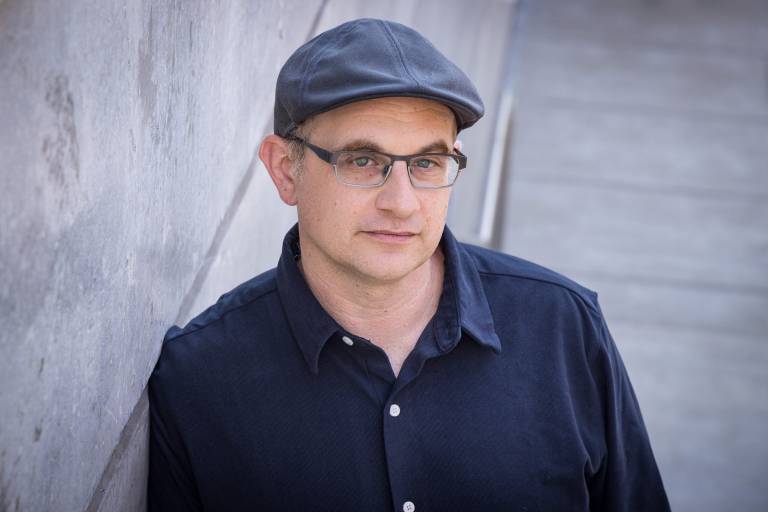
"title": "Jonathan-Spector-Headshot-Photo-Credit-Cheshire-Isaacs-scaled",
"publishDate": 1749156994,
"status": "inherit",
"parent": 13977120,
"modified": 1749490109,
"caption": "Playwright Jonathan Spector mined rich material from the Berkeley mindset for his Tony-winning play ‘Eureka Day.’ ",
"credit": "Cheshire Isaacs",
"altTag": "A man in glasses and a newsboy cap looks upward at the camera",
"description": null,
"imgSizes": {
"thumbnail": {
"file": "https://cdn.kqed.org/wp-content/uploads/sites/2/2025/06/Jonathan-Spector-Headshot-Photo-Credit-Cheshire-Isaacs-scaled-1-160x107.jpg",
"width": 160,
"height": 107,
"mimeType": "image/jpeg"
},
"medium_large": {
"file": "https://cdn.kqed.org/wp-content/uploads/sites/2/2025/06/Jonathan-Spector-Headshot-Photo-Credit-Cheshire-Isaacs-scaled-1-768x512.jpg",
"width": 768,
"height": 512,
"mimeType": "image/jpeg"
},
"1536x1536": {
"file": "https://cdn.kqed.org/wp-content/uploads/sites/2/2025/06/Jonathan-Spector-Headshot-Photo-Credit-Cheshire-Isaacs-scaled-1-1536x1025.jpg",
"width": 1536,
"height": 1025,
"mimeType": "image/jpeg"
},
"post-thumbnail": {
"file": "https://cdn.kqed.org/wp-content/uploads/sites/2/2025/06/Jonathan-Spector-Headshot-Photo-Credit-Cheshire-Isaacs-scaled-1-672x372.jpg",
"width": 672,
"height": 372,
"mimeType": "image/jpeg"
},
"twentyfourteen-full-width": {
"file": "https://cdn.kqed.org/wp-content/uploads/sites/2/2025/06/Jonathan-Spector-Headshot-Photo-Credit-Cheshire-Isaacs-scaled-1-1038x576.jpg",
"width": 1038,
"height": 576,
"mimeType": "image/jpeg"
},
"kqedFullSize": {
"file": "https://cdn.kqed.org/wp-content/uploads/sites/2/2025/06/Jonathan-Spector-Headshot-Photo-Credit-Cheshire-Isaacs-scaled-1.jpg",
"width": 2000,
"height": 1334
}
},
"isLoading": false,
"fetchFailed": false
},
"arts_13977012": {
"type": "attachments",
"id": "arts_13977012",
"meta": {
"index": "attachments_1716263798",
"site": "arts",
"id": "13977012",
"found": true
},
"title": "DanceHallCrashers.16x9.MAIN",
"publishDate": 1748969777,
"status": "inherit",
"parent": 13976994,
"modified": 1748972031,
"caption": "Karina Deniké and Elyse Rogers, frontwomen of Dance Hall Crashers, in a Polaroid from 1998.",
"credit": "Debra McClinton",
"altTag": "two women with dark hair pose for the camera, one in a yellow suit and one in a black dress",
"description": null,
"imgSizes": {
"medium": {
"file": "https://cdn.kqed.org/wp-content/uploads/sites/2/2025/06/DanceHallCrashers.16x9.MAIN_-800x450.jpg",
"width": 800,
"height": 450,
"mimeType": "image/jpeg"
},
"large": {
"file": "https://cdn.kqed.org/wp-content/uploads/sites/2/2025/06/DanceHallCrashers.16x9.MAIN_-1020x574.jpg",
"width": 1020,
"height": 574,
"mimeType": "image/jpeg"
},
"thumbnail": {
"file": "https://cdn.kqed.org/wp-content/uploads/sites/2/2025/06/DanceHallCrashers.16x9.MAIN_-160x90.jpg",
"width": 160,
"height": 90,
"mimeType": "image/jpeg"
},
"medium_large": {
"file": "https://cdn.kqed.org/wp-content/uploads/sites/2/2025/06/DanceHallCrashers.16x9.MAIN_-768x432.jpg",
"width": 768,
"height": 432,
"mimeType": "image/jpeg"
},
"1536x1536": {
"file": "https://cdn.kqed.org/wp-content/uploads/sites/2/2025/06/DanceHallCrashers.16x9.MAIN_-1536x864.jpg",
"width": 1536,
"height": 864,
"mimeType": "image/jpeg"
},
"post-thumbnail": {
"file": "https://cdn.kqed.org/wp-content/uploads/sites/2/2025/06/DanceHallCrashers.16x9.MAIN_-672x372.jpg",
"width": 672,
"height": 372,
"mimeType": "image/jpeg"
},
"twentyfourteen-full-width": {
"file": "https://cdn.kqed.org/wp-content/uploads/sites/2/2025/06/DanceHallCrashers.16x9.MAIN_-1038x576.jpg",
"width": 1038,
"height": 576,
"mimeType": "image/jpeg"
},
"full-width": {
"file": "https://cdn.kqed.org/wp-content/uploads/sites/2/2025/06/DanceHallCrashers.16x9.MAIN_-1920x1080.jpg",
"width": 1920,
"height": 1080,
"mimeType": "image/jpeg"
},
"kqedFullSize": {
"file": "https://cdn.kqed.org/wp-content/uploads/sites/2/2025/06/DanceHallCrashers.16x9.MAIN_.jpg",
"width": 2000,
"height": 1125
}
},
"isLoading": false,
"fetchFailed": false
},
"arts_13976889": {
"type": "attachments",
"id": "arts_13976889",
"meta": {
"index": "attachments_1716263798",
"site": "arts",
"id": "13976889",
"found": true
},
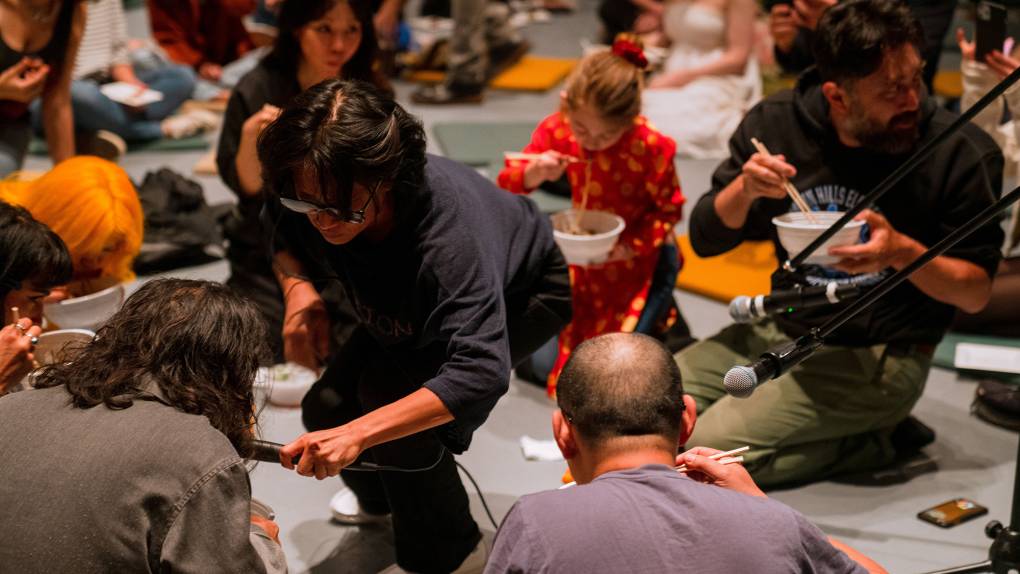
"title": "moca slurping event",
"publishDate": 1748554882,
"status": "inherit",
"parent": 13976887,
"modified": 1748555323,
"caption": "The first iteration of Horvitz's slurping performance took place at Soup & Tart in Los Angeles on June 8, 2023. Presented by Active Cultures at the Geffen Contemporary at MOCA. ",
"credit": "Photos by Roadwork, courtesy of the artists and Active Cultures",
"altTag": "Several people crouch on the ground slurping udon noodles while a man captures the sound with a microphone.",
"description": null,
"imgSizes": {
"medium": {
"file": "https://cdn.kqed.org/wp-content/uploads/sites/2/2025/05/moca-slurping-event-800x450.jpg",
"width": 800,
"height": 450,
"mimeType": "image/jpeg"
},
"large": {
"file": "https://cdn.kqed.org/wp-content/uploads/sites/2/2025/05/moca-slurping-event-1020x574.jpg",
"width": 1020,
"height": 574,
"mimeType": "image/jpeg"
},
"thumbnail": {
"file": "https://cdn.kqed.org/wp-content/uploads/sites/2/2025/05/moca-slurping-event-160x90.jpg",
"width": 160,
"height": 90,
"mimeType": "image/jpeg"
},
"medium_large": {
"file": "https://cdn.kqed.org/wp-content/uploads/sites/2/2025/05/moca-slurping-event-768x432.jpg",
"width": 768,
"height": 432,
"mimeType": "image/jpeg"
},
"1536x1536": {
"file": "https://cdn.kqed.org/wp-content/uploads/sites/2/2025/05/moca-slurping-event-1536x864.jpg",
"width": 1536,
"height": 864,
"mimeType": "image/jpeg"
},
"post-thumbnail": {
"file": "https://cdn.kqed.org/wp-content/uploads/sites/2/2025/05/moca-slurping-event-672x372.jpg",
"width": 672,
"height": 372,
"mimeType": "image/jpeg"
},
"twentyfourteen-full-width": {
"file": "https://cdn.kqed.org/wp-content/uploads/sites/2/2025/05/moca-slurping-event-1038x576.jpg",
"width": 1038,
"height": 576,
"mimeType": "image/jpeg"
},
"full-width": {
"file": "https://cdn.kqed.org/wp-content/uploads/sites/2/2025/05/moca-slurping-event-1920x1080.jpg",
"width": 1920,
"height": 1080,
"mimeType": "image/jpeg"
},
"kqedFullSize": {
"file": "https://cdn.kqed.org/wp-content/uploads/sites/2/2025/05/moca-slurping-event.jpg",
"width": 2000,
"height": 1125
}
},
"isLoading": false,
"fetchFailed": false
},
"arts_13976805": {
"type": "attachments",
"id": "arts_13976805",
"meta": {
"index": "attachments_1716263798",
"site": "arts",
"id": "13976805",
"found": true
},
"title": "4948-1-1",
"publishDate": 1748455428,
"status": "inherit",
"parent": 13976751,
"modified": 1748455591,
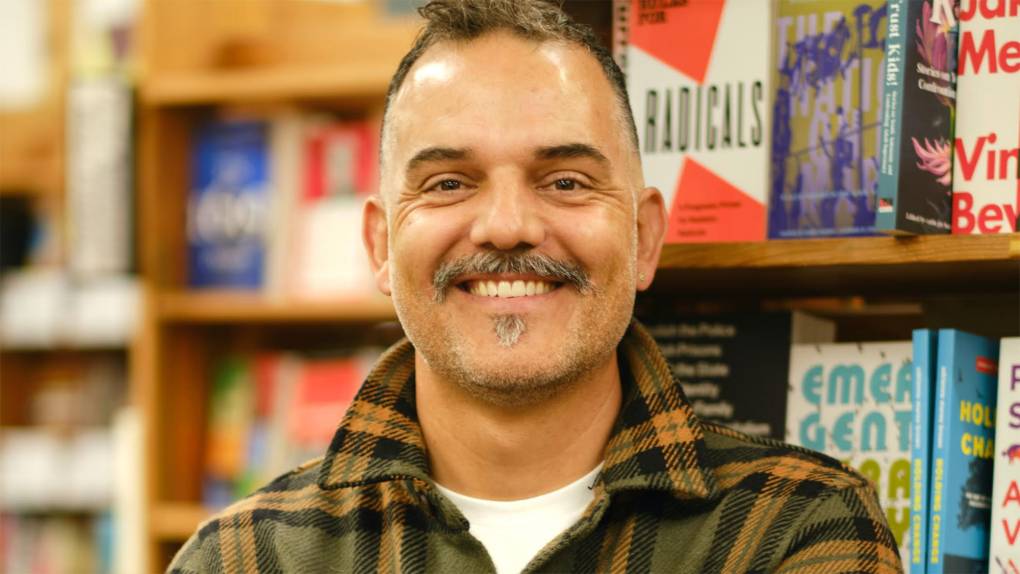
"caption": "J.K. Fowler, the new executive director of the Bay Area Book Festival, brings years of experience in literary circles to the annual Berkeley event.",
"credit": "Courtesy J.K. Fowler",
"altTag": "A smiling man in a plaid flannel with folded arms against a backdrop of bookshelves",
"description": null,
"imgSizes": {
"medium": {
"file": "https://cdn.kqed.org/wp-content/uploads/sites/2/2025/05/4948-1-1-800x450.jpg",
"width": 800,
"height": 450,
"mimeType": "image/jpeg"
},
"large": {
"file": "https://cdn.kqed.org/wp-content/uploads/sites/2/2025/05/4948-1-1-1020x574.jpg",
"width": 1020,
"height": 574,
"mimeType": "image/jpeg"
},
"thumbnail": {
"file": "https://cdn.kqed.org/wp-content/uploads/sites/2/2025/05/4948-1-1-160x90.jpg",
"width": 160,
"height": 90,
"mimeType": "image/jpeg"
},
"medium_large": {
"file": "https://cdn.kqed.org/wp-content/uploads/sites/2/2025/05/4948-1-1-768x432.jpg",
"width": 768,
"height": 432,
"mimeType": "image/jpeg"
},
"1536x1536": {
"file": "https://cdn.kqed.org/wp-content/uploads/sites/2/2025/05/4948-1-1-1536x864.jpg",
"width": 1536,
"height": 864,
"mimeType": "image/jpeg"
},
"post-thumbnail": {
"file": "https://cdn.kqed.org/wp-content/uploads/sites/2/2025/05/4948-1-1-672x372.jpg",
"width": 672,
"height": 372,
"mimeType": "image/jpeg"
},
"twentyfourteen-full-width": {
"file": "https://cdn.kqed.org/wp-content/uploads/sites/2/2025/05/4948-1-1-1038x576.jpg",
"width": 1038,
"height": 576,
"mimeType": "image/jpeg"
},
"full-width": {
"file": "https://cdn.kqed.org/wp-content/uploads/sites/2/2025/05/4948-1-1-1920x1080.jpg",
"width": 1920,
"height": 1080,
"mimeType": "image/jpeg"
},
"kqedFullSize": {
"file": "https://cdn.kqed.org/wp-content/uploads/sites/2/2025/05/4948-1-1.jpg",
"width": 2000,
"height": 1125
}
},
"isLoading": false,
"fetchFailed": false
},
"arts_13976778": {
"type": "attachments",
"id": "arts_13976778",
"meta": {
"index": "attachments_1716263798",
"site": "arts",
"id": "13976778",
"found": true
},
"title": "2024 NCAA Division I Women's Gymnastics Championships",
"publishDate": 1748376284,
"status": "inherit",
"parent": 13976777,
"modified": 1748376448,
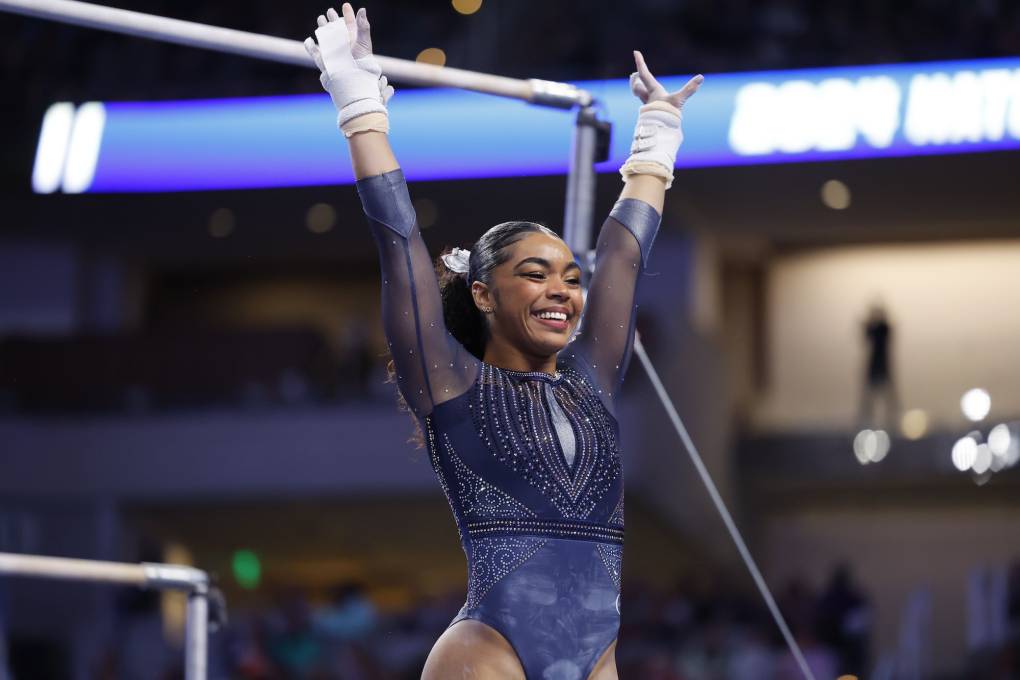
"caption": "UC Berkeley athlete eMjae Frazier competing in Texas in 2024. ",
"credit": "C. Morgan Engel/NCAA Photos via Getty Images",
"altTag": "A young Black gymnast wearing a dark blue leotard, smiles and raises her arms straight over her head at the end of a routine. Her hair is tied back in a neat ponytail.",
"description": null,
"imgSizes": {
"medium": {
"file": "https://cdn.kqed.org/wp-content/uploads/sites/2/2025/05/eMjae-Frazier-800x533.jpg",
"width": 800,
"height": 533,
"mimeType": "image/jpeg"
},
"large": {
"file": "https://cdn.kqed.org/wp-content/uploads/sites/2/2025/05/eMjae-Frazier-1020x680.jpg",
"width": 1020,
"height": 680,
"mimeType": "image/jpeg"
},
"thumbnail": {
"file": "https://cdn.kqed.org/wp-content/uploads/sites/2/2025/05/eMjae-Frazier-160x107.jpg",
"width": 160,
"height": 107,
"mimeType": "image/jpeg"
},
"medium_large": {
"file": "https://cdn.kqed.org/wp-content/uploads/sites/2/2025/05/eMjae-Frazier-768x512.jpg",
"width": 768,
"height": 512,
"mimeType": "image/jpeg"
},
"1536x1536": {
"file": "https://cdn.kqed.org/wp-content/uploads/sites/2/2025/05/eMjae-Frazier-1536x1024.jpg",
"width": 1536,
"height": 1024,
"mimeType": "image/jpeg"
},
"post-thumbnail": {
"file": "https://cdn.kqed.org/wp-content/uploads/sites/2/2025/05/eMjae-Frazier-672x372.jpg",
"width": 672,
"height": 372,
"mimeType": "image/jpeg"
},
"twentyfourteen-full-width": {
"file": "https://cdn.kqed.org/wp-content/uploads/sites/2/2025/05/eMjae-Frazier-1038x576.jpg",
"width": 1038,
"height": 576,
"mimeType": "image/jpeg"
},
"full-width": {
"file": "https://cdn.kqed.org/wp-content/uploads/sites/2/2025/05/eMjae-Frazier-1920x1280.jpg",
"width": 1920,
"height": 1280,
"mimeType": "image/jpeg"
},
"kqedFullSize": {
"file": "https://cdn.kqed.org/wp-content/uploads/sites/2/2025/05/eMjae-Frazier.jpg",
"width": 2000,
"height": 1333
}
},
"isLoading": false,
"fetchFailed": false
},
"arts_13976151": {
"type": "attachments",
"id": "arts_13976151",
"meta": {
"index": "attachments_1716263798",
"site": "arts",
"id": "13976151",
"found": true
},
"title": "rilo kiley crop",
"publishDate": 1747159231,
"status": "inherit",
"parent": 13976145,
"modified": 1747159423,
"caption": "The cover of Rilo Kiley's new greatest hits album, released on May 9, 2025. The legendary indie rock band's reunion tour comes to Berkeley on Oct. 16.",
"credit": "Courtesy of Rilo Kiley",
"altTag": "Album cover: Four band members stand in front of a brick wall in a photo from the late '90s.",
"description": null,
"imgSizes": {
"medium": {
"file": "https://cdn.kqed.org/wp-content/uploads/sites/2/2025/05/rilo-kiley-crop-800x450.jpg",
"width": 800,
"height": 450,
"mimeType": "image/jpeg"
},
"large": {
"file": "https://cdn.kqed.org/wp-content/uploads/sites/2/2025/05/rilo-kiley-crop-1020x574.jpg",
"width": 1020,
"height": 574,
"mimeType": "image/jpeg"
},
"thumbnail": {
"file": "https://cdn.kqed.org/wp-content/uploads/sites/2/2025/05/rilo-kiley-crop-160x90.jpg",
"width": 160,
"height": 90,
"mimeType": "image/jpeg"
},
"medium_large": {
"file": "https://cdn.kqed.org/wp-content/uploads/sites/2/2025/05/rilo-kiley-crop-768x432.jpg",
"width": 768,
"height": 432,
"mimeType": "image/jpeg"
},
"1536x1536": {
"file": "https://cdn.kqed.org/wp-content/uploads/sites/2/2025/05/rilo-kiley-crop-1536x865.jpg",
"width": 1536,
"height": 865,
"mimeType": "image/jpeg"
},
"post-thumbnail": {
"file": "https://cdn.kqed.org/wp-content/uploads/sites/2/2025/05/rilo-kiley-crop-672x372.jpg",
"width": 672,
"height": 372,
"mimeType": "image/jpeg"
},
"twentyfourteen-full-width": {
"file": "https://cdn.kqed.org/wp-content/uploads/sites/2/2025/05/rilo-kiley-crop-1038x576.jpg",
"width": 1038,
"height": 576,
"mimeType": "image/jpeg"
},
"kqedFullSize": {
"file": "https://cdn.kqed.org/wp-content/uploads/sites/2/2025/05/rilo-kiley-crop.jpg",
"width": 1920,
"height": 1081
}
},
"isLoading": false,
"fetchFailed": false
},
"arts_13975911": {
"type": "attachments",
"id": "arts_13975911",
"meta": {
"index": "attachments_1716263798",
"site": "arts",
"id": "13975911",
"found": true
},
"title": "heyma-1 cropped",
"publishDate": 1746748662,
"status": "inherit",
"parent": 13975908,
"modified": 1746748805,
"caption": "In Berkeley, Heyma Yemeni Coffee combines both traditional and contemporary aspects of Yemeni coffee culture.",
"credit": "Wahab Algarmi",
"altTag": "Illustration: two men sit in front of a table loaded with cakes, pastries and coffee.",
"description": null,
"imgSizes": {
"medium": {
"file": "https://cdn.kqed.org/wp-content/uploads/sites/2/2025/05/heyma-1-cropped-800x450.jpg",
"width": 800,
"height": 450,
"mimeType": "image/jpeg"
},
"large": {
"file": "https://cdn.kqed.org/wp-content/uploads/sites/2/2025/05/heyma-1-cropped-1020x574.jpg",
"width": 1020,
"height": 574,
"mimeType": "image/jpeg"
},
"thumbnail": {
"file": "https://cdn.kqed.org/wp-content/uploads/sites/2/2025/05/heyma-1-cropped-160x90.jpg",
"width": 160,
"height": 90,
"mimeType": "image/jpeg"
},
"medium_large": {
"file": "https://cdn.kqed.org/wp-content/uploads/sites/2/2025/05/heyma-1-cropped-768x432.jpg",
"width": 768,
"height": 432,
"mimeType": "image/jpeg"
},
"1536x1536": {
"file": "https://cdn.kqed.org/wp-content/uploads/sites/2/2025/05/heyma-1-cropped-1536x864.jpg",
"width": 1536,
"height": 864,
"mimeType": "image/jpeg"
},
"post-thumbnail": {
"file": "https://cdn.kqed.org/wp-content/uploads/sites/2/2025/05/heyma-1-cropped-672x372.jpg",
"width": 672,
"height": 372,
"mimeType": "image/jpeg"
},
"twentyfourteen-full-width": {
"file": "https://cdn.kqed.org/wp-content/uploads/sites/2/2025/05/heyma-1-cropped-1038x576.jpg",
"width": 1038,
"height": 576,
"mimeType": "image/jpeg"
},
"kqedFullSize": {
"file": "https://cdn.kqed.org/wp-content/uploads/sites/2/2025/05/heyma-1-cropped.jpg",
"width": 1920,
"height": 1080
}
},
"isLoading": false,
"fetchFailed": false
},
"arts_13975875": {
"type": "attachments",
"id": "arts_13975875",
"meta": {
"index": "attachments_1716263798",
"site": "arts",
"id": "13975875",
"found": true
},
"title": "crixa cropped",
"publishDate": 1746665966,
"status": "inherit",
"parent": 13975870,
"modified": 1746666020,
"caption": "Crixa Cakes, a Berkeley institution since 1998, will close on May 10, 2025.",
"credit": "Luke Tsai/KQED",
"altTag": "Exterior of bakery. The sign reads \"Crixa Cakes.\"",
"description": null,
"imgSizes": {
"medium": {
"file": "https://cdn.kqed.org/wp-content/uploads/sites/2/2025/05/crixa-cropped-800x450.jpg",
"width": 800,
"height": 450,
"mimeType": "image/jpeg"
},
"large": {
"file": "https://cdn.kqed.org/wp-content/uploads/sites/2/2025/05/crixa-cropped-1020x574.jpg",
"width": 1020,
"height": 574,
"mimeType": "image/jpeg"
},
"thumbnail": {
"file": "https://cdn.kqed.org/wp-content/uploads/sites/2/2025/05/crixa-cropped-160x90.jpg",
"width": 160,
"height": 90,
"mimeType": "image/jpeg"
},
"medium_large": {
"file": "https://cdn.kqed.org/wp-content/uploads/sites/2/2025/05/crixa-cropped-768x432.jpg",
"width": 768,
"height": 432,
"mimeType": "image/jpeg"
},
"1536x1536": {
"file": "https://cdn.kqed.org/wp-content/uploads/sites/2/2025/05/crixa-cropped-1536x864.jpg",
"width": 1536,
"height": 864,
"mimeType": "image/jpeg"
},
"post-thumbnail": {
"file": "https://cdn.kqed.org/wp-content/uploads/sites/2/2025/05/crixa-cropped-672x372.jpg",
"width": 672,
"height": 372,
"mimeType": "image/jpeg"
},
"twentyfourteen-full-width": {
"file": "https://cdn.kqed.org/wp-content/uploads/sites/2/2025/05/crixa-cropped-1038x576.jpg",
"width": 1038,
"height": 576,
"mimeType": "image/jpeg"
},
"full-width": {
"file": "https://cdn.kqed.org/wp-content/uploads/sites/2/2025/05/crixa-cropped-1920x1080.jpg",
"width": 1920,
"height": 1080,
"mimeType": "image/jpeg"
},
"kqedFullSize": {
"file": "https://cdn.kqed.org/wp-content/uploads/sites/2/2025/05/crixa-cropped.jpg",
"width": 2000,
"height": 1125
}
},
"isLoading": false,
"fetchFailed": false
},
"arts_13974831": {
"type": "attachments",
"id": "arts_13974831",
"meta": {
"index": "attachments_1716263798",
"site": "arts",
"id": "13974831",
"found": true
},
"title": "monyh for science",
"publishDate": 1744969617,
"status": "inherit",
"parent": 13974739,
"modified": 1744969704,
"caption": "‘Money for science, not oligarghs’ by Michele Pred, projected onto a UC Berkeley building, April 2025.",
"credit": "Courtesy of Michele Pred",
"altTag": "A projection reading ‘Money for science, not oligarchs’ on a building at UC Berkeley.",
"description": null,
"imgSizes": {
"medium": {
"file": "https://cdn.kqed.org/wp-content/uploads/sites/2/2025/04/monyh-for-science-1-800x461.jpeg",
"width": 800,
"height": 461,
"mimeType": "image/jpeg"
},
"large": {
"file": "https://cdn.kqed.org/wp-content/uploads/sites/2/2025/04/monyh-for-science-1-1020x588.jpeg",
"width": 1020,
"height": 588,
"mimeType": "image/jpeg"
},
"thumbnail": {
"file": "https://cdn.kqed.org/wp-content/uploads/sites/2/2025/04/monyh-for-science-1-160x92.jpeg",
"width": 160,
"height": 92,
"mimeType": "image/jpeg"
},
"medium_large": {
"file": "https://cdn.kqed.org/wp-content/uploads/sites/2/2025/04/monyh-for-science-1-768x442.jpeg",
"width": 768,
"height": 442,
"mimeType": "image/jpeg"
},
"1536x1536": {
"file": "https://cdn.kqed.org/wp-content/uploads/sites/2/2025/04/monyh-for-science-1-1536x885.jpeg",
"width": 1536,
"height": 885,
"mimeType": "image/jpeg"
},
"post-thumbnail": {
"file": "https://cdn.kqed.org/wp-content/uploads/sites/2/2025/04/monyh-for-science-1-672x372.jpeg",
"width": 672,
"height": 372,
"mimeType": "image/jpeg"
},
"twentyfourteen-full-width": {
"file": "https://cdn.kqed.org/wp-content/uploads/sites/2/2025/04/monyh-for-science-1-1038x576.jpeg",
"width": 1038,
"height": 576,
"mimeType": "image/jpeg"
},
"full-width": {
"file": "https://cdn.kqed.org/wp-content/uploads/sites/2/2025/04/monyh-for-science-1-1920x1106.jpeg",
"width": 1920,
"height": 1106,
"mimeType": "image/jpeg"
},
"kqedFullSize": {
"file": "https://cdn.kqed.org/wp-content/uploads/sites/2/2025/04/monyh-for-science-1.jpeg",
"width": 2000,
"height": 1152
}
},
"isLoading": false,
"fetchFailed": false
},
"arts_13974619": {
"type": "attachments",
"id": "arts_13974619",
"meta": {
"index": "attachments_1716263798",
"site": "arts",
"id": "13974619",
"found": true
},
"title": "VIVIENS_WILD_RIDE_1",
"publishDate": 1744742468,
"status": "inherit",
"parent": 13974577,
"modified": 1744742570,
"caption": "Vivien Hillgrove in a still from ‘Vivien's Wild Ride,’ a personal documentary from the veteran Bay Area film editor. ",
"credit": "Courtesy SFFILM",
"altTag": "A woman in short blonde hair and a white top spools 35mm film through an editing machine.",
"description": null,
"imgSizes": {
"medium": {
"file": "https://cdn.kqed.org/wp-content/uploads/sites/2/2025/04/VIVIENS_WILD_RIDE_1-800x450.jpg",
"width": 800,
"height": 450,
"mimeType": "image/jpeg"
},
"large": {
"file": "https://cdn.kqed.org/wp-content/uploads/sites/2/2025/04/VIVIENS_WILD_RIDE_1-1020x574.jpg",
"width": 1020,
"height": 574,
"mimeType": "image/jpeg"
},
"thumbnail": {
"file": "https://cdn.kqed.org/wp-content/uploads/sites/2/2025/04/VIVIENS_WILD_RIDE_1-160x90.jpg",
"width": 160,
"height": 90,
"mimeType": "image/jpeg"
},
"medium_large": {
"file": "https://cdn.kqed.org/wp-content/uploads/sites/2/2025/04/VIVIENS_WILD_RIDE_1-768x432.jpg",
"width": 768,
"height": 432,
"mimeType": "image/jpeg"
},
"1536x1536": {
"file": "https://cdn.kqed.org/wp-content/uploads/sites/2/2025/04/VIVIENS_WILD_RIDE_1-1536x864.jpg",
"width": 1536,
"height": 864,
"mimeType": "image/jpeg"
},
"post-thumbnail": {
"file": "https://cdn.kqed.org/wp-content/uploads/sites/2/2025/04/VIVIENS_WILD_RIDE_1-672x372.jpg",
"width": 672,
"height": 372,
"mimeType": "image/jpeg"
},
"twentyfourteen-full-width": {
"file": "https://cdn.kqed.org/wp-content/uploads/sites/2/2025/04/VIVIENS_WILD_RIDE_1-1038x576.jpg",
"width": 1038,
"height": 576,
"mimeType": "image/jpeg"
},
"kqedFullSize": {
"file": "https://cdn.kqed.org/wp-content/uploads/sites/2/2025/04/VIVIENS_WILD_RIDE_1.jpg",
"width": 1894,
"height": 1065
}
},
"isLoading": false,
"fetchFailed": false
},
"arts_13936339": {
"type": "attachments",
"id": "arts_13936339",
"meta": {
"index": "attachments_1716263798",
"site": "arts",
"id": "13936339",
"found": true
},
"parent": 13936332,
"imgSizes": {
"twentyfourteen-full-width": {
"file": "https://ww2.kqed.org/app/uploads/sites/2/2023/10/tchaka_griot-1038x576.jpg",
"width": 1038,
"mimeType": "image/jpeg",
"height": 576
},
"thumbnail": {
"file": "https://ww2.kqed.org/app/uploads/sites/2/2023/10/tchaka_griot-160x110.jpg",
"width": 160,
"mimeType": "image/jpeg",
"height": 110
},
"post-thumbnail": {
"file": "https://ww2.kqed.org/app/uploads/sites/2/2023/10/tchaka_griot-672x372.jpg",
"width": 672,
"mimeType": "image/jpeg",
"height": 372
},
"kqedFullSize": {
"file": "https://ww2.kqed.org/app/uploads/sites/2/2023/10/tchaka_griot.jpg",
"width": 2000,
"height": 1375
},
"large": {
"file": "https://ww2.kqed.org/app/uploads/sites/2/2023/10/tchaka_griot-1020x701.jpg",
"width": 1020,
"mimeType": "image/jpeg",
"height": 701
},
"1536x1536": {
"file": "https://ww2.kqed.org/app/uploads/sites/2/2023/10/tchaka_griot-1536x1056.jpg",
"width": 1536,
"mimeType": "image/jpeg",
"height": 1056
},
"full-width": {
"file": "https://ww2.kqed.org/app/uploads/sites/2/2023/10/tchaka_griot-1920x1320.jpg",
"width": 1920,
"mimeType": "image/jpeg",
"height": 1320
},
"medium": {
"file": "https://ww2.kqed.org/app/uploads/sites/2/2023/10/tchaka_griot-800x550.jpg",
"width": 800,
"mimeType": "image/jpeg",
"height": 550
},
"medium_large": {
"file": "https://ww2.kqed.org/app/uploads/sites/2/2023/10/tchaka_griot-768x528.jpg",
"width": 768,
"mimeType": "image/jpeg",
"height": 528
}
},
"publishDate": 1697136077,
"modified": 1697136195,
"caption": "Griot, a citrus-marinated fried pork dish, is one of the Haitian specialties served at T'chaka in Old Oakland.",
"description": null,
"title": "tchaka_griot",
"credit": "Luke Tsai/KQED",
"status": "inherit",
"altTag": "Fried pork, rice, plantains and pikliz (pickled cabbage and carrots) on a dark blue plate.",
"isLoading": false,
"fetchFailed": false
},
"arts_13972138": {
"type": "attachments",
"id": "arts_13972138",
"meta": {
"index": "attachments_1716263798",
"site": "arts",
"id": "13972138",
"found": true
},
"title": "raised by ghosts - spread",
"publishDate": 1740099272,
"status": "inherit",
"parent": 13972135,
"modified": 1740099368,
"caption": "A spread from Briana Loewinsohn's new graphic memoir, 'Raised by Ghosts.'",
"credit": "Fantagraphics",
"altTag": "Illustration: teenage girl sprawls on the floor of her bedroom surrounded by sketches and handwritten notes",
"description": null,
"imgSizes": {
"medium": {
"file": "https://cdn.kqed.org/wp-content/uploads/sites/2/2025/02/raised-by-ghosts-spread-800x517.jpg",
"width": 800,
"height": 517,
"mimeType": "image/jpeg"
},
"large": {
"file": "https://cdn.kqed.org/wp-content/uploads/sites/2/2025/02/raised-by-ghosts-spread-1020x659.jpg",
"width": 1020,
"height": 659,
"mimeType": "image/jpeg"
},
"thumbnail": {
"file": "https://cdn.kqed.org/wp-content/uploads/sites/2/2025/02/raised-by-ghosts-spread-160x103.jpg",
"width": 160,
"height": 103,
"mimeType": "image/jpeg"
},
"medium_large": {
"file": "https://cdn.kqed.org/wp-content/uploads/sites/2/2025/02/raised-by-ghosts-spread-768x497.jpg",
"width": 768,
"height": 497,
"mimeType": "image/jpeg"
},
"1536x1536": {
"file": "https://cdn.kqed.org/wp-content/uploads/sites/2/2025/02/raised-by-ghosts-spread-1536x993.jpg",
"width": 1536,
"height": 993,
"mimeType": "image/jpeg"
},
"post-thumbnail": {
"file": "https://cdn.kqed.org/wp-content/uploads/sites/2/2025/02/raised-by-ghosts-spread-672x372.jpg",
"width": 672,
"height": 372,
"mimeType": "image/jpeg"
},
"twentyfourteen-full-width": {
"file": "https://cdn.kqed.org/wp-content/uploads/sites/2/2025/02/raised-by-ghosts-spread-1038x576.jpg",
"width": 1038,
"height": 576,
"mimeType": "image/jpeg"
},
"full-width": {
"file": "https://cdn.kqed.org/wp-content/uploads/sites/2/2025/02/raised-by-ghosts-spread-1920x1241.jpg",
"width": 1920,
"height": 1241,
"mimeType": "image/jpeg"
},
"kqedFullSize": {
"file": "https://cdn.kqed.org/wp-content/uploads/sites/2/2025/02/raised-by-ghosts-spread.jpg",
"width": 2000,
"height": 1293
}
},
"isLoading": false,
"fetchFailed": false
}
},
"audioPlayerReducer": {
"postId": "stream_live",
"isPaused": true,
"isPlaying": false,
"pfsActive": false,
"pledgeModalIsOpen": true,
"playerDrawerIsOpen": false,
"liveAudioPlayStartedAt": 0,
"liveAudioPlayContext": ""
},
"authorsReducer": {
"byline_arts_13975908": {
"type": "authors",
"id": "byline_arts_13975908",
"meta": {
"override": true
},
"slug": "byline_arts_13975908",
"name": "Luke Tsai and Wahab Algarmi",
"isLoading": false
},
"mfox": {
"type": "authors",
"id": "22",
"meta": {
"index": "authors_1716337520",
"id": "22",
"found": true
},
"name": "Michael Fox",
"firstName": "Michael",
"lastName": "Fox",
"slug": "mfox",
"email": "foxonfilm@yahoo.com",
"display_author_email": false,
"staff_mastheads": [],
"title": "KQED Contributor",
"bio": "Michael Fox has written about film for dozens of publications since 1987. He is a founding member of the San Francisco Bay Area Film Critics Circle.",
"avatar": "https://secure.gravatar.com/avatar/d9849d6c659c41414795c471d907bb97b396e2a32b88e20e6ff66f65fbdd6dcd?s=600&d=blank&r=g",
"twitter": null,
"bluesky": null,
"facebook": null,
"instagram": null,
"linkedin": null,
"sites": [
{
"site": "arts",
"roles": [
"Contributor",
"contributor"
]
}
],
"headData": {
"title": "Michael Fox | KQED",
"description": "KQED Contributor",
"ogImgSrc": "https://secure.gravatar.com/avatar/d9849d6c659c41414795c471d907bb97b396e2a32b88e20e6ff66f65fbdd6dcd?s=600&d=blank&r=g",
"twImgSrc": "https://secure.gravatar.com/avatar/d9849d6c659c41414795c471d907bb97b396e2a32b88e20e6ff66f65fbdd6dcd?s=600&d=blank&r=g"
},
"isLoading": false,
"link": "/author/mfox"
},
"esilvers": {
"type": "authors",
"id": "7237",
"meta": {
"index": "authors_1716337520",
"id": "7237",
"found": true
},
"name": "Emma Silvers",
"firstName": "Emma",
"lastName": "Silvers",
"slug": "esilvers",
"email": "esilvers@kqed.org",
"display_author_email": false,
"staff_mastheads": [],
"title": "KQED Contributor",
"bio": "Emma Silvers is an editor at KQED Arts and a former digital producer at KQED News. Born and raised in the Bay Area, she has previously been an arts and entertainment editor at the \u003cem>San Francisco Chronicle\u003c/em>, \u003cem>SF Weekly\u003c/em> and the \u003cem>San Francisco Bay Guardian.\u003c/em> \u003ca href=\"https://www.emmasilvers.com\">Her work\u003c/a> has also appeared in \u003cem>Rolling Stone\u003c/em>, Pitchfork and \u003cem>Mother Jones\u003c/em>. In 2017 she was the recipient of the Society of Professional Journalists-Northern California's award for arts and culture reporting. In 1993 she \u003ca href=\"https://www.kqed.org/pop/16759/wait-what-my-coworker-was-a-voice-over-hyperventilator-for-jurassic-park\">hyperventilated in \u003cem>Jurassic Park\u003c/em>\u003c/a>.",
"avatar": "https://secure.gravatar.com/avatar/247beada39b88ea5759db1f51dba05cf?s=600&d=blank&r=g",
"twitter": "emmaruthless",
"facebook": null,
"instagram": null,
"linkedin": null,
"sites": [
{
"site": "arts",
"roles": [
"editor"
]
},
{
"site": "news",
"roles": [
"editor"
]
},
{
"site": "pop",
"roles": [
"contributor"
]
},
{
"site": "bayareabites",
"roles": [
"editor"
]
},
{
"site": "food",
"roles": [
"contributor"
]
},
{
"site": "liveblog",
"roles": [
"editor"
]
}
],
"headData": {
"title": "Emma Silvers | KQED",
"description": "KQED Contributor",
"ogImgSrc": "https://secure.gravatar.com/avatar/247beada39b88ea5759db1f51dba05cf?s=600&d=blank&r=g",
"twImgSrc": "https://secure.gravatar.com/avatar/247beada39b88ea5759db1f51dba05cf?s=600&d=blank&r=g"
},
"isLoading": false,
"link": "/author/esilvers"
},
"bwatt": {
"type": "authors",
"id": "11238",
"meta": {
"index": "authors_1716337520",
"id": "11238",
"found": true
},
"name": "Brian Watt",
"firstName": "Brian",
"lastName": "Watt",
"slug": "bwatt",
"email": "bwatt@KQED.org",
"display_author_email": false,
"staff_mastheads": [
"news"
],
"title": "Morning News Anchor",
"bio": "Brian Watt is KQED's morning radio news anchor. He joined the KQED News team in April of 2016. Prior to that, he worked as a Reporter for KPCC in Los Angeles and a producer at \u003cem>Marketplace.\u003c/em>\r\n\r\nDuring eight years at KPCC, Brian covered business and economics, and his work won several awards. In 2008, he won the Los Angeles Press Club’s first-place award for Business and Financial Reporting, Broadcast. He’s also received honorable mention and been first runner up for the Press Club’s Radio Journalist of the Year. He won two Golden Mike awards from the Radio and TV News Association of Southern California.\r\n\r\nBrian holds degrees in theater from Yale University and the Sorbonne, and has worked as an actor in France, Italy, Brazil, Hungary and . . . Hollywood. He appeared in a few television shows, including \u003cem>The West Wing, Judging Amy\u003c/em> and \u003cem>The District.\u003c/em>\r\n\r\nEmail: bwatt@KQED.org Twitter: @RadioBWatt",
"avatar": "https://secure.gravatar.com/avatar/55393ff57ed34e2be773ba4789dd6a19?s=600&d=blank&r=g",
"twitter": "@RadioBWatt",
"facebook": null,
"instagram": null,
"linkedin": null,
"sites": [
{
"site": "arts",
"roles": [
"contributor"
]
},
{
"site": "news",
"roles": [
"editor"
]
}
],
"headData": {
"title": "Brian Watt | KQED",
"description": "Morning News Anchor",
"ogImgSrc": "https://secure.gravatar.com/avatar/55393ff57ed34e2be773ba4789dd6a19?s=600&d=blank&r=g",
"twImgSrc": "https://secure.gravatar.com/avatar/55393ff57ed34e2be773ba4789dd6a19?s=600&d=blank&r=g"
},
"isLoading": false,
"link": "/author/bwatt"
},
"ralexandra": {
"type": "authors",
"id": "11242",
"meta": {
"index": "authors_1716337520",
"id": "11242",
"found": true
},
"name": "Rae Alexandra",
"firstName": "Rae",
"lastName": "Alexandra",
"slug": "ralexandra",
"email": "ralexandra@kqed.org",
"display_author_email": true,
"staff_mastheads": [],
"title": "Reporter/Producer",
"bio": "Rae Alexandra is a Reporter/Producer for KQED Arts & Culture, and the creator/author of the \u003ca href=\"https://www.kqed.org/arts/program/rebel-girls-from-bay-area-history\">Rebel Girls From Bay Area History\u003c/a> and \u003ca href=\"https://www.kqed.org/bizarrebayarea\">Bizarre Bay Area\u003c/a> series. Her debut book, \u003ca href=\"https://citylights.com/politics-current-events-history/unsung-heroines35-women-who-changed/\">Unsung Heroines: 35 Women Who Changed the Bay Area\u003c/a> was published by City Lights in March 2026. In 2023, Rae was awarded an SPJ Excellence in Journalism Award for Arts & Culture. Rae was born and raised in Wales and subsequently — even after two decades in Northern California — still uses phrases that regularly baffle her coworkers.",
"avatar": "https://secure.gravatar.com/avatar/edfee8176c80cc0a382b051190f5341997df378a934a5774dcb0977732dfd401?s=600&d=blank&r=g",
"twitter": null,
"bluesky": null,
"facebook": null,
"instagram": null,
"linkedin": null,
"sites": [
{
"site": "arts",
"roles": [
"subscriber"
]
},
{
"site": "news",
"roles": [
"subscriber"
]
},
{
"site": "pop",
"roles": [
"subscriber"
]
},
{
"site": "bayareabites",
"roles": [
"subscriber"
]
},
{
"site": "science",
"roles": [
"subscriber"
]
}
],
"headData": {
"title": "Rae Alexandra | KQED",
"description": "Reporter/Producer",
"ogImgSrc": "https://secure.gravatar.com/avatar/edfee8176c80cc0a382b051190f5341997df378a934a5774dcb0977732dfd401?s=600&d=blank&r=g",
"twImgSrc": "https://secure.gravatar.com/avatar/edfee8176c80cc0a382b051190f5341997df378a934a5774dcb0977732dfd401?s=600&d=blank&r=g"
},
"isLoading": false,
"link": "/author/ralexandra"
},
"ogpenn": {
"type": "authors",
"id": "11491",
"meta": {
"index": "authors_1716337520",
"id": "11491",
"found": true
},
"name": "Pendarvis Harshaw",
"firstName": "Pendarvis",
"lastName": "Harshaw",
"slug": "ogpenn",
"email": "ogpenn@gmail.com",
"display_author_email": false,
"staff_mastheads": [
"arts"
],
"title": "Community Engagement Reporter",
"bio": "Pendarvis Harshaw is an educator, host and writer with KQED Arts.",
"avatar": "https://secure.gravatar.com/avatar/972b77ee8e3f346ae2b00622661187fbfabd059b5693bbdc1475ea7a722fd4cd?s=600&d=blank&r=g",
"twitter": null,
"bluesky": null,
"facebook": null,
"instagram": "ogpenn",
"linkedin": null,
"sites": [
{
"site": "arts",
"roles": [
"administrator"
]
},
{
"site": "news",
"roles": [
"editor"
]
},
{
"site": "bayareabites",
"roles": [
"author"
]
},
{
"site": "hiphop",
"roles": [
"editor"
]
}
],
"headData": {
"title": "Pendarvis Harshaw | KQED",
"description": "Community Engagement Reporter",
"ogImgSrc": "https://secure.gravatar.com/avatar/972b77ee8e3f346ae2b00622661187fbfabd059b5693bbdc1475ea7a722fd4cd?s=600&d=blank&r=g",
"twImgSrc": "https://secure.gravatar.com/avatar/972b77ee8e3f346ae2b00622661187fbfabd059b5693bbdc1475ea7a722fd4cd?s=600&d=blank&r=g"
},
"isLoading": false,
"link": "/author/ogpenn"
},
"agonzalez": {
"type": "authors",
"id": "11724",
"meta": {
"index": "authors_1716337520",
"id": "11724",
"found": true
},
"name": "Alexander Gonzalez",
"firstName": "Alexander",
"lastName": "Gonzalez",
"slug": "agonzalez",
"email": "AlexanderGonzalez@KQED.org",
"display_author_email": false,
"staff_mastheads": [
"news"
],
"title": "KQED Contributor",
"bio": null,
"avatar": "https://secure.gravatar.com/avatar/9e291ed34e154df4c662edf858b641d70b4859939bfe40be478408f9dfd057d2?s=600&d=blank&r=g",
"twitter": null,
"bluesky": null,
"facebook": null,
"instagram": null,
"linkedin": null,
"sites": [
{
"site": "arts",
"roles": [
"editor"
]
},
{
"site": "news",
"roles": [
"editor"
]
},
{
"site": "science",
"roles": [
"editor"
]
}
],
"headData": {
"title": "Alexander Gonzalez | KQED",
"description": "KQED Contributor",
"ogImgSrc": "https://secure.gravatar.com/avatar/9e291ed34e154df4c662edf858b641d70b4859939bfe40be478408f9dfd057d2?s=600&d=blank&r=g",
"twImgSrc": "https://secure.gravatar.com/avatar/9e291ed34e154df4c662edf858b641d70b4859939bfe40be478408f9dfd057d2?s=600&d=blank&r=g"
},
"isLoading": false,
"link": "/author/agonzalez"
},
"ltsai": {
"type": "authors",
"id": "11743",
"meta": {
"index": "authors_1716337520",
"id": "11743",
"found": true
},
"name": "Luke Tsai",
"firstName": "Luke",
"lastName": "Tsai",
"slug": "ltsai",
"email": "ltsai@kqed.org",
"display_author_email": true,
"staff_mastheads": [
"arts"
],
"title": "Food Editor",
"bio": "Luke Tsai is KQED's food editor and resident stinky tofu connoisseur. Prior to KQED, he was an editor at Eater SF, \u003cem>San Francisco \u003c/em>magazine, and the \u003cem>East Bay Express\u003c/em>, and his work has also appeared in TASTE, the \u003cem>San Francisco Chronicle\u003c/em>, and the \u003cem>Best Food Writing\u003c/em> anthology. When he isn't writing or editing, you'll find him eating most everything he can get his hands on.",
"avatar": "https://secure.gravatar.com/avatar/1e59b45bf191526e7339d6ba46e33a57b2030d25c27660ecc64ea3cb863e34f7?s=600&d=blank&r=g",
"twitter": "theluketsai",
"bluesky": null,
"facebook": null,
"instagram": null,
"linkedin": null,
"sites": [
{
"site": "",
"roles": [
"editor"
]
},
{
"site": "arts",
"roles": [
"administrator"
]
},
{
"site": "news",
"roles": [
"editor",
"contributor"
]
},
{
"site": "bayareabites",
"roles": [
"editor"
]
},
{
"site": "food",
"roles": [
"editor"
]
}
],
"headData": {
"title": "Luke Tsai | KQED",
"description": "Food Editor",
"ogImgSrc": "https://secure.gravatar.com/avatar/1e59b45bf191526e7339d6ba46e33a57b2030d25c27660ecc64ea3cb863e34f7?s=600&d=blank&r=g",
"twImgSrc": "https://secure.gravatar.com/avatar/1e59b45bf191526e7339d6ba46e33a57b2030d25c27660ecc64ea3cb863e34f7?s=600&d=blank&r=g"
},
"isLoading": false,
"link": "/author/ltsai"
}
},
"pagesReducer": {
"arts_tag_berkeley": {
"type": "terms",
"id": "arts_1270",
"meta": {
"index": "terms_1716263798",
"site": "arts",
"id": "1270",
"score": 6.927294
},
"featImg": null,
"name": "Berkeley",
"description": null,
"taxonomy": "tag",
"headData": {
"twImgId": null,
"twTitle": null,
"ogTitle": null,
"ogImgId": null,
"twDescription": null,
"description": null,
"title": "Berkeley Archives | KQED Arts",
"ogDescription": null
},
"ttid": 1282,
"slug": "berkeley",
"isLoading": false,
"title": "Berkeley",
"pageMeta": {
"site": "arts",
"WpPageTemplate": "page-topic-editorial",
"currentPage": 4
},
"blocks": [
{
"blockName": "kqed/post-list",
"attrs": {
"layout": "cardArticle2",
"query": "posts/arts?tag=berkeley",
"seeMore": false,
"paginated": true,
"page": 4
}
},
{
"blockName": "kqed/ad"
}
]
}
},
"pfsSessionReducer": {},
"postsReducer": {
"stream_live": {
"type": "live",
"id": "stream_live",
"audioUrl": "https://streams.kqed.org/kqedradio",
"title": "Live Stream",
"excerpt": "Live Stream information currently unavailable.",
"link": "/radio",
"featImg": "",
"label": {
"name": "KQED Live",
"link": "/"
}
},
"stream_kqedNewscast": {
"type": "posts",
"id": "stream_kqedNewscast",
"audioUrl": "https://www.kqed.org/.stream/anon/radio/RDnews/newscast.mp3?_=1",
"title": "KQED Newscast",
"featImg": "",
"label": {
"name": "88.5 FM",
"link": "/"
}
},
"arts_13977120": {
"type": "posts",
"id": "arts_13977120",
"meta": {
"index": "posts_1716263798",
"site": "arts",
"id": "13977120",
"score": null,
"sort": [
1749214846000
]
},
"guestAuthors": [],
"slug": "eureka-day-jonathan-spector-tony-awards-interview",
"title": "Oakland Playwright on His Tony Award For Berkeley Satire ‘Eureka Day’",
"publishDate": 1749214846,
"format": "standard",
"headTitle": "Oakland Playwright on His Tony Award For Berkeley Satire ‘Eureka Day’ | KQED",
"labelTerm": {
"site": "arts"
},
"content": "\u003cp>\u003ci>This story was updated following the Tony Awards on Sunday, June 8, 2025.\u003c/i>\u003c/p>\n\u003cp>Much has happened since Oakland playwright Jonathan Spector penned his satire \u003cem>Eureka Day\u003c/em>. The play, which premiered Berkeley’s Aurora Theatre Company in 2018, explores the reaction to a mumps outbreak at an elite Berkeley private school, pitting vaccine wokeness against anti-vaxxers.\u003c/p>\n\u003cp>Sound familiar? \u003c/p>\n\u003cp>In the years since, the world has dealt with the \u003ca href=\"https://www.kqed.org/news/tag/covid-19\">COVID-19 pandemic\u003c/a> and its aftermath, measles outbreaks in several states, and a second Trump administration with the Department of Health and Human Services now helmed by Robert F. Kennedy Jr., a vaccine skeptic. \u003c/p>\n\u003cp>[aside postID='arts_13976079']“At moments, it feels like stepping into an episode of \u003cem>The Twilight Zone\u003c/em>,” said Spector, who won a Tony Award on June 8 for Best Revival of a Play.\u003c/p>\n\u003cp>[ad fullwidth]\u003c/p>\n\u003cp>The “very Berkeley” story of \u003cem>Eureka Day\u003c/em> made it to Broadway last year. The play has since been produced around the world, and returns to the Bay Area in September at \u003ca href=\"https://www.marintheatre.org/show-details/eureka-day\">Marin Theatre\u003c/a>, featuring much of the original cast. (Sadly, Aurora Theatre has \u003ca href=\"https://auroratheatre.org/view/download.php/press-room/aurora-general-press-releases/announcement-about-the-future-of-aurora-theatre-company\">suspended its 2025–26 season\u003c/a>, citing financial difficulties.)\u003c/p>\n\u003cp>Spector talked with KQED’s Brian Watt about his Broadway debut, the serendipitous foresight of his story, and a Kennedy Center production that he’s grateful never came to fruition. \u003c/p>\n\u003cfigure id=\"attachment_13977150\" class=\"wp-caption aligncenter\" style=\"max-width: 2000px\">\u003cimg loading=\"lazy\" decoding=\"async\" src=\"https://cdn.kqed.org/wp-content/uploads/sites/2/2025/06/EurekaDay.AuroraTheatre.DavidAllen.jpg\" alt=\"\" width=\"2000\" height=\"1334\" class=\"size-full wp-image-13977150\" srcset=\"https://cdn.kqed.org/wp-content/uploads/sites/2/2025/06/EurekaDay.AuroraTheatre.DavidAllen.jpg 2000w, https://cdn.kqed.org/wp-content/uploads/sites/2/2025/06/EurekaDay.AuroraTheatre.DavidAllen-160x107.jpg 160w, https://cdn.kqed.org/wp-content/uploads/sites/2/2025/06/EurekaDay.AuroraTheatre.DavidAllen-768x512.jpg 768w, https://cdn.kqed.org/wp-content/uploads/sites/2/2025/06/EurekaDay.AuroraTheatre.DavidAllen-1536x1025.jpg 1536w\" sizes=\"auto, (max-width: 2000px) 100vw, 2000px\">\u003cfigcaption class=\"wp-caption-text\">Lisa Anne Porter, Elizabeth Carter, Rolf Saxon, Teddy Spencer, and Charisse Loriaux in Aurora Theatre Company’s world premiere of ‘Eureka Day’ in 2018. \u003ccite>(David Allen)\u003c/cite>\u003c/figcaption>\u003c/figure>\n\u003cp>\u003cem>This interview has been edited for length and clarity.\u003c/em>\u003c/p>\n\u003cp>\u003cstrong>Brian Watt: Congrats on the Tony nomination! So when you first wrote it, did you think it would reach so many audiences?\u003c/strong>\u003c/p>\n\u003cp>\u003cstrong>Jonathan Spector\u003c/strong>: I was trying to write something that would feel like the most Berkeley play I could [give] as a gift to that audience. It was very well-received when we did it at Aurora, but even then, I had no idea if that was only because people enjoy seeing themselves on stage. I didn’t know if it would resonate or make sense to anyone beyond the Bay. And so it was quite surprising and gratifying to see that.\u003c/p>\n\u003cp>\u003cstrong>You wrote this and it was created before the pandemic, but it has remained timely. How did you get the idea for this?\u003c/strong>\u003c/p>\n\u003cp>The conversation around vaccines was floating in the ether. But at that time there had been that [2014-15] outbreak of measles at Disneyland that had led to the state changing its vaccination laws to become much stricter. But then it was more specifically having a couple of moments of being in conversation with friends or acquaintances, people who were smart, well-educated, who generally had the same politics that I do and the same values, and then realizing they didn’t vaccinate their kids, and just finding it so strange that we could basically have an entire shared worldview except for this one thing. So that was really interesting to me, and I was just trying to understand it. That is kind of where the play began.\u003c/p>\n\u003cfigure id=\"attachment_13977151\" class=\"wp-caption aligncenter\" style=\"max-width: 2000px\">\u003cimg loading=\"lazy\" decoding=\"async\" src=\"https://cdn.kqed.org/wp-content/uploads/sites/2/2025/06/AuroraTheatre_EurekaDay2018_DavidAllen5.jpg\" alt=\"\" width=\"2000\" height=\"1491\" class=\"size-full wp-image-13977151\" srcset=\"https://cdn.kqed.org/wp-content/uploads/sites/2/2025/06/AuroraTheatre_EurekaDay2018_DavidAllen5.jpg 2000w, https://cdn.kqed.org/wp-content/uploads/sites/2/2025/06/AuroraTheatre_EurekaDay2018_DavidAllen5-160x119.jpg 160w, https://cdn.kqed.org/wp-content/uploads/sites/2/2025/06/AuroraTheatre_EurekaDay2018_DavidAllen5-768x573.jpg 768w, https://cdn.kqed.org/wp-content/uploads/sites/2/2025/06/AuroraTheatre_EurekaDay2018_DavidAllen5-1536x1145.jpg 1536w\" sizes=\"auto, (max-width: 2000px) 100vw, 2000px\">\u003cfigcaption class=\"wp-caption-text\">Teddy Spencer and Charisse Loriaux in Aurora Theatre Company’s world premiere of ‘Eureka Day’ in 2018. \u003ccite>(David Allen)\u003c/cite>\u003c/figcaption>\u003c/figure>\n\u003cp>\u003cstrong>Another reason this play is so timely is because many of the conversations around vaccine hesitancy were playing out when the COVID-19 vaccine was being rolled out. How do you think this issue has changed from the time when you wrote and first staged \u003cem>Eureka Day\u003c/em>?\u003c/strong>\u003c/p>\n\u003cp>I mean, it’s completely different because part of what made it an interesting topic to explore in a play was that, at that time, it was maybe the only contentious issue that did not have a political valence to it. Knowing somebody didn’t vaccinate their kids at that time did not necessarily tell you anything about their politics. That became very scrambled during COVID and Trump, and now vaccination is much more correlated to politics in the way that everything else is. \u003c/p>\n\u003cp>So it allowed for, at the time, to be a play about an issue where you know people might deeply disagree about this one thing, but they basically agree about everything else and respect each other in general. That made it a much more interesting thing to explore. \u003c/p>\n\u003cp>I also remember interviewing some public health experts when I was researching the play. And one of the things they would tell you is, it’s just very, very hard to change someone’s mind about vaccination once they’ve made up their mind. And people have been quite surprised about how quickly and wildly people’s minds about vaccines have changed mostly for the bad after COVID, and after the way they’ve been politicized.\u003c/p>\n\u003cfigure id=\"attachment_13977152\" class=\"wp-caption aligncenter\" style=\"max-width: 2000px\">\u003cimg loading=\"lazy\" decoding=\"async\" src=\"https://cdn.kqed.org/wp-content/uploads/sites/2/2025/06/AuroraTheatre_EurekaDay2018_DavidAllen4.jpg\" alt=\"\" width=\"2000\" height=\"1333\" class=\"size-full wp-image-13977152\" srcset=\"https://cdn.kqed.org/wp-content/uploads/sites/2/2025/06/AuroraTheatre_EurekaDay2018_DavidAllen4.jpg 2000w, https://cdn.kqed.org/wp-content/uploads/sites/2/2025/06/AuroraTheatre_EurekaDay2018_DavidAllen4-160x107.jpg 160w, https://cdn.kqed.org/wp-content/uploads/sites/2/2025/06/AuroraTheatre_EurekaDay2018_DavidAllen4-768x512.jpg 768w, https://cdn.kqed.org/wp-content/uploads/sites/2/2025/06/AuroraTheatre_EurekaDay2018_DavidAllen4-1536x1024.jpg 1536w\" sizes=\"auto, (max-width: 2000px) 100vw, 2000px\">\u003cfigcaption class=\"wp-caption-text\">Charisse Loriaux, Lisa Anne Porter, Rolf Saxon and Elizabeth Carter in Aurora Theatre Company’s world premiere of ‘Eureka Day’ in 2018. \u003ccite>(David Allen)\u003c/cite>\u003c/figcaption>\u003c/figure>\n\u003cp>\u003cstrong>\u003cem>Eureka Day\u003c/em> also got caught in the middle of politics earlier this year. It was going to be staged at the Kennedy Center in Washington, D.C. Then president Donald Trump took over as chairman in February, and your play was the first to go. The center said it was due to financial reasons. What did you make of all this?\u003c/strong>\u003c/p>\n\u003cp>It was very strange to be caught up so quickly and directly in the horrors descending from Washington. I had a lot of really conflicted feelings about the idea that it would be there, once he announced that he was the chairman of the Kennedy Center. Because on the one hand, there’s an argument of, “Well, you should hold your ground as much as you can in these cultural spaces, and don’t give them over just because he claims them for himself.” \u003c/p>\n\u003cp>But at the same time, it’d be very hard to be there with the show and not feel like you’re on some level of complicit in what they’re doing, because you would be in a position where either the show is very successful and then it could be claimed as evidence of how well the Kennedy Center is doing under his leadership — or nobody wants to go because of that, and then what’s the point? There was no winning. \u003c/p>\n\u003cp>In the end, I guess I’m happy that it worked out the way it did, although it was a very complicated time.\u003c/p>\n\u003cfigure id=\"attachment_13977157\" class=\"wp-caption aligncenter\" style=\"max-width: 2000px\">\u003cimg loading=\"lazy\" decoding=\"async\" src=\"https://cdn.kqed.org/wp-content/uploads/sites/2/2025/06/EurekaDay.Broadway.Irwin_.jpg\" alt=\"\" width=\"2000\" height=\"1334\" class=\"size-full wp-image-13977157\" srcset=\"https://cdn.kqed.org/wp-content/uploads/sites/2/2025/06/EurekaDay.Broadway.Irwin_.jpg 2000w, https://cdn.kqed.org/wp-content/uploads/sites/2/2025/06/EurekaDay.Broadway.Irwin_-160x107.jpg 160w, https://cdn.kqed.org/wp-content/uploads/sites/2/2025/06/EurekaDay.Broadway.Irwin_-768x512.jpg 768w, https://cdn.kqed.org/wp-content/uploads/sites/2/2025/06/EurekaDay.Broadway.Irwin_-1536x1025.jpg 1536w\" sizes=\"auto, (max-width: 2000px) 100vw, 2000px\">\u003cfigcaption class=\"wp-caption-text\">Thomas Middleditch, Amber Gray, Bill Irwin, Chelsea Yakura-Kurtz and Jessica Hecht in Manhattan Theatre Club’s Broadway premiere of ‘Eureka Day’ by Jonathan Spector, directed by Anna D. Shapiro. \u003ccite>(Jeremy Daniel)\u003c/cite>\u003c/figcaption>\u003c/figure>\n\u003cp>\u003cstrong>One of the actors who plays the principal of the school in \u003cem>Eureka Day\u003c/em> has called you a “Berkeley Chekov.” If \u003cem>Eureka Day\u003c/em> wins this Tony, will you agree with him?\u003c/strong>\u003c/p>\n\u003cp>That’s the great Bill Irwin, who also has some deep Bay Area roots, who said that. I mean, it’s such an honor to get that compliment from him that I’ll take that as a win.\u003c/p>\n\u003chr>\n\u003cp>[ad floatright]\u003c/p>\n\u003cp>\u003cem>‘Eureka Day’ will be presented at Marin Theatre Aug. 28–Sept. 21, 2025, in partnership with Aurora Theatre Company. \u003ca href=\"https://www.marintheatre.org/show-details/eureka-day\">Details here\u003c/a>.\u003c/em>\u003c/p>\n\n",
"blocks": [],
"excerpt": "Jonathan Spector’s Tony-winning ‘Eureka Day’ addresses vaccine politics at a Berkeley private school.",
"status": "publish",
"parent": 0,
"modified": 1755556681,
"stats": {
"hasAudio": false,
"hasVideo": false,
"hasChartOrMap": false,
"iframeSrcs": [],
"hasGoogleForm": false,
"hasGallery": false,
"hasHearkenModule": false,
"hasPolis": false,
"paragraphCount": 25,
"wordCount": 1229
},
"headData": {
"title": "Oakland Playwright on His Tony Award For Berkeley Satire ‘Eureka Day’ | KQED",
"description": "Jonathan Spector’s Tony-winning ‘Eureka Day’ addresses vaccine politics at a Berkeley private school.",
"ogTitle": "",
"ogDescription": "",
"ogImgId": "",
"twTitle": "",
"twDescription": "",
"twImgId": "",
"schema": {
"@context": "https://schema.org",
"@type": "Article",
"headline": "Oakland Playwright on His Tony Award For Berkeley Satire ‘Eureka Day’",
"datePublished": "2025-06-06T06:00:46-07:00",
"dateModified": "2025-08-18T15:38:01-07:00",
"image": "https://cdn.kqed.org/wp-content/uploads/2020/02/KQED-OG-Image@1x.png"
}
},
"primaryCategory": {
"termId": 1,
"slug": "arts",
"name": "Arts"
},
"audioUrl": "https://traffic.omny.fm/d/clips/0af137ef-751e-4b19-a055-aaef00d2d578/ffca7e9f-6831-41c5-bcaf-aaef00f5a073/34ee2d10-931f-40b8-a486-b2f40105a88b/audio.mp3",
"sticky": false,
"nprStoryId": "kqed-13977120",
"templateType": "standard",
"featuredImageType": "standard",
"excludeFromSiteSearch": "Include",
"articleAge": "0",
"path": "/arts/13977120/eureka-day-jonathan-spector-tony-awards-interview",
"audioTrackLength": null,
"parsedContent": [
{
"type": "contentString",
"content": "\u003cdiv class=\"post-body\">\u003cp>\u003cp>\u003ci>This story was updated following the Tony Awards on Sunday, June 8, 2025.\u003c/i>\u003c/p>\n\u003cp>Much has happened since Oakland playwright Jonathan Spector penned his satire \u003cem>Eureka Day\u003c/em>. The play, which premiered Berkeley’s Aurora Theatre Company in 2018, explores the reaction to a mumps outbreak at an elite Berkeley private school, pitting vaccine wokeness against anti-vaxxers.\u003c/p>\n\u003cp>Sound familiar? \u003c/p>\n\u003cp>In the years since, the world has dealt with the \u003ca href=\"https://www.kqed.org/news/tag/covid-19\">COVID-19 pandemic\u003c/a> and its aftermath, measles outbreaks in several states, and a second Trump administration with the Department of Health and Human Services now helmed by Robert F. Kennedy Jr., a vaccine skeptic. \u003c/p>\n\u003cp>\u003c/p>\u003c/div>",
"attributes": {
"named": {},
"numeric": []
}
},
{
"type": "component",
"content": "",
"name": "aside",
"attributes": {
"named": {
"postid": "arts_13976079",
"label": ""
},
"numeric": []
}
},
{
"type": "contentString",
"content": "\u003cdiv class=\"post-body\">\u003cp>“At moments, it feels like stepping into an episode of \u003cem>The Twilight Zone\u003c/em>,” said Spector, who won a Tony Award on June 8 for Best Revival of a Play.\u003c/p>\n\u003cp>\u003c/p>\u003c/div>",
"attributes": {
"named": {},
"numeric": []
}
},
{
"type": "component",
"content": "",
"name": "ad",
"attributes": {
"named": {
"label": "fullwidth"
},
"numeric": [
"fullwidth"
]
}
},
{
"type": "contentString",
"content": "\u003cdiv class=\"post-body\">\u003cp>\u003c/p>\n\u003cp>The “very Berkeley” story of \u003cem>Eureka Day\u003c/em> made it to Broadway last year. The play has since been produced around the world, and returns to the Bay Area in September at \u003ca href=\"https://www.marintheatre.org/show-details/eureka-day\">Marin Theatre\u003c/a>, featuring much of the original cast. (Sadly, Aurora Theatre has \u003ca href=\"https://auroratheatre.org/view/download.php/press-room/aurora-general-press-releases/announcement-about-the-future-of-aurora-theatre-company\">suspended its 2025–26 season\u003c/a>, citing financial difficulties.)\u003c/p>\n\u003cp>Spector talked with KQED’s Brian Watt about his Broadway debut, the serendipitous foresight of his story, and a Kennedy Center production that he’s grateful never came to fruition. \u003c/p>\n\u003cfigure id=\"attachment_13977150\" class=\"wp-caption aligncenter\" style=\"max-width: 2000px\">\u003cimg loading=\"lazy\" decoding=\"async\" src=\"https://cdn.kqed.org/wp-content/uploads/sites/2/2025/06/EurekaDay.AuroraTheatre.DavidAllen.jpg\" alt=\"\" width=\"2000\" height=\"1334\" class=\"size-full wp-image-13977150\" srcset=\"https://cdn.kqed.org/wp-content/uploads/sites/2/2025/06/EurekaDay.AuroraTheatre.DavidAllen.jpg 2000w, https://cdn.kqed.org/wp-content/uploads/sites/2/2025/06/EurekaDay.AuroraTheatre.DavidAllen-160x107.jpg 160w, https://cdn.kqed.org/wp-content/uploads/sites/2/2025/06/EurekaDay.AuroraTheatre.DavidAllen-768x512.jpg 768w, https://cdn.kqed.org/wp-content/uploads/sites/2/2025/06/EurekaDay.AuroraTheatre.DavidAllen-1536x1025.jpg 1536w\" sizes=\"auto, (max-width: 2000px) 100vw, 2000px\">\u003cfigcaption class=\"wp-caption-text\">Lisa Anne Porter, Elizabeth Carter, Rolf Saxon, Teddy Spencer, and Charisse Loriaux in Aurora Theatre Company’s world premiere of ‘Eureka Day’ in 2018. \u003ccite>(David Allen)\u003c/cite>\u003c/figcaption>\u003c/figure>\n\u003cp>\u003cem>This interview has been edited for length and clarity.\u003c/em>\u003c/p>\n\u003cp>\u003cstrong>Brian Watt: Congrats on the Tony nomination! So when you first wrote it, did you think it would reach so many audiences?\u003c/strong>\u003c/p>\n\u003cp>\u003cstrong>Jonathan Spector\u003c/strong>: I was trying to write something that would feel like the most Berkeley play I could [give] as a gift to that audience. It was very well-received when we did it at Aurora, but even then, I had no idea if that was only because people enjoy seeing themselves on stage. I didn’t know if it would resonate or make sense to anyone beyond the Bay. And so it was quite surprising and gratifying to see that.\u003c/p>\n\u003cp>\u003cstrong>You wrote this and it was created before the pandemic, but it has remained timely. How did you get the idea for this?\u003c/strong>\u003c/p>\n\u003cp>The conversation around vaccines was floating in the ether. But at that time there had been that [2014-15] outbreak of measles at Disneyland that had led to the state changing its vaccination laws to become much stricter. But then it was more specifically having a couple of moments of being in conversation with friends or acquaintances, people who were smart, well-educated, who generally had the same politics that I do and the same values, and then realizing they didn’t vaccinate their kids, and just finding it so strange that we could basically have an entire shared worldview except for this one thing. So that was really interesting to me, and I was just trying to understand it. That is kind of where the play began.\u003c/p>\n\u003cfigure id=\"attachment_13977151\" class=\"wp-caption aligncenter\" style=\"max-width: 2000px\">\u003cimg loading=\"lazy\" decoding=\"async\" src=\"https://cdn.kqed.org/wp-content/uploads/sites/2/2025/06/AuroraTheatre_EurekaDay2018_DavidAllen5.jpg\" alt=\"\" width=\"2000\" height=\"1491\" class=\"size-full wp-image-13977151\" srcset=\"https://cdn.kqed.org/wp-content/uploads/sites/2/2025/06/AuroraTheatre_EurekaDay2018_DavidAllen5.jpg 2000w, https://cdn.kqed.org/wp-content/uploads/sites/2/2025/06/AuroraTheatre_EurekaDay2018_DavidAllen5-160x119.jpg 160w, https://cdn.kqed.org/wp-content/uploads/sites/2/2025/06/AuroraTheatre_EurekaDay2018_DavidAllen5-768x573.jpg 768w, https://cdn.kqed.org/wp-content/uploads/sites/2/2025/06/AuroraTheatre_EurekaDay2018_DavidAllen5-1536x1145.jpg 1536w\" sizes=\"auto, (max-width: 2000px) 100vw, 2000px\">\u003cfigcaption class=\"wp-caption-text\">Teddy Spencer and Charisse Loriaux in Aurora Theatre Company’s world premiere of ‘Eureka Day’ in 2018. \u003ccite>(David Allen)\u003c/cite>\u003c/figcaption>\u003c/figure>\n\u003cp>\u003cstrong>Another reason this play is so timely is because many of the conversations around vaccine hesitancy were playing out when the COVID-19 vaccine was being rolled out. How do you think this issue has changed from the time when you wrote and first staged \u003cem>Eureka Day\u003c/em>?\u003c/strong>\u003c/p>\n\u003cp>I mean, it’s completely different because part of what made it an interesting topic to explore in a play was that, at that time, it was maybe the only contentious issue that did not have a political valence to it. Knowing somebody didn’t vaccinate their kids at that time did not necessarily tell you anything about their politics. That became very scrambled during COVID and Trump, and now vaccination is much more correlated to politics in the way that everything else is. \u003c/p>\n\u003cp>So it allowed for, at the time, to be a play about an issue where you know people might deeply disagree about this one thing, but they basically agree about everything else and respect each other in general. That made it a much more interesting thing to explore. \u003c/p>\n\u003cp>I also remember interviewing some public health experts when I was researching the play. And one of the things they would tell you is, it’s just very, very hard to change someone’s mind about vaccination once they’ve made up their mind. And people have been quite surprised about how quickly and wildly people’s minds about vaccines have changed mostly for the bad after COVID, and after the way they’ve been politicized.\u003c/p>\n\u003cfigure id=\"attachment_13977152\" class=\"wp-caption aligncenter\" style=\"max-width: 2000px\">\u003cimg loading=\"lazy\" decoding=\"async\" src=\"https://cdn.kqed.org/wp-content/uploads/sites/2/2025/06/AuroraTheatre_EurekaDay2018_DavidAllen4.jpg\" alt=\"\" width=\"2000\" height=\"1333\" class=\"size-full wp-image-13977152\" srcset=\"https://cdn.kqed.org/wp-content/uploads/sites/2/2025/06/AuroraTheatre_EurekaDay2018_DavidAllen4.jpg 2000w, https://cdn.kqed.org/wp-content/uploads/sites/2/2025/06/AuroraTheatre_EurekaDay2018_DavidAllen4-160x107.jpg 160w, https://cdn.kqed.org/wp-content/uploads/sites/2/2025/06/AuroraTheatre_EurekaDay2018_DavidAllen4-768x512.jpg 768w, https://cdn.kqed.org/wp-content/uploads/sites/2/2025/06/AuroraTheatre_EurekaDay2018_DavidAllen4-1536x1024.jpg 1536w\" sizes=\"auto, (max-width: 2000px) 100vw, 2000px\">\u003cfigcaption class=\"wp-caption-text\">Charisse Loriaux, Lisa Anne Porter, Rolf Saxon and Elizabeth Carter in Aurora Theatre Company’s world premiere of ‘Eureka Day’ in 2018. \u003ccite>(David Allen)\u003c/cite>\u003c/figcaption>\u003c/figure>\n\u003cp>\u003cstrong>\u003cem>Eureka Day\u003c/em> also got caught in the middle of politics earlier this year. It was going to be staged at the Kennedy Center in Washington, D.C. Then president Donald Trump took over as chairman in February, and your play was the first to go. The center said it was due to financial reasons. What did you make of all this?\u003c/strong>\u003c/p>\n\u003cp>It was very strange to be caught up so quickly and directly in the horrors descending from Washington. I had a lot of really conflicted feelings about the idea that it would be there, once he announced that he was the chairman of the Kennedy Center. Because on the one hand, there’s an argument of, “Well, you should hold your ground as much as you can in these cultural spaces, and don’t give them over just because he claims them for himself.” \u003c/p>\n\u003cp>But at the same time, it’d be very hard to be there with the show and not feel like you’re on some level of complicit in what they’re doing, because you would be in a position where either the show is very successful and then it could be claimed as evidence of how well the Kennedy Center is doing under his leadership — or nobody wants to go because of that, and then what’s the point? There was no winning. \u003c/p>\n\u003cp>In the end, I guess I’m happy that it worked out the way it did, although it was a very complicated time.\u003c/p>\n\u003cfigure id=\"attachment_13977157\" class=\"wp-caption aligncenter\" style=\"max-width: 2000px\">\u003cimg loading=\"lazy\" decoding=\"async\" src=\"https://cdn.kqed.org/wp-content/uploads/sites/2/2025/06/EurekaDay.Broadway.Irwin_.jpg\" alt=\"\" width=\"2000\" height=\"1334\" class=\"size-full wp-image-13977157\" srcset=\"https://cdn.kqed.org/wp-content/uploads/sites/2/2025/06/EurekaDay.Broadway.Irwin_.jpg 2000w, https://cdn.kqed.org/wp-content/uploads/sites/2/2025/06/EurekaDay.Broadway.Irwin_-160x107.jpg 160w, https://cdn.kqed.org/wp-content/uploads/sites/2/2025/06/EurekaDay.Broadway.Irwin_-768x512.jpg 768w, https://cdn.kqed.org/wp-content/uploads/sites/2/2025/06/EurekaDay.Broadway.Irwin_-1536x1025.jpg 1536w\" sizes=\"auto, (max-width: 2000px) 100vw, 2000px\">\u003cfigcaption class=\"wp-caption-text\">Thomas Middleditch, Amber Gray, Bill Irwin, Chelsea Yakura-Kurtz and Jessica Hecht in Manhattan Theatre Club’s Broadway premiere of ‘Eureka Day’ by Jonathan Spector, directed by Anna D. Shapiro. \u003ccite>(Jeremy Daniel)\u003c/cite>\u003c/figcaption>\u003c/figure>\n\u003cp>\u003cstrong>One of the actors who plays the principal of the school in \u003cem>Eureka Day\u003c/em> has called you a “Berkeley Chekov.” If \u003cem>Eureka Day\u003c/em> wins this Tony, will you agree with him?\u003c/strong>\u003c/p>\n\u003cp>That’s the great Bill Irwin, who also has some deep Bay Area roots, who said that. I mean, it’s such an honor to get that compliment from him that I’ll take that as a win.\u003c/p>\n\u003chr>\n\u003cp>\u003c/p>\u003c/div>",
"attributes": {
"named": {},
"numeric": []
}
},
{
"type": "component",
"content": "",
"name": "ad",
"attributes": {
"named": {
"label": "floatright"
},
"numeric": [
"floatright"
]
}
},
{
"type": "contentString",
"content": "\u003cdiv class=\"post-body\">\u003cp>\u003c/p>\n\u003cp>\u003cem>‘Eureka Day’ will be presented at Marin Theatre Aug. 28–Sept. 21, 2025, in partnership with Aurora Theatre Company. \u003ca href=\"https://www.marintheatre.org/show-details/eureka-day\">Details here\u003c/a>.\u003c/em>\u003c/p>\n\n\u003c/div>\u003c/p>",
"attributes": {
"named": {},
"numeric": []
}
}
],
"link": "/arts/13977120/eureka-day-jonathan-spector-tony-awards-interview",
"authors": [
"11724",
"11238"
],
"categories": [
"arts_1",
"arts_967"
],
"tags": [
"arts_21925",
"arts_1270",
"arts_10278"
],
"featImg": "arts_13977153",
"label": "arts"
},
"arts_13976994": {
"type": "posts",
"id": "arts_13976994",
"meta": {
"index": "posts_1716263798",
"site": "arts",
"id": "13976994",
"score": null,
"sort": [
1748993496000
]
},
"guestAuthors": [],
"slug": "dance-hall-crashers-reunion-interview",
"title": "Dance Hall Crashers On Their Reunion, 30 Years After Breaking the Boys’ Club",
"publishDate": 1748993496,
"format": "aside",
"headTitle": "Dance Hall Crashers On Their Reunion, 30 Years After Breaking the Boys’ Club | KQED",
"labelTerm": {
"site": "arts"
},
"content": "\u003cfigure id=\"attachment_13977010\" class=\"wp-caption aligncenter\" style=\"max-width: 2000px\">\u003ca href=\"https://cdn.kqed.org/wp-content/uploads/sites/2/2025/06/Polaroid-by-Debra-McClinton-Karina-Denike-Elyse-Rogers-1998-7.jpg\">\u003cimg loading=\"lazy\" decoding=\"async\" class=\"size-full wp-image-13977010\" src=\"https://cdn.kqed.org/wp-content/uploads/sites/2/2025/06/Polaroid-by-Debra-McClinton-Karina-Denike-Elyse-Rogers-1998-7.jpg\" alt=\"two women with dark hair pose in front of a blue background, one wearing yellow, one wearing a black dress\" width=\"2000\" height=\"1439\" srcset=\"https://cdn.kqed.org/wp-content/uploads/sites/2/2025/06/Polaroid-by-Debra-McClinton-Karina-Denike-Elyse-Rogers-1998-7.jpg 2000w, https://cdn.kqed.org/wp-content/uploads/sites/2/2025/06/Polaroid-by-Debra-McClinton-Karina-Denike-Elyse-Rogers-1998-7-800x576.jpg 800w, https://cdn.kqed.org/wp-content/uploads/sites/2/2025/06/Polaroid-by-Debra-McClinton-Karina-Denike-Elyse-Rogers-1998-7-1020x734.jpg 1020w, https://cdn.kqed.org/wp-content/uploads/sites/2/2025/06/Polaroid-by-Debra-McClinton-Karina-Denike-Elyse-Rogers-1998-7-160x115.jpg 160w, https://cdn.kqed.org/wp-content/uploads/sites/2/2025/06/Polaroid-by-Debra-McClinton-Karina-Denike-Elyse-Rogers-1998-7-768x553.jpg 768w, https://cdn.kqed.org/wp-content/uploads/sites/2/2025/06/Polaroid-by-Debra-McClinton-Karina-Denike-Elyse-Rogers-1998-7-1536x1105.jpg 1536w, https://cdn.kqed.org/wp-content/uploads/sites/2/2025/06/Polaroid-by-Debra-McClinton-Karina-Denike-Elyse-Rogers-1998-7-1920x1381.jpg 1920w\" sizes=\"auto, (max-width: 2000px) 100vw, 2000px\">\u003c/a>\u003cfigcaption class=\"wp-caption-text\">Karina Deniké and Elyse Rogers in a Polaroid circa 1998. \u003ccite>(Debra McClinton)\u003c/cite>\u003c/figcaption>\u003c/figure>\n\u003cp>Karina Deniké has been in a \u003cem>lot\u003c/em> of bands. The San Francisco singer has performed in dive bars and on festival stages. She’s toured Europe and Japan, has released solo records, and, for the past decade, she was a touring member of NOFX, bringing a crucial shot of feminine energy to their notoriously rowdy stage show.\u003c/p>\n\u003cp>But no project of Deniké’s inspires quite as big a reaction as the one she gets when fans realize she’s \u003cem>Karina from Dance Hall Crashers\u003c/em>. Their eyes widen, or they wax poetic about the set list from a show they saw at Slim’s in 1996. Mostly, they want her to know just how much the women-led Berkeley ska-punk band meant to them when they were young — and how much they still mean now.\u003c/p>\n\u003cp>No matter that Dance Hall Crashers, a group Deniké began fronting at age 18 alongside singer Elyse Rogers, haven’t played a show in more than 20 years.\u003c/p>\n\u003cfigure id=\"attachment_13977004\" class=\"wp-caption aligncenter\" style=\"max-width: 960px\">\u003ca href=\"https://cdn.kqed.org/wp-content/uploads/sites/2/2025/06/DHC-at-Rhino-Records-Montclair-1998-photographer-unknown-left-to-right_Elyse-Rogers-Gavin-Hammon-Karina-Denike-Jason-Hammon.jpg\">\u003cimg loading=\"lazy\" decoding=\"async\" class=\"size-full wp-image-13977004\" src=\"https://cdn.kqed.org/wp-content/uploads/sites/2/2025/06/DHC-at-Rhino-Records-Montclair-1998-photographer-unknown-left-to-right_Elyse-Rogers-Gavin-Hammon-Karina-Denike-Jason-Hammon.jpg\" alt=\"a band plays at a record store\" width=\"960\" height=\"714\" srcset=\"https://cdn.kqed.org/wp-content/uploads/sites/2/2025/06/DHC-at-Rhino-Records-Montclair-1998-photographer-unknown-left-to-right_Elyse-Rogers-Gavin-Hammon-Karina-Denike-Jason-Hammon.jpg 960w, https://cdn.kqed.org/wp-content/uploads/sites/2/2025/06/DHC-at-Rhino-Records-Montclair-1998-photographer-unknown-left-to-right_Elyse-Rogers-Gavin-Hammon-Karina-Denike-Jason-Hammon-800x595.jpg 800w, https://cdn.kqed.org/wp-content/uploads/sites/2/2025/06/DHC-at-Rhino-Records-Montclair-1998-photographer-unknown-left-to-right_Elyse-Rogers-Gavin-Hammon-Karina-Denike-Jason-Hammon-160x119.jpg 160w, https://cdn.kqed.org/wp-content/uploads/sites/2/2025/06/DHC-at-Rhino-Records-Montclair-1998-photographer-unknown-left-to-right_Elyse-Rogers-Gavin-Hammon-Karina-Denike-Jason-Hammon-768x571.jpg 768w\" sizes=\"auto, (max-width: 960px) 100vw, 960px\">\u003c/a>\u003cfigcaption class=\"wp-caption-text\">A Dance Hall Crashers show at Rhino Records, outside Pomona, in 1998. \u003ccite>(Courtesy Dance Hall Crashers)\u003c/cite>\u003c/figcaption>\u003c/figure>\n\u003cp>“On tour with NOFX, everywhere I went, people were coming out of the woodwork to tell me they were fans,” says Deniké in a recent Zoom interview with Dance Hall Crashers guitarist Jason Hammon. Sometimes, these fans were too young to have ever seen a DHC show. “So I’ve been feeding that back to the rest of the band. Like, you guys, this is not just a couple people. There is a \u003cem>lot\u003c/em> of interest.”\u003c/p>\n\u003cp>Those superfans will see a long-held dream come true this month, as Dance Hall Crashers reunite for a short run of live shows, including Warped Tour dates in Long Beach and Washington, D.C. this summer, and a Riot Fest appearance in Chicago in September. Of course, they had to do something for the hometown fans: They kick it all off with two sold-out appearances at Great American Music Hall June 6 and 7.\u003c/p>\n\u003cp>[ad fullwidth]\u003c/p>\n\u003cp>[aside postID='arts_13830408']Fittingly, the reunion was largely inspired by a certain group of young adults who never saw DHC play the first time around: the \u003ca href=\"https://www.instagram.com/p/DKaA6b9JPn5/?igsh=NTc4MTIwNjQ2YQ==\">band members’ children\u003c/a>. Among them are Logan Hammon, Jason’s daughter, who also fronts the Oakland indie rock band \u003ca href=\"https://www.smallcrush.fun/\">Small Crush\u003c/a>; they open for Dance Hall Crashers on June 7.\u003c/p>\n\u003cp>“We’ve been joking about it for like 10 years: ‘Wouldn’t it be cool if Dance Hall Crashers got back together and we got to play with you guys?’” says Hammon. “So yeah, this is the coolest thing that could have ever happened.”\u003c/p>\n\u003ch2>Crashing the boys’ club\u003c/h2>\n\u003cp>Birthed from the primordial, massively influential punk soup that was \u003ca href=\"https://www.kqed.org/arts/tag/924-gilman\">924 Gilman\u003c/a> in the late ’80s, Dance Hall Crashers come with a particularly complex family tree: Tim Armstrong and Matt Freeman were two of the band’s founding members, during a time after their seminal ska band Operation Ivy broke up, but before they formed Rancid. Hammon, a kid from San Leandro who was playing in multiple punk bands around the East Bay, joined soon after on guitar.\u003c/p>\n\u003cfigure id=\"attachment_13977022\" class=\"wp-caption aligncenter\" style=\"max-width: 1689px\">\u003ca href=\"https://cdn.kqed.org/wp-content/uploads/sites/2/2025/06/Dance_Hall_Crashers_at_The_Masquerade_in_Atlanta_GA_in_1998_4847189689.jpg\">\u003cimg loading=\"lazy\" decoding=\"async\" class=\"size-full wp-image-13977022\" src=\"https://cdn.kqed.org/wp-content/uploads/sites/2/2025/06/Dance_Hall_Crashers_at_The_Masquerade_in_Atlanta_GA_in_1998_4847189689.jpg\" alt=\"a black and white photo of a band on stage from the back\" width=\"1689\" height=\"692\" srcset=\"https://cdn.kqed.org/wp-content/uploads/sites/2/2025/06/Dance_Hall_Crashers_at_The_Masquerade_in_Atlanta_GA_in_1998_4847189689.jpg 1689w, https://cdn.kqed.org/wp-content/uploads/sites/2/2025/06/Dance_Hall_Crashers_at_The_Masquerade_in_Atlanta_GA_in_1998_4847189689-800x328.jpg 800w, https://cdn.kqed.org/wp-content/uploads/sites/2/2025/06/Dance_Hall_Crashers_at_The_Masquerade_in_Atlanta_GA_in_1998_4847189689-1020x418.jpg 1020w, https://cdn.kqed.org/wp-content/uploads/sites/2/2025/06/Dance_Hall_Crashers_at_The_Masquerade_in_Atlanta_GA_in_1998_4847189689-160x66.jpg 160w, https://cdn.kqed.org/wp-content/uploads/sites/2/2025/06/Dance_Hall_Crashers_at_The_Masquerade_in_Atlanta_GA_in_1998_4847189689-768x315.jpg 768w, https://cdn.kqed.org/wp-content/uploads/sites/2/2025/06/Dance_Hall_Crashers_at_The_Masquerade_in_Atlanta_GA_in_1998_4847189689-1536x629.jpg 1536w\" sizes=\"auto, (max-width: 1689px) 100vw, 1689px\">\u003c/a>\u003cfigcaption class=\"wp-caption-text\">A Dance Hall Crashers show at the Masquerade in Atlanta, Georgia. \u003ccite>(veganstraightedge / Wikimedia Commons)\u003c/cite>\u003c/figcaption>\u003c/figure>\n\u003cp>Elyse Rogers, a UC Berkeley student and Operation Ivy fan from Orange County, became one of the band’s singers. She was followed by Denike, a Berkeley High alum by way of Cambridge, England, who fit right in. “I was already a rude girl at age 12, because there’s such a big Caribbean and West Indian community [in England], so much reggae and ska influence,” says Denike.\u003c/p>\n\u003cp>By 1994, the lineup had solidified with Rogers, Deniké, Hammon, Mikey Weiss on bass and Jason’s brother Gavin Hammon on drums. The band spent the next decade making upbeat, danceable, ineffably sassy songs that hit at the intersection of punk, pop and ska. They had catchy guitar riffs, a killer live show and a key feature that set them apart from the era’s dude-heavy pack: Two charismatic, no-bullshit frontwomen who harmonized like they were spinning gold.\u003c/p>\n\u003cp>https://www.youtube.com/watch?v=dGbxHkHwNJU\u003c/p>\n\u003cp>This was more of an anomaly than young fans in 2025 may realize.\u003c/p>\n\u003cp>“I think I can count on one hand the number of bands that had female singers that played Gilman frequently around that time,” says Hammon. (\u003ca href=\"https://www.kqed.org/arts/13953628/michelle-cruz-gonzales-of-spitboy-is-punk-af-and-lived-to-teach-about-it\">Spitboy\u003c/a>, Blatz and Tilt come to mind.) That gender imbalance took on an even more bro-ish tone on Warped Tour, which DHC last played in 1996. The scene at the time, Hammon says, was “kind of a boys’ club.”\u003c/p>\n\u003cp>“It \u003cem>absolutely\u003c/em> was,” interjects Deniké. She and Rogers quickly grew thick skin as performers, she says, but their roles as the rare frontwomen in a male-dominated scene also gave them a sense of responsibility to young women fans.\u003c/p>\n\u003cp>“We wanted to have an environment [at shows] where we would have felt safe being in the crowd,” she says. “And I remember wanting to present this very strong, playful and fun female front with Elyse, but I was also conscious that I didn’t want to be overly sexy. It was always about the music, and it was very, very important to me that we would get respected for our musicality, or for our stage show, but not just, you know, putting on a short skirt.”\u003c/p>\n\u003cfigure id=\"attachment_13977003\" class=\"wp-caption aligncenter\" style=\"max-width: 960px\">\u003ca href=\"https://cdn.kqed.org/wp-content/uploads/sites/2/2025/06/Karina-Denike-Elyse-Rogers.-Photo-by-Lisa-Johnson-Rock-Photographer-1998-.jpg\">\u003cimg loading=\"lazy\" decoding=\"async\" class=\"size-full wp-image-13977003\" src=\"https://cdn.kqed.org/wp-content/uploads/sites/2/2025/06/Karina-Denike-Elyse-Rogers.-Photo-by-Lisa-Johnson-Rock-Photographer-1998-.jpg\" alt=\"a black and white photo of two women singing\" width=\"960\" height=\"960\" srcset=\"https://cdn.kqed.org/wp-content/uploads/sites/2/2025/06/Karina-Denike-Elyse-Rogers.-Photo-by-Lisa-Johnson-Rock-Photographer-1998-.jpg 960w, https://cdn.kqed.org/wp-content/uploads/sites/2/2025/06/Karina-Denike-Elyse-Rogers.-Photo-by-Lisa-Johnson-Rock-Photographer-1998--800x800.jpg 800w, https://cdn.kqed.org/wp-content/uploads/sites/2/2025/06/Karina-Denike-Elyse-Rogers.-Photo-by-Lisa-Johnson-Rock-Photographer-1998--160x160.jpg 160w, https://cdn.kqed.org/wp-content/uploads/sites/2/2025/06/Karina-Denike-Elyse-Rogers.-Photo-by-Lisa-Johnson-Rock-Photographer-1998--768x768.jpg 768w\" sizes=\"auto, (max-width: 960px) 100vw, 960px\">\u003c/a>\u003cfigcaption class=\"wp-caption-text\">Karina Deniké and Elyse Rogers at a DHC show around 1998. \u003ccite>(Lisa Johnson)\u003c/cite>\u003c/figcaption>\u003c/figure>\n\u003cp>The band stayed active off and on until 2004. During that time they released four studio albums, an EP and a live record; flirted with mainstream America via MTV rotation, song placements on the \u003cem>\u003ca href=\"https://people.com/movies/angus-turns-20-we-remember-its-amazing-soundtrack/\">Angus\u003c/a>\u003c/em> soundtrack and \u003cem>\u003ca href=\"https://www.youtube.com/watch?v=p2vLuYG_b50\">Dawson’s Creek\u003c/a>\u003c/em>; and toured the country relentlessly, both headlining and opening for bands like Blink 182, No Doubt, Bad Religion and the Mighty Mighty Bosstones.\u003c/p>\n\u003cp>In 1997, \u003cem>Honey, I’m Homely!\u003c/em>, their second LP to be released through MCA Records, became their most commercially successful record to date. The single “Lost Again” got significant alt-rock radio play and a music video, and the album hit No. 22 on Billboard’s Heatseekers chart. At least one critic compared Deniké and Rogers’ vocal dynamic to Kate Pierson and Cindy Wilson of the B-52s.\u003c/p>\n\u003cp>https://www.youtube.com/watch?v=em20dRxxE-E\u003c/p>\n\u003cp>Still, DHC never quite crossed the rubicon into mainstream pop culture. Looking back, members cite their lack of careerism; the band consistently rejected offers and opportunities that didn’t feel like them. They also made decisions democratically. “Maybe if we didn’t all have vetoes, we would have done Sprite commercials,” says Hammon. “But we kept each other pretty honest.”\u003c/p>\n\u003cp>Instead, they watched bands that had opened for Dance Hall Crashers book stadium tours, fueled in part by the gold rush around Bay Area punk and ska that followed Green Day’s breakout success. It was a weird couple of years: they had signed to a major label, and in the Bay, the vitriol around “selling out” hit a fever pitch. At the same time, the national market seemed to have room for only \u003ca href=\"https://www.npr.org/2024/01/17/1225142550/no-doubt-the-pop-punk-band-featuring-lead-singer-gwen-stefani-is-reuniting\">one woman-fronted ska-rock band\u003c/a>.\u003c/p>\n\u003cp>The band didn’t exactly play ball with the label either: “There were all these suggestions getting thrown at us, like, ‘Why don’t you do a cover of some big pop song from the ’80s or the ’60s, and they’ll put that on the radio, and then we’ll start pumping your originals?’ That was the thing at the time,” says Deniké. “And we were just like, ‘We don’t want to do that.’”\u003c/p>\n\u003cfigure id=\"attachment_13977005\" class=\"wp-caption aligncenter\" style=\"max-width: 2000px\">\u003ca href=\"https://cdn.kqed.org/wp-content/uploads/sites/2/2025/06/DHC_Band_by-Debra-McClinton-L-Right_Jason-Hammon-Mikey-Wiess-ELyse-Rogers-Karina-Denike-Gavin-Hammon.jpg\">\u003cimg loading=\"lazy\" decoding=\"async\" class=\"size-full wp-image-13977005\" src=\"https://cdn.kqed.org/wp-content/uploads/sites/2/2025/06/DHC_Band_by-Debra-McClinton-L-Right_Jason-Hammon-Mikey-Wiess-ELyse-Rogers-Karina-Denike-Gavin-Hammon.jpg\" alt=\"a band of five people pose in front of a yellow wall\" width=\"2000\" height=\"1371\" srcset=\"https://cdn.kqed.org/wp-content/uploads/sites/2/2025/06/DHC_Band_by-Debra-McClinton-L-Right_Jason-Hammon-Mikey-Wiess-ELyse-Rogers-Karina-Denike-Gavin-Hammon.jpg 2000w, https://cdn.kqed.org/wp-content/uploads/sites/2/2025/06/DHC_Band_by-Debra-McClinton-L-Right_Jason-Hammon-Mikey-Wiess-ELyse-Rogers-Karina-Denike-Gavin-Hammon-800x548.jpg 800w, https://cdn.kqed.org/wp-content/uploads/sites/2/2025/06/DHC_Band_by-Debra-McClinton-L-Right_Jason-Hammon-Mikey-Wiess-ELyse-Rogers-Karina-Denike-Gavin-Hammon-1020x699.jpg 1020w, https://cdn.kqed.org/wp-content/uploads/sites/2/2025/06/DHC_Band_by-Debra-McClinton-L-Right_Jason-Hammon-Mikey-Wiess-ELyse-Rogers-Karina-Denike-Gavin-Hammon-160x110.jpg 160w, https://cdn.kqed.org/wp-content/uploads/sites/2/2025/06/DHC_Band_by-Debra-McClinton-L-Right_Jason-Hammon-Mikey-Wiess-ELyse-Rogers-Karina-Denike-Gavin-Hammon-768x526.jpg 768w, https://cdn.kqed.org/wp-content/uploads/sites/2/2025/06/DHC_Band_by-Debra-McClinton-L-Right_Jason-Hammon-Mikey-Wiess-ELyse-Rogers-Karina-Denike-Gavin-Hammon-1536x1053.jpg 1536w, https://cdn.kqed.org/wp-content/uploads/sites/2/2025/06/DHC_Band_by-Debra-McClinton-L-Right_Jason-Hammon-Mikey-Wiess-ELyse-Rogers-Karina-Denike-Gavin-Hammon-1920x1316.jpg 1920w\" sizes=\"auto, (max-width: 2000px) 100vw, 2000px\">\u003c/a>\u003cfigcaption class=\"wp-caption-text\">L to R: Jason Hammon, Mikey Weiss, Elyse Rogers, Karina Deniké and Gavin Hammon. \u003ccite>(Debra McClinton)\u003c/cite>\u003c/figcaption>\u003c/figure>\n\u003cp>They also didn’t want to keep touring after it stopped being fun. And that’s the short version of what happened in 2004: Some band members wanted to go to college, some had small children; most everyone had spent their whole 20s on the road, with other projects they wanted to pursue.\u003c/p>\n\u003cp>So Dance Hall Crashers went on indefinite hiatus. Everyone’s remained good friends and in regular touch over the years. But half the band doesn’t live in the Bay Area anymore, and everyone has busy lives. They had no reason to believe that hiatus wouldn’t be permanent.\u003c/p>\n\u003ch2>‘If we sound like shit, we’re not going to do this’\u003c/h2>\n\u003cp>In November of last year, after Warped Tour founder Kevin Lyman asked if Dance Hall Crashers would reunite for this year’s festival dates, Deniké and Rogers got together to sing. It was a couple weeks after the election, and moods were strange, to say the least. But the old friends needed to see how their voices sounded together before they agreed to perform.\u003c/p>\n\u003cfigure id=\"attachment_13977008\" class=\"wp-caption aligncenter\" style=\"max-width: 1482px\">\u003cimg loading=\"lazy\" decoding=\"async\" class=\"size-full wp-image-13977008\" src=\"https://cdn.kqed.org/wp-content/uploads/sites/2/2025/06/Elyse-Rogers-Karina-Denike-rehearsal-photo-by-Karina-Denike-2025.jpeg.jpg\" alt=\"two women take a selfie\" width=\"1482\" height=\"2000\" srcset=\"https://cdn.kqed.org/wp-content/uploads/sites/2/2025/06/Elyse-Rogers-Karina-Denike-rehearsal-photo-by-Karina-Denike-2025.jpeg.jpg 1482w, https://cdn.kqed.org/wp-content/uploads/sites/2/2025/06/Elyse-Rogers-Karina-Denike-rehearsal-photo-by-Karina-Denike-2025.jpeg-800x1080.jpg 800w, https://cdn.kqed.org/wp-content/uploads/sites/2/2025/06/Elyse-Rogers-Karina-Denike-rehearsal-photo-by-Karina-Denike-2025.jpeg-1020x1377.jpg 1020w, https://cdn.kqed.org/wp-content/uploads/sites/2/2025/06/Elyse-Rogers-Karina-Denike-rehearsal-photo-by-Karina-Denike-2025.jpeg-160x216.jpg 160w, https://cdn.kqed.org/wp-content/uploads/sites/2/2025/06/Elyse-Rogers-Karina-Denike-rehearsal-photo-by-Karina-Denike-2025.jpeg-768x1036.jpg 768w, https://cdn.kqed.org/wp-content/uploads/sites/2/2025/06/Elyse-Rogers-Karina-Denike-rehearsal-photo-by-Karina-Denike-2025.jpeg-1138x1536.jpg 1138w\" sizes=\"auto, (max-width: 1482px) 100vw, 1482px\">\u003cfigcaption class=\"wp-caption-text\">Elyse Rogers and Karina Deniké in a selfie from band practice. \u003ccite>(Courtesy Karina Deniké)\u003c/cite>\u003c/figcaption>\u003c/figure>\n\u003cp>“It’s a very strange experience to go back after this many years, because it’s all muscle memory,” says Denike. “You’ll be like, ‘I have no memory of writing this, singing this, thinking this,’ but you’re singing it, and you don’t even know where the words are coming from. And ‘Oh, my voice goes up here, and you go down there.’ We snapped back to our parts pretty quickly.”\u003c/p>\n\u003cp>The ’90s band-reunion economy has boomed in recent years, with nostalgia-driven festivals like When We Were Young targeting punk and emo fans now in their 40s and 50s. But for Dance Hall Crashers fans, this reunion feels especially affirming: there’s a sense of DHC as an underdog, a gem that never quite got its true shine. “It is kind of exciting to get a second chance,” says Deniké, “and to be coming from a different perspective, which is age.”\u003c/p>\n\u003cp>For Hammon, gearing up for shows helped him realize just how many people still carry a torch for the band. Sure, he knew the Descendents were big fans, and NOFX’s Fat Mike had remarked to him in recent years that DHC was “so beloved.”\u003c/p>\n\u003cfigure id=\"attachment_13977002\" class=\"wp-caption aligncenter\" style=\"max-width: 800px\">\u003ca href=\"https://cdn.kqed.org/wp-content/uploads/sites/2/2025/06/DHC.rehearsal.fromFB.jpg\">\u003cimg loading=\"lazy\" decoding=\"async\" class=\"wp-image-13977002 size-medium\" src=\"https://cdn.kqed.org/wp-content/uploads/sites/2/2025/06/DHC.rehearsal.fromFB-e1748974395652-800x646.jpg\" alt=\"three people at band practice\" width=\"800\" height=\"646\" srcset=\"https://cdn.kqed.org/wp-content/uploads/sites/2/2025/06/DHC.rehearsal.fromFB-e1748974395652-800x646.jpg 800w, https://cdn.kqed.org/wp-content/uploads/sites/2/2025/06/DHC.rehearsal.fromFB-e1748974395652-1020x824.jpg 1020w, https://cdn.kqed.org/wp-content/uploads/sites/2/2025/06/DHC.rehearsal.fromFB-e1748974395652-160x129.jpg 160w, https://cdn.kqed.org/wp-content/uploads/sites/2/2025/06/DHC.rehearsal.fromFB-e1748974395652-768x620.jpg 768w, https://cdn.kqed.org/wp-content/uploads/sites/2/2025/06/DHC.rehearsal.fromFB-e1748974395652.jpg 1065w\" sizes=\"auto, (max-width: 800px) 100vw, 800px\">\u003c/a>\u003cfigcaption class=\"wp-caption-text\">Karina Deniké, Jason Hammon and Gavin Hammon at a recent band practice. \u003ccite>(Dance Hall Crashers / Instagram)\u003c/cite>\u003c/figcaption>\u003c/figure>\n\u003cp>But Hammon wasn’t sure what to expect ticket sales-wise — until the San Francisco shows sold out within five minutes. On social media, fans have spent the last six months collectively losing their minds, with some flying in from as far as Japan, Australia, England and Nova Scotia.\u003c/p>\n\u003cp>“It’s been really, really cool to see how excited people are. It’s cool that anybody even still listens to us,” says Hammon. “But, you know, music’s forever.”\u003c/p>\n\u003chr>\n\u003cp>[ad floatright]\u003c/p>\n\u003cp>\u003cem>Dance Hall Crashers play two very sold-out shows Friday and Saturday, June 6 and 7, at the Great American Music Hall in San Francisco. \u003ca href=\"https://wl.seetickets.us/event/dance-hall-crashers/636019?afflky=GreatAmericanMusicHall\">Details\u003c/a> \u003ca href=\"https://wl.seetickets.us/event/dance-hall-crashers/634707?afflky=GreatAmericanMusicHall\">here\u003c/a>.\u003c/em>\u003c/p>\n\n",
"blocks": [],
"excerpt": "Ahead of two sold-out reunion shows, Karina Deniké and Jason Hammon reflect on the ’90s, ska, and “selling out.”",
"status": "publish",
"parent": 0,
"modified": 1749076622,
"stats": {
"hasAudio": false,
"hasVideo": true,
"hasChartOrMap": false,
"iframeSrcs": [],
"hasGoogleForm": false,
"hasGallery": false,
"hasHearkenModule": false,
"hasPolis": false,
"paragraphCount": 30,
"wordCount": 1928
},
"headData": {
"title": "Dance Hall Crashers On Their Reunion, 30 Years After Breaking the Boys’ Club | KQED",
"description": "Ahead of two sold-out reunion shows, Karina Deniké and Jason Hammon reflect on the ’90s, ska, and “selling out.”",
"ogTitle": "",
"ogDescription": "",
"ogImgId": "",
"twTitle": "",
"twDescription": "",
"twImgId": "",
"schema": {
"@context": "https://schema.org",
"@type": "Article",
"headline": "Dance Hall Crashers On Their Reunion, 30 Years After Breaking the Boys’ Club",
"datePublished": "2025-06-03T16:31:36-07:00",
"dateModified": "2025-06-04T15:37:02-07:00",
"image": "https://cdn.kqed.org/wp-content/uploads/2020/02/KQED-OG-Image@1x.png"
}
},
"sticky": false,
"nprStoryId": "kqed-13976994",
"templateType": "standard",
"featuredImageType": "standard",
"excludeFromSiteSearch": "Include",
"articleAge": "0",
"path": "/arts/13976994/dance-hall-crashers-reunion-interview",
"audioTrackLength": null,
"parsedContent": [
{
"type": "contentString",
"content": "\u003cdiv class=\"post-body\">\u003cp>\u003cfigure id=\"attachment_13977010\" class=\"wp-caption aligncenter\" style=\"max-width: 2000px\">\u003ca href=\"https://cdn.kqed.org/wp-content/uploads/sites/2/2025/06/Polaroid-by-Debra-McClinton-Karina-Denike-Elyse-Rogers-1998-7.jpg\">\u003cimg loading=\"lazy\" decoding=\"async\" class=\"size-full wp-image-13977010\" src=\"https://cdn.kqed.org/wp-content/uploads/sites/2/2025/06/Polaroid-by-Debra-McClinton-Karina-Denike-Elyse-Rogers-1998-7.jpg\" alt=\"two women with dark hair pose in front of a blue background, one wearing yellow, one wearing a black dress\" width=\"2000\" height=\"1439\" srcset=\"https://cdn.kqed.org/wp-content/uploads/sites/2/2025/06/Polaroid-by-Debra-McClinton-Karina-Denike-Elyse-Rogers-1998-7.jpg 2000w, https://cdn.kqed.org/wp-content/uploads/sites/2/2025/06/Polaroid-by-Debra-McClinton-Karina-Denike-Elyse-Rogers-1998-7-800x576.jpg 800w, https://cdn.kqed.org/wp-content/uploads/sites/2/2025/06/Polaroid-by-Debra-McClinton-Karina-Denike-Elyse-Rogers-1998-7-1020x734.jpg 1020w, https://cdn.kqed.org/wp-content/uploads/sites/2/2025/06/Polaroid-by-Debra-McClinton-Karina-Denike-Elyse-Rogers-1998-7-160x115.jpg 160w, https://cdn.kqed.org/wp-content/uploads/sites/2/2025/06/Polaroid-by-Debra-McClinton-Karina-Denike-Elyse-Rogers-1998-7-768x553.jpg 768w, https://cdn.kqed.org/wp-content/uploads/sites/2/2025/06/Polaroid-by-Debra-McClinton-Karina-Denike-Elyse-Rogers-1998-7-1536x1105.jpg 1536w, https://cdn.kqed.org/wp-content/uploads/sites/2/2025/06/Polaroid-by-Debra-McClinton-Karina-Denike-Elyse-Rogers-1998-7-1920x1381.jpg 1920w\" sizes=\"auto, (max-width: 2000px) 100vw, 2000px\">\u003c/a>\u003cfigcaption class=\"wp-caption-text\">Karina Deniké and Elyse Rogers in a Polaroid circa 1998. \u003ccite>(Debra McClinton)\u003c/cite>\u003c/figcaption>\u003c/figure>\n\u003cp>Karina Deniké has been in a \u003cem>lot\u003c/em> of bands. The San Francisco singer has performed in dive bars and on festival stages. She’s toured Europe and Japan, has released solo records, and, for the past decade, she was a touring member of NOFX, bringing a crucial shot of feminine energy to their notoriously rowdy stage show.\u003c/p>\n\u003cp>But no project of Deniké’s inspires quite as big a reaction as the one she gets when fans realize she’s \u003cem>Karina from Dance Hall Crashers\u003c/em>. Their eyes widen, or they wax poetic about the set list from a show they saw at Slim’s in 1996. Mostly, they want her to know just how much the women-led Berkeley ska-punk band meant to them when they were young — and how much they still mean now.\u003c/p>\n\u003cp>No matter that Dance Hall Crashers, a group Deniké began fronting at age 18 alongside singer Elyse Rogers, haven’t played a show in more than 20 years.\u003c/p>\n\u003cfigure id=\"attachment_13977004\" class=\"wp-caption aligncenter\" style=\"max-width: 960px\">\u003ca href=\"https://cdn.kqed.org/wp-content/uploads/sites/2/2025/06/DHC-at-Rhino-Records-Montclair-1998-photographer-unknown-left-to-right_Elyse-Rogers-Gavin-Hammon-Karina-Denike-Jason-Hammon.jpg\">\u003cimg loading=\"lazy\" decoding=\"async\" class=\"size-full wp-image-13977004\" src=\"https://cdn.kqed.org/wp-content/uploads/sites/2/2025/06/DHC-at-Rhino-Records-Montclair-1998-photographer-unknown-left-to-right_Elyse-Rogers-Gavin-Hammon-Karina-Denike-Jason-Hammon.jpg\" alt=\"a band plays at a record store\" width=\"960\" height=\"714\" srcset=\"https://cdn.kqed.org/wp-content/uploads/sites/2/2025/06/DHC-at-Rhino-Records-Montclair-1998-photographer-unknown-left-to-right_Elyse-Rogers-Gavin-Hammon-Karina-Denike-Jason-Hammon.jpg 960w, https://cdn.kqed.org/wp-content/uploads/sites/2/2025/06/DHC-at-Rhino-Records-Montclair-1998-photographer-unknown-left-to-right_Elyse-Rogers-Gavin-Hammon-Karina-Denike-Jason-Hammon-800x595.jpg 800w, https://cdn.kqed.org/wp-content/uploads/sites/2/2025/06/DHC-at-Rhino-Records-Montclair-1998-photographer-unknown-left-to-right_Elyse-Rogers-Gavin-Hammon-Karina-Denike-Jason-Hammon-160x119.jpg 160w, https://cdn.kqed.org/wp-content/uploads/sites/2/2025/06/DHC-at-Rhino-Records-Montclair-1998-photographer-unknown-left-to-right_Elyse-Rogers-Gavin-Hammon-Karina-Denike-Jason-Hammon-768x571.jpg 768w\" sizes=\"auto, (max-width: 960px) 100vw, 960px\">\u003c/a>\u003cfigcaption class=\"wp-caption-text\">A Dance Hall Crashers show at Rhino Records, outside Pomona, in 1998. \u003ccite>(Courtesy Dance Hall Crashers)\u003c/cite>\u003c/figcaption>\u003c/figure>\n\u003cp>“On tour with NOFX, everywhere I went, people were coming out of the woodwork to tell me they were fans,” says Deniké in a recent Zoom interview with Dance Hall Crashers guitarist Jason Hammon. Sometimes, these fans were too young to have ever seen a DHC show. “So I’ve been feeding that back to the rest of the band. Like, you guys, this is not just a couple people. There is a \u003cem>lot\u003c/em> of interest.”\u003c/p>\n\u003cp>Those superfans will see a long-held dream come true this month, as Dance Hall Crashers reunite for a short run of live shows, including Warped Tour dates in Long Beach and Washington, D.C. this summer, and a Riot Fest appearance in Chicago in September. Of course, they had to do something for the hometown fans: They kick it all off with two sold-out appearances at Great American Music Hall June 6 and 7.\u003c/p>\n\u003cp>\u003c/p>\u003c/div>",
"attributes": {
"named": {},
"numeric": []
}
},
{
"type": "component",
"content": "",
"name": "ad",
"attributes": {
"named": {
"label": "fullwidth"
},
"numeric": [
"fullwidth"
]
}
},
{
"type": "contentString",
"content": "\u003cdiv class=\"post-body\">\u003cp>\u003c/p>\n\u003cp>\u003c/p>\u003c/div>",
"attributes": {
"named": {},
"numeric": []
}
},
{
"type": "component",
"content": "",
"name": "aside",
"attributes": {
"named": {
"postid": "arts_13830408",
"label": ""
},
"numeric": []
}
},
{
"type": "contentString",
"content": "\u003cdiv class=\"post-body\">\u003cp>Fittingly, the reunion was largely inspired by a certain group of young adults who never saw DHC play the first time around: the \u003ca href=\"https://www.instagram.com/p/DKaA6b9JPn5/?igsh=NTc4MTIwNjQ2YQ==\">band members’ children\u003c/a>. Among them are Logan Hammon, Jason’s daughter, who also fronts the Oakland indie rock band \u003ca href=\"https://www.smallcrush.fun/\">Small Crush\u003c/a>; they open for Dance Hall Crashers on June 7.\u003c/p>\n\u003cp>“We’ve been joking about it for like 10 years: ‘Wouldn’t it be cool if Dance Hall Crashers got back together and we got to play with you guys?’” says Hammon. “So yeah, this is the coolest thing that could have ever happened.”\u003c/p>\n\u003ch2>Crashing the boys’ club\u003c/h2>\n\u003cp>Birthed from the primordial, massively influential punk soup that was \u003ca href=\"https://www.kqed.org/arts/tag/924-gilman\">924 Gilman\u003c/a> in the late ’80s, Dance Hall Crashers come with a particularly complex family tree: Tim Armstrong and Matt Freeman were two of the band’s founding members, during a time after their seminal ska band Operation Ivy broke up, but before they formed Rancid. Hammon, a kid from San Leandro who was playing in multiple punk bands around the East Bay, joined soon after on guitar.\u003c/p>\n\u003cfigure id=\"attachment_13977022\" class=\"wp-caption aligncenter\" style=\"max-width: 1689px\">\u003ca href=\"https://cdn.kqed.org/wp-content/uploads/sites/2/2025/06/Dance_Hall_Crashers_at_The_Masquerade_in_Atlanta_GA_in_1998_4847189689.jpg\">\u003cimg loading=\"lazy\" decoding=\"async\" class=\"size-full wp-image-13977022\" src=\"https://cdn.kqed.org/wp-content/uploads/sites/2/2025/06/Dance_Hall_Crashers_at_The_Masquerade_in_Atlanta_GA_in_1998_4847189689.jpg\" alt=\"a black and white photo of a band on stage from the back\" width=\"1689\" height=\"692\" srcset=\"https://cdn.kqed.org/wp-content/uploads/sites/2/2025/06/Dance_Hall_Crashers_at_The_Masquerade_in_Atlanta_GA_in_1998_4847189689.jpg 1689w, https://cdn.kqed.org/wp-content/uploads/sites/2/2025/06/Dance_Hall_Crashers_at_The_Masquerade_in_Atlanta_GA_in_1998_4847189689-800x328.jpg 800w, https://cdn.kqed.org/wp-content/uploads/sites/2/2025/06/Dance_Hall_Crashers_at_The_Masquerade_in_Atlanta_GA_in_1998_4847189689-1020x418.jpg 1020w, https://cdn.kqed.org/wp-content/uploads/sites/2/2025/06/Dance_Hall_Crashers_at_The_Masquerade_in_Atlanta_GA_in_1998_4847189689-160x66.jpg 160w, https://cdn.kqed.org/wp-content/uploads/sites/2/2025/06/Dance_Hall_Crashers_at_The_Masquerade_in_Atlanta_GA_in_1998_4847189689-768x315.jpg 768w, https://cdn.kqed.org/wp-content/uploads/sites/2/2025/06/Dance_Hall_Crashers_at_The_Masquerade_in_Atlanta_GA_in_1998_4847189689-1536x629.jpg 1536w\" sizes=\"auto, (max-width: 1689px) 100vw, 1689px\">\u003c/a>\u003cfigcaption class=\"wp-caption-text\">A Dance Hall Crashers show at the Masquerade in Atlanta, Georgia. \u003ccite>(veganstraightedge / Wikimedia Commons)\u003c/cite>\u003c/figcaption>\u003c/figure>\n\u003cp>Elyse Rogers, a UC Berkeley student and Operation Ivy fan from Orange County, became one of the band’s singers. She was followed by Denike, a Berkeley High alum by way of Cambridge, England, who fit right in. “I was already a rude girl at age 12, because there’s such a big Caribbean and West Indian community [in England], so much reggae and ska influence,” says Denike.\u003c/p>\n\u003cp>By 1994, the lineup had solidified with Rogers, Deniké, Hammon, Mikey Weiss on bass and Jason’s brother Gavin Hammon on drums. The band spent the next decade making upbeat, danceable, ineffably sassy songs that hit at the intersection of punk, pop and ska. They had catchy guitar riffs, a killer live show and a key feature that set them apart from the era’s dude-heavy pack: Two charismatic, no-bullshit frontwomen who harmonized like they were spinning gold.\u003c/p>\u003c/p>\u003cp>\u003cspan class='utils-parseShortcode-shortcodes-__youtubeShortcode__embedYoutube'>\n \u003cspan class='utils-parseShortcode-shortcodes-__youtubeShortcode__embedYoutubeInside'>\n \u003ciframe\n loading='lazy'\n class='utils-parseShortcode-shortcodes-__youtubeShortcode__youtubePlayer'\n type='text/html'\n src='//www.youtube.com/embed/dGbxHkHwNJU'\n title='//www.youtube.com/embed/dGbxHkHwNJU'\n allowfullscreen='true'\n style='border:0;'>\u003c/iframe>\n \u003c/span>\n \u003c/span>\u003c/p>\u003cp>\u003cp>This was more of an anomaly than young fans in 2025 may realize.\u003c/p>\n\u003cp>“I think I can count on one hand the number of bands that had female singers that played Gilman frequently around that time,” says Hammon. (\u003ca href=\"https://www.kqed.org/arts/13953628/michelle-cruz-gonzales-of-spitboy-is-punk-af-and-lived-to-teach-about-it\">Spitboy\u003c/a>, Blatz and Tilt come to mind.) That gender imbalance took on an even more bro-ish tone on Warped Tour, which DHC last played in 1996. The scene at the time, Hammon says, was “kind of a boys’ club.”\u003c/p>\n\u003cp>“It \u003cem>absolutely\u003c/em> was,” interjects Deniké. She and Rogers quickly grew thick skin as performers, she says, but their roles as the rare frontwomen in a male-dominated scene also gave them a sense of responsibility to young women fans.\u003c/p>\n\u003cp>“We wanted to have an environment [at shows] where we would have felt safe being in the crowd,” she says. “And I remember wanting to present this very strong, playful and fun female front with Elyse, but I was also conscious that I didn’t want to be overly sexy. It was always about the music, and it was very, very important to me that we would get respected for our musicality, or for our stage show, but not just, you know, putting on a short skirt.”\u003c/p>\n\u003cfigure id=\"attachment_13977003\" class=\"wp-caption aligncenter\" style=\"max-width: 960px\">\u003ca href=\"https://cdn.kqed.org/wp-content/uploads/sites/2/2025/06/Karina-Denike-Elyse-Rogers.-Photo-by-Lisa-Johnson-Rock-Photographer-1998-.jpg\">\u003cimg loading=\"lazy\" decoding=\"async\" class=\"size-full wp-image-13977003\" src=\"https://cdn.kqed.org/wp-content/uploads/sites/2/2025/06/Karina-Denike-Elyse-Rogers.-Photo-by-Lisa-Johnson-Rock-Photographer-1998-.jpg\" alt=\"a black and white photo of two women singing\" width=\"960\" height=\"960\" srcset=\"https://cdn.kqed.org/wp-content/uploads/sites/2/2025/06/Karina-Denike-Elyse-Rogers.-Photo-by-Lisa-Johnson-Rock-Photographer-1998-.jpg 960w, https://cdn.kqed.org/wp-content/uploads/sites/2/2025/06/Karina-Denike-Elyse-Rogers.-Photo-by-Lisa-Johnson-Rock-Photographer-1998--800x800.jpg 800w, https://cdn.kqed.org/wp-content/uploads/sites/2/2025/06/Karina-Denike-Elyse-Rogers.-Photo-by-Lisa-Johnson-Rock-Photographer-1998--160x160.jpg 160w, https://cdn.kqed.org/wp-content/uploads/sites/2/2025/06/Karina-Denike-Elyse-Rogers.-Photo-by-Lisa-Johnson-Rock-Photographer-1998--768x768.jpg 768w\" sizes=\"auto, (max-width: 960px) 100vw, 960px\">\u003c/a>\u003cfigcaption class=\"wp-caption-text\">Karina Deniké and Elyse Rogers at a DHC show around 1998. \u003ccite>(Lisa Johnson)\u003c/cite>\u003c/figcaption>\u003c/figure>\n\u003cp>The band stayed active off and on until 2004. During that time they released four studio albums, an EP and a live record; flirted with mainstream America via MTV rotation, song placements on the \u003cem>\u003ca href=\"https://people.com/movies/angus-turns-20-we-remember-its-amazing-soundtrack/\">Angus\u003c/a>\u003c/em> soundtrack and \u003cem>\u003ca href=\"https://www.youtube.com/watch?v=p2vLuYG_b50\">Dawson’s Creek\u003c/a>\u003c/em>; and toured the country relentlessly, both headlining and opening for bands like Blink 182, No Doubt, Bad Religion and the Mighty Mighty Bosstones.\u003c/p>\n\u003cp>In 1997, \u003cem>Honey, I’m Homely!\u003c/em>, their second LP to be released through MCA Records, became their most commercially successful record to date. The single “Lost Again” got significant alt-rock radio play and a music video, and the album hit No. 22 on Billboard’s Heatseekers chart. At least one critic compared Deniké and Rogers’ vocal dynamic to Kate Pierson and Cindy Wilson of the B-52s.\u003c/p>\u003c/p>\u003cp>\u003cspan class='utils-parseShortcode-shortcodes-__youtubeShortcode__embedYoutube'>\n \u003cspan class='utils-parseShortcode-shortcodes-__youtubeShortcode__embedYoutubeInside'>\n \u003ciframe\n loading='lazy'\n class='utils-parseShortcode-shortcodes-__youtubeShortcode__youtubePlayer'\n type='text/html'\n src='//www.youtube.com/embed/em20dRxxE-E'\n title='//www.youtube.com/embed/em20dRxxE-E'\n allowfullscreen='true'\n style='border:0;'>\u003c/iframe>\n \u003c/span>\n \u003c/span>\u003c/p>\u003cp>\u003cp>Still, DHC never quite crossed the rubicon into mainstream pop culture. Looking back, members cite their lack of careerism; the band consistently rejected offers and opportunities that didn’t feel like them. They also made decisions democratically. “Maybe if we didn’t all have vetoes, we would have done Sprite commercials,” says Hammon. “But we kept each other pretty honest.”\u003c/p>\n\u003cp>Instead, they watched bands that had opened for Dance Hall Crashers book stadium tours, fueled in part by the gold rush around Bay Area punk and ska that followed Green Day’s breakout success. It was a weird couple of years: they had signed to a major label, and in the Bay, the vitriol around “selling out” hit a fever pitch. At the same time, the national market seemed to have room for only \u003ca href=\"https://www.npr.org/2024/01/17/1225142550/no-doubt-the-pop-punk-band-featuring-lead-singer-gwen-stefani-is-reuniting\">one woman-fronted ska-rock band\u003c/a>.\u003c/p>\n\u003cp>The band didn’t exactly play ball with the label either: “There were all these suggestions getting thrown at us, like, ‘Why don’t you do a cover of some big pop song from the ’80s or the ’60s, and they’ll put that on the radio, and then we’ll start pumping your originals?’ That was the thing at the time,” says Deniké. “And we were just like, ‘We don’t want to do that.’”\u003c/p>\n\u003cfigure id=\"attachment_13977005\" class=\"wp-caption aligncenter\" style=\"max-width: 2000px\">\u003ca href=\"https://cdn.kqed.org/wp-content/uploads/sites/2/2025/06/DHC_Band_by-Debra-McClinton-L-Right_Jason-Hammon-Mikey-Wiess-ELyse-Rogers-Karina-Denike-Gavin-Hammon.jpg\">\u003cimg loading=\"lazy\" decoding=\"async\" class=\"size-full wp-image-13977005\" src=\"https://cdn.kqed.org/wp-content/uploads/sites/2/2025/06/DHC_Band_by-Debra-McClinton-L-Right_Jason-Hammon-Mikey-Wiess-ELyse-Rogers-Karina-Denike-Gavin-Hammon.jpg\" alt=\"a band of five people pose in front of a yellow wall\" width=\"2000\" height=\"1371\" srcset=\"https://cdn.kqed.org/wp-content/uploads/sites/2/2025/06/DHC_Band_by-Debra-McClinton-L-Right_Jason-Hammon-Mikey-Wiess-ELyse-Rogers-Karina-Denike-Gavin-Hammon.jpg 2000w, https://cdn.kqed.org/wp-content/uploads/sites/2/2025/06/DHC_Band_by-Debra-McClinton-L-Right_Jason-Hammon-Mikey-Wiess-ELyse-Rogers-Karina-Denike-Gavin-Hammon-800x548.jpg 800w, https://cdn.kqed.org/wp-content/uploads/sites/2/2025/06/DHC_Band_by-Debra-McClinton-L-Right_Jason-Hammon-Mikey-Wiess-ELyse-Rogers-Karina-Denike-Gavin-Hammon-1020x699.jpg 1020w, https://cdn.kqed.org/wp-content/uploads/sites/2/2025/06/DHC_Band_by-Debra-McClinton-L-Right_Jason-Hammon-Mikey-Wiess-ELyse-Rogers-Karina-Denike-Gavin-Hammon-160x110.jpg 160w, https://cdn.kqed.org/wp-content/uploads/sites/2/2025/06/DHC_Band_by-Debra-McClinton-L-Right_Jason-Hammon-Mikey-Wiess-ELyse-Rogers-Karina-Denike-Gavin-Hammon-768x526.jpg 768w, https://cdn.kqed.org/wp-content/uploads/sites/2/2025/06/DHC_Band_by-Debra-McClinton-L-Right_Jason-Hammon-Mikey-Wiess-ELyse-Rogers-Karina-Denike-Gavin-Hammon-1536x1053.jpg 1536w, https://cdn.kqed.org/wp-content/uploads/sites/2/2025/06/DHC_Band_by-Debra-McClinton-L-Right_Jason-Hammon-Mikey-Wiess-ELyse-Rogers-Karina-Denike-Gavin-Hammon-1920x1316.jpg 1920w\" sizes=\"auto, (max-width: 2000px) 100vw, 2000px\">\u003c/a>\u003cfigcaption class=\"wp-caption-text\">L to R: Jason Hammon, Mikey Weiss, Elyse Rogers, Karina Deniké and Gavin Hammon. \u003ccite>(Debra McClinton)\u003c/cite>\u003c/figcaption>\u003c/figure>\n\u003cp>They also didn’t want to keep touring after it stopped being fun. And that’s the short version of what happened in 2004: Some band members wanted to go to college, some had small children; most everyone had spent their whole 20s on the road, with other projects they wanted to pursue.\u003c/p>\n\u003cp>So Dance Hall Crashers went on indefinite hiatus. Everyone’s remained good friends and in regular touch over the years. But half the band doesn’t live in the Bay Area anymore, and everyone has busy lives. They had no reason to believe that hiatus wouldn’t be permanent.\u003c/p>\n\u003ch2>‘If we sound like shit, we’re not going to do this’\u003c/h2>\n\u003cp>In November of last year, after Warped Tour founder Kevin Lyman asked if Dance Hall Crashers would reunite for this year’s festival dates, Deniké and Rogers got together to sing. It was a couple weeks after the election, and moods were strange, to say the least. But the old friends needed to see how their voices sounded together before they agreed to perform.\u003c/p>\n\u003cfigure id=\"attachment_13977008\" class=\"wp-caption aligncenter\" style=\"max-width: 1482px\">\u003cimg loading=\"lazy\" decoding=\"async\" class=\"size-full wp-image-13977008\" src=\"https://cdn.kqed.org/wp-content/uploads/sites/2/2025/06/Elyse-Rogers-Karina-Denike-rehearsal-photo-by-Karina-Denike-2025.jpeg.jpg\" alt=\"two women take a selfie\" width=\"1482\" height=\"2000\" srcset=\"https://cdn.kqed.org/wp-content/uploads/sites/2/2025/06/Elyse-Rogers-Karina-Denike-rehearsal-photo-by-Karina-Denike-2025.jpeg.jpg 1482w, https://cdn.kqed.org/wp-content/uploads/sites/2/2025/06/Elyse-Rogers-Karina-Denike-rehearsal-photo-by-Karina-Denike-2025.jpeg-800x1080.jpg 800w, https://cdn.kqed.org/wp-content/uploads/sites/2/2025/06/Elyse-Rogers-Karina-Denike-rehearsal-photo-by-Karina-Denike-2025.jpeg-1020x1377.jpg 1020w, https://cdn.kqed.org/wp-content/uploads/sites/2/2025/06/Elyse-Rogers-Karina-Denike-rehearsal-photo-by-Karina-Denike-2025.jpeg-160x216.jpg 160w, https://cdn.kqed.org/wp-content/uploads/sites/2/2025/06/Elyse-Rogers-Karina-Denike-rehearsal-photo-by-Karina-Denike-2025.jpeg-768x1036.jpg 768w, https://cdn.kqed.org/wp-content/uploads/sites/2/2025/06/Elyse-Rogers-Karina-Denike-rehearsal-photo-by-Karina-Denike-2025.jpeg-1138x1536.jpg 1138w\" sizes=\"auto, (max-width: 1482px) 100vw, 1482px\">\u003cfigcaption class=\"wp-caption-text\">Elyse Rogers and Karina Deniké in a selfie from band practice. \u003ccite>(Courtesy Karina Deniké)\u003c/cite>\u003c/figcaption>\u003c/figure>\n\u003cp>“It’s a very strange experience to go back after this many years, because it’s all muscle memory,” says Denike. “You’ll be like, ‘I have no memory of writing this, singing this, thinking this,’ but you’re singing it, and you don’t even know where the words are coming from. And ‘Oh, my voice goes up here, and you go down there.’ We snapped back to our parts pretty quickly.”\u003c/p>\n\u003cp>The ’90s band-reunion economy has boomed in recent years, with nostalgia-driven festivals like When We Were Young targeting punk and emo fans now in their 40s and 50s. But for Dance Hall Crashers fans, this reunion feels especially affirming: there’s a sense of DHC as an underdog, a gem that never quite got its true shine. “It is kind of exciting to get a second chance,” says Deniké, “and to be coming from a different perspective, which is age.”\u003c/p>\n\u003cp>For Hammon, gearing up for shows helped him realize just how many people still carry a torch for the band. Sure, he knew the Descendents were big fans, and NOFX’s Fat Mike had remarked to him in recent years that DHC was “so beloved.”\u003c/p>\n\u003cfigure id=\"attachment_13977002\" class=\"wp-caption aligncenter\" style=\"max-width: 800px\">\u003ca href=\"https://cdn.kqed.org/wp-content/uploads/sites/2/2025/06/DHC.rehearsal.fromFB.jpg\">\u003cimg loading=\"lazy\" decoding=\"async\" class=\"wp-image-13977002 size-medium\" src=\"https://cdn.kqed.org/wp-content/uploads/sites/2/2025/06/DHC.rehearsal.fromFB-e1748974395652-800x646.jpg\" alt=\"three people at band practice\" width=\"800\" height=\"646\" srcset=\"https://cdn.kqed.org/wp-content/uploads/sites/2/2025/06/DHC.rehearsal.fromFB-e1748974395652-800x646.jpg 800w, https://cdn.kqed.org/wp-content/uploads/sites/2/2025/06/DHC.rehearsal.fromFB-e1748974395652-1020x824.jpg 1020w, https://cdn.kqed.org/wp-content/uploads/sites/2/2025/06/DHC.rehearsal.fromFB-e1748974395652-160x129.jpg 160w, https://cdn.kqed.org/wp-content/uploads/sites/2/2025/06/DHC.rehearsal.fromFB-e1748974395652-768x620.jpg 768w, https://cdn.kqed.org/wp-content/uploads/sites/2/2025/06/DHC.rehearsal.fromFB-e1748974395652.jpg 1065w\" sizes=\"auto, (max-width: 800px) 100vw, 800px\">\u003c/a>\u003cfigcaption class=\"wp-caption-text\">Karina Deniké, Jason Hammon and Gavin Hammon at a recent band practice. \u003ccite>(Dance Hall Crashers / Instagram)\u003c/cite>\u003c/figcaption>\u003c/figure>\n\u003cp>But Hammon wasn’t sure what to expect ticket sales-wise — until the San Francisco shows sold out within five minutes. On social media, fans have spent the last six months collectively losing their minds, with some flying in from as far as Japan, Australia, England and Nova Scotia.\u003c/p>\n\u003cp>“It’s been really, really cool to see how excited people are. It’s cool that anybody even still listens to us,” says Hammon. “But, you know, music’s forever.”\u003c/p>\n\u003chr>\n\u003cp>\u003c/p>\u003c/div>",
"attributes": {
"named": {},
"numeric": []
}
},
{
"type": "component",
"content": "",
"name": "ad",
"attributes": {
"named": {
"label": "floatright"
},
"numeric": [
"floatright"
]
}
},
{
"type": "contentString",
"content": "\u003cdiv class=\"post-body\">\u003cp>\u003c/p>\n\u003cp>\u003cem>Dance Hall Crashers play two very sold-out shows Friday and Saturday, June 6 and 7, at the Great American Music Hall in San Francisco. \u003ca href=\"https://wl.seetickets.us/event/dance-hall-crashers/636019?afflky=GreatAmericanMusicHall\">Details\u003c/a> \u003ca href=\"https://wl.seetickets.us/event/dance-hall-crashers/634707?afflky=GreatAmericanMusicHall\">here\u003c/a>.\u003c/em>\u003c/p>\n\n\u003c/div>\u003c/p>",
"attributes": {
"named": {},
"numeric": []
}
}
],
"link": "/arts/13976994/dance-hall-crashers-reunion-interview",
"authors": [
"7237"
],
"categories": [
"arts_1",
"arts_69"
],
"tags": [
"arts_1270",
"arts_10278",
"arts_2187",
"arts_913",
"arts_1146",
"arts_22495"
],
"featImg": "arts_13977012",
"label": "arts"
},
"arts_13976887": {
"type": "posts",
"id": "arts_13976887",
"meta": {
"index": "posts_1716263798",
"site": "arts",
"id": "13976887",
"score": null,
"sort": [
1748556467000
]
},
"guestAuthors": [],
"slug": "kids-slurping-noodles-udon-bampfa-berkeley-david-horvitz",
"title": "Teaching Your Kids the Fine Art of Slurping Noodles",
"publishDate": 1748556467,
"format": "standard",
"headTitle": "Teaching Your Kids the Fine Art of Slurping Noodles | KQED",
"labelTerm": {},
"content": "\u003cp>For multimedia artist David Horvitz, slurping noodles isn’t just a way of eating. The Los Angeles-based artist says that as a half-Japanese person, he sees it as part of his cultural heritage: In \u003ca href=\"https://www.kqed.org/arts/tag/japan\">Japan\u003c/a>, after all, slurping is widely understood to be the correct way to enjoy a bowl of noodles, and to show appreciation to the person who cooked them. Here in America, where slurping is considered bad table manners, Horvitz always wanted to teach his own daughters the pleasures of a proper slurp.\u003c/p>\n\u003cp>And so Horvitz turned noisy eating into part of his art practice. Or, to be specific, he and Bay Area chef Leif Hedendal will be putting on a kid-friendly experiential art show of sorts at the Berkeley Art Museum and Pacific Film Archive this Sunday entitled \u003ca href=\"https://bampfa.org/event/teach-your-children-slurp-noodles\">Teach Your Children to Slurp Noodles\u003c/a>. Hedendal will serve bowls of homemade udon, and the young participants will slurp those noodles while mic’d up to an amplifier, creating live noise performance — a sonic soundscape of slurping, if you will.\u003c/p>\n\u003cp>Reached by phone, Horvitz explains that the origin of the project was a \u003ca href=\"https://mocastore.org/products/1037032\">screen print\u003c/a> he created in 2023, also called \u003ci>Teach Your Children to Slurp Noodles\u003c/i>, for which he hand-wrote those words with actual udon noodles, let them dry, and then screen printed them onto Japanese washi paper. Later, he and five other Asian artist friends put on the first version of the live slurping performance at a \u003ca href=\"https://active-cultures.org/project/soup-tart-los-angeles/\">Museum of Contemporary Art (MOCA) event\u003c/a> in Little Tokyo in L.A. They ordered udon from a little Japanese diner called Suehiro Cafe, a couple blocks away. “We slurped [the noodles] with a microphone,” Horvitz recalls, “and my friend processed it live with an analog synth and made these crazy sounds.”\u003c/p>\n\u003cfigure id=\"attachment_13976893\" class=\"wp-caption alignnone\" style=\"max-width: 1920px\">\u003cimg loading=\"lazy\" decoding=\"async\" class=\"size-full wp-image-13976893\" src=\"https://cdn.kqed.org/wp-content/uploads/sites/2/2025/05/teach-your-children-to-slurp-scaled.jpg\" alt='Screen print of squiggly letters made with udon noodles. The text reads, \"Teach Your Children to Slurp Noodles.\"' width=\"1920\" height=\"2560\" srcset=\"https://cdn.kqed.org/wp-content/uploads/sites/2/2025/05/teach-your-children-to-slurp-scaled.jpg 1920w, https://cdn.kqed.org/wp-content/uploads/sites/2/2025/05/teach-your-children-to-slurp-800x1067.jpg 800w, https://cdn.kqed.org/wp-content/uploads/sites/2/2025/05/teach-your-children-to-slurp-1020x1360.jpg 1020w, https://cdn.kqed.org/wp-content/uploads/sites/2/2025/05/teach-your-children-to-slurp-160x213.jpg 160w, https://cdn.kqed.org/wp-content/uploads/sites/2/2025/05/teach-your-children-to-slurp-768x1024.jpg 768w, https://cdn.kqed.org/wp-content/uploads/sites/2/2025/05/teach-your-children-to-slurp-1152x1536.jpg 1152w, https://cdn.kqed.org/wp-content/uploads/sites/2/2025/05/teach-your-children-to-slurp-1536x2048.jpg 1536w\" sizes=\"auto, (max-width: 1920px) 100vw, 1920px\">\u003cfigcaption class=\"wp-caption-text\">David Horvitz, ‘Teach Your Children to Slurp Noodles,’ 2023. \u003ccite>(Courtesy of David Horvitz)\u003c/cite>\u003c/figcaption>\u003c/figure>\n\u003cp>\u003cspan style=\"font-weight: 400\">\u003cspan style=\"color: #2b2b2b;font-weight: 400\">[aside postID='arts_13934852,arts_13935854']\u003c/span>\u003c/span>Now, recasting the event in Berkeley with a focus on kids, Horvitz mostly hopes the noodle-slurping extravaganza will be a lot of fun. But he also sees an educational component. For Japanese American kids like his own, it’s a matter of knowing their history and lineage — and knowing that they can stand up for themselves if, say, a classmate sees them slurping and tells them it’s weird. And for non-Japanese kids? The message is that “slurping \u003ci>is \u003c/i>the proper etiquette,” Horvitz says. “You can tell that to your parents when you go home — that they should be slurping too.”\u003c/p>\n\u003cp>Oh, and the udon for the BAMPFA event won’t be your run-of-the-mill cup o’ noodles. To prepare, Hedendal, known for cooking elaborate dinners \u003ca href=\"https://www.nytimes.com/2020/01/22/t-magazine/jessica-silverman-gallery.html\">for Bay Area art-world luminati\u003c/a>, asked \u003ca href=\"https://www.kqed.org/forum/2010101895308/rintaro-cookbook-brings-the-izakaya-to-your-kitchen\">Sylvan Mishima Brackett\u003c/a> (chef-owner of the Mission District izakaya Rintaro) to give him a lesson in making udon from scratch — in other words, these will be pedigreed, \u003ci>hand-rolled\u003c/i> noodles that the kiddos will be hoovering up.\u003c/p>\n\u003cp>[ad fullwidth]\u003c/p>\n\u003cp>In addition to enjoying a good, comforting meal, participants will also use some of the extra noodles to create sumi ink art that they can bring home. And Hedendal hopes to incorporate some impromptu noodle-making lessons as well.\u003c/p>\n\u003cp>And, as Horvitz notes, even though the event is ostensibly geared toward children, noodle lovers of all ages are welcome to participate. “Adults who don’t slurp should learn how to slurp too,” he says.\u003c/p>\n\u003chr>\n\u003cp>\u003c/p>\n\u003cp>\u003ci>There will be two sessions of ‘Teach Your Children to Slurp Noodles’ at BAMPFA (2155 Center St., Berkeley) on Sunday, June 1, at noon and 1 p.m. Space is limited, and \u003c/i>\u003ca href=\"https://bampfa.org/event/teach-your-children-slurp-noodles\">\u003ci>advance tickets\u003c/i>\u003c/a>\u003ci> are required, though Horvitz says he’ll do his best to accommodate anyone who comes.\u003c/i>\u003c/p>\n\n",
"blocks": [],
"excerpt": "Artist David Horvitz’s udon event at BAMPFA is an ode to noisy eating.",
"status": "publish",
"parent": 0,
"modified": 1748556467,
"stats": {
"hasAudio": false,
"hasVideo": false,
"hasChartOrMap": false,
"iframeSrcs": [],
"hasGoogleForm": false,
"hasGallery": false,
"hasHearkenModule": false,
"hasPolis": false,
"paragraphCount": 10,
"wordCount": 639
},
"headData": {
"title": "A Berkeley Udon Event Teaches Kids to Slurp Their Noodles | KQED",
"description": "Artist David Horvitz’s udon event at BAMPFA is an ode to noisy eating.",
"ogTitle": "Teaching Your Kids the Fine Art of Slurping Noodles",
"ogDescription": "",
"ogImgId": "",
"twTitle": "Teaching Your Kids the Fine Art of Slurping Noodles",
"twDescription": "",
"twImgId": "",
"socialTitle": "A Berkeley Udon Event Teaches Kids to Slurp Their Noodles %%page%% %%sep%% KQED",
"schema": {
"@context": "https://schema.org",
"@type": "Article",
"headline": "Teaching Your Kids the Fine Art of Slurping Noodles",
"datePublished": "2025-05-29T15:07:47-07:00",
"dateModified": "2025-05-29T15:07:47-07:00",
"image": "https://cdn.kqed.org/wp-content/uploads/2020/02/KQED-OG-Image@1x.png"
}
},
"source": "Food",
"sourceUrl": "https://www.kqed.org/food",
"sticky": false,
"WpOldSlug": "kids-slurping-noodles-japanese-etiquette-bampfa-berkeley-david-horvitz",
"nprStoryId": "kqed-13976887",
"templateType": "standard",
"featuredImageType": "standard",
"excludeFromSiteSearch": "Include",
"articleAge": "0",
"path": "/arts/13976887/kids-slurping-noodles-udon-bampfa-berkeley-david-horvitz",
"audioTrackLength": null,
"parsedContent": [
{
"type": "contentString",
"content": "\u003cdiv class=\"post-body\">\u003cp>\u003cp>For multimedia artist David Horvitz, slurping noodles isn’t just a way of eating. The Los Angeles-based artist says that as a half-Japanese person, he sees it as part of his cultural heritage: In \u003ca href=\"https://www.kqed.org/arts/tag/japan\">Japan\u003c/a>, after all, slurping is widely understood to be the correct way to enjoy a bowl of noodles, and to show appreciation to the person who cooked them. Here in America, where slurping is considered bad table manners, Horvitz always wanted to teach his own daughters the pleasures of a proper slurp.\u003c/p>\n\u003cp>And so Horvitz turned noisy eating into part of his art practice. Or, to be specific, he and Bay Area chef Leif Hedendal will be putting on a kid-friendly experiential art show of sorts at the Berkeley Art Museum and Pacific Film Archive this Sunday entitled \u003ca href=\"https://bampfa.org/event/teach-your-children-slurp-noodles\">Teach Your Children to Slurp Noodles\u003c/a>. Hedendal will serve bowls of homemade udon, and the young participants will slurp those noodles while mic’d up to an amplifier, creating live noise performance — a sonic soundscape of slurping, if you will.\u003c/p>\n\u003cp>Reached by phone, Horvitz explains that the origin of the project was a \u003ca href=\"https://mocastore.org/products/1037032\">screen print\u003c/a> he created in 2023, also called \u003ci>Teach Your Children to Slurp Noodles\u003c/i>, for which he hand-wrote those words with actual udon noodles, let them dry, and then screen printed them onto Japanese washi paper. Later, he and five other Asian artist friends put on the first version of the live slurping performance at a \u003ca href=\"https://active-cultures.org/project/soup-tart-los-angeles/\">Museum of Contemporary Art (MOCA) event\u003c/a> in Little Tokyo in L.A. They ordered udon from a little Japanese diner called Suehiro Cafe, a couple blocks away. “We slurped [the noodles] with a microphone,” Horvitz recalls, “and my friend processed it live with an analog synth and made these crazy sounds.”\u003c/p>\n\u003cfigure id=\"attachment_13976893\" class=\"wp-caption alignnone\" style=\"max-width: 1920px\">\u003cimg loading=\"lazy\" decoding=\"async\" class=\"size-full wp-image-13976893\" src=\"https://cdn.kqed.org/wp-content/uploads/sites/2/2025/05/teach-your-children-to-slurp-scaled.jpg\" alt='Screen print of squiggly letters made with udon noodles. The text reads, \"Teach Your Children to Slurp Noodles.\"' width=\"1920\" height=\"2560\" srcset=\"https://cdn.kqed.org/wp-content/uploads/sites/2/2025/05/teach-your-children-to-slurp-scaled.jpg 1920w, https://cdn.kqed.org/wp-content/uploads/sites/2/2025/05/teach-your-children-to-slurp-800x1067.jpg 800w, https://cdn.kqed.org/wp-content/uploads/sites/2/2025/05/teach-your-children-to-slurp-1020x1360.jpg 1020w, https://cdn.kqed.org/wp-content/uploads/sites/2/2025/05/teach-your-children-to-slurp-160x213.jpg 160w, https://cdn.kqed.org/wp-content/uploads/sites/2/2025/05/teach-your-children-to-slurp-768x1024.jpg 768w, https://cdn.kqed.org/wp-content/uploads/sites/2/2025/05/teach-your-children-to-slurp-1152x1536.jpg 1152w, https://cdn.kqed.org/wp-content/uploads/sites/2/2025/05/teach-your-children-to-slurp-1536x2048.jpg 1536w\" sizes=\"auto, (max-width: 1920px) 100vw, 1920px\">\u003cfigcaption class=\"wp-caption-text\">David Horvitz, ‘Teach Your Children to Slurp Noodles,’ 2023. \u003ccite>(Courtesy of David Horvitz)\u003c/cite>\u003c/figcaption>\u003c/figure>\n\u003cp>\u003cspan style=\"font-weight: 400\">\u003cspan style=\"color: #2b2b2b;font-weight: 400\">\u003c/p>\u003c/div>",
"attributes": {
"named": {},
"numeric": []
}
},
{
"type": "component",
"content": "",
"name": "aside",
"attributes": {
"named": {
"postid": "arts_13934852,arts_13935854",
"label": ""
},
"numeric": []
}
},
{
"type": "contentString",
"content": "\u003cdiv class=\"post-body\">\u003cp>\u003c/span>\u003c/span>Now, recasting the event in Berkeley with a focus on kids, Horvitz mostly hopes the noodle-slurping extravaganza will be a lot of fun. But he also sees an educational component. For Japanese American kids like his own, it’s a matter of knowing their history and lineage — and knowing that they can stand up for themselves if, say, a classmate sees them slurping and tells them it’s weird. And for non-Japanese kids? The message is that “slurping \u003ci>is \u003c/i>the proper etiquette,” Horvitz says. “You can tell that to your parents when you go home — that they should be slurping too.”\u003c/p>\n\u003cp>Oh, and the udon for the BAMPFA event won’t be your run-of-the-mill cup o’ noodles. To prepare, Hedendal, known for cooking elaborate dinners \u003ca href=\"https://www.nytimes.com/2020/01/22/t-magazine/jessica-silverman-gallery.html\">for Bay Area art-world luminati\u003c/a>, asked \u003ca href=\"https://www.kqed.org/forum/2010101895308/rintaro-cookbook-brings-the-izakaya-to-your-kitchen\">Sylvan Mishima Brackett\u003c/a> (chef-owner of the Mission District izakaya Rintaro) to give him a lesson in making udon from scratch — in other words, these will be pedigreed, \u003ci>hand-rolled\u003c/i> noodles that the kiddos will be hoovering up.\u003c/p>\n\u003cp>\u003c/p>\u003c/div>",
"attributes": {
"named": {},
"numeric": []
}
},
{
"type": "component",
"content": "",
"name": "ad",
"attributes": {
"named": {
"label": "fullwidth"
},
"numeric": [
"fullwidth"
]
}
},
{
"type": "contentString",
"content": "\u003cdiv class=\"post-body\">\u003cp>\u003c/p>\n\u003cp>In addition to enjoying a good, comforting meal, participants will also use some of the extra noodles to create sumi ink art that they can bring home. And Hedendal hopes to incorporate some impromptu noodle-making lessons as well.\u003c/p>\n\u003cp>And, as Horvitz notes, even though the event is ostensibly geared toward children, noodle lovers of all ages are welcome to participate. “Adults who don’t slurp should learn how to slurp too,” he says.\u003c/p>\n\u003chr>\n\u003cp>\u003c/p>\n\u003cp>\u003ci>There will be two sessions of ‘Teach Your Children to Slurp Noodles’ at BAMPFA (2155 Center St., Berkeley) on Sunday, June 1, at noon and 1 p.m. Space is limited, and \u003c/i>\u003ca href=\"https://bampfa.org/event/teach-your-children-slurp-noodles\">\u003ci>advance tickets\u003c/i>\u003c/a>\u003ci> are required, though Horvitz says he’ll do his best to accommodate anyone who comes.\u003c/i>\u003c/p>\n\n\u003c/div>\u003c/p>",
"attributes": {
"named": {},
"numeric": []
}
}
],
"link": "/arts/13976887/kids-slurping-noodles-udon-bampfa-berkeley-david-horvitz",
"authors": [
"11743"
],
"programs": [
"arts_140"
],
"categories": [
"arts_1",
"arts_12276"
],
"tags": [
"arts_2227",
"arts_1270",
"arts_10278",
"arts_1297",
"arts_21673",
"arts_21732",
"arts_4681",
"arts_14679",
"arts_585"
],
"featImg": "arts_13976889",
"label": "source_arts_13976887"
},
"arts_13976751": {
"type": "posts",
"id": "arts_13976751",
"meta": {
"index": "posts_1716263798",
"site": "arts",
"id": "13976751",
"score": null,
"sort": [
1748456229000
]
},
"guestAuthors": [],
"slug": "whats-new-at-this-years-bay-area-book-festival",
"title": "What’s New at This Year’s Bay Area Book Festival",
"publishDate": 1748456229,
"format": "aside",
"headTitle": "What’s New at This Year’s Bay Area Book Festival | KQED",
"labelTerm": {},
"content": "\u003cfigure id=\"attachment_13976804\" class=\"wp-caption aligncenter\" style=\"max-width: 1790px\">\u003cimg loading=\"lazy\" decoding=\"async\" class=\"size-full wp-image-13976804\" src=\"https://cdn.kqed.org/wp-content/uploads/sites/2/2025/05/JKFowler.full_.jpg\" alt=\"A smiling man in a plaid flannel with folded arms against a backdrop of bookshelves\" width=\"1790\" height=\"2000\" srcset=\"https://cdn.kqed.org/wp-content/uploads/sites/2/2025/05/JKFowler.full_.jpg 1790w, https://cdn.kqed.org/wp-content/uploads/sites/2/2025/05/JKFowler.full_-800x894.jpg 800w, https://cdn.kqed.org/wp-content/uploads/sites/2/2025/05/JKFowler.full_-1020x1140.jpg 1020w, https://cdn.kqed.org/wp-content/uploads/sites/2/2025/05/JKFowler.full_-160x179.jpg 160w, https://cdn.kqed.org/wp-content/uploads/sites/2/2025/05/JKFowler.full_-768x858.jpg 768w, https://cdn.kqed.org/wp-content/uploads/sites/2/2025/05/JKFowler.full_-1375x1536.jpg 1375w\" sizes=\"auto, (max-width: 1790px) 100vw, 1790px\">\u003cfigcaption class=\"wp-caption-text\">J.K. Fowler, the new executive director of the Bay Area Book Festival, brings years of experience in literary circles to the annual Berkeley event. \u003ccite>(Courtesy J.K. Fowler)\u003c/cite>\u003c/figcaption>\u003c/figure>\n\u003cp>At a time when daily news headlines read like science fiction novels, when \u003ca href=\"https://www.kqed.org/mindshift/63035/a-secret-shelf-of-banned-books-thrives-in-a-texas-school-under-the-nose-of-censors\">books are banned\u003c/a>, \u003ca href=\"https://www.kqed.org/arts/13975661/national-endowment-for-the-arts-grants-canceled-nonprofits\">the arts are defunded\u003c/a> and citizens are \u003ca href=\"https://video.kqed.org/video/fears-rise-among-trans-people-under-political-persecution-5ymc0k/\">openly persecuted for their identity\u003c/a>, \u003ca href=\"https://www.baybookfest.org/?gad_source=1&gad_campaignid=969893678&gbraid=0AAAAADFmngrCOuDxxO3IINX6ZchmVA7Vg&gclid=Cj0KCQjwxdXBBhDEARIsAAUkP6j59fmdCbmghdWC4sg9JQ4HoDbunf-VwudGDCLaoHcxrFkB0zHHwnsaAtgqEALw_wcB\" target=\"_blank\" rel=\"noopener\">the Bay Area Book Festival\u003c/a> offers a balm.\u003c/p>\n\u003cp>Held in downtown Berkeley on Saturday, May 31 and Sunday, June 1, the event offers not just 120 exhibitors but mutual aid and healthcare resources. Political prisoner support group \u003ca href=\"https://www.curbfest.com/\" target=\"_blank\" rel=\"noopener\">CurbFest\u003c/a> will host a conversation about the country’s carceral system. Festival-goers can pen poetic postcards and exchange poems for plant seeds. Two new affinity groups, a Mixed-Race Lit collective and an LGBTQIA+ Lit collective, will join the previously established Women Lit collective.\u003c/p>\n\u003cp>[aside postID='arts_13975921']This is the festival’s 11th year, and the first time it’s led by \u003ca href=\"https://jkfowler.com/\" target=\"_blank\" rel=\"noopener\">J.K. Fowler\u003c/a>. Founder of the community-based publishing house \u003ca href=\"https://www.nomadicpress.org/\" target=\"_blank\" rel=\"noopener\">Nomadic Press\u003c/a> and a former member of Oakland’s Cultural Affairs Commission, Fowler takes the reins of the Bay Area Book Festival at a turbulent time.\u003c/p>\n\u003cp>“It’s a challenging environment to do this in,” says Fowler, acknowledging that many of the individuals and groups working in the literary world have been impacted by cuts to the \u003ca href=\"https://www.kqed.org/arts/13975921/national-endowment-for-the-arts-grant-cancellations\" target=\"_blank\" rel=\"noopener\">National Endowment for the Arts\u003c/a>. That’s on top of federal book bans, the rewriting of history and efforts to diminish the cultural contributions of those from diverse backgrounds. “It’s shaking the ecosystem in many ways,” he adds.\u003c/p>\n\u003cfigure id=\"attachment_13928498\" class=\"wp-caption aligncenter\" style=\"max-width: 1030px\">\u003cimg loading=\"lazy\" decoding=\"async\" class=\"size-full wp-image-13928498\" src=\"https://cdn.kqed.org/wp-content/uploads/sites/2/2023/05/At-BABF-photo-by-Michael-Hitchner-1030x687-2.jpg\" alt=\"Three young women lean over their small stacks of books with banners and crowd behind\" width=\"1030\" height=\"687\" srcset=\"https://cdn.kqed.org/wp-content/uploads/sites/2/2023/05/At-BABF-photo-by-Michael-Hitchner-1030x687-2.jpg 1030w, https://cdn.kqed.org/wp-content/uploads/sites/2/2023/05/At-BABF-photo-by-Michael-Hitchner-1030x687-2-800x534.jpg 800w, https://cdn.kqed.org/wp-content/uploads/sites/2/2023/05/At-BABF-photo-by-Michael-Hitchner-1030x687-2-1020x680.jpg 1020w, https://cdn.kqed.org/wp-content/uploads/sites/2/2023/05/At-BABF-photo-by-Michael-Hitchner-1030x687-2-160x107.jpg 160w, https://cdn.kqed.org/wp-content/uploads/sites/2/2023/05/At-BABF-photo-by-Michael-Hitchner-1030x687-2-768x512.jpg 768w\" sizes=\"auto, (max-width: 1030px) 100vw, 1030px\">\u003cfigcaption class=\"wp-caption-text\">The Bay Area Books Festival is an indoor and outdoor event that takes over downtown Berkeley. \u003ccite>(Michael Hitchner)\u003c/cite>\u003c/figcaption>\u003c/figure>\n\u003cp>Instead of responding to the news from Washington D.C., Fowler and company are proactively relying on resources that have existed in literary circles before the “authoritarian regime of the day,” he says.\u003c/p>\n\u003cp>[ad fullwidth]\u003c/p>\n\u003cp>Over the weekend, nine stages throughout Berkeley will host the likes of Pulitzer Prize-winning writer \u003ca href=\"https://vietnguyen.info/\" target=\"_blank\" rel=\"noopener\">Viet Thanh Nguyen\u003c/a>, \u003cem>Bad Feminist\u003c/em> author \u003ca href=\"https://roxanegay.com/\" target=\"_blank\" rel=\"noopener\">Roxane Gay\u003c/a> and renowned philosopher \u003ca href=\"https://vcresearch.berkeley.edu/faculty/judith-butler\" target=\"_blank\" rel=\"noopener\">Judith Butler\u003c/a>, as well as a Saturday evening conversation about “the embodiment of care” between titan authors \u003ca href=\"https://prentishemphill.com/\">Prentis Hemphill\u003c/a> and \u003ca href=\"https://miabirdsong.com/\">Mia Birdsong\u003c/a>.\u003c/p>\n\u003cp>This year’s event will include a “small press alley,” an area designated for independent publishers from all over the country.\u003c/p>\n\u003cp>“We also have a health and community row,” Fowler mentions during a phone call. Sponsored by the \u003ca href=\"https://www.bambdcdc.com/\" target=\"_blank\" rel=\"noopener\">Black Arts Movement Business District Community Development Corporation\u003c/a> and the \u003ca href=\"https://www.antipoliceterrorproject.org/\" target=\"_blank\" rel=\"noopener\">Anti-Police Terror Project\u003c/a>, the area will feature four booths offering direct and indirect health services. “There’s a direct link,” says Fowler, “between art and the health of an individual, or the health of a community.”\u003c/p>\n\u003cfigure id=\"attachment_13976806\" class=\"wp-caption aligncenter\" style=\"max-width: 2000px\">\u003cimg loading=\"lazy\" decoding=\"async\" class=\"size-full wp-image-13976806\" src=\"https://cdn.kqed.org/wp-content/uploads/sites/2/2025/05/GettyImages-1141300090.jpg\" alt=\"\" width=\"2000\" height=\"1411\" srcset=\"https://cdn.kqed.org/wp-content/uploads/sites/2/2025/05/GettyImages-1141300090.jpg 2000w, https://cdn.kqed.org/wp-content/uploads/sites/2/2025/05/GettyImages-1141300090-800x564.jpg 800w, https://cdn.kqed.org/wp-content/uploads/sites/2/2025/05/GettyImages-1141300090-1020x720.jpg 1020w, https://cdn.kqed.org/wp-content/uploads/sites/2/2025/05/GettyImages-1141300090-160x113.jpg 160w, https://cdn.kqed.org/wp-content/uploads/sites/2/2025/05/GettyImages-1141300090-768x542.jpg 768w, https://cdn.kqed.org/wp-content/uploads/sites/2/2025/05/GettyImages-1141300090-1536x1084.jpg 1536w, https://cdn.kqed.org/wp-content/uploads/sites/2/2025/05/GettyImages-1141300090-1920x1355.jpg 1920w\" sizes=\"auto, (max-width: 2000px) 100vw, 2000px\">\u003cfigcaption class=\"wp-caption-text\">A panel discussion with Takis Würger, Lauren Wilkinson, Christian Kiefer and Frances Dinkelspiel at the 2019 Bay Area Book Festival. \u003ccite>(Barbara Munker/Getty Images)\u003c/cite>\u003c/figcaption>\u003c/figure>\n\u003cp>He mentions other elements, including an author pavilion where independent writers and illustrators can sell their work — part of a goal to make the festival accessible to people of all income levels.\u003c/p>\n\u003cp>Reflecting on when he took this job in October of 2024, Fowler says he didn’t know what was to come of the following month’s election, but he and his team were clear: they needed to find a way to be responsive, not reactive.\u003c/p>\n\u003cp>Although this country’s political landscape is racing closer and closer to resembling \u003cem>1984\u003c/em>, Fowler knows the work of creating space to have tough conversations is all for naught if we forget to have fun.\u003c/p>\n\u003cp>“What’s the future that we’re trying to build?” he asks rhetorically, looking beyond the current political climate. “It’s okay to have fun and find joy in books,” Fowler says. “Hopefully that comes through too.”\u003c/p>\n\u003chr>\n\u003cp>\u003c/p>\n\u003cp>\u003cem>The Bay Area Book Festival takes place on Saturday, May 31, and Sunday, June 1, at various venues in Berkeley. \u003ca href=\"https://www.baybookfest.org/\" target=\"_blank\" rel=\"noopener\">Details here\u003c/a>.\u003c/em>\u003c/p>\n\n",
"blocks": [],
"excerpt": "The Berkeley festival features 120 exhibitors, along with mutual aid and healthcare resources.",
"status": "publish",
"parent": 0,
"modified": 1748472793,
"stats": {
"hasAudio": false,
"hasVideo": false,
"hasChartOrMap": false,
"iframeSrcs": [],
"hasGoogleForm": false,
"hasGallery": false,
"hasHearkenModule": false,
"hasPolis": false,
"paragraphCount": 15,
"wordCount": 685
},
"headData": {
"title": "What’s New at This Year’s Bay Area Book Festival | KQED",
"description": "The Berkeley festival features 120 exhibitors, along with mutual aid and healthcare resources.",
"ogTitle": "",
"ogDescription": "",
"ogImgId": "",
"twTitle": "",
"twDescription": "",
"twImgId": "",
"schema": {
"@context": "https://schema.org",
"@type": "Article",
"headline": "What’s New at This Year’s Bay Area Book Festival",
"datePublished": "2025-05-28T11:17:09-07:00",
"dateModified": "2025-05-28T15:53:13-07:00",
"image": "https://cdn.kqed.org/wp-content/uploads/2020/02/KQED-OG-Image@1x.png"
}
},
"source": "The Do List",
"sourceUrl": "https://www.kqed.org/thedolist",
"sticky": false,
"nprStoryId": "kqed-13976751",
"templateType": "standard",
"featuredImageType": "standard",
"excludeFromSiteSearch": "Include",
"articleAge": "0",
"path": "/arts/13976751/whats-new-at-this-years-bay-area-book-festival",
"audioTrackLength": null,
"parsedContent": [
{
"type": "contentString",
"content": "\u003cdiv class=\"post-body\">\u003cp>\u003cfigure id=\"attachment_13976804\" class=\"wp-caption aligncenter\" style=\"max-width: 1790px\">\u003cimg loading=\"lazy\" decoding=\"async\" class=\"size-full wp-image-13976804\" src=\"https://cdn.kqed.org/wp-content/uploads/sites/2/2025/05/JKFowler.full_.jpg\" alt=\"A smiling man in a plaid flannel with folded arms against a backdrop of bookshelves\" width=\"1790\" height=\"2000\" srcset=\"https://cdn.kqed.org/wp-content/uploads/sites/2/2025/05/JKFowler.full_.jpg 1790w, https://cdn.kqed.org/wp-content/uploads/sites/2/2025/05/JKFowler.full_-800x894.jpg 800w, https://cdn.kqed.org/wp-content/uploads/sites/2/2025/05/JKFowler.full_-1020x1140.jpg 1020w, https://cdn.kqed.org/wp-content/uploads/sites/2/2025/05/JKFowler.full_-160x179.jpg 160w, https://cdn.kqed.org/wp-content/uploads/sites/2/2025/05/JKFowler.full_-768x858.jpg 768w, https://cdn.kqed.org/wp-content/uploads/sites/2/2025/05/JKFowler.full_-1375x1536.jpg 1375w\" sizes=\"auto, (max-width: 1790px) 100vw, 1790px\">\u003cfigcaption class=\"wp-caption-text\">J.K. Fowler, the new executive director of the Bay Area Book Festival, brings years of experience in literary circles to the annual Berkeley event. \u003ccite>(Courtesy J.K. Fowler)\u003c/cite>\u003c/figcaption>\u003c/figure>\n\u003cp>At a time when daily news headlines read like science fiction novels, when \u003ca href=\"https://www.kqed.org/mindshift/63035/a-secret-shelf-of-banned-books-thrives-in-a-texas-school-under-the-nose-of-censors\">books are banned\u003c/a>, \u003ca href=\"https://www.kqed.org/arts/13975661/national-endowment-for-the-arts-grants-canceled-nonprofits\">the arts are defunded\u003c/a> and citizens are \u003ca href=\"https://video.kqed.org/video/fears-rise-among-trans-people-under-political-persecution-5ymc0k/\">openly persecuted for their identity\u003c/a>, \u003ca href=\"https://www.baybookfest.org/?gad_source=1&gad_campaignid=969893678&gbraid=0AAAAADFmngrCOuDxxO3IINX6ZchmVA7Vg&gclid=Cj0KCQjwxdXBBhDEARIsAAUkP6j59fmdCbmghdWC4sg9JQ4HoDbunf-VwudGDCLaoHcxrFkB0zHHwnsaAtgqEALw_wcB\" target=\"_blank\" rel=\"noopener\">the Bay Area Book Festival\u003c/a> offers a balm.\u003c/p>\n\u003cp>Held in downtown Berkeley on Saturday, May 31 and Sunday, June 1, the event offers not just 120 exhibitors but mutual aid and healthcare resources. Political prisoner support group \u003ca href=\"https://www.curbfest.com/\" target=\"_blank\" rel=\"noopener\">CurbFest\u003c/a> will host a conversation about the country’s carceral system. Festival-goers can pen poetic postcards and exchange poems for plant seeds. Two new affinity groups, a Mixed-Race Lit collective and an LGBTQIA+ Lit collective, will join the previously established Women Lit collective.\u003c/p>\n\u003cp>\u003c/p>\u003c/div>",
"attributes": {
"named": {},
"numeric": []
}
},
{
"type": "component",
"content": "",
"name": "aside",
"attributes": {
"named": {
"postid": "arts_13975921",
"label": ""
},
"numeric": []
}
},
{
"type": "contentString",
"content": "\u003cdiv class=\"post-body\">\u003cp>This is the festival’s 11th year, and the first time it’s led by \u003ca href=\"https://jkfowler.com/\" target=\"_blank\" rel=\"noopener\">J.K. Fowler\u003c/a>. Founder of the community-based publishing house \u003ca href=\"https://www.nomadicpress.org/\" target=\"_blank\" rel=\"noopener\">Nomadic Press\u003c/a> and a former member of Oakland’s Cultural Affairs Commission, Fowler takes the reins of the Bay Area Book Festival at a turbulent time.\u003c/p>\n\u003cp>“It’s a challenging environment to do this in,” says Fowler, acknowledging that many of the individuals and groups working in the literary world have been impacted by cuts to the \u003ca href=\"https://www.kqed.org/arts/13975921/national-endowment-for-the-arts-grant-cancellations\" target=\"_blank\" rel=\"noopener\">National Endowment for the Arts\u003c/a>. That’s on top of federal book bans, the rewriting of history and efforts to diminish the cultural contributions of those from diverse backgrounds. “It’s shaking the ecosystem in many ways,” he adds.\u003c/p>\n\u003cfigure id=\"attachment_13928498\" class=\"wp-caption aligncenter\" style=\"max-width: 1030px\">\u003cimg loading=\"lazy\" decoding=\"async\" class=\"size-full wp-image-13928498\" src=\"https://cdn.kqed.org/wp-content/uploads/sites/2/2023/05/At-BABF-photo-by-Michael-Hitchner-1030x687-2.jpg\" alt=\"Three young women lean over their small stacks of books with banners and crowd behind\" width=\"1030\" height=\"687\" srcset=\"https://cdn.kqed.org/wp-content/uploads/sites/2/2023/05/At-BABF-photo-by-Michael-Hitchner-1030x687-2.jpg 1030w, https://cdn.kqed.org/wp-content/uploads/sites/2/2023/05/At-BABF-photo-by-Michael-Hitchner-1030x687-2-800x534.jpg 800w, https://cdn.kqed.org/wp-content/uploads/sites/2/2023/05/At-BABF-photo-by-Michael-Hitchner-1030x687-2-1020x680.jpg 1020w, https://cdn.kqed.org/wp-content/uploads/sites/2/2023/05/At-BABF-photo-by-Michael-Hitchner-1030x687-2-160x107.jpg 160w, https://cdn.kqed.org/wp-content/uploads/sites/2/2023/05/At-BABF-photo-by-Michael-Hitchner-1030x687-2-768x512.jpg 768w\" sizes=\"auto, (max-width: 1030px) 100vw, 1030px\">\u003cfigcaption class=\"wp-caption-text\">The Bay Area Books Festival is an indoor and outdoor event that takes over downtown Berkeley. \u003ccite>(Michael Hitchner)\u003c/cite>\u003c/figcaption>\u003c/figure>\n\u003cp>Instead of responding to the news from Washington D.C., Fowler and company are proactively relying on resources that have existed in literary circles before the “authoritarian regime of the day,” he says.\u003c/p>\n\u003cp>\u003c/p>\u003c/div>",
"attributes": {
"named": {},
"numeric": []
}
},
{
"type": "component",
"content": "",
"name": "ad",
"attributes": {
"named": {
"label": "fullwidth"
},
"numeric": [
"fullwidth"
]
}
},
{
"type": "contentString",
"content": "\u003cdiv class=\"post-body\">\u003cp>\u003c/p>\n\u003cp>Over the weekend, nine stages throughout Berkeley will host the likes of Pulitzer Prize-winning writer \u003ca href=\"https://vietnguyen.info/\" target=\"_blank\" rel=\"noopener\">Viet Thanh Nguyen\u003c/a>, \u003cem>Bad Feminist\u003c/em> author \u003ca href=\"https://roxanegay.com/\" target=\"_blank\" rel=\"noopener\">Roxane Gay\u003c/a> and renowned philosopher \u003ca href=\"https://vcresearch.berkeley.edu/faculty/judith-butler\" target=\"_blank\" rel=\"noopener\">Judith Butler\u003c/a>, as well as a Saturday evening conversation about “the embodiment of care” between titan authors \u003ca href=\"https://prentishemphill.com/\">Prentis Hemphill\u003c/a> and \u003ca href=\"https://miabirdsong.com/\">Mia Birdsong\u003c/a>.\u003c/p>\n\u003cp>This year’s event will include a “small press alley,” an area designated for independent publishers from all over the country.\u003c/p>\n\u003cp>“We also have a health and community row,” Fowler mentions during a phone call. Sponsored by the \u003ca href=\"https://www.bambdcdc.com/\" target=\"_blank\" rel=\"noopener\">Black Arts Movement Business District Community Development Corporation\u003c/a> and the \u003ca href=\"https://www.antipoliceterrorproject.org/\" target=\"_blank\" rel=\"noopener\">Anti-Police Terror Project\u003c/a>, the area will feature four booths offering direct and indirect health services. “There’s a direct link,” says Fowler, “between art and the health of an individual, or the health of a community.”\u003c/p>\n\u003cfigure id=\"attachment_13976806\" class=\"wp-caption aligncenter\" style=\"max-width: 2000px\">\u003cimg loading=\"lazy\" decoding=\"async\" class=\"size-full wp-image-13976806\" src=\"https://cdn.kqed.org/wp-content/uploads/sites/2/2025/05/GettyImages-1141300090.jpg\" alt=\"\" width=\"2000\" height=\"1411\" srcset=\"https://cdn.kqed.org/wp-content/uploads/sites/2/2025/05/GettyImages-1141300090.jpg 2000w, https://cdn.kqed.org/wp-content/uploads/sites/2/2025/05/GettyImages-1141300090-800x564.jpg 800w, https://cdn.kqed.org/wp-content/uploads/sites/2/2025/05/GettyImages-1141300090-1020x720.jpg 1020w, https://cdn.kqed.org/wp-content/uploads/sites/2/2025/05/GettyImages-1141300090-160x113.jpg 160w, https://cdn.kqed.org/wp-content/uploads/sites/2/2025/05/GettyImages-1141300090-768x542.jpg 768w, https://cdn.kqed.org/wp-content/uploads/sites/2/2025/05/GettyImages-1141300090-1536x1084.jpg 1536w, https://cdn.kqed.org/wp-content/uploads/sites/2/2025/05/GettyImages-1141300090-1920x1355.jpg 1920w\" sizes=\"auto, (max-width: 2000px) 100vw, 2000px\">\u003cfigcaption class=\"wp-caption-text\">A panel discussion with Takis Würger, Lauren Wilkinson, Christian Kiefer and Frances Dinkelspiel at the 2019 Bay Area Book Festival. \u003ccite>(Barbara Munker/Getty Images)\u003c/cite>\u003c/figcaption>\u003c/figure>\n\u003cp>He mentions other elements, including an author pavilion where independent writers and illustrators can sell their work — part of a goal to make the festival accessible to people of all income levels.\u003c/p>\n\u003cp>Reflecting on when he took this job in October of 2024, Fowler says he didn’t know what was to come of the following month’s election, but he and his team were clear: they needed to find a way to be responsive, not reactive.\u003c/p>\n\u003cp>Although this country’s political landscape is racing closer and closer to resembling \u003cem>1984\u003c/em>, Fowler knows the work of creating space to have tough conversations is all for naught if we forget to have fun.\u003c/p>\n\u003cp>“What’s the future that we’re trying to build?” he asks rhetorically, looking beyond the current political climate. “It’s okay to have fun and find joy in books,” Fowler says. “Hopefully that comes through too.”\u003c/p>\n\u003chr>\n\u003cp>\u003c/p>\n\u003cp>\u003cem>The Bay Area Book Festival takes place on Saturday, May 31, and Sunday, June 1, at various venues in Berkeley. \u003ca href=\"https://www.baybookfest.org/\" target=\"_blank\" rel=\"noopener\">Details here\u003c/a>.\u003c/em>\u003c/p>\n\n\u003c/div>\u003c/p>",
"attributes": {
"named": {},
"numeric": []
}
}
],
"link": "/arts/13976751/whats-new-at-this-years-bay-area-book-festival",
"authors": [
"11491"
],
"categories": [
"arts_1",
"arts_73",
"arts_22313"
],
"tags": [
"arts_4574",
"arts_1270",
"arts_585"
],
"featImg": "arts_13976805",
"label": "source_arts_13976751"
},
"arts_13976777": {
"type": "posts",
"id": "arts_13976777",
"meta": {
"index": "posts_1716263798",
"site": "arts",
"id": "13976777",
"score": null,
"sort": [
1748378827000
]
},
"guestAuthors": [],
"slug": "uc-berkeley-gymnast-graduation-emjae-frazier",
"title": "Watch a UC Berkeley Gymnast Stick the Landing at Her Graduation",
"publishDate": 1748378827,
"format": "standard",
"headTitle": "Watch a UC Berkeley Gymnast Stick the Landing at Her Graduation | KQED",
"labelTerm": {
"site": "arts"
},
"content": "\u003cp>Imagine being a \u003ca href=\"https://www.kqed.org/news/tag/gymnastics\">gymnast\u003c/a>. Just flipping and somersaulting and vaulting all the livelong day, like it’s perfectly normal to defy gravity.\u003c/p>\n\u003cp>[aside postid='arts_13976518']As a human who doesn’t know how to get out of an armchair without grunting, I, for one, would love to see gymnasts utilizing their awe-inspiring skills in everyday life. Handspringing onto \u003ca href=\"https://www.kqed.org/arts/tag/bart\">BART\u003c/a>? Here for it. Cartwheeling through Trader Joe’s on a Wednesday afternoon? Would love to see it.\u003c/p>\n\u003cp>Let’s all give a round of applause to \u003ca href=\"https://www.kqed.org/arts/tag/uc-berkeley\">UC Berkeley\u003c/a> gymnast \u003ca href=\"https://calbears.com/sports/womens-gymnastics/roster/emjae-frazier/25512\">eMjae Frazier\u003c/a>, then, who livened up her graduation ceremony over the weekend with a powerful front aerial flip, performed with cap and gown still on, while clutching her high-heeled shoes \u003cem>in her hands\u003c/em>. As Frazier’s sash falls off, she catches it before it can even hit the ground.\u003c/p>\n\u003cp>Behold this magical unicorn making everyone’s day better:\u003c/p>\n\u003cp>https://twitter.com/EmjaeFrazier/status/1926402147907723714\u003c/p>\n\u003cp>[ad fullwidth]\u003c/p>\n\u003cp>Frazier won the silver medal at last year’s National Collegiate Athletic Association championships, and managed to break the NCAA’s all-time single season scoring record. During her time with the California Golden Bears, she became the first member of the team to ever score a perfect 10 for two separate events (in her case, balance beam and floor). Frazier also came in first with her floor routine at 2022’s Winter Cup in Texas.\u003c/p>\n\u003cp>\u003c/p>\n\u003cp>With all that in mind, as Frazier herself noted: How else should she have gotten across the stage?\u003c/p>\n\n",
"blocks": [],
"excerpt": "eMjae Frazier incorporated gymnastics into her graduation ceremony, prompting the audience to erupt in cheers.",
"status": "publish",
"parent": 0,
"modified": 1748379462,
"stats": {
"hasAudio": false,
"hasVideo": false,
"hasChartOrMap": false,
"iframeSrcs": [],
"hasGoogleForm": false,
"hasGallery": false,
"hasHearkenModule": false,
"hasPolis": false,
"paragraphCount": 8,
"wordCount": 259
},
"headData": {
"title": "UC Berkeley Gymnast eMjae Frazier Nailed Her Graduation | KQED",
"description": "eMjae Frazier incorporated gymnastics into her graduation ceremony, prompting the audience to erupt in cheers.",
"ogTitle": "Watch a UC Berkeley Gymnast Stick the Landing at Her Graduation",
"ogDescription": "",
"ogImgId": "",
"twTitle": "Watch a UC Berkeley Gymnast Stick the Landing at Her Graduation",
"twDescription": "",
"twImgId": "",
"socialTitle": "UC Berkeley Gymnast eMjae Frazier Nailed Her Graduation %%page%% %%sep%% KQED",
"schema": {
"@context": "https://schema.org",
"@type": "Article",
"headline": "Watch a UC Berkeley Gymnast Stick the Landing at Her Graduation",
"datePublished": "2025-05-27T13:47:07-07:00",
"dateModified": "2025-05-27T13:57:42-07:00",
"image": "https://cdn.kqed.org/wp-content/uploads/2020/02/KQED-OG-Image@1x.png"
}
},
"sticky": false,
"nprStoryId": "kqed-13976777",
"templateType": "standard",
"featuredImageType": "standard",
"excludeFromSiteSearch": "Include",
"articleAge": "0",
"path": "/arts/13976777/uc-berkeley-gymnast-graduation-emjae-frazier",
"audioTrackLength": null,
"parsedContent": [
{
"type": "contentString",
"content": "\u003cdiv class=\"post-body\">\u003cp>\u003cp>Imagine being a \u003ca href=\"https://www.kqed.org/news/tag/gymnastics\">gymnast\u003c/a>. Just flipping and somersaulting and vaulting all the livelong day, like it’s perfectly normal to defy gravity.\u003c/p>\n\u003cp>\u003c/p>\u003c/div>",
"attributes": {
"named": {},
"numeric": []
}
},
{
"type": "component",
"content": "",
"name": "aside",
"attributes": {
"named": {
"postid": "arts_13976518",
"label": ""
},
"numeric": []
}
},
{
"type": "contentString",
"content": "\u003cdiv class=\"post-body\">\u003cp>As a human who doesn’t know how to get out of an armchair without grunting, I, for one, would love to see gymnasts utilizing their awe-inspiring skills in everyday life. Handspringing onto \u003ca href=\"https://www.kqed.org/arts/tag/bart\">BART\u003c/a>? Here for it. Cartwheeling through Trader Joe’s on a Wednesday afternoon? Would love to see it.\u003c/p>\n\u003cp>Let’s all give a round of applause to \u003ca href=\"https://www.kqed.org/arts/tag/uc-berkeley\">UC Berkeley\u003c/a> gymnast \u003ca href=\"https://calbears.com/sports/womens-gymnastics/roster/emjae-frazier/25512\">eMjae Frazier\u003c/a>, then, who livened up her graduation ceremony over the weekend with a powerful front aerial flip, performed with cap and gown still on, while clutching her high-heeled shoes \u003cem>in her hands\u003c/em>. As Frazier’s sash falls off, she catches it before it can even hit the ground.\u003c/p>\n\u003cp>Behold this magical unicorn making everyone’s day better:\u003c/p>\u003c/p>\u003c/div>",
"attributes": {
"named": {},
"numeric": []
}
},
{
"type": "component",
"content": "",
"name": "singleTwitterStatus",
"attributes": {
"named": {
"id": "1926402147907723714"
},
"numeric": []
}
},
{
"type": "contentString",
"content": "\u003cdiv class=\"post-body\">\u003cp>\n\u003cp>\u003c/p>\u003c/div>",
"attributes": {
"named": {},
"numeric": []
}
},
{
"type": "component",
"content": "",
"name": "ad",
"attributes": {
"named": {
"label": "fullwidth"
},
"numeric": [
"fullwidth"
]
}
},
{
"type": "contentString",
"content": "\u003cdiv class=\"post-body\">\u003cp>\u003c/p>\n\u003cp>Frazier won the silver medal at last year’s National Collegiate Athletic Association championships, and managed to break the NCAA’s all-time single season scoring record. During her time with the California Golden Bears, she became the first member of the team to ever score a perfect 10 for two separate events (in her case, balance beam and floor). Frazier also came in first with her floor routine at 2022’s Winter Cup in Texas.\u003c/p>\n\u003cp>\u003c/p>\n\u003cp>With all that in mind, as Frazier herself noted: How else should she have gotten across the stage?\u003c/p>\n\n\u003c/div>\u003c/p>",
"attributes": {
"named": {},
"numeric": []
}
}
],
"link": "/arts/13976777/uc-berkeley-gymnast-graduation-emjae-frazier",
"authors": [
"11242"
],
"categories": [
"arts_1",
"arts_13238"
],
"tags": [
"arts_1270",
"arts_10278",
"arts_21829"
],
"featImg": "arts_13976778",
"label": "arts"
},
"arts_13976145": {
"type": "posts",
"id": "arts_13976145",
"meta": {
"index": "posts_1716263798",
"site": "arts",
"id": "13976145",
"score": null,
"sort": [
1747165532000
]
},
"guestAuthors": [],
"slug": "ticket-alert-rilo-kiley-greek-theatre-berkeley-presale-code",
"title": "Ticket Alert: Rilo Kiley’s Reunion Tour Comes to the Greek Theatre in Berkeley",
"publishDate": 1747165532,
"format": "aside",
"headTitle": "Ticket Alert: Rilo Kiley’s Reunion Tour Comes to the Greek Theatre in Berkeley | KQED",
"labelTerm": {},
"content": "\u003cfigure id=\"attachment_13976155\" class=\"wp-caption alignnone\" style=\"max-width: 1920px\">\u003cimg loading=\"lazy\" decoding=\"async\" class=\"size-full wp-image-13976155\" src=\"https://cdn.kqed.org/wp-content/uploads/sites/2/2025/05/rilo-kiley.jpg\" alt=\"Album cover: Four band members stand in front of a brick wall in a photo from the late '90s.\" width=\"1920\" height=\"1920\" srcset=\"https://cdn.kqed.org/wp-content/uploads/sites/2/2025/05/rilo-kiley.jpg 1920w, https://cdn.kqed.org/wp-content/uploads/sites/2/2025/05/rilo-kiley-800x800.jpg 800w, https://cdn.kqed.org/wp-content/uploads/sites/2/2025/05/rilo-kiley-1020x1020.jpg 1020w, https://cdn.kqed.org/wp-content/uploads/sites/2/2025/05/rilo-kiley-160x160.jpg 160w, https://cdn.kqed.org/wp-content/uploads/sites/2/2025/05/rilo-kiley-768x768.jpg 768w, https://cdn.kqed.org/wp-content/uploads/sites/2/2025/05/rilo-kiley-1536x1536.jpg 1536w\" sizes=\"auto, (max-width: 1920px) 100vw, 1920px\">\u003cfigcaption class=\"wp-caption-text\">The cover of Rilo Kiley’s new greatest hits album, ‘That’s How We Choose to Remember It,’ released on May 9, 2025. The legendary indie rock band’s reunion tour comes to Berkeley on Oct. 16. \u003ccite>(Courtesy of Rilo Kiley)\u003c/cite>\u003c/figcaption>\u003c/figure>\n\u003cp>When legendary early-aughts \u003ca href=\"https://www.kqed.org/arts/tag/indie-rock\">indie rock\u003c/a> band Rilo Kiley announced its first slate of concerts since 2008 earlier this year, Bay Area fans pored through the schedule in disappointment: The closest the long-awaited reunion tour would be coming to the Bay was a May 5 \u003ca href=\"https://www.rollingstone.com/music/music-live-reviews/rilo-kiley-reunion-tour-concert-set-list-1235327785/\">kick-off show in San Luis Obispo\u003c/a>.\u003c/p>\n\u003cp>Here’s good news, then: The band just added six new tour dates in the fall, and one of them will be an \u003ca href=\"https://www.ticketmaster.com/event/1C0062A8F5EE5BDE\">Oct. 16 show\u003c/a> at the Greek Theatre in Berkeley. \u003ca href=\"https://www.nytimes.com/2020/04/01/arts/music/waxahatchee-saint-cloud-review.html\">Waxahatchee\u003c/a>, a recent \u003ca href=\"https://www.youtube.com/watch?v=ps1f7p720FA\">Tiny Desk performer\u003c/a> and indie cult favorite in its own right, will open.\u003c/p>\n\u003cp>Fronted by lead vocalist Jenny Lewis and guitarist Blake Sennett — both former child actors — Rilo Kiley rose to prominence in the early 2000s on the strength of its \u003ca href=\"https://www.youtube.com/watch?v=g8uHbf0TkQY\">smart, often darkly humorous lyrics\u003c/a> about finding one’s place in the world, and Lewis’ \u003ca href=\"https://www.youtube.com/watch?v=5J-hXw5UpQU\">soaring vocals\u003c/a>. Famously, the band broke up right after the tour promoting its most commercially successful album, \u003cem>Under the Blacklight,\u003c/em> due to long-simmering tensions between Lewis and Sennett.\u003c/p>\n\u003cp>But when the four original band members\u003ca href=\"https://www.nytimes.com/2025/04/29/arts/music/rilo-kiley-reunion-tour.html\"> reconnected during the pandemic\u003c/a>, enough time had passed for them to feel nostalgic about the possibility of a reunion.\u003c/p>\n\u003cp>https://www.youtube.com/watch?v=g8uHbf0TkQY\u003c/p>\n\u003cp>[ad fullwidth]\u003c/p>\n\u003cp>“It couldn’t have happened any sooner,” Lewis told former \u003cem>Pitchfork\u003c/em> staff writer Quinn Moreland in the band’s \u003ca href=\"https://www.rilokiley.com/copy-of-about\">comeback announcement\u003c/a>. “It feels like now is the time to share that joy and love with each other and with everyone else.”\u003c/p>\n\u003cp>In parallel with the reunion tour, the band released a self-curated greatest hits album, \u003ca href=\"https://rilokiley.bandcamp.com/album/thats-how-we-choose-to-remember-it\">\u003ci>That’s How We Choose to Remember It\u003c/i>\u003c/a>, on May 9.\u003c/p>\n\u003cp>Here’s what you need to know about snagging tickets for Rilo Kiley’s Oct. 16 show in Berkeley: \u003ca href=\"https://www.ticketmaster.com/event/1C0062A8F5EE5BDE\">Presale tickets\u003c/a> are currently available through Ticketmaster using the the band’s presale code, “Foxes.”\u003c/p>\n\u003cp>\u003c/p>\n\u003cp>Another Planet Entertainment, the concert’s co-producer, has its own presale starting on Thursday, May 15 at 10 a.m. using the code “silverlining.” Meanwhile, general ticket sales for the show open up on Friday, May 16 at 10 a.m.\u003c/p>\n\n",
"blocks": [],
"excerpt": "The early aughts indie rock legend is coming to Berkeley on Oct. 16, 2025.",
"status": "publish",
"parent": 0,
"modified": 1747178914,
"stats": {
"hasAudio": false,
"hasVideo": true,
"hasChartOrMap": false,
"iframeSrcs": [],
"hasGoogleForm": false,
"hasGallery": false,
"hasHearkenModule": false,
"hasPolis": false,
"paragraphCount": 10,
"wordCount": 419
},
"headData": {
"title": "Rilo Kiley Reunion Tour Comes to Berkeley’s Greek Theatre | KQED",
"description": "The early aughts indie rock legend is coming to Berkeley on Oct. 16, 2025.",
"ogTitle": "Ticket Alert: Rilo Kiley’s Reunion Tour Comes to the Greek Theatre in Berkeley",
"ogDescription": "",
"ogImgId": "",
"twTitle": "Ticket Alert: Rilo Kiley’s Reunion Tour Comes to the Greek Theatre in Berkeley",
"twDescription": "",
"twImgId": "",
"socialTitle": "Rilo Kiley Reunion Tour Comes to Berkeley’s Greek Theatre %%page%% %%sep%% KQED",
"schema": {
"@context": "https://schema.org",
"@type": "Article",
"headline": "Ticket Alert: Rilo Kiley’s Reunion Tour Comes to the Greek Theatre in Berkeley",
"datePublished": "2025-05-13T12:45:32-07:00",
"dateModified": "2025-05-13T16:28:34-07:00",
"image": "https://cdn.kqed.org/wp-content/uploads/2020/02/KQED-OG-Image@1x.png"
}
},
"source": "The Do List",
"sourceUrl": "https://www.kqed.org/thedolist",
"sticky": false,
"nprStoryId": "kqed-13976145",
"templateType": "standard",
"featuredImageType": "standard",
"excludeFromSiteSearch": "Include",
"articleAge": "0",
"path": "/arts/13976145/ticket-alert-rilo-kiley-greek-theatre-berkeley-presale-code",
"audioTrackLength": null,
"parsedContent": [
{
"type": "contentString",
"content": "\u003cdiv class=\"post-body\">\u003cp>\u003cfigure id=\"attachment_13976155\" class=\"wp-caption alignnone\" style=\"max-width: 1920px\">\u003cimg loading=\"lazy\" decoding=\"async\" class=\"size-full wp-image-13976155\" src=\"https://cdn.kqed.org/wp-content/uploads/sites/2/2025/05/rilo-kiley.jpg\" alt=\"Album cover: Four band members stand in front of a brick wall in a photo from the late '90s.\" width=\"1920\" height=\"1920\" srcset=\"https://cdn.kqed.org/wp-content/uploads/sites/2/2025/05/rilo-kiley.jpg 1920w, https://cdn.kqed.org/wp-content/uploads/sites/2/2025/05/rilo-kiley-800x800.jpg 800w, https://cdn.kqed.org/wp-content/uploads/sites/2/2025/05/rilo-kiley-1020x1020.jpg 1020w, https://cdn.kqed.org/wp-content/uploads/sites/2/2025/05/rilo-kiley-160x160.jpg 160w, https://cdn.kqed.org/wp-content/uploads/sites/2/2025/05/rilo-kiley-768x768.jpg 768w, https://cdn.kqed.org/wp-content/uploads/sites/2/2025/05/rilo-kiley-1536x1536.jpg 1536w\" sizes=\"auto, (max-width: 1920px) 100vw, 1920px\">\u003cfigcaption class=\"wp-caption-text\">The cover of Rilo Kiley’s new greatest hits album, ‘That’s How We Choose to Remember It,’ released on May 9, 2025. The legendary indie rock band’s reunion tour comes to Berkeley on Oct. 16. \u003ccite>(Courtesy of Rilo Kiley)\u003c/cite>\u003c/figcaption>\u003c/figure>\n\u003cp>When legendary early-aughts \u003ca href=\"https://www.kqed.org/arts/tag/indie-rock\">indie rock\u003c/a> band Rilo Kiley announced its first slate of concerts since 2008 earlier this year, Bay Area fans pored through the schedule in disappointment: The closest the long-awaited reunion tour would be coming to the Bay was a May 5 \u003ca href=\"https://www.rollingstone.com/music/music-live-reviews/rilo-kiley-reunion-tour-concert-set-list-1235327785/\">kick-off show in San Luis Obispo\u003c/a>.\u003c/p>\n\u003cp>Here’s good news, then: The band just added six new tour dates in the fall, and one of them will be an \u003ca href=\"https://www.ticketmaster.com/event/1C0062A8F5EE5BDE\">Oct. 16 show\u003c/a> at the Greek Theatre in Berkeley. \u003ca href=\"https://www.nytimes.com/2020/04/01/arts/music/waxahatchee-saint-cloud-review.html\">Waxahatchee\u003c/a>, a recent \u003ca href=\"https://www.youtube.com/watch?v=ps1f7p720FA\">Tiny Desk performer\u003c/a> and indie cult favorite in its own right, will open.\u003c/p>\n\u003cp>Fronted by lead vocalist Jenny Lewis and guitarist Blake Sennett — both former child actors — Rilo Kiley rose to prominence in the early 2000s on the strength of its \u003ca href=\"https://www.youtube.com/watch?v=g8uHbf0TkQY\">smart, often darkly humorous lyrics\u003c/a> about finding one’s place in the world, and Lewis’ \u003ca href=\"https://www.youtube.com/watch?v=5J-hXw5UpQU\">soaring vocals\u003c/a>. Famously, the band broke up right after the tour promoting its most commercially successful album, \u003cem>Under the Blacklight,\u003c/em> due to long-simmering tensions between Lewis and Sennett.\u003c/p>\n\u003cp>But when the four original band members\u003ca href=\"https://www.nytimes.com/2025/04/29/arts/music/rilo-kiley-reunion-tour.html\"> reconnected during the pandemic\u003c/a>, enough time had passed for them to feel nostalgic about the possibility of a reunion.\u003c/p>\u003c/p>\u003cp>\u003cspan class='utils-parseShortcode-shortcodes-__youtubeShortcode__embedYoutube'>\n \u003cspan class='utils-parseShortcode-shortcodes-__youtubeShortcode__embedYoutubeInside'>\n \u003ciframe\n loading='lazy'\n class='utils-parseShortcode-shortcodes-__youtubeShortcode__youtubePlayer'\n type='text/html'\n src='//www.youtube.com/embed/g8uHbf0TkQY'\n title='//www.youtube.com/embed/g8uHbf0TkQY'\n allowfullscreen='true'\n style='border:0;'>\u003c/iframe>\n \u003c/span>\n \u003c/span>\u003c/p>\u003cp>\u003cp>\u003c/p>\u003c/div>",
"attributes": {
"named": {},
"numeric": []
}
},
{
"type": "component",
"content": "",
"name": "ad",
"attributes": {
"named": {
"label": "fullwidth"
},
"numeric": [
"fullwidth"
]
}
},
{
"type": "contentString",
"content": "\u003cdiv class=\"post-body\">\u003cp>\u003c/p>\n\u003cp>“It couldn’t have happened any sooner,” Lewis told former \u003cem>Pitchfork\u003c/em> staff writer Quinn Moreland in the band’s \u003ca href=\"https://www.rilokiley.com/copy-of-about\">comeback announcement\u003c/a>. “It feels like now is the time to share that joy and love with each other and with everyone else.”\u003c/p>\n\u003cp>In parallel with the reunion tour, the band released a self-curated greatest hits album, \u003ca href=\"https://rilokiley.bandcamp.com/album/thats-how-we-choose-to-remember-it\">\u003ci>That’s How We Choose to Remember It\u003c/i>\u003c/a>, on May 9.\u003c/p>\n\u003cp>Here’s what you need to know about snagging tickets for Rilo Kiley’s Oct. 16 show in Berkeley: \u003ca href=\"https://www.ticketmaster.com/event/1C0062A8F5EE5BDE\">Presale tickets\u003c/a> are currently available through Ticketmaster using the the band’s presale code, “Foxes.”\u003c/p>\n\u003cp>\u003c/p>\n\u003cp>Another Planet Entertainment, the concert’s co-producer, has its own presale starting on Thursday, May 15 at 10 a.m. using the code “silverlining.” Meanwhile, general ticket sales for the show open up on Friday, May 16 at 10 a.m.\u003c/p>\n\n\u003c/div>\u003c/p>",
"attributes": {
"named": {},
"numeric": []
}
}
],
"link": "/arts/13976145/ticket-alert-rilo-kiley-greek-theatre-berkeley-presale-code",
"authors": [
"11743"
],
"programs": [
"arts_140"
],
"categories": [
"arts_1",
"arts_69",
"arts_22313"
],
"tags": [
"arts_1270",
"arts_21788",
"arts_700"
],
"featImg": "arts_13976151",
"label": "source_arts_13976145"
},
"arts_13975908": {
"type": "posts",
"id": "arts_13975908",
"meta": {
"index": "posts_1716263798",
"site": "arts",
"id": "13975908",
"score": null,
"sort": [
1746749446000
]
},
"guestAuthors": [],
"slug": "heyma-yemeni-coffee-shop-berkeley-late-night",
"title": "A Yemeni Coffee Shop Keeps the Masses Well Caffeinated Until Midnight",
"publishDate": 1746749446,
"format": "aside",
"headTitle": "A Yemeni Coffee Shop Keeps the Masses Well Caffeinated Until Midnight | KQED",
"labelTerm": {},
"content": "\u003cfigure id=\"attachment_13975912\" class=\"wp-caption alignnone\" style=\"max-width: 1920px\">\u003cimg loading=\"lazy\" decoding=\"async\" class=\"size-full wp-image-13975912\" src=\"https://cdn.kqed.org/wp-content/uploads/sites/2/2025/05/heyma-1.jpg\" alt=\"\" width=\"1920\" height=\"1920\" srcset=\"https://cdn.kqed.org/wp-content/uploads/sites/2/2025/05/heyma-1.jpg 1920w, https://cdn.kqed.org/wp-content/uploads/sites/2/2025/05/heyma-1-800x800.jpg 800w, https://cdn.kqed.org/wp-content/uploads/sites/2/2025/05/heyma-1-1020x1020.jpg 1020w, https://cdn.kqed.org/wp-content/uploads/sites/2/2025/05/heyma-1-160x160.jpg 160w, https://cdn.kqed.org/wp-content/uploads/sites/2/2025/05/heyma-1-768x768.jpg 768w, https://cdn.kqed.org/wp-content/uploads/sites/2/2025/05/heyma-1-1536x1536.jpg 1536w\" sizes=\"auto, (max-width: 1920px) 100vw, 1920px\">\u003cfigcaption class=\"wp-caption-text\">In Berkeley, Heyma Yemeni Coffee combines both traditional and contemporary aspects of Yemeni coffee culture. \u003ccite>(Wahab Algarmi)\u003c/cite>\u003c/figcaption>\u003c/figure>\n\u003cp>\u003ca href=\"https://www.kqed.org/arts/tag/the-midnight-diners\">\u003ci>The Midnight Diners\u003c/i>\u003c/a>\u003ci> is a regular collaboration between KQED food editor Luke Tsai and graphic novelist \u003c/i>\u003ca href=\"https://www.instagram.com/thiendog/?hl=en\">\u003ci>Thien Pham\u003c/i>\u003c/a>\u003ci>. Follow them each week as they explore the hot pot restaurants, taco carts and 24-hour casino buffets that make up the Bay Area’s after-hours dining scene. This week they were joined by guest artist \u003c/i>\u003ca href=\"https://www.instagram.com/wahabalg/\">\u003ci>Wahab Algarmi\u003c/i>\u003c/a>\u003ci>, whose debut middle grade graphic novel, \u003c/i>\u003ca href=\"https://www.harpercollins.com/products/almost-sunset-wahab-algarmi?variant=42563431989282\">Almost Sunset\u003c/a>\u003ci>, is available in bookstores now. \u003c/i>\u003c/p>\n\u003cp>In a college town like Berkeley, a \u003ca href=\"https://www.kqed.org/arts/tag/coffee-shops\">coffee shop\u003c/a> open past 10 o’clock at night is a precious commodity. These days, night owl students looking for a place to caffeinate and park their laptops for a couple of hours are more than likely to find themselves at one type of cafe in particular: a Yemeni coffee house.\u003c/p>\n\u003cp>So when we dropped by \u003ca href=\"https://www.instagram.com/heymacoffee/\">Heyma Yemeni Coffee\u003c/a> on a late Sunday night shortly before finals week at UC Berkeley, it was both surprising and completely \u003ci>unsurprising\u003c/i> to see how packed the place was, with a throng of undergrads waiting in line to buy blistering-hot cups of coffee infused with cardamom and maybe a honey-soaked pastry for good measure.\u003c/p>\n\u003cp>If you’ve been paying attention to the local coffee scene, you might know that Heyma is one of the dozen or so \u003ca href=\"https://www.sfchronicle.com/food/restaurants/article/yemeni-coffee-shop-cafe-18270887.php\">Yemeni coffee shops\u003c/a> that have opened in the Bay Area, all in the past three years, at a rate that only seems to be accelerating. They all have a similar vibe, with their Arab design elements and menus heavy on spiced coffees and the same handful of Yemeni pastries.\u003c/p>\n\u003cp>At Heyma, the design is the first thing you notice — the cozy little alcoves lined with black-and-gold arabesque and, in the center of the room, the traditional U-shaped Majlis sofa, where a couple of college kids were sprawled out with their MacBooks. Still, at first glance, you might mistake the place for any other trendy Gen Z cafe or boba shop. The emphasis of the branding and the menu is skewed toward the kinds of flashy drinks and desserts currently popular on TikTok and Instagram: There are matcha lattes and Redbull mojitos, and we spotted at least three or four variations on \u003ca href=\"https://www.nytimes.com/2025/01/23/dining/dubai-chocolate-cant-get-knafeh-it.html\">Dubai chocolate\u003c/a>.\u003c/p>\n\u003cfigure id=\"attachment_13975914\" class=\"wp-caption alignnone\" style=\"max-width: 1920px\">\u003cimg loading=\"lazy\" decoding=\"async\" class=\"size-full wp-image-13975914\" src=\"https://cdn.kqed.org/wp-content/uploads/sites/2/2025/05/heyma-2.jpg\" alt='Illustration: The exterior of a busy coffee shop lit up at night. The sign says, \"Heyma Coffee & Tea\"' width=\"1920\" height=\"1920\" srcset=\"https://cdn.kqed.org/wp-content/uploads/sites/2/2025/05/heyma-2.jpg 1920w, https://cdn.kqed.org/wp-content/uploads/sites/2/2025/05/heyma-2-800x800.jpg 800w, https://cdn.kqed.org/wp-content/uploads/sites/2/2025/05/heyma-2-1020x1020.jpg 1020w, https://cdn.kqed.org/wp-content/uploads/sites/2/2025/05/heyma-2-160x160.jpg 160w, https://cdn.kqed.org/wp-content/uploads/sites/2/2025/05/heyma-2-768x768.jpg 768w, https://cdn.kqed.org/wp-content/uploads/sites/2/2025/05/heyma-2-1536x1536.jpg 1536w\" sizes=\"auto, (max-width: 1920px) 100vw, 1920px\">\u003cfigcaption class=\"wp-caption-text\">Heyma stays open until midnight on weekends. \u003ccite>(Wahab Algarmi)\u003c/cite>\u003c/figcaption>\u003c/figure>\n\u003cp>At the same time, it’s clear that this is a place of real cultural pride. Just inside the entrance, a large sign summarizes the long history of coffee in Yemen, where 15th century Sufi monks were believed to be the \u003ca href=\"https://www.undp.org/stories/yemeni-coffee-personal-us\">first people to cultivate it\u003c/a> as a beverage. Above the counter, a poem in untranslated Arabic — “\u003ca href=\"https://www.youtube.com/watch?v=LNxDY8jIpCE\">Love and Coffee\u003c/a>,” by the Yemeni poet Mutaher Ali Al-Eryani — celebrates the joy of the coffee harvest. At the bottom of the digital menu board, it says simply, “Free Palestine.”\u003c/p>\n\u003cp>[ad fullwidth]\u003c/p>\n\u003cp>The demographics of the shop’s clientele reflects this mix of influences. During our visit, about half the customers were the same laptop-toting college kids you’ll find at any late-night cafe in Berkeley. The other half consisted of Arab Americans of all ages just hanging out, including one big family that came in at around 10 o’clock, kids clambering over the sofa, everyone dressed up as though they’d just come from the symphony. They ordered such a big spread of food, the staff brought it out in a wooden crate.\u003c/p>\n\u003cp>When the Arabic speaker in our group asked one of the shop’s young Yemeni American baristas whether they sell any drinks that are uniquely Yemeni, he was quick to recommend an off-menu limeade — just lime juice, water and sugar (perhaps a little bit of cream?), whirred in a blender until light and frothy. It’s the same drink you’ll find on any street corner in Yemen, we were told. And it was incredibly refreshing, easily the best drink we had all night.\u003c/p>\n\u003cp>\u003cspan style=\"font-weight: 400\">\u003cspan style=\"color: #2b2b2b;font-weight: 400\">[aside postID='arts_13975308,arts_13954597,arts_13966812']\u003c/span>\u003c/span>Meanwhile, the most striking of the pastries was the honeycomb: dough balls stuffed with cream cheese, arranged into a pleasingly geometric cake-slice shape, drizzled with honey, and then blasted in the oven until everything puffs up golden-brown. It was fun pulling the balls apart at the table, like monkey bread; each bite struck a nice balance between sweet and savory. If you want a toasty carb bomb that’s purely savory, the oniony beef sambusas and boat-shaped cheese manakish both hit the spot.\u003c/p>\n\u003cp>Heyma also goes straight to the top of the list of places I’ll hit up when I’m in the mood for cake at 11 o’clock at night (which for me is at least two or three nights a week). Among the many Dubai chocolate riffs on the menu, we wound up ordering a slice of green and black Dubai chocolate cheesecake, which was as tasty as it was aesthetically pleasing (if perhaps not as pistachio-y as we would have liked). My favorite, though, was the saffron milk cake — one of the many tres-leches-like cakes that the shop sells. It came soaked through with milk and sweet condensed milk and topped with a layer of whipped cream, and was so impossibly moist and airy-light, I would have happily eaten two more slices.\u003c/p>\n\u003cp>Of course, you can’t talk about a Yemeni coffee shop without trying the coffee itself, even if it is 11 p.m. on a work night. And here’s where I have to admit my own hubris: In my desire to try a swath of the menu, I ordered — and finished — not one but two of Heyma’s coffee drinks. First, I had the cardamom and cinnamon–infused Heyma Latte, whose spiced sweetness reminded me of drinks I’ve had at other second-generation diasporic Yemeni and Palestinian cafes. And then the mufawaar, a more traditional medium-roast coffee brewed with cardamom and cream. It was wonderfully fragrant and, as it turns out, very, very strong.\u003c/p>\n\u003cp>I enjoyed both drinks very much at the time. And I enjoyed reminiscing about them, too, a little while later, when I lay in bed wide awake at 3 a.m.\u003c/p>\n\u003chr>\n\u003cp>[ad floatright]\u003c/p>\n\u003cp>\u003ca href=\"https://www.instagram.com/heymacoffee/\">\u003ci>Heyma Yemeni Coffee\u003c/i>\u003c/a>\u003ci> is open Monday through Thursday 7:30 a.m.–11:30 p.m., Friday 7:30 a.m.–midnight, Saturday 8 a.m.-midnight, and Sunday 8 a.m.–11 p.m. at 1122 University Ave. in Berkeley. \u003c/i>\u003c/p>\n\n",
"blocks": [],
"excerpt": "Heyma’s pastries and cardamom-infused lattes are late-night fuel for Berkeley college students and families alike.",
"status": "publish",
"parent": 0,
"modified": 1746749446,
"stats": {
"hasAudio": false,
"hasVideo": false,
"hasChartOrMap": false,
"iframeSrcs": [],
"hasGoogleForm": false,
"hasGallery": false,
"hasHearkenModule": false,
"hasPolis": false,
"paragraphCount": 15,
"wordCount": 1118
},
"headData": {
"title": "Heyma Yemeni Coffee Keeps Berkeley Well Caffeinated Until Midnight | KQED",
"description": "Heyma’s pastries and cardamom-infused lattes are late-night fuel for Berkeley college students and families alike.",
"ogTitle": "A Yemeni Coffee Shop Keeps the Masses Well Caffeinated Until Midnight",
"ogDescription": "",
"ogImgId": "",
"twTitle": "A Yemeni Coffee Shop Keeps the Masses Well Caffeinated Until Midnight",
"twDescription": "",
"twImgId": "",
"socialTitle": "Heyma Yemeni Coffee Keeps Berkeley Well Caffeinated Until Midnight %%page%% %%sep%% KQED",
"schema": {
"@context": "https://schema.org",
"@type": "Article",
"headline": "A Yemeni Coffee Shop Keeps the Masses Well Caffeinated Until Midnight",
"datePublished": "2025-05-08T17:10:46-07:00",
"dateModified": "2025-05-08T17:10:46-07:00",
"image": "https://cdn.kqed.org/wp-content/uploads/2020/02/KQED-OG-Image@1x.png"
}
},
"source": "The Midnight Diners",
"sourceUrl": "https://www.kqed.org/arts/tag/the-midnight-diners",
"sticky": false,
"nprByline": "Luke Tsai and Wahab Algarmi",
"nprStoryId": "kqed-13975908",
"templateType": "standard",
"featuredImageType": "standard",
"excludeFromSiteSearch": "Include",
"showOnAuthorArchivePages": "No",
"articleAge": "0",
"path": "/arts/13975908/heyma-yemeni-coffee-shop-berkeley-late-night",
"audioTrackLength": null,
"parsedContent": [
{
"type": "contentString",
"content": "\u003cdiv class=\"post-body\">\u003cp>\u003cfigure id=\"attachment_13975912\" class=\"wp-caption alignnone\" style=\"max-width: 1920px\">\u003cimg loading=\"lazy\" decoding=\"async\" class=\"size-full wp-image-13975912\" src=\"https://cdn.kqed.org/wp-content/uploads/sites/2/2025/05/heyma-1.jpg\" alt=\"\" width=\"1920\" height=\"1920\" srcset=\"https://cdn.kqed.org/wp-content/uploads/sites/2/2025/05/heyma-1.jpg 1920w, https://cdn.kqed.org/wp-content/uploads/sites/2/2025/05/heyma-1-800x800.jpg 800w, https://cdn.kqed.org/wp-content/uploads/sites/2/2025/05/heyma-1-1020x1020.jpg 1020w, https://cdn.kqed.org/wp-content/uploads/sites/2/2025/05/heyma-1-160x160.jpg 160w, https://cdn.kqed.org/wp-content/uploads/sites/2/2025/05/heyma-1-768x768.jpg 768w, https://cdn.kqed.org/wp-content/uploads/sites/2/2025/05/heyma-1-1536x1536.jpg 1536w\" sizes=\"auto, (max-width: 1920px) 100vw, 1920px\">\u003cfigcaption class=\"wp-caption-text\">In Berkeley, Heyma Yemeni Coffee combines both traditional and contemporary aspects of Yemeni coffee culture. \u003ccite>(Wahab Algarmi)\u003c/cite>\u003c/figcaption>\u003c/figure>\n\u003cp>\u003ca href=\"https://www.kqed.org/arts/tag/the-midnight-diners\">\u003ci>The Midnight Diners\u003c/i>\u003c/a>\u003ci> is a regular collaboration between KQED food editor Luke Tsai and graphic novelist \u003c/i>\u003ca href=\"https://www.instagram.com/thiendog/?hl=en\">\u003ci>Thien Pham\u003c/i>\u003c/a>\u003ci>. Follow them each week as they explore the hot pot restaurants, taco carts and 24-hour casino buffets that make up the Bay Area’s after-hours dining scene. This week they were joined by guest artist \u003c/i>\u003ca href=\"https://www.instagram.com/wahabalg/\">\u003ci>Wahab Algarmi\u003c/i>\u003c/a>\u003ci>, whose debut middle grade graphic novel, \u003c/i>\u003ca href=\"https://www.harpercollins.com/products/almost-sunset-wahab-algarmi?variant=42563431989282\">Almost Sunset\u003c/a>\u003ci>, is available in bookstores now. \u003c/i>\u003c/p>\n\u003cp>In a college town like Berkeley, a \u003ca href=\"https://www.kqed.org/arts/tag/coffee-shops\">coffee shop\u003c/a> open past 10 o’clock at night is a precious commodity. These days, night owl students looking for a place to caffeinate and park their laptops for a couple of hours are more than likely to find themselves at one type of cafe in particular: a Yemeni coffee house.\u003c/p>\n\u003cp>So when we dropped by \u003ca href=\"https://www.instagram.com/heymacoffee/\">Heyma Yemeni Coffee\u003c/a> on a late Sunday night shortly before finals week at UC Berkeley, it was both surprising and completely \u003ci>unsurprising\u003c/i> to see how packed the place was, with a throng of undergrads waiting in line to buy blistering-hot cups of coffee infused with cardamom and maybe a honey-soaked pastry for good measure.\u003c/p>\n\u003cp>If you’ve been paying attention to the local coffee scene, you might know that Heyma is one of the dozen or so \u003ca href=\"https://www.sfchronicle.com/food/restaurants/article/yemeni-coffee-shop-cafe-18270887.php\">Yemeni coffee shops\u003c/a> that have opened in the Bay Area, all in the past three years, at a rate that only seems to be accelerating. They all have a similar vibe, with their Arab design elements and menus heavy on spiced coffees and the same handful of Yemeni pastries.\u003c/p>\n\u003cp>At Heyma, the design is the first thing you notice — the cozy little alcoves lined with black-and-gold arabesque and, in the center of the room, the traditional U-shaped Majlis sofa, where a couple of college kids were sprawled out with their MacBooks. Still, at first glance, you might mistake the place for any other trendy Gen Z cafe or boba shop. The emphasis of the branding and the menu is skewed toward the kinds of flashy drinks and desserts currently popular on TikTok and Instagram: There are matcha lattes and Redbull mojitos, and we spotted at least three or four variations on \u003ca href=\"https://www.nytimes.com/2025/01/23/dining/dubai-chocolate-cant-get-knafeh-it.html\">Dubai chocolate\u003c/a>.\u003c/p>\n\u003cfigure id=\"attachment_13975914\" class=\"wp-caption alignnone\" style=\"max-width: 1920px\">\u003cimg loading=\"lazy\" decoding=\"async\" class=\"size-full wp-image-13975914\" src=\"https://cdn.kqed.org/wp-content/uploads/sites/2/2025/05/heyma-2.jpg\" alt='Illustration: The exterior of a busy coffee shop lit up at night. The sign says, \"Heyma Coffee & Tea\"' width=\"1920\" height=\"1920\" srcset=\"https://cdn.kqed.org/wp-content/uploads/sites/2/2025/05/heyma-2.jpg 1920w, https://cdn.kqed.org/wp-content/uploads/sites/2/2025/05/heyma-2-800x800.jpg 800w, https://cdn.kqed.org/wp-content/uploads/sites/2/2025/05/heyma-2-1020x1020.jpg 1020w, https://cdn.kqed.org/wp-content/uploads/sites/2/2025/05/heyma-2-160x160.jpg 160w, https://cdn.kqed.org/wp-content/uploads/sites/2/2025/05/heyma-2-768x768.jpg 768w, https://cdn.kqed.org/wp-content/uploads/sites/2/2025/05/heyma-2-1536x1536.jpg 1536w\" sizes=\"auto, (max-width: 1920px) 100vw, 1920px\">\u003cfigcaption class=\"wp-caption-text\">Heyma stays open until midnight on weekends. \u003ccite>(Wahab Algarmi)\u003c/cite>\u003c/figcaption>\u003c/figure>\n\u003cp>At the same time, it’s clear that this is a place of real cultural pride. Just inside the entrance, a large sign summarizes the long history of coffee in Yemen, where 15th century Sufi monks were believed to be the \u003ca href=\"https://www.undp.org/stories/yemeni-coffee-personal-us\">first people to cultivate it\u003c/a> as a beverage. Above the counter, a poem in untranslated Arabic — “\u003ca href=\"https://www.youtube.com/watch?v=LNxDY8jIpCE\">Love and Coffee\u003c/a>,” by the Yemeni poet Mutaher Ali Al-Eryani — celebrates the joy of the coffee harvest. At the bottom of the digital menu board, it says simply, “Free Palestine.”\u003c/p>\n\u003cp>\u003c/p>\u003c/div>",
"attributes": {
"named": {},
"numeric": []
}
},
{
"type": "component",
"content": "",
"name": "ad",
"attributes": {
"named": {
"label": "fullwidth"
},
"numeric": [
"fullwidth"
]
}
},
{
"type": "contentString",
"content": "\u003cdiv class=\"post-body\">\u003cp>\u003c/p>\n\u003cp>The demographics of the shop’s clientele reflects this mix of influences. During our visit, about half the customers were the same laptop-toting college kids you’ll find at any late-night cafe in Berkeley. The other half consisted of Arab Americans of all ages just hanging out, including one big family that came in at around 10 o’clock, kids clambering over the sofa, everyone dressed up as though they’d just come from the symphony. They ordered such a big spread of food, the staff brought it out in a wooden crate.\u003c/p>\n\u003cp>When the Arabic speaker in our group asked one of the shop’s young Yemeni American baristas whether they sell any drinks that are uniquely Yemeni, he was quick to recommend an off-menu limeade — just lime juice, water and sugar (perhaps a little bit of cream?), whirred in a blender until light and frothy. It’s the same drink you’ll find on any street corner in Yemen, we were told. And it was incredibly refreshing, easily the best drink we had all night.\u003c/p>\n\u003cp>\u003cspan style=\"font-weight: 400\">\u003cspan style=\"color: #2b2b2b;font-weight: 400\">\u003c/p>\u003c/div>",
"attributes": {
"named": {},
"numeric": []
}
},
{
"type": "component",
"content": "",
"name": "aside",
"attributes": {
"named": {
"postid": "arts_13975308,arts_13954597,arts_13966812",
"label": ""
},
"numeric": []
}
},
{
"type": "contentString",
"content": "\u003cdiv class=\"post-body\">\u003cp>\u003c/span>\u003c/span>Meanwhile, the most striking of the pastries was the honeycomb: dough balls stuffed with cream cheese, arranged into a pleasingly geometric cake-slice shape, drizzled with honey, and then blasted in the oven until everything puffs up golden-brown. It was fun pulling the balls apart at the table, like monkey bread; each bite struck a nice balance between sweet and savory. If you want a toasty carb bomb that’s purely savory, the oniony beef sambusas and boat-shaped cheese manakish both hit the spot.\u003c/p>\n\u003cp>Heyma also goes straight to the top of the list of places I’ll hit up when I’m in the mood for cake at 11 o’clock at night (which for me is at least two or three nights a week). Among the many Dubai chocolate riffs on the menu, we wound up ordering a slice of green and black Dubai chocolate cheesecake, which was as tasty as it was aesthetically pleasing (if perhaps not as pistachio-y as we would have liked). My favorite, though, was the saffron milk cake — one of the many tres-leches-like cakes that the shop sells. It came soaked through with milk and sweet condensed milk and topped with a layer of whipped cream, and was so impossibly moist and airy-light, I would have happily eaten two more slices.\u003c/p>\n\u003cp>Of course, you can’t talk about a Yemeni coffee shop without trying the coffee itself, even if it is 11 p.m. on a work night. And here’s where I have to admit my own hubris: In my desire to try a swath of the menu, I ordered — and finished — not one but two of Heyma’s coffee drinks. First, I had the cardamom and cinnamon–infused Heyma Latte, whose spiced sweetness reminded me of drinks I’ve had at other second-generation diasporic Yemeni and Palestinian cafes. And then the mufawaar, a more traditional medium-roast coffee brewed with cardamom and cream. It was wonderfully fragrant and, as it turns out, very, very strong.\u003c/p>\n\u003cp>I enjoyed both drinks very much at the time. And I enjoyed reminiscing about them, too, a little while later, when I lay in bed wide awake at 3 a.m.\u003c/p>\n\u003chr>\n\u003cp>\u003c/p>\u003c/div>",
"attributes": {
"named": {},
"numeric": []
}
},
{
"type": "component",
"content": "",
"name": "ad",
"attributes": {
"named": {
"label": "floatright"
},
"numeric": [
"floatright"
]
}
},
{
"type": "contentString",
"content": "\u003cdiv class=\"post-body\">\u003cp>\u003c/p>\n\u003cp>\u003ca href=\"https://www.instagram.com/heymacoffee/\">\u003ci>Heyma Yemeni Coffee\u003c/i>\u003c/a>\u003ci> is open Monday through Thursday 7:30 a.m.–11:30 p.m., Friday 7:30 a.m.–midnight, Saturday 8 a.m.-midnight, and Sunday 8 a.m.–11 p.m. at 1122 University Ave. in Berkeley. \u003c/i>\u003c/p>\n\n\u003c/div>\u003c/p>",
"attributes": {
"named": {},
"numeric": []
}
}
],
"link": "/arts/13975908/heyma-yemeni-coffee-shop-berkeley-late-night",
"authors": [
"byline_arts_13975908"
],
"series": [
"arts_22316"
],
"categories": [
"arts_1",
"arts_12276"
],
"tags": [
"arts_1270",
"arts_20950",
"arts_10278",
"arts_1297",
"arts_8805",
"arts_21928"
],
"featImg": "arts_13975911",
"label": "source_arts_13975908"
},
"arts_13975870": {
"type": "posts",
"id": "arts_13975870",
"meta": {
"index": "posts_1716263798",
"site": "arts",
"id": "13975870",
"score": null,
"sort": [
1746666802000
]
},
"guestAuthors": [],
"slug": "crixa-cakes-bakery-berkeley-closing",
"title": "Crixa Cakes Was My Favorite Bay Area Bakery. Now It's Closing",
"publishDate": 1746666802,
"format": "aside",
"headTitle": "Crixa Cakes Was My Favorite Bay Area Bakery. Now It’s Closing | KQED",
"labelTerm": {},
"content": "\u003cfigure id=\"attachment_13975876\" class=\"wp-caption alignnone\" style=\"max-width: 2000px\">\u003cimg loading=\"lazy\" decoding=\"async\" class=\"size-full wp-image-13975876\" src=\"https://cdn.kqed.org/wp-content/uploads/sites/2/2025/05/crixa-exterior.jpg\" alt='Exterior of bakery. The sign reads \"Crixa Cakes.\"' width=\"2000\" height=\"1500\" srcset=\"https://cdn.kqed.org/wp-content/uploads/sites/2/2025/05/crixa-exterior.jpg 2000w, https://cdn.kqed.org/wp-content/uploads/sites/2/2025/05/crixa-exterior-800x600.jpg 800w, https://cdn.kqed.org/wp-content/uploads/sites/2/2025/05/crixa-exterior-1020x765.jpg 1020w, https://cdn.kqed.org/wp-content/uploads/sites/2/2025/05/crixa-exterior-160x120.jpg 160w, https://cdn.kqed.org/wp-content/uploads/sites/2/2025/05/crixa-exterior-768x576.jpg 768w, https://cdn.kqed.org/wp-content/uploads/sites/2/2025/05/crixa-exterior-1536x1152.jpg 1536w, https://cdn.kqed.org/wp-content/uploads/sites/2/2025/05/crixa-exterior-1920x1440.jpg 1920w\" sizes=\"auto, (max-width: 2000px) 100vw, 2000px\">\u003cfigcaption class=\"wp-caption-text\">Crixa Cakes, a Berkeley institution since 1998, will close on May 10, 2025. \u003ccite>(Luke Tsai/KQED)\u003c/cite>\u003c/figcaption>\u003c/figure>\n\u003cp>For the past 15 years, my family has had exactly three \u003ca href=\"https://www.kqed.org/arts/tag/thanksgiving\">Thanksgiving\u003c/a> rituals: a potluck dinner with the Kaye-Hsu family, morning-after turkey jook and, most important of all, a deep-dish pumpkin pie from Crixa Cakes in Berkeley. Two of the Crixa pies, preferably.\u003c/p>\n\u003cp>What a marvel those hefty, thick-crusted beauties were — the filling sweet but not-too-sweet and preternaturally smooth; the tender, buttery crust \u003ci>plentiful \u003c/i>(as the pastry gods intended) and slightly soggy on the inside. It’s as delicious eaten on a stomach completely stuffed full of turkey and green bean casserole as it is nibbled on sneakily, a day or two later, standing in front of the fridge at midnight. I’ve gone so far as to proclaim it the \u003ca href=\"https://www.instagram.com/p/CyMZZYOymAU/\">greatest pumpkin pie on earth\u003c/a>.\u003c/p>\n\u003cp>You can imagine our collective distress, then, when we got word, via an email newsletter sent out two weeks ago and \u003ca href=\"https://www.crixacakes.com/s/stories/crixa-crossroads-ahead\">posted on the bakery’s website\u003c/a>, that Crixa will be closing its doors for the foreseeable future after \u003ca href=\"https://www.sfchronicle.com/food/restaurants/article/crixa-cakes-closing-20310841.php\">27 years in Berkeley\u003c/a>. Its last day of business will be Saturday, May 10.\u003c/p>\n\u003cfigure id=\"attachment_13975877\" class=\"wp-caption alignnone\" style=\"max-width: 2000px\">\u003cimg loading=\"lazy\" decoding=\"async\" class=\"size-full wp-image-13975877\" src=\"https://cdn.kqed.org/wp-content/uploads/sites/2/2025/05/crixa-pie.jpg\" alt=\"Whole deep-dish style pumpkin pie in the box.\" width=\"2000\" height=\"1500\" srcset=\"https://cdn.kqed.org/wp-content/uploads/sites/2/2025/05/crixa-pie.jpg 2000w, https://cdn.kqed.org/wp-content/uploads/sites/2/2025/05/crixa-pie-800x600.jpg 800w, https://cdn.kqed.org/wp-content/uploads/sites/2/2025/05/crixa-pie-1020x765.jpg 1020w, https://cdn.kqed.org/wp-content/uploads/sites/2/2025/05/crixa-pie-160x120.jpg 160w, https://cdn.kqed.org/wp-content/uploads/sites/2/2025/05/crixa-pie-768x576.jpg 768w, https://cdn.kqed.org/wp-content/uploads/sites/2/2025/05/crixa-pie-1536x1152.jpg 1536w, https://cdn.kqed.org/wp-content/uploads/sites/2/2025/05/crixa-pie-1920x1440.jpg 1920w\" sizes=\"auto, (max-width: 2000px) 100vw, 2000px\">\u003cfigcaption class=\"wp-caption-text\">The beloved deep dish style pumpkin pie. \u003ccite>(Luke Tsai/KQED)\u003c/cite>\u003c/figcaption>\u003c/figure>\n\u003cp>In their note, co-owners Zoltan Der and Elizabeth Kloian said they “no longer want to do business with [their] landlord” and won’t extend their lease when it expires at the end of the month.\u003c/p>\n\u003cp>It marks the end of an era, then, for one of Berkeley’s most classic food institutions. Funnily enough, as much as I love that pumpkin pie, it probably wasn’t even one of the bakery’s most famous items. If anything, the summer pies — a gooey showcase for peak-season berries and stone fruit — are even more spectacular than the pumpkin. Beyond that, Crixa is an Eastern and Central European bakery first and foremost, specializing in hard-to-find, intricately spiced Old World delicacies like poppyseed kifli, plum-and-custard kolaches, saffron buns and kirsch-soaked vanilla chiffon cake.\u003c/p>\n\u003cp>[ad fullwidth]\u003c/p>\n\u003cp>\u003cspan style=\"font-weight: 400\">\u003cspan style=\"color: #2b2b2b;font-weight: 400\">[aside postID='arts_13954342,arts_13958926']\u003c/span>\u003c/span>What I appreciated just as much as the cakes and pastries themselves, however, was Crixa’s utter indifference to any kind of trendiness or ingratiation. Der and Kloaian ran the place with a brand of taciturn stoicism I couldn’t help but admire — always polite but never overfamiliar, even with longtime regulars. On Saturday mornings, I’d show up at around 11:30, when the pies came out of the oven; grab a number; and then wait patiently in the long, orderly line that curved around the outside of the bakery. God help the wayward customer who tried to cut in line for a pickup order, or otherwise subvert their carefully calibrated rules and systems: You’d get a stern talking-to, and you’d almost certainly deserve it.\u003c/p>\n\u003cfigure id=\"attachment_13975878\" class=\"wp-caption alignnone\" style=\"max-width: 2000px\">\u003cimg loading=\"lazy\" decoding=\"async\" class=\"size-full wp-image-13975878\" src=\"https://cdn.kqed.org/wp-content/uploads/sites/2/2025/05/crixa-cream-cake.jpg\" alt=\"Strawberry cream cake inside a display case.\" width=\"2000\" height=\"2000\" srcset=\"https://cdn.kqed.org/wp-content/uploads/sites/2/2025/05/crixa-cream-cake.jpg 2000w, https://cdn.kqed.org/wp-content/uploads/sites/2/2025/05/crixa-cream-cake-800x800.jpg 800w, https://cdn.kqed.org/wp-content/uploads/sites/2/2025/05/crixa-cream-cake-1020x1020.jpg 1020w, https://cdn.kqed.org/wp-content/uploads/sites/2/2025/05/crixa-cream-cake-160x160.jpg 160w, https://cdn.kqed.org/wp-content/uploads/sites/2/2025/05/crixa-cream-cake-768x768.jpg 768w, https://cdn.kqed.org/wp-content/uploads/sites/2/2025/05/crixa-cream-cake-1536x1536.jpg 1536w, https://cdn.kqed.org/wp-content/uploads/sites/2/2025/05/crixa-cream-cake-1920x1920.jpg 1920w\" sizes=\"auto, (max-width: 2000px) 100vw, 2000px\">\u003cfigcaption class=\"wp-caption-text\">Crixa’s strawberry cream cake, one of its many Eastern European–style desserts. \u003ccite>(Luke Tsai/KQED)\u003c/cite>\u003c/figcaption>\u003c/figure>\n\u003cp>Those kinds of idiosyncrasies only made me love the place even more. All told, Crixa has been my favorite bakery in Berkeley, the East Bay and quite possibly the entire Bay Area. And now it simply won’t exist.\u003c/p>\n\u003cp>In their farewell message, Der and Kloian did leave open the possibility of reopening in a new location at a future date. For now, however, they say they’ll focus on writing a Crixa Cakes cookbook and wrapping up their last few days of business. One thing’s for certain: The line outside the bakery these final days, full of Crixa superfans — myself included — hoping for one last slice of pie, will be as long as it has ever been.\u003c/p>\n\u003chr>\n\u003cp>\u003c/p>\n\u003cp>\u003ca href=\"https://www.crixacakes.com/\">\u003ci>Crixa Cakes\u003c/i>\u003c/a>\u003ci> is open Wednesday to Saturday, 11:30 a.m.–3 p.m. The bakery’s final day of business will be Saturday, May 10.\u003c/i>\u003c/p>\n\n",
"blocks": [],
"excerpt": "Crixa’s last day in Berkeley will be May 10.",
"status": "publish",
"parent": 0,
"modified": 1746761694,
"stats": {
"hasAudio": false,
"hasVideo": false,
"hasChartOrMap": false,
"iframeSrcs": [],
"hasGoogleForm": false,
"hasGallery": false,
"hasHearkenModule": false,
"hasPolis": false,
"paragraphCount": 11,
"wordCount": 670
},
"headData": {
"title": "Crixa Cakes Bakery in Berkeley Is Closing After 27 Years | KQED",
"description": "Crixa’s last day in Berkeley will be May 10.",
"ogTitle": "Crixa Cakes Was My Favorite Bay Area Bakery. Now It's Closing",
"ogDescription": "",
"ogImgId": "",
"twTitle": "Crixa Cakes Was My Favorite Bay Area Bakery. Now It's Closing",
"twDescription": "",
"twImgId": "",
"socialTitle": "Crixa Cakes Bakery in Berkeley Is Closing After 27 Years %%page%% %%sep%% KQED",
"schema": {
"@context": "https://schema.org",
"@type": "Article",
"headline": "Crixa Cakes Was My Favorite Bay Area Bakery. Now It's Closing",
"datePublished": "2025-05-07T18:13:22-07:00",
"dateModified": "2025-05-08T20:34:54-07:00",
"image": "https://cdn.kqed.org/wp-content/uploads/2020/02/KQED-OG-Image@1x.png"
}
},
"source": "Food",
"sourceUrl": "https://www.kqed.org/food",
"sticky": false,
"WpOldSlug": "one-of-the-bay-areas-best-bakeries-is-closing-after-27-years",
"nprStoryId": "kqed-13975870",
"templateType": "standard",
"featuredImageType": "standard",
"excludeFromSiteSearch": "Include",
"articleAge": "0",
"path": "/arts/13975870/crixa-cakes-bakery-berkeley-closing",
"audioTrackLength": null,
"parsedContent": [
{
"type": "contentString",
"content": "\u003cdiv class=\"post-body\">\u003cp>\u003cfigure id=\"attachment_13975876\" class=\"wp-caption alignnone\" style=\"max-width: 2000px\">\u003cimg loading=\"lazy\" decoding=\"async\" class=\"size-full wp-image-13975876\" src=\"https://cdn.kqed.org/wp-content/uploads/sites/2/2025/05/crixa-exterior.jpg\" alt='Exterior of bakery. The sign reads \"Crixa Cakes.\"' width=\"2000\" height=\"1500\" srcset=\"https://cdn.kqed.org/wp-content/uploads/sites/2/2025/05/crixa-exterior.jpg 2000w, https://cdn.kqed.org/wp-content/uploads/sites/2/2025/05/crixa-exterior-800x600.jpg 800w, https://cdn.kqed.org/wp-content/uploads/sites/2/2025/05/crixa-exterior-1020x765.jpg 1020w, https://cdn.kqed.org/wp-content/uploads/sites/2/2025/05/crixa-exterior-160x120.jpg 160w, https://cdn.kqed.org/wp-content/uploads/sites/2/2025/05/crixa-exterior-768x576.jpg 768w, https://cdn.kqed.org/wp-content/uploads/sites/2/2025/05/crixa-exterior-1536x1152.jpg 1536w, https://cdn.kqed.org/wp-content/uploads/sites/2/2025/05/crixa-exterior-1920x1440.jpg 1920w\" sizes=\"auto, (max-width: 2000px) 100vw, 2000px\">\u003cfigcaption class=\"wp-caption-text\">Crixa Cakes, a Berkeley institution since 1998, will close on May 10, 2025. \u003ccite>(Luke Tsai/KQED)\u003c/cite>\u003c/figcaption>\u003c/figure>\n\u003cp>For the past 15 years, my family has had exactly three \u003ca href=\"https://www.kqed.org/arts/tag/thanksgiving\">Thanksgiving\u003c/a> rituals: a potluck dinner with the Kaye-Hsu family, morning-after turkey jook and, most important of all, a deep-dish pumpkin pie from Crixa Cakes in Berkeley. Two of the Crixa pies, preferably.\u003c/p>\n\u003cp>What a marvel those hefty, thick-crusted beauties were — the filling sweet but not-too-sweet and preternaturally smooth; the tender, buttery crust \u003ci>plentiful \u003c/i>(as the pastry gods intended) and slightly soggy on the inside. It’s as delicious eaten on a stomach completely stuffed full of turkey and green bean casserole as it is nibbled on sneakily, a day or two later, standing in front of the fridge at midnight. I’ve gone so far as to proclaim it the \u003ca href=\"https://www.instagram.com/p/CyMZZYOymAU/\">greatest pumpkin pie on earth\u003c/a>.\u003c/p>\n\u003cp>You can imagine our collective distress, then, when we got word, via an email newsletter sent out two weeks ago and \u003ca href=\"https://www.crixacakes.com/s/stories/crixa-crossroads-ahead\">posted on the bakery’s website\u003c/a>, that Crixa will be closing its doors for the foreseeable future after \u003ca href=\"https://www.sfchronicle.com/food/restaurants/article/crixa-cakes-closing-20310841.php\">27 years in Berkeley\u003c/a>. Its last day of business will be Saturday, May 10.\u003c/p>\n\u003cfigure id=\"attachment_13975877\" class=\"wp-caption alignnone\" style=\"max-width: 2000px\">\u003cimg loading=\"lazy\" decoding=\"async\" class=\"size-full wp-image-13975877\" src=\"https://cdn.kqed.org/wp-content/uploads/sites/2/2025/05/crixa-pie.jpg\" alt=\"Whole deep-dish style pumpkin pie in the box.\" width=\"2000\" height=\"1500\" srcset=\"https://cdn.kqed.org/wp-content/uploads/sites/2/2025/05/crixa-pie.jpg 2000w, https://cdn.kqed.org/wp-content/uploads/sites/2/2025/05/crixa-pie-800x600.jpg 800w, https://cdn.kqed.org/wp-content/uploads/sites/2/2025/05/crixa-pie-1020x765.jpg 1020w, https://cdn.kqed.org/wp-content/uploads/sites/2/2025/05/crixa-pie-160x120.jpg 160w, https://cdn.kqed.org/wp-content/uploads/sites/2/2025/05/crixa-pie-768x576.jpg 768w, https://cdn.kqed.org/wp-content/uploads/sites/2/2025/05/crixa-pie-1536x1152.jpg 1536w, https://cdn.kqed.org/wp-content/uploads/sites/2/2025/05/crixa-pie-1920x1440.jpg 1920w\" sizes=\"auto, (max-width: 2000px) 100vw, 2000px\">\u003cfigcaption class=\"wp-caption-text\">The beloved deep dish style pumpkin pie. \u003ccite>(Luke Tsai/KQED)\u003c/cite>\u003c/figcaption>\u003c/figure>\n\u003cp>In their note, co-owners Zoltan Der and Elizabeth Kloian said they “no longer want to do business with [their] landlord” and won’t extend their lease when it expires at the end of the month.\u003c/p>\n\u003cp>It marks the end of an era, then, for one of Berkeley’s most classic food institutions. Funnily enough, as much as I love that pumpkin pie, it probably wasn’t even one of the bakery’s most famous items. If anything, the summer pies — a gooey showcase for peak-season berries and stone fruit — are even more spectacular than the pumpkin. Beyond that, Crixa is an Eastern and Central European bakery first and foremost, specializing in hard-to-find, intricately spiced Old World delicacies like poppyseed kifli, plum-and-custard kolaches, saffron buns and kirsch-soaked vanilla chiffon cake.\u003c/p>\n\u003cp>\u003c/p>\u003c/div>",
"attributes": {
"named": {},
"numeric": []
}
},
{
"type": "component",
"content": "",
"name": "ad",
"attributes": {
"named": {
"label": "fullwidth"
},
"numeric": [
"fullwidth"
]
}
},
{
"type": "contentString",
"content": "\u003cdiv class=\"post-body\">\u003cp>\u003c/p>\n\u003cp>\u003cspan style=\"font-weight: 400\">\u003cspan style=\"color: #2b2b2b;font-weight: 400\">\u003c/p>\u003c/div>",
"attributes": {
"named": {},
"numeric": []
}
},
{
"type": "component",
"content": "",
"name": "aside",
"attributes": {
"named": {
"postid": "arts_13954342,arts_13958926",
"label": ""
},
"numeric": []
}
},
{
"type": "contentString",
"content": "\u003cdiv class=\"post-body\">\u003cp>\u003c/span>\u003c/span>What I appreciated just as much as the cakes and pastries themselves, however, was Crixa’s utter indifference to any kind of trendiness or ingratiation. Der and Kloaian ran the place with a brand of taciturn stoicism I couldn’t help but admire — always polite but never overfamiliar, even with longtime regulars. On Saturday mornings, I’d show up at around 11:30, when the pies came out of the oven; grab a number; and then wait patiently in the long, orderly line that curved around the outside of the bakery. God help the wayward customer who tried to cut in line for a pickup order, or otherwise subvert their carefully calibrated rules and systems: You’d get a stern talking-to, and you’d almost certainly deserve it.\u003c/p>\n\u003cfigure id=\"attachment_13975878\" class=\"wp-caption alignnone\" style=\"max-width: 2000px\">\u003cimg loading=\"lazy\" decoding=\"async\" class=\"size-full wp-image-13975878\" src=\"https://cdn.kqed.org/wp-content/uploads/sites/2/2025/05/crixa-cream-cake.jpg\" alt=\"Strawberry cream cake inside a display case.\" width=\"2000\" height=\"2000\" srcset=\"https://cdn.kqed.org/wp-content/uploads/sites/2/2025/05/crixa-cream-cake.jpg 2000w, https://cdn.kqed.org/wp-content/uploads/sites/2/2025/05/crixa-cream-cake-800x800.jpg 800w, https://cdn.kqed.org/wp-content/uploads/sites/2/2025/05/crixa-cream-cake-1020x1020.jpg 1020w, https://cdn.kqed.org/wp-content/uploads/sites/2/2025/05/crixa-cream-cake-160x160.jpg 160w, https://cdn.kqed.org/wp-content/uploads/sites/2/2025/05/crixa-cream-cake-768x768.jpg 768w, https://cdn.kqed.org/wp-content/uploads/sites/2/2025/05/crixa-cream-cake-1536x1536.jpg 1536w, https://cdn.kqed.org/wp-content/uploads/sites/2/2025/05/crixa-cream-cake-1920x1920.jpg 1920w\" sizes=\"auto, (max-width: 2000px) 100vw, 2000px\">\u003cfigcaption class=\"wp-caption-text\">Crixa’s strawberry cream cake, one of its many Eastern European–style desserts. \u003ccite>(Luke Tsai/KQED)\u003c/cite>\u003c/figcaption>\u003c/figure>\n\u003cp>Those kinds of idiosyncrasies only made me love the place even more. All told, Crixa has been my favorite bakery in Berkeley, the East Bay and quite possibly the entire Bay Area. And now it simply won’t exist.\u003c/p>\n\u003cp>In their farewell message, Der and Kloian did leave open the possibility of reopening in a new location at a future date. For now, however, they say they’ll focus on writing a Crixa Cakes cookbook and wrapping up their last few days of business. One thing’s for certain: The line outside the bakery these final days, full of Crixa superfans — myself included — hoping for one last slice of pie, will be as long as it has ever been.\u003c/p>\n\u003chr>\n\u003cp>\u003c/p>\n\u003cp>\u003ca href=\"https://www.crixacakes.com/\">\u003ci>Crixa Cakes\u003c/i>\u003c/a>\u003ci> is open Wednesday to Saturday, 11:30 a.m.–3 p.m. The bakery’s final day of business will be Saturday, May 10.\u003c/i>\u003c/p>\n\n\u003c/div>\u003c/p>",
"attributes": {
"named": {},
"numeric": []
}
}
],
"link": "/arts/13975870/crixa-cakes-bakery-berkeley-closing",
"authors": [
"11743"
],
"categories": [
"arts_1",
"arts_12276"
],
"tags": [
"arts_1270",
"arts_10331",
"arts_22144",
"arts_10278",
"arts_1297"
],
"featImg": "arts_13975875",
"label": "source_arts_13975870"
},
"arts_13974739": {
"type": "posts",
"id": "arts_13974739",
"meta": {
"index": "posts_1716263798",
"site": "arts",
"id": "13974739",
"score": null,
"sort": [
1744994304000
]
},
"guestAuthors": [],
"slug": "uc-berkeley-campus-political-projection-art-michele-pred-day-of-action",
"title": "Artist Projects ‘Money for Science, Not Oligarchs’ onto UC Berkeley Building",
"publishDate": 1744994304,
"format": "aside",
"headTitle": "Artist Projects ‘Money for Science, Not Oligarchs’ onto UC Berkeley Building | KQED",
"labelTerm": {
"site": "arts"
},
"content": "\u003cfigure id=\"attachment_13974830\" class=\"wp-caption aligncenter\" style=\"max-width: 2000px\">\u003cimg loading=\"lazy\" decoding=\"async\" class=\"size-full wp-image-13974830\" src=\"https://cdn.kqed.org/wp-content/uploads/sites/2/2025/04/monyh-for-science.jpeg\" alt=\"A projection reading ‘Money for science, not oligarchs’ on a building at UC Berkeley.\" width=\"2000\" height=\"1923\" srcset=\"https://cdn.kqed.org/wp-content/uploads/sites/2/2025/04/monyh-for-science.jpeg 2000w, https://cdn.kqed.org/wp-content/uploads/sites/2/2025/04/monyh-for-science-800x769.jpeg 800w, https://cdn.kqed.org/wp-content/uploads/sites/2/2025/04/monyh-for-science-1020x981.jpeg 1020w, https://cdn.kqed.org/wp-content/uploads/sites/2/2025/04/monyh-for-science-160x154.jpeg 160w, https://cdn.kqed.org/wp-content/uploads/sites/2/2025/04/monyh-for-science-768x738.jpeg 768w, https://cdn.kqed.org/wp-content/uploads/sites/2/2025/04/monyh-for-science-1536x1477.jpeg 1536w, https://cdn.kqed.org/wp-content/uploads/sites/2/2025/04/monyh-for-science-1920x1846.jpeg 1920w\" sizes=\"auto, (max-width: 2000px) 100vw, 2000px\">\u003cfigcaption class=\"wp-caption-text\">‘Money for science, not oligarghs’ by Michele Pred, projected onto a UC Berkeley building, April 2025. \u003ccite>(Courtesy of Michele Pred)\u003c/cite>\u003c/figcaption>\u003c/figure>\n\u003cp>Last night, in solidarity with the \u003ca href=\"https://www.dayofactionforhighered.org/\">National Day of Action for Higher Education\u003c/a>, \u003ca href=\"https://www.kqed.org/arts/tag/berkeley\">Berkeley\u003c/a>-based artist \u003ca href=\"https://michelepred.com/home.html\">Michele Pred\u003c/a> projected the phrase “Money For Science, Not Oligarchs” onto \u003ca href=\"https://www.kqed.org/arts/tag/uc-berkeley\">UC Berkeley\u003c/a>‘s Sproul Hall.\u003c/p>\n\u003cp>[aside postid='arts_12900447']The \u003ca href=\"https://speaklearnteach.org/\">Berkeley Faculty for the Freedom to Learn\u003c/a> held \u003ca href=\"https://speaklearnteach.org/2025/04/16/4-17-rise-up-for-education-rally-teach-ins/\">a rally\u003c/a> on Sproul Plaza earlier in the day, in protest of the recent \u003ca href=\"https://www.kqed.org/arts/13974031/new-gaza-documentary-columbia-university-protests-the-encampments\">detention and deportation of several international students\u003c/a> around the country. The rally, part of a national day of action for higher education, sought to “defend basic principles and freedoms” and “to manifest what \u003ca href=\"https://www.kqed.org/arts/tag/uc-berkeley\">UC Berkeley\u003c/a> can and must be,” according to a statement from the organizers.\u003c/p>\n\u003cp>“Right now, higher education is really getting attacked in terms of funding and federal grants,” Pred said in a phone interview. “It’s outrageous and frightening to have science funding cut this way. There are thousands of important research projects that are losing money, or have already lost money. We’re in a crisis.”\u003c/p>\n\u003cp>Pred’s UC Berkeley projection was not her first. For the past six months, the conceptual artist has been projecting political statements onto public property around the country in response to a variety of issues dear to her heart.\u003c/p>\n\u003cfigure id=\"attachment_13974745\" class=\"wp-caption aligncenter\" style=\"max-width: 2000px\">\u003cimg loading=\"lazy\" decoding=\"async\" class=\"wp-image-13974745 size-full\" src=\"https://cdn.kqed.org/wp-content/uploads/sites/2/2025/04/equal-pay.jpg\" alt=\"A large projection on the side of San Francisco's federal building showing a briefcase with the words 'Equal Pay' on it.\" width=\"2000\" height=\"1452\" srcset=\"https://cdn.kqed.org/wp-content/uploads/sites/2/2025/04/equal-pay.jpg 2000w, https://cdn.kqed.org/wp-content/uploads/sites/2/2025/04/equal-pay-800x581.jpg 800w, https://cdn.kqed.org/wp-content/uploads/sites/2/2025/04/equal-pay-1020x741.jpg 1020w, https://cdn.kqed.org/wp-content/uploads/sites/2/2025/04/equal-pay-160x116.jpg 160w, https://cdn.kqed.org/wp-content/uploads/sites/2/2025/04/equal-pay-768x558.jpg 768w, https://cdn.kqed.org/wp-content/uploads/sites/2/2025/04/equal-pay-1536x1115.jpg 1536w, https://cdn.kqed.org/wp-content/uploads/sites/2/2025/04/equal-pay-1920x1394.jpg 1920w\" sizes=\"auto, (max-width: 2000px) 100vw, 2000px\">\u003cfigcaption class=\"wp-caption-text\">‘Equal Pay’ by Michele Pred, projected onto the Speaker Nancy Pelosi Federal Building in San Francisco. \u003ccite>(Courtesy of Michele Pred)\u003c/cite>\u003c/figcaption>\u003c/figure>\n\u003cp>On March 25 (Equal Pay Day), Pred projected an image of a briefcase with the words “equal pay” on the side of San Francisco’s Federal Building. Earlier in the year, Pred covered the side of New York’s Guggenheim Museum with a projection of 100 words recently flagged by the Trump administration in relation to diversity, equity and inclusion efforts. Pred also projected the phrase “Biden, publish the ERA” on Washington, D.C.’s National Gallery of Art back in November 2024.\u003c/p>\n\u003cp>[ad fullwidth]\u003c/p>\n\u003cp>Pred has previously expressed herself in large scale \u003ca href=\"https://michelepred.com/section/476841-Billboards.html\">via billboards\u003c/a> featuring her feminist and pro-choice artwork. (During the 2024 Republican National Convention in Milwaukee, for example, she put up a \u003ca href=\"https://michelepred.com/artwork/5364562.html\">rendition of the Stars and Stripes made out of birth control pills\u003c/a> accompanied by the phrase “My Choice My Vote”.)\u003c/p>\n\u003cp>Pred’s move into projections follows in the footsteps of other Bay Area artists including \u003ca href=\"https://www.kqed.org/arts/13899808/asian-american-artists-light-up-buildings-with-guerilla-messages-of-solidarity\">Christy Chan\u003c/a>, who led 2021’s anti-racist \u003ca href=\"https://www.dearamericaprojections.com/\">\u003cem>Dear America\u003c/em>\u003c/a> project, and \u003ca href=\"https://www.instagram.com/aemarling/?hl=en\">Alan Marling\u003c/a>, who first gave Pred tips on how to make her own projections. Pred cites \u003ca href=\"https://www.kqed.org/arts/22683/women_in_the_city\">Barbara Kruger\u003c/a> and U.K. activist group \u003ca href=\"https://www.ledbydonkeys.org/\">Led by Donkeys\u003c/a> as other influences.\u003c/p>\n\u003cfigure id=\"attachment_13974753\" class=\"wp-caption aligncenter\" style=\"max-width: 2000px\">\u003cimg loading=\"lazy\" decoding=\"async\" class=\"size-full wp-image-13974753\" src=\"https://cdn.kqed.org/wp-content/uploads/sites/2/2025/04/Forbidden-DEI-Words-cropped.jpg\" alt=\"A list of 100 words, titled 'Forbidden Words,' projected onto the side of the Guggenheim Museum in New York.\" width=\"2000\" height=\"1366\" srcset=\"https://cdn.kqed.org/wp-content/uploads/sites/2/2025/04/Forbidden-DEI-Words-cropped.jpg 2000w, https://cdn.kqed.org/wp-content/uploads/sites/2/2025/04/Forbidden-DEI-Words-cropped-800x546.jpg 800w, https://cdn.kqed.org/wp-content/uploads/sites/2/2025/04/Forbidden-DEI-Words-cropped-1020x697.jpg 1020w, https://cdn.kqed.org/wp-content/uploads/sites/2/2025/04/Forbidden-DEI-Words-cropped-160x109.jpg 160w, https://cdn.kqed.org/wp-content/uploads/sites/2/2025/04/Forbidden-DEI-Words-cropped-768x525.jpg 768w, https://cdn.kqed.org/wp-content/uploads/sites/2/2025/04/Forbidden-DEI-Words-cropped-1536x1049.jpg 1536w, https://cdn.kqed.org/wp-content/uploads/sites/2/2025/04/Forbidden-DEI-Words-cropped-1920x1311.jpg 1920w\" sizes=\"auto, (max-width: 2000px) 100vw, 2000px\">\u003cfigcaption class=\"wp-caption-text\">“Forbidden Words” by Michele Pred. \u003ccite>(Courtesy of Michele Pred)\u003c/cite>\u003c/figcaption>\u003c/figure>\n\u003cp>Pred came up with the plan to put up a projection at Sproul Plaza just two days before the rally.\u003c/p>\n\u003cp>[aside postid='arts_13899808']“I like to respond quickly [to political issues], and with the projections, you can be very immediate,” she said. “These issues in education have been prevalent in the news this week and it made me want to seize the moment. Being able to respond in real time is helpful. The artwork is therapy.”\u003c/p>\n\u003cp>Her projection at UC Berkeley felt, on some level, like a full-circle moment for Pred. Her father, \u003ca href=\"https://en.wikipedia.org/wiki/Allan_Pred\">Allan Pred\u003c/a>, was a professor of cultural geography at UC Berkeley for over 40 years and, in Pred’s words, “extremely political.” Pred has been attending rallies at the university since her parents first took her to anti-Vietnam War protests there in the late 1960s. She was a baby at the time.\u003c/p>\n\u003cp>\u003c/p>\n\u003cp>“It’s in my blood, it’s in my DNA,” Pred said. “To do this in Berkeley was really going back to my roots.”\u003c/p>\n\n",
"blocks": [],
"excerpt": "Michele Pred put the message up on Sproul Hall during a national day of action for higher education.",
"status": "publish",
"parent": 0,
"modified": 1745206325,
"stats": {
"hasAudio": false,
"hasVideo": false,
"hasChartOrMap": false,
"iframeSrcs": [],
"hasGoogleForm": false,
"hasGallery": false,
"hasHearkenModule": false,
"hasPolis": false,
"paragraphCount": 13,
"wordCount": 656
},
"headData": {
"title": "Projection Art on UC Berkeley Building Calls Out ‘Oligarchs’ | KQED",
"description": "Michele Pred put the message up on Sproul Hall during a national day of action for higher education.",
"ogTitle": "Artist Projects ‘Money for Science, Not Oligarchs’ onto UC Berkeley Building",
"ogDescription": "",
"ogImgId": "",
"twTitle": "Artist Projects ‘Money for Science, Not Oligarchs’ onto UC Berkeley Building",
"twDescription": "",
"twImgId": "",
"socialTitle": "Projection Art on UC Berkeley Building Calls Out ‘Oligarchs’ %%page%% %%sep%% KQED",
"schema": {
"@context": "https://schema.org",
"@type": "Article",
"headline": "Artist Projects ‘Money for Science, Not Oligarchs’ onto UC Berkeley Building",
"datePublished": "2025-04-18T09:38:24-07:00",
"dateModified": "2025-04-20T20:32:05-07:00",
"image": "https://cdn.kqed.org/wp-content/uploads/2020/02/KQED-OG-Image@1x.png"
}
},
"sticky": false,
"nprStoryId": "kqed-13974739",
"templateType": "standard",
"featuredImageType": "standard",
"excludeFromSiteSearch": "Include",
"articleAge": "0",
"path": "/arts/13974739/uc-berkeley-campus-political-projection-art-michele-pred-day-of-action",
"audioTrackLength": null,
"parsedContent": [
{
"type": "contentString",
"content": "\u003cdiv class=\"post-body\">\u003cp>\u003cfigure id=\"attachment_13974830\" class=\"wp-caption aligncenter\" style=\"max-width: 2000px\">\u003cimg loading=\"lazy\" decoding=\"async\" class=\"size-full wp-image-13974830\" src=\"https://cdn.kqed.org/wp-content/uploads/sites/2/2025/04/monyh-for-science.jpeg\" alt=\"A projection reading ‘Money for science, not oligarchs’ on a building at UC Berkeley.\" width=\"2000\" height=\"1923\" srcset=\"https://cdn.kqed.org/wp-content/uploads/sites/2/2025/04/monyh-for-science.jpeg 2000w, https://cdn.kqed.org/wp-content/uploads/sites/2/2025/04/monyh-for-science-800x769.jpeg 800w, https://cdn.kqed.org/wp-content/uploads/sites/2/2025/04/monyh-for-science-1020x981.jpeg 1020w, https://cdn.kqed.org/wp-content/uploads/sites/2/2025/04/monyh-for-science-160x154.jpeg 160w, https://cdn.kqed.org/wp-content/uploads/sites/2/2025/04/monyh-for-science-768x738.jpeg 768w, https://cdn.kqed.org/wp-content/uploads/sites/2/2025/04/monyh-for-science-1536x1477.jpeg 1536w, https://cdn.kqed.org/wp-content/uploads/sites/2/2025/04/monyh-for-science-1920x1846.jpeg 1920w\" sizes=\"auto, (max-width: 2000px) 100vw, 2000px\">\u003cfigcaption class=\"wp-caption-text\">‘Money for science, not oligarghs’ by Michele Pred, projected onto a UC Berkeley building, April 2025. \u003ccite>(Courtesy of Michele Pred)\u003c/cite>\u003c/figcaption>\u003c/figure>\n\u003cp>Last night, in solidarity with the \u003ca href=\"https://www.dayofactionforhighered.org/\">National Day of Action for Higher Education\u003c/a>, \u003ca href=\"https://www.kqed.org/arts/tag/berkeley\">Berkeley\u003c/a>-based artist \u003ca href=\"https://michelepred.com/home.html\">Michele Pred\u003c/a> projected the phrase “Money For Science, Not Oligarchs” onto \u003ca href=\"https://www.kqed.org/arts/tag/uc-berkeley\">UC Berkeley\u003c/a>‘s Sproul Hall.\u003c/p>\n\u003cp>\u003c/p>\u003c/div>",
"attributes": {
"named": {},
"numeric": []
}
},
{
"type": "component",
"content": "",
"name": "aside",
"attributes": {
"named": {
"postid": "arts_12900447",
"label": ""
},
"numeric": []
}
},
{
"type": "contentString",
"content": "\u003cdiv class=\"post-body\">\u003cp>The \u003ca href=\"https://speaklearnteach.org/\">Berkeley Faculty for the Freedom to Learn\u003c/a> held \u003ca href=\"https://speaklearnteach.org/2025/04/16/4-17-rise-up-for-education-rally-teach-ins/\">a rally\u003c/a> on Sproul Plaza earlier in the day, in protest of the recent \u003ca href=\"https://www.kqed.org/arts/13974031/new-gaza-documentary-columbia-university-protests-the-encampments\">detention and deportation of several international students\u003c/a> around the country. The rally, part of a national day of action for higher education, sought to “defend basic principles and freedoms” and “to manifest what \u003ca href=\"https://www.kqed.org/arts/tag/uc-berkeley\">UC Berkeley\u003c/a> can and must be,” according to a statement from the organizers.\u003c/p>\n\u003cp>“Right now, higher education is really getting attacked in terms of funding and federal grants,” Pred said in a phone interview. “It’s outrageous and frightening to have science funding cut this way. There are thousands of important research projects that are losing money, or have already lost money. We’re in a crisis.”\u003c/p>\n\u003cp>Pred’s UC Berkeley projection was not her first. For the past six months, the conceptual artist has been projecting political statements onto public property around the country in response to a variety of issues dear to her heart.\u003c/p>\n\u003cfigure id=\"attachment_13974745\" class=\"wp-caption aligncenter\" style=\"max-width: 2000px\">\u003cimg loading=\"lazy\" decoding=\"async\" class=\"wp-image-13974745 size-full\" src=\"https://cdn.kqed.org/wp-content/uploads/sites/2/2025/04/equal-pay.jpg\" alt=\"A large projection on the side of San Francisco's federal building showing a briefcase with the words 'Equal Pay' on it.\" width=\"2000\" height=\"1452\" srcset=\"https://cdn.kqed.org/wp-content/uploads/sites/2/2025/04/equal-pay.jpg 2000w, https://cdn.kqed.org/wp-content/uploads/sites/2/2025/04/equal-pay-800x581.jpg 800w, https://cdn.kqed.org/wp-content/uploads/sites/2/2025/04/equal-pay-1020x741.jpg 1020w, https://cdn.kqed.org/wp-content/uploads/sites/2/2025/04/equal-pay-160x116.jpg 160w, https://cdn.kqed.org/wp-content/uploads/sites/2/2025/04/equal-pay-768x558.jpg 768w, https://cdn.kqed.org/wp-content/uploads/sites/2/2025/04/equal-pay-1536x1115.jpg 1536w, https://cdn.kqed.org/wp-content/uploads/sites/2/2025/04/equal-pay-1920x1394.jpg 1920w\" sizes=\"auto, (max-width: 2000px) 100vw, 2000px\">\u003cfigcaption class=\"wp-caption-text\">‘Equal Pay’ by Michele Pred, projected onto the Speaker Nancy Pelosi Federal Building in San Francisco. \u003ccite>(Courtesy of Michele Pred)\u003c/cite>\u003c/figcaption>\u003c/figure>\n\u003cp>On March 25 (Equal Pay Day), Pred projected an image of a briefcase with the words “equal pay” on the side of San Francisco’s Federal Building. Earlier in the year, Pred covered the side of New York’s Guggenheim Museum with a projection of 100 words recently flagged by the Trump administration in relation to diversity, equity and inclusion efforts. Pred also projected the phrase “Biden, publish the ERA” on Washington, D.C.’s National Gallery of Art back in November 2024.\u003c/p>\n\u003cp>\u003c/p>\u003c/div>",
"attributes": {
"named": {},
"numeric": []
}
},
{
"type": "component",
"content": "",
"name": "ad",
"attributes": {
"named": {
"label": "fullwidth"
},
"numeric": [
"fullwidth"
]
}
},
{
"type": "contentString",
"content": "\u003cdiv class=\"post-body\">\u003cp>\u003c/p>\n\u003cp>Pred has previously expressed herself in large scale \u003ca href=\"https://michelepred.com/section/476841-Billboards.html\">via billboards\u003c/a> featuring her feminist and pro-choice artwork. (During the 2024 Republican National Convention in Milwaukee, for example, she put up a \u003ca href=\"https://michelepred.com/artwork/5364562.html\">rendition of the Stars and Stripes made out of birth control pills\u003c/a> accompanied by the phrase “My Choice My Vote”.)\u003c/p>\n\u003cp>Pred’s move into projections follows in the footsteps of other Bay Area artists including \u003ca href=\"https://www.kqed.org/arts/13899808/asian-american-artists-light-up-buildings-with-guerilla-messages-of-solidarity\">Christy Chan\u003c/a>, who led 2021’s anti-racist \u003ca href=\"https://www.dearamericaprojections.com/\">\u003cem>Dear America\u003c/em>\u003c/a> project, and \u003ca href=\"https://www.instagram.com/aemarling/?hl=en\">Alan Marling\u003c/a>, who first gave Pred tips on how to make her own projections. Pred cites \u003ca href=\"https://www.kqed.org/arts/22683/women_in_the_city\">Barbara Kruger\u003c/a> and U.K. activist group \u003ca href=\"https://www.ledbydonkeys.org/\">Led by Donkeys\u003c/a> as other influences.\u003c/p>\n\u003cfigure id=\"attachment_13974753\" class=\"wp-caption aligncenter\" style=\"max-width: 2000px\">\u003cimg loading=\"lazy\" decoding=\"async\" class=\"size-full wp-image-13974753\" src=\"https://cdn.kqed.org/wp-content/uploads/sites/2/2025/04/Forbidden-DEI-Words-cropped.jpg\" alt=\"A list of 100 words, titled 'Forbidden Words,' projected onto the side of the Guggenheim Museum in New York.\" width=\"2000\" height=\"1366\" srcset=\"https://cdn.kqed.org/wp-content/uploads/sites/2/2025/04/Forbidden-DEI-Words-cropped.jpg 2000w, https://cdn.kqed.org/wp-content/uploads/sites/2/2025/04/Forbidden-DEI-Words-cropped-800x546.jpg 800w, https://cdn.kqed.org/wp-content/uploads/sites/2/2025/04/Forbidden-DEI-Words-cropped-1020x697.jpg 1020w, https://cdn.kqed.org/wp-content/uploads/sites/2/2025/04/Forbidden-DEI-Words-cropped-160x109.jpg 160w, https://cdn.kqed.org/wp-content/uploads/sites/2/2025/04/Forbidden-DEI-Words-cropped-768x525.jpg 768w, https://cdn.kqed.org/wp-content/uploads/sites/2/2025/04/Forbidden-DEI-Words-cropped-1536x1049.jpg 1536w, https://cdn.kqed.org/wp-content/uploads/sites/2/2025/04/Forbidden-DEI-Words-cropped-1920x1311.jpg 1920w\" sizes=\"auto, (max-width: 2000px) 100vw, 2000px\">\u003cfigcaption class=\"wp-caption-text\">“Forbidden Words” by Michele Pred. \u003ccite>(Courtesy of Michele Pred)\u003c/cite>\u003c/figcaption>\u003c/figure>\n\u003cp>Pred came up with the plan to put up a projection at Sproul Plaza just two days before the rally.\u003c/p>\n\u003cp>\u003c/p>\u003c/div>",
"attributes": {
"named": {},
"numeric": []
}
},
{
"type": "component",
"content": "",
"name": "aside",
"attributes": {
"named": {
"postid": "arts_13899808",
"label": ""
},
"numeric": []
}
},
{
"type": "contentString",
"content": "\u003cdiv class=\"post-body\">\u003cp>“I like to respond quickly [to political issues], and with the projections, you can be very immediate,” she said. “These issues in education have been prevalent in the news this week and it made me want to seize the moment. Being able to respond in real time is helpful. The artwork is therapy.”\u003c/p>\n\u003cp>Her projection at UC Berkeley felt, on some level, like a full-circle moment for Pred. Her father, \u003ca href=\"https://en.wikipedia.org/wiki/Allan_Pred\">Allan Pred\u003c/a>, was a professor of cultural geography at UC Berkeley for over 40 years and, in Pred’s words, “extremely political.” Pred has been attending rallies at the university since her parents first took her to anti-Vietnam War protests there in the late 1960s. She was a baby at the time.\u003c/p>\n\u003cp>\u003c/p>\n\u003cp>“It’s in my blood, it’s in my DNA,” Pred said. “To do this in Berkeley was really going back to my roots.”\u003c/p>\n\n\u003c/div>\u003c/p>",
"attributes": {
"named": {},
"numeric": []
}
}
],
"link": "/arts/13974739/uc-berkeley-campus-political-projection-art-michele-pred-day-of-action",
"authors": [
"11242"
],
"categories": [
"arts_1",
"arts_75",
"arts_70"
],
"tags": [
"arts_1270",
"arts_21829"
],
"featImg": "arts_13974831",
"label": "arts"
},
"arts_13974577": {
"type": "posts",
"id": "arts_13974577",
"meta": {
"index": "posts_1716263798",
"site": "arts",
"id": "13974577",
"score": null,
"sort": [
1744743227000
]
},
"guestAuthors": [],
"slug": "viviens-wild-ride-documentary-review",
"title": "‘Vivien’s Wild Ride’ Is a Poignant Bay Area Time Capsule — With a Punch",
"publishDate": 1744743227,
"format": "standard",
"headTitle": "‘Vivien’s Wild Ride’ Is a Poignant Bay Area Time Capsule — With a Punch | KQED",
"labelTerm": {},
"content": "\u003cp>The real art of \u003ca href=\"https://www.kqed.org/arts/category/movies\">film\u003c/a> editing, Vivien Hillgrove tells us in her unexpected and beautiful first-person documentary \u003cem>Vivien’s Wild Ride\u003c/em>, is conveying “the story under the story.” Yes, we should be hooked and held by the plot, the characters’ journey and dramatic events. But the essence of a film — its themes and emotional power — is expressed between the lines.\u003c/p>\n\u003cp>\u003cem>Vivien’s Wild Ride\u003c/em>, the Bay Area native’s directorial debut after half a century editing sound and picture for a bevy of landmark local feature films and documentaries, has its \u003ca href=\"https://sffilm.org/event/viviens-wild-ride/\" target=\"_blank\" rel=\"noopener\">world premiere\u003c/a> on Friday, April 18 at the Premier Theatre in the Presidio and Saturday, April 19 at BAMPFA in Berkeley as part of SFFILM’s annual \u003ca href=\"https://sffilm.org/\" target=\"_blank\" rel=\"noopener\">San Francisco International Film Festival\u003c/a>.\u003c/p>\n\u003cp>Hillgrove’s initial idea was to write a book for the daughter she was forced to give up for adoption while in her teens in the early 1960s — a memoir of a now-forgotten conservative era for young women. That era abruptly ended (in San Francisco, at least) in splinters and cracks, with Hillgrove seizing the moment to discover and then reinvent herself, both as a lesbian (“a sort of criminal euphoria of freedom,” she describes it in \u003cem>Vivien’s Wild Ride\u003c/em>) and as a largely self-taught sound and picture editor at the production and postproduction company Studio 16.[aside postID=arts_13974460 hero='https://cdn.kqed.org/wp-content/uploads/sites/2/2025/04/IndieFest-outside-Roxie.jpg']Although her métier has long been thinking in pictures, Hillgrove, 78, didn’t conceive of putting her story on film at first. Perhaps it’s her temperament; she’s a collaborator more than an initiator. Maybe it’s her core motivation to solve the puzzle or mystery of each movie project — “How does all this shit go together?” she puts it succinctly — rather than create one. But there’s another factor, too: the macular degeneration gradually taking her eyesight.\u003c/p>\n\u003cp>Hillgrove eventually came to embrace the notion of a film, inspired by dreams and random mental images. “I went to the \u003ca href=\"https://www.kqed.org/news/11742759/california-sound-the-visually-impaired-learn-to-listen-at-santa-rosas-earle-baum-center\">Earle Baum Center of the Blind\u003c/a> [in Santa Rosa, not far from where Hillgrove and wife Karen Brocco live],” she recounts in a phone interview, “and I saw this labyrinth and I just went, ‘Wowie zowie, what would this look like at night?’ It looks like the constellations.”\u003c/p>\n\u003cp>\u003cem>Vivien’s Wild Ride\u003c/em> abounds with poetic shots and metaphorical compositions that invite the viewer to access “the story under the story.” Bay Area audiences, in particular, will take pleasure in Hillgrove’s deployment of the traditional elements of documentary filmmaking, such as family photographs, archival footage of San Francisco and clips from some of the famous films that Hillgrove edited (dialogue for producer Saul Zaentz’s \u003cem>Amadeus\u003c/em>, picture for Philip Kaufman’s \u003cem>The Unbearable Lightness of Being\u003c/em> and \u003cem>Henry & June\u003c/em>, Lourdes Portillo’s \u003cem>Señorita Extraviada/Missing Young Woman\u003c/em>).\u003c/p>\n\u003cp>First-person documentaries typically offer irresistible, confessional intimacy. At the same time, they run the risk of becoming self-indulgent or insular. Hillgrove’s formative years as a commercial editor working on everything from industrials (corporate films) to adult films (she cut \u003cem>Easy Come Easy Go\u003c/em> and \u003cem>Frisco Fiasco\u003c/em> under the pseudonym Lorraine Sprocket, a joke that plainly predates the digital age) trained her to put the viewer first.\u003c/p>\n\u003cp>“The audience was constantly on my mind” while making \u003cem>Vivien’s Wild Ride\u003c/em>, she declares. “Because it’s always a conversation between a filmmaker and an audience.”[aside postID=arts_13973907 hero='https://cdn.kqed.org/wp-content/uploads/sites/2/2025/04/freaky-tales-illustration_3.jpg']Hillgrove praises a particular approach of Academy Award-winning editor Walter Murch. “He takes a tiny little cutout of a person and puts it on the screen of his editing machine to constantly remind him that you are talking to somebody. You are sharing love and all those esoteric things that . . . you can’t \u003cem>tell\u003c/em> people about, you have to allow them to feel.”\u003c/p>\n\u003cp>Even a non-connoisseur of film editing will appreciate the skill with which Hillgrove and co-editor Eric M. Ivey intertwine the narratives of her life. Techniques such as foreshadowing and flashbacks are used to transform what could be a clunky, episodic account into a fluid representation of the way we experience our lives as an amalgam of naiveté, pain, wisdom, love, memory and (if we’re lucky) reconciliation.\u003c/p>\n\u003cp>[ad fullwidth]\u003c/p>\n\u003cp>Amidst that flow, \u003cem>Vivien’s Wild Ride\u003c/em> plays at points as an affectionate rear-view snapshot of the earthshaking ’70s and ’80s Bay Area narrative film scene, and as a harrowing chronicle of a vibrant Golden Ager adjusting to diminished vision. Crucially, Hillgrove explores another personal concern that lifts the film beyond familiar subjects into the complicated realm of adult adopted children.\u003c/p>\n\u003cp>“I wanted the film to follow what happened in terms of my awareness of what happened to Kathleen,” Hillgrove explains. “Most people expect it to be a happy ending — which it is in a way — but it goes through this really dark period that I did not find out about until she was in her 50s.”\u003c/p>\n\u003cp>Hillgrove’s father played piano, and she had requested (among other things) that the adoption agency place Kathleen with a musical family. The agency paid no attention to the wishes of the mother in those days, it seems. And the system failed Kathleen, too, we learn.\u003c/p>\n\u003cp>Come for the story of \u003cem>Vivien’s Wild Ride\u003c/em>, but it’s the story under the story that makes the trip so rewarding.\u003c/p>\n\u003chr>\n\u003cp>\u003cem>‘\u003ca href=\"https://www.pbs.org/independentlens/documentaries/viviens-wild-ride/\">Vivien’s Wild Ride\u003c/a>’ premieres Jan. 26, 2026 on ‘Independent Lens.’\u003c/em>\u003c/p>\n\u003cp>\u003c/p>\n",
"blocks": [],
"excerpt": "Longtime Bay Area editor Vivien Hillgrove has made an artful, deeply rewarding first-person documentary.",
"status": "publish",
"parent": 0,
"modified": 1767917906,
"stats": {
"hasAudio": false,
"hasVideo": false,
"hasChartOrMap": false,
"iframeSrcs": [],
"hasGoogleForm": false,
"hasGallery": false,
"hasHearkenModule": false,
"hasPolis": false,
"paragraphCount": 15,
"wordCount": 998
},
"headData": {
"title": "‘Vivien’s Wild Ride’ Is a Poignant Bay Area Time Capsule — With a Punch | KQED",
"description": "Longtime Bay Area editor Vivien Hillgrove has made an artful, deeply rewarding first-person documentary.",
"ogTitle": "",
"ogDescription": "",
"ogImgId": "",
"twTitle": "",
"twDescription": "",
"twImgId": "",
"schema": {
"@context": "https://schema.org",
"@type": "Article",
"headline": "‘Vivien’s Wild Ride’ Is a Poignant Bay Area Time Capsule — With a Punch",
"datePublished": "2025-04-15T11:53:47-07:00",
"dateModified": "2026-01-08T16:18:26-08:00",
"image": "https://cdn.kqed.org/wp-content/uploads/2020/02/KQED-OG-Image@1x.png"
}
},
"primaryCategory": {
"termId": 74,
"slug": "movies",
"name": "Movies"
},
"source": "The Do List",
"sourceUrl": "https://www.kqed.org/thedolist",
"sticky": false,
"nprStoryId": "kqed-13974577",
"templateType": "standard",
"featuredImageType": "standard",
"excludeFromSiteSearch": "Include",
"articleAge": "0",
"path": "/arts/13974577/viviens-wild-ride-documentary-review",
"audioTrackLength": null,
"parsedContent": [
{
"type": "contentString",
"content": "\u003cdiv class=\"post-body\">\u003cp>\u003cp>The real art of \u003ca href=\"https://www.kqed.org/arts/category/movies\">film\u003c/a> editing, Vivien Hillgrove tells us in her unexpected and beautiful first-person documentary \u003cem>Vivien’s Wild Ride\u003c/em>, is conveying “the story under the story.” Yes, we should be hooked and held by the plot, the characters’ journey and dramatic events. But the essence of a film — its themes and emotional power — is expressed between the lines.\u003c/p>\n\u003cp>\u003cem>Vivien’s Wild Ride\u003c/em>, the Bay Area native’s directorial debut after half a century editing sound and picture for a bevy of landmark local feature films and documentaries, has its \u003ca href=\"https://sffilm.org/event/viviens-wild-ride/\" target=\"_blank\" rel=\"noopener\">world premiere\u003c/a> on Friday, April 18 at the Premier Theatre in the Presidio and Saturday, April 19 at BAMPFA in Berkeley as part of SFFILM’s annual \u003ca href=\"https://sffilm.org/\" target=\"_blank\" rel=\"noopener\">San Francisco International Film Festival\u003c/a>.\u003c/p>\n\u003cp>Hillgrove’s initial idea was to write a book for the daughter she was forced to give up for adoption while in her teens in the early 1960s — a memoir of a now-forgotten conservative era for young women. That era abruptly ended (in San Francisco, at least) in splinters and cracks, with Hillgrove seizing the moment to discover and then reinvent herself, both as a lesbian (“a sort of criminal euphoria of freedom,” she describes it in \u003cem>Vivien’s Wild Ride\u003c/em>) and as a largely self-taught sound and picture editor at the production and postproduction company Studio 16.\u003c/p>\u003c/div>",
"attributes": {
"named": {},
"numeric": []
}
},
{
"type": "component",
"content": "",
"name": "aside",
"attributes": {
"named": {
"postid": "arts_13974460",
"hero": "https://cdn.kqed.org/wp-content/uploads/sites/2/2025/04/IndieFest-outside-Roxie.jpg",
"label": ""
},
"numeric": []
}
},
{
"type": "contentString",
"content": "\u003cdiv class=\"post-body\">\u003cp>Although her métier has long been thinking in pictures, Hillgrove, 78, didn’t conceive of putting her story on film at first. Perhaps it’s her temperament; she’s a collaborator more than an initiator. Maybe it’s her core motivation to solve the puzzle or mystery of each movie project — “How does all this shit go together?” she puts it succinctly — rather than create one. But there’s another factor, too: the macular degeneration gradually taking her eyesight.\u003c/p>\n\u003cp>Hillgrove eventually came to embrace the notion of a film, inspired by dreams and random mental images. “I went to the \u003ca href=\"https://www.kqed.org/news/11742759/california-sound-the-visually-impaired-learn-to-listen-at-santa-rosas-earle-baum-center\">Earle Baum Center of the Blind\u003c/a> [in Santa Rosa, not far from where Hillgrove and wife Karen Brocco live],” she recounts in a phone interview, “and I saw this labyrinth and I just went, ‘Wowie zowie, what would this look like at night?’ It looks like the constellations.”\u003c/p>\n\u003cp>\u003cem>Vivien’s Wild Ride\u003c/em> abounds with poetic shots and metaphorical compositions that invite the viewer to access “the story under the story.” Bay Area audiences, in particular, will take pleasure in Hillgrove’s deployment of the traditional elements of documentary filmmaking, such as family photographs, archival footage of San Francisco and clips from some of the famous films that Hillgrove edited (dialogue for producer Saul Zaentz’s \u003cem>Amadeus\u003c/em>, picture for Philip Kaufman’s \u003cem>The Unbearable Lightness of Being\u003c/em> and \u003cem>Henry & June\u003c/em>, Lourdes Portillo’s \u003cem>Señorita Extraviada/Missing Young Woman\u003c/em>).\u003c/p>\n\u003cp>First-person documentaries typically offer irresistible, confessional intimacy. At the same time, they run the risk of becoming self-indulgent or insular. Hillgrove’s formative years as a commercial editor working on everything from industrials (corporate films) to adult films (she cut \u003cem>Easy Come Easy Go\u003c/em> and \u003cem>Frisco Fiasco\u003c/em> under the pseudonym Lorraine Sprocket, a joke that plainly predates the digital age) trained her to put the viewer first.\u003c/p>\n\u003cp>“The audience was constantly on my mind” while making \u003cem>Vivien’s Wild Ride\u003c/em>, she declares. “Because it’s always a conversation between a filmmaker and an audience.”\u003c/p>\u003c/div>",
"attributes": {
"named": {},
"numeric": []
}
},
{
"type": "component",
"content": "",
"name": "aside",
"attributes": {
"named": {
"postid": "arts_13973907",
"hero": "https://cdn.kqed.org/wp-content/uploads/sites/2/2025/04/freaky-tales-illustration_3.jpg",
"label": ""
},
"numeric": []
}
},
{
"type": "contentString",
"content": "\u003cdiv class=\"post-body\">\u003cp>Hillgrove praises a particular approach of Academy Award-winning editor Walter Murch. “He takes a tiny little cutout of a person and puts it on the screen of his editing machine to constantly remind him that you are talking to somebody. You are sharing love and all those esoteric things that . . . you can’t \u003cem>tell\u003c/em> people about, you have to allow them to feel.”\u003c/p>\n\u003cp>Even a non-connoisseur of film editing will appreciate the skill with which Hillgrove and co-editor Eric M. Ivey intertwine the narratives of her life. Techniques such as foreshadowing and flashbacks are used to transform what could be a clunky, episodic account into a fluid representation of the way we experience our lives as an amalgam of naiveté, pain, wisdom, love, memory and (if we’re lucky) reconciliation.\u003c/p>\n\u003cp>\u003c/p>\u003c/div>",
"attributes": {
"named": {},
"numeric": []
}
},
{
"type": "component",
"content": "",
"name": "ad",
"attributes": {
"named": {
"label": "fullwidth"
},
"numeric": [
"fullwidth"
]
}
},
{
"type": "contentString",
"content": "\u003cdiv class=\"post-body\">\u003cp>\u003c/p>\n\u003cp>Amidst that flow, \u003cem>Vivien’s Wild Ride\u003c/em> plays at points as an affectionate rear-view snapshot of the earthshaking ’70s and ’80s Bay Area narrative film scene, and as a harrowing chronicle of a vibrant Golden Ager adjusting to diminished vision. Crucially, Hillgrove explores another personal concern that lifts the film beyond familiar subjects into the complicated realm of adult adopted children.\u003c/p>\n\u003cp>“I wanted the film to follow what happened in terms of my awareness of what happened to Kathleen,” Hillgrove explains. “Most people expect it to be a happy ending — which it is in a way — but it goes through this really dark period that I did not find out about until she was in her 50s.”\u003c/p>\n\u003cp>Hillgrove’s father played piano, and she had requested (among other things) that the adoption agency place Kathleen with a musical family. The agency paid no attention to the wishes of the mother in those days, it seems. And the system failed Kathleen, too, we learn.\u003c/p>\n\u003cp>Come for the story of \u003cem>Vivien’s Wild Ride\u003c/em>, but it’s the story under the story that makes the trip so rewarding.\u003c/p>\n\u003chr>\n\u003cp>\u003cem>‘\u003ca href=\"https://www.pbs.org/independentlens/documentaries/viviens-wild-ride/\">Vivien’s Wild Ride\u003c/a>’ premieres Jan. 26, 2026 on ‘Independent Lens.’\u003c/em>\u003c/p>\n\u003cp>\u003c/p>\n\u003c/div>\u003c/p>",
"attributes": {
"named": {},
"numeric": []
}
}
],
"link": "/arts/13974577/viviens-wild-ride-documentary-review",
"authors": [
"22"
],
"categories": [
"arts_1",
"arts_74",
"arts_22313"
],
"tags": [
"arts_2227",
"arts_1270",
"arts_21850",
"arts_13672",
"arts_769",
"arts_1146",
"arts_2721",
"arts_585"
],
"featImg": "arts_13974619",
"label": "source_arts_13974577"
},
"arts_13973275": {
"type": "posts",
"id": "arts_13973275",
"meta": {
"index": "posts_1716263798",
"site": "arts",
"id": "13973275",
"score": null,
"sort": [
1742417295000
]
},
"guestAuthors": [],
"slug": "best-deals-oakland-berkeley-restaurant-week-2025",
"title": "The Best Deals of Oakland and Berkeley Restaurant Weeks",
"publishDate": 1742417295,
"format": "standard",
"headTitle": "The Best Deals of Oakland and Berkeley Restaurant Weeks | KQED",
"labelTerm": {},
"content": "\u003cp>It’s that time of the year again, when food lovers don their comfiest loose-fitting pants for a weeklong jamboree of prix-fixe meal deals. We’re talking, of course, about Restaurant Week, and for value-conscious \u003ca href=\"https://www.kqed.org/arts/tag/east-bay\">East Bay\u003c/a> diners, the rest of this month is especially jam-packed: Both \u003ca href=\"https://www.visitoakland.com/events/annual-events/restaurant-week/\">Oakland\u003c/a> (March 20–30) and \u003ca href=\"https://www.visitberkeley.com/food-drinks/restaurant-week/\">Berkeley\u003c/a> (March 21–31) are hosting their respective Restaurant Week promotions.\u003c/p>\n\u003cp>For this year’s event, Oakland is leaning heavily into its recently-nabbed title as “best food city in the U.S.” (according to a \u003ca href=\"https://www.cntraveler.com/gallery/best-food-cities-in-the-us-readers-choice-awards\">\u003ci>Condé Nast Traveler\u003c/i> poll\u003c/a>) — a much-needed feather in its cap during these tumultuous times. Meanwhile, this year’s Berkeley Restaurant Week has a chocolate theme, with a number of participants offering \u003ca href=\"https://www.visitberkeley.com/food-drinks/restaurant-week/plant-based-tier/\">dessert specials\u003c/a> in addition to the usual array of discounted meal deals.\u003c/p>\n\u003cp>It’s a lot of information to sort through, though. For instance, the Oakland tourism bureau’s \u003ca href=\"https://www.visitoakland.com/events/annual-events/restaurant-week/\">website for the promotion\u003c/a> lists no fewer than 145 participating restaurants, about two dozen of which hadn’t yet specified their Restaurant Week menus as of this posting (including personal favorites like \u003ca href=\"https://www.kqed.org/arts/13936332/tchaka-haitian-restaurant-oakland\">T’chaka\u003c/a>, \u003ca href=\"https://www.kqed.org/arts/13958114/todos-oakland-la-casita-comeback-menudo-pozole\">Todos\u003c/a> and \u003ca href=\"https://www.kqed.org/arts/13962759/viridian-asian-american-cocktail-bar-late-night-food-oakland\">Viridian\u003c/a>).\u003c/p>\n\u003cp>So, to make it easier to map out your dining plan, I’ve put together a handy guide to 10 of my favorite Oakland and Berkeley Restaurant Week deals this year — the restaurants offering the steepest discounts and/or the most interesting special menus.\u003c/p>\n\u003ch2>OAKLAND\u003c/h2>\n\u003cfigure id=\"attachment_13973344\" class=\"wp-caption alignnone\" style=\"max-width: 2000px\">\u003cimg loading=\"lazy\" decoding=\"async\" class=\"size-full wp-image-13973344\" src=\"https://cdn.kqed.org/wp-content/uploads/sites/2/2025/03/cocobreeze-chicken.jpg\" alt=\"Jerk chicken, plantains and rice in a takeout container.\" width=\"2000\" height=\"1500\" srcset=\"https://cdn.kqed.org/wp-content/uploads/sites/2/2025/03/cocobreeze-chicken.jpg 2000w, https://cdn.kqed.org/wp-content/uploads/sites/2/2025/03/cocobreeze-chicken-800x600.jpg 800w, https://cdn.kqed.org/wp-content/uploads/sites/2/2025/03/cocobreeze-chicken-1020x765.jpg 1020w, https://cdn.kqed.org/wp-content/uploads/sites/2/2025/03/cocobreeze-chicken-160x120.jpg 160w, https://cdn.kqed.org/wp-content/uploads/sites/2/2025/03/cocobreeze-chicken-768x576.jpg 768w, https://cdn.kqed.org/wp-content/uploads/sites/2/2025/03/cocobreeze-chicken-1536x1152.jpg 1536w, https://cdn.kqed.org/wp-content/uploads/sites/2/2025/03/cocobreeze-chicken-1920x1440.jpg 1920w\" sizes=\"auto, (max-width: 2000px) 100vw, 2000px\">\u003cfigcaption class=\"wp-caption-text\">A jerk chicken plate from Cocobreeze. \u003ccite>(Luke Tsai/KQED)\u003c/cite>\u003c/figcaption>\u003c/figure>\n\u003ch2>\u003ca href=\"https://www.visitoakland.com/listing/cocobreeze-caribbean-restaurant-%7c-orw25-special-offer/8281/\">Cocobreeze\u003c/a>\u003cbr>\n\u003cem>2370 High St.\u003c/em>\u003c/h2>\n\u003cp>Cocobreeze is probably the East Bay’s top spot for Caribbean-style curries and roti wraps. What I like about their Restaurant Week four-course prix-fixe is how there are different special entrees over the course of the week — so, oxtails on both Saturdays (March 22 and 29) and a special brunch menu on Sundays (March 23 and 30).\u003c/p>\n\u003ch2>\u003ca href=\"https://www.visitoakland.com/listing/tarts-de-feybesse-%7c-orw25-special-offer/8237/\">Tarts de Feybesse\u003c/a>\u003cbr>\n\u003cem>224 24th St.\u003c/em>\u003c/h2>\n\u003cp>Before opening Oakland’s newest buzzy French bakery, Monique and Paul Feybesse sold some of the Bay Area’s most exquisitely beautiful breads and pastries out of their home kitchen in Vallejo. For Restaurant Week, they’ll be running two specials: a tarte flambée with smoked carrots and pea shoots and a seeded epi loaf.\u003c/p>\n\u003cfigure id=\"attachment_13973345\" class=\"wp-caption alignnone\" style=\"max-width: 2000px\">\u003cimg loading=\"lazy\" decoding=\"async\" class=\"size-full wp-image-13973345\" src=\"https://cdn.kqed.org/wp-content/uploads/sites/2/2025/03/chimmelier-wings.jpg\" alt=\"A plate of Korean fried chicken wings.\" width=\"2000\" height=\"1500\" srcset=\"https://cdn.kqed.org/wp-content/uploads/sites/2/2025/03/chimmelier-wings.jpg 2000w, https://cdn.kqed.org/wp-content/uploads/sites/2/2025/03/chimmelier-wings-800x600.jpg 800w, https://cdn.kqed.org/wp-content/uploads/sites/2/2025/03/chimmelier-wings-1020x765.jpg 1020w, https://cdn.kqed.org/wp-content/uploads/sites/2/2025/03/chimmelier-wings-160x120.jpg 160w, https://cdn.kqed.org/wp-content/uploads/sites/2/2025/03/chimmelier-wings-768x576.jpg 768w, https://cdn.kqed.org/wp-content/uploads/sites/2/2025/03/chimmelier-wings-1536x1152.jpg 1536w, https://cdn.kqed.org/wp-content/uploads/sites/2/2025/03/chimmelier-wings-1920x1440.jpg 1920w\" sizes=\"auto, (max-width: 2000px) 100vw, 2000px\">\u003cfigcaption class=\"wp-caption-text\">The honey butter chicken wings at Chimmelier’s Berkeley location. \u003ccite>(Luke Tsai/KQED)\u003c/cite>\u003c/figcaption>\u003c/figure>\n\u003ch2>\u003ca href=\"https://www.visitoakland.com/listing/oh-g-burger-%7c-orw25-special-offer/8262/\">Oh G Burger\u003c/a> x \u003ca href=\"https://www.visitoakland.com/listing/chimmelier-%7c-orw25-special-offer/8190/\">Chimmelier\u003c/a>\u003cbr>\n\u003cem>3905 Broadway\u003c/em>\u003c/h2>\n\u003cp>This newly opened collaboration between the folks behind longtime KBBQ staple Ohgane and a flashy L.A.-based chicken outfit sells some of the East Bay’s tastiest smash burgers and Korean fried chicken wings. They’re offering a $15 lunch deal for a standard smash burger or small fried chicken sandwich, fries and a drink — a savings of about $6, as you essentially get the fries for free. (But if it’s your first visit, I highly recommend also trying the wings and maybe one of the Korean American–inflected options, like the Bulgogi Burger.)\u003c/p>\n\u003ch2>\u003ca href=\"https://www.visitoakland.com/listing/jaji-%7c-orw25-special-offer/8261/\">Jaji\u003c/a>\u003cbr>\n\u003cem>422 24th St.\u003c/em>\u003c/h2>\n\u003cp>This Uptown newcomer specializes in upscale, modern Afghan cuisine, and its three-course, $65-per-person dinner prix-fixe (with a minimum of two diners participating) looks like one of the best deals of the week: If you select the most expensive options for the appetizer (confit duck dumpling, $30) and entree (whole trout, $72), you’re already saving $37, not even counting dessert.\u003c/p>\n\u003ch2>\u003ca href=\"https://www.visitoakland.com/listing/burdell-%7c-orw25-special-offer/8122/\">Burdell\u003c/a>\u003cbr>\n\u003cem>4640 Telegraph Ave.\u003c/em>\u003c/h2>\n\u003cp>With its refined takes on soul food, Burdell might be the most celebrated fine dining restaurant to open in the Bay Area in the past two years. It’s offering a dinner special exclusively for Restaurant Week: a double smothered pork chop with a wild mushroom and bacon gravy. Even regular degular smothered pork chops are an impossibly lovely, decadent thing, so I’m especially curious to see what chef Geoff Davis’ take is like.\u003c/p>\n\u003ch2>BERKELEY\u003c/h2>\n\u003cfigure id=\"attachment_13954348\" class=\"wp-caption alignnone\" style=\"max-width: 2016px\">\u003cimg loading=\"lazy\" decoding=\"async\" class=\"size-full wp-image-13954348\" src=\"https://cdn.kqed.org/wp-content/uploads/sites/2/2024/03/gaumenkitzel-featured-crop.jpg\" alt=\"German pork schnitzel topped with a fried egg, on a white plate.\" width=\"2016\" height=\"1386\" srcset=\"https://cdn.kqed.org/wp-content/uploads/sites/2/2024/03/gaumenkitzel-featured-crop.jpg 2016w, https://cdn.kqed.org/wp-content/uploads/sites/2/2024/03/gaumenkitzel-featured-crop-800x550.jpg 800w, https://cdn.kqed.org/wp-content/uploads/sites/2/2024/03/gaumenkitzel-featured-crop-1020x701.jpg 1020w, https://cdn.kqed.org/wp-content/uploads/sites/2/2024/03/gaumenkitzel-featured-crop-160x110.jpg 160w, https://cdn.kqed.org/wp-content/uploads/sites/2/2024/03/gaumenkitzel-featured-crop-768x528.jpg 768w, https://cdn.kqed.org/wp-content/uploads/sites/2/2024/03/gaumenkitzel-featured-crop-1536x1056.jpg 1536w, https://cdn.kqed.org/wp-content/uploads/sites/2/2024/03/gaumenkitzel-featured-crop-1920x1320.jpg 1920w\" sizes=\"auto, (max-width: 2016px) 100vw, 2016px\">\u003cfigcaption class=\"wp-caption-text\">Crispy pork schnitzel, one of the now-closed Gaumenkitzel, which has been reborn, at a new location, as Anja’s Kitchen. \u003ccite>(Luke Tsai/KQED)\u003c/cite>\u003c/figcaption>\u003c/figure>\n\u003ch2>\u003ca href=\"https://www.visitberkeley.com/directory/anjas-kitchen/\">Anja’s Kitchen\u003c/a>\u003cbr>\n\u003cem>1966 University Ave.\u003c/em>\u003c/h2>\n\u003cp>Almost exactly one year ago, German food lovers mourned the \u003ca href=\"https://www.kqed.org/arts/13954342/gaumenkitzel-berkeley-german-restaurant-closing\">closure of Gaumenkitzel\u003c/a>, which had low-key been one of Berkeley’s best restaurants for more than a decade. Anja’s is chef Anja Voth’s new, cozier, more modest little cafe, and for her Restaurant Week \u003ca href=\"https://s3-us-west-1.amazonaws.com/visit-berkeley/CMS/Anjas-Kitchen.pdf?mtime=20250313112123\">menu\u003c/a>, she’ll be bringing back at least one old Gaumenkitzel classic: my all-time favorite pork schnitzel, this time served in sandwich form.\u003c/p>\n\u003ch2>\u003ca href=\"https://www.visitberkeley.com/directory/pyeong-chang-tofu/\">Pyeong Chang Tofu\u003c/a>\u003cbr>\n\u003cem>1269 University Ave.\u003c/em>\u003c/h2>\n\u003cp>The beloved soondubu house is running a \u003ca href=\"https://s3-us-west-1.amazonaws.com/visit-berkeley/CMS/Pyeong-Chang-Tofu_250317_161501.pdf?mtime=20250317161501\">$35 prix-fixe\u003c/a> that features one of its signature tofu stews as well as the kimchi pancake Samin Nosrat (of \u003ci>Salt Fat Acid Heat \u003c/i>fame) loved so much she wrote a love letter to it in the \u003ca href=\"https://www.nytimes.com/2020/06/10/magazine/bored-with-the-same-old-try-these-crispy-kimchi-pancakes.html\">\u003ci>New York Times\u003c/i>\u003c/a>\u003ci>. \u003c/i>Value-wise, that’s about a $7 savings off the regular menu prices.\u003c/p>\n\u003cfigure id=\"attachment_13973346\" class=\"wp-caption alignnone\" style=\"max-width: 2000px\">\u003cimg loading=\"lazy\" decoding=\"async\" class=\"size-full wp-image-13973346\" src=\"https://cdn.kqed.org/wp-content/uploads/sites/2/2025/03/fish-and-bird-meatball.jpg\" alt=\"Meatball in brown gravy in a white serving plate.\" width=\"2000\" height=\"1500\" srcset=\"https://cdn.kqed.org/wp-content/uploads/sites/2/2025/03/fish-and-bird-meatball.jpg 2000w, https://cdn.kqed.org/wp-content/uploads/sites/2/2025/03/fish-and-bird-meatball-800x600.jpg 800w, https://cdn.kqed.org/wp-content/uploads/sites/2/2025/03/fish-and-bird-meatball-1020x765.jpg 1020w, https://cdn.kqed.org/wp-content/uploads/sites/2/2025/03/fish-and-bird-meatball-160x120.jpg 160w, https://cdn.kqed.org/wp-content/uploads/sites/2/2025/03/fish-and-bird-meatball-768x576.jpg 768w, https://cdn.kqed.org/wp-content/uploads/sites/2/2025/03/fish-and-bird-meatball-1536x1152.jpg 1536w, https://cdn.kqed.org/wp-content/uploads/sites/2/2025/03/fish-and-bird-meatball-1920x1440.jpg 1920w\" sizes=\"auto, (max-width: 2000px) 100vw, 2000px\">\u003cfigcaption class=\"wp-caption-text\">An earlier takeout version of Fish & Bird’s nikomi hamburg — a giant meatball in gravy. \u003ccite>(Luke Tsai/KQED)\u003c/cite>\u003c/figcaption>\u003c/figure>\n\u003ch2>\u003ca href=\"https://www.visitberkeley.com/directory/fish-bird-sousaku-izakaya/\">Fish & Bird Sousaku Izakaya\u003c/a>\u003cbr>\n\u003cem>2451 Shattuck Ave.\u003c/em>\u003c/h2>\n\u003cp>This sleek izakaya is serving a \u003ca href=\"https://s3-us-west-1.amazonaws.com/visit-berkeley/CMS/Fish-Bird.pdf?mtime=20250313112140\">three-course, $54 dinner prix-fixe\u003c/a> that includes as an option a version of one of my all-time favorite dishes from the COVID takeout-only prepared foods era: the wagyu nikomi hamburg steak — a giant meatball simmered in the most delicious savory brown gravy.\u003c/p>\n\u003ch2>\u003ca href=\"https://www.visitberkeley.com/directory/thayirsadam/\">Thayir Sadam\u003c/a>\u003cbr>\n\u003cem>2379 Telegraph Ave.\u003c/em>\u003c/h2>\n\u003cp>One of Berkeley’s most \u003ca href=\"https://www.sfchronicle.com/food/restaurants/article/thayir-sadam-berkeley-indian-restaurant-19890521.php\">intriguing new restaurants\u003c/a>, Thayir Sadam specializes in South Indian curd rice, served with your choice of sweet and savory toppings. Its \u003ca href=\"https://s3-us-west-1.amazonaws.com/visit-berkeley/CMS/Thayirsadam.pdf?mtime=20250313112223\">Restaurant Week menu\u003c/a> leans into the sweets, with a variety of special toppings, drinks and pastries on offer.\u003c/p>\n\u003ch2>\u003ca href=\"https://www.visitberkeley.com/directory/myungrang-berkeley/\">Myungrang\u003c/a>\u003cbr>\n\u003cem>2598 Telegraph Ave.\u003c/em>\u003c/h2>\n\u003cp>Myungrang specializes in crunchy, oozy, outrageously topped Korean hot dogs — and during Restaurant Week, you’ll get a free taiyaki (fish-shaped pastry) with the purchase of any dog or tteokbokki.\u003c/p>\n\u003cp>[ad fullwidth]\u003c/p>\u003cp>\u003c/p>\n",
"blocks": [],
"excerpt": "It's a great time to revisit old favorites and explore newcomers in two of the Bay's great food scenes.",
"status": "publish",
"parent": 0,
"modified": 1742590685,
"stats": {
"hasAudio": false,
"hasVideo": false,
"hasChartOrMap": false,
"iframeSrcs": [],
"hasGoogleForm": false,
"hasGallery": false,
"hasHearkenModule": false,
"hasPolis": false,
"paragraphCount": 16,
"wordCount": 1010
},
"headData": {
"title": "The Best Deals of Oakland and Berkeley Restaurant Weeks | KQED",
"description": "It's a great time to revisit old favorites and explore newcomers in two of the Bay's great food scenes.",
"ogTitle": "",
"ogDescription": "",
"ogImgId": "",
"twTitle": "",
"twDescription": "",
"twImgId": "",
"schema": {
"@context": "https://schema.org",
"@type": "Article",
"headline": "The Best Deals of Oakland and Berkeley Restaurant Weeks",
"datePublished": "2025-03-19T13:48:15-07:00",
"dateModified": "2025-03-21T13:58:05-07:00",
"image": "https://cdn.kqed.org/wp-content/uploads/2020/02/KQED-OG-Image@1x.png"
}
},
"source": "The Do List",
"sourceUrl": "https://www.kqed.org/thedolist",
"sticky": false,
"nprStoryId": "kqed-13973275",
"templateType": "standard",
"featuredImageType": "standard",
"excludeFromSiteSearch": "Include",
"articleAge": "0",
"path": "/arts/13973275/best-deals-oakland-berkeley-restaurant-week-2025",
"audioTrackLength": null,
"parsedContent": [
{
"type": "contentString",
"content": "\u003cdiv class=\"post-body\">\u003cp>\u003cp>It’s that time of the year again, when food lovers don their comfiest loose-fitting pants for a weeklong jamboree of prix-fixe meal deals. We’re talking, of course, about Restaurant Week, and for value-conscious \u003ca href=\"https://www.kqed.org/arts/tag/east-bay\">East Bay\u003c/a> diners, the rest of this month is especially jam-packed: Both \u003ca href=\"https://www.visitoakland.com/events/annual-events/restaurant-week/\">Oakland\u003c/a> (March 20–30) and \u003ca href=\"https://www.visitberkeley.com/food-drinks/restaurant-week/\">Berkeley\u003c/a> (March 21–31) are hosting their respective Restaurant Week promotions.\u003c/p>\n\u003cp>For this year’s event, Oakland is leaning heavily into its recently-nabbed title as “best food city in the U.S.” (according to a \u003ca href=\"https://www.cntraveler.com/gallery/best-food-cities-in-the-us-readers-choice-awards\">\u003ci>Condé Nast Traveler\u003c/i> poll\u003c/a>) — a much-needed feather in its cap during these tumultuous times. Meanwhile, this year’s Berkeley Restaurant Week has a chocolate theme, with a number of participants offering \u003ca href=\"https://www.visitberkeley.com/food-drinks/restaurant-week/plant-based-tier/\">dessert specials\u003c/a> in addition to the usual array of discounted meal deals.\u003c/p>\n\u003cp>It’s a lot of information to sort through, though. For instance, the Oakland tourism bureau’s \u003ca href=\"https://www.visitoakland.com/events/annual-events/restaurant-week/\">website for the promotion\u003c/a> lists no fewer than 145 participating restaurants, about two dozen of which hadn’t yet specified their Restaurant Week menus as of this posting (including personal favorites like \u003ca href=\"https://www.kqed.org/arts/13936332/tchaka-haitian-restaurant-oakland\">T’chaka\u003c/a>, \u003ca href=\"https://www.kqed.org/arts/13958114/todos-oakland-la-casita-comeback-menudo-pozole\">Todos\u003c/a> and \u003ca href=\"https://www.kqed.org/arts/13962759/viridian-asian-american-cocktail-bar-late-night-food-oakland\">Viridian\u003c/a>).\u003c/p>\n\u003cp>So, to make it easier to map out your dining plan, I’ve put together a handy guide to 10 of my favorite Oakland and Berkeley Restaurant Week deals this year — the restaurants offering the steepest discounts and/or the most interesting special menus.\u003c/p>\n\u003ch2>OAKLAND\u003c/h2>\n\u003cfigure id=\"attachment_13973344\" class=\"wp-caption alignnone\" style=\"max-width: 2000px\">\u003cimg loading=\"lazy\" decoding=\"async\" class=\"size-full wp-image-13973344\" src=\"https://cdn.kqed.org/wp-content/uploads/sites/2/2025/03/cocobreeze-chicken.jpg\" alt=\"Jerk chicken, plantains and rice in a takeout container.\" width=\"2000\" height=\"1500\" srcset=\"https://cdn.kqed.org/wp-content/uploads/sites/2/2025/03/cocobreeze-chicken.jpg 2000w, https://cdn.kqed.org/wp-content/uploads/sites/2/2025/03/cocobreeze-chicken-800x600.jpg 800w, https://cdn.kqed.org/wp-content/uploads/sites/2/2025/03/cocobreeze-chicken-1020x765.jpg 1020w, https://cdn.kqed.org/wp-content/uploads/sites/2/2025/03/cocobreeze-chicken-160x120.jpg 160w, https://cdn.kqed.org/wp-content/uploads/sites/2/2025/03/cocobreeze-chicken-768x576.jpg 768w, https://cdn.kqed.org/wp-content/uploads/sites/2/2025/03/cocobreeze-chicken-1536x1152.jpg 1536w, https://cdn.kqed.org/wp-content/uploads/sites/2/2025/03/cocobreeze-chicken-1920x1440.jpg 1920w\" sizes=\"auto, (max-width: 2000px) 100vw, 2000px\">\u003cfigcaption class=\"wp-caption-text\">A jerk chicken plate from Cocobreeze. \u003ccite>(Luke Tsai/KQED)\u003c/cite>\u003c/figcaption>\u003c/figure>\n\u003ch2>\u003ca href=\"https://www.visitoakland.com/listing/cocobreeze-caribbean-restaurant-%7c-orw25-special-offer/8281/\">Cocobreeze\u003c/a>\u003cbr>\n\u003cem>2370 High St.\u003c/em>\u003c/h2>\n\u003cp>Cocobreeze is probably the East Bay’s top spot for Caribbean-style curries and roti wraps. What I like about their Restaurant Week four-course prix-fixe is how there are different special entrees over the course of the week — so, oxtails on both Saturdays (March 22 and 29) and a special brunch menu on Sundays (March 23 and 30).\u003c/p>\n\u003ch2>\u003ca href=\"https://www.visitoakland.com/listing/tarts-de-feybesse-%7c-orw25-special-offer/8237/\">Tarts de Feybesse\u003c/a>\u003cbr>\n\u003cem>224 24th St.\u003c/em>\u003c/h2>\n\u003cp>Before opening Oakland’s newest buzzy French bakery, Monique and Paul Feybesse sold some of the Bay Area’s most exquisitely beautiful breads and pastries out of their home kitchen in Vallejo. For Restaurant Week, they’ll be running two specials: a tarte flambée with smoked carrots and pea shoots and a seeded epi loaf.\u003c/p>\n\u003cfigure id=\"attachment_13973345\" class=\"wp-caption alignnone\" style=\"max-width: 2000px\">\u003cimg loading=\"lazy\" decoding=\"async\" class=\"size-full wp-image-13973345\" src=\"https://cdn.kqed.org/wp-content/uploads/sites/2/2025/03/chimmelier-wings.jpg\" alt=\"A plate of Korean fried chicken wings.\" width=\"2000\" height=\"1500\" srcset=\"https://cdn.kqed.org/wp-content/uploads/sites/2/2025/03/chimmelier-wings.jpg 2000w, https://cdn.kqed.org/wp-content/uploads/sites/2/2025/03/chimmelier-wings-800x600.jpg 800w, https://cdn.kqed.org/wp-content/uploads/sites/2/2025/03/chimmelier-wings-1020x765.jpg 1020w, https://cdn.kqed.org/wp-content/uploads/sites/2/2025/03/chimmelier-wings-160x120.jpg 160w, https://cdn.kqed.org/wp-content/uploads/sites/2/2025/03/chimmelier-wings-768x576.jpg 768w, https://cdn.kqed.org/wp-content/uploads/sites/2/2025/03/chimmelier-wings-1536x1152.jpg 1536w, https://cdn.kqed.org/wp-content/uploads/sites/2/2025/03/chimmelier-wings-1920x1440.jpg 1920w\" sizes=\"auto, (max-width: 2000px) 100vw, 2000px\">\u003cfigcaption class=\"wp-caption-text\">The honey butter chicken wings at Chimmelier’s Berkeley location. \u003ccite>(Luke Tsai/KQED)\u003c/cite>\u003c/figcaption>\u003c/figure>\n\u003ch2>\u003ca href=\"https://www.visitoakland.com/listing/oh-g-burger-%7c-orw25-special-offer/8262/\">Oh G Burger\u003c/a> x \u003ca href=\"https://www.visitoakland.com/listing/chimmelier-%7c-orw25-special-offer/8190/\">Chimmelier\u003c/a>\u003cbr>\n\u003cem>3905 Broadway\u003c/em>\u003c/h2>\n\u003cp>This newly opened collaboration between the folks behind longtime KBBQ staple Ohgane and a flashy L.A.-based chicken outfit sells some of the East Bay’s tastiest smash burgers and Korean fried chicken wings. They’re offering a $15 lunch deal for a standard smash burger or small fried chicken sandwich, fries and a drink — a savings of about $6, as you essentially get the fries for free. (But if it’s your first visit, I highly recommend also trying the wings and maybe one of the Korean American–inflected options, like the Bulgogi Burger.)\u003c/p>\n\u003ch2>\u003ca href=\"https://www.visitoakland.com/listing/jaji-%7c-orw25-special-offer/8261/\">Jaji\u003c/a>\u003cbr>\n\u003cem>422 24th St.\u003c/em>\u003c/h2>\n\u003cp>This Uptown newcomer specializes in upscale, modern Afghan cuisine, and its three-course, $65-per-person dinner prix-fixe (with a minimum of two diners participating) looks like one of the best deals of the week: If you select the most expensive options for the appetizer (confit duck dumpling, $30) and entree (whole trout, $72), you’re already saving $37, not even counting dessert.\u003c/p>\n\u003ch2>\u003ca href=\"https://www.visitoakland.com/listing/burdell-%7c-orw25-special-offer/8122/\">Burdell\u003c/a>\u003cbr>\n\u003cem>4640 Telegraph Ave.\u003c/em>\u003c/h2>\n\u003cp>With its refined takes on soul food, Burdell might be the most celebrated fine dining restaurant to open in the Bay Area in the past two years. It’s offering a dinner special exclusively for Restaurant Week: a double smothered pork chop with a wild mushroom and bacon gravy. Even regular degular smothered pork chops are an impossibly lovely, decadent thing, so I’m especially curious to see what chef Geoff Davis’ take is like.\u003c/p>\n\u003ch2>BERKELEY\u003c/h2>\n\u003cfigure id=\"attachment_13954348\" class=\"wp-caption alignnone\" style=\"max-width: 2016px\">\u003cimg loading=\"lazy\" decoding=\"async\" class=\"size-full wp-image-13954348\" src=\"https://cdn.kqed.org/wp-content/uploads/sites/2/2024/03/gaumenkitzel-featured-crop.jpg\" alt=\"German pork schnitzel topped with a fried egg, on a white plate.\" width=\"2016\" height=\"1386\" srcset=\"https://cdn.kqed.org/wp-content/uploads/sites/2/2024/03/gaumenkitzel-featured-crop.jpg 2016w, https://cdn.kqed.org/wp-content/uploads/sites/2/2024/03/gaumenkitzel-featured-crop-800x550.jpg 800w, https://cdn.kqed.org/wp-content/uploads/sites/2/2024/03/gaumenkitzel-featured-crop-1020x701.jpg 1020w, https://cdn.kqed.org/wp-content/uploads/sites/2/2024/03/gaumenkitzel-featured-crop-160x110.jpg 160w, https://cdn.kqed.org/wp-content/uploads/sites/2/2024/03/gaumenkitzel-featured-crop-768x528.jpg 768w, https://cdn.kqed.org/wp-content/uploads/sites/2/2024/03/gaumenkitzel-featured-crop-1536x1056.jpg 1536w, https://cdn.kqed.org/wp-content/uploads/sites/2/2024/03/gaumenkitzel-featured-crop-1920x1320.jpg 1920w\" sizes=\"auto, (max-width: 2016px) 100vw, 2016px\">\u003cfigcaption class=\"wp-caption-text\">Crispy pork schnitzel, one of the now-closed Gaumenkitzel, which has been reborn, at a new location, as Anja’s Kitchen. \u003ccite>(Luke Tsai/KQED)\u003c/cite>\u003c/figcaption>\u003c/figure>\n\u003ch2>\u003ca href=\"https://www.visitberkeley.com/directory/anjas-kitchen/\">Anja’s Kitchen\u003c/a>\u003cbr>\n\u003cem>1966 University Ave.\u003c/em>\u003c/h2>\n\u003cp>Almost exactly one year ago, German food lovers mourned the \u003ca href=\"https://www.kqed.org/arts/13954342/gaumenkitzel-berkeley-german-restaurant-closing\">closure of Gaumenkitzel\u003c/a>, which had low-key been one of Berkeley’s best restaurants for more than a decade. Anja’s is chef Anja Voth’s new, cozier, more modest little cafe, and for her Restaurant Week \u003ca href=\"https://s3-us-west-1.amazonaws.com/visit-berkeley/CMS/Anjas-Kitchen.pdf?mtime=20250313112123\">menu\u003c/a>, she’ll be bringing back at least one old Gaumenkitzel classic: my all-time favorite pork schnitzel, this time served in sandwich form.\u003c/p>\n\u003ch2>\u003ca href=\"https://www.visitberkeley.com/directory/pyeong-chang-tofu/\">Pyeong Chang Tofu\u003c/a>\u003cbr>\n\u003cem>1269 University Ave.\u003c/em>\u003c/h2>\n\u003cp>The beloved soondubu house is running a \u003ca href=\"https://s3-us-west-1.amazonaws.com/visit-berkeley/CMS/Pyeong-Chang-Tofu_250317_161501.pdf?mtime=20250317161501\">$35 prix-fixe\u003c/a> that features one of its signature tofu stews as well as the kimchi pancake Samin Nosrat (of \u003ci>Salt Fat Acid Heat \u003c/i>fame) loved so much she wrote a love letter to it in the \u003ca href=\"https://www.nytimes.com/2020/06/10/magazine/bored-with-the-same-old-try-these-crispy-kimchi-pancakes.html\">\u003ci>New York Times\u003c/i>\u003c/a>\u003ci>. \u003c/i>Value-wise, that’s about a $7 savings off the regular menu prices.\u003c/p>\n\u003cfigure id=\"attachment_13973346\" class=\"wp-caption alignnone\" style=\"max-width: 2000px\">\u003cimg loading=\"lazy\" decoding=\"async\" class=\"size-full wp-image-13973346\" src=\"https://cdn.kqed.org/wp-content/uploads/sites/2/2025/03/fish-and-bird-meatball.jpg\" alt=\"Meatball in brown gravy in a white serving plate.\" width=\"2000\" height=\"1500\" srcset=\"https://cdn.kqed.org/wp-content/uploads/sites/2/2025/03/fish-and-bird-meatball.jpg 2000w, https://cdn.kqed.org/wp-content/uploads/sites/2/2025/03/fish-and-bird-meatball-800x600.jpg 800w, https://cdn.kqed.org/wp-content/uploads/sites/2/2025/03/fish-and-bird-meatball-1020x765.jpg 1020w, https://cdn.kqed.org/wp-content/uploads/sites/2/2025/03/fish-and-bird-meatball-160x120.jpg 160w, https://cdn.kqed.org/wp-content/uploads/sites/2/2025/03/fish-and-bird-meatball-768x576.jpg 768w, https://cdn.kqed.org/wp-content/uploads/sites/2/2025/03/fish-and-bird-meatball-1536x1152.jpg 1536w, https://cdn.kqed.org/wp-content/uploads/sites/2/2025/03/fish-and-bird-meatball-1920x1440.jpg 1920w\" sizes=\"auto, (max-width: 2000px) 100vw, 2000px\">\u003cfigcaption class=\"wp-caption-text\">An earlier takeout version of Fish & Bird’s nikomi hamburg — a giant meatball in gravy. \u003ccite>(Luke Tsai/KQED)\u003c/cite>\u003c/figcaption>\u003c/figure>\n\u003ch2>\u003ca href=\"https://www.visitberkeley.com/directory/fish-bird-sousaku-izakaya/\">Fish & Bird Sousaku Izakaya\u003c/a>\u003cbr>\n\u003cem>2451 Shattuck Ave.\u003c/em>\u003c/h2>\n\u003cp>This sleek izakaya is serving a \u003ca href=\"https://s3-us-west-1.amazonaws.com/visit-berkeley/CMS/Fish-Bird.pdf?mtime=20250313112140\">three-course, $54 dinner prix-fixe\u003c/a> that includes as an option a version of one of my all-time favorite dishes from the COVID takeout-only prepared foods era: the wagyu nikomi hamburg steak — a giant meatball simmered in the most delicious savory brown gravy.\u003c/p>\n\u003ch2>\u003ca href=\"https://www.visitberkeley.com/directory/thayirsadam/\">Thayir Sadam\u003c/a>\u003cbr>\n\u003cem>2379 Telegraph Ave.\u003c/em>\u003c/h2>\n\u003cp>One of Berkeley’s most \u003ca href=\"https://www.sfchronicle.com/food/restaurants/article/thayir-sadam-berkeley-indian-restaurant-19890521.php\">intriguing new restaurants\u003c/a>, Thayir Sadam specializes in South Indian curd rice, served with your choice of sweet and savory toppings. Its \u003ca href=\"https://s3-us-west-1.amazonaws.com/visit-berkeley/CMS/Thayirsadam.pdf?mtime=20250313112223\">Restaurant Week menu\u003c/a> leans into the sweets, with a variety of special toppings, drinks and pastries on offer.\u003c/p>\n\u003ch2>\u003ca href=\"https://www.visitberkeley.com/directory/myungrang-berkeley/\">Myungrang\u003c/a>\u003cbr>\n\u003cem>2598 Telegraph Ave.\u003c/em>\u003c/h2>\n\u003cp>Myungrang specializes in crunchy, oozy, outrageously topped Korean hot dogs — and during Restaurant Week, you’ll get a free taiyaki (fish-shaped pastry) with the purchase of any dog or tteokbokki.\u003c/p>\n\u003cp>\u003c/p>\u003c/div>",
"attributes": {
"named": {},
"numeric": []
}
},
{
"type": "component",
"content": "",
"name": "ad",
"attributes": {
"named": {
"label": "fullwidth"
},
"numeric": [
"fullwidth"
]
}
},
{
"type": "contentString",
"content": "\u003cdiv class=\"post-body\">\u003cp>\u003c/p>\u003cp>\u003c/p>\n\u003c/div>\u003c/p>",
"attributes": {
"named": {},
"numeric": []
}
}
],
"link": "/arts/13973275/best-deals-oakland-berkeley-restaurant-week-2025",
"authors": [
"11743"
],
"programs": [
"arts_140"
],
"categories": [
"arts_1",
"arts_12276",
"arts_22313"
],
"tags": [
"arts_22040",
"arts_1270",
"arts_10278",
"arts_10422",
"arts_1297",
"arts_1143",
"arts_585"
],
"featImg": "arts_13936339",
"label": "source_arts_13973275"
},
"arts_13972135": {
"type": "posts",
"id": "arts_13972135",
"meta": {
"index": "posts_1716263798",
"site": "arts",
"id": "13972135",
"score": null,
"sort": [
1740101614000
]
},
"guestAuthors": [],
"slug": "raised-by-ghosts-east-bay-graphic-novel-review-teenagers",
"title": "This East Bay Graphic Novel Celebrates the Magic of Passing Notes With Friends",
"publishDate": 1740101614,
"format": "standard",
"headTitle": "This East Bay Graphic Novel Celebrates the Magic of Passing Notes With Friends | KQED",
"labelTerm": {
"term": 140,
"site": "arts"
},
"content": "\u003cp>The epigraph for Briana Loewinsohn’s wonderfully nostalgic new graphic memoir \u003ci>Raised by Ghosts\u003c/i> reads, “This is not a love story. It is a love letter.” Set during the author’s middle and high school years in Berkeley, Oakland and \u003ca href=\"https://www.kqed.org/arts/tag/el-cerrito\">El Cerrito\u003c/a> in the 1990s, the book is a coming-of-age story about the deep loneliness of being a teenager, and also the transformative power of friendship and art.\u003c/p>\n\u003cp>It’s also, as much as anything, about the magic of handwritten letters and notes.\u003c/p>\n\u003cp>Reached by phone, the Oakland cartoonist explains that this was actually the impetus for the whole book: “First and foremost I wanted to write about notes,” she says.\u003c/p>\n\u003cp>Over the course of the graphic novel’s 200 pages, Loewinsohn’s adolescent self is constantly writing notes to her friends. She folds them up into little triangles and passes them when the teacher isn’t looking, and marvels at how good and funny and weird a certain friend’s notes always are.\u003c/p>\n\u003cfigure id=\"attachment_13972139\" class=\"wp-caption alignnone\" style=\"max-width: 2000px\">\u003cimg loading=\"lazy\" decoding=\"async\" class=\"size-full wp-image-13972139\" src=\"https://cdn.kqed.org/wp-content/uploads/sites/2/2025/02/raised-by-ghosts-notes.jpg\" alt='Four panels from a graphic novel: A girl dozes off at her desk in class. Then, a hand reaches out to hand her a piece of paper folded up into a triangle. \"Briana\" is written on the outside of the note.' width=\"2000\" height=\"2012\" srcset=\"https://cdn.kqed.org/wp-content/uploads/sites/2/2025/02/raised-by-ghosts-notes.jpg 2000w, https://cdn.kqed.org/wp-content/uploads/sites/2/2025/02/raised-by-ghosts-notes-800x805.jpg 800w, https://cdn.kqed.org/wp-content/uploads/sites/2/2025/02/raised-by-ghosts-notes-1020x1026.jpg 1020w, https://cdn.kqed.org/wp-content/uploads/sites/2/2025/02/raised-by-ghosts-notes-160x161.jpg 160w, https://cdn.kqed.org/wp-content/uploads/sites/2/2025/02/raised-by-ghosts-notes-768x773.jpg 768w, https://cdn.kqed.org/wp-content/uploads/sites/2/2025/02/raised-by-ghosts-notes-1527x1536.jpg 1527w, https://cdn.kqed.org/wp-content/uploads/sites/2/2025/02/raised-by-ghosts-notes-1920x1932.jpg 1920w\" sizes=\"auto, (max-width: 2000px) 100vw, 2000px\">\u003cfigcaption class=\"wp-caption-text\">Handwritten notes are a through line in this coming-of-age story. \u003ccite>(Fantagraphics)\u003c/cite>\u003c/figcaption>\u003c/figure>\n\u003cp>The book also features what has become one of Loewinsohn’s signature devices (debuted in her KQED series on old East Bay \u003ca href=\"https://www.kqed.org/arts/13930727/comic-lost-cafes-coffee-shops-the-med-au-coquelet-gaylords-oakland-berkeley\">coffee shops\u003c/a> and \u003ca href=\"https://www.kqed.org/arts/tag/movie-theaters-we-have-lost\">movie theaters\u003c/a>), wherein she includes a handwritten note — something like a diary entry — every few pages, between scenes. Like her \u003ca href=\"https://www.kqed.org/arts/13926136/poignant-graphic-novel-ephemera-explores-an-oakland-artists-lonely-childhood\">debut memoir, \u003ci>Ephemera\u003c/i>\u003c/a>, about her early childhood, \u003ci>Raised by Ghosts \u003c/i>has a quiet beauty, and many of the panels have little to no dialogue whatsoever. Against that backdrop, the handwritten interludes give deeper insight into what she’s thinking.\u003c/p>\n\u003cp>[ad fullwidth]\u003c/p>\n\u003cp>“[The other kids] all seem to understand how to be in the world in a way that I do not,” she writes in one note. “They punch each other and laugh. Then they punch someone else. They get it.” In another, about her dad: “He will never ask how my day was or how school is going. But he will also never bother me. … Some days, though, I wouldn’t mind being bothered.”\u003c/p>\n\u003cp>Loewinsohn says she’s kept every single note that her friends ever gave her. As research for the book, she went back and reread all of them — along with her high school journal and every email she wrote in 1997 — to put herself back into that “cringeworthy” mode of teenage self-expression.\u003c/p>\n\u003cfigure id=\"attachment_13972145\" class=\"wp-caption alignnone\" style=\"max-width: 2000px\">\u003cimg loading=\"lazy\" decoding=\"async\" class=\"size-full wp-image-13972145\" src=\"https://cdn.kqed.org/wp-content/uploads/sites/2/2025/02/raised-by-ghosts-walkman.jpg\" alt=\"Panels from a graphic novel: Each panels progressively zooms out, showing teens sprawled in a field, each listening to their own Walkman.\" width=\"2000\" height=\"2000\" srcset=\"https://cdn.kqed.org/wp-content/uploads/sites/2/2025/02/raised-by-ghosts-walkman.jpg 2000w, https://cdn.kqed.org/wp-content/uploads/sites/2/2025/02/raised-by-ghosts-walkman-800x800.jpg 800w, https://cdn.kqed.org/wp-content/uploads/sites/2/2025/02/raised-by-ghosts-walkman-1020x1020.jpg 1020w, https://cdn.kqed.org/wp-content/uploads/sites/2/2025/02/raised-by-ghosts-walkman-160x160.jpg 160w, https://cdn.kqed.org/wp-content/uploads/sites/2/2025/02/raised-by-ghosts-walkman-768x768.jpg 768w, https://cdn.kqed.org/wp-content/uploads/sites/2/2025/02/raised-by-ghosts-walkman-1536x1536.jpg 1536w, https://cdn.kqed.org/wp-content/uploads/sites/2/2025/02/raised-by-ghosts-walkman-1920x1920.jpg 1920w\" sizes=\"auto, (max-width: 2000px) 100vw, 2000px\">\u003cfigcaption class=\"wp-caption-text\">The book is a nostalgic trip for readers who grew up in the ’90s, listening to Walkmans and talking on landline telephones. \u003ccite>(Fantagraphics)\u003c/cite>\u003c/figcaption>\u003c/figure>\n\u003cp>Now, Loewinsohn thinks back on all the notes she exchanged with her friends as an early form of social media.\u003c/p>\n\u003cp>\u003cspan style=\"font-weight: 400\">\u003cspan style=\"color: #2b2b2b;font-weight: 400\">[aside postID='arts_13968201,arts_13930727,arts_13926136']\u003c/span>\u003c/span>“It was a cure for boredom, definitely, and a conduit for gossip,” she says. “But I think it really just made you feel connected to people even when you maybe weren’t with them, because you were like, ‘Oh, I’m writing a note to this person, or I’m waiting to get a note.’ There was that serotonin bump when you would get a note.”\u003c/p>\n\u003cp>As Loewinsohn’s teenage self explains in one of the handwritten notes that are interspersed throughout the book, “Notes make us feel … like we have a friend with us when really we are surrounded by zombies. … I can’t imagine how lonely I’d feel without them.”\u003c/p>\n\u003cp>\u003ci>Raised by Ghosts \u003c/i>will resonate with Gen Xers and elder millennials who went to high school in the ’90s, watched the same \u003ca href=\"https://www.kqed.org/arts/tag/movie-theaters-we-have-lost\">movies\u003c/a> and TV shows, and made mixtapes with the same bands (Tupac, Green Day, The Smashing Pumpkins). Readers who grew up in the East Bay, in particular, will get a heavy dose of nostalgia from Loewinsohn’s lovingly rendered drawings of the old haunts where she and her friends spent their nights and weekends: Moe’s Books, Amoeba Music, Albany Bowl, all ages shows at Berkeley Square.\u003c/p>\n\u003cfigure id=\"attachment_13972142\" class=\"wp-caption alignnone\" style=\"max-width: 2000px\">\u003cimg loading=\"lazy\" decoding=\"async\" class=\"size-full wp-image-13972142\" src=\"https://cdn.kqed.org/wp-content/uploads/sites/2/2025/02/raised-by-ghosts-moes-books.jpg\" alt=\"Illustration: A young woman strolls down a downtown street. The signs on the storefronts read, "Shambhala Publications" and "Moe's Books."\" width=\"2000\" height=\"2008\" srcset=\"https://cdn.kqed.org/wp-content/uploads/sites/2/2025/02/raised-by-ghosts-moes-books.jpg 2000w, https://cdn.kqed.org/wp-content/uploads/sites/2/2025/02/raised-by-ghosts-moes-books-800x803.jpg 800w, https://cdn.kqed.org/wp-content/uploads/sites/2/2025/02/raised-by-ghosts-moes-books-1020x1024.jpg 1020w, https://cdn.kqed.org/wp-content/uploads/sites/2/2025/02/raised-by-ghosts-moes-books-160x161.jpg 160w, https://cdn.kqed.org/wp-content/uploads/sites/2/2025/02/raised-by-ghosts-moes-books-768x771.jpg 768w, https://cdn.kqed.org/wp-content/uploads/sites/2/2025/02/raised-by-ghosts-moes-books-1530x1536.jpg 1530w, https://cdn.kqed.org/wp-content/uploads/sites/2/2025/02/raised-by-ghosts-moes-books-1920x1928.jpg 1920w\" sizes=\"auto, (max-width: 2000px) 100vw, 2000px\">\u003cfigcaption class=\"wp-caption-text\">The book takes place at popular teen hangouts in the East Bay of the 1990s — including stores like Amoeba Music and Moe’s Books in Berkeley. \u003ccite>(Fantagraphics)\u003c/cite>\u003c/figcaption>\u003c/figure>\n\u003cp>But the book was really written with a teenage audience in mind, says Loewinsohn. On the one hand, she thinks many pages in \u003ci>Raised by Ghosts\u003c/i> will read as fun objects of curiosity for teens today, who might not talk on the phone at all anymore or at least not in the same way we Olds did — for six hours sometimes, twisting the long cord around our fingers, until our parents kicked us off the line or we literally fell asleep. They may have never known what it was like to fold up a handwritten note during a time when social media didn’t exist in the same way. (One of the most fun outcomes of the book, Loewinsohn says, would be if it helps spark a resurgence in note-writing among teens — which is why she included detailed origami diagrams for three different note-folding techniques in the appendix.)\u003c/p>\n\u003cp>\u003cimg loading=\"lazy\" decoding=\"async\" class=\"wp-image-13972147 alignright\" src=\"https://cdn.kqed.org/wp-content/uploads/sites/2/2025/02/Raised-by-Ghosts_Loewinsohn_SOLIC-160x206.jpg\" alt=\"Cover for the book 'Raised by Ghosts.'\" width=\"240\" height=\"309\" srcset=\"https://cdn.kqed.org/wp-content/uploads/sites/2/2025/02/Raised-by-Ghosts_Loewinsohn_SOLIC-160x206.jpg 160w, https://cdn.kqed.org/wp-content/uploads/sites/2/2025/02/Raised-by-Ghosts_Loewinsohn_SOLIC-800x1028.jpg 800w, https://cdn.kqed.org/wp-content/uploads/sites/2/2025/02/Raised-by-Ghosts_Loewinsohn_SOLIC-1020x1311.jpg 1020w, https://cdn.kqed.org/wp-content/uploads/sites/2/2025/02/Raised-by-Ghosts_Loewinsohn_SOLIC-768x987.jpg 768w, https://cdn.kqed.org/wp-content/uploads/sites/2/2025/02/Raised-by-Ghosts_Loewinsohn_SOLIC-1195x1536.jpg 1195w, https://cdn.kqed.org/wp-content/uploads/sites/2/2025/02/Raised-by-Ghosts_Loewinsohn_SOLIC-1593x2048.jpg 1593w, https://cdn.kqed.org/wp-content/uploads/sites/2/2025/02/Raised-by-Ghosts_Loewinsohn_SOLIC-1920x2468.jpg 1920w, https://cdn.kqed.org/wp-content/uploads/sites/2/2025/02/Raised-by-Ghosts_Loewinsohn_SOLIC-scaled.jpg 1991w\" sizes=\"auto, (max-width: 240px) 100vw, 240px\">\u003c/p>\n\u003cp>Even more than that, though, Loewinsohn hopes young readers will take the book’s message to heart. “The intention of the book is really just to acknowledge how hard it is to be a teenager and how big the feelings are — whether they’re founded or unfounded is inconsequential. It is \u003ci>hard\u003c/i> to be a teenager,” she says. “And the book is to acknowledge that and to tell you, I see you. You’re doing great. Keep going, and look for things in your life that help you feel connected.”\u003c/p>\n\u003cp>It’s fitting, then, that one of Loewinsohn’s very first events promoting \u003ci>Raised by Ghosts\u003c/i> will be geared specifically for a teen audience. Her Feb. 22 reading at the Oakland Public Library will feature a Q&A led by fellow Oakland graphic novelist (and frequent \u003ca href=\"https://www.kqed.org/arts/tag/the-midnight-diners\">KQED contributor\u003c/a>) \u003ca href=\"https://www.kqed.org/arts/13930458/thien-pham-family-style-graphic-novel-food-memoir-vietnamese-refugee-san-jose-hella-hungry\">Thien Pham\u003c/a>, and Loewinsohn will also spend some time talking about how she got into drawing comics to begin with.\u003c/p>\n\u003cp>When asked about the challenges of catering a book event for a younger crowd, Loewinsohn noted that she talks to teenagers every day. She’s worked as a high school art teacher for the past 20 years, after all.\u003c/p>\n\u003chr>\n\u003cp>[ad floatright]\u003c/p>\n\u003cp>\u003ca href=\"https://www.fantagraphics.com/products/raised-by-ghosts?srsltid=AfmBOoopc3MlFgJFoIITS5LmDU5g4a8f1WbR0yb-b4RBpyvW2iQ2Tskv\">Raised by Ghosts\u003c/a> \u003ci>is available at all booksellers now. The \u003c/i>\u003ca href=\"https://www.instagram.com/p/DF_v8bSPsZH/\">\u003ci>Oakland Public Library event\u003c/i>\u003c/a>\u003ci> will take place on Saturday, Feb. 22, at 4 p.m., in the TeenZone at the main branch (125 14th St., Oakland). Follow Loewinsohn on \u003c/i>\u003ca href=\"https://www.instagram.com/brianabreaks/\">\u003ci>Instagram\u003c/i>\u003c/a>\u003ci> for details on other upcoming events.\u003c/i>\u003c/p>\n\n",
"blocks": [],
"excerpt": "Briana Loewinsohn’s ‘Raised by Ghosts’ is a nostalgic coming-of-age story set in the ’90s, but it’s really aimed at today’s teens. ",
"status": "publish",
"parent": 0,
"modified": 1740177054,
"stats": {
"hasAudio": false,
"hasVideo": false,
"hasChartOrMap": false,
"iframeSrcs": [],
"hasGoogleForm": false,
"hasGallery": false,
"hasHearkenModule": false,
"hasPolis": false,
"paragraphCount": 19,
"wordCount": 1127
},
"headData": {
"title": "Review: Briana Loewinsohn's Graphic Novel 'Raised by Ghosts' | KQED",
"description": "Briana Loewinsohn’s ‘Raised by Ghosts’ is a nostalgic coming-of-age story set in the ’90s, but it’s really aimed at today’s teens. ",
"ogTitle": "This East Bay Graphic Novel Celebrates the Magic of Passing Notes With Friends",
"ogDescription": "",
"ogImgId": "",
"twTitle": "This East Bay Graphic Novel Celebrates the Magic of Passing Notes With Friends",
"twDescription": "",
"twImgId": "",
"socialTitle": "Review: Briana Loewinsohn's Graphic Novel 'Raised by Ghosts' %%page%% %%sep%% KQED",
"schema": {
"@context": "https://schema.org",
"@type": "Article",
"headline": "This East Bay Graphic Novel Celebrates the Magic of Passing Notes With Friends",
"datePublished": "2025-02-20T17:33:34-08:00",
"dateModified": "2025-02-21T14:30:54-08:00",
"image": "https://cdn.kqed.org/wp-content/uploads/2020/02/KQED-OG-Image@1x.png"
}
},
"sticky": false,
"WpOldSlug": "raised-by-ghosts-east-bay-graphic-novel-review-briana-loewinsohn",
"nprStoryId": "kqed-13972135",
"excludeFromSiteSearch": "Include",
"articleAge": "0",
"path": "/arts/13972135/raised-by-ghosts-east-bay-graphic-novel-review-teenagers",
"audioTrackLength": null,
"parsedContent": [
{
"type": "contentString",
"content": "\u003cdiv class=\"post-body\">\u003cp>\u003cp>The epigraph for Briana Loewinsohn’s wonderfully nostalgic new graphic memoir \u003ci>Raised by Ghosts\u003c/i> reads, “This is not a love story. It is a love letter.” Set during the author’s middle and high school years in Berkeley, Oakland and \u003ca href=\"https://www.kqed.org/arts/tag/el-cerrito\">El Cerrito\u003c/a> in the 1990s, the book is a coming-of-age story about the deep loneliness of being a teenager, and also the transformative power of friendship and art.\u003c/p>\n\u003cp>It’s also, as much as anything, about the magic of handwritten letters and notes.\u003c/p>\n\u003cp>Reached by phone, the Oakland cartoonist explains that this was actually the impetus for the whole book: “First and foremost I wanted to write about notes,” she says.\u003c/p>\n\u003cp>Over the course of the graphic novel’s 200 pages, Loewinsohn’s adolescent self is constantly writing notes to her friends. She folds them up into little triangles and passes them when the teacher isn’t looking, and marvels at how good and funny and weird a certain friend’s notes always are.\u003c/p>\n\u003cfigure id=\"attachment_13972139\" class=\"wp-caption alignnone\" style=\"max-width: 2000px\">\u003cimg loading=\"lazy\" decoding=\"async\" class=\"size-full wp-image-13972139\" src=\"https://cdn.kqed.org/wp-content/uploads/sites/2/2025/02/raised-by-ghosts-notes.jpg\" alt='Four panels from a graphic novel: A girl dozes off at her desk in class. Then, a hand reaches out to hand her a piece of paper folded up into a triangle. \"Briana\" is written on the outside of the note.' width=\"2000\" height=\"2012\" srcset=\"https://cdn.kqed.org/wp-content/uploads/sites/2/2025/02/raised-by-ghosts-notes.jpg 2000w, https://cdn.kqed.org/wp-content/uploads/sites/2/2025/02/raised-by-ghosts-notes-800x805.jpg 800w, https://cdn.kqed.org/wp-content/uploads/sites/2/2025/02/raised-by-ghosts-notes-1020x1026.jpg 1020w, https://cdn.kqed.org/wp-content/uploads/sites/2/2025/02/raised-by-ghosts-notes-160x161.jpg 160w, https://cdn.kqed.org/wp-content/uploads/sites/2/2025/02/raised-by-ghosts-notes-768x773.jpg 768w, https://cdn.kqed.org/wp-content/uploads/sites/2/2025/02/raised-by-ghosts-notes-1527x1536.jpg 1527w, https://cdn.kqed.org/wp-content/uploads/sites/2/2025/02/raised-by-ghosts-notes-1920x1932.jpg 1920w\" sizes=\"auto, (max-width: 2000px) 100vw, 2000px\">\u003cfigcaption class=\"wp-caption-text\">Handwritten notes are a through line in this coming-of-age story. \u003ccite>(Fantagraphics)\u003c/cite>\u003c/figcaption>\u003c/figure>\n\u003cp>The book also features what has become one of Loewinsohn’s signature devices (debuted in her KQED series on old East Bay \u003ca href=\"https://www.kqed.org/arts/13930727/comic-lost-cafes-coffee-shops-the-med-au-coquelet-gaylords-oakland-berkeley\">coffee shops\u003c/a> and \u003ca href=\"https://www.kqed.org/arts/tag/movie-theaters-we-have-lost\">movie theaters\u003c/a>), wherein she includes a handwritten note — something like a diary entry — every few pages, between scenes. Like her \u003ca href=\"https://www.kqed.org/arts/13926136/poignant-graphic-novel-ephemera-explores-an-oakland-artists-lonely-childhood\">debut memoir, \u003ci>Ephemera\u003c/i>\u003c/a>, about her early childhood, \u003ci>Raised by Ghosts \u003c/i>has a quiet beauty, and many of the panels have little to no dialogue whatsoever. Against that backdrop, the handwritten interludes give deeper insight into what she’s thinking.\u003c/p>\n\u003cp>\u003c/p>\u003c/div>",
"attributes": {
"named": {},
"numeric": []
}
},
{
"type": "component",
"content": "",
"name": "ad",
"attributes": {
"named": {
"label": "fullwidth"
},
"numeric": [
"fullwidth"
]
}
},
{
"type": "contentString",
"content": "\u003cdiv class=\"post-body\">\u003cp>\u003c/p>\n\u003cp>“[The other kids] all seem to understand how to be in the world in a way that I do not,” she writes in one note. “They punch each other and laugh. Then they punch someone else. They get it.” In another, about her dad: “He will never ask how my day was or how school is going. But he will also never bother me. … Some days, though, I wouldn’t mind being bothered.”\u003c/p>\n\u003cp>Loewinsohn says she’s kept every single note that her friends ever gave her. As research for the book, she went back and reread all of them — along with her high school journal and every email she wrote in 1997 — to put herself back into that “cringeworthy” mode of teenage self-expression.\u003c/p>\n\u003cfigure id=\"attachment_13972145\" class=\"wp-caption alignnone\" style=\"max-width: 2000px\">\u003cimg loading=\"lazy\" decoding=\"async\" class=\"size-full wp-image-13972145\" src=\"https://cdn.kqed.org/wp-content/uploads/sites/2/2025/02/raised-by-ghosts-walkman.jpg\" alt=\"Panels from a graphic novel: Each panels progressively zooms out, showing teens sprawled in a field, each listening to their own Walkman.\" width=\"2000\" height=\"2000\" srcset=\"https://cdn.kqed.org/wp-content/uploads/sites/2/2025/02/raised-by-ghosts-walkman.jpg 2000w, https://cdn.kqed.org/wp-content/uploads/sites/2/2025/02/raised-by-ghosts-walkman-800x800.jpg 800w, https://cdn.kqed.org/wp-content/uploads/sites/2/2025/02/raised-by-ghosts-walkman-1020x1020.jpg 1020w, https://cdn.kqed.org/wp-content/uploads/sites/2/2025/02/raised-by-ghosts-walkman-160x160.jpg 160w, https://cdn.kqed.org/wp-content/uploads/sites/2/2025/02/raised-by-ghosts-walkman-768x768.jpg 768w, https://cdn.kqed.org/wp-content/uploads/sites/2/2025/02/raised-by-ghosts-walkman-1536x1536.jpg 1536w, https://cdn.kqed.org/wp-content/uploads/sites/2/2025/02/raised-by-ghosts-walkman-1920x1920.jpg 1920w\" sizes=\"auto, (max-width: 2000px) 100vw, 2000px\">\u003cfigcaption class=\"wp-caption-text\">The book is a nostalgic trip for readers who grew up in the ’90s, listening to Walkmans and talking on landline telephones. \u003ccite>(Fantagraphics)\u003c/cite>\u003c/figcaption>\u003c/figure>\n\u003cp>Now, Loewinsohn thinks back on all the notes she exchanged with her friends as an early form of social media.\u003c/p>\n\u003cp>\u003cspan style=\"font-weight: 400\">\u003cspan style=\"color: #2b2b2b;font-weight: 400\">\u003c/p>\u003c/div>",
"attributes": {
"named": {},
"numeric": []
}
},
{
"type": "component",
"content": "",
"name": "aside",
"attributes": {
"named": {
"postid": "arts_13968201,arts_13930727,arts_13926136",
"label": ""
},
"numeric": []
}
},
{
"type": "contentString",
"content": "\u003cdiv class=\"post-body\">\u003cp>\u003c/span>\u003c/span>“It was a cure for boredom, definitely, and a conduit for gossip,” she says. “But I think it really just made you feel connected to people even when you maybe weren’t with them, because you were like, ‘Oh, I’m writing a note to this person, or I’m waiting to get a note.’ There was that serotonin bump when you would get a note.”\u003c/p>\n\u003cp>As Loewinsohn’s teenage self explains in one of the handwritten notes that are interspersed throughout the book, “Notes make us feel … like we have a friend with us when really we are surrounded by zombies. … I can’t imagine how lonely I’d feel without them.”\u003c/p>\n\u003cp>\u003ci>Raised by Ghosts \u003c/i>will resonate with Gen Xers and elder millennials who went to high school in the ’90s, watched the same \u003ca href=\"https://www.kqed.org/arts/tag/movie-theaters-we-have-lost\">movies\u003c/a> and TV shows, and made mixtapes with the same bands (Tupac, Green Day, The Smashing Pumpkins). Readers who grew up in the East Bay, in particular, will get a heavy dose of nostalgia from Loewinsohn’s lovingly rendered drawings of the old haunts where she and her friends spent their nights and weekends: Moe’s Books, Amoeba Music, Albany Bowl, all ages shows at Berkeley Square.\u003c/p>\n\u003cfigure id=\"attachment_13972142\" class=\"wp-caption alignnone\" style=\"max-width: 2000px\">\u003cimg loading=\"lazy\" decoding=\"async\" class=\"size-full wp-image-13972142\" src=\"https://cdn.kqed.org/wp-content/uploads/sites/2/2025/02/raised-by-ghosts-moes-books.jpg\" alt=\"Illustration: A young woman strolls down a downtown street. The signs on the storefronts read, "Shambhala Publications" and "Moe's Books."\" width=\"2000\" height=\"2008\" srcset=\"https://cdn.kqed.org/wp-content/uploads/sites/2/2025/02/raised-by-ghosts-moes-books.jpg 2000w, https://cdn.kqed.org/wp-content/uploads/sites/2/2025/02/raised-by-ghosts-moes-books-800x803.jpg 800w, https://cdn.kqed.org/wp-content/uploads/sites/2/2025/02/raised-by-ghosts-moes-books-1020x1024.jpg 1020w, https://cdn.kqed.org/wp-content/uploads/sites/2/2025/02/raised-by-ghosts-moes-books-160x161.jpg 160w, https://cdn.kqed.org/wp-content/uploads/sites/2/2025/02/raised-by-ghosts-moes-books-768x771.jpg 768w, https://cdn.kqed.org/wp-content/uploads/sites/2/2025/02/raised-by-ghosts-moes-books-1530x1536.jpg 1530w, https://cdn.kqed.org/wp-content/uploads/sites/2/2025/02/raised-by-ghosts-moes-books-1920x1928.jpg 1920w\" sizes=\"auto, (max-width: 2000px) 100vw, 2000px\">\u003cfigcaption class=\"wp-caption-text\">The book takes place at popular teen hangouts in the East Bay of the 1990s — including stores like Amoeba Music and Moe’s Books in Berkeley. \u003ccite>(Fantagraphics)\u003c/cite>\u003c/figcaption>\u003c/figure>\n\u003cp>But the book was really written with a teenage audience in mind, says Loewinsohn. On the one hand, she thinks many pages in \u003ci>Raised by Ghosts\u003c/i> will read as fun objects of curiosity for teens today, who might not talk on the phone at all anymore or at least not in the same way we Olds did — for six hours sometimes, twisting the long cord around our fingers, until our parents kicked us off the line or we literally fell asleep. They may have never known what it was like to fold up a handwritten note during a time when social media didn’t exist in the same way. (One of the most fun outcomes of the book, Loewinsohn says, would be if it helps spark a resurgence in note-writing among teens — which is why she included detailed origami diagrams for three different note-folding techniques in the appendix.)\u003c/p>\n\u003cp>\u003cimg loading=\"lazy\" decoding=\"async\" class=\"wp-image-13972147 alignright\" src=\"https://cdn.kqed.org/wp-content/uploads/sites/2/2025/02/Raised-by-Ghosts_Loewinsohn_SOLIC-160x206.jpg\" alt=\"Cover for the book 'Raised by Ghosts.'\" width=\"240\" height=\"309\" srcset=\"https://cdn.kqed.org/wp-content/uploads/sites/2/2025/02/Raised-by-Ghosts_Loewinsohn_SOLIC-160x206.jpg 160w, https://cdn.kqed.org/wp-content/uploads/sites/2/2025/02/Raised-by-Ghosts_Loewinsohn_SOLIC-800x1028.jpg 800w, https://cdn.kqed.org/wp-content/uploads/sites/2/2025/02/Raised-by-Ghosts_Loewinsohn_SOLIC-1020x1311.jpg 1020w, https://cdn.kqed.org/wp-content/uploads/sites/2/2025/02/Raised-by-Ghosts_Loewinsohn_SOLIC-768x987.jpg 768w, https://cdn.kqed.org/wp-content/uploads/sites/2/2025/02/Raised-by-Ghosts_Loewinsohn_SOLIC-1195x1536.jpg 1195w, https://cdn.kqed.org/wp-content/uploads/sites/2/2025/02/Raised-by-Ghosts_Loewinsohn_SOLIC-1593x2048.jpg 1593w, https://cdn.kqed.org/wp-content/uploads/sites/2/2025/02/Raised-by-Ghosts_Loewinsohn_SOLIC-1920x2468.jpg 1920w, https://cdn.kqed.org/wp-content/uploads/sites/2/2025/02/Raised-by-Ghosts_Loewinsohn_SOLIC-scaled.jpg 1991w\" sizes=\"auto, (max-width: 240px) 100vw, 240px\">\u003c/p>\n\u003cp>Even more than that, though, Loewinsohn hopes young readers will take the book’s message to heart. “The intention of the book is really just to acknowledge how hard it is to be a teenager and how big the feelings are — whether they’re founded or unfounded is inconsequential. It is \u003ci>hard\u003c/i> to be a teenager,” she says. “And the book is to acknowledge that and to tell you, I see you. You’re doing great. Keep going, and look for things in your life that help you feel connected.”\u003c/p>\n\u003cp>It’s fitting, then, that one of Loewinsohn’s very first events promoting \u003ci>Raised by Ghosts\u003c/i> will be geared specifically for a teen audience. Her Feb. 22 reading at the Oakland Public Library will feature a Q&A led by fellow Oakland graphic novelist (and frequent \u003ca href=\"https://www.kqed.org/arts/tag/the-midnight-diners\">KQED contributor\u003c/a>) \u003ca href=\"https://www.kqed.org/arts/13930458/thien-pham-family-style-graphic-novel-food-memoir-vietnamese-refugee-san-jose-hella-hungry\">Thien Pham\u003c/a>, and Loewinsohn will also spend some time talking about how she got into drawing comics to begin with.\u003c/p>\n\u003cp>When asked about the challenges of catering a book event for a younger crowd, Loewinsohn noted that she talks to teenagers every day. She’s worked as a high school art teacher for the past 20 years, after all.\u003c/p>\n\u003chr>\n\u003cp>\u003c/p>\u003c/div>",
"attributes": {
"named": {},
"numeric": []
}
},
{
"type": "component",
"content": "",
"name": "ad",
"attributes": {
"named": {
"label": "floatright"
},
"numeric": [
"floatright"
]
}
},
{
"type": "contentString",
"content": "\u003cdiv class=\"post-body\">\u003cp>\u003c/p>\n\u003cp>\u003ca href=\"https://www.fantagraphics.com/products/raised-by-ghosts?srsltid=AfmBOoopc3MlFgJFoIITS5LmDU5g4a8f1WbR0yb-b4RBpyvW2iQ2Tskv\">Raised by Ghosts\u003c/a> \u003ci>is available at all booksellers now. The \u003c/i>\u003ca href=\"https://www.instagram.com/p/DF_v8bSPsZH/\">\u003ci>Oakland Public Library event\u003c/i>\u003c/a>\u003ci> will take place on Saturday, Feb. 22, at 4 p.m., in the TeenZone at the main branch (125 14th St., Oakland). Follow Loewinsohn on \u003c/i>\u003ca href=\"https://www.instagram.com/brianabreaks/\">\u003ci>Instagram\u003c/i>\u003c/a>\u003ci> for details on other upcoming events.\u003c/i>\u003c/p>\n\n\u003c/div>\u003c/p>",
"attributes": {
"named": {},
"numeric": []
}
}
],
"link": "/arts/13972135/raised-by-ghosts-east-bay-graphic-novel-review-teenagers",
"authors": [
"11743"
],
"programs": [
"arts_140"
],
"categories": [
"arts_1",
"arts_73",
"arts_22313"
],
"tags": [
"arts_1270",
"arts_7446",
"arts_19985",
"arts_5569",
"arts_19355",
"arts_10278",
"arts_10629",
"arts_9054",
"arts_1143",
"arts_5658",
"arts_585"
],
"featImg": "arts_13972138",
"label": "arts_140"
}
},
"podcastsReducer": {
"isFetching": false,
"fetchFailed": false,
"hasFetched": false,
"podcasts": {}
},
"radioProgramsReducer": {
"isFetching": false,
"fetchFailed": false,
"hasFetched": false,
"radioPrograms": {}
},
"radioSearchSegmentsReducer": {},
"programsReducer": {
"all-things-considered": {
"id": "all-things-considered",
"title": "All Things Considered",
"info": "Every weekday, \u003cem>All Things Considered\u003c/em> hosts Robert Siegel, Audie Cornish, Ari Shapiro, and Kelly McEvers present the program's trademark mix of news, interviews, commentaries, reviews, and offbeat features. Michel Martin hosts on the weekends.",
"airtime": "MON-FRI 1pm-2pm, 4:30pm-6:30pm\u003cbr />SAT-SUN 5pm-6pm",
"imageSrc": "https://cdn.kqed.org/wp-content/uploads/2024/04/All-Things-Considered-Podcast-Tile-360x360-1.jpg",
"officialWebsiteLink": "https://www.npr.org/programs/all-things-considered/",
"meta": {
"site": "news",
"source": "npr"
},
"link": "/radio/program/all-things-considered"
},
"american-suburb-podcast": {
"id": "american-suburb-podcast",
"title": "American Suburb: The Podcast",
"tagline": "The flip side of gentrification, told through one town",
"info": "Gentrification is changing cities across America, forcing people from neighborhoods they have long called home. Call them the displaced. Now those priced out of the Bay Area are looking for a better life in an unlikely place. American Suburb follows this migration to one California town along the Delta, 45 miles from San Francisco. But is this once sleepy suburb ready for them?",
"imageSrc": "https://cdn.kqed.org/wp-content/uploads/2024/04/American-Suburb-Podcast-Tile-703x703-1.jpg",
"officialWebsiteLink": "/news/series/american-suburb-podcast",
"meta": {
"site": "news",
"source": "kqed",
"order": 19
},
"link": "/news/series/american-suburb-podcast/",
"subscribe": {
"npr": "https://rpb3r.app.goo.gl/RBrW",
"apple": "https://itunes.apple.com/WebObjects/MZStore.woa/wa/viewPodcast?mt=2&id=1287748328",
"tuneIn": "https://tunein.com/radio/American-Suburb-p1086805/",
"rss": "https://ww2.kqed.org/news/series/american-suburb-podcast/feed/podcast",
"google": "https://podcasts.google.com/feed/aHR0cHM6Ly9mZWVkcy5tZWdhcGhvbmUuZm0vS1FJTkMzMDExODgxNjA5"
}
},
"baycurious": {
"id": "baycurious",
"title": "Bay Curious",
"tagline": "Exploring the Bay Area, one question at a time",
"info": "KQED’s new podcast, Bay Curious, gets to the bottom of the mysteries — both profound and peculiar — that give the Bay Area its unique identity. And we’ll do it with your help! You ask the questions. You decide what Bay Curious investigates. And you join us on the journey to find the answers.",
"imageSrc": "https://cdn.kqed.org/wp-content/uploads/2024/04/Bay-Curious-Podcast-Tile-703x703-1.jpg",
"imageAlt": "KQED Bay Curious",
"officialWebsiteLink": "/news/series/baycurious",
"meta": {
"site": "news",
"source": "kqed",
"order": 3
},
"link": "/podcasts/baycurious",
"subscribe": {
"apple": "https://podcasts.apple.com/us/podcast/bay-curious/id1172473406",
"npr": "https://www.npr.org/podcasts/500557090/bay-curious",
"rss": "https://ww2.kqed.org/news/category/bay-curious-podcast/feed/podcast",
"amazon": "https://music.amazon.com/podcasts/9a90d476-aa04-455d-9a4c-0871ed6216d4/bay-curious",
"stitcher": "https://www.stitcher.com/podcast/kqed/bay-curious",
"spotify": "https://open.spotify.com/show/6O76IdmhixfijmhTZLIJ8k"
}
},
"bbc-world-service": {
"id": "bbc-world-service",
"title": "BBC World Service",
"info": "The day's top stories from BBC News compiled twice daily in the week, once at weekends.",
"airtime": "MON-FRI 9pm-10pm, TUE-FRI 1am-2am",
"imageSrc": "https://cdn.kqed.org/wp-content/uploads/2024/04/BBC-World-Service-Podcast-Tile-360x360-1.jpg",
"officialWebsiteLink": "https://www.bbc.co.uk/sounds/play/live:bbc_world_service",
"meta": {
"site": "news",
"source": "BBC World Service"
},
"link": "/radio/program/bbc-world-service",
"subscribe": {
"apple": "https://itunes.apple.com/us/podcast/global-news-podcast/id135067274?mt=2",
"tuneIn": "https://tunein.com/radio/BBC-World-Service-p455581/",
"rss": "https://podcasts.files.bbci.co.uk/p02nq0gn.rss"
}
},
"californiareport": {
"id": "californiareport",
"title": "The California Report",
"tagline": "California, day by day",
"info": "KQED’s statewide radio news program providing daily coverage of issues, trends and public policy decisions.",
"imageSrc": "https://cdn.kqed.org/wp-content/uploads/2024/04/The-California-Report-Podcast-Tile-703x703-1.jpg",
"imageAlt": "KQED The California Report",
"officialWebsiteLink": "/californiareport",
"meta": {
"site": "news",
"source": "kqed",
"order": 8
},
"link": "/californiareport",
"subscribe": {
"apple": "https://podcasts.apple.com/us/podcast/kqeds-the-california-report/id79681292",
"amazon": "https://music.amazon.com/podcasts/26099305-72af-4542-9dde-ac1807fe36d5/kqed-s-the-california-report",
"npr": "https://www.npr.org/podcasts/432285393/the-california-report",
"stitcher": "https://www.stitcher.com/podcast/kqedfm-kqeds-the-california-report-podcast-8838",
"rss": "https://ww2.kqed.org/news/tag/tcram/feed/podcast"
}
},
"californiareportmagazine": {
"id": "californiareportmagazine",
"title": "The California Report Magazine",
"tagline": "Your state, your stories",
"info": "Every week, The California Report Magazine takes you on a road trip for the ears: to visit the places and meet the people who make California unique. The in-depth storytelling podcast from the California Report.",
"airtime": "FRI 4:30pm-5pm, 6:30pm-7pm, 11pm-11:30pm",
"imageSrc": "https://cdn.kqed.org/wp-content/uploads/2024/04/The-California-Report-Magazine-Podcast-Tile-703x703-1.jpg",
"imageAlt": "KQED The California Report Magazine",
"officialWebsiteLink": "/californiareportmagazine",
"meta": {
"site": "news",
"source": "kqed",
"order": 10
},
"link": "/californiareportmagazine",
"subscribe": {
"apple": "https://podcasts.apple.com/us/podcast/the-california-report-magazine/id1314750545",
"google": "https://podcasts.google.com/feed/aHR0cHM6Ly9mZWVkcy5tZWdhcGhvbmUuZm0vS1FJTkM3NjkwNjk1OTAz",
"npr": "https://www.npr.org/podcasts/564733126/the-california-report-magazine",
"stitcher": "https://www.stitcher.com/podcast/kqed/the-california-report-magazine",
"rss": "https://ww2.kqed.org/news/tag/tcrmag/feed/podcast"
}
},
"city-arts": {
"id": "city-arts",
"title": "City Arts & Lectures",
"info": "A one-hour radio program to hear celebrated writers, artists and thinkers address contemporary ideas and values, often discussing the creative process. Please note: tapes or transcripts are not available",
"imageSrc": "https://ww2.kqed.org/radio/wp-content/uploads/sites/50/2018/05/cityartsandlecture-300x300.jpg",
"officialWebsiteLink": "https://www.cityarts.net/",
"airtime": "SUN 1pm-2pm, TUE 10pm, WED 1am",
"meta": {
"site": "news",
"source": "City Arts & Lectures"
},
"link": "https://www.cityarts.net",
"subscribe": {
"tuneIn": "https://tunein.com/radio/City-Arts-and-Lectures-p692/",
"rss": "https://www.cityarts.net/feed/"
}
},
"closealltabs": {
"id": "closealltabs",
"title": "Close All Tabs",
"tagline": "Your irreverent guide to the trends redefining our world",
"info": "Close All Tabs breaks down how digital culture shapes our world through thoughtful insights and irreverent humor.",
"imageSrc": "https://cdn.kqed.org/wp-content/uploads/2025/02/CAT_2_Tile-scaled.jpg",
"imageAlt": "KQED Close All Tabs",
"officialWebsiteLink": "/podcasts/closealltabs",
"meta": {
"site": "news",
"source": "kqed",
"order": 1
},
"link": "/podcasts/closealltabs",
"subscribe": {
"apple": "https://podcasts.apple.com/us/podcast/close-all-tabs/id214663465",
"rss": "https://feeds.megaphone.fm/KQINC6993880386",
"amazon": "https://music.amazon.com/podcasts/92d9d4ac-67a3-4eed-b10a-fb45d45b1ef2/close-all-tabs",
"spotify": "https://open.spotify.com/show/6LAJFHnGK1pYXYzv6SIol6?si=deb0cae19813417c"
}
},
"code-switch-life-kit": {
"id": "code-switch-life-kit",
"title": "Code Switch / Life Kit",
"info": "\u003cem>Code Switch\u003c/em>, which listeners will hear in the first part of the hour, has fearless and much-needed conversations about race. Hosted by journalists of color, the show tackles the subject of race head-on, exploring how it impacts every part of society — from politics and pop culture to history, sports and more.\u003cbr />\u003cbr />\u003cem>Life Kit\u003c/em>, which will be in the second part of the hour, guides you through spaces and feelings no one prepares you for — from finances to mental health, from workplace microaggressions to imposter syndrome, from relationships to parenting. The show features experts with real world experience and shares their knowledge. Because everyone needs a little help being human.\u003cbr />\u003cbr />\u003ca href=\"https://www.npr.org/podcasts/510312/codeswitch\">\u003cem>Code Switch\u003c/em> offical site and podcast\u003c/a>\u003cbr />\u003ca href=\"https://www.npr.org/lifekit\">\u003cem>Life Kit\u003c/em> offical site and podcast\u003c/a>\u003cbr />",
"airtime": "SUN 9pm-10pm",
"imageSrc": "https://cdn.kqed.org/wp-content/uploads/2024/04/Code-Switch-Life-Kit-Podcast-Tile-360x360-1.jpg",
"meta": {
"site": "radio",
"source": "npr"
},
"link": "/radio/program/code-switch-life-kit",
"subscribe": {
"apple": "https://podcasts.apple.com/podcast/1112190608?mt=2&at=11l79Y&ct=nprdirectory",
"google": "https://podcasts.google.com/feed/aHR0cHM6Ly93d3cubnByLm9yZy9yc3MvcG9kY2FzdC5waHA_aWQ9NTEwMzEy",
"spotify": "https://open.spotify.com/show/3bExJ9JQpkwNhoHvaIIuyV",
"rss": "https://feeds.npr.org/510312/podcast.xml"
}
},
"commonwealth-club": {
"id": "commonwealth-club",
"title": "Commonwealth Club of California Podcast",
"info": "The Commonwealth Club of California is the nation's oldest and largest public affairs forum. As a non-partisan forum, The Club brings to the public airwaves diverse viewpoints on important topics. The Club's weekly radio broadcast - the oldest in the U.S., dating back to 1924 - is carried across the nation on public radio stations and is now podcasting. Our website archive features audio of our recent programs, as well as selected speeches from our long and distinguished history. This podcast feed is usually updated twice a week and is always un-edited.",
"airtime": "THU 10pm, FRI 1am",
"imageSrc": "https://cdn.kqed.org/wp-content/uploads/2024/04/Commonwealth-Club-Podcast-Tile-360x360-1.jpg",
"officialWebsiteLink": "https://www.commonwealthclub.org/podcasts",
"meta": {
"site": "news",
"source": "Commonwealth Club of California"
},
"link": "/radio/program/commonwealth-club",
"subscribe": {
"apple": "https://itunes.apple.com/us/podcast/commonwealth-club-of-california-podcast/id976334034?mt=2",
"google": "https://podcasts.google.com/feed/aHR0cDovL3d3dy5jb21tb253ZWFsdGhjbHViLm9yZy9hdWRpby9wb2RjYXN0L3dlZWtseS54bWw",
"tuneIn": "https://tunein.com/radio/Commonwealth-Club-of-California-p1060/"
}
},
"forum": {
"id": "forum",
"title": "Forum",
"tagline": "The conversation starts here",
"info": "KQED’s live call-in program discussing local, state, national and international issues, as well as in-depth interviews.",
"airtime": "MON-FRI 9am-11am, 10pm-11pm",
"imageSrc": "https://cdn.kqed.org/wp-content/uploads/2024/04/Forum-Podcast-Tile-703x703-1.jpg",
"imageAlt": "KQED Forum with Mina Kim and Alexis Madrigal",
"officialWebsiteLink": "/forum",
"meta": {
"site": "news",
"source": "kqed",
"order": 9
},
"link": "/forum",
"subscribe": {
"apple": "https://podcasts.apple.com/us/podcast/kqeds-forum/id73329719",
"google": "https://podcasts.google.com/feed/aHR0cHM6Ly9mZWVkcy5tZWdhcGhvbmUuZm0vS1FJTkM5NTU3MzgxNjMz",
"npr": "https://www.npr.org/podcasts/432307980/forum",
"stitcher": "https://www.stitcher.com/podcast/kqedfm-kqeds-forum-podcast",
"rss": "https://feeds.megaphone.fm/KQINC9557381633"
}
},
"freakonomics-radio": {
"id": "freakonomics-radio",
"title": "Freakonomics Radio",
"info": "Freakonomics Radio is a one-hour award-winning podcast and public-radio project hosted by Stephen Dubner, with co-author Steve Levitt as a regular guest. It is produced in partnership with WNYC.",
"imageSrc": "https://ww2.kqed.org/news/wp-content/uploads/sites/10/2018/05/freakonomicsRadio.png",
"officialWebsiteLink": "http://freakonomics.com/",
"airtime": "SUN 1am-2am, SAT 3pm-4pm",
"meta": {
"site": "radio",
"source": "WNYC"
},
"link": "/radio/program/freakonomics-radio",
"subscribe": {
"npr": "https://rpb3r.app.goo.gl/4s8b",
"apple": "https://itunes.apple.com/us/podcast/freakonomics-radio/id354668519",
"tuneIn": "https://tunein.com/podcasts/WNYC-Podcasts/Freakonomics-Radio-p272293/",
"rss": "https://feeds.feedburner.com/freakonomicsradio"
}
},
"fresh-air": {
"id": "fresh-air",
"title": "Fresh Air",
"info": "Hosted by Terry Gross, \u003cem>Fresh Air from WHYY\u003c/em> is the Peabody Award-winning weekday magazine of contemporary arts and issues. One of public radio's most popular programs, Fresh Air features intimate conversations with today's biggest luminaries.",
"airtime": "MON-FRI 7pm-8pm",
"imageSrc": "https://cdn.kqed.org/wp-content/uploads/2024/04/Fresh-Air-Podcast-Tile-360x360-1.jpg",
"officialWebsiteLink": "https://www.npr.org/programs/fresh-air/",
"meta": {
"site": "radio",
"source": "npr"
},
"link": "/radio/program/fresh-air",
"subscribe": {
"npr": "https://rpb3r.app.goo.gl/4s8b",
"apple": "https://itunes.apple.com/WebObjects/MZStore.woa/wa/viewPodcast?s=143441&mt=2&id=214089682&at=11l79Y&ct=nprdirectory",
"tuneIn": "https://tunein.com/radio/Fresh-Air-p17/",
"rss": "https://feeds.npr.org/381444908/podcast.xml"
}
},
"here-and-now": {
"id": "here-and-now",
"title": "Here & Now",
"info": "A live production of NPR and WBUR Boston, in collaboration with stations across the country, Here & Now reflects the fluid world of news as it's happening in the middle of the day, with timely, in-depth news, interviews and conversation. Hosted by Robin Young, Jeremy Hobson and Tonya Mosley.",
"airtime": "MON-THU 11am-12pm",
"imageSrc": "https://cdn.kqed.org/wp-content/uploads/2024/04/Here-And-Now-Podcast-Tile-360x360-1.jpg",
"officialWebsiteLink": "http://www.wbur.org/hereandnow",
"meta": {
"site": "news",
"source": "npr"
},
"link": "/radio/program/here-and-now",
"subsdcribe": {
"apple": "https://itunes.apple.com/WebObjects/MZStore.woa/wa/viewPodcast?mt=2&id=426698661",
"tuneIn": "https://tunein.com/radio/Here--Now-p211/",
"rss": "https://feeds.npr.org/510051/podcast.xml"
}
},
"hidden-brain": {
"id": "hidden-brain",
"title": "Hidden Brain",
"info": "Shankar Vedantam uses science and storytelling to reveal the unconscious patterns that drive human behavior, shape our choices and direct our relationships.",
"imageSrc": "https://ww2.kqed.org/radio/wp-content/uploads/sites/50/2018/05/hiddenbrain.jpg",
"officialWebsiteLink": "https://www.npr.org/series/423302056/hidden-brain",
"airtime": "SUN 7pm-8pm",
"meta": {
"site": "news",
"source": "NPR"
},
"link": "/radio/program/hidden-brain",
"subscribe": {
"apple": "https://itunes.apple.com/us/podcast/hidden-brain/id1028908750?mt=2",
"tuneIn": "https://tunein.com/podcasts/Science-Podcasts/Hidden-Brain-p787503/",
"rss": "https://feeds.npr.org/510308/podcast.xml"
}
},
"how-i-built-this": {
"id": "how-i-built-this",
"title": "How I Built This with Guy Raz",
"info": "Guy Raz dives into the stories behind some of the world's best known companies. How I Built This weaves a narrative journey about innovators, entrepreneurs and idealists—and the movements they built.",
"imageSrc": "https://ww2.kqed.org/news/wp-content/uploads/sites/10/2018/05/howIBuiltThis.png",
"officialWebsiteLink": "https://www.npr.org/podcasts/510313/how-i-built-this",
"airtime": "SUN 7:30pm-8pm",
"meta": {
"site": "news",
"source": "npr"
},
"link": "/radio/program/how-i-built-this",
"subscribe": {
"npr": "https://rpb3r.app.goo.gl/3zxy",
"apple": "https://itunes.apple.com/us/podcast/how-i-built-this-with-guy-raz/id1150510297?mt=2",
"tuneIn": "https://tunein.com/podcasts/Arts--Culture-Podcasts/How-I-Built-This-p910896/",
"rss": "https://feeds.npr.org/510313/podcast.xml"
}
},
"hyphenacion": {
"id": "hyphenacion",
"title": "Hyphenación",
"tagline": "Where conversation and cultura meet",
"info": "What kind of no sabo word is Hyphenación? For us, it’s about living within a hyphenation. Like being a third-gen Mexican-American from the Texas border now living that Bay Area Chicano life. Like Xorje! Each week we bring together a couple of hyphenated Latinos to talk all about personal life choices: family, careers, relationships, belonging … everything is on the table. ",
"imageSrc": "https://cdn.kqed.org/wp-content/uploads/2025/03/Hyphenacion_FinalAssets_PodcastTile.png",
"imageAlt": "KQED Hyphenación",
"officialWebsiteLink": "/podcasts/hyphenacion",
"meta": {
"site": "news",
"source": "kqed",
"order": 15
},
"link": "/podcasts/hyphenacion",
"subscribe": {
"apple": "https://podcasts.apple.com/us/podcast/hyphenaci%C3%B3n/id1191591838",
"spotify": "https://open.spotify.com/show/2p3Fifq96nw9BPcmFdIq0o?si=39209f7b25774f38",
"youtube": "https://www.youtube.com/c/kqedarts",
"amazon": "https://music.amazon.com/podcasts/6c3dd23c-93fb-4aab-97ba-1725fa6315f1/hyphenaci%C3%B3n",
"rss": "https://feeds.megaphone.fm/KQINC2275451163"
}
},
"jerrybrown": {
"id": "jerrybrown",
"title": "The Political Mind of Jerry Brown",
"tagline": "Lessons from a lifetime in politics",
"info": "The Political Mind of Jerry Brown brings listeners the wisdom of the former Governor, Mayor, and presidential candidate. Scott Shafer interviewed Brown for more than 40 hours, covering the former governor's life and half-century in the political game – and Brown has some lessons he'd like to share. ",
"imageSrc": "https://cdn.kqed.org/wp-content/uploads/2024/04/The-Political-Mind-of-Jerry-Brown-Podcast-Tile-703x703-1.jpg",
"imageAlt": "KQED The Political Mind of Jerry Brown",
"officialWebsiteLink": "/podcasts/jerrybrown",
"meta": {
"site": "news",
"source": "kqed",
"order": 18
},
"link": "/podcasts/jerrybrown",
"subscribe": {
"npr": "https://www.npr.org/podcasts/790253322/the-political-mind-of-jerry-brown",
"apple": "https://itunes.apple.com/us/podcast/id1492194549",
"rss": "https://ww2.kqed.org/news/series/jerrybrown/feed/podcast/",
"tuneIn": "http://tun.in/pjGcK",
"stitcher": "https://www.stitcher.com/podcast/kqed/the-political-mind-of-jerry-brown",
"spotify": "https://open.spotify.com/show/54C1dmuyFyKMFttY6X2j6r?si=K8SgRCoISNK6ZbjpXrX5-w",
"amazon": "https://music.amazon.com/podcasts/44420f75-3b0e-4301-ab3b-16da6b09e543/the-political-mind-of-jerry-brown"
}
},
"latino-usa": {
"id": "latino-usa",
"title": "Latino USA",
"airtime": "MON 1am-2am, SUN 6pm-7pm",
"info": "Latino USA, the radio journal of news and culture, is the only national, English-language radio program produced from a Latino perspective.",
"imageSrc": "https://ww2.kqed.org/radio/wp-content/uploads/sites/50/2018/04/latinoUsa.jpg",
"officialWebsiteLink": "http://latinousa.org/",
"meta": {
"site": "news",
"source": "npr"
},
"link": "/radio/program/latino-usa",
"subscribe": {
"npr": "https://rpb3r.app.goo.gl/xtTd",
"apple": "https://itunes.apple.com/WebObjects/MZStore.woa/wa/viewPodcast?s=143441&mt=2&id=79681317&at=11l79Y&ct=nprdirectory",
"tuneIn": "https://tunein.com/radio/Latino-USA-p621/",
"rss": "https://feeds.npr.org/510016/podcast.xml"
}
},
"marketplace": {
"id": "marketplace",
"title": "Marketplace",
"info": "Our flagship program, helmed by Kai Ryssdal, examines what the day in money delivered, through stories, conversations, newsworthy numbers and more. Updated Monday through Friday at about 3:30 p.m. PT.",
"airtime": "MON-FRI 4pm-4:30pm, MON-WED 6:30pm-7pm",
"imageSrc": "https://cdn.kqed.org/wp-content/uploads/2024/04/Marketplace-Podcast-Tile-360x360-1.jpg",
"officialWebsiteLink": "https://www.marketplace.org/",
"meta": {
"site": "news",
"source": "American Public Media"
},
"link": "/radio/program/marketplace",
"subscribe": {
"apple": "https://itunes.apple.com/WebObjects/MZStore.woa/wa/viewPodcast?s=143441&mt=2&id=201853034&at=11l79Y&ct=nprdirectory",
"tuneIn": "https://tunein.com/radio/APM-Marketplace-p88/",
"rss": "https://feeds.publicradio.org/public_feeds/marketplace-pm/rss/rss"
}
},
"masters-of-scale": {
"id": "masters-of-scale",
"title": "Masters of Scale",
"info": "Masters of Scale is an original podcast in which LinkedIn co-founder and Greylock Partner Reid Hoffman sets out to describe and prove theories that explain how great entrepreneurs take their companies from zero to a gazillion in ingenious fashion.",
"airtime": "Every other Wednesday June 12 through October 16 at 8pm (repeats Thursdays at 2am)",
"imageSrc": "https://cdn.kqed.org/wp-content/uploads/2024/04/Masters-of-Scale-Podcast-Tile-360x360-1.jpg",
"officialWebsiteLink": "https://mastersofscale.com/",
"meta": {
"site": "radio",
"source": "WaitWhat"
},
"link": "/radio/program/masters-of-scale",
"subscribe": {
"apple": "http://mastersofscale.app.link/",
"rss": "https://rss.art19.com/masters-of-scale"
}
},
"mindshift": {
"id": "mindshift",
"title": "MindShift",
"tagline": "A podcast about the future of learning and how we raise our kids",
"info": "The MindShift podcast explores the innovations in education that are shaping how kids learn. Hosts Ki Sung and Katrina Schwartz introduce listeners to educators, researchers, parents and students who are developing effective ways to improve how kids learn. We cover topics like how fed-up administrators are developing surprising tactics to deal with classroom disruptions; how listening to podcasts are helping kids develop reading skills; the consequences of overparenting; and why interdisciplinary learning can engage students on all ends of the traditional achievement spectrum. This podcast is part of the MindShift education site, a division of KQED News. KQED is an NPR/PBS member station based in San Francisco. You can also visit the MindShift website for episodes and supplemental blog posts or tweet us \u003ca href=\"https://twitter.com/MindShiftKQED\">@MindShiftKQED\u003c/a> or visit us at \u003ca href=\"/mindshift\">MindShift.KQED.org\u003c/a>",
"imageSrc": "https://cdn.kqed.org/wp-content/uploads/2024/04/Mindshift-Podcast-Tile-703x703-1.jpg",
"imageAlt": "KQED MindShift: How We Will Learn",
"officialWebsiteLink": "/mindshift/",
"meta": {
"site": "news",
"source": "kqed",
"order": 12
},
"link": "/podcasts/mindshift",
"subscribe": {
"apple": "https://podcasts.apple.com/us/podcast/mindshift-podcast/id1078765985",
"google": "https://podcasts.google.com/feed/aHR0cHM6Ly9mZWVkcy5tZWdhcGhvbmUuZm0vS1FJTkM1NzY0NjAwNDI5",
"npr": "https://www.npr.org/podcasts/464615685/mind-shift-podcast",
"stitcher": "https://www.stitcher.com/podcast/kqed/stories-teachers-share",
"spotify": "https://open.spotify.com/show/0MxSpNYZKNprFLCl7eEtyx"
}
},
"morning-edition": {
"id": "morning-edition",
"title": "Morning Edition",
"info": "\u003cem>Morning Edition\u003c/em> takes listeners around the country and the world with multi-faceted stories and commentaries every weekday. Hosts Steve Inskeep, David Greene and Rachel Martin bring you the latest breaking news and features to prepare you for the day.",
"airtime": "MON-FRI 3am-9am",
"imageSrc": "https://cdn.kqed.org/wp-content/uploads/2024/04/Morning-Edition-Podcast-Tile-360x360-1.jpg",
"officialWebsiteLink": "https://www.npr.org/programs/morning-edition/",
"meta": {
"site": "news",
"source": "npr"
},
"link": "/radio/program/morning-edition"
},
"onourwatch": {
"id": "onourwatch",
"title": "On Our Watch",
"tagline": "Deeply-reported investigative journalism",
"info": "For decades, the process for how police police themselves has been inconsistent – if not opaque. In some states, like California, these proceedings were completely hidden. After a new police transparency law unsealed scores of internal affairs files, our reporters set out to examine these cases and the shadow world of police discipline. On Our Watch brings listeners into the rooms where officers are questioned and witnesses are interrogated to find out who this system is really protecting. Is it the officers, or the public they've sworn to serve?",
"imageSrc": "https://cdn.kqed.org/wp-content/uploads/2024/04/On-Our-Watch-Podcast-Tile-703x703-1.jpg",
"imageAlt": "On Our Watch from NPR and KQED",
"officialWebsiteLink": "/podcasts/onourwatch",
"meta": {
"site": "news",
"source": "kqed",
"order": 11
},
"link": "/podcasts/onourwatch",
"subscribe": {
"apple": "https://podcasts.apple.com/podcast/id1567098962",
"google": "https://podcasts.google.com/feed/aHR0cHM6Ly9mZWVkcy5ucHIub3JnLzUxMDM2MC9wb2RjYXN0LnhtbD9zYz1nb29nbGVwb2RjYXN0cw",
"npr": "https://rpb3r.app.goo.gl/onourwatch",
"spotify": "https://open.spotify.com/show/0OLWoyizopu6tY1XiuX70x",
"tuneIn": "https://tunein.com/radio/On-Our-Watch-p1436229/",
"stitcher": "https://www.stitcher.com/show/on-our-watch",
"rss": "https://feeds.npr.org/510360/podcast.xml"
}
},
"on-the-media": {
"id": "on-the-media",
"title": "On The Media",
"info": "Our weekly podcast explores how the media 'sausage' is made, casts an incisive eye on fluctuations in the marketplace of ideas, and examines threats to the freedom of information and expression in America and abroad. For one hour a week, the show tries to lift the veil from the process of \"making media,\" especially news media, because it's through that lens that we see the world and the world sees us",
"airtime": "SUN 2pm-3pm, MON 12am-1am",
"imageSrc": "https://ww2.kqed.org/radio/wp-content/uploads/sites/50/2018/04/onTheMedia.png",
"officialWebsiteLink": "https://www.wnycstudios.org/shows/otm",
"meta": {
"site": "news",
"source": "wnyc"
},
"link": "/radio/program/on-the-media",
"subscribe": {
"apple": "https://itunes.apple.com/us/podcast/on-the-media/id73330715?mt=2",
"tuneIn": "https://tunein.com/radio/On-the-Media-p69/",
"rss": "http://feeds.wnyc.org/onthemedia"
}
},
"pbs-newshour": {
"id": "pbs-newshour",
"title": "PBS NewsHour",
"info": "Analysis, background reports and updates from the PBS NewsHour putting today's news in context.",
"airtime": "MON-FRI 3pm-4pm",
"imageSrc": "https://cdn.kqed.org/wp-content/uploads/2024/04/PBS-News-Hour-Podcast-Tile-360x360-1.jpg",
"officialWebsiteLink": "https://www.pbs.org/newshour/",
"meta": {
"site": "news",
"source": "pbs"
},
"link": "/radio/program/pbs-newshour",
"subscribe": {
"apple": "https://itunes.apple.com/us/podcast/pbs-newshour-full-show/id394432287?mt=2",
"tuneIn": "https://tunein.com/radio/PBS-NewsHour---Full-Show-p425698/",
"rss": "https://www.pbs.org/newshour/feeds/rss/podcasts/show"
}
},
"perspectives": {
"id": "perspectives",
"title": "Perspectives",
"tagline": "KQED's series of daily listener commentaries since 1991",
"info": "KQED's series of daily listener commentaries since 1991.",
"imageSrc": "https://cdn.kqed.org/wp-content/uploads/2025/01/Perspectives_Tile_Final.jpg",
"imageAlt": "KQED Perspectives",
"officialWebsiteLink": "/perspectives/",
"meta": {
"site": "radio",
"source": "kqed",
"order": 14
},
"link": "/perspectives",
"subscribe": {
"apple": "https://podcasts.apple.com/us/podcast/id73801135",
"npr": "https://www.npr.org/podcasts/432309616/perspectives",
"rss": "https://ww2.kqed.org/perspectives/category/perspectives/feed/",
"google": "https://podcasts.google.com/feed/aHR0cHM6Ly93dzIua3FlZC5vcmcvcGVyc3BlY3RpdmVzL2NhdGVnb3J5L3BlcnNwZWN0aXZlcy9mZWVkLw"
}
},
"planet-money": {
"id": "planet-money",
"title": "Planet Money",
"info": "The economy explained. Imagine you could call up a friend and say, Meet me at the bar and tell me what's going on with the economy. Now imagine that's actually a fun evening.",
"airtime": "SUN 3pm-4pm",
"imageSrc": "https://ww2.kqed.org/radio/wp-content/uploads/sites/50/2018/04/planetmoney.jpg",
"officialWebsiteLink": "https://www.npr.org/sections/money/",
"meta": {
"site": "news",
"source": "npr"
},
"link": "/radio/program/planet-money",
"subscribe": {
"npr": "https://rpb3r.app.goo.gl/M4f5",
"apple": "https://itunes.apple.com/us/podcast/planet-money/id290783428?mt=2",
"tuneIn": "https://tunein.com/podcasts/Business--Economics-Podcasts/Planet-Money-p164680/",
"rss": "https://feeds.npr.org/510289/podcast.xml"
}
},
"politicalbreakdown": {
"id": "politicalbreakdown",
"title": "Political Breakdown",
"tagline": "Politics from a personal perspective",
"info": "Political Breakdown is a new series that explores the political intersection of California and the nation. Each week hosts Scott Shafer and Marisa Lagos are joined with a new special guest to unpack politics -- with personality — and offer an insider’s glimpse at how politics happens.",
"airtime": "THU 6:30pm-7pm",
"imageSrc": "https://cdn.kqed.org/wp-content/uploads/2024/04/Political-Breakdown-2024-Podcast-Tile-703x703-1.jpg",
"imageAlt": "KQED Political Breakdown",
"officialWebsiteLink": "/podcasts/politicalbreakdown",
"meta": {
"site": "radio",
"source": "kqed",
"order": 5
},
"link": "/podcasts/politicalbreakdown",
"subscribe": {
"apple": "https://podcasts.apple.com/us/podcast/political-breakdown/id1327641087",
"amazon": "https://music.amazon.com/podcasts/e0c2d153-ad36-4c8d-901d-f1da6a724824/political-breakdown",
"npr": "https://www.npr.org/podcasts/572155894/political-breakdown",
"stitcher": "https://www.stitcher.com/podcast/kqed/political-breakdown",
"spotify": "https://open.spotify.com/show/07RVyIjIdk2WDuVehvBMoN",
"rss": "https://ww2.kqed.org/news/tag/political-breakdown/feed/podcast"
}
},
"possible": {
"id": "possible",
"title": "Possible",
"info": "Possible is hosted by entrepreneur Reid Hoffman and writer Aria Finger. Together in Possible, Hoffman and Finger lead enlightening discussions about building a brighter collective future. The show features interviews with visionary guests like Trevor Noah, Sam Altman and Janette Sadik-Khan. Possible paints an optimistic portrait of the world we can create through science, policy, business, art and our shared humanity. It asks: What if everything goes right for once? How can we get there? Each episode also includes a short fiction story generated by advanced AI GPT-4, serving as a thought-provoking springboard to speculate how humanity could leverage technology for good.",
"airtime": "SUN 2pm",
"imageSrc": "https://cdn.kqed.org/wp-content/uploads/2024/04/Possible-Podcast-Tile-360x360-1.jpg",
"officialWebsiteLink": "https://www.possible.fm/",
"meta": {
"site": "news",
"source": "Possible"
},
"link": "/radio/program/possible",
"subscribe": {
"apple": "https://podcasts.apple.com/us/podcast/possible/id1677184070",
"spotify": "https://open.spotify.com/show/730YpdUSNlMyPQwNnyjp4k"
}
},
"pri-the-world": {
"id": "pri-the-world",
"title": "PRI's The World: Latest Edition",
"info": "Each weekday, host Marco Werman and his team of producers bring you the world's most interesting stories in an hour of radio that reminds us just how small our planet really is.",
"airtime": "MON-FRI 2pm-3pm",
"imageSrc": "https://cdn.kqed.org/wp-content/uploads/2024/04/The-World-Podcast-Tile-360x360-1.jpg",
"officialWebsiteLink": "https://www.pri.org/programs/the-world",
"meta": {
"site": "news",
"source": "PRI"
},
"link": "/radio/program/pri-the-world",
"subscribe": {
"apple": "https://itunes.apple.com/us/podcast/pris-the-world-latest-edition/id278196007?mt=2",
"tuneIn": "https://tunein.com/podcasts/News--Politics-Podcasts/PRIs-The-World-p24/",
"rss": "http://feeds.feedburner.com/pri/theworld"
}
},
"radiolab": {
"id": "radiolab",
"title": "Radiolab",
"info": "A two-time Peabody Award-winner, Radiolab is an investigation told through sounds and stories, and centered around one big idea. In the Radiolab world, information sounds like music and science and culture collide. Hosted by Jad Abumrad and Robert Krulwich, the show is designed for listeners who demand skepticism, but appreciate wonder. WNYC Studios is the producer of other leading podcasts including Freakonomics Radio, Death, Sex & Money, On the Media and many more.",
"airtime": "SUN 12am-1am, SAT 2pm-3pm",
"imageSrc": "https://ww2.kqed.org/radio/wp-content/uploads/sites/50/2018/04/radiolab1400.png",
"officialWebsiteLink": "https://www.wnycstudios.org/shows/radiolab/",
"meta": {
"site": "science",
"source": "WNYC"
},
"link": "/radio/program/radiolab",
"subscribe": {
"apple": "https://itunes.apple.com/us/podcast/radiolab/id152249110?mt=2",
"tuneIn": "https://tunein.com/radio/RadioLab-p68032/",
"rss": "https://feeds.wnyc.org/radiolab"
}
},
"reveal": {
"id": "reveal",
"title": "Reveal",
"info": "Created by The Center for Investigative Reporting and PRX, Reveal is public radios first one-hour weekly radio show and podcast dedicated to investigative reporting. Credible, fact based and without a partisan agenda, Reveal combines the power and artistry of driveway moment storytelling with data-rich reporting on critically important issues. The result is stories that inform and inspire, arming our listeners with information to right injustices, hold the powerful accountable and improve lives.Reveal is hosted by Al Letson and showcases the award-winning work of CIR and newsrooms large and small across the nation. In a radio and podcast market crowded with choices, Reveal focuses on important and often surprising stories that illuminate the world for our listeners.",
"airtime": "SAT 4pm-5pm",
"imageSrc": "https://ww2.kqed.org/radio/wp-content/uploads/sites/50/2018/04/reveal300px.png",
"officialWebsiteLink": "https://www.revealnews.org/episodes/",
"meta": {
"site": "news",
"source": "npr"
},
"link": "/radio/program/reveal",
"subscribe": {
"apple": "https://itunes.apple.com/us/podcast/reveal/id886009669",
"tuneIn": "https://tunein.com/radio/Reveal-p679597/",
"rss": "http://feeds.revealradio.org/revealpodcast"
}
},
"rightnowish": {
"id": "rightnowish",
"title": "Rightnowish",
"tagline": "Art is where you find it",
"info": "Rightnowish digs into life in the Bay Area right now… ish. Journalist Pendarvis Harshaw takes us to galleries painted on the sides of liquor stores in West Oakland. We'll dance in warehouses in the Bayview, make smoothies with kids in South Berkeley, and listen to classical music in a 1984 Cutlass Supreme in Richmond. Every week, Pen talks to movers and shakers about how the Bay Area shapes what they create, and how they shape the place we call home.",
"imageSrc": "https://cdn.kqed.org/wp-content/uploads/2024/04/Rightnowish-Podcast-Tile-500x500-1.jpg",
"imageAlt": "KQED Rightnowish with Pendarvis Harshaw",
"officialWebsiteLink": "/podcasts/rightnowish",
"meta": {
"site": "arts",
"source": "kqed",
"order": 16
},
"link": "/podcasts/rightnowish",
"subscribe": {
"npr": "https://www.npr.org/podcasts/721590300/rightnowish",
"rss": "https://ww2.kqed.org/arts/programs/rightnowish/feed/podcast",
"apple": "https://podcasts.apple.com/us/podcast/rightnowish/id1482187648",
"stitcher": "https://www.stitcher.com/podcast/kqed/rightnowish",
"google": "https://podcasts.google.com/feed/aHR0cHM6Ly9mZWVkcy5tZWdhcGhvbmUuZm0vS1FJTkMxMjU5MTY3NDc4",
"spotify": "https://open.spotify.com/show/7kEJuafTzTVan7B78ttz1I"
}
},
"science-friday": {
"id": "science-friday",
"title": "Science Friday",
"info": "Science Friday is a weekly science talk show, broadcast live over public radio stations nationwide. Each week, the show focuses on science topics that are in the news and tries to bring an educated, balanced discussion to bear on the scientific issues at hand. Panels of expert guests join host Ira Flatow, a veteran science journalist, to discuss science and to take questions from listeners during the call-in portion of the program.",
"airtime": "FRI 11am-1pm",
"imageSrc": "https://cdn.kqed.org/wp-content/uploads/2024/04/Science-Friday-Podcast-Tile-360x360-1.jpg",
"officialWebsiteLink": "https://www.wnycstudios.org/shows/science-friday",
"meta": {
"site": "news",
"source": "npr"
},
"link": "/radio/program/science-friday",
"subscribe": {
"apple": "https://itunes.apple.com/WebObjects/MZStore.woa/wa/viewPodcast?s=143441&mt=2&id=73329284&at=11l79Y&ct=nprdirectory",
"tuneIn": "https://tunein.com/radio/Science-Friday-p394/",
"rss": "http://feeds.wnyc.org/science-friday"
}
},
"snap-judgment": {
"id": "snap-judgment",
"title": "Snap Judgment",
"tagline": "Real stories with killer beats",
"info": "The Snap Judgment radio show and podcast mixes real stories with killer beats to produce cinematic, dramatic radio. Snap's musical brand of storytelling dares listeners to see the world through the eyes of another. This is storytelling... with a BEAT!! Snap first aired on public radio stations nationwide in July 2010. Today, Snap Judgment airs on over 450 public radio stations and is brought to the airwaves by KQED & PRX.",
"airtime": "SAT 1pm-2pm, 9pm-10pm",
"imageSrc": "https://cdn.kqed.org/wp-content/uploads/2024/05/Snap-Judgment-Podcast-Tile-703x703-1.jpg",
"imageAlt": "KQED Snap Judgment",
"officialWebsiteLink": "https://snapjudgment.org",
"meta": {
"site": "arts",
"source": "kqed",
"order": 4
},
"link": "https://snapjudgment.org",
"subscribe": {
"apple": "https://podcasts.apple.com/us/podcast/snap-judgment/id283657561",
"npr": "https://www.npr.org/podcasts/449018144/snap-judgment",
"stitcher": "https://www.pandora.com/podcast/snap-judgment/PC:241?source=stitcher-sunset",
"spotify": "https://open.spotify.com/show/3Cct7ZWmxHNAtLgBTqjC5v",
"rss": "https://snap.feed.snapjudgment.org/"
}
},
"soldout": {
"id": "soldout",
"title": "SOLD OUT: Rethinking Housing in America",
"tagline": "A new future for housing",
"info": "Sold Out: Rethinking Housing in America",
"imageSrc": "https://cdn.kqed.org/wp-content/uploads/2024/04/Sold-Out-Podcast-Tile-703x703-1.jpg",
"imageAlt": "KQED Sold Out: Rethinking Housing in America",
"officialWebsiteLink": "/podcasts/soldout",
"meta": {
"site": "news",
"source": "kqed",
"order": 13
},
"link": "/podcasts/soldout",
"subscribe": {
"npr": "https://www.npr.org/podcasts/911586047/s-o-l-d-o-u-t-a-new-future-for-housing",
"apple": "https://podcasts.apple.com/us/podcast/introducing-sold-out-rethinking-housing-in-america/id1531354937",
"rss": "https://feeds.megaphone.fm/soldout",
"spotify": "https://open.spotify.com/show/38dTBSk2ISFoPiyYNoKn1X",
"stitcher": "https://www.stitcher.com/podcast/kqed/sold-out-rethinking-housing-in-america",
"tunein": "https://tunein.com/radio/SOLD-OUT-Rethinking-Housing-in-America-p1365871/"
}
},
"spooked": {
"id": "spooked",
"title": "Spooked",
"tagline": "True-life supernatural stories",
"info": "",
"imageSrc": "https://cdn.kqed.org/wp-content/uploads/2024/10/Spooked-Podcast-Tile-703x703-1.jpg",
"imageAlt": "KQED Spooked",
"officialWebsiteLink": "https://spookedpodcast.org/",
"meta": {
"site": "news",
"source": "kqed",
"order": 7
},
"link": "https://spookedpodcast.org/",
"subscribe": {
"apple": "https://podcasts.apple.com/us/podcast/spooked/id1279361017",
"npr": "https://www.npr.org/podcasts/549547848/snap-judgment-presents-spooked",
"spotify": "https://open.spotify.com/show/76571Rfl3m7PLJQZKQIGCT",
"rss": "https://feeds.simplecast.com/TBotaapn"
}
},
"tech-nation": {
"id": "tech-nation",
"title": "Tech Nation Radio Podcast",
"info": "Tech Nation is a weekly public radio program, hosted by Dr. Moira Gunn. Founded in 1993, it has grown from a simple interview show to a multi-faceted production, featuring conversations with noted technology and science leaders, and a weekly science and technology-related commentary.",
"airtime": "FRI 10pm",
"imageSrc": "https://cdn.kqed.org/wp-content/uploads/2024/04/Tech-Nation-Radio-Podcast-Tile-360x360-1.jpg",
"officialWebsiteLink": "http://technation.podomatic.com/",
"meta": {
"site": "science",
"source": "Tech Nation Media"
},
"link": "/radio/program/tech-nation",
"subscribe": {
"rss": "https://technation.podomatic.com/rss2.xml"
}
},
"ted-radio-hour": {
"id": "ted-radio-hour",
"title": "TED Radio Hour",
"info": "The TED Radio Hour is a journey through fascinating ideas, astonishing inventions, fresh approaches to old problems, and new ways to think and create.",
"airtime": "SUN 3pm-4pm, SAT 10pm-11pm",
"imageSrc": "https://ww2.kqed.org/radio/wp-content/uploads/sites/50/2018/04/tedRadioHour.jpg",
"officialWebsiteLink": "https://www.npr.org/programs/ted-radio-hour/?showDate=2018-06-22",
"meta": {
"site": "news",
"source": "npr"
},
"link": "/radio/program/ted-radio-hour",
"subscribe": {
"npr": "https://rpb3r.app.goo.gl/8vsS",
"apple": "https://itunes.apple.com/WebObjects/MZStore.woa/wa/viewPodcast?s=143441&mt=2&id=523121474&at=11l79Y&ct=nprdirectory",
"tuneIn": "https://tunein.com/radio/TED-Radio-Hour-p418021/",
"rss": "https://feeds.npr.org/510298/podcast.xml"
}
},
"thebay": {
"id": "thebay",
"title": "The Bay",
"tagline": "Local news to keep you rooted",
"info": "Host Devin Katayama walks you through the biggest story of the day with reporters and newsmakers.",
"imageSrc": "https://cdn.kqed.org/wp-content/uploads/2024/04/The-Bay-Podcast-Tile-703x703-1.jpg",
"imageAlt": "KQED The Bay",
"officialWebsiteLink": "/podcasts/thebay",
"meta": {
"site": "radio",
"source": "kqed",
"order": 2
},
"link": "/podcasts/thebay",
"subscribe": {
"apple": "https://podcasts.apple.com/us/podcast/the-bay/id1350043452",
"amazon": "https://music.amazon.com/podcasts/d800ea4c-7a2c-42f2-b861-edaf78a5db0b/the-bay",
"npr": "https://www.npr.org/podcasts/586725995/the-bay",
"stitcher": "https://www.stitcher.com/podcast/kqed/the-bay",
"spotify": "https://open.spotify.com/show/4BIKBKIujizLHlIlBNaAqQ",
"rss": "https://feeds.megaphone.fm/KQINC8259786327"
}
},
"thelatest": {
"id": "thelatest",
"title": "The Latest",
"tagline": "Trusted local news in real time",
"info": "",
"imageSrc": "https://cdn.kqed.org/wp-content/uploads/2025/05/The-Latest-2025-Podcast-Tile-703x703-1.jpg",
"imageAlt": "KQED The Latest",
"officialWebsiteLink": "/thelatest",
"meta": {
"site": "news",
"source": "kqed",
"order": 6
},
"link": "/thelatest",
"subscribe": {
"apple": "https://podcasts.apple.com/us/podcast/the-latest-from-kqed/id1197721799",
"npr": "https://www.npr.org/podcasts/1257949365/the-latest-from-k-q-e-d",
"spotify": "https://open.spotify.com/show/5KIIXMgM9GTi5AepwOYvIZ?si=bd3053fec7244dba",
"rss": "https://feeds.megaphone.fm/KQINC9137121918"
}
},
"theleap": {
"id": "theleap",
"title": "The Leap",
"tagline": "What if you closed your eyes, and jumped?",
"info": "Stories about people making dramatic, risky changes, told by award-winning public radio reporter Judy Campbell.",
"imageSrc": "https://cdn.kqed.org/wp-content/uploads/2024/04/The-Leap-Podcast-Tile-703x703-1.jpg",
"imageAlt": "KQED The Leap",
"officialWebsiteLink": "/podcasts/theleap",
"meta": {
"site": "news",
"source": "kqed",
"order": 17
},
"link": "/podcasts/theleap",
"subscribe": {
"apple": "https://podcasts.apple.com/us/podcast/the-leap/id1046668171",
"npr": "https://www.npr.org/podcasts/447248267/the-leap",
"stitcher": "https://www.stitcher.com/podcast/kqed/the-leap",
"spotify": "https://open.spotify.com/show/3sSlVHHzU0ytLwuGs1SD1U",
"rss": "https://ww2.kqed.org/news/programs/the-leap/feed/podcast"
}
},
"the-moth-radio-hour": {
"id": "the-moth-radio-hour",
"title": "The Moth Radio Hour",
"info": "Since its launch in 1997, The Moth has presented thousands of true stories, told live and without notes, to standing-room-only crowds worldwide. Moth storytellers stand alone, under a spotlight, with only a microphone and a roomful of strangers. The storyteller and the audience embark on a high-wire act of shared experience which is both terrifying and exhilarating. Since 2008, The Moth podcast has featured many of our favorite stories told live on Moth stages around the country. For information on all of our programs and live events, visit themoth.org.",
"airtime": "SAT 8pm-9pm and SUN 11am-12pm",
"imageSrc": "https://ww2.kqed.org/radio/wp-content/uploads/sites/50/2018/04/theMoth.jpg",
"officialWebsiteLink": "https://themoth.org/",
"meta": {
"site": "arts",
"source": "prx"
},
"link": "/radio/program/the-moth-radio-hour",
"subscribe": {
"apple": "https://itunes.apple.com/us/podcast/the-moth-podcast/id275699983?mt=2",
"tuneIn": "https://tunein.com/radio/The-Moth-p273888/",
"rss": "http://feeds.themoth.org/themothpodcast"
}
},
"the-new-yorker-radio-hour": {
"id": "the-new-yorker-radio-hour",
"title": "The New Yorker Radio Hour",
"info": "The New Yorker Radio Hour is a weekly program presented by the magazine's editor, David Remnick, and produced by WNYC Studios and The New Yorker. Each episode features a diverse mix of interviews, profiles, storytelling, and an occasional burst of humor inspired by the magazine, and shaped by its writers, artists, and editors. This isn't a radio version of a magazine, but something all its own, reflecting the rich possibilities of audio storytelling and conversation. Theme music for the show was composed and performed by Merrill Garbus of tUnE-YArDs.",
"airtime": "SAT 10am-11am",
"imageSrc": "https://cdn.kqed.org/wp-content/uploads/2024/04/The-New-Yorker-Podcast-Tile-360x360-1.jpg",
"officialWebsiteLink": "https://www.wnycstudios.org/shows/tnyradiohour",
"meta": {
"site": "arts",
"source": "WNYC"
},
"link": "/radio/program/the-new-yorker-radio-hour",
"subscribe": {
"apple": "https://itunes.apple.com/us/podcast/id1050430296",
"tuneIn": "https://tunein.com/podcasts/WNYC-Podcasts/New-Yorker-Radio-Hour-p803804/",
"rss": "https://feeds.feedburner.com/newyorkerradiohour"
}
},
"the-sam-sanders-show": {
"id": "the-sam-sanders-show",
"title": "The Sam Sanders Show",
"info": "One of public radio's most dynamic voices, Sam Sanders helped launch The NPR Politics Podcast and hosted NPR's hit show It's Been A Minute. Now, the award-winning host returns with something brand new, The Sam Sanders Show. Every week, Sam Sanders and friends dig into the culture that shapes our lives: what's driving the biggest trends, how artists really think, and even the memes you can't stop scrolling past. Sam is beloved for his way of unpacking the world and bringing you up close to fresh currents and engaging conversations. The Sam Sanders Show is smart, funny and always a good time.",
"airtime": "FRI 12-1pm AND SAT 11am-12pm",
"imageSrc": "https://cdn.kqed.org/wp-content/uploads/2025/11/The-Sam-Sanders-Show-Podcast-Tile-400x400-1.jpg",
"officialWebsiteLink": "https://www.kcrw.com/shows/the-sam-sanders-show/latest",
"meta": {
"site": "arts",
"source": "KCRW"
},
"link": "https://www.kcrw.com/shows/the-sam-sanders-show/latest",
"subscribe": {
"rss": "https://feed.cdnstream1.com/zjb/feed/download/ac/28/59/ac28594c-e1d0-4231-8728-61865cdc80e8.xml"
}
},
"the-splendid-table": {
"id": "the-splendid-table",
"title": "The Splendid Table",
"info": "\u003cem>The Splendid Table\u003c/em> hosts our nation's conversations about cooking, sustainability and food culture.",
"imageSrc": "https://cdn.kqed.org/wp-content/uploads/2024/04/The-Splendid-Table-Podcast-Tile-360x360-1.jpg",
"officialWebsiteLink": "https://www.splendidtable.org/",
"airtime": "SUN 10-11 pm",
"meta": {
"site": "radio",
"source": "npr"
},
"link": "/radio/program/the-splendid-table"
},
"this-american-life": {
"id": "this-american-life",
"title": "This American Life",
"info": "This American Life is a weekly public radio show, heard by 2.2 million people on more than 500 stations. Another 2.5 million people download the weekly podcast. It is hosted by Ira Glass, produced in collaboration with Chicago Public Media, delivered to stations by PRX The Public Radio Exchange, and has won all of the major broadcasting awards.",
"airtime": "SAT 12pm-1pm, 7pm-8pm",
"imageSrc": "https://ww2.kqed.org/radio/wp-content/uploads/sites/50/2018/04/thisAmericanLife.png",
"officialWebsiteLink": "https://www.thisamericanlife.org/",
"meta": {
"site": "news",
"source": "wbez"
},
"link": "/radio/program/this-american-life",
"subscribe": {
"apple": "https://itunes.apple.com/WebObjects/MZStore.woa/wa/viewPodcast?s=143441&mt=2&id=201671138&at=11l79Y&ct=nprdirectory",
"rss": "https://www.thisamericanlife.org/podcast/rss.xml"
}
},
"tinydeskradio": {
"id": "tinydeskradio",
"title": "Tiny Desk Radio",
"info": "We're bringing the best of Tiny Desk to the airwaves, only on public radio.",
"airtime": "SUN 8pm and SAT 9pm",
"imageSrc": "https://cdn.kqed.org/wp-content/uploads/2025/04/300x300-For-Member-Station-Logo-Tiny-Desk-Radio-@2x.png",
"officialWebsiteLink": "https://www.npr.org/series/g-s1-52030/tiny-desk-radio",
"meta": {
"site": "news",
"source": "npr"
},
"link": "/radio/program/tinydeskradio",
"subscribe": {
"rss": "https://feeds.npr.org/g-s1-52030/rss.xml"
}
},
"wait-wait-dont-tell-me": {
"id": "wait-wait-dont-tell-me",
"title": "Wait Wait... Don't Tell Me!",
"info": "Peter Sagal and Bill Kurtis host the weekly NPR News quiz show alongside some of the best and brightest news and entertainment personalities.",
"airtime": "SUN 10am-11am, SAT 11am-12pm, SAT 6pm-7pm",
"imageSrc": "https://cdn.kqed.org/wp-content/uploads/2024/04/Wait-Wait-Podcast-Tile-300x300-1.jpg",
"officialWebsiteLink": "https://www.npr.org/programs/wait-wait-dont-tell-me/",
"meta": {
"site": "news",
"source": "npr"
},
"link": "/radio/program/wait-wait-dont-tell-me",
"subscribe": {
"npr": "https://rpb3r.app.goo.gl/Xogv",
"apple": "https://itunes.apple.com/WebObjects/MZStore.woa/wa/viewPodcast?s=143441&mt=2&id=121493804&at=11l79Y&ct=nprdirectory",
"tuneIn": "https://tunein.com/radio/Wait-Wait-Dont-Tell-Me-p46/",
"rss": "https://feeds.npr.org/344098539/podcast.xml"
}
},
"weekend-edition-saturday": {
"id": "weekend-edition-saturday",
"title": "Weekend Edition Saturday",
"info": "Weekend Edition Saturday wraps up the week's news and offers a mix of analysis and features on a wide range of topics, including arts, sports, entertainment, and human interest stories. The two-hour program is hosted by NPR's Peabody Award-winning Scott Simon.",
"airtime": "SAT 5am-10am",
"imageSrc": "https://cdn.kqed.org/wp-content/uploads/2024/04/Weekend-Edition-Podcast-Tile-360x360-1.jpg",
"officialWebsiteLink": "https://www.npr.org/programs/weekend-edition-saturday/",
"meta": {
"site": "news",
"source": "npr"
},
"link": "/radio/program/weekend-edition-saturday"
},
"weekend-edition-sunday": {
"id": "weekend-edition-sunday",
"title": "Weekend Edition Sunday",
"info": "Weekend Edition Sunday features interviews with newsmakers, artists, scientists, politicians, musicians, writers, theologians and historians. The program has covered news events from Nelson Mandela's 1990 release from a South African prison to the capture of Saddam Hussein.",
"airtime": "SUN 5am-10am",
"imageSrc": "https://cdn.kqed.org/wp-content/uploads/2024/04/Weekend-Edition-Podcast-Tile-360x360-1.jpg",
"officialWebsiteLink": "https://www.npr.org/programs/weekend-edition-sunday/",
"meta": {
"site": "news",
"source": "npr"
},
"link": "/radio/program/weekend-edition-sunday"
}
},
"racesReducer": {},
"racesGenElectionReducer": {},
"racesGenElection2026Reducer": {},
"radioSchedulesReducer": {},
"listsReducer": {
"posts/arts?tag=berkeley": {
"isFetching": false,
"latestQuery": {
"from": 36,
"size": 12
},
"vitalsOnly": false,
"totalRequested": 12,
"isLoading": false,
"isLoadingMore": true,
"total": {
"value": 177,
"relation": "eq"
},
"items": [
"arts_13977120",
"arts_13976994",
"arts_13976887",
"arts_13976751",
"arts_13976777",
"arts_13976145",
"arts_13975908",
"arts_13975870",
"arts_13974739",
"arts_13974577",
"arts_13973275",
"arts_13972135"
],
"complete": true
}
},
"recallGuideReducer": {
"intros": {},
"policy": {},
"candidates": {}
},
"savedArticleReducer": {
"articles": [],
"status": {}
},
"newslettersReducer": {
"isFetching": false,
"fetchFailed": false,
"hasFetched": false,
"newsletters": {},
"isSubscribing": false,
"isUnsubscribing": false,
"subscribedNewsletters": {}
},
"termsReducer": {
"about": {
"name": "About",
"type": "terms",
"id": "about",
"slug": "about",
"link": "/about",
"taxonomy": "site"
},
"arts": {
"name": "Arts & Culture",
"grouping": [
"arts",
"pop",
"trulyca"
],
"description": "KQED Arts provides daily in-depth coverage of the Bay Area's music, art, film, performing arts, literature and arts news, as well as cultural commentary and criticism.",
"type": "terms",
"id": "arts",
"slug": "arts",
"link": "/arts",
"taxonomy": "site"
},
"artschool": {
"name": "Art School",
"parent": "arts",
"type": "terms",
"id": "artschool",
"slug": "artschool",
"link": "/artschool",
"taxonomy": "site"
},
"bayareabites": {
"name": "KQED food",
"grouping": [
"food",
"bayareabites",
"checkplease"
],
"parent": "food",
"type": "terms",
"id": "bayareabites",
"slug": "bayareabites",
"link": "/food",
"taxonomy": "site"
},
"bayareahiphop": {
"name": "Bay Area Hiphop",
"type": "terms",
"id": "bayareahiphop",
"slug": "bayareahiphop",
"link": "/bayareahiphop",
"taxonomy": "site"
},
"campaign21": {
"name": "Campaign 21",
"type": "terms",
"id": "campaign21",
"slug": "campaign21",
"link": "/campaign21",
"taxonomy": "site"
},
"careers": {
"name": "Careers",
"type": "terms",
"id": "careers",
"slug": "careers",
"link": "/careers",
"taxonomy": "site"
},
"checkplease": {
"name": "KQED food",
"grouping": [
"food",
"bayareabites",
"checkplease"
],
"parent": "food",
"type": "terms",
"id": "checkplease",
"slug": "checkplease",
"link": "/food",
"taxonomy": "site"
},
"education": {
"name": "Education",
"grouping": [
"education"
],
"type": "terms",
"id": "education",
"slug": "education",
"link": "/education",
"taxonomy": "site"
},
"elections": {
"name": "Elections",
"type": "terms",
"id": "elections",
"slug": "elections",
"link": "/elections",
"taxonomy": "site"
},
"events": {
"name": "Events",
"type": "terms",
"id": "events",
"slug": "events",
"link": "/events",
"taxonomy": "site"
},
"event": {
"name": "Event",
"alias": "events",
"type": "terms",
"id": "event",
"slug": "event",
"link": "/event",
"taxonomy": "site"
},
"filmschoolshorts": {
"name": "Film School Shorts",
"type": "terms",
"id": "filmschoolshorts",
"slug": "filmschoolshorts",
"link": "/filmschoolshorts",
"taxonomy": "site"
},
"food": {
"name": "KQED food",
"grouping": [
"food",
"bayareabites",
"checkplease"
],
"type": "terms",
"id": "food",
"slug": "food",
"link": "/food",
"taxonomy": "site"
},
"forum": {
"name": "Forum",
"relatedContentQuery": "posts/forum?",
"parent": "news",
"type": "terms",
"id": "forum",
"slug": "forum",
"link": "/forum",
"taxonomy": "site"
},
"futureofyou": {
"name": "Future of You",
"grouping": [
"science",
"futureofyou"
],
"parent": "science",
"type": "terms",
"id": "futureofyou",
"slug": "futureofyou",
"link": "/futureofyou",
"taxonomy": "site"
},
"jpepinheart": {
"name": "KQED food",
"relatedContentQuery": "posts/food,bayareabites,checkplease",
"parent": "food",
"type": "terms",
"id": "jpepinheart",
"slug": "jpepinheart",
"link": "/food",
"taxonomy": "site"
},
"liveblog": {
"name": "Live Blog",
"type": "terms",
"id": "liveblog",
"slug": "liveblog",
"link": "/liveblog",
"taxonomy": "site"
},
"livetv": {
"name": "Live TV",
"parent": "tv",
"type": "terms",
"id": "livetv",
"slug": "livetv",
"link": "/livetv",
"taxonomy": "site"
},
"lowdown": {
"name": "The Lowdown",
"relatedContentQuery": "posts/lowdown?",
"parent": "news",
"type": "terms",
"id": "lowdown",
"slug": "lowdown",
"link": "/lowdown",
"taxonomy": "site"
},
"mindshift": {
"name": "Mindshift",
"parent": "news",
"description": "MindShift explores the future of education by highlighting the innovative – and sometimes counterintuitive – ways educators and parents are helping all children succeed.",
"type": "terms",
"id": "mindshift",
"slug": "mindshift",
"link": "/mindshift",
"taxonomy": "site"
},
"news": {
"name": "News",
"grouping": [
"news",
"forum"
],
"type": "terms",
"id": "news",
"slug": "news",
"link": "/news",
"taxonomy": "site"
},
"newsletters": {
"name": "newsletters",
"type": "terms",
"id": "newsletters",
"slug": "newsletters",
"link": "/newsletters",
"taxonomy": "site"
},
"perspectives": {
"name": "Perspectives",
"parent": "radio",
"type": "terms",
"id": "perspectives",
"slug": "perspectives",
"link": "/perspectives",
"taxonomy": "site"
},
"podcasts": {
"name": "Podcasts",
"type": "terms",
"id": "podcasts",
"slug": "podcasts",
"link": "/podcasts",
"taxonomy": "site"
},
"pop": {
"name": "Pop",
"parent": "arts",
"type": "terms",
"id": "pop",
"slug": "pop",
"link": "/pop",
"taxonomy": "site"
},
"pressroom": {
"name": "Pressroom",
"type": "terms",
"id": "pressroom",
"slug": "pressroom",
"link": "/pressroom",
"taxonomy": "site"
},
"quest": {
"name": "Quest",
"parent": "science",
"type": "terms",
"id": "quest",
"slug": "quest",
"link": "/quest",
"taxonomy": "site"
},
"radio": {
"name": "Radio",
"grouping": [
"forum",
"perspectives"
],
"description": "Listen to KQED Public Radio – home of Forum and The California Report – on 88.5 FM in San Francisco, 89.3 FM in Sacramento, 88.3 FM in Santa Rosa and 88.1 FM in Martinez.",
"type": "terms",
"id": "radio",
"slug": "radio",
"link": "/radio",
"taxonomy": "site"
},
"root": {
"name": "KQED",
"image": "https://ww2.kqed.org/app/uploads/2020/02/KQED-OG-Image@1x.png",
"imageWidth": 1200,
"imageHeight": 630,
"headData": {
"title": "KQED | News, Radio, Podcasts, TV | Public Media for Northern California",
"description": "KQED provides public radio, television, and independent reporting on issues that matter to the Bay Area. We’re the NPR and PBS member station for Northern California."
},
"type": "terms",
"id": "root",
"slug": "root",
"link": "/root",
"taxonomy": "site"
},
"science": {
"name": "Science",
"grouping": [
"science",
"futureofyou"
],
"description": "KQED Science brings you award-winning science and environment coverage from the Bay Area and beyond.",
"type": "terms",
"id": "science",
"slug": "science",
"link": "/science",
"taxonomy": "site"
},
"stateofhealth": {
"name": "State of Health",
"parent": "science",
"type": "terms",
"id": "stateofhealth",
"slug": "stateofhealth",
"link": "/stateofhealth",
"taxonomy": "site"
},
"support": {
"name": "Support",
"type": "terms",
"id": "support",
"slug": "support",
"link": "/support",
"taxonomy": "site"
},
"thedolist": {
"name": "The Do List",
"parent": "arts",
"type": "terms",
"id": "thedolist",
"slug": "thedolist",
"link": "/thedolist",
"taxonomy": "site"
},
"trulyca": {
"name": "Truly CA",
"grouping": [
"arts",
"pop",
"trulyca"
],
"parent": "arts",
"type": "terms",
"id": "trulyca",
"slug": "trulyca",
"link": "/trulyca",
"taxonomy": "site"
},
"tv": {
"name": "TV",
"type": "terms",
"id": "tv",
"slug": "tv",
"link": "/tv",
"taxonomy": "site"
},
"voterguide": {
"name": "Voter Guide",
"parent": "elections",
"alias": "elections",
"type": "terms",
"id": "voterguide",
"slug": "voterguide",
"link": "/voterguide",
"taxonomy": "site"
},
"guiaelectoral": {
"name": "Guia Electoral",
"parent": "elections",
"alias": "elections",
"type": "terms",
"id": "guiaelectoral",
"slug": "guiaelectoral",
"link": "/guiaelectoral",
"taxonomy": "site"
},
"arts_tag_berkeley": {
"isLoading": true
},
"arts_1270": {
"type": "terms",
"id": "arts_1270",
"meta": {
"index": "terms_1716263798",
"site": "arts",
"id": "1270",
"found": true
},
"relationships": {},
"featImg": null,
"name": "Berkeley",
"description": null,
"taxonomy": "tag",
"headData": {
"twImgId": null,
"twTitle": null,
"ogTitle": null,
"ogImgId": null,
"twDescription": null,
"description": null,
"title": "Berkeley Archives | KQED Arts",
"ogDescription": null
},
"ttid": 1282,
"slug": "berkeley",
"isLoading": false,
"link": "/arts/tag/berkeley"
},
"source_arts_13976887": {
"type": "terms",
"id": "source_arts_13976887",
"meta": {
"override": true
},
"name": "Food",
"link": "https://www.kqed.org/food",
"isLoading": false
},
"source_arts_13976751": {
"type": "terms",
"id": "source_arts_13976751",
"meta": {
"override": true
},
"name": "The Do List",
"link": "https://www.kqed.org/thedolist",
"isLoading": false
},
"source_arts_13976145": {
"type": "terms",
"id": "source_arts_13976145",
"meta": {
"override": true
},
"name": "The Do List",
"link": "https://www.kqed.org/thedolist",
"isLoading": false
},
"source_arts_13975908": {
"type": "terms",
"id": "source_arts_13975908",
"meta": {
"override": true
},
"name": "The Midnight Diners",
"link": "https://www.kqed.org/arts/tag/the-midnight-diners",
"isLoading": false
},
"source_arts_13975870": {
"type": "terms",
"id": "source_arts_13975870",
"meta": {
"override": true
},
"name": "Food",
"link": "https://www.kqed.org/food",
"isLoading": false
},
"source_arts_13974577": {
"type": "terms",
"id": "source_arts_13974577",
"meta": {
"override": true
},
"name": "The Do List",
"link": "https://www.kqed.org/thedolist",
"isLoading": false
},
"source_arts_13973275": {
"type": "terms",
"id": "source_arts_13973275",
"meta": {
"override": true
},
"name": "The Do List",
"link": "https://www.kqed.org/thedolist",
"isLoading": false
},
"arts_1": {
"type": "terms",
"id": "arts_1",
"meta": {
"index": "terms_1716263798",
"site": "arts",
"id": "1",
"found": true
},
"relationships": {},
"featImg": null,
"name": "Arts",
"description": null,
"taxonomy": "category",
"headData": {
"twImgId": null,
"twTitle": null,
"ogTitle": null,
"ogImgId": null,
"twDescription": null,
"description": null,
"title": "Arts Archives | KQED Arts",
"ogDescription": null
},
"ttid": 1,
"slug": "arts",
"isLoading": false,
"link": "/arts/category/arts"
},
"arts_967": {
"type": "terms",
"id": "arts_967",
"meta": {
"index": "terms_1716263798",
"site": "arts",
"id": "967",
"found": true
},
"relationships": {},
"featImg": null,
"name": "Theater",
"description": null,
"taxonomy": "category",
"headData": {
"twImgId": null,
"twTitle": null,
"ogTitle": null,
"ogImgId": null,
"twDescription": null,
"description": null,
"title": "Theater Archives | KQED Arts",
"ogDescription": null
},
"ttid": 985,
"slug": "theater",
"isLoading": false,
"link": "/arts/category/theater"
},
"arts_21925": {
"type": "terms",
"id": "arts_21925",
"meta": {
"index": "terms_1716263798",
"site": "arts",
"id": "21925",
"found": true
},
"relationships": {},
"name": "Aurora Theatre",
"slug": "aurora-theatre",
"taxonomy": "tag",
"description": null,
"featImg": null,
"headData": {
"title": "Aurora Theatre | KQED Arts",
"description": null,
"ogTitle": null,
"ogDescription": null,
"ogImgId": null,
"twTitle": null,
"twDescription": null,
"twImgId": null
},
"ttid": 21937,
"isLoading": false,
"link": "/arts/tag/aurora-theatre"
},
"arts_10278": {
"type": "terms",
"id": "arts_10278",
"meta": {
"index": "terms_1716263798",
"site": "arts",
"id": "10278",
"found": true
},
"relationships": {},
"featImg": null,
"name": "featured-arts",
"description": null,
"taxonomy": "tag",
"headData": {
"twImgId": null,
"twTitle": null,
"ogTitle": null,
"ogImgId": null,
"twDescription": null,
"description": null,
"title": "featured-arts Archives | KQED Arts",
"ogDescription": null
},
"ttid": 10290,
"slug": "featured-arts",
"isLoading": false,
"link": "/arts/tag/featured-arts"
},
"arts_21866": {
"type": "terms",
"id": "arts_21866",
"meta": {
"index": "terms_1716263798",
"site": "arts",
"id": "21866",
"found": true
},
"relationships": {},
"featImg": null,
"name": "Arts and Culture",
"description": null,
"taxonomy": "interest",
"headData": {
"twImgId": null,
"twTitle": null,
"ogTitle": null,
"ogImgId": null,
"twDescription": null,
"description": null,
"title": "Arts and Culture Archives | KQED Arts",
"ogDescription": null
},
"ttid": 21878,
"slug": "arts-and-culture",
"isLoading": false,
"link": "/arts/interest/arts-and-culture"
},
"arts_21872": {
"type": "terms",
"id": "arts_21872",
"meta": {
"index": "terms_1716263798",
"site": "arts",
"id": "21872",
"found": true
},
"relationships": {},
"featImg": null,
"name": "Berkeley",
"description": null,
"taxonomy": "interest",
"headData": {
"twImgId": null,
"twTitle": null,
"ogTitle": null,
"ogImgId": null,
"twDescription": null,
"description": null,
"title": "Berkeley Archives | KQED Arts",
"ogDescription": null
},
"ttid": 21884,
"slug": "berkeley",
"isLoading": false,
"link": "/arts/interest/berkeley"
},
"arts_21879": {
"type": "terms",
"id": "arts_21879",
"meta": {
"index": "terms_1716263798",
"site": "arts",
"id": "21879",
"found": true
},
"relationships": {},
"featImg": null,
"name": "Entertainment",
"description": null,
"taxonomy": "interest",
"headData": {
"twImgId": null,
"twTitle": null,
"ogTitle": null,
"ogImgId": null,
"twDescription": null,
"description": null,
"title": "Entertainment Archives | KQED Arts",
"ogDescription": null
},
"ttid": 21891,
"slug": "entertainment",
"isLoading": false,
"link": "/arts/interest/entertainment"
},
"arts_69": {
"type": "terms",
"id": "arts_69",
"meta": {
"index": "terms_1716263798",
"site": "arts",
"id": "69",
"found": true
},
"relationships": {},
"featImg": null,
"name": "Music",
"description": null,
"taxonomy": "category",
"headData": {
"twImgId": null,
"twTitle": null,
"ogTitle": null,
"ogImgId": null,
"twDescription": null,
"description": null,
"title": "Music Archives | KQED Arts",
"ogDescription": null
},
"ttid": 70,
"slug": "music",
"isLoading": false,
"link": "/arts/category/music"
},
"arts_2187": {
"type": "terms",
"id": "arts_2187",
"meta": {
"index": "terms_1716263798",
"site": "arts",
"id": "2187",
"found": true
},
"relationships": {},
"featImg": null,
"name": "Great American Music Hall",
"description": null,
"taxonomy": "tag",
"headData": {
"twImgId": null,
"twTitle": null,
"ogTitle": null,
"ogImgId": null,
"twDescription": null,
"description": null,
"title": "Great American Music Hall Archives | KQED Arts",
"ogDescription": null
},
"ttid": 2199,
"slug": "great-american-music-hall",
"isLoading": false,
"link": "/arts/tag/great-american-music-hall"
},
"arts_913": {
"type": "terms",
"id": "arts_913",
"meta": {
"index": "terms_1716263798",
"site": "arts",
"id": "913",
"found": true
},
"relationships": {},
"featImg": null,
"name": "punk",
"description": null,
"taxonomy": "tag",
"headData": {
"twImgId": null,
"twTitle": null,
"ogTitle": null,
"ogImgId": null,
"twDescription": null,
"description": null,
"title": "punk Archives | KQED Arts",
"ogDescription": null
},
"ttid": 931,
"slug": "punk",
"isLoading": false,
"link": "/arts/tag/punk"
},
"arts_1146": {
"type": "terms",
"id": "arts_1146",
"meta": {
"index": "terms_1716263798",
"site": "arts",
"id": "1146",
"found": true
},
"relationships": {},
"featImg": null,
"name": "San Francisco",
"description": null,
"taxonomy": "tag",
"headData": {
"twImgId": null,
"twTitle": null,
"ogTitle": null,
"ogImgId": null,
"twDescription": null,
"description": null,
"title": "San Francisco Archives | KQED Arts",
"ogDescription": null
},
"ttid": 701,
"slug": "san-francisco",
"isLoading": false,
"link": "/arts/tag/san-francisco"
},
"arts_22495": {
"type": "terms",
"id": "arts_22495",
"meta": {
"index": "terms_1716263798",
"site": "arts",
"id": "22495",
"found": true
},
"relationships": {},
"name": "ska",
"slug": "ska",
"taxonomy": "tag",
"description": null,
"featImg": null,
"headData": {
"title": "ska | KQED Arts",
"description": null,
"ogTitle": null,
"ogDescription": null,
"ogImgId": null,
"twTitle": null,
"twDescription": null,
"twImgId": null
},
"ttid": 22507,
"isLoading": false,
"link": "/arts/tag/ska"
},
"arts_21868": {
"type": "terms",
"id": "arts_21868",
"meta": {
"index": "terms_1716263798",
"site": "arts",
"id": "21868",
"found": true
},
"relationships": {},
"featImg": null,
"name": "California",
"description": null,
"taxonomy": "interest",
"headData": {
"twImgId": null,
"twTitle": null,
"ogTitle": null,
"ogImgId": null,
"twDescription": null,
"description": null,
"title": "California Archives | KQED Arts",
"ogDescription": null
},
"ttid": 21880,
"slug": "california",
"isLoading": false,
"link": "/arts/interest/california"
},
"arts_21871": {
"type": "terms",
"id": "arts_21871",
"meta": {
"index": "terms_1716263798",
"site": "arts",
"id": "21871",
"found": true
},
"relationships": {},
"featImg": null,
"name": "East Bay",
"description": null,
"taxonomy": "interest",
"headData": {
"twImgId": null,
"twTitle": null,
"ogTitle": null,
"ogImgId": null,
"twDescription": null,
"description": null,
"title": "East Bay Archives | KQED Arts",
"ogDescription": null
},
"ttid": 21883,
"slug": "east-bay",
"isLoading": false,
"link": "/arts/interest/east-bay"
},
"arts_21870": {
"type": "terms",
"id": "arts_21870",
"meta": {
"index": "terms_1716263798",
"site": "arts",
"id": "21870",
"found": true
},
"relationships": {},
"featImg": null,
"name": "Events",
"description": null,
"taxonomy": "interest",
"headData": {
"twImgId": null,
"twTitle": null,
"ogTitle": null,
"ogImgId": null,
"twDescription": null,
"description": null,
"title": "Events Archives | KQED Arts",
"ogDescription": null
},
"ttid": 21882,
"slug": "events",
"isLoading": false,
"link": "/arts/interest/events"
},
"arts_21859": {
"type": "terms",
"id": "arts_21859",
"meta": {
"index": "terms_1716263798",
"site": "arts",
"id": "21859",
"found": true
},
"relationships": {},
"featImg": null,
"name": "San Francisco",
"description": null,
"taxonomy": "interest",
"headData": {
"twImgId": null,
"twTitle": null,
"ogTitle": null,
"ogImgId": null,
"twDescription": null,
"description": null,
"title": "San Francisco Archives | KQED Arts",
"ogDescription": null
},
"ttid": 21871,
"slug": "san-francisco",
"isLoading": false,
"link": "/arts/interest/san-francisco"
},
"arts_140": {
"type": "terms",
"id": "arts_140",
"meta": {
"index": "terms_1716263798",
"site": "arts",
"id": "140",
"found": true
},
"relationships": {},
"name": "The Do List",
"slug": "the-do-list",
"taxonomy": "program",
"description": null,
"featImg": "https://cdn.kqed.org/wp-content/uploads/sites/2/2015/11/The-Do-LIst-logo-2014-horizontal-015.png",
"headData": {
"title": "The Do List Archives | KQED Arts",
"description": null,
"ogTitle": null,
"ogDescription": null,
"ogImgId": null,
"twTitle": null,
"twDescription": null,
"twImgId": null
},
"ttid": 141,
"isLoading": false,
"link": "/arts/program/the-do-list"
},
"arts_12276": {
"type": "terms",
"id": "arts_12276",
"meta": {
"index": "terms_1716263798",
"site": "arts",
"id": "12276",
"found": true
},
"relationships": {},
"featImg": null,
"name": "Food",
"description": null,
"taxonomy": "category",
"headData": {
"twImgId": null,
"twTitle": null,
"ogTitle": null,
"ogImgId": null,
"twDescription": null,
"description": "Explore the Bay Area culinary scene through KQED's food stories, recipes, dining experiences, and stories from the diverse tastemakers that define the Bay's cuisines.",
"title": "Bay Area Food Archives, Articles, News, and Reviews | KQED",
"ogDescription": null
},
"ttid": 12288,
"slug": "food",
"isLoading": false,
"link": "/arts/category/food"
},
"arts_2227": {
"type": "terms",
"id": "arts_2227",
"meta": {
"index": "terms_1716263798",
"site": "arts",
"id": "2227",
"found": true
},
"relationships": {},
"featImg": null,
"name": "BAMPFA",
"description": null,
"taxonomy": "tag",
"headData": {
"twImgId": null,
"twTitle": null,
"ogTitle": null,
"ogImgId": null,
"twDescription": null,
"description": null,
"title": "BAMPFA Archives | KQED Arts",
"ogDescription": null
},
"ttid": 2239,
"slug": "bampfa",
"isLoading": false,
"link": "/arts/tag/bampfa"
},
"arts_1297": {
"type": "terms",
"id": "arts_1297",
"meta": {
"index": "terms_1716263798",
"site": "arts",
"id": "1297",
"found": true
},
"relationships": {},
"featImg": null,
"name": "food",
"description": null,
"taxonomy": "tag",
"headData": {
"twImgId": null,
"twTitle": null,
"ogTitle": null,
"ogImgId": null,
"twDescription": null,
"description": null,
"title": "food Archives | KQED Arts",
"ogDescription": null
},
"ttid": 1309,
"slug": "food",
"isLoading": false,
"link": "/arts/tag/food"
},
"arts_21673": {
"type": "terms",
"id": "arts_21673",
"meta": {
"index": "terms_1716263798",
"site": "arts",
"id": "21673",
"found": true
},
"relationships": {},
"featImg": null,
"name": "japanese american",
"description": null,
"taxonomy": "tag",
"headData": {
"twImgId": null,
"twTitle": null,
"ogTitle": null,
"ogImgId": null,
"twDescription": null,
"description": null,
"title": "japanese american Archives | KQED Arts",
"ogDescription": null
},
"ttid": 21685,
"slug": "japanese-american",
"isLoading": false,
"link": "/arts/tag/japanese-american"
},
"arts_21732": {
"type": "terms",
"id": "arts_21732",
"meta": {
"index": "terms_1716263798",
"site": "arts",
"id": "21732",
"found": true
},
"relationships": {},
"featImg": null,
"name": "japanese food",
"description": null,
"taxonomy": "tag",
"headData": {
"twImgId": null,
"twTitle": null,
"ogTitle": null,
"ogImgId": null,
"twDescription": null,
"description": null,
"title": "japanese food Archives | KQED Arts",
"ogDescription": null
},
"ttid": 21744,
"slug": "japanese-food",
"isLoading": false,
"link": "/arts/tag/japanese-food"
},
"arts_4681": {
"type": "terms",
"id": "arts_4681",
"meta": {
"index": "terms_1716263798",
"site": "arts",
"id": "4681",
"found": true
},
"relationships": {},
"featImg": null,
"name": "los angeles",
"description": null,
"taxonomy": "tag",
"headData": {
"twImgId": null,
"twTitle": null,
"ogTitle": null,
"ogImgId": null,
"twDescription": null,
"description": null,
"title": "los angeles Archives | KQED Arts",
"ogDescription": null
},
"ttid": 4693,
"slug": "los-angeles",
"isLoading": false,
"link": "/arts/tag/los-angeles"
},
"arts_14679": {
"type": "terms",
"id": "arts_14679",
"meta": {
"index": "terms_1716263798",
"site": "arts",
"id": "14679",
"found": true
},
"relationships": {},
"featImg": null,
"name": "multimedia",
"description": null,
"taxonomy": "tag",
"headData": {
"twImgId": null,
"twTitle": null,
"ogTitle": null,
"ogImgId": null,
"twDescription": null,
"description": null,
"title": "multimedia Archives | KQED Arts",
"ogDescription": null
},
"ttid": 14691,
"slug": "multimedia",
"isLoading": false,
"link": "/arts/tag/multimedia"
},
"arts_585": {
"type": "terms",
"id": "arts_585",
"meta": {
"index": "terms_1716263798",
"site": "arts",
"id": "585",
"found": true
},
"relationships": {},
"featImg": null,
"name": "thedolist",
"description": null,
"taxonomy": "tag",
"headData": {
"twImgId": null,
"twTitle": null,
"ogTitle": null,
"ogImgId": null,
"twDescription": null,
"description": null,
"title": "thedolist Archives | KQED Arts",
"ogDescription": null
},
"ttid": 590,
"slug": "thedolist",
"isLoading": false,
"link": "/arts/tag/thedolist"
},
"arts_21865": {
"type": "terms",
"id": "arts_21865",
"meta": {
"index": "terms_1716263798",
"site": "arts",
"id": "21865",
"found": true
},
"relationships": {},
"featImg": null,
"name": "Food and Drink",
"description": null,
"taxonomy": "interest",
"headData": {
"twImgId": null,
"twTitle": null,
"ogTitle": null,
"ogImgId": null,
"twDescription": null,
"description": null,
"title": "Food and Drink Archives | KQED Arts",
"ogDescription": null
},
"ttid": 21877,
"slug": "food-and-drink",
"isLoading": false,
"link": "/arts/interest/food-and-drink"
},
"arts_73": {
"type": "terms",
"id": "arts_73",
"meta": {
"index": "terms_1716263798",
"site": "arts",
"id": "73",
"found": true
},
"relationships": {},
"featImg": null,
"name": "Books",
"description": null,
"taxonomy": "category",
"headData": {
"twImgId": null,
"twTitle": null,
"ogTitle": null,
"ogImgId": null,
"twDescription": null,
"description": null,
"title": "Books Archives | KQED Arts",
"ogDescription": null
},
"ttid": 74,
"slug": "literature",
"isLoading": false,
"link": "/arts/category/literature"
},
"arts_22313": {
"type": "terms",
"id": "arts_22313",
"meta": {
"index": "terms_1716263798",
"site": "arts",
"id": "22313",
"found": true
},
"relationships": {},
"name": "The Do List",
"slug": "the-do-list",
"taxonomy": "category",
"description": null,
"featImg": null,
"headData": {
"title": "The Do List | KQED Arts",
"description": null,
"ogTitle": null,
"ogDescription": null,
"ogImgId": null,
"twTitle": null,
"twDescription": null,
"twImgId": null
},
"ttid": 22325,
"isLoading": false,
"link": "/arts/category/the-do-list"
},
"arts_4574": {
"type": "terms",
"id": "arts_4574",
"meta": {
"index": "terms_1716263798",
"site": "arts",
"id": "4574",
"found": true
},
"relationships": {},
"featImg": null,
"name": "bay area book festival",
"description": null,
"taxonomy": "tag",
"headData": {
"twImgId": null,
"twTitle": null,
"ogTitle": null,
"ogImgId": null,
"twDescription": null,
"description": null,
"title": "bay area book festival Archives | KQED Arts",
"ogDescription": null
},
"ttid": 4586,
"slug": "bay-area-book-festival",
"isLoading": false,
"link": "/arts/tag/bay-area-book-festival"
},
"arts_13238": {
"type": "terms",
"id": "arts_13238",
"meta": {
"index": "terms_1716263798",
"site": "arts",
"id": "13238",
"found": true
},
"relationships": {},
"featImg": null,
"name": "Sports",
"description": null,
"taxonomy": "category",
"headData": {
"twImgId": null,
"twTitle": null,
"ogTitle": null,
"ogImgId": null,
"twDescription": null,
"description": null,
"title": "Sports Archives | KQED Arts",
"ogDescription": null
},
"ttid": 13250,
"slug": "sports",
"isLoading": false,
"link": "/arts/category/sports"
},
"arts_21829": {
"type": "terms",
"id": "arts_21829",
"meta": {
"index": "terms_1716263798",
"site": "arts",
"id": "21829",
"found": true
},
"relationships": {},
"featImg": null,
"name": "UC Berkeley",
"description": null,
"taxonomy": "tag",
"headData": {
"twImgId": null,
"twTitle": null,
"ogTitle": null,
"ogImgId": null,
"twDescription": null,
"description": null,
"title": "UC Berkeley Archives | KQED Arts",
"ogDescription": null
},
"ttid": 21841,
"slug": "uc-berkeley",
"isLoading": false,
"link": "/arts/tag/uc-berkeley"
},
"arts_21788": {
"type": "terms",
"id": "arts_21788",
"meta": {
"index": "terms_1716263798",
"site": "arts",
"id": "21788",
"found": true
},
"relationships": {},
"featImg": null,
"name": "indie rock",
"description": null,
"taxonomy": "tag",
"headData": {
"twImgId": null,
"twTitle": null,
"ogTitle": null,
"ogImgId": null,
"twDescription": null,
"description": null,
"title": "indie rock Archives | KQED Arts",
"ogDescription": null
},
"ttid": 21800,
"slug": "indie-rock",
"isLoading": false,
"link": "/arts/tag/indie-rock"
},
"arts_700": {
"type": "terms",
"id": "arts_700",
"meta": {
"index": "terms_1716263798",
"site": "arts",
"id": "700",
"found": true
},
"relationships": {},
"featImg": null,
"name": "ticket alert",
"description": null,
"taxonomy": "tag",
"headData": {
"twImgId": null,
"twTitle": null,
"ogTitle": null,
"ogImgId": null,
"twDescription": null,
"description": null,
"title": "ticket alert Archives | KQED Arts",
"ogDescription": null
},
"ttid": 711,
"slug": "ticket-alert",
"isLoading": false,
"link": "/arts/tag/ticket-alert"
},
"arts_22316": {
"type": "terms",
"id": "arts_22316",
"meta": {
"index": "terms_1716263798",
"site": "arts",
"id": "22316",
"found": true
},
"relationships": {},
"name": "The Midnight Diners",
"slug": "midnight-diners",
"taxonomy": "series",
"description": null,
"featImg": null,
"headData": {
"title": "The Midnight Diners | KQED Arts",
"description": null,
"ogTitle": null,
"ogDescription": null,
"ogImgId": null,
"twTitle": null,
"twDescription": null,
"twImgId": null
},
"ttid": 22328,
"isLoading": false,
"link": "/arts/series/midnight-diners"
},
"arts_20950": {
"type": "terms",
"id": "arts_20950",
"meta": {
"index": "terms_1716263798",
"site": "arts",
"id": "20950",
"found": true
},
"relationships": {},
"featImg": null,
"name": "coffee shops",
"description": null,
"taxonomy": "tag",
"headData": {
"twImgId": null,
"twTitle": null,
"ogTitle": null,
"ogImgId": null,
"twDescription": null,
"description": null,
"title": "coffee shops Archives | KQED Arts",
"ogDescription": null
},
"ttid": 20962,
"slug": "coffee-shops",
"isLoading": false,
"link": "/arts/tag/coffee-shops"
},
"arts_8805": {
"type": "terms",
"id": "arts_8805",
"meta": {
"index": "terms_1716263798",
"site": "arts",
"id": "8805",
"found": true
},
"relationships": {},
"featImg": null,
"name": "late night",
"description": null,
"taxonomy": "tag",
"headData": {
"twImgId": null,
"twTitle": null,
"ogTitle": null,
"ogImgId": null,
"twDescription": null,
"description": null,
"title": "late night Archives | KQED Arts",
"ogDescription": null
},
"ttid": 8817,
"slug": "late-night",
"isLoading": false,
"link": "/arts/tag/late-night"
},
"arts_21928": {
"type": "terms",
"id": "arts_21928",
"meta": {
"index": "terms_1716263798",
"site": "arts",
"id": "21928",
"found": true
},
"relationships": {},
"featImg": null,
"name": "The Midnight Diners",
"description": "The Midnight Diners is a regular collaboration between KQED food editor Luke Tsai and artist Thien Pham. Follow them each week as they explore the hot pot restaurants, taco carts and 24-hour casino buffets that make up the Bay Area’s after-hours dining scene.",
"taxonomy": "tag",
"headData": {
"twImgId": null,
"twTitle": null,
"ogTitle": null,
"ogImgId": null,
"twDescription": null,
"description": "The Midnight Diners is a regular collaboration between KQED food editor Luke Tsai and artist Thien Pham. Follow them each week as they explore the hot pot restaurants, taco carts and 24-hour casino buffets that make up the Bay Area’s after-hours dining scene.",
"title": "The Midnight Diners Archives | KQED Arts",
"ogDescription": null
},
"ttid": 21940,
"slug": "the-midnight-diners",
"isLoading": false,
"link": "/arts/tag/the-midnight-diners"
},
"arts_21863": {
"type": "terms",
"id": "arts_21863",
"meta": {
"index": "terms_1716263798",
"site": "arts",
"id": "21863",
"found": true
},
"relationships": {},
"featImg": null,
"name": "News",
"description": null,
"taxonomy": "interest",
"headData": {
"twImgId": null,
"twTitle": null,
"ogTitle": null,
"ogImgId": null,
"twDescription": null,
"description": null,
"title": "News Archives | KQED Arts",
"ogDescription": null
},
"ttid": 21875,
"slug": "news",
"isLoading": false,
"link": "/arts/interest/news"
},
"arts_10331": {
"type": "terms",
"id": "arts_10331",
"meta": {
"index": "terms_1716263798",
"site": "arts",
"id": "10331",
"found": true
},
"relationships": {},
"featImg": null,
"name": "closures",
"description": null,
"taxonomy": "tag",
"headData": {
"twImgId": null,
"twTitle": null,
"ogTitle": null,
"ogImgId": null,
"twDescription": null,
"description": null,
"title": "closures Archives | KQED Arts",
"ogDescription": null
},
"ttid": 10343,
"slug": "closures",
"isLoading": false,
"link": "/arts/tag/closures"
},
"arts_22144": {
"type": "terms",
"id": "arts_22144",
"meta": {
"index": "terms_1716263798",
"site": "arts",
"id": "22144",
"found": true
},
"relationships": {},
"featImg": null,
"name": "dessert",
"description": null,
"taxonomy": "tag",
"headData": {
"twImgId": null,
"twTitle": null,
"ogTitle": null,
"ogImgId": null,
"twDescription": null,
"description": null,
"title": "dessert Archives | KQED Arts",
"ogDescription": null
},
"ttid": 22156,
"slug": "dessert",
"isLoading": false,
"link": "/arts/tag/dessert"
},
"arts_75": {
"type": "terms",
"id": "arts_75",
"meta": {
"index": "terms_1716263798",
"site": "arts",
"id": "75",
"found": true
},
"relationships": {},
"featImg": null,
"name": "Pop Culture",
"description": null,
"taxonomy": "category",
"headData": {
"twImgId": null,
"twTitle": null,
"ogTitle": null,
"ogImgId": null,
"twDescription": null,
"description": null,
"title": "Pop Culture Archives | KQED Arts",
"ogDescription": null
},
"ttid": 76,
"slug": "popculture",
"isLoading": false,
"link": "/arts/category/popculture"
},
"arts_70": {
"type": "terms",
"id": "arts_70",
"meta": {
"index": "terms_1716263798",
"site": "arts",
"id": "70",
"found": true
},
"relationships": {},
"featImg": null,
"name": "Visual Arts",
"description": null,
"taxonomy": "category",
"headData": {
"twImgId": null,
"twTitle": null,
"ogTitle": null,
"ogImgId": null,
"twDescription": null,
"description": null,
"title": "Visual Arts Archives | KQED Arts",
"ogDescription": null
},
"ttid": 71,
"slug": "visualarts",
"isLoading": false,
"link": "/arts/category/visualarts"
},
"arts_21876": {
"type": "terms",
"id": "arts_21876",
"meta": {
"index": "terms_1716263798",
"site": "arts",
"id": "21876",
"found": true
},
"relationships": {},
"featImg": null,
"name": "Education",
"description": null,
"taxonomy": "interest",
"headData": {
"twImgId": null,
"twTitle": null,
"ogTitle": null,
"ogImgId": null,
"twDescription": null,
"description": null,
"title": "Education Archives | KQED Arts",
"ogDescription": null
},
"ttid": 21888,
"slug": "education",
"isLoading": false,
"link": "/arts/interest/education"
},
"arts_21864": {
"type": "terms",
"id": "arts_21864",
"meta": {
"index": "terms_1716263798",
"site": "arts",
"id": "21864",
"found": true
},
"relationships": {},
"featImg": null,
"name": "Local Politics",
"description": null,
"taxonomy": "interest",
"headData": {
"twImgId": null,
"twTitle": null,
"ogTitle": null,
"ogImgId": null,
"twDescription": null,
"description": null,
"title": "Local Politics Archives | KQED Arts",
"ogDescription": null
},
"ttid": 21876,
"slug": "local-politics",
"isLoading": false,
"link": "/arts/interest/local-politics"
},
"arts_74": {
"type": "terms",
"id": "arts_74",
"meta": {
"index": "terms_1716263798",
"site": "arts",
"id": "74",
"found": true
},
"relationships": {},
"featImg": null,
"name": "Movies",
"description": null,
"taxonomy": "category",
"headData": {
"twImgId": null,
"twTitle": null,
"ogTitle": null,
"ogImgId": null,
"twDescription": null,
"description": null,
"title": "Movies Archives | KQED Arts",
"ogDescription": null
},
"ttid": 75,
"slug": "movies",
"isLoading": false,
"link": "/arts/category/movies"
},
"arts_21850": {
"type": "terms",
"id": "arts_21850",
"meta": {
"index": "terms_1716263798",
"site": "arts",
"id": "21850",
"found": true
},
"relationships": {},
"featImg": null,
"name": "Disabilities",
"description": null,
"taxonomy": "tag",
"headData": {
"twImgId": null,
"twTitle": null,
"ogTitle": null,
"ogImgId": null,
"twDescription": null,
"description": null,
"title": "Disabilities Archives | KQED Arts",
"ogDescription": null
},
"ttid": 21862,
"slug": "disabilities",
"isLoading": false,
"link": "/arts/tag/disabilities"
},
"arts_13672": {
"type": "terms",
"id": "arts_13672",
"meta": {
"index": "terms_1716263798",
"site": "arts",
"id": "13672",
"found": true
},
"relationships": {},
"name": "Documentaries",
"slug": "documentaries",
"taxonomy": "tag",
"description": null,
"featImg": null,
"headData": {
"title": "Documentaries | KQED Arts",
"description": null,
"ogTitle": null,
"ogDescription": null,
"ogImgId": null,
"twTitle": null,
"twDescription": null,
"twImgId": null
},
"ttid": 13684,
"isLoading": false,
"link": "/arts/tag/documentaries"
},
"arts_769": {
"type": "terms",
"id": "arts_769",
"meta": {
"index": "terms_1716263798",
"site": "arts",
"id": "769",
"found": true
},
"relationships": {},
"featImg": null,
"name": "review",
"description": null,
"taxonomy": "tag",
"headData": {
"twImgId": null,
"twTitle": null,
"ogTitle": null,
"ogImgId": null,
"twDescription": null,
"description": null,
"title": "review Archives | KQED Arts",
"ogDescription": null
},
"ttid": 787,
"slug": "review",
"isLoading": false,
"link": "/arts/tag/review"
},
"arts_2721": {
"type": "terms",
"id": "arts_2721",
"meta": {
"index": "terms_1716263798",
"site": "arts",
"id": "2721",
"found": true
},
"relationships": {},
"featImg": null,
"name": "Santa Rosa",
"description": null,
"taxonomy": "tag",
"headData": {
"twImgId": null,
"twTitle": null,
"ogTitle": null,
"ogImgId": null,
"twDescription": null,
"description": null,
"title": "Santa Rosa Archives | KQED Arts",
"ogDescription": null
},
"ttid": 2733,
"slug": "santa-rosa",
"isLoading": false,
"link": "/arts/tag/santa-rosa"
},
"arts_22040": {
"type": "terms",
"id": "arts_22040",
"meta": {
"index": "terms_1716263798",
"site": "arts",
"id": "22040",
"found": true
},
"relationships": {},
"featImg": null,
"name": "arts",
"description": null,
"taxonomy": "tag",
"headData": {
"twImgId": null,
"twTitle": null,
"ogTitle": null,
"ogImgId": null,
"twDescription": null,
"description": null,
"title": "arts Archives | KQED Arts",
"ogDescription": null
},
"ttid": 22052,
"slug": "arts",
"isLoading": false,
"link": "/arts/tag/arts"
},
"arts_10422": {
"type": "terms",
"id": "arts_10422",
"meta": {
"index": "terms_1716263798",
"site": "arts",
"id": "10422",
"found": true
},
"relationships": {},
"featImg": null,
"name": "featured-news",
"description": null,
"taxonomy": "tag",
"headData": {
"twImgId": null,
"twTitle": null,
"ogTitle": null,
"ogImgId": null,
"twDescription": null,
"description": null,
"title": "featured-news Archives | KQED Arts",
"ogDescription": null
},
"ttid": 10434,
"slug": "featured-news",
"isLoading": false,
"link": "/arts/tag/featured-news"
},
"arts_1143": {
"type": "terms",
"id": "arts_1143",
"meta": {
"index": "terms_1716263798",
"site": "arts",
"id": "1143",
"found": true
},
"relationships": {},
"featImg": null,
"name": "Oakland",
"description": null,
"taxonomy": "tag",
"headData": {
"twImgId": null,
"twTitle": null,
"ogTitle": null,
"ogImgId": null,
"twDescription": null,
"description": null,
"title": "Oakland Archives | KQED Arts",
"ogDescription": null
},
"ttid": 692,
"slug": "oakland",
"isLoading": false,
"link": "/arts/tag/oakland"
},
"arts_21860": {
"type": "terms",
"id": "arts_21860",
"meta": {
"index": "terms_1716263798",
"site": "arts",
"id": "21860",
"found": true
},
"relationships": {},
"featImg": null,
"name": "Oakland",
"description": null,
"taxonomy": "interest",
"headData": {
"twImgId": null,
"twTitle": null,
"ogTitle": null,
"ogImgId": null,
"twDescription": null,
"description": null,
"title": "Oakland Archives | KQED Arts",
"ogDescription": null
},
"ttid": 21872,
"slug": "oakland",
"isLoading": false,
"link": "/arts/interest/oakland"
},
"arts_7446": {
"type": "terms",
"id": "arts_7446",
"meta": {
"index": "terms_1716263798",
"site": "arts",
"id": "7446",
"found": true
},
"relationships": {},
"featImg": null,
"name": "book review",
"description": null,
"taxonomy": "tag",
"headData": {
"twImgId": null,
"twTitle": null,
"socialTitle": "Bay Area's Literary Lens: KQED Unpacks Top Reads & Hidden Gems",
"ogTitle": null,
"ogImgId": null,
"twDescription": null,
"description": "Bay Area's literary scene comes alive on KQED! Dive into reviews of local authors, uncover regional voices, and explore themes that resonate with the Bay Area.",
"metaRobotsNoIndex": "index",
"title": "Bay Area's Literary Lens: KQED Unpacks Top Reads & Hidden Gems",
"ogDescription": null
},
"ttid": 7458,
"slug": "book-review",
"isLoading": false,
"link": "/arts/tag/book-review"
},
"arts_19985": {
"type": "terms",
"id": "arts_19985",
"meta": {
"index": "terms_1716263798",
"site": "arts",
"id": "19985",
"found": true
},
"relationships": {},
"featImg": null,
"name": "Briana Loewinsohn",
"description": null,
"taxonomy": "tag",
"headData": {
"twImgId": null,
"twTitle": null,
"ogTitle": null,
"ogImgId": null,
"twDescription": null,
"description": null,
"title": "Briana Loewinsohn Archives | KQED Arts",
"ogDescription": null
},
"ttid": 19997,
"slug": "briana-loewinsohn",
"isLoading": false,
"link": "/arts/tag/briana-loewinsohn"
},
"arts_5569": {
"type": "terms",
"id": "arts_5569",
"meta": {
"index": "terms_1716263798",
"site": "arts",
"id": "5569",
"found": true
},
"relationships": {},
"featImg": null,
"name": "east bay",
"description": null,
"taxonomy": "tag",
"headData": {
"twImgId": null,
"twTitle": null,
"ogTitle": null,
"ogImgId": null,
"twDescription": null,
"description": null,
"title": "east bay Archives | KQED Arts",
"ogDescription": null
},
"ttid": 5581,
"slug": "east-bay",
"isLoading": false,
"link": "/arts/tag/east-bay"
},
"arts_19355": {
"type": "terms",
"id": "arts_19355",
"meta": {
"index": "terms_1716263798",
"site": "arts",
"id": "19355",
"found": true
},
"relationships": {},
"featImg": null,
"name": "El Cerrito",
"description": null,
"taxonomy": "tag",
"headData": {
"twImgId": null,
"twTitle": null,
"ogTitle": null,
"ogImgId": null,
"twDescription": null,
"description": null,
"title": "El Cerrito Archives | KQED Arts",
"ogDescription": null
},
"ttid": 19367,
"slug": "el-cerrito",
"isLoading": false,
"link": "/arts/tag/el-cerrito"
},
"arts_10629": {
"type": "terms",
"id": "arts_10629",
"meta": {
"index": "terms_1716263798",
"site": "arts",
"id": "10629",
"found": true
},
"relationships": {},
"name": "Graphic Novels",
"slug": "graphic-novels",
"taxonomy": "tag",
"description": null,
"featImg": null,
"headData": {
"title": "Graphic Novels | KQED Arts",
"description": null,
"ogTitle": null,
"ogDescription": null,
"ogImgId": null,
"twTitle": null,
"twDescription": null,
"twImgId": null
},
"ttid": 10641,
"isLoading": false,
"link": "/arts/tag/graphic-novels"
},
"arts_9054": {
"type": "terms",
"id": "arts_9054",
"meta": {
"index": "terms_1716263798",
"site": "arts",
"id": "9054",
"found": true
},
"relationships": {},
"featImg": null,
"name": "memoir",
"description": null,
"taxonomy": "tag",
"headData": {
"twImgId": null,
"twTitle": null,
"ogTitle": null,
"ogImgId": null,
"twDescription": null,
"description": null,
"title": "memoir Archives | KQED Arts",
"ogDescription": null
},
"ttid": 9066,
"slug": "memoir",
"isLoading": false,
"link": "/arts/tag/memoir"
},
"arts_5658": {
"type": "terms",
"id": "arts_5658",
"meta": {
"index": "terms_1716263798",
"site": "arts",
"id": "5658",
"found": true
},
"relationships": {},
"featImg": null,
"name": "teenagers",
"description": null,
"taxonomy": "tag",
"headData": {
"twImgId": null,
"twTitle": null,
"ogTitle": null,
"ogImgId": null,
"twDescription": null,
"description": null,
"title": "teenagers Archives | KQED Arts",
"ogDescription": null
},
"ttid": 5670,
"slug": "teenagers",
"isLoading": false,
"link": "/arts/tag/teenagers"
}
},
"userPermissionsReducer": {
"wpLoggedIn": false
},
"eventsReducer": {},
"fssReducer": {},
"tvDailyScheduleReducer": {},
"tvWeeklyScheduleReducer": {},
"tvPrimetimeScheduleReducer": {},
"tvMonthlyScheduleReducer": {},
"userAccountReducer": {
"user": {
"email": null,
"emailStatus": "EMAIL_UNVALIDATED",
"loggedStatus": "LOGGED_OUT",
"loggingChecked": false,
"articles": [],
"firstName": null,
"lastName": null,
"phoneNumber": null,
"fetchingMembership": false,
"membershipError": false,
"memberships": [
{
"id": null,
"startDate": null,
"firstName": null,
"lastName": null,
"familyNumber": null,
"memberNumber": null,
"memberSince": null,
"expirationDate": null,
"pfsEligible": false,
"isSustaining": false,
"membershipLevel": "Prospect",
"membershipStatus": "Non Member",
"lastGiftDate": null,
"renewalDate": null,
"lastDonationAmount": null
}
]
},
"authModal": {
"isOpen": false,
"view": "LANDING_VIEW"
},
"error": null
},
"youthMediaReducer": {},
"checkPleaseReducer": {
"filterData": {
"region": {
"key": "Restaurant Region",
"filters": [
"Any Region"
]
},
"cuisine": {
"key": "Restaurant Cuisine",
"filters": [
"Any Cuisine"
]
}
},
"restaurantDataById": {},
"restaurantIdsSorted": [],
"error": null
},
"userAgentReducer": {
"userAgent": "Mozilla/5.0 AppleWebKit/537.36 (KHTML, like Gecko; compatible; ClaudeBot/1.0; +claudebot@anthropic.com)",
"isBot": true
},
"requestOutcomesReducer": {
"notFound": []
}
}