window.__IS_SSR__=true
window.__INITIAL_STATE__={
"attachmentsReducer": {
"audio_0": {
"type": "attachments",
"id": "audio_0",
"imgSizes": {
"kqedFullSize": {
"file": "https://ww2.kqed.org/news/wp-content/themes/KQED-unified/img/audio_bgs/background0.jpg"
}
}
},
"audio_1": {
"type": "attachments",
"id": "audio_1",
"imgSizes": {
"kqedFullSize": {
"file": "https://ww2.kqed.org/news/wp-content/themes/KQED-unified/img/audio_bgs/background1.jpg"
}
}
},
"audio_2": {
"type": "attachments",
"id": "audio_2",
"imgSizes": {
"kqedFullSize": {
"file": "https://ww2.kqed.org/news/wp-content/themes/KQED-unified/img/audio_bgs/background2.jpg"
}
}
},
"audio_3": {
"type": "attachments",
"id": "audio_3",
"imgSizes": {
"kqedFullSize": {
"file": "https://ww2.kqed.org/news/wp-content/themes/KQED-unified/img/audio_bgs/background3.jpg"
}
}
},
"audio_4": {
"type": "attachments",
"id": "audio_4",
"imgSizes": {
"kqedFullSize": {
"file": "https://ww2.kqed.org/news/wp-content/themes/KQED-unified/img/audio_bgs/background4.jpg"
}
}
},
"placeholder": {
"type": "attachments",
"id": "placeholder",
"imgSizes": {
"thumbnail": {
"file": "https://cdn.kqed.org/wp-content/uploads/2024/12/KQED-Default-Image-816638274-2000x1333-1-160x107.jpg",
"width": 160,
"height": 107,
"mimeType": "image/jpeg"
},
"medium": {
"file": "https://cdn.kqed.org/wp-content/uploads/2024/12/KQED-Default-Image-816638274-2000x1333-1-800x533.jpg",
"width": 800,
"height": 533,
"mimeType": "image/jpeg"
},
"medium_large": {
"file": "https://cdn.kqed.org/wp-content/uploads/2024/12/KQED-Default-Image-816638274-2000x1333-1-768x512.jpg",
"width": 768,
"height": 512,
"mimeType": "image/jpeg"
},
"large": {
"file": "https://cdn.kqed.org/wp-content/uploads/2024/12/KQED-Default-Image-816638274-2000x1333-1-1020x680.jpg",
"width": 1020,
"height": 680,
"mimeType": "image/jpeg"
},
"1536x1536": {
"file": "https://cdn.kqed.org/wp-content/uploads/2024/12/KQED-Default-Image-816638274-2000x1333-1-1536x1024.jpg",
"width": 1536,
"height": 1024,
"mimeType": "image/jpeg"
},
"fd-lrg": {
"file": "https://cdn.kqed.org/wp-content/uploads/2024/12/KQED-Default-Image-816638274-2000x1333-1-1536x1024.jpg",
"width": 1536,
"height": 1024,
"mimeType": "image/jpeg"
},
"fd-med": {
"file": "https://cdn.kqed.org/wp-content/uploads/2024/12/KQED-Default-Image-816638274-2000x1333-1-1020x680.jpg",
"width": 1020,
"height": 680,
"mimeType": "image/jpeg"
},
"fd-sm": {
"file": "https://cdn.kqed.org/wp-content/uploads/2024/12/KQED-Default-Image-816638274-2000x1333-1-800x533.jpg",
"width": 800,
"height": 533,
"mimeType": "image/jpeg"
},
"post-thumbnail": {
"file": "https://cdn.kqed.org/wp-content/uploads/2024/12/KQED-Default-Image-816638274-2000x1333-1-672x372.jpg",
"width": 672,
"height": 372,
"mimeType": "image/jpeg"
},
"twentyfourteen-full-width": {
"file": "https://cdn.kqed.org/wp-content/uploads/2024/12/KQED-Default-Image-816638274-2000x1333-1-1038x576.jpg",
"width": 1038,
"height": 576,
"mimeType": "image/jpeg"
},
"xxsmall": {
"file": "https://cdn.kqed.org/wp-content/uploads/2024/12/KQED-Default-Image-816638274-2000x1333-1-160x107.jpg",
"width": 160,
"height": 107,
"mimeType": "image/jpeg"
},
"xsmall": {
"file": "https://cdn.kqed.org/wp-content/uploads/2024/12/KQED-Default-Image-816638274-2000x1333-1-672x372.jpg",
"width": 672,
"height": 372,
"mimeType": "image/jpeg"
},
"small": {
"file": "https://cdn.kqed.org/wp-content/uploads/2024/12/KQED-Default-Image-816638274-2000x1333-1-672x372.jpg",
"width": 672,
"height": 372,
"mimeType": "image/jpeg"
},
"xlarge": {
"file": "https://cdn.kqed.org/wp-content/uploads/2024/12/KQED-Default-Image-816638274-2000x1333-1-1020x680.jpg",
"width": 1020,
"height": 680,
"mimeType": "image/jpeg"
},
"full-width": {
"file": "https://cdn.kqed.org/wp-content/uploads/2024/12/KQED-Default-Image-816638274-2000x1333-1-1920x1280.jpg",
"width": 1920,
"height": 1280,
"mimeType": "image/jpeg"
},
"guest-author-32": {
"file": "https://cdn.kqed.org/wp-content/uploads/2025/01/KQED-Default-Image-816638274-1333x1333-1-160x160.jpg",
"width": 32,
"height": 32,
"mimeType": "image/jpeg"
},
"guest-author-50": {
"file": "https://cdn.kqed.org/wp-content/uploads/2025/01/KQED-Default-Image-816638274-1333x1333-1-160x160.jpg",
"width": 50,
"height": 50,
"mimeType": "image/jpeg"
},
"guest-author-64": {
"file": "https://cdn.kqed.org/wp-content/uploads/2025/01/KQED-Default-Image-816638274-1333x1333-1-160x160.jpg",
"width": 64,
"height": 64,
"mimeType": "image/jpeg"
},
"guest-author-96": {
"file": "https://cdn.kqed.org/wp-content/uploads/2025/01/KQED-Default-Image-816638274-1333x1333-1-160x160.jpg",
"width": 96,
"height": 96,
"mimeType": "image/jpeg"
},
"guest-author-128": {
"file": "https://cdn.kqed.org/wp-content/uploads/2025/01/KQED-Default-Image-816638274-1333x1333-1-160x160.jpg",
"width": 128,
"height": 128,
"mimeType": "image/jpeg"
},
"detail": {
"file": "https://cdn.kqed.org/wp-content/uploads/2025/01/KQED-Default-Image-816638274-1333x1333-1-160x160.jpg",
"width": 160,
"height": 160,
"mimeType": "image/jpeg"
},
"kqedFullSize": {
"file": "https://cdn.kqed.org/wp-content/uploads/2024/12/KQED-Default-Image-816638274-2000x1333-1.jpg",
"width": 2000,
"height": 1333
}
}
},
"arts_13967111": {
"type": "attachments",
"id": "arts_13967111",
"meta": {
"index": "attachments_1716263798",
"site": "arts",
"id": "13967111",
"found": true
},
"title": "241022-HuntersPointShipyard Artists-01-BL",
"publishDate": 1729707791,
"status": "inherit",
"parent": 0,
"modified": 1729720776,
"caption": "Hunters Point Shipyard artists stand on the steps of City Hall in San Francisco on Oct. 22, 2024, before attending a Board of Supervisors meeting at City Hall in San Francisco on Oct. 22, 2024, advocating to protect the group's art studios and reserve a part of the shipyard land.",
"credit": "Beth LaBerge/KQED",
"altTag": "group in matching shirts and sailor hats in front of SF City Hall",
"description": null,
"imgSizes": {
"medium": {
"file": "https://cdn.kqed.org/wp-content/uploads/sites/2/2024/10/241022-HuntersPointShipyard-Artists-01-BL-800x533.jpg",
"width": 800,
"height": 533,
"mimeType": "image/jpeg"
},
"large": {
"file": "https://cdn.kqed.org/wp-content/uploads/sites/2/2024/10/241022-HuntersPointShipyard-Artists-01-BL-1020x680.jpg",
"width": 1020,
"height": 680,
"mimeType": "image/jpeg"
},
"thumbnail": {
"file": "https://cdn.kqed.org/wp-content/uploads/sites/2/2024/10/241022-HuntersPointShipyard-Artists-01-BL-160x107.jpg",
"width": 160,
"height": 107,
"mimeType": "image/jpeg"
},
"medium_large": {
"file": "https://cdn.kqed.org/wp-content/uploads/sites/2/2024/10/241022-HuntersPointShipyard-Artists-01-BL-768x512.jpg",
"width": 768,
"height": 512,
"mimeType": "image/jpeg"
},
"1536x1536": {
"file": "https://cdn.kqed.org/wp-content/uploads/sites/2/2024/10/241022-HuntersPointShipyard-Artists-01-BL-1536x1024.jpg",
"width": 1536,
"height": 1024,
"mimeType": "image/jpeg"
},
"post-thumbnail": {
"file": "https://cdn.kqed.org/wp-content/uploads/sites/2/2024/10/241022-HuntersPointShipyard-Artists-01-BL-672x372.jpg",
"width": 672,
"height": 372,
"mimeType": "image/jpeg"
},
"twentyfourteen-full-width": {
"file": "https://cdn.kqed.org/wp-content/uploads/sites/2/2024/10/241022-HuntersPointShipyard-Artists-01-BL-1038x576.jpg",
"width": 1038,
"height": 576,
"mimeType": "image/jpeg"
},
"full-width": {
"file": "https://cdn.kqed.org/wp-content/uploads/sites/2/2024/10/241022-HuntersPointShipyard-Artists-01-BL-1920x1280.jpg",
"width": 1920,
"height": 1280,
"mimeType": "image/jpeg"
},
"kqedFullSize": {
"file": "https://cdn.kqed.org/wp-content/uploads/sites/2/2024/10/241022-HuntersPointShipyard-Artists-01-BL.jpg",
"width": 2000,
"height": 1333
}
},
"isLoading": false,
"fetchFailed": false
},
"arts_13959619": {
"type": "attachments",
"id": "arts_13959619",
"meta": {
"index": "attachments_1716263798",
"site": "arts",
"id": "13959619",
"found": true
},
"title": "3rd_Palou_COVER",
"publishDate": 1718140027,
"status": "inherit",
"parent": 13959524,
"modified": 1718141893,
"caption": "Biko Eisen-Martin working with his cast at the Ruth Williams Opera House.",
"credit": "Courtesy Biko Eisen-Martin",
"altTag": "One man standing at table in circle of seated people in theater space",
"description": null,
"imgSizes": {
"medium": {
"file": "https://cdn.kqed.org/wp-content/uploads/sites/2/2024/06/3rd_Palou_COVER-800x600.jpg",
"width": 800,
"height": 600,
"mimeType": "image/jpeg"
},
"large": {
"file": "https://cdn.kqed.org/wp-content/uploads/sites/2/2024/06/3rd_Palou_COVER-1020x765.jpg",
"width": 1020,
"height": 765,
"mimeType": "image/jpeg"
},
"thumbnail": {
"file": "https://cdn.kqed.org/wp-content/uploads/sites/2/2024/06/3rd_Palou_COVER-160x120.jpg",
"width": 160,
"height": 120,
"mimeType": "image/jpeg"
},
"medium_large": {
"file": "https://cdn.kqed.org/wp-content/uploads/sites/2/2024/06/3rd_Palou_COVER-768x576.jpg",
"width": 768,
"height": 576,
"mimeType": "image/jpeg"
},
"1536x1536": {
"file": "https://cdn.kqed.org/wp-content/uploads/sites/2/2024/06/3rd_Palou_COVER-1536x1152.jpg",
"width": 1536,
"height": 1152,
"mimeType": "image/jpeg"
},
"post-thumbnail": {
"file": "https://cdn.kqed.org/wp-content/uploads/sites/2/2024/06/3rd_Palou_COVER-672x372.jpg",
"width": 672,
"height": 372,
"mimeType": "image/jpeg"
},
"twentyfourteen-full-width": {
"file": "https://cdn.kqed.org/wp-content/uploads/sites/2/2024/06/3rd_Palou_COVER-1038x576.jpg",
"width": 1038,
"height": 576,
"mimeType": "image/jpeg"
},
"full-width": {
"file": "https://cdn.kqed.org/wp-content/uploads/sites/2/2024/06/3rd_Palou_COVER-1920x1440.jpg",
"width": 1920,
"height": 1440,
"mimeType": "image/jpeg"
},
"kqedFullSize": {
"file": "https://cdn.kqed.org/wp-content/uploads/sites/2/2024/06/3rd_Palou_COVER.jpg",
"width": 2000,
"height": 1500
}
},
"isLoading": false,
"fetchFailed": false
},
"arts_13957076": {
"type": "attachments",
"id": "arts_13957076",
"meta": {
"index": "attachments_1716263798",
"site": "arts",
"id": "13957076",
"found": true
},
"parent": 13956701,
"imgSizes": {
"thumbnail": {
"file": "https://cdn.kqed.org/wp-content/uploads/sites/2/2024/05/GunnaGoesGlobal-160x90.jpg",
"width": 160,
"mimeType": "image/jpeg",
"height": 90
},
"post-thumbnail": {
"file": "https://cdn.kqed.org/wp-content/uploads/sites/2/2024/05/GunnaGoesGlobal-672x372.jpg",
"width": 672,
"mimeType": "image/jpeg",
"height": 372
},
"kqedFullSize": {
"file": "https://cdn.kqed.org/wp-content/uploads/sites/2/2024/05/GunnaGoesGlobal.jpg",
"width": 825,
"height": 464
},
"medium": {
"file": "https://cdn.kqed.org/wp-content/uploads/sites/2/2024/05/GunnaGoesGlobal-800x450.jpg",
"width": 800,
"mimeType": "image/jpeg",
"height": 450
},
"medium_large": {
"file": "https://cdn.kqed.org/wp-content/uploads/sites/2/2024/05/GunnaGoesGlobal-768x432.jpg",
"width": 768,
"mimeType": "image/jpeg",
"height": 432
}
},
"publishDate": 1714671906,
"modified": 1714671938,
"caption": "Gunna Goes Global's newest project is called 'Therapy in the Ghetto.'",
"description": null,
"title": "GunnaGoesGlobal",
"credit": "Gunna Goes Global",
"status": "inherit",
"altTag": null,
"isLoading": false,
"fetchFailed": false
},
"arts_13955707": {
"type": "attachments",
"id": "arts_13955707",
"meta": {
"index": "attachments_1716263798",
"site": "arts",
"id": "13955707",
"found": true
},
"parent": 13955706,
"imgSizes": {
"twentyfourteen-full-width": {
"file": "https://cdn.kqed.org/wp-content/uploads/sites/2/2024/04/Screenshot-2024-04-10-at-8.45.06 AM-1038x576.png",
"width": 1038,
"mimeType": "image/png",
"height": 576
},
"thumbnail": {
"file": "https://cdn.kqed.org/wp-content/uploads/sites/2/2024/04/Screenshot-2024-04-10-at-8.45.06 AM-160x114.png",
"width": 160,
"mimeType": "image/png",
"height": 114
},
"post-thumbnail": {
"file": "https://cdn.kqed.org/wp-content/uploads/sites/2/2024/04/Screenshot-2024-04-10-at-8.45.06 AM-672x372.png",
"width": 672,
"mimeType": "image/png",
"height": 372
},
"kqedFullSize": {
"file": "https://cdn.kqed.org/wp-content/uploads/sites/2/2024/04/Screenshot-2024-04-10-at-8.45.06 AM.png",
"width": 1958,
"height": 1396
},
"large": {
"file": "https://cdn.kqed.org/wp-content/uploads/sites/2/2024/04/Screenshot-2024-04-10-at-8.45.06 AM-1020x727.png",
"width": 1020,
"mimeType": "image/png",
"height": 727
},
"1536x1536": {
"file": "https://cdn.kqed.org/wp-content/uploads/sites/2/2024/04/Screenshot-2024-04-10-at-8.45.06 AM-1536x1095.png",
"width": 1536,
"mimeType": "image/png",
"height": 1095
},
"full-width": {
"file": "https://cdn.kqed.org/wp-content/uploads/sites/2/2024/04/Screenshot-2024-04-10-at-8.45.06 AM-1920x1369.png",
"width": 1920,
"mimeType": "image/png",
"height": 1369
},
"medium": {
"file": "https://cdn.kqed.org/wp-content/uploads/sites/2/2024/04/Screenshot-2024-04-10-at-8.45.06 AM-800x570.png",
"width": 800,
"mimeType": "image/png",
"height": 570
},
"medium_large": {
"file": "https://cdn.kqed.org/wp-content/uploads/sites/2/2024/04/Screenshot-2024-04-10-at-8.45.06 AM-768x548.png",
"width": 768,
"mimeType": "image/png",
"height": 548
}
},
"publishDate": 1712763931,
"modified": 1712805552,
"caption": "KaSelah Crockett (left) shares a tender moment with Chef Emaye, a vendor at the Pop-Up Village.",
"description": "KaSelah Crockett (left) shares a tender moment with Chef Emaye, a vendor at the Pop-Up Village.",
"title": "KaSelah Crockett (left) shares a tender moment with Chef Emaye, a vendor at the Pop-Up Village.",
"credit": "Courtesy the Pop-Up Village",
"status": "inherit",
"altTag": "KaSelah Crockett (left) shares a tender moment with Chef Emaye, a vendor at the Pop-Up Village.",
"isLoading": false,
"fetchFailed": false
},
"arts_13926978": {
"type": "attachments",
"id": "arts_13926978",
"meta": {
"index": "attachments_1716263798",
"site": "arts",
"id": "13926978",
"found": true
},
"parent": 13926749,
"imgSizes": {
"twentyfourteen-full-width": {
"file": "https://ww2.kqed.org/app/uploads/sites/2/2023/03/tasty_tings_spread-crop-1038x576.jpg",
"width": 1038,
"mimeType": "image/jpeg",
"height": 576
},
"thumbnail": {
"file": "https://ww2.kqed.org/app/uploads/sites/2/2023/03/tasty_tings_spread-crop-160x90.jpg",
"width": 160,
"mimeType": "image/jpeg",
"height": 90
},
"post-thumbnail": {
"file": "https://ww2.kqed.org/app/uploads/sites/2/2023/03/tasty_tings_spread-crop-672x372.jpg",
"width": 672,
"mimeType": "image/jpeg",
"height": 372
},
"kqedFullSize": {
"file": "https://ww2.kqed.org/app/uploads/sites/2/2023/03/tasty_tings_spread-crop.jpg",
"width": 1920,
"height": 1080
},
"large": {
"file": "https://ww2.kqed.org/app/uploads/sites/2/2023/03/tasty_tings_spread-crop-1020x574.jpg",
"width": 1020,
"mimeType": "image/jpeg",
"height": 574
},
"1536x1536": {
"file": "https://ww2.kqed.org/app/uploads/sites/2/2023/03/tasty_tings_spread-crop-1536x864.jpg",
"width": 1536,
"mimeType": "image/jpeg",
"height": 864
},
"medium": {
"file": "https://ww2.kqed.org/app/uploads/sites/2/2023/03/tasty_tings_spread-crop-800x450.jpg",
"width": 800,
"mimeType": "image/jpeg",
"height": 450
},
"medium_large": {
"file": "https://ww2.kqed.org/app/uploads/sites/2/2023/03/tasty_tings_spread-crop-768x432.jpg",
"width": 768,
"mimeType": "image/jpeg",
"height": 432
}
},
"publishDate": 1679938763,
"modified": 1679938965,
"caption": "A colorful spread of Tasty Tings' Jamaican beef patties.",
"description": null,
"title": "tasty_tings_spread-crop",
"credit": "Elliott Alexander",
"status": "inherit",
"altTag": "A colorful spread of Jamaican beef patties on a table",
"isLoading": false,
"fetchFailed": false
},
"arts_13924941": {
"type": "attachments",
"id": "arts_13924941",
"meta": {
"index": "attachments_1716263798",
"site": "arts",
"id": "13924941",
"found": true
},
"parent": 13924924,
"imgSizes": {
"twentyfourteen-full-width": {
"file": "https://ww2.kqed.org/app/uploads/sites/2/2023/02/DSC05028-1038x576.jpg",
"width": 1038,
"mimeType": "image/jpeg",
"height": 576
},
"thumbnail": {
"file": "https://ww2.kqed.org/app/uploads/sites/2/2023/02/DSC05028-160x107.jpg",
"width": 160,
"mimeType": "image/jpeg",
"height": 107
},
"post-thumbnail": {
"file": "https://ww2.kqed.org/app/uploads/sites/2/2023/02/DSC05028-672x372.jpg",
"width": 672,
"mimeType": "image/jpeg",
"height": 372
},
"kqedFullSize": {
"file": "https://ww2.kqed.org/app/uploads/sites/2/2023/02/DSC05028.jpg",
"width": 1616,
"height": 1080
},
"large": {
"file": "https://ww2.kqed.org/app/uploads/sites/2/2023/02/DSC05028-1020x682.jpg",
"width": 1020,
"mimeType": "image/jpeg",
"height": 682
},
"1536x1536": {
"file": "https://ww2.kqed.org/app/uploads/sites/2/2023/02/DSC05028-1536x1027.jpg",
"width": 1536,
"mimeType": "image/jpeg",
"height": 1027
},
"medium": {
"file": "https://ww2.kqed.org/app/uploads/sites/2/2023/02/DSC05028-800x535.jpg",
"width": 800,
"mimeType": "image/jpeg",
"height": 535
},
"medium_large": {
"file": "https://ww2.kqed.org/app/uploads/sites/2/2023/02/DSC05028-768x513.jpg",
"width": 768,
"mimeType": "image/jpeg",
"height": 513
}
},
"publishDate": 1675988126,
"modified": 1675988307,
"caption": "Arieann Harrison, CEO of The Marie Harrison Community Foundation, holds an umbrella in the rain while standing on Third Street in Bayview-Hunters Point.",
"description": null,
"title": "Arieann Harrison, CEO of The Marie Harrison Community Foundation, holds an umbrella in the rain while standing on Third Street in Bayview-Hunters Point.",
"credit": "Pendarvis Harshaw",
"status": "inherit",
"altTag": "Arieann Harrison, CEO of The Marie Harrison Community Foundation, holds an umbrella in the rain while standing on Third Street in Bayview-Hunters Point.",
"isLoading": false,
"fetchFailed": false
},
"arts_13920947": {
"type": "attachments",
"id": "arts_13920947",
"meta": {
"index": "attachments_1716263798",
"site": "arts",
"id": "13920947",
"found": true
},
"parent": 13920940,
"imgSizes": {
"twentyfourteen-full-width": {
"file": "https://ww2.kqed.org/app/uploads/sites/2/2022/10/SFAC_SECC_MHoward_0256_COVER-1038x576.jpg",
"width": 1038,
"mimeType": "image/jpeg",
"height": 576
},
"thumbnail": {
"file": "https://ww2.kqed.org/app/uploads/sites/2/2022/10/SFAC_SECC_MHoward_0256_COVER-160x107.jpg",
"width": 160,
"mimeType": "image/jpeg",
"height": 107
},
"post-thumbnail": {
"file": "https://ww2.kqed.org/app/uploads/sites/2/2022/10/SFAC_SECC_MHoward_0256_COVER-672x372.jpg",
"width": 672,
"mimeType": "image/jpeg",
"height": 372
},
"kqedFullSize": {
"file": "https://ww2.kqed.org/app/uploads/sites/2/2022/10/SFAC_SECC_MHoward_0256_COVER.jpg",
"width": 1920,
"height": 1280
},
"large": {
"file": "https://ww2.kqed.org/app/uploads/sites/2/2022/10/SFAC_SECC_MHoward_0256_COVER-1020x680.jpg",
"width": 1020,
"mimeType": "image/jpeg",
"height": 680
},
"1536x1536": {
"file": "https://ww2.kqed.org/app/uploads/sites/2/2022/10/SFAC_SECC_MHoward_0256_COVER-1536x1024.jpg",
"width": 1536,
"mimeType": "image/jpeg",
"height": 1024
},
"medium": {
"file": "https://ww2.kqed.org/app/uploads/sites/2/2022/10/SFAC_SECC_MHoward_0256_COVER-800x533.jpg",
"width": 800,
"mimeType": "image/jpeg",
"height": 533
},
"medium_large": {
"file": "https://ww2.kqed.org/app/uploads/sites/2/2022/10/SFAC_SECC_MHoward_0256_COVER-768x512.jpg",
"width": 768,
"mimeType": "image/jpeg",
"height": 512
}
},
"publishDate": 1666830491,
"modified": 1666831004,
"caption": "The new Southeast Community Center celebrated its grand opening on Oct. 22, 2022.",
"description": null,
"title": "SFAC_SECC_MHoward_0256_COVER",
"credit": "Ethan Kaplan Photography",
"status": "inherit",
"altTag": "View of building exterior with tall shaded awning and three-part bronze sculpture in foreground with plantings",
"isLoading": false,
"fetchFailed": false
},
"arts_13910245": {
"type": "attachments",
"id": "arts_13910245",
"meta": {
"index": "attachments_1716263798",
"site": "arts",
"id": "13910245",
"found": true
},
"parent": 13910221,
"imgSizes": {
"thumbnail": {
"file": "https://ww2.kqed.org/app/uploads/sites/2/2022/03/274879679_375011581132263_4217090458688623097_n-160x106.jpg",
"width": 160,
"mimeType": "image/jpeg",
"height": 106
},
"post-thumbnail": {
"file": "https://ww2.kqed.org/app/uploads/sites/2/2022/03/274879679_375011581132263_4217090458688623097_n-672x372.jpg",
"width": 672,
"mimeType": "image/jpeg",
"height": 372
},
"kqedFullSize": {
"file": "https://ww2.kqed.org/app/uploads/sites/2/2022/03/274879679_375011581132263_4217090458688623097_n.jpg",
"width": 828,
"height": 548
},
"medium": {
"file": "https://ww2.kqed.org/app/uploads/sites/2/2022/03/274879679_375011581132263_4217090458688623097_n-800x529.jpg",
"width": 800,
"mimeType": "image/jpeg",
"height": 529
},
"medium_large": {
"file": "https://ww2.kqed.org/app/uploads/sites/2/2022/03/274879679_375011581132263_4217090458688623097_n-768x508.jpg",
"width": 768,
"mimeType": "image/jpeg",
"height": 508
}
},
"publishDate": 1646762422,
"modified": 1646762475,
"caption": "Half of Family Not a Group pose for a photo at a performance in Portland. ",
"description": null,
"title": "Half of Family Not a Group pose for a photo at a performance in Portland.",
"credit": "Via Baghead",
"status": "inherit",
"altTag": "Half of Family Not a Group pose for a photo at a performance in Portland.",
"isLoading": false,
"fetchFailed": false
},
"arts_13903262": {
"type": "attachments",
"id": "arts_13903262",
"meta": {
"index": "attachments_1716263798",
"site": "arts",
"id": "13903262",
"found": true
},
"parent": 13903231,
"imgSizes": {
"twentyfourteen-full-width": {
"file": "https://ww2.kqed.org/app/uploads/sites/2/2021/09/Image-from-iOS-1038x576.jpg",
"width": 1038,
"mimeType": "image/jpeg",
"height": 576
},
"thumbnail": {
"file": "https://ww2.kqed.org/app/uploads/sites/2/2021/09/Image-from-iOS-160x107.jpg",
"width": 160,
"mimeType": "image/jpeg",
"height": 107
},
"post-thumbnail": {
"file": "https://ww2.kqed.org/app/uploads/sites/2/2021/09/Image-from-iOS-672x372.jpg",
"width": 672,
"mimeType": "image/jpeg",
"height": 372
},
"kqedFullSize": {
"file": "https://ww2.kqed.org/app/uploads/sites/2/2021/09/Image-from-iOS.jpg",
"width": 1616,
"height": 1080
},
"large": {
"file": "https://ww2.kqed.org/app/uploads/sites/2/2021/09/Image-from-iOS-1020x682.jpg",
"width": 1020,
"mimeType": "image/jpeg",
"height": 682
},
"1536x1536": {
"file": "https://ww2.kqed.org/app/uploads/sites/2/2021/09/Image-from-iOS-1536x1027.jpg",
"width": 1536,
"mimeType": "image/jpeg",
"height": 1027
},
"medium": {
"file": "https://ww2.kqed.org/app/uploads/sites/2/2021/09/Image-from-iOS-800x535.jpg",
"width": 800,
"mimeType": "image/jpeg",
"height": 535
},
"medium_large": {
"file": "https://ww2.kqed.org/app/uploads/sites/2/2021/09/Image-from-iOS-768x513.jpg",
"width": 768,
"mimeType": "image/jpeg",
"height": 513
}
},
"publishDate": 1631818358,
"modified": 1631818417,
"caption": "Nate Watson",
"description": "Nate Watson uses a steel tool to push a blown piece of glass at the end of a steel rod. ",
"title": "Nate Watson",
"credit": "Pendarvis Harshaw",
"status": "inherit",
"altTag": "Nate Watson uses a steel tool to push a blown piece of glass at the end of a steel rod.",
"isLoading": false,
"fetchFailed": false
},
"arts_13894150": {
"type": "attachments",
"id": "arts_13894150",
"meta": {
"index": "attachments_1716263798",
"site": "arts",
"id": "13894150",
"found": true
},
"parent": 13894102,
"imgSizes": {
"twentyfourteen-full-width": {
"file": "https://ww2.kqed.org/app/uploads/sites/2/2021/03/Participant-drawing-at-Vis-Vallery-event_COVER-1038x576.jpg",
"width": 1038,
"mimeType": "image/jpeg",
"height": 576
},
"thumbnail": {
"file": "https://ww2.kqed.org/app/uploads/sites/2/2021/03/Participant-drawing-at-Vis-Vallery-event_COVER-160x90.jpg",
"width": 160,
"mimeType": "image/jpeg",
"height": 90
},
"post-thumbnail": {
"file": "https://ww2.kqed.org/app/uploads/sites/2/2021/03/Participant-drawing-at-Vis-Vallery-event_COVER-672x372.jpg",
"width": 672,
"mimeType": "image/jpeg",
"height": 372
},
"kqedFullSize": {
"file": "https://ww2.kqed.org/app/uploads/sites/2/2021/03/Participant-drawing-at-Vis-Vallery-event_COVER.jpg",
"width": 1920,
"height": 1080
},
"large": {
"file": "https://ww2.kqed.org/app/uploads/sites/2/2021/03/Participant-drawing-at-Vis-Vallery-event_COVER-1020x574.jpg",
"width": 1020,
"mimeType": "image/jpeg",
"height": 574
},
"1536x1536": {
"file": "https://ww2.kqed.org/app/uploads/sites/2/2021/03/Participant-drawing-at-Vis-Vallery-event_COVER-1536x864.jpg",
"width": 1536,
"mimeType": "image/jpeg",
"height": 864
},
"medium": {
"file": "https://ww2.kqed.org/app/uploads/sites/2/2021/03/Participant-drawing-at-Vis-Vallery-event_COVER-800x450.jpg",
"width": 800,
"mimeType": "image/jpeg",
"height": 450
},
"medium_large": {
"file": "https://ww2.kqed.org/app/uploads/sites/2/2021/03/Participant-drawing-at-Vis-Vallery-event_COVER-768x432.jpg",
"width": 768,
"mimeType": "image/jpeg",
"height": 432
}
},
"publishDate": 1615999896,
"modified": 1616000042,
"caption": "A participant works on a drawing to trade for a print in the 'Southeast San Francisco Artists Portfolio' at Book and Wheel's last 'Chispa' event before the pandemic halted community gatherings.",
"description": null,
"title": "Participant-drawing-at-Vis-Vallery-event_COVER",
"credit": "Photo by Sibila Savage; courtesy the artists",
"status": "inherit",
"altTag": null,
"isLoading": false,
"fetchFailed": false
},
"arts_13891382": {
"type": "attachments",
"id": "arts_13891382",
"meta": {
"index": "attachments_1716263798",
"site": "arts",
"id": "13891382",
"found": true
},
"parent": 13891380,
"imgSizes": {
"twentyfourteen-full-width": {
"file": "https://ww2.kqed.org/app/uploads/sites/2/2021/01/TongoEisenMartin-1038x576.jpg",
"width": 1038,
"mimeType": "image/jpeg",
"height": 576
},
"thumbnail": {
"file": "https://ww2.kqed.org/app/uploads/sites/2/2021/01/TongoEisenMartin-160x100.jpg",
"width": 160,
"mimeType": "image/jpeg",
"height": 100
},
"post-thumbnail": {
"file": "https://ww2.kqed.org/app/uploads/sites/2/2021/01/TongoEisenMartin-672x372.jpg",
"width": 672,
"mimeType": "image/jpeg",
"height": 372
},
"kqedFullSize": {
"file": "https://ww2.kqed.org/app/uploads/sites/2/2021/01/TongoEisenMartin.jpg",
"width": 1920,
"height": 1200
},
"large": {
"file": "https://ww2.kqed.org/app/uploads/sites/2/2021/01/TongoEisenMartin-1020x638.jpg",
"width": 1020,
"mimeType": "image/jpeg",
"height": 638
},
"1536x1536": {
"file": "https://ww2.kqed.org/app/uploads/sites/2/2021/01/TongoEisenMartin-1536x960.jpg",
"width": 1536,
"mimeType": "image/jpeg",
"height": 960
},
"medium": {
"file": "https://ww2.kqed.org/app/uploads/sites/2/2021/01/TongoEisenMartin-800x500.jpg",
"width": 800,
"mimeType": "image/jpeg",
"height": 500
},
"medium_large": {
"file": "https://ww2.kqed.org/app/uploads/sites/2/2021/01/TongoEisenMartin-768x480.jpg",
"width": 768,
"mimeType": "image/jpeg",
"height": 480
}
},
"publishDate": 1610755377,
"modified": 1610755448,
"caption": "Tongo Eisen-Martin has been named San Francisco's eighth Poet Laureate. ",
"description": "Tongo Eisen-Martin has been named San Francisco's eighth Poet Laureate. ",
"title": "TongoEisenMartin",
"credit": "Courtesy Photo",
"status": "inherit",
"altTag": "Tongo Eisen-Martin has been named San Francisco's eighth Poet Laureate.",
"isLoading": false,
"fetchFailed": false
},
"arts_13881142": {
"type": "attachments",
"id": "arts_13881142",
"meta": {
"index": "attachments_1716263798",
"site": "arts",
"id": "13881142",
"found": true
},
"parent": 13881132,
"imgSizes": {
"twentyfourteen-full-width": {
"file": "https://ww2.kqed.org/app/uploads/sites/2/2020/05/L1030771-1038x576.jpg",
"width": 1038,
"mimeType": "image/jpeg",
"height": 576
},
"thumbnail": {
"file": "https://ww2.kqed.org/app/uploads/sites/2/2020/05/L1030771-160x107.jpg",
"width": 160,
"mimeType": "image/jpeg",
"height": 107
},
"post-thumbnail": {
"file": "https://ww2.kqed.org/app/uploads/sites/2/2020/05/L1030771-672x372.jpg",
"width": 672,
"mimeType": "image/jpeg",
"height": 372
},
"kqedFullSize": {
"file": "https://ww2.kqed.org/app/uploads/sites/2/2020/05/L1030771.jpg",
"width": 1354,
"height": 903
},
"large": {
"file": "https://ww2.kqed.org/app/uploads/sites/2/2020/05/L1030771-1020x680.jpg",
"width": 1020,
"mimeType": "image/jpeg",
"height": 680
},
"medium": {
"file": "https://ww2.kqed.org/app/uploads/sites/2/2020/05/L1030771-800x534.jpg",
"width": 800,
"mimeType": "image/jpeg",
"height": 534
},
"medium_large": {
"file": "https://ww2.kqed.org/app/uploads/sites/2/2020/05/L1030771-768x512.jpg",
"width": 768,
"mimeType": "image/jpeg",
"height": 512
}
},
"publishDate": 1590694199,
"modified": 1590694231,
"caption": "Jamal Trulove",
"description": "Jamal Trulove",
"title": "Jamal Trulove",
"credit": "Amir Clark",
"status": "inherit",
"isLoading": false,
"fetchFailed": false
}
},
"audioPlayerReducer": {
"postId": "stream_live",
"isPaused": true,
"isPlaying": false,
"pfsActive": false,
"pledgeModalIsOpen": true,
"playerDrawerIsOpen": false,
"liveAudioPlayStartedAt": 0,
"liveAudioPlayContext": ""
},
"authorsReducer": {
"byline_arts_13967156": {
"type": "authors",
"id": "byline_arts_13967156",
"meta": {
"override": true
},
"slug": "byline_arts_13967156",
"name": "Julie Zigoris",
"isLoading": false
},
"shotchkiss": {
"type": "authors",
"id": "61",
"meta": {
"index": "authors_1716337520",
"id": "61",
"found": true
},
"name": "Sarah Hotchkiss",
"firstName": "Sarah",
"lastName": "Hotchkiss",
"slug": "shotchkiss",
"email": "shotchkiss@kqed.org",
"display_author_email": true,
"staff_mastheads": [
"arts"
],
"title": "Senior Editor",
"bio": "Sarah Hotchkiss is a San Francisco \u003ca href=\"http://www.sarahhotchkiss.com\">artist\u003c/a> and arts writer. In 2019, she received the Dorothea & Leo Rabkin Foundation grant for visual art journalism and in 2020 she received a Society of Professional Journalists, Northern California award for excellence in arts and culture reporting.",
"avatar": "https://secure.gravatar.com/avatar/bc662df144b3d27fd8b1b6f1c2a420d34e91e53154d411bb7ad353cc8b6cea8d?s=600&d=blank&r=g",
"twitter": null,
"bluesky": null,
"facebook": null,
"instagram": null,
"linkedin": null,
"sites": [
{
"site": "",
"roles": [
"editor"
]
},
{
"site": "arts",
"roles": [
"Contributor",
"administrator"
]
},
{
"site": "artschool",
"roles": [
"administrator"
]
},
{
"site": "news",
"roles": [
"editor"
]
},
{
"site": "pop",
"roles": [
"administrator"
]
},
{
"site": "bayareabites",
"roles": [
"editor"
]
},
{
"site": "spark",
"roles": [
"editor"
]
},
{
"site": "checkplease",
"roles": [
"editor"
]
}
],
"headData": {
"title": "Sarah Hotchkiss | KQED",
"description": "Senior Editor",
"ogImgSrc": "https://secure.gravatar.com/avatar/bc662df144b3d27fd8b1b6f1c2a420d34e91e53154d411bb7ad353cc8b6cea8d?s=600&d=blank&r=g",
"twImgSrc": "https://secure.gravatar.com/avatar/bc662df144b3d27fd8b1b6f1c2a420d34e91e53154d411bb7ad353cc8b6cea8d?s=600&d=blank&r=g"
},
"isLoading": false,
"link": "/author/shotchkiss"
},
"ogpenn": {
"type": "authors",
"id": "11491",
"meta": {
"index": "authors_1716337520",
"id": "11491",
"found": true
},
"name": "Pendarvis Harshaw",
"firstName": "Pendarvis",
"lastName": "Harshaw",
"slug": "ogpenn",
"email": "ogpenn@gmail.com",
"display_author_email": false,
"staff_mastheads": [
"arts"
],
"title": "Community Engagement Reporter",
"bio": "Pendarvis Harshaw is an educator, host and writer with KQED Arts.",
"avatar": "https://secure.gravatar.com/avatar/972b77ee8e3f346ae2b00622661187fbfabd059b5693bbdc1475ea7a722fd4cd?s=600&d=blank&r=g",
"twitter": null,
"bluesky": null,
"facebook": null,
"instagram": "ogpenn",
"linkedin": null,
"sites": [
{
"site": "arts",
"roles": [
"administrator"
]
},
{
"site": "news",
"roles": [
"editor"
]
},
{
"site": "bayareabites",
"roles": [
"author"
]
},
{
"site": "hiphop",
"roles": [
"editor"
]
}
],
"headData": {
"title": "Pendarvis Harshaw | KQED",
"description": "Community Engagement Reporter",
"ogImgSrc": "https://secure.gravatar.com/avatar/972b77ee8e3f346ae2b00622661187fbfabd059b5693bbdc1475ea7a722fd4cd?s=600&d=blank&r=g",
"twImgSrc": "https://secure.gravatar.com/avatar/972b77ee8e3f346ae2b00622661187fbfabd059b5693bbdc1475ea7a722fd4cd?s=600&d=blank&r=g"
},
"isLoading": false,
"link": "/author/ogpenn"
},
"mmedina": {
"type": "authors",
"id": "11528",
"meta": {
"index": "authors_1716337520",
"id": "11528",
"found": true
},
"name": "Marisol Medina-Cadena",
"firstName": "Marisol",
"lastName": "Medina-Cadena",
"slug": "mmedina",
"email": "mmedina@KQED.org",
"display_author_email": true,
"staff_mastheads": [],
"title": "Producer, Rightnowish Podcast",
"bio": "Marisol Medina-Cadena is a radio reporter and podcast producer. Before working at KQED, she produced for PBS member station, KCET, in Los Angeles. In 2017, Marisol won an Emmy Award for her work on the televised documentary, \u003cem>City Rising\u003c/em>, examining California's affordable housing crisis and the historical roots of gentrification.",
"avatar": "https://secure.gravatar.com/avatar/6c3db46a1cabb5e1fe9a365b5f4e681e?s=600&d=blank&r=g",
"twitter": "marisolreports",
"facebook": null,
"instagram": null,
"linkedin": null,
"sites": [
{
"site": "arts",
"roles": []
},
{
"site": "news",
"roles": [
"edit_others_posts"
]
}
],
"headData": {
"title": "Marisol Medina-Cadena | KQED",
"description": "Producer, Rightnowish Podcast",
"ogImgSrc": "https://secure.gravatar.com/avatar/6c3db46a1cabb5e1fe9a365b5f4e681e?s=600&d=blank&r=g",
"twImgSrc": "https://secure.gravatar.com/avatar/6c3db46a1cabb5e1fe9a365b5f4e681e?s=600&d=blank&r=g"
},
"isLoading": false,
"link": "/author/mmedina"
},
"sgetachew": {
"type": "authors",
"id": "11734",
"meta": {
"index": "authors_1716337520",
"id": "11734",
"found": true
},
"name": "Samuel Getachew",
"firstName": "Samuel",
"lastName": "Getachew",
"slug": "sgetachew",
"email": "sgetachew@kqed.org",
"display_author_email": false,
"staff_mastheads": [],
"title": "KQED Contributor",
"bio": "\u003cspan style=\"font-weight: 400;\">Samuel Getachew is an 18-year-old poet and writer from Oakland, California. He is the 2019 Oakland Youth Poet Laureate, a 2020 Finalist for National Youth Poet Laureate, and a 4-time YoungArts Winner. His writing has been published in Teen Vogue, the New York Times, the Washington Post, and more. He will attend Yale University in the fall of 2021.\u003c/span>",
"avatar": "https://secure.gravatar.com/avatar/ebad3dcf2295975cfe77698fa670a089?s=600&d=blank&r=g",
"twitter": null,
"facebook": null,
"instagram": null,
"linkedin": null,
"sites": [
{
"site": "arts",
"roles": [
"subscriber"
]
}
],
"headData": {
"title": "Samuel Getachew | KQED",
"description": "KQED Contributor",
"ogImgSrc": "https://secure.gravatar.com/avatar/ebad3dcf2295975cfe77698fa670a089?s=600&d=blank&r=g",
"twImgSrc": "https://secure.gravatar.com/avatar/ebad3dcf2295975cfe77698fa670a089?s=600&d=blank&r=g"
},
"isLoading": false,
"link": "/author/sgetachew"
},
"achazaro": {
"type": "authors",
"id": "11748",
"meta": {
"index": "authors_1716337520",
"id": "11748",
"found": true
},
"name": "Alan Chazaro",
"firstName": "Alan",
"lastName": "Chazaro",
"slug": "achazaro",
"email": "agchazaro@gmail.com",
"display_author_email": true,
"staff_mastheads": [],
"title": "Food Writer and Reporter",
"bio": "Alan Chazaro is the author of \u003cem>This Is Not a Frank Ocean Cover Album\u003c/em> (Black Lawrence Press, 2019), \u003cem>Piñata Theory\u003c/em> (Black Lawrence Press, 2020), and \u003cem>Notes from the Eastern Span of the Bay Bridge\u003c/em> (Ghost City Press, 2021). He is a graduate of June Jordan’s Poetry for the People program at UC Berkeley and a former Lawrence Ferlinghetti Fellow at the University of San Francisco. He writes about sports, food, art, music, education, and culture while repping the Bay on \u003ca href=\"https://twitter.com/alan_chazaro\">Twitter\u003c/a> and \u003ca href=\"https://www.instagram.com/alan_chazaro/?hl=en\">Instagram\u003c/a> at @alan_chazaro.",
"avatar": "https://secure.gravatar.com/avatar/ea8b6dd970fc5c29e7a188e7d5861df7?s=600&d=blank&r=g",
"twitter": "alan_chazaro",
"facebook": null,
"instagram": null,
"linkedin": null,
"sites": [
{
"site": "arts",
"roles": [
"contributor"
]
},
{
"site": "news",
"roles": [
"editor"
]
}
],
"headData": {
"title": "Alan Chazaro | KQED",
"description": "Food Writer and Reporter",
"ogImgSrc": "https://secure.gravatar.com/avatar/ea8b6dd970fc5c29e7a188e7d5861df7?s=600&d=blank&r=g",
"twImgSrc": "https://secure.gravatar.com/avatar/ea8b6dd970fc5c29e7a188e7d5861df7?s=600&d=blank&r=g"
},
"isLoading": false,
"link": "/author/achazaro"
}
},
"pagesReducer": {
"arts_tag_bayview": {
"type": "terms",
"id": "arts_4018",
"meta": {
"index": "terms_1716263798",
"site": "arts",
"id": "4018",
"score": 9.5611105
},
"featImg": null,
"name": "bayview",
"description": null,
"taxonomy": "tag",
"headData": {
"twImgId": null,
"twTitle": null,
"ogTitle": null,
"ogImgId": null,
"twDescription": null,
"description": null,
"title": "bayview Archives | KQED Arts",
"ogDescription": null
},
"ttid": 4030,
"slug": "bayview",
"isLoading": false,
"title": "bayview",
"pageMeta": {
"site": "arts",
"WpPageTemplate": "page-topic-editorial",
"currentPage": 2
},
"blocks": [
{
"blockName": "kqed/post-list",
"attrs": {
"layout": "cardArticle2",
"query": "posts/arts?tag=bayview",
"seeMore": false,
"paginated": true,
"page": 2
}
},
{
"blockName": "kqed/ad"
}
]
}
},
"pfsSessionReducer": {},
"postsReducer": {
"stream_live": {
"type": "live",
"id": "stream_live",
"audioUrl": "https://hls.kqed.org/hls/kqed_app/playlist.m3u8",
"title": "Live Stream",
"excerpt": "Live Stream information currently unavailable.",
"link": "/radio",
"featImg": "",
"label": {
"name": "KQED Live",
"link": "/"
}
},
"stream_kqedNewscast": {
"type": "posts",
"id": "stream_kqedNewscast",
"audioUrl": "https://www.kqed.org/.stream/anon/radio/RDnews/newscast.mp3?_=1",
"title": "KQED Newscast",
"featImg": "",
"label": {
"name": "88.5 FM",
"link": "/"
}
},
"arts_13967156": {
"type": "posts",
"id": "arts_13967156",
"meta": {
"index": "posts_1716263798",
"site": "arts",
"id": "13967156",
"score": null,
"sort": [
1729721845000
]
},
"guestAuthors": [],
"slug": "hunters-point-shipyard-artists-save-our-studios-bayview-redevelopment",
"title": "Hunters Point Shipyard Artists Cry SOS: ‘Save Our Studios!’",
"publishDate": 1729721845,
"format": "standard",
"headTitle": "Hunters Point Shipyard Artists Cry SOS: ‘Save Our Studios!’ | KQED",
"labelTerm": {
"site": "arts"
},
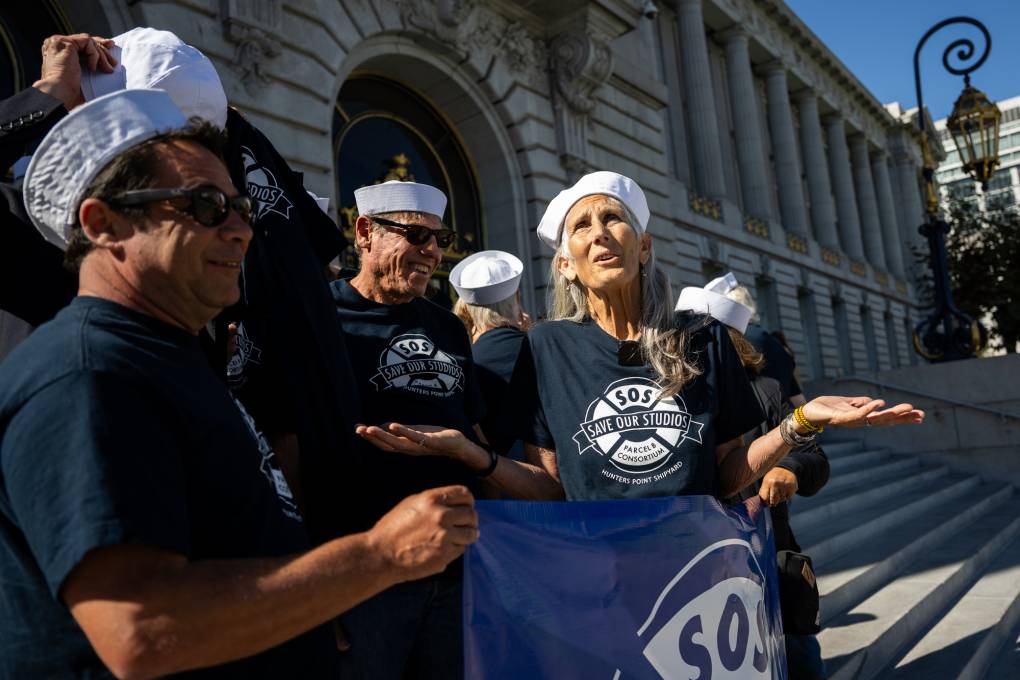
"content": "\u003cp>Nearly two dozen artists showed up at the San Francisco Board of Supervisors meeting Tuesday in matching shirts and sailor hats, determined to make a splash to save their creative home at Hunters Point Naval Shipyard. Crying SOS — Save Our Studios — the artists from what was once \u003ca href=\"https://www.shipyardartists.com/\">the largest creative community in the country\u003c/a> have a simple request: to fix the roofs over their heads. \u003c/p>\n\u003cp>[aside postID='science_1993505']Even though the \u003ca href=\"https://cumulis.epa.gov/supercpad/SiteProfiles/index.cfm?fuseaction=second.Cleanup&id=0902722#bkground\">Superfund\u003c/a> site has been grappling with \u003ca href=\"https://www.kqed.org/science/1993505/cleanup-of-san-francisco-superfund-site-has-been-badly-mishandled-lawsuit-alleges\">the downstream effects of radioactive contamination\u003c/a> for decades, the artist collective recently celebrated their \u003ca href=\"https://sfstandard.com/2024/04/27/san-francisco-hunters-point-shipyard-artists/\">40-year anniversary\u003c/a> at the shipyard. More than 200 working artists maintain studios at the nearly 500-acre site, and thousands of visitors pour through the area during the \u003ca href=\"https://www.shipyardartists.com/shipyard-open-studios-participating-artists/\">shipyard’s open studios\u003c/a>, taking in the fresh air, glittering views and a gantry crane taller than the Statue of Liberty. \u003c/p>\n\u003cp>Up for vote was an amendment to push out the construction and financing timeline of the Bayview-Hunters Point Redevelopment Plan by 30 years. Also proposed was the transfer of more than 2 million square feet of office and research space from the Hunters Point Naval Shipyard to Candlestick Point, given the ongoing delays associated with the toxic cleanup of the shipyard. \u003c/p>\n\u003cp>While there are separate plans for the shipyard and Candlestick Point, the two are considered one project under the purview of the developer FivePoint — even as the areas of land, and the communities invested in them, face very different realities. \u003c/p>\n\u003cfigure id=\"attachment_13967112\" class=\"wp-caption aligncenter\" style=\"max-width: 2000px\">\u003cimg loading=\"lazy\" decoding=\"async\" src=\"https://cdn.kqed.org/wp-content/uploads/sites/2/2024/10/241022-HuntersPointShipyard-Artists-04-BL.jpg\" alt=\"projected image of southeast SF with text on screen\" width=\"2000\" height=\"1333\" class=\"size-full wp-image-13967112\" srcset=\"https://cdn.kqed.org/wp-content/uploads/sites/2/2024/10/241022-HuntersPointShipyard-Artists-04-BL.jpg 2000w, https://cdn.kqed.org/wp-content/uploads/sites/2/2024/10/241022-HuntersPointShipyard-Artists-04-BL-800x533.jpg 800w, https://cdn.kqed.org/wp-content/uploads/sites/2/2024/10/241022-HuntersPointShipyard-Artists-04-BL-1020x680.jpg 1020w, https://cdn.kqed.org/wp-content/uploads/sites/2/2024/10/241022-HuntersPointShipyard-Artists-04-BL-160x107.jpg 160w, https://cdn.kqed.org/wp-content/uploads/sites/2/2024/10/241022-HuntersPointShipyard-Artists-04-BL-768x512.jpg 768w, https://cdn.kqed.org/wp-content/uploads/sites/2/2024/10/241022-HuntersPointShipyard-Artists-04-BL-1536x1024.jpg 1536w, https://cdn.kqed.org/wp-content/uploads/sites/2/2024/10/241022-HuntersPointShipyard-Artists-04-BL-1920x1280.jpg 1920w\" sizes=\"auto, (max-width: 2000px) 100vw, 2000px\">\u003cfigcaption class=\"wp-caption-text\">The Bayview-Hunters Point Redevelopment Project is described during a Board of Supervisors meeting at City Hall in San Francisco on Oct. 22, 2024. \u003ccite>(Beth LaBerge/KQED)\u003c/cite>\u003c/figcaption>\u003c/figure>\n\u003ch2>‘An extremely complicated situation’\u003c/h2>\n\u003cp>Key to the maintenance conundrum for the artists is the complex tangle of associations tied to the shipyard: the U.S. Navy owns the land but leases it to the City of San Francisco, which in turn subleases it to FivePoint (tasked with rehabilitating the property) — who rents the buildings to a group of artist master tenants. \u003c/p>\n\u003cp>[ad fullwidth]\u003c/p>\n\u003cp>The Commission on Community Investment and Infrastructure (OCII), a successor agency to the city’s controversial Redevelopment Agency, also has \u003ca href=\"https://sfocii.org/projects/hunters-point-shipyard-candlestick-point-2/overview\">oversight over the area’s development\u003c/a>. \u003c/p>\n\u003cp>“It’s an extremely complicated situation,” said Barbara Ockel, the president of the nonprofit \u003ca href=\"https://shipyardtrust.org/\">Shipyard Trust for the Arts\u003c/a> (STAR) that represents the artist collective. “And it leads to a lot of finger pointing.” \u003c/p>\n\u003cp>The contract with FivePoint contains language stating the master tenants are responsible for maintenance of their buildings, but with rents still at their 1980s rates, there’s not enough funds for major repairs. \u003c/p>\n\u003cfigure id=\"attachment_13967115\" class=\"wp-caption aligncenter\" style=\"max-width: 2000px\">\u003cimg loading=\"lazy\" decoding=\"async\" src=\"https://cdn.kqed.org/wp-content/uploads/sites/2/2024/10/241022-HuntersPointShipyard-Artists-15-BL.jpg\" alt=\"people in matching shirts and sailor hats sit in wooden benches in city building\" width=\"2000\" height=\"1333\" class=\"size-full wp-image-13967115\" srcset=\"https://cdn.kqed.org/wp-content/uploads/sites/2/2024/10/241022-HuntersPointShipyard-Artists-15-BL.jpg 2000w, https://cdn.kqed.org/wp-content/uploads/sites/2/2024/10/241022-HuntersPointShipyard-Artists-15-BL-800x533.jpg 800w, https://cdn.kqed.org/wp-content/uploads/sites/2/2024/10/241022-HuntersPointShipyard-Artists-15-BL-1020x680.jpg 1020w, https://cdn.kqed.org/wp-content/uploads/sites/2/2024/10/241022-HuntersPointShipyard-Artists-15-BL-160x107.jpg 160w, https://cdn.kqed.org/wp-content/uploads/sites/2/2024/10/241022-HuntersPointShipyard-Artists-15-BL-768x512.jpg 768w, https://cdn.kqed.org/wp-content/uploads/sites/2/2024/10/241022-HuntersPointShipyard-Artists-15-BL-1536x1024.jpg 1536w, https://cdn.kqed.org/wp-content/uploads/sites/2/2024/10/241022-HuntersPointShipyard-Artists-15-BL-1920x1280.jpg 1920w\" sizes=\"auto, (max-width: 2000px) 100vw, 2000px\">\u003cfigcaption class=\"wp-caption-text\">Hunters Point Shipyard artists listen during a Board of Supervisors meeting at City Hall in San Francisco on Oct. 22, 2024, about a planned board vote on amendments to the redevelopment plan for the Bayview-Hunters Point Redevelopment Project. \u003ccite>(Beth LaBerge/KQED)\u003c/cite>\u003c/figcaption>\u003c/figure>\n\u003cp>“And so the debate starts, where does maintenance end and where does capital improvement begin?” Ockel said. “Everybody would agree that if you have to pay a million dollars for a new roof, that’s not maintenance — that’s an investment.” \u003c/p>\n\u003cp>Master tenant \u003ca href=\"https://caprichoframing.com/\">Julian Billotte\u003c/a> could be found on a recent Thursday re-gilding pre-1906 mirrors from the Flood Mansion for their new home at the San Mateo Historical Society. Without the space and low rents of the Hunters Point Naval Shipyard, his and many other artists’ work could not continue. He oversees the maintenance of Building 116 on Parcel B but said the rents have only allowed him to make small patches to the roofs when much more substantial repairs are required. \u003c/p>\n\u003cp>“Nobody’s ever had the rent raised no matter how long they’ve been here,” Billotte said. “Over 25 years, we’ve got people paying what they paid when they got here and we’re committed to maintaining that.” For now, he uses plastic bins along the roofs’ seams to catch water and encourages artists to use tarps to protect their work. \u003c/p>\n\u003cp>While Billotte said Tuesday during public comment that OCII has made a verbal promise to repair the roof, the artists want an assurance in writing. OCII did not respond to requests for comment in time for publication. \u003c/p>\n\u003cp>The artists are seeking more than a weathertight workspace — they want the guarantee they can remain on Parcel B in perpetuity. “We need stability,” Lorna Kollmeyer said. “And the assurance we can stay out here.” Kollmeyer and other artists are \u003ca href=\"https://www.change.org/p/save-parcel-b\">lobbying for an update\u003c/a> to the 25-year-old development plan to include a provision ensuring the parcel remains an ongoing campus for the arts.\u003c/p>\n\u003cfigure id=\"attachment_13967114\" class=\"wp-caption aligncenter\" style=\"max-width: 2000px\">\u003cimg loading=\"lazy\" decoding=\"async\" src=\"https://cdn.kqed.org/wp-content/uploads/sites/2/2024/10/241022-HuntersPointShipyard-Artists-07-BL.jpg\" alt=\"older person in white sailor hat speaks into mic\" width=\"2000\" height=\"1333\" class=\"size-full wp-image-13967114\" srcset=\"https://cdn.kqed.org/wp-content/uploads/sites/2/2024/10/241022-HuntersPointShipyard-Artists-07-BL.jpg 2000w, https://cdn.kqed.org/wp-content/uploads/sites/2/2024/10/241022-HuntersPointShipyard-Artists-07-BL-800x533.jpg 800w, https://cdn.kqed.org/wp-content/uploads/sites/2/2024/10/241022-HuntersPointShipyard-Artists-07-BL-1020x680.jpg 1020w, https://cdn.kqed.org/wp-content/uploads/sites/2/2024/10/241022-HuntersPointShipyard-Artists-07-BL-160x107.jpg 160w, https://cdn.kqed.org/wp-content/uploads/sites/2/2024/10/241022-HuntersPointShipyard-Artists-07-BL-768x512.jpg 768w, https://cdn.kqed.org/wp-content/uploads/sites/2/2024/10/241022-HuntersPointShipyard-Artists-07-BL-1536x1024.jpg 1536w, https://cdn.kqed.org/wp-content/uploads/sites/2/2024/10/241022-HuntersPointShipyard-Artists-07-BL-1920x1280.jpg 1920w\" sizes=\"auto, (max-width: 2000px) 100vw, 2000px\">\u003cfigcaption class=\"wp-caption-text\">Lorna Kollmeyer, a member of the Hunters Point Shipyard Artists, speaks during public comment at a Board of Supervisors meeting. \u003ccite>(Beth LaBerge/KQED)\u003c/cite>\u003c/figcaption>\u003c/figure>\n\u003ch2>Frustrating delays for Bayview residents\u003c/h2>\n\u003cp>Additional changes to the redevelopment plan could derail much-needed and community-supported construction on Candlestick Point (also under FivePoint’s jurisdiction and connected to the future of the shipyard). A written protest of the current plan sent to the Board of Supervisors — not by the shipyard artists — delayed a vote on Tuesday. A final decision on amending the timeline and allocation was pushed to the next full Board of Supervisors meeting on Oct. 29. \u003c/p>\n\u003cp>While the artists want to preserve the buildings on Parcel B of the shipyard, Bayview residents surrounding Candlestick Park are aching for development after decades of delays. “When it comes to the African American community, it never happens,” said Rev. Arelious Walker during public comment. Another speaker, urging forward progress, invoked the words of Martin Luther King Jr.: “Out of a mountain of despair, a stone of hope.” \u003c/p>\n\u003cp>[aside postID='news_10583120']Pastors, parents, laborers and small-business owners from the Bayview community mostly spoke out in support of the Candlestick Point development, which will employ local contractors, create thousands of jobs and build over 7,200 new homes.\u003c/p>\n\u003cp>“I’m excited and sad at the same time,” said one speaker, her voice thick with tears. “There’s only 2 or 3% of us left in the city,” she continued, referring to the Black community that has historically been \u003ca href=\"https://sfstandard.com/2024/02/29/san-francisco-fillmore-destruction-documented/\">on the losing end of redevelopment\u003c/a>. “And we’ve accepted broken promises again and again.” \u003c/p>\n\u003cp>The artists have also been issued promises, only to watch their creative home stymied by the discovery of radioactive contamination, \u003ca href=\"https://www.justice.gov/opa/pr/united-states-joins-lawsuits-against-tetra-tech-ec-inc-alleging-false-claims-connection\">alleged criminal fraud by engineering firm Tetra Tech\u003c/a> and a failed effort to construct a new building of studios on Parcel A. The artists remain on month-to-month rental agreements with the constant fear their spaces may be demolished or repurposed. \u003c/p>\n\u003cp>“They are talking about erasing us,” said artist Leila Mansur. “Stop breaking our hearts, San Francisco.” \u003c/p>\n\u003cp>[ad floatright]\u003c/p>\n\u003cp>“It will be hard to use this land for other things, so why not protect the artists?” Kollmeyer said. “It could be such a win-win for everyone.”\u003c/p>\n\n",
"blocks": [],
"excerpt": "Artists appeared at a Board of Supervisors meeting to ask for a new roof — and a guarantee of longevity. ",
"status": "publish",
"parent": 0,
"modified": 1756842976,
"stats": {
"hasAudio": false,
"hasVideo": false,
"hasChartOrMap": false,
"iframeSrcs": [],
"hasGoogleForm": false,
"hasGallery": false,
"hasHearkenModule": false,
"hasPolis": false,
"paragraphCount": 22,
"wordCount": 1191
},
"headData": {
"title": "Hunters Point Shipyard Artists Cry SOS: ‘Save Our Studios!’ | KQED",
"description": "Artists appeared at a Board of Supervisors meeting to ask for a new roof — and a guarantee of longevity. ",
"ogTitle": "",
"ogDescription": "",
"ogImgId": "",
"twTitle": "",
"twDescription": "",
"twImgId": "",
"schema": {
"@context": "https://schema.org",
"@type": "Article",
"headline": "Hunters Point Shipyard Artists Cry SOS: ‘Save Our Studios!’",
"datePublished": "2024-10-23T15:17:25-07:00",
"dateModified": "2025-09-02T12:56:16-07:00",
"image": "https://cdn.kqed.org/wp-content/uploads/2020/02/KQED-OG-Image@1x.png"
}
},
"primaryCategory": {
"termId": 1,
"slug": "arts",
"name": "Arts"
},
"sticky": false,
"nprByline": "Julie Zigoris",
"nprStoryId": "kqed-13967156",
"templateType": "standard",
"featuredImageType": "standard",
"excludeFromSiteSearch": "Include",
"showOnAuthorArchivePages": "No",
"articleAge": "0",
"path": "/arts/13967156/hunters-point-shipyard-artists-save-our-studios-bayview-redevelopment",
"audioTrackLength": null,
"parsedContent": [
{
"type": "contentString",
"content": "\u003cdiv class=\"post-body\">\u003cp>\u003cp>Nearly two dozen artists showed up at the San Francisco Board of Supervisors meeting Tuesday in matching shirts and sailor hats, determined to make a splash to save their creative home at Hunters Point Naval Shipyard. Crying SOS — Save Our Studios — the artists from what was once \u003ca href=\"https://www.shipyardartists.com/\">the largest creative community in the country\u003c/a> have a simple request: to fix the roofs over their heads. \u003c/p>\n\u003cp>\u003c/p>\u003c/div>",
"attributes": {
"named": {},
"numeric": []
}
},
{
"type": "component",
"content": "",
"name": "aside",
"attributes": {
"named": {
"postid": "science_1993505",
"label": ""
},
"numeric": []
}
},
{
"type": "contentString",
"content": "\u003cdiv class=\"post-body\">\u003cp>Even though the \u003ca href=\"https://cumulis.epa.gov/supercpad/SiteProfiles/index.cfm?fuseaction=second.Cleanup&id=0902722#bkground\">Superfund\u003c/a> site has been grappling with \u003ca href=\"https://www.kqed.org/science/1993505/cleanup-of-san-francisco-superfund-site-has-been-badly-mishandled-lawsuit-alleges\">the downstream effects of radioactive contamination\u003c/a> for decades, the artist collective recently celebrated their \u003ca href=\"https://sfstandard.com/2024/04/27/san-francisco-hunters-point-shipyard-artists/\">40-year anniversary\u003c/a> at the shipyard. More than 200 working artists maintain studios at the nearly 500-acre site, and thousands of visitors pour through the area during the \u003ca href=\"https://www.shipyardartists.com/shipyard-open-studios-participating-artists/\">shipyard’s open studios\u003c/a>, taking in the fresh air, glittering views and a gantry crane taller than the Statue of Liberty. \u003c/p>\n\u003cp>Up for vote was an amendment to push out the construction and financing timeline of the Bayview-Hunters Point Redevelopment Plan by 30 years. Also proposed was the transfer of more than 2 million square feet of office and research space from the Hunters Point Naval Shipyard to Candlestick Point, given the ongoing delays associated with the toxic cleanup of the shipyard. \u003c/p>\n\u003cp>While there are separate plans for the shipyard and Candlestick Point, the two are considered one project under the purview of the developer FivePoint — even as the areas of land, and the communities invested in them, face very different realities. \u003c/p>\n\u003cfigure id=\"attachment_13967112\" class=\"wp-caption aligncenter\" style=\"max-width: 2000px\">\u003cimg loading=\"lazy\" decoding=\"async\" src=\"https://cdn.kqed.org/wp-content/uploads/sites/2/2024/10/241022-HuntersPointShipyard-Artists-04-BL.jpg\" alt=\"projected image of southeast SF with text on screen\" width=\"2000\" height=\"1333\" class=\"size-full wp-image-13967112\" srcset=\"https://cdn.kqed.org/wp-content/uploads/sites/2/2024/10/241022-HuntersPointShipyard-Artists-04-BL.jpg 2000w, https://cdn.kqed.org/wp-content/uploads/sites/2/2024/10/241022-HuntersPointShipyard-Artists-04-BL-800x533.jpg 800w, https://cdn.kqed.org/wp-content/uploads/sites/2/2024/10/241022-HuntersPointShipyard-Artists-04-BL-1020x680.jpg 1020w, https://cdn.kqed.org/wp-content/uploads/sites/2/2024/10/241022-HuntersPointShipyard-Artists-04-BL-160x107.jpg 160w, https://cdn.kqed.org/wp-content/uploads/sites/2/2024/10/241022-HuntersPointShipyard-Artists-04-BL-768x512.jpg 768w, https://cdn.kqed.org/wp-content/uploads/sites/2/2024/10/241022-HuntersPointShipyard-Artists-04-BL-1536x1024.jpg 1536w, https://cdn.kqed.org/wp-content/uploads/sites/2/2024/10/241022-HuntersPointShipyard-Artists-04-BL-1920x1280.jpg 1920w\" sizes=\"auto, (max-width: 2000px) 100vw, 2000px\">\u003cfigcaption class=\"wp-caption-text\">The Bayview-Hunters Point Redevelopment Project is described during a Board of Supervisors meeting at City Hall in San Francisco on Oct. 22, 2024. \u003ccite>(Beth LaBerge/KQED)\u003c/cite>\u003c/figcaption>\u003c/figure>\n\u003ch2>‘An extremely complicated situation’\u003c/h2>\n\u003cp>Key to the maintenance conundrum for the artists is the complex tangle of associations tied to the shipyard: the U.S. Navy owns the land but leases it to the City of San Francisco, which in turn subleases it to FivePoint (tasked with rehabilitating the property) — who rents the buildings to a group of artist master tenants. \u003c/p>\n\u003cp>\u003c/p>\u003c/div>",
"attributes": {
"named": {},
"numeric": []
}
},
{
"type": "component",
"content": "",
"name": "ad",
"attributes": {
"named": {
"label": "fullwidth"
},
"numeric": [
"fullwidth"
]
}
},
{
"type": "contentString",
"content": "\u003cdiv class=\"post-body\">\u003cp>\u003c/p>\n\u003cp>The Commission on Community Investment and Infrastructure (OCII), a successor agency to the city’s controversial Redevelopment Agency, also has \u003ca href=\"https://sfocii.org/projects/hunters-point-shipyard-candlestick-point-2/overview\">oversight over the area’s development\u003c/a>. \u003c/p>\n\u003cp>“It’s an extremely complicated situation,” said Barbara Ockel, the president of the nonprofit \u003ca href=\"https://shipyardtrust.org/\">Shipyard Trust for the Arts\u003c/a> (STAR) that represents the artist collective. “And it leads to a lot of finger pointing.” \u003c/p>\n\u003cp>The contract with FivePoint contains language stating the master tenants are responsible for maintenance of their buildings, but with rents still at their 1980s rates, there’s not enough funds for major repairs. \u003c/p>\n\u003cfigure id=\"attachment_13967115\" class=\"wp-caption aligncenter\" style=\"max-width: 2000px\">\u003cimg loading=\"lazy\" decoding=\"async\" src=\"https://cdn.kqed.org/wp-content/uploads/sites/2/2024/10/241022-HuntersPointShipyard-Artists-15-BL.jpg\" alt=\"people in matching shirts and sailor hats sit in wooden benches in city building\" width=\"2000\" height=\"1333\" class=\"size-full wp-image-13967115\" srcset=\"https://cdn.kqed.org/wp-content/uploads/sites/2/2024/10/241022-HuntersPointShipyard-Artists-15-BL.jpg 2000w, https://cdn.kqed.org/wp-content/uploads/sites/2/2024/10/241022-HuntersPointShipyard-Artists-15-BL-800x533.jpg 800w, https://cdn.kqed.org/wp-content/uploads/sites/2/2024/10/241022-HuntersPointShipyard-Artists-15-BL-1020x680.jpg 1020w, https://cdn.kqed.org/wp-content/uploads/sites/2/2024/10/241022-HuntersPointShipyard-Artists-15-BL-160x107.jpg 160w, https://cdn.kqed.org/wp-content/uploads/sites/2/2024/10/241022-HuntersPointShipyard-Artists-15-BL-768x512.jpg 768w, https://cdn.kqed.org/wp-content/uploads/sites/2/2024/10/241022-HuntersPointShipyard-Artists-15-BL-1536x1024.jpg 1536w, https://cdn.kqed.org/wp-content/uploads/sites/2/2024/10/241022-HuntersPointShipyard-Artists-15-BL-1920x1280.jpg 1920w\" sizes=\"auto, (max-width: 2000px) 100vw, 2000px\">\u003cfigcaption class=\"wp-caption-text\">Hunters Point Shipyard artists listen during a Board of Supervisors meeting at City Hall in San Francisco on Oct. 22, 2024, about a planned board vote on amendments to the redevelopment plan for the Bayview-Hunters Point Redevelopment Project. \u003ccite>(Beth LaBerge/KQED)\u003c/cite>\u003c/figcaption>\u003c/figure>\n\u003cp>“And so the debate starts, where does maintenance end and where does capital improvement begin?” Ockel said. “Everybody would agree that if you have to pay a million dollars for a new roof, that’s not maintenance — that’s an investment.” \u003c/p>\n\u003cp>Master tenant \u003ca href=\"https://caprichoframing.com/\">Julian Billotte\u003c/a> could be found on a recent Thursday re-gilding pre-1906 mirrors from the Flood Mansion for their new home at the San Mateo Historical Society. Without the space and low rents of the Hunters Point Naval Shipyard, his and many other artists’ work could not continue. He oversees the maintenance of Building 116 on Parcel B but said the rents have only allowed him to make small patches to the roofs when much more substantial repairs are required. \u003c/p>\n\u003cp>“Nobody’s ever had the rent raised no matter how long they’ve been here,” Billotte said. “Over 25 years, we’ve got people paying what they paid when they got here and we’re committed to maintaining that.” For now, he uses plastic bins along the roofs’ seams to catch water and encourages artists to use tarps to protect their work. \u003c/p>\n\u003cp>While Billotte said Tuesday during public comment that OCII has made a verbal promise to repair the roof, the artists want an assurance in writing. OCII did not respond to requests for comment in time for publication. \u003c/p>\n\u003cp>The artists are seeking more than a weathertight workspace — they want the guarantee they can remain on Parcel B in perpetuity. “We need stability,” Lorna Kollmeyer said. “And the assurance we can stay out here.” Kollmeyer and other artists are \u003ca href=\"https://www.change.org/p/save-parcel-b\">lobbying for an update\u003c/a> to the 25-year-old development plan to include a provision ensuring the parcel remains an ongoing campus for the arts.\u003c/p>\n\u003cfigure id=\"attachment_13967114\" class=\"wp-caption aligncenter\" style=\"max-width: 2000px\">\u003cimg loading=\"lazy\" decoding=\"async\" src=\"https://cdn.kqed.org/wp-content/uploads/sites/2/2024/10/241022-HuntersPointShipyard-Artists-07-BL.jpg\" alt=\"older person in white sailor hat speaks into mic\" width=\"2000\" height=\"1333\" class=\"size-full wp-image-13967114\" srcset=\"https://cdn.kqed.org/wp-content/uploads/sites/2/2024/10/241022-HuntersPointShipyard-Artists-07-BL.jpg 2000w, https://cdn.kqed.org/wp-content/uploads/sites/2/2024/10/241022-HuntersPointShipyard-Artists-07-BL-800x533.jpg 800w, https://cdn.kqed.org/wp-content/uploads/sites/2/2024/10/241022-HuntersPointShipyard-Artists-07-BL-1020x680.jpg 1020w, https://cdn.kqed.org/wp-content/uploads/sites/2/2024/10/241022-HuntersPointShipyard-Artists-07-BL-160x107.jpg 160w, https://cdn.kqed.org/wp-content/uploads/sites/2/2024/10/241022-HuntersPointShipyard-Artists-07-BL-768x512.jpg 768w, https://cdn.kqed.org/wp-content/uploads/sites/2/2024/10/241022-HuntersPointShipyard-Artists-07-BL-1536x1024.jpg 1536w, https://cdn.kqed.org/wp-content/uploads/sites/2/2024/10/241022-HuntersPointShipyard-Artists-07-BL-1920x1280.jpg 1920w\" sizes=\"auto, (max-width: 2000px) 100vw, 2000px\">\u003cfigcaption class=\"wp-caption-text\">Lorna Kollmeyer, a member of the Hunters Point Shipyard Artists, speaks during public comment at a Board of Supervisors meeting. \u003ccite>(Beth LaBerge/KQED)\u003c/cite>\u003c/figcaption>\u003c/figure>\n\u003ch2>Frustrating delays for Bayview residents\u003c/h2>\n\u003cp>Additional changes to the redevelopment plan could derail much-needed and community-supported construction on Candlestick Point (also under FivePoint’s jurisdiction and connected to the future of the shipyard). A written protest of the current plan sent to the Board of Supervisors — not by the shipyard artists — delayed a vote on Tuesday. A final decision on amending the timeline and allocation was pushed to the next full Board of Supervisors meeting on Oct. 29. \u003c/p>\n\u003cp>While the artists want to preserve the buildings on Parcel B of the shipyard, Bayview residents surrounding Candlestick Park are aching for development after decades of delays. “When it comes to the African American community, it never happens,” said Rev. Arelious Walker during public comment. Another speaker, urging forward progress, invoked the words of Martin Luther King Jr.: “Out of a mountain of despair, a stone of hope.” \u003c/p>\n\u003cp>\u003c/p>\u003c/div>",
"attributes": {
"named": {},
"numeric": []
}
},
{
"type": "component",
"content": "",
"name": "aside",
"attributes": {
"named": {
"postid": "news_10583120",
"label": ""
},
"numeric": []
}
},
{
"type": "contentString",
"content": "\u003cdiv class=\"post-body\">\u003cp>Pastors, parents, laborers and small-business owners from the Bayview community mostly spoke out in support of the Candlestick Point development, which will employ local contractors, create thousands of jobs and build over 7,200 new homes.\u003c/p>\n\u003cp>“I’m excited and sad at the same time,” said one speaker, her voice thick with tears. “There’s only 2 or 3% of us left in the city,” she continued, referring to the Black community that has historically been \u003ca href=\"https://sfstandard.com/2024/02/29/san-francisco-fillmore-destruction-documented/\">on the losing end of redevelopment\u003c/a>. “And we’ve accepted broken promises again and again.” \u003c/p>\n\u003cp>The artists have also been issued promises, only to watch their creative home stymied by the discovery of radioactive contamination, \u003ca href=\"https://www.justice.gov/opa/pr/united-states-joins-lawsuits-against-tetra-tech-ec-inc-alleging-false-claims-connection\">alleged criminal fraud by engineering firm Tetra Tech\u003c/a> and a failed effort to construct a new building of studios on Parcel A. The artists remain on month-to-month rental agreements with the constant fear their spaces may be demolished or repurposed. \u003c/p>\n\u003cp>“They are talking about erasing us,” said artist Leila Mansur. “Stop breaking our hearts, San Francisco.” \u003c/p>\n\u003cp>\u003c/p>\u003c/div>",
"attributes": {
"named": {},
"numeric": []
}
},
{
"type": "component",
"content": "",
"name": "ad",
"attributes": {
"named": {
"label": "floatright"
},
"numeric": [
"floatright"
]
}
},
{
"type": "contentString",
"content": "\u003cdiv class=\"post-body\">\u003cp>\u003c/p>\n\u003cp>“It will be hard to use this land for other things, so why not protect the artists?” Kollmeyer said. “It could be such a win-win for everyone.”\u003c/p>\n\n\u003c/div>\u003c/p>",
"attributes": {
"named": {},
"numeric": []
}
}
],
"link": "/arts/13967156/hunters-point-shipyard-artists-save-our-studios-bayview-redevelopment",
"authors": [
"byline_arts_13967156"
],
"categories": [
"arts_1",
"arts_235",
"arts_70"
],
"tags": [
"arts_4018",
"arts_10278",
"arts_4017",
"arts_1146"
],
"featImg": "arts_13967111",
"label": "arts"
},
"arts_13959524": {
"type": "posts",
"id": "arts_13959524",
"meta": {
"index": "posts_1716263798",
"site": "arts",
"id": "13959524",
"score": null,
"sort": [
1718204456000
]
},
"guestAuthors": [],
"slug": "biko-eisen-martin-3rd-and-palou-bayview-ruth-williams-opera-house-juneteenth",
"title": "Biko Eisen-Martin’s New Play Grapples With a 1966 Uprising in Hunters Point",
"publishDate": 1718204456,
"format": "standard",
"headTitle": "Biko Eisen-Martin’s New Play Grapples With a 1966 Uprising in Hunters Point | KQED",
"labelTerm": {
"term": 140,
"site": "arts"
},
"content": "\u003cp>While the Vietnam War raged in 1966, and the onset of California’s prison industrial complex began to ravage Black and low-income communities in a dreadfully systematic way, San Francisco’s Hunters Point residents were hurled onto the frontlines of their own conflict. On Sept. 27 of that year, the Third Street Riot (or \u003ca href=\"https://www.foundsf.org/index.php?title=Hunters_Point_Uprising\">Hunters Point Uprising\u003c/a>) ignited after an SFPD officer killed Matthew “Peanut” Johnson — a neighborhood teenager the police were pursuing after a crime.\u003c/p>\n\u003cp>Johnson’s violent — and presumably racially motivated — death ignited a series of community actions that crescendoed with a citywide outbreak of demands for justice. Though largely overlooked in modern history (despite being \u003ca href=\"https://www.blackpast.org/african-american-history/hunter-s-point-san-francisco-uprising-1966/\">the largest riot in San Francisco history at the time\u003c/a>), the event offers a critical look at San Francisco’s decades-long struggles with racial segregation, police brutality and community neglect.\u003c/p>\n\u003cfigure id=\"attachment_13959620\" class=\"wp-caption alignright\" style=\"max-width: 727px\">\u003cimg loading=\"lazy\" decoding=\"async\" class=\"size-full wp-image-13959620\" src=\"https://cdn.kqed.org/wp-content/uploads/sites/2/2024/06/image5.jpeg\" alt=\"Black-and-white headshot of man with facial hair\" width=\"727\" height=\"948\" srcset=\"https://cdn.kqed.org/wp-content/uploads/sites/2/2024/06/image5.jpeg 727w, https://cdn.kqed.org/wp-content/uploads/sites/2/2024/06/image5-160x209.jpeg 160w\" sizes=\"(max-width: 727px) 100vw, 727px\">\u003cfigcaption class=\"wp-caption-text\">Biko Eisen-Martin. \u003ccite>(Jeremiah Cumberbatch)\u003c/cite>\u003c/figcaption>\u003c/figure>\n\u003cp>For local actor and filmmaker \u003ca href=\"https://www.instagram.com/saybiko/?hl=en\">Biko Eisen-Martin\u003c/a>, it’s an essential chapter of San Francisco’s past that has yet to be fully excavated by the public. For him, growing up in San Francisco and listening to his family members and elders speak about the revolutionary time inspired Eisen-Martin to write and direct \u003ca href=\"https://www.bikoeisenmartin.com/3rd-palou\">\u003ci>3rd and Palou\u003c/i>\u003c/a> — a community-centered performance premiering as a staged reading at the historic \u003ca href=\"https://rwoh.org/#\">Ruth Williams Opera House\u003c/a> (also known as the Bayview Opera House) on the night of Juneteenth.\u003c/p>\n\u003cp>“This is based on community testimonies. Right now, there isn’t a pipeline for these stories. This isn’t stuff that is readily available; it hasn’t been properly archived,” Eisen-Martin says. “But it happened right here on Third Street. There were tanks rolling down the streets of San Francisco. There are still bullet holes in the Bayview Opera House from it all. That’s why I wanted to make [the Opera House] ground zero and activate the community.”\u003c/p>\n\u003cp>Directly inspired by Eisen-Martin’s godmother, Ida McCrae — who was a teenager navigating issues of patriarchy, racism and rising incarceration at the time — the play is a semi-biographical coming-of-age tale that focuses deeply on one woman’s experience, rather than trying to abstractly retell the story of the entire uprising itself.\u003c/p>\n\u003cp>[ad fullwidth]\u003c/p>\n\u003cp>“[McCrae] is a revolutionary with a long, rich story,” says Eisen-Martin. “This is just a clip of it all. One year before the riots, the Youth Authority opened, \u003ca href=\"https://ojp.gov/pdffiles1/Digitization/14214NCJRS.pdf\">a huge prison\u003c/a> where Bay Area youth were sent. Ida was a victim of that.”\u003c/p>\n\u003cp>As a theatrical performance, \u003ci>3rd & Palou\u003c/i> is a dramatized depiction that takes creative liberties. But the core of McCrae’s story — who Eisen-Martin interviewed extensively while scripting his play — is central to much larger truths about Northern California’s Black communities, going far beyond just Hunters Point (the riots eventually spilled into other Black neighborhoods around San Francisco).\u003c/p>\n\u003cfigure id=\"attachment_13959621\" class=\"wp-caption aligncenter\" style=\"max-width: 618px\">\u003cimg loading=\"lazy\" decoding=\"async\" class=\"size-full wp-image-13959621\" src=\"https://cdn.kqed.org/wp-content/uploads/sites/2/2024/06/image4.jpeg\" alt=\"Black-and-white photograph of police crouched in street with guns while people stand in doorway of building \" width=\"618\" height=\"400\" srcset=\"https://cdn.kqed.org/wp-content/uploads/sites/2/2024/06/image4.jpeg 618w, https://cdn.kqed.org/wp-content/uploads/sites/2/2024/06/image4-160x104.jpeg 160w\" sizes=\"(max-width: 618px) 100vw, 618px\">\u003cfigcaption class=\"wp-caption-text\">The Bayview-Hunters Point Community Center under siege during the 1966 uprising. \u003ccite>(Photo by Jean-Antony Du Lac; Courtesy San Francisco History Center, San Francisco Public Library)\u003c/cite>\u003c/figcaption>\u003c/figure>\n\u003cp>“It’s a moment in time but it’s also a microcosm of what we still see today,” he continues. “At the time, learning about imperialism was at the forefront of popular consciousness. Reading political magazines was a day to day thing, not just a subculture. [During the testimonies], I really could see the love the community had for each other back then. We need an entire curriculum, films, books about this. I’m just trying to be a spark; it’s a big, old oven full of stuff, and this is just the preheating.”\u003c/p>\n\u003cp>[aside postID='arts_13958706']Additional research on Eisen-Martin’s part included correspondence with Stanford PhD candidate \u003ca href=\"https://history.stanford.edu/people/aliyah-dunn-salahuddin\">Aliyah Dunn-Salahuddin\u003c/a> — who was formerly the head of the African American Studies department at the City College of San Francisco. Her dissertation, “A Forgotten Community, A Forgotten History: San Francisco’s 1966 Uprising” was excerpted in \u003ci>\u003ca href=\"https://nyupress.org/9781479820337/the-strange-careers-of-the-jim-crow-north/\">The Strange Careers of the Jim Crow North: Segregation and Struggle Outside of the South\u003c/a>\u003c/i>, which Eisen-Martin heavily referenced while weaving together various threads for his own work.\u003c/p>\n\u003cp>A former teacher at Berkeley High School and a product of the Bay Area’s \u003ca href=\"https://youthspeaks.org/\">Youth Speaks\u003c/a> program for rising poets, Eisen-Martin has been comfortable with standing in front of an audience since he was able to walk. His mother, Arlene Eisen, was active in exposing Biko’s (as well as his older brother, San Francisco’s Poet Laureate \u003ca href=\"https://www.kqed.org/arts/13893308/tongo-eisen-martin-on-a-poets-role-in-a-protest\">Tongo Eisen-Martin\u003c/a>) to the Bay Area’s diverse tapestry of arts, activism and community organizing. Offering free acting classes and directly asking for the community’s feedback is a part of Biko’s everyday existence as a writer and actor with generational ties to Frisco’s Black histories.\u003c/p>\n\u003cp>In both San Francisco and New York City — where the artist splits his time working and performing — Eisen-Martin is all too familiar with the erasure of not just the arts, but the deep-seated stories in communities who have long fostered them.\u003c/p>\n\u003cp>“It’s a great feeling to do a show off Broadway, being in New York and spilling out into the street with all the big lights, but there’s something to being in your own community and activating the future of your community with a craft you love and watching others fall in love with it, too,” says Eisen-Martin. “We don’t need the big lights, they need us. Some of the work gets shine, some doesn’t; but the work is what has a lasting impression.”\u003c/p>\n\u003cp>Eisen-Martin makes clear that he doesn’t have any answers. But, as poets and artists in times of struggle often do, he’s willing to ask questions in search of catharsis and healing.\u003c/p>\n\u003chr>\n\u003cp>\u003c/p>\n\u003cp>\u003ci>‘3rd & Palou’ takes place as a free staged reading at the \u003ca href=\"https://rwoh.org/#\">Ruth Williams Opera House\u003c/a> (4705 Third St., San Francisco) on June 19, 2024 at 7 p.m.\u003c/i>\u003c/p>\n\n",
"blocks": [],
"excerpt": "Community testimonies inform this free, staged reading on Juneteenth at the Ruth Williams Opera House.",
"status": "publish",
"parent": 0,
"modified": 1726701232,
"stats": {
"hasAudio": false,
"hasVideo": false,
"hasChartOrMap": false,
"iframeSrcs": [],
"hasGoogleForm": false,
"hasGallery": false,
"hasHearkenModule": false,
"hasPolis": false,
"paragraphCount": 16,
"wordCount": 1045
},
"headData": {
"title": "‘3rd & Palou’: Biko Eisen-Martin’s New Play About a 1966 Uprising | KQED",
"description": "Community testimonies inform this free, staged reading on Juneteenth at the Ruth Williams Opera House.",
"ogTitle": "Biko Eisen-Martin’s New Play Grapples With a 1966 Uprising in Hunters Point",
"ogDescription": "",
"ogImgId": "",
"twTitle": "Biko Eisen-Martin’s New Play Grapples With a 1966 Uprising in Hunters Point",
"twDescription": "",
"twImgId": "",
"socialTitle": "‘3rd & Palou’: Biko Eisen-Martin’s New Play About a 1966 Uprising %%page%% %%sep%% KQED",
"schema": {
"@context": "https://schema.org",
"@type": "Article",
"headline": "Biko Eisen-Martin’s New Play Grapples With a 1966 Uprising in Hunters Point",
"datePublished": "2024-06-12T08:00:56-07:00",
"dateModified": "2024-09-18T16:13:52-07:00",
"image": "https://cdn.kqed.org/wp-content/uploads/2020/02/KQED-OG-Image@1x.png"
}
},
"sticky": false,
"nprStoryId": "kqed-13959524",
"templateType": "standard",
"featuredImageType": "standard",
"excludeFromSiteSearch": "Include",
"articleAge": "0",
"path": "/arts/13959524/biko-eisen-martin-3rd-and-palou-bayview-ruth-williams-opera-house-juneteenth",
"audioTrackLength": null,
"parsedContent": [
{
"type": "contentString",
"content": "\u003cdiv class=\"post-body\">\u003cp>\u003cp>While the Vietnam War raged in 1966, and the onset of California’s prison industrial complex began to ravage Black and low-income communities in a dreadfully systematic way, San Francisco’s Hunters Point residents were hurled onto the frontlines of their own conflict. On Sept. 27 of that year, the Third Street Riot (or \u003ca href=\"https://www.foundsf.org/index.php?title=Hunters_Point_Uprising\">Hunters Point Uprising\u003c/a>) ignited after an SFPD officer killed Matthew “Peanut” Johnson — a neighborhood teenager the police were pursuing after a crime.\u003c/p>\n\u003cp>Johnson’s violent — and presumably racially motivated — death ignited a series of community actions that crescendoed with a citywide outbreak of demands for justice. Though largely overlooked in modern history (despite being \u003ca href=\"https://www.blackpast.org/african-american-history/hunter-s-point-san-francisco-uprising-1966/\">the largest riot in San Francisco history at the time\u003c/a>), the event offers a critical look at San Francisco’s decades-long struggles with racial segregation, police brutality and community neglect.\u003c/p>\n\u003cfigure id=\"attachment_13959620\" class=\"wp-caption alignright\" style=\"max-width: 727px\">\u003cimg loading=\"lazy\" decoding=\"async\" class=\"size-full wp-image-13959620\" src=\"https://cdn.kqed.org/wp-content/uploads/sites/2/2024/06/image5.jpeg\" alt=\"Black-and-white headshot of man with facial hair\" width=\"727\" height=\"948\" srcset=\"https://cdn.kqed.org/wp-content/uploads/sites/2/2024/06/image5.jpeg 727w, https://cdn.kqed.org/wp-content/uploads/sites/2/2024/06/image5-160x209.jpeg 160w\" sizes=\"(max-width: 727px) 100vw, 727px\">\u003cfigcaption class=\"wp-caption-text\">Biko Eisen-Martin. \u003ccite>(Jeremiah Cumberbatch)\u003c/cite>\u003c/figcaption>\u003c/figure>\n\u003cp>For local actor and filmmaker \u003ca href=\"https://www.instagram.com/saybiko/?hl=en\">Biko Eisen-Martin\u003c/a>, it’s an essential chapter of San Francisco’s past that has yet to be fully excavated by the public. For him, growing up in San Francisco and listening to his family members and elders speak about the revolutionary time inspired Eisen-Martin to write and direct \u003ca href=\"https://www.bikoeisenmartin.com/3rd-palou\">\u003ci>3rd and Palou\u003c/i>\u003c/a> — a community-centered performance premiering as a staged reading at the historic \u003ca href=\"https://rwoh.org/#\">Ruth Williams Opera House\u003c/a> (also known as the Bayview Opera House) on the night of Juneteenth.\u003c/p>\n\u003cp>“This is based on community testimonies. Right now, there isn’t a pipeline for these stories. This isn’t stuff that is readily available; it hasn’t been properly archived,” Eisen-Martin says. “But it happened right here on Third Street. There were tanks rolling down the streets of San Francisco. There are still bullet holes in the Bayview Opera House from it all. That’s why I wanted to make [the Opera House] ground zero and activate the community.”\u003c/p>\n\u003cp>Directly inspired by Eisen-Martin’s godmother, Ida McCrae — who was a teenager navigating issues of patriarchy, racism and rising incarceration at the time — the play is a semi-biographical coming-of-age tale that focuses deeply on one woman’s experience, rather than trying to abstractly retell the story of the entire uprising itself.\u003c/p>\n\u003cp>\u003c/p>\u003c/div>",
"attributes": {
"named": {},
"numeric": []
}
},
{
"type": "component",
"content": "",
"name": "ad",
"attributes": {
"named": {
"label": "fullwidth"
},
"numeric": [
"fullwidth"
]
}
},
{
"type": "contentString",
"content": "\u003cdiv class=\"post-body\">\u003cp>\u003c/p>\n\u003cp>“[McCrae] is a revolutionary with a long, rich story,” says Eisen-Martin. “This is just a clip of it all. One year before the riots, the Youth Authority opened, \u003ca href=\"https://ojp.gov/pdffiles1/Digitization/14214NCJRS.pdf\">a huge prison\u003c/a> where Bay Area youth were sent. Ida was a victim of that.”\u003c/p>\n\u003cp>As a theatrical performance, \u003ci>3rd & Palou\u003c/i> is a dramatized depiction that takes creative liberties. But the core of McCrae’s story — who Eisen-Martin interviewed extensively while scripting his play — is central to much larger truths about Northern California’s Black communities, going far beyond just Hunters Point (the riots eventually spilled into other Black neighborhoods around San Francisco).\u003c/p>\n\u003cfigure id=\"attachment_13959621\" class=\"wp-caption aligncenter\" style=\"max-width: 618px\">\u003cimg loading=\"lazy\" decoding=\"async\" class=\"size-full wp-image-13959621\" src=\"https://cdn.kqed.org/wp-content/uploads/sites/2/2024/06/image4.jpeg\" alt=\"Black-and-white photograph of police crouched in street with guns while people stand in doorway of building \" width=\"618\" height=\"400\" srcset=\"https://cdn.kqed.org/wp-content/uploads/sites/2/2024/06/image4.jpeg 618w, https://cdn.kqed.org/wp-content/uploads/sites/2/2024/06/image4-160x104.jpeg 160w\" sizes=\"(max-width: 618px) 100vw, 618px\">\u003cfigcaption class=\"wp-caption-text\">The Bayview-Hunters Point Community Center under siege during the 1966 uprising. \u003ccite>(Photo by Jean-Antony Du Lac; Courtesy San Francisco History Center, San Francisco Public Library)\u003c/cite>\u003c/figcaption>\u003c/figure>\n\u003cp>“It’s a moment in time but it’s also a microcosm of what we still see today,” he continues. “At the time, learning about imperialism was at the forefront of popular consciousness. Reading political magazines was a day to day thing, not just a subculture. [During the testimonies], I really could see the love the community had for each other back then. We need an entire curriculum, films, books about this. I’m just trying to be a spark; it’s a big, old oven full of stuff, and this is just the preheating.”\u003c/p>\n\u003cp>\u003c/p>\u003c/div>",
"attributes": {
"named": {},
"numeric": []
}
},
{
"type": "component",
"content": "",
"name": "aside",
"attributes": {
"named": {
"postid": "arts_13958706",
"label": ""
},
"numeric": []
}
},
{
"type": "contentString",
"content": "\u003cdiv class=\"post-body\">\u003cp>Additional research on Eisen-Martin’s part included correspondence with Stanford PhD candidate \u003ca href=\"https://history.stanford.edu/people/aliyah-dunn-salahuddin\">Aliyah Dunn-Salahuddin\u003c/a> — who was formerly the head of the African American Studies department at the City College of San Francisco. Her dissertation, “A Forgotten Community, A Forgotten History: San Francisco’s 1966 Uprising” was excerpted in \u003ci>\u003ca href=\"https://nyupress.org/9781479820337/the-strange-careers-of-the-jim-crow-north/\">The Strange Careers of the Jim Crow North: Segregation and Struggle Outside of the South\u003c/a>\u003c/i>, which Eisen-Martin heavily referenced while weaving together various threads for his own work.\u003c/p>\n\u003cp>A former teacher at Berkeley High School and a product of the Bay Area’s \u003ca href=\"https://youthspeaks.org/\">Youth Speaks\u003c/a> program for rising poets, Eisen-Martin has been comfortable with standing in front of an audience since he was able to walk. His mother, Arlene Eisen, was active in exposing Biko’s (as well as his older brother, San Francisco’s Poet Laureate \u003ca href=\"https://www.kqed.org/arts/13893308/tongo-eisen-martin-on-a-poets-role-in-a-protest\">Tongo Eisen-Martin\u003c/a>) to the Bay Area’s diverse tapestry of arts, activism and community organizing. Offering free acting classes and directly asking for the community’s feedback is a part of Biko’s everyday existence as a writer and actor with generational ties to Frisco’s Black histories.\u003c/p>\n\u003cp>In both San Francisco and New York City — where the artist splits his time working and performing — Eisen-Martin is all too familiar with the erasure of not just the arts, but the deep-seated stories in communities who have long fostered them.\u003c/p>\n\u003cp>“It’s a great feeling to do a show off Broadway, being in New York and spilling out into the street with all the big lights, but there’s something to being in your own community and activating the future of your community with a craft you love and watching others fall in love with it, too,” says Eisen-Martin. “We don’t need the big lights, they need us. Some of the work gets shine, some doesn’t; but the work is what has a lasting impression.”\u003c/p>\n\u003cp>Eisen-Martin makes clear that he doesn’t have any answers. But, as poets and artists in times of struggle often do, he’s willing to ask questions in search of catharsis and healing.\u003c/p>\n\u003chr>\n\u003cp>\u003c/p>\n\u003cp>\u003ci>‘3rd & Palou’ takes place as a free staged reading at the \u003ca href=\"https://rwoh.org/#\">Ruth Williams Opera House\u003c/a> (4705 Third St., San Francisco) on June 19, 2024 at 7 p.m.\u003c/i>\u003c/p>\n\n\u003c/div>\u003c/p>",
"attributes": {
"named": {},
"numeric": []
}
}
],
"link": "/arts/13959524/biko-eisen-martin-3rd-and-palou-bayview-ruth-williams-opera-house-juneteenth",
"authors": [
"11748"
],
"programs": [
"arts_140"
],
"categories": [
"arts_1",
"arts_967"
],
"tags": [
"arts_4018",
"arts_4017",
"arts_7465",
"arts_1146",
"arts_1072",
"arts_585"
],
"featImg": "arts_13959619",
"label": "arts_140"
},
"arts_13956701": {
"type": "posts",
"id": "arts_13956701",
"meta": {
"index": "posts_1716263798",
"site": "arts",
"id": "13956701",
"score": null,
"sort": [
1714671562000
]
},
"guestAuthors": [],
"slug": "therapy-in-the-ghetto-mental-health-bayview-gunna-goes-global",
"title": "‘Therapy In The Ghetto: Reimagined’ to Raise Mental Health Awareness in SF’s Bayview",
"publishDate": 1714671562,
"format": "standard",
"headTitle": "‘Therapy In The Ghetto: Reimagined’ to Raise Mental Health Awareness in SF’s Bayview | KQED",
"labelTerm": {
"term": 140,
"site": "arts"
},
"content": "\u003cp>When kids approach the San Francisco rapper \u003ca href=\"https://www.instagram.com/gunnagoesglobal/?hl=en\">Gunna Goes Global\u003c/a> to ask why he wears an eyepatch — the result of being shot in the head at age 19 — he doesn’t see it as disrespectful.\u003c/p>\n\u003cp>“It’s a genuine question,” he recently said on the \u003ca href=\"https://www.instagram.com/reel/C31UorjxP7m/\">Blowin Smoke Podcast\u003c/a>. “I wear this as a reminder of what I’ve been through, what I come from, and what I overcame.”\u003c/p>\n\u003cp>Rather than avoid his tumultuous past, he embraces it with a deep reverence. Over the years, Gunna Goes Global has emerged as a de facto spokesperson \u003ca href=\"https://www.sfgate.com/local/article/rappers-poets-activists-say-frisco-17441731.php\">in defense of Frisco’s Black and underserved communities\u003c/a>. Having appeared in \u003ci>The Last Black Man in San Francisco\u003c/i>, the lyricist-actor is at the forefront of preserving the city’s cultural and artistic legacy, using his experiences to guide himself and those around him.\u003c/p>\n\u003cp>Currently, Gunna Goes Global is working toward a stronger sense of communal healing in his city with \u003cem>Therapy In The Ghetto: Reimagined\u003c/em>. Initially released as the 17-track album \u003cem>Therapy In The Ghetto\u003c/em> last summer, the project is now being remixed into a free gallery exhibit, which opens at the \u003ca href=\"https://rwoh.org/\">Ruth Williams Opera House\u003c/a> in Bayview on Saturday, May 4.\u003c/p>\n\u003cp>[aside postID='arts_13955706']“It’s a celebration. I ain’t gon’ lie; I’m excited. I’ve never seen anything like it in the space,” he says of the show. “We’ve turned [the album] into an experience centered around mental health topics such as depression, suicide, PTSD, postpartum, alcoholism, addiction, domestic violence and anxiety.”\u003c/p>\n\u003cp>[ad fullwidth]\u003c/p>\n\u003cp>In collaboration with \u003ca href=\"https://www.blackonbothsides.org/\">Black On Both Sides\u003c/a> — a resource and empowerment program that offers financial and creative support to San Francisco’s Black artists — and \u003ca href=\"https://www.youtube.com/watch?v=T0izt3pl630\">100 MILLION Records\u003c/a>, the exhibit features Gunna Goes Global’s music fused with photographs, video and community outreach organizations from the San Francisco areas where Gunna Goes Global grew up before gentrification.\u003c/p>\n\u003cp>In one area you might learn — through rap lyrics, medical definitions, photos and a brief clip — about the ways in which opioid addiction impacts certain neighborhoods of San Francisco. In another part of the gallery, you can speak with someone about it.\u003c/p>\n\u003cp>https://www.youtube.com/watch?v=YTJypGjYhqg\u003c/p>\n\u003cp>It’s not Gunna Goes Global’s first attempt at uniting San Franciscans to confront difficult issues. He’s been on local TV speaking out against educational injustice, and he appears on podcasts and web series to discuss topics traditionally shied away from, particularly among men and communities of color.\u003c/p>\n\u003cp>“A lot of popping pills, all that shit, it may feel good, but where you going to be at 50? Where you going to be at 40? Where you going to be at 60? What’s going to be the quality of life?” he said during an online interview series also titled “\u003ca href=\"https://www.youtube.com/watch?v=mJyAteCAgDc\">Therapy In The Ghetto\u003c/a>”. In the multi-episode videos, each session begins with a big-picture question, like “What would be some solutions for those who are in pain?” or “Have you ever dealt with financial poverty?” His answers regularly mix philosophical insight and hardened pragmatism.\u003c/p>\n\u003cp>[aside postID='arts_13913540']At its nucleus, \u003ci>Therapy In The Ghetto\u003c/i> — both the album and the upcoming exhibit — offers an inclusive space to poetically explore the effects of communal and personal traumas for communities deserving of that care.\u003c/p>\n\u003cp>“Mental health is applicable to those in historically marginalized communities, too,” he says.\u003c/p>\n\u003chr>\n\u003cp>\u003c/p>\n\u003cp>\u003cem>‘Therapy in the Ghetto’ takes place on Saturday, May 4, from 5 p.m. to 10 p.m. at the Ruth Williams Opera House (formerly the Bayview Opera House) in San Francisco. \u003ca href=\"https://www.eventbrite.com/e/therapy-in-the-ghetto-art-exhibit-inspired-by-gunna-goes-global-tickets-884680752947\">Details here\u003c/a>. \u003c/em>\u003c/p>\n\n",
"blocks": [],
"excerpt": "San Francisco's Gunna Goes Global brings the community together for a therapeutic exhibit in Hunters Point.",
"status": "publish",
"parent": 0,
"modified": 1726701589,
"stats": {
"hasAudio": false,
"hasVideo": true,
"hasChartOrMap": false,
"iframeSrcs": [],
"hasGoogleForm": false,
"hasGallery": false,
"hasHearkenModule": false,
"hasPolis": false,
"paragraphCount": 14,
"wordCount": 640
},
"headData": {
"title": "‘Therapy In The Ghetto: Reimagined’ to Raise Mental Health Awareness in SF’s Bayview | KQED",
"description": "San Francisco's Gunna Goes Global brings the community together for a therapeutic exhibit in Hunters Point.",
"ogTitle": "",
"ogDescription": "",
"ogImgId": "",
"twTitle": "",
"twDescription": "",
"twImgId": "",
"schema": {
"@context": "https://schema.org",
"@type": "Article",
"headline": "‘Therapy In The Ghetto: Reimagined’ to Raise Mental Health Awareness in SF’s Bayview",
"datePublished": "2024-05-02T10:39:22-07:00",
"dateModified": "2024-09-18T16:19:49-07:00",
"image": "https://cdn.kqed.org/wp-content/uploads/2020/02/KQED-OG-Image@1x.png"
}
},
"sticky": false,
"WpOldSlug": "therapy-in-the-ghetto-reimagined-to-raise-mental-health-awareness-in-sfs-bayview",
"nprStoryId": "kqed-13956701",
"templateType": "standard",
"featuredImageType": "standard",
"excludeFromSiteSearch": "Include",
"articleAge": "0",
"path": "/arts/13956701/therapy-in-the-ghetto-mental-health-bayview-gunna-goes-global",
"audioTrackLength": null,
"parsedContent": [
{
"type": "contentString",
"content": "\u003cdiv class=\"post-body\">\u003cp>\u003cp>When kids approach the San Francisco rapper \u003ca href=\"https://www.instagram.com/gunnagoesglobal/?hl=en\">Gunna Goes Global\u003c/a> to ask why he wears an eyepatch — the result of being shot in the head at age 19 — he doesn’t see it as disrespectful.\u003c/p>\n\u003cp>“It’s a genuine question,” he recently said on the \u003ca href=\"https://www.instagram.com/reel/C31UorjxP7m/\">Blowin Smoke Podcast\u003c/a>. “I wear this as a reminder of what I’ve been through, what I come from, and what I overcame.”\u003c/p>\n\u003cp>Rather than avoid his tumultuous past, he embraces it with a deep reverence. Over the years, Gunna Goes Global has emerged as a de facto spokesperson \u003ca href=\"https://www.sfgate.com/local/article/rappers-poets-activists-say-frisco-17441731.php\">in defense of Frisco’s Black and underserved communities\u003c/a>. Having appeared in \u003ci>The Last Black Man in San Francisco\u003c/i>, the lyricist-actor is at the forefront of preserving the city’s cultural and artistic legacy, using his experiences to guide himself and those around him.\u003c/p>\n\u003cp>Currently, Gunna Goes Global is working toward a stronger sense of communal healing in his city with \u003cem>Therapy In The Ghetto: Reimagined\u003c/em>. Initially released as the 17-track album \u003cem>Therapy In The Ghetto\u003c/em> last summer, the project is now being remixed into a free gallery exhibit, which opens at the \u003ca href=\"https://rwoh.org/\">Ruth Williams Opera House\u003c/a> in Bayview on Saturday, May 4.\u003c/p>\n\u003cp>\u003c/p>\u003c/div>",
"attributes": {
"named": {},
"numeric": []
}
},
{
"type": "component",
"content": "",
"name": "aside",
"attributes": {
"named": {
"postid": "arts_13955706",
"label": ""
},
"numeric": []
}
},
{
"type": "contentString",
"content": "\u003cdiv class=\"post-body\">\u003cp>“It’s a celebration. I ain’t gon’ lie; I’m excited. I’ve never seen anything like it in the space,” he says of the show. “We’ve turned [the album] into an experience centered around mental health topics such as depression, suicide, PTSD, postpartum, alcoholism, addiction, domestic violence and anxiety.”\u003c/p>\n\u003cp>\u003c/p>\u003c/div>",
"attributes": {
"named": {},
"numeric": []
}
},
{
"type": "component",
"content": "",
"name": "ad",
"attributes": {
"named": {
"label": "fullwidth"
},
"numeric": [
"fullwidth"
]
}
},
{
"type": "contentString",
"content": "\u003cdiv class=\"post-body\">\u003cp>\u003c/p>\n\u003cp>In collaboration with \u003ca href=\"https://www.blackonbothsides.org/\">Black On Both Sides\u003c/a> — a resource and empowerment program that offers financial and creative support to San Francisco’s Black artists — and \u003ca href=\"https://www.youtube.com/watch?v=T0izt3pl630\">100 MILLION Records\u003c/a>, the exhibit features Gunna Goes Global’s music fused with photographs, video and community outreach organizations from the San Francisco areas where Gunna Goes Global grew up before gentrification.\u003c/p>\n\u003cp>In one area you might learn — through rap lyrics, medical definitions, photos and a brief clip — about the ways in which opioid addiction impacts certain neighborhoods of San Francisco. In another part of the gallery, you can speak with someone about it.\u003c/p>\u003c/p>\u003cp>\u003cspan class='utils-parseShortcode-shortcodes-__youtubeShortcode__embedYoutube'>\n \u003cspan class='utils-parseShortcode-shortcodes-__youtubeShortcode__embedYoutubeInside'>\n \u003ciframe\n loading='lazy'\n class='utils-parseShortcode-shortcodes-__youtubeShortcode__youtubePlayer'\n type='text/html'\n src='//www.youtube.com/embed/YTJypGjYhqg'\n title='//www.youtube.com/embed/YTJypGjYhqg'\n allowfullscreen='true'\n style='border:0;'>\u003c/iframe>\n \u003c/span>\n \u003c/span>\u003c/p>\u003cp>\u003cp>It’s not Gunna Goes Global’s first attempt at uniting San Franciscans to confront difficult issues. He’s been on local TV speaking out against educational injustice, and he appears on podcasts and web series to discuss topics traditionally shied away from, particularly among men and communities of color.\u003c/p>\n\u003cp>“A lot of popping pills, all that shit, it may feel good, but where you going to be at 50? Where you going to be at 40? Where you going to be at 60? What’s going to be the quality of life?” he said during an online interview series also titled “\u003ca href=\"https://www.youtube.com/watch?v=mJyAteCAgDc\">Therapy In The Ghetto\u003c/a>”. In the multi-episode videos, each session begins with a big-picture question, like “What would be some solutions for those who are in pain?” or “Have you ever dealt with financial poverty?” His answers regularly mix philosophical insight and hardened pragmatism.\u003c/p>\n\u003cp>\u003c/p>\u003c/div>",
"attributes": {
"named": {},
"numeric": []
}
},
{
"type": "component",
"content": "",
"name": "aside",
"attributes": {
"named": {
"postid": "arts_13913540",
"label": ""
},
"numeric": []
}
},
{
"type": "contentString",
"content": "\u003cdiv class=\"post-body\">\u003cp>At its nucleus, \u003ci>Therapy In The Ghetto\u003c/i> — both the album and the upcoming exhibit — offers an inclusive space to poetically explore the effects of communal and personal traumas for communities deserving of that care.\u003c/p>\n\u003cp>“Mental health is applicable to those in historically marginalized communities, too,” he says.\u003c/p>\n\u003chr>\n\u003cp>\u003c/p>\n\u003cp>\u003cem>‘Therapy in the Ghetto’ takes place on Saturday, May 4, from 5 p.m. to 10 p.m. at the Ruth Williams Opera House (formerly the Bayview Opera House) in San Francisco. \u003ca href=\"https://www.eventbrite.com/e/therapy-in-the-ghetto-art-exhibit-inspired-by-gunna-goes-global-tickets-884680752947\">Details here\u003c/a>. \u003c/em>\u003c/p>\n\n\u003c/div>\u003c/p>",
"attributes": {
"named": {},
"numeric": []
}
}
],
"link": "/arts/13956701/therapy-in-the-ghetto-mental-health-bayview-gunna-goes-global",
"authors": [
"11748"
],
"programs": [
"arts_140"
],
"categories": [
"arts_1",
"arts_69"
],
"tags": [
"arts_4018",
"arts_22082",
"arts_831",
"arts_4017",
"arts_1146",
"arts_585"
],
"featImg": "arts_13957076",
"label": "arts_140"
},
"arts_13955706": {
"type": "posts",
"id": "arts_13955706",
"meta": {
"index": "posts_1716263798",
"site": "arts",
"id": "13955706",
"score": null,
"sort": [
1712793452000
]
},
"guestAuthors": [],
"slug": "pop-up-village-community-resources-san-francisco",
"title": "The Pop-Up Village Offers a 'Constellation' of Community Resources in San Francisco",
"publishDate": 1712793452,
"format": "standard",
"headTitle": "The Pop-Up Village Offers a ‘Constellation’ of Community Resources in San Francisco | KQED",
"labelTerm": {
"term": 140,
"site": "arts"
},
"content": "\u003cp>Every second Saturday in Southeast San Francisco, over a dozen organizations come together to offer much-needed resources to residents of the surrounding neighborhood.\u003c/p>\n\u003cp>At the \u003ca href=\"https://popupvillage.org/\" target=\"_blank\" rel=\"noopener\">Pop-Up Village\u003c/a>, vendors teach healthy recipes and supply the ingredients so folks can make the meals at home. Dental care practitioners and physical therapists offer care and consultations, and barbers give fresh fades and line-ups.\u003c/p>\n\u003cp>Topics of violence prevention and civic responsibility are covered by Uncle Damien of the community action organization \u003ca href=\"https://www.us4usbayarea.org/\" target=\"_blank\" rel=\"noopener\">Us4Us\u003c/a>. And representatives from the \u003ca href=\"https://sfdec.org/\">San Francisco Department of Early Childhood\u003c/a>, as well as members from Tachelle Herron’s \u003ca href=\"https://www.aintiascholar.org/\" target=\"_blank\" rel=\"noopener\">Ain’t I A Scholar\u003c/a> organization, assist with a Youth Future Zone.\u003c/p>\n\u003cfigure id=\"attachment_13955709\" class=\"wp-caption aligncenter\" style=\"max-width: 1920px\">\u003cimg loading=\"lazy\" decoding=\"async\" class=\"size-full wp-image-13955709\" src=\"https://cdn.kqed.org/wp-content/uploads/sites/2/2024/04/IMG_1157-scaled-e1712764268861.jpg\" alt=\"Chef Will B of WillBHealthy at the Pop-Up Village holds up a piece of fresh produce during a recent gathering.\" width=\"1920\" height=\"2560\" srcset=\"https://cdn.kqed.org/wp-content/uploads/sites/2/2024/04/IMG_1157-scaled-e1712764268861.jpg 1920w, https://cdn.kqed.org/wp-content/uploads/sites/2/2024/04/IMG_1157-scaled-e1712764268861-800x1067.jpg 800w, https://cdn.kqed.org/wp-content/uploads/sites/2/2024/04/IMG_1157-scaled-e1712764268861-1020x1360.jpg 1020w, https://cdn.kqed.org/wp-content/uploads/sites/2/2024/04/IMG_1157-scaled-e1712764268861-160x213.jpg 160w, https://cdn.kqed.org/wp-content/uploads/sites/2/2024/04/IMG_1157-scaled-e1712764268861-768x1024.jpg 768w, https://cdn.kqed.org/wp-content/uploads/sites/2/2024/04/IMG_1157-scaled-e1712764268861-1152x1536.jpg 1152w, https://cdn.kqed.org/wp-content/uploads/sites/2/2024/04/IMG_1157-scaled-e1712764268861-1536x2048.jpg 1536w\" sizes=\"(max-width: 1920px) 100vw, 1920px\">\u003cfigcaption class=\"wp-caption-text\">Chef Will B of WillBHealthy at the Pop-Up Village holds up a piece of fresh produce during a recent gathering. \u003ccite>(via The Pop-Up Village)\u003c/cite>\u003c/figcaption>\u003c/figure>\n\u003cp>“It’s a constellation of resources,” says KaSelah Crockett, event organizer and head of the nonprofit organizations \u003ca href=\"https://www.compassandkeys.org/\" target=\"_blank\" rel=\"noopener\">Compass & Keys\u003c/a> and the Pop-Up Village’s umbrella organization.\u003c/p>\n\u003cp>This resource pop-up has been held for over seven years at various sites in Oakland and San Francisco. This year’s spring series will be hosted at the \u003ca href=\"https://sfpuc.org/learning/come-visit/southeast-community-center\" target=\"_blank\" rel=\"noopener\">Southeast Community Center\u003c/a> (SECC) at 1550 Evans Ave. in San Francisco, just off Third Street, between the Dogpatch and Hunters Point.\u003c/p>\n\u003cp>[ad fullwidth]\u003c/p>\n\u003cp>On Saturday, April 13, in addition to farmers, poets and medical workers, there will be a special focus on reproductive health. April 11 through April 17 is known as Black Maternal Health Week; the week-long campaign, founded by the \u003ca href=\"https://blackmamasmatter.org/bmhw-2024/\">Black Mamas Matter Alliance\u003c/a>, was officially recognized by the federal government last April in \u003ca href=\"https://www.hhs.gov/about/news/2023/04/13/hhs-celebrates-black-maternal-health-week-2023.html\">an official proclamation by President Biden\u003c/a>.\u003c/p>\n\u003cp>The week is a reminder of the inequities in reproductive health. In the United States, African Americans who give birth face a nearly 50% higher rate of \u003ca href=\"https://www.cdc.gov/reproductivehealth/maternalinfanthealth/pretermbirth.htm\" target=\"_blank\" rel=\"noopener\">preterm birth\u003c/a> than white or Hispanic birthing parents; that’s in addition to other health concerns, including higher rates of cervical cancer and postpartum disorder.\u003c/p>\n\u003cp>\u003ca href=\"https://www.npr.org/2023/07/05/1186019422/the-black-maternal-mortality-crisis-and-why-it-remains-an-issue\" target=\"_blank\" rel=\"noopener\">These kind of disparities have been evident\u003c/a> since officials started tracking reproductive health statistics nearly 100 years ago, and were \u003ca href=\"https://www.cdc.gov/nchs/data/hestat/maternal-mortality/2021/maternal-mortality-rates-2021.htm\">exacerbated by the pandemic\u003c/a>.\u003c/p>\n\u003cfigure id=\"attachment_13955710\" class=\"wp-caption aligncenter\" style=\"max-width: 2560px\">\u003cimg loading=\"lazy\" decoding=\"async\" class=\"size-full wp-image-13955710\" src=\"https://cdn.kqed.org/wp-content/uploads/sites/2/2024/04/DSC06675-scaled.jpg\" alt=\"EBlendz da Barber offers free haircuts to people at the Pop-Up Village.\" width=\"2560\" height=\"1440\" srcset=\"https://cdn.kqed.org/wp-content/uploads/sites/2/2024/04/DSC06675-scaled.jpg 2560w, https://cdn.kqed.org/wp-content/uploads/sites/2/2024/04/DSC06675-800x450.jpg 800w, https://cdn.kqed.org/wp-content/uploads/sites/2/2024/04/DSC06675-1020x574.jpg 1020w, https://cdn.kqed.org/wp-content/uploads/sites/2/2024/04/DSC06675-160x90.jpg 160w, https://cdn.kqed.org/wp-content/uploads/sites/2/2024/04/DSC06675-768x432.jpg 768w, https://cdn.kqed.org/wp-content/uploads/sites/2/2024/04/DSC06675-1536x864.jpg 1536w, https://cdn.kqed.org/wp-content/uploads/sites/2/2024/04/DSC06675-2048x1152.jpg 2048w, https://cdn.kqed.org/wp-content/uploads/sites/2/2024/04/DSC06675-1920x1080.jpg 1920w\" sizes=\"(max-width: 2560px) 100vw, 2560px\">\u003cfigcaption class=\"wp-caption-text\">EBlendz da Barber offers free haircuts to people at the Pop-Up Village. \u003ccite>(via The Pop-Up Village)\u003c/cite>\u003c/figcaption>\u003c/figure>\n\u003cp>Meanwhile, the national numbers around reproductive health are mirrored \u003ca href=\"https://www.sf.gov/perinatal-equity-initiative\" target=\"_blank\" rel=\"noopener\">in San Francisco\u003c/a>.\u003c/p>\n\u003cp>“This month we’re focused on Black maternal health, and we have a bunch of vendors coming out,” says Crockett. The list includes the UCSF-supported \u003ca href=\"https://popupvillage.org/partner/san-francisco-respect-initiative-sfri/\" target=\"_blank\" rel=\"noopener\">SF Respect Initiative\u003c/a> and \u003ca href=\"https://pretermbirthca.ucsf.edu/expecting-justice\" target=\"_blank\" rel=\"noopener\">Expecting Justice\u003c/a>, as well as \u003ca href=\"https://birthcompanionscommunitycenter.org/\" target=\"_blank\" rel=\"noopener\">Birth Companions Community Center\u003c/a>, the \u003ca href=\"https://www.homelessprenatal.org/\" target=\"_blank\" rel=\"noopener\">Homeless Prenatal Program\u003c/a> and others.\u003c/p>\n\u003cp>The presence of organizations such as \u003ca href=\"https://www.thebutterflymovement.com/#/\" target=\"_blank\" rel=\"noopener\">The Butterfly Movement\u003c/a> indicates how reproductive health is about more than giving birth — it’s also about empowerment and economic justice. Led by Executive Director Haile Shaver, as well as CEO and National Director Brandi Mack (who also co-created the Pop-Up Village), the organization brings another layer to the issue: economic sustainability.\u003c/p>\n\u003cp>“This network is a generative economic tool,” says Crockett. “It allows us to be supported, and be in support of one another.”\u003c/p>\n\u003cp>With a background in counseling psychology and family & marriage therapy, Crockett has approached the work of community health from a few different angles. But she believes true healing, and even preventive measures, can come simply with being connected to the neighborhood you’re serving and bringing the resources to the peoples’ doorsteps.\u003c/p>\n\u003cp>She adds that the Pop-Up Village serves as a place to check in, have healthy conversations and even address some heavier topics in a way that’s uplifting and respectful.\u003c/p>\n\u003cp>She sees health not just as a matter of providing care — it’s also a matter of neighbors knowing each other, sharing resources and creating a system of cooperative economics with the neighborhood.\u003c/p>\n\u003cp>“I feel like that’s a better approach to having healthy and sustainable communities,” Crockett says.\u003c/p>\n\u003chr>\n\u003cp>\u003c/p>\n\u003cp>\u003cem>The Pop-Up Village happens every second Saturday of the month (April 13th, May 11th, June 8th), from 1 p.m. to 4:30 p.m., at the Southeast Community Center (1550 Evans Ave., San Francisco). The events are free to all. \u003ca href=\"https://popupvillage.org/\">More information and details here\u003c/a>.\u003c/em>\u003c/p>\n\n",
"blocks": [],
"excerpt": "Free health care, consultations and haircuts are on offer every second Saturday in San Francisco. ",
"status": "publish",
"parent": 0,
"modified": 1726701735,
"stats": {
"hasAudio": false,
"hasVideo": false,
"hasChartOrMap": false,
"iframeSrcs": [],
"hasGoogleForm": false,
"hasGallery": false,
"hasHearkenModule": false,
"hasPolis": false,
"paragraphCount": 19,
"wordCount": 716
},
"headData": {
"title": "The Pop-Up Village Offers a 'Constellation' of Community Resources in San Francisco | KQED",
"description": "Free health care, consultations and haircuts are on offer every second Saturday in San Francisco. ",
"ogTitle": "",
"ogDescription": "",
"ogImgId": "",
"twTitle": "",
"twDescription": "",
"twImgId": "",
"schema": {
"@context": "https://schema.org",
"@type": "Article",
"headline": "The Pop-Up Village Offers a 'Constellation' of Community Resources in San Francisco",
"datePublished": "2024-04-10T16:57:32-07:00",
"dateModified": "2024-09-18T16:22:15-07:00",
"image": "https://cdn.kqed.org/wp-content/uploads/2020/02/KQED-OG-Image@1x.png"
}
},
"sticky": false,
"templateType": "standard",
"featuredImageType": "standard",
"excludeFromSiteSearch": "Include",
"articleAge": "0",
"path": "/arts/13955706/pop-up-village-community-resources-san-francisco",
"audioTrackLength": null,
"parsedContent": [
{
"type": "contentString",
"content": "\u003cdiv class=\"post-body\">\u003cp>\u003cp>Every second Saturday in Southeast San Francisco, over a dozen organizations come together to offer much-needed resources to residents of the surrounding neighborhood.\u003c/p>\n\u003cp>At the \u003ca href=\"https://popupvillage.org/\" target=\"_blank\" rel=\"noopener\">Pop-Up Village\u003c/a>, vendors teach healthy recipes and supply the ingredients so folks can make the meals at home. Dental care practitioners and physical therapists offer care and consultations, and barbers give fresh fades and line-ups.\u003c/p>\n\u003cp>Topics of violence prevention and civic responsibility are covered by Uncle Damien of the community action organization \u003ca href=\"https://www.us4usbayarea.org/\" target=\"_blank\" rel=\"noopener\">Us4Us\u003c/a>. And representatives from the \u003ca href=\"https://sfdec.org/\">San Francisco Department of Early Childhood\u003c/a>, as well as members from Tachelle Herron’s \u003ca href=\"https://www.aintiascholar.org/\" target=\"_blank\" rel=\"noopener\">Ain’t I A Scholar\u003c/a> organization, assist with a Youth Future Zone.\u003c/p>\n\u003cfigure id=\"attachment_13955709\" class=\"wp-caption aligncenter\" style=\"max-width: 1920px\">\u003cimg loading=\"lazy\" decoding=\"async\" class=\"size-full wp-image-13955709\" src=\"https://cdn.kqed.org/wp-content/uploads/sites/2/2024/04/IMG_1157-scaled-e1712764268861.jpg\" alt=\"Chef Will B of WillBHealthy at the Pop-Up Village holds up a piece of fresh produce during a recent gathering.\" width=\"1920\" height=\"2560\" srcset=\"https://cdn.kqed.org/wp-content/uploads/sites/2/2024/04/IMG_1157-scaled-e1712764268861.jpg 1920w, https://cdn.kqed.org/wp-content/uploads/sites/2/2024/04/IMG_1157-scaled-e1712764268861-800x1067.jpg 800w, https://cdn.kqed.org/wp-content/uploads/sites/2/2024/04/IMG_1157-scaled-e1712764268861-1020x1360.jpg 1020w, https://cdn.kqed.org/wp-content/uploads/sites/2/2024/04/IMG_1157-scaled-e1712764268861-160x213.jpg 160w, https://cdn.kqed.org/wp-content/uploads/sites/2/2024/04/IMG_1157-scaled-e1712764268861-768x1024.jpg 768w, https://cdn.kqed.org/wp-content/uploads/sites/2/2024/04/IMG_1157-scaled-e1712764268861-1152x1536.jpg 1152w, https://cdn.kqed.org/wp-content/uploads/sites/2/2024/04/IMG_1157-scaled-e1712764268861-1536x2048.jpg 1536w\" sizes=\"(max-width: 1920px) 100vw, 1920px\">\u003cfigcaption class=\"wp-caption-text\">Chef Will B of WillBHealthy at the Pop-Up Village holds up a piece of fresh produce during a recent gathering. \u003ccite>(via The Pop-Up Village)\u003c/cite>\u003c/figcaption>\u003c/figure>\n\u003cp>“It’s a constellation of resources,” says KaSelah Crockett, event organizer and head of the nonprofit organizations \u003ca href=\"https://www.compassandkeys.org/\" target=\"_blank\" rel=\"noopener\">Compass & Keys\u003c/a> and the Pop-Up Village’s umbrella organization.\u003c/p>\n\u003cp>This resource pop-up has been held for over seven years at various sites in Oakland and San Francisco. This year’s spring series will be hosted at the \u003ca href=\"https://sfpuc.org/learning/come-visit/southeast-community-center\" target=\"_blank\" rel=\"noopener\">Southeast Community Center\u003c/a> (SECC) at 1550 Evans Ave. in San Francisco, just off Third Street, between the Dogpatch and Hunters Point.\u003c/p>\n\u003cp>\u003c/p>\u003c/div>",
"attributes": {
"named": {},
"numeric": []
}
},
{
"type": "component",
"content": "",
"name": "ad",
"attributes": {
"named": {
"label": "fullwidth"
},
"numeric": [
"fullwidth"
]
}
},
{
"type": "contentString",
"content": "\u003cdiv class=\"post-body\">\u003cp>\u003c/p>\n\u003cp>On Saturday, April 13, in addition to farmers, poets and medical workers, there will be a special focus on reproductive health. April 11 through April 17 is known as Black Maternal Health Week; the week-long campaign, founded by the \u003ca href=\"https://blackmamasmatter.org/bmhw-2024/\">Black Mamas Matter Alliance\u003c/a>, was officially recognized by the federal government last April in \u003ca href=\"https://www.hhs.gov/about/news/2023/04/13/hhs-celebrates-black-maternal-health-week-2023.html\">an official proclamation by President Biden\u003c/a>.\u003c/p>\n\u003cp>The week is a reminder of the inequities in reproductive health. In the United States, African Americans who give birth face a nearly 50% higher rate of \u003ca href=\"https://www.cdc.gov/reproductivehealth/maternalinfanthealth/pretermbirth.htm\" target=\"_blank\" rel=\"noopener\">preterm birth\u003c/a> than white or Hispanic birthing parents; that’s in addition to other health concerns, including higher rates of cervical cancer and postpartum disorder.\u003c/p>\n\u003cp>\u003ca href=\"https://www.npr.org/2023/07/05/1186019422/the-black-maternal-mortality-crisis-and-why-it-remains-an-issue\" target=\"_blank\" rel=\"noopener\">These kind of disparities have been evident\u003c/a> since officials started tracking reproductive health statistics nearly 100 years ago, and were \u003ca href=\"https://www.cdc.gov/nchs/data/hestat/maternal-mortality/2021/maternal-mortality-rates-2021.htm\">exacerbated by the pandemic\u003c/a>.\u003c/p>\n\u003cfigure id=\"attachment_13955710\" class=\"wp-caption aligncenter\" style=\"max-width: 2560px\">\u003cimg loading=\"lazy\" decoding=\"async\" class=\"size-full wp-image-13955710\" src=\"https://cdn.kqed.org/wp-content/uploads/sites/2/2024/04/DSC06675-scaled.jpg\" alt=\"EBlendz da Barber offers free haircuts to people at the Pop-Up Village.\" width=\"2560\" height=\"1440\" srcset=\"https://cdn.kqed.org/wp-content/uploads/sites/2/2024/04/DSC06675-scaled.jpg 2560w, https://cdn.kqed.org/wp-content/uploads/sites/2/2024/04/DSC06675-800x450.jpg 800w, https://cdn.kqed.org/wp-content/uploads/sites/2/2024/04/DSC06675-1020x574.jpg 1020w, https://cdn.kqed.org/wp-content/uploads/sites/2/2024/04/DSC06675-160x90.jpg 160w, https://cdn.kqed.org/wp-content/uploads/sites/2/2024/04/DSC06675-768x432.jpg 768w, https://cdn.kqed.org/wp-content/uploads/sites/2/2024/04/DSC06675-1536x864.jpg 1536w, https://cdn.kqed.org/wp-content/uploads/sites/2/2024/04/DSC06675-2048x1152.jpg 2048w, https://cdn.kqed.org/wp-content/uploads/sites/2/2024/04/DSC06675-1920x1080.jpg 1920w\" sizes=\"(max-width: 2560px) 100vw, 2560px\">\u003cfigcaption class=\"wp-caption-text\">EBlendz da Barber offers free haircuts to people at the Pop-Up Village. \u003ccite>(via The Pop-Up Village)\u003c/cite>\u003c/figcaption>\u003c/figure>\n\u003cp>Meanwhile, the national numbers around reproductive health are mirrored \u003ca href=\"https://www.sf.gov/perinatal-equity-initiative\" target=\"_blank\" rel=\"noopener\">in San Francisco\u003c/a>.\u003c/p>\n\u003cp>“This month we’re focused on Black maternal health, and we have a bunch of vendors coming out,” says Crockett. The list includes the UCSF-supported \u003ca href=\"https://popupvillage.org/partner/san-francisco-respect-initiative-sfri/\" target=\"_blank\" rel=\"noopener\">SF Respect Initiative\u003c/a> and \u003ca href=\"https://pretermbirthca.ucsf.edu/expecting-justice\" target=\"_blank\" rel=\"noopener\">Expecting Justice\u003c/a>, as well as \u003ca href=\"https://birthcompanionscommunitycenter.org/\" target=\"_blank\" rel=\"noopener\">Birth Companions Community Center\u003c/a>, the \u003ca href=\"https://www.homelessprenatal.org/\" target=\"_blank\" rel=\"noopener\">Homeless Prenatal Program\u003c/a> and others.\u003c/p>\n\u003cp>The presence of organizations such as \u003ca href=\"https://www.thebutterflymovement.com/#/\" target=\"_blank\" rel=\"noopener\">The Butterfly Movement\u003c/a> indicates how reproductive health is about more than giving birth — it’s also about empowerment and economic justice. Led by Executive Director Haile Shaver, as well as CEO and National Director Brandi Mack (who also co-created the Pop-Up Village), the organization brings another layer to the issue: economic sustainability.\u003c/p>\n\u003cp>“This network is a generative economic tool,” says Crockett. “It allows us to be supported, and be in support of one another.”\u003c/p>\n\u003cp>With a background in counseling psychology and family & marriage therapy, Crockett has approached the work of community health from a few different angles. But she believes true healing, and even preventive measures, can come simply with being connected to the neighborhood you’re serving and bringing the resources to the peoples’ doorsteps.\u003c/p>\n\u003cp>She adds that the Pop-Up Village serves as a place to check in, have healthy conversations and even address some heavier topics in a way that’s uplifting and respectful.\u003c/p>\n\u003cp>She sees health not just as a matter of providing care — it’s also a matter of neighbors knowing each other, sharing resources and creating a system of cooperative economics with the neighborhood.\u003c/p>\n\u003cp>“I feel like that’s a better approach to having healthy and sustainable communities,” Crockett says.\u003c/p>\n\u003chr>\n\u003cp>\u003c/p>\n\u003cp>\u003cem>The Pop-Up Village happens every second Saturday of the month (April 13th, May 11th, June 8th), from 1 p.m. to 4:30 p.m., at the Southeast Community Center (1550 Evans Ave., San Francisco). The events are free to all. \u003ca href=\"https://popupvillage.org/\">More information and details here\u003c/a>.\u003c/em>\u003c/p>\n\n\u003c/div>\u003c/p>",
"attributes": {
"named": {},
"numeric": []
}
}
],
"link": "/arts/13955706/pop-up-village-community-resources-san-francisco",
"authors": [
"11491"
],
"programs": [
"arts_140"
],
"categories": [
"arts_1"
],
"tags": [
"arts_4018",
"arts_9598",
"arts_4017",
"arts_1146",
"arts_585"
],
"featImg": "arts_13955707",
"label": "arts_140"
},
"arts_13926749": {
"type": "posts",
"id": "arts_13926749",
"meta": {
"index": "posts_1716263798",
"site": "arts",
"id": "13926749",
"score": null,
"sort": [
1679946321000
]
},
"guestAuthors": [],
"slug": "tasty-tings-jamaican-beef-patties-sf-oakland",
"title": "Tasty Tings Is an Underground Jamaican Patty Party in the Bay",
"publishDate": 1679946321,
"format": "standard",
"headTitle": "Tasty Tings Is an Underground Jamaican Patty Party in the Bay | KQED",
"labelTerm": {},
"content": "\u003cp>\u003cb>\u003ci>¡Hella Hungry! is a column about Bay Area foodmakers, exploring the region’s culinary cultures through the mouth of a first-\u003c/i>\u003c/b>\u003cb>generation\u003c/b>\u003cb>\u003ci> local.\u003c/i>\u003c/b>\u003c/p>\n\u003cp>Jamaican beef patties are one of those foods you can only truly appreciate if you’ve ever lived outside of the Bay Area. Hefty enough to satiate your stomach, compact enough to grub on while walking to the bus stop and packing enough kick to light up your taste buds, these patties are a quintessentially Caribbean street food that West Coast cities generally lack.\u003c/p>\n\u003cp>It wasn’t until I migrated to the East Coast, where the Caribbean population is far more sizable than it is in California, that I fell in love with the gold-flaked zing of the Jamaican patty. Similar to an empanada, the patties are warm, spicy, beefed up and — very importantly — affordable enough to buy with whatever dollar bills you have crinkled up in your pockets. Often stuffed with various combinations of meats or veggies, Jamaican patties are a versatile vessel for deliciousness. They got me through my coldest winters in Boston and proved to be a worthy substitute for the street tacos I sorely missed, especially after late-night functions.\u003c/p>\n\u003cp>Ever since returning to the Bay, I’ve noticed the lack of Caribbean patties here. I missed them. So you can understand my excitement when I found Tasty Tings, a one-woman pop-up run by Bayview born-and-raised Alyssa Magdaluyo, who was vending the Jamaican baked goods on a sidewalk in Oakland. I immediately stopped what I was doing, crossed the street and ordered a few to take home to my wife, who misses Jamaican beef patties even more than I do.\u003c/p>\n\u003cfigure id=\"attachment_13926981\" class=\"wp-caption alignnone\" style=\"max-width: 1920px\">\u003cimg loading=\"lazy\" decoding=\"async\" class=\"size-full wp-image-13926981\" src=\"https://ww2.kqed.org/app/uploads/sites/2/2023/03/tasty-tings-owner.jpg\" alt=\"The owner of Tasty Tings poses in front of a sign for her Jamaican food pop up.\" width=\"1920\" height=\"1908\" srcset=\"https://cdn.kqed.org/wp-content/uploads/sites/2/2023/03/tasty-tings-owner.jpg 1920w, https://cdn.kqed.org/wp-content/uploads/sites/2/2023/03/tasty-tings-owner-800x795.jpg 800w, https://cdn.kqed.org/wp-content/uploads/sites/2/2023/03/tasty-tings-owner-1020x1014.jpg 1020w, https://cdn.kqed.org/wp-content/uploads/sites/2/2023/03/tasty-tings-owner-160x159.jpg 160w, https://cdn.kqed.org/wp-content/uploads/sites/2/2023/03/tasty-tings-owner-768x763.jpg 768w, https://cdn.kqed.org/wp-content/uploads/sites/2/2023/03/tasty-tings-owner-1536x1526.jpg 1536w\" sizes=\"(max-width: 1920px) 100vw, 1920px\">\u003cfigcaption class=\"wp-caption-text\">Alyssa Magdaluyo poses at a food pop-up event. \u003ccite>(Courtesy of Tasty Tings)\u003c/cite>\u003c/figcaption>\u003c/figure>\n\u003cp>Magdaluyo, who is a mix of Jamaican, Filipina, Chinese and Creole heritages, uses her food as a way to console herself and others. “I love eating,” she says. “But also I love being able to feed. To be able to share food with others is the most comforting experience.”\u003c/p>\n\u003cp>[ad fullwidth]\u003c/p>\n\u003cp>Here’s what the 28-year-old had to say about her Frisco flavors — served with a dash of Caribbean fire.\u003c/p>\n\u003cp>\u003ci>This interview has been edited for length and clarity.\u003c/i>\u003c/p>\n\u003cp style=\"text-align: center\">\u003ci>********\u003c/i>\u003c/p>\n\u003cp>\u003cb>Alan Chazaro: You’re a full-time food hustler. How did you get into foodmaking?\u003c/b>\u003c/p>\n\u003cp>\u003cb>Alyssa Magdaluyo: \u003c/b>I just love cooking. I’m the youngest of three siblings. By the time I was born my mom was over cooking. It was always make-your-own-dinner night. The fridge was always stocked, so that was an entryway into cooking. Growing up, I’ve always wanted [to own] a bakery or restaurant or to be a food columnist, but living in San Francisco is hella expensive to eat out all the time. Cooking became a survival thing and a way to eat food I can’t afford.\u003c/p>\n\u003cp>\u003cb>Why did you start Tasty Tings?\u003c/b>\u003c/p>\n\u003cp>I wanted to hit up Jamaica, the motherland — but then COVID happened. I hit up the Philippines before that though. I also visited New Orleans since I’m Creole. Since I couldn’t go to Jamaica, I started experimenting more with patties, and I put it on social media. People just wanted to keep eating my food. This is my third official year since shelter in place. Every year I’m just surprised. I think I’ll have to get a job serving again, but my people and my community have always held me and supported me. Like damn, I make really good food, and I hold it to the standards of any job I’ve ever had.\u003c/p>\n\u003cp>\u003cb>Tell us about the Jamaican-style patties you serve.\u003c/b>\u003c/p>\n\u003cp>It’s like an empanada. I do a lentil one — lentils stewed in coconut cream and garlic. You can tell I’m Filipino because of all the garlic (laughs). I love the mushroom, too. It’s spicy jerk mushroom and bell peppers. Sometimes I be making it a little too spicy ‘cause the marinade gets absorbed into the dough (laughs). The beef and cheese are really popular. I like cheese, so I’m always trying to add more cheese. The shrimp one is really fire — jerk shrimp with cheese. It has caramelized leeks and bell peppers. And curry chicken was my other favorite.\u003c/p>\n\u003cp>Every year I try to do another [flavor] and perfect it. I usually do a sweet one for fun — coconut condensed milk and bananas. I wanna do a plantain one, a spicy one. But it would be hella dense. I’m trying to mix it up this year. October is Filipino Heritage Month, and I do try to do Filipino flavors, like longaniza. It’s longaniza pork in spicy papaya salad with an egg. It’s difficult putting that together.\u003c/p>\n\u003cfigure id=\"attachment_13926977\" class=\"wp-caption alignnone\" style=\"max-width: 800px\">\u003cimg loading=\"lazy\" decoding=\"async\" class=\"size-medium wp-image-13926977\" src=\"https://ww2.kqed.org/app/uploads/sites/2/2023/03/tasty_tings_beef-800x534.jpg\" alt=\"A Jamaican beef patty on a wooden table\" width=\"800\" height=\"534\" srcset=\"https://cdn.kqed.org/wp-content/uploads/sites/2/2023/03/tasty_tings_beef-800x534.jpg 800w, https://cdn.kqed.org/wp-content/uploads/sites/2/2023/03/tasty_tings_beef-1020x681.jpg 1020w, https://cdn.kqed.org/wp-content/uploads/sites/2/2023/03/tasty_tings_beef-160x107.jpg 160w, https://cdn.kqed.org/wp-content/uploads/sites/2/2023/03/tasty_tings_beef-768x513.jpg 768w, https://cdn.kqed.org/wp-content/uploads/sites/2/2023/03/tasty_tings_beef-1536x1026.jpg 1536w, https://cdn.kqed.org/wp-content/uploads/sites/2/2023/03/tasty_tings_beef.jpg 1920w\" sizes=\"(max-width: 800px) 100vw, 800px\">\u003cfigcaption class=\"wp-caption-text\">A classic Jamaican beef patty from Tasty Tings. \u003ccite>(Elliott Alexander)\u003c/cite>\u003c/figcaption>\u003c/figure>\n\u003cp>\u003cb>What’s your process for making a batch of patties?\u003c/b>\u003c/p>\n\u003cp>I have a prep station at my house. It’s in my living room. It’s all super small-batch. I can probably yield 150 max. I usually just get everything from the store — Mandela or Berkeley Bowl, they have all those special seasonings. I used the smoked salt for the chicken and the jerk because it gives it that flavor since I can’t barbecue mushrooms. Jerk is like Jamaican-style barbecue, basically. I’m trying to infuse those flavors without actually grilling. I just be going crazy looking at patties after that (laughs).\u003c/p>\n\u003cp>\u003cb>You proudly grew up in San Francisco. How does that influence your approach?\u003c/b>\u003c/p>\n\u003cp>[aside postID='arts_13925984,arts_13922141,arts_13926878']I went to school in Pac Heights, and all my classmates were Chinese. And I lived in Bayview where all my neighbors were Black. They each saw me as the other. I just rolled with it. I lived on a hill, right in the middle, so I just created a balance. Took what I liked and kept it pushing.\u003c/p>\n\u003cp>Being from the city and watching it change all the time, especially from living in Bayview, you see it all change, and it’s disheartening. Police corruption, community issues. I like to walk down 24th Street to remember I live here, I’m from here. That’s a mental health walk for me. I’m so grateful. SF breaks my heart so much, but I still love it. It’s like a relationship. I ride so hard for being on this land, but it’s disheartening when it doesn’t want to push you forward also.\u003c/p>\n\u003cp>\u003cb>You often collaborate with local artists, including \u003c/b>\u003ca href=\"https://www.kqed.org/arts/13910221/family-not-a-group-san-francisco-rap\">\u003cb>Family Not A Group\u003c/b>\u003c/a>\u003cb>, the San Francisco collective. What’s your connection to them?\u003c/b>\u003c/p>\n\u003cp>I fucking love FNG. Shout out to all 17 of y’all. I honestly have a personal relationship with everyone in FNG. Just from being raised in this city. The artist hub [in San Francisco] is so small. It makes sense for us to use our platforms to help each other. I wouldn’t be where I’m at without having the support of my community. It’s a beautiful space to be a part of. I’ve known \u003ca href=\"https://www.instagram.com/thejenset/?hl=en\">DJ Jenset\u003c/a> since we were 15. \u003ca href=\"https://www.instagram.com/everybodylovezmike/\">Mike Evans\u003c/a> and \u003ca href=\"https://www.instagram.com/baghead.fng/\">Baghead\u003c/a> I knew from when we were in the Mario Woods Coalition together. I love being around them. Seeing them all together is even better because we’ve shared experiences together. FNG reminds me that we exist.\u003c/p>\n\u003cp>\u003cb>What’s the \u003c/b>\u003ca href=\"https://www.facebook.com/justice4mariowoodscoalition/\">\u003cb>Mario Woods Coalition\u003c/b>\u003c/a>\u003cb>?\u003c/b>\u003c/p>\n\u003cp>It was a grip of people combating police brutality. We had meetings and set up protest dates. Being in that space helped me. I didn’t really have a group of friends in my community until I went to those meetings. Thank god I wasn’t the only one worrying about this. I was happy I found a safe space where we were trying to do something about it and not just being terrorized.\u003c/p>\n\u003cp>\u003cb>What’s one thing about San Francisco you think outsiders might not understand?\u003c/b>\u003c/p>\n\u003cp>It’s pushed out so many people. [But] the community is what makes it beautiful. It’s not Lands End hype. [That’s] so fake. This isn’t what people are here for. They want the art, the music, the community leaders, the muralists.\u003c/p>\n\u003cp>[pullquote size=\"large\" align=\"right\" citation=\"Alyssa Magdaluyo\"]“I think of it not like a capitalistic transaction but an energy exchange. I’ll nourish you, and you help me nourish myself.”[/pullquote]I honestly got evicted out of my family home five years ago, and I came to Oakland. I didn’t think I would enjoy it… well that’s not true. I just love my home [in SF]. But I’ve learned about a new community, and Oakland holds it down. I’m eternally grateful to stay in the Bay. But I love my home and being able to feed you guys and go to all these cool shows.\u003c/p>\n\u003cp>\u003cb>Do you have any favorite beef patty hideouts in the Bay Area besides your own?\u003c/b>\u003c/p>\n\u003cp>I honestly haven’t had many beef patties in the Bay. \u003ca href=\"https://www.instagram.com/peachespatties/?hl=en\">Peaches Patties\u003c/a> — she was at Outside Lands. Those are freakin’ good. I honestly went to New York and did some research and development (laughs). There’s this one in New York, I wish i could tell you where it was, a Senegalese spot; they make these curry goat patties. So good. But I’m not handling goat. That’s just next level.\u003c/p>\n\u003cp>\u003cb>What are the realities of operating a pop-up food business in the Bay?\u003c/b>\u003c/p>\n\u003cp>Just trying to find a balance between handling and saving my mental health and physical health and not burning out — having better boundaries. I can’t overextend myself and make 250 patties to sell out. I’m staying in my lane of 100 to 50 small-batch [so I can] have a real connection with the people I’m vending to rather than having only a transactional moment. I didn’t start it for that. This was a passion project to share comfort with friends and my community [during the pandemic], and it extended to a lot of people who needed food vendors. I think of it not like a capitalistic transaction but an energy exchange. I’ll nourish you, and you help me nourish myself.\u003c/p>\n\u003cp>\u003cimg loading=\"lazy\" decoding=\"async\" class=\"size-full wp-image-12904247 aligncenter\" src=\"https://ww2.kqed.org/app/uploads/sites/2/2017/03/Q.Logo_.Break_-400x39.jpg\" alt=\"\" width=\"400\" height=\"39\" srcset=\"https://cdn.kqed.org/wp-content/uploads/sites/2/2017/03/Q.Logo_.Break_-400x39.jpg 400w, https://cdn.kqed.org/wp-content/uploads/sites/2/2017/03/Q.Logo_.Break_-400x39-160x16.jpg 160w, https://cdn.kqed.org/wp-content/uploads/sites/2/2017/03/Q.Logo_.Break_-400x39-240x23.jpg 240w, https://cdn.kqed.org/wp-content/uploads/sites/2/2017/03/Q.Logo_.Break_-400x39-375x37.jpg 375w\" sizes=\"(max-width: 400px) 100vw, 400px\">\u003c/p>\n\u003cp>[ad floatright]\u003c/p>\n\u003cp>\u003ci>Follow \u003c/i>\u003ca href=\"https://www.instagram.com/tasty_tings/\">\u003ci>Tasty Tings\u003c/i>\u003c/a>\u003ci> on Instagram for announcements on pop-up events and locations around the Bay Area. Catering is also available; send inquiries to \u003c/i>\u003ca href=\"mailto:tastytings@gmail.com\">\u003ci>tastytings@gmail.com\u003c/i>\u003c/a>\u003ci>.\u003cbr>\n\u003c/i>\u003c/p>\n\n",
"blocks": [],
"excerpt": "The pop-up's creative flavors include spicy jerk mushrooms, stewed lentils and even Filipino longaniza pork.",
"status": "publish",
"parent": 0,
"modified": 1727131892,
"stats": {
"hasAudio": false,
"hasVideo": false,
"hasChartOrMap": false,
"iframeSrcs": [],
"hasGoogleForm": false,
"hasGallery": false,
"hasHearkenModule": false,
"hasPolis": false,
"paragraphCount": 34,
"wordCount": 1821
},
"headData": {
"title": "Tasty Tings Is an Underground Jamaican Patty Party in Oakland and SF | KQED",
"description": "The pop-up's creative flavors include spicy jerk mushrooms, stewed lentils and even Filipino longaniza pork.",
"ogTitle": "Tasty Tings Is an Underground Jamaican Patty Party in the Bay",
"ogDescription": "",
"ogImgId": "",
"twTitle": "Tasty Tings Is an Underground Jamaican Patty Party in the Bay",
"twDescription": "",
"twImgId": "",
"socialTitle": "Tasty Tings Is an Underground Jamaican Patty Party in Oakland and SF %%page%% %%sep%% KQED",
"schema": {
"@context": "https://schema.org",
"@type": "Article",
"headline": "Tasty Tings Is an Underground Jamaican Patty Party in the Bay",
"datePublished": "2023-03-27T12:45:21-07:00",
"dateModified": "2024-09-23T15:51:32-07:00",
"image": "https://cdn.kqed.org/wp-content/uploads/2020/02/KQED-OG-Image@1x.png"
}
},
"source": "Food",
"sourceUrl": "https://www.kqed.org/food",
"sticky": false,
"excludeFromSiteSearch": "Include",
"articleAge": "0",
"path": "/arts/13926749/tasty-tings-jamaican-beef-patties-sf-oakland",
"audioTrackLength": null,
"parsedContent": [
{
"type": "contentString",
"content": "\u003cdiv class=\"post-body\">\u003cp>\u003cp>\u003cb>\u003ci>¡Hella Hungry! is a column about Bay Area foodmakers, exploring the region’s culinary cultures through the mouth of a first-\u003c/i>\u003c/b>\u003cb>generation\u003c/b>\u003cb>\u003ci> local.\u003c/i>\u003c/b>\u003c/p>\n\u003cp>Jamaican beef patties are one of those foods you can only truly appreciate if you’ve ever lived outside of the Bay Area. Hefty enough to satiate your stomach, compact enough to grub on while walking to the bus stop and packing enough kick to light up your taste buds, these patties are a quintessentially Caribbean street food that West Coast cities generally lack.\u003c/p>\n\u003cp>It wasn’t until I migrated to the East Coast, where the Caribbean population is far more sizable than it is in California, that I fell in love with the gold-flaked zing of the Jamaican patty. Similar to an empanada, the patties are warm, spicy, beefed up and — very importantly — affordable enough to buy with whatever dollar bills you have crinkled up in your pockets. Often stuffed with various combinations of meats or veggies, Jamaican patties are a versatile vessel for deliciousness. They got me through my coldest winters in Boston and proved to be a worthy substitute for the street tacos I sorely missed, especially after late-night functions.\u003c/p>\n\u003cp>Ever since returning to the Bay, I’ve noticed the lack of Caribbean patties here. I missed them. So you can understand my excitement when I found Tasty Tings, a one-woman pop-up run by Bayview born-and-raised Alyssa Magdaluyo, who was vending the Jamaican baked goods on a sidewalk in Oakland. I immediately stopped what I was doing, crossed the street and ordered a few to take home to my wife, who misses Jamaican beef patties even more than I do.\u003c/p>\n\u003cfigure id=\"attachment_13926981\" class=\"wp-caption alignnone\" style=\"max-width: 1920px\">\u003cimg loading=\"lazy\" decoding=\"async\" class=\"size-full wp-image-13926981\" src=\"https://ww2.kqed.org/app/uploads/sites/2/2023/03/tasty-tings-owner.jpg\" alt=\"The owner of Tasty Tings poses in front of a sign for her Jamaican food pop up.\" width=\"1920\" height=\"1908\" srcset=\"https://cdn.kqed.org/wp-content/uploads/sites/2/2023/03/tasty-tings-owner.jpg 1920w, https://cdn.kqed.org/wp-content/uploads/sites/2/2023/03/tasty-tings-owner-800x795.jpg 800w, https://cdn.kqed.org/wp-content/uploads/sites/2/2023/03/tasty-tings-owner-1020x1014.jpg 1020w, https://cdn.kqed.org/wp-content/uploads/sites/2/2023/03/tasty-tings-owner-160x159.jpg 160w, https://cdn.kqed.org/wp-content/uploads/sites/2/2023/03/tasty-tings-owner-768x763.jpg 768w, https://cdn.kqed.org/wp-content/uploads/sites/2/2023/03/tasty-tings-owner-1536x1526.jpg 1536w\" sizes=\"(max-width: 1920px) 100vw, 1920px\">\u003cfigcaption class=\"wp-caption-text\">Alyssa Magdaluyo poses at a food pop-up event. \u003ccite>(Courtesy of Tasty Tings)\u003c/cite>\u003c/figcaption>\u003c/figure>\n\u003cp>Magdaluyo, who is a mix of Jamaican, Filipina, Chinese and Creole heritages, uses her food as a way to console herself and others. “I love eating,” she says. “But also I love being able to feed. To be able to share food with others is the most comforting experience.”\u003c/p>\n\u003cp>\u003c/p>\u003c/div>",
"attributes": {
"named": {},
"numeric": []
}
},
{
"type": "component",
"content": "",
"name": "ad",
"attributes": {
"named": {
"label": "fullwidth"
},
"numeric": [
"fullwidth"
]
}
},
{
"type": "contentString",
"content": "\u003cdiv class=\"post-body\">\u003cp>\u003c/p>\n\u003cp>Here’s what the 28-year-old had to say about her Frisco flavors — served with a dash of Caribbean fire.\u003c/p>\n\u003cp>\u003ci>This interview has been edited for length and clarity.\u003c/i>\u003c/p>\n\u003cp style=\"text-align: center\">\u003ci>********\u003c/i>\u003c/p>\n\u003cp>\u003cb>Alan Chazaro: You’re a full-time food hustler. How did you get into foodmaking?\u003c/b>\u003c/p>\n\u003cp>\u003cb>Alyssa Magdaluyo: \u003c/b>I just love cooking. I’m the youngest of three siblings. By the time I was born my mom was over cooking. It was always make-your-own-dinner night. The fridge was always stocked, so that was an entryway into cooking. Growing up, I’ve always wanted [to own] a bakery or restaurant or to be a food columnist, but living in San Francisco is hella expensive to eat out all the time. Cooking became a survival thing and a way to eat food I can’t afford.\u003c/p>\n\u003cp>\u003cb>Why did you start Tasty Tings?\u003c/b>\u003c/p>\n\u003cp>I wanted to hit up Jamaica, the motherland — but then COVID happened. I hit up the Philippines before that though. I also visited New Orleans since I’m Creole. Since I couldn’t go to Jamaica, I started experimenting more with patties, and I put it on social media. People just wanted to keep eating my food. This is my third official year since shelter in place. Every year I’m just surprised. I think I’ll have to get a job serving again, but my people and my community have always held me and supported me. Like damn, I make really good food, and I hold it to the standards of any job I’ve ever had.\u003c/p>\n\u003cp>\u003cb>Tell us about the Jamaican-style patties you serve.\u003c/b>\u003c/p>\n\u003cp>It’s like an empanada. I do a lentil one — lentils stewed in coconut cream and garlic. You can tell I’m Filipino because of all the garlic (laughs). I love the mushroom, too. It’s spicy jerk mushroom and bell peppers. Sometimes I be making it a little too spicy ‘cause the marinade gets absorbed into the dough (laughs). The beef and cheese are really popular. I like cheese, so I’m always trying to add more cheese. The shrimp one is really fire — jerk shrimp with cheese. It has caramelized leeks and bell peppers. And curry chicken was my other favorite.\u003c/p>\n\u003cp>Every year I try to do another [flavor] and perfect it. I usually do a sweet one for fun — coconut condensed milk and bananas. I wanna do a plantain one, a spicy one. But it would be hella dense. I’m trying to mix it up this year. October is Filipino Heritage Month, and I do try to do Filipino flavors, like longaniza. It’s longaniza pork in spicy papaya salad with an egg. It’s difficult putting that together.\u003c/p>\n\u003cfigure id=\"attachment_13926977\" class=\"wp-caption alignnone\" style=\"max-width: 800px\">\u003cimg loading=\"lazy\" decoding=\"async\" class=\"size-medium wp-image-13926977\" src=\"https://ww2.kqed.org/app/uploads/sites/2/2023/03/tasty_tings_beef-800x534.jpg\" alt=\"A Jamaican beef patty on a wooden table\" width=\"800\" height=\"534\" srcset=\"https://cdn.kqed.org/wp-content/uploads/sites/2/2023/03/tasty_tings_beef-800x534.jpg 800w, https://cdn.kqed.org/wp-content/uploads/sites/2/2023/03/tasty_tings_beef-1020x681.jpg 1020w, https://cdn.kqed.org/wp-content/uploads/sites/2/2023/03/tasty_tings_beef-160x107.jpg 160w, https://cdn.kqed.org/wp-content/uploads/sites/2/2023/03/tasty_tings_beef-768x513.jpg 768w, https://cdn.kqed.org/wp-content/uploads/sites/2/2023/03/tasty_tings_beef-1536x1026.jpg 1536w, https://cdn.kqed.org/wp-content/uploads/sites/2/2023/03/tasty_tings_beef.jpg 1920w\" sizes=\"(max-width: 800px) 100vw, 800px\">\u003cfigcaption class=\"wp-caption-text\">A classic Jamaican beef patty from Tasty Tings. \u003ccite>(Elliott Alexander)\u003c/cite>\u003c/figcaption>\u003c/figure>\n\u003cp>\u003cb>What’s your process for making a batch of patties?\u003c/b>\u003c/p>\n\u003cp>I have a prep station at my house. It’s in my living room. It’s all super small-batch. I can probably yield 150 max. I usually just get everything from the store — Mandela or Berkeley Bowl, they have all those special seasonings. I used the smoked salt for the chicken and the jerk because it gives it that flavor since I can’t barbecue mushrooms. Jerk is like Jamaican-style barbecue, basically. I’m trying to infuse those flavors without actually grilling. I just be going crazy looking at patties after that (laughs).\u003c/p>\n\u003cp>\u003cb>You proudly grew up in San Francisco. How does that influence your approach?\u003c/b>\u003c/p>\n\u003cp>\u003c/p>\u003c/div>",
"attributes": {
"named": {},
"numeric": []
}
},
{
"type": "component",
"content": "",
"name": "aside",
"attributes": {
"named": {
"postid": "arts_13925984,arts_13922141,arts_13926878",
"label": ""
},
"numeric": []
}
},
{
"type": "contentString",
"content": "\u003cdiv class=\"post-body\">\u003cp>I went to school in Pac Heights, and all my classmates were Chinese. And I lived in Bayview where all my neighbors were Black. They each saw me as the other. I just rolled with it. I lived on a hill, right in the middle, so I just created a balance. Took what I liked and kept it pushing.\u003c/p>\n\u003cp>Being from the city and watching it change all the time, especially from living in Bayview, you see it all change, and it’s disheartening. Police corruption, community issues. I like to walk down 24th Street to remember I live here, I’m from here. That’s a mental health walk for me. I’m so grateful. SF breaks my heart so much, but I still love it. It’s like a relationship. I ride so hard for being on this land, but it’s disheartening when it doesn’t want to push you forward also.\u003c/p>\n\u003cp>\u003cb>You often collaborate with local artists, including \u003c/b>\u003ca href=\"https://www.kqed.org/arts/13910221/family-not-a-group-san-francisco-rap\">\u003cb>Family Not A Group\u003c/b>\u003c/a>\u003cb>, the San Francisco collective. What’s your connection to them?\u003c/b>\u003c/p>\n\u003cp>I fucking love FNG. Shout out to all 17 of y’all. I honestly have a personal relationship with everyone in FNG. Just from being raised in this city. The artist hub [in San Francisco] is so small. It makes sense for us to use our platforms to help each other. I wouldn’t be where I’m at without having the support of my community. It’s a beautiful space to be a part of. I’ve known \u003ca href=\"https://www.instagram.com/thejenset/?hl=en\">DJ Jenset\u003c/a> since we were 15. \u003ca href=\"https://www.instagram.com/everybodylovezmike/\">Mike Evans\u003c/a> and \u003ca href=\"https://www.instagram.com/baghead.fng/\">Baghead\u003c/a> I knew from when we were in the Mario Woods Coalition together. I love being around them. Seeing them all together is even better because we’ve shared experiences together. FNG reminds me that we exist.\u003c/p>\n\u003cp>\u003cb>What’s the \u003c/b>\u003ca href=\"https://www.facebook.com/justice4mariowoodscoalition/\">\u003cb>Mario Woods Coalition\u003c/b>\u003c/a>\u003cb>?\u003c/b>\u003c/p>\n\u003cp>It was a grip of people combating police brutality. We had meetings and set up protest dates. Being in that space helped me. I didn’t really have a group of friends in my community until I went to those meetings. Thank god I wasn’t the only one worrying about this. I was happy I found a safe space where we were trying to do something about it and not just being terrorized.\u003c/p>\n\u003cp>\u003cb>What’s one thing about San Francisco you think outsiders might not understand?\u003c/b>\u003c/p>\n\u003cp>It’s pushed out so many people. [But] the community is what makes it beautiful. It’s not Lands End hype. [That’s] so fake. This isn’t what people are here for. They want the art, the music, the community leaders, the muralists.\u003c/p>\n\u003cp>\u003c/p>\u003c/div>",
"attributes": {
"named": {},
"numeric": []
}
},
{
"type": "component",
"content": "“I think of it not like a capitalistic transaction but an energy exchange. I’ll nourish you, and you help me nourish myself.”",
"name": "pullquote",
"attributes": {
"named": {
"size": "large",
"align": "right",
"citation": "Alyssa Magdaluyo",
"label": ""
},
"numeric": []
}
},
{
"type": "contentString",
"content": "\u003cdiv class=\"post-body\">\u003cp>I honestly got evicted out of my family home five years ago, and I came to Oakland. I didn’t think I would enjoy it… well that’s not true. I just love my home [in SF]. But I’ve learned about a new community, and Oakland holds it down. I’m eternally grateful to stay in the Bay. But I love my home and being able to feed you guys and go to all these cool shows.\u003c/p>\n\u003cp>\u003cb>Do you have any favorite beef patty hideouts in the Bay Area besides your own?\u003c/b>\u003c/p>\n\u003cp>I honestly haven’t had many beef patties in the Bay. \u003ca href=\"https://www.instagram.com/peachespatties/?hl=en\">Peaches Patties\u003c/a> — she was at Outside Lands. Those are freakin’ good. I honestly went to New York and did some research and development (laughs). There’s this one in New York, I wish i could tell you where it was, a Senegalese spot; they make these curry goat patties. So good. But I’m not handling goat. That’s just next level.\u003c/p>\n\u003cp>\u003cb>What are the realities of operating a pop-up food business in the Bay?\u003c/b>\u003c/p>\n\u003cp>Just trying to find a balance between handling and saving my mental health and physical health and not burning out — having better boundaries. I can’t overextend myself and make 250 patties to sell out. I’m staying in my lane of 100 to 50 small-batch [so I can] have a real connection with the people I’m vending to rather than having only a transactional moment. I didn’t start it for that. This was a passion project to share comfort with friends and my community [during the pandemic], and it extended to a lot of people who needed food vendors. I think of it not like a capitalistic transaction but an energy exchange. I’ll nourish you, and you help me nourish myself.\u003c/p>\n\u003cp>\u003cimg loading=\"lazy\" decoding=\"async\" class=\"size-full wp-image-12904247 aligncenter\" src=\"https://ww2.kqed.org/app/uploads/sites/2/2017/03/Q.Logo_.Break_-400x39.jpg\" alt=\"\" width=\"400\" height=\"39\" srcset=\"https://cdn.kqed.org/wp-content/uploads/sites/2/2017/03/Q.Logo_.Break_-400x39.jpg 400w, https://cdn.kqed.org/wp-content/uploads/sites/2/2017/03/Q.Logo_.Break_-400x39-160x16.jpg 160w, https://cdn.kqed.org/wp-content/uploads/sites/2/2017/03/Q.Logo_.Break_-400x39-240x23.jpg 240w, https://cdn.kqed.org/wp-content/uploads/sites/2/2017/03/Q.Logo_.Break_-400x39-375x37.jpg 375w\" sizes=\"(max-width: 400px) 100vw, 400px\">\u003c/p>\n\u003cp>\u003c/p>\u003c/div>",
"attributes": {
"named": {},
"numeric": []
}
},
{
"type": "component",
"content": "",
"name": "ad",
"attributes": {
"named": {
"label": "floatright"
},
"numeric": [
"floatright"
]
}
},
{
"type": "contentString",
"content": "\u003cdiv class=\"post-body\">\u003cp>\u003c/p>\n\u003cp>\u003ci>Follow \u003c/i>\u003ca href=\"https://www.instagram.com/tasty_tings/\">\u003ci>Tasty Tings\u003c/i>\u003c/a>\u003ci> on Instagram for announcements on pop-up events and locations around the Bay Area. Catering is also available; send inquiries to \u003c/i>\u003ca href=\"mailto:tastytings@gmail.com\">\u003ci>tastytings@gmail.com\u003c/i>\u003c/a>\u003ci>.\u003cbr>\n\u003c/i>\u003c/p>\n\n\u003c/div>\u003c/p>",
"attributes": {
"named": {},
"numeric": []
}
}
],
"link": "/arts/13926749/tasty-tings-jamaican-beef-patties-sf-oakland",
"authors": [
"11748"
],
"series": [
"arts_22307"
],
"categories": [
"arts_1",
"arts_12276"
],
"tags": [
"arts_4018",
"arts_21619",
"arts_10278",
"arts_14183",
"arts_1297",
"arts_17573",
"arts_831",
"arts_1143",
"arts_20116"
],
"featImg": "arts_13926978",
"label": "source_arts_13926749"
},
"arts_13925787": {
"type": "posts",
"id": "arts_13925787",
"meta": {
"index": "posts_1716263798",
"site": "arts",
"id": "13925787",
"score": null,
"sort": [
1677841241000
]
},
"parent": 0,
"labelTerm": {
"site": "arts",
"term": 8720
},
"blocks": [],
"publishDate": 1677841241,
"format": "audio",
"title": "From The Soil: A Family Tree on Toxic Terrain",
"headTitle": "From The Soil: A Family Tree on Toxic Terrain | KQED",
"content": "\u003cp>Inside an office on Third Street, a main thoroughfare in San Francisco’s Bayview-Hunters Point neighborhood, lifelong resident Arieann Harrison reflects on the legacy left behind by her late mother Marie Harrison.\u003c/p>\n\u003cp>\u003cspan style=\"font-weight: 400\">“My mother was deemed the ‘Mother of the Movement for Environmental Justice,'” Arieann says proudly. \u003c/span>\u003c/p>\n\u003cp>Marie Harrison spent a large portion of her life advocating for healthier communities and pushing for legal accountability from the large institutions that polluted her neighborhood—an area that has been home to working class people of color for generations, especially African-Americans.\u003c/p>\n\u003cfigure id=\"attachment_13925790\" class=\"wp-caption alignnone\" style=\"max-width: 800px\">\u003cimg loading=\"lazy\" decoding=\"async\" class=\"size-medium wp-image-13925790\" src=\"https://ww2.kqed.org/app/uploads/sites/2/2023/03/DSC05017-800x533.jpg\" alt=\"Arieann Harrison points to a map of the Bayview-Hunters Point community on the wall in her office. \" width=\"800\" height=\"533\" srcset=\"https://cdn.kqed.org/wp-content/uploads/sites/2/2023/03/DSC05017-800x533.jpg 800w, https://cdn.kqed.org/wp-content/uploads/sites/2/2023/03/DSC05017-1020x680.jpg 1020w, https://cdn.kqed.org/wp-content/uploads/sites/2/2023/03/DSC05017-160x107.jpg 160w, https://cdn.kqed.org/wp-content/uploads/sites/2/2023/03/DSC05017-768x512.jpg 768w, https://cdn.kqed.org/wp-content/uploads/sites/2/2023/03/DSC05017-1536x1024.jpg 1536w, https://cdn.kqed.org/wp-content/uploads/sites/2/2023/03/DSC05017-2048x1365.jpg 2048w, https://cdn.kqed.org/wp-content/uploads/sites/2/2023/03/DSC05017-1920x1280.jpg 1920w\" sizes=\"(max-width: 800px) 100vw, 800px\">\u003cfigcaption class=\"wp-caption-text\">Arieann Harrison points to a map of the Bayview-Hunters Point community on the wall in her office. \u003ccite>(Pendarvis Harshaw)\u003c/cite>\u003c/figcaption>\u003c/figure>\n\u003cp>Along with a handful of organizations and community volunteers, Harrison successfully fought for the closure of \u003ca href=\"https://www.sfgate.com/news/article/Big-victory-for-Hunters-Point-activists-As-PG-E-2534998.php\" target=\"_blank\" rel=\"noopener\">a toxic PG&E power plant\u003c/a> in 2006. She was also part of the team that sounded the alarm about pollutants at the \u003ca href=\"https://sfbayview.com/2006/10/a-failure-of-leadership/\" target=\"_blank\" rel=\"noopener\">Hunters Point Shipyard\u003c/a>, \u003ca href=\"https://www.sfchronicle.com/bayarea/article/Bayview-residents-blast-SF-officials-over-13159862.php\" target=\"_blank\" rel=\"noopener\">the botched clean-up job\u003c/a>, and the lingering impact on the surrounding community. She organized residents, spoke at City Hall and even once chained herself to a fence in protest.\u003c/p>\n\u003cp>In honor of her mother’s efforts, Arieann Harrison is continuing the fight against environmental racism. She is the founder of \u003ca href=\"https://www.canwelive.org/\" target=\"_blank\" rel=\"noopener\">Can We Live\u003c/a>, an organization that is working with local residents to screen them for toxins and install devices to monitor airborne pollutants. Can We Live also offers scholarships for students interested in studying environmental justice.\u003c/p>\n\u003cp>This week we talk to Arieann Harrison about growing up on toxic terrain and how her work doesn’t fall far from the family tree.\u003c/p>\n\u003cp>\u003c!-- iframe plugin v.4.3 wordpress.org/plugins/iframe/ -->\u003cbr>\n\u003ciframe loading=\"lazy\" frameborder=\"0\" height=\"200\" scrolling=\"no\" src=\"https://playlist.megaphone.fm/?e=KQINC2310204890&light=true\" width=\"100%\" class=\"iframe-class\">\u003c/iframe>\u003c/p>\n\u003ch5 id=\"embed-code\" class=\"inconsolata\">\u003c/h5>\n\u003cp>\u003ca href=\"https://drive.google.com/file/d/1FB4A48Ioz3QOwDgldLT7reeZ8GnIU7S6/view?usp=sharing\">\u003cspan style=\"font-weight: 400\">Read the transcript\u003c/span>\u003c/a>\u003c/p>\n\u003cp> \u003c/p>\n\u003cp>\u003cspan style=\"font-weight: 400\">Below are lightly edited excerpts of my conversation with Arieann Harrison.\u003c/span>\u003c/p>\n\u003cp>\u003cb>HARSHAW: \u003c/b>\u003cspan style=\"font-weight: 400\">In the early 2000s, Marie Harrison and community groups, such as The \u003c/span>\u003ca href=\"https://www.sfgate.com/search/?action=search&channel=health&inlineLink=1&searchindex=solr&query=%22Hunters+View+Tenants+Association%22\">\u003cspan style=\"font-weight: 400\">Hunters View Tenants Association\u003c/span>\u003c/a>\u003cspan style=\"font-weight: 400\"> and Greenaction, worked with residents to protest a local PG&E power plant that was spewing toxins into the Bayview-Hunters Point community, toxins that were directly impacting her family’s health. \u003c/span>\u003c/p>\n\u003cp>\u003cspan style=\"font-weight: 400\"> \u003c/span>\u003cb>HARRISON: \u003c/b>\u003cspan style=\"font-weight: 400\">She was concerned about my kids, first of all. You know, my youngest, my baby was having nosebleeds and stuff like that. \u003c/span>\u003cspan style=\"font-weight: 400\">I was like a new mother. So I’m doing everything that I think is right. I’m feeding the baby and all that kinda stuff. My baby kept on losing weight. It was like going in reverse, and he would always spit up his food. \u003c/span>\u003c/p>\n\u003cp>\u003cspan style=\"font-weight: 400\"> \u003c/span>\u003cspan style=\"font-weight: 400\">My mother said it got something to do with that black soot that keep on spewing up and spewing up in the community, ‘cause my child is not the only one that is sick or having some problems with breathing and different stuff like that. There’s other community resident members that are having the same issues. \u003c/span>\u003c/p>\n\u003cp>\u003cb>HARSHAW\u003c/b>\u003cspan style=\"font-weight: 400\">: Marie Harrison wanted elected officials and residents alike to be aware of what was happening in the neighborhood. Her passion about this issue inspired her to take radical actions. One time she chained herself to the front gates of the power plant.\u003c/span>\u003c/p>\n\u003cp>\u003cb>HARRISON:\u003c/b>\u003cspan style=\"font-weight: 400\"> [Laughs] I remember My mom said, I think I’m going to jail. [laughs] I think I’m going to jail [laughs] you know her and her crew, you know, chaining themselves to a fence. I was like, really? \u003c/span>\u003c/p>\n\u003cp>\u003cspan style=\"font-weight: 400\"> \u003c/span>\u003cspan style=\"font-weight: 400\">And my mother didn’t have no record, or nothing like that, so that was kind of a big… that was a big deal. \u003c/span>\u003c/p>\n\u003cp>\u003cspan style=\"font-weight: 400\"> \u003c/span>\u003cb>HARSHAW: \u003c/b>\u003cspan style=\"font-weight: 400\"> Were you out there with her? \u003c/span>\u003c/p>\n\u003cp>\u003cb> \u003c/b>\u003cb>HARRISON:\u003c/b>\u003cspan style=\"font-weight: 400\"> No, I took my, took my son and went home. Next thing I know, I’m coming back down the block and she already gone. They taking her to jail, you know. My mother was stubborn. My mother will tell you “yeah” and do what she gonna do, right, and I’m the same way bout it [laughs].\u003c/span>\u003c/p>\n\u003cp>\u003cb>HARSHAW\u003c/b>\u003cb>: \u003c/b>\u003cspan style=\"font-weight: 400\"> In her later days, I’ve seen the images of [your mom] with the oxygen tank and speaking about what’s happened in the community down at city hall. And so at that point, in her fight, how did that inspire you even further to get into this work? \u003c/span>\u003c/p>\n\u003cp>\u003cb>HARRISON:\u003c/b>\u003cspan style=\"font-weight: 400\"> My mother was diagnosed with a respiratory lung disease. When they showed the pictures, the X-rays that they took of her, it said it looked like somebody physically went in there and scratched up her lungs, you know, like she was attacked from the inside. My mother didn’t smoke cigarettes. She didn’t drink, none of that stuff. \u003c/span>\u003c/p>\n\u003cp>\u003cspan style=\"font-weight: 400\"> \u003c/span>\u003cspan style=\"font-weight: 400\">I was really, really, really angry. I was very upset. But, you know, sometimes you gotta turn your anger into a lighter fluid, right? Turn it into kindling. You gotta throw it on the fire and watch it burn and turn it into fuel. Right? \u003c/span>\u003c/p>\n\u003cp>\u003cimg loading=\"lazy\" decoding=\"async\" class=\"aligncenter size-full wp-image-12127869\" src=\"https://ww2.kqed.org/app/uploads/sites/2/2016/09/Q.Logo_.Break_.jpg\" alt=\"\" width=\"800\" height=\"78\" srcset=\"https://cdn.kqed.org/wp-content/uploads/sites/2/2016/09/Q.Logo_.Break_.jpg 800w, https://cdn.kqed.org/wp-content/uploads/sites/2/2016/09/Q.Logo_.Break_-400x39.jpg 400w, https://cdn.kqed.org/wp-content/uploads/sites/2/2016/09/Q.Logo_.Break_-768x75.jpg 768w\" sizes=\"(max-width: 800px) 100vw, 800px\">\u003c/p>\n\u003cp>\u003cstrong>\u003cem>Rightnowish is an arts and culture podcast produced at KQED. Listen to it wherever you get your podcasts or click the play button at the top of this page and subscribe to the show on \u003ca href=\"https://www.npr.org/podcasts/721590300/rightnowish\">NPR One\u003c/a>, \u003ca href=\"https://open.spotify.com/show/7kEJuafTzTVan7B78ttz1I\">Spotify\u003c/a>, \u003ca href=\"https://podcasts.apple.com/us/podcast/rightnowish/id1482187648\">Apple Podcasts\u003c/a>, \u003ca href=\"https://tunein.com/podcasts/Arts--Culture-Podcasts/Rightnowish-p1258245/\">TuneIn\u003c/a>, \u003ca href=\"https://www.stitcher.com/podcast/kqed/rightnowish\">Stitcher\u003c/a> or wherever you get your podcasts. \u003c/em>\u003c/strong>\u003c/p>\n\u003cp>[ad fullwidth]=\u003c/p>\n\u003cp>\u003c/p>\n",
"stats": {
"hasVideo": false,
"hasChartOrMap": false,
"hasAudio": true,
"hasPolis": false,
"wordCount": 887,
"hasGoogleForm": false,
"hasGallery": false,
"hasHearkenModule": false,
"iframeSrcs": [],
"paragraphCount": 18
},
"modified": 1705005783,
"excerpt": "In honor of her mother's efforts, Arieann Harrison is continuing the fight against environmental racism.",
"headData": {
"twImgId": "",
"twTitle": "",
"ogTitle": "",
"ogImgId": "",
"twDescription": "",
"description": "In honor of her mother's efforts, Arieann Harrison is continuing the fight against environmental racism.",
"title": "From The Soil: A Family Tree on Toxic Terrain | KQED",
"ogDescription": "",
"schema": {
"@context": "https://schema.org",
"@type": "Article",
"headline": "From The Soil: A Family Tree on Toxic Terrain",
"datePublished": "2023-03-03T03:00:41-08:00",
"dateModified": "2024-01-11T12:43:03-08:00",
"image": "https://cdn.kqed.org/wp-content/uploads/2020/02/KQED-OG-Image@1x.png"
}
},
"guestAuthors": [],
"slug": "from-the-soil-a-family-tree-on-toxic-terrain",
"status": "publish",
"audioUrl": "https://www.podtrac.com/pts/redirect.mp3/chrt.fm/track/A511B8/traffic.megaphone.fm/KQINC2310204890.mp3?updated=1677804870",
"excludeFromSiteSearch": "Include",
"sticky": false,
"subhead": "Arieann Harrison's multigenerational fight against environmental racism in San Francisco",
"articleAge": "0",
"path": "/arts/13925787/from-the-soil-a-family-tree-on-toxic-terrain",
"audioTrackLength": null,
"parsedContent": [
{
"type": "contentString",
"content": "\u003cdiv class=\"post-body\">\u003cp>\u003cp>Inside an office on Third Street, a main thoroughfare in San Francisco’s Bayview-Hunters Point neighborhood, lifelong resident Arieann Harrison reflects on the legacy left behind by her late mother Marie Harrison.\u003c/p>\n\u003cp>\u003cspan style=\"font-weight: 400\">“My mother was deemed the ‘Mother of the Movement for Environmental Justice,'” Arieann says proudly. \u003c/span>\u003c/p>\n\u003cp>Marie Harrison spent a large portion of her life advocating for healthier communities and pushing for legal accountability from the large institutions that polluted her neighborhood—an area that has been home to working class people of color for generations, especially African-Americans.\u003c/p>\n\u003cfigure id=\"attachment_13925790\" class=\"wp-caption alignnone\" style=\"max-width: 800px\">\u003cimg loading=\"lazy\" decoding=\"async\" class=\"size-medium wp-image-13925790\" src=\"https://ww2.kqed.org/app/uploads/sites/2/2023/03/DSC05017-800x533.jpg\" alt=\"Arieann Harrison points to a map of the Bayview-Hunters Point community on the wall in her office. \" width=\"800\" height=\"533\" srcset=\"https://cdn.kqed.org/wp-content/uploads/sites/2/2023/03/DSC05017-800x533.jpg 800w, https://cdn.kqed.org/wp-content/uploads/sites/2/2023/03/DSC05017-1020x680.jpg 1020w, https://cdn.kqed.org/wp-content/uploads/sites/2/2023/03/DSC05017-160x107.jpg 160w, https://cdn.kqed.org/wp-content/uploads/sites/2/2023/03/DSC05017-768x512.jpg 768w, https://cdn.kqed.org/wp-content/uploads/sites/2/2023/03/DSC05017-1536x1024.jpg 1536w, https://cdn.kqed.org/wp-content/uploads/sites/2/2023/03/DSC05017-2048x1365.jpg 2048w, https://cdn.kqed.org/wp-content/uploads/sites/2/2023/03/DSC05017-1920x1280.jpg 1920w\" sizes=\"(max-width: 800px) 100vw, 800px\">\u003cfigcaption class=\"wp-caption-text\">Arieann Harrison points to a map of the Bayview-Hunters Point community on the wall in her office. \u003ccite>(Pendarvis Harshaw)\u003c/cite>\u003c/figcaption>\u003c/figure>\n\u003cp>Along with a handful of organizations and community volunteers, Harrison successfully fought for the closure of \u003ca href=\"https://www.sfgate.com/news/article/Big-victory-for-Hunters-Point-activists-As-PG-E-2534998.php\" target=\"_blank\" rel=\"noopener\">a toxic PG&E power plant\u003c/a> in 2006. She was also part of the team that sounded the alarm about pollutants at the \u003ca href=\"https://sfbayview.com/2006/10/a-failure-of-leadership/\" target=\"_blank\" rel=\"noopener\">Hunters Point Shipyard\u003c/a>, \u003ca href=\"https://www.sfchronicle.com/bayarea/article/Bayview-residents-blast-SF-officials-over-13159862.php\" target=\"_blank\" rel=\"noopener\">the botched clean-up job\u003c/a>, and the lingering impact on the surrounding community. She organized residents, spoke at City Hall and even once chained herself to a fence in protest.\u003c/p>\n\u003cp>In honor of her mother’s efforts, Arieann Harrison is continuing the fight against environmental racism. She is the founder of \u003ca href=\"https://www.canwelive.org/\" target=\"_blank\" rel=\"noopener\">Can We Live\u003c/a>, an organization that is working with local residents to screen them for toxins and install devices to monitor airborne pollutants. Can We Live also offers scholarships for students interested in studying environmental justice.\u003c/p>\n\u003cp>This week we talk to Arieann Harrison about growing up on toxic terrain and how her work doesn’t fall far from the family tree.\u003c/p>\n\u003cp>\u003c!-- iframe plugin v.4.3 wordpress.org/plugins/iframe/ -->\u003cbr>\n\u003ciframe loading=\"lazy\" frameborder=\"0\" height=\"200\" scrolling=\"no\" src=\"https://playlist.megaphone.fm/?e=KQINC2310204890&light=true\" width=\"100%\" class=\"iframe-class\">\u003c/iframe>\u003c/p>\n\u003ch5 id=\"embed-code\" class=\"inconsolata\">\u003c/h5>\n\u003cp>\u003ca href=\"https://drive.google.com/file/d/1FB4A48Ioz3QOwDgldLT7reeZ8GnIU7S6/view?usp=sharing\">\u003cspan style=\"font-weight: 400\">Read the transcript\u003c/span>\u003c/a>\u003c/p>\n\u003cp> \u003c/p>\n\u003cp>\u003cspan style=\"font-weight: 400\">Below are lightly edited excerpts of my conversation with Arieann Harrison.\u003c/span>\u003c/p>\n\u003cp>\u003cb>HARSHAW: \u003c/b>\u003cspan style=\"font-weight: 400\">In the early 2000s, Marie Harrison and community groups, such as The \u003c/span>\u003ca href=\"https://www.sfgate.com/search/?action=search&channel=health&inlineLink=1&searchindex=solr&query=%22Hunters+View+Tenants+Association%22\">\u003cspan style=\"font-weight: 400\">Hunters View Tenants Association\u003c/span>\u003c/a>\u003cspan style=\"font-weight: 400\"> and Greenaction, worked with residents to protest a local PG&E power plant that was spewing toxins into the Bayview-Hunters Point community, toxins that were directly impacting her family’s health. \u003c/span>\u003c/p>\n\u003cp>\u003cspan style=\"font-weight: 400\"> \u003c/span>\u003cb>HARRISON: \u003c/b>\u003cspan style=\"font-weight: 400\">She was concerned about my kids, first of all. You know, my youngest, my baby was having nosebleeds and stuff like that. \u003c/span>\u003cspan style=\"font-weight: 400\">I was like a new mother. So I’m doing everything that I think is right. I’m feeding the baby and all that kinda stuff. My baby kept on losing weight. It was like going in reverse, and he would always spit up his food. \u003c/span>\u003c/p>\n\u003cp>\u003cspan style=\"font-weight: 400\"> \u003c/span>\u003cspan style=\"font-weight: 400\">My mother said it got something to do with that black soot that keep on spewing up and spewing up in the community, ‘cause my child is not the only one that is sick or having some problems with breathing and different stuff like that. There’s other community resident members that are having the same issues. \u003c/span>\u003c/p>\n\u003cp>\u003cb>HARSHAW\u003c/b>\u003cspan style=\"font-weight: 400\">: Marie Harrison wanted elected officials and residents alike to be aware of what was happening in the neighborhood. Her passion about this issue inspired her to take radical actions. One time she chained herself to the front gates of the power plant.\u003c/span>\u003c/p>\n\u003cp>\u003cb>HARRISON:\u003c/b>\u003cspan style=\"font-weight: 400\"> [Laughs] I remember My mom said, I think I’m going to jail. [laughs] I think I’m going to jail [laughs] you know her and her crew, you know, chaining themselves to a fence. I was like, really? \u003c/span>\u003c/p>\n\u003cp>\u003cspan style=\"font-weight: 400\"> \u003c/span>\u003cspan style=\"font-weight: 400\">And my mother didn’t have no record, or nothing like that, so that was kind of a big… that was a big deal. \u003c/span>\u003c/p>\n\u003cp>\u003cspan style=\"font-weight: 400\"> \u003c/span>\u003cb>HARSHAW: \u003c/b>\u003cspan style=\"font-weight: 400\"> Were you out there with her? \u003c/span>\u003c/p>\n\u003cp>\u003cb> \u003c/b>\u003cb>HARRISON:\u003c/b>\u003cspan style=\"font-weight: 400\"> No, I took my, took my son and went home. Next thing I know, I’m coming back down the block and she already gone. They taking her to jail, you know. My mother was stubborn. My mother will tell you “yeah” and do what she gonna do, right, and I’m the same way bout it [laughs].\u003c/span>\u003c/p>\n\u003cp>\u003cb>HARSHAW\u003c/b>\u003cb>: \u003c/b>\u003cspan style=\"font-weight: 400\"> In her later days, I’ve seen the images of [your mom] with the oxygen tank and speaking about what’s happened in the community down at city hall. And so at that point, in her fight, how did that inspire you even further to get into this work? \u003c/span>\u003c/p>\n\u003cp>\u003cb>HARRISON:\u003c/b>\u003cspan style=\"font-weight: 400\"> My mother was diagnosed with a respiratory lung disease. When they showed the pictures, the X-rays that they took of her, it said it looked like somebody physically went in there and scratched up her lungs, you know, like she was attacked from the inside. My mother didn’t smoke cigarettes. She didn’t drink, none of that stuff. \u003c/span>\u003c/p>\n\u003cp>\u003cspan style=\"font-weight: 400\"> \u003c/span>\u003cspan style=\"font-weight: 400\">I was really, really, really angry. I was very upset. But, you know, sometimes you gotta turn your anger into a lighter fluid, right? Turn it into kindling. You gotta throw it on the fire and watch it burn and turn it into fuel. Right? \u003c/span>\u003c/p>\n\u003cp>\u003cimg loading=\"lazy\" decoding=\"async\" class=\"aligncenter size-full wp-image-12127869\" src=\"https://ww2.kqed.org/app/uploads/sites/2/2016/09/Q.Logo_.Break_.jpg\" alt=\"\" width=\"800\" height=\"78\" srcset=\"https://cdn.kqed.org/wp-content/uploads/sites/2/2016/09/Q.Logo_.Break_.jpg 800w, https://cdn.kqed.org/wp-content/uploads/sites/2/2016/09/Q.Logo_.Break_-400x39.jpg 400w, https://cdn.kqed.org/wp-content/uploads/sites/2/2016/09/Q.Logo_.Break_-768x75.jpg 768w\" sizes=\"(max-width: 800px) 100vw, 800px\">\u003c/p>\n\u003cp>\u003cstrong>\u003cem>Rightnowish is an arts and culture podcast produced at KQED. Listen to it wherever you get your podcasts or click the play button at the top of this page and subscribe to the show on \u003ca href=\"https://www.npr.org/podcasts/721590300/rightnowish\">NPR One\u003c/a>, \u003ca href=\"https://open.spotify.com/show/7kEJuafTzTVan7B78ttz1I\">Spotify\u003c/a>, \u003ca href=\"https://podcasts.apple.com/us/podcast/rightnowish/id1482187648\">Apple Podcasts\u003c/a>, \u003ca href=\"https://tunein.com/podcasts/Arts--Culture-Podcasts/Rightnowish-p1258245/\">TuneIn\u003c/a>, \u003ca href=\"https://www.stitcher.com/podcast/kqed/rightnowish\">Stitcher\u003c/a> or wherever you get your podcasts. \u003c/em>\u003c/strong>\u003c/p>\n\u003cp>\u003c/p>\u003c/div>",
"attributes": {
"named": {},
"numeric": []
}
},
{
"type": "component",
"content": "",
"name": "ad",
"attributes": {
"named": {
"label": "fullwidth"
},
"numeric": [
"fullwidth"
]
}
},
{
"type": "contentString",
"content": "\u003cdiv class=\"post-body\">\u003cp>=\u003c/p>\n\u003cp>\u003c/p>\n\u003c/div>\u003c/p>",
"attributes": {
"named": {},
"numeric": []
}
}
],
"link": "/arts/13925787/from-the-soil-a-family-tree-on-toxic-terrain",
"authors": [
"11491",
"11528"
],
"programs": [
"arts_8720"
],
"categories": [
"arts_1",
"arts_21759"
],
"tags": [
"arts_19899",
"arts_1331",
"arts_4018",
"arts_3652"
],
"featImg": "arts_13924941",
"label": "arts_8720"
},
"arts_13920940": {
"type": "posts",
"id": "arts_13920940",
"meta": {
"index": "posts_1716263798",
"site": "arts",
"id": "13920940",
"score": null,
"sort": [
1666832021000
]
},
"parent": 0,
"labelTerm": {
"site": "arts"
},
"blocks": [],
"publishDate": 1666832021,
"format": "standard",
"title": "The New Southeast Community Center Is Filled With Art and Promise",
"headTitle": "The New Southeast Community Center Is Filled With Art and Promise | KQED",
"content": "\u003cp>It was hard to find parking near the corner of Evans Avenue and Third Street on Oct. 22, when San Francisco’s new \u003ca href=\"https://sfpuc.org/learning/come-visit/southeast-community-center\">Southeast Community Center\u003c/a> officially opened. The assembled crowd — made up of local families, elected officials, city representatives and artists — counted down with Mayor London Breed as she snipped a red ribbon with oversized scissors, the final bit of ceremony before the three-story center’s glass doors swung open to the public. After two years of construction, the day had arrived; people surged in to inspect their new community center.\u003c/p>\n\u003cp>The 45,000 square-foot building, built by the San Francisco Public Utilities Commission for $100 million, is the result of generations of environmental activism. The original community center at 1800 Oakdale Ave. opened in 1988 to offset the effects of the Southeast Wastewater Treatment Plant on the neighborhood. (Current construction on the plant, the city’s largest, promises to increase efficiency and reduce odors.) Rather than refurbish the original Brutalist complex, southeast San Francisco residents voted to build an entirely new center at 1550 Evans Ave.\u003c/p>\n\u003cfigure id=\"attachment_13920945\" class=\"wp-caption aligncenter\" style=\"max-width: 1200px\">\u003cimg loading=\"lazy\" decoding=\"async\" src=\"https://ww2.kqed.org/app/uploads/sites/2/2022/10/SFAC_SECC_Hinkle_0015-Edit_1200.jpg\" alt=\"Hall with large blue-tinted mural of people in collaged photographs, wood floor below\" width=\"1200\" height=\"801\" class=\"size-full wp-image-13920945\" srcset=\"https://cdn.kqed.org/wp-content/uploads/sites/2/2022/10/SFAC_SECC_Hinkle_0015-Edit_1200.jpg 1200w, https://cdn.kqed.org/wp-content/uploads/sites/2/2022/10/SFAC_SECC_Hinkle_0015-Edit_1200-800x534.jpg 800w, https://cdn.kqed.org/wp-content/uploads/sites/2/2022/10/SFAC_SECC_Hinkle_0015-Edit_1200-1020x681.jpg 1020w, https://cdn.kqed.org/wp-content/uploads/sites/2/2022/10/SFAC_SECC_Hinkle_0015-Edit_1200-160x107.jpg 160w, https://cdn.kqed.org/wp-content/uploads/sites/2/2022/10/SFAC_SECC_Hinkle_0015-Edit_1200-768x513.jpg 768w\" sizes=\"(max-width: 1200px) 100vw, 1200px\">\u003cfigcaption class=\"wp-caption-text\">Kenyatta A.C. Hinkle, ‘Navigating The Historical Present: Bayview-Hunters Point,’ 2022. \u003ccite>(Ethan Kaplan Photography)\u003c/cite>\u003c/figcaption>\u003c/figure>\n\u003cp>Set back from its busy corner, the new building is fronted by a wide expanse of native plantings, grassy areas, picnic tables, swing benches and a rocky playground. It also boasts three large-scale pieces of public art, all made in response to the site, its purpose and history.\u003c/p>\n\u003cp>[aside postid='arts_13903231'] The most visible is \u003ca href=\"https://en.wikipedia.org/wiki/Mildred_Howard\">Mildred Howard\u003c/a>’s majestic \u003ci>Promissory Notes\u003c/i>, an 18-foot-tall bronze sculpture made of three oversized representations of West African currency, positioned to resemble ship sails and providing — the day of the opening block party, at least — the perfect backdrop for drum performances.\u003c/p>\n\u003cp>Inside the standalone Alex Pitcher Pavilion is \u003ca href=\"https://www.kachstudio.com/\">Kenyatta A.C. Hinkle\u003c/a>’s \u003ci>Navigating The Historical Present: Bayview-Hunters Point\u003c/i>, a hall-wide mural that collages washes of indigo paint with photographs from the neighborhood’s past and present. The images are a mixture of formal portraits and candid snapshots: a smiling sixth-grade class from 1954; a football player posing in his Junior 49ers uniform; a view of Sam Jordan’s Bar on Third. Scrapbook-like, the mural will preside over community events that can open up onto an outdoor amphitheater, where even more celebratory, smiling pictures will be taken.\u003c/p>\n\u003cfigure id=\"attachment_13920946\" class=\"wp-caption aligncenter\" style=\"max-width: 1920px\">\u003cimg loading=\"lazy\" decoding=\"async\" src=\"https://ww2.kqed.org/app/uploads/sites/2/2022/10/SFAC_SECC_Hua_0012-Edit_COVER.jpg\" alt=\"View of second floor with brightly colored mural against far wall and glass-edged stairs descending\" width=\"1920\" height=\"1281\" class=\"size-full wp-image-13920946\" srcset=\"https://cdn.kqed.org/wp-content/uploads/sites/2/2022/10/SFAC_SECC_Hua_0012-Edit_COVER.jpg 1920w, https://cdn.kqed.org/wp-content/uploads/sites/2/2022/10/SFAC_SECC_Hua_0012-Edit_COVER-800x534.jpg 800w, https://cdn.kqed.org/wp-content/uploads/sites/2/2022/10/SFAC_SECC_Hua_0012-Edit_COVER-1020x681.jpg 1020w, https://cdn.kqed.org/wp-content/uploads/sites/2/2022/10/SFAC_SECC_Hua_0012-Edit_COVER-160x107.jpg 160w, https://cdn.kqed.org/wp-content/uploads/sites/2/2022/10/SFAC_SECC_Hua_0012-Edit_COVER-768x512.jpg 768w, https://cdn.kqed.org/wp-content/uploads/sites/2/2022/10/SFAC_SECC_Hua_0012-Edit_COVER-1536x1025.jpg 1536w\" sizes=\"(max-width: 1920px) 100vw, 1920px\">\u003cfigcaption class=\"wp-caption-text\">Phillip Hua, ‘Building a Better Bayview,’ 2022. \u003ccite>(Ethan Kaplan Photography)\u003c/cite>\u003c/figcaption>\u003c/figure>\n\u003cp>The third (and most glittery) of the public art pieces comes from \u003ca href=\"https://www.philliphua.com/\">Phillip Hua\u003c/a>, whose wall-mounted 3D mural \u003ci>Building a Better Bayview\u003c/i> pays homage to “The Big Six” (Alex Pitcher, Harold Madison, Ethel Garlington, Dr. Espanola Jackson, Shirley Jones and Elouise Westbrook), the community activists who originally founded the Southeast Community Center. While streets in Bayview are named after Westbrook, Jackson and Garlington, Hua puts images to these names, rendering their faces in rainbow hues. (The artist worked closely with the founders’ families to select these representative images.) Covered in gold leaf, the mural glows across blocks of varying depth, creating a sense of “in progress,” a reference to the ongoing community activism taking place both inside and outside the center’s walls.\u003c/p>\n\u003cp>[ad fullwidth]\u003c/p>\n\u003cp>As the new community center settles into its role, it will become an everyday destination — for childcare, nonprofit work, community meetings and casual hangs in its on-site café. The additional art that lines its second and third floor hallways will become familiar sights, enmeshed in the building’s very mission. This collection of nearly 40 two-dimensional works — all purchased by the \u003ca href=\"https://www.sfartscommission.org/our-role-impact/press-room/press-release/san-francisco-arts-commission-unveils-expansive-new-art\">San Francisco Arts Commission\u003c/a> — was sourced from the Bayview Artist Registry, a group of artists with meaningful ties to the community.\u003c/p>\n\u003cfigure id=\"attachment_13920944\" class=\"wp-caption aligncenter\" style=\"max-width: 1200px\">\u003cimg loading=\"lazy\" decoding=\"async\" src=\"https://ww2.kqed.org/app/uploads/sites/2/2022/10/SFAC_SECC_2D-34_1200.jpg\" alt=\"Interior with round couch and three framed works on wall next to window\" width=\"1200\" height=\"800\" class=\"size-full wp-image-13920944\" srcset=\"https://cdn.kqed.org/wp-content/uploads/sites/2/2022/10/SFAC_SECC_2D-34_1200.jpg 1200w, https://cdn.kqed.org/wp-content/uploads/sites/2/2022/10/SFAC_SECC_2D-34_1200-800x533.jpg 800w, https://cdn.kqed.org/wp-content/uploads/sites/2/2022/10/SFAC_SECC_2D-34_1200-1020x680.jpg 1020w, https://cdn.kqed.org/wp-content/uploads/sites/2/2022/10/SFAC_SECC_2D-34_1200-160x107.jpg 160w, https://cdn.kqed.org/wp-content/uploads/sites/2/2022/10/SFAC_SECC_2D-34_1200-768x512.jpg 768w\" sizes=\"(max-width: 1200px) 100vw, 1200px\">\u003cfigcaption class=\"wp-caption-text\">A view of the Southeast Community Center’s third floor, with photographs by Derek Macario on the right. \u003ccite>(Ethan Kaplan Photography)\u003c/cite>\u003c/figcaption>\u003c/figure>\n\u003cp>[aside postID='news_11927434'] Among the framed photographs, paintings, drawings and mixed media works are familiar representations of the life that passes through nearby streets (like \u003ca href=\"https://derekmacario.com/\">Derek Macario\u003c/a>’s joyful street photography). There are elegant compositions that pay homage to the opportunities that brought so many to San Francisco during WWII, and the labor that continues to build this city (\u003ca href=\"https://suhasbhujbalart.com/\" target=\"_blank\" rel=\"noopener noreferrer\">Suhas Bhujbal\u003c/a>’s painting \u003ci>On the Way to Work\u003c/i> is a standout). And there are testaments to the innovation that defines San Francisco’s artistic past and present, thanks to \u003ca href=\"https://www.ronmsaunders.com/\">Ron Moultrie Sanders\u003c/a>’ beautifully layered photograms.\u003c/p>\n\u003cp>\u003c/p>\n\u003cp>The new Southeast Community Center stands out from its surroundings — for its shininess, spaciousness and open, welcoming spaces — but it’s the type of building this area of San Francisco, now engaged in \u003ca href=\"https://www.kqed.org/science/1979614/for-these-black-bayview-hunters-point-residents-reparations-include-safeguarding-against-rising-toxic-contamination\">yet another battle for environmental justice\u003c/a>, has long deserved. As sea level rise threatens to spread old pollution from the Hunters Point Shipyard, it’s the activity that will take place here that will truly shape the future of the neighborhood.\u003c/p>\n\n",
"stats": {
"hasVideo": false,
"hasChartOrMap": false,
"hasAudio": false,
"hasPolis": false,
"wordCount": 839,
"hasGoogleForm": false,
"hasGallery": false,
"hasHearkenModule": false,
"iframeSrcs": [],
"paragraphCount": 11
},
"modified": 1705006221,
"excerpt": "The new complex at Evans and Third pays homage to the activists who fought against environmental injustice.",
"headData": {
"twImgId": "",
"twTitle": "The New Southeast Community Center Is Filled With Art and Promise",
"socialTitle": "A New Art-Filled Southeast Community Center Opens in Bayview %%page%% %%sep%% KQED",
"ogTitle": "The New Southeast Community Center Is Filled With Art and Promise",
"ogImgId": "",
"twDescription": "",
"description": "The new complex at Evans and Third pays homage to the activists who fought against environmental injustice.",
"title": "A New Art-Filled Southeast Community Center Opens in Bayview | KQED",
"ogDescription": "",
"schema": {
"@context": "https://schema.org",
"@type": "Article",
"headline": "The New Southeast Community Center Is Filled With Art and Promise",
"datePublished": "2022-10-26T17:53:41-07:00",
"dateModified": "2024-01-11T12:50:21-08:00",
"image": "https://cdn.kqed.org/wp-content/uploads/2020/02/KQED-OG-Image@1x.png"
}
},
"guestAuthors": [],
"slug": "new-southeast-community-center-bayview-art-sfac-sfpuc",
"status": "publish",
"templateType": "standard",
"excludeFromSiteSearch": "Include",
"featuredImageType": "standard",
"sticky": false,
"path": "/arts/13920940/new-southeast-community-center-bayview-art-sfac-sfpuc",
"audioTrackLength": null,
"parsedContent": [
{
"type": "contentString",
"content": "\u003cdiv class=\"post-body\">\u003cp>\u003cp>It was hard to find parking near the corner of Evans Avenue and Third Street on Oct. 22, when San Francisco’s new \u003ca href=\"https://sfpuc.org/learning/come-visit/southeast-community-center\">Southeast Community Center\u003c/a> officially opened. The assembled crowd — made up of local families, elected officials, city representatives and artists — counted down with Mayor London Breed as she snipped a red ribbon with oversized scissors, the final bit of ceremony before the three-story center’s glass doors swung open to the public. After two years of construction, the day had arrived; people surged in to inspect their new community center.\u003c/p>\n\u003cp>The 45,000 square-foot building, built by the San Francisco Public Utilities Commission for $100 million, is the result of generations of environmental activism. The original community center at 1800 Oakdale Ave. opened in 1988 to offset the effects of the Southeast Wastewater Treatment Plant on the neighborhood. (Current construction on the plant, the city’s largest, promises to increase efficiency and reduce odors.) Rather than refurbish the original Brutalist complex, southeast San Francisco residents voted to build an entirely new center at 1550 Evans Ave.\u003c/p>\n\u003cfigure id=\"attachment_13920945\" class=\"wp-caption aligncenter\" style=\"max-width: 1200px\">\u003cimg loading=\"lazy\" decoding=\"async\" src=\"https://ww2.kqed.org/app/uploads/sites/2/2022/10/SFAC_SECC_Hinkle_0015-Edit_1200.jpg\" alt=\"Hall with large blue-tinted mural of people in collaged photographs, wood floor below\" width=\"1200\" height=\"801\" class=\"size-full wp-image-13920945\" srcset=\"https://cdn.kqed.org/wp-content/uploads/sites/2/2022/10/SFAC_SECC_Hinkle_0015-Edit_1200.jpg 1200w, https://cdn.kqed.org/wp-content/uploads/sites/2/2022/10/SFAC_SECC_Hinkle_0015-Edit_1200-800x534.jpg 800w, https://cdn.kqed.org/wp-content/uploads/sites/2/2022/10/SFAC_SECC_Hinkle_0015-Edit_1200-1020x681.jpg 1020w, https://cdn.kqed.org/wp-content/uploads/sites/2/2022/10/SFAC_SECC_Hinkle_0015-Edit_1200-160x107.jpg 160w, https://cdn.kqed.org/wp-content/uploads/sites/2/2022/10/SFAC_SECC_Hinkle_0015-Edit_1200-768x513.jpg 768w\" sizes=\"(max-width: 1200px) 100vw, 1200px\">\u003cfigcaption class=\"wp-caption-text\">Kenyatta A.C. Hinkle, ‘Navigating The Historical Present: Bayview-Hunters Point,’ 2022. \u003ccite>(Ethan Kaplan Photography)\u003c/cite>\u003c/figcaption>\u003c/figure>\n\u003cp>Set back from its busy corner, the new building is fronted by a wide expanse of native plantings, grassy areas, picnic tables, swing benches and a rocky playground. It also boasts three large-scale pieces of public art, all made in response to the site, its purpose and history.\u003c/p>\n\u003cp>\u003c/p>\u003c/div>",
"attributes": {
"named": {},
"numeric": []
}
},
{
"type": "component",
"content": "",
"name": "aside",
"attributes": {
"named": {
"postid": "arts_13903231",
"label": ""
},
"numeric": []
}
},
{
"type": "contentString",
"content": "\u003cdiv class=\"post-body\">\u003cp> The most visible is \u003ca href=\"https://en.wikipedia.org/wiki/Mildred_Howard\">Mildred Howard\u003c/a>’s majestic \u003ci>Promissory Notes\u003c/i>, an 18-foot-tall bronze sculpture made of three oversized representations of West African currency, positioned to resemble ship sails and providing — the day of the opening block party, at least — the perfect backdrop for drum performances.\u003c/p>\n\u003cp>Inside the standalone Alex Pitcher Pavilion is \u003ca href=\"https://www.kachstudio.com/\">Kenyatta A.C. Hinkle\u003c/a>’s \u003ci>Navigating The Historical Present: Bayview-Hunters Point\u003c/i>, a hall-wide mural that collages washes of indigo paint with photographs from the neighborhood’s past and present. The images are a mixture of formal portraits and candid snapshots: a smiling sixth-grade class from 1954; a football player posing in his Junior 49ers uniform; a view of Sam Jordan’s Bar on Third. Scrapbook-like, the mural will preside over community events that can open up onto an outdoor amphitheater, where even more celebratory, smiling pictures will be taken.\u003c/p>\n\u003cfigure id=\"attachment_13920946\" class=\"wp-caption aligncenter\" style=\"max-width: 1920px\">\u003cimg loading=\"lazy\" decoding=\"async\" src=\"https://ww2.kqed.org/app/uploads/sites/2/2022/10/SFAC_SECC_Hua_0012-Edit_COVER.jpg\" alt=\"View of second floor with brightly colored mural against far wall and glass-edged stairs descending\" width=\"1920\" height=\"1281\" class=\"size-full wp-image-13920946\" srcset=\"https://cdn.kqed.org/wp-content/uploads/sites/2/2022/10/SFAC_SECC_Hua_0012-Edit_COVER.jpg 1920w, https://cdn.kqed.org/wp-content/uploads/sites/2/2022/10/SFAC_SECC_Hua_0012-Edit_COVER-800x534.jpg 800w, https://cdn.kqed.org/wp-content/uploads/sites/2/2022/10/SFAC_SECC_Hua_0012-Edit_COVER-1020x681.jpg 1020w, https://cdn.kqed.org/wp-content/uploads/sites/2/2022/10/SFAC_SECC_Hua_0012-Edit_COVER-160x107.jpg 160w, https://cdn.kqed.org/wp-content/uploads/sites/2/2022/10/SFAC_SECC_Hua_0012-Edit_COVER-768x512.jpg 768w, https://cdn.kqed.org/wp-content/uploads/sites/2/2022/10/SFAC_SECC_Hua_0012-Edit_COVER-1536x1025.jpg 1536w\" sizes=\"(max-width: 1920px) 100vw, 1920px\">\u003cfigcaption class=\"wp-caption-text\">Phillip Hua, ‘Building a Better Bayview,’ 2022. \u003ccite>(Ethan Kaplan Photography)\u003c/cite>\u003c/figcaption>\u003c/figure>\n\u003cp>The third (and most glittery) of the public art pieces comes from \u003ca href=\"https://www.philliphua.com/\">Phillip Hua\u003c/a>, whose wall-mounted 3D mural \u003ci>Building a Better Bayview\u003c/i> pays homage to “The Big Six” (Alex Pitcher, Harold Madison, Ethel Garlington, Dr. Espanola Jackson, Shirley Jones and Elouise Westbrook), the community activists who originally founded the Southeast Community Center. While streets in Bayview are named after Westbrook, Jackson and Garlington, Hua puts images to these names, rendering their faces in rainbow hues. (The artist worked closely with the founders’ families to select these representative images.) Covered in gold leaf, the mural glows across blocks of varying depth, creating a sense of “in progress,” a reference to the ongoing community activism taking place both inside and outside the center’s walls.\u003c/p>\n\u003cp>\u003c/p>\u003c/div>",
"attributes": {
"named": {},
"numeric": []
}
},
{
"type": "component",
"content": "",
"name": "ad",
"attributes": {
"named": {
"label": "fullwidth"
},
"numeric": [
"fullwidth"
]
}
},
{
"type": "contentString",
"content": "\u003cdiv class=\"post-body\">\u003cp>\u003c/p>\n\u003cp>As the new community center settles into its role, it will become an everyday destination — for childcare, nonprofit work, community meetings and casual hangs in its on-site café. The additional art that lines its second and third floor hallways will become familiar sights, enmeshed in the building’s very mission. This collection of nearly 40 two-dimensional works — all purchased by the \u003ca href=\"https://www.sfartscommission.org/our-role-impact/press-room/press-release/san-francisco-arts-commission-unveils-expansive-new-art\">San Francisco Arts Commission\u003c/a> — was sourced from the Bayview Artist Registry, a group of artists with meaningful ties to the community.\u003c/p>\n\u003cfigure id=\"attachment_13920944\" class=\"wp-caption aligncenter\" style=\"max-width: 1200px\">\u003cimg loading=\"lazy\" decoding=\"async\" src=\"https://ww2.kqed.org/app/uploads/sites/2/2022/10/SFAC_SECC_2D-34_1200.jpg\" alt=\"Interior with round couch and three framed works on wall next to window\" width=\"1200\" height=\"800\" class=\"size-full wp-image-13920944\" srcset=\"https://cdn.kqed.org/wp-content/uploads/sites/2/2022/10/SFAC_SECC_2D-34_1200.jpg 1200w, https://cdn.kqed.org/wp-content/uploads/sites/2/2022/10/SFAC_SECC_2D-34_1200-800x533.jpg 800w, https://cdn.kqed.org/wp-content/uploads/sites/2/2022/10/SFAC_SECC_2D-34_1200-1020x680.jpg 1020w, https://cdn.kqed.org/wp-content/uploads/sites/2/2022/10/SFAC_SECC_2D-34_1200-160x107.jpg 160w, https://cdn.kqed.org/wp-content/uploads/sites/2/2022/10/SFAC_SECC_2D-34_1200-768x512.jpg 768w\" sizes=\"(max-width: 1200px) 100vw, 1200px\">\u003cfigcaption class=\"wp-caption-text\">A view of the Southeast Community Center’s third floor, with photographs by Derek Macario on the right. \u003ccite>(Ethan Kaplan Photography)\u003c/cite>\u003c/figcaption>\u003c/figure>\n\u003cp>\u003c/p>\u003c/div>",
"attributes": {
"named": {},
"numeric": []
}
},
{
"type": "component",
"content": "",
"name": "aside",
"attributes": {
"named": {
"postid": "news_11927434",
"label": ""
},
"numeric": []
}
},
{
"type": "contentString",
"content": "\u003cdiv class=\"post-body\">\u003cp> Among the framed photographs, paintings, drawings and mixed media works are familiar representations of the life that passes through nearby streets (like \u003ca href=\"https://derekmacario.com/\">Derek Macario\u003c/a>’s joyful street photography). There are elegant compositions that pay homage to the opportunities that brought so many to San Francisco during WWII, and the labor that continues to build this city (\u003ca href=\"https://suhasbhujbalart.com/\" target=\"_blank\" rel=\"noopener noreferrer\">Suhas Bhujbal\u003c/a>’s painting \u003ci>On the Way to Work\u003c/i> is a standout). And there are testaments to the innovation that defines San Francisco’s artistic past and present, thanks to \u003ca href=\"https://www.ronmsaunders.com/\">Ron Moultrie Sanders\u003c/a>’ beautifully layered photograms.\u003c/p>\n\u003cp>\u003c/p>\n\u003cp>The new Southeast Community Center stands out from its surroundings — for its shininess, spaciousness and open, welcoming spaces — but it’s the type of building this area of San Francisco, now engaged in \u003ca href=\"https://www.kqed.org/science/1979614/for-these-black-bayview-hunters-point-residents-reparations-include-safeguarding-against-rising-toxic-contamination\">yet another battle for environmental justice\u003c/a>, has long deserved. As sea level rise threatens to spread old pollution from the Hunters Point Shipyard, it’s the activity that will take place here that will truly shape the future of the neighborhood.\u003c/p>\n\n\u003c/div>\u003c/p>",
"attributes": {
"named": {},
"numeric": []
}
}
],
"link": "/arts/13920940/new-southeast-community-center-bayview-art-sfac-sfpuc",
"authors": [
"61"
],
"categories": [
"arts_1"
],
"tags": [
"arts_4018",
"arts_10342",
"arts_4017",
"arts_1300",
"arts_1879"
],
"featImg": "arts_13920947",
"label": "arts"
},
"arts_13910221": {
"type": "posts",
"id": "arts_13910221",
"meta": {
"index": "posts_1716263798",
"site": "arts",
"id": "13910221",
"score": null,
"sort": [
1646774339000
]
},
"parent": 0,
"labelTerm": {
"site": "arts"
},
"blocks": [],
"publishDate": 1646774339,
"format": "standard",
"title": "Hip-Hop Collective Family Not a Group Lives Up to Its Name",
"headTitle": "Hip-Hop Collective Family Not a Group Lives Up to Its Name | KQED",
"content": "\u003cp>You can’t stop artists from coming together. Hit ’em with a global pandemic, gas prices that are through the roof, housing costs through the stratosphere and a long list of music venues that have closed down—whatever. \u003cem>Artists are going to be artist\u003c/em>s. They’re going to come together to create, and I’m all here for it.\u003c/p>\n\u003cp>In San Francisco, there’s a very large and extremely talented faction of lyricists, singers, DJs and musicians who are coming together, creating moments and memories, and having fun while doing so.\u003c/p>\n\u003cp>On Wednesday Night the 17-member collective known as \u003ca href=\"https://www.instagram.com/p/CanQJz3PEDZ/\" target=\"_blank\" rel=\"noopener noreferrer\">Family Not A Group\u003c/a> is set to hit the stage, collectively.\u003c/p>\n\u003cfigure id=\"attachment_13910243\" class=\"wp-caption aligncenter\" style=\"max-width: 480px\">\u003cimg loading=\"lazy\" decoding=\"async\" class=\"size-full wp-image-13910243\" src=\"https://ww2.kqed.org/app/uploads/sites/2/2022/03/275101607_1137619633707634_4938611485133538895_n.jpg\" alt=\"The night Family Not a Group came together in New York.\" width=\"480\" height=\"640\" srcset=\"https://cdn.kqed.org/wp-content/uploads/sites/2/2022/03/275101607_1137619633707634_4938611485133538895_n.jpg 480w, https://cdn.kqed.org/wp-content/uploads/sites/2/2022/03/275101607_1137619633707634_4938611485133538895_n-160x213.jpg 160w\" sizes=\"(max-width: 480px) 100vw, 480px\">\u003cfigcaption class=\"wp-caption-text\">The night Family Not a Group came together in New York. \u003ccite>(Via Baghead)\u003c/cite>\u003c/figcaption>\u003c/figure>\n\u003cp>They’re scheduled to perform at The Chapel, and the \u003ca href=\"https://thechapelsf.com/e/269265027947/?utm_source=fb1&utm_medium=shr\" target=\"_blank\" rel=\"noopener noreferrer\">March 9 show\u003c/a> will be the ensemble’s first major performance in their hometown of San Francisco. The show will be headlined by two artists who aren’t officially in the collective, but they’re “family friends”—singer \u003ca href=\"https://www.instagram.com/astu.music/\" target=\"_blank\" rel=\"noopener noreferrer\">Astu\u003c/a> and lyricists-slash-vocalist \u003ca href=\"https://www.instagram.com/jadaimani510/\" target=\"_blank\" rel=\"noopener noreferrer\">Jada Imani\u003c/a>. They’ll be flanked by performances from \u003ca href=\"https://www.instagram.com/baghead.fng/\" target=\"_blank\" rel=\"noopener noreferrer\">Baghead\u003c/a>, \u003ca href=\"https://www.instagram.com/aft.fng/\" target=\"_blank\" rel=\"noopener noreferrer\">Afterthought\u003c/a> and \u003ca href=\"https://www.instagram.com/ozersf/\" target=\"_blank\" rel=\"noopener noreferrer\">Ozer, \u003c/a>who are just three of the 17-member conglomerate.\u003c/p>\n\u003cp>Along with Baghead, Afterthought and Ozer, there’s \u003ca href=\"https://www.instagram.com/bae.areash/\" target=\"_blank\" rel=\"noopener noreferrer\">ASH\u003c/a>, \u003ca href=\"https://www.instagram.com/serg.fng/\" target=\"_blank\" rel=\"noopener noreferrer\">Serg2x\u003c/a>, \u003ca href=\"https://www.instagram.com/everybodylovezmike/\" target=\"_blank\" rel=\"noopener noreferrer\">Mike Evans Jr.\u003c/a>, \u003ca href=\"https://www.instagram.com/thejenset/\" target=\"_blank\" rel=\"noopener noreferrer\">Jenset\u003c/a>, \u003ca href=\"https://www.instagram.com/maya_canales/\" target=\"_blank\" rel=\"noopener noreferrer\">Maya Canales\u003c/a>, \u003ca href=\"https://www.instagram.com/captain_cuadra/\" target=\"_blank\" rel=\"noopener noreferrer\">Grand-O\u003c/a>, \u003ca href=\"https://www.instagram.com/maddamcyn/\" target=\"_blank\" rel=\"noopener noreferrer\">Cynny\u003c/a>, \u003ca href=\"https://www.instagram.com/professagabel/\" target=\"_blank\" rel=\"noopener noreferrer\">Professa Gabel\u003c/a>, \u003ca href=\"https://www.instagram.com/ap.fng/\" target=\"_blank\" rel=\"noopener noreferrer\">AP\u003c/a>, \u003ca href=\"https://www.instagram.com/kaly_incognegreaux/\" target=\"_blank\" rel=\"noopener noreferrer\">Kaly Jay\u003c/a>, \u003ca href=\"https://www.instagram.com/sayheykiid/\" target=\"_blank\" rel=\"noopener noreferrer\">DJSAY\u003c/a>, \u003ca href=\"https://www.instagram.com/shotbyjesstarantino/\" target=\"_blank\" rel=\"noopener noreferrer\">JessTarantino\u003c/a>, \u003ca href=\"https://www.instagram.com/sunday.fng/\" target=\"_blank\" rel=\"noopener noreferrer\">SundaY\u003c/a> and \u003ca href=\"https://www.instagram.com/easweh/\" target=\"_blank\" rel=\"noopener noreferrer\">EaSWay\u003c/a>.\u003c/p>\n\u003cp>[ad fullwidth]\u003c/p>\n\u003cp>The majority of the camp is from the City, with some folks hailing from other areas of the Bay, but the team’s origin story starts at a show in the Big Apple.\u003c/p>\n\u003cp>“When we went to New York, we performed at East Berlin,” Ozer tells me during a phone call. The crew did a show called “The Frisco Invasion” at the intimate, popular venue in The East Village. A couple things went wrong. Notably, the computer died before the show started and required someone to make an hour-long trek to get a replacement. But the show was good.\u003c/p>\n\u003cp>“I can’t remember if it was the venue manager or the sound engineer, but they said we killed it,” Ozer reflects. “The next day we talked amongst ourselves and said we’ve got something special here… and that’s how Family Not a Group was born.”\u003c/p>\n\u003cfigure id=\"attachment_13910246\" class=\"wp-caption alignnone\" style=\"max-width: 480px\">\u003cimg loading=\"lazy\" decoding=\"async\" class=\"size-full wp-image-13910246\" src=\"https://ww2.kqed.org/app/uploads/sites/2/2022/03/274938446_2055319477973887_2719572190814469886_n.jpg\" alt=\"Family Not a Group members pose for a photo while rocking a show in San Francisco last year. \" width=\"480\" height=\"359\" srcset=\"https://cdn.kqed.org/wp-content/uploads/sites/2/2022/03/274938446_2055319477973887_2719572190814469886_n.jpg 480w, https://cdn.kqed.org/wp-content/uploads/sites/2/2022/03/274938446_2055319477973887_2719572190814469886_n-160x120.jpg 160w\" sizes=\"(max-width: 480px) 100vw, 480px\">\u003cfigcaption class=\"wp-caption-text\">Family Not a Group members pose for a photo while rocking a show in San Francisco last year. \u003ccite>(Via Baghead)\u003c/cite>\u003c/figcaption>\u003c/figure>\n\u003cp>Before that show, the nucleus had been forming. The individual artists would constantly support one another, showing up to performances and appearing on each other’s projects.\u003c/p>\n\u003cp>On Ozer’s latest album, \u003cem>Lost In Translation\u003c/em>, which dropped in July of last year, there are appearances from crew members Kaly Jay, EaSWay, Professa Gabel and more. [aside postid='arts_13908051']\u003c/p>\n\u003cp>The project is a lyrical exploration into some of the darker moments in Ozer’s life, and how he and his loved ones have persevered. He speaks on an incident that led to his father’s incarceration, and references his mother’s attempt at taking her own life.\u003c/p>\n\u003cp>[ad floatright]\u003c/p>\n\u003cp>On the track “Purposeful,” the rapper from Bayview recites, “Shit, I got some skeleton in my footlocker / eye open, I know God not the only one watchin’. / Under fire, smoke in the air, we went through madness / hands full, it’s gettin’ hard to carry the baggage.”\u003c/p>\n\u003cdiv>\n\u003cp>At the end of a track with Lex Culture, “All Falls Down,” Ozer shares an intimate voice note. “I recorded that the night my grandfather died,” Ozer tells me “That takes me back to that night—it was a real moment for me.”\u003c/p>\n\u003cp>He plays with the concept of devils and angels in the song “D & A.” The track is a bit of a double-entendre, referring to humans’ genetic code and how we’re composed of both good and evil.\u003c/p>\n\u003cp>\u003ciframe loading=\"lazy\" title=\"Ozer - Purposeful (Official Music Video)\" width=\"640\" height=\"360\" src=\"https://www.youtube.com/embed/YtD43HD7Lsw?feature=oembed\" frameborder=\"0\" allow=\"accelerometer; autoplay; clipboard-write; encrypted-media; gyroscope; picture-in-picture; web-share\" allowfullscreen>\u003c/iframe>\u003c/p>\n\u003cp>The etymology of the name “Ozer,” also has two paths: one is a biblical reference and the other is slang for moving drugs.\u003c/p>\n\u003cp>As a teenager he sat in a barbershop when one of his father’s friends walked in, asking if he was “Little O?” After confirming that he is indeed his father’s son, the man donned the name “Little Ozer” on him. Little Ozer went back to his father, telling him that he planned on taking his title, “He was like, ‘You know what that means?'”\u003c/p>\n\u003cp>His father explained that they called him Ozer because he used to push a lot of ounces. Then “Little Ozer” did more research on the name, and found that it also means “God’s Helper” in Hebrew.\u003c/p>\n\u003cdiv>“It has a bad meaning and a good meaning, which represents human life in general,” Ozer tells me in the same deep-raspy voice he uses to deliver his lyrics.\u003c/div>\n\u003cdiv>\u003c/div>\n\u003cfigure id=\"attachment_13910247\" class=\"wp-caption alignright\" style=\"max-width: 360px\">\u003cimg loading=\"lazy\" decoding=\"async\" class=\"size-full wp-image-13910247\" src=\"https://ww2.kqed.org/app/uploads/sites/2/2022/03/275064560_152395647170136_2834243853751829814_n.jpg\" alt=\"Ozer rocks the mic with his shirt off.\" width=\"360\" height=\"640\" srcset=\"https://cdn.kqed.org/wp-content/uploads/sites/2/2022/03/275064560_152395647170136_2834243853751829814_n.jpg 360w, https://cdn.kqed.org/wp-content/uploads/sites/2/2022/03/275064560_152395647170136_2834243853751829814_n-160x284.jpg 160w\" sizes=\"(max-width: 360px) 100vw, 360px\">\u003cfigcaption class=\"wp-caption-text\">Ozer rocks the mic with his shirt off. \u003ccite>(Ken IV)\u003c/cite>\u003c/figcaption>\u003c/figure>\n\u003cp>Destined for this path, Ozer’s grandmother told him he’d be a preacher, but he said it was something he couldn’t foresee. Now as an MC he says he’s reaching people, and he’s looking to keep spreading the word this Wednesday.\u003c/p>\n\u003c/div>\n\u003cdiv>The goal of Family Not a Group’s live shows is to “provide a memorable experience to everybody who comes to the show,” Ozer says. “It’s called ‘a family service,’ so it’s going to make you feel like family, and you’ll have a deeper connection to each artist that you see.”\u003c/div>\n\u003cdiv>\u003c/div>\n\u003cdiv>The lineup is full of talented artists I’ve been following. Last year I did \u003ca href=\"https://www.kqed.org/arts/13895377/rightnowish-baghead-cerealforthekids\" target=\"_blank\" rel=\"noopener noreferrer\">a podcast interview\u003c/a> with Baghead, who along with \u003ca href=\"https://www.instagram.com/cerealforthekids/\" target=\"_blank\" rel=\"noopener noreferrer\">Cereal For The Kids\u003c/a>, published a film and audio project called \u003ca href=\"https://www.youtube.com/watch?v=cWmX3Y5GnP8\" target=\"_blank\" rel=\"noopener noreferrer\">“Dedicated To Those Who.”\u003c/a> \u003ca href=\"https://www.kqed.org/arts/13892200/musicians-to-know-jada-imani-on-vibing-with-hawaiian-frogs-and-riffing-off-mac-dre\" target=\"_blank\" rel=\"noopener noreferrer\">Jada Imani\u003c/a> was the subject of an interview from January of last year. I’ve hosted separate events where both Astu and Afterthought (and the band he’s a part of, The Top Chefs) have performed.\u003c/div>\n\u003cdiv>\u003c/div>\n\u003cdiv>I’ve also seen performances by a few of the other members of Family Not a Group, but I’ve yet to see Ozer. Before I got off the phone, I let him know that we’ll cross paths in due time. But what I didn’t explicitly tell him is that his words have already reached me—without having seen him in person yet.\u003c/div>\n\u003cdiv>\u003c/div>\n\u003cdiv>\u003cimg loading=\"lazy\" decoding=\"async\" class=\"aligncenter size-medium wp-image-12127869\" src=\"https://ww2.kqed.org/app/uploads/sites/2/2016/09/Q.Logo_.Break_-800x78.jpg\" alt=\"\" width=\"800\" height=\"78\" srcset=\"https://cdn.kqed.org/wp-content/uploads/sites/2/2016/09/Q.Logo_.Break_.jpg 800w, https://cdn.kqed.org/wp-content/uploads/sites/2/2016/09/Q.Logo_.Break_-400x39.jpg 400w, https://cdn.kqed.org/wp-content/uploads/sites/2/2016/09/Q.Logo_.Break_-768x75.jpg 768w\" sizes=\"(max-width: 800px) 100vw, 800px\">\u003c/div>\n\u003cdiv>\u003cem>Family Not a Group presents “\u003ca href=\"https://thechapelsf.com/e/269265027947/?utm_source=fb1&utm_medium=shr\" target=\"_blank\" rel=\"noopener noreferrer\">A Family Service\u003c/a>” at The Chapel in San Francisco on March 9, with performances by Ozer, Astu, Jada Imani and Afterthought. \u003c/em>\u003c/div>\n\n",
"stats": {
"hasVideo": true,
"hasChartOrMap": false,
"hasAudio": false,
"hasPolis": false,
"wordCount": 1163,
"hasGoogleForm": false,
"hasGallery": false,
"hasHearkenModule": false,
"iframeSrcs": [],
"paragraphCount": 21
},
"modified": 1707844792,
"excerpt": "Seventeen artists united for one cause: to create!",
"headData": {
"twImgId": "",
"twTitle": "",
"ogTitle": "",
"ogImgId": "",
"twDescription": "",
"description": "Seventeen artists united for one cause: to create!",
"title": "Hip-Hop Collective Family Not a Group Lives Up to Its Name | KQED",
"ogDescription": "",
"schema": {
"@context": "https://schema.org",
"@type": "Article",
"headline": "Hip-Hop Collective Family Not a Group Lives Up to Its Name",
"datePublished": "2022-03-08T13:18:59-08:00",
"dateModified": "2024-02-13T09:19:52-08:00",
"image": "https://cdn.kqed.org/wp-content/uploads/2020/02/KQED-OG-Image@1x.png"
}
},
"guestAuthors": [],
"slug": "family-not-a-group-san-francisco-rap",
"status": "publish",
"templateType": "standard",
"excludeFromSiteSearch": "Include",
"featuredImageType": "standard",
"sticky": false,
"subhead": "17 artists with one cause: to create! ",
"articleAge": "0",
"path": "/arts/13910221/family-not-a-group-san-francisco-rap",
"audioTrackLength": null,
"parsedContent": [
{
"type": "contentString",
"content": "\u003cdiv class=\"post-body\">\u003cp>\u003cp>You can’t stop artists from coming together. Hit ’em with a global pandemic, gas prices that are through the roof, housing costs through the stratosphere and a long list of music venues that have closed down—whatever. \u003cem>Artists are going to be artist\u003c/em>s. They’re going to come together to create, and I’m all here for it.\u003c/p>\n\u003cp>In San Francisco, there’s a very large and extremely talented faction of lyricists, singers, DJs and musicians who are coming together, creating moments and memories, and having fun while doing so.\u003c/p>\n\u003cp>On Wednesday Night the 17-member collective known as \u003ca href=\"https://www.instagram.com/p/CanQJz3PEDZ/\" target=\"_blank\" rel=\"noopener noreferrer\">Family Not A Group\u003c/a> is set to hit the stage, collectively.\u003c/p>\n\u003cfigure id=\"attachment_13910243\" class=\"wp-caption aligncenter\" style=\"max-width: 480px\">\u003cimg loading=\"lazy\" decoding=\"async\" class=\"size-full wp-image-13910243\" src=\"https://ww2.kqed.org/app/uploads/sites/2/2022/03/275101607_1137619633707634_4938611485133538895_n.jpg\" alt=\"The night Family Not a Group came together in New York.\" width=\"480\" height=\"640\" srcset=\"https://cdn.kqed.org/wp-content/uploads/sites/2/2022/03/275101607_1137619633707634_4938611485133538895_n.jpg 480w, https://cdn.kqed.org/wp-content/uploads/sites/2/2022/03/275101607_1137619633707634_4938611485133538895_n-160x213.jpg 160w\" sizes=\"(max-width: 480px) 100vw, 480px\">\u003cfigcaption class=\"wp-caption-text\">The night Family Not a Group came together in New York. \u003ccite>(Via Baghead)\u003c/cite>\u003c/figcaption>\u003c/figure>\n\u003cp>They’re scheduled to perform at The Chapel, and the \u003ca href=\"https://thechapelsf.com/e/269265027947/?utm_source=fb1&utm_medium=shr\" target=\"_blank\" rel=\"noopener noreferrer\">March 9 show\u003c/a> will be the ensemble’s first major performance in their hometown of San Francisco. The show will be headlined by two artists who aren’t officially in the collective, but they’re “family friends”—singer \u003ca href=\"https://www.instagram.com/astu.music/\" target=\"_blank\" rel=\"noopener noreferrer\">Astu\u003c/a> and lyricists-slash-vocalist \u003ca href=\"https://www.instagram.com/jadaimani510/\" target=\"_blank\" rel=\"noopener noreferrer\">Jada Imani\u003c/a>. They’ll be flanked by performances from \u003ca href=\"https://www.instagram.com/baghead.fng/\" target=\"_blank\" rel=\"noopener noreferrer\">Baghead\u003c/a>, \u003ca href=\"https://www.instagram.com/aft.fng/\" target=\"_blank\" rel=\"noopener noreferrer\">Afterthought\u003c/a> and \u003ca href=\"https://www.instagram.com/ozersf/\" target=\"_blank\" rel=\"noopener noreferrer\">Ozer, \u003c/a>who are just three of the 17-member conglomerate.\u003c/p>\n\u003cp>Along with Baghead, Afterthought and Ozer, there’s \u003ca href=\"https://www.instagram.com/bae.areash/\" target=\"_blank\" rel=\"noopener noreferrer\">ASH\u003c/a>, \u003ca href=\"https://www.instagram.com/serg.fng/\" target=\"_blank\" rel=\"noopener noreferrer\">Serg2x\u003c/a>, \u003ca href=\"https://www.instagram.com/everybodylovezmike/\" target=\"_blank\" rel=\"noopener noreferrer\">Mike Evans Jr.\u003c/a>, \u003ca href=\"https://www.instagram.com/thejenset/\" target=\"_blank\" rel=\"noopener noreferrer\">Jenset\u003c/a>, \u003ca href=\"https://www.instagram.com/maya_canales/\" target=\"_blank\" rel=\"noopener noreferrer\">Maya Canales\u003c/a>, \u003ca href=\"https://www.instagram.com/captain_cuadra/\" target=\"_blank\" rel=\"noopener noreferrer\">Grand-O\u003c/a>, \u003ca href=\"https://www.instagram.com/maddamcyn/\" target=\"_blank\" rel=\"noopener noreferrer\">Cynny\u003c/a>, \u003ca href=\"https://www.instagram.com/professagabel/\" target=\"_blank\" rel=\"noopener noreferrer\">Professa Gabel\u003c/a>, \u003ca href=\"https://www.instagram.com/ap.fng/\" target=\"_blank\" rel=\"noopener noreferrer\">AP\u003c/a>, \u003ca href=\"https://www.instagram.com/kaly_incognegreaux/\" target=\"_blank\" rel=\"noopener noreferrer\">Kaly Jay\u003c/a>, \u003ca href=\"https://www.instagram.com/sayheykiid/\" target=\"_blank\" rel=\"noopener noreferrer\">DJSAY\u003c/a>, \u003ca href=\"https://www.instagram.com/shotbyjesstarantino/\" target=\"_blank\" rel=\"noopener noreferrer\">JessTarantino\u003c/a>, \u003ca href=\"https://www.instagram.com/sunday.fng/\" target=\"_blank\" rel=\"noopener noreferrer\">SundaY\u003c/a> and \u003ca href=\"https://www.instagram.com/easweh/\" target=\"_blank\" rel=\"noopener noreferrer\">EaSWay\u003c/a>.\u003c/p>\n\u003cp>\u003c/p>\u003c/div>",
"attributes": {
"named": {},
"numeric": []
}
},
{
"type": "component",
"content": "",
"name": "ad",
"attributes": {
"named": {
"label": "fullwidth"
},
"numeric": [
"fullwidth"
]
}
},
{
"type": "contentString",
"content": "\u003cdiv class=\"post-body\">\u003cp>\u003c/p>\n\u003cp>The majority of the camp is from the City, with some folks hailing from other areas of the Bay, but the team’s origin story starts at a show in the Big Apple.\u003c/p>\n\u003cp>“When we went to New York, we performed at East Berlin,” Ozer tells me during a phone call. The crew did a show called “The Frisco Invasion” at the intimate, popular venue in The East Village. A couple things went wrong. Notably, the computer died before the show started and required someone to make an hour-long trek to get a replacement. But the show was good.\u003c/p>\n\u003cp>“I can’t remember if it was the venue manager or the sound engineer, but they said we killed it,” Ozer reflects. “The next day we talked amongst ourselves and said we’ve got something special here… and that’s how Family Not a Group was born.”\u003c/p>\n\u003cfigure id=\"attachment_13910246\" class=\"wp-caption alignnone\" style=\"max-width: 480px\">\u003cimg loading=\"lazy\" decoding=\"async\" class=\"size-full wp-image-13910246\" src=\"https://ww2.kqed.org/app/uploads/sites/2/2022/03/274938446_2055319477973887_2719572190814469886_n.jpg\" alt=\"Family Not a Group members pose for a photo while rocking a show in San Francisco last year. \" width=\"480\" height=\"359\" srcset=\"https://cdn.kqed.org/wp-content/uploads/sites/2/2022/03/274938446_2055319477973887_2719572190814469886_n.jpg 480w, https://cdn.kqed.org/wp-content/uploads/sites/2/2022/03/274938446_2055319477973887_2719572190814469886_n-160x120.jpg 160w\" sizes=\"(max-width: 480px) 100vw, 480px\">\u003cfigcaption class=\"wp-caption-text\">Family Not a Group members pose for a photo while rocking a show in San Francisco last year. \u003ccite>(Via Baghead)\u003c/cite>\u003c/figcaption>\u003c/figure>\n\u003cp>Before that show, the nucleus had been forming. The individual artists would constantly support one another, showing up to performances and appearing on each other’s projects.\u003c/p>\n\u003cp>On Ozer’s latest album, \u003cem>Lost In Translation\u003c/em>, which dropped in July of last year, there are appearances from crew members Kaly Jay, EaSWay, Professa Gabel and more. \u003c/p>\u003c/div>",
"attributes": {
"named": {},
"numeric": []
}
},
{
"type": "component",
"content": "",
"name": "aside",
"attributes": {
"named": {
"postid": "arts_13908051",
"label": ""
},
"numeric": []
}
},
{
"type": "contentString",
"content": "\u003cdiv class=\"post-body\">\u003cp>\u003c/p>\n\u003cp>The project is a lyrical exploration into some of the darker moments in Ozer’s life, and how he and his loved ones have persevered. He speaks on an incident that led to his father’s incarceration, and references his mother’s attempt at taking her own life.\u003c/p>\n\u003cp>\u003c/p>\u003c/div>",
"attributes": {
"named": {},
"numeric": []
}
},
{
"type": "component",
"content": "",
"name": "ad",
"attributes": {
"named": {
"label": "floatright"
},
"numeric": [
"floatright"
]
}
},
{
"type": "contentString",
"content": "\u003cdiv class=\"post-body\">\u003cp>\u003c/p>\n\u003cp>On the track “Purposeful,” the rapper from Bayview recites, “Shit, I got some skeleton in my footlocker / eye open, I know God not the only one watchin’. / Under fire, smoke in the air, we went through madness / hands full, it’s gettin’ hard to carry the baggage.”\u003c/p>\n\u003cdiv>\n\u003cp>At the end of a track with Lex Culture, “All Falls Down,” Ozer shares an intimate voice note. “I recorded that the night my grandfather died,” Ozer tells me “That takes me back to that night—it was a real moment for me.”\u003c/p>\n\u003cp>He plays with the concept of devils and angels in the song “D & A.” The track is a bit of a double-entendre, referring to humans’ genetic code and how we’re composed of both good and evil.\u003c/p>\n\u003cp>\u003ciframe loading=\"lazy\" title=\"Ozer - Purposeful (Official Music Video)\" width=\"640\" height=\"360\" src=\"https://www.youtube.com/embed/YtD43HD7Lsw?feature=oembed\" frameborder=\"0\" allow=\"accelerometer; autoplay; clipboard-write; encrypted-media; gyroscope; picture-in-picture; web-share\" allowfullscreen>\u003c/iframe>\u003c/p>\n\u003cp>The etymology of the name “Ozer,” also has two paths: one is a biblical reference and the other is slang for moving drugs.\u003c/p>\n\u003cp>As a teenager he sat in a barbershop when one of his father’s friends walked in, asking if he was “Little O?” After confirming that he is indeed his father’s son, the man donned the name “Little Ozer” on him. Little Ozer went back to his father, telling him that he planned on taking his title, “He was like, ‘You know what that means?'”\u003c/p>\n\u003cp>His father explained that they called him Ozer because he used to push a lot of ounces. Then “Little Ozer” did more research on the name, and found that it also means “God’s Helper” in Hebrew.\u003c/p>\n\u003cdiv>“It has a bad meaning and a good meaning, which represents human life in general,” Ozer tells me in the same deep-raspy voice he uses to deliver his lyrics.\u003c/div>\n\u003cdiv>\u003c/div>\n\u003cfigure id=\"attachment_13910247\" class=\"wp-caption alignright\" style=\"max-width: 360px\">\u003cimg loading=\"lazy\" decoding=\"async\" class=\"size-full wp-image-13910247\" src=\"https://ww2.kqed.org/app/uploads/sites/2/2022/03/275064560_152395647170136_2834243853751829814_n.jpg\" alt=\"Ozer rocks the mic with his shirt off.\" width=\"360\" height=\"640\" srcset=\"https://cdn.kqed.org/wp-content/uploads/sites/2/2022/03/275064560_152395647170136_2834243853751829814_n.jpg 360w, https://cdn.kqed.org/wp-content/uploads/sites/2/2022/03/275064560_152395647170136_2834243853751829814_n-160x284.jpg 160w\" sizes=\"(max-width: 360px) 100vw, 360px\">\u003cfigcaption class=\"wp-caption-text\">Ozer rocks the mic with his shirt off. \u003ccite>(Ken IV)\u003c/cite>\u003c/figcaption>\u003c/figure>\n\u003cp>Destined for this path, Ozer’s grandmother told him he’d be a preacher, but he said it was something he couldn’t foresee. Now as an MC he says he’s reaching people, and he’s looking to keep spreading the word this Wednesday.\u003c/p>\n\u003c/div>\n\u003cdiv>The goal of Family Not a Group’s live shows is to “provide a memorable experience to everybody who comes to the show,” Ozer says. “It’s called ‘a family service,’ so it’s going to make you feel like family, and you’ll have a deeper connection to each artist that you see.”\u003c/div>\n\u003cdiv>\u003c/div>\n\u003cdiv>The lineup is full of talented artists I’ve been following. Last year I did \u003ca href=\"https://www.kqed.org/arts/13895377/rightnowish-baghead-cerealforthekids\" target=\"_blank\" rel=\"noopener noreferrer\">a podcast interview\u003c/a> with Baghead, who along with \u003ca href=\"https://www.instagram.com/cerealforthekids/\" target=\"_blank\" rel=\"noopener noreferrer\">Cereal For The Kids\u003c/a>, published a film and audio project called \u003ca href=\"https://www.youtube.com/watch?v=cWmX3Y5GnP8\" target=\"_blank\" rel=\"noopener noreferrer\">“Dedicated To Those Who.”\u003c/a> \u003ca href=\"https://www.kqed.org/arts/13892200/musicians-to-know-jada-imani-on-vibing-with-hawaiian-frogs-and-riffing-off-mac-dre\" target=\"_blank\" rel=\"noopener noreferrer\">Jada Imani\u003c/a> was the subject of an interview from January of last year. I’ve hosted separate events where both Astu and Afterthought (and the band he’s a part of, The Top Chefs) have performed.\u003c/div>\n\u003cdiv>\u003c/div>\n\u003cdiv>I’ve also seen performances by a few of the other members of Family Not a Group, but I’ve yet to see Ozer. Before I got off the phone, I let him know that we’ll cross paths in due time. But what I didn’t explicitly tell him is that his words have already reached me—without having seen him in person yet.\u003c/div>\n\u003cdiv>\u003c/div>\n\u003cdiv>\u003cimg loading=\"lazy\" decoding=\"async\" class=\"aligncenter size-medium wp-image-12127869\" src=\"https://ww2.kqed.org/app/uploads/sites/2/2016/09/Q.Logo_.Break_-800x78.jpg\" alt=\"\" width=\"800\" height=\"78\" srcset=\"https://cdn.kqed.org/wp-content/uploads/sites/2/2016/09/Q.Logo_.Break_.jpg 800w, https://cdn.kqed.org/wp-content/uploads/sites/2/2016/09/Q.Logo_.Break_-400x39.jpg 400w, https://cdn.kqed.org/wp-content/uploads/sites/2/2016/09/Q.Logo_.Break_-768x75.jpg 768w\" sizes=\"(max-width: 800px) 100vw, 800px\">\u003c/div>\n\u003cdiv>\u003cem>Family Not a Group presents “\u003ca href=\"https://thechapelsf.com/e/269265027947/?utm_source=fb1&utm_medium=shr\" target=\"_blank\" rel=\"noopener noreferrer\">A Family Service\u003c/a>” at The Chapel in San Francisco on March 9, with performances by Ozer, Astu, Jada Imani and Afterthought. \u003c/em>\u003c/div>\n\n\u003c/div>\u003c/p>",
"attributes": {
"named": {},
"numeric": []
}
}
],
"link": "/arts/13910221/family-not-a-group-san-francisco-rap",
"authors": [
"11491"
],
"categories": [
"arts_1"
],
"tags": [
"arts_4018",
"arts_21930",
"arts_10278",
"arts_831",
"arts_11028",
"arts_16875",
"arts_16880",
"arts_924",
"arts_1146",
"arts_585"
],
"featImg": "arts_13910245",
"label": "arts"
},
"arts_13903231": {
"type": "posts",
"id": "arts_13903231",
"meta": {
"index": "posts_1716263798",
"site": "arts",
"id": "13903231",
"score": null,
"sort": [
1631872836000
]
},
"parent": 0,
"labelTerm": {},
"blocks": [],
"publishDate": 1631872836,
"format": "standard",
"title": "2,000 Degrees: Glassblowing in the Bayview",
"headTitle": "2,000 Degrees: Glassblowing in the Bayview | KQED",
"content": "\u003cp>\u003c!-- iframe plugin v.4.3 wordpress.org/plugins/iframe/ -->\u003cbr>\n\u003ciframe loading=\"lazy\" frameborder=\"0\" height=\"200\" scrolling=\"no\" src=\"https://playlist.megaphone.fm?e=KQINC8427110033\" width=\"100%\" class=\"iframe-class\">\u003c/iframe>\u003c/p>\n\u003cp>The art of glassblowing dates back to the first century AD. But these days you can see it practiced as artist sculpt molten glass with steel tools to create everything from high-priced chandeliers to inexpensive Christmas ornaments. It’s nothing short of alchemy. And though many of the techniques have been around for centuries, I’m not sure old school glassblowers were making \u003ca href=\"https://www.instagram.com/p/CNsiCHCnfpw/\">glass carnivorous plants\u003c/a> to decorate their walls.\u003c/p>\n\u003cp>At San Francisco’s \u003ca href=\"https://www.publicglass.org/\" target=\"_blank\" rel=\"noopener noreferrer\">Public Glass\u003c/a>, locals have the opportunity to get hands on experience in this ancient and evolving craft.\u003c/p>\n\u003cp>The organization’s executive director, Nathan Watson, says his mission is to ensure that Public Glass isn’t just located in the Bayview neighborhood, but actually involves community members in their work.\u003c/p>\n\u003cfigure id=\"attachment_13903235\" class=\"wp-caption alignnone\" style=\"max-width: 800px\">\u003cimg loading=\"lazy\" decoding=\"async\" class=\"size-medium wp-image-13903235\" src=\"https://ww2.kqed.org/app/uploads/sites/2/2021/09/Image-from-iOS-12-800x535.jpg\" alt=\"Nathan Watson, Executive Director of Public Glass, poses for a photo as he wears a white t-shirt and a bandana around his neck.\" width=\"800\" height=\"535\" srcset=\"https://cdn.kqed.org/wp-content/uploads/sites/2/2021/09/Image-from-iOS-12-800x535.jpg 800w, https://cdn.kqed.org/wp-content/uploads/sites/2/2021/09/Image-from-iOS-12-1020x682.jpg 1020w, https://cdn.kqed.org/wp-content/uploads/sites/2/2021/09/Image-from-iOS-12-160x107.jpg 160w, https://cdn.kqed.org/wp-content/uploads/sites/2/2021/09/Image-from-iOS-12-768x513.jpg 768w, https://cdn.kqed.org/wp-content/uploads/sites/2/2021/09/Image-from-iOS-12-1536x1027.jpg 1536w, https://cdn.kqed.org/wp-content/uploads/sites/2/2021/09/Image-from-iOS-12.jpg 1616w\" sizes=\"(max-width: 800px) 100vw, 800px\">\u003cfigcaption class=\"wp-caption-text\">Nathan Watson, Executive Director of Public Glass. \u003ccite>(Pendarvis Harshaw)\u003c/cite>\u003c/figcaption>\u003c/figure>\n\u003cp>Just last month, Public Glass completed their \u003ca href=\"https://www.instagram.com/p/CSpvJ4spjmk/\" target=\"_blank\" rel=\"noopener noreferrer\">Bayview Gateway Project,\u003c/a> a set of eight-foot tall concrete letters adorned with mosaic tiles made from old glass objects that community members donated; the letters read “BAYVIEW” and are located at \u003cspan style=\"font-weight: 400\">Third Street and Meade Avenue. \u003c/span>\u003c/p>\n\u003cp>Although some glassblowing artists have recently returned to the studio, traditional classes aren’t currently open to the public due to COVID-19 safety precautions. But the organization will be hosting an \u003ca href=\"https://www.instagram.com/p/CTk1jyeP7i6/\" target=\"_blank\" rel=\"noopener noreferrer\">open house on October 16 and 17.\u003c/a>\u003c/p>\n\u003cp>Ahead of that event, the Rightnowish team caught up with Nate inside the glassblowing studio, and discussed what it means to lead an organization that’s keeping this ancient art form going by bringing community members into the fold.\u003c/p>\n\u003cfigure id=\"attachment_13903237\" class=\"wp-caption alignnone\" style=\"max-width: 800px\">\u003cimg loading=\"lazy\" decoding=\"async\" class=\"size-medium wp-image-13903237\" src=\"https://ww2.kqed.org/app/uploads/sites/2/2021/09/Image-from-iOS-12-copy-800x535.jpg\" alt=\"Taking some molten glass out of a fiery glory hole in preparation to mold it into a a beautiful object.\" width=\"800\" height=\"535\" srcset=\"https://cdn.kqed.org/wp-content/uploads/sites/2/2021/09/Image-from-iOS-12-copy-800x535.jpg 800w, https://cdn.kqed.org/wp-content/uploads/sites/2/2021/09/Image-from-iOS-12-copy-1020x682.jpg 1020w, https://cdn.kqed.org/wp-content/uploads/sites/2/2021/09/Image-from-iOS-12-copy-160x107.jpg 160w, https://cdn.kqed.org/wp-content/uploads/sites/2/2021/09/Image-from-iOS-12-copy-768x513.jpg 768w, https://cdn.kqed.org/wp-content/uploads/sites/2/2021/09/Image-from-iOS-12-copy-1536x1027.jpg 1536w, https://cdn.kqed.org/wp-content/uploads/sites/2/2021/09/Image-from-iOS-12-copy.jpg 1616w\" sizes=\"(max-width: 800px) 100vw, 800px\">\u003cfigcaption class=\"wp-caption-text\">Taking some molten glass out of a fiery glory hole in preparation to mold it into a a beautiful object. \u003ccite>(Pendarvis Harshaw)\u003c/cite>\u003c/figcaption>\u003c/figure>\n\u003cp>\u003cimg loading=\"lazy\" decoding=\"async\" class=\"aligncenter size-full wp-image-12127869\" src=\"https://ww2.kqed.org/app/uploads/sites/2/2016/09/Q.Logo_.Break_.jpg\" alt=\"\" width=\"800\" height=\"78\" srcset=\"https://cdn.kqed.org/wp-content/uploads/sites/2/2016/09/Q.Logo_.Break_.jpg 800w, https://cdn.kqed.org/wp-content/uploads/sites/2/2016/09/Q.Logo_.Break_-400x39.jpg 400w, https://cdn.kqed.org/wp-content/uploads/sites/2/2016/09/Q.Logo_.Break_-768x75.jpg 768w\" sizes=\"(max-width: 800px) 100vw, 800px\">\u003c/p>\n\u003cp>\u003cstrong>\u003cem>Rightnowish is an arts and culture podcast produced at KQED. Listen to it wherever you get your podcasts or click the play button at the top of this page and subscribe to the show on \u003ca href=\"https://www.npr.org/podcasts/721590300/rightnowish\">NPR One\u003c/a>, \u003ca href=\"https://open.spotify.com/show/7kEJuafTzTVan7B78ttz1I\">Spotify\u003c/a>, \u003ca href=\"https://podcasts.apple.com/us/podcast/rightnowish/id1482187648\">Apple Podcasts\u003c/a>, \u003ca href=\"https://tunein.com/podcasts/Arts--Culture-Podcasts/Rightnowish-p1258245/\">TuneIn\u003c/a>, \u003ca href=\"https://www.stitcher.com/podcast/kqed/rightnowish\">Stitcher\u003c/a> or wherever you get your podcasts. \u003c/em>\u003c/strong>\u003c/p>\n\u003cp>[ad fullwidth]\u003c/p>\n\u003cp>\u003c/p>\n",
"stats": {
"hasVideo": false,
"hasChartOrMap": false,
"hasAudio": true,
"hasPolis": false,
"wordCount": 337,
"hasGoogleForm": false,
"hasGallery": false,
"hasHearkenModule": false,
"iframeSrcs": [],
"paragraphCount": 11
},
"modified": 1705007735,
"excerpt": "Nathan Watson and Public Glass are using molten glass to build community.",
"headData": {
"twImgId": "",
"twTitle": "",
"ogTitle": "",
"ogImgId": "",
"twDescription": "",
"description": "Nathan Watson and Public Glass are using molten glass to build community.",
"title": "2,000 Degrees: Glassblowing in the Bayview | KQED",
"ogDescription": "",
"schema": {
"@context": "https://schema.org",
"@type": "Article",
"headline": "2,000 Degrees: Glassblowing in the Bayview",
"datePublished": "2021-09-17T03:00:36-07:00",
"dateModified": "2024-01-11T13:15:35-08:00",
"image": "https://cdn.kqed.org/wp-content/uploads/2020/02/KQED-OG-Image@1x.png"
}
},
"guestAuthors": [],
"slug": "2000-degrees-glassblowing-in-the-bayview",
"status": "publish",
"sourceUrl": "https://www.kqed.org/podcasts/rightnowish",
"templateType": "standard",
"audioUrl": "https://www.podtrac.com/pts/redirect.mp3/traffic.megaphone.fm/KQINC8427110033.mp3?updated=1631818403",
"featuredImageType": "standard",
"sticky": false,
"source": "Rightnowish",
"path": "/arts/13903231/2000-degrees-glassblowing-in-the-bayview",
"audioTrackLength": null,
"parsedContent": [
{
"type": "contentString",
"content": "\u003cdiv class=\"post-body\">\u003cp>\u003cp>\u003c!-- iframe plugin v.4.3 wordpress.org/plugins/iframe/ -->\u003cbr>\n\u003ciframe loading=\"lazy\" frameborder=\"0\" height=\"200\" scrolling=\"no\" src=\"https://playlist.megaphone.fm?e=KQINC8427110033\" width=\"100%\" class=\"iframe-class\">\u003c/iframe>\u003c/p>\n\u003cp>The art of glassblowing dates back to the first century AD. But these days you can see it practiced as artist sculpt molten glass with steel tools to create everything from high-priced chandeliers to inexpensive Christmas ornaments. It’s nothing short of alchemy. And though many of the techniques have been around for centuries, I’m not sure old school glassblowers were making \u003ca href=\"https://www.instagram.com/p/CNsiCHCnfpw/\">glass carnivorous plants\u003c/a> to decorate their walls.\u003c/p>\n\u003cp>At San Francisco’s \u003ca href=\"https://www.publicglass.org/\" target=\"_blank\" rel=\"noopener noreferrer\">Public Glass\u003c/a>, locals have the opportunity to get hands on experience in this ancient and evolving craft.\u003c/p>\n\u003cp>The organization’s executive director, Nathan Watson, says his mission is to ensure that Public Glass isn’t just located in the Bayview neighborhood, but actually involves community members in their work.\u003c/p>\n\u003cfigure id=\"attachment_13903235\" class=\"wp-caption alignnone\" style=\"max-width: 800px\">\u003cimg loading=\"lazy\" decoding=\"async\" class=\"size-medium wp-image-13903235\" src=\"https://ww2.kqed.org/app/uploads/sites/2/2021/09/Image-from-iOS-12-800x535.jpg\" alt=\"Nathan Watson, Executive Director of Public Glass, poses for a photo as he wears a white t-shirt and a bandana around his neck.\" width=\"800\" height=\"535\" srcset=\"https://cdn.kqed.org/wp-content/uploads/sites/2/2021/09/Image-from-iOS-12-800x535.jpg 800w, https://cdn.kqed.org/wp-content/uploads/sites/2/2021/09/Image-from-iOS-12-1020x682.jpg 1020w, https://cdn.kqed.org/wp-content/uploads/sites/2/2021/09/Image-from-iOS-12-160x107.jpg 160w, https://cdn.kqed.org/wp-content/uploads/sites/2/2021/09/Image-from-iOS-12-768x513.jpg 768w, https://cdn.kqed.org/wp-content/uploads/sites/2/2021/09/Image-from-iOS-12-1536x1027.jpg 1536w, https://cdn.kqed.org/wp-content/uploads/sites/2/2021/09/Image-from-iOS-12.jpg 1616w\" sizes=\"(max-width: 800px) 100vw, 800px\">\u003cfigcaption class=\"wp-caption-text\">Nathan Watson, Executive Director of Public Glass. \u003ccite>(Pendarvis Harshaw)\u003c/cite>\u003c/figcaption>\u003c/figure>\n\u003cp>Just last month, Public Glass completed their \u003ca href=\"https://www.instagram.com/p/CSpvJ4spjmk/\" target=\"_blank\" rel=\"noopener noreferrer\">Bayview Gateway Project,\u003c/a> a set of eight-foot tall concrete letters adorned with mosaic tiles made from old glass objects that community members donated; the letters read “BAYVIEW” and are located at \u003cspan style=\"font-weight: 400\">Third Street and Meade Avenue. \u003c/span>\u003c/p>\n\u003cp>Although some glassblowing artists have recently returned to the studio, traditional classes aren’t currently open to the public due to COVID-19 safety precautions. But the organization will be hosting an \u003ca href=\"https://www.instagram.com/p/CTk1jyeP7i6/\" target=\"_blank\" rel=\"noopener noreferrer\">open house on October 16 and 17.\u003c/a>\u003c/p>\n\u003cp>Ahead of that event, the Rightnowish team caught up with Nate inside the glassblowing studio, and discussed what it means to lead an organization that’s keeping this ancient art form going by bringing community members into the fold.\u003c/p>\n\u003cfigure id=\"attachment_13903237\" class=\"wp-caption alignnone\" style=\"max-width: 800px\">\u003cimg loading=\"lazy\" decoding=\"async\" class=\"size-medium wp-image-13903237\" src=\"https://ww2.kqed.org/app/uploads/sites/2/2021/09/Image-from-iOS-12-copy-800x535.jpg\" alt=\"Taking some molten glass out of a fiery glory hole in preparation to mold it into a a beautiful object.\" width=\"800\" height=\"535\" srcset=\"https://cdn.kqed.org/wp-content/uploads/sites/2/2021/09/Image-from-iOS-12-copy-800x535.jpg 800w, https://cdn.kqed.org/wp-content/uploads/sites/2/2021/09/Image-from-iOS-12-copy-1020x682.jpg 1020w, https://cdn.kqed.org/wp-content/uploads/sites/2/2021/09/Image-from-iOS-12-copy-160x107.jpg 160w, https://cdn.kqed.org/wp-content/uploads/sites/2/2021/09/Image-from-iOS-12-copy-768x513.jpg 768w, https://cdn.kqed.org/wp-content/uploads/sites/2/2021/09/Image-from-iOS-12-copy-1536x1027.jpg 1536w, https://cdn.kqed.org/wp-content/uploads/sites/2/2021/09/Image-from-iOS-12-copy.jpg 1616w\" sizes=\"(max-width: 800px) 100vw, 800px\">\u003cfigcaption class=\"wp-caption-text\">Taking some molten glass out of a fiery glory hole in preparation to mold it into a a beautiful object. \u003ccite>(Pendarvis Harshaw)\u003c/cite>\u003c/figcaption>\u003c/figure>\n\u003cp>\u003cimg loading=\"lazy\" decoding=\"async\" class=\"aligncenter size-full wp-image-12127869\" src=\"https://ww2.kqed.org/app/uploads/sites/2/2016/09/Q.Logo_.Break_.jpg\" alt=\"\" width=\"800\" height=\"78\" srcset=\"https://cdn.kqed.org/wp-content/uploads/sites/2/2016/09/Q.Logo_.Break_.jpg 800w, https://cdn.kqed.org/wp-content/uploads/sites/2/2016/09/Q.Logo_.Break_-400x39.jpg 400w, https://cdn.kqed.org/wp-content/uploads/sites/2/2016/09/Q.Logo_.Break_-768x75.jpg 768w\" sizes=\"(max-width: 800px) 100vw, 800px\">\u003c/p>\n\u003cp>\u003cstrong>\u003cem>Rightnowish is an arts and culture podcast produced at KQED. Listen to it wherever you get your podcasts or click the play button at the top of this page and subscribe to the show on \u003ca href=\"https://www.npr.org/podcasts/721590300/rightnowish\">NPR One\u003c/a>, \u003ca href=\"https://open.spotify.com/show/7kEJuafTzTVan7B78ttz1I\">Spotify\u003c/a>, \u003ca href=\"https://podcasts.apple.com/us/podcast/rightnowish/id1482187648\">Apple Podcasts\u003c/a>, \u003ca href=\"https://tunein.com/podcasts/Arts--Culture-Podcasts/Rightnowish-p1258245/\">TuneIn\u003c/a>, \u003ca href=\"https://www.stitcher.com/podcast/kqed/rightnowish\">Stitcher\u003c/a> or wherever you get your podcasts. \u003c/em>\u003c/strong>\u003c/p>\n\u003cp>\u003c/p>\u003c/div>",
"attributes": {
"named": {},
"numeric": []
}
},
{
"type": "component",
"content": "",
"name": "ad",
"attributes": {
"named": {
"label": "fullwidth"
},
"numeric": [
"fullwidth"
]
}
},
{
"type": "contentString",
"content": "\u003cdiv class=\"post-body\">\u003cp>\u003c/p>\n\u003cp>\u003c/p>\n\u003c/div>\u003c/p>",
"attributes": {
"named": {},
"numeric": []
}
}
],
"link": "/arts/13903231/2000-degrees-glassblowing-in-the-bayview",
"authors": [
"11491",
"11528"
],
"programs": [
"arts_8720"
],
"categories": [
"arts_1",
"arts_21759"
],
"tags": [
"arts_4018",
"arts_1118",
"arts_6764",
"arts_1146",
"arts_9510"
],
"featImg": "arts_13903262",
"label": "source_arts_13903231"
},
"arts_13894102": {
"type": "posts",
"id": "arts_13894102",
"meta": {
"index": "posts_1716263798",
"site": "arts",
"id": "13894102",
"score": null,
"sort": [
1616011244000
]
},
"guestAuthors": [],
"slug": "we-trade-sends-artwork-from-southeast-sf-in-exchange-for-your-own",
"title": "‘We Trade’ Sends Artwork from Southeast SF in Exchange for Your Own",
"publishDate": 1616011244,
"format": "standard",
"headTitle": "‘We Trade’ Sends Artwork from Southeast SF in Exchange for Your Own | KQED",
"labelTerm": {
"site": "arts"
},
"content": "\u003cp>When Kate Connell and Oscar Melara, also known as the artist collaborative Book and Wheel, unveiled \u003ci>\u003ca href=\"http://bookandwheel.org/project/chispa/\" target=\"_blank\" rel=\"noopener noreferrer\">Chispa\u003c/a>\u003c/i>, they had big plans for the future of their colorfully painted, roving art cart. (“We like to think of it as an independent float,” says Connell.) On its first outing in August 2019 at the Visitacion Valley Greenway’s Peace & Unity Festival, \u003ci>Chispa\u003c/i> was the centerpiece of invocations, music and artwork, including a display of botanical drawings by one of the Greenway’s founders, \u003ca href=\"http://bookandwheel.org/artists/anne-seeman/\" target=\"_blank\" rel=\"noopener noreferrer\">Anne Seeman\u003c/a>.\u003c/p>\n\u003cp>But the giant, teal cart would only appear in public once more before the pandemic put a halt to community gatherings.\u003c/p>\n\u003cp>“We were pretty excited after that event,” Connell says of the second, even larger production, a September 2019 Autumn Moon festival in McLaren Park. “We had a lot of momentum going—and then COVID happened.”\u003c/p>\n\u003cfigure id=\"attachment_13894143\" class=\"wp-caption aligncenter\" style=\"max-width: 920px\">\u003cimg loading=\"lazy\" decoding=\"async\" class=\"size-full wp-image-13894143\" src=\"https://ww2.kqed.org/app/uploads/sites/2/2021/03/047-Moving_Art_House-5pt5MileBus_9-2015_med-copy-920x613-1.jpeg\" alt=\"\" width=\"920\" height=\"613\" srcset=\"https://cdn.kqed.org/wp-content/uploads/sites/2/2021/03/047-Moving_Art_House-5pt5MileBus_9-2015_med-copy-920x613-1.jpeg 920w, https://cdn.kqed.org/wp-content/uploads/sites/2/2021/03/047-Moving_Art_House-5pt5MileBus_9-2015_med-copy-920x613-1-800x533.jpeg 800w, https://cdn.kqed.org/wp-content/uploads/sites/2/2021/03/047-Moving_Art_House-5pt5MileBus_9-2015_med-copy-920x613-1-160x107.jpeg 160w, https://cdn.kqed.org/wp-content/uploads/sites/2/2021/03/047-Moving_Art_House-5pt5MileBus_9-2015_med-copy-920x613-1-768x512.jpeg 768w\" sizes=\"(max-width: 920px) 100vw, 920px\">\u003cfigcaption class=\"wp-caption-text\">Kate Connell and Oscar Melara in their project ‘Moving Art House’ on the Mexican Bus in 2015. \u003ccite>(Sibila Savage; courtesy the artists)\u003c/cite>\u003c/figcaption>\u003c/figure>\n\u003cp>Now Connell and Melara, whose collaborative name is a shout-out to their former positions as a librarian and bus driver, have rethought one of \u003ci>Chispa\u003c/i>’s central projects—building a portfolio of work by artists from Southeast San Francisco—into a format suited to pandemic-mandated restrictions. With \u003ci>\u003ca href=\"http://bookandwheel.org/project/trade/\" target=\"_blank\" rel=\"noopener noreferrer\">We Trade\u003c/a>\u003c/i>, they’re exchanging artwork by residents of Bayview/Hunters Point, the Excelsior District, the Portola and Visitacion Valley with anyone who mails Book and Wheel a creative work of their own.\u003c/p>\n\u003cp>“One thing we really like about this that we couldn’t do with \u003ci>Chispa\u003c/i> is the range of things that people can trade us,” Connell says, naming playlists, recipes, photographic prints, poems and song lyrics. “Someone sent us a short-run artist book. Someone else in the neighborhood made neighborhood-specific stickers.”\u003c/p>\n\u003cp>[ad fullwidth]\u003c/p>\n\u003cp>The \u003cem>Southeast San Francisco Artists Portfolio\u003c/em> now contains the work of around 50 artists. “The artists range in age, from their 20s to their 70s, and that’s something that’s really important to us,” Connell says, adding they also work to make the cohort “culturally reflective of the Southeast.”\u003c/p>\n\u003cp>The plan is to build a cultural archive of a part of San Francisco that is often quite literally left off the map. (Many, particularly those meant for tourists, stop at Cesar Chavez or even farther north.)\u003c/p>\n\u003cfigure id=\"attachment_13894105\" class=\"wp-caption aligncenter\" style=\"max-width: 1200px\">\u003cimg loading=\"lazy\" decoding=\"async\" class=\"size-full wp-image-13894105\" src=\"https://ww2.kqed.org/app/uploads/sites/2/2021/03/SESF_1200.jpg\" alt=\"\" width=\"1200\" height=\"904\" srcset=\"https://cdn.kqed.org/wp-content/uploads/sites/2/2021/03/SESF_1200.jpg 1200w, https://cdn.kqed.org/wp-content/uploads/sites/2/2021/03/SESF_1200-800x603.jpg 800w, https://cdn.kqed.org/wp-content/uploads/sites/2/2021/03/SESF_1200-1020x768.jpg 1020w, https://cdn.kqed.org/wp-content/uploads/sites/2/2021/03/SESF_1200-160x121.jpg 160w, https://cdn.kqed.org/wp-content/uploads/sites/2/2021/03/SESF_1200-768x579.jpg 768w\" sizes=\"(max-width: 1200px) 100vw, 1200px\">\u003cfigcaption class=\"wp-caption-text\">Kate Connell, Oscar Melara and Sofía Vivanco Airaghi’s ‘The Cultural Map of Southeast San Francisco,’ first designed in 2016, is now in its third edition. \u003ccite>(Courtesy Book and Wheel)\u003c/cite>\u003c/figcaption>\u003c/figure>\n\u003cp>One of the prints \u003ci>We Trade\u003c/i> participants can choose from is a direct response to that omission: a participatory map of Southeast San Francisco created by Connell, Melara, Sofía Vivanco Airaghi and over 200 participants since 2016. It identifies art and performance spaces, parks and athletic fields, as well the locations of significant historical events. The map visually groups the four Southeast neighborhoods as an interconnected corner of the city.\u003c/p>\n\u003cp>Connell says when she and Melara first moved to the Portola District from the Mission over 25 years ago, it took them time to adjust to the lack of nearby cultural institutions—or what they thought of \u003ci>then\u003c/i> as cultural institutions. \u003ci>\u003ca href=\"http://bookandwheel.org/project/the-cultural-map-of-southeast-san-francisco/\" target=\"_blank\" rel=\"noopener noreferrer\">The Cultural Map of Southeast San Francisco\u003c/a>\u003c/i> demonstrates that a “cultural institution” isn’t always a formal, physical arts center.\u003c/p>\n\u003cp>Other \u003ci>We Trade\u003c/i> prints include work by \u003ca href=\"http://bookandwheel.org/artists/juan-fuentes/\" target=\"_blank\" rel=\"noopener noreferrer\">Juan Fuentes\u003c/a>, \u003ca href=\"http://bookandwheel.org/artists/sarah-a-smith/\" target=\"_blank\" rel=\"noopener noreferrer\">Sarah Smith\u003c/a> and \u003ca href=\"http://bookandwheel.org/artists/charles-dabo/\" target=\"_blank\" rel=\"noopener noreferrer\">Charles Dabo\u003c/a>—all ready to fit into a standard letter-sized envelope.\u003c/p>\n\u003cfigure id=\"attachment_13894154\" class=\"wp-caption aligncenter\" style=\"max-width: 1200px\">\u003cimg loading=\"lazy\" decoding=\"async\" class=\"size-full wp-image-13894154\" src=\"https://ww2.kqed.org/app/uploads/sites/2/2021/03/What-You-Traded-Us008_1200.jpg\" alt=\"\" width=\"1200\" height=\"1492\" srcset=\"https://cdn.kqed.org/wp-content/uploads/sites/2/2021/03/What-You-Traded-Us008_1200.jpg 1200w, https://cdn.kqed.org/wp-content/uploads/sites/2/2021/03/What-You-Traded-Us008_1200-800x995.jpg 800w, https://cdn.kqed.org/wp-content/uploads/sites/2/2021/03/What-You-Traded-Us008_1200-1020x1268.jpg 1020w, https://cdn.kqed.org/wp-content/uploads/sites/2/2021/03/What-You-Traded-Us008_1200-160x199.jpg 160w, https://cdn.kqed.org/wp-content/uploads/sites/2/2021/03/What-You-Traded-Us008_1200-768x955.jpg 768w\" sizes=\"(max-width: 1200px) 100vw, 1200px\">\u003cfigcaption class=\"wp-caption-text\">Drawing by a young participant traded to Book and Wheel for a print from the ‘Southeast San Francisco Artists Portfolio.’ \u003ccite>(Courtesy the artists)\u003c/cite>\u003c/figcaption>\u003c/figure>\n\u003cp>While Connell in particular enjoys visiting their post office box and checking on submissions, for artists rooted in the social aspect of social practice, exchange-by-mail isn’t quite the same. “When this was with \u003ci>Chispa\u003c/i>, we would be out in the street posting posters, talking to people, handing out postcards—just having as many conversations as possible,” she says.\u003c/p>\n\u003cp>“Right now it’s several steps removed,” Melara agrees. “There’s this weird tension between public projects and sheltering in place.” They miss the excitement of explaining \u003ci>Chispa\u003c/i> to people, hearing what they think and encouraging them to engage.\u003c/p>\n\u003cp>Thankfully, building the \u003cem>Southeast San Francisco Artists Portfolio\u003c/em> while in isolation has been an outlet for these desires. Part of \u003ci>Chispa\u003c/i>’s funding, from Southern Exposure’s Alternative Exposure grant, was earmarked for artist commissions, and Book and Wheel was still able to make use of that money over the past year.\u003c/p>\n\u003cp>“There were dark days when we realized we couldn’t take \u003ci>Chispa\u003c/i> back out for the foreseeable future,” Connell says, “and just the idea that we still had money to build the portfolio, get money to artists who needed it—even though it’s a modest sum—is kind of what really made it possible to think about where to go with it.”\u003c/p>\n\u003cfigure id=\"attachment_13894153\" class=\"wp-caption aligncenter\" style=\"max-width: 1200px\">\u003cimg loading=\"lazy\" decoding=\"async\" class=\"size-full wp-image-13894153\" src=\"https://ww2.kqed.org/app/uploads/sites/2/2021/03/Visual-artist-Kaiya-Jones-and-Drag-story-teller-Severa-Wang-Autumn-Moon-event_1200.jpg\" alt=\"\" width=\"1200\" height=\"1062\" srcset=\"https://cdn.kqed.org/wp-content/uploads/sites/2/2021/03/Visual-artist-Kaiya-Jones-and-Drag-story-teller-Severa-Wang-Autumn-Moon-event_1200.jpg 1200w, https://cdn.kqed.org/wp-content/uploads/sites/2/2021/03/Visual-artist-Kaiya-Jones-and-Drag-story-teller-Severa-Wang-Autumn-Moon-event_1200-800x708.jpg 800w, https://cdn.kqed.org/wp-content/uploads/sites/2/2021/03/Visual-artist-Kaiya-Jones-and-Drag-story-teller-Severa-Wang-Autumn-Moon-event_1200-1020x903.jpg 1020w, https://cdn.kqed.org/wp-content/uploads/sites/2/2021/03/Visual-artist-Kaiya-Jones-and-Drag-story-teller-Severa-Wang-Autumn-Moon-event_1200-160x142.jpg 160w, https://cdn.kqed.org/wp-content/uploads/sites/2/2021/03/Visual-artist-Kaiya-Jones-and-Drag-story-teller-Severa-Wang-Autumn-Moon-event_1200-768x680.jpg 768w\" sizes=\"(max-width: 1200px) 100vw, 1200px\">\u003cfigcaption class=\"wp-caption-text\">Visual artist Kaiya Canja Wong Jones and drag storyteller Severa Wang at the September 2019 Autumn Moon Festival. \u003ccite>(Photo by Sibila Savage; courtesy the artists)\u003c/cite>\u003c/figcaption>\u003c/figure>\n\u003cp>And even without an event on the horizon, they’re still putting up posters (currently featuring the work of \u003ca href=\"http://bookandwheel.org/artists/kaiya-canja-wong-jones/\" target=\"_blank\" rel=\"noopener noreferrer\">Kaiya Canja Wong Jones\u003c/a>, a young artist from the Portola), to spread the word about \u003ci>We Trade\u003c/i> beyond the confines of social media and email inboxes.\u003c/p>\n\u003cp>Running out of prints to exchange is a problem Connell and Melara welcome—with 500–1,000 copies of each artwork made in expectation of large public events and regular Sunday Streets appearances, Book and Wheel is excited to get the \u003cem>Southeast San Francisco Artists Portfolio\u003c/em> into wider circulation.\u003c/p>\n\u003cp>And what will they do with the objects they receive? “Kate has talked about a—what would you call it?” asks Melara.\u003c/p>\n\u003cp>“A stately zine!” she says. “An exhibition would be great.”\u003c/p>\n\u003cp>Some of the artworks sent in for prints may even come from farther afield—a classroom in northern Quebec has promised to send drawings—but Book and Wheel is fine with that.\u003c/p>\n\u003cp>\u003c/p>\n\u003cp>“Sending out art from the Southeast lets people know who’s working here,” Connell says.\u003c/p>\n\n",
"blocks": [],
"excerpt": "Art moves through the mail in this participatory project by the collaborative duo Book and Wheel.",
"status": "publish",
"parent": 0,
"modified": 1726761115,
"stats": {
"hasAudio": false,
"hasVideo": false,
"hasChartOrMap": false,
"iframeSrcs": [],
"hasGoogleForm": false,
"hasGallery": false,
"hasHearkenModule": false,
"hasPolis": false,
"paragraphCount": 22,
"wordCount": 1081
},
"headData": {
"title": "‘We Trade’ Sends Artwork from Southeast SF in Exchange for Your Own | KQED",
"description": "Art moves through the mail in this participatory project by the collaborative duo Book and Wheel.",
"ogTitle": "",
"ogDescription": "",
"ogImgId": "",
"twTitle": "",
"twDescription": "",
"twImgId": "",
"schema": {
"@context": "https://schema.org",
"@type": "Article",
"headline": "‘We Trade’ Sends Artwork from Southeast SF in Exchange for Your Own",
"datePublished": "2021-03-17T13:00:44-07:00",
"dateModified": "2024-09-19T08:51:55-07:00",
"image": "https://cdn.kqed.org/wp-content/uploads/2020/02/KQED-OG-Image@1x.png"
}
},
"sticky": false,
"templateType": "standard",
"featuredImageType": "standard",
"path": "/arts/13894102/we-trade-sends-artwork-from-southeast-sf-in-exchange-for-your-own",
"audioTrackLength": null,
"parsedContent": [
{
"type": "contentString",
"content": "\u003cdiv class=\"post-body\">\u003cp>\u003cp>When Kate Connell and Oscar Melara, also known as the artist collaborative Book and Wheel, unveiled \u003ci>\u003ca href=\"http://bookandwheel.org/project/chispa/\" target=\"_blank\" rel=\"noopener noreferrer\">Chispa\u003c/a>\u003c/i>, they had big plans for the future of their colorfully painted, roving art cart. (“We like to think of it as an independent float,” says Connell.) On its first outing in August 2019 at the Visitacion Valley Greenway’s Peace & Unity Festival, \u003ci>Chispa\u003c/i> was the centerpiece of invocations, music and artwork, including a display of botanical drawings by one of the Greenway’s founders, \u003ca href=\"http://bookandwheel.org/artists/anne-seeman/\" target=\"_blank\" rel=\"noopener noreferrer\">Anne Seeman\u003c/a>.\u003c/p>\n\u003cp>But the giant, teal cart would only appear in public once more before the pandemic put a halt to community gatherings.\u003c/p>\n\u003cp>“We were pretty excited after that event,” Connell says of the second, even larger production, a September 2019 Autumn Moon festival in McLaren Park. “We had a lot of momentum going—and then COVID happened.”\u003c/p>\n\u003cfigure id=\"attachment_13894143\" class=\"wp-caption aligncenter\" style=\"max-width: 920px\">\u003cimg loading=\"lazy\" decoding=\"async\" class=\"size-full wp-image-13894143\" src=\"https://ww2.kqed.org/app/uploads/sites/2/2021/03/047-Moving_Art_House-5pt5MileBus_9-2015_med-copy-920x613-1.jpeg\" alt=\"\" width=\"920\" height=\"613\" srcset=\"https://cdn.kqed.org/wp-content/uploads/sites/2/2021/03/047-Moving_Art_House-5pt5MileBus_9-2015_med-copy-920x613-1.jpeg 920w, https://cdn.kqed.org/wp-content/uploads/sites/2/2021/03/047-Moving_Art_House-5pt5MileBus_9-2015_med-copy-920x613-1-800x533.jpeg 800w, https://cdn.kqed.org/wp-content/uploads/sites/2/2021/03/047-Moving_Art_House-5pt5MileBus_9-2015_med-copy-920x613-1-160x107.jpeg 160w, https://cdn.kqed.org/wp-content/uploads/sites/2/2021/03/047-Moving_Art_House-5pt5MileBus_9-2015_med-copy-920x613-1-768x512.jpeg 768w\" sizes=\"(max-width: 920px) 100vw, 920px\">\u003cfigcaption class=\"wp-caption-text\">Kate Connell and Oscar Melara in their project ‘Moving Art House’ on the Mexican Bus in 2015. \u003ccite>(Sibila Savage; courtesy the artists)\u003c/cite>\u003c/figcaption>\u003c/figure>\n\u003cp>Now Connell and Melara, whose collaborative name is a shout-out to their former positions as a librarian and bus driver, have rethought one of \u003ci>Chispa\u003c/i>’s central projects—building a portfolio of work by artists from Southeast San Francisco—into a format suited to pandemic-mandated restrictions. With \u003ci>\u003ca href=\"http://bookandwheel.org/project/trade/\" target=\"_blank\" rel=\"noopener noreferrer\">We Trade\u003c/a>\u003c/i>, they’re exchanging artwork by residents of Bayview/Hunters Point, the Excelsior District, the Portola and Visitacion Valley with anyone who mails Book and Wheel a creative work of their own.\u003c/p>\n\u003cp>“One thing we really like about this that we couldn’t do with \u003ci>Chispa\u003c/i> is the range of things that people can trade us,” Connell says, naming playlists, recipes, photographic prints, poems and song lyrics. “Someone sent us a short-run artist book. Someone else in the neighborhood made neighborhood-specific stickers.”\u003c/p>\n\u003cp>\u003c/p>\u003c/div>",
"attributes": {
"named": {},
"numeric": []
}
},
{
"type": "component",
"content": "",
"name": "ad",
"attributes": {
"named": {
"label": "fullwidth"
},
"numeric": [
"fullwidth"
]
}
},
{
"type": "contentString",
"content": "\u003cdiv class=\"post-body\">\u003cp>\u003c/p>\n\u003cp>The \u003cem>Southeast San Francisco Artists Portfolio\u003c/em> now contains the work of around 50 artists. “The artists range in age, from their 20s to their 70s, and that’s something that’s really important to us,” Connell says, adding they also work to make the cohort “culturally reflective of the Southeast.”\u003c/p>\n\u003cp>The plan is to build a cultural archive of a part of San Francisco that is often quite literally left off the map. (Many, particularly those meant for tourists, stop at Cesar Chavez or even farther north.)\u003c/p>\n\u003cfigure id=\"attachment_13894105\" class=\"wp-caption aligncenter\" style=\"max-width: 1200px\">\u003cimg loading=\"lazy\" decoding=\"async\" class=\"size-full wp-image-13894105\" src=\"https://ww2.kqed.org/app/uploads/sites/2/2021/03/SESF_1200.jpg\" alt=\"\" width=\"1200\" height=\"904\" srcset=\"https://cdn.kqed.org/wp-content/uploads/sites/2/2021/03/SESF_1200.jpg 1200w, https://cdn.kqed.org/wp-content/uploads/sites/2/2021/03/SESF_1200-800x603.jpg 800w, https://cdn.kqed.org/wp-content/uploads/sites/2/2021/03/SESF_1200-1020x768.jpg 1020w, https://cdn.kqed.org/wp-content/uploads/sites/2/2021/03/SESF_1200-160x121.jpg 160w, https://cdn.kqed.org/wp-content/uploads/sites/2/2021/03/SESF_1200-768x579.jpg 768w\" sizes=\"(max-width: 1200px) 100vw, 1200px\">\u003cfigcaption class=\"wp-caption-text\">Kate Connell, Oscar Melara and Sofía Vivanco Airaghi’s ‘The Cultural Map of Southeast San Francisco,’ first designed in 2016, is now in its third edition. \u003ccite>(Courtesy Book and Wheel)\u003c/cite>\u003c/figcaption>\u003c/figure>\n\u003cp>One of the prints \u003ci>We Trade\u003c/i> participants can choose from is a direct response to that omission: a participatory map of Southeast San Francisco created by Connell, Melara, Sofía Vivanco Airaghi and over 200 participants since 2016. It identifies art and performance spaces, parks and athletic fields, as well the locations of significant historical events. The map visually groups the four Southeast neighborhoods as an interconnected corner of the city.\u003c/p>\n\u003cp>Connell says when she and Melara first moved to the Portola District from the Mission over 25 years ago, it took them time to adjust to the lack of nearby cultural institutions—or what they thought of \u003ci>then\u003c/i> as cultural institutions. \u003ci>\u003ca href=\"http://bookandwheel.org/project/the-cultural-map-of-southeast-san-francisco/\" target=\"_blank\" rel=\"noopener noreferrer\">The Cultural Map of Southeast San Francisco\u003c/a>\u003c/i> demonstrates that a “cultural institution” isn’t always a formal, physical arts center.\u003c/p>\n\u003cp>Other \u003ci>We Trade\u003c/i> prints include work by \u003ca href=\"http://bookandwheel.org/artists/juan-fuentes/\" target=\"_blank\" rel=\"noopener noreferrer\">Juan Fuentes\u003c/a>, \u003ca href=\"http://bookandwheel.org/artists/sarah-a-smith/\" target=\"_blank\" rel=\"noopener noreferrer\">Sarah Smith\u003c/a> and \u003ca href=\"http://bookandwheel.org/artists/charles-dabo/\" target=\"_blank\" rel=\"noopener noreferrer\">Charles Dabo\u003c/a>—all ready to fit into a standard letter-sized envelope.\u003c/p>\n\u003cfigure id=\"attachment_13894154\" class=\"wp-caption aligncenter\" style=\"max-width: 1200px\">\u003cimg loading=\"lazy\" decoding=\"async\" class=\"size-full wp-image-13894154\" src=\"https://ww2.kqed.org/app/uploads/sites/2/2021/03/What-You-Traded-Us008_1200.jpg\" alt=\"\" width=\"1200\" height=\"1492\" srcset=\"https://cdn.kqed.org/wp-content/uploads/sites/2/2021/03/What-You-Traded-Us008_1200.jpg 1200w, https://cdn.kqed.org/wp-content/uploads/sites/2/2021/03/What-You-Traded-Us008_1200-800x995.jpg 800w, https://cdn.kqed.org/wp-content/uploads/sites/2/2021/03/What-You-Traded-Us008_1200-1020x1268.jpg 1020w, https://cdn.kqed.org/wp-content/uploads/sites/2/2021/03/What-You-Traded-Us008_1200-160x199.jpg 160w, https://cdn.kqed.org/wp-content/uploads/sites/2/2021/03/What-You-Traded-Us008_1200-768x955.jpg 768w\" sizes=\"(max-width: 1200px) 100vw, 1200px\">\u003cfigcaption class=\"wp-caption-text\">Drawing by a young participant traded to Book and Wheel for a print from the ‘Southeast San Francisco Artists Portfolio.’ \u003ccite>(Courtesy the artists)\u003c/cite>\u003c/figcaption>\u003c/figure>\n\u003cp>While Connell in particular enjoys visiting their post office box and checking on submissions, for artists rooted in the social aspect of social practice, exchange-by-mail isn’t quite the same. “When this was with \u003ci>Chispa\u003c/i>, we would be out in the street posting posters, talking to people, handing out postcards—just having as many conversations as possible,” she says.\u003c/p>\n\u003cp>“Right now it’s several steps removed,” Melara agrees. “There’s this weird tension between public projects and sheltering in place.” They miss the excitement of explaining \u003ci>Chispa\u003c/i> to people, hearing what they think and encouraging them to engage.\u003c/p>\n\u003cp>Thankfully, building the \u003cem>Southeast San Francisco Artists Portfolio\u003c/em> while in isolation has been an outlet for these desires. Part of \u003ci>Chispa\u003c/i>’s funding, from Southern Exposure’s Alternative Exposure grant, was earmarked for artist commissions, and Book and Wheel was still able to make use of that money over the past year.\u003c/p>\n\u003cp>“There were dark days when we realized we couldn’t take \u003ci>Chispa\u003c/i> back out for the foreseeable future,” Connell says, “and just the idea that we still had money to build the portfolio, get money to artists who needed it—even though it’s a modest sum—is kind of what really made it possible to think about where to go with it.”\u003c/p>\n\u003cfigure id=\"attachment_13894153\" class=\"wp-caption aligncenter\" style=\"max-width: 1200px\">\u003cimg loading=\"lazy\" decoding=\"async\" class=\"size-full wp-image-13894153\" src=\"https://ww2.kqed.org/app/uploads/sites/2/2021/03/Visual-artist-Kaiya-Jones-and-Drag-story-teller-Severa-Wang-Autumn-Moon-event_1200.jpg\" alt=\"\" width=\"1200\" height=\"1062\" srcset=\"https://cdn.kqed.org/wp-content/uploads/sites/2/2021/03/Visual-artist-Kaiya-Jones-and-Drag-story-teller-Severa-Wang-Autumn-Moon-event_1200.jpg 1200w, https://cdn.kqed.org/wp-content/uploads/sites/2/2021/03/Visual-artist-Kaiya-Jones-and-Drag-story-teller-Severa-Wang-Autumn-Moon-event_1200-800x708.jpg 800w, https://cdn.kqed.org/wp-content/uploads/sites/2/2021/03/Visual-artist-Kaiya-Jones-and-Drag-story-teller-Severa-Wang-Autumn-Moon-event_1200-1020x903.jpg 1020w, https://cdn.kqed.org/wp-content/uploads/sites/2/2021/03/Visual-artist-Kaiya-Jones-and-Drag-story-teller-Severa-Wang-Autumn-Moon-event_1200-160x142.jpg 160w, https://cdn.kqed.org/wp-content/uploads/sites/2/2021/03/Visual-artist-Kaiya-Jones-and-Drag-story-teller-Severa-Wang-Autumn-Moon-event_1200-768x680.jpg 768w\" sizes=\"(max-width: 1200px) 100vw, 1200px\">\u003cfigcaption class=\"wp-caption-text\">Visual artist Kaiya Canja Wong Jones and drag storyteller Severa Wang at the September 2019 Autumn Moon Festival. \u003ccite>(Photo by Sibila Savage; courtesy the artists)\u003c/cite>\u003c/figcaption>\u003c/figure>\n\u003cp>And even without an event on the horizon, they’re still putting up posters (currently featuring the work of \u003ca href=\"http://bookandwheel.org/artists/kaiya-canja-wong-jones/\" target=\"_blank\" rel=\"noopener noreferrer\">Kaiya Canja Wong Jones\u003c/a>, a young artist from the Portola), to spread the word about \u003ci>We Trade\u003c/i> beyond the confines of social media and email inboxes.\u003c/p>\n\u003cp>Running out of prints to exchange is a problem Connell and Melara welcome—with 500–1,000 copies of each artwork made in expectation of large public events and regular Sunday Streets appearances, Book and Wheel is excited to get the \u003cem>Southeast San Francisco Artists Portfolio\u003c/em> into wider circulation.\u003c/p>\n\u003cp>And what will they do with the objects they receive? “Kate has talked about a—what would you call it?” asks Melara.\u003c/p>\n\u003cp>“A stately zine!” she says. “An exhibition would be great.”\u003c/p>\n\u003cp>Some of the artworks sent in for prints may even come from farther afield—a classroom in northern Quebec has promised to send drawings—but Book and Wheel is fine with that.\u003c/p>\n\u003cp>\u003c/p>\n\u003cp>“Sending out art from the Southeast lets people know who’s working here,” Connell says.\u003c/p>\n\n\u003c/div>\u003c/p>",
"attributes": {
"named": {},
"numeric": []
}
}
],
"link": "/arts/13894102/we-trade-sends-artwork-from-southeast-sf-in-exchange-for-your-own",
"authors": [
"61"
],
"categories": [
"arts_1",
"arts_70"
],
"tags": [
"arts_4018",
"arts_10278",
"arts_4017",
"arts_1146"
],
"featImg": "arts_13894150",
"label": "arts"
},
"arts_13891380": {
"type": "posts",
"id": "arts_13891380",
"meta": {
"index": "posts_1716263798",
"site": "arts",
"id": "13891380",
"score": null,
"sort": [
1610755934000
]
},
"parent": 0,
"labelTerm": {
"site": "arts"
},
"blocks": [],
"publishDate": 1610755934,
"format": "standard",
"title": "Tongo Eisen-Martin Selected as San Francisco's Poet Laureate",
"headTitle": "Tongo Eisen-Martin Selected as San Francisco’s Poet Laureate | KQED",
"content": "\u003cp>Tongo Eisen-Martin has been chosen as the eighth San Francisco Poet Laureate, Mayor London Breed announced Friday. Nominated by a selection committee made up of nine city officials, prior Poets Laureate, and members of the Bay Area literary community, Eisen-Martin will succeed Kim Shuck in the position. \u003c/p>\n\u003cp>In her announcement on Friday morning, Mayor Breed highlighted not only Eisen-Martin’s literary talents but his long history of giving back to San Francisco’s young people. “I’ve had the pleasure of working with Tongo when he was a teaching artist at the African American Arts and Culture complex, and I’ve seen his remarkable ability to spur creativity in youth and inspire them to find their own voice,” said Mayor Breed. “His work on racial justice and equity, along with his commitment to promoting social and cultural change, comes at such a critical time for our city and our country.”\u003c/p>\n\u003cp>Born and raised in San Francisco, Eisen-Martin is the founder of Black Freighter Press. His 2017 book \u003cem>\u003ca href=\"http://www.citylights.com/book/?GCOI=87286100115800&fa=reviews\" rel=\"noopener noreferrer\" target=\"_blank\">Heaven Is All Goodbyes\u003c/a>\u003c/em> (City Lights) received the 2018 California Book Award for poetry, a 2018 American Book Award, and was shortlisted for the Griffin Poetry Prize. (In \u003ca href=\"https://www.kqed.org/arts/13806398/poems-for-the-end-of-the-world\" rel=\"noopener noreferrer\" target=\"_blank\">a review\u003c/a> of \u003cem>Heaven is All Goodbyes\u003c/em> in 2017, KQED hailed Eisen-Martin’s cadences as “polyphonic, gritty, and unexpectedly fragile, like jazz.”)[aside postID='arts_13806398']\u003c/p>\n\u003cp>“San Francisco has legends too fearless for me to count myself as one of them, but I am from this collection of thousands and thousands of participants in revolutionary history and culture,” Eisen-Martin said in his inaugural address. “What the people here taught me is that unity is the only thing, and that individualism as it is practiced, codified, and romanticized… at its core is about selective humanization.” \u003c/p>\n\u003cp>Tongo Eisen-Martin described himself and his work as “an absolute product of every nook and cranny of San Francisco,” adding that “as deep into the various communities of the city as our poets have already brought the craft, I want to push even further into places where poetry has not yet permeated.” \u003c/p>\n\u003cp>[ad fullwidth]\u003c/p>\n\u003cp>Eisen-Martin has certainly pushed the boundaries of that permeation throughout his career, utilizing art and poetry in his education and movement work. His curriculum on the extrajudicial killing of Black people, \u003cem>We Charge Genocide Again!\u003c/em> at the Institute for Research in African American Studies at Columbia University, has been taught across the nation, and he has taught at various detention centers throughout the United States.\u003c/p>\n\u003cp>In his time as Poet Laureate, Eisen-Martin intends to organize poetry reading circles in Sunnydale, Bayview-Hunters Point, and the Tenderloin, as well as seek out and foster San Francisco artists from marginalized communities.\u003c/p>\n\u003cp>\u003c/p>\n\u003cp>Eisen-Martin’s as-yet-titled second book in the City Lights Pocket Poet series will be released in the fall of 2021.\u003c/p>\n\n",
"stats": {
"hasVideo": false,
"hasChartOrMap": false,
"hasAudio": false,
"hasPolis": false,
"wordCount": 494,
"hasGoogleForm": false,
"hasGallery": false,
"hasHearkenModule": false,
"iframeSrcs": [],
"paragraphCount": 10
},
"modified": 1705019633,
"excerpt": "The poet aims to bring poetry into Bayview-Hunters Point, the Tenderloin, and other marginalized communities.",
"headData": {
"twImgId": "",
"twTitle": "",
"ogTitle": "",
"ogImgId": "",
"twDescription": "",
"description": "The poet aims to bring poetry into Bayview-Hunters Point, the Tenderloin, and other marginalized communities.",
"title": "Tongo Eisen-Martin Selected as San Francisco's Poet Laureate | KQED",
"ogDescription": "",
"schema": {
"@context": "https://schema.org",
"@type": "Article",
"headline": "Tongo Eisen-Martin Selected as San Francisco's Poet Laureate",
"datePublished": "2021-01-15T16:12:14-08:00",
"dateModified": "2024-01-11T16:33:53-08:00",
"image": "https://cdn.kqed.org/wp-content/uploads/2020/02/KQED-OG-Image@1x.png"
}
},
"guestAuthors": [],
"slug": "tongo-eisen-martin-selected-as-san-franciscos-poet-laureate",
"status": "publish",
"templateType": "standard",
"featuredImageType": "standard",
"sticky": false,
"path": "/arts/13891380/tongo-eisen-martin-selected-as-san-franciscos-poet-laureate",
"audioTrackLength": null,
"parsedContent": [
{
"type": "contentString",
"content": "\u003cdiv class=\"post-body\">\u003cp>\u003cp>Tongo Eisen-Martin has been chosen as the eighth San Francisco Poet Laureate, Mayor London Breed announced Friday. Nominated by a selection committee made up of nine city officials, prior Poets Laureate, and members of the Bay Area literary community, Eisen-Martin will succeed Kim Shuck in the position. \u003c/p>\n\u003cp>In her announcement on Friday morning, Mayor Breed highlighted not only Eisen-Martin’s literary talents but his long history of giving back to San Francisco’s young people. “I’ve had the pleasure of working with Tongo when he was a teaching artist at the African American Arts and Culture complex, and I’ve seen his remarkable ability to spur creativity in youth and inspire them to find their own voice,” said Mayor Breed. “His work on racial justice and equity, along with his commitment to promoting social and cultural change, comes at such a critical time for our city and our country.”\u003c/p>\n\u003cp>Born and raised in San Francisco, Eisen-Martin is the founder of Black Freighter Press. His 2017 book \u003cem>\u003ca href=\"http://www.citylights.com/book/?GCOI=87286100115800&fa=reviews\" rel=\"noopener noreferrer\" target=\"_blank\">Heaven Is All Goodbyes\u003c/a>\u003c/em> (City Lights) received the 2018 California Book Award for poetry, a 2018 American Book Award, and was shortlisted for the Griffin Poetry Prize. (In \u003ca href=\"https://www.kqed.org/arts/13806398/poems-for-the-end-of-the-world\" rel=\"noopener noreferrer\" target=\"_blank\">a review\u003c/a> of \u003cem>Heaven is All Goodbyes\u003c/em> in 2017, KQED hailed Eisen-Martin’s cadences as “polyphonic, gritty, and unexpectedly fragile, like jazz.”)\u003c/p>\u003c/div>",
"attributes": {
"named": {},
"numeric": []
}
},
{
"type": "component",
"content": "",
"name": "aside",
"attributes": {
"named": {
"postid": "arts_13806398",
"label": ""
},
"numeric": []
}
},
{
"type": "contentString",
"content": "\u003cdiv class=\"post-body\">\u003cp>\u003c/p>\n\u003cp>“San Francisco has legends too fearless for me to count myself as one of them, but I am from this collection of thousands and thousands of participants in revolutionary history and culture,” Eisen-Martin said in his inaugural address. “What the people here taught me is that unity is the only thing, and that individualism as it is practiced, codified, and romanticized… at its core is about selective humanization.” \u003c/p>\n\u003cp>Tongo Eisen-Martin described himself and his work as “an absolute product of every nook and cranny of San Francisco,” adding that “as deep into the various communities of the city as our poets have already brought the craft, I want to push even further into places where poetry has not yet permeated.” \u003c/p>\n\u003cp>\u003c/p>\u003c/div>",
"attributes": {
"named": {},
"numeric": []
}
},
{
"type": "component",
"content": "",
"name": "ad",
"attributes": {
"named": {
"label": "fullwidth"
},
"numeric": [
"fullwidth"
]
}
},
{
"type": "contentString",
"content": "\u003cdiv class=\"post-body\">\u003cp>\u003c/p>\n\u003cp>Eisen-Martin has certainly pushed the boundaries of that permeation throughout his career, utilizing art and poetry in his education and movement work. His curriculum on the extrajudicial killing of Black people, \u003cem>We Charge Genocide Again!\u003c/em> at the Institute for Research in African American Studies at Columbia University, has been taught across the nation, and he has taught at various detention centers throughout the United States.\u003c/p>\n\u003cp>In his time as Poet Laureate, Eisen-Martin intends to organize poetry reading circles in Sunnydale, Bayview-Hunters Point, and the Tenderloin, as well as seek out and foster San Francisco artists from marginalized communities.\u003c/p>\n\u003cp>\u003c/p>\n\u003cp>Eisen-Martin’s as-yet-titled second book in the City Lights Pocket Poet series will be released in the fall of 2021.\u003c/p>\n\n\u003c/div>\u003c/p>",
"attributes": {
"named": {},
"numeric": []
}
}
],
"link": "/arts/13891380/tongo-eisen-martin-selected-as-san-franciscos-poet-laureate",
"authors": [
"11734"
],
"categories": [
"arts_1",
"arts_73",
"arts_235"
],
"tags": [
"arts_4018",
"arts_2208",
"arts_4953",
"arts_7669",
"arts_1496",
"arts_1020",
"arts_2209"
],
"featImg": "arts_13891382",
"label": "arts"
},
"arts_13881132": {
"type": "posts",
"id": "arts_13881132",
"meta": {
"index": "posts_1716263798",
"site": "arts",
"id": "13881132",
"score": null,
"sort": [
1590746428000
]
},
"guestAuthors": [],
"slug": "it-takes-the-hood-to-save-the-hood-lessons-from-jamal-trulove",
"title": "Community Service and Star Power with Jamal Trulove",
"publishDate": 1590746428,
"format": "audio",
"headTitle": "Community Service and Star Power with Jamal Trulove | KQED",
"labelTerm": {},
"content": "\u003cp>For the past three months, San Francisco’s \u003ca href=\"https://www.instagram.com/jamaltrulove/\" target=\"_blank\" rel=\"noopener noreferrer\">Jamal Trulove\u003c/a> has been working with \u003ca href=\"https://www.gofundme.com/f/gqgve-hand-sanitizer-for-vulnerable-groups-amid-covid19\" target=\"_blank\" rel=\"noopener noreferrer\">UCSF’s Science Policy Group\u003c/a> in order to get masks, hand sanitizer and information to groups that have been most impacted by COVID-19.\u003c/p>\n\u003cp>You might’ve heard a little bit about Trulove’s story.\u003c/p>\n\u003cp>He’s an actor, who played the role of Kofi in the 2019 film, \u003ca style=\"color: #41a62a\" href=\"https://a24films.com/films/the-last-black-man-in-san-francisco\" target=\"_blank\" rel=\"noopener noreferrer\">\u003cem>The Last Black Man in San Francisco\u003c/em>\u003c/a>. He’s a rapper, under the stage name 10MilliMilli, he’s dropped a handful of songs, and is working on more.\u003c/p>\n\u003cp>And last year he was awarded a\u003ca href=\"https://www.npr.org/2019/03/20/705019611/san-francisco-to-pay-13-1-million-to-man-framed-by-police-for-murder\" target=\"_blank\" rel=\"noopener noreferrer\"> multi-million dollar settlement\u003c/a> in a case with the SFPD, after being framed and falsely imprisoned for a 2007 murder; a case that led to him serving over six years behind bars. Since then, \u003ca href=\"https://www.huffpost.com/entry/framed-by-police-prison-jamal-trulove_n_5d0bea68e4b07ae90d9a5b3b\" target=\"_blank\" rel=\"noopener noreferrer\">he’s been vocal\u003c/a> about that case and the prison system.\u003c/p>\n\u003cp>This week on Rightnowish, we talk to Trulove about what politicized him as a teen, to what it means to leverage relationships and star-power in order to serve his community– in San Francisco and behind bars– in the midst of a pandemic.\u003c/p>\n\u003cp>\u003c!-- iframe plugin v.4.3 wordpress.org/plugins/iframe/ -->\u003cbr>\n\u003ciframe loading=\"lazy\" frameborder=\"0\" height=\"200\" scrolling=\"no\" src=\"https://playlist.megaphone.fm?e=KQINC8284293744&light=true\" width=\"100%\" class=\"iframe-class\">\u003c/iframe>\u003c/p>\n\u003cp>\u003cstrong>Below are lightly edited excerpts of my conversation with Jamal Trulove.\u003c/strong>\u003c/p>\n\u003cp>Jamal: I think it’s important to play a grass root position in all of this. Coming from project housing in San Francisco to be able to be that person on the front line to help out with our communities, such as mine and beyond. They say every hood is the same, you know, just in a different location.\u003c/p>\n\u003cp>\u003cem>Pen: When you’re out there on the streets or when you’re out even in the prisons, how are people responding to you?\u003c/em>\u003c/p>\n\u003cp>Jamal: Well, they’re not actually letting us in. You know, they’re swinging us around the side and just like dropping off the bottles and getting it to ‘em. Obviously, we would have loved to go inside. But I mean, look, I lived in those prisons, man. And it ain’t no good. It’s a health hazard all the way through, especially in San Quentin, especially in old Folsom. And it’s like, least they could do was accept this hand sanitizer. We appreciate that they even accepted it because there’s some jails and prisons who haven’t accepted it. We’re hoping that they change their mind. But I do get phone calls, you know, from cats, that’s in San Quentin and also in Folsom. Like, “Right on, bruh. Good luck, you really doing it. You know, you’re doing it for us, you understand, like,” I’ve been getting a lot of big, phone calls and thank you’s and stuff like that from people on the inside.\u003c/p>\n\u003cfigure id=\"attachment_13881175\" class=\"wp-caption alignnone\" style=\"max-width: 800px\">\u003cimg loading=\"lazy\" decoding=\"async\" class=\"size-medium wp-image-13881175\" src=\"https://ww2.kqed.org/app/uploads/sites/2/2020/05/vlcsnap-2020-05-27-17h35m22s927-800x450.jpg\" alt=\"Rapper and actor Jamal Trulove leverages his star-power to serve his community in the midst of the COVID-19 pandemic.\" width=\"800\" height=\"450\" srcset=\"https://cdn.kqed.org/wp-content/uploads/sites/2/2020/05/vlcsnap-2020-05-27-17h35m22s927-800x450.jpg 800w, https://cdn.kqed.org/wp-content/uploads/sites/2/2020/05/vlcsnap-2020-05-27-17h35m22s927-160x90.jpg 160w, https://cdn.kqed.org/wp-content/uploads/sites/2/2020/05/vlcsnap-2020-05-27-17h35m22s927-768x432.jpg 768w, https://cdn.kqed.org/wp-content/uploads/sites/2/2020/05/vlcsnap-2020-05-27-17h35m22s927-1020x574.jpg 1020w, https://cdn.kqed.org/wp-content/uploads/sites/2/2020/05/vlcsnap-2020-05-27-17h35m22s927.jpg 1400w\" sizes=\"(max-width: 800px) 100vw, 800px\">\u003cfigcaption class=\"wp-caption-text\">Rapper and actor Jamal Trulove leverages his star-power to serve his community in the midst of the COVID-19 pandemic. \u003ccite>(Amir Clark)\u003c/cite>\u003c/figcaption>\u003c/figure>\n\u003cp>\u003cem>Pen: What you’re doing right now, both in terms of the activism and the art, it’s almost like you’re in the role of a model.\u003c/em>\u003c/p>\n\u003cp>Jamal: Yea, but like, you know, like the great Tupac said, “I don’t want to be a role model, because a role model plays a role. I want to be a real model.”\u003c/p>\n\u003cp>Jamal: I remember being in those projects you know, not really caring about my life. You know, having nihilism in my blood where I don’t care if I die or if I had to shoot somebody, you know. I had no option. And I had no resources. And, you know, the projects and the hood, It’s a scary place, man. A scary place. So I want to be able to use my platform and my image to show the kids in the youth that’s coming up in these communities. Even people my age, you can change. Now, you too can rise above.\u003c/p>\n\u003cp>\u003cem>Pen: At what point in your life did you become interested in politics or even community activism?\u003c/em>\u003c/p>\n\u003cp>Jamal: I’ve been into politics ever since the World Trade Center got hit.\u003c/p>\n\u003cp>\u003cem>Pen: Yeah?\u003c/em>\u003c/p>\n\u003cp>Jamal: I’ve been in politics, watching the news, and just being aware. I was actually in juvenile hall when it happened. And they had us locked down where they were gonna leave, as they said, if something happened in San Francisco, they would just dart out. And that’s when I start paying attention to the news. A whole lot. And then I started learning about who this president was, all of these different things. I’m like, whoa! Like, I thought this person was really cool, but then turned to find out that this person ain’t cool. And then it just ended up being something that I’ve just found a lot of interest in.\u003c/p>\n\u003cp>\u003cem>Pen: Yeah, and then from there, you said it’s just been growing. huh?\u003c/em>\u003c/p>\n\u003cp>Jamal: Yeah. It’s just it’s just been growing from there. And then watching the whole war play out under George Bush, it’s just understanding, you know, Hurricane Katrina and all of these different significant things that was happening where ultimately I feel like, a lot of our communities there wasn’t enough attention being shown. And that’s why I’m focused on the underserved communities here in San Francisco.\u003c/p>\n\u003cp>\u003cem>Pen: Knowing you got that mindset, that philosophy and approach to interacting with people, what’s your game plan for the long haul? Do you see yourself involved in politics even further?\u003c/em>\u003c/p>\n\u003cp>Jamal: I mean, I don’t know. Ain’t no telling what the future brings.\u003c/p>\n\u003cp>\u003cimg loading=\"lazy\" decoding=\"async\" class=\"aligncenter size-full wp-image-12127869\" src=\"https://ww2.kqed.org/app/uploads/sites/2/2016/09/Q.Logo_.Break_.jpg\" alt=\"\" width=\"800\" height=\"78\" srcset=\"https://cdn.kqed.org/wp-content/uploads/sites/2/2016/09/Q.Logo_.Break_.jpg 800w, https://cdn.kqed.org/wp-content/uploads/sites/2/2016/09/Q.Logo_.Break_-400x39.jpg 400w, https://cdn.kqed.org/wp-content/uploads/sites/2/2016/09/Q.Logo_.Break_-768x75.jpg 768w\" sizes=\"(max-width: 800px) 100vw, 800px\">\u003c/p>\n\u003cp>\u003cstrong>\u003cem>Rightnowish is an arts and culture podcast produced at KQED. Listen to it wherever you get your podcasts or click the play button at the top of this page and subscribe to the show on \u003ca href=\"https://www.npr.org/podcasts/721590300/rightnowish\">NPR One\u003c/a>, \u003ca href=\"https://open.spotify.com/show/7kEJuafTzTVan7B78ttz1I\">Spotify\u003c/a>, \u003ca href=\"https://podcasts.apple.com/us/podcast/rightnowish/id1482187648\">Apple Podcasts\u003c/a>, \u003ca href=\"https://tunein.com/podcasts/Arts--Culture-Podcasts/Rightnowish-p1258245/\">TuneIn\u003c/a>, \u003ca href=\"https://www.stitcher.com/podcast/kqed/rightnowish\">Stitcher\u003c/a> or wherever you get your podcasts. \u003c/em>\u003c/strong>\u003c/p>\n\u003cp>[ad fullwidth]\u003c/p>\n\u003cp>\u003c/p>\n",
"blocks": [],
"excerpt": "Rapper and actor Jamal Trulove leverages his star-power to serve his community in the midst of the COVID-19 pandemic. ",
"status": "publish",
"parent": 0,
"modified": 1726761998,
"stats": {
"hasAudio": true,
"hasVideo": false,
"hasChartOrMap": false,
"iframeSrcs": [],
"hasGoogleForm": false,
"hasGallery": false,
"hasHearkenModule": false,
"hasPolis": false,
"paragraphCount": 25,
"wordCount": 1033
},
"headData": {
"title": "Community Service and Star Power with Jamal Trulove | KQED",
"description": "Rapper and actor Jamal Trulove leverages his star-power to serve his community in the midst of the COVID-19 pandemic. ",
"ogTitle": "",
"ogDescription": "",
"ogImgId": "",
"twTitle": "",
"twDescription": "",
"twImgId": "",
"schema": {
"@context": "https://schema.org",
"@type": "Article",
"headline": "Community Service and Star Power with Jamal Trulove",
"datePublished": "2020-05-29T03:00:28-07:00",
"dateModified": "2024-09-19T09:06:38-07:00",
"image": "https://cdn.kqed.org/wp-content/uploads/2020/02/KQED-OG-Image@1x.png"
}
},
"source": "Rightnowish",
"sourceUrl": "https://www.kqed.org/podcasts/rightnowish",
"audioUrl": "https://www.podtrac.com/pts/redirect.mp3/chrt.fm/track/G6C7C3/traffic.megaphone.fm/KQINC8284293744.mp3",
"sticky": false,
"excludeFromSiteSearch": "Include",
"articleAge": "0",
"path": "/arts/13881132/it-takes-the-hood-to-save-the-hood-lessons-from-jamal-trulove",
"audioTrackLength": null,
"parsedContent": [
{
"type": "contentString",
"content": "\u003cdiv class=\"post-body\">\u003cp>\u003cp>For the past three months, San Francisco’s \u003ca href=\"https://www.instagram.com/jamaltrulove/\" target=\"_blank\" rel=\"noopener noreferrer\">Jamal Trulove\u003c/a> has been working with \u003ca href=\"https://www.gofundme.com/f/gqgve-hand-sanitizer-for-vulnerable-groups-amid-covid19\" target=\"_blank\" rel=\"noopener noreferrer\">UCSF’s Science Policy Group\u003c/a> in order to get masks, hand sanitizer and information to groups that have been most impacted by COVID-19.\u003c/p>\n\u003cp>You might’ve heard a little bit about Trulove’s story.\u003c/p>\n\u003cp>He’s an actor, who played the role of Kofi in the 2019 film, \u003ca style=\"color: #41a62a\" href=\"https://a24films.com/films/the-last-black-man-in-san-francisco\" target=\"_blank\" rel=\"noopener noreferrer\">\u003cem>The Last Black Man in San Francisco\u003c/em>\u003c/a>. He’s a rapper, under the stage name 10MilliMilli, he’s dropped a handful of songs, and is working on more.\u003c/p>\n\u003cp>And last year he was awarded a\u003ca href=\"https://www.npr.org/2019/03/20/705019611/san-francisco-to-pay-13-1-million-to-man-framed-by-police-for-murder\" target=\"_blank\" rel=\"noopener noreferrer\"> multi-million dollar settlement\u003c/a> in a case with the SFPD, after being framed and falsely imprisoned for a 2007 murder; a case that led to him serving over six years behind bars. Since then, \u003ca href=\"https://www.huffpost.com/entry/framed-by-police-prison-jamal-trulove_n_5d0bea68e4b07ae90d9a5b3b\" target=\"_blank\" rel=\"noopener noreferrer\">he’s been vocal\u003c/a> about that case and the prison system.\u003c/p>\n\u003cp>This week on Rightnowish, we talk to Trulove about what politicized him as a teen, to what it means to leverage relationships and star-power in order to serve his community– in San Francisco and behind bars– in the midst of a pandemic.\u003c/p>\n\u003cp>\u003c!-- iframe plugin v.4.3 wordpress.org/plugins/iframe/ -->\u003cbr>\n\u003ciframe loading=\"lazy\" frameborder=\"0\" height=\"200\" scrolling=\"no\" src=\"https://playlist.megaphone.fm?e=KQINC8284293744&light=true\" width=\"100%\" class=\"iframe-class\">\u003c/iframe>\u003c/p>\n\u003cp>\u003cstrong>Below are lightly edited excerpts of my conversation with Jamal Trulove.\u003c/strong>\u003c/p>\n\u003cp>Jamal: I think it’s important to play a grass root position in all of this. Coming from project housing in San Francisco to be able to be that person on the front line to help out with our communities, such as mine and beyond. They say every hood is the same, you know, just in a different location.\u003c/p>\n\u003cp>\u003cem>Pen: When you’re out there on the streets or when you’re out even in the prisons, how are people responding to you?\u003c/em>\u003c/p>\n\u003cp>Jamal: Well, they’re not actually letting us in. You know, they’re swinging us around the side and just like dropping off the bottles and getting it to ‘em. Obviously, we would have loved to go inside. But I mean, look, I lived in those prisons, man. And it ain’t no good. It’s a health hazard all the way through, especially in San Quentin, especially in old Folsom. And it’s like, least they could do was accept this hand sanitizer. We appreciate that they even accepted it because there’s some jails and prisons who haven’t accepted it. We’re hoping that they change their mind. But I do get phone calls, you know, from cats, that’s in San Quentin and also in Folsom. Like, “Right on, bruh. Good luck, you really doing it. You know, you’re doing it for us, you understand, like,” I’ve been getting a lot of big, phone calls and thank you’s and stuff like that from people on the inside.\u003c/p>\n\u003cfigure id=\"attachment_13881175\" class=\"wp-caption alignnone\" style=\"max-width: 800px\">\u003cimg loading=\"lazy\" decoding=\"async\" class=\"size-medium wp-image-13881175\" src=\"https://ww2.kqed.org/app/uploads/sites/2/2020/05/vlcsnap-2020-05-27-17h35m22s927-800x450.jpg\" alt=\"Rapper and actor Jamal Trulove leverages his star-power to serve his community in the midst of the COVID-19 pandemic.\" width=\"800\" height=\"450\" srcset=\"https://cdn.kqed.org/wp-content/uploads/sites/2/2020/05/vlcsnap-2020-05-27-17h35m22s927-800x450.jpg 800w, https://cdn.kqed.org/wp-content/uploads/sites/2/2020/05/vlcsnap-2020-05-27-17h35m22s927-160x90.jpg 160w, https://cdn.kqed.org/wp-content/uploads/sites/2/2020/05/vlcsnap-2020-05-27-17h35m22s927-768x432.jpg 768w, https://cdn.kqed.org/wp-content/uploads/sites/2/2020/05/vlcsnap-2020-05-27-17h35m22s927-1020x574.jpg 1020w, https://cdn.kqed.org/wp-content/uploads/sites/2/2020/05/vlcsnap-2020-05-27-17h35m22s927.jpg 1400w\" sizes=\"(max-width: 800px) 100vw, 800px\">\u003cfigcaption class=\"wp-caption-text\">Rapper and actor Jamal Trulove leverages his star-power to serve his community in the midst of the COVID-19 pandemic. \u003ccite>(Amir Clark)\u003c/cite>\u003c/figcaption>\u003c/figure>\n\u003cp>\u003cem>Pen: What you’re doing right now, both in terms of the activism and the art, it’s almost like you’re in the role of a model.\u003c/em>\u003c/p>\n\u003cp>Jamal: Yea, but like, you know, like the great Tupac said, “I don’t want to be a role model, because a role model plays a role. I want to be a real model.”\u003c/p>\n\u003cp>Jamal: I remember being in those projects you know, not really caring about my life. You know, having nihilism in my blood where I don’t care if I die or if I had to shoot somebody, you know. I had no option. And I had no resources. And, you know, the projects and the hood, It’s a scary place, man. A scary place. So I want to be able to use my platform and my image to show the kids in the youth that’s coming up in these communities. Even people my age, you can change. Now, you too can rise above.\u003c/p>\n\u003cp>\u003cem>Pen: At what point in your life did you become interested in politics or even community activism?\u003c/em>\u003c/p>\n\u003cp>Jamal: I’ve been into politics ever since the World Trade Center got hit.\u003c/p>\n\u003cp>\u003cem>Pen: Yeah?\u003c/em>\u003c/p>\n\u003cp>Jamal: I’ve been in politics, watching the news, and just being aware. I was actually in juvenile hall when it happened. And they had us locked down where they were gonna leave, as they said, if something happened in San Francisco, they would just dart out. And that’s when I start paying attention to the news. A whole lot. And then I started learning about who this president was, all of these different things. I’m like, whoa! Like, I thought this person was really cool, but then turned to find out that this person ain’t cool. And then it just ended up being something that I’ve just found a lot of interest in.\u003c/p>\n\u003cp>\u003cem>Pen: Yeah, and then from there, you said it’s just been growing. huh?\u003c/em>\u003c/p>\n\u003cp>Jamal: Yeah. It’s just it’s just been growing from there. And then watching the whole war play out under George Bush, it’s just understanding, you know, Hurricane Katrina and all of these different significant things that was happening where ultimately I feel like, a lot of our communities there wasn’t enough attention being shown. And that’s why I’m focused on the underserved communities here in San Francisco.\u003c/p>\n\u003cp>\u003cem>Pen: Knowing you got that mindset, that philosophy and approach to interacting with people, what’s your game plan for the long haul? Do you see yourself involved in politics even further?\u003c/em>\u003c/p>\n\u003cp>Jamal: I mean, I don’t know. Ain’t no telling what the future brings.\u003c/p>\n\u003cp>\u003cimg loading=\"lazy\" decoding=\"async\" class=\"aligncenter size-full wp-image-12127869\" src=\"https://ww2.kqed.org/app/uploads/sites/2/2016/09/Q.Logo_.Break_.jpg\" alt=\"\" width=\"800\" height=\"78\" srcset=\"https://cdn.kqed.org/wp-content/uploads/sites/2/2016/09/Q.Logo_.Break_.jpg 800w, https://cdn.kqed.org/wp-content/uploads/sites/2/2016/09/Q.Logo_.Break_-400x39.jpg 400w, https://cdn.kqed.org/wp-content/uploads/sites/2/2016/09/Q.Logo_.Break_-768x75.jpg 768w\" sizes=\"(max-width: 800px) 100vw, 800px\">\u003c/p>\n\u003cp>\u003cstrong>\u003cem>Rightnowish is an arts and culture podcast produced at KQED. Listen to it wherever you get your podcasts or click the play button at the top of this page and subscribe to the show on \u003ca href=\"https://www.npr.org/podcasts/721590300/rightnowish\">NPR One\u003c/a>, \u003ca href=\"https://open.spotify.com/show/7kEJuafTzTVan7B78ttz1I\">Spotify\u003c/a>, \u003ca href=\"https://podcasts.apple.com/us/podcast/rightnowish/id1482187648\">Apple Podcasts\u003c/a>, \u003ca href=\"https://tunein.com/podcasts/Arts--Culture-Podcasts/Rightnowish-p1258245/\">TuneIn\u003c/a>, \u003ca href=\"https://www.stitcher.com/podcast/kqed/rightnowish\">Stitcher\u003c/a> or wherever you get your podcasts. \u003c/em>\u003c/strong>\u003c/p>\n\u003cp>\u003c/p>\u003c/div>",
"attributes": {
"named": {},
"numeric": []
}
},
{
"type": "component",
"content": "",
"name": "ad",
"attributes": {
"named": {
"label": "fullwidth"
},
"numeric": [
"fullwidth"
]
}
},
{
"type": "contentString",
"content": "\u003cdiv class=\"post-body\">\u003cp>\u003c/p>\n\u003cp>\u003c/p>\n\u003c/div>\u003c/p>",
"attributes": {
"named": {},
"numeric": []
}
}
],
"link": "/arts/13881132/it-takes-the-hood-to-save-the-hood-lessons-from-jamal-trulove",
"authors": [
"11491"
],
"programs": [
"arts_8720"
],
"categories": [
"arts_1",
"arts_21759"
],
"tags": [
"arts_4018",
"arts_1118",
"arts_6764",
"arts_7478"
],
"featImg": "arts_13881142",
"label": "source_arts_13881132"
}
},
"podcastsReducer": {
"isFetching": false,
"fetchFailed": false,
"hasFetched": false,
"podcasts": {}
},
"radioProgramsReducer": {
"isFetching": false,
"fetchFailed": false,
"hasFetched": false,
"radioPrograms": {}
},
"radioSearchSegmentsReducer": {},
"programsReducer": {
"all-things-considered": {
"id": "all-things-considered",
"title": "All Things Considered",
"info": "Every weekday, \u003cem>All Things Considered\u003c/em> hosts Robert Siegel, Audie Cornish, Ari Shapiro, and Kelly McEvers present the program's trademark mix of news, interviews, commentaries, reviews, and offbeat features. Michel Martin hosts on the weekends.",
"airtime": "MON-FRI 1pm-2pm, 4:30pm-6:30pm\u003cbr />SAT-SUN 5pm-6pm",
"imageSrc": "https://cdn.kqed.org/wp-content/uploads/2024/04/All-Things-Considered-Podcast-Tile-360x360-1.jpg",
"officialWebsiteLink": "https://www.npr.org/programs/all-things-considered/",
"meta": {
"site": "news",
"source": "npr"
},
"link": "/radio/program/all-things-considered"
},
"american-suburb-podcast": {
"id": "american-suburb-podcast",
"title": "American Suburb: The Podcast",
"tagline": "The flip side of gentrification, told through one town",
"info": "Gentrification is changing cities across America, forcing people from neighborhoods they have long called home. Call them the displaced. Now those priced out of the Bay Area are looking for a better life in an unlikely place. American Suburb follows this migration to one California town along the Delta, 45 miles from San Francisco. But is this once sleepy suburb ready for them?",
"imageSrc": "https://cdn.kqed.org/wp-content/uploads/2024/04/American-Suburb-Podcast-Tile-703x703-1.jpg",
"officialWebsiteLink": "/news/series/american-suburb-podcast",
"meta": {
"site": "news",
"source": "kqed",
"order": 19
},
"link": "/news/series/american-suburb-podcast/",
"subscribe": {
"npr": "https://rpb3r.app.goo.gl/RBrW",
"apple": "https://itunes.apple.com/WebObjects/MZStore.woa/wa/viewPodcast?mt=2&id=1287748328",
"tuneIn": "https://tunein.com/radio/American-Suburb-p1086805/",
"rss": "https://ww2.kqed.org/news/series/american-suburb-podcast/feed/podcast",
"google": "https://podcasts.google.com/feed/aHR0cHM6Ly9mZWVkcy5tZWdhcGhvbmUuZm0vS1FJTkMzMDExODgxNjA5"
}
},
"baycurious": {
"id": "baycurious",
"title": "Bay Curious",
"tagline": "Exploring the Bay Area, one question at a time",
"info": "KQED’s new podcast, Bay Curious, gets to the bottom of the mysteries — both profound and peculiar — that give the Bay Area its unique identity. And we’ll do it with your help! You ask the questions. You decide what Bay Curious investigates. And you join us on the journey to find the answers.",
"imageSrc": "https://cdn.kqed.org/wp-content/uploads/2024/04/Bay-Curious-Podcast-Tile-703x703-1.jpg",
"imageAlt": "KQED Bay Curious",
"officialWebsiteLink": "/news/series/baycurious",
"meta": {
"site": "news",
"source": "kqed",
"order": 3
},
"link": "/podcasts/baycurious",
"subscribe": {
"apple": "https://podcasts.apple.com/us/podcast/bay-curious/id1172473406",
"npr": "https://www.npr.org/podcasts/500557090/bay-curious",
"rss": "https://ww2.kqed.org/news/category/bay-curious-podcast/feed/podcast",
"amazon": "https://music.amazon.com/podcasts/9a90d476-aa04-455d-9a4c-0871ed6216d4/bay-curious",
"stitcher": "https://www.stitcher.com/podcast/kqed/bay-curious",
"spotify": "https://open.spotify.com/show/6O76IdmhixfijmhTZLIJ8k"
}
},
"bbc-world-service": {
"id": "bbc-world-service",
"title": "BBC World Service",
"info": "The day's top stories from BBC News compiled twice daily in the week, once at weekends.",
"airtime": "MON-FRI 9pm-10pm, TUE-FRI 1am-2am",
"imageSrc": "https://cdn.kqed.org/wp-content/uploads/2024/04/BBC-World-Service-Podcast-Tile-360x360-1.jpg",
"officialWebsiteLink": "https://www.bbc.co.uk/sounds/play/live:bbc_world_service",
"meta": {
"site": "news",
"source": "BBC World Service"
},
"link": "/radio/program/bbc-world-service",
"subscribe": {
"apple": "https://itunes.apple.com/us/podcast/global-news-podcast/id135067274?mt=2",
"tuneIn": "https://tunein.com/radio/BBC-World-Service-p455581/",
"rss": "https://podcasts.files.bbci.co.uk/p02nq0gn.rss"
}
},
"californiareport": {
"id": "californiareport",
"title": "The California Report",
"tagline": "California, day by day",
"info": "KQED’s statewide radio news program providing daily coverage of issues, trends and public policy decisions.",
"imageSrc": "https://cdn.kqed.org/wp-content/uploads/2024/04/The-California-Report-Podcast-Tile-703x703-1.jpg",
"imageAlt": "KQED The California Report",
"officialWebsiteLink": "/californiareport",
"meta": {
"site": "news",
"source": "kqed",
"order": 8
},
"link": "/californiareport",
"subscribe": {
"apple": "https://podcasts.apple.com/us/podcast/kqeds-the-california-report/id79681292",
"amazon": "https://music.amazon.com/podcasts/26099305-72af-4542-9dde-ac1807fe36d5/kqed-s-the-california-report",
"npr": "https://www.npr.org/podcasts/432285393/the-california-report",
"stitcher": "https://www.stitcher.com/podcast/kqedfm-kqeds-the-california-report-podcast-8838",
"rss": "https://ww2.kqed.org/news/tag/tcram/feed/podcast"
}
},
"californiareportmagazine": {
"id": "californiareportmagazine",
"title": "The California Report Magazine",
"tagline": "Your state, your stories",
"info": "Every week, The California Report Magazine takes you on a road trip for the ears: to visit the places and meet the people who make California unique. The in-depth storytelling podcast from the California Report.",
"airtime": "FRI 4:30pm-5pm, 6:30pm-7pm, 11pm-11:30pm",
"imageSrc": "https://cdn.kqed.org/wp-content/uploads/2024/04/The-California-Report-Magazine-Podcast-Tile-703x703-1.jpg",
"imageAlt": "KQED The California Report Magazine",
"officialWebsiteLink": "/californiareportmagazine",
"meta": {
"site": "news",
"source": "kqed",
"order": 10
},
"link": "/californiareportmagazine",
"subscribe": {
"apple": "https://podcasts.apple.com/us/podcast/the-california-report-magazine/id1314750545",
"google": "https://podcasts.google.com/feed/aHR0cHM6Ly9mZWVkcy5tZWdhcGhvbmUuZm0vS1FJTkM3NjkwNjk1OTAz",
"npr": "https://www.npr.org/podcasts/564733126/the-california-report-magazine",
"stitcher": "https://www.stitcher.com/podcast/kqed/the-california-report-magazine",
"rss": "https://ww2.kqed.org/news/tag/tcrmag/feed/podcast"
}
},
"city-arts": {
"id": "city-arts",
"title": "City Arts & Lectures",
"info": "A one-hour radio program to hear celebrated writers, artists and thinkers address contemporary ideas and values, often discussing the creative process. Please note: tapes or transcripts are not available",
"imageSrc": "https://ww2.kqed.org/radio/wp-content/uploads/sites/50/2018/05/cityartsandlecture-300x300.jpg",
"officialWebsiteLink": "https://www.cityarts.net/",
"airtime": "SUN 1pm-2pm, TUE 10pm, WED 1am",
"meta": {
"site": "news",
"source": "City Arts & Lectures"
},
"link": "https://www.cityarts.net",
"subscribe": {
"tuneIn": "https://tunein.com/radio/City-Arts-and-Lectures-p692/",
"rss": "https://www.cityarts.net/feed/"
}
},
"closealltabs": {
"id": "closealltabs",
"title": "Close All Tabs",
"tagline": "Your irreverent guide to the trends redefining our world",
"info": "Close All Tabs breaks down how digital culture shapes our world through thoughtful insights and irreverent humor.",
"imageSrc": "https://cdn.kqed.org/wp-content/uploads/2025/02/CAT_2_Tile-scaled.jpg",
"imageAlt": "KQED Close All Tabs",
"officialWebsiteLink": "/podcasts/closealltabs",
"meta": {
"site": "news",
"source": "kqed",
"order": 1
},
"link": "/podcasts/closealltabs",
"subscribe": {
"apple": "https://podcasts.apple.com/us/podcast/close-all-tabs/id214663465",
"rss": "https://feeds.megaphone.fm/KQINC6993880386",
"amazon": "https://music.amazon.com/podcasts/92d9d4ac-67a3-4eed-b10a-fb45d45b1ef2/close-all-tabs",
"spotify": "https://open.spotify.com/show/6LAJFHnGK1pYXYzv6SIol6?si=deb0cae19813417c"
}
},
"code-switch-life-kit": {
"id": "code-switch-life-kit",
"title": "Code Switch / Life Kit",
"info": "\u003cem>Code Switch\u003c/em>, which listeners will hear in the first part of the hour, has fearless and much-needed conversations about race. Hosted by journalists of color, the show tackles the subject of race head-on, exploring how it impacts every part of society — from politics and pop culture to history, sports and more.\u003cbr />\u003cbr />\u003cem>Life Kit\u003c/em>, which will be in the second part of the hour, guides you through spaces and feelings no one prepares you for — from finances to mental health, from workplace microaggressions to imposter syndrome, from relationships to parenting. The show features experts with real world experience and shares their knowledge. Because everyone needs a little help being human.\u003cbr />\u003cbr />\u003ca href=\"https://www.npr.org/podcasts/510312/codeswitch\">\u003cem>Code Switch\u003c/em> offical site and podcast\u003c/a>\u003cbr />\u003ca href=\"https://www.npr.org/lifekit\">\u003cem>Life Kit\u003c/em> offical site and podcast\u003c/a>\u003cbr />",
"airtime": "SUN 9pm-10pm",
"imageSrc": "https://cdn.kqed.org/wp-content/uploads/2024/04/Code-Switch-Life-Kit-Podcast-Tile-360x360-1.jpg",
"meta": {
"site": "radio",
"source": "npr"
},
"link": "/radio/program/code-switch-life-kit",
"subscribe": {
"apple": "https://podcasts.apple.com/podcast/1112190608?mt=2&at=11l79Y&ct=nprdirectory",
"google": "https://podcasts.google.com/feed/aHR0cHM6Ly93d3cubnByLm9yZy9yc3MvcG9kY2FzdC5waHA_aWQ9NTEwMzEy",
"spotify": "https://open.spotify.com/show/3bExJ9JQpkwNhoHvaIIuyV",
"rss": "https://feeds.npr.org/510312/podcast.xml"
}
},
"commonwealth-club": {
"id": "commonwealth-club",
"title": "Commonwealth Club of California Podcast",
"info": "The Commonwealth Club of California is the nation's oldest and largest public affairs forum. As a non-partisan forum, The Club brings to the public airwaves diverse viewpoints on important topics. The Club's weekly radio broadcast - the oldest in the U.S., dating back to 1924 - is carried across the nation on public radio stations and is now podcasting. Our website archive features audio of our recent programs, as well as selected speeches from our long and distinguished history. This podcast feed is usually updated twice a week and is always un-edited.",
"airtime": "THU 10pm, FRI 1am",
"imageSrc": "https://cdn.kqed.org/wp-content/uploads/2024/04/Commonwealth-Club-Podcast-Tile-360x360-1.jpg",
"officialWebsiteLink": "https://www.commonwealthclub.org/podcasts",
"meta": {
"site": "news",
"source": "Commonwealth Club of California"
},
"link": "/radio/program/commonwealth-club",
"subscribe": {
"apple": "https://itunes.apple.com/us/podcast/commonwealth-club-of-california-podcast/id976334034?mt=2",
"google": "https://podcasts.google.com/feed/aHR0cDovL3d3dy5jb21tb253ZWFsdGhjbHViLm9yZy9hdWRpby9wb2RjYXN0L3dlZWtseS54bWw",
"tuneIn": "https://tunein.com/radio/Commonwealth-Club-of-California-p1060/"
}
},
"forum": {
"id": "forum",
"title": "Forum",
"tagline": "The conversation starts here",
"info": "KQED’s live call-in program discussing local, state, national and international issues, as well as in-depth interviews.",
"airtime": "MON-FRI 9am-11am, 10pm-11pm",
"imageSrc": "https://cdn.kqed.org/wp-content/uploads/2024/04/Forum-Podcast-Tile-703x703-1.jpg",
"imageAlt": "KQED Forum with Mina Kim and Alexis Madrigal",
"officialWebsiteLink": "/forum",
"meta": {
"site": "news",
"source": "kqed",
"order": 9
},
"link": "/forum",
"subscribe": {
"apple": "https://podcasts.apple.com/us/podcast/kqeds-forum/id73329719",
"google": "https://podcasts.google.com/feed/aHR0cHM6Ly9mZWVkcy5tZWdhcGhvbmUuZm0vS1FJTkM5NTU3MzgxNjMz",
"npr": "https://www.npr.org/podcasts/432307980/forum",
"stitcher": "https://www.stitcher.com/podcast/kqedfm-kqeds-forum-podcast",
"rss": "https://feeds.megaphone.fm/KQINC9557381633"
}
},
"freakonomics-radio": {
"id": "freakonomics-radio",
"title": "Freakonomics Radio",
"info": "Freakonomics Radio is a one-hour award-winning podcast and public-radio project hosted by Stephen Dubner, with co-author Steve Levitt as a regular guest. It is produced in partnership with WNYC.",
"imageSrc": "https://ww2.kqed.org/news/wp-content/uploads/sites/10/2018/05/freakonomicsRadio.png",
"officialWebsiteLink": "http://freakonomics.com/",
"airtime": "SUN 1am-2am, SAT 3pm-4pm",
"meta": {
"site": "radio",
"source": "WNYC"
},
"link": "/radio/program/freakonomics-radio",
"subscribe": {
"npr": "https://rpb3r.app.goo.gl/4s8b",
"apple": "https://itunes.apple.com/us/podcast/freakonomics-radio/id354668519",
"tuneIn": "https://tunein.com/podcasts/WNYC-Podcasts/Freakonomics-Radio-p272293/",
"rss": "https://feeds.feedburner.com/freakonomicsradio"
}
},
"fresh-air": {
"id": "fresh-air",
"title": "Fresh Air",
"info": "Hosted by Terry Gross, \u003cem>Fresh Air from WHYY\u003c/em> is the Peabody Award-winning weekday magazine of contemporary arts and issues. One of public radio's most popular programs, Fresh Air features intimate conversations with today's biggest luminaries.",
"airtime": "MON-FRI 7pm-8pm",
"imageSrc": "https://cdn.kqed.org/wp-content/uploads/2024/04/Fresh-Air-Podcast-Tile-360x360-1.jpg",
"officialWebsiteLink": "https://www.npr.org/programs/fresh-air/",
"meta": {
"site": "radio",
"source": "npr"
},
"link": "/radio/program/fresh-air",
"subscribe": {
"npr": "https://rpb3r.app.goo.gl/4s8b",
"apple": "https://itunes.apple.com/WebObjects/MZStore.woa/wa/viewPodcast?s=143441&mt=2&id=214089682&at=11l79Y&ct=nprdirectory",
"tuneIn": "https://tunein.com/radio/Fresh-Air-p17/",
"rss": "https://feeds.npr.org/381444908/podcast.xml"
}
},
"here-and-now": {
"id": "here-and-now",
"title": "Here & Now",
"info": "A live production of NPR and WBUR Boston, in collaboration with stations across the country, Here & Now reflects the fluid world of news as it's happening in the middle of the day, with timely, in-depth news, interviews and conversation. Hosted by Robin Young, Jeremy Hobson and Tonya Mosley.",
"airtime": "MON-THU 11am-12pm",
"imageSrc": "https://cdn.kqed.org/wp-content/uploads/2024/04/Here-And-Now-Podcast-Tile-360x360-1.jpg",
"officialWebsiteLink": "http://www.wbur.org/hereandnow",
"meta": {
"site": "news",
"source": "npr"
},
"link": "/radio/program/here-and-now",
"subsdcribe": {
"apple": "https://itunes.apple.com/WebObjects/MZStore.woa/wa/viewPodcast?mt=2&id=426698661",
"tuneIn": "https://tunein.com/radio/Here--Now-p211/",
"rss": "https://feeds.npr.org/510051/podcast.xml"
}
},
"hidden-brain": {
"id": "hidden-brain",
"title": "Hidden Brain",
"info": "Shankar Vedantam uses science and storytelling to reveal the unconscious patterns that drive human behavior, shape our choices and direct our relationships.",
"imageSrc": "https://ww2.kqed.org/radio/wp-content/uploads/sites/50/2018/05/hiddenbrain.jpg",
"officialWebsiteLink": "https://www.npr.org/series/423302056/hidden-brain",
"airtime": "SUN 7pm-8pm",
"meta": {
"site": "news",
"source": "NPR"
},
"link": "/radio/program/hidden-brain",
"subscribe": {
"apple": "https://itunes.apple.com/us/podcast/hidden-brain/id1028908750?mt=2",
"tuneIn": "https://tunein.com/podcasts/Science-Podcasts/Hidden-Brain-p787503/",
"rss": "https://feeds.npr.org/510308/podcast.xml"
}
},
"how-i-built-this": {
"id": "how-i-built-this",
"title": "How I Built This with Guy Raz",
"info": "Guy Raz dives into the stories behind some of the world's best known companies. How I Built This weaves a narrative journey about innovators, entrepreneurs and idealists—and the movements they built.",
"imageSrc": "https://ww2.kqed.org/news/wp-content/uploads/sites/10/2018/05/howIBuiltThis.png",
"officialWebsiteLink": "https://www.npr.org/podcasts/510313/how-i-built-this",
"airtime": "SUN 7:30pm-8pm",
"meta": {
"site": "news",
"source": "npr"
},
"link": "/radio/program/how-i-built-this",
"subscribe": {
"npr": "https://rpb3r.app.goo.gl/3zxy",
"apple": "https://itunes.apple.com/us/podcast/how-i-built-this-with-guy-raz/id1150510297?mt=2",
"tuneIn": "https://tunein.com/podcasts/Arts--Culture-Podcasts/How-I-Built-This-p910896/",
"rss": "https://feeds.npr.org/510313/podcast.xml"
}
},
"hyphenacion": {
"id": "hyphenacion",
"title": "Hyphenación",
"tagline": "Where conversation and cultura meet",
"info": "What kind of no sabo word is Hyphenación? For us, it’s about living within a hyphenation. Like being a third-gen Mexican-American from the Texas border now living that Bay Area Chicano life. Like Xorje! Each week we bring together a couple of hyphenated Latinos to talk all about personal life choices: family, careers, relationships, belonging … everything is on the table. ",
"imageSrc": "https://cdn.kqed.org/wp-content/uploads/2025/03/Hyphenacion_FinalAssets_PodcastTile.png",
"imageAlt": "KQED Hyphenación",
"officialWebsiteLink": "/podcasts/hyphenacion",
"meta": {
"site": "news",
"source": "kqed",
"order": 15
},
"link": "/podcasts/hyphenacion",
"subscribe": {
"apple": "https://podcasts.apple.com/us/podcast/hyphenaci%C3%B3n/id1191591838",
"spotify": "https://open.spotify.com/show/2p3Fifq96nw9BPcmFdIq0o?si=39209f7b25774f38",
"youtube": "https://www.youtube.com/c/kqedarts",
"amazon": "https://music.amazon.com/podcasts/6c3dd23c-93fb-4aab-97ba-1725fa6315f1/hyphenaci%C3%B3n",
"rss": "https://feeds.megaphone.fm/KQINC2275451163"
}
},
"jerrybrown": {
"id": "jerrybrown",
"title": "The Political Mind of Jerry Brown",
"tagline": "Lessons from a lifetime in politics",
"info": "The Political Mind of Jerry Brown brings listeners the wisdom of the former Governor, Mayor, and presidential candidate. Scott Shafer interviewed Brown for more than 40 hours, covering the former governor's life and half-century in the political game – and Brown has some lessons he'd like to share. ",
"imageSrc": "https://cdn.kqed.org/wp-content/uploads/2024/04/The-Political-Mind-of-Jerry-Brown-Podcast-Tile-703x703-1.jpg",
"imageAlt": "KQED The Political Mind of Jerry Brown",
"officialWebsiteLink": "/podcasts/jerrybrown",
"meta": {
"site": "news",
"source": "kqed",
"order": 18
},
"link": "/podcasts/jerrybrown",
"subscribe": {
"npr": "https://www.npr.org/podcasts/790253322/the-political-mind-of-jerry-brown",
"apple": "https://itunes.apple.com/us/podcast/id1492194549",
"rss": "https://ww2.kqed.org/news/series/jerrybrown/feed/podcast/",
"tuneIn": "http://tun.in/pjGcK",
"stitcher": "https://www.stitcher.com/podcast/kqed/the-political-mind-of-jerry-brown",
"spotify": "https://open.spotify.com/show/54C1dmuyFyKMFttY6X2j6r?si=K8SgRCoISNK6ZbjpXrX5-w",
"amazon": "https://music.amazon.com/podcasts/44420f75-3b0e-4301-ab3b-16da6b09e543/the-political-mind-of-jerry-brown"
}
},
"latino-usa": {
"id": "latino-usa",
"title": "Latino USA",
"airtime": "MON 1am-2am, SUN 6pm-7pm",
"info": "Latino USA, the radio journal of news and culture, is the only national, English-language radio program produced from a Latino perspective.",
"imageSrc": "https://ww2.kqed.org/radio/wp-content/uploads/sites/50/2018/04/latinoUsa.jpg",
"officialWebsiteLink": "http://latinousa.org/",
"meta": {
"site": "news",
"source": "npr"
},
"link": "/radio/program/latino-usa",
"subscribe": {
"npr": "https://rpb3r.app.goo.gl/xtTd",
"apple": "https://itunes.apple.com/WebObjects/MZStore.woa/wa/viewPodcast?s=143441&mt=2&id=79681317&at=11l79Y&ct=nprdirectory",
"tuneIn": "https://tunein.com/radio/Latino-USA-p621/",
"rss": "https://feeds.npr.org/510016/podcast.xml"
}
},
"marketplace": {
"id": "marketplace",
"title": "Marketplace",
"info": "Our flagship program, helmed by Kai Ryssdal, examines what the day in money delivered, through stories, conversations, newsworthy numbers and more. Updated Monday through Friday at about 3:30 p.m. PT.",
"airtime": "MON-FRI 4pm-4:30pm, MON-WED 6:30pm-7pm",
"imageSrc": "https://cdn.kqed.org/wp-content/uploads/2024/04/Marketplace-Podcast-Tile-360x360-1.jpg",
"officialWebsiteLink": "https://www.marketplace.org/",
"meta": {
"site": "news",
"source": "American Public Media"
},
"link": "/radio/program/marketplace",
"subscribe": {
"apple": "https://itunes.apple.com/WebObjects/MZStore.woa/wa/viewPodcast?s=143441&mt=2&id=201853034&at=11l79Y&ct=nprdirectory",
"tuneIn": "https://tunein.com/radio/APM-Marketplace-p88/",
"rss": "https://feeds.publicradio.org/public_feeds/marketplace-pm/rss/rss"
}
},
"masters-of-scale": {
"id": "masters-of-scale",
"title": "Masters of Scale",
"info": "Masters of Scale is an original podcast in which LinkedIn co-founder and Greylock Partner Reid Hoffman sets out to describe and prove theories that explain how great entrepreneurs take their companies from zero to a gazillion in ingenious fashion.",
"airtime": "Every other Wednesday June 12 through October 16 at 8pm (repeats Thursdays at 2am)",
"imageSrc": "https://cdn.kqed.org/wp-content/uploads/2024/04/Masters-of-Scale-Podcast-Tile-360x360-1.jpg",
"officialWebsiteLink": "https://mastersofscale.com/",
"meta": {
"site": "radio",
"source": "WaitWhat"
},
"link": "/radio/program/masters-of-scale",
"subscribe": {
"apple": "http://mastersofscale.app.link/",
"rss": "https://rss.art19.com/masters-of-scale"
}
},
"mindshift": {
"id": "mindshift",
"title": "MindShift",
"tagline": "A podcast about the future of learning and how we raise our kids",
"info": "The MindShift podcast explores the innovations in education that are shaping how kids learn. Hosts Ki Sung and Katrina Schwartz introduce listeners to educators, researchers, parents and students who are developing effective ways to improve how kids learn. We cover topics like how fed-up administrators are developing surprising tactics to deal with classroom disruptions; how listening to podcasts are helping kids develop reading skills; the consequences of overparenting; and why interdisciplinary learning can engage students on all ends of the traditional achievement spectrum. This podcast is part of the MindShift education site, a division of KQED News. KQED is an NPR/PBS member station based in San Francisco. You can also visit the MindShift website for episodes and supplemental blog posts or tweet us \u003ca href=\"https://twitter.com/MindShiftKQED\">@MindShiftKQED\u003c/a> or visit us at \u003ca href=\"/mindshift\">MindShift.KQED.org\u003c/a>",
"imageSrc": "https://cdn.kqed.org/wp-content/uploads/2024/04/Mindshift-Podcast-Tile-703x703-1.jpg",
"imageAlt": "KQED MindShift: How We Will Learn",
"officialWebsiteLink": "/mindshift/",
"meta": {
"site": "news",
"source": "kqed",
"order": 12
},
"link": "/podcasts/mindshift",
"subscribe": {
"apple": "https://podcasts.apple.com/us/podcast/mindshift-podcast/id1078765985",
"google": "https://podcasts.google.com/feed/aHR0cHM6Ly9mZWVkcy5tZWdhcGhvbmUuZm0vS1FJTkM1NzY0NjAwNDI5",
"npr": "https://www.npr.org/podcasts/464615685/mind-shift-podcast",
"stitcher": "https://www.stitcher.com/podcast/kqed/stories-teachers-share",
"spotify": "https://open.spotify.com/show/0MxSpNYZKNprFLCl7eEtyx"
}
},
"morning-edition": {
"id": "morning-edition",
"title": "Morning Edition",
"info": "\u003cem>Morning Edition\u003c/em> takes listeners around the country and the world with multi-faceted stories and commentaries every weekday. Hosts Steve Inskeep, David Greene and Rachel Martin bring you the latest breaking news and features to prepare you for the day.",
"airtime": "MON-FRI 3am-9am",
"imageSrc": "https://cdn.kqed.org/wp-content/uploads/2024/04/Morning-Edition-Podcast-Tile-360x360-1.jpg",
"officialWebsiteLink": "https://www.npr.org/programs/morning-edition/",
"meta": {
"site": "news",
"source": "npr"
},
"link": "/radio/program/morning-edition"
},
"onourwatch": {
"id": "onourwatch",
"title": "On Our Watch",
"tagline": "Deeply-reported investigative journalism",
"info": "For decades, the process for how police police themselves has been inconsistent – if not opaque. In some states, like California, these proceedings were completely hidden. After a new police transparency law unsealed scores of internal affairs files, our reporters set out to examine these cases and the shadow world of police discipline. On Our Watch brings listeners into the rooms where officers are questioned and witnesses are interrogated to find out who this system is really protecting. Is it the officers, or the public they've sworn to serve?",
"imageSrc": "https://cdn.kqed.org/wp-content/uploads/2024/04/On-Our-Watch-Podcast-Tile-703x703-1.jpg",
"imageAlt": "On Our Watch from NPR and KQED",
"officialWebsiteLink": "/podcasts/onourwatch",
"meta": {
"site": "news",
"source": "kqed",
"order": 11
},
"link": "/podcasts/onourwatch",
"subscribe": {
"apple": "https://podcasts.apple.com/podcast/id1567098962",
"google": "https://podcasts.google.com/feed/aHR0cHM6Ly9mZWVkcy5ucHIub3JnLzUxMDM2MC9wb2RjYXN0LnhtbD9zYz1nb29nbGVwb2RjYXN0cw",
"npr": "https://rpb3r.app.goo.gl/onourwatch",
"spotify": "https://open.spotify.com/show/0OLWoyizopu6tY1XiuX70x",
"tuneIn": "https://tunein.com/radio/On-Our-Watch-p1436229/",
"stitcher": "https://www.stitcher.com/show/on-our-watch",
"rss": "https://feeds.npr.org/510360/podcast.xml"
}
},
"on-the-media": {
"id": "on-the-media",
"title": "On The Media",
"info": "Our weekly podcast explores how the media 'sausage' is made, casts an incisive eye on fluctuations in the marketplace of ideas, and examines threats to the freedom of information and expression in America and abroad. For one hour a week, the show tries to lift the veil from the process of \"making media,\" especially news media, because it's through that lens that we see the world and the world sees us",
"airtime": "SUN 2pm-3pm, MON 12am-1am",
"imageSrc": "https://ww2.kqed.org/radio/wp-content/uploads/sites/50/2018/04/onTheMedia.png",
"officialWebsiteLink": "https://www.wnycstudios.org/shows/otm",
"meta": {
"site": "news",
"source": "wnyc"
},
"link": "/radio/program/on-the-media",
"subscribe": {
"apple": "https://itunes.apple.com/us/podcast/on-the-media/id73330715?mt=2",
"tuneIn": "https://tunein.com/radio/On-the-Media-p69/",
"rss": "http://feeds.wnyc.org/onthemedia"
}
},
"pbs-newshour": {
"id": "pbs-newshour",
"title": "PBS NewsHour",
"info": "Analysis, background reports and updates from the PBS NewsHour putting today's news in context.",
"airtime": "MON-FRI 3pm-4pm",
"imageSrc": "https://cdn.kqed.org/wp-content/uploads/2024/04/PBS-News-Hour-Podcast-Tile-360x360-1.jpg",
"officialWebsiteLink": "https://www.pbs.org/newshour/",
"meta": {
"site": "news",
"source": "pbs"
},
"link": "/radio/program/pbs-newshour",
"subscribe": {
"apple": "https://itunes.apple.com/us/podcast/pbs-newshour-full-show/id394432287?mt=2",
"tuneIn": "https://tunein.com/radio/PBS-NewsHour---Full-Show-p425698/",
"rss": "https://www.pbs.org/newshour/feeds/rss/podcasts/show"
}
},
"perspectives": {
"id": "perspectives",
"title": "Perspectives",
"tagline": "KQED's series of daily listener commentaries since 1991",
"info": "KQED's series of daily listener commentaries since 1991.",
"imageSrc": "https://cdn.kqed.org/wp-content/uploads/2025/01/Perspectives_Tile_Final.jpg",
"imageAlt": "KQED Perspectives",
"officialWebsiteLink": "/perspectives/",
"meta": {
"site": "radio",
"source": "kqed",
"order": 14
},
"link": "/perspectives",
"subscribe": {
"apple": "https://podcasts.apple.com/us/podcast/id73801135",
"npr": "https://www.npr.org/podcasts/432309616/perspectives",
"rss": "https://ww2.kqed.org/perspectives/category/perspectives/feed/",
"google": "https://podcasts.google.com/feed/aHR0cHM6Ly93dzIua3FlZC5vcmcvcGVyc3BlY3RpdmVzL2NhdGVnb3J5L3BlcnNwZWN0aXZlcy9mZWVkLw"
}
},
"planet-money": {
"id": "planet-money",
"title": "Planet Money",
"info": "The economy explained. Imagine you could call up a friend and say, Meet me at the bar and tell me what's going on with the economy. Now imagine that's actually a fun evening.",
"airtime": "SUN 3pm-4pm",
"imageSrc": "https://ww2.kqed.org/radio/wp-content/uploads/sites/50/2018/04/planetmoney.jpg",
"officialWebsiteLink": "https://www.npr.org/sections/money/",
"meta": {
"site": "news",
"source": "npr"
},
"link": "/radio/program/planet-money",
"subscribe": {
"npr": "https://rpb3r.app.goo.gl/M4f5",
"apple": "https://itunes.apple.com/us/podcast/planet-money/id290783428?mt=2",
"tuneIn": "https://tunein.com/podcasts/Business--Economics-Podcasts/Planet-Money-p164680/",
"rss": "https://feeds.npr.org/510289/podcast.xml"
}
},
"politicalbreakdown": {
"id": "politicalbreakdown",
"title": "Political Breakdown",
"tagline": "Politics from a personal perspective",
"info": "Political Breakdown is a new series that explores the political intersection of California and the nation. Each week hosts Scott Shafer and Marisa Lagos are joined with a new special guest to unpack politics -- with personality — and offer an insider’s glimpse at how politics happens.",
"airtime": "THU 6:30pm-7pm",
"imageSrc": "https://cdn.kqed.org/wp-content/uploads/2024/04/Political-Breakdown-2024-Podcast-Tile-703x703-1.jpg",
"imageAlt": "KQED Political Breakdown",
"officialWebsiteLink": "/podcasts/politicalbreakdown",
"meta": {
"site": "radio",
"source": "kqed",
"order": 5
},
"link": "/podcasts/politicalbreakdown",
"subscribe": {
"apple": "https://podcasts.apple.com/us/podcast/political-breakdown/id1327641087",
"amazon": "https://music.amazon.com/podcasts/e0c2d153-ad36-4c8d-901d-f1da6a724824/political-breakdown",
"npr": "https://www.npr.org/podcasts/572155894/political-breakdown",
"stitcher": "https://www.stitcher.com/podcast/kqed/political-breakdown",
"spotify": "https://open.spotify.com/show/07RVyIjIdk2WDuVehvBMoN",
"rss": "https://ww2.kqed.org/news/tag/political-breakdown/feed/podcast"
}
},
"possible": {
"id": "possible",
"title": "Possible",
"info": "Possible is hosted by entrepreneur Reid Hoffman and writer Aria Finger. Together in Possible, Hoffman and Finger lead enlightening discussions about building a brighter collective future. The show features interviews with visionary guests like Trevor Noah, Sam Altman and Janette Sadik-Khan. Possible paints an optimistic portrait of the world we can create through science, policy, business, art and our shared humanity. It asks: What if everything goes right for once? How can we get there? Each episode also includes a short fiction story generated by advanced AI GPT-4, serving as a thought-provoking springboard to speculate how humanity could leverage technology for good.",
"airtime": "SUN 2pm",
"imageSrc": "https://cdn.kqed.org/wp-content/uploads/2024/04/Possible-Podcast-Tile-360x360-1.jpg",
"officialWebsiteLink": "https://www.possible.fm/",
"meta": {
"site": "news",
"source": "Possible"
},
"link": "/radio/program/possible",
"subscribe": {
"apple": "https://podcasts.apple.com/us/podcast/possible/id1677184070",
"spotify": "https://open.spotify.com/show/730YpdUSNlMyPQwNnyjp4k"
}
},
"pri-the-world": {
"id": "pri-the-world",
"title": "PRI's The World: Latest Edition",
"info": "Each weekday, host Marco Werman and his team of producers bring you the world's most interesting stories in an hour of radio that reminds us just how small our planet really is.",
"airtime": "MON-FRI 2pm-3pm",
"imageSrc": "https://cdn.kqed.org/wp-content/uploads/2024/04/The-World-Podcast-Tile-360x360-1.jpg",
"officialWebsiteLink": "https://www.pri.org/programs/the-world",
"meta": {
"site": "news",
"source": "PRI"
},
"link": "/radio/program/pri-the-world",
"subscribe": {
"apple": "https://itunes.apple.com/us/podcast/pris-the-world-latest-edition/id278196007?mt=2",
"tuneIn": "https://tunein.com/podcasts/News--Politics-Podcasts/PRIs-The-World-p24/",
"rss": "http://feeds.feedburner.com/pri/theworld"
}
},
"radiolab": {
"id": "radiolab",
"title": "Radiolab",
"info": "A two-time Peabody Award-winner, Radiolab is an investigation told through sounds and stories, and centered around one big idea. In the Radiolab world, information sounds like music and science and culture collide. Hosted by Jad Abumrad and Robert Krulwich, the show is designed for listeners who demand skepticism, but appreciate wonder. WNYC Studios is the producer of other leading podcasts including Freakonomics Radio, Death, Sex & Money, On the Media and many more.",
"airtime": "SUN 12am-1am, SAT 2pm-3pm",
"imageSrc": "https://ww2.kqed.org/radio/wp-content/uploads/sites/50/2018/04/radiolab1400.png",
"officialWebsiteLink": "https://www.wnycstudios.org/shows/radiolab/",
"meta": {
"site": "science",
"source": "WNYC"
},
"link": "/radio/program/radiolab",
"subscribe": {
"apple": "https://itunes.apple.com/us/podcast/radiolab/id152249110?mt=2",
"tuneIn": "https://tunein.com/radio/RadioLab-p68032/",
"rss": "https://feeds.wnyc.org/radiolab"
}
},
"reveal": {
"id": "reveal",
"title": "Reveal",
"info": "Created by The Center for Investigative Reporting and PRX, Reveal is public radios first one-hour weekly radio show and podcast dedicated to investigative reporting. Credible, fact based and without a partisan agenda, Reveal combines the power and artistry of driveway moment storytelling with data-rich reporting on critically important issues. The result is stories that inform and inspire, arming our listeners with information to right injustices, hold the powerful accountable and improve lives.Reveal is hosted by Al Letson and showcases the award-winning work of CIR and newsrooms large and small across the nation. In a radio and podcast market crowded with choices, Reveal focuses on important and often surprising stories that illuminate the world for our listeners.",
"airtime": "SAT 4pm-5pm",
"imageSrc": "https://ww2.kqed.org/radio/wp-content/uploads/sites/50/2018/04/reveal300px.png",
"officialWebsiteLink": "https://www.revealnews.org/episodes/",
"meta": {
"site": "news",
"source": "npr"
},
"link": "/radio/program/reveal",
"subscribe": {
"apple": "https://itunes.apple.com/us/podcast/reveal/id886009669",
"tuneIn": "https://tunein.com/radio/Reveal-p679597/",
"rss": "http://feeds.revealradio.org/revealpodcast"
}
},
"rightnowish": {
"id": "rightnowish",
"title": "Rightnowish",
"tagline": "Art is where you find it",
"info": "Rightnowish digs into life in the Bay Area right now… ish. Journalist Pendarvis Harshaw takes us to galleries painted on the sides of liquor stores in West Oakland. We'll dance in warehouses in the Bayview, make smoothies with kids in South Berkeley, and listen to classical music in a 1984 Cutlass Supreme in Richmond. Every week, Pen talks to movers and shakers about how the Bay Area shapes what they create, and how they shape the place we call home.",
"imageSrc": "https://cdn.kqed.org/wp-content/uploads/2024/04/Rightnowish-Podcast-Tile-500x500-1.jpg",
"imageAlt": "KQED Rightnowish with Pendarvis Harshaw",
"officialWebsiteLink": "/podcasts/rightnowish",
"meta": {
"site": "arts",
"source": "kqed",
"order": 16
},
"link": "/podcasts/rightnowish",
"subscribe": {
"npr": "https://www.npr.org/podcasts/721590300/rightnowish",
"rss": "https://ww2.kqed.org/arts/programs/rightnowish/feed/podcast",
"apple": "https://podcasts.apple.com/us/podcast/rightnowish/id1482187648",
"stitcher": "https://www.stitcher.com/podcast/kqed/rightnowish",
"google": "https://podcasts.google.com/feed/aHR0cHM6Ly9mZWVkcy5tZWdhcGhvbmUuZm0vS1FJTkMxMjU5MTY3NDc4",
"spotify": "https://open.spotify.com/show/7kEJuafTzTVan7B78ttz1I"
}
},
"science-friday": {
"id": "science-friday",
"title": "Science Friday",
"info": "Science Friday is a weekly science talk show, broadcast live over public radio stations nationwide. Each week, the show focuses on science topics that are in the news and tries to bring an educated, balanced discussion to bear on the scientific issues at hand. Panels of expert guests join host Ira Flatow, a veteran science journalist, to discuss science and to take questions from listeners during the call-in portion of the program.",
"airtime": "FRI 11am-1pm",
"imageSrc": "https://cdn.kqed.org/wp-content/uploads/2024/04/Science-Friday-Podcast-Tile-360x360-1.jpg",
"officialWebsiteLink": "https://www.wnycstudios.org/shows/science-friday",
"meta": {
"site": "news",
"source": "npr"
},
"link": "/radio/program/science-friday",
"subscribe": {
"apple": "https://itunes.apple.com/WebObjects/MZStore.woa/wa/viewPodcast?s=143441&mt=2&id=73329284&at=11l79Y&ct=nprdirectory",
"tuneIn": "https://tunein.com/radio/Science-Friday-p394/",
"rss": "http://feeds.wnyc.org/science-friday"
}
},
"snap-judgment": {
"id": "snap-judgment",
"title": "Snap Judgment",
"tagline": "Real stories with killer beats",
"info": "The Snap Judgment radio show and podcast mixes real stories with killer beats to produce cinematic, dramatic radio. Snap's musical brand of storytelling dares listeners to see the world through the eyes of another. This is storytelling... with a BEAT!! Snap first aired on public radio stations nationwide in July 2010. Today, Snap Judgment airs on over 450 public radio stations and is brought to the airwaves by KQED & PRX.",
"airtime": "SAT 1pm-2pm, 9pm-10pm",
"imageSrc": "https://cdn.kqed.org/wp-content/uploads/2024/05/Snap-Judgment-Podcast-Tile-703x703-1.jpg",
"imageAlt": "KQED Snap Judgment",
"officialWebsiteLink": "https://snapjudgment.org",
"meta": {
"site": "arts",
"source": "kqed",
"order": 4
},
"link": "https://snapjudgment.org",
"subscribe": {
"apple": "https://podcasts.apple.com/us/podcast/snap-judgment/id283657561",
"npr": "https://www.npr.org/podcasts/449018144/snap-judgment",
"stitcher": "https://www.pandora.com/podcast/snap-judgment/PC:241?source=stitcher-sunset",
"spotify": "https://open.spotify.com/show/3Cct7ZWmxHNAtLgBTqjC5v",
"rss": "https://snap.feed.snapjudgment.org/"
}
},
"soldout": {
"id": "soldout",
"title": "SOLD OUT: Rethinking Housing in America",
"tagline": "A new future for housing",
"info": "Sold Out: Rethinking Housing in America",
"imageSrc": "https://cdn.kqed.org/wp-content/uploads/2024/04/Sold-Out-Podcast-Tile-703x703-1.jpg",
"imageAlt": "KQED Sold Out: Rethinking Housing in America",
"officialWebsiteLink": "/podcasts/soldout",
"meta": {
"site": "news",
"source": "kqed",
"order": 13
},
"link": "/podcasts/soldout",
"subscribe": {
"npr": "https://www.npr.org/podcasts/911586047/s-o-l-d-o-u-t-a-new-future-for-housing",
"apple": "https://podcasts.apple.com/us/podcast/introducing-sold-out-rethinking-housing-in-america/id1531354937",
"rss": "https://feeds.megaphone.fm/soldout",
"spotify": "https://open.spotify.com/show/38dTBSk2ISFoPiyYNoKn1X",
"stitcher": "https://www.stitcher.com/podcast/kqed/sold-out-rethinking-housing-in-america",
"tunein": "https://tunein.com/radio/SOLD-OUT-Rethinking-Housing-in-America-p1365871/"
}
},
"spooked": {
"id": "spooked",
"title": "Spooked",
"tagline": "True-life supernatural stories",
"info": "",
"imageSrc": "https://cdn.kqed.org/wp-content/uploads/2024/10/Spooked-Podcast-Tile-703x703-1.jpg",
"imageAlt": "KQED Spooked",
"officialWebsiteLink": "https://spookedpodcast.org/",
"meta": {
"site": "news",
"source": "kqed",
"order": 7
},
"link": "https://spookedpodcast.org/",
"subscribe": {
"apple": "https://podcasts.apple.com/us/podcast/spooked/id1279361017",
"npr": "https://www.npr.org/podcasts/549547848/snap-judgment-presents-spooked",
"spotify": "https://open.spotify.com/show/76571Rfl3m7PLJQZKQIGCT",
"rss": "https://feeds.simplecast.com/TBotaapn"
}
},
"tech-nation": {
"id": "tech-nation",
"title": "Tech Nation Radio Podcast",
"info": "Tech Nation is a weekly public radio program, hosted by Dr. Moira Gunn. Founded in 1993, it has grown from a simple interview show to a multi-faceted production, featuring conversations with noted technology and science leaders, and a weekly science and technology-related commentary.",
"airtime": "FRI 10pm",
"imageSrc": "https://cdn.kqed.org/wp-content/uploads/2024/04/Tech-Nation-Radio-Podcast-Tile-360x360-1.jpg",
"officialWebsiteLink": "http://technation.podomatic.com/",
"meta": {
"site": "science",
"source": "Tech Nation Media"
},
"link": "/radio/program/tech-nation",
"subscribe": {
"rss": "https://technation.podomatic.com/rss2.xml"
}
},
"ted-radio-hour": {
"id": "ted-radio-hour",
"title": "TED Radio Hour",
"info": "The TED Radio Hour is a journey through fascinating ideas, astonishing inventions, fresh approaches to old problems, and new ways to think and create.",
"airtime": "SUN 3pm-4pm, SAT 10pm-11pm",
"imageSrc": "https://ww2.kqed.org/radio/wp-content/uploads/sites/50/2018/04/tedRadioHour.jpg",
"officialWebsiteLink": "https://www.npr.org/programs/ted-radio-hour/?showDate=2018-06-22",
"meta": {
"site": "news",
"source": "npr"
},
"link": "/radio/program/ted-radio-hour",
"subscribe": {
"npr": "https://rpb3r.app.goo.gl/8vsS",
"apple": "https://itunes.apple.com/WebObjects/MZStore.woa/wa/viewPodcast?s=143441&mt=2&id=523121474&at=11l79Y&ct=nprdirectory",
"tuneIn": "https://tunein.com/radio/TED-Radio-Hour-p418021/",
"rss": "https://feeds.npr.org/510298/podcast.xml"
}
},
"thebay": {
"id": "thebay",
"title": "The Bay",
"tagline": "Local news to keep you rooted",
"info": "Host Devin Katayama walks you through the biggest story of the day with reporters and newsmakers.",
"imageSrc": "https://cdn.kqed.org/wp-content/uploads/2024/04/The-Bay-Podcast-Tile-703x703-1.jpg",
"imageAlt": "KQED The Bay",
"officialWebsiteLink": "/podcasts/thebay",
"meta": {
"site": "radio",
"source": "kqed",
"order": 2
},
"link": "/podcasts/thebay",
"subscribe": {
"apple": "https://podcasts.apple.com/us/podcast/the-bay/id1350043452",
"amazon": "https://music.amazon.com/podcasts/d800ea4c-7a2c-42f2-b861-edaf78a5db0b/the-bay",
"npr": "https://www.npr.org/podcasts/586725995/the-bay",
"stitcher": "https://www.stitcher.com/podcast/kqed/the-bay",
"spotify": "https://open.spotify.com/show/4BIKBKIujizLHlIlBNaAqQ",
"rss": "https://feeds.megaphone.fm/KQINC8259786327"
}
},
"thelatest": {
"id": "thelatest",
"title": "The Latest",
"tagline": "Trusted local news in real time",
"info": "",
"imageSrc": "https://cdn.kqed.org/wp-content/uploads/2025/05/The-Latest-2025-Podcast-Tile-703x703-1.jpg",
"imageAlt": "KQED The Latest",
"officialWebsiteLink": "/thelatest",
"meta": {
"site": "news",
"source": "kqed",
"order": 6
},
"link": "/thelatest",
"subscribe": {
"apple": "https://podcasts.apple.com/us/podcast/the-latest-from-kqed/id1197721799",
"npr": "https://www.npr.org/podcasts/1257949365/the-latest-from-k-q-e-d",
"spotify": "https://open.spotify.com/show/5KIIXMgM9GTi5AepwOYvIZ?si=bd3053fec7244dba",
"rss": "https://feeds.megaphone.fm/KQINC9137121918"
}
},
"theleap": {
"id": "theleap",
"title": "The Leap",
"tagline": "What if you closed your eyes, and jumped?",
"info": "Stories about people making dramatic, risky changes, told by award-winning public radio reporter Judy Campbell.",
"imageSrc": "https://cdn.kqed.org/wp-content/uploads/2024/04/The-Leap-Podcast-Tile-703x703-1.jpg",
"imageAlt": "KQED The Leap",
"officialWebsiteLink": "/podcasts/theleap",
"meta": {
"site": "news",
"source": "kqed",
"order": 17
},
"link": "/podcasts/theleap",
"subscribe": {
"apple": "https://podcasts.apple.com/us/podcast/the-leap/id1046668171",
"npr": "https://www.npr.org/podcasts/447248267/the-leap",
"stitcher": "https://www.stitcher.com/podcast/kqed/the-leap",
"spotify": "https://open.spotify.com/show/3sSlVHHzU0ytLwuGs1SD1U",
"rss": "https://ww2.kqed.org/news/programs/the-leap/feed/podcast"
}
},
"the-moth-radio-hour": {
"id": "the-moth-radio-hour",
"title": "The Moth Radio Hour",
"info": "Since its launch in 1997, The Moth has presented thousands of true stories, told live and without notes, to standing-room-only crowds worldwide. Moth storytellers stand alone, under a spotlight, with only a microphone and a roomful of strangers. The storyteller and the audience embark on a high-wire act of shared experience which is both terrifying and exhilarating. Since 2008, The Moth podcast has featured many of our favorite stories told live on Moth stages around the country. For information on all of our programs and live events, visit themoth.org.",
"airtime": "SAT 8pm-9pm and SUN 11am-12pm",
"imageSrc": "https://ww2.kqed.org/radio/wp-content/uploads/sites/50/2018/04/theMoth.jpg",
"officialWebsiteLink": "https://themoth.org/",
"meta": {
"site": "arts",
"source": "prx"
},
"link": "/radio/program/the-moth-radio-hour",
"subscribe": {
"apple": "https://itunes.apple.com/us/podcast/the-moth-podcast/id275699983?mt=2",
"tuneIn": "https://tunein.com/radio/The-Moth-p273888/",
"rss": "http://feeds.themoth.org/themothpodcast"
}
},
"the-new-yorker-radio-hour": {
"id": "the-new-yorker-radio-hour",
"title": "The New Yorker Radio Hour",
"info": "The New Yorker Radio Hour is a weekly program presented by the magazine's editor, David Remnick, and produced by WNYC Studios and The New Yorker. Each episode features a diverse mix of interviews, profiles, storytelling, and an occasional burst of humor inspired by the magazine, and shaped by its writers, artists, and editors. This isn't a radio version of a magazine, but something all its own, reflecting the rich possibilities of audio storytelling and conversation. Theme music for the show was composed and performed by Merrill Garbus of tUnE-YArDs.",
"airtime": "SAT 10am-11am",
"imageSrc": "https://cdn.kqed.org/wp-content/uploads/2024/04/The-New-Yorker-Podcast-Tile-360x360-1.jpg",
"officialWebsiteLink": "https://www.wnycstudios.org/shows/tnyradiohour",
"meta": {
"site": "arts",
"source": "WNYC"
},
"link": "/radio/program/the-new-yorker-radio-hour",
"subscribe": {
"apple": "https://itunes.apple.com/us/podcast/id1050430296",
"tuneIn": "https://tunein.com/podcasts/WNYC-Podcasts/New-Yorker-Radio-Hour-p803804/",
"rss": "https://feeds.feedburner.com/newyorkerradiohour"
}
},
"the-sam-sanders-show": {
"id": "the-sam-sanders-show",
"title": "The Sam Sanders Show",
"info": "One of public radio's most dynamic voices, Sam Sanders helped launch The NPR Politics Podcast and hosted NPR's hit show It's Been A Minute. Now, the award-winning host returns with something brand new, The Sam Sanders Show. Every week, Sam Sanders and friends dig into the culture that shapes our lives: what's driving the biggest trends, how artists really think, and even the memes you can't stop scrolling past. Sam is beloved for his way of unpacking the world and bringing you up close to fresh currents and engaging conversations. The Sam Sanders Show is smart, funny and always a good time.",
"airtime": "FRI 12-1pm AND SAT 11am-12pm",
"imageSrc": "https://cdn.kqed.org/wp-content/uploads/2025/11/The-Sam-Sanders-Show-Podcast-Tile-400x400-1.jpg",
"officialWebsiteLink": "https://www.kcrw.com/shows/the-sam-sanders-show/latest",
"meta": {
"site": "arts",
"source": "KCRW"
},
"link": "https://www.kcrw.com/shows/the-sam-sanders-show/latest",
"subscribe": {
"rss": "https://feed.cdnstream1.com/zjb/feed/download/ac/28/59/ac28594c-e1d0-4231-8728-61865cdc80e8.xml"
}
},
"the-splendid-table": {
"id": "the-splendid-table",
"title": "The Splendid Table",
"info": "\u003cem>The Splendid Table\u003c/em> hosts our nation's conversations about cooking, sustainability and food culture.",
"imageSrc": "https://cdn.kqed.org/wp-content/uploads/2024/04/The-Splendid-Table-Podcast-Tile-360x360-1.jpg",
"officialWebsiteLink": "https://www.splendidtable.org/",
"airtime": "SUN 10-11 pm",
"meta": {
"site": "radio",
"source": "npr"
},
"link": "/radio/program/the-splendid-table"
},
"this-american-life": {
"id": "this-american-life",
"title": "This American Life",
"info": "This American Life is a weekly public radio show, heard by 2.2 million people on more than 500 stations. Another 2.5 million people download the weekly podcast. It is hosted by Ira Glass, produced in collaboration with Chicago Public Media, delivered to stations by PRX The Public Radio Exchange, and has won all of the major broadcasting awards.",
"airtime": "SAT 12pm-1pm, 7pm-8pm",
"imageSrc": "https://ww2.kqed.org/radio/wp-content/uploads/sites/50/2018/04/thisAmericanLife.png",
"officialWebsiteLink": "https://www.thisamericanlife.org/",
"meta": {
"site": "news",
"source": "wbez"
},
"link": "/radio/program/this-american-life",
"subscribe": {
"apple": "https://itunes.apple.com/WebObjects/MZStore.woa/wa/viewPodcast?s=143441&mt=2&id=201671138&at=11l79Y&ct=nprdirectory",
"rss": "https://www.thisamericanlife.org/podcast/rss.xml"
}
},
"tinydeskradio": {
"id": "tinydeskradio",
"title": "Tiny Desk Radio",
"info": "We're bringing the best of Tiny Desk to the airwaves, only on public radio.",
"airtime": "SUN 8pm and SAT 9pm",
"imageSrc": "https://cdn.kqed.org/wp-content/uploads/2025/04/300x300-For-Member-Station-Logo-Tiny-Desk-Radio-@2x.png",
"officialWebsiteLink": "https://www.npr.org/series/g-s1-52030/tiny-desk-radio",
"meta": {
"site": "news",
"source": "npr"
},
"link": "/radio/program/tinydeskradio",
"subscribe": {
"rss": "https://feeds.npr.org/g-s1-52030/rss.xml"
}
},
"wait-wait-dont-tell-me": {
"id": "wait-wait-dont-tell-me",
"title": "Wait Wait... Don't Tell Me!",
"info": "Peter Sagal and Bill Kurtis host the weekly NPR News quiz show alongside some of the best and brightest news and entertainment personalities.",
"airtime": "SUN 10am-11am, SAT 11am-12pm, SAT 6pm-7pm",
"imageSrc": "https://cdn.kqed.org/wp-content/uploads/2024/04/Wait-Wait-Podcast-Tile-300x300-1.jpg",
"officialWebsiteLink": "https://www.npr.org/programs/wait-wait-dont-tell-me/",
"meta": {
"site": "news",
"source": "npr"
},
"link": "/radio/program/wait-wait-dont-tell-me",
"subscribe": {
"npr": "https://rpb3r.app.goo.gl/Xogv",
"apple": "https://itunes.apple.com/WebObjects/MZStore.woa/wa/viewPodcast?s=143441&mt=2&id=121493804&at=11l79Y&ct=nprdirectory",
"tuneIn": "https://tunein.com/radio/Wait-Wait-Dont-Tell-Me-p46/",
"rss": "https://feeds.npr.org/344098539/podcast.xml"
}
},
"weekend-edition-saturday": {
"id": "weekend-edition-saturday",
"title": "Weekend Edition Saturday",
"info": "Weekend Edition Saturday wraps up the week's news and offers a mix of analysis and features on a wide range of topics, including arts, sports, entertainment, and human interest stories. The two-hour program is hosted by NPR's Peabody Award-winning Scott Simon.",
"airtime": "SAT 5am-10am",
"imageSrc": "https://cdn.kqed.org/wp-content/uploads/2024/04/Weekend-Edition-Podcast-Tile-360x360-1.jpg",
"officialWebsiteLink": "https://www.npr.org/programs/weekend-edition-saturday/",
"meta": {
"site": "news",
"source": "npr"
},
"link": "/radio/program/weekend-edition-saturday"
},
"weekend-edition-sunday": {
"id": "weekend-edition-sunday",
"title": "Weekend Edition Sunday",
"info": "Weekend Edition Sunday features interviews with newsmakers, artists, scientists, politicians, musicians, writers, theologians and historians. The program has covered news events from Nelson Mandela's 1990 release from a South African prison to the capture of Saddam Hussein.",
"airtime": "SUN 5am-10am",
"imageSrc": "https://cdn.kqed.org/wp-content/uploads/2024/04/Weekend-Edition-Podcast-Tile-360x360-1.jpg",
"officialWebsiteLink": "https://www.npr.org/programs/weekend-edition-sunday/",
"meta": {
"site": "news",
"source": "npr"
},
"link": "/radio/program/weekend-edition-sunday"
}
},
"racesReducer": {},
"racesGenElectionReducer": {},
"racesGenElection2026Reducer": {},
"racesGeneralEl2026Reducer": {},
"radioSchedulesReducer": {},
"listsReducer": {
"posts/arts?tag=bayview": {
"isFetching": false,
"latestQuery": {
"from": 12,
"size": 12
},
"vitalsOnly": false,
"totalRequested": 12,
"isLoading": false,
"isLoadingMore": true,
"total": {
"value": 27,
"relation": "eq"
},
"items": [
"arts_13967156",
"arts_13959524",
"arts_13956701",
"arts_13955706",
"arts_13926749",
"arts_13925787",
"arts_13920940",
"arts_13910221",
"arts_13903231",
"arts_13894102",
"arts_13891380",
"arts_13881132"
],
"complete": true
}
},
"recallGuideReducer": {
"intros": {},
"policy": {},
"candidates": {}
},
"savedArticleReducer": {
"articles": [],
"status": {}
},
"newslettersReducer": {
"isFetching": false,
"fetchFailed": false,
"hasFetched": false,
"newsletters": {},
"isSubscribing": false,
"isUnsubscribing": false,
"subscribedNewsletters": {}
},
"termsReducer": {
"about": {
"name": "About",
"type": "terms",
"id": "about",
"slug": "about",
"link": "/about",
"taxonomy": "site"
},
"arts": {
"name": "Arts & Culture",
"grouping": [
"arts",
"pop",
"trulyca"
],
"description": "KQED Arts provides daily in-depth coverage of the Bay Area's music, art, film, performing arts, literature and arts news, as well as cultural commentary and criticism.",
"type": "terms",
"id": "arts",
"slug": "arts",
"link": "/arts",
"taxonomy": "site"
},
"artschool": {
"name": "Art School",
"parent": "arts",
"type": "terms",
"id": "artschool",
"slug": "artschool",
"link": "/artschool",
"taxonomy": "site"
},
"bayareabites": {
"name": "KQED food",
"grouping": [
"food",
"bayareabites",
"checkplease"
],
"parent": "food",
"type": "terms",
"id": "bayareabites",
"slug": "bayareabites",
"link": "/food",
"taxonomy": "site"
},
"bayareahiphop": {
"name": "Bay Area Hiphop",
"type": "terms",
"id": "bayareahiphop",
"slug": "bayareahiphop",
"link": "/bayareahiphop",
"taxonomy": "site"
},
"campaign21": {
"name": "Campaign 21",
"type": "terms",
"id": "campaign21",
"slug": "campaign21",
"link": "/campaign21",
"taxonomy": "site"
},
"careers": {
"name": "Careers",
"type": "terms",
"id": "careers",
"slug": "careers",
"link": "/careers",
"taxonomy": "site"
},
"checkplease": {
"name": "KQED food",
"grouping": [
"food",
"bayareabites",
"checkplease"
],
"parent": "food",
"type": "terms",
"id": "checkplease",
"slug": "checkplease",
"link": "/food",
"taxonomy": "site"
},
"education": {
"name": "Education",
"grouping": [
"education"
],
"type": "terms",
"id": "education",
"slug": "education",
"link": "/education",
"taxonomy": "site"
},
"elections": {
"name": "Elections",
"type": "terms",
"id": "elections",
"slug": "elections",
"link": "/elections",
"taxonomy": "site"
},
"events": {
"name": "Events",
"type": "terms",
"id": "events",
"slug": "events",
"link": "/events",
"taxonomy": "site"
},
"event": {
"name": "Event",
"alias": "events",
"type": "terms",
"id": "event",
"slug": "event",
"link": "/event",
"taxonomy": "site"
},
"filmschoolshorts": {
"name": "Film School Shorts",
"type": "terms",
"id": "filmschoolshorts",
"slug": "filmschoolshorts",
"link": "/filmschoolshorts",
"taxonomy": "site"
},
"food": {
"name": "KQED food",
"grouping": [
"food",
"bayareabites",
"checkplease"
],
"type": "terms",
"id": "food",
"slug": "food",
"link": "/food",
"taxonomy": "site"
},
"forum": {
"name": "Forum",
"relatedContentQuery": "posts/forum?",
"parent": "news",
"type": "terms",
"id": "forum",
"slug": "forum",
"link": "/forum",
"taxonomy": "site"
},
"futureofyou": {
"name": "Future of You",
"grouping": [
"science",
"futureofyou"
],
"parent": "science",
"type": "terms",
"id": "futureofyou",
"slug": "futureofyou",
"link": "/futureofyou",
"taxonomy": "site"
},
"jpepinheart": {
"name": "KQED food",
"relatedContentQuery": "posts/food,bayareabites,checkplease",
"parent": "food",
"type": "terms",
"id": "jpepinheart",
"slug": "jpepinheart",
"link": "/food",
"taxonomy": "site"
},
"liveblog": {
"name": "Live Blog",
"type": "terms",
"id": "liveblog",
"slug": "liveblog",
"link": "/liveblog",
"taxonomy": "site"
},
"livetv": {
"name": "Live TV",
"parent": "tv",
"type": "terms",
"id": "livetv",
"slug": "livetv",
"link": "/livetv",
"taxonomy": "site"
},
"lowdown": {
"name": "The Lowdown",
"relatedContentQuery": "posts/lowdown?",
"parent": "news",
"type": "terms",
"id": "lowdown",
"slug": "lowdown",
"link": "/lowdown",
"taxonomy": "site"
},
"mindshift": {
"name": "Mindshift",
"parent": "news",
"description": "MindShift explores the future of education by highlighting the innovative – and sometimes counterintuitive – ways educators and parents are helping all children succeed.",
"type": "terms",
"id": "mindshift",
"slug": "mindshift",
"link": "/mindshift",
"taxonomy": "site"
},
"news": {
"name": "News",
"grouping": [
"news",
"forum"
],
"type": "terms",
"id": "news",
"slug": "news",
"link": "/news",
"taxonomy": "site"
},
"newsletters": {
"name": "newsletters",
"type": "terms",
"id": "newsletters",
"slug": "newsletters",
"link": "/newsletters",
"taxonomy": "site"
},
"perspectives": {
"name": "Perspectives",
"parent": "radio",
"type": "terms",
"id": "perspectives",
"slug": "perspectives",
"link": "/perspectives",
"taxonomy": "site"
},
"podcasts": {
"name": "Podcasts",
"type": "terms",
"id": "podcasts",
"slug": "podcasts",
"link": "/podcasts",
"taxonomy": "site"
},
"pop": {
"name": "Pop",
"parent": "arts",
"type": "terms",
"id": "pop",
"slug": "pop",
"link": "/pop",
"taxonomy": "site"
},
"pressroom": {
"name": "Pressroom",
"type": "terms",
"id": "pressroom",
"slug": "pressroom",
"link": "/pressroom",
"taxonomy": "site"
},
"quest": {
"name": "Quest",
"parent": "science",
"type": "terms",
"id": "quest",
"slug": "quest",
"link": "/quest",
"taxonomy": "site"
},
"radio": {
"name": "Radio",
"grouping": [
"forum",
"perspectives"
],
"description": "Listen to KQED Public Radio – home of Forum and The California Report – on 88.5 FM in San Francisco, 89.3 FM in Sacramento, 88.3 FM in Santa Rosa and 88.1 FM in Martinez.",
"type": "terms",
"id": "radio",
"slug": "radio",
"link": "/radio",
"taxonomy": "site"
},
"root": {
"name": "KQED",
"image": "https://ww2.kqed.org/app/uploads/2020/02/KQED-OG-Image@1x.png",
"imageWidth": 1200,
"imageHeight": 630,
"headData": {
"title": "KQED | News, Radio, Podcasts, TV | Public Media for Northern California",
"description": "KQED provides public radio, television, and independent reporting on issues that matter to the Bay Area. We’re the NPR and PBS member station for Northern California."
},
"type": "terms",
"id": "root",
"slug": "root",
"link": "/root",
"taxonomy": "site"
},
"science": {
"name": "Science",
"grouping": [
"science",
"futureofyou"
],
"description": "KQED Science brings you award-winning science and environment coverage from the Bay Area and beyond.",
"type": "terms",
"id": "science",
"slug": "science",
"link": "/science",
"taxonomy": "site"
},
"stateofhealth": {
"name": "State of Health",
"parent": "science",
"type": "terms",
"id": "stateofhealth",
"slug": "stateofhealth",
"link": "/stateofhealth",
"taxonomy": "site"
},
"support": {
"name": "Support",
"type": "terms",
"id": "support",
"slug": "support",
"link": "/support",
"taxonomy": "site"
},
"thedolist": {
"name": "The Do List",
"parent": "arts",
"type": "terms",
"id": "thedolist",
"slug": "thedolist",
"link": "/thedolist",
"taxonomy": "site"
},
"trulyca": {
"name": "Truly CA",
"grouping": [
"arts",
"pop",
"trulyca"
],
"parent": "arts",
"type": "terms",
"id": "trulyca",
"slug": "trulyca",
"link": "/trulyca",
"taxonomy": "site"
},
"tv": {
"name": "TV",
"type": "terms",
"id": "tv",
"slug": "tv",
"link": "/tv",
"taxonomy": "site"
},
"voterguide": {
"name": "Voter Guide",
"parent": "elections",
"alias": "elections",
"type": "terms",
"id": "voterguide",
"slug": "voterguide",
"link": "/voterguide",
"taxonomy": "site"
},
"guiaelectoral": {
"name": "Guia Electoral",
"parent": "elections",
"alias": "elections",
"type": "terms",
"id": "guiaelectoral",
"slug": "guiaelectoral",
"link": "/guiaelectoral",
"taxonomy": "site"
},
"arts_tag_bayview": {
"isLoading": true
},
"arts_4018": {
"type": "terms",
"id": "arts_4018",
"meta": {
"index": "terms_1716263798",
"site": "arts",
"id": "4018",
"found": true
},
"relationships": {},
"featImg": null,
"name": "bayview",
"description": null,
"taxonomy": "tag",
"headData": {
"twImgId": null,
"twTitle": null,
"ogTitle": null,
"ogImgId": null,
"twDescription": null,
"description": null,
"title": "bayview Archives | KQED Arts",
"ogDescription": null
},
"ttid": 4030,
"slug": "bayview",
"isLoading": false,
"link": "/arts/tag/bayview"
},
"source_arts_13926749": {
"type": "terms",
"id": "source_arts_13926749",
"meta": {
"override": true
},
"name": "Food",
"link": "https://www.kqed.org/food",
"isLoading": false
},
"source_arts_13903231": {
"type": "terms",
"id": "source_arts_13903231",
"meta": {
"override": true
},
"name": "Rightnowish",
"link": "https://www.kqed.org/podcasts/rightnowish",
"isLoading": false
},
"source_arts_13881132": {
"type": "terms",
"id": "source_arts_13881132",
"meta": {
"override": true
},
"name": "Rightnowish",
"link": "https://www.kqed.org/podcasts/rightnowish",
"isLoading": false
},
"arts_1": {
"type": "terms",
"id": "arts_1",
"meta": {
"index": "terms_1716263798",
"site": "arts",
"id": "1",
"found": true
},
"relationships": {},
"featImg": null,
"name": "Arts",
"description": null,
"taxonomy": "category",
"headData": {
"twImgId": null,
"twTitle": null,
"ogTitle": null,
"ogImgId": null,
"twDescription": null,
"description": null,
"title": "Arts Archives | KQED Arts",
"ogDescription": null
},
"ttid": 1,
"slug": "arts",
"isLoading": false,
"link": "/arts/category/arts"
},
"arts_235": {
"type": "terms",
"id": "arts_235",
"meta": {
"index": "terms_1716263798",
"site": "arts",
"id": "235",
"found": true
},
"relationships": {},
"featImg": null,
"name": "News",
"description": null,
"taxonomy": "category",
"headData": {
"twImgId": null,
"twTitle": null,
"ogTitle": null,
"ogImgId": null,
"twDescription": null,
"description": null,
"title": "News Archives | KQED Arts",
"ogDescription": null
},
"ttid": 236,
"slug": "news",
"isLoading": false,
"link": "/arts/category/news"
},
"arts_70": {
"type": "terms",
"id": "arts_70",
"meta": {
"index": "terms_1716263798",
"site": "arts",
"id": "70",
"found": true
},
"relationships": {},
"featImg": null,
"name": "Visual Arts",
"description": null,
"taxonomy": "category",
"headData": {
"twImgId": null,
"twTitle": null,
"ogTitle": null,
"ogImgId": null,
"twDescription": null,
"description": null,
"title": "Visual Arts Archives | KQED Arts",
"ogDescription": null
},
"ttid": 71,
"slug": "visualarts",
"isLoading": false,
"link": "/arts/category/visualarts"
},
"arts_10278": {
"type": "terms",
"id": "arts_10278",
"meta": {
"index": "terms_1716263798",
"site": "arts",
"id": "10278",
"found": true
},
"relationships": {},
"featImg": null,
"name": "featured-arts",
"description": null,
"taxonomy": "tag",
"headData": {
"twImgId": null,
"twTitle": null,
"ogTitle": null,
"ogImgId": null,
"twDescription": null,
"description": null,
"title": "featured-arts Archives | KQED Arts",
"ogDescription": null
},
"ttid": 10290,
"slug": "featured-arts",
"isLoading": false,
"link": "/arts/tag/featured-arts"
},
"arts_4017": {
"type": "terms",
"id": "arts_4017",
"meta": {
"index": "terms_1716263798",
"site": "arts",
"id": "4017",
"found": true
},
"relationships": {},
"featImg": null,
"name": "hunters point",
"description": null,
"taxonomy": "tag",
"headData": {
"twImgId": null,
"twTitle": null,
"ogTitle": null,
"ogImgId": null,
"twDescription": null,
"description": null,
"title": "hunters point Archives | KQED Arts",
"ogDescription": null
},
"ttid": 4029,
"slug": "hunters-point",
"isLoading": false,
"link": "/arts/tag/hunters-point"
},
"arts_1146": {
"type": "terms",
"id": "arts_1146",
"meta": {
"index": "terms_1716263798",
"site": "arts",
"id": "1146",
"found": true
},
"relationships": {},
"featImg": null,
"name": "San Francisco",
"description": null,
"taxonomy": "tag",
"headData": {
"twImgId": null,
"twTitle": null,
"ogTitle": null,
"ogImgId": null,
"twDescription": null,
"description": null,
"title": "San Francisco Archives | KQED Arts",
"ogDescription": null
},
"ttid": 701,
"slug": "san-francisco",
"isLoading": false,
"link": "/arts/tag/san-francisco"
},
"arts_21866": {
"type": "terms",
"id": "arts_21866",
"meta": {
"index": "terms_1716263798",
"site": "arts",
"id": "21866",
"found": true
},
"relationships": {},
"featImg": null,
"name": "Arts and Culture",
"description": null,
"taxonomy": "interest",
"headData": {
"twImgId": null,
"twTitle": null,
"ogTitle": null,
"ogImgId": null,
"twDescription": null,
"description": null,
"title": "Arts and Culture Archives | KQED Arts",
"ogDescription": null
},
"ttid": 21878,
"slug": "arts-and-culture",
"isLoading": false,
"link": "/arts/interest/arts-and-culture"
},
"arts_21863": {
"type": "terms",
"id": "arts_21863",
"meta": {
"index": "terms_1716263798",
"site": "arts",
"id": "21863",
"found": true
},
"relationships": {},
"featImg": null,
"name": "News",
"description": null,
"taxonomy": "interest",
"headData": {
"twImgId": null,
"twTitle": null,
"ogTitle": null,
"ogImgId": null,
"twDescription": null,
"description": null,
"title": "News Archives | KQED Arts",
"ogDescription": null
},
"ttid": 21875,
"slug": "news",
"isLoading": false,
"link": "/arts/interest/news"
},
"arts_21859": {
"type": "terms",
"id": "arts_21859",
"meta": {
"index": "terms_1716263798",
"site": "arts",
"id": "21859",
"found": true
},
"relationships": {},
"featImg": null,
"name": "San Francisco",
"description": null,
"taxonomy": "interest",
"headData": {
"twImgId": null,
"twTitle": null,
"ogTitle": null,
"ogImgId": null,
"twDescription": null,
"description": null,
"title": "San Francisco Archives | KQED Arts",
"ogDescription": null
},
"ttid": 21871,
"slug": "san-francisco",
"isLoading": false,
"link": "/arts/interest/san-francisco"
},
"arts_140": {
"type": "terms",
"id": "arts_140",
"meta": {
"index": "terms_1716263798",
"site": "arts",
"id": "140",
"found": true
},
"relationships": {},
"name": "The Do List",
"slug": "the-do-list",
"taxonomy": "program",
"description": null,
"featImg": "https://cdn.kqed.org/wp-content/uploads/sites/2/2015/11/The-Do-LIst-logo-2014-horizontal-015.png",
"headData": {
"title": "The Do List Archives | KQED Arts",
"description": null,
"ogTitle": null,
"ogDescription": null,
"ogImgId": null,
"twTitle": null,
"twDescription": null,
"twImgId": null
},
"ttid": 141,
"isLoading": false,
"link": "/arts/program/the-do-list"
},
"arts_967": {
"type": "terms",
"id": "arts_967",
"meta": {
"index": "terms_1716263798",
"site": "arts",
"id": "967",
"found": true
},
"relationships": {},
"featImg": null,
"name": "Theater",
"description": null,
"taxonomy": "category",
"headData": {
"twImgId": null,
"twTitle": null,
"ogTitle": null,
"ogImgId": null,
"twDescription": null,
"description": null,
"title": "Theater Archives | KQED Arts",
"ogDescription": null
},
"ttid": 985,
"slug": "theater",
"isLoading": false,
"link": "/arts/category/theater"
},
"arts_7465": {
"type": "terms",
"id": "arts_7465",
"meta": {
"index": "terms_1716263798",
"site": "arts",
"id": "7465",
"found": true
},
"relationships": {},
"featImg": null,
"name": "juneteenth",
"description": null,
"taxonomy": "tag",
"headData": {
"twImgId": null,
"twTitle": null,
"ogTitle": null,
"ogImgId": null,
"twDescription": null,
"description": null,
"title": "juneteenth Archives | KQED Arts",
"ogDescription": null
},
"ttid": 7477,
"slug": "juneteenth",
"isLoading": false,
"link": "/arts/tag/juneteenth"
},
"arts_1072": {
"type": "terms",
"id": "arts_1072",
"meta": {
"index": "terms_1716263798",
"site": "arts",
"id": "1072",
"found": true
},
"relationships": {},
"featImg": null,
"name": "theater",
"description": null,
"taxonomy": "tag",
"headData": {
"twImgId": null,
"twTitle": null,
"ogTitle": null,
"ogImgId": null,
"twDescription": null,
"description": null,
"title": "theater Archives | KQED Arts",
"ogDescription": null
},
"ttid": 1089,
"slug": "theater",
"isLoading": false,
"link": "/arts/tag/theater"
},
"arts_585": {
"type": "terms",
"id": "arts_585",
"meta": {
"index": "terms_1716263798",
"site": "arts",
"id": "585",
"found": true
},
"relationships": {},
"featImg": null,
"name": "thedolist",
"description": null,
"taxonomy": "tag",
"headData": {
"twImgId": null,
"twTitle": null,
"ogTitle": null,
"ogImgId": null,
"twDescription": null,
"description": null,
"title": "thedolist Archives | KQED Arts",
"ogDescription": null
},
"ttid": 590,
"slug": "thedolist",
"isLoading": false,
"link": "/arts/tag/thedolist"
},
"arts_21879": {
"type": "terms",
"id": "arts_21879",
"meta": {
"index": "terms_1716263798",
"site": "arts",
"id": "21879",
"found": true
},
"relationships": {},
"featImg": null,
"name": "Entertainment",
"description": null,
"taxonomy": "interest",
"headData": {
"twImgId": null,
"twTitle": null,
"ogTitle": null,
"ogImgId": null,
"twDescription": null,
"description": null,
"title": "Entertainment Archives | KQED Arts",
"ogDescription": null
},
"ttid": 21891,
"slug": "entertainment",
"isLoading": false,
"link": "/arts/interest/entertainment"
},
"arts_21870": {
"type": "terms",
"id": "arts_21870",
"meta": {
"index": "terms_1716263798",
"site": "arts",
"id": "21870",
"found": true
},
"relationships": {},
"featImg": null,
"name": "Events",
"description": null,
"taxonomy": "interest",
"headData": {
"twImgId": null,
"twTitle": null,
"ogTitle": null,
"ogImgId": null,
"twDescription": null,
"description": null,
"title": "Events Archives | KQED Arts",
"ogDescription": null
},
"ttid": 21882,
"slug": "events",
"isLoading": false,
"link": "/arts/interest/events"
},
"arts_69": {
"type": "terms",
"id": "arts_69",
"meta": {
"index": "terms_1716263798",
"site": "arts",
"id": "69",
"found": true
},
"relationships": {},
"featImg": null,
"name": "Music",
"description": null,
"taxonomy": "category",
"headData": {
"twImgId": null,
"twTitle": null,
"ogTitle": null,
"ogImgId": null,
"twDescription": null,
"description": null,
"title": "Music Archives | KQED Arts",
"ogDescription": null
},
"ttid": 70,
"slug": "music",
"isLoading": false,
"link": "/arts/category/music"
},
"arts_22082": {
"type": "terms",
"id": "arts_22082",
"meta": {
"index": "terms_1716263798",
"site": "arts",
"id": "22082",
"found": true
},
"relationships": {},
"featImg": null,
"name": "Healing",
"description": null,
"taxonomy": "tag",
"headData": {
"twImgId": null,
"twTitle": null,
"ogTitle": null,
"ogImgId": null,
"twDescription": null,
"description": null,
"title": "Healing Archives | KQED Arts",
"ogDescription": null
},
"ttid": 22094,
"slug": "healing",
"isLoading": false,
"link": "/arts/tag/healing"
},
"arts_831": {
"type": "terms",
"id": "arts_831",
"meta": {
"index": "terms_1716263798",
"site": "arts",
"id": "831",
"found": true
},
"relationships": {},
"featImg": null,
"name": "Hip Hop",
"description": null,
"taxonomy": "tag",
"headData": {
"twImgId": null,
"twTitle": null,
"socialTitle": "Fresh Off the Streets: Get Amped by the Bay's Hottest Hip-Hop Stories",
"ogTitle": null,
"ogImgId": null,
"twDescription": null,
"description": "Discover rising stars, hidden gems, and live events that'll keep your head nodding. Find your next favorite local hip hop artist right here.",
"metaRobotsNoIndex": "index",
"title": "Fresh Off the Streets: Get Amped by the Bay's Hottest Hip-Hop Stories",
"ogDescription": null
},
"ttid": 849,
"slug": "hip-hop",
"isLoading": false,
"link": "/arts/tag/hip-hop"
},
"arts_21876": {
"type": "terms",
"id": "arts_21876",
"meta": {
"index": "terms_1716263798",
"site": "arts",
"id": "21876",
"found": true
},
"relationships": {},
"featImg": null,
"name": "Education",
"description": null,
"taxonomy": "interest",
"headData": {
"twImgId": null,
"twTitle": null,
"ogTitle": null,
"ogImgId": null,
"twDescription": null,
"description": null,
"title": "Education Archives | KQED Arts",
"ogDescription": null
},
"ttid": 21888,
"slug": "education",
"isLoading": false,
"link": "/arts/interest/education"
},
"arts_21877": {
"type": "terms",
"id": "arts_21877",
"meta": {
"index": "terms_1716263798",
"site": "arts",
"id": "21877",
"found": true
},
"relationships": {},
"featImg": null,
"name": "Health",
"description": null,
"taxonomy": "interest",
"headData": {
"twImgId": null,
"twTitle": null,
"ogTitle": null,
"ogImgId": null,
"twDescription": null,
"description": null,
"title": "Health Archives | KQED Arts",
"ogDescription": null
},
"ttid": 21889,
"slug": "health",
"isLoading": false,
"link": "/arts/interest/health"
},
"arts_9598": {
"type": "terms",
"id": "arts_9598",
"meta": {
"index": "terms_1716263798",
"site": "arts",
"id": "9598",
"found": true
},
"relationships": {},
"featImg": null,
"name": "health",
"description": null,
"taxonomy": "tag",
"headData": {
"twImgId": null,
"twTitle": null,
"ogTitle": null,
"ogImgId": null,
"twDescription": null,
"description": null,
"title": "health Archives | KQED Arts",
"ogDescription": null
},
"ttid": 9610,
"slug": "health",
"isLoading": false,
"link": "/arts/tag/health"
},
"arts_22307": {
"type": "terms",
"id": "arts_22307",
"meta": {
"index": "terms_1716263798",
"site": "arts",
"id": "22307",
"found": true
},
"relationships": {},
"name": "¡Hella Hungry!",
"slug": "hella-hungry",
"taxonomy": "series",
"description": null,
"featImg": null,
"headData": {
"title": "¡Hella Hungry! | KQED Arts",
"description": null,
"ogTitle": null,
"ogDescription": null,
"ogImgId": null,
"twTitle": null,
"twDescription": null,
"twImgId": null
},
"ttid": 22319,
"isLoading": false,
"link": "/arts/series/hella-hungry"
},
"arts_12276": {
"type": "terms",
"id": "arts_12276",
"meta": {
"index": "terms_1716263798",
"site": "arts",
"id": "12276",
"found": true
},
"relationships": {},
"featImg": null,
"name": "Food",
"description": null,
"taxonomy": "category",
"headData": {
"twImgId": null,
"twTitle": null,
"ogTitle": null,
"ogImgId": null,
"twDescription": null,
"description": "Explore the Bay Area culinary scene through KQED's food stories, recipes, dining experiences, and stories from the diverse tastemakers that define the Bay's cuisines.",
"title": "Bay Area Food Archives, Articles, News, and Reviews | KQED",
"ogDescription": null
},
"ttid": 12288,
"slug": "food",
"isLoading": false,
"link": "/arts/category/food"
},
"arts_21619": {
"type": "terms",
"id": "arts_21619",
"meta": {
"index": "terms_1716263798",
"site": "arts",
"id": "21619",
"found": true
},
"relationships": {},
"featImg": null,
"name": "caribbean food",
"description": null,
"taxonomy": "tag",
"headData": {
"twImgId": null,
"twTitle": null,
"ogTitle": null,
"ogImgId": null,
"twDescription": null,
"description": null,
"title": "caribbean food Archives | KQED Arts",
"ogDescription": null
},
"ttid": 21631,
"slug": "caribbean-food",
"isLoading": false,
"link": "/arts/tag/caribbean-food"
},
"arts_14183": {
"type": "terms",
"id": "arts_14183",
"meta": {
"index": "terms_1716263798",
"site": "arts",
"id": "14183",
"found": true
},
"relationships": {},
"featImg": null,
"name": "Filipino food",
"description": null,
"taxonomy": "tag",
"headData": {
"twImgId": null,
"twTitle": null,
"ogTitle": null,
"ogImgId": null,
"twDescription": null,
"description": null,
"title": "Filipino food Archives | KQED Arts",
"ogDescription": null
},
"ttid": 14195,
"slug": "filipino-food",
"isLoading": false,
"link": "/arts/tag/filipino-food"
},
"arts_1297": {
"type": "terms",
"id": "arts_1297",
"meta": {
"index": "terms_1716263798",
"site": "arts",
"id": "1297",
"found": true
},
"relationships": {},
"featImg": null,
"name": "food",
"description": null,
"taxonomy": "tag",
"headData": {
"twImgId": null,
"twTitle": null,
"ogTitle": null,
"ogImgId": null,
"twDescription": null,
"description": null,
"title": "food Archives | KQED Arts",
"ogDescription": null
},
"ttid": 1309,
"slug": "food",
"isLoading": false,
"link": "/arts/tag/food"
},
"arts_17573": {
"type": "terms",
"id": "arts_17573",
"meta": {
"index": "terms_1716263798",
"site": "arts",
"id": "17573",
"found": true
},
"relationships": {},
"featImg": null,
"name": "hella hungry",
"description": null,
"taxonomy": "tag",
"headData": {
"twImgId": null,
"twTitle": null,
"socialTitle": "From Tamales to Trendy Toasts: Hella Hungry Tours Bay Area Flavors",
"ogTitle": null,
"ogImgId": null,
"twDescription": null,
"description": "KQED's food blog, Hella Hungry, dives into the Bay Area's diverse culinary scene. Discover hidden gems, meet passionate chefs, and explore the stories behind the flavors.",
"metaRobotsNoIndex": "index",
"title": "From Tamales to Trendy Toasts: Hella Hungry Tours Bay Area Flavors",
"ogDescription": null
},
"ttid": 17585,
"slug": "hella-hungry",
"isLoading": false,
"link": "/arts/tag/hella-hungry"
},
"arts_1143": {
"type": "terms",
"id": "arts_1143",
"meta": {
"index": "terms_1716263798",
"site": "arts",
"id": "1143",
"found": true
},
"relationships": {},
"featImg": null,
"name": "Oakland",
"description": null,
"taxonomy": "tag",
"headData": {
"twImgId": null,
"twTitle": null,
"ogTitle": null,
"ogImgId": null,
"twDescription": null,
"description": null,
"title": "Oakland Archives | KQED Arts",
"ogDescription": null
},
"ttid": 692,
"slug": "oakland",
"isLoading": false,
"link": "/arts/tag/oakland"
},
"arts_20116": {
"type": "terms",
"id": "arts_20116",
"meta": {
"index": "terms_1716263798",
"site": "arts",
"id": "20116",
"found": true
},
"relationships": {},
"featImg": null,
"name": "tasty tings",
"description": null,
"taxonomy": "tag",
"headData": {
"twImgId": null,
"twTitle": null,
"ogTitle": null,
"ogImgId": null,
"twDescription": null,
"description": null,
"title": "tasty tings Archives | KQED Arts",
"ogDescription": null
},
"ttid": 20128,
"slug": "tasty-tings",
"isLoading": false,
"link": "/arts/tag/tasty-tings"
},
"arts_8720": {
"type": "terms",
"id": "arts_8720",
"meta": {
"index": "terms_1716263798",
"site": "arts",
"id": "8720",
"found": true
},
"relationships": {},
"featImg": null,
"name": "Rightnowish",
"description": null,
"taxonomy": "program",
"headData": {
"twImgId": null,
"twTitle": null,
"ogTitle": null,
"ogImgId": null,
"twDescription": null,
"description": null,
"title": "Rightnowish Archives | KQED Arts",
"ogDescription": null
},
"ttid": 8732,
"slug": "rightnowish",
"isLoading": false,
"link": "/arts/program/rightnowish"
},
"arts_21759": {
"type": "terms",
"id": "arts_21759",
"meta": {
"index": "terms_1716263798",
"site": "arts",
"id": "21759",
"found": true
},
"relationships": {},
"featImg": null,
"name": "Podcast",
"description": null,
"taxonomy": "category",
"headData": {
"twImgId": null,
"twTitle": null,
"ogTitle": null,
"ogImgId": null,
"twDescription": null,
"description": null,
"title": "Podcast Archives | KQED Arts",
"ogDescription": null
},
"ttid": 21771,
"slug": "podcast",
"isLoading": false,
"link": "/arts/category/podcast"
},
"arts_19899": {
"type": "terms",
"id": "arts_19899",
"meta": {
"index": "terms_1716263798",
"site": "arts",
"id": "19899",
"found": true
},
"relationships": {},
"featImg": null,
"name": "#fromthesoil",
"description": null,
"taxonomy": "tag",
"headData": {
"twImgId": null,
"twTitle": null,
"ogTitle": null,
"ogImgId": null,
"twDescription": null,
"description": null,
"title": "#fromthesoil Archives | KQED Arts",
"ogDescription": null
},
"ttid": 19911,
"slug": "fromthesoil",
"isLoading": false,
"link": "/arts/tag/fromthesoil"
},
"arts_1331": {
"type": "terms",
"id": "arts_1331",
"meta": {
"index": "terms_1716263798",
"site": "arts",
"id": "1331",
"found": true
},
"relationships": {},
"featImg": null,
"name": "bay area",
"description": null,
"taxonomy": "tag",
"headData": {
"twImgId": null,
"twTitle": null,
"ogTitle": null,
"ogImgId": null,
"twDescription": null,
"description": null,
"title": "bay area Archives | KQED Arts",
"ogDescription": null
},
"ttid": 1343,
"slug": "bay-area",
"isLoading": false,
"link": "/arts/tag/bay-area"
},
"arts_3652": {
"type": "terms",
"id": "arts_3652",
"meta": {
"index": "terms_1716263798",
"site": "arts",
"id": "3652",
"found": true
},
"relationships": {},
"featImg": null,
"name": "racism",
"description": null,
"taxonomy": "tag",
"headData": {
"twImgId": null,
"twTitle": null,
"ogTitle": null,
"ogImgId": null,
"twDescription": null,
"description": null,
"title": "racism Archives | KQED Arts",
"ogDescription": null
},
"ttid": 3664,
"slug": "racism",
"isLoading": false,
"link": "/arts/tag/racism"
},
"arts_10342": {
"type": "terms",
"id": "arts_10342",
"meta": {
"index": "terms_1716263798",
"site": "arts",
"id": "10342",
"found": true
},
"relationships": {},
"featImg": null,
"name": "editorspick",
"description": null,
"taxonomy": "tag",
"headData": {
"twImgId": null,
"twTitle": null,
"ogTitle": null,
"ogImgId": null,
"twDescription": null,
"description": null,
"title": "editorspick Archives | KQED Arts",
"ogDescription": null
},
"ttid": 10354,
"slug": "editorspick",
"isLoading": false,
"link": "/arts/tag/editorspick"
},
"arts_1300": {
"type": "terms",
"id": "arts_1300",
"meta": {
"index": "terms_1716263798",
"site": "arts",
"id": "1300",
"found": true
},
"relationships": {},
"featImg": null,
"name": "San Francisco Arts Commission",
"description": null,
"taxonomy": "tag",
"headData": {
"twImgId": null,
"twTitle": null,
"ogTitle": null,
"ogImgId": null,
"twDescription": null,
"description": null,
"title": "San Francisco Arts Commission Archives | KQED Arts",
"ogDescription": null
},
"ttid": 1312,
"slug": "san-francisco-arts-commission",
"isLoading": false,
"link": "/arts/tag/san-francisco-arts-commission"
},
"arts_1879": {
"type": "terms",
"id": "arts_1879",
"meta": {
"index": "terms_1716263798",
"site": "arts",
"id": "1879",
"found": true
},
"relationships": {},
"featImg": null,
"name": "sfac",
"description": null,
"taxonomy": "tag",
"headData": {
"twImgId": null,
"twTitle": null,
"ogTitle": null,
"ogImgId": null,
"twDescription": null,
"description": null,
"title": "sfac Archives | KQED Arts",
"ogDescription": null
},
"ttid": 1891,
"slug": "sfac",
"isLoading": false,
"link": "/arts/tag/sfac"
},
"arts_21930": {
"type": "terms",
"id": "arts_21930",
"meta": {
"index": "terms_1716263798",
"site": "arts",
"id": "21930",
"found": true
},
"relationships": {},
"featImg": null,
"name": "Family Not a Group",
"description": null,
"taxonomy": "tag",
"headData": {
"twImgId": null,
"twTitle": null,
"ogTitle": null,
"ogImgId": null,
"twDescription": null,
"description": null,
"title": "Family Not a Group Archives | KQED Arts",
"ogDescription": null
},
"ttid": 21942,
"slug": "family-not-a-group",
"isLoading": false,
"link": "/arts/tag/family-not-a-group"
},
"arts_11028": {
"type": "terms",
"id": "arts_11028",
"meta": {
"index": "terms_1716263798",
"site": "arts",
"id": "11028",
"found": true
},
"relationships": {},
"featImg": null,
"name": "Jada Imani",
"description": null,
"taxonomy": "tag",
"headData": {
"twImgId": null,
"twTitle": null,
"ogTitle": null,
"ogImgId": null,
"twDescription": null,
"description": null,
"title": "Jada Imani Archives | KQED Arts",
"ogDescription": null
},
"ttid": 11040,
"slug": "jada-imani",
"isLoading": false,
"link": "/arts/tag/jada-imani"
},
"arts_16875": {
"type": "terms",
"id": "arts_16875",
"meta": {
"index": "terms_1716263798",
"site": "arts",
"id": "16875",
"found": true
},
"relationships": {},
"featImg": null,
"name": "Mike Evans Jr",
"description": null,
"taxonomy": "tag",
"headData": {
"twImgId": null,
"twTitle": null,
"ogTitle": null,
"ogImgId": null,
"twDescription": null,
"description": null,
"title": "Mike Evans Jr Archives | KQED Arts",
"ogDescription": null
},
"ttid": 16887,
"slug": "mike-evans-jr",
"isLoading": false,
"link": "/arts/tag/mike-evans-jr"
},
"arts_16880": {
"type": "terms",
"id": "arts_16880",
"meta": {
"index": "terms_1716263798",
"site": "arts",
"id": "16880",
"found": true
},
"relationships": {},
"featImg": null,
"name": "Professa Gabel",
"description": null,
"taxonomy": "tag",
"headData": {
"twImgId": null,
"twTitle": null,
"ogTitle": null,
"ogImgId": null,
"twDescription": null,
"description": null,
"title": "Professa Gabel Archives | KQED Arts",
"ogDescription": null
},
"ttid": 16892,
"slug": "professa-gabel",
"isLoading": false,
"link": "/arts/tag/professa-gabel"
},
"arts_924": {
"type": "terms",
"id": "arts_924",
"meta": {
"index": "terms_1716263798",
"site": "arts",
"id": "924",
"found": true
},
"relationships": {},
"featImg": null,
"name": "R&B",
"description": null,
"taxonomy": "tag",
"headData": {
"twImgId": null,
"twTitle": null,
"ogTitle": null,
"ogImgId": null,
"twDescription": null,
"description": null,
"title": "R&B Archives | KQED Arts",
"ogDescription": null
},
"ttid": 942,
"slug": "rb",
"isLoading": false,
"link": "/arts/tag/rb"
},
"arts_1118": {
"type": "terms",
"id": "arts_1118",
"meta": {
"index": "terms_1716263798",
"site": "arts",
"id": "1118",
"found": true
},
"relationships": {},
"featImg": null,
"name": "featured",
"description": null,
"taxonomy": "tag",
"headData": {
"twImgId": null,
"twTitle": null,
"ogTitle": null,
"ogImgId": null,
"twDescription": null,
"description": null,
"title": "featured Archives | KQED Arts",
"ogDescription": null
},
"ttid": 1135,
"slug": "featured",
"isLoading": false,
"link": "/arts/tag/featured"
},
"arts_6764": {
"type": "terms",
"id": "arts_6764",
"meta": {
"index": "terms_1716263798",
"site": "arts",
"id": "6764",
"found": true
},
"relationships": {},
"featImg": "https://ww2.kqed.org/app/uploads/sites/2/2019/02/Rightnowish-Link-for-Social.jpg",
"name": "Rightnowish",
"description": "Art is where you find it. Each week, follow lifelong Oaklander, Pendarvis Harshaw, on a brief but memorable trip through the Bay Area’s creative hubs. ",
"taxonomy": "tag",
"headData": {
"twImgId": null,
"twTitle": null,
"ogTitle": null,
"ogImgId": null,
"twDescription": null,
"description": "Art is where you find it. Each week, follow lifelong Oaklander, Pendarvis Harshaw, on a brief but memorable trip through the Bay Area’s creative hubs.",
"title": "Rightnowish Archives | KQED Arts",
"ogDescription": null
},
"ttid": 6776,
"slug": "rightnowish",
"isLoading": false,
"link": "/arts/tag/rightnowish"
},
"arts_9510": {
"type": "terms",
"id": "arts_9510",
"meta": {
"index": "terms_1716263798",
"site": "arts",
"id": "9510",
"found": true
},
"relationships": {},
"featImg": null,
"name": "sfsu",
"description": null,
"taxonomy": "tag",
"headData": {
"twImgId": null,
"twTitle": null,
"ogTitle": null,
"ogImgId": null,
"twDescription": null,
"description": null,
"title": "sfsu Archives | KQED Arts",
"ogDescription": null
},
"ttid": 9522,
"slug": "sfsu",
"isLoading": false,
"link": "/arts/tag/sfsu"
},
"arts_73": {
"type": "terms",
"id": "arts_73",
"meta": {
"index": "terms_1716263798",
"site": "arts",
"id": "73",
"found": true
},
"relationships": {},
"featImg": null,
"name": "Books",
"description": null,
"taxonomy": "category",
"headData": {
"twImgId": null,
"twTitle": null,
"ogTitle": null,
"ogImgId": null,
"twDescription": null,
"description": null,
"title": "Books Archives | KQED Arts",
"ogDescription": null
},
"ttid": 74,
"slug": "literature",
"isLoading": false,
"link": "/arts/category/literature"
},
"arts_2208": {
"type": "terms",
"id": "arts_2208",
"meta": {
"index": "terms_1716263798",
"site": "arts",
"id": "2208",
"found": true
},
"relationships": {},
"featImg": null,
"name": "city lights",
"description": null,
"taxonomy": "tag",
"headData": {
"twImgId": null,
"twTitle": null,
"ogTitle": null,
"ogImgId": null,
"twDescription": null,
"description": null,
"title": "city lights Archives | KQED Arts",
"ogDescription": null
},
"ttid": 2220,
"slug": "city-lights",
"isLoading": false,
"link": "/arts/tag/city-lights"
},
"arts_4953": {
"type": "terms",
"id": "arts_4953",
"meta": {
"index": "terms_1716263798",
"site": "arts",
"id": "4953",
"found": true
},
"relationships": {},
"featImg": null,
"name": "london breed",
"description": null,
"taxonomy": "tag",
"headData": {
"twImgId": null,
"twTitle": null,
"ogTitle": null,
"ogImgId": null,
"twDescription": null,
"description": null,
"title": "london breed Archives | KQED Arts",
"ogDescription": null
},
"ttid": 4965,
"slug": "london-breed",
"isLoading": false,
"link": "/arts/tag/london-breed"
},
"arts_7669": {
"type": "terms",
"id": "arts_7669",
"meta": {
"index": "terms_1716263798",
"site": "arts",
"id": "7669",
"found": true
},
"relationships": {},
"featImg": null,
"name": "poet laureate",
"description": null,
"taxonomy": "tag",
"headData": {
"twImgId": null,
"twTitle": null,
"ogTitle": null,
"ogImgId": null,
"twDescription": null,
"description": null,
"title": "poet laureate Archives | KQED Arts",
"ogDescription": null
},
"ttid": 7681,
"slug": "poet-laureate",
"isLoading": false,
"link": "/arts/tag/poet-laureate"
},
"arts_1496": {
"type": "terms",
"id": "arts_1496",
"meta": {
"index": "terms_1716263798",
"site": "arts",
"id": "1496",
"found": true
},
"relationships": {},
"featImg": null,
"name": "Poetry",
"description": null,
"taxonomy": "tag",
"headData": {
"twImgId": null,
"twTitle": null,
"ogTitle": null,
"ogImgId": null,
"twDescription": null,
"description": null,
"title": "Poetry Archives | KQED Arts",
"ogDescription": null
},
"ttid": 1508,
"slug": "poetry",
"isLoading": false,
"link": "/arts/tag/poetry"
},
"arts_1020": {
"type": "terms",
"id": "arts_1020",
"meta": {
"index": "terms_1716263798",
"site": "arts",
"id": "1020",
"found": true
},
"relationships": {},
"featImg": null,
"name": "Tenderloin",
"description": null,
"taxonomy": "tag",
"headData": {
"twImgId": null,
"twTitle": null,
"ogTitle": null,
"ogImgId": null,
"twDescription": null,
"description": null,
"title": "Tenderloin Archives | KQED Arts",
"ogDescription": null
},
"ttid": 1037,
"slug": "tenderloin",
"isLoading": false,
"link": "/arts/tag/tenderloin"
},
"arts_2209": {
"type": "terms",
"id": "arts_2209",
"meta": {
"index": "terms_1716263798",
"site": "arts",
"id": "2209",
"found": true
},
"relationships": {},
"featImg": null,
"name": "Tongo Eisen-Martin",
"description": null,
"taxonomy": "tag",
"headData": {
"twImgId": null,
"twTitle": null,
"ogTitle": null,
"ogImgId": null,
"twDescription": null,
"description": null,
"title": "Tongo Eisen-Martin Archives | KQED Arts",
"ogDescription": null
},
"ttid": 2221,
"slug": "tongo-eisen-martin",
"isLoading": false,
"link": "/arts/tag/tongo-eisen-martin"
},
"arts_7478": {
"type": "terms",
"id": "arts_7478",
"meta": {
"index": "terms_1716263798",
"site": "arts",
"id": "7478",
"found": true
},
"relationships": {},
"featImg": null,
"name": "the last black man in san francisco",
"description": null,
"taxonomy": "tag",
"headData": {
"twImgId": null,
"twTitle": null,
"ogTitle": null,
"ogImgId": null,
"twDescription": null,
"description": null,
"title": "the last black man in san francisco Archives | KQED Arts",
"ogDescription": null
},
"ttid": 7490,
"slug": "the-last-black-man-in-san-francisco",
"isLoading": false,
"link": "/arts/tag/the-last-black-man-in-san-francisco"
}
},
"userPermissionsReducer": {
"wpLoggedIn": false
},
"eventsReducer": {},
"fssReducer": {},
"tvDailyScheduleReducer": {},
"tvWeeklyScheduleReducer": {},
"tvPrimetimeScheduleReducer": {},
"tvMonthlyScheduleReducer": {},
"userAccountReducer": {
"user": {
"email": null,
"emailStatus": "EMAIL_UNVALIDATED",
"loggedStatus": "LOGGED_OUT",
"loggingChecked": false,
"articles": [],
"firstName": null,
"lastName": null,
"phoneNumber": null,
"fetchingMembership": false,
"membershipError": false,
"memberships": [
{
"id": null,
"startDate": null,
"firstName": null,
"lastName": null,
"familyNumber": null,
"memberNumber": null,
"memberSince": null,
"expirationDate": null,
"pfsEligible": false,
"isSustaining": false,
"membershipLevel": "Prospect",
"membershipStatus": "Non Member",
"lastGiftDate": null,
"renewalDate": null,
"lastDonationAmount": null
}
]
},
"authModal": {
"isOpen": false,
"view": "LANDING_VIEW"
},
"error": null
},
"youthMediaReducer": {},
"checkPleaseReducer": {
"filterData": {
"region": {
"key": "Restaurant Region",
"filters": [
"Any Region"
]
},
"cuisine": {
"key": "Restaurant Cuisine",
"filters": [
"Any Cuisine"
]
}
},
"restaurantDataById": {},
"restaurantIdsSorted": [],
"error": null
},
"userAgentReducer": {
"userAgent": "Mozilla/5.0 AppleWebKit/537.36 (KHTML, like Gecko; compatible; ClaudeBot/1.0; +claudebot@anthropic.com)",
"isBot": true
},
"requestOutcomesReducer": {
"notFound": []
},
"navPromosReducer": {
"isFetching": false,
"fetchFailed": false,
"hasFetched": true,
"promos": {
"news": {},
"podcasts-radio": {},
"video-tv": {},
"events": {},
"support": {
"name": "Shop exclusive Bay Area offers",
"link": "https://shop.kqed.org/",
"imageURL": "https://cdn.kqed.org/wp-content/uploads/2026/11/Nav-Support-KQED-Marketplace@2x-e29b8111.png",
"description": "100% of net proceeds go to support KQED’s mission."
}
}
}
}