window.__IS_SSR__=true
window.__INITIAL_STATE__={
"attachmentsReducer": {
"audio_0": {
"type": "attachments",
"id": "audio_0",
"imgSizes": {
"kqedFullSize": {
"file": "https://ww2.kqed.org/news/wp-content/themes/KQED-unified/img/audio_bgs/background0.jpg"
}
}
},
"audio_1": {
"type": "attachments",
"id": "audio_1",
"imgSizes": {
"kqedFullSize": {
"file": "https://ww2.kqed.org/news/wp-content/themes/KQED-unified/img/audio_bgs/background1.jpg"
}
}
},
"audio_2": {
"type": "attachments",
"id": "audio_2",
"imgSizes": {
"kqedFullSize": {
"file": "https://ww2.kqed.org/news/wp-content/themes/KQED-unified/img/audio_bgs/background2.jpg"
}
}
},
"audio_3": {
"type": "attachments",
"id": "audio_3",
"imgSizes": {
"kqedFullSize": {
"file": "https://ww2.kqed.org/news/wp-content/themes/KQED-unified/img/audio_bgs/background3.jpg"
}
}
},
"audio_4": {
"type": "attachments",
"id": "audio_4",
"imgSizes": {
"kqedFullSize": {
"file": "https://ww2.kqed.org/news/wp-content/themes/KQED-unified/img/audio_bgs/background4.jpg"
}
}
},
"placeholder": {
"type": "attachments",
"id": "placeholder",
"imgSizes": {
"thumbnail": {
"file": "https://cdn.kqed.org/wp-content/uploads/2024/12/KQED-Default-Image-816638274-2000x1333-1-160x107.jpg",
"width": 160,
"height": 107,
"mimeType": "image/jpeg"
},
"medium": {
"file": "https://cdn.kqed.org/wp-content/uploads/2024/12/KQED-Default-Image-816638274-2000x1333-1-800x533.jpg",
"width": 800,
"height": 533,
"mimeType": "image/jpeg"
},
"medium_large": {
"file": "https://cdn.kqed.org/wp-content/uploads/2024/12/KQED-Default-Image-816638274-2000x1333-1-768x512.jpg",
"width": 768,
"height": 512,
"mimeType": "image/jpeg"
},
"large": {
"file": "https://cdn.kqed.org/wp-content/uploads/2024/12/KQED-Default-Image-816638274-2000x1333-1-1020x680.jpg",
"width": 1020,
"height": 680,
"mimeType": "image/jpeg"
},
"1536x1536": {
"file": "https://cdn.kqed.org/wp-content/uploads/2024/12/KQED-Default-Image-816638274-2000x1333-1-1536x1024.jpg",
"width": 1536,
"height": 1024,
"mimeType": "image/jpeg"
},
"fd-lrg": {
"file": "https://cdn.kqed.org/wp-content/uploads/2024/12/KQED-Default-Image-816638274-2000x1333-1-1536x1024.jpg",
"width": 1536,
"height": 1024,
"mimeType": "image/jpeg"
},
"fd-med": {
"file": "https://cdn.kqed.org/wp-content/uploads/2024/12/KQED-Default-Image-816638274-2000x1333-1-1020x680.jpg",
"width": 1020,
"height": 680,
"mimeType": "image/jpeg"
},
"fd-sm": {
"file": "https://cdn.kqed.org/wp-content/uploads/2024/12/KQED-Default-Image-816638274-2000x1333-1-800x533.jpg",
"width": 800,
"height": 533,
"mimeType": "image/jpeg"
},
"post-thumbnail": {
"file": "https://cdn.kqed.org/wp-content/uploads/2024/12/KQED-Default-Image-816638274-2000x1333-1-672x372.jpg",
"width": 672,
"height": 372,
"mimeType": "image/jpeg"
},
"twentyfourteen-full-width": {
"file": "https://cdn.kqed.org/wp-content/uploads/2024/12/KQED-Default-Image-816638274-2000x1333-1-1038x576.jpg",
"width": 1038,
"height": 576,
"mimeType": "image/jpeg"
},
"xxsmall": {
"file": "https://cdn.kqed.org/wp-content/uploads/2024/12/KQED-Default-Image-816638274-2000x1333-1-160x107.jpg",
"width": 160,
"height": 107,
"mimeType": "image/jpeg"
},
"xsmall": {
"file": "https://cdn.kqed.org/wp-content/uploads/2024/12/KQED-Default-Image-816638274-2000x1333-1-672x372.jpg",
"width": 672,
"height": 372,
"mimeType": "image/jpeg"
},
"small": {
"file": "https://cdn.kqed.org/wp-content/uploads/2024/12/KQED-Default-Image-816638274-2000x1333-1-672x372.jpg",
"width": 672,
"height": 372,
"mimeType": "image/jpeg"
},
"xlarge": {
"file": "https://cdn.kqed.org/wp-content/uploads/2024/12/KQED-Default-Image-816638274-2000x1333-1-1020x680.jpg",
"width": 1020,
"height": 680,
"mimeType": "image/jpeg"
},
"full-width": {
"file": "https://cdn.kqed.org/wp-content/uploads/2024/12/KQED-Default-Image-816638274-2000x1333-1-1920x1280.jpg",
"width": 1920,
"height": 1280,
"mimeType": "image/jpeg"
},
"guest-author-32": {
"file": "https://cdn.kqed.org/wp-content/uploads/2025/01/KQED-Default-Image-816638274-1333x1333-1-160x160.jpg",
"width": 32,
"height": 32,
"mimeType": "image/jpeg"
},
"guest-author-50": {
"file": "https://cdn.kqed.org/wp-content/uploads/2025/01/KQED-Default-Image-816638274-1333x1333-1-160x160.jpg",
"width": 50,
"height": 50,
"mimeType": "image/jpeg"
},
"guest-author-64": {
"file": "https://cdn.kqed.org/wp-content/uploads/2025/01/KQED-Default-Image-816638274-1333x1333-1-160x160.jpg",
"width": 64,
"height": 64,
"mimeType": "image/jpeg"
},
"guest-author-96": {
"file": "https://cdn.kqed.org/wp-content/uploads/2025/01/KQED-Default-Image-816638274-1333x1333-1-160x160.jpg",
"width": 96,
"height": 96,
"mimeType": "image/jpeg"
},
"guest-author-128": {
"file": "https://cdn.kqed.org/wp-content/uploads/2025/01/KQED-Default-Image-816638274-1333x1333-1-160x160.jpg",
"width": 128,
"height": 128,
"mimeType": "image/jpeg"
},
"detail": {
"file": "https://cdn.kqed.org/wp-content/uploads/2025/01/KQED-Default-Image-816638274-1333x1333-1-160x160.jpg",
"width": 160,
"height": 160,
"mimeType": "image/jpeg"
},
"kqedFullSize": {
"file": "https://cdn.kqed.org/wp-content/uploads/2024/12/KQED-Default-Image-816638274-2000x1333-1.jpg",
"width": 2000,
"height": 1333
}
}
},
"arts_11470582": {
"type": "attachments",
"id": "arts_11470582",
"meta": {
"index": "attachments_1716263798",
"site": "arts",
"id": "11470582",
"found": true
},
"parent": 11470573,
"imgSizes": {
"twentyfourteen-full-width": {
"file": "https://cdn.kqed.org/wp-content/uploads/sites/2/2016/04/Spitboy.Gilman.JohnLyons-1-1038x576.jpg",
"width": 1038,
"mimeType": "image/jpeg",
"height": 576
},
"thumbnail": {
"file": "https://cdn.kqed.org/wp-content/uploads/sites/2/2016/04/Spitboy.Gilman.JohnLyons-1-400x254.jpg",
"width": 400,
"mimeType": "image/jpeg",
"height": 254
},
"fd-sm": {
"file": "https://cdn.kqed.org/wp-content/uploads/sites/2/2016/04/Spitboy.Gilman.JohnLyons-1-960x610.jpg",
"width": 960,
"mimeType": "image/jpeg",
"height": 610
},
"post-thumbnail": {
"file": "https://cdn.kqed.org/wp-content/uploads/sites/2/2016/04/Spitboy.Gilman.JohnLyons-1-672x372.jpg",
"width": 672,
"mimeType": "image/jpeg",
"height": 372
},
"kqedFullSize": {
"file": "https://cdn.kqed.org/wp-content/uploads/sites/2/2016/04/Spitboy.Gilman.JohnLyons-1-e1459978670238.jpg",
"width": 1080,
"height": 686
},
"large": {
"file": "https://cdn.kqed.org/wp-content/uploads/sites/2/2016/04/Spitboy.Gilman.JohnLyons-1-1180x750.jpg",
"width": 1180,
"mimeType": "image/jpeg",
"height": 750
},
"guest-author-96": {
"file": "https://cdn.kqed.org/wp-content/uploads/sites/2/2016/04/Spitboy.Gilman.JohnLyons-1-96x96.jpg",
"width": 96,
"mimeType": "image/jpeg",
"height": 96
},
"medium": {
"file": "https://cdn.kqed.org/wp-content/uploads/sites/2/2016/04/Spitboy.Gilman.JohnLyons-1-800x508.jpg",
"width": 800,
"mimeType": "image/jpeg",
"height": 508
},
"guest-author-64": {
"file": "https://cdn.kqed.org/wp-content/uploads/sites/2/2016/04/Spitboy.Gilman.JohnLyons-1-64x64.jpg",
"width": 64,
"mimeType": "image/jpeg",
"height": 64
},
"guest-author-32": {
"file": "https://cdn.kqed.org/wp-content/uploads/sites/2/2016/04/Spitboy.Gilman.JohnLyons-1-32x32.jpg",
"width": 32,
"mimeType": "image/jpeg",
"height": 32
},
"fd-lrg": {
"file": "https://cdn.kqed.org/wp-content/uploads/sites/2/2016/04/Spitboy.Gilman.JohnLyons-1-1920x1220.jpg",
"width": 1920,
"mimeType": "image/jpeg",
"height": 1220
},
"fd-med": {
"file": "https://cdn.kqed.org/wp-content/uploads/sites/2/2016/04/Spitboy.Gilman.JohnLyons-1-1180x750.jpg",
"width": 1180,
"mimeType": "image/jpeg",
"height": 750
},
"detail": {
"file": "https://cdn.kqed.org/wp-content/uploads/sites/2/2016/04/Spitboy.Gilman.JohnLyons-1-75x75.jpg",
"width": 75,
"mimeType": "image/jpeg",
"height": 75
},
"medium_large": {
"file": "https://cdn.kqed.org/wp-content/uploads/sites/2/2016/04/Spitboy.Gilman.JohnLyons-1-768x488.jpg",
"width": 768,
"mimeType": "image/jpeg",
"height": 488
},
"guest-author-128": {
"file": "https://cdn.kqed.org/wp-content/uploads/sites/2/2016/04/Spitboy.Gilman.JohnLyons-1-128x128.jpg",
"width": 128,
"mimeType": "image/jpeg",
"height": 128
}
},
"publishDate": 1459978654,
"modified": 1702492402,
"caption": null,
"description": null,
"title": "Spitboy.Gilman.JohnLyons-1",
"credit": "John Lyons",
"status": "inherit",
"altTag": null,
"isLoading": false,
"fetchFailed": false
},
"arts_11467799": {
"type": "attachments",
"id": "arts_11467799",
"meta": {
"index": "attachments_1716263798",
"site": "arts",
"id": "11467799",
"found": true
},
"parent": 11464824,
"imgSizes": {
"thumbnail": {
"file": "https://ww2.kqed.org/app/uploads/sites/2/2016/04/Lit-letter-to-NC-400x225.jpg",
"width": 400,
"mimeType": "image/jpeg",
"height": 225
},
"post-thumbnail": {
"file": "https://ww2.kqed.org/app/uploads/sites/2/2016/04/Lit-letter-to-NC-672x372.jpg",
"width": 672,
"mimeType": "image/jpeg",
"height": 372
},
"kqedFullSize": {
"file": "https://ww2.kqed.org/app/uploads/sites/2/2016/04/Lit-letter-to-NC.jpg",
"width": 800,
"height": 450
},
"guest-author-96": {
"file": "https://ww2.kqed.org/app/uploads/sites/2/2016/04/Lit-letter-to-NC-96x96.jpg",
"width": 96,
"mimeType": "image/jpeg",
"height": 96
},
"medium": {
"file": "https://ww2.kqed.org/app/uploads/sites/2/2016/04/Lit-letter-to-NC-800x450.jpg",
"width": 800,
"mimeType": "image/jpeg",
"height": 450
},
"guest-author-64": {
"file": "https://ww2.kqed.org/app/uploads/sites/2/2016/04/Lit-letter-to-NC-64x64.jpg",
"width": 64,
"mimeType": "image/jpeg",
"height": 64
},
"detail": {
"file": "https://ww2.kqed.org/app/uploads/sites/2/2016/04/Lit-letter-to-NC-75x75.jpg",
"width": 75,
"mimeType": "image/jpeg",
"height": 75
},
"guest-author-32": {
"file": "https://ww2.kqed.org/app/uploads/sites/2/2016/04/Lit-letter-to-NC-32x32.jpg",
"width": 32,
"mimeType": "image/jpeg",
"height": 32
},
"medium_large": {
"file": "https://ww2.kqed.org/app/uploads/sites/2/2016/04/Lit-letter-to-NC-768x432.jpg",
"width": 768,
"mimeType": "image/jpeg",
"height": 432
},
"guest-author-128": {
"file": "https://ww2.kqed.org/app/uploads/sites/2/2016/04/Lit-letter-to-NC-128x128.jpg",
"width": 128,
"mimeType": "image/jpeg",
"height": 128
}
},
"publishDate": 1459898627,
"modified": 1459898684,
"caption": "Excerpt of letter to North Carolina from authors, illustrators of children's books",
"description": "Excerpt of letter to North Carolina from authors, illustrators of children's books",
"title": "Lit letter to NC",
"credit": "Graphic: Courtesy of School Library Journal",
"status": "inherit",
"isLoading": false,
"fetchFailed": false
},
"arts_11448180": {
"type": "attachments",
"id": "arts_11448180",
"meta": {
"index": "attachments_1716263798",
"site": "arts",
"id": "11448180",
"found": true
},
"parent": 11447815,
"imgSizes": {
"twentyfourteen-full-width": {
"file": "https://ww2.kqed.org/app/uploads/sites/2/2016/04/DSC1855-e1459803404723-1038x576.jpg",
"width": 1038,
"mimeType": "image/jpeg",
"height": 576
},
"thumbnail": {
"file": "https://ww2.kqed.org/app/uploads/sites/2/2016/04/DSC1855-e1459803404723-400x225.jpg",
"width": 400,
"mimeType": "image/jpeg",
"height": 225
},
"fd-sm": {
"file": "https://ww2.kqed.org/app/uploads/sites/2/2016/04/DSC1855-e1459803404723-960x540.jpg",
"width": 960,
"mimeType": "image/jpeg",
"height": 540
},
"post-thumbnail": {
"file": "https://ww2.kqed.org/app/uploads/sites/2/2016/04/DSC1855-e1459803404723-672x372.jpg",
"width": 672,
"mimeType": "image/jpeg",
"height": 372
},
"kqedFullSize": {
"file": "https://ww2.kqed.org/app/uploads/sites/2/2016/04/DSC1855-e1459803404723.jpg",
"width": 5759,
"height": 3239
},
"large": {
"file": "https://ww2.kqed.org/app/uploads/sites/2/2016/04/DSC1855-e1459803404723-1180x664.jpg",
"width": 1180,
"mimeType": "image/jpeg",
"height": 664
},
"guest-author-96": {
"file": "https://ww2.kqed.org/app/uploads/sites/2/2016/04/DSC1855-e1459803404723-96x96.jpg",
"width": 96,
"mimeType": "image/jpeg",
"height": 96
},
"medium": {
"file": "https://ww2.kqed.org/app/uploads/sites/2/2016/04/DSC1855-e1459803404723-800x450.jpg",
"width": 800,
"mimeType": "image/jpeg",
"height": 450
},
"guest-author-64": {
"file": "https://ww2.kqed.org/app/uploads/sites/2/2016/04/DSC1855-e1459803404723-64x64.jpg",
"width": 64,
"mimeType": "image/jpeg",
"height": 64
},
"guest-author-32": {
"file": "https://ww2.kqed.org/app/uploads/sites/2/2016/04/DSC1855-e1459803404723-32x32.jpg",
"width": 32,
"mimeType": "image/jpeg",
"height": 32
},
"fd-lrg": {
"file": "https://ww2.kqed.org/app/uploads/sites/2/2016/04/DSC1855-e1459803404723-1920x1080.jpg",
"width": 1920,
"mimeType": "image/jpeg",
"height": 1080
},
"fd-med": {
"file": "https://ww2.kqed.org/app/uploads/sites/2/2016/04/DSC1855-e1459803404723-1180x664.jpg",
"width": 1180,
"mimeType": "image/jpeg",
"height": 664
},
"detail": {
"file": "https://ww2.kqed.org/app/uploads/sites/2/2016/04/DSC1855-e1459803404723-75x75.jpg",
"width": 75,
"mimeType": "image/jpeg",
"height": 75
},
"medium_large": {
"file": "https://ww2.kqed.org/app/uploads/sites/2/2016/04/DSC1855-e1459803404723-768x432.jpg",
"width": 768,
"mimeType": "image/jpeg",
"height": 432
},
"guest-author-128": {
"file": "https://ww2.kqed.org/app/uploads/sites/2/2016/04/DSC1855-e1459803404723-128x128.jpg",
"width": 128,
"mimeType": "image/jpeg",
"height": 128
}
},
"publishDate": 1459300486,
"modified": 1459300617,
"caption": "Saskia Lane (L) and Julian Crouch (r) with one of the creations in 'Birdheart'\n",
"description": "Saskia Lane (L) and Julian Crouch (r) with one of the creations in 'Birdheart'",
"title": "BIRDHEART - Duke Theater",
"credit": "Photo: Jill Steinberg",
"status": "inherit",
"isLoading": false,
"fetchFailed": false
},
"arts_11450642": {
"type": "attachments",
"id": "arts_11450642",
"meta": {
"index": "attachments_1716263798",
"site": "arts",
"id": "11450642",
"found": true
},
"parent": 11450636,
"imgSizes": {
"twentyfourteen-full-width": {
"file": "https://ww2.kqed.org/app/uploads/sites/2/2016/03/TessTaylor0649-1038x576.jpg",
"width": 1038,
"mimeType": "image/jpeg",
"height": 576
},
"thumbnail": {
"file": "https://ww2.kqed.org/app/uploads/sites/2/2016/03/TessTaylor0649-400x267.jpg",
"width": 400,
"mimeType": "image/jpeg",
"height": 267
},
"fd-sm": {
"file": "https://ww2.kqed.org/app/uploads/sites/2/2016/03/TessTaylor0649-960x640.jpg",
"width": 960,
"mimeType": "image/jpeg",
"height": 640
},
"post-thumbnail": {
"file": "https://ww2.kqed.org/app/uploads/sites/2/2016/03/TessTaylor0649-672x372.jpg",
"width": 672,
"mimeType": "image/jpeg",
"height": 372
},
"kqedFullSize": {
"file": "https://ww2.kqed.org/app/uploads/sites/2/2016/03/TessTaylor0649.jpg",
"width": 1800,
"height": 1200
},
"large": {
"file": "https://ww2.kqed.org/app/uploads/sites/2/2016/03/TessTaylor0649-1180x787.jpg",
"width": 1180,
"mimeType": "image/jpeg",
"height": 787
},
"guest-author-96": {
"file": "https://ww2.kqed.org/app/uploads/sites/2/2016/03/TessTaylor0649-96x96.jpg",
"width": 96,
"mimeType": "image/jpeg",
"height": 96
},
"medium": {
"file": "https://ww2.kqed.org/app/uploads/sites/2/2016/03/TessTaylor0649-800x533.jpg",
"width": 800,
"mimeType": "image/jpeg",
"height": 533
},
"guest-author-64": {
"file": "https://ww2.kqed.org/app/uploads/sites/2/2016/03/TessTaylor0649-64x64.jpg",
"width": 64,
"mimeType": "image/jpeg",
"height": 64
},
"guest-author-32": {
"file": "https://ww2.kqed.org/app/uploads/sites/2/2016/03/TessTaylor0649-32x32.jpg",
"width": 32,
"mimeType": "image/jpeg",
"height": 32
},
"fd-med": {
"file": "https://ww2.kqed.org/app/uploads/sites/2/2016/03/TessTaylor0649-1180x787.jpg",
"width": 1180,
"mimeType": "image/jpeg",
"height": 787
},
"detail": {
"file": "https://ww2.kqed.org/app/uploads/sites/2/2016/03/TessTaylor0649-75x75.jpg",
"width": 75,
"mimeType": "image/jpeg",
"height": 75
},
"medium_large": {
"file": "https://ww2.kqed.org/app/uploads/sites/2/2016/03/TessTaylor0649-768x512.jpg",
"width": 768,
"mimeType": "image/jpeg",
"height": 512
},
"guest-author-128": {
"file": "https://ww2.kqed.org/app/uploads/sites/2/2016/03/TessTaylor0649-128x128.jpg",
"width": 128,
"mimeType": "image/jpeg",
"height": 128
}
},
"publishDate": 1459374720,
"modified": 1459374827,
"caption": "Poet Tess Taylor grew up in Berkeley. She returns to the Bay Area on April 9 to celebrate the launch of her latest poetry collection. ",
"description": null,
"title": "TessTaylor0649",
"credit": null,
"status": "inherit",
"isLoading": false,
"fetchFailed": false
},
"arts_11444589": {
"type": "attachments",
"id": "arts_11444589",
"meta": {
"index": "attachments_1716263798",
"site": "arts",
"id": "11444589",
"found": true
},
"parent": 11444584,
"imgSizes": {
"twentyfourteen-full-width": {
"file": "https://ww2.kqed.org/app/uploads/sites/2/2016/03/lkimg_2933_custom-12af31a8cb0e32b6d672f27c88d8e9c9b565bab2-e1459191289973-1038x576.jpg",
"width": 1038,
"mimeType": "image/jpeg",
"height": 576
},
"thumbnail": {
"file": "https://ww2.kqed.org/app/uploads/sites/2/2016/03/lkimg_2933_custom-12af31a8cb0e32b6d672f27c88d8e9c9b565bab2-e1459191289973-400x225.jpg",
"width": 400,
"mimeType": "image/jpeg",
"height": 225
},
"fd-sm": {
"file": "https://ww2.kqed.org/app/uploads/sites/2/2016/03/lkimg_2933_custom-12af31a8cb0e32b6d672f27c88d8e9c9b565bab2-e1459191289973-960x540.jpg",
"width": 960,
"mimeType": "image/jpeg",
"height": 540
},
"post-thumbnail": {
"file": "https://ww2.kqed.org/app/uploads/sites/2/2016/03/lkimg_2933_custom-12af31a8cb0e32b6d672f27c88d8e9c9b565bab2-e1459191289973-672x372.jpg",
"width": 672,
"mimeType": "image/jpeg",
"height": 372
},
"kqedFullSize": {
"file": "https://ww2.kqed.org/app/uploads/sites/2/2016/03/lkimg_2933_custom-12af31a8cb0e32b6d672f27c88d8e9c9b565bab2-e1459191289973.jpg",
"width": 5293,
"height": 2977
},
"large": {
"file": "https://ww2.kqed.org/app/uploads/sites/2/2016/03/lkimg_2933_custom-12af31a8cb0e32b6d672f27c88d8e9c9b565bab2-e1459191289973-1180x664.jpg",
"width": 1180,
"mimeType": "image/jpeg",
"height": 664
},
"guest-author-96": {
"file": "https://ww2.kqed.org/app/uploads/sites/2/2016/03/lkimg_2933_custom-12af31a8cb0e32b6d672f27c88d8e9c9b565bab2-e1459191289973-96x96.jpg",
"width": 96,
"mimeType": "image/jpeg",
"height": 96
},
"medium": {
"file": "https://ww2.kqed.org/app/uploads/sites/2/2016/03/lkimg_2933_custom-12af31a8cb0e32b6d672f27c88d8e9c9b565bab2-e1459191289973-800x450.jpg",
"width": 800,
"mimeType": "image/jpeg",
"height": 450
},
"guest-author-64": {
"file": "https://ww2.kqed.org/app/uploads/sites/2/2016/03/lkimg_2933_custom-12af31a8cb0e32b6d672f27c88d8e9c9b565bab2-e1459191289973-64x64.jpg",
"width": 64,
"mimeType": "image/jpeg",
"height": 64
},
"guest-author-32": {
"file": "https://ww2.kqed.org/app/uploads/sites/2/2016/03/lkimg_2933_custom-12af31a8cb0e32b6d672f27c88d8e9c9b565bab2-e1459191289973-32x32.jpg",
"width": 32,
"mimeType": "image/jpeg",
"height": 32
},
"fd-lrg": {
"file": "https://ww2.kqed.org/app/uploads/sites/2/2016/03/lkimg_2933_custom-12af31a8cb0e32b6d672f27c88d8e9c9b565bab2-e1459191289973-1920x1080.jpg",
"width": 1920,
"mimeType": "image/jpeg",
"height": 1080
},
"fd-med": {
"file": "https://ww2.kqed.org/app/uploads/sites/2/2016/03/lkimg_2933_custom-12af31a8cb0e32b6d672f27c88d8e9c9b565bab2-e1459191289973-1180x664.jpg",
"width": 1180,
"mimeType": "image/jpeg",
"height": 664
},
"detail": {
"file": "https://ww2.kqed.org/app/uploads/sites/2/2016/03/lkimg_2933_custom-12af31a8cb0e32b6d672f27c88d8e9c9b565bab2-e1459191289973-75x75.jpg",
"width": 75,
"mimeType": "image/jpeg",
"height": 75
},
"medium_large": {
"file": "https://ww2.kqed.org/app/uploads/sites/2/2016/03/lkimg_2933_custom-12af31a8cb0e32b6d672f27c88d8e9c9b565bab2-e1459191289973-768x432.jpg",
"width": 768,
"mimeType": "image/jpeg",
"height": 432
},
"guest-author-128": {
"file": "https://ww2.kqed.org/app/uploads/sites/2/2016/03/lkimg_2933_custom-12af31a8cb0e32b6d672f27c88d8e9c9b565bab2-e1459191289973-128x128.jpg",
"width": 128,
"mimeType": "image/jpeg",
"height": 128
}
},
"publishDate": 1459190361,
"modified": 1459191192,
"caption": "An interior view of the fictional Selig family's house. Here, in the kitchen, a portal — one of many — leads out of the house into the otherworldly bey",
"description": "An interior view of the fictional Selig family's house. Here, in the kitchen, a portal — one of many — leads out of the house into the otherworldly bey",
"title": "An interior view of the fictional Selig family's house. Here, in the kitchen, a portal — one of many — leads out of the house into the otherworldly beyond.",
"credit": "Photo: Lindsey Kennedy/Courtesy of Meow Wolf\t ",
"status": "inherit",
"isLoading": false,
"fetchFailed": false
},
"pop_21595": {
"type": "attachments",
"id": "pop_21595",
"meta": {
"index": "attachments_1716263798",
"site": "pop",
"id": "21595",
"found": true
},
"parent": 21594,
"imgSizes": {
"twentyfourteen-full-width": {
"file": "https://ww2.kqed.org/app/uploads/sites/12/2016/03/12901361_10154182797049474_77035176133757259_o-d698b4b407b92d1c32d00e21fe9273e348f13398-1038x576.jpg",
"width": 1038,
"mimeType": "image/jpeg",
"height": 576
},
"thumbnail": {
"file": "https://ww2.kqed.org/app/uploads/sites/12/2016/03/12901361_10154182797049474_77035176133757259_o-d698b4b407b92d1c32d00e21fe9273e348f13398-400x300.jpg",
"width": 400,
"mimeType": "image/jpeg",
"height": 300
},
"fd-sm": {
"file": "https://ww2.kqed.org/app/uploads/sites/12/2016/03/12901361_10154182797049474_77035176133757259_o-d698b4b407b92d1c32d00e21fe9273e348f13398-960x720.jpg",
"width": 960,
"mimeType": "image/jpeg",
"height": 720
},
"post-thumbnail": {
"file": "https://ww2.kqed.org/app/uploads/sites/12/2016/03/12901361_10154182797049474_77035176133757259_o-d698b4b407b92d1c32d00e21fe9273e348f13398-672x372.jpg",
"width": 672,
"mimeType": "image/jpeg",
"height": 372
},
"kqedFullSize": {
"file": "https://ww2.kqed.org/app/uploads/sites/12/2016/03/12901361_10154182797049474_77035176133757259_o-d698b4b407b92d1c32d00e21fe9273e348f13398-e1459195434416.jpg",
"width": 800,
"height": 600
},
"large": {
"file": "https://ww2.kqed.org/app/uploads/sites/12/2016/03/12901361_10154182797049474_77035176133757259_o-d698b4b407b92d1c32d00e21fe9273e348f13398-1440x1080.jpg",
"width": 1440,
"mimeType": "image/jpeg",
"height": 1080
},
"guest-author-96": {
"file": "https://ww2.kqed.org/app/uploads/sites/12/2016/03/12901361_10154182797049474_77035176133757259_o-d698b4b407b92d1c32d00e21fe9273e348f13398-96x96.jpg",
"width": 96,
"mimeType": "image/jpeg",
"height": 96
},
"medium": {
"file": "https://ww2.kqed.org/app/uploads/sites/12/2016/03/12901361_10154182797049474_77035176133757259_o-d698b4b407b92d1c32d00e21fe9273e348f13398-800x600.jpg",
"width": 800,
"mimeType": "image/jpeg",
"height": 600
},
"guest-author-64": {
"file": "https://ww2.kqed.org/app/uploads/sites/12/2016/03/12901361_10154182797049474_77035176133757259_o-d698b4b407b92d1c32d00e21fe9273e348f13398-64x64.jpg",
"width": 64,
"mimeType": "image/jpeg",
"height": 64
},
"guest-author-32": {
"file": "https://ww2.kqed.org/app/uploads/sites/12/2016/03/12901361_10154182797049474_77035176133757259_o-d698b4b407b92d1c32d00e21fe9273e348f13398-32x32.jpg",
"width": 32,
"mimeType": "image/jpeg",
"height": 32
},
"fd-lrg": {
"file": "https://ww2.kqed.org/app/uploads/sites/12/2016/03/12901361_10154182797049474_77035176133757259_o-d698b4b407b92d1c32d00e21fe9273e348f13398-1920x1440.jpg",
"width": 1920,
"mimeType": "image/jpeg",
"height": 1440
},
"fd-med": {
"file": "https://ww2.kqed.org/app/uploads/sites/12/2016/03/12901361_10154182797049474_77035176133757259_o-d698b4b407b92d1c32d00e21fe9273e348f13398-1180x885.jpg",
"width": 1180,
"mimeType": "image/jpeg",
"height": 885
},
"detail": {
"file": "https://ww2.kqed.org/app/uploads/sites/12/2016/03/12901361_10154182797049474_77035176133757259_o-d698b4b407b92d1c32d00e21fe9273e348f13398-75x75.jpg",
"width": 75,
"mimeType": "image/jpeg",
"height": 75
},
"medium_large": {
"file": "https://ww2.kqed.org/app/uploads/sites/12/2016/03/12901361_10154182797049474_77035176133757259_o-d698b4b407b92d1c32d00e21fe9273e348f13398-768x576.jpg",
"width": 768,
"mimeType": "image/jpeg",
"height": 576
},
"guest-author-128": {
"file": "https://ww2.kqed.org/app/uploads/sites/12/2016/03/12901361_10154182797049474_77035176133757259_o-d698b4b407b92d1c32d00e21fe9273e348f13398-128x128.jpg",
"width": 128,
"mimeType": "image/jpeg",
"height": 128
}
},
"publishDate": 1459195338,
"modified": 1459195419,
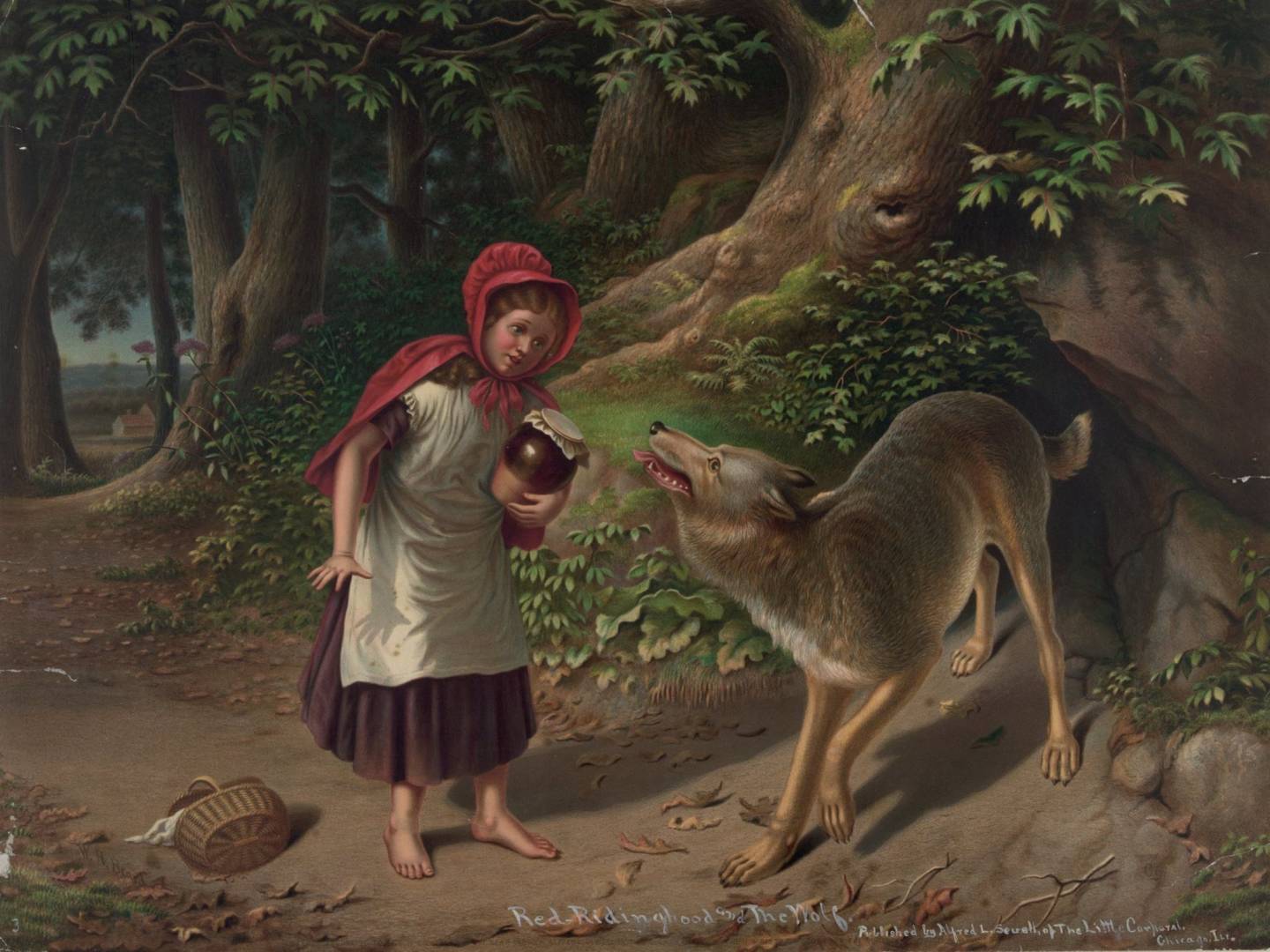
"caption": "In \"Little Red Riding Hood,\" a young girl and her grandmother are attacked by a wolf, seen in this 1870s illustration by Alfred L. Sewell. In the NRA version, Red wards off the wolf with a rifle. (Photo: Buyenlarge via Getty Images)",
"description": "In \"Little Red Riding Hood,\" a young girl and her grandmother are attacked by a wolf, seen in this 1870s illustration by Alfred L. Sewell. In the NRA version, Red wards off the wolf with a rifle.",
"title": "little red riding hood nra",
"credit": null,
"status": "inherit",
"isLoading": false,
"fetchFailed": false
},
"arts_11441669": {
"type": "attachments",
"id": "arts_11441669",
"meta": {
"index": "attachments_1716263798",
"site": "arts",
"id": "11441669",
"found": true
},
"parent": 11433242,
"imgSizes": {
"twentyfourteen-full-width": {
"file": "https://ww2.kqed.org/app/uploads/sites/2/2016/03/Tony.BookandBio-1038x576.jpg",
"width": 1038,
"mimeType": "image/jpeg",
"height": 576
},
"thumbnail": {
"file": "https://ww2.kqed.org/app/uploads/sites/2/2016/03/Tony.BookandBio-400x225.jpg",
"width": 400,
"mimeType": "image/jpeg",
"height": 225
},
"fd-sm": {
"file": "https://ww2.kqed.org/app/uploads/sites/2/2016/03/Tony.BookandBio-960x540.jpg",
"width": 960,
"mimeType": "image/jpeg",
"height": 540
},
"post-thumbnail": {
"file": "https://ww2.kqed.org/app/uploads/sites/2/2016/03/Tony.BookandBio-672x372.jpg",
"width": 672,
"mimeType": "image/jpeg",
"height": 372
},
"kqedFullSize": {
"file": "https://ww2.kqed.org/app/uploads/sites/2/2016/03/Tony.BookandBio.jpg",
"width": 1550,
"height": 872
},
"large": {
"file": "https://ww2.kqed.org/app/uploads/sites/2/2016/03/Tony.BookandBio-1180x664.jpg",
"width": 1180,
"mimeType": "image/jpeg",
"height": 664
},
"guest-author-96": {
"file": "https://ww2.kqed.org/app/uploads/sites/2/2016/03/Tony.BookandBio-96x96.jpg",
"width": 96,
"mimeType": "image/jpeg",
"height": 96
},
"medium": {
"file": "https://ww2.kqed.org/app/uploads/sites/2/2016/03/Tony.BookandBio-800x450.jpg",
"width": 800,
"mimeType": "image/jpeg",
"height": 450
},
"guest-author-64": {
"file": "https://ww2.kqed.org/app/uploads/sites/2/2016/03/Tony.BookandBio-64x64.jpg",
"width": 64,
"mimeType": "image/jpeg",
"height": 64
},
"guest-author-32": {
"file": "https://ww2.kqed.org/app/uploads/sites/2/2016/03/Tony.BookandBio-32x32.jpg",
"width": 32,
"mimeType": "image/jpeg",
"height": 32
},
"fd-med": {
"file": "https://ww2.kqed.org/app/uploads/sites/2/2016/03/Tony.BookandBio-1180x664.jpg",
"width": 1180,
"mimeType": "image/jpeg",
"height": 664
},
"detail": {
"file": "https://ww2.kqed.org/app/uploads/sites/2/2016/03/Tony.BookandBio-75x75.jpg",
"width": 75,
"mimeType": "image/jpeg",
"height": 75
},
"medium_large": {
"file": "https://ww2.kqed.org/app/uploads/sites/2/2016/03/Tony.BookandBio-768x432.jpg",
"width": 768,
"mimeType": "image/jpeg",
"height": 432
},
"guest-author-128": {
"file": "https://ww2.kqed.org/app/uploads/sites/2/2016/03/Tony.BookandBio-128x128.jpg",
"width": 128,
"mimeType": "image/jpeg",
"height": 128
}
},
"publishDate": 1459102178,
"modified": 1459102766,
"caption": "In 'Private Citizens,' Tony Tulathimutte writes like he’s tossing firecrackers: quick and brutal bursts of language and narrative.",
"description": "In 'Private Citizens,' Tony Tulathimutte writes like he’s tossing firecrackers: quick and brutal bursts of language and narrative.",
"title": "Tony.BookandBio",
"credit": "Photo: Lydia White ",
"status": "inherit",
"isLoading": false,
"fetchFailed": false
},
"pop_21445": {
"type": "attachments",
"id": "pop_21445",
"meta": {
"index": "attachments_1716263798",
"site": "pop",
"id": "21445",
"found": true
},
"parent": 21444,
"imgSizes": {
"thumbnail": {
"file": "https://ww2.kqed.org/app/uploads/sites/12/2016/03/nina-eb8e5990c511382da71216ef40bb2e7ae9bd17dd-400x300.png",
"width": 400,
"mimeType": "image/png",
"height": 300
},
"post-thumbnail": {
"file": "https://ww2.kqed.org/app/uploads/sites/12/2016/03/nina-eb8e5990c511382da71216ef40bb2e7ae9bd17dd-672x372.png",
"width": 672,
"mimeType": "image/png",
"height": 372
},
"kqedFullSize": {
"file": "https://ww2.kqed.org/app/uploads/sites/12/2016/03/nina-eb8e5990c511382da71216ef40bb2e7ae9bd17dd.png",
"width": 715,
"height": 536
},
"guest-author-96": {
"file": "https://ww2.kqed.org/app/uploads/sites/12/2016/03/nina-eb8e5990c511382da71216ef40bb2e7ae9bd17dd-96x96.png",
"width": 96,
"mimeType": "image/png",
"height": 96
},
"guest-author-64": {
"file": "https://ww2.kqed.org/app/uploads/sites/12/2016/03/nina-eb8e5990c511382da71216ef40bb2e7ae9bd17dd-64x64.png",
"width": 64,
"mimeType": "image/png",
"height": 64
},
"detail": {
"file": "https://ww2.kqed.org/app/uploads/sites/12/2016/03/nina-eb8e5990c511382da71216ef40bb2e7ae9bd17dd-75x75.png",
"width": 75,
"mimeType": "image/png",
"height": 75
},
"guest-author-32": {
"file": "https://ww2.kqed.org/app/uploads/sites/12/2016/03/nina-eb8e5990c511382da71216ef40bb2e7ae9bd17dd-32x32.png",
"width": 32,
"mimeType": "image/png",
"height": 32
},
"guest-author-128": {
"file": "https://ww2.kqed.org/app/uploads/sites/12/2016/03/nina-eb8e5990c511382da71216ef40bb2e7ae9bd17dd-128x128.png",
"width": 128,
"mimeType": "image/png",
"height": 128
}
},
"publishDate": 1458686823,
"modified": 1458687029,
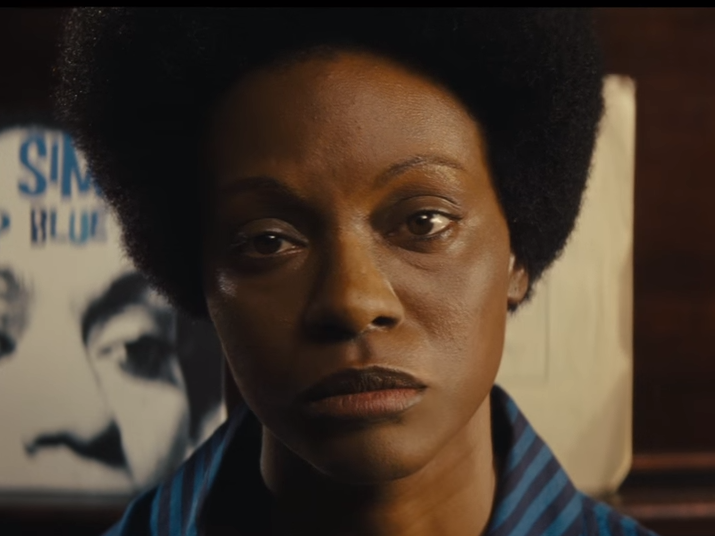
"caption": "This still is from the first trailer for Nina, starring Zoe Saldana as singer Nina Simone. This image of Saldana in dark makeup and with a prosthetic nose helped reignite a controversy over skin color and casting.",
"description": null,
"title": "nina simone zoe saldana",
"credit": null,
"status": "inherit",
"isLoading": false,
"fetchFailed": false
},
"pop_21271": {
"type": "attachments",
"id": "pop_21271",
"meta": {
"index": "attachments_1716263798",
"site": "pop",
"id": "21271",
"found": true
},
"parent": 21265,
"imgSizes": {
"twentyfourteen-full-width": {
"file": "https://ww2.kqed.org/app/uploads/sites/12/2016/03/PATIENCE_P79-80_Colors-copy-1038x576.jpg",
"width": 1038,
"mimeType": "image/jpeg",
"height": 576
},
"thumbnail": {
"file": "https://ww2.kqed.org/app/uploads/sites/12/2016/03/PATIENCE_P79-80_Colors-copy-400x257.jpg",
"width": 400,
"mimeType": "image/jpeg",
"height": 257
},
"fd-sm": {
"file": "https://ww2.kqed.org/app/uploads/sites/12/2016/03/PATIENCE_P79-80_Colors-copy-960x617.jpg",
"width": 960,
"mimeType": "image/jpeg",
"height": 617
},
"post-thumbnail": {
"file": "https://ww2.kqed.org/app/uploads/sites/12/2016/03/PATIENCE_P79-80_Colors-copy-672x372.jpg",
"width": 672,
"mimeType": "image/jpeg",
"height": 372
},
"kqedFullSize": {
"file": "https://ww2.kqed.org/app/uploads/sites/12/2016/03/PATIENCE_P79-80_Colors-copy.jpg",
"width": 4844,
"height": 3113
},
"large": {
"file": "https://ww2.kqed.org/app/uploads/sites/12/2016/03/PATIENCE_P79-80_Colors-copy-1440x925.jpg",
"width": 1440,
"mimeType": "image/jpeg",
"height": 925
},
"guest-author-96": {
"file": "https://ww2.kqed.org/app/uploads/sites/12/2016/03/PATIENCE_P79-80_Colors-copy-96x96.jpg",
"width": 96,
"mimeType": "image/jpeg",
"height": 96
},
"medium": {
"file": "https://ww2.kqed.org/app/uploads/sites/12/2016/03/PATIENCE_P79-80_Colors-copy-800x514.jpg",
"width": 800,
"mimeType": "image/jpeg",
"height": 514
},
"guest-author-64": {
"file": "https://ww2.kqed.org/app/uploads/sites/12/2016/03/PATIENCE_P79-80_Colors-copy-64x64.jpg",
"width": 64,
"mimeType": "image/jpeg",
"height": 64
},
"guest-author-32": {
"file": "https://ww2.kqed.org/app/uploads/sites/12/2016/03/PATIENCE_P79-80_Colors-copy-32x32.jpg",
"width": 32,
"mimeType": "image/jpeg",
"height": 32
},
"fd-lrg": {
"file": "https://ww2.kqed.org/app/uploads/sites/12/2016/03/PATIENCE_P79-80_Colors-copy-1920x1234.jpg",
"width": 1920,
"mimeType": "image/jpeg",
"height": 1234
},
"fd-med": {
"file": "https://ww2.kqed.org/app/uploads/sites/12/2016/03/PATIENCE_P79-80_Colors-copy-1180x758.jpg",
"width": 1180,
"mimeType": "image/jpeg",
"height": 758
},
"detail": {
"file": "https://ww2.kqed.org/app/uploads/sites/12/2016/03/PATIENCE_P79-80_Colors-copy-75x75.jpg",
"width": 75,
"mimeType": "image/jpeg",
"height": 75
},
"medium_large": {
"file": "https://ww2.kqed.org/app/uploads/sites/12/2016/03/PATIENCE_P79-80_Colors-copy-768x494.jpg",
"width": 768,
"mimeType": "image/jpeg",
"height": 494
},
"guest-author-128": {
"file": "https://ww2.kqed.org/app/uploads/sites/12/2016/03/PATIENCE_P79-80_Colors-copy-128x128.jpg",
"width": 128,
"mimeType": "image/jpeg",
"height": 128
}
},
"publishDate": 1458261010,
"modified": 1458261038,
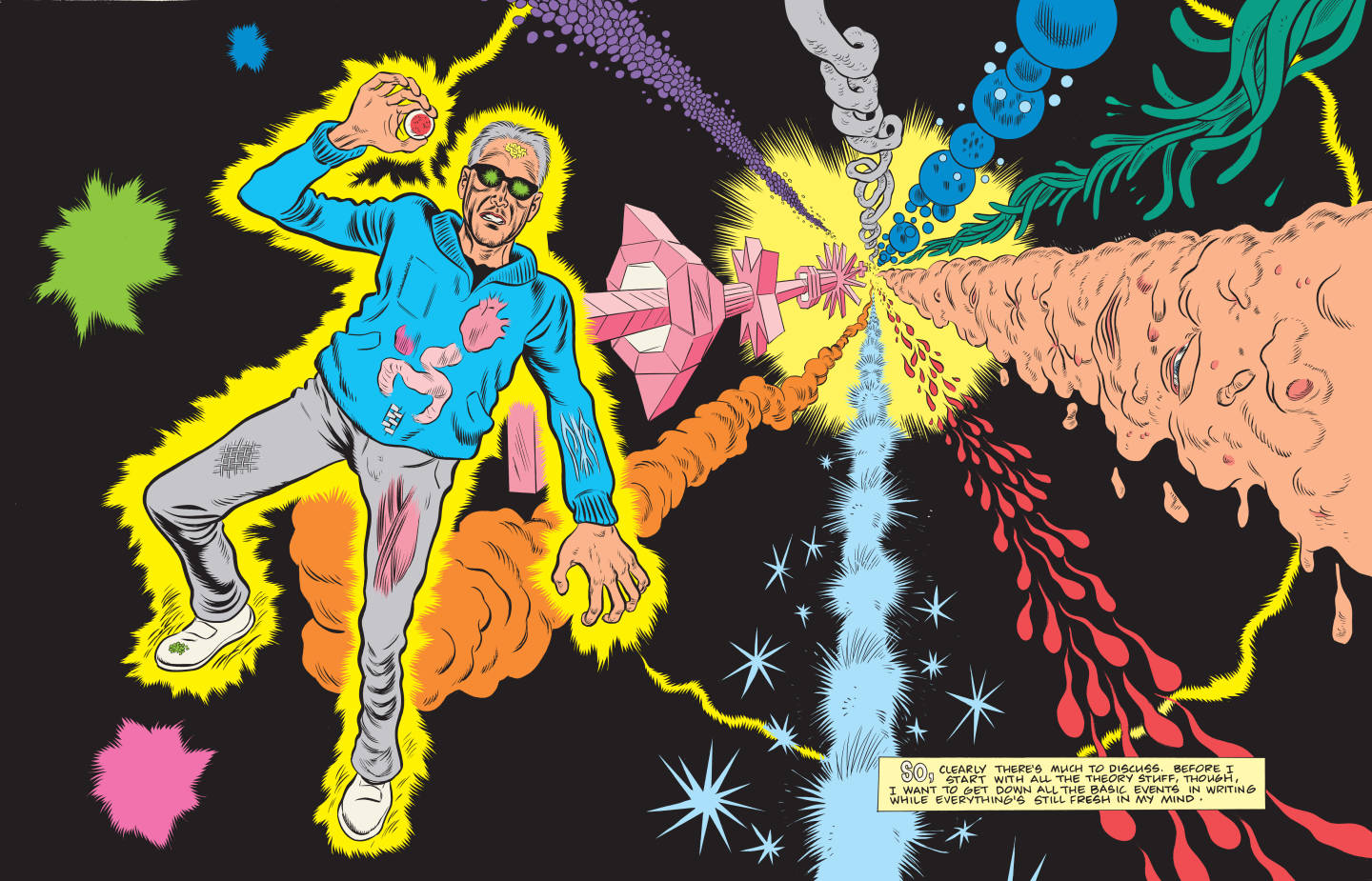
"caption": "A page from 'Patience,' by Daniel Clowes. ",
"description": "A page from 'Patience,' by Daniel Clowes. ",
"title": "PATIENCE_P79-80_Colors copy",
"credit": "Fantagraphics",
"status": "inherit",
"isLoading": false,
"fetchFailed": false
},
"arts_11412069": {
"type": "attachments",
"id": "arts_11412069",
"meta": {
"index": "attachments_1716263798",
"site": "arts",
"id": "11412069",
"found": true
},
"parent": 11412068,
"imgSizes": {
"twentyfourteen-full-width": {
"file": "https://ww2.kqed.org/app/uploads/sites/2/2016/03/elizabethpercer-1038x576.jpg",
"width": 1038,
"mimeType": "image/jpeg",
"height": 576
},
"thumbnail": {
"file": "https://ww2.kqed.org/app/uploads/sites/2/2016/03/elizabethpercer-400x267.jpg",
"width": 400,
"mimeType": "image/jpeg",
"height": 267
},
"fd-sm": {
"file": "https://ww2.kqed.org/app/uploads/sites/2/2016/03/elizabethpercer-960x640.jpg",
"width": 960,
"mimeType": "image/jpeg",
"height": 640
},
"post-thumbnail": {
"file": "https://ww2.kqed.org/app/uploads/sites/2/2016/03/elizabethpercer-672x372.jpg",
"width": 672,
"mimeType": "image/jpeg",
"height": 372
},
"kqedFullSize": {
"file": "https://ww2.kqed.org/app/uploads/sites/2/2016/03/elizabethpercer-e1458165750217.jpg",
"width": 1080,
"height": 720
},
"large": {
"file": "https://ww2.kqed.org/app/uploads/sites/2/2016/03/elizabethpercer-1180x786.jpg",
"width": 1180,
"mimeType": "image/jpeg",
"height": 786
},
"guest-author-96": {
"file": "https://ww2.kqed.org/app/uploads/sites/2/2016/03/elizabethpercer-96x96.jpg",
"width": 96,
"mimeType": "image/jpeg",
"height": 96
},
"medium": {
"file": "https://ww2.kqed.org/app/uploads/sites/2/2016/03/elizabethpercer-800x533.jpg",
"width": 800,
"mimeType": "image/jpeg",
"height": 533
},
"guest-author-64": {
"file": "https://ww2.kqed.org/app/uploads/sites/2/2016/03/elizabethpercer-64x64.jpg",
"width": 64,
"mimeType": "image/jpeg",
"height": 64
},
"guest-author-32": {
"file": "https://ww2.kqed.org/app/uploads/sites/2/2016/03/elizabethpercer-32x32.jpg",
"width": 32,
"mimeType": "image/jpeg",
"height": 32
},
"fd-lrg": {
"file": "https://ww2.kqed.org/app/uploads/sites/2/2016/03/elizabethpercer-1920x1280.jpg",
"width": 1920,
"mimeType": "image/jpeg",
"height": 1280
},
"fd-med": {
"file": "https://ww2.kqed.org/app/uploads/sites/2/2016/03/elizabethpercer-1180x786.jpg",
"width": 1180,
"mimeType": "image/jpeg",
"height": 786
},
"detail": {
"file": "https://ww2.kqed.org/app/uploads/sites/2/2016/03/elizabethpercer-75x75.jpg",
"width": 75,
"mimeType": "image/jpeg",
"height": 75
},
"medium_large": {
"file": "https://ww2.kqed.org/app/uploads/sites/2/2016/03/elizabethpercer-768x512.jpg",
"width": 768,
"mimeType": "image/jpeg",
"height": 512
},
"guest-author-128": {
"file": "https://ww2.kqed.org/app/uploads/sites/2/2016/03/elizabethpercer-128x128.jpg",
"width": 128,
"mimeType": "image/jpeg",
"height": 128
}
},
"publishDate": 1458165733,
"modified": 1458495228,
"caption": "Elizabeth Percer, author of 'All Stories are Love Stories' appears at City Lights on March 22 and Books Inc. Palo Alto on March 29. ",
"description": "Elizabeth Percer, author of 'All Stories are Love Stories' appears at City Lights on March 22 and Books Inc. Palo Alto on March 29. ",
"title": "elizabethpercer",
"credit": null,
"status": "inherit",
"isLoading": false,
"fetchFailed": false
},
"arts_11418577": {
"type": "attachments",
"id": "arts_11418577",
"meta": {
"index": "attachments_1716263798",
"site": "arts",
"id": "11418577",
"found": true
},
"parent": 11418576,
"imgSizes": {
"twentyfourteen-full-width": {
"file": "https://ww2.kqed.org/app/uploads/sites/2/2016/03/RS18831_Woz.JPG-qut-1038x576.jpg",
"width": 1038,
"mimeType": "image/jpeg",
"height": 576
},
"thumbnail": {
"file": "https://ww2.kqed.org/app/uploads/sites/2/2016/03/RS18831_Woz.JPG-qut-400x300.jpg",
"width": 400,
"mimeType": "image/jpeg",
"height": 300
},
"fd-sm": {
"file": "https://ww2.kqed.org/app/uploads/sites/2/2016/03/RS18831_Woz.JPG-qut-960x720.jpg",
"width": 960,
"mimeType": "image/jpeg",
"height": 720
},
"post-thumbnail": {
"file": "https://ww2.kqed.org/app/uploads/sites/2/2016/03/RS18831_Woz.JPG-qut-672x372.jpg",
"width": 672,
"mimeType": "image/jpeg",
"height": 372
},
"kqedFullSize": {
"file": "https://ww2.kqed.org/app/uploads/sites/2/2016/03/RS18831_Woz.JPG-qut.jpg",
"width": 1632,
"height": 1224
},
"large": {
"file": "https://ww2.kqed.org/app/uploads/sites/2/2016/03/RS18831_Woz.JPG-qut-1180x885.jpg",
"width": 1180,
"mimeType": "image/jpeg",
"height": 885
},
"guest-author-96": {
"file": "https://ww2.kqed.org/app/uploads/sites/2/2016/03/RS18831_Woz.JPG-qut-96x96.jpg",
"width": 96,
"mimeType": "image/jpeg",
"height": 96
},
"medium": {
"file": "https://ww2.kqed.org/app/uploads/sites/2/2016/03/RS18831_Woz.JPG-qut-800x600.jpg",
"width": 800,
"mimeType": "image/jpeg",
"height": 600
},
"guest-author-64": {
"file": "https://ww2.kqed.org/app/uploads/sites/2/2016/03/RS18831_Woz.JPG-qut-64x64.jpg",
"width": 64,
"mimeType": "image/jpeg",
"height": 64
},
"guest-author-32": {
"file": "https://ww2.kqed.org/app/uploads/sites/2/2016/03/RS18831_Woz.JPG-qut-32x32.jpg",
"width": 32,
"mimeType": "image/jpeg",
"height": 32
},
"fd-med": {
"file": "https://ww2.kqed.org/app/uploads/sites/2/2016/03/RS18831_Woz.JPG-qut-1180x885.jpg",
"width": 1180,
"mimeType": "image/jpeg",
"height": 885
},
"detail": {
"file": "https://ww2.kqed.org/app/uploads/sites/2/2016/03/RS18831_Woz.JPG-qut-75x75.jpg",
"width": 75,
"mimeType": "image/jpeg",
"height": 75
},
"medium_large": {
"file": "https://ww2.kqed.org/app/uploads/sites/2/2016/03/RS18831_Woz.JPG-qut-768x576.jpg",
"width": 768,
"mimeType": "image/jpeg",
"height": 576
},
"guest-author-128": {
"file": "https://ww2.kqed.org/app/uploads/sites/2/2016/03/RS18831_Woz.JPG-qut-128x128.jpg",
"width": 128,
"mimeType": "image/jpeg",
"height": 128
}
},
"publishDate": 1458360252,
"modified": 1458360302,
"caption": "Silicon Valley Comic Con co-founder Steve Wozniak is literally the face of this event.",
"description": "Silicon Valley Comic Con co-founder Steve Wozniak is literally the face of this event.",
"title": "RS18831_Woz.JPG-qut",
"credit": "Photo: Rachael Myrow/KQED",
"status": "inherit",
"isLoading": false,
"fetchFailed": false
},
"arts_11414651": {
"type": "attachments",
"id": "arts_11414651",
"meta": {
"index": "attachments_1716263798",
"site": "arts",
"id": "11414651",
"found": true
},
"parent": 11414527,
"imgSizes": {
"twentyfourteen-full-width": {
"file": "https://ww2.kqed.org/app/uploads/sites/2/2016/03/Burlesque_JulieMuz_credit-RoxiDlite-2-e1458246497572-1038x576.jpg",
"width": 1038,
"mimeType": "image/jpeg",
"height": 576
},
"thumbnail": {
"file": "https://ww2.kqed.org/app/uploads/sites/2/2016/03/Burlesque_JulieMuz_credit-RoxiDlite-2-e1458246497572-400x266.jpg",
"width": 400,
"mimeType": "image/jpeg",
"height": 266
},
"fd-sm": {
"file": "https://ww2.kqed.org/app/uploads/sites/2/2016/03/Burlesque_JulieMuz_credit-RoxiDlite-2-e1458246497572-960x638.jpg",
"width": 960,
"mimeType": "image/jpeg",
"height": 638
},
"post-thumbnail": {
"file": "https://ww2.kqed.org/app/uploads/sites/2/2016/03/Burlesque_JulieMuz_credit-RoxiDlite-2-e1458246497572-672x372.jpg",
"width": 672,
"mimeType": "image/jpeg",
"height": 372
},
"kqedFullSize": {
"file": "https://ww2.kqed.org/app/uploads/sites/2/2016/03/Burlesque_JulieMuz_credit-RoxiDlite-2-e1458246497572.jpg",
"width": 2005,
"height": 1332
},
"large": {
"file": "https://ww2.kqed.org/app/uploads/sites/2/2016/03/Burlesque_JulieMuz_credit-RoxiDlite-2-e1458246497572-1180x784.jpg",
"width": 1180,
"mimeType": "image/jpeg",
"height": 784
},
"guest-author-96": {
"file": "https://ww2.kqed.org/app/uploads/sites/2/2016/03/Burlesque_JulieMuz_credit-RoxiDlite-2-e1458246497572-96x96.jpg",
"width": 96,
"mimeType": "image/jpeg",
"height": 96
},
"medium": {
"file": "https://ww2.kqed.org/app/uploads/sites/2/2016/03/Burlesque_JulieMuz_credit-RoxiDlite-2-e1458246497572-800x531.jpg",
"width": 800,
"mimeType": "image/jpeg",
"height": 531
},
"guest-author-64": {
"file": "https://ww2.kqed.org/app/uploads/sites/2/2016/03/Burlesque_JulieMuz_credit-RoxiDlite-2-e1458246497572-64x64.jpg",
"width": 64,
"mimeType": "image/jpeg",
"height": 64
},
"guest-author-32": {
"file": "https://ww2.kqed.org/app/uploads/sites/2/2016/03/Burlesque_JulieMuz_credit-RoxiDlite-2-e1458246497572-32x32.jpg",
"width": 32,
"mimeType": "image/jpeg",
"height": 32
},
"fd-lrg": {
"file": "https://ww2.kqed.org/app/uploads/sites/2/2016/03/Burlesque_JulieMuz_credit-RoxiDlite-2-e1458246497572-1920x1276.jpg",
"width": 1920,
"mimeType": "image/jpeg",
"height": 1276
},
"fd-med": {
"file": "https://ww2.kqed.org/app/uploads/sites/2/2016/03/Burlesque_JulieMuz_credit-RoxiDlite-2-e1458246497572-1180x784.jpg",
"width": 1180,
"mimeType": "image/jpeg",
"height": 784
},
"detail": {
"file": "https://ww2.kqed.org/app/uploads/sites/2/2016/03/Burlesque_JulieMuz_credit-RoxiDlite-2-e1458246497572-75x75.jpg",
"width": 75,
"mimeType": "image/jpeg",
"height": 75
},
"medium_large": {
"file": "https://ww2.kqed.org/app/uploads/sites/2/2016/03/Burlesque_JulieMuz_credit-RoxiDlite-2-e1458246497572-768x510.jpg",
"width": 768,
"mimeType": "image/jpeg",
"height": 510
},
"guest-author-128": {
"file": "https://ww2.kqed.org/app/uploads/sites/2/2016/03/Burlesque_JulieMuz_credit-RoxiDlite-2-e1458246497572-128x128.jpg",
"width": 128,
"mimeType": "image/jpeg",
"height": 128
}
},
"publishDate": 1458240796,
"modified": 1458240980,
"caption": "Performer Julie Muz in ‘Take It Off! Burlesque’, part of the Jewish Community Center’s ‘Uninhibited About Sex’ series this spring",
"description": "Performer Julie Muz in ‘Take It Off! Burlesque’, part of the Jewish Community Center’s ‘Uninhibited About Sex’ series this spring",
"title": "Burlesque_Julie+Muz_credit-Roxi+Dlite 2",
"credit": "Photo: Courtesy of The Jewish Community Center of San Francisco",
"status": "inherit",
"isLoading": false,
"fetchFailed": false
}
},
"audioPlayerReducer": {
"postId": "stream_live",
"isPaused": true,
"isPlaying": false,
"pfsActive": false,
"pledgeModalIsOpen": true,
"playerDrawerIsOpen": false,
"liveAudioPlayStartedAt": 0,
"liveAudioPlayContext": ""
},
"authorsReducer": {
"byline_arts_11464824": {
"type": "authors",
"id": "byline_arts_11464824",
"meta": {
"override": true
},
"slug": "byline_arts_11464824",
"name": "Associated Press",
"isLoading": false
},
"byline_arts_11444584": {
"type": "authors",
"id": "byline_arts_11444584",
"meta": {
"override": true
},
"slug": "byline_arts_11444584",
"name": "Alexi Horowitz-Ghazi",
"isLoading": false
},
"byline_pop_21594": {
"type": "authors",
"id": "byline_pop_21594",
"meta": {
"override": true
},
"slug": "byline_pop_21594",
"name": "Camila Domonoske",
"isLoading": false
},
"byline_pop_21444": {
"type": "authors",
"id": "byline_pop_21444",
"meta": {
"override": true
},
"slug": "byline_pop_21444",
"name": "Leah Donnella",
"isLoading": false
},
"rachael-myrow": {
"type": "authors",
"id": "251",
"meta": {
"index": "authors_1716337520",
"id": "251",
"found": true
},
"name": "Rachael Myrow",
"firstName": "Rachael",
"lastName": "Myrow",
"slug": "rachael-myrow",
"email": "rmyrow@kqed.org",
"display_author_email": true,
"staff_mastheads": [
"news"
],
"title": "Senior Editor of KQED's Silicon Valley News Desk",
"bio": "• I write and edit stories about how Silicon Valley power and policies shape everyday life in California. I’m also passionate about making Bay Area history and culture more accessible to a broad public. • I’ve been a journalist for most of my life, starting in high school with The Franklin Press in Los Angeles, where I grew up. While earning my first degree in English at UC Berkeley, I got my start in public radio at KALX-FM. After completing a second degree in journalism at Cal, I landed my first professional job at Marketplace, then moved on to KPCC (now LAist), and then KQED, where I hosted The California Report for more than seven years. • My reporting has appeared on NPR, The World, WBUR’s \u003ci>Here & Now\u003c/i>, and the BBC. I also guest host for KQED’s \u003ci>Forum\u003c/i>, as well as the Commonwealth Club in San Francisco. • I speak periodically on media, democracy and technology issues, and do voiceover work for documentaries and educational video projects. • Outside of the studio, you'll find me hiking Bay Area trails and whipping up Insta-ready meals in my kitchen. • I do not accept gifts, money, or favors from anyone connected to my reporting, I don't pay people for information, and I do not support or donate to political causes. • I strive to treat the people I report on with fairness, honesty, and respect. I also recognize there are often multiple sides to a story and work to verify information through multiple sources and documentation. If I get something wrong, I correct it.",
"avatar": "https://secure.gravatar.com/avatar/3ed8a3c5f26025e4a805ba634cda8cd764906b97438a6d9ce216b044e340da4e?s=600&d=blank&r=g",
"twitter": "rachaelmyrow",
"bluesky": null,
"facebook": null,
"instagram": null,
"linkedin": "https://www.linkedin.com/in/rachaelmyrow/",
"sites": [
{
"site": "arts",
"roles": [
"administrator"
]
},
{
"site": "news",
"roles": [
"edit_others_posts",
"editor"
]
},
{
"site": "futureofyou",
"roles": [
"editor"
]
},
{
"site": "bayareabites",
"roles": [
"editor"
]
},
{
"site": "stateofhealth",
"roles": [
"editor"
]
},
{
"site": "science",
"roles": [
"editor"
]
},
{
"site": "food",
"roles": [
"editor"
]
},
{
"site": "forum",
"roles": [
"editor"
]
},
{
"site": "liveblog",
"roles": [
"author"
]
}
],
"headData": {
"title": "Rachael Myrow | KQED",
"description": "Senior Editor of KQED's Silicon Valley News Desk",
"ogImgSrc": "https://secure.gravatar.com/avatar/3ed8a3c5f26025e4a805ba634cda8cd764906b97438a6d9ce216b044e340da4e?s=600&d=blank&r=g",
"twImgSrc": "https://secure.gravatar.com/avatar/3ed8a3c5f26025e4a805ba634cda8cd764906b97438a6d9ce216b044e340da4e?s=600&d=blank&r=g"
},
"isLoading": false,
"link": "/author/rachael-myrow"
},
"lclark": {
"type": "authors",
"id": "3224",
"meta": {
"index": "authors_1716337520",
"id": "3224",
"found": true
},
"name": "Leilani Clark",
"firstName": "Leilani",
"lastName": "Clark",
"slug": "lclark",
"email": "clark.leil@gmail.com",
"display_author_email": false,
"staff_mastheads": [],
"title": null,
"bio": "Leilani Clark writes about books for KQED Arts. Her writing has been published at Mother Jones, The Guardian, Civil Eats, Time Magazine, Food & Wine, Edible Marin & Wine Country, and The Rumpus. She is the editor of Made Local magazine in Sonoma County. Find her on Twitter \u003ca href=\"https://twitter.com/leilclark\">@leilclark\u003c/a>.",
"avatar": "https://secure.gravatar.com/avatar/7f691fdc52ed2e3f4cf164d1f4ec0889?s=600&d=blank&r=g",
"twitter": null,
"facebook": null,
"instagram": null,
"linkedin": null,
"sites": [
{
"site": "arts",
"roles": [
"contributor"
]
},
{
"site": "bayareabites",
"roles": [
"contributor"
]
},
{
"site": "food",
"roles": [
"contributor"
]
}
],
"headData": {
"title": "Leilani Clark | KQED",
"description": null,
"ogImgSrc": "https://secure.gravatar.com/avatar/7f691fdc52ed2e3f4cf164d1f4ec0889?s=600&d=blank&r=g",
"twImgSrc": "https://secure.gravatar.com/avatar/7f691fdc52ed2e3f4cf164d1f4ec0889?s=600&d=blank&r=g"
},
"isLoading": false,
"link": "/author/lclark"
},
"esilvers": {
"type": "authors",
"id": "7237",
"meta": {
"index": "authors_1716337520",
"id": "7237",
"found": true
},
"name": "Emma Silvers",
"firstName": "Emma",
"lastName": "Silvers",
"slug": "esilvers",
"email": "esilvers@kqed.org",
"display_author_email": false,
"staff_mastheads": [],
"title": "KQED Contributor",
"bio": "Emma Silvers is an editor at KQED Arts and a former digital producer at KQED News. Born and raised in the Bay Area, she has previously been an arts and entertainment editor at the \u003cem>San Francisco Chronicle\u003c/em>, \u003cem>SF Weekly\u003c/em> and the \u003cem>San Francisco Bay Guardian.\u003c/em> \u003ca href=\"https://www.emmasilvers.com\">Her work\u003c/a> has also appeared in \u003cem>Rolling Stone\u003c/em>, Pitchfork and \u003cem>Mother Jones\u003c/em>. In 2017 she was the recipient of the Society of Professional Journalists-Northern California's award for arts and culture reporting. In 1993 she \u003ca href=\"https://www.kqed.org/pop/16759/wait-what-my-coworker-was-a-voice-over-hyperventilator-for-jurassic-park\">hyperventilated in \u003cem>Jurassic Park\u003c/em>\u003c/a>.",
"avatar": "https://secure.gravatar.com/avatar/247beada39b88ea5759db1f51dba05cf?s=600&d=blank&r=g",
"twitter": "emmaruthless",
"facebook": null,
"instagram": null,
"linkedin": null,
"sites": [
{
"site": "arts",
"roles": [
"editor"
]
},
{
"site": "news",
"roles": [
"editor"
]
},
{
"site": "pop",
"roles": [
"contributor"
]
},
{
"site": "bayareabites",
"roles": [
"editor"
]
},
{
"site": "food",
"roles": [
"contributor"
]
},
{
"site": "liveblog",
"roles": [
"editor"
]
}
],
"headData": {
"title": "Emma Silvers | KQED",
"description": "KQED Contributor",
"ogImgSrc": "https://secure.gravatar.com/avatar/247beada39b88ea5759db1f51dba05cf?s=600&d=blank&r=g",
"twImgSrc": "https://secure.gravatar.com/avatar/247beada39b88ea5759db1f51dba05cf?s=600&d=blank&r=g"
},
"isLoading": false,
"link": "/author/esilvers"
},
"cveltman": {
"type": "authors",
"id": "8608",
"meta": {
"index": "authors_1716337520",
"id": "8608",
"found": true
},
"name": "Chloe Veltman",
"firstName": "Chloe",
"lastName": "Veltman",
"slug": "cveltman",
"email": "cveltman@kqed.org",
"display_author_email": true,
"staff_mastheads": [],
"title": "Arts and Culture Reporter",
"bio": "Chloe Veltman is a former arts and culture reporter for KQED. Prior to joining the organization, she launched and led the arts bureau at Colorado Public Radio, served as the Bay Area's culture columnist for the New York Times, and was the founder, host and executive producer of VoiceBox, a national award-winning weekly podcast/radio show and live events series all about the human voice. Chloe is the recipient of numerous prizes, grants and fellowships including a Webby Award for her work on interactive storytelling, both the John S Knight Journalism Fellowship and Humanities Center Fellowship at Stanford University, the Sundance Arts Writing Fellowship and a Library of Congress Research Fellowship. She is the author of the book \"On Acting\" and has appeared as a guest lecturer at Yale University and the San Francisco Conservatory of Music among other institutions. She holds a BA in english literature from King's College, Cambridge, and a Masters in Dramaturgy from the Central School of Speech and Drama/Harvard Institute for Advanced Theater Training.\r\n\u003ca href=\"https://www.chloeveltman.com\">www.chloeveltman.com\u003c/a>",
"avatar": "https://secure.gravatar.com/avatar/55403394b00a1ddab683952c2eb2cf85?s=600&d=blank&r=g",
"twitter": "chloeveltman",
"facebook": null,
"instagram": null,
"linkedin": null,
"sites": [
{
"site": "arts",
"roles": []
},
{
"site": "news",
"roles": [
"author"
]
},
{
"site": "pop",
"roles": [
"editor"
]
},
{
"site": "science",
"roles": []
}
],
"headData": {
"title": "Chloe Veltman | KQED",
"description": "Arts and Culture Reporter",
"ogImgSrc": "https://secure.gravatar.com/avatar/55403394b00a1ddab683952c2eb2cf85?s=600&d=blank&r=g",
"twImgSrc": "https://secure.gravatar.com/avatar/55403394b00a1ddab683952c2eb2cf85?s=600&d=blank&r=g"
},
"isLoading": false,
"link": "/author/cveltman"
}
},
"pagesReducer": {
"arts_category_literature": {
"type": "terms",
"id": "arts_73",
"meta": {
"index": "terms_1716263798",
"site": "arts",
"id": "73",
"score": 12.797771
},
"featImg": null,
"name": "Books",
"description": null,
"taxonomy": "category",
"headData": {
"twImgId": null,
"twTitle": null,
"ogTitle": null,
"ogImgId": null,
"twDescription": null,
"description": null,
"title": "Books Archives | KQED Arts",
"ogDescription": null
},
"ttid": 74,
"slug": "literature",
"isLoading": false,
"title": "Books",
"pageMeta": {
"site": "arts",
"WpPageTemplate": "page-topic-editorial",
"currentPage": 90
},
"blocks": [
{
"blockName": "kqed/post-list",
"attrs": {
"layout": "cardArticle2",
"query": "posts/arts?category=literature",
"seeMore": false,
"paginated": true,
"page": 90
}
},
{
"blockName": "kqed/ad"
}
]
}
},
"pfsSessionReducer": {},
"postsReducer": {
"stream_live": {
"type": "live",
"id": "stream_live",
"audioUrl": "https://streams.kqed.org/kqedradio",
"title": "Live Stream",
"excerpt": "Live Stream information currently unavailable.",
"link": "/radio",
"featImg": "",
"label": {
"name": "KQED Live",
"link": "/"
}
},
"stream_kqedNewscast": {
"type": "posts",
"id": "stream_kqedNewscast",
"audioUrl": "https://www.kqed.org/.stream/anon/radio/RDnews/newscast.mp3?_=1",
"title": "KQED Newscast",
"featImg": "",
"label": {
"name": "88.5 FM",
"link": "/"
}
},
"arts_11470573": {
"type": "posts",
"id": "arts_11470573",
"meta": {
"index": "posts_1716263798",
"site": "arts",
"id": "11470573",
"score": null,
"sort": [
1460300405000
]
},
"guestAuthors": [],
"slug": "the-struggles-and-victories-of-a-chicana-woman-in-a-hardcore-band",
"title": "The Struggles and Victories of a Xicana Woman in a Hardcore Band",
"publishDate": 1460300405,
"format": "standard",
"headTitle": "The Struggles and Victories of a Xicana Woman in a Hardcore Band | KQED",
"labelTerm": {
"site": "arts"
},
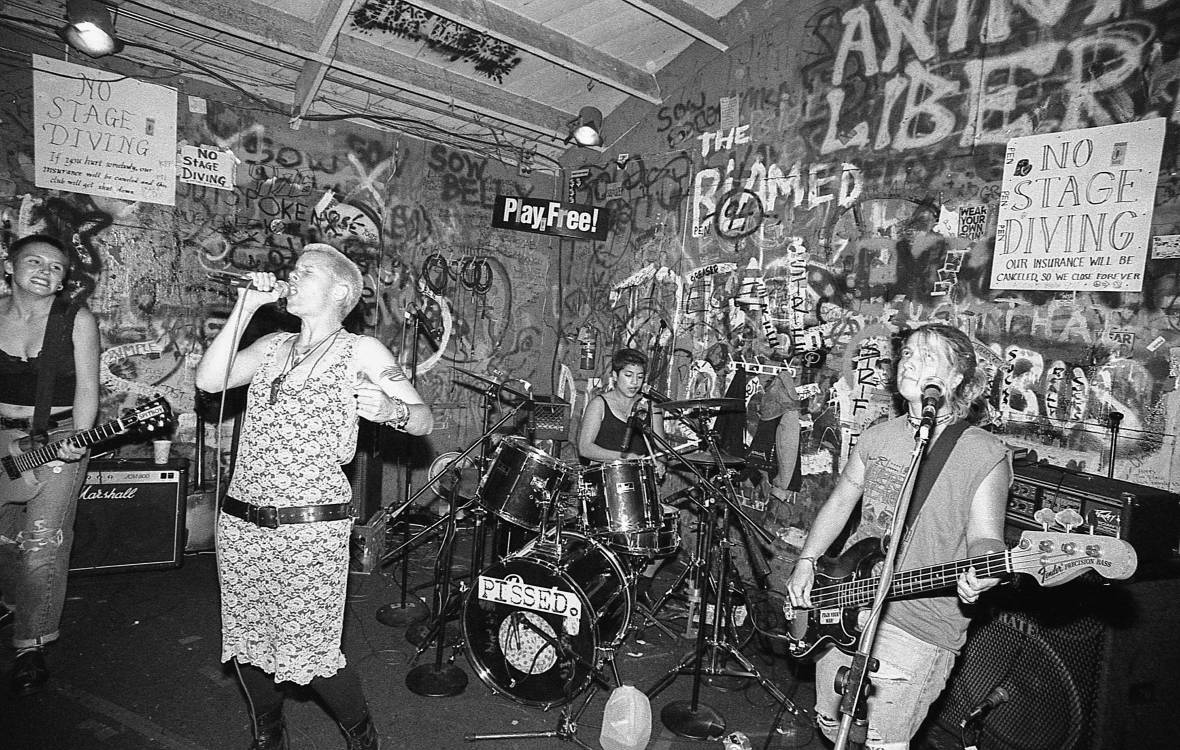
"content": "\u003cp>I first saw the East Bay feminist hardcore band Spitboy in 1993. I remember the moment the four women, the only ones on a packed bill, took the stage at the Phoenix Theater in Petaluma. Wearing ripped shorts, combat boots, Converse and worn tank tops, they were tough, intimidating, and mind-blowing with a driving, abrasive sound I’d never heard women produce before. Sure, I loved punk rock. But I’d never seen it done like this. Spitboy’s lead singer Adrienne sang about gender oppression, sexual violence, and the mismeasure of women in American society like a no-holds barred assault. It was exhilarating, hardcore, and life-affirming; I loved every second.\u003c/p>\n\u003cp>I idolized Spitboy from that day, adding them to a stable of bands that would inform my experience as a young feminist woman fronting an (almost) all-girl band a few years later.\u003c/p>\n\u003cp>\u003cimg loading=\"lazy\" decoding=\"async\" class=\" wp-image-11470578 alignleft\" src=\"http://ww2.kqed.org/arts/wp-content/uploads/sites/2/2016/04/Spitboy.jpg\" alt=\"Spitboy\" width=\"319\" height=\"201\" srcset=\"https://cdn.kqed.org/wp-content/uploads/sites/2/2016/04/Spitboy.jpg 515w, https://cdn.kqed.org/wp-content/uploads/sites/2/2016/04/Spitboy-400x252.jpg 400w\" sizes=\"(max-width: 319px) 100vw, 319px\">\u003c/p>\n\u003cp>In her new book, \u003cem>\u003ca href=\"http://www.pmpress.org/content/article.php/MichelleCruzGonzales\">The Spitboy Rule: Tales of a Xicana in a Female Punk Band\u003c/a> \u003c/em>(PM Press\u003cem>)\u003c/em> Michelle Cruz Gonzales writes about being a “Spitwoman” in those heady days. Gonzales — known back then as “Todd” — was the drummer in Spitboy and one of the band’s founding members. She still makes her home in Oakland, where she lives with her family.\u003c/p>\n\u003cp>The book, based on a zine of the same name, doesn’t function as a straightforward narrative. Rather, the collection of essays jumps around in time and consciousness, anchored by Gonzales’ reflections on the varied experiences of being a young, working-class Chicana woman in a well-known touring band at a time when women in punk rock were rare.\u003c/p>\n\u003cp>[ad fullwidth]\u003c/p>\n\u003cp>\u003cimg loading=\"lazy\" decoding=\"async\" class=\"size-full wp-image-11473162 aligncenter\" src=\"http://ww2.kqed.org/arts/wp-content/uploads/sites/2/2016/04/51EyR-zhyIL._SX322_BO1204203200_.jpg\" alt=\"51EyR-zhyIL._SX322_BO1,204,203,200_\" width=\"324\" height=\"499\">\u003c/p>\n\u003cp>As such, it’s an engrossing account of a particular period in music history. A historical moment when, as \u003ca href=\"http://mimithinguyen.com/home.html\">Mimi Thi Ngyuyen \u003c/a>writes in the preface, “some consciousness about women in music broke through, briefly.” (Read anything by \u003ca href=\"http://web.archive.org/web/20040213181138/http://www.punkplanet.com/archives/00000004.html\">Jessica Hopper\u003c/a> for more on this.) Gonzales writes about her journey from Tuolomne, a “dysfunctional, limiting, broken” town in California’s Gold Rush country, to San Francisco, hellbent on playing music like her heroes the Clash — first with Bitch Fight, and later with Spitboy and Instant Girl. It isn’t an easy journey, and it’s exacerbated by class shame, a neglected Chicana identity, and sexist and abusive vitriol lobbed at Spitboy during live performances.\u003c/p>\n\u003cp>“As aggressively unapologetic women in a (still) bro-dominant scene, Spitboy shouldered both misogynist hostility and the burden of representation,” writes Gonzales, after relaying a story of one particularly disgusting comment from a male audience member.\u003c/p>\n\u003cp>\u003cimg loading=\"lazy\" decoding=\"async\" class=\"wp-image-11470583 alignleft\" src=\"http://ww2.kqed.org/arts/wp-content/uploads/sites/2/2016/04/Spitboy-recto.jpg\" alt=\"Spitboy recto\" width=\"244\" height=\"237\" srcset=\"https://cdn.kqed.org/wp-content/uploads/sites/2/2016/04/Spitboy-recto.jpg 1064w, https://cdn.kqed.org/wp-content/uploads/sites/2/2016/04/Spitboy-recto-400x389.jpg 400w, https://cdn.kqed.org/wp-content/uploads/sites/2/2016/04/Spitboy-recto-617x600.jpg 617w, https://cdn.kqed.org/wp-content/uploads/sites/2/2016/04/Spitboy-recto-768x746.jpg 768w, https://cdn.kqed.org/wp-content/uploads/sites/2/2016/04/Spitboy-recto-960x933.jpg 960w, https://cdn.kqed.org/wp-content/uploads/sites/2/2016/04/Spitboy-recto-32x32.jpg 32w\" sizes=\"(max-width: 244px) 100vw, 244px\">What’s most refreshing about \u003cem>The Spitboy Rule\u003c/em> is Gonzales’ ability to closely examine the class and race issues woven through the mid-’90s Bay Area punk scene. Yes, she found community, friendship, and unfettered artistic expression with the band. But, as she writes, she always felt like an outsider; the only woman of color amidst all white women. The only band member who didn’t come from a fairly comfortable middle-class background.\u003c/p>\n\u003cp>These cultural differences come to the forefront after the band stops to visit Gonzales’ grandmother in East Los Angeles. It’s a stop she later regrets:\u003c/p>\n\u003cblockquote>\u003cp>Stopping had not been a good idea at all. We should have stayed on the I-5. I should not have suggested we veer off into the second-largest Mexican city in the world. I had made everyone uncomfortable, and now I was outside my body, seeing my adored Grandma and her shabby East L.A. home, which I’d always found tidy and comforting, her knick-knacks — which they probably called \u003cem>tchotchkes\u003c/em> — and all her family photos of Mexicans, and now myself through different eyes, and I didn’t like it one bit.\u003c/p>\u003c/blockquote>\n\u003cp>Most working-class kids have experienced similar moments — even within the punk scene, where lots of middle class kids went to hide — the feeling of shabbiness, of not quite fitting in, which is disconcerting when you’re with a peer group that professes to accept pretty much everything except Republicans and SUVs. In truth, the punk scene suffered from elitism, mansplaining, and race/class privilege as much as any other cultural movement.\u003c/p>\n\u003cp>[youtube https://www.youtube.com/watch?v=ETMdTT-5n-E&w=420&h=315]\u003c/p>\n\u003cp>Gonzales writes honestly about being Chicana in an overwhelmingly white punk scene. “I didn’t often make references to being Mexican, a Xicana, in a mostly white band in a mostly white punk scene. It was just easier to try to blend in with my short hair, my tattoo, and my punk uniform.” She dates white guys (including \u003cem>Cometbus\u003c/em> editor Aaron Elliott) and struggles towards an acceptance of her identity, first through learning Spanish, and later as an ethnic studies minor at Mills College.\u003c/p>\n\u003cp>There are victorious moments as well. Gonzales writes of the thrill of touring Europe with Citizen Fish, traveling to Japan for the first time where one rabid fan cried upon meeting her, and playing in New Zealand to enthusiastic crowds. All experiences she couldn’t have imagined as a young, isolated punk in Tuolumne, listening to the Clash and dreaming of England. Later, she meets \u003ca href=\"https://en.wikipedia.org/wiki/Los_Crudos\">Los Crudos\u003c/a>, a Latino hardcore band out of Chicago that sings in Spanish and proudly displays their cultural heritage. “I began to feel more comfortable with my multiple identities,” she writes, “Spitboy drummer, feminist, Xicana.”\u003c/p>\n\u003cp>Gonzales is now in her mid-forties; Spitboy played that show at the Phoenix Theater almost 25 years ago. The stories and observations in \u003cem>The Spitboy Rule\u003c/em> benefit from years of reflection, schooling, and life lived. This would have been a much different book if Gonzales had written it 20 years ago. It is a privilege to grow older, to have the chance to reflect on the formative struggles and building of consciousness that happens when we are young. And, for Spitboy fans like me, the true thrill comes from getting the inside story on the four radical women who took that stage in 1993 and blew us all away.\u003c/p>\n\u003cp> \u003c/p>\n\u003cp>\u003c/p>\n\u003cp>\u003cem>Michelle Cruz Gonzales appears on Wednesday, April 27, at Pegasus Books on Shattuck Ave. in Berkeley. \u003ca href=\"http://www.pegasusbookstore.com/michelle_gonzales\" target=\"_blank\" rel=\"noopener\">Details here\u003c/a>.\u003c/em>\u003c/p>\n\n",
"blocks": [],
"excerpt": "In 'The Spitboy Rule,' Michele Cruz Gonzales recalls the obstacles of being a Latina hardcore drummer in a white-male-dominated scene.",
"status": "publish",
"parent": 0,
"modified": 1726700479,
"stats": {
"hasAudio": false,
"hasVideo": true,
"hasChartOrMap": false,
"iframeSrcs": [],
"hasGoogleForm": false,
"hasGallery": false,
"hasHearkenModule": false,
"hasPolis": false,
"paragraphCount": 19,
"wordCount": 1061
},
"headData": {
"title": "The Struggles and Victories of a Xicana Woman in a Hardcore Band | KQED",
"description": "In 'The Spitboy Rule,' Michele Cruz Gonzales recalls the obstacles of being a Latina hardcore drummer in a white-male-dominated scene.",
"ogTitle": "",
"ogDescription": "",
"ogImgId": "",
"twTitle": "",
"twDescription": "",
"twImgId": "",
"schema": {
"@context": "https://schema.org",
"@type": "Article",
"headline": "The Struggles and Victories of a Xicana Woman in a Hardcore Band",
"datePublished": "2016-04-10T08:00:05-07:00",
"dateModified": "2024-09-18T16:01:19-07:00",
"image": "https://cdn.kqed.org/wp-content/uploads/2020/02/KQED-OG-Image@1x.png"
}
},
"sticky": false,
"path": "/arts/11470573/the-struggles-and-victories-of-a-chicana-woman-in-a-hardcore-band",
"audioTrackLength": null,
"parsedContent": [
{
"type": "contentString",
"content": "\u003cdiv class=\"post-body\">\u003cp>\u003cp>I first saw the East Bay feminist hardcore band Spitboy in 1993. I remember the moment the four women, the only ones on a packed bill, took the stage at the Phoenix Theater in Petaluma. Wearing ripped shorts, combat boots, Converse and worn tank tops, they were tough, intimidating, and mind-blowing with a driving, abrasive sound I’d never heard women produce before. Sure, I loved punk rock. But I’d never seen it done like this. Spitboy’s lead singer Adrienne sang about gender oppression, sexual violence, and the mismeasure of women in American society like a no-holds barred assault. It was exhilarating, hardcore, and life-affirming; I loved every second.\u003c/p>\n\u003cp>I idolized Spitboy from that day, adding them to a stable of bands that would inform my experience as a young feminist woman fronting an (almost) all-girl band a few years later.\u003c/p>\n\u003cp>\u003cimg loading=\"lazy\" decoding=\"async\" class=\" wp-image-11470578 alignleft\" src=\"http://ww2.kqed.org/arts/wp-content/uploads/sites/2/2016/04/Spitboy.jpg\" alt=\"Spitboy\" width=\"319\" height=\"201\" srcset=\"https://cdn.kqed.org/wp-content/uploads/sites/2/2016/04/Spitboy.jpg 515w, https://cdn.kqed.org/wp-content/uploads/sites/2/2016/04/Spitboy-400x252.jpg 400w\" sizes=\"(max-width: 319px) 100vw, 319px\">\u003c/p>\n\u003cp>In her new book, \u003cem>\u003ca href=\"http://www.pmpress.org/content/article.php/MichelleCruzGonzales\">The Spitboy Rule: Tales of a Xicana in a Female Punk Band\u003c/a> \u003c/em>(PM Press\u003cem>)\u003c/em> Michelle Cruz Gonzales writes about being a “Spitwoman” in those heady days. Gonzales — known back then as “Todd” — was the drummer in Spitboy and one of the band’s founding members. She still makes her home in Oakland, where she lives with her family.\u003c/p>\n\u003cp>The book, based on a zine of the same name, doesn’t function as a straightforward narrative. Rather, the collection of essays jumps around in time and consciousness, anchored by Gonzales’ reflections on the varied experiences of being a young, working-class Chicana woman in a well-known touring band at a time when women in punk rock were rare.\u003c/p>\n\u003cp>\u003c/p>\u003c/div>",
"attributes": {
"named": {},
"numeric": []
}
},
{
"type": "component",
"content": "",
"name": "ad",
"attributes": {
"named": {
"label": "fullwidth"
},
"numeric": [
"fullwidth"
]
}
},
{
"type": "contentString",
"content": "\u003cdiv class=\"post-body\">\u003cp>\u003c/p>\n\u003cp>\u003cimg loading=\"lazy\" decoding=\"async\" class=\"size-full wp-image-11473162 aligncenter\" src=\"http://ww2.kqed.org/arts/wp-content/uploads/sites/2/2016/04/51EyR-zhyIL._SX322_BO1204203200_.jpg\" alt=\"51EyR-zhyIL._SX322_BO1,204,203,200_\" width=\"324\" height=\"499\">\u003c/p>\n\u003cp>As such, it’s an engrossing account of a particular period in music history. A historical moment when, as \u003ca href=\"http://mimithinguyen.com/home.html\">Mimi Thi Ngyuyen \u003c/a>writes in the preface, “some consciousness about women in music broke through, briefly.” (Read anything by \u003ca href=\"http://web.archive.org/web/20040213181138/http://www.punkplanet.com/archives/00000004.html\">Jessica Hopper\u003c/a> for more on this.) Gonzales writes about her journey from Tuolomne, a “dysfunctional, limiting, broken” town in California’s Gold Rush country, to San Francisco, hellbent on playing music like her heroes the Clash — first with Bitch Fight, and later with Spitboy and Instant Girl. It isn’t an easy journey, and it’s exacerbated by class shame, a neglected Chicana identity, and sexist and abusive vitriol lobbed at Spitboy during live performances.\u003c/p>\n\u003cp>“As aggressively unapologetic women in a (still) bro-dominant scene, Spitboy shouldered both misogynist hostility and the burden of representation,” writes Gonzales, after relaying a story of one particularly disgusting comment from a male audience member.\u003c/p>\n\u003cp>\u003cimg loading=\"lazy\" decoding=\"async\" class=\"wp-image-11470583 alignleft\" src=\"http://ww2.kqed.org/arts/wp-content/uploads/sites/2/2016/04/Spitboy-recto.jpg\" alt=\"Spitboy recto\" width=\"244\" height=\"237\" srcset=\"https://cdn.kqed.org/wp-content/uploads/sites/2/2016/04/Spitboy-recto.jpg 1064w, https://cdn.kqed.org/wp-content/uploads/sites/2/2016/04/Spitboy-recto-400x389.jpg 400w, https://cdn.kqed.org/wp-content/uploads/sites/2/2016/04/Spitboy-recto-617x600.jpg 617w, https://cdn.kqed.org/wp-content/uploads/sites/2/2016/04/Spitboy-recto-768x746.jpg 768w, https://cdn.kqed.org/wp-content/uploads/sites/2/2016/04/Spitboy-recto-960x933.jpg 960w, https://cdn.kqed.org/wp-content/uploads/sites/2/2016/04/Spitboy-recto-32x32.jpg 32w\" sizes=\"(max-width: 244px) 100vw, 244px\">What’s most refreshing about \u003cem>The Spitboy Rule\u003c/em> is Gonzales’ ability to closely examine the class and race issues woven through the mid-’90s Bay Area punk scene. Yes, she found community, friendship, and unfettered artistic expression with the band. But, as she writes, she always felt like an outsider; the only woman of color amidst all white women. The only band member who didn’t come from a fairly comfortable middle-class background.\u003c/p>\n\u003cp>These cultural differences come to the forefront after the band stops to visit Gonzales’ grandmother in East Los Angeles. It’s a stop she later regrets:\u003c/p>\n\u003cblockquote>\u003cp>Stopping had not been a good idea at all. We should have stayed on the I-5. I should not have suggested we veer off into the second-largest Mexican city in the world. I had made everyone uncomfortable, and now I was outside my body, seeing my adored Grandma and her shabby East L.A. home, which I’d always found tidy and comforting, her knick-knacks — which they probably called \u003cem>tchotchkes\u003c/em> — and all her family photos of Mexicans, and now myself through different eyes, and I didn’t like it one bit.\u003c/p>\u003c/blockquote>\n\u003cp>Most working-class kids have experienced similar moments — even within the punk scene, where lots of middle class kids went to hide — the feeling of shabbiness, of not quite fitting in, which is disconcerting when you’re with a peer group that professes to accept pretty much everything except Republicans and SUVs. In truth, the punk scene suffered from elitism, mansplaining, and race/class privilege as much as any other cultural movement.\u003c/p>\n\u003cp>\u003c/p>\u003cp>\u003cspan class='utils-parseShortcode-shortcodes-__youtubeShortcode__embedYoutube'>\n \u003cspan class='utils-parseShortcode-shortcodes-__youtubeShortcode__embedYoutubeInside'>\n \u003ciframe\n loading='lazy'\n class='utils-parseShortcode-shortcodes-__youtubeShortcode__youtubePlayer'\n type='text/html'\n src='//www.youtube.com/embed/ETMdTT-5n-E'\n title='//www.youtube.com/embed/ETMdTT-5n-E'\n allowfullscreen='true'\n style='border:0;'>\u003c/iframe>\n \u003c/span>\n \u003c/span>\u003c/p>\u003cp>\u003c/p>\n\u003cp>Gonzales writes honestly about being Chicana in an overwhelmingly white punk scene. “I didn’t often make references to being Mexican, a Xicana, in a mostly white band in a mostly white punk scene. It was just easier to try to blend in with my short hair, my tattoo, and my punk uniform.” She dates white guys (including \u003cem>Cometbus\u003c/em> editor Aaron Elliott) and struggles towards an acceptance of her identity, first through learning Spanish, and later as an ethnic studies minor at Mills College.\u003c/p>\n\u003cp>There are victorious moments as well. Gonzales writes of the thrill of touring Europe with Citizen Fish, traveling to Japan for the first time where one rabid fan cried upon meeting her, and playing in New Zealand to enthusiastic crowds. All experiences she couldn’t have imagined as a young, isolated punk in Tuolumne, listening to the Clash and dreaming of England. Later, she meets \u003ca href=\"https://en.wikipedia.org/wiki/Los_Crudos\">Los Crudos\u003c/a>, a Latino hardcore band out of Chicago that sings in Spanish and proudly displays their cultural heritage. “I began to feel more comfortable with my multiple identities,” she writes, “Spitboy drummer, feminist, Xicana.”\u003c/p>\n\u003cp>Gonzales is now in her mid-forties; Spitboy played that show at the Phoenix Theater almost 25 years ago. The stories and observations in \u003cem>The Spitboy Rule\u003c/em> benefit from years of reflection, schooling, and life lived. This would have been a much different book if Gonzales had written it 20 years ago. It is a privilege to grow older, to have the chance to reflect on the formative struggles and building of consciousness that happens when we are young. And, for Spitboy fans like me, the true thrill comes from getting the inside story on the four radical women who took that stage in 1993 and blew us all away.\u003c/p>\n\u003cp> \u003c/p>\n\u003cp>\u003c/p>\n\u003cp>\u003cem>Michelle Cruz Gonzales appears on Wednesday, April 27, at Pegasus Books on Shattuck Ave. in Berkeley. \u003ca href=\"http://www.pegasusbookstore.com/michelle_gonzales\" target=\"_blank\" rel=\"noopener\">Details here\u003c/a>.\u003c/em>\u003c/p>\n\n\u003c/div>\u003c/p>",
"attributes": {
"named": {},
"numeric": []
}
}
],
"link": "/arts/11470573/the-struggles-and-victories-of-a-chicana-woman-in-a-hardcore-band",
"authors": [
"3224"
],
"categories": [
"arts_73",
"arts_69"
],
"tags": [
"arts_1118",
"arts_596"
],
"featImg": "arts_11470582",
"label": "arts"
},
"arts_11464824": {
"type": "posts",
"id": "arts_11464824",
"meta": {
"index": "posts_1716263798",
"site": "arts",
"id": "11464824",
"score": null,
"sort": [
1459898693000
]
},
"guestAuthors": [],
"slug": "authors-of-kids-books-seek-repeal-of-north-carolina-law",
"title": "Authors of Kid's Books Seek Repeal of North Carolina Law",
"publishDate": 1459898693,
"format": "standard",
"headTitle": "Authors of Kid’s Books Seek Repeal of North Carolina Law | KQED",
"labelTerm": {
"site": "arts"
},
"content": "\u003cp>Nearly 270 authors and illustrators of children’s books have signed a letter calling on North Carolina to repeal a new law preventing specific anti-discrimination rules for LGBT people for public accommodations and restroom use.\u003c/p>\n\u003cp>The letter, which was posted on the School Library Journal website, said the 269 signees are “disappointed and angered by the reprehensible legislation” signed into law by Gov. Pat McCrory. They called for repeal of what they called a “hateful piece of legislation.”\u003c/p>\n\u003cp>“As even the youngest among you recognize, a law that promotes, enables, or encourages discrimination of any kind is wrong,” the letter said.\u003c/p>\n\u003cp>“Know that in time, and with hard work, hope will triumph over fear. Know that acceptance will prevail over intolerance,” the letter continued. “Know that respect – for all our differences – will always unite us.”\u003c/p>\n\u003cp>Among the names on the list are authors Rick Riordan, author of \u003cem>Percy Jackson\u003c/em>; Jeff Kinney, who wrote \u003cem>Diary of a Wimpy Kid\u003c/em>, and Veronica Roth, author of \u003cem>Divergent\u003c/em>.\u003c/p>\n\u003cp>[ad fullwidth]\u003c/p>\n\u003cp>\u003cem>Divergent\u003c/em> and \u003cem>Percy Jackson\u003c/em> were made into movies.\u003c/p>\n\u003cp>The group also said it would have to consider participation in conferences and festivals in North Carolina while the law is in effect.\u003c/p>\n\u003cp>“We cannot and will not support a state government that promotes discrimination,” the letter said.\u003c/p>\n\u003cp>\u003c/p>\n\u003cp>Copyright 2016 The Associated Press. All rights reserved. \u003c/p>\n\n",
"blocks": [],
"excerpt": "Nearly 270 authors and illustrators signed a letter calling on the state to repeal a law preventing anti-discrimination rules for LGBT people.",
"status": "publish",
"parent": 0,
"modified": 1726710029,
"stats": {
"hasAudio": false,
"hasVideo": false,
"hasChartOrMap": false,
"iframeSrcs": [],
"hasGoogleForm": false,
"hasGallery": false,
"hasHearkenModule": false,
"hasPolis": false,
"paragraphCount": 11,
"wordCount": 236
},
"headData": {
"title": "Authors of Kid's Books Seek Repeal of North Carolina Law | KQED",
"description": "Nearly 270 authors and illustrators signed a letter calling on the state to repeal a law preventing anti-discrimination rules for LGBT people.",
"ogTitle": "",
"ogDescription": "",
"ogImgId": "",
"twTitle": "",
"twDescription": "",
"twImgId": "",
"schema": {
"@context": "https://schema.org",
"@type": "Article",
"headline": "Authors of Kid's Books Seek Repeal of North Carolina Law",
"datePublished": "2016-04-05T16:24:53-07:00",
"dateModified": "2024-09-18T18:40:29-07:00",
"image": "https://cdn.kqed.org/wp-content/uploads/2020/02/KQED-OG-Image@1x.png"
}
},
"sticky": false,
"nprByline": "Associated Press",
"path": "/arts/11464824/authors-of-kids-books-seek-repeal-of-north-carolina-law",
"audioTrackLength": null,
"parsedContent": [
{
"type": "contentString",
"content": "\u003cdiv class=\"post-body\">\u003cp>\u003cp>Nearly 270 authors and illustrators of children’s books have signed a letter calling on North Carolina to repeal a new law preventing specific anti-discrimination rules for LGBT people for public accommodations and restroom use.\u003c/p>\n\u003cp>The letter, which was posted on the School Library Journal website, said the 269 signees are “disappointed and angered by the reprehensible legislation” signed into law by Gov. Pat McCrory. They called for repeal of what they called a “hateful piece of legislation.”\u003c/p>\n\u003cp>“As even the youngest among you recognize, a law that promotes, enables, or encourages discrimination of any kind is wrong,” the letter said.\u003c/p>\n\u003cp>“Know that in time, and with hard work, hope will triumph over fear. Know that acceptance will prevail over intolerance,” the letter continued. “Know that respect – for all our differences – will always unite us.”\u003c/p>\n\u003cp>Among the names on the list are authors Rick Riordan, author of \u003cem>Percy Jackson\u003c/em>; Jeff Kinney, who wrote \u003cem>Diary of a Wimpy Kid\u003c/em>, and Veronica Roth, author of \u003cem>Divergent\u003c/em>.\u003c/p>\n\u003cp>\u003c/p>\u003c/div>",
"attributes": {
"named": {},
"numeric": []
}
},
{
"type": "component",
"content": "",
"name": "ad",
"attributes": {
"named": {
"label": "fullwidth"
},
"numeric": [
"fullwidth"
]
}
},
{
"type": "contentString",
"content": "\u003cdiv class=\"post-body\">\u003cp>\u003c/p>\n\u003cp>\u003cem>Divergent\u003c/em> and \u003cem>Percy Jackson\u003c/em> were made into movies.\u003c/p>\n\u003cp>The group also said it would have to consider participation in conferences and festivals in North Carolina while the law is in effect.\u003c/p>\n\u003cp>“We cannot and will not support a state government that promotes discrimination,” the letter said.\u003c/p>\n\u003cp>\u003c/p>\n\u003cp>Copyright 2016 The Associated Press. All rights reserved. \u003c/p>\n\n\u003c/div>\u003c/p>",
"attributes": {
"named": {},
"numeric": []
}
}
],
"link": "/arts/11464824/authors-of-kids-books-seek-repeal-of-north-carolina-law",
"authors": [
"byline_arts_11464824"
],
"categories": [
"arts_73",
"arts_235"
],
"tags": [
"arts_1254",
"arts_746",
"arts_596"
],
"featImg": "arts_11467799",
"label": "arts"
},
"arts_11447815": {
"type": "posts",
"id": "arts_11447815",
"meta": {
"index": "posts_1716263798",
"site": "arts",
"id": "11447815",
"score": null,
"sort": [
1459814456000
]
},
"guestAuthors": [],
"slug": "video-sneak-peak-at-jay-z-beyonce-collaborators-puppet-show-more",
"title": "VIDEO: Sneak Peek at Jay Z & Beyonce Collaborator's Puppet Show, More",
"publishDate": 1459814456,
"format": "standard",
"headTitle": "VIDEO: Sneak Peek at Jay Z & Beyonce Collaborator’s Puppet Show, More | KQED",
"labelTerm": {
"term": 140,
"site": "arts"
},
"content": "\u003cp>\u003cb>Now through Saturday, Apr. 23: \u003cem>\u003ca href=\"http://zspace.org/new-work/house-tour\" target=\"_blank\" rel=\"noopener\">A House Tour of the Infamous Porter Family Mansion with Tour Guide Ludlow Londonderry\u003c/a> at \u003c/em>\u003c/b>\u003cstrong>Z Space, San Francisco\u003c/strong>\u003cbr>\nThe world premiere of a surreal, interactive comedy by national award-winning San Francisco playwright Peter Sinn Nachtrieb inspired in part by tours of kitsch historic mansions like Hearst Castle and the Winchester Mystery House. Stars Danny Scheie in a role written specifically for the Bay Area veteran actor.\u003c/p>\n\u003cp>\u003cstrong>Also at Z Space, Wednesday, Apr. 6 – Tuesday, Apr. 12: \u003cem>\u003ca href=\"http://zspace.org/new-work/birdheart\" target=\"_blank\" rel=\"noopener\">Birdheart\u003c/a>\u003c/em>\u003c/strong>\u003cbr>\nMaster puppeteer Julian Crouch \u003cspan style=\"font-weight: 400\">(who did the \u003c/span>\u003cspan style=\"font-weight: 400\">Tony-nominated scenic design for \u003c/span>\u003ci>\u003cspan style=\"font-weight: 400\">Hedwig and the Angry Inch\u003c/span>\u003c/i>\u003cspan style=\"font-weight: 400\">)\u003c/span>\u003cspan style=\"font-weight: 400\"> and Lascivious Biddies rock band member, SF native, and Jay Z/Beyonce collaborator Saskia Lane join forces for a \u003c/span>\u003cspan style=\"font-weight: 400\">quirky table-top puppet show that weaves a beautiful story \u003c/span>\u003cspan style=\"font-weight: 400\">from ordinary things: crumpled brown paper, found objects, shadows and a mound of sand.\u003c/span>\u003c/p>\n\u003cp>https://www.youtube.com/watch?v=ESHFuipJsUM\u003c/p>\n\u003cp>\u003cb>Now through Sunday, Apr. 10: Capacitor presents \u003cem>\u003ca href=\"http://www.capacitor.org/when-we-were-small/\" target=\"_blank\" rel=\"noopener\">When We Were Small\u003c/a>\u003c/em>\u003c/b> \u003cstrong>at\u003c/strong> \u003cb>Fort Mason Center for Arts & Culture, San Francisco\u003cbr>\n\u003c/b>The Bay Area-based performing arts company presents a new show at the intersection of dance and circus arts looking at what it’s like to experience the world when you’re two years old.\u003c/p>\n\u003cp>\u003cb>Now through Saturday,\u003c/b>\u003cb> Dec. 31: History San Jose presents \u003cem>\u003ca href=\"http://historysanjose.org/wp/event/tattooed-tenacious-inked-women-in-californias-history-exhibit/\" target=\"_blank\" rel=\"noopener\">Tattooed & Tenacious: Inked Women in California’s History\u003c/a> \u003c/em>\u003c/b>\u003cb>at the Pasetta House, History Park, San Jose\u003cbr>\n\u003c/b>A quirky and fascinating exhibition of photos, art work and artifacts relating to the little-known culture of female tattoo wearers and artists in the Golden State.\u003c/p>\n\u003cp>[ad fullwidth]\u003c/p>\n\u003cp>\u003cstrong>Saturday, Apr. 9 and Sunday, Apr. 10: Early music supergroups from England — \u003ca href=\"http://calperformances.org/performances/2015-16/early-music/tallis-scholars.php\" target=\"_blank\" rel=\"noopener\">The Tallis Scholars\u003c/a> and \u003ca href=\"http://sfems.org/?page_id=7325\" target=\"_blank\" rel=\"noopener\">Stile Antico\u003c/a>, First Congregational Church, Berkeley\u003c/strong>\u003cbr>\nBinge out on Renaissance hits over a single weekend with a pair of concerts by two of the world’s foremost early music ensembles: Cal Performances presents the august British vocal ensemble The Tallis Scholars (Apr. 9) and the San Francisco Early Music Society hosts a visit from hip, young Stile Antico, also from England (Apr. 10).\u003c/p>\n\u003cp>\u003cstrong>Tuesday, Apr. 5: \u003c/strong>\u003cb>\u003ca href=\"http://www.sfartscommission.org/event/celebration-honoring-2016-mayors-art-award-recipient-armistead-maupin/\" target=\"_blank\" rel=\"noopener\">Armistead Maupin in conversation with Jewelle Gomez\u003c/a> at Herbst Theatre, San Francisco\u003cbr>\n\u003c/b>\u003cspan style=\"font-weight: 400\">The \u003ci>Tales of the City\u003c/i>\u003c/span>\u003cspan style=\"font-weight: 400\"> author appears in conversation with writer Jewelle Gomez to celebrate his receipt of the \u003c/span>\u003cspan style=\"font-weight: 400\">\u003ca href=\"http://www.sfartscommission.org/2016/02/mayor-lee-announces-armistead-maupin-as-recipient-of-2016-mayors-art-award/\">2016 Mayor’s Art Award\u003c/a>, \u003c/span>\u003cspan style=\"font-weight: 400\">San Francisco’s highest artistic prize. Maupin is the first author to win this accolade. The event is free.\u003c/span>\u003c/p>\n\u003cp>\u003c/p>\n\u003cp>\u003cb> \u003c/b>\u003c/p>\n\n",
"blocks": [],
"excerpt": "KQED Newsroom host Scott Shafer and senior arts editor Chloe Veltman look at upcoming cultural happenings around the Bay Area.",
"status": "publish",
"parent": 0,
"modified": 1726788106,
"stats": {
"hasAudio": false,
"hasVideo": true,
"hasChartOrMap": false,
"iframeSrcs": [],
"hasGoogleForm": false,
"hasGallery": false,
"hasHearkenModule": false,
"hasPolis": false,
"paragraphCount": 8,
"wordCount": 435
},
"headData": {
"title": "VIDEO: Sneak Peek at Jay Z & Beyonce Collaborator's Puppet Show, More | KQED",
"description": "KQED Newsroom host Scott Shafer and senior arts editor Chloe Veltman look at upcoming cultural happenings around the Bay Area.",
"ogTitle": "",
"ogDescription": "",
"ogImgId": "",
"twTitle": "",
"twDescription": "",
"twImgId": "",
"schema": {
"@context": "https://schema.org",
"@type": "Article",
"headline": "VIDEO: Sneak Peek at Jay Z & Beyonce Collaborator's Puppet Show, More",
"datePublished": "2016-04-04T17:00:56-07:00",
"dateModified": "2024-09-19T16:21:46-07:00",
"image": "https://cdn.kqed.org/wp-content/uploads/2020/02/KQED-OG-Image@1x.png"
}
},
"sticky": false,
"path": "/arts/11447815/video-sneak-peak-at-jay-z-beyonce-collaborators-puppet-show-more",
"audioTrackLength": null,
"parsedContent": [
{
"type": "contentString",
"content": "\u003cdiv class=\"post-body\">\u003cp>\u003cp>\u003cb>Now through Saturday, Apr. 23: \u003cem>\u003ca href=\"http://zspace.org/new-work/house-tour\" target=\"_blank\" rel=\"noopener\">A House Tour of the Infamous Porter Family Mansion with Tour Guide Ludlow Londonderry\u003c/a> at \u003c/em>\u003c/b>\u003cstrong>Z Space, San Francisco\u003c/strong>\u003cbr>\nThe world premiere of a surreal, interactive comedy by national award-winning San Francisco playwright Peter Sinn Nachtrieb inspired in part by tours of kitsch historic mansions like Hearst Castle and the Winchester Mystery House. Stars Danny Scheie in a role written specifically for the Bay Area veteran actor.\u003c/p>\n\u003cp>\u003cstrong>Also at Z Space, Wednesday, Apr. 6 – Tuesday, Apr. 12: \u003cem>\u003ca href=\"http://zspace.org/new-work/birdheart\" target=\"_blank\" rel=\"noopener\">Birdheart\u003c/a>\u003c/em>\u003c/strong>\u003cbr>\nMaster puppeteer Julian Crouch \u003cspan style=\"font-weight: 400\">(who did the \u003c/span>\u003cspan style=\"font-weight: 400\">Tony-nominated scenic design for \u003c/span>\u003ci>\u003cspan style=\"font-weight: 400\">Hedwig and the Angry Inch\u003c/span>\u003c/i>\u003cspan style=\"font-weight: 400\">)\u003c/span>\u003cspan style=\"font-weight: 400\"> and Lascivious Biddies rock band member, SF native, and Jay Z/Beyonce collaborator Saskia Lane join forces for a \u003c/span>\u003cspan style=\"font-weight: 400\">quirky table-top puppet show that weaves a beautiful story \u003c/span>\u003cspan style=\"font-weight: 400\">from ordinary things: crumpled brown paper, found objects, shadows and a mound of sand.\u003c/span>\u003c/p>\u003c/p>\u003cp>\u003cspan class='utils-parseShortcode-shortcodes-__youtubeShortcode__embedYoutube'>\n \u003cspan class='utils-parseShortcode-shortcodes-__youtubeShortcode__embedYoutubeInside'>\n \u003ciframe\n loading='lazy'\n class='utils-parseShortcode-shortcodes-__youtubeShortcode__youtubePlayer'\n type='text/html'\n src='//www.youtube.com/embed/ESHFuipJsUM'\n title='//www.youtube.com/embed/ESHFuipJsUM'\n allowfullscreen='true'\n style='border:0;'>\u003c/iframe>\n \u003c/span>\n \u003c/span>\u003c/p>\u003cp>\u003cp>\u003cb>Now through Sunday, Apr. 10: Capacitor presents \u003cem>\u003ca href=\"http://www.capacitor.org/when-we-were-small/\" target=\"_blank\" rel=\"noopener\">When We Were Small\u003c/a>\u003c/em>\u003c/b> \u003cstrong>at\u003c/strong> \u003cb>Fort Mason Center for Arts & Culture, San Francisco\u003cbr>\n\u003c/b>The Bay Area-based performing arts company presents a new show at the intersection of dance and circus arts looking at what it’s like to experience the world when you’re two years old.\u003c/p>\n\u003cp>\u003cb>Now through Saturday,\u003c/b>\u003cb> Dec. 31: History San Jose presents \u003cem>\u003ca href=\"http://historysanjose.org/wp/event/tattooed-tenacious-inked-women-in-californias-history-exhibit/\" target=\"_blank\" rel=\"noopener\">Tattooed & Tenacious: Inked Women in California’s History\u003c/a> \u003c/em>\u003c/b>\u003cb>at the Pasetta House, History Park, San Jose\u003cbr>\n\u003c/b>A quirky and fascinating exhibition of photos, art work and artifacts relating to the little-known culture of female tattoo wearers and artists in the Golden State.\u003c/p>\n\u003cp>\u003c/p>\u003c/div>",
"attributes": {
"named": {},
"numeric": []
}
},
{
"type": "component",
"content": "",
"name": "ad",
"attributes": {
"named": {
"label": "fullwidth"
},
"numeric": [
"fullwidth"
]
}
},
{
"type": "contentString",
"content": "\u003cdiv class=\"post-body\">\u003cp>\u003c/p>\n\u003cp>\u003cstrong>Saturday, Apr. 9 and Sunday, Apr. 10: Early music supergroups from England — \u003ca href=\"http://calperformances.org/performances/2015-16/early-music/tallis-scholars.php\" target=\"_blank\" rel=\"noopener\">The Tallis Scholars\u003c/a> and \u003ca href=\"http://sfems.org/?page_id=7325\" target=\"_blank\" rel=\"noopener\">Stile Antico\u003c/a>, First Congregational Church, Berkeley\u003c/strong>\u003cbr>\nBinge out on Renaissance hits over a single weekend with a pair of concerts by two of the world’s foremost early music ensembles: Cal Performances presents the august British vocal ensemble The Tallis Scholars (Apr. 9) and the San Francisco Early Music Society hosts a visit from hip, young Stile Antico, also from England (Apr. 10).\u003c/p>\n\u003cp>\u003cstrong>Tuesday, Apr. 5: \u003c/strong>\u003cb>\u003ca href=\"http://www.sfartscommission.org/event/celebration-honoring-2016-mayors-art-award-recipient-armistead-maupin/\" target=\"_blank\" rel=\"noopener\">Armistead Maupin in conversation with Jewelle Gomez\u003c/a> at Herbst Theatre, San Francisco\u003cbr>\n\u003c/b>\u003cspan style=\"font-weight: 400\">The \u003ci>Tales of the City\u003c/i>\u003c/span>\u003cspan style=\"font-weight: 400\"> author appears in conversation with writer Jewelle Gomez to celebrate his receipt of the \u003c/span>\u003cspan style=\"font-weight: 400\">\u003ca href=\"http://www.sfartscommission.org/2016/02/mayor-lee-announces-armistead-maupin-as-recipient-of-2016-mayors-art-award/\">2016 Mayor’s Art Award\u003c/a>, \u003c/span>\u003cspan style=\"font-weight: 400\">San Francisco’s highest artistic prize. Maupin is the first author to win this accolade. The event is free.\u003c/span>\u003c/p>\n\u003cp>\u003c/p>\n\u003cp>\u003cb> \u003c/b>\u003c/p>\n\n\u003c/div>\u003c/p>",
"attributes": {
"named": {},
"numeric": []
}
}
],
"link": "/arts/11447815/video-sneak-peak-at-jay-z-beyonce-collaborators-puppet-show-more",
"authors": [
"8608"
],
"programs": [
"arts_140"
],
"categories": [
"arts_73",
"arts_968",
"arts_966",
"arts_69",
"arts_75",
"arts_967",
"arts_70"
],
"tags": [
"arts_1118",
"arts_1006",
"arts_596"
],
"featImg": "arts_11448180",
"label": "arts_140"
},
"arts_11450636": {
"type": "posts",
"id": "arts_11450636",
"meta": {
"index": "posts_1716263798",
"site": "arts",
"id": "11450636",
"score": null,
"sort": [
1459695657000
]
},
"parent": 0,
"labelTerm": {
"site": "arts",
"term": 140
},
"blocks": [],
"publishDate": 1459695657,
"format": "standard",
"title": "Apocalyptic Farm Poetry, Rob Spillman, and the Luckiest Girl Alive: Lit Picks for Early April",
"headTitle": "Apocalyptic Farm Poetry, Rob Spillman, and the Luckiest Girl Alive: Lit Picks for Early April | KQED",
"content": "\u003cp>Springtime has brought lit readings galore to the Bay Area. Here’s just a smattering of excellent readings, book launches, and poetry events happening across the region.\u003c/p>\n\u003cp>\u003cstrong>Thursday, April 7: Rob Spillman at Green Apple Books, SF \u003c/strong>\u003c/p>\n\u003cp>\u003cimg loading=\"lazy\" decoding=\"async\" class=\"alignleft wp-image-11450637\" src=\"http://ww2.kqed.org/arts/wp-content/uploads/sites/2/2016/03/97808021248381-e1459374172542.jpg\" alt=\"97808021248381\" width=\"239\" height=\"347\">Soon after the fall of the Berlin Wall in 1989, Rob Spillman and his wife Elisa Schappell (you probably recognize them as editors at Tin House magazine) moved from New York City to Berlin. The young couple, both aspiring writers, wanted to live bohemian lifestyles infused with art, love, and political passion. Spillman, who lived in Berlin as a child, reveals a second motive in his new memoir \u003cem>All Tomorrow’s Parties\u003c/em>. “I was hoping that Berlin would welcome me back like a long-lost native son.” Fueled by absinthe and Sonic Youth’s \u003cem>Daydream Nation\u003c/em>, Spillman searches for art and meaning in Europe, “with amplified emotions you feel only in your twenties, when you are wildly changeable even as your artistic opinions are set in stone.” Does Berlin welcome the son back with open arms? Read the book to find out. \u003ca href=\"http://www.greenapplebooks.com/event/9th-ave-rob-spillman\">Details here\u003c/a>\u003c/p>\n\u003cp>\u003cstrong>Saturday, April 9: Daring to Write: Contemporary Narratives from Dominican Women at Modern Times, SF \u003c/strong>\u003c/p>\n\u003cp>\u003cimg loading=\"lazy\" decoding=\"async\" class=\"alignleft size-full wp-image-11450638\" src=\"http://ww2.kqed.org/arts/wp-content/uploads/sites/2/2016/03/dominicanwomen.jpg\" alt=\"dominicanwomen\" width=\"183\" height=\"275\">Edited by Erika M. Martinez, \u003cem>Daring to Write\u003c/em> offers 25 essays, memoirs, novel excerpts and poems by Dominican women and women of Dominican descent living in the United States. We’ve all read Julia Alvaraz, who wrote the foreword, but what about lesser known Dominican writers like Angie Cruz and Nelly Rosario, not to mention emerging writers just being published for the first time? These are voices whose time has come. The reading at Modern Times features Martinez along with contributor Yalitza Ferreras, a 2014-15 Steinbeck Fellow at San Jose State University. \u003ca href=\"http://moderntimesbookstore.com/event/yalitza-ferreras-and-erika-m-martinez-daring-to-write-contemporary-narratives-by-dominican-women/\">Details here\u003c/a>\u003c/p>\n\u003cp>[ad fullwidth]\u003c/p>\n\u003cp>\u003cstrong>Saturday, April 9: Launch party for \u003cem>Work and Days\u003c/em> by Tess Taylor at Flowerland, Albany \u003c/strong>\u003c/p>\n\u003cp>\u003cimg loading=\"lazy\" decoding=\"async\" class=\"alignleft wp-image-11450639\" src=\"http://ww2.kqed.org/arts/wp-content/uploads/sites/2/2016/03/41h1Z4C05EL._SX331_BO1204203200_.jpg\" alt=\"41h1Z4C05EL._SX331_BO1,204,203,200_\" width=\"226\" height=\"339\">Farmers, so dependent on soil and water, are probably most aware out of anyone of climate change’s impact on the environment. Tess Taylor perfectly captures this awareness in her latest poetry collection\u003cem> Work and Days.\u003c/em> “& the radio reports how in 2050/farming Massachusetts will be like farming Georgia—/all’s flux, no one can say what will grow in Georgia,” Taylor muses in “Apocalypto for a Small Planet.” The book’s genesis came as Taylor completed a fellowship at a cottage in the Berkshires. To combat loneliness, and grief over a miscarriage, she interned on a farm in the area. The resulting 28 poems capture the experience of hands in earth, eyes to sky, all the while watching kale, broccoli, and other cash crops thrive and fail. Taylor was a finalist for a Believer Poetry Award for her first collection \u003cem>The Forage House\u003c/em>, and she is the on air poetry reviewer for NPR’s All Things Considered. \u003ca href=\"http://www.tess-taylor.com/events\">Details here\u003c/a>\u003c/p>\n\u003cp>\u003cem>Taylor also reads at the Albany Library on Tuesday, April 12. \u003c/em>\u003c/p>\n\u003cp>\u003cstrong>Wednesday, April 13: Debut Brew with Jessica Knoll at Hopmonk Tavern, Sebastopol \u003c/strong>\u003c/p>\n\u003cp>\u003cimg loading=\"lazy\" decoding=\"async\" class=\"alignleft size-full wp-image-11450640\" src=\"http://ww2.kqed.org/arts/wp-content/uploads/sites/2/2016/03/tumblr_inline_nowvnudR5D1rb46fs_540-e1459374322915.jpg\" alt=\"tumblr_inline_nowvnudR5D1rb46fs_540\" width=\"300\" height=\"212\">A few years back, Copperfield’s Book struck on a brilliant idea. Why not introduce young, debut novelists to the North Bay community by hosting them at local taverns, where people could drink beer and hear a good reading. The latest Debut Brew features Jessica Knoll, the novelist who wrote \u003cem>Luckiest Girl Alive,\u003c/em> a thriller about a successful young woman tormented by memories of being gang-raped in high school. In a late March Lenny newsletter, Knoll revealed that the work of fiction was \u003ca href=\"http://www.lennyletter.com/life/a316/what-i-know/\">actually based on her own horrifically brutal experience of being gang-raped\u003c/a> at the age of 15, by male students at her fancy, Ivy League prep school. A difficult story to tell, for sure, but one that makes the book’s success that much more powerful. \u003ca href=\"http://www.copperfieldsbooks.com/event/debut-brew-jessica-knoll\">Details here\u003c/a>\u003c/p>\n\u003cp>\u003c/p>\n\u003cp> \u003c/p>\n\n",
"stats": {
"hasVideo": false,
"hasChartOrMap": false,
"hasAudio": false,
"hasPolis": false,
"wordCount": 645,
"hasGoogleForm": false,
"hasGallery": false,
"hasHearkenModule": false,
"iframeSrcs": [],
"paragraphCount": 12
},
"modified": 1705044692,
"excerpt": "Our literary critic's suggestions include a celebration of writing by Dominican women and a launch party at a plant nursery. ",
"headData": {
"twImgId": "",
"twTitle": "",
"ogTitle": "",
"ogImgId": "",
"twDescription": "",
"description": "Our literary critic's suggestions include a celebration of writing by Dominican women and a launch party at a plant nursery. ",
"title": "Apocalyptic Farm Poetry, Rob Spillman, and the Luckiest Girl Alive: Lit Picks for Early April | KQED",
"ogDescription": "",
"schema": {
"@context": "https://schema.org",
"@type": "Article",
"headline": "Apocalyptic Farm Poetry, Rob Spillman, and the Luckiest Girl Alive: Lit Picks for Early April",
"datePublished": "2016-04-03T08:00:57-07:00",
"dateModified": "2024-01-11T23:31:32-08:00",
"image": "https://cdn.kqed.org/wp-content/uploads/2020/02/KQED-OG-Image@1x.png"
}
},
"guestAuthors": [],
"slug": "apocalyptic-farm-poetry-rob-spillman-and-the-luckiest-girl-alive-lit-picks-for-early-april",
"status": "publish",
"sticky": false,
"path": "/arts/11450636/apocalyptic-farm-poetry-rob-spillman-and-the-luckiest-girl-alive-lit-picks-for-early-april",
"audioTrackLength": null,
"parsedContent": [
{
"type": "contentString",
"content": "\u003cdiv class=\"post-body\">\u003cp>\u003cp>Springtime has brought lit readings galore to the Bay Area. Here’s just a smattering of excellent readings, book launches, and poetry events happening across the region.\u003c/p>\n\u003cp>\u003cstrong>Thursday, April 7: Rob Spillman at Green Apple Books, SF \u003c/strong>\u003c/p>\n\u003cp>\u003cimg loading=\"lazy\" decoding=\"async\" class=\"alignleft wp-image-11450637\" src=\"http://ww2.kqed.org/arts/wp-content/uploads/sites/2/2016/03/97808021248381-e1459374172542.jpg\" alt=\"97808021248381\" width=\"239\" height=\"347\">Soon after the fall of the Berlin Wall in 1989, Rob Spillman and his wife Elisa Schappell (you probably recognize them as editors at Tin House magazine) moved from New York City to Berlin. The young couple, both aspiring writers, wanted to live bohemian lifestyles infused with art, love, and political passion. Spillman, who lived in Berlin as a child, reveals a second motive in his new memoir \u003cem>All Tomorrow’s Parties\u003c/em>. “I was hoping that Berlin would welcome me back like a long-lost native son.” Fueled by absinthe and Sonic Youth’s \u003cem>Daydream Nation\u003c/em>, Spillman searches for art and meaning in Europe, “with amplified emotions you feel only in your twenties, when you are wildly changeable even as your artistic opinions are set in stone.” Does Berlin welcome the son back with open arms? Read the book to find out. \u003ca href=\"http://www.greenapplebooks.com/event/9th-ave-rob-spillman\">Details here\u003c/a>\u003c/p>\n\u003cp>\u003cstrong>Saturday, April 9: Daring to Write: Contemporary Narratives from Dominican Women at Modern Times, SF \u003c/strong>\u003c/p>\n\u003cp>\u003cimg loading=\"lazy\" decoding=\"async\" class=\"alignleft size-full wp-image-11450638\" src=\"http://ww2.kqed.org/arts/wp-content/uploads/sites/2/2016/03/dominicanwomen.jpg\" alt=\"dominicanwomen\" width=\"183\" height=\"275\">Edited by Erika M. Martinez, \u003cem>Daring to Write\u003c/em> offers 25 essays, memoirs, novel excerpts and poems by Dominican women and women of Dominican descent living in the United States. We’ve all read Julia Alvaraz, who wrote the foreword, but what about lesser known Dominican writers like Angie Cruz and Nelly Rosario, not to mention emerging writers just being published for the first time? These are voices whose time has come. The reading at Modern Times features Martinez along with contributor Yalitza Ferreras, a 2014-15 Steinbeck Fellow at San Jose State University. \u003ca href=\"http://moderntimesbookstore.com/event/yalitza-ferreras-and-erika-m-martinez-daring-to-write-contemporary-narratives-by-dominican-women/\">Details here\u003c/a>\u003c/p>\n\u003cp>\u003c/p>\u003c/div>",
"attributes": {
"named": {},
"numeric": []
}
},
{
"type": "component",
"content": "",
"name": "ad",
"attributes": {
"named": {
"label": "fullwidth"
},
"numeric": [
"fullwidth"
]
}
},
{
"type": "contentString",
"content": "\u003cdiv class=\"post-body\">\u003cp>\u003c/p>\n\u003cp>\u003cstrong>Saturday, April 9: Launch party for \u003cem>Work and Days\u003c/em> by Tess Taylor at Flowerland, Albany \u003c/strong>\u003c/p>\n\u003cp>\u003cimg loading=\"lazy\" decoding=\"async\" class=\"alignleft wp-image-11450639\" src=\"http://ww2.kqed.org/arts/wp-content/uploads/sites/2/2016/03/41h1Z4C05EL._SX331_BO1204203200_.jpg\" alt=\"41h1Z4C05EL._SX331_BO1,204,203,200_\" width=\"226\" height=\"339\">Farmers, so dependent on soil and water, are probably most aware out of anyone of climate change’s impact on the environment. Tess Taylor perfectly captures this awareness in her latest poetry collection\u003cem> Work and Days.\u003c/em> “& the radio reports how in 2050/farming Massachusetts will be like farming Georgia—/all’s flux, no one can say what will grow in Georgia,” Taylor muses in “Apocalypto for a Small Planet.” The book’s genesis came as Taylor completed a fellowship at a cottage in the Berkshires. To combat loneliness, and grief over a miscarriage, she interned on a farm in the area. The resulting 28 poems capture the experience of hands in earth, eyes to sky, all the while watching kale, broccoli, and other cash crops thrive and fail. Taylor was a finalist for a Believer Poetry Award for her first collection \u003cem>The Forage House\u003c/em>, and she is the on air poetry reviewer for NPR’s All Things Considered. \u003ca href=\"http://www.tess-taylor.com/events\">Details here\u003c/a>\u003c/p>\n\u003cp>\u003cem>Taylor also reads at the Albany Library on Tuesday, April 12. \u003c/em>\u003c/p>\n\u003cp>\u003cstrong>Wednesday, April 13: Debut Brew with Jessica Knoll at Hopmonk Tavern, Sebastopol \u003c/strong>\u003c/p>\n\u003cp>\u003cimg loading=\"lazy\" decoding=\"async\" class=\"alignleft size-full wp-image-11450640\" src=\"http://ww2.kqed.org/arts/wp-content/uploads/sites/2/2016/03/tumblr_inline_nowvnudR5D1rb46fs_540-e1459374322915.jpg\" alt=\"tumblr_inline_nowvnudR5D1rb46fs_540\" width=\"300\" height=\"212\">A few years back, Copperfield’s Book struck on a brilliant idea. Why not introduce young, debut novelists to the North Bay community by hosting them at local taverns, where people could drink beer and hear a good reading. The latest Debut Brew features Jessica Knoll, the novelist who wrote \u003cem>Luckiest Girl Alive,\u003c/em> a thriller about a successful young woman tormented by memories of being gang-raped in high school. In a late March Lenny newsletter, Knoll revealed that the work of fiction was \u003ca href=\"http://www.lennyletter.com/life/a316/what-i-know/\">actually based on her own horrifically brutal experience of being gang-raped\u003c/a> at the age of 15, by male students at her fancy, Ivy League prep school. A difficult story to tell, for sure, but one that makes the book’s success that much more powerful. \u003ca href=\"http://www.copperfieldsbooks.com/event/debut-brew-jessica-knoll\">Details here\u003c/a>\u003c/p>\n\u003cp>\u003c/p>\n\u003cp> \u003c/p>\n\n\u003c/div>\u003c/p>",
"attributes": {
"named": {},
"numeric": []
}
}
],
"link": "/arts/11450636/apocalyptic-farm-poetry-rob-spillman-and-the-luckiest-girl-alive-lit-picks-for-early-april",
"authors": [
"3224"
],
"programs": [
"arts_140"
],
"categories": [
"arts_73"
],
"tags": [
"arts_1118",
"arts_596"
],
"featImg": "arts_11450642",
"label": "arts_140"
},
"arts_11444584": {
"type": "posts",
"id": "arts_11444584",
"meta": {
"index": "posts_1716263798",
"site": "arts",
"id": "11444584",
"score": null,
"sort": [
1459191602000
]
},
"parent": 0,
"labelTerm": {
"site": "arts",
"term": 137
},
"blocks": [],
"publishDate": 1459191602,
"format": "standard",
"title": "DIY Artists Paint the Town Strange, with Some Help From George R.R. Martin",
"headTitle": "DIY Artists Paint the Town Strange, with Some Help From George R.R. Martin | KQED",
"content": "\u003cp>When you step into the House of Eternal Return, it feels a bit like walking into your family home — and finding yourself lost in a PeeWee’s Playhouse on steroids. Or amphetamines. Or better yet, some undiscovered alien narcotic.\u003c/p>\n\u003cp>Set up in the industrial district of Santa Fe, N.M., the new permanent art exhibition is a far cry from the fine arts galleries and museums for which Santa Fe is known. Think of it instead as a kind of art amusement park, built by an arts collective called Meow Wolf and largely funded by a surprising benefactor: George R.R. Martin.\u003c/p>\n\u003cp>But before we get ahead of ourselves, let’s start with the tour: When I arrive around 10 the night before the exhibition opens, dozens of Meow Wolf’s 135 artists are scrambling to put the finishing touches on their meticulously crafted installations.\u003c/p>\n\u003cp>One of those installations, a two-story Victorian house built from scratch, marks the entrance to the exhibition. All around it are uncanny reminders of the Seligs — the fictional family ostensibly lived here. I’m told the family has curiously disappeared after a break in the space-time continuum, and like all visitors, I’m set loose by the artists to explore the interdimensional mystery.\u003c/p>\n\u003cp>“It’s not art that you stand back from and look at,” says Chadney Everett, the painter and former film prop-maker who designed the house. “It’s art that you interact with and you experience in a very visceral way.”\u003c/p>\n\u003cfigure id=\"attachment_11444590\" class=\"wp-caption aligncenter\" style=\"max-width: 640px\">\u003cimg loading=\"lazy\" decoding=\"async\" src=\"http://ww2.kqed.org/arts/wp-content/uploads/sites/2/2016/03/lkimg_16532_slide-392abba3bf84b41efcea84438f22cc0bf2bffc67-1180x787.jpg\" alt='\"The Aquarium\", by Matt King — with fish sculpted by Sarah Bradle' width=\"640\" height=\"427\" class=\"size-large wp-image-11444590\" srcset=\"https://cdn.kqed.org/wp-content/uploads/sites/2/2016/03/lkimg_16532_slide-392abba3bf84b41efcea84438f22cc0bf2bffc67-1180x787.jpg 1180w, https://cdn.kqed.org/wp-content/uploads/sites/2/2016/03/lkimg_16532_slide-392abba3bf84b41efcea84438f22cc0bf2bffc67-400x267.jpg 400w, https://cdn.kqed.org/wp-content/uploads/sites/2/2016/03/lkimg_16532_slide-392abba3bf84b41efcea84438f22cc0bf2bffc67-800x533.jpg 800w, https://cdn.kqed.org/wp-content/uploads/sites/2/2016/03/lkimg_16532_slide-392abba3bf84b41efcea84438f22cc0bf2bffc67-768x512.jpg 768w, https://cdn.kqed.org/wp-content/uploads/sites/2/2016/03/lkimg_16532_slide-392abba3bf84b41efcea84438f22cc0bf2bffc67-1920x1280.jpg 1920w, https://cdn.kqed.org/wp-content/uploads/sites/2/2016/03/lkimg_16532_slide-392abba3bf84b41efcea84438f22cc0bf2bffc67-960x640.jpg 960w\" sizes=\"(max-width: 640px) 100vw, 640px\">\u003cfigcaption class=\"wp-caption-text\">“The Aquarium”, by Matt King — with fish sculpted by Sarah Bradle \u003ccite>(Photo: Lindsey Kennedy/Courtesy of Meow Wolf)\u003c/cite>\u003c/figcaption>\u003c/figure>\n\u003cp>Like most of the people I meet here, he’s got a cultlike dedication to Meow Wolf’s vision of immersive, interactive art — and to making it accessible to everyone. Despite suffering from a herniated disk, he’s been putting in 14 hours a day to finish.\u003c/p>\n\u003cp>[ad fullwidth]\u003c/p>\n\u003cp>“It’s been really hard, but it’s so worth it. We’re gonna be open in a couple days, and then I’ll rest and fix my spine,” he laughs.\u003c/p>\n\u003cp>I opt to crawl through the family fireplace into a series of prehistoric caves, with a glowing, 12-foot mastodon skeleton at their center. Sculptor Matt Crimmins turned its rib cage into a radiant makeshift marimba.\u003c/p>\n\u003cp>“We’re still trying to work out the kinks, but it’s getting there,” he says.\u003c/p>\n\u003cp>The same could be said of Meow Wolf as a whole. Founding member Vince Kadlubek explains that when the collective started eight years ago, it was just a small band of creative 20-somethings who felt out of place in Santa Fe’s high-brow art establishment.\u003c/p>\n\u003cp>“We kind of always felt like we were on the outside looking in.”\u003c/p>\n\u003cp>So, they started their own DIY venue in a defunct barbershop. As the collective grew in size and popularity, Kadlubek says, their immersive shows grew more elaborate.\u003c/p>\n\u003cp>But they still didn’t have a large space of their own.\u003c/p>\n\u003cp>“We all knew that it could work, but we just didn’t have the heavy hitter,” Kadlubek says. “We needed somebody to take a risk on us.”\u003c/p>\n\u003cp>That’s where George R.R. Martin comes in. The mastermind behind A\u003cem> Song of Ice and Fire\u003c/em> — the massively popular book series that spawned the massively popular \u003cem>Game of Thrones\u003c/em> TV series — has become something of a latter-day Medici in his adopted hometown of Santa Fe. He has already reopened an old art house movie theater and converted a vacant high school into artist studios.\u003c/p>\n\u003cp>Martin didn’t plan on buying an old bowling alley — but when Meow Wolf showed him the space and told him what they planned to do with it, he couldn’t resist.\u003c/p>\n\u003cp>“They explained this vision of a Victorian house, unmoored in time and space with a haunted forest and a magical cave system, and portals to other worlds,” Martin says. “And of course, it pushed all my buttons. I love that kind of stuff.”\u003c/p>\n\u003cp>Martin bought and leased the place to Meow Wolf for 10 years, and spent an additional $2.5 million in renovations. That was enough to help Meow Wolf raise more money from investors to build their art complex, which includes a nonprofit education center for children and a makerspace, offering artists training and access to expensive equipment.\u003c/p>\n\u003cfigure id=\"attachment_11444591\" class=\"wp-caption aligncenter\" style=\"max-width: 640px\">\u003cimg loading=\"lazy\" decoding=\"async\" src=\"http://ww2.kqed.org/arts/wp-content/uploads/sites/2/2016/03/lkimg_2766-84f7ee075450744239e379fac002735b7cf34a69-1180x885.jpg\" alt=\"A wood mosaic wall and door, created by Lance Ryan McGoldrick.\" width=\"640\" height=\"480\" class=\"size-large wp-image-11444591\" srcset=\"https://cdn.kqed.org/wp-content/uploads/sites/2/2016/03/lkimg_2766-84f7ee075450744239e379fac002735b7cf34a69-1180x885.jpg 1180w, https://cdn.kqed.org/wp-content/uploads/sites/2/2016/03/lkimg_2766-84f7ee075450744239e379fac002735b7cf34a69-400x300.jpg 400w, https://cdn.kqed.org/wp-content/uploads/sites/2/2016/03/lkimg_2766-84f7ee075450744239e379fac002735b7cf34a69-800x600.jpg 800w, https://cdn.kqed.org/wp-content/uploads/sites/2/2016/03/lkimg_2766-84f7ee075450744239e379fac002735b7cf34a69-768x576.jpg 768w, https://cdn.kqed.org/wp-content/uploads/sites/2/2016/03/lkimg_2766-84f7ee075450744239e379fac002735b7cf34a69-1920x1440.jpg 1920w, https://cdn.kqed.org/wp-content/uploads/sites/2/2016/03/lkimg_2766-84f7ee075450744239e379fac002735b7cf34a69-960x720.jpg 960w\" sizes=\"(max-width: 640px) 100vw, 640px\">\u003cfigcaption class=\"wp-caption-text\">A wood mosaic wall and door, created by Lance Ryan McGoldrick. \u003ccite>(Photo: Lindsey Kennedy/Courtesy of Meow Wolf)\u003c/cite>\u003c/figcaption>\u003c/figure>\n\u003cp>In the process, Meow Wolf has gone from DIY collective to a for-profit company. Now, in addition to solving problems like how to cut a bus in half or rig animatronic eyeballs to follow passersby, Meow Wolf must focus on ticket sales, too. The group’s future depends on its ability to bring in enough new and repeat visitors to sustain and grow the business.\u003c/p>\n\u003cp>Artist Megan Ronniger says the complex brings something unique to the city’s art ecosystem.\u003c/p>\n\u003cp>“You’ve got these large institutions, museums and universities, you’ve got your commercial galleries, and then you have the experimental spaces. And they’re all hopefully informing one another,” she says.\u003c/p>\n\u003cp>With investors and city officials and one internationally famous fantasy author backing them, Meow Wolf is playing in a different league than it did in in its early days.\u003c/p>\n\u003cp>\u003c/p>\n\u003cp>Perhaps for that reason, when I leave the House of Eternal Return — as I’d expect of any art establishment worth its salt — I exit through the gift shop. \u003c/p>\n\u003cdiv class=\"fullattribution\">Copyright 2016 NPR. To see more, visit http://www.npr.org/.\u003cimg decoding=\"async\" src=\"http://www.google-analytics.com/__utm.gif?utmac=UA-5828686-4&utmdt=DIY+Artists+Paint+The+Town+Strange%2C+With+Some+Help+From+George+R.R.+Martin&utme=8(APIKey)9(MDAxOTAwOTE4MDEyMTkxMDAzNjczZDljZA004)\">\u003c/div>\n\n",
"stats": {
"hasVideo": false,
"hasChartOrMap": false,
"hasAudio": false,
"hasPolis": false,
"wordCount": 985,
"hasGoogleForm": false,
"hasGallery": false,
"hasHearkenModule": false,
"iframeSrcs": [],
"paragraphCount": 25
},
"modified": 1705044749,
"excerpt": "The art market is booming in Santa Fe, N.M., but the highbrow scene leaves some artists feeling out of place. So, one collective made a space of their own — with a big boost from the fantasy author.",
"headData": {
"twImgId": "",
"twTitle": "",
"ogTitle": "",
"ogImgId": "",
"twDescription": "",
"description": "The art market is booming in Santa Fe, N.M., but the highbrow scene leaves some artists feeling out of place. So, one collective made a space of their own — with a big boost from the fantasy author.",
"title": "DIY Artists Paint the Town Strange, with Some Help From George R.R. Martin | KQED",
"ogDescription": "",
"schema": {
"@context": "https://schema.org",
"@type": "Article",
"headline": "DIY Artists Paint the Town Strange, with Some Help From George R.R. Martin",
"datePublished": "2016-03-28T12:00:02-07:00",
"dateModified": "2024-01-11T23:32:29-08:00",
"image": "https://cdn.kqed.org/wp-content/uploads/2020/02/KQED-OG-Image@1x.png"
}
},
"guestAuthors": [],
"slug": "diy-artists-paint-the-town-strange-with-some-help-from-george-r-r-martin",
"status": "publish",
"nprApiLink": "http://api.npr.org/query?id=471732581&apiKey=MDAxOTAwOTE4MDEyMTkxMDAzNjczZDljZA004",
"nprStoryDate": "Sun, 27 Mar 2016 18:17:00 -0400",
"nprLastModifiedDate": "Sun, 27 Mar 2016 19:32:42 -0400",
"nprHtmlLink": "http://www.npr.org/2016/03/27/471732581/diy-artists-paint-the-town-strange-with-some-help-from-george-r-r-martin?ft=nprml&f=471732581",
"nprAudio": "http://pd.npr.org/anon.npr-mp3/npr/atc/2016/03/20160327_atc_diy_artists_paint_the_town_strange_with_help_from_george_rr_martin.mp3?orgId=1&topicId=1047&d=289&p=2&story=471732581&t=progseg&e=472067186&seg=9&ft=nprml&f=471732581",
"nprImageAgency": "Courtesy of Meow Wolf",
"nprAudioM3u": "http://api.npr.org/m3u/1472067254-dd54ce.m3u?orgId=1&topicId=1047&d=289&p=2&story=471732581&t=progseg&e=472067186&seg=9&ft=nprml&f=471732581",
"nprStoryId": "471732581",
"nprByline": "Alexi Horowitz-Ghazi",
"sticky": false,
"nprImageCredit": "Lindsey Kennedy",
"nprRetrievedStory": "1",
"nprPubDate": "Sun, 27 Mar 2016 19:31:00 -0400",
"path": "/arts/11444584/diy-artists-paint-the-town-strange-with-some-help-from-george-r-r-martin",
"audioUrl": "http://pd.npr.org/anon.npr-mp3/npr/atc/2016/03/20160327_atc_diy_artists_paint_the_town_strange_with_help_from_george_rr_martin.mp3?orgId=1&topicId=1047&d=289&p=2&story=471732581&t=progseg&e=472067186&seg=9&ft=nprml&f=471732581",
"audioTrackLength": null,
"parsedContent": [
{
"type": "contentString",
"content": "\u003cdiv class=\"post-body\">\u003cp>\u003cp>When you step into the House of Eternal Return, it feels a bit like walking into your family home — and finding yourself lost in a PeeWee’s Playhouse on steroids. Or amphetamines. Or better yet, some undiscovered alien narcotic.\u003c/p>\n\u003cp>Set up in the industrial district of Santa Fe, N.M., the new permanent art exhibition is a far cry from the fine arts galleries and museums for which Santa Fe is known. Think of it instead as a kind of art amusement park, built by an arts collective called Meow Wolf and largely funded by a surprising benefactor: George R.R. Martin.\u003c/p>\n\u003cp>But before we get ahead of ourselves, let’s start with the tour: When I arrive around 10 the night before the exhibition opens, dozens of Meow Wolf’s 135 artists are scrambling to put the finishing touches on their meticulously crafted installations.\u003c/p>\n\u003cp>One of those installations, a two-story Victorian house built from scratch, marks the entrance to the exhibition. All around it are uncanny reminders of the Seligs — the fictional family ostensibly lived here. I’m told the family has curiously disappeared after a break in the space-time continuum, and like all visitors, I’m set loose by the artists to explore the interdimensional mystery.\u003c/p>\n\u003cp>“It’s not art that you stand back from and look at,” says Chadney Everett, the painter and former film prop-maker who designed the house. “It’s art that you interact with and you experience in a very visceral way.”\u003c/p>\n\u003cfigure id=\"attachment_11444590\" class=\"wp-caption aligncenter\" style=\"max-width: 640px\">\u003cimg loading=\"lazy\" decoding=\"async\" src=\"http://ww2.kqed.org/arts/wp-content/uploads/sites/2/2016/03/lkimg_16532_slide-392abba3bf84b41efcea84438f22cc0bf2bffc67-1180x787.jpg\" alt='\"The Aquarium\", by Matt King — with fish sculpted by Sarah Bradle' width=\"640\" height=\"427\" class=\"size-large wp-image-11444590\" srcset=\"https://cdn.kqed.org/wp-content/uploads/sites/2/2016/03/lkimg_16532_slide-392abba3bf84b41efcea84438f22cc0bf2bffc67-1180x787.jpg 1180w, https://cdn.kqed.org/wp-content/uploads/sites/2/2016/03/lkimg_16532_slide-392abba3bf84b41efcea84438f22cc0bf2bffc67-400x267.jpg 400w, https://cdn.kqed.org/wp-content/uploads/sites/2/2016/03/lkimg_16532_slide-392abba3bf84b41efcea84438f22cc0bf2bffc67-800x533.jpg 800w, https://cdn.kqed.org/wp-content/uploads/sites/2/2016/03/lkimg_16532_slide-392abba3bf84b41efcea84438f22cc0bf2bffc67-768x512.jpg 768w, https://cdn.kqed.org/wp-content/uploads/sites/2/2016/03/lkimg_16532_slide-392abba3bf84b41efcea84438f22cc0bf2bffc67-1920x1280.jpg 1920w, https://cdn.kqed.org/wp-content/uploads/sites/2/2016/03/lkimg_16532_slide-392abba3bf84b41efcea84438f22cc0bf2bffc67-960x640.jpg 960w\" sizes=\"(max-width: 640px) 100vw, 640px\">\u003cfigcaption class=\"wp-caption-text\">“The Aquarium”, by Matt King — with fish sculpted by Sarah Bradle \u003ccite>(Photo: Lindsey Kennedy/Courtesy of Meow Wolf)\u003c/cite>\u003c/figcaption>\u003c/figure>\n\u003cp>Like most of the people I meet here, he’s got a cultlike dedication to Meow Wolf’s vision of immersive, interactive art — and to making it accessible to everyone. Despite suffering from a herniated disk, he’s been putting in 14 hours a day to finish.\u003c/p>\n\u003cp>\u003c/p>\u003c/div>",
"attributes": {
"named": {},
"numeric": []
}
},
{
"type": "component",
"content": "",
"name": "ad",
"attributes": {
"named": {
"label": "fullwidth"
},
"numeric": [
"fullwidth"
]
}
},
{
"type": "contentString",
"content": "\u003cdiv class=\"post-body\">\u003cp>\u003c/p>\n\u003cp>“It’s been really hard, but it’s so worth it. We’re gonna be open in a couple days, and then I’ll rest and fix my spine,” he laughs.\u003c/p>\n\u003cp>I opt to crawl through the family fireplace into a series of prehistoric caves, with a glowing, 12-foot mastodon skeleton at their center. Sculptor Matt Crimmins turned its rib cage into a radiant makeshift marimba.\u003c/p>\n\u003cp>“We’re still trying to work out the kinks, but it’s getting there,” he says.\u003c/p>\n\u003cp>The same could be said of Meow Wolf as a whole. Founding member Vince Kadlubek explains that when the collective started eight years ago, it was just a small band of creative 20-somethings who felt out of place in Santa Fe’s high-brow art establishment.\u003c/p>\n\u003cp>“We kind of always felt like we were on the outside looking in.”\u003c/p>\n\u003cp>So, they started their own DIY venue in a defunct barbershop. As the collective grew in size and popularity, Kadlubek says, their immersive shows grew more elaborate.\u003c/p>\n\u003cp>But they still didn’t have a large space of their own.\u003c/p>\n\u003cp>“We all knew that it could work, but we just didn’t have the heavy hitter,” Kadlubek says. “We needed somebody to take a risk on us.”\u003c/p>\n\u003cp>That’s where George R.R. Martin comes in. The mastermind behind A\u003cem> Song of Ice and Fire\u003c/em> — the massively popular book series that spawned the massively popular \u003cem>Game of Thrones\u003c/em> TV series — has become something of a latter-day Medici in his adopted hometown of Santa Fe. He has already reopened an old art house movie theater and converted a vacant high school into artist studios.\u003c/p>\n\u003cp>Martin didn’t plan on buying an old bowling alley — but when Meow Wolf showed him the space and told him what they planned to do with it, he couldn’t resist.\u003c/p>\n\u003cp>“They explained this vision of a Victorian house, unmoored in time and space with a haunted forest and a magical cave system, and portals to other worlds,” Martin says. “And of course, it pushed all my buttons. I love that kind of stuff.”\u003c/p>\n\u003cp>Martin bought and leased the place to Meow Wolf for 10 years, and spent an additional $2.5 million in renovations. That was enough to help Meow Wolf raise more money from investors to build their art complex, which includes a nonprofit education center for children and a makerspace, offering artists training and access to expensive equipment.\u003c/p>\n\u003cfigure id=\"attachment_11444591\" class=\"wp-caption aligncenter\" style=\"max-width: 640px\">\u003cimg loading=\"lazy\" decoding=\"async\" src=\"http://ww2.kqed.org/arts/wp-content/uploads/sites/2/2016/03/lkimg_2766-84f7ee075450744239e379fac002735b7cf34a69-1180x885.jpg\" alt=\"A wood mosaic wall and door, created by Lance Ryan McGoldrick.\" width=\"640\" height=\"480\" class=\"size-large wp-image-11444591\" srcset=\"https://cdn.kqed.org/wp-content/uploads/sites/2/2016/03/lkimg_2766-84f7ee075450744239e379fac002735b7cf34a69-1180x885.jpg 1180w, https://cdn.kqed.org/wp-content/uploads/sites/2/2016/03/lkimg_2766-84f7ee075450744239e379fac002735b7cf34a69-400x300.jpg 400w, https://cdn.kqed.org/wp-content/uploads/sites/2/2016/03/lkimg_2766-84f7ee075450744239e379fac002735b7cf34a69-800x600.jpg 800w, https://cdn.kqed.org/wp-content/uploads/sites/2/2016/03/lkimg_2766-84f7ee075450744239e379fac002735b7cf34a69-768x576.jpg 768w, https://cdn.kqed.org/wp-content/uploads/sites/2/2016/03/lkimg_2766-84f7ee075450744239e379fac002735b7cf34a69-1920x1440.jpg 1920w, https://cdn.kqed.org/wp-content/uploads/sites/2/2016/03/lkimg_2766-84f7ee075450744239e379fac002735b7cf34a69-960x720.jpg 960w\" sizes=\"(max-width: 640px) 100vw, 640px\">\u003cfigcaption class=\"wp-caption-text\">A wood mosaic wall and door, created by Lance Ryan McGoldrick. \u003ccite>(Photo: Lindsey Kennedy/Courtesy of Meow Wolf)\u003c/cite>\u003c/figcaption>\u003c/figure>\n\u003cp>In the process, Meow Wolf has gone from DIY collective to a for-profit company. Now, in addition to solving problems like how to cut a bus in half or rig animatronic eyeballs to follow passersby, Meow Wolf must focus on ticket sales, too. The group’s future depends on its ability to bring in enough new and repeat visitors to sustain and grow the business.\u003c/p>\n\u003cp>Artist Megan Ronniger says the complex brings something unique to the city’s art ecosystem.\u003c/p>\n\u003cp>“You’ve got these large institutions, museums and universities, you’ve got your commercial galleries, and then you have the experimental spaces. And they’re all hopefully informing one another,” she says.\u003c/p>\n\u003cp>With investors and city officials and one internationally famous fantasy author backing them, Meow Wolf is playing in a different league than it did in in its early days.\u003c/p>\n\u003cp>\u003c/p>\n\u003cp>Perhaps for that reason, when I leave the House of Eternal Return — as I’d expect of any art establishment worth its salt — I exit through the gift shop. \u003c/p>\n\u003cdiv class=\"fullattribution\">Copyright 2016 NPR. To see more, visit http://www.npr.org/.\u003cimg decoding=\"async\" src=\"http://www.google-analytics.com/__utm.gif?utmac=UA-5828686-4&utmdt=DIY+Artists+Paint+The+Town+Strange%2C+With+Some+Help+From+George+R.R.+Martin&utme=8(APIKey)9(MDAxOTAwOTE4MDEyMTkxMDAzNjczZDljZA004)\">\u003c/div>\n\n\u003c/div>\u003c/p>",
"attributes": {
"named": {},
"numeric": []
}
}
],
"link": "/arts/11444584/diy-artists-paint-the-town-strange-with-some-help-from-george-r-r-martin",
"authors": [
"byline_arts_11444584"
],
"categories": [
"arts_1",
"arts_73",
"arts_75",
"arts_990",
"arts_70"
],
"tags": [
"arts_1310",
"arts_1118",
"arts_746",
"arts_596"
],
"affiliates": [
"arts_137"
],
"featImg": "arts_11444589",
"label": "arts_137"
},
"pop_21594": {
"type": "posts",
"id": "pop_21594",
"meta": {
"index": "posts_1716263798",
"site": "pop",
"id": "21594",
"score": null,
"sort": [
1459195765000
]
},
"parent": 0,
"labelTerm": {
"site": "pop"
},
"blocks": [],
"publishDate": 1459195765,
"format": "standard",
"disqusTitle": "NRA Rewrites Fairy Tales With More Firearms, Less Bloodshed",
"title": "NRA Rewrites Fairy Tales With More Firearms, Less Bloodshed",
"headTitle": "KQED Pop | KQED Arts",
"content": "\u003cp>Adding guns to the world of the Brothers Grimm drastically reduces death rates, according to a study — well, OK, according to a couple of stories published by the NRA.\u003c/p>\n\u003cp>So far, there are only two data points. And they're imaginary. But the trendline is clear: In the NRA's reimagined fairy tales, putting rifles in the hands of children creates a safer world.\u003c/p>\n\u003cp>The \u003ca href=\"http://www.nrafamily.org/\">NRA Family\u003c/a> site published its first reimagined fairy tale — \u003ca href=\"http://www.nrafamily.org/articles/2016/1/13/little-red-riding-hood-has-a-gun/\">\"Little Red Riding Hood (Has A Gun)\"\u003c/a> in January, and followed up with \u003ca href=\"http://www.nrafamily.org/articles/2016/3/17/hansel-and-gretel-have-guns/\">\"Hansel and Gretel (Have Guns)\"\u003c/a> last week.\u003c/p>\n\u003cp>On Twitter, inspired by the series, a few people have been inventing their own #NRAfairytales, imagining tales that begin with \"once upon a time\" and end with a bang.\u003c/p>\n\u003cp>\"Prince traveling kingdom 2 find owner of glass slipper shot dead by gun wielding evil stepmother,\" \u003ca href=\"https://twitter.com/SarahFMcD/status/713054955058257921\">@SarahFMcD wrote\u003c/a>.\u003c/p>\n\u003cp>[ad fullwidth]\u003c/p>\n\u003cp>\"The porridge was too cold, the bed was too hard, but this AK47 is just right,\" \u003ca href=\"https://twitter.com/Scott_Craven2/status/713023488815153152\">@Scott_Craven2 offered\u003c/a>. \"Who's up for some bearskln rugs?\"\u003c/p>\n\u003cp>But the NRA's own stories — written by Amelia Hamilton — are noteworthy for their nearly complete lack of violence.\u003c/p>\n\u003cp>Fairy tales, of course, were notoriously gory and grim in their original incarnations. But the NRA's versions take place in a utopia filled with empowered and unharmed children.\u003c/p>\n\u003cp>Take Little Red Riding Hood. In the original, a young girl and her grandmother are both devoured. A woodcutter with an ax kills the wolf and rips him open, saving the two women.\u003c/p>\n\u003cp>In \u003ca href=\"http://www.nrafamily.org/articles/2016/1/13/little-red-riding-hood-has-a-gun/\">the NRA's rewrite\u003c/a>, Red walks through the woods with a rifle in her hands, warding off the wolf along the path. And at her grandmother's house, the situation was defused without a single bullet being fired:\u003c/p>\n\u003cblockquote>\u003cp>\"The wolf leaned in, jaws open wide, then stopped suddenly. Those big ears heard the unmistakable sound of a shotgun's safety being clicked off. Those big eyes looked down and saw that grandma had a scattergun aimed right at him. He realized that Grandmother hadn't been backing away from him; she had been moving towards her shotgun to protect herself and her home.\u003c/p>\n\u003cp>\" 'I don't think I'll be eaten today,' said Grandma, 'and you won't be eating anyone again.' Grandma kept her gun trained on the wolf, who was too scared to move. Before long, he heard a familiar voice call 'Grandmother, I'm here!' Red peeked her head in the door. The wolf couldn't believe his luck—he had come across two capable ladies in the same day, and they were related! Oh, how he hated when families learned how to protect themselves.\"\u003c/p>\u003c/blockquote>\n\u003cp>The wolf is carried away by the hunter, to an undefined but unpleasant end.\u003c/p>\n\u003cp>Or the classic Hansel and Gretel, where two children are abandoned in the woods to die, then imprisoned as food and slave labor, until a witch is killed by, um, forcible cremation.\u003c/p>\n\u003cp>In \u003ca href=\"http://www.nrafamily.org/articles/2016/3/17/hansel-and-gretel-have-guns/\">Hamilton's version\u003c/a>, the family's hunger prompts not the abandonment of the children, but a hunting trip. The two kids set out into the woods to feed the family. Gretel takes down a 10-point buck before they head home and, as in the original, get lost in the woods.\u003c/p>\n\u003cp>When they see the gingerbread house, they aren't tempted to eat it — they're fully loaded with meat, after all — but they do save two boys who were trapped by the witch. The scene features a rifle, but it proves to be unnecessary:\u003c/p>\n\u003cblockquote>\u003cp>\" 'We're going to get you out of here,' Hansel told the boy, hoisting himself up and climbing into the window, helping Gretel in after him, for he was stronger than his sister.\u003c/p>\n\u003cp>\"The boys directed Hansel to the key that would unlock their cage while Gretel stood at the ready with her firearm just in case, for she was a better shot than her brother. Hansel unlocked the cage and opened the door. The hinges gave a groan and the sound of the witch's snoring stopped, the silence filling the room as they looked at each other in panic. Gretel got her rifle ready, but lowered it again when the snoring resumed. They helped the boys back out the window and hurried into the forest, breathing a sigh of relief when the cottage was out of sight.\"\u003c/p>\u003c/blockquote>\n\u003cp>Guns reappear when the well-armed local populace march on the witch's cottage. The villainess is imprisoned by the local sheriff, \"to be taken away so she could never harm another child.\"\u003c/p>\n\u003cp>Maybe they'll inspire some other advocacy and lobbying groups to defang disturbing fairy tales.\u003c/p>\n\u003cp>Will the pharmaceutical industry take the bite out of Snow White's poisoned apple? Will PETA soothe the angst of the Boy Who Cried Wolf, when the townspeople realize the joys of an animal-free life and set loose their sheep? Will agribusiness harness Jack's beanstalk?\u003c/p>\n\u003cp>The NRA series has inspired some criticism, as \u003ca href=\"https://www.washingtonpost.com/news/morning-mix/wp/2016/03/24/oh-grandmother-what-a-big-gun-you-have-the-nra-rewrites-classic-fairy-tales/\">The Washington Post has noted\u003c/a>: Gun control advocacy groups have decried it for advancing gun culture. Gun rights advocates, meanwhile, have mocked liberal objections to the stories, pointing to the sheer horror of the original tales.\u003c/p>\n\u003cp>\u003c/p>\n\u003cp>But the NRA is pretty clear about its own intent: The stories are tagged \"Fun Friday\" and \"Just for fun\" on the site.\u003c/p>\n\u003cdiv class=\"fullattribution\">\u003cem>Copyright 2016 NPR. To see more, visit http://www.npr.org/.\u003cimg src=\"http://www.google-analytics.com/__utm.gif?utmac=UA-5828686-4&utmdt=NRA+Rewrites+Fairy+Tales+With+More+Firearms%2C+Less+Bloodshed&utme=8(APIKey)9(MDAxOTAwOTE4MDEyMTkxMDAzNjczZDljZA004)\" alt=\"\">\u003c/em>\u003c/div>\n\n",
"disqusIdentifier": "21594 http://ww2.kqed.org/pop/?p=21594",
"disqusUrl": "https://ww2.kqed.org/pop/2016/03/28/nra-rewrites-fairy-tales-with-more-firearms-less-bloodshed/",
"stats": {
"hasVideo": false,
"hasChartOrMap": false,
"hasAudio": false,
"hasPolis": false,
"wordCount": 899,
"hasGoogleForm": false,
"hasGallery": false,
"hasHearkenModule": false,
"iframeSrcs": [],
"paragraphCount": 25
},
"modified": 1459195765,
"excerpt": "The NRA is publishing a series of twists on classic tales — picture Gretel with a rifle in the witch's gingerbread house. The stories themselves are remarkably devoid of violence.",
"headData": {
"twImgId": "",
"twTitle": "",
"ogTitle": "",
"ogImgId": "",
"twDescription": "",
"description": "The NRA is publishing a series of twists on classic tales — picture Gretel with a rifle in the witch's gingerbread house. The stories themselves are remarkably devoid of violence.",
"title": "NRA Rewrites Fairy Tales With More Firearms, Less Bloodshed | KQED",
"ogDescription": "",
"schema": {
"@context": "https://schema.org",
"@type": "Article",
"headline": "NRA Rewrites Fairy Tales With More Firearms, Less Bloodshed",
"datePublished": "2016-03-28T13:09:25-07:00",
"dateModified": "2016-03-28T13:09:25-07:00",
"image": "https://cdn.kqed.org/wp-content/uploads/2020/02/KQED-OG-Image@1x.png"
}
},
"guestAuthors": [],
"slug": "nra-rewrites-fairy-tales-with-more-firearms-less-bloodshed",
"status": "publish",
"nprApiLink": "http://api.npr.org/query?id=471726704&apiKey=MDAxOTAwOTE4MDEyMTkxMDAzNjczZDljZA004",
"nprByline": "Camila Domonoske",
"nprStoryDate": "Fri, 25 Mar 2016 07:00:00 -0400",
"nprLastModifiedDate": "Fri, 25 Mar 2016 09:40:24 -0400",
"nprHtmlLink": "http://www.npr.org/sections/thetwo-way/2016/03/25/471726704/nra-rewrites-fairy-tales-with-more-firearms-less-bloodshed?ft=nprml&f=471726704",
"nprImageAgency": "Buyenlarge via Getty Images",
"nprStoryId": "471726704",
"nprRetrievedStory": "1",
"nprPubDate": "Fri, 25 Mar 2016 09:40:00 -0400",
"path": "/pop/21594/nra-rewrites-fairy-tales-with-more-firearms-less-bloodshed",
"audioTrackLength": null,
"parsedContent": [
{
"type": "contentString",
"content": "\u003cdiv class=\"post-body\">\u003cp>\u003cp>Adding guns to the world of the Brothers Grimm drastically reduces death rates, according to a study — well, OK, according to a couple of stories published by the NRA.\u003c/p>\n\u003cp>So far, there are only two data points. And they're imaginary. But the trendline is clear: In the NRA's reimagined fairy tales, putting rifles in the hands of children creates a safer world.\u003c/p>\n\u003cp>The \u003ca href=\"http://www.nrafamily.org/\">NRA Family\u003c/a> site published its first reimagined fairy tale — \u003ca href=\"http://www.nrafamily.org/articles/2016/1/13/little-red-riding-hood-has-a-gun/\">\"Little Red Riding Hood (Has A Gun)\"\u003c/a> in January, and followed up with \u003ca href=\"http://www.nrafamily.org/articles/2016/3/17/hansel-and-gretel-have-guns/\">\"Hansel and Gretel (Have Guns)\"\u003c/a> last week.\u003c/p>\n\u003cp>On Twitter, inspired by the series, a few people have been inventing their own #NRAfairytales, imagining tales that begin with \"once upon a time\" and end with a bang.\u003c/p>\n\u003cp>\"Prince traveling kingdom 2 find owner of glass slipper shot dead by gun wielding evil stepmother,\" \u003ca href=\"https://twitter.com/SarahFMcD/status/713054955058257921\">@SarahFMcD wrote\u003c/a>.\u003c/p>\n\u003cp>\u003c/p>\u003c/div>",
"attributes": {
"named": {},
"numeric": []
}
},
{
"type": "component",
"content": "",
"name": "ad",
"attributes": {
"named": {
"label": "fullwidth"
},
"numeric": [
"fullwidth"
]
}
},
{
"type": "contentString",
"content": "\u003cdiv class=\"post-body\">\u003cp>\u003c/p>\n\u003cp>\"The porridge was too cold, the bed was too hard, but this AK47 is just right,\" \u003ca href=\"https://twitter.com/Scott_Craven2/status/713023488815153152\">@Scott_Craven2 offered\u003c/a>. \"Who's up for some bearskln rugs?\"\u003c/p>\n\u003cp>But the NRA's own stories — written by Amelia Hamilton — are noteworthy for their nearly complete lack of violence.\u003c/p>\n\u003cp>Fairy tales, of course, were notoriously gory and grim in their original incarnations. But the NRA's versions take place in a utopia filled with empowered and unharmed children.\u003c/p>\n\u003cp>Take Little Red Riding Hood. In the original, a young girl and her grandmother are both devoured. A woodcutter with an ax kills the wolf and rips him open, saving the two women.\u003c/p>\n\u003cp>In \u003ca href=\"http://www.nrafamily.org/articles/2016/1/13/little-red-riding-hood-has-a-gun/\">the NRA's rewrite\u003c/a>, Red walks through the woods with a rifle in her hands, warding off the wolf along the path. And at her grandmother's house, the situation was defused without a single bullet being fired:\u003c/p>\n\u003cblockquote>\u003cp>\"The wolf leaned in, jaws open wide, then stopped suddenly. Those big ears heard the unmistakable sound of a shotgun's safety being clicked off. Those big eyes looked down and saw that grandma had a scattergun aimed right at him. He realized that Grandmother hadn't been backing away from him; she had been moving towards her shotgun to protect herself and her home.\u003c/p>\n\u003cp>\" 'I don't think I'll be eaten today,' said Grandma, 'and you won't be eating anyone again.' Grandma kept her gun trained on the wolf, who was too scared to move. Before long, he heard a familiar voice call 'Grandmother, I'm here!' Red peeked her head in the door. The wolf couldn't believe his luck—he had come across two capable ladies in the same day, and they were related! Oh, how he hated when families learned how to protect themselves.\"\u003c/p>\u003c/blockquote>\n\u003cp>The wolf is carried away by the hunter, to an undefined but unpleasant end.\u003c/p>\n\u003cp>Or the classic Hansel and Gretel, where two children are abandoned in the woods to die, then imprisoned as food and slave labor, until a witch is killed by, um, forcible cremation.\u003c/p>\n\u003cp>In \u003ca href=\"http://www.nrafamily.org/articles/2016/3/17/hansel-and-gretel-have-guns/\">Hamilton's version\u003c/a>, the family's hunger prompts not the abandonment of the children, but a hunting trip. The two kids set out into the woods to feed the family. Gretel takes down a 10-point buck before they head home and, as in the original, get lost in the woods.\u003c/p>\n\u003cp>When they see the gingerbread house, they aren't tempted to eat it — they're fully loaded with meat, after all — but they do save two boys who were trapped by the witch. The scene features a rifle, but it proves to be unnecessary:\u003c/p>\n\u003cblockquote>\u003cp>\" 'We're going to get you out of here,' Hansel told the boy, hoisting himself up and climbing into the window, helping Gretel in after him, for he was stronger than his sister.\u003c/p>\n\u003cp>\"The boys directed Hansel to the key that would unlock their cage while Gretel stood at the ready with her firearm just in case, for she was a better shot than her brother. Hansel unlocked the cage and opened the door. The hinges gave a groan and the sound of the witch's snoring stopped, the silence filling the room as they looked at each other in panic. Gretel got her rifle ready, but lowered it again when the snoring resumed. They helped the boys back out the window and hurried into the forest, breathing a sigh of relief when the cottage was out of sight.\"\u003c/p>\u003c/blockquote>\n\u003cp>Guns reappear when the well-armed local populace march on the witch's cottage. The villainess is imprisoned by the local sheriff, \"to be taken away so she could never harm another child.\"\u003c/p>\n\u003cp>Maybe they'll inspire some other advocacy and lobbying groups to defang disturbing fairy tales.\u003c/p>\n\u003cp>Will the pharmaceutical industry take the bite out of Snow White's poisoned apple? Will PETA soothe the angst of the Boy Who Cried Wolf, when the townspeople realize the joys of an animal-free life and set loose their sheep? Will agribusiness harness Jack's beanstalk?\u003c/p>\n\u003cp>The NRA series has inspired some criticism, as \u003ca href=\"https://www.washingtonpost.com/news/morning-mix/wp/2016/03/24/oh-grandmother-what-a-big-gun-you-have-the-nra-rewrites-classic-fairy-tales/\">The Washington Post has noted\u003c/a>: Gun control advocacy groups have decried it for advancing gun culture. Gun rights advocates, meanwhile, have mocked liberal objections to the stories, pointing to the sheer horror of the original tales.\u003c/p>\n\u003cp>\u003c/p>\n\u003cp>But the NRA is pretty clear about its own intent: The stories are tagged \"Fun Friday\" and \"Just for fun\" on the site.\u003c/p>\n\u003cdiv class=\"fullattribution\">\u003cem>Copyright 2016 NPR. To see more, visit http://www.npr.org/.\u003cimg src=\"http://www.google-analytics.com/__utm.gif?utmac=UA-5828686-4&utmdt=NRA+Rewrites+Fairy+Tales+With+More+Firearms%2C+Less+Bloodshed&utme=8(APIKey)9(MDAxOTAwOTE4MDEyMTkxMDAzNjczZDljZA004)\" alt=\"\">\u003c/em>\u003c/div>\n\n\u003c/div>\u003c/p>",
"attributes": {
"named": {},
"numeric": []
}
}
],
"link": "/pop/21594/nra-rewrites-fairy-tales-with-more-firearms-less-bloodshed",
"authors": [
"byline_pop_21594"
],
"categories": [
"pop_1548"
],
"tags": [
"pop_1569"
],
"featImg": "pop_21595",
"label": "pop"
},
"arts_11433242": {
"type": "posts",
"id": "arts_11433242",
"meta": {
"index": "posts_1716263798",
"site": "arts",
"id": "11433242",
"score": null,
"sort": [
1459105250000
]
},
"guestAuthors": [],
"slug": "tony-tulathimuttes-private-citizens-skewers-san-francisco-millennials",
"title": "Tony Tulathimutte's 'Private Citizens' Skewers San Francisco Millennials",
"publishDate": 1459105250,
"format": "standard",
"headTitle": "Tony Tulathimutte’s ‘Private Citizens’ Skewers San Francisco Millennials | KQED",
"labelTerm": {
"site": "arts"
},
"content": "\u003cp>I got a text from a friend recently: “Too sick to read, so I’ve been hate-watching \u003cem>Girls\u003c/em>, which is the absolute worst. I so hate Millennials right now.” Keep in mind this came from a 30-year-old who fits quite tidily into the Millennial category, whereas my age lands me squarely in Generation X, the “slacker generation.”\u003c/p>\n\u003cp>But I’d just finished reading \u003cem>Private Citizens\u003c/em> by Tony Tulathimutte. I could relate to hating Millennials.\u003c/p>\n\u003cp>Tulathimutte’s debut novel takes place in San Francisco in 2007. Ten years later, reading the novel already feels like getting a glimpse of the distant past, a bit of time-traveling into a city about to be savaged by tech wealth. Tulathimutte, a graduate of Stanford and the Iowa Writers’ Workshop, started writing \u003cem>Private Citizens\u003c/em> almost a decade ago, a time described as “too recent for retro and too distant for novelty, that everything considered fashionable then tends to give off a stench of expired cool — MySpace, American Apparel, Burning Man, feather earrings.”\u003c/p>\n\u003cp>\u003cimg loading=\"lazy\" decoding=\"async\" class=\"size-full wp-image-11433361 aligncenter\" src=\"http://ww2.kqed.org/arts/wp-content/uploads/sites/2/2016/03/617BpkFW0aL._SX330_BO1204203200_.jpg\" alt=\"617BpkFW0aL._SX330_BO1,204,203,200_\" width=\"332\" height=\"499\">\u003c/p>\n\u003cp>Cory, Henrik, Will, and Linda are four young college graduates in their mid-twenties stumbling through post-graduation lives in San Francisco. Will is a wealthy internet-porn addict with a major complex about his male Asianness. He is dating Vanya, a beautiful woman who became paraplegic after an accident on a beauty contest stage, and who aspires to be an Oprah-like internet guru for young, disabled women. Cory works at Socialize, a startup that organizes fundraising events for vaguely noble-sounding nonprofits. Henrik is a failed researcher with deep mental health issues. And Linda, well, she’s someone who might have been easily described as a “hot mess” back in the mid-aughts. She can’t maintain relationships, aspires to be a writer without actually writing, and stumbles through San Francisco in a haze of bad relationships, half-friendships, and bad drugs.\u003c/p>\n\u003cp>[ad fullwidth]\u003c/p>\n\u003cp>As you can imagine, these kids aren’t destined for much of anything good. Luckily for them, aside from Henrik, they all come from wealthy families. Will and Cory, in particular, are buffered from real failure by economic privilege — one of the novel’s more interesting elements.\u003c/p>\n\u003cp>Like Jonathan Swift’s \u003cem>\u003ca href=\"http://www.online-literature.com/swift/947/\">A Modest Proposal\u003c/a>\u003c/em>, if you read \u003cem>Private Citizens\u003c/em> straight, or looking for some kind of heart, you’ll be disappointed. No, this novel begs to be read with an eye and appreciation for satire as well as over-the-top plot theatrics. I can’t get into it without spoilers, but suffice to say, Tulathimutte isn’t afraid of drawing blood — whether through violent plot twists or vicious characterizations. No one is spared.\u003c/p>\n\u003cp>Take this description of Roopa, Cory’s roommate at the SoMa commune, a converted cookie factory where “navigating to her bedroom in the far corner of the warehouse was like strolling down Market Street, with its miscellaneous zoning and visible class gradients.”\u003c/p>\n\u003cblockquote>\u003cp>Roopa was big on food fads, and her current regimen was a self-invented one she called “ruminarianism”: every day she rode the BART to Berkeley or Piedmont, wandering in meadows to pick mushrooms and herbs while listening to her iPod, then Dumpster-dove at Trader Joe’s, all for a meal she’d spend two more hours cooking. She grew chanterelles in a Mycodome and sage and holy basil on a bathroom windowsill. Before this, she’d abjured meals in favor of chewing on little biscuits that looked like oil pellets; before that it was a low-fat raw vegan and Master Cleanse.\u003c/p>\u003c/blockquote>\n\u003cp>\u003cem>Private Citizens\u003c/em> is lit up with passages like this. Tulathimutte writes like he’s tossing firecrackers: quick and brutal bursts of language and narrative. It’s a style that’s exhausting, pretentious, and exhilarating all at once — kind of like San Francisco in 2007.\u003c/p>\n\u003cp> \u003c/p>\n\u003cp>\u003c/p>\n\u003cp>\u003cem>Tony Tulathimutte appears at Books Inc. Opera Plaza on April 6. \u003ca href=\"http://www.booksinc.net/event/tony-tulathimutte-books-inc-opera-plaza\">Details here\u003c/a>. \u003c/em>\u003c/p>\n\n",
"blocks": [],
"excerpt": "In 'Private Citizens,' Tulathimutte writes like he’s tossing firecrackers: quick and brutal bursts of language and narrative about privileged twentysomethings in the San Francisco of 2007.",
"status": "publish",
"parent": 0,
"modified": 1726700486,
"stats": {
"hasAudio": false,
"hasVideo": false,
"hasChartOrMap": false,
"iframeSrcs": [],
"hasGoogleForm": false,
"hasGallery": false,
"hasHearkenModule": false,
"hasPolis": false,
"paragraphCount": 13,
"wordCount": 680
},
"headData": {
"title": "Tony Tulathimutte's 'Private Citizens' Skewers San Francisco Millennials | KQED",
"description": "In 'Private Citizens,' Tulathimutte writes like he’s tossing firecrackers: quick and brutal bursts of language and narrative about privileged twentysomethings in the San Francisco of 2007.",
"ogTitle": "",
"ogDescription": "",
"ogImgId": "",
"twTitle": "",
"twDescription": "",
"twImgId": "",
"schema": {
"@context": "https://schema.org",
"@type": "Article",
"headline": "Tony Tulathimutte's 'Private Citizens' Skewers San Francisco Millennials",
"datePublished": "2016-03-27T12:00:50-07:00",
"dateModified": "2024-09-18T16:01:26-07:00",
"image": "https://cdn.kqed.org/wp-content/uploads/2020/02/KQED-OG-Image@1x.png"
}
},
"sticky": false,
"path": "/arts/11433242/tony-tulathimuttes-private-citizens-skewers-san-francisco-millennials",
"audioTrackLength": null,
"parsedContent": [
{
"type": "contentString",
"content": "\u003cdiv class=\"post-body\">\u003cp>\u003cp>I got a text from a friend recently: “Too sick to read, so I’ve been hate-watching \u003cem>Girls\u003c/em>, which is the absolute worst. I so hate Millennials right now.” Keep in mind this came from a 30-year-old who fits quite tidily into the Millennial category, whereas my age lands me squarely in Generation X, the “slacker generation.”\u003c/p>\n\u003cp>But I’d just finished reading \u003cem>Private Citizens\u003c/em> by Tony Tulathimutte. I could relate to hating Millennials.\u003c/p>\n\u003cp>Tulathimutte’s debut novel takes place in San Francisco in 2007. Ten years later, reading the novel already feels like getting a glimpse of the distant past, a bit of time-traveling into a city about to be savaged by tech wealth. Tulathimutte, a graduate of Stanford and the Iowa Writers’ Workshop, started writing \u003cem>Private Citizens\u003c/em> almost a decade ago, a time described as “too recent for retro and too distant for novelty, that everything considered fashionable then tends to give off a stench of expired cool — MySpace, American Apparel, Burning Man, feather earrings.”\u003c/p>\n\u003cp>\u003cimg loading=\"lazy\" decoding=\"async\" class=\"size-full wp-image-11433361 aligncenter\" src=\"http://ww2.kqed.org/arts/wp-content/uploads/sites/2/2016/03/617BpkFW0aL._SX330_BO1204203200_.jpg\" alt=\"617BpkFW0aL._SX330_BO1,204,203,200_\" width=\"332\" height=\"499\">\u003c/p>\n\u003cp>Cory, Henrik, Will, and Linda are four young college graduates in their mid-twenties stumbling through post-graduation lives in San Francisco. Will is a wealthy internet-porn addict with a major complex about his male Asianness. He is dating Vanya, a beautiful woman who became paraplegic after an accident on a beauty contest stage, and who aspires to be an Oprah-like internet guru for young, disabled women. Cory works at Socialize, a startup that organizes fundraising events for vaguely noble-sounding nonprofits. Henrik is a failed researcher with deep mental health issues. And Linda, well, she’s someone who might have been easily described as a “hot mess” back in the mid-aughts. She can’t maintain relationships, aspires to be a writer without actually writing, and stumbles through San Francisco in a haze of bad relationships, half-friendships, and bad drugs.\u003c/p>\n\u003cp>\u003c/p>\u003c/div>",
"attributes": {
"named": {},
"numeric": []
}
},
{
"type": "component",
"content": "",
"name": "ad",
"attributes": {
"named": {
"label": "fullwidth"
},
"numeric": [
"fullwidth"
]
}
},
{
"type": "contentString",
"content": "\u003cdiv class=\"post-body\">\u003cp>\u003c/p>\n\u003cp>As you can imagine, these kids aren’t destined for much of anything good. Luckily for them, aside from Henrik, they all come from wealthy families. Will and Cory, in particular, are buffered from real failure by economic privilege — one of the novel’s more interesting elements.\u003c/p>\n\u003cp>Like Jonathan Swift’s \u003cem>\u003ca href=\"http://www.online-literature.com/swift/947/\">A Modest Proposal\u003c/a>\u003c/em>, if you read \u003cem>Private Citizens\u003c/em> straight, or looking for some kind of heart, you’ll be disappointed. No, this novel begs to be read with an eye and appreciation for satire as well as over-the-top plot theatrics. I can’t get into it without spoilers, but suffice to say, Tulathimutte isn’t afraid of drawing blood — whether through violent plot twists or vicious characterizations. No one is spared.\u003c/p>\n\u003cp>Take this description of Roopa, Cory’s roommate at the SoMa commune, a converted cookie factory where “navigating to her bedroom in the far corner of the warehouse was like strolling down Market Street, with its miscellaneous zoning and visible class gradients.”\u003c/p>\n\u003cblockquote>\u003cp>Roopa was big on food fads, and her current regimen was a self-invented one she called “ruminarianism”: every day she rode the BART to Berkeley or Piedmont, wandering in meadows to pick mushrooms and herbs while listening to her iPod, then Dumpster-dove at Trader Joe’s, all for a meal she’d spend two more hours cooking. She grew chanterelles in a Mycodome and sage and holy basil on a bathroom windowsill. Before this, she’d abjured meals in favor of chewing on little biscuits that looked like oil pellets; before that it was a low-fat raw vegan and Master Cleanse.\u003c/p>\u003c/blockquote>\n\u003cp>\u003cem>Private Citizens\u003c/em> is lit up with passages like this. Tulathimutte writes like he’s tossing firecrackers: quick and brutal bursts of language and narrative. It’s a style that’s exhausting, pretentious, and exhilarating all at once — kind of like San Francisco in 2007.\u003c/p>\n\u003cp> \u003c/p>\n\u003cp>\u003c/p>\n\u003cp>\u003cem>Tony Tulathimutte appears at Books Inc. Opera Plaza on April 6. \u003ca href=\"http://www.booksinc.net/event/tony-tulathimutte-books-inc-opera-plaza\">Details here\u003c/a>. \u003c/em>\u003c/p>\n\n\u003c/div>\u003c/p>",
"attributes": {
"named": {},
"numeric": []
}
}
],
"link": "/arts/11433242/tony-tulathimuttes-private-citizens-skewers-san-francisco-millennials",
"authors": [
"3224"
],
"categories": [
"arts_73"
],
"tags": [
"arts_1118",
"arts_596"
],
"featImg": "arts_11441669",
"label": "arts"
},
"pop_21444": {
"type": "posts",
"id": "pop_21444",
"meta": {
"index": "posts_1716263798",
"site": "pop",
"id": "21444",
"score": null,
"sort": [
1458687370000
]
},
"parent": 0,
"labelTerm": {
"site": "pop"
},
"blocks": [],
"publishDate": 1458687370,
"format": "standard",
"disqusTitle": "Ta-Nehisi Coates On The Fight Over 'Nina Simone's Face'",
"title": "Ta-Nehisi Coates On The Fight Over 'Nina Simone's Face'",
"headTitle": "KQED Pop | KQED Arts",
"content": "\u003cp>Lots of people are fuming about \u003cem>Nina\u003c/em>, an upcoming biopic about legendary singer Nina Simone. According to its critics, the filmmakers butcher important parts of Simone's biography (in part, by attributing much of her success to the men in her life), but that their larger sin was casting actress Zoe Saldana, who plays the lead role with the help of skin-darkening makeup and a prosthetic nose.\u003c/p>\n\u003cp>Many argue that casting the lighter skinned Afro-Latina actress, rather than someone who better resembled Simone, was an attempt to make the film more marketable instead of staying true to the singer and the life that inspired her art. The makeup and prosthetic nose, they also charge, were sloppy and poorly executed. In one of the more gentle critiques, singer India.Arie called the casting move \"\u003ca href=\"http://www.theroot.com/blogs/the_grapevine/2016/03/india_arie_calls_zoe_saldana_as_nina_simone_tone_deaf_casting.html?utm_content=bufferf2a7d&utm_medium=social&utm_source=twitter.com&utm_campaign=buffer\" target=\"_blank\">tone deaf\u003c/a>.\" Others went with \"\u003ca href=\"https://twitter.com/Amaku_Dancer/status/708076918315347968\">disrespectful\u003c/a>,\" \"\u003ca href=\"https://twitter.com/SonikMudi/status/705141228250206209\">deplorable\u003c/a>,\" and \"\u003ca href=\"https://twitter.com/MrjBmg_/status/708964425202601984\">embarrassing\u003c/a>.\"\u003c/p>\n\u003cfigure id=\"attachment_21446\" class=\"wp-caption alignright\" style=\"max-width: 400px\">\u003ca href=\"http://ww2.kqed.org/pop/wp-content/uploads/sites/12/2016/03/gettyimages-152092748-270a7688786447e9bd0039f1e23b09cf9ba221e5.jpg\" rel=\"attachment wp-att-21446\">\u003cimg class=\"size-thumbnail wp-image-21446\" src=\"http://ww2.kqed.org/pop/wp-content/uploads/sites/12/2016/03/gettyimages-152092748-270a7688786447e9bd0039f1e23b09cf9ba221e5-400x300.jpg\" alt=\"In this composite image, a comparison has been made between Nina Simone and actress Zoe Saldana.\" width=\"400\" height=\"300\" srcset=\"https://ww2.kqed.org/app/uploads/sites/12/2016/03/gettyimages-152092748-270a7688786447e9bd0039f1e23b09cf9ba221e5-400x300.jpg 400w, https://ww2.kqed.org/app/uploads/sites/12/2016/03/gettyimages-152092748-270a7688786447e9bd0039f1e23b09cf9ba221e5-800x600.jpg 800w, https://ww2.kqed.org/app/uploads/sites/12/2016/03/gettyimages-152092748-270a7688786447e9bd0039f1e23b09cf9ba221e5-768x576.jpg 768w, https://ww2.kqed.org/app/uploads/sites/12/2016/03/gettyimages-152092748-270a7688786447e9bd0039f1e23b09cf9ba221e5-1440x1080.jpg 1440w, https://ww2.kqed.org/app/uploads/sites/12/2016/03/gettyimages-152092748-270a7688786447e9bd0039f1e23b09cf9ba221e5-1920x1440.jpg 1920w, https://ww2.kqed.org/app/uploads/sites/12/2016/03/gettyimages-152092748-270a7688786447e9bd0039f1e23b09cf9ba221e5-1180x885.jpg 1180w, https://ww2.kqed.org/app/uploads/sites/12/2016/03/gettyimages-152092748-270a7688786447e9bd0039f1e23b09cf9ba221e5-960x720.jpg 960w\" sizes=\"(max-width: 400px) 100vw, 400px\">\u003c/a>\u003cfigcaption class=\"wp-caption-text\">In this composite image, a comparison has been made between Nina Simone and actress Zoe Saldana. (Photo: David Redfern/Frazer Harrison/Redferns/Getty Images for Relativity Media)\u003c/figcaption>\u003c/figure>\n\u003cp>\u003cem>Buzzfeed\u003c/em> rounded up some of the \u003ca href=\"http://www.buzzfeed.com/essencegant/zoe-saldana-is-playing-nina-simone?bftw&utm_term=.eimd06qjw#.jcQ9eRyW3\">Twitter reactions\u003c/a> to the film's trailer. \u003cem>Jezebel\u003c/em> highlighted the \u003ca href=\"http://jezebel.com/meet-the-team-behind-nina-1762401564\">overwhelmingly white team\u003c/a> behind the production. \u003cem>Time\u003c/em> magazine talked to \u003ca href=\"http://time.com/4246449/nina-simone-zoe-saldana/\">Simone's daughter, Lisa Simone Kelly,\u003c/a> about the movie's narrative flaws, and the Guardian chronicled some of the \u003ca href=\"http://www.theguardian.com/lifeandstyle/2016/mar/12/race-in-movies-row-nina-simone-oscars-hadley-freeman?CMP=twt_gu\">offensive backlash\u003c/a> to people's complaints about the film. \u003cem>Vox\u003c/em> also \u003ca href=\"http://www.vox.com/2016/3/4/11161980/nina-simone-saldana\">voxsplained the whole controversy\u003c/a>, from \u003ca href=\"http://www.npr.org/2012/11/20/165346202/controversial-casting-for-a-nina-simone-biopic\">pre-production\u003c/a> to the release of the first trailer.\u003c/p>\n\u003cp>But more than any other, \u003ca href=\"http://www.theatlantic.com/entertainment/archive/2016/03/nina-simone-face/472107/\">Ta-Nehisi Coates' recently published essay\u003c/a> seems to capture the full emotional depth of all this frustration. He suggests this wasn't just another questionable casting choice involving a person of color in a \u003ca href=\"http://www.npr.org/sections/codeswitch/2016/01/28/464691819/let-twitter-be-your-guide-through-this-michael-jackson-casting-mess\">long line\u003c/a> of \u003ca href=\"http://screenrant.com/worst-examples-whitewashing-movies/?view=all\">such casting choices\u003c/a>. To explain, Coates gets personal:\u003c/p>\n\u003cblockquote>\u003cp>\"When I was kid, I knew what the worst parts of me were—my hair and my mouth. My hair was nappy. My lips were big. Nearly every kid around me knew something similar of themselves because nearly every one of us had some sort of physical defect—dark skin, nappy hair, broad nose, full lips—that opened us up to ridicule from one another. That each of these \"defects\" were representative of all the Africa that ran through us was never lost on anyone. \"Africa\" was an insult—African bush-boogie, African bootie-scratcher etc. Ethiopian famine jokes were all the rage back then...\u003c/p>\n\u003cp>...[Nina] Simone was in possession of nearly every feature that we denigrated as children. And yet somehow she willed herself into a goddess.\"\u003c/p>\u003c/blockquote>\n\u003cp>Coates goes on to explain how Simone's appearance, as well as her music, helped him view his childhood musings on race in a larger context:\u003c/p>\n\u003cblockquote>\u003cp>\"Simone is something more than a female Bob Marley. It is not simply the voice: It is the world that made that voice, all the hurt and pain of denigration, forged into something otherworldly. That voice, inevitably, calls us to look at Nina Simone's face, and for a brief moment, understand that the hate we felt, that the mockery we dispensed, was unnatural, was the fruit of conjurations and the shadow of plunder. We look at Nina Simone's face and the lie is exposed and we are shamed. We look at Nina Simone's face and a terrible truth comes into view—there was nothing wrong with her. But there is something deeply wrong with us.\"\u003c/p>\u003c/blockquote>\n\u003cp>Finally, Coates takes us through what all of this means, both for the potential audience and \u003cem>Nina\u003c/em>'s creators:\u003c/p>\n\u003cblockquote>\u003cp>\"It's here that the term 'appropriation' bears some usage. We're not talking about someone inspired by the deeper lessons of Simone's life and her music. We are talking about people who think it's fine to profit off her music while heedlessly contributing to the kind of pain that brought that music into being. To acknowledge that pain, to consider it in casting, would be inconvenient—as anti-racist action always is. It would mean giving an opportunity to someone who's actively experienced the kind of pain that plagued Simone. That would doubtlessly mean a diminished chance at garnering funds for such a film. And that, in turn, would court years of delays and the possibility of the film never coming into being. That would be unfortunate—but less so for Nina Simone than for the agents who feel themselves entitled to profit her story.\"\u003c/p>\u003c/blockquote>\n\u003cp>The whole piece is worth reading and thinking about. You can \u003ca href=\"http://www.theatlantic.com/entertainment/archive/2016/03/nina-simone-face/472107/\">check it out\u003c/a> over at \u003cem>The Atlantic\u003c/em>.\u003c/p>\n\u003cdiv class=\"fullattribution\">\u003cem>Copyright 2016 NPR. To see more, visit http://www.npr.org/.\u003cimg src=\"http://www.google-analytics.com/__utm.gif?utmac=UA-5828686-4&utmdt=Ta-Nehisi+Coates+On+The+Fight+Over+%27Nina+Simone%27s+Face%27&utme=8(APIKey)9(MDAxOTAwOTE4MDEyMTkxMDAzNjczZDljZA004)\" alt=\"\">\u003c/em>\u003c/div>\n\u003cp>[ad fullwidth]\u003c/p>\u003cp>\u003c/p>\n",
"disqusIdentifier": "21444 http://ww2.kqed.org/pop/?p=21444",
"disqusUrl": "https://ww2.kqed.org/pop/2016/03/22/ta-nehisi-coates-on-the-fight-over-nina-simones-face/",
"stats": {
"hasVideo": false,
"hasChartOrMap": false,
"hasAudio": false,
"hasPolis": false,
"wordCount": 769,
"hasGoogleForm": false,
"hasGallery": false,
"hasHearkenModule": false,
"iframeSrcs": [],
"paragraphCount": 13
},
"modified": 1458687370,
"excerpt": "Many people have decried the casting of Zoe Saldana in upcoming biopic 'Nina', but Ta-Nehisi Coates digs deep into why this choice struck a nerve.",
"headData": {
"twImgId": "",
"twTitle": "",
"ogTitle": "",
"ogImgId": "",
"twDescription": "",
"description": "Many people have decried the casting of Zoe Saldana in upcoming biopic 'Nina', but Ta-Nehisi Coates digs deep into why this choice struck a nerve.",
"title": "Ta-Nehisi Coates On The Fight Over 'Nina Simone's Face' | KQED",
"ogDescription": "",
"schema": {
"@context": "https://schema.org",
"@type": "Article",
"headline": "Ta-Nehisi Coates On The Fight Over 'Nina Simone's Face'",
"datePublished": "2016-03-22T15:56:10-07:00",
"dateModified": "2016-03-22T15:56:10-07:00",
"image": "https://cdn.kqed.org/wp-content/uploads/2020/02/KQED-OG-Image@1x.png"
}
},
"guestAuthors": [],
"slug": "ta-nehisi-coates-on-the-fight-over-nina-simones-face",
"status": "publish",
"nprApiLink": "http://api.npr.org/query?id=470721842&apiKey=MDAxOTAwOTE4MDEyMTkxMDAzNjczZDljZA004",
"nprByline": "Leah Donnella",
"nprStoryDate": "Sat, 19 Mar 2016 09:25:00 -0400",
"nprLastModifiedDate": "Sat, 19 Mar 2016 09:26:38 -0400",
"nprHtmlLink": "http://www.npr.org/sections/codeswitch/2016/03/19/470721842/ta-nehisi-coates-on-the-fight-over-nina-simones-face?ft=nprml&f=470721842",
"nprImageAgency": "Nina (2016) Trailer, IMDb",
"nprStoryId": "470721842",
"nprRetrievedStory": "1",
"nprPubDate": "Sat, 19 Mar 2016 09:26:00 -0400",
"path": "/pop/21444/ta-nehisi-coates-on-the-fight-over-nina-simones-face",
"audioTrackLength": null,
"parsedContent": [
{
"type": "contentString",
"content": "\u003cdiv class=\"post-body\">\u003cp>\u003cp>Lots of people are fuming about \u003cem>Nina\u003c/em>, an upcoming biopic about legendary singer Nina Simone. According to its critics, the filmmakers butcher important parts of Simone's biography (in part, by attributing much of her success to the men in her life), but that their larger sin was casting actress Zoe Saldana, who plays the lead role with the help of skin-darkening makeup and a prosthetic nose.\u003c/p>\n\u003cp>Many argue that casting the lighter skinned Afro-Latina actress, rather than someone who better resembled Simone, was an attempt to make the film more marketable instead of staying true to the singer and the life that inspired her art. The makeup and prosthetic nose, they also charge, were sloppy and poorly executed. In one of the more gentle critiques, singer India.Arie called the casting move \"\u003ca href=\"http://www.theroot.com/blogs/the_grapevine/2016/03/india_arie_calls_zoe_saldana_as_nina_simone_tone_deaf_casting.html?utm_content=bufferf2a7d&utm_medium=social&utm_source=twitter.com&utm_campaign=buffer\" target=\"_blank\">tone deaf\u003c/a>.\" Others went with \"\u003ca href=\"https://twitter.com/Amaku_Dancer/status/708076918315347968\">disrespectful\u003c/a>,\" \"\u003ca href=\"https://twitter.com/SonikMudi/status/705141228250206209\">deplorable\u003c/a>,\" and \"\u003ca href=\"https://twitter.com/MrjBmg_/status/708964425202601984\">embarrassing\u003c/a>.\"\u003c/p>\n\u003cfigure id=\"attachment_21446\" class=\"wp-caption alignright\" style=\"max-width: 400px\">\u003ca href=\"http://ww2.kqed.org/pop/wp-content/uploads/sites/12/2016/03/gettyimages-152092748-270a7688786447e9bd0039f1e23b09cf9ba221e5.jpg\" rel=\"attachment wp-att-21446\">\u003cimg class=\"size-thumbnail wp-image-21446\" src=\"http://ww2.kqed.org/pop/wp-content/uploads/sites/12/2016/03/gettyimages-152092748-270a7688786447e9bd0039f1e23b09cf9ba221e5-400x300.jpg\" alt=\"In this composite image, a comparison has been made between Nina Simone and actress Zoe Saldana.\" width=\"400\" height=\"300\" srcset=\"https://ww2.kqed.org/app/uploads/sites/12/2016/03/gettyimages-152092748-270a7688786447e9bd0039f1e23b09cf9ba221e5-400x300.jpg 400w, https://ww2.kqed.org/app/uploads/sites/12/2016/03/gettyimages-152092748-270a7688786447e9bd0039f1e23b09cf9ba221e5-800x600.jpg 800w, https://ww2.kqed.org/app/uploads/sites/12/2016/03/gettyimages-152092748-270a7688786447e9bd0039f1e23b09cf9ba221e5-768x576.jpg 768w, https://ww2.kqed.org/app/uploads/sites/12/2016/03/gettyimages-152092748-270a7688786447e9bd0039f1e23b09cf9ba221e5-1440x1080.jpg 1440w, https://ww2.kqed.org/app/uploads/sites/12/2016/03/gettyimages-152092748-270a7688786447e9bd0039f1e23b09cf9ba221e5-1920x1440.jpg 1920w, https://ww2.kqed.org/app/uploads/sites/12/2016/03/gettyimages-152092748-270a7688786447e9bd0039f1e23b09cf9ba221e5-1180x885.jpg 1180w, https://ww2.kqed.org/app/uploads/sites/12/2016/03/gettyimages-152092748-270a7688786447e9bd0039f1e23b09cf9ba221e5-960x720.jpg 960w\" sizes=\"(max-width: 400px) 100vw, 400px\">\u003c/a>\u003cfigcaption class=\"wp-caption-text\">In this composite image, a comparison has been made between Nina Simone and actress Zoe Saldana. (Photo: David Redfern/Frazer Harrison/Redferns/Getty Images for Relativity Media)\u003c/figcaption>\u003c/figure>\n\u003cp>\u003cem>Buzzfeed\u003c/em> rounded up some of the \u003ca href=\"http://www.buzzfeed.com/essencegant/zoe-saldana-is-playing-nina-simone?bftw&utm_term=.eimd06qjw#.jcQ9eRyW3\">Twitter reactions\u003c/a> to the film's trailer. \u003cem>Jezebel\u003c/em> highlighted the \u003ca href=\"http://jezebel.com/meet-the-team-behind-nina-1762401564\">overwhelmingly white team\u003c/a> behind the production. \u003cem>Time\u003c/em> magazine talked to \u003ca href=\"http://time.com/4246449/nina-simone-zoe-saldana/\">Simone's daughter, Lisa Simone Kelly,\u003c/a> about the movie's narrative flaws, and the Guardian chronicled some of the \u003ca href=\"http://www.theguardian.com/lifeandstyle/2016/mar/12/race-in-movies-row-nina-simone-oscars-hadley-freeman?CMP=twt_gu\">offensive backlash\u003c/a> to people's complaints about the film. \u003cem>Vox\u003c/em> also \u003ca href=\"http://www.vox.com/2016/3/4/11161980/nina-simone-saldana\">voxsplained the whole controversy\u003c/a>, from \u003ca href=\"http://www.npr.org/2012/11/20/165346202/controversial-casting-for-a-nina-simone-biopic\">pre-production\u003c/a> to the release of the first trailer.\u003c/p>\n\u003cp>But more than any other, \u003ca href=\"http://www.theatlantic.com/entertainment/archive/2016/03/nina-simone-face/472107/\">Ta-Nehisi Coates' recently published essay\u003c/a> seems to capture the full emotional depth of all this frustration. He suggests this wasn't just another questionable casting choice involving a person of color in a \u003ca href=\"http://www.npr.org/sections/codeswitch/2016/01/28/464691819/let-twitter-be-your-guide-through-this-michael-jackson-casting-mess\">long line\u003c/a> of \u003ca href=\"http://screenrant.com/worst-examples-whitewashing-movies/?view=all\">such casting choices\u003c/a>. To explain, Coates gets personal:\u003c/p>\n\u003cblockquote>\u003cp>\"When I was kid, I knew what the worst parts of me were—my hair and my mouth. My hair was nappy. My lips were big. Nearly every kid around me knew something similar of themselves because nearly every one of us had some sort of physical defect—dark skin, nappy hair, broad nose, full lips—that opened us up to ridicule from one another. That each of these \"defects\" were representative of all the Africa that ran through us was never lost on anyone. \"Africa\" was an insult—African bush-boogie, African bootie-scratcher etc. Ethiopian famine jokes were all the rage back then...\u003c/p>\n\u003cp>...[Nina] Simone was in possession of nearly every feature that we denigrated as children. And yet somehow she willed herself into a goddess.\"\u003c/p>\u003c/blockquote>\n\u003cp>Coates goes on to explain how Simone's appearance, as well as her music, helped him view his childhood musings on race in a larger context:\u003c/p>\n\u003cblockquote>\u003cp>\"Simone is something more than a female Bob Marley. It is not simply the voice: It is the world that made that voice, all the hurt and pain of denigration, forged into something otherworldly. That voice, inevitably, calls us to look at Nina Simone's face, and for a brief moment, understand that the hate we felt, that the mockery we dispensed, was unnatural, was the fruit of conjurations and the shadow of plunder. We look at Nina Simone's face and the lie is exposed and we are shamed. We look at Nina Simone's face and a terrible truth comes into view—there was nothing wrong with her. But there is something deeply wrong with us.\"\u003c/p>\u003c/blockquote>\n\u003cp>Finally, Coates takes us through what all of this means, both for the potential audience and \u003cem>Nina\u003c/em>'s creators:\u003c/p>\n\u003cblockquote>\u003cp>\"It's here that the term 'appropriation' bears some usage. We're not talking about someone inspired by the deeper lessons of Simone's life and her music. We are talking about people who think it's fine to profit off her music while heedlessly contributing to the kind of pain that brought that music into being. To acknowledge that pain, to consider it in casting, would be inconvenient—as anti-racist action always is. It would mean giving an opportunity to someone who's actively experienced the kind of pain that plagued Simone. That would doubtlessly mean a diminished chance at garnering funds for such a film. And that, in turn, would court years of delays and the possibility of the film never coming into being. That would be unfortunate—but less so for Nina Simone than for the agents who feel themselves entitled to profit her story.\"\u003c/p>\u003c/blockquote>\n\u003cp>The whole piece is worth reading and thinking about. You can \u003ca href=\"http://www.theatlantic.com/entertainment/archive/2016/03/nina-simone-face/472107/\">check it out\u003c/a> over at \u003cem>The Atlantic\u003c/em>.\u003c/p>\n\u003cdiv class=\"fullattribution\">\u003cem>Copyright 2016 NPR. To see more, visit http://www.npr.org/.\u003cimg src=\"http://www.google-analytics.com/__utm.gif?utmac=UA-5828686-4&utmdt=Ta-Nehisi+Coates+On+The+Fight+Over+%27Nina+Simone%27s+Face%27&utme=8(APIKey)9(MDAxOTAwOTE4MDEyMTkxMDAzNjczZDljZA004)\" alt=\"\">\u003c/em>\u003c/div>\n\u003cp>\u003c/p>\u003c/div>",
"attributes": {
"named": {},
"numeric": []
}
},
{
"type": "component",
"content": "",
"name": "ad",
"attributes": {
"named": {
"label": "fullwidth"
},
"numeric": [
"fullwidth"
]
}
},
{
"type": "contentString",
"content": "\u003cdiv class=\"post-body\">\u003cp>\u003c/p>\u003cp>\u003c/p>\n\u003c/div>\u003c/p>",
"attributes": {
"named": {},
"numeric": []
}
}
],
"link": "/pop/21444/ta-nehisi-coates-on-the-fight-over-nina-simones-face",
"authors": [
"byline_pop_21444"
],
"categories": [
"pop_51"
],
"featImg": "pop_21445",
"label": "pop"
},
"pop_21265": {
"type": "posts",
"id": "pop_21265",
"meta": {
"index": "posts_1716263798",
"site": "pop",
"id": "21265",
"score": null,
"sort": [
1458572426000
]
},
"parent": 0,
"labelTerm": {
"site": "pop"
},
"blocks": [],
"publishDate": 1458572426,
"format": "image",
"disqusTitle": "Daniel Clowes On Time Travel, a Changing Oakland, and 'Patience'",
"title": "Daniel Clowes On Time Travel, a Changing Oakland, and 'Patience'",
"headTitle": "KQED Pop | KQED Arts",
"content": "\u003cp>It's a cliché because it's true: Life can change in an instant. Often, of course, we can’t tell which choices will shape our lives until they’re years away in the rearview mirror, given weight and color by the present. So it’s oddly fitting, perhaps, that \u003cem>\u003ca href=\"http://www.fantagraphics.com/patience/\" target=\"_blank\">Patience\u003c/a>\u003c/em>, Daniel Clowes’ first book in a half-decade -- the renowned graphic novelist’s most ambitious, reflective, weighty work yet, and one that took him five long years to birth -- is obsessed with events that take place in a matter of seconds.\u003c/p>\n\u003cp>Clowes was one of the first comics artists to propel the graphic novel into the mainstream literary world. Though a devoted, far-flung fan base had been following his delightfully weird \u003ca href=\"http://www.fantagraphics.com/complete8ball/\" target=\"_blank\">\u003cem>Eightball\u003c/em> series\u003c/a> for a nearly a decade, it was the bleak comedy of 1997's coming-of-age story \u003cem>Ghost World\u003c/em> that, for many, cast a whole new light on what comics could be. (The screenplay adaptation of that book earned Clowes an Oscar nomination, revealing a new talent of his, as well.)\u003c/p>\n\u003cp>In the nearly two decades since, Clowes has become something of a \u003ca href=\"http://ww2.kqed.org/arts/2016/01/06/daniel-clowes-boycotting-comic-award-contest-bereft-of-female-nominees/\" target=\"_blank\">respected elder figure within the comics scene\u003c/a> (no matter how uncomfortable that delineation might make the 54-year-old) as his art fills retrospectives and museum exhibits alongside current \u003cem>New Yorker \u003c/em>covers. But his hallmark remains: an uncanny ability to imbue a seemingly dull interaction between characters with a level of nuance that leaps off the page, not in spite of but because of its quietude: the simple melancholia and hilarity of everyday existence, the hopes and pitfalls of loners and weirdos, are rendered with as much urgency as any bank robbery or high-speed car chase.\u003c/p>\n\u003cfigure id=\"attachment_21317\" class=\"wp-caption aligncenter\" style=\"max-width: 650px\">\u003cimg class=\"wp-image-21317 size-full\" src=\"http://ww2.kqed.org/pop/wp-content/uploads/sites/12/2016/03/dc3.jpg\" alt=\"dc3\" width=\"650\" height=\"435\" srcset=\"https://ww2.kqed.org/app/uploads/sites/12/2016/03/dc3.jpg 650w, https://ww2.kqed.org/app/uploads/sites/12/2016/03/dc3-400x268.jpg 400w\" sizes=\"(max-width: 650px) 100vw, 650px\">\u003cfigcaption class=\"wp-caption-text\">A panel from 'Patience.'\u003c/figcaption>\u003c/figure>\n\u003cp>In a departure from much of his earlier work, \u003cem>Patience\u003c/em> (Fantagraphics; $29.99) sees Clowes blending literal action -- ray-gun fight scenes, seedy gambling dens straight out of\u003cem> Blade Runner\u003c/em> -- with his usual subtle human drama. Over the course of 180 bright, color-saturated pages, the reader follows a couple (the titular Patience and her husband Jack) on a surrealist, time-traveling adventure; Jack fixates on the past, attempting to change the course of history in order to ensure his family’s future.\u003c/p>\n\u003cp>Clowes, who lives in Piedmont with his own wife and son, made some time to chat about the book ahead of \u003ca href=\"http://www.greenapplebooks.com/event/9th-ave-daniel-clowes\" target=\"_blank\">his appearance on Wednesday, March 23 at Green Apple Books on the Park in San Francisco\u003c/a>. (This interview has been edited and condensed, if you can believe that.)\u003c/p>\n\u003cp>[ad fullwidth]\u003c/p>\n\u003cp>\u003cstrong>KQED Pop: One thing I’ve always admired about your earlier work is the degree to which you experimented and changed styles between comics, even within a single issue of \u003cem>Eightball\u003c/em>. So I’m curious what it felt like to work on one cohesive project for five long years?\u003c/strong>\u003c/p>\n\u003cp>\u003cstrong>Daniel Clowes:\u003c/strong> You put the proper gravitas in that question. It’s funny, because I know the book looks fairly uniform, but I’ve gotten to the point where there are all these subtle shifts in style that made it seem jarringly different from page to page, and that’s in no way perceptible to anybody but me. But that was enough to keep me from feeling like I was stuck in a method I got bored with.\u003c/p>\n\u003cp>Also somehow I knew that this was going to be a book that was all about the coloring. In the past, all my color books started out, like, ‘This could still be black and white, or maybe just one color,’ and then I morphed into color mode by the end. In this one, I knew what I wanted it to look like. I think the color brings it all together and you don’t really notice the slight stylistic shifts from scene to scene.\u003c/p>\n\u003cp>[In terms of the narrative], carrying all the initial inspirations all the way through over five years really was that feeling of carrying a lit match across a windstorm.\u003c/p>\n\u003cfigure id=\"attachment_21314\" class=\"wp-caption aligncenter\" style=\"max-width: 538px\">\u003cimg class=\"size-full wp-image-21314\" src=\"http://ww2.kqed.org/pop/wp-content/uploads/sites/12/2016/03/dc1.jpg\" alt=\"Panels from 'Patience'\" width=\"538\" height=\"484\" srcset=\"https://ww2.kqed.org/app/uploads/sites/12/2016/03/dc1.jpg 538w, https://ww2.kqed.org/app/uploads/sites/12/2016/03/dc1-400x360.jpg 400w\" sizes=\"(max-width: 538px) 100vw, 538px\">\u003cfigcaption class=\"wp-caption-text\">Panels from 'Patience.'\u003c/figcaption>\u003c/figure>\n\u003cp>\u003cstrong>With some of the action sequences, I was thinking about in \u003cem>Calvin and Hobbes\u003c/em>, when Bill Watterson would use Spaceman Spiff to let out that adventure-action comic strip he always wanted to do. Are these images things you’d been wanting to draw for years, and this was your chance?\u003c/strong>\u003c/p>\n\u003cp>There are a few things I’ve wanted to [do] for a long time -- not necessarily specific images in my head that I wanted to get on paper. But I love that idea of seeing a little bit of the workings of the universe behind the visual reality that we all see every day. I’ve always felt that presence, that there’s some infinite mathematical void that’s in the wings behind the stage, behind that play that we’re looking at as our reality, and thought about how to best depict that. There are [other] comic artists that allude to that -- mostly guys from the '50s, post-war guys with PTSD, looking at the world in a bigger way than their stories would indicate. I was always very inspired by that.\u003c/p>\n\u003cp>\u003cstrong>The time-travel stuff, the ability to go back and change a specific moment in the past -- did that come out of anything in particular for you?\u003c/strong>\u003c/p>\n\u003cp>Well, the notion of examining your past very carefully ... the last 10 years or so, I’ve had a whole bunch of retrospective projects, which are the kind of thing I normally just run from. I really don’t want to go back in time. But I got roped into doing a museum show of my work, and that led to a monograph, and then at the same time I had agreed to do a reprint of all the early \u003cem>Eightball\u003c/em>s, and that box set. It was all stuff that I thought, ‘Okay, I’ll let somebody else do that and I’ll work on my own thing.’ Then, of course, I got really drawn into the whole process and found myself in this odd dialogue with this younger version of myself. And in some ways it seemed like no time had passed at all, and in other ways it seemed like I was talking to a different person, in a different era, and it wasn’t myself at all. I didn’t even recognize myself in some of it.\u003c/p>\n\u003cfigure id=\"attachment_21272\" class=\"wp-caption aligncenter\" style=\"max-width: 500px\">\u003cimg class=\"wp-image-21272 size-full\" src=\"http://ww2.kqed.org/pop/wp-content/uploads/sites/12/2016/03/tumblr_inline_o380a6psMB1s2tgut_500.jpg\" alt=\"Patience, in 'Patience.'\" width=\"500\" height=\"331\" srcset=\"https://ww2.kqed.org/app/uploads/sites/12/2016/03/tumblr_inline_o380a6psMB1s2tgut_500.jpg 500w, https://ww2.kqed.org/app/uploads/sites/12/2016/03/tumblr_inline_o380a6psMB1s2tgut_500-400x265.jpg 400w\" sizes=\"(max-width: 500px) 100vw, 500px\">\u003cfigcaption class=\"wp-caption-text\">Patience, in 'Patience.' \u003ccite>(Fantagraphics)\u003c/cite>\u003c/figcaption>\u003c/figure>\n\u003cp>\u003cstrong>I heard that \u003ca href=\"http://museumca.org/exhibit/modern-cartoonist-art-daniel-clowes\" target=\"_blank\">Oakland Museum exhibition\u003c/a> was great, but it also sounds a little bit like being eulogized before your time?\u003c/strong>\u003c/p>\n\u003cp>It absolutely felt like that. It was like attending your own funeral and hearing what people say about you -- which was all very nice. There’s a movie called \u003cem>Scarlet Street\u003c/em> that opens with Edward G. Robinson going to his retirement dinner, and he’s presented with this gold watch and everybody pats him on his back and then that’s it. He leaves and he has no friends or life after that. It really did feel like that. It was weird. I disassociated myself from it and started to just think of myself as a collector of Daniel Clowes artwork after a while, because you’d see name tags on things like they were on loan from a collector -- but it was ‘on loan from Daniel and Erica Clowes.’ I would be so proud. Like, wow, I have artwork loaned to a museum!\u003c/p>\n\u003cp>\u003cstrong>Are there works you specifically noticed that, if you could go back, you would change?\u003c/strong>\u003c/p>\n\u003cp>The time in my life I most thought about going back and changing things was when I was much younger. Like, “I wish I could go back to Thursday and not have said that stupid thing in class.” You know, the whole “If I could only do it again, I’d have the perfect comeback for that guy.” Stuff like that. And then as you get older, you have so many of those moments you couldn’t really pick one. It would be your entire life. [Laughs.]\u003c/p>\n\u003cp>I also sometimes think, when I look at my old comics, “If I could redo that now, I could make it really perfect.” But that would be such a terrible idea. A, it would make it worse, no matter how well you drew it or wrote it, and B, it would crush your life as it is now. It’s just not a good way to think. The more I got into the story, the more I realized that I have no desire whatsoever to do that, and I embraced the way that events unfold in a way you can’t really imagine.\u003c/p>\n\u003cfigure id=\"attachment_21275\" class=\"wp-caption aligncenter\" style=\"max-width: 800px\">\u003cimg class=\"size-medium wp-image-21275\" src=\"http://ww2.kqed.org/pop/wp-content/uploads/sites/12/2016/03/DanClowesPortrait-800x963.jpg\" alt=\"Dan Clowes, a self-portrait.\" width=\"800\" height=\"963\" srcset=\"https://ww2.kqed.org/app/uploads/sites/12/2016/03/DanClowesPortrait-800x963.jpg 800w, https://ww2.kqed.org/app/uploads/sites/12/2016/03/DanClowesPortrait-400x482.jpg 400w, https://ww2.kqed.org/app/uploads/sites/12/2016/03/DanClowesPortrait-768x925.jpg 768w, https://ww2.kqed.org/app/uploads/sites/12/2016/03/DanClowesPortrait-1440x1734.jpg 1440w, https://ww2.kqed.org/app/uploads/sites/12/2016/03/DanClowesPortrait-1920x2312.jpg 1920w, https://ww2.kqed.org/app/uploads/sites/12/2016/03/DanClowesPortrait-1180x1421.jpg 1180w, https://ww2.kqed.org/app/uploads/sites/12/2016/03/DanClowesPortrait-960x1156.jpg 960w\" sizes=\"(max-width: 800px) 100vw, 800px\">\u003cfigcaption class=\"wp-caption-text\">Dan Clowes, a self-portrait. \u003ccite>(Fantagraphics)\u003c/cite>\u003c/figcaption>\u003c/figure>\n\u003cp>\u003cstrong>With a lot of artistic depictions of dystopian futures, there’s usually a nostalgia about the past, a romanticism about decades gone by, and I really didn’t get that in \u003cem>Patience\u003c/em>. It seems like Jack is pissed off to be in the '70s or whatever. “This sh*t, really?”\u003c/strong>\u003c/p>\n\u003cp>[Laughs.] Yeah, if somebody sent me back to 1985, I would just be \u003cem>so sad\u003c/em>. It’s funny, because I really love certain past aesthetics, and I’ve always felt that the way history just steamrolls the past, especially art history -- the way there’ll be a perfectly good method of painting or writing or something and then the next thing will come along and destroy that. I’ve always been interested in going back and finding these old modes that were cast aside too soon and seeing what there is in them and combining them with other modes, things like that. I’m certainly not someone who’s 100 percent forward-minded. But I don’t have any desire to go back to any other time. I think as crazy and chaotic as things are, things are always slightly improving in some way.\u003c/p>\n\u003cp>\u003cstrong>That’s a message I think a lot of people could use right now.\u003c/strong>\u003c/p>\n\u003cp>And I didn’t really want to depict the future as a dystopia. I think people always have the feeling that they’re in the end times and everything is crumbling. I don’t know that that’s necessarily true. I feel like it’s just getting more fragmented and hard to grasp.\u003c/p>\n\u003cp>\u003cimg class=\"aligncenter size-full wp-image-21319\" src=\"http://ww2.kqed.org/pop/wp-content/uploads/sites/12/2016/03/Patience-24-650x371.jpg\" alt=\"Patience-24-650x371\" width=\"650\" height=\"371\" srcset=\"https://ww2.kqed.org/app/uploads/sites/12/2016/03/Patience-24-650x371.jpg 650w, https://ww2.kqed.org/app/uploads/sites/12/2016/03/Patience-24-650x371-400x228.jpg 400w\" sizes=\"(max-width: 650px) 100vw, 650px\">\u003c/p>\n\u003cp>\u003cstrong>Since you mentioned the, uh, end times: there’s a kind of blowhard evangelical political TV personality in the book. Was that based on anyone in particular?\u003c/strong>\u003c/p>\n\u003cp>I just like that kind of American demagogue character. Of course, now it seems really prescient that we’ve got actual people like that vying for the White House. At the time, I was writing it and I thought ‘What would it take for a guy like this to become president?’ I thought that seemed really far-fetched, and now it seems much less so. But yeah, he came out of guys like Glenn Beck and people like that, who are clearly not speaking truthfully to their audience, projecting an image that’s not necessarily true in any way.\u003c/p>\n\u003cp>\u003cstrong>I’ve read that you didn’t show this to anyone as you worked?\u003c/strong>\u003c/p>\n\u003cp>I did not let anybody read it. People come in and out of my studio all the time, and pages are out; pages are there. People who saw it had no idea what was going on, and I think a lot of them thought I had lost my mind when they were just looking at the art. My wife wants to read it all at once -- which, I would never want her to be reading something and go “hmm.” That would throw me off so intensely. Just a little “what?” And then that’s all I would think about. Zero response is the best. Then when it’s done, I’m more than happy to hear anything, negative or positive, but not while I’m in the throes of it.\u003c/p>\n\u003cfigure id=\"attachment_21276\" class=\"wp-caption aligncenter\" style=\"max-width: 750px\">\u003cimg class=\"size-full wp-image-21276\" src=\"http://ww2.kqed.org/pop/wp-content/uploads/sites/12/2016/03/clowes_eightball15.jpg\" alt=\"From 'Caricature,' Eightball #5. \" width=\"750\" height=\"648\" srcset=\"https://ww2.kqed.org/app/uploads/sites/12/2016/03/clowes_eightball15.jpg 750w, https://ww2.kqed.org/app/uploads/sites/12/2016/03/clowes_eightball15-400x346.jpg 400w\" sizes=\"(max-width: 750px) 100vw, 750px\">\u003cfigcaption class=\"wp-caption-text\">From 'Caricature,' Eightball #5.\u003c/figcaption>\u003c/figure>\n\u003cp>\u003cstrong>I’m interested in your relationship to feedback in general, because the reader feedback you used to publish -- the letters section in \u003cem>Eightball\u003c/em> -- was always so entertaining. Even the hateful letters made it such a hilarious little community to be a part of.\u003c/strong>\u003c/p>\n\u003cp>That was such a fun era. And I felt a responsibility back then, because there was no internet; there was no forum where people who read these comics or were interested in this stuff could connect with each other. I would set people up -- literally, I’d get letters from two different people in Danbury, Connecticut, and I would [write back] saying “There’s this girl who lives in town. You should call her.” I felt like I had to write back to everybody. Anybody who did any comics at all, I’d write them encouraging letters.\u003c/p>\n\u003cp>When I talk to other artists from my era, like the Hernandez Brothers [of \u003cem>Love and Rockets\u003c/em>], we all talk about how we basically knew 40 percent of our readers by name. On this recent tour a woman came out who had been at a signing I did in 1993, and I completely remembered her name, because she’d written me.\u003c/p>\n\u003cp>\u003cstrong>Is there a modern version of that? Do you keep up with what fans are saying on the internet? It seems like once you open that door it’s another thing entirely.\u003c/strong>\u003c/p>\n\u003cp>Yeah, it’s too overwhelming. I can’t get involved in it. It’s just different: there was an ease to it. You’d send a letter and then you’d wait three weeks and get a letter back… every Sunday I spent an hour doing it. I wish I could go back to the old way. It was the ideal scenario, and it was fun: I’d go to my mailbox once a week and it was like Christmas every time. Now, I just have no connection because it’d be too much. But that’s why I really do actually enjoy going on book tours and signings, because you see the demographics. You see, \"Oh, good, I still have young people showing up.\"\u003c/p>\n\u003cp>\u003cstrong>You \u003ca href=\"http://boingboing.net/2016/02/17/daniel-clowes-remembers-publis.html\" target=\"_blank\">posted a sweet piece about your friend and assistant Alvin\u003c/a>, who recently passed away. I thought it was such a great note to end on that he took your social media passwords with him.\u003c/strong>\u003c/p>\n\u003cp>Yeah. He was a wonderful guy, just a kind soul and a really good friend of mine. I miss him every minute. And yeah, he was very protective of that stuff. He took it on himself --\"I'm making you an Instagram page.\" \"Okay.\" I never asked for any of it. And he hated social media!\u003c/p>\n\u003cfigure id=\"attachment_21277\" class=\"wp-caption aligncenter\" style=\"max-width: 504px\">\u003cimg class=\" wp-image-21277\" src=\"http://ww2.kqed.org/pop/wp-content/uploads/sites/12/2016/03/tumblr_inline_nbncq074HH1s2tgut.jpg\" alt=\"Detail from a New Yorker cover by Clowes, May 2009. \" width=\"504\" height=\"365\" srcset=\"https://ww2.kqed.org/app/uploads/sites/12/2016/03/tumblr_inline_nbncq074HH1s2tgut.jpg 500w, https://ww2.kqed.org/app/uploads/sites/12/2016/03/tumblr_inline_nbncq074HH1s2tgut-400x290.jpg 400w\" sizes=\"(max-width: 504px) 100vw, 504px\">\u003cfigcaption class=\"wp-caption-text\">Detail from a New Yorker cover by Clowes, May 2009.\u003c/figcaption>\u003c/figure>\n\u003cp>\u003cstrong>Have you had to wade into the social media waters yourself since then?\u003c/strong>\u003c/p>\n\u003cp>No, I immediately tried to get somebody else to take over. [Laughs.] I want people who are looking for info about the book to be able to find it, but I have no desire to craft little jokes and post four times a day or whatever. That seems hopelessly sad to me, to imagine people I really like and respect sitting there and racking their brains to think of a little joke, to get that little jolt of dopamine or whatever. I just feel bad for them that they feel like they have to do that. And you see people who have done 200,000 tweets and you think, that’s just all gone. That’s buried. Nobody will ever, ever look at anything before yesterday. I couldn’t face that. It seems really Sisyphean.\u003c/p>\n\u003cp>\u003cstrong>I wanted to talk about setting a bit -- I know you live in Oakland, and your love for it came through so clearly in \u003cem>Wilson\u003c/em>, your last book. But the city’s obviously changed a lot since that came out in 2010, even.\u003c/strong>\u003c/p>\n\u003cp>Right. So, they’re working on a movie of \u003cem>Wilson\u003c/em> -- it’s pretty much done, actually -- and I tried so hard to get them to shoot in Oakland. I wrote the whole script with specific Oakland locations; every one is a real place. But because of regulations it was almost impossible to shoot a movie here. So they shot in St. Paul, Minnesota, which is really weirdly like a version of Oakland from about five or six years ago, before it got the five-star restaurants and all that. It was a good solution, but disappointing.\u003c/p>\n\u003cfigure id=\"attachment_21316\" class=\"wp-caption aligncenter\" style=\"max-width: 800px\">\u003cimg class=\"wp-image-21316 size-medium\" src=\"http://ww2.kqed.org/pop/wp-content/uploads/sites/12/2016/03/wilson_0-e1458345053601-800x771.jpg\" alt=\"A panel from 'Wilson,' set at Lake Merritt. \" width=\"800\" height=\"771\" srcset=\"https://ww2.kqed.org/app/uploads/sites/12/2016/03/wilson_0-e1458345053601-800x771.jpg 800w, https://ww2.kqed.org/app/uploads/sites/12/2016/03/wilson_0-e1458345053601-400x386.jpg 400w, https://ww2.kqed.org/app/uploads/sites/12/2016/03/wilson_0-e1458345053601-768x740.jpg 768w, https://ww2.kqed.org/app/uploads/sites/12/2016/03/wilson_0-e1458345053601-32x32.jpg 32w, https://ww2.kqed.org/app/uploads/sites/12/2016/03/wilson_0-e1458345053601.jpg 861w\" sizes=\"(max-width: 800px) 100vw, 800px\">\u003cfigcaption class=\"wp-caption-text\">A panel from 'Wilson,' set at Lake Merritt.\u003c/figcaption>\u003c/figure>\n\u003cp>\u003cstrong>Do you feel like the city’s changes have seeped into your work at all?\u003c/strong>\u003c/p>\n\u003cp>Well, I’m always responding to stuff much later than it’s actually happened. If I were doing a daily strip or something I’m sure it’d be all about the weird developments in Oakland, but it’s stuff that seeps into the work after the fact. I’m guessing my next book will have quite a bit of that, because every single day I find I’m talking to my friends about, “Oh my god, that place went out business and now there’s this new thing.” It’s bizarre, because Oakland seemed so stagnant for the first 15 years I lived here. I used to go downtown all the time and just walk around the abandoned parts of downtown Oakland and think \"How can this be? How can this big structure for commerce just be sitting empty?\"\u003c/p>\n\u003cp>\u003cstrong>Can you imagine having moved here now? There’s obviously a different situation than you moved into, for artists and creative people trying to make a living.\u003c/strong>\u003c/p>\n\u003cp>I’m pretty aware that there will probably never be a community of young cartoonists here, which really bothers me. You go to a place like Portland, which I’m sure will wind up like Oakland in about five years, but there’s just hundreds of cartoonists there, and it feels like this real community. Here, it’s just daunting. I wouldn’t even recommend anybody who wants to do something like cartooning live here. You can do it anywhere! I guess if you’re somebody who’s really skilled with tech stuff you could get an easy job and then do it in your spare time or something... but most cartoonists aren’t really tech people. It’s a very different part of your brain.\u003c/p>\n\u003cp>\u003cstrong>Do you have a sense of what’s next for you after the tours for this book are over? Do you have the itch do shorter things after working on something so lengthy?\u003c/strong>\u003c/p>\n\u003cp>My whole goal after this was to take a month off, not think about anything, just read books and hang out. And after about two days of that, I was going insane. I started to feel like, I have this limited time on the planet and every day is precious. I have that Midwestern work ethic drummed into me, I think. So I started jotting down ideas for a new story. I always look through my old notebooks and see if anything pops out that I maybe dismissed earlier, and I came up with a couple things that hold my interest. I’m piecing something together. But it’ll probably be a while! We’ll see.\u003c/p>\n\u003cp> \u003c/p>\n\u003cp>[ad floatright]\u003c/p>\n\u003cp>\u003cem>Daniel Clowes discusses \u003c/em>Patience\u003cem> at Green Apple Books on the Park on Wednesday, March 23 at at 7:30pm. \u003ca href=\"http://www.greenapplebooks.com/event/9th-ave-daniel-clowes\" target=\"_blank\">Details here\u003c/a>. \u003c/em>\u003c/p>\n\n",
"disqusIdentifier": "21265 http://ww2.kqed.org/pop/?p=21265",
"disqusUrl": "https://ww2.kqed.org/pop/2016/03/21/daniel-clowes-on-time-travel-a-changing-oakland-and-patience/",
"stats": {
"hasVideo": false,
"hasChartOrMap": false,
"hasAudio": false,
"hasPolis": false,
"wordCount": 3359,
"hasGoogleForm": false,
"hasGallery": false,
"hasHearkenModule": false,
"iframeSrcs": [],
"paragraphCount": 47
},
"modified": 1461877503,
"excerpt": "On the heels of his first new book in five years, the renowned comics artist takes stock -- of his own work, his home, and his (lack of) desire to change the past. ",
"headData": {
"twImgId": "",
"twTitle": "",
"ogTitle": "",
"ogImgId": "",
"twDescription": "",
"description": "On the heels of his first new book in five years, the renowned comics artist takes stock -- of his own work, his home, and his (lack of) desire to change the past. ",
"title": "Daniel Clowes On Time Travel, a Changing Oakland, and 'Patience' | KQED",
"ogDescription": "",
"schema": {
"@context": "https://schema.org",
"@type": "Article",
"headline": "Daniel Clowes On Time Travel, a Changing Oakland, and 'Patience'",
"datePublished": "2016-03-21T08:00:26-07:00",
"dateModified": "2016-04-28T14:05:03-07:00",
"image": "https://cdn.kqed.org/wp-content/uploads/2020/02/KQED-OG-Image@1x.png"
}
},
"guestAuthors": [],
"slug": "daniel-clowes-on-time-travel-a-changing-oakland-and-patience",
"status": "publish",
"path": "/pop/21265/daniel-clowes-on-time-travel-a-changing-oakland-and-patience",
"audioTrackLength": null,
"parsedContent": [
{
"type": "contentString",
"content": "\u003cdiv class=\"post-body\">\u003cp>\u003cp>It's a cliché because it's true: Life can change in an instant. Often, of course, we can’t tell which choices will shape our lives until they’re years away in the rearview mirror, given weight and color by the present. So it’s oddly fitting, perhaps, that \u003cem>\u003ca href=\"http://www.fantagraphics.com/patience/\" target=\"_blank\">Patience\u003c/a>\u003c/em>, Daniel Clowes’ first book in a half-decade -- the renowned graphic novelist’s most ambitious, reflective, weighty work yet, and one that took him five long years to birth -- is obsessed with events that take place in a matter of seconds.\u003c/p>\n\u003cp>Clowes was one of the first comics artists to propel the graphic novel into the mainstream literary world. Though a devoted, far-flung fan base had been following his delightfully weird \u003ca href=\"http://www.fantagraphics.com/complete8ball/\" target=\"_blank\">\u003cem>Eightball\u003c/em> series\u003c/a> for a nearly a decade, it was the bleak comedy of 1997's coming-of-age story \u003cem>Ghost World\u003c/em> that, for many, cast a whole new light on what comics could be. (The screenplay adaptation of that book earned Clowes an Oscar nomination, revealing a new talent of his, as well.)\u003c/p>\n\u003cp>In the nearly two decades since, Clowes has become something of a \u003ca href=\"http://ww2.kqed.org/arts/2016/01/06/daniel-clowes-boycotting-comic-award-contest-bereft-of-female-nominees/\" target=\"_blank\">respected elder figure within the comics scene\u003c/a> (no matter how uncomfortable that delineation might make the 54-year-old) as his art fills retrospectives and museum exhibits alongside current \u003cem>New Yorker \u003c/em>covers. But his hallmark remains: an uncanny ability to imbue a seemingly dull interaction between characters with a level of nuance that leaps off the page, not in spite of but because of its quietude: the simple melancholia and hilarity of everyday existence, the hopes and pitfalls of loners and weirdos, are rendered with as much urgency as any bank robbery or high-speed car chase.\u003c/p>\n\u003cfigure id=\"attachment_21317\" class=\"wp-caption aligncenter\" style=\"max-width: 650px\">\u003cimg class=\"wp-image-21317 size-full\" src=\"http://ww2.kqed.org/pop/wp-content/uploads/sites/12/2016/03/dc3.jpg\" alt=\"dc3\" width=\"650\" height=\"435\" srcset=\"https://ww2.kqed.org/app/uploads/sites/12/2016/03/dc3.jpg 650w, https://ww2.kqed.org/app/uploads/sites/12/2016/03/dc3-400x268.jpg 400w\" sizes=\"(max-width: 650px) 100vw, 650px\">\u003cfigcaption class=\"wp-caption-text\">A panel from 'Patience.'\u003c/figcaption>\u003c/figure>\n\u003cp>In a departure from much of his earlier work, \u003cem>Patience\u003c/em> (Fantagraphics; $29.99) sees Clowes blending literal action -- ray-gun fight scenes, seedy gambling dens straight out of\u003cem> Blade Runner\u003c/em> -- with his usual subtle human drama. Over the course of 180 bright, color-saturated pages, the reader follows a couple (the titular Patience and her husband Jack) on a surrealist, time-traveling adventure; Jack fixates on the past, attempting to change the course of history in order to ensure his family’s future.\u003c/p>\n\u003cp>Clowes, who lives in Piedmont with his own wife and son, made some time to chat about the book ahead of \u003ca href=\"http://www.greenapplebooks.com/event/9th-ave-daniel-clowes\" target=\"_blank\">his appearance on Wednesday, March 23 at Green Apple Books on the Park in San Francisco\u003c/a>. (This interview has been edited and condensed, if you can believe that.)\u003c/p>\n\u003cp>\u003c/p>\u003c/div>",
"attributes": {
"named": {},
"numeric": []
}
},
{
"type": "component",
"content": "",
"name": "ad",
"attributes": {
"named": {
"label": "fullwidth"
},
"numeric": [
"fullwidth"
]
}
},
{
"type": "contentString",
"content": "\u003cdiv class=\"post-body\">\u003cp>\u003c/p>\n\u003cp>\u003cstrong>KQED Pop: One thing I’ve always admired about your earlier work is the degree to which you experimented and changed styles between comics, even within a single issue of \u003cem>Eightball\u003c/em>. So I’m curious what it felt like to work on one cohesive project for five long years?\u003c/strong>\u003c/p>\n\u003cp>\u003cstrong>Daniel Clowes:\u003c/strong> You put the proper gravitas in that question. It’s funny, because I know the book looks fairly uniform, but I’ve gotten to the point where there are all these subtle shifts in style that made it seem jarringly different from page to page, and that’s in no way perceptible to anybody but me. But that was enough to keep me from feeling like I was stuck in a method I got bored with.\u003c/p>\n\u003cp>Also somehow I knew that this was going to be a book that was all about the coloring. In the past, all my color books started out, like, ‘This could still be black and white, or maybe just one color,’ and then I morphed into color mode by the end. In this one, I knew what I wanted it to look like. I think the color brings it all together and you don’t really notice the slight stylistic shifts from scene to scene.\u003c/p>\n\u003cp>[In terms of the narrative], carrying all the initial inspirations all the way through over five years really was that feeling of carrying a lit match across a windstorm.\u003c/p>\n\u003cfigure id=\"attachment_21314\" class=\"wp-caption aligncenter\" style=\"max-width: 538px\">\u003cimg class=\"size-full wp-image-21314\" src=\"http://ww2.kqed.org/pop/wp-content/uploads/sites/12/2016/03/dc1.jpg\" alt=\"Panels from 'Patience'\" width=\"538\" height=\"484\" srcset=\"https://ww2.kqed.org/app/uploads/sites/12/2016/03/dc1.jpg 538w, https://ww2.kqed.org/app/uploads/sites/12/2016/03/dc1-400x360.jpg 400w\" sizes=\"(max-width: 538px) 100vw, 538px\">\u003cfigcaption class=\"wp-caption-text\">Panels from 'Patience.'\u003c/figcaption>\u003c/figure>\n\u003cp>\u003cstrong>With some of the action sequences, I was thinking about in \u003cem>Calvin and Hobbes\u003c/em>, when Bill Watterson would use Spaceman Spiff to let out that adventure-action comic strip he always wanted to do. Are these images things you’d been wanting to draw for years, and this was your chance?\u003c/strong>\u003c/p>\n\u003cp>There are a few things I’ve wanted to [do] for a long time -- not necessarily specific images in my head that I wanted to get on paper. But I love that idea of seeing a little bit of the workings of the universe behind the visual reality that we all see every day. I’ve always felt that presence, that there’s some infinite mathematical void that’s in the wings behind the stage, behind that play that we’re looking at as our reality, and thought about how to best depict that. There are [other] comic artists that allude to that -- mostly guys from the '50s, post-war guys with PTSD, looking at the world in a bigger way than their stories would indicate. I was always very inspired by that.\u003c/p>\n\u003cp>\u003cstrong>The time-travel stuff, the ability to go back and change a specific moment in the past -- did that come out of anything in particular for you?\u003c/strong>\u003c/p>\n\u003cp>Well, the notion of examining your past very carefully ... the last 10 years or so, I’ve had a whole bunch of retrospective projects, which are the kind of thing I normally just run from. I really don’t want to go back in time. But I got roped into doing a museum show of my work, and that led to a monograph, and then at the same time I had agreed to do a reprint of all the early \u003cem>Eightball\u003c/em>s, and that box set. It was all stuff that I thought, ‘Okay, I’ll let somebody else do that and I’ll work on my own thing.’ Then, of course, I got really drawn into the whole process and found myself in this odd dialogue with this younger version of myself. And in some ways it seemed like no time had passed at all, and in other ways it seemed like I was talking to a different person, in a different era, and it wasn’t myself at all. I didn’t even recognize myself in some of it.\u003c/p>\n\u003cfigure id=\"attachment_21272\" class=\"wp-caption aligncenter\" style=\"max-width: 500px\">\u003cimg class=\"wp-image-21272 size-full\" src=\"http://ww2.kqed.org/pop/wp-content/uploads/sites/12/2016/03/tumblr_inline_o380a6psMB1s2tgut_500.jpg\" alt=\"Patience, in 'Patience.'\" width=\"500\" height=\"331\" srcset=\"https://ww2.kqed.org/app/uploads/sites/12/2016/03/tumblr_inline_o380a6psMB1s2tgut_500.jpg 500w, https://ww2.kqed.org/app/uploads/sites/12/2016/03/tumblr_inline_o380a6psMB1s2tgut_500-400x265.jpg 400w\" sizes=\"(max-width: 500px) 100vw, 500px\">\u003cfigcaption class=\"wp-caption-text\">Patience, in 'Patience.' \u003ccite>(Fantagraphics)\u003c/cite>\u003c/figcaption>\u003c/figure>\n\u003cp>\u003cstrong>I heard that \u003ca href=\"http://museumca.org/exhibit/modern-cartoonist-art-daniel-clowes\" target=\"_blank\">Oakland Museum exhibition\u003c/a> was great, but it also sounds a little bit like being eulogized before your time?\u003c/strong>\u003c/p>\n\u003cp>It absolutely felt like that. It was like attending your own funeral and hearing what people say about you -- which was all very nice. There’s a movie called \u003cem>Scarlet Street\u003c/em> that opens with Edward G. Robinson going to his retirement dinner, and he’s presented with this gold watch and everybody pats him on his back and then that’s it. He leaves and he has no friends or life after that. It really did feel like that. It was weird. I disassociated myself from it and started to just think of myself as a collector of Daniel Clowes artwork after a while, because you’d see name tags on things like they were on loan from a collector -- but it was ‘on loan from Daniel and Erica Clowes.’ I would be so proud. Like, wow, I have artwork loaned to a museum!\u003c/p>\n\u003cp>\u003cstrong>Are there works you specifically noticed that, if you could go back, you would change?\u003c/strong>\u003c/p>\n\u003cp>The time in my life I most thought about going back and changing things was when I was much younger. Like, “I wish I could go back to Thursday and not have said that stupid thing in class.” You know, the whole “If I could only do it again, I’d have the perfect comeback for that guy.” Stuff like that. And then as you get older, you have so many of those moments you couldn’t really pick one. It would be your entire life. [Laughs.]\u003c/p>\n\u003cp>I also sometimes think, when I look at my old comics, “If I could redo that now, I could make it really perfect.” But that would be such a terrible idea. A, it would make it worse, no matter how well you drew it or wrote it, and B, it would crush your life as it is now. It’s just not a good way to think. The more I got into the story, the more I realized that I have no desire whatsoever to do that, and I embraced the way that events unfold in a way you can’t really imagine.\u003c/p>\n\u003cfigure id=\"attachment_21275\" class=\"wp-caption aligncenter\" style=\"max-width: 800px\">\u003cimg class=\"size-medium wp-image-21275\" src=\"http://ww2.kqed.org/pop/wp-content/uploads/sites/12/2016/03/DanClowesPortrait-800x963.jpg\" alt=\"Dan Clowes, a self-portrait.\" width=\"800\" height=\"963\" srcset=\"https://ww2.kqed.org/app/uploads/sites/12/2016/03/DanClowesPortrait-800x963.jpg 800w, https://ww2.kqed.org/app/uploads/sites/12/2016/03/DanClowesPortrait-400x482.jpg 400w, https://ww2.kqed.org/app/uploads/sites/12/2016/03/DanClowesPortrait-768x925.jpg 768w, https://ww2.kqed.org/app/uploads/sites/12/2016/03/DanClowesPortrait-1440x1734.jpg 1440w, https://ww2.kqed.org/app/uploads/sites/12/2016/03/DanClowesPortrait-1920x2312.jpg 1920w, https://ww2.kqed.org/app/uploads/sites/12/2016/03/DanClowesPortrait-1180x1421.jpg 1180w, https://ww2.kqed.org/app/uploads/sites/12/2016/03/DanClowesPortrait-960x1156.jpg 960w\" sizes=\"(max-width: 800px) 100vw, 800px\">\u003cfigcaption class=\"wp-caption-text\">Dan Clowes, a self-portrait. \u003ccite>(Fantagraphics)\u003c/cite>\u003c/figcaption>\u003c/figure>\n\u003cp>\u003cstrong>With a lot of artistic depictions of dystopian futures, there’s usually a nostalgia about the past, a romanticism about decades gone by, and I really didn’t get that in \u003cem>Patience\u003c/em>. It seems like Jack is pissed off to be in the '70s or whatever. “This sh*t, really?”\u003c/strong>\u003c/p>\n\u003cp>[Laughs.] Yeah, if somebody sent me back to 1985, I would just be \u003cem>so sad\u003c/em>. It’s funny, because I really love certain past aesthetics, and I’ve always felt that the way history just steamrolls the past, especially art history -- the way there’ll be a perfectly good method of painting or writing or something and then the next thing will come along and destroy that. I’ve always been interested in going back and finding these old modes that were cast aside too soon and seeing what there is in them and combining them with other modes, things like that. I’m certainly not someone who’s 100 percent forward-minded. But I don’t have any desire to go back to any other time. I think as crazy and chaotic as things are, things are always slightly improving in some way.\u003c/p>\n\u003cp>\u003cstrong>That’s a message I think a lot of people could use right now.\u003c/strong>\u003c/p>\n\u003cp>And I didn’t really want to depict the future as a dystopia. I think people always have the feeling that they’re in the end times and everything is crumbling. I don’t know that that’s necessarily true. I feel like it’s just getting more fragmented and hard to grasp.\u003c/p>\n\u003cp>\u003cimg class=\"aligncenter size-full wp-image-21319\" src=\"http://ww2.kqed.org/pop/wp-content/uploads/sites/12/2016/03/Patience-24-650x371.jpg\" alt=\"Patience-24-650x371\" width=\"650\" height=\"371\" srcset=\"https://ww2.kqed.org/app/uploads/sites/12/2016/03/Patience-24-650x371.jpg 650w, https://ww2.kqed.org/app/uploads/sites/12/2016/03/Patience-24-650x371-400x228.jpg 400w\" sizes=\"(max-width: 650px) 100vw, 650px\">\u003c/p>\n\u003cp>\u003cstrong>Since you mentioned the, uh, end times: there’s a kind of blowhard evangelical political TV personality in the book. Was that based on anyone in particular?\u003c/strong>\u003c/p>\n\u003cp>I just like that kind of American demagogue character. Of course, now it seems really prescient that we’ve got actual people like that vying for the White House. At the time, I was writing it and I thought ‘What would it take for a guy like this to become president?’ I thought that seemed really far-fetched, and now it seems much less so. But yeah, he came out of guys like Glenn Beck and people like that, who are clearly not speaking truthfully to their audience, projecting an image that’s not necessarily true in any way.\u003c/p>\n\u003cp>\u003cstrong>I’ve read that you didn’t show this to anyone as you worked?\u003c/strong>\u003c/p>\n\u003cp>I did not let anybody read it. People come in and out of my studio all the time, and pages are out; pages are there. People who saw it had no idea what was going on, and I think a lot of them thought I had lost my mind when they were just looking at the art. My wife wants to read it all at once -- which, I would never want her to be reading something and go “hmm.” That would throw me off so intensely. Just a little “what?” And then that’s all I would think about. Zero response is the best. Then when it’s done, I’m more than happy to hear anything, negative or positive, but not while I’m in the throes of it.\u003c/p>\n\u003cfigure id=\"attachment_21276\" class=\"wp-caption aligncenter\" style=\"max-width: 750px\">\u003cimg class=\"size-full wp-image-21276\" src=\"http://ww2.kqed.org/pop/wp-content/uploads/sites/12/2016/03/clowes_eightball15.jpg\" alt=\"From 'Caricature,' Eightball #5. \" width=\"750\" height=\"648\" srcset=\"https://ww2.kqed.org/app/uploads/sites/12/2016/03/clowes_eightball15.jpg 750w, https://ww2.kqed.org/app/uploads/sites/12/2016/03/clowes_eightball15-400x346.jpg 400w\" sizes=\"(max-width: 750px) 100vw, 750px\">\u003cfigcaption class=\"wp-caption-text\">From 'Caricature,' Eightball #5.\u003c/figcaption>\u003c/figure>\n\u003cp>\u003cstrong>I’m interested in your relationship to feedback in general, because the reader feedback you used to publish -- the letters section in \u003cem>Eightball\u003c/em> -- was always so entertaining. Even the hateful letters made it such a hilarious little community to be a part of.\u003c/strong>\u003c/p>\n\u003cp>That was such a fun era. And I felt a responsibility back then, because there was no internet; there was no forum where people who read these comics or were interested in this stuff could connect with each other. I would set people up -- literally, I’d get letters from two different people in Danbury, Connecticut, and I would [write back] saying “There’s this girl who lives in town. You should call her.” I felt like I had to write back to everybody. Anybody who did any comics at all, I’d write them encouraging letters.\u003c/p>\n\u003cp>When I talk to other artists from my era, like the Hernandez Brothers [of \u003cem>Love and Rockets\u003c/em>], we all talk about how we basically knew 40 percent of our readers by name. On this recent tour a woman came out who had been at a signing I did in 1993, and I completely remembered her name, because she’d written me.\u003c/p>\n\u003cp>\u003cstrong>Is there a modern version of that? Do you keep up with what fans are saying on the internet? It seems like once you open that door it’s another thing entirely.\u003c/strong>\u003c/p>\n\u003cp>Yeah, it’s too overwhelming. I can’t get involved in it. It’s just different: there was an ease to it. You’d send a letter and then you’d wait three weeks and get a letter back… every Sunday I spent an hour doing it. I wish I could go back to the old way. It was the ideal scenario, and it was fun: I’d go to my mailbox once a week and it was like Christmas every time. Now, I just have no connection because it’d be too much. But that’s why I really do actually enjoy going on book tours and signings, because you see the demographics. You see, \"Oh, good, I still have young people showing up.\"\u003c/p>\n\u003cp>\u003cstrong>You \u003ca href=\"http://boingboing.net/2016/02/17/daniel-clowes-remembers-publis.html\" target=\"_blank\">posted a sweet piece about your friend and assistant Alvin\u003c/a>, who recently passed away. I thought it was such a great note to end on that he took your social media passwords with him.\u003c/strong>\u003c/p>\n\u003cp>Yeah. He was a wonderful guy, just a kind soul and a really good friend of mine. I miss him every minute. And yeah, he was very protective of that stuff. He took it on himself --\"I'm making you an Instagram page.\" \"Okay.\" I never asked for any of it. And he hated social media!\u003c/p>\n\u003cfigure id=\"attachment_21277\" class=\"wp-caption aligncenter\" style=\"max-width: 504px\">\u003cimg class=\" wp-image-21277\" src=\"http://ww2.kqed.org/pop/wp-content/uploads/sites/12/2016/03/tumblr_inline_nbncq074HH1s2tgut.jpg\" alt=\"Detail from a New Yorker cover by Clowes, May 2009. \" width=\"504\" height=\"365\" srcset=\"https://ww2.kqed.org/app/uploads/sites/12/2016/03/tumblr_inline_nbncq074HH1s2tgut.jpg 500w, https://ww2.kqed.org/app/uploads/sites/12/2016/03/tumblr_inline_nbncq074HH1s2tgut-400x290.jpg 400w\" sizes=\"(max-width: 504px) 100vw, 504px\">\u003cfigcaption class=\"wp-caption-text\">Detail from a New Yorker cover by Clowes, May 2009.\u003c/figcaption>\u003c/figure>\n\u003cp>\u003cstrong>Have you had to wade into the social media waters yourself since then?\u003c/strong>\u003c/p>\n\u003cp>No, I immediately tried to get somebody else to take over. [Laughs.] I want people who are looking for info about the book to be able to find it, but I have no desire to craft little jokes and post four times a day or whatever. That seems hopelessly sad to me, to imagine people I really like and respect sitting there and racking their brains to think of a little joke, to get that little jolt of dopamine or whatever. I just feel bad for them that they feel like they have to do that. And you see people who have done 200,000 tweets and you think, that’s just all gone. That’s buried. Nobody will ever, ever look at anything before yesterday. I couldn’t face that. It seems really Sisyphean.\u003c/p>\n\u003cp>\u003cstrong>I wanted to talk about setting a bit -- I know you live in Oakland, and your love for it came through so clearly in \u003cem>Wilson\u003c/em>, your last book. But the city’s obviously changed a lot since that came out in 2010, even.\u003c/strong>\u003c/p>\n\u003cp>Right. So, they’re working on a movie of \u003cem>Wilson\u003c/em> -- it’s pretty much done, actually -- and I tried so hard to get them to shoot in Oakland. I wrote the whole script with specific Oakland locations; every one is a real place. But because of regulations it was almost impossible to shoot a movie here. So they shot in St. Paul, Minnesota, which is really weirdly like a version of Oakland from about five or six years ago, before it got the five-star restaurants and all that. It was a good solution, but disappointing.\u003c/p>\n\u003cfigure id=\"attachment_21316\" class=\"wp-caption aligncenter\" style=\"max-width: 800px\">\u003cimg class=\"wp-image-21316 size-medium\" src=\"http://ww2.kqed.org/pop/wp-content/uploads/sites/12/2016/03/wilson_0-e1458345053601-800x771.jpg\" alt=\"A panel from 'Wilson,' set at Lake Merritt. \" width=\"800\" height=\"771\" srcset=\"https://ww2.kqed.org/app/uploads/sites/12/2016/03/wilson_0-e1458345053601-800x771.jpg 800w, https://ww2.kqed.org/app/uploads/sites/12/2016/03/wilson_0-e1458345053601-400x386.jpg 400w, https://ww2.kqed.org/app/uploads/sites/12/2016/03/wilson_0-e1458345053601-768x740.jpg 768w, https://ww2.kqed.org/app/uploads/sites/12/2016/03/wilson_0-e1458345053601-32x32.jpg 32w, https://ww2.kqed.org/app/uploads/sites/12/2016/03/wilson_0-e1458345053601.jpg 861w\" sizes=\"(max-width: 800px) 100vw, 800px\">\u003cfigcaption class=\"wp-caption-text\">A panel from 'Wilson,' set at Lake Merritt.\u003c/figcaption>\u003c/figure>\n\u003cp>\u003cstrong>Do you feel like the city’s changes have seeped into your work at all?\u003c/strong>\u003c/p>\n\u003cp>Well, I’m always responding to stuff much later than it’s actually happened. If I were doing a daily strip or something I’m sure it’d be all about the weird developments in Oakland, but it’s stuff that seeps into the work after the fact. I’m guessing my next book will have quite a bit of that, because every single day I find I’m talking to my friends about, “Oh my god, that place went out business and now there’s this new thing.” It’s bizarre, because Oakland seemed so stagnant for the first 15 years I lived here. I used to go downtown all the time and just walk around the abandoned parts of downtown Oakland and think \"How can this be? How can this big structure for commerce just be sitting empty?\"\u003c/p>\n\u003cp>\u003cstrong>Can you imagine having moved here now? There’s obviously a different situation than you moved into, for artists and creative people trying to make a living.\u003c/strong>\u003c/p>\n\u003cp>I’m pretty aware that there will probably never be a community of young cartoonists here, which really bothers me. You go to a place like Portland, which I’m sure will wind up like Oakland in about five years, but there’s just hundreds of cartoonists there, and it feels like this real community. Here, it’s just daunting. I wouldn’t even recommend anybody who wants to do something like cartooning live here. You can do it anywhere! I guess if you’re somebody who’s really skilled with tech stuff you could get an easy job and then do it in your spare time or something... but most cartoonists aren’t really tech people. It’s a very different part of your brain.\u003c/p>\n\u003cp>\u003cstrong>Do you have a sense of what’s next for you after the tours for this book are over? Do you have the itch do shorter things after working on something so lengthy?\u003c/strong>\u003c/p>\n\u003cp>My whole goal after this was to take a month off, not think about anything, just read books and hang out. And after about two days of that, I was going insane. I started to feel like, I have this limited time on the planet and every day is precious. I have that Midwestern work ethic drummed into me, I think. So I started jotting down ideas for a new story. I always look through my old notebooks and see if anything pops out that I maybe dismissed earlier, and I came up with a couple things that hold my interest. I’m piecing something together. But it’ll probably be a while! We’ll see.\u003c/p>\n\u003cp> \u003c/p>\n\u003cp>\u003c/p>\u003c/div>",
"attributes": {
"named": {},
"numeric": []
}
},
{
"type": "component",
"content": "",
"name": "ad",
"attributes": {
"named": {
"label": "floatright"
},
"numeric": [
"floatright"
]
}
},
{
"type": "contentString",
"content": "\u003cdiv class=\"post-body\">\u003cp>\u003c/p>\n\u003cp>\u003cem>Daniel Clowes discusses \u003c/em>Patience\u003cem> at Green Apple Books on the Park on Wednesday, March 23 at at 7:30pm. \u003ca href=\"http://www.greenapplebooks.com/event/9th-ave-daniel-clowes\" target=\"_blank\">Details here\u003c/a>. \u003c/em>\u003c/p>\n\n\u003c/div>\u003c/p>",
"attributes": {
"named": {},
"numeric": []
}
}
],
"link": "/pop/21265/daniel-clowes-on-time-travel-a-changing-oakland-and-patience",
"authors": [
"7237"
],
"categories": [
"pop_1548"
],
"tags": [
"pop_2840",
"pop_965",
"pop_966"
],
"featImg": "pop_21271",
"label": "pop"
},
"arts_11412068": {
"type": "posts",
"id": "arts_11412068",
"meta": {
"index": "posts_1716263798",
"site": "arts",
"id": "11412068",
"score": null,
"sort": [
1458511246000
]
},
"parent": 0,
"labelTerm": {
"site": "arts",
"term": 140
},
"blocks": [],
"publishDate": 1458511246,
"format": "standard",
"title": "Earthquakes, Bombs, and Baldwin: Lit Picks for March 22 - April 3",
"headTitle": "Earthquakes, Bombs, and Baldwin: Lit Picks for March 22 – April 3 | KQED",
"content": "\u003cp>Sometimes I wish James Baldwin were still alive, so he could help me make sense, through his writing, of a complicated, frustrating, and messy modern world. Alas, he died a long time ago. Luckily, his books remain the fodder for book clubs, like this month’s discussion of \u003cem>Another Country\u003c/em> hosted by Oakland Queer People of Color Book Club. In other news, earthquakes, bombings, and modern day ghost towns. This month’s authors bring turn it up on disaster, both human-caused, natural, or a little bit of both.\u003c/p>\n\u003cp>\u003cstrong>Tuesday, March 22: Elizabeth Percer at City Lights Booksellers, SF \u003c/strong>\u003c/p>\n\u003cp>\u003cimg loading=\"lazy\" decoding=\"async\" class=\"alignleft size-full wp-image-11412070\" src=\"http://ww2.kqed.org/arts/wp-content/uploads/sites/2/2016/03/percerx.jpg\" alt=\"percerx\" width=\"183\" height=\"276\">Earthquakes. For the California born-and-bred, the threat of the big one is like a constant low-grade hum in the back of the brain. It’s annoying, but eventually you get used to it. Except for occasional moments of fear, like say, you are driving across the Golden Gate bridge and you suddenly realize the Big One could happen right then and there, and your heartbeat races a tiny bit, and the little hum becomes a roar of Not Right Now, Please Dear God, Just Let Me Get Across This Damn Bridge. \u003cem>All Stories are Love Stories\u003c/em>, the new novel from Bay Area writer Elizabeth Percer, takes the catastrophic earthquake scenario and runs with it. On Valentine’s Day, two huge earthquakes hit San Francisco, all in the same hour, leaving behind ruin and devastation. Three survivors – Max, Vashti, and Gene – must navigate the rough physical and psychological aftermath.\u003c/p>\n\u003cp>*Elizabeth Percer will also \u003ca href=\"http://www.booksinc.net/event/elizabeth-percer-holly-brown-books-inc-palo-alto\">appear\u003c/a> at Books Inc., Palo Alto on March 29\u003c/p>\n\u003cp>\u003cstrong>Wednesday, March 23: Daniel Clowes at Green Apple Books, SF \u003c/strong>\u003c/p>\n\u003cp>[ad fullwidth]\u003c/p>\n\u003cp>\u003cimg loading=\"lazy\" decoding=\"async\" class=\"alignleft wp-image-11412071\" src=\"http://ww2.kqed.org/arts/wp-content/uploads/sites/2/2016/03/patience_clowes-e1458165879810.png\" alt=\"patience_clowes\" width=\"182\" height=\"236\">Enid and Rebecca, the two teenage girls at the heart of \u003cem>Ghost World, \u003c/em>Daniel Clowes’ cult-hit graphic novel published in 1997, were like the penultimate ’90s teens. Angsty, semi-goth, disaffected, and alienated, they captured a zeitgeist that we didn’t even know was happening at the time. Looking back, it all makes sense. Clowes, a legend in the alt-comic world with such a distinctive style “Clowesian” can be used as an adjective without batting an eye, hasn’t published a graphic novel in five years. Now, he’s back with \u003cem>Patience\u003c/em>, a 180-page, full color graphic novel billed as a “psychedelic science-fiction love story.” Sounds promising in a Flaming Lips sort of way. \u003ca href=\"http://www.greenapplebooks.com/event/9th-ave-daniel-clowes\">Details here\u003c/a>\u003c/p>\n\u003cp>\u003cstrong>Friday, March 25: Karan Mahajan at Kepler’s Books, Menlo Park \u003c/strong>\u003c/p>\n\u003cp>\u003cem>\u003cimg loading=\"lazy\" decoding=\"async\" class=\"alignleft size-full wp-image-11412072\" src=\"http://ww2.kqed.org/arts/wp-content/uploads/sites/2/2016/03/9780525429630-e1458165917419.jpg\" alt=\"9780525429630\" width=\"180\" height=\"272\">The Association of Small Bombs\u003c/em>, the new novel from Stanford University graduate Karan Mahajan, opens, no surprise, with a bombing. “A flat, percussive event that began under the bonnet of a parked white Maruti 800, though of course that detail, that detail about the car could only be confirmed later. A good bombing begins everywhere at once.” The bomb takes the lives of Tushar and Nakul Khurana, two Delhi schoolboys who happen to be in the market to pick up their family’s television. The boys don’t survive the bombing, but their friend Mansoor Ahmed does. From there begins an exploration of the lasting effects of the bomb on the surviving families, Mansoor, and the actual bomber. Adam Johnson has praised the book as “urgent and masterful,” and its making the rounds of the “most anticipated novels of 2016” lists across the internet. Mahajan will be in conversation with Ruth Galm, whose book was reviewed at KQED last year. \u003ca href=\"//www.brownpapertickets.com/event/2467232\">Details here\u003c/a>\u003c/p>\n\u003cp>\u003cstrong>Monday, March 28: Another Country Book Club at Diesel Books, Oakland \u003c/strong>\u003c/p>\n\u003cp>\u003cimg loading=\"lazy\" decoding=\"async\" class=\"alignleft size-full wp-image-11412073\" src=\"http://ww2.kqed.org/arts/wp-content/uploads/sites/2/2016/03/james-baldwin-4-e1458165942676.jpg\" alt=\"james-baldwin-4\" width=\"200\" height=\"117\">For a long time, my absolute favorite book was \u003cem>Another Country\u003c/em>. James Baldwin was most definitely my literary crush. Still is. Set in Greenwich Village, Harlem, and France, \u003cem>Another Country\u003c/em> is a sweeping, stunning look at racial and gender tension in America and beyond. Sponsored by the Oakland Queer People of Color (QPOC) Book Club, the event holds promise for a thoughtful and energizing discussion of the book’s radical themes and gorgeous sentences. For added bonus points, read \u003ca href=\"http://www.buzzfeed.com/rachelkaadzighansah/the-weight-of-james-arthur-baldwin-203#.xjDG4e2rp\">The Weight of James Arthur Baldwin\u003c/a> by Rachel Kaadzi Ghansah, a beautiful exploration of Baldwin’s legacy by one of the most brilliant essayists writing in America today. \u003ca href=\"http://www.dieselbookstore.com/event/qpoc-book-club-discusses-another-country-james-baldwin\">Details here\u003c/a>\u003c/p>\n\u003cp>\u003cstrong>Friday, April 1: Brooks Roddan on Mare Island, Green Apple Books, SF\u003c/strong>\u003c/p>\n\u003cp>\u003cimg loading=\"lazy\" decoding=\"async\" class=\"alignleft wp-image-11415043\" src=\"http://ww2.kqed.org/arts/wp-content/uploads/sites/2/2016/03/MAWEB300.jpg\" alt=\"MAWEB300\" width=\"190\" height=\"262\">If you’ve never traveled to \u003ca href=\"https://en.wikipedia.org/wiki/Mare_Island\">Mare Island\u003c/a>, I recommend going there. It’s a strange space, to say the least. Strange in the way of all places that were once inhabited by humans, movement, society – but are no longer. A feeling like it’s just been emptied out, but that everyone will return soon. Mare Island was the first U.S. naval base to open on the Pacific Ocean, on a peninsula in Vallejo, 23 miles northeast of San Francisco. Once the workplace to over 50,000 people, it was shuttered by Congress in 1996. \u003cem>Mare Island\u003c/em>, the new slim volume of prose and photos from Brooks Roddan, explores a place abandoned by people, government, and commerce. “The Stonehenge of the American empire,” as Roddan describes it. \u003ca href=\"http://www.greenapplebooks.com/product/mare-island\">Details here \u003c/a>\u003c/p>\n\u003cp> \u003c/p>\n\u003cp>\u003c/p>\n\u003cp> \u003c/p>\n\n",
"stats": {
"hasVideo": false,
"hasChartOrMap": false,
"hasAudio": false,
"hasPolis": false,
"wordCount": 868,
"hasGoogleForm": false,
"hasGallery": false,
"hasHearkenModule": false,
"iframeSrcs": [],
"paragraphCount": 14
},
"modified": 1705044807,
"excerpt": "Our literary critic's picks this month also include some Bay Area history lessons and a psychedelic, time-traveling love story. ",
"headData": {
"twImgId": "",
"twTitle": "",
"ogTitle": "",
"ogImgId": "",
"twDescription": "",
"description": "Our literary critic's picks this month also include some Bay Area history lessons and a psychedelic, time-traveling love story. ",
"title": "Earthquakes, Bombs, and Baldwin: Lit Picks for March 22 - April 3 | KQED",
"ogDescription": "",
"schema": {
"@context": "https://schema.org",
"@type": "Article",
"headline": "Earthquakes, Bombs, and Baldwin: Lit Picks for March 22 - April 3",
"datePublished": "2016-03-20T15:00:46-07:00",
"dateModified": "2024-01-11T23:33:27-08:00",
"image": "https://cdn.kqed.org/wp-content/uploads/2020/02/KQED-OG-Image@1x.png"
}
},
"guestAuthors": [],
"slug": "earthquakes-bombs-and-baldwin-lit-picks-for-march-22-april-3",
"status": "publish",
"sticky": false,
"path": "/arts/11412068/earthquakes-bombs-and-baldwin-lit-picks-for-march-22-april-3",
"audioTrackLength": null,
"parsedContent": [
{
"type": "contentString",
"content": "\u003cdiv class=\"post-body\">\u003cp>\u003cp>Sometimes I wish James Baldwin were still alive, so he could help me make sense, through his writing, of a complicated, frustrating, and messy modern world. Alas, he died a long time ago. Luckily, his books remain the fodder for book clubs, like this month’s discussion of \u003cem>Another Country\u003c/em> hosted by Oakland Queer People of Color Book Club. In other news, earthquakes, bombings, and modern day ghost towns. This month’s authors bring turn it up on disaster, both human-caused, natural, or a little bit of both.\u003c/p>\n\u003cp>\u003cstrong>Tuesday, March 22: Elizabeth Percer at City Lights Booksellers, SF \u003c/strong>\u003c/p>\n\u003cp>\u003cimg loading=\"lazy\" decoding=\"async\" class=\"alignleft size-full wp-image-11412070\" src=\"http://ww2.kqed.org/arts/wp-content/uploads/sites/2/2016/03/percerx.jpg\" alt=\"percerx\" width=\"183\" height=\"276\">Earthquakes. For the California born-and-bred, the threat of the big one is like a constant low-grade hum in the back of the brain. It’s annoying, but eventually you get used to it. Except for occasional moments of fear, like say, you are driving across the Golden Gate bridge and you suddenly realize the Big One could happen right then and there, and your heartbeat races a tiny bit, and the little hum becomes a roar of Not Right Now, Please Dear God, Just Let Me Get Across This Damn Bridge. \u003cem>All Stories are Love Stories\u003c/em>, the new novel from Bay Area writer Elizabeth Percer, takes the catastrophic earthquake scenario and runs with it. On Valentine’s Day, two huge earthquakes hit San Francisco, all in the same hour, leaving behind ruin and devastation. Three survivors – Max, Vashti, and Gene – must navigate the rough physical and psychological aftermath.\u003c/p>\n\u003cp>*Elizabeth Percer will also \u003ca href=\"http://www.booksinc.net/event/elizabeth-percer-holly-brown-books-inc-palo-alto\">appear\u003c/a> at Books Inc., Palo Alto on March 29\u003c/p>\n\u003cp>\u003cstrong>Wednesday, March 23: Daniel Clowes at Green Apple Books, SF \u003c/strong>\u003c/p>\n\u003cp>\u003c/p>\u003c/div>",
"attributes": {
"named": {},
"numeric": []
}
},
{
"type": "component",
"content": "",
"name": "ad",
"attributes": {
"named": {
"label": "fullwidth"
},
"numeric": [
"fullwidth"
]
}
},
{
"type": "contentString",
"content": "\u003cdiv class=\"post-body\">\u003cp>\u003c/p>\n\u003cp>\u003cimg loading=\"lazy\" decoding=\"async\" class=\"alignleft wp-image-11412071\" src=\"http://ww2.kqed.org/arts/wp-content/uploads/sites/2/2016/03/patience_clowes-e1458165879810.png\" alt=\"patience_clowes\" width=\"182\" height=\"236\">Enid and Rebecca, the two teenage girls at the heart of \u003cem>Ghost World, \u003c/em>Daniel Clowes’ cult-hit graphic novel published in 1997, were like the penultimate ’90s teens. Angsty, semi-goth, disaffected, and alienated, they captured a zeitgeist that we didn’t even know was happening at the time. Looking back, it all makes sense. Clowes, a legend in the alt-comic world with such a distinctive style “Clowesian” can be used as an adjective without batting an eye, hasn’t published a graphic novel in five years. Now, he’s back with \u003cem>Patience\u003c/em>, a 180-page, full color graphic novel billed as a “psychedelic science-fiction love story.” Sounds promising in a Flaming Lips sort of way. \u003ca href=\"http://www.greenapplebooks.com/event/9th-ave-daniel-clowes\">Details here\u003c/a>\u003c/p>\n\u003cp>\u003cstrong>Friday, March 25: Karan Mahajan at Kepler’s Books, Menlo Park \u003c/strong>\u003c/p>\n\u003cp>\u003cem>\u003cimg loading=\"lazy\" decoding=\"async\" class=\"alignleft size-full wp-image-11412072\" src=\"http://ww2.kqed.org/arts/wp-content/uploads/sites/2/2016/03/9780525429630-e1458165917419.jpg\" alt=\"9780525429630\" width=\"180\" height=\"272\">The Association of Small Bombs\u003c/em>, the new novel from Stanford University graduate Karan Mahajan, opens, no surprise, with a bombing. “A flat, percussive event that began under the bonnet of a parked white Maruti 800, though of course that detail, that detail about the car could only be confirmed later. A good bombing begins everywhere at once.” The bomb takes the lives of Tushar and Nakul Khurana, two Delhi schoolboys who happen to be in the market to pick up their family’s television. The boys don’t survive the bombing, but their friend Mansoor Ahmed does. From there begins an exploration of the lasting effects of the bomb on the surviving families, Mansoor, and the actual bomber. Adam Johnson has praised the book as “urgent and masterful,” and its making the rounds of the “most anticipated novels of 2016” lists across the internet. Mahajan will be in conversation with Ruth Galm, whose book was reviewed at KQED last year. \u003ca href=\"//www.brownpapertickets.com/event/2467232\">Details here\u003c/a>\u003c/p>\n\u003cp>\u003cstrong>Monday, March 28: Another Country Book Club at Diesel Books, Oakland \u003c/strong>\u003c/p>\n\u003cp>\u003cimg loading=\"lazy\" decoding=\"async\" class=\"alignleft size-full wp-image-11412073\" src=\"http://ww2.kqed.org/arts/wp-content/uploads/sites/2/2016/03/james-baldwin-4-e1458165942676.jpg\" alt=\"james-baldwin-4\" width=\"200\" height=\"117\">For a long time, my absolute favorite book was \u003cem>Another Country\u003c/em>. James Baldwin was most definitely my literary crush. Still is. Set in Greenwich Village, Harlem, and France, \u003cem>Another Country\u003c/em> is a sweeping, stunning look at racial and gender tension in America and beyond. Sponsored by the Oakland Queer People of Color (QPOC) Book Club, the event holds promise for a thoughtful and energizing discussion of the book’s radical themes and gorgeous sentences. For added bonus points, read \u003ca href=\"http://www.buzzfeed.com/rachelkaadzighansah/the-weight-of-james-arthur-baldwin-203#.xjDG4e2rp\">The Weight of James Arthur Baldwin\u003c/a> by Rachel Kaadzi Ghansah, a beautiful exploration of Baldwin’s legacy by one of the most brilliant essayists writing in America today. \u003ca href=\"http://www.dieselbookstore.com/event/qpoc-book-club-discusses-another-country-james-baldwin\">Details here\u003c/a>\u003c/p>\n\u003cp>\u003cstrong>Friday, April 1: Brooks Roddan on Mare Island, Green Apple Books, SF\u003c/strong>\u003c/p>\n\u003cp>\u003cimg loading=\"lazy\" decoding=\"async\" class=\"alignleft wp-image-11415043\" src=\"http://ww2.kqed.org/arts/wp-content/uploads/sites/2/2016/03/MAWEB300.jpg\" alt=\"MAWEB300\" width=\"190\" height=\"262\">If you’ve never traveled to \u003ca href=\"https://en.wikipedia.org/wiki/Mare_Island\">Mare Island\u003c/a>, I recommend going there. It’s a strange space, to say the least. Strange in the way of all places that were once inhabited by humans, movement, society – but are no longer. A feeling like it’s just been emptied out, but that everyone will return soon. Mare Island was the first U.S. naval base to open on the Pacific Ocean, on a peninsula in Vallejo, 23 miles northeast of San Francisco. Once the workplace to over 50,000 people, it was shuttered by Congress in 1996. \u003cem>Mare Island\u003c/em>, the new slim volume of prose and photos from Brooks Roddan, explores a place abandoned by people, government, and commerce. “The Stonehenge of the American empire,” as Roddan describes it. \u003ca href=\"http://www.greenapplebooks.com/product/mare-island\">Details here \u003c/a>\u003c/p>\n\u003cp> \u003c/p>\n\u003cp>\u003c/p>\n\u003cp> \u003c/p>\n\n\u003c/div>\u003c/p>",
"attributes": {
"named": {},
"numeric": []
}
}
],
"link": "/arts/11412068/earthquakes-bombs-and-baldwin-lit-picks-for-march-22-april-3",
"authors": [
"3224"
],
"programs": [
"arts_140"
],
"categories": [
"arts_73"
],
"tags": [
"arts_1118",
"arts_596"
],
"featImg": "arts_11412069",
"label": "arts_140"
},
"arts_11418576": {
"type": "posts",
"id": "arts_11418576",
"meta": {
"index": "posts_1716263798",
"site": "arts",
"id": "11418576",
"score": null,
"sort": [
1458372002000
]
},
"guestAuthors": [],
"slug": "silicon-valley-comic-con-brings-an-eyeful-to-san-jose",
"title": "Silicon Valley Comic Con Brings an Eyeful to San Jose",
"publishDate": 1458372002,
"format": "standard",
"headTitle": "Silicon Valley Comic Con Brings an Eyeful to San Jose | KQED",
"labelTerm": {
"site": "arts"
},
"content": "\u003cp>Thor, Spock and other assorted sci-fi and fantasy characters are wandering the halls of the San Jose Convention Center this weekend for \u003ca href=\"http://svcomiccon.com/\" target=\"_blank\" rel=\"noopener\">Silicon Valley Comic Con\u003c/a>.\u003c/p>\n\u003cp>As you’d expect, the people-watching will be a big draw. Not only will spectators get to ogle pint-sized superheroes in their Halloween costumes, they’ll eve catch glimpses of tech icons like Apple co founder Steve Wozniak.\u003c/p>\n\u003cp>Wozniak is a sci-fi fan boy and he wanted a new Comic Con close to home. “I go back 30, 40 years driving down to Los Angeles to see Star Trek conventions and see those people, and I’m going to actually get to meet William Shatner. I heard that he wants to have a dinner with me. Wow. I mean I’m real nervous over that.”\u003c/p>\n\u003cp>[contextly_sidebar id=”OqkPYrEeyYXdAIKZH4Hw8kkM9mCYknKd”]\u003c/p>\n\u003cp>Dinner with Capt. Kirk may be the real reason Wozniak helped rally the people and capital to spawn another spinoff of the original Comic Con in San Diego. But the event is more than another opportunity to appreciate Hollywood franchises.\u003c/p>\n\u003cp>[ad fullwidth]\u003c/p>\n\u003cp>Local artists are displaying their work here before a genuinely enthusiastic crowd of thousands, an estimated 30,000 per day.\u003c/p>\n\u003cfigure id=\"attachment_11418693\" class=\"wp-caption aligncenter\" style=\"max-width: 400px\">\u003cimg loading=\"lazy\" decoding=\"async\" class=\"wp-image-11418693 size-thumbnail\" src=\"http://ww2.kqed.org/arts/wp-content/uploads/sites/2/2016/03/RS18832_trex.JPG-qut-1-400x511.jpg\" alt=\"This is Hannah McGill's best-seller. "A lot of people think he's singing opera."\" width=\"400\" height=\"511\" srcset=\"https://cdn.kqed.org/wp-content/uploads/sites/2/2016/03/RS18832_trex.JPG-qut-1-400x511.jpg 400w, https://cdn.kqed.org/wp-content/uploads/sites/2/2016/03/RS18832_trex.JPG-qut-1-470x600.jpg 470w, https://cdn.kqed.org/wp-content/uploads/sites/2/2016/03/RS18832_trex.JPG-qut-1.jpg 626w\" sizes=\"(max-width: 400px) 100vw, 400px\">\u003cfigcaption class=\"wp-caption-text\">This is Hannah McGill’s best-seller. “A lot of people think he’s singing opera.” \u003ccite>(Photo: Rachael Myrow/KQED)\u003c/cite>\u003c/figcaption>\u003c/figure>\n\u003cp>One such artist on display is illustrator \u003ca href=\"http://www.hannahmcgill.com/\" target=\"_blank\" rel=\"noopener\">Hannah McGill\u003c/a> from Mountain View. Her passion is paleontology and her take on it is decidedly humorous. “I loved going to the science museum growing up,” she says. “I love the people I’ve met through it. Including paleontologists.”\u003c/p>\n\u003cp>Laurie Gee from Foster City likes to buy art and books at conventions like this, because she can get the artists to sign their work. “I’m downsizing, but I can’t help it sometimes,” she says before heading back to browse the display booths.\u003c/p>\n\u003cfigure id=\"attachment_11418694\" class=\"wp-caption aligncenter\" style=\"max-width: 800px\">\u003cimg loading=\"lazy\" decoding=\"async\" class=\"size-medium wp-image-11418694\" src=\"http://ww2.kqed.org/arts/wp-content/uploads/sites/2/2016/03/RS18833_Kwan.JPG-qut-800x600.jpg\" alt=\"Freelance artist Joanne Kwan of San Jose hopes to make a little money selling art at this Comic Con, but "It's also just fun to hang out with friends. "\" width=\"800\" height=\"600\" srcset=\"https://cdn.kqed.org/wp-content/uploads/sites/2/2016/03/RS18833_Kwan.JPG-qut-800x600.jpg 800w, https://cdn.kqed.org/wp-content/uploads/sites/2/2016/03/RS18833_Kwan.JPG-qut-400x300.jpg 400w, https://cdn.kqed.org/wp-content/uploads/sites/2/2016/03/RS18833_Kwan.JPG-qut-768x576.jpg 768w, https://cdn.kqed.org/wp-content/uploads/sites/2/2016/03/RS18833_Kwan.JPG-qut-1180x885.jpg 1180w, https://cdn.kqed.org/wp-content/uploads/sites/2/2016/03/RS18833_Kwan.JPG-qut.jpg 1920w, https://cdn.kqed.org/wp-content/uploads/sites/2/2016/03/RS18833_Kwan.JPG-qut-960x720.jpg 960w\" sizes=\"(max-width: 800px) 100vw, 800px\">\u003cfigcaption class=\"wp-caption-text\">Freelance artist Joanne Kwan of San Jose hopes to make a little money selling art at this Comic Con, but “It’s also just fun to hang out with friends. “\u003c/figcaption>\u003c/figure>\n\u003cp>\u003c/p>\n\u003cp>The Silicon Valley Comic Con runs through Sunday.\u003c/p>\n\n",
"blocks": [],
"excerpt": null,
"status": "publish",
"parent": 0,
"modified": 1726788134,
"stats": {
"hasAudio": false,
"hasVideo": false,
"hasChartOrMap": false,
"iframeSrcs": [],
"hasGoogleForm": false,
"hasGallery": false,
"hasHearkenModule": false,
"hasPolis": false,
"paragraphCount": 11,
"wordCount": 374
},
"headData": {
"title": "Silicon Valley Comic Con Brings an Eyeful to San Jose | KQED",
"description": "Thor, Spock and other assorted sci-fi and fantasy characters are wandering the halls of the San Jose Convention Center this weekend for Silicon Valley Comic Con. As you'd expect, the people-watching will be a big draw. Not only will spectators get to ogle pint-sized superheroes in their Halloween costumes, they'll eve catch glimpses of tech icons like Apple co founder Steve Wozniak. Wozniak is a sci-fi fan boy and he wanted a new Comic Con close to home. "I go back 30, 40 years driving down to Los Angeles to see Star Trek conventions and see those people, and I’m",
"ogTitle": "",
"ogDescription": "",
"ogImgId": "",
"twTitle": "",
"twDescription": "",
"twImgId": "",
"schema": {
"@context": "https://schema.org",
"@type": "Article",
"headline": "Silicon Valley Comic Con Brings an Eyeful to San Jose",
"datePublished": "2016-03-19T00:20:02-07:00",
"dateModified": "2024-09-19T16:22:14-07:00",
"image": "https://cdn.kqed.org/wp-content/uploads/2020/02/KQED-OG-Image@1x.png"
}
},
"sticky": false,
"path": "/arts/11418576/silicon-valley-comic-con-brings-an-eyeful-to-san-jose",
"audioTrackLength": null,
"parsedContent": [
{
"type": "contentString",
"content": "\u003cdiv class=\"post-body\">\u003cp>\u003cp>Thor, Spock and other assorted sci-fi and fantasy characters are wandering the halls of the San Jose Convention Center this weekend for \u003ca href=\"http://svcomiccon.com/\" target=\"_blank\" rel=\"noopener\">Silicon Valley Comic Con\u003c/a>.\u003c/p>\n\u003cp>As you’d expect, the people-watching will be a big draw. Not only will spectators get to ogle pint-sized superheroes in their Halloween costumes, they’ll eve catch glimpses of tech icons like Apple co founder Steve Wozniak.\u003c/p>\n\u003cp>Wozniak is a sci-fi fan boy and he wanted a new Comic Con close to home. “I go back 30, 40 years driving down to Los Angeles to see Star Trek conventions and see those people, and I’m going to actually get to meet William Shatner. I heard that he wants to have a dinner with me. Wow. I mean I’m real nervous over that.”\u003c/p>\n\u003cp>\u003c/p>\u003cp>\u003c/p>\u003cp>\u003c/p>\n\u003cp>Dinner with Capt. Kirk may be the real reason Wozniak helped rally the people and capital to spawn another spinoff of the original Comic Con in San Diego. But the event is more than another opportunity to appreciate Hollywood franchises.\u003c/p>\n\u003cp>\u003c/p>\u003c/div>",
"attributes": {
"named": {},
"numeric": []
}
},
{
"type": "component",
"content": "",
"name": "ad",
"attributes": {
"named": {
"label": "fullwidth"
},
"numeric": [
"fullwidth"
]
}
},
{
"type": "contentString",
"content": "\u003cdiv class=\"post-body\">\u003cp>\u003c/p>\n\u003cp>Local artists are displaying their work here before a genuinely enthusiastic crowd of thousands, an estimated 30,000 per day.\u003c/p>\n\u003cfigure id=\"attachment_11418693\" class=\"wp-caption aligncenter\" style=\"max-width: 400px\">\u003cimg loading=\"lazy\" decoding=\"async\" class=\"wp-image-11418693 size-thumbnail\" src=\"http://ww2.kqed.org/arts/wp-content/uploads/sites/2/2016/03/RS18832_trex.JPG-qut-1-400x511.jpg\" alt=\"This is Hannah McGill's best-seller. "A lot of people think he's singing opera."\" width=\"400\" height=\"511\" srcset=\"https://cdn.kqed.org/wp-content/uploads/sites/2/2016/03/RS18832_trex.JPG-qut-1-400x511.jpg 400w, https://cdn.kqed.org/wp-content/uploads/sites/2/2016/03/RS18832_trex.JPG-qut-1-470x600.jpg 470w, https://cdn.kqed.org/wp-content/uploads/sites/2/2016/03/RS18832_trex.JPG-qut-1.jpg 626w\" sizes=\"(max-width: 400px) 100vw, 400px\">\u003cfigcaption class=\"wp-caption-text\">This is Hannah McGill’s best-seller. “A lot of people think he’s singing opera.” \u003ccite>(Photo: Rachael Myrow/KQED)\u003c/cite>\u003c/figcaption>\u003c/figure>\n\u003cp>One such artist on display is illustrator \u003ca href=\"http://www.hannahmcgill.com/\" target=\"_blank\" rel=\"noopener\">Hannah McGill\u003c/a> from Mountain View. Her passion is paleontology and her take on it is decidedly humorous. “I loved going to the science museum growing up,” she says. “I love the people I’ve met through it. Including paleontologists.”\u003c/p>\n\u003cp>Laurie Gee from Foster City likes to buy art and books at conventions like this, because she can get the artists to sign their work. “I’m downsizing, but I can’t help it sometimes,” she says before heading back to browse the display booths.\u003c/p>\n\u003cfigure id=\"attachment_11418694\" class=\"wp-caption aligncenter\" style=\"max-width: 800px\">\u003cimg loading=\"lazy\" decoding=\"async\" class=\"size-medium wp-image-11418694\" src=\"http://ww2.kqed.org/arts/wp-content/uploads/sites/2/2016/03/RS18833_Kwan.JPG-qut-800x600.jpg\" alt=\"Freelance artist Joanne Kwan of San Jose hopes to make a little money selling art at this Comic Con, but "It's also just fun to hang out with friends. "\" width=\"800\" height=\"600\" srcset=\"https://cdn.kqed.org/wp-content/uploads/sites/2/2016/03/RS18833_Kwan.JPG-qut-800x600.jpg 800w, https://cdn.kqed.org/wp-content/uploads/sites/2/2016/03/RS18833_Kwan.JPG-qut-400x300.jpg 400w, https://cdn.kqed.org/wp-content/uploads/sites/2/2016/03/RS18833_Kwan.JPG-qut-768x576.jpg 768w, https://cdn.kqed.org/wp-content/uploads/sites/2/2016/03/RS18833_Kwan.JPG-qut-1180x885.jpg 1180w, https://cdn.kqed.org/wp-content/uploads/sites/2/2016/03/RS18833_Kwan.JPG-qut.jpg 1920w, https://cdn.kqed.org/wp-content/uploads/sites/2/2016/03/RS18833_Kwan.JPG-qut-960x720.jpg 960w\" sizes=\"(max-width: 800px) 100vw, 800px\">\u003cfigcaption class=\"wp-caption-text\">Freelance artist Joanne Kwan of San Jose hopes to make a little money selling art at this Comic Con, but “It’s also just fun to hang out with friends. “\u003c/figcaption>\u003c/figure>\n\u003cp>\u003c/p>\n\u003cp>The Silicon Valley Comic Con runs through Sunday.\u003c/p>\n\n\u003c/div>\u003c/p>",
"attributes": {
"named": {},
"numeric": []
}
}
],
"link": "/arts/11418576/silicon-valley-comic-con-brings-an-eyeful-to-san-jose",
"authors": [
"251"
],
"categories": [
"arts_1",
"arts_73",
"arts_74",
"arts_75",
"arts_990",
"arts_70"
],
"tags": [
"arts_596"
],
"featImg": "arts_11418577",
"label": "arts"
},
"arts_11414527": {
"type": "posts",
"id": "arts_11414527",
"meta": {
"index": "posts_1716263798",
"site": "arts",
"id": "11414527",
"score": null,
"sort": [
1458245405000
]
},
"guestAuthors": [],
"slug": "jewish-community-center-sf-is-uninhibited-about-sex",
"title": "Jewish Community Center SF Is 'Uninhibited About Sex'",
"publishDate": 1458245405,
"format": "standard",
"headTitle": "Jewish Community Center SF Is ‘Uninhibited About Sex’ | KQED",
"labelTerm": {
"term": 140,
"site": "arts"
},
"content": "\u003cp>\u003cem>Q: What’s special about the elevator at Bloomingdales?\u003c/em>\u003cbr>\n\u003cem> A: It’s the only thing a Jewish girl will go down on.\u003c/em>\u003c/p>\n\u003cp>Jews have been parting their lips since long before the parting of the Red Sea, and have a sense of humor that’s kinkier than a rabbi’s sidelocks. So it makes perfect sense for the \u003ca href=\"https://www.jccsf.org\" target=\"_blank\" rel=\"noopener\">Jewish Community Center of San Francisco\u003c/a> (JCCSF) to peek under the covers of the Jewish sexual experience in \u003cem>\u003ca href=\"https://www.jccsf.org/arts-ideas/uninhibited\" target=\"_blank\" rel=\"noopener\">Uninhibited About Sex\u003c/a>\u003c/em> — a new series of performances, lectures and workshops that runs through the end of May.\u003c/p>\n\u003cp>“Jews are some of the sexiest people around and good healthy sex is a Jewish value for sure,” says Barbara Lane, director of the JCCSF’s Arts & Ideas program. “If this helps get people out of their heads and into their bodies, then far out.”\u003c/p>\n\u003cfigure id=\"attachment_11414654\" class=\"wp-caption aligncenter\" style=\"max-width: 800px\">\u003cimg loading=\"lazy\" decoding=\"async\" class=\"size-medium wp-image-11414654\" src=\"http://ww2.kqed.org/arts/wp-content/uploads/sites/2/2016/03/Burlesque-Miss-Dirty-Martini_2_credit-Leland-Bobbe-e1458244079701-800x554.jpg\" alt=\"Miss Dirty Martini, a performer in ‘Take It Off! Burlesque’, part of the Jewish Community Center’s ‘Uninhibited About Sex’ series \" width=\"800\" height=\"554\" srcset=\"https://cdn.kqed.org/wp-content/uploads/sites/2/2016/03/Burlesque-Miss-Dirty-Martini_2_credit-Leland-Bobbe-e1458244079701-800x554.jpg 800w, https://cdn.kqed.org/wp-content/uploads/sites/2/2016/03/Burlesque-Miss-Dirty-Martini_2_credit-Leland-Bobbe-e1458244079701-400x277.jpg 400w, https://cdn.kqed.org/wp-content/uploads/sites/2/2016/03/Burlesque-Miss-Dirty-Martini_2_credit-Leland-Bobbe-e1458244079701-768x532.jpg 768w, https://cdn.kqed.org/wp-content/uploads/sites/2/2016/03/Burlesque-Miss-Dirty-Martini_2_credit-Leland-Bobbe-e1458244079701-1180x817.jpg 1180w, https://cdn.kqed.org/wp-content/uploads/sites/2/2016/03/Burlesque-Miss-Dirty-Martini_2_credit-Leland-Bobbe-e1458244079701-1920x1329.jpg 1920w, https://cdn.kqed.org/wp-content/uploads/sites/2/2016/03/Burlesque-Miss-Dirty-Martini_2_credit-Leland-Bobbe-e1458244079701-960x665.jpg 960w\" sizes=\"(max-width: 800px) 100vw, 800px\">\u003cfigcaption class=\"wp-caption-text\">Miss Dirty Martini, a performer in ‘Take It Off! Burlesque’, part of the Jewish Community Center’s ‘Uninhibited About Sex’ series \u003ccite>(Photo: Leland Bobbe)\u003c/cite>\u003c/figcaption>\u003c/figure>\n\u003cp>The action begins on Friday, Mar. 18 with \u003cem>Take it Off! The New Burlesque\u003c/em>, a spicy revue featuring, among other attributes, a pogo striptease act and some of the burlesque scene’s most vivacious exponents like Miss Dirty Martini, Julie Atlas Muz, Miss Harvest Moon, Roky Roulette and Kitten on the Keys.\u003c/p>\n\u003cp>Sex columnist Dan Savage makes an appearance on Monday, Mar. 21, and on Thursday, Mar. 24, JCCSF presents an evening of bawdy storytelling in which a lineup of creative types share sundry sexploits alongside live music and an activity called “Bang-o!” which, allegedly “dares to go where Bingo does not.”\u003c/p>\n\u003cfigure id=\"attachment_11414787\" class=\"wp-caption aligncenter\" style=\"max-width: 800px\">\u003cimg loading=\"lazy\" decoding=\"async\" class=\"size-medium wp-image-11414787\" src=\"http://ww2.kqed.org/arts/wp-content/uploads/sites/2/2016/03/Bawdy-Storytelling_image1-Photo-by-Neuroptik-Photography-800x534.jpg\" alt=\"‘Bawdy Storytelling,’ part of the Jewish Community Center’s ‘Uninhibited About Sex’ series \" width=\"800\" height=\"534\">\u003cfigcaption class=\"wp-caption-text\">‘Bawdy Storytelling,’ part of the Jewish Community Center’s ‘Uninhibited About Sex’ series \u003ccite>(Photo: Neuroptik Photography)\u003c/cite>\u003c/figcaption>\u003c/figure>\n\u003cp>In April, the series continues with, among other come-hither curiosities, a night of romantic music from the folks at the ever-inventive \u003cem>UnderCover Presents\u003c/em> series. But don’t worry: Lionel Ritchie’s “Hello” might have been selected by \u003cem>The New York Times\u003c/em> as one of “\u003ca href=\"http://www.nytimes.com/interactive/2016/03/10/magazine/25-songs-that-tell-us-where-music-is-going.html\" target=\"_blank\" rel=\"noopener\">25 songs that tell us where music is going\u003c/a>,” but the mawkish ’80s ballad is unlikely to make an appearance at this evening of cover songs to kiss to. And there’s also an intriguing evening later in the month devoted to animal reproduction involving “dinosaur misogyny, female octopi capable of killing males during intercourse, a homosexual flamingo couple, and promiscuous pandas” hosted by zoologist and BBC broadcaster Jules Howard.\u003c/p>\n\u003cp>[ad fullwidth]\u003c/p>\n\u003cp>“I think it’s racy,” Lane says of the entire \u003cem>Uninhibited About Sex\u003c/em> program. “But it’s also responsible. We’re not being salacious just to be salacious. Hopefully we’re being informative and educational.”\u003c/p>\n\u003cp>\u003c/p>\n\u003cp>\u003cstrong>\u003cem>\u003ca href=\"https://www.jccsf.org/arts-ideas/uninhibited\" target=\"_blank\" rel=\"noopener\">Uninhibited About Sex\u003c/a>\u003c/em> runs through Tuesday, May 31 at the Jewish Community Center of San Francisco. For more information, \u003ca href=\"https://www.jccsf.org/arts-ideas/uninhibited\" target=\"_blank\" rel=\"noopener\">go here.\u003c/a>\u003c/strong>\u003c/p>\n\n",
"blocks": [],
"excerpt": "With a little help from Dan Savage, a zoologist and more, JCCSF's kinky new events series explores the serious and silly sides of sensuality.",
"status": "publish",
"parent": 0,
"modified": 1726788139,
"stats": {
"hasAudio": false,
"hasVideo": false,
"hasChartOrMap": false,
"iframeSrcs": [],
"hasGoogleForm": false,
"hasGallery": false,
"hasHearkenModule": false,
"hasPolis": false,
"paragraphCount": 10,
"wordCount": 500
},
"headData": {
"title": "Jewish Community Center SF Is 'Uninhibited About Sex' | KQED",
"description": "With a little help from Dan Savage, a zoologist and more, JCCSF's kinky new events series explores the serious and silly sides of sensuality.",
"ogTitle": "",
"ogDescription": "",
"ogImgId": "",
"twTitle": "",
"twDescription": "",
"twImgId": "",
"schema": {
"@context": "https://schema.org",
"@type": "Article",
"headline": "Jewish Community Center SF Is 'Uninhibited About Sex'",
"datePublished": "2016-03-17T13:10:05-07:00",
"dateModified": "2024-09-19T16:22:19-07:00",
"image": "https://cdn.kqed.org/wp-content/uploads/2020/02/KQED-OG-Image@1x.png"
}
},
"sticky": false,
"path": "/arts/11414527/jewish-community-center-sf-is-uninhibited-about-sex",
"audioTrackLength": null,
"parsedContent": [
{
"type": "contentString",
"content": "\u003cdiv class=\"post-body\">\u003cp>\u003cp>\u003cem>Q: What’s special about the elevator at Bloomingdales?\u003c/em>\u003cbr>\n\u003cem> A: It’s the only thing a Jewish girl will go down on.\u003c/em>\u003c/p>\n\u003cp>Jews have been parting their lips since long before the parting of the Red Sea, and have a sense of humor that’s kinkier than a rabbi’s sidelocks. So it makes perfect sense for the \u003ca href=\"https://www.jccsf.org\" target=\"_blank\" rel=\"noopener\">Jewish Community Center of San Francisco\u003c/a> (JCCSF) to peek under the covers of the Jewish sexual experience in \u003cem>\u003ca href=\"https://www.jccsf.org/arts-ideas/uninhibited\" target=\"_blank\" rel=\"noopener\">Uninhibited About Sex\u003c/a>\u003c/em> — a new series of performances, lectures and workshops that runs through the end of May.\u003c/p>\n\u003cp>“Jews are some of the sexiest people around and good healthy sex is a Jewish value for sure,” says Barbara Lane, director of the JCCSF’s Arts & Ideas program. “If this helps get people out of their heads and into their bodies, then far out.”\u003c/p>\n\u003cfigure id=\"attachment_11414654\" class=\"wp-caption aligncenter\" style=\"max-width: 800px\">\u003cimg loading=\"lazy\" decoding=\"async\" class=\"size-medium wp-image-11414654\" src=\"http://ww2.kqed.org/arts/wp-content/uploads/sites/2/2016/03/Burlesque-Miss-Dirty-Martini_2_credit-Leland-Bobbe-e1458244079701-800x554.jpg\" alt=\"Miss Dirty Martini, a performer in ‘Take It Off! Burlesque’, part of the Jewish Community Center’s ‘Uninhibited About Sex’ series \" width=\"800\" height=\"554\" srcset=\"https://cdn.kqed.org/wp-content/uploads/sites/2/2016/03/Burlesque-Miss-Dirty-Martini_2_credit-Leland-Bobbe-e1458244079701-800x554.jpg 800w, https://cdn.kqed.org/wp-content/uploads/sites/2/2016/03/Burlesque-Miss-Dirty-Martini_2_credit-Leland-Bobbe-e1458244079701-400x277.jpg 400w, https://cdn.kqed.org/wp-content/uploads/sites/2/2016/03/Burlesque-Miss-Dirty-Martini_2_credit-Leland-Bobbe-e1458244079701-768x532.jpg 768w, https://cdn.kqed.org/wp-content/uploads/sites/2/2016/03/Burlesque-Miss-Dirty-Martini_2_credit-Leland-Bobbe-e1458244079701-1180x817.jpg 1180w, https://cdn.kqed.org/wp-content/uploads/sites/2/2016/03/Burlesque-Miss-Dirty-Martini_2_credit-Leland-Bobbe-e1458244079701-1920x1329.jpg 1920w, https://cdn.kqed.org/wp-content/uploads/sites/2/2016/03/Burlesque-Miss-Dirty-Martini_2_credit-Leland-Bobbe-e1458244079701-960x665.jpg 960w\" sizes=\"(max-width: 800px) 100vw, 800px\">\u003cfigcaption class=\"wp-caption-text\">Miss Dirty Martini, a performer in ‘Take It Off! Burlesque’, part of the Jewish Community Center’s ‘Uninhibited About Sex’ series \u003ccite>(Photo: Leland Bobbe)\u003c/cite>\u003c/figcaption>\u003c/figure>\n\u003cp>The action begins on Friday, Mar. 18 with \u003cem>Take it Off! The New Burlesque\u003c/em>, a spicy revue featuring, among other attributes, a pogo striptease act and some of the burlesque scene’s most vivacious exponents like Miss Dirty Martini, Julie Atlas Muz, Miss Harvest Moon, Roky Roulette and Kitten on the Keys.\u003c/p>\n\u003cp>Sex columnist Dan Savage makes an appearance on Monday, Mar. 21, and on Thursday, Mar. 24, JCCSF presents an evening of bawdy storytelling in which a lineup of creative types share sundry sexploits alongside live music and an activity called “Bang-o!” which, allegedly “dares to go where Bingo does not.”\u003c/p>\n\u003cfigure id=\"attachment_11414787\" class=\"wp-caption aligncenter\" style=\"max-width: 800px\">\u003cimg loading=\"lazy\" decoding=\"async\" class=\"size-medium wp-image-11414787\" src=\"http://ww2.kqed.org/arts/wp-content/uploads/sites/2/2016/03/Bawdy-Storytelling_image1-Photo-by-Neuroptik-Photography-800x534.jpg\" alt=\"‘Bawdy Storytelling,’ part of the Jewish Community Center’s ‘Uninhibited About Sex’ series \" width=\"800\" height=\"534\">\u003cfigcaption class=\"wp-caption-text\">‘Bawdy Storytelling,’ part of the Jewish Community Center’s ‘Uninhibited About Sex’ series \u003ccite>(Photo: Neuroptik Photography)\u003c/cite>\u003c/figcaption>\u003c/figure>\n\u003cp>In April, the series continues with, among other come-hither curiosities, a night of romantic music from the folks at the ever-inventive \u003cem>UnderCover Presents\u003c/em> series. But don’t worry: Lionel Ritchie’s “Hello” might have been selected by \u003cem>The New York Times\u003c/em> as one of “\u003ca href=\"http://www.nytimes.com/interactive/2016/03/10/magazine/25-songs-that-tell-us-where-music-is-going.html\" target=\"_blank\" rel=\"noopener\">25 songs that tell us where music is going\u003c/a>,” but the mawkish ’80s ballad is unlikely to make an appearance at this evening of cover songs to kiss to. And there’s also an intriguing evening later in the month devoted to animal reproduction involving “dinosaur misogyny, female octopi capable of killing males during intercourse, a homosexual flamingo couple, and promiscuous pandas” hosted by zoologist and BBC broadcaster Jules Howard.\u003c/p>\n\u003cp>\u003c/p>\u003c/div>",
"attributes": {
"named": {},
"numeric": []
}
},
{
"type": "component",
"content": "",
"name": "ad",
"attributes": {
"named": {
"label": "fullwidth"
},
"numeric": [
"fullwidth"
]
}
},
{
"type": "contentString",
"content": "\u003cdiv class=\"post-body\">\u003cp>\u003c/p>\n\u003cp>“I think it’s racy,” Lane says of the entire \u003cem>Uninhibited About Sex\u003c/em> program. “But it’s also responsible. We’re not being salacious just to be salacious. Hopefully we’re being informative and educational.”\u003c/p>\n\u003cp>\u003c/p>\n\u003cp>\u003cstrong>\u003cem>\u003ca href=\"https://www.jccsf.org/arts-ideas/uninhibited\" target=\"_blank\" rel=\"noopener\">Uninhibited About Sex\u003c/a>\u003c/em> runs through Tuesday, May 31 at the Jewish Community Center of San Francisco. For more information, \u003ca href=\"https://www.jccsf.org/arts-ideas/uninhibited\" target=\"_blank\" rel=\"noopener\">go here.\u003c/a>\u003c/strong>\u003c/p>\n\n\u003c/div>\u003c/p>",
"attributes": {
"named": {},
"numeric": []
}
}
],
"link": "/arts/11414527/jewish-community-center-sf-is-uninhibited-about-sex",
"authors": [
"8608"
],
"programs": [
"arts_140"
],
"categories": [
"arts_1",
"arts_73",
"arts_968",
"arts_966",
"arts_69",
"arts_235",
"arts_75",
"arts_967"
],
"tags": [
"arts_596",
"arts_1386"
],
"featImg": "arts_11414651",
"label": "arts_140"
}
},
"podcastsReducer": {
"isFetching": false,
"fetchFailed": false,
"hasFetched": false,
"podcasts": {}
},
"radioProgramsReducer": {
"isFetching": false,
"fetchFailed": false,
"hasFetched": false,
"radioPrograms": {}
},
"radioSearchSegmentsReducer": {},
"programsReducer": {
"all-things-considered": {
"id": "all-things-considered",
"title": "All Things Considered",
"info": "Every weekday, \u003cem>All Things Considered\u003c/em> hosts Robert Siegel, Audie Cornish, Ari Shapiro, and Kelly McEvers present the program's trademark mix of news, interviews, commentaries, reviews, and offbeat features. Michel Martin hosts on the weekends.",
"airtime": "MON-FRI 1pm-2pm, 4:30pm-6:30pm\u003cbr />SAT-SUN 5pm-6pm",
"imageSrc": "https://cdn.kqed.org/wp-content/uploads/2024/04/All-Things-Considered-Podcast-Tile-360x360-1.jpg",
"officialWebsiteLink": "https://www.npr.org/programs/all-things-considered/",
"meta": {
"site": "news",
"source": "npr"
},
"link": "/radio/program/all-things-considered"
},
"american-suburb-podcast": {
"id": "american-suburb-podcast",
"title": "American Suburb: The Podcast",
"tagline": "The flip side of gentrification, told through one town",
"info": "Gentrification is changing cities across America, forcing people from neighborhoods they have long called home. Call them the displaced. Now those priced out of the Bay Area are looking for a better life in an unlikely place. American Suburb follows this migration to one California town along the Delta, 45 miles from San Francisco. But is this once sleepy suburb ready for them?",
"imageSrc": "https://cdn.kqed.org/wp-content/uploads/2024/04/American-Suburb-Podcast-Tile-703x703-1.jpg",
"officialWebsiteLink": "/news/series/american-suburb-podcast",
"meta": {
"site": "news",
"source": "kqed",
"order": 19
},
"link": "/news/series/american-suburb-podcast/",
"subscribe": {
"npr": "https://rpb3r.app.goo.gl/RBrW",
"apple": "https://itunes.apple.com/WebObjects/MZStore.woa/wa/viewPodcast?mt=2&id=1287748328",
"tuneIn": "https://tunein.com/radio/American-Suburb-p1086805/",
"rss": "https://ww2.kqed.org/news/series/american-suburb-podcast/feed/podcast",
"google": "https://podcasts.google.com/feed/aHR0cHM6Ly9mZWVkcy5tZWdhcGhvbmUuZm0vS1FJTkMzMDExODgxNjA5"
}
},
"baycurious": {
"id": "baycurious",
"title": "Bay Curious",
"tagline": "Exploring the Bay Area, one question at a time",
"info": "KQED’s new podcast, Bay Curious, gets to the bottom of the mysteries — both profound and peculiar — that give the Bay Area its unique identity. And we’ll do it with your help! You ask the questions. You decide what Bay Curious investigates. And you join us on the journey to find the answers.",
"imageSrc": "https://cdn.kqed.org/wp-content/uploads/2024/04/Bay-Curious-Podcast-Tile-703x703-1.jpg",
"imageAlt": "KQED Bay Curious",
"officialWebsiteLink": "/news/series/baycurious",
"meta": {
"site": "news",
"source": "kqed",
"order": 3
},
"link": "/podcasts/baycurious",
"subscribe": {
"apple": "https://podcasts.apple.com/us/podcast/bay-curious/id1172473406",
"npr": "https://www.npr.org/podcasts/500557090/bay-curious",
"rss": "https://ww2.kqed.org/news/category/bay-curious-podcast/feed/podcast",
"amazon": "https://music.amazon.com/podcasts/9a90d476-aa04-455d-9a4c-0871ed6216d4/bay-curious",
"stitcher": "https://www.stitcher.com/podcast/kqed/bay-curious",
"spotify": "https://open.spotify.com/show/6O76IdmhixfijmhTZLIJ8k"
}
},
"bbc-world-service": {
"id": "bbc-world-service",
"title": "BBC World Service",
"info": "The day's top stories from BBC News compiled twice daily in the week, once at weekends.",
"airtime": "MON-FRI 9pm-10pm, TUE-FRI 1am-2am",
"imageSrc": "https://cdn.kqed.org/wp-content/uploads/2024/04/BBC-World-Service-Podcast-Tile-360x360-1.jpg",
"officialWebsiteLink": "https://www.bbc.co.uk/sounds/play/live:bbc_world_service",
"meta": {
"site": "news",
"source": "BBC World Service"
},
"link": "/radio/program/bbc-world-service",
"subscribe": {
"apple": "https://itunes.apple.com/us/podcast/global-news-podcast/id135067274?mt=2",
"tuneIn": "https://tunein.com/radio/BBC-World-Service-p455581/",
"rss": "https://podcasts.files.bbci.co.uk/p02nq0gn.rss"
}
},
"californiareport": {
"id": "californiareport",
"title": "The California Report",
"tagline": "California, day by day",
"info": "KQED’s statewide radio news program providing daily coverage of issues, trends and public policy decisions.",
"imageSrc": "https://cdn.kqed.org/wp-content/uploads/2024/04/The-California-Report-Podcast-Tile-703x703-1.jpg",
"imageAlt": "KQED The California Report",
"officialWebsiteLink": "/californiareport",
"meta": {
"site": "news",
"source": "kqed",
"order": 8
},
"link": "/californiareport",
"subscribe": {
"apple": "https://podcasts.apple.com/us/podcast/kqeds-the-california-report/id79681292",
"amazon": "https://music.amazon.com/podcasts/26099305-72af-4542-9dde-ac1807fe36d5/kqed-s-the-california-report",
"npr": "https://www.npr.org/podcasts/432285393/the-california-report",
"stitcher": "https://www.stitcher.com/podcast/kqedfm-kqeds-the-california-report-podcast-8838",
"rss": "https://ww2.kqed.org/news/tag/tcram/feed/podcast"
}
},
"californiareportmagazine": {
"id": "californiareportmagazine",
"title": "The California Report Magazine",
"tagline": "Your state, your stories",
"info": "Every week, The California Report Magazine takes you on a road trip for the ears: to visit the places and meet the people who make California unique. The in-depth storytelling podcast from the California Report.",
"airtime": "FRI 4:30pm-5pm, 6:30pm-7pm, 11pm-11:30pm",
"imageSrc": "https://cdn.kqed.org/wp-content/uploads/2024/04/The-California-Report-Magazine-Podcast-Tile-703x703-1.jpg",
"imageAlt": "KQED The California Report Magazine",
"officialWebsiteLink": "/californiareportmagazine",
"meta": {
"site": "news",
"source": "kqed",
"order": 10
},
"link": "/californiareportmagazine",
"subscribe": {
"apple": "https://podcasts.apple.com/us/podcast/the-california-report-magazine/id1314750545",
"google": "https://podcasts.google.com/feed/aHR0cHM6Ly9mZWVkcy5tZWdhcGhvbmUuZm0vS1FJTkM3NjkwNjk1OTAz",
"npr": "https://www.npr.org/podcasts/564733126/the-california-report-magazine",
"stitcher": "https://www.stitcher.com/podcast/kqed/the-california-report-magazine",
"rss": "https://ww2.kqed.org/news/tag/tcrmag/feed/podcast"
}
},
"city-arts": {
"id": "city-arts",
"title": "City Arts & Lectures",
"info": "A one-hour radio program to hear celebrated writers, artists and thinkers address contemporary ideas and values, often discussing the creative process. Please note: tapes or transcripts are not available",
"imageSrc": "https://ww2.kqed.org/radio/wp-content/uploads/sites/50/2018/05/cityartsandlecture-300x300.jpg",
"officialWebsiteLink": "https://www.cityarts.net/",
"airtime": "SUN 1pm-2pm, TUE 10pm, WED 1am",
"meta": {
"site": "news",
"source": "City Arts & Lectures"
},
"link": "https://www.cityarts.net",
"subscribe": {
"tuneIn": "https://tunein.com/radio/City-Arts-and-Lectures-p692/",
"rss": "https://www.cityarts.net/feed/"
}
},
"closealltabs": {
"id": "closealltabs",
"title": "Close All Tabs",
"tagline": "Your irreverent guide to the trends redefining our world",
"info": "Close All Tabs breaks down how digital culture shapes our world through thoughtful insights and irreverent humor.",
"imageSrc": "https://cdn.kqed.org/wp-content/uploads/2025/02/CAT_2_Tile-scaled.jpg",
"imageAlt": "KQED Close All Tabs",
"officialWebsiteLink": "/podcasts/closealltabs",
"meta": {
"site": "news",
"source": "kqed",
"order": 1
},
"link": "/podcasts/closealltabs",
"subscribe": {
"apple": "https://podcasts.apple.com/us/podcast/close-all-tabs/id214663465",
"rss": "https://feeds.megaphone.fm/KQINC6993880386",
"amazon": "https://music.amazon.com/podcasts/92d9d4ac-67a3-4eed-b10a-fb45d45b1ef2/close-all-tabs",
"spotify": "https://open.spotify.com/show/6LAJFHnGK1pYXYzv6SIol6?si=deb0cae19813417c"
}
},
"code-switch-life-kit": {
"id": "code-switch-life-kit",
"title": "Code Switch / Life Kit",
"info": "\u003cem>Code Switch\u003c/em>, which listeners will hear in the first part of the hour, has fearless and much-needed conversations about race. Hosted by journalists of color, the show tackles the subject of race head-on, exploring how it impacts every part of society — from politics and pop culture to history, sports and more.\u003cbr />\u003cbr />\u003cem>Life Kit\u003c/em>, which will be in the second part of the hour, guides you through spaces and feelings no one prepares you for — from finances to mental health, from workplace microaggressions to imposter syndrome, from relationships to parenting. The show features experts with real world experience and shares their knowledge. Because everyone needs a little help being human.\u003cbr />\u003cbr />\u003ca href=\"https://www.npr.org/podcasts/510312/codeswitch\">\u003cem>Code Switch\u003c/em> offical site and podcast\u003c/a>\u003cbr />\u003ca href=\"https://www.npr.org/lifekit\">\u003cem>Life Kit\u003c/em> offical site and podcast\u003c/a>\u003cbr />",
"airtime": "SUN 9pm-10pm",
"imageSrc": "https://cdn.kqed.org/wp-content/uploads/2024/04/Code-Switch-Life-Kit-Podcast-Tile-360x360-1.jpg",
"meta": {
"site": "radio",
"source": "npr"
},
"link": "/radio/program/code-switch-life-kit",
"subscribe": {
"apple": "https://podcasts.apple.com/podcast/1112190608?mt=2&at=11l79Y&ct=nprdirectory",
"google": "https://podcasts.google.com/feed/aHR0cHM6Ly93d3cubnByLm9yZy9yc3MvcG9kY2FzdC5waHA_aWQ9NTEwMzEy",
"spotify": "https://open.spotify.com/show/3bExJ9JQpkwNhoHvaIIuyV",
"rss": "https://feeds.npr.org/510312/podcast.xml"
}
},
"commonwealth-club": {
"id": "commonwealth-club",
"title": "Commonwealth Club of California Podcast",
"info": "The Commonwealth Club of California is the nation's oldest and largest public affairs forum. As a non-partisan forum, The Club brings to the public airwaves diverse viewpoints on important topics. The Club's weekly radio broadcast - the oldest in the U.S., dating back to 1924 - is carried across the nation on public radio stations and is now podcasting. Our website archive features audio of our recent programs, as well as selected speeches from our long and distinguished history. This podcast feed is usually updated twice a week and is always un-edited.",
"airtime": "THU 10pm, FRI 1am",
"imageSrc": "https://cdn.kqed.org/wp-content/uploads/2024/04/Commonwealth-Club-Podcast-Tile-360x360-1.jpg",
"officialWebsiteLink": "https://www.commonwealthclub.org/podcasts",
"meta": {
"site": "news",
"source": "Commonwealth Club of California"
},
"link": "/radio/program/commonwealth-club",
"subscribe": {
"apple": "https://itunes.apple.com/us/podcast/commonwealth-club-of-california-podcast/id976334034?mt=2",
"google": "https://podcasts.google.com/feed/aHR0cDovL3d3dy5jb21tb253ZWFsdGhjbHViLm9yZy9hdWRpby9wb2RjYXN0L3dlZWtseS54bWw",
"tuneIn": "https://tunein.com/radio/Commonwealth-Club-of-California-p1060/"
}
},
"forum": {
"id": "forum",
"title": "Forum",
"tagline": "The conversation starts here",
"info": "KQED’s live call-in program discussing local, state, national and international issues, as well as in-depth interviews.",
"airtime": "MON-FRI 9am-11am, 10pm-11pm",
"imageSrc": "https://cdn.kqed.org/wp-content/uploads/2024/04/Forum-Podcast-Tile-703x703-1.jpg",
"imageAlt": "KQED Forum with Mina Kim and Alexis Madrigal",
"officialWebsiteLink": "/forum",
"meta": {
"site": "news",
"source": "kqed",
"order": 9
},
"link": "/forum",
"subscribe": {
"apple": "https://podcasts.apple.com/us/podcast/kqeds-forum/id73329719",
"google": "https://podcasts.google.com/feed/aHR0cHM6Ly9mZWVkcy5tZWdhcGhvbmUuZm0vS1FJTkM5NTU3MzgxNjMz",
"npr": "https://www.npr.org/podcasts/432307980/forum",
"stitcher": "https://www.stitcher.com/podcast/kqedfm-kqeds-forum-podcast",
"rss": "https://feeds.megaphone.fm/KQINC9557381633"
}
},
"freakonomics-radio": {
"id": "freakonomics-radio",
"title": "Freakonomics Radio",
"info": "Freakonomics Radio is a one-hour award-winning podcast and public-radio project hosted by Stephen Dubner, with co-author Steve Levitt as a regular guest. It is produced in partnership with WNYC.",
"imageSrc": "https://ww2.kqed.org/news/wp-content/uploads/sites/10/2018/05/freakonomicsRadio.png",
"officialWebsiteLink": "http://freakonomics.com/",
"airtime": "SUN 1am-2am, SAT 3pm-4pm",
"meta": {
"site": "radio",
"source": "WNYC"
},
"link": "/radio/program/freakonomics-radio",
"subscribe": {
"npr": "https://rpb3r.app.goo.gl/4s8b",
"apple": "https://itunes.apple.com/us/podcast/freakonomics-radio/id354668519",
"tuneIn": "https://tunein.com/podcasts/WNYC-Podcasts/Freakonomics-Radio-p272293/",
"rss": "https://feeds.feedburner.com/freakonomicsradio"
}
},
"fresh-air": {
"id": "fresh-air",
"title": "Fresh Air",
"info": "Hosted by Terry Gross, \u003cem>Fresh Air from WHYY\u003c/em> is the Peabody Award-winning weekday magazine of contemporary arts and issues. One of public radio's most popular programs, Fresh Air features intimate conversations with today's biggest luminaries.",
"airtime": "MON-FRI 7pm-8pm",
"imageSrc": "https://cdn.kqed.org/wp-content/uploads/2024/04/Fresh-Air-Podcast-Tile-360x360-1.jpg",
"officialWebsiteLink": "https://www.npr.org/programs/fresh-air/",
"meta": {
"site": "radio",
"source": "npr"
},
"link": "/radio/program/fresh-air",
"subscribe": {
"npr": "https://rpb3r.app.goo.gl/4s8b",
"apple": "https://itunes.apple.com/WebObjects/MZStore.woa/wa/viewPodcast?s=143441&mt=2&id=214089682&at=11l79Y&ct=nprdirectory",
"tuneIn": "https://tunein.com/radio/Fresh-Air-p17/",
"rss": "https://feeds.npr.org/381444908/podcast.xml"
}
},
"here-and-now": {
"id": "here-and-now",
"title": "Here & Now",
"info": "A live production of NPR and WBUR Boston, in collaboration with stations across the country, Here & Now reflects the fluid world of news as it's happening in the middle of the day, with timely, in-depth news, interviews and conversation. Hosted by Robin Young, Jeremy Hobson and Tonya Mosley.",
"airtime": "MON-THU 11am-12pm",
"imageSrc": "https://cdn.kqed.org/wp-content/uploads/2024/04/Here-And-Now-Podcast-Tile-360x360-1.jpg",
"officialWebsiteLink": "http://www.wbur.org/hereandnow",
"meta": {
"site": "news",
"source": "npr"
},
"link": "/radio/program/here-and-now",
"subsdcribe": {
"apple": "https://itunes.apple.com/WebObjects/MZStore.woa/wa/viewPodcast?mt=2&id=426698661",
"tuneIn": "https://tunein.com/radio/Here--Now-p211/",
"rss": "https://feeds.npr.org/510051/podcast.xml"
}
},
"hidden-brain": {
"id": "hidden-brain",
"title": "Hidden Brain",
"info": "Shankar Vedantam uses science and storytelling to reveal the unconscious patterns that drive human behavior, shape our choices and direct our relationships.",
"imageSrc": "https://ww2.kqed.org/radio/wp-content/uploads/sites/50/2018/05/hiddenbrain.jpg",
"officialWebsiteLink": "https://www.npr.org/series/423302056/hidden-brain",
"airtime": "SUN 7pm-8pm",
"meta": {
"site": "news",
"source": "NPR"
},
"link": "/radio/program/hidden-brain",
"subscribe": {
"apple": "https://itunes.apple.com/us/podcast/hidden-brain/id1028908750?mt=2",
"tuneIn": "https://tunein.com/podcasts/Science-Podcasts/Hidden-Brain-p787503/",
"rss": "https://feeds.npr.org/510308/podcast.xml"
}
},
"how-i-built-this": {
"id": "how-i-built-this",
"title": "How I Built This with Guy Raz",
"info": "Guy Raz dives into the stories behind some of the world's best known companies. How I Built This weaves a narrative journey about innovators, entrepreneurs and idealists—and the movements they built.",
"imageSrc": "https://ww2.kqed.org/news/wp-content/uploads/sites/10/2018/05/howIBuiltThis.png",
"officialWebsiteLink": "https://www.npr.org/podcasts/510313/how-i-built-this",
"airtime": "SUN 7:30pm-8pm",
"meta": {
"site": "news",
"source": "npr"
},
"link": "/radio/program/how-i-built-this",
"subscribe": {
"npr": "https://rpb3r.app.goo.gl/3zxy",
"apple": "https://itunes.apple.com/us/podcast/how-i-built-this-with-guy-raz/id1150510297?mt=2",
"tuneIn": "https://tunein.com/podcasts/Arts--Culture-Podcasts/How-I-Built-This-p910896/",
"rss": "https://feeds.npr.org/510313/podcast.xml"
}
},
"hyphenacion": {
"id": "hyphenacion",
"title": "Hyphenación",
"tagline": "Where conversation and cultura meet",
"info": "What kind of no sabo word is Hyphenación? For us, it’s about living within a hyphenation. Like being a third-gen Mexican-American from the Texas border now living that Bay Area Chicano life. Like Xorje! Each week we bring together a couple of hyphenated Latinos to talk all about personal life choices: family, careers, relationships, belonging … everything is on the table. ",
"imageSrc": "https://cdn.kqed.org/wp-content/uploads/2025/03/Hyphenacion_FinalAssets_PodcastTile.png",
"imageAlt": "KQED Hyphenación",
"officialWebsiteLink": "/podcasts/hyphenacion",
"meta": {
"site": "news",
"source": "kqed",
"order": 15
},
"link": "/podcasts/hyphenacion",
"subscribe": {
"apple": "https://podcasts.apple.com/us/podcast/hyphenaci%C3%B3n/id1191591838",
"spotify": "https://open.spotify.com/show/2p3Fifq96nw9BPcmFdIq0o?si=39209f7b25774f38",
"youtube": "https://www.youtube.com/c/kqedarts",
"amazon": "https://music.amazon.com/podcasts/6c3dd23c-93fb-4aab-97ba-1725fa6315f1/hyphenaci%C3%B3n",
"rss": "https://feeds.megaphone.fm/KQINC2275451163"
}
},
"jerrybrown": {
"id": "jerrybrown",
"title": "The Political Mind of Jerry Brown",
"tagline": "Lessons from a lifetime in politics",
"info": "The Political Mind of Jerry Brown brings listeners the wisdom of the former Governor, Mayor, and presidential candidate. Scott Shafer interviewed Brown for more than 40 hours, covering the former governor's life and half-century in the political game – and Brown has some lessons he'd like to share. ",
"imageSrc": "https://cdn.kqed.org/wp-content/uploads/2024/04/The-Political-Mind-of-Jerry-Brown-Podcast-Tile-703x703-1.jpg",
"imageAlt": "KQED The Political Mind of Jerry Brown",
"officialWebsiteLink": "/podcasts/jerrybrown",
"meta": {
"site": "news",
"source": "kqed",
"order": 18
},
"link": "/podcasts/jerrybrown",
"subscribe": {
"npr": "https://www.npr.org/podcasts/790253322/the-political-mind-of-jerry-brown",
"apple": "https://itunes.apple.com/us/podcast/id1492194549",
"rss": "https://ww2.kqed.org/news/series/jerrybrown/feed/podcast/",
"tuneIn": "http://tun.in/pjGcK",
"stitcher": "https://www.stitcher.com/podcast/kqed/the-political-mind-of-jerry-brown",
"spotify": "https://open.spotify.com/show/54C1dmuyFyKMFttY6X2j6r?si=K8SgRCoISNK6ZbjpXrX5-w",
"amazon": "https://music.amazon.com/podcasts/44420f75-3b0e-4301-ab3b-16da6b09e543/the-political-mind-of-jerry-brown"
}
},
"latino-usa": {
"id": "latino-usa",
"title": "Latino USA",
"airtime": "MON 1am-2am, SUN 6pm-7pm",
"info": "Latino USA, the radio journal of news and culture, is the only national, English-language radio program produced from a Latino perspective.",
"imageSrc": "https://ww2.kqed.org/radio/wp-content/uploads/sites/50/2018/04/latinoUsa.jpg",
"officialWebsiteLink": "http://latinousa.org/",
"meta": {
"site": "news",
"source": "npr"
},
"link": "/radio/program/latino-usa",
"subscribe": {
"npr": "https://rpb3r.app.goo.gl/xtTd",
"apple": "https://itunes.apple.com/WebObjects/MZStore.woa/wa/viewPodcast?s=143441&mt=2&id=79681317&at=11l79Y&ct=nprdirectory",
"tuneIn": "https://tunein.com/radio/Latino-USA-p621/",
"rss": "https://feeds.npr.org/510016/podcast.xml"
}
},
"marketplace": {
"id": "marketplace",
"title": "Marketplace",
"info": "Our flagship program, helmed by Kai Ryssdal, examines what the day in money delivered, through stories, conversations, newsworthy numbers and more. Updated Monday through Friday at about 3:30 p.m. PT.",
"airtime": "MON-FRI 4pm-4:30pm, MON-WED 6:30pm-7pm",
"imageSrc": "https://cdn.kqed.org/wp-content/uploads/2024/04/Marketplace-Podcast-Tile-360x360-1.jpg",
"officialWebsiteLink": "https://www.marketplace.org/",
"meta": {
"site": "news",
"source": "American Public Media"
},
"link": "/radio/program/marketplace",
"subscribe": {
"apple": "https://itunes.apple.com/WebObjects/MZStore.woa/wa/viewPodcast?s=143441&mt=2&id=201853034&at=11l79Y&ct=nprdirectory",
"tuneIn": "https://tunein.com/radio/APM-Marketplace-p88/",
"rss": "https://feeds.publicradio.org/public_feeds/marketplace-pm/rss/rss"
}
},
"masters-of-scale": {
"id": "masters-of-scale",
"title": "Masters of Scale",
"info": "Masters of Scale is an original podcast in which LinkedIn co-founder and Greylock Partner Reid Hoffman sets out to describe and prove theories that explain how great entrepreneurs take their companies from zero to a gazillion in ingenious fashion.",
"airtime": "Every other Wednesday June 12 through October 16 at 8pm (repeats Thursdays at 2am)",
"imageSrc": "https://cdn.kqed.org/wp-content/uploads/2024/04/Masters-of-Scale-Podcast-Tile-360x360-1.jpg",
"officialWebsiteLink": "https://mastersofscale.com/",
"meta": {
"site": "radio",
"source": "WaitWhat"
},
"link": "/radio/program/masters-of-scale",
"subscribe": {
"apple": "http://mastersofscale.app.link/",
"rss": "https://rss.art19.com/masters-of-scale"
}
},
"mindshift": {
"id": "mindshift",
"title": "MindShift",
"tagline": "A podcast about the future of learning and how we raise our kids",
"info": "The MindShift podcast explores the innovations in education that are shaping how kids learn. Hosts Ki Sung and Katrina Schwartz introduce listeners to educators, researchers, parents and students who are developing effective ways to improve how kids learn. We cover topics like how fed-up administrators are developing surprising tactics to deal with classroom disruptions; how listening to podcasts are helping kids develop reading skills; the consequences of overparenting; and why interdisciplinary learning can engage students on all ends of the traditional achievement spectrum. This podcast is part of the MindShift education site, a division of KQED News. KQED is an NPR/PBS member station based in San Francisco. You can also visit the MindShift website for episodes and supplemental blog posts or tweet us \u003ca href=\"https://twitter.com/MindShiftKQED\">@MindShiftKQED\u003c/a> or visit us at \u003ca href=\"/mindshift\">MindShift.KQED.org\u003c/a>",
"imageSrc": "https://cdn.kqed.org/wp-content/uploads/2024/04/Mindshift-Podcast-Tile-703x703-1.jpg",
"imageAlt": "KQED MindShift: How We Will Learn",
"officialWebsiteLink": "/mindshift/",
"meta": {
"site": "news",
"source": "kqed",
"order": 12
},
"link": "/podcasts/mindshift",
"subscribe": {
"apple": "https://podcasts.apple.com/us/podcast/mindshift-podcast/id1078765985",
"google": "https://podcasts.google.com/feed/aHR0cHM6Ly9mZWVkcy5tZWdhcGhvbmUuZm0vS1FJTkM1NzY0NjAwNDI5",
"npr": "https://www.npr.org/podcasts/464615685/mind-shift-podcast",
"stitcher": "https://www.stitcher.com/podcast/kqed/stories-teachers-share",
"spotify": "https://open.spotify.com/show/0MxSpNYZKNprFLCl7eEtyx"
}
},
"morning-edition": {
"id": "morning-edition",
"title": "Morning Edition",
"info": "\u003cem>Morning Edition\u003c/em> takes listeners around the country and the world with multi-faceted stories and commentaries every weekday. Hosts Steve Inskeep, David Greene and Rachel Martin bring you the latest breaking news and features to prepare you for the day.",
"airtime": "MON-FRI 3am-9am",
"imageSrc": "https://cdn.kqed.org/wp-content/uploads/2024/04/Morning-Edition-Podcast-Tile-360x360-1.jpg",
"officialWebsiteLink": "https://www.npr.org/programs/morning-edition/",
"meta": {
"site": "news",
"source": "npr"
},
"link": "/radio/program/morning-edition"
},
"onourwatch": {
"id": "onourwatch",
"title": "On Our Watch",
"tagline": "Deeply-reported investigative journalism",
"info": "For decades, the process for how police police themselves has been inconsistent – if not opaque. In some states, like California, these proceedings were completely hidden. After a new police transparency law unsealed scores of internal affairs files, our reporters set out to examine these cases and the shadow world of police discipline. On Our Watch brings listeners into the rooms where officers are questioned and witnesses are interrogated to find out who this system is really protecting. Is it the officers, or the public they've sworn to serve?",
"imageSrc": "https://cdn.kqed.org/wp-content/uploads/2024/04/On-Our-Watch-Podcast-Tile-703x703-1.jpg",
"imageAlt": "On Our Watch from NPR and KQED",
"officialWebsiteLink": "/podcasts/onourwatch",
"meta": {
"site": "news",
"source": "kqed",
"order": 11
},
"link": "/podcasts/onourwatch",
"subscribe": {
"apple": "https://podcasts.apple.com/podcast/id1567098962",
"google": "https://podcasts.google.com/feed/aHR0cHM6Ly9mZWVkcy5ucHIub3JnLzUxMDM2MC9wb2RjYXN0LnhtbD9zYz1nb29nbGVwb2RjYXN0cw",
"npr": "https://rpb3r.app.goo.gl/onourwatch",
"spotify": "https://open.spotify.com/show/0OLWoyizopu6tY1XiuX70x",
"tuneIn": "https://tunein.com/radio/On-Our-Watch-p1436229/",
"stitcher": "https://www.stitcher.com/show/on-our-watch",
"rss": "https://feeds.npr.org/510360/podcast.xml"
}
},
"on-the-media": {
"id": "on-the-media",
"title": "On The Media",
"info": "Our weekly podcast explores how the media 'sausage' is made, casts an incisive eye on fluctuations in the marketplace of ideas, and examines threats to the freedom of information and expression in America and abroad. For one hour a week, the show tries to lift the veil from the process of \"making media,\" especially news media, because it's through that lens that we see the world and the world sees us",
"airtime": "SUN 2pm-3pm, MON 12am-1am",
"imageSrc": "https://ww2.kqed.org/radio/wp-content/uploads/sites/50/2018/04/onTheMedia.png",
"officialWebsiteLink": "https://www.wnycstudios.org/shows/otm",
"meta": {
"site": "news",
"source": "wnyc"
},
"link": "/radio/program/on-the-media",
"subscribe": {
"apple": "https://itunes.apple.com/us/podcast/on-the-media/id73330715?mt=2",
"tuneIn": "https://tunein.com/radio/On-the-Media-p69/",
"rss": "http://feeds.wnyc.org/onthemedia"
}
},
"pbs-newshour": {
"id": "pbs-newshour",
"title": "PBS NewsHour",
"info": "Analysis, background reports and updates from the PBS NewsHour putting today's news in context.",
"airtime": "MON-FRI 3pm-4pm",
"imageSrc": "https://cdn.kqed.org/wp-content/uploads/2024/04/PBS-News-Hour-Podcast-Tile-360x360-1.jpg",
"officialWebsiteLink": "https://www.pbs.org/newshour/",
"meta": {
"site": "news",
"source": "pbs"
},
"link": "/radio/program/pbs-newshour",
"subscribe": {
"apple": "https://itunes.apple.com/us/podcast/pbs-newshour-full-show/id394432287?mt=2",
"tuneIn": "https://tunein.com/radio/PBS-NewsHour---Full-Show-p425698/",
"rss": "https://www.pbs.org/newshour/feeds/rss/podcasts/show"
}
},
"perspectives": {
"id": "perspectives",
"title": "Perspectives",
"tagline": "KQED's series of daily listener commentaries since 1991",
"info": "KQED's series of daily listener commentaries since 1991.",
"imageSrc": "https://cdn.kqed.org/wp-content/uploads/2025/01/Perspectives_Tile_Final.jpg",
"imageAlt": "KQED Perspectives",
"officialWebsiteLink": "/perspectives/",
"meta": {
"site": "radio",
"source": "kqed",
"order": 14
},
"link": "/perspectives",
"subscribe": {
"apple": "https://podcasts.apple.com/us/podcast/id73801135",
"npr": "https://www.npr.org/podcasts/432309616/perspectives",
"rss": "https://ww2.kqed.org/perspectives/category/perspectives/feed/",
"google": "https://podcasts.google.com/feed/aHR0cHM6Ly93dzIua3FlZC5vcmcvcGVyc3BlY3RpdmVzL2NhdGVnb3J5L3BlcnNwZWN0aXZlcy9mZWVkLw"
}
},
"planet-money": {
"id": "planet-money",
"title": "Planet Money",
"info": "The economy explained. Imagine you could call up a friend and say, Meet me at the bar and tell me what's going on with the economy. Now imagine that's actually a fun evening.",
"airtime": "SUN 3pm-4pm",
"imageSrc": "https://ww2.kqed.org/radio/wp-content/uploads/sites/50/2018/04/planetmoney.jpg",
"officialWebsiteLink": "https://www.npr.org/sections/money/",
"meta": {
"site": "news",
"source": "npr"
},
"link": "/radio/program/planet-money",
"subscribe": {
"npr": "https://rpb3r.app.goo.gl/M4f5",
"apple": "https://itunes.apple.com/us/podcast/planet-money/id290783428?mt=2",
"tuneIn": "https://tunein.com/podcasts/Business--Economics-Podcasts/Planet-Money-p164680/",
"rss": "https://feeds.npr.org/510289/podcast.xml"
}
},
"politicalbreakdown": {
"id": "politicalbreakdown",
"title": "Political Breakdown",
"tagline": "Politics from a personal perspective",
"info": "Political Breakdown is a new series that explores the political intersection of California and the nation. Each week hosts Scott Shafer and Marisa Lagos are joined with a new special guest to unpack politics -- with personality — and offer an insider’s glimpse at how politics happens.",
"airtime": "THU 6:30pm-7pm",
"imageSrc": "https://cdn.kqed.org/wp-content/uploads/2024/04/Political-Breakdown-2024-Podcast-Tile-703x703-1.jpg",
"imageAlt": "KQED Political Breakdown",
"officialWebsiteLink": "/podcasts/politicalbreakdown",
"meta": {
"site": "radio",
"source": "kqed",
"order": 5
},
"link": "/podcasts/politicalbreakdown",
"subscribe": {
"apple": "https://podcasts.apple.com/us/podcast/political-breakdown/id1327641087",
"amazon": "https://music.amazon.com/podcasts/e0c2d153-ad36-4c8d-901d-f1da6a724824/political-breakdown",
"npr": "https://www.npr.org/podcasts/572155894/political-breakdown",
"stitcher": "https://www.stitcher.com/podcast/kqed/political-breakdown",
"spotify": "https://open.spotify.com/show/07RVyIjIdk2WDuVehvBMoN",
"rss": "https://ww2.kqed.org/news/tag/political-breakdown/feed/podcast"
}
},
"possible": {
"id": "possible",
"title": "Possible",
"info": "Possible is hosted by entrepreneur Reid Hoffman and writer Aria Finger. Together in Possible, Hoffman and Finger lead enlightening discussions about building a brighter collective future. The show features interviews with visionary guests like Trevor Noah, Sam Altman and Janette Sadik-Khan. Possible paints an optimistic portrait of the world we can create through science, policy, business, art and our shared humanity. It asks: What if everything goes right for once? How can we get there? Each episode also includes a short fiction story generated by advanced AI GPT-4, serving as a thought-provoking springboard to speculate how humanity could leverage technology for good.",
"airtime": "SUN 2pm",
"imageSrc": "https://cdn.kqed.org/wp-content/uploads/2024/04/Possible-Podcast-Tile-360x360-1.jpg",
"officialWebsiteLink": "https://www.possible.fm/",
"meta": {
"site": "news",
"source": "Possible"
},
"link": "/radio/program/possible",
"subscribe": {
"apple": "https://podcasts.apple.com/us/podcast/possible/id1677184070",
"spotify": "https://open.spotify.com/show/730YpdUSNlMyPQwNnyjp4k"
}
},
"pri-the-world": {
"id": "pri-the-world",
"title": "PRI's The World: Latest Edition",
"info": "Each weekday, host Marco Werman and his team of producers bring you the world's most interesting stories in an hour of radio that reminds us just how small our planet really is.",
"airtime": "MON-FRI 2pm-3pm",
"imageSrc": "https://cdn.kqed.org/wp-content/uploads/2024/04/The-World-Podcast-Tile-360x360-1.jpg",
"officialWebsiteLink": "https://www.pri.org/programs/the-world",
"meta": {
"site": "news",
"source": "PRI"
},
"link": "/radio/program/pri-the-world",
"subscribe": {
"apple": "https://itunes.apple.com/us/podcast/pris-the-world-latest-edition/id278196007?mt=2",
"tuneIn": "https://tunein.com/podcasts/News--Politics-Podcasts/PRIs-The-World-p24/",
"rss": "http://feeds.feedburner.com/pri/theworld"
}
},
"radiolab": {
"id": "radiolab",
"title": "Radiolab",
"info": "A two-time Peabody Award-winner, Radiolab is an investigation told through sounds and stories, and centered around one big idea. In the Radiolab world, information sounds like music and science and culture collide. Hosted by Jad Abumrad and Robert Krulwich, the show is designed for listeners who demand skepticism, but appreciate wonder. WNYC Studios is the producer of other leading podcasts including Freakonomics Radio, Death, Sex & Money, On the Media and many more.",
"airtime": "SUN 12am-1am, SAT 2pm-3pm",
"imageSrc": "https://ww2.kqed.org/radio/wp-content/uploads/sites/50/2018/04/radiolab1400.png",
"officialWebsiteLink": "https://www.wnycstudios.org/shows/radiolab/",
"meta": {
"site": "science",
"source": "WNYC"
},
"link": "/radio/program/radiolab",
"subscribe": {
"apple": "https://itunes.apple.com/us/podcast/radiolab/id152249110?mt=2",
"tuneIn": "https://tunein.com/radio/RadioLab-p68032/",
"rss": "https://feeds.wnyc.org/radiolab"
}
},
"reveal": {
"id": "reveal",
"title": "Reveal",
"info": "Created by The Center for Investigative Reporting and PRX, Reveal is public radios first one-hour weekly radio show and podcast dedicated to investigative reporting. Credible, fact based and without a partisan agenda, Reveal combines the power and artistry of driveway moment storytelling with data-rich reporting on critically important issues. The result is stories that inform and inspire, arming our listeners with information to right injustices, hold the powerful accountable and improve lives.Reveal is hosted by Al Letson and showcases the award-winning work of CIR and newsrooms large and small across the nation. In a radio and podcast market crowded with choices, Reveal focuses on important and often surprising stories that illuminate the world for our listeners.",
"airtime": "SAT 4pm-5pm",
"imageSrc": "https://ww2.kqed.org/radio/wp-content/uploads/sites/50/2018/04/reveal300px.png",
"officialWebsiteLink": "https://www.revealnews.org/episodes/",
"meta": {
"site": "news",
"source": "npr"
},
"link": "/radio/program/reveal",
"subscribe": {
"apple": "https://itunes.apple.com/us/podcast/reveal/id886009669",
"tuneIn": "https://tunein.com/radio/Reveal-p679597/",
"rss": "http://feeds.revealradio.org/revealpodcast"
}
},
"rightnowish": {
"id": "rightnowish",
"title": "Rightnowish",
"tagline": "Art is where you find it",
"info": "Rightnowish digs into life in the Bay Area right now… ish. Journalist Pendarvis Harshaw takes us to galleries painted on the sides of liquor stores in West Oakland. We'll dance in warehouses in the Bayview, make smoothies with kids in South Berkeley, and listen to classical music in a 1984 Cutlass Supreme in Richmond. Every week, Pen talks to movers and shakers about how the Bay Area shapes what they create, and how they shape the place we call home.",
"imageSrc": "https://cdn.kqed.org/wp-content/uploads/2024/04/Rightnowish-Podcast-Tile-500x500-1.jpg",
"imageAlt": "KQED Rightnowish with Pendarvis Harshaw",
"officialWebsiteLink": "/podcasts/rightnowish",
"meta": {
"site": "arts",
"source": "kqed",
"order": 16
},
"link": "/podcasts/rightnowish",
"subscribe": {
"npr": "https://www.npr.org/podcasts/721590300/rightnowish",
"rss": "https://ww2.kqed.org/arts/programs/rightnowish/feed/podcast",
"apple": "https://podcasts.apple.com/us/podcast/rightnowish/id1482187648",
"stitcher": "https://www.stitcher.com/podcast/kqed/rightnowish",
"google": "https://podcasts.google.com/feed/aHR0cHM6Ly9mZWVkcy5tZWdhcGhvbmUuZm0vS1FJTkMxMjU5MTY3NDc4",
"spotify": "https://open.spotify.com/show/7kEJuafTzTVan7B78ttz1I"
}
},
"science-friday": {
"id": "science-friday",
"title": "Science Friday",
"info": "Science Friday is a weekly science talk show, broadcast live over public radio stations nationwide. Each week, the show focuses on science topics that are in the news and tries to bring an educated, balanced discussion to bear on the scientific issues at hand. Panels of expert guests join host Ira Flatow, a veteran science journalist, to discuss science and to take questions from listeners during the call-in portion of the program.",
"airtime": "FRI 11am-1pm",
"imageSrc": "https://cdn.kqed.org/wp-content/uploads/2024/04/Science-Friday-Podcast-Tile-360x360-1.jpg",
"officialWebsiteLink": "https://www.wnycstudios.org/shows/science-friday",
"meta": {
"site": "news",
"source": "npr"
},
"link": "/radio/program/science-friday",
"subscribe": {
"apple": "https://itunes.apple.com/WebObjects/MZStore.woa/wa/viewPodcast?s=143441&mt=2&id=73329284&at=11l79Y&ct=nprdirectory",
"tuneIn": "https://tunein.com/radio/Science-Friday-p394/",
"rss": "http://feeds.wnyc.org/science-friday"
}
},
"snap-judgment": {
"id": "snap-judgment",
"title": "Snap Judgment",
"tagline": "Real stories with killer beats",
"info": "The Snap Judgment radio show and podcast mixes real stories with killer beats to produce cinematic, dramatic radio. Snap's musical brand of storytelling dares listeners to see the world through the eyes of another. This is storytelling... with a BEAT!! Snap first aired on public radio stations nationwide in July 2010. Today, Snap Judgment airs on over 450 public radio stations and is brought to the airwaves by KQED & PRX.",
"airtime": "SAT 1pm-2pm, 9pm-10pm",
"imageSrc": "https://cdn.kqed.org/wp-content/uploads/2024/05/Snap-Judgment-Podcast-Tile-703x703-1.jpg",
"imageAlt": "KQED Snap Judgment",
"officialWebsiteLink": "https://snapjudgment.org",
"meta": {
"site": "arts",
"source": "kqed",
"order": 4
},
"link": "https://snapjudgment.org",
"subscribe": {
"apple": "https://podcasts.apple.com/us/podcast/snap-judgment/id283657561",
"npr": "https://www.npr.org/podcasts/449018144/snap-judgment",
"stitcher": "https://www.pandora.com/podcast/snap-judgment/PC:241?source=stitcher-sunset",
"spotify": "https://open.spotify.com/show/3Cct7ZWmxHNAtLgBTqjC5v",
"rss": "https://snap.feed.snapjudgment.org/"
}
},
"soldout": {
"id": "soldout",
"title": "SOLD OUT: Rethinking Housing in America",
"tagline": "A new future for housing",
"info": "Sold Out: Rethinking Housing in America",
"imageSrc": "https://cdn.kqed.org/wp-content/uploads/2024/04/Sold-Out-Podcast-Tile-703x703-1.jpg",
"imageAlt": "KQED Sold Out: Rethinking Housing in America",
"officialWebsiteLink": "/podcasts/soldout",
"meta": {
"site": "news",
"source": "kqed",
"order": 13
},
"link": "/podcasts/soldout",
"subscribe": {
"npr": "https://www.npr.org/podcasts/911586047/s-o-l-d-o-u-t-a-new-future-for-housing",
"apple": "https://podcasts.apple.com/us/podcast/introducing-sold-out-rethinking-housing-in-america/id1531354937",
"rss": "https://feeds.megaphone.fm/soldout",
"spotify": "https://open.spotify.com/show/38dTBSk2ISFoPiyYNoKn1X",
"stitcher": "https://www.stitcher.com/podcast/kqed/sold-out-rethinking-housing-in-america",
"tunein": "https://tunein.com/radio/SOLD-OUT-Rethinking-Housing-in-America-p1365871/"
}
},
"spooked": {
"id": "spooked",
"title": "Spooked",
"tagline": "True-life supernatural stories",
"info": "",
"imageSrc": "https://cdn.kqed.org/wp-content/uploads/2024/10/Spooked-Podcast-Tile-703x703-1.jpg",
"imageAlt": "KQED Spooked",
"officialWebsiteLink": "https://spookedpodcast.org/",
"meta": {
"site": "news",
"source": "kqed",
"order": 7
},
"link": "https://spookedpodcast.org/",
"subscribe": {
"apple": "https://podcasts.apple.com/us/podcast/spooked/id1279361017",
"npr": "https://www.npr.org/podcasts/549547848/snap-judgment-presents-spooked",
"spotify": "https://open.spotify.com/show/76571Rfl3m7PLJQZKQIGCT",
"rss": "https://feeds.simplecast.com/TBotaapn"
}
},
"tech-nation": {
"id": "tech-nation",
"title": "Tech Nation Radio Podcast",
"info": "Tech Nation is a weekly public radio program, hosted by Dr. Moira Gunn. Founded in 1993, it has grown from a simple interview show to a multi-faceted production, featuring conversations with noted technology and science leaders, and a weekly science and technology-related commentary.",
"airtime": "FRI 10pm",
"imageSrc": "https://cdn.kqed.org/wp-content/uploads/2024/04/Tech-Nation-Radio-Podcast-Tile-360x360-1.jpg",
"officialWebsiteLink": "http://technation.podomatic.com/",
"meta": {
"site": "science",
"source": "Tech Nation Media"
},
"link": "/radio/program/tech-nation",
"subscribe": {
"rss": "https://technation.podomatic.com/rss2.xml"
}
},
"ted-radio-hour": {
"id": "ted-radio-hour",
"title": "TED Radio Hour",
"info": "The TED Radio Hour is a journey through fascinating ideas, astonishing inventions, fresh approaches to old problems, and new ways to think and create.",
"airtime": "SUN 3pm-4pm, SAT 10pm-11pm",
"imageSrc": "https://ww2.kqed.org/radio/wp-content/uploads/sites/50/2018/04/tedRadioHour.jpg",
"officialWebsiteLink": "https://www.npr.org/programs/ted-radio-hour/?showDate=2018-06-22",
"meta": {
"site": "news",
"source": "npr"
},
"link": "/radio/program/ted-radio-hour",
"subscribe": {
"npr": "https://rpb3r.app.goo.gl/8vsS",
"apple": "https://itunes.apple.com/WebObjects/MZStore.woa/wa/viewPodcast?s=143441&mt=2&id=523121474&at=11l79Y&ct=nprdirectory",
"tuneIn": "https://tunein.com/radio/TED-Radio-Hour-p418021/",
"rss": "https://feeds.npr.org/510298/podcast.xml"
}
},
"thebay": {
"id": "thebay",
"title": "The Bay",
"tagline": "Local news to keep you rooted",
"info": "Host Devin Katayama walks you through the biggest story of the day with reporters and newsmakers.",
"imageSrc": "https://cdn.kqed.org/wp-content/uploads/2024/04/The-Bay-Podcast-Tile-703x703-1.jpg",
"imageAlt": "KQED The Bay",
"officialWebsiteLink": "/podcasts/thebay",
"meta": {
"site": "radio",
"source": "kqed",
"order": 2
},
"link": "/podcasts/thebay",
"subscribe": {
"apple": "https://podcasts.apple.com/us/podcast/the-bay/id1350043452",
"amazon": "https://music.amazon.com/podcasts/d800ea4c-7a2c-42f2-b861-edaf78a5db0b/the-bay",
"npr": "https://www.npr.org/podcasts/586725995/the-bay",
"stitcher": "https://www.stitcher.com/podcast/kqed/the-bay",
"spotify": "https://open.spotify.com/show/4BIKBKIujizLHlIlBNaAqQ",
"rss": "https://feeds.megaphone.fm/KQINC8259786327"
}
},
"thelatest": {
"id": "thelatest",
"title": "The Latest",
"tagline": "Trusted local news in real time",
"info": "",
"imageSrc": "https://cdn.kqed.org/wp-content/uploads/2025/05/The-Latest-2025-Podcast-Tile-703x703-1.jpg",
"imageAlt": "KQED The Latest",
"officialWebsiteLink": "/thelatest",
"meta": {
"site": "news",
"source": "kqed",
"order": 6
},
"link": "/thelatest",
"subscribe": {
"apple": "https://podcasts.apple.com/us/podcast/the-latest-from-kqed/id1197721799",
"npr": "https://www.npr.org/podcasts/1257949365/the-latest-from-k-q-e-d",
"spotify": "https://open.spotify.com/show/5KIIXMgM9GTi5AepwOYvIZ?si=bd3053fec7244dba",
"rss": "https://feeds.megaphone.fm/KQINC9137121918"
}
},
"theleap": {
"id": "theleap",
"title": "The Leap",
"tagline": "What if you closed your eyes, and jumped?",
"info": "Stories about people making dramatic, risky changes, told by award-winning public radio reporter Judy Campbell.",
"imageSrc": "https://cdn.kqed.org/wp-content/uploads/2024/04/The-Leap-Podcast-Tile-703x703-1.jpg",
"imageAlt": "KQED The Leap",
"officialWebsiteLink": "/podcasts/theleap",
"meta": {
"site": "news",
"source": "kqed",
"order": 17
},
"link": "/podcasts/theleap",
"subscribe": {
"apple": "https://podcasts.apple.com/us/podcast/the-leap/id1046668171",
"npr": "https://www.npr.org/podcasts/447248267/the-leap",
"stitcher": "https://www.stitcher.com/podcast/kqed/the-leap",
"spotify": "https://open.spotify.com/show/3sSlVHHzU0ytLwuGs1SD1U",
"rss": "https://ww2.kqed.org/news/programs/the-leap/feed/podcast"
}
},
"the-moth-radio-hour": {
"id": "the-moth-radio-hour",
"title": "The Moth Radio Hour",
"info": "Since its launch in 1997, The Moth has presented thousands of true stories, told live and without notes, to standing-room-only crowds worldwide. Moth storytellers stand alone, under a spotlight, with only a microphone and a roomful of strangers. The storyteller and the audience embark on a high-wire act of shared experience which is both terrifying and exhilarating. Since 2008, The Moth podcast has featured many of our favorite stories told live on Moth stages around the country. For information on all of our programs and live events, visit themoth.org.",
"airtime": "SAT 8pm-9pm and SUN 11am-12pm",
"imageSrc": "https://ww2.kqed.org/radio/wp-content/uploads/sites/50/2018/04/theMoth.jpg",
"officialWebsiteLink": "https://themoth.org/",
"meta": {
"site": "arts",
"source": "prx"
},
"link": "/radio/program/the-moth-radio-hour",
"subscribe": {
"apple": "https://itunes.apple.com/us/podcast/the-moth-podcast/id275699983?mt=2",
"tuneIn": "https://tunein.com/radio/The-Moth-p273888/",
"rss": "http://feeds.themoth.org/themothpodcast"
}
},
"the-new-yorker-radio-hour": {
"id": "the-new-yorker-radio-hour",
"title": "The New Yorker Radio Hour",
"info": "The New Yorker Radio Hour is a weekly program presented by the magazine's editor, David Remnick, and produced by WNYC Studios and The New Yorker. Each episode features a diverse mix of interviews, profiles, storytelling, and an occasional burst of humor inspired by the magazine, and shaped by its writers, artists, and editors. This isn't a radio version of a magazine, but something all its own, reflecting the rich possibilities of audio storytelling and conversation. Theme music for the show was composed and performed by Merrill Garbus of tUnE-YArDs.",
"airtime": "SAT 10am-11am",
"imageSrc": "https://cdn.kqed.org/wp-content/uploads/2024/04/The-New-Yorker-Podcast-Tile-360x360-1.jpg",
"officialWebsiteLink": "https://www.wnycstudios.org/shows/tnyradiohour",
"meta": {
"site": "arts",
"source": "WNYC"
},
"link": "/radio/program/the-new-yorker-radio-hour",
"subscribe": {
"apple": "https://itunes.apple.com/us/podcast/id1050430296",
"tuneIn": "https://tunein.com/podcasts/WNYC-Podcasts/New-Yorker-Radio-Hour-p803804/",
"rss": "https://feeds.feedburner.com/newyorkerradiohour"
}
},
"the-sam-sanders-show": {
"id": "the-sam-sanders-show",
"title": "The Sam Sanders Show",
"info": "One of public radio's most dynamic voices, Sam Sanders helped launch The NPR Politics Podcast and hosted NPR's hit show It's Been A Minute. Now, the award-winning host returns with something brand new, The Sam Sanders Show. Every week, Sam Sanders and friends dig into the culture that shapes our lives: what's driving the biggest trends, how artists really think, and even the memes you can't stop scrolling past. Sam is beloved for his way of unpacking the world and bringing you up close to fresh currents and engaging conversations. The Sam Sanders Show is smart, funny and always a good time.",
"airtime": "FRI 12-1pm AND SAT 11am-12pm",
"imageSrc": "https://cdn.kqed.org/wp-content/uploads/2025/11/The-Sam-Sanders-Show-Podcast-Tile-400x400-1.jpg",
"officialWebsiteLink": "https://www.kcrw.com/shows/the-sam-sanders-show/latest",
"meta": {
"site": "arts",
"source": "KCRW"
},
"link": "https://www.kcrw.com/shows/the-sam-sanders-show/latest",
"subscribe": {
"rss": "https://feed.cdnstream1.com/zjb/feed/download/ac/28/59/ac28594c-e1d0-4231-8728-61865cdc80e8.xml"
}
},
"the-splendid-table": {
"id": "the-splendid-table",
"title": "The Splendid Table",
"info": "\u003cem>The Splendid Table\u003c/em> hosts our nation's conversations about cooking, sustainability and food culture.",
"imageSrc": "https://cdn.kqed.org/wp-content/uploads/2024/04/The-Splendid-Table-Podcast-Tile-360x360-1.jpg",
"officialWebsiteLink": "https://www.splendidtable.org/",
"airtime": "SUN 10-11 pm",
"meta": {
"site": "radio",
"source": "npr"
},
"link": "/radio/program/the-splendid-table"
},
"this-american-life": {
"id": "this-american-life",
"title": "This American Life",
"info": "This American Life is a weekly public radio show, heard by 2.2 million people on more than 500 stations. Another 2.5 million people download the weekly podcast. It is hosted by Ira Glass, produced in collaboration with Chicago Public Media, delivered to stations by PRX The Public Radio Exchange, and has won all of the major broadcasting awards.",
"airtime": "SAT 12pm-1pm, 7pm-8pm",
"imageSrc": "https://ww2.kqed.org/radio/wp-content/uploads/sites/50/2018/04/thisAmericanLife.png",
"officialWebsiteLink": "https://www.thisamericanlife.org/",
"meta": {
"site": "news",
"source": "wbez"
},
"link": "/radio/program/this-american-life",
"subscribe": {
"apple": "https://itunes.apple.com/WebObjects/MZStore.woa/wa/viewPodcast?s=143441&mt=2&id=201671138&at=11l79Y&ct=nprdirectory",
"rss": "https://www.thisamericanlife.org/podcast/rss.xml"
}
},
"tinydeskradio": {
"id": "tinydeskradio",
"title": "Tiny Desk Radio",
"info": "We're bringing the best of Tiny Desk to the airwaves, only on public radio.",
"airtime": "SUN 8pm and SAT 9pm",
"imageSrc": "https://cdn.kqed.org/wp-content/uploads/2025/04/300x300-For-Member-Station-Logo-Tiny-Desk-Radio-@2x.png",
"officialWebsiteLink": "https://www.npr.org/series/g-s1-52030/tiny-desk-radio",
"meta": {
"site": "news",
"source": "npr"
},
"link": "/radio/program/tinydeskradio",
"subscribe": {
"rss": "https://feeds.npr.org/g-s1-52030/rss.xml"
}
},
"wait-wait-dont-tell-me": {
"id": "wait-wait-dont-tell-me",
"title": "Wait Wait... Don't Tell Me!",
"info": "Peter Sagal and Bill Kurtis host the weekly NPR News quiz show alongside some of the best and brightest news and entertainment personalities.",
"airtime": "SUN 10am-11am, SAT 11am-12pm, SAT 6pm-7pm",
"imageSrc": "https://cdn.kqed.org/wp-content/uploads/2024/04/Wait-Wait-Podcast-Tile-300x300-1.jpg",
"officialWebsiteLink": "https://www.npr.org/programs/wait-wait-dont-tell-me/",
"meta": {
"site": "news",
"source": "npr"
},
"link": "/radio/program/wait-wait-dont-tell-me",
"subscribe": {
"npr": "https://rpb3r.app.goo.gl/Xogv",
"apple": "https://itunes.apple.com/WebObjects/MZStore.woa/wa/viewPodcast?s=143441&mt=2&id=121493804&at=11l79Y&ct=nprdirectory",
"tuneIn": "https://tunein.com/radio/Wait-Wait-Dont-Tell-Me-p46/",
"rss": "https://feeds.npr.org/344098539/podcast.xml"
}
},
"weekend-edition-saturday": {
"id": "weekend-edition-saturday",
"title": "Weekend Edition Saturday",
"info": "Weekend Edition Saturday wraps up the week's news and offers a mix of analysis and features on a wide range of topics, including arts, sports, entertainment, and human interest stories. The two-hour program is hosted by NPR's Peabody Award-winning Scott Simon.",
"airtime": "SAT 5am-10am",
"imageSrc": "https://cdn.kqed.org/wp-content/uploads/2024/04/Weekend-Edition-Podcast-Tile-360x360-1.jpg",
"officialWebsiteLink": "https://www.npr.org/programs/weekend-edition-saturday/",
"meta": {
"site": "news",
"source": "npr"
},
"link": "/radio/program/weekend-edition-saturday"
},
"weekend-edition-sunday": {
"id": "weekend-edition-sunday",
"title": "Weekend Edition Sunday",
"info": "Weekend Edition Sunday features interviews with newsmakers, artists, scientists, politicians, musicians, writers, theologians and historians. The program has covered news events from Nelson Mandela's 1990 release from a South African prison to the capture of Saddam Hussein.",
"airtime": "SUN 5am-10am",
"imageSrc": "https://cdn.kqed.org/wp-content/uploads/2024/04/Weekend-Edition-Podcast-Tile-360x360-1.jpg",
"officialWebsiteLink": "https://www.npr.org/programs/weekend-edition-sunday/",
"meta": {
"site": "news",
"source": "npr"
},
"link": "/radio/program/weekend-edition-sunday"
}
},
"racesReducer": {},
"racesGenElectionReducer": {},
"racesGenElection2026Reducer": {},
"racesGenElection2026PresidentialReducer": {},
"radioSchedulesReducer": {},
"listsReducer": {
"posts/arts?category=literature": {
"isFetching": false,
"latestQuery": {
"from": 1068,
"size": 12
},
"vitalsOnly": false,
"totalRequested": 12,
"isLoading": false,
"isLoadingMore": true,
"total": {
"value": 1928,
"relation": "eq"
},
"items": [
"arts_11470573",
"arts_11464824",
"arts_11447815",
"arts_11450636",
"arts_11444584",
"pop_21594",
"arts_11433242",
"pop_21444",
"pop_21265",
"arts_11412068",
"arts_11418576",
"arts_11414527"
],
"complete": true
}
},
"recallGuideReducer": {
"intros": {},
"policy": {},
"candidates": {}
},
"savedArticleReducer": {
"articles": [],
"status": {}
},
"newslettersReducer": {
"isFetching": false,
"fetchFailed": false,
"hasFetched": false,
"newsletters": {},
"isSubscribing": false,
"isUnsubscribing": false,
"subscribedNewsletters": {}
},
"termsReducer": {
"about": {
"name": "About",
"type": "terms",
"id": "about",
"slug": "about",
"link": "/about",
"taxonomy": "site"
},
"arts": {
"name": "Arts & Culture",
"grouping": [
"arts",
"pop",
"trulyca"
],
"description": "KQED Arts provides daily in-depth coverage of the Bay Area's music, art, film, performing arts, literature and arts news, as well as cultural commentary and criticism.",
"type": "terms",
"id": "arts",
"slug": "arts",
"link": "/arts",
"taxonomy": "site"
},
"artschool": {
"name": "Art School",
"parent": "arts",
"type": "terms",
"id": "artschool",
"slug": "artschool",
"link": "/artschool",
"taxonomy": "site"
},
"bayareabites": {
"name": "KQED food",
"grouping": [
"food",
"bayareabites",
"checkplease"
],
"parent": "food",
"type": "terms",
"id": "bayareabites",
"slug": "bayareabites",
"link": "/food",
"taxonomy": "site"
},
"bayareahiphop": {
"name": "Bay Area Hiphop",
"type": "terms",
"id": "bayareahiphop",
"slug": "bayareahiphop",
"link": "/bayareahiphop",
"taxonomy": "site"
},
"campaign21": {
"name": "Campaign 21",
"type": "terms",
"id": "campaign21",
"slug": "campaign21",
"link": "/campaign21",
"taxonomy": "site"
},
"careers": {
"name": "Careers",
"type": "terms",
"id": "careers",
"slug": "careers",
"link": "/careers",
"taxonomy": "site"
},
"checkplease": {
"name": "KQED food",
"grouping": [
"food",
"bayareabites",
"checkplease"
],
"parent": "food",
"type": "terms",
"id": "checkplease",
"slug": "checkplease",
"link": "/food",
"taxonomy": "site"
},
"education": {
"name": "Education",
"grouping": [
"education"
],
"type": "terms",
"id": "education",
"slug": "education",
"link": "/education",
"taxonomy": "site"
},
"elections": {
"name": "Elections",
"type": "terms",
"id": "elections",
"slug": "elections",
"link": "/elections",
"taxonomy": "site"
},
"events": {
"name": "Events",
"type": "terms",
"id": "events",
"slug": "events",
"link": "/events",
"taxonomy": "site"
},
"event": {
"name": "Event",
"alias": "events",
"type": "terms",
"id": "event",
"slug": "event",
"link": "/event",
"taxonomy": "site"
},
"filmschoolshorts": {
"name": "Film School Shorts",
"type": "terms",
"id": "filmschoolshorts",
"slug": "filmschoolshorts",
"link": "/filmschoolshorts",
"taxonomy": "site"
},
"food": {
"name": "KQED food",
"grouping": [
"food",
"bayareabites",
"checkplease"
],
"type": "terms",
"id": "food",
"slug": "food",
"link": "/food",
"taxonomy": "site"
},
"forum": {
"name": "Forum",
"relatedContentQuery": "posts/forum?",
"parent": "news",
"type": "terms",
"id": "forum",
"slug": "forum",
"link": "/forum",
"taxonomy": "site"
},
"futureofyou": {
"name": "Future of You",
"grouping": [
"science",
"futureofyou"
],
"parent": "science",
"type": "terms",
"id": "futureofyou",
"slug": "futureofyou",
"link": "/futureofyou",
"taxonomy": "site"
},
"jpepinheart": {
"name": "KQED food",
"relatedContentQuery": "posts/food,bayareabites,checkplease",
"parent": "food",
"type": "terms",
"id": "jpepinheart",
"slug": "jpepinheart",
"link": "/food",
"taxonomy": "site"
},
"liveblog": {
"name": "Live Blog",
"type": "terms",
"id": "liveblog",
"slug": "liveblog",
"link": "/liveblog",
"taxonomy": "site"
},
"livetv": {
"name": "Live TV",
"parent": "tv",
"type": "terms",
"id": "livetv",
"slug": "livetv",
"link": "/livetv",
"taxonomy": "site"
},
"lowdown": {
"name": "The Lowdown",
"relatedContentQuery": "posts/lowdown?",
"parent": "news",
"type": "terms",
"id": "lowdown",
"slug": "lowdown",
"link": "/lowdown",
"taxonomy": "site"
},
"mindshift": {
"name": "Mindshift",
"parent": "news",
"description": "MindShift explores the future of education by highlighting the innovative – and sometimes counterintuitive – ways educators and parents are helping all children succeed.",
"type": "terms",
"id": "mindshift",
"slug": "mindshift",
"link": "/mindshift",
"taxonomy": "site"
},
"news": {
"name": "News",
"grouping": [
"news",
"forum"
],
"type": "terms",
"id": "news",
"slug": "news",
"link": "/news",
"taxonomy": "site"
},
"newsletters": {
"name": "newsletters",
"type": "terms",
"id": "newsletters",
"slug": "newsletters",
"link": "/newsletters",
"taxonomy": "site"
},
"perspectives": {
"name": "Perspectives",
"parent": "radio",
"type": "terms",
"id": "perspectives",
"slug": "perspectives",
"link": "/perspectives",
"taxonomy": "site"
},
"podcasts": {
"name": "Podcasts",
"type": "terms",
"id": "podcasts",
"slug": "podcasts",
"link": "/podcasts",
"taxonomy": "site"
},
"pop": {
"name": "Pop",
"parent": "arts",
"type": "terms",
"id": "pop",
"slug": "pop",
"link": "/pop",
"taxonomy": "site"
},
"pressroom": {
"name": "Pressroom",
"type": "terms",
"id": "pressroom",
"slug": "pressroom",
"link": "/pressroom",
"taxonomy": "site"
},
"quest": {
"name": "Quest",
"parent": "science",
"type": "terms",
"id": "quest",
"slug": "quest",
"link": "/quest",
"taxonomy": "site"
},
"radio": {
"name": "Radio",
"grouping": [
"forum",
"perspectives"
],
"description": "Listen to KQED Public Radio – home of Forum and The California Report – on 88.5 FM in San Francisco, 89.3 FM in Sacramento, 88.3 FM in Santa Rosa and 88.1 FM in Martinez.",
"type": "terms",
"id": "radio",
"slug": "radio",
"link": "/radio",
"taxonomy": "site"
},
"root": {
"name": "KQED",
"image": "https://ww2.kqed.org/app/uploads/2020/02/KQED-OG-Image@1x.png",
"imageWidth": 1200,
"imageHeight": 630,
"headData": {
"title": "KQED | News, Radio, Podcasts, TV | Public Media for Northern California",
"description": "KQED provides public radio, television, and independent reporting on issues that matter to the Bay Area. We’re the NPR and PBS member station for Northern California."
},
"type": "terms",
"id": "root",
"slug": "root",
"link": "/root",
"taxonomy": "site"
},
"science": {
"name": "Science",
"grouping": [
"science",
"futureofyou"
],
"description": "KQED Science brings you award-winning science and environment coverage from the Bay Area and beyond.",
"type": "terms",
"id": "science",
"slug": "science",
"link": "/science",
"taxonomy": "site"
},
"stateofhealth": {
"name": "State of Health",
"parent": "science",
"type": "terms",
"id": "stateofhealth",
"slug": "stateofhealth",
"link": "/stateofhealth",
"taxonomy": "site"
},
"support": {
"name": "Support",
"type": "terms",
"id": "support",
"slug": "support",
"link": "/support",
"taxonomy": "site"
},
"thedolist": {
"name": "The Do List",
"parent": "arts",
"type": "terms",
"id": "thedolist",
"slug": "thedolist",
"link": "/thedolist",
"taxonomy": "site"
},
"trulyca": {
"name": "Truly CA",
"grouping": [
"arts",
"pop",
"trulyca"
],
"parent": "arts",
"type": "terms",
"id": "trulyca",
"slug": "trulyca",
"link": "/trulyca",
"taxonomy": "site"
},
"tv": {
"name": "TV",
"type": "terms",
"id": "tv",
"slug": "tv",
"link": "/tv",
"taxonomy": "site"
},
"voterguide": {
"name": "Voter Guide",
"parent": "elections",
"alias": "elections",
"type": "terms",
"id": "voterguide",
"slug": "voterguide",
"link": "/voterguide",
"taxonomy": "site"
},
"guiaelectoral": {
"name": "Guia Electoral",
"parent": "elections",
"alias": "elections",
"type": "terms",
"id": "guiaelectoral",
"slug": "guiaelectoral",
"link": "/guiaelectoral",
"taxonomy": "site"
},
"arts_category_literature": {
"isLoading": true
},
"arts_73": {
"type": "terms",
"id": "arts_73",
"meta": {
"index": "terms_1716263798",
"site": "arts",
"id": "73",
"found": true
},
"relationships": {},
"featImg": null,
"name": "Books",
"description": null,
"taxonomy": "category",
"headData": {
"twImgId": null,
"twTitle": null,
"ogTitle": null,
"ogImgId": null,
"twDescription": null,
"description": null,
"title": "Books Archives | KQED Arts",
"ogDescription": null
},
"ttid": 74,
"slug": "literature",
"isLoading": false,
"link": "/arts/category/literature"
},
"arts_69": {
"type": "terms",
"id": "arts_69",
"meta": {
"index": "terms_1716263798",
"site": "arts",
"id": "69",
"found": true
},
"relationships": {},
"featImg": null,
"name": "Music",
"description": null,
"taxonomy": "category",
"headData": {
"twImgId": null,
"twTitle": null,
"ogTitle": null,
"ogImgId": null,
"twDescription": null,
"description": null,
"title": "Music Archives | KQED Arts",
"ogDescription": null
},
"ttid": 70,
"slug": "music",
"isLoading": false,
"link": "/arts/category/music"
},
"arts_1118": {
"type": "terms",
"id": "arts_1118",
"meta": {
"index": "terms_1716263798",
"site": "arts",
"id": "1118",
"found": true
},
"relationships": {},
"featImg": null,
"name": "featured",
"description": null,
"taxonomy": "tag",
"headData": {
"twImgId": null,
"twTitle": null,
"ogTitle": null,
"ogImgId": null,
"twDescription": null,
"description": null,
"title": "featured Archives | KQED Arts",
"ogDescription": null
},
"ttid": 1135,
"slug": "featured",
"isLoading": false,
"link": "/arts/tag/featured"
},
"arts_596": {
"type": "terms",
"id": "arts_596",
"meta": {
"index": "terms_1716263798",
"site": "arts",
"id": "596",
"found": true
},
"relationships": {},
"featImg": null,
"name": "ntv",
"description": null,
"taxonomy": "tag",
"headData": {
"twImgId": null,
"twTitle": null,
"ogTitle": null,
"ogImgId": null,
"twDescription": null,
"description": null,
"title": "ntv Archives | KQED Arts",
"ogDescription": null
},
"ttid": 602,
"slug": "ntv",
"isLoading": false,
"link": "/arts/tag/ntv"
},
"arts_235": {
"type": "terms",
"id": "arts_235",
"meta": {
"index": "terms_1716263798",
"site": "arts",
"id": "235",
"found": true
},
"relationships": {},
"featImg": null,
"name": "News",
"description": null,
"taxonomy": "category",
"headData": {
"twImgId": null,
"twTitle": null,
"ogTitle": null,
"ogImgId": null,
"twDescription": null,
"description": null,
"title": "News Archives | KQED Arts",
"ogDescription": null
},
"ttid": 236,
"slug": "news",
"isLoading": false,
"link": "/arts/category/news"
},
"arts_1254": {
"type": "terms",
"id": "arts_1254",
"meta": {
"index": "terms_1716263798",
"site": "arts",
"id": "1254",
"found": true
},
"relationships": {},
"featImg": null,
"name": "exclude",
"description": null,
"taxonomy": "tag",
"headData": {
"twImgId": null,
"twTitle": null,
"ogTitle": null,
"ogImgId": null,
"twDescription": null,
"description": null,
"title": "exclude Archives | KQED Arts",
"ogDescription": null
},
"ttid": 1266,
"slug": "exclude",
"isLoading": false,
"link": "/arts/tag/exclude"
},
"arts_746": {
"type": "terms",
"id": "arts_746",
"meta": {
"index": "terms_1716263798",
"site": "arts",
"id": "746",
"found": true
},
"relationships": {},
"featImg": null,
"name": "news",
"description": null,
"taxonomy": "tag",
"headData": {
"twImgId": null,
"twTitle": null,
"ogTitle": null,
"ogImgId": null,
"twDescription": null,
"description": null,
"title": "news Archives | KQED Arts",
"ogDescription": null
},
"ttid": 764,
"slug": "news-2",
"isLoading": false,
"link": "/arts/tag/news-2"
},
"arts_140": {
"type": "terms",
"id": "arts_140",
"meta": {
"index": "terms_1716263798",
"site": "arts",
"id": "140",
"found": true
},
"relationships": {},
"name": "The Do List",
"slug": "the-do-list",
"taxonomy": "program",
"description": null,
"featImg": "https://cdn.kqed.org/wp-content/uploads/sites/2/2015/11/The-Do-LIst-logo-2014-horizontal-015.png",
"headData": {
"title": "The Do List Archives | KQED Arts",
"description": null,
"ogTitle": null,
"ogDescription": null,
"ogImgId": null,
"twTitle": null,
"twDescription": null,
"twImgId": null
},
"ttid": 141,
"isLoading": false,
"link": "/arts/program/the-do-list"
},
"arts_968": {
"type": "terms",
"id": "arts_968",
"meta": {
"index": "terms_1716263798",
"site": "arts",
"id": "968",
"found": true
},
"relationships": {},
"featImg": null,
"name": "Comedy",
"description": null,
"taxonomy": "category",
"headData": {
"twImgId": null,
"twTitle": null,
"ogTitle": null,
"ogImgId": null,
"twDescription": null,
"description": null,
"title": "Comedy Archives | KQED Arts",
"ogDescription": null
},
"ttid": 986,
"slug": "comedy",
"isLoading": false,
"link": "/arts/category/comedy"
},
"arts_966": {
"type": "terms",
"id": "arts_966",
"meta": {
"index": "terms_1716263798",
"site": "arts",
"id": "966",
"found": true
},
"relationships": {},
"featImg": null,
"name": "Dance",
"description": null,
"taxonomy": "category",
"headData": {
"twImgId": null,
"twTitle": null,
"ogTitle": null,
"ogImgId": null,
"twDescription": null,
"description": null,
"title": "Dance Archives | KQED Arts",
"ogDescription": null
},
"ttid": 984,
"slug": "dance",
"isLoading": false,
"link": "/arts/category/dance"
},
"arts_75": {
"type": "terms",
"id": "arts_75",
"meta": {
"index": "terms_1716263798",
"site": "arts",
"id": "75",
"found": true
},
"relationships": {},
"featImg": null,
"name": "Pop Culture",
"description": null,
"taxonomy": "category",
"headData": {
"twImgId": null,
"twTitle": null,
"ogTitle": null,
"ogImgId": null,
"twDescription": null,
"description": null,
"title": "Pop Culture Archives | KQED Arts",
"ogDescription": null
},
"ttid": 76,
"slug": "popculture",
"isLoading": false,
"link": "/arts/category/popculture"
},
"arts_967": {
"type": "terms",
"id": "arts_967",
"meta": {
"index": "terms_1716263798",
"site": "arts",
"id": "967",
"found": true
},
"relationships": {},
"featImg": null,
"name": "Theater",
"description": null,
"taxonomy": "category",
"headData": {
"twImgId": null,
"twTitle": null,
"ogTitle": null,
"ogImgId": null,
"twDescription": null,
"description": null,
"title": "Theater Archives | KQED Arts",
"ogDescription": null
},
"ttid": 985,
"slug": "theater",
"isLoading": false,
"link": "/arts/category/theater"
},
"arts_70": {
"type": "terms",
"id": "arts_70",
"meta": {
"index": "terms_1716263798",
"site": "arts",
"id": "70",
"found": true
},
"relationships": {},
"featImg": null,
"name": "Visual Arts",
"description": null,
"taxonomy": "category",
"headData": {
"twImgId": null,
"twTitle": null,
"ogTitle": null,
"ogImgId": null,
"twDescription": null,
"description": null,
"title": "Visual Arts Archives | KQED Arts",
"ogDescription": null
},
"ttid": 71,
"slug": "visualarts",
"isLoading": false,
"link": "/arts/category/visualarts"
},
"arts_1006": {
"type": "terms",
"id": "arts_1006",
"meta": {
"index": "terms_1716263798",
"site": "arts",
"id": "1006",
"found": true
},
"relationships": {},
"featImg": null,
"name": "guide",
"description": null,
"taxonomy": "tag",
"headData": {
"twImgId": null,
"twTitle": null,
"ogTitle": null,
"ogImgId": null,
"twDescription": null,
"description": null,
"title": "guide Archives | KQED Arts",
"ogDescription": null
},
"ttid": 1023,
"slug": "guide",
"isLoading": false,
"link": "/arts/tag/guide"
},
"arts_1": {
"type": "terms",
"id": "arts_1",
"meta": {
"index": "terms_1716263798",
"site": "arts",
"id": "1",
"found": true
},
"relationships": {},
"featImg": null,
"name": "Arts",
"description": null,
"taxonomy": "category",
"headData": {
"twImgId": null,
"twTitle": null,
"ogTitle": null,
"ogImgId": null,
"twDescription": null,
"description": null,
"title": "Arts Archives | KQED Arts",
"ogDescription": null
},
"ttid": 1,
"slug": "arts",
"isLoading": false,
"link": "/arts/category/arts"
},
"arts_990": {
"type": "terms",
"id": "arts_990",
"meta": {
"index": "terms_1716263798",
"site": "arts",
"id": "990",
"found": true
},
"relationships": {},
"featImg": null,
"name": "TV",
"description": null,
"taxonomy": "category",
"headData": {
"twImgId": null,
"twTitle": null,
"ogTitle": null,
"ogImgId": null,
"twDescription": null,
"description": null,
"title": "TV Archives | KQED Arts",
"ogDescription": null
},
"ttid": 1008,
"slug": "tv",
"isLoading": false,
"link": "/arts/category/tv"
},
"arts_1310": {
"type": "terms",
"id": "arts_1310",
"meta": {
"index": "terms_1716263798",
"site": "arts",
"id": "1310",
"found": true
},
"relationships": {},
"featImg": null,
"name": "Art in the Open",
"description": null,
"taxonomy": "tag",
"headData": {
"twImgId": null,
"twTitle": null,
"ogTitle": null,
"ogImgId": null,
"twDescription": null,
"description": null,
"title": "Art in the Open Archives | KQED Arts",
"ogDescription": null
},
"ttid": 1322,
"slug": "art-in-the-open",
"isLoading": false,
"link": "/arts/tag/art-in-the-open"
},
"arts_137": {
"type": "terms",
"id": "arts_137",
"meta": {
"index": "terms_1716263798",
"site": "arts",
"id": "137",
"found": true
},
"relationships": {},
"featImg": "https://ww2.kqed.org/app/uploads/sites/2/2014/04/logo-npr-lg1.png",
"name": "NPR",
"description": null,
"taxonomy": "affiliate",
"headData": {
"twImgId": null,
"twTitle": null,
"ogTitle": null,
"ogImgId": null,
"twDescription": null,
"description": null,
"title": "NPR Archives | KQED Arts",
"ogDescription": null
},
"ttid": 138,
"slug": "npr",
"isLoading": false,
"link": "/arts/affiliate/npr"
},
"pop_1548": {
"type": "terms",
"id": "pop_1548",
"meta": {
"index": "terms_1716263798",
"site": "pop",
"id": "1548",
"found": true
},
"relationships": {},
"featImg": null,
"name": "Books",
"description": null,
"taxonomy": "category",
"headData": {
"twImgId": null,
"twTitle": null,
"ogTitle": null,
"ogImgId": null,
"twDescription": null,
"description": null,
"title": "Books Archives | KQED Arts",
"ogDescription": null
},
"ttid": 1552,
"slug": "books-2",
"isLoading": false,
"link": "/pop/category/books-2"
},
"pop_1569": {
"type": "terms",
"id": "pop_1569",
"meta": {
"index": "terms_1716263798",
"site": "pop",
"id": "1569",
"found": true
},
"relationships": {},
"featImg": null,
"name": "fairy tales",
"description": null,
"taxonomy": "tag",
"headData": {
"twImgId": null,
"twTitle": null,
"ogTitle": null,
"ogImgId": null,
"twDescription": null,
"description": null,
"title": "fairy tales Archives | KQED Arts",
"ogDescription": null
},
"ttid": 1573,
"slug": "fairy-tales",
"isLoading": false,
"link": "/pop/tag/fairy-tales"
},
"pop_51": {
"type": "terms",
"id": "pop_51",
"meta": {
"index": "terms_1716263798",
"site": "pop",
"id": "51",
"found": true
},
"relationships": {},
"featImg": null,
"name": "Movies",
"description": null,
"taxonomy": "category",
"headData": {
"twImgId": null,
"twTitle": null,
"ogTitle": null,
"ogImgId": null,
"twDescription": null,
"description": null,
"title": "Movies Archives | KQED Arts",
"ogDescription": null
},
"ttid": 51,
"slug": "movies",
"isLoading": false,
"link": "/pop/category/movies"
},
"pop_2840": {
"type": "terms",
"id": "pop_2840",
"meta": {
"index": "terms_1716263798",
"site": "pop",
"id": "2840",
"found": true
},
"relationships": {},
"featImg": null,
"name": "cheap date",
"description": null,
"taxonomy": "tag",
"headData": {
"twImgId": null,
"twTitle": null,
"ogTitle": null,
"ogImgId": null,
"twDescription": null,
"description": null,
"title": "cheap date Archives | KQED Arts",
"ogDescription": null
},
"ttid": 2840,
"slug": "cheap-date",
"isLoading": false,
"link": "/pop/tag/cheap-date"
},
"pop_965": {
"type": "terms",
"id": "pop_965",
"meta": {
"index": "terms_1716263798",
"site": "pop",
"id": "965",
"found": true
},
"relationships": {},
"featImg": null,
"name": "comics",
"description": null,
"taxonomy": "tag",
"headData": {
"twImgId": null,
"twTitle": null,
"ogTitle": null,
"ogImgId": null,
"twDescription": null,
"description": null,
"title": "comics Archives | KQED Arts",
"ogDescription": null
},
"ttid": 966,
"slug": "comics",
"isLoading": false,
"link": "/pop/tag/comics"
},
"pop_966": {
"type": "terms",
"id": "pop_966",
"meta": {
"index": "terms_1716263798",
"site": "pop",
"id": "966",
"found": true
},
"relationships": {},
"featImg": null,
"name": "graphic novels",
"description": null,
"taxonomy": "tag",
"headData": {
"twImgId": null,
"twTitle": null,
"ogTitle": null,
"ogImgId": null,
"twDescription": null,
"description": null,
"title": "graphic novels Archives | KQED Arts",
"ogDescription": null
},
"ttid": 967,
"slug": "graphic-novels",
"isLoading": false,
"link": "/pop/tag/graphic-novels"
},
"arts_74": {
"type": "terms",
"id": "arts_74",
"meta": {
"index": "terms_1716263798",
"site": "arts",
"id": "74",
"found": true
},
"relationships": {},
"featImg": null,
"name": "Movies",
"description": null,
"taxonomy": "category",
"headData": {
"twImgId": null,
"twTitle": null,
"ogTitle": null,
"ogImgId": null,
"twDescription": null,
"description": null,
"title": "Movies Archives | KQED Arts",
"ogDescription": null
},
"ttid": 75,
"slug": "movies",
"isLoading": false,
"link": "/arts/category/movies"
},
"arts_1386": {
"type": "terms",
"id": "arts_1386",
"meta": {
"index": "terms_1716263798",
"site": "arts",
"id": "1386",
"found": true
},
"relationships": {},
"featImg": null,
"name": "sex",
"description": null,
"taxonomy": "tag",
"headData": {
"twImgId": null,
"twTitle": null,
"ogTitle": null,
"ogImgId": null,
"twDescription": null,
"description": null,
"title": "sex Archives | KQED Arts",
"ogDescription": null
},
"ttid": 1398,
"slug": "sex",
"isLoading": false,
"link": "/arts/tag/sex"
}
},
"userPermissionsReducer": {
"wpLoggedIn": false
},
"eventsReducer": {},
"fssReducer": {},
"tvDailyScheduleReducer": {},
"tvWeeklyScheduleReducer": {},
"tvPrimetimeScheduleReducer": {},
"tvMonthlyScheduleReducer": {},
"userAccountReducer": {
"user": {
"email": null,
"emailStatus": "EMAIL_UNVALIDATED",
"loggedStatus": "LOGGED_OUT",
"loggingChecked": false,
"articles": [],
"firstName": null,
"lastName": null,
"phoneNumber": null,
"fetchingMembership": false,
"membershipError": false,
"memberships": [
{
"id": null,
"startDate": null,
"firstName": null,
"lastName": null,
"familyNumber": null,
"memberNumber": null,
"memberSince": null,
"expirationDate": null,
"pfsEligible": false,
"isSustaining": false,
"membershipLevel": "Prospect",
"membershipStatus": "Non Member",
"lastGiftDate": null,
"renewalDate": null,
"lastDonationAmount": null
}
]
},
"authModal": {
"isOpen": false,
"view": "LANDING_VIEW"
},
"error": null
},
"youthMediaReducer": {},
"checkPleaseReducer": {
"filterData": {
"region": {
"key": "Restaurant Region",
"filters": [
"Any Region"
]
},
"cuisine": {
"key": "Restaurant Cuisine",
"filters": [
"Any Cuisine"
]
}
},
"restaurantDataById": {},
"restaurantIdsSorted": [],
"error": null
},
"userAgentReducer": {
"userAgent": "Mozilla/5.0 AppleWebKit/537.36 (KHTML, like Gecko; compatible; ClaudeBot/1.0; +claudebot@anthropic.com)",
"isBot": true
},
"requestOutcomesReducer": {
"notFound": []
}
}