window.__IS_SSR__=true
window.__INITIAL_STATE__={
"attachmentsReducer": {
"audio_0": {
"type": "attachments",
"id": "audio_0",
"imgSizes": {
"kqedFullSize": {
"file": "https://ww2.kqed.org/news/wp-content/themes/KQED-unified/img/audio_bgs/background0.jpg"
}
}
},
"audio_1": {
"type": "attachments",
"id": "audio_1",
"imgSizes": {
"kqedFullSize": {
"file": "https://ww2.kqed.org/news/wp-content/themes/KQED-unified/img/audio_bgs/background1.jpg"
}
}
},
"audio_2": {
"type": "attachments",
"id": "audio_2",
"imgSizes": {
"kqedFullSize": {
"file": "https://ww2.kqed.org/news/wp-content/themes/KQED-unified/img/audio_bgs/background2.jpg"
}
}
},
"audio_3": {
"type": "attachments",
"id": "audio_3",
"imgSizes": {
"kqedFullSize": {
"file": "https://ww2.kqed.org/news/wp-content/themes/KQED-unified/img/audio_bgs/background3.jpg"
}
}
},
"audio_4": {
"type": "attachments",
"id": "audio_4",
"imgSizes": {
"kqedFullSize": {
"file": "https://ww2.kqed.org/news/wp-content/themes/KQED-unified/img/audio_bgs/background4.jpg"
}
}
},
"placeholder": {
"type": "attachments",
"id": "placeholder",
"imgSizes": {
"thumbnail": {
"file": "https://cdn.kqed.org/wp-content/uploads/2024/12/KQED-Default-Image-816638274-2000x1333-1-160x107.jpg",
"width": 160,
"height": 107,
"mimeType": "image/jpeg"
},
"medium": {
"file": "https://cdn.kqed.org/wp-content/uploads/2024/12/KQED-Default-Image-816638274-2000x1333-1-800x533.jpg",
"width": 800,
"height": 533,
"mimeType": "image/jpeg"
},
"medium_large": {
"file": "https://cdn.kqed.org/wp-content/uploads/2024/12/KQED-Default-Image-816638274-2000x1333-1-768x512.jpg",
"width": 768,
"height": 512,
"mimeType": "image/jpeg"
},
"large": {
"file": "https://cdn.kqed.org/wp-content/uploads/2024/12/KQED-Default-Image-816638274-2000x1333-1-1020x680.jpg",
"width": 1020,
"height": 680,
"mimeType": "image/jpeg"
},
"1536x1536": {
"file": "https://cdn.kqed.org/wp-content/uploads/2024/12/KQED-Default-Image-816638274-2000x1333-1-1536x1024.jpg",
"width": 1536,
"height": 1024,
"mimeType": "image/jpeg"
},
"fd-lrg": {
"file": "https://cdn.kqed.org/wp-content/uploads/2024/12/KQED-Default-Image-816638274-2000x1333-1-1536x1024.jpg",
"width": 1536,
"height": 1024,
"mimeType": "image/jpeg"
},
"fd-med": {
"file": "https://cdn.kqed.org/wp-content/uploads/2024/12/KQED-Default-Image-816638274-2000x1333-1-1020x680.jpg",
"width": 1020,
"height": 680,
"mimeType": "image/jpeg"
},
"fd-sm": {
"file": "https://cdn.kqed.org/wp-content/uploads/2024/12/KQED-Default-Image-816638274-2000x1333-1-800x533.jpg",
"width": 800,
"height": 533,
"mimeType": "image/jpeg"
},
"post-thumbnail": {
"file": "https://cdn.kqed.org/wp-content/uploads/2024/12/KQED-Default-Image-816638274-2000x1333-1-672x372.jpg",
"width": 672,
"height": 372,
"mimeType": "image/jpeg"
},
"twentyfourteen-full-width": {
"file": "https://cdn.kqed.org/wp-content/uploads/2024/12/KQED-Default-Image-816638274-2000x1333-1-1038x576.jpg",
"width": 1038,
"height": 576,
"mimeType": "image/jpeg"
},
"xxsmall": {
"file": "https://cdn.kqed.org/wp-content/uploads/2024/12/KQED-Default-Image-816638274-2000x1333-1-160x107.jpg",
"width": 160,
"height": 107,
"mimeType": "image/jpeg"
},
"xsmall": {
"file": "https://cdn.kqed.org/wp-content/uploads/2024/12/KQED-Default-Image-816638274-2000x1333-1-672x372.jpg",
"width": 672,
"height": 372,
"mimeType": "image/jpeg"
},
"small": {
"file": "https://cdn.kqed.org/wp-content/uploads/2024/12/KQED-Default-Image-816638274-2000x1333-1-672x372.jpg",
"width": 672,
"height": 372,
"mimeType": "image/jpeg"
},
"xlarge": {
"file": "https://cdn.kqed.org/wp-content/uploads/2024/12/KQED-Default-Image-816638274-2000x1333-1-1020x680.jpg",
"width": 1020,
"height": 680,
"mimeType": "image/jpeg"
},
"full-width": {
"file": "https://cdn.kqed.org/wp-content/uploads/2024/12/KQED-Default-Image-816638274-2000x1333-1-1920x1280.jpg",
"width": 1920,
"height": 1280,
"mimeType": "image/jpeg"
},
"guest-author-32": {
"file": "https://cdn.kqed.org/wp-content/uploads/2025/01/KQED-Default-Image-816638274-1333x1333-1-160x160.jpg",
"width": 32,
"height": 32,
"mimeType": "image/jpeg"
},
"guest-author-50": {
"file": "https://cdn.kqed.org/wp-content/uploads/2025/01/KQED-Default-Image-816638274-1333x1333-1-160x160.jpg",
"width": 50,
"height": 50,
"mimeType": "image/jpeg"
},
"guest-author-64": {
"file": "https://cdn.kqed.org/wp-content/uploads/2025/01/KQED-Default-Image-816638274-1333x1333-1-160x160.jpg",
"width": 64,
"height": 64,
"mimeType": "image/jpeg"
},
"guest-author-96": {
"file": "https://cdn.kqed.org/wp-content/uploads/2025/01/KQED-Default-Image-816638274-1333x1333-1-160x160.jpg",
"width": 96,
"height": 96,
"mimeType": "image/jpeg"
},
"guest-author-128": {
"file": "https://cdn.kqed.org/wp-content/uploads/2025/01/KQED-Default-Image-816638274-1333x1333-1-160x160.jpg",
"width": 128,
"height": 128,
"mimeType": "image/jpeg"
},
"detail": {
"file": "https://cdn.kqed.org/wp-content/uploads/2025/01/KQED-Default-Image-816638274-1333x1333-1-160x160.jpg",
"width": 160,
"height": 160,
"mimeType": "image/jpeg"
},
"kqedFullSize": {
"file": "https://cdn.kqed.org/wp-content/uploads/2024/12/KQED-Default-Image-816638274-2000x1333-1.jpg",
"width": 2000,
"height": 1333
}
}
},
"bayareabites_117033": {
"type": "attachments",
"id": "bayareabites_117033",
"meta": {
"index": "attachments_1716263798",
"site": "bayareabites",
"id": "117033",
"found": true
},
"parent": 117028,
"imgSizes": {
"small": {
"file": "https://ww2.kqed.org/app/uploads/sites/24/2017/04/Screen-Shot-2017-04-30-at-10.20.45-AM-520x392.png",
"width": 520,
"mimeType": "image/png",
"height": 392
},
"twentyfourteen-full-width": {
"file": "https://ww2.kqed.org/app/uploads/sites/24/2017/04/Screen-Shot-2017-04-30-at-10.20.45-AM-1038x576.png",
"width": 1038,
"mimeType": "image/png",
"height": 576
},
"thumbnail": {
"file": "https://ww2.kqed.org/app/uploads/sites/24/2017/04/Screen-Shot-2017-04-30-at-10.20.45-AM-160x121.png",
"width": 160,
"mimeType": "image/png",
"height": 121
},
"fd-sm": {
"file": "https://ww2.kqed.org/app/uploads/sites/24/2017/04/Screen-Shot-2017-04-30-at-10.20.45-AM-960x724.png",
"width": 960,
"mimeType": "image/png",
"height": 724
},
"post-thumbnail": {
"file": "https://ww2.kqed.org/app/uploads/sites/24/2017/04/Screen-Shot-2017-04-30-at-10.20.45-AM-672x372.png",
"width": 672,
"mimeType": "image/png",
"height": 372
},
"xsmall": {
"file": "https://ww2.kqed.org/app/uploads/sites/24/2017/04/Screen-Shot-2017-04-30-at-10.20.45-AM-375x283.png",
"width": 375,
"mimeType": "image/png",
"height": 283
},
"kqedFullSize": {
"file": "https://ww2.kqed.org/app/uploads/sites/24/2017/04/Screen-Shot-2017-04-30-at-10.20.45-AM.png",
"width": 1478,
"height": 1114
},
"large": {
"file": "https://ww2.kqed.org/app/uploads/sites/24/2017/04/Screen-Shot-2017-04-30-at-10.20.45-AM-1020x769.png",
"width": 1020,
"mimeType": "image/png",
"height": 769
},
"xlarge": {
"file": "https://ww2.kqed.org/app/uploads/sites/24/2017/04/Screen-Shot-2017-04-30-at-10.20.45-AM-1180x889.png",
"width": 1180,
"mimeType": "image/png",
"height": 889
},
"guest-author-50": {
"file": "https://ww2.kqed.org/app/uploads/sites/24/2017/04/Screen-Shot-2017-04-30-at-10.20.45-AM-50x50.png",
"width": 50,
"mimeType": "image/png",
"height": 50
},
"guest-author-96": {
"file": "https://ww2.kqed.org/app/uploads/sites/24/2017/04/Screen-Shot-2017-04-30-at-10.20.45-AM-96x96.png",
"width": 96,
"mimeType": "image/png",
"height": 96
},
"medium": {
"file": "https://ww2.kqed.org/app/uploads/sites/24/2017/04/Screen-Shot-2017-04-30-at-10.20.45-AM-800x603.png",
"width": 800,
"mimeType": "image/png",
"height": 603
},
"guest-author-64": {
"file": "https://ww2.kqed.org/app/uploads/sites/24/2017/04/Screen-Shot-2017-04-30-at-10.20.45-AM-64x64.png",
"width": 64,
"mimeType": "image/png",
"height": 64
},
"guest-author-32": {
"file": "https://ww2.kqed.org/app/uploads/sites/24/2017/04/Screen-Shot-2017-04-30-at-10.20.45-AM-32x32.png",
"width": 32,
"mimeType": "image/png",
"height": 32
},
"fd-med": {
"file": "https://ww2.kqed.org/app/uploads/sites/24/2017/04/Screen-Shot-2017-04-30-at-10.20.45-AM-1180x889.png",
"width": 1180,
"mimeType": "image/png",
"height": 889
},
"detail": {
"file": "https://ww2.kqed.org/app/uploads/sites/24/2017/04/Screen-Shot-2017-04-30-at-10.20.45-AM-150x150.png",
"width": 150,
"mimeType": "image/png",
"height": 150
},
"medium_large": {
"file": "https://ww2.kqed.org/app/uploads/sites/24/2017/04/Screen-Shot-2017-04-30-at-10.20.45-AM-768x579.png",
"width": 768,
"mimeType": "image/png",
"height": 579
},
"guest-author-128": {
"file": "https://ww2.kqed.org/app/uploads/sites/24/2017/04/Screen-Shot-2017-04-30-at-10.20.45-AM-128x128.png",
"width": 128,
"mimeType": "image/png",
"height": 128
},
"xxsmall": {
"file": "https://ww2.kqed.org/app/uploads/sites/24/2017/04/Screen-Shot-2017-04-30-at-10.20.45-AM-240x181.png",
"width": 240,
"mimeType": "image/png",
"height": 181
}
},
"publishDate": 1493572865,
"modified": 1493573064,
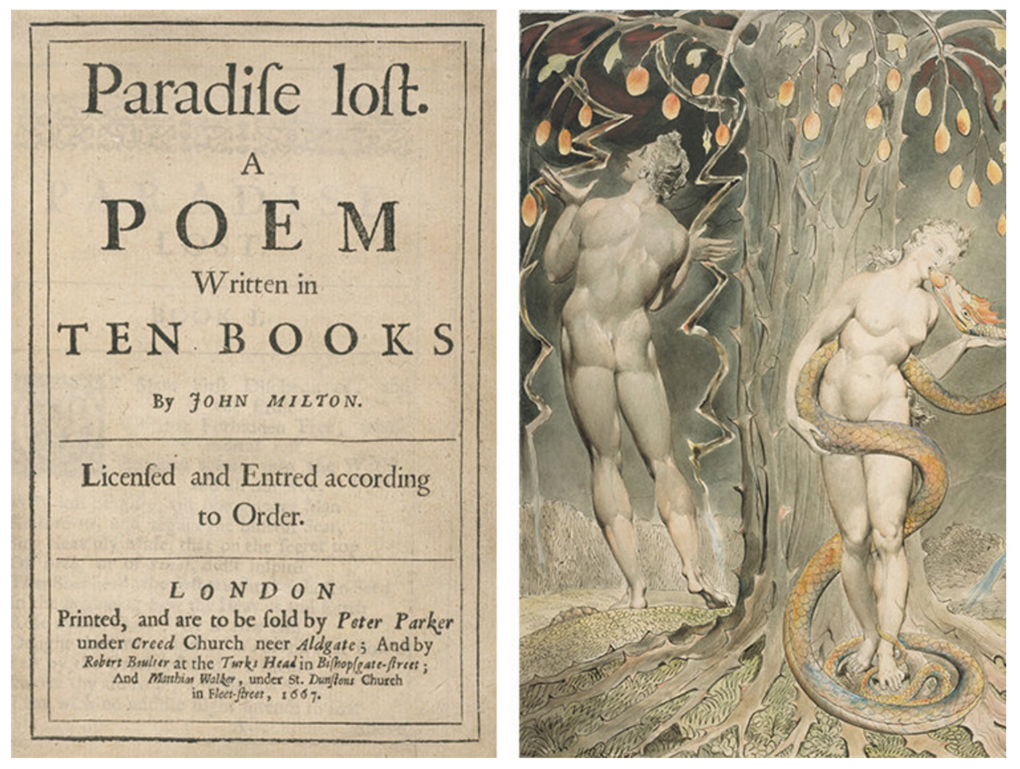
"caption": "Title page of the first edition of Paradise Lost (1667). Right: William Blake, The Temptation and Fall of Eve, 1808 (illustration of Milton's Paradise Lost)",
"description": "Title page of the first edition of Paradise Lost (1667). Right: William Blake, The Temptation and Fall of Eve, 1808 (illustration of Milton's Paradise Lost)",
"title": "Screen Shot 2017-04-30 at 10.20.45 AM",
"credit": "Wikipedia",
"status": "inherit",
"isLoading": false,
"fetchFailed": false
},
"arts_13095267": {
"type": "attachments",
"id": "arts_13095267",
"meta": {
"index": "attachments_1716263798",
"site": "arts",
"id": "13095267",
"found": true
},
"parent": 13080398,
"imgSizes": {
"small": {
"file": "https://ww2.kqed.org/app/uploads/sites/2/2017/04/ImmigrationWall-520x325.jpg",
"width": 520,
"mimeType": "image/jpeg",
"height": 325
},
"twentyfourteen-full-width": {
"file": "https://ww2.kqed.org/app/uploads/sites/2/2017/04/ImmigrationWall-1038x576.jpg",
"width": 1038,
"mimeType": "image/jpeg",
"height": 576
},
"thumbnail": {
"file": "https://ww2.kqed.org/app/uploads/sites/2/2017/04/ImmigrationWall-160x100.jpg",
"width": 160,
"mimeType": "image/jpeg",
"height": 100
},
"fd-sm": {
"file": "https://ww2.kqed.org/app/uploads/sites/2/2017/04/ImmigrationWall-960x600.jpg",
"width": 960,
"mimeType": "image/jpeg",
"height": 600
},
"post-thumbnail": {
"file": "https://ww2.kqed.org/app/uploads/sites/2/2017/04/ImmigrationWall-672x372.jpg",
"width": 672,
"mimeType": "image/jpeg",
"height": 372
},
"xsmall": {
"file": "https://ww2.kqed.org/app/uploads/sites/2/2017/04/ImmigrationWall-375x234.jpg",
"width": 375,
"mimeType": "image/jpeg",
"height": 234
},
"kqedFullSize": {
"file": "https://ww2.kqed.org/app/uploads/sites/2/2017/04/ImmigrationWall.jpg",
"width": 1920,
"height": 1200
},
"large": {
"file": "https://ww2.kqed.org/app/uploads/sites/2/2017/04/ImmigrationWall-1020x638.jpg",
"width": 1020,
"mimeType": "image/jpeg",
"height": 638
},
"xlarge": {
"file": "https://ww2.kqed.org/app/uploads/sites/2/2017/04/ImmigrationWall-1180x738.jpg",
"width": 1180,
"mimeType": "image/jpeg",
"height": 738
},
"guest-author-50": {
"file": "https://ww2.kqed.org/app/uploads/sites/2/2017/04/ImmigrationWall-50x50.jpg",
"width": 50,
"mimeType": "image/jpeg",
"height": 50
},
"guest-author-96": {
"file": "https://ww2.kqed.org/app/uploads/sites/2/2017/04/ImmigrationWall-96x96.jpg",
"width": 96,
"mimeType": "image/jpeg",
"height": 96
},
"medium": {
"file": "https://ww2.kqed.org/app/uploads/sites/2/2017/04/ImmigrationWall-800x500.jpg",
"width": 800,
"mimeType": "image/jpeg",
"height": 500
},
"guest-author-64": {
"file": "https://ww2.kqed.org/app/uploads/sites/2/2017/04/ImmigrationWall-64x64.jpg",
"width": 64,
"mimeType": "image/jpeg",
"height": 64
},
"guest-author-32": {
"file": "https://ww2.kqed.org/app/uploads/sites/2/2017/04/ImmigrationWall-32x32.jpg",
"width": 32,
"mimeType": "image/jpeg",
"height": 32
},
"fd-lrg": {
"file": "https://ww2.kqed.org/app/uploads/sites/2/2017/04/ImmigrationWall-1920x1200.jpg",
"width": 1920,
"mimeType": "image/jpeg",
"height": 1200
},
"fd-med": {
"file": "https://ww2.kqed.org/app/uploads/sites/2/2017/04/ImmigrationWall-1180x738.jpg",
"width": 1180,
"mimeType": "image/jpeg",
"height": 738
},
"full-width": {
"file": "https://ww2.kqed.org/app/uploads/sites/2/2017/04/ImmigrationWall-1920x1200.jpg",
"width": 1920,
"mimeType": "image/jpeg",
"height": 1200
},
"detail": {
"file": "https://ww2.kqed.org/app/uploads/sites/2/2017/04/ImmigrationWall-150x150.jpg",
"width": 150,
"mimeType": "image/jpeg",
"height": 150
},
"medium_large": {
"file": "https://ww2.kqed.org/app/uploads/sites/2/2017/04/ImmigrationWall-768x480.jpg",
"width": 768,
"mimeType": "image/jpeg",
"height": 480
},
"guest-author-128": {
"file": "https://ww2.kqed.org/app/uploads/sites/2/2017/04/ImmigrationWall-128x128.jpg",
"width": 128,
"mimeType": "image/jpeg",
"height": 128
},
"xxsmall": {
"file": "https://ww2.kqed.org/app/uploads/sites/2/2017/04/ImmigrationWall-240x150.jpg",
"width": 240,
"mimeType": "image/jpeg",
"height": 150
}
},
"publishDate": 1492924654,
"modified": 1492924714,
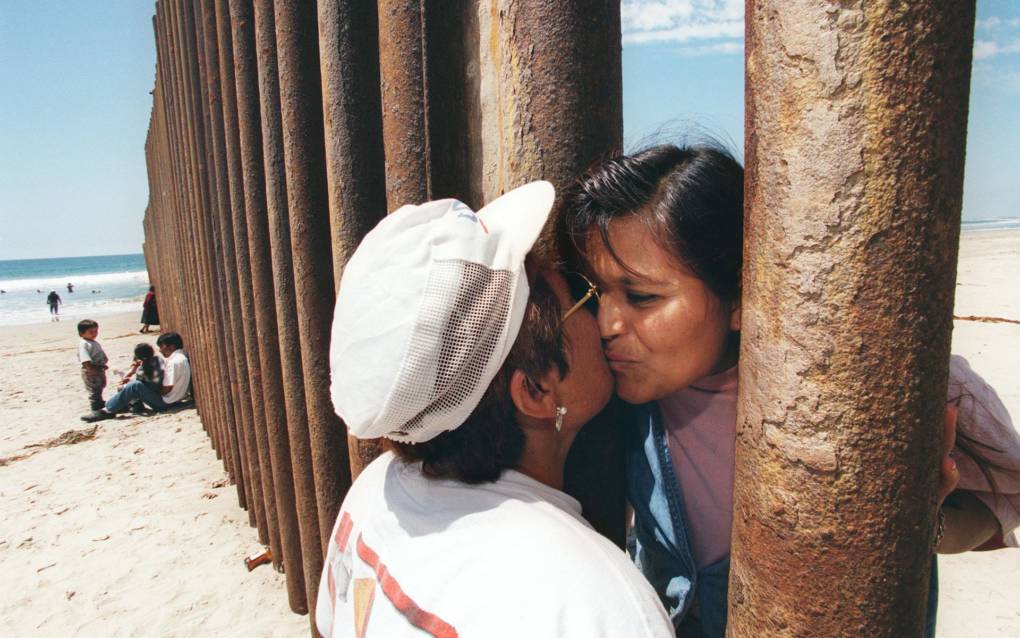
"caption": "Esther Pereyra Rubalcaba (L) kisses her daughter Patricia through the wall separating the US and the Mexican territories in Tijuana, Mexico, on August 19, 1997.",
"description": "Esther Pereyra Rubalcaba (L) kisses her daughter Patricia through the wall separating the US and the Mexican territories in Tijuana, Mexico, on August 19, 1997.",
"title": "ImmigrationWall",
"credit": "Photo: Hector Mata/AFP/Getty Images",
"status": "inherit",
"isLoading": false,
"fetchFailed": false
},
"arts_13074999": {
"type": "attachments",
"id": "arts_13074999",
"meta": {
"index": "attachments_1716263798",
"site": "arts",
"id": "13074999",
"found": true
},
"parent": 13060092,
"imgSizes": {
"small": {
"file": "https://ww2.kqed.org/app/uploads/sites/2/2017/04/defyingtrumplandia_coverFINAL-e1492638297111-520x294.jpg",
"width": 520,
"mimeType": "image/jpeg",
"height": 294
},
"twentyfourteen-full-width": {
"file": "https://ww2.kqed.org/app/uploads/sites/2/2017/04/defyingtrumplandia_coverFINAL-e1492638297111-1038x576.jpg",
"width": 1038,
"mimeType": "image/jpeg",
"height": 576
},
"thumbnail": {
"file": "https://ww2.kqed.org/app/uploads/sites/2/2017/04/defyingtrumplandia_coverFINAL-e1492638297111-160x90.jpg",
"width": 160,
"mimeType": "image/jpeg",
"height": 90
},
"fd-sm": {
"file": "https://ww2.kqed.org/app/uploads/sites/2/2017/04/defyingtrumplandia_coverFINAL-e1492638297111-960x542.jpg",
"width": 960,
"mimeType": "image/jpeg",
"height": 542
},
"post-thumbnail": {
"file": "https://ww2.kqed.org/app/uploads/sites/2/2017/04/defyingtrumplandia_coverFINAL-e1492638297111-672x372.jpg",
"width": 672,
"mimeType": "image/jpeg",
"height": 372
},
"xsmall": {
"file": "https://ww2.kqed.org/app/uploads/sites/2/2017/04/defyingtrumplandia_coverFINAL-e1492638297111-375x212.jpg",
"width": 375,
"mimeType": "image/jpeg",
"height": 212
},
"kqedFullSize": {
"file": "https://ww2.kqed.org/app/uploads/sites/2/2017/04/defyingtrumplandia_coverFINAL-e1492638297111.jpg",
"width": 1331,
"height": 752
},
"large": {
"file": "https://ww2.kqed.org/app/uploads/sites/2/2017/04/defyingtrumplandia_coverFINAL-e1492638297111-1020x576.jpg",
"width": 1020,
"mimeType": "image/jpeg",
"height": 576
},
"xlarge": {
"file": "https://ww2.kqed.org/app/uploads/sites/2/2017/04/defyingtrumplandia_coverFINAL-e1492638297111-1180x667.jpg",
"width": 1180,
"mimeType": "image/jpeg",
"height": 667
},
"guest-author-50": {
"file": "https://ww2.kqed.org/app/uploads/sites/2/2017/04/defyingtrumplandia_coverFINAL-e1492638297111-50x50.jpg",
"width": 50,
"mimeType": "image/jpeg",
"height": 50
},
"guest-author-96": {
"file": "https://ww2.kqed.org/app/uploads/sites/2/2017/04/defyingtrumplandia_coverFINAL-e1492638297111-96x96.jpg",
"width": 96,
"mimeType": "image/jpeg",
"height": 96
},
"medium": {
"file": "https://ww2.kqed.org/app/uploads/sites/2/2017/04/defyingtrumplandia_coverFINAL-e1492638297111-800x452.jpg",
"width": 800,
"mimeType": "image/jpeg",
"height": 452
},
"guest-author-64": {
"file": "https://ww2.kqed.org/app/uploads/sites/2/2017/04/defyingtrumplandia_coverFINAL-e1492638297111-64x64.jpg",
"width": 64,
"mimeType": "image/jpeg",
"height": 64
},
"guest-author-32": {
"file": "https://ww2.kqed.org/app/uploads/sites/2/2017/04/defyingtrumplandia_coverFINAL-e1492638297111-32x32.jpg",
"width": 32,
"mimeType": "image/jpeg",
"height": 32
},
"fd-med": {
"file": "https://ww2.kqed.org/app/uploads/sites/2/2017/04/defyingtrumplandia_coverFINAL-e1492638297111-1180x667.jpg",
"width": 1180,
"mimeType": "image/jpeg",
"height": 667
},
"detail": {
"file": "https://ww2.kqed.org/app/uploads/sites/2/2017/04/defyingtrumplandia_coverFINAL-e1492638297111-150x150.jpg",
"width": 150,
"mimeType": "image/jpeg",
"height": 150
},
"medium_large": {
"file": "https://ww2.kqed.org/app/uploads/sites/2/2017/04/defyingtrumplandia_coverFINAL-e1492638297111-768x434.jpg",
"width": 768,
"mimeType": "image/jpeg",
"height": 434
},
"guest-author-128": {
"file": "https://ww2.kqed.org/app/uploads/sites/2/2017/04/defyingtrumplandia_coverFINAL-e1492638297111-128x128.jpg",
"width": 128,
"mimeType": "image/jpeg",
"height": 128
},
"xxsmall": {
"file": "https://ww2.kqed.org/app/uploads/sites/2/2017/04/defyingtrumplandia_coverFINAL-e1492638297111-240x136.jpg",
"width": 240,
"mimeType": "image/jpeg",
"height": 136
}
},
"publishDate": 1492578227,
"modified": 1492640500,
"caption": "A section from the cover of the poetry chapbook ‘Defying Trumplandia: Pithy Peminst Poetry’ by Bay Area poet Melinda Luisa de Jesús. It's one of 100 chapbooks created by poets around the world in protest against President Donald Trump as part of the ‘Lofoco Chaps’ project.",
"description": "A section from the cover of the poetry chapbook ‘Defying Trumplandia: Pithy Peminst Poetry’ by Bay Area poet Melinda Luisa de Jesús. It's one of 100 chapbooks created by poets around the world in protest against President Donald Trump as part of the ‘Lofoco Chaps’ project.",
"title": "defyingtrumplandia_coverFINAL",
"credit": "Photo: Courtesy of Melinda Luisa de Jesus",
"status": "inherit",
"isLoading": false,
"fetchFailed": false
},
"arts_13070292": {
"type": "attachments",
"id": "arts_13070292",
"meta": {
"index": "attachments_1716263798",
"site": "arts",
"id": "13070292",
"found": true
},
"parent": 13062008,
"imgSizes": {
"small": {
"file": "https://ww2.kqed.org/app/uploads/sites/2/2017/04/PaulMadonna.MAIN_-520x293.jpg",
"width": 520,
"mimeType": "image/jpeg",
"height": 293
},
"thumbnail": {
"file": "https://ww2.kqed.org/app/uploads/sites/2/2017/04/PaulMadonna.MAIN_-160x90.jpg",
"width": 160,
"mimeType": "image/jpeg",
"height": 90
},
"post-thumbnail": {
"file": "https://ww2.kqed.org/app/uploads/sites/2/2017/04/PaulMadonna.MAIN_-672x372.jpg",
"width": 672,
"mimeType": "image/jpeg",
"height": 372
},
"xsmall": {
"file": "https://ww2.kqed.org/app/uploads/sites/2/2017/04/PaulMadonna.MAIN_-375x211.jpg",
"width": 375,
"mimeType": "image/jpeg",
"height": 211
},
"kqedFullSize": {
"file": "https://ww2.kqed.org/app/uploads/sites/2/2017/04/PaulMadonna.MAIN_.jpg",
"width": 800,
"height": 450
},
"guest-author-50": {
"file": "https://ww2.kqed.org/app/uploads/sites/2/2017/04/PaulMadonna.MAIN_-50x50.jpg",
"width": 50,
"mimeType": "image/jpeg",
"height": 50
},
"guest-author-96": {
"file": "https://ww2.kqed.org/app/uploads/sites/2/2017/04/PaulMadonna.MAIN_-96x96.jpg",
"width": 96,
"mimeType": "image/jpeg",
"height": 96
},
"medium": {
"file": "https://ww2.kqed.org/app/uploads/sites/2/2017/04/PaulMadonna.MAIN_-800x450.jpg",
"width": 800,
"mimeType": "image/jpeg",
"height": 450
},
"guest-author-64": {
"file": "https://ww2.kqed.org/app/uploads/sites/2/2017/04/PaulMadonna.MAIN_-64x64.jpg",
"width": 64,
"mimeType": "image/jpeg",
"height": 64
},
"guest-author-32": {
"file": "https://ww2.kqed.org/app/uploads/sites/2/2017/04/PaulMadonna.MAIN_-32x32.jpg",
"width": 32,
"mimeType": "image/jpeg",
"height": 32
},
"detail": {
"file": "https://ww2.kqed.org/app/uploads/sites/2/2017/04/PaulMadonna.MAIN_-150x150.jpg",
"width": 150,
"mimeType": "image/jpeg",
"height": 150
},
"medium_large": {
"file": "https://ww2.kqed.org/app/uploads/sites/2/2017/04/PaulMadonna.MAIN_-768x432.jpg",
"width": 768,
"mimeType": "image/jpeg",
"height": 432
},
"guest-author-128": {
"file": "https://ww2.kqed.org/app/uploads/sites/2/2017/04/PaulMadonna.MAIN_-128x128.jpg",
"width": 128,
"mimeType": "image/jpeg",
"height": 128
},
"xxsmall": {
"file": "https://ww2.kqed.org/app/uploads/sites/2/2017/04/PaulMadonna.MAIN_-240x135.jpg",
"width": 240,
"mimeType": "image/jpeg",
"height": 135
}
},
"publishDate": 1492496815,
"modified": 1492496824,
"caption": "'All Over Coffee' creator Paul Madonna grapples with eviction, uncertainty, and the normalized absurdity of life in 21st-century boomtown San Francisco in his new book, 'On to the Next Dream.'",
"description": "'All Over Coffee' creator Paul Madonna grapples with eviction, uncertainty, and the normalized absurdity of life in 21st-century boomtown San Francisco in his new book, 'On to the Next Dream.'",
"title": "PaulMadonna.MAIN",
"credit": null,
"status": "inherit",
"isLoading": false,
"fetchFailed": false
},
"arts_13062651": {
"type": "attachments",
"id": "arts_13062651",
"meta": {
"index": "attachments_1716263798",
"site": "arts",
"id": "13062651",
"found": true
},
"parent": 13043609,
"imgSizes": {
"small": {
"file": "https://ww2.kqed.org/app/uploads/sites/2/2017/04/Hourglass.Cover_-520x293.jpg",
"width": 520,
"mimeType": "image/jpeg",
"height": 293
},
"twentyfourteen-full-width": {
"file": "https://ww2.kqed.org/app/uploads/sites/2/2017/04/Hourglass.Cover_-1038x576.jpg",
"width": 1038,
"mimeType": "image/jpeg",
"height": 576
},
"thumbnail": {
"file": "https://ww2.kqed.org/app/uploads/sites/2/2017/04/Hourglass.Cover_-160x90.jpg",
"width": 160,
"mimeType": "image/jpeg",
"height": 90
},
"fd-sm": {
"file": "https://ww2.kqed.org/app/uploads/sites/2/2017/04/Hourglass.Cover_-960x540.jpg",
"width": 960,
"mimeType": "image/jpeg",
"height": 540
},
"post-thumbnail": {
"file": "https://ww2.kqed.org/app/uploads/sites/2/2017/04/Hourglass.Cover_-672x372.jpg",
"width": 672,
"mimeType": "image/jpeg",
"height": 372
},
"xsmall": {
"file": "https://ww2.kqed.org/app/uploads/sites/2/2017/04/Hourglass.Cover_-375x211.jpg",
"width": 375,
"mimeType": "image/jpeg",
"height": 211
},
"kqedFullSize": {
"file": "https://ww2.kqed.org/app/uploads/sites/2/2017/04/Hourglass.Cover_.jpg",
"width": 1484,
"height": 835
},
"large": {
"file": "https://ww2.kqed.org/app/uploads/sites/2/2017/04/Hourglass.Cover_-1020x574.jpg",
"width": 1020,
"mimeType": "image/jpeg",
"height": 574
},
"xlarge": {
"file": "https://ww2.kqed.org/app/uploads/sites/2/2017/04/Hourglass.Cover_-1180x664.jpg",
"width": 1180,
"mimeType": "image/jpeg",
"height": 664
},
"guest-author-50": {
"file": "https://ww2.kqed.org/app/uploads/sites/2/2017/04/Hourglass.Cover_-50x50.jpg",
"width": 50,
"mimeType": "image/jpeg",
"height": 50
},
"guest-author-96": {
"file": "https://ww2.kqed.org/app/uploads/sites/2/2017/04/Hourglass.Cover_-96x96.jpg",
"width": 96,
"mimeType": "image/jpeg",
"height": 96
},
"medium": {
"file": "https://ww2.kqed.org/app/uploads/sites/2/2017/04/Hourglass.Cover_-800x450.jpg",
"width": 800,
"mimeType": "image/jpeg",
"height": 450
},
"guest-author-64": {
"file": "https://ww2.kqed.org/app/uploads/sites/2/2017/04/Hourglass.Cover_-64x64.jpg",
"width": 64,
"mimeType": "image/jpeg",
"height": 64
},
"guest-author-32": {
"file": "https://ww2.kqed.org/app/uploads/sites/2/2017/04/Hourglass.Cover_-32x32.jpg",
"width": 32,
"mimeType": "image/jpeg",
"height": 32
},
"fd-med": {
"file": "https://ww2.kqed.org/app/uploads/sites/2/2017/04/Hourglass.Cover_-1180x664.jpg",
"width": 1180,
"mimeType": "image/jpeg",
"height": 664
},
"detail": {
"file": "https://ww2.kqed.org/app/uploads/sites/2/2017/04/Hourglass.Cover_-150x150.jpg",
"width": 150,
"mimeType": "image/jpeg",
"height": 150
},
"medium_large": {
"file": "https://ww2.kqed.org/app/uploads/sites/2/2017/04/Hourglass.Cover_-768x432.jpg",
"width": 768,
"mimeType": "image/jpeg",
"height": 432
},
"guest-author-128": {
"file": "https://ww2.kqed.org/app/uploads/sites/2/2017/04/Hourglass.Cover_-128x128.jpg",
"width": 128,
"mimeType": "image/jpeg",
"height": 128
},
"xxsmall": {
"file": "https://ww2.kqed.org/app/uploads/sites/2/2017/04/Hourglass.Cover_-240x135.jpg",
"width": 240,
"mimeType": "image/jpeg",
"height": 135
}
},
"publishDate": 1492368944,
"modified": 1492368975,
"caption": "Detail from 'Hourglass,' by Dani Shapiro.",
"description": "Detail from 'Hourglass,' by Dani Shapiro.",
"title": "Hourglass.Cover",
"credit": null,
"status": "inherit",
"isLoading": false,
"fetchFailed": false
},
"news_11394955": {
"type": "attachments",
"id": "news_11394955",
"meta": {
"index": "attachments_1716263798",
"site": "news",
"id": "11394955",
"found": true
},
"parent": 11305905,
"imgSizes": {
"small": {
"file": "https://ww2.kqed.org/app/uploads/sites/10/2017/02/RS24068_A-new-full-patch-Hells-Angel-qut-520x364.jpg",
"width": 520,
"mimeType": "image/jpeg",
"height": 364
},
"twentyfourteen-full-width": {
"file": "https://ww2.kqed.org/app/uploads/sites/10/2017/02/RS24068_A-new-full-patch-Hells-Angel-qut-1038x576.jpg",
"width": 1038,
"mimeType": "image/jpeg",
"height": 576
},
"thumbnail": {
"file": "https://ww2.kqed.org/app/uploads/sites/10/2017/02/RS24068_A-new-full-patch-Hells-Angel-qut-160x112.jpg",
"width": 160,
"mimeType": "image/jpeg",
"height": 112
},
"fd-sm": {
"file": "https://ww2.kqed.org/app/uploads/sites/10/2017/02/RS24068_A-new-full-patch-Hells-Angel-qut-960x672.jpg",
"width": 960,
"mimeType": "image/jpeg",
"height": 672
},
"post-thumbnail": {
"file": "https://ww2.kqed.org/app/uploads/sites/10/2017/02/RS24068_A-new-full-patch-Hells-Angel-qut-672x372.jpg",
"width": 672,
"mimeType": "image/jpeg",
"height": 372
},
"xsmall": {
"file": "https://ww2.kqed.org/app/uploads/sites/10/2017/02/RS24068_A-new-full-patch-Hells-Angel-qut-375x263.jpg",
"width": 375,
"mimeType": "image/jpeg",
"height": 263
},
"kqedFullSize": {
"file": "https://ww2.kqed.org/app/uploads/sites/10/2017/02/RS24068_A-new-full-patch-Hells-Angel-qut.jpg",
"width": 1920,
"height": 1344
},
"large": {
"file": "https://ww2.kqed.org/app/uploads/sites/10/2017/02/RS24068_A-new-full-patch-Hells-Angel-qut-1020x714.jpg",
"width": 1020,
"mimeType": "image/jpeg",
"height": 714
},
"xlarge": {
"file": "https://ww2.kqed.org/app/uploads/sites/10/2017/02/RS24068_A-new-full-patch-Hells-Angel-qut-1180x826.jpg",
"width": 1180,
"mimeType": "image/jpeg",
"height": 826
},
"guest-author-50": {
"file": "https://ww2.kqed.org/app/uploads/sites/10/2017/02/RS24068_A-new-full-patch-Hells-Angel-qut-50x50.jpg",
"width": 50,
"mimeType": "image/jpeg",
"height": 50
},
"guest-author-96": {
"file": "https://ww2.kqed.org/app/uploads/sites/10/2017/02/RS24068_A-new-full-patch-Hells-Angel-qut-96x96.jpg",
"width": 96,
"mimeType": "image/jpeg",
"height": 96
},
"medium": {
"file": "https://ww2.kqed.org/app/uploads/sites/10/2017/02/RS24068_A-new-full-patch-Hells-Angel-qut-800x560.jpg",
"width": 800,
"mimeType": "image/jpeg",
"height": 560
},
"guest-author-64": {
"file": "https://ww2.kqed.org/app/uploads/sites/10/2017/02/RS24068_A-new-full-patch-Hells-Angel-qut-64x64.jpg",
"width": 64,
"mimeType": "image/jpeg",
"height": 64
},
"guest-author-32": {
"file": "https://ww2.kqed.org/app/uploads/sites/10/2017/02/RS24068_A-new-full-patch-Hells-Angel-qut-32x32.jpg",
"width": 32,
"mimeType": "image/jpeg",
"height": 32
},
"fd-lrg": {
"file": "https://ww2.kqed.org/app/uploads/sites/10/2017/02/RS24068_A-new-full-patch-Hells-Angel-qut-1920x1344.jpg",
"width": 1920,
"mimeType": "image/jpeg",
"height": 1344
},
"fd-med": {
"file": "https://ww2.kqed.org/app/uploads/sites/10/2017/02/RS24068_A-new-full-patch-Hells-Angel-qut-1180x826.jpg",
"width": 1180,
"mimeType": "image/jpeg",
"height": 826
},
"full-width": {
"file": "https://ww2.kqed.org/app/uploads/sites/10/2017/02/RS24068_A-new-full-patch-Hells-Angel-qut-1920x1344.jpg",
"width": 1920,
"mimeType": "image/jpeg",
"height": 1344
},
"detail": {
"file": "https://ww2.kqed.org/app/uploads/sites/10/2017/02/RS24068_A-new-full-patch-Hells-Angel-qut-150x150.jpg",
"width": 150,
"mimeType": "image/jpeg",
"height": 150
},
"guest-author-128": {
"file": "https://ww2.kqed.org/app/uploads/sites/10/2017/02/RS24068_A-new-full-patch-Hells-Angel-qut-128x128.jpg",
"width": 128,
"mimeType": "image/jpeg",
"height": 128
},
"xxsmall": {
"file": "https://ww2.kqed.org/app/uploads/sites/10/2017/02/RS24068_A-new-full-patch-Hells-Angel-qut-240x168.jpg",
"width": 240,
"mimeType": "image/jpeg",
"height": 168
}
},
"publishDate": 1491498496,
"modified": 1492117572,
"caption": "Former Hells Angel George Christie shortly after becoming a full-fledged member of the outlaw biker gang in 1976.",
"description": "Former Hells Angel George Christie shortly after becoming a full-fledged member of the outlaw biker gang in 1976.",
"title": "RS24068_A new full-patch Hells Angel-qut",
"credit": "Courtesy George Christie",
"status": "inherit",
"isLoading": false,
"fetchFailed": false
},
"arts_13049685": {
"type": "attachments",
"id": "arts_13049685",
"meta": {
"index": "attachments_1716263798",
"site": "arts",
"id": "13049685",
"found": true
},
"parent": 13049682,
"imgSizes": {
"small": {
"file": "https://ww2.kqed.org/app/uploads/sites/2/2017/04/Alec_Baldwin-520x292.jpg",
"width": 520,
"mimeType": "image/jpeg",
"height": 292
},
"twentyfourteen-full-width": {
"file": "https://ww2.kqed.org/app/uploads/sites/2/2017/04/Alec_Baldwin-1038x576.jpg",
"width": 1038,
"mimeType": "image/jpeg",
"height": 576
},
"thumbnail": {
"file": "https://ww2.kqed.org/app/uploads/sites/2/2017/04/Alec_Baldwin-160x90.jpg",
"width": 160,
"mimeType": "image/jpeg",
"height": 90
},
"fd-sm": {
"file": "https://ww2.kqed.org/app/uploads/sites/2/2017/04/Alec_Baldwin-960x539.jpg",
"width": 960,
"mimeType": "image/jpeg",
"height": 539
},
"post-thumbnail": {
"file": "https://ww2.kqed.org/app/uploads/sites/2/2017/04/Alec_Baldwin-672x372.jpg",
"width": 672,
"mimeType": "image/jpeg",
"height": 372
},
"xsmall": {
"file": "https://ww2.kqed.org/app/uploads/sites/2/2017/04/Alec_Baldwin-375x211.jpg",
"width": 375,
"mimeType": "image/jpeg",
"height": 211
},
"kqedFullSize": {
"file": "https://ww2.kqed.org/app/uploads/sites/2/2017/04/Alec_Baldwin.jpg",
"width": 2048,
"height": 1150
},
"large": {
"file": "https://ww2.kqed.org/app/uploads/sites/2/2017/04/Alec_Baldwin-1020x573.jpg",
"width": 1020,
"mimeType": "image/jpeg",
"height": 573
},
"xlarge": {
"file": "https://ww2.kqed.org/app/uploads/sites/2/2017/04/Alec_Baldwin-1180x662.jpg",
"width": 1180,
"mimeType": "image/jpeg",
"height": 662
},
"guest-author-50": {
"file": "https://ww2.kqed.org/app/uploads/sites/2/2017/04/Alec_Baldwin-50x50.jpg",
"width": 50,
"mimeType": "image/jpeg",
"height": 50
},
"guest-author-96": {
"file": "https://ww2.kqed.org/app/uploads/sites/2/2017/04/Alec_Baldwin-96x96.jpg",
"width": 96,
"mimeType": "image/jpeg",
"height": 96
},
"medium": {
"file": "https://ww2.kqed.org/app/uploads/sites/2/2017/04/Alec_Baldwin-800x449.jpg",
"width": 800,
"mimeType": "image/jpeg",
"height": 449
},
"guest-author-64": {
"file": "https://ww2.kqed.org/app/uploads/sites/2/2017/04/Alec_Baldwin-64x64.jpg",
"width": 64,
"mimeType": "image/jpeg",
"height": 64
},
"guest-author-32": {
"file": "https://ww2.kqed.org/app/uploads/sites/2/2017/04/Alec_Baldwin-32x32.jpg",
"width": 32,
"mimeType": "image/jpeg",
"height": 32
},
"fd-lrg": {
"file": "https://ww2.kqed.org/app/uploads/sites/2/2017/04/Alec_Baldwin-1920x1078.jpg",
"width": 1920,
"mimeType": "image/jpeg",
"height": 1078
},
"fd-med": {
"file": "https://ww2.kqed.org/app/uploads/sites/2/2017/04/Alec_Baldwin-1180x662.jpg",
"width": 1180,
"mimeType": "image/jpeg",
"height": 662
},
"full-width": {
"file": "https://ww2.kqed.org/app/uploads/sites/2/2017/04/Alec_Baldwin-1920x1078.jpg",
"width": 1920,
"mimeType": "image/jpeg",
"height": 1078
},
"detail": {
"file": "https://ww2.kqed.org/app/uploads/sites/2/2017/04/Alec_Baldwin-150x150.jpg",
"width": 150,
"mimeType": "image/jpeg",
"height": 150
},
"medium_large": {
"file": "https://ww2.kqed.org/app/uploads/sites/2/2017/04/Alec_Baldwin-768x431.jpg",
"width": 768,
"mimeType": "image/jpeg",
"height": 431
},
"guest-author-128": {
"file": "https://ww2.kqed.org/app/uploads/sites/2/2017/04/Alec_Baldwin-128x128.jpg",
"width": 128,
"mimeType": "image/jpeg",
"height": 128
},
"xxsmall": {
"file": "https://ww2.kqed.org/app/uploads/sites/2/2017/04/Alec_Baldwin-240x135.jpg",
"width": 240,
"mimeType": "image/jpeg",
"height": 135
}
},
"publishDate": 1492149462,
"modified": 1492149764,
"caption": "Alec Baldwin in conversation with Steven Winn at San Francisco's Nourse Theater on April 13, 2017.",
"description": null,
"title": "Alec_Baldwin",
"credit": null,
"status": "inherit",
"isLoading": false,
"fetchFailed": false
},
"arts_13037934": {
"type": "attachments",
"id": "arts_13037934",
"meta": {
"index": "attachments_1716263798",
"site": "arts",
"id": "13037934",
"found": true
},
"parent": 13037933,
"imgSizes": {
"small": {
"file": "https://ww2.kqed.org/app/uploads/sites/2/2017/04/eartha-malkasian_custom-cfa443186687e982572597fae963164292a30a70-520x429.jpg",
"width": 520,
"mimeType": "image/jpeg",
"height": 429
},
"twentyfourteen-full-width": {
"file": "https://ww2.kqed.org/app/uploads/sites/2/2017/04/eartha-malkasian_custom-cfa443186687e982572597fae963164292a30a70-1006x576.jpg",
"width": 1006,
"mimeType": "image/jpeg",
"height": 576
},
"thumbnail": {
"file": "https://ww2.kqed.org/app/uploads/sites/2/2017/04/eartha-malkasian_custom-cfa443186687e982572597fae963164292a30a70-160x132.jpg",
"width": 160,
"mimeType": "image/jpeg",
"height": 132
},
"fd-sm": {
"file": "https://ww2.kqed.org/app/uploads/sites/2/2017/04/eartha-malkasian_custom-cfa443186687e982572597fae963164292a30a70-960x792.jpg",
"width": 960,
"mimeType": "image/jpeg",
"height": 792
},
"post-thumbnail": {
"file": "https://ww2.kqed.org/app/uploads/sites/2/2017/04/eartha-malkasian_custom-cfa443186687e982572597fae963164292a30a70-672x372.jpg",
"width": 672,
"mimeType": "image/jpeg",
"height": 372
},
"xsmall": {
"file": "https://ww2.kqed.org/app/uploads/sites/2/2017/04/eartha-malkasian_custom-cfa443186687e982572597fae963164292a30a70-375x309.jpg",
"width": 375,
"mimeType": "image/jpeg",
"height": 309
},
"kqedFullSize": {
"file": "https://ww2.kqed.org/app/uploads/sites/2/2017/04/eartha-malkasian_custom-cfa443186687e982572597fae963164292a30a70.jpg",
"width": 1006,
"height": 830
},
"guest-author-50": {
"file": "https://ww2.kqed.org/app/uploads/sites/2/2017/04/eartha-malkasian_custom-cfa443186687e982572597fae963164292a30a70-50x50.jpg",
"width": 50,
"mimeType": "image/jpeg",
"height": 50
},
"guest-author-96": {
"file": "https://ww2.kqed.org/app/uploads/sites/2/2017/04/eartha-malkasian_custom-cfa443186687e982572597fae963164292a30a70-96x96.jpg",
"width": 96,
"mimeType": "image/jpeg",
"height": 96
},
"medium": {
"file": "https://ww2.kqed.org/app/uploads/sites/2/2017/04/eartha-malkasian_custom-cfa443186687e982572597fae963164292a30a70-800x660.jpg",
"width": 800,
"mimeType": "image/jpeg",
"height": 660
},
"guest-author-64": {
"file": "https://ww2.kqed.org/app/uploads/sites/2/2017/04/eartha-malkasian_custom-cfa443186687e982572597fae963164292a30a70-64x64.jpg",
"width": 64,
"mimeType": "image/jpeg",
"height": 64
},
"guest-author-32": {
"file": "https://ww2.kqed.org/app/uploads/sites/2/2017/04/eartha-malkasian_custom-cfa443186687e982572597fae963164292a30a70-32x32.jpg",
"width": 32,
"mimeType": "image/jpeg",
"height": 32
},
"detail": {
"file": "https://ww2.kqed.org/app/uploads/sites/2/2017/04/eartha-malkasian_custom-cfa443186687e982572597fae963164292a30a70-150x150.jpg",
"width": 150,
"mimeType": "image/jpeg",
"height": 150
},
"medium_large": {
"file": "https://ww2.kqed.org/app/uploads/sites/2/2017/04/eartha-malkasian_custom-cfa443186687e982572597fae963164292a30a70-768x634.jpg",
"width": 768,
"mimeType": "image/jpeg",
"height": 634
},
"guest-author-128": {
"file": "https://ww2.kqed.org/app/uploads/sites/2/2017/04/eartha-malkasian_custom-cfa443186687e982572597fae963164292a30a70-128x128.jpg",
"width": 128,
"mimeType": "image/jpeg",
"height": 128
},
"xxsmall": {
"file": "https://ww2.kqed.org/app/uploads/sites/2/2017/04/eartha-malkasian_custom-cfa443186687e982572597fae963164292a30a70-240x198.jpg",
"width": 240,
"mimeType": "image/jpeg",
"height": 198
}
},
"publishDate": 1491947957,
"modified": 1491948284,
"caption": "A moment of discovery from Cathy Malkasian's richly melancholic graphic novel 'Eartha'",
"description": "A moment of discovery from Cathy Malkasian's richly melancholic graphic novel 'Eartha'",
"title": "A moment of discovery from Cathy Malkasian's richly melancholic graphic novel Eartha.",
"credit": "Courtesy of Fantagraphics Books",
"status": "inherit",
"isLoading": false,
"fetchFailed": false
},
"pop_73986": {
"type": "attachments",
"id": "pop_73986",
"meta": {
"index": "attachments_1716263798",
"site": "pop",
"id": "73986",
"found": true
},
"parent": 73941,
"imgSizes": {
"small": {
"file": "https://ww2.kqed.org/app/uploads/sites/12/2017/04/librarians-520x293.jpg",
"width": 520,
"mimeType": "image/jpeg",
"height": 293
},
"twentyfourteen-full-width": {
"file": "https://ww2.kqed.org/app/uploads/sites/12/2017/04/librarians-1038x576.jpg",
"width": 1038,
"mimeType": "image/jpeg",
"height": 576
},
"thumbnail": {
"file": "https://ww2.kqed.org/app/uploads/sites/12/2017/04/librarians-160x90.jpg",
"width": 160,
"mimeType": "image/jpeg",
"height": 90
},
"fd-sm": {
"file": "https://ww2.kqed.org/app/uploads/sites/12/2017/04/librarians-960x540.jpg",
"width": 960,
"mimeType": "image/jpeg",
"height": 540
},
"post-thumbnail": {
"file": "https://ww2.kqed.org/app/uploads/sites/12/2017/04/librarians-672x372.jpg",
"width": 672,
"mimeType": "image/jpeg",
"height": 372
},
"xsmall": {
"file": "https://ww2.kqed.org/app/uploads/sites/12/2017/04/librarians-375x211.jpg",
"width": 375,
"mimeType": "image/jpeg",
"height": 211
},
"kqedFullSize": {
"file": "https://ww2.kqed.org/app/uploads/sites/12/2017/04/librarians.jpg",
"width": 4800,
"height": 2700
},
"large": {
"file": "https://ww2.kqed.org/app/uploads/sites/12/2017/04/librarians-1020x574.jpg",
"width": 1020,
"mimeType": "image/jpeg",
"height": 574
},
"xlarge": {
"file": "https://ww2.kqed.org/app/uploads/sites/12/2017/04/librarians-1180x664.jpg",
"width": 1180,
"mimeType": "image/jpeg",
"height": 664
},
"guest-author-50": {
"file": "https://ww2.kqed.org/app/uploads/sites/12/2017/04/librarians-50x50.jpg",
"width": 50,
"mimeType": "image/jpeg",
"height": 50
},
"guest-author-96": {
"file": "https://ww2.kqed.org/app/uploads/sites/12/2017/04/librarians-96x96.jpg",
"width": 96,
"mimeType": "image/jpeg",
"height": 96
},
"medium": {
"file": "https://ww2.kqed.org/app/uploads/sites/12/2017/04/librarians-800x450.jpg",
"width": 800,
"mimeType": "image/jpeg",
"height": 450
},
"guest-author-64": {
"file": "https://ww2.kqed.org/app/uploads/sites/12/2017/04/librarians-64x64.jpg",
"width": 64,
"mimeType": "image/jpeg",
"height": 64
},
"guest-author-32": {
"file": "https://ww2.kqed.org/app/uploads/sites/12/2017/04/librarians-32x32.jpg",
"width": 32,
"mimeType": "image/jpeg",
"height": 32
},
"fd-lrg": {
"file": "https://ww2.kqed.org/app/uploads/sites/12/2017/04/librarians-1920x1080.jpg",
"width": 1920,
"mimeType": "image/jpeg",
"height": 1080
},
"fd-med": {
"file": "https://ww2.kqed.org/app/uploads/sites/12/2017/04/librarians-1180x664.jpg",
"width": 1180,
"mimeType": "image/jpeg",
"height": 664
},
"full-width": {
"file": "https://ww2.kqed.org/app/uploads/sites/12/2017/04/librarians-1920x1080.jpg",
"width": 1920,
"mimeType": "image/jpeg",
"height": 1080
},
"detail": {
"file": "https://ww2.kqed.org/app/uploads/sites/12/2017/04/librarians-150x150.jpg",
"width": 150,
"mimeType": "image/jpeg",
"height": 150
},
"medium_large": {
"file": "https://ww2.kqed.org/app/uploads/sites/12/2017/04/librarians-768x432.jpg",
"width": 768,
"mimeType": "image/jpeg",
"height": 432
},
"guest-author-128": {
"file": "https://ww2.kqed.org/app/uploads/sites/12/2017/04/librarians-128x128.jpg",
"width": 128,
"mimeType": "image/jpeg",
"height": 128
},
"xxsmall": {
"file": "https://ww2.kqed.org/app/uploads/sites/12/2017/04/librarians-240x135.jpg",
"width": 240,
"mimeType": "image/jpeg",
"height": 135
}
},
"publishDate": 1491603399,
"modified": 1491603451,
"caption": "Image: Emmanuel Hapsis",
"description": null,
"title": "librarians",
"credit": null,
"status": "inherit",
"isLoading": false,
"fetchFailed": false
},
"arts_12010294": {
"type": "attachments",
"id": "arts_12010294",
"meta": {
"index": "attachments_1716263798",
"site": "arts",
"id": "12010294",
"found": true
},
"parent": 12010094,
"imgSizes": {
"twentyfourteen-full-width": {
"file": "https://ww2.kqed.org/app/uploads/sites/2/2016/09/Colson-Whitehead__03-1038x576.jpg",
"width": 1038,
"mimeType": "image/jpeg",
"height": 576
},
"thumbnail": {
"file": "https://ww2.kqed.org/app/uploads/sites/2/2016/09/Colson-Whitehead__03-400x267.jpg",
"width": 400,
"mimeType": "image/jpeg",
"height": 267
},
"fd-sm": {
"file": "https://ww2.kqed.org/app/uploads/sites/2/2016/09/Colson-Whitehead__03-960x640.jpg",
"width": 960,
"mimeType": "image/jpeg",
"height": 640
},
"post-thumbnail": {
"file": "https://ww2.kqed.org/app/uploads/sites/2/2016/09/Colson-Whitehead__03-672x372.jpg",
"width": 672,
"mimeType": "image/jpeg",
"height": 372
},
"kqedFullSize": {
"file": "https://ww2.kqed.org/app/uploads/sites/2/2016/09/Colson-Whitehead__03.jpg",
"width": 1170,
"height": 780
},
"guest-author-50": {
"file": "https://ww2.kqed.org/app/uploads/sites/2/2016/09/Colson-Whitehead__03-50x50.jpg",
"width": 50,
"mimeType": "image/jpeg",
"height": 50
},
"guest-author-96": {
"file": "https://ww2.kqed.org/app/uploads/sites/2/2016/09/Colson-Whitehead__03-96x96.jpg",
"width": 96,
"mimeType": "image/jpeg",
"height": 96
},
"medium": {
"file": "https://ww2.kqed.org/app/uploads/sites/2/2016/09/Colson-Whitehead__03-800x533.jpg",
"width": 800,
"mimeType": "image/jpeg",
"height": 533
},
"guest-author-64": {
"file": "https://ww2.kqed.org/app/uploads/sites/2/2016/09/Colson-Whitehead__03-64x64.jpg",
"width": 64,
"mimeType": "image/jpeg",
"height": 64
},
"guest-author-32": {
"file": "https://ww2.kqed.org/app/uploads/sites/2/2016/09/Colson-Whitehead__03-32x32.jpg",
"width": 32,
"mimeType": "image/jpeg",
"height": 32
},
"detail": {
"file": "https://ww2.kqed.org/app/uploads/sites/2/2016/09/Colson-Whitehead__03-150x150.jpg",
"width": 150,
"mimeType": "image/jpeg",
"height": 150
},
"medium_large": {
"file": "https://ww2.kqed.org/app/uploads/sites/2/2016/09/Colson-Whitehead__03-768x512.jpg",
"width": 768,
"mimeType": "image/jpeg",
"height": 512
},
"guest-author-128": {
"file": "https://ww2.kqed.org/app/uploads/sites/2/2016/09/Colson-Whitehead__03-128x128.jpg",
"width": 128,
"mimeType": "image/jpeg",
"height": 128
}
},
"publishDate": 1472762946,
"modified": 1491864830,
"caption": "Colson Whitehead ",
"description": "Colson Whitehead ",
"title": "Colson-Whitehead__03",
"credit": "Photo: Knopf Doubleday/Erin Patrice O'Brien) ",
"status": "inherit",
"isLoading": false,
"fetchFailed": false
},
"arts_13018239": {
"type": "attachments",
"id": "arts_13018239",
"meta": {
"index": "attachments_1716263798",
"site": "arts",
"id": "13018239",
"found": true
},
"parent": 13009537,
"imgSizes": {
"small": {
"file": "https://ww2.kqed.org/app/uploads/sites/2/2017/04/sinclair-COVER-520x292.jpg",
"width": 520,
"mimeType": "image/jpeg",
"height": 292
},
"twentyfourteen-full-width": {
"file": "https://ww2.kqed.org/app/uploads/sites/2/2017/04/sinclair-COVER-1038x576.jpg",
"width": 1038,
"mimeType": "image/jpeg",
"height": 576
},
"thumbnail": {
"file": "https://ww2.kqed.org/app/uploads/sites/2/2017/04/sinclair-COVER-160x90.jpg",
"width": 160,
"mimeType": "image/jpeg",
"height": 90
},
"fd-sm": {
"file": "https://ww2.kqed.org/app/uploads/sites/2/2017/04/sinclair-COVER-960x540.jpg",
"width": 960,
"mimeType": "image/jpeg",
"height": 540
},
"post-thumbnail": {
"file": "https://ww2.kqed.org/app/uploads/sites/2/2017/04/sinclair-COVER-672x372.jpg",
"width": 672,
"mimeType": "image/jpeg",
"height": 372
},
"xsmall": {
"file": "https://ww2.kqed.org/app/uploads/sites/2/2017/04/sinclair-COVER-375x211.jpg",
"width": 375,
"mimeType": "image/jpeg",
"height": 211
},
"kqedFullSize": {
"file": "https://ww2.kqed.org/app/uploads/sites/2/2017/04/sinclair-COVER.jpg",
"width": 1192,
"height": 670
},
"large": {
"file": "https://ww2.kqed.org/app/uploads/sites/2/2017/04/sinclair-COVER-1020x573.jpg",
"width": 1020,
"mimeType": "image/jpeg",
"height": 573
},
"xlarge": {
"file": "https://ww2.kqed.org/app/uploads/sites/2/2017/04/sinclair-COVER-1180x663.jpg",
"width": 1180,
"mimeType": "image/jpeg",
"height": 663
},
"guest-author-50": {
"file": "https://ww2.kqed.org/app/uploads/sites/2/2017/04/sinclair-COVER-50x50.jpg",
"width": 50,
"mimeType": "image/jpeg",
"height": 50
},
"guest-author-96": {
"file": "https://ww2.kqed.org/app/uploads/sites/2/2017/04/sinclair-COVER-96x96.jpg",
"width": 96,
"mimeType": "image/jpeg",
"height": 96
},
"medium": {
"file": "https://ww2.kqed.org/app/uploads/sites/2/2017/04/sinclair-COVER-800x450.jpg",
"width": 800,
"mimeType": "image/jpeg",
"height": 450
},
"guest-author-64": {
"file": "https://ww2.kqed.org/app/uploads/sites/2/2017/04/sinclair-COVER-64x64.jpg",
"width": 64,
"mimeType": "image/jpeg",
"height": 64
},
"guest-author-32": {
"file": "https://ww2.kqed.org/app/uploads/sites/2/2017/04/sinclair-COVER-32x32.jpg",
"width": 32,
"mimeType": "image/jpeg",
"height": 32
},
"fd-med": {
"file": "https://ww2.kqed.org/app/uploads/sites/2/2017/04/sinclair-COVER-1180x663.jpg",
"width": 1180,
"mimeType": "image/jpeg",
"height": 663
},
"detail": {
"file": "https://ww2.kqed.org/app/uploads/sites/2/2017/04/sinclair-COVER-150x150.jpg",
"width": 150,
"mimeType": "image/jpeg",
"height": 150
},
"medium_large": {
"file": "https://ww2.kqed.org/app/uploads/sites/2/2017/04/sinclair-COVER-768x432.jpg",
"width": 768,
"mimeType": "image/jpeg",
"height": 432
},
"guest-author-128": {
"file": "https://ww2.kqed.org/app/uploads/sites/2/2017/04/sinclair-COVER-128x128.jpg",
"width": 128,
"mimeType": "image/jpeg",
"height": 128
},
"xxsmall": {
"file": "https://ww2.kqed.org/app/uploads/sites/2/2017/04/sinclair-COVER-240x135.jpg",
"width": 240,
"mimeType": "image/jpeg",
"height": 135
}
},
"publishDate": 1491603398,
"modified": 1491603448,
"caption": "Poet Safiya Sinclair.",
"description": "Poet Safiya Sinclair.",
"title": "sinclair-COVER",
"credit": null,
"status": "inherit",
"isLoading": false,
"fetchFailed": false
},
"arts_13020317": {
"type": "attachments",
"id": "arts_13020317",
"meta": {
"index": "attachments_1716263798",
"site": "arts",
"id": "13020317",
"found": true
},
"parent": 13020316,
"imgSizes": {
"small": {
"file": "https://ww2.kqed.org/app/uploads/sites/2/2017/04/nuyo-11-67c1a36849542c2ce0a2441bfb4e8d806510a318-520x389.jpg",
"width": 520,
"mimeType": "image/jpeg",
"height": 389
},
"twentyfourteen-full-width": {
"file": "https://ww2.kqed.org/app/uploads/sites/2/2017/04/nuyo-11-67c1a36849542c2ce0a2441bfb4e8d806510a318-1038x576.jpg",
"width": 1038,
"mimeType": "image/jpeg",
"height": 576
},
"thumbnail": {
"file": "https://ww2.kqed.org/app/uploads/sites/2/2017/04/nuyo-11-67c1a36849542c2ce0a2441bfb4e8d806510a318-160x120.jpg",
"width": 160,
"mimeType": "image/jpeg",
"height": 120
},
"fd-sm": {
"file": "https://ww2.kqed.org/app/uploads/sites/2/2017/04/nuyo-11-67c1a36849542c2ce0a2441bfb4e8d806510a318-960x719.jpg",
"width": 960,
"mimeType": "image/jpeg",
"height": 719
},
"post-thumbnail": {
"file": "https://ww2.kqed.org/app/uploads/sites/2/2017/04/nuyo-11-67c1a36849542c2ce0a2441bfb4e8d806510a318-672x372.jpg",
"width": 672,
"mimeType": "image/jpeg",
"height": 372
},
"xsmall": {
"file": "https://ww2.kqed.org/app/uploads/sites/2/2017/04/nuyo-11-67c1a36849542c2ce0a2441bfb4e8d806510a318-375x281.jpg",
"width": 375,
"mimeType": "image/jpeg",
"height": 281
},
"kqedFullSize": {
"file": "https://ww2.kqed.org/app/uploads/sites/2/2017/04/nuyo-11-67c1a36849542c2ce0a2441bfb4e8d806510a318.jpg",
"width": 2048,
"height": 1533
},
"large": {
"file": "https://ww2.kqed.org/app/uploads/sites/2/2017/04/nuyo-11-67c1a36849542c2ce0a2441bfb4e8d806510a318-1020x764.jpg",
"width": 1020,
"mimeType": "image/jpeg",
"height": 764
},
"xlarge": {
"file": "https://ww2.kqed.org/app/uploads/sites/2/2017/04/nuyo-11-67c1a36849542c2ce0a2441bfb4e8d806510a318-1180x883.jpg",
"width": 1180,
"mimeType": "image/jpeg",
"height": 883
},
"guest-author-50": {
"file": "https://ww2.kqed.org/app/uploads/sites/2/2017/04/nuyo-11-67c1a36849542c2ce0a2441bfb4e8d806510a318-50x50.jpg",
"width": 50,
"mimeType": "image/jpeg",
"height": 50
},
"guest-author-96": {
"file": "https://ww2.kqed.org/app/uploads/sites/2/2017/04/nuyo-11-67c1a36849542c2ce0a2441bfb4e8d806510a318-96x96.jpg",
"width": 96,
"mimeType": "image/jpeg",
"height": 96
},
"medium": {
"file": "https://ww2.kqed.org/app/uploads/sites/2/2017/04/nuyo-11-67c1a36849542c2ce0a2441bfb4e8d806510a318-800x599.jpg",
"width": 800,
"mimeType": "image/jpeg",
"height": 599
},
"guest-author-64": {
"file": "https://ww2.kqed.org/app/uploads/sites/2/2017/04/nuyo-11-67c1a36849542c2ce0a2441bfb4e8d806510a318-64x64.jpg",
"width": 64,
"mimeType": "image/jpeg",
"height": 64
},
"guest-author-32": {
"file": "https://ww2.kqed.org/app/uploads/sites/2/2017/04/nuyo-11-67c1a36849542c2ce0a2441bfb4e8d806510a318-32x32.jpg",
"width": 32,
"mimeType": "image/jpeg",
"height": 32
},
"fd-lrg": {
"file": "https://ww2.kqed.org/app/uploads/sites/2/2017/04/nuyo-11-67c1a36849542c2ce0a2441bfb4e8d806510a318-1920x1438.jpg",
"width": 1920,
"mimeType": "image/jpeg",
"height": 1438
},
"fd-med": {
"file": "https://ww2.kqed.org/app/uploads/sites/2/2017/04/nuyo-11-67c1a36849542c2ce0a2441bfb4e8d806510a318-1180x883.jpg",
"width": 1180,
"mimeType": "image/jpeg",
"height": 883
},
"full-width": {
"file": "https://ww2.kqed.org/app/uploads/sites/2/2017/04/nuyo-11-67c1a36849542c2ce0a2441bfb4e8d806510a318-1920x1438.jpg",
"width": 1920,
"mimeType": "image/jpeg",
"height": 1438
},
"detail": {
"file": "https://ww2.kqed.org/app/uploads/sites/2/2017/04/nuyo-11-67c1a36849542c2ce0a2441bfb4e8d806510a318-150x150.jpg",
"width": 150,
"mimeType": "image/jpeg",
"height": 150
},
"medium_large": {
"file": "https://ww2.kqed.org/app/uploads/sites/2/2017/04/nuyo-11-67c1a36849542c2ce0a2441bfb4e8d806510a318-768x575.jpg",
"width": 768,
"mimeType": "image/jpeg",
"height": 575
},
"guest-author-128": {
"file": "https://ww2.kqed.org/app/uploads/sites/2/2017/04/nuyo-11-67c1a36849542c2ce0a2441bfb4e8d806510a318-128x128.jpg",
"width": 128,
"mimeType": "image/jpeg",
"height": 128
},
"xxsmall": {
"file": "https://ww2.kqed.org/app/uploads/sites/2/2017/04/nuyo-11-67c1a36849542c2ce0a2441bfb4e8d806510a318-240x180.jpg",
"width": 240,
"mimeType": "image/jpeg",
"height": 180
}
},
"publishDate": 1491639624,
"modified": 1491639624,
"caption": null,
"description": "The Nuyorican Poets Cafe remains a wildly diverse venue influenced by its mostly Puerto Rican founders who claimed it as a site of artistry and resistance in 1973",
"title": "The Nuyorican Poets Cafe remains a wildly diverse venue influenced by its mostly Puerto Rican founders who claimed it as a site of artistry and resistance in 1973.",
"credit": null,
"status": "inherit",
"isLoading": false,
"fetchFailed": false
}
},
"audioPlayerReducer": {
"postId": "stream_live",
"isPaused": true,
"isPlaying": false,
"pfsActive": false,
"pledgeModalIsOpen": true,
"playerDrawerIsOpen": false,
"liveAudioPlayStartedAt": 0,
"liveAudioPlayContext": ""
},
"authorsReducer": {
"128435": {
"type": "authors",
"id": "128435",
"meta": {
"override": true
},
"slug": "128435",
"name": "Jonathan Curiel",
"firstName": "Jonathan",
"lastName": "Curiel",
"bio": "Jonathan Curiel has written widely about music, film, books, art, photography and other cultural subjects. \u003ci>SF Weekly's\u003c/i> art critic, he is a former staff writer with the \u003ci>San Francisco Chronicle\u003c/i>, and has also written on the arts for \u003ca href=\"http://www.salon.com/\">Salon\u003c/a>, the \u003ci>Christian Science Monitor\u003c/i>, \u003ci>The Wire\u003c/i> (a London music magazine), \u003ci>Tablet\u003c/i> and \u003ci>GlobalPost\u003c/i>. He has researched architecture at England's Oxford University, taught music journalism at the UCLA Herb Alpert School of Music, and been a juror at the San Francisco International Film Festival.",
"email": "jonathancuriel@hotmail.com",
"isLoading": false
},
"byline_bayareabites_117028": {
"type": "authors",
"id": "byline_bayareabites_117028",
"meta": {
"override": true
},
"slug": "byline_bayareabites_117028",
"name": "Nina Martyris, \u003cstrong>\u003ca href=\"http://www.npr.org/sections/thesalt/2017/04/30/526069512/paradise-lost-how-the-apple-became-the-forbidden-fruit\">NPR Food\u003c/strong>\u003c/a>",
"isLoading": false
},
"byline_news_11305905": {
"type": "authors",
"id": "byline_news_11305905",
"meta": {
"override": true
},
"slug": "byline_news_11305905",
"name": "Peter Gilstrap",
"isLoading": false
},
"byline_arts_13037933": {
"type": "authors",
"id": "byline_arts_13037933",
"meta": {
"override": true
},
"slug": "byline_arts_13037933",
"name": "Glen Weldon",
"isLoading": false
},
"byline_pop_73941": {
"type": "authors",
"id": "byline_pop_73941",
"meta": {
"override": true
},
"slug": "byline_pop_73941",
"name": "Rachel Noelle Wood",
"isLoading": false
},
"byline_arts_13032917": {
"type": "authors",
"id": "byline_arts_13032917",
"meta": {
"override": true
},
"slug": "byline_arts_13032917",
"name": "Hillel Italie, Associated Press",
"isLoading": false
},
"byline_arts_13020316": {
"type": "authors",
"id": "byline_arts_13020316",
"meta": {
"override": true
},
"slug": "byline_arts_13020316",
"name": "Manuel Betancourt",
"isLoading": false
},
"irojascontreras": {
"type": "authors",
"id": "78",
"meta": {
"index": "authors_1716337520",
"id": "78",
"found": true
},
"name": "Ingrid Rojas Contreras",
"firstName": "Ingrid",
"lastName": "Rojas Contreras",
"slug": "irojascontreras",
"email": "ingrid.rojas.c@gmail.com",
"display_author_email": false,
"staff_mastheads": [],
"title": null,
"bio": "Ingrid Rojas Contreras lives in San Francisco with her books. Her debut novel\u003cem> Fruit of the Drunken Tree \u003c/em>is forthcoming from Doubleday (Summer 2018). Find more at \u003ca href=\"http://www.ingridrojascontreras.com\">www.ingridrojascontreras.com\u003c/a>.",
"avatar": "https://secure.gravatar.com/avatar/908d94de9342e71b9d5ceaa8152a16a0?s=600&d=blank&r=g",
"twitter": null,
"facebook": null,
"instagram": null,
"linkedin": null,
"sites": [
{
"site": "arts",
"roles": [
"Contributor",
"contributor"
]
}
],
"headData": {
"title": "Ingrid Rojas Contreras | KQED",
"description": null,
"ogImgSrc": "https://secure.gravatar.com/avatar/908d94de9342e71b9d5ceaa8152a16a0?s=600&d=blank&r=g",
"twImgSrc": "https://secure.gravatar.com/avatar/908d94de9342e71b9d5ceaa8152a16a0?s=600&d=blank&r=g"
},
"isLoading": false,
"link": "/author/irojascontreras"
},
"lclark": {
"type": "authors",
"id": "3224",
"meta": {
"index": "authors_1716337520",
"id": "3224",
"found": true
},
"name": "Leilani Clark",
"firstName": "Leilani",
"lastName": "Clark",
"slug": "lclark",
"email": "clark.leil@gmail.com",
"display_author_email": false,
"staff_mastheads": [],
"title": null,
"bio": "Leilani Clark writes about books for KQED Arts. Her writing has been published at Mother Jones, The Guardian, Civil Eats, Time Magazine, Food & Wine, Edible Marin & Wine Country, and The Rumpus. She is the editor of Made Local magazine in Sonoma County. Find her on Twitter \u003ca href=\"https://twitter.com/leilclark\">@leilclark\u003c/a>.",
"avatar": "https://secure.gravatar.com/avatar/7f691fdc52ed2e3f4cf164d1f4ec0889?s=600&d=blank&r=g",
"twitter": null,
"facebook": null,
"instagram": null,
"linkedin": null,
"sites": [
{
"site": "arts",
"roles": [
"contributor"
]
},
{
"site": "bayareabites",
"roles": [
"contributor"
]
},
{
"site": "food",
"roles": [
"contributor"
]
}
],
"headData": {
"title": "Leilani Clark | KQED",
"description": null,
"ogImgSrc": "https://secure.gravatar.com/avatar/7f691fdc52ed2e3f4cf164d1f4ec0889?s=600&d=blank&r=g",
"twImgSrc": "https://secure.gravatar.com/avatar/7f691fdc52ed2e3f4cf164d1f4ec0889?s=600&d=blank&r=g"
},
"isLoading": false,
"link": "/author/lclark"
},
"lindseyhoshaw": {
"type": "authors",
"id": "5432",
"meta": {
"index": "authors_1716337520",
"id": "5432",
"found": true
},
"name": "Lindsey Hoshaw",
"firstName": "Lindsey",
"lastName": "Hoshaw",
"slug": "lindseyhoshaw",
"email": "lhoshaw@kqed.org",
"display_author_email": false,
"staff_mastheads": [],
"title": "KQED Contributor",
"bio": "Lindsey Hoshaw is a former interactive producer for KQED Science. Before joining KQED, Lindsey was a science correspondent for The New York Times, The Boston Globe, Forbes and Scientific American. On Twitter @lindseyhoshaw",
"avatar": "https://secure.gravatar.com/avatar/274b07694c998eaa8f26cfabaa941186?s=600&d=mm&r=g",
"twitter": "lindseyhoshaw",
"facebook": "lindsey.hoshaw.9",
"instagram": null,
"linkedin": null,
"sites": [
{
"site": "arts",
"roles": [
"author"
]
},
{
"site": "news",
"roles": [
"subscriber"
]
},
{
"site": "futureofyou",
"roles": [
"editor"
]
},
{
"site": "bayareabites",
"roles": [
"contributor"
]
},
{
"site": "stateofhealth",
"roles": [
"author"
]
},
{
"site": "science",
"roles": [
"edit_theme_options",
"subscriber"
]
},
{
"site": "quest",
"roles": [
"edit_post_subscriptions",
"edit_usergroups",
"unfiltered_html",
"unfiltered_upload",
"leadcoordinator",
"editor"
]
},
{
"site": "food",
"roles": []
}
],
"headData": {
"title": "Lindsey Hoshaw | KQED",
"description": "KQED Contributor",
"ogImgSrc": "https://secure.gravatar.com/avatar/274b07694c998eaa8f26cfabaa941186?s=600&d=mm&r=g",
"twImgSrc": "https://secure.gravatar.com/avatar/274b07694c998eaa8f26cfabaa941186?s=600&d=mm&r=g"
},
"isLoading": false,
"link": "/author/lindseyhoshaw"
},
"jlanzendorfer": {
"type": "authors",
"id": "11351",
"meta": {
"index": "authors_1716337520",
"id": "11351",
"found": true
},
"name": "Joy Lanzendorfer",
"firstName": "Joy",
"lastName": "Lanzendorfer",
"slug": "jlanzendorfer",
"email": "joy@greenfly.net",
"display_author_email": false,
"staff_mastheads": [],
"title": null,
"bio": "Joy Lanzendorfer's work has been in The Atlantic, Smithsonian, NPR, San Francisco Chronicle, The Guardian, Salon, Tin House, and many others. Follow her \u003ca href=\"https://twitter.com/JoyLanzendorfer\">on Twitter.\u003c/a>",
"avatar": "https://secure.gravatar.com/avatar/ad1c022371f706897aa2db1f99c1951b?s=600&d=blank&r=g",
"twitter": null,
"facebook": null,
"instagram": null,
"linkedin": null,
"sites": [
{
"site": "arts",
"roles": [
"contributor"
]
},
{
"site": "bayareabites",
"roles": [
"contributor"
]
}
],
"headData": {
"title": "Joy Lanzendorfer | KQED",
"description": null,
"ogImgSrc": "https://secure.gravatar.com/avatar/ad1c022371f706897aa2db1f99c1951b?s=600&d=blank&r=g",
"twImgSrc": "https://secure.gravatar.com/avatar/ad1c022371f706897aa2db1f99c1951b?s=600&d=blank&r=g"
},
"isLoading": false,
"link": "/author/jlanzendorfer"
}
},
"pagesReducer": {
"arts_category_literature": {
"type": "terms",
"id": "arts_73",
"meta": {
"index": "terms_1716263798",
"site": "arts",
"id": "73",
"score": 12.797771
},
"featImg": null,
"name": "Books",
"description": null,
"taxonomy": "category",
"headData": {
"twImgId": null,
"twTitle": null,
"ogTitle": null,
"ogImgId": null,
"twDescription": null,
"description": null,
"title": "Books Archives | KQED Arts",
"ogDescription": null
},
"ttid": 74,
"slug": "literature",
"isLoading": false,
"title": "Books",
"pageMeta": {
"site": "arts",
"WpPageTemplate": "page-topic-editorial",
"currentPage": 77
},
"blocks": [
{
"blockName": "kqed/post-list",
"attrs": {
"layout": "cardArticle2",
"query": "posts/arts?category=literature",
"seeMore": false,
"paginated": true,
"page": 77
}
},
{
"blockName": "kqed/ad"
}
]
}
},
"pfsSessionReducer": {},
"postsReducer": {
"stream_live": {
"type": "live",
"id": "stream_live",
"audioUrl": "https://streams.kqed.org/kqedradio",
"title": "Live Stream",
"excerpt": "Live Stream information currently unavailable.",
"link": "/radio",
"featImg": "",
"label": {
"name": "KQED Live",
"link": "/"
}
},
"stream_kqedNewscast": {
"type": "posts",
"id": "stream_kqedNewscast",
"audioUrl": "https://www.kqed.org/.stream/anon/radio/RDnews/newscast.mp3?_=1",
"title": "KQED Newscast",
"featImg": "",
"label": {
"name": "88.5 FM",
"link": "/"
}
},
"bayareabites_117028": {
"type": "posts",
"id": "bayareabites_117028",
"meta": {
"index": "posts_1716263798",
"site": "bayareabites",
"id": "117028",
"score": null,
"sort": [
1493573084000
]
},
"parent": 0,
"labelTerm": {
"site": "bayareabites"
},
"blocks": [],
"publishDate": 1493573084,
"format": "standard",
"disqusTitle": "'Paradise Lost': How The Apple Became The Forbidden Fruit",
"title": "'Paradise Lost': How The Apple Became The Forbidden Fruit",
"headTitle": "Bay Area Bites | KQED Food",
"content": "\u003cp>This month marks 350 years since John Milton sold his publisher the copyright of \u003cem>Paradise Lost \u003c/em>for the sum of five pounds.\u003c/p>\n\u003cp>His great work dramatizes the oldest story in the Bible, whose principal characters we know only too well: God, Adam, Eve, Satan in the form of a talking snake — and an apple.\u003c/p>\n\u003cp>Except, of course, that Genesis never names the apple but simply refers to \"the fruit.\" To quote from the King James Bible:\u003c/p>\n\u003cblockquote>\n\u003cp>\u003cem>And the woman said to the serpent, \"We may eat the fruit of the trees of the garden; but of the fruit of the tree which is in the midst of the garden, God has said, 'You shall not eat it, nor shall you touch it, lest you die.'\"\u003c/em>\u003c/p>\n\u003c/blockquote>\n\u003cp>\"Fruit\" is also the word Milton employs in the poem's sonorous opening lines:\u003c/p>\n\u003cblockquote>\n\u003cp>\u003cem>Of Mans First Disobedience, and the Fruit\u003c/em>\u003c/p>\n\u003cp>\u003cem>Of that Forbidden Tree, whose mortal taste\u003c/em>\u003c/p>\n\u003cp>\u003cem>Brought Death into the World, and all our woe\u003c/em>\u003c/p>\n\u003c/blockquote>\n\u003cp>But in the course of his over-10,000-line poem, Milton names the fruit twice, explicitly calling it an apple. So how did the apple become the guilty fruit that brought death into this world and all our woe?\u003c/p>\n\u003cp>[ad fullwidth]\u003c/p>\n\u003cp>The short and unexpected answer is: a Latin pun.\u003c/p>\n\u003cp>In order to explain, we have to go all the way back to the fourth century A.D., when Pope Damasus ordered his leading scholar of scripture, Jerome, to translate the Hebrew Bible into Latin. Jerome's path-breaking, 15-year project, which resulted in the canonical \u003cem>Vulgate, \u003c/em>used the Latin spoken by the common man. As it turned out, the Latin words for evil and apple are the same: malus.\u003c/p>\n\u003cp>In the Hebrew Bible, a generic term, \u003cem>peri\u003c/em>, is used for the fruit hanging from the Tree of the Knowledge of Good and Evil, explains Robert Appelbaum, who discusses the biblical provenance of the apple in his book \u003cem>Aguecheek's Beef, Belch's Hiccup, and Other Gastronomic Interjections. \u003c/em>\u003c/p>\n\u003cp>\"Peri could be absolutely any fruit,\" he says. \"Rabbinic commentators variously characterized it as a fig, a pomegranate, a grape, an apricot, a citron, or even wheat. Some commentators even thought of the forbidden fruit as a kind of wine, intoxicating to drink.\"\u003c/p>\n\u003cfigure id=\"attachment_117034\" class=\"wp-caption aligncenter\" style=\"max-width: 987px\">\u003ca href=\"https://ww2.kqed.org/bayareabites/wp-content/uploads/sites/24/2017/04/michelangelo_su-ndenfall_custom-75a1def1ba3fc8edaa8a96c81853c04e62b764af-s1500-c85.jpg\">\u003cimg src=\"https://ww2.kqed.org/bayareabites/wp-content/uploads/sites/24/2017/04/michelangelo_su-ndenfall_custom-75a1def1ba3fc8edaa8a96c81853c04e62b764af-s1500-c85.jpg\" alt=\"A detail of Michelangelo's fresco in the Vatican's Sistine Chapel depicting the Fall of Man and expulsion from the Garden of Eden\" width=\"987\" height=\"460\" class=\"size-full wp-image-117034\" srcset=\"https://ww2.kqed.org/app/uploads/sites/24/2017/04/michelangelo_su-ndenfall_custom-75a1def1ba3fc8edaa8a96c81853c04e62b764af-s1500-c85.jpg 987w, https://ww2.kqed.org/app/uploads/sites/24/2017/04/michelangelo_su-ndenfall_custom-75a1def1ba3fc8edaa8a96c81853c04e62b764af-s1500-c85-160x75.jpg 160w, https://ww2.kqed.org/app/uploads/sites/24/2017/04/michelangelo_su-ndenfall_custom-75a1def1ba3fc8edaa8a96c81853c04e62b764af-s1500-c85-800x373.jpg 800w, https://ww2.kqed.org/app/uploads/sites/24/2017/04/michelangelo_su-ndenfall_custom-75a1def1ba3fc8edaa8a96c81853c04e62b764af-s1500-c85-768x358.jpg 768w, https://ww2.kqed.org/app/uploads/sites/24/2017/04/michelangelo_su-ndenfall_custom-75a1def1ba3fc8edaa8a96c81853c04e62b764af-s1500-c85-960x447.jpg 960w, https://ww2.kqed.org/app/uploads/sites/24/2017/04/michelangelo_su-ndenfall_custom-75a1def1ba3fc8edaa8a96c81853c04e62b764af-s1500-c85-240x112.jpg 240w, https://ww2.kqed.org/app/uploads/sites/24/2017/04/michelangelo_su-ndenfall_custom-75a1def1ba3fc8edaa8a96c81853c04e62b764af-s1500-c85-375x175.jpg 375w, https://ww2.kqed.org/app/uploads/sites/24/2017/04/michelangelo_su-ndenfall_custom-75a1def1ba3fc8edaa8a96c81853c04e62b764af-s1500-c85-520x242.jpg 520w\" sizes=\"(max-width: 987px) 100vw, 987px\">\u003c/a>\u003cfigcaption class=\"wp-caption-text\">A detail of Michelangelo's fresco in the Vatican's Sistine Chapel depicting the Fall of Man and expulsion from the Garden of Eden \u003ccite>(Wikipedia)\u003c/cite>\u003c/figcaption>\u003c/figure>\n\u003cp>When Jerome was translating the \"Tree of the Knowledge of Good and Evil,\" the word \u003cem>malus \u003c/em>snaked in. A brilliant but controversial theologian, Jerome was known for his hot temper, but he obviously also had a rather cool sense of humor.\u003c/p>\n\u003cp>\"Jerome had several options,\" says Appelbaum, a professor of English literature at Sweden's Uppsala University. \"But he hit upon the idea of translating \u003cem>peri\u003c/em> as \u003cem>malus\u003c/em>, which in Latin has two very different meanings. As an adjective, \u003cem>malus\u003c/em> means bad or evil. As a noun it seems to means an apple, in our own sense of the word, coming from the very common tree now known officially as the \u003cem>Malus pumila\u003c/em>. So Jerome came up with a very good pun.\"\u003c/p>\n\u003cp>The story doesn't end there. \"To complicate things even more,\" says Appelbaum, \"the word \u003cem>malus\u003c/em> in Jerome's time, and for a long time after, could refer to any fleshy seed-bearing fruit. A pear was a kind of \u003cem>malus.\u003c/em> So was the fig, the peach, and so forth.\"\u003c/p>\n\u003cp>Which explains why Michelangelo's Sistine Chapel fresco features a serpent coiled around a fig tree. But the apple began to dominate Fall artworks in Europe after the German artist Albrecht Dürer's famous 1504 engraving depicted the First Couple counterpoised beside an apple tree. It became a template for future artists such as Lucas Cranach the Elder, whose luminous \u003cem>Adam and Eve\u003c/em> painting is hung with apples that glow like rubies.\u003c/p>\n\u003cfigure id=\"attachment_117035\" class=\"wp-caption alignright\" style=\"max-width: 600px\">\u003ca href=\"https://ww2.kqed.org/bayareabites/wp-content/uploads/sites/24/2017/04/lucas_cranach_the_elder_-_adam_und_eva_im_paradies_-su-ndenfall-_-_google_art_project_custom-2a6ba2ef87467f1e7e8d41d9b11d05c6d44ce118-s600-c85.jpg\">\u003cimg src=\"https://ww2.kqed.org/bayareabites/wp-content/uploads/sites/24/2017/04/lucas_cranach_the_elder_-_adam_und_eva_im_paradies_-su-ndenfall-_-_google_art_project_custom-2a6ba2ef87467f1e7e8d41d9b11d05c6d44ce118-s600-c85.jpg\" alt=\"Eve giving Adam the forbidden fruit, by Lucas Cranach the Elder.\" width=\"600\" height=\"883\" class=\"size-full wp-image-117035\" srcset=\"https://ww2.kqed.org/app/uploads/sites/24/2017/04/lucas_cranach_the_elder_-_adam_und_eva_im_paradies_-su-ndenfall-_-_google_art_project_custom-2a6ba2ef87467f1e7e8d41d9b11d05c6d44ce118-s600-c85.jpg 600w, https://ww2.kqed.org/app/uploads/sites/24/2017/04/lucas_cranach_the_elder_-_adam_und_eva_im_paradies_-su-ndenfall-_-_google_art_project_custom-2a6ba2ef87467f1e7e8d41d9b11d05c6d44ce118-s600-c85-160x235.jpg 160w, https://ww2.kqed.org/app/uploads/sites/24/2017/04/lucas_cranach_the_elder_-_adam_und_eva_im_paradies_-su-ndenfall-_-_google_art_project_custom-2a6ba2ef87467f1e7e8d41d9b11d05c6d44ce118-s600-c85-240x353.jpg 240w, https://ww2.kqed.org/app/uploads/sites/24/2017/04/lucas_cranach_the_elder_-_adam_und_eva_im_paradies_-su-ndenfall-_-_google_art_project_custom-2a6ba2ef87467f1e7e8d41d9b11d05c6d44ce118-s600-c85-375x552.jpg 375w, https://ww2.kqed.org/app/uploads/sites/24/2017/04/lucas_cranach_the_elder_-_adam_und_eva_im_paradies_-su-ndenfall-_-_google_art_project_custom-2a6ba2ef87467f1e7e8d41d9b11d05c6d44ce118-s600-c85-520x765.jpg 520w\" sizes=\"(max-width: 600px) 100vw, 600px\">\u003c/a>\u003cfigcaption class=\"wp-caption-text\">Eve giving Adam the forbidden fruit, by Lucas Cranach the Elder. \u003ccite>(Wikipedia)\u003c/cite>\u003c/figcaption>\u003c/figure>\n\u003cp>Milton, then, was only following cultural tradition. But he was a renowned Cambridge intellectual fluent in Latin, Greek and Hebrew, who served as secretary for foreign tongues to Oliver Cromwell during the Commonwealth. If anyone was aware of the \u003cem>malus\u003c/em> pun, it would be him. And yet he chose to run it with it. Why?\u003c/p>\n\u003cp>Appelbaum says that Milton's use of the term \"apple\" was ambiguous. \"Even in Milton's time the word had two meanings: either what was our common apple, or, again, any fleshy seed-bearing fruit. Milton probably had in mind an ambiguously named object with a variety of connotations as well as denotations, most but not all of them associating the idea of the apple with a kind of innocence, though also with a kind of intoxication, since hard apple cider was a common English drink.\"\u003c/p>\n\u003cp>It was only later readers of Milton, says Appelbaum, who thought of \"apple\" as \"apple\" and not any seed-bearing fruit. For them, the forbidden fruit became synonymous with the \u003cem>malus pumila. \u003c/em>As a widely read canonical work, \u003cem>Paradise Lost\u003c/em> was influential in cementing the role of apple in the Fall story.\u003c/p>\n\u003cp>But whether the forbidden fruit was an apple, fig, peach, pomegranate or something completely different, it is worth revisiting the temptation scene \u003ca href=\"https://www.dartmouth.edu/~milton/reading_room/pl/book_9/text.shtml\">in Book 9 of \u003cem>Paradise Lost\u003c/em>\u003c/a>\u003cem>,\u003c/em> both as an homage to Milton (who composed his masterpiece when he was blind, impoverished and in the doghouse for his regicidal politics) and simply to savor the sublime beauty of the language. Thomas Jefferson loved this poem. With its superfood dietary advice, celebration of the 'self-help is the best help' ideal, and presence of a snake-oil salesman, \u003cem>Paradise Los\u003c/em>t is a quintessentially American story, although composed more than a century before the United States was founded.\u003c/p>\n\u003cp>What makes the temptation scene so absorbing and enjoyable is that, although written in archaic English, it is speckled with mundane details that make the reader stop in surprise.\u003c/p>\n\u003cp>Take, for instance, the serpent's impeccably timed gustatory seduction. It takes place not at any old time of the day but at lunchtime:\u003c/p>\n\u003cblockquote>\n\u003cp>\"\u003cem>Mean while the hour of Noon drew on, and wak'd/ An eager appetite.\"\u003c/em>\u003c/p>\n\u003c/blockquote>\n\u003cp>\u003cem> \u003c/em>What a canny and charmingly human detail. Milton builds on it by lingeringly conjuring the aroma of apples, knowing full well that an \"ambrosial smell\" can madden an empty stomach to action. The fruit's \"savorie odour,\" rhapsodizes the snake, is more pleasing to the senses than the scent of the teats of an ewe or goat dropping with unsuckled milk at evening. Today's Food Network impresarios, with their overblown praise and frantic similes, couldn't dream up anything close to that peculiarly sensuous comparison.\u003c/p>\n\u003cp>It is easy to imagine the scene. Eve, curious, credulous and peckish, gazes longingly at the contraband \"Ruddie and Gold\" fruit while the unctuous snake-oil salesman murmurs his encouragement. Initially, she hangs back, suspicious of his \"overpraising.\" But soon she begins to cave: How can a fruit so \"Fair to the Eye, inviting to the Taste,\" be evil? Surely it is the opposite, its \"sciental sap\" must be the source of divine knowledge. The serpent must speak true.\u003c/p>\n\u003cblockquote>\n\u003cp>\u003cem>So saying, her rash hand in evil hour \u003c/em>\u003c/p>\n\u003cp>\u003cem>Forth reaching to the Fruit, she pluck'd, she eat:\u003c/em>\u003c/p>\n\u003cp>\u003cem>Earth felt the wound, and Nature from her seat\u003c/em>\u003c/p>\n\u003cp>\u003cem>Sighing through all her Works gave signs of woe,\u003c/em>\u003c/p>\n\u003cp>\u003cem>That all was lost. \u003c/em>\u003c/p>\n\u003c/blockquote>\n\u003cp>But Eve is insensible to the cosmic disappointment her lunch has caused. Sated and intoxicated as if with wine, she bows low before \"O Sovran, vertuous, precious of all Trees,\" and hurries forth with \"a bough of fairest fruit\" to her beloved Adam, that he too might eat and aspire to godhead. Their shared meal, foreshadowed as it is by expulsion and doom, is a moving and poignant tableau of marital bliss.\u003c/p>\n\u003cp>Meanwhile, the serpent, its mission accomplished, slinks into the gloom. Satan heads eagerly toward a gathering of fellow devils, where he boasts that the Fall of Man has been wrought by something as ridiculous as \"an apple.\"\u003c/p>\n\u003cp>Except that it was a fig or a peach or a pear. An ancient Roman punned – and the apple myth was born.\u003c/p>\n\u003cp>\u003cem>\u003ca href=\"http://ninamartyris.pressfolios.com/\">Nina Martyris\u003c/a> is a freelance journalist based in Knoxville, Tenn.\u003c/em> \u003c/p>\n\u003cp>[ad floatright]\u003c/p>\n\u003cp>\u003cem>Copyright 2017 \u003ca href=\"http://www.npr.org/\" target=\"_blank\">NPR\u003c/a>. \u003c/em>\u003c/p>\n\n",
"disqusIdentifier": "117028 https://ww2.kqed.org/bayareabites/?p=117028",
"disqusUrl": "https://ww2.kqed.org/bayareabites/2017/04/30/paradise-lost-how-the-apple-became-the-forbidden-fruit/",
"stats": {
"hasVideo": false,
"hasChartOrMap": false,
"hasAudio": false,
"hasPolis": false,
"wordCount": 1378,
"hasGoogleForm": false,
"hasGallery": false,
"hasHearkenModule": false,
"iframeSrcs": [],
"paragraphCount": 38
},
"modified": 1493573084,
"excerpt": "Some 350 years ago, Milton's epic chronicled the Fall of Man, wrought by the red fruit. Except that it might've been a fig or peach or pear. An ancient Roman made a pun – and the apple myth was born.",
"headData": {
"twImgId": "",
"twTitle": "",
"ogTitle": "",
"ogImgId": "",
"twDescription": "",
"description": "Some 350 years ago, Milton's epic chronicled the Fall of Man, wrought by the red fruit. Except that it might've been a fig or peach or pear. An ancient Roman made a pun – and the apple myth was born.",
"title": "'Paradise Lost': How The Apple Became The Forbidden Fruit | KQED",
"ogDescription": "",
"schema": {
"@context": "https://schema.org",
"@type": "Article",
"headline": "'Paradise Lost': How The Apple Became The Forbidden Fruit",
"datePublished": "2017-04-30T10:24:44-07:00",
"dateModified": "2017-04-30T10:24:44-07:00",
"image": "https://cdn.kqed.org/wp-content/uploads/2020/02/KQED-OG-Image@1x.png"
}
},
"guestAuthors": [],
"slug": "paradise-lost-how-the-apple-became-the-forbidden-fruit",
"status": "publish",
"nprApiLink": "http://api.npr.org/query?id=526069512&apiKey=MDAxOTAwOTE4MDEyMTkxMDAzNjczZDljZA004",
"nprByline": "Nina Martyris, \u003cstrong>\u003ca href=\"http://www.npr.org/sections/thesalt/2017/04/30/526069512/paradise-lost-how-the-apple-became-the-forbidden-fruit\">NPR Food\u003c/strong>\u003c/a>",
"nprStoryDate": "Sun, 30 Apr 2017 08:00:00 -0400",
"nprLastModifiedDate": "Sun, 30 Apr 2017 11:52:44 -0400",
"nprHtmlLink": "http://www.npr.org/sections/thesalt/2017/04/30/526069512/paradise-lost-how-the-apple-became-the-forbidden-fruit?ft=nprml&f=526069512",
"nprStoryId": "526069512",
"nprRetrievedStory": "1",
"nprPubDate": "Sun, 30 Apr 2017 11:52:00 -0400",
"path": "/bayareabites/117028/paradise-lost-how-the-apple-became-the-forbidden-fruit",
"audioTrackLength": null,
"parsedContent": [
{
"type": "contentString",
"content": "\u003cdiv class=\"post-body\">\u003cp>\u003cp>This month marks 350 years since John Milton sold his publisher the copyright of \u003cem>Paradise Lost \u003c/em>for the sum of five pounds.\u003c/p>\n\u003cp>His great work dramatizes the oldest story in the Bible, whose principal characters we know only too well: God, Adam, Eve, Satan in the form of a talking snake — and an apple.\u003c/p>\n\u003cp>Except, of course, that Genesis never names the apple but simply refers to \"the fruit.\" To quote from the King James Bible:\u003c/p>\n\u003cblockquote>\n\u003cp>\u003cem>And the woman said to the serpent, \"We may eat the fruit of the trees of the garden; but of the fruit of the tree which is in the midst of the garden, God has said, 'You shall not eat it, nor shall you touch it, lest you die.'\"\u003c/em>\u003c/p>\n\u003c/blockquote>\n\u003cp>\"Fruit\" is also the word Milton employs in the poem's sonorous opening lines:\u003c/p>\n\u003cblockquote>\n\u003cp>\u003cem>Of Mans First Disobedience, and the Fruit\u003c/em>\u003c/p>\n\u003cp>\u003cem>Of that Forbidden Tree, whose mortal taste\u003c/em>\u003c/p>\n\u003cp>\u003cem>Brought Death into the World, and all our woe\u003c/em>\u003c/p>\n\u003c/blockquote>\n\u003cp>But in the course of his over-10,000-line poem, Milton names the fruit twice, explicitly calling it an apple. So how did the apple become the guilty fruit that brought death into this world and all our woe?\u003c/p>\n\u003cp>\u003c/p>\u003c/div>",
"attributes": {
"named": {},
"numeric": []
}
},
{
"type": "component",
"content": "",
"name": "ad",
"attributes": {
"named": {
"label": "fullwidth"
},
"numeric": [
"fullwidth"
]
}
},
{
"type": "contentString",
"content": "\u003cdiv class=\"post-body\">\u003cp>\u003c/p>\n\u003cp>The short and unexpected answer is: a Latin pun.\u003c/p>\n\u003cp>In order to explain, we have to go all the way back to the fourth century A.D., when Pope Damasus ordered his leading scholar of scripture, Jerome, to translate the Hebrew Bible into Latin. Jerome's path-breaking, 15-year project, which resulted in the canonical \u003cem>Vulgate, \u003c/em>used the Latin spoken by the common man. As it turned out, the Latin words for evil and apple are the same: malus.\u003c/p>\n\u003cp>In the Hebrew Bible, a generic term, \u003cem>peri\u003c/em>, is used for the fruit hanging from the Tree of the Knowledge of Good and Evil, explains Robert Appelbaum, who discusses the biblical provenance of the apple in his book \u003cem>Aguecheek's Beef, Belch's Hiccup, and Other Gastronomic Interjections. \u003c/em>\u003c/p>\n\u003cp>\"Peri could be absolutely any fruit,\" he says. \"Rabbinic commentators variously characterized it as a fig, a pomegranate, a grape, an apricot, a citron, or even wheat. Some commentators even thought of the forbidden fruit as a kind of wine, intoxicating to drink.\"\u003c/p>\n\u003cfigure id=\"attachment_117034\" class=\"wp-caption aligncenter\" style=\"max-width: 987px\">\u003ca href=\"https://ww2.kqed.org/bayareabites/wp-content/uploads/sites/24/2017/04/michelangelo_su-ndenfall_custom-75a1def1ba3fc8edaa8a96c81853c04e62b764af-s1500-c85.jpg\">\u003cimg src=\"https://ww2.kqed.org/bayareabites/wp-content/uploads/sites/24/2017/04/michelangelo_su-ndenfall_custom-75a1def1ba3fc8edaa8a96c81853c04e62b764af-s1500-c85.jpg\" alt=\"A detail of Michelangelo's fresco in the Vatican's Sistine Chapel depicting the Fall of Man and expulsion from the Garden of Eden\" width=\"987\" height=\"460\" class=\"size-full wp-image-117034\" srcset=\"https://ww2.kqed.org/app/uploads/sites/24/2017/04/michelangelo_su-ndenfall_custom-75a1def1ba3fc8edaa8a96c81853c04e62b764af-s1500-c85.jpg 987w, https://ww2.kqed.org/app/uploads/sites/24/2017/04/michelangelo_su-ndenfall_custom-75a1def1ba3fc8edaa8a96c81853c04e62b764af-s1500-c85-160x75.jpg 160w, https://ww2.kqed.org/app/uploads/sites/24/2017/04/michelangelo_su-ndenfall_custom-75a1def1ba3fc8edaa8a96c81853c04e62b764af-s1500-c85-800x373.jpg 800w, https://ww2.kqed.org/app/uploads/sites/24/2017/04/michelangelo_su-ndenfall_custom-75a1def1ba3fc8edaa8a96c81853c04e62b764af-s1500-c85-768x358.jpg 768w, https://ww2.kqed.org/app/uploads/sites/24/2017/04/michelangelo_su-ndenfall_custom-75a1def1ba3fc8edaa8a96c81853c04e62b764af-s1500-c85-960x447.jpg 960w, https://ww2.kqed.org/app/uploads/sites/24/2017/04/michelangelo_su-ndenfall_custom-75a1def1ba3fc8edaa8a96c81853c04e62b764af-s1500-c85-240x112.jpg 240w, https://ww2.kqed.org/app/uploads/sites/24/2017/04/michelangelo_su-ndenfall_custom-75a1def1ba3fc8edaa8a96c81853c04e62b764af-s1500-c85-375x175.jpg 375w, https://ww2.kqed.org/app/uploads/sites/24/2017/04/michelangelo_su-ndenfall_custom-75a1def1ba3fc8edaa8a96c81853c04e62b764af-s1500-c85-520x242.jpg 520w\" sizes=\"(max-width: 987px) 100vw, 987px\">\u003c/a>\u003cfigcaption class=\"wp-caption-text\">A detail of Michelangelo's fresco in the Vatican's Sistine Chapel depicting the Fall of Man and expulsion from the Garden of Eden \u003ccite>(Wikipedia)\u003c/cite>\u003c/figcaption>\u003c/figure>\n\u003cp>When Jerome was translating the \"Tree of the Knowledge of Good and Evil,\" the word \u003cem>malus \u003c/em>snaked in. A brilliant but controversial theologian, Jerome was known for his hot temper, but he obviously also had a rather cool sense of humor.\u003c/p>\n\u003cp>\"Jerome had several options,\" says Appelbaum, a professor of English literature at Sweden's Uppsala University. \"But he hit upon the idea of translating \u003cem>peri\u003c/em> as \u003cem>malus\u003c/em>, which in Latin has two very different meanings. As an adjective, \u003cem>malus\u003c/em> means bad or evil. As a noun it seems to means an apple, in our own sense of the word, coming from the very common tree now known officially as the \u003cem>Malus pumila\u003c/em>. So Jerome came up with a very good pun.\"\u003c/p>\n\u003cp>The story doesn't end there. \"To complicate things even more,\" says Appelbaum, \"the word \u003cem>malus\u003c/em> in Jerome's time, and for a long time after, could refer to any fleshy seed-bearing fruit. A pear was a kind of \u003cem>malus.\u003c/em> So was the fig, the peach, and so forth.\"\u003c/p>\n\u003cp>Which explains why Michelangelo's Sistine Chapel fresco features a serpent coiled around a fig tree. But the apple began to dominate Fall artworks in Europe after the German artist Albrecht Dürer's famous 1504 engraving depicted the First Couple counterpoised beside an apple tree. It became a template for future artists such as Lucas Cranach the Elder, whose luminous \u003cem>Adam and Eve\u003c/em> painting is hung with apples that glow like rubies.\u003c/p>\n\u003cfigure id=\"attachment_117035\" class=\"wp-caption alignright\" style=\"max-width: 600px\">\u003ca href=\"https://ww2.kqed.org/bayareabites/wp-content/uploads/sites/24/2017/04/lucas_cranach_the_elder_-_adam_und_eva_im_paradies_-su-ndenfall-_-_google_art_project_custom-2a6ba2ef87467f1e7e8d41d9b11d05c6d44ce118-s600-c85.jpg\">\u003cimg src=\"https://ww2.kqed.org/bayareabites/wp-content/uploads/sites/24/2017/04/lucas_cranach_the_elder_-_adam_und_eva_im_paradies_-su-ndenfall-_-_google_art_project_custom-2a6ba2ef87467f1e7e8d41d9b11d05c6d44ce118-s600-c85.jpg\" alt=\"Eve giving Adam the forbidden fruit, by Lucas Cranach the Elder.\" width=\"600\" height=\"883\" class=\"size-full wp-image-117035\" srcset=\"https://ww2.kqed.org/app/uploads/sites/24/2017/04/lucas_cranach_the_elder_-_adam_und_eva_im_paradies_-su-ndenfall-_-_google_art_project_custom-2a6ba2ef87467f1e7e8d41d9b11d05c6d44ce118-s600-c85.jpg 600w, https://ww2.kqed.org/app/uploads/sites/24/2017/04/lucas_cranach_the_elder_-_adam_und_eva_im_paradies_-su-ndenfall-_-_google_art_project_custom-2a6ba2ef87467f1e7e8d41d9b11d05c6d44ce118-s600-c85-160x235.jpg 160w, https://ww2.kqed.org/app/uploads/sites/24/2017/04/lucas_cranach_the_elder_-_adam_und_eva_im_paradies_-su-ndenfall-_-_google_art_project_custom-2a6ba2ef87467f1e7e8d41d9b11d05c6d44ce118-s600-c85-240x353.jpg 240w, https://ww2.kqed.org/app/uploads/sites/24/2017/04/lucas_cranach_the_elder_-_adam_und_eva_im_paradies_-su-ndenfall-_-_google_art_project_custom-2a6ba2ef87467f1e7e8d41d9b11d05c6d44ce118-s600-c85-375x552.jpg 375w, https://ww2.kqed.org/app/uploads/sites/24/2017/04/lucas_cranach_the_elder_-_adam_und_eva_im_paradies_-su-ndenfall-_-_google_art_project_custom-2a6ba2ef87467f1e7e8d41d9b11d05c6d44ce118-s600-c85-520x765.jpg 520w\" sizes=\"(max-width: 600px) 100vw, 600px\">\u003c/a>\u003cfigcaption class=\"wp-caption-text\">Eve giving Adam the forbidden fruit, by Lucas Cranach the Elder. \u003ccite>(Wikipedia)\u003c/cite>\u003c/figcaption>\u003c/figure>\n\u003cp>Milton, then, was only following cultural tradition. But he was a renowned Cambridge intellectual fluent in Latin, Greek and Hebrew, who served as secretary for foreign tongues to Oliver Cromwell during the Commonwealth. If anyone was aware of the \u003cem>malus\u003c/em> pun, it would be him. And yet he chose to run it with it. Why?\u003c/p>\n\u003cp>Appelbaum says that Milton's use of the term \"apple\" was ambiguous. \"Even in Milton's time the word had two meanings: either what was our common apple, or, again, any fleshy seed-bearing fruit. Milton probably had in mind an ambiguously named object with a variety of connotations as well as denotations, most but not all of them associating the idea of the apple with a kind of innocence, though also with a kind of intoxication, since hard apple cider was a common English drink.\"\u003c/p>\n\u003cp>It was only later readers of Milton, says Appelbaum, who thought of \"apple\" as \"apple\" and not any seed-bearing fruit. For them, the forbidden fruit became synonymous with the \u003cem>malus pumila. \u003c/em>As a widely read canonical work, \u003cem>Paradise Lost\u003c/em> was influential in cementing the role of apple in the Fall story.\u003c/p>\n\u003cp>But whether the forbidden fruit was an apple, fig, peach, pomegranate or something completely different, it is worth revisiting the temptation scene \u003ca href=\"https://www.dartmouth.edu/~milton/reading_room/pl/book_9/text.shtml\">in Book 9 of \u003cem>Paradise Lost\u003c/em>\u003c/a>\u003cem>,\u003c/em> both as an homage to Milton (who composed his masterpiece when he was blind, impoverished and in the doghouse for his regicidal politics) and simply to savor the sublime beauty of the language. Thomas Jefferson loved this poem. With its superfood dietary advice, celebration of the 'self-help is the best help' ideal, and presence of a snake-oil salesman, \u003cem>Paradise Los\u003c/em>t is a quintessentially American story, although composed more than a century before the United States was founded.\u003c/p>\n\u003cp>What makes the temptation scene so absorbing and enjoyable is that, although written in archaic English, it is speckled with mundane details that make the reader stop in surprise.\u003c/p>\n\u003cp>Take, for instance, the serpent's impeccably timed gustatory seduction. It takes place not at any old time of the day but at lunchtime:\u003c/p>\n\u003cblockquote>\n\u003cp>\"\u003cem>Mean while the hour of Noon drew on, and wak'd/ An eager appetite.\"\u003c/em>\u003c/p>\n\u003c/blockquote>\n\u003cp>\u003cem> \u003c/em>What a canny and charmingly human detail. Milton builds on it by lingeringly conjuring the aroma of apples, knowing full well that an \"ambrosial smell\" can madden an empty stomach to action. The fruit's \"savorie odour,\" rhapsodizes the snake, is more pleasing to the senses than the scent of the teats of an ewe or goat dropping with unsuckled milk at evening. Today's Food Network impresarios, with their overblown praise and frantic similes, couldn't dream up anything close to that peculiarly sensuous comparison.\u003c/p>\n\u003cp>It is easy to imagine the scene. Eve, curious, credulous and peckish, gazes longingly at the contraband \"Ruddie and Gold\" fruit while the unctuous snake-oil salesman murmurs his encouragement. Initially, she hangs back, suspicious of his \"overpraising.\" But soon she begins to cave: How can a fruit so \"Fair to the Eye, inviting to the Taste,\" be evil? Surely it is the opposite, its \"sciental sap\" must be the source of divine knowledge. The serpent must speak true.\u003c/p>\n\u003cblockquote>\n\u003cp>\u003cem>So saying, her rash hand in evil hour \u003c/em>\u003c/p>\n\u003cp>\u003cem>Forth reaching to the Fruit, she pluck'd, she eat:\u003c/em>\u003c/p>\n\u003cp>\u003cem>Earth felt the wound, and Nature from her seat\u003c/em>\u003c/p>\n\u003cp>\u003cem>Sighing through all her Works gave signs of woe,\u003c/em>\u003c/p>\n\u003cp>\u003cem>That all was lost. \u003c/em>\u003c/p>\n\u003c/blockquote>\n\u003cp>But Eve is insensible to the cosmic disappointment her lunch has caused. Sated and intoxicated as if with wine, she bows low before \"O Sovran, vertuous, precious of all Trees,\" and hurries forth with \"a bough of fairest fruit\" to her beloved Adam, that he too might eat and aspire to godhead. Their shared meal, foreshadowed as it is by expulsion and doom, is a moving and poignant tableau of marital bliss.\u003c/p>\n\u003cp>Meanwhile, the serpent, its mission accomplished, slinks into the gloom. Satan heads eagerly toward a gathering of fellow devils, where he boasts that the Fall of Man has been wrought by something as ridiculous as \"an apple.\"\u003c/p>\n\u003cp>Except that it was a fig or a peach or a pear. An ancient Roman punned – and the apple myth was born.\u003c/p>\n\u003cp>\u003cem>\u003ca href=\"http://ninamartyris.pressfolios.com/\">Nina Martyris\u003c/a> is a freelance journalist based in Knoxville, Tenn.\u003c/em> \u003c/p>\n\u003cp>\u003c/p>\u003c/div>",
"attributes": {
"named": {},
"numeric": []
}
},
{
"type": "component",
"content": "",
"name": "ad",
"attributes": {
"named": {
"label": "floatright"
},
"numeric": [
"floatright"
]
}
},
{
"type": "contentString",
"content": "\u003cdiv class=\"post-body\">\u003cp>\u003c/p>\n\u003cp>\u003cem>Copyright 2017 \u003ca href=\"http://www.npr.org/\" target=\"_blank\">NPR\u003c/a>. \u003c/em>\u003c/p>\n\n\u003c/div>\u003c/p>",
"attributes": {
"named": {},
"numeric": []
}
}
],
"link": "/bayareabites/117028/paradise-lost-how-the-apple-became-the-forbidden-fruit",
"authors": [
"byline_bayareabites_117028"
],
"categories": [
"bayareabites_2254",
"bayareabites_11028",
"bayareabites_2407",
"bayareabites_2090",
"bayareabites_10916"
],
"tags": [
"bayareabites_469",
"bayareabites_15835"
],
"featImg": "bayareabites_117033",
"label": "bayareabites"
},
"arts_13080398": {
"type": "posts",
"id": "arts_13080398",
"meta": {
"index": "posts_1716263798",
"site": "arts",
"id": "13080398",
"score": null,
"sort": [
1492959619000
]
},
"guestAuthors": [],
"slug": "two-books-to-end-your-circular-arguments-about-immigration",
"title": "Two Books to End Your Circular Arguments About Immigration",
"publishDate": 1492959619,
"format": "image",
"headTitle": "Two Books to End Your Circular Arguments About Immigration | KQED",
"labelTerm": {
"site": "arts"
},
"content": "\u003cp class=\"graf graf--p\">Do you read the comments? I read the comments. I read them after articles on immigration specifically, because the arguments tend to trickle down to the same thing and I like thinking about patterns and semantics. With immigration, you can almost do a countdown—six or seven comments in, a common disagreement appears: are Native Americans original inhabitants or immigrants? The irate will say that Native Americans crossed the Bering Strait and so they are immigrants, and this is one way of saying \u003cem class=\"markup--em markup--p-em\">the country doesn’t belong to them\u003c/em>, as well as \u003cem class=\"markup--em markup--p-em\">the country belongs to those who took possession of it.\u003c/em>\u003c/p>\n\u003cp class=\"graf graf--p\">Two books I read this month promise to take your arguments from the general to the specific: \u003cem class=\"markup--em markup--p-em\">Violent Borders: Refugees and the Right to Move \u003c/em>by Reece Jones (a history of borders, focusing among others on the US-Mexico border, Bangladesh, and Palestine) and \u003cem class=\"markup--em markup--p-em\">Chasing the Harvest (\u003c/em>an oral history of migrant workers in California agriculture). Each provide a wholly focused view on immigration.\u003c/p>\n\u003cp class=\"graf graf--p\">\u003cimg loading=\"lazy\" decoding=\"async\" class=\"alignright wp-image-13080402\" src=\"https://ww2.kqed.org/arts/wp-content/uploads/sites/2/2017/04/9781784784713-05f53ae9004b878750eeda11d3b87cde-160x242.jpg\" alt=\"9781784784713-05f53ae9004b878750eeda11d3b87cde\" width=\"300\" height=\"453\" srcset=\"https://cdn.kqed.org/wp-content/uploads/sites/2/2017/04/9781784784713-05f53ae9004b878750eeda11d3b87cde-160x242.jpg 160w, https://cdn.kqed.org/wp-content/uploads/sites/2/2017/04/9781784784713-05f53ae9004b878750eeda11d3b87cde-240x362.jpg 240w, https://cdn.kqed.org/wp-content/uploads/sites/2/2017/04/9781784784713-05f53ae9004b878750eeda11d3b87cde-375x566.jpg 375w, https://cdn.kqed.org/wp-content/uploads/sites/2/2017/04/9781784784713-05f53ae9004b878750eeda11d3b87cde-520x785.jpg 520w, https://cdn.kqed.org/wp-content/uploads/sites/2/2017/04/9781784784713-05f53ae9004b878750eeda11d3b87cde.jpg 700w\" sizes=\"(max-width: 300px) 100vw, 300px\">\u003c/p>\n\u003cp class=\"graf graf--p\">The United States is one of a few countries whose immigration philosophy is \u003cem class=\"markup--em markup--p-em\">jus solis\u003c/em> or right of land, which means that if you spend enough time on U.S. territory you have a right to citizenship. But who has that right and if it matters how they entered is our all-consuming question.\u003c/p>\n\u003cp class=\"graf graf--p\">In \u003cem class=\"markup--em markup--p-em\">Violent Borders\u003c/em>, Jones provides plenty of examples of how these semantic arguments lead to inequality, isolation, racism, and institutional loss of liberty for entire groups of people. This is the case of the Rohingya, a Muslim minority in Myanmar. As recently as 1982, Myanmar (then Burma) passed a law granting citizenship to specific ethnic groups. It did not include Muslims and so, though the Rohingya never moved an inch, they became foreigners in their own land stripped of rights of labor, travel and representation in government. Myanmar claims the Rohingya immigrated from Bangladesh. Bangladesh argues the Rohingya did not originate there. The Rohingya are stateless and in limbo. They cannot even claim refugee status in another country, because having no state, they cannot prove their origin.\u003c/p>\n\u003cp>[ad fullwidth]\u003c/p>\n\u003cp class=\"graf graf--p\">If this doesn’t slightly remind you of the migrants of California, then your next read needs to be \u003cem class=\"markup--em markup--p-em\">Chasing the Harvest\u003c/em> (edited by Gabriel Thompson). This book is moving, informative, and quite a page-turner. It is full of joy and pathos with narrators that take you from love of land and family to the shocking circumstance of modern-day labor camps.\u003c/p>\n\u003cp class=\"graf graf--p\">\u003cimg loading=\"lazy\" decoding=\"async\" class=\"alignright wp-image-13080403\" src=\"https://ww2.kqed.org/arts/wp-content/uploads/sites/2/2017/04/chasingtheharvest.jpg\" alt=\"Chasing the Harvest.indd\" width=\"300\" height=\"450\" srcset=\"https://cdn.kqed.org/wp-content/uploads/sites/2/2017/04/chasingtheharvest.jpg 800w, https://cdn.kqed.org/wp-content/uploads/sites/2/2017/04/chasingtheharvest-160x240.jpg 160w, https://cdn.kqed.org/wp-content/uploads/sites/2/2017/04/chasingtheharvest-768x1153.jpg 768w, https://cdn.kqed.org/wp-content/uploads/sites/2/2017/04/chasingtheharvest-240x360.jpg 240w, https://cdn.kqed.org/wp-content/uploads/sites/2/2017/04/chasingtheharvest-375x563.jpg 375w, https://cdn.kqed.org/wp-content/uploads/sites/2/2017/04/chasingtheharvest-520x781.jpg 520w\" sizes=\"(max-width: 300px) 100vw, 300px\">\u003c/p>\n\u003cp class=\"graf graf--p\">Coachella (yes, \u003cem class=\"markup--em markup--p-em\">that\u003c/em> Coachella, the one teeming with off-duty models wearing flower crowns) is where one narrator from \u003cem class=\"markup--em markup--p-em\">Chasing the Harvest \u003c/em>saw migrant grape workers living in the direst of conditions—their only water source a canal contaminated with pesticide. Jose Saldivar told Gabriel Thompson:\u003c/p>\n\u003cblockquote>\n\u003cp class=\"graf graf--p graf--startsWithDoubleQuote\">There was a family that came from Mexicali, a father and his two sons. We met working in the fields, in an orange orchard. We spoke, and the man asked me, “Can I stay out here in the orchard? Will there be any problem?” He had nowhere else to go. I said, “No, there shouldn’t be a problem as long as you don’t make any problems.” He came with a pickup, and he slept there in the camper and cooked his food outside. He and his sons came everyday to the canal to wash themselves. One day the man started to itch badly. He got sick and developed a rash. The bosses sent him to a hospital in San Diego, and in San Diego the man died. His body was completely covered in blisters and sores. I know this because his sons came back and told me what had happened. And they never knew what chemical it was that affected him.\u003c/p>\n\u003c/blockquote>\n\u003cp class=\"graf graf--p\">This is not the worst of stories in \u003cem class=\"markup--em markup--p-em\">Chasing the Harvest. \u003c/em>These two books provide a direct look at borders and the people who borders wreak havoc upon, who are — in the words of another migrant worker from \u003cem class=\"markup--em markup--p-em\">Chasing the Harvest\u003c/em>, Roberto Valdez — the bodies who “harvest the lemons you use to make the lemonade you’re now drinking. The strawberries that your children eat, we cut them. The grapes that you see in the markets, we cut them. We’re dying out there in the fields.”\u003c/p>\n\u003cp class=\"graf graf--p\">In \u003cem class=\"markup--em markup--p-em\">Violent Borders\u003c/em>, Jones asks: “Are humans defined primarily by our attachments to place or by movement? One way of thinking about humanity is to see humans as a sedentary species with deep ancestral connections to homelands[…] However, movement is also a critical part of humanity and the modern condition.” The conflict between desire for movement and ownership over place is at the core of these two important books.\u003c/p>\n\u003cp class=\"graf graf--p\">Let me return to comment threads. Though juvenile, they are important because of semantics: the philosophical base of who has a right to be in a country and make a life comes down to a poetic question.\u003c/p>\n\u003cp class=\"graf graf--p\">While the U.S. believes in \u003cem class=\"markup--em markup--p-em\">jus solis\u003c/em>, most of the world believes in \u003cem class=\"markup--em markup--p-em\">jus sanguinis, \u003c/em>or right of blood, which means that only those who mix their blood with the original inhabitants can call themselves citizens. Nationalism in America wants to flirt with an ethnic definition of citizenship — in other words, it envisions an America that believes in \u003cem>jus sanguinis\u003c/em> — but it doesn’t quite come off, and here’s why: for America to switch to \u003cem>jus sanguinis\u003c/em>, it would imply that any person who did not mix blood with the original inhabitants (i.e. Native Americans — who, though they crossed the Bering Strait, \u003cem class=\"markup--em markup--p-em\">are\u003c/em> the original inhabitants) would become a foreign national. You would become, as the Rohingya, stateless, and in limbo.\u003c/p>\n\u003cp class=\"graf graf--p\">\u003cimg loading=\"lazy\" decoding=\"async\" class=\"alignright size-full wp-image-12935470\" src=\"https://ww2.kqed.org/arts/wp-content/uploads/sites/2/2017/03/Spine-1.jpg\" alt=\"Spine\" width=\"800\" height=\"42\" srcset=\"https://cdn.kqed.org/wp-content/uploads/sites/2/2017/03/Spine-1.jpg 800w, https://cdn.kqed.org/wp-content/uploads/sites/2/2017/03/Spine-1-160x8.jpg 160w, https://cdn.kqed.org/wp-content/uploads/sites/2/2017/03/Spine-1-768x40.jpg 768w, https://cdn.kqed.org/wp-content/uploads/sites/2/2017/03/Spine-1-240x13.jpg 240w, https://cdn.kqed.org/wp-content/uploads/sites/2/2017/03/Spine-1-375x20.jpg 375w, https://cdn.kqed.org/wp-content/uploads/sites/2/2017/03/Spine-1-520x27.jpg 520w\" sizes=\"(max-width: 800px) 100vw, 800px\">\u003c/p>\n\u003cp>\u003c/p>\n\u003cp class=\"graf graf--p\">\u003cem class=\"markup--em markup--p-em\">The writer appeared in conversation with Reece Jones at City Lights Bookstore on April 12. ‘Violent Borders’ is \u003ca href=\"https://www.versobooks.com/search?utf8=%E2%9C%93&q=violent+borders&commit=\">out now\u003c/a> from Verso Books. ‘Chasing the Harvest’ is available this May from \u003ca href=\"http://voiceofwitness.org/\">Voice of Witness\u003c/a>, a San Francisco oral history project started by Dave Eggers. \u003c/em>\u003c/p>\n\n",
"blocks": [],
"excerpt": "'Violent Borders: Refugees and the Right to Move' and 'Chasing the Harvest' each provide a wholly focused view on immigration.",
"status": "publish",
"parent": 0,
"modified": 1729112038,
"stats": {
"hasAudio": false,
"hasVideo": false,
"hasChartOrMap": false,
"iframeSrcs": [],
"hasGoogleForm": false,
"hasGallery": false,
"hasHearkenModule": false,
"hasPolis": false,
"paragraphCount": 2,
"wordCount": 1015
},
"headData": {
"title": "Two Books to End Your Circular Arguments About Immigration | KQED",
"description": "'Violent Borders: Refugees and the Right to Move' and 'Chasing the Harvest' each provide a wholly focused view on immigration.",
"ogTitle": "",
"ogDescription": "",
"ogImgId": "",
"twTitle": "",
"twDescription": "",
"twImgId": "",
"schema": {
"@context": "https://schema.org",
"@type": "Article",
"headline": "Two Books to End Your Circular Arguments About Immigration",
"datePublished": "2017-04-23T08:00:19-07:00",
"dateModified": "2024-10-16T13:53:58-07:00",
"image": "https://cdn.kqed.org/wp-content/uploads/2020/02/KQED-OG-Image@1x.png"
}
},
"sticky": false,
"path": "/arts/13080398/two-books-to-end-your-circular-arguments-about-immigration",
"audioTrackLength": null,
"parsedContent": [
{
"type": "contentString",
"content": "\u003cdiv class=\"post-body\">\u003cp>\u003cp class=\"graf graf--p\">Do you read the comments? I read the comments. I read them after articles on immigration specifically, because the arguments tend to trickle down to the same thing and I like thinking about patterns and semantics. With immigration, you can almost do a countdown—six or seven comments in, a common disagreement appears: are Native Americans original inhabitants or immigrants? The irate will say that Native Americans crossed the Bering Strait and so they are immigrants, and this is one way of saying \u003cem class=\"markup--em markup--p-em\">the country doesn’t belong to them\u003c/em>, as well as \u003cem class=\"markup--em markup--p-em\">the country belongs to those who took possession of it.\u003c/em>\u003c/p>\n\u003cp class=\"graf graf--p\">Two books I read this month promise to take your arguments from the general to the specific: \u003cem class=\"markup--em markup--p-em\">Violent Borders: Refugees and the Right to Move \u003c/em>by Reece Jones (a history of borders, focusing among others on the US-Mexico border, Bangladesh, and Palestine) and \u003cem class=\"markup--em markup--p-em\">Chasing the Harvest (\u003c/em>an oral history of migrant workers in California agriculture). Each provide a wholly focused view on immigration.\u003c/p>\n\u003cp class=\"graf graf--p\">\u003cimg loading=\"lazy\" decoding=\"async\" class=\"alignright wp-image-13080402\" src=\"https://ww2.kqed.org/arts/wp-content/uploads/sites/2/2017/04/9781784784713-05f53ae9004b878750eeda11d3b87cde-160x242.jpg\" alt=\"9781784784713-05f53ae9004b878750eeda11d3b87cde\" width=\"300\" height=\"453\" srcset=\"https://cdn.kqed.org/wp-content/uploads/sites/2/2017/04/9781784784713-05f53ae9004b878750eeda11d3b87cde-160x242.jpg 160w, https://cdn.kqed.org/wp-content/uploads/sites/2/2017/04/9781784784713-05f53ae9004b878750eeda11d3b87cde-240x362.jpg 240w, https://cdn.kqed.org/wp-content/uploads/sites/2/2017/04/9781784784713-05f53ae9004b878750eeda11d3b87cde-375x566.jpg 375w, https://cdn.kqed.org/wp-content/uploads/sites/2/2017/04/9781784784713-05f53ae9004b878750eeda11d3b87cde-520x785.jpg 520w, https://cdn.kqed.org/wp-content/uploads/sites/2/2017/04/9781784784713-05f53ae9004b878750eeda11d3b87cde.jpg 700w\" sizes=\"(max-width: 300px) 100vw, 300px\">\u003c/p>\n\u003cp class=\"graf graf--p\">The United States is one of a few countries whose immigration philosophy is \u003cem class=\"markup--em markup--p-em\">jus solis\u003c/em> or right of land, which means that if you spend enough time on U.S. territory you have a right to citizenship. But who has that right and if it matters how they entered is our all-consuming question.\u003c/p>\n\u003cp class=\"graf graf--p\">In \u003cem class=\"markup--em markup--p-em\">Violent Borders\u003c/em>, Jones provides plenty of examples of how these semantic arguments lead to inequality, isolation, racism, and institutional loss of liberty for entire groups of people. This is the case of the Rohingya, a Muslim minority in Myanmar. As recently as 1982, Myanmar (then Burma) passed a law granting citizenship to specific ethnic groups. It did not include Muslims and so, though the Rohingya never moved an inch, they became foreigners in their own land stripped of rights of labor, travel and representation in government. Myanmar claims the Rohingya immigrated from Bangladesh. Bangladesh argues the Rohingya did not originate there. The Rohingya are stateless and in limbo. They cannot even claim refugee status in another country, because having no state, they cannot prove their origin.\u003c/p>\n\u003cp>\u003c/p>\u003c/div>",
"attributes": {
"named": {},
"numeric": []
}
},
{
"type": "component",
"content": "",
"name": "ad",
"attributes": {
"named": {
"label": "fullwidth"
},
"numeric": [
"fullwidth"
]
}
},
{
"type": "contentString",
"content": "\u003cdiv class=\"post-body\">\u003cp>\u003c/p>\n\u003cp class=\"graf graf--p\">If this doesn’t slightly remind you of the migrants of California, then your next read needs to be \u003cem class=\"markup--em markup--p-em\">Chasing the Harvest\u003c/em> (edited by Gabriel Thompson). This book is moving, informative, and quite a page-turner. It is full of joy and pathos with narrators that take you from love of land and family to the shocking circumstance of modern-day labor camps.\u003c/p>\n\u003cp class=\"graf graf--p\">\u003cimg loading=\"lazy\" decoding=\"async\" class=\"alignright wp-image-13080403\" src=\"https://ww2.kqed.org/arts/wp-content/uploads/sites/2/2017/04/chasingtheharvest.jpg\" alt=\"Chasing the Harvest.indd\" width=\"300\" height=\"450\" srcset=\"https://cdn.kqed.org/wp-content/uploads/sites/2/2017/04/chasingtheharvest.jpg 800w, https://cdn.kqed.org/wp-content/uploads/sites/2/2017/04/chasingtheharvest-160x240.jpg 160w, https://cdn.kqed.org/wp-content/uploads/sites/2/2017/04/chasingtheharvest-768x1153.jpg 768w, https://cdn.kqed.org/wp-content/uploads/sites/2/2017/04/chasingtheharvest-240x360.jpg 240w, https://cdn.kqed.org/wp-content/uploads/sites/2/2017/04/chasingtheharvest-375x563.jpg 375w, https://cdn.kqed.org/wp-content/uploads/sites/2/2017/04/chasingtheharvest-520x781.jpg 520w\" sizes=\"(max-width: 300px) 100vw, 300px\">\u003c/p>\n\u003cp class=\"graf graf--p\">Coachella (yes, \u003cem class=\"markup--em markup--p-em\">that\u003c/em> Coachella, the one teeming with off-duty models wearing flower crowns) is where one narrator from \u003cem class=\"markup--em markup--p-em\">Chasing the Harvest \u003c/em>saw migrant grape workers living in the direst of conditions—their only water source a canal contaminated with pesticide. Jose Saldivar told Gabriel Thompson:\u003c/p>\n\u003cblockquote>\n\u003cp class=\"graf graf--p graf--startsWithDoubleQuote\">There was a family that came from Mexicali, a father and his two sons. We met working in the fields, in an orange orchard. We spoke, and the man asked me, “Can I stay out here in the orchard? Will there be any problem?” He had nowhere else to go. I said, “No, there shouldn’t be a problem as long as you don’t make any problems.” He came with a pickup, and he slept there in the camper and cooked his food outside. He and his sons came everyday to the canal to wash themselves. One day the man started to itch badly. He got sick and developed a rash. The bosses sent him to a hospital in San Diego, and in San Diego the man died. His body was completely covered in blisters and sores. I know this because his sons came back and told me what had happened. And they never knew what chemical it was that affected him.\u003c/p>\n\u003c/blockquote>\n\u003cp class=\"graf graf--p\">This is not the worst of stories in \u003cem class=\"markup--em markup--p-em\">Chasing the Harvest. \u003c/em>These two books provide a direct look at borders and the people who borders wreak havoc upon, who are — in the words of another migrant worker from \u003cem class=\"markup--em markup--p-em\">Chasing the Harvest\u003c/em>, Roberto Valdez — the bodies who “harvest the lemons you use to make the lemonade you’re now drinking. The strawberries that your children eat, we cut them. The grapes that you see in the markets, we cut them. We’re dying out there in the fields.”\u003c/p>\n\u003cp class=\"graf graf--p\">In \u003cem class=\"markup--em markup--p-em\">Violent Borders\u003c/em>, Jones asks: “Are humans defined primarily by our attachments to place or by movement? One way of thinking about humanity is to see humans as a sedentary species with deep ancestral connections to homelands[…] However, movement is also a critical part of humanity and the modern condition.” The conflict between desire for movement and ownership over place is at the core of these two important books.\u003c/p>\n\u003cp class=\"graf graf--p\">Let me return to comment threads. Though juvenile, they are important because of semantics: the philosophical base of who has a right to be in a country and make a life comes down to a poetic question.\u003c/p>\n\u003cp class=\"graf graf--p\">While the U.S. believes in \u003cem class=\"markup--em markup--p-em\">jus solis\u003c/em>, most of the world believes in \u003cem class=\"markup--em markup--p-em\">jus sanguinis, \u003c/em>or right of blood, which means that only those who mix their blood with the original inhabitants can call themselves citizens. Nationalism in America wants to flirt with an ethnic definition of citizenship — in other words, it envisions an America that believes in \u003cem>jus sanguinis\u003c/em> — but it doesn’t quite come off, and here’s why: for America to switch to \u003cem>jus sanguinis\u003c/em>, it would imply that any person who did not mix blood with the original inhabitants (i.e. Native Americans — who, though they crossed the Bering Strait, \u003cem class=\"markup--em markup--p-em\">are\u003c/em> the original inhabitants) would become a foreign national. You would become, as the Rohingya, stateless, and in limbo.\u003c/p>\n\u003cp class=\"graf graf--p\">\u003cimg loading=\"lazy\" decoding=\"async\" class=\"alignright size-full wp-image-12935470\" src=\"https://ww2.kqed.org/arts/wp-content/uploads/sites/2/2017/03/Spine-1.jpg\" alt=\"Spine\" width=\"800\" height=\"42\" srcset=\"https://cdn.kqed.org/wp-content/uploads/sites/2/2017/03/Spine-1.jpg 800w, https://cdn.kqed.org/wp-content/uploads/sites/2/2017/03/Spine-1-160x8.jpg 160w, https://cdn.kqed.org/wp-content/uploads/sites/2/2017/03/Spine-1-768x40.jpg 768w, https://cdn.kqed.org/wp-content/uploads/sites/2/2017/03/Spine-1-240x13.jpg 240w, https://cdn.kqed.org/wp-content/uploads/sites/2/2017/03/Spine-1-375x20.jpg 375w, https://cdn.kqed.org/wp-content/uploads/sites/2/2017/03/Spine-1-520x27.jpg 520w\" sizes=\"(max-width: 800px) 100vw, 800px\">\u003c/p>\n\u003cp>\u003c/p>\n\u003cp class=\"graf graf--p\">\u003cem class=\"markup--em markup--p-em\">The writer appeared in conversation with Reece Jones at City Lights Bookstore on April 12. ‘Violent Borders’ is \u003ca href=\"https://www.versobooks.com/search?utf8=%E2%9C%93&q=violent+borders&commit=\">out now\u003c/a> from Verso Books. ‘Chasing the Harvest’ is available this May from \u003ca href=\"http://voiceofwitness.org/\">Voice of Witness\u003c/a>, a San Francisco oral history project started by Dave Eggers. \u003c/em>\u003c/p>\n\n\u003c/div>\u003c/p>",
"attributes": {
"named": {},
"numeric": []
}
}
],
"link": "/arts/13080398/two-books-to-end-your-circular-arguments-about-immigration",
"authors": [
"78"
],
"categories": [
"arts_73",
"arts_22352"
],
"tags": [
"arts_1118",
"arts_1773",
"arts_596",
"arts_769",
"arts_1234"
],
"featImg": "arts_13095267",
"label": "arts"
},
"arts_13060092": {
"type": "posts",
"id": "arts_13060092",
"meta": {
"index": "posts_1716263798",
"site": "arts",
"id": "13060092",
"score": null,
"sort": [
1492714826000
]
},
"parent": 0,
"labelTerm": {
"site": "arts"
},
"blocks": [],
"publishDate": 1492714826,
"format": "standard",
"title": "Does it Matter if Trump Doesn't Read Your Protest Poetry?",
"headTitle": "Does it Matter if Trump Doesn’t Read Your Protest Poetry? | KQED",
"content": "\u003cp>For someone who’s claimed a complete aversion to reading books cover-to-cover (\u003ca href=\"https://newrepublic.com/minutes/133566/donald-trump-doesnt-read-books\">“I don’t have the time”\u003c/a>), President Donald Trump is an unlikely target for a literary protest campaign. Yet the organizers of the poetry project \u003ca href=\"http://laganonline.co/locofo-chaps-100-poetry-chapbooks-against-trump/\" target=\"_blank\" rel=\"noopener\">\u003cem>Lofoco Chaps\u003c/em>\u003c/a> are sending chapbooks of verse with titles like\u003ca href=\"http://www.moriapoetry.com/wilsons2echap.pdf\">\u003cem> Driftwood Monster\u003c/em>\u003c/a>,\u003cem>\u003ca href=\"http://www.moriapoetry.com/rissmanechap.pdf\"> In These Days of Rage\u003c/a>, \u003c/em>\u003ca href=\"http://www.moriapoetry.com/ravnikarechap.pdf\">\u003cem>Liberal elite media rag. SAD!\u003c/em>\u003c/a>\u003cem>,\u003c/em> and\u003ca href=\"http://www.moriapoetry.com/melindajesusechap.pdf\">\u003cem> Defying Trumplandia: Pithy Peminst Poetry\u003c/em>\u003c/a> by the bagful to Trump’s current address at 1600 Pennsylvania Avenue in Washington, D.C.\u003c/p>\n\u003cp>\u003ca href=\"http://ww2.kqed.org/arts/2017/01/18/first-100-days-art-in-the-age-of-trump/\">\u003cimg loading=\"lazy\" decoding=\"async\" class=\"alignright size-full wp-image-12667846\" src=\"https://ww2.kqed.org/arts/wp-content/uploads/sites/2/2017/01/100Days_300x300z-1.jpg\" alt=\"100Days_300x300z\" width=\"300\" height=\"300\" srcset=\"https://cdn.kqed.org/wp-content/uploads/sites/2/2017/01/100Days_300x300z-1.jpg 300w, https://cdn.kqed.org/wp-content/uploads/sites/2/2017/01/100Days_300x300z-1-160x160.jpg 160w, https://cdn.kqed.org/wp-content/uploads/sites/2/2017/01/100Days_300x300z-1-240x240.jpg 240w, https://cdn.kqed.org/wp-content/uploads/sites/2/2017/01/100Days_300x300z-1-32x32.jpg 32w, https://cdn.kqed.org/wp-content/uploads/sites/2/2017/01/100Days_300x300z-1-50x50.jpg 50w, https://cdn.kqed.org/wp-content/uploads/sites/2/2017/01/100Days_300x300z-1-64x64.jpg 64w, https://cdn.kqed.org/wp-content/uploads/sites/2/2017/01/100Days_300x300z-1-96x96.jpg 96w, https://cdn.kqed.org/wp-content/uploads/sites/2/2017/01/100Days_300x300z-1-128x128.jpg 128w, https://cdn.kqed.org/wp-content/uploads/sites/2/2017/01/100Days_300x300z-1-150x150.jpg 150w\" sizes=\"(max-width: 300px) 100vw, 300px\">\u003c/a>\u003c/p>\n\u003cp>“Poets have become much more political this time around than I’ve seen in the past — even with some other administrations they’ve spoken up about,” says \u003ca href=\"http://www.iun.edu/faculty/william-allegrezza/\">William Allegrezza\u003c/a>, a poet, author, and Indiana University Northwest literature professor who is orchestrating the \u003cem>Lofoco Chaps\u003c/em> protest campaign. The goal: to deliver 100 chapbooks during the Trump administration’s first 100 days. “Sometimes, people will argue that poetry shouldn’t be partisan,” Allegrezza says. “But some of the great poets, like \u003ca href=\"https://en.wikipedia.org/wiki/Dante_Alighieri\">Dante\u003c/a>, whose \u003ca href=\"https://en.wikipedia.org/wiki/Divine_Comedy\">\u003cem>Divine Comedy\u003c/em>\u003c/a> is extremely partisan, wrote from a very specific political point of view.”\u003c/p>\n\u003cp>Allegrezza runs his own publishing concern in Chicago. After Trump was elected, the publisher called on poets around the world to contribute protest chapbooks that he’d publish and send to the White House. Allegrezza says the response has been overwhelming, with 126 poets submitting chapbooks from all over the United States, as well as from places like Ireland, England, Sweden, Luxembourg, Australia, the Philippines, Tunisia, and Iran.\u003c/p>\n\u003cfigure id=\"attachment_13075000\" class=\"wp-caption aligncenter\" style=\"max-width: 800px\">\u003cimg loading=\"lazy\" decoding=\"async\" class=\"wp-image-13075000 size-medium\" src=\"https://ww2.kqed.org/arts/wp-content/uploads/sites/2/2017/04/Tabios-Selfie-with-her-chapbook-actually-burning-800x1067.jpg\" alt=\"Poet Eileen Tabios with her poetry chapbook 'To Be An Empire Is To Burn!' -- which she set on fire to reflect its title.\" width=\"800\" height=\"1067\" srcset=\"https://cdn.kqed.org/wp-content/uploads/sites/2/2017/04/Tabios-Selfie-with-her-chapbook-actually-burning-800x1067.jpg 800w, https://cdn.kqed.org/wp-content/uploads/sites/2/2017/04/Tabios-Selfie-with-her-chapbook-actually-burning-160x213.jpg 160w, https://cdn.kqed.org/wp-content/uploads/sites/2/2017/04/Tabios-Selfie-with-her-chapbook-actually-burning-768x1024.jpg 768w, https://cdn.kqed.org/wp-content/uploads/sites/2/2017/04/Tabios-Selfie-with-her-chapbook-actually-burning-1020x1360.jpg 1020w, https://cdn.kqed.org/wp-content/uploads/sites/2/2017/04/Tabios-Selfie-with-her-chapbook-actually-burning-1180x1573.jpg 1180w, https://cdn.kqed.org/wp-content/uploads/sites/2/2017/04/Tabios-Selfie-with-her-chapbook-actually-burning-960x1280.jpg 960w, https://cdn.kqed.org/wp-content/uploads/sites/2/2017/04/Tabios-Selfie-with-her-chapbook-actually-burning-240x320.jpg 240w, https://cdn.kqed.org/wp-content/uploads/sites/2/2017/04/Tabios-Selfie-with-her-chapbook-actually-burning-375x500.jpg 375w, https://cdn.kqed.org/wp-content/uploads/sites/2/2017/04/Tabios-Selfie-with-her-chapbook-actually-burning-520x693.jpg 520w, https://cdn.kqed.org/wp-content/uploads/sites/2/2017/04/Tabios-Selfie-with-her-chapbook-actually-burning.jpg 1512w\" sizes=\"(max-width: 800px) 100vw, 800px\">\u003cfigcaption class=\"wp-caption-text\">Poet Eileen Tabios with her poetry chapbook ‘To Be An Empire Is To Burn!’ — which she set on fire to reflect its title. \u003ccite>(Photo: Courtesy of Eileen Tabios)\u003c/cite>\u003c/figcaption>\u003c/figure>\n\u003cp>Much of the poetry in the collection is — unsurprisingly — damning, caustic and angry. \u003ca href=\"https://eileenrtabios.com/\">Eileen Tabios\u003c/a>, an award-winning Filipino-American poet who lives in St. Helena and is recognized internationally for her experimental poetry, was the series’ first contributor. Tabios’ chapbook, \u003ca href=\"http://www.moriapoetry.com/tabiosempire.pdf\">\u003cem>To Be An Empire Is To Burn!\u003c/em>\u003c/a>, features a poem titled “The Dictator’s Daughter,” which takes literary aim at Trump’s daughter, Ivanka Trump, for her naiveté and excuse-making. In the poem, Tabios links Ivanka to the denialism of \u003ca href=\"https://en.wikipedia.org/wiki/Imee_Marcos\">Imee Marcos\u003c/a>, who’s father is the Philippine dictator \u003ca href=\"https://en.wikipedia.org/wiki/Ferdinand_Marcos\">Ferdinand Marcos\u003c/a>.\u003c/p>\n\u003cblockquote>\u003cp>You praised Chaucer — you understood\u003c/p>\n\u003cp>the significance of the poet (and philosopher\u003c/p>\n\u003cp>and astronomer) for legitimizing\u003c/p>\n\u003cp>Middle English vernacular at a time\u003c/p>\n\u003cp>when French and Latin dominated\u003c/p>\n\u003cp> \u003c/p>\n\u003cp>Now you’re relegated to claiming youth\u003c/p>\n\u003cp>as an excuse for not protesting\u003c/p>\n\u003cp>your father’s abuses. 29 is young?\u003c/p>\n\u003cp>No doubt — but only — to a centenarian\u003c/p>\n\u003cp> \u003c/p>\n\u003cp>Ivanka Trump, meet Imee Marcos\u003c/p>\n\u003cp>— a future you do not want to be yours\u003c/p>\u003c/blockquote>\n\u003cfigure id=\"attachment_13075002\" class=\"wp-caption aligncenter\" style=\"max-width: 800px\">\u003cimg loading=\"lazy\" decoding=\"async\" class=\"wp-image-13075002 size-medium\" src=\"https://ww2.kqed.org/arts/wp-content/uploads/sites/2/2017/04/Melinda-Luisa-de-Jesus-reading-chapbooks-at-Association-for-Asian-American-Studies-conference-with-poet-Lawson-Inada-in-foreground-800x600.jpg\" alt=\"Melinda Luisa de Jesus reading from her chapbook at the Association for Asian American Studies conference.\" width=\"800\" height=\"600\" srcset=\"https://cdn.kqed.org/wp-content/uploads/sites/2/2017/04/Melinda-Luisa-de-Jesus-reading-chapbooks-at-Association-for-Asian-American-Studies-conference-with-poet-Lawson-Inada-in-foreground-800x600.jpg 800w, https://cdn.kqed.org/wp-content/uploads/sites/2/2017/04/Melinda-Luisa-de-Jesus-reading-chapbooks-at-Association-for-Asian-American-Studies-conference-with-poet-Lawson-Inada-in-foreground-160x120.jpg 160w, https://cdn.kqed.org/wp-content/uploads/sites/2/2017/04/Melinda-Luisa-de-Jesus-reading-chapbooks-at-Association-for-Asian-American-Studies-conference-with-poet-Lawson-Inada-in-foreground-768x576.jpg 768w, https://cdn.kqed.org/wp-content/uploads/sites/2/2017/04/Melinda-Luisa-de-Jesus-reading-chapbooks-at-Association-for-Asian-American-Studies-conference-with-poet-Lawson-Inada-in-foreground.jpg 960w, https://cdn.kqed.org/wp-content/uploads/sites/2/2017/04/Melinda-Luisa-de-Jesus-reading-chapbooks-at-Association-for-Asian-American-Studies-conference-with-poet-Lawson-Inada-in-foreground-240x180.jpg 240w, https://cdn.kqed.org/wp-content/uploads/sites/2/2017/04/Melinda-Luisa-de-Jesus-reading-chapbooks-at-Association-for-Asian-American-Studies-conference-with-poet-Lawson-Inada-in-foreground-375x281.jpg 375w, https://cdn.kqed.org/wp-content/uploads/sites/2/2017/04/Melinda-Luisa-de-Jesus-reading-chapbooks-at-Association-for-Asian-American-Studies-conference-with-poet-Lawson-Inada-in-foreground-520x390.jpg 520w\" sizes=\"(max-width: 800px) 100vw, 800px\">\u003cfigcaption class=\"wp-caption-text\">Melinda Luisa de Jesus reading from her chapbook at the Association for Asian American Studies conference. \u003ccite>(Photo: Courtesy of Melinda Luisa de Jesús)\u003c/cite>\u003c/figcaption>\u003c/figure>\n\u003cp>Despite delivering a hard-hitting message to Trump, the work featured in \u003cem>Lofoco Chaps\u003c/em> is also, at times, funny. Like Tabios, \u003ca href=\"https://www.cca.edu/academics/faculty/mdejesus\">Melinda Luisa de Jesús\u003c/a>, a poet and diversity studies professor at California College of the Arts in Oakland, is among Several Bay Area contributors to the project. Her poem titled “Kwansaba: Espionage” in her chapbook \u003cem>\u003ca href=\"http://www.moriapoetry.com/jesus4545echap.pdf\">Adios, Trumplandia!\u003c/a> \u003c/em>is as biting as it is hilarious:\u003c/p>\n\u003cblockquote>\u003cp>If there’s anyone in this\u003c/p>\n\u003cp>administration who DID\u003c/p>\n\u003cp>NOT meet the Russians or\u003c/p>\n\u003cp>act as a foreign agent\u003c/p>\n\u003cp>please raise your hand. We have a\u003c/p>\n\u003cp>brand new microwave for you.\u003c/p>\n\u003cp>Kellyanne has the details.\u003c/p>\u003c/blockquote>\n\u003cp>Poets aren’t of course the only artists protesting Trump’s policies. But Allegrezza and de Jesús say that poets are uniquely positioned to critique the president because they have a special way with words, and occupy a liminal place in culture that can make them powerful commentators on mainstream events. “Especially in the U.S., poets are considered marginal or outside figures,” Allegrezza says. “So they are used to fighting as underdogs for cultural projects.”\u003c/p>\n\u003cp>[ad fullwidth]\u003c/p>\n\u003cp>Allegrezza is excited about the public interest the project has generated so far. So far, almost 50,000 people have gone to Allegrezza’s publishing site to check out the chapbooks, which can all be downloaded for free. (The site also sells hard copies for $5 apiece.)\u003c/p>\n\u003cp>Meanwhile, the \u003cem>Lofoco Chapbook\u003c/em>poets are working to get as much exposure for their protest poems as they can, through undertaking public readings and sharing poems with educators for use in their classrooms. De Jesús recently read her poems before a large audience of academics at the Association for Asian American Studies conference. She says the institutions that have used \u003cem>Lofoco Chaps\u003c/em> as teaching aids so far include Western New England College, the University of Southern Mississippi, and the University of Redlands.\u003c/p>\n\u003cfigure id=\"attachment_13075218\" class=\"wp-caption aligncenter\" style=\"max-width: 800px\">\u003cimg loading=\"lazy\" decoding=\"async\" class=\"wp-image-13075218 size-medium\" src=\"https://ww2.kqed.org/arts/wp-content/uploads/sites/2/2017/04/SCROTUSGRLS_cover-800x1180.jpg\" alt=\"The cover of the chapbook, 'Petty Poetry for SCROTUS’ Girls, with poems for Elizabeth Warren and Michelle Obama'\" width=\"800\" height=\"1180\" srcset=\"https://cdn.kqed.org/wp-content/uploads/sites/2/2017/04/SCROTUSGRLS_cover-800x1180.jpg 800w, https://cdn.kqed.org/wp-content/uploads/sites/2/2017/04/SCROTUSGRLS_cover-160x236.jpg 160w, https://cdn.kqed.org/wp-content/uploads/sites/2/2017/04/SCROTUSGRLS_cover-768x1133.jpg 768w, https://cdn.kqed.org/wp-content/uploads/sites/2/2017/04/SCROTUSGRLS_cover-1020x1505.jpg 1020w, https://cdn.kqed.org/wp-content/uploads/sites/2/2017/04/SCROTUSGRLS_cover-1180x1741.jpg 1180w, https://cdn.kqed.org/wp-content/uploads/sites/2/2017/04/SCROTUSGRLS_cover-960x1416.jpg 960w, https://cdn.kqed.org/wp-content/uploads/sites/2/2017/04/SCROTUSGRLS_cover-240x354.jpg 240w, https://cdn.kqed.org/wp-content/uploads/sites/2/2017/04/SCROTUSGRLS_cover-375x553.jpg 375w, https://cdn.kqed.org/wp-content/uploads/sites/2/2017/04/SCROTUSGRLS_cover-520x767.jpg 520w, https://cdn.kqed.org/wp-content/uploads/sites/2/2017/04/SCROTUSGRLS_cover.jpg 1388w\" sizes=\"(max-width: 800px) 100vw, 800px\">\u003cfigcaption class=\"wp-caption-text\">The cover of the chapbook, ‘Petty Poetry for SCROTUS’ Girls, with poems for Elizabeth Warren and Michelle Obama’ \u003ccite>(Photo: Courtesy of Melinda Luisa de Jesus)\u003c/cite>\u003c/figcaption>\u003c/figure>\n\u003cp>Poets are continuing to send Allegrezza their best anti-Trump chapbooks, and Allegrezza is continuing to direct these works (with notes tucked inside the covers that explain the chapbooks’ purpose) to 1600 Pennsylvania Ave. He intends for the project to continue past the original 100-chapbooks-in-100-days mandate.\u003c/p>\n\u003cp>Yet there’s no evidence that Trump or his family are actually reading the books. Allegrezza doesn’t even know if staff are even logging them in when they arrive in the mail.\u003c/p>\n\u003cp>While \u003cem>Lofoco Chapbook\u003c/em> contributors are under little illusion that the president might actually sit down to read their words, that doesn’t stop them from daydreaming about the possibility. De Jesús says she fantasizes about Trump digging into a chapbook she wrote titled \u003ca href=\"http://www.moriapoetry.com/dejesusechap.pdf\">\u003cem>Petty Poetry for SCROTUS’ Girls, with poems for Elizabeth Warren and Michelle Obama\u003c/em>\u003c/a>. “My fantasy,” de Jesús says, “is that he reads them aloud, or Ivanka reads them as some kind of family story time.”\u003c/p>\n\u003cp>\u003c/p>\n\u003cp>\u003cimg loading=\"lazy\" decoding=\"async\" class=\"aligncenter size-medium wp-image-12127869\" src=\"https://ww2.kqed.org/arts/wp-content/uploads/sites/2/2016/09/Q.Logo_.Break_-800x78.jpg\" alt=\"Q.Logo.Break\" width=\"800\" height=\"78\" srcset=\"https://cdn.kqed.org/wp-content/uploads/sites/2/2016/09/Q.Logo_.Break_.jpg 800w, https://cdn.kqed.org/wp-content/uploads/sites/2/2016/09/Q.Logo_.Break_-400x39.jpg 400w, https://cdn.kqed.org/wp-content/uploads/sites/2/2016/09/Q.Logo_.Break_-768x75.jpg 768w\" sizes=\"(max-width: 800px) 100vw, 800px\">\u003c/p>\n\n",
"stats": {
"hasVideo": false,
"hasChartOrMap": false,
"hasAudio": false,
"hasPolis": false,
"wordCount": 1044,
"hasGoogleForm": false,
"hasGallery": false,
"hasHearkenModule": false,
"iframeSrcs": [],
"paragraphCount": 33
},
"modified": 1705030895,
"excerpt": "The organizers of 'Locofo Chaps,' a poetry project sending bag-loads of original verse to the White House, say the protest has value — even if the president isn't reading any of it.",
"headData": {
"twImgId": "",
"twTitle": "",
"ogTitle": "",
"ogImgId": "",
"twDescription": "",
"description": "The organizers of 'Locofo Chaps,' a poetry project sending bag-loads of original verse to the White House, say the protest has value — even if the president isn't reading any of it.",
"title": "Does it Matter if Trump Doesn't Read Your Protest Poetry? | KQED",
"ogDescription": "",
"schema": {
"@context": "https://schema.org",
"@type": "Article",
"headline": "Does it Matter if Trump Doesn't Read Your Protest Poetry?",
"datePublished": "2017-04-20T12:00:26-07:00",
"dateModified": "2024-01-11T19:41:35-08:00",
"image": "https://cdn.kqed.org/wp-content/uploads/2020/02/KQED-OG-Image@1x.png"
}
},
"guestAuthors": [
{
"userLogin": "jonathan-curiel",
"firstName": "Jonathan",
"lastName": "Curiel",
"website": "",
"displayName": "Jonathan Curiel",
"linkedAccount": "jcuriel",
"nickname": "",
"description": "Jonathan Curiel has written widely about music, film, books, art, photography and other cultural subjects. \u003ci>SF Weekly's\u003c/i> art critic, he is a former staff writer with the \u003ci>San Francisco Chronicle\u003c/i>, and has also written on the arts for \u003ca href=\"http://www.salon.com/\">Salon\u003c/a>, the \u003ci>Christian Science Monitor\u003c/i>, \u003ci>The Wire\u003c/i> (a London music magazine), \u003ci>Tablet\u003c/i> and \u003ci>GlobalPost\u003c/i>. He has researched architecture at England's Oxford University, taught music journalism at the UCLA Herb Alpert School of Music, and been a juror at the San Francisco International Film Festival.",
"userEmail": "jonathancuriel@hotmail.com",
"ID": "128435",
"type": "guest-author",
"userNicename": "jonathan-curiel"
}
],
"slug": "does-it-matter-if-trump-doesnt-read-your-protest-poetry",
"status": "publish",
"sticky": false,
"path": "/arts/13060092/does-it-matter-if-trump-doesnt-read-your-protest-poetry",
"audioTrackLength": null,
"parsedContent": [
{
"type": "contentString",
"content": "\u003cdiv class=\"post-body\">\u003cp>\u003cp>For someone who’s claimed a complete aversion to reading books cover-to-cover (\u003ca href=\"https://newrepublic.com/minutes/133566/donald-trump-doesnt-read-books\">“I don’t have the time”\u003c/a>), President Donald Trump is an unlikely target for a literary protest campaign. Yet the organizers of the poetry project \u003ca href=\"http://laganonline.co/locofo-chaps-100-poetry-chapbooks-against-trump/\" target=\"_blank\" rel=\"noopener\">\u003cem>Lofoco Chaps\u003c/em>\u003c/a> are sending chapbooks of verse with titles like\u003ca href=\"http://www.moriapoetry.com/wilsons2echap.pdf\">\u003cem> Driftwood Monster\u003c/em>\u003c/a>,\u003cem>\u003ca href=\"http://www.moriapoetry.com/rissmanechap.pdf\"> In These Days of Rage\u003c/a>, \u003c/em>\u003ca href=\"http://www.moriapoetry.com/ravnikarechap.pdf\">\u003cem>Liberal elite media rag. SAD!\u003c/em>\u003c/a>\u003cem>,\u003c/em> and\u003ca href=\"http://www.moriapoetry.com/melindajesusechap.pdf\">\u003cem> Defying Trumplandia: Pithy Peminst Poetry\u003c/em>\u003c/a> by the bagful to Trump’s current address at 1600 Pennsylvania Avenue in Washington, D.C.\u003c/p>\n\u003cp>\u003ca href=\"http://ww2.kqed.org/arts/2017/01/18/first-100-days-art-in-the-age-of-trump/\">\u003cimg loading=\"lazy\" decoding=\"async\" class=\"alignright size-full wp-image-12667846\" src=\"https://ww2.kqed.org/arts/wp-content/uploads/sites/2/2017/01/100Days_300x300z-1.jpg\" alt=\"100Days_300x300z\" width=\"300\" height=\"300\" srcset=\"https://cdn.kqed.org/wp-content/uploads/sites/2/2017/01/100Days_300x300z-1.jpg 300w, https://cdn.kqed.org/wp-content/uploads/sites/2/2017/01/100Days_300x300z-1-160x160.jpg 160w, https://cdn.kqed.org/wp-content/uploads/sites/2/2017/01/100Days_300x300z-1-240x240.jpg 240w, https://cdn.kqed.org/wp-content/uploads/sites/2/2017/01/100Days_300x300z-1-32x32.jpg 32w, https://cdn.kqed.org/wp-content/uploads/sites/2/2017/01/100Days_300x300z-1-50x50.jpg 50w, https://cdn.kqed.org/wp-content/uploads/sites/2/2017/01/100Days_300x300z-1-64x64.jpg 64w, https://cdn.kqed.org/wp-content/uploads/sites/2/2017/01/100Days_300x300z-1-96x96.jpg 96w, https://cdn.kqed.org/wp-content/uploads/sites/2/2017/01/100Days_300x300z-1-128x128.jpg 128w, https://cdn.kqed.org/wp-content/uploads/sites/2/2017/01/100Days_300x300z-1-150x150.jpg 150w\" sizes=\"(max-width: 300px) 100vw, 300px\">\u003c/a>\u003c/p>\n\u003cp>“Poets have become much more political this time around than I’ve seen in the past — even with some other administrations they’ve spoken up about,” says \u003ca href=\"http://www.iun.edu/faculty/william-allegrezza/\">William Allegrezza\u003c/a>, a poet, author, and Indiana University Northwest literature professor who is orchestrating the \u003cem>Lofoco Chaps\u003c/em> protest campaign. The goal: to deliver 100 chapbooks during the Trump administration’s first 100 days. “Sometimes, people will argue that poetry shouldn’t be partisan,” Allegrezza says. “But some of the great poets, like \u003ca href=\"https://en.wikipedia.org/wiki/Dante_Alighieri\">Dante\u003c/a>, whose \u003ca href=\"https://en.wikipedia.org/wiki/Divine_Comedy\">\u003cem>Divine Comedy\u003c/em>\u003c/a> is extremely partisan, wrote from a very specific political point of view.”\u003c/p>\n\u003cp>Allegrezza runs his own publishing concern in Chicago. After Trump was elected, the publisher called on poets around the world to contribute protest chapbooks that he’d publish and send to the White House. Allegrezza says the response has been overwhelming, with 126 poets submitting chapbooks from all over the United States, as well as from places like Ireland, England, Sweden, Luxembourg, Australia, the Philippines, Tunisia, and Iran.\u003c/p>\n\u003cfigure id=\"attachment_13075000\" class=\"wp-caption aligncenter\" style=\"max-width: 800px\">\u003cimg loading=\"lazy\" decoding=\"async\" class=\"wp-image-13075000 size-medium\" src=\"https://ww2.kqed.org/arts/wp-content/uploads/sites/2/2017/04/Tabios-Selfie-with-her-chapbook-actually-burning-800x1067.jpg\" alt=\"Poet Eileen Tabios with her poetry chapbook 'To Be An Empire Is To Burn!' -- which she set on fire to reflect its title.\" width=\"800\" height=\"1067\" srcset=\"https://cdn.kqed.org/wp-content/uploads/sites/2/2017/04/Tabios-Selfie-with-her-chapbook-actually-burning-800x1067.jpg 800w, https://cdn.kqed.org/wp-content/uploads/sites/2/2017/04/Tabios-Selfie-with-her-chapbook-actually-burning-160x213.jpg 160w, https://cdn.kqed.org/wp-content/uploads/sites/2/2017/04/Tabios-Selfie-with-her-chapbook-actually-burning-768x1024.jpg 768w, https://cdn.kqed.org/wp-content/uploads/sites/2/2017/04/Tabios-Selfie-with-her-chapbook-actually-burning-1020x1360.jpg 1020w, https://cdn.kqed.org/wp-content/uploads/sites/2/2017/04/Tabios-Selfie-with-her-chapbook-actually-burning-1180x1573.jpg 1180w, https://cdn.kqed.org/wp-content/uploads/sites/2/2017/04/Tabios-Selfie-with-her-chapbook-actually-burning-960x1280.jpg 960w, https://cdn.kqed.org/wp-content/uploads/sites/2/2017/04/Tabios-Selfie-with-her-chapbook-actually-burning-240x320.jpg 240w, https://cdn.kqed.org/wp-content/uploads/sites/2/2017/04/Tabios-Selfie-with-her-chapbook-actually-burning-375x500.jpg 375w, https://cdn.kqed.org/wp-content/uploads/sites/2/2017/04/Tabios-Selfie-with-her-chapbook-actually-burning-520x693.jpg 520w, https://cdn.kqed.org/wp-content/uploads/sites/2/2017/04/Tabios-Selfie-with-her-chapbook-actually-burning.jpg 1512w\" sizes=\"(max-width: 800px) 100vw, 800px\">\u003cfigcaption class=\"wp-caption-text\">Poet Eileen Tabios with her poetry chapbook ‘To Be An Empire Is To Burn!’ — which she set on fire to reflect its title. \u003ccite>(Photo: Courtesy of Eileen Tabios)\u003c/cite>\u003c/figcaption>\u003c/figure>\n\u003cp>Much of the poetry in the collection is — unsurprisingly — damning, caustic and angry. \u003ca href=\"https://eileenrtabios.com/\">Eileen Tabios\u003c/a>, an award-winning Filipino-American poet who lives in St. Helena and is recognized internationally for her experimental poetry, was the series’ first contributor. Tabios’ chapbook, \u003ca href=\"http://www.moriapoetry.com/tabiosempire.pdf\">\u003cem>To Be An Empire Is To Burn!\u003c/em>\u003c/a>, features a poem titled “The Dictator’s Daughter,” which takes literary aim at Trump’s daughter, Ivanka Trump, for her naiveté and excuse-making. In the poem, Tabios links Ivanka to the denialism of \u003ca href=\"https://en.wikipedia.org/wiki/Imee_Marcos\">Imee Marcos\u003c/a>, who’s father is the Philippine dictator \u003ca href=\"https://en.wikipedia.org/wiki/Ferdinand_Marcos\">Ferdinand Marcos\u003c/a>.\u003c/p>\n\u003cblockquote>\u003cp>You praised Chaucer — you understood\u003c/p>\n\u003cp>the significance of the poet (and philosopher\u003c/p>\n\u003cp>and astronomer) for legitimizing\u003c/p>\n\u003cp>Middle English vernacular at a time\u003c/p>\n\u003cp>when French and Latin dominated\u003c/p>\n\u003cp> \u003c/p>\n\u003cp>Now you’re relegated to claiming youth\u003c/p>\n\u003cp>as an excuse for not protesting\u003c/p>\n\u003cp>your father’s abuses. 29 is young?\u003c/p>\n\u003cp>No doubt — but only — to a centenarian\u003c/p>\n\u003cp> \u003c/p>\n\u003cp>Ivanka Trump, meet Imee Marcos\u003c/p>\n\u003cp>— a future you do not want to be yours\u003c/p>\u003c/blockquote>\n\u003cfigure id=\"attachment_13075002\" class=\"wp-caption aligncenter\" style=\"max-width: 800px\">\u003cimg loading=\"lazy\" decoding=\"async\" class=\"wp-image-13075002 size-medium\" src=\"https://ww2.kqed.org/arts/wp-content/uploads/sites/2/2017/04/Melinda-Luisa-de-Jesus-reading-chapbooks-at-Association-for-Asian-American-Studies-conference-with-poet-Lawson-Inada-in-foreground-800x600.jpg\" alt=\"Melinda Luisa de Jesus reading from her chapbook at the Association for Asian American Studies conference.\" width=\"800\" height=\"600\" srcset=\"https://cdn.kqed.org/wp-content/uploads/sites/2/2017/04/Melinda-Luisa-de-Jesus-reading-chapbooks-at-Association-for-Asian-American-Studies-conference-with-poet-Lawson-Inada-in-foreground-800x600.jpg 800w, https://cdn.kqed.org/wp-content/uploads/sites/2/2017/04/Melinda-Luisa-de-Jesus-reading-chapbooks-at-Association-for-Asian-American-Studies-conference-with-poet-Lawson-Inada-in-foreground-160x120.jpg 160w, https://cdn.kqed.org/wp-content/uploads/sites/2/2017/04/Melinda-Luisa-de-Jesus-reading-chapbooks-at-Association-for-Asian-American-Studies-conference-with-poet-Lawson-Inada-in-foreground-768x576.jpg 768w, https://cdn.kqed.org/wp-content/uploads/sites/2/2017/04/Melinda-Luisa-de-Jesus-reading-chapbooks-at-Association-for-Asian-American-Studies-conference-with-poet-Lawson-Inada-in-foreground.jpg 960w, https://cdn.kqed.org/wp-content/uploads/sites/2/2017/04/Melinda-Luisa-de-Jesus-reading-chapbooks-at-Association-for-Asian-American-Studies-conference-with-poet-Lawson-Inada-in-foreground-240x180.jpg 240w, https://cdn.kqed.org/wp-content/uploads/sites/2/2017/04/Melinda-Luisa-de-Jesus-reading-chapbooks-at-Association-for-Asian-American-Studies-conference-with-poet-Lawson-Inada-in-foreground-375x281.jpg 375w, https://cdn.kqed.org/wp-content/uploads/sites/2/2017/04/Melinda-Luisa-de-Jesus-reading-chapbooks-at-Association-for-Asian-American-Studies-conference-with-poet-Lawson-Inada-in-foreground-520x390.jpg 520w\" sizes=\"(max-width: 800px) 100vw, 800px\">\u003cfigcaption class=\"wp-caption-text\">Melinda Luisa de Jesus reading from her chapbook at the Association for Asian American Studies conference. \u003ccite>(Photo: Courtesy of Melinda Luisa de Jesús)\u003c/cite>\u003c/figcaption>\u003c/figure>\n\u003cp>Despite delivering a hard-hitting message to Trump, the work featured in \u003cem>Lofoco Chaps\u003c/em> is also, at times, funny. Like Tabios, \u003ca href=\"https://www.cca.edu/academics/faculty/mdejesus\">Melinda Luisa de Jesús\u003c/a>, a poet and diversity studies professor at California College of the Arts in Oakland, is among Several Bay Area contributors to the project. Her poem titled “Kwansaba: Espionage” in her chapbook \u003cem>\u003ca href=\"http://www.moriapoetry.com/jesus4545echap.pdf\">Adios, Trumplandia!\u003c/a> \u003c/em>is as biting as it is hilarious:\u003c/p>\n\u003cblockquote>\u003cp>If there’s anyone in this\u003c/p>\n\u003cp>administration who DID\u003c/p>\n\u003cp>NOT meet the Russians or\u003c/p>\n\u003cp>act as a foreign agent\u003c/p>\n\u003cp>please raise your hand. We have a\u003c/p>\n\u003cp>brand new microwave for you.\u003c/p>\n\u003cp>Kellyanne has the details.\u003c/p>\u003c/blockquote>\n\u003cp>Poets aren’t of course the only artists protesting Trump’s policies. But Allegrezza and de Jesús say that poets are uniquely positioned to critique the president because they have a special way with words, and occupy a liminal place in culture that can make them powerful commentators on mainstream events. “Especially in the U.S., poets are considered marginal or outside figures,” Allegrezza says. “So they are used to fighting as underdogs for cultural projects.”\u003c/p>\n\u003cp>\u003c/p>\u003c/div>",
"attributes": {
"named": {},
"numeric": []
}
},
{
"type": "component",
"content": "",
"name": "ad",
"attributes": {
"named": {
"label": "fullwidth"
},
"numeric": [
"fullwidth"
]
}
},
{
"type": "contentString",
"content": "\u003cdiv class=\"post-body\">\u003cp>\u003c/p>\n\u003cp>Allegrezza is excited about the public interest the project has generated so far. So far, almost 50,000 people have gone to Allegrezza’s publishing site to check out the chapbooks, which can all be downloaded for free. (The site also sells hard copies for $5 apiece.)\u003c/p>\n\u003cp>Meanwhile, the \u003cem>Lofoco Chapbook\u003c/em>poets are working to get as much exposure for their protest poems as they can, through undertaking public readings and sharing poems with educators for use in their classrooms. De Jesús recently read her poems before a large audience of academics at the Association for Asian American Studies conference. She says the institutions that have used \u003cem>Lofoco Chaps\u003c/em> as teaching aids so far include Western New England College, the University of Southern Mississippi, and the University of Redlands.\u003c/p>\n\u003cfigure id=\"attachment_13075218\" class=\"wp-caption aligncenter\" style=\"max-width: 800px\">\u003cimg loading=\"lazy\" decoding=\"async\" class=\"wp-image-13075218 size-medium\" src=\"https://ww2.kqed.org/arts/wp-content/uploads/sites/2/2017/04/SCROTUSGRLS_cover-800x1180.jpg\" alt=\"The cover of the chapbook, 'Petty Poetry for SCROTUS’ Girls, with poems for Elizabeth Warren and Michelle Obama'\" width=\"800\" height=\"1180\" srcset=\"https://cdn.kqed.org/wp-content/uploads/sites/2/2017/04/SCROTUSGRLS_cover-800x1180.jpg 800w, https://cdn.kqed.org/wp-content/uploads/sites/2/2017/04/SCROTUSGRLS_cover-160x236.jpg 160w, https://cdn.kqed.org/wp-content/uploads/sites/2/2017/04/SCROTUSGRLS_cover-768x1133.jpg 768w, https://cdn.kqed.org/wp-content/uploads/sites/2/2017/04/SCROTUSGRLS_cover-1020x1505.jpg 1020w, https://cdn.kqed.org/wp-content/uploads/sites/2/2017/04/SCROTUSGRLS_cover-1180x1741.jpg 1180w, https://cdn.kqed.org/wp-content/uploads/sites/2/2017/04/SCROTUSGRLS_cover-960x1416.jpg 960w, https://cdn.kqed.org/wp-content/uploads/sites/2/2017/04/SCROTUSGRLS_cover-240x354.jpg 240w, https://cdn.kqed.org/wp-content/uploads/sites/2/2017/04/SCROTUSGRLS_cover-375x553.jpg 375w, https://cdn.kqed.org/wp-content/uploads/sites/2/2017/04/SCROTUSGRLS_cover-520x767.jpg 520w, https://cdn.kqed.org/wp-content/uploads/sites/2/2017/04/SCROTUSGRLS_cover.jpg 1388w\" sizes=\"(max-width: 800px) 100vw, 800px\">\u003cfigcaption class=\"wp-caption-text\">The cover of the chapbook, ‘Petty Poetry for SCROTUS’ Girls, with poems for Elizabeth Warren and Michelle Obama’ \u003ccite>(Photo: Courtesy of Melinda Luisa de Jesus)\u003c/cite>\u003c/figcaption>\u003c/figure>\n\u003cp>Poets are continuing to send Allegrezza their best anti-Trump chapbooks, and Allegrezza is continuing to direct these works (with notes tucked inside the covers that explain the chapbooks’ purpose) to 1600 Pennsylvania Ave. He intends for the project to continue past the original 100-chapbooks-in-100-days mandate.\u003c/p>\n\u003cp>Yet there’s no evidence that Trump or his family are actually reading the books. Allegrezza doesn’t even know if staff are even logging them in when they arrive in the mail.\u003c/p>\n\u003cp>While \u003cem>Lofoco Chapbook\u003c/em> contributors are under little illusion that the president might actually sit down to read their words, that doesn’t stop them from daydreaming about the possibility. De Jesús says she fantasizes about Trump digging into a chapbook she wrote titled \u003ca href=\"http://www.moriapoetry.com/dejesusechap.pdf\">\u003cem>Petty Poetry for SCROTUS’ Girls, with poems for Elizabeth Warren and Michelle Obama\u003c/em>\u003c/a>. “My fantasy,” de Jesús says, “is that he reads them aloud, or Ivanka reads them as some kind of family story time.”\u003c/p>\n\u003cp>\u003c/p>\n\u003cp>\u003cimg loading=\"lazy\" decoding=\"async\" class=\"aligncenter size-medium wp-image-12127869\" src=\"https://ww2.kqed.org/arts/wp-content/uploads/sites/2/2016/09/Q.Logo_.Break_-800x78.jpg\" alt=\"Q.Logo.Break\" width=\"800\" height=\"78\" srcset=\"https://cdn.kqed.org/wp-content/uploads/sites/2/2016/09/Q.Logo_.Break_.jpg 800w, https://cdn.kqed.org/wp-content/uploads/sites/2/2016/09/Q.Logo_.Break_-400x39.jpg 400w, https://cdn.kqed.org/wp-content/uploads/sites/2/2016/09/Q.Logo_.Break_-768x75.jpg 768w\" sizes=\"(max-width: 800px) 100vw, 800px\">\u003c/p>\n\n\u003c/div>\u003c/p>",
"attributes": {
"named": {},
"numeric": []
}
}
],
"link": "/arts/13060092/does-it-matter-if-trump-doesnt-read-your-protest-poetry",
"authors": [
"128435"
],
"categories": [
"arts_73"
],
"tags": [
"arts_1642",
"arts_1119",
"arts_1118",
"arts_596"
],
"featImg": "arts_13074999",
"label": "arts"
},
"arts_13062008": {
"type": "posts",
"id": "arts_13062008",
"meta": {
"index": "posts_1716263798",
"site": "arts",
"id": "13062008",
"score": null,
"sort": [
1492527611000
]
},
"guestAuthors": [],
"slug": "he-illustrated-san-francisco-for-12-years-and-then-got-evicted",
"title": "He Illustrated San Francisco for 12 Years — And Then Got Evicted",
"publishDate": 1492527611,
"format": "standard",
"headTitle": "He Illustrated San Francisco for 12 Years — And Then Got Evicted | KQED",
"labelTerm": {
"site": "arts"
},
"content": "\u003cp>In 2015, Paul Madonna — the artist behind the popular \u003ca href=\"http://paulmadonna.com/all_over_coffee/\">\u003ci>All Over Coffee \u003c/i>\u003c/a>column in the \u003cem>San Francisco Chronicle\u003c/em> — was evicted from the Mission District apartment where he’d lived with his wife for a decade. And with that, the artist who’d \u003ca href=\"https://ww2.kqed.org/spark/paul-madonna/\">built a career on drawing the sidewalks, spires and skylines of San Francisco\u003c/a> faced displacement from that very same city.\u003c/p>\n\u003cp>In the aftermath, Madonna, 44, captured in his column the tumult of looking for a new home in a feverish and outlandish housing market where more and more people were literally being left out on the street. He channeled his anxiety into taking a semi-fictional absurdist lens to the moody San Francisco moments for which he’d gained acclaim. The vignettes hit a nerve. One scene, of a fictional and freshly evicted Paul stumbling into an open-house next door to discover that what’s actually for sale is a million-dollar cardboard box, prompted some readers to wonder aloud if it were actually true.\u003c/p>\n\u003cp>What they didn’t know was that Madonna was slowly bringing the 12-year-old series to an end, winding his way towards the column’s final sentence — “on to the next dream” — which he’d known for five years would end \u003ci>All Over Coffee.\u003c/i> This month, Madonna’s third book arrives, also titled \u003ci>On to the Next Dream\u003c/i> (City Lights; 2017). The book collects those final columns, short bursts of flash fiction both absurdist and time-traveling, all wrapped up in Madonna’s \u003ca href=\"https://paul-madonna.myshopify.com/collections/prints-all-over-coffee\">singular melancholic way\u003c/a> of capturing San Francisco.\u003c/p>\n\u003cp>For Madonna and his wife, the story didn’t play out as a tragedy like it does for those with less of a safety net. In fact, they’re now settled in a house that belongs to a fan of Madonna’s work — even though it took about a year before they felt like the heartbeat of uncertainty and upheaval subsided. Ultimately, Madonna says, \u003ca href=\"http://paulmadonna.com/ontothenextdream/index.htm\">\u003ci>On to the Next Dream\u003c/i>\u003c/a> isn’t about the eviction. Losing his home may have been the igniting incident, but what he’s really telling is “the story of every person who wanted their version of the world to stay the same.”\u003c/p>\n\u003cp>\u003ci>The following interview had been edited for clarity and length. \u003c/i>\u003c/p>\n\u003cp>[ad fullwidth]\u003c/p>\n\u003cp>\u003cb>What was the genesis of \u003ci>On to the Next Dream\u003c/i>?\u003c/b>\u003c/p>\n\u003cp>When the eviction came, it was an emotional and stressful situation and I found myself wanting to talk about it. I wrote all of these first-person pieces but I would scrap them at the last moment. At midnight before deadline, I was calling friends and asking them to give me feedback, and I had never done that before with \u003ci>All Over Coffee \u003c/i>pieces. But then I realized I could use seemingly real situations and keep taking them one step further — an absurdist approach. Because I thought, right, that’s what we’re feeling, the anxiety and the absurdity.\u003c/p>\n\u003cp>\u003cimg loading=\"lazy\" decoding=\"async\" class=\"alignleft size-full wp-image-13062009\" src=\"https://ww2.kqed.org/arts/wp-content/uploads/sites/2/2017/04/OnToNextCoverHI.jpg\" alt=\"OnToNextCoverHI\" width=\"1800\" height=\"2625\" srcset=\"https://cdn.kqed.org/wp-content/uploads/sites/2/2017/04/OnToNextCoverHI.jpg 1800w, https://cdn.kqed.org/wp-content/uploads/sites/2/2017/04/OnToNextCoverHI-160x233.jpg 160w, https://cdn.kqed.org/wp-content/uploads/sites/2/2017/04/OnToNextCoverHI-800x1167.jpg 800w, https://cdn.kqed.org/wp-content/uploads/sites/2/2017/04/OnToNextCoverHI-768x1120.jpg 768w, https://cdn.kqed.org/wp-content/uploads/sites/2/2017/04/OnToNextCoverHI-1020x1488.jpg 1020w, https://cdn.kqed.org/wp-content/uploads/sites/2/2017/04/OnToNextCoverHI-1180x1721.jpg 1180w, https://cdn.kqed.org/wp-content/uploads/sites/2/2017/04/OnToNextCoverHI-960x1400.jpg 960w, https://cdn.kqed.org/wp-content/uploads/sites/2/2017/04/OnToNextCoverHI-240x350.jpg 240w, https://cdn.kqed.org/wp-content/uploads/sites/2/2017/04/OnToNextCoverHI-375x547.jpg 375w, https://cdn.kqed.org/wp-content/uploads/sites/2/2017/04/OnToNextCoverHI-520x758.jpg 520w\" sizes=\"(max-width: 1800px) 100vw, 1800px\">\u003c/p>\n\u003cp>\u003cb>So amplifying true situations with absurdity allowed you to enter into the creative process? \u003c/b>\u003c/p>\n\u003cp>Exactly. I had this rule for myself that I would begin with a normal situation and then just turn up the volume increasingly until it was ridiculous. In the second chapter, the character goes next door to a house sale, and he realizes that it’s not actually the apartment they’re auctioning off — it’s the box in the corner. I thought that was a simple, clever metaphor. Nothing so outrageous, in terms of calling a small space a box. We do that all the time. But I thought it was humorous. And then I got emails asking whether that had really happened.\u003c/p>\n\u003cp>\u003cb>It’s a sign of the times that some of your readers thought the story about the box was actually true. \u003c/b>\u003c/p>\n\u003cp>You hit on the exact thing that I want to talk about. Which is that we’ve become desensitized to absurdity, and that happens incrementally. When small things happen over time, you wake up years later and realize that you’re living in a completely absurd situation — but you don’t think so anymore. The line I like to use is, “I lost miles by slipping inches.” That’s what the box showed me. And the absurdist metaphor was a big change for \u003ci>All Over Coffee\u003c/i>. It had never been a part of the toolbox that I allowed myself.\u003c/p>\n\u003cp>I like a limited palette — physical with my drawing materials and stylistically with my writing materials. \u003ci>All Over Coffee \u003c/i>was always about this simplicity of language and scenes. As I began to write more flash fiction pieces, I allowed myself more tools. The metaphorical tool became something different because I was making a statement: \u003cem>I’m showing you this for a reason\u003c/em>. I was very aware that I was taking a different step. These stories lead you to a specific spot rather than opening a door for you to wander out of.\u003c/p>\n\u003cp>\u003cb>You spent so much time illustrating San Francisco and capturing this specific energy. How did it feel for you to get that eviction letter?\u003c/b>\u003c/p>\n\u003cp>There’s a scene [in the new book] where I’m in the coffee shop and people’s faces are disappearing and the woman across from me can’t understand me because she’s a long-time San Franciscan whose family owns property. In that chapter I was saying, “You know, I feel like this is partially my fault.”\u003c/p>\n\u003cp>The word \u003cem>eviction\u003c/em> carries a lot of shame. In any place else but San Francisco, or maybe Manhattan, if you say you’re evicted it’s like, “Wow, what did you do? Your place must be infested with animals and you haven’t paid rent in a year and you must be a despicable person if that happened to you.” Anyone who lives in these highly charged urban environments knows that’s not the case. But there’s still this undercurrent. A feeling that people think: “Oh, you clearly didn’t take care of your life or this wouldn’t have happened to you.”\u003c/p>\n\u003cp>[The eviction] made me look at my definitions of success. Up until that point, I’d been fairly successful. I’d published two books, I was working on my third. I was selling artwork. I was making a living as an artist and a writer, and I had been for more than a decade. Which is not an easy task, and it took me many years to get to that point. I felt like I was living the life I wanted. I mean, I wasn’t able to buy a home in San Francisco, but my energy wasn’t focused on that. A lot of the money I made I would put it back into my work. Suddenly, when I was losing my home, I thought maybe I had my priorities wrong. How successful was I really if I couldn’t even secure a place for myself to live in a city, when I’m one of San Francisco’s creative people? I had to go through a period of thinking this was all my fault.\u003c/p>\n\u003cp>\u003cimg loading=\"lazy\" decoding=\"async\" class=\"alignleft size-full wp-image-13062036\" src=\"https://ww2.kqed.org/arts/wp-content/uploads/sites/2/2017/04/ottnd_Chair-on-Street.jpg\" alt=\"ottnd_Chair-on-Street\" width=\"1421\" height=\"2048\" srcset=\"https://cdn.kqed.org/wp-content/uploads/sites/2/2017/04/ottnd_Chair-on-Street.jpg 1421w, https://cdn.kqed.org/wp-content/uploads/sites/2/2017/04/ottnd_Chair-on-Street-160x231.jpg 160w, https://cdn.kqed.org/wp-content/uploads/sites/2/2017/04/ottnd_Chair-on-Street-800x1153.jpg 800w, https://cdn.kqed.org/wp-content/uploads/sites/2/2017/04/ottnd_Chair-on-Street-768x1107.jpg 768w, https://cdn.kqed.org/wp-content/uploads/sites/2/2017/04/ottnd_Chair-on-Street-1020x1470.jpg 1020w, https://cdn.kqed.org/wp-content/uploads/sites/2/2017/04/ottnd_Chair-on-Street-1180x1701.jpg 1180w, https://cdn.kqed.org/wp-content/uploads/sites/2/2017/04/ottnd_Chair-on-Street-960x1384.jpg 960w, https://cdn.kqed.org/wp-content/uploads/sites/2/2017/04/ottnd_Chair-on-Street-240x346.jpg 240w, https://cdn.kqed.org/wp-content/uploads/sites/2/2017/04/ottnd_Chair-on-Street-375x541.jpg 375w, https://cdn.kqed.org/wp-content/uploads/sites/2/2017/04/ottnd_Chair-on-Street-520x750.jpg 520w\" sizes=\"(max-width: 1421px) 100vw, 1421px\">\u003c/p>\n\u003cp>At the same time, by translating the experience into a story, I didn’t want it to be “my story.” It’s really not about what happened to me. It’s fantastical. I mean, my wife isn’t even in it. If I were really to write the story of what happened there would be a lot of sincere moments of what we went through, and how we dealt with it emotionally.\u003c/p>\n\u003cp>My wife and I went to a meeting down in the Tenderloin shortly after receiving the eviction notice. We walked into the room and there were hundreds of people there. We spent the afternoon listening to stories of people who were losing their homes, entire buildings of people who were being evicted. We left there saying, “We don’t belong here. All of those people were far worse off than we were.” There were people who had service jobs, who had families, English was their second language, they weren’t rooted in the community in the same way that we were, they had less options. Sure, we weren’t buying a home in Pacific Heights, but we weren’t about to fall out on the street either. We really felt like we were in the middle. It was like we didn’t belong in either world. People were saying, “You should be the face of eviction,” but I rejected that because I thought it was unfair. And it wasn’t my cause. \u003c/p>\n\u003cp>I had to wrestle with questions like: Who are you? What do you want to do? It forced me to ask a lot of these questions that I thought I had answered. I realized that was the common thread: We all feel powerless in the face of something.\u003c/p>\n\u003cp>\u003cb>Another idea that comes up is that change is inevitable. San Francisco has always been a boomtown, and a particular instability arises from that. But your character also says that it’s not okay that people are being displaced. And how do you reconcile those two realities?\u003c/b>\u003c/p>\n\u003cp>You know, talking about the eviction is easy, but ultimately I feel small if I’m out there saying, “This is the book about me being evicted.” What it’s really about is how I learned how to take an emotionally charged loss and how I learned to process it in a way where I could make something. I grew as a person, but also as an artist. Week by week, I was able to take crazy emotions and translate them into metaphors, and deliver them to an audience. I used the process of art to deal with my emotions and and give them to the world as a way to survive the experience. And those words sound extreme, because I feel like there’s far worse suffering in the city.\u003c/p>\n\u003cp>\u003cb>Eviction is a big deal, though. I wouldn’t underestimate how much it can upend your life. \u003c/b>\u003c/p>\n\u003cp>Ultimately, it’s about how we deal with loss and change. I also realized that I couldn’t go back to \u003ci>All Over Coffee \u003c/i>as it used to be when this story was over. That’s when it dawned on me that I wasn’t just writing about the end of the era in the Mission, I was ending the series. This big external change was actually changing me. What better way to express it than to end a 12-year-run, and by saying that life changes and you have to move on. It became bittersweet. \u003ci>All Over Coffee\u003c/i> was a dream come true. I got to do exactly what I wanted in a public forum and have the world respond to me, and now it was time to have another dream.\u003c/p>\n\u003cp>In a way, isn’t that what we all have to do all of the time? We have to take these crappy things that happen to us and we have to decide — are we going to be victims to it, or are we going to grow from it? I know I’m venturing into clichés, but it really is the truth. Are you going to carry stuff around with you? Or are you going figure out the best way to handle it? That’s really what I want the message of the book to be.\u003c/p>\n\u003cp>\u003cb>What about the burn marks that run through the book from the cover to the last pages? \u003c/b>\u003c/p>\n\u003cp>When I realized the series was ending, I thought, “I can no longer draw San Francisco the way I used to.” The burns became symbolic of this style of drawing, this love affair, this way of looking at the world that can no longer be the same.\u003c/p>\n\u003cp>I knew this wasn’t just my story, but the story of every person who ever wanted their version of their world to stay the same. And those are the final words of the book: It was time to let go. Time to move on. On to the next dream.\u003c/p>\n\u003cp>\u003cimg loading=\"lazy\" decoding=\"async\" class=\"alignleft size-full wp-image-13062221\" src=\"https://ww2.kqed.org/arts/wp-content/uploads/sites/2/2017/04/ottnd_Last-Burn.jpg\" alt=\"ottnd_Last-Burn\" width=\"1421\" height=\"2048\" srcset=\"https://cdn.kqed.org/wp-content/uploads/sites/2/2017/04/ottnd_Last-Burn.jpg 1421w, https://cdn.kqed.org/wp-content/uploads/sites/2/2017/04/ottnd_Last-Burn-160x231.jpg 160w, https://cdn.kqed.org/wp-content/uploads/sites/2/2017/04/ottnd_Last-Burn-800x1153.jpg 800w, https://cdn.kqed.org/wp-content/uploads/sites/2/2017/04/ottnd_Last-Burn-768x1107.jpg 768w, https://cdn.kqed.org/wp-content/uploads/sites/2/2017/04/ottnd_Last-Burn-1020x1470.jpg 1020w, https://cdn.kqed.org/wp-content/uploads/sites/2/2017/04/ottnd_Last-Burn-1180x1701.jpg 1180w, https://cdn.kqed.org/wp-content/uploads/sites/2/2017/04/ottnd_Last-Burn-960x1384.jpg 960w, https://cdn.kqed.org/wp-content/uploads/sites/2/2017/04/ottnd_Last-Burn-240x346.jpg 240w, https://cdn.kqed.org/wp-content/uploads/sites/2/2017/04/ottnd_Last-Burn-375x541.jpg 375w, https://cdn.kqed.org/wp-content/uploads/sites/2/2017/04/ottnd_Last-Burn-520x750.jpg 520w\" sizes=\"(max-width: 1421px) 100vw, 1421px\">\u003c/p>\n\u003cp>\u003cb>And the older you get, the more you realize it’s never going to stay the same. \u003c/b>\u003c/p>\n\u003cp>And so we have to change our definitions. We have to change what our version of the world is. These days I feel like life is just a series of disillusionments. We think that the world is getting worse but I actually think the world has always been what it is, we just grow to understand it more. \u003c/p>\n\u003cp>\u003cb>I love the part where Paul meets Future Paul who tells him what’s going to happen. How much of that is true? How has the story played out? \u003c/b>\u003c/p>\n\u003cp>The events on page 62 are essentially all true. I still live in the city. I live in the Excelsior now. We landed fine. We found a place. It was trying and difficult and expensive and it took a while. And I have to say that the first year felt pretty unsettled. We were still reacting and we had a hard time settling. It’s like once you fall in love again but you’re terrified of getting your heart broken. It’s underneath everything and you don’t realize that’s the heartbeat that is guiding you emotionally.\u003c/p>\n\u003cp>But, physically we’re fine. We were two healthy people with means and community. It was community that helped us find a place — a fan offered us their home. In that way, I’m not the everyman. Sure, I’m not a big-time celebrity, but the average person who loses their home doesn’t get people reading their story. I had to acknowledge that for myself. Again, that’s why I felt stuck in between both worlds. I wasn’t a big enough celebrity that I could just go buy a home overlooking the ocean, but I wasn’t so common that I got swept out to sea.\u003c/p>\n\u003cp>I didn’t have to move into a tent, which we see a lot more of. Remember, we lose miles by slipping inches. Because we no longer look at those tents and say: Good lord, why are there four times as many tents as last year? Who are these people? Could some of them be people that I interacted with on a daily basis and I didn’t notice when they disappeared from behind the coffee counter or from the grocery store? We don’t stop to think, “Did they have more?” Again, we assume that it’s their fault. We don’t think those things out loud. We just think they didn’t take care of their lives and that’s why they’re out there. And I think some of that attitude comes because it is difficult to make your way. We all have to do things that are uncomfortable and hard and take sacrifice. And we all want more.\u003c/p>\n\u003cp>\u003cb>And some of us have more of a safety net than others do.\u003c/b>\u003c/p>\n\u003cp>That’s why I don’t want the book to be about eviction. I don’t feel like I have a right to make any grand statements about it. There are many more people that are actively involved in the problems of eviction, who are helping people whose lives have been severely destroyed and upended. What I’m best at giving is this: I can write and I can draw and I can have the biggest effect possible through this medium. I have two guiding principles right now: beauty and entertainment. There is a lot of difficulty in the world. I want to be able to offer something that’s beautiful, entertaining, and thoughtful.\u003c/p>\n\u003cp>\u003cimg loading=\"lazy\" decoding=\"async\" src=\"https://ww2.kqed.org/arts/wp-content/uploads/sites/2/2017/03/Spine-1.jpg\" alt=\"Spine\" width=\"800\" height=\"42\" class=\"aligncenter size-full wp-image-12935470\" srcset=\"https://cdn.kqed.org/wp-content/uploads/sites/2/2017/03/Spine-1.jpg 800w, https://cdn.kqed.org/wp-content/uploads/sites/2/2017/03/Spine-1-160x8.jpg 160w, https://cdn.kqed.org/wp-content/uploads/sites/2/2017/03/Spine-1-768x40.jpg 768w, https://cdn.kqed.org/wp-content/uploads/sites/2/2017/03/Spine-1-240x13.jpg 240w, https://cdn.kqed.org/wp-content/uploads/sites/2/2017/03/Spine-1-375x20.jpg 375w, https://cdn.kqed.org/wp-content/uploads/sites/2/2017/03/Spine-1-520x27.jpg 520w\" sizes=\"(max-width: 800px) 100vw, 800px\">\u003c/p>\n\u003cp>\u003cem>Paul Madonna appears at City Lights on April 19 at 7pm. For more details, as well as other upcoming book appearances, see \u003ca href=\"http://paulmadonna.com/ontothenextdream/index.htm\">here.\u003c/a> \u003c/em>\u003c/p>\n\u003cp>[ad floatright]\u003c/p>\n\u003cp>\u003cem>Watch Paul Madonna on an episode of KQED’s ‘Spark’ \u003ca href=\"https://ww2.kqed.org/spark/paul-madonna/\" target=\"_blank\" rel=\"noopener\">here\u003c/a>.\u003c/em>\u003c/p>\n\n",
"blocks": [],
"excerpt": "In his new book, 'All Over Coffee' creator Paul Madonna grapples with eviction -- and the emotional rollercoaster of moving 'On to the Next Dream.'",
"status": "publish",
"parent": 0,
"modified": 1726700614,
"stats": {
"hasAudio": false,
"hasVideo": false,
"hasChartOrMap": false,
"iframeSrcs": [],
"hasGoogleForm": false,
"hasGallery": false,
"hasHearkenModule": false,
"hasPolis": false,
"paragraphCount": 43,
"wordCount": 2797
},
"headData": {
"title": "He Illustrated San Francisco for 12 Years — And Then Got Evicted | KQED",
"description": "In his new book, 'All Over Coffee' creator Paul Madonna grapples with eviction -- and the emotional rollercoaster of moving 'On to the Next Dream.'",
"ogTitle": "",
"ogDescription": "",
"ogImgId": "",
"twTitle": "",
"twDescription": "",
"twImgId": "",
"schema": {
"@context": "https://schema.org",
"@type": "Article",
"headline": "He Illustrated San Francisco for 12 Years — And Then Got Evicted",
"datePublished": "2017-04-18T08:00:11-07:00",
"dateModified": "2024-09-18T16:03:34-07:00",
"image": "https://cdn.kqed.org/wp-content/uploads/2020/02/KQED-OG-Image@1x.png"
}
},
"sticky": false,
"path": "/arts/13062008/he-illustrated-san-francisco-for-12-years-and-then-got-evicted",
"audioTrackLength": null,
"parsedContent": [
{
"type": "contentString",
"content": "\u003cdiv class=\"post-body\">\u003cp>\u003cp>In 2015, Paul Madonna — the artist behind the popular \u003ca href=\"http://paulmadonna.com/all_over_coffee/\">\u003ci>All Over Coffee \u003c/i>\u003c/a>column in the \u003cem>San Francisco Chronicle\u003c/em> — was evicted from the Mission District apartment where he’d lived with his wife for a decade. And with that, the artist who’d \u003ca href=\"https://ww2.kqed.org/spark/paul-madonna/\">built a career on drawing the sidewalks, spires and skylines of San Francisco\u003c/a> faced displacement from that very same city.\u003c/p>\n\u003cp>In the aftermath, Madonna, 44, captured in his column the tumult of looking for a new home in a feverish and outlandish housing market where more and more people were literally being left out on the street. He channeled his anxiety into taking a semi-fictional absurdist lens to the moody San Francisco moments for which he’d gained acclaim. The vignettes hit a nerve. One scene, of a fictional and freshly evicted Paul stumbling into an open-house next door to discover that what’s actually for sale is a million-dollar cardboard box, prompted some readers to wonder aloud if it were actually true.\u003c/p>\n\u003cp>What they didn’t know was that Madonna was slowly bringing the 12-year-old series to an end, winding his way towards the column’s final sentence — “on to the next dream” — which he’d known for five years would end \u003ci>All Over Coffee.\u003c/i> This month, Madonna’s third book arrives, also titled \u003ci>On to the Next Dream\u003c/i> (City Lights; 2017). The book collects those final columns, short bursts of flash fiction both absurdist and time-traveling, all wrapped up in Madonna’s \u003ca href=\"https://paul-madonna.myshopify.com/collections/prints-all-over-coffee\">singular melancholic way\u003c/a> of capturing San Francisco.\u003c/p>\n\u003cp>For Madonna and his wife, the story didn’t play out as a tragedy like it does for those with less of a safety net. In fact, they’re now settled in a house that belongs to a fan of Madonna’s work — even though it took about a year before they felt like the heartbeat of uncertainty and upheaval subsided. Ultimately, Madonna says, \u003ca href=\"http://paulmadonna.com/ontothenextdream/index.htm\">\u003ci>On to the Next Dream\u003c/i>\u003c/a> isn’t about the eviction. Losing his home may have been the igniting incident, but what he’s really telling is “the story of every person who wanted their version of the world to stay the same.”\u003c/p>\n\u003cp>\u003ci>The following interview had been edited for clarity and length. \u003c/i>\u003c/p>\n\u003cp>\u003c/p>\u003c/div>",
"attributes": {
"named": {},
"numeric": []
}
},
{
"type": "component",
"content": "",
"name": "ad",
"attributes": {
"named": {
"label": "fullwidth"
},
"numeric": [
"fullwidth"
]
}
},
{
"type": "contentString",
"content": "\u003cdiv class=\"post-body\">\u003cp>\u003c/p>\n\u003cp>\u003cb>What was the genesis of \u003ci>On to the Next Dream\u003c/i>?\u003c/b>\u003c/p>\n\u003cp>When the eviction came, it was an emotional and stressful situation and I found myself wanting to talk about it. I wrote all of these first-person pieces but I would scrap them at the last moment. At midnight before deadline, I was calling friends and asking them to give me feedback, and I had never done that before with \u003ci>All Over Coffee \u003c/i>pieces. But then I realized I could use seemingly real situations and keep taking them one step further — an absurdist approach. Because I thought, right, that’s what we’re feeling, the anxiety and the absurdity.\u003c/p>\n\u003cp>\u003cimg loading=\"lazy\" decoding=\"async\" class=\"alignleft size-full wp-image-13062009\" src=\"https://ww2.kqed.org/arts/wp-content/uploads/sites/2/2017/04/OnToNextCoverHI.jpg\" alt=\"OnToNextCoverHI\" width=\"1800\" height=\"2625\" srcset=\"https://cdn.kqed.org/wp-content/uploads/sites/2/2017/04/OnToNextCoverHI.jpg 1800w, https://cdn.kqed.org/wp-content/uploads/sites/2/2017/04/OnToNextCoverHI-160x233.jpg 160w, https://cdn.kqed.org/wp-content/uploads/sites/2/2017/04/OnToNextCoverHI-800x1167.jpg 800w, https://cdn.kqed.org/wp-content/uploads/sites/2/2017/04/OnToNextCoverHI-768x1120.jpg 768w, https://cdn.kqed.org/wp-content/uploads/sites/2/2017/04/OnToNextCoverHI-1020x1488.jpg 1020w, https://cdn.kqed.org/wp-content/uploads/sites/2/2017/04/OnToNextCoverHI-1180x1721.jpg 1180w, https://cdn.kqed.org/wp-content/uploads/sites/2/2017/04/OnToNextCoverHI-960x1400.jpg 960w, https://cdn.kqed.org/wp-content/uploads/sites/2/2017/04/OnToNextCoverHI-240x350.jpg 240w, https://cdn.kqed.org/wp-content/uploads/sites/2/2017/04/OnToNextCoverHI-375x547.jpg 375w, https://cdn.kqed.org/wp-content/uploads/sites/2/2017/04/OnToNextCoverHI-520x758.jpg 520w\" sizes=\"(max-width: 1800px) 100vw, 1800px\">\u003c/p>\n\u003cp>\u003cb>So amplifying true situations with absurdity allowed you to enter into the creative process? \u003c/b>\u003c/p>\n\u003cp>Exactly. I had this rule for myself that I would begin with a normal situation and then just turn up the volume increasingly until it was ridiculous. In the second chapter, the character goes next door to a house sale, and he realizes that it’s not actually the apartment they’re auctioning off — it’s the box in the corner. I thought that was a simple, clever metaphor. Nothing so outrageous, in terms of calling a small space a box. We do that all the time. But I thought it was humorous. And then I got emails asking whether that had really happened.\u003c/p>\n\u003cp>\u003cb>It’s a sign of the times that some of your readers thought the story about the box was actually true. \u003c/b>\u003c/p>\n\u003cp>You hit on the exact thing that I want to talk about. Which is that we’ve become desensitized to absurdity, and that happens incrementally. When small things happen over time, you wake up years later and realize that you’re living in a completely absurd situation — but you don’t think so anymore. The line I like to use is, “I lost miles by slipping inches.” That’s what the box showed me. And the absurdist metaphor was a big change for \u003ci>All Over Coffee\u003c/i>. It had never been a part of the toolbox that I allowed myself.\u003c/p>\n\u003cp>I like a limited palette — physical with my drawing materials and stylistically with my writing materials. \u003ci>All Over Coffee \u003c/i>was always about this simplicity of language and scenes. As I began to write more flash fiction pieces, I allowed myself more tools. The metaphorical tool became something different because I was making a statement: \u003cem>I’m showing you this for a reason\u003c/em>. I was very aware that I was taking a different step. These stories lead you to a specific spot rather than opening a door for you to wander out of.\u003c/p>\n\u003cp>\u003cb>You spent so much time illustrating San Francisco and capturing this specific energy. How did it feel for you to get that eviction letter?\u003c/b>\u003c/p>\n\u003cp>There’s a scene [in the new book] where I’m in the coffee shop and people’s faces are disappearing and the woman across from me can’t understand me because she’s a long-time San Franciscan whose family owns property. In that chapter I was saying, “You know, I feel like this is partially my fault.”\u003c/p>\n\u003cp>The word \u003cem>eviction\u003c/em> carries a lot of shame. In any place else but San Francisco, or maybe Manhattan, if you say you’re evicted it’s like, “Wow, what did you do? Your place must be infested with animals and you haven’t paid rent in a year and you must be a despicable person if that happened to you.” Anyone who lives in these highly charged urban environments knows that’s not the case. But there’s still this undercurrent. A feeling that people think: “Oh, you clearly didn’t take care of your life or this wouldn’t have happened to you.”\u003c/p>\n\u003cp>[The eviction] made me look at my definitions of success. Up until that point, I’d been fairly successful. I’d published two books, I was working on my third. I was selling artwork. I was making a living as an artist and a writer, and I had been for more than a decade. Which is not an easy task, and it took me many years to get to that point. I felt like I was living the life I wanted. I mean, I wasn’t able to buy a home in San Francisco, but my energy wasn’t focused on that. A lot of the money I made I would put it back into my work. Suddenly, when I was losing my home, I thought maybe I had my priorities wrong. How successful was I really if I couldn’t even secure a place for myself to live in a city, when I’m one of San Francisco’s creative people? I had to go through a period of thinking this was all my fault.\u003c/p>\n\u003cp>\u003cimg loading=\"lazy\" decoding=\"async\" class=\"alignleft size-full wp-image-13062036\" src=\"https://ww2.kqed.org/arts/wp-content/uploads/sites/2/2017/04/ottnd_Chair-on-Street.jpg\" alt=\"ottnd_Chair-on-Street\" width=\"1421\" height=\"2048\" srcset=\"https://cdn.kqed.org/wp-content/uploads/sites/2/2017/04/ottnd_Chair-on-Street.jpg 1421w, https://cdn.kqed.org/wp-content/uploads/sites/2/2017/04/ottnd_Chair-on-Street-160x231.jpg 160w, https://cdn.kqed.org/wp-content/uploads/sites/2/2017/04/ottnd_Chair-on-Street-800x1153.jpg 800w, https://cdn.kqed.org/wp-content/uploads/sites/2/2017/04/ottnd_Chair-on-Street-768x1107.jpg 768w, https://cdn.kqed.org/wp-content/uploads/sites/2/2017/04/ottnd_Chair-on-Street-1020x1470.jpg 1020w, https://cdn.kqed.org/wp-content/uploads/sites/2/2017/04/ottnd_Chair-on-Street-1180x1701.jpg 1180w, https://cdn.kqed.org/wp-content/uploads/sites/2/2017/04/ottnd_Chair-on-Street-960x1384.jpg 960w, https://cdn.kqed.org/wp-content/uploads/sites/2/2017/04/ottnd_Chair-on-Street-240x346.jpg 240w, https://cdn.kqed.org/wp-content/uploads/sites/2/2017/04/ottnd_Chair-on-Street-375x541.jpg 375w, https://cdn.kqed.org/wp-content/uploads/sites/2/2017/04/ottnd_Chair-on-Street-520x750.jpg 520w\" sizes=\"(max-width: 1421px) 100vw, 1421px\">\u003c/p>\n\u003cp>At the same time, by translating the experience into a story, I didn’t want it to be “my story.” It’s really not about what happened to me. It’s fantastical. I mean, my wife isn’t even in it. If I were really to write the story of what happened there would be a lot of sincere moments of what we went through, and how we dealt with it emotionally.\u003c/p>\n\u003cp>My wife and I went to a meeting down in the Tenderloin shortly after receiving the eviction notice. We walked into the room and there were hundreds of people there. We spent the afternoon listening to stories of people who were losing their homes, entire buildings of people who were being evicted. We left there saying, “We don’t belong here. All of those people were far worse off than we were.” There were people who had service jobs, who had families, English was their second language, they weren’t rooted in the community in the same way that we were, they had less options. Sure, we weren’t buying a home in Pacific Heights, but we weren’t about to fall out on the street either. We really felt like we were in the middle. It was like we didn’t belong in either world. People were saying, “You should be the face of eviction,” but I rejected that because I thought it was unfair. And it wasn’t my cause. \u003c/p>\n\u003cp>I had to wrestle with questions like: Who are you? What do you want to do? It forced me to ask a lot of these questions that I thought I had answered. I realized that was the common thread: We all feel powerless in the face of something.\u003c/p>\n\u003cp>\u003cb>Another idea that comes up is that change is inevitable. San Francisco has always been a boomtown, and a particular instability arises from that. But your character also says that it’s not okay that people are being displaced. And how do you reconcile those two realities?\u003c/b>\u003c/p>\n\u003cp>You know, talking about the eviction is easy, but ultimately I feel small if I’m out there saying, “This is the book about me being evicted.” What it’s really about is how I learned how to take an emotionally charged loss and how I learned to process it in a way where I could make something. I grew as a person, but also as an artist. Week by week, I was able to take crazy emotions and translate them into metaphors, and deliver them to an audience. I used the process of art to deal with my emotions and and give them to the world as a way to survive the experience. And those words sound extreme, because I feel like there’s far worse suffering in the city.\u003c/p>\n\u003cp>\u003cb>Eviction is a big deal, though. I wouldn’t underestimate how much it can upend your life. \u003c/b>\u003c/p>\n\u003cp>Ultimately, it’s about how we deal with loss and change. I also realized that I couldn’t go back to \u003ci>All Over Coffee \u003c/i>as it used to be when this story was over. That’s when it dawned on me that I wasn’t just writing about the end of the era in the Mission, I was ending the series. This big external change was actually changing me. What better way to express it than to end a 12-year-run, and by saying that life changes and you have to move on. It became bittersweet. \u003ci>All Over Coffee\u003c/i> was a dream come true. I got to do exactly what I wanted in a public forum and have the world respond to me, and now it was time to have another dream.\u003c/p>\n\u003cp>In a way, isn’t that what we all have to do all of the time? We have to take these crappy things that happen to us and we have to decide — are we going to be victims to it, or are we going to grow from it? I know I’m venturing into clichés, but it really is the truth. Are you going to carry stuff around with you? Or are you going figure out the best way to handle it? That’s really what I want the message of the book to be.\u003c/p>\n\u003cp>\u003cb>What about the burn marks that run through the book from the cover to the last pages? \u003c/b>\u003c/p>\n\u003cp>When I realized the series was ending, I thought, “I can no longer draw San Francisco the way I used to.” The burns became symbolic of this style of drawing, this love affair, this way of looking at the world that can no longer be the same.\u003c/p>\n\u003cp>I knew this wasn’t just my story, but the story of every person who ever wanted their version of their world to stay the same. And those are the final words of the book: It was time to let go. Time to move on. On to the next dream.\u003c/p>\n\u003cp>\u003cimg loading=\"lazy\" decoding=\"async\" class=\"alignleft size-full wp-image-13062221\" src=\"https://ww2.kqed.org/arts/wp-content/uploads/sites/2/2017/04/ottnd_Last-Burn.jpg\" alt=\"ottnd_Last-Burn\" width=\"1421\" height=\"2048\" srcset=\"https://cdn.kqed.org/wp-content/uploads/sites/2/2017/04/ottnd_Last-Burn.jpg 1421w, https://cdn.kqed.org/wp-content/uploads/sites/2/2017/04/ottnd_Last-Burn-160x231.jpg 160w, https://cdn.kqed.org/wp-content/uploads/sites/2/2017/04/ottnd_Last-Burn-800x1153.jpg 800w, https://cdn.kqed.org/wp-content/uploads/sites/2/2017/04/ottnd_Last-Burn-768x1107.jpg 768w, https://cdn.kqed.org/wp-content/uploads/sites/2/2017/04/ottnd_Last-Burn-1020x1470.jpg 1020w, https://cdn.kqed.org/wp-content/uploads/sites/2/2017/04/ottnd_Last-Burn-1180x1701.jpg 1180w, https://cdn.kqed.org/wp-content/uploads/sites/2/2017/04/ottnd_Last-Burn-960x1384.jpg 960w, https://cdn.kqed.org/wp-content/uploads/sites/2/2017/04/ottnd_Last-Burn-240x346.jpg 240w, https://cdn.kqed.org/wp-content/uploads/sites/2/2017/04/ottnd_Last-Burn-375x541.jpg 375w, https://cdn.kqed.org/wp-content/uploads/sites/2/2017/04/ottnd_Last-Burn-520x750.jpg 520w\" sizes=\"(max-width: 1421px) 100vw, 1421px\">\u003c/p>\n\u003cp>\u003cb>And the older you get, the more you realize it’s never going to stay the same. \u003c/b>\u003c/p>\n\u003cp>And so we have to change our definitions. We have to change what our version of the world is. These days I feel like life is just a series of disillusionments. We think that the world is getting worse but I actually think the world has always been what it is, we just grow to understand it more. \u003c/p>\n\u003cp>\u003cb>I love the part where Paul meets Future Paul who tells him what’s going to happen. How much of that is true? How has the story played out? \u003c/b>\u003c/p>\n\u003cp>The events on page 62 are essentially all true. I still live in the city. I live in the Excelsior now. We landed fine. We found a place. It was trying and difficult and expensive and it took a while. And I have to say that the first year felt pretty unsettled. We were still reacting and we had a hard time settling. It’s like once you fall in love again but you’re terrified of getting your heart broken. It’s underneath everything and you don’t realize that’s the heartbeat that is guiding you emotionally.\u003c/p>\n\u003cp>But, physically we’re fine. We were two healthy people with means and community. It was community that helped us find a place — a fan offered us their home. In that way, I’m not the everyman. Sure, I’m not a big-time celebrity, but the average person who loses their home doesn’t get people reading their story. I had to acknowledge that for myself. Again, that’s why I felt stuck in between both worlds. I wasn’t a big enough celebrity that I could just go buy a home overlooking the ocean, but I wasn’t so common that I got swept out to sea.\u003c/p>\n\u003cp>I didn’t have to move into a tent, which we see a lot more of. Remember, we lose miles by slipping inches. Because we no longer look at those tents and say: Good lord, why are there four times as many tents as last year? Who are these people? Could some of them be people that I interacted with on a daily basis and I didn’t notice when they disappeared from behind the coffee counter or from the grocery store? We don’t stop to think, “Did they have more?” Again, we assume that it’s their fault. We don’t think those things out loud. We just think they didn’t take care of their lives and that’s why they’re out there. And I think some of that attitude comes because it is difficult to make your way. We all have to do things that are uncomfortable and hard and take sacrifice. And we all want more.\u003c/p>\n\u003cp>\u003cb>And some of us have more of a safety net than others do.\u003c/b>\u003c/p>\n\u003cp>That’s why I don’t want the book to be about eviction. I don’t feel like I have a right to make any grand statements about it. There are many more people that are actively involved in the problems of eviction, who are helping people whose lives have been severely destroyed and upended. What I’m best at giving is this: I can write and I can draw and I can have the biggest effect possible through this medium. I have two guiding principles right now: beauty and entertainment. There is a lot of difficulty in the world. I want to be able to offer something that’s beautiful, entertaining, and thoughtful.\u003c/p>\n\u003cp>\u003cimg loading=\"lazy\" decoding=\"async\" src=\"https://ww2.kqed.org/arts/wp-content/uploads/sites/2/2017/03/Spine-1.jpg\" alt=\"Spine\" width=\"800\" height=\"42\" class=\"aligncenter size-full wp-image-12935470\" srcset=\"https://cdn.kqed.org/wp-content/uploads/sites/2/2017/03/Spine-1.jpg 800w, https://cdn.kqed.org/wp-content/uploads/sites/2/2017/03/Spine-1-160x8.jpg 160w, https://cdn.kqed.org/wp-content/uploads/sites/2/2017/03/Spine-1-768x40.jpg 768w, https://cdn.kqed.org/wp-content/uploads/sites/2/2017/03/Spine-1-240x13.jpg 240w, https://cdn.kqed.org/wp-content/uploads/sites/2/2017/03/Spine-1-375x20.jpg 375w, https://cdn.kqed.org/wp-content/uploads/sites/2/2017/03/Spine-1-520x27.jpg 520w\" sizes=\"(max-width: 800px) 100vw, 800px\">\u003c/p>\n\u003cp>\u003cem>Paul Madonna appears at City Lights on April 19 at 7pm. For more details, as well as other upcoming book appearances, see \u003ca href=\"http://paulmadonna.com/ontothenextdream/index.htm\">here.\u003c/a> \u003c/em>\u003c/p>\n\u003cp>\u003c/p>\u003c/div>",
"attributes": {
"named": {},
"numeric": []
}
},
{
"type": "component",
"content": "",
"name": "ad",
"attributes": {
"named": {
"label": "floatright"
},
"numeric": [
"floatright"
]
}
},
{
"type": "contentString",
"content": "\u003cdiv class=\"post-body\">\u003cp>\u003c/p>\n\u003cp>\u003cem>Watch Paul Madonna on an episode of KQED’s ‘Spark’ \u003ca href=\"https://ww2.kqed.org/spark/paul-madonna/\" target=\"_blank\" rel=\"noopener\">here\u003c/a>.\u003c/em>\u003c/p>\n\n\u003c/div>\u003c/p>",
"attributes": {
"named": {},
"numeric": []
}
}
],
"link": "/arts/13062008/he-illustrated-san-francisco-for-12-years-and-then-got-evicted",
"authors": [
"3224"
],
"categories": [
"arts_73"
],
"tags": [
"arts_1942",
"arts_1118",
"arts_596",
"arts_989",
"arts_769",
"arts_4360"
],
"featImg": "arts_13070292",
"label": "arts"
},
"arts_13043609": {
"type": "posts",
"id": "arts_13043609",
"meta": {
"index": "posts_1716263798",
"site": "arts",
"id": "13043609",
"score": null,
"sort": [
1492369205000
]
},
"guestAuthors": [],
"slug": "examining-how-years-slip-away-in-hourglass-time-memory-marriage",
"title": "Examining How Years Slip Away in 'Hourglass: Time, Memory, Marriage'",
"publishDate": 1492369205,
"format": "standard",
"headTitle": "Examining How Years Slip Away in ‘Hourglass: Time, Memory, Marriage’ | KQED",
"labelTerm": {
"site": "arts"
},
"content": "\u003cp>My 15th wedding anniversary is in June. It seems impossible that my husband and I have been together for that long. The first 10 years of our marriage galloped by, or so it seems to me, before we finally had a child. Now my son is turning 5, my parents are elderly, and I’ve been married 15 years. These facts don’t feel real to me, but I guess they are anyway. \u003c/p>\n\u003cp>My experience of marriage goes like this: You fall in love and “start your life together.” In the constancy of marriage, your perception of the self rests in stasis. Which is to say, you somehow believe you’re in a permanent state of being a young person who’s building something with your partner. Then life events happen—you buy a house, someone dies, your child goes to kindergarten—and you realize that whoops, time has been passing all along. You’re no longer as young, or maybe no longer young at all. Before you can adjust to this new version of yourself, you learn that it too has passed away and you’re something else yet again. You’re shedding selves left and right, and you keep forgetting to notice. Then you’re shocked all over again when you do. \u003c/p>\n\u003cp>At least, that’s what happens to me. \u003c/p>\n\u003cfigure id=\"attachment_13062650\" class=\"wp-caption alignright\" style=\"max-width: 800px\">\u003cimg loading=\"lazy\" decoding=\"async\" src=\"https://ww2.kqed.org/arts/wp-content/uploads/sites/2/2017/04/DaniShapiro.ElenaSeibert.jpg\" alt=\"Dani Shapiro.\" width=\"800\" height=\"1198\" class=\"size-full wp-image-13062650\" srcset=\"https://cdn.kqed.org/wp-content/uploads/sites/2/2017/04/DaniShapiro.ElenaSeibert.jpg 800w, https://cdn.kqed.org/wp-content/uploads/sites/2/2017/04/DaniShapiro.ElenaSeibert-160x240.jpg 160w, https://cdn.kqed.org/wp-content/uploads/sites/2/2017/04/DaniShapiro.ElenaSeibert-768x1150.jpg 768w, https://cdn.kqed.org/wp-content/uploads/sites/2/2017/04/DaniShapiro.ElenaSeibert-240x359.jpg 240w, https://cdn.kqed.org/wp-content/uploads/sites/2/2017/04/DaniShapiro.ElenaSeibert-375x562.jpg 375w, https://cdn.kqed.org/wp-content/uploads/sites/2/2017/04/DaniShapiro.ElenaSeibert-520x779.jpg 520w\" sizes=\"(max-width: 800px) 100vw, 800px\">\u003cfigcaption class=\"wp-caption-text\">Dani Shapiro.\u003c/figcaption>\u003c/figure>\n\u003cp>Dani Shapiro’s lovely memoir \u003cem>Hourglass: Time, Memory, Marriage\u003c/em> examines this passing of time within the confines of matrimony. Shifting deftly between domestic experiences and the journals she kept on her honeymoon, Shapiro explores aging, love, family, career, and most of all, our concept of time. Now in her 50s, she’s both looking back at the woman who got married 18 years ago, and forward to the future.\u003c/p>\n\u003cblockquote>\u003cp>How do you suppose time works? A slippery succession of long hours adding up to ever-shorter days and years that disappear like falling dominoes? Near the end of her life, Grace Paley once remarked that the decades between fifty and eighty feel not like minutes, but seconds. I don’t know yet if this is the case, but I do know the decades that separate that young mother making her lists from the middle-aged woman discovering them feel like the membrane of a giant floating bubble. A pinprick and I’m back there.\u003c/p>\u003c/blockquote>\n\u003cp>I think about time constantly — how I should spend it, how much of it has passed, and what I should do with the rest of it. I’m not sure if this obsession is healthy, but it drives me to get things done. Time, after all, is the ultimate precious resource. So it’s necessary to limit social media, for example. No one wants “Checked Twitter A Lot” on her gravestone. My goal is to focus on the things that matter, but it can be hard to define what that is sometimes. There’s always the danger that you’ll invest your time in the wrong thing. You might choose option A when option B may have given you a happier, better life. Who can say? \u003c/p>\n\u003cp>[ad fullwidth]\u003c/p>\n\u003cp>Shapiro’s book is haunted by a sense of \u003cem>what if\u003c/em>. What if her husband, M., hadn’t given up his job as a war correspondent to become a screenwriter? What if they don’t have enough money for old age and retirement? What if he’s not quite the person she thinks he is? What if they had never married at all? \u003c/p>\n\u003cp>“We have formed ourselves over the years as two branches form, twisting, rooting, growing, stunting, pushing, budding, stagnating, reaching ever further, together,” she writes. “Who would I have become without him?”\u003c/p>\n\u003caside class=\"pullquote alignright\">\nNo one wants “Checked Twitter A Lot” on her gravestone.\u003c/aside>\n\u003cp>There’s disappointment here as well. Despite considerable success, Shapiro feels she and M. haven’t quite lived up to the “grand ambitions” of their youth. M. gave up the dangerous life of a war correspondent at Shapiro’s request, and now chases success in Hollywood. Where once he was a regular guest on CNN, now “he is no longer in anyone’s Rolodex.” Meanwhile, things are slipping away—her parents die, his mother has Alzheimer’s, friendships end, their child is a teenager who doesn’t need her as much anymore. Financial pressures are continuous. \u003c/p>\n\u003cp>After 18 years of marriage, Shapiro can read her husband’s every expression. She knows how he’s feeling based on the sound of his tread in the hallway. Yet she has begun to question M.’s continuous assurance, “I’ll take care of it.” Her anxiety about the future, about whether he \u003cem>can\u003c/em> take care of it, is increasing. \u003c/p>\n\u003cp>“His body is my home,” she writes. “Yet lately, I have had flashes, unbidden moments in which I wonder who the hell he is. I secretly fear I’ve been wrong about him.” \u003c/p>\n\u003cp>We can never know another person completely. You are both in and outside of time. You both do and don’t know your spouse.\u003c/p>\n\u003caside class=\"pullquote alignright\">\nShapiro can read her husband’s every expression. She knows how he’s feeling based on the sound of his tread in the hallway.\u003c/aside>\n\u003cp>In Bjork’s song “Notget,” off of \u003cem>Vulnicura\u003c/em>, an album about her divorce, she sings, “Our love couldn’t carry you / And I didn’t even notice / For our love / Kept me safe from death.” Marriage tends to trick the mind. For years, you may bask in the security that’s supposed to come from a legal contract and an overpriced party, but of course that’s not enough. My marriage works because, as corny as it sounds, we believe we are each other’s “match,” as my husband likes to say. Shapiro writes that when she met M., “our eyes met and—neither years nor memory have altered this fact—I thought: \u003cem>There you are\u003c/em>.” These more mysterious connections sustain relationships for the long term. Marriage just solidifies and makes the existing bond public. \u003c/p>\n\u003cp>But, as Shapiro suggests, you can’t build a barrier from time, and you can’t stop the flow of life. Marriage cannot save you from death. \u003c/p>\n\u003cp>At one point, Shapiro lists the things she brought back from her honeymoon in France. She explains how all these things are gone now, except for the faience pottery they’d purchased. It’s still in perfect condition, for now. “Someday—perhaps late at night, tired, washing dishes—one will slip through my soapy fingers and shatter,” Shapiro writes. “It’s only a matter of time.”\u003c/p>\n\u003cp>[ad floatright]\u003c/p>\n\u003cp>\u003cimg loading=\"lazy\" decoding=\"async\" src=\"https://ww2.kqed.org/arts/wp-content/uploads/sites/2/2017/03/Spine-1.jpg\" alt=\"Spine\" width=\"800\" height=\"42\" class=\"aligncenter size-full wp-image-12935470\" srcset=\"https://cdn.kqed.org/wp-content/uploads/sites/2/2017/03/Spine-1.jpg 800w, https://cdn.kqed.org/wp-content/uploads/sites/2/2017/03/Spine-1-160x8.jpg 160w, https://cdn.kqed.org/wp-content/uploads/sites/2/2017/03/Spine-1-768x40.jpg 768w, https://cdn.kqed.org/wp-content/uploads/sites/2/2017/03/Spine-1-240x13.jpg 240w, https://cdn.kqed.org/wp-content/uploads/sites/2/2017/03/Spine-1-375x20.jpg 375w, https://cdn.kqed.org/wp-content/uploads/sites/2/2017/03/Spine-1-520x27.jpg 520w\" sizes=\"(max-width: 800px) 100vw, 800px\">\u003c/p>\n\n",
"blocks": [],
"excerpt": "Dani Shapiro’s lovely memoir explores a strange fact: that in the constancy of marriage, one's perception of the self rests in stasis. Until it doesn't.",
"status": "publish",
"parent": 0,
"modified": 1726700259,
"stats": {
"hasAudio": false,
"hasVideo": false,
"hasChartOrMap": false,
"iframeSrcs": [],
"hasGoogleForm": false,
"hasGallery": false,
"hasHearkenModule": false,
"hasPolis": false,
"paragraphCount": 18,
"wordCount": 1173
},
"headData": {
"title": "Examining How Years Slip Away in 'Hourglass: Time, Memory, Marriage' | KQED",
"description": "Dani Shapiro’s lovely memoir explores a strange fact: that in the constancy of marriage, one's perception of the self rests in stasis. Until it doesn't.",
"ogTitle": "",
"ogDescription": "",
"ogImgId": "",
"twTitle": "",
"twDescription": "",
"twImgId": "",
"schema": {
"@context": "https://schema.org",
"@type": "Article",
"headline": "Examining How Years Slip Away in 'Hourglass: Time, Memory, Marriage'",
"datePublished": "2017-04-16T12:00:05-07:00",
"dateModified": "2024-09-18T15:57:39-07:00",
"image": "https://cdn.kqed.org/wp-content/uploads/2020/02/KQED-OG-Image@1x.png"
}
},
"sticky": false,
"path": "/arts/13043609/examining-how-years-slip-away-in-hourglass-time-memory-marriage",
"audioTrackLength": null,
"parsedContent": [
{
"type": "contentString",
"content": "\u003cdiv class=\"post-body\">\u003cp>\u003cp>My 15th wedding anniversary is in June. It seems impossible that my husband and I have been together for that long. The first 10 years of our marriage galloped by, or so it seems to me, before we finally had a child. Now my son is turning 5, my parents are elderly, and I’ve been married 15 years. These facts don’t feel real to me, but I guess they are anyway. \u003c/p>\n\u003cp>My experience of marriage goes like this: You fall in love and “start your life together.” In the constancy of marriage, your perception of the self rests in stasis. Which is to say, you somehow believe you’re in a permanent state of being a young person who’s building something with your partner. Then life events happen—you buy a house, someone dies, your child goes to kindergarten—and you realize that whoops, time has been passing all along. You’re no longer as young, or maybe no longer young at all. Before you can adjust to this new version of yourself, you learn that it too has passed away and you’re something else yet again. You’re shedding selves left and right, and you keep forgetting to notice. Then you’re shocked all over again when you do. \u003c/p>\n\u003cp>At least, that’s what happens to me. \u003c/p>\n\u003cfigure id=\"attachment_13062650\" class=\"wp-caption alignright\" style=\"max-width: 800px\">\u003cimg loading=\"lazy\" decoding=\"async\" src=\"https://ww2.kqed.org/arts/wp-content/uploads/sites/2/2017/04/DaniShapiro.ElenaSeibert.jpg\" alt=\"Dani Shapiro.\" width=\"800\" height=\"1198\" class=\"size-full wp-image-13062650\" srcset=\"https://cdn.kqed.org/wp-content/uploads/sites/2/2017/04/DaniShapiro.ElenaSeibert.jpg 800w, https://cdn.kqed.org/wp-content/uploads/sites/2/2017/04/DaniShapiro.ElenaSeibert-160x240.jpg 160w, https://cdn.kqed.org/wp-content/uploads/sites/2/2017/04/DaniShapiro.ElenaSeibert-768x1150.jpg 768w, https://cdn.kqed.org/wp-content/uploads/sites/2/2017/04/DaniShapiro.ElenaSeibert-240x359.jpg 240w, https://cdn.kqed.org/wp-content/uploads/sites/2/2017/04/DaniShapiro.ElenaSeibert-375x562.jpg 375w, https://cdn.kqed.org/wp-content/uploads/sites/2/2017/04/DaniShapiro.ElenaSeibert-520x779.jpg 520w\" sizes=\"(max-width: 800px) 100vw, 800px\">\u003cfigcaption class=\"wp-caption-text\">Dani Shapiro.\u003c/figcaption>\u003c/figure>\n\u003cp>Dani Shapiro’s lovely memoir \u003cem>Hourglass: Time, Memory, Marriage\u003c/em> examines this passing of time within the confines of matrimony. Shifting deftly between domestic experiences and the journals she kept on her honeymoon, Shapiro explores aging, love, family, career, and most of all, our concept of time. Now in her 50s, she’s both looking back at the woman who got married 18 years ago, and forward to the future.\u003c/p>\n\u003cblockquote>\u003cp>How do you suppose time works? A slippery succession of long hours adding up to ever-shorter days and years that disappear like falling dominoes? Near the end of her life, Grace Paley once remarked that the decades between fifty and eighty feel not like minutes, but seconds. I don’t know yet if this is the case, but I do know the decades that separate that young mother making her lists from the middle-aged woman discovering them feel like the membrane of a giant floating bubble. A pinprick and I’m back there.\u003c/p>\u003c/blockquote>\n\u003cp>I think about time constantly — how I should spend it, how much of it has passed, and what I should do with the rest of it. I’m not sure if this obsession is healthy, but it drives me to get things done. Time, after all, is the ultimate precious resource. So it’s necessary to limit social media, for example. No one wants “Checked Twitter A Lot” on her gravestone. My goal is to focus on the things that matter, but it can be hard to define what that is sometimes. There’s always the danger that you’ll invest your time in the wrong thing. You might choose option A when option B may have given you a happier, better life. Who can say? \u003c/p>\n\u003cp>\u003c/p>\u003c/div>",
"attributes": {
"named": {},
"numeric": []
}
},
{
"type": "component",
"content": "",
"name": "ad",
"attributes": {
"named": {
"label": "fullwidth"
},
"numeric": [
"fullwidth"
]
}
},
{
"type": "contentString",
"content": "\u003cdiv class=\"post-body\">\u003cp>\u003c/p>\n\u003cp>Shapiro’s book is haunted by a sense of \u003cem>what if\u003c/em>. What if her husband, M., hadn’t given up his job as a war correspondent to become a screenwriter? What if they don’t have enough money for old age and retirement? What if he’s not quite the person she thinks he is? What if they had never married at all? \u003c/p>\n\u003cp>“We have formed ourselves over the years as two branches form, twisting, rooting, growing, stunting, pushing, budding, stagnating, reaching ever further, together,” she writes. “Who would I have become without him?”\u003c/p>\n\u003caside class=\"pullquote alignright\">\nNo one wants “Checked Twitter A Lot” on her gravestone.\u003c/aside>\n\u003cp>There’s disappointment here as well. Despite considerable success, Shapiro feels she and M. haven’t quite lived up to the “grand ambitions” of their youth. M. gave up the dangerous life of a war correspondent at Shapiro’s request, and now chases success in Hollywood. Where once he was a regular guest on CNN, now “he is no longer in anyone’s Rolodex.” Meanwhile, things are slipping away—her parents die, his mother has Alzheimer’s, friendships end, their child is a teenager who doesn’t need her as much anymore. Financial pressures are continuous. \u003c/p>\n\u003cp>After 18 years of marriage, Shapiro can read her husband’s every expression. She knows how he’s feeling based on the sound of his tread in the hallway. Yet she has begun to question M.’s continuous assurance, “I’ll take care of it.” Her anxiety about the future, about whether he \u003cem>can\u003c/em> take care of it, is increasing. \u003c/p>\n\u003cp>“His body is my home,” she writes. “Yet lately, I have had flashes, unbidden moments in which I wonder who the hell he is. I secretly fear I’ve been wrong about him.” \u003c/p>\n\u003cp>We can never know another person completely. You are both in and outside of time. You both do and don’t know your spouse.\u003c/p>\n\u003caside class=\"pullquote alignright\">\nShapiro can read her husband’s every expression. She knows how he’s feeling based on the sound of his tread in the hallway.\u003c/aside>\n\u003cp>In Bjork’s song “Notget,” off of \u003cem>Vulnicura\u003c/em>, an album about her divorce, she sings, “Our love couldn’t carry you / And I didn’t even notice / For our love / Kept me safe from death.” Marriage tends to trick the mind. For years, you may bask in the security that’s supposed to come from a legal contract and an overpriced party, but of course that’s not enough. My marriage works because, as corny as it sounds, we believe we are each other’s “match,” as my husband likes to say. Shapiro writes that when she met M., “our eyes met and—neither years nor memory have altered this fact—I thought: \u003cem>There you are\u003c/em>.” These more mysterious connections sustain relationships for the long term. Marriage just solidifies and makes the existing bond public. \u003c/p>\n\u003cp>But, as Shapiro suggests, you can’t build a barrier from time, and you can’t stop the flow of life. Marriage cannot save you from death. \u003c/p>\n\u003cp>At one point, Shapiro lists the things she brought back from her honeymoon in France. She explains how all these things are gone now, except for the faience pottery they’d purchased. It’s still in perfect condition, for now. “Someday—perhaps late at night, tired, washing dishes—one will slip through my soapy fingers and shatter,” Shapiro writes. “It’s only a matter of time.”\u003c/p>\n\u003cp>\u003c/p>\u003c/div>",
"attributes": {
"named": {},
"numeric": []
}
},
{
"type": "component",
"content": "",
"name": "ad",
"attributes": {
"named": {
"label": "floatright"
},
"numeric": [
"floatright"
]
}
},
{
"type": "contentString",
"content": "\u003cdiv class=\"post-body\">\u003cp>\u003c/p>\n\u003cp>\u003cimg loading=\"lazy\" decoding=\"async\" src=\"https://ww2.kqed.org/arts/wp-content/uploads/sites/2/2017/03/Spine-1.jpg\" alt=\"Spine\" width=\"800\" height=\"42\" class=\"aligncenter size-full wp-image-12935470\" srcset=\"https://cdn.kqed.org/wp-content/uploads/sites/2/2017/03/Spine-1.jpg 800w, https://cdn.kqed.org/wp-content/uploads/sites/2/2017/03/Spine-1-160x8.jpg 160w, https://cdn.kqed.org/wp-content/uploads/sites/2/2017/03/Spine-1-768x40.jpg 768w, https://cdn.kqed.org/wp-content/uploads/sites/2/2017/03/Spine-1-240x13.jpg 240w, https://cdn.kqed.org/wp-content/uploads/sites/2/2017/03/Spine-1-375x20.jpg 375w, https://cdn.kqed.org/wp-content/uploads/sites/2/2017/03/Spine-1-520x27.jpg 520w\" sizes=\"(max-width: 800px) 100vw, 800px\">\u003c/p>\n\n\u003c/div>\u003c/p>",
"attributes": {
"named": {},
"numeric": []
}
}
],
"link": "/arts/13043609/examining-how-years-slip-away-in-hourglass-time-memory-marriage",
"authors": [
"11351"
],
"categories": [
"arts_73"
],
"tags": [
"arts_1118",
"arts_596",
"arts_769",
"arts_1234"
],
"featImg": "arts_13062651",
"label": "arts"
},
"news_11305905": {
"type": "posts",
"id": "news_11305905",
"meta": {
"index": "posts_1716263798",
"site": "news",
"id": "11305905",
"score": null,
"sort": [
1492351236000
]
},
"parent": 0,
"labelTerm": {
"site": "news",
"term": 72
},
"blocks": [],
"publishDate": 1492351236,
"format": "standard",
"disqusTitle": "Former Hells Angel Reveals Biker Life From the Inside",
"title": "Former Hells Angel Reveals Biker Life From the Inside",
"headTitle": "The California Report | KQED News",
"content": "\u003cp>America has always had a fascination with outlaws, and biker gangs have long been a part of that dark focus.\u003c/p>\n\u003cp>From Marlon Brando’s \u003cem>The Wild One\u003c/em> to 1960s exploitation films like \u003cem>The Wild Angels, Savages from Hell\u003c/em> and\u003cem> She-Devils on Wheels\u003c/em> up through FX’s \u003cem>Sons of Anarchy\u003c/em>, the list goes on and on. But the sexy Hollywood depiction of biker bad boys can be a far cry from the actual Hells Angels, a group known for serious crime, brutality and appropriation of Nazi iconography.\u003c/p>\n\u003cp>\u003ca href=\"http://www.georgechristie.com/\" target=\"_blank\">George Christie\u003c/a> has an insider’s view on the Angels experience. He was a member of the group for 35 years, and president of the Ventura chapter for most of that time. Now he’s written an autobiography, \u003cem>Exile On Front Street\u003c/em>, offering his unique take on the outlaw life.\u003c/p>\n\u003cp>These days, Christie is a clean-cut, affable guy with a wife (his second) and a 13-year-old son living in sleepy Ojai, a few miles north of Ventura, where he was born almost 70 years ago to a stable Greek family. He still recalls his first exposure to the biker world.\u003c/p>\n\u003cfigure id=\"attachment_11394957\" class=\"wp-caption aligncenter\" style=\"max-width: 1920px\">\u003cimg class=\"wp-image-11394957 size-full\" src=\"https://ww2.kqed.org/news/wp-content/uploads/sites/10/2017/02/RS24067_Christie-qut.jpg\" alt=\"Former Hells Angel George Christie on his Ojai front porch with dogs Mr. Scruffy (L) and Lulu.\" width=\"1920\" height=\"2560\" srcset=\"https://ww2.kqed.org/app/uploads/sites/10/2017/02/RS24067_Christie-qut.jpg 1920w, https://ww2.kqed.org/app/uploads/sites/10/2017/02/RS24067_Christie-qut-160x213.jpg 160w, https://ww2.kqed.org/app/uploads/sites/10/2017/02/RS24067_Christie-qut-800x1067.jpg 800w, https://ww2.kqed.org/app/uploads/sites/10/2017/02/RS24067_Christie-qut-1020x1360.jpg 1020w, https://ww2.kqed.org/app/uploads/sites/10/2017/02/RS24067_Christie-qut-1180x1573.jpg 1180w, https://ww2.kqed.org/app/uploads/sites/10/2017/02/RS24067_Christie-qut-960x1280.jpg 960w, https://ww2.kqed.org/app/uploads/sites/10/2017/02/RS24067_Christie-qut-240x320.jpg 240w, https://ww2.kqed.org/app/uploads/sites/10/2017/02/RS24067_Christie-qut-375x500.jpg 375w, https://ww2.kqed.org/app/uploads/sites/10/2017/02/RS24067_Christie-qut-520x693.jpg 520w\" sizes=\"(max-width: 1920px) 100vw, 1920px\">\u003cfigcaption class=\"wp-caption-text\">Former Hells Angel George Christie on his Ojai front porch with dogs Mr. Scruffy (L) and Lulu. \u003ccite>(Peter Gilstrap/KQED)\u003c/cite>\u003c/figcaption>\u003c/figure>\n\u003cp>\"I'm going to guess this was around 1955,\" he says. \"I have this vivid memory of that day, I was standing out front of this Italian restaurant with my dad and the red-and-white checkered cloth, the candle, and after the meal we were talking to this Russian owner [of the restaurant], and you could hear this noise off in the distance.\"\u003c/p>\n\u003cp>[ad fullwidth]\u003c/p>\n\u003cp>The noise was a guy approaching on a motorcycle.\u003c/p>\n\u003cp>\"My dad didn't say too much and this [Russian] man was so upset, he actually spit on the ground and said, 'Look at him, he's an animal!' And he goes, 'That's your America!' I metaphorically jumped on the back of that bike with that guy and I thought to myself, 'Yeah, you're damn right. This is America.' And I always kept that vision, it never left me.\"\u003c/p>\n\u003cp>[audio src=\"http://www.kqed.org/.stream/anon/radio/tcr/2017/04/HellsAngels.mp3\" Image=\"https://ww2.kqed.org/news/wp-content/uploads/sites/10/2017/02/RS24068_A-new-full-patch-Hells-Angel-qut-800x560.jpg\" Title=\"Former Hells Angel Reveals Biker Life From the Inside\" program=\"The California Report\"]\u003c/p>\n\u003cp>Stepping into Christie’s quaint bungalow, you’re greeted by Mr. Scruffy and Lulu, two lap dogs who are not exactly what you might expect, given their master’s background.\u003c/p>\n\u003cp>\"This poor guy had been stuck for six months behind bars,” says Christie as Mr. Scruffy wags and pants. “All the other dogs were going crazy and he kinda just lifted his leg, like, 'I know you know about being locked up. You got to get me out of here.' \"\u003c/p>\n\u003cp>Mr. Scruffy wasn’t wrong. Despite Christie’s regular-guy-next-door demeanor, he knows about being locked up.\u003c/p>\n\u003cp>In 1986 he was tried for an alleged prison murder and spent a year behind bars. He was ultimately found not guilty and cleared of all charges. In 2001 he was indicted on 59 counts related to prescription drugs, spent a year in solitary, took a plea bargain and was released. In 2011 he was indicted for conspiracy to firebomb two Ventura tattoo parlors. The government offered a plea deal, and Christie spent another year in prison. He got out in 2014.\u003c/p>\n\u003cp>But it all goes with the territory.\u003c/p>\n\u003caside class=\"pullquote alignright\">'It's like wanting to be a western gunfighter, then all of a sudden hanging out with Billy the Kid. ... Here I was, man. I was living it.'\u003c/aside>\n\u003cp>\"He was certainly the figurehead, the leader of the local [Hells Angels] chapter, which was involved in ongoing criminal activity,\" says Ventura Police Chief Ken Corney. “They were certainly, in my opinion, a criminal street gang, but also branched a little bit more into organized crime.”\u003c/p>\n\u003cp>“I think it was a really esoteric lifestyle,” Christie says of his past. “It’s like something Zen. If you have to explain it, you kind of lose the essence of it. Either you fit in or you didn't.”\u003c/p>\n\u003cp>After riding and hanging with the Angels and other groups like the Goosers, the Coffin Cheaters and the Straight Satans since the mid-'60s, Christie became a full-fledged member of the Angels in 1976.\u003c/p>\n\u003cp>Despite his relationship with the biker world, he’d been leading a straight life. Christie was married to his first wife and had a daughter (Moriya, now his criminal defense attorney). He was a Marine reservist, and had a good job working for the Department of Defense, at least until his employers discovered his Angels affiliation.\u003c/p>\n\u003cp>“Once they found out I was a member of the Hells Angels they basically gave me a choice, them or us. I got up and said, ‘Well, I'll see you guys.’ It was a big step for me, and I basically immersed myself in the outlaw bike world.”\u003c/p>\n\u003cfigure id=\"attachment_11406986\" class=\"wp-caption aligncenter\" style=\"max-width: 800px\">\u003cimg class=\"size-medium wp-image-11406986\" src=\"https://ww2.kqed.org/news/wp-content/uploads/sites/10/2017/04/ChristiePalm-800x1067.jpg\" alt=\"George Christie's palm bears a distinctive tattooed directive.\" width=\"800\" height=\"1067\" srcset=\"https://ww2.kqed.org/app/uploads/sites/10/2017/04/ChristiePalm-800x1067.jpg 800w, https://ww2.kqed.org/app/uploads/sites/10/2017/04/ChristiePalm-160x213.jpg 160w, https://ww2.kqed.org/app/uploads/sites/10/2017/04/ChristiePalm-1020x1360.jpg 1020w, https://ww2.kqed.org/app/uploads/sites/10/2017/04/ChristiePalm.jpg 1920w, https://ww2.kqed.org/app/uploads/sites/10/2017/04/ChristiePalm-1180x1573.jpg 1180w, https://ww2.kqed.org/app/uploads/sites/10/2017/04/ChristiePalm-960x1280.jpg 960w, https://ww2.kqed.org/app/uploads/sites/10/2017/04/ChristiePalm-240x320.jpg 240w, https://ww2.kqed.org/app/uploads/sites/10/2017/04/ChristiePalm-375x500.jpg 375w, https://ww2.kqed.org/app/uploads/sites/10/2017/04/ChristiePalm-520x693.jpg 520w\" sizes=\"(max-width: 800px) 100vw, 800px\">\u003cfigcaption class=\"wp-caption-text\">George Christie's palm bears a distinctive tattooed directive. \u003ccite>(Peter Gilstrap/KQED)\u003c/cite>\u003c/figcaption>\u003c/figure>\n\u003cp>But why would a man give up the inside track on the American Dream to live outside the law?\u003c/p>\n\u003cp>“It's like wanting to be a western gunfighter, then all of a sudden hanging out with the James Gang or Billy the Kid,” he explains. “So that's where I was at. Here I was, man. I was living it.”\u003c/p>\n\u003cp>Christie’s charisma served him well. He became the high-profile spokesman for the Angels’ brand, partying with celebrities and participating in events like the Olympic torch relay in 1984. He was deep in the brotherhood, hanging out with colleagues like Ramrod, Stairway Harry, Taco, Animal, Little John, Dirty Dick, Little Joe, Terry the Tramp, the Old Goose, Cave Dave and Chico Jones.\u003c/p>\n\u003cp>“He was a Mexican dude who cut his own finger off on a run,” recalls Christie of Jones. “On purpose. One of the Hells Angels, Butch from Cleveland, said, 'What would you do if I cut that finger off?' and he said, 'You don't have to cut it off, I will.' Showing class. That's what that was called, showing class.”\u003c/p>\n\u003cp>Some people might say that’s showing insanity.\u003c/p>\n\u003cp>“I know,” Christie says, “and it very well may be.”\u003c/p>\n\u003cp>As the years passed, Christie found his biggest enemies were perhaps not law enforcement, but those in his own camp.\u003c/p>\n\u003cp>“It got very, very vicious, and you didn't know who to trust or who not to trust,” he says. “Maybe that was the beginning of the end. ... I think that the mere fact that I took the position that my former associates had become people I would have rebelled against is the main reason I left.\"\u003c/p>\n\u003cp>After Christie quit the Angels, fair and square, he says false rumors began spreading within the group that he was a government informant. One day he got a phone call.\u003c/p>\n\u003cp>“My status had been changed. I'd been excommunicated. No one was allowed to talk to me and I wasn't allowed to talk to anybody.”\u003c/p>\n\u003cp>In the years since then, he’s worked his past into a commodity. There was a six-part series on the History Channel, \u003cem>The Outlaw Chronicles\u003c/em>. He gives college lectures, and there’s his new book,\u003cem> Exile on Front Street\u003c/em>, but that’s where his connection to the Angels ends. He doesn’t even own a motorcycle anymore. Bad hips.\u003c/p>\n\u003cp>“We don't have any information that George is living [anything] other than as a law-abiding citizen,” says Police Chief Corney. “He's making his living off of reminiscing on his days of old.”\u003c/p>\n\u003cp>“I'm happy where I’m at now,” Christie says. “I have a beautiful family, my wife believes in me, my children believe in me, and I’m also happy with the 40 years I put in the club.”\u003c/p>\n\u003cp>He’s unapologetic about his past, and still identifies as an outlaw. This from Christie’s book: “People confuse the outlaw and the criminal. Some outlaws commit crimes, but the real outlaw isn’t a criminal by trade.”\u003c/p>\n\u003cp>[ad floatright]\u003c/p>\n\u003cp>Apparently he also can be an author.\u003c/p>\n\n",
"disqusIdentifier": "11305905 https://ww2.kqed.org/news/?p=11305905",
"disqusUrl": "https://ww2.kqed.org/news/2017/04/16/former-hells-angel-reveals-biker-life-from-the-inside/",
"stats": {
"hasVideo": false,
"hasChartOrMap": false,
"hasAudio": true,
"hasPolis": false,
"wordCount": 1439,
"hasGoogleForm": false,
"hasGallery": false,
"hasHearkenModule": false,
"iframeSrcs": [],
"paragraphCount": 34
},
"modified": 1492219788,
"excerpt": "'It's like wanting to be a western gunfighter, then all of a sudden hanging out with Billy the Kid,' says George Christie.",
"headData": {
"twImgId": "",
"twTitle": "",
"ogTitle": "",
"ogImgId": "",
"twDescription": "",
"description": "'It's like wanting to be a western gunfighter, then all of a sudden hanging out with Billy the Kid,' says George Christie.",
"title": "Former Hells Angel Reveals Biker Life From the Inside | KQED",
"ogDescription": "",
"schema": {
"@context": "https://schema.org",
"@type": "NewsArticle",
"headline": "Former Hells Angel Reveals Biker Life From the Inside",
"datePublished": "2017-04-16T07:00:36-07:00",
"dateModified": "2017-04-14T18:29:48-07:00",
"image": "https://cdn.kqed.org/wp-content/uploads/2020/02/KQED-OG-Image@1x.png",
"isAccessibleForFree": "True",
"publisher": {
"@type": "NewsMediaOrganization",
"@id": "https://www.kqed.org/#organization",
"name": "KQED",
"logo": "https://cdn.kqed.org/wp-content/uploads/2020/02/KQED-OG-Image@1x.png",
"url": "https://www.kqed.org",
"sameAs": [
"https://www.facebook.com/KQED",
"https://twitter.com/KQED",
"https://www.instagram.com/kqed/",
"https://www.tiktok.com/@kqedofficial",
"https://www.linkedin.com/company/kqed",
"https://www.youtube.com/channel/UCeC0IOo7i1P_61zVUWbJ4nw"
]
}
}
},
"guestAuthors": [],
"slug": "former-hells-angel-reveals-biker-life-from-the-inside",
"status": "publish",
"nprByline": "Peter Gilstrap",
"path": "/news/11305905/former-hells-angel-reveals-biker-life-from-the-inside",
"audioTrackLength": null,
"parsedContent": [
{
"type": "contentString",
"content": "\u003cdiv class=\"post-body\">\u003cp>\u003cp>America has always had a fascination with outlaws, and biker gangs have long been a part of that dark focus.\u003c/p>\n\u003cp>From Marlon Brando’s \u003cem>The Wild One\u003c/em> to 1960s exploitation films like \u003cem>The Wild Angels, Savages from Hell\u003c/em> and\u003cem> She-Devils on Wheels\u003c/em> up through FX’s \u003cem>Sons of Anarchy\u003c/em>, the list goes on and on. But the sexy Hollywood depiction of biker bad boys can be a far cry from the actual Hells Angels, a group known for serious crime, brutality and appropriation of Nazi iconography.\u003c/p>\n\u003cp>\u003ca href=\"http://www.georgechristie.com/\" target=\"_blank\">George Christie\u003c/a> has an insider’s view on the Angels experience. He was a member of the group for 35 years, and president of the Ventura chapter for most of that time. Now he’s written an autobiography, \u003cem>Exile On Front Street\u003c/em>, offering his unique take on the outlaw life.\u003c/p>\n\u003cp>These days, Christie is a clean-cut, affable guy with a wife (his second) and a 13-year-old son living in sleepy Ojai, a few miles north of Ventura, where he was born almost 70 years ago to a stable Greek family. He still recalls his first exposure to the biker world.\u003c/p>\n\u003cfigure id=\"attachment_11394957\" class=\"wp-caption aligncenter\" style=\"max-width: 1920px\">\u003cimg class=\"wp-image-11394957 size-full\" src=\"https://ww2.kqed.org/news/wp-content/uploads/sites/10/2017/02/RS24067_Christie-qut.jpg\" alt=\"Former Hells Angel George Christie on his Ojai front porch with dogs Mr. Scruffy (L) and Lulu.\" width=\"1920\" height=\"2560\" srcset=\"https://ww2.kqed.org/app/uploads/sites/10/2017/02/RS24067_Christie-qut.jpg 1920w, https://ww2.kqed.org/app/uploads/sites/10/2017/02/RS24067_Christie-qut-160x213.jpg 160w, https://ww2.kqed.org/app/uploads/sites/10/2017/02/RS24067_Christie-qut-800x1067.jpg 800w, https://ww2.kqed.org/app/uploads/sites/10/2017/02/RS24067_Christie-qut-1020x1360.jpg 1020w, https://ww2.kqed.org/app/uploads/sites/10/2017/02/RS24067_Christie-qut-1180x1573.jpg 1180w, https://ww2.kqed.org/app/uploads/sites/10/2017/02/RS24067_Christie-qut-960x1280.jpg 960w, https://ww2.kqed.org/app/uploads/sites/10/2017/02/RS24067_Christie-qut-240x320.jpg 240w, https://ww2.kqed.org/app/uploads/sites/10/2017/02/RS24067_Christie-qut-375x500.jpg 375w, https://ww2.kqed.org/app/uploads/sites/10/2017/02/RS24067_Christie-qut-520x693.jpg 520w\" sizes=\"(max-width: 1920px) 100vw, 1920px\">\u003cfigcaption class=\"wp-caption-text\">Former Hells Angel George Christie on his Ojai front porch with dogs Mr. Scruffy (L) and Lulu. \u003ccite>(Peter Gilstrap/KQED)\u003c/cite>\u003c/figcaption>\u003c/figure>\n\u003cp>\"I'm going to guess this was around 1955,\" he says. \"I have this vivid memory of that day, I was standing out front of this Italian restaurant with my dad and the red-and-white checkered cloth, the candle, and after the meal we were talking to this Russian owner [of the restaurant], and you could hear this noise off in the distance.\"\u003c/p>\n\u003cp>\u003c/p>\u003c/div>",
"attributes": {
"named": {},
"numeric": []
}
},
{
"type": "component",
"content": "",
"name": "ad",
"attributes": {
"named": {
"label": "fullwidth"
},
"numeric": [
"fullwidth"
]
}
},
{
"type": "contentString",
"content": "\u003cdiv class=\"post-body\">\u003cp>\u003c/p>\n\u003cp>The noise was a guy approaching on a motorcycle.\u003c/p>\n\u003cp>\"My dad didn't say too much and this [Russian] man was so upset, he actually spit on the ground and said, 'Look at him, he's an animal!' And he goes, 'That's your America!' I metaphorically jumped on the back of that bike with that guy and I thought to myself, 'Yeah, you're damn right. This is America.' And I always kept that vision, it never left me.\"\u003c/p>\n\u003cp>\u003c/p>\u003c/div>",
"attributes": {
"named": {},
"numeric": []
}
},
{
"type": "component",
"content": "",
"name": "audio",
"attributes": {
"named": {
"src": "http://www.kqed.org/.stream/anon/radio/tcr/2017/04/HellsAngels.mp3",
"image": "https://ww2.kqed.org/news/wp-content/uploads/sites/10/2017/02/RS24068_A-new-full-patch-Hells-Angel-qut-800x560.jpg",
"title": "Former Hells Angel Reveals Biker Life From the Inside",
"program": "The California Report",
"label": ""
},
"numeric": []
}
},
{
"type": "contentString",
"content": "\u003cdiv class=\"post-body\">\u003cp>\u003c/p>\n\u003cp>Stepping into Christie’s quaint bungalow, you’re greeted by Mr. Scruffy and Lulu, two lap dogs who are not exactly what you might expect, given their master’s background.\u003c/p>\n\u003cp>\"This poor guy had been stuck for six months behind bars,” says Christie as Mr. Scruffy wags and pants. “All the other dogs were going crazy and he kinda just lifted his leg, like, 'I know you know about being locked up. You got to get me out of here.' \"\u003c/p>\n\u003cp>Mr. Scruffy wasn’t wrong. Despite Christie’s regular-guy-next-door demeanor, he knows about being locked up.\u003c/p>\n\u003cp>In 1986 he was tried for an alleged prison murder and spent a year behind bars. He was ultimately found not guilty and cleared of all charges. In 2001 he was indicted on 59 counts related to prescription drugs, spent a year in solitary, took a plea bargain and was released. In 2011 he was indicted for conspiracy to firebomb two Ventura tattoo parlors. The government offered a plea deal, and Christie spent another year in prison. He got out in 2014.\u003c/p>\n\u003cp>But it all goes with the territory.\u003c/p>\n\u003caside class=\"pullquote alignright\">'It's like wanting to be a western gunfighter, then all of a sudden hanging out with Billy the Kid. ... Here I was, man. I was living it.'\u003c/aside>\n\u003cp>\"He was certainly the figurehead, the leader of the local [Hells Angels] chapter, which was involved in ongoing criminal activity,\" says Ventura Police Chief Ken Corney. “They were certainly, in my opinion, a criminal street gang, but also branched a little bit more into organized crime.”\u003c/p>\n\u003cp>“I think it was a really esoteric lifestyle,” Christie says of his past. “It’s like something Zen. If you have to explain it, you kind of lose the essence of it. Either you fit in or you didn't.”\u003c/p>\n\u003cp>After riding and hanging with the Angels and other groups like the Goosers, the Coffin Cheaters and the Straight Satans since the mid-'60s, Christie became a full-fledged member of the Angels in 1976.\u003c/p>\n\u003cp>Despite his relationship with the biker world, he’d been leading a straight life. Christie was married to his first wife and had a daughter (Moriya, now his criminal defense attorney). He was a Marine reservist, and had a good job working for the Department of Defense, at least until his employers discovered his Angels affiliation.\u003c/p>\n\u003cp>“Once they found out I was a member of the Hells Angels they basically gave me a choice, them or us. I got up and said, ‘Well, I'll see you guys.’ It was a big step for me, and I basically immersed myself in the outlaw bike world.”\u003c/p>\n\u003cfigure id=\"attachment_11406986\" class=\"wp-caption aligncenter\" style=\"max-width: 800px\">\u003cimg class=\"size-medium wp-image-11406986\" src=\"https://ww2.kqed.org/news/wp-content/uploads/sites/10/2017/04/ChristiePalm-800x1067.jpg\" alt=\"George Christie's palm bears a distinctive tattooed directive.\" width=\"800\" height=\"1067\" srcset=\"https://ww2.kqed.org/app/uploads/sites/10/2017/04/ChristiePalm-800x1067.jpg 800w, https://ww2.kqed.org/app/uploads/sites/10/2017/04/ChristiePalm-160x213.jpg 160w, https://ww2.kqed.org/app/uploads/sites/10/2017/04/ChristiePalm-1020x1360.jpg 1020w, https://ww2.kqed.org/app/uploads/sites/10/2017/04/ChristiePalm.jpg 1920w, https://ww2.kqed.org/app/uploads/sites/10/2017/04/ChristiePalm-1180x1573.jpg 1180w, https://ww2.kqed.org/app/uploads/sites/10/2017/04/ChristiePalm-960x1280.jpg 960w, https://ww2.kqed.org/app/uploads/sites/10/2017/04/ChristiePalm-240x320.jpg 240w, https://ww2.kqed.org/app/uploads/sites/10/2017/04/ChristiePalm-375x500.jpg 375w, https://ww2.kqed.org/app/uploads/sites/10/2017/04/ChristiePalm-520x693.jpg 520w\" sizes=\"(max-width: 800px) 100vw, 800px\">\u003cfigcaption class=\"wp-caption-text\">George Christie's palm bears a distinctive tattooed directive. \u003ccite>(Peter Gilstrap/KQED)\u003c/cite>\u003c/figcaption>\u003c/figure>\n\u003cp>But why would a man give up the inside track on the American Dream to live outside the law?\u003c/p>\n\u003cp>“It's like wanting to be a western gunfighter, then all of a sudden hanging out with the James Gang or Billy the Kid,” he explains. “So that's where I was at. Here I was, man. I was living it.”\u003c/p>\n\u003cp>Christie’s charisma served him well. He became the high-profile spokesman for the Angels’ brand, partying with celebrities and participating in events like the Olympic torch relay in 1984. He was deep in the brotherhood, hanging out with colleagues like Ramrod, Stairway Harry, Taco, Animal, Little John, Dirty Dick, Little Joe, Terry the Tramp, the Old Goose, Cave Dave and Chico Jones.\u003c/p>\n\u003cp>“He was a Mexican dude who cut his own finger off on a run,” recalls Christie of Jones. “On purpose. One of the Hells Angels, Butch from Cleveland, said, 'What would you do if I cut that finger off?' and he said, 'You don't have to cut it off, I will.' Showing class. That's what that was called, showing class.”\u003c/p>\n\u003cp>Some people might say that’s showing insanity.\u003c/p>\n\u003cp>“I know,” Christie says, “and it very well may be.”\u003c/p>\n\u003cp>As the years passed, Christie found his biggest enemies were perhaps not law enforcement, but those in his own camp.\u003c/p>\n\u003cp>“It got very, very vicious, and you didn't know who to trust or who not to trust,” he says. “Maybe that was the beginning of the end. ... I think that the mere fact that I took the position that my former associates had become people I would have rebelled against is the main reason I left.\"\u003c/p>\n\u003cp>After Christie quit the Angels, fair and square, he says false rumors began spreading within the group that he was a government informant. One day he got a phone call.\u003c/p>\n\u003cp>“My status had been changed. I'd been excommunicated. No one was allowed to talk to me and I wasn't allowed to talk to anybody.”\u003c/p>\n\u003cp>In the years since then, he’s worked his past into a commodity. There was a six-part series on the History Channel, \u003cem>The Outlaw Chronicles\u003c/em>. He gives college lectures, and there’s his new book,\u003cem> Exile on Front Street\u003c/em>, but that’s where his connection to the Angels ends. He doesn’t even own a motorcycle anymore. Bad hips.\u003c/p>\n\u003cp>“We don't have any information that George is living [anything] other than as a law-abiding citizen,” says Police Chief Corney. “He's making his living off of reminiscing on his days of old.”\u003c/p>\n\u003cp>“I'm happy where I’m at now,” Christie says. “I have a beautiful family, my wife believes in me, my children believe in me, and I’m also happy with the 40 years I put in the club.”\u003c/p>\n\u003cp>He’s unapologetic about his past, and still identifies as an outlaw. This from Christie’s book: “People confuse the outlaw and the criminal. Some outlaws commit crimes, but the real outlaw isn’t a criminal by trade.”\u003c/p>\n\u003cp>\u003c/p>\u003c/div>",
"attributes": {
"named": {},
"numeric": []
}
},
{
"type": "component",
"content": "",
"name": "ad",
"attributes": {
"named": {
"label": "floatright"
},
"numeric": [
"floatright"
]
}
},
{
"type": "contentString",
"content": "\u003cdiv class=\"post-body\">\u003cp>\u003c/p>\n\u003cp>Apparently he also can be an author.\u003c/p>\n\n\u003c/div>\u003c/p>",
"attributes": {
"named": {},
"numeric": []
}
}
],
"link": "/news/11305905/former-hells-angel-reveals-biker-life-from-the-inside",
"authors": [
"byline_news_11305905"
],
"programs": [
"news_72"
],
"categories": [
"news_223",
"news_8"
],
"tags": [
"news_17286",
"news_17041"
],
"featImg": "news_11394955",
"label": "news_72"
},
"arts_13049682": {
"type": "posts",
"id": "arts_13049682",
"meta": {
"index": "posts_1716263798",
"site": "arts",
"id": "13049682",
"score": null,
"sort": [
1492197175000
]
},
"parent": 0,
"labelTerm": {
"site": "arts"
},
"blocks": [],
"publishDate": 1492197175,
"format": "image",
"title": "Alec Baldwin's Trump Impersonations Aren't the Most Important Thing",
"headTitle": "Alec Baldwin’s Trump Impersonations Aren’t the Most Important Thing | KQED",
"content": "\u003cp>\u003cspan style=\"font-weight: 400\">Every time Alec Baldwin raised an eyebrow and pursed his lips like a fish as he impersonated President Donald Trump, the audience applauded and howled with laughter.\u003c/span>\u003c/p>\n\u003cp>\u003cspan style=\"font-weight: 400\">The actor and comedian stopped by San Francisco’s Nourse Theater Thursday night for a sold out \u003ca href=\"http://www.cityarts.net/event/alec-baldwin-2/\" target=\"_blank\" rel=\"noopener\">City Arts & Lectures event\u003c/a> to promote his new memoir, \u003c/span>\u003ca href=\"https://www.harpercollins.com/9780062409706/nevertheless\" target=\"_blank\" rel=\"noopener\">\u003ci>\u003cspan style=\"font-weight: 400\">Nevertheless\u003c/span>\u003c/i>\u003c/a>\u003cspan style=\"font-weight: 400\">, which hit bookstands on Apr. 4.\u003c/span>\u003c/p>\n\u003cp>\u003ca href=\"http://ww2.kqed.org/arts/2017/01/18/first-100-days-art-in-the-age-of-trump/\">\u003cimg loading=\"lazy\" decoding=\"async\" class=\"alignright size-full wp-image-12667846\" src=\"https://ww2.kqed.org/arts/wp-content/uploads/sites/2/2017/01/100Days_300x300z-1.jpg\" alt=\"100Days_300x300z\" width=\"300\" height=\"300\" srcset=\"https://cdn.kqed.org/wp-content/uploads/sites/2/2017/01/100Days_300x300z-1.jpg 300w, https://cdn.kqed.org/wp-content/uploads/sites/2/2017/01/100Days_300x300z-1-160x160.jpg 160w, https://cdn.kqed.org/wp-content/uploads/sites/2/2017/01/100Days_300x300z-1-240x240.jpg 240w, https://cdn.kqed.org/wp-content/uploads/sites/2/2017/01/100Days_300x300z-1-32x32.jpg 32w, https://cdn.kqed.org/wp-content/uploads/sites/2/2017/01/100Days_300x300z-1-50x50.jpg 50w, https://cdn.kqed.org/wp-content/uploads/sites/2/2017/01/100Days_300x300z-1-64x64.jpg 64w, https://cdn.kqed.org/wp-content/uploads/sites/2/2017/01/100Days_300x300z-1-96x96.jpg 96w, https://cdn.kqed.org/wp-content/uploads/sites/2/2017/01/100Days_300x300z-1-128x128.jpg 128w, https://cdn.kqed.org/wp-content/uploads/sites/2/2017/01/100Days_300x300z-1-150x150.jpg 150w\" sizes=\"(max-width: 300px) 100vw, 300px\">\u003c/a>\u003c/p>\n\u003cp>\u003cspan style=\"font-weight: 400\">Baldwin talked about the book, life in New York and his work with \u003ca href=\"http://www.pfaw.org/about-us/\" target=\"_blank\" rel=\"noopener\">People for the American Way\u003c/a> to increase voter registration. But the audience was most hungry to hear about his \u003c/span>\u003ca href=\"http://www.nbc.com/saturday-night-live\" target=\"_blank\" rel=\"noopener\">\u003ci>\u003cspan style=\"font-weight: 400\">Saturday Night Live\u003c/span>\u003c/i>\u003c/a>\u003cspan style=\"font-weight: 400\">\u003cem> (SNL)\u003c/em> appearances as Trump.\u003c/span>\u003c/p>\n\u003cp>\u003cspan style=\"font-weight: 400\">Leaning forward in his chair, Baldwin revealed his internal monologue about getting into character as Trump: “Try to stick your face out as much as you can like you’re going to chew the face off the person in front of you,” Baldwin said.\u003c/span>\u003c/p>\n\u003cp>[ad fullwidth]\u003c/p>\n\u003cp>\u003cspan style=\"font-weight: 400\">The \u003c/span>\u003ci>\u003cspan style=\"font-weight: 400\">30-Rock\u003c/span>\u003c/i>\u003cspan style=\"font-weight: 400\"> star initially turned down the role when \u003cem>SNL \u003c/em>producer Lorne Michaels offered him the gig. Baldwin was scheduled to act in a small independent film last fall, but when the paycheck never materialized, he called Lorne back and said he was in.\u003c/span>\u003c/p>\n\u003cp>\u003cspan style=\"font-weight: 400\">His debut \u003cem>SNL\u003c/em> appearance as Trump came in Oct. 2016, as he parodied the first presidential debate opposite Hillary Clinton impersonator, Kate McKinnon.\u003c/span>\u003c/p>\n\u003cp>https://www.youtube.com/watch?v=-nQGBZQrtT0\u003c/p>\n\u003cp>\u003cspan style=\"font-weight: 400\">But his feelings about the role are mixed.\u003c/span>\u003c/p>\n\u003cp>\u003cspan style=\"font-weight: 400\">“I’m very 50/50 on the whole Trump [impersonation] thing,” Baldwin said. “Lorne is my dear friend, and he asked me to do this thing; I didn’t have any connection to Trump or any passion for doing that, I just pulled that out of my pocket the day we did it.”\u003c/span>\u003c/p>\n\u003cp>\u003cspan style=\"font-weight: 400\">New Yorkers are less ambivalent about the comedian’s impersonation. Baldwin said when people pass him on the street, they sometimes whisper, “thank you.”\u003c/span>\u003c/p>\n\u003cp>\u003cspan style=\"font-weight: 400\">Trump himself has responded to Baldwin’s impersonation. After the first \u003cem>SNL\u003c/em> mock presidential debate, Trump tweeted: “The Baldwin impersonation just can’t get any worse. Sad.”\u003c/span>\u003c/p>\n\u003cp>\u003cspan style=\"font-weight: 400\">Baldwin replied swiftly calling for Trump to release his tax returns: “…\u003ca href=\"https://twitter.com/realDonaldTrump?ref_src=twsrc%5Egoogle%7Ctwcamp%5Eserp%7Ctwgr%5Eauthor\" target=\"_blank\" rel=\"noopener\">@realDonaldTrump\u003c/a> Release your tax returns and I’ll stop. Ha.”\u003c/span>\u003c/p>\n\u003cp>https://twitter.com/ABFalecbaldwin/status/805284113741729792\u003c/p>\n\u003cp>\u003cspan style=\"font-weight: 400\">Despite openly mocking Trump, Baldwin said he doesn’t detest the president.\u003c/span>\u003c/p>\n\u003cp>\u003cspan style=\"font-weight: 400\">“I think it’s important to understand, I don’t hate Trump,” Baldwin said. “I don’t look at him and spit on the ground, I’m more just depressed by the whole thing.”\u003c/span>\u003c/p>\n\u003cp>\u003cspan style=\"font-weight: 400\">Baldwin said that the 2016 election galvanized Americans to act. \u003c/span>\u003cspan style=\"font-weight: 400\">“The one silver lining, and the one piece of good news from this is he has reinvigorated democracy,” Baldwin said. \u003c/span>\u003cspan style=\"font-weight: 400\">“What we’ve realized is, don’t be ashamed of your beliefs and your opinions. The other side isn’t; the other side is going to throttle you like it’s a rattan cane with their opinions. You have to get political.”\u003c/span>\u003c/p>\n\u003cp>\u003cspan style=\"font-weight: 400\">Interviewer Steven Winn asked Baldwin whether he’d ever consider running for office, \u003ca href=\"http://www.huffingtonpost.com/2012/01/25/alec-baldwin-wants-to-run-for-office_n_1232251.html\" target=\"_blank\" rel=\"noopener\">an idea the performer “flirted with”\u003c/a> in 2012.\u003c/span>\u003c/p>\n\u003cp>https://www.youtube.com/watch?v=ZO1nINyvDp8\u003c/p>\n\u003cp>\u003cspan style=\"font-weight: 400\">“I would love to be the president of the United States. I think I’d be a great president. I think I’d be fantastic,” Baldwin said.\u003c/span>\u003c/p>\n\u003cp>There’s one caveat, though.\u003c/p>\n\u003cp>\u003cspan style=\"font-weight: 400\">“My wife said she would divorce me if I ran for office,” Baldwin said.\u003c/span>\u003c/p>\n\u003cp>\u003cspan style=\"font-weight: 400\">With that, the audience laughed, the house lights came on, and Baldwin waited to answer questions.\u003c/span>\u003c/p>\n\u003cp>\u003c/p>\n\u003cp>\u003cimg loading=\"lazy\" decoding=\"async\" class=\"aligncenter size-medium wp-image-12127869\" src=\"https://ww2.kqed.org/arts/wp-content/uploads/sites/2/2016/09/Q.Logo_.Break_-800x78.jpg\" alt=\"Q.Logo.Break\" width=\"800\" height=\"78\" srcset=\"https://cdn.kqed.org/wp-content/uploads/sites/2/2016/09/Q.Logo_.Break_.jpg 800w, https://cdn.kqed.org/wp-content/uploads/sites/2/2016/09/Q.Logo_.Break_-400x39.jpg 400w, https://cdn.kqed.org/wp-content/uploads/sites/2/2016/09/Q.Logo_.Break_-768x75.jpg 768w\" sizes=\"(max-width: 800px) 100vw, 800px\">\u003c/p>\n\n",
"stats": {
"hasVideo": true,
"hasChartOrMap": false,
"hasAudio": false,
"hasPolis": false,
"wordCount": 621,
"hasGoogleForm": false,
"hasGallery": false,
"hasHearkenModule": false,
"iframeSrcs": [],
"paragraphCount": 23
},
"modified": 1705030953,
"excerpt": "Even more impassioned than his viral Trump impression on 'Saturday Night Live' is the actor and comedian's plea for Americans to vote in 2020.",
"headData": {
"twImgId": "",
"twTitle": "",
"ogTitle": "",
"ogImgId": "",
"twDescription": "",
"description": "Even more impassioned than his viral Trump impression on 'Saturday Night Live' is the actor and comedian's plea for Americans to vote in 2020.",
"title": "Alec Baldwin's Trump Impersonations Aren't the Most Important Thing | KQED",
"ogDescription": "",
"schema": {
"@context": "https://schema.org",
"@type": "Article",
"headline": "Alec Baldwin's Trump Impersonations Aren't the Most Important Thing",
"datePublished": "2017-04-14T12:12:55-07:00",
"dateModified": "2024-01-11T19:42:33-08:00",
"image": "https://cdn.kqed.org/wp-content/uploads/2020/02/KQED-OG-Image@1x.png"
}
},
"guestAuthors": [],
"slug": "alec-baldwins-trump-impersonations-arent-the-most-important-thing",
"status": "publish",
"sticky": false,
"path": "/arts/13049682/alec-baldwins-trump-impersonations-arent-the-most-important-thing",
"audioTrackLength": null,
"parsedContent": [
{
"type": "contentString",
"content": "\u003cdiv class=\"post-body\">\u003cp>\u003cp>\u003cspan style=\"font-weight: 400\">Every time Alec Baldwin raised an eyebrow and pursed his lips like a fish as he impersonated President Donald Trump, the audience applauded and howled with laughter.\u003c/span>\u003c/p>\n\u003cp>\u003cspan style=\"font-weight: 400\">The actor and comedian stopped by San Francisco’s Nourse Theater Thursday night for a sold out \u003ca href=\"http://www.cityarts.net/event/alec-baldwin-2/\" target=\"_blank\" rel=\"noopener\">City Arts & Lectures event\u003c/a> to promote his new memoir, \u003c/span>\u003ca href=\"https://www.harpercollins.com/9780062409706/nevertheless\" target=\"_blank\" rel=\"noopener\">\u003ci>\u003cspan style=\"font-weight: 400\">Nevertheless\u003c/span>\u003c/i>\u003c/a>\u003cspan style=\"font-weight: 400\">, which hit bookstands on Apr. 4.\u003c/span>\u003c/p>\n\u003cp>\u003ca href=\"http://ww2.kqed.org/arts/2017/01/18/first-100-days-art-in-the-age-of-trump/\">\u003cimg loading=\"lazy\" decoding=\"async\" class=\"alignright size-full wp-image-12667846\" src=\"https://ww2.kqed.org/arts/wp-content/uploads/sites/2/2017/01/100Days_300x300z-1.jpg\" alt=\"100Days_300x300z\" width=\"300\" height=\"300\" srcset=\"https://cdn.kqed.org/wp-content/uploads/sites/2/2017/01/100Days_300x300z-1.jpg 300w, https://cdn.kqed.org/wp-content/uploads/sites/2/2017/01/100Days_300x300z-1-160x160.jpg 160w, https://cdn.kqed.org/wp-content/uploads/sites/2/2017/01/100Days_300x300z-1-240x240.jpg 240w, https://cdn.kqed.org/wp-content/uploads/sites/2/2017/01/100Days_300x300z-1-32x32.jpg 32w, https://cdn.kqed.org/wp-content/uploads/sites/2/2017/01/100Days_300x300z-1-50x50.jpg 50w, https://cdn.kqed.org/wp-content/uploads/sites/2/2017/01/100Days_300x300z-1-64x64.jpg 64w, https://cdn.kqed.org/wp-content/uploads/sites/2/2017/01/100Days_300x300z-1-96x96.jpg 96w, https://cdn.kqed.org/wp-content/uploads/sites/2/2017/01/100Days_300x300z-1-128x128.jpg 128w, https://cdn.kqed.org/wp-content/uploads/sites/2/2017/01/100Days_300x300z-1-150x150.jpg 150w\" sizes=\"(max-width: 300px) 100vw, 300px\">\u003c/a>\u003c/p>\n\u003cp>\u003cspan style=\"font-weight: 400\">Baldwin talked about the book, life in New York and his work with \u003ca href=\"http://www.pfaw.org/about-us/\" target=\"_blank\" rel=\"noopener\">People for the American Way\u003c/a> to increase voter registration. But the audience was most hungry to hear about his \u003c/span>\u003ca href=\"http://www.nbc.com/saturday-night-live\" target=\"_blank\" rel=\"noopener\">\u003ci>\u003cspan style=\"font-weight: 400\">Saturday Night Live\u003c/span>\u003c/i>\u003c/a>\u003cspan style=\"font-weight: 400\">\u003cem> (SNL)\u003c/em> appearances as Trump.\u003c/span>\u003c/p>\n\u003cp>\u003cspan style=\"font-weight: 400\">Leaning forward in his chair, Baldwin revealed his internal monologue about getting into character as Trump: “Try to stick your face out as much as you can like you’re going to chew the face off the person in front of you,” Baldwin said.\u003c/span>\u003c/p>\n\u003cp>\u003c/p>\u003c/div>",
"attributes": {
"named": {},
"numeric": []
}
},
{
"type": "component",
"content": "",
"name": "ad",
"attributes": {
"named": {
"label": "fullwidth"
},
"numeric": [
"fullwidth"
]
}
},
{
"type": "contentString",
"content": "\u003cdiv class=\"post-body\">\u003cp>\u003c/p>\n\u003cp>\u003cspan style=\"font-weight: 400\">The \u003c/span>\u003ci>\u003cspan style=\"font-weight: 400\">30-Rock\u003c/span>\u003c/i>\u003cspan style=\"font-weight: 400\"> star initially turned down the role when \u003cem>SNL \u003c/em>producer Lorne Michaels offered him the gig. Baldwin was scheduled to act in a small independent film last fall, but when the paycheck never materialized, he called Lorne back and said he was in.\u003c/span>\u003c/p>\n\u003cp>\u003cspan style=\"font-weight: 400\">His debut \u003cem>SNL\u003c/em> appearance as Trump came in Oct. 2016, as he parodied the first presidential debate opposite Hillary Clinton impersonator, Kate McKinnon.\u003c/span>\u003c/p>\u003c/p>\u003cp>\u003cspan class='utils-parseShortcode-shortcodes-__youtubeShortcode__embedYoutube'>\n \u003cspan class='utils-parseShortcode-shortcodes-__youtubeShortcode__embedYoutubeInside'>\n \u003ciframe\n loading='lazy'\n class='utils-parseShortcode-shortcodes-__youtubeShortcode__youtubePlayer'\n type='text/html'\n src='//www.youtube.com/embed/-nQGBZQrtT0'\n title='//www.youtube.com/embed/-nQGBZQrtT0'\n allowfullscreen='true'\n style='border:0;'>\u003c/iframe>\n \u003c/span>\n \u003c/span>\u003c/p>\u003cp>\u003cp>\u003cspan style=\"font-weight: 400\">But his feelings about the role are mixed.\u003c/span>\u003c/p>\n\u003cp>\u003cspan style=\"font-weight: 400\">“I’m very 50/50 on the whole Trump [impersonation] thing,” Baldwin said. “Lorne is my dear friend, and he asked me to do this thing; I didn’t have any connection to Trump or any passion for doing that, I just pulled that out of my pocket the day we did it.”\u003c/span>\u003c/p>\n\u003cp>\u003cspan style=\"font-weight: 400\">New Yorkers are less ambivalent about the comedian’s impersonation. Baldwin said when people pass him on the street, they sometimes whisper, “thank you.”\u003c/span>\u003c/p>\n\u003cp>\u003cspan style=\"font-weight: 400\">Trump himself has responded to Baldwin’s impersonation. After the first \u003cem>SNL\u003c/em> mock presidential debate, Trump tweeted: “The Baldwin impersonation just can’t get any worse. Sad.”\u003c/span>\u003c/p>\n\u003cp>\u003cspan style=\"font-weight: 400\">Baldwin replied swiftly calling for Trump to release his tax returns: “…\u003ca href=\"https://twitter.com/realDonaldTrump?ref_src=twsrc%5Egoogle%7Ctwcamp%5Eserp%7Ctwgr%5Eauthor\" target=\"_blank\" rel=\"noopener\">@realDonaldTrump\u003c/a> Release your tax returns and I’ll stop. Ha.”\u003c/span>\u003c/p>\u003c/p>\u003c/div>",
"attributes": {
"named": {},
"numeric": []
}
},
{
"type": "component",
"content": "",
"name": "singleTwitterStatus",
"attributes": {
"named": {
"id": "805284113741729792"
},
"numeric": []
}
},
{
"type": "contentString",
"content": "\u003cdiv class=\"post-body\">\u003cp>\n\u003cp>\u003cspan style=\"font-weight: 400\">Despite openly mocking Trump, Baldwin said he doesn’t detest the president.\u003c/span>\u003c/p>\n\u003cp>\u003cspan style=\"font-weight: 400\">“I think it’s important to understand, I don’t hate Trump,” Baldwin said. “I don’t look at him and spit on the ground, I’m more just depressed by the whole thing.”\u003c/span>\u003c/p>\n\u003cp>\u003cspan style=\"font-weight: 400\">Baldwin said that the 2016 election galvanized Americans to act. \u003c/span>\u003cspan style=\"font-weight: 400\">“The one silver lining, and the one piece of good news from this is he has reinvigorated democracy,” Baldwin said. \u003c/span>\u003cspan style=\"font-weight: 400\">“What we’ve realized is, don’t be ashamed of your beliefs and your opinions. The other side isn’t; the other side is going to throttle you like it’s a rattan cane with their opinions. You have to get political.”\u003c/span>\u003c/p>\n\u003cp>\u003cspan style=\"font-weight: 400\">Interviewer Steven Winn asked Baldwin whether he’d ever consider running for office, \u003ca href=\"http://www.huffingtonpost.com/2012/01/25/alec-baldwin-wants-to-run-for-office_n_1232251.html\" target=\"_blank\" rel=\"noopener\">an idea the performer “flirted with”\u003c/a> in 2012.\u003c/span>\u003c/p>\u003c/p>\u003cp>\u003cspan class='utils-parseShortcode-shortcodes-__youtubeShortcode__embedYoutube'>\n \u003cspan class='utils-parseShortcode-shortcodes-__youtubeShortcode__embedYoutubeInside'>\n \u003ciframe\n loading='lazy'\n class='utils-parseShortcode-shortcodes-__youtubeShortcode__youtubePlayer'\n type='text/html'\n src='//www.youtube.com/embed/ZO1nINyvDp8'\n title='//www.youtube.com/embed/ZO1nINyvDp8'\n allowfullscreen='true'\n style='border:0;'>\u003c/iframe>\n \u003c/span>\n \u003c/span>\u003c/p>\u003cp>\u003cp>\u003cspan style=\"font-weight: 400\">“I would love to be the president of the United States. I think I’d be a great president. I think I’d be fantastic,” Baldwin said.\u003c/span>\u003c/p>\n\u003cp>There’s one caveat, though.\u003c/p>\n\u003cp>\u003cspan style=\"font-weight: 400\">“My wife said she would divorce me if I ran for office,” Baldwin said.\u003c/span>\u003c/p>\n\u003cp>\u003cspan style=\"font-weight: 400\">With that, the audience laughed, the house lights came on, and Baldwin waited to answer questions.\u003c/span>\u003c/p>\n\u003cp>\u003c/p>\n\u003cp>\u003cimg loading=\"lazy\" decoding=\"async\" class=\"aligncenter size-medium wp-image-12127869\" src=\"https://ww2.kqed.org/arts/wp-content/uploads/sites/2/2016/09/Q.Logo_.Break_-800x78.jpg\" alt=\"Q.Logo.Break\" width=\"800\" height=\"78\" srcset=\"https://cdn.kqed.org/wp-content/uploads/sites/2/2016/09/Q.Logo_.Break_.jpg 800w, https://cdn.kqed.org/wp-content/uploads/sites/2/2016/09/Q.Logo_.Break_-400x39.jpg 400w, https://cdn.kqed.org/wp-content/uploads/sites/2/2016/09/Q.Logo_.Break_-768x75.jpg 768w\" sizes=\"(max-width: 800px) 100vw, 800px\">\u003c/p>\n\n\u003c/div>\u003c/p>",
"attributes": {
"named": {},
"numeric": []
}
}
],
"link": "/arts/13049682/alec-baldwins-trump-impersonations-arent-the-most-important-thing",
"authors": [
"5432"
],
"categories": [
"arts_73",
"arts_968",
"arts_235"
],
"tags": [
"arts_1642",
"arts_1119",
"arts_596"
],
"featImg": "arts_13049685",
"label": "arts"
},
"arts_13037933": {
"type": "posts",
"id": "arts_13037933",
"meta": {
"index": "posts_1716263798",
"site": "arts",
"id": "13037933",
"score": null,
"sort": [
1491949046000
]
},
"parent": 0,
"labelTerm": {
"site": "arts",
"term": 137
},
"blocks": [],
"publishDate": 1491949046,
"format": "standard",
"title": "Long-Buried Secrets, Scampering Dreams and a Cat That Talks: 'Eartha'",
"headTitle": "Long-Buried Secrets, Scampering Dreams and a Cat That Talks: ‘Eartha’ | KQED",
"content": "\u003cp>Cathy Malkasian creates fantastic worlds out of her proprietary blend of melancholy and dream-logic, and peoples them with characters who are all too dully, achingly human. Her landscapes and cityscapes, rendered in gorgeous colored pencils, can seem as chilly and remote as her facial expressions seem warm and intimate.\u003c/p>\n\u003cp>In graphic novels like \u003cem>Temperance\u003c/em>, about the lies that the citizens of a walled-off city tell themselves, and in her two \u003cem>Percy Gloom\u003c/em> books, a gentle absurdism asserts itself so quietly that story elements like talking goats and heads that glow come off like prosaic details.\u003c/p>\n\u003cp>That’s important, because without a sense of assured, implacable groundedness, Malkasian’s narratives could easily feel labored, built as they are on such baroque, involuted infrastructure.\u003c/p>\n\u003cp>To wit: the opening pages of \u003cem>Eartha\u003c/em>, Malkasian’s latest, ask the reader to unpack a series of high-concept premises, any one of which could form the basis of its own book:\u003c/p>\n\u003cp>1. Eartha, “big as a boulder and softer than the moss that grew on it,” lives in Echo Fjord, a bucolic land and whose citizens harvest dreams.\u003c/p>\n\u003cp>[ad fullwidth]\u003c/p>\n\u003cp>2. Said dreams belong to the residents of a faraway city.\u003c/p>\n\u003cp>3. The dreams that grow out of the ground are detained, and a thick paste called shadow applied to them, to keep them from floating away.\u003c/p>\n\u003cp>4. The dreams’ minders touch the dreams to provide “a boost of energy to ignite them back into themselves.”\u003c/p>\n\u003cp>5. The dreams then scamper through Echo Fjord toward a doorway, giving off brilliant rays of light out of the top of their heads.\u003c/p>\n\u003cp>6. As they pass through the doorway, they dissolve, having achieved their purpose.\u003c/p>\n\u003cfigure id=\"attachment_13037935\" class=\"wp-caption aligncenter\" style=\"max-width: 800px\">\u003cimg loading=\"lazy\" decoding=\"async\" src=\"https://ww2.kqed.org/arts/wp-content/uploads/sites/2/2017/04/eartha_2_custom-6378fa846d63fec08323b3612cdedd8a97cc608f-800x656.jpg\" alt=\"In Cathy Malkasian's 'Eartha,' the title character first enters The City.\" width=\"800\" height=\"656\" class=\"size-medium wp-image-13037935\" srcset=\"https://cdn.kqed.org/wp-content/uploads/sites/2/2017/04/eartha_2_custom-6378fa846d63fec08323b3612cdedd8a97cc608f-800x656.jpg 800w, https://cdn.kqed.org/wp-content/uploads/sites/2/2017/04/eartha_2_custom-6378fa846d63fec08323b3612cdedd8a97cc608f-160x131.jpg 160w, https://cdn.kqed.org/wp-content/uploads/sites/2/2017/04/eartha_2_custom-6378fa846d63fec08323b3612cdedd8a97cc608f-768x630.jpg 768w, https://cdn.kqed.org/wp-content/uploads/sites/2/2017/04/eartha_2_custom-6378fa846d63fec08323b3612cdedd8a97cc608f-960x787.jpg 960w, https://cdn.kqed.org/wp-content/uploads/sites/2/2017/04/eartha_2_custom-6378fa846d63fec08323b3612cdedd8a97cc608f-240x197.jpg 240w, https://cdn.kqed.org/wp-content/uploads/sites/2/2017/04/eartha_2_custom-6378fa846d63fec08323b3612cdedd8a97cc608f-375x307.jpg 375w, https://cdn.kqed.org/wp-content/uploads/sites/2/2017/04/eartha_2_custom-6378fa846d63fec08323b3612cdedd8a97cc608f-520x426.jpg 520w, https://cdn.kqed.org/wp-content/uploads/sites/2/2017/04/eartha_2_custom-6378fa846d63fec08323b3612cdedd8a97cc608f.jpg 1016w\" sizes=\"(max-width: 800px) 100vw, 800px\">\u003cfigcaption class=\"wp-caption-text\">In Cathy Malkasian’s ‘Eartha,’ the title character first enters The City. \u003ccite>(Fantagraphics Books)\u003c/cite>\u003c/figcaption>\u003c/figure>\n\u003cp>That’s … a lot to take in, granted, but Malkasian is so careful and considered in rendering the array of dreams (the sad, the joyous, the horny and the hateful) that we don’t notice how much narrative work she’s doing.\u003c/p>\n\u003cp>In the pages that follow, Eartha will depart her homeland to make her way to the nameless city, where she — and we — will meet the men and women who sent those dreams to her people across the vast sea. Unguessed-at connections among them will come to light; insights gained in those opening pages will aid Eartha in her quest (as will a talking cat, an intoxicating plum tree, and an old woman who knows more than she’s letting on).\u003c/p>\n\u003cp>Such steel-trap plotting is something new from Malkasian, whose previous graphic novels have felt free to abandon familiar storytelling structure to double-down on some surreal image or theme. She’s consistently shown an eagerness to walk the line between fabulist fiction and social satire, and Eartha is no different: the city’s residents are addicted to biscuits printed with headlines of lurid tragedy (“Sinister Dandruff Muzzle Hen! Septic Jackass Gambles Naked! Prominent Orgy Provokes Rabies!”), and are ruled by thuggish, Mussolini-like figures who encourage the populace to embrace dull-eyed cynicism and performative despair.\u003c/p>\n\u003cp>Eartha will win the day, of course, because she maintains the ability to feel, and dream, and her sense of fairness will protect her from the city’s corrupt politicians and its emotionally bankrupt fascination with the ugliness of life.\u003c/p>\n\u003cp>\u003c/p>\n\u003cp>Eartha is an extended dream with a fixed moral compass, a story about the central and transformative power of believing in humanity, even when — \u003cem>especially\u003c/em> when — it lets you down. \u003c/p>\n\u003cdiv class=\"fullattribution\">Copyright 2017 NPR. To see more, visit http://www.npr.org/.\u003cimg decoding=\"async\" src=\"https://www.google-analytics.com/__utm.gif?utmac=UA-5828686-4&utmdt=Long-Buried+Secrets%2C+Scampering+Dreams+And+A+Cat+That+Talks%3A+%27Eartha%27&utme=8(APIKey)9(MDAxOTAwOTE4MDEyMTkxMDAzNjczZDljZA004)\">\u003c/div>\n\u003cfigure id=\"attachment_13037936\" class=\"wp-caption aligncenter\" style=\"max-width: 800px\">\u003cimg loading=\"lazy\" decoding=\"async\" src=\"https://ww2.kqed.org/arts/wp-content/uploads/sites/2/2017/04/eartha_3_custom-1b22f2ce1fff398626d8f08f05847f8d7b3369fb-800x677.jpg\" alt=\"Eartha comes across the Biscuit Tower, in Cathy Malkasian's 'Eartha.'\" width=\"800\" height=\"677\" class=\"size-medium wp-image-13037936\" srcset=\"https://cdn.kqed.org/wp-content/uploads/sites/2/2017/04/eartha_3_custom-1b22f2ce1fff398626d8f08f05847f8d7b3369fb-800x677.jpg 800w, https://cdn.kqed.org/wp-content/uploads/sites/2/2017/04/eartha_3_custom-1b22f2ce1fff398626d8f08f05847f8d7b3369fb-160x135.jpg 160w, https://cdn.kqed.org/wp-content/uploads/sites/2/2017/04/eartha_3_custom-1b22f2ce1fff398626d8f08f05847f8d7b3369fb-768x650.jpg 768w, https://cdn.kqed.org/wp-content/uploads/sites/2/2017/04/eartha_3_custom-1b22f2ce1fff398626d8f08f05847f8d7b3369fb-1020x863.jpg 1020w, https://cdn.kqed.org/wp-content/uploads/sites/2/2017/04/eartha_3_custom-1b22f2ce1fff398626d8f08f05847f8d7b3369fb-960x812.jpg 960w, https://cdn.kqed.org/wp-content/uploads/sites/2/2017/04/eartha_3_custom-1b22f2ce1fff398626d8f08f05847f8d7b3369fb-240x203.jpg 240w, https://cdn.kqed.org/wp-content/uploads/sites/2/2017/04/eartha_3_custom-1b22f2ce1fff398626d8f08f05847f8d7b3369fb-375x317.jpg 375w, https://cdn.kqed.org/wp-content/uploads/sites/2/2017/04/eartha_3_custom-1b22f2ce1fff398626d8f08f05847f8d7b3369fb-520x440.jpg 520w, https://cdn.kqed.org/wp-content/uploads/sites/2/2017/04/eartha_3_custom-1b22f2ce1fff398626d8f08f05847f8d7b3369fb.jpg 1065w\" sizes=\"(max-width: 800px) 100vw, 800px\">\u003cfigcaption class=\"wp-caption-text\">Eartha comes across the Biscuit Tower, in Cathy Malkasian’s ‘Eartha.’ \u003ccite>(Fantagraphic Books)\u003c/cite>\u003c/figcaption>\u003c/figure>\n\n",
"stats": {
"hasVideo": false,
"hasChartOrMap": false,
"hasAudio": false,
"hasPolis": false,
"wordCount": 635,
"hasGoogleForm": false,
"hasGallery": false,
"hasHearkenModule": false,
"iframeSrcs": [],
"paragraphCount": 17
},
"modified": 1705030982,
"excerpt": "In Cathy Malkasian's gorgeous, melancholic graphic novel, a woman travels to a distant city to learn why its residents have stopped dreaming.",
"headData": {
"twImgId": "",
"twTitle": "",
"ogTitle": "",
"ogImgId": "",
"twDescription": "",
"description": "In Cathy Malkasian's gorgeous, melancholic graphic novel, a woman travels to a distant city to learn why its residents have stopped dreaming.",
"title": "Long-Buried Secrets, Scampering Dreams and a Cat That Talks: 'Eartha' | KQED",
"ogDescription": "",
"schema": {
"@context": "https://schema.org",
"@type": "Article",
"headline": "Long-Buried Secrets, Scampering Dreams and a Cat That Talks: 'Eartha'",
"datePublished": "2017-04-11T15:17:26-07:00",
"dateModified": "2024-01-11T19:43:02-08:00",
"image": "https://cdn.kqed.org/wp-content/uploads/2020/02/KQED-OG-Image@1x.png"
}
},
"guestAuthors": [],
"slug": "long-buried-secrets-scampering-dreams-and-a-cat-that-talks-eartha",
"status": "publish",
"nprApiLink": "http://api.npr.org/query?id=523286879&apiKey=MDAxOTAwOTE4MDEyMTkxMDAzNjczZDljZA004",
"nprByline": "Glen Weldon",
"nprStoryDate": "Tue, 11 Apr 2017 12:01:25 -0400",
"nprLastModifiedDate": "Tue, 11 Apr 2017 12:01:25 -0400",
"sticky": false,
"nprHtmlLink": "http://www.npr.org/sections/monkeysee/2017/04/11/523286879/long-buried-secrets-scampering-dreams-and-a-cat-that-talks-eartha?ft=nprml&f=523286879",
"nprImageAgency": "Fantagraphics Books",
"nprStoryId": "523286879",
"nprRetrievedStory": "1",
"nprPubDate": "Tue, 11 Apr 2017 12:01:00 -0400",
"path": "/arts/13037933/long-buried-secrets-scampering-dreams-and-a-cat-that-talks-eartha",
"audioTrackLength": null,
"parsedContent": [
{
"type": "contentString",
"content": "\u003cdiv class=\"post-body\">\u003cp>\u003cp>Cathy Malkasian creates fantastic worlds out of her proprietary blend of melancholy and dream-logic, and peoples them with characters who are all too dully, achingly human. Her landscapes and cityscapes, rendered in gorgeous colored pencils, can seem as chilly and remote as her facial expressions seem warm and intimate.\u003c/p>\n\u003cp>In graphic novels like \u003cem>Temperance\u003c/em>, about the lies that the citizens of a walled-off city tell themselves, and in her two \u003cem>Percy Gloom\u003c/em> books, a gentle absurdism asserts itself so quietly that story elements like talking goats and heads that glow come off like prosaic details.\u003c/p>\n\u003cp>That’s important, because without a sense of assured, implacable groundedness, Malkasian’s narratives could easily feel labored, built as they are on such baroque, involuted infrastructure.\u003c/p>\n\u003cp>To wit: the opening pages of \u003cem>Eartha\u003c/em>, Malkasian’s latest, ask the reader to unpack a series of high-concept premises, any one of which could form the basis of its own book:\u003c/p>\n\u003cp>1. Eartha, “big as a boulder and softer than the moss that grew on it,” lives in Echo Fjord, a bucolic land and whose citizens harvest dreams.\u003c/p>\n\u003cp>\u003c/p>\u003c/div>",
"attributes": {
"named": {},
"numeric": []
}
},
{
"type": "component",
"content": "",
"name": "ad",
"attributes": {
"named": {
"label": "fullwidth"
},
"numeric": [
"fullwidth"
]
}
},
{
"type": "contentString",
"content": "\u003cdiv class=\"post-body\">\u003cp>\u003c/p>\n\u003cp>2. Said dreams belong to the residents of a faraway city.\u003c/p>\n\u003cp>3. The dreams that grow out of the ground are detained, and a thick paste called shadow applied to them, to keep them from floating away.\u003c/p>\n\u003cp>4. The dreams’ minders touch the dreams to provide “a boost of energy to ignite them back into themselves.”\u003c/p>\n\u003cp>5. The dreams then scamper through Echo Fjord toward a doorway, giving off brilliant rays of light out of the top of their heads.\u003c/p>\n\u003cp>6. As they pass through the doorway, they dissolve, having achieved their purpose.\u003c/p>\n\u003cfigure id=\"attachment_13037935\" class=\"wp-caption aligncenter\" style=\"max-width: 800px\">\u003cimg loading=\"lazy\" decoding=\"async\" src=\"https://ww2.kqed.org/arts/wp-content/uploads/sites/2/2017/04/eartha_2_custom-6378fa846d63fec08323b3612cdedd8a97cc608f-800x656.jpg\" alt=\"In Cathy Malkasian's 'Eartha,' the title character first enters The City.\" width=\"800\" height=\"656\" class=\"size-medium wp-image-13037935\" srcset=\"https://cdn.kqed.org/wp-content/uploads/sites/2/2017/04/eartha_2_custom-6378fa846d63fec08323b3612cdedd8a97cc608f-800x656.jpg 800w, https://cdn.kqed.org/wp-content/uploads/sites/2/2017/04/eartha_2_custom-6378fa846d63fec08323b3612cdedd8a97cc608f-160x131.jpg 160w, https://cdn.kqed.org/wp-content/uploads/sites/2/2017/04/eartha_2_custom-6378fa846d63fec08323b3612cdedd8a97cc608f-768x630.jpg 768w, https://cdn.kqed.org/wp-content/uploads/sites/2/2017/04/eartha_2_custom-6378fa846d63fec08323b3612cdedd8a97cc608f-960x787.jpg 960w, https://cdn.kqed.org/wp-content/uploads/sites/2/2017/04/eartha_2_custom-6378fa846d63fec08323b3612cdedd8a97cc608f-240x197.jpg 240w, https://cdn.kqed.org/wp-content/uploads/sites/2/2017/04/eartha_2_custom-6378fa846d63fec08323b3612cdedd8a97cc608f-375x307.jpg 375w, https://cdn.kqed.org/wp-content/uploads/sites/2/2017/04/eartha_2_custom-6378fa846d63fec08323b3612cdedd8a97cc608f-520x426.jpg 520w, https://cdn.kqed.org/wp-content/uploads/sites/2/2017/04/eartha_2_custom-6378fa846d63fec08323b3612cdedd8a97cc608f.jpg 1016w\" sizes=\"(max-width: 800px) 100vw, 800px\">\u003cfigcaption class=\"wp-caption-text\">In Cathy Malkasian’s ‘Eartha,’ the title character first enters The City. \u003ccite>(Fantagraphics Books)\u003c/cite>\u003c/figcaption>\u003c/figure>\n\u003cp>That’s … a lot to take in, granted, but Malkasian is so careful and considered in rendering the array of dreams (the sad, the joyous, the horny and the hateful) that we don’t notice how much narrative work she’s doing.\u003c/p>\n\u003cp>In the pages that follow, Eartha will depart her homeland to make her way to the nameless city, where she — and we — will meet the men and women who sent those dreams to her people across the vast sea. Unguessed-at connections among them will come to light; insights gained in those opening pages will aid Eartha in her quest (as will a talking cat, an intoxicating plum tree, and an old woman who knows more than she’s letting on).\u003c/p>\n\u003cp>Such steel-trap plotting is something new from Malkasian, whose previous graphic novels have felt free to abandon familiar storytelling structure to double-down on some surreal image or theme. She’s consistently shown an eagerness to walk the line between fabulist fiction and social satire, and Eartha is no different: the city’s residents are addicted to biscuits printed with headlines of lurid tragedy (“Sinister Dandruff Muzzle Hen! Septic Jackass Gambles Naked! Prominent Orgy Provokes Rabies!”), and are ruled by thuggish, Mussolini-like figures who encourage the populace to embrace dull-eyed cynicism and performative despair.\u003c/p>\n\u003cp>Eartha will win the day, of course, because she maintains the ability to feel, and dream, and her sense of fairness will protect her from the city’s corrupt politicians and its emotionally bankrupt fascination with the ugliness of life.\u003c/p>\n\u003cp>\u003c/p>\n\u003cp>Eartha is an extended dream with a fixed moral compass, a story about the central and transformative power of believing in humanity, even when — \u003cem>especially\u003c/em> when — it lets you down. \u003c/p>\n\u003cdiv class=\"fullattribution\">Copyright 2017 NPR. To see more, visit http://www.npr.org/.\u003cimg decoding=\"async\" src=\"https://www.google-analytics.com/__utm.gif?utmac=UA-5828686-4&utmdt=Long-Buried+Secrets%2C+Scampering+Dreams+And+A+Cat+That+Talks%3A+%27Eartha%27&utme=8(APIKey)9(MDAxOTAwOTE4MDEyMTkxMDAzNjczZDljZA004)\">\u003c/div>\n\u003cfigure id=\"attachment_13037936\" class=\"wp-caption aligncenter\" style=\"max-width: 800px\">\u003cimg loading=\"lazy\" decoding=\"async\" src=\"https://ww2.kqed.org/arts/wp-content/uploads/sites/2/2017/04/eartha_3_custom-1b22f2ce1fff398626d8f08f05847f8d7b3369fb-800x677.jpg\" alt=\"Eartha comes across the Biscuit Tower, in Cathy Malkasian's 'Eartha.'\" width=\"800\" height=\"677\" class=\"size-medium wp-image-13037936\" srcset=\"https://cdn.kqed.org/wp-content/uploads/sites/2/2017/04/eartha_3_custom-1b22f2ce1fff398626d8f08f05847f8d7b3369fb-800x677.jpg 800w, https://cdn.kqed.org/wp-content/uploads/sites/2/2017/04/eartha_3_custom-1b22f2ce1fff398626d8f08f05847f8d7b3369fb-160x135.jpg 160w, https://cdn.kqed.org/wp-content/uploads/sites/2/2017/04/eartha_3_custom-1b22f2ce1fff398626d8f08f05847f8d7b3369fb-768x650.jpg 768w, https://cdn.kqed.org/wp-content/uploads/sites/2/2017/04/eartha_3_custom-1b22f2ce1fff398626d8f08f05847f8d7b3369fb-1020x863.jpg 1020w, https://cdn.kqed.org/wp-content/uploads/sites/2/2017/04/eartha_3_custom-1b22f2ce1fff398626d8f08f05847f8d7b3369fb-960x812.jpg 960w, https://cdn.kqed.org/wp-content/uploads/sites/2/2017/04/eartha_3_custom-1b22f2ce1fff398626d8f08f05847f8d7b3369fb-240x203.jpg 240w, https://cdn.kqed.org/wp-content/uploads/sites/2/2017/04/eartha_3_custom-1b22f2ce1fff398626d8f08f05847f8d7b3369fb-375x317.jpg 375w, https://cdn.kqed.org/wp-content/uploads/sites/2/2017/04/eartha_3_custom-1b22f2ce1fff398626d8f08f05847f8d7b3369fb-520x440.jpg 520w, https://cdn.kqed.org/wp-content/uploads/sites/2/2017/04/eartha_3_custom-1b22f2ce1fff398626d8f08f05847f8d7b3369fb.jpg 1065w\" sizes=\"(max-width: 800px) 100vw, 800px\">\u003cfigcaption class=\"wp-caption-text\">Eartha comes across the Biscuit Tower, in Cathy Malkasian’s ‘Eartha.’ \u003ccite>(Fantagraphic Books)\u003c/cite>\u003c/figcaption>\u003c/figure>\n\n\u003c/div>\u003c/p>",
"attributes": {
"named": {},
"numeric": []
}
}
],
"link": "/arts/13037933/long-buried-secrets-scampering-dreams-and-a-cat-that-talks-eartha",
"authors": [
"byline_arts_13037933"
],
"categories": [
"arts_73",
"arts_70"
],
"tags": [
"arts_1118",
"arts_596",
"arts_769",
"arts_4413"
],
"affiliates": [
"arts_137"
],
"featImg": "arts_13037934",
"label": "arts_137"
},
"pop_73941": {
"type": "posts",
"id": "pop_73941",
"meta": {
"index": "posts_1716263798",
"site": "pop",
"id": "73941",
"score": null,
"sort": [
1491912047000
]
},
"parent": 0,
"labelTerm": {
"site": "pop"
},
"blocks": [],
"publishDate": 1491912047,
"format": "standard",
"disqusTitle": "The Best Fictional Librarians from Popular Culture",
"title": "The Best Fictional Librarians from Popular Culture",
"headTitle": "KQED Pop | KQED Arts",
"content": "\u003cp>National Library Workers' Day is an opportunity to celebrate librarians for everything they do, and they do a lot. They act as our teachers, our tour guides through the world of knowledge, and even our social workers. They help us develop a lifelong passion for literature, find jobs, and make it through the paper that's due in two hours. In short: they're heroes.\u003c/p>\n\u003cp>So today, let’s celebrate some of the best fictional librarians from popular culture. I’m going to go ahead and mix characters from TV, movies, books, and comics, because you know what I do when I hear a rule? I break it! Unless I’m in a library, in which case I follow all rules. No one should mess with a librarian.\u003c/p>\n\u003cp style=\"text-align: center\">\u003cstrong>Giles (\u003cem>Buffy the Vampire Slayer\u003c/em>)\u003c/strong>\u003c/p>\n\u003cp style=\"text-align: center\">\u003ca href=\"https://ww2.kqed.org/pop/wp-content/uploads/sites/12/2017/04/tumblr_inline_n6k5fumgks1r76eny.gif\">\u003cimg class=\"aligncenter size-full wp-image-73949\" src=\"https://ww2.kqed.org/pop/wp-content/uploads/sites/12/2017/04/tumblr_inline_n6k5fumgks1r76eny.gif\" alt=\"giles buffy\" width=\"500\" height=\"290\">\u003c/a>\u003c/p>\n\u003cp>His Britishness! The way he takes off his glasses and rubs them on his shirt during awkward moments! His bad boy past! This is a man who loves the reference section, and knows how to use it. And just like real-life librarians, he is often pivotal in stopping the apocalypse.\u003c/p>\n\u003cp>[ad fullwidth]\u003c/p>\n\u003cp>https://www.youtube.com/watch?v=E_M108B3mdY\u003c/p>\n\u003cp style=\"text-align: center\">\u003cstrong>Wan Shi Tong and the Knowledge Seekers (\u003cem>Avatar: The Last Airbender \u003c/em>&\u003cem> The Legend of Korra\u003c/em>)\u003c/strong>\u003c/p>\n\u003cp style=\"text-align: center\">\u003ca href=\"https://ww2.kqed.org/pop/wp-content/uploads/sites/12/2017/04/tumblr_inline_ndlza3tihn1ra76z6.gif\">\u003cimg class=\"aligncenter size-full wp-image-73958\" src=\"https://ww2.kqed.org/pop/wp-content/uploads/sites/12/2017/04/tumblr_inline_ndlza3tihn1ra76z6.gif\" alt=\"airbender owl\" width=\"500\" height=\"201\">\u003c/a>\u003c/p>\n\u003cp style=\"text-align: center\">\u003ca href=\"https://ww2.kqed.org/pop/wp-content/uploads/sites/12/2017/04/Helpful_Knowledge_Seeker.png\">\u003cimg class=\"aligncenter size-large wp-image-73959\" src=\"https://ww2.kqed.org/pop/wp-content/uploads/sites/12/2017/04/Helpful_Knowledge_Seeker.png\" alt=\"Helpful_Knowledge_Seeker\" width=\"444\" height=\"250\" srcset=\"https://ww2.kqed.org/app/uploads/sites/12/2017/04/Helpful_Knowledge_Seeker.png 444w, https://ww2.kqed.org/app/uploads/sites/12/2017/04/Helpful_Knowledge_Seeker-160x90.png 160w, https://ww2.kqed.org/app/uploads/sites/12/2017/04/Helpful_Knowledge_Seeker-240x135.png 240w, https://ww2.kqed.org/app/uploads/sites/12/2017/04/Helpful_Knowledge_Seeker-375x211.png 375w\" sizes=\"(max-width: 444px) 100vw, 444px\">\u003c/a>\u003c/p>\n\u003cp>Although he only appears in a handful of episodes, Wan Shi Tong, a spirit owl who oversees a library served by spirit foxes, is unforgettable. I wish I could go to a library staffed by highly literate foxes! Oh, wait, that’s every library! (See what I did there?)\u003c/p>\n\u003cp>https://www.youtube.com/watch?v=U4nTq17Ml_E\u003c/p>\n\u003cp style=\"text-align: center\">\u003cstrong>Death (\u003cem>Bitterblue\u003c/em> by Kristin Cashore)\u003c/strong>\u003c/p>\n\u003cp style=\"text-align: center\">\u003ca href=\"https://ww2.kqed.org/pop/wp-content/uploads/sites/12/2017/04/13188729.jpg\">\u003cimg class=\"aligncenter size-full wp-image-73972\" src=\"https://ww2.kqed.org/pop/wp-content/uploads/sites/12/2017/04/13188729.jpg\" alt=\"13188729\" width=\"315\" height=\"475\" srcset=\"https://ww2.kqed.org/app/uploads/sites/12/2017/04/13188729.jpg 315w, https://ww2.kqed.org/app/uploads/sites/12/2017/04/13188729-160x241.jpg 160w, https://ww2.kqed.org/app/uploads/sites/12/2017/04/13188729-240x362.jpg 240w\" sizes=\"(max-width: 315px) 100vw, 315px\">\u003c/a>\u003c/p>\n\u003cp>Death (pronounced to rhyme with teeth) is cranky and cantankerous in the best way. This badass elder librarian knows every book ever written by heart. When a king burns the library to hide the past, the librarian must rewrite each book from memory, the sole defender against historical amnesia.\u003c/p>\n\u003cp style=\"text-align: center\">\u003cstrong>Conan the Librarian (\u003cem>UHF\u003c/em>)\u003c/strong>\u003c/p>\n\u003cp style=\"text-align: center\">\u003ca href=\"https://ww2.kqed.org/pop/wp-content/uploads/sites/12/2017/04/GRMKhFy.gif\">\u003cimg class=\"aligncenter size-full wp-image-73973\" src=\"https://ww2.kqed.org/pop/wp-content/uploads/sites/12/2017/04/GRMKhFy.gif\" alt=\"GRMKhFy\" width=\"418\" height=\"225\">\u003c/a>\u003c/p>\n\u003cp>Not every librarian has to wear glasses; some wear fur loincloths and carry swords! To this day “Don’t you know the Dewey Decimal System?!” remains one of my favorite movie quotes. I wish this was a real movie, instead of a fake trailer inside of a movie.\u003c/p>\n\u003cp>https://www.youtube.com/watch?v=mZHoHaAYHq8\u003c/p>\n\u003cp style=\"text-align: center\">\u003cstrong>A-Through-L (\u003cstrong>\u003cem>The Girl Who Soared Over Fairyland and Cut the Moon in Two\u003c/em> by Catherynne M. Valente\u003cem>)\u003c/em>\u003c/strong>\u003c/strong>\u003c/p>\n\u003cp style=\"text-align: center\">\u003ca href=\"https://ww2.kqed.org/pop/wp-content/uploads/sites/12/2017/04/Girl-Who-Circumnavigated-Fairyland-The-20.jpg\">\u003cimg class=\"aligncenter wp-image-73977\" src=\"https://ww2.kqed.org/pop/wp-content/uploads/sites/12/2017/04/Girl-Who-Circumnavigated-Fairyland-The-20-160x229.jpg\" alt=\"Girl-Who-Circumnavigated-Fairyland-The-20\" width=\"350\" height=\"501\" srcset=\"https://ww2.kqed.org/app/uploads/sites/12/2017/04/Girl-Who-Circumnavigated-Fairyland-The-20-160x229.jpg 160w, https://ww2.kqed.org/app/uploads/sites/12/2017/04/Girl-Who-Circumnavigated-Fairyland-The-20-800x1145.jpg 800w, https://ww2.kqed.org/app/uploads/sites/12/2017/04/Girl-Who-Circumnavigated-Fairyland-The-20-768x1099.jpg 768w, https://ww2.kqed.org/app/uploads/sites/12/2017/04/Girl-Who-Circumnavigated-Fairyland-The-20-1020x1460.jpg 1020w, https://ww2.kqed.org/app/uploads/sites/12/2017/04/Girl-Who-Circumnavigated-Fairyland-The-20-960x1374.jpg 960w, https://ww2.kqed.org/app/uploads/sites/12/2017/04/Girl-Who-Circumnavigated-Fairyland-The-20-240x343.jpg 240w, https://ww2.kqed.org/app/uploads/sites/12/2017/04/Girl-Who-Circumnavigated-Fairyland-The-20-375x537.jpg 375w, https://ww2.kqed.org/app/uploads/sites/12/2017/04/Girl-Who-Circumnavigated-Fairyland-The-20-520x744.jpg 520w, https://ww2.kqed.org/app/uploads/sites/12/2017/04/Girl-Who-Circumnavigated-Fairyland-The-20.jpg 1118w\" sizes=\"(max-width: 350px) 100vw, 350px\">\u003c/a>\u003c/p>\n\u003cp>A-Through-L has encyclopedic knowledge of everything beginning with -- you guessed it -- the letters A through L, but unlike most librarians, he can also fly and breathe fire. Half \u003ca href=\"https://en.wikipedia.org/wiki/Wyvern\">wyvern\u003c/a>, half library, all heart, he’ll fly you up to the tall shelves.\u003c/p>\n\u003cp style=\"text-align: center\">\u003cstrong>Lucien (\u003cem>The Sandman\u003c/em> comics)\u003c/strong>\u003c/p>\n\u003cp style=\"text-align: center\">\u003ca href=\"https://ww2.kqed.org/pop/wp-content/uploads/sites/12/2017/04/5096377-3d64a380-0d2b-012d-ae37-0050569428b1.jpg\">\u003cimg class=\"aligncenter size-full wp-image-73974\" src=\"https://ww2.kqed.org/pop/wp-content/uploads/sites/12/2017/04/5096377-3d64a380-0d2b-012d-ae37-0050569428b1.jpg\" alt=\"5096377-3d64a380-0d2b-012d-ae37-0050569428b1\" width=\"306\" height=\"470\" srcset=\"https://ww2.kqed.org/app/uploads/sites/12/2017/04/5096377-3d64a380-0d2b-012d-ae37-0050569428b1.jpg 306w, https://ww2.kqed.org/app/uploads/sites/12/2017/04/5096377-3d64a380-0d2b-012d-ae37-0050569428b1-160x246.jpg 160w, https://ww2.kqed.org/app/uploads/sites/12/2017/04/5096377-3d64a380-0d2b-012d-ae37-0050569428b1-240x369.jpg 240w\" sizes=\"(max-width: 306px) 100vw, 306px\">\u003c/a>\u003c/p>\n\u003cp>Imagine being the keeper of a library containing every book ever written or even thought of. All of the librarians reading this just drooled a little bit.\u003c/p>\n\u003cp style=\"text-align: center\">\u003cstrong>Amma / Marian Ashcroft (\u003cem>Beautiful Creatures\u003c/em>, the movie and book)\u003c/strong>\u003c/p>\n\u003cfigure id=\"attachment_73976\" class=\"wp-caption aligncenter\" style=\"max-width: 640px\">\u003ca href=\"https://ww2.kqed.org/pop/wp-content/uploads/sites/12/2017/04/beautiful-creatures-viola-davis-alice-englert-alden-ehrenreich.jpg\">\u003cimg class=\"wp-image-73976 size-large\" src=\"https://ww2.kqed.org/pop/wp-content/uploads/sites/12/2017/04/beautiful-creatures-viola-davis-alice-englert-alden-ehrenreich-1020x679.jpg\" alt=\"beautiful-creatures-viola-davis-alice-englert-alden-ehrenreich\" width=\"640\" height=\"426\" srcset=\"https://ww2.kqed.org/app/uploads/sites/12/2017/04/beautiful-creatures-viola-davis-alice-englert-alden-ehrenreich-1020x679.jpg 1020w, https://ww2.kqed.org/app/uploads/sites/12/2017/04/beautiful-creatures-viola-davis-alice-englert-alden-ehrenreich-160x106.jpg 160w, https://ww2.kqed.org/app/uploads/sites/12/2017/04/beautiful-creatures-viola-davis-alice-englert-alden-ehrenreich-800x532.jpg 800w, https://ww2.kqed.org/app/uploads/sites/12/2017/04/beautiful-creatures-viola-davis-alice-englert-alden-ehrenreich-768x511.jpg 768w, https://ww2.kqed.org/app/uploads/sites/12/2017/04/beautiful-creatures-viola-davis-alice-englert-alden-ehrenreich-1180x785.jpg 1180w, https://ww2.kqed.org/app/uploads/sites/12/2017/04/beautiful-creatures-viola-davis-alice-englert-alden-ehrenreich-960x639.jpg 960w, https://ww2.kqed.org/app/uploads/sites/12/2017/04/beautiful-creatures-viola-davis-alice-englert-alden-ehrenreich-240x160.jpg 240w, https://ww2.kqed.org/app/uploads/sites/12/2017/04/beautiful-creatures-viola-davis-alice-englert-alden-ehrenreich-375x250.jpg 375w, https://ww2.kqed.org/app/uploads/sites/12/2017/04/beautiful-creatures-viola-davis-alice-englert-alden-ehrenreich-520x346.jpg 520w, https://ww2.kqed.org/app/uploads/sites/12/2017/04/beautiful-creatures-viola-davis-alice-englert-alden-ehrenreich.jpg 1800w\" sizes=\"(max-width: 640px) 100vw, 640px\">\u003c/a>\u003cfigcaption class=\"wp-caption-text\">Photo: Warner Bros.\u003c/figcaption>\u003c/figure>\n\u003cp>Marian Ashcroft is the librarian for both the regular mortal library of small town Gatlin and the magical library that is hidden beneath. She sends books in the mail, helping homebound residents discretely access magic, she quotes Shakespeare, and she’s brave enough to defy both dark magicians and small-minded school boards. Plus, in the movie, she’s played by Viola Davis.\u003c/p>\n\u003cp style=\"text-align: center\">\u003cstrong>Mary (\u003cem>Party Girl\u003c/em>)\u003c/strong>\u003c/p>\n\u003cp style=\"text-align: center\">\u003ca href=\"https://ww2.kqed.org/pop/wp-content/uploads/sites/12/2017/04/partygirl_zps9248ddf1.gif\">\u003cimg class=\"aligncenter size-full wp-image-73975\" src=\"https://ww2.kqed.org/pop/wp-content/uploads/sites/12/2017/04/partygirl_zps9248ddf1.gif\" alt=\"partygirl_zps9248ddf1\" width=\"245\" height=\"186\">\u003c/a>\u003c/p>\n\u003cp>Parker Posey’s character single-handedly inspired a generation to become librarians. Voguing with NYC’s party elite by night, cross-referencing by day, Mary does it all, while rocking the hottest outfits of the '90s. Word of warning: Don't mess with the Dewey Decimal System or she will yell in your face.\u003c/p>\n\u003cp>\u003c/p>\n\u003cp>https://www.youtube.com/watch?v=gzbDdgWiaS0\u003c/p>\n\n",
"disqusIdentifier": "73941 https://ww2.kqed.org/pop/?p=73941",
"disqusUrl": "https://ww2.kqed.org/pop/2017/04/11/the-best-fictional-librarians-from-popular-culture/",
"stats": {
"hasVideo": true,
"hasChartOrMap": false,
"hasAudio": false,
"hasPolis": false,
"wordCount": 638,
"hasGoogleForm": false,
"hasGallery": false,
"hasHearkenModule": false,
"iframeSrcs": [],
"paragraphCount": 12
},
"modified": 1491926656,
"excerpt": "National Library Workers' Day is an opportunity to celebrate librarians for everything they do, and they do a lot.",
"headData": {
"twImgId": "",
"twTitle": "",
"ogTitle": "",
"ogImgId": "",
"twDescription": "",
"description": "National Library Workers' Day is an opportunity to celebrate librarians for everything they do, and they do a lot.",
"title": "The Best Fictional Librarians from Popular Culture | KQED",
"ogDescription": "",
"schema": {
"@context": "https://schema.org",
"@type": "Article",
"headline": "The Best Fictional Librarians from Popular Culture",
"datePublished": "2017-04-11T05:00:47-07:00",
"dateModified": "2017-04-11T09:04:16-07:00",
"image": "https://cdn.kqed.org/wp-content/uploads/2020/02/KQED-OG-Image@1x.png"
}
},
"guestAuthors": [],
"slug": "the-best-fictional-librarians-from-popular-culture",
"status": "publish",
"nprByline": "Rachel Noelle Wood",
"path": "/pop/73941/the-best-fictional-librarians-from-popular-culture",
"audioTrackLength": null,
"parsedContent": [
{
"type": "contentString",
"content": "\u003cdiv class=\"post-body\">\u003cp>\u003cp>National Library Workers' Day is an opportunity to celebrate librarians for everything they do, and they do a lot. They act as our teachers, our tour guides through the world of knowledge, and even our social workers. They help us develop a lifelong passion for literature, find jobs, and make it through the paper that's due in two hours. In short: they're heroes.\u003c/p>\n\u003cp>So today, let’s celebrate some of the best fictional librarians from popular culture. I’m going to go ahead and mix characters from TV, movies, books, and comics, because you know what I do when I hear a rule? I break it! Unless I’m in a library, in which case I follow all rules. No one should mess with a librarian.\u003c/p>\n\u003cp style=\"text-align: center\">\u003cstrong>Giles (\u003cem>Buffy the Vampire Slayer\u003c/em>)\u003c/strong>\u003c/p>\n\u003cp style=\"text-align: center\">\u003ca href=\"https://ww2.kqed.org/pop/wp-content/uploads/sites/12/2017/04/tumblr_inline_n6k5fumgks1r76eny.gif\">\u003cimg class=\"aligncenter size-full wp-image-73949\" src=\"https://ww2.kqed.org/pop/wp-content/uploads/sites/12/2017/04/tumblr_inline_n6k5fumgks1r76eny.gif\" alt=\"giles buffy\" width=\"500\" height=\"290\">\u003c/a>\u003c/p>\n\u003cp>His Britishness! The way he takes off his glasses and rubs them on his shirt during awkward moments! His bad boy past! This is a man who loves the reference section, and knows how to use it. And just like real-life librarians, he is often pivotal in stopping the apocalypse.\u003c/p>\n\u003cp>\u003c/p>\u003c/div>",
"attributes": {
"named": {},
"numeric": []
}
},
{
"type": "component",
"content": "",
"name": "ad",
"attributes": {
"named": {
"label": "fullwidth"
},
"numeric": [
"fullwidth"
]
}
},
{
"type": "contentString",
"content": "\u003cdiv class=\"post-body\">\u003cp>\u003c/p>\u003c/p>\u003cp>\u003cspan class='utils-parseShortcode-shortcodes-__youtubeShortcode__embedYoutube'>\n \u003cspan class='utils-parseShortcode-shortcodes-__youtubeShortcode__embedYoutubeInside'>\n \u003ciframe\n loading='lazy'\n class='utils-parseShortcode-shortcodes-__youtubeShortcode__youtubePlayer'\n type='text/html'\n src='//www.youtube.com/embed/E_M108B3mdY'\n title='//www.youtube.com/embed/E_M108B3mdY'\n allowfullscreen='true'\n style='border:0;'>\u003c/iframe>\n \u003c/span>\n \u003c/span>\u003c/p>\u003cp>\u003cp style=\"text-align: center\">\u003cstrong>Wan Shi Tong and the Knowledge Seekers (\u003cem>Avatar: The Last Airbender \u003c/em>&\u003cem> The Legend of Korra\u003c/em>)\u003c/strong>\u003c/p>\n\u003cp style=\"text-align: center\">\u003ca href=\"https://ww2.kqed.org/pop/wp-content/uploads/sites/12/2017/04/tumblr_inline_ndlza3tihn1ra76z6.gif\">\u003cimg class=\"aligncenter size-full wp-image-73958\" src=\"https://ww2.kqed.org/pop/wp-content/uploads/sites/12/2017/04/tumblr_inline_ndlza3tihn1ra76z6.gif\" alt=\"airbender owl\" width=\"500\" height=\"201\">\u003c/a>\u003c/p>\n\u003cp style=\"text-align: center\">\u003ca href=\"https://ww2.kqed.org/pop/wp-content/uploads/sites/12/2017/04/Helpful_Knowledge_Seeker.png\">\u003cimg class=\"aligncenter size-large wp-image-73959\" src=\"https://ww2.kqed.org/pop/wp-content/uploads/sites/12/2017/04/Helpful_Knowledge_Seeker.png\" alt=\"Helpful_Knowledge_Seeker\" width=\"444\" height=\"250\" srcset=\"https://ww2.kqed.org/app/uploads/sites/12/2017/04/Helpful_Knowledge_Seeker.png 444w, https://ww2.kqed.org/app/uploads/sites/12/2017/04/Helpful_Knowledge_Seeker-160x90.png 160w, https://ww2.kqed.org/app/uploads/sites/12/2017/04/Helpful_Knowledge_Seeker-240x135.png 240w, https://ww2.kqed.org/app/uploads/sites/12/2017/04/Helpful_Knowledge_Seeker-375x211.png 375w\" sizes=\"(max-width: 444px) 100vw, 444px\">\u003c/a>\u003c/p>\n\u003cp>Although he only appears in a handful of episodes, Wan Shi Tong, a spirit owl who oversees a library served by spirit foxes, is unforgettable. I wish I could go to a library staffed by highly literate foxes! Oh, wait, that’s every library! (See what I did there?)\u003c/p>\u003c/p>\u003cp>\u003cspan class='utils-parseShortcode-shortcodes-__youtubeShortcode__embedYoutube'>\n \u003cspan class='utils-parseShortcode-shortcodes-__youtubeShortcode__embedYoutubeInside'>\n \u003ciframe\n loading='lazy'\n class='utils-parseShortcode-shortcodes-__youtubeShortcode__youtubePlayer'\n type='text/html'\n src='//www.youtube.com/embed/U4nTq17Ml_E'\n title='//www.youtube.com/embed/U4nTq17Ml_E'\n allowfullscreen='true'\n style='border:0;'>\u003c/iframe>\n \u003c/span>\n \u003c/span>\u003c/p>\u003cp>\u003cp style=\"text-align: center\">\u003cstrong>Death (\u003cem>Bitterblue\u003c/em> by Kristin Cashore)\u003c/strong>\u003c/p>\n\u003cp style=\"text-align: center\">\u003ca href=\"https://ww2.kqed.org/pop/wp-content/uploads/sites/12/2017/04/13188729.jpg\">\u003cimg class=\"aligncenter size-full wp-image-73972\" src=\"https://ww2.kqed.org/pop/wp-content/uploads/sites/12/2017/04/13188729.jpg\" alt=\"13188729\" width=\"315\" height=\"475\" srcset=\"https://ww2.kqed.org/app/uploads/sites/12/2017/04/13188729.jpg 315w, https://ww2.kqed.org/app/uploads/sites/12/2017/04/13188729-160x241.jpg 160w, https://ww2.kqed.org/app/uploads/sites/12/2017/04/13188729-240x362.jpg 240w\" sizes=\"(max-width: 315px) 100vw, 315px\">\u003c/a>\u003c/p>\n\u003cp>Death (pronounced to rhyme with teeth) is cranky and cantankerous in the best way. This badass elder librarian knows every book ever written by heart. When a king burns the library to hide the past, the librarian must rewrite each book from memory, the sole defender against historical amnesia.\u003c/p>\n\u003cp style=\"text-align: center\">\u003cstrong>Conan the Librarian (\u003cem>UHF\u003c/em>)\u003c/strong>\u003c/p>\n\u003cp style=\"text-align: center\">\u003ca href=\"https://ww2.kqed.org/pop/wp-content/uploads/sites/12/2017/04/GRMKhFy.gif\">\u003cimg class=\"aligncenter size-full wp-image-73973\" src=\"https://ww2.kqed.org/pop/wp-content/uploads/sites/12/2017/04/GRMKhFy.gif\" alt=\"GRMKhFy\" width=\"418\" height=\"225\">\u003c/a>\u003c/p>\n\u003cp>Not every librarian has to wear glasses; some wear fur loincloths and carry swords! To this day “Don’t you know the Dewey Decimal System?!” remains one of my favorite movie quotes. I wish this was a real movie, instead of a fake trailer inside of a movie.\u003c/p>\u003c/p>\u003cp>\u003cspan class='utils-parseShortcode-shortcodes-__youtubeShortcode__embedYoutube'>\n \u003cspan class='utils-parseShortcode-shortcodes-__youtubeShortcode__embedYoutubeInside'>\n \u003ciframe\n loading='lazy'\n class='utils-parseShortcode-shortcodes-__youtubeShortcode__youtubePlayer'\n type='text/html'\n src='//www.youtube.com/embed/mZHoHaAYHq8'\n title='//www.youtube.com/embed/mZHoHaAYHq8'\n allowfullscreen='true'\n style='border:0;'>\u003c/iframe>\n \u003c/span>\n \u003c/span>\u003c/p>\u003cp>\u003cp style=\"text-align: center\">\u003cstrong>A-Through-L (\u003cstrong>\u003cem>The Girl Who Soared Over Fairyland and Cut the Moon in Two\u003c/em> by Catherynne M. Valente\u003cem>)\u003c/em>\u003c/strong>\u003c/strong>\u003c/p>\n\u003cp style=\"text-align: center\">\u003ca href=\"https://ww2.kqed.org/pop/wp-content/uploads/sites/12/2017/04/Girl-Who-Circumnavigated-Fairyland-The-20.jpg\">\u003cimg class=\"aligncenter wp-image-73977\" src=\"https://ww2.kqed.org/pop/wp-content/uploads/sites/12/2017/04/Girl-Who-Circumnavigated-Fairyland-The-20-160x229.jpg\" alt=\"Girl-Who-Circumnavigated-Fairyland-The-20\" width=\"350\" height=\"501\" srcset=\"https://ww2.kqed.org/app/uploads/sites/12/2017/04/Girl-Who-Circumnavigated-Fairyland-The-20-160x229.jpg 160w, https://ww2.kqed.org/app/uploads/sites/12/2017/04/Girl-Who-Circumnavigated-Fairyland-The-20-800x1145.jpg 800w, https://ww2.kqed.org/app/uploads/sites/12/2017/04/Girl-Who-Circumnavigated-Fairyland-The-20-768x1099.jpg 768w, https://ww2.kqed.org/app/uploads/sites/12/2017/04/Girl-Who-Circumnavigated-Fairyland-The-20-1020x1460.jpg 1020w, https://ww2.kqed.org/app/uploads/sites/12/2017/04/Girl-Who-Circumnavigated-Fairyland-The-20-960x1374.jpg 960w, https://ww2.kqed.org/app/uploads/sites/12/2017/04/Girl-Who-Circumnavigated-Fairyland-The-20-240x343.jpg 240w, https://ww2.kqed.org/app/uploads/sites/12/2017/04/Girl-Who-Circumnavigated-Fairyland-The-20-375x537.jpg 375w, https://ww2.kqed.org/app/uploads/sites/12/2017/04/Girl-Who-Circumnavigated-Fairyland-The-20-520x744.jpg 520w, https://ww2.kqed.org/app/uploads/sites/12/2017/04/Girl-Who-Circumnavigated-Fairyland-The-20.jpg 1118w\" sizes=\"(max-width: 350px) 100vw, 350px\">\u003c/a>\u003c/p>\n\u003cp>A-Through-L has encyclopedic knowledge of everything beginning with -- you guessed it -- the letters A through L, but unlike most librarians, he can also fly and breathe fire. Half \u003ca href=\"https://en.wikipedia.org/wiki/Wyvern\">wyvern\u003c/a>, half library, all heart, he’ll fly you up to the tall shelves.\u003c/p>\n\u003cp style=\"text-align: center\">\u003cstrong>Lucien (\u003cem>The Sandman\u003c/em> comics)\u003c/strong>\u003c/p>\n\u003cp style=\"text-align: center\">\u003ca href=\"https://ww2.kqed.org/pop/wp-content/uploads/sites/12/2017/04/5096377-3d64a380-0d2b-012d-ae37-0050569428b1.jpg\">\u003cimg class=\"aligncenter size-full wp-image-73974\" src=\"https://ww2.kqed.org/pop/wp-content/uploads/sites/12/2017/04/5096377-3d64a380-0d2b-012d-ae37-0050569428b1.jpg\" alt=\"5096377-3d64a380-0d2b-012d-ae37-0050569428b1\" width=\"306\" height=\"470\" srcset=\"https://ww2.kqed.org/app/uploads/sites/12/2017/04/5096377-3d64a380-0d2b-012d-ae37-0050569428b1.jpg 306w, https://ww2.kqed.org/app/uploads/sites/12/2017/04/5096377-3d64a380-0d2b-012d-ae37-0050569428b1-160x246.jpg 160w, https://ww2.kqed.org/app/uploads/sites/12/2017/04/5096377-3d64a380-0d2b-012d-ae37-0050569428b1-240x369.jpg 240w\" sizes=\"(max-width: 306px) 100vw, 306px\">\u003c/a>\u003c/p>\n\u003cp>Imagine being the keeper of a library containing every book ever written or even thought of. All of the librarians reading this just drooled a little bit.\u003c/p>\n\u003cp style=\"text-align: center\">\u003cstrong>Amma / Marian Ashcroft (\u003cem>Beautiful Creatures\u003c/em>, the movie and book)\u003c/strong>\u003c/p>\n\u003cfigure id=\"attachment_73976\" class=\"wp-caption aligncenter\" style=\"max-width: 640px\">\u003ca href=\"https://ww2.kqed.org/pop/wp-content/uploads/sites/12/2017/04/beautiful-creatures-viola-davis-alice-englert-alden-ehrenreich.jpg\">\u003cimg class=\"wp-image-73976 size-large\" src=\"https://ww2.kqed.org/pop/wp-content/uploads/sites/12/2017/04/beautiful-creatures-viola-davis-alice-englert-alden-ehrenreich-1020x679.jpg\" alt=\"beautiful-creatures-viola-davis-alice-englert-alden-ehrenreich\" width=\"640\" height=\"426\" srcset=\"https://ww2.kqed.org/app/uploads/sites/12/2017/04/beautiful-creatures-viola-davis-alice-englert-alden-ehrenreich-1020x679.jpg 1020w, https://ww2.kqed.org/app/uploads/sites/12/2017/04/beautiful-creatures-viola-davis-alice-englert-alden-ehrenreich-160x106.jpg 160w, https://ww2.kqed.org/app/uploads/sites/12/2017/04/beautiful-creatures-viola-davis-alice-englert-alden-ehrenreich-800x532.jpg 800w, https://ww2.kqed.org/app/uploads/sites/12/2017/04/beautiful-creatures-viola-davis-alice-englert-alden-ehrenreich-768x511.jpg 768w, https://ww2.kqed.org/app/uploads/sites/12/2017/04/beautiful-creatures-viola-davis-alice-englert-alden-ehrenreich-1180x785.jpg 1180w, https://ww2.kqed.org/app/uploads/sites/12/2017/04/beautiful-creatures-viola-davis-alice-englert-alden-ehrenreich-960x639.jpg 960w, https://ww2.kqed.org/app/uploads/sites/12/2017/04/beautiful-creatures-viola-davis-alice-englert-alden-ehrenreich-240x160.jpg 240w, https://ww2.kqed.org/app/uploads/sites/12/2017/04/beautiful-creatures-viola-davis-alice-englert-alden-ehrenreich-375x250.jpg 375w, https://ww2.kqed.org/app/uploads/sites/12/2017/04/beautiful-creatures-viola-davis-alice-englert-alden-ehrenreich-520x346.jpg 520w, https://ww2.kqed.org/app/uploads/sites/12/2017/04/beautiful-creatures-viola-davis-alice-englert-alden-ehrenreich.jpg 1800w\" sizes=\"(max-width: 640px) 100vw, 640px\">\u003c/a>\u003cfigcaption class=\"wp-caption-text\">Photo: Warner Bros.\u003c/figcaption>\u003c/figure>\n\u003cp>Marian Ashcroft is the librarian for both the regular mortal library of small town Gatlin and the magical library that is hidden beneath. She sends books in the mail, helping homebound residents discretely access magic, she quotes Shakespeare, and she’s brave enough to defy both dark magicians and small-minded school boards. Plus, in the movie, she’s played by Viola Davis.\u003c/p>\n\u003cp style=\"text-align: center\">\u003cstrong>Mary (\u003cem>Party Girl\u003c/em>)\u003c/strong>\u003c/p>\n\u003cp style=\"text-align: center\">\u003ca href=\"https://ww2.kqed.org/pop/wp-content/uploads/sites/12/2017/04/partygirl_zps9248ddf1.gif\">\u003cimg class=\"aligncenter size-full wp-image-73975\" src=\"https://ww2.kqed.org/pop/wp-content/uploads/sites/12/2017/04/partygirl_zps9248ddf1.gif\" alt=\"partygirl_zps9248ddf1\" width=\"245\" height=\"186\">\u003c/a>\u003c/p>\n\u003cp>Parker Posey’s character single-handedly inspired a generation to become librarians. Voguing with NYC’s party elite by night, cross-referencing by day, Mary does it all, while rocking the hottest outfits of the '90s. Word of warning: Don't mess with the Dewey Decimal System or she will yell in your face.\u003c/p>\n\u003cp>\u003c/p>\u003c/p>\u003cp>\u003cspan class='utils-parseShortcode-shortcodes-__youtubeShortcode__embedYoutube'>\n \u003cspan class='utils-parseShortcode-shortcodes-__youtubeShortcode__embedYoutubeInside'>\n \u003ciframe\n loading='lazy'\n class='utils-parseShortcode-shortcodes-__youtubeShortcode__youtubePlayer'\n type='text/html'\n src='//www.youtube.com/embed/gzbDdgWiaS0'\n title='//www.youtube.com/embed/gzbDdgWiaS0'\n allowfullscreen='true'\n style='border:0;'>\u003c/iframe>\n \u003c/span>\n \u003c/span>\u003c/p>\u003cp>\n\u003c/div>\u003c/p>",
"attributes": {
"named": {},
"numeric": []
}
}
],
"link": "/pop/73941/the-best-fictional-librarians-from-popular-culture",
"authors": [
"byline_pop_73941"
],
"categories": [
"pop_1548"
],
"featImg": "pop_73986",
"label": "pop"
},
"arts_13032917": {
"type": "posts",
"id": "arts_13032917",
"meta": {
"index": "posts_1716263798",
"site": "arts",
"id": "13032917",
"score": null,
"sort": [
1491867392000
]
},
"guestAuthors": [],
"slug": "whiteheads-underground-railroad-wins-fiction-pulitzer",
"title": "Whitehead's 'Underground Railroad' Wins Fiction Pulitzer",
"publishDate": 1491867392,
"format": "standard",
"headTitle": "Whitehead’s ‘Underground Railroad’ Wins Fiction Pulitzer | KQED",
"labelTerm": {
"site": "arts"
},
"content": "\u003cp>Colson Whitehead’s \u003cem>The Underground Railroad\u003c/em>, his celebrated novel about an escaped slave that combined liberating imagination and brutal reality, has won the Pulitzer Prize for fiction.\u003c/p>\n\u003cp>Monday’s announcement confirmed the book as the literary event of 2016, an Oprah Winfrey book club pick and critical favorite which last fall received the National Book Award, the first time in more than 20 years that the same work won the Pulitzer and National Book Award for fiction. Whitehead, known for such explorations of American myth and history as \u003cem>John Henry Days\u003c/em>, conceived his novel with what he calls a “goofy idea:” Take the so-called Underground Railroad of history, the network of escape routes to freedom, and make it an actual train. He wove his fantasy together with a too-believable story of a young girl’s flight from a plantation.\u003c/p>\n\u003cp>Whitehead finished \u003cem>The Underground Railroad\u003c/em> well before Donald Trump’s election but now finds parallels with the present.\u003c/p>\n\u003cp>“I think the book deals with white supremacy as a foundational error in the country’s history and that foundational error is being played out now in the White House,” he told The Associated Press on Monday. “When I was writing the book I wasn’t thinking about current events, but I think you have to look at it differently now.”\u003c/p>\n\u003cp>Other winners announced Monday also touched upon race and class, in the present and in the past.\u003c/p>\n\u003cp>[ad fullwidth]\u003c/p>\n\u003cp>Lynn Nottage’s \u003cem>Sweat\u003c/em>, which won for drama, explores how the shutdown of a Pennsylvania factory leads to the breakdown of friendship and family, and a devastating cycle of violence, prejudice, poverty and drugs. The play marks Nottage’s Broadway debut and her second Pulitzer Prize. She is the writer of \u003cem>Intimate Apparel\u003c/em>, \u003cem>By The Way, Meet Vera Stark\u003c/em> and \u003cem>Ruined\u003c/em>, which also won the Pulitzer.\u003c/p>\n\u003cp>“I was looking at how poverty and economic stagnation was beginning to shift our American narrative and how a culture was crying out,” Nottage told the AP after her win Monday. “I’m very honored. I’m in a bit of a daze.”\u003c/p>\n\u003cp>The history winner, Heather Ann Thompson’s \u003cem>Blood in the Water: The Attica Prison Uprising of 1971 and Its Legacy\u003c/em>, examines the events that unfolded starting Sept. 9, 1971, when nearly 1,300 prisoners took over the Attica Correctional Facility in upstate New York to protest years of mistreatment. The work reveals the crimes committed during the uprising and its aftermath, who committed them, and how they were covered up.\u003c/p>\n\u003cp>The general nonfiction winner was Matthew Desmond’s \u003ci>Evicted: Poverty and Profit in the American City,\u003c/i> set in Milwaukee and praised by the Pulitzer board as “a deeply researched expose that showed how mass evictions after the 2008 economic crash were less a consequence than a cause of poverty.” Desmond, who last month won a National Book Critics Circle award, said Monday that he hoped his book would illuminate both the severity of the crisis and the role of government.\u003c/p>\n\u003cp>“You look at a public housing tower and a mortgaged suburban home,” he told the AP. “Both are government subsidized, but they don’t look anything alike. We seem a lot more willing to spend money on tax write-offs than on direct assistance.”\u003c/p>\n\u003cp>Hisham Matar’s \u003ci>The Return: Fathers, Sons and the Land in Between\u003c/i> won for biography/autobiography; the Pulitzer board said Monday that Matar’s memoir about his native Libya “examines with controlled emotion the past and present of an embattled region.” Tyehimba Jess’ “Olio” was the poetry winner, cited for melding performance art with poetry “to explore collective memory and challenge contemporary notions of race and identity.”\u003c/p>\n\u003cp>The Pulitzer board gave the music award to Du Yun’s \u003cem>Angel’s Bone\u003c/em> and called it a “bold” work which “integrates vocal and instrumental elements and a wide range of styles into a harrowing allegory for human trafficking in the modern world.”\u003c/p>\n\u003cp>Yun had just returned from a day of panels at The Culture Summit in Abu Dhabi, and her librettist Royce Vavrek texted her the good news, which arrived close to midnight for Yun. She said that it was great to hear after a day of learning “how to use art and make art … to advance cultural change” at The Culture Summit.\u003c/p>\n\u003cp>\u003c/p>\n\u003cp>“I met a lot of people who work intensively with refugees and human trafficking, which was the top of my work,” Yun said. “We just had this intense conversation about how to really use art to affect policies.”\u003cbr>\n___\u003cbr>\nAssociated Press writers Lynn Elber in Los Angeles and Mark Kennedy and Mesfin Fekadu in New York contributed to this story.\u003c/p>\n\n",
"blocks": [],
"excerpt": "Also, Lynn Nottage won drama, Heather Ann Thompson won for History and Matthew Desmond won for fiction.",
"status": "publish",
"parent": 0,
"modified": 1726707608,
"stats": {
"hasAudio": false,
"hasVideo": false,
"hasChartOrMap": false,
"iframeSrcs": [],
"hasGoogleForm": false,
"hasGallery": false,
"hasHearkenModule": false,
"hasPolis": false,
"paragraphCount": 16,
"wordCount": 824
},
"headData": {
"title": "Whitehead's 'Underground Railroad' Wins Fiction Pulitzer | KQED",
"description": "Also, Lynn Nottage won drama, Heather Ann Thompson won for History and Matthew Desmond won for fiction.",
"ogTitle": "",
"ogDescription": "",
"ogImgId": "",
"twTitle": "",
"twDescription": "",
"twImgId": "",
"schema": {
"@context": "https://schema.org",
"@type": "Article",
"headline": "Whitehead's 'Underground Railroad' Wins Fiction Pulitzer",
"datePublished": "2017-04-10T16:36:32-07:00",
"dateModified": "2024-09-18T18:00:08-07:00",
"image": "https://cdn.kqed.org/wp-content/uploads/2020/02/KQED-OG-Image@1x.png"
}
},
"sticky": false,
"nprByline": "Hillel Italie, Associated Press",
"path": "/arts/13032917/whiteheads-underground-railroad-wins-fiction-pulitzer",
"audioTrackLength": null,
"parsedContent": [
{
"type": "contentString",
"content": "\u003cdiv class=\"post-body\">\u003cp>\u003cp>Colson Whitehead’s \u003cem>The Underground Railroad\u003c/em>, his celebrated novel about an escaped slave that combined liberating imagination and brutal reality, has won the Pulitzer Prize for fiction.\u003c/p>\n\u003cp>Monday’s announcement confirmed the book as the literary event of 2016, an Oprah Winfrey book club pick and critical favorite which last fall received the National Book Award, the first time in more than 20 years that the same work won the Pulitzer and National Book Award for fiction. Whitehead, known for such explorations of American myth and history as \u003cem>John Henry Days\u003c/em>, conceived his novel with what he calls a “goofy idea:” Take the so-called Underground Railroad of history, the network of escape routes to freedom, and make it an actual train. He wove his fantasy together with a too-believable story of a young girl’s flight from a plantation.\u003c/p>\n\u003cp>Whitehead finished \u003cem>The Underground Railroad\u003c/em> well before Donald Trump’s election but now finds parallels with the present.\u003c/p>\n\u003cp>“I think the book deals with white supremacy as a foundational error in the country’s history and that foundational error is being played out now in the White House,” he told The Associated Press on Monday. “When I was writing the book I wasn’t thinking about current events, but I think you have to look at it differently now.”\u003c/p>\n\u003cp>Other winners announced Monday also touched upon race and class, in the present and in the past.\u003c/p>\n\u003cp>\u003c/p>\u003c/div>",
"attributes": {
"named": {},
"numeric": []
}
},
{
"type": "component",
"content": "",
"name": "ad",
"attributes": {
"named": {
"label": "fullwidth"
},
"numeric": [
"fullwidth"
]
}
},
{
"type": "contentString",
"content": "\u003cdiv class=\"post-body\">\u003cp>\u003c/p>\n\u003cp>Lynn Nottage’s \u003cem>Sweat\u003c/em>, which won for drama, explores how the shutdown of a Pennsylvania factory leads to the breakdown of friendship and family, and a devastating cycle of violence, prejudice, poverty and drugs. The play marks Nottage’s Broadway debut and her second Pulitzer Prize. She is the writer of \u003cem>Intimate Apparel\u003c/em>, \u003cem>By The Way, Meet Vera Stark\u003c/em> and \u003cem>Ruined\u003c/em>, which also won the Pulitzer.\u003c/p>\n\u003cp>“I was looking at how poverty and economic stagnation was beginning to shift our American narrative and how a culture was crying out,” Nottage told the AP after her win Monday. “I’m very honored. I’m in a bit of a daze.”\u003c/p>\n\u003cp>The history winner, Heather Ann Thompson’s \u003cem>Blood in the Water: The Attica Prison Uprising of 1971 and Its Legacy\u003c/em>, examines the events that unfolded starting Sept. 9, 1971, when nearly 1,300 prisoners took over the Attica Correctional Facility in upstate New York to protest years of mistreatment. The work reveals the crimes committed during the uprising and its aftermath, who committed them, and how they were covered up.\u003c/p>\n\u003cp>The general nonfiction winner was Matthew Desmond’s \u003ci>Evicted: Poverty and Profit in the American City,\u003c/i> set in Milwaukee and praised by the Pulitzer board as “a deeply researched expose that showed how mass evictions after the 2008 economic crash were less a consequence than a cause of poverty.” Desmond, who last month won a National Book Critics Circle award, said Monday that he hoped his book would illuminate both the severity of the crisis and the role of government.\u003c/p>\n\u003cp>“You look at a public housing tower and a mortgaged suburban home,” he told the AP. “Both are government subsidized, but they don’t look anything alike. We seem a lot more willing to spend money on tax write-offs than on direct assistance.”\u003c/p>\n\u003cp>Hisham Matar’s \u003ci>The Return: Fathers, Sons and the Land in Between\u003c/i> won for biography/autobiography; the Pulitzer board said Monday that Matar’s memoir about his native Libya “examines with controlled emotion the past and present of an embattled region.” Tyehimba Jess’ “Olio” was the poetry winner, cited for melding performance art with poetry “to explore collective memory and challenge contemporary notions of race and identity.”\u003c/p>\n\u003cp>The Pulitzer board gave the music award to Du Yun’s \u003cem>Angel’s Bone\u003c/em> and called it a “bold” work which “integrates vocal and instrumental elements and a wide range of styles into a harrowing allegory for human trafficking in the modern world.”\u003c/p>\n\u003cp>Yun had just returned from a day of panels at The Culture Summit in Abu Dhabi, and her librettist Royce Vavrek texted her the good news, which arrived close to midnight for Yun. She said that it was great to hear after a day of learning “how to use art and make art … to advance cultural change” at The Culture Summit.\u003c/p>\n\u003cp>\u003c/p>\n\u003cp>“I met a lot of people who work intensively with refugees and human trafficking, which was the top of my work,” Yun said. “We just had this intense conversation about how to really use art to affect policies.”\u003cbr>\n___\u003cbr>\nAssociated Press writers Lynn Elber in Los Angeles and Mark Kennedy and Mesfin Fekadu in New York contributed to this story.\u003c/p>\n\n\u003c/div>\u003c/p>",
"attributes": {
"named": {},
"numeric": []
}
}
],
"link": "/arts/13032917/whiteheads-underground-railroad-wins-fiction-pulitzer",
"authors": [
"byline_arts_13032917"
],
"categories": [
"arts_73",
"arts_235"
],
"tags": [
"arts_1448",
"arts_596",
"arts_4358"
],
"featImg": "arts_12010294",
"label": "arts"
},
"arts_13009537": {
"type": "posts",
"id": "arts_13009537",
"meta": {
"index": "posts_1716263798",
"site": "arts",
"id": "13009537",
"score": null,
"sort": [
1491750035000
]
},
"guestAuthors": [],
"slug": "safiya-sinclair-reclaims-the-monstrous-in-cannibal",
"title": "Safiya Sinclair Reclaims the Monstrous in 'Cannibal'",
"publishDate": 1491750035,
"format": "image",
"headTitle": "Safiya Sinclair Reclaims the Monstrous in ‘Cannibal’ | KQED",
"labelTerm": {
"site": "arts"
},
"content": "\u003cp>Jamaican poet and 2016 Whiting Award recipient Safiya Sinclair celebrates her poetry debut this month with \u003cem>Cannibal\u003c/em>, a collection teeming with complex mechanisms organized around Shakespeare’s play \u003cem>The Tempest\u003c/em>. \u003cem>The Tempest\u003c/em> is Shakespeare’s shipwrecked tale: a duke is stripped of his station, put on a boat with his baby daughter, and beached on an island that he soon colonizes — killing the witch who rules the island, enslaving her son Caliban, and usurping their knowledge and magic.\u003c/p>\n\u003cp>The figure of Caliban as an enslaved indigenous person and as a representation of postcolonialism is the stuff of recent academic inquiry. After all, just as the original people of the Caribbean and South America and those brought there under enslavement were thought of as savage, backward, and barbarian, in \u003cem>The Tempest\u003c/em> Caliban is described as a “freckled whelp, hag-born — not honoured with / A human shape.”\u003c/p>\n\u003cfigure id=\"attachment_13010157\" class=\"wp-caption alignright\" style=\"max-width: 2000px\">\u003cimg loading=\"lazy\" decoding=\"async\" class=\"size-full wp-image-13010157\" src=\"https://ww2.kqed.org/arts/wp-content/uploads/sites/2/2017/04/HenryFuseli_ProsperoandCalibam_1803.jpg\" alt=\"Prospero, Miranda, Caliban and Ariel, plate four from The Boydell Shakespeare Gallery, 1797\" width=\"2000\" height=\"1333\" srcset=\"https://cdn.kqed.org/wp-content/uploads/sites/2/2017/04/HenryFuseli_ProsperoandCalibam_1803.jpg 2000w, https://cdn.kqed.org/wp-content/uploads/sites/2/2017/04/HenryFuseli_ProsperoandCalibam_1803-160x107.jpg 160w, https://cdn.kqed.org/wp-content/uploads/sites/2/2017/04/HenryFuseli_ProsperoandCalibam_1803-800x533.jpg 800w, https://cdn.kqed.org/wp-content/uploads/sites/2/2017/04/HenryFuseli_ProsperoandCalibam_1803-768x512.jpg 768w, https://cdn.kqed.org/wp-content/uploads/sites/2/2017/04/HenryFuseli_ProsperoandCalibam_1803-1020x680.jpg 1020w, https://cdn.kqed.org/wp-content/uploads/sites/2/2017/04/HenryFuseli_ProsperoandCalibam_1803-1920x1280.jpg 1920w, https://cdn.kqed.org/wp-content/uploads/sites/2/2017/04/HenryFuseli_ProsperoandCalibam_1803-1180x786.jpg 1180w, https://cdn.kqed.org/wp-content/uploads/sites/2/2017/04/HenryFuseli_ProsperoandCalibam_1803-960x640.jpg 960w, https://cdn.kqed.org/wp-content/uploads/sites/2/2017/04/HenryFuseli_ProsperoandCalibam_1803-240x160.jpg 240w, https://cdn.kqed.org/wp-content/uploads/sites/2/2017/04/HenryFuseli_ProsperoandCalibam_1803-375x250.jpg 375w, https://cdn.kqed.org/wp-content/uploads/sites/2/2017/04/HenryFuseli_ProsperoandCalibam_1803-520x347.jpg 520w\" sizes=\"(max-width: 2000px) 100vw, 2000px\">\u003cfigcaption class=\"wp-caption-text\">Prospero, Miranda, Caliban and Ariel, plate four from The Boydell Shakespeare Gallery, 1797\u003c/figcaption>\u003c/figure>\n\u003cp>The fact that Caliban is an anagram for the Spanish \u003cem>canibal\u003c/em> (read: cannibal) is not lost on Sinclair. In \u003cem>Cannibal\u003c/em> the poet dresses herself in the white gaze that the portrayal implies. With a language beautiful, mythic, and hotly scorching, she inhabits a Caliban-like place until by the alchemy of reclaiming \u003cem>monster\u003c/em>, reclaiming \u003cem>savage\u003c/em>, reclaiming \u003cem>cannibal\u003c/em> she comes upon a fearless fountain of power. \u003ci>Cannibal\u003c/i> is provocative, occupying \u003cem>The Tempest\u003c/em> in as subversive a way as you can imagine.\u003c/p>\n\u003cp>Here is Sinclair in “Crania Americana”:\u003c/p>\n\u003cblockquote>\u003cp>Sibling, Sisyphean. Howl of my unusual,\u003cbr>\nnow we have reclassified the very\u003cbr>\nape of us.\u003c/p>\n\u003cp>Half fish and Half monstrous.\u003cbr>\nDrowned spine of toothache take us\u003cbr>\nand barnacled, all crippled filaments\u003cbr>\nall jawbone […]\u003c/p>\n\u003cp>Vexed skinfolk. Unfossiled, hence.\u003cbr>\nWhat a brittle word is man.\u003cbr>\nSelf-inflammable, I abjure you.\u003c/p>\n\u003cp>And wear your gabble like a diadem,\u003cbr>\nthis flecked crown of dictions,\u003cbr>\nthis bioluminiscence.\u003c/p>\n\u003cp>Predator coiled eager at the edge\u003cbr>\nof these maps.\u003c/p>\n\u003cp>Master, Dare I\u003c/p>\n\u003cp>unjungle it?\u003c/p>\u003c/blockquote>\n\u003cp>I met with Sinclair over coffee during her stopover in San Francisco as part of her book tour. “It’s like I have a bad affinity for Shakespeare,” she tells me laughing. “I can’t quit him.” Sinclair wears her leather jacket inside Four Barrel coffee in the Mission. She tells me that though she first identified with \u003cem>The Tempest\u003c/em>‘s Miranda (the duke Prospero’s daughter), but once she arrived in the U.S. she began to identify with Caliban.\u003c/p>\n\u003cp>[ad fullwidth]\u003c/p>\n\u003cp>“I had to think about my blackness in a different way than when I was in the Caribbean,” she says. “That’s when Caliban started to make sense to me. More than the monstrous creature in the book that spoke beautifully, I was seeing him for the first time — as I was feeling invisible for the first time.”\u003c/p>\n\u003cp>Sinclair is an immigrant — one who was initially surprised by the recent turn of American attitude toward foreigners, and then not. “It was getting confirmation of what I had already known and experienced,” she says. “People like me who are immigrants, who are black, who are women, who are poor, are always going to be least considered in any nation, any space, any place.”\u003c/p>\n\u003cp>Most of the poems in this debut collection were written while Sinclair was studying at the University of Virginia. I ask her what it was like to write poems about race in that setting. Sinclair says, “Part of that was writing poems about home and feeling very disconnected from home, and feeling very foreign in Charlottesville. There were parts of the book where I directly had to address what I was experiencing in Charlottesville in Virginia—you know, living on a street with a neighbor that had a confederate flag, and finding that the town is very segregated, that UVA was still doing this hero worship of Thomas Jefferson that wasn’t very nuanced at all.”\u003c/p>\n\u003cp>\u003cimg loading=\"lazy\" decoding=\"async\" class=\"wp-image-13010160 aligncenter\" src=\"https://ww2.kqed.org/arts/wp-content/uploads/sites/2/2017/04/cannibal-800x1200.jpeg\" alt=\"cannibal\" width=\"500\" height=\"750\" srcset=\"https://cdn.kqed.org/wp-content/uploads/sites/2/2017/04/cannibal-800x1200.jpeg 800w, https://cdn.kqed.org/wp-content/uploads/sites/2/2017/04/cannibal-160x240.jpeg 160w, https://cdn.kqed.org/wp-content/uploads/sites/2/2017/04/cannibal-768x1152.jpeg 768w, https://cdn.kqed.org/wp-content/uploads/sites/2/2017/04/cannibal-960x1440.jpeg 960w, https://cdn.kqed.org/wp-content/uploads/sites/2/2017/04/cannibal-240x360.jpeg 240w, https://cdn.kqed.org/wp-content/uploads/sites/2/2017/04/cannibal-375x563.jpeg 375w, https://cdn.kqed.org/wp-content/uploads/sites/2/2017/04/cannibal-520x780.jpeg 520w, https://cdn.kqed.org/wp-content/uploads/sites/2/2017/04/cannibal.jpeg 1000w\" sizes=\"(max-width: 500px) 100vw, 500px\">\u003c/p>\n\u003cp>Sinclair doesn’t mention she was always the only black student in her class, that a white student wanted to enact a minstrel show with blackface, that in a writing workshop a white student crossed out all the Jamaican patois in one of her stories, and wrote in the margins: “Can you say this in English?” “Can you say this in English?” I know all of this from her breathtaking essay for the Poetry Foundation, “\u003ca href=\"https://www.poetryfoundation.org/features/articles/detail/90781\" target=\"_blank\" rel=\"noopener\">Gabble like a Thing Most Brutish\u003c/a>,” a title taken from \u003cem>The Tempest’s\u003c/em> description of how Caliban speaks.\u003c/p>\n\u003cp>I mention to Sinclair that I’ve been listening to a recorded performance of \u003cem>The Tempest\u003c/em> by the Marlowe Society and that in it, the actor playing Caliban makes his voice sound rigged and animalistic. In \u003cem>The Tempest\u003c/em> Caliban is “civilized” by being taught the Queen’s English, and Prospero thinks of this as a gift to him. Sincair deems this to be part of the European “benevolent cultivation of the savage.”\u003c/p>\n\u003cp>“I always go back to Caliban himself, who says, ‘You taught me language, and my profit on’t / Is I know how to curse,'” Safiya tells me. “It’s that same sense of taking something that has been beaten into you and making it a powerful thing. Finding your own source of magic from that. The idea is that Caliban — or immigrants, or people who were once colonized — should be grateful. Somehow we were saved from some darkness, some worse fate. Even here in America, I’ve had people say to me, ‘Well, why are you criticizing America? You should go home. If you hate it so much, why don’t you leave. You should be grateful to be here under any condition.’ It is this idea that many Westerners, Americans, and Europeans have, and that is, ‘\u003cem class=\"markup--em markup--p-em\">Look at what we’ve given you. Be grateful\u003c/em>.’”\u003c/p>\n\u003cp>When I ask after her favorite \u003cem>Tempest\u003c/em> passage she quotes Caliban describing his island, “Be not afeard. The isle is full of noises, / Sounds, and sweet airs, that give delight and hurt / not.”\u003c/p>\n\u003cp>“Two centuries’ thorns may break sudden bloom” goes \u003cem>Cannibal\u003c/em>, a book of history born into the contemporary, full of variegated wonders from a poet who exhaustively examines what it means to be a woman, what it means to live in exile, and what it means to be other. \u003cem>Cannibal\u003c/em> is a veritable jungle peopled with shifting forms that will make you want to reclaim every epithet you were ever called and make your home in unbelonging.\u003c/p>\n\u003cp>\u003cimg loading=\"lazy\" decoding=\"async\" class=\"size-full wp-image-12935470 aligncenter\" src=\"https://ww2.kqed.org/arts/wp-content/uploads/sites/2/2017/03/Spine-1.jpg\" alt=\"Spine\" width=\"800\" height=\"42\" srcset=\"https://cdn.kqed.org/wp-content/uploads/sites/2/2017/03/Spine-1.jpg 800w, https://cdn.kqed.org/wp-content/uploads/sites/2/2017/03/Spine-1-160x8.jpg 160w, https://cdn.kqed.org/wp-content/uploads/sites/2/2017/03/Spine-1-768x40.jpg 768w, https://cdn.kqed.org/wp-content/uploads/sites/2/2017/03/Spine-1-240x13.jpg 240w, https://cdn.kqed.org/wp-content/uploads/sites/2/2017/03/Spine-1-375x20.jpg 375w, https://cdn.kqed.org/wp-content/uploads/sites/2/2017/03/Spine-1-520x27.jpg 520w\" sizes=\"(max-width: 800px) 100vw, 800px\">\u003c/p>\n\u003cp>[ad floatright]\u003c/p>\n\u003cp>\u003cem>‘Cannibal is published by \u003ca href=\"http://www.nebraskapress.unl.edu/product/Cannibal,677253.aspx\" target=\"_blank\" rel=\"noopener\">University of Nebraska Press\u003c/a> and available in all places where books are sold.\u003c/em>\u003c/p>\n\n",
"blocks": [],
"excerpt": "Safiya Sinclair's poetry debut subversively reclaims language from Shakespeare's 'The Tempest,' focusing on the the figure of Caliban.",
"status": "publish",
"parent": 0,
"modified": 1726700265,
"stats": {
"hasAudio": false,
"hasVideo": false,
"hasChartOrMap": false,
"iframeSrcs": [],
"hasGoogleForm": false,
"hasGallery": false,
"hasHearkenModule": false,
"hasPolis": false,
"paragraphCount": 25,
"wordCount": 1185
},
"headData": {
"title": "Safiya Sinclair Reclaims the Monstrous in 'Cannibal' | KQED",
"description": "Safiya Sinclair's poetry debut subversively reclaims language from Shakespeare's 'The Tempest,' focusing on the the figure of Caliban.",
"ogTitle": "",
"ogDescription": "",
"ogImgId": "",
"twTitle": "",
"twDescription": "",
"twImgId": "",
"schema": {
"@context": "https://schema.org",
"@type": "Article",
"headline": "Safiya Sinclair Reclaims the Monstrous in 'Cannibal'",
"datePublished": "2017-04-09T08:00:35-07:00",
"dateModified": "2024-09-18T15:57:45-07:00",
"image": "https://cdn.kqed.org/wp-content/uploads/2020/02/KQED-OG-Image@1x.png"
}
},
"sticky": false,
"path": "/arts/13009537/safiya-sinclair-reclaims-the-monstrous-in-cannibal",
"audioTrackLength": null,
"parsedContent": [
{
"type": "contentString",
"content": "\u003cdiv class=\"post-body\">\u003cp>\u003cp>Jamaican poet and 2016 Whiting Award recipient Safiya Sinclair celebrates her poetry debut this month with \u003cem>Cannibal\u003c/em>, a collection teeming with complex mechanisms organized around Shakespeare’s play \u003cem>The Tempest\u003c/em>. \u003cem>The Tempest\u003c/em> is Shakespeare’s shipwrecked tale: a duke is stripped of his station, put on a boat with his baby daughter, and beached on an island that he soon colonizes — killing the witch who rules the island, enslaving her son Caliban, and usurping their knowledge and magic.\u003c/p>\n\u003cp>The figure of Caliban as an enslaved indigenous person and as a representation of postcolonialism is the stuff of recent academic inquiry. After all, just as the original people of the Caribbean and South America and those brought there under enslavement were thought of as savage, backward, and barbarian, in \u003cem>The Tempest\u003c/em> Caliban is described as a “freckled whelp, hag-born — not honoured with / A human shape.”\u003c/p>\n\u003cfigure id=\"attachment_13010157\" class=\"wp-caption alignright\" style=\"max-width: 2000px\">\u003cimg loading=\"lazy\" decoding=\"async\" class=\"size-full wp-image-13010157\" src=\"https://ww2.kqed.org/arts/wp-content/uploads/sites/2/2017/04/HenryFuseli_ProsperoandCalibam_1803.jpg\" alt=\"Prospero, Miranda, Caliban and Ariel, plate four from The Boydell Shakespeare Gallery, 1797\" width=\"2000\" height=\"1333\" srcset=\"https://cdn.kqed.org/wp-content/uploads/sites/2/2017/04/HenryFuseli_ProsperoandCalibam_1803.jpg 2000w, https://cdn.kqed.org/wp-content/uploads/sites/2/2017/04/HenryFuseli_ProsperoandCalibam_1803-160x107.jpg 160w, https://cdn.kqed.org/wp-content/uploads/sites/2/2017/04/HenryFuseli_ProsperoandCalibam_1803-800x533.jpg 800w, https://cdn.kqed.org/wp-content/uploads/sites/2/2017/04/HenryFuseli_ProsperoandCalibam_1803-768x512.jpg 768w, https://cdn.kqed.org/wp-content/uploads/sites/2/2017/04/HenryFuseli_ProsperoandCalibam_1803-1020x680.jpg 1020w, https://cdn.kqed.org/wp-content/uploads/sites/2/2017/04/HenryFuseli_ProsperoandCalibam_1803-1920x1280.jpg 1920w, https://cdn.kqed.org/wp-content/uploads/sites/2/2017/04/HenryFuseli_ProsperoandCalibam_1803-1180x786.jpg 1180w, https://cdn.kqed.org/wp-content/uploads/sites/2/2017/04/HenryFuseli_ProsperoandCalibam_1803-960x640.jpg 960w, https://cdn.kqed.org/wp-content/uploads/sites/2/2017/04/HenryFuseli_ProsperoandCalibam_1803-240x160.jpg 240w, https://cdn.kqed.org/wp-content/uploads/sites/2/2017/04/HenryFuseli_ProsperoandCalibam_1803-375x250.jpg 375w, https://cdn.kqed.org/wp-content/uploads/sites/2/2017/04/HenryFuseli_ProsperoandCalibam_1803-520x347.jpg 520w\" sizes=\"(max-width: 2000px) 100vw, 2000px\">\u003cfigcaption class=\"wp-caption-text\">Prospero, Miranda, Caliban and Ariel, plate four from The Boydell Shakespeare Gallery, 1797\u003c/figcaption>\u003c/figure>\n\u003cp>The fact that Caliban is an anagram for the Spanish \u003cem>canibal\u003c/em> (read: cannibal) is not lost on Sinclair. In \u003cem>Cannibal\u003c/em> the poet dresses herself in the white gaze that the portrayal implies. With a language beautiful, mythic, and hotly scorching, she inhabits a Caliban-like place until by the alchemy of reclaiming \u003cem>monster\u003c/em>, reclaiming \u003cem>savage\u003c/em>, reclaiming \u003cem>cannibal\u003c/em> she comes upon a fearless fountain of power. \u003ci>Cannibal\u003c/i> is provocative, occupying \u003cem>The Tempest\u003c/em> in as subversive a way as you can imagine.\u003c/p>\n\u003cp>Here is Sinclair in “Crania Americana”:\u003c/p>\n\u003cblockquote>\u003cp>Sibling, Sisyphean. Howl of my unusual,\u003cbr>\nnow we have reclassified the very\u003cbr>\nape of us.\u003c/p>\n\u003cp>Half fish and Half monstrous.\u003cbr>\nDrowned spine of toothache take us\u003cbr>\nand barnacled, all crippled filaments\u003cbr>\nall jawbone […]\u003c/p>\n\u003cp>Vexed skinfolk. Unfossiled, hence.\u003cbr>\nWhat a brittle word is man.\u003cbr>\nSelf-inflammable, I abjure you.\u003c/p>\n\u003cp>And wear your gabble like a diadem,\u003cbr>\nthis flecked crown of dictions,\u003cbr>\nthis bioluminiscence.\u003c/p>\n\u003cp>Predator coiled eager at the edge\u003cbr>\nof these maps.\u003c/p>\n\u003cp>Master, Dare I\u003c/p>\n\u003cp>unjungle it?\u003c/p>\u003c/blockquote>\n\u003cp>I met with Sinclair over coffee during her stopover in San Francisco as part of her book tour. “It’s like I have a bad affinity for Shakespeare,” she tells me laughing. “I can’t quit him.” Sinclair wears her leather jacket inside Four Barrel coffee in the Mission. She tells me that though she first identified with \u003cem>The Tempest\u003c/em>‘s Miranda (the duke Prospero’s daughter), but once she arrived in the U.S. she began to identify with Caliban.\u003c/p>\n\u003cp>\u003c/p>\u003c/div>",
"attributes": {
"named": {},
"numeric": []
}
},
{
"type": "component",
"content": "",
"name": "ad",
"attributes": {
"named": {
"label": "fullwidth"
},
"numeric": [
"fullwidth"
]
}
},
{
"type": "contentString",
"content": "\u003cdiv class=\"post-body\">\u003cp>\u003c/p>\n\u003cp>“I had to think about my blackness in a different way than when I was in the Caribbean,” she says. “That’s when Caliban started to make sense to me. More than the monstrous creature in the book that spoke beautifully, I was seeing him for the first time — as I was feeling invisible for the first time.”\u003c/p>\n\u003cp>Sinclair is an immigrant — one who was initially surprised by the recent turn of American attitude toward foreigners, and then not. “It was getting confirmation of what I had already known and experienced,” she says. “People like me who are immigrants, who are black, who are women, who are poor, are always going to be least considered in any nation, any space, any place.”\u003c/p>\n\u003cp>Most of the poems in this debut collection were written while Sinclair was studying at the University of Virginia. I ask her what it was like to write poems about race in that setting. Sinclair says, “Part of that was writing poems about home and feeling very disconnected from home, and feeling very foreign in Charlottesville. There were parts of the book where I directly had to address what I was experiencing in Charlottesville in Virginia—you know, living on a street with a neighbor that had a confederate flag, and finding that the town is very segregated, that UVA was still doing this hero worship of Thomas Jefferson that wasn’t very nuanced at all.”\u003c/p>\n\u003cp>\u003cimg loading=\"lazy\" decoding=\"async\" class=\"wp-image-13010160 aligncenter\" src=\"https://ww2.kqed.org/arts/wp-content/uploads/sites/2/2017/04/cannibal-800x1200.jpeg\" alt=\"cannibal\" width=\"500\" height=\"750\" srcset=\"https://cdn.kqed.org/wp-content/uploads/sites/2/2017/04/cannibal-800x1200.jpeg 800w, https://cdn.kqed.org/wp-content/uploads/sites/2/2017/04/cannibal-160x240.jpeg 160w, https://cdn.kqed.org/wp-content/uploads/sites/2/2017/04/cannibal-768x1152.jpeg 768w, https://cdn.kqed.org/wp-content/uploads/sites/2/2017/04/cannibal-960x1440.jpeg 960w, https://cdn.kqed.org/wp-content/uploads/sites/2/2017/04/cannibal-240x360.jpeg 240w, https://cdn.kqed.org/wp-content/uploads/sites/2/2017/04/cannibal-375x563.jpeg 375w, https://cdn.kqed.org/wp-content/uploads/sites/2/2017/04/cannibal-520x780.jpeg 520w, https://cdn.kqed.org/wp-content/uploads/sites/2/2017/04/cannibal.jpeg 1000w\" sizes=\"(max-width: 500px) 100vw, 500px\">\u003c/p>\n\u003cp>Sinclair doesn’t mention she was always the only black student in her class, that a white student wanted to enact a minstrel show with blackface, that in a writing workshop a white student crossed out all the Jamaican patois in one of her stories, and wrote in the margins: “Can you say this in English?” “Can you say this in English?” I know all of this from her breathtaking essay for the Poetry Foundation, “\u003ca href=\"https://www.poetryfoundation.org/features/articles/detail/90781\" target=\"_blank\" rel=\"noopener\">Gabble like a Thing Most Brutish\u003c/a>,” a title taken from \u003cem>The Tempest’s\u003c/em> description of how Caliban speaks.\u003c/p>\n\u003cp>I mention to Sinclair that I’ve been listening to a recorded performance of \u003cem>The Tempest\u003c/em> by the Marlowe Society and that in it, the actor playing Caliban makes his voice sound rigged and animalistic. In \u003cem>The Tempest\u003c/em> Caliban is “civilized” by being taught the Queen’s English, and Prospero thinks of this as a gift to him. Sincair deems this to be part of the European “benevolent cultivation of the savage.”\u003c/p>\n\u003cp>“I always go back to Caliban himself, who says, ‘You taught me language, and my profit on’t / Is I know how to curse,'” Safiya tells me. “It’s that same sense of taking something that has been beaten into you and making it a powerful thing. Finding your own source of magic from that. The idea is that Caliban — or immigrants, or people who were once colonized — should be grateful. Somehow we were saved from some darkness, some worse fate. Even here in America, I’ve had people say to me, ‘Well, why are you criticizing America? You should go home. If you hate it so much, why don’t you leave. You should be grateful to be here under any condition.’ It is this idea that many Westerners, Americans, and Europeans have, and that is, ‘\u003cem class=\"markup--em markup--p-em\">Look at what we’ve given you. Be grateful\u003c/em>.’”\u003c/p>\n\u003cp>When I ask after her favorite \u003cem>Tempest\u003c/em> passage she quotes Caliban describing his island, “Be not afeard. The isle is full of noises, / Sounds, and sweet airs, that give delight and hurt / not.”\u003c/p>\n\u003cp>“Two centuries’ thorns may break sudden bloom” goes \u003cem>Cannibal\u003c/em>, a book of history born into the contemporary, full of variegated wonders from a poet who exhaustively examines what it means to be a woman, what it means to live in exile, and what it means to be other. \u003cem>Cannibal\u003c/em> is a veritable jungle peopled with shifting forms that will make you want to reclaim every epithet you were ever called and make your home in unbelonging.\u003c/p>\n\u003cp>\u003cimg loading=\"lazy\" decoding=\"async\" class=\"size-full wp-image-12935470 aligncenter\" src=\"https://ww2.kqed.org/arts/wp-content/uploads/sites/2/2017/03/Spine-1.jpg\" alt=\"Spine\" width=\"800\" height=\"42\" srcset=\"https://cdn.kqed.org/wp-content/uploads/sites/2/2017/03/Spine-1.jpg 800w, https://cdn.kqed.org/wp-content/uploads/sites/2/2017/03/Spine-1-160x8.jpg 160w, https://cdn.kqed.org/wp-content/uploads/sites/2/2017/03/Spine-1-768x40.jpg 768w, https://cdn.kqed.org/wp-content/uploads/sites/2/2017/03/Spine-1-240x13.jpg 240w, https://cdn.kqed.org/wp-content/uploads/sites/2/2017/03/Spine-1-375x20.jpg 375w, https://cdn.kqed.org/wp-content/uploads/sites/2/2017/03/Spine-1-520x27.jpg 520w\" sizes=\"(max-width: 800px) 100vw, 800px\">\u003c/p>\n\u003cp>\u003c/p>\u003c/div>",
"attributes": {
"named": {},
"numeric": []
}
},
{
"type": "component",
"content": "",
"name": "ad",
"attributes": {
"named": {
"label": "floatright"
},
"numeric": [
"floatright"
]
}
},
{
"type": "contentString",
"content": "\u003cdiv class=\"post-body\">\u003cp>\u003c/p>\n\u003cp>\u003cem>‘Cannibal is published by \u003ca href=\"http://www.nebraskapress.unl.edu/product/Cannibal,677253.aspx\" target=\"_blank\" rel=\"noopener\">University of Nebraska Press\u003c/a> and available in all places where books are sold.\u003c/em>\u003c/p>\n\n\u003c/div>\u003c/p>",
"attributes": {
"named": {},
"numeric": []
}
}
],
"link": "/arts/13009537/safiya-sinclair-reclaims-the-monstrous-in-cannibal",
"authors": [
"78"
],
"categories": [
"arts_73"
],
"tags": [
"arts_1119",
"arts_1118",
"arts_596"
],
"featImg": "arts_13018239",
"label": "arts"
},
"arts_13020316": {
"type": "posts",
"id": "arts_13020316",
"meta": {
"index": "posts_1716263798",
"site": "arts",
"id": "13020316",
"score": null,
"sort": [
1491685247000
]
},
"parent": 0,
"labelTerm": {
"site": "arts",
"term": 137
},
"blocks": [],
"publishDate": 1491685247,
"format": "standard",
"title": "The Nuyorican Poets Café, a Cauldron for Poetry and Politics",
"headTitle": "The Nuyorican Poets Café, a Cauldron for Poetry and Politics | KQED",
"content": "\u003cp>In the heart of an ever-gentrifying New York City neighborhood, the Nuyorican Poets Café was once called “the most integrated place on the planet” by none other than Beat poet Allen Ginsberg. Today it remains a wildly diverse venue still influenced by its mostly Puerto Rican founders who claimed it as a site of artistry and resistance in 1973.\u003c/p>\n\u003cp>Poet and founder Miguel Algarín and his artist friends just wanted a place to get together to create. By the 1990s, the Café was the epicenter of Slam Poetry in the country.\u003c/p>\n\u003cp>With its focus on spoken word, and slam poetry in particular (though it also hosts hip-hop, rap, and Latin jazz artists), the Café embodies the belief that anyone can take the stage and interpret one of the most accessible art forms. “The philosophy and purpose of the Nuyorican Poets Café has always been to reveal poetry as a living art,” Algarín wrote in the anthology \u003cem>Aloud: Voices from the Nuyorican Poets Café.\u003c/em>\u003c/p>\n\u003cp>That feeling remains.\u003c/p>\n\u003cp>On a recent Open Mic night, for example, audiences were treated to a raunchy stand-up set about girls with big body parts by a tall Haitian man, a convulsive spit session by a wiry New Zealander, a rap performance about coffee and water that elicited plenty of hollering, and a moving socially conscious piece called “Don’t Do That” that felt like a woke listicle come alive thanks to its thumping beats. “Let’s all do the best to not elect a reptile,” the performer intoned, “and don’t do any drugs made in the 80s.” It even called out the rampant homophobia that often greets provocative rap performers: “Don’t say no homo; we’re all gay as f*ck.”\u003c/p>\n\u003cp>[ad fullwidth]\u003c/p>\n\u003cp>The crowds at the Café, through their loud clapping, peppery snaps, sarcastic hollers, and delighted screams during performances, creates one of the most welcoming spots in all of New York City. In the words of poet Portia Bartley, who was featured in a recent Poetry Slam night and who was a regular before moving to Los Angeles, the Café “speaks to the marginalized, to anyone who’s usually not granted a safe space to express themselves and speak on their experiences.”\u003c/p>\n\u003cfigure id=\"attachment_13020318\" class=\"wp-caption aligncenter\" style=\"max-width: 800px\">\u003cimg loading=\"lazy\" decoding=\"async\" src=\"https://ww2.kqed.org/arts/wp-content/uploads/sites/2/2017/04/nuyo-3-66f42aa7f0c93f1d9500f11241974b97d453be31-800x600.png\" alt=\"The crowds at the Café, through their loud clapping, peppery snaps, sarcastic hollers, and delighted screams during performances, creates one of the most welcoming spots in all of New York City.\" width=\"800\" height=\"600\" class=\"size-medium wp-image-13020318\" srcset=\"https://cdn.kqed.org/wp-content/uploads/sites/2/2017/04/nuyo-3-66f42aa7f0c93f1d9500f11241974b97d453be31-800x600.png 800w, https://cdn.kqed.org/wp-content/uploads/sites/2/2017/04/nuyo-3-66f42aa7f0c93f1d9500f11241974b97d453be31-160x120.png 160w, https://cdn.kqed.org/wp-content/uploads/sites/2/2017/04/nuyo-3-66f42aa7f0c93f1d9500f11241974b97d453be31-768x576.png 768w, https://cdn.kqed.org/wp-content/uploads/sites/2/2017/04/nuyo-3-66f42aa7f0c93f1d9500f11241974b97d453be31-240x180.png 240w, https://cdn.kqed.org/wp-content/uploads/sites/2/2017/04/nuyo-3-66f42aa7f0c93f1d9500f11241974b97d453be31-375x281.png 375w, https://cdn.kqed.org/wp-content/uploads/sites/2/2017/04/nuyo-3-66f42aa7f0c93f1d9500f11241974b97d453be31-520x390.png 520w, https://cdn.kqed.org/wp-content/uploads/sites/2/2017/04/nuyo-3-66f42aa7f0c93f1d9500f11241974b97d453be31.png 870w\" sizes=\"(max-width: 800px) 100vw, 800px\">\u003cfigcaption class=\"wp-caption-text\">The crowds at the Café, through their loud clapping, peppery snaps, sarcastic hollers, and delighted screams during performances, creates one of the most welcoming spots in all of New York City. \u003ccite>(Courtesy of Nuyorican Cafe)\u003c/cite>\u003c/figcaption>\u003c/figure>\n\u003cp>The audience has also evolved and now includes not only first-generation Latinos, but African-Americans and Asian-Americans. Daniel Gallant, executive director since 2008, believes that’s exactly the venue’s mission. “What we’ve tried to do in my time at the Café is create as many opportunities as possible for artists who may not otherwise look at slam poetry or spoken word as an accessible art form,” he said. Those Open Mic spots, as well as multiple Poetry Slam Nights every week, are platforms to showcase budding artists to the eager young audience.\u003c/p>\n\u003cp>Among the favorite theme nights is the Wednesday Night Poetry Slam Open where poets are rated by three randomly selected judges before a rapt and raucous audience. Winners earn a spot on the headlining Friday Night Poetry Slam. The reward is part of an embedded teaching philosophy that encourages experimenting and redrafting. “We rather hear a noble failure than a polished success,” Gallant said. This echoes what Mahogany L. Browne, the poetry program curator at the Café, said via email about what makes the space such an invaluable resource.\u003c/p>\n\u003cp>“The reality is that art has been commodified for so long, it is a rarity that there is a space that cultivates community, invests in the act of the building the portfolio of writers/performers, and is a purveyor of the preservation of this constantly re-imagined art form.” While the Café sporadically stages theatrical events (most famously in 2015 with \u003cem>Carmen: A Drinking Opera\u003c/em>), the emphasis remains on the fleeting and the ephemeral.\u003c/p>\n\u003cp>Much of the work showcased at the Café exists at the intersection of art and activism. Given its proximity to the worlds and words of activism, slam poetry remains a hotbed for politically-charged voices. While the Café, a registered nonprofit, is prohibited from taking political stances, performers are not. Recent projects like Benjamin Benne’s queer piece \u003ca href=\"http://www.nuyorican.org/event/1459574-querencia-imagined-new-york/\">\u003cem>Querencia: An Imagined Autobiography about Forbidden Fruits\u003c/em>\u003c/a>\u003cem>, \u003c/em>upcoming PEN World Voices events including “\u003ca href=\"http://www.nuyorican.org/event/1450019-pen-world-voices-us-borders-new-york/\" target=\"_blank\" rel=\"noopener\">US Borders and the Central American Diaspora\u003c/a>,” as well as a summer workshop staging of Ishmael Reed’s new play, \u003ca href=\"http://www.nuyorican.org/event/1462483-ishmael-reed-s-life-among-new-york/\">\u003cem>Life Among the Aryans\u003c/em>\u003c/a>\u003cem>,\u003c/em> merely continue the cultural work that Algarín envisioned, work that speaks to complex cultural and political currents.\u003c/p>\n\u003cp>\u003c/p>\n\u003cp>“If people want art that is easy to process, we politely encourage them to go elsewhere,” Gallant said. \u003c/p>\n\u003cdiv class=\"fullattribution\">Copyright 2017 NPR. To see more, visit http://www.npr.org/.\u003cimg decoding=\"async\" src=\"https://www.google-analytics.com/__utm.gif?utmac=UA-5828686-4&utmdt=The+Nuyorican+Poets+Caf%C3%A9%2C+A+Cauldron+for+Poetry+And+Politics&utme=8(APIKey)9(MDAxOTAwOTE4MDEyMTkxMDAzNjczZDljZA004)\">\u003c/div>\n\n",
"stats": {
"hasVideo": false,
"hasChartOrMap": false,
"hasAudio": false,
"hasPolis": false,
"wordCount": 862,
"hasGoogleForm": false,
"hasGallery": false,
"hasHearkenModule": false,
"iframeSrcs": [],
"paragraphCount": 13
},
"modified": 1705031011,
"excerpt": "It embodies the belief that anyone can take the stage and interpret one of the most accessible art forms and \"reveal poetry as a living art.\"",
"headData": {
"twImgId": "",
"twTitle": "",
"ogTitle": "",
"ogImgId": "",
"twDescription": "",
"description": "It embodies the belief that anyone can take the stage and interpret one of the most accessible art forms and "reveal poetry as a living art."",
"title": "The Nuyorican Poets Café, a Cauldron for Poetry and Politics | KQED",
"ogDescription": "",
"schema": {
"@context": "https://schema.org",
"@type": "Article",
"headline": "The Nuyorican Poets Café, a Cauldron for Poetry and Politics",
"datePublished": "2017-04-08T14:00:47-07:00",
"dateModified": "2024-01-11T19:43:31-08:00",
"image": "https://cdn.kqed.org/wp-content/uploads/2020/02/KQED-OG-Image@1x.png"
}
},
"guestAuthors": [],
"slug": "the-nuyorican-poets-cafe-a-cauldron-for-poetry-and-politics",
"status": "publish",
"nprApiLink": "http://api.npr.org/query?id=522988411&apiKey=MDAxOTAwOTE4MDEyMTkxMDAzNjczZDljZA004",
"nprByline": "Manuel Betancourt",
"nprStoryDate": "Sat, 08 Apr 2017 04:01:12 -0400",
"nprLastModifiedDate": "Sat, 08 Apr 2017 04:01:12 -0400",
"sticky": false,
"nprHtmlLink": "http://www.npr.org/sections/codeswitch/2017/04/08/522988411/the-nuyorican-poets-caf-a-cauldron-for-poetry-and-politics?ft=nprml&f=522988411",
"nprImageAgency": "Courtesy of Nuyorican Poets Cafe",
"nprStoryId": "522988411",
"nprRetrievedStory": "1",
"nprPubDate": "Sat, 08 Apr 2017 04:01:00 -0400",
"path": "/arts/13020316/the-nuyorican-poets-cafe-a-cauldron-for-poetry-and-politics",
"audioTrackLength": null,
"parsedContent": [
{
"type": "contentString",
"content": "\u003cdiv class=\"post-body\">\u003cp>\u003cp>In the heart of an ever-gentrifying New York City neighborhood, the Nuyorican Poets Café was once called “the most integrated place on the planet” by none other than Beat poet Allen Ginsberg. Today it remains a wildly diverse venue still influenced by its mostly Puerto Rican founders who claimed it as a site of artistry and resistance in 1973.\u003c/p>\n\u003cp>Poet and founder Miguel Algarín and his artist friends just wanted a place to get together to create. By the 1990s, the Café was the epicenter of Slam Poetry in the country.\u003c/p>\n\u003cp>With its focus on spoken word, and slam poetry in particular (though it also hosts hip-hop, rap, and Latin jazz artists), the Café embodies the belief that anyone can take the stage and interpret one of the most accessible art forms. “The philosophy and purpose of the Nuyorican Poets Café has always been to reveal poetry as a living art,” Algarín wrote in the anthology \u003cem>Aloud: Voices from the Nuyorican Poets Café.\u003c/em>\u003c/p>\n\u003cp>That feeling remains.\u003c/p>\n\u003cp>On a recent Open Mic night, for example, audiences were treated to a raunchy stand-up set about girls with big body parts by a tall Haitian man, a convulsive spit session by a wiry New Zealander, a rap performance about coffee and water that elicited plenty of hollering, and a moving socially conscious piece called “Don’t Do That” that felt like a woke listicle come alive thanks to its thumping beats. “Let’s all do the best to not elect a reptile,” the performer intoned, “and don’t do any drugs made in the 80s.” It even called out the rampant homophobia that often greets provocative rap performers: “Don’t say no homo; we’re all gay as f*ck.”\u003c/p>\n\u003cp>\u003c/p>\u003c/div>",
"attributes": {
"named": {},
"numeric": []
}
},
{
"type": "component",
"content": "",
"name": "ad",
"attributes": {
"named": {
"label": "fullwidth"
},
"numeric": [
"fullwidth"
]
}
},
{
"type": "contentString",
"content": "\u003cdiv class=\"post-body\">\u003cp>\u003c/p>\n\u003cp>The crowds at the Café, through their loud clapping, peppery snaps, sarcastic hollers, and delighted screams during performances, creates one of the most welcoming spots in all of New York City. In the words of poet Portia Bartley, who was featured in a recent Poetry Slam night and who was a regular before moving to Los Angeles, the Café “speaks to the marginalized, to anyone who’s usually not granted a safe space to express themselves and speak on their experiences.”\u003c/p>\n\u003cfigure id=\"attachment_13020318\" class=\"wp-caption aligncenter\" style=\"max-width: 800px\">\u003cimg loading=\"lazy\" decoding=\"async\" src=\"https://ww2.kqed.org/arts/wp-content/uploads/sites/2/2017/04/nuyo-3-66f42aa7f0c93f1d9500f11241974b97d453be31-800x600.png\" alt=\"The crowds at the Café, through their loud clapping, peppery snaps, sarcastic hollers, and delighted screams during performances, creates one of the most welcoming spots in all of New York City.\" width=\"800\" height=\"600\" class=\"size-medium wp-image-13020318\" srcset=\"https://cdn.kqed.org/wp-content/uploads/sites/2/2017/04/nuyo-3-66f42aa7f0c93f1d9500f11241974b97d453be31-800x600.png 800w, https://cdn.kqed.org/wp-content/uploads/sites/2/2017/04/nuyo-3-66f42aa7f0c93f1d9500f11241974b97d453be31-160x120.png 160w, https://cdn.kqed.org/wp-content/uploads/sites/2/2017/04/nuyo-3-66f42aa7f0c93f1d9500f11241974b97d453be31-768x576.png 768w, https://cdn.kqed.org/wp-content/uploads/sites/2/2017/04/nuyo-3-66f42aa7f0c93f1d9500f11241974b97d453be31-240x180.png 240w, https://cdn.kqed.org/wp-content/uploads/sites/2/2017/04/nuyo-3-66f42aa7f0c93f1d9500f11241974b97d453be31-375x281.png 375w, https://cdn.kqed.org/wp-content/uploads/sites/2/2017/04/nuyo-3-66f42aa7f0c93f1d9500f11241974b97d453be31-520x390.png 520w, https://cdn.kqed.org/wp-content/uploads/sites/2/2017/04/nuyo-3-66f42aa7f0c93f1d9500f11241974b97d453be31.png 870w\" sizes=\"(max-width: 800px) 100vw, 800px\">\u003cfigcaption class=\"wp-caption-text\">The crowds at the Café, through their loud clapping, peppery snaps, sarcastic hollers, and delighted screams during performances, creates one of the most welcoming spots in all of New York City. \u003ccite>(Courtesy of Nuyorican Cafe)\u003c/cite>\u003c/figcaption>\u003c/figure>\n\u003cp>The audience has also evolved and now includes not only first-generation Latinos, but African-Americans and Asian-Americans. Daniel Gallant, executive director since 2008, believes that’s exactly the venue’s mission. “What we’ve tried to do in my time at the Café is create as many opportunities as possible for artists who may not otherwise look at slam poetry or spoken word as an accessible art form,” he said. Those Open Mic spots, as well as multiple Poetry Slam Nights every week, are platforms to showcase budding artists to the eager young audience.\u003c/p>\n\u003cp>Among the favorite theme nights is the Wednesday Night Poetry Slam Open where poets are rated by three randomly selected judges before a rapt and raucous audience. Winners earn a spot on the headlining Friday Night Poetry Slam. The reward is part of an embedded teaching philosophy that encourages experimenting and redrafting. “We rather hear a noble failure than a polished success,” Gallant said. This echoes what Mahogany L. Browne, the poetry program curator at the Café, said via email about what makes the space such an invaluable resource.\u003c/p>\n\u003cp>“The reality is that art has been commodified for so long, it is a rarity that there is a space that cultivates community, invests in the act of the building the portfolio of writers/performers, and is a purveyor of the preservation of this constantly re-imagined art form.” While the Café sporadically stages theatrical events (most famously in 2015 with \u003cem>Carmen: A Drinking Opera\u003c/em>), the emphasis remains on the fleeting and the ephemeral.\u003c/p>\n\u003cp>Much of the work showcased at the Café exists at the intersection of art and activism. Given its proximity to the worlds and words of activism, slam poetry remains a hotbed for politically-charged voices. While the Café, a registered nonprofit, is prohibited from taking political stances, performers are not. Recent projects like Benjamin Benne’s queer piece \u003ca href=\"http://www.nuyorican.org/event/1459574-querencia-imagined-new-york/\">\u003cem>Querencia: An Imagined Autobiography about Forbidden Fruits\u003c/em>\u003c/a>\u003cem>, \u003c/em>upcoming PEN World Voices events including “\u003ca href=\"http://www.nuyorican.org/event/1450019-pen-world-voices-us-borders-new-york/\" target=\"_blank\" rel=\"noopener\">US Borders and the Central American Diaspora\u003c/a>,” as well as a summer workshop staging of Ishmael Reed’s new play, \u003ca href=\"http://www.nuyorican.org/event/1462483-ishmael-reed-s-life-among-new-york/\">\u003cem>Life Among the Aryans\u003c/em>\u003c/a>\u003cem>,\u003c/em> merely continue the cultural work that Algarín envisioned, work that speaks to complex cultural and political currents.\u003c/p>\n\u003cp>\u003c/p>\n\u003cp>“If people want art that is easy to process, we politely encourage them to go elsewhere,” Gallant said. \u003c/p>\n\u003cdiv class=\"fullattribution\">Copyright 2017 NPR. To see more, visit http://www.npr.org/.\u003cimg decoding=\"async\" src=\"https://www.google-analytics.com/__utm.gif?utmac=UA-5828686-4&utmdt=The+Nuyorican+Poets+Caf%C3%A9%2C+A+Cauldron+for+Poetry+And+Politics&utme=8(APIKey)9(MDAxOTAwOTE4MDEyMTkxMDAzNjczZDljZA004)\">\u003c/div>\n\n\u003c/div>\u003c/p>",
"attributes": {
"named": {},
"numeric": []
}
}
],
"link": "/arts/13020316/the-nuyorican-poets-cafe-a-cauldron-for-poetry-and-politics",
"authors": [
"byline_arts_13020316"
],
"categories": [
"arts_73"
],
"tags": [
"arts_991",
"arts_1118",
"arts_596"
],
"affiliates": [
"arts_137"
],
"featImg": "arts_13020317",
"label": "arts_137"
}
},
"podcastsReducer": {
"isFetching": false,
"fetchFailed": false,
"hasFetched": false,
"podcasts": {}
},
"radioProgramsReducer": {
"isFetching": false,
"fetchFailed": false,
"hasFetched": false,
"radioPrograms": {}
},
"radioSearchSegmentsReducer": {},
"programsReducer": {
"all-things-considered": {
"id": "all-things-considered",
"title": "All Things Considered",
"info": "Every weekday, \u003cem>All Things Considered\u003c/em> hosts Robert Siegel, Audie Cornish, Ari Shapiro, and Kelly McEvers present the program's trademark mix of news, interviews, commentaries, reviews, and offbeat features. Michel Martin hosts on the weekends.",
"airtime": "MON-FRI 1pm-2pm, 4:30pm-6:30pm\u003cbr />SAT-SUN 5pm-6pm",
"imageSrc": "https://cdn.kqed.org/wp-content/uploads/2024/04/All-Things-Considered-Podcast-Tile-360x360-1.jpg",
"officialWebsiteLink": "https://www.npr.org/programs/all-things-considered/",
"meta": {
"site": "news",
"source": "npr"
},
"link": "/radio/program/all-things-considered"
},
"american-suburb-podcast": {
"id": "american-suburb-podcast",
"title": "American Suburb: The Podcast",
"tagline": "The flip side of gentrification, told through one town",
"info": "Gentrification is changing cities across America, forcing people from neighborhoods they have long called home. Call them the displaced. Now those priced out of the Bay Area are looking for a better life in an unlikely place. American Suburb follows this migration to one California town along the Delta, 45 miles from San Francisco. But is this once sleepy suburb ready for them?",
"imageSrc": "https://cdn.kqed.org/wp-content/uploads/2024/04/American-Suburb-Podcast-Tile-703x703-1.jpg",
"officialWebsiteLink": "/news/series/american-suburb-podcast",
"meta": {
"site": "news",
"source": "kqed",
"order": 19
},
"link": "/news/series/american-suburb-podcast/",
"subscribe": {
"npr": "https://rpb3r.app.goo.gl/RBrW",
"apple": "https://itunes.apple.com/WebObjects/MZStore.woa/wa/viewPodcast?mt=2&id=1287748328",
"tuneIn": "https://tunein.com/radio/American-Suburb-p1086805/",
"rss": "https://ww2.kqed.org/news/series/american-suburb-podcast/feed/podcast",
"google": "https://podcasts.google.com/feed/aHR0cHM6Ly9mZWVkcy5tZWdhcGhvbmUuZm0vS1FJTkMzMDExODgxNjA5"
}
},
"baycurious": {
"id": "baycurious",
"title": "Bay Curious",
"tagline": "Exploring the Bay Area, one question at a time",
"info": "KQED’s new podcast, Bay Curious, gets to the bottom of the mysteries — both profound and peculiar — that give the Bay Area its unique identity. And we’ll do it with your help! You ask the questions. You decide what Bay Curious investigates. And you join us on the journey to find the answers.",
"imageSrc": "https://cdn.kqed.org/wp-content/uploads/2024/04/Bay-Curious-Podcast-Tile-703x703-1.jpg",
"imageAlt": "KQED Bay Curious",
"officialWebsiteLink": "/news/series/baycurious",
"meta": {
"site": "news",
"source": "kqed",
"order": 3
},
"link": "/podcasts/baycurious",
"subscribe": {
"apple": "https://podcasts.apple.com/us/podcast/bay-curious/id1172473406",
"npr": "https://www.npr.org/podcasts/500557090/bay-curious",
"rss": "https://ww2.kqed.org/news/category/bay-curious-podcast/feed/podcast",
"amazon": "https://music.amazon.com/podcasts/9a90d476-aa04-455d-9a4c-0871ed6216d4/bay-curious",
"stitcher": "https://www.stitcher.com/podcast/kqed/bay-curious",
"spotify": "https://open.spotify.com/show/6O76IdmhixfijmhTZLIJ8k"
}
},
"bbc-world-service": {
"id": "bbc-world-service",
"title": "BBC World Service",
"info": "The day's top stories from BBC News compiled twice daily in the week, once at weekends.",
"airtime": "MON-FRI 9pm-10pm, TUE-FRI 1am-2am",
"imageSrc": "https://cdn.kqed.org/wp-content/uploads/2024/04/BBC-World-Service-Podcast-Tile-360x360-1.jpg",
"officialWebsiteLink": "https://www.bbc.co.uk/sounds/play/live:bbc_world_service",
"meta": {
"site": "news",
"source": "BBC World Service"
},
"link": "/radio/program/bbc-world-service",
"subscribe": {
"apple": "https://itunes.apple.com/us/podcast/global-news-podcast/id135067274?mt=2",
"tuneIn": "https://tunein.com/radio/BBC-World-Service-p455581/",
"rss": "https://podcasts.files.bbci.co.uk/p02nq0gn.rss"
}
},
"californiareport": {
"id": "californiareport",
"title": "The California Report",
"tagline": "California, day by day",
"info": "KQED’s statewide radio news program providing daily coverage of issues, trends and public policy decisions.",
"imageSrc": "https://cdn.kqed.org/wp-content/uploads/2024/04/The-California-Report-Podcast-Tile-703x703-1.jpg",
"imageAlt": "KQED The California Report",
"officialWebsiteLink": "/californiareport",
"meta": {
"site": "news",
"source": "kqed",
"order": 8
},
"link": "/californiareport",
"subscribe": {
"apple": "https://podcasts.apple.com/us/podcast/kqeds-the-california-report/id79681292",
"amazon": "https://music.amazon.com/podcasts/26099305-72af-4542-9dde-ac1807fe36d5/kqed-s-the-california-report",
"npr": "https://www.npr.org/podcasts/432285393/the-california-report",
"stitcher": "https://www.stitcher.com/podcast/kqedfm-kqeds-the-california-report-podcast-8838",
"rss": "https://ww2.kqed.org/news/tag/tcram/feed/podcast"
}
},
"californiareportmagazine": {
"id": "californiareportmagazine",
"title": "The California Report Magazine",
"tagline": "Your state, your stories",
"info": "Every week, The California Report Magazine takes you on a road trip for the ears: to visit the places and meet the people who make California unique. The in-depth storytelling podcast from the California Report.",
"airtime": "FRI 4:30pm-5pm, 6:30pm-7pm, 11pm-11:30pm",
"imageSrc": "https://cdn.kqed.org/wp-content/uploads/2024/04/The-California-Report-Magazine-Podcast-Tile-703x703-1.jpg",
"imageAlt": "KQED The California Report Magazine",
"officialWebsiteLink": "/californiareportmagazine",
"meta": {
"site": "news",
"source": "kqed",
"order": 10
},
"link": "/californiareportmagazine",
"subscribe": {
"apple": "https://podcasts.apple.com/us/podcast/the-california-report-magazine/id1314750545",
"google": "https://podcasts.google.com/feed/aHR0cHM6Ly9mZWVkcy5tZWdhcGhvbmUuZm0vS1FJTkM3NjkwNjk1OTAz",
"npr": "https://www.npr.org/podcasts/564733126/the-california-report-magazine",
"stitcher": "https://www.stitcher.com/podcast/kqed/the-california-report-magazine",
"rss": "https://ww2.kqed.org/news/tag/tcrmag/feed/podcast"
}
},
"city-arts": {
"id": "city-arts",
"title": "City Arts & Lectures",
"info": "A one-hour radio program to hear celebrated writers, artists and thinkers address contemporary ideas and values, often discussing the creative process. Please note: tapes or transcripts are not available",
"imageSrc": "https://ww2.kqed.org/radio/wp-content/uploads/sites/50/2018/05/cityartsandlecture-300x300.jpg",
"officialWebsiteLink": "https://www.cityarts.net/",
"airtime": "SUN 1pm-2pm, TUE 10pm, WED 1am",
"meta": {
"site": "news",
"source": "City Arts & Lectures"
},
"link": "https://www.cityarts.net",
"subscribe": {
"tuneIn": "https://tunein.com/radio/City-Arts-and-Lectures-p692/",
"rss": "https://www.cityarts.net/feed/"
}
},
"closealltabs": {
"id": "closealltabs",
"title": "Close All Tabs",
"tagline": "Your irreverent guide to the trends redefining our world",
"info": "Close All Tabs breaks down how digital culture shapes our world through thoughtful insights and irreverent humor.",
"imageSrc": "https://cdn.kqed.org/wp-content/uploads/2025/02/CAT_2_Tile-scaled.jpg",
"imageAlt": "KQED Close All Tabs",
"officialWebsiteLink": "/podcasts/closealltabs",
"meta": {
"site": "news",
"source": "kqed",
"order": 1
},
"link": "/podcasts/closealltabs",
"subscribe": {
"apple": "https://podcasts.apple.com/us/podcast/close-all-tabs/id214663465",
"rss": "https://feeds.megaphone.fm/KQINC6993880386",
"amazon": "https://music.amazon.com/podcasts/92d9d4ac-67a3-4eed-b10a-fb45d45b1ef2/close-all-tabs",
"spotify": "https://open.spotify.com/show/6LAJFHnGK1pYXYzv6SIol6?si=deb0cae19813417c"
}
},
"code-switch-life-kit": {
"id": "code-switch-life-kit",
"title": "Code Switch / Life Kit",
"info": "\u003cem>Code Switch\u003c/em>, which listeners will hear in the first part of the hour, has fearless and much-needed conversations about race. Hosted by journalists of color, the show tackles the subject of race head-on, exploring how it impacts every part of society — from politics and pop culture to history, sports and more.\u003cbr />\u003cbr />\u003cem>Life Kit\u003c/em>, which will be in the second part of the hour, guides you through spaces and feelings no one prepares you for — from finances to mental health, from workplace microaggressions to imposter syndrome, from relationships to parenting. The show features experts with real world experience and shares their knowledge. Because everyone needs a little help being human.\u003cbr />\u003cbr />\u003ca href=\"https://www.npr.org/podcasts/510312/codeswitch\">\u003cem>Code Switch\u003c/em> offical site and podcast\u003c/a>\u003cbr />\u003ca href=\"https://www.npr.org/lifekit\">\u003cem>Life Kit\u003c/em> offical site and podcast\u003c/a>\u003cbr />",
"airtime": "SUN 9pm-10pm",
"imageSrc": "https://cdn.kqed.org/wp-content/uploads/2024/04/Code-Switch-Life-Kit-Podcast-Tile-360x360-1.jpg",
"meta": {
"site": "radio",
"source": "npr"
},
"link": "/radio/program/code-switch-life-kit",
"subscribe": {
"apple": "https://podcasts.apple.com/podcast/1112190608?mt=2&at=11l79Y&ct=nprdirectory",
"google": "https://podcasts.google.com/feed/aHR0cHM6Ly93d3cubnByLm9yZy9yc3MvcG9kY2FzdC5waHA_aWQ9NTEwMzEy",
"spotify": "https://open.spotify.com/show/3bExJ9JQpkwNhoHvaIIuyV",
"rss": "https://feeds.npr.org/510312/podcast.xml"
}
},
"commonwealth-club": {
"id": "commonwealth-club",
"title": "Commonwealth Club of California Podcast",
"info": "The Commonwealth Club of California is the nation's oldest and largest public affairs forum. As a non-partisan forum, The Club brings to the public airwaves diverse viewpoints on important topics. The Club's weekly radio broadcast - the oldest in the U.S., dating back to 1924 - is carried across the nation on public radio stations and is now podcasting. Our website archive features audio of our recent programs, as well as selected speeches from our long and distinguished history. This podcast feed is usually updated twice a week and is always un-edited.",
"airtime": "THU 10pm, FRI 1am",
"imageSrc": "https://cdn.kqed.org/wp-content/uploads/2024/04/Commonwealth-Club-Podcast-Tile-360x360-1.jpg",
"officialWebsiteLink": "https://www.commonwealthclub.org/podcasts",
"meta": {
"site": "news",
"source": "Commonwealth Club of California"
},
"link": "/radio/program/commonwealth-club",
"subscribe": {
"apple": "https://itunes.apple.com/us/podcast/commonwealth-club-of-california-podcast/id976334034?mt=2",
"google": "https://podcasts.google.com/feed/aHR0cDovL3d3dy5jb21tb253ZWFsdGhjbHViLm9yZy9hdWRpby9wb2RjYXN0L3dlZWtseS54bWw",
"tuneIn": "https://tunein.com/radio/Commonwealth-Club-of-California-p1060/"
}
},
"forum": {
"id": "forum",
"title": "Forum",
"tagline": "The conversation starts here",
"info": "KQED’s live call-in program discussing local, state, national and international issues, as well as in-depth interviews.",
"airtime": "MON-FRI 9am-11am, 10pm-11pm",
"imageSrc": "https://cdn.kqed.org/wp-content/uploads/2024/04/Forum-Podcast-Tile-703x703-1.jpg",
"imageAlt": "KQED Forum with Mina Kim and Alexis Madrigal",
"officialWebsiteLink": "/forum",
"meta": {
"site": "news",
"source": "kqed",
"order": 9
},
"link": "/forum",
"subscribe": {
"apple": "https://podcasts.apple.com/us/podcast/kqeds-forum/id73329719",
"google": "https://podcasts.google.com/feed/aHR0cHM6Ly9mZWVkcy5tZWdhcGhvbmUuZm0vS1FJTkM5NTU3MzgxNjMz",
"npr": "https://www.npr.org/podcasts/432307980/forum",
"stitcher": "https://www.stitcher.com/podcast/kqedfm-kqeds-forum-podcast",
"rss": "https://feeds.megaphone.fm/KQINC9557381633"
}
},
"freakonomics-radio": {
"id": "freakonomics-radio",
"title": "Freakonomics Radio",
"info": "Freakonomics Radio is a one-hour award-winning podcast and public-radio project hosted by Stephen Dubner, with co-author Steve Levitt as a regular guest. It is produced in partnership with WNYC.",
"imageSrc": "https://ww2.kqed.org/news/wp-content/uploads/sites/10/2018/05/freakonomicsRadio.png",
"officialWebsiteLink": "http://freakonomics.com/",
"airtime": "SUN 1am-2am, SAT 3pm-4pm",
"meta": {
"site": "radio",
"source": "WNYC"
},
"link": "/radio/program/freakonomics-radio",
"subscribe": {
"npr": "https://rpb3r.app.goo.gl/4s8b",
"apple": "https://itunes.apple.com/us/podcast/freakonomics-radio/id354668519",
"tuneIn": "https://tunein.com/podcasts/WNYC-Podcasts/Freakonomics-Radio-p272293/",
"rss": "https://feeds.feedburner.com/freakonomicsradio"
}
},
"fresh-air": {
"id": "fresh-air",
"title": "Fresh Air",
"info": "Hosted by Terry Gross, \u003cem>Fresh Air from WHYY\u003c/em> is the Peabody Award-winning weekday magazine of contemporary arts and issues. One of public radio's most popular programs, Fresh Air features intimate conversations with today's biggest luminaries.",
"airtime": "MON-FRI 7pm-8pm",
"imageSrc": "https://cdn.kqed.org/wp-content/uploads/2024/04/Fresh-Air-Podcast-Tile-360x360-1.jpg",
"officialWebsiteLink": "https://www.npr.org/programs/fresh-air/",
"meta": {
"site": "radio",
"source": "npr"
},
"link": "/radio/program/fresh-air",
"subscribe": {
"npr": "https://rpb3r.app.goo.gl/4s8b",
"apple": "https://itunes.apple.com/WebObjects/MZStore.woa/wa/viewPodcast?s=143441&mt=2&id=214089682&at=11l79Y&ct=nprdirectory",
"tuneIn": "https://tunein.com/radio/Fresh-Air-p17/",
"rss": "https://feeds.npr.org/381444908/podcast.xml"
}
},
"here-and-now": {
"id": "here-and-now",
"title": "Here & Now",
"info": "A live production of NPR and WBUR Boston, in collaboration with stations across the country, Here & Now reflects the fluid world of news as it's happening in the middle of the day, with timely, in-depth news, interviews and conversation. Hosted by Robin Young, Jeremy Hobson and Tonya Mosley.",
"airtime": "MON-THU 11am-12pm",
"imageSrc": "https://cdn.kqed.org/wp-content/uploads/2024/04/Here-And-Now-Podcast-Tile-360x360-1.jpg",
"officialWebsiteLink": "http://www.wbur.org/hereandnow",
"meta": {
"site": "news",
"source": "npr"
},
"link": "/radio/program/here-and-now",
"subsdcribe": {
"apple": "https://itunes.apple.com/WebObjects/MZStore.woa/wa/viewPodcast?mt=2&id=426698661",
"tuneIn": "https://tunein.com/radio/Here--Now-p211/",
"rss": "https://feeds.npr.org/510051/podcast.xml"
}
},
"hidden-brain": {
"id": "hidden-brain",
"title": "Hidden Brain",
"info": "Shankar Vedantam uses science and storytelling to reveal the unconscious patterns that drive human behavior, shape our choices and direct our relationships.",
"imageSrc": "https://ww2.kqed.org/radio/wp-content/uploads/sites/50/2018/05/hiddenbrain.jpg",
"officialWebsiteLink": "https://www.npr.org/series/423302056/hidden-brain",
"airtime": "SUN 7pm-8pm",
"meta": {
"site": "news",
"source": "NPR"
},
"link": "/radio/program/hidden-brain",
"subscribe": {
"apple": "https://itunes.apple.com/us/podcast/hidden-brain/id1028908750?mt=2",
"tuneIn": "https://tunein.com/podcasts/Science-Podcasts/Hidden-Brain-p787503/",
"rss": "https://feeds.npr.org/510308/podcast.xml"
}
},
"how-i-built-this": {
"id": "how-i-built-this",
"title": "How I Built This with Guy Raz",
"info": "Guy Raz dives into the stories behind some of the world's best known companies. How I Built This weaves a narrative journey about innovators, entrepreneurs and idealists—and the movements they built.",
"imageSrc": "https://ww2.kqed.org/news/wp-content/uploads/sites/10/2018/05/howIBuiltThis.png",
"officialWebsiteLink": "https://www.npr.org/podcasts/510313/how-i-built-this",
"airtime": "SUN 7:30pm-8pm",
"meta": {
"site": "news",
"source": "npr"
},
"link": "/radio/program/how-i-built-this",
"subscribe": {
"npr": "https://rpb3r.app.goo.gl/3zxy",
"apple": "https://itunes.apple.com/us/podcast/how-i-built-this-with-guy-raz/id1150510297?mt=2",
"tuneIn": "https://tunein.com/podcasts/Arts--Culture-Podcasts/How-I-Built-This-p910896/",
"rss": "https://feeds.npr.org/510313/podcast.xml"
}
},
"hyphenacion": {
"id": "hyphenacion",
"title": "Hyphenación",
"tagline": "Where conversation and cultura meet",
"info": "What kind of no sabo word is Hyphenación? For us, it’s about living within a hyphenation. Like being a third-gen Mexican-American from the Texas border now living that Bay Area Chicano life. Like Xorje! Each week we bring together a couple of hyphenated Latinos to talk all about personal life choices: family, careers, relationships, belonging … everything is on the table. ",
"imageSrc": "https://cdn.kqed.org/wp-content/uploads/2025/03/Hyphenacion_FinalAssets_PodcastTile.png",
"imageAlt": "KQED Hyphenación",
"officialWebsiteLink": "/podcasts/hyphenacion",
"meta": {
"site": "news",
"source": "kqed",
"order": 15
},
"link": "/podcasts/hyphenacion",
"subscribe": {
"apple": "https://podcasts.apple.com/us/podcast/hyphenaci%C3%B3n/id1191591838",
"spotify": "https://open.spotify.com/show/2p3Fifq96nw9BPcmFdIq0o?si=39209f7b25774f38",
"youtube": "https://www.youtube.com/c/kqedarts",
"amazon": "https://music.amazon.com/podcasts/6c3dd23c-93fb-4aab-97ba-1725fa6315f1/hyphenaci%C3%B3n",
"rss": "https://feeds.megaphone.fm/KQINC2275451163"
}
},
"jerrybrown": {
"id": "jerrybrown",
"title": "The Political Mind of Jerry Brown",
"tagline": "Lessons from a lifetime in politics",
"info": "The Political Mind of Jerry Brown brings listeners the wisdom of the former Governor, Mayor, and presidential candidate. Scott Shafer interviewed Brown for more than 40 hours, covering the former governor's life and half-century in the political game – and Brown has some lessons he'd like to share. ",
"imageSrc": "https://cdn.kqed.org/wp-content/uploads/2024/04/The-Political-Mind-of-Jerry-Brown-Podcast-Tile-703x703-1.jpg",
"imageAlt": "KQED The Political Mind of Jerry Brown",
"officialWebsiteLink": "/podcasts/jerrybrown",
"meta": {
"site": "news",
"source": "kqed",
"order": 18
},
"link": "/podcasts/jerrybrown",
"subscribe": {
"npr": "https://www.npr.org/podcasts/790253322/the-political-mind-of-jerry-brown",
"apple": "https://itunes.apple.com/us/podcast/id1492194549",
"rss": "https://ww2.kqed.org/news/series/jerrybrown/feed/podcast/",
"tuneIn": "http://tun.in/pjGcK",
"stitcher": "https://www.stitcher.com/podcast/kqed/the-political-mind-of-jerry-brown",
"spotify": "https://open.spotify.com/show/54C1dmuyFyKMFttY6X2j6r?si=K8SgRCoISNK6ZbjpXrX5-w",
"amazon": "https://music.amazon.com/podcasts/44420f75-3b0e-4301-ab3b-16da6b09e543/the-political-mind-of-jerry-brown"
}
},
"latino-usa": {
"id": "latino-usa",
"title": "Latino USA",
"airtime": "MON 1am-2am, SUN 6pm-7pm",
"info": "Latino USA, the radio journal of news and culture, is the only national, English-language radio program produced from a Latino perspective.",
"imageSrc": "https://ww2.kqed.org/radio/wp-content/uploads/sites/50/2018/04/latinoUsa.jpg",
"officialWebsiteLink": "http://latinousa.org/",
"meta": {
"site": "news",
"source": "npr"
},
"link": "/radio/program/latino-usa",
"subscribe": {
"npr": "https://rpb3r.app.goo.gl/xtTd",
"apple": "https://itunes.apple.com/WebObjects/MZStore.woa/wa/viewPodcast?s=143441&mt=2&id=79681317&at=11l79Y&ct=nprdirectory",
"tuneIn": "https://tunein.com/radio/Latino-USA-p621/",
"rss": "https://feeds.npr.org/510016/podcast.xml"
}
},
"marketplace": {
"id": "marketplace",
"title": "Marketplace",
"info": "Our flagship program, helmed by Kai Ryssdal, examines what the day in money delivered, through stories, conversations, newsworthy numbers and more. Updated Monday through Friday at about 3:30 p.m. PT.",
"airtime": "MON-FRI 4pm-4:30pm, MON-WED 6:30pm-7pm",
"imageSrc": "https://cdn.kqed.org/wp-content/uploads/2024/04/Marketplace-Podcast-Tile-360x360-1.jpg",
"officialWebsiteLink": "https://www.marketplace.org/",
"meta": {
"site": "news",
"source": "American Public Media"
},
"link": "/radio/program/marketplace",
"subscribe": {
"apple": "https://itunes.apple.com/WebObjects/MZStore.woa/wa/viewPodcast?s=143441&mt=2&id=201853034&at=11l79Y&ct=nprdirectory",
"tuneIn": "https://tunein.com/radio/APM-Marketplace-p88/",
"rss": "https://feeds.publicradio.org/public_feeds/marketplace-pm/rss/rss"
}
},
"masters-of-scale": {
"id": "masters-of-scale",
"title": "Masters of Scale",
"info": "Masters of Scale is an original podcast in which LinkedIn co-founder and Greylock Partner Reid Hoffman sets out to describe and prove theories that explain how great entrepreneurs take their companies from zero to a gazillion in ingenious fashion.",
"airtime": "Every other Wednesday June 12 through October 16 at 8pm (repeats Thursdays at 2am)",
"imageSrc": "https://cdn.kqed.org/wp-content/uploads/2024/04/Masters-of-Scale-Podcast-Tile-360x360-1.jpg",
"officialWebsiteLink": "https://mastersofscale.com/",
"meta": {
"site": "radio",
"source": "WaitWhat"
},
"link": "/radio/program/masters-of-scale",
"subscribe": {
"apple": "http://mastersofscale.app.link/",
"rss": "https://rss.art19.com/masters-of-scale"
}
},
"mindshift": {
"id": "mindshift",
"title": "MindShift",
"tagline": "A podcast about the future of learning and how we raise our kids",
"info": "The MindShift podcast explores the innovations in education that are shaping how kids learn. Hosts Ki Sung and Katrina Schwartz introduce listeners to educators, researchers, parents and students who are developing effective ways to improve how kids learn. We cover topics like how fed-up administrators are developing surprising tactics to deal with classroom disruptions; how listening to podcasts are helping kids develop reading skills; the consequences of overparenting; and why interdisciplinary learning can engage students on all ends of the traditional achievement spectrum. This podcast is part of the MindShift education site, a division of KQED News. KQED is an NPR/PBS member station based in San Francisco. You can also visit the MindShift website for episodes and supplemental blog posts or tweet us \u003ca href=\"https://twitter.com/MindShiftKQED\">@MindShiftKQED\u003c/a> or visit us at \u003ca href=\"/mindshift\">MindShift.KQED.org\u003c/a>",
"imageSrc": "https://cdn.kqed.org/wp-content/uploads/2024/04/Mindshift-Podcast-Tile-703x703-1.jpg",
"imageAlt": "KQED MindShift: How We Will Learn",
"officialWebsiteLink": "/mindshift/",
"meta": {
"site": "news",
"source": "kqed",
"order": 12
},
"link": "/podcasts/mindshift",
"subscribe": {
"apple": "https://podcasts.apple.com/us/podcast/mindshift-podcast/id1078765985",
"google": "https://podcasts.google.com/feed/aHR0cHM6Ly9mZWVkcy5tZWdhcGhvbmUuZm0vS1FJTkM1NzY0NjAwNDI5",
"npr": "https://www.npr.org/podcasts/464615685/mind-shift-podcast",
"stitcher": "https://www.stitcher.com/podcast/kqed/stories-teachers-share",
"spotify": "https://open.spotify.com/show/0MxSpNYZKNprFLCl7eEtyx"
}
},
"morning-edition": {
"id": "morning-edition",
"title": "Morning Edition",
"info": "\u003cem>Morning Edition\u003c/em> takes listeners around the country and the world with multi-faceted stories and commentaries every weekday. Hosts Steve Inskeep, David Greene and Rachel Martin bring you the latest breaking news and features to prepare you for the day.",
"airtime": "MON-FRI 3am-9am",
"imageSrc": "https://cdn.kqed.org/wp-content/uploads/2024/04/Morning-Edition-Podcast-Tile-360x360-1.jpg",
"officialWebsiteLink": "https://www.npr.org/programs/morning-edition/",
"meta": {
"site": "news",
"source": "npr"
},
"link": "/radio/program/morning-edition"
},
"onourwatch": {
"id": "onourwatch",
"title": "On Our Watch",
"tagline": "Deeply-reported investigative journalism",
"info": "For decades, the process for how police police themselves has been inconsistent – if not opaque. In some states, like California, these proceedings were completely hidden. After a new police transparency law unsealed scores of internal affairs files, our reporters set out to examine these cases and the shadow world of police discipline. On Our Watch brings listeners into the rooms where officers are questioned and witnesses are interrogated to find out who this system is really protecting. Is it the officers, or the public they've sworn to serve?",
"imageSrc": "https://cdn.kqed.org/wp-content/uploads/2024/04/On-Our-Watch-Podcast-Tile-703x703-1.jpg",
"imageAlt": "On Our Watch from NPR and KQED",
"officialWebsiteLink": "/podcasts/onourwatch",
"meta": {
"site": "news",
"source": "kqed",
"order": 11
},
"link": "/podcasts/onourwatch",
"subscribe": {
"apple": "https://podcasts.apple.com/podcast/id1567098962",
"google": "https://podcasts.google.com/feed/aHR0cHM6Ly9mZWVkcy5ucHIub3JnLzUxMDM2MC9wb2RjYXN0LnhtbD9zYz1nb29nbGVwb2RjYXN0cw",
"npr": "https://rpb3r.app.goo.gl/onourwatch",
"spotify": "https://open.spotify.com/show/0OLWoyizopu6tY1XiuX70x",
"tuneIn": "https://tunein.com/radio/On-Our-Watch-p1436229/",
"stitcher": "https://www.stitcher.com/show/on-our-watch",
"rss": "https://feeds.npr.org/510360/podcast.xml"
}
},
"on-the-media": {
"id": "on-the-media",
"title": "On The Media",
"info": "Our weekly podcast explores how the media 'sausage' is made, casts an incisive eye on fluctuations in the marketplace of ideas, and examines threats to the freedom of information and expression in America and abroad. For one hour a week, the show tries to lift the veil from the process of \"making media,\" especially news media, because it's through that lens that we see the world and the world sees us",
"airtime": "SUN 2pm-3pm, MON 12am-1am",
"imageSrc": "https://ww2.kqed.org/radio/wp-content/uploads/sites/50/2018/04/onTheMedia.png",
"officialWebsiteLink": "https://www.wnycstudios.org/shows/otm",
"meta": {
"site": "news",
"source": "wnyc"
},
"link": "/radio/program/on-the-media",
"subscribe": {
"apple": "https://itunes.apple.com/us/podcast/on-the-media/id73330715?mt=2",
"tuneIn": "https://tunein.com/radio/On-the-Media-p69/",
"rss": "http://feeds.wnyc.org/onthemedia"
}
},
"pbs-newshour": {
"id": "pbs-newshour",
"title": "PBS NewsHour",
"info": "Analysis, background reports and updates from the PBS NewsHour putting today's news in context.",
"airtime": "MON-FRI 3pm-4pm",
"imageSrc": "https://cdn.kqed.org/wp-content/uploads/2024/04/PBS-News-Hour-Podcast-Tile-360x360-1.jpg",
"officialWebsiteLink": "https://www.pbs.org/newshour/",
"meta": {
"site": "news",
"source": "pbs"
},
"link": "/radio/program/pbs-newshour",
"subscribe": {
"apple": "https://itunes.apple.com/us/podcast/pbs-newshour-full-show/id394432287?mt=2",
"tuneIn": "https://tunein.com/radio/PBS-NewsHour---Full-Show-p425698/",
"rss": "https://www.pbs.org/newshour/feeds/rss/podcasts/show"
}
},
"perspectives": {
"id": "perspectives",
"title": "Perspectives",
"tagline": "KQED's series of daily listener commentaries since 1991",
"info": "KQED's series of daily listener commentaries since 1991.",
"imageSrc": "https://cdn.kqed.org/wp-content/uploads/2025/01/Perspectives_Tile_Final.jpg",
"imageAlt": "KQED Perspectives",
"officialWebsiteLink": "/perspectives/",
"meta": {
"site": "radio",
"source": "kqed",
"order": 14
},
"link": "/perspectives",
"subscribe": {
"apple": "https://podcasts.apple.com/us/podcast/id73801135",
"npr": "https://www.npr.org/podcasts/432309616/perspectives",
"rss": "https://ww2.kqed.org/perspectives/category/perspectives/feed/",
"google": "https://podcasts.google.com/feed/aHR0cHM6Ly93dzIua3FlZC5vcmcvcGVyc3BlY3RpdmVzL2NhdGVnb3J5L3BlcnNwZWN0aXZlcy9mZWVkLw"
}
},
"planet-money": {
"id": "planet-money",
"title": "Planet Money",
"info": "The economy explained. Imagine you could call up a friend and say, Meet me at the bar and tell me what's going on with the economy. Now imagine that's actually a fun evening.",
"airtime": "SUN 3pm-4pm",
"imageSrc": "https://ww2.kqed.org/radio/wp-content/uploads/sites/50/2018/04/planetmoney.jpg",
"officialWebsiteLink": "https://www.npr.org/sections/money/",
"meta": {
"site": "news",
"source": "npr"
},
"link": "/radio/program/planet-money",
"subscribe": {
"npr": "https://rpb3r.app.goo.gl/M4f5",
"apple": "https://itunes.apple.com/us/podcast/planet-money/id290783428?mt=2",
"tuneIn": "https://tunein.com/podcasts/Business--Economics-Podcasts/Planet-Money-p164680/",
"rss": "https://feeds.npr.org/510289/podcast.xml"
}
},
"politicalbreakdown": {
"id": "politicalbreakdown",
"title": "Political Breakdown",
"tagline": "Politics from a personal perspective",
"info": "Political Breakdown is a new series that explores the political intersection of California and the nation. Each week hosts Scott Shafer and Marisa Lagos are joined with a new special guest to unpack politics -- with personality — and offer an insider’s glimpse at how politics happens.",
"airtime": "THU 6:30pm-7pm",
"imageSrc": "https://cdn.kqed.org/wp-content/uploads/2024/04/Political-Breakdown-2024-Podcast-Tile-703x703-1.jpg",
"imageAlt": "KQED Political Breakdown",
"officialWebsiteLink": "/podcasts/politicalbreakdown",
"meta": {
"site": "radio",
"source": "kqed",
"order": 5
},
"link": "/podcasts/politicalbreakdown",
"subscribe": {
"apple": "https://podcasts.apple.com/us/podcast/political-breakdown/id1327641087",
"amazon": "https://music.amazon.com/podcasts/e0c2d153-ad36-4c8d-901d-f1da6a724824/political-breakdown",
"npr": "https://www.npr.org/podcasts/572155894/political-breakdown",
"stitcher": "https://www.stitcher.com/podcast/kqed/political-breakdown",
"spotify": "https://open.spotify.com/show/07RVyIjIdk2WDuVehvBMoN",
"rss": "https://ww2.kqed.org/news/tag/political-breakdown/feed/podcast"
}
},
"possible": {
"id": "possible",
"title": "Possible",
"info": "Possible is hosted by entrepreneur Reid Hoffman and writer Aria Finger. Together in Possible, Hoffman and Finger lead enlightening discussions about building a brighter collective future. The show features interviews with visionary guests like Trevor Noah, Sam Altman and Janette Sadik-Khan. Possible paints an optimistic portrait of the world we can create through science, policy, business, art and our shared humanity. It asks: What if everything goes right for once? How can we get there? Each episode also includes a short fiction story generated by advanced AI GPT-4, serving as a thought-provoking springboard to speculate how humanity could leverage technology for good.",
"airtime": "SUN 2pm",
"imageSrc": "https://cdn.kqed.org/wp-content/uploads/2024/04/Possible-Podcast-Tile-360x360-1.jpg",
"officialWebsiteLink": "https://www.possible.fm/",
"meta": {
"site": "news",
"source": "Possible"
},
"link": "/radio/program/possible",
"subscribe": {
"apple": "https://podcasts.apple.com/us/podcast/possible/id1677184070",
"spotify": "https://open.spotify.com/show/730YpdUSNlMyPQwNnyjp4k"
}
},
"pri-the-world": {
"id": "pri-the-world",
"title": "PRI's The World: Latest Edition",
"info": "Each weekday, host Marco Werman and his team of producers bring you the world's most interesting stories in an hour of radio that reminds us just how small our planet really is.",
"airtime": "MON-FRI 2pm-3pm",
"imageSrc": "https://cdn.kqed.org/wp-content/uploads/2024/04/The-World-Podcast-Tile-360x360-1.jpg",
"officialWebsiteLink": "https://www.pri.org/programs/the-world",
"meta": {
"site": "news",
"source": "PRI"
},
"link": "/radio/program/pri-the-world",
"subscribe": {
"apple": "https://itunes.apple.com/us/podcast/pris-the-world-latest-edition/id278196007?mt=2",
"tuneIn": "https://tunein.com/podcasts/News--Politics-Podcasts/PRIs-The-World-p24/",
"rss": "http://feeds.feedburner.com/pri/theworld"
}
},
"radiolab": {
"id": "radiolab",
"title": "Radiolab",
"info": "A two-time Peabody Award-winner, Radiolab is an investigation told through sounds and stories, and centered around one big idea. In the Radiolab world, information sounds like music and science and culture collide. Hosted by Jad Abumrad and Robert Krulwich, the show is designed for listeners who demand skepticism, but appreciate wonder. WNYC Studios is the producer of other leading podcasts including Freakonomics Radio, Death, Sex & Money, On the Media and many more.",
"airtime": "SUN 12am-1am, SAT 2pm-3pm",
"imageSrc": "https://ww2.kqed.org/radio/wp-content/uploads/sites/50/2018/04/radiolab1400.png",
"officialWebsiteLink": "https://www.wnycstudios.org/shows/radiolab/",
"meta": {
"site": "science",
"source": "WNYC"
},
"link": "/radio/program/radiolab",
"subscribe": {
"apple": "https://itunes.apple.com/us/podcast/radiolab/id152249110?mt=2",
"tuneIn": "https://tunein.com/radio/RadioLab-p68032/",
"rss": "https://feeds.wnyc.org/radiolab"
}
},
"reveal": {
"id": "reveal",
"title": "Reveal",
"info": "Created by The Center for Investigative Reporting and PRX, Reveal is public radios first one-hour weekly radio show and podcast dedicated to investigative reporting. Credible, fact based and without a partisan agenda, Reveal combines the power and artistry of driveway moment storytelling with data-rich reporting on critically important issues. The result is stories that inform and inspire, arming our listeners with information to right injustices, hold the powerful accountable and improve lives.Reveal is hosted by Al Letson and showcases the award-winning work of CIR and newsrooms large and small across the nation. In a radio and podcast market crowded with choices, Reveal focuses on important and often surprising stories that illuminate the world for our listeners.",
"airtime": "SAT 4pm-5pm",
"imageSrc": "https://ww2.kqed.org/radio/wp-content/uploads/sites/50/2018/04/reveal300px.png",
"officialWebsiteLink": "https://www.revealnews.org/episodes/",
"meta": {
"site": "news",
"source": "npr"
},
"link": "/radio/program/reveal",
"subscribe": {
"apple": "https://itunes.apple.com/us/podcast/reveal/id886009669",
"tuneIn": "https://tunein.com/radio/Reveal-p679597/",
"rss": "http://feeds.revealradio.org/revealpodcast"
}
},
"rightnowish": {
"id": "rightnowish",
"title": "Rightnowish",
"tagline": "Art is where you find it",
"info": "Rightnowish digs into life in the Bay Area right now… ish. Journalist Pendarvis Harshaw takes us to galleries painted on the sides of liquor stores in West Oakland. We'll dance in warehouses in the Bayview, make smoothies with kids in South Berkeley, and listen to classical music in a 1984 Cutlass Supreme in Richmond. Every week, Pen talks to movers and shakers about how the Bay Area shapes what they create, and how they shape the place we call home.",
"imageSrc": "https://cdn.kqed.org/wp-content/uploads/2024/04/Rightnowish-Podcast-Tile-500x500-1.jpg",
"imageAlt": "KQED Rightnowish with Pendarvis Harshaw",
"officialWebsiteLink": "/podcasts/rightnowish",
"meta": {
"site": "arts",
"source": "kqed",
"order": 16
},
"link": "/podcasts/rightnowish",
"subscribe": {
"npr": "https://www.npr.org/podcasts/721590300/rightnowish",
"rss": "https://ww2.kqed.org/arts/programs/rightnowish/feed/podcast",
"apple": "https://podcasts.apple.com/us/podcast/rightnowish/id1482187648",
"stitcher": "https://www.stitcher.com/podcast/kqed/rightnowish",
"google": "https://podcasts.google.com/feed/aHR0cHM6Ly9mZWVkcy5tZWdhcGhvbmUuZm0vS1FJTkMxMjU5MTY3NDc4",
"spotify": "https://open.spotify.com/show/7kEJuafTzTVan7B78ttz1I"
}
},
"science-friday": {
"id": "science-friday",
"title": "Science Friday",
"info": "Science Friday is a weekly science talk show, broadcast live over public radio stations nationwide. Each week, the show focuses on science topics that are in the news and tries to bring an educated, balanced discussion to bear on the scientific issues at hand. Panels of expert guests join host Ira Flatow, a veteran science journalist, to discuss science and to take questions from listeners during the call-in portion of the program.",
"airtime": "FRI 11am-1pm",
"imageSrc": "https://cdn.kqed.org/wp-content/uploads/2024/04/Science-Friday-Podcast-Tile-360x360-1.jpg",
"officialWebsiteLink": "https://www.wnycstudios.org/shows/science-friday",
"meta": {
"site": "news",
"source": "npr"
},
"link": "/radio/program/science-friday",
"subscribe": {
"apple": "https://itunes.apple.com/WebObjects/MZStore.woa/wa/viewPodcast?s=143441&mt=2&id=73329284&at=11l79Y&ct=nprdirectory",
"tuneIn": "https://tunein.com/radio/Science-Friday-p394/",
"rss": "http://feeds.wnyc.org/science-friday"
}
},
"snap-judgment": {
"id": "snap-judgment",
"title": "Snap Judgment",
"tagline": "Real stories with killer beats",
"info": "The Snap Judgment radio show and podcast mixes real stories with killer beats to produce cinematic, dramatic radio. Snap's musical brand of storytelling dares listeners to see the world through the eyes of another. This is storytelling... with a BEAT!! Snap first aired on public radio stations nationwide in July 2010. Today, Snap Judgment airs on over 450 public radio stations and is brought to the airwaves by KQED & PRX.",
"airtime": "SAT 1pm-2pm, 9pm-10pm",
"imageSrc": "https://cdn.kqed.org/wp-content/uploads/2024/05/Snap-Judgment-Podcast-Tile-703x703-1.jpg",
"imageAlt": "KQED Snap Judgment",
"officialWebsiteLink": "https://snapjudgment.org",
"meta": {
"site": "arts",
"source": "kqed",
"order": 4
},
"link": "https://snapjudgment.org",
"subscribe": {
"apple": "https://podcasts.apple.com/us/podcast/snap-judgment/id283657561",
"npr": "https://www.npr.org/podcasts/449018144/snap-judgment",
"stitcher": "https://www.pandora.com/podcast/snap-judgment/PC:241?source=stitcher-sunset",
"spotify": "https://open.spotify.com/show/3Cct7ZWmxHNAtLgBTqjC5v",
"rss": "https://snap.feed.snapjudgment.org/"
}
},
"soldout": {
"id": "soldout",
"title": "SOLD OUT: Rethinking Housing in America",
"tagline": "A new future for housing",
"info": "Sold Out: Rethinking Housing in America",
"imageSrc": "https://cdn.kqed.org/wp-content/uploads/2024/04/Sold-Out-Podcast-Tile-703x703-1.jpg",
"imageAlt": "KQED Sold Out: Rethinking Housing in America",
"officialWebsiteLink": "/podcasts/soldout",
"meta": {
"site": "news",
"source": "kqed",
"order": 13
},
"link": "/podcasts/soldout",
"subscribe": {
"npr": "https://www.npr.org/podcasts/911586047/s-o-l-d-o-u-t-a-new-future-for-housing",
"apple": "https://podcasts.apple.com/us/podcast/introducing-sold-out-rethinking-housing-in-america/id1531354937",
"rss": "https://feeds.megaphone.fm/soldout",
"spotify": "https://open.spotify.com/show/38dTBSk2ISFoPiyYNoKn1X",
"stitcher": "https://www.stitcher.com/podcast/kqed/sold-out-rethinking-housing-in-america",
"tunein": "https://tunein.com/radio/SOLD-OUT-Rethinking-Housing-in-America-p1365871/"
}
},
"spooked": {
"id": "spooked",
"title": "Spooked",
"tagline": "True-life supernatural stories",
"info": "",
"imageSrc": "https://cdn.kqed.org/wp-content/uploads/2024/10/Spooked-Podcast-Tile-703x703-1.jpg",
"imageAlt": "KQED Spooked",
"officialWebsiteLink": "https://spookedpodcast.org/",
"meta": {
"site": "news",
"source": "kqed",
"order": 7
},
"link": "https://spookedpodcast.org/",
"subscribe": {
"apple": "https://podcasts.apple.com/us/podcast/spooked/id1279361017",
"npr": "https://www.npr.org/podcasts/549547848/snap-judgment-presents-spooked",
"spotify": "https://open.spotify.com/show/76571Rfl3m7PLJQZKQIGCT",
"rss": "https://feeds.simplecast.com/TBotaapn"
}
},
"tech-nation": {
"id": "tech-nation",
"title": "Tech Nation Radio Podcast",
"info": "Tech Nation is a weekly public radio program, hosted by Dr. Moira Gunn. Founded in 1993, it has grown from a simple interview show to a multi-faceted production, featuring conversations with noted technology and science leaders, and a weekly science and technology-related commentary.",
"airtime": "FRI 10pm",
"imageSrc": "https://cdn.kqed.org/wp-content/uploads/2024/04/Tech-Nation-Radio-Podcast-Tile-360x360-1.jpg",
"officialWebsiteLink": "http://technation.podomatic.com/",
"meta": {
"site": "science",
"source": "Tech Nation Media"
},
"link": "/radio/program/tech-nation",
"subscribe": {
"rss": "https://technation.podomatic.com/rss2.xml"
}
},
"ted-radio-hour": {
"id": "ted-radio-hour",
"title": "TED Radio Hour",
"info": "The TED Radio Hour is a journey through fascinating ideas, astonishing inventions, fresh approaches to old problems, and new ways to think and create.",
"airtime": "SUN 3pm-4pm, SAT 10pm-11pm",
"imageSrc": "https://ww2.kqed.org/radio/wp-content/uploads/sites/50/2018/04/tedRadioHour.jpg",
"officialWebsiteLink": "https://www.npr.org/programs/ted-radio-hour/?showDate=2018-06-22",
"meta": {
"site": "news",
"source": "npr"
},
"link": "/radio/program/ted-radio-hour",
"subscribe": {
"npr": "https://rpb3r.app.goo.gl/8vsS",
"apple": "https://itunes.apple.com/WebObjects/MZStore.woa/wa/viewPodcast?s=143441&mt=2&id=523121474&at=11l79Y&ct=nprdirectory",
"tuneIn": "https://tunein.com/radio/TED-Radio-Hour-p418021/",
"rss": "https://feeds.npr.org/510298/podcast.xml"
}
},
"thebay": {
"id": "thebay",
"title": "The Bay",
"tagline": "Local news to keep you rooted",
"info": "Host Devin Katayama walks you through the biggest story of the day with reporters and newsmakers.",
"imageSrc": "https://cdn.kqed.org/wp-content/uploads/2024/04/The-Bay-Podcast-Tile-703x703-1.jpg",
"imageAlt": "KQED The Bay",
"officialWebsiteLink": "/podcasts/thebay",
"meta": {
"site": "radio",
"source": "kqed",
"order": 2
},
"link": "/podcasts/thebay",
"subscribe": {
"apple": "https://podcasts.apple.com/us/podcast/the-bay/id1350043452",
"amazon": "https://music.amazon.com/podcasts/d800ea4c-7a2c-42f2-b861-edaf78a5db0b/the-bay",
"npr": "https://www.npr.org/podcasts/586725995/the-bay",
"stitcher": "https://www.stitcher.com/podcast/kqed/the-bay",
"spotify": "https://open.spotify.com/show/4BIKBKIujizLHlIlBNaAqQ",
"rss": "https://feeds.megaphone.fm/KQINC8259786327"
}
},
"thelatest": {
"id": "thelatest",
"title": "The Latest",
"tagline": "Trusted local news in real time",
"info": "",
"imageSrc": "https://cdn.kqed.org/wp-content/uploads/2025/05/The-Latest-2025-Podcast-Tile-703x703-1.jpg",
"imageAlt": "KQED The Latest",
"officialWebsiteLink": "/thelatest",
"meta": {
"site": "news",
"source": "kqed",
"order": 6
},
"link": "/thelatest",
"subscribe": {
"apple": "https://podcasts.apple.com/us/podcast/the-latest-from-kqed/id1197721799",
"npr": "https://www.npr.org/podcasts/1257949365/the-latest-from-k-q-e-d",
"spotify": "https://open.spotify.com/show/5KIIXMgM9GTi5AepwOYvIZ?si=bd3053fec7244dba",
"rss": "https://feeds.megaphone.fm/KQINC9137121918"
}
},
"theleap": {
"id": "theleap",
"title": "The Leap",
"tagline": "What if you closed your eyes, and jumped?",
"info": "Stories about people making dramatic, risky changes, told by award-winning public radio reporter Judy Campbell.",
"imageSrc": "https://cdn.kqed.org/wp-content/uploads/2024/04/The-Leap-Podcast-Tile-703x703-1.jpg",
"imageAlt": "KQED The Leap",
"officialWebsiteLink": "/podcasts/theleap",
"meta": {
"site": "news",
"source": "kqed",
"order": 17
},
"link": "/podcasts/theleap",
"subscribe": {
"apple": "https://podcasts.apple.com/us/podcast/the-leap/id1046668171",
"npr": "https://www.npr.org/podcasts/447248267/the-leap",
"stitcher": "https://www.stitcher.com/podcast/kqed/the-leap",
"spotify": "https://open.spotify.com/show/3sSlVHHzU0ytLwuGs1SD1U",
"rss": "https://ww2.kqed.org/news/programs/the-leap/feed/podcast"
}
},
"the-moth-radio-hour": {
"id": "the-moth-radio-hour",
"title": "The Moth Radio Hour",
"info": "Since its launch in 1997, The Moth has presented thousands of true stories, told live and without notes, to standing-room-only crowds worldwide. Moth storytellers stand alone, under a spotlight, with only a microphone and a roomful of strangers. The storyteller and the audience embark on a high-wire act of shared experience which is both terrifying and exhilarating. Since 2008, The Moth podcast has featured many of our favorite stories told live on Moth stages around the country. For information on all of our programs and live events, visit themoth.org.",
"airtime": "SAT 8pm-9pm and SUN 11am-12pm",
"imageSrc": "https://ww2.kqed.org/radio/wp-content/uploads/sites/50/2018/04/theMoth.jpg",
"officialWebsiteLink": "https://themoth.org/",
"meta": {
"site": "arts",
"source": "prx"
},
"link": "/radio/program/the-moth-radio-hour",
"subscribe": {
"apple": "https://itunes.apple.com/us/podcast/the-moth-podcast/id275699983?mt=2",
"tuneIn": "https://tunein.com/radio/The-Moth-p273888/",
"rss": "http://feeds.themoth.org/themothpodcast"
}
},
"the-new-yorker-radio-hour": {
"id": "the-new-yorker-radio-hour",
"title": "The New Yorker Radio Hour",
"info": "The New Yorker Radio Hour is a weekly program presented by the magazine's editor, David Remnick, and produced by WNYC Studios and The New Yorker. Each episode features a diverse mix of interviews, profiles, storytelling, and an occasional burst of humor inspired by the magazine, and shaped by its writers, artists, and editors. This isn't a radio version of a magazine, but something all its own, reflecting the rich possibilities of audio storytelling and conversation. Theme music for the show was composed and performed by Merrill Garbus of tUnE-YArDs.",
"airtime": "SAT 10am-11am",
"imageSrc": "https://cdn.kqed.org/wp-content/uploads/2024/04/The-New-Yorker-Podcast-Tile-360x360-1.jpg",
"officialWebsiteLink": "https://www.wnycstudios.org/shows/tnyradiohour",
"meta": {
"site": "arts",
"source": "WNYC"
},
"link": "/radio/program/the-new-yorker-radio-hour",
"subscribe": {
"apple": "https://itunes.apple.com/us/podcast/id1050430296",
"tuneIn": "https://tunein.com/podcasts/WNYC-Podcasts/New-Yorker-Radio-Hour-p803804/",
"rss": "https://feeds.feedburner.com/newyorkerradiohour"
}
},
"the-sam-sanders-show": {
"id": "the-sam-sanders-show",
"title": "The Sam Sanders Show",
"info": "One of public radio's most dynamic voices, Sam Sanders helped launch The NPR Politics Podcast and hosted NPR's hit show It's Been A Minute. Now, the award-winning host returns with something brand new, The Sam Sanders Show. Every week, Sam Sanders and friends dig into the culture that shapes our lives: what's driving the biggest trends, how artists really think, and even the memes you can't stop scrolling past. Sam is beloved for his way of unpacking the world and bringing you up close to fresh currents and engaging conversations. The Sam Sanders Show is smart, funny and always a good time.",
"airtime": "FRI 12-1pm AND SAT 11am-12pm",
"imageSrc": "https://cdn.kqed.org/wp-content/uploads/2025/11/The-Sam-Sanders-Show-Podcast-Tile-400x400-1.jpg",
"officialWebsiteLink": "https://www.kcrw.com/shows/the-sam-sanders-show/latest",
"meta": {
"site": "arts",
"source": "KCRW"
},
"link": "https://www.kcrw.com/shows/the-sam-sanders-show/latest",
"subscribe": {
"rss": "https://feed.cdnstream1.com/zjb/feed/download/ac/28/59/ac28594c-e1d0-4231-8728-61865cdc80e8.xml"
}
},
"the-splendid-table": {
"id": "the-splendid-table",
"title": "The Splendid Table",
"info": "\u003cem>The Splendid Table\u003c/em> hosts our nation's conversations about cooking, sustainability and food culture.",
"imageSrc": "https://cdn.kqed.org/wp-content/uploads/2024/04/The-Splendid-Table-Podcast-Tile-360x360-1.jpg",
"officialWebsiteLink": "https://www.splendidtable.org/",
"airtime": "SUN 10-11 pm",
"meta": {
"site": "radio",
"source": "npr"
},
"link": "/radio/program/the-splendid-table"
},
"this-american-life": {
"id": "this-american-life",
"title": "This American Life",
"info": "This American Life is a weekly public radio show, heard by 2.2 million people on more than 500 stations. Another 2.5 million people download the weekly podcast. It is hosted by Ira Glass, produced in collaboration with Chicago Public Media, delivered to stations by PRX The Public Radio Exchange, and has won all of the major broadcasting awards.",
"airtime": "SAT 12pm-1pm, 7pm-8pm",
"imageSrc": "https://ww2.kqed.org/radio/wp-content/uploads/sites/50/2018/04/thisAmericanLife.png",
"officialWebsiteLink": "https://www.thisamericanlife.org/",
"meta": {
"site": "news",
"source": "wbez"
},
"link": "/radio/program/this-american-life",
"subscribe": {
"apple": "https://itunes.apple.com/WebObjects/MZStore.woa/wa/viewPodcast?s=143441&mt=2&id=201671138&at=11l79Y&ct=nprdirectory",
"rss": "https://www.thisamericanlife.org/podcast/rss.xml"
}
},
"tinydeskradio": {
"id": "tinydeskradio",
"title": "Tiny Desk Radio",
"info": "We're bringing the best of Tiny Desk to the airwaves, only on public radio.",
"airtime": "SUN 8pm and SAT 9pm",
"imageSrc": "https://cdn.kqed.org/wp-content/uploads/2025/04/300x300-For-Member-Station-Logo-Tiny-Desk-Radio-@2x.png",
"officialWebsiteLink": "https://www.npr.org/series/g-s1-52030/tiny-desk-radio",
"meta": {
"site": "news",
"source": "npr"
},
"link": "/radio/program/tinydeskradio",
"subscribe": {
"rss": "https://feeds.npr.org/g-s1-52030/rss.xml"
}
},
"wait-wait-dont-tell-me": {
"id": "wait-wait-dont-tell-me",
"title": "Wait Wait... Don't Tell Me!",
"info": "Peter Sagal and Bill Kurtis host the weekly NPR News quiz show alongside some of the best and brightest news and entertainment personalities.",
"airtime": "SUN 10am-11am, SAT 11am-12pm, SAT 6pm-7pm",
"imageSrc": "https://cdn.kqed.org/wp-content/uploads/2024/04/Wait-Wait-Podcast-Tile-300x300-1.jpg",
"officialWebsiteLink": "https://www.npr.org/programs/wait-wait-dont-tell-me/",
"meta": {
"site": "news",
"source": "npr"
},
"link": "/radio/program/wait-wait-dont-tell-me",
"subscribe": {
"npr": "https://rpb3r.app.goo.gl/Xogv",
"apple": "https://itunes.apple.com/WebObjects/MZStore.woa/wa/viewPodcast?s=143441&mt=2&id=121493804&at=11l79Y&ct=nprdirectory",
"tuneIn": "https://tunein.com/radio/Wait-Wait-Dont-Tell-Me-p46/",
"rss": "https://feeds.npr.org/344098539/podcast.xml"
}
},
"weekend-edition-saturday": {
"id": "weekend-edition-saturday",
"title": "Weekend Edition Saturday",
"info": "Weekend Edition Saturday wraps up the week's news and offers a mix of analysis and features on a wide range of topics, including arts, sports, entertainment, and human interest stories. The two-hour program is hosted by NPR's Peabody Award-winning Scott Simon.",
"airtime": "SAT 5am-10am",
"imageSrc": "https://cdn.kqed.org/wp-content/uploads/2024/04/Weekend-Edition-Podcast-Tile-360x360-1.jpg",
"officialWebsiteLink": "https://www.npr.org/programs/weekend-edition-saturday/",
"meta": {
"site": "news",
"source": "npr"
},
"link": "/radio/program/weekend-edition-saturday"
},
"weekend-edition-sunday": {
"id": "weekend-edition-sunday",
"title": "Weekend Edition Sunday",
"info": "Weekend Edition Sunday features interviews with newsmakers, artists, scientists, politicians, musicians, writers, theologians and historians. The program has covered news events from Nelson Mandela's 1990 release from a South African prison to the capture of Saddam Hussein.",
"airtime": "SUN 5am-10am",
"imageSrc": "https://cdn.kqed.org/wp-content/uploads/2024/04/Weekend-Edition-Podcast-Tile-360x360-1.jpg",
"officialWebsiteLink": "https://www.npr.org/programs/weekend-edition-sunday/",
"meta": {
"site": "news",
"source": "npr"
},
"link": "/radio/program/weekend-edition-sunday"
}
},
"racesReducer": {},
"racesGenElectionReducer": {},
"racesGenElection2026Reducer": {},
"racesGenElection2026PresidentialReducer": {},
"radioSchedulesReducer": {},
"listsReducer": {
"posts/arts?category=literature": {
"isFetching": false,
"latestQuery": {
"from": 912,
"size": 12
},
"vitalsOnly": false,
"totalRequested": 12,
"isLoading": false,
"isLoadingMore": true,
"total": {
"value": 1928,
"relation": "eq"
},
"items": [
"bayareabites_117028",
"arts_13080398",
"arts_13060092",
"arts_13062008",
"arts_13043609",
"news_11305905",
"arts_13049682",
"arts_13037933",
"pop_73941",
"arts_13032917",
"arts_13009537",
"arts_13020316"
],
"complete": true
}
},
"recallGuideReducer": {
"intros": {},
"policy": {},
"candidates": {}
},
"savedArticleReducer": {
"articles": [],
"status": {}
},
"newslettersReducer": {
"isFetching": false,
"fetchFailed": false,
"hasFetched": false,
"newsletters": {},
"isSubscribing": false,
"isUnsubscribing": false,
"subscribedNewsletters": {}
},
"termsReducer": {
"about": {
"name": "About",
"type": "terms",
"id": "about",
"slug": "about",
"link": "/about",
"taxonomy": "site"
},
"arts": {
"name": "Arts & Culture",
"grouping": [
"arts",
"pop",
"trulyca"
],
"description": "KQED Arts provides daily in-depth coverage of the Bay Area's music, art, film, performing arts, literature and arts news, as well as cultural commentary and criticism.",
"type": "terms",
"id": "arts",
"slug": "arts",
"link": "/arts",
"taxonomy": "site"
},
"artschool": {
"name": "Art School",
"parent": "arts",
"type": "terms",
"id": "artschool",
"slug": "artschool",
"link": "/artschool",
"taxonomy": "site"
},
"bayareabites": {
"name": "KQED food",
"grouping": [
"food",
"bayareabites",
"checkplease"
],
"parent": "food",
"type": "terms",
"id": "bayareabites",
"slug": "bayareabites",
"link": "/food",
"taxonomy": "site"
},
"bayareahiphop": {
"name": "Bay Area Hiphop",
"type": "terms",
"id": "bayareahiphop",
"slug": "bayareahiphop",
"link": "/bayareahiphop",
"taxonomy": "site"
},
"campaign21": {
"name": "Campaign 21",
"type": "terms",
"id": "campaign21",
"slug": "campaign21",
"link": "/campaign21",
"taxonomy": "site"
},
"careers": {
"name": "Careers",
"type": "terms",
"id": "careers",
"slug": "careers",
"link": "/careers",
"taxonomy": "site"
},
"checkplease": {
"name": "KQED food",
"grouping": [
"food",
"bayareabites",
"checkplease"
],
"parent": "food",
"type": "terms",
"id": "checkplease",
"slug": "checkplease",
"link": "/food",
"taxonomy": "site"
},
"education": {
"name": "Education",
"grouping": [
"education"
],
"type": "terms",
"id": "education",
"slug": "education",
"link": "/education",
"taxonomy": "site"
},
"elections": {
"name": "Elections",
"type": "terms",
"id": "elections",
"slug": "elections",
"link": "/elections",
"taxonomy": "site"
},
"events": {
"name": "Events",
"type": "terms",
"id": "events",
"slug": "events",
"link": "/events",
"taxonomy": "site"
},
"event": {
"name": "Event",
"alias": "events",
"type": "terms",
"id": "event",
"slug": "event",
"link": "/event",
"taxonomy": "site"
},
"filmschoolshorts": {
"name": "Film School Shorts",
"type": "terms",
"id": "filmschoolshorts",
"slug": "filmschoolshorts",
"link": "/filmschoolshorts",
"taxonomy": "site"
},
"food": {
"name": "KQED food",
"grouping": [
"food",
"bayareabites",
"checkplease"
],
"type": "terms",
"id": "food",
"slug": "food",
"link": "/food",
"taxonomy": "site"
},
"forum": {
"name": "Forum",
"relatedContentQuery": "posts/forum?",
"parent": "news",
"type": "terms",
"id": "forum",
"slug": "forum",
"link": "/forum",
"taxonomy": "site"
},
"futureofyou": {
"name": "Future of You",
"grouping": [
"science",
"futureofyou"
],
"parent": "science",
"type": "terms",
"id": "futureofyou",
"slug": "futureofyou",
"link": "/futureofyou",
"taxonomy": "site"
},
"jpepinheart": {
"name": "KQED food",
"relatedContentQuery": "posts/food,bayareabites,checkplease",
"parent": "food",
"type": "terms",
"id": "jpepinheart",
"slug": "jpepinheart",
"link": "/food",
"taxonomy": "site"
},
"liveblog": {
"name": "Live Blog",
"type": "terms",
"id": "liveblog",
"slug": "liveblog",
"link": "/liveblog",
"taxonomy": "site"
},
"livetv": {
"name": "Live TV",
"parent": "tv",
"type": "terms",
"id": "livetv",
"slug": "livetv",
"link": "/livetv",
"taxonomy": "site"
},
"lowdown": {
"name": "The Lowdown",
"relatedContentQuery": "posts/lowdown?",
"parent": "news",
"type": "terms",
"id": "lowdown",
"slug": "lowdown",
"link": "/lowdown",
"taxonomy": "site"
},
"mindshift": {
"name": "Mindshift",
"parent": "news",
"description": "MindShift explores the future of education by highlighting the innovative – and sometimes counterintuitive – ways educators and parents are helping all children succeed.",
"type": "terms",
"id": "mindshift",
"slug": "mindshift",
"link": "/mindshift",
"taxonomy": "site"
},
"news": {
"name": "News",
"grouping": [
"news",
"forum"
],
"type": "terms",
"id": "news",
"slug": "news",
"link": "/news",
"taxonomy": "site"
},
"newsletters": {
"name": "newsletters",
"type": "terms",
"id": "newsletters",
"slug": "newsletters",
"link": "/newsletters",
"taxonomy": "site"
},
"perspectives": {
"name": "Perspectives",
"parent": "radio",
"type": "terms",
"id": "perspectives",
"slug": "perspectives",
"link": "/perspectives",
"taxonomy": "site"
},
"podcasts": {
"name": "Podcasts",
"type": "terms",
"id": "podcasts",
"slug": "podcasts",
"link": "/podcasts",
"taxonomy": "site"
},
"pop": {
"name": "Pop",
"parent": "arts",
"type": "terms",
"id": "pop",
"slug": "pop",
"link": "/pop",
"taxonomy": "site"
},
"pressroom": {
"name": "Pressroom",
"type": "terms",
"id": "pressroom",
"slug": "pressroom",
"link": "/pressroom",
"taxonomy": "site"
},
"quest": {
"name": "Quest",
"parent": "science",
"type": "terms",
"id": "quest",
"slug": "quest",
"link": "/quest",
"taxonomy": "site"
},
"radio": {
"name": "Radio",
"grouping": [
"forum",
"perspectives"
],
"description": "Listen to KQED Public Radio – home of Forum and The California Report – on 88.5 FM in San Francisco, 89.3 FM in Sacramento, 88.3 FM in Santa Rosa and 88.1 FM in Martinez.",
"type": "terms",
"id": "radio",
"slug": "radio",
"link": "/radio",
"taxonomy": "site"
},
"root": {
"name": "KQED",
"image": "https://ww2.kqed.org/app/uploads/2020/02/KQED-OG-Image@1x.png",
"imageWidth": 1200,
"imageHeight": 630,
"headData": {
"title": "KQED | News, Radio, Podcasts, TV | Public Media for Northern California",
"description": "KQED provides public radio, television, and independent reporting on issues that matter to the Bay Area. We’re the NPR and PBS member station for Northern California."
},
"type": "terms",
"id": "root",
"slug": "root",
"link": "/root",
"taxonomy": "site"
},
"science": {
"name": "Science",
"grouping": [
"science",
"futureofyou"
],
"description": "KQED Science brings you award-winning science and environment coverage from the Bay Area and beyond.",
"type": "terms",
"id": "science",
"slug": "science",
"link": "/science",
"taxonomy": "site"
},
"stateofhealth": {
"name": "State of Health",
"parent": "science",
"type": "terms",
"id": "stateofhealth",
"slug": "stateofhealth",
"link": "/stateofhealth",
"taxonomy": "site"
},
"support": {
"name": "Support",
"type": "terms",
"id": "support",
"slug": "support",
"link": "/support",
"taxonomy": "site"
},
"thedolist": {
"name": "The Do List",
"parent": "arts",
"type": "terms",
"id": "thedolist",
"slug": "thedolist",
"link": "/thedolist",
"taxonomy": "site"
},
"trulyca": {
"name": "Truly CA",
"grouping": [
"arts",
"pop",
"trulyca"
],
"parent": "arts",
"type": "terms",
"id": "trulyca",
"slug": "trulyca",
"link": "/trulyca",
"taxonomy": "site"
},
"tv": {
"name": "TV",
"type": "terms",
"id": "tv",
"slug": "tv",
"link": "/tv",
"taxonomy": "site"
},
"voterguide": {
"name": "Voter Guide",
"parent": "elections",
"alias": "elections",
"type": "terms",
"id": "voterguide",
"slug": "voterguide",
"link": "/voterguide",
"taxonomy": "site"
},
"guiaelectoral": {
"name": "Guia Electoral",
"parent": "elections",
"alias": "elections",
"type": "terms",
"id": "guiaelectoral",
"slug": "guiaelectoral",
"link": "/guiaelectoral",
"taxonomy": "site"
},
"arts_category_literature": {
"isLoading": true
},
"arts_73": {
"type": "terms",
"id": "arts_73",
"meta": {
"index": "terms_1716263798",
"site": "arts",
"id": "73",
"found": true
},
"relationships": {},
"featImg": null,
"name": "Books",
"description": null,
"taxonomy": "category",
"headData": {
"twImgId": null,
"twTitle": null,
"ogTitle": null,
"ogImgId": null,
"twDescription": null,
"description": null,
"title": "Books Archives | KQED Arts",
"ogDescription": null
},
"ttid": 74,
"slug": "literature",
"isLoading": false,
"link": "/arts/category/literature"
},
"bayareabites_2254": {
"type": "terms",
"id": "bayareabites_2254",
"meta": {
"index": "terms_1716263798",
"site": "bayareabites",
"id": "2254",
"found": true
},
"relationships": {},
"featImg": null,
"name": "books, magazines, newspapers",
"description": null,
"taxonomy": "category",
"headData": {
"twImgId": null,
"twTitle": null,
"ogTitle": null,
"ogImgId": null,
"twDescription": null,
"description": null,
"title": "books, magazines, newspapers Archives | KQED Bay Area Bites",
"ogDescription": null
},
"ttid": 11,
"slug": "books-and-magazines",
"isLoading": false,
"link": "/bayareabites/category/books-and-magazines"
},
"bayareabites_11028": {
"type": "terms",
"id": "bayareabites_11028",
"meta": {
"index": "terms_1716263798",
"site": "bayareabites",
"id": "11028",
"found": true
},
"relationships": {},
"featImg": null,
"name": "food art",
"description": null,
"taxonomy": "category",
"headData": {
"twImgId": null,
"twTitle": null,
"ogTitle": null,
"ogImgId": null,
"twDescription": null,
"description": null,
"title": "food art Archives | KQED Bay Area Bites",
"ogDescription": null
},
"ttid": 7736,
"slug": "food-art",
"isLoading": false,
"link": "/bayareabites/category/food-art"
},
"bayareabites_2407": {
"type": "terms",
"id": "bayareabites_2407",
"meta": {
"index": "terms_1716263798",
"site": "bayareabites",
"id": "2407",
"found": true
},
"relationships": {},
"featImg": null,
"name": "food art, writing, music, dance",
"description": null,
"taxonomy": "category",
"headData": {
"twImgId": null,
"twTitle": null,
"ogTitle": null,
"ogImgId": null,
"twDescription": null,
"description": null,
"title": "food art, writing, music, dance Archives | KQED Bay Area Bites",
"ogDescription": null
},
"ttid": 941,
"slug": "food-art-writing-music",
"isLoading": false,
"link": "/bayareabites/category/food-art-writing-music"
},
"bayareabites_2090": {
"type": "terms",
"id": "bayareabites_2090",
"meta": {
"index": "terms_1716263798",
"site": "bayareabites",
"id": "2090",
"found": true
},
"relationships": {},
"featImg": null,
"name": "food history and celebrities",
"description": null,
"taxonomy": "category",
"headData": {
"twImgId": null,
"twTitle": null,
"ogTitle": null,
"ogImgId": null,
"twDescription": null,
"description": null,
"title": "food history and celebrities Archives | KQED Bay Area Bites",
"ogDescription": null
},
"ttid": 1561,
"slug": "food-history-and-celebrities",
"isLoading": false,
"link": "/bayareabites/category/food-history-and-celebrities"
},
"bayareabites_10916": {
"type": "terms",
"id": "bayareabites_10916",
"meta": {
"index": "terms_1716263798",
"site": "bayareabites",
"id": "10916",
"found": true
},
"relationships": {},
"featImg": null,
"name": "NPR food",
"description": null,
"taxonomy": "category",
"headData": {
"twImgId": null,
"twTitle": null,
"ogTitle": null,
"ogImgId": null,
"twDescription": null,
"description": null,
"title": "NPR food Archives | KQED Bay Area Bites",
"ogDescription": null
},
"ttid": 5375,
"slug": "npr-food",
"isLoading": false,
"link": "/bayareabites/category/npr-food"
},
"bayareabites_469": {
"type": "terms",
"id": "bayareabites_469",
"meta": {
"index": "terms_1716263798",
"site": "bayareabites",
"id": "469",
"found": true
},
"relationships": {},
"featImg": null,
"name": "apples",
"description": null,
"taxonomy": "tag",
"headData": {
"twImgId": null,
"twTitle": null,
"ogTitle": null,
"ogImgId": null,
"twDescription": null,
"description": null,
"title": "apples Archives | KQED Bay Area Bites",
"ogDescription": null
},
"ttid": 434,
"slug": "apples",
"isLoading": false,
"link": "/bayareabites/tag/apples"
},
"bayareabites_15835": {
"type": "terms",
"id": "bayareabites_15835",
"meta": {
"index": "terms_1716263798",
"site": "bayareabites",
"id": "15835",
"found": true
},
"relationships": {},
"featImg": null,
"name": "The Bible",
"description": null,
"taxonomy": "tag",
"headData": {
"twImgId": null,
"twTitle": null,
"ogTitle": null,
"ogImgId": null,
"twDescription": null,
"description": null,
"title": "The Bible Archives | KQED Bay Area Bites",
"ogDescription": null
},
"ttid": 100165,
"slug": "the-bible",
"isLoading": false,
"link": "/bayareabites/tag/the-bible"
},
"arts_22352": {
"type": "terms",
"id": "arts_22352",
"meta": {
"index": "terms_1716263798",
"site": "arts",
"id": "22352",
"found": true
},
"relationships": {},
"name": "Immigration",
"slug": "immigration",
"taxonomy": "category",
"description": null,
"featImg": null,
"headData": {
"title": "Immigration | KQED Arts",
"description": null,
"ogTitle": null,
"ogDescription": null,
"ogImgId": null,
"twTitle": null,
"twDescription": null,
"twImgId": null
},
"ttid": 22364,
"isLoading": false,
"link": "/arts/category/immigration"
},
"arts_1118": {
"type": "terms",
"id": "arts_1118",
"meta": {
"index": "terms_1716263798",
"site": "arts",
"id": "1118",
"found": true
},
"relationships": {},
"featImg": null,
"name": "featured",
"description": null,
"taxonomy": "tag",
"headData": {
"twImgId": null,
"twTitle": null,
"ogTitle": null,
"ogImgId": null,
"twDescription": null,
"description": null,
"title": "featured Archives | KQED Arts",
"ogDescription": null
},
"ttid": 1135,
"slug": "featured",
"isLoading": false,
"link": "/arts/tag/featured"
},
"arts_1773": {
"type": "terms",
"id": "arts_1773",
"meta": {
"index": "terms_1716263798",
"site": "arts",
"id": "1773",
"found": true
},
"relationships": {},
"featImg": null,
"name": "immigration",
"description": null,
"taxonomy": "tag",
"headData": {
"twImgId": null,
"twTitle": null,
"ogTitle": null,
"ogImgId": null,
"twDescription": null,
"description": null,
"title": "immigration Archives | KQED Arts",
"ogDescription": null
},
"ttid": 1785,
"slug": "immigration",
"isLoading": false,
"link": "/arts/tag/immigration"
},
"arts_596": {
"type": "terms",
"id": "arts_596",
"meta": {
"index": "terms_1716263798",
"site": "arts",
"id": "596",
"found": true
},
"relationships": {},
"featImg": null,
"name": "ntv",
"description": null,
"taxonomy": "tag",
"headData": {
"twImgId": null,
"twTitle": null,
"ogTitle": null,
"ogImgId": null,
"twDescription": null,
"description": null,
"title": "ntv Archives | KQED Arts",
"ogDescription": null
},
"ttid": 602,
"slug": "ntv",
"isLoading": false,
"link": "/arts/tag/ntv"
},
"arts_769": {
"type": "terms",
"id": "arts_769",
"meta": {
"index": "terms_1716263798",
"site": "arts",
"id": "769",
"found": true
},
"relationships": {},
"featImg": null,
"name": "review",
"description": null,
"taxonomy": "tag",
"headData": {
"twImgId": null,
"twTitle": null,
"ogTitle": null,
"ogImgId": null,
"twDescription": null,
"description": null,
"title": "review Archives | KQED Arts",
"ogDescription": null
},
"ttid": 787,
"slug": "review",
"isLoading": false,
"link": "/arts/tag/review"
},
"arts_1234": {
"type": "terms",
"id": "arts_1234",
"meta": {
"index": "terms_1716263798",
"site": "arts",
"id": "1234",
"found": true
},
"relationships": {},
"featImg": null,
"name": "the spine",
"description": null,
"taxonomy": "tag",
"headData": {
"twImgId": null,
"twTitle": null,
"ogTitle": null,
"ogImgId": null,
"twDescription": null,
"description": null,
"title": "the spine Archives | KQED Arts",
"ogDescription": null
},
"ttid": 1246,
"slug": "the-spine",
"isLoading": false,
"link": "/arts/tag/the-spine"
},
"arts_1642": {
"type": "terms",
"id": "arts_1642",
"meta": {
"index": "terms_1716263798",
"site": "arts",
"id": "1642",
"found": true
},
"relationships": {},
"featImg": null,
"name": "#100daysart",
"description": null,
"taxonomy": "tag",
"headData": {
"twImgId": null,
"twTitle": null,
"ogTitle": null,
"ogImgId": null,
"twDescription": null,
"description": null,
"title": "#100daysart Archives | KQED Arts",
"ogDescription": null
},
"ttid": 1654,
"slug": "100daysart",
"isLoading": false,
"link": "/arts/tag/100daysart"
},
"arts_1119": {
"type": "terms",
"id": "arts_1119",
"meta": {
"index": "terms_1716263798",
"site": "arts",
"id": "1119",
"found": true
},
"relationships": {},
"featImg": null,
"name": "feature",
"description": null,
"taxonomy": "tag",
"headData": {
"twImgId": null,
"twTitle": null,
"ogTitle": null,
"ogImgId": null,
"twDescription": null,
"description": null,
"title": "feature Archives | KQED Arts",
"ogDescription": null
},
"ttid": 1136,
"slug": "feature",
"isLoading": false,
"link": "/arts/tag/feature"
},
"arts_1942": {
"type": "terms",
"id": "arts_1942",
"meta": {
"index": "terms_1716263798",
"site": "arts",
"id": "1942",
"found": true
},
"relationships": {},
"featImg": null,
"name": "comics",
"description": null,
"taxonomy": "tag",
"headData": {
"twImgId": null,
"twTitle": null,
"ogTitle": null,
"ogImgId": null,
"twDescription": null,
"description": null,
"title": "comics Archives | KQED Arts",
"ogDescription": null
},
"ttid": 1954,
"slug": "comics",
"isLoading": false,
"link": "/arts/tag/comics"
},
"arts_989": {
"type": "terms",
"id": "arts_989",
"meta": {
"index": "terms_1716263798",
"site": "arts",
"id": "989",
"found": true
},
"relationships": {},
"featImg": null,
"name": "Q&A",
"description": null,
"taxonomy": "tag",
"headData": {
"twImgId": null,
"twTitle": null,
"ogTitle": null,
"ogImgId": null,
"twDescription": null,
"description": null,
"title": "Q&A Archives | KQED Arts",
"ogDescription": null
},
"ttid": 1007,
"slug": "qa",
"isLoading": false,
"link": "/arts/tag/qa"
},
"arts_4360": {
"type": "terms",
"id": "arts_4360",
"meta": {
"index": "terms_1716263798",
"site": "arts",
"id": "4360",
"found": true
},
"relationships": {},
"featImg": null,
"name": "TGAR-int",
"description": null,
"taxonomy": "tag",
"headData": {
"twImgId": null,
"twTitle": null,
"ogTitle": null,
"ogImgId": null,
"twDescription": null,
"description": null,
"title": "TGAR-int Archives | KQED Arts",
"ogDescription": null
},
"ttid": 4372,
"slug": "tgar-int",
"isLoading": false,
"link": "/arts/tag/tgar-int"
},
"news_72": {
"type": "terms",
"id": "news_72",
"meta": {
"index": "terms_1716263798",
"site": "news",
"id": "72",
"found": true
},
"relationships": {},
"featImg": "https://ww2.kqed.org/app/uploads/sites/10/2014/10/TCR-2-Logo-Web-Banners-03.png",
"name": "The California Report",
"description": null,
"taxonomy": "program",
"headData": {
"twImgId": null,
"twTitle": null,
"ogTitle": null,
"ogImgId": null,
"twDescription": null,
"description": null,
"title": "The California Report Archives | KQED News",
"ogDescription": null
},
"ttid": 6969,
"slug": "the-california-report",
"isLoading": false,
"link": "/news/program/the-california-report"
},
"news_223": {
"type": "terms",
"id": "news_223",
"meta": {
"index": "terms_1716263798",
"site": "news",
"id": "223",
"found": true
},
"relationships": {},
"featImg": null,
"name": "Arts and Culture",
"description": null,
"taxonomy": "category",
"headData": {
"twImgId": null,
"twTitle": null,
"ogTitle": null,
"ogImgId": null,
"twDescription": null,
"description": null,
"title": "Arts and Culture Archives | KQED News",
"ogDescription": null
},
"ttid": 231,
"slug": "arts-and-culture",
"isLoading": false,
"link": "/news/category/arts-and-culture"
},
"news_8": {
"type": "terms",
"id": "news_8",
"meta": {
"index": "terms_1716263798",
"site": "news",
"id": "8",
"found": true
},
"relationships": {},
"featImg": null,
"name": "News",
"description": null,
"taxonomy": "category",
"headData": {
"twImgId": null,
"twTitle": null,
"ogTitle": null,
"ogImgId": null,
"twDescription": null,
"description": null,
"title": "News Archives | KQED News",
"ogDescription": null
},
"ttid": 8,
"slug": "news",
"isLoading": false,
"link": "/news/category/news"
},
"news_17286": {
"type": "terms",
"id": "news_17286",
"meta": {
"index": "terms_1716263798",
"site": "news",
"id": "17286",
"found": true
},
"relationships": {},
"featImg": null,
"name": "tcr",
"description": null,
"taxonomy": "tag",
"headData": {
"twImgId": null,
"twTitle": null,
"ogTitle": null,
"ogImgId": null,
"twDescription": null,
"description": null,
"title": "tcr Archives | KQED News",
"ogDescription": null
},
"ttid": 17318,
"slug": "tcr",
"isLoading": false,
"link": "/news/tag/tcr"
},
"news_17041": {
"type": "terms",
"id": "news_17041",
"meta": {
"index": "terms_1716263798",
"site": "news",
"id": "17041",
"found": true
},
"relationships": {},
"featImg": null,
"name": "the-california-report-featured",
"description": null,
"taxonomy": "tag",
"headData": {
"twImgId": null,
"twTitle": null,
"ogTitle": null,
"ogImgId": null,
"twDescription": null,
"description": null,
"title": "the-california-report-featured Archives | KQED News",
"ogDescription": null
},
"ttid": 17067,
"slug": "the-california-report-featured",
"isLoading": false,
"link": "/news/tag/the-california-report-featured"
},
"arts_968": {
"type": "terms",
"id": "arts_968",
"meta": {
"index": "terms_1716263798",
"site": "arts",
"id": "968",
"found": true
},
"relationships": {},
"featImg": null,
"name": "Comedy",
"description": null,
"taxonomy": "category",
"headData": {
"twImgId": null,
"twTitle": null,
"ogTitle": null,
"ogImgId": null,
"twDescription": null,
"description": null,
"title": "Comedy Archives | KQED Arts",
"ogDescription": null
},
"ttid": 986,
"slug": "comedy",
"isLoading": false,
"link": "/arts/category/comedy"
},
"arts_235": {
"type": "terms",
"id": "arts_235",
"meta": {
"index": "terms_1716263798",
"site": "arts",
"id": "235",
"found": true
},
"relationships": {},
"featImg": null,
"name": "News",
"description": null,
"taxonomy": "category",
"headData": {
"twImgId": null,
"twTitle": null,
"ogTitle": null,
"ogImgId": null,
"twDescription": null,
"description": null,
"title": "News Archives | KQED Arts",
"ogDescription": null
},
"ttid": 236,
"slug": "news",
"isLoading": false,
"link": "/arts/category/news"
},
"arts_70": {
"type": "terms",
"id": "arts_70",
"meta": {
"index": "terms_1716263798",
"site": "arts",
"id": "70",
"found": true
},
"relationships": {},
"featImg": null,
"name": "Visual Arts",
"description": null,
"taxonomy": "category",
"headData": {
"twImgId": null,
"twTitle": null,
"ogTitle": null,
"ogImgId": null,
"twDescription": null,
"description": null,
"title": "Visual Arts Archives | KQED Arts",
"ogDescription": null
},
"ttid": 71,
"slug": "visualarts",
"isLoading": false,
"link": "/arts/category/visualarts"
},
"arts_4413": {
"type": "terms",
"id": "arts_4413",
"meta": {
"index": "terms_1716263798",
"site": "arts",
"id": "4413",
"found": true
},
"relationships": {},
"featImg": null,
"name": "TGAR-review",
"description": null,
"taxonomy": "tag",
"headData": {
"twImgId": null,
"twTitle": null,
"ogTitle": null,
"ogImgId": null,
"twDescription": null,
"description": null,
"title": "TGAR-review Archives | KQED Arts",
"ogDescription": null
},
"ttid": 4425,
"slug": "tgar-review",
"isLoading": false,
"link": "/arts/tag/tgar-review"
},
"arts_137": {
"type": "terms",
"id": "arts_137",
"meta": {
"index": "terms_1716263798",
"site": "arts",
"id": "137",
"found": true
},
"relationships": {},
"featImg": "https://ww2.kqed.org/app/uploads/sites/2/2014/04/logo-npr-lg1.png",
"name": "NPR",
"description": null,
"taxonomy": "affiliate",
"headData": {
"twImgId": null,
"twTitle": null,
"ogTitle": null,
"ogImgId": null,
"twDescription": null,
"description": null,
"title": "NPR Archives | KQED Arts",
"ogDescription": null
},
"ttid": 138,
"slug": "npr",
"isLoading": false,
"link": "/arts/affiliate/npr"
},
"pop_1548": {
"type": "terms",
"id": "pop_1548",
"meta": {
"index": "terms_1716263798",
"site": "pop",
"id": "1548",
"found": true
},
"relationships": {},
"featImg": null,
"name": "Books",
"description": null,
"taxonomy": "category",
"headData": {
"twImgId": null,
"twTitle": null,
"ogTitle": null,
"ogImgId": null,
"twDescription": null,
"description": null,
"title": "Books Archives | KQED Arts",
"ogDescription": null
},
"ttid": 1552,
"slug": "books-2",
"isLoading": false,
"link": "/pop/category/books-2"
},
"arts_1448": {
"type": "terms",
"id": "arts_1448",
"meta": {
"index": "terms_1716263798",
"site": "arts",
"id": "1448",
"found": true
},
"relationships": {},
"featImg": null,
"name": "art wire",
"description": null,
"taxonomy": "tag",
"headData": {
"twImgId": null,
"twTitle": null,
"ogTitle": null,
"ogImgId": null,
"twDescription": null,
"description": null,
"title": "art wire Archives | KQED Arts",
"ogDescription": null
},
"ttid": 1460,
"slug": "art-wire",
"isLoading": false,
"link": "/arts/tag/art-wire"
},
"arts_4358": {
"type": "terms",
"id": "arts_4358",
"meta": {
"index": "terms_1716263798",
"site": "arts",
"id": "4358",
"found": true
},
"relationships": {},
"featImg": null,
"name": "TGAR news",
"description": null,
"taxonomy": "tag",
"headData": {
"twImgId": null,
"twTitle": null,
"ogTitle": null,
"ogImgId": null,
"twDescription": null,
"description": null,
"title": "TGAR news Archives | KQED Arts",
"ogDescription": null
},
"ttid": 4370,
"slug": "tgar-news",
"isLoading": false,
"link": "/arts/tag/tgar-news"
},
"arts_991": {
"type": "terms",
"id": "arts_991",
"meta": {
"index": "terms_1716263798",
"site": "arts",
"id": "991",
"found": true
},
"relationships": {},
"featImg": null,
"name": "Essay",
"description": null,
"taxonomy": "tag",
"headData": {
"twImgId": null,
"twTitle": null,
"ogTitle": null,
"ogImgId": null,
"twDescription": null,
"description": null,
"title": "Essay Archives | KQED Arts",
"ogDescription": null
},
"ttid": 1009,
"slug": "essay",
"isLoading": false,
"link": "/arts/tag/essay"
}
},
"userPermissionsReducer": {
"wpLoggedIn": false
},
"eventsReducer": {},
"fssReducer": {},
"tvDailyScheduleReducer": {},
"tvWeeklyScheduleReducer": {},
"tvPrimetimeScheduleReducer": {},
"tvMonthlyScheduleReducer": {},
"userAccountReducer": {
"user": {
"email": null,
"emailStatus": "EMAIL_UNVALIDATED",
"loggedStatus": "LOGGED_OUT",
"loggingChecked": false,
"articles": [],
"firstName": null,
"lastName": null,
"phoneNumber": null,
"fetchingMembership": false,
"membershipError": false,
"memberships": [
{
"id": null,
"startDate": null,
"firstName": null,
"lastName": null,
"familyNumber": null,
"memberNumber": null,
"memberSince": null,
"expirationDate": null,
"pfsEligible": false,
"isSustaining": false,
"membershipLevel": "Prospect",
"membershipStatus": "Non Member",
"lastGiftDate": null,
"renewalDate": null,
"lastDonationAmount": null
}
]
},
"authModal": {
"isOpen": false,
"view": "LANDING_VIEW"
},
"error": null
},
"youthMediaReducer": {},
"checkPleaseReducer": {
"filterData": {
"region": {
"key": "Restaurant Region",
"filters": [
"Any Region"
]
},
"cuisine": {
"key": "Restaurant Cuisine",
"filters": [
"Any Cuisine"
]
}
},
"restaurantDataById": {},
"restaurantIdsSorted": [],
"error": null
},
"userAgentReducer": {
"userAgent": "Mozilla/5.0 AppleWebKit/537.36 (KHTML, like Gecko; compatible; ClaudeBot/1.0; +claudebot@anthropic.com)",
"isBot": true
},
"requestOutcomesReducer": {
"notFound": []
}
}