window.__IS_SSR__=true
window.__INITIAL_STATE__={
"attachmentsReducer": {
"audio_0": {
"type": "attachments",
"id": "audio_0",
"imgSizes": {
"kqedFullSize": {
"file": "https://ww2.kqed.org/news/wp-content/themes/KQED-unified/img/audio_bgs/background0.jpg"
}
}
},
"audio_1": {
"type": "attachments",
"id": "audio_1",
"imgSizes": {
"kqedFullSize": {
"file": "https://ww2.kqed.org/news/wp-content/themes/KQED-unified/img/audio_bgs/background1.jpg"
}
}
},
"audio_2": {
"type": "attachments",
"id": "audio_2",
"imgSizes": {
"kqedFullSize": {
"file": "https://ww2.kqed.org/news/wp-content/themes/KQED-unified/img/audio_bgs/background2.jpg"
}
}
},
"audio_3": {
"type": "attachments",
"id": "audio_3",
"imgSizes": {
"kqedFullSize": {
"file": "https://ww2.kqed.org/news/wp-content/themes/KQED-unified/img/audio_bgs/background3.jpg"
}
}
},
"audio_4": {
"type": "attachments",
"id": "audio_4",
"imgSizes": {
"kqedFullSize": {
"file": "https://ww2.kqed.org/news/wp-content/themes/KQED-unified/img/audio_bgs/background4.jpg"
}
}
},
"placeholder": {
"type": "attachments",
"id": "placeholder",
"imgSizes": {
"thumbnail": {
"file": "https://cdn.kqed.org/wp-content/uploads/2024/12/KQED-Default-Image-816638274-2000x1333-1-160x107.jpg",
"width": 160,
"height": 107,
"mimeType": "image/jpeg"
},
"medium": {
"file": "https://cdn.kqed.org/wp-content/uploads/2024/12/KQED-Default-Image-816638274-2000x1333-1-800x533.jpg",
"width": 800,
"height": 533,
"mimeType": "image/jpeg"
},
"medium_large": {
"file": "https://cdn.kqed.org/wp-content/uploads/2024/12/KQED-Default-Image-816638274-2000x1333-1-768x512.jpg",
"width": 768,
"height": 512,
"mimeType": "image/jpeg"
},
"large": {
"file": "https://cdn.kqed.org/wp-content/uploads/2024/12/KQED-Default-Image-816638274-2000x1333-1-1020x680.jpg",
"width": 1020,
"height": 680,
"mimeType": "image/jpeg"
},
"1536x1536": {
"file": "https://cdn.kqed.org/wp-content/uploads/2024/12/KQED-Default-Image-816638274-2000x1333-1-1536x1024.jpg",
"width": 1536,
"height": 1024,
"mimeType": "image/jpeg"
},
"fd-lrg": {
"file": "https://cdn.kqed.org/wp-content/uploads/2024/12/KQED-Default-Image-816638274-2000x1333-1-1536x1024.jpg",
"width": 1536,
"height": 1024,
"mimeType": "image/jpeg"
},
"fd-med": {
"file": "https://cdn.kqed.org/wp-content/uploads/2024/12/KQED-Default-Image-816638274-2000x1333-1-1020x680.jpg",
"width": 1020,
"height": 680,
"mimeType": "image/jpeg"
},
"fd-sm": {
"file": "https://cdn.kqed.org/wp-content/uploads/2024/12/KQED-Default-Image-816638274-2000x1333-1-800x533.jpg",
"width": 800,
"height": 533,
"mimeType": "image/jpeg"
},
"post-thumbnail": {
"file": "https://cdn.kqed.org/wp-content/uploads/2024/12/KQED-Default-Image-816638274-2000x1333-1-672x372.jpg",
"width": 672,
"height": 372,
"mimeType": "image/jpeg"
},
"twentyfourteen-full-width": {
"file": "https://cdn.kqed.org/wp-content/uploads/2024/12/KQED-Default-Image-816638274-2000x1333-1-1038x576.jpg",
"width": 1038,
"height": 576,
"mimeType": "image/jpeg"
},
"xxsmall": {
"file": "https://cdn.kqed.org/wp-content/uploads/2024/12/KQED-Default-Image-816638274-2000x1333-1-160x107.jpg",
"width": 160,
"height": 107,
"mimeType": "image/jpeg"
},
"xsmall": {
"file": "https://cdn.kqed.org/wp-content/uploads/2024/12/KQED-Default-Image-816638274-2000x1333-1-672x372.jpg",
"width": 672,
"height": 372,
"mimeType": "image/jpeg"
},
"small": {
"file": "https://cdn.kqed.org/wp-content/uploads/2024/12/KQED-Default-Image-816638274-2000x1333-1-672x372.jpg",
"width": 672,
"height": 372,
"mimeType": "image/jpeg"
},
"xlarge": {
"file": "https://cdn.kqed.org/wp-content/uploads/2024/12/KQED-Default-Image-816638274-2000x1333-1-1020x680.jpg",
"width": 1020,
"height": 680,
"mimeType": "image/jpeg"
},
"full-width": {
"file": "https://cdn.kqed.org/wp-content/uploads/2024/12/KQED-Default-Image-816638274-2000x1333-1-1920x1280.jpg",
"width": 1920,
"height": 1280,
"mimeType": "image/jpeg"
},
"guest-author-32": {
"file": "https://cdn.kqed.org/wp-content/uploads/2025/01/KQED-Default-Image-816638274-1333x1333-1-160x160.jpg",
"width": 32,
"height": 32,
"mimeType": "image/jpeg"
},
"guest-author-50": {
"file": "https://cdn.kqed.org/wp-content/uploads/2025/01/KQED-Default-Image-816638274-1333x1333-1-160x160.jpg",
"width": 50,
"height": 50,
"mimeType": "image/jpeg"
},
"guest-author-64": {
"file": "https://cdn.kqed.org/wp-content/uploads/2025/01/KQED-Default-Image-816638274-1333x1333-1-160x160.jpg",
"width": 64,
"height": 64,
"mimeType": "image/jpeg"
},
"guest-author-96": {
"file": "https://cdn.kqed.org/wp-content/uploads/2025/01/KQED-Default-Image-816638274-1333x1333-1-160x160.jpg",
"width": 96,
"height": 96,
"mimeType": "image/jpeg"
},
"guest-author-128": {
"file": "https://cdn.kqed.org/wp-content/uploads/2025/01/KQED-Default-Image-816638274-1333x1333-1-160x160.jpg",
"width": 128,
"height": 128,
"mimeType": "image/jpeg"
},
"detail": {
"file": "https://cdn.kqed.org/wp-content/uploads/2025/01/KQED-Default-Image-816638274-1333x1333-1-160x160.jpg",
"width": 160,
"height": 160,
"mimeType": "image/jpeg"
},
"kqedFullSize": {
"file": "https://cdn.kqed.org/wp-content/uploads/2024/12/KQED-Default-Image-816638274-2000x1333-1.jpg",
"width": 2000,
"height": 1333
}
}
},
"arts_13864878": {
"type": "attachments",
"id": "arts_13864878",
"meta": {
"index": "attachments_1716263798",
"site": "arts",
"id": "13864878",
"found": true
},
"parent": 13864877,
"imgSizes": {
"twentyfourteen-full-width": {
"file": "https://ww2.kqed.org/app/uploads/sites/2/2019/08/815rduqfmdl-b4a9224801ec207714aaadf6e433e70de44ae126-1038x576.jpg",
"width": 1038,
"mimeType": "image/jpeg",
"height": 576
},
"thumbnail": {
"file": "https://ww2.kqed.org/app/uploads/sites/2/2019/08/815rduqfmdl-b4a9224801ec207714aaadf6e433e70de44ae126-160x120.jpg",
"width": 160,
"mimeType": "image/jpeg",
"height": 120
},
"post-thumbnail": {
"file": "https://ww2.kqed.org/app/uploads/sites/2/2019/08/815rduqfmdl-b4a9224801ec207714aaadf6e433e70de44ae126-672x372.jpg",
"width": 672,
"mimeType": "image/jpeg",
"height": 372
},
"kqedFullSize": {
"file": "https://ww2.kqed.org/app/uploads/sites/2/2019/08/815rduqfmdl-b4a9224801ec207714aaadf6e433e70de44ae126.jpg",
"width": 1665,
"height": 1249
},
"large": {
"file": "https://ww2.kqed.org/app/uploads/sites/2/2019/08/815rduqfmdl-b4a9224801ec207714aaadf6e433e70de44ae126-1020x765.jpg",
"width": 1020,
"mimeType": "image/jpeg",
"height": 765
},
"complete_open_graph": {
"file": "https://ww2.kqed.org/app/uploads/sites/2/2019/08/815rduqfmdl-b4a9224801ec207714aaadf6e433e70de44ae126-1200x900.jpg",
"width": 1200,
"mimeType": "image/jpeg",
"height": 900
},
"medium": {
"file": "https://ww2.kqed.org/app/uploads/sites/2/2019/08/815rduqfmdl-b4a9224801ec207714aaadf6e433e70de44ae126-800x600.jpg",
"width": 800,
"mimeType": "image/jpeg",
"height": 600
},
"medium_large": {
"file": "https://ww2.kqed.org/app/uploads/sites/2/2019/08/815rduqfmdl-b4a9224801ec207714aaadf6e433e70de44ae126-768x576.jpg",
"width": 768,
"mimeType": "image/jpeg",
"height": 576
}
},
"publishDate": 1566853804,
"modified": 1566854196,
"caption": "'Basquiat' by Paolo Parisi.",
"description": "'Basquiat' by Paolo Parisi.",
"title": "'Basquiat' by Paolo Parisi.",
"credit": null,
"status": "inherit",
"isLoading": false,
"fetchFailed": false
},
"arts_13864582": {
"type": "attachments",
"id": "arts_13864582",
"meta": {
"index": "attachments_1716263798",
"site": "arts",
"id": "13864582",
"found": true
},
"parent": 13864580,
"imgSizes": {
"twentyfourteen-full-width": {
"file": "https://ww2.kqed.org/app/uploads/sites/2/2019/08/GettyImages-450129466-1038x576.jpg",
"width": 1038,
"mimeType": "image/jpeg",
"height": 576
},
"thumbnail": {
"file": "https://ww2.kqed.org/app/uploads/sites/2/2019/08/GettyImages-450129466-160x90.jpg",
"width": 160,
"mimeType": "image/jpeg",
"height": 90
},
"post-thumbnail": {
"file": "https://ww2.kqed.org/app/uploads/sites/2/2019/08/GettyImages-450129466-672x372.jpg",
"width": 672,
"mimeType": "image/jpeg",
"height": 372
},
"kqedFullSize": {
"file": "https://ww2.kqed.org/app/uploads/sites/2/2019/08/GettyImages-450129466.jpg",
"width": 1920,
"height": 1080
},
"large": {
"file": "https://ww2.kqed.org/app/uploads/sites/2/2019/08/GettyImages-450129466-1020x574.jpg",
"width": 1020,
"mimeType": "image/jpeg",
"height": 574
},
"complete_open_graph": {
"file": "https://ww2.kqed.org/app/uploads/sites/2/2019/08/GettyImages-450129466-1200x675.jpg",
"width": 1200,
"mimeType": "image/jpeg",
"height": 675
},
"full-width": {
"file": "https://ww2.kqed.org/app/uploads/sites/2/2019/08/GettyImages-450129466-1920x1080.jpg",
"width": 1920,
"mimeType": "image/jpeg",
"height": 1080
},
"medium": {
"file": "https://ww2.kqed.org/app/uploads/sites/2/2019/08/GettyImages-450129466-800x450.jpg",
"width": 800,
"mimeType": "image/jpeg",
"height": 450
},
"medium_large": {
"file": "https://ww2.kqed.org/app/uploads/sites/2/2019/08/GettyImages-450129466-768x432.jpg",
"width": 768,
"mimeType": "image/jpeg",
"height": 432
}
},
"publishDate": 1566340056,
"modified": 1566340463,
"caption": "Activists hold a protest near the Manhattan apartment of billionaire and Republican financier David Koch on June 5, 2014 in New York City. The demonstrators were protesting against the campaign contributions by the billionaire Koch brothers who are owners of Koch Industries Inc. The brothers have become a focus of Democrats and liberals as they are accused of skewing the political playing field with their finances. ",
"description": "Activists hold a protest near the Manhattan apartment of billionaire and Republican financier David Koch on June 5, 2014 in New York City. The demonstrators were protesting against the campaign contributions by the billionaire Koch brothers who are owners of Koch Industries Inc. The brothers have become a focus of Democrats and liberals as they are accused of skewing the political playing field with their finances. ",
"title": "Anti-Koch Brothers Protest Held Outside Their Manhattan Apartment",
"credit": "Spencer Platt/Getty Images",
"status": "inherit",
"isLoading": false,
"fetchFailed": false
},
"arts_13864561": {
"type": "attachments",
"id": "arts_13864561",
"meta": {
"index": "attachments_1716263798",
"site": "arts",
"id": "13864561",
"found": true
},
"parent": 13864560,
"imgSizes": {
"twentyfourteen-full-width": {
"file": "https://ww2.kqed.org/app/uploads/sites/2/2019/08/savageappetites_pj-7273e9eca2f4a2282d81a40560cf00769966ea2d-1038x576.jpg",
"width": 1038,
"mimeType": "image/jpeg",
"height": 576
},
"thumbnail": {
"file": "https://ww2.kqed.org/app/uploads/sites/2/2019/08/savageappetites_pj-7273e9eca2f4a2282d81a40560cf00769966ea2d-160x120.jpg",
"width": 160,
"mimeType": "image/jpeg",
"height": 120
},
"post-thumbnail": {
"file": "https://ww2.kqed.org/app/uploads/sites/2/2019/08/savageappetites_pj-7273e9eca2f4a2282d81a40560cf00769966ea2d-672x372.jpg",
"width": 672,
"mimeType": "image/jpeg",
"height": 372
},
"kqedFullSize": {
"file": "https://ww2.kqed.org/app/uploads/sites/2/2019/08/savageappetites_pj-7273e9eca2f4a2282d81a40560cf00769966ea2d.jpg",
"width": 2048,
"height": 1536
},
"large": {
"file": "https://ww2.kqed.org/app/uploads/sites/2/2019/08/savageappetites_pj-7273e9eca2f4a2282d81a40560cf00769966ea2d-1020x765.jpg",
"width": 1020,
"mimeType": "image/jpeg",
"height": 765
},
"complete_open_graph": {
"file": "https://ww2.kqed.org/app/uploads/sites/2/2019/08/savageappetites_pj-7273e9eca2f4a2282d81a40560cf00769966ea2d-1200x900.jpg",
"width": 1200,
"mimeType": "image/jpeg",
"height": 900
},
"full-width": {
"file": "https://ww2.kqed.org/app/uploads/sites/2/2019/08/savageappetites_pj-7273e9eca2f4a2282d81a40560cf00769966ea2d-1920x1440.jpg",
"width": 1920,
"mimeType": "image/jpeg",
"height": 1440
},
"medium": {
"file": "https://ww2.kqed.org/app/uploads/sites/2/2019/08/savageappetites_pj-7273e9eca2f4a2282d81a40560cf00769966ea2d-800x600.jpg",
"width": 800,
"mimeType": "image/jpeg",
"height": 600
},
"medium_large": {
"file": "https://ww2.kqed.org/app/uploads/sites/2/2019/08/savageappetites_pj-7273e9eca2f4a2282d81a40560cf00769966ea2d-768x576.jpg",
"width": 768,
"mimeType": "image/jpeg",
"height": 576
}
},
"publishDate": 1566330760,
"modified": 1566331805,
"caption": "'Savage Appetites: Four True Stories of Women, Crime, and Obsession,' by Rachel Monroe.",
"description": "'Savage Appetites: Four True Stories of Women, Crime, and Obsession,' by Rachel Monroe.",
"title": "'Savage Appetites: Four True Stories of Women, Crime, and Obsession,' by Rachel Monroe.",
"credit": null,
"status": "inherit",
"isLoading": false,
"fetchFailed": false
},
"arts_13864516": {
"type": "attachments",
"id": "arts_13864516",
"meta": {
"index": "attachments_1716263798",
"site": "arts",
"id": "13864516",
"found": true
},
"parent": 13864511,
"imgSizes": {
"twentyfourteen-full-width": {
"file": "https://ww2.kqed.org/app/uploads/sites/2/2019/08/TommyOrange-There-There-1038x576.jpg",
"width": 1038,
"mimeType": "image/jpeg",
"height": 576
},
"thumbnail": {
"file": "https://ww2.kqed.org/app/uploads/sites/2/2019/08/TommyOrange-There-There-160x113.jpg",
"width": 160,
"mimeType": "image/jpeg",
"height": 113
},
"post-thumbnail": {
"file": "https://ww2.kqed.org/app/uploads/sites/2/2019/08/TommyOrange-There-There-672x372.jpg",
"width": 672,
"mimeType": "image/jpeg",
"height": 372
},
"kqedFullSize": {
"file": "https://ww2.kqed.org/app/uploads/sites/2/2019/08/TommyOrange-There-There.jpg",
"width": 1920,
"height": 1353
},
"large": {
"file": "https://ww2.kqed.org/app/uploads/sites/2/2019/08/TommyOrange-There-There-1020x719.jpg",
"width": 1020,
"mimeType": "image/jpeg",
"height": 719
},
"complete_open_graph": {
"file": "https://ww2.kqed.org/app/uploads/sites/2/2019/08/TommyOrange-There-There-1200x846.jpg",
"width": 1200,
"mimeType": "image/jpeg",
"height": 846
},
"full-width": {
"file": "https://ww2.kqed.org/app/uploads/sites/2/2019/08/TommyOrange-There-There-1920x1353.jpg",
"width": 1920,
"mimeType": "image/jpeg",
"height": 1353
},
"medium": {
"file": "https://ww2.kqed.org/app/uploads/sites/2/2019/08/TommyOrange-There-There-800x564.jpg",
"width": 800,
"mimeType": "image/jpeg",
"height": 564
},
"medium_large": {
"file": "https://ww2.kqed.org/app/uploads/sites/2/2019/08/TommyOrange-There-There-768x541.jpg",
"width": 768,
"mimeType": "image/jpeg",
"height": 541
}
},
"publishDate": 1566261300,
"modified": 1566261340,
"caption": "Tommy Orange’s novel “There There” is among this year’s winners of American Book Awards, given for works that highlight the diversity of the country’s literature.",
"description": "Tommy Orange’s novel “There There” is among this year’s winners of American Book Awards, given for works that highlight the diversity of the country’s literature.",
"title": "TommyOrange-There-There",
"credit": "Lina Blanco / KQED",
"status": "inherit",
"isLoading": false,
"fetchFailed": false
},
"arts_13864506": {
"type": "attachments",
"id": "arts_13864506",
"meta": {
"index": "attachments_1716263798",
"site": "arts",
"id": "13864506",
"found": true
},
"parent": 13864502,
"imgSizes": {
"twentyfourteen-full-width": {
"file": "https://ww2.kqed.org/app/uploads/sites/2/2019/08/gettyimages-124390216_1-800x576.jpg",
"width": 800,
"mimeType": "image/jpeg",
"height": 576
},
"thumbnail": {
"file": "https://ww2.kqed.org/app/uploads/sites/2/2019/08/gettyimages-124390216_1-160x120.jpg",
"width": 160,
"mimeType": "image/jpeg",
"height": 120
},
"post-thumbnail": {
"file": "https://ww2.kqed.org/app/uploads/sites/2/2019/08/gettyimages-124390216_1-672x372.jpg",
"width": 672,
"mimeType": "image/jpeg",
"height": 372
},
"kqedFullSize": {
"file": "https://ww2.kqed.org/app/uploads/sites/2/2019/08/gettyimages-124390216_1.jpg",
"width": 800,
"height": 600
},
"medium": {
"file": "https://ww2.kqed.org/app/uploads/sites/2/2019/08/gettyimages-124390216_1-800x600.jpg",
"width": 800,
"mimeType": "image/jpeg",
"height": 600
},
"medium_large": {
"file": "https://ww2.kqed.org/app/uploads/sites/2/2019/08/gettyimages-124390216_1-768x576.jpg",
"width": 768,
"mimeType": "image/jpeg",
"height": 576
}
},
"publishDate": 1566259628,
"modified": 1566259651,
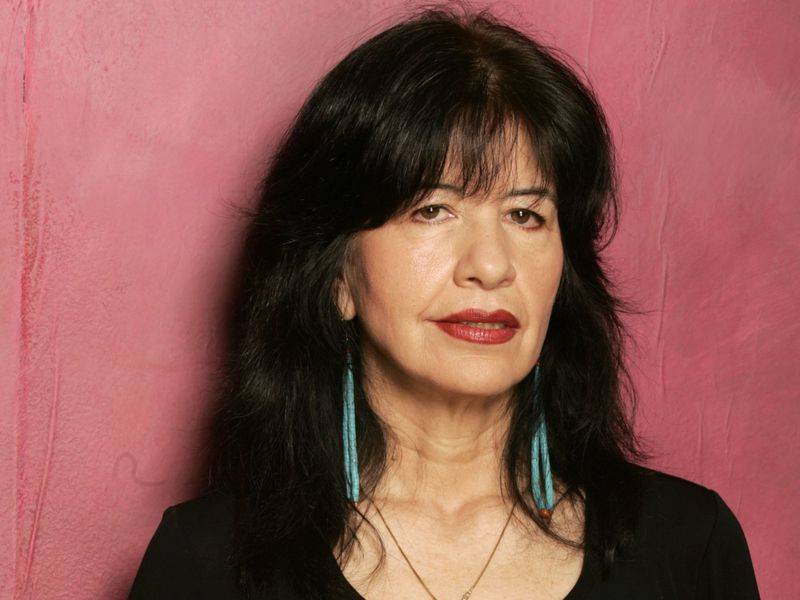
"caption": "U.S Poet Laureate Joy Harjo.",
"description": null,
"title": "gettyimages-124390216_1",
"credit": "J. Vespa / Courtesy of NPR",
"status": "inherit",
"isLoading": false,
"fetchFailed": false
},
"arts_13864219": {
"type": "attachments",
"id": "arts_13864219",
"meta": {
"index": "attachments_1716263798",
"site": "arts",
"id": "13864219",
"found": true
},
"parent": 13864218,
"imgSizes": {
"twentyfourteen-full-width": {
"file": "https://ww2.kqed.org/app/uploads/sites/2/2019/08/img_1572-e9f39ad0cb1d2fc771563477edcf360beb29ed80-1038x576.jpg",
"width": 1038,
"mimeType": "image/jpeg",
"height": 576
},
"thumbnail": {
"file": "https://ww2.kqed.org/app/uploads/sites/2/2019/08/img_1572-e9f39ad0cb1d2fc771563477edcf360beb29ed80-160x120.jpg",
"width": 160,
"mimeType": "image/jpeg",
"height": 120
},
"post-thumbnail": {
"file": "https://ww2.kqed.org/app/uploads/sites/2/2019/08/img_1572-e9f39ad0cb1d2fc771563477edcf360beb29ed80-672x372.jpg",
"width": 672,
"mimeType": "image/jpeg",
"height": 372
},
"kqedFullSize": {
"file": "https://ww2.kqed.org/app/uploads/sites/2/2019/08/img_1572-e9f39ad0cb1d2fc771563477edcf360beb29ed80.jpg",
"width": 2048,
"height": 1536
},
"large": {
"file": "https://ww2.kqed.org/app/uploads/sites/2/2019/08/img_1572-e9f39ad0cb1d2fc771563477edcf360beb29ed80-1020x765.jpg",
"width": 1020,
"mimeType": "image/jpeg",
"height": 765
},
"complete_open_graph": {
"file": "https://ww2.kqed.org/app/uploads/sites/2/2019/08/img_1572-e9f39ad0cb1d2fc771563477edcf360beb29ed80-1200x900.jpg",
"width": 1200,
"mimeType": "image/jpeg",
"height": 900
},
"full-width": {
"file": "https://ww2.kqed.org/app/uploads/sites/2/2019/08/img_1572-e9f39ad0cb1d2fc771563477edcf360beb29ed80-1920x1440.jpg",
"width": 1920,
"mimeType": "image/jpeg",
"height": 1440
},
"medium": {
"file": "https://ww2.kqed.org/app/uploads/sites/2/2019/08/img_1572-e9f39ad0cb1d2fc771563477edcf360beb29ed80-800x600.jpg",
"width": 800,
"mimeType": "image/jpeg",
"height": 600
},
"medium_large": {
"file": "https://ww2.kqed.org/app/uploads/sites/2/2019/08/img_1572-e9f39ad0cb1d2fc771563477edcf360beb29ed80-768x576.jpg",
"width": 768,
"mimeType": "image/jpeg",
"height": 576
}
},
"publishDate": 1565895724,
"modified": 1565895724,
"caption": null,
"description": "\u003cem>How To Be An Antiracist,\u003c/em> by Ibram X. Kendi",
"title": "How To Be An Antiracist, by Ibram X. Kendi",
"credit": null,
"status": "inherit",
"isLoading": false,
"fetchFailed": false
},
"arts_13863715": {
"type": "attachments",
"id": "arts_13863715",
"meta": {
"index": "attachments_1716263798",
"site": "arts",
"id": "13863715",
"found": true
},
"parent": 13863411,
"imgSizes": {
"twentyfourteen-full-width": {
"file": "https://ww2.kqed.org/app/uploads/sites/2/2019/08/Daumenlutscher-1038x576.jpg",
"width": 1038,
"mimeType": "image/jpeg",
"height": 576
},
"thumbnail": {
"file": "https://ww2.kqed.org/app/uploads/sites/2/2019/08/Daumenlutscher-160x108.jpg",
"width": 160,
"mimeType": "image/jpeg",
"height": 108
},
"post-thumbnail": {
"file": "https://ww2.kqed.org/app/uploads/sites/2/2019/08/Daumenlutscher-672x372.jpg",
"width": 672,
"mimeType": "image/jpeg",
"height": 372
},
"kqedFullSize": {
"file": "https://ww2.kqed.org/app/uploads/sites/2/2019/08/Daumenlutscher.jpg",
"width": 2048,
"height": 1376
},
"large": {
"file": "https://ww2.kqed.org/app/uploads/sites/2/2019/08/Daumenlutscher-1020x685.jpg",
"width": 1020,
"mimeType": "image/jpeg",
"height": 685
},
"complete_open_graph": {
"file": "https://ww2.kqed.org/app/uploads/sites/2/2019/08/Daumenlutscher-1200x806.jpg",
"width": 1200,
"mimeType": "image/jpeg",
"height": 806
},
"full-width": {
"file": "https://ww2.kqed.org/app/uploads/sites/2/2019/08/Daumenlutscher-1920x1290.jpg",
"width": 1920,
"mimeType": "image/jpeg",
"height": 1290
},
"medium": {
"file": "https://ww2.kqed.org/app/uploads/sites/2/2019/08/Daumenlutscher-800x538.jpg",
"width": 800,
"mimeType": "image/jpeg",
"height": 538
},
"medium_large": {
"file": "https://ww2.kqed.org/app/uploads/sites/2/2019/08/Daumenlutscher-768x516.jpg",
"width": 768,
"mimeType": "image/jpeg",
"height": 516
}
},
"publishDate": 1565591574,
"modified": 1565591663,
"caption": "Little \"Suck-a-Thumb\" gets attacked by the \"red-legged scissor man\" in 'Der Struwwelpeter.'",
"description": "Little \"Suck-a-Thumb\" gets attacked by the \"red-legged scissor man\" in 'Der Struwwelpeter.'",
"title": "Little \"Suck-a-Thumb\" gets attacked by the \"red-legged scissor man\" in 'Der Struwwelpeter.'",
"credit": null,
"status": "inherit",
"isLoading": false,
"fetchFailed": false
},
"arts_13863846": {
"type": "attachments",
"id": "arts_13863846",
"meta": {
"index": "attachments_1716263798",
"site": "arts",
"id": "13863846",
"found": true
},
"parent": 13863844,
"imgSizes": {
"twentyfourteen-full-width": {
"file": "https://ww2.kqed.org/app/uploads/sites/2/2019/08/gettyimages-630904009_sq-bce070860b4944cc42ba93e5f0a4babbd69e517f-1-1038x576.jpg",
"width": 1038,
"mimeType": "image/jpeg",
"height": 576
},
"thumbnail": {
"file": "https://ww2.kqed.org/app/uploads/sites/2/2019/08/gettyimages-630904009_sq-bce070860b4944cc42ba93e5f0a4babbd69e517f-1-160x160.jpg",
"width": 160,
"mimeType": "image/jpeg",
"height": 160
},
"post-thumbnail": {
"file": "https://ww2.kqed.org/app/uploads/sites/2/2019/08/gettyimages-630904009_sq-bce070860b4944cc42ba93e5f0a4babbd69e517f-1-672x372.jpg",
"width": 672,
"mimeType": "image/jpeg",
"height": 372
},
"kqedFullSize": {
"file": "https://ww2.kqed.org/app/uploads/sites/2/2019/08/gettyimages-630904009_sq-bce070860b4944cc42ba93e5f0a4babbd69e517f-1-e1565640268745.jpg",
"width": 1920,
"height": 1920
},
"large": {
"file": "https://ww2.kqed.org/app/uploads/sites/2/2019/08/gettyimages-630904009_sq-bce070860b4944cc42ba93e5f0a4babbd69e517f-1-1020x1020.jpg",
"width": 1020,
"mimeType": "image/jpeg",
"height": 1020
},
"complete_open_graph": {
"file": "https://ww2.kqed.org/app/uploads/sites/2/2019/08/gettyimages-630904009_sq-bce070860b4944cc42ba93e5f0a4babbd69e517f-1-1200x1200.jpg",
"width": 1200,
"mimeType": "image/jpeg",
"height": 1200
},
"full-width": {
"file": "https://ww2.kqed.org/app/uploads/sites/2/2019/08/gettyimages-630904009_sq-bce070860b4944cc42ba93e5f0a4babbd69e517f-1-1920x1920.jpg",
"width": 1920,
"mimeType": "image/jpeg",
"height": 1920
},
"medium": {
"file": "https://ww2.kqed.org/app/uploads/sites/2/2019/08/gettyimages-630904009_sq-bce070860b4944cc42ba93e5f0a4babbd69e517f-1-800x800.jpg",
"width": 800,
"mimeType": "image/jpeg",
"height": 800
},
"medium_large": {
"file": "https://ww2.kqed.org/app/uploads/sites/2/2019/08/gettyimages-630904009_sq-bce070860b4944cc42ba93e5f0a4babbd69e517f-1-768x768.jpg",
"width": 768,
"mimeType": "image/jpeg",
"height": 768
}
},
"publishDate": 1565639690,
"modified": 1565640261,
"caption": "Individuals from all walks of life join together at Silent Book Clubs around the world to socialize, meet new people and trade book recommendations. When the bell rings, it's reading time, and people can read whatever they like, as long as it's in silence.",
"description": "Individuals from all walks of life join together at Silent Book Clubs around the world to socialize, meet new people and trade book recommendations. When the bell rings, it's reading time, and people can read whatever they like, as long as it's in silence.",
"title": "Individuals from all walks of life join together at Silent Book Clubs around the world to socialize, meet new people and trade book recommendations. When the bell rings, it's reading time, and people can read whatever they like, as long as it's in silence.",
"credit": "Jonathan McHugh/Getty Images/Ikon Images",
"status": "inherit",
"isLoading": false,
"fetchFailed": false
},
"arts_13863397": {
"type": "attachments",
"id": "arts_13863397",
"meta": {
"index": "attachments_1716263798",
"site": "arts",
"id": "13863397",
"found": true
},
"parent": 13863396,
"imgSizes": {
"twentyfourteen-full-width": {
"file": "https://ww2.kqed.org/app/uploads/sites/2/2019/08/white-a90159260b32b3df081e927893ed78a3534ea2f5-1038x576.jpg",
"width": 1038,
"mimeType": "image/jpeg",
"height": 576
},
"thumbnail": {
"file": "https://ww2.kqed.org/app/uploads/sites/2/2019/08/white-a90159260b32b3df081e927893ed78a3534ea2f5-160x120.jpg",
"width": 160,
"mimeType": "image/jpeg",
"height": 120
},
"post-thumbnail": {
"file": "https://ww2.kqed.org/app/uploads/sites/2/2019/08/white-a90159260b32b3df081e927893ed78a3534ea2f5-672x372.jpg",
"width": 672,
"mimeType": "image/jpeg",
"height": 372
},
"kqedFullSize": {
"file": "https://ww2.kqed.org/app/uploads/sites/2/2019/08/white-a90159260b32b3df081e927893ed78a3534ea2f5.jpg",
"width": 1337,
"height": 1003
},
"large": {
"file": "https://ww2.kqed.org/app/uploads/sites/2/2019/08/white-a90159260b32b3df081e927893ed78a3534ea2f5-1020x765.jpg",
"width": 1020,
"mimeType": "image/jpeg",
"height": 765
},
"complete_open_graph": {
"file": "https://ww2.kqed.org/app/uploads/sites/2/2019/08/white-a90159260b32b3df081e927893ed78a3534ea2f5-1200x900.jpg",
"width": 1200,
"mimeType": "image/jpeg",
"height": 900
},
"medium": {
"file": "https://ww2.kqed.org/app/uploads/sites/2/2019/08/white-a90159260b32b3df081e927893ed78a3534ea2f5-800x600.jpg",
"width": 800,
"mimeType": "image/jpeg",
"height": 600
},
"medium_large": {
"file": "https://ww2.kqed.org/app/uploads/sites/2/2019/08/white-a90159260b32b3df081e927893ed78a3534ea2f5-768x576.jpg",
"width": 768,
"mimeType": "image/jpeg",
"height": 576
}
},
"publishDate": 1565301749,
"modified": 1565302398,
"caption": "'When I Was White: A Memoir', by Sarah Valentine.",
"description": "'When I Was White: A Memoir', by Sarah Valentine.",
"title": "'When I Was White: A Memoir', by Sarah Valentine.",
"credit": null,
"status": "inherit",
"isLoading": false,
"fetchFailed": false
},
"arts_13863328": {
"type": "attachments",
"id": "arts_13863328",
"meta": {
"index": "attachments_1716263798",
"site": "arts",
"id": "13863328",
"found": true
},
"parent": 13863309,
"imgSizes": {
"twentyfourteen-full-width": {
"file": "https://ww2.kqed.org/app/uploads/sites/2/2019/08/MirageCOVERSb-1038x576.jpg",
"width": 1038,
"mimeType": "image/jpeg",
"height": 576
},
"thumbnail": {
"file": "https://ww2.kqed.org/app/uploads/sites/2/2019/08/MirageCOVERSb-160x90.jpg",
"width": 160,
"mimeType": "image/jpeg",
"height": 90
},
"post-thumbnail": {
"file": "https://ww2.kqed.org/app/uploads/sites/2/2019/08/MirageCOVERSb-672x372.jpg",
"width": 672,
"mimeType": "image/jpeg",
"height": 372
},
"kqedFullSize": {
"file": "https://ww2.kqed.org/app/uploads/sites/2/2019/08/MirageCOVERSb.jpg",
"width": 1920,
"height": 1080
},
"large": {
"file": "https://ww2.kqed.org/app/uploads/sites/2/2019/08/MirageCOVERSb-1020x574.jpg",
"width": 1020,
"mimeType": "image/jpeg",
"height": 574
},
"complete_open_graph": {
"file": "https://ww2.kqed.org/app/uploads/sites/2/2019/08/MirageCOVERSb-1200x675.jpg",
"width": 1200,
"mimeType": "image/jpeg",
"height": 675
},
"full-width": {
"file": "https://ww2.kqed.org/app/uploads/sites/2/2019/08/MirageCOVERSb-1920x1080.jpg",
"width": 1920,
"mimeType": "image/jpeg",
"height": 1080
},
"medium": {
"file": "https://ww2.kqed.org/app/uploads/sites/2/2019/08/MirageCOVERSb-800x450.jpg",
"width": 800,
"mimeType": "image/jpeg",
"height": 450
},
"medium_large": {
"file": "https://ww2.kqed.org/app/uploads/sites/2/2019/08/MirageCOVERSb-768x432.jpg",
"width": 768,
"mimeType": "image/jpeg",
"height": 432
}
},
"publishDate": 1565219810,
"modified": 1565220084,
"caption": "Covers of 'Mirage.'",
"description": "Covers of 'Mirage.'",
"title": "MirageCOVERSb",
"credit": "Courtesy of Wattis Institute",
"status": "inherit",
"isLoading": false,
"fetchFailed": false
},
"arts_13863158": {
"type": "attachments",
"id": "arts_13863158",
"meta": {
"index": "attachments_1716263798",
"site": "arts",
"id": "13863158",
"found": true
},
"parent": 13863147,
"imgSizes": {
"twentyfourteen-full-width": {
"file": "https://ww2.kqed.org/app/uploads/sites/2/2019/08/jiatolentino-elenamudd-8756-2-2-21c2b3ab031715d5af946cde30fc2fb6b199c26b-s1400-c85-1038x576.jpg",
"width": 1038,
"mimeType": "image/jpeg",
"height": 576
},
"thumbnail": {
"file": "https://ww2.kqed.org/app/uploads/sites/2/2019/08/jiatolentino-elenamudd-8756-2-2-21c2b3ab031715d5af946cde30fc2fb6b199c26b-s1400-c85-160x120.jpg",
"width": 160,
"mimeType": "image/jpeg",
"height": 120
},
"post-thumbnail": {
"file": "https://ww2.kqed.org/app/uploads/sites/2/2019/08/jiatolentino-elenamudd-8756-2-2-21c2b3ab031715d5af946cde30fc2fb6b199c26b-s1400-c85-672x372.jpg",
"width": 672,
"mimeType": "image/jpeg",
"height": 372
},
"kqedFullSize": {
"file": "https://ww2.kqed.org/app/uploads/sites/2/2019/08/jiatolentino-elenamudd-8756-2-2-21c2b3ab031715d5af946cde30fc2fb6b199c26b-s1400-c85.jpg",
"width": 1400,
"height": 1050
},
"large": {
"file": "https://ww2.kqed.org/app/uploads/sites/2/2019/08/jiatolentino-elenamudd-8756-2-2-21c2b3ab031715d5af946cde30fc2fb6b199c26b-s1400-c85-1020x765.jpg",
"width": 1020,
"mimeType": "image/jpeg",
"height": 765
},
"complete_open_graph": {
"file": "https://ww2.kqed.org/app/uploads/sites/2/2019/08/jiatolentino-elenamudd-8756-2-2-21c2b3ab031715d5af946cde30fc2fb6b199c26b-s1400-c85-1200x900.jpg",
"width": 1200,
"mimeType": "image/jpeg",
"height": 900
},
"medium": {
"file": "https://ww2.kqed.org/app/uploads/sites/2/2019/08/jiatolentino-elenamudd-8756-2-2-21c2b3ab031715d5af946cde30fc2fb6b199c26b-s1400-c85-800x600.jpg",
"width": 800,
"mimeType": "image/jpeg",
"height": 600
},
"medium_large": {
"file": "https://ww2.kqed.org/app/uploads/sites/2/2019/08/jiatolentino-elenamudd-8756-2-2-21c2b3ab031715d5af946cde30fc2fb6b199c26b-s1400-c85-768x576.jpg",
"width": 768,
"mimeType": "image/jpeg",
"height": 576
}
},
"publishDate": 1565120563,
"modified": 1565120603,
"caption": "Jia Tolentino's essay collection 'Trick Mirror' looks for meaning in the many absurdities all around us.",
"description": "Jia Tolentino's essay collection 'Trick Mirror' looks for meaning in the many absurdities all around us.",
"title": "Jia Tolentino's essay collection 'Trick Mirror' looks for meaning in the many absurdities all around us.",
"credit": "Penguin Random House",
"status": "inherit",
"isLoading": false,
"fetchFailed": false
},
"arts_13863124": {
"type": "attachments",
"id": "arts_13863124",
"meta": {
"index": "attachments_1716263798",
"site": "arts",
"id": "13863124",
"found": true
},
"parent": 13863108,
"imgSizes": {
"twentyfourteen-full-width": {
"file": "https://ww2.kqed.org/app/uploads/sites/2/2019/08/Toni-GettyImages-978660564-1038x576.jpg",
"width": 1038,
"mimeType": "image/jpeg",
"height": 576
},
"thumbnail": {
"file": "https://ww2.kqed.org/app/uploads/sites/2/2019/08/Toni-GettyImages-978660564-160x107.jpg",
"width": 160,
"mimeType": "image/jpeg",
"height": 107
},
"post-thumbnail": {
"file": "https://ww2.kqed.org/app/uploads/sites/2/2019/08/Toni-GettyImages-978660564-672x372.jpg",
"width": 672,
"mimeType": "image/jpeg",
"height": 372
},
"kqedFullSize": {
"file": "https://ww2.kqed.org/app/uploads/sites/2/2019/08/Toni-GettyImages-978660564.jpg",
"width": 1920,
"height": 1280
},
"large": {
"file": "https://ww2.kqed.org/app/uploads/sites/2/2019/08/Toni-GettyImages-978660564-1020x680.jpg",
"width": 1020,
"mimeType": "image/jpeg",
"height": 680
},
"complete_open_graph": {
"file": "https://ww2.kqed.org/app/uploads/sites/2/2019/08/Toni-GettyImages-978660564-1200x800.jpg",
"width": 1200,
"mimeType": "image/jpeg",
"height": 800
},
"full-width": {
"file": "https://ww2.kqed.org/app/uploads/sites/2/2019/08/Toni-GettyImages-978660564-1920x1280.jpg",
"width": 1920,
"mimeType": "image/jpeg",
"height": 1280
},
"medium": {
"file": "https://ww2.kqed.org/app/uploads/sites/2/2019/08/Toni-GettyImages-978660564-800x533.jpg",
"width": 800,
"mimeType": "image/jpeg",
"height": 533
},
"medium_large": {
"file": "https://ww2.kqed.org/app/uploads/sites/2/2019/08/Toni-GettyImages-978660564-768x512.jpg",
"width": 768,
"mimeType": "image/jpeg",
"height": 512
}
},
"publishDate": 1565113394,
"modified": 1565113422,
"caption": "U.S. author Toni Morrison smiles in her office at Princeton University in New Jersey, while being interviewed by reporters on October 7, 1993. - Morrison said \"I am outrageously happy\" after hearing that she had won the Nobel Prize for Literature.",
"description": "U.S. author Toni Morrison smiles in her office at Princeton University in New Jersey, while being interviewed by reporters on October 7, 1993. - Morrison said \"I am outrageously happy\" after hearing that she had won the Nobel Prize for Literature.",
"title": "Toni-GettyImages-978660564",
"credit": "DON EMMERT/AFP/Getty Images",
"status": "inherit",
"isLoading": false,
"fetchFailed": false
}
},
"audioPlayerReducer": {
"postId": "stream_live",
"isPaused": true,
"isPlaying": false,
"pfsActive": false,
"pledgeModalIsOpen": true,
"playerDrawerIsOpen": false,
"liveAudioPlayStartedAt": 0,
"liveAudioPlayContext": ""
},
"authorsReducer": {
"byline_arts_13864877": {
"type": "authors",
"id": "byline_arts_13864877",
"meta": {
"override": true
},
"slug": "byline_arts_13864877",
"name": "ETELKA LEHOCZKY",
"isLoading": false
},
"byline_arts_13864580": {
"type": "authors",
"id": "byline_arts_13864580",
"meta": {
"override": true
},
"slug": "byline_arts_13864580",
"name": "Scott Horsley",
"isLoading": false
},
"byline_arts_13864560": {
"type": "authors",
"id": "byline_arts_13864560",
"meta": {
"override": true
},
"slug": "byline_arts_13864560",
"name": "Ilana Masad",
"isLoading": false
},
"byline_arts_13864511": {
"type": "authors",
"id": "byline_arts_13864511",
"meta": {
"override": true
},
"slug": "byline_arts_13864511",
"name": "The Associated Press",
"isLoading": false
},
"byline_arts_13864502": {
"type": "authors",
"id": "byline_arts_13864502",
"meta": {
"override": true
},
"slug": "byline_arts_13864502",
"name": "Craig Morgan Teicher",
"isLoading": false
},
"byline_arts_13864218": {
"type": "authors",
"id": "byline_arts_13864218",
"meta": {
"override": true
},
"slug": "byline_arts_13864218",
"name": "Ericka Taylor",
"isLoading": false
},
"byline_arts_13863844": {
"type": "authors",
"id": "byline_arts_13863844",
"meta": {
"override": true
},
"slug": "byline_arts_13863844",
"name": "Josh Axelrod",
"isLoading": false
},
"byline_arts_13863396": {
"type": "authors",
"id": "byline_arts_13863396",
"meta": {
"override": true
},
"slug": "byline_arts_13863396",
"name": "Hope Wabuke",
"isLoading": false
},
"byline_arts_13863147": {
"type": "authors",
"id": "byline_arts_13863147",
"meta": {
"override": true
},
"slug": "byline_arts_13863147",
"name": "Vincent Acovino",
"isLoading": false
},
"byline_arts_13863108": {
"type": "authors",
"id": "byline_arts_13863108",
"meta": {
"override": true
},
"slug": "byline_arts_13863108",
"name": "The Associated Press, KQED Arts Staff",
"isLoading": false
},
"shotchkiss": {
"type": "authors",
"id": "61",
"meta": {
"index": "authors_1716337520",
"id": "61",
"found": true
},
"name": "Sarah Hotchkiss",
"firstName": "Sarah",
"lastName": "Hotchkiss",
"slug": "shotchkiss",
"email": "shotchkiss@kqed.org",
"display_author_email": true,
"staff_mastheads": [
"arts"
],
"title": "Senior Editor",
"bio": "Sarah Hotchkiss is a San Francisco \u003ca href=\"http://www.sarahhotchkiss.com\">artist\u003c/a> and arts writer. In 2019, she received the Dorothea & Leo Rabkin Foundation grant for visual art journalism and in 2020 she received a Society of Professional Journalists, Northern California award for excellence in arts and culture reporting.",
"avatar": "https://secure.gravatar.com/avatar/bc662df144b3d27fd8b1b6f1c2a420d34e91e53154d411bb7ad353cc8b6cea8d?s=600&d=blank&r=g",
"twitter": null,
"bluesky": null,
"facebook": null,
"instagram": null,
"linkedin": null,
"sites": [
{
"site": "",
"roles": [
"editor"
]
},
{
"site": "arts",
"roles": [
"Contributor",
"administrator"
]
},
{
"site": "artschool",
"roles": [
"administrator"
]
},
{
"site": "news",
"roles": [
"editor"
]
},
{
"site": "pop",
"roles": [
"administrator"
]
},
{
"site": "bayareabites",
"roles": [
"editor"
]
},
{
"site": "spark",
"roles": [
"editor"
]
},
{
"site": "checkplease",
"roles": [
"editor"
]
}
],
"headData": {
"title": "Sarah Hotchkiss | KQED",
"description": "Senior Editor",
"ogImgSrc": "https://secure.gravatar.com/avatar/bc662df144b3d27fd8b1b6f1c2a420d34e91e53154d411bb7ad353cc8b6cea8d?s=600&d=blank&r=g",
"twImgSrc": "https://secure.gravatar.com/avatar/bc662df144b3d27fd8b1b6f1c2a420d34e91e53154d411bb7ad353cc8b6cea8d?s=600&d=blank&r=g"
},
"isLoading": false,
"link": "/author/shotchkiss"
},
"ralexandra": {
"type": "authors",
"id": "11242",
"meta": {
"index": "authors_1716337520",
"id": "11242",
"found": true
},
"name": "Rae Alexandra",
"firstName": "Rae",
"lastName": "Alexandra",
"slug": "ralexandra",
"email": "ralexandra@kqed.org",
"display_author_email": true,
"staff_mastheads": [],
"title": "Reporter/Producer",
"bio": "Rae Alexandra is a Reporter/Producer for KQED Arts & Culture, and the creator/author of the \u003ca href=\"https://www.kqed.org/arts/program/rebel-girls-from-bay-area-history\">Rebel Girls From Bay Area History\u003c/a> and \u003ca href=\"https://www.kqed.org/bizarrebayarea\">Bizarre Bay Area\u003c/a> series. Her debut book, \u003ca href=\"https://citylights.com/politics-current-events-history/unsung-heroines35-women-who-changed/\">Unsung Heroines: 35 Women Who Changed the Bay Area\u003c/a> was published by City Lights in March 2026. In 2023, Rae was awarded an SPJ Excellence in Journalism Award for Arts & Culture. Rae was born and raised in Wales and subsequently — even after two decades in Northern California — still uses phrases that regularly baffle her coworkers.",
"avatar": "https://secure.gravatar.com/avatar/edfee8176c80cc0a382b051190f5341997df378a934a5774dcb0977732dfd401?s=600&d=blank&r=g",
"twitter": null,
"bluesky": null,
"facebook": null,
"instagram": null,
"linkedin": null,
"sites": [
{
"site": "arts",
"roles": [
"subscriber"
]
},
{
"site": "news",
"roles": [
"subscriber"
]
},
{
"site": "pop",
"roles": [
"subscriber"
]
},
{
"site": "bayareabites",
"roles": [
"subscriber"
]
},
{
"site": "science",
"roles": [
"subscriber"
]
}
],
"headData": {
"title": "Rae Alexandra | KQED",
"description": "Reporter/Producer",
"ogImgSrc": "https://secure.gravatar.com/avatar/edfee8176c80cc0a382b051190f5341997df378a934a5774dcb0977732dfd401?s=600&d=blank&r=g",
"twImgSrc": "https://secure.gravatar.com/avatar/edfee8176c80cc0a382b051190f5341997df378a934a5774dcb0977732dfd401?s=600&d=blank&r=g"
},
"isLoading": false,
"link": "/author/ralexandra"
}
},
"pagesReducer": {
"arts_category_literature": {
"type": "terms",
"id": "arts_73",
"meta": {
"index": "terms_1716263798",
"site": "arts",
"id": "73",
"score": 12.797728
},
"featImg": null,
"name": "Books",
"description": null,
"taxonomy": "category",
"headData": {
"twImgId": null,
"twTitle": null,
"ogTitle": null,
"ogImgId": null,
"twDescription": null,
"description": null,
"title": "Books Archives | KQED Arts",
"ogDescription": null
},
"ttid": 74,
"slug": "literature",
"isLoading": false,
"title": "Books",
"pageMeta": {
"site": "arts",
"WpPageTemplate": "page-topic-editorial",
"currentPage": 61
},
"blocks": [
{
"blockName": "kqed/post-list",
"attrs": {
"layout": "cardArticle2",
"query": "posts/arts?category=literature",
"seeMore": false,
"paginated": true,
"page": 61
}
},
{
"blockName": "kqed/ad"
}
]
}
},
"pfsSessionReducer": {},
"postsReducer": {
"stream_live": {
"type": "live",
"id": "stream_live",
"audioUrl": "https://streams.kqed.org/kqedradio",
"title": "Live Stream",
"excerpt": "Live Stream information currently unavailable.",
"link": "/radio",
"featImg": "",
"label": {
"name": "KQED Live",
"link": "/"
}
},
"stream_kqedNewscast": {
"type": "posts",
"id": "stream_kqedNewscast",
"audioUrl": "https://www.kqed.org/.stream/anon/radio/RDnews/newscast.mp3?_=1",
"title": "KQED Newscast",
"featImg": "",
"label": {
"name": "88.5 FM",
"link": "/"
}
},
"arts_13864877": {
"type": "posts",
"id": "arts_13864877",
"meta": {
"index": "posts_1716263798",
"site": "arts",
"id": "13864877",
"score": null,
"sort": [
1566855261000
]
},
"parent": 0,
"labelTerm": {
"site": "arts",
"term": 137
},
"blocks": [],
"publishDate": 1566855261,
"format": "standard",
"title": "When Comic Art Meets High Art, the Results Will Surprise You",
"headTitle": "When Comic Art Meets High Art, the Results Will Surprise You | KQED",
"content": "\u003cp>There are two graphic novels out this summer about Jean-Michel Basquiat, and you’re definitely going to hate one of them. Which one? That’s harder to say. \u003ca href=\"https://www.npr.org/books/titles/753548833/basquiat\">Julian Voloj and Søren Mosdal’s \u003cem>Basquiat\u003c/em>\u003c/a> and Paolo Parisi’s \u003cem>Basquiat: A Graphic Novel\u003c/em> couldn’t be more different: Mosdal emulates the artist’s agitated lines, while Parisi uses flat zones of primary color, in the style of Basquiat’s mentor Andy Warhol. Aficionados will doubtless disagree about which book works—but that was probably inevitable. There’s something inherently odd about using one artistic tradition to depict the life (to say nothing of reproducing the work) of an artist from a different tradition. And yet, not only are a growing number of cartoonists creating books about famous artists, but their approaches are dizzyingly varied. When is a comic book a fitting tribute to an icon?\u003c/p>\n\u003cp>It’s a question that numerous publishers and creators are eager to address. Andy Warhol, Salvador Dalí, Jackson Pollock and Francis Bacon have all been memorialized in panel form in recent years. It’s not a stretch to use the quintessentially modern medium of comics to capture the life of a 20th-century artist; the free-flowing \u003ca href=\"https://www.npr.org/books/titles/753549304/niki-de-saint-phalle-the-garden-of-secrets\">\u003cem>Niki de Saint Phalle: The Garden of Secrets\u003c/em>, by Dominique Osuch and Sandrine Martin\u003c/a>, is a particularly ingenious tribute to an underappreciated figure. But even Velázquez, Caravaggio and Goya are getting cartoon treatments.\u003c/p>\n\u003cfigure id=\"attachment_13864881\" class=\"wp-caption alignright\" style=\"max-width: 400px\">\u003cimg loading=\"lazy\" decoding=\"async\" class=\"size-full wp-image-13864881\" src=\"https://ww2.kqed.org/arts/wp-content/uploads/sites/2/2019/08/9781780676234_vert-f3820b39a689f697f3eec80fb4d0ced2901a9228-s600-c85.jpg\" alt=\"'This Is Monet' by Sara Pappworth and Aude Van Ryn.\" width=\"400\" height=\"524\" srcset=\"https://cdn.kqed.org/wp-content/uploads/sites/2/2019/08/9781780676234_vert-f3820b39a689f697f3eec80fb4d0ced2901a9228-s600-c85.jpg 400w, https://cdn.kqed.org/wp-content/uploads/sites/2/2019/08/9781780676234_vert-f3820b39a689f697f3eec80fb4d0ced2901a9228-s600-c85-160x210.jpg 160w\" sizes=\"(max-width: 400px) 100vw, 400px\">\u003cfigcaption class=\"wp-caption-text\">‘This Is Monet’\u003cbr>by Sara Pappworth and Aude Van Ryn.\u003c/figcaption>\u003c/figure>\n\u003cp>The results of such attempts vary widely, but one rule is clear: Don’t reproduce the artist’s paintings if you can possibly get away with it. That’s the misstep of \u003ca href=\"https://www.npr.org/books/titles/753550360/monet-itinerant-of-light\">\u003cem>Monet: Itinerant of Light\u003c/em>, by Salva Rubio and Efa\u003c/a>. Efa envisions the world around Monet the way the artist would paint it, with vivid patches of light and dark dappling every scene. It makes for a beautiful book—that is, until you get to Efa’s recreations of Monet’s best-known paintings, which naturally suffer by comparison with the originals. In \u003cem>This Is Monet\u003c/em>, on the other hand, illustrator Aude Van Ryn doesn’t attempt to duplicate her subject’s famous works. Instead, the book intersperses color plates of the actual paintings with Van Ryn’s drawings of scenes from Monet’s life. (In one particularly charming interlude, the Monet family helps to carry canvases in a wheelbarrow). Van Ryn’s style is complementary without being imitative—a tough balancing act that Efa doesn’t pull off.\u003c/p>\n\u003cp>\u003cem>This Is Monet\u003c/em> is part of an unusual series from British publisher Laurence King that combines biographical text, reproductions and modern illustrations. “I wanted to be able to show, in illustrations, the pop culture that existed around the artists,” series editor Catherine Ingram says. “Even … Old Masters paintings, they’ve got a vibrant visual culture they’re tapping on. That visual culture is missing from art history books. It’s time to get back to that, to get the illustrators involved.”\u003c/p>\n\u003cfigure id=\"attachment_13864884\" class=\"wp-caption alignright\" style=\"max-width: 400px\">\u003cimg loading=\"lazy\" decoding=\"async\" class=\"wp-image-13864884 size-full\" src=\"https://ww2.kqed.org/arts/wp-content/uploads/sites/2/2019/08/9781606996140_vert-5e578a0a74eec04174f2260e3d7848fada43ffa9-s600-c85.jpg\" alt=\"'7 Miles a Second' by David Wojnarowicz, James Romberger and Marguerite Van Cook.\" width=\"400\" height=\"541\" srcset=\"https://cdn.kqed.org/wp-content/uploads/sites/2/2019/08/9781606996140_vert-5e578a0a74eec04174f2260e3d7848fada43ffa9-s600-c85.jpg 400w, https://cdn.kqed.org/wp-content/uploads/sites/2/2019/08/9781606996140_vert-5e578a0a74eec04174f2260e3d7848fada43ffa9-s600-c85-160x216.jpg 160w\" sizes=\"(max-width: 400px) 100vw, 400px\">\u003cfigcaption class=\"wp-caption-text\">‘7 Miles a Second’\u003cbr>by David Wojnarowicz, James Romberger and Marguerite Van Cook.\u003c/figcaption>\u003c/figure>\n\u003cp>Some corners of the art world have always embraced comics, of course. In 1988, David Wojnarowicz asked his friend and fellow East Village artist James Romberger to collaborate with him on \u003cem>Seven Miles a Second,\u003c/em> an adaptation of Wojnarowicz’ autobiographical writings. Romberger, whose depictions of downtown New York life can be found in many museums’ collections, had to finish the book alone after Wojnarowicz died of AIDS in 1992. But he was aided by Marguerite Van Cook, who’d shown Wojnarowicz in her gallery, gone on road trips with him and had long discussions with him about color theory. Van Cook gave the book its explosive palette. (The book was reissued by Fantagraphics in 2013 and is now being self-published by Romberger and Van Cook.)\u003c/p>\n\u003cp>[ad fullwidth]\u003c/p>\n\u003cp>“Marguerite kind of lets things rush outside the lines,” Romberger says. “The color is running, smushing together—it’s not so defined. In comics the lines are usually… meant to hold in the color. Marguerite does something where the color is actually erupting outside of the lines, breaking the boundaries. Which kind of suits David, who’s someone who was very much against boundaries.”\u003c/p>\n\u003cp>\u003cem>Seven Miles a Second\u003c/em> remains a landmark crossover between comic art and fine art. It was a similar desire to bridge the high-low divide that led Boston’s Isabella Stewart Gardner Museum to incorporate comics into its spring Botticelli exhibit. The museum hired Karl Stevens, known for such graphic novels as 2010’s \u003cem>The Lodger\u003c/em> and last year’s \u003cem>The Winner\u003c/em>, to create cartoons of the Roman myths behind Botticelli’s \u003cem>The Tragedy of Lucretia\u003c/em> and \u003cem>The Story of Virginia.\u003c/em>\u003c/p>\n\u003cfigure id=\"attachment_13864885\" class=\"wp-caption alignnone\" style=\"max-width: 600px\">\u003cimg loading=\"lazy\" decoding=\"async\" class=\"size-full wp-image-13864885\" src=\"https://ww2.kqed.org/arts/wp-content/uploads/sites/2/2019/08/2019_botticelli_heroines-heroes01-95e4b54b9f3f1ee651aa214ccdaca752d83f199e-s600-c85.jpg\" alt=\"The Isabella Stewart Gardner Museum in Boston hired graphic novelist Karl Stevens to create cartoons of the Roman myths behind some of Botticelli's paintings.\" width=\"600\" height=\"450\" srcset=\"https://cdn.kqed.org/wp-content/uploads/sites/2/2019/08/2019_botticelli_heroines-heroes01-95e4b54b9f3f1ee651aa214ccdaca752d83f199e-s600-c85.jpg 600w, https://cdn.kqed.org/wp-content/uploads/sites/2/2019/08/2019_botticelli_heroines-heroes01-95e4b54b9f3f1ee651aa214ccdaca752d83f199e-s600-c85-160x120.jpg 160w\" sizes=\"(max-width: 600px) 100vw, 600px\">\u003cfigcaption class=\"wp-caption-text\">The Isabella Stewart Gardner Museum in Boston hired graphic novelist Karl Stevens to create cartoons of the Roman myths behind some of Botticelli’s paintings. \u003ccite>(David Matthews/Courtesy of the Isabella Stewart Gardner Museum)\u003c/cite>\u003c/figcaption>\u003c/figure>\n\u003cp>“I thought one of the ways we could make Botticelli appealing to an audience who were not familiar with him was to approach these narrative paintings through the lens of a graphic novel,” says Nathaniel Silver, the William and Lia Poorvu Curator of the Collection at the museum. Stevens puts it a bit differently: “Museums have gotten tighter with cash, and they need to find ways to bring in the rabble.” Stevens believes the mainstream art world will always look down its nose at comics to some degree. Comic art, he notes, has “always been seen as an offshoot of commercial art, which it was originally. It was designed for the mass market. It wasn’t designed for elitist rich people, which is [who] fine art has always been for.”\u003c/p>\n\u003cp>That may explain the fascinating energy that infuses so many graphic novels about art. Illustrating artists’ lives through a lowbrow medium detaches them from their elevated creations and places them back on a human plane. Silver notes that while Stevens’ work on the Botticelli exhibit might seem humble, his position isn’t so different from what Botticelli’s was in his own time. Both then and now, Silver says, artists had to struggle to capture the attention of a broad, easily distractible audience.\u003c/p>\n\u003cp>“We tried to show how these stories were reinterpreted by Botticelli in his time to make them relevant to a contemporary audience in the Renaissance,” Silver says. “In the same way, they can be reinterpreted in our time, to make them relevant to a contemporary audience in 2019.”\u003c/p>\n\u003cp>[ad floatright]\u003c/p>\n\u003cp>\u003cem>Etelka Lehoczky has written about books for\u003c/em> The Atlantic, The Los Angeles Review of Books \u003cem>and\u003c/em> The New York Times. \u003cem>She tweets at\u003c/em> \u003ca href=\"https://urldefense.proofpoint.com/v2/url?u=https-3A__twitter.com_EtelkaL&d=DwMFaQ&c=E2nBno7hEddFhl23N5nD1Q&r=eDR3RhrQF9JBI8Rzx0SRPw&m=vR6dskFG6Pki76w8marL327xnaWSpIVAqnkFp2Pm3ak&s=Mdo8__hjawldjbQthelAboNsxAd-9SFUx24643NrlUM&e=\">@EtelkaL\u003c/a>.\u003c/p>\n\u003cdiv class=\"fullattribution\">\u003cem>Copyright 2019 NPR. To see more, visit \u003ca href=\"https://www.npr.org\">NPR\u003c/a>.\u003cimg decoding=\"async\" src=\"https://www.google-analytics.com/__utm.gif?utmac=UA-5828686-4&utmdt=When+Comic+Art+Meets+High+Art%2C+the+Results+Will+Surprise+You&utme=8(APIKey)9(MDAxOTAwOTE4MDEyMTkxMDAzNjczZDljZA004)\">\u003c/em>\u003c/div>\n\n",
"stats": {
"hasVideo": false,
"hasChartOrMap": false,
"hasAudio": false,
"hasPolis": false,
"wordCount": 1184,
"hasGoogleForm": false,
"hasGallery": false,
"hasHearkenModule": false,
"iframeSrcs": [],
"paragraphCount": 13
},
"modified": 1705022256,
"excerpt": "In recent years, several graphic novel biographies of fine artists have come out—some more successful than others. One rule is clear: Don't reproduce an artist's paintings if you can avoid it.",
"headData": {
"twImgId": "",
"twTitle": "",
"ogTitle": "",
"ogImgId": "",
"twDescription": "",
"description": "In recent years, several graphic novel biographies of fine artists have come out—some more successful than others. One rule is clear: Don't reproduce an artist's paintings if you can avoid it.",
"title": "When Comic Art Meets High Art, the Results Will Surprise You | KQED",
"ogDescription": "",
"schema": {
"@context": "https://schema.org",
"@type": "Article",
"headline": "When Comic Art Meets High Art, the Results Will Surprise You",
"datePublished": "2019-08-26T14:34:21-07:00",
"dateModified": "2024-01-11T17:17:36-08:00",
"image": "https://cdn.kqed.org/wp-content/uploads/2020/02/KQED-OG-Image@1x.png"
}
},
"guestAuthors": [],
"slug": "when-comic-art-meets-high-art-the-results-will-surprise-you",
"status": "publish",
"templateType": "standard",
"nprByline": "ETELKA LEHOCZKY",
"featuredImageType": "standard",
"sticky": false,
"nprImageAgency": "Laurence King Publishing",
"path": "/arts/13864877/when-comic-art-meets-high-art-the-results-will-surprise-you",
"audioTrackLength": null,
"parsedContent": [
{
"type": "contentString",
"content": "\u003cdiv class=\"post-body\">\u003cp>\u003cp>There are two graphic novels out this summer about Jean-Michel Basquiat, and you’re definitely going to hate one of them. Which one? That’s harder to say. \u003ca href=\"https://www.npr.org/books/titles/753548833/basquiat\">Julian Voloj and Søren Mosdal’s \u003cem>Basquiat\u003c/em>\u003c/a> and Paolo Parisi’s \u003cem>Basquiat: A Graphic Novel\u003c/em> couldn’t be more different: Mosdal emulates the artist’s agitated lines, while Parisi uses flat zones of primary color, in the style of Basquiat’s mentor Andy Warhol. Aficionados will doubtless disagree about which book works—but that was probably inevitable. There’s something inherently odd about using one artistic tradition to depict the life (to say nothing of reproducing the work) of an artist from a different tradition. And yet, not only are a growing number of cartoonists creating books about famous artists, but their approaches are dizzyingly varied. When is a comic book a fitting tribute to an icon?\u003c/p>\n\u003cp>It’s a question that numerous publishers and creators are eager to address. Andy Warhol, Salvador Dalí, Jackson Pollock and Francis Bacon have all been memorialized in panel form in recent years. It’s not a stretch to use the quintessentially modern medium of comics to capture the life of a 20th-century artist; the free-flowing \u003ca href=\"https://www.npr.org/books/titles/753549304/niki-de-saint-phalle-the-garden-of-secrets\">\u003cem>Niki de Saint Phalle: The Garden of Secrets\u003c/em>, by Dominique Osuch and Sandrine Martin\u003c/a>, is a particularly ingenious tribute to an underappreciated figure. But even Velázquez, Caravaggio and Goya are getting cartoon treatments.\u003c/p>\n\u003cfigure id=\"attachment_13864881\" class=\"wp-caption alignright\" style=\"max-width: 400px\">\u003cimg loading=\"lazy\" decoding=\"async\" class=\"size-full wp-image-13864881\" src=\"https://ww2.kqed.org/arts/wp-content/uploads/sites/2/2019/08/9781780676234_vert-f3820b39a689f697f3eec80fb4d0ced2901a9228-s600-c85.jpg\" alt=\"'This Is Monet' by Sara Pappworth and Aude Van Ryn.\" width=\"400\" height=\"524\" srcset=\"https://cdn.kqed.org/wp-content/uploads/sites/2/2019/08/9781780676234_vert-f3820b39a689f697f3eec80fb4d0ced2901a9228-s600-c85.jpg 400w, https://cdn.kqed.org/wp-content/uploads/sites/2/2019/08/9781780676234_vert-f3820b39a689f697f3eec80fb4d0ced2901a9228-s600-c85-160x210.jpg 160w\" sizes=\"(max-width: 400px) 100vw, 400px\">\u003cfigcaption class=\"wp-caption-text\">‘This Is Monet’\u003cbr>by Sara Pappworth and Aude Van Ryn.\u003c/figcaption>\u003c/figure>\n\u003cp>The results of such attempts vary widely, but one rule is clear: Don’t reproduce the artist’s paintings if you can possibly get away with it. That’s the misstep of \u003ca href=\"https://www.npr.org/books/titles/753550360/monet-itinerant-of-light\">\u003cem>Monet: Itinerant of Light\u003c/em>, by Salva Rubio and Efa\u003c/a>. Efa envisions the world around Monet the way the artist would paint it, with vivid patches of light and dark dappling every scene. It makes for a beautiful book—that is, until you get to Efa’s recreations of Monet’s best-known paintings, which naturally suffer by comparison with the originals. In \u003cem>This Is Monet\u003c/em>, on the other hand, illustrator Aude Van Ryn doesn’t attempt to duplicate her subject’s famous works. Instead, the book intersperses color plates of the actual paintings with Van Ryn’s drawings of scenes from Monet’s life. (In one particularly charming interlude, the Monet family helps to carry canvases in a wheelbarrow). Van Ryn’s style is complementary without being imitative—a tough balancing act that Efa doesn’t pull off.\u003c/p>\n\u003cp>\u003cem>This Is Monet\u003c/em> is part of an unusual series from British publisher Laurence King that combines biographical text, reproductions and modern illustrations. “I wanted to be able to show, in illustrations, the pop culture that existed around the artists,” series editor Catherine Ingram says. “Even … Old Masters paintings, they’ve got a vibrant visual culture they’re tapping on. That visual culture is missing from art history books. It’s time to get back to that, to get the illustrators involved.”\u003c/p>\n\u003cfigure id=\"attachment_13864884\" class=\"wp-caption alignright\" style=\"max-width: 400px\">\u003cimg loading=\"lazy\" decoding=\"async\" class=\"wp-image-13864884 size-full\" src=\"https://ww2.kqed.org/arts/wp-content/uploads/sites/2/2019/08/9781606996140_vert-5e578a0a74eec04174f2260e3d7848fada43ffa9-s600-c85.jpg\" alt=\"'7 Miles a Second' by David Wojnarowicz, James Romberger and Marguerite Van Cook.\" width=\"400\" height=\"541\" srcset=\"https://cdn.kqed.org/wp-content/uploads/sites/2/2019/08/9781606996140_vert-5e578a0a74eec04174f2260e3d7848fada43ffa9-s600-c85.jpg 400w, https://cdn.kqed.org/wp-content/uploads/sites/2/2019/08/9781606996140_vert-5e578a0a74eec04174f2260e3d7848fada43ffa9-s600-c85-160x216.jpg 160w\" sizes=\"(max-width: 400px) 100vw, 400px\">\u003cfigcaption class=\"wp-caption-text\">‘7 Miles a Second’\u003cbr>by David Wojnarowicz, James Romberger and Marguerite Van Cook.\u003c/figcaption>\u003c/figure>\n\u003cp>Some corners of the art world have always embraced comics, of course. In 1988, David Wojnarowicz asked his friend and fellow East Village artist James Romberger to collaborate with him on \u003cem>Seven Miles a Second,\u003c/em> an adaptation of Wojnarowicz’ autobiographical writings. Romberger, whose depictions of downtown New York life can be found in many museums’ collections, had to finish the book alone after Wojnarowicz died of AIDS in 1992. But he was aided by Marguerite Van Cook, who’d shown Wojnarowicz in her gallery, gone on road trips with him and had long discussions with him about color theory. Van Cook gave the book its explosive palette. (The book was reissued by Fantagraphics in 2013 and is now being self-published by Romberger and Van Cook.)\u003c/p>\n\u003cp>\u003c/p>\u003c/div>",
"attributes": {
"named": {},
"numeric": []
}
},
{
"type": "component",
"content": "",
"name": "ad",
"attributes": {
"named": {
"label": "fullwidth"
},
"numeric": [
"fullwidth"
]
}
},
{
"type": "contentString",
"content": "\u003cdiv class=\"post-body\">\u003cp>\u003c/p>\n\u003cp>“Marguerite kind of lets things rush outside the lines,” Romberger says. “The color is running, smushing together—it’s not so defined. In comics the lines are usually… meant to hold in the color. Marguerite does something where the color is actually erupting outside of the lines, breaking the boundaries. Which kind of suits David, who’s someone who was very much against boundaries.”\u003c/p>\n\u003cp>\u003cem>Seven Miles a Second\u003c/em> remains a landmark crossover between comic art and fine art. It was a similar desire to bridge the high-low divide that led Boston’s Isabella Stewart Gardner Museum to incorporate comics into its spring Botticelli exhibit. The museum hired Karl Stevens, known for such graphic novels as 2010’s \u003cem>The Lodger\u003c/em> and last year’s \u003cem>The Winner\u003c/em>, to create cartoons of the Roman myths behind Botticelli’s \u003cem>The Tragedy of Lucretia\u003c/em> and \u003cem>The Story of Virginia.\u003c/em>\u003c/p>\n\u003cfigure id=\"attachment_13864885\" class=\"wp-caption alignnone\" style=\"max-width: 600px\">\u003cimg loading=\"lazy\" decoding=\"async\" class=\"size-full wp-image-13864885\" src=\"https://ww2.kqed.org/arts/wp-content/uploads/sites/2/2019/08/2019_botticelli_heroines-heroes01-95e4b54b9f3f1ee651aa214ccdaca752d83f199e-s600-c85.jpg\" alt=\"The Isabella Stewart Gardner Museum in Boston hired graphic novelist Karl Stevens to create cartoons of the Roman myths behind some of Botticelli's paintings.\" width=\"600\" height=\"450\" srcset=\"https://cdn.kqed.org/wp-content/uploads/sites/2/2019/08/2019_botticelli_heroines-heroes01-95e4b54b9f3f1ee651aa214ccdaca752d83f199e-s600-c85.jpg 600w, https://cdn.kqed.org/wp-content/uploads/sites/2/2019/08/2019_botticelli_heroines-heroes01-95e4b54b9f3f1ee651aa214ccdaca752d83f199e-s600-c85-160x120.jpg 160w\" sizes=\"(max-width: 600px) 100vw, 600px\">\u003cfigcaption class=\"wp-caption-text\">The Isabella Stewart Gardner Museum in Boston hired graphic novelist Karl Stevens to create cartoons of the Roman myths behind some of Botticelli’s paintings. \u003ccite>(David Matthews/Courtesy of the Isabella Stewart Gardner Museum)\u003c/cite>\u003c/figcaption>\u003c/figure>\n\u003cp>“I thought one of the ways we could make Botticelli appealing to an audience who were not familiar with him was to approach these narrative paintings through the lens of a graphic novel,” says Nathaniel Silver, the William and Lia Poorvu Curator of the Collection at the museum. Stevens puts it a bit differently: “Museums have gotten tighter with cash, and they need to find ways to bring in the rabble.” Stevens believes the mainstream art world will always look down its nose at comics to some degree. Comic art, he notes, has “always been seen as an offshoot of commercial art, which it was originally. It was designed for the mass market. It wasn’t designed for elitist rich people, which is [who] fine art has always been for.”\u003c/p>\n\u003cp>That may explain the fascinating energy that infuses so many graphic novels about art. Illustrating artists’ lives through a lowbrow medium detaches them from their elevated creations and places them back on a human plane. Silver notes that while Stevens’ work on the Botticelli exhibit might seem humble, his position isn’t so different from what Botticelli’s was in his own time. Both then and now, Silver says, artists had to struggle to capture the attention of a broad, easily distractible audience.\u003c/p>\n\u003cp>“We tried to show how these stories were reinterpreted by Botticelli in his time to make them relevant to a contemporary audience in the Renaissance,” Silver says. “In the same way, they can be reinterpreted in our time, to make them relevant to a contemporary audience in 2019.”\u003c/p>\n\u003cp>\u003c/p>\u003c/div>",
"attributes": {
"named": {},
"numeric": []
}
},
{
"type": "component",
"content": "",
"name": "ad",
"attributes": {
"named": {
"label": "floatright"
},
"numeric": [
"floatright"
]
}
},
{
"type": "contentString",
"content": "\u003cdiv class=\"post-body\">\u003cp>\u003c/p>\n\u003cp>\u003cem>Etelka Lehoczky has written about books for\u003c/em> The Atlantic, The Los Angeles Review of Books \u003cem>and\u003c/em> The New York Times. \u003cem>She tweets at\u003c/em> \u003ca href=\"https://urldefense.proofpoint.com/v2/url?u=https-3A__twitter.com_EtelkaL&d=DwMFaQ&c=E2nBno7hEddFhl23N5nD1Q&r=eDR3RhrQF9JBI8Rzx0SRPw&m=vR6dskFG6Pki76w8marL327xnaWSpIVAqnkFp2Pm3ak&s=Mdo8__hjawldjbQthelAboNsxAd-9SFUx24643NrlUM&e=\">@EtelkaL\u003c/a>.\u003c/p>\n\u003cdiv class=\"fullattribution\">\u003cem>Copyright 2019 NPR. To see more, visit \u003ca href=\"https://www.npr.org\">NPR\u003c/a>.\u003cimg decoding=\"async\" src=\"https://www.google-analytics.com/__utm.gif?utmac=UA-5828686-4&utmdt=When+Comic+Art+Meets+High+Art%2C+the+Results+Will+Surprise+You&utme=8(APIKey)9(MDAxOTAwOTE4MDEyMTkxMDAzNjczZDljZA004)\">\u003c/em>\u003c/div>\n\n\u003c/div>\u003c/p>",
"attributes": {
"named": {},
"numeric": []
}
}
],
"link": "/arts/13864877/when-comic-art-meets-high-art-the-results-will-surprise-you",
"authors": [
"byline_arts_13864877"
],
"categories": [
"arts_1",
"arts_73",
"arts_75",
"arts_1564"
],
"tags": [
"arts_3752"
],
"affiliates": [
"arts_137"
],
"featImg": "arts_13864878",
"label": "arts_137"
},
"arts_13864580": {
"type": "posts",
"id": "arts_13864580",
"meta": {
"index": "posts_1716263798",
"site": "arts",
"id": "13864580",
"score": null,
"sort": [
1566345652000
]
},
"parent": 0,
"labelTerm": {
"site": "arts",
"term": 137
},
"blocks": [],
"publishDate": 1566345652,
"format": "standard",
"title": "'Kochland' Explores How The Famous Brother Duo Made Their Money",
"headTitle": "‘Kochland’ Explores How The Famous Brother Duo Made Their Money | KQED",
"content": "\u003cp>The Koch brothers are a ripe target: political plutocrats who have spent hundreds of millions of dollars in a decades-long effort to reshape the country and the Republican Party.\u003c/p>\n\u003cp>They’ve used their vast wealth to build a hydra-headed network of think tanks, lobbying shops, and “astroturf” advocacy groups to advance a philosophy that conveniently overlaps with the economic interests of their Wichita-based corporation.\u003c/p>\n\u003cp>None of this is exactly a secret, though. Jane Mayer’s 2010 \u003cem>New Yorker\u003c/em> \u003ca href=\"https://www.newyorker.com/magazine/2010/08/30/covert-operations\">article\u003c/a> and subsequent book shined a bright spotlight on how the Kochs and other wealthy patrons use their Dark Money to wield outsize influence on American politics.\u003c/p>\n\u003cfigure id=\"attachment_13864583\" class=\"wp-caption alignright\" style=\"max-width: 267px\">\u003cimg loading=\"lazy\" decoding=\"async\" class=\"size-full wp-image-13864583\" src=\"https://ww2.kqed.org/arts/wp-content/uploads/sites/2/2019/08/kochland.jpg\" alt=\"\" width=\"267\" height=\"406\" srcset=\"https://cdn.kqed.org/wp-content/uploads/sites/2/2019/08/kochland.jpg 267w, https://cdn.kqed.org/wp-content/uploads/sites/2/2019/08/kochland-160x243.jpg 160w\" sizes=\"(max-width: 267px) 100vw, 267px\">\u003cfigcaption class=\"wp-caption-text\">‘Kochland,’ Chistopher Leonard.\u003c/figcaption>\u003c/figure>\n\u003cp>What \u003cem>Kochland\u003c/em>, the new book from Christopher Leonard, adds to the story is not so much an account of the ways in which the brothers \u003cem>spend\u003c/em> their money, but rather, a richly reported tale of how they \u003cem>make\u003c/em> it—the inner workings of one of the nation’s largest private corporations.\u003c/p>\n\u003cp>To be sure, the Koch brothers aren’t entirely self-made. They got a sizable head start from their father. Fred Koch, a co-founder of the far-right John Birch Society, assembled his own mini-empire of ranches, factories and oil pipelines. But Charles and David Koch supersized this fortune. They added a Minnesota refinery that was well-positioned to turn cheap, Canadian crude oil into pricey gasoline for the fuel-thirsty Midwest. Over time, they expanded into fertilizer, paper products, options trading and even greeting cards.\u003c/p>\n\u003cp>The Kochs make big bets, and they have the patience to wait for results. (They play the long game in politics, too.) Koch Industries “thought on a timeline of ten or twenty years, not twelve to eighteen months. And, unlike virtually any other private equity firm, Koch’s group only had two shareholders to answer to: Charles and David Koch.” (David Koch retired from the business and public advocacy in 2018. Two other brothers, Bill and Fred, were bought out in 1983.)\u003c/p>\n\u003cp>Leonard quotes an employee of a Georgia Pacific pulp mill, Wesley Jones, who was stunned when the Kochs greenlighted a $40 million investment after a single phone call. “I remember putting the phone down and thinking, \u003cem>Damn \u003c/em>…” [aside postid='arts_13864560']\u003c/p>\n\u003cp>After seven years of research, Leonard is able to tell this story with an insider’s vantage point. We hear from refinery operators, warehouse workers, options traders and whistleblowers.\u003c/p>\n\u003cp>The prose is occasionally over the top. Do we really need to know about the white marble slabs between urinals in the men’s room of a Senate office building? But for the most part, this is fast-paced business history. An episode about ammonia runoff at an oil refinery keeps you turning pages like a John Grisham thriller.\u003c/p>\n\u003cp>[ad fullwidth]\u003c/p>\n\u003cp>Koch Industries has some parallels with Enron, but without the flash. The company’s low-key employees often come from state schools in the middle of the country. They don’t pretend to be the smartest guys in the room, just the most disciplined.\u003c/p>\n\u003cp>The Kochs successfully leverage the insight and experience gained in one industry to get a leg up in others. They aren’t always successful. A big push into agriculture and animal feed in the 1990s ended in disaster. But many of their moves pay off, sometimes lavishly. The Kochs were among the first to roll the dice on the shale oil boom, spending hundreds of millions of dollars on speculative pipelines from south Texas to their refinery in Corpus Christi.\u003c/p>\n\u003cp>“This investment was entirely a gamble,” Leonard writes. The Kochs could have been left with useless pipelines to dry wells. “Then the oil started to flow.” [aside postid='arts_13864511']\u003c/p>\n\u003cp>For Leonard, the rise of Koch Industries is a refined example of forces shaping the wider economy, with growing returns for corporate shareholders — in this case just two — and shrinking bargaining power for workers. Charles Koch’s philosophy of Market Based Management supposedly empowers workers to act as mini-entrepreneurs. But there’s little evidence of that among the Georgia Pacific warehouse workers, whose autonomy is steadily stripped away in the name of greater efficiency.\u003c/p>\n\u003cp>Leonard pays due attention to the tortured dynamics of the Koch family: Charles and David’s bitter feud with their brother Bill, and the looming question of who will take control when Charles eventually steps aside.\u003c/p>\n\u003cp>The legal battles with Bill spilled into a series of fines and criminal investigations in the 1980s and ’90s. Koch “developed a regulatory rap sheet that gave the company a reputation for borderline criminality.” Ultimately, Charles and David decided that was counterproductive and declared the company would comply with 100 percent of the rules, 100 percent of the time.\u003c/p>\n\u003cp>Of course, Koch’s political arm was simultaneously working to water down or eliminate those rules — a push that has been richly rewarded in the Trump administration.\u003c/p>\n\u003cp>A company that prizes information has been a central player in efforts to spread disinformation about climate science. “This wasn’t accidental,” Leonard writes. “As early as 1991, Charles Koch and other executives in the fossil fuel industry helped foster skepticism about the evidence of climate change.”\u003c/p>\n\u003cp>Even ExxonMobil eventually abandoned this strategy, acknowledging the scientific consensus. But the Koch political machine continue to fight any effort to limit carbon pollution, using the considerable resources that a $120 billion fortune can buy.\u003c/p>\n\u003cp>\u003cimg loading=\"lazy\" decoding=\"async\" class=\"aligncenter size-medium wp-image-10905230\" src=\"https://ww2.kqed.org/arts/wp-content/uploads/sites/2/2015/08/Spine-800x42.jpg\" alt=\"\" width=\"800\" height=\"42\" srcset=\"https://cdn.kqed.org/wp-content/uploads/sites/2/2015/08/Spine.jpg 800w, https://cdn.kqed.org/wp-content/uploads/sites/2/2015/08/Spine-400x21.jpg 400w\" sizes=\"(max-width: 800px) 100vw, 800px\">\u003c/p>\n\u003cp>\u003cem>Copyright 2019 NPR. To see more, visit \u003ca href=\"http://npr.org\" target=\"_blank\" rel=\"noopener\">NPR\u003c/a>.\u003c/em>\u003c/p>\n\u003cp>\u003c/p>\n",
"stats": {
"hasVideo": false,
"hasChartOrMap": false,
"hasAudio": false,
"hasPolis": false,
"wordCount": 952,
"hasGoogleForm": false,
"hasGallery": false,
"hasHearkenModule": false,
"iframeSrcs": [],
"paragraphCount": 22
},
"modified": 1705022278,
"excerpt": "This fast-paced history of Koch Industries reads like a thriller, exposing the machinations of a private corporation with outsized political influence. ",
"headData": {
"twImgId": "",
"twTitle": "",
"ogTitle": "",
"ogImgId": "",
"twDescription": "",
"description": "This fast-paced history of Koch Industries reads like a thriller, exposing the machinations of a private corporation with outsized political influence. ",
"title": "'Kochland' Explores How The Famous Brother Duo Made Their Money | KQED",
"ogDescription": "",
"schema": {
"@context": "https://schema.org",
"@type": "Article",
"headline": "'Kochland' Explores How The Famous Brother Duo Made Their Money",
"datePublished": "2019-08-20T17:00:52-07:00",
"dateModified": "2024-01-11T17:17:58-08:00",
"image": "https://cdn.kqed.org/wp-content/uploads/2020/02/KQED-OG-Image@1x.png"
}
},
"guestAuthors": [],
"slug": "kochland-explores-how-the-famous-brother-duo-made-their-money",
"status": "publish",
"templateType": "standard",
"nprByline": "Scott Horsley",
"featuredImageType": "standard",
"sticky": false,
"path": "/arts/13864580/kochland-explores-how-the-famous-brother-duo-made-their-money",
"audioTrackLength": null,
"parsedContent": [
{
"type": "contentString",
"content": "\u003cdiv class=\"post-body\">\u003cp>\u003cp>The Koch brothers are a ripe target: political plutocrats who have spent hundreds of millions of dollars in a decades-long effort to reshape the country and the Republican Party.\u003c/p>\n\u003cp>They’ve used their vast wealth to build a hydra-headed network of think tanks, lobbying shops, and “astroturf” advocacy groups to advance a philosophy that conveniently overlaps with the economic interests of their Wichita-based corporation.\u003c/p>\n\u003cp>None of this is exactly a secret, though. Jane Mayer’s 2010 \u003cem>New Yorker\u003c/em> \u003ca href=\"https://www.newyorker.com/magazine/2010/08/30/covert-operations\">article\u003c/a> and subsequent book shined a bright spotlight on how the Kochs and other wealthy patrons use their Dark Money to wield outsize influence on American politics.\u003c/p>\n\u003cfigure id=\"attachment_13864583\" class=\"wp-caption alignright\" style=\"max-width: 267px\">\u003cimg loading=\"lazy\" decoding=\"async\" class=\"size-full wp-image-13864583\" src=\"https://ww2.kqed.org/arts/wp-content/uploads/sites/2/2019/08/kochland.jpg\" alt=\"\" width=\"267\" height=\"406\" srcset=\"https://cdn.kqed.org/wp-content/uploads/sites/2/2019/08/kochland.jpg 267w, https://cdn.kqed.org/wp-content/uploads/sites/2/2019/08/kochland-160x243.jpg 160w\" sizes=\"(max-width: 267px) 100vw, 267px\">\u003cfigcaption class=\"wp-caption-text\">‘Kochland,’ Chistopher Leonard.\u003c/figcaption>\u003c/figure>\n\u003cp>What \u003cem>Kochland\u003c/em>, the new book from Christopher Leonard, adds to the story is not so much an account of the ways in which the brothers \u003cem>spend\u003c/em> their money, but rather, a richly reported tale of how they \u003cem>make\u003c/em> it—the inner workings of one of the nation’s largest private corporations.\u003c/p>\n\u003cp>To be sure, the Koch brothers aren’t entirely self-made. They got a sizable head start from their father. Fred Koch, a co-founder of the far-right John Birch Society, assembled his own mini-empire of ranches, factories and oil pipelines. But Charles and David Koch supersized this fortune. They added a Minnesota refinery that was well-positioned to turn cheap, Canadian crude oil into pricey gasoline for the fuel-thirsty Midwest. Over time, they expanded into fertilizer, paper products, options trading and even greeting cards.\u003c/p>\n\u003cp>The Kochs make big bets, and they have the patience to wait for results. (They play the long game in politics, too.) Koch Industries “thought on a timeline of ten or twenty years, not twelve to eighteen months. And, unlike virtually any other private equity firm, Koch’s group only had two shareholders to answer to: Charles and David Koch.” (David Koch retired from the business and public advocacy in 2018. Two other brothers, Bill and Fred, were bought out in 1983.)\u003c/p>\n\u003cp>Leonard quotes an employee of a Georgia Pacific pulp mill, Wesley Jones, who was stunned when the Kochs greenlighted a $40 million investment after a single phone call. “I remember putting the phone down and thinking, \u003cem>Damn \u003c/em>…” \u003c/p>\u003c/div>",
"attributes": {
"named": {},
"numeric": []
}
},
{
"type": "component",
"content": "",
"name": "aside",
"attributes": {
"named": {
"postid": "arts_13864560",
"label": ""
},
"numeric": []
}
},
{
"type": "contentString",
"content": "\u003cdiv class=\"post-body\">\u003cp>\u003c/p>\n\u003cp>After seven years of research, Leonard is able to tell this story with an insider’s vantage point. We hear from refinery operators, warehouse workers, options traders and whistleblowers.\u003c/p>\n\u003cp>The prose is occasionally over the top. Do we really need to know about the white marble slabs between urinals in the men’s room of a Senate office building? But for the most part, this is fast-paced business history. An episode about ammonia runoff at an oil refinery keeps you turning pages like a John Grisham thriller.\u003c/p>\n\u003cp>\u003c/p>\u003c/div>",
"attributes": {
"named": {},
"numeric": []
}
},
{
"type": "component",
"content": "",
"name": "ad",
"attributes": {
"named": {
"label": "fullwidth"
},
"numeric": [
"fullwidth"
]
}
},
{
"type": "contentString",
"content": "\u003cdiv class=\"post-body\">\u003cp>\u003c/p>\n\u003cp>Koch Industries has some parallels with Enron, but without the flash. The company’s low-key employees often come from state schools in the middle of the country. They don’t pretend to be the smartest guys in the room, just the most disciplined.\u003c/p>\n\u003cp>The Kochs successfully leverage the insight and experience gained in one industry to get a leg up in others. They aren’t always successful. A big push into agriculture and animal feed in the 1990s ended in disaster. But many of their moves pay off, sometimes lavishly. The Kochs were among the first to roll the dice on the shale oil boom, spending hundreds of millions of dollars on speculative pipelines from south Texas to their refinery in Corpus Christi.\u003c/p>\n\u003cp>“This investment was entirely a gamble,” Leonard writes. The Kochs could have been left with useless pipelines to dry wells. “Then the oil started to flow.” \u003c/p>\u003c/div>",
"attributes": {
"named": {},
"numeric": []
}
},
{
"type": "component",
"content": "",
"name": "aside",
"attributes": {
"named": {
"postid": "arts_13864511",
"label": ""
},
"numeric": []
}
},
{
"type": "contentString",
"content": "\u003cdiv class=\"post-body\">\u003cp>\u003c/p>\n\u003cp>For Leonard, the rise of Koch Industries is a refined example of forces shaping the wider economy, with growing returns for corporate shareholders — in this case just two — and shrinking bargaining power for workers. Charles Koch’s philosophy of Market Based Management supposedly empowers workers to act as mini-entrepreneurs. But there’s little evidence of that among the Georgia Pacific warehouse workers, whose autonomy is steadily stripped away in the name of greater efficiency.\u003c/p>\n\u003cp>Leonard pays due attention to the tortured dynamics of the Koch family: Charles and David’s bitter feud with their brother Bill, and the looming question of who will take control when Charles eventually steps aside.\u003c/p>\n\u003cp>The legal battles with Bill spilled into a series of fines and criminal investigations in the 1980s and ’90s. Koch “developed a regulatory rap sheet that gave the company a reputation for borderline criminality.” Ultimately, Charles and David decided that was counterproductive and declared the company would comply with 100 percent of the rules, 100 percent of the time.\u003c/p>\n\u003cp>Of course, Koch’s political arm was simultaneously working to water down or eliminate those rules — a push that has been richly rewarded in the Trump administration.\u003c/p>\n\u003cp>A company that prizes information has been a central player in efforts to spread disinformation about climate science. “This wasn’t accidental,” Leonard writes. “As early as 1991, Charles Koch and other executives in the fossil fuel industry helped foster skepticism about the evidence of climate change.”\u003c/p>\n\u003cp>Even ExxonMobil eventually abandoned this strategy, acknowledging the scientific consensus. But the Koch political machine continue to fight any effort to limit carbon pollution, using the considerable resources that a $120 billion fortune can buy.\u003c/p>\n\u003cp>\u003cimg loading=\"lazy\" decoding=\"async\" class=\"aligncenter size-medium wp-image-10905230\" src=\"https://ww2.kqed.org/arts/wp-content/uploads/sites/2/2015/08/Spine-800x42.jpg\" alt=\"\" width=\"800\" height=\"42\" srcset=\"https://cdn.kqed.org/wp-content/uploads/sites/2/2015/08/Spine.jpg 800w, https://cdn.kqed.org/wp-content/uploads/sites/2/2015/08/Spine-400x21.jpg 400w\" sizes=\"(max-width: 800px) 100vw, 800px\">\u003c/p>\n\u003cp>\u003cem>Copyright 2019 NPR. To see more, visit \u003ca href=\"http://npr.org\" target=\"_blank\" rel=\"noopener\">NPR\u003c/a>.\u003c/em>\u003c/p>\n\u003cp>\u003c/p>\n\u003c/div>\u003c/p>",
"attributes": {
"named": {},
"numeric": []
}
}
],
"link": "/arts/13864580/kochland-explores-how-the-famous-brother-duo-made-their-money",
"authors": [
"byline_arts_13864580"
],
"categories": [
"arts_73"
],
"affiliates": [
"arts_137"
],
"featImg": "arts_13864582",
"label": "arts_137"
},
"arts_13864560": {
"type": "posts",
"id": "arts_13864560",
"meta": {
"index": "posts_1716263798",
"site": "arts",
"id": "13864560",
"score": null,
"sort": [
1566331865000
]
},
"parent": 0,
"labelTerm": {
"site": "arts",
"term": 137
},
"blocks": [],
"publishDate": 1566331865,
"format": "standard",
"title": "Why Do We Find True Crime Fascinating? 'Savage Appetites' Looks For Answers",
"headTitle": "Why Do We Find True Crime Fascinating? ‘Savage Appetites’ Looks For Answers | KQED",
"content": "\u003cp>A few months ago, I watched a chilling film, \u003ca href=\"https://www.youtube.com/watch?v=jmnuC7tn9D4\" target=\"_blank\" rel=\"noopener\">\u003cem>My Friend Dahmer\u003c/em>\u003c/a>, based on a graphic memoir written by a high school friend(ish) of infamous serial killer Jeffrey Dahmer.\u003c/p>\n\u003cp>While IMDB’s logline for the film reads, “A young Jeffrey Dahmer struggles to belong in high school,” I saw it more as an attempt to contextualize Dahmer. It showed his chaotic family life, the masculinity he was expected to perform yet couldn’t, his social ineptness, and the disturbing ways his instincts were and weren’t validated.\u003c/p>\n\u003cp>The film seemed to be asking the unanswerable question: What if? What if he had been able to come out to his family? What if someone had noticed his inability to connect with people and had tried to reach him? What if he was steered toward nurturing his anatomical interests? Could he have been a pathologist? A medical examiner?\u003c/p>\n\u003cp>The other unanswerable question—the one that might be going through many readers’ minds—is: Who cares?! He deliberately preyed on a vulnerable population, mostly young gay men of color. He killed a bunch of people!\u003c/p>\n\u003cp>I was so disturbed by my empathy for him—for how he was portrayed in the film, anyway—that I brought it up to my therapist. Her take? That I might be drawn to his overt cruelty, his capacity for violence, because I am incapable of it myself.\u003c/p>\n\u003cp>[ad fullwidth]\u003c/p>\n\u003cp>In a new, necessary and brilliant book, \u003cem>Savage Appetites: Four True Stories of Women, Crime, and Obsession,\u003c/em> journalist Rachel Monroe writes: “Most of the explanations I read for why women are drawn to true crime ended up feeling reductive and unsatisfying.” The explanations she had seen were that the interest was voyeuristic or feminist or self-preserving and practical. “By presuming that women’s dark thoughts were merely pragmatic, those thoughts were drained of their menace,” she adds. “A different, more alarming hypothesis was the one I tended to prefer: perhaps we liked creepy stories because something creepy was in us.”\u003c/p>\n\u003cp>The stories that are well-known, that get rehashed over and over again, are largely about white male perpetrators and white, middle-class, female victims, even though, as Monroe reminds us, “the people who are disproportionately at risk of homicide” are actually “sex workers, the homeless, young men of color, trans women” and, in fact, “the people who [are] most likely to be harmed by violent crime [are] young black men from low-income neighborhoods.”\u003c/p>\n\u003cp>So why do we find true crime fascinating? How are we relating to it? Who is telling what stories and why? Monroe doesn’t have one distinct answer for us—nor, I suspect, does she believe there is one—but she showcases several women, each with a different relationship to the genre. Frances Glessner Lee, considered by some the “mother of forensic science,” is the first; second is Alisa Statman who, whether in good faith or not, inserted herself into the lives and stories of Sharon Tate’s family; third is Lorri Davis, who ended up marrying and helping to free Damien Echols, who spent years on death row after what is widely believed to be his wrongful conviction for the murder of three small boys in West Memphis; and, finally, Lindsay Souvannarath, sentenced to life in prison in Canada after she and another young adult she had met online planned to vaguely emulate the Columbine shooters by wreaking havoc in a mall in Halifax (they never got that far).\u003c/p>\n\u003cp>Monroe treats each individual narrative with nuance, empathy and transparency, allowing both the protagonists and their supporting cast to remain complex. She delves into the social and political ramifications of each narrative, making accessible and visible what so often gets overlooked in these stories because it’s too complicated to put into a headline or summary.\u003c/p>\n\u003cp>Monroe’s book is a pleasure to read because it is smart, well-researched and well-written—beautifully, really, as each of the four long chapters takes the form of a braided essay that links two and sometimes three distinct stories together, showcasing Monroe’s own obsessions alongside those of the real-life characters she explores.\u003c/p>\n\u003cp>But more than that, \u003cem>Savage Appetites \u003c/em>is important because it refuses to sit inside binaries of good vs. evil, victim vs. perpetrator, innocent victim vs. mastermind criminal. It doesn’t give us easy answers for why women are the main consumers of true crime narratives, because there aren’t any because women as a category are not monolith and because it’s complicated and nuanced and different for everyone. The book is important also because I suspect there are more than a few of us who, like Monroe herself, feel conflicted about their desire to consume stories of murder and mayhem and wonder what it reflects about the world around us and ourselves.\u003c/p>\n\u003cp>While Monroe has the role of journalist here, probing the history, motives and psyches of her subjects, she also interrogates herself by weaving her stories into those of others. So it’s not without doing the work herself that she urges us not to turn off our brains in the pursuit of true crime’s anesthetizing effect: “We can use [sensational crime stories] as opportunities to be more honest about our appetites—and curious about them too.”\u003c/p>\n\u003cp>Looking away from a problem doesn’t make it go away, her narratives show us, and looking at the problem directly doesn’t mean easily or quickly solving it. But looking and looking and continuing to look until the layers begin to peel back and reveal the issues at the core of such stories—the systemic inequalities, the co-option of certain stories for political gain, the rhetoric used to make some victims more real than others—that’s the important work that we, and true crime, can do.\u003c/p>\n\u003chr>\n\u003cp>\u003c/p>\n\u003cp>\u003cem>Ilana Masad is an Israeli-American fiction writer, critic, and founder/host of the podcast \u003c/em>The Other Stories\u003cem>. Her debut novel, \u003c/em>All My Mother’s Lovers\u003cem>, is forthcoming from Dutton in 2020.\u003c/em>\u003c/p>\n\u003cdiv class=\"fullattribution\">\u003cem>Copyright 2019 NPR. To see more, visit \u003ca href=\"https://www.npr.org\" target=\"_blank\" rel=\"noopener\">NPR\u003c/a>.\u003cimg decoding=\"async\" src=\"https://www.google-analytics.com/__utm.gif?utmac=UA-5828686-4&utmdt=Why+Do+We+Find+True+Crime+Fascinating%3F+%27Savage+Appetites%27+Looks+For+An+Answer&utme=8(APIKey)9(MDAxOTAwOTE4MDEyMTkxMDAzNjczZDljZA004)\">\u003c/em>\u003c/div>\n\n",
"stats": {
"hasVideo": false,
"hasChartOrMap": false,
"hasAudio": false,
"hasPolis": false,
"wordCount": 1057,
"hasGoogleForm": false,
"hasGallery": false,
"hasHearkenModule": false,
"iframeSrcs": [],
"paragraphCount": 16
},
"modified": 1705022281,
"excerpt": "With her well-researched, beautifully written book, Rachel Monroe addresses the desire to consume stories of murder and mayhem—and what it reflects about us and the world around us.",
"headData": {
"twImgId": "",
"twTitle": "",
"ogTitle": "",
"ogImgId": "",
"twDescription": "",
"description": "With her well-researched, beautifully written book, Rachel Monroe addresses the desire to consume stories of murder and mayhem—and what it reflects about us and the world around us.",
"title": "Why Do We Find True Crime Fascinating? 'Savage Appetites' Looks For Answers | KQED",
"ogDescription": "",
"schema": {
"@context": "https://schema.org",
"@type": "Article",
"headline": "Why Do We Find True Crime Fascinating? 'Savage Appetites' Looks For Answers",
"datePublished": "2019-08-20T13:11:05-07:00",
"dateModified": "2024-01-11T17:18:01-08:00",
"image": "https://cdn.kqed.org/wp-content/uploads/2020/02/KQED-OG-Image@1x.png"
}
},
"guestAuthors": [],
"slug": "why-do-we-find-true-crime-fascinating-savage-appetites-looks-for-answers",
"status": "publish",
"nprApiLink": "http://api.npr.org/query?id=751236235&apiKey=MDAxOTAwOTE4MDEyMTkxMDAzNjczZDljZA004",
"templateType": "standard",
"nprStoryDate": "Tue, 20 Aug 2019 08:01:07 -0400",
"nprLastModifiedDate": "Tue, 20 Aug 2019 08:01:07 -0400",
"featuredImageType": "standard",
"nprHtmlLink": "https://www.npr.org/2019/08/20/751236235/why-do-we-find-true-crime-fascinating-savage-appetites-looks-for-an-answer?ft=nprml&f=751236235",
"nprImageAgency": "NPR",
"nprStoryId": "751236235",
"nprByline": "Ilana Masad",
"sticky": false,
"nprImageCredit": "Patrick Jarenwattananon",
"nprRetrievedStory": "1",
"nprPubDate": "Tue, 20 Aug 2019 08:01:00 -0400",
"path": "/arts/13864560/why-do-we-find-true-crime-fascinating-savage-appetites-looks-for-answers",
"audioTrackLength": null,
"parsedContent": [
{
"type": "contentString",
"content": "\u003cdiv class=\"post-body\">\u003cp>\u003cp>A few months ago, I watched a chilling film, \u003ca href=\"https://www.youtube.com/watch?v=jmnuC7tn9D4\" target=\"_blank\" rel=\"noopener\">\u003cem>My Friend Dahmer\u003c/em>\u003c/a>, based on a graphic memoir written by a high school friend(ish) of infamous serial killer Jeffrey Dahmer.\u003c/p>\n\u003cp>While IMDB’s logline for the film reads, “A young Jeffrey Dahmer struggles to belong in high school,” I saw it more as an attempt to contextualize Dahmer. It showed his chaotic family life, the masculinity he was expected to perform yet couldn’t, his social ineptness, and the disturbing ways his instincts were and weren’t validated.\u003c/p>\n\u003cp>The film seemed to be asking the unanswerable question: What if? What if he had been able to come out to his family? What if someone had noticed his inability to connect with people and had tried to reach him? What if he was steered toward nurturing his anatomical interests? Could he have been a pathologist? A medical examiner?\u003c/p>\n\u003cp>The other unanswerable question—the one that might be going through many readers’ minds—is: Who cares?! He deliberately preyed on a vulnerable population, mostly young gay men of color. He killed a bunch of people!\u003c/p>\n\u003cp>I was so disturbed by my empathy for him—for how he was portrayed in the film, anyway—that I brought it up to my therapist. Her take? That I might be drawn to his overt cruelty, his capacity for violence, because I am incapable of it myself.\u003c/p>\n\u003cp>\u003c/p>\u003c/div>",
"attributes": {
"named": {},
"numeric": []
}
},
{
"type": "component",
"content": "",
"name": "ad",
"attributes": {
"named": {
"label": "fullwidth"
},
"numeric": [
"fullwidth"
]
}
},
{
"type": "contentString",
"content": "\u003cdiv class=\"post-body\">\u003cp>\u003c/p>\n\u003cp>In a new, necessary and brilliant book, \u003cem>Savage Appetites: Four True Stories of Women, Crime, and Obsession,\u003c/em> journalist Rachel Monroe writes: “Most of the explanations I read for why women are drawn to true crime ended up feeling reductive and unsatisfying.” The explanations she had seen were that the interest was voyeuristic or feminist or self-preserving and practical. “By presuming that women’s dark thoughts were merely pragmatic, those thoughts were drained of their menace,” she adds. “A different, more alarming hypothesis was the one I tended to prefer: perhaps we liked creepy stories because something creepy was in us.”\u003c/p>\n\u003cp>The stories that are well-known, that get rehashed over and over again, are largely about white male perpetrators and white, middle-class, female victims, even though, as Monroe reminds us, “the people who are disproportionately at risk of homicide” are actually “sex workers, the homeless, young men of color, trans women” and, in fact, “the people who [are] most likely to be harmed by violent crime [are] young black men from low-income neighborhoods.”\u003c/p>\n\u003cp>So why do we find true crime fascinating? How are we relating to it? Who is telling what stories and why? Monroe doesn’t have one distinct answer for us—nor, I suspect, does she believe there is one—but she showcases several women, each with a different relationship to the genre. Frances Glessner Lee, considered by some the “mother of forensic science,” is the first; second is Alisa Statman who, whether in good faith or not, inserted herself into the lives and stories of Sharon Tate’s family; third is Lorri Davis, who ended up marrying and helping to free Damien Echols, who spent years on death row after what is widely believed to be his wrongful conviction for the murder of three small boys in West Memphis; and, finally, Lindsay Souvannarath, sentenced to life in prison in Canada after she and another young adult she had met online planned to vaguely emulate the Columbine shooters by wreaking havoc in a mall in Halifax (they never got that far).\u003c/p>\n\u003cp>Monroe treats each individual narrative with nuance, empathy and transparency, allowing both the protagonists and their supporting cast to remain complex. She delves into the social and political ramifications of each narrative, making accessible and visible what so often gets overlooked in these stories because it’s too complicated to put into a headline or summary.\u003c/p>\n\u003cp>Monroe’s book is a pleasure to read because it is smart, well-researched and well-written—beautifully, really, as each of the four long chapters takes the form of a braided essay that links two and sometimes three distinct stories together, showcasing Monroe’s own obsessions alongside those of the real-life characters she explores.\u003c/p>\n\u003cp>But more than that, \u003cem>Savage Appetites \u003c/em>is important because it refuses to sit inside binaries of good vs. evil, victim vs. perpetrator, innocent victim vs. mastermind criminal. It doesn’t give us easy answers for why women are the main consumers of true crime narratives, because there aren’t any because women as a category are not monolith and because it’s complicated and nuanced and different for everyone. The book is important also because I suspect there are more than a few of us who, like Monroe herself, feel conflicted about their desire to consume stories of murder and mayhem and wonder what it reflects about the world around us and ourselves.\u003c/p>\n\u003cp>While Monroe has the role of journalist here, probing the history, motives and psyches of her subjects, she also interrogates herself by weaving her stories into those of others. So it’s not without doing the work herself that she urges us not to turn off our brains in the pursuit of true crime’s anesthetizing effect: “We can use [sensational crime stories] as opportunities to be more honest about our appetites—and curious about them too.”\u003c/p>\n\u003cp>Looking away from a problem doesn’t make it go away, her narratives show us, and looking at the problem directly doesn’t mean easily or quickly solving it. But looking and looking and continuing to look until the layers begin to peel back and reveal the issues at the core of such stories—the systemic inequalities, the co-option of certain stories for political gain, the rhetoric used to make some victims more real than others—that’s the important work that we, and true crime, can do.\u003c/p>\n\u003chr>\n\u003cp>\u003c/p>\n\u003cp>\u003cem>Ilana Masad is an Israeli-American fiction writer, critic, and founder/host of the podcast \u003c/em>The Other Stories\u003cem>. Her debut novel, \u003c/em>All My Mother’s Lovers\u003cem>, is forthcoming from Dutton in 2020.\u003c/em>\u003c/p>\n\u003cdiv class=\"fullattribution\">\u003cem>Copyright 2019 NPR. To see more, visit \u003ca href=\"https://www.npr.org\" target=\"_blank\" rel=\"noopener\">NPR\u003c/a>.\u003cimg decoding=\"async\" src=\"https://www.google-analytics.com/__utm.gif?utmac=UA-5828686-4&utmdt=Why+Do+We+Find+True+Crime+Fascinating%3F+%27Savage+Appetites%27+Looks+For+An+Answer&utme=8(APIKey)9(MDAxOTAwOTE4MDEyMTkxMDAzNjczZDljZA004)\">\u003c/em>\u003c/div>\n\n\u003c/div>\u003c/p>",
"attributes": {
"named": {},
"numeric": []
}
}
],
"link": "/arts/13864560/why-do-we-find-true-crime-fascinating-savage-appetites-looks-for-answers",
"authors": [
"byline_arts_13864560"
],
"categories": [
"arts_73",
"arts_75"
],
"tags": [
"arts_8366"
],
"affiliates": [
"arts_137"
],
"featImg": "arts_13864561",
"label": "arts_137"
},
"arts_13864511": {
"type": "posts",
"id": "arts_13864511",
"meta": {
"index": "posts_1716263798",
"site": "arts",
"id": "13864511",
"score": null,
"sort": [
1566261518000
]
},
"guestAuthors": [],
"slug": "oakland-novelist-tommy-orange-among-winners-of-american-book-award",
"title": "Oakland Novelist Tommy Orange Among Winners of American Book Award",
"publishDate": 1566261518,
"format": "standard",
"headTitle": "Oakland Novelist Tommy Orange Among Winners of American Book Award | KQED",
"labelTerm": {
"site": "arts"
},
"content": "\u003cp>Tommy Orange’s novel “There There” and Jeffrey C. Stewart’s biography of Harlem Renaissance thinker Alain Locke are among this year’s winners of American Book Awards, given for works that highlight the diversity of the country’s literature.\u003c/p>\n\u003cp>[aside tag='tommy-orange,there-there' label='More Stories You Might Like']\u003c/p>\n\u003cp>The awards were announced Monday by the Before Columbus Foundation, founded in 1976 by author Ishmael Reed.\u003c/p>\n\u003cp>Orange’s debut novel was among the most acclaimed works of 2018. Stewart’s “The New Negro: The Life of Alain Locke” won the Pulitzer Prize.\u003c/p>\n\u003cp>Other winners Monday include Halifu Osumare’s memoir “Dancing in Blackness,” Ángel García’s poetry book “Teeth Never Sleep” and William T. Vollmann’s nonfiction work on climate change, “Carbon Ideologies.”\u003c/p>\n\u003cp>The educator and psychologist Nathan Hare was given a lifetime achievement award. His books include “The Black Anglo-Saxons” and “The Endangered Black Family.”\u003c/p>\n\u003cp>[ad fullwidth]\u003c/p>\n\u003cp>\u003c/p>\n",
"blocks": [],
"excerpt": "Tommy Orange’s debut novel \"There There,\" chronicling urban indigenous experiences in Oakland and the greater East Bay, is among this year’s winners of the American Book Awards.",
"status": "publish",
"parent": 0,
"modified": 1726704521,
"stats": {
"hasAudio": false,
"hasVideo": false,
"hasChartOrMap": false,
"iframeSrcs": [],
"hasGoogleForm": false,
"hasGallery": false,
"hasHearkenModule": false,
"hasPolis": false,
"paragraphCount": 8,
"wordCount": 178
},
"headData": {
"title": "Oakland Novelist Tommy Orange Among Winners of American Book Award | KQED",
"description": "Tommy Orange’s debut novel "There There," chronicling urban indigenous experiences in Oakland and the greater East Bay, is among this year’s winners of the American Book Awards.",
"ogTitle": "",
"ogDescription": "",
"ogImgId": "",
"twTitle": "",
"twDescription": "",
"twImgId": "",
"schema": {
"@context": "https://schema.org",
"@type": "Article",
"headline": "Oakland Novelist Tommy Orange Among Winners of American Book Award",
"datePublished": "2019-08-19T17:38:38-07:00",
"dateModified": "2024-09-18T17:08:41-07:00",
"image": "https://cdn.kqed.org/wp-content/uploads/2020/02/KQED-OG-Image@1x.png"
}
},
"sticky": false,
"nprByline": "The Associated Press",
"path": "/arts/13864511/oakland-novelist-tommy-orange-among-winners-of-american-book-award",
"audioTrackLength": null,
"parsedContent": [
{
"type": "contentString",
"content": "\u003cdiv class=\"post-body\">\u003cp>\u003cp>Tommy Orange’s novel “There There” and Jeffrey C. Stewart’s biography of Harlem Renaissance thinker Alain Locke are among this year’s winners of American Book Awards, given for works that highlight the diversity of the country’s literature.\u003c/p>\n\u003cp>\u003c/p>\u003c/div>",
"attributes": {
"named": {},
"numeric": []
}
},
{
"type": "component",
"content": "",
"name": "aside",
"attributes": {
"named": {
"tag": "tommy-orange,there-there",
"label": "More Stories You Might Like "
},
"numeric": []
}
},
{
"type": "contentString",
"content": "\u003cdiv class=\"post-body\">\u003cp>\u003c/p>\n\u003cp>The awards were announced Monday by the Before Columbus Foundation, founded in 1976 by author Ishmael Reed.\u003c/p>\n\u003cp>Orange’s debut novel was among the most acclaimed works of 2018. Stewart’s “The New Negro: The Life of Alain Locke” won the Pulitzer Prize.\u003c/p>\n\u003cp>Other winners Monday include Halifu Osumare’s memoir “Dancing in Blackness,” Ángel García’s poetry book “Teeth Never Sleep” and William T. Vollmann’s nonfiction work on climate change, “Carbon Ideologies.”\u003c/p>\n\u003cp>The educator and psychologist Nathan Hare was given a lifetime achievement award. His books include “The Black Anglo-Saxons” and “The Endangered Black Family.”\u003c/p>\n\u003cp>\u003c/p>\u003c/div>",
"attributes": {
"named": {},
"numeric": []
}
},
{
"type": "component",
"content": "",
"name": "ad",
"attributes": {
"named": {
"label": "fullwidth"
},
"numeric": [
"fullwidth"
]
}
},
{
"type": "contentString",
"content": "\u003cdiv class=\"post-body\">\u003cp>\u003c/p>\n\u003cp>\u003c/p>\n\u003c/div>\u003c/p>",
"attributes": {
"named": {},
"numeric": []
}
}
],
"link": "/arts/13864511/oakland-novelist-tommy-orange-among-winners-of-american-book-award",
"authors": [
"byline_arts_13864511"
],
"categories": [
"arts_73",
"arts_235",
"arts_75"
],
"tags": [
"arts_928",
"arts_3178",
"arts_596",
"arts_5135"
],
"featImg": "arts_13864516",
"label": "arts"
},
"arts_13864502": {
"type": "posts",
"id": "arts_13864502",
"meta": {
"index": "posts_1716263798",
"site": "arts",
"id": "13864502",
"score": null,
"sort": [
1566259796000
]
},
"parent": 0,
"labelTerm": {
"site": "arts",
"term": 137
},
"blocks": [],
"publishDate": 1566259796,
"format": "standard",
"title": "In 'An American Sunrise,' Joy Harjo Speaks With A Timeless Compassion",
"headTitle": "In ‘An American Sunrise,’ Joy Harjo Speaks With A Timeless Compassion | KQED",
"content": "\u003cp>There is occasional confusion about the nature of the United States poet laureateship: The selection of laureate has nothing to do with the president.\u003c/p>\n\u003cp>The poet is selected by the Librarian of Congress, meaning the laureate works for a completely different branch of the government. This is a smart and useful separation of powers: An advocate of free speech and education should not be beholden to a president, especially this one.\u003c/p>\n\u003cp>While I do not believe that Joy Harjo’s recent appointment to the laureateship was intended as an explicit rebuke to President Trump, the poetry in her new book, \u003cem>An American Sunrise\u003c/em>, casts an undeniably critical eye on the kinds of policies — and people — Trump tends to support.\u003c/p>\n\u003cp>The first Native American to hold the laureateship, Harjo recalls and laments the violence and displacement that has marked hundreds of years of Native American history: “The children were stolen from these beloved lands by the government./ … / …they were lined up to sleep alone in their army-issued cages.” She’s talking about Native American children forced from their homes in the 19th century, but it’s hard to imagine she does not also mean to call to mind the present horrors at the Southern border.\u003c/p>\n\u003cfigure id=\"attachment_13864505\" class=\"wp-caption alignright\" style=\"max-width: 400px\">\u003cimg loading=\"lazy\" decoding=\"async\" class=\"size-full wp-image-13864505\" src=\"https://ww2.kqed.org/arts/wp-content/uploads/sites/2/2019/08/an-american-sunrise.jpg\" alt=\"'An American Sunrise' book of poetry by Joy Harjo.\" width=\"400\" height=\"599\" srcset=\"https://cdn.kqed.org/wp-content/uploads/sites/2/2019/08/an-american-sunrise.jpg 400w, https://cdn.kqed.org/wp-content/uploads/sites/2/2019/08/an-american-sunrise-160x240.jpg 160w\" sizes=\"(max-width: 400px) 100vw, 400px\">\u003cfigcaption class=\"wp-caption-text\">‘An American Sunrise’ book of poetry by Joy Harjo.\u003c/figcaption>\u003c/figure>\n\u003cp>Harjo began publishing poetry in the 1970s and has many collections, as well as a memoir, to her name. She belongs to the Muscogee Nation, has won lots of the major honors available to an American poet, and lives in Oklahoma. Her poems are accessible and easy to read, but making them no less penetrating and powerful, spoken from a deep and timeless source of compassion for all — but also from a very specific and justified well of anger: “They kill what they cannot take. They rape. What they cannot kill they take.” \u003cem>They\u003c/em> are white settlers, the soldiers pushing westward, forcing Native Americans from their homes, destroying their families and cultures. \u003cem>They\u003c/em> are also \u003cem>us\u003c/em>. “I returned,” Harjo writes, acknowledging this book’s act of imaginative memory, “to see what I find, in these lands we were forced to leave behind.”\u003c/p>\n\u003cp>The book opens with a long poem that blurs the distinction — to my ears at least — between historical Native Americans and contemporary situations where people are trying to cross borders into a new life. It then weaves through lyrics, songs, prose interludes, and meditations that mix history — the poet’s ancestor, the tribal leader and warrior Monahwee is a recurring character — personal recollection, and urgent calls for spiritual awakening and action: “Someone is always leaving/ By exile, death, or heartbreak,” she writes in “Break My Heart.” “Police with their guns/ Cannot enter here to move us off our lands/ Or kill our babies.”\u003c/p>\n\u003cp>Despite its many resonances with the present situation in America, this book was not written as a commentary on the Trump presidency: The horrors it recounts, and the hopes it upholds, were here long before — and will remain long after. This is an old and ongoing story in which “Even when I dreamed, I dreamed a chain around my neck.”\u003c/p>\n\u003cp>Harjo tells the tale of a fierce and ongoing fight for sovereignty, integrity, and basic humanity, a plea that we as Americans take responsibility for what’s been — and being done — in our names. Her work is also a stark reminder of what poetry is for and what it can do: how it can hold contradictory truths in mind, how it keeps the things we ought not to forget alive and present.\u003c/p>\n\u003cp>“What we speak always returns,” she writes, “With a spike of barbs/ Or the sweet taste of berries in summer.” We need — and deserve — both those barbs and berries right now.\u003c/p>\n\u003cp>\u003cimg loading=\"lazy\" decoding=\"async\" class=\"alignright size-medium wp-image-12127869\" src=\"https://ww2.kqed.org/arts/wp-content/uploads/sites/2/2016/09/Q.Logo_.Break_-800x78.jpg\" alt=\"\" width=\"800\" height=\"78\" srcset=\"https://cdn.kqed.org/wp-content/uploads/sites/2/2016/09/Q.Logo_.Break_.jpg 800w, https://cdn.kqed.org/wp-content/uploads/sites/2/2016/09/Q.Logo_.Break_-400x39.jpg 400w, https://cdn.kqed.org/wp-content/uploads/sites/2/2016/09/Q.Logo_.Break_-768x75.jpg 768w\" sizes=\"(max-width: 800px) 100vw, 800px\">\u003c/p>\n\u003cp>\u003cem>Craig Morgan Teicher is the author, most recently, of the poetry collection \u003c/em>The Trembling Answers\u003cem> and a collection of essays \u003c/em>We Begin In Gladness: How Poets Progress.\u003c/p>\n\u003cdiv class=\"fullattribution\">Copyright 2019 \u003ca href=\"https://www.npr.org\" target=\"_blank\" rel=\"noopener\">NPR\u003c/a>.\u003c/div>\n\u003cp>[ad fullwidth]\u003c/p>\n\u003cp>\u003c/p>\n",
"stats": {
"hasVideo": false,
"hasChartOrMap": false,
"hasAudio": false,
"hasPolis": false,
"wordCount": 696,
"hasGoogleForm": false,
"hasGallery": false,
"hasHearkenModule": false,
"iframeSrcs": [],
"paragraphCount": 13
},
"modified": 1705022288,
"excerpt": "The poet laureate's collection tells a tale of a fierce and ongoing fight for sovereignty, integrity, and basic humanity. It's a plea that Americans take responsibility for what's done in our names.",
"headData": {
"twImgId": "",
"twTitle": "",
"ogTitle": "",
"ogImgId": "",
"twDescription": "",
"description": "The poet laureate's collection tells a tale of a fierce and ongoing fight for sovereignty, integrity, and basic humanity. It's a plea that Americans take responsibility for what's done in our names.",
"title": "In 'An American Sunrise,' Joy Harjo Speaks With A Timeless Compassion | KQED",
"ogDescription": "",
"schema": {
"@context": "https://schema.org",
"@type": "Article",
"headline": "In 'An American Sunrise,' Joy Harjo Speaks With A Timeless Compassion",
"datePublished": "2019-08-19T17:09:56-07:00",
"dateModified": "2024-01-11T17:18:08-08:00",
"image": "https://cdn.kqed.org/wp-content/uploads/2020/02/KQED-OG-Image@1x.png"
}
},
"guestAuthors": [],
"slug": "in-an-american-sunrise-joy-harjo-speaks-with-a-timeless-compassion",
"status": "publish",
"nprApiLink": "http://api.npr.org/query?id=750502736&apiKey=MDAxOTAwOTE4MDEyMTkxMDAzNjczZDljZA004",
"nprByline": "Craig Morgan Teicher",
"nprStoryDate": "Wed, 14 Aug 2019 09:50:59 -0400",
"nprLastModifiedDate": "Wed, 14 Aug 2019 09:50:59 -0400",
"sticky": false,
"nprHtmlLink": "https://www.npr.org/2019/08/14/750502736/in-an-american-sunrise-joy-harjo-speaks-with-a-timeless-compassion?ft=nprml&f=750502736",
"nprImageAgency": "WireImage",
"nprImageCredit": "J. Vespa",
"nprStoryId": "750502736",
"nprRetrievedStory": "1",
"nprPubDate": "Wed, 14 Aug 2019 09:50:00 -0400",
"path": "/arts/13864502/in-an-american-sunrise-joy-harjo-speaks-with-a-timeless-compassion",
"audioTrackLength": null,
"parsedContent": [
{
"type": "contentString",
"content": "\u003cdiv class=\"post-body\">\u003cp>\u003cp>There is occasional confusion about the nature of the United States poet laureateship: The selection of laureate has nothing to do with the president.\u003c/p>\n\u003cp>The poet is selected by the Librarian of Congress, meaning the laureate works for a completely different branch of the government. This is a smart and useful separation of powers: An advocate of free speech and education should not be beholden to a president, especially this one.\u003c/p>\n\u003cp>While I do not believe that Joy Harjo’s recent appointment to the laureateship was intended as an explicit rebuke to President Trump, the poetry in her new book, \u003cem>An American Sunrise\u003c/em>, casts an undeniably critical eye on the kinds of policies — and people — Trump tends to support.\u003c/p>\n\u003cp>The first Native American to hold the laureateship, Harjo recalls and laments the violence and displacement that has marked hundreds of years of Native American history: “The children were stolen from these beloved lands by the government./ … / …they were lined up to sleep alone in their army-issued cages.” She’s talking about Native American children forced from their homes in the 19th century, but it’s hard to imagine she does not also mean to call to mind the present horrors at the Southern border.\u003c/p>\n\u003cfigure id=\"attachment_13864505\" class=\"wp-caption alignright\" style=\"max-width: 400px\">\u003cimg loading=\"lazy\" decoding=\"async\" class=\"size-full wp-image-13864505\" src=\"https://ww2.kqed.org/arts/wp-content/uploads/sites/2/2019/08/an-american-sunrise.jpg\" alt=\"'An American Sunrise' book of poetry by Joy Harjo.\" width=\"400\" height=\"599\" srcset=\"https://cdn.kqed.org/wp-content/uploads/sites/2/2019/08/an-american-sunrise.jpg 400w, https://cdn.kqed.org/wp-content/uploads/sites/2/2019/08/an-american-sunrise-160x240.jpg 160w\" sizes=\"(max-width: 400px) 100vw, 400px\">\u003cfigcaption class=\"wp-caption-text\">‘An American Sunrise’ book of poetry by Joy Harjo.\u003c/figcaption>\u003c/figure>\n\u003cp>Harjo began publishing poetry in the 1970s and has many collections, as well as a memoir, to her name. She belongs to the Muscogee Nation, has won lots of the major honors available to an American poet, and lives in Oklahoma. Her poems are accessible and easy to read, but making them no less penetrating and powerful, spoken from a deep and timeless source of compassion for all — but also from a very specific and justified well of anger: “They kill what they cannot take. They rape. What they cannot kill they take.” \u003cem>They\u003c/em> are white settlers, the soldiers pushing westward, forcing Native Americans from their homes, destroying their families and cultures. \u003cem>They\u003c/em> are also \u003cem>us\u003c/em>. “I returned,” Harjo writes, acknowledging this book’s act of imaginative memory, “to see what I find, in these lands we were forced to leave behind.”\u003c/p>\n\u003cp>The book opens with a long poem that blurs the distinction — to my ears at least — between historical Native Americans and contemporary situations where people are trying to cross borders into a new life. It then weaves through lyrics, songs, prose interludes, and meditations that mix history — the poet’s ancestor, the tribal leader and warrior Monahwee is a recurring character — personal recollection, and urgent calls for spiritual awakening and action: “Someone is always leaving/ By exile, death, or heartbreak,” she writes in “Break My Heart.” “Police with their guns/ Cannot enter here to move us off our lands/ Or kill our babies.”\u003c/p>\n\u003cp>Despite its many resonances with the present situation in America, this book was not written as a commentary on the Trump presidency: The horrors it recounts, and the hopes it upholds, were here long before — and will remain long after. This is an old and ongoing story in which “Even when I dreamed, I dreamed a chain around my neck.”\u003c/p>\n\u003cp>Harjo tells the tale of a fierce and ongoing fight for sovereignty, integrity, and basic humanity, a plea that we as Americans take responsibility for what’s been — and being done — in our names. Her work is also a stark reminder of what poetry is for and what it can do: how it can hold contradictory truths in mind, how it keeps the things we ought not to forget alive and present.\u003c/p>\n\u003cp>“What we speak always returns,” she writes, “With a spike of barbs/ Or the sweet taste of berries in summer.” We need — and deserve — both those barbs and berries right now.\u003c/p>\n\u003cp>\u003cimg loading=\"lazy\" decoding=\"async\" class=\"alignright size-medium wp-image-12127869\" src=\"https://ww2.kqed.org/arts/wp-content/uploads/sites/2/2016/09/Q.Logo_.Break_-800x78.jpg\" alt=\"\" width=\"800\" height=\"78\" srcset=\"https://cdn.kqed.org/wp-content/uploads/sites/2/2016/09/Q.Logo_.Break_.jpg 800w, https://cdn.kqed.org/wp-content/uploads/sites/2/2016/09/Q.Logo_.Break_-400x39.jpg 400w, https://cdn.kqed.org/wp-content/uploads/sites/2/2016/09/Q.Logo_.Break_-768x75.jpg 768w\" sizes=\"(max-width: 800px) 100vw, 800px\">\u003c/p>\n\u003cp>\u003cem>Craig Morgan Teicher is the author, most recently, of the poetry collection \u003c/em>The Trembling Answers\u003cem> and a collection of essays \u003c/em>We Begin In Gladness: How Poets Progress.\u003c/p>\n\u003cdiv class=\"fullattribution\">Copyright 2019 \u003ca href=\"https://www.npr.org\" target=\"_blank\" rel=\"noopener\">NPR\u003c/a>.\u003c/div>\n\u003cp>\u003c/p>\u003c/div>",
"attributes": {
"named": {},
"numeric": []
}
},
{
"type": "component",
"content": "",
"name": "ad",
"attributes": {
"named": {
"label": "fullwidth"
},
"numeric": [
"fullwidth"
]
}
},
{
"type": "contentString",
"content": "\u003cdiv class=\"post-body\">\u003cp>\u003c/p>\n\u003cp>\u003c/p>\n\u003c/div>\u003c/p>",
"attributes": {
"named": {},
"numeric": []
}
}
],
"link": "/arts/13864502/in-an-american-sunrise-joy-harjo-speaks-with-a-timeless-compassion",
"authors": [
"byline_arts_13864502"
],
"categories": [
"arts_73",
"arts_235"
],
"affiliates": [
"arts_137"
],
"featImg": "arts_13864506",
"label": "arts_137"
},
"arts_13864218": {
"type": "posts",
"id": "arts_13864218",
"meta": {
"index": "posts_1716263798",
"site": "arts",
"id": "13864218",
"score": null,
"sort": [
1565896171000
]
},
"guestAuthors": [],
"slug": "ibram-x-kendi-says-no-one-is-not-racist-so-what-should-we-do",
"title": "Ibram X. Kendi Says No One is 'Not Racist.' So What Should We Do?",
"publishDate": 1565896171,
"format": "standard",
"headTitle": "Ibram X. Kendi Says No One is ‘Not Racist.’ So What Should We Do? | KQED",
"labelTerm": {
"term": 137,
"site": "arts"
},
"content": "\u003cp>On one hand, the release of Ibram X. Kendi’s new book, \u003cem>How To Be An Antiracist\u003c/em>, couldn’t come at a better time.\u003c/p>\n\u003cp>The book hits bookstores this week amid an ongoing national debate about what qualifies as racist—and who gets to decide. Its August arrival also coincides with the 400th anniversary of the first Africans documented to reach the colony of Virginia, entering involuntary bondage in what would become the United States.\u003c/p>\n\u003cp>This brings up the other hand: It’s difficult to imagine any point in (or, truly, before) the history of this country when Kendi’s guide to recognizing and dismantling racism wouldn’t be profoundly useful and necessary.\u003c/p>\n\u003cp>Despite the nature of its title, Kendi has gifted us with a book that is not only an essential instruction manual but also a memoir of the author’s own path from anti-black racism to anti-white racism and, finally, to antiracism. Such critical self-reflection is, in fact, the responsibility of the antiracist. Kendi explains that, “like fighting an addiction, being an antiracist requires persistent self-awareness, constant self-criticism, and regular self-examination.”\u003c/p>\n\u003cp>The National Book Award-winning author’s stories about his own racist behavior models this beautifully. Arranged chronologically, the book opens with the meeting of Kendi’s parents—and moves through his first memory of experiencing racism, to high school, college, grad school and the present day. At no point does Kendi fail to identify the mistakes he made along the way—such as overcompensating for colorism during his undergraduate years. Frustrated with friends who were enraptured by his light-skinned girlfriend but ignored her darker roommate, Kendi “pledged to date only Dark women.” He reflects, “I hardly realized my own racist hypocrisy: I was turning the color hierarchy upside down, but the color hierarchy remained.” This transparency serves as an invitation to all of us to accept and grow from our racist behavior. It is one of many components that makes \u003cem>How to Be an Antiracist\u003c/em> so accessible.\u003c/p>\n\u003cp>[ad fullwidth]\u003c/p>\n\u003cp>The book’s structure also exemplifies a commitment to clarity for the reader. Appreciating the impossibility of effectively confronting a problem that isn’t understood, Kendi begins each chapter, save the final two, with definitions. As he notes “definitions anchor us to principles. This is not a light point: If we don’t do the basic work of defining the kind of people we want to be in language that is stable and consistent, we can’t work toward stable, consistent goals.”\u003c/p>\n\u003cp>Clear definitions do not mean universally agreed upon ones, however. I consider myself to be well-versed in the language and concepts of antiracist theory, and I found myself resisting Kendi’s perspective on more than one occasion. Yet in every case, either his unassailable reasoning, helpful historical context, illuminating data, or some combination of the above won me over.\u003c/p>\n\u003cp>One of Kendi’s first aims, and one likely to invite argument, is to “return the word ‘racist’ itself back to its proper usage.” The term:\u003c/p>\n\u003cblockquote>\u003cp>“…is not the equivalent of a slur. It is descriptive, and the only way to undo racism is to consistently identify and describe it—and then dismantle it. The attempt to turn this usefully descriptive term into an almost unusable slur is, of course, designed to do the opposite: to freeze us into inaction.”\u003c/p>\u003c/blockquote>\n\u003cp>Even the central premise of the book—that there are two ways of being in the world: racist or antiracist—may be difficult to conceive for those unwilling to relinquish the “self-definition of ‘not racist.'” That’s because Kendi explains that “not racist” isn’t really a thing. Kendi argues that “not racist” is a term that “signifies neutrality…[b]ut there is no neutrality in the racism struggle. The opposite of ‘racist’ isn’t ‘not racist.’ It is ‘antiracist.’ … One either endorses the idea of a racial hierarchy as a racist or racial equality as an antiracist.”\u003c/p>\n\u003cp>Those who commit to striving to be the latter will find ample resources in this book. Kendi examines how racism and antiracism have played out historically and continues to manifest in the realms of biology, class, culture, space, behavior, color, ethnicity, and more. He also makes clear that antiracism “means standing ready to fight racism’s intersections with other bigotries,” from gender to gender identity to sexuality and beyond. Along the way, he explores everything from the history of racial categories to segregationist- and assimilationist-based racism to the OJ Simpson verdict, Chris Rock, and how race impacted the presidential election in 2000.\u003c/p>\n\u003cp>Throughout, while Kendi makes it plain that no race is superior to any other, he does identify a supremacy among strategies, eviscerating the idea of changing hearts and minds as the primary means of eradicating racism. Paraphrasing Assata Shakur, Kendi questions whether any “group in history has gained their freedom through appealing to the moral conscience of their oppressors.” He pushes us to instead focus on policy, because while other approaches may benefit individuals, “only policy change helps groups.”\u003c/p>\n\u003cp>Kendi’s book may reveal how to join him on his “lifelong mission to be antiracist,” but he doesn’t suggest the path is an easy one. Maintaining a commitment to seeing the intersections of racism and other bigotries, working to build antiracist power, helping develop antiracist strategies, thinking as an antiracist—all of these efforts are continuing struggles for Kendi. After all, he points out, “Racist ideas have defined our society since its beginning and can feel so natural and obvious as to be banal…. To be an antiracist is a radical choice in the face of this history, requiring radical reorientation of our consciousness.”\u003c/p>\n\u003cp>The effort may be daunting, but it’s one we must take on if we are to dismantle the policies that continue to produce racially inequitable results in every measure of health, wealth, and well-being. Thankfully, \u003cem>How to Be an Antiracist \u003c/em>gives us a clear and compelling way to approach, as Kendi puts it in his introduction, “the basic struggle we’re all in, the struggle to be fully human and to see that others are fully human.”\u003c/p>\n\u003cp>[ad floatright]\u003c/p>\n\u003cp>\u003cem>Ericka Taylor is the organizing director for DC Working Families and a freelance writer. Her work has appeared in\u003c/em> Bloom, The Millions, \u003cem>and\u003c/em> Willow Springs.\u003c/p>\n\u003cdiv class=\"fullattribution\">\u003cem>Copyright 2019 NPR. To see more, visit \u003ca href=\"https://www.npr.org\" target=\"_blank\" rel=\"noopener\">NPR\u003c/a>.\u003cimg decoding=\"async\" src=\"https://www.google-analytics.com/__utm.gif?utmac=UA-5828686-4&utmdt=Ibram+X.+Kendi+Says+No+One+Is+%27Not+Racist.%27+So+What+Should+We+Do%3F&utme=8(APIKey)9(MDAxOTAwOTE4MDEyMTkxMDAzNjczZDljZA004)\">\u003c/em>\u003c/div>\n\n",
"blocks": [],
"excerpt": "His new book 'How To Be Antiractist' is a manual to follow; the author writes that \"being an antiracist requires persistent self-awareness, constant self-criticism, and regular self-examination.\"",
"status": "publish",
"parent": 0,
"modified": 1726766357,
"stats": {
"hasAudio": false,
"hasVideo": false,
"hasChartOrMap": false,
"iframeSrcs": [],
"hasGoogleForm": false,
"hasGallery": false,
"hasHearkenModule": false,
"hasPolis": false,
"paragraphCount": 17,
"wordCount": 1137
},
"headData": {
"title": "Ibram X. Kendi Says No One is 'Not Racist.' So What Should We Do? | KQED",
"description": "His new book 'How To Be Antiractist' is a manual to follow; the author writes that "being an antiracist requires persistent self-awareness, constant self-criticism, and regular self-examination."",
"ogTitle": "",
"ogDescription": "",
"ogImgId": "",
"twTitle": "",
"twDescription": "",
"twImgId": "",
"schema": {
"@context": "https://schema.org",
"@type": "Article",
"headline": "Ibram X. Kendi Says No One is 'Not Racist.' So What Should We Do?",
"datePublished": "2019-08-15T12:09:31-07:00",
"dateModified": "2024-09-19T10:19:17-07:00",
"image": "https://cdn.kqed.org/wp-content/uploads/2020/02/KQED-OG-Image@1x.png"
}
},
"sticky": false,
"nprImageCredit": "Patrick Jarenwattananon",
"nprByline": "Ericka Taylor",
"nprImageAgency": "NPR",
"nprStoryId": "751070344",
"nprApiLink": "http://api.npr.org/query?id=751070344&apiKey=MDAxOTAwOTE4MDEyMTkxMDAzNjczZDljZA004",
"nprHtmlLink": "https://www.npr.org/2019/08/15/751070344/theres-no-such-thing-as-not-racist-in-ibram-x-kendis-how-to-be-an-anitracist?ft=nprml&f=751070344",
"nprRetrievedStory": "1",
"nprPubDate": "Thu, 15 Aug 2019 07:00:00 -0400",
"nprStoryDate": "Thu, 15 Aug 2019 07:00:21 -0400",
"nprLastModifiedDate": "Thu, 15 Aug 2019 07:00:21 -0400",
"path": "/arts/13864218/ibram-x-kendi-says-no-one-is-not-racist-so-what-should-we-do",
"audioTrackLength": null,
"parsedContent": [
{
"type": "contentString",
"content": "\u003cdiv class=\"post-body\">\u003cp>\u003cp>On one hand, the release of Ibram X. Kendi’s new book, \u003cem>How To Be An Antiracist\u003c/em>, couldn’t come at a better time.\u003c/p>\n\u003cp>The book hits bookstores this week amid an ongoing national debate about what qualifies as racist—and who gets to decide. Its August arrival also coincides with the 400th anniversary of the first Africans documented to reach the colony of Virginia, entering involuntary bondage in what would become the United States.\u003c/p>\n\u003cp>This brings up the other hand: It’s difficult to imagine any point in (or, truly, before) the history of this country when Kendi’s guide to recognizing and dismantling racism wouldn’t be profoundly useful and necessary.\u003c/p>\n\u003cp>Despite the nature of its title, Kendi has gifted us with a book that is not only an essential instruction manual but also a memoir of the author’s own path from anti-black racism to anti-white racism and, finally, to antiracism. Such critical self-reflection is, in fact, the responsibility of the antiracist. Kendi explains that, “like fighting an addiction, being an antiracist requires persistent self-awareness, constant self-criticism, and regular self-examination.”\u003c/p>\n\u003cp>The National Book Award-winning author’s stories about his own racist behavior models this beautifully. Arranged chronologically, the book opens with the meeting of Kendi’s parents—and moves through his first memory of experiencing racism, to high school, college, grad school and the present day. At no point does Kendi fail to identify the mistakes he made along the way—such as overcompensating for colorism during his undergraduate years. Frustrated with friends who were enraptured by his light-skinned girlfriend but ignored her darker roommate, Kendi “pledged to date only Dark women.” He reflects, “I hardly realized my own racist hypocrisy: I was turning the color hierarchy upside down, but the color hierarchy remained.” This transparency serves as an invitation to all of us to accept and grow from our racist behavior. It is one of many components that makes \u003cem>How to Be an Antiracist\u003c/em> so accessible.\u003c/p>\n\u003cp>\u003c/p>\u003c/div>",
"attributes": {
"named": {},
"numeric": []
}
},
{
"type": "component",
"content": "",
"name": "ad",
"attributes": {
"named": {
"label": "fullwidth"
},
"numeric": [
"fullwidth"
]
}
},
{
"type": "contentString",
"content": "\u003cdiv class=\"post-body\">\u003cp>\u003c/p>\n\u003cp>The book’s structure also exemplifies a commitment to clarity for the reader. Appreciating the impossibility of effectively confronting a problem that isn’t understood, Kendi begins each chapter, save the final two, with definitions. As he notes “definitions anchor us to principles. This is not a light point: If we don’t do the basic work of defining the kind of people we want to be in language that is stable and consistent, we can’t work toward stable, consistent goals.”\u003c/p>\n\u003cp>Clear definitions do not mean universally agreed upon ones, however. I consider myself to be well-versed in the language and concepts of antiracist theory, and I found myself resisting Kendi’s perspective on more than one occasion. Yet in every case, either his unassailable reasoning, helpful historical context, illuminating data, or some combination of the above won me over.\u003c/p>\n\u003cp>One of Kendi’s first aims, and one likely to invite argument, is to “return the word ‘racist’ itself back to its proper usage.” The term:\u003c/p>\n\u003cblockquote>\u003cp>“…is not the equivalent of a slur. It is descriptive, and the only way to undo racism is to consistently identify and describe it—and then dismantle it. The attempt to turn this usefully descriptive term into an almost unusable slur is, of course, designed to do the opposite: to freeze us into inaction.”\u003c/p>\u003c/blockquote>\n\u003cp>Even the central premise of the book—that there are two ways of being in the world: racist or antiracist—may be difficult to conceive for those unwilling to relinquish the “self-definition of ‘not racist.'” That’s because Kendi explains that “not racist” isn’t really a thing. Kendi argues that “not racist” is a term that “signifies neutrality…[b]ut there is no neutrality in the racism struggle. The opposite of ‘racist’ isn’t ‘not racist.’ It is ‘antiracist.’ … One either endorses the idea of a racial hierarchy as a racist or racial equality as an antiracist.”\u003c/p>\n\u003cp>Those who commit to striving to be the latter will find ample resources in this book. Kendi examines how racism and antiracism have played out historically and continues to manifest in the realms of biology, class, culture, space, behavior, color, ethnicity, and more. He also makes clear that antiracism “means standing ready to fight racism’s intersections with other bigotries,” from gender to gender identity to sexuality and beyond. Along the way, he explores everything from the history of racial categories to segregationist- and assimilationist-based racism to the OJ Simpson verdict, Chris Rock, and how race impacted the presidential election in 2000.\u003c/p>\n\u003cp>Throughout, while Kendi makes it plain that no race is superior to any other, he does identify a supremacy among strategies, eviscerating the idea of changing hearts and minds as the primary means of eradicating racism. Paraphrasing Assata Shakur, Kendi questions whether any “group in history has gained their freedom through appealing to the moral conscience of their oppressors.” He pushes us to instead focus on policy, because while other approaches may benefit individuals, “only policy change helps groups.”\u003c/p>\n\u003cp>Kendi’s book may reveal how to join him on his “lifelong mission to be antiracist,” but he doesn’t suggest the path is an easy one. Maintaining a commitment to seeing the intersections of racism and other bigotries, working to build antiracist power, helping develop antiracist strategies, thinking as an antiracist—all of these efforts are continuing struggles for Kendi. After all, he points out, “Racist ideas have defined our society since its beginning and can feel so natural and obvious as to be banal…. To be an antiracist is a radical choice in the face of this history, requiring radical reorientation of our consciousness.”\u003c/p>\n\u003cp>The effort may be daunting, but it’s one we must take on if we are to dismantle the policies that continue to produce racially inequitable results in every measure of health, wealth, and well-being. Thankfully, \u003cem>How to Be an Antiracist \u003c/em>gives us a clear and compelling way to approach, as Kendi puts it in his introduction, “the basic struggle we’re all in, the struggle to be fully human and to see that others are fully human.”\u003c/p>\n\u003cp>\u003c/p>\u003c/div>",
"attributes": {
"named": {},
"numeric": []
}
},
{
"type": "component",
"content": "",
"name": "ad",
"attributes": {
"named": {
"label": "floatright"
},
"numeric": [
"floatright"
]
}
},
{
"type": "contentString",
"content": "\u003cdiv class=\"post-body\">\u003cp>\u003c/p>\n\u003cp>\u003cem>Ericka Taylor is the organizing director for DC Working Families and a freelance writer. Her work has appeared in\u003c/em> Bloom, The Millions, \u003cem>and\u003c/em> Willow Springs.\u003c/p>\n\u003cdiv class=\"fullattribution\">\u003cem>Copyright 2019 NPR. To see more, visit \u003ca href=\"https://www.npr.org\" target=\"_blank\" rel=\"noopener\">NPR\u003c/a>.\u003cimg decoding=\"async\" src=\"https://www.google-analytics.com/__utm.gif?utmac=UA-5828686-4&utmdt=Ibram+X.+Kendi+Says+No+One+Is+%27Not+Racist.%27+So+What+Should+We+Do%3F&utme=8(APIKey)9(MDAxOTAwOTE4MDEyMTkxMDAzNjczZDljZA004)\">\u003c/em>\u003c/div>\n\n\u003c/div>\u003c/p>",
"attributes": {
"named": {},
"numeric": []
}
}
],
"link": "/arts/13864218/ibram-x-kendi-says-no-one-is-not-racist-so-what-should-we-do",
"authors": [
"byline_arts_13864218"
],
"categories": [
"arts_73"
],
"tags": [
"arts_3652"
],
"affiliates": [
"arts_137"
],
"featImg": "arts_13864219",
"label": "arts_137"
},
"arts_13863411": {
"type": "posts",
"id": "arts_13863411",
"meta": {
"index": "posts_1716263798",
"site": "arts",
"id": "13863411",
"score": null,
"sort": [
1565786715000
]
},
"parent": 0,
"labelTerm": {
"site": "arts"
},
"blocks": [],
"publishDate": 1565786715,
"format": "standard",
"title": "How One Brutal Children's Book From 1845 Left Permanent Marks on Pop Culture",
"headTitle": "How One Brutal Children’s Book From 1845 Left Permanent Marks on Pop Culture | KQED",
"content": "\u003cp>It’s a collection of children’s stories so brutal, it almost outdoes the Brothers Grimm.\u003c/p>\n\u003cp>The tales of \u003cem>Der Struwwelpeter\u003c/em> by Heinrich Hoffman are short, sharp, shocking, and they’ve left a surprisingly deep mark on culture, even though most living Americans have never read them. Today, the astonishing content of \u003cem>Der Struwwelpeter\u003c/em> hasn’t only irreversibly impacted children’s literature—its influence can still be seen in movies, cartoons, TV shows, and a wealth of parodies.\u003c/p>\n\u003cfigure id=\"attachment_13863801\" class=\"wp-caption alignright\" style=\"max-width: 132px\">\u003cimg loading=\"lazy\" decoding=\"async\" class=\"size-full wp-image-13863801\" src=\"https://ww2.kqed.org/arts/wp-content/uploads/sites/2/2019/08/harriet.three_.thm_.jpg\" alt='\"The Dreadful Story of Harriet and the Matches.\"' width=\"132\" height=\"186\">\u003cfigcaption class=\"wp-caption-text\">‘The Dreadful Story of Harriet and the Matches.’\u003c/figcaption>\u003c/figure>\n\u003cp>To give you some idea of the savagery of the 10 stories in the 1845 collection, consider “The Dreadful Story of Harriet and the Matches,” about a little girl who accidentally sets herself on fire and burns to death while her pet cats watch. Then there’s “The Story of Little Suck-a-Thumb,” about a boy named Conrad who refuses to stop sucking his thumbs and subsequently watches them both severed by a creepy, long-legged home-invader.\u003c/p>\n\u003cp>In between are tales of comeuppance for characters committing surprisingly graphic animal cruelty (“Cruel Frederick”), racist harassment (“The Story of the Inky Boys” is definitely not woke by 2019 standards, but was considered progressive at the time), and the apparent dastardly sin of not watching where you’re going (“The Story of Johnny Head-in-Air”). In others, one little boy refuses to eat soup for a few days and subsequently starves to death, and another insists on going out for a walk in the rain and flies away in a storm, never to be seen again.\u003c/p>\n\u003cp>Despite the smörgåsbord of searing imagery in the book, the one that seems to stick most with people is that of “Shock-Headed Peter”—the \u003cem>Der Struwwelpeter\u003c/em> of the book’s title. Peter is a little boy publicly humiliated by his own slovenliness. He is depicted as crying and alone “with his nasty hair and hands.” Peter, especially out of context, is pretty damn scary.\u003c/p>\n\u003cfigure id=\"attachment_13863713\" class=\"wp-caption aligncenter\" style=\"max-width: 450px\">\u003cimg loading=\"lazy\" decoding=\"async\" class=\"size-full wp-image-13863713\" src=\"https://ww2.kqed.org/arts/wp-content/uploads/sites/2/2019/08/cf153154-d80c-11e6-8f8f-b8b9aedb36b4.jpg\" alt=\"Shock-Headed Peter, of 'Der Struwwelpeter'.\" width=\"450\" height=\"470\" srcset=\"https://cdn.kqed.org/wp-content/uploads/sites/2/2019/08/cf153154-d80c-11e6-8f8f-b8b9aedb36b4.jpg 450w, https://cdn.kqed.org/wp-content/uploads/sites/2/2019/08/cf153154-d80c-11e6-8f8f-b8b9aedb36b4-160x167.jpg 160w\" sizes=\"(max-width: 450px) 100vw, 450px\">\u003cfigcaption class=\"wp-caption-text\">Shock-Headed Peter, of ‘Der Struwwelpeter’.\u003c/figcaption>\u003c/figure>\n\u003cp>My introduction to\u003cem> Der Struwwelpeter\u003c/em> occurred purely because of this image, which I recently encountered on the sixth floor of the San Francisco Public Library, hanging in the SF History room. The panel featuring Peter’s image was created for the library’s 100th anniversary last year, and still regularly causes a stir. One librarian informed me that a woman recently walked into the room, saw Peter, screamed, then shouted “Get that thing out of here!”\u003c/p>\n\u003cp>[ad fullwidth]\u003c/p>\n\u003cp>It’s a response that might have appalled Heinrich Hoffman. Not only did the German physician originally write the collection for his 3-year-old son, he did so because he wanted his child to have something more light-hearted and humorous than anything else that was available at the time. (Hoffman originally titled the book \u003cem>Funny Stories and Droll Pictures… For Children Ages 3–6\u003c/em>.)\u003c/p>\n\u003cp>In the book \u003ca href=\"https://www.amazon.com/Struwwelpeter-Humor-Horror-Years-Later/dp/0739116649\" target=\"_blank\" rel=\"noopener\">\u003cem>Struwwelpeter: Humor or Horror?\u003c/em>\u003c/a> Barbara Smith Chalou explains:\u003c/p>\n\u003cblockquote>\u003cp>“Prior to the 1866 publication of Lewis Carroll’s landmark ‘\u003cem>Alice in Wonderland’ \u003c/em>… most Western children’s books were limited to instruction manuals, Bible passages, moral fables or cautionary tales … In ‘\u003cem>Der Struwwelpeter\u003c/em>,’ we find an intriguing mix of traditional elements with … certain components that were dramatically different than anything previously seen in children’s books. For example, [Hoffman’s] … brightly colored pictures… Nothing resembling this had existed on the market prior to 1845, the date of publication.”\u003c/p>\u003c/blockquote>\n\u003cp>\u003cem>Der Struwwelpeter, \u003c/em>then, was one of the world’s first picture books, which is why it quickly warranted \u003ca href=\"https://www.nypl.org/blog/2013/05/15/influence-struwwelpeter\">35 translations\u003c/a>—one of which was done \u003ca href=\"https://germanstories.vcu.edu/struwwel/twpete.html\" target=\"_blank\" rel=\"noopener\">by Mark Twain\u003c/a> in 1891—and helped to permanently transform how children’s entertainment was presented and enjoyed. What’s more, despite the inherent horror, its visuals have proved timeless. Without \u003cem>Der Struwwelpeter’\u003c/em>s “The Story of the Man That Went Out Shooting,” in which a hapless hunter has his gun turned on him by a wily hare, there is a good chance that Looney Toons might never have thought to give us a war between Elmer Fudd and Bugs Bunny.\u003c/p>\n\u003cp>It’s impossible not to see the parallels:\u003c/p>\n\u003cfigure id=\"attachment_13863825\" class=\"wp-caption aligncenter\" style=\"max-width: 400px\">\u003cimg loading=\"lazy\" decoding=\"async\" class=\"size-full wp-image-13863825\" src=\"https://ww2.kqed.org/arts/wp-content/uploads/sites/2/2019/08/014-1.jpg\" alt=\""The Story of the Man That Went Out Shooting" from 'Der Struwwelpeter.'\" width=\"400\" height=\"311\" srcset=\"https://cdn.kqed.org/wp-content/uploads/sites/2/2019/08/014-1.jpg 400w, https://cdn.kqed.org/wp-content/uploads/sites/2/2019/08/014-1-160x124.jpg 160w\" sizes=\"(max-width: 400px) 100vw, 400px\">\u003cfigcaption class=\"wp-caption-text\">“The Story of the Man That Went Out Shooting” from ‘Der Struwwelpeter.’\u003c/figcaption>\u003c/figure>\n\u003cfigure id=\"attachment_13863826\" class=\"wp-caption aligncenter\" style=\"max-width: 374px\">\u003cimg loading=\"lazy\" decoding=\"async\" class=\"size-full wp-image-13863826\" src=\"https://ww2.kqed.org/arts/wp-content/uploads/sites/2/2019/08/elmer_fudd_bugs_bunny.jpg\" alt=\"Elmer Fudd and Bugs Bunny in a battle of wits.\" width=\"374\" height=\"282\" srcset=\"https://cdn.kqed.org/wp-content/uploads/sites/2/2019/08/elmer_fudd_bugs_bunny.jpg 374w, https://cdn.kqed.org/wp-content/uploads/sites/2/2019/08/elmer_fudd_bugs_bunny-160x121.jpg 160w\" sizes=\"(max-width: 374px) 100vw, 374px\">\u003cfigcaption class=\"wp-caption-text\">Elmer Fudd and Bugs Bunny in a battle of wits. \u003ccite>(Looney Tunes)\u003c/cite>\u003c/figcaption>\u003c/figure>\n\u003cp>The dark humor inherent in \u003cem>Der Struwwelpeter\u003c/em> is also credited with directly influencing the work of beloved children’s authors including Roald Dahl, Lemony Snicket and Maurice Sendak—who once called \u003cem>Der Struwwelpeter\u003c/em> “one of the most beautiful books in the world.” When illustrator Bob Staake\u003ca href=\"https://www.npr.org/books/authors/138353746/bob-staake\" target=\"_blank\" rel=\"noopener\"> created his own version\u003c/a> in 2006, he said: “When I was given the book as a kid, I didn’t know if it was a joke or not, but my German parents weren’t laughing. The illustrations and stories just \u003ca href=\"https://bobstaake.com/struwwelpeter/artist.shtml\" target=\"_blank\" rel=\"noopener\">creeped me out\u003c/a> beyond words.”\u003c/p>\n\u003cp>Staake isn’t the only one—gothic artists Edward Gorey and Tim Burton are said to be heavily influenced too\u003ca href=\"https://www.npr.org/books/authors/138353746/bob-staake\" target=\"_blank\" rel=\"noopener\">.\u003c/a> When The Tiger Lillies toured their \u003ca href=\"https://observer.com/1999/11/your-thumbs-during-shockheaded-peter/\" target=\"_blank\" rel=\"noopener\">“junk opera,” \u003cem>Shockheaded Peter,\u003c/em>\u003c/a> in the ’90s, it was the aesthetics of Tim Burton that critics most commonly referenced in order to paint a picture for readers. Is it any wonder when Burton’s Edward Scissorhands bears such a striking resemblance to Shock-Headed Peter?\u003c/p>\n\u003cfigure id=\"attachment_13863857\" class=\"wp-caption aligncenter\" style=\"max-width: 800px\">\u003cimg loading=\"lazy\" decoding=\"async\" class=\"wp-image-13863857 size-medium\" src=\"https://ww2.kqed.org/arts/wp-content/uploads/sites/2/2019/08/scissorhands-800x743.jpg\" alt=\"Edward Scissorhands bears a striking resemblance to Shock-Headed Peter.\" width=\"800\" height=\"743\" srcset=\"https://cdn.kqed.org/wp-content/uploads/sites/2/2019/08/scissorhands-800x743.jpg 800w, https://cdn.kqed.org/wp-content/uploads/sites/2/2019/08/scissorhands-160x149.jpg 160w, https://cdn.kqed.org/wp-content/uploads/sites/2/2019/08/scissorhands-768x713.jpg 768w, https://cdn.kqed.org/wp-content/uploads/sites/2/2019/08/scissorhands-1020x947.jpg 1020w, https://cdn.kqed.org/wp-content/uploads/sites/2/2019/08/scissorhands-1200x1114.jpg 1200w, https://cdn.kqed.org/wp-content/uploads/sites/2/2019/08/scissorhands-1920x1782.jpg 1920w, https://cdn.kqed.org/wp-content/uploads/sites/2/2019/08/scissorhands.jpg 2048w\" sizes=\"(max-width: 800px) 100vw, 800px\">\u003cfigcaption class=\"wp-caption-text\">Edward Scissorhands bears a striking resemblance to Shock-Headed Peter.\u003c/figcaption>\u003c/figure>\n\u003cp>The macabre elements of the book have also been repeatedly referenced in both music—Rammstein’s \u003ca href=\"https://www.youtube.com/watch?v=-ButQO2fi4I\">“Hilf Mir”\u003c/a> is based on “Harriet and the Matches,” and the XTC track \u003ca href=\"https://www.youtube.com/watch?v=oqA28wFRvHA\">“Scissor Man”\u003c/a> is a direct reference to the thumb-severer—and in TV comedy, most notably with references to “The Story of Little Suck-a-Thumb” showing up \u003cem>Doctor Who\u003c/em>, \u003ca href=\"https://www.youtube.com/watch?v=OeIi4ni1LvY\">\u003cem>The Office\u003c/em>\u003c/a> and, most hilariously, \u003cem>Family Guy\u003c/em>.\u003c/p>\n\u003cp>https://www.youtube.com/watch?v=khOIOHcw4PI\u003c/p>\n\u003cp>\u003cem>Der Struwwelpeter\u003c/em>‘s historical influence runs even deeper. During World War II, the allies used the book to make fun of the Third Reich repeatedly, with one \u003ca href=\"http://parridigit.istitutoparri.eu/public/multimediale/1/Monografie/multimedia_source/STR/UW/STRUWWELHITLER.pdf\" target=\"_blank\" rel=\"noopener\">version by Robert and Peter Spence\u003c/a> transforming “Struwwelpeter” into “Struwwelhitler,” and “Cruel Frederick” into “Cruel Adolph.”\u003c/p>\n\u003cp>Another piece of historical satire came in 1975 with \u003ca href=\"https://www.amazon.com/Tricky-Dick-his-pals-Struwwelpeter/dp/0812904451\" target=\"_blank\" rel=\"noopener\">\u003cem>Tricky Dick and His Pals\u003c/em>\u003c/a>, designed to pointedly make a mockery of the Nixon administration. It opens with the lines “Look at this child, so clean and slick. He’s called Obnoxious Tricky Dick! He’d lie and cheat and hit and steal, and wouldn’t care how bad you’d feel,” and stories within the collection see Nixon getting bitten by a dog and shooting himself with his own gun.\u003c/p>\n\u003cfigure id=\"attachment_13863813\" class=\"wp-caption alignnone\" style=\"max-width: 800px\">\u003cimg loading=\"lazy\" decoding=\"async\" class=\"wp-image-13863813 size-medium\" src=\"https://ww2.kqed.org/arts/wp-content/uploads/sites/2/2019/08/hitler-dick-800x495.jpg\" alt=\"L: Robert and Philip Spence's war-time parody. R: 1974's 'Tricky Dick and his pals: Comical stories, all in the manner of Dr. Heinrich Hoffmann's Der Struwwelpeter' by Joseph Wortis.\" width=\"800\" height=\"495\" srcset=\"https://cdn.kqed.org/wp-content/uploads/sites/2/2019/08/hitler-dick-800x495.jpg 800w, https://cdn.kqed.org/wp-content/uploads/sites/2/2019/08/hitler-dick-160x99.jpg 160w, https://cdn.kqed.org/wp-content/uploads/sites/2/2019/08/hitler-dick-768x475.jpg 768w, https://cdn.kqed.org/wp-content/uploads/sites/2/2019/08/hitler-dick-1020x631.jpg 1020w, https://cdn.kqed.org/wp-content/uploads/sites/2/2019/08/hitler-dick-1200x743.jpg 1200w, https://cdn.kqed.org/wp-content/uploads/sites/2/2019/08/hitler-dick-1920x1188.jpg 1920w, https://cdn.kqed.org/wp-content/uploads/sites/2/2019/08/hitler-dick.jpg 2048w\" sizes=\"(max-width: 800px) 100vw, 800px\">\u003cfigcaption class=\"wp-caption-text\">L: Robert and Philip Spence’s war-time parody. R: 1974’s ‘Tricky Dick and his pals: Comical stories, all in the manner of Dr. Heinrich Hoffmann’s Der Struwwelpeter’ by Joseph Wortis.\u003c/figcaption>\u003c/figure>\n\u003cp>[ad floatright]\u003c/p>\n\u003cp>\u003cem>Der Struwwelpeter\u003c/em> is still incredibly easy to find today, whether that be in the form of the original book, updated \u003ca href=\"https://www.youtube.com/watch?v=p3QyMA-Pmk4\">animations\u003c/a> that tell the traditional stories, or in the influence it has left behind on other people’s creations. Whether or not it remains appropriate reading for modern-day children remains to be seen, but those that grew up with it are left with vivid memories. “My grandparents had a copy when I was a kid,” KQED’s Senior Social Media Strategist, Carly Severn, recently told me, smile quickly turning to a grimace. “It scared the everloving \u003cem>scheisse\u003c/em> out of me.”\u003c/p>\n\n",
"stats": {
"hasVideo": true,
"hasChartOrMap": false,
"hasAudio": false,
"hasPolis": false,
"wordCount": 1356,
"hasGoogleForm": false,
"hasGallery": false,
"hasHearkenModule": false,
"iframeSrcs": [],
"paragraphCount": 19
},
"modified": 1705022328,
"excerpt": "Despite 1845's 'Der Struwwelpeter' being full of short, sharp shocks, there are still elements of it left behind in today's entertainment for children—and adults.",
"headData": {
"twImgId": "",
"twTitle": "",
"ogTitle": "",
"ogImgId": "",
"twDescription": "",
"description": "Despite 1845's 'Der Struwwelpeter' being full of short, sharp shocks, there are still elements of it left behind in today's entertainment for children—and adults.",
"title": "How One Brutal Children's Book From 1845 Left Permanent Marks on Pop Culture | KQED",
"ogDescription": "",
"schema": {
"@context": "https://schema.org",
"@type": "Article",
"headline": "How One Brutal Children's Book From 1845 Left Permanent Marks on Pop Culture",
"datePublished": "2019-08-14T05:45:15-07:00",
"dateModified": "2024-01-11T17:18:48-08:00",
"image": "https://cdn.kqed.org/wp-content/uploads/2020/02/KQED-OG-Image@1x.png"
}
},
"guestAuthors": [],
"slug": "how-one-brutal-childrens-book-from-1845-left-permanent-marks-on-pop-culture",
"status": "publish",
"templateType": "standard",
"featuredImageType": "standard",
"sticky": false,
"path": "/arts/13863411/how-one-brutal-childrens-book-from-1845-left-permanent-marks-on-pop-culture",
"audioTrackLength": null,
"parsedContent": [
{
"type": "contentString",
"content": "\u003cdiv class=\"post-body\">\u003cp>\u003cp>It’s a collection of children’s stories so brutal, it almost outdoes the Brothers Grimm.\u003c/p>\n\u003cp>The tales of \u003cem>Der Struwwelpeter\u003c/em> by Heinrich Hoffman are short, sharp, shocking, and they’ve left a surprisingly deep mark on culture, even though most living Americans have never read them. Today, the astonishing content of \u003cem>Der Struwwelpeter\u003c/em> hasn’t only irreversibly impacted children’s literature—its influence can still be seen in movies, cartoons, TV shows, and a wealth of parodies.\u003c/p>\n\u003cfigure id=\"attachment_13863801\" class=\"wp-caption alignright\" style=\"max-width: 132px\">\u003cimg loading=\"lazy\" decoding=\"async\" class=\"size-full wp-image-13863801\" src=\"https://ww2.kqed.org/arts/wp-content/uploads/sites/2/2019/08/harriet.three_.thm_.jpg\" alt='\"The Dreadful Story of Harriet and the Matches.\"' width=\"132\" height=\"186\">\u003cfigcaption class=\"wp-caption-text\">‘The Dreadful Story of Harriet and the Matches.’\u003c/figcaption>\u003c/figure>\n\u003cp>To give you some idea of the savagery of the 10 stories in the 1845 collection, consider “The Dreadful Story of Harriet and the Matches,” about a little girl who accidentally sets herself on fire and burns to death while her pet cats watch. Then there’s “The Story of Little Suck-a-Thumb,” about a boy named Conrad who refuses to stop sucking his thumbs and subsequently watches them both severed by a creepy, long-legged home-invader.\u003c/p>\n\u003cp>In between are tales of comeuppance for characters committing surprisingly graphic animal cruelty (“Cruel Frederick”), racist harassment (“The Story of the Inky Boys” is definitely not woke by 2019 standards, but was considered progressive at the time), and the apparent dastardly sin of not watching where you’re going (“The Story of Johnny Head-in-Air”). In others, one little boy refuses to eat soup for a few days and subsequently starves to death, and another insists on going out for a walk in the rain and flies away in a storm, never to be seen again.\u003c/p>\n\u003cp>Despite the smörgåsbord of searing imagery in the book, the one that seems to stick most with people is that of “Shock-Headed Peter”—the \u003cem>Der Struwwelpeter\u003c/em> of the book’s title. Peter is a little boy publicly humiliated by his own slovenliness. He is depicted as crying and alone “with his nasty hair and hands.” Peter, especially out of context, is pretty damn scary.\u003c/p>\n\u003cfigure id=\"attachment_13863713\" class=\"wp-caption aligncenter\" style=\"max-width: 450px\">\u003cimg loading=\"lazy\" decoding=\"async\" class=\"size-full wp-image-13863713\" src=\"https://ww2.kqed.org/arts/wp-content/uploads/sites/2/2019/08/cf153154-d80c-11e6-8f8f-b8b9aedb36b4.jpg\" alt=\"Shock-Headed Peter, of 'Der Struwwelpeter'.\" width=\"450\" height=\"470\" srcset=\"https://cdn.kqed.org/wp-content/uploads/sites/2/2019/08/cf153154-d80c-11e6-8f8f-b8b9aedb36b4.jpg 450w, https://cdn.kqed.org/wp-content/uploads/sites/2/2019/08/cf153154-d80c-11e6-8f8f-b8b9aedb36b4-160x167.jpg 160w\" sizes=\"(max-width: 450px) 100vw, 450px\">\u003cfigcaption class=\"wp-caption-text\">Shock-Headed Peter, of ‘Der Struwwelpeter’.\u003c/figcaption>\u003c/figure>\n\u003cp>My introduction to\u003cem> Der Struwwelpeter\u003c/em> occurred purely because of this image, which I recently encountered on the sixth floor of the San Francisco Public Library, hanging in the SF History room. The panel featuring Peter’s image was created for the library’s 100th anniversary last year, and still regularly causes a stir. One librarian informed me that a woman recently walked into the room, saw Peter, screamed, then shouted “Get that thing out of here!”\u003c/p>\n\u003cp>\u003c/p>\u003c/div>",
"attributes": {
"named": {},
"numeric": []
}
},
{
"type": "component",
"content": "",
"name": "ad",
"attributes": {
"named": {
"label": "fullwidth"
},
"numeric": [
"fullwidth"
]
}
},
{
"type": "contentString",
"content": "\u003cdiv class=\"post-body\">\u003cp>\u003c/p>\n\u003cp>It’s a response that might have appalled Heinrich Hoffman. Not only did the German physician originally write the collection for his 3-year-old son, he did so because he wanted his child to have something more light-hearted and humorous than anything else that was available at the time. (Hoffman originally titled the book \u003cem>Funny Stories and Droll Pictures… For Children Ages 3–6\u003c/em>.)\u003c/p>\n\u003cp>In the book \u003ca href=\"https://www.amazon.com/Struwwelpeter-Humor-Horror-Years-Later/dp/0739116649\" target=\"_blank\" rel=\"noopener\">\u003cem>Struwwelpeter: Humor or Horror?\u003c/em>\u003c/a> Barbara Smith Chalou explains:\u003c/p>\n\u003cblockquote>\u003cp>“Prior to the 1866 publication of Lewis Carroll’s landmark ‘\u003cem>Alice in Wonderland’ \u003c/em>… most Western children’s books were limited to instruction manuals, Bible passages, moral fables or cautionary tales … In ‘\u003cem>Der Struwwelpeter\u003c/em>,’ we find an intriguing mix of traditional elements with … certain components that were dramatically different than anything previously seen in children’s books. For example, [Hoffman’s] … brightly colored pictures… Nothing resembling this had existed on the market prior to 1845, the date of publication.”\u003c/p>\u003c/blockquote>\n\u003cp>\u003cem>Der Struwwelpeter, \u003c/em>then, was one of the world’s first picture books, which is why it quickly warranted \u003ca href=\"https://www.nypl.org/blog/2013/05/15/influence-struwwelpeter\">35 translations\u003c/a>—one of which was done \u003ca href=\"https://germanstories.vcu.edu/struwwel/twpete.html\" target=\"_blank\" rel=\"noopener\">by Mark Twain\u003c/a> in 1891—and helped to permanently transform how children’s entertainment was presented and enjoyed. What’s more, despite the inherent horror, its visuals have proved timeless. Without \u003cem>Der Struwwelpeter’\u003c/em>s “The Story of the Man That Went Out Shooting,” in which a hapless hunter has his gun turned on him by a wily hare, there is a good chance that Looney Toons might never have thought to give us a war between Elmer Fudd and Bugs Bunny.\u003c/p>\n\u003cp>It’s impossible not to see the parallels:\u003c/p>\n\u003cfigure id=\"attachment_13863825\" class=\"wp-caption aligncenter\" style=\"max-width: 400px\">\u003cimg loading=\"lazy\" decoding=\"async\" class=\"size-full wp-image-13863825\" src=\"https://ww2.kqed.org/arts/wp-content/uploads/sites/2/2019/08/014-1.jpg\" alt=\""The Story of the Man That Went Out Shooting" from 'Der Struwwelpeter.'\" width=\"400\" height=\"311\" srcset=\"https://cdn.kqed.org/wp-content/uploads/sites/2/2019/08/014-1.jpg 400w, https://cdn.kqed.org/wp-content/uploads/sites/2/2019/08/014-1-160x124.jpg 160w\" sizes=\"(max-width: 400px) 100vw, 400px\">\u003cfigcaption class=\"wp-caption-text\">“The Story of the Man That Went Out Shooting” from ‘Der Struwwelpeter.’\u003c/figcaption>\u003c/figure>\n\u003cfigure id=\"attachment_13863826\" class=\"wp-caption aligncenter\" style=\"max-width: 374px\">\u003cimg loading=\"lazy\" decoding=\"async\" class=\"size-full wp-image-13863826\" src=\"https://ww2.kqed.org/arts/wp-content/uploads/sites/2/2019/08/elmer_fudd_bugs_bunny.jpg\" alt=\"Elmer Fudd and Bugs Bunny in a battle of wits.\" width=\"374\" height=\"282\" srcset=\"https://cdn.kqed.org/wp-content/uploads/sites/2/2019/08/elmer_fudd_bugs_bunny.jpg 374w, https://cdn.kqed.org/wp-content/uploads/sites/2/2019/08/elmer_fudd_bugs_bunny-160x121.jpg 160w\" sizes=\"(max-width: 374px) 100vw, 374px\">\u003cfigcaption class=\"wp-caption-text\">Elmer Fudd and Bugs Bunny in a battle of wits. \u003ccite>(Looney Tunes)\u003c/cite>\u003c/figcaption>\u003c/figure>\n\u003cp>The dark humor inherent in \u003cem>Der Struwwelpeter\u003c/em> is also credited with directly influencing the work of beloved children’s authors including Roald Dahl, Lemony Snicket and Maurice Sendak—who once called \u003cem>Der Struwwelpeter\u003c/em> “one of the most beautiful books in the world.” When illustrator Bob Staake\u003ca href=\"https://www.npr.org/books/authors/138353746/bob-staake\" target=\"_blank\" rel=\"noopener\"> created his own version\u003c/a> in 2006, he said: “When I was given the book as a kid, I didn’t know if it was a joke or not, but my German parents weren’t laughing. The illustrations and stories just \u003ca href=\"https://bobstaake.com/struwwelpeter/artist.shtml\" target=\"_blank\" rel=\"noopener\">creeped me out\u003c/a> beyond words.”\u003c/p>\n\u003cp>Staake isn’t the only one—gothic artists Edward Gorey and Tim Burton are said to be heavily influenced too\u003ca href=\"https://www.npr.org/books/authors/138353746/bob-staake\" target=\"_blank\" rel=\"noopener\">.\u003c/a> When The Tiger Lillies toured their \u003ca href=\"https://observer.com/1999/11/your-thumbs-during-shockheaded-peter/\" target=\"_blank\" rel=\"noopener\">“junk opera,” \u003cem>Shockheaded Peter,\u003c/em>\u003c/a> in the ’90s, it was the aesthetics of Tim Burton that critics most commonly referenced in order to paint a picture for readers. Is it any wonder when Burton’s Edward Scissorhands bears such a striking resemblance to Shock-Headed Peter?\u003c/p>\n\u003cfigure id=\"attachment_13863857\" class=\"wp-caption aligncenter\" style=\"max-width: 800px\">\u003cimg loading=\"lazy\" decoding=\"async\" class=\"wp-image-13863857 size-medium\" src=\"https://ww2.kqed.org/arts/wp-content/uploads/sites/2/2019/08/scissorhands-800x743.jpg\" alt=\"Edward Scissorhands bears a striking resemblance to Shock-Headed Peter.\" width=\"800\" height=\"743\" srcset=\"https://cdn.kqed.org/wp-content/uploads/sites/2/2019/08/scissorhands-800x743.jpg 800w, https://cdn.kqed.org/wp-content/uploads/sites/2/2019/08/scissorhands-160x149.jpg 160w, https://cdn.kqed.org/wp-content/uploads/sites/2/2019/08/scissorhands-768x713.jpg 768w, https://cdn.kqed.org/wp-content/uploads/sites/2/2019/08/scissorhands-1020x947.jpg 1020w, https://cdn.kqed.org/wp-content/uploads/sites/2/2019/08/scissorhands-1200x1114.jpg 1200w, https://cdn.kqed.org/wp-content/uploads/sites/2/2019/08/scissorhands-1920x1782.jpg 1920w, https://cdn.kqed.org/wp-content/uploads/sites/2/2019/08/scissorhands.jpg 2048w\" sizes=\"(max-width: 800px) 100vw, 800px\">\u003cfigcaption class=\"wp-caption-text\">Edward Scissorhands bears a striking resemblance to Shock-Headed Peter.\u003c/figcaption>\u003c/figure>\n\u003cp>The macabre elements of the book have also been repeatedly referenced in both music—Rammstein’s \u003ca href=\"https://www.youtube.com/watch?v=-ButQO2fi4I\">“Hilf Mir”\u003c/a> is based on “Harriet and the Matches,” and the XTC track \u003ca href=\"https://www.youtube.com/watch?v=oqA28wFRvHA\">“Scissor Man”\u003c/a> is a direct reference to the thumb-severer—and in TV comedy, most notably with references to “The Story of Little Suck-a-Thumb” showing up \u003cem>Doctor Who\u003c/em>, \u003ca href=\"https://www.youtube.com/watch?v=OeIi4ni1LvY\">\u003cem>The Office\u003c/em>\u003c/a> and, most hilariously, \u003cem>Family Guy\u003c/em>.\u003c/p>\u003c/p>\u003cp>\u003cspan class='utils-parseShortcode-shortcodes-__youtubeShortcode__embedYoutube'>\n \u003cspan class='utils-parseShortcode-shortcodes-__youtubeShortcode__embedYoutubeInside'>\n \u003ciframe\n loading='lazy'\n class='utils-parseShortcode-shortcodes-__youtubeShortcode__youtubePlayer'\n type='text/html'\n src='//www.youtube.com/embed/khOIOHcw4PI'\n title='//www.youtube.com/embed/khOIOHcw4PI'\n allowfullscreen='true'\n style='border:0;'>\u003c/iframe>\n \u003c/span>\n \u003c/span>\u003c/p>\u003cp>\u003cp>\u003cem>Der Struwwelpeter\u003c/em>‘s historical influence runs even deeper. During World War II, the allies used the book to make fun of the Third Reich repeatedly, with one \u003ca href=\"http://parridigit.istitutoparri.eu/public/multimediale/1/Monografie/multimedia_source/STR/UW/STRUWWELHITLER.pdf\" target=\"_blank\" rel=\"noopener\">version by Robert and Peter Spence\u003c/a> transforming “Struwwelpeter” into “Struwwelhitler,” and “Cruel Frederick” into “Cruel Adolph.”\u003c/p>\n\u003cp>Another piece of historical satire came in 1975 with \u003ca href=\"https://www.amazon.com/Tricky-Dick-his-pals-Struwwelpeter/dp/0812904451\" target=\"_blank\" rel=\"noopener\">\u003cem>Tricky Dick and His Pals\u003c/em>\u003c/a>, designed to pointedly make a mockery of the Nixon administration. It opens with the lines “Look at this child, so clean and slick. He’s called Obnoxious Tricky Dick! He’d lie and cheat and hit and steal, and wouldn’t care how bad you’d feel,” and stories within the collection see Nixon getting bitten by a dog and shooting himself with his own gun.\u003c/p>\n\u003cfigure id=\"attachment_13863813\" class=\"wp-caption alignnone\" style=\"max-width: 800px\">\u003cimg loading=\"lazy\" decoding=\"async\" class=\"wp-image-13863813 size-medium\" src=\"https://ww2.kqed.org/arts/wp-content/uploads/sites/2/2019/08/hitler-dick-800x495.jpg\" alt=\"L: Robert and Philip Spence's war-time parody. R: 1974's 'Tricky Dick and his pals: Comical stories, all in the manner of Dr. Heinrich Hoffmann's Der Struwwelpeter' by Joseph Wortis.\" width=\"800\" height=\"495\" srcset=\"https://cdn.kqed.org/wp-content/uploads/sites/2/2019/08/hitler-dick-800x495.jpg 800w, https://cdn.kqed.org/wp-content/uploads/sites/2/2019/08/hitler-dick-160x99.jpg 160w, https://cdn.kqed.org/wp-content/uploads/sites/2/2019/08/hitler-dick-768x475.jpg 768w, https://cdn.kqed.org/wp-content/uploads/sites/2/2019/08/hitler-dick-1020x631.jpg 1020w, https://cdn.kqed.org/wp-content/uploads/sites/2/2019/08/hitler-dick-1200x743.jpg 1200w, https://cdn.kqed.org/wp-content/uploads/sites/2/2019/08/hitler-dick-1920x1188.jpg 1920w, https://cdn.kqed.org/wp-content/uploads/sites/2/2019/08/hitler-dick.jpg 2048w\" sizes=\"(max-width: 800px) 100vw, 800px\">\u003cfigcaption class=\"wp-caption-text\">L: Robert and Philip Spence’s war-time parody. R: 1974’s ‘Tricky Dick and his pals: Comical stories, all in the manner of Dr. Heinrich Hoffmann’s Der Struwwelpeter’ by Joseph Wortis.\u003c/figcaption>\u003c/figure>\n\u003cp>\u003c/p>\u003c/div>",
"attributes": {
"named": {},
"numeric": []
}
},
{
"type": "component",
"content": "",
"name": "ad",
"attributes": {
"named": {
"label": "floatright"
},
"numeric": [
"floatright"
]
}
},
{
"type": "contentString",
"content": "\u003cdiv class=\"post-body\">\u003cp>\u003c/p>\n\u003cp>\u003cem>Der Struwwelpeter\u003c/em> is still incredibly easy to find today, whether that be in the form of the original book, updated \u003ca href=\"https://www.youtube.com/watch?v=p3QyMA-Pmk4\">animations\u003c/a> that tell the traditional stories, or in the influence it has left behind on other people’s creations. Whether or not it remains appropriate reading for modern-day children remains to be seen, but those that grew up with it are left with vivid memories. “My grandparents had a copy when I was a kid,” KQED’s Senior Social Media Strategist, Carly Severn, recently told me, smile quickly turning to a grimace. “It scared the everloving \u003cem>scheisse\u003c/em> out of me.”\u003c/p>\n\n\u003c/div>\u003c/p>",
"attributes": {
"named": {},
"numeric": []
}
}
],
"link": "/arts/13863411/how-one-brutal-childrens-book-from-1845-left-permanent-marks-on-pop-culture",
"authors": [
"11242"
],
"categories": [
"arts_73",
"arts_7862",
"arts_75"
],
"tags": [
"arts_928",
"arts_1683",
"arts_977"
],
"featImg": "arts_13863715",
"label": "arts"
},
"arts_13863844": {
"type": "posts",
"id": "arts_13863844",
"meta": {
"index": "posts_1716263798",
"site": "arts",
"id": "13863844",
"score": null,
"sort": [
1565646591000
]
},
"guestAuthors": [],
"slug": "a-novel-concept-silent-book-clubs-offer-introverts-a-space-to-socialize",
"title": "A Novel Concept: Silent Book Clubs Offer Introverts A Space To Socialize",
"publishDate": 1565646591,
"format": "standard",
"headTitle": "A Novel Concept: Silent Book Clubs Offer Introverts A Space To Socialize | KQED",
"labelTerm": {
"term": 137,
"site": "arts"
},
"content": "\u003cp>The air tingles with prose. Patrons perch atop bar stools, but they aren’t drinking. Individuals congregate together as a group, but they aren’t talking.\u003c/p>\n\u003cp>Paperbacks adorn a table stained by water rings, and tote bags dangle over the backs of chairs. Classic rock is blaring from the speakers, but at this table, silence rings out.\u003c/p>\n\u003cp>A Silent Book Club is meeting.\u003c/p>\n\u003cp>The concept is simple yet revolutionary: Members meet up at a bar, a library, a bookstore or any venue that will host them. Once the bell rings, silent reading time commences. After an hour, the bell rings again.\u003c/p>\n\u003cp>Other than that, there are no rules.\u003c/p>\n\u003cp>Liberated from the orthodoxy of traditional book clubs, participants can bring whatever they’d like to read and chat about anything, before and after the designated reading time.\u003c/p>\n\u003cp>The idea began with two friends reading together at a bar in San Francisco, annoyed by the assigned reading of a demanding book club.\u003c/p>\n\u003cp>“I wished that I had a book club where basically there was no assigned reading but you could just show up, hang out with your friends, talk about what you were reading and then just sort of read your book with no pressure to prepare snacks or vacuum your house or do any of the things that normal, traditional book club hosting entails,” says Guinevere de la Mare, who co-founded the organization with Laura Gluhanich in 2012.\u003c/p>\n\u003cp>“And Laura was like, ‘That sounds amazing. Let’s do it.’ And so we did.”\u003c/p>\n\u003cp>Today, \u003ca href=\"https://silentbook.club/blogs/events\">Silent Book Club has over 70 chapters\u003c/a> for what de la Mare calls Introvert Happy Hour. Locations dot the globe, with congregants meeting monthly in Pakistan, Hong Kong, the Netherlands and many other cities and countries.\u003c/p>\n\u003cp>https://www.instagram.com/p/BL-XTfgj_To/?utm_source=ig_web_button_share_sheet\u003c/p>\n\u003cp>The founders help interested individuals create new chapters by offering logistical assistance and social media suggestions. From there, de la Mare says, she lets each group do as it pleases, with the goal of creating spaces “where people can connect with like-minded individuals, even if all that they have in common is a love of reading.”\u003c/p>\n\u003cp>Many clubs share book recommendations, or members go around in a circle to talk about what they’re reading. Others exchange scholasticism for schmoozing, order drinks and become part of the barroom din that once pierced their silent reading time.\u003c/p>\n\u003cp>“Some people choose to talk about their book. Some people choose to talk about how they felt about the experience. Some people don’t talk at all,” says Ana Maria Panait, who started a chapter in Johannesburg, South Africa.\u003c/p>\n\u003cp>The space is especially attractive to introverts who might have trouble energizing themselves to socialize and meet up with new people.\u003c/p>\n\u003cp>The designated silent time and built-in conversation topic make for a safe space in which introverted individuals can feel comfortable.\u003c/p>\n\u003cp>“It just relieves this ton of pressure around that horrible awkward small talk which I think is a big hurdle to a lot of people who don’t want to go to parties,” de la Mare says.\u003c/p>\n\u003cp>Mandy Shunnarah began her own chapter in Columbus, Ohio, which averages between 25 and 50 attendees each month.\u003c/p>\n\u003cp>“I would say that I’m an introvert who’s really good at pretending to be an extrovert for small amounts of time,” she says. “What I like about Silent Book Club is you get the community of a book club but without the homework. So there’s less pressure to contribute to one single conversation or to make insightful comments about one particular book. I think it’s more of a low-pressure social situation.”\u003c/p>\n\u003cp>As chapters continue to pop up, silent bibliophiles are carving out spaces for introverts to find joy, comfort and camaraderie.\u003c/p>\n\u003cp>Socializing might not come naturally to all participants, but with books in tow, what follows is often organic.\u003c/p>\n\u003cp>Says Shunnarah: “We stay until the library kicks us out.”\u003c/p>\n\u003cp>\u003cimg loading=\"lazy\" decoding=\"async\" class=\"aligncenter size-medium wp-image-12127869\" src=\"https://ww2.kqed.org/arts/wp-content/uploads/sites/2/2016/09/Q.Logo_.Break_-800x78.jpg\" alt=\"\" width=\"800\" height=\"78\" srcset=\"https://cdn.kqed.org/wp-content/uploads/sites/2/2016/09/Q.Logo_.Break_.jpg 800w, https://cdn.kqed.org/wp-content/uploads/sites/2/2016/09/Q.Logo_.Break_-400x39.jpg 400w, https://cdn.kqed.org/wp-content/uploads/sites/2/2016/09/Q.Logo_.Break_-768x75.jpg 768w\" sizes=\"(max-width: 800px) 100vw, 800px\">\u003c/p>\n\u003cp>\u003cem>Josh Axelrod is a New Orleans-based journalist. His work has appeared on CNN and in \u003c/em>The Jerusalem Post\u003cem> and \u003c/em>The New Orleans Advocate\u003cem>.\u003c/em>\u003c/p>\n\u003cdiv class=\"fullattribution\">Copyright 2019 \u003ca href=\"https://www.npr.org\" target=\"_blank\" rel=\"noopener noreferrer\">NPR\u003c/a>.\u003c/div>\n\u003cp>[ad fullwidth]\u003c/p>\n\u003cp>\u003c/p>\n",
"blocks": [],
"excerpt": "When the bell rings, it's reading time. At over 70 chapters around the world, people gather at Silent Book Clubs to read whatever they like, as long as it's in silence.",
"status": "publish",
"parent": 0,
"modified": 1726766396,
"stats": {
"hasAudio": false,
"hasVideo": false,
"hasChartOrMap": false,
"iframeSrcs": [],
"hasGoogleForm": false,
"hasGallery": false,
"hasHearkenModule": false,
"hasPolis": false,
"paragraphCount": 25,
"wordCount": 714
},
"headData": {
"title": "A Novel Concept: Silent Book Clubs Offer Introverts A Space To Socialize | KQED",
"description": "When the bell rings, it's reading time. At over 70 chapters around the world, people gather at Silent Book Clubs to read whatever they like, as long as it's in silence.",
"ogTitle": "",
"ogDescription": "",
"ogImgId": "",
"twTitle": "",
"twDescription": "",
"twImgId": "",
"schema": {
"@context": "https://schema.org",
"@type": "Article",
"headline": "A Novel Concept: Silent Book Clubs Offer Introverts A Space To Socialize",
"datePublished": "2019-08-12T14:49:51-07:00",
"dateModified": "2024-09-19T10:19:56-07:00",
"image": "https://cdn.kqed.org/wp-content/uploads/2020/02/KQED-OG-Image@1x.png"
}
},
"sticky": false,
"nprImageCredit": "Jonathan McHugh",
"nprByline": "Josh Axelrod",
"nprImageAgency": "Getty Images/Ikon Images",
"nprStoryId": "740897970",
"nprApiLink": "http://api.npr.org/query?id=740897970&apiKey=MDAxOTAwOTE4MDEyMTkxMDAzNjczZDljZA004",
"nprHtmlLink": "https://www.npr.org/2019/08/12/740897970/a-novel-concept-silent-book-clubs-offer-introverts-a-space-to-socialize?ft=nprml&f=740897970",
"nprRetrievedStory": "1",
"nprPubDate": "Mon, 12 Aug 2019 07:00:00 -0400",
"nprStoryDate": "Mon, 12 Aug 2019 07:00:30 -0400",
"nprLastModifiedDate": "Mon, 12 Aug 2019 07:00:30 -0400",
"excludeFromSiteSearch": "Include",
"showOnAuthorArchivePages": "No",
"articleAge": "0",
"path": "/arts/13863844/a-novel-concept-silent-book-clubs-offer-introverts-a-space-to-socialize",
"audioTrackLength": null,
"parsedContent": [
{
"type": "contentString",
"content": "\u003cdiv class=\"post-body\">\u003cp>\u003cp>The air tingles with prose. Patrons perch atop bar stools, but they aren’t drinking. Individuals congregate together as a group, but they aren’t talking.\u003c/p>\n\u003cp>Paperbacks adorn a table stained by water rings, and tote bags dangle over the backs of chairs. Classic rock is blaring from the speakers, but at this table, silence rings out.\u003c/p>\n\u003cp>A Silent Book Club is meeting.\u003c/p>\n\u003cp>The concept is simple yet revolutionary: Members meet up at a bar, a library, a bookstore or any venue that will host them. Once the bell rings, silent reading time commences. After an hour, the bell rings again.\u003c/p>\n\u003cp>Other than that, there are no rules.\u003c/p>\n\u003cp>Liberated from the orthodoxy of traditional book clubs, participants can bring whatever they’d like to read and chat about anything, before and after the designated reading time.\u003c/p>\n\u003cp>The idea began with two friends reading together at a bar in San Francisco, annoyed by the assigned reading of a demanding book club.\u003c/p>\n\u003cp>“I wished that I had a book club where basically there was no assigned reading but you could just show up, hang out with your friends, talk about what you were reading and then just sort of read your book with no pressure to prepare snacks or vacuum your house or do any of the things that normal, traditional book club hosting entails,” says Guinevere de la Mare, who co-founded the organization with Laura Gluhanich in 2012.\u003c/p>\n\u003cp>“And Laura was like, ‘That sounds amazing. Let’s do it.’ And so we did.”\u003c/p>\n\u003cp>Today, \u003ca href=\"https://silentbook.club/blogs/events\">Silent Book Club has over 70 chapters\u003c/a> for what de la Mare calls Introvert Happy Hour. Locations dot the globe, with congregants meeting monthly in Pakistan, Hong Kong, the Netherlands and many other cities and countries.\u003c/p>\u003c/p>\u003c/div>",
"attributes": {
"named": {},
"numeric": []
}
},
{
"type": "component",
"content": "",
"name": "instagramLink",
"attributes": {
"named": {
"instagramUrl": "https://www.instagram.com/p/BL-XTfgj_To/?utm_source=ig_web_button_share_sheet"
},
"numeric": []
}
},
{
"type": "contentString",
"content": "\u003cdiv class=\"post-body\">\u003cp>\u003cp>The founders help interested individuals create new chapters by offering logistical assistance and social media suggestions. From there, de la Mare says, she lets each group do as it pleases, with the goal of creating spaces “where people can connect with like-minded individuals, even if all that they have in common is a love of reading.”\u003c/p>\n\u003cp>Many clubs share book recommendations, or members go around in a circle to talk about what they’re reading. Others exchange scholasticism for schmoozing, order drinks and become part of the barroom din that once pierced their silent reading time.\u003c/p>\n\u003cp>“Some people choose to talk about their book. Some people choose to talk about how they felt about the experience. Some people don’t talk at all,” says Ana Maria Panait, who started a chapter in Johannesburg, South Africa.\u003c/p>\n\u003cp>The space is especially attractive to introverts who might have trouble energizing themselves to socialize and meet up with new people.\u003c/p>\n\u003cp>The designated silent time and built-in conversation topic make for a safe space in which introverted individuals can feel comfortable.\u003c/p>\n\u003cp>“It just relieves this ton of pressure around that horrible awkward small talk which I think is a big hurdle to a lot of people who don’t want to go to parties,” de la Mare says.\u003c/p>\n\u003cp>Mandy Shunnarah began her own chapter in Columbus, Ohio, which averages between 25 and 50 attendees each month.\u003c/p>\n\u003cp>“I would say that I’m an introvert who’s really good at pretending to be an extrovert for small amounts of time,” she says. “What I like about Silent Book Club is you get the community of a book club but without the homework. So there’s less pressure to contribute to one single conversation or to make insightful comments about one particular book. I think it’s more of a low-pressure social situation.”\u003c/p>\n\u003cp>As chapters continue to pop up, silent bibliophiles are carving out spaces for introverts to find joy, comfort and camaraderie.\u003c/p>\n\u003cp>Socializing might not come naturally to all participants, but with books in tow, what follows is often organic.\u003c/p>\n\u003cp>Says Shunnarah: “We stay until the library kicks us out.”\u003c/p>\n\u003cp>\u003cimg loading=\"lazy\" decoding=\"async\" class=\"aligncenter size-medium wp-image-12127869\" src=\"https://ww2.kqed.org/arts/wp-content/uploads/sites/2/2016/09/Q.Logo_.Break_-800x78.jpg\" alt=\"\" width=\"800\" height=\"78\" srcset=\"https://cdn.kqed.org/wp-content/uploads/sites/2/2016/09/Q.Logo_.Break_.jpg 800w, https://cdn.kqed.org/wp-content/uploads/sites/2/2016/09/Q.Logo_.Break_-400x39.jpg 400w, https://cdn.kqed.org/wp-content/uploads/sites/2/2016/09/Q.Logo_.Break_-768x75.jpg 768w\" sizes=\"(max-width: 800px) 100vw, 800px\">\u003c/p>\n\u003cp>\u003cem>Josh Axelrod is a New Orleans-based journalist. His work has appeared on CNN and in \u003c/em>The Jerusalem Post\u003cem> and \u003c/em>The New Orleans Advocate\u003cem>.\u003c/em>\u003c/p>\n\u003cdiv class=\"fullattribution\">Copyright 2019 \u003ca href=\"https://www.npr.org\" target=\"_blank\" rel=\"noopener noreferrer\">NPR\u003c/a>.\u003c/div>\n\u003cp>\u003c/p>\u003c/div>",
"attributes": {
"named": {},
"numeric": []
}
},
{
"type": "component",
"content": "",
"name": "ad",
"attributes": {
"named": {
"label": "fullwidth"
},
"numeric": [
"fullwidth"
]
}
},
{
"type": "contentString",
"content": "\u003cdiv class=\"post-body\">\u003cp>\u003c/p>\n\u003cp>\u003c/p>\n\u003c/div>\u003c/p>",
"attributes": {
"named": {},
"numeric": []
}
}
],
"link": "/arts/13863844/a-novel-concept-silent-book-clubs-offer-introverts-a-space-to-socialize",
"authors": [
"byline_arts_13863844"
],
"categories": [
"arts_73",
"arts_2303"
],
"tags": [
"arts_928",
"arts_2767",
"arts_8167",
"arts_3608",
"arts_4773",
"arts_596"
],
"affiliates": [
"arts_137"
],
"featImg": "arts_13863846",
"label": "arts_137"
},
"arts_13863396": {
"type": "posts",
"id": "arts_13863396",
"meta": {
"index": "posts_1716263798",
"site": "arts",
"id": "13863396",
"score": null,
"sort": [
1565302480000
]
},
"parent": 0,
"labelTerm": {
"site": "arts",
"term": 137
},
"blocks": [],
"publishDate": 1565302480,
"format": "standard",
"title": "'When I Was White' Centers on the Formation of Race, Identity and Self",
"headTitle": "‘When I Was White’ Centers on the Formation of Race, Identity and Self | KQED",
"content": "\u003cp>When one thinks of American blackness, there is the unsaid ugly truth that nearly all American blacks who have descended from the historical African diaspora in America have one (or several) rapacious white slave owners in their family tree at some point.\u003c/p>\n\u003cp>Here, in the early days of the United States, was the invention of racism for economic necessity. From 1619 until 1865, white male Americans chose to breed a black enslaved workforce through the state-sanctioned rape of black women to build the new nation and support their white supremacist class. Race became the single unifying identifier—determining everything about one’s life starting with this most basic division: enslaved or free.\u003c/p>\n\u003cp>The American law was that the “condition of the child followed that of the mother,” backed up by the “one drop rule,” the legal framework that dictated even one drop of blackness made an individual black, never white. The idea of blackness as a pollutant, a taint that would erode the purity of whiteness, was seized by politicians around the world then—and now.\u003c/p>\n\u003cp>Because of this legacy of sexual violence and anti-blackness, black and white mixed individuals have long been considered black in America.\u003c/p>\n\u003cp>To a much larger degree than many people would like to admit, race still determines a vast part of one’s life—social networks and mobility, birth and other medical care, employment opportunities and so on. Indeed, there is an entire genre of literature and film, popularized in the late 18th and early 19th centuries, composed of blacks “passing” for white to avoid this racism. Some of the most famous examples are Nella Larsen’s 1929 novel, \u003cem>Passing; \u003c/em>James Weldon Johnson’s 1912 opus, \u003cem>The Autobiography of an Ex-Colored Man; \u003c/em>and the 1959 film \u003cem>The Imitation of Life\u003c/em>.\u003c/p>\n\u003cp>[ad fullwidth]\u003c/p>\n\u003cp>Sarah Valentine, the author of the memoir \u003cem>When I Was White,\u003c/em> did not choose to pass for white; her mother made the choice for her. So Valentine was raised as white by white parents in white middle-class communities—only to discover as a young woman that her biological father was actually black. As Valentine endeavors to explore what her new identity means to her, she searches for ways to connect to her blackness. For Valentine, learning that she is black is to reject whiteness; she cannot comprehend how the privileges of whiteness can be held hand in hand with the racism the black body is subject to.\u003c/p>\n\u003cp>Valentine has good reason to feel this way; her space of “passing” for white puts her in situations where, because they assume she is one of their own, she hears the racist things white people say when there are no black people around—starting with her own family. Valentine’s pain when her mother refuses to let her attend a school dance because her date is black, dismisses black people as lazy welfare spongers who live in the ghetto or bans Valentine from watching TV shows with black people is palpable.\u003c/p>\n\u003cp>Because of her white mother’s ongoing racism throughout her childhood, Valentine’s first understanding of blackness is as other—as negative, dangerous and wrong. “I got the message that black was undesirable,” Valentine writes.\u003c/p>\n\u003cp>\u003cimg loading=\"lazy\" decoding=\"async\" class=\"size-full wp-image-13863402 alignright\" src=\"https://ww2.kqed.org/arts/wp-content/uploads/sites/2/2019/08/9781250146755_custom-cd454d4a1310a04e7094e699513173647d738ac3-s600-c85.jpg\" alt=\"\" width=\"388\" height=\"600\" srcset=\"https://cdn.kqed.org/wp-content/uploads/sites/2/2019/08/9781250146755_custom-cd454d4a1310a04e7094e699513173647d738ac3-s600-c85.jpg 388w, https://cdn.kqed.org/wp-content/uploads/sites/2/2019/08/9781250146755_custom-cd454d4a1310a04e7094e699513173647d738ac3-s600-c85-160x247.jpg 160w\" sizes=\"(max-width: 388px) 100vw, 388px\">At the center of \u003cem>When I Was White\u003c/em> is this immensely complicated relationship between Valentine and her mother. As Valentine seeks to learn more about her biological father, her mother will only say: “Your father was a black man who raped me in college.” Valentine tries to reckon with this, seeking more information from her mother—and in the aftermath of her mother’s ever changing narrative of Valentine’s conception and constant refusals to answer Valentine’s questions, she seeks answers from her mother’s college friends as well. Valentine, torn between respecting her mother’s trauma and wanting to connect with her biological father, struggles to come to terms with the many layers of the situation, navigating the line between the importance of believing women’s accounts of rape and the awareness of the history of white women’s false rape accusations against black men as an excuse for lynching and other racial violence throughout American history.\u003c/p>\n\u003cp>Valentine is at her best when we see her sift through this history, creating well-crafted scenes that resonate with depth and emotional weight in a commitment to get to the truth—even if it paints her in a negative light. She reveals that everyone suspected she had black heritage—friends, teachers, even she herself—but to prevent jeopardizing her family dynamic, no one spoke of it. Scared, the young Valentine had also remained silent.\u003c/p>\n\u003cp>“I worried that acknowledging I was black and had a different father than the one I grew up with could shatter the unity of the family my parents had worked so hard to create,” Valentine writes. Indeed, after taking a DNA test and finding out they are not biologically related, the man Valentine knew as her father moved out of the home he shared with Valentine’s mother and into an apartment of his own 300 miles away.\u003c/p>\n\u003cp>Black and white biraciality in this country has long been understood as a type of blackness, and the presence of biracial individuals within blackness has added to the power of the black cultural block. Without biracial being considered black, for example, America would not yet have had its first black president.\u003c/p>\n\u003cp>But why, then, is biracial not also a type of white? If you look past the racist origins of the “one drop rule,” what happens to our thinking of racial duality?\u003c/p>\n\u003cp>One wonders: Why is this mutually exclusive? Why must Valentine choose either black or white? One wonders, too: If the author was Latina and black or Asian and black, would discovering her blackness mean losing her Latinx or Asian identity? We are beyond black and white, beyond the “one drop rule,” in American society. So, should our understanding of multiracial identity evolve too? Can it evolve?\u003c/p>\n\u003cp>Or is the history and continued presence of white supremacy in our culture so virulent that whiteness cannot be held in the same conversation as other multiracial identities?\u003c/p>\n\u003cp>These and other questions are tackled in \u003cem>When I Was White. \u003c/em>But in a larger sense, Valentine’s memoir documents an experience any black individual in the U.S. has had: From birth you have seen yourself as a normal human being, worthy of just as much respect and personhood as anyone in America. But then, upon that first pivotal experience with racism, you realize that in this society, because of your skin, you are seen as \u003cem>other;\u003c/em> because of your skin you are seen as \u003cem>less than \u003c/em>and treated accordingly—and always with the threat of violence against your body ready to rise.\u003c/p>\n\u003cp>As the United States continues to become more brown and black and less white—resulting in a xenophobic backlash against brown and black Americans and a nostalgia by some for white European immigrants—the ideas in \u003cem>When I Was White \u003c/em>become even more necessary. Here, quite simply, is a masterful explication on the formation of self and identity—of learning to trust yourself instead of the lies other people, no matter how close, tell you about who you are.\u003c/p>\n\u003chr>\n\u003cp>[ad floatright]\u003c/p>\n\u003cp>\u003cem>Hope Wabuke is a Ugandan-American poet, essayist and writer. She is a contributing editor for The Root and has written for \u003c/em>The Guardian, The Sun, Creative Nonfiction Magazine, The Daily Beast\u003cem> and \u003c/em>Salon,\u003cem> among others. \u003c/em>\u003c/p>\n\u003cdiv class=\"fullattribution\">\u003cem>Copyright 2019 NPR. To see more, visit \u003ca href=\"https://www.npr.org\">NPR\u003c/a>.\u003cimg decoding=\"async\" src=\"https://www.google-analytics.com/__utm.gif?utmac=UA-5828686-4&utmdt=%27When+I+Was+White%27+Centers+On+The+Formation+Of+Race%2C+Identity+And+Self+&utme=8(APIKey)9(MDAxOTAwOTE4MDEyMTkxMDAzNjczZDljZA004)\">\u003c/em>\u003c/div>\n\n",
"stats": {
"hasVideo": false,
"hasChartOrMap": false,
"hasAudio": false,
"hasPolis": false,
"wordCount": 1299,
"hasGoogleForm": false,
"hasGallery": false,
"hasHearkenModule": false,
"iframeSrcs": [],
"paragraphCount": 20
},
"modified": 1705022363,
"excerpt": "As the U.S. becomes more brown and black—resulting in a xenophobic backlash and nostalgia by some for white European immigrants—the ideas in Sarah Valentine's memoir become even more necessary.",
"headData": {
"twImgId": "",
"twTitle": "",
"ogTitle": "",
"ogImgId": "",
"twDescription": "",
"description": "As the U.S. becomes more brown and black—resulting in a xenophobic backlash and nostalgia by some for white European immigrants—the ideas in Sarah Valentine's memoir become even more necessary.",
"title": "'When I Was White' Centers on the Formation of Race, Identity and Self | KQED",
"ogDescription": "",
"schema": {
"@context": "https://schema.org",
"@type": "Article",
"headline": "'When I Was White' Centers on the Formation of Race, Identity and Self",
"datePublished": "2019-08-08T15:14:40-07:00",
"dateModified": "2024-01-11T17:19:23-08:00",
"image": "https://cdn.kqed.org/wp-content/uploads/2020/02/KQED-OG-Image@1x.png"
}
},
"guestAuthors": [],
"slug": "when-i-was-white-centers-on-the-formation-of-race-identity-and-self",
"status": "publish",
"nprApiLink": "http://api.npr.org/query?id=745484864&apiKey=MDAxOTAwOTE4MDEyMTkxMDAzNjczZDljZA004",
"nprByline": "Hope Wabuke",
"nprStoryDate": "Thu, 08 Aug 2019 08:13:00 -0400",
"nprLastModifiedDate": "Thu, 08 Aug 2019 14:15:37 -0400",
"sticky": false,
"nprHtmlLink": "https://www.npr.org/2019/08/08/745484864/when-i-was-white-centers-on-the-formation-of-race-identity-and-self?ft=nprml&f=745484864",
"nprImageAgency": "St. Martin's Press",
"nprStoryId": "745484864",
"nprRetrievedStory": "1",
"nprPubDate": "Thu, 08 Aug 2019 14:15:00 -0400",
"path": "/arts/13863396/when-i-was-white-centers-on-the-formation-of-race-identity-and-self",
"audioTrackLength": null,
"parsedContent": [
{
"type": "contentString",
"content": "\u003cdiv class=\"post-body\">\u003cp>\u003cp>When one thinks of American blackness, there is the unsaid ugly truth that nearly all American blacks who have descended from the historical African diaspora in America have one (or several) rapacious white slave owners in their family tree at some point.\u003c/p>\n\u003cp>Here, in the early days of the United States, was the invention of racism for economic necessity. From 1619 until 1865, white male Americans chose to breed a black enslaved workforce through the state-sanctioned rape of black women to build the new nation and support their white supremacist class. Race became the single unifying identifier—determining everything about one’s life starting with this most basic division: enslaved or free.\u003c/p>\n\u003cp>The American law was that the “condition of the child followed that of the mother,” backed up by the “one drop rule,” the legal framework that dictated even one drop of blackness made an individual black, never white. The idea of blackness as a pollutant, a taint that would erode the purity of whiteness, was seized by politicians around the world then—and now.\u003c/p>\n\u003cp>Because of this legacy of sexual violence and anti-blackness, black and white mixed individuals have long been considered black in America.\u003c/p>\n\u003cp>To a much larger degree than many people would like to admit, race still determines a vast part of one’s life—social networks and mobility, birth and other medical care, employment opportunities and so on. Indeed, there is an entire genre of literature and film, popularized in the late 18th and early 19th centuries, composed of blacks “passing” for white to avoid this racism. Some of the most famous examples are Nella Larsen’s 1929 novel, \u003cem>Passing; \u003c/em>James Weldon Johnson’s 1912 opus, \u003cem>The Autobiography of an Ex-Colored Man; \u003c/em>and the 1959 film \u003cem>The Imitation of Life\u003c/em>.\u003c/p>\n\u003cp>\u003c/p>\u003c/div>",
"attributes": {
"named": {},
"numeric": []
}
},
{
"type": "component",
"content": "",
"name": "ad",
"attributes": {
"named": {
"label": "fullwidth"
},
"numeric": [
"fullwidth"
]
}
},
{
"type": "contentString",
"content": "\u003cdiv class=\"post-body\">\u003cp>\u003c/p>\n\u003cp>Sarah Valentine, the author of the memoir \u003cem>When I Was White,\u003c/em> did not choose to pass for white; her mother made the choice for her. So Valentine was raised as white by white parents in white middle-class communities—only to discover as a young woman that her biological father was actually black. As Valentine endeavors to explore what her new identity means to her, she searches for ways to connect to her blackness. For Valentine, learning that she is black is to reject whiteness; she cannot comprehend how the privileges of whiteness can be held hand in hand with the racism the black body is subject to.\u003c/p>\n\u003cp>Valentine has good reason to feel this way; her space of “passing” for white puts her in situations where, because they assume she is one of their own, she hears the racist things white people say when there are no black people around—starting with her own family. Valentine’s pain when her mother refuses to let her attend a school dance because her date is black, dismisses black people as lazy welfare spongers who live in the ghetto or bans Valentine from watching TV shows with black people is palpable.\u003c/p>\n\u003cp>Because of her white mother’s ongoing racism throughout her childhood, Valentine’s first understanding of blackness is as other—as negative, dangerous and wrong. “I got the message that black was undesirable,” Valentine writes.\u003c/p>\n\u003cp>\u003cimg loading=\"lazy\" decoding=\"async\" class=\"size-full wp-image-13863402 alignright\" src=\"https://ww2.kqed.org/arts/wp-content/uploads/sites/2/2019/08/9781250146755_custom-cd454d4a1310a04e7094e699513173647d738ac3-s600-c85.jpg\" alt=\"\" width=\"388\" height=\"600\" srcset=\"https://cdn.kqed.org/wp-content/uploads/sites/2/2019/08/9781250146755_custom-cd454d4a1310a04e7094e699513173647d738ac3-s600-c85.jpg 388w, https://cdn.kqed.org/wp-content/uploads/sites/2/2019/08/9781250146755_custom-cd454d4a1310a04e7094e699513173647d738ac3-s600-c85-160x247.jpg 160w\" sizes=\"(max-width: 388px) 100vw, 388px\">At the center of \u003cem>When I Was White\u003c/em> is this immensely complicated relationship between Valentine and her mother. As Valentine seeks to learn more about her biological father, her mother will only say: “Your father was a black man who raped me in college.” Valentine tries to reckon with this, seeking more information from her mother—and in the aftermath of her mother’s ever changing narrative of Valentine’s conception and constant refusals to answer Valentine’s questions, she seeks answers from her mother’s college friends as well. Valentine, torn between respecting her mother’s trauma and wanting to connect with her biological father, struggles to come to terms with the many layers of the situation, navigating the line between the importance of believing women’s accounts of rape and the awareness of the history of white women’s false rape accusations against black men as an excuse for lynching and other racial violence throughout American history.\u003c/p>\n\u003cp>Valentine is at her best when we see her sift through this history, creating well-crafted scenes that resonate with depth and emotional weight in a commitment to get to the truth—even if it paints her in a negative light. She reveals that everyone suspected she had black heritage—friends, teachers, even she herself—but to prevent jeopardizing her family dynamic, no one spoke of it. Scared, the young Valentine had also remained silent.\u003c/p>\n\u003cp>“I worried that acknowledging I was black and had a different father than the one I grew up with could shatter the unity of the family my parents had worked so hard to create,” Valentine writes. Indeed, after taking a DNA test and finding out they are not biologically related, the man Valentine knew as her father moved out of the home he shared with Valentine’s mother and into an apartment of his own 300 miles away.\u003c/p>\n\u003cp>Black and white biraciality in this country has long been understood as a type of blackness, and the presence of biracial individuals within blackness has added to the power of the black cultural block. Without biracial being considered black, for example, America would not yet have had its first black president.\u003c/p>\n\u003cp>But why, then, is biracial not also a type of white? If you look past the racist origins of the “one drop rule,” what happens to our thinking of racial duality?\u003c/p>\n\u003cp>One wonders: Why is this mutually exclusive? Why must Valentine choose either black or white? One wonders, too: If the author was Latina and black or Asian and black, would discovering her blackness mean losing her Latinx or Asian identity? We are beyond black and white, beyond the “one drop rule,” in American society. So, should our understanding of multiracial identity evolve too? Can it evolve?\u003c/p>\n\u003cp>Or is the history and continued presence of white supremacy in our culture so virulent that whiteness cannot be held in the same conversation as other multiracial identities?\u003c/p>\n\u003cp>These and other questions are tackled in \u003cem>When I Was White. \u003c/em>But in a larger sense, Valentine’s memoir documents an experience any black individual in the U.S. has had: From birth you have seen yourself as a normal human being, worthy of just as much respect and personhood as anyone in America. But then, upon that first pivotal experience with racism, you realize that in this society, because of your skin, you are seen as \u003cem>other;\u003c/em> because of your skin you are seen as \u003cem>less than \u003c/em>and treated accordingly—and always with the threat of violence against your body ready to rise.\u003c/p>\n\u003cp>As the United States continues to become more brown and black and less white—resulting in a xenophobic backlash against brown and black Americans and a nostalgia by some for white European immigrants—the ideas in \u003cem>When I Was White \u003c/em>become even more necessary. Here, quite simply, is a masterful explication on the formation of self and identity—of learning to trust yourself instead of the lies other people, no matter how close, tell you about who you are.\u003c/p>\n\u003chr>\n\u003cp>\u003c/p>\u003c/div>",
"attributes": {
"named": {},
"numeric": []
}
},
{
"type": "component",
"content": "",
"name": "ad",
"attributes": {
"named": {
"label": "floatright"
},
"numeric": [
"floatright"
]
}
},
{
"type": "contentString",
"content": "\u003cdiv class=\"post-body\">\u003cp>\u003c/p>\n\u003cp>\u003cem>Hope Wabuke is a Ugandan-American poet, essayist and writer. She is a contributing editor for The Root and has written for \u003c/em>The Guardian, The Sun, Creative Nonfiction Magazine, The Daily Beast\u003cem> and \u003c/em>Salon,\u003cem> among others. \u003c/em>\u003c/p>\n\u003cdiv class=\"fullattribution\">\u003cem>Copyright 2019 NPR. To see more, visit \u003ca href=\"https://www.npr.org\">NPR\u003c/a>.\u003cimg decoding=\"async\" src=\"https://www.google-analytics.com/__utm.gif?utmac=UA-5828686-4&utmdt=%27When+I+Was+White%27+Centers+On+The+Formation+Of+Race%2C+Identity+And+Self+&utme=8(APIKey)9(MDAxOTAwOTE4MDEyMTkxMDAzNjczZDljZA004)\">\u003c/em>\u003c/div>\n\n\u003c/div>\u003c/p>",
"attributes": {
"named": {},
"numeric": []
}
}
],
"link": "/arts/13863396/when-i-was-white-centers-on-the-formation-of-race-identity-and-self",
"authors": [
"byline_arts_13863396"
],
"categories": [
"arts_73",
"arts_7862"
],
"affiliates": [
"arts_137"
],
"featImg": "arts_13863397",
"label": "arts_137"
},
"arts_13863309": {
"type": "posts",
"id": "arts_13863309",
"meta": {
"index": "posts_1716263798",
"site": "arts",
"id": "13863309",
"score": null,
"sort": [
1565221231000
]
},
"parent": 0,
"labelTerm": {
"site": "arts",
"term": 140
},
"blocks": [],
"publishDate": 1565221231,
"format": "standard",
"title": "Wattis Readings Celebrate a Year of Thinking About Dodie Bellamy",
"headTitle": "Wattis Readings Celebrate a Year of Thinking About Dodie Bellamy | KQED",
"content": "\u003cp>CCA’s \u003ca href=\"https://wattis.org/index?alt=1\" rel=\"noopener\" target=\"_blank\">Wattis Institute\u003c/a> is not just an exhibition space, but a \u003ca href=\"https://wattis.org/view?id=612\" rel=\"noopener\" target=\"_blank\">research institute\u003c/a>; at the start of every school year, the Wattis gathers a small group of faculty, art historians and artists for a year-long close study of one artist at a time. Beginning in September 2018, the Wattis trained its focus on \u003ca href=\"http://www.belladodie.com/about\" rel=\"noopener\" target=\"_blank\">Dodie Bellamy\u003c/a>, writer, poet and well-known figure in San Francisco’s avant-garde literary scene, proclaiming (as they do each year) “Dodie Bellamy is on our mind.” \u003c/p>\n\u003cp>Many talks, performances, readings and film screenings later, this season of attention comes to a close on Wednesday, Aug. 14 with \u003ca href=\"https://wattis.org/view?id=704\" rel=\"noopener\" target=\"_blank\">a group of local artists and writers reading\u003c/a> from their contributions to \u003ci>Mirage\u003c/i>. The publication was originally founded by Bellamy’s husband Kevin Killian in 1985, several times put to bed and reborn twice in new formats—most recently as a monthly issue photocopied in the Wattis offices. \u003c/p>\n\u003cp>Edited by Bellamy and Killian, each issue of \u003ci>Mirage #5/Period[ical]\u003c/i>, like its forebears, features new work by unknown and well-known writers, published side by side, as well as covers by “prestigious internationally recognized visual artists, surreptitiously obtained under the guise of signing Killian’s autograph book.” (The first issue of this most recent incarnation of \u003ci>Mirage\u003c/i> features a drawing by Seth Price.)\u003c/p>\n\u003cp>The event includes readings by Jeremy Benson, Brendan Cook, Sofía Córdova, Ryanaustin Dennis, Lourdes Figueroa, Ivy Johnson and Jacob Kahn, with an introduction by Eric Sneathen. The night is dedicated to Killian, \u003ca href=\"https://www.kqed.org/arts/13859939/remembering-kevin-killian-poet-playwright-and-artist-who-gave-us-courage\" rel=\"noopener\" target=\"_blank\">who passed away in June\u003c/a>.\u003c/p>\n\u003cp>[ad fullwidth]\u003c/p>\u003cp>\u003c/p>\n",
"stats": {
"hasVideo": false,
"hasChartOrMap": false,
"hasAudio": false,
"hasPolis": false,
"wordCount": 269,
"hasGoogleForm": false,
"hasGallery": false,
"hasHearkenModule": false,
"iframeSrcs": [],
"paragraphCount": 6
},
"modified": 1705022371,
"excerpt": "Artists and writers read their contributions to 'Mirage #5/Period[ical],' a publication edited by Bellamy and Kevin Killian, in celebration of a year-long close study of Bellamy's work.",
"headData": {
"twImgId": "",
"twTitle": "",
"ogTitle": "",
"ogImgId": "",
"twDescription": "",
"description": "Artists and writers read their contributions to 'Mirage #5/Period,' a publication edited by Bellamy and Kevin Killian, in celebration of a year-long close study of Bellamy's work.",
"title": "Wattis Readings Celebrate a Year of Thinking About Dodie Bellamy | KQED",
"ogDescription": "",
"schema": {
"@context": "https://schema.org",
"@type": "Article",
"headline": "Wattis Readings Celebrate a Year of Thinking About Dodie Bellamy",
"datePublished": "2019-08-07T16:40:31-07:00",
"dateModified": "2024-01-11T17:19:31-08:00",
"image": "https://cdn.kqed.org/wp-content/uploads/2020/02/KQED-OG-Image@1x.png"
}
},
"guestAuthors": [],
"slug": "wattis-readings-celebrate-a-year-of-thinking-about-dodie-bellamy",
"status": "publish",
"templateType": "event",
"venueName": "The Wattis Institute",
"featuredImageType": "standard",
"sticky": false,
"startTime": 1565832600,
"endTime": 1565845200,
"startTimeString": "Wednesday, Aug. 14, 6:30pm",
"venueAddress": "360 Kansas St., San Francisco",
"eventLink": "https://wattis.org/view?id=704",
"path": "/arts/13863309/wattis-readings-celebrate-a-year-of-thinking-about-dodie-bellamy",
"audioTrackLength": null,
"parsedContent": [
{
"type": "contentString",
"content": "\u003cdiv class=\"post-body\">\u003cp>\u003cp>CCA’s \u003ca href=\"https://wattis.org/index?alt=1\" rel=\"noopener\" target=\"_blank\">Wattis Institute\u003c/a> is not just an exhibition space, but a \u003ca href=\"https://wattis.org/view?id=612\" rel=\"noopener\" target=\"_blank\">research institute\u003c/a>; at the start of every school year, the Wattis gathers a small group of faculty, art historians and artists for a year-long close study of one artist at a time. Beginning in September 2018, the Wattis trained its focus on \u003ca href=\"http://www.belladodie.com/about\" rel=\"noopener\" target=\"_blank\">Dodie Bellamy\u003c/a>, writer, poet and well-known figure in San Francisco’s avant-garde literary scene, proclaiming (as they do each year) “Dodie Bellamy is on our mind.” \u003c/p>\n\u003cp>Many talks, performances, readings and film screenings later, this season of attention comes to a close on Wednesday, Aug. 14 with \u003ca href=\"https://wattis.org/view?id=704\" rel=\"noopener\" target=\"_blank\">a group of local artists and writers reading\u003c/a> from their contributions to \u003ci>Mirage\u003c/i>. The publication was originally founded by Bellamy’s husband Kevin Killian in 1985, several times put to bed and reborn twice in new formats—most recently as a monthly issue photocopied in the Wattis offices. \u003c/p>\n\u003cp>Edited by Bellamy and Killian, each issue of \u003ci>Mirage #5/Period[ical]\u003c/i>, like its forebears, features new work by unknown and well-known writers, published side by side, as well as covers by “prestigious internationally recognized visual artists, surreptitiously obtained under the guise of signing Killian’s autograph book.” (The first issue of this most recent incarnation of \u003ci>Mirage\u003c/i> features a drawing by Seth Price.)\u003c/p>\n\u003cp>The event includes readings by Jeremy Benson, Brendan Cook, Sofía Córdova, Ryanaustin Dennis, Lourdes Figueroa, Ivy Johnson and Jacob Kahn, with an introduction by Eric Sneathen. The night is dedicated to Killian, \u003ca href=\"https://www.kqed.org/arts/13859939/remembering-kevin-killian-poet-playwright-and-artist-who-gave-us-courage\" rel=\"noopener\" target=\"_blank\">who passed away in June\u003c/a>.\u003c/p>\n\u003cp>\u003c/p>\u003c/div>",
"attributes": {
"named": {},
"numeric": []
}
},
{
"type": "component",
"content": "",
"name": "ad",
"attributes": {
"named": {
"label": "fullwidth"
},
"numeric": [
"fullwidth"
]
}
},
{
"type": "contentString",
"content": "\u003cdiv class=\"post-body\">\u003cp>\u003c/p>\u003cp>\u003c/p>\n\u003c/div>\u003c/p>",
"attributes": {
"named": {},
"numeric": []
}
}
],
"link": "/arts/13863309/wattis-readings-celebrate-a-year-of-thinking-about-dodie-bellamy",
"authors": [
"61"
],
"programs": [
"arts_140"
],
"categories": [
"arts_1",
"arts_73"
],
"tags": [
"arts_1118",
"arts_596",
"arts_1496",
"arts_1334",
"arts_6487"
],
"featImg": "arts_13863328",
"label": "arts_140"
},
"arts_13863147": {
"type": "posts",
"id": "arts_13863147",
"meta": {
"index": "posts_1716263798",
"site": "arts",
"id": "13863147",
"score": null,
"sort": [
1565120714000
]
},
"guestAuthors": [],
"slug": "trick-mirror-finds-hope-that-little-truths-will-emerge-amid-absurdities",
"title": "'Trick Mirror' Finds Hope That Little Truths Will Emerge Amid Absurdities",
"publishDate": 1565120714,
"format": "standard",
"headTitle": "‘Trick Mirror’ Finds Hope That Little Truths Will Emerge Amid Absurdities | KQED",
"labelTerm": {
"term": 137,
"site": "arts"
},
"content": "\u003cp>What’s worth writing about at a time in history where both everything and nothing seems worthy of our attention? Anything, argues Jia Tolentino.\u003c/p>\n\u003cp>Tolentino is the author of the phenomenal essay collection \u003cem>Trick Mirror. \u003c/em>She rose to prominence as the deputy editor of \u003cem>Jezebel, \u003c/em>a place where she helped redefine what feminist discourse looks like on the internet. \u003cem>Jezebel\u003c/em> was then owned by the media group \u003cem>Gawker,\u003c/em> known for a kind of gonzo journalism that, since its closure, we’ve seen less of as the idea of monetizing anything subversive on the internet feels increasingly impossible. In this special corner of the web, Tolentino’s writing made the argument that both political transgressions and dumb memes were ripe for thoughtful—and often very fun—feminist criticism. That might mean a \u003ca href=\"https://jezebel.com/she-told-me-i-was-beautiful-a-chat-with-the-horse-from-1732849308\">semi-fictional interview \u003c/a>with the horse from a Taylor Swift music video, but it also might mean a\u003ca href=\"https://jezebel.com/all-the-greedy-young-abigail-fishers-and-me-1782508801\"> longform work of reportage\u003c/a> implicating herself in a story of generational class privilege.\u003c/p>\n\u003cp>Tolentino, at only 30 years old, is now a staff writer at \u003cem>The New Yorker\u003c/em>, where she’s carried over her trademark brand of freewheeling wit and intelligence. That same energy is found all over \u003cem>Trick Mirror: Reflections on Self-Delusion, \u003c/em>a collection that feels somehow riskier than her usual output, unburdened by the demands and constraints of a big, mainstream publication.\u003c/p>\n\u003cp>\u003cem>Trick Mirror \u003c/em>was written between the spring of 2017 and the fall of 2018, and finds Tolentino making her way through a time in American history that often communicates in the language of absurdity. It’s a period that, writes Tolentino\u003cstrong>, \u003c/strong>taught her\u003cstrong> “\u003c/strong>to suspend … desire for a conclusion, to assume that nothing is static and renegotiation is perpetual, to hope primarily that little truths will keep emerging in time.” Tolentino finds these little truths in just about every corner of American cultural life. Her best pieces read like viral Twitter threads written by the Frankfurt School, seamlessly blending cynical humor with academic rigor.\u003c/p>\n\u003cp>The collection opens with “The I In The Internet,” which might be the only thing you read this year that mentions both Bari Weiss and Geocities in the same space. Here, Tolentino talks about how the internet demands, reflects, and distorts our public selves in a way it didn’t always do. She reminisces about the simpler days of the internet—when expressing our digital selves could almost be considered wholesome—by walking us through her Angelfire page adorned with \u003cem>Dawson’s Creek \u003c/em>references and Smash Mouth lyrics. That long-defunct version of the internet, she argues, has been replaced by one that thrives off our faux-outrage cycles, considers our support and dissent for others on Twitter as central to our self hood, and that feeds us news designed to “make us feel self-righteous and also mad.”\u003c/p>\n\u003cp>[ad fullwidth]\u003c/p>\n\u003cp>Stories about the toxicity of the internet are not new, but what’s interesting here is how our writer is so uniquely implicated in her subject. As somebody who could be considered \u003cem>very online\u003c/em> even during the early days of the internet, and who is now dependent on the internet for her livelihood, there are few forced to navigate it’s machinery the way she is. “I don’t know what to do with the fact that I myself continue to benefit from all this: that my career is possible in large part because of the way the Internet collapses identity, opinion and action,” she writes. It’s this kind of constant self-awareness and inward inquiry that give \u003cem>Trick Mirror \u003c/em>its most chewable moments.\u003c/p>\n\u003cp>In “Always Be Optimizing,” Tolentino critiques establishment feminism while offering up a new definition for the contemporary female ideal, one that “looks like Instagram.” This is an optimized woman: one that invests in Sweetgreen, Barre and Lululemon in order to keep up with a “hyper-accelerated capitalist life.” In “Ecstasy”—the collection’s most elliptical and daring essay—Tolentino draws a loose comparison between the rapture she feels taking MDMA to the feelings of religious fervor she saw in her childhood. In “We Came from Old Virginia,” she writes about the ugly history of sexual assault at University of Virginia, and attempts to understand how and where the infamous \u003cem>Rolling Stone\u003c/em> article “A Rape on Campus” fits into that history.\u003c/p>\n\u003cp>There’s a risk in describing the stories in \u003cem>Trick Mirror\u003c/em> the way I’ve just done: turning them into clear and simple one-sentence summaries. In many ways, it’s the impossibility of tying together those neat narrative bows that Tolentino intentionally resists here. It’s also that ambiguity and lack of resolution that will, undoubtedly, create a roadblock for some readers. More often than not, the essays here end up concluding with a well-articulated shrug of the shoulders. If you’re expecting feminist praxis, or ways of repairing the many broken and flawed systems being critiqued in \u003cem>Trick Mirror, \u003c/em>you won’t find much of either here.\u003c/p>\n\u003cp>\u003c/p>\n\u003cp>But there’s an undeniable catharsis in seeing such a great writer lucidly communicate the conditions of our most absurd forms of misery. I can’t stop thinking about the way Tolentino describes the shame of turning off her social-media blockers and reveling in the pleasures of the internet like some unhinged degenerate. “I’ll sit there like a rat pressing the lever, like a woman repeatedly hitting myself on the forehead with a hammer, masturbating through the nightmare until I finally catch the gasoline whiff of a good meme,” she writes. It’s a line that made me genuinely laugh—until I thought more about the nightmare.\u003c/p>\n\u003cdiv class=\"fullattribution\">\u003cem>Copyright 2019 NPR. To see more, visit \u003ca href=\"https://www.npr.org\">NPR\u003c/a>.\u003c/em>\u003cimg decoding=\"async\" src=\"https://www.google-analytics.com/__utm.gif?utmac=UA-5828686-4&utmdt=%27Trick+Mirror%27+Finds+Hope+That+Little+Truths+Will+Emerge+Amid+Absurdities+&utme=8(APIKey)9(MDAxOTAwOTE4MDEyMTkxMDAzNjczZDljZA004)\">\u003c/div>\n\n",
"blocks": [],
"excerpt": "There's an undeniable catharsis in seeing such a great writer—The New Yorker's Jia Tolentino—lucidly communicate the conditions of our most ludicrous forms of misery in her essay collection.",
"status": "publish",
"parent": 0,
"modified": 1726766492,
"stats": {
"hasAudio": false,
"hasVideo": false,
"hasChartOrMap": false,
"iframeSrcs": [],
"hasGoogleForm": false,
"hasGallery": false,
"hasHearkenModule": false,
"hasPolis": false,
"paragraphCount": 11,
"wordCount": 993
},
"headData": {
"title": "'Trick Mirror' Finds Hope That Little Truths Will Emerge Amid Absurdities | KQED",
"description": "There's an undeniable catharsis in seeing such a great writer—The New Yorker's Jia Tolentino—lucidly communicate the conditions of our most ludicrous forms of misery in her essay collection.",
"ogTitle": "",
"ogDescription": "",
"ogImgId": "",
"twTitle": "",
"twDescription": "",
"twImgId": "",
"schema": {
"@context": "https://schema.org",
"@type": "Article",
"headline": "'Trick Mirror' Finds Hope That Little Truths Will Emerge Amid Absurdities",
"datePublished": "2019-08-06T12:45:14-07:00",
"dateModified": "2024-09-19T10:21:32-07:00",
"image": "https://cdn.kqed.org/wp-content/uploads/2020/02/KQED-OG-Image@1x.png"
}
},
"sticky": false,
"nprByline": "Vincent Acovino",
"path": "/arts/13863147/trick-mirror-finds-hope-that-little-truths-will-emerge-amid-absurdities",
"audioTrackLength": null,
"parsedContent": [
{
"type": "contentString",
"content": "\u003cdiv class=\"post-body\">\u003cp>\u003cp>What’s worth writing about at a time in history where both everything and nothing seems worthy of our attention? Anything, argues Jia Tolentino.\u003c/p>\n\u003cp>Tolentino is the author of the phenomenal essay collection \u003cem>Trick Mirror. \u003c/em>She rose to prominence as the deputy editor of \u003cem>Jezebel, \u003c/em>a place where she helped redefine what feminist discourse looks like on the internet. \u003cem>Jezebel\u003c/em> was then owned by the media group \u003cem>Gawker,\u003c/em> known for a kind of gonzo journalism that, since its closure, we’ve seen less of as the idea of monetizing anything subversive on the internet feels increasingly impossible. In this special corner of the web, Tolentino’s writing made the argument that both political transgressions and dumb memes were ripe for thoughtful—and often very fun—feminist criticism. That might mean a \u003ca href=\"https://jezebel.com/she-told-me-i-was-beautiful-a-chat-with-the-horse-from-1732849308\">semi-fictional interview \u003c/a>with the horse from a Taylor Swift music video, but it also might mean a\u003ca href=\"https://jezebel.com/all-the-greedy-young-abigail-fishers-and-me-1782508801\"> longform work of reportage\u003c/a> implicating herself in a story of generational class privilege.\u003c/p>\n\u003cp>Tolentino, at only 30 years old, is now a staff writer at \u003cem>The New Yorker\u003c/em>, where she’s carried over her trademark brand of freewheeling wit and intelligence. That same energy is found all over \u003cem>Trick Mirror: Reflections on Self-Delusion, \u003c/em>a collection that feels somehow riskier than her usual output, unburdened by the demands and constraints of a big, mainstream publication.\u003c/p>\n\u003cp>\u003cem>Trick Mirror \u003c/em>was written between the spring of 2017 and the fall of 2018, and finds Tolentino making her way through a time in American history that often communicates in the language of absurdity. It’s a period that, writes Tolentino\u003cstrong>, \u003c/strong>taught her\u003cstrong> “\u003c/strong>to suspend … desire for a conclusion, to assume that nothing is static and renegotiation is perpetual, to hope primarily that little truths will keep emerging in time.” Tolentino finds these little truths in just about every corner of American cultural life. Her best pieces read like viral Twitter threads written by the Frankfurt School, seamlessly blending cynical humor with academic rigor.\u003c/p>\n\u003cp>The collection opens with “The I In The Internet,” which might be the only thing you read this year that mentions both Bari Weiss and Geocities in the same space. Here, Tolentino talks about how the internet demands, reflects, and distorts our public selves in a way it didn’t always do. She reminisces about the simpler days of the internet—when expressing our digital selves could almost be considered wholesome—by walking us through her Angelfire page adorned with \u003cem>Dawson’s Creek \u003c/em>references and Smash Mouth lyrics. That long-defunct version of the internet, she argues, has been replaced by one that thrives off our faux-outrage cycles, considers our support and dissent for others on Twitter as central to our self hood, and that feeds us news designed to “make us feel self-righteous and also mad.”\u003c/p>\n\u003cp>\u003c/p>\u003c/div>",
"attributes": {
"named": {},
"numeric": []
}
},
{
"type": "component",
"content": "",
"name": "ad",
"attributes": {
"named": {
"label": "fullwidth"
},
"numeric": [
"fullwidth"
]
}
},
{
"type": "contentString",
"content": "\u003cdiv class=\"post-body\">\u003cp>\u003c/p>\n\u003cp>Stories about the toxicity of the internet are not new, but what’s interesting here is how our writer is so uniquely implicated in her subject. As somebody who could be considered \u003cem>very online\u003c/em> even during the early days of the internet, and who is now dependent on the internet for her livelihood, there are few forced to navigate it’s machinery the way she is. “I don’t know what to do with the fact that I myself continue to benefit from all this: that my career is possible in large part because of the way the Internet collapses identity, opinion and action,” she writes. It’s this kind of constant self-awareness and inward inquiry that give \u003cem>Trick Mirror \u003c/em>its most chewable moments.\u003c/p>\n\u003cp>In “Always Be Optimizing,” Tolentino critiques establishment feminism while offering up a new definition for the contemporary female ideal, one that “looks like Instagram.” This is an optimized woman: one that invests in Sweetgreen, Barre and Lululemon in order to keep up with a “hyper-accelerated capitalist life.” In “Ecstasy”—the collection’s most elliptical and daring essay—Tolentino draws a loose comparison between the rapture she feels taking MDMA to the feelings of religious fervor she saw in her childhood. In “We Came from Old Virginia,” she writes about the ugly history of sexual assault at University of Virginia, and attempts to understand how and where the infamous \u003cem>Rolling Stone\u003c/em> article “A Rape on Campus” fits into that history.\u003c/p>\n\u003cp>There’s a risk in describing the stories in \u003cem>Trick Mirror\u003c/em> the way I’ve just done: turning them into clear and simple one-sentence summaries. In many ways, it’s the impossibility of tying together those neat narrative bows that Tolentino intentionally resists here. It’s also that ambiguity and lack of resolution that will, undoubtedly, create a roadblock for some readers. More often than not, the essays here end up concluding with a well-articulated shrug of the shoulders. If you’re expecting feminist praxis, or ways of repairing the many broken and flawed systems being critiqued in \u003cem>Trick Mirror, \u003c/em>you won’t find much of either here.\u003c/p>\n\u003cp>\u003c/p>\n\u003cp>But there’s an undeniable catharsis in seeing such a great writer lucidly communicate the conditions of our most absurd forms of misery. I can’t stop thinking about the way Tolentino describes the shame of turning off her social-media blockers and reveling in the pleasures of the internet like some unhinged degenerate. “I’ll sit there like a rat pressing the lever, like a woman repeatedly hitting myself on the forehead with a hammer, masturbating through the nightmare until I finally catch the gasoline whiff of a good meme,” she writes. It’s a line that made me genuinely laugh—until I thought more about the nightmare.\u003c/p>\n\u003cdiv class=\"fullattribution\">\u003cem>Copyright 2019 NPR. To see more, visit \u003ca href=\"https://www.npr.org\">NPR\u003c/a>.\u003c/em>\u003cimg decoding=\"async\" src=\"https://www.google-analytics.com/__utm.gif?utmac=UA-5828686-4&utmdt=%27Trick+Mirror%27+Finds+Hope+That+Little+Truths+Will+Emerge+Amid+Absurdities+&utme=8(APIKey)9(MDAxOTAwOTE4MDEyMTkxMDAzNjczZDljZA004)\">\u003c/div>\n\n\u003c/div>\u003c/p>",
"attributes": {
"named": {},
"numeric": []
}
}
],
"link": "/arts/13863147/trick-mirror-finds-hope-that-little-truths-will-emerge-amid-absurdities",
"authors": [
"byline_arts_13863147"
],
"categories": [
"arts_73"
],
"tags": [
"arts_7970"
],
"affiliates": [
"arts_137"
],
"featImg": "arts_13863158",
"label": "arts_137"
},
"arts_13863108": {
"type": "posts",
"id": "arts_13863108",
"meta": {
"index": "posts_1716263798",
"site": "arts",
"id": "13863108",
"score": null,
"sort": [
1565119607000
]
},
"guestAuthors": [],
"slug": "barack-obama-beyonce-on-the-legacy-of-toni-morrison",
"title": "Barack Obama, Beyoncé on the Legacy of Toni Morrison",
"publishDate": 1565119607,
"format": "image",
"headTitle": "Barack Obama, Beyoncé on the Legacy of Toni Morrison | KQED",
"labelTerm": {
"site": "arts"
},
"content": "\u003cp>Nobel laureate Toni Morrison, who transformed modern literature with stories centered on black lives, died Monday evening. Her transcendental work \u003cem>Beloved\u003c/em> received a Pulitzer Prize for Fiction in 1988, two years after it published in 1987.\u003c/p>\n\u003cp>In 2012, former President Barack Obama presented her with the Medal of Freedom, the nation’s highest civilian honor, bestowed upon individuals who have made especially meritorious contributions to the security or national interests of the United States, to world peace, or to cultural or other significant public or private endeavors.\u003c/p>\n\u003cp>In her 88 years, Morrison lit the path for generations of future writers and activists with novels about love, loss, power and resistance.\u003c/p>\n\u003cp>Her legacy and impact were felt by many, who shared their reflections at the news of her passing. You can find them below.\u003c/p>\n\u003cp>\u003cimg loading=\"lazy\" decoding=\"async\" class=\"aligncenter size-medium wp-image-12127869\" src=\"https://ww2.kqed.org/arts/wp-content/uploads/sites/2/2016/09/Q.Logo_.Break_-800x78.jpg\" alt=\"\" width=\"800\" height=\"78\" srcset=\"https://cdn.kqed.org/wp-content/uploads/sites/2/2016/09/Q.Logo_.Break_.jpg 800w, https://cdn.kqed.org/wp-content/uploads/sites/2/2016/09/Q.Logo_.Break_-400x39.jpg 400w, https://cdn.kqed.org/wp-content/uploads/sites/2/2016/09/Q.Logo_.Break_-768x75.jpg 768w\" sizes=\"(max-width: 800px) 100vw, 800px\">\u003c/p>\n\u003cp>“Toni Morrison was a national treasure. Her writing was not just beautiful but meaningful—a challenge to our conscience and a call to greater empathy. She was as good a storyteller, as captivating, in person as she was on the page. And so even as Michelle and I mourn her loss and send our warmest sympathies to her family and friends, we know that her stories—that our stories—will always be with us, and with those who come after, and on and on, for all time.” — former President Barack Obama, via Twitter.\u003c/p>\n\u003cp>“‘If you surrender to the air, you can ride it.’ Rest in paradise.” — Beyoncé, on her website.\u003c/p>\n\u003cp>“The passing of Toni Morrison is a mandate to all others in the field to fulfill the high calling that her work and her life demonstrated. Her words, her wisdom, her undying love and commitment to her people are forever engraved in the pages of history, but her artistic, remarkable literary voice will be deeply missed.” — Rep. John Lewis, in a statement.\u003c/p>\n\u003cp>“RIP Toni Morrison. This is a devastating loss to the world of words, to our understanding of power and its reach, to the cultivation of empathy, to rich, nuanced, elegant storytelling. Her work was a gift to everyone who had the pleasure of reading her.” — Roxane Gay, via Twitter.\u003c/p>\n\u003cp>“Today, the world lost a storyteller of unmatched empathy, elegance and power. Toni Morrison’s belief that language is the “measure of our lives” leaves an extraordinary, inspiring inheritance, and her beautiful writing will continue to be a blessing for generations to come.” — House Speaker Nancy Pelosi, via Twitter.\u003c/p>\n\u003cp>“Toni Morrison was a towering intellect, a brilliant scribe of our nation’s complex stories, a heartbreaking journalist of our deepest desires, and a groundbreaking author who destroyed precepts, walls and those who dared underestimate her capacity. Rest well and in peace.” — former Georgia Democratic gubernatorial candidate Stacey Abrams, via Twitter.\u003c/p>\n\u003cp>“She was the best of us: our strength, our hope, and most importantly, our history. I grieve her passing though I know she will never, ever be gone.” — Walter Mosley, via Facebook.\u003c/p>\n\u003cfigure id=\"attachment_13863129\" class=\"wp-caption aligncenter\" style=\"max-width: 800px\">\u003cimg loading=\"lazy\" decoding=\"async\" class=\"size-medium wp-image-13863129\" src=\"https://ww2.kqed.org/arts/wp-content/uploads/sites/2/2019/08/GettyImages-145423521-800x552.jpg\" alt=\"Novelist Toni Morrison and U.S. President Barack Obama share a moment after she was presented with a Presidential Medal of Freedom. \" width=\"800\" height=\"552\" srcset=\"https://cdn.kqed.org/wp-content/uploads/sites/2/2019/08/GettyImages-145423521-800x552.jpg 800w, https://cdn.kqed.org/wp-content/uploads/sites/2/2019/08/GettyImages-145423521-160x110.jpg 160w, https://cdn.kqed.org/wp-content/uploads/sites/2/2019/08/GettyImages-145423521-768x530.jpg 768w, https://cdn.kqed.org/wp-content/uploads/sites/2/2019/08/GettyImages-145423521-1020x703.jpg 1020w, https://cdn.kqed.org/wp-content/uploads/sites/2/2019/08/GettyImages-145423521.jpg 1024w\" sizes=\"(max-width: 800px) 100vw, 800px\">\u003cfigcaption class=\"wp-caption-text\">Novelist Toni Morrison and U.S. President Barack Obama share a moment after she was presented with a Presidential Medal of Freedom. \u003ccite>(Alex Wong/Getty Images)\u003c/cite>\u003c/figcaption>\u003c/figure>\n\u003cp>“In the passing of Toni Morrison, we lost one of our greatest voices & storytellers. Holding close those touched by her being & her gift. Her work gave us power, hope & freedom. While our world shines a little less bright today, we know “something that is loved is never lost.” — U.S. Sen. Kamala Harris, via Twitter.\u003c/p>\n\u003cp>“My heart hurts. Her greatness was absolute. Her words changed worlds. Her work always belonged to the immortal, and her name will never be forgotten.” — author Elizabeth Gilbert, via Facebook.\u003c/p>\n\u003cp>“‘We die. That may be the meaning of life. But we do language. That may be the measure of our lives.’ Holding all those touched by Toni Morrison in my heart today.” — U.S. Rep. Ilhan Omar, via Twitter.\u003c/p>\n\u003cp>“Genius has moved on. She made me understand “writer” was a fine profession. I grew up wanting to be only her. Dinner with her was a night I will never forget. Rest, Queen.” — Shonda Rhimes, via Twitter.\u003c/p>\n\u003cp>“Aw man Toni Morrison taught me the word Rememory. RIP to a incredibly powerful and impactful woman.” — Chance the Rapper, via Twitter.\u003c/p>\n\u003cp>“Oh, no. So deeply saddened. Thank you for everything, Ms. Morrison.” — Celeste Ng, via Twitter.\u003c/p>\n\u003cp>https://www.youtube.com/watch?v=t8pDyXX1rf0\u003c/p>\n\u003cp>“‘If you are free, you need to free somebody else. If you have some power, then your job is to empower somebody else.’ — Toni Morrison. Today we lost an American legend. May she rest in peace.” — U.S. Sen. Bernie Sanders, via Twitter.\u003c/p>\n\u003cp>“Toni Morrison was the first African-American woman to win a Nobel Prize. May she rest in power. #RememberHerName” — Billie Jean King, via Twitter.\u003c/p>\n\u003cp>“Her words were like mirrors to our collective souls. Like pillows to cushion the blows. Like mothers to wrap us in love. Like friends to hold our hands and see us through the darkness. #RipToniMorrison (heart) you. May we lift her up in the light of goodness and hold her there.” — Gabrielle Union, via Twitter.\u003c/p>\n\u003cp>[ad fullwidth]\u003c/p>\n\u003cp>\u003c/p>\n",
"blocks": [],
"excerpt": "\"We know that her stories— that our stories—will always be with us, and with those who come after, and on and on, for all time.\"",
"status": "publish",
"parent": 0,
"modified": 1726766507,
"stats": {
"hasAudio": false,
"hasVideo": true,
"hasChartOrMap": false,
"iframeSrcs": [],
"hasGoogleForm": false,
"hasGallery": false,
"hasHearkenModule": false,
"hasPolis": false,
"paragraphCount": 23,
"wordCount": 913
},
"headData": {
"title": "Barack Obama, Beyoncé on the Legacy of Toni Morrison | KQED",
"description": ""We know that her stories— that our stories—will always be with us, and with those who come after, and on and on, for all time."",
"ogTitle": "",
"ogDescription": "",
"ogImgId": "",
"twTitle": "",
"twDescription": "",
"twImgId": "",
"schema": {
"@context": "https://schema.org",
"@type": "Article",
"headline": "Barack Obama, Beyoncé on the Legacy of Toni Morrison",
"datePublished": "2019-08-06T12:26:47-07:00",
"dateModified": "2024-09-19T10:21:47-07:00",
"image": "https://cdn.kqed.org/wp-content/uploads/2020/02/KQED-OG-Image@1x.png"
}
},
"sticky": false,
"nprByline": "The Associated Press, KQED Arts Staff",
"templateType": "standard",
"featuredImageType": "standard",
"path": "/arts/13863108/barack-obama-beyonce-on-the-legacy-of-toni-morrison",
"audioTrackLength": null,
"parsedContent": [
{
"type": "contentString",
"content": "\u003cdiv class=\"post-body\">\u003cp>\u003cp>Nobel laureate Toni Morrison, who transformed modern literature with stories centered on black lives, died Monday evening. Her transcendental work \u003cem>Beloved\u003c/em> received a Pulitzer Prize for Fiction in 1988, two years after it published in 1987.\u003c/p>\n\u003cp>In 2012, former President Barack Obama presented her with the Medal of Freedom, the nation’s highest civilian honor, bestowed upon individuals who have made especially meritorious contributions to the security or national interests of the United States, to world peace, or to cultural or other significant public or private endeavors.\u003c/p>\n\u003cp>In her 88 years, Morrison lit the path for generations of future writers and activists with novels about love, loss, power and resistance.\u003c/p>\n\u003cp>Her legacy and impact were felt by many, who shared their reflections at the news of her passing. You can find them below.\u003c/p>\n\u003cp>\u003cimg loading=\"lazy\" decoding=\"async\" class=\"aligncenter size-medium wp-image-12127869\" src=\"https://ww2.kqed.org/arts/wp-content/uploads/sites/2/2016/09/Q.Logo_.Break_-800x78.jpg\" alt=\"\" width=\"800\" height=\"78\" srcset=\"https://cdn.kqed.org/wp-content/uploads/sites/2/2016/09/Q.Logo_.Break_.jpg 800w, https://cdn.kqed.org/wp-content/uploads/sites/2/2016/09/Q.Logo_.Break_-400x39.jpg 400w, https://cdn.kqed.org/wp-content/uploads/sites/2/2016/09/Q.Logo_.Break_-768x75.jpg 768w\" sizes=\"(max-width: 800px) 100vw, 800px\">\u003c/p>\n\u003cp>“Toni Morrison was a national treasure. Her writing was not just beautiful but meaningful—a challenge to our conscience and a call to greater empathy. She was as good a storyteller, as captivating, in person as she was on the page. And so even as Michelle and I mourn her loss and send our warmest sympathies to her family and friends, we know that her stories—that our stories—will always be with us, and with those who come after, and on and on, for all time.” — former President Barack Obama, via Twitter.\u003c/p>\n\u003cp>“‘If you surrender to the air, you can ride it.’ Rest in paradise.” — Beyoncé, on her website.\u003c/p>\n\u003cp>“The passing of Toni Morrison is a mandate to all others in the field to fulfill the high calling that her work and her life demonstrated. Her words, her wisdom, her undying love and commitment to her people are forever engraved in the pages of history, but her artistic, remarkable literary voice will be deeply missed.” — Rep. John Lewis, in a statement.\u003c/p>\n\u003cp>“RIP Toni Morrison. This is a devastating loss to the world of words, to our understanding of power and its reach, to the cultivation of empathy, to rich, nuanced, elegant storytelling. Her work was a gift to everyone who had the pleasure of reading her.” — Roxane Gay, via Twitter.\u003c/p>\n\u003cp>“Today, the world lost a storyteller of unmatched empathy, elegance and power. Toni Morrison’s belief that language is the “measure of our lives” leaves an extraordinary, inspiring inheritance, and her beautiful writing will continue to be a blessing for generations to come.” — House Speaker Nancy Pelosi, via Twitter.\u003c/p>\n\u003cp>“Toni Morrison was a towering intellect, a brilliant scribe of our nation’s complex stories, a heartbreaking journalist of our deepest desires, and a groundbreaking author who destroyed precepts, walls and those who dared underestimate her capacity. Rest well and in peace.” — former Georgia Democratic gubernatorial candidate Stacey Abrams, via Twitter.\u003c/p>\n\u003cp>“She was the best of us: our strength, our hope, and most importantly, our history. I grieve her passing though I know she will never, ever be gone.” — Walter Mosley, via Facebook.\u003c/p>\n\u003cfigure id=\"attachment_13863129\" class=\"wp-caption aligncenter\" style=\"max-width: 800px\">\u003cimg loading=\"lazy\" decoding=\"async\" class=\"size-medium wp-image-13863129\" src=\"https://ww2.kqed.org/arts/wp-content/uploads/sites/2/2019/08/GettyImages-145423521-800x552.jpg\" alt=\"Novelist Toni Morrison and U.S. President Barack Obama share a moment after she was presented with a Presidential Medal of Freedom. \" width=\"800\" height=\"552\" srcset=\"https://cdn.kqed.org/wp-content/uploads/sites/2/2019/08/GettyImages-145423521-800x552.jpg 800w, https://cdn.kqed.org/wp-content/uploads/sites/2/2019/08/GettyImages-145423521-160x110.jpg 160w, https://cdn.kqed.org/wp-content/uploads/sites/2/2019/08/GettyImages-145423521-768x530.jpg 768w, https://cdn.kqed.org/wp-content/uploads/sites/2/2019/08/GettyImages-145423521-1020x703.jpg 1020w, https://cdn.kqed.org/wp-content/uploads/sites/2/2019/08/GettyImages-145423521.jpg 1024w\" sizes=\"(max-width: 800px) 100vw, 800px\">\u003cfigcaption class=\"wp-caption-text\">Novelist Toni Morrison and U.S. President Barack Obama share a moment after she was presented with a Presidential Medal of Freedom. \u003ccite>(Alex Wong/Getty Images)\u003c/cite>\u003c/figcaption>\u003c/figure>\n\u003cp>“In the passing of Toni Morrison, we lost one of our greatest voices & storytellers. Holding close those touched by her being & her gift. Her work gave us power, hope & freedom. While our world shines a little less bright today, we know “something that is loved is never lost.” — U.S. Sen. Kamala Harris, via Twitter.\u003c/p>\n\u003cp>“My heart hurts. Her greatness was absolute. Her words changed worlds. Her work always belonged to the immortal, and her name will never be forgotten.” — author Elizabeth Gilbert, via Facebook.\u003c/p>\n\u003cp>“‘We die. That may be the meaning of life. But we do language. That may be the measure of our lives.’ Holding all those touched by Toni Morrison in my heart today.” — U.S. Rep. Ilhan Omar, via Twitter.\u003c/p>\n\u003cp>“Genius has moved on. She made me understand “writer” was a fine profession. I grew up wanting to be only her. Dinner with her was a night I will never forget. Rest, Queen.” — Shonda Rhimes, via Twitter.\u003c/p>\n\u003cp>“Aw man Toni Morrison taught me the word Rememory. RIP to a incredibly powerful and impactful woman.” — Chance the Rapper, via Twitter.\u003c/p>\n\u003cp>“Oh, no. So deeply saddened. Thank you for everything, Ms. Morrison.” — Celeste Ng, via Twitter.\u003c/p>\u003c/p>\u003cp>\u003cspan class='utils-parseShortcode-shortcodes-__youtubeShortcode__embedYoutube'>\n \u003cspan class='utils-parseShortcode-shortcodes-__youtubeShortcode__embedYoutubeInside'>\n \u003ciframe\n loading='lazy'\n class='utils-parseShortcode-shortcodes-__youtubeShortcode__youtubePlayer'\n type='text/html'\n src='//www.youtube.com/embed/t8pDyXX1rf0'\n title='//www.youtube.com/embed/t8pDyXX1rf0'\n allowfullscreen='true'\n style='border:0;'>\u003c/iframe>\n \u003c/span>\n \u003c/span>\u003c/p>\u003cp>\u003cp>“‘If you are free, you need to free somebody else. If you have some power, then your job is to empower somebody else.’ — Toni Morrison. Today we lost an American legend. May she rest in peace.” — U.S. Sen. Bernie Sanders, via Twitter.\u003c/p>\n\u003cp>“Toni Morrison was the first African-American woman to win a Nobel Prize. May she rest in power. #RememberHerName” — Billie Jean King, via Twitter.\u003c/p>\n\u003cp>“Her words were like mirrors to our collective souls. Like pillows to cushion the blows. Like mothers to wrap us in love. Like friends to hold our hands and see us through the darkness. #RipToniMorrison (heart) you. May we lift her up in the light of goodness and hold her there.” — Gabrielle Union, via Twitter.\u003c/p>\n\u003cp>\u003c/p>\u003c/div>",
"attributes": {
"named": {},
"numeric": []
}
},
{
"type": "component",
"content": "",
"name": "ad",
"attributes": {
"named": {
"label": "fullwidth"
},
"numeric": [
"fullwidth"
]
}
},
{
"type": "contentString",
"content": "\u003cdiv class=\"post-body\">\u003cp>\u003c/p>\n\u003cp>\u003c/p>\n\u003c/div>\u003c/p>",
"attributes": {
"named": {},
"numeric": []
}
}
],
"link": "/arts/13863108/barack-obama-beyonce-on-the-legacy-of-toni-morrison",
"authors": [
"byline_arts_13863108"
],
"categories": [
"arts_1",
"arts_73",
"arts_235",
"arts_1564"
],
"tags": [
"arts_1686",
"arts_7525",
"arts_596",
"arts_5826",
"arts_8141",
"arts_6713"
],
"featImg": "arts_13863124",
"label": "arts"
}
},
"podcastsReducer": {
"isFetching": false,
"fetchFailed": false,
"hasFetched": false,
"podcasts": {}
},
"radioProgramsReducer": {
"isFetching": false,
"fetchFailed": false,
"hasFetched": false,
"radioPrograms": {}
},
"radioSearchSegmentsReducer": {},
"programsReducer": {
"all-things-considered": {
"id": "all-things-considered",
"title": "All Things Considered",
"info": "Every weekday, \u003cem>All Things Considered\u003c/em> hosts Robert Siegel, Audie Cornish, Ari Shapiro, and Kelly McEvers present the program's trademark mix of news, interviews, commentaries, reviews, and offbeat features. Michel Martin hosts on the weekends.",
"airtime": "MON-FRI 1pm-2pm, 4:30pm-6:30pm\u003cbr />SAT-SUN 5pm-6pm",
"imageSrc": "https://cdn.kqed.org/wp-content/uploads/2024/04/All-Things-Considered-Podcast-Tile-360x360-1.jpg",
"officialWebsiteLink": "https://www.npr.org/programs/all-things-considered/",
"meta": {
"site": "news",
"source": "npr"
},
"link": "/radio/program/all-things-considered"
},
"american-suburb-podcast": {
"id": "american-suburb-podcast",
"title": "American Suburb: The Podcast",
"tagline": "The flip side of gentrification, told through one town",
"info": "Gentrification is changing cities across America, forcing people from neighborhoods they have long called home. Call them the displaced. Now those priced out of the Bay Area are looking for a better life in an unlikely place. American Suburb follows this migration to one California town along the Delta, 45 miles from San Francisco. But is this once sleepy suburb ready for them?",
"imageSrc": "https://cdn.kqed.org/wp-content/uploads/2024/04/American-Suburb-Podcast-Tile-703x703-1.jpg",
"officialWebsiteLink": "/news/series/american-suburb-podcast",
"meta": {
"site": "news",
"source": "kqed",
"order": 19
},
"link": "/news/series/american-suburb-podcast/",
"subscribe": {
"npr": "https://rpb3r.app.goo.gl/RBrW",
"apple": "https://itunes.apple.com/WebObjects/MZStore.woa/wa/viewPodcast?mt=2&id=1287748328",
"tuneIn": "https://tunein.com/radio/American-Suburb-p1086805/",
"rss": "https://ww2.kqed.org/news/series/american-suburb-podcast/feed/podcast",
"google": "https://podcasts.google.com/feed/aHR0cHM6Ly9mZWVkcy5tZWdhcGhvbmUuZm0vS1FJTkMzMDExODgxNjA5"
}
},
"baycurious": {
"id": "baycurious",
"title": "Bay Curious",
"tagline": "Exploring the Bay Area, one question at a time",
"info": "KQED’s new podcast, Bay Curious, gets to the bottom of the mysteries — both profound and peculiar — that give the Bay Area its unique identity. And we’ll do it with your help! You ask the questions. You decide what Bay Curious investigates. And you join us on the journey to find the answers.",
"imageSrc": "https://cdn.kqed.org/wp-content/uploads/2024/04/Bay-Curious-Podcast-Tile-703x703-1.jpg",
"imageAlt": "KQED Bay Curious",
"officialWebsiteLink": "/news/series/baycurious",
"meta": {
"site": "news",
"source": "kqed",
"order": 3
},
"link": "/podcasts/baycurious",
"subscribe": {
"apple": "https://podcasts.apple.com/us/podcast/bay-curious/id1172473406",
"npr": "https://www.npr.org/podcasts/500557090/bay-curious",
"rss": "https://ww2.kqed.org/news/category/bay-curious-podcast/feed/podcast",
"amazon": "https://music.amazon.com/podcasts/9a90d476-aa04-455d-9a4c-0871ed6216d4/bay-curious",
"stitcher": "https://www.stitcher.com/podcast/kqed/bay-curious",
"spotify": "https://open.spotify.com/show/6O76IdmhixfijmhTZLIJ8k"
}
},
"bbc-world-service": {
"id": "bbc-world-service",
"title": "BBC World Service",
"info": "The day's top stories from BBC News compiled twice daily in the week, once at weekends.",
"airtime": "MON-FRI 9pm-10pm, TUE-FRI 1am-2am",
"imageSrc": "https://cdn.kqed.org/wp-content/uploads/2024/04/BBC-World-Service-Podcast-Tile-360x360-1.jpg",
"officialWebsiteLink": "https://www.bbc.co.uk/sounds/play/live:bbc_world_service",
"meta": {
"site": "news",
"source": "BBC World Service"
},
"link": "/radio/program/bbc-world-service",
"subscribe": {
"apple": "https://itunes.apple.com/us/podcast/global-news-podcast/id135067274?mt=2",
"tuneIn": "https://tunein.com/radio/BBC-World-Service-p455581/",
"rss": "https://podcasts.files.bbci.co.uk/p02nq0gn.rss"
}
},
"californiareport": {
"id": "californiareport",
"title": "The California Report",
"tagline": "California, day by day",
"info": "KQED’s statewide radio news program providing daily coverage of issues, trends and public policy decisions.",
"imageSrc": "https://cdn.kqed.org/wp-content/uploads/2024/04/The-California-Report-Podcast-Tile-703x703-1.jpg",
"imageAlt": "KQED The California Report",
"officialWebsiteLink": "/californiareport",
"meta": {
"site": "news",
"source": "kqed",
"order": 8
},
"link": "/californiareport",
"subscribe": {
"apple": "https://podcasts.apple.com/us/podcast/kqeds-the-california-report/id79681292",
"amazon": "https://music.amazon.com/podcasts/26099305-72af-4542-9dde-ac1807fe36d5/kqed-s-the-california-report",
"npr": "https://www.npr.org/podcasts/432285393/the-california-report",
"stitcher": "https://www.stitcher.com/podcast/kqedfm-kqeds-the-california-report-podcast-8838",
"rss": "https://ww2.kqed.org/news/tag/tcram/feed/podcast"
}
},
"californiareportmagazine": {
"id": "californiareportmagazine",
"title": "The California Report Magazine",
"tagline": "Your state, your stories",
"info": "Every week, The California Report Magazine takes you on a road trip for the ears: to visit the places and meet the people who make California unique. The in-depth storytelling podcast from the California Report.",
"airtime": "FRI 4:30pm-5pm, 6:30pm-7pm, 11pm-11:30pm",
"imageSrc": "https://cdn.kqed.org/wp-content/uploads/2024/04/The-California-Report-Magazine-Podcast-Tile-703x703-1.jpg",
"imageAlt": "KQED The California Report Magazine",
"officialWebsiteLink": "/californiareportmagazine",
"meta": {
"site": "news",
"source": "kqed",
"order": 10
},
"link": "/californiareportmagazine",
"subscribe": {
"apple": "https://podcasts.apple.com/us/podcast/the-california-report-magazine/id1314750545",
"google": "https://podcasts.google.com/feed/aHR0cHM6Ly9mZWVkcy5tZWdhcGhvbmUuZm0vS1FJTkM3NjkwNjk1OTAz",
"npr": "https://www.npr.org/podcasts/564733126/the-california-report-magazine",
"stitcher": "https://www.stitcher.com/podcast/kqed/the-california-report-magazine",
"rss": "https://ww2.kqed.org/news/tag/tcrmag/feed/podcast"
}
},
"city-arts": {
"id": "city-arts",
"title": "City Arts & Lectures",
"info": "A one-hour radio program to hear celebrated writers, artists and thinkers address contemporary ideas and values, often discussing the creative process. Please note: tapes or transcripts are not available",
"imageSrc": "https://ww2.kqed.org/radio/wp-content/uploads/sites/50/2018/05/cityartsandlecture-300x300.jpg",
"officialWebsiteLink": "https://www.cityarts.net/",
"airtime": "SUN 1pm-2pm, TUE 10pm, WED 1am",
"meta": {
"site": "news",
"source": "City Arts & Lectures"
},
"link": "https://www.cityarts.net",
"subscribe": {
"tuneIn": "https://tunein.com/radio/City-Arts-and-Lectures-p692/",
"rss": "https://www.cityarts.net/feed/"
}
},
"closealltabs": {
"id": "closealltabs",
"title": "Close All Tabs",
"tagline": "Your irreverent guide to the trends redefining our world",
"info": "Close All Tabs breaks down how digital culture shapes our world through thoughtful insights and irreverent humor.",
"imageSrc": "https://cdn.kqed.org/wp-content/uploads/2025/02/CAT_2_Tile-scaled.jpg",
"imageAlt": "KQED Close All Tabs",
"officialWebsiteLink": "/podcasts/closealltabs",
"meta": {
"site": "news",
"source": "kqed",
"order": 1
},
"link": "/podcasts/closealltabs",
"subscribe": {
"apple": "https://podcasts.apple.com/us/podcast/close-all-tabs/id214663465",
"rss": "https://feeds.megaphone.fm/KQINC6993880386",
"amazon": "https://music.amazon.com/podcasts/92d9d4ac-67a3-4eed-b10a-fb45d45b1ef2/close-all-tabs",
"spotify": "https://open.spotify.com/show/6LAJFHnGK1pYXYzv6SIol6?si=deb0cae19813417c"
}
},
"code-switch-life-kit": {
"id": "code-switch-life-kit",
"title": "Code Switch / Life Kit",
"info": "\u003cem>Code Switch\u003c/em>, which listeners will hear in the first part of the hour, has fearless and much-needed conversations about race. Hosted by journalists of color, the show tackles the subject of race head-on, exploring how it impacts every part of society — from politics and pop culture to history, sports and more.\u003cbr />\u003cbr />\u003cem>Life Kit\u003c/em>, which will be in the second part of the hour, guides you through spaces and feelings no one prepares you for — from finances to mental health, from workplace microaggressions to imposter syndrome, from relationships to parenting. The show features experts with real world experience and shares their knowledge. Because everyone needs a little help being human.\u003cbr />\u003cbr />\u003ca href=\"https://www.npr.org/podcasts/510312/codeswitch\">\u003cem>Code Switch\u003c/em> offical site and podcast\u003c/a>\u003cbr />\u003ca href=\"https://www.npr.org/lifekit\">\u003cem>Life Kit\u003c/em> offical site and podcast\u003c/a>\u003cbr />",
"airtime": "SUN 9pm-10pm",
"imageSrc": "https://cdn.kqed.org/wp-content/uploads/2024/04/Code-Switch-Life-Kit-Podcast-Tile-360x360-1.jpg",
"meta": {
"site": "radio",
"source": "npr"
},
"link": "/radio/program/code-switch-life-kit",
"subscribe": {
"apple": "https://podcasts.apple.com/podcast/1112190608?mt=2&at=11l79Y&ct=nprdirectory",
"google": "https://podcasts.google.com/feed/aHR0cHM6Ly93d3cubnByLm9yZy9yc3MvcG9kY2FzdC5waHA_aWQ9NTEwMzEy",
"spotify": "https://open.spotify.com/show/3bExJ9JQpkwNhoHvaIIuyV",
"rss": "https://feeds.npr.org/510312/podcast.xml"
}
},
"commonwealth-club": {
"id": "commonwealth-club",
"title": "Commonwealth Club of California Podcast",
"info": "The Commonwealth Club of California is the nation's oldest and largest public affairs forum. As a non-partisan forum, The Club brings to the public airwaves diverse viewpoints on important topics. The Club's weekly radio broadcast - the oldest in the U.S., dating back to 1924 - is carried across the nation on public radio stations and is now podcasting. Our website archive features audio of our recent programs, as well as selected speeches from our long and distinguished history. This podcast feed is usually updated twice a week and is always un-edited.",
"airtime": "THU 10pm, FRI 1am",
"imageSrc": "https://cdn.kqed.org/wp-content/uploads/2024/04/Commonwealth-Club-Podcast-Tile-360x360-1.jpg",
"officialWebsiteLink": "https://www.commonwealthclub.org/podcasts",
"meta": {
"site": "news",
"source": "Commonwealth Club of California"
},
"link": "/radio/program/commonwealth-club",
"subscribe": {
"apple": "https://itunes.apple.com/us/podcast/commonwealth-club-of-california-podcast/id976334034?mt=2",
"google": "https://podcasts.google.com/feed/aHR0cDovL3d3dy5jb21tb253ZWFsdGhjbHViLm9yZy9hdWRpby9wb2RjYXN0L3dlZWtseS54bWw",
"tuneIn": "https://tunein.com/radio/Commonwealth-Club-of-California-p1060/"
}
},
"forum": {
"id": "forum",
"title": "Forum",
"tagline": "The conversation starts here",
"info": "KQED’s live call-in program discussing local, state, national and international issues, as well as in-depth interviews.",
"airtime": "MON-FRI 9am-11am, 10pm-11pm",
"imageSrc": "https://cdn.kqed.org/wp-content/uploads/2024/04/Forum-Podcast-Tile-703x703-1.jpg",
"imageAlt": "KQED Forum with Mina Kim and Alexis Madrigal",
"officialWebsiteLink": "/forum",
"meta": {
"site": "news",
"source": "kqed",
"order": 9
},
"link": "/forum",
"subscribe": {
"apple": "https://podcasts.apple.com/us/podcast/kqeds-forum/id73329719",
"google": "https://podcasts.google.com/feed/aHR0cHM6Ly9mZWVkcy5tZWdhcGhvbmUuZm0vS1FJTkM5NTU3MzgxNjMz",
"npr": "https://www.npr.org/podcasts/432307980/forum",
"stitcher": "https://www.stitcher.com/podcast/kqedfm-kqeds-forum-podcast",
"rss": "https://feeds.megaphone.fm/KQINC9557381633"
}
},
"freakonomics-radio": {
"id": "freakonomics-radio",
"title": "Freakonomics Radio",
"info": "Freakonomics Radio is a one-hour award-winning podcast and public-radio project hosted by Stephen Dubner, with co-author Steve Levitt as a regular guest. It is produced in partnership with WNYC.",
"imageSrc": "https://ww2.kqed.org/news/wp-content/uploads/sites/10/2018/05/freakonomicsRadio.png",
"officialWebsiteLink": "http://freakonomics.com/",
"airtime": "SUN 1am-2am, SAT 3pm-4pm",
"meta": {
"site": "radio",
"source": "WNYC"
},
"link": "/radio/program/freakonomics-radio",
"subscribe": {
"npr": "https://rpb3r.app.goo.gl/4s8b",
"apple": "https://itunes.apple.com/us/podcast/freakonomics-radio/id354668519",
"tuneIn": "https://tunein.com/podcasts/WNYC-Podcasts/Freakonomics-Radio-p272293/",
"rss": "https://feeds.feedburner.com/freakonomicsradio"
}
},
"fresh-air": {
"id": "fresh-air",
"title": "Fresh Air",
"info": "Hosted by Terry Gross, \u003cem>Fresh Air from WHYY\u003c/em> is the Peabody Award-winning weekday magazine of contemporary arts and issues. One of public radio's most popular programs, Fresh Air features intimate conversations with today's biggest luminaries.",
"airtime": "MON-FRI 7pm-8pm",
"imageSrc": "https://cdn.kqed.org/wp-content/uploads/2024/04/Fresh-Air-Podcast-Tile-360x360-1.jpg",
"officialWebsiteLink": "https://www.npr.org/programs/fresh-air/",
"meta": {
"site": "radio",
"source": "npr"
},
"link": "/radio/program/fresh-air",
"subscribe": {
"npr": "https://rpb3r.app.goo.gl/4s8b",
"apple": "https://itunes.apple.com/WebObjects/MZStore.woa/wa/viewPodcast?s=143441&mt=2&id=214089682&at=11l79Y&ct=nprdirectory",
"tuneIn": "https://tunein.com/radio/Fresh-Air-p17/",
"rss": "https://feeds.npr.org/381444908/podcast.xml"
}
},
"here-and-now": {
"id": "here-and-now",
"title": "Here & Now",
"info": "A live production of NPR and WBUR Boston, in collaboration with stations across the country, Here & Now reflects the fluid world of news as it's happening in the middle of the day, with timely, in-depth news, interviews and conversation. Hosted by Robin Young, Jeremy Hobson and Tonya Mosley.",
"airtime": "MON-THU 11am-12pm",
"imageSrc": "https://cdn.kqed.org/wp-content/uploads/2024/04/Here-And-Now-Podcast-Tile-360x360-1.jpg",
"officialWebsiteLink": "http://www.wbur.org/hereandnow",
"meta": {
"site": "news",
"source": "npr"
},
"link": "/radio/program/here-and-now",
"subsdcribe": {
"apple": "https://itunes.apple.com/WebObjects/MZStore.woa/wa/viewPodcast?mt=2&id=426698661",
"tuneIn": "https://tunein.com/radio/Here--Now-p211/",
"rss": "https://feeds.npr.org/510051/podcast.xml"
}
},
"hidden-brain": {
"id": "hidden-brain",
"title": "Hidden Brain",
"info": "Shankar Vedantam uses science and storytelling to reveal the unconscious patterns that drive human behavior, shape our choices and direct our relationships.",
"imageSrc": "https://ww2.kqed.org/radio/wp-content/uploads/sites/50/2018/05/hiddenbrain.jpg",
"officialWebsiteLink": "https://www.npr.org/series/423302056/hidden-brain",
"airtime": "SUN 7pm-8pm",
"meta": {
"site": "news",
"source": "NPR"
},
"link": "/radio/program/hidden-brain",
"subscribe": {
"apple": "https://itunes.apple.com/us/podcast/hidden-brain/id1028908750?mt=2",
"tuneIn": "https://tunein.com/podcasts/Science-Podcasts/Hidden-Brain-p787503/",
"rss": "https://feeds.npr.org/510308/podcast.xml"
}
},
"how-i-built-this": {
"id": "how-i-built-this",
"title": "How I Built This with Guy Raz",
"info": "Guy Raz dives into the stories behind some of the world's best known companies. How I Built This weaves a narrative journey about innovators, entrepreneurs and idealists—and the movements they built.",
"imageSrc": "https://ww2.kqed.org/news/wp-content/uploads/sites/10/2018/05/howIBuiltThis.png",
"officialWebsiteLink": "https://www.npr.org/podcasts/510313/how-i-built-this",
"airtime": "SUN 7:30pm-8pm",
"meta": {
"site": "news",
"source": "npr"
},
"link": "/radio/program/how-i-built-this",
"subscribe": {
"npr": "https://rpb3r.app.goo.gl/3zxy",
"apple": "https://itunes.apple.com/us/podcast/how-i-built-this-with-guy-raz/id1150510297?mt=2",
"tuneIn": "https://tunein.com/podcasts/Arts--Culture-Podcasts/How-I-Built-This-p910896/",
"rss": "https://feeds.npr.org/510313/podcast.xml"
}
},
"hyphenacion": {
"id": "hyphenacion",
"title": "Hyphenación",
"tagline": "Where conversation and cultura meet",
"info": "What kind of no sabo word is Hyphenación? For us, it’s about living within a hyphenation. Like being a third-gen Mexican-American from the Texas border now living that Bay Area Chicano life. Like Xorje! Each week we bring together a couple of hyphenated Latinos to talk all about personal life choices: family, careers, relationships, belonging … everything is on the table. ",
"imageSrc": "https://cdn.kqed.org/wp-content/uploads/2025/03/Hyphenacion_FinalAssets_PodcastTile.png",
"imageAlt": "KQED Hyphenación",
"officialWebsiteLink": "/podcasts/hyphenacion",
"meta": {
"site": "news",
"source": "kqed",
"order": 15
},
"link": "/podcasts/hyphenacion",
"subscribe": {
"apple": "https://podcasts.apple.com/us/podcast/hyphenaci%C3%B3n/id1191591838",
"spotify": "https://open.spotify.com/show/2p3Fifq96nw9BPcmFdIq0o?si=39209f7b25774f38",
"youtube": "https://www.youtube.com/c/kqedarts",
"amazon": "https://music.amazon.com/podcasts/6c3dd23c-93fb-4aab-97ba-1725fa6315f1/hyphenaci%C3%B3n",
"rss": "https://feeds.megaphone.fm/KQINC2275451163"
}
},
"jerrybrown": {
"id": "jerrybrown",
"title": "The Political Mind of Jerry Brown",
"tagline": "Lessons from a lifetime in politics",
"info": "The Political Mind of Jerry Brown brings listeners the wisdom of the former Governor, Mayor, and presidential candidate. Scott Shafer interviewed Brown for more than 40 hours, covering the former governor's life and half-century in the political game – and Brown has some lessons he'd like to share. ",
"imageSrc": "https://cdn.kqed.org/wp-content/uploads/2024/04/The-Political-Mind-of-Jerry-Brown-Podcast-Tile-703x703-1.jpg",
"imageAlt": "KQED The Political Mind of Jerry Brown",
"officialWebsiteLink": "/podcasts/jerrybrown",
"meta": {
"site": "news",
"source": "kqed",
"order": 18
},
"link": "/podcasts/jerrybrown",
"subscribe": {
"npr": "https://www.npr.org/podcasts/790253322/the-political-mind-of-jerry-brown",
"apple": "https://itunes.apple.com/us/podcast/id1492194549",
"rss": "https://ww2.kqed.org/news/series/jerrybrown/feed/podcast/",
"tuneIn": "http://tun.in/pjGcK",
"stitcher": "https://www.stitcher.com/podcast/kqed/the-political-mind-of-jerry-brown",
"spotify": "https://open.spotify.com/show/54C1dmuyFyKMFttY6X2j6r?si=K8SgRCoISNK6ZbjpXrX5-w",
"amazon": "https://music.amazon.com/podcasts/44420f75-3b0e-4301-ab3b-16da6b09e543/the-political-mind-of-jerry-brown"
}
},
"latino-usa": {
"id": "latino-usa",
"title": "Latino USA",
"airtime": "MON 1am-2am, SUN 6pm-7pm",
"info": "Latino USA, the radio journal of news and culture, is the only national, English-language radio program produced from a Latino perspective.",
"imageSrc": "https://ww2.kqed.org/radio/wp-content/uploads/sites/50/2018/04/latinoUsa.jpg",
"officialWebsiteLink": "http://latinousa.org/",
"meta": {
"site": "news",
"source": "npr"
},
"link": "/radio/program/latino-usa",
"subscribe": {
"npr": "https://rpb3r.app.goo.gl/xtTd",
"apple": "https://itunes.apple.com/WebObjects/MZStore.woa/wa/viewPodcast?s=143441&mt=2&id=79681317&at=11l79Y&ct=nprdirectory",
"tuneIn": "https://tunein.com/radio/Latino-USA-p621/",
"rss": "https://feeds.npr.org/510016/podcast.xml"
}
},
"marketplace": {
"id": "marketplace",
"title": "Marketplace",
"info": "Our flagship program, helmed by Kai Ryssdal, examines what the day in money delivered, through stories, conversations, newsworthy numbers and more. Updated Monday through Friday at about 3:30 p.m. PT.",
"airtime": "MON-FRI 4pm-4:30pm, MON-WED 6:30pm-7pm",
"imageSrc": "https://cdn.kqed.org/wp-content/uploads/2024/04/Marketplace-Podcast-Tile-360x360-1.jpg",
"officialWebsiteLink": "https://www.marketplace.org/",
"meta": {
"site": "news",
"source": "American Public Media"
},
"link": "/radio/program/marketplace",
"subscribe": {
"apple": "https://itunes.apple.com/WebObjects/MZStore.woa/wa/viewPodcast?s=143441&mt=2&id=201853034&at=11l79Y&ct=nprdirectory",
"tuneIn": "https://tunein.com/radio/APM-Marketplace-p88/",
"rss": "https://feeds.publicradio.org/public_feeds/marketplace-pm/rss/rss"
}
},
"masters-of-scale": {
"id": "masters-of-scale",
"title": "Masters of Scale",
"info": "Masters of Scale is an original podcast in which LinkedIn co-founder and Greylock Partner Reid Hoffman sets out to describe and prove theories that explain how great entrepreneurs take their companies from zero to a gazillion in ingenious fashion.",
"airtime": "Every other Wednesday June 12 through October 16 at 8pm (repeats Thursdays at 2am)",
"imageSrc": "https://cdn.kqed.org/wp-content/uploads/2024/04/Masters-of-Scale-Podcast-Tile-360x360-1.jpg",
"officialWebsiteLink": "https://mastersofscale.com/",
"meta": {
"site": "radio",
"source": "WaitWhat"
},
"link": "/radio/program/masters-of-scale",
"subscribe": {
"apple": "http://mastersofscale.app.link/",
"rss": "https://rss.art19.com/masters-of-scale"
}
},
"mindshift": {
"id": "mindshift",
"title": "MindShift",
"tagline": "A podcast about the future of learning and how we raise our kids",
"info": "The MindShift podcast explores the innovations in education that are shaping how kids learn. Hosts Ki Sung and Katrina Schwartz introduce listeners to educators, researchers, parents and students who are developing effective ways to improve how kids learn. We cover topics like how fed-up administrators are developing surprising tactics to deal with classroom disruptions; how listening to podcasts are helping kids develop reading skills; the consequences of overparenting; and why interdisciplinary learning can engage students on all ends of the traditional achievement spectrum. This podcast is part of the MindShift education site, a division of KQED News. KQED is an NPR/PBS member station based in San Francisco. You can also visit the MindShift website for episodes and supplemental blog posts or tweet us \u003ca href=\"https://twitter.com/MindShiftKQED\">@MindShiftKQED\u003c/a> or visit us at \u003ca href=\"/mindshift\">MindShift.KQED.org\u003c/a>",
"imageSrc": "https://cdn.kqed.org/wp-content/uploads/2024/04/Mindshift-Podcast-Tile-703x703-1.jpg",
"imageAlt": "KQED MindShift: How We Will Learn",
"officialWebsiteLink": "/mindshift/",
"meta": {
"site": "news",
"source": "kqed",
"order": 12
},
"link": "/podcasts/mindshift",
"subscribe": {
"apple": "https://podcasts.apple.com/us/podcast/mindshift-podcast/id1078765985",
"google": "https://podcasts.google.com/feed/aHR0cHM6Ly9mZWVkcy5tZWdhcGhvbmUuZm0vS1FJTkM1NzY0NjAwNDI5",
"npr": "https://www.npr.org/podcasts/464615685/mind-shift-podcast",
"stitcher": "https://www.stitcher.com/podcast/kqed/stories-teachers-share",
"spotify": "https://open.spotify.com/show/0MxSpNYZKNprFLCl7eEtyx"
}
},
"morning-edition": {
"id": "morning-edition",
"title": "Morning Edition",
"info": "\u003cem>Morning Edition\u003c/em> takes listeners around the country and the world with multi-faceted stories and commentaries every weekday. Hosts Steve Inskeep, David Greene and Rachel Martin bring you the latest breaking news and features to prepare you for the day.",
"airtime": "MON-FRI 3am-9am",
"imageSrc": "https://cdn.kqed.org/wp-content/uploads/2024/04/Morning-Edition-Podcast-Tile-360x360-1.jpg",
"officialWebsiteLink": "https://www.npr.org/programs/morning-edition/",
"meta": {
"site": "news",
"source": "npr"
},
"link": "/radio/program/morning-edition"
},
"onourwatch": {
"id": "onourwatch",
"title": "On Our Watch",
"tagline": "Deeply-reported investigative journalism",
"info": "For decades, the process for how police police themselves has been inconsistent – if not opaque. In some states, like California, these proceedings were completely hidden. After a new police transparency law unsealed scores of internal affairs files, our reporters set out to examine these cases and the shadow world of police discipline. On Our Watch brings listeners into the rooms where officers are questioned and witnesses are interrogated to find out who this system is really protecting. Is it the officers, or the public they've sworn to serve?",
"imageSrc": "https://cdn.kqed.org/wp-content/uploads/2024/04/On-Our-Watch-Podcast-Tile-703x703-1.jpg",
"imageAlt": "On Our Watch from NPR and KQED",
"officialWebsiteLink": "/podcasts/onourwatch",
"meta": {
"site": "news",
"source": "kqed",
"order": 11
},
"link": "/podcasts/onourwatch",
"subscribe": {
"apple": "https://podcasts.apple.com/podcast/id1567098962",
"google": "https://podcasts.google.com/feed/aHR0cHM6Ly9mZWVkcy5ucHIub3JnLzUxMDM2MC9wb2RjYXN0LnhtbD9zYz1nb29nbGVwb2RjYXN0cw",
"npr": "https://rpb3r.app.goo.gl/onourwatch",
"spotify": "https://open.spotify.com/show/0OLWoyizopu6tY1XiuX70x",
"tuneIn": "https://tunein.com/radio/On-Our-Watch-p1436229/",
"stitcher": "https://www.stitcher.com/show/on-our-watch",
"rss": "https://feeds.npr.org/510360/podcast.xml"
}
},
"on-the-media": {
"id": "on-the-media",
"title": "On The Media",
"info": "Our weekly podcast explores how the media 'sausage' is made, casts an incisive eye on fluctuations in the marketplace of ideas, and examines threats to the freedom of information and expression in America and abroad. For one hour a week, the show tries to lift the veil from the process of \"making media,\" especially news media, because it's through that lens that we see the world and the world sees us",
"airtime": "SUN 2pm-3pm, MON 12am-1am",
"imageSrc": "https://ww2.kqed.org/radio/wp-content/uploads/sites/50/2018/04/onTheMedia.png",
"officialWebsiteLink": "https://www.wnycstudios.org/shows/otm",
"meta": {
"site": "news",
"source": "wnyc"
},
"link": "/radio/program/on-the-media",
"subscribe": {
"apple": "https://itunes.apple.com/us/podcast/on-the-media/id73330715?mt=2",
"tuneIn": "https://tunein.com/radio/On-the-Media-p69/",
"rss": "http://feeds.wnyc.org/onthemedia"
}
},
"pbs-newshour": {
"id": "pbs-newshour",
"title": "PBS NewsHour",
"info": "Analysis, background reports and updates from the PBS NewsHour putting today's news in context.",
"airtime": "MON-FRI 3pm-4pm",
"imageSrc": "https://cdn.kqed.org/wp-content/uploads/2024/04/PBS-News-Hour-Podcast-Tile-360x360-1.jpg",
"officialWebsiteLink": "https://www.pbs.org/newshour/",
"meta": {
"site": "news",
"source": "pbs"
},
"link": "/radio/program/pbs-newshour",
"subscribe": {
"apple": "https://itunes.apple.com/us/podcast/pbs-newshour-full-show/id394432287?mt=2",
"tuneIn": "https://tunein.com/radio/PBS-NewsHour---Full-Show-p425698/",
"rss": "https://www.pbs.org/newshour/feeds/rss/podcasts/show"
}
},
"perspectives": {
"id": "perspectives",
"title": "Perspectives",
"tagline": "KQED's series of daily listener commentaries since 1991",
"info": "KQED's series of daily listener commentaries since 1991.",
"imageSrc": "https://cdn.kqed.org/wp-content/uploads/2025/01/Perspectives_Tile_Final.jpg",
"imageAlt": "KQED Perspectives",
"officialWebsiteLink": "/perspectives/",
"meta": {
"site": "radio",
"source": "kqed",
"order": 14
},
"link": "/perspectives",
"subscribe": {
"apple": "https://podcasts.apple.com/us/podcast/id73801135",
"npr": "https://www.npr.org/podcasts/432309616/perspectives",
"rss": "https://ww2.kqed.org/perspectives/category/perspectives/feed/",
"google": "https://podcasts.google.com/feed/aHR0cHM6Ly93dzIua3FlZC5vcmcvcGVyc3BlY3RpdmVzL2NhdGVnb3J5L3BlcnNwZWN0aXZlcy9mZWVkLw"
}
},
"planet-money": {
"id": "planet-money",
"title": "Planet Money",
"info": "The economy explained. Imagine you could call up a friend and say, Meet me at the bar and tell me what's going on with the economy. Now imagine that's actually a fun evening.",
"airtime": "SUN 3pm-4pm",
"imageSrc": "https://ww2.kqed.org/radio/wp-content/uploads/sites/50/2018/04/planetmoney.jpg",
"officialWebsiteLink": "https://www.npr.org/sections/money/",
"meta": {
"site": "news",
"source": "npr"
},
"link": "/radio/program/planet-money",
"subscribe": {
"npr": "https://rpb3r.app.goo.gl/M4f5",
"apple": "https://itunes.apple.com/us/podcast/planet-money/id290783428?mt=2",
"tuneIn": "https://tunein.com/podcasts/Business--Economics-Podcasts/Planet-Money-p164680/",
"rss": "https://feeds.npr.org/510289/podcast.xml"
}
},
"politicalbreakdown": {
"id": "politicalbreakdown",
"title": "Political Breakdown",
"tagline": "Politics from a personal perspective",
"info": "Political Breakdown is a new series that explores the political intersection of California and the nation. Each week hosts Scott Shafer and Marisa Lagos are joined with a new special guest to unpack politics -- with personality — and offer an insider’s glimpse at how politics happens.",
"airtime": "THU 6:30pm-7pm",
"imageSrc": "https://cdn.kqed.org/wp-content/uploads/2024/04/Political-Breakdown-2024-Podcast-Tile-703x703-1.jpg",
"imageAlt": "KQED Political Breakdown",
"officialWebsiteLink": "/podcasts/politicalbreakdown",
"meta": {
"site": "radio",
"source": "kqed",
"order": 5
},
"link": "/podcasts/politicalbreakdown",
"subscribe": {
"apple": "https://podcasts.apple.com/us/podcast/political-breakdown/id1327641087",
"amazon": "https://music.amazon.com/podcasts/e0c2d153-ad36-4c8d-901d-f1da6a724824/political-breakdown",
"npr": "https://www.npr.org/podcasts/572155894/political-breakdown",
"stitcher": "https://www.stitcher.com/podcast/kqed/political-breakdown",
"spotify": "https://open.spotify.com/show/07RVyIjIdk2WDuVehvBMoN",
"rss": "https://ww2.kqed.org/news/tag/political-breakdown/feed/podcast"
}
},
"possible": {
"id": "possible",
"title": "Possible",
"info": "Possible is hosted by entrepreneur Reid Hoffman and writer Aria Finger. Together in Possible, Hoffman and Finger lead enlightening discussions about building a brighter collective future. The show features interviews with visionary guests like Trevor Noah, Sam Altman and Janette Sadik-Khan. Possible paints an optimistic portrait of the world we can create through science, policy, business, art and our shared humanity. It asks: What if everything goes right for once? How can we get there? Each episode also includes a short fiction story generated by advanced AI GPT-4, serving as a thought-provoking springboard to speculate how humanity could leverage technology for good.",
"airtime": "SUN 2pm",
"imageSrc": "https://cdn.kqed.org/wp-content/uploads/2024/04/Possible-Podcast-Tile-360x360-1.jpg",
"officialWebsiteLink": "https://www.possible.fm/",
"meta": {
"site": "news",
"source": "Possible"
},
"link": "/radio/program/possible",
"subscribe": {
"apple": "https://podcasts.apple.com/us/podcast/possible/id1677184070",
"spotify": "https://open.spotify.com/show/730YpdUSNlMyPQwNnyjp4k"
}
},
"pri-the-world": {
"id": "pri-the-world",
"title": "PRI's The World: Latest Edition",
"info": "Each weekday, host Marco Werman and his team of producers bring you the world's most interesting stories in an hour of radio that reminds us just how small our planet really is.",
"airtime": "MON-FRI 2pm-3pm",
"imageSrc": "https://cdn.kqed.org/wp-content/uploads/2024/04/The-World-Podcast-Tile-360x360-1.jpg",
"officialWebsiteLink": "https://www.pri.org/programs/the-world",
"meta": {
"site": "news",
"source": "PRI"
},
"link": "/radio/program/pri-the-world",
"subscribe": {
"apple": "https://itunes.apple.com/us/podcast/pris-the-world-latest-edition/id278196007?mt=2",
"tuneIn": "https://tunein.com/podcasts/News--Politics-Podcasts/PRIs-The-World-p24/",
"rss": "http://feeds.feedburner.com/pri/theworld"
}
},
"radiolab": {
"id": "radiolab",
"title": "Radiolab",
"info": "A two-time Peabody Award-winner, Radiolab is an investigation told through sounds and stories, and centered around one big idea. In the Radiolab world, information sounds like music and science and culture collide. Hosted by Jad Abumrad and Robert Krulwich, the show is designed for listeners who demand skepticism, but appreciate wonder. WNYC Studios is the producer of other leading podcasts including Freakonomics Radio, Death, Sex & Money, On the Media and many more.",
"airtime": "SUN 12am-1am, SAT 2pm-3pm",
"imageSrc": "https://ww2.kqed.org/radio/wp-content/uploads/sites/50/2018/04/radiolab1400.png",
"officialWebsiteLink": "https://www.wnycstudios.org/shows/radiolab/",
"meta": {
"site": "science",
"source": "WNYC"
},
"link": "/radio/program/radiolab",
"subscribe": {
"apple": "https://itunes.apple.com/us/podcast/radiolab/id152249110?mt=2",
"tuneIn": "https://tunein.com/radio/RadioLab-p68032/",
"rss": "https://feeds.wnyc.org/radiolab"
}
},
"reveal": {
"id": "reveal",
"title": "Reveal",
"info": "Created by The Center for Investigative Reporting and PRX, Reveal is public radios first one-hour weekly radio show and podcast dedicated to investigative reporting. Credible, fact based and without a partisan agenda, Reveal combines the power and artistry of driveway moment storytelling with data-rich reporting on critically important issues. The result is stories that inform and inspire, arming our listeners with information to right injustices, hold the powerful accountable and improve lives.Reveal is hosted by Al Letson and showcases the award-winning work of CIR and newsrooms large and small across the nation. In a radio and podcast market crowded with choices, Reveal focuses on important and often surprising stories that illuminate the world for our listeners.",
"airtime": "SAT 4pm-5pm",
"imageSrc": "https://ww2.kqed.org/radio/wp-content/uploads/sites/50/2018/04/reveal300px.png",
"officialWebsiteLink": "https://www.revealnews.org/episodes/",
"meta": {
"site": "news",
"source": "npr"
},
"link": "/radio/program/reveal",
"subscribe": {
"apple": "https://itunes.apple.com/us/podcast/reveal/id886009669",
"tuneIn": "https://tunein.com/radio/Reveal-p679597/",
"rss": "http://feeds.revealradio.org/revealpodcast"
}
},
"rightnowish": {
"id": "rightnowish",
"title": "Rightnowish",
"tagline": "Art is where you find it",
"info": "Rightnowish digs into life in the Bay Area right now… ish. Journalist Pendarvis Harshaw takes us to galleries painted on the sides of liquor stores in West Oakland. We'll dance in warehouses in the Bayview, make smoothies with kids in South Berkeley, and listen to classical music in a 1984 Cutlass Supreme in Richmond. Every week, Pen talks to movers and shakers about how the Bay Area shapes what they create, and how they shape the place we call home.",
"imageSrc": "https://cdn.kqed.org/wp-content/uploads/2024/04/Rightnowish-Podcast-Tile-500x500-1.jpg",
"imageAlt": "KQED Rightnowish with Pendarvis Harshaw",
"officialWebsiteLink": "/podcasts/rightnowish",
"meta": {
"site": "arts",
"source": "kqed",
"order": 16
},
"link": "/podcasts/rightnowish",
"subscribe": {
"npr": "https://www.npr.org/podcasts/721590300/rightnowish",
"rss": "https://ww2.kqed.org/arts/programs/rightnowish/feed/podcast",
"apple": "https://podcasts.apple.com/us/podcast/rightnowish/id1482187648",
"stitcher": "https://www.stitcher.com/podcast/kqed/rightnowish",
"google": "https://podcasts.google.com/feed/aHR0cHM6Ly9mZWVkcy5tZWdhcGhvbmUuZm0vS1FJTkMxMjU5MTY3NDc4",
"spotify": "https://open.spotify.com/show/7kEJuafTzTVan7B78ttz1I"
}
},
"science-friday": {
"id": "science-friday",
"title": "Science Friday",
"info": "Science Friday is a weekly science talk show, broadcast live over public radio stations nationwide. Each week, the show focuses on science topics that are in the news and tries to bring an educated, balanced discussion to bear on the scientific issues at hand. Panels of expert guests join host Ira Flatow, a veteran science journalist, to discuss science and to take questions from listeners during the call-in portion of the program.",
"airtime": "FRI 11am-1pm",
"imageSrc": "https://cdn.kqed.org/wp-content/uploads/2024/04/Science-Friday-Podcast-Tile-360x360-1.jpg",
"officialWebsiteLink": "https://www.wnycstudios.org/shows/science-friday",
"meta": {
"site": "news",
"source": "npr"
},
"link": "/radio/program/science-friday",
"subscribe": {
"apple": "https://itunes.apple.com/WebObjects/MZStore.woa/wa/viewPodcast?s=143441&mt=2&id=73329284&at=11l79Y&ct=nprdirectory",
"tuneIn": "https://tunein.com/radio/Science-Friday-p394/",
"rss": "http://feeds.wnyc.org/science-friday"
}
},
"snap-judgment": {
"id": "snap-judgment",
"title": "Snap Judgment",
"tagline": "Real stories with killer beats",
"info": "The Snap Judgment radio show and podcast mixes real stories with killer beats to produce cinematic, dramatic radio. Snap's musical brand of storytelling dares listeners to see the world through the eyes of another. This is storytelling... with a BEAT!! Snap first aired on public radio stations nationwide in July 2010. Today, Snap Judgment airs on over 450 public radio stations and is brought to the airwaves by KQED & PRX.",
"airtime": "SAT 1pm-2pm, 9pm-10pm",
"imageSrc": "https://cdn.kqed.org/wp-content/uploads/2024/05/Snap-Judgment-Podcast-Tile-703x703-1.jpg",
"imageAlt": "KQED Snap Judgment",
"officialWebsiteLink": "https://snapjudgment.org",
"meta": {
"site": "arts",
"source": "kqed",
"order": 4
},
"link": "https://snapjudgment.org",
"subscribe": {
"apple": "https://podcasts.apple.com/us/podcast/snap-judgment/id283657561",
"npr": "https://www.npr.org/podcasts/449018144/snap-judgment",
"stitcher": "https://www.pandora.com/podcast/snap-judgment/PC:241?source=stitcher-sunset",
"spotify": "https://open.spotify.com/show/3Cct7ZWmxHNAtLgBTqjC5v",
"rss": "https://snap.feed.snapjudgment.org/"
}
},
"soldout": {
"id": "soldout",
"title": "SOLD OUT: Rethinking Housing in America",
"tagline": "A new future for housing",
"info": "Sold Out: Rethinking Housing in America",
"imageSrc": "https://cdn.kqed.org/wp-content/uploads/2024/04/Sold-Out-Podcast-Tile-703x703-1.jpg",
"imageAlt": "KQED Sold Out: Rethinking Housing in America",
"officialWebsiteLink": "/podcasts/soldout",
"meta": {
"site": "news",
"source": "kqed",
"order": 13
},
"link": "/podcasts/soldout",
"subscribe": {
"npr": "https://www.npr.org/podcasts/911586047/s-o-l-d-o-u-t-a-new-future-for-housing",
"apple": "https://podcasts.apple.com/us/podcast/introducing-sold-out-rethinking-housing-in-america/id1531354937",
"rss": "https://feeds.megaphone.fm/soldout",
"spotify": "https://open.spotify.com/show/38dTBSk2ISFoPiyYNoKn1X",
"stitcher": "https://www.stitcher.com/podcast/kqed/sold-out-rethinking-housing-in-america",
"tunein": "https://tunein.com/radio/SOLD-OUT-Rethinking-Housing-in-America-p1365871/"
}
},
"spooked": {
"id": "spooked",
"title": "Spooked",
"tagline": "True-life supernatural stories",
"info": "",
"imageSrc": "https://cdn.kqed.org/wp-content/uploads/2024/10/Spooked-Podcast-Tile-703x703-1.jpg",
"imageAlt": "KQED Spooked",
"officialWebsiteLink": "https://spookedpodcast.org/",
"meta": {
"site": "news",
"source": "kqed",
"order": 7
},
"link": "https://spookedpodcast.org/",
"subscribe": {
"apple": "https://podcasts.apple.com/us/podcast/spooked/id1279361017",
"npr": "https://www.npr.org/podcasts/549547848/snap-judgment-presents-spooked",
"spotify": "https://open.spotify.com/show/76571Rfl3m7PLJQZKQIGCT",
"rss": "https://feeds.simplecast.com/TBotaapn"
}
},
"tech-nation": {
"id": "tech-nation",
"title": "Tech Nation Radio Podcast",
"info": "Tech Nation is a weekly public radio program, hosted by Dr. Moira Gunn. Founded in 1993, it has grown from a simple interview show to a multi-faceted production, featuring conversations with noted technology and science leaders, and a weekly science and technology-related commentary.",
"airtime": "FRI 10pm",
"imageSrc": "https://cdn.kqed.org/wp-content/uploads/2024/04/Tech-Nation-Radio-Podcast-Tile-360x360-1.jpg",
"officialWebsiteLink": "http://technation.podomatic.com/",
"meta": {
"site": "science",
"source": "Tech Nation Media"
},
"link": "/radio/program/tech-nation",
"subscribe": {
"rss": "https://technation.podomatic.com/rss2.xml"
}
},
"ted-radio-hour": {
"id": "ted-radio-hour",
"title": "TED Radio Hour",
"info": "The TED Radio Hour is a journey through fascinating ideas, astonishing inventions, fresh approaches to old problems, and new ways to think and create.",
"airtime": "SUN 3pm-4pm, SAT 10pm-11pm",
"imageSrc": "https://ww2.kqed.org/radio/wp-content/uploads/sites/50/2018/04/tedRadioHour.jpg",
"officialWebsiteLink": "https://www.npr.org/programs/ted-radio-hour/?showDate=2018-06-22",
"meta": {
"site": "news",
"source": "npr"
},
"link": "/radio/program/ted-radio-hour",
"subscribe": {
"npr": "https://rpb3r.app.goo.gl/8vsS",
"apple": "https://itunes.apple.com/WebObjects/MZStore.woa/wa/viewPodcast?s=143441&mt=2&id=523121474&at=11l79Y&ct=nprdirectory",
"tuneIn": "https://tunein.com/radio/TED-Radio-Hour-p418021/",
"rss": "https://feeds.npr.org/510298/podcast.xml"
}
},
"thebay": {
"id": "thebay",
"title": "The Bay",
"tagline": "Local news to keep you rooted",
"info": "Host Devin Katayama walks you through the biggest story of the day with reporters and newsmakers.",
"imageSrc": "https://cdn.kqed.org/wp-content/uploads/2024/04/The-Bay-Podcast-Tile-703x703-1.jpg",
"imageAlt": "KQED The Bay",
"officialWebsiteLink": "/podcasts/thebay",
"meta": {
"site": "radio",
"source": "kqed",
"order": 2
},
"link": "/podcasts/thebay",
"subscribe": {
"apple": "https://podcasts.apple.com/us/podcast/the-bay/id1350043452",
"amazon": "https://music.amazon.com/podcasts/d800ea4c-7a2c-42f2-b861-edaf78a5db0b/the-bay",
"npr": "https://www.npr.org/podcasts/586725995/the-bay",
"stitcher": "https://www.stitcher.com/podcast/kqed/the-bay",
"spotify": "https://open.spotify.com/show/4BIKBKIujizLHlIlBNaAqQ",
"rss": "https://feeds.megaphone.fm/KQINC8259786327"
}
},
"thelatest": {
"id": "thelatest",
"title": "The Latest",
"tagline": "Trusted local news in real time",
"info": "",
"imageSrc": "https://cdn.kqed.org/wp-content/uploads/2025/05/The-Latest-2025-Podcast-Tile-703x703-1.jpg",
"imageAlt": "KQED The Latest",
"officialWebsiteLink": "/thelatest",
"meta": {
"site": "news",
"source": "kqed",
"order": 6
},
"link": "/thelatest",
"subscribe": {
"apple": "https://podcasts.apple.com/us/podcast/the-latest-from-kqed/id1197721799",
"npr": "https://www.npr.org/podcasts/1257949365/the-latest-from-k-q-e-d",
"spotify": "https://open.spotify.com/show/5KIIXMgM9GTi5AepwOYvIZ?si=bd3053fec7244dba",
"rss": "https://feeds.megaphone.fm/KQINC9137121918"
}
},
"theleap": {
"id": "theleap",
"title": "The Leap",
"tagline": "What if you closed your eyes, and jumped?",
"info": "Stories about people making dramatic, risky changes, told by award-winning public radio reporter Judy Campbell.",
"imageSrc": "https://cdn.kqed.org/wp-content/uploads/2024/04/The-Leap-Podcast-Tile-703x703-1.jpg",
"imageAlt": "KQED The Leap",
"officialWebsiteLink": "/podcasts/theleap",
"meta": {
"site": "news",
"source": "kqed",
"order": 17
},
"link": "/podcasts/theleap",
"subscribe": {
"apple": "https://podcasts.apple.com/us/podcast/the-leap/id1046668171",
"npr": "https://www.npr.org/podcasts/447248267/the-leap",
"stitcher": "https://www.stitcher.com/podcast/kqed/the-leap",
"spotify": "https://open.spotify.com/show/3sSlVHHzU0ytLwuGs1SD1U",
"rss": "https://ww2.kqed.org/news/programs/the-leap/feed/podcast"
}
},
"the-moth-radio-hour": {
"id": "the-moth-radio-hour",
"title": "The Moth Radio Hour",
"info": "Since its launch in 1997, The Moth has presented thousands of true stories, told live and without notes, to standing-room-only crowds worldwide. Moth storytellers stand alone, under a spotlight, with only a microphone and a roomful of strangers. The storyteller and the audience embark on a high-wire act of shared experience which is both terrifying and exhilarating. Since 2008, The Moth podcast has featured many of our favorite stories told live on Moth stages around the country. For information on all of our programs and live events, visit themoth.org.",
"airtime": "SAT 8pm-9pm and SUN 11am-12pm",
"imageSrc": "https://ww2.kqed.org/radio/wp-content/uploads/sites/50/2018/04/theMoth.jpg",
"officialWebsiteLink": "https://themoth.org/",
"meta": {
"site": "arts",
"source": "prx"
},
"link": "/radio/program/the-moth-radio-hour",
"subscribe": {
"apple": "https://itunes.apple.com/us/podcast/the-moth-podcast/id275699983?mt=2",
"tuneIn": "https://tunein.com/radio/The-Moth-p273888/",
"rss": "http://feeds.themoth.org/themothpodcast"
}
},
"the-new-yorker-radio-hour": {
"id": "the-new-yorker-radio-hour",
"title": "The New Yorker Radio Hour",
"info": "The New Yorker Radio Hour is a weekly program presented by the magazine's editor, David Remnick, and produced by WNYC Studios and The New Yorker. Each episode features a diverse mix of interviews, profiles, storytelling, and an occasional burst of humor inspired by the magazine, and shaped by its writers, artists, and editors. This isn't a radio version of a magazine, but something all its own, reflecting the rich possibilities of audio storytelling and conversation. Theme music for the show was composed and performed by Merrill Garbus of tUnE-YArDs.",
"airtime": "SAT 10am-11am",
"imageSrc": "https://cdn.kqed.org/wp-content/uploads/2024/04/The-New-Yorker-Podcast-Tile-360x360-1.jpg",
"officialWebsiteLink": "https://www.wnycstudios.org/shows/tnyradiohour",
"meta": {
"site": "arts",
"source": "WNYC"
},
"link": "/radio/program/the-new-yorker-radio-hour",
"subscribe": {
"apple": "https://itunes.apple.com/us/podcast/id1050430296",
"tuneIn": "https://tunein.com/podcasts/WNYC-Podcasts/New-Yorker-Radio-Hour-p803804/",
"rss": "https://feeds.feedburner.com/newyorkerradiohour"
}
},
"the-sam-sanders-show": {
"id": "the-sam-sanders-show",
"title": "The Sam Sanders Show",
"info": "One of public radio's most dynamic voices, Sam Sanders helped launch The NPR Politics Podcast and hosted NPR's hit show It's Been A Minute. Now, the award-winning host returns with something brand new, The Sam Sanders Show. Every week, Sam Sanders and friends dig into the culture that shapes our lives: what's driving the biggest trends, how artists really think, and even the memes you can't stop scrolling past. Sam is beloved for his way of unpacking the world and bringing you up close to fresh currents and engaging conversations. The Sam Sanders Show is smart, funny and always a good time.",
"airtime": "FRI 12-1pm AND SAT 11am-12pm",
"imageSrc": "https://cdn.kqed.org/wp-content/uploads/2025/11/The-Sam-Sanders-Show-Podcast-Tile-400x400-1.jpg",
"officialWebsiteLink": "https://www.kcrw.com/shows/the-sam-sanders-show/latest",
"meta": {
"site": "arts",
"source": "KCRW"
},
"link": "https://www.kcrw.com/shows/the-sam-sanders-show/latest",
"subscribe": {
"rss": "https://feed.cdnstream1.com/zjb/feed/download/ac/28/59/ac28594c-e1d0-4231-8728-61865cdc80e8.xml"
}
},
"the-splendid-table": {
"id": "the-splendid-table",
"title": "The Splendid Table",
"info": "\u003cem>The Splendid Table\u003c/em> hosts our nation's conversations about cooking, sustainability and food culture.",
"imageSrc": "https://cdn.kqed.org/wp-content/uploads/2024/04/The-Splendid-Table-Podcast-Tile-360x360-1.jpg",
"officialWebsiteLink": "https://www.splendidtable.org/",
"airtime": "SUN 10-11 pm",
"meta": {
"site": "radio",
"source": "npr"
},
"link": "/radio/program/the-splendid-table"
},
"this-american-life": {
"id": "this-american-life",
"title": "This American Life",
"info": "This American Life is a weekly public radio show, heard by 2.2 million people on more than 500 stations. Another 2.5 million people download the weekly podcast. It is hosted by Ira Glass, produced in collaboration with Chicago Public Media, delivered to stations by PRX The Public Radio Exchange, and has won all of the major broadcasting awards.",
"airtime": "SAT 12pm-1pm, 7pm-8pm",
"imageSrc": "https://ww2.kqed.org/radio/wp-content/uploads/sites/50/2018/04/thisAmericanLife.png",
"officialWebsiteLink": "https://www.thisamericanlife.org/",
"meta": {
"site": "news",
"source": "wbez"
},
"link": "/radio/program/this-american-life",
"subscribe": {
"apple": "https://itunes.apple.com/WebObjects/MZStore.woa/wa/viewPodcast?s=143441&mt=2&id=201671138&at=11l79Y&ct=nprdirectory",
"rss": "https://www.thisamericanlife.org/podcast/rss.xml"
}
},
"tinydeskradio": {
"id": "tinydeskradio",
"title": "Tiny Desk Radio",
"info": "We're bringing the best of Tiny Desk to the airwaves, only on public radio.",
"airtime": "SUN 8pm and SAT 9pm",
"imageSrc": "https://cdn.kqed.org/wp-content/uploads/2025/04/300x300-For-Member-Station-Logo-Tiny-Desk-Radio-@2x.png",
"officialWebsiteLink": "https://www.npr.org/series/g-s1-52030/tiny-desk-radio",
"meta": {
"site": "news",
"source": "npr"
},
"link": "/radio/program/tinydeskradio",
"subscribe": {
"rss": "https://feeds.npr.org/g-s1-52030/rss.xml"
}
},
"wait-wait-dont-tell-me": {
"id": "wait-wait-dont-tell-me",
"title": "Wait Wait... Don't Tell Me!",
"info": "Peter Sagal and Bill Kurtis host the weekly NPR News quiz show alongside some of the best and brightest news and entertainment personalities.",
"airtime": "SUN 10am-11am, SAT 11am-12pm, SAT 6pm-7pm",
"imageSrc": "https://cdn.kqed.org/wp-content/uploads/2024/04/Wait-Wait-Podcast-Tile-300x300-1.jpg",
"officialWebsiteLink": "https://www.npr.org/programs/wait-wait-dont-tell-me/",
"meta": {
"site": "news",
"source": "npr"
},
"link": "/radio/program/wait-wait-dont-tell-me",
"subscribe": {
"npr": "https://rpb3r.app.goo.gl/Xogv",
"apple": "https://itunes.apple.com/WebObjects/MZStore.woa/wa/viewPodcast?s=143441&mt=2&id=121493804&at=11l79Y&ct=nprdirectory",
"tuneIn": "https://tunein.com/radio/Wait-Wait-Dont-Tell-Me-p46/",
"rss": "https://feeds.npr.org/344098539/podcast.xml"
}
},
"weekend-edition-saturday": {
"id": "weekend-edition-saturday",
"title": "Weekend Edition Saturday",
"info": "Weekend Edition Saturday wraps up the week's news and offers a mix of analysis and features on a wide range of topics, including arts, sports, entertainment, and human interest stories. The two-hour program is hosted by NPR's Peabody Award-winning Scott Simon.",
"airtime": "SAT 5am-10am",
"imageSrc": "https://cdn.kqed.org/wp-content/uploads/2024/04/Weekend-Edition-Podcast-Tile-360x360-1.jpg",
"officialWebsiteLink": "https://www.npr.org/programs/weekend-edition-saturday/",
"meta": {
"site": "news",
"source": "npr"
},
"link": "/radio/program/weekend-edition-saturday"
},
"weekend-edition-sunday": {
"id": "weekend-edition-sunday",
"title": "Weekend Edition Sunday",
"info": "Weekend Edition Sunday features interviews with newsmakers, artists, scientists, politicians, musicians, writers, theologians and historians. The program has covered news events from Nelson Mandela's 1990 release from a South African prison to the capture of Saddam Hussein.",
"airtime": "SUN 5am-10am",
"imageSrc": "https://cdn.kqed.org/wp-content/uploads/2024/04/Weekend-Edition-Podcast-Tile-360x360-1.jpg",
"officialWebsiteLink": "https://www.npr.org/programs/weekend-edition-sunday/",
"meta": {
"site": "news",
"source": "npr"
},
"link": "/radio/program/weekend-edition-sunday"
}
},
"racesReducer": {},
"racesGenElectionReducer": {},
"racesGenElection2026Reducer": {},
"racesGenElection2026PresidentialReducer": {},
"radioSchedulesReducer": {},
"listsReducer": {
"posts/arts?category=literature": {
"isFetching": false,
"latestQuery": {
"from": 720,
"size": 12
},
"vitalsOnly": false,
"totalRequested": 12,
"isLoading": false,
"isLoadingMore": true,
"total": {
"value": 1928,
"relation": "eq"
},
"items": [
"arts_13864877",
"arts_13864580",
"arts_13864560",
"arts_13864511",
"arts_13864502",
"arts_13864218",
"arts_13863411",
"arts_13863844",
"arts_13863396",
"arts_13863309",
"arts_13863147",
"arts_13863108"
],
"complete": true
}
},
"recallGuideReducer": {
"intros": {},
"policy": {},
"candidates": {}
},
"savedArticleReducer": {
"articles": [],
"status": {}
},
"newslettersReducer": {
"isFetching": false,
"fetchFailed": false,
"hasFetched": false,
"newsletters": {},
"isSubscribing": false,
"isUnsubscribing": false,
"subscribedNewsletters": {}
},
"termsReducer": {
"about": {
"name": "About",
"type": "terms",
"id": "about",
"slug": "about",
"link": "/about",
"taxonomy": "site"
},
"arts": {
"name": "Arts & Culture",
"grouping": [
"arts",
"pop",
"trulyca"
],
"description": "KQED Arts provides daily in-depth coverage of the Bay Area's music, art, film, performing arts, literature and arts news, as well as cultural commentary and criticism.",
"type": "terms",
"id": "arts",
"slug": "arts",
"link": "/arts",
"taxonomy": "site"
},
"artschool": {
"name": "Art School",
"parent": "arts",
"type": "terms",
"id": "artschool",
"slug": "artschool",
"link": "/artschool",
"taxonomy": "site"
},
"bayareabites": {
"name": "KQED food",
"grouping": [
"food",
"bayareabites",
"checkplease"
],
"parent": "food",
"type": "terms",
"id": "bayareabites",
"slug": "bayareabites",
"link": "/food",
"taxonomy": "site"
},
"bayareahiphop": {
"name": "Bay Area Hiphop",
"type": "terms",
"id": "bayareahiphop",
"slug": "bayareahiphop",
"link": "/bayareahiphop",
"taxonomy": "site"
},
"campaign21": {
"name": "Campaign 21",
"type": "terms",
"id": "campaign21",
"slug": "campaign21",
"link": "/campaign21",
"taxonomy": "site"
},
"careers": {
"name": "Careers",
"type": "terms",
"id": "careers",
"slug": "careers",
"link": "/careers",
"taxonomy": "site"
},
"checkplease": {
"name": "KQED food",
"grouping": [
"food",
"bayareabites",
"checkplease"
],
"parent": "food",
"type": "terms",
"id": "checkplease",
"slug": "checkplease",
"link": "/food",
"taxonomy": "site"
},
"education": {
"name": "Education",
"grouping": [
"education"
],
"type": "terms",
"id": "education",
"slug": "education",
"link": "/education",
"taxonomy": "site"
},
"elections": {
"name": "Elections",
"type": "terms",
"id": "elections",
"slug": "elections",
"link": "/elections",
"taxonomy": "site"
},
"events": {
"name": "Events",
"type": "terms",
"id": "events",
"slug": "events",
"link": "/events",
"taxonomy": "site"
},
"event": {
"name": "Event",
"alias": "events",
"type": "terms",
"id": "event",
"slug": "event",
"link": "/event",
"taxonomy": "site"
},
"filmschoolshorts": {
"name": "Film School Shorts",
"type": "terms",
"id": "filmschoolshorts",
"slug": "filmschoolshorts",
"link": "/filmschoolshorts",
"taxonomy": "site"
},
"food": {
"name": "KQED food",
"grouping": [
"food",
"bayareabites",
"checkplease"
],
"type": "terms",
"id": "food",
"slug": "food",
"link": "/food",
"taxonomy": "site"
},
"forum": {
"name": "Forum",
"relatedContentQuery": "posts/forum?",
"parent": "news",
"type": "terms",
"id": "forum",
"slug": "forum",
"link": "/forum",
"taxonomy": "site"
},
"futureofyou": {
"name": "Future of You",
"grouping": [
"science",
"futureofyou"
],
"parent": "science",
"type": "terms",
"id": "futureofyou",
"slug": "futureofyou",
"link": "/futureofyou",
"taxonomy": "site"
},
"jpepinheart": {
"name": "KQED food",
"relatedContentQuery": "posts/food,bayareabites,checkplease",
"parent": "food",
"type": "terms",
"id": "jpepinheart",
"slug": "jpepinheart",
"link": "/food",
"taxonomy": "site"
},
"liveblog": {
"name": "Live Blog",
"type": "terms",
"id": "liveblog",
"slug": "liveblog",
"link": "/liveblog",
"taxonomy": "site"
},
"livetv": {
"name": "Live TV",
"parent": "tv",
"type": "terms",
"id": "livetv",
"slug": "livetv",
"link": "/livetv",
"taxonomy": "site"
},
"lowdown": {
"name": "The Lowdown",
"relatedContentQuery": "posts/lowdown?",
"parent": "news",
"type": "terms",
"id": "lowdown",
"slug": "lowdown",
"link": "/lowdown",
"taxonomy": "site"
},
"mindshift": {
"name": "Mindshift",
"parent": "news",
"description": "MindShift explores the future of education by highlighting the innovative – and sometimes counterintuitive – ways educators and parents are helping all children succeed.",
"type": "terms",
"id": "mindshift",
"slug": "mindshift",
"link": "/mindshift",
"taxonomy": "site"
},
"news": {
"name": "News",
"grouping": [
"news",
"forum"
],
"type": "terms",
"id": "news",
"slug": "news",
"link": "/news",
"taxonomy": "site"
},
"newsletters": {
"name": "newsletters",
"type": "terms",
"id": "newsletters",
"slug": "newsletters",
"link": "/newsletters",
"taxonomy": "site"
},
"perspectives": {
"name": "Perspectives",
"parent": "radio",
"type": "terms",
"id": "perspectives",
"slug": "perspectives",
"link": "/perspectives",
"taxonomy": "site"
},
"podcasts": {
"name": "Podcasts",
"type": "terms",
"id": "podcasts",
"slug": "podcasts",
"link": "/podcasts",
"taxonomy": "site"
},
"pop": {
"name": "Pop",
"parent": "arts",
"type": "terms",
"id": "pop",
"slug": "pop",
"link": "/pop",
"taxonomy": "site"
},
"pressroom": {
"name": "Pressroom",
"type": "terms",
"id": "pressroom",
"slug": "pressroom",
"link": "/pressroom",
"taxonomy": "site"
},
"quest": {
"name": "Quest",
"parent": "science",
"type": "terms",
"id": "quest",
"slug": "quest",
"link": "/quest",
"taxonomy": "site"
},
"radio": {
"name": "Radio",
"grouping": [
"forum",
"perspectives"
],
"description": "Listen to KQED Public Radio – home of Forum and The California Report – on 88.5 FM in San Francisco, 89.3 FM in Sacramento, 88.3 FM in Santa Rosa and 88.1 FM in Martinez.",
"type": "terms",
"id": "radio",
"slug": "radio",
"link": "/radio",
"taxonomy": "site"
},
"root": {
"name": "KQED",
"image": "https://ww2.kqed.org/app/uploads/2020/02/KQED-OG-Image@1x.png",
"imageWidth": 1200,
"imageHeight": 630,
"headData": {
"title": "KQED | News, Radio, Podcasts, TV | Public Media for Northern California",
"description": "KQED provides public radio, television, and independent reporting on issues that matter to the Bay Area. We’re the NPR and PBS member station for Northern California."
},
"type": "terms",
"id": "root",
"slug": "root",
"link": "/root",
"taxonomy": "site"
},
"science": {
"name": "Science",
"grouping": [
"science",
"futureofyou"
],
"description": "KQED Science brings you award-winning science and environment coverage from the Bay Area and beyond.",
"type": "terms",
"id": "science",
"slug": "science",
"link": "/science",
"taxonomy": "site"
},
"stateofhealth": {
"name": "State of Health",
"parent": "science",
"type": "terms",
"id": "stateofhealth",
"slug": "stateofhealth",
"link": "/stateofhealth",
"taxonomy": "site"
},
"support": {
"name": "Support",
"type": "terms",
"id": "support",
"slug": "support",
"link": "/support",
"taxonomy": "site"
},
"thedolist": {
"name": "The Do List",
"parent": "arts",
"type": "terms",
"id": "thedolist",
"slug": "thedolist",
"link": "/thedolist",
"taxonomy": "site"
},
"trulyca": {
"name": "Truly CA",
"grouping": [
"arts",
"pop",
"trulyca"
],
"parent": "arts",
"type": "terms",
"id": "trulyca",
"slug": "trulyca",
"link": "/trulyca",
"taxonomy": "site"
},
"tv": {
"name": "TV",
"type": "terms",
"id": "tv",
"slug": "tv",
"link": "/tv",
"taxonomy": "site"
},
"voterguide": {
"name": "Voter Guide",
"parent": "elections",
"alias": "elections",
"type": "terms",
"id": "voterguide",
"slug": "voterguide",
"link": "/voterguide",
"taxonomy": "site"
},
"guiaelectoral": {
"name": "Guia Electoral",
"parent": "elections",
"alias": "elections",
"type": "terms",
"id": "guiaelectoral",
"slug": "guiaelectoral",
"link": "/guiaelectoral",
"taxonomy": "site"
},
"arts_category_literature": {
"isLoading": true
},
"arts_73": {
"type": "terms",
"id": "arts_73",
"meta": {
"index": "terms_1716263798",
"site": "arts",
"id": "73",
"found": true
},
"relationships": {},
"featImg": null,
"name": "Books",
"description": null,
"taxonomy": "category",
"headData": {
"twImgId": null,
"twTitle": null,
"ogTitle": null,
"ogImgId": null,
"twDescription": null,
"description": null,
"title": "Books Archives | KQED Arts",
"ogDescription": null
},
"ttid": 74,
"slug": "literature",
"isLoading": false,
"link": "/arts/category/literature"
},
"arts_1": {
"type": "terms",
"id": "arts_1",
"meta": {
"index": "terms_1716263798",
"site": "arts",
"id": "1",
"found": true
},
"relationships": {},
"featImg": null,
"name": "Arts",
"description": null,
"taxonomy": "category",
"headData": {
"twImgId": null,
"twTitle": null,
"ogTitle": null,
"ogImgId": null,
"twDescription": null,
"description": null,
"title": "Arts Archives | KQED Arts",
"ogDescription": null
},
"ttid": 1,
"slug": "arts",
"isLoading": false,
"link": "/arts/category/arts"
},
"arts_75": {
"type": "terms",
"id": "arts_75",
"meta": {
"index": "terms_1716263798",
"site": "arts",
"id": "75",
"found": true
},
"relationships": {},
"featImg": null,
"name": "Pop Culture",
"description": null,
"taxonomy": "category",
"headData": {
"twImgId": null,
"twTitle": null,
"ogTitle": null,
"ogImgId": null,
"twDescription": null,
"description": null,
"title": "Pop Culture Archives | KQED Arts",
"ogDescription": null
},
"ttid": 76,
"slug": "popculture",
"isLoading": false,
"link": "/arts/category/popculture"
},
"arts_1564": {
"type": "terms",
"id": "arts_1564",
"meta": {
"index": "terms_1716263798",
"site": "arts",
"id": "1564",
"found": true
},
"relationships": {},
"featImg": null,
"name": "Remembrance",
"description": null,
"taxonomy": "category",
"headData": {
"twImgId": null,
"twTitle": null,
"ogTitle": null,
"ogImgId": null,
"twDescription": null,
"description": null,
"title": "Remembrance Archives | KQED Arts",
"ogDescription": null
},
"ttid": 1576,
"slug": "remembrance",
"isLoading": false,
"link": "/arts/category/remembrance"
},
"arts_3752": {
"type": "terms",
"id": "arts_3752",
"meta": {
"index": "terms_1716263798",
"site": "arts",
"id": "3752",
"found": true
},
"relationships": {},
"featImg": null,
"name": "Andy Warhol",
"description": null,
"taxonomy": "tag",
"headData": {
"twImgId": null,
"twTitle": null,
"ogTitle": null,
"ogImgId": null,
"twDescription": null,
"description": null,
"title": "Andy Warhol Archives | KQED Arts",
"ogDescription": null
},
"ttid": 3764,
"slug": "andy-warhol",
"isLoading": false,
"link": "/arts/tag/andy-warhol"
},
"arts_137": {
"type": "terms",
"id": "arts_137",
"meta": {
"index": "terms_1716263798",
"site": "arts",
"id": "137",
"found": true
},
"relationships": {},
"featImg": "https://ww2.kqed.org/app/uploads/sites/2/2014/04/logo-npr-lg1.png",
"name": "NPR",
"description": null,
"taxonomy": "affiliate",
"headData": {
"twImgId": null,
"twTitle": null,
"ogTitle": null,
"ogImgId": null,
"twDescription": null,
"description": null,
"title": "NPR Archives | KQED Arts",
"ogDescription": null
},
"ttid": 138,
"slug": "npr",
"isLoading": false,
"link": "/arts/affiliate/npr"
},
"arts_8366": {
"type": "terms",
"id": "arts_8366",
"meta": {
"index": "terms_1716263798",
"site": "arts",
"id": "8366",
"found": true
},
"relationships": {},
"featImg": null,
"name": "true crime",
"description": null,
"taxonomy": "tag",
"headData": {
"twImgId": null,
"twTitle": null,
"ogTitle": null,
"ogImgId": null,
"twDescription": null,
"description": null,
"title": "true crime Archives | KQED Arts",
"ogDescription": null
},
"ttid": 8378,
"slug": "true-crime",
"isLoading": false,
"link": "/arts/tag/true-crime"
},
"arts_235": {
"type": "terms",
"id": "arts_235",
"meta": {
"index": "terms_1716263798",
"site": "arts",
"id": "235",
"found": true
},
"relationships": {},
"featImg": null,
"name": "News",
"description": null,
"taxonomy": "category",
"headData": {
"twImgId": null,
"twTitle": null,
"ogTitle": null,
"ogImgId": null,
"twDescription": null,
"description": null,
"title": "News Archives | KQED Arts",
"ogDescription": null
},
"ttid": 236,
"slug": "news",
"isLoading": false,
"link": "/arts/category/news"
},
"arts_928": {
"type": "terms",
"id": "arts_928",
"meta": {
"index": "terms_1716263798",
"site": "arts",
"id": "928",
"found": true
},
"relationships": {},
"featImg": null,
"name": "books",
"description": null,
"taxonomy": "tag",
"headData": {
"twImgId": null,
"twTitle": null,
"ogTitle": null,
"ogImgId": null,
"twDescription": null,
"description": null,
"title": "books Archives | KQED Arts",
"ogDescription": null
},
"ttid": 946,
"slug": "books",
"isLoading": false,
"link": "/arts/tag/books"
},
"arts_3178": {
"type": "terms",
"id": "arts_3178",
"meta": {
"index": "terms_1716263798",
"site": "arts",
"id": "3178",
"found": true
},
"relationships": {},
"featImg": null,
"name": "native american",
"description": null,
"taxonomy": "tag",
"headData": {
"twImgId": null,
"twTitle": null,
"ogTitle": null,
"ogImgId": null,
"twDescription": null,
"description": null,
"title": "native american Archives | KQED Arts",
"ogDescription": null
},
"ttid": 3190,
"slug": "native-american",
"isLoading": false,
"link": "/arts/tag/native-american"
},
"arts_596": {
"type": "terms",
"id": "arts_596",
"meta": {
"index": "terms_1716263798",
"site": "arts",
"id": "596",
"found": true
},
"relationships": {},
"featImg": null,
"name": "ntv",
"description": null,
"taxonomy": "tag",
"headData": {
"twImgId": null,
"twTitle": null,
"ogTitle": null,
"ogImgId": null,
"twDescription": null,
"description": null,
"title": "ntv Archives | KQED Arts",
"ogDescription": null
},
"ttid": 602,
"slug": "ntv",
"isLoading": false,
"link": "/arts/tag/ntv"
},
"arts_5135": {
"type": "terms",
"id": "arts_5135",
"meta": {
"index": "terms_1716263798",
"site": "arts",
"id": "5135",
"found": true
},
"relationships": {},
"featImg": null,
"name": "there there",
"description": null,
"taxonomy": "tag",
"headData": {
"twImgId": null,
"twTitle": null,
"ogTitle": null,
"ogImgId": null,
"twDescription": null,
"description": null,
"title": "there there Archives | KQED Arts",
"ogDescription": null
},
"ttid": 5147,
"slug": "there-there",
"isLoading": false,
"link": "/arts/tag/there-there"
},
"arts_3652": {
"type": "terms",
"id": "arts_3652",
"meta": {
"index": "terms_1716263798",
"site": "arts",
"id": "3652",
"found": true
},
"relationships": {},
"featImg": null,
"name": "racism",
"description": null,
"taxonomy": "tag",
"headData": {
"twImgId": null,
"twTitle": null,
"ogTitle": null,
"ogImgId": null,
"twDescription": null,
"description": null,
"title": "racism Archives | KQED Arts",
"ogDescription": null
},
"ttid": 3664,
"slug": "racism",
"isLoading": false,
"link": "/arts/tag/racism"
},
"arts_7862": {
"type": "terms",
"id": "arts_7862",
"meta": {
"index": "terms_1716263798",
"site": "arts",
"id": "7862",
"found": true
},
"relationships": {},
"featImg": null,
"name": "History",
"description": null,
"taxonomy": "category",
"headData": {
"twImgId": null,
"twTitle": null,
"ogTitle": null,
"ogImgId": null,
"twDescription": null,
"description": null,
"title": "History Archives | KQED Arts",
"ogDescription": null
},
"ttid": 7874,
"slug": "history",
"isLoading": false,
"link": "/arts/category/history"
},
"arts_1683": {
"type": "terms",
"id": "arts_1683",
"meta": {
"index": "terms_1716263798",
"site": "arts",
"id": "1683",
"found": true
},
"relationships": {},
"featImg": null,
"name": "childrens books",
"description": null,
"taxonomy": "tag",
"headData": {
"twImgId": null,
"twTitle": null,
"ogTitle": null,
"ogImgId": null,
"twDescription": null,
"description": null,
"title": "childrens books Archives | KQED Arts",
"ogDescription": null
},
"ttid": 1695,
"slug": "childrens-books",
"isLoading": false,
"link": "/arts/tag/childrens-books"
},
"arts_977": {
"type": "terms",
"id": "arts_977",
"meta": {
"index": "terms_1716263798",
"site": "arts",
"id": "977",
"found": true
},
"relationships": {},
"name": "Film",
"slug": "film",
"taxonomy": "tag",
"description": null,
"featImg": null,
"headData": {
"title": "Film Archives | KQED Arts",
"description": null,
"ogTitle": null,
"ogDescription": null,
"ogImgId": null,
"twTitle": null,
"twDescription": null,
"twImgId": null
},
"ttid": 995,
"isLoading": false,
"link": "/arts/tag/film"
},
"arts_2303": {
"type": "terms",
"id": "arts_2303",
"meta": {
"index": "terms_1716263798",
"site": "arts",
"id": "2303",
"found": true
},
"relationships": {},
"featImg": null,
"name": "Commentary",
"description": null,
"taxonomy": "category",
"headData": {
"twImgId": null,
"twTitle": null,
"ogTitle": null,
"ogImgId": null,
"twDescription": null,
"description": null,
"title": "Commentary Archives | KQED Arts",
"ogDescription": null
},
"ttid": 2315,
"slug": "commentary",
"isLoading": false,
"link": "/arts/category/commentary"
},
"arts_2767": {
"type": "terms",
"id": "arts_2767",
"meta": {
"index": "terms_1716263798",
"site": "arts",
"id": "2767",
"found": true
},
"relationships": {},
"featImg": null,
"name": "commentary",
"description": null,
"taxonomy": "tag",
"headData": {
"twImgId": null,
"twTitle": null,
"ogTitle": null,
"ogImgId": null,
"twDescription": null,
"description": null,
"title": "commentary Archives | KQED Arts",
"ogDescription": null
},
"ttid": 2779,
"slug": "commentary",
"isLoading": false,
"link": "/arts/tag/commentary"
},
"arts_8167": {
"type": "terms",
"id": "arts_8167",
"meta": {
"index": "terms_1716263798",
"site": "arts",
"id": "8167",
"found": true
},
"relationships": {},
"featImg": null,
"name": "community",
"description": null,
"taxonomy": "tag",
"headData": {
"twImgId": null,
"twTitle": null,
"ogTitle": null,
"ogImgId": null,
"twDescription": null,
"description": null,
"title": "community Archives | KQED Arts",
"ogDescription": null
},
"ttid": 8179,
"slug": "community",
"isLoading": false,
"link": "/arts/tag/community"
},
"arts_3608": {
"type": "terms",
"id": "arts_3608",
"meta": {
"index": "terms_1716263798",
"site": "arts",
"id": "3608",
"found": true
},
"relationships": {},
"featImg": null,
"name": "introvert",
"description": null,
"taxonomy": "tag",
"headData": {
"twImgId": null,
"twTitle": null,
"ogTitle": null,
"ogImgId": null,
"twDescription": null,
"description": null,
"title": "introvert Archives | KQED Arts",
"ogDescription": null
},
"ttid": 3620,
"slug": "introvert",
"isLoading": false,
"link": "/arts/tag/introvert"
},
"arts_4773": {
"type": "terms",
"id": "arts_4773",
"meta": {
"index": "terms_1716263798",
"site": "arts",
"id": "4773",
"found": true
},
"relationships": {},
"featImg": null,
"name": "mental health",
"description": null,
"taxonomy": "tag",
"headData": {
"twImgId": null,
"twTitle": null,
"ogTitle": null,
"ogImgId": null,
"twDescription": null,
"description": null,
"title": "mental health Archives | KQED Arts",
"ogDescription": null
},
"ttid": 4785,
"slug": "mental-health",
"isLoading": false,
"link": "/arts/tag/mental-health"
},
"arts_140": {
"type": "terms",
"id": "arts_140",
"meta": {
"index": "terms_1716263798",
"site": "arts",
"id": "140",
"found": true
},
"relationships": {},
"name": "The Do List",
"slug": "the-do-list",
"taxonomy": "program",
"description": null,
"featImg": "https://cdn.kqed.org/wp-content/uploads/sites/2/2015/11/The-Do-LIst-logo-2014-horizontal-015.png",
"headData": {
"title": "The Do List Archives | KQED Arts",
"description": null,
"ogTitle": null,
"ogDescription": null,
"ogImgId": null,
"twTitle": null,
"twDescription": null,
"twImgId": null
},
"ttid": 141,
"isLoading": false,
"link": "/arts/program/the-do-list"
},
"arts_1118": {
"type": "terms",
"id": "arts_1118",
"meta": {
"index": "terms_1716263798",
"site": "arts",
"id": "1118",
"found": true
},
"relationships": {},
"featImg": null,
"name": "featured",
"description": null,
"taxonomy": "tag",
"headData": {
"twImgId": null,
"twTitle": null,
"ogTitle": null,
"ogImgId": null,
"twDescription": null,
"description": null,
"title": "featured Archives | KQED Arts",
"ogDescription": null
},
"ttid": 1135,
"slug": "featured",
"isLoading": false,
"link": "/arts/tag/featured"
},
"arts_1496": {
"type": "terms",
"id": "arts_1496",
"meta": {
"index": "terms_1716263798",
"site": "arts",
"id": "1496",
"found": true
},
"relationships": {},
"featImg": null,
"name": "Poetry",
"description": null,
"taxonomy": "tag",
"headData": {
"twImgId": null,
"twTitle": null,
"ogTitle": null,
"ogImgId": null,
"twDescription": null,
"description": null,
"title": "Poetry Archives | KQED Arts",
"ogDescription": null
},
"ttid": 1508,
"slug": "poetry",
"isLoading": false,
"link": "/arts/tag/poetry"
},
"arts_1334": {
"type": "terms",
"id": "arts_1334",
"meta": {
"index": "terms_1716263798",
"site": "arts",
"id": "1334",
"found": true
},
"relationships": {},
"featImg": null,
"name": "the do list",
"description": null,
"taxonomy": "tag",
"headData": {
"twImgId": null,
"twTitle": null,
"ogTitle": null,
"ogImgId": null,
"twDescription": null,
"description": null,
"title": "the do list Archives | KQED Arts",
"ogDescription": null
},
"ttid": 1346,
"slug": "the-do-list",
"isLoading": false,
"link": "/arts/tag/the-do-list"
},
"arts_6487": {
"type": "terms",
"id": "arts_6487",
"meta": {
"index": "terms_1716263798",
"site": "arts",
"id": "6487",
"found": true
},
"relationships": {},
"featImg": null,
"name": "wattis institute",
"description": null,
"taxonomy": "tag",
"headData": {
"twImgId": null,
"twTitle": null,
"ogTitle": null,
"ogImgId": null,
"twDescription": null,
"description": null,
"title": "wattis institute Archives | KQED Arts",
"ogDescription": null
},
"ttid": 6499,
"slug": "wattis-institute",
"isLoading": false,
"link": "/arts/tag/wattis-institute"
},
"arts_7970": {
"type": "terms",
"id": "arts_7970",
"meta": {
"index": "terms_1716263798",
"site": "arts",
"id": "7970",
"found": true
},
"relationships": {},
"featImg": null,
"name": "magazines",
"description": null,
"taxonomy": "tag",
"headData": {
"twImgId": null,
"twTitle": null,
"ogTitle": null,
"ogImgId": null,
"twDescription": null,
"description": null,
"title": "magazines Archives | KQED Arts",
"ogDescription": null
},
"ttid": 7982,
"slug": "magazines",
"isLoading": false,
"link": "/arts/tag/magazines"
},
"arts_1686": {
"type": "terms",
"id": "arts_1686",
"meta": {
"index": "terms_1716263798",
"site": "arts",
"id": "1686",
"found": true
},
"relationships": {},
"featImg": null,
"name": "beyonce",
"description": null,
"taxonomy": "tag",
"headData": {
"twImgId": null,
"twTitle": null,
"ogTitle": null,
"ogImgId": null,
"twDescription": null,
"description": null,
"title": "beyonce Archives | KQED Arts",
"ogDescription": null
},
"ttid": 1698,
"slug": "beyonce",
"isLoading": false,
"link": "/arts/tag/beyonce"
},
"arts_7525": {
"type": "terms",
"id": "arts_7525",
"meta": {
"index": "terms_1716263798",
"site": "arts",
"id": "7525",
"found": true
},
"relationships": {},
"featImg": null,
"name": "in memoriam",
"description": null,
"taxonomy": "tag",
"headData": {
"twImgId": null,
"twTitle": null,
"ogTitle": null,
"ogImgId": null,
"twDescription": null,
"description": null,
"title": "in memoriam Archives | KQED Arts",
"ogDescription": null
},
"ttid": 7537,
"slug": "in-memoriam",
"isLoading": false,
"link": "/arts/tag/in-memoriam"
},
"arts_5826": {
"type": "terms",
"id": "arts_5826",
"meta": {
"index": "terms_1716263798",
"site": "arts",
"id": "5826",
"found": true
},
"relationships": {},
"featImg": null,
"name": "politics",
"description": null,
"taxonomy": "tag",
"headData": {
"twImgId": null,
"twTitle": null,
"ogTitle": null,
"ogImgId": null,
"twDescription": null,
"description": null,
"title": "politics Archives | KQED Arts",
"ogDescription": null
},
"ttid": 5838,
"slug": "politics",
"isLoading": false,
"link": "/arts/tag/politics"
},
"arts_8141": {
"type": "terms",
"id": "arts_8141",
"meta": {
"index": "terms_1716263798",
"site": "arts",
"id": "8141",
"found": true
},
"relationships": {},
"featImg": null,
"name": "the bluest eye",
"description": null,
"taxonomy": "tag",
"headData": {
"twImgId": null,
"twTitle": null,
"ogTitle": null,
"ogImgId": null,
"twDescription": null,
"description": null,
"title": "the bluest eye Archives | KQED Arts",
"ogDescription": null
},
"ttid": 8153,
"slug": "the-bluest-eye",
"isLoading": false,
"link": "/arts/tag/the-bluest-eye"
},
"arts_6713": {
"type": "terms",
"id": "arts_6713",
"meta": {
"index": "terms_1716263798",
"site": "arts",
"id": "6713",
"found": true
},
"relationships": {},
"featImg": null,
"name": "toni morrison",
"description": null,
"taxonomy": "tag",
"headData": {
"twImgId": null,
"twTitle": null,
"ogTitle": null,
"ogImgId": null,
"twDescription": null,
"description": null,
"title": "toni morrison Archives | KQED Arts",
"ogDescription": null
},
"ttid": 6725,
"slug": "toni-morrison",
"isLoading": false,
"link": "/arts/tag/toni-morrison"
}
},
"userPermissionsReducer": {
"wpLoggedIn": false
},
"eventsReducer": {},
"fssReducer": {},
"tvDailyScheduleReducer": {},
"tvWeeklyScheduleReducer": {},
"tvPrimetimeScheduleReducer": {},
"tvMonthlyScheduleReducer": {},
"userAccountReducer": {
"user": {
"email": null,
"emailStatus": "EMAIL_UNVALIDATED",
"loggedStatus": "LOGGED_OUT",
"loggingChecked": false,
"articles": [],
"firstName": null,
"lastName": null,
"phoneNumber": null,
"fetchingMembership": false,
"membershipError": false,
"memberships": [
{
"id": null,
"startDate": null,
"firstName": null,
"lastName": null,
"familyNumber": null,
"memberNumber": null,
"memberSince": null,
"expirationDate": null,
"pfsEligible": false,
"isSustaining": false,
"membershipLevel": "Prospect",
"membershipStatus": "Non Member",
"lastGiftDate": null,
"renewalDate": null,
"lastDonationAmount": null
}
]
},
"authModal": {
"isOpen": false,
"view": "LANDING_VIEW"
},
"error": null
},
"youthMediaReducer": {},
"checkPleaseReducer": {
"filterData": {
"region": {
"key": "Restaurant Region",
"filters": [
"Any Region"
]
},
"cuisine": {
"key": "Restaurant Cuisine",
"filters": [
"Any Cuisine"
]
}
},
"restaurantDataById": {},
"restaurantIdsSorted": [],
"error": null
},
"userAgentReducer": {
"userAgent": "Mozilla/5.0 AppleWebKit/537.36 (KHTML, like Gecko; compatible; ClaudeBot/1.0; +claudebot@anthropic.com)",
"isBot": true
},
"requestOutcomesReducer": {
"notFound": []
}
}