window.__IS_SSR__=true
window.__INITIAL_STATE__={
"attachmentsReducer": {
"audio_0": {
"type": "attachments",
"id": "audio_0",
"imgSizes": {
"kqedFullSize": {
"file": "https://ww2.kqed.org/news/wp-content/themes/KQED-unified/img/audio_bgs/background0.jpg"
}
}
},
"audio_1": {
"type": "attachments",
"id": "audio_1",
"imgSizes": {
"kqedFullSize": {
"file": "https://ww2.kqed.org/news/wp-content/themes/KQED-unified/img/audio_bgs/background1.jpg"
}
}
},
"audio_2": {
"type": "attachments",
"id": "audio_2",
"imgSizes": {
"kqedFullSize": {
"file": "https://ww2.kqed.org/news/wp-content/themes/KQED-unified/img/audio_bgs/background2.jpg"
}
}
},
"audio_3": {
"type": "attachments",
"id": "audio_3",
"imgSizes": {
"kqedFullSize": {
"file": "https://ww2.kqed.org/news/wp-content/themes/KQED-unified/img/audio_bgs/background3.jpg"
}
}
},
"audio_4": {
"type": "attachments",
"id": "audio_4",
"imgSizes": {
"kqedFullSize": {
"file": "https://ww2.kqed.org/news/wp-content/themes/KQED-unified/img/audio_bgs/background4.jpg"
}
}
},
"placeholder": {
"type": "attachments",
"id": "placeholder",
"imgSizes": {
"thumbnail": {
"file": "https://cdn.kqed.org/wp-content/uploads/2024/12/KQED-Default-Image-816638274-2000x1333-1-160x107.jpg",
"width": 160,
"height": 107,
"mimeType": "image/jpeg"
},
"medium": {
"file": "https://cdn.kqed.org/wp-content/uploads/2024/12/KQED-Default-Image-816638274-2000x1333-1-800x533.jpg",
"width": 800,
"height": 533,
"mimeType": "image/jpeg"
},
"medium_large": {
"file": "https://cdn.kqed.org/wp-content/uploads/2024/12/KQED-Default-Image-816638274-2000x1333-1-768x512.jpg",
"width": 768,
"height": 512,
"mimeType": "image/jpeg"
},
"large": {
"file": "https://cdn.kqed.org/wp-content/uploads/2024/12/KQED-Default-Image-816638274-2000x1333-1-1020x680.jpg",
"width": 1020,
"height": 680,
"mimeType": "image/jpeg"
},
"1536x1536": {
"file": "https://cdn.kqed.org/wp-content/uploads/2024/12/KQED-Default-Image-816638274-2000x1333-1-1536x1024.jpg",
"width": 1536,
"height": 1024,
"mimeType": "image/jpeg"
},
"fd-lrg": {
"file": "https://cdn.kqed.org/wp-content/uploads/2024/12/KQED-Default-Image-816638274-2000x1333-1-1536x1024.jpg",
"width": 1536,
"height": 1024,
"mimeType": "image/jpeg"
},
"fd-med": {
"file": "https://cdn.kqed.org/wp-content/uploads/2024/12/KQED-Default-Image-816638274-2000x1333-1-1020x680.jpg",
"width": 1020,
"height": 680,
"mimeType": "image/jpeg"
},
"fd-sm": {
"file": "https://cdn.kqed.org/wp-content/uploads/2024/12/KQED-Default-Image-816638274-2000x1333-1-800x533.jpg",
"width": 800,
"height": 533,
"mimeType": "image/jpeg"
},
"post-thumbnail": {
"file": "https://cdn.kqed.org/wp-content/uploads/2024/12/KQED-Default-Image-816638274-2000x1333-1-672x372.jpg",
"width": 672,
"height": 372,
"mimeType": "image/jpeg"
},
"twentyfourteen-full-width": {
"file": "https://cdn.kqed.org/wp-content/uploads/2024/12/KQED-Default-Image-816638274-2000x1333-1-1038x576.jpg",
"width": 1038,
"height": 576,
"mimeType": "image/jpeg"
},
"xxsmall": {
"file": "https://cdn.kqed.org/wp-content/uploads/2024/12/KQED-Default-Image-816638274-2000x1333-1-160x107.jpg",
"width": 160,
"height": 107,
"mimeType": "image/jpeg"
},
"xsmall": {
"file": "https://cdn.kqed.org/wp-content/uploads/2024/12/KQED-Default-Image-816638274-2000x1333-1-672x372.jpg",
"width": 672,
"height": 372,
"mimeType": "image/jpeg"
},
"small": {
"file": "https://cdn.kqed.org/wp-content/uploads/2024/12/KQED-Default-Image-816638274-2000x1333-1-672x372.jpg",
"width": 672,
"height": 372,
"mimeType": "image/jpeg"
},
"xlarge": {
"file": "https://cdn.kqed.org/wp-content/uploads/2024/12/KQED-Default-Image-816638274-2000x1333-1-1020x680.jpg",
"width": 1020,
"height": 680,
"mimeType": "image/jpeg"
},
"full-width": {
"file": "https://cdn.kqed.org/wp-content/uploads/2024/12/KQED-Default-Image-816638274-2000x1333-1-1920x1280.jpg",
"width": 1920,
"height": 1280,
"mimeType": "image/jpeg"
},
"guest-author-32": {
"file": "https://cdn.kqed.org/wp-content/uploads/2025/01/KQED-Default-Image-816638274-1333x1333-1-160x160.jpg",
"width": 32,
"height": 32,
"mimeType": "image/jpeg"
},
"guest-author-50": {
"file": "https://cdn.kqed.org/wp-content/uploads/2025/01/KQED-Default-Image-816638274-1333x1333-1-160x160.jpg",
"width": 50,
"height": 50,
"mimeType": "image/jpeg"
},
"guest-author-64": {
"file": "https://cdn.kqed.org/wp-content/uploads/2025/01/KQED-Default-Image-816638274-1333x1333-1-160x160.jpg",
"width": 64,
"height": 64,
"mimeType": "image/jpeg"
},
"guest-author-96": {
"file": "https://cdn.kqed.org/wp-content/uploads/2025/01/KQED-Default-Image-816638274-1333x1333-1-160x160.jpg",
"width": 96,
"height": 96,
"mimeType": "image/jpeg"
},
"guest-author-128": {
"file": "https://cdn.kqed.org/wp-content/uploads/2025/01/KQED-Default-Image-816638274-1333x1333-1-160x160.jpg",
"width": 128,
"height": 128,
"mimeType": "image/jpeg"
},
"detail": {
"file": "https://cdn.kqed.org/wp-content/uploads/2025/01/KQED-Default-Image-816638274-1333x1333-1-160x160.jpg",
"width": 160,
"height": 160,
"mimeType": "image/jpeg"
},
"kqedFullSize": {
"file": "https://cdn.kqed.org/wp-content/uploads/2024/12/KQED-Default-Image-816638274-2000x1333-1.jpg",
"width": 2000,
"height": 1333
}
}
},
"science_100208": {
"type": "attachments",
"id": "science_100208",
"meta": {
"index": "attachments_1716263798",
"site": "science",
"id": "100208",
"found": true
},
"parent": 99894,
"imgSizes": {
"twentyfourteen-full-width": {
"file": "https://ww2.kqed.org/app/uploads/sites/35/2015/07/DL-corals-YT-marquee-2UHD-phead-1038x576.jpg",
"width": 1038,
"mimeType": "image/jpeg",
"height": 576
},
"thumbnail": {
"file": "https://ww2.kqed.org/app/uploads/sites/35/2015/07/DL-corals-YT-marquee-2UHD-phead-400x225.jpg",
"width": 400,
"mimeType": "image/jpeg",
"height": 225
},
"fd-sm": {
"file": "https://ww2.kqed.org/app/uploads/sites/35/2015/07/DL-corals-YT-marquee-2UHD-phead-960x540.jpg",
"width": 960,
"mimeType": "image/jpeg",
"height": 540
},
"post-thumbnail": {
"file": "https://ww2.kqed.org/app/uploads/sites/35/2015/07/DL-corals-YT-marquee-2UHD-phead-672x372.jpg",
"width": 672,
"mimeType": "image/jpeg",
"height": 372
},
"kqedFullSize": {
"file": "https://ww2.kqed.org/app/uploads/sites/35/2015/07/DL-corals-YT-marquee-2UHD-phead-e1436228018904.jpg",
"width": 1920,
"height": 1080
},
"large": {
"file": "https://ww2.kqed.org/app/uploads/sites/35/2015/07/DL-corals-YT-marquee-2UHD-phead-1440x810.jpg",
"width": 1440,
"mimeType": "image/jpeg",
"height": 810
},
"guest-author-96": {
"file": "https://ww2.kqed.org/app/uploads/sites/35/2015/07/DL-corals-YT-marquee-2UHD-phead-96x96.jpg",
"width": 96,
"mimeType": "image/jpeg",
"height": 96
},
"medium": {
"file": "https://ww2.kqed.org/app/uploads/sites/35/2015/07/DL-corals-YT-marquee-2UHD-phead-800x450.jpg",
"width": 800,
"mimeType": "image/jpeg",
"height": 450
},
"guest-author-64": {
"file": "https://ww2.kqed.org/app/uploads/sites/35/2015/07/DL-corals-YT-marquee-2UHD-phead-64x64.jpg",
"width": 64,
"mimeType": "image/jpeg",
"height": 64
},
"guest-author-32": {
"file": "https://ww2.kqed.org/app/uploads/sites/35/2015/07/DL-corals-YT-marquee-2UHD-phead-32x32.jpg",
"width": 32,
"mimeType": "image/jpeg",
"height": 32
},
"fd-med": {
"file": "https://ww2.kqed.org/app/uploads/sites/35/2015/07/DL-corals-YT-marquee-2UHD-phead-1180x664.jpg",
"width": 1180,
"mimeType": "image/jpeg",
"height": 664
},
"detail": {
"file": "https://ww2.kqed.org/app/uploads/sites/35/2015/07/DL-corals-YT-marquee-2UHD-phead-75x75.jpg",
"width": 75,
"mimeType": "image/jpeg",
"height": 75
},
"guest-author-128": {
"file": "https://ww2.kqed.org/app/uploads/sites/35/2015/07/DL-corals-YT-marquee-2UHD-phead-128x128.jpg",
"width": 128,
"mimeType": "image/jpeg",
"height": 128
}
},
"publishDate": 1436228003,
"modified": 1436228003,
"caption": null,
"description": null,
"title": "DL-corals-YT-marquee-2UHD-phead",
"credit": null,
"status": "inherit",
"isLoading": false,
"fetchFailed": false
},
"science_75466": {
"type": "attachments",
"id": "science_75466",
"meta": {
"index": "attachments_1716263798",
"site": "science",
"id": "75466",
"found": true
},
"parent": 73151,
"imgSizes": {
"twentyfourteen-full-width": {
"file": "https://ww2.kqed.org/app/uploads/sites/35/2015/06/DL-resurrection-plants-YT-marquee-WP1920-1038x576.jpg",
"width": 1038,
"mimeType": "image/jpeg",
"height": 576
},
"thumbnail": {
"file": "https://ww2.kqed.org/app/uploads/sites/35/2015/06/DL-resurrection-plants-YT-marquee-WP1920-400x225.jpg",
"width": 400,
"mimeType": "image/jpeg",
"height": 225
},
"fd-sm": {
"file": "https://ww2.kqed.org/app/uploads/sites/35/2015/06/DL-resurrection-plants-YT-marquee-WP1920-960x540.jpg",
"width": 960,
"mimeType": "image/jpeg",
"height": 540
},
"post-thumbnail": {
"file": "https://ww2.kqed.org/app/uploads/sites/35/2015/06/DL-resurrection-plants-YT-marquee-WP1920-672x372.jpg",
"width": 672,
"mimeType": "image/jpeg",
"height": 372
},
"kqedFullSize": {
"file": "https://ww2.kqed.org/app/uploads/sites/35/2015/06/DL-resurrection-plants-YT-marquee-WP1920.jpg",
"width": 1920,
"height": 1080
},
"large": {
"file": "https://ww2.kqed.org/app/uploads/sites/35/2015/06/DL-resurrection-plants-YT-marquee-WP1920-1440x810.jpg",
"width": 1440,
"mimeType": "image/jpeg",
"height": 810
},
"guest-author-96": {
"file": "https://ww2.kqed.org/app/uploads/sites/35/2015/06/DL-resurrection-plants-YT-marquee-WP1920-96x96.jpg",
"width": 96,
"mimeType": "image/jpeg",
"height": 96
},
"medium": {
"file": "https://ww2.kqed.org/app/uploads/sites/35/2015/06/DL-resurrection-plants-YT-marquee-WP1920-800x450.jpg",
"width": 800,
"mimeType": "image/jpeg",
"height": 450
},
"guest-author-64": {
"file": "https://ww2.kqed.org/app/uploads/sites/35/2015/06/DL-resurrection-plants-YT-marquee-WP1920-64x64.jpg",
"width": 64,
"mimeType": "image/jpeg",
"height": 64
},
"guest-author-32": {
"file": "https://ww2.kqed.org/app/uploads/sites/35/2015/06/DL-resurrection-plants-YT-marquee-WP1920-32x32.jpg",
"width": 32,
"mimeType": "image/jpeg",
"height": 32
},
"fd-med": {
"file": "https://ww2.kqed.org/app/uploads/sites/35/2015/06/DL-resurrection-plants-YT-marquee-WP1920-1180x664.jpg",
"width": 1180,
"mimeType": "image/jpeg",
"height": 664
},
"detail": {
"file": "https://ww2.kqed.org/app/uploads/sites/35/2015/06/DL-resurrection-plants-YT-marquee-WP1920-75x75.jpg",
"width": 75,
"mimeType": "image/jpeg",
"height": 75
},
"guest-author-128": {
"file": "https://ww2.kqed.org/app/uploads/sites/35/2015/06/DL-resurrection-plants-YT-marquee-WP1920-128x128.jpg",
"width": 128,
"mimeType": "image/jpeg",
"height": 128
}
},
"publishDate": 1435259766,
"modified": 1435259766,
"caption": null,
"description": null,
"title": "DL-resurrection-plants-YT-marquee-WP1920",
"credit": null,
"status": "inherit",
"isLoading": false,
"fetchFailed": false
},
"science_43857": {
"type": "attachments",
"id": "science_43857",
"meta": {
"index": "attachments_1716263798",
"site": "science",
"id": "43857",
"found": true
},
"parent": 41112,
"imgSizes": {
"twentyfourteen-full-width": {
"file": "https://ww2.kqed.org/app/uploads/sites/35/2015/06/Leafcutters_featured_image-1038x576.jpg",
"width": 1038,
"mimeType": "image/jpeg",
"height": 576
},
"thumbnail": {
"file": "https://ww2.kqed.org/app/uploads/sites/35/2015/06/Leafcutters_featured_image-400x225.jpg",
"width": 400,
"mimeType": "image/jpeg",
"height": 225
},
"fd-sm": {
"file": "https://ww2.kqed.org/app/uploads/sites/35/2015/06/Leafcutters_featured_image-960x540.jpg",
"width": 960,
"mimeType": "image/jpeg",
"height": 540
},
"post-thumbnail": {
"file": "https://ww2.kqed.org/app/uploads/sites/35/2015/06/Leafcutters_featured_image-672x372.jpg",
"width": 672,
"mimeType": "image/jpeg",
"height": 372
},
"kqedFullSize": {
"file": "https://ww2.kqed.org/app/uploads/sites/35/2015/06/Leafcutters_featured_image.jpg",
"width": 1920,
"height": 1080
},
"large": {
"file": "https://ww2.kqed.org/app/uploads/sites/35/2015/06/Leafcutters_featured_image-1440x810.jpg",
"width": 1440,
"mimeType": "image/jpeg",
"height": 810
},
"guest-author-96": {
"file": "https://ww2.kqed.org/app/uploads/sites/35/2015/06/Leafcutters_featured_image-96x96.jpg",
"width": 96,
"mimeType": "image/jpeg",
"height": 96
},
"medium": {
"file": "https://ww2.kqed.org/app/uploads/sites/35/2015/06/Leafcutters_featured_image-800x450.jpg",
"width": 800,
"mimeType": "image/jpeg",
"height": 450
},
"guest-author-64": {
"file": "https://ww2.kqed.org/app/uploads/sites/35/2015/06/Leafcutters_featured_image-64x64.jpg",
"width": 64,
"mimeType": "image/jpeg",
"height": 64
},
"guest-author-32": {
"file": "https://ww2.kqed.org/app/uploads/sites/35/2015/06/Leafcutters_featured_image-32x32.jpg",
"width": 32,
"mimeType": "image/jpeg",
"height": 32
},
"fd-med": {
"file": "https://ww2.kqed.org/app/uploads/sites/35/2015/06/Leafcutters_featured_image-1180x664.jpg",
"width": 1180,
"mimeType": "image/jpeg",
"height": 664
},
"detail": {
"file": "https://ww2.kqed.org/app/uploads/sites/35/2015/06/Leafcutters_featured_image-75x75.jpg",
"width": 75,
"mimeType": "image/jpeg",
"height": 75
},
"guest-author-128": {
"file": "https://ww2.kqed.org/app/uploads/sites/35/2015/06/Leafcutters_featured_image-128x128.jpg",
"width": 128,
"mimeType": "image/jpeg",
"height": 128
}
},
"publishDate": 1433980860,
"modified": 1433980899,
"caption": null,
"description": null,
"title": "Leafcutters_featured_image",
"credit": "Shutterstock",
"status": "inherit",
"isLoading": false,
"fetchFailed": false
},
"science_28814": {
"type": "attachments",
"id": "science_28814",
"meta": {
"index": "attachments_1716263798",
"site": "science",
"id": "28814",
"found": true
},
"parent": 28759,
"imgSizes": {
"kqedFullSize": {
"file": "https://ww2.kqed.org/app/uploads/sites/35/2015/03/DL-hummingbirds-YT-channel2048-3.png",
"width": 1741,
"height": 979
}
},
"publishDate": 1427756410,
"modified": 1427756428,
"caption": "An Anna's hummingbird feeds from an artificial flower filled with sugar water in a wind tunnel at UC Berkeley. Image by Sheraz Sadiq / KQED Science",
"description": null,
"title": "DL-hummingbirds-YT-channel2048-3",
"credit": null,
"status": "inherit",
"isLoading": false,
"fetchFailed": false
},
"science_28316": {
"type": "attachments",
"id": "science_28316",
"meta": {
"index": "attachments_1716263798",
"site": "science",
"id": "28316",
"found": true
},
"parent": 28273,
"imgSizes": {
"kqedFullSize": {
"file": "https://ww2.kqed.org/app/uploads/sites/35/2015/03/Newt_looks_up_MS-1920-YT-marquee.jpg",
"width": 1920,
"height": 1080
}
},
"publishDate": 1426551985,
"modified": 1426551985,
"caption": null,
"description": null,
"title": "Newt_looks_up_MS-1920-YT-marquee",
"credit": null,
"status": "inherit",
"isLoading": false,
"fetchFailed": false
},
"science_27814": {
"type": "attachments",
"id": "science_27814",
"meta": {
"index": "attachments_1716263798",
"site": "science",
"id": "27814",
"found": true
},
"parent": 27808,
"imgSizes": {
"kqedFullSize": {
"file": "https://ww2.kqed.org/app/uploads/sites/35/2015/03/deep-look-plankton-marquee-new2.png",
"width": 1788,
"height": 1006
}
},
"publishDate": 1425346038,
"modified": 1425346038,
"caption": null,
"description": null,
"title": "deep-look-plankton-marquee-new2",
"credit": null,
"status": "inherit",
"isLoading": false,
"fetchFailed": false
},
"science_27261": {
"type": "attachments",
"id": "science_27261",
"meta": {
"index": "attachments_1716263798",
"site": "science",
"id": "27261",
"found": true
},
"parent": 27260,
"imgSizes": {
"kqedFullSize": {
"file": "https://ww2.kqed.org/app/uploads/sites/35/2015/02/dl-slugs-split-still.jpg",
"width": 1920,
"height": 1080
}
},
"publishDate": 1423871329,
"modified": 1423871329,
"caption": null,
"description": null,
"title": "dl-slugs-split-still",
"credit": null,
"status": "inherit",
"isLoading": false,
"fetchFailed": false
},
"science_26908": {
"type": "attachments",
"id": "science_26908",
"meta": {
"index": "attachments_1716263798",
"site": "science",
"id": "26908",
"found": true
},
"parent": 26870,
"imgSizes": {
"kqedFullSize": {
"file": "https://ww2.kqed.org/app/uploads/sites/35/2015/02/Red_embryo_two_cells_cropped_2MB.jpg",
"width": 1900,
"height": 1069
}
},
"publishDate": 1422926354,
"modified": 1422926394,
"caption": null,
"description": null,
"title": "Two-day-old human embryo",
"credit": null,
"status": "inherit",
"isLoading": false,
"fetchFailed": false
},
"science_26445": {
"type": "attachments",
"id": "science_26445",
"meta": {
"index": "attachments_1716263798",
"site": "science",
"id": "26445",
"found": true
},
"parent": 26331,
"imgSizes": {
"kqedFullSize": {
"file": "https://ww2.kqed.org/app/uploads/sites/35/2015/01/DL-AL-2.jpg",
"width": 1648,
"height": 927
}
},
"publishDate": 1421787390,
"modified": 1421787390,
"caption": null,
"description": null,
"title": "DL---AL-2",
"credit": null,
"status": "inherit",
"isLoading": false,
"fetchFailed": false
},
"science_25911": {
"type": "attachments",
"id": "science_25911",
"meta": {
"index": "attachments_1716263798",
"site": "science",
"id": "25911",
"found": true
},
"parent": 25908,
"imgSizes": {
"kqedFullSize": {
"file": "https://ww2.kqed.org/app/uploads/sites/35/2015/01/OtterFloat.png",
"width": 1201,
"height": 679
}
},
"publishDate": 1420565093,
"modified": 1420565093,
"caption": null,
"description": null,
"title": "OtterFloat",
"credit": null,
"status": "inherit",
"isLoading": false,
"fetchFailed": false
},
"science_24675": {
"type": "attachments",
"id": "science_24675",
"meta": {
"index": "attachments_1716263798",
"site": "science",
"id": "24675",
"found": true
},
"parent": 24552,
"imgSizes": {
"kqedFullSize": {
"file": "https://ww2.kqed.org/app/uploads/sites/35/2014/12/morpho-e1418086367586.jpg",
"width": 800,
"height": 586
}
},
"publishDate": 1418086002,
"modified": 1418086296,
"caption": null,
"description": null,
"title": "Morpho peleides",
"credit": null,
"status": "inherit",
"isLoading": false,
"fetchFailed": false
},
"science_24418": {
"type": "attachments",
"id": "science_24418",
"meta": {
"index": "attachments_1716263798",
"site": "science",
"id": "24418",
"found": true
},
"parent": 24399,
"imgSizes": {
"kqedFullSize": {
"file": "https://ww2.kqed.org/app/uploads/sites/35/2014/12/Screen-Shot-2014-12-01-at-10.24.27-PM-e1417501571863.png",
"width": 1920,
"height": 1144
}
},
"publishDate": 1417501535,
"modified": 1417501535,
"caption": null,
"description": null,
"title": "Screen Shot 2014-12-01 at 10.24.27 PM",
"credit": null,
"status": "inherit",
"isLoading": false,
"fetchFailed": false
}
},
"audioPlayerReducer": {
"postId": "stream_live",
"isPaused": true,
"isPlaying": false,
"pfsActive": false,
"pledgeModalIsOpen": true,
"playerDrawerIsOpen": false,
"liveAudioPlayStartedAt": 0,
"liveAudioPlayContext": ""
},
"authorsReducer": {
"100310": {
"type": "authors",
"id": "100310",
"meta": {
"override": true
},
"slug": "100310",
"name": "Jason Jaacks",
"firstName": "Jason",
"lastName": "Jaacks",
"bio": "Jason Jaacks is a visual storyteller who focuses on social and environmental issues. His films have documented a range of topics, from the militarization of the U.S.-Mexico border to performance poetry among Native American youth.\r\n\r\nHe has collaborated with PBS POV, Tribeca Film Institute, and Matter.In 2012, Jason was named a National Geographic Explorer for his work on the Elwha River.\r\n\r\nJason is the founder of SplitFrame Media - an integrated media company specializing in sharing the story across multiple media platforms. He holds a Masters of Journalism from UC Berkeley.",
"email": "j.jaacks@gmail.com",
"isLoading": false
},
"jennyoh": {
"type": "authors",
"id": "2100",
"meta": {
"index": "authors_1716337520",
"id": "2100",
"found": true
},
"name": "Jenny Oh",
"firstName": "Jenny",
"lastName": "Oh",
"slug": "jennyoh",
"email": "joh@kqed.org",
"display_author_email": false,
"staff_mastheads": [],
"title": "Audience Engagement Producer, Deep Look",
"bio": "Jenny is an Emmy Award-winning producer and is currently the Audience Engagement Producer for KQED Science's \u003cem>Deep Look\u003c/em> online video series. She was also a long-time contributor to Bay Area Bites, KQED's popular food blog. Jenny graduated with honors from New York University’s Tisch School of the Arts Film and Television program and has worked for WNET/PBS, The Learning Channel, Sundance Channel, HBO and the University of California.",
"avatar": "https://secure.gravatar.com/avatar/7ddda0ed657e46dbe66083f569967752?s=600&d=mm&r=g",
"twitter": null,
"facebook": null,
"instagram": null,
"linkedin": null,
"sites": [
{
"site": "arts",
"roles": []
},
{
"site": "pop",
"roles": []
},
{
"site": "about",
"roles": []
},
{
"site": "bayareabites",
"roles": []
},
{
"site": "science",
"roles": []
},
{
"site": "education",
"roles": []
},
{
"site": "quest",
"roles": []
},
{
"site": "food",
"roles": []
}
],
"headData": {
"title": "Jenny Oh | KQED",
"description": "Audience Engagement Producer, Deep Look",
"ogImgSrc": "https://secure.gravatar.com/avatar/7ddda0ed657e46dbe66083f569967752?s=600&d=mm&r=g",
"twImgSrc": "https://secure.gravatar.com/avatar/7ddda0ed657e46dbe66083f569967752?s=600&d=mm&r=g"
},
"isLoading": false,
"link": "/author/jennyoh"
},
"sheraz-sadiq": {
"type": "authors",
"id": "6176",
"meta": {
"index": "authors_1716337520",
"id": "6176",
"found": true
},
"name": "Sheraz Sadiq",
"firstName": "Sheraz",
"lastName": "Sadiq",
"slug": "sheraz-sadiq",
"email": "ssadiq@kqed.org",
"display_author_email": false,
"staff_mastheads": [],
"title": "KQED Contributor",
"bio": "Sheraz Sadiq is an Emmy Award-winning producer at San Francisco PBS affiliate KQED. In 2012, he received the AAAS Kavli Science Journalism award for a story he produced about the seismic retrofit of the Hetch Hetchy water delivery system which serves the San Francisco Bay Area. In addition to producing television content for KQED Science, he has also created online features and written news articles on scientific subjects ranging from astronomy to synthetic biology.",
"avatar": "https://secure.gravatar.com/avatar/d88c61c214e477c4c6f0ebaed4f581bf7c9b1dafd94cd4361285d427107adb8d?s=600&d=blank&r=g",
"twitter": null,
"bluesky": null,
"facebook": null,
"instagram": null,
"linkedin": null,
"sites": [
{
"site": "arts",
"roles": [
"subscriber"
]
},
{
"site": "news",
"roles": [
"subscriber"
]
},
{
"site": "futureofyou",
"roles": [
"subscriber"
]
},
{
"site": "science",
"roles": [
"subscriber"
]
},
{
"site": "quest",
"roles": [
"leadcoordinator",
"subscriber"
]
}
],
"headData": {
"title": "Sheraz Sadiq | KQED",
"description": "KQED Contributor",
"ogImgSrc": "https://secure.gravatar.com/avatar/d88c61c214e477c4c6f0ebaed4f581bf7c9b1dafd94cd4361285d427107adb8d?s=600&d=blank&r=g",
"twImgSrc": "https://secure.gravatar.com/avatar/d88c61c214e477c4c6f0ebaed4f581bf7c9b1dafd94cd4361285d427107adb8d?s=600&d=blank&r=g"
},
"isLoading": false,
"link": "/author/sheraz-sadiq"
},
"gabriela-quiros": {
"type": "authors",
"id": "6186",
"meta": {
"index": "authors_1716337520",
"id": "6186",
"found": true
},
"name": "Gabriela Quirós",
"firstName": "Gabriela",
"lastName": "Quirós",
"slug": "gabriela-quiros",
"email": "gquiros@kqed.org",
"display_author_email": false,
"staff_mastheads": [],
"title": "Supervising Producer",
"bio": "Gabriela Quirós is the \u003cstrong>supervising producer for KQED's web science video series \u003ca href=\"https://www.kqed.org/deeplook\">Deep Look\u003c/a>\u003c/strong>. She joined KQED as a TV producer when its science series QUEST started in 2006 and has covered everything from Alzheimer’s to bee die-offs to dark energy.\r\n\r\nShe won a 2022 AAAS Kavli Science Journalism Award with a team of her Deep Look colleagues. She has won six regional Emmys as a video producer and has shared eight more as the coordinating producer of Deep Look. The episode she produced about \u003ca href=\"https://www.kqed.org/science/728086/how-mosquitoes-use-six-needles-to-suck-your-blood\">How Mosquitoes Use Six Needles to Suck Your Blood\u003c/a> won a Webby \"People's Voice\" award. She has also earned awards from the Jackson Hole Wildlife Film Festival, the Society of Professional Journalists and the Society of Environmental Journalists.\r\n\r\nHer videos for KQED have also aired on NOVA scienceNOW and the PBS NewsHour, and appeared on NPR.org.\r\n\r\nAs an independent filmmaker, she produced and directed the hour-long documentary \u003ca href=\"http://lpbp.org/beautiful-sin-qa-with-producer-gabriela-quiros/\">\u003cem>Beautiful Sin\u003c/em>\u003c/a>, about the surprising story of how Costa Rica became the only country in the world to outlaw in vitro fertilization. The film aired in 2015 on public television stations throughout the U.S., and in Costa Rica.\r\n\r\nShe started her journalism career as a newspaper reporter in Costa Rica, where she grew up. She won the National Science Journalism Award there for a series of articles about organic agriculture, and developed a life-long interest in health reporting. She moved to the Bay Area in 1996 to study documentary filmmaking at the University of California, Berkeley, where she received master’s degrees in journalism and Latin American studies.",
"avatar": "https://secure.gravatar.com/avatar/6d82c20152affd1b434c31a904c40809?s=600&d=blank&r=g",
"twitter": "gabrielaquirosr",
"facebook": null,
"instagram": null,
"linkedin": null,
"sites": [
{
"site": "science",
"roles": []
},
{
"site": "quest",
"roles": [
"ef_view_calendar",
"ef_view_story_budget"
]
}
],
"headData": {
"title": "Gabriela Quirós | KQED",
"description": "Supervising Producer",
"ogImgSrc": "https://secure.gravatar.com/avatar/6d82c20152affd1b434c31a904c40809?s=600&d=blank&r=g",
"twImgSrc": "https://secure.gravatar.com/avatar/6d82c20152affd1b434c31a904c40809?s=600&d=blank&r=g"
},
"isLoading": false,
"link": "/author/gabriela-quiros"
},
"joshua-cassidy": {
"type": "authors",
"id": "6219",
"meta": {
"index": "authors_1716337520",
"id": "6219",
"found": true
},
"name": "Josh Cassidy",
"firstName": "Josh",
"lastName": "Cassidy",
"slug": "joshua-cassidy",
"email": "jcassidy@kqed.org",
"display_author_email": false,
"staff_mastheads": [
"science"
],
"title": "Digital Video Producer",
"bio": "Josh is a Senior Video Producer for KQED Science, and the Lead Producer and Cinematographer for Deep Look. After receiving his BS in Wildlife Biology from Ohio University, he went on to participate in marine mammal research for NOAA, USGS and the Intersea Foundation. He also served as the president of The Pacific Cetacean Group, a nonprofit organization dedicated to teaching students K-6 about whales. Josh studied science and natural history filmmaking at San Francisco State University and Montana State University.",
"avatar": "https://secure.gravatar.com/avatar/f2582a0801a35af53b734d56bcac2bbe?s=600&d=blank&r=g",
"twitter": null,
"facebook": null,
"instagram": null,
"linkedin": null,
"sites": [
{
"site": "science",
"roles": [
"editor"
]
},
{
"site": "quest",
"roles": [
"author",
"edit_others_posts"
]
}
],
"headData": {
"title": "Josh Cassidy | KQED",
"description": "Digital Video Producer",
"ogImgSrc": "https://secure.gravatar.com/avatar/f2582a0801a35af53b734d56bcac2bbe?s=600&d=blank&r=g",
"twImgSrc": "https://secure.gravatar.com/avatar/f2582a0801a35af53b734d56bcac2bbe?s=600&d=blank&r=g"
},
"isLoading": false,
"link": "/author/joshua-cassidy"
},
"acurry": {
"type": "authors",
"id": "6444",
"meta": {
"index": "authors_1716337520",
"id": "6444",
"found": true
},
"name": "Arwen Curry",
"firstName": "Arwen",
"lastName": "Curry",
"slug": "acurry",
"email": "acurry@KQED.org",
"display_author_email": false,
"staff_mastheads": [],
"title": "KQED Contributor",
"bio": "Arwen Curry is Associate Producer of TV at KQED Science. She comes to KQED from documentary film, and is director of \u003cem>Worlds of Ursula K. Le Guin\u003c/em>, a feature documentary about the influential science fiction writer. She was Associate Producer of the films \u003cem>Regarding Susan Sontag\u003c/em>, \u003cem>American Jerusalem: Jews and the Making of San Francisco\u003c/em>, \u003cem>EAMES: The Architect & The Painter\u003c/em>, \u003cem>Utopia in Four Movements\u003c/em>, and co-produced and directed \u003cem>Stuffed\u003c/em>, a short film about compulsive hoarding. Arwen was editor of the punk magazine \u003cem>Maximum Rock 'n' Roll\u003c/em>, and has been a contributor to Radio Lab and McSweeney’s. She is a Bay Area native and a graduate of the UC Berkeley Graduate School of Journalism.",
"avatar": "https://secure.gravatar.com/avatar/59af0722ca76a9bcd9dd6da80e683e18?s=600&d=blank&r=g",
"twitter": null,
"facebook": null,
"instagram": null,
"linkedin": null,
"sites": [
{
"site": "science",
"roles": []
},
{
"site": "quest",
"roles": [
"leadcoordinator",
"subscriber"
]
}
],
"headData": {
"title": "Arwen Curry | KQED",
"description": "KQED Contributor",
"ogImgSrc": "https://secure.gravatar.com/avatar/59af0722ca76a9bcd9dd6da80e683e18?s=600&d=blank&r=g",
"twImgSrc": "https://secure.gravatar.com/avatar/59af0722ca76a9bcd9dd6da80e683e18?s=600&d=blank&r=g"
},
"isLoading": false,
"link": "/author/acurry"
},
"mpickett": {
"type": "authors",
"id": "6616",
"meta": {
"index": "authors_1716337520",
"id": "6616",
"found": true
},
"name": "Mallory Pickett",
"firstName": "Mallory",
"lastName": "Pickett",
"slug": "mpickett",
"email": "mallorypickett@gmail.com",
"display_author_email": false,
"staff_mastheads": [],
"title": null,
"bio": "Mallory Pickett is an intern with KQED Science, where she mostly contributes to Deep Look. Before coming to KQED Mallory was a chemist, studying climate change and ocean acidification in her graduate studies at UC San Diego and Scripps Institution of Oceanography. Now she works as a freelance science and environmental reporter in Berkeley, California, and is also a student at the UC Berkeley Graduate School of Journalism.",
"avatar": "https://secure.gravatar.com/avatar/76041fb6f98596f1792b3673c61c09be?s=600&d=blank&r=g",
"twitter": null,
"facebook": null,
"instagram": null,
"linkedin": null,
"sites": [
{
"site": "futureofyou",
"roles": [
"author"
]
},
{
"site": "science",
"roles": [
"author"
]
}
],
"headData": {
"title": "Mallory Pickett | KQED",
"description": null,
"ogImgSrc": "https://secure.gravatar.com/avatar/76041fb6f98596f1792b3673c61c09be?s=600&d=blank&r=g",
"twImgSrc": "https://secure.gravatar.com/avatar/76041fb6f98596f1792b3673c61c09be?s=600&d=blank&r=g"
},
"isLoading": false,
"link": "/author/mpickett"
}
},
"pagesReducer": {
"science_category_video": {
"type": "terms",
"id": "science_86",
"meta": {
"index": "terms_1716263798",
"site": "science",
"id": "86",
"score": 12.138481
},
"featImg": null,
"name": "Video",
"description": null,
"taxonomy": "category",
"headData": {
"twImgId": null,
"twTitle": null,
"ogTitle": null,
"ogImgId": null,
"twDescription": null,
"description": null,
"title": "Video Archives | KQED Science",
"ogDescription": null
},
"ttid": 89,
"slug": "video",
"isLoading": false,
"title": "Video",
"pageMeta": {
"site": "science",
"WpPageTemplate": "page-topic-editorial",
"currentPage": 20
},
"blocks": [
{
"blockName": "kqed/post-list",
"attrs": {
"layout": "cardArticle2",
"query": "posts/science?category=video",
"seeMore": false,
"paginated": true,
"page": 20
}
},
{
"blockName": "kqed/ad"
}
]
}
},
"pfsSessionReducer": {},
"postsReducer": {
"stream_live": {
"type": "live",
"id": "stream_live",
"audioUrl": "https://streams.kqed.org/kqedradio",
"title": "Live Stream",
"excerpt": "Live Stream information currently unavailable.",
"link": "/radio",
"featImg": "",
"label": {
"name": "KQED Live",
"link": "/"
}
},
"stream_kqedNewscast": {
"type": "posts",
"id": "stream_kqedNewscast",
"audioUrl": "https://www.kqed.org/.stream/anon/radio/RDnews/newscast.mp3?_=1",
"title": "KQED Newscast",
"featImg": "",
"label": {
"name": "88.5 FM",
"link": "/"
}
},
"science_99894": {
"type": "posts",
"id": "science_99894",
"meta": {
"index": "posts_1716263798",
"site": "science",
"id": "99894",
"score": null,
"sort": [
1436295621000
]
},
"guestAuthors": [
{
"ID": "100310",
"displayName": "Jason Jaacks",
"firstName": "Jason",
"lastName": "Jaacks",
"userLogin": "jason-jaacks",
"userEmail": "j.jaacks@gmail.com",
"linkedAccount": "jjacks",
"website": "",
"description": "Jason Jaacks is a visual storyteller who focuses on social and environmental issues. His films have documented a range of topics, from the militarization of the U.S.-Mexico border to performance poetry among Native American youth.\r\n\r\nHe has collaborated with PBS POV, Tribeca Film Institute, and Matter.In 2012, Jason was named a National Geographic Explorer for his work on the Elwha River.\r\n\r\nJason is the founder of SplitFrame Media - an integrated media company specializing in sharing the story across multiple media platforms. He holds a Masters of Journalism from UC Berkeley.",
"userNicename": "jason-jaacks",
"type": "guest-author",
"nickname": "",
"wpUser": {
"data": {
"ID": "8662",
"user_login": "jjacks",
"user_pass": "$P$BH/a1JSOh3IM0Hgw3/PwjLRqpcPU5f/",
"user_nicename": "jjacks",
"user_email": "j.jaacks@gmail.com",
"user_url": "",
"user_registered": "2015-07-07 00:18:27",
"user_activation_key": "",
"user_status": "0",
"display_name": "jjacks",
"spam": "0",
"deleted": "0"
},
"ID": 8662,
"caps": {
"author": true
},
"cap_key": "wp_35_capabilities",
"roles": [
"author"
],
"allcaps": {
"delete_posts": true,
"delete_published_posts": true,
"delete_tribe_event": true,
"edit_others_pages": true,
"edit_posts": true,
"edit_published_posts": true,
"edit_tribe_event": true,
"level_0": true,
"level_1": true,
"level_2": true,
"publish_posts": true,
"read": true,
"read_tribe_event": true,
"upload_files": true,
"author": true
},
"filter": null
}
}
],
"slug": "what-happens-when-you-zap-coral-with-the-worlds-most-powerful-x-ray-laser",
"title": "What Happens When You Zap Coral With The World's Most Powerful X-ray Laser?",
"publishDate": 1436295621,
"format": "video",
"headTitle": "What Happens When You Zap Coral With The World’s Most Powerful X-ray Laser? | KQED",
"labelTerm": {},
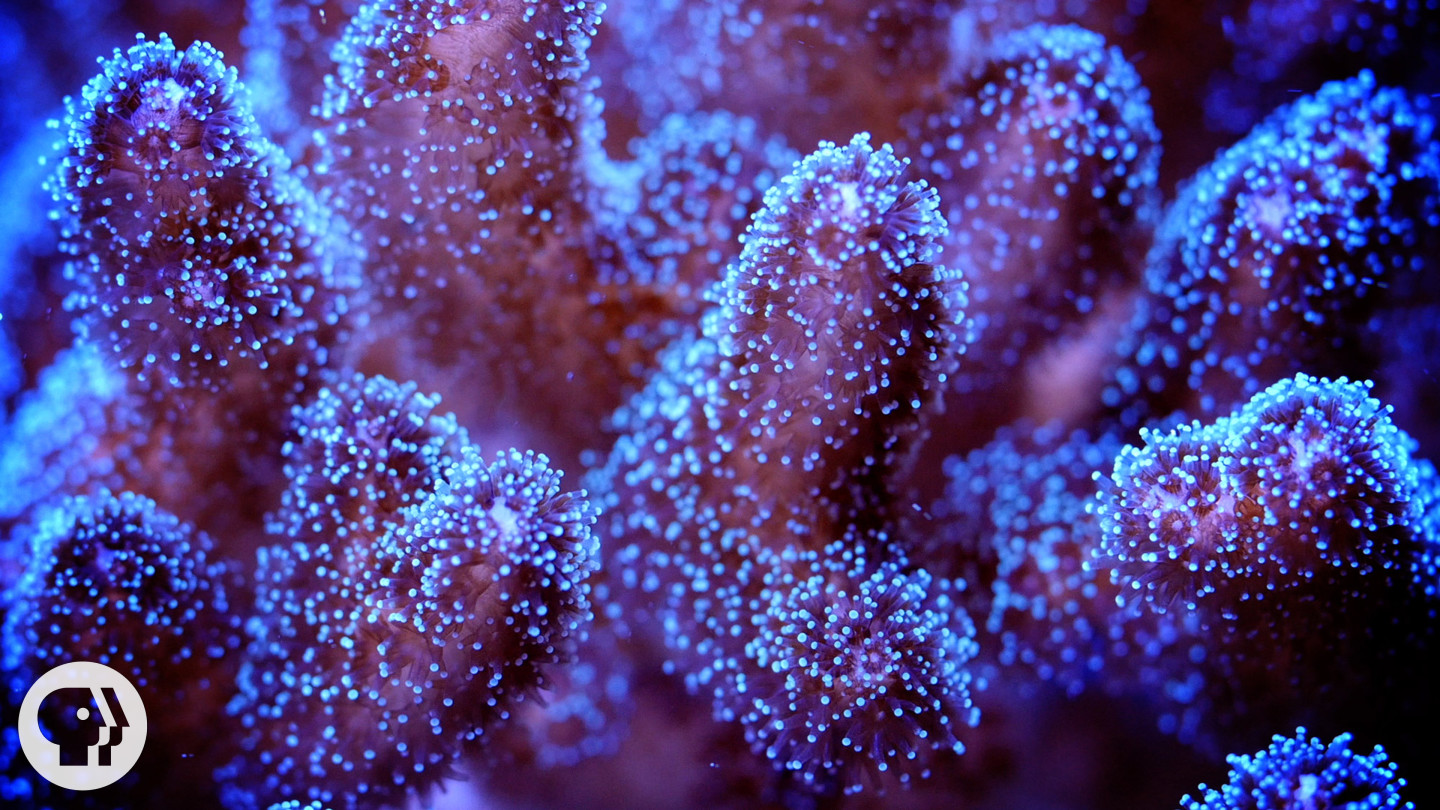
"content": "\u003cp>[dl_subscribe]Have you ever wondered what the weather was like the day Hamlet premiered? Or what about the week that Spanish explorer Gaspar de Portola and his crew became the first Europeans to lay eyes on San Francisco Bay?\u003c/p>\n\u003cp>Neil Tangri is developing a new way to look for clues about ancient weather. He and his colleagues at the \u003ca href=\"https://www6.slac.stanford.edu/\">Stanford Linear Accelerator Center\u003c/a>, also known as SLAC, are using a synchrotron – one of the world’s most powerful X-ray machines – to look deep inside coral skeletons.\u003c/p>\n\u003cp>“We’re trying to get a sense of long term behavior of ocean temperature and precipitation,” Tangri says.\u003c/p>\n\u003cp>Corals are unusual creatures. Tiny animals called polyps form an exoskeleton to live in. When one polyp dies, another builds a new home from calcium carbonate right on top of the old one. Beneath lies the abandoned exoskeletons, like an ancient city made of layer upon layer of old dwellings.\u003c/p>\n\u003cp>The coral that Tangri and his colleagues are taking X-rays of is \u003ca href=\"http://coral.aims.gov.au/factsheet.jsp?speciesCode=0320\">Porites lutea\u003c/a> from American Samoa. In the wild, these helmet-looking coral grow to be very large and very old. The samples that Tangri is imaging are only about 15 inches long, but the original core is 18 feet long and nearly 500 years old.\u003c/p>\n\u003cfigure id=\"attachment_102042\" class=\"wp-caption aligncenter\" style=\"max-width: 640px\">\u003ca href=\"http://ww2.kqed.org/science/wp-content/uploads/sites/35/2015/07/DrDunbarSampling.jpg\">\u003cimg loading=\"lazy\" decoding=\"async\" class=\"size-large wp-image-102042\" src=\"http://ww2.kqed.org/science/wp-content/uploads/sites/35/2015/07/DrDunbarSampling-1440x810.jpg\" alt=\"Researchers taking a core sample from a mature Porites lutea coral in American Samoa. \" width=\"640\" height=\"360\" srcset=\"https://cdn.kqed.org/wp-content/uploads/sites/35/2015/07/DrDunbarSampling-1440x810.jpg 1440w, https://cdn.kqed.org/wp-content/uploads/sites/35/2015/07/DrDunbarSampling-400x225.jpg 400w, https://cdn.kqed.org/wp-content/uploads/sites/35/2015/07/DrDunbarSampling-800x450.jpg 800w, https://cdn.kqed.org/wp-content/uploads/sites/35/2015/07/DrDunbarSampling-1180x664.jpg 1180w, https://cdn.kqed.org/wp-content/uploads/sites/35/2015/07/DrDunbarSampling-960x540.jpg 960w, https://cdn.kqed.org/wp-content/uploads/sites/35/2015/07/DrDunbarSampling.jpg 2000w\" sizes=\"auto, (max-width: 640px) 100vw, 640px\">\u003c/a>\u003cfigcaption class=\"wp-caption-text\">Researchers taking a core sample from a mature Porites lutea coral in American Samoa. \u003ccite>(Dr. Robert B. Dunbar)\u003c/cite>\u003c/figcaption>\u003c/figure>\n\u003cp>Detailed written weather records have only been around for about 150 years. Since Tangri’s coral sample is much older, he can draw conclusions about the weather long before measurements were being written down. More importantly, Tangri can look for patterns in the data that can help them understand complex issues today.\u003c/p>\n\u003cp>[ad fullwidth]\u003c/p>\n\u003cp>Worldwide weather patterns tend to happen in cycles. Take \u003ca href=\"http://www.elnino.noaa.gov/\">El Niño\u003c/a>, California’s sorely missed rain delivery system, which normally occurs every 2 to 7 years. Or the \u003ca href=\"https://www.ncdc.noaa.gov/teleconnections/pdo/\">Pacific Decadal Oscillation\u003c/a>, a similar, but long-term phenomenon which cycles roughly every 25 years and can have major affects on the weather. Combing through old weather data can only get you so far, so scientists are increasingly looking at climate proxies – like corals, tree rings and ice cores – to paint a clearer picture of ancient climate.\u003c/p>\n\u003caside class=\"pullquote aligncenter\">Corals gather an incredible amount of data and we’re just now figuring out how to unlock it.\u003cbr>\n\u003ccite>Neil Tangri, Stanford University\u003c/cite>\u003c/aside>\n\u003cp>To tease out clues, Tangri is taking advantage of a biological quirk in hard corals. Coral exoskeletons are mostly made of calcium carbonate. But sometimes the polyps incorporate tiny amounts of other elements from the surrounding water, including \u003ca href=\"http://periodictable.com/Elements/038/\">strontium\u003c/a>. Biologists don’t fully understand why polyps absorb strontium, but it’s a phenomenon that happens consistently across the world’s oceans.\u003c/p>\n\u003cp>When sea surface temperatures are warmer, corals absorb less strontium into their exoskeletons. When they are colder, they absorb more. By comparing the strontium-to-calcium ratio over time, Tangri and his team are able to reconstruct sea surface temperatures. They also can chart long-term cycles that occurred over the lifespan of the coral.\u003c/p>\n\u003cp>“The advantage of 500-year-old corals is that you can look at many 25-year weather cycles,” Tangri says.\u003c/p>\n\u003cp>“We’re not the first to X-ray corals, but I believe we’re the first to look at strontium-to-calcium ratio within the exoskeleton,” he adds.\u003c/p>\n\u003cp>To be able to look for such tiny chemical changes in the coral, Tangri needed to try a new way of looking coral skeletons.\u003c/p>\n\u003cp>Stanford’s synchrotron works by accelerating particles along a circular track to 99.99% the speed of light. At that speed, electrons whip off of the atoms and form an intense X-ray beam. In fact, it’s one billion times brighter than a hospital X-ray machine. The operation looks like a scene from \u003ca href=\"http://www.imdb.com/title/tt0057012/\">Dr. Strangelove\u003c/a>, and has a distinctly Cold War feeling about it. When Neil and his colleague Apurva Mehta are ready to make a scan, they have to go step-by-step through the arming procedure, which includes shutting a large steel door and two keys, to start the X-ray.\u003c/p>\n\u003cp>The ultra-high resolution of the synchrotron X-ray allows Tangri to see with incredible detail – down to the chemical make up of the exoskeleton.\u003c/p>\n\u003cp>“We have a spatial resolution of about 10 microns,” Tangri says. That means he can see how the coral grew almost down to the week.\u003c/p>\n\u003cp>Tangri’s goal for analyzing corals extends beyond filling in some blanks about ancient weather. He says that he hopes to further refine the imaging process to be able to answer specific questions about weather patterns, like when the monsoons arrive in India. Nearly a billion people there rely on the rain to grow their crops.\u003c/p>\n\u003cp>To find that out, Tangri is looking for an element that indicates precipitation. \u003ca href=\"http://periodictable.com/Elements/056/index.html\">Barium\u003c/a> is commonly found in soils on land. When it rains, soil washes from into the ocean, where the corals absorb some of it into their exoskeletons. If there’s a significant rise in barium, it can indicate when it rained a lot – like a monsoon. He has already been able to chart the arrival of the monsoons in East Africa from another sample taken near Kenya.\u003c/p>\n\u003cp>\u003c/p>\n\u003cp>“Corals gather an incredible amount of data and we’re just now figuring out how to unlock it,” Tangri says.\u003c/p>\n\n",
"blocks": [],
"excerpt": "Some corals look like undersea gardens, gently blowing in the breeze. Others look like alien brains. But in their skeletons are clues that promise to give scientists a detailed picture of the weather from 500 years ago. Reading these bones? Easy. As long as you have the world's most powerful X-ray laser.",
"status": "publish",
"parent": 0,
"modified": 1738715120,
"stats": {
"hasAudio": false,
"hasVideo": false,
"hasChartOrMap": false,
"iframeSrcs": [],
"hasGoogleForm": false,
"hasGallery": false,
"hasHearkenModule": false,
"hasPolis": false,
"paragraphCount": 20,
"wordCount": 924
},
"headData": {
"title": "What Happens When You Zap Coral With The World's Most Powerful X-ray Laser? | KQED",
"description": "Some corals look like undersea gardens, gently blowing in the breeze. Others look like alien brains. But in their skeletons are clues that promise to give scientists a detailed picture of the weather from 500 years ago. Reading these bones? Easy. As long as you have the world's most powerful X-ray laser.",
"ogTitle": "",
"ogDescription": "",
"ogImgId": "",
"twTitle": "",
"twDescription": "",
"twImgId": "",
"schema": {
"@context": "https://schema.org",
"@type": "Article",
"headline": "What Happens When You Zap Coral With The World's Most Powerful X-ray Laser?",
"datePublished": "2015-07-07T12:00:21-07:00",
"dateModified": "2025-02-04T16:25:20-08:00",
"image": "https://cdn.kqed.org/wp-content/uploads/2020/02/KQED-OG-Image@1x.png"
}
},
"videoEmbed": "https://www.youtube.com/watch?v=aXmCU6IYnsA",
"pbsMediaId": "2365687924",
"source": "Deep Look",
"sourceUrl": "https://ww2.kqed.org/science/series/deep-look/",
"sticky": false,
"excludeFromSiteSearch": "Include",
"articleAge": "0",
"path": "/science/99894/what-happens-when-you-zap-coral-with-the-worlds-most-powerful-x-ray-laser",
"audioTrackLength": null,
"parsedContent": [
{
"type": "contentString",
"content": "\u003cdiv class=\"post-body\">\u003cp>\u003cp>\u003c/p>\u003c/div>",
"attributes": {
"named": {},
"numeric": []
}
},
{
"type": "component",
"content": "",
"name": "dl_subscribe",
"attributes": {
"named": {
"label": ""
},
"numeric": []
}
},
{
"type": "contentString",
"content": "\u003cdiv class=\"post-body\">\u003cp>Have you ever wondered what the weather was like the day Hamlet premiered? Or what about the week that Spanish explorer Gaspar de Portola and his crew became the first Europeans to lay eyes on San Francisco Bay?\u003c/p>\n\u003cp>Neil Tangri is developing a new way to look for clues about ancient weather. He and his colleagues at the \u003ca href=\"https://www6.slac.stanford.edu/\">Stanford Linear Accelerator Center\u003c/a>, also known as SLAC, are using a synchrotron – one of the world’s most powerful X-ray machines – to look deep inside coral skeletons.\u003c/p>\n\u003cp>“We’re trying to get a sense of long term behavior of ocean temperature and precipitation,” Tangri says.\u003c/p>\n\u003cp>Corals are unusual creatures. Tiny animals called polyps form an exoskeleton to live in. When one polyp dies, another builds a new home from calcium carbonate right on top of the old one. Beneath lies the abandoned exoskeletons, like an ancient city made of layer upon layer of old dwellings.\u003c/p>\n\u003cp>The coral that Tangri and his colleagues are taking X-rays of is \u003ca href=\"http://coral.aims.gov.au/factsheet.jsp?speciesCode=0320\">Porites lutea\u003c/a> from American Samoa. In the wild, these helmet-looking coral grow to be very large and very old. The samples that Tangri is imaging are only about 15 inches long, but the original core is 18 feet long and nearly 500 years old.\u003c/p>\n\u003cfigure id=\"attachment_102042\" class=\"wp-caption aligncenter\" style=\"max-width: 640px\">\u003ca href=\"http://ww2.kqed.org/science/wp-content/uploads/sites/35/2015/07/DrDunbarSampling.jpg\">\u003cimg loading=\"lazy\" decoding=\"async\" class=\"size-large wp-image-102042\" src=\"http://ww2.kqed.org/science/wp-content/uploads/sites/35/2015/07/DrDunbarSampling-1440x810.jpg\" alt=\"Researchers taking a core sample from a mature Porites lutea coral in American Samoa. \" width=\"640\" height=\"360\" srcset=\"https://cdn.kqed.org/wp-content/uploads/sites/35/2015/07/DrDunbarSampling-1440x810.jpg 1440w, https://cdn.kqed.org/wp-content/uploads/sites/35/2015/07/DrDunbarSampling-400x225.jpg 400w, https://cdn.kqed.org/wp-content/uploads/sites/35/2015/07/DrDunbarSampling-800x450.jpg 800w, https://cdn.kqed.org/wp-content/uploads/sites/35/2015/07/DrDunbarSampling-1180x664.jpg 1180w, https://cdn.kqed.org/wp-content/uploads/sites/35/2015/07/DrDunbarSampling-960x540.jpg 960w, https://cdn.kqed.org/wp-content/uploads/sites/35/2015/07/DrDunbarSampling.jpg 2000w\" sizes=\"auto, (max-width: 640px) 100vw, 640px\">\u003c/a>\u003cfigcaption class=\"wp-caption-text\">Researchers taking a core sample from a mature Porites lutea coral in American Samoa. \u003ccite>(Dr. Robert B. Dunbar)\u003c/cite>\u003c/figcaption>\u003c/figure>\n\u003cp>Detailed written weather records have only been around for about 150 years. Since Tangri’s coral sample is much older, he can draw conclusions about the weather long before measurements were being written down. More importantly, Tangri can look for patterns in the data that can help them understand complex issues today.\u003c/p>\n\u003cp>\u003c/p>\u003c/div>",
"attributes": {
"named": {},
"numeric": []
}
},
{
"type": "component",
"content": "",
"name": "ad",
"attributes": {
"named": {
"label": "fullwidth"
},
"numeric": [
"fullwidth"
]
}
},
{
"type": "contentString",
"content": "\u003cdiv class=\"post-body\">\u003cp>\u003c/p>\n\u003cp>Worldwide weather patterns tend to happen in cycles. Take \u003ca href=\"http://www.elnino.noaa.gov/\">El Niño\u003c/a>, California’s sorely missed rain delivery system, which normally occurs every 2 to 7 years. Or the \u003ca href=\"https://www.ncdc.noaa.gov/teleconnections/pdo/\">Pacific Decadal Oscillation\u003c/a>, a similar, but long-term phenomenon which cycles roughly every 25 years and can have major affects on the weather. Combing through old weather data can only get you so far, so scientists are increasingly looking at climate proxies – like corals, tree rings and ice cores – to paint a clearer picture of ancient climate.\u003c/p>\n\u003caside class=\"pullquote aligncenter\">Corals gather an incredible amount of data and we’re just now figuring out how to unlock it.\u003cbr>\n\u003ccite>Neil Tangri, Stanford University\u003c/cite>\u003c/aside>\n\u003cp>To tease out clues, Tangri is taking advantage of a biological quirk in hard corals. Coral exoskeletons are mostly made of calcium carbonate. But sometimes the polyps incorporate tiny amounts of other elements from the surrounding water, including \u003ca href=\"http://periodictable.com/Elements/038/\">strontium\u003c/a>. Biologists don’t fully understand why polyps absorb strontium, but it’s a phenomenon that happens consistently across the world’s oceans.\u003c/p>\n\u003cp>When sea surface temperatures are warmer, corals absorb less strontium into their exoskeletons. When they are colder, they absorb more. By comparing the strontium-to-calcium ratio over time, Tangri and his team are able to reconstruct sea surface temperatures. They also can chart long-term cycles that occurred over the lifespan of the coral.\u003c/p>\n\u003cp>“The advantage of 500-year-old corals is that you can look at many 25-year weather cycles,” Tangri says.\u003c/p>\n\u003cp>“We’re not the first to X-ray corals, but I believe we’re the first to look at strontium-to-calcium ratio within the exoskeleton,” he adds.\u003c/p>\n\u003cp>To be able to look for such tiny chemical changes in the coral, Tangri needed to try a new way of looking coral skeletons.\u003c/p>\n\u003cp>Stanford’s synchrotron works by accelerating particles along a circular track to 99.99% the speed of light. At that speed, electrons whip off of the atoms and form an intense X-ray beam. In fact, it’s one billion times brighter than a hospital X-ray machine. The operation looks like a scene from \u003ca href=\"http://www.imdb.com/title/tt0057012/\">Dr. Strangelove\u003c/a>, and has a distinctly Cold War feeling about it. When Neil and his colleague Apurva Mehta are ready to make a scan, they have to go step-by-step through the arming procedure, which includes shutting a large steel door and two keys, to start the X-ray.\u003c/p>\n\u003cp>The ultra-high resolution of the synchrotron X-ray allows Tangri to see with incredible detail – down to the chemical make up of the exoskeleton.\u003c/p>\n\u003cp>“We have a spatial resolution of about 10 microns,” Tangri says. That means he can see how the coral grew almost down to the week.\u003c/p>\n\u003cp>Tangri’s goal for analyzing corals extends beyond filling in some blanks about ancient weather. He says that he hopes to further refine the imaging process to be able to answer specific questions about weather patterns, like when the monsoons arrive in India. Nearly a billion people there rely on the rain to grow their crops.\u003c/p>\n\u003cp>To find that out, Tangri is looking for an element that indicates precipitation. \u003ca href=\"http://periodictable.com/Elements/056/index.html\">Barium\u003c/a> is commonly found in soils on land. When it rains, soil washes from into the ocean, where the corals absorb some of it into their exoskeletons. If there’s a significant rise in barium, it can indicate when it rained a lot – like a monsoon. He has already been able to chart the arrival of the monsoons in East Africa from another sample taken near Kenya.\u003c/p>\n\u003cp>\u003c/p>\n\u003cp>“Corals gather an incredible amount of data and we’re just now figuring out how to unlock it,” Tangri says.\u003c/p>\n\n\u003c/div>\u003c/p>",
"attributes": {
"named": {},
"numeric": []
}
}
],
"link": "/science/99894/what-happens-when-you-zap-coral-with-the-worlds-most-powerful-x-ray-laser",
"authors": [
"100310"
],
"series": [
"science_1935"
],
"categories": [
"science_30",
"science_31",
"science_86",
"science_98"
],
"tags": [
"science_182",
"science_1003",
"science_365"
],
"featImg": "science_100208",
"label": "source_science_99894"
},
"science_73151": {
"type": "posts",
"id": "science_73151",
"meta": {
"index": "posts_1716263798",
"site": "science",
"id": "73151",
"score": null,
"sort": [
1435261504000
]
},
"guestAuthors": [],
"slug": "these-resurrection-plants-spring-back-to-life-in-seconds",
"title": "These 'Resurrection Plants' Spring Back to Life in Seconds",
"publishDate": 1435261504,
"format": "video",
"headTitle": "These ‘Resurrection Plants’ Spring Back to Life in Seconds | KQED",
"labelTerm": {},
"content": "\u003cp>[dl_subscribe]California’s drought has sent researchers, policymakers, and farmers looking for water in farfetched places. They’re giving away\u003ca href=\"http://ww2.kqed.org/news/2014/09/08/recycled-waste-water-program-keeps-east-bay-gardens-alive\"> recycled wastewater\u003c/a>. They’ve pumped \u003ca href=\"http://science.kqed.org/quest/audio/how-flooding-fields-could-alleviate-water-supply-stress/\">deeper and deeper underground\u003c/a>. They’ve even refined a technique to try to \u003ca href=\"http://science.kqed.org/quest/audio/in-dry-year-california-looks-to-cloud-seeding/\">squeeze rain out of the clouds\u003c/a>. But what if they could harness the power of tiny mosses that can survive for decades without a single drop of water?\u003c/p>\n\u003cp>Such mosses do exist and many of them are hidden in plain sight in California.\u003c/p>\n\u003cfigure id=\"attachment_73250\" class=\"wp-caption alignleft\" style=\"max-width: 800px\">\u003ca href=\"http://ww2.kqed.org/science/wp-content/uploads/sites/35/2015/06/Caleb_Caswell-Levy_resized.jpg\">\u003cimg loading=\"lazy\" decoding=\"async\" class=\"size-medium wp-image-73250\" src=\"http://ww2.kqed.org/science/wp-content/uploads/sites/35/2015/06/Caleb_Caswell-Levy_resized-800x450.jpg\" alt=\"Biologist Caleb Caswell-Levy uses a hand lens to identify tiny mosses on a tree in Berkeley, California.\" width=\"800\" height=\"450\" srcset=\"https://cdn.kqed.org/wp-content/uploads/sites/35/2015/06/Caleb_Caswell-Levy_resized-800x450.jpg 800w, https://cdn.kqed.org/wp-content/uploads/sites/35/2015/06/Caleb_Caswell-Levy_resized-400x225.jpg 400w, https://cdn.kqed.org/wp-content/uploads/sites/35/2015/06/Caleb_Caswell-Levy_resized-1440x810.jpg 1440w, https://cdn.kqed.org/wp-content/uploads/sites/35/2015/06/Caleb_Caswell-Levy_resized-1180x664.jpg 1180w, https://cdn.kqed.org/wp-content/uploads/sites/35/2015/06/Caleb_Caswell-Levy_resized-960x540.jpg 960w, https://cdn.kqed.org/wp-content/uploads/sites/35/2015/06/Caleb_Caswell-Levy_resized.jpg 1920w\" sizes=\"auto, (max-width: 800px) 100vw, 800px\">\u003c/a>\u003cfigcaption class=\"wp-caption-text\">Biologist Caleb Caswell-Levy uses a hand lens to identify tiny mosses on a tree in Berkeley, California. \u003ccite>(Gabriela Quirós/KQED Science)\u003c/cite>\u003c/figcaption>\u003c/figure>\n\u003cp>Biologist Caleb Caswell-Levy, a doctoral student at the University of California, Berkeley, carries a small hand lens as he walks among the trees in Strawberry Canyon, near campus. Every so often, he leans his lens –which looks like a monocle– against a tree and examines a brownish, dried-up clump stuck to its bark.\u003c/p>\n\u003cp>He spritzes some water on a clump and in seconds its leaves, curled up like a corkscrew, unfurl. A look under the microscope reveals bright green leaves arranged as a tiny star. It’s a moss belonging to a group called Tortula. (You can watch Tortula mosses unfurl at 0:49 and 1:09 in the video above).\u003c/p>\n\u003ch3>Plants that live without water\u003c/h3>\n\u003cfigure id=\"attachment_73254\" class=\"wp-caption alignright\" style=\"max-width: 800px\">\u003ca href=\"http://ww2.kqed.org/science/wp-content/uploads/sites/35/2015/06/Tortula-princeps-unfurling-CU_resized2.jpg\">\u003cimg loading=\"lazy\" decoding=\"async\" class=\"size-medium wp-image-73254\" src=\"http://ww2.kqed.org/science/wp-content/uploads/sites/35/2015/06/Tortula-princeps-unfurling-CU_resized2-800x450.jpg\" alt=\"Tortula moss unfurls after being dry for several weeks. \" width=\"800\" height=\"450\" srcset=\"https://cdn.kqed.org/wp-content/uploads/sites/35/2015/06/Tortula-princeps-unfurling-CU_resized2-800x450.jpg 800w, https://cdn.kqed.org/wp-content/uploads/sites/35/2015/06/Tortula-princeps-unfurling-CU_resized2-400x225.jpg 400w, https://cdn.kqed.org/wp-content/uploads/sites/35/2015/06/Tortula-princeps-unfurling-CU_resized2-1440x810.jpg 1440w, https://cdn.kqed.org/wp-content/uploads/sites/35/2015/06/Tortula-princeps-unfurling-CU_resized2-1180x664.jpg 1180w, https://cdn.kqed.org/wp-content/uploads/sites/35/2015/06/Tortula-princeps-unfurling-CU_resized2-960x540.jpg 960w, https://cdn.kqed.org/wp-content/uploads/sites/35/2015/06/Tortula-princeps-unfurling-CU_resized2.jpg 1920w\" sizes=\"auto, (max-width: 800px) 100vw, 800px\">\u003c/a>\u003cfigcaption class=\"wp-caption-text\">Tortula moss unfurls after being dry for several weeks. \u003ccite>(Josh Cassidy/KQED Science)\u003c/cite>\u003c/figcaption>\u003c/figure>\n\u003cfigure id=\"attachment_73248\" class=\"wp-caption alignright\" style=\"max-width: 800px\">\u003ca href=\"http://ww2.kqed.org/science/wp-content/uploads/sites/35/2015/06/Tortula-ruralis_Brent_Mishler_resized_2.jpg\">\u003cimg loading=\"lazy\" decoding=\"async\" class=\"size-medium wp-image-73248\" src=\"http://ww2.kqed.org/science/wp-content/uploads/sites/35/2015/06/Tortula-ruralis_Brent_Mishler_resized_2-800x450.jpg\" alt=\"Genes in Tortula mosses like these could help crops rebound after a dry spell. \" width=\"800\" height=\"450\" srcset=\"https://cdn.kqed.org/wp-content/uploads/sites/35/2015/06/Tortula-ruralis_Brent_Mishler_resized_2-800x450.jpg 800w, https://cdn.kqed.org/wp-content/uploads/sites/35/2015/06/Tortula-ruralis_Brent_Mishler_resized_2-400x225.jpg 400w, https://cdn.kqed.org/wp-content/uploads/sites/35/2015/06/Tortula-ruralis_Brent_Mishler_resized_2-1440x810.jpg 1440w, https://cdn.kqed.org/wp-content/uploads/sites/35/2015/06/Tortula-ruralis_Brent_Mishler_resized_2-1180x664.jpg 1180w, https://cdn.kqed.org/wp-content/uploads/sites/35/2015/06/Tortula-ruralis_Brent_Mishler_resized_2-960x540.jpg 960w, https://cdn.kqed.org/wp-content/uploads/sites/35/2015/06/Tortula-ruralis_Brent_Mishler_resized_2.jpg 1920w\" sizes=\"auto, (max-width: 800px) 100vw, 800px\">\u003c/a>\u003cfigcaption class=\"wp-caption-text\">Genes in Tortula mosses like these could help crops rebound after a dry spell. \u003ccite>(Brent Mishler/University of California, Berkeley)\u003c/cite>\u003c/figcaption>\u003c/figure>\n\u003cp>These mosses’ unique ability to survive months, or even years, without water and then spring back to life when it rains has led scientists at UC Berkeley and around the country to study them carefully. Researchers call them “resurrection plants.” They hope to use their genes to create crops that could survive dry periods, like California’s current historic drought, with minimal water.\u003c/p>\n\u003cp>[ad fullwidth]\u003c/p>\n\u003cp>These mosses dry out so completely that it’s as if they had been placed in an oven, said \u003ca href=\"http://ucjeps.berkeley.edu/people/mishler.html\">Brent Mishler\u003c/a>, who directs the \u003ca href=\"http://ucjeps.berkeley.edu/\">University and Jepson Herbaria\u003c/a> at UC Berkeley and \u003ca href=\"http://ucjeps.berkeley.edu/bryolab/Bryolab.html\">the lab where Caswell-Levy studies\u003c/a>.\u003c/p>\n\u003cp>“Isn’t it amazing?” said Mishler. “We humans die without water way before we completely dry out.”\u003c/p>\n\u003cp>When there’s no rain, Tortula mosses dry out completely and stop photosynthesizing. That is, they stop using carbon dioxide and the light of the sun to grow. They’re virtually dead, reduced to a pile of chemicals, and can stay that way for years. Researchers have found dry, 100-year-old moss samples in a museum that came back to life when water was added.\u003c/p>\n\u003cp>These mosses are very good at repairing their damaged cells, and that’s a skill that would serve crops well, experts say. Right before they dry out, the mosses write themselves a set of genetic instructions, so that if they ever get water again they can start growing right away. Their ability to prepare themselves beforehand and repair themselves after a dry spell reminds Mishler of what humans do to prepare for natural disasters.\u003c/p>\n\u003cfigure id=\"attachment_73355\" class=\"wp-caption alignright\" style=\"max-width: 800px\">\u003ca href=\"http://ww2.kqed.org/science/wp-content/uploads/sites/35/2015/06/Brent_Mishler_1_resized.jpg\">\u003cimg loading=\"lazy\" decoding=\"async\" class=\"size-medium wp-image-73355\" src=\"http://ww2.kqed.org/science/wp-content/uploads/sites/35/2015/06/Brent_Mishler_1_resized-800x450.jpg\" alt=\"Brent Mishler examines a moss sample under the microscope at the University of California, Berkeley. He studies mosses that have the ability to live without water for decades and spring back to life when it rains. \" width=\"800\" height=\"450\" srcset=\"https://cdn.kqed.org/wp-content/uploads/sites/35/2015/06/Brent_Mishler_1_resized-800x450.jpg 800w, https://cdn.kqed.org/wp-content/uploads/sites/35/2015/06/Brent_Mishler_1_resized-400x225.jpg 400w, https://cdn.kqed.org/wp-content/uploads/sites/35/2015/06/Brent_Mishler_1_resized-1440x810.jpg 1440w, https://cdn.kqed.org/wp-content/uploads/sites/35/2015/06/Brent_Mishler_1_resized-1180x664.jpg 1180w, https://cdn.kqed.org/wp-content/uploads/sites/35/2015/06/Brent_Mishler_1_resized-960x540.jpg 960w, https://cdn.kqed.org/wp-content/uploads/sites/35/2015/06/Brent_Mishler_1_resized.jpg 1920w\" sizes=\"auto, (max-width: 800px) 100vw, 800px\">\u003c/a>\u003cfigcaption class=\"wp-caption-text\">Brent Mishler examines a moss sample under the microscope at the University of California, Berkeley. He studies mosses that have the ability to live without water for decades and spring back to life when it rains. \u003ccite>(Gabriela Quirós/KQED Science)\u003c/cite>\u003c/figcaption>\u003c/figure>\n\u003cp>“If people know there’s a hurricane coming, there are things they can do to prepare ahead of time, like boarding up the windows,” said Mishler. “But you also have to be able to survive after the storm and fix any damage, so you buy disaster supplies ahead of time. The moss likewise tries both to limit the damage during drying and does other things to repair itself upon rewetting.”\u003c/p>\n\u003ch3>Trying to make crops that can survive a drought\u003c/h3>\n\u003cp>\u003ca href=\"http://ipg.missouri.edu/faculty/oliver.cfm\">Mel Oliver\u003c/a>, a research geneticist with the U.S. Department of Agriculture and the University of Missouri, Columbia, has identified close to 80 genes from Tortula that allow the mosses to write genetic instructions and repair themselves. He calls these genes rehydrins.\u003c/p>\n\u003cp>“We have some very good gene candidates,” said Oliver. “By studying how the moss handles losing water and how it repairs damage, if we can understand those processes, we can look at new ways to improve drought tolerance in crops.”\u003c/p>\n\u003cp>Researchers have looked inside the crops themselves to see if they don’t already contain some of these moss genes, left over from 450 million years ago, when a common ancestor of mosses and crop plants moved onto land and acquired the ability to live without water.\u003c/p>\n\u003caside class=\"pullquote alignright\">“By studying how the moss handles losing water and how it repairs damage, if we can understand those processes, we can look at new ways to improve drought tolerance in crops.”\u003cbr>\n\u003ccite>Mel Oliver, U.S. Department of Agriculture and University of Missouri, Columbia\u003c/cite>\u003c/aside>\n\u003cp>But using moss genes to make crop plants better able to survive dry spells is a big challenge, in part because this ability comes not from a single gene, but likely from a group of genes, said Mishler.\u003c/p>\n\u003cp>Another challenge is balancing drought-protection with the need for high yield. It turns out that there really is no free lunch: mosses’ useful ability to live without water makes it hard for them to grow very big.\u003c/p>\n\u003cp>“What happens in evolution is trade-offs,” said Mishler. “If you do one thing well, you can’t do another. It’s hard for one organism to be able to do everything.”\u003c/p>\n\u003cp>The cellular mechanism that a plant needs in order to live without water slows down its productivity, measured by the amount of new green tissue a plant can grow. That’s why many plants shed their ability to live without water in favor of an increased ability to grow big.\u003c/p>\n\u003cfigure id=\"attachment_73360\" class=\"wp-caption alignleft\" style=\"max-width: 800px\">\u003ca href=\"http://ww2.kqed.org/science/wp-content/uploads/sites/35/2015/06/Orthotricum-dried-out_resized.jpg\">\u003cimg loading=\"lazy\" decoding=\"async\" class=\"size-medium wp-image-73360\" src=\"http://ww2.kqed.org/science/wp-content/uploads/sites/35/2015/06/Orthotricum-dried-out_resized-800x450.jpg\" alt=\"When there’s no rain, mosses like this Orthotricum dry out completely and stop photosynthesizing. \" width=\"800\" height=\"450\" srcset=\"https://cdn.kqed.org/wp-content/uploads/sites/35/2015/06/Orthotricum-dried-out_resized-800x450.jpg 800w, https://cdn.kqed.org/wp-content/uploads/sites/35/2015/06/Orthotricum-dried-out_resized-400x225.jpg 400w, https://cdn.kqed.org/wp-content/uploads/sites/35/2015/06/Orthotricum-dried-out_resized-1440x810.jpg 1440w, https://cdn.kqed.org/wp-content/uploads/sites/35/2015/06/Orthotricum-dried-out_resized-1180x664.jpg 1180w, https://cdn.kqed.org/wp-content/uploads/sites/35/2015/06/Orthotricum-dried-out_resized-960x540.jpg 960w, https://cdn.kqed.org/wp-content/uploads/sites/35/2015/06/Orthotricum-dried-out_resized.jpg 1920w\" sizes=\"auto, (max-width: 800px) 100vw, 800px\">\u003c/a>\u003cfigcaption class=\"wp-caption-text\">When there’s no rain, mosses like this Orthotricum dry out completely and stop photosynthesizing. \u003ccite>(Josh Cassidy/KQED Science)\u003c/cite>\u003c/figcaption>\u003c/figure>\n\u003cfigure id=\"attachment_73362\" class=\"wp-caption alignleft\" style=\"max-width: 800px\">\u003ca href=\"http://ww2.kqed.org/science/wp-content/uploads/sites/35/2015/06/Orthotricum-rewetted-1_resized.jpg\">\u003cimg loading=\"lazy\" decoding=\"async\" class=\"size-medium wp-image-73362\" src=\"http://ww2.kqed.org/science/wp-content/uploads/sites/35/2015/06/Orthotricum-rewetted-1_resized-800x450.jpg\" alt=\"Mosses, such as this Orthotricum, don’t have roots to transport water. Instead, moss’ porous cells absorb water like a sponge whenever it’s available. \" width=\"800\" height=\"450\" srcset=\"https://cdn.kqed.org/wp-content/uploads/sites/35/2015/06/Orthotricum-rewetted-1_resized-800x450.jpg 800w, https://cdn.kqed.org/wp-content/uploads/sites/35/2015/06/Orthotricum-rewetted-1_resized-400x225.jpg 400w, https://cdn.kqed.org/wp-content/uploads/sites/35/2015/06/Orthotricum-rewetted-1_resized-1440x810.jpg 1440w, https://cdn.kqed.org/wp-content/uploads/sites/35/2015/06/Orthotricum-rewetted-1_resized-1180x664.jpg 1180w, https://cdn.kqed.org/wp-content/uploads/sites/35/2015/06/Orthotricum-rewetted-1_resized-960x540.jpg 960w, https://cdn.kqed.org/wp-content/uploads/sites/35/2015/06/Orthotricum-rewetted-1_resized.jpg 1920w\" sizes=\"auto, (max-width: 800px) 100vw, 800px\">\u003c/a>\u003cfigcaption class=\"wp-caption-text\">Mosses, such as this Orthotricum, don’t have roots to transport water. Instead, moss’ porous cells absorb water like a sponge whenever it’s available. \u003ccite>(Josh Cassidy/KQED Science)\u003c/cite>\u003c/figcaption>\u003c/figure>\n\u003cp>“Productivity is a good thing in evolution,” said Mishler. “The plants that grow faster outgrow the ones that grow slower.”\u003c/p>\n\u003cp>Plants that can hold water inside their bodies are able to grow big. So if you try to make a crop plant more like a moss its yield will decrease. That’s why researchers’ goal isn’t to make a crop that can live entirely without water, like a moss, but rather a plant that could repair itself after a dry period, even if some yield were lost in the process, said Oliver.\u003c/p>\n\u003cp>[ad floatright]\u003c/p>\n\u003cp>“We’d hope that the plants would at least survive severe droughts,” he said. “The idea would be to get the crops to recover as fast as possible so that they can get back to generating biomass or seeds as quickly as possible.”\u003c/p>\n\n",
"blocks": [],
"excerpt": "Scientists say the genes in these “resurrection plants” could one day protect crops from drought.",
"status": "publish",
"parent": 0,
"modified": 1738715027,
"stats": {
"hasAudio": false,
"hasVideo": false,
"hasChartOrMap": false,
"iframeSrcs": [],
"hasGoogleForm": false,
"hasGallery": false,
"hasHearkenModule": false,
"hasPolis": false,
"paragraphCount": 22,
"wordCount": 1208
},
"headData": {
"title": "These 'Resurrection Plants' Spring Back to Life in Seconds | KQED",
"description": "Scientists say the genes in these “resurrection plants” could one day protect crops from drought.",
"ogTitle": "",
"ogDescription": "",
"ogImgId": "",
"twTitle": "",
"twDescription": "",
"twImgId": "",
"schema": {
"@context": "https://schema.org",
"@type": "Article",
"headline": "These 'Resurrection Plants' Spring Back to Life in Seconds",
"datePublished": "2015-06-25T12:45:04-07:00",
"dateModified": "2025-02-04T16:23:47-08:00",
"image": "https://cdn.kqed.org/wp-content/uploads/2020/02/KQED-OG-Image@1x.png"
}
},
"videoEmbed": "https://www.youtube.com/watch?v=eoFGKlZMo2g",
"pbsMediaId": "2365687860",
"source": "Deep Look",
"sticky": false,
"excludeFromSiteSearch": "Include",
"articleAge": "0",
"path": "/science/73151/these-resurrection-plants-spring-back-to-life-in-seconds",
"audioTrackLength": null,
"parsedContent": [
{
"type": "contentString",
"content": "\u003cdiv class=\"post-body\">\u003cp>\u003cp>\u003c/p>\u003c/div>",
"attributes": {
"named": {},
"numeric": []
}
},
{
"type": "component",
"content": "",
"name": "dl_subscribe",
"attributes": {
"named": {
"label": ""
},
"numeric": []
}
},
{
"type": "contentString",
"content": "\u003cdiv class=\"post-body\">\u003cp>California’s drought has sent researchers, policymakers, and farmers looking for water in farfetched places. They’re giving away\u003ca href=\"http://ww2.kqed.org/news/2014/09/08/recycled-waste-water-program-keeps-east-bay-gardens-alive\"> recycled wastewater\u003c/a>. They’ve pumped \u003ca href=\"http://science.kqed.org/quest/audio/how-flooding-fields-could-alleviate-water-supply-stress/\">deeper and deeper underground\u003c/a>. They’ve even refined a technique to try to \u003ca href=\"http://science.kqed.org/quest/audio/in-dry-year-california-looks-to-cloud-seeding/\">squeeze rain out of the clouds\u003c/a>. But what if they could harness the power of tiny mosses that can survive for decades without a single drop of water?\u003c/p>\n\u003cp>Such mosses do exist and many of them are hidden in plain sight in California.\u003c/p>\n\u003cfigure id=\"attachment_73250\" class=\"wp-caption alignleft\" style=\"max-width: 800px\">\u003ca href=\"http://ww2.kqed.org/science/wp-content/uploads/sites/35/2015/06/Caleb_Caswell-Levy_resized.jpg\">\u003cimg loading=\"lazy\" decoding=\"async\" class=\"size-medium wp-image-73250\" src=\"http://ww2.kqed.org/science/wp-content/uploads/sites/35/2015/06/Caleb_Caswell-Levy_resized-800x450.jpg\" alt=\"Biologist Caleb Caswell-Levy uses a hand lens to identify tiny mosses on a tree in Berkeley, California.\" width=\"800\" height=\"450\" srcset=\"https://cdn.kqed.org/wp-content/uploads/sites/35/2015/06/Caleb_Caswell-Levy_resized-800x450.jpg 800w, https://cdn.kqed.org/wp-content/uploads/sites/35/2015/06/Caleb_Caswell-Levy_resized-400x225.jpg 400w, https://cdn.kqed.org/wp-content/uploads/sites/35/2015/06/Caleb_Caswell-Levy_resized-1440x810.jpg 1440w, https://cdn.kqed.org/wp-content/uploads/sites/35/2015/06/Caleb_Caswell-Levy_resized-1180x664.jpg 1180w, https://cdn.kqed.org/wp-content/uploads/sites/35/2015/06/Caleb_Caswell-Levy_resized-960x540.jpg 960w, https://cdn.kqed.org/wp-content/uploads/sites/35/2015/06/Caleb_Caswell-Levy_resized.jpg 1920w\" sizes=\"auto, (max-width: 800px) 100vw, 800px\">\u003c/a>\u003cfigcaption class=\"wp-caption-text\">Biologist Caleb Caswell-Levy uses a hand lens to identify tiny mosses on a tree in Berkeley, California. \u003ccite>(Gabriela Quirós/KQED Science)\u003c/cite>\u003c/figcaption>\u003c/figure>\n\u003cp>Biologist Caleb Caswell-Levy, a doctoral student at the University of California, Berkeley, carries a small hand lens as he walks among the trees in Strawberry Canyon, near campus. Every so often, he leans his lens –which looks like a monocle– against a tree and examines a brownish, dried-up clump stuck to its bark.\u003c/p>\n\u003cp>He spritzes some water on a clump and in seconds its leaves, curled up like a corkscrew, unfurl. A look under the microscope reveals bright green leaves arranged as a tiny star. It’s a moss belonging to a group called Tortula. (You can watch Tortula mosses unfurl at 0:49 and 1:09 in the video above).\u003c/p>\n\u003ch3>Plants that live without water\u003c/h3>\n\u003cfigure id=\"attachment_73254\" class=\"wp-caption alignright\" style=\"max-width: 800px\">\u003ca href=\"http://ww2.kqed.org/science/wp-content/uploads/sites/35/2015/06/Tortula-princeps-unfurling-CU_resized2.jpg\">\u003cimg loading=\"lazy\" decoding=\"async\" class=\"size-medium wp-image-73254\" src=\"http://ww2.kqed.org/science/wp-content/uploads/sites/35/2015/06/Tortula-princeps-unfurling-CU_resized2-800x450.jpg\" alt=\"Tortula moss unfurls after being dry for several weeks. \" width=\"800\" height=\"450\" srcset=\"https://cdn.kqed.org/wp-content/uploads/sites/35/2015/06/Tortula-princeps-unfurling-CU_resized2-800x450.jpg 800w, https://cdn.kqed.org/wp-content/uploads/sites/35/2015/06/Tortula-princeps-unfurling-CU_resized2-400x225.jpg 400w, https://cdn.kqed.org/wp-content/uploads/sites/35/2015/06/Tortula-princeps-unfurling-CU_resized2-1440x810.jpg 1440w, https://cdn.kqed.org/wp-content/uploads/sites/35/2015/06/Tortula-princeps-unfurling-CU_resized2-1180x664.jpg 1180w, https://cdn.kqed.org/wp-content/uploads/sites/35/2015/06/Tortula-princeps-unfurling-CU_resized2-960x540.jpg 960w, https://cdn.kqed.org/wp-content/uploads/sites/35/2015/06/Tortula-princeps-unfurling-CU_resized2.jpg 1920w\" sizes=\"auto, (max-width: 800px) 100vw, 800px\">\u003c/a>\u003cfigcaption class=\"wp-caption-text\">Tortula moss unfurls after being dry for several weeks. \u003ccite>(Josh Cassidy/KQED Science)\u003c/cite>\u003c/figcaption>\u003c/figure>\n\u003cfigure id=\"attachment_73248\" class=\"wp-caption alignright\" style=\"max-width: 800px\">\u003ca href=\"http://ww2.kqed.org/science/wp-content/uploads/sites/35/2015/06/Tortula-ruralis_Brent_Mishler_resized_2.jpg\">\u003cimg loading=\"lazy\" decoding=\"async\" class=\"size-medium wp-image-73248\" src=\"http://ww2.kqed.org/science/wp-content/uploads/sites/35/2015/06/Tortula-ruralis_Brent_Mishler_resized_2-800x450.jpg\" alt=\"Genes in Tortula mosses like these could help crops rebound after a dry spell. \" width=\"800\" height=\"450\" srcset=\"https://cdn.kqed.org/wp-content/uploads/sites/35/2015/06/Tortula-ruralis_Brent_Mishler_resized_2-800x450.jpg 800w, https://cdn.kqed.org/wp-content/uploads/sites/35/2015/06/Tortula-ruralis_Brent_Mishler_resized_2-400x225.jpg 400w, https://cdn.kqed.org/wp-content/uploads/sites/35/2015/06/Tortula-ruralis_Brent_Mishler_resized_2-1440x810.jpg 1440w, https://cdn.kqed.org/wp-content/uploads/sites/35/2015/06/Tortula-ruralis_Brent_Mishler_resized_2-1180x664.jpg 1180w, https://cdn.kqed.org/wp-content/uploads/sites/35/2015/06/Tortula-ruralis_Brent_Mishler_resized_2-960x540.jpg 960w, https://cdn.kqed.org/wp-content/uploads/sites/35/2015/06/Tortula-ruralis_Brent_Mishler_resized_2.jpg 1920w\" sizes=\"auto, (max-width: 800px) 100vw, 800px\">\u003c/a>\u003cfigcaption class=\"wp-caption-text\">Genes in Tortula mosses like these could help crops rebound after a dry spell. \u003ccite>(Brent Mishler/University of California, Berkeley)\u003c/cite>\u003c/figcaption>\u003c/figure>\n\u003cp>These mosses’ unique ability to survive months, or even years, without water and then spring back to life when it rains has led scientists at UC Berkeley and around the country to study them carefully. Researchers call them “resurrection plants.” They hope to use their genes to create crops that could survive dry periods, like California’s current historic drought, with minimal water.\u003c/p>\n\u003cp>\u003c/p>\u003c/div>",
"attributes": {
"named": {},
"numeric": []
}
},
{
"type": "component",
"content": "",
"name": "ad",
"attributes": {
"named": {
"label": "fullwidth"
},
"numeric": [
"fullwidth"
]
}
},
{
"type": "contentString",
"content": "\u003cdiv class=\"post-body\">\u003cp>\u003c/p>\n\u003cp>These mosses dry out so completely that it’s as if they had been placed in an oven, said \u003ca href=\"http://ucjeps.berkeley.edu/people/mishler.html\">Brent Mishler\u003c/a>, who directs the \u003ca href=\"http://ucjeps.berkeley.edu/\">University and Jepson Herbaria\u003c/a> at UC Berkeley and \u003ca href=\"http://ucjeps.berkeley.edu/bryolab/Bryolab.html\">the lab where Caswell-Levy studies\u003c/a>.\u003c/p>\n\u003cp>“Isn’t it amazing?” said Mishler. “We humans die without water way before we completely dry out.”\u003c/p>\n\u003cp>When there’s no rain, Tortula mosses dry out completely and stop photosynthesizing. That is, they stop using carbon dioxide and the light of the sun to grow. They’re virtually dead, reduced to a pile of chemicals, and can stay that way for years. Researchers have found dry, 100-year-old moss samples in a museum that came back to life when water was added.\u003c/p>\n\u003cp>These mosses are very good at repairing their damaged cells, and that’s a skill that would serve crops well, experts say. Right before they dry out, the mosses write themselves a set of genetic instructions, so that if they ever get water again they can start growing right away. Their ability to prepare themselves beforehand and repair themselves after a dry spell reminds Mishler of what humans do to prepare for natural disasters.\u003c/p>\n\u003cfigure id=\"attachment_73355\" class=\"wp-caption alignright\" style=\"max-width: 800px\">\u003ca href=\"http://ww2.kqed.org/science/wp-content/uploads/sites/35/2015/06/Brent_Mishler_1_resized.jpg\">\u003cimg loading=\"lazy\" decoding=\"async\" class=\"size-medium wp-image-73355\" src=\"http://ww2.kqed.org/science/wp-content/uploads/sites/35/2015/06/Brent_Mishler_1_resized-800x450.jpg\" alt=\"Brent Mishler examines a moss sample under the microscope at the University of California, Berkeley. He studies mosses that have the ability to live without water for decades and spring back to life when it rains. \" width=\"800\" height=\"450\" srcset=\"https://cdn.kqed.org/wp-content/uploads/sites/35/2015/06/Brent_Mishler_1_resized-800x450.jpg 800w, https://cdn.kqed.org/wp-content/uploads/sites/35/2015/06/Brent_Mishler_1_resized-400x225.jpg 400w, https://cdn.kqed.org/wp-content/uploads/sites/35/2015/06/Brent_Mishler_1_resized-1440x810.jpg 1440w, https://cdn.kqed.org/wp-content/uploads/sites/35/2015/06/Brent_Mishler_1_resized-1180x664.jpg 1180w, https://cdn.kqed.org/wp-content/uploads/sites/35/2015/06/Brent_Mishler_1_resized-960x540.jpg 960w, https://cdn.kqed.org/wp-content/uploads/sites/35/2015/06/Brent_Mishler_1_resized.jpg 1920w\" sizes=\"auto, (max-width: 800px) 100vw, 800px\">\u003c/a>\u003cfigcaption class=\"wp-caption-text\">Brent Mishler examines a moss sample under the microscope at the University of California, Berkeley. He studies mosses that have the ability to live without water for decades and spring back to life when it rains. \u003ccite>(Gabriela Quirós/KQED Science)\u003c/cite>\u003c/figcaption>\u003c/figure>\n\u003cp>“If people know there’s a hurricane coming, there are things they can do to prepare ahead of time, like boarding up the windows,” said Mishler. “But you also have to be able to survive after the storm and fix any damage, so you buy disaster supplies ahead of time. The moss likewise tries both to limit the damage during drying and does other things to repair itself upon rewetting.”\u003c/p>\n\u003ch3>Trying to make crops that can survive a drought\u003c/h3>\n\u003cp>\u003ca href=\"http://ipg.missouri.edu/faculty/oliver.cfm\">Mel Oliver\u003c/a>, a research geneticist with the U.S. Department of Agriculture and the University of Missouri, Columbia, has identified close to 80 genes from Tortula that allow the mosses to write genetic instructions and repair themselves. He calls these genes rehydrins.\u003c/p>\n\u003cp>“We have some very good gene candidates,” said Oliver. “By studying how the moss handles losing water and how it repairs damage, if we can understand those processes, we can look at new ways to improve drought tolerance in crops.”\u003c/p>\n\u003cp>Researchers have looked inside the crops themselves to see if they don’t already contain some of these moss genes, left over from 450 million years ago, when a common ancestor of mosses and crop plants moved onto land and acquired the ability to live without water.\u003c/p>\n\u003caside class=\"pullquote alignright\">“By studying how the moss handles losing water and how it repairs damage, if we can understand those processes, we can look at new ways to improve drought tolerance in crops.”\u003cbr>\n\u003ccite>Mel Oliver, U.S. Department of Agriculture and University of Missouri, Columbia\u003c/cite>\u003c/aside>\n\u003cp>But using moss genes to make crop plants better able to survive dry spells is a big challenge, in part because this ability comes not from a single gene, but likely from a group of genes, said Mishler.\u003c/p>\n\u003cp>Another challenge is balancing drought-protection with the need for high yield. It turns out that there really is no free lunch: mosses’ useful ability to live without water makes it hard for them to grow very big.\u003c/p>\n\u003cp>“What happens in evolution is trade-offs,” said Mishler. “If you do one thing well, you can’t do another. It’s hard for one organism to be able to do everything.”\u003c/p>\n\u003cp>The cellular mechanism that a plant needs in order to live without water slows down its productivity, measured by the amount of new green tissue a plant can grow. That’s why many plants shed their ability to live without water in favor of an increased ability to grow big.\u003c/p>\n\u003cfigure id=\"attachment_73360\" class=\"wp-caption alignleft\" style=\"max-width: 800px\">\u003ca href=\"http://ww2.kqed.org/science/wp-content/uploads/sites/35/2015/06/Orthotricum-dried-out_resized.jpg\">\u003cimg loading=\"lazy\" decoding=\"async\" class=\"size-medium wp-image-73360\" src=\"http://ww2.kqed.org/science/wp-content/uploads/sites/35/2015/06/Orthotricum-dried-out_resized-800x450.jpg\" alt=\"When there’s no rain, mosses like this Orthotricum dry out completely and stop photosynthesizing. \" width=\"800\" height=\"450\" srcset=\"https://cdn.kqed.org/wp-content/uploads/sites/35/2015/06/Orthotricum-dried-out_resized-800x450.jpg 800w, https://cdn.kqed.org/wp-content/uploads/sites/35/2015/06/Orthotricum-dried-out_resized-400x225.jpg 400w, https://cdn.kqed.org/wp-content/uploads/sites/35/2015/06/Orthotricum-dried-out_resized-1440x810.jpg 1440w, https://cdn.kqed.org/wp-content/uploads/sites/35/2015/06/Orthotricum-dried-out_resized-1180x664.jpg 1180w, https://cdn.kqed.org/wp-content/uploads/sites/35/2015/06/Orthotricum-dried-out_resized-960x540.jpg 960w, https://cdn.kqed.org/wp-content/uploads/sites/35/2015/06/Orthotricum-dried-out_resized.jpg 1920w\" sizes=\"auto, (max-width: 800px) 100vw, 800px\">\u003c/a>\u003cfigcaption class=\"wp-caption-text\">When there’s no rain, mosses like this Orthotricum dry out completely and stop photosynthesizing. \u003ccite>(Josh Cassidy/KQED Science)\u003c/cite>\u003c/figcaption>\u003c/figure>\n\u003cfigure id=\"attachment_73362\" class=\"wp-caption alignleft\" style=\"max-width: 800px\">\u003ca href=\"http://ww2.kqed.org/science/wp-content/uploads/sites/35/2015/06/Orthotricum-rewetted-1_resized.jpg\">\u003cimg loading=\"lazy\" decoding=\"async\" class=\"size-medium wp-image-73362\" src=\"http://ww2.kqed.org/science/wp-content/uploads/sites/35/2015/06/Orthotricum-rewetted-1_resized-800x450.jpg\" alt=\"Mosses, such as this Orthotricum, don’t have roots to transport water. Instead, moss’ porous cells absorb water like a sponge whenever it’s available. \" width=\"800\" height=\"450\" srcset=\"https://cdn.kqed.org/wp-content/uploads/sites/35/2015/06/Orthotricum-rewetted-1_resized-800x450.jpg 800w, https://cdn.kqed.org/wp-content/uploads/sites/35/2015/06/Orthotricum-rewetted-1_resized-400x225.jpg 400w, https://cdn.kqed.org/wp-content/uploads/sites/35/2015/06/Orthotricum-rewetted-1_resized-1440x810.jpg 1440w, https://cdn.kqed.org/wp-content/uploads/sites/35/2015/06/Orthotricum-rewetted-1_resized-1180x664.jpg 1180w, https://cdn.kqed.org/wp-content/uploads/sites/35/2015/06/Orthotricum-rewetted-1_resized-960x540.jpg 960w, https://cdn.kqed.org/wp-content/uploads/sites/35/2015/06/Orthotricum-rewetted-1_resized.jpg 1920w\" sizes=\"auto, (max-width: 800px) 100vw, 800px\">\u003c/a>\u003cfigcaption class=\"wp-caption-text\">Mosses, such as this Orthotricum, don’t have roots to transport water. Instead, moss’ porous cells absorb water like a sponge whenever it’s available. \u003ccite>(Josh Cassidy/KQED Science)\u003c/cite>\u003c/figcaption>\u003c/figure>\n\u003cp>“Productivity is a good thing in evolution,” said Mishler. “The plants that grow faster outgrow the ones that grow slower.”\u003c/p>\n\u003cp>Plants that can hold water inside their bodies are able to grow big. So if you try to make a crop plant more like a moss its yield will decrease. That’s why researchers’ goal isn’t to make a crop that can live entirely without water, like a moss, but rather a plant that could repair itself after a dry period, even if some yield were lost in the process, said Oliver.\u003c/p>\n\u003cp>\u003c/p>\u003c/div>",
"attributes": {
"named": {},
"numeric": []
}
},
{
"type": "component",
"content": "",
"name": "ad",
"attributes": {
"named": {
"label": "floatright"
},
"numeric": [
"floatright"
]
}
},
{
"type": "contentString",
"content": "\u003cdiv class=\"post-body\">\u003cp>\u003c/p>\n\u003cp>“We’d hope that the plants would at least survive severe droughts,” he said. “The idea would be to get the crops to recover as fast as possible so that they can get back to generating biomass or seeds as quickly as possible.”\u003c/p>\n\n\u003c/div>\u003c/p>",
"attributes": {
"named": {},
"numeric": []
}
}
],
"link": "/science/73151/these-resurrection-plants-spring-back-to-life-in-seconds",
"authors": [
"6186"
],
"series": [
"science_1935",
"science_1151"
],
"categories": [
"science_86"
],
"tags": [
"science_572",
"science_201"
],
"featImg": "science_75466",
"label": "source_science_73151"
},
"science_41112": {
"type": "posts",
"id": "science_41112",
"meta": {
"index": "posts_1716263798",
"site": "science",
"id": "41112",
"score": null,
"sort": [
1434049248000
]
},
"guestAuthors": [],
"slug": "where-are-the-ants-carrying-all-those-leaves",
"title": "Where Are the Ants Carrying All Those Leaves?",
"publishDate": 1434049248,
"format": "video",
"headTitle": "Where Are the Ants Carrying All Those Leaves? | KQED",
"labelTerm": {
"term": 1935,
"site": "science"
},
"content": "\u003cp>[dl_subscribe]If you’ve ever visited the rainforest exhibit at the \u003ca href=\"http://calacademy.org/?utm_expid=12551229-31.Z5QmE7CSRWmG4C8fP4hc2Q.0\">California Academy of Sciences\u003c/a> in San Francisco, or walked in a real rainforest in Central or South America, you might have wondered what the ants do with all those leaf pieces they’re carrying like little parasols in a parade.\u003c/p>\n\u003cp>“A lot of people assume that they’re eating the leaves,” said Cal Academy assistant curator Kristen Natoli.\u003c/p>\n\u003cfigure id=\"attachment_43660\" class=\"wp-caption aligncenter\" style=\"max-width: 800px\">\u003ca href=\"http://ww2.kqed.org/science/wp-content/uploads/sites/35/2015/06/Ant_at_work.jpg\">\u003cimg loading=\"lazy\" decoding=\"async\" class=\"size-medium wp-image-43660\" src=\"http://ww2.kqed.org/science/wp-content/uploads/sites/35/2015/06/Ant_at_work-800x450.jpg\" alt=\"Leafcutter ants use their mandibles to quickly cut leaf pieces.\" width=\"800\" height=\"450\" srcset=\"https://cdn.kqed.org/wp-content/uploads/sites/35/2015/06/Ant_at_work-800x450.jpg 800w, https://cdn.kqed.org/wp-content/uploads/sites/35/2015/06/Ant_at_work-400x225.jpg 400w, https://cdn.kqed.org/wp-content/uploads/sites/35/2015/06/Ant_at_work-1440x810.jpg 1440w, https://cdn.kqed.org/wp-content/uploads/sites/35/2015/06/Ant_at_work-1180x664.jpg 1180w, https://cdn.kqed.org/wp-content/uploads/sites/35/2015/06/Ant_at_work-960x540.jpg 960w, https://cdn.kqed.org/wp-content/uploads/sites/35/2015/06/Ant_at_work.jpg 1920w\" sizes=\"auto, (max-width: 800px) 100vw, 800px\">\u003c/a>\u003cfigcaption class=\"wp-caption-text\">Leafcutter ants use their mandibles to quickly cut leaf pieces. \u003ccite>(Josh Cassidy/KQED)\u003c/cite>\u003c/figcaption>\u003c/figure>\n\u003cp>That assumption would be wrong. Though the ants drink the sap in the leaves for energy, they don’t eat them. Instead, they use the leaves to grow something else. These ants, known as leafcutters, are some of the world’s earliest and most competent farmers. They use those leaf pieces to feed a fungus that grows in white tufts in their nests. The fungus provides sustenance to the ants and their brood.\u003c/p>\n\u003cp>Cal Academy is planning to boost its leafcutter ants’ exhibit so that visitors have an easier time watching the tiny farmers at work. The ant colony is of the species \u003cem>Atta cephalotes\u003c/em> – one of 50 leafcutter species in the Americas, the only region in the world where they’re found. It was brought to the Bay Area from Trinidad by \u003ca href=\"http://www.calacademy.org/explore-science/brian-fisher\">Brian Fisher\u003c/a>, chair of the Academy’s Department of Entomology. The ants currently carry leaf pieces inside a plastic tube about 8 feet long. The expanded exhibit will give visitors a better view and also make things more exciting for the ants. As it turns out, even ants need some excitement.\u003c/p>\n\u003cfigure id=\"attachment_43674\" class=\"wp-caption aligncenter\" style=\"max-width: 800px\">\u003ca href=\"http://ww2.kqed.org/science/wp-content/uploads/sites/35/2015/06/Natoli_Cal_Academy_leafcutter_ant_exhibit_01.jpg\">\u003cimg loading=\"lazy\" decoding=\"async\" class=\"size-medium wp-image-43674\" src=\"http://ww2.kqed.org/science/wp-content/uploads/sites/35/2015/06/Natoli_Cal_Academy_leafcutter_ant_exhibit_01-800x450.jpg\" alt=\"The California Academy of Sciences plans to revamp its leafcutter ant exhibit to make it more exciting for visitors and ants alike.\" width=\"800\" height=\"450\" srcset=\"https://cdn.kqed.org/wp-content/uploads/sites/35/2015/06/Natoli_Cal_Academy_leafcutter_ant_exhibit_01-800x450.jpg 800w, https://cdn.kqed.org/wp-content/uploads/sites/35/2015/06/Natoli_Cal_Academy_leafcutter_ant_exhibit_01-400x225.jpg 400w, https://cdn.kqed.org/wp-content/uploads/sites/35/2015/06/Natoli_Cal_Academy_leafcutter_ant_exhibit_01-1440x810.jpg 1440w, https://cdn.kqed.org/wp-content/uploads/sites/35/2015/06/Natoli_Cal_Academy_leafcutter_ant_exhibit_01-1180x664.jpg 1180w, https://cdn.kqed.org/wp-content/uploads/sites/35/2015/06/Natoli_Cal_Academy_leafcutter_ant_exhibit_01-960x540.jpg 960w, https://cdn.kqed.org/wp-content/uploads/sites/35/2015/06/Natoli_Cal_Academy_leafcutter_ant_exhibit_01.jpg 1920w\" sizes=\"auto, (max-width: 800px) 100vw, 800px\">\u003c/a>\u003cfigcaption class=\"wp-caption-text\">The California Academy of Sciences plans to revamp its leafcutter ant exhibit to make it more exciting for visitors and ants alike. \u003ccite>(Kristen Natoli/California Academy of Sciences)\u003c/cite>\u003c/figcaption>\u003c/figure>\n\u003cp>“In the open they’d be exploring the forest for new sources of leaf material, new spaces to open nest chambers,” said Natoli, who cares for the Cal Academy colony. “So if they have more length to carry the leaves, and the path goes up and down, it makes for a more enriching environment for them.”\u003c/p>\n\u003cp>[ad fullwidth]\u003c/p>\n\u003cp>If you bundled together all the ants in the world, there would be more of them than people – they’re the dominant biomass, said Fisher. This is because all 30,000 species of ants are social.\u003c/p>\n\u003cfigure id=\"attachment_43662\" class=\"wp-caption aligncenter\" style=\"max-width: 800px\">\u003ca href=\"http://ww2.kqed.org/science/wp-content/uploads/sites/35/2015/06/Ant_nest.jpg\">\u003cimg loading=\"lazy\" decoding=\"async\" class=\"size-medium wp-image-43662\" src=\"http://ww2.kqed.org/science/wp-content/uploads/sites/35/2015/06/Ant_nest-800x450.jpg\" alt=\"Leafcutter ant nests, made of leaf pieces and fungus, can be as large as a room.\" width=\"800\" height=\"450\" srcset=\"https://cdn.kqed.org/wp-content/uploads/sites/35/2015/06/Ant_nest-800x450.jpg 800w, https://cdn.kqed.org/wp-content/uploads/sites/35/2015/06/Ant_nest-400x225.jpg 400w, https://cdn.kqed.org/wp-content/uploads/sites/35/2015/06/Ant_nest-1440x810.jpg 1440w, https://cdn.kqed.org/wp-content/uploads/sites/35/2015/06/Ant_nest-1180x664.jpg 1180w, https://cdn.kqed.org/wp-content/uploads/sites/35/2015/06/Ant_nest-960x540.jpg 960w, https://cdn.kqed.org/wp-content/uploads/sites/35/2015/06/Ant_nest.jpg 1920w\" sizes=\"auto, (max-width: 800px) 100vw, 800px\">\u003c/a>\u003cfigcaption class=\"wp-caption-text\">Leafcutter ant nests, made of leaf pieces and fungus, can be as large as a room. \u003ccite>(Josh Cassidy/KQED)\u003c/cite>\u003c/figcaption>\u003c/figure>\n\u003cp>“They have many ways of making a living,” said Fisher.\u003c/p>\n\u003cp>For humans, farming was the origin of civilization. And it’s the same for ants. They’re fungus tycoons. Their colonies are true underground cities, some the size of a room.\u003c/p>\n\u003cp>Having a reliable source of food has given them the ability to specialize. Leafcutters have the most complex division of labor of any ants. Colonies, which are all female, include tiny worker ants, large worker ants and half-inch-long soldiers with huge heads that protect the colony from other ant species that survive by stealing leafcutters’ larvae.\u003c/p>\n\u003cfigure id=\"attachment_43664\" class=\"wp-caption aligncenter\" style=\"max-width: 800px\">\u003ca href=\"http://ww2.kqed.org/science/wp-content/uploads/sites/35/2015/06/Soldier_ant.jpg\">\u003cimg loading=\"lazy\" decoding=\"async\" class=\"size-medium wp-image-43664\" src=\"http://ww2.kqed.org/science/wp-content/uploads/sites/35/2015/06/Soldier_ant-800x450.jpg\" alt=\"Soldier ants protect leafcutter colonies from ants that try to steal their larvae.\" width=\"800\" height=\"450\" srcset=\"https://cdn.kqed.org/wp-content/uploads/sites/35/2015/06/Soldier_ant-800x450.jpg 800w, https://cdn.kqed.org/wp-content/uploads/sites/35/2015/06/Soldier_ant-400x225.jpg 400w, https://cdn.kqed.org/wp-content/uploads/sites/35/2015/06/Soldier_ant-1440x810.jpg 1440w, https://cdn.kqed.org/wp-content/uploads/sites/35/2015/06/Soldier_ant-1180x664.jpg 1180w, https://cdn.kqed.org/wp-content/uploads/sites/35/2015/06/Soldier_ant-960x540.jpg 960w, https://cdn.kqed.org/wp-content/uploads/sites/35/2015/06/Soldier_ant.jpg 1920w\" sizes=\"auto, (max-width: 800px) 100vw, 800px\">\u003c/a>\u003cfigcaption class=\"wp-caption-text\">Soldier ants protect leafcutter colonies from ants that try to steal their larvae. \u003ccite>(Josh Cassidy/KQED)\u003c/cite>\u003c/figcaption>\u003c/figure>\n\u003cp>Farming has made leafcutters especially good at making a living. When it comes to agriculture, the ants make humans look like newbies. While humans started farming about 12,000 years ago, ants have been doing it for 60 million years. Humans have plows and shovels, while leafcutters use their mandibles to cut through leaves with incredible speed, leaving telltale crescent shapes.\u003c/p>\n\u003cp>Then the ants haul the leaf pieces through fields or forests to their underground nests. For a human, this feat would be the equivalent of carrying more than 600 pounds between our teeth.\u003c/p>\n\u003cp>Once they’re back in their nests, ants clean the leaves, crush them, cut them into little pieces and arrange them carefully in stacks. They even compost the leaves by squirting them with a few drops of fecal liquid. Enzymes from the fungus they eat pass through the ants’ digestive system and into their feces, which then help break down the leaf pieces to make them easier for the fungus to feed on.\u003c/p>\n\u003cfigure id=\"attachment_43668\" class=\"wp-caption aligncenter\" style=\"max-width: 800px\">\u003ca href=\"http://ww2.kqed.org/science/wp-content/uploads/sites/35/2015/06/Ant_tends_fungus.jpg\">\u003cimg loading=\"lazy\" decoding=\"async\" class=\"size-medium wp-image-43668\" src=\"http://ww2.kqed.org/science/wp-content/uploads/sites/35/2015/06/Ant_tends_fungus-800x450.jpg\" alt=\"Leafcutter ants clean their fungus to keep it free of other fungi that could hurt it. \" width=\"800\" height=\"450\" srcset=\"https://cdn.kqed.org/wp-content/uploads/sites/35/2015/06/Ant_tends_fungus-800x450.jpg 800w, https://cdn.kqed.org/wp-content/uploads/sites/35/2015/06/Ant_tends_fungus-400x225.jpg 400w, https://cdn.kqed.org/wp-content/uploads/sites/35/2015/06/Ant_tends_fungus-1440x810.jpg 1440w, https://cdn.kqed.org/wp-content/uploads/sites/35/2015/06/Ant_tends_fungus-1180x664.jpg 1180w, https://cdn.kqed.org/wp-content/uploads/sites/35/2015/06/Ant_tends_fungus-960x540.jpg 960w, https://cdn.kqed.org/wp-content/uploads/sites/35/2015/06/Ant_tends_fungus.jpg 1920w\" sizes=\"auto, (max-width: 800px) 100vw, 800px\">\u003c/a>\u003cfigcaption class=\"wp-caption-text\">Leafcutter ants clean their fungus to keep it free of other fungi that could hurt it. \u003ccite>(Josh Cassidy/KQED)\u003c/cite>\u003c/figcaption>\u003c/figure>\n\u003cp>The next step in the farming process is for the ants to spread fungus spores around, much like a human farmer would sow seeds. Once the fungus starts to grow, ants preen it to keep it free from bacteria and other fungi. They also protect the fungus by covering it with bacteria they carry on their own bodies.\u003c/p>\n\u003cp>“Ants produce bacteria on little patches on their body,” said Fisher. “They produce the chemical that they need.”\u003c/p>\n\u003cp>In order to keep their fungus farms going, leafcutters need a steady supply of leaves and petals. This is why from Texas to South America leafcutters are considered agricultural pests. Working stealthily at night, they can strip an entire tree of its best leaves in just hours. While they’re pests to farmers, they also perform an essential environmental function in the tropics, by building up the soil in the rainforest.\u003c/p>\n\u003cfigure id=\"attachment_43663\" class=\"wp-caption aligncenter\" style=\"max-width: 800px\">\u003ca href=\"http://ww2.kqed.org/science/wp-content/uploads/sites/35/2015/06/Ants_at_work.jpg\">\u003cimg loading=\"lazy\" decoding=\"async\" class=\"size-medium wp-image-43663\" src=\"http://ww2.kqed.org/science/wp-content/uploads/sites/35/2015/06/Ants_at_work-800x450.jpg\" alt=\"Leafcutter ants need so many leaves to keep their fungus farms going that they're considered agricultural pests. \" width=\"800\" height=\"450\" srcset=\"https://cdn.kqed.org/wp-content/uploads/sites/35/2015/06/Ants_at_work-800x450.jpg 800w, https://cdn.kqed.org/wp-content/uploads/sites/35/2015/06/Ants_at_work-400x225.jpg 400w, https://cdn.kqed.org/wp-content/uploads/sites/35/2015/06/Ants_at_work-1440x810.jpg 1440w, https://cdn.kqed.org/wp-content/uploads/sites/35/2015/06/Ants_at_work-1180x664.jpg 1180w, https://cdn.kqed.org/wp-content/uploads/sites/35/2015/06/Ants_at_work-960x540.jpg 960w, https://cdn.kqed.org/wp-content/uploads/sites/35/2015/06/Ants_at_work.jpg 1920w\" sizes=\"auto, (max-width: 800px) 100vw, 800px\">\u003c/a>\u003cfigcaption class=\"wp-caption-text\">Leafcutter ants need so many leaves to keep their fungus farms going that they’re considered agricultural pests. \u003ccite>(Josh Cassidy/KQED)\u003c/cite>\u003c/figcaption>\u003c/figure>\n\u003cp>Visitors to the Cal Academy will likely be able to appreciate leafcutters’ farming abilities a little better when the exhibit has been improved. The timeline for the changes hasn’t been decided yet, said Natoli. But one thing is sure not to change: Visitors won’t be able to see the queen. She lives in a box in the back area of the Academy, cared for by Natoli herself, who refers to her with the respect one might develop for a three-quarter-inch-long ant.\u003c/p>\n\u003cp>“I call her \u003cem>The\u003c/em> queen,” said Natoli.\u003c/p>\n\u003cp>Back in Trinidad, the queen started up the colony. She brought with her a bit of fungus from her parent colony, stored in a pouch, as well as sperm that she collected during a frenzied mating fly-out. She continues to reproduce during the life of her colony, and when she dies, after 10 to 20 years, the hard-working colony starts to die out too.\u003c/p>\n\u003cp>[ad floatright]\u003c/p>\n\u003cp>\u003cstrong>\u003cem>To see leafcutter ants in the San Francisco Bay Area, you can also visit the \u003ca href=\"http://oaklandzoo.org/\">Oakland Zoo\u003c/a>.\u003c/em>\u003c/strong>\u003c/p>\n\n",
"blocks": [],
"excerpt": "Ants don’t eat leaves. They use them to grow white tufts of nutritious fungus to feed their offspring.",
"status": "publish",
"parent": 0,
"modified": 1738714936,
"stats": {
"hasAudio": false,
"hasVideo": false,
"hasChartOrMap": false,
"iframeSrcs": [],
"hasGoogleForm": false,
"hasGallery": false,
"hasHearkenModule": false,
"hasPolis": false,
"paragraphCount": 21,
"wordCount": 1090
},
"headData": {
"title": "Where Are the Ants Carrying All Those Leaves? | KQED",
"description": "Ants don’t eat leaves. They use them to grow white tufts of nutritious fungus to feed their offspring.",
"ogTitle": "",
"ogDescription": "",
"ogImgId": "",
"twTitle": "",
"twDescription": "",
"twImgId": "",
"schema": {
"@context": "https://schema.org",
"@type": "Article",
"headline": "Where Are the Ants Carrying All Those Leaves?",
"datePublished": "2015-06-11T12:00:48-07:00",
"dateModified": "2025-02-04T16:22:16-08:00",
"image": "https://cdn.kqed.org/wp-content/uploads/2020/02/KQED-OG-Image@1x.png"
}
},
"videoEmbed": "https://www.youtube.com/watch?v=-6oKJ5FGk24",
"pbsMediaId": "2365686767",
"sticky": false,
"excludeFromSiteSearch": "Include",
"articleAge": "0",
"path": "/science/41112/where-are-the-ants-carrying-all-those-leaves",
"audioTrackLength": null,
"parsedContent": [
{
"type": "contentString",
"content": "\u003cdiv class=\"post-body\">\u003cp>\u003cp>\u003c/p>\u003c/div>",
"attributes": {
"named": {},
"numeric": []
}
},
{
"type": "component",
"content": "",
"name": "dl_subscribe",
"attributes": {
"named": {
"label": ""
},
"numeric": []
}
},
{
"type": "contentString",
"content": "\u003cdiv class=\"post-body\">\u003cp>If you’ve ever visited the rainforest exhibit at the \u003ca href=\"http://calacademy.org/?utm_expid=12551229-31.Z5QmE7CSRWmG4C8fP4hc2Q.0\">California Academy of Sciences\u003c/a> in San Francisco, or walked in a real rainforest in Central or South America, you might have wondered what the ants do with all those leaf pieces they’re carrying like little parasols in a parade.\u003c/p>\n\u003cp>“A lot of people assume that they’re eating the leaves,” said Cal Academy assistant curator Kristen Natoli.\u003c/p>\n\u003cfigure id=\"attachment_43660\" class=\"wp-caption aligncenter\" style=\"max-width: 800px\">\u003ca href=\"http://ww2.kqed.org/science/wp-content/uploads/sites/35/2015/06/Ant_at_work.jpg\">\u003cimg loading=\"lazy\" decoding=\"async\" class=\"size-medium wp-image-43660\" src=\"http://ww2.kqed.org/science/wp-content/uploads/sites/35/2015/06/Ant_at_work-800x450.jpg\" alt=\"Leafcutter ants use their mandibles to quickly cut leaf pieces.\" width=\"800\" height=\"450\" srcset=\"https://cdn.kqed.org/wp-content/uploads/sites/35/2015/06/Ant_at_work-800x450.jpg 800w, https://cdn.kqed.org/wp-content/uploads/sites/35/2015/06/Ant_at_work-400x225.jpg 400w, https://cdn.kqed.org/wp-content/uploads/sites/35/2015/06/Ant_at_work-1440x810.jpg 1440w, https://cdn.kqed.org/wp-content/uploads/sites/35/2015/06/Ant_at_work-1180x664.jpg 1180w, https://cdn.kqed.org/wp-content/uploads/sites/35/2015/06/Ant_at_work-960x540.jpg 960w, https://cdn.kqed.org/wp-content/uploads/sites/35/2015/06/Ant_at_work.jpg 1920w\" sizes=\"auto, (max-width: 800px) 100vw, 800px\">\u003c/a>\u003cfigcaption class=\"wp-caption-text\">Leafcutter ants use their mandibles to quickly cut leaf pieces. \u003ccite>(Josh Cassidy/KQED)\u003c/cite>\u003c/figcaption>\u003c/figure>\n\u003cp>That assumption would be wrong. Though the ants drink the sap in the leaves for energy, they don’t eat them. Instead, they use the leaves to grow something else. These ants, known as leafcutters, are some of the world’s earliest and most competent farmers. They use those leaf pieces to feed a fungus that grows in white tufts in their nests. The fungus provides sustenance to the ants and their brood.\u003c/p>\n\u003cp>Cal Academy is planning to boost its leafcutter ants’ exhibit so that visitors have an easier time watching the tiny farmers at work. The ant colony is of the species \u003cem>Atta cephalotes\u003c/em> – one of 50 leafcutter species in the Americas, the only region in the world where they’re found. It was brought to the Bay Area from Trinidad by \u003ca href=\"http://www.calacademy.org/explore-science/brian-fisher\">Brian Fisher\u003c/a>, chair of the Academy’s Department of Entomology. The ants currently carry leaf pieces inside a plastic tube about 8 feet long. The expanded exhibit will give visitors a better view and also make things more exciting for the ants. As it turns out, even ants need some excitement.\u003c/p>\n\u003cfigure id=\"attachment_43674\" class=\"wp-caption aligncenter\" style=\"max-width: 800px\">\u003ca href=\"http://ww2.kqed.org/science/wp-content/uploads/sites/35/2015/06/Natoli_Cal_Academy_leafcutter_ant_exhibit_01.jpg\">\u003cimg loading=\"lazy\" decoding=\"async\" class=\"size-medium wp-image-43674\" src=\"http://ww2.kqed.org/science/wp-content/uploads/sites/35/2015/06/Natoli_Cal_Academy_leafcutter_ant_exhibit_01-800x450.jpg\" alt=\"The California Academy of Sciences plans to revamp its leafcutter ant exhibit to make it more exciting for visitors and ants alike.\" width=\"800\" height=\"450\" srcset=\"https://cdn.kqed.org/wp-content/uploads/sites/35/2015/06/Natoli_Cal_Academy_leafcutter_ant_exhibit_01-800x450.jpg 800w, https://cdn.kqed.org/wp-content/uploads/sites/35/2015/06/Natoli_Cal_Academy_leafcutter_ant_exhibit_01-400x225.jpg 400w, https://cdn.kqed.org/wp-content/uploads/sites/35/2015/06/Natoli_Cal_Academy_leafcutter_ant_exhibit_01-1440x810.jpg 1440w, https://cdn.kqed.org/wp-content/uploads/sites/35/2015/06/Natoli_Cal_Academy_leafcutter_ant_exhibit_01-1180x664.jpg 1180w, https://cdn.kqed.org/wp-content/uploads/sites/35/2015/06/Natoli_Cal_Academy_leafcutter_ant_exhibit_01-960x540.jpg 960w, https://cdn.kqed.org/wp-content/uploads/sites/35/2015/06/Natoli_Cal_Academy_leafcutter_ant_exhibit_01.jpg 1920w\" sizes=\"auto, (max-width: 800px) 100vw, 800px\">\u003c/a>\u003cfigcaption class=\"wp-caption-text\">The California Academy of Sciences plans to revamp its leafcutter ant exhibit to make it more exciting for visitors and ants alike. \u003ccite>(Kristen Natoli/California Academy of Sciences)\u003c/cite>\u003c/figcaption>\u003c/figure>\n\u003cp>“In the open they’d be exploring the forest for new sources of leaf material, new spaces to open nest chambers,” said Natoli, who cares for the Cal Academy colony. “So if they have more length to carry the leaves, and the path goes up and down, it makes for a more enriching environment for them.”\u003c/p>\n\u003cp>\u003c/p>\u003c/div>",
"attributes": {
"named": {},
"numeric": []
}
},
{
"type": "component",
"content": "",
"name": "ad",
"attributes": {
"named": {
"label": "fullwidth"
},
"numeric": [
"fullwidth"
]
}
},
{
"type": "contentString",
"content": "\u003cdiv class=\"post-body\">\u003cp>\u003c/p>\n\u003cp>If you bundled together all the ants in the world, there would be more of them than people – they’re the dominant biomass, said Fisher. This is because all 30,000 species of ants are social.\u003c/p>\n\u003cfigure id=\"attachment_43662\" class=\"wp-caption aligncenter\" style=\"max-width: 800px\">\u003ca href=\"http://ww2.kqed.org/science/wp-content/uploads/sites/35/2015/06/Ant_nest.jpg\">\u003cimg loading=\"lazy\" decoding=\"async\" class=\"size-medium wp-image-43662\" src=\"http://ww2.kqed.org/science/wp-content/uploads/sites/35/2015/06/Ant_nest-800x450.jpg\" alt=\"Leafcutter ant nests, made of leaf pieces and fungus, can be as large as a room.\" width=\"800\" height=\"450\" srcset=\"https://cdn.kqed.org/wp-content/uploads/sites/35/2015/06/Ant_nest-800x450.jpg 800w, https://cdn.kqed.org/wp-content/uploads/sites/35/2015/06/Ant_nest-400x225.jpg 400w, https://cdn.kqed.org/wp-content/uploads/sites/35/2015/06/Ant_nest-1440x810.jpg 1440w, https://cdn.kqed.org/wp-content/uploads/sites/35/2015/06/Ant_nest-1180x664.jpg 1180w, https://cdn.kqed.org/wp-content/uploads/sites/35/2015/06/Ant_nest-960x540.jpg 960w, https://cdn.kqed.org/wp-content/uploads/sites/35/2015/06/Ant_nest.jpg 1920w\" sizes=\"auto, (max-width: 800px) 100vw, 800px\">\u003c/a>\u003cfigcaption class=\"wp-caption-text\">Leafcutter ant nests, made of leaf pieces and fungus, can be as large as a room. \u003ccite>(Josh Cassidy/KQED)\u003c/cite>\u003c/figcaption>\u003c/figure>\n\u003cp>“They have many ways of making a living,” said Fisher.\u003c/p>\n\u003cp>For humans, farming was the origin of civilization. And it’s the same for ants. They’re fungus tycoons. Their colonies are true underground cities, some the size of a room.\u003c/p>\n\u003cp>Having a reliable source of food has given them the ability to specialize. Leafcutters have the most complex division of labor of any ants. Colonies, which are all female, include tiny worker ants, large worker ants and half-inch-long soldiers with huge heads that protect the colony from other ant species that survive by stealing leafcutters’ larvae.\u003c/p>\n\u003cfigure id=\"attachment_43664\" class=\"wp-caption aligncenter\" style=\"max-width: 800px\">\u003ca href=\"http://ww2.kqed.org/science/wp-content/uploads/sites/35/2015/06/Soldier_ant.jpg\">\u003cimg loading=\"lazy\" decoding=\"async\" class=\"size-medium wp-image-43664\" src=\"http://ww2.kqed.org/science/wp-content/uploads/sites/35/2015/06/Soldier_ant-800x450.jpg\" alt=\"Soldier ants protect leafcutter colonies from ants that try to steal their larvae.\" width=\"800\" height=\"450\" srcset=\"https://cdn.kqed.org/wp-content/uploads/sites/35/2015/06/Soldier_ant-800x450.jpg 800w, https://cdn.kqed.org/wp-content/uploads/sites/35/2015/06/Soldier_ant-400x225.jpg 400w, https://cdn.kqed.org/wp-content/uploads/sites/35/2015/06/Soldier_ant-1440x810.jpg 1440w, https://cdn.kqed.org/wp-content/uploads/sites/35/2015/06/Soldier_ant-1180x664.jpg 1180w, https://cdn.kqed.org/wp-content/uploads/sites/35/2015/06/Soldier_ant-960x540.jpg 960w, https://cdn.kqed.org/wp-content/uploads/sites/35/2015/06/Soldier_ant.jpg 1920w\" sizes=\"auto, (max-width: 800px) 100vw, 800px\">\u003c/a>\u003cfigcaption class=\"wp-caption-text\">Soldier ants protect leafcutter colonies from ants that try to steal their larvae. \u003ccite>(Josh Cassidy/KQED)\u003c/cite>\u003c/figcaption>\u003c/figure>\n\u003cp>Farming has made leafcutters especially good at making a living. When it comes to agriculture, the ants make humans look like newbies. While humans started farming about 12,000 years ago, ants have been doing it for 60 million years. Humans have plows and shovels, while leafcutters use their mandibles to cut through leaves with incredible speed, leaving telltale crescent shapes.\u003c/p>\n\u003cp>Then the ants haul the leaf pieces through fields or forests to their underground nests. For a human, this feat would be the equivalent of carrying more than 600 pounds between our teeth.\u003c/p>\n\u003cp>Once they’re back in their nests, ants clean the leaves, crush them, cut them into little pieces and arrange them carefully in stacks. They even compost the leaves by squirting them with a few drops of fecal liquid. Enzymes from the fungus they eat pass through the ants’ digestive system and into their feces, which then help break down the leaf pieces to make them easier for the fungus to feed on.\u003c/p>\n\u003cfigure id=\"attachment_43668\" class=\"wp-caption aligncenter\" style=\"max-width: 800px\">\u003ca href=\"http://ww2.kqed.org/science/wp-content/uploads/sites/35/2015/06/Ant_tends_fungus.jpg\">\u003cimg loading=\"lazy\" decoding=\"async\" class=\"size-medium wp-image-43668\" src=\"http://ww2.kqed.org/science/wp-content/uploads/sites/35/2015/06/Ant_tends_fungus-800x450.jpg\" alt=\"Leafcutter ants clean their fungus to keep it free of other fungi that could hurt it. \" width=\"800\" height=\"450\" srcset=\"https://cdn.kqed.org/wp-content/uploads/sites/35/2015/06/Ant_tends_fungus-800x450.jpg 800w, https://cdn.kqed.org/wp-content/uploads/sites/35/2015/06/Ant_tends_fungus-400x225.jpg 400w, https://cdn.kqed.org/wp-content/uploads/sites/35/2015/06/Ant_tends_fungus-1440x810.jpg 1440w, https://cdn.kqed.org/wp-content/uploads/sites/35/2015/06/Ant_tends_fungus-1180x664.jpg 1180w, https://cdn.kqed.org/wp-content/uploads/sites/35/2015/06/Ant_tends_fungus-960x540.jpg 960w, https://cdn.kqed.org/wp-content/uploads/sites/35/2015/06/Ant_tends_fungus.jpg 1920w\" sizes=\"auto, (max-width: 800px) 100vw, 800px\">\u003c/a>\u003cfigcaption class=\"wp-caption-text\">Leafcutter ants clean their fungus to keep it free of other fungi that could hurt it. \u003ccite>(Josh Cassidy/KQED)\u003c/cite>\u003c/figcaption>\u003c/figure>\n\u003cp>The next step in the farming process is for the ants to spread fungus spores around, much like a human farmer would sow seeds. Once the fungus starts to grow, ants preen it to keep it free from bacteria and other fungi. They also protect the fungus by covering it with bacteria they carry on their own bodies.\u003c/p>\n\u003cp>“Ants produce bacteria on little patches on their body,” said Fisher. “They produce the chemical that they need.”\u003c/p>\n\u003cp>In order to keep their fungus farms going, leafcutters need a steady supply of leaves and petals. This is why from Texas to South America leafcutters are considered agricultural pests. Working stealthily at night, they can strip an entire tree of its best leaves in just hours. While they’re pests to farmers, they also perform an essential environmental function in the tropics, by building up the soil in the rainforest.\u003c/p>\n\u003cfigure id=\"attachment_43663\" class=\"wp-caption aligncenter\" style=\"max-width: 800px\">\u003ca href=\"http://ww2.kqed.org/science/wp-content/uploads/sites/35/2015/06/Ants_at_work.jpg\">\u003cimg loading=\"lazy\" decoding=\"async\" class=\"size-medium wp-image-43663\" src=\"http://ww2.kqed.org/science/wp-content/uploads/sites/35/2015/06/Ants_at_work-800x450.jpg\" alt=\"Leafcutter ants need so many leaves to keep their fungus farms going that they're considered agricultural pests. \" width=\"800\" height=\"450\" srcset=\"https://cdn.kqed.org/wp-content/uploads/sites/35/2015/06/Ants_at_work-800x450.jpg 800w, https://cdn.kqed.org/wp-content/uploads/sites/35/2015/06/Ants_at_work-400x225.jpg 400w, https://cdn.kqed.org/wp-content/uploads/sites/35/2015/06/Ants_at_work-1440x810.jpg 1440w, https://cdn.kqed.org/wp-content/uploads/sites/35/2015/06/Ants_at_work-1180x664.jpg 1180w, https://cdn.kqed.org/wp-content/uploads/sites/35/2015/06/Ants_at_work-960x540.jpg 960w, https://cdn.kqed.org/wp-content/uploads/sites/35/2015/06/Ants_at_work.jpg 1920w\" sizes=\"auto, (max-width: 800px) 100vw, 800px\">\u003c/a>\u003cfigcaption class=\"wp-caption-text\">Leafcutter ants need so many leaves to keep their fungus farms going that they’re considered agricultural pests. \u003ccite>(Josh Cassidy/KQED)\u003c/cite>\u003c/figcaption>\u003c/figure>\n\u003cp>Visitors to the Cal Academy will likely be able to appreciate leafcutters’ farming abilities a little better when the exhibit has been improved. The timeline for the changes hasn’t been decided yet, said Natoli. But one thing is sure not to change: Visitors won’t be able to see the queen. She lives in a box in the back area of the Academy, cared for by Natoli herself, who refers to her with the respect one might develop for a three-quarter-inch-long ant.\u003c/p>\n\u003cp>“I call her \u003cem>The\u003c/em> queen,” said Natoli.\u003c/p>\n\u003cp>Back in Trinidad, the queen started up the colony. She brought with her a bit of fungus from her parent colony, stored in a pouch, as well as sperm that she collected during a frenzied mating fly-out. She continues to reproduce during the life of her colony, and when she dies, after 10 to 20 years, the hard-working colony starts to die out too.\u003c/p>\n\u003cp>\u003c/p>\u003c/div>",
"attributes": {
"named": {},
"numeric": []
}
},
{
"type": "component",
"content": "",
"name": "ad",
"attributes": {
"named": {
"label": "floatright"
},
"numeric": [
"floatright"
]
}
},
{
"type": "contentString",
"content": "\u003cdiv class=\"post-body\">\u003cp>\u003c/p>\n\u003cp>\u003cstrong>\u003cem>To see leafcutter ants in the San Francisco Bay Area, you can also visit the \u003ca href=\"http://oaklandzoo.org/\">Oakland Zoo\u003c/a>.\u003c/em>\u003c/strong>\u003c/p>\n\n\u003c/div>\u003c/p>",
"attributes": {
"named": {},
"numeric": []
}
}
],
"link": "/science/41112/where-are-the-ants-carrying-all-those-leaves",
"authors": [
"6186"
],
"series": [
"science_1935"
],
"categories": [
"science_30",
"science_86"
],
"tags": [
"science_64",
"science_2544"
],
"featImg": "science_43857",
"label": "science_1935"
},
"science_28759": {
"type": "posts",
"id": "science_28759",
"meta": {
"index": "posts_1716263798",
"site": "science",
"id": "28759",
"score": null,
"sort": [
1427806804000
]
},
"guestAuthors": [],
"slug": "what-happens-when-you-put-a-hummingbird-in-a-wind-tunnel",
"title": "What Happens When You Put a Hummingbird in a Wind Tunnel?",
"publishDate": 1427806804,
"format": "video",
"headTitle": "What Happens When You Put a Hummingbird in a Wind Tunnel? | KQED",
"labelTerm": {
"term": 1935,
"site": "science"
},
"content": "\u003cp>[dl_subscribe]With spring in full bloom, \u003ca href=\"http://www.allaboutbirds.org/guide/browse_tax/62/\">hummingbirds\u003c/a> can be spotted across the Bay Area flitting from flower to flower and lapping up the sugary nectar inside. These tiniest of birds have the highest metabolism of any warm-blooded animal, requiring them to consume their own body weight in nectar each day to survive.\u003c/p>\n\u003cp>By comparison, if a 150-pound human had the metabolism of a hummingbird, he or she would need to consume the caloric equivalent of more than 300 hamburgers a day.\u003c/p>\n\u003cp>But it’s not just an extreme appetite that sets hummingbirds apart from other birds. These avian acrobats are the only birds that can fly sideways, backwards and hover for long stretches of time. In fact, hovering is essential to hummingbirds’ survival since they have to keep their long, thin beaks as steady as a surgeon’s scalpel while probing flowers for nectar.\u003c/p>\n\u003cp>Hummingbirds don’t just hover to feed when the weather is nice. They have to keep hovering and feeding even if it’s windy or raining, a remarkable feat considering most of these birds weigh less than a nickel.\u003c/p>\n\u003cfigure id=\"attachment_28764\" class=\"wp-caption aligncenter\" style=\"max-width: 640px\">\u003ca href=\"http://ww2.kqed.org/science/wp-content/uploads/sites/35/2015/03/DeepLook_hummingbird_perch2_P1070210_SCALED.jpg\">\u003cimg loading=\"lazy\" decoding=\"async\" class=\"size-full wp-image-28764\" src=\"http://ww2.kqed.org/science/wp-content/uploads/sites/35/2015/03/DeepLook_hummingbird_perch2_P1070210_SCALED.jpg\" alt=\"An Anna's hummingbird rests after feeding in a wind tunnel at the Animal Flight Laboratory at UC Berkeley. Image by Sheraz Sadiq / KQED Science\" width=\"640\" height=\"360\">\u003c/a>\u003cfigcaption class=\"wp-caption-text\">An Anna’s hummingbird rests after feeding in a wind tunnel at the Animal Flight Laboratory at UC Berkeley. Photo by Sheraz Sadiq / KQED Science\u003c/figcaption>\u003c/figure>\n\u003cp>To find out how the birds do this, in 2010, biology professor Robert Dudley and post-doctoral researcher Victor M. Ortega brought hummingbirds into the \u003ca href=\"http://berkeleyflightlab.org/\">Animal Flight Laboratory\u003c/a> at the University of California-Berkeley for a closer view. The researchers worked with Anna’s hummingbirds, a species that can be found year-round in the Bay Area, which they caught on the Berkeley campus and later released.\u003c/p>\n\u003cp>[ad fullwidth]\u003c/p>\n\u003cp>First, the birds had to be trained to feed from an artificial flower – a syringe with plastic petals around it – filled with sugar water, a substitute for flower nectar.\u003c/p>\n\u003cp>Then the birds were moved into a wind tunnel inside the Animal Flight Laboratory. The researchers could control the wind speed, subjecting the birds to speeds of three, six and nine meters per second –roughly 7 to 20 miles per hour. As the birds flew into the direction of the wind to feed from an artificial flower, a high-speed camera filmed their flight from top and side views at up to 1000 frames per second.\u003c/p>\n\u003cp>Hummingbirds’ wings can beat up to 80 times a second – too fast for the naked eye to see. So by filming them with the high-speed camera, the scientists could capture in super-slow motion how the birds used their wings, tails and bodies to hover in windy conditions.\u003c/p>\n\u003cp>The videos showed that the birds were still able to fly steadily, even in windy turbulence. To adapt, they twisted and turned their tiny bodies in the direction of the air flow, and used their wings for control and their tails like rudders to stay steady.\u003c/p>\n\u003cp>The hummingbird’s gyrations in the wind tunnel resembled a kind of aerobatic dance that also burned up more calories when the bird had to fly into turbulent winds to get to the nectar.\u003c/p>\n\u003cp>Ortega and Dudley performed another experiment with Anna’s hummingbirds, but this time they wanted to see how they responded to rain. They placed each bird in a Plexiglas cube and, using a water spray nozzle, simulated a light rainfall that they turned on when the bird either hovered to feed or rested on its perch. Again, a high-speed camera recorded the bird’s movements, but this time, to the element of rain.\u003c/p>\n\u003cp>When the 500 frames-per-second video was played back, the scientists observed that rain didn’t keep the bird from feeding. When it finished, the wet bird flew backwards and vigorously shook its body while rotating its wings in the opposite direction – in mid-air, no less.\u003c/p>\n\u003cfigure id=\"attachment_28817\" class=\"wp-caption aligncenter\" style=\"max-width: 640px\">\u003ca href=\"http://ww2.kqed.org/science/wp-content/uploads/sites/35/2015/03/DL-hummingbirds-hi-speed-solo.jpg\">\u003cimg loading=\"lazy\" decoding=\"async\" class=\"wp-image-28817\" src=\"http://ww2.kqed.org/science/wp-content/uploads/sites/35/2015/03/DL-hummingbirds-hi-speed-solo.jpg\" alt=\"A framegrab from high-speed video of a hummingbird feeding in a wind tunnel at UC Berkeley. Image courtesy of Victor M. Ortega, UC Berkeley.\" width=\"640\" height=\"360\">\u003c/a>\u003cfigcaption class=\"wp-caption-text\">A framegrab from high-speed video of a hummingbird feeding in a wind tunnel at UC Berkeley. Image courtesy of Victor M. Ortega, UC Berkeley\u003c/figcaption>\u003c/figure>\n\u003cp>“They shake their bodies like dogs while still flying, but they don’t lose control,” said Ortega.\u003c/p>\n\u003cp>And for birds that weigh only weigh a few grams, even a few drops of rain clinging to feathers add extra weight that can make it tough to hover in pursuit of food.\u003c/p>\n\u003cp>\u003c/p>\n\u003cp>But how would hummingbirds perform when they had to fly sideways during turbulence generated in the wind tunnel? Ortega hopes to find out when he runs the experiment later this year or next.\u003c/p>\n\n",
"blocks": [],
"excerpt": "Scientists use a high-speed camera to film hummingbirds' aerial acrobatics at 1000 frames per second. They see, frame by frame, how neither wind nor rain stop these tiniest of birds from fueling up.",
"status": "publish",
"parent": 0,
"modified": 1738703189,
"stats": {
"hasAudio": false,
"hasVideo": false,
"hasChartOrMap": false,
"iframeSrcs": [],
"hasGoogleForm": false,
"hasGallery": false,
"hasHearkenModule": false,
"hasPolis": false,
"paragraphCount": 17,
"wordCount": 775
},
"headData": {
"title": "What Happens When You Put a Hummingbird in a Wind Tunnel? | KQED",
"description": "Scientists use a high-speed camera to film hummingbirds' aerial acrobatics at 1000 frames per second. They see, frame by frame, how neither wind nor rain stop these tiniest of birds from fueling up.",
"ogTitle": "",
"ogDescription": "",
"ogImgId": "",
"twTitle": "",
"twDescription": "",
"twImgId": "",
"schema": {
"@context": "https://schema.org",
"@type": "Article",
"headline": "What Happens When You Put a Hummingbird in a Wind Tunnel?",
"datePublished": "2015-03-31T06:00:04-07:00",
"dateModified": "2025-02-04T13:06:29-08:00",
"image": "https://cdn.kqed.org/wp-content/uploads/2020/02/KQED-OG-Image@1x.png"
}
},
"videoEmbed": "https://www.youtube.com/watch?v=JyqY64ovjfY&autohide=2&rel=0&showinfo=0",
"pbsMediaId": "2365587661",
"sticky": false,
"excludeFromSiteSearch": "Include",
"articleAge": "0",
"path": "/science/28759/what-happens-when-you-put-a-hummingbird-in-a-wind-tunnel",
"audioTrackLength": null,
"parsedContent": [
{
"type": "contentString",
"content": "\u003cdiv class=\"post-body\">\u003cp>\u003cp>\u003c/p>\u003c/div>",
"attributes": {
"named": {},
"numeric": []
}
},
{
"type": "component",
"content": "",
"name": "dl_subscribe",
"attributes": {
"named": {
"label": ""
},
"numeric": []
}
},
{
"type": "contentString",
"content": "\u003cdiv class=\"post-body\">\u003cp>With spring in full bloom, \u003ca href=\"http://www.allaboutbirds.org/guide/browse_tax/62/\">hummingbirds\u003c/a> can be spotted across the Bay Area flitting from flower to flower and lapping up the sugary nectar inside. These tiniest of birds have the highest metabolism of any warm-blooded animal, requiring them to consume their own body weight in nectar each day to survive.\u003c/p>\n\u003cp>By comparison, if a 150-pound human had the metabolism of a hummingbird, he or she would need to consume the caloric equivalent of more than 300 hamburgers a day.\u003c/p>\n\u003cp>But it’s not just an extreme appetite that sets hummingbirds apart from other birds. These avian acrobats are the only birds that can fly sideways, backwards and hover for long stretches of time. In fact, hovering is essential to hummingbirds’ survival since they have to keep their long, thin beaks as steady as a surgeon’s scalpel while probing flowers for nectar.\u003c/p>\n\u003cp>Hummingbirds don’t just hover to feed when the weather is nice. They have to keep hovering and feeding even if it’s windy or raining, a remarkable feat considering most of these birds weigh less than a nickel.\u003c/p>\n\u003cfigure id=\"attachment_28764\" class=\"wp-caption aligncenter\" style=\"max-width: 640px\">\u003ca href=\"http://ww2.kqed.org/science/wp-content/uploads/sites/35/2015/03/DeepLook_hummingbird_perch2_P1070210_SCALED.jpg\">\u003cimg loading=\"lazy\" decoding=\"async\" class=\"size-full wp-image-28764\" src=\"http://ww2.kqed.org/science/wp-content/uploads/sites/35/2015/03/DeepLook_hummingbird_perch2_P1070210_SCALED.jpg\" alt=\"An Anna's hummingbird rests after feeding in a wind tunnel at the Animal Flight Laboratory at UC Berkeley. Image by Sheraz Sadiq / KQED Science\" width=\"640\" height=\"360\">\u003c/a>\u003cfigcaption class=\"wp-caption-text\">An Anna’s hummingbird rests after feeding in a wind tunnel at the Animal Flight Laboratory at UC Berkeley. Photo by Sheraz Sadiq / KQED Science\u003c/figcaption>\u003c/figure>\n\u003cp>To find out how the birds do this, in 2010, biology professor Robert Dudley and post-doctoral researcher Victor M. Ortega brought hummingbirds into the \u003ca href=\"http://berkeleyflightlab.org/\">Animal Flight Laboratory\u003c/a> at the University of California-Berkeley for a closer view. The researchers worked with Anna’s hummingbirds, a species that can be found year-round in the Bay Area, which they caught on the Berkeley campus and later released.\u003c/p>\n\u003cp>\u003c/p>\u003c/div>",
"attributes": {
"named": {},
"numeric": []
}
},
{
"type": "component",
"content": "",
"name": "ad",
"attributes": {
"named": {
"label": "fullwidth"
},
"numeric": [
"fullwidth"
]
}
},
{
"type": "contentString",
"content": "\u003cdiv class=\"post-body\">\u003cp>\u003c/p>\n\u003cp>First, the birds had to be trained to feed from an artificial flower – a syringe with plastic petals around it – filled with sugar water, a substitute for flower nectar.\u003c/p>\n\u003cp>Then the birds were moved into a wind tunnel inside the Animal Flight Laboratory. The researchers could control the wind speed, subjecting the birds to speeds of three, six and nine meters per second –roughly 7 to 20 miles per hour. As the birds flew into the direction of the wind to feed from an artificial flower, a high-speed camera filmed their flight from top and side views at up to 1000 frames per second.\u003c/p>\n\u003cp>Hummingbirds’ wings can beat up to 80 times a second – too fast for the naked eye to see. So by filming them with the high-speed camera, the scientists could capture in super-slow motion how the birds used their wings, tails and bodies to hover in windy conditions.\u003c/p>\n\u003cp>The videos showed that the birds were still able to fly steadily, even in windy turbulence. To adapt, they twisted and turned their tiny bodies in the direction of the air flow, and used their wings for control and their tails like rudders to stay steady.\u003c/p>\n\u003cp>The hummingbird’s gyrations in the wind tunnel resembled a kind of aerobatic dance that also burned up more calories when the bird had to fly into turbulent winds to get to the nectar.\u003c/p>\n\u003cp>Ortega and Dudley performed another experiment with Anna’s hummingbirds, but this time they wanted to see how they responded to rain. They placed each bird in a Plexiglas cube and, using a water spray nozzle, simulated a light rainfall that they turned on when the bird either hovered to feed or rested on its perch. Again, a high-speed camera recorded the bird’s movements, but this time, to the element of rain.\u003c/p>\n\u003cp>When the 500 frames-per-second video was played back, the scientists observed that rain didn’t keep the bird from feeding. When it finished, the wet bird flew backwards and vigorously shook its body while rotating its wings in the opposite direction – in mid-air, no less.\u003c/p>\n\u003cfigure id=\"attachment_28817\" class=\"wp-caption aligncenter\" style=\"max-width: 640px\">\u003ca href=\"http://ww2.kqed.org/science/wp-content/uploads/sites/35/2015/03/DL-hummingbirds-hi-speed-solo.jpg\">\u003cimg loading=\"lazy\" decoding=\"async\" class=\"wp-image-28817\" src=\"http://ww2.kqed.org/science/wp-content/uploads/sites/35/2015/03/DL-hummingbirds-hi-speed-solo.jpg\" alt=\"A framegrab from high-speed video of a hummingbird feeding in a wind tunnel at UC Berkeley. Image courtesy of Victor M. Ortega, UC Berkeley.\" width=\"640\" height=\"360\">\u003c/a>\u003cfigcaption class=\"wp-caption-text\">A framegrab from high-speed video of a hummingbird feeding in a wind tunnel at UC Berkeley. Image courtesy of Victor M. Ortega, UC Berkeley\u003c/figcaption>\u003c/figure>\n\u003cp>“They shake their bodies like dogs while still flying, but they don’t lose control,” said Ortega.\u003c/p>\n\u003cp>And for birds that weigh only weigh a few grams, even a few drops of rain clinging to feathers add extra weight that can make it tough to hover in pursuit of food.\u003c/p>\n\u003cp>\u003c/p>\n\u003cp>But how would hummingbirds perform when they had to fly sideways during turbulence generated in the wind tunnel? Ortega hopes to find out when he runs the experiment later this year or next.\u003c/p>\n\n\u003c/div>\u003c/p>",
"attributes": {
"named": {},
"numeric": []
}
}
],
"link": "/science/28759/what-happens-when-you-put-a-hummingbird-in-a-wind-tunnel",
"authors": [
"6176"
],
"series": [
"science_1935"
],
"categories": [
"science_30",
"science_40",
"science_86"
],
"tags": [
"science_2377",
"science_64"
],
"featImg": "science_28814",
"label": "science_1935"
},
"science_28273": {
"type": "posts",
"id": "science_28273",
"meta": {
"index": "posts_1716263798",
"site": "science",
"id": "28273",
"score": null,
"sort": [
1426599015000
]
},
"guestAuthors": [],
"slug": "newt-sex-buff-males-writhing-females-cannibalism",
"title": "Newt Sex: Buff Males! Writhing Females! Cannibalism!",
"publishDate": 1426599015,
"format": "video",
"headTitle": "Newt Sex: Buff Males! Writhing Females! Cannibalism! | KQED",
"labelTerm": {
"term": 1935,
"site": "science"
},
"content": "\u003cp>\u003cem>Video Produced by Gabriela Quirós\u003c/em>\u003c/p>\n\u003cp>[dl_subscribe]The Japanese Pool at the University of California Botanical Garden in Berkeley was built in 1941. Stones from Japan line its edges, and a small Japanese-style bridge offers visitors a place to sit and contemplate the water’s surface. It looks peaceful, but beneath the surface is a riot of writhing activity: the newts have come to town.\u003c/p>\n\u003cp>California newts (\u003cem>Taricha torosa)\u003c/em> have marched in from the surrounding forests by the dozens (some years there are hundreds), to mate and lay eggs in the pond. Most of the time, California newts live quiet, hidden lives in the forests of California. But every winter – and newts can live for 20 years – they return to mate in the same ponds in which they were born.\u003c/p>\n\u003cfigure id=\"attachment_28291\" class=\"wp-caption aligncenter\" style=\"max-width: 640px\">\u003ca href=\"http://ww2.kqed.org/science/wp-content/uploads/sites/35/2015/03/DSC_0594-e1426542791975.jpg\">\u003cimg loading=\"lazy\" decoding=\"async\" class=\"wp-image-28291 size-full\" src=\"http://ww2.kqed.org/science/wp-content/uploads/sites/35/2015/03/DSC_0594-e1426542791975.jpg\" alt=\"Cameraman Josh Cassidy gets a peek below the pond's peaceful surface\" width=\"640\" height=\"426\">\u003c/a>\u003cfigcaption class=\"wp-caption-text\">Cameraman Josh Cassidy gets a peek below the pond’s peaceful surface (Gabriela Quiros/KQED)\u003c/figcaption>\u003c/figure>\n\u003cp>These amphibious creatures are about five to eight inches long, with rust-colored skin, except for their bright yellow eyes and belly. They began to arrive at the UC Botanical Garden around November, and will stay here for the duration of the rainy season, usually through the end of March.\u003c/p>\n\u003cp>Paul Licht, director of the garden, has been observing the newts in the Japanese Pool for 12 years, since he became director in 2003. But his fascination began long before that, as he studied newts and newt hormones for more than 40 years as a zoologist at the University of California, Berkeley. In those days, he says, he never just sat and watched them like he does now.\u003c/p>\n\u003cp>[ad fullwidth]\u003c/p>\n\u003cp>“I was usually out collecting them in the field,” he says, “or doing experiments with them in the lab.”\u003c/p>\n\u003cp>Now, Licht enjoys simply observing them, year after year.\u003c/p>\n\u003cp>“They’re a very special kind of animal,” he says.\u003c/p>\n\u003cp>While California newts are only about six inches long, they might travel as far as three miles to return to their birthplace. That’s the equivalent for a human of walking about a marathon and a half, without any signs or road maps. Scientists aren’t sure exactly how they find their way, but they think it might be based on smell.\u003c/p>\n\u003cp>Victor Twitty, a biologist at Stanford University in the 1960s, tampered with the olfactory organs of a related species, the red-bellied newt (\u003cem>Taricha rivularis\u003c/em>) and observed that they had a hard time getting home, while undamaged newts were able to get back to their ponds with astounding accuracy, even when he moved them miles away to places they had never been before.\u003c/p>\n\u003cp>Their migration takes them out of the burrows where they spend the rest of the year, eating bugs and living a terrestrial life in the forests along the California coast. It starts with the release of a hormone called prolactin, the same chemical that helps women breastfeed. In newts, it triggers an urge to head towards the water they were born in, and in males it combines with testosterone to induce a physical transformation that prepares them for the months they will spend in the water, fighting over females and engaging in an elaborate mating ritual.\u003c/p>\n\u003cp>As they get closer to the pond, the males’ skin transforms from pimply and rough to slimy and smooth. They bulk up, and grow pads on their feet for clamping onto females. Their tails flatten, grow wider and turn into fins that will power them through the water. When the breeding season ends, they emerge from the water, slim down, dry out, and re-adapt to a land-based lifestyle.\u003c/p>\n\u003cfigure id=\"attachment_28278\" class=\"wp-caption aligncenter\" style=\"max-width: 640px\">\u003ca href=\"http://ww2.kqed.org/science/wp-content/uploads/sites/35/2015/03/Newt_floats-1024x576.jpg\">\u003cimg loading=\"lazy\" decoding=\"async\" class=\"wp-image-28278\" src=\"http://ww2.kqed.org/science/wp-content/uploads/sites/35/2015/03/Newt_floats-1024x576.jpg\" alt=\"Release of the hormone prolactin triggers male newts' transformation into aquatic creatures (Josh Cassidy/KQED)\" width=\"640\" height=\"360\">\u003c/a>\u003cfigcaption class=\"wp-caption-text\">Release of the hormone prolactin triggers male newts’ transformation into aquatic creatures (Josh Cassidy/KQED)\u003c/figcaption>\u003c/figure>\n\u003cp>“It’s a rapid change in phenotype, year in and year out,” says Sean Reilly, a graduate student who studies newts in the integrative biology department at UC Berkeley.” These newts are pretty amazing.”\u003c/p>\n\u003cp>Newts generally enjoy a relatively safe existence, protected by a poison in their skin called tetrodotoxin, one of the world’s most potent neurotoxins. It’s the same poison found in Japanese puffer fish that occasionally kills adventurous sushi eaters –23 people were fatally poisoned in Japan between 2000 and 2009. The bright coloring of the California newt, and their even more toxic cousin, the rough-skinned newt (\u003cem>Taricha granulosa\u003c/em>), warns most predators that they’re a bad choice for a meal.\u003c/p>\n\u003cfigure id=\"attachment_28287\" class=\"wp-caption aligncenter\" style=\"max-width: 640px\">\u003ca href=\"http://ww2.kqed.org/science/wp-content/uploads/sites/35/2015/03/Newt_yellow_eyes_CU-1024x576.jpg\">\u003cimg loading=\"lazy\" decoding=\"async\" class=\"wp-image-28287\" src=\"http://ww2.kqed.org/science/wp-content/uploads/sites/35/2015/03/Newt_yellow_eyes_CU-1024x576.jpg\" alt=\"Newts' bright yellow belly and eyes warn predators to stay away from their toxic skin (Josh Cassidy/KQED)\" width=\"640\" height=\"360\">\u003c/a>\u003cfigcaption class=\"wp-caption-text\">Newts’ bright yellow belly and eyes warn predators to stay away from their toxic skin (Josh Cassidy/KQED)\u003c/figcaption>\u003c/figure>\n\u003cp>But there’s one exception, a predator that doesn’t need to heed this warning: the garter snake.\u003c/p>\n\u003cp>Newts and garter snakes are locked in an epic struggle that Jim McGuire, a herpetologist at UC Berkeley, calls a “co-evolutionary arms race.” Some of the snakes in the newt’s habitat have evolved immunity to tetrodotoxin, and in response, some newts have become even more toxic.\u003c/p>\n\u003cp>“There’s essentially a geographic mosaic across the West,” McGuire says.\u003c/p>\n\u003cp>In some places, newts are very toxic and can keep the snakes at bay. But in other places, “it seems like the garter snake has essentially won,” and the newts are less toxic, he says.\u003c/p>\n\u003cfigure id=\"attachment_28281\" class=\"wp-caption aligncenter\" style=\"max-width: 640px\">\u003ca href=\"http://ww2.kqed.org/science/wp-content/uploads/sites/35/2015/03/Newt_in_headlight_WWS-1024x576.jpg\">\u003cimg loading=\"lazy\" decoding=\"async\" class=\"wp-image-28281\" src=\"http://ww2.kqed.org/science/wp-content/uploads/sites/35/2015/03/Newt_in_headlight_WWS-1024x576.jpg\" alt=\"Road crossings can be some of the most dangerous parts of a newt's journey (Josh Cassidy/KQED)\" width=\"640\" height=\"360\">\u003c/a>\u003cfigcaption class=\"wp-caption-text\">Road crossings can be some of the most dangerous parts of a newt’s journey (Josh Cassidy/KQED)\u003c/figcaption>\u003c/figure>\n\u003cp>When newts begin their annual odyssey from the forest to the water, they often encounter dangers that even the strongest poison can’t protect them from. Cars driving through their territory aren’t deterred by the newts’ bright colors, and road crossings can be the most dangerous part of a newt’s journey. Excluding the dangers of cars and roads, McGuire says, “It’s hard for me to imagine that many of them would be prevented from making it to their breeding site.”\u003c/p>\n\u003cp>Neighbors of Tilden Park, just a few miles from the Japanese Pool, became concerned a few years ago by the newts they were finding flattened on the road. They persuaded the park to close a road in the newt’s migration path from November to March to protect them.\u003c/p>\n\u003cfigure id=\"attachment_28297\" class=\"wp-caption aligncenter\" style=\"max-width: 1024px\">\u003ca href=\"http://ww2.kqed.org/science/wp-content/uploads/sites/35/2015/03/DSC_0573-1024x681.jpg\">\u003cimg loading=\"lazy\" decoding=\"async\" class=\"size-large wp-image-28297\" src=\"http://ww2.kqed.org/science/wp-content/uploads/sites/35/2015/03/DSC_0573-1024x681.jpg\" alt=\"South Park Drive in Berkeley's Tilden Park is closed for the newts' breeding season every year (Gabriela Quiros/KQED)\" width=\"1024\" height=\"681\">\u003c/a>\u003cfigcaption class=\"wp-caption-text\">South Park Drive in Berkeley’s Tilden Park is closed for the newts’ breeding season every year (Gabriela Quiros/KQED)\u003c/figcaption>\u003c/figure>\n\u003cp>But closing roads may not be the only protection they need. Licht said that during the past two years he’s seen the lowest numbers of newts and newt eggs since he started working at the garden. California newts aren’t currently endangered, but Licht is concerned by the decline that he’s seen in the Japanese Pool population.\u003c/p>\n\u003cp>“Last year, the whole season we only saw one egg cluster,” he says.\u003c/p>\n\u003cp>Normally, he sees hundreds, dotting the pond’s muddy bottom and hidden in the vegetation. The male newts are even known to snack on a few of them for extra protein, adding cannibalism to the newts’ yearly ritual.\u003c/p>\n\u003cfigure id=\"attachment_28275\" class=\"wp-caption aligncenter\" style=\"max-width: 640px\">\u003ca href=\"http://ww2.kqed.org/science/wp-content/uploads/sites/35/2015/03/Newt-eat-eggs-1024x576.jpg\">\u003cimg loading=\"lazy\" decoding=\"async\" class=\"wp-image-28275\" src=\"http://ww2.kqed.org/science/wp-content/uploads/sites/35/2015/03/Newt-eat-eggs-1024x576.jpg\" alt=\"Newt eggs can be energy-rich snacks for cannibalistic male newts (Josh Cassidy/KQED)\" width=\"640\" height=\"360\">\u003c/a>\u003cfigcaption class=\"wp-caption-text\">Newt eggs can be energy-rich snacks for cannibalistic male newts (Josh Cassidy/KQED)\u003c/figcaption>\u003c/figure>\n\u003cp>There were more egg clusters this year, but still many fewer than usual. Licht doesn’t know what caused the downturn. He says it might be due to California’s severe drought, now in its fourth year, but naturalist James Wilson with the East Bay Regional Park District, reports he’s seen normal numbers this year at breeding sites only a few miles away from the Japanese Pool.\u003c/p>\n\u003cp>We may never know why they almost disappeared from the Japanese Pool, Licht says, but he’s glad to see a few more this season.\u003c/p>\n\u003cp>[ad floatright]\u003c/p>\n\u003cp>“We mostly study them when they come to breed, we don’t know what they do the rest of the year,” he says. “There’s still a lot of mystery.”\u003c/p>\n\n",
"blocks": [],
"excerpt": "Every winter, California newts leave the safety of their forest burrows and travel as far as three miles to mate in the pond where they were born. Their mating ritual is a raucous affair that involves bulked-up males, writhing females and a little cannibalism. ",
"status": "publish",
"parent": 0,
"modified": 1738702852,
"stats": {
"hasAudio": false,
"hasVideo": false,
"hasChartOrMap": false,
"iframeSrcs": [],
"hasGoogleForm": false,
"hasGallery": false,
"hasHearkenModule": false,
"hasPolis": false,
"paragraphCount": 28,
"wordCount": 1341
},
"headData": {
"title": "Newt Sex: Buff Males! Writhing Females! Cannibalism! | KQED",
"description": "Every winter, California newts leave the safety of their forest burrows and travel as far as three miles to mate in the pond where they were born. Their mating ritual is a raucous affair that involves bulked-up males, writhing females and a little cannibalism. ",
"ogTitle": "",
"ogDescription": "",
"ogImgId": "",
"twTitle": "",
"twDescription": "",
"twImgId": "",
"schema": {
"@context": "https://schema.org",
"@type": "Article",
"headline": "Newt Sex: Buff Males! Writhing Females! Cannibalism!",
"datePublished": "2015-03-17T06:30:15-07:00",
"dateModified": "2025-02-04T13:00:52-08:00",
"image": "https://cdn.kqed.org/wp-content/uploads/2020/02/KQED-OG-Image@1x.png"
}
},
"videoEmbed": "https://www.youtube.com/watch?v=5m37QR_4XNY",
"pbsMediaId": "2365587636",
"sticky": false,
"excludeFromSiteSearch": "Include",
"articleAge": "0",
"path": "/science/28273/newt-sex-buff-males-writhing-females-cannibalism",
"audioTrackLength": null,
"parsedContent": [
{
"type": "contentString",
"content": "\u003cdiv class=\"post-body\">\u003cp>\u003cp>\u003cem>Video Produced by Gabriela Quirós\u003c/em>\u003c/p>\n\u003cp>\u003c/p>\u003c/div>",
"attributes": {
"named": {},
"numeric": []
}
},
{
"type": "component",
"content": "",
"name": "dl_subscribe",
"attributes": {
"named": {
"label": ""
},
"numeric": []
}
},
{
"type": "contentString",
"content": "\u003cdiv class=\"post-body\">\u003cp>The Japanese Pool at the University of California Botanical Garden in Berkeley was built in 1941. Stones from Japan line its edges, and a small Japanese-style bridge offers visitors a place to sit and contemplate the water’s surface. It looks peaceful, but beneath the surface is a riot of writhing activity: the newts have come to town.\u003c/p>\n\u003cp>California newts (\u003cem>Taricha torosa)\u003c/em> have marched in from the surrounding forests by the dozens (some years there are hundreds), to mate and lay eggs in the pond. Most of the time, California newts live quiet, hidden lives in the forests of California. But every winter – and newts can live for 20 years – they return to mate in the same ponds in which they were born.\u003c/p>\n\u003cfigure id=\"attachment_28291\" class=\"wp-caption aligncenter\" style=\"max-width: 640px\">\u003ca href=\"http://ww2.kqed.org/science/wp-content/uploads/sites/35/2015/03/DSC_0594-e1426542791975.jpg\">\u003cimg loading=\"lazy\" decoding=\"async\" class=\"wp-image-28291 size-full\" src=\"http://ww2.kqed.org/science/wp-content/uploads/sites/35/2015/03/DSC_0594-e1426542791975.jpg\" alt=\"Cameraman Josh Cassidy gets a peek below the pond's peaceful surface\" width=\"640\" height=\"426\">\u003c/a>\u003cfigcaption class=\"wp-caption-text\">Cameraman Josh Cassidy gets a peek below the pond’s peaceful surface (Gabriela Quiros/KQED)\u003c/figcaption>\u003c/figure>\n\u003cp>These amphibious creatures are about five to eight inches long, with rust-colored skin, except for their bright yellow eyes and belly. They began to arrive at the UC Botanical Garden around November, and will stay here for the duration of the rainy season, usually through the end of March.\u003c/p>\n\u003cp>Paul Licht, director of the garden, has been observing the newts in the Japanese Pool for 12 years, since he became director in 2003. But his fascination began long before that, as he studied newts and newt hormones for more than 40 years as a zoologist at the University of California, Berkeley. In those days, he says, he never just sat and watched them like he does now.\u003c/p>\n\u003cp>\u003c/p>\u003c/div>",
"attributes": {
"named": {},
"numeric": []
}
},
{
"type": "component",
"content": "",
"name": "ad",
"attributes": {
"named": {
"label": "fullwidth"
},
"numeric": [
"fullwidth"
]
}
},
{
"type": "contentString",
"content": "\u003cdiv class=\"post-body\">\u003cp>\u003c/p>\n\u003cp>“I was usually out collecting them in the field,” he says, “or doing experiments with them in the lab.”\u003c/p>\n\u003cp>Now, Licht enjoys simply observing them, year after year.\u003c/p>\n\u003cp>“They’re a very special kind of animal,” he says.\u003c/p>\n\u003cp>While California newts are only about six inches long, they might travel as far as three miles to return to their birthplace. That’s the equivalent for a human of walking about a marathon and a half, without any signs or road maps. Scientists aren’t sure exactly how they find their way, but they think it might be based on smell.\u003c/p>\n\u003cp>Victor Twitty, a biologist at Stanford University in the 1960s, tampered with the olfactory organs of a related species, the red-bellied newt (\u003cem>Taricha rivularis\u003c/em>) and observed that they had a hard time getting home, while undamaged newts were able to get back to their ponds with astounding accuracy, even when he moved them miles away to places they had never been before.\u003c/p>\n\u003cp>Their migration takes them out of the burrows where they spend the rest of the year, eating bugs and living a terrestrial life in the forests along the California coast. It starts with the release of a hormone called prolactin, the same chemical that helps women breastfeed. In newts, it triggers an urge to head towards the water they were born in, and in males it combines with testosterone to induce a physical transformation that prepares them for the months they will spend in the water, fighting over females and engaging in an elaborate mating ritual.\u003c/p>\n\u003cp>As they get closer to the pond, the males’ skin transforms from pimply and rough to slimy and smooth. They bulk up, and grow pads on their feet for clamping onto females. Their tails flatten, grow wider and turn into fins that will power them through the water. When the breeding season ends, they emerge from the water, slim down, dry out, and re-adapt to a land-based lifestyle.\u003c/p>\n\u003cfigure id=\"attachment_28278\" class=\"wp-caption aligncenter\" style=\"max-width: 640px\">\u003ca href=\"http://ww2.kqed.org/science/wp-content/uploads/sites/35/2015/03/Newt_floats-1024x576.jpg\">\u003cimg loading=\"lazy\" decoding=\"async\" class=\"wp-image-28278\" src=\"http://ww2.kqed.org/science/wp-content/uploads/sites/35/2015/03/Newt_floats-1024x576.jpg\" alt=\"Release of the hormone prolactin triggers male newts' transformation into aquatic creatures (Josh Cassidy/KQED)\" width=\"640\" height=\"360\">\u003c/a>\u003cfigcaption class=\"wp-caption-text\">Release of the hormone prolactin triggers male newts’ transformation into aquatic creatures (Josh Cassidy/KQED)\u003c/figcaption>\u003c/figure>\n\u003cp>“It’s a rapid change in phenotype, year in and year out,” says Sean Reilly, a graduate student who studies newts in the integrative biology department at UC Berkeley.” These newts are pretty amazing.”\u003c/p>\n\u003cp>Newts generally enjoy a relatively safe existence, protected by a poison in their skin called tetrodotoxin, one of the world’s most potent neurotoxins. It’s the same poison found in Japanese puffer fish that occasionally kills adventurous sushi eaters –23 people were fatally poisoned in Japan between 2000 and 2009. The bright coloring of the California newt, and their even more toxic cousin, the rough-skinned newt (\u003cem>Taricha granulosa\u003c/em>), warns most predators that they’re a bad choice for a meal.\u003c/p>\n\u003cfigure id=\"attachment_28287\" class=\"wp-caption aligncenter\" style=\"max-width: 640px\">\u003ca href=\"http://ww2.kqed.org/science/wp-content/uploads/sites/35/2015/03/Newt_yellow_eyes_CU-1024x576.jpg\">\u003cimg loading=\"lazy\" decoding=\"async\" class=\"wp-image-28287\" src=\"http://ww2.kqed.org/science/wp-content/uploads/sites/35/2015/03/Newt_yellow_eyes_CU-1024x576.jpg\" alt=\"Newts' bright yellow belly and eyes warn predators to stay away from their toxic skin (Josh Cassidy/KQED)\" width=\"640\" height=\"360\">\u003c/a>\u003cfigcaption class=\"wp-caption-text\">Newts’ bright yellow belly and eyes warn predators to stay away from their toxic skin (Josh Cassidy/KQED)\u003c/figcaption>\u003c/figure>\n\u003cp>But there’s one exception, a predator that doesn’t need to heed this warning: the garter snake.\u003c/p>\n\u003cp>Newts and garter snakes are locked in an epic struggle that Jim McGuire, a herpetologist at UC Berkeley, calls a “co-evolutionary arms race.” Some of the snakes in the newt’s habitat have evolved immunity to tetrodotoxin, and in response, some newts have become even more toxic.\u003c/p>\n\u003cp>“There’s essentially a geographic mosaic across the West,” McGuire says.\u003c/p>\n\u003cp>In some places, newts are very toxic and can keep the snakes at bay. But in other places, “it seems like the garter snake has essentially won,” and the newts are less toxic, he says.\u003c/p>\n\u003cfigure id=\"attachment_28281\" class=\"wp-caption aligncenter\" style=\"max-width: 640px\">\u003ca href=\"http://ww2.kqed.org/science/wp-content/uploads/sites/35/2015/03/Newt_in_headlight_WWS-1024x576.jpg\">\u003cimg loading=\"lazy\" decoding=\"async\" class=\"wp-image-28281\" src=\"http://ww2.kqed.org/science/wp-content/uploads/sites/35/2015/03/Newt_in_headlight_WWS-1024x576.jpg\" alt=\"Road crossings can be some of the most dangerous parts of a newt's journey (Josh Cassidy/KQED)\" width=\"640\" height=\"360\">\u003c/a>\u003cfigcaption class=\"wp-caption-text\">Road crossings can be some of the most dangerous parts of a newt’s journey (Josh Cassidy/KQED)\u003c/figcaption>\u003c/figure>\n\u003cp>When newts begin their annual odyssey from the forest to the water, they often encounter dangers that even the strongest poison can’t protect them from. Cars driving through their territory aren’t deterred by the newts’ bright colors, and road crossings can be the most dangerous part of a newt’s journey. Excluding the dangers of cars and roads, McGuire says, “It’s hard for me to imagine that many of them would be prevented from making it to their breeding site.”\u003c/p>\n\u003cp>Neighbors of Tilden Park, just a few miles from the Japanese Pool, became concerned a few years ago by the newts they were finding flattened on the road. They persuaded the park to close a road in the newt’s migration path from November to March to protect them.\u003c/p>\n\u003cfigure id=\"attachment_28297\" class=\"wp-caption aligncenter\" style=\"max-width: 1024px\">\u003ca href=\"http://ww2.kqed.org/science/wp-content/uploads/sites/35/2015/03/DSC_0573-1024x681.jpg\">\u003cimg loading=\"lazy\" decoding=\"async\" class=\"size-large wp-image-28297\" src=\"http://ww2.kqed.org/science/wp-content/uploads/sites/35/2015/03/DSC_0573-1024x681.jpg\" alt=\"South Park Drive in Berkeley's Tilden Park is closed for the newts' breeding season every year (Gabriela Quiros/KQED)\" width=\"1024\" height=\"681\">\u003c/a>\u003cfigcaption class=\"wp-caption-text\">South Park Drive in Berkeley’s Tilden Park is closed for the newts’ breeding season every year (Gabriela Quiros/KQED)\u003c/figcaption>\u003c/figure>\n\u003cp>But closing roads may not be the only protection they need. Licht said that during the past two years he’s seen the lowest numbers of newts and newt eggs since he started working at the garden. California newts aren’t currently endangered, but Licht is concerned by the decline that he’s seen in the Japanese Pool population.\u003c/p>\n\u003cp>“Last year, the whole season we only saw one egg cluster,” he says.\u003c/p>\n\u003cp>Normally, he sees hundreds, dotting the pond’s muddy bottom and hidden in the vegetation. The male newts are even known to snack on a few of them for extra protein, adding cannibalism to the newts’ yearly ritual.\u003c/p>\n\u003cfigure id=\"attachment_28275\" class=\"wp-caption aligncenter\" style=\"max-width: 640px\">\u003ca href=\"http://ww2.kqed.org/science/wp-content/uploads/sites/35/2015/03/Newt-eat-eggs-1024x576.jpg\">\u003cimg loading=\"lazy\" decoding=\"async\" class=\"wp-image-28275\" src=\"http://ww2.kqed.org/science/wp-content/uploads/sites/35/2015/03/Newt-eat-eggs-1024x576.jpg\" alt=\"Newt eggs can be energy-rich snacks for cannibalistic male newts (Josh Cassidy/KQED)\" width=\"640\" height=\"360\">\u003c/a>\u003cfigcaption class=\"wp-caption-text\">Newt eggs can be energy-rich snacks for cannibalistic male newts (Josh Cassidy/KQED)\u003c/figcaption>\u003c/figure>\n\u003cp>There were more egg clusters this year, but still many fewer than usual. Licht doesn’t know what caused the downturn. He says it might be due to California’s severe drought, now in its fourth year, but naturalist James Wilson with the East Bay Regional Park District, reports he’s seen normal numbers this year at breeding sites only a few miles away from the Japanese Pool.\u003c/p>\n\u003cp>We may never know why they almost disappeared from the Japanese Pool, Licht says, but he’s glad to see a few more this season.\u003c/p>\n\u003cp>\u003c/p>\u003c/div>",
"attributes": {
"named": {},
"numeric": []
}
},
{
"type": "component",
"content": "",
"name": "ad",
"attributes": {
"named": {
"label": "floatright"
},
"numeric": [
"floatright"
]
}
},
{
"type": "contentString",
"content": "\u003cdiv class=\"post-body\">\u003cp>\u003c/p>\n\u003cp>“We mostly study them when they come to breed, we don’t know what they do the rest of the year,” he says. “There’s still a lot of mystery.”\u003c/p>\n\n\u003c/div>\u003c/p>",
"attributes": {
"named": {},
"numeric": []
}
}
],
"link": "/science/28273/newt-sex-buff-males-writhing-females-cannibalism",
"authors": [
"6616",
"6186"
],
"series": [
"science_1935"
],
"categories": [
"science_30",
"science_35",
"science_40",
"science_86"
],
"tags": [
"science_64",
"science_325",
"science_309"
],
"featImg": "science_28316",
"label": "science_1935"
},
"science_27808": {
"type": "posts",
"id": "science_27808",
"meta": {
"index": "posts_1716263798",
"site": "science",
"id": "27808",
"score": null,
"sort": [
1425415826000
]
},
"guestAuthors": [],
"slug": "from-drifter-to-dynamo-the-story-of-plankton",
"title": "From Drifter to Dynamo: The Story of Plankton",
"publishDate": 1425415826,
"format": "video",
"headTitle": "From Drifter to Dynamo: The Story of Plankton | KQED",
"labelTerm": {},
"content": "\u003cp>[dl_subscribe]Melissa DuBose casts a net out into the sea on a crisp winter morning, from a wooden pier near the Golden Gate Bridge in San Francisco.\u003c/p>\n\u003cp>“I come out here every week,” she says. She reels in her net to collect her catch, which appears to be only water, captured in a small bottle dangling from the bottom of the net. DuBose collects sea creatures so small most people never notice them, yet they are critical to all life in the oceans and on land: plankton.\u003c/p>\n\u003cfigure id=\"attachment_27815\" class=\"wp-caption aligncenter\" style=\"max-width: 640px\">\u003ca href=\"http://ww2.kqed.org/science/wp-content/uploads/sites/35/2015/03/Dubose-throws-net-with-Josh1280.png\">\u003cimg loading=\"lazy\" decoding=\"async\" class=\"size-full wp-image-27815\" src=\"http://ww2.kqed.org/science/wp-content/uploads/sites/35/2015/03/Dubose-throws-net-with-Josh1280.png\" alt=\"Melissa Dubose of the Romberg Tiburon Center casts her plankton net, with producer Josh Cassidy looking on (Mallory Pickett/KQED)\" width=\"640\" height=\"360\">\u003c/a>\u003cfigcaption class=\"wp-caption-text\">Melissa DuBose of the Romberg Tiburon Center casts her plankton net, with producer Josh Cassidy looking on (Mallory Pickett/KQED)\u003c/figcaption>\u003c/figure>\n\u003cp>The word plankton comes from the Greek word \u003cem>planktos\u003c/em>, which means drifter, or wanderer.\u003cbr>\nWhich is precisely what plankton are. Tiny wandering plants and animals, drifting at the mercy of ocean waves, tides and winds. The technical definition of plankton is anything that lives in water and isn’t strong enough to swim against the current.\u003c/p>\n\u003cp>DuBose immediately brings the plankton she collects to a microscope in William Cochlan’s laboratory at the Romberg Tiburon Center, San Francisco State University’s marine lab in Marin County. Cochlan and his lab members study phytoplankton, tiny marine organisms that collect energy from the sun through photosynthesis.\u003c/p>\n\u003cp>“Because we can’t see them without microscopes they’re kind of invisible to us,” Cochlan says.\u003c/p>\n\u003cp>[ad fullwidth]\u003c/p>\n\u003cp>But magnified, their beautiful shapes and colors are revealed. Diatoms are one of the most common types of phytoplankton, and they are known for making silica (glass) cell walls, in an amazing variety of shapes and sizes.\u003c/p>\n\u003cfigure id=\"attachment_27817\" class=\"wp-caption aligncenter\" style=\"max-width: 640px\">\u003ca href=\"http://ww2.kqed.org/science/wp-content/uploads/sites/35/2015/03/Diatom2half-800.png\">\u003cimg loading=\"lazy\" decoding=\"async\" class=\"size-full wp-image-27817\" src=\"http://ww2.kqed.org/science/wp-content/uploads/sites/35/2015/03/Diatom2half-800.png\" alt=\"Mixed diatoms arranged on a microscope slide (Wipeter/Wikimedia commons)\" width=\"640\" height=\"360\">\u003c/a>\u003cfigcaption class=\"wp-caption-text\">Mixed diatoms arranged on a microscope slide (Wipeter/Wikimedia commons)\u003c/figcaption>\u003c/figure>\n\u003cp>Diatoms aren’t just beautiful, they’re essential to life on earth. Phytoplankton produce 40 to 60 percent of the oxygen we breathe, and in the ocean they are the base of the food web.\u003c/p>\n\u003cp>Cochlan wants to know how these microscopic plants will be affected by changing ocean conditions, brought about by the billions of tons of carbon dioxide we emit into the atmosphere every year. The gas traps heat, slowly warming the sea surface. But it also changes the ocean’s chemistry. About a third of the carbon dioxide we emit is absorbed by the oceans, where it reacts with seawater to make it more acidic. As the level of carbon dioxide in the atmosphere has gone up over the past century, the ocean’s acidity has increased by about 30 percent, according to the National Oceanic and Atmospheric Administration.\u003c/p>\n\u003cp>“We really have to find out if ocean acidification is going to negatively impact the phytoplankton,” Cochlan says. In his lab, researchers are growing phytoplankton in water treated with high levels of carbon dioxide.\u003c/p>\n\u003cp>“We’re specifically trying to see if ocean acidification increases their growth rate or slows it down,” he says. So far, the scientists have seen that in some cases phytoplankton grows faster in water with high amounts of carbon dioxide. But Cochlan cautions that growth rate isn’t the only indicator of health, and there could be negative impacts that they haven’t detected yet.\u003c/p>\n\u003cp>“The jury’s still out,” on how increasing carbon dioxide will affect phytoplankton, he says.\u003c/p>\n\u003cp>Not all plankton depend on carbon dioxide to grow. There is another class of drifters, that act more like animals than plants, called zooplankton. Zooplankton mostly eat phytoplankton, though they sometimes each other.\u003c/p>\n\u003cfigure id=\"attachment_27820\" class=\"wp-caption aligncenter\" style=\"max-width: 640px\">\u003ca href=\"http://ww2.kqed.org/science/wp-content/uploads/sites/35/2015/03/plankton-copepod-1024x576.jpg\">\u003cimg loading=\"lazy\" decoding=\"async\" class=\"size-large wp-image-27820\" src=\"http://ww2.kqed.org/science/wp-content/uploads/sites/35/2015/03/plankton-copepod-1024x576.jpg\" alt=\"Acartia hudsonica, a species of marine copepod (Josh Cassidy/KQED)\" width=\"640\" height=\"360\">\u003c/a>\u003cfigcaption class=\"wp-caption-text\">Acartia hudsonica, a species of marine copepod (Josh Cassidy/KQED)\u003c/figcaption>\u003c/figure>\n\u003cp>Zooplankton include all drifting sea animals, from jellyfish to crab larvae. One of the biggest and most plentiful type of zooplankton is krill. They are only about the size of a paper clip, but abundant enough that enormous animals, like blue whales, can survive on a krill-only diet.\u003c/p>\n\u003cp>One of the reasons there are so many whales in the waters off the Golden Gate, Cochlan says, is that this area is home to a high density of zooplankton. The high density of zooplankton is supported by an ocean process called upwelling.\u003c/p>\n\u003cp>Upwelling is caused by winds stirring up the ocean’s surface, forcing warm surface waters away from shore and bringing cold water up from the deep. Deep water is full of nutrients, because the bottom of the ocean is where everything marine goes to die and decompose, breaking down into material for new life, like a compost bin.\u003c/p>\n\u003cfigure id=\"attachment_27822\" class=\"wp-caption aligncenter\" style=\"max-width: 640px\">\u003ca href=\"http://ww2.kqed.org/science/wp-content/uploads/sites/35/2015/03/Upwelling2.jpg\">\u003cimg loading=\"lazy\" decoding=\"async\" class=\"size-full wp-image-27822\" src=\"http://ww2.kqed.org/science/wp-content/uploads/sites/35/2015/03/Upwelling2.jpg\" alt=\"(Via wikimedia-modified by D. Reed from image by J. Wallace and S. Vogel, El Niño and Climate Prediction. Image courtesy of Sanctuary Quest 2002, NOAA/OER) Upwelling happens when offshore winds push water away from the coast, and water from the deep comes up to replace the displaced surface water.\" width=\"640\" height=\"385\">\u003c/a>\u003cfigcaption class=\"wp-caption-text\">(Via wikimedia-modified by D. Reed from image by J. Wallace and S. Vogel, El Niño and Climate Prediction. Image courtesy of Sanctuary Quest 2002, NOAA/OER). Upwelling happens when offshore winds push water away from the coast, and water from the deep comes up to replace the displaced surface water.\u003c/figcaption>\u003c/figure>\n\u003cp>The infusion of nutrients sparks an explosion of life at the surface, starting with the phytoplankton. Most phytoplankton are single-celled organisms, and they reproduce by dividing into two new cells.\u003c/p>\n\u003cp>“Typical phytoplankton divide once, doubling per day,” Cochlan says. But after an upwelling, they rapidly accelerate their growth rate. More phytoplankton means more food for zooplankton, which are prey for small fish and big whales.\u003c/p>\n\u003cp>We usually only witness this feeding frenzy from the ocean’s surface — flocks of birds congregating, whales and dolphins diving. But the fuel driving all this energy is below the waves, and too small to be seen.\u003c/p>\n\u003cp>The future of these episodic bursts of productivity is unclear. A paper published last week in the journal Nature predicted that warmer waters and stronger winds will increase upwelling. But the paper’s authors say the separation between warm surface waters and cold deep water could also increase, so the upwelling might not bring up as many nutrients. It is still unknown, they say, how future changes in upwelling will affect marine life.\u003c/p>\n\u003cp>Humans need plankton, but most people go through life without seeing one up close. Plankton are the unsung heroes of the ocean — the tiny, beautiful, lungs of the planet and food for the sea.\u003c/p>\n\u003cp>\u003c/p>\n\u003cp>“Humans cannot survive without healthy oceans that support phytoplankton growth,” Cochlan says. “They’re really quite something.”\u003c/p>\n\n",
"blocks": [],
"excerpt": "Most plankton are tiny drifters, wandering in a vast ocean. But where wind and currents converge they become part of a grander story… an explosion of vitality that affects all life on Earth, including our own. ",
"status": "publish",
"parent": 0,
"modified": 1738702740,
"stats": {
"hasAudio": false,
"hasVideo": false,
"hasChartOrMap": false,
"iframeSrcs": [],
"hasGoogleForm": false,
"hasGallery": false,
"hasHearkenModule": false,
"hasPolis": false,
"paragraphCount": 23,
"wordCount": 1042
},
"headData": {
"title": "From Drifter to Dynamo: The Story of Plankton | KQED",
"description": "Most plankton are tiny drifters, wandering in a vast ocean. But where wind and currents converge they become part of a grander story… an explosion of vitality that affects all life on Earth, including our own. ",
"ogTitle": "",
"ogDescription": "",
"ogImgId": "",
"twTitle": "",
"twDescription": "",
"twImgId": "",
"schema": {
"@context": "https://schema.org",
"@type": "Article",
"headline": "From Drifter to Dynamo: The Story of Plankton",
"datePublished": "2015-03-03T12:50:26-08:00",
"dateModified": "2025-02-04T12:59:00-08:00",
"image": "https://cdn.kqed.org/wp-content/uploads/2020/02/KQED-OG-Image@1x.png"
}
},
"videoEmbed": "http://www.youtube.com/watch?v=jUvJ5ANH86I",
"pbsMediaId": "2365586775",
"source": "Deep Look",
"sourceUrl": "https://ww2.kqed.org/science/series/deep-look/",
"sticky": false,
"excludeFromSiteSearch": "Include",
"articleAge": "0",
"path": "/science/27808/from-drifter-to-dynamo-the-story-of-plankton",
"audioTrackLength": null,
"parsedContent": [
{
"type": "contentString",
"content": "\u003cdiv class=\"post-body\">\u003cp>\u003cp>\u003c/p>\u003c/div>",
"attributes": {
"named": {},
"numeric": []
}
},
{
"type": "component",
"content": "",
"name": "dl_subscribe",
"attributes": {
"named": {
"label": ""
},
"numeric": []
}
},
{
"type": "contentString",
"content": "\u003cdiv class=\"post-body\">\u003cp>Melissa DuBose casts a net out into the sea on a crisp winter morning, from a wooden pier near the Golden Gate Bridge in San Francisco.\u003c/p>\n\u003cp>“I come out here every week,” she says. She reels in her net to collect her catch, which appears to be only water, captured in a small bottle dangling from the bottom of the net. DuBose collects sea creatures so small most people never notice them, yet they are critical to all life in the oceans and on land: plankton.\u003c/p>\n\u003cfigure id=\"attachment_27815\" class=\"wp-caption aligncenter\" style=\"max-width: 640px\">\u003ca href=\"http://ww2.kqed.org/science/wp-content/uploads/sites/35/2015/03/Dubose-throws-net-with-Josh1280.png\">\u003cimg loading=\"lazy\" decoding=\"async\" class=\"size-full wp-image-27815\" src=\"http://ww2.kqed.org/science/wp-content/uploads/sites/35/2015/03/Dubose-throws-net-with-Josh1280.png\" alt=\"Melissa Dubose of the Romberg Tiburon Center casts her plankton net, with producer Josh Cassidy looking on (Mallory Pickett/KQED)\" width=\"640\" height=\"360\">\u003c/a>\u003cfigcaption class=\"wp-caption-text\">Melissa DuBose of the Romberg Tiburon Center casts her plankton net, with producer Josh Cassidy looking on (Mallory Pickett/KQED)\u003c/figcaption>\u003c/figure>\n\u003cp>The word plankton comes from the Greek word \u003cem>planktos\u003c/em>, which means drifter, or wanderer.\u003cbr>\nWhich is precisely what plankton are. Tiny wandering plants and animals, drifting at the mercy of ocean waves, tides and winds. The technical definition of plankton is anything that lives in water and isn’t strong enough to swim against the current.\u003c/p>\n\u003cp>DuBose immediately brings the plankton she collects to a microscope in William Cochlan’s laboratory at the Romberg Tiburon Center, San Francisco State University’s marine lab in Marin County. Cochlan and his lab members study phytoplankton, tiny marine organisms that collect energy from the sun through photosynthesis.\u003c/p>\n\u003cp>“Because we can’t see them without microscopes they’re kind of invisible to us,” Cochlan says.\u003c/p>\n\u003cp>\u003c/p>\u003c/div>",
"attributes": {
"named": {},
"numeric": []
}
},
{
"type": "component",
"content": "",
"name": "ad",
"attributes": {
"named": {
"label": "fullwidth"
},
"numeric": [
"fullwidth"
]
}
},
{
"type": "contentString",
"content": "\u003cdiv class=\"post-body\">\u003cp>\u003c/p>\n\u003cp>But magnified, their beautiful shapes and colors are revealed. Diatoms are one of the most common types of phytoplankton, and they are known for making silica (glass) cell walls, in an amazing variety of shapes and sizes.\u003c/p>\n\u003cfigure id=\"attachment_27817\" class=\"wp-caption aligncenter\" style=\"max-width: 640px\">\u003ca href=\"http://ww2.kqed.org/science/wp-content/uploads/sites/35/2015/03/Diatom2half-800.png\">\u003cimg loading=\"lazy\" decoding=\"async\" class=\"size-full wp-image-27817\" src=\"http://ww2.kqed.org/science/wp-content/uploads/sites/35/2015/03/Diatom2half-800.png\" alt=\"Mixed diatoms arranged on a microscope slide (Wipeter/Wikimedia commons)\" width=\"640\" height=\"360\">\u003c/a>\u003cfigcaption class=\"wp-caption-text\">Mixed diatoms arranged on a microscope slide (Wipeter/Wikimedia commons)\u003c/figcaption>\u003c/figure>\n\u003cp>Diatoms aren’t just beautiful, they’re essential to life on earth. Phytoplankton produce 40 to 60 percent of the oxygen we breathe, and in the ocean they are the base of the food web.\u003c/p>\n\u003cp>Cochlan wants to know how these microscopic plants will be affected by changing ocean conditions, brought about by the billions of tons of carbon dioxide we emit into the atmosphere every year. The gas traps heat, slowly warming the sea surface. But it also changes the ocean’s chemistry. About a third of the carbon dioxide we emit is absorbed by the oceans, where it reacts with seawater to make it more acidic. As the level of carbon dioxide in the atmosphere has gone up over the past century, the ocean’s acidity has increased by about 30 percent, according to the National Oceanic and Atmospheric Administration.\u003c/p>\n\u003cp>“We really have to find out if ocean acidification is going to negatively impact the phytoplankton,” Cochlan says. In his lab, researchers are growing phytoplankton in water treated with high levels of carbon dioxide.\u003c/p>\n\u003cp>“We’re specifically trying to see if ocean acidification increases their growth rate or slows it down,” he says. So far, the scientists have seen that in some cases phytoplankton grows faster in water with high amounts of carbon dioxide. But Cochlan cautions that growth rate isn’t the only indicator of health, and there could be negative impacts that they haven’t detected yet.\u003c/p>\n\u003cp>“The jury’s still out,” on how increasing carbon dioxide will affect phytoplankton, he says.\u003c/p>\n\u003cp>Not all plankton depend on carbon dioxide to grow. There is another class of drifters, that act more like animals than plants, called zooplankton. Zooplankton mostly eat phytoplankton, though they sometimes each other.\u003c/p>\n\u003cfigure id=\"attachment_27820\" class=\"wp-caption aligncenter\" style=\"max-width: 640px\">\u003ca href=\"http://ww2.kqed.org/science/wp-content/uploads/sites/35/2015/03/plankton-copepod-1024x576.jpg\">\u003cimg loading=\"lazy\" decoding=\"async\" class=\"size-large wp-image-27820\" src=\"http://ww2.kqed.org/science/wp-content/uploads/sites/35/2015/03/plankton-copepod-1024x576.jpg\" alt=\"Acartia hudsonica, a species of marine copepod (Josh Cassidy/KQED)\" width=\"640\" height=\"360\">\u003c/a>\u003cfigcaption class=\"wp-caption-text\">Acartia hudsonica, a species of marine copepod (Josh Cassidy/KQED)\u003c/figcaption>\u003c/figure>\n\u003cp>Zooplankton include all drifting sea animals, from jellyfish to crab larvae. One of the biggest and most plentiful type of zooplankton is krill. They are only about the size of a paper clip, but abundant enough that enormous animals, like blue whales, can survive on a krill-only diet.\u003c/p>\n\u003cp>One of the reasons there are so many whales in the waters off the Golden Gate, Cochlan says, is that this area is home to a high density of zooplankton. The high density of zooplankton is supported by an ocean process called upwelling.\u003c/p>\n\u003cp>Upwelling is caused by winds stirring up the ocean’s surface, forcing warm surface waters away from shore and bringing cold water up from the deep. Deep water is full of nutrients, because the bottom of the ocean is where everything marine goes to die and decompose, breaking down into material for new life, like a compost bin.\u003c/p>\n\u003cfigure id=\"attachment_27822\" class=\"wp-caption aligncenter\" style=\"max-width: 640px\">\u003ca href=\"http://ww2.kqed.org/science/wp-content/uploads/sites/35/2015/03/Upwelling2.jpg\">\u003cimg loading=\"lazy\" decoding=\"async\" class=\"size-full wp-image-27822\" src=\"http://ww2.kqed.org/science/wp-content/uploads/sites/35/2015/03/Upwelling2.jpg\" alt=\"(Via wikimedia-modified by D. Reed from image by J. Wallace and S. Vogel, El Niño and Climate Prediction. Image courtesy of Sanctuary Quest 2002, NOAA/OER) Upwelling happens when offshore winds push water away from the coast, and water from the deep comes up to replace the displaced surface water.\" width=\"640\" height=\"385\">\u003c/a>\u003cfigcaption class=\"wp-caption-text\">(Via wikimedia-modified by D. Reed from image by J. Wallace and S. Vogel, El Niño and Climate Prediction. Image courtesy of Sanctuary Quest 2002, NOAA/OER). Upwelling happens when offshore winds push water away from the coast, and water from the deep comes up to replace the displaced surface water.\u003c/figcaption>\u003c/figure>\n\u003cp>The infusion of nutrients sparks an explosion of life at the surface, starting with the phytoplankton. Most phytoplankton are single-celled organisms, and they reproduce by dividing into two new cells.\u003c/p>\n\u003cp>“Typical phytoplankton divide once, doubling per day,” Cochlan says. But after an upwelling, they rapidly accelerate their growth rate. More phytoplankton means more food for zooplankton, which are prey for small fish and big whales.\u003c/p>\n\u003cp>We usually only witness this feeding frenzy from the ocean’s surface — flocks of birds congregating, whales and dolphins diving. But the fuel driving all this energy is below the waves, and too small to be seen.\u003c/p>\n\u003cp>The future of these episodic bursts of productivity is unclear. A paper published last week in the journal Nature predicted that warmer waters and stronger winds will increase upwelling. But the paper’s authors say the separation between warm surface waters and cold deep water could also increase, so the upwelling might not bring up as many nutrients. It is still unknown, they say, how future changes in upwelling will affect marine life.\u003c/p>\n\u003cp>Humans need plankton, but most people go through life without seeing one up close. Plankton are the unsung heroes of the ocean — the tiny, beautiful, lungs of the planet and food for the sea.\u003c/p>\n\u003cp>\u003c/p>\n\u003cp>“Humans cannot survive without healthy oceans that support phytoplankton growth,” Cochlan says. “They’re really quite something.”\u003c/p>\n\n\u003c/div>\u003c/p>",
"attributes": {
"named": {},
"numeric": []
}
}
],
"link": "/science/27808/from-drifter-to-dynamo-the-story-of-plankton",
"authors": [
"6219",
"6616"
],
"series": [
"science_1935",
"science_2625"
],
"categories": [
"science_30",
"science_35",
"science_40",
"science_86"
],
"tags": [
"science_64",
"science_324",
"science_325",
"science_309"
],
"featImg": "science_27814",
"label": "source_science_27808"
},
"science_27260": {
"type": "posts",
"id": "science_27260",
"meta": {
"index": "posts_1716263798",
"site": "science",
"id": "27260",
"score": null,
"sort": [
1424185221000
]
},
"guestAuthors": [],
"slug": "banana-slugs-secret-of-the-slime",
"title": "Banana Slugs: Secret of the Slime",
"publishDate": 1424185221,
"format": "video",
"headTitle": "Banana Slugs: Secret of the Slime | KQED",
"labelTerm": {
"term": 1935,
"site": "science"
},
"content": "\u003cp>\u003cem>Article by Mallory Pickett\u003c/em>\u003c/p>\n\u003cp>[dl_subscribe]Below the majestic trees and prehistoric ferns that grace California’s redwood forests lives a weird and slimy creature: the banana slug.\u003c/p>\n\u003cp>Named for their bright yellow color, banana slugs aren’t that different from the slugs you might try to keep out of your garden. They belong to the same family of animals, called gastropods, which have no spine and only one foot.\u003c/p>\n\u003cp>Banana slugs are important members of the redwood forest community, even if they aren’t the most exalted. They eat animal droppings, leaves and other detritus on the forest floor, and then generate waste that fertilizes new plants. Being slugs, they don’t move very quickly, and without a shell, they need other protection to keep themselves from becoming food and then fertilizer. Their main defense: slime.\u003c/p>\n\u003cfigure id=\"attachment_27297\" class=\"wp-caption aligncenter\" style=\"max-width: 640px\">\u003ca href=\"http://ww2.kqed.org/science/wp-content/uploads/sites/35/2015/02/Screen-Shot-2015-02-16-at-10.05.12-PM-1024x576.png\">\u003cimg loading=\"lazy\" decoding=\"async\" class=\"size-large wp-image-27297\" src=\"http://ww2.kqed.org/science/wp-content/uploads/sites/35/2015/02/Screen-Shot-2015-02-16-at-10.05.12-PM-1024x576.png\" alt=\"Banana slugs live on the floors of coastal forests from Santa Cruz, California to Alaska. This slug was found in Henry Cowell Redwood State Park after a day of rain.\" width=\"640\" height=\"5360\">\u003c/a>\u003cfigcaption class=\"wp-caption-text\">Banana slugs live on the floors of coastal forests from Santa Cruz, California to Alaska. This\u003cbr>slug was found in Henry Cowell Redwood State Park after a day of rain.\u003c/figcaption>\u003c/figure>\n\u003cp>Slime refers to mucus—the same stuff that coats your nose and lungs—found on the outside of an animal’s body. Banana slug slime contains nasty chemicals that numb the tongue of any animal that attempts to nibble it, discouraging predators like raccoons, who have to go to the trouble of removing the slime if they want to eat the slug. But this is just one of many ways slugs depend on slime, and they use it for everything from locomotion to nutrition.\u003c/p>\n\u003cp>[ad fullwidth]\u003c/p>\n\u003cp>Slime can absorb up to 100 times its original weight in water. So it helps slugs, which are mostly water, stay moist. It’s also both a great lubricant and a sticky glue, so they can use it to glide over a razor blade or stick to a windowpane. Engineers are fascinated by these dual lubricant/adhesive properties, and would love to learn to make slug slime in the lab.\u003c/p>\n\u003cfigure id=\"attachment_27296\" class=\"wp-caption aligncenter\" style=\"max-width: 640px\">\u003ca href=\"http://ww2.kqed.org/science/wp-content/uploads/sites/35/2015/02/Screen-Shot-2015-02-16-at-10.06.23-PM-1024x576.png\">\u003cimg loading=\"lazy\" decoding=\"async\" class=\"size-large wp-image-27296\" src=\"http://ww2.kqed.org/science/wp-content/uploads/sites/35/2015/02/Screen-Shot-2015-02-16-at-10.06.23-PM-1024x576.png\" alt=\"Slime can be both smooth and sticky, and slugs use it to glide over rough terrain and climb vertical surfaces.\" width=\"640\" height=\"360\">\u003c/a>\u003cfigcaption class=\"wp-caption-text\">Slime can be both smooth and sticky, and slugs use it to glide over rough terrain and climb vertical surfaces.\u003c/figcaption>\u003c/figure>\n\u003cp>Christopher Viney is one of these engineers. He’s a materials engineer at the University of California, Merced, and a slime expert. Viney has spent years studying its chemical and physical properties, something very few scientists had done before. He and team harvested slime from dozens of banana slugs, which he says are “a very clean, reproducible source of mucus.” They discovered that the slime, which is chemically very similar to human mucus, has special properties that set it apart from other bodily fluids. For one thing, it’s not really a liquid, at least not a conventional one.\u003c/p>\n\u003cfigure id=\"attachment_27295\" class=\"wp-caption aligncenter\" style=\"max-width: 640px\">\u003ca href=\"http://ww2.kqed.org/science/wp-content/uploads/sites/35/2015/02/dl-slugs-lc-gif-500.gif\">\u003cimg loading=\"lazy\" decoding=\"async\" class=\"size-full wp-image-27295\" src=\"http://ww2.kqed.org/science/wp-content/uploads/sites/35/2015/02/dl-slugs-lc-gif-500.gif\" alt=\"Mucus is a liquid crystal, a special physical state somewhere in between a liquid and solid.\" width=\"640\" height=\"360\">\u003c/a>\u003cfigcaption class=\"wp-caption-text\">Mucus is a liquid crystal, a special physical state somewhere in between a liquid and solid.\u003c/figcaption>\u003c/figure>\n\u003cp>Viney discovered that mucus is a liquid crystal, which means it’s somewhere in between the liquid and solid state, as its molecules are more organized than a typical liquid but not as rigidly ordered as a solid. It’s composed of strands of glycoproteins — molecules in which a protein backbone is decorated with carbohydrate side chains — that are semi-ordered, like braided hair, instead of being tangled together randomly like a bowl of spaghetti.\u003c/p>\n\u003cp>Viney has since moved on to studying spiders and silkworms, but many other engineers, biologists, and even medical doctors are still studying banana slugs. Engineers at MIT tried to copy the unique way slugs and snails move by building a “robo-snail,” which they hoped would be more stable and better able to traverse rough terrain than a robot that walks like a human or moves on wheels.\u003c/p>\n\u003cfigure id=\"attachment_27293\" class=\"wp-caption aligncenter\" style=\"max-width: 640px\">\u003ca href=\"http://ww2.kqed.org/science/wp-content/uploads/sites/35/2015/02/5_RoboII5-04.jpg\">\u003cimg decoding=\"async\" class=\"size-full wp-image-27293\" src=\"http://ww2.kqed.org/science/wp-content/uploads/sites/35/2015/02/5_RoboII5-04.jpg\" alt=\"Anette Hosoi and Brian Chan at MIT made a robot called the “Robosnail” that mimics how gastropods like slugs and snails move, using foot pads that mimic gastropod foot muscles and synthetic slime.\" width=\"640\">\u003c/a>\u003cfigcaption class=\"wp-caption-text\">Anette Hosoi and Brian Chan at MIT made a robot called the “Robosnail” that mimics\u003cbr>how gastropods like slugs and snails move, using foot pads that mimic gastropod foot muscles and synthetic slime.\u003c/figcaption>\u003c/figure>\n\u003cp>The robo-snail has foot muscles and even synthetic slime. It can crawl over glass and up walls and ceilings, but it can’t quite achieve the mobility, grace and stickiness that come so effortlessly to slugs and snails. Janice Lai, a graduate student at Stanford University, used a special camera to observe every detail of a banana slug’s muscular movements and to model them, so that the next generation of robot snails and slugs can be a little bit closer to the real thing.\u003c/p>\n\u003cp>Janet Leonard, a staff scientist, and Brooke Wagner, a former graduate student, both of the University of California-Santa Cruz, have spent a lot of time closely observing banana slugs too, during the slug’s most intimate moments. They study banana slug mating: a long, slimy and occasionally carnivorous ritual (the slugs sometimes eat each other’s penises after mating, and no one really knows why).\u003c/p>\n\u003cfigure id=\"attachment_27291\" class=\"wp-caption aligncenter\" style=\"max-width: 640px\">\u003cimg decoding=\"async\" class=\"size-full wp-image-27291\" src=\"http://ww2.kqed.org/science/wp-content/uploads/sites/35/2015/02/7_penis.jpg\" alt=\"Banana slugs are simultaneous hermaphrodites, and can mate as male or female at any time. Banana slugs penises can be as long as the slug itself, one of the biggest penis:body size ratios in the animal kingdom. Photos: courtesy of Brooke Miller.\" width=\"640\">\u003cfigcaption class=\"wp-caption-text\">Banana slugs are simultaneous hermaphrodites, and can mate as male or female at any time. Banana slugs penises can be as long as the slug itself, one of the biggest penis:body size ratios in the animal kingdom. Photos: courtesy of Brooke Miller.\u003c/figcaption>\u003c/figure>\n\u003cp>Mating rituals are different for each of the three species of banana slugs, but some species spend over four hours on the process: two hours of courtship and two hours of repeated fertilization. After all this time in one place, the couple will be left in a big puddle of slime—which they eat.\u003c/p>\n\u003cp>“It’s important to recycle those nutrients,” Leonard says. “That time spent mating is expensive.”\u003c/p>\n\u003cp>The banana slug’s mating behavior, and its slime, have evolved over millions of years. After all this time, the banana slug is very well adapted to the redwood forest environment, scientists say.\u003c/p>\n\u003cp>Ilaria Mazzoleni at the Southern California School of Architecture, and biologist Shauna Price at UCLA want to capitalize on these millennia of evolution. They say they want to learn from some of the slug’s tricks to create a building that is equally well suited to the redwood environment. With a group of architecture students they built a prototype for a greenhouse with special silicone units that capture and release water, inspired by the banana slug’s mucus secretions.\u003c/p>\n\u003cfigure id=\"attachment_27290\" class=\"wp-caption aligncenter\" style=\"max-width: 640px\">\u003ca href=\"http://ww2.kqed.org/science/wp-content/uploads/sites/35/2015/02/8_slug_greenhouse-1024x802.jpg\">\u003cimg decoding=\"async\" class=\"size-large wp-image-27290\" src=\"http://ww2.kqed.org/science/wp-content/uploads/sites/35/2015/02/8_slug_greenhouse-1024x802.jpg\" alt=\"Southern California Institute of Architecture students Astri A. Bang, Maya Alam, and Janni S. Pedersen, under the guidance of Ilaria Mazzoleni and Shauna Price, created a design for a banana slug inspired greenhouse. They made silicone prototypes of bladders that would encase the building and store and release water, inspired by the slug’s mucus secretions and permeable skin.\" width=\"640\">\u003c/a>\u003cfigcaption class=\"wp-caption-text\">Southern California Institute of Architecture students Astri A. Bang, Maya Alam, and Janni S. Pedersen, under the guidance of Ilaria Mazzoleni and Shauna Price, created a design for a banana slug inspired greenhouse. They made silicone prototypes of bladders that would encase the building and store and release water, inspired by the slug’s mucus secretions and permeable skin.\u003c/figcaption>\u003c/figure>\n\u003cp>[ad floatright]\u003c/p>\n\u003cp>Mazzoleni acknowledges that some people, including her own mother, find banana slugs “quite gross.” But she says architecture “is a functional art,” and the banana slug is “a great source of inspiration for that function.”\u003c/p>\n\n",
"blocks": [],
"excerpt": "Beneath the towering redwoods lives one of the most peculiar creatures in California: the banana slug. They're coated with a liquid crystal ooze that solves many problems slugs face in the forest -- and maybe some of our own.",
"status": "publish",
"parent": 0,
"modified": 1738702676,
"stats": {
"hasAudio": false,
"hasVideo": false,
"hasChartOrMap": false,
"iframeSrcs": [],
"hasGoogleForm": false,
"hasGallery": false,
"hasHearkenModule": false,
"hasPolis": false,
"paragraphCount": 18,
"wordCount": 1143
},
"headData": {
"title": "Banana Slugs: Secret of the Slime | KQED",
"description": "Beneath the towering redwoods lives one of the most peculiar creatures in California: the banana slug. They're coated with a liquid crystal ooze that solves many problems slugs face in the forest -- and maybe some of our own.",
"ogTitle": "",
"ogDescription": "",
"ogImgId": "",
"twTitle": "",
"twDescription": "",
"twImgId": "",
"schema": {
"@context": "https://schema.org",
"@type": "Article",
"headline": "Banana Slugs: Secret of the Slime",
"datePublished": "2015-02-17T07:00:21-08:00",
"dateModified": "2025-02-04T12:57:56-08:00",
"image": "https://cdn.kqed.org/wp-content/uploads/2020/02/KQED-OG-Image@1x.png"
}
},
"videoEmbed": "http://www.youtube.com/watch?v=mHvCQSGanJg",
"pbsMediaId": "2365586848",
"sticky": false,
"excludeFromSiteSearch": "Include",
"articleAge": "0",
"path": "/science/27260/banana-slugs-secret-of-the-slime",
"audioTrackLength": null,
"parsedContent": [
{
"type": "contentString",
"content": "\u003cdiv class=\"post-body\">\u003cp>\u003cp>\u003cem>Article by Mallory Pickett\u003c/em>\u003c/p>\n\u003cp>\u003c/p>\u003c/div>",
"attributes": {
"named": {},
"numeric": []
}
},
{
"type": "component",
"content": "",
"name": "dl_subscribe",
"attributes": {
"named": {
"label": ""
},
"numeric": []
}
},
{
"type": "contentString",
"content": "\u003cdiv class=\"post-body\">\u003cp>Below the majestic trees and prehistoric ferns that grace California’s redwood forests lives a weird and slimy creature: the banana slug.\u003c/p>\n\u003cp>Named for their bright yellow color, banana slugs aren’t that different from the slugs you might try to keep out of your garden. They belong to the same family of animals, called gastropods, which have no spine and only one foot.\u003c/p>\n\u003cp>Banana slugs are important members of the redwood forest community, even if they aren’t the most exalted. They eat animal droppings, leaves and other detritus on the forest floor, and then generate waste that fertilizes new plants. Being slugs, they don’t move very quickly, and without a shell, they need other protection to keep themselves from becoming food and then fertilizer. Their main defense: slime.\u003c/p>\n\u003cfigure id=\"attachment_27297\" class=\"wp-caption aligncenter\" style=\"max-width: 640px\">\u003ca href=\"http://ww2.kqed.org/science/wp-content/uploads/sites/35/2015/02/Screen-Shot-2015-02-16-at-10.05.12-PM-1024x576.png\">\u003cimg loading=\"lazy\" decoding=\"async\" class=\"size-large wp-image-27297\" src=\"http://ww2.kqed.org/science/wp-content/uploads/sites/35/2015/02/Screen-Shot-2015-02-16-at-10.05.12-PM-1024x576.png\" alt=\"Banana slugs live on the floors of coastal forests from Santa Cruz, California to Alaska. This slug was found in Henry Cowell Redwood State Park after a day of rain.\" width=\"640\" height=\"5360\">\u003c/a>\u003cfigcaption class=\"wp-caption-text\">Banana slugs live on the floors of coastal forests from Santa Cruz, California to Alaska. This\u003cbr>slug was found in Henry Cowell Redwood State Park after a day of rain.\u003c/figcaption>\u003c/figure>\n\u003cp>Slime refers to mucus—the same stuff that coats your nose and lungs—found on the outside of an animal’s body. Banana slug slime contains nasty chemicals that numb the tongue of any animal that attempts to nibble it, discouraging predators like raccoons, who have to go to the trouble of removing the slime if they want to eat the slug. But this is just one of many ways slugs depend on slime, and they use it for everything from locomotion to nutrition.\u003c/p>\n\u003cp>\u003c/p>\u003c/div>",
"attributes": {
"named": {},
"numeric": []
}
},
{
"type": "component",
"content": "",
"name": "ad",
"attributes": {
"named": {
"label": "fullwidth"
},
"numeric": [
"fullwidth"
]
}
},
{
"type": "contentString",
"content": "\u003cdiv class=\"post-body\">\u003cp>\u003c/p>\n\u003cp>Slime can absorb up to 100 times its original weight in water. So it helps slugs, which are mostly water, stay moist. It’s also both a great lubricant and a sticky glue, so they can use it to glide over a razor blade or stick to a windowpane. Engineers are fascinated by these dual lubricant/adhesive properties, and would love to learn to make slug slime in the lab.\u003c/p>\n\u003cfigure id=\"attachment_27296\" class=\"wp-caption aligncenter\" style=\"max-width: 640px\">\u003ca href=\"http://ww2.kqed.org/science/wp-content/uploads/sites/35/2015/02/Screen-Shot-2015-02-16-at-10.06.23-PM-1024x576.png\">\u003cimg loading=\"lazy\" decoding=\"async\" class=\"size-large wp-image-27296\" src=\"http://ww2.kqed.org/science/wp-content/uploads/sites/35/2015/02/Screen-Shot-2015-02-16-at-10.06.23-PM-1024x576.png\" alt=\"Slime can be both smooth and sticky, and slugs use it to glide over rough terrain and climb vertical surfaces.\" width=\"640\" height=\"360\">\u003c/a>\u003cfigcaption class=\"wp-caption-text\">Slime can be both smooth and sticky, and slugs use it to glide over rough terrain and climb vertical surfaces.\u003c/figcaption>\u003c/figure>\n\u003cp>Christopher Viney is one of these engineers. He’s a materials engineer at the University of California, Merced, and a slime expert. Viney has spent years studying its chemical and physical properties, something very few scientists had done before. He and team harvested slime from dozens of banana slugs, which he says are “a very clean, reproducible source of mucus.” They discovered that the slime, which is chemically very similar to human mucus, has special properties that set it apart from other bodily fluids. For one thing, it’s not really a liquid, at least not a conventional one.\u003c/p>\n\u003cfigure id=\"attachment_27295\" class=\"wp-caption aligncenter\" style=\"max-width: 640px\">\u003ca href=\"http://ww2.kqed.org/science/wp-content/uploads/sites/35/2015/02/dl-slugs-lc-gif-500.gif\">\u003cimg loading=\"lazy\" decoding=\"async\" class=\"size-full wp-image-27295\" src=\"http://ww2.kqed.org/science/wp-content/uploads/sites/35/2015/02/dl-slugs-lc-gif-500.gif\" alt=\"Mucus is a liquid crystal, a special physical state somewhere in between a liquid and solid.\" width=\"640\" height=\"360\">\u003c/a>\u003cfigcaption class=\"wp-caption-text\">Mucus is a liquid crystal, a special physical state somewhere in between a liquid and solid.\u003c/figcaption>\u003c/figure>\n\u003cp>Viney discovered that mucus is a liquid crystal, which means it’s somewhere in between the liquid and solid state, as its molecules are more organized than a typical liquid but not as rigidly ordered as a solid. It’s composed of strands of glycoproteins — molecules in which a protein backbone is decorated with carbohydrate side chains — that are semi-ordered, like braided hair, instead of being tangled together randomly like a bowl of spaghetti.\u003c/p>\n\u003cp>Viney has since moved on to studying spiders and silkworms, but many other engineers, biologists, and even medical doctors are still studying banana slugs. Engineers at MIT tried to copy the unique way slugs and snails move by building a “robo-snail,” which they hoped would be more stable and better able to traverse rough terrain than a robot that walks like a human or moves on wheels.\u003c/p>\n\u003cfigure id=\"attachment_27293\" class=\"wp-caption aligncenter\" style=\"max-width: 640px\">\u003ca href=\"http://ww2.kqed.org/science/wp-content/uploads/sites/35/2015/02/5_RoboII5-04.jpg\">\u003cimg decoding=\"async\" class=\"size-full wp-image-27293\" src=\"http://ww2.kqed.org/science/wp-content/uploads/sites/35/2015/02/5_RoboII5-04.jpg\" alt=\"Anette Hosoi and Brian Chan at MIT made a robot called the “Robosnail” that mimics how gastropods like slugs and snails move, using foot pads that mimic gastropod foot muscles and synthetic slime.\" width=\"640\">\u003c/a>\u003cfigcaption class=\"wp-caption-text\">Anette Hosoi and Brian Chan at MIT made a robot called the “Robosnail” that mimics\u003cbr>how gastropods like slugs and snails move, using foot pads that mimic gastropod foot muscles and synthetic slime.\u003c/figcaption>\u003c/figure>\n\u003cp>The robo-snail has foot muscles and even synthetic slime. It can crawl over glass and up walls and ceilings, but it can’t quite achieve the mobility, grace and stickiness that come so effortlessly to slugs and snails. Janice Lai, a graduate student at Stanford University, used a special camera to observe every detail of a banana slug’s muscular movements and to model them, so that the next generation of robot snails and slugs can be a little bit closer to the real thing.\u003c/p>\n\u003cp>Janet Leonard, a staff scientist, and Brooke Wagner, a former graduate student, both of the University of California-Santa Cruz, have spent a lot of time closely observing banana slugs too, during the slug’s most intimate moments. They study banana slug mating: a long, slimy and occasionally carnivorous ritual (the slugs sometimes eat each other’s penises after mating, and no one really knows why).\u003c/p>\n\u003cfigure id=\"attachment_27291\" class=\"wp-caption aligncenter\" style=\"max-width: 640px\">\u003cimg decoding=\"async\" class=\"size-full wp-image-27291\" src=\"http://ww2.kqed.org/science/wp-content/uploads/sites/35/2015/02/7_penis.jpg\" alt=\"Banana slugs are simultaneous hermaphrodites, and can mate as male or female at any time. Banana slugs penises can be as long as the slug itself, one of the biggest penis:body size ratios in the animal kingdom. Photos: courtesy of Brooke Miller.\" width=\"640\">\u003cfigcaption class=\"wp-caption-text\">Banana slugs are simultaneous hermaphrodites, and can mate as male or female at any time. Banana slugs penises can be as long as the slug itself, one of the biggest penis:body size ratios in the animal kingdom. Photos: courtesy of Brooke Miller.\u003c/figcaption>\u003c/figure>\n\u003cp>Mating rituals are different for each of the three species of banana slugs, but some species spend over four hours on the process: two hours of courtship and two hours of repeated fertilization. After all this time in one place, the couple will be left in a big puddle of slime—which they eat.\u003c/p>\n\u003cp>“It’s important to recycle those nutrients,” Leonard says. “That time spent mating is expensive.”\u003c/p>\n\u003cp>The banana slug’s mating behavior, and its slime, have evolved over millions of years. After all this time, the banana slug is very well adapted to the redwood forest environment, scientists say.\u003c/p>\n\u003cp>Ilaria Mazzoleni at the Southern California School of Architecture, and biologist Shauna Price at UCLA want to capitalize on these millennia of evolution. They say they want to learn from some of the slug’s tricks to create a building that is equally well suited to the redwood environment. With a group of architecture students they built a prototype for a greenhouse with special silicone units that capture and release water, inspired by the banana slug’s mucus secretions.\u003c/p>\n\u003cfigure id=\"attachment_27290\" class=\"wp-caption aligncenter\" style=\"max-width: 640px\">\u003ca href=\"http://ww2.kqed.org/science/wp-content/uploads/sites/35/2015/02/8_slug_greenhouse-1024x802.jpg\">\u003cimg decoding=\"async\" class=\"size-large wp-image-27290\" src=\"http://ww2.kqed.org/science/wp-content/uploads/sites/35/2015/02/8_slug_greenhouse-1024x802.jpg\" alt=\"Southern California Institute of Architecture students Astri A. Bang, Maya Alam, and Janni S. Pedersen, under the guidance of Ilaria Mazzoleni and Shauna Price, created a design for a banana slug inspired greenhouse. They made silicone prototypes of bladders that would encase the building and store and release water, inspired by the slug’s mucus secretions and permeable skin.\" width=\"640\">\u003c/a>\u003cfigcaption class=\"wp-caption-text\">Southern California Institute of Architecture students Astri A. Bang, Maya Alam, and Janni S. Pedersen, under the guidance of Ilaria Mazzoleni and Shauna Price, created a design for a banana slug inspired greenhouse. They made silicone prototypes of bladders that would encase the building and store and release water, inspired by the slug’s mucus secretions and permeable skin.\u003c/figcaption>\u003c/figure>\n\u003cp>\u003c/p>\u003c/div>",
"attributes": {
"named": {},
"numeric": []
}
},
{
"type": "component",
"content": "",
"name": "ad",
"attributes": {
"named": {
"label": "floatright"
},
"numeric": [
"floatright"
]
}
},
{
"type": "contentString",
"content": "\u003cdiv class=\"post-body\">\u003cp>\u003c/p>\n\u003cp>Mazzoleni acknowledges that some people, including her own mother, find banana slugs “quite gross.” But she says architecture “is a functional art,” and the banana slug is “a great source of inspiration for that function.”\u003c/p>\n\n\u003c/div>\u003c/p>",
"attributes": {
"named": {},
"numeric": []
}
}
],
"link": "/science/27260/banana-slugs-secret-of-the-slime",
"authors": [
"6219"
],
"series": [
"science_1935"
],
"categories": [
"science_30",
"science_29",
"science_89",
"science_86"
],
"tags": [
"science_64",
"science_325",
"science_309"
],
"featImg": "science_27261",
"label": "science_1935"
},
"science_26870": {
"type": "posts",
"id": "science_26870",
"meta": {
"index": "posts_1716263798",
"site": "science",
"id": "26870",
"score": null,
"sort": [
1422986410000
]
},
"guestAuthors": [],
"slug": "in-the-race-for-life-which-human-embryos-make-it",
"title": "In the Race for Life, Which Human Embryos Make It?",
"publishDate": 1422986410,
"format": "video",
"headTitle": "In the Race for Life, Which Human Embryos Make It? | KQED",
"labelTerm": {
"term": 1935,
"site": "science"
},
"content": "\u003cp>[dl_subscribe]Every one of us started out as a single cell, dividing into two, then three and four cells during the first two days after fertilization. But only a few early embryos – about one in three – have a genetic makeup that’s good enough to let them continue their development. Scientists don’t know why, but together with cheetahs and horses, we humans are some of the least fertile mammals around.\u003c/p>\n\u003cp>About 10 to 15 percent of couples have trouble conceiving. Among them, some end up needing in vitro fertilization (IVF), a treatment in which doctors join a woman’s eggs with a man’s sperm in the lab, in hopes of creating several healthy embryos that they can transfer into a woman’s uterus.\u003c/p>\n\u003cfigure id=\"attachment_26874\" class=\"wp-caption alignright\" style=\"max-width: 300px\">\u003ca href=\"http://ww2.kqed.org/science/wp-content/uploads/sites/35/2015/02/Day_3_embryo_RSCBA_scaled_02.jpg\">\u003cimg loading=\"lazy\" decoding=\"async\" class=\"size-full wp-image-26874\" src=\"http://ww2.kqed.org/science/wp-content/uploads/sites/35/2015/02/Day_3_embryo_RSCBA_scaled_02.jpg\" alt=\"A human embryo three days after fertilization, at the Reproductive Science Center of the San Francisco Bay Area, in San Ramon. At this stage, healthy embryos like this one have six to 10 cells of similar size. (Josh Cassidy/KQED)\" width=\"300\" height=\"169\">\u003c/a>\u003cfigcaption class=\"wp-caption-text\">A human embryo three days after fertilization, at the Reproductive Science Center of the San Francisco Bay Area, in San Ramon. At this stage, healthy embryos like this one have six to 10 cells of similar size. (Josh Cassidy/KQED)\u003c/figcaption>\u003c/figure>\n\u003cp>For IVF patients, any information on which of their embryos has the best chance of growing into a baby is invaluable. Because several embryos are often transferred, in vitro fertilization patients who get pregnant have \u003ca href=\"http://www.asrm.org/BOOKLET_Multiple_Pregnancy_and_Birth/\">much higher rates of twin and triplet pregnancies\u003c/a> than the general population. These pregnancies can be risky for the mother and the babies.\u003c/p>\n\u003cfigure id=\"attachment_26877\" class=\"wp-caption alignright\" style=\"max-width: 300px\">\u003ca href=\"http://ww2.kqed.org/science/wp-content/uploads/sites/35/2015/02/Embryo_fragmented_RSCBA_scaled.jpg\">\u003cimg loading=\"lazy\" decoding=\"async\" class=\"size-full wp-image-26877\" src=\"http://ww2.kqed.org/science/wp-content/uploads/sites/35/2015/02/Embryo_fragmented_RSCBA_scaled.jpg\" alt=\"This human embryo three days after fertilization shows signs of “fragmentation,” a phenomenon that makes it less likely to continue growing. While healthy embryos look like a little bunch of grapes, with cells of the same size, this one has developed tiny fragments. (Josh Cassidy/KQED)\" width=\"300\" height=\"169\">\u003c/a>\u003cfigcaption class=\"wp-caption-text\">This human embryo three days after fertilization shows signs of “fragmentation,” a phenomenon that makes it less likely to continue growing. While healthy embryos look like a little bunch of grapes, with cells of the same size, this one has developed tiny fragments. (Josh Cassidy/KQED)\u003c/figcaption>\u003c/figure>\n\u003cp>And many IVF patients don’t get pregnant at all. According to the Centers for Disease Control, only 46 percent of embryo transfers culminate with a birth. And that’s among women under 35, who have a better chance of getting pregnant than older women.\u003c/p>\n\u003cp>Auxogyn, a company in Menlo Park, has developed a test that company officials say can help with this problem. The so-called \u003ca href=\"http://www.eevatest.com\">Eeva Test\u003c/a> was cleared by the FDA in 2014 and is already being used in more than 30 fertility clinics, said Alice Chen, Auxogyn’s director of biomedical research.\u003c/p>\n\u003cp>[ad fullwidth]\u003c/p>\n\u003cp>The test’s goal is to help embryologists at fertility clinics pick out the early embryos with the best chance of making it to day five, a critical milestone. On the fifth day after fertilization, the embryo has about 200 cells and is getting ready to break out of its shell, a dramatic event that allows it to then burrow into the uterus and continue its growth.\u003c/p>\n\u003cp>“If an embryo reaches day five, it has an increased chance of implanting and growing into a live baby,” said Chen.\u003c/p>\n\u003cfigure id=\"attachment_26872\" class=\"wp-caption alignleft\" style=\"max-width: 300px\">\u003ca href=\"http://ww2.kqed.org/science/wp-content/uploads/sites/35/2015/02/Green_embryos_viable_export.jpg\">\u003cimg loading=\"lazy\" decoding=\"async\" class=\"size-full wp-image-26872\" src=\"http://ww2.kqed.org/science/wp-content/uploads/sites/35/2015/02/Green_embryos_viable_export.jpg\" alt=\"By examining time-lapse videos of developing embryos, like the one this still came from, Stanford University scientists discovered in 2010 that the embryos that made it to day five had followed a precisely timed pattern. (Wong et al, Nature Biotechnology, 2010)\" width=\"300\" height=\"169\">\u003c/a>\u003cfigcaption class=\"wp-caption-text\">By examining time-lapse videos of developing embryos, like the one this still came from, Stanford University scientists discovered in 2010 that the embryos that made it to day five had followed a precisely timed pattern. (Wong et al, Nature Biotechnology, 2010)\u003c/figcaption>\u003c/figure>\n\u003cp>The Eeva Test is the result of \u003ca href=\"http://www.nature.com/nbt/journal/v28/n10/abs/nbt.1686.html\">a key finding about embryo development made at Stanford University in 2010.\u003c/a> By examining time-lapse videos of developing embryos, scientists there discovered that the embryos that made it to day five had actually followed a precisely timed pattern, something like an embryonic clock.\u003c/p>\n\u003cp>“There are strict parameters around normal development,” said Renee Reijo Pera, the scientist who led the Stanford research. “An embryo can’t spend the first couple of days without making progress or else it won’t have the right structure to attach to the uterus. It really, really, really matters.”\u003c/p>\n\u003cp>Up until then, researchers – including Reijo Pera – thought that embryos could grow at many different rates and still be healthy. But her research, and subsequent studies by Auxogyn, have shown that embryos that divide from two to three cells in nine to 11 hours, and then from three to four cells in under two hours, have the best chance of making it to day five.\u003c/p>\n\u003cp>“The timings can’t be too fast or too slow,” said Chen. “When the timings are just right, those embryos have a higher chance of developing to day five.”\u003c/p>\n\u003cfigure id=\"attachment_26871\" class=\"wp-caption alignleft\" style=\"max-width: 300px\">\u003ca href=\"http://ww2.kqed.org/science/wp-content/uploads/sites/35/2015/02/Embryos_in_Eeva_dish_scaled.jpg\">\u003cimg loading=\"lazy\" decoding=\"async\" class=\"size-full wp-image-26871\" src=\"http://ww2.kqed.org/science/wp-content/uploads/sites/35/2015/02/Embryos_in_Eeva_dish_scaled.jpg\" alt=\"In the Eeva Test, embryos in a petri dish, like these, are placed under a tiny camera in an incubator that photographs them every five minutes. Embryos just hours after fertilization are about one and a half times the width of a human hair. (Josh Cassidy/KQED)\" width=\"300\" height=\"169\">\u003c/a>\u003cfigcaption class=\"wp-caption-text\">In the Eeva Test, embryos in a petri dish, like these, are placed under a tiny camera in an incubator that photographs them every five minutes. Embryos just hours after fertilization are about one and a half times the width of a human hair. (Josh Cassidy/KQED)\u003c/figcaption>\u003c/figure>\n\u003cp>Auxogyn developed the Eeva Test based on this knowledge. In the test, embryos – which at this point are one and a half times the width of a human hair – are placed inside tiny wells in a petri dish. The dish is then placed under a microscope that goes inside the incubator. A tiny camera in the microscope takes photos of the embryos every five minutes as they divide and develop.\u003c/p>\n\u003cfigure id=\"attachment_26875\" class=\"wp-caption alignright\" style=\"max-width: 300px\">\u003ca href=\"http://ww2.kqed.org/science/wp-content/uploads/sites/35/2015/02/Eeva_dish_under_scope_scaled.jpg\">\u003cimg loading=\"lazy\" decoding=\"async\" class=\"size-full wp-image-26875\" src=\"http://ww2.kqed.org/science/wp-content/uploads/sites/35/2015/02/Eeva_dish_under_scope_scaled.jpg\" alt=\"Danielle Gilbert, at Auxogyn, places a petri dish with early embryos under a microscope in an incubator. A tiny camera in the microscope will photograph the embryos during the first three days after fertilization, and a computer algorithm will track their development to determine which ones have the best chance of reaching day five, a critical milestone. (Josh Cassidy/KQED)\" width=\"300\" height=\"169\">\u003c/a>\u003cfigcaption class=\"wp-caption-text\">Danielle Gilbert, at Auxogyn, places a petri dish with early embryos under a microscope in an incubator. A tiny camera in the microscope will photograph the embryos during the first three days after fertilization, and a computer algorithm will track their development to determine which ones have the best chance of reaching day five, a critical milestone. (Josh Cassidy/KQED)\u003c/figcaption>\u003c/figure>\n\u003cp>Using this time-lapse video, a computer algorithm automatically tracks the development of each embryo. The software gives a “high” grade to the embryos that most closely followed the pattern identified by the Stanford team. The embryos that deviated the most from the pattern get a “low” grade. This information helps embryologists select day three embryos with a higher chance of growing to day five.\u003c/p>\n\u003cp>“It was important that the system be automated and amenable to complement what embryologists are already doing,” said Reijo Pera, who now works as vice president for research at Montana State University.\u003c/p>\n\u003cfigure id=\"attachment_26876\" class=\"wp-caption alignleft\" style=\"max-width: 300px\">\u003ca href=\"http://ww2.kqed.org/science/wp-content/uploads/sites/35/2015/02/Eeva_test_12_embryos_scaled.jpg\">\u003cimg loading=\"lazy\" decoding=\"async\" class=\"size-full wp-image-26876\" src=\"http://ww2.kqed.org/science/wp-content/uploads/sites/35/2015/02/Eeva_test_12_embryos_scaled.jpg\" alt=\"The Eeva Test grades three-day-old embryos “high” or “low.” Embryos with a “high” grade are most likely to reach day five, says the Menlo Park company Auxogyn, which developed the test. (Courtesy Auxogyn) \" width=\"300\" height=\"169\">\u003c/a>\u003cfigcaption class=\"wp-caption-text\">The Eeva Test grades three-day-old embryos “high” or “low.” Embryos with a “high” grade are most likely to reach day five, says the Menlo Park company Auxogyn, which developed the test. (Courtesy Auxogyn)\u003c/figcaption>\u003c/figure>\n\u003cp>Embryologists at fertility clinics traditionally have graded embryos by looking at them under a microscope three days after fertilization, when they look like a tiny clump of grapes. They look for embryos with six to 10 cells of the same size. But that system has shortcomings.\u003c/p>\n\u003cp>“If they have a group of decent-looking embryos, it’s hard to decide which ones have the best chance,” said Chen. “That’s where the Eeva information is most useful.”\u003c/p>\n\u003cp>The test allows clinics to transfer one or two three-day-old embryos with the best chance of reaching day five. The test is part of an effort among fertility doctors \u003ca href=\"http://www.nature.com/nbt/journal/v28/n10/abs/nbt.1686.html\">that started in the late 1990s\u003c/a> to bring down the rate of multiple pregnancies among IVF patients. In 2011, doctors transferred an average of two to three embryos, according to the CDC, and about one woman in 100 who got pregnant through IVF in the US ended up having triplets. Naturally, triplets occur in about one in 10,000 pregnancies.\u003c/p>\n\u003cp>“There’s an international effort to move towards single embryo transfers,” said Kelly Athayde Wirka, an embryologist at Auxogyn.\u003c/p>\n\u003cp>[ad floatright]\u003c/p>\n\u003cp>\u003cstrong>Author’s note:\u003c/strong> We received a question as to whether any data has shown that the Eeva Test leads to an increase in live births among IVF patients. No research results to date show that the test increases the rate of live births among patients. Auxogyn’s Alice Chen said that the company is collecting data on this question.\u003c/p>\n\n",
"blocks": [],
"excerpt": "Every one of us started out as an embryo, but only a few early embryos – about one in three – grow into a baby. Researchers are unlocking the mysteries of our embryonic clock and helping patients who are struggling to get pregnant.",
"status": "publish",
"parent": 0,
"modified": 1738702619,
"stats": {
"hasAudio": false,
"hasVideo": false,
"hasChartOrMap": false,
"iframeSrcs": [],
"hasGoogleForm": false,
"hasGallery": false,
"hasHearkenModule": false,
"hasPolis": false,
"paragraphCount": 21,
"wordCount": 1302
},
"headData": {
"title": "In the Race for Life, Which Human Embryos Make It? | KQED",
"description": "Every one of us started out as an embryo, but only a few early embryos – about one in three – grow into a baby. Researchers are unlocking the mysteries of our embryonic clock and helping patients who are struggling to get pregnant.",
"ogTitle": "",
"ogDescription": "",
"ogImgId": "",
"twTitle": "",
"twDescription": "",
"twImgId": "",
"schema": {
"@context": "https://schema.org",
"@type": "Article",
"headline": "In the Race for Life, Which Human Embryos Make It?",
"datePublished": "2015-02-03T10:00:10-08:00",
"dateModified": "2025-02-04T12:56:59-08:00",
"image": "https://cdn.kqed.org/wp-content/uploads/2020/02/KQED-OG-Image@1x.png"
}
},
"videoEmbed": "http://www.youtube.com/watch?v=9mv_kuwQvoc",
"pbsMediaId": "2365583374",
"sticky": false,
"excludeFromSiteSearch": "Include",
"articleAge": "0",
"path": "/science/26870/in-the-race-for-life-which-human-embryos-make-it",
"audioTrackLength": null,
"parsedContent": [
{
"type": "contentString",
"content": "\u003cdiv class=\"post-body\">\u003cp>\u003cp>\u003c/p>\u003c/div>",
"attributes": {
"named": {},
"numeric": []
}
},
{
"type": "component",
"content": "",
"name": "dl_subscribe",
"attributes": {
"named": {
"label": ""
},
"numeric": []
}
},
{
"type": "contentString",
"content": "\u003cdiv class=\"post-body\">\u003cp>Every one of us started out as a single cell, dividing into two, then three and four cells during the first two days after fertilization. But only a few early embryos – about one in three – have a genetic makeup that’s good enough to let them continue their development. Scientists don’t know why, but together with cheetahs and horses, we humans are some of the least fertile mammals around.\u003c/p>\n\u003cp>About 10 to 15 percent of couples have trouble conceiving. Among them, some end up needing in vitro fertilization (IVF), a treatment in which doctors join a woman’s eggs with a man’s sperm in the lab, in hopes of creating several healthy embryos that they can transfer into a woman’s uterus.\u003c/p>\n\u003cfigure id=\"attachment_26874\" class=\"wp-caption alignright\" style=\"max-width: 300px\">\u003ca href=\"http://ww2.kqed.org/science/wp-content/uploads/sites/35/2015/02/Day_3_embryo_RSCBA_scaled_02.jpg\">\u003cimg loading=\"lazy\" decoding=\"async\" class=\"size-full wp-image-26874\" src=\"http://ww2.kqed.org/science/wp-content/uploads/sites/35/2015/02/Day_3_embryo_RSCBA_scaled_02.jpg\" alt=\"A human embryo three days after fertilization, at the Reproductive Science Center of the San Francisco Bay Area, in San Ramon. At this stage, healthy embryos like this one have six to 10 cells of similar size. (Josh Cassidy/KQED)\" width=\"300\" height=\"169\">\u003c/a>\u003cfigcaption class=\"wp-caption-text\">A human embryo three days after fertilization, at the Reproductive Science Center of the San Francisco Bay Area, in San Ramon. At this stage, healthy embryos like this one have six to 10 cells of similar size. (Josh Cassidy/KQED)\u003c/figcaption>\u003c/figure>\n\u003cp>For IVF patients, any information on which of their embryos has the best chance of growing into a baby is invaluable. Because several embryos are often transferred, in vitro fertilization patients who get pregnant have \u003ca href=\"http://www.asrm.org/BOOKLET_Multiple_Pregnancy_and_Birth/\">much higher rates of twin and triplet pregnancies\u003c/a> than the general population. These pregnancies can be risky for the mother and the babies.\u003c/p>\n\u003cfigure id=\"attachment_26877\" class=\"wp-caption alignright\" style=\"max-width: 300px\">\u003ca href=\"http://ww2.kqed.org/science/wp-content/uploads/sites/35/2015/02/Embryo_fragmented_RSCBA_scaled.jpg\">\u003cimg loading=\"lazy\" decoding=\"async\" class=\"size-full wp-image-26877\" src=\"http://ww2.kqed.org/science/wp-content/uploads/sites/35/2015/02/Embryo_fragmented_RSCBA_scaled.jpg\" alt=\"This human embryo three days after fertilization shows signs of “fragmentation,” a phenomenon that makes it less likely to continue growing. While healthy embryos look like a little bunch of grapes, with cells of the same size, this one has developed tiny fragments. (Josh Cassidy/KQED)\" width=\"300\" height=\"169\">\u003c/a>\u003cfigcaption class=\"wp-caption-text\">This human embryo three days after fertilization shows signs of “fragmentation,” a phenomenon that makes it less likely to continue growing. While healthy embryos look like a little bunch of grapes, with cells of the same size, this one has developed tiny fragments. (Josh Cassidy/KQED)\u003c/figcaption>\u003c/figure>\n\u003cp>And many IVF patients don’t get pregnant at all. According to the Centers for Disease Control, only 46 percent of embryo transfers culminate with a birth. And that’s among women under 35, who have a better chance of getting pregnant than older women.\u003c/p>\n\u003cp>Auxogyn, a company in Menlo Park, has developed a test that company officials say can help with this problem. The so-called \u003ca href=\"http://www.eevatest.com\">Eeva Test\u003c/a> was cleared by the FDA in 2014 and is already being used in more than 30 fertility clinics, said Alice Chen, Auxogyn’s director of biomedical research.\u003c/p>\n\u003cp>\u003c/p>\u003c/div>",
"attributes": {
"named": {},
"numeric": []
}
},
{
"type": "component",
"content": "",
"name": "ad",
"attributes": {
"named": {
"label": "fullwidth"
},
"numeric": [
"fullwidth"
]
}
},
{
"type": "contentString",
"content": "\u003cdiv class=\"post-body\">\u003cp>\u003c/p>\n\u003cp>The test’s goal is to help embryologists at fertility clinics pick out the early embryos with the best chance of making it to day five, a critical milestone. On the fifth day after fertilization, the embryo has about 200 cells and is getting ready to break out of its shell, a dramatic event that allows it to then burrow into the uterus and continue its growth.\u003c/p>\n\u003cp>“If an embryo reaches day five, it has an increased chance of implanting and growing into a live baby,” said Chen.\u003c/p>\n\u003cfigure id=\"attachment_26872\" class=\"wp-caption alignleft\" style=\"max-width: 300px\">\u003ca href=\"http://ww2.kqed.org/science/wp-content/uploads/sites/35/2015/02/Green_embryos_viable_export.jpg\">\u003cimg loading=\"lazy\" decoding=\"async\" class=\"size-full wp-image-26872\" src=\"http://ww2.kqed.org/science/wp-content/uploads/sites/35/2015/02/Green_embryos_viable_export.jpg\" alt=\"By examining time-lapse videos of developing embryos, like the one this still came from, Stanford University scientists discovered in 2010 that the embryos that made it to day five had followed a precisely timed pattern. (Wong et al, Nature Biotechnology, 2010)\" width=\"300\" height=\"169\">\u003c/a>\u003cfigcaption class=\"wp-caption-text\">By examining time-lapse videos of developing embryos, like the one this still came from, Stanford University scientists discovered in 2010 that the embryos that made it to day five had followed a precisely timed pattern. (Wong et al, Nature Biotechnology, 2010)\u003c/figcaption>\u003c/figure>\n\u003cp>The Eeva Test is the result of \u003ca href=\"http://www.nature.com/nbt/journal/v28/n10/abs/nbt.1686.html\">a key finding about embryo development made at Stanford University in 2010.\u003c/a> By examining time-lapse videos of developing embryos, scientists there discovered that the embryos that made it to day five had actually followed a precisely timed pattern, something like an embryonic clock.\u003c/p>\n\u003cp>“There are strict parameters around normal development,” said Renee Reijo Pera, the scientist who led the Stanford research. “An embryo can’t spend the first couple of days without making progress or else it won’t have the right structure to attach to the uterus. It really, really, really matters.”\u003c/p>\n\u003cp>Up until then, researchers – including Reijo Pera – thought that embryos could grow at many different rates and still be healthy. But her research, and subsequent studies by Auxogyn, have shown that embryos that divide from two to three cells in nine to 11 hours, and then from three to four cells in under two hours, have the best chance of making it to day five.\u003c/p>\n\u003cp>“The timings can’t be too fast or too slow,” said Chen. “When the timings are just right, those embryos have a higher chance of developing to day five.”\u003c/p>\n\u003cfigure id=\"attachment_26871\" class=\"wp-caption alignleft\" style=\"max-width: 300px\">\u003ca href=\"http://ww2.kqed.org/science/wp-content/uploads/sites/35/2015/02/Embryos_in_Eeva_dish_scaled.jpg\">\u003cimg loading=\"lazy\" decoding=\"async\" class=\"size-full wp-image-26871\" src=\"http://ww2.kqed.org/science/wp-content/uploads/sites/35/2015/02/Embryos_in_Eeva_dish_scaled.jpg\" alt=\"In the Eeva Test, embryos in a petri dish, like these, are placed under a tiny camera in an incubator that photographs them every five minutes. Embryos just hours after fertilization are about one and a half times the width of a human hair. (Josh Cassidy/KQED)\" width=\"300\" height=\"169\">\u003c/a>\u003cfigcaption class=\"wp-caption-text\">In the Eeva Test, embryos in a petri dish, like these, are placed under a tiny camera in an incubator that photographs them every five minutes. Embryos just hours after fertilization are about one and a half times the width of a human hair. (Josh Cassidy/KQED)\u003c/figcaption>\u003c/figure>\n\u003cp>Auxogyn developed the Eeva Test based on this knowledge. In the test, embryos – which at this point are one and a half times the width of a human hair – are placed inside tiny wells in a petri dish. The dish is then placed under a microscope that goes inside the incubator. A tiny camera in the microscope takes photos of the embryos every five minutes as they divide and develop.\u003c/p>\n\u003cfigure id=\"attachment_26875\" class=\"wp-caption alignright\" style=\"max-width: 300px\">\u003ca href=\"http://ww2.kqed.org/science/wp-content/uploads/sites/35/2015/02/Eeva_dish_under_scope_scaled.jpg\">\u003cimg loading=\"lazy\" decoding=\"async\" class=\"size-full wp-image-26875\" src=\"http://ww2.kqed.org/science/wp-content/uploads/sites/35/2015/02/Eeva_dish_under_scope_scaled.jpg\" alt=\"Danielle Gilbert, at Auxogyn, places a petri dish with early embryos under a microscope in an incubator. A tiny camera in the microscope will photograph the embryos during the first three days after fertilization, and a computer algorithm will track their development to determine which ones have the best chance of reaching day five, a critical milestone. (Josh Cassidy/KQED)\" width=\"300\" height=\"169\">\u003c/a>\u003cfigcaption class=\"wp-caption-text\">Danielle Gilbert, at Auxogyn, places a petri dish with early embryos under a microscope in an incubator. A tiny camera in the microscope will photograph the embryos during the first three days after fertilization, and a computer algorithm will track their development to determine which ones have the best chance of reaching day five, a critical milestone. (Josh Cassidy/KQED)\u003c/figcaption>\u003c/figure>\n\u003cp>Using this time-lapse video, a computer algorithm automatically tracks the development of each embryo. The software gives a “high” grade to the embryos that most closely followed the pattern identified by the Stanford team. The embryos that deviated the most from the pattern get a “low” grade. This information helps embryologists select day three embryos with a higher chance of growing to day five.\u003c/p>\n\u003cp>“It was important that the system be automated and amenable to complement what embryologists are already doing,” said Reijo Pera, who now works as vice president for research at Montana State University.\u003c/p>\n\u003cfigure id=\"attachment_26876\" class=\"wp-caption alignleft\" style=\"max-width: 300px\">\u003ca href=\"http://ww2.kqed.org/science/wp-content/uploads/sites/35/2015/02/Eeva_test_12_embryos_scaled.jpg\">\u003cimg loading=\"lazy\" decoding=\"async\" class=\"size-full wp-image-26876\" src=\"http://ww2.kqed.org/science/wp-content/uploads/sites/35/2015/02/Eeva_test_12_embryos_scaled.jpg\" alt=\"The Eeva Test grades three-day-old embryos “high” or “low.” Embryos with a “high” grade are most likely to reach day five, says the Menlo Park company Auxogyn, which developed the test. (Courtesy Auxogyn) \" width=\"300\" height=\"169\">\u003c/a>\u003cfigcaption class=\"wp-caption-text\">The Eeva Test grades three-day-old embryos “high” or “low.” Embryos with a “high” grade are most likely to reach day five, says the Menlo Park company Auxogyn, which developed the test. (Courtesy Auxogyn)\u003c/figcaption>\u003c/figure>\n\u003cp>Embryologists at fertility clinics traditionally have graded embryos by looking at them under a microscope three days after fertilization, when they look like a tiny clump of grapes. They look for embryos with six to 10 cells of the same size. But that system has shortcomings.\u003c/p>\n\u003cp>“If they have a group of decent-looking embryos, it’s hard to decide which ones have the best chance,” said Chen. “That’s where the Eeva information is most useful.”\u003c/p>\n\u003cp>The test allows clinics to transfer one or two three-day-old embryos with the best chance of reaching day five. The test is part of an effort among fertility doctors \u003ca href=\"http://www.nature.com/nbt/journal/v28/n10/abs/nbt.1686.html\">that started in the late 1990s\u003c/a> to bring down the rate of multiple pregnancies among IVF patients. In 2011, doctors transferred an average of two to three embryos, according to the CDC, and about one woman in 100 who got pregnant through IVF in the US ended up having triplets. Naturally, triplets occur in about one in 10,000 pregnancies.\u003c/p>\n\u003cp>“There’s an international effort to move towards single embryo transfers,” said Kelly Athayde Wirka, an embryologist at Auxogyn.\u003c/p>\n\u003cp>\u003c/p>\u003c/div>",
"attributes": {
"named": {},
"numeric": []
}
},
{
"type": "component",
"content": "",
"name": "ad",
"attributes": {
"named": {
"label": "floatright"
},
"numeric": [
"floatright"
]
}
},
{
"type": "contentString",
"content": "\u003cdiv class=\"post-body\">\u003cp>\u003c/p>\n\u003cp>\u003cstrong>Author’s note:\u003c/strong> We received a question as to whether any data has shown that the Eeva Test leads to an increase in live births among IVF patients. No research results to date show that the test increases the rate of live births among patients. Auxogyn’s Alice Chen said that the company is collecting data on this question.\u003c/p>\n\n\u003c/div>\u003c/p>",
"attributes": {
"named": {},
"numeric": []
}
}
],
"link": "/science/26870/in-the-race-for-life-which-human-embryos-make-it",
"authors": [
"6186"
],
"series": [
"science_1935"
],
"categories": [
"science_30",
"science_39",
"science_86"
],
"tags": [
"science_64"
],
"featImg": "science_26908",
"label": "science_1935"
},
"science_26331": {
"type": "posts",
"id": "science_26331",
"meta": {
"index": "posts_1716263798",
"site": "science",
"id": "26331",
"score": null,
"sort": [
1421767449000
]
},
"guestAuthors": [],
"slug": "how-electric-light-changed-the-night",
"title": "How Electric Light Changed the Night",
"publishDate": 1421767449,
"format": "video",
"headTitle": "How Electric Light Changed the Night | KQED",
"labelTerm": {
"term": 1935,
"site": "science"
},
"content": "\u003cp>[dl_subscribe]Electric light makes the modern world possible. But not all kinds of light are good for us. Numerous studies show that blue light – like the light of a tablet – can suppress our bodies’ flow of melatonin and encourages us to be alert. The resulting loss of sleep can have \u003ca href=\"http://www.health.harvard.edu/newsletters/Harvard_Health_Letter/2012/May/blue-light-has-a-dark-side/\">serious health consequences\u003c/a>.\u003c/p>\n\u003cp>In \u003ca href=\"http://news.psu.edu/story/339372/2014/12/22/research/light-emitting-e-readers-detrimentally-shift-circadian-clock\">a 2014 Penn State study\u003c/a>, people read from either light-emitting devices or paper books before sleep. The subjects who had read from the devices took longer to fall asleep, slept less restfully and performed worse on cognitive tests the next day compared to those who had read paper books.\u003c/p>\n\u003cp>\u003ca href=\"http://science.kqed.org/quest/files/2015/01/neon.png\">\u003cimg loading=\"lazy\" decoding=\"async\" class=\"aligncenter size-large wp-image-73693\" src=\"http://science.kqed.org/quest/files/2015/01/neon-640x358.png\" alt=\"neon\" width=\"640\" height=\"358\">\u003c/a>\u003ca href=\"http://science.kqed.org/quest/files/2015/01/neon2.png\">\u003cbr>\n\u003c/a>It’s not just the chemical impact of electric light on our bodies that can be harmful, scientists say, but the way it enables us to be active any time of day or night.\u003c/p>\n\u003cp>“Electric lighting allows us to stay up later, but we still get up early, so we are scrunching our sleep,” said Stanford professor Jamie Zeitzer, a sleep researcher who is preparing an undergraduate course on the historical impact of electric light on society. “I do think our use of electric lighting has long-term consequences for our health,” he added. “But what the consequences are, we don’t yet know.”\u003c/p>\n\u003cfigure id=\"attachment_73701\" class=\"wp-caption alignright\" style=\"max-width: 252px\">\u003ca href=\"http://science.kqed.org/quest/files/2015/01/Goltzius_Saenredam_Night-252x360.jpg\">\u003cimg loading=\"lazy\" decoding=\"async\" class=\"wp-image-73701 size-large\" src=\"http://science.kqed.org/quest/files/2015/01/Goltzius_Saenredam_Night-252x360.jpg\" alt=\"Roger Ekirch discovered hundreds of references to segmented sleep, including this Roger Ekirch says this 1595 engraving by Jan Saenredam.\" width=\"252\" height=\"360\">\u003c/a>\u003cfigcaption class=\"wp-caption-text\">Roger Ekirch discovered hundreds of references to segmented sleep, including \u003ca href=\"http://commons.wikimedia.org/wiki/File:Goltzius_Saenredam_Night.jpg\">this 1595 engraving\u003c/a> by Jan Saenredam. (Wikimedia Commons)\u003c/figcaption>\u003c/figure>\n\u003cp>But we’ve traded away something else for the privilege of 24-7 illumination – something most of us aren’t even aware we’ve lost. In the 1990s, Virginia Tech historian \u003ca href=\"http://www.history.vt.edu/Ekirch/sleepcommentary.html\">Roger Ekirch\u003c/a> discovered a once-common pattern of “segmented,” or divided, sleep – two roughly four-hour periods of sleep separated by an hour or two of calm wakefulness. According to hundreds of historical references, people used this calm time to pray, read, write, have sex or quietly socialize. It was a period particularly conducive to reflection and creativity.\u003c/p>\n\u003cp>[ad fullwidth]\u003c/p>\n\u003cp>Ekirch’s theory was boosted by an influential 1992 \u003ca href=\"http://onlinelibrary.wiley.com/doi/10.1111/j.1365-2869.1992.tb00019.x/abstract\">sleep experiment\u003c/a> by Thomas Wehr, former chief of the Clinical Psychobiology branch at the National Institute of Mental Health. In Wehr’s month-long study people deprived of artificial light reverted to segmented sleep patterns after several weeks of sleeping for 11 hours a night. In the period of waking between the two sleeps, the brain produces high levels of prolactin, the relaxation hormone enjoyed by breastfeeding mothers and postcoital lovers.\u003c/p>\n\u003cp>Ekirch thinks segmented sleep is our natural pattern.\u003c/p>\n\u003cp>“Segmented sleep, in my view, was the dominant pattern of slumber, arguably, since time immemorial, to judge from ancient literary texts,” he said. “It was, indeed, our natural form of sleep, (and is) still prevalent in pre-industrial cultures around the world without the benefit of artificial illumination.”\u003c/p>\n\u003cp>When the sun went down, our ancestors’ activities were dramatically limited. This was just as well, because uncertainty and danger lurked in the darkness, and it was considered safest to stay close to home.\u003c/p>\n\u003cp>\u003ca href=\"http://science.kqed.org/quest/files/2015/01/fishcandle.png\">\u003cimg loading=\"lazy\" decoding=\"async\" class=\"aligncenter size-large wp-image-73698\" src=\"http://science.kqed.org/quest/files/2015/01/fishcandle-640x357.png\" alt=\"fishcandle\" width=\"640\" height=\"357\">\u003c/a>But humans have always rebelled against the darkness. Our first artificial lights were campfires and torches. Oil-filled stone lamps were found deep in the cave at Lascaux, France, where they were used 30,000 years ago to light Cro-Magnon artists’ work.\u003c/p>\n\u003cp>Sometimes, people even enlisted the help of animals for illumination. They threaded an oily fish or bird with a wick and lit it, or trapped fireflies in a cage. Much later, whale oil, and gas street lamps in the 1800s made it fashionable and easier to socialize after dark. And sleep patterns began to shift.\u003c/p>\n\u003cp>\u003ca href=\"http://science.kqed.org/quest/files/2015/01/lightbulb.png\">\u003cimg loading=\"lazy\" decoding=\"async\" class=\"aligncenter size-large wp-image-73696\" src=\"http://science.kqed.org/quest/files/2015/01/lightbulb-640x357.png\" alt=\"lightbulb\" width=\"640\" height=\"357\">\u003c/a>But it was electric light that changed everything. Thomas Edison’s ingenious filament bulb in 1879 swiftly became ubiquitous in much of the world. As people became accustomed to light on demand, our fundamental relationship to time changed as well. Suddenly, the night was open for business, and we began to take advantage of it with greater and greater demands on our productivity.\u003c/p>\n\u003cp>Now that there’s no going back, experts say there are steps we can take to protect our sleep. Zeitzer noted that the amount of light we are exposed to during the day determines how susceptible we are to blue light in the evening. The more light we are exposed to during the day, the less our sleep will be disturbed by nighttime lighting. He recommends taking a walk in the sunlight during the day to mitigate the effects of light use at night.\u003c/p>\n\u003cp>\u003ca href=\"http://ww2.kqed.org/science/wp-content/uploads/sites/35/2015/01/eyesun-e1421357094781.png\">\u003cimg loading=\"lazy\" decoding=\"async\" class=\"aligncenter size-full wp-image-26343\" src=\"http://ww2.kqed.org/science/wp-content/uploads/sites/35/2015/01/eyesun-e1421357094781.png\" alt=\"eyesun\" width=\"640\" height=\"360\">\u003c/a>\u003c/p>\n\u003cp>\u003c/p>\n\u003cp>“Electric light has fundamentally altered the relationship between human behavior and the environment,” Zeitzer said. “This has led to massive increases in productivity and available entertainment, but the cost may be our long-term health and mental well-being.”\u003c/p>\n\n",
"blocks": [],
"excerpt": "Artificial light makes the modern world possible. But not all kinds of light are good for us. Electric light has fundamentally altered our lives, our bodies and the very nature of our sleep.",
"status": "publish",
"parent": 0,
"modified": 1738702562,
"stats": {
"hasAudio": false,
"hasVideo": false,
"hasChartOrMap": false,
"iframeSrcs": [],
"hasGoogleForm": false,
"hasGallery": false,
"hasHearkenModule": false,
"hasPolis": false,
"paragraphCount": 17,
"wordCount": 808
},
"headData": {
"title": "How Electric Light Changed the Night | KQED",
"description": "Artificial light makes the modern world possible. But not all kinds of light are good for us. Electric light has fundamentally altered our lives, our bodies and the very nature of our sleep.",
"ogTitle": "",
"ogDescription": "",
"ogImgId": "",
"twTitle": "",
"twDescription": "",
"twImgId": "",
"schema": {
"@context": "https://schema.org",
"@type": "Article",
"headline": "How Electric Light Changed the Night",
"datePublished": "2015-01-20T07:24:09-08:00",
"dateModified": "2025-02-04T12:56:02-08:00",
"image": "https://cdn.kqed.org/wp-content/uploads/2020/02/KQED-OG-Image@1x.png"
}
},
"videoEmbed": "http://www.youtube.com/watch?v=Mllam3nKTv4",
"pbsMediaId": "2365583373",
"sticky": false,
"excludeFromSiteSearch": "Include",
"articleAge": "0",
"path": "/science/26331/how-electric-light-changed-the-night",
"audioTrackLength": null,
"parsedContent": [
{
"type": "contentString",
"content": "\u003cdiv class=\"post-body\">\u003cp>\u003cp>\u003c/p>\u003c/div>",
"attributes": {
"named": {},
"numeric": []
}
},
{
"type": "component",
"content": "",
"name": "dl_subscribe",
"attributes": {
"named": {
"label": ""
},
"numeric": []
}
},
{
"type": "contentString",
"content": "\u003cdiv class=\"post-body\">\u003cp>Electric light makes the modern world possible. But not all kinds of light are good for us. Numerous studies show that blue light – like the light of a tablet – can suppress our bodies’ flow of melatonin and encourages us to be alert. The resulting loss of sleep can have \u003ca href=\"http://www.health.harvard.edu/newsletters/Harvard_Health_Letter/2012/May/blue-light-has-a-dark-side/\">serious health consequences\u003c/a>.\u003c/p>\n\u003cp>In \u003ca href=\"http://news.psu.edu/story/339372/2014/12/22/research/light-emitting-e-readers-detrimentally-shift-circadian-clock\">a 2014 Penn State study\u003c/a>, people read from either light-emitting devices or paper books before sleep. The subjects who had read from the devices took longer to fall asleep, slept less restfully and performed worse on cognitive tests the next day compared to those who had read paper books.\u003c/p>\n\u003cp>\u003ca href=\"http://science.kqed.org/quest/files/2015/01/neon.png\">\u003cimg loading=\"lazy\" decoding=\"async\" class=\"aligncenter size-large wp-image-73693\" src=\"http://science.kqed.org/quest/files/2015/01/neon-640x358.png\" alt=\"neon\" width=\"640\" height=\"358\">\u003c/a>\u003ca href=\"http://science.kqed.org/quest/files/2015/01/neon2.png\">\u003cbr>\n\u003c/a>It’s not just the chemical impact of electric light on our bodies that can be harmful, scientists say, but the way it enables us to be active any time of day or night.\u003c/p>\n\u003cp>“Electric lighting allows us to stay up later, but we still get up early, so we are scrunching our sleep,” said Stanford professor Jamie Zeitzer, a sleep researcher who is preparing an undergraduate course on the historical impact of electric light on society. “I do think our use of electric lighting has long-term consequences for our health,” he added. “But what the consequences are, we don’t yet know.”\u003c/p>\n\u003cfigure id=\"attachment_73701\" class=\"wp-caption alignright\" style=\"max-width: 252px\">\u003ca href=\"http://science.kqed.org/quest/files/2015/01/Goltzius_Saenredam_Night-252x360.jpg\">\u003cimg loading=\"lazy\" decoding=\"async\" class=\"wp-image-73701 size-large\" src=\"http://science.kqed.org/quest/files/2015/01/Goltzius_Saenredam_Night-252x360.jpg\" alt=\"Roger Ekirch discovered hundreds of references to segmented sleep, including this Roger Ekirch says this 1595 engraving by Jan Saenredam.\" width=\"252\" height=\"360\">\u003c/a>\u003cfigcaption class=\"wp-caption-text\">Roger Ekirch discovered hundreds of references to segmented sleep, including \u003ca href=\"http://commons.wikimedia.org/wiki/File:Goltzius_Saenredam_Night.jpg\">this 1595 engraving\u003c/a> by Jan Saenredam. (Wikimedia Commons)\u003c/figcaption>\u003c/figure>\n\u003cp>But we’ve traded away something else for the privilege of 24-7 illumination – something most of us aren’t even aware we’ve lost. In the 1990s, Virginia Tech historian \u003ca href=\"http://www.history.vt.edu/Ekirch/sleepcommentary.html\">Roger Ekirch\u003c/a> discovered a once-common pattern of “segmented,” or divided, sleep – two roughly four-hour periods of sleep separated by an hour or two of calm wakefulness. According to hundreds of historical references, people used this calm time to pray, read, write, have sex or quietly socialize. It was a period particularly conducive to reflection and creativity.\u003c/p>\n\u003cp>\u003c/p>\u003c/div>",
"attributes": {
"named": {},
"numeric": []
}
},
{
"type": "component",
"content": "",
"name": "ad",
"attributes": {
"named": {
"label": "fullwidth"
},
"numeric": [
"fullwidth"
]
}
},
{
"type": "contentString",
"content": "\u003cdiv class=\"post-body\">\u003cp>\u003c/p>\n\u003cp>Ekirch’s theory was boosted by an influential 1992 \u003ca href=\"http://onlinelibrary.wiley.com/doi/10.1111/j.1365-2869.1992.tb00019.x/abstract\">sleep experiment\u003c/a> by Thomas Wehr, former chief of the Clinical Psychobiology branch at the National Institute of Mental Health. In Wehr’s month-long study people deprived of artificial light reverted to segmented sleep patterns after several weeks of sleeping for 11 hours a night. In the period of waking between the two sleeps, the brain produces high levels of prolactin, the relaxation hormone enjoyed by breastfeeding mothers and postcoital lovers.\u003c/p>\n\u003cp>Ekirch thinks segmented sleep is our natural pattern.\u003c/p>\n\u003cp>“Segmented sleep, in my view, was the dominant pattern of slumber, arguably, since time immemorial, to judge from ancient literary texts,” he said. “It was, indeed, our natural form of sleep, (and is) still prevalent in pre-industrial cultures around the world without the benefit of artificial illumination.”\u003c/p>\n\u003cp>When the sun went down, our ancestors’ activities were dramatically limited. This was just as well, because uncertainty and danger lurked in the darkness, and it was considered safest to stay close to home.\u003c/p>\n\u003cp>\u003ca href=\"http://science.kqed.org/quest/files/2015/01/fishcandle.png\">\u003cimg loading=\"lazy\" decoding=\"async\" class=\"aligncenter size-large wp-image-73698\" src=\"http://science.kqed.org/quest/files/2015/01/fishcandle-640x357.png\" alt=\"fishcandle\" width=\"640\" height=\"357\">\u003c/a>But humans have always rebelled against the darkness. Our first artificial lights were campfires and torches. Oil-filled stone lamps were found deep in the cave at Lascaux, France, where they were used 30,000 years ago to light Cro-Magnon artists’ work.\u003c/p>\n\u003cp>Sometimes, people even enlisted the help of animals for illumination. They threaded an oily fish or bird with a wick and lit it, or trapped fireflies in a cage. Much later, whale oil, and gas street lamps in the 1800s made it fashionable and easier to socialize after dark. And sleep patterns began to shift.\u003c/p>\n\u003cp>\u003ca href=\"http://science.kqed.org/quest/files/2015/01/lightbulb.png\">\u003cimg loading=\"lazy\" decoding=\"async\" class=\"aligncenter size-large wp-image-73696\" src=\"http://science.kqed.org/quest/files/2015/01/lightbulb-640x357.png\" alt=\"lightbulb\" width=\"640\" height=\"357\">\u003c/a>But it was electric light that changed everything. Thomas Edison’s ingenious filament bulb in 1879 swiftly became ubiquitous in much of the world. As people became accustomed to light on demand, our fundamental relationship to time changed as well. Suddenly, the night was open for business, and we began to take advantage of it with greater and greater demands on our productivity.\u003c/p>\n\u003cp>Now that there’s no going back, experts say there are steps we can take to protect our sleep. Zeitzer noted that the amount of light we are exposed to during the day determines how susceptible we are to blue light in the evening. The more light we are exposed to during the day, the less our sleep will be disturbed by nighttime lighting. He recommends taking a walk in the sunlight during the day to mitigate the effects of light use at night.\u003c/p>\n\u003cp>\u003ca href=\"http://ww2.kqed.org/science/wp-content/uploads/sites/35/2015/01/eyesun-e1421357094781.png\">\u003cimg loading=\"lazy\" decoding=\"async\" class=\"aligncenter size-full wp-image-26343\" src=\"http://ww2.kqed.org/science/wp-content/uploads/sites/35/2015/01/eyesun-e1421357094781.png\" alt=\"eyesun\" width=\"640\" height=\"360\">\u003c/a>\u003c/p>\n\u003cp>\u003c/p>\n\u003cp>“Electric light has fundamentally altered the relationship between human behavior and the environment,” Zeitzer said. “This has led to massive increases in productivity and available entertainment, but the cost may be our long-term health and mental well-being.”\u003c/p>\n\n\u003c/div>\u003c/p>",
"attributes": {
"named": {},
"numeric": []
}
}
],
"link": "/science/26331/how-electric-light-changed-the-night",
"authors": [
"6444"
],
"series": [
"science_1935"
],
"categories": [
"science_30",
"science_29",
"science_89",
"science_39",
"science_42",
"science_86"
],
"tags": [
"science_64",
"science_5181"
],
"featImg": "science_26445",
"label": "science_1935"
},
"science_25908": {
"type": "posts",
"id": "science_25908",
"meta": {
"index": "posts_1716263798",
"site": "science",
"id": "25908",
"score": null,
"sort": [
1420597029000
]
},
"guestAuthors": [],
"slug": "the-fantastic-fur-of-sea-otters",
"title": "The Fantastic Fur of Sea Otters",
"publishDate": 1420597029,
"format": "video",
"headTitle": "The Fantastic Fur of Sea Otters | KQED",
"labelTerm": {},
"content": "\u003cp>[dl_subscribe]California sea otters (\u003cem>Enhydra lutris\u003c/em>) — the frolicking mascots of the coast who draw visitors to aquariums in droves and who float among the kelp beds just beyond the surf line — have the densest fur of any mammal on Earth.\u003c/p>\n\u003cp>With up to a million hairs per inch, the super-soft coats were once such a lure for hunters that they nearly led to the otters’ demise in the early 1900s. But now, the federally protected species is free to use its luxurious fur for one key purpose: to keep warm in the often chilly Pacific Ocean, particularly during winter months.\u003c/p>\n\u003cp>“They live in cold water, and it’s too cold for them,” says Heather Liwanag, a biologist who studied otter fur as part of her Ph.D. research at \u003ca href=\"http://www.ucsc.edu/\">U.C. Santa Cruz\u003c/a>.\u003c/p>\n\u003caside class=\"pullquote alignleft\">‘If an otter were to use blubber to stay warm the amount of blubber it would need would be bigger than the otter.’\u003ccite>— Heather Liwanag,\u003cbr>\nAdelphi University Biologist \u003c/cite>\u003c/aside>\n\u003cp>Everywhere in the otter’s geographic range, she says, is outside their “thermal neutral zone.” This zone is the range of temperatures in which a mammal can live without expending energy to maintain its internal body temperature. So how do they do it? The same way you or I would—with a nice warm blanket. But theirs is a blanket of air.\u003c/p>\n\u003cp>“They’re using fur for insulation, but it’s not really the fur that’s insulating them,” says Liwanag, now an assistant professor of biology at \u003ca href=\"http://www.adelphi.edu/\">Adelphi University\u003c/a> in New York.\u003c/p>\n\u003cp>[ad fullwidth]\u003c/p>\n\u003cp>The true insulating power comes from a layer of air the fur keeps trapped next to their skin. Otter fur has two special properties that make it especially good at creating an insulating layer of air: It’s dense, and it’s spiky.\u003c/p>\n\u003cfigure id=\"attachment_25925\" class=\"wp-caption aligncenter\" style=\"max-width: 640px\">\u003ca href=\"http://ww2.kqed.org/science/wp-content/uploads/sites/35/2015/01/Sea-otter-guard-hair.jpeg\">\u003cimg decoding=\"async\" class=\"size-medium wp-image-25925\" src=\"http://ww2.kqed.org/science/wp-content/uploads/sites/35/2015/01/Sea-otter-guard-hair.jpeg\" alt=\"Scanning electron microscope image of a human hair showing scaled texture (Guangwei Min/UCB)\" width=\"640\">\u003c/a>\u003cfigcaption class=\"wp-caption-text\">Scanning electron microscope image of a sea otter guard hair. The barbed scales allow sea otter fur to form a nearly waterproof layer to protect the otter from the frigid ocean (Heather Liwanag/Adelphi University)\u003c/figcaption>\u003c/figure>\n\u003cp> \u003c/p>\n\u003cfigure id=\"attachment_25924\" class=\"wp-caption aligncenter\" style=\"max-width: 640px\">\u003ca href=\"http://ww2.kqed.org/science/wp-content/uploads/sites/35/2015/01/Human-Hair-SEM.jpg\">\u003cimg decoding=\"async\" class=\"size-medium wp-image-25924\" src=\"http://ww2.kqed.org/science/wp-content/uploads/sites/35/2015/01/Human-Hair-SEM.jpg\" alt=\"Scanning electron microscope image of a human hair showing scaled texture (Guangwei Min/UC Berkeley)\" width=\"640\">\u003c/a>\u003cfigcaption class=\"wp-caption-text\">Scanning electron microscope image of a human hair showing scaled texture (Guangwei Min/UC Berkeley)\u003c/figcaption>\u003c/figure>\n\u003cp>Otters fur is about 1,000 times more dense than human hair. But it wouldn’t do them any good if it were smooth and perfectly combed. Otters want their hair as tangled as possible, so that the air bubbles they blow into their pelts can’t get out. This is where the spiky aspect comes in handy.\u003c/p>\n\u003cp>Otter pelts feel smooth and soft to us, but if you look at otter hair with a microscope you can see that it’s covered in tiny, geometric barbs. The barbs help the hair mat together so tightly that the fur near the otter’s body is almost completely dry. And keeping the animals dry is key to keeping them warm.\u003c/p>\n\u003cp>There are some disadvantages to the otter’s heating system. Because it relies on the trapped air, otters can’t dive too deep because high pressure forces the bubbles out. Also, the air makes them so buoyant they have to work hard to swim down. They sometimes even need to grab a rock or piece of kelp to help stay submerged.\u003c/p>\n\u003cp>\u003c!-- iframe plugin v.4.3 wordpress.org/plugins/iframe/ -->\u003cbr>\n\u003ciframe loading=\"lazy\" src=\"http://projects1.kqed.org/imageslider/deeplook-otter-slider.html\" width=\"360px\" height=\"300px\" frameborder=\"0\" scrolling=\"yes\" class=\"iframe-class\">\u003c/iframe>\u003c/p>\n\u003cp>\u003csmall>\u003cem>Oil disrupts the sea otter fur’s ability to trap insulating air.The oiled section\u003cbr>\nshows bright red where the otter’s body heat is exposed. (California Department\u003cbr>\nof Fish and Wildlife)\u003c/em>\u003c/small>\u003c/p>\n\u003cp>Their unique use of air bubbles to stay insulated and warm is what makes oil spills so dangerous to otters. Oil can mat down otter fur and keep it from holding air. Without the insulation the otter is left unprotected from the frigid ocean water. It doesn’t take long for oiled otters to succumb to hypothermia and drown.\u003c/p>\n\u003cp>Many other marine mammals, including whales and sea lions, stay warm a different way — with layers of blubber.\u003c/p>\n\u003cp>Liwanag, in her thesis research that was published in 2012, compared the insulating powers of fur and blubber under different conditions. She wanted to learn more about how different species of mammals adapted to the marine environment to stay warm.\u003c/p>\n\u003cp>“Going in to this thesis, I fully expected blubber to be the better insulator,” she says, “because we see it arise multiple times, across different lineages.” But that wasn’t the case, and it turned out that fur—or really, air—is warmer, at least at shallow depths.\u003c/p>\n\u003cp>\u003c/p>\n\u003cp>“If an otter were to use blubber to stay warm,” Liwanag says, “the amount of blubber it would need would be bigger than the otter.”\u003c/p>\n\n",
"blocks": [],
"excerpt": "Sea otters aren’t just cute -- they’re a vivid example of life on the edge. Unlike whales and other ocean mammals, sea otters have no blubber. Yet they're still able to keep warm in the frigid Pacific waters. The secret to their survival? A fur coat like no other.",
"status": "publish",
"parent": 0,
"modified": 1738702496,
"stats": {
"hasAudio": false,
"hasVideo": false,
"hasChartOrMap": true,
"iframeSrcs": [
"http://projects1.kqed.org/imageslider/deeplook-otter-slider.html"
],
"hasGoogleForm": false,
"hasGallery": false,
"hasHearkenModule": false,
"hasPolis": false,
"paragraphCount": 18,
"wordCount": 796
},
"headData": {
"title": "The Fantastic Fur of Sea Otters | KQED",
"description": "Sea otters aren’t just cute -- they’re a vivid example of life on the edge. Unlike whales and other ocean mammals, sea otters have no blubber. Yet they're still able to keep warm in the frigid Pacific waters. The secret to their survival? A fur coat like no other.",
"ogTitle": "",
"ogDescription": "",
"ogImgId": "",
"twTitle": "",
"twDescription": "",
"twImgId": "",
"schema": {
"@context": "https://schema.org",
"@type": "Article",
"headline": "The Fantastic Fur of Sea Otters",
"datePublished": "2015-01-06T18:17:09-08:00",
"dateModified": "2025-02-04T12:54:56-08:00",
"image": "https://cdn.kqed.org/wp-content/uploads/2020/02/KQED-OG-Image@1x.png"
}
},
"videoEmbed": "http://www.youtube.com/embed/Zxqg_um1TXI",
"pbsMediaId": "2365583367",
"source": "DEEP LOOK",
"sourceUrl": "https://ww2.kqed.org/science/series/deep-look/",
"sticky": false,
"excludeFromSiteSearch": "Include",
"articleAge": "0",
"path": "/science/25908/the-fantastic-fur-of-sea-otters",
"audioTrackLength": null,
"parsedContent": [
{
"type": "contentString",
"content": "\u003cdiv class=\"post-body\">\u003cp>\u003cp>\u003c/p>\u003c/div>",
"attributes": {
"named": {},
"numeric": []
}
},
{
"type": "component",
"content": "",
"name": "dl_subscribe",
"attributes": {
"named": {
"label": ""
},
"numeric": []
}
},
{
"type": "contentString",
"content": "\u003cdiv class=\"post-body\">\u003cp>California sea otters (\u003cem>Enhydra lutris\u003c/em>) — the frolicking mascots of the coast who draw visitors to aquariums in droves and who float among the kelp beds just beyond the surf line — have the densest fur of any mammal on Earth.\u003c/p>\n\u003cp>With up to a million hairs per inch, the super-soft coats were once such a lure for hunters that they nearly led to the otters’ demise in the early 1900s. But now, the federally protected species is free to use its luxurious fur for one key purpose: to keep warm in the often chilly Pacific Ocean, particularly during winter months.\u003c/p>\n\u003cp>“They live in cold water, and it’s too cold for them,” says Heather Liwanag, a biologist who studied otter fur as part of her Ph.D. research at \u003ca href=\"http://www.ucsc.edu/\">U.C. Santa Cruz\u003c/a>.\u003c/p>\n\u003caside class=\"pullquote alignleft\">‘If an otter were to use blubber to stay warm the amount of blubber it would need would be bigger than the otter.’\u003ccite>— Heather Liwanag,\u003cbr>\nAdelphi University Biologist \u003c/cite>\u003c/aside>\n\u003cp>Everywhere in the otter’s geographic range, she says, is outside their “thermal neutral zone.” This zone is the range of temperatures in which a mammal can live without expending energy to maintain its internal body temperature. So how do they do it? The same way you or I would—with a nice warm blanket. But theirs is a blanket of air.\u003c/p>\n\u003cp>“They’re using fur for insulation, but it’s not really the fur that’s insulating them,” says Liwanag, now an assistant professor of biology at \u003ca href=\"http://www.adelphi.edu/\">Adelphi University\u003c/a> in New York.\u003c/p>\n\u003cp>\u003c/p>\u003c/div>",
"attributes": {
"named": {},
"numeric": []
}
},
{
"type": "component",
"content": "",
"name": "ad",
"attributes": {
"named": {
"label": "fullwidth"
},
"numeric": [
"fullwidth"
]
}
},
{
"type": "contentString",
"content": "\u003cdiv class=\"post-body\">\u003cp>\u003c/p>\n\u003cp>The true insulating power comes from a layer of air the fur keeps trapped next to their skin. Otter fur has two special properties that make it especially good at creating an insulating layer of air: It’s dense, and it’s spiky.\u003c/p>\n\u003cfigure id=\"attachment_25925\" class=\"wp-caption aligncenter\" style=\"max-width: 640px\">\u003ca href=\"http://ww2.kqed.org/science/wp-content/uploads/sites/35/2015/01/Sea-otter-guard-hair.jpeg\">\u003cimg decoding=\"async\" class=\"size-medium wp-image-25925\" src=\"http://ww2.kqed.org/science/wp-content/uploads/sites/35/2015/01/Sea-otter-guard-hair.jpeg\" alt=\"Scanning electron microscope image of a human hair showing scaled texture (Guangwei Min/UCB)\" width=\"640\">\u003c/a>\u003cfigcaption class=\"wp-caption-text\">Scanning electron microscope image of a sea otter guard hair. The barbed scales allow sea otter fur to form a nearly waterproof layer to protect the otter from the frigid ocean (Heather Liwanag/Adelphi University)\u003c/figcaption>\u003c/figure>\n\u003cp> \u003c/p>\n\u003cfigure id=\"attachment_25924\" class=\"wp-caption aligncenter\" style=\"max-width: 640px\">\u003ca href=\"http://ww2.kqed.org/science/wp-content/uploads/sites/35/2015/01/Human-Hair-SEM.jpg\">\u003cimg decoding=\"async\" class=\"size-medium wp-image-25924\" src=\"http://ww2.kqed.org/science/wp-content/uploads/sites/35/2015/01/Human-Hair-SEM.jpg\" alt=\"Scanning electron microscope image of a human hair showing scaled texture (Guangwei Min/UC Berkeley)\" width=\"640\">\u003c/a>\u003cfigcaption class=\"wp-caption-text\">Scanning electron microscope image of a human hair showing scaled texture (Guangwei Min/UC Berkeley)\u003c/figcaption>\u003c/figure>\n\u003cp>Otters fur is about 1,000 times more dense than human hair. But it wouldn’t do them any good if it were smooth and perfectly combed. Otters want their hair as tangled as possible, so that the air bubbles they blow into their pelts can’t get out. This is where the spiky aspect comes in handy.\u003c/p>\n\u003cp>Otter pelts feel smooth and soft to us, but if you look at otter hair with a microscope you can see that it’s covered in tiny, geometric barbs. The barbs help the hair mat together so tightly that the fur near the otter’s body is almost completely dry. And keeping the animals dry is key to keeping them warm.\u003c/p>\n\u003cp>There are some disadvantages to the otter’s heating system. Because it relies on the trapped air, otters can’t dive too deep because high pressure forces the bubbles out. Also, the air makes them so buoyant they have to work hard to swim down. They sometimes even need to grab a rock or piece of kelp to help stay submerged.\u003c/p>\n\u003cp>\u003c!-- iframe plugin v.4.3 wordpress.org/plugins/iframe/ -->\u003cbr>\n\u003ciframe loading=\"lazy\" src=\"http://projects1.kqed.org/imageslider/deeplook-otter-slider.html\" width=\"360px\" height=\"300px\" frameborder=\"0\" scrolling=\"yes\" class=\"iframe-class\">\u003c/iframe>\u003c/p>\n\u003cp>\u003csmall>\u003cem>Oil disrupts the sea otter fur’s ability to trap insulating air.The oiled section\u003cbr>\nshows bright red where the otter’s body heat is exposed. (California Department\u003cbr>\nof Fish and Wildlife)\u003c/em>\u003c/small>\u003c/p>\n\u003cp>Their unique use of air bubbles to stay insulated and warm is what makes oil spills so dangerous to otters. Oil can mat down otter fur and keep it from holding air. Without the insulation the otter is left unprotected from the frigid ocean water. It doesn’t take long for oiled otters to succumb to hypothermia and drown.\u003c/p>\n\u003cp>Many other marine mammals, including whales and sea lions, stay warm a different way — with layers of blubber.\u003c/p>\n\u003cp>Liwanag, in her thesis research that was published in 2012, compared the insulating powers of fur and blubber under different conditions. She wanted to learn more about how different species of mammals adapted to the marine environment to stay warm.\u003c/p>\n\u003cp>“Going in to this thesis, I fully expected blubber to be the better insulator,” she says, “because we see it arise multiple times, across different lineages.” But that wasn’t the case, and it turned out that fur—or really, air—is warmer, at least at shallow depths.\u003c/p>\n\u003cp>\u003c/p>\n\u003cp>“If an otter were to use blubber to stay warm,” Liwanag says, “the amount of blubber it would need would be bigger than the otter.”\u003c/p>\n\n\u003c/div>\u003c/p>",
"attributes": {
"named": {},
"numeric": []
}
}
],
"link": "/science/25908/the-fantastic-fur-of-sea-otters",
"authors": [
"6219"
],
"series": [
"science_1935",
"science_2625"
],
"categories": [
"science_30",
"science_35",
"science_86"
],
"tags": [
"science_5178",
"science_64",
"science_325",
"science_309"
],
"featImg": "science_25911",
"label": "source_science_25908"
},
"science_24552": {
"type": "posts",
"id": "science_24552",
"meta": {
"index": "posts_1716263798",
"site": "science",
"id": "24552",
"score": null,
"sort": [
1418738414000
]
},
"guestAuthors": [],
"slug": "what-gives-the-morpho-butterfly-its-magnificent-blue",
"title": "What Gives the Morpho Butterfly Its Magnificent Blue?",
"publishDate": 1418738414,
"format": "video",
"headTitle": "What Gives the Morpho Butterfly Its Magnificent Blue? | KQED",
"labelTerm": {
"term": 1935,
"site": "science"
},
"content": "\u003cp>[dl_subscribe]There are more than 140,000 species of butterflies and moths in the world, fluttering on every continent except Antarctica. Their wings contain countless patterns and colors, providing critical tools for camouflage, finding mates and scaring off predators.\u003c/p>\n\u003cp>A Bay Area professor is trying to learn more about how those colors develop and evolve – by going very, very small.\u003c/p>\n\u003cp>\u003ca href=\"http://www.patellab.net/\" target=\"_blank\" rel=\"noopener\">Nipam Patel\u003c/a>, a professor in the Molecular & Cell Biology Department at the University of California, Berkeley, studies the thousands of tiny cells, known as scales, on butterflies’ wings.\u003c/p>\n\u003cp>From a distance, the rows and rows of scales look like vivid patterns that decorate a butterfly’s wings. But up close, each scale is like a dab of paint in a \u003ca href=\"http://en.wikipedia.org/wiki/Pointillism\" target=\"_blank\" rel=\"noopener\">\u003cspan class=\"Normal__Char\">Pointillist \u003c/span>\u003c/a>painting or a tile in a mosaic; they represent an individual unit of color.\u003c/p>\n\u003cfigure id=\"attachment_24660\" class=\"wp-caption aligncenter\" style=\"max-width: 1024px\">\u003ca href=\"http://ww2.kqed.org/science/wp-content/uploads/sites/35/2014/12/morpho00058-1024x771.jpg\">\u003cimg loading=\"lazy\" decoding=\"async\" class=\"size-large wp-image-24660\" src=\"http://ww2.kqed.org/science/wp-content/uploads/sites/35/2014/12/morpho00058-1024x771.jpg\" alt=\"Scales on the wing of Morpho peleides. Image courtesy of Nipam Patel / UC Berkeley\" width=\"1024\" height=\"771\">\u003c/a>\u003cfigcaption class=\"wp-caption-text\">Lepidoptera, the name of the order that encompasses butterflies and moths, translates to “scaly wings” — as seen here on the wing of Morpho peleides. (Nipam Patel / UC Berkeley)\u003c/figcaption>\u003c/figure>\n\u003cp>“Each scale is…a single cell, and as far as cells go, they are huge, much larger than the typical cells in our bodies,” says Patel, who also works in Berkeley’s Integrative Biology Department. “A human blood cell is about 10 microns in size — a pretty typical size for a cell in our bodies. A butterfly scale is…a huge one, about 50 microns across and 200-250 microns long.”\u003c/p>\n\u003cfigure id=\"attachment_24695\" class=\"wp-caption aligncenter\" style=\"max-width: 1024px\">\u003ca href=\"http://ww2.kqed.org/science/wp-content/uploads/sites/35/2014/12/Morpho-peleides-blue-structure-15kX.jpg\">\u003cimg loading=\"lazy\" decoding=\"async\" class=\"size-full wp-image-24695\" src=\"http://ww2.kqed.org/science/wp-content/uploads/sites/35/2014/12/Morpho-peleides-blue-structure-15kX.jpg\" alt=\"Morpho peleides scale image (15kx) taken with a scanning electron microscope. (Ryan Null / UC Berkeley)\" width=\"1024\" height=\"1024\">\u003c/a>\u003cfigcaption class=\"wp-caption-text\">Morpho peleides scale image (15kx) taken with a scanning electron microscope. (Ryan Null / UC Berkeley)\u003c/figcaption>\u003c/figure>\n\u003cp>Some butterfly scales are colored by pigments. But others rely on something called “structural color” -– the production of color by nano-sized elaborate shapes that reflect and bend light. Structural color is why we perceive the \u003ca href=\"http://en.wikipedia.org/wiki/Morpho\" target=\"_blank\" rel=\"noopener\">Morpho butterfly\u003c/a>, a dazzling type of blue butterfly found in South America, Mexico and Central America, as bright blue, along with \u003ca href=\"http://www.npr.org/blogs/health/2014/11/12/347736896/how-animals-hacked-the-rainbow-and-got-stumped-on-blue\" target=\"_blank\" rel=\"noopener\">peacock feathers, iridescent beetles and blue eyes\u003c/a>.\u003c/p>\n\u003cp>[ad fullwidth]\u003c/p>\n\u003cp>“Blue is one the rarest colors made as a pigment,” notes Ryan Null, a graduate student in Patel’s lab. “Most animals can’t produce blue pigments.”\u003c/p>\n\u003cfigure id=\"attachment_24713\" class=\"wp-caption aligncenter\" style=\"max-width: 1000px\">\u003ca href=\"http://ww2.kqed.org/science/wp-content/uploads/sites/35/2014/12/ucberkeleymorpho3.jpg\">\u003cimg loading=\"lazy\" decoding=\"async\" class=\"size-full wp-image-24713\" src=\"http://ww2.kqed.org/science/wp-content/uploads/sites/35/2014/12/ucberkeleymorpho3.jpg\" alt=\"Varying species of Morpho butterflies. Jenny Oh/KQED\" width=\"1000\" height=\"700\">\u003c/a>\u003cfigcaption class=\"wp-caption-text\">Varying species of Morpho butterflies. (Jenny Oh/KQED)\u003c/figcaption>\u003c/figure>\n\u003cp>One area of ongoing research in the lab centers on \u003ca href=\"http://www.patellab.net/research/structural-color/\" target=\"_blank\" rel=\"noopener\">structural color in butterflies\u003c/a> as it relates to evolutionary developmental biology. The researchers are working to understand how nanostructures in butterflies’ wings are built during the third stage of a their life cycle, known as pupal development. Patel and Null wanted to observe how structural color takes shape on the wings.\u003c/p>\n\u003cp>Because this normally occurs inside a Morpho’s opaque pupa and isn’t visible, they remove wings from pupae, grow them in a Petri dish, then study the process. Like developing a photograph or brushing paint on a blank canvas, colors and patterns slowly appear on the ghostly white wings over time – as shown in short \u003ca href=\"http://vimeo.com/77247171\" target=\"_blank\" rel=\"noopener\">time-lapse movies \u003c/a>they’ve filmed of several different butterfly species.\u003c/p>\n\u003cp>http://www.youtube.com/watch?v=ZJEw79Eafck\u003cbr>\n\u003cem>Ridges on the scales’ surface are a key component that affects \u003ca href=\"http://www.colours.phy.cam.ac.uk/wp-content/uploads/2011/06/Physics-Handout-v6_after-print.pdf\" target=\"_blank\" rel=\"noopener\">how the wing refracts light\u003c/a>. (Video courtesy of Nipam Patel / UC Berkeley)\u003c/em>\u003c/p>\n\u003cp>The scientists, who use high-powered microscopes to study their subjects, hope that by focusing on the very tiny, their research could be applied in innovative ways in the future.\u003c/p>\n\u003cp>“What’s cool about this work is that in contrast to the way people currently mimic naturally occurring structural colors — by using industrial processes deposit layers of heavy metals by electricity that’s expensive and energy-intensive — butterflies and moths have evolved a way to create these stunning colors with a string of sugar molecules,” says Null.\u003c/p>\n\u003cp>\u003c/p>\n\u003cp>“They appear to be the basic components of all animal cells. The genetic program controlling the creation of the nanostructures is elegant, robust and done in a way that is not hazardous to the life of the animal. If we can figure out how the butterflies do what they do, we have the potential to apply what we learn to a vast array of problems like creating cars that have their “paint” grown from the surface of their sheet metal, vivid cosmetics that are inherently safe for use with minimal testing, and even making solar cells more efficient.”\u003c/p>\n\u003cfigure id=\"attachment_24712\" class=\"wp-caption aligncenter\" style=\"max-width: 1000px\">\u003ca href=\"http://ww2.kqed.org/science/wp-content/uploads/sites/35/2014/12/ucberkeleymorpho2.jpg\">\u003cimg loading=\"lazy\" decoding=\"async\" class=\"size-full wp-image-24712\" src=\"http://ww2.kqed.org/science/wp-content/uploads/sites/35/2014/12/ucberkeleymorpho2.jpg\" alt=\"Morpho didius from Nipam Patel's specimen collection. Jenny Oh/KQED\" width=\"1000\" height=\"667\">\u003c/a>\u003cfigcaption class=\"wp-caption-text\">Morpho rhetenor from Nipam Patel’s specimen collection. (Jenny Oh/KQED)\u003c/figcaption>\u003c/figure>\n\n",
"blocks": [],
"excerpt": "What does it mean to be blue? The wings of a Morpho butterfly are some of the most brilliant structures in nature, and yet they contain no blue pigment -- they harness the physics of light at the nanoscale. ",
"status": "publish",
"parent": 0,
"modified": 1738702374,
"stats": {
"hasAudio": false,
"hasVideo": false,
"hasChartOrMap": false,
"iframeSrcs": [],
"hasGoogleForm": false,
"hasGallery": false,
"hasHearkenModule": false,
"hasPolis": false,
"paragraphCount": 14,
"wordCount": 762
},
"headData": {
"title": "What Gives the Morpho Butterfly Its Magnificent Blue? | KQED",
"description": "What does it mean to be blue? The wings of a Morpho butterfly are some of the most brilliant structures in nature, and yet they contain no blue pigment -- they harness the physics of light at the nanoscale. ",
"ogTitle": "",
"ogDescription": "",
"ogImgId": "",
"twTitle": "",
"twDescription": "",
"twImgId": "",
"schema": {
"@context": "https://schema.org",
"@type": "Article",
"headline": "What Gives the Morpho Butterfly Its Magnificent Blue?",
"datePublished": "2014-12-16T06:00:14-08:00",
"dateModified": "2025-02-04T12:52:54-08:00",
"image": "https://cdn.kqed.org/wp-content/uploads/2020/02/KQED-OG-Image@1x.png"
}
},
"videoEmbed": "http://www.youtube.com/watch?v=29Ts7CsJDpg",
"pbsMediaId": "2365579283",
"sticky": false,
"excludeFromSiteSearch": "Include",
"articleAge": "0",
"path": "/science/24552/what-gives-the-morpho-butterfly-its-magnificent-blue",
"audioTrackLength": null,
"parsedContent": [
{
"type": "contentString",
"content": "\u003cdiv class=\"post-body\">\u003cp>\u003cp>\u003c/p>\u003c/div>",
"attributes": {
"named": {},
"numeric": []
}
},
{
"type": "component",
"content": "",
"name": "dl_subscribe",
"attributes": {
"named": {
"label": ""
},
"numeric": []
}
},
{
"type": "contentString",
"content": "\u003cdiv class=\"post-body\">\u003cp>There are more than 140,000 species of butterflies and moths in the world, fluttering on every continent except Antarctica. Their wings contain countless patterns and colors, providing critical tools for camouflage, finding mates and scaring off predators.\u003c/p>\n\u003cp>A Bay Area professor is trying to learn more about how those colors develop and evolve – by going very, very small.\u003c/p>\n\u003cp>\u003ca href=\"http://www.patellab.net/\" target=\"_blank\" rel=\"noopener\">Nipam Patel\u003c/a>, a professor in the Molecular & Cell Biology Department at the University of California, Berkeley, studies the thousands of tiny cells, known as scales, on butterflies’ wings.\u003c/p>\n\u003cp>From a distance, the rows and rows of scales look like vivid patterns that decorate a butterfly’s wings. But up close, each scale is like a dab of paint in a \u003ca href=\"http://en.wikipedia.org/wiki/Pointillism\" target=\"_blank\" rel=\"noopener\">\u003cspan class=\"Normal__Char\">Pointillist \u003c/span>\u003c/a>painting or a tile in a mosaic; they represent an individual unit of color.\u003c/p>\n\u003cfigure id=\"attachment_24660\" class=\"wp-caption aligncenter\" style=\"max-width: 1024px\">\u003ca href=\"http://ww2.kqed.org/science/wp-content/uploads/sites/35/2014/12/morpho00058-1024x771.jpg\">\u003cimg loading=\"lazy\" decoding=\"async\" class=\"size-large wp-image-24660\" src=\"http://ww2.kqed.org/science/wp-content/uploads/sites/35/2014/12/morpho00058-1024x771.jpg\" alt=\"Scales on the wing of Morpho peleides. Image courtesy of Nipam Patel / UC Berkeley\" width=\"1024\" height=\"771\">\u003c/a>\u003cfigcaption class=\"wp-caption-text\">Lepidoptera, the name of the order that encompasses butterflies and moths, translates to “scaly wings” — as seen here on the wing of Morpho peleides. (Nipam Patel / UC Berkeley)\u003c/figcaption>\u003c/figure>\n\u003cp>“Each scale is…a single cell, and as far as cells go, they are huge, much larger than the typical cells in our bodies,” says Patel, who also works in Berkeley’s Integrative Biology Department. “A human blood cell is about 10 microns in size — a pretty typical size for a cell in our bodies. A butterfly scale is…a huge one, about 50 microns across and 200-250 microns long.”\u003c/p>\n\u003cfigure id=\"attachment_24695\" class=\"wp-caption aligncenter\" style=\"max-width: 1024px\">\u003ca href=\"http://ww2.kqed.org/science/wp-content/uploads/sites/35/2014/12/Morpho-peleides-blue-structure-15kX.jpg\">\u003cimg loading=\"lazy\" decoding=\"async\" class=\"size-full wp-image-24695\" src=\"http://ww2.kqed.org/science/wp-content/uploads/sites/35/2014/12/Morpho-peleides-blue-structure-15kX.jpg\" alt=\"Morpho peleides scale image (15kx) taken with a scanning electron microscope. (Ryan Null / UC Berkeley)\" width=\"1024\" height=\"1024\">\u003c/a>\u003cfigcaption class=\"wp-caption-text\">Morpho peleides scale image (15kx) taken with a scanning electron microscope. (Ryan Null / UC Berkeley)\u003c/figcaption>\u003c/figure>\n\u003cp>Some butterfly scales are colored by pigments. But others rely on something called “structural color” -– the production of color by nano-sized elaborate shapes that reflect and bend light. Structural color is why we perceive the \u003ca href=\"http://en.wikipedia.org/wiki/Morpho\" target=\"_blank\" rel=\"noopener\">Morpho butterfly\u003c/a>, a dazzling type of blue butterfly found in South America, Mexico and Central America, as bright blue, along with \u003ca href=\"http://www.npr.org/blogs/health/2014/11/12/347736896/how-animals-hacked-the-rainbow-and-got-stumped-on-blue\" target=\"_blank\" rel=\"noopener\">peacock feathers, iridescent beetles and blue eyes\u003c/a>.\u003c/p>\n\u003cp>\u003c/p>\u003c/div>",
"attributes": {
"named": {},
"numeric": []
}
},
{
"type": "component",
"content": "",
"name": "ad",
"attributes": {
"named": {
"label": "fullwidth"
},
"numeric": [
"fullwidth"
]
}
},
{
"type": "contentString",
"content": "\u003cdiv class=\"post-body\">\u003cp>\u003c/p>\n\u003cp>“Blue is one the rarest colors made as a pigment,” notes Ryan Null, a graduate student in Patel’s lab. “Most animals can’t produce blue pigments.”\u003c/p>\n\u003cfigure id=\"attachment_24713\" class=\"wp-caption aligncenter\" style=\"max-width: 1000px\">\u003ca href=\"http://ww2.kqed.org/science/wp-content/uploads/sites/35/2014/12/ucberkeleymorpho3.jpg\">\u003cimg loading=\"lazy\" decoding=\"async\" class=\"size-full wp-image-24713\" src=\"http://ww2.kqed.org/science/wp-content/uploads/sites/35/2014/12/ucberkeleymorpho3.jpg\" alt=\"Varying species of Morpho butterflies. Jenny Oh/KQED\" width=\"1000\" height=\"700\">\u003c/a>\u003cfigcaption class=\"wp-caption-text\">Varying species of Morpho butterflies. (Jenny Oh/KQED)\u003c/figcaption>\u003c/figure>\n\u003cp>One area of ongoing research in the lab centers on \u003ca href=\"http://www.patellab.net/research/structural-color/\" target=\"_blank\" rel=\"noopener\">structural color in butterflies\u003c/a> as it relates to evolutionary developmental biology. The researchers are working to understand how nanostructures in butterflies’ wings are built during the third stage of a their life cycle, known as pupal development. Patel and Null wanted to observe how structural color takes shape on the wings.\u003c/p>\n\u003cp>Because this normally occurs inside a Morpho’s opaque pupa and isn’t visible, they remove wings from pupae, grow them in a Petri dish, then study the process. Like developing a photograph or brushing paint on a blank canvas, colors and patterns slowly appear on the ghostly white wings over time – as shown in short \u003ca href=\"http://vimeo.com/77247171\" target=\"_blank\" rel=\"noopener\">time-lapse movies \u003c/a>they’ve filmed of several different butterfly species.\u003c/p>\n\u003cp>http://www.youtube.com/watch?v=ZJEw79Eafck\u003cbr>\n\u003cem>Ridges on the scales’ surface are a key component that affects \u003ca href=\"http://www.colours.phy.cam.ac.uk/wp-content/uploads/2011/06/Physics-Handout-v6_after-print.pdf\" target=\"_blank\" rel=\"noopener\">how the wing refracts light\u003c/a>. (Video courtesy of Nipam Patel / UC Berkeley)\u003c/em>\u003c/p>\n\u003cp>The scientists, who use high-powered microscopes to study their subjects, hope that by focusing on the very tiny, their research could be applied in innovative ways in the future.\u003c/p>\n\u003cp>“What’s cool about this work is that in contrast to the way people currently mimic naturally occurring structural colors — by using industrial processes deposit layers of heavy metals by electricity that’s expensive and energy-intensive — butterflies and moths have evolved a way to create these stunning colors with a string of sugar molecules,” says Null.\u003c/p>\n\u003cp>\u003c/p>\n\u003cp>“They appear to be the basic components of all animal cells. The genetic program controlling the creation of the nanostructures is elegant, robust and done in a way that is not hazardous to the life of the animal. If we can figure out how the butterflies do what they do, we have the potential to apply what we learn to a vast array of problems like creating cars that have their “paint” grown from the surface of their sheet metal, vivid cosmetics that are inherently safe for use with minimal testing, and even making solar cells more efficient.”\u003c/p>\n\u003cfigure id=\"attachment_24712\" class=\"wp-caption aligncenter\" style=\"max-width: 1000px\">\u003ca href=\"http://ww2.kqed.org/science/wp-content/uploads/sites/35/2014/12/ucberkeleymorpho2.jpg\">\u003cimg loading=\"lazy\" decoding=\"async\" class=\"size-full wp-image-24712\" src=\"http://ww2.kqed.org/science/wp-content/uploads/sites/35/2014/12/ucberkeleymorpho2.jpg\" alt=\"Morpho didius from Nipam Patel's specimen collection. Jenny Oh/KQED\" width=\"1000\" height=\"667\">\u003c/a>\u003cfigcaption class=\"wp-caption-text\">Morpho rhetenor from Nipam Patel’s specimen collection. (Jenny Oh/KQED)\u003c/figcaption>\u003c/figure>\n\n\u003c/div>\u003c/p>",
"attributes": {
"named": {},
"numeric": []
}
}
],
"link": "/science/24552/what-gives-the-morpho-butterfly-its-magnificent-blue",
"authors": [
"2100"
],
"series": [
"science_1935"
],
"categories": [
"science_2874",
"science_30",
"science_42",
"science_86"
],
"tags": [
"science_157",
"science_672",
"science_309"
],
"featImg": "science_24675",
"label": "science_1935"
},
"science_24399": {
"type": "posts",
"id": "science_24399",
"meta": {
"index": "posts_1716263798",
"site": "science",
"id": "24399",
"score": null,
"sort": [
1417528806000
]
},
"guestAuthors": [],
"slug": "the-hidden-perils-of-permafrost",
"title": "The Hidden Perils of Permafrost",
"publishDate": 1417528806,
"format": "video",
"headTitle": "The Hidden Perils of Permafrost | KQED",
"labelTerm": {
"term": 1935,
"site": "science"
},
"content": "\u003cp>[dl_subscribe]There’s something buried in the Arctic soil that could have a huge effect on the future of our planet’s climate. Scientists from \u003ca href=\"http://www.lbl.gov/\">Lawrence Berkeley National Laboratory\u003c/a> have descended on Barrow, Alaska to study permafrost — soil that remains frozen throughout the seasons, often for thousands of years. They’re interested in permafrost because it has the potential to release an enormous amount of greenhouse gases in a short amount of time if rising temperatures cause the permafrost to thaw.\u003c/p>\n\u003cfigure id=\"attachment_24402\" class=\"wp-caption aligncenter\" style=\"max-width: 720px\">\u003ca href=\"http://ww2.kqed.org/science/wp-content/uploads/sites/35/2014/12/Hubbard-and-Gusmeroli.jpg\">\u003cimg loading=\"lazy\" decoding=\"async\" class=\"size-full wp-image-24402\" src=\"http://ww2.kqed.org/science/wp-content/uploads/sites/35/2014/12/Hubbard-and-Gusmeroli.jpg\" alt=\"Susan Hubbard and Alessio Gusmeroli collecting ground penetrating radar data. \" width=\"720\" height=\"540\">\u003c/a>\u003cfigcaption class=\"wp-caption-text\">Susan Hubbard driving and Alessio Gusmeroli (UA Fairbanks) collecting ground penetrating radar data. Photo: John Peterson/LBNL\u003c/figcaption>\u003c/figure>\n\u003cp>Nearly one quarter of the land in the Earth’s Northern Hemisphere is permafrost, and the decaying plant matter within it contains about twice as much carbon as is presently in the atmosphere.\u003c/p>\n\u003cfigure id=\"attachment_24409\" class=\"wp-caption aligncenter\" style=\"max-width: 720px\">\u003ca href=\"http://ww2.kqed.org/science/wp-content/uploads/sites/35/2014/12/Susan-Hubard.jpg\">\u003cimg loading=\"lazy\" decoding=\"async\" class=\"size-full wp-image-24409\" src=\"http://ww2.kqed.org/science/wp-content/uploads/sites/35/2014/12/Susan-Hubard.jpg\" alt=\"Susan Hubbard exploring the different types of Arctic vegetation\" width=\"720\" height=\"480\">\u003c/a>\u003cfigcaption class=\"wp-caption-text\">Susan Hubbard, LBNL’s representative on the NGEE-Arctic project exploring the different types of Arctic vegetation present at the Barrow, AK field site.\u003cbr>Photo: Roy Kaltschmidt/LBNL\u003c/figcaption>\u003c/figure>\n\u003cp>\u003ca href=\"http://ngee-arctic.ornl.gov/\">The Next Generation Ecosystem Experiment – Arctic\u003c/a>, is a collaborative project between Lawrence Berkeley Lab and seven other institutions to study this ecosystem in incredible detail. The researchers began work in 2012, and plan to continue their research through 2022.\u003c/p>\n\u003cfigure id=\"attachment_24404\" class=\"wp-caption aligncenter\" style=\"max-width: 2499px\">\u003ca href=\"http://ww2.kqed.org/science/wp-content/uploads/sites/35/2014/12/XBD201307-03354-271.jpg\">\u003cimg loading=\"lazy\" decoding=\"async\" class=\"size-full wp-image-24404\" src=\"http://ww2.kqed.org/science/wp-content/uploads/sites/35/2014/12/XBD201307-03354-271.jpg\" alt=\"Craig Ulrich collecting imagery of the land surface using sensors mounted on a kite.\" width=\"2499\" height=\"1668\">\u003c/a>\u003cfigcaption class=\"wp-caption-text\">Craig Ulrich of LBNL collecting imagery of the land surface using sensors mounted on a kite. Photo: Roy Kaltschmidt/LBNL\u003c/figcaption>\u003c/figure>\n\u003cp>They aim to combine information from a wide range of techniques – from \u003ca href=\"http://www.earthsound.ie/electrical-resistivity-tomography.html\">Electrical Resistance Tomography\u003c/a> that measures the soil’s moisture, salinity and texture, to a kite outfitted with a camera that reveals the surface vegetation and topography. By bringing together a variety of techniques, they hope to learn all they can about this one specific location. The team plans to use the knowledge to create more accurate computer models of our planet’s climate, which will allow scientists to better understand how permafrost everywhere will react to changes in temperature.\u003c/p>\n\u003cp>“The combination of above and below ground geophysical imaging of the Arctic tundra has enabled us to, for the first time, ‘see’ complex interactions occurring between land surface, active layer, and permafrost processes that contribute to carbon cycling,” says Susan Hubbard, Director of the Earth Sciences Division at Lawrence Berkeley National Laboratory.\u003c/p>\n\u003cp>[ad fullwidth]\u003c/p>\n\u003cp>In order to predict how large swaths of permafrost will react to changing conditions, the researchers must learn exactly what the soils are made of — down to the microscopic level. They need to know where the permafrost is and how deep it goes. They need to know what minerals it contains, including how much water and gas, and what tiny organisms live there.\u003c/p>\n\u003cfigure id=\"attachment_24411\" class=\"wp-caption aligncenter\" style=\"max-width: 1836px\">\u003ca href=\"http://ww2.kqed.org/science/wp-content/uploads/sites/35/2014/12/20140423_125037.jpg\">\u003cimg loading=\"lazy\" decoding=\"async\" class=\"size-full wp-image-24411\" src=\"http://ww2.kqed.org/science/wp-content/uploads/sites/35/2014/12/20140423_125037.jpg\" alt=\"Drilling permafrost cores in Barrow, AK. Photo: Craig Ulrich/LBNL\" width=\"1836\" height=\"3264\">\u003c/a>\u003cfigcaption class=\"wp-caption-text\">Drilling permafrost cores in Barrow, AK. Photo: Craig Ulrich/LBNL\u003c/figcaption>\u003c/figure>\n\u003cp>One aspect of the project requires the researchers to drill down from the surface and extract long solid cylinders of frozen soil. They ship the frozen samples back to research labs for a battery of tests. At Lawrence Berkeley Lab, they’re using a CT scanner, similar to those found in hospitals, to measure and examine the makeup of the cores, because different substances react differently to changing temperatures.\u003c/p>\n\u003cfigure id=\"attachment_24412\" class=\"wp-caption aligncenter\" style=\"max-width: 3840px\">\u003ca href=\"http://ww2.kqed.org/science/wp-content/uploads/sites/35/2014/12/Kneafsey-CT.jpg\">\u003cimg loading=\"lazy\" decoding=\"async\" class=\"size-full wp-image-24412\" src=\"http://ww2.kqed.org/science/wp-content/uploads/sites/35/2014/12/Kneafsey-CT.jpg\" alt=\"Tim Kneafsey loading a permafrost core onto a CT scanner at LBNL. Photo: Josh Cassidy/KQED\" width=\"3840\" height=\"2160\">\u003c/a>\u003cfigcaption class=\"wp-caption-text\">Tim Kneafsey loading a permafrost core onto a CT scanner at LBNL. Photo: Josh Cassidy/KQED\u003c/figcaption>\u003c/figure>\n\u003cp>While the “active layer” near the soil’s surface can freeze each fall and thaw each summer, the permafrost layer further below may stay frozen for thousands of years. Within it lays the remnants of ancient plants and bacteria that have stayed dormant, trapped in the frozen soil. It also contains greenhouse gases, like carbon dioxide and methane, which are the waste products created by bacteria as they break down the dead plant matter buried in the soil. If the soil thaws, the ancient bacteria will get to work decomposing the plant matter and releasing greenhouse gases.\u003c/p>\n\u003cfigure id=\"attachment_24403\" class=\"wp-caption aligncenter\" style=\"max-width: 2499px\">\u003ca href=\"http://ww2.kqed.org/science/wp-content/uploads/sites/35/2014/12/XBD201307-03354-026.jpg\">\u003cimg loading=\"lazy\" decoding=\"async\" class=\"size-full wp-image-24403\" src=\"http://ww2.kqed.org/science/wp-content/uploads/sites/35/2014/12/XBD201307-03354-026.jpg\" alt=\"Craig Ulrich of LBNL collecting Electrical Resistance Tomography data\" width=\"2499\" height=\"1668\">\u003c/a>\u003cfigcaption class=\"wp-caption-text\">Craig Ulrich of LBNL collecting Electrical Resistance Tomography data using sensors buried in the Alaskan soil. Photo: Roy Kaltschmidt/LBNL\u003c/figcaption>\u003c/figure>\n\u003cp>The extra greenhouse gases could trap heat in the atmosphere, which would in turn thaw more permafrost. This could result in a catastrophic feedback loop that would accelerate the warming of the planet. Another possibility is that a warming climate might create longer growing seasons in the summer, which would allow more plants to grow at the surface. As the plants grow, they could trap more carbon out of the atmosphere.\u003c/p>\n\u003cp>\u003c/p>\n\u003cp>In addition to its vast size, the Arctic tundra is also extremely complex. The different geological features make it difficult to predict how the large swaths of land will react to warming, researchers say. Current models suggest that between 7 percent and 90 percent of permafrost may thaw by the year 2100. That wide range shows that scientists need to gain a more detailed understanding of the systems at play in order to achieve more precise predictions about the future.\u003c/p>\n\n",
"blocks": [],
"excerpt": "For thousands of years, mysterious bacteria have remained dormant in the Arctic permafrost. Now, a warming climate threatens to bring them back to life. What does that mean for the rest of us?",
"status": "publish",
"parent": 0,
"modified": 1738702301,
"stats": {
"hasAudio": false,
"hasVideo": false,
"hasChartOrMap": false,
"iframeSrcs": [],
"hasGoogleForm": false,
"hasGallery": false,
"hasHearkenModule": false,
"hasPolis": false,
"paragraphCount": 12,
"wordCount": 808
},
"headData": {
"title": "The Hidden Perils of Permafrost | KQED",
"description": "For thousands of years, mysterious bacteria have remained dormant in the Arctic permafrost. Now, a warming climate threatens to bring them back to life. What does that mean for the rest of us?",
"ogTitle": "",
"ogDescription": "",
"ogImgId": "",
"twTitle": "",
"twDescription": "",
"twImgId": "",
"schema": {
"@context": "https://schema.org",
"@type": "Article",
"headline": "The Hidden Perils of Permafrost",
"datePublished": "2014-12-02T06:00:06-08:00",
"dateModified": "2025-02-04T12:51:41-08:00",
"image": "https://cdn.kqed.org/wp-content/uploads/2020/02/KQED-OG-Image@1x.png"
}
},
"videoEmbed": "https://www.youtube.com/watch?v=wxABO84gol8&autohide=2&rel=0",
"pbsMediaId": "2365579249",
"sticky": false,
"excludeFromSiteSearch": "Include",
"articleAge": "0",
"path": "/science/24399/the-hidden-perils-of-permafrost",
"audioTrackLength": null,
"parsedContent": [
{
"type": "contentString",
"content": "\u003cdiv class=\"post-body\">\u003cp>\u003cp>\u003c/p>\u003c/div>",
"attributes": {
"named": {},
"numeric": []
}
},
{
"type": "component",
"content": "",
"name": "dl_subscribe",
"attributes": {
"named": {
"label": ""
},
"numeric": []
}
},
{
"type": "contentString",
"content": "\u003cdiv class=\"post-body\">\u003cp>There’s something buried in the Arctic soil that could have a huge effect on the future of our planet’s climate. Scientists from \u003ca href=\"http://www.lbl.gov/\">Lawrence Berkeley National Laboratory\u003c/a> have descended on Barrow, Alaska to study permafrost — soil that remains frozen throughout the seasons, often for thousands of years. They’re interested in permafrost because it has the potential to release an enormous amount of greenhouse gases in a short amount of time if rising temperatures cause the permafrost to thaw.\u003c/p>\n\u003cfigure id=\"attachment_24402\" class=\"wp-caption aligncenter\" style=\"max-width: 720px\">\u003ca href=\"http://ww2.kqed.org/science/wp-content/uploads/sites/35/2014/12/Hubbard-and-Gusmeroli.jpg\">\u003cimg loading=\"lazy\" decoding=\"async\" class=\"size-full wp-image-24402\" src=\"http://ww2.kqed.org/science/wp-content/uploads/sites/35/2014/12/Hubbard-and-Gusmeroli.jpg\" alt=\"Susan Hubbard and Alessio Gusmeroli collecting ground penetrating radar data. \" width=\"720\" height=\"540\">\u003c/a>\u003cfigcaption class=\"wp-caption-text\">Susan Hubbard driving and Alessio Gusmeroli (UA Fairbanks) collecting ground penetrating radar data. Photo: John Peterson/LBNL\u003c/figcaption>\u003c/figure>\n\u003cp>Nearly one quarter of the land in the Earth’s Northern Hemisphere is permafrost, and the decaying plant matter within it contains about twice as much carbon as is presently in the atmosphere.\u003c/p>\n\u003cfigure id=\"attachment_24409\" class=\"wp-caption aligncenter\" style=\"max-width: 720px\">\u003ca href=\"http://ww2.kqed.org/science/wp-content/uploads/sites/35/2014/12/Susan-Hubard.jpg\">\u003cimg loading=\"lazy\" decoding=\"async\" class=\"size-full wp-image-24409\" src=\"http://ww2.kqed.org/science/wp-content/uploads/sites/35/2014/12/Susan-Hubard.jpg\" alt=\"Susan Hubbard exploring the different types of Arctic vegetation\" width=\"720\" height=\"480\">\u003c/a>\u003cfigcaption class=\"wp-caption-text\">Susan Hubbard, LBNL’s representative on the NGEE-Arctic project exploring the different types of Arctic vegetation present at the Barrow, AK field site.\u003cbr>Photo: Roy Kaltschmidt/LBNL\u003c/figcaption>\u003c/figure>\n\u003cp>\u003ca href=\"http://ngee-arctic.ornl.gov/\">The Next Generation Ecosystem Experiment – Arctic\u003c/a>, is a collaborative project between Lawrence Berkeley Lab and seven other institutions to study this ecosystem in incredible detail. The researchers began work in 2012, and plan to continue their research through 2022.\u003c/p>\n\u003cfigure id=\"attachment_24404\" class=\"wp-caption aligncenter\" style=\"max-width: 2499px\">\u003ca href=\"http://ww2.kqed.org/science/wp-content/uploads/sites/35/2014/12/XBD201307-03354-271.jpg\">\u003cimg loading=\"lazy\" decoding=\"async\" class=\"size-full wp-image-24404\" src=\"http://ww2.kqed.org/science/wp-content/uploads/sites/35/2014/12/XBD201307-03354-271.jpg\" alt=\"Craig Ulrich collecting imagery of the land surface using sensors mounted on a kite.\" width=\"2499\" height=\"1668\">\u003c/a>\u003cfigcaption class=\"wp-caption-text\">Craig Ulrich of LBNL collecting imagery of the land surface using sensors mounted on a kite. Photo: Roy Kaltschmidt/LBNL\u003c/figcaption>\u003c/figure>\n\u003cp>They aim to combine information from a wide range of techniques – from \u003ca href=\"http://www.earthsound.ie/electrical-resistivity-tomography.html\">Electrical Resistance Tomography\u003c/a> that measures the soil’s moisture, salinity and texture, to a kite outfitted with a camera that reveals the surface vegetation and topography. By bringing together a variety of techniques, they hope to learn all they can about this one specific location. The team plans to use the knowledge to create more accurate computer models of our planet’s climate, which will allow scientists to better understand how permafrost everywhere will react to changes in temperature.\u003c/p>\n\u003cp>“The combination of above and below ground geophysical imaging of the Arctic tundra has enabled us to, for the first time, ‘see’ complex interactions occurring between land surface, active layer, and permafrost processes that contribute to carbon cycling,” says Susan Hubbard, Director of the Earth Sciences Division at Lawrence Berkeley National Laboratory.\u003c/p>\n\u003cp>\u003c/p>\u003c/div>",
"attributes": {
"named": {},
"numeric": []
}
},
{
"type": "component",
"content": "",
"name": "ad",
"attributes": {
"named": {
"label": "fullwidth"
},
"numeric": [
"fullwidth"
]
}
},
{
"type": "contentString",
"content": "\u003cdiv class=\"post-body\">\u003cp>\u003c/p>\n\u003cp>In order to predict how large swaths of permafrost will react to changing conditions, the researchers must learn exactly what the soils are made of — down to the microscopic level. They need to know where the permafrost is and how deep it goes. They need to know what minerals it contains, including how much water and gas, and what tiny organisms live there.\u003c/p>\n\u003cfigure id=\"attachment_24411\" class=\"wp-caption aligncenter\" style=\"max-width: 1836px\">\u003ca href=\"http://ww2.kqed.org/science/wp-content/uploads/sites/35/2014/12/20140423_125037.jpg\">\u003cimg loading=\"lazy\" decoding=\"async\" class=\"size-full wp-image-24411\" src=\"http://ww2.kqed.org/science/wp-content/uploads/sites/35/2014/12/20140423_125037.jpg\" alt=\"Drilling permafrost cores in Barrow, AK. Photo: Craig Ulrich/LBNL\" width=\"1836\" height=\"3264\">\u003c/a>\u003cfigcaption class=\"wp-caption-text\">Drilling permafrost cores in Barrow, AK. Photo: Craig Ulrich/LBNL\u003c/figcaption>\u003c/figure>\n\u003cp>One aspect of the project requires the researchers to drill down from the surface and extract long solid cylinders of frozen soil. They ship the frozen samples back to research labs for a battery of tests. At Lawrence Berkeley Lab, they’re using a CT scanner, similar to those found in hospitals, to measure and examine the makeup of the cores, because different substances react differently to changing temperatures.\u003c/p>\n\u003cfigure id=\"attachment_24412\" class=\"wp-caption aligncenter\" style=\"max-width: 3840px\">\u003ca href=\"http://ww2.kqed.org/science/wp-content/uploads/sites/35/2014/12/Kneafsey-CT.jpg\">\u003cimg loading=\"lazy\" decoding=\"async\" class=\"size-full wp-image-24412\" src=\"http://ww2.kqed.org/science/wp-content/uploads/sites/35/2014/12/Kneafsey-CT.jpg\" alt=\"Tim Kneafsey loading a permafrost core onto a CT scanner at LBNL. Photo: Josh Cassidy/KQED\" width=\"3840\" height=\"2160\">\u003c/a>\u003cfigcaption class=\"wp-caption-text\">Tim Kneafsey loading a permafrost core onto a CT scanner at LBNL. Photo: Josh Cassidy/KQED\u003c/figcaption>\u003c/figure>\n\u003cp>While the “active layer” near the soil’s surface can freeze each fall and thaw each summer, the permafrost layer further below may stay frozen for thousands of years. Within it lays the remnants of ancient plants and bacteria that have stayed dormant, trapped in the frozen soil. It also contains greenhouse gases, like carbon dioxide and methane, which are the waste products created by bacteria as they break down the dead plant matter buried in the soil. If the soil thaws, the ancient bacteria will get to work decomposing the plant matter and releasing greenhouse gases.\u003c/p>\n\u003cfigure id=\"attachment_24403\" class=\"wp-caption aligncenter\" style=\"max-width: 2499px\">\u003ca href=\"http://ww2.kqed.org/science/wp-content/uploads/sites/35/2014/12/XBD201307-03354-026.jpg\">\u003cimg loading=\"lazy\" decoding=\"async\" class=\"size-full wp-image-24403\" src=\"http://ww2.kqed.org/science/wp-content/uploads/sites/35/2014/12/XBD201307-03354-026.jpg\" alt=\"Craig Ulrich of LBNL collecting Electrical Resistance Tomography data\" width=\"2499\" height=\"1668\">\u003c/a>\u003cfigcaption class=\"wp-caption-text\">Craig Ulrich of LBNL collecting Electrical Resistance Tomography data using sensors buried in the Alaskan soil. Photo: Roy Kaltschmidt/LBNL\u003c/figcaption>\u003c/figure>\n\u003cp>The extra greenhouse gases could trap heat in the atmosphere, which would in turn thaw more permafrost. This could result in a catastrophic feedback loop that would accelerate the warming of the planet. Another possibility is that a warming climate might create longer growing seasons in the summer, which would allow more plants to grow at the surface. As the plants grow, they could trap more carbon out of the atmosphere.\u003c/p>\n\u003cp>\u003c/p>\n\u003cp>In addition to its vast size, the Arctic tundra is also extremely complex. The different geological features make it difficult to predict how the large swaths of land will react to warming, researchers say. Current models suggest that between 7 percent and 90 percent of permafrost may thaw by the year 2100. That wide range shows that scientists need to gain a more detailed understanding of the systems at play in order to achieve more precise predictions about the future.\u003c/p>\n\n\u003c/div>\u003c/p>",
"attributes": {
"named": {},
"numeric": []
}
}
],
"link": "/science/24399/the-hidden-perils-of-permafrost",
"authors": [
"6219"
],
"series": [
"science_1935"
],
"categories": [
"science_30",
"science_31",
"science_35",
"science_38",
"science_86"
],
"tags": [
"science_1665",
"science_182",
"science_64",
"science_2088",
"science_309"
],
"featImg": "science_24418",
"label": "science_1935"
}
},
"podcastsReducer": {
"isFetching": false,
"fetchFailed": false,
"hasFetched": false,
"podcasts": {}
},
"radioProgramsReducer": {
"isFetching": false,
"fetchFailed": false,
"hasFetched": false,
"radioPrograms": {}
},
"radioSearchSegmentsReducer": {},
"programsReducer": {
"all-things-considered": {
"id": "all-things-considered",
"title": "All Things Considered",
"info": "Every weekday, \u003cem>All Things Considered\u003c/em> hosts Robert Siegel, Audie Cornish, Ari Shapiro, and Kelly McEvers present the program's trademark mix of news, interviews, commentaries, reviews, and offbeat features. Michel Martin hosts on the weekends.",
"airtime": "MON-FRI 1pm-2pm, 4:30pm-6:30pm\u003cbr />SAT-SUN 5pm-6pm",
"imageSrc": "https://cdn.kqed.org/wp-content/uploads/2024/04/All-Things-Considered-Podcast-Tile-360x360-1.jpg",
"officialWebsiteLink": "https://www.npr.org/programs/all-things-considered/",
"meta": {
"site": "news",
"source": "npr"
},
"link": "/radio/program/all-things-considered"
},
"american-suburb-podcast": {
"id": "american-suburb-podcast",
"title": "American Suburb: The Podcast",
"tagline": "The flip side of gentrification, told through one town",
"info": "Gentrification is changing cities across America, forcing people from neighborhoods they have long called home. Call them the displaced. Now those priced out of the Bay Area are looking for a better life in an unlikely place. American Suburb follows this migration to one California town along the Delta, 45 miles from San Francisco. But is this once sleepy suburb ready for them?",
"imageSrc": "https://cdn.kqed.org/wp-content/uploads/2024/04/American-Suburb-Podcast-Tile-703x703-1.jpg",
"officialWebsiteLink": "/news/series/american-suburb-podcast",
"meta": {
"site": "news",
"source": "kqed",
"order": 19
},
"link": "/news/series/american-suburb-podcast/",
"subscribe": {
"npr": "https://rpb3r.app.goo.gl/RBrW",
"apple": "https://itunes.apple.com/WebObjects/MZStore.woa/wa/viewPodcast?mt=2&id=1287748328",
"tuneIn": "https://tunein.com/radio/American-Suburb-p1086805/",
"rss": "https://ww2.kqed.org/news/series/american-suburb-podcast/feed/podcast",
"google": "https://podcasts.google.com/feed/aHR0cHM6Ly9mZWVkcy5tZWdhcGhvbmUuZm0vS1FJTkMzMDExODgxNjA5"
}
},
"baycurious": {
"id": "baycurious",
"title": "Bay Curious",
"tagline": "Exploring the Bay Area, one question at a time",
"info": "KQED’s new podcast, Bay Curious, gets to the bottom of the mysteries — both profound and peculiar — that give the Bay Area its unique identity. And we’ll do it with your help! You ask the questions. You decide what Bay Curious investigates. And you join us on the journey to find the answers.",
"imageSrc": "https://cdn.kqed.org/wp-content/uploads/2024/04/Bay-Curious-Podcast-Tile-703x703-1.jpg",
"imageAlt": "KQED Bay Curious",
"officialWebsiteLink": "/news/series/baycurious",
"meta": {
"site": "news",
"source": "kqed",
"order": 3
},
"link": "/podcasts/baycurious",
"subscribe": {
"apple": "https://podcasts.apple.com/us/podcast/bay-curious/id1172473406",
"npr": "https://www.npr.org/podcasts/500557090/bay-curious",
"rss": "https://ww2.kqed.org/news/category/bay-curious-podcast/feed/podcast",
"amazon": "https://music.amazon.com/podcasts/9a90d476-aa04-455d-9a4c-0871ed6216d4/bay-curious",
"stitcher": "https://www.stitcher.com/podcast/kqed/bay-curious",
"spotify": "https://open.spotify.com/show/6O76IdmhixfijmhTZLIJ8k"
}
},
"bbc-world-service": {
"id": "bbc-world-service",
"title": "BBC World Service",
"info": "The day's top stories from BBC News compiled twice daily in the week, once at weekends.",
"airtime": "MON-FRI 9pm-10pm, TUE-FRI 1am-2am",
"imageSrc": "https://cdn.kqed.org/wp-content/uploads/2024/04/BBC-World-Service-Podcast-Tile-360x360-1.jpg",
"officialWebsiteLink": "https://www.bbc.co.uk/sounds/play/live:bbc_world_service",
"meta": {
"site": "news",
"source": "BBC World Service"
},
"link": "/radio/program/bbc-world-service",
"subscribe": {
"apple": "https://itunes.apple.com/us/podcast/global-news-podcast/id135067274?mt=2",
"tuneIn": "https://tunein.com/radio/BBC-World-Service-p455581/",
"rss": "https://podcasts.files.bbci.co.uk/p02nq0gn.rss"
}
},
"californiareport": {
"id": "californiareport",
"title": "The California Report",
"tagline": "California, day by day",
"info": "KQED’s statewide radio news program providing daily coverage of issues, trends and public policy decisions.",
"imageSrc": "https://cdn.kqed.org/wp-content/uploads/2024/04/The-California-Report-Podcast-Tile-703x703-1.jpg",
"imageAlt": "KQED The California Report",
"officialWebsiteLink": "/californiareport",
"meta": {
"site": "news",
"source": "kqed",
"order": 8
},
"link": "/californiareport",
"subscribe": {
"apple": "https://podcasts.apple.com/us/podcast/kqeds-the-california-report/id79681292",
"amazon": "https://music.amazon.com/podcasts/26099305-72af-4542-9dde-ac1807fe36d5/kqed-s-the-california-report",
"npr": "https://www.npr.org/podcasts/432285393/the-california-report",
"stitcher": "https://www.stitcher.com/podcast/kqedfm-kqeds-the-california-report-podcast-8838",
"rss": "https://ww2.kqed.org/news/tag/tcram/feed/podcast"
}
},
"californiareportmagazine": {
"id": "californiareportmagazine",
"title": "The California Report Magazine",
"tagline": "Your state, your stories",
"info": "Every week, The California Report Magazine takes you on a road trip for the ears: to visit the places and meet the people who make California unique. The in-depth storytelling podcast from the California Report.",
"airtime": "FRI 4:30pm-5pm, 6:30pm-7pm, 11pm-11:30pm",
"imageSrc": "https://cdn.kqed.org/wp-content/uploads/2024/04/The-California-Report-Magazine-Podcast-Tile-703x703-1.jpg",
"imageAlt": "KQED The California Report Magazine",
"officialWebsiteLink": "/californiareportmagazine",
"meta": {
"site": "news",
"source": "kqed",
"order": 10
},
"link": "/californiareportmagazine",
"subscribe": {
"apple": "https://podcasts.apple.com/us/podcast/the-california-report-magazine/id1314750545",
"google": "https://podcasts.google.com/feed/aHR0cHM6Ly9mZWVkcy5tZWdhcGhvbmUuZm0vS1FJTkM3NjkwNjk1OTAz",
"npr": "https://www.npr.org/podcasts/564733126/the-california-report-magazine",
"stitcher": "https://www.stitcher.com/podcast/kqed/the-california-report-magazine",
"rss": "https://ww2.kqed.org/news/tag/tcrmag/feed/podcast"
}
},
"city-arts": {
"id": "city-arts",
"title": "City Arts & Lectures",
"info": "A one-hour radio program to hear celebrated writers, artists and thinkers address contemporary ideas and values, often discussing the creative process. Please note: tapes or transcripts are not available",
"imageSrc": "https://ww2.kqed.org/radio/wp-content/uploads/sites/50/2018/05/cityartsandlecture-300x300.jpg",
"officialWebsiteLink": "https://www.cityarts.net/",
"airtime": "SUN 1pm-2pm, TUE 10pm, WED 1am",
"meta": {
"site": "news",
"source": "City Arts & Lectures"
},
"link": "https://www.cityarts.net",
"subscribe": {
"tuneIn": "https://tunein.com/radio/City-Arts-and-Lectures-p692/",
"rss": "https://www.cityarts.net/feed/"
}
},
"closealltabs": {
"id": "closealltabs",
"title": "Close All Tabs",
"tagline": "Your irreverent guide to the trends redefining our world",
"info": "Close All Tabs breaks down how digital culture shapes our world through thoughtful insights and irreverent humor.",
"imageSrc": "https://cdn.kqed.org/wp-content/uploads/2025/02/CAT_2_Tile-scaled.jpg",
"imageAlt": "KQED Close All Tabs",
"officialWebsiteLink": "/podcasts/closealltabs",
"meta": {
"site": "news",
"source": "kqed",
"order": 1
},
"link": "/podcasts/closealltabs",
"subscribe": {
"apple": "https://podcasts.apple.com/us/podcast/close-all-tabs/id214663465",
"rss": "https://feeds.megaphone.fm/KQINC6993880386",
"amazon": "https://music.amazon.com/podcasts/92d9d4ac-67a3-4eed-b10a-fb45d45b1ef2/close-all-tabs",
"spotify": "https://open.spotify.com/show/6LAJFHnGK1pYXYzv6SIol6?si=deb0cae19813417c"
}
},
"code-switch-life-kit": {
"id": "code-switch-life-kit",
"title": "Code Switch / Life Kit",
"info": "\u003cem>Code Switch\u003c/em>, which listeners will hear in the first part of the hour, has fearless and much-needed conversations about race. Hosted by journalists of color, the show tackles the subject of race head-on, exploring how it impacts every part of society — from politics and pop culture to history, sports and more.\u003cbr />\u003cbr />\u003cem>Life Kit\u003c/em>, which will be in the second part of the hour, guides you through spaces and feelings no one prepares you for — from finances to mental health, from workplace microaggressions to imposter syndrome, from relationships to parenting. The show features experts with real world experience and shares their knowledge. Because everyone needs a little help being human.\u003cbr />\u003cbr />\u003ca href=\"https://www.npr.org/podcasts/510312/codeswitch\">\u003cem>Code Switch\u003c/em> offical site and podcast\u003c/a>\u003cbr />\u003ca href=\"https://www.npr.org/lifekit\">\u003cem>Life Kit\u003c/em> offical site and podcast\u003c/a>\u003cbr />",
"airtime": "SUN 9pm-10pm",
"imageSrc": "https://cdn.kqed.org/wp-content/uploads/2024/04/Code-Switch-Life-Kit-Podcast-Tile-360x360-1.jpg",
"meta": {
"site": "radio",
"source": "npr"
},
"link": "/radio/program/code-switch-life-kit",
"subscribe": {
"apple": "https://podcasts.apple.com/podcast/1112190608?mt=2&at=11l79Y&ct=nprdirectory",
"google": "https://podcasts.google.com/feed/aHR0cHM6Ly93d3cubnByLm9yZy9yc3MvcG9kY2FzdC5waHA_aWQ9NTEwMzEy",
"spotify": "https://open.spotify.com/show/3bExJ9JQpkwNhoHvaIIuyV",
"rss": "https://feeds.npr.org/510312/podcast.xml"
}
},
"commonwealth-club": {
"id": "commonwealth-club",
"title": "Commonwealth Club of California Podcast",
"info": "The Commonwealth Club of California is the nation's oldest and largest public affairs forum. As a non-partisan forum, The Club brings to the public airwaves diverse viewpoints on important topics. The Club's weekly radio broadcast - the oldest in the U.S., dating back to 1924 - is carried across the nation on public radio stations and is now podcasting. Our website archive features audio of our recent programs, as well as selected speeches from our long and distinguished history. This podcast feed is usually updated twice a week and is always un-edited.",
"airtime": "THU 10pm, FRI 1am",
"imageSrc": "https://cdn.kqed.org/wp-content/uploads/2024/04/Commonwealth-Club-Podcast-Tile-360x360-1.jpg",
"officialWebsiteLink": "https://www.commonwealthclub.org/podcasts",
"meta": {
"site": "news",
"source": "Commonwealth Club of California"
},
"link": "/radio/program/commonwealth-club",
"subscribe": {
"apple": "https://itunes.apple.com/us/podcast/commonwealth-club-of-california-podcast/id976334034?mt=2",
"google": "https://podcasts.google.com/feed/aHR0cDovL3d3dy5jb21tb253ZWFsdGhjbHViLm9yZy9hdWRpby9wb2RjYXN0L3dlZWtseS54bWw",
"tuneIn": "https://tunein.com/radio/Commonwealth-Club-of-California-p1060/"
}
},
"forum": {
"id": "forum",
"title": "Forum",
"tagline": "The conversation starts here",
"info": "KQED’s live call-in program discussing local, state, national and international issues, as well as in-depth interviews.",
"airtime": "MON-FRI 9am-11am, 10pm-11pm",
"imageSrc": "https://cdn.kqed.org/wp-content/uploads/2024/04/Forum-Podcast-Tile-703x703-1.jpg",
"imageAlt": "KQED Forum with Mina Kim and Alexis Madrigal",
"officialWebsiteLink": "/forum",
"meta": {
"site": "news",
"source": "kqed",
"order": 9
},
"link": "/forum",
"subscribe": {
"apple": "https://podcasts.apple.com/us/podcast/kqeds-forum/id73329719",
"google": "https://podcasts.google.com/feed/aHR0cHM6Ly9mZWVkcy5tZWdhcGhvbmUuZm0vS1FJTkM5NTU3MzgxNjMz",
"npr": "https://www.npr.org/podcasts/432307980/forum",
"stitcher": "https://www.stitcher.com/podcast/kqedfm-kqeds-forum-podcast",
"rss": "https://feeds.megaphone.fm/KQINC9557381633"
}
},
"freakonomics-radio": {
"id": "freakonomics-radio",
"title": "Freakonomics Radio",
"info": "Freakonomics Radio is a one-hour award-winning podcast and public-radio project hosted by Stephen Dubner, with co-author Steve Levitt as a regular guest. It is produced in partnership with WNYC.",
"imageSrc": "https://ww2.kqed.org/news/wp-content/uploads/sites/10/2018/05/freakonomicsRadio.png",
"officialWebsiteLink": "http://freakonomics.com/",
"airtime": "SUN 1am-2am, SAT 3pm-4pm",
"meta": {
"site": "radio",
"source": "WNYC"
},
"link": "/radio/program/freakonomics-radio",
"subscribe": {
"npr": "https://rpb3r.app.goo.gl/4s8b",
"apple": "https://itunes.apple.com/us/podcast/freakonomics-radio/id354668519",
"tuneIn": "https://tunein.com/podcasts/WNYC-Podcasts/Freakonomics-Radio-p272293/",
"rss": "https://feeds.feedburner.com/freakonomicsradio"
}
},
"fresh-air": {
"id": "fresh-air",
"title": "Fresh Air",
"info": "Hosted by Terry Gross, \u003cem>Fresh Air from WHYY\u003c/em> is the Peabody Award-winning weekday magazine of contemporary arts and issues. One of public radio's most popular programs, Fresh Air features intimate conversations with today's biggest luminaries.",
"airtime": "MON-FRI 7pm-8pm",
"imageSrc": "https://cdn.kqed.org/wp-content/uploads/2024/04/Fresh-Air-Podcast-Tile-360x360-1.jpg",
"officialWebsiteLink": "https://www.npr.org/programs/fresh-air/",
"meta": {
"site": "radio",
"source": "npr"
},
"link": "/radio/program/fresh-air",
"subscribe": {
"npr": "https://rpb3r.app.goo.gl/4s8b",
"apple": "https://itunes.apple.com/WebObjects/MZStore.woa/wa/viewPodcast?s=143441&mt=2&id=214089682&at=11l79Y&ct=nprdirectory",
"tuneIn": "https://tunein.com/radio/Fresh-Air-p17/",
"rss": "https://feeds.npr.org/381444908/podcast.xml"
}
},
"here-and-now": {
"id": "here-and-now",
"title": "Here & Now",
"info": "A live production of NPR and WBUR Boston, in collaboration with stations across the country, Here & Now reflects the fluid world of news as it's happening in the middle of the day, with timely, in-depth news, interviews and conversation. Hosted by Robin Young, Jeremy Hobson and Tonya Mosley.",
"airtime": "MON-THU 11am-12pm",
"imageSrc": "https://cdn.kqed.org/wp-content/uploads/2024/04/Here-And-Now-Podcast-Tile-360x360-1.jpg",
"officialWebsiteLink": "http://www.wbur.org/hereandnow",
"meta": {
"site": "news",
"source": "npr"
},
"link": "/radio/program/here-and-now",
"subsdcribe": {
"apple": "https://itunes.apple.com/WebObjects/MZStore.woa/wa/viewPodcast?mt=2&id=426698661",
"tuneIn": "https://tunein.com/radio/Here--Now-p211/",
"rss": "https://feeds.npr.org/510051/podcast.xml"
}
},
"hidden-brain": {
"id": "hidden-brain",
"title": "Hidden Brain",
"info": "Shankar Vedantam uses science and storytelling to reveal the unconscious patterns that drive human behavior, shape our choices and direct our relationships.",
"imageSrc": "https://ww2.kqed.org/radio/wp-content/uploads/sites/50/2018/05/hiddenbrain.jpg",
"officialWebsiteLink": "https://www.npr.org/series/423302056/hidden-brain",
"airtime": "SUN 7pm-8pm",
"meta": {
"site": "news",
"source": "NPR"
},
"link": "/radio/program/hidden-brain",
"subscribe": {
"apple": "https://itunes.apple.com/us/podcast/hidden-brain/id1028908750?mt=2",
"tuneIn": "https://tunein.com/podcasts/Science-Podcasts/Hidden-Brain-p787503/",
"rss": "https://feeds.npr.org/510308/podcast.xml"
}
},
"how-i-built-this": {
"id": "how-i-built-this",
"title": "How I Built This with Guy Raz",
"info": "Guy Raz dives into the stories behind some of the world's best known companies. How I Built This weaves a narrative journey about innovators, entrepreneurs and idealists—and the movements they built.",
"imageSrc": "https://ww2.kqed.org/news/wp-content/uploads/sites/10/2018/05/howIBuiltThis.png",
"officialWebsiteLink": "https://www.npr.org/podcasts/510313/how-i-built-this",
"airtime": "SUN 7:30pm-8pm",
"meta": {
"site": "news",
"source": "npr"
},
"link": "/radio/program/how-i-built-this",
"subscribe": {
"npr": "https://rpb3r.app.goo.gl/3zxy",
"apple": "https://itunes.apple.com/us/podcast/how-i-built-this-with-guy-raz/id1150510297?mt=2",
"tuneIn": "https://tunein.com/podcasts/Arts--Culture-Podcasts/How-I-Built-This-p910896/",
"rss": "https://feeds.npr.org/510313/podcast.xml"
}
},
"hyphenacion": {
"id": "hyphenacion",
"title": "Hyphenación",
"tagline": "Where conversation and cultura meet",
"info": "What kind of no sabo word is Hyphenación? For us, it’s about living within a hyphenation. Like being a third-gen Mexican-American from the Texas border now living that Bay Area Chicano life. Like Xorje! Each week we bring together a couple of hyphenated Latinos to talk all about personal life choices: family, careers, relationships, belonging … everything is on the table. ",
"imageSrc": "https://cdn.kqed.org/wp-content/uploads/2025/03/Hyphenacion_FinalAssets_PodcastTile.png",
"imageAlt": "KQED Hyphenación",
"officialWebsiteLink": "/podcasts/hyphenacion",
"meta": {
"site": "news",
"source": "kqed",
"order": 15
},
"link": "/podcasts/hyphenacion",
"subscribe": {
"apple": "https://podcasts.apple.com/us/podcast/hyphenaci%C3%B3n/id1191591838",
"spotify": "https://open.spotify.com/show/2p3Fifq96nw9BPcmFdIq0o?si=39209f7b25774f38",
"youtube": "https://www.youtube.com/c/kqedarts",
"amazon": "https://music.amazon.com/podcasts/6c3dd23c-93fb-4aab-97ba-1725fa6315f1/hyphenaci%C3%B3n",
"rss": "https://feeds.megaphone.fm/KQINC2275451163"
}
},
"jerrybrown": {
"id": "jerrybrown",
"title": "The Political Mind of Jerry Brown",
"tagline": "Lessons from a lifetime in politics",
"info": "The Political Mind of Jerry Brown brings listeners the wisdom of the former Governor, Mayor, and presidential candidate. Scott Shafer interviewed Brown for more than 40 hours, covering the former governor's life and half-century in the political game – and Brown has some lessons he'd like to share. ",
"imageSrc": "https://cdn.kqed.org/wp-content/uploads/2024/04/The-Political-Mind-of-Jerry-Brown-Podcast-Tile-703x703-1.jpg",
"imageAlt": "KQED The Political Mind of Jerry Brown",
"officialWebsiteLink": "/podcasts/jerrybrown",
"meta": {
"site": "news",
"source": "kqed",
"order": 18
},
"link": "/podcasts/jerrybrown",
"subscribe": {
"npr": "https://www.npr.org/podcasts/790253322/the-political-mind-of-jerry-brown",
"apple": "https://itunes.apple.com/us/podcast/id1492194549",
"rss": "https://ww2.kqed.org/news/series/jerrybrown/feed/podcast/",
"tuneIn": "http://tun.in/pjGcK",
"stitcher": "https://www.stitcher.com/podcast/kqed/the-political-mind-of-jerry-brown",
"spotify": "https://open.spotify.com/show/54C1dmuyFyKMFttY6X2j6r?si=K8SgRCoISNK6ZbjpXrX5-w",
"amazon": "https://music.amazon.com/podcasts/44420f75-3b0e-4301-ab3b-16da6b09e543/the-political-mind-of-jerry-brown"
}
},
"latino-usa": {
"id": "latino-usa",
"title": "Latino USA",
"airtime": "MON 1am-2am, SUN 6pm-7pm",
"info": "Latino USA, the radio journal of news and culture, is the only national, English-language radio program produced from a Latino perspective.",
"imageSrc": "https://ww2.kqed.org/radio/wp-content/uploads/sites/50/2018/04/latinoUsa.jpg",
"officialWebsiteLink": "http://latinousa.org/",
"meta": {
"site": "news",
"source": "npr"
},
"link": "/radio/program/latino-usa",
"subscribe": {
"npr": "https://rpb3r.app.goo.gl/xtTd",
"apple": "https://itunes.apple.com/WebObjects/MZStore.woa/wa/viewPodcast?s=143441&mt=2&id=79681317&at=11l79Y&ct=nprdirectory",
"tuneIn": "https://tunein.com/radio/Latino-USA-p621/",
"rss": "https://feeds.npr.org/510016/podcast.xml"
}
},
"marketplace": {
"id": "marketplace",
"title": "Marketplace",
"info": "Our flagship program, helmed by Kai Ryssdal, examines what the day in money delivered, through stories, conversations, newsworthy numbers and more. Updated Monday through Friday at about 3:30 p.m. PT.",
"airtime": "MON-FRI 4pm-4:30pm, MON-WED 6:30pm-7pm",
"imageSrc": "https://cdn.kqed.org/wp-content/uploads/2024/04/Marketplace-Podcast-Tile-360x360-1.jpg",
"officialWebsiteLink": "https://www.marketplace.org/",
"meta": {
"site": "news",
"source": "American Public Media"
},
"link": "/radio/program/marketplace",
"subscribe": {
"apple": "https://itunes.apple.com/WebObjects/MZStore.woa/wa/viewPodcast?s=143441&mt=2&id=201853034&at=11l79Y&ct=nprdirectory",
"tuneIn": "https://tunein.com/radio/APM-Marketplace-p88/",
"rss": "https://feeds.publicradio.org/public_feeds/marketplace-pm/rss/rss"
}
},
"masters-of-scale": {
"id": "masters-of-scale",
"title": "Masters of Scale",
"info": "Masters of Scale is an original podcast in which LinkedIn co-founder and Greylock Partner Reid Hoffman sets out to describe and prove theories that explain how great entrepreneurs take their companies from zero to a gazillion in ingenious fashion.",
"airtime": "Every other Wednesday June 12 through October 16 at 8pm (repeats Thursdays at 2am)",
"imageSrc": "https://cdn.kqed.org/wp-content/uploads/2024/04/Masters-of-Scale-Podcast-Tile-360x360-1.jpg",
"officialWebsiteLink": "https://mastersofscale.com/",
"meta": {
"site": "radio",
"source": "WaitWhat"
},
"link": "/radio/program/masters-of-scale",
"subscribe": {
"apple": "http://mastersofscale.app.link/",
"rss": "https://rss.art19.com/masters-of-scale"
}
},
"mindshift": {
"id": "mindshift",
"title": "MindShift",
"tagline": "A podcast about the future of learning and how we raise our kids",
"info": "The MindShift podcast explores the innovations in education that are shaping how kids learn. Hosts Ki Sung and Katrina Schwartz introduce listeners to educators, researchers, parents and students who are developing effective ways to improve how kids learn. We cover topics like how fed-up administrators are developing surprising tactics to deal with classroom disruptions; how listening to podcasts are helping kids develop reading skills; the consequences of overparenting; and why interdisciplinary learning can engage students on all ends of the traditional achievement spectrum. This podcast is part of the MindShift education site, a division of KQED News. KQED is an NPR/PBS member station based in San Francisco. You can also visit the MindShift website for episodes and supplemental blog posts or tweet us \u003ca href=\"https://twitter.com/MindShiftKQED\">@MindShiftKQED\u003c/a> or visit us at \u003ca href=\"/mindshift\">MindShift.KQED.org\u003c/a>",
"imageSrc": "https://cdn.kqed.org/wp-content/uploads/2024/04/Mindshift-Podcast-Tile-703x703-1.jpg",
"imageAlt": "KQED MindShift: How We Will Learn",
"officialWebsiteLink": "/mindshift/",
"meta": {
"site": "news",
"source": "kqed",
"order": 12
},
"link": "/podcasts/mindshift",
"subscribe": {
"apple": "https://podcasts.apple.com/us/podcast/mindshift-podcast/id1078765985",
"google": "https://podcasts.google.com/feed/aHR0cHM6Ly9mZWVkcy5tZWdhcGhvbmUuZm0vS1FJTkM1NzY0NjAwNDI5",
"npr": "https://www.npr.org/podcasts/464615685/mind-shift-podcast",
"stitcher": "https://www.stitcher.com/podcast/kqed/stories-teachers-share",
"spotify": "https://open.spotify.com/show/0MxSpNYZKNprFLCl7eEtyx"
}
},
"morning-edition": {
"id": "morning-edition",
"title": "Morning Edition",
"info": "\u003cem>Morning Edition\u003c/em> takes listeners around the country and the world with multi-faceted stories and commentaries every weekday. Hosts Steve Inskeep, David Greene and Rachel Martin bring you the latest breaking news and features to prepare you for the day.",
"airtime": "MON-FRI 3am-9am",
"imageSrc": "https://cdn.kqed.org/wp-content/uploads/2024/04/Morning-Edition-Podcast-Tile-360x360-1.jpg",
"officialWebsiteLink": "https://www.npr.org/programs/morning-edition/",
"meta": {
"site": "news",
"source": "npr"
},
"link": "/radio/program/morning-edition"
},
"onourwatch": {
"id": "onourwatch",
"title": "On Our Watch",
"tagline": "Deeply-reported investigative journalism",
"info": "For decades, the process for how police police themselves has been inconsistent – if not opaque. In some states, like California, these proceedings were completely hidden. After a new police transparency law unsealed scores of internal affairs files, our reporters set out to examine these cases and the shadow world of police discipline. On Our Watch brings listeners into the rooms where officers are questioned and witnesses are interrogated to find out who this system is really protecting. Is it the officers, or the public they've sworn to serve?",
"imageSrc": "https://cdn.kqed.org/wp-content/uploads/2024/04/On-Our-Watch-Podcast-Tile-703x703-1.jpg",
"imageAlt": "On Our Watch from NPR and KQED",
"officialWebsiteLink": "/podcasts/onourwatch",
"meta": {
"site": "news",
"source": "kqed",
"order": 11
},
"link": "/podcasts/onourwatch",
"subscribe": {
"apple": "https://podcasts.apple.com/podcast/id1567098962",
"google": "https://podcasts.google.com/feed/aHR0cHM6Ly9mZWVkcy5ucHIub3JnLzUxMDM2MC9wb2RjYXN0LnhtbD9zYz1nb29nbGVwb2RjYXN0cw",
"npr": "https://rpb3r.app.goo.gl/onourwatch",
"spotify": "https://open.spotify.com/show/0OLWoyizopu6tY1XiuX70x",
"tuneIn": "https://tunein.com/radio/On-Our-Watch-p1436229/",
"stitcher": "https://www.stitcher.com/show/on-our-watch",
"rss": "https://feeds.npr.org/510360/podcast.xml"
}
},
"on-the-media": {
"id": "on-the-media",
"title": "On The Media",
"info": "Our weekly podcast explores how the media 'sausage' is made, casts an incisive eye on fluctuations in the marketplace of ideas, and examines threats to the freedom of information and expression in America and abroad. For one hour a week, the show tries to lift the veil from the process of \"making media,\" especially news media, because it's through that lens that we see the world and the world sees us",
"airtime": "SUN 2pm-3pm, MON 12am-1am",
"imageSrc": "https://ww2.kqed.org/radio/wp-content/uploads/sites/50/2018/04/onTheMedia.png",
"officialWebsiteLink": "https://www.wnycstudios.org/shows/otm",
"meta": {
"site": "news",
"source": "wnyc"
},
"link": "/radio/program/on-the-media",
"subscribe": {
"apple": "https://itunes.apple.com/us/podcast/on-the-media/id73330715?mt=2",
"tuneIn": "https://tunein.com/radio/On-the-Media-p69/",
"rss": "http://feeds.wnyc.org/onthemedia"
}
},
"pbs-newshour": {
"id": "pbs-newshour",
"title": "PBS NewsHour",
"info": "Analysis, background reports and updates from the PBS NewsHour putting today's news in context.",
"airtime": "MON-FRI 3pm-4pm",
"imageSrc": "https://cdn.kqed.org/wp-content/uploads/2024/04/PBS-News-Hour-Podcast-Tile-360x360-1.jpg",
"officialWebsiteLink": "https://www.pbs.org/newshour/",
"meta": {
"site": "news",
"source": "pbs"
},
"link": "/radio/program/pbs-newshour",
"subscribe": {
"apple": "https://itunes.apple.com/us/podcast/pbs-newshour-full-show/id394432287?mt=2",
"tuneIn": "https://tunein.com/radio/PBS-NewsHour---Full-Show-p425698/",
"rss": "https://www.pbs.org/newshour/feeds/rss/podcasts/show"
}
},
"perspectives": {
"id": "perspectives",
"title": "Perspectives",
"tagline": "KQED's series of daily listener commentaries since 1991",
"info": "KQED's series of daily listener commentaries since 1991.",
"imageSrc": "https://cdn.kqed.org/wp-content/uploads/2025/01/Perspectives_Tile_Final.jpg",
"imageAlt": "KQED Perspectives",
"officialWebsiteLink": "/perspectives/",
"meta": {
"site": "radio",
"source": "kqed",
"order": 14
},
"link": "/perspectives",
"subscribe": {
"apple": "https://podcasts.apple.com/us/podcast/id73801135",
"npr": "https://www.npr.org/podcasts/432309616/perspectives",
"rss": "https://ww2.kqed.org/perspectives/category/perspectives/feed/",
"google": "https://podcasts.google.com/feed/aHR0cHM6Ly93dzIua3FlZC5vcmcvcGVyc3BlY3RpdmVzL2NhdGVnb3J5L3BlcnNwZWN0aXZlcy9mZWVkLw"
}
},
"planet-money": {
"id": "planet-money",
"title": "Planet Money",
"info": "The economy explained. Imagine you could call up a friend and say, Meet me at the bar and tell me what's going on with the economy. Now imagine that's actually a fun evening.",
"airtime": "SUN 3pm-4pm",
"imageSrc": "https://ww2.kqed.org/radio/wp-content/uploads/sites/50/2018/04/planetmoney.jpg",
"officialWebsiteLink": "https://www.npr.org/sections/money/",
"meta": {
"site": "news",
"source": "npr"
},
"link": "/radio/program/planet-money",
"subscribe": {
"npr": "https://rpb3r.app.goo.gl/M4f5",
"apple": "https://itunes.apple.com/us/podcast/planet-money/id290783428?mt=2",
"tuneIn": "https://tunein.com/podcasts/Business--Economics-Podcasts/Planet-Money-p164680/",
"rss": "https://feeds.npr.org/510289/podcast.xml"
}
},
"politicalbreakdown": {
"id": "politicalbreakdown",
"title": "Political Breakdown",
"tagline": "Politics from a personal perspective",
"info": "Political Breakdown is a new series that explores the political intersection of California and the nation. Each week hosts Scott Shafer and Marisa Lagos are joined with a new special guest to unpack politics -- with personality — and offer an insider’s glimpse at how politics happens.",
"airtime": "THU 6:30pm-7pm",
"imageSrc": "https://cdn.kqed.org/wp-content/uploads/2024/04/Political-Breakdown-2024-Podcast-Tile-703x703-1.jpg",
"imageAlt": "KQED Political Breakdown",
"officialWebsiteLink": "/podcasts/politicalbreakdown",
"meta": {
"site": "radio",
"source": "kqed",
"order": 5
},
"link": "/podcasts/politicalbreakdown",
"subscribe": {
"apple": "https://podcasts.apple.com/us/podcast/political-breakdown/id1327641087",
"amazon": "https://music.amazon.com/podcasts/e0c2d153-ad36-4c8d-901d-f1da6a724824/political-breakdown",
"npr": "https://www.npr.org/podcasts/572155894/political-breakdown",
"stitcher": "https://www.stitcher.com/podcast/kqed/political-breakdown",
"spotify": "https://open.spotify.com/show/07RVyIjIdk2WDuVehvBMoN",
"rss": "https://ww2.kqed.org/news/tag/political-breakdown/feed/podcast"
}
},
"possible": {
"id": "possible",
"title": "Possible",
"info": "Possible is hosted by entrepreneur Reid Hoffman and writer Aria Finger. Together in Possible, Hoffman and Finger lead enlightening discussions about building a brighter collective future. The show features interviews with visionary guests like Trevor Noah, Sam Altman and Janette Sadik-Khan. Possible paints an optimistic portrait of the world we can create through science, policy, business, art and our shared humanity. It asks: What if everything goes right for once? How can we get there? Each episode also includes a short fiction story generated by advanced AI GPT-4, serving as a thought-provoking springboard to speculate how humanity could leverage technology for good.",
"airtime": "SUN 2pm",
"imageSrc": "https://cdn.kqed.org/wp-content/uploads/2024/04/Possible-Podcast-Tile-360x360-1.jpg",
"officialWebsiteLink": "https://www.possible.fm/",
"meta": {
"site": "news",
"source": "Possible"
},
"link": "/radio/program/possible",
"subscribe": {
"apple": "https://podcasts.apple.com/us/podcast/possible/id1677184070",
"spotify": "https://open.spotify.com/show/730YpdUSNlMyPQwNnyjp4k"
}
},
"pri-the-world": {
"id": "pri-the-world",
"title": "PRI's The World: Latest Edition",
"info": "Each weekday, host Marco Werman and his team of producers bring you the world's most interesting stories in an hour of radio that reminds us just how small our planet really is.",
"airtime": "MON-FRI 2pm-3pm",
"imageSrc": "https://cdn.kqed.org/wp-content/uploads/2024/04/The-World-Podcast-Tile-360x360-1.jpg",
"officialWebsiteLink": "https://www.pri.org/programs/the-world",
"meta": {
"site": "news",
"source": "PRI"
},
"link": "/radio/program/pri-the-world",
"subscribe": {
"apple": "https://itunes.apple.com/us/podcast/pris-the-world-latest-edition/id278196007?mt=2",
"tuneIn": "https://tunein.com/podcasts/News--Politics-Podcasts/PRIs-The-World-p24/",
"rss": "http://feeds.feedburner.com/pri/theworld"
}
},
"radiolab": {
"id": "radiolab",
"title": "Radiolab",
"info": "A two-time Peabody Award-winner, Radiolab is an investigation told through sounds and stories, and centered around one big idea. In the Radiolab world, information sounds like music and science and culture collide. Hosted by Jad Abumrad and Robert Krulwich, the show is designed for listeners who demand skepticism, but appreciate wonder. WNYC Studios is the producer of other leading podcasts including Freakonomics Radio, Death, Sex & Money, On the Media and many more.",
"airtime": "SUN 12am-1am, SAT 2pm-3pm",
"imageSrc": "https://ww2.kqed.org/radio/wp-content/uploads/sites/50/2018/04/radiolab1400.png",
"officialWebsiteLink": "https://www.wnycstudios.org/shows/radiolab/",
"meta": {
"site": "science",
"source": "WNYC"
},
"link": "/radio/program/radiolab",
"subscribe": {
"apple": "https://itunes.apple.com/us/podcast/radiolab/id152249110?mt=2",
"tuneIn": "https://tunein.com/radio/RadioLab-p68032/",
"rss": "https://feeds.wnyc.org/radiolab"
}
},
"reveal": {
"id": "reveal",
"title": "Reveal",
"info": "Created by The Center for Investigative Reporting and PRX, Reveal is public radios first one-hour weekly radio show and podcast dedicated to investigative reporting. Credible, fact based and without a partisan agenda, Reveal combines the power and artistry of driveway moment storytelling with data-rich reporting on critically important issues. The result is stories that inform and inspire, arming our listeners with information to right injustices, hold the powerful accountable and improve lives.Reveal is hosted by Al Letson and showcases the award-winning work of CIR and newsrooms large and small across the nation. In a radio and podcast market crowded with choices, Reveal focuses on important and often surprising stories that illuminate the world for our listeners.",
"airtime": "SAT 4pm-5pm",
"imageSrc": "https://ww2.kqed.org/radio/wp-content/uploads/sites/50/2018/04/reveal300px.png",
"officialWebsiteLink": "https://www.revealnews.org/episodes/",
"meta": {
"site": "news",
"source": "npr"
},
"link": "/radio/program/reveal",
"subscribe": {
"apple": "https://itunes.apple.com/us/podcast/reveal/id886009669",
"tuneIn": "https://tunein.com/radio/Reveal-p679597/",
"rss": "http://feeds.revealradio.org/revealpodcast"
}
},
"rightnowish": {
"id": "rightnowish",
"title": "Rightnowish",
"tagline": "Art is where you find it",
"info": "Rightnowish digs into life in the Bay Area right now… ish. Journalist Pendarvis Harshaw takes us to galleries painted on the sides of liquor stores in West Oakland. We'll dance in warehouses in the Bayview, make smoothies with kids in South Berkeley, and listen to classical music in a 1984 Cutlass Supreme in Richmond. Every week, Pen talks to movers and shakers about how the Bay Area shapes what they create, and how they shape the place we call home.",
"imageSrc": "https://cdn.kqed.org/wp-content/uploads/2024/04/Rightnowish-Podcast-Tile-500x500-1.jpg",
"imageAlt": "KQED Rightnowish with Pendarvis Harshaw",
"officialWebsiteLink": "/podcasts/rightnowish",
"meta": {
"site": "arts",
"source": "kqed",
"order": 16
},
"link": "/podcasts/rightnowish",
"subscribe": {
"npr": "https://www.npr.org/podcasts/721590300/rightnowish",
"rss": "https://ww2.kqed.org/arts/programs/rightnowish/feed/podcast",
"apple": "https://podcasts.apple.com/us/podcast/rightnowish/id1482187648",
"stitcher": "https://www.stitcher.com/podcast/kqed/rightnowish",
"google": "https://podcasts.google.com/feed/aHR0cHM6Ly9mZWVkcy5tZWdhcGhvbmUuZm0vS1FJTkMxMjU5MTY3NDc4",
"spotify": "https://open.spotify.com/show/7kEJuafTzTVan7B78ttz1I"
}
},
"science-friday": {
"id": "science-friday",
"title": "Science Friday",
"info": "Science Friday is a weekly science talk show, broadcast live over public radio stations nationwide. Each week, the show focuses on science topics that are in the news and tries to bring an educated, balanced discussion to bear on the scientific issues at hand. Panels of expert guests join host Ira Flatow, a veteran science journalist, to discuss science and to take questions from listeners during the call-in portion of the program.",
"airtime": "FRI 11am-1pm",
"imageSrc": "https://cdn.kqed.org/wp-content/uploads/2024/04/Science-Friday-Podcast-Tile-360x360-1.jpg",
"officialWebsiteLink": "https://www.wnycstudios.org/shows/science-friday",
"meta": {
"site": "news",
"source": "npr"
},
"link": "/radio/program/science-friday",
"subscribe": {
"apple": "https://itunes.apple.com/WebObjects/MZStore.woa/wa/viewPodcast?s=143441&mt=2&id=73329284&at=11l79Y&ct=nprdirectory",
"tuneIn": "https://tunein.com/radio/Science-Friday-p394/",
"rss": "http://feeds.wnyc.org/science-friday"
}
},
"snap-judgment": {
"id": "snap-judgment",
"title": "Snap Judgment",
"tagline": "Real stories with killer beats",
"info": "The Snap Judgment radio show and podcast mixes real stories with killer beats to produce cinematic, dramatic radio. Snap's musical brand of storytelling dares listeners to see the world through the eyes of another. This is storytelling... with a BEAT!! Snap first aired on public radio stations nationwide in July 2010. Today, Snap Judgment airs on over 450 public radio stations and is brought to the airwaves by KQED & PRX.",
"airtime": "SAT 1pm-2pm, 9pm-10pm",
"imageSrc": "https://cdn.kqed.org/wp-content/uploads/2024/05/Snap-Judgment-Podcast-Tile-703x703-1.jpg",
"imageAlt": "KQED Snap Judgment",
"officialWebsiteLink": "https://snapjudgment.org",
"meta": {
"site": "arts",
"source": "kqed",
"order": 4
},
"link": "https://snapjudgment.org",
"subscribe": {
"apple": "https://podcasts.apple.com/us/podcast/snap-judgment/id283657561",
"npr": "https://www.npr.org/podcasts/449018144/snap-judgment",
"stitcher": "https://www.pandora.com/podcast/snap-judgment/PC:241?source=stitcher-sunset",
"spotify": "https://open.spotify.com/show/3Cct7ZWmxHNAtLgBTqjC5v",
"rss": "https://snap.feed.snapjudgment.org/"
}
},
"soldout": {
"id": "soldout",
"title": "SOLD OUT: Rethinking Housing in America",
"tagline": "A new future for housing",
"info": "Sold Out: Rethinking Housing in America",
"imageSrc": "https://cdn.kqed.org/wp-content/uploads/2024/04/Sold-Out-Podcast-Tile-703x703-1.jpg",
"imageAlt": "KQED Sold Out: Rethinking Housing in America",
"officialWebsiteLink": "/podcasts/soldout",
"meta": {
"site": "news",
"source": "kqed",
"order": 13
},
"link": "/podcasts/soldout",
"subscribe": {
"npr": "https://www.npr.org/podcasts/911586047/s-o-l-d-o-u-t-a-new-future-for-housing",
"apple": "https://podcasts.apple.com/us/podcast/introducing-sold-out-rethinking-housing-in-america/id1531354937",
"rss": "https://feeds.megaphone.fm/soldout",
"spotify": "https://open.spotify.com/show/38dTBSk2ISFoPiyYNoKn1X",
"stitcher": "https://www.stitcher.com/podcast/kqed/sold-out-rethinking-housing-in-america",
"tunein": "https://tunein.com/radio/SOLD-OUT-Rethinking-Housing-in-America-p1365871/"
}
},
"spooked": {
"id": "spooked",
"title": "Spooked",
"tagline": "True-life supernatural stories",
"info": "",
"imageSrc": "https://cdn.kqed.org/wp-content/uploads/2024/10/Spooked-Podcast-Tile-703x703-1.jpg",
"imageAlt": "KQED Spooked",
"officialWebsiteLink": "https://spookedpodcast.org/",
"meta": {
"site": "news",
"source": "kqed",
"order": 7
},
"link": "https://spookedpodcast.org/",
"subscribe": {
"apple": "https://podcasts.apple.com/us/podcast/spooked/id1279361017",
"npr": "https://www.npr.org/podcasts/549547848/snap-judgment-presents-spooked",
"spotify": "https://open.spotify.com/show/76571Rfl3m7PLJQZKQIGCT",
"rss": "https://feeds.simplecast.com/TBotaapn"
}
},
"tech-nation": {
"id": "tech-nation",
"title": "Tech Nation Radio Podcast",
"info": "Tech Nation is a weekly public radio program, hosted by Dr. Moira Gunn. Founded in 1993, it has grown from a simple interview show to a multi-faceted production, featuring conversations with noted technology and science leaders, and a weekly science and technology-related commentary.",
"airtime": "FRI 10pm",
"imageSrc": "https://cdn.kqed.org/wp-content/uploads/2024/04/Tech-Nation-Radio-Podcast-Tile-360x360-1.jpg",
"officialWebsiteLink": "http://technation.podomatic.com/",
"meta": {
"site": "science",
"source": "Tech Nation Media"
},
"link": "/radio/program/tech-nation",
"subscribe": {
"rss": "https://technation.podomatic.com/rss2.xml"
}
},
"ted-radio-hour": {
"id": "ted-radio-hour",
"title": "TED Radio Hour",
"info": "The TED Radio Hour is a journey through fascinating ideas, astonishing inventions, fresh approaches to old problems, and new ways to think and create.",
"airtime": "SUN 3pm-4pm, SAT 10pm-11pm",
"imageSrc": "https://ww2.kqed.org/radio/wp-content/uploads/sites/50/2018/04/tedRadioHour.jpg",
"officialWebsiteLink": "https://www.npr.org/programs/ted-radio-hour/?showDate=2018-06-22",
"meta": {
"site": "news",
"source": "npr"
},
"link": "/radio/program/ted-radio-hour",
"subscribe": {
"npr": "https://rpb3r.app.goo.gl/8vsS",
"apple": "https://itunes.apple.com/WebObjects/MZStore.woa/wa/viewPodcast?s=143441&mt=2&id=523121474&at=11l79Y&ct=nprdirectory",
"tuneIn": "https://tunein.com/radio/TED-Radio-Hour-p418021/",
"rss": "https://feeds.npr.org/510298/podcast.xml"
}
},
"thebay": {
"id": "thebay",
"title": "The Bay",
"tagline": "Local news to keep you rooted",
"info": "Host Devin Katayama walks you through the biggest story of the day with reporters and newsmakers.",
"imageSrc": "https://cdn.kqed.org/wp-content/uploads/2024/04/The-Bay-Podcast-Tile-703x703-1.jpg",
"imageAlt": "KQED The Bay",
"officialWebsiteLink": "/podcasts/thebay",
"meta": {
"site": "radio",
"source": "kqed",
"order": 2
},
"link": "/podcasts/thebay",
"subscribe": {
"apple": "https://podcasts.apple.com/us/podcast/the-bay/id1350043452",
"amazon": "https://music.amazon.com/podcasts/d800ea4c-7a2c-42f2-b861-edaf78a5db0b/the-bay",
"npr": "https://www.npr.org/podcasts/586725995/the-bay",
"stitcher": "https://www.stitcher.com/podcast/kqed/the-bay",
"spotify": "https://open.spotify.com/show/4BIKBKIujizLHlIlBNaAqQ",
"rss": "https://feeds.megaphone.fm/KQINC8259786327"
}
},
"thelatest": {
"id": "thelatest",
"title": "The Latest",
"tagline": "Trusted local news in real time",
"info": "",
"imageSrc": "https://cdn.kqed.org/wp-content/uploads/2025/05/The-Latest-2025-Podcast-Tile-703x703-1.jpg",
"imageAlt": "KQED The Latest",
"officialWebsiteLink": "/thelatest",
"meta": {
"site": "news",
"source": "kqed",
"order": 6
},
"link": "/thelatest",
"subscribe": {
"apple": "https://podcasts.apple.com/us/podcast/the-latest-from-kqed/id1197721799",
"npr": "https://www.npr.org/podcasts/1257949365/the-latest-from-k-q-e-d",
"spotify": "https://open.spotify.com/show/5KIIXMgM9GTi5AepwOYvIZ?si=bd3053fec7244dba",
"rss": "https://feeds.megaphone.fm/KQINC9137121918"
}
},
"theleap": {
"id": "theleap",
"title": "The Leap",
"tagline": "What if you closed your eyes, and jumped?",
"info": "Stories about people making dramatic, risky changes, told by award-winning public radio reporter Judy Campbell.",
"imageSrc": "https://cdn.kqed.org/wp-content/uploads/2024/04/The-Leap-Podcast-Tile-703x703-1.jpg",
"imageAlt": "KQED The Leap",
"officialWebsiteLink": "/podcasts/theleap",
"meta": {
"site": "news",
"source": "kqed",
"order": 17
},
"link": "/podcasts/theleap",
"subscribe": {
"apple": "https://podcasts.apple.com/us/podcast/the-leap/id1046668171",
"npr": "https://www.npr.org/podcasts/447248267/the-leap",
"stitcher": "https://www.stitcher.com/podcast/kqed/the-leap",
"spotify": "https://open.spotify.com/show/3sSlVHHzU0ytLwuGs1SD1U",
"rss": "https://ww2.kqed.org/news/programs/the-leap/feed/podcast"
}
},
"the-moth-radio-hour": {
"id": "the-moth-radio-hour",
"title": "The Moth Radio Hour",
"info": "Since its launch in 1997, The Moth has presented thousands of true stories, told live and without notes, to standing-room-only crowds worldwide. Moth storytellers stand alone, under a spotlight, with only a microphone and a roomful of strangers. The storyteller and the audience embark on a high-wire act of shared experience which is both terrifying and exhilarating. Since 2008, The Moth podcast has featured many of our favorite stories told live on Moth stages around the country. For information on all of our programs and live events, visit themoth.org.",
"airtime": "SAT 8pm-9pm and SUN 11am-12pm",
"imageSrc": "https://ww2.kqed.org/radio/wp-content/uploads/sites/50/2018/04/theMoth.jpg",
"officialWebsiteLink": "https://themoth.org/",
"meta": {
"site": "arts",
"source": "prx"
},
"link": "/radio/program/the-moth-radio-hour",
"subscribe": {
"apple": "https://itunes.apple.com/us/podcast/the-moth-podcast/id275699983?mt=2",
"tuneIn": "https://tunein.com/radio/The-Moth-p273888/",
"rss": "http://feeds.themoth.org/themothpodcast"
}
},
"the-new-yorker-radio-hour": {
"id": "the-new-yorker-radio-hour",
"title": "The New Yorker Radio Hour",
"info": "The New Yorker Radio Hour is a weekly program presented by the magazine's editor, David Remnick, and produced by WNYC Studios and The New Yorker. Each episode features a diverse mix of interviews, profiles, storytelling, and an occasional burst of humor inspired by the magazine, and shaped by its writers, artists, and editors. This isn't a radio version of a magazine, but something all its own, reflecting the rich possibilities of audio storytelling and conversation. Theme music for the show was composed and performed by Merrill Garbus of tUnE-YArDs.",
"airtime": "SAT 10am-11am",
"imageSrc": "https://cdn.kqed.org/wp-content/uploads/2024/04/The-New-Yorker-Podcast-Tile-360x360-1.jpg",
"officialWebsiteLink": "https://www.wnycstudios.org/shows/tnyradiohour",
"meta": {
"site": "arts",
"source": "WNYC"
},
"link": "/radio/program/the-new-yorker-radio-hour",
"subscribe": {
"apple": "https://itunes.apple.com/us/podcast/id1050430296",
"tuneIn": "https://tunein.com/podcasts/WNYC-Podcasts/New-Yorker-Radio-Hour-p803804/",
"rss": "https://feeds.feedburner.com/newyorkerradiohour"
}
},
"the-sam-sanders-show": {
"id": "the-sam-sanders-show",
"title": "The Sam Sanders Show",
"info": "One of public radio's most dynamic voices, Sam Sanders helped launch The NPR Politics Podcast and hosted NPR's hit show It's Been A Minute. Now, the award-winning host returns with something brand new, The Sam Sanders Show. Every week, Sam Sanders and friends dig into the culture that shapes our lives: what's driving the biggest trends, how artists really think, and even the memes you can't stop scrolling past. Sam is beloved for his way of unpacking the world and bringing you up close to fresh currents and engaging conversations. The Sam Sanders Show is smart, funny and always a good time.",
"airtime": "FRI 12-1pm AND SAT 11am-12pm",
"imageSrc": "https://cdn.kqed.org/wp-content/uploads/2025/11/The-Sam-Sanders-Show-Podcast-Tile-400x400-1.jpg",
"officialWebsiteLink": "https://www.kcrw.com/shows/the-sam-sanders-show/latest",
"meta": {
"site": "arts",
"source": "KCRW"
},
"link": "https://www.kcrw.com/shows/the-sam-sanders-show/latest",
"subscribe": {
"rss": "https://feed.cdnstream1.com/zjb/feed/download/ac/28/59/ac28594c-e1d0-4231-8728-61865cdc80e8.xml"
}
},
"the-splendid-table": {
"id": "the-splendid-table",
"title": "The Splendid Table",
"info": "\u003cem>The Splendid Table\u003c/em> hosts our nation's conversations about cooking, sustainability and food culture.",
"imageSrc": "https://cdn.kqed.org/wp-content/uploads/2024/04/The-Splendid-Table-Podcast-Tile-360x360-1.jpg",
"officialWebsiteLink": "https://www.splendidtable.org/",
"airtime": "SUN 10-11 pm",
"meta": {
"site": "radio",
"source": "npr"
},
"link": "/radio/program/the-splendid-table"
},
"this-american-life": {
"id": "this-american-life",
"title": "This American Life",
"info": "This American Life is a weekly public radio show, heard by 2.2 million people on more than 500 stations. Another 2.5 million people download the weekly podcast. It is hosted by Ira Glass, produced in collaboration with Chicago Public Media, delivered to stations by PRX The Public Radio Exchange, and has won all of the major broadcasting awards.",
"airtime": "SAT 12pm-1pm, 7pm-8pm",
"imageSrc": "https://ww2.kqed.org/radio/wp-content/uploads/sites/50/2018/04/thisAmericanLife.png",
"officialWebsiteLink": "https://www.thisamericanlife.org/",
"meta": {
"site": "news",
"source": "wbez"
},
"link": "/radio/program/this-american-life",
"subscribe": {
"apple": "https://itunes.apple.com/WebObjects/MZStore.woa/wa/viewPodcast?s=143441&mt=2&id=201671138&at=11l79Y&ct=nprdirectory",
"rss": "https://www.thisamericanlife.org/podcast/rss.xml"
}
},
"tinydeskradio": {
"id": "tinydeskradio",
"title": "Tiny Desk Radio",
"info": "We're bringing the best of Tiny Desk to the airwaves, only on public radio.",
"airtime": "SUN 8pm and SAT 9pm",
"imageSrc": "https://cdn.kqed.org/wp-content/uploads/2025/04/300x300-For-Member-Station-Logo-Tiny-Desk-Radio-@2x.png",
"officialWebsiteLink": "https://www.npr.org/series/g-s1-52030/tiny-desk-radio",
"meta": {
"site": "news",
"source": "npr"
},
"link": "/radio/program/tinydeskradio",
"subscribe": {
"rss": "https://feeds.npr.org/g-s1-52030/rss.xml"
}
},
"wait-wait-dont-tell-me": {
"id": "wait-wait-dont-tell-me",
"title": "Wait Wait... Don't Tell Me!",
"info": "Peter Sagal and Bill Kurtis host the weekly NPR News quiz show alongside some of the best and brightest news and entertainment personalities.",
"airtime": "SUN 10am-11am, SAT 11am-12pm, SAT 6pm-7pm",
"imageSrc": "https://cdn.kqed.org/wp-content/uploads/2024/04/Wait-Wait-Podcast-Tile-300x300-1.jpg",
"officialWebsiteLink": "https://www.npr.org/programs/wait-wait-dont-tell-me/",
"meta": {
"site": "news",
"source": "npr"
},
"link": "/radio/program/wait-wait-dont-tell-me",
"subscribe": {
"npr": "https://rpb3r.app.goo.gl/Xogv",
"apple": "https://itunes.apple.com/WebObjects/MZStore.woa/wa/viewPodcast?s=143441&mt=2&id=121493804&at=11l79Y&ct=nprdirectory",
"tuneIn": "https://tunein.com/radio/Wait-Wait-Dont-Tell-Me-p46/",
"rss": "https://feeds.npr.org/344098539/podcast.xml"
}
},
"weekend-edition-saturday": {
"id": "weekend-edition-saturday",
"title": "Weekend Edition Saturday",
"info": "Weekend Edition Saturday wraps up the week's news and offers a mix of analysis and features on a wide range of topics, including arts, sports, entertainment, and human interest stories. The two-hour program is hosted by NPR's Peabody Award-winning Scott Simon.",
"airtime": "SAT 5am-10am",
"imageSrc": "https://cdn.kqed.org/wp-content/uploads/2024/04/Weekend-Edition-Podcast-Tile-360x360-1.jpg",
"officialWebsiteLink": "https://www.npr.org/programs/weekend-edition-saturday/",
"meta": {
"site": "news",
"source": "npr"
},
"link": "/radio/program/weekend-edition-saturday"
},
"weekend-edition-sunday": {
"id": "weekend-edition-sunday",
"title": "Weekend Edition Sunday",
"info": "Weekend Edition Sunday features interviews with newsmakers, artists, scientists, politicians, musicians, writers, theologians and historians. The program has covered news events from Nelson Mandela's 1990 release from a South African prison to the capture of Saddam Hussein.",
"airtime": "SUN 5am-10am",
"imageSrc": "https://cdn.kqed.org/wp-content/uploads/2024/04/Weekend-Edition-Podcast-Tile-360x360-1.jpg",
"officialWebsiteLink": "https://www.npr.org/programs/weekend-edition-sunday/",
"meta": {
"site": "news",
"source": "npr"
},
"link": "/radio/program/weekend-edition-sunday"
}
},
"racesReducer": {},
"racesGenElectionReducer": {},
"racesGenElection2026Reducer": {},
"racesGenElection2026PresidentialReducer": {},
"radioSchedulesReducer": {},
"listsReducer": {
"posts/science?category=video": {
"isFetching": false,
"latestQuery": {
"from": 228,
"size": 12
},
"vitalsOnly": false,
"totalRequested": 12,
"isLoading": false,
"isLoadingMore": true,
"total": {
"value": 293,
"relation": "eq"
},
"items": [
"science_99894",
"science_73151",
"science_41112",
"science_28759",
"science_28273",
"science_27808",
"science_27260",
"science_26870",
"science_26331",
"science_25908",
"science_24552",
"science_24399"
],
"complete": true
}
},
"recallGuideReducer": {
"intros": {},
"policy": {},
"candidates": {}
},
"savedArticleReducer": {
"articles": [],
"status": {}
},
"newslettersReducer": {
"isFetching": false,
"fetchFailed": false,
"hasFetched": false,
"newsletters": {},
"isSubscribing": false,
"isUnsubscribing": false,
"subscribedNewsletters": {}
},
"termsReducer": {
"about": {
"name": "About",
"type": "terms",
"id": "about",
"slug": "about",
"link": "/about",
"taxonomy": "site"
},
"arts": {
"name": "Arts & Culture",
"grouping": [
"arts",
"pop",
"trulyca"
],
"description": "KQED Arts provides daily in-depth coverage of the Bay Area's music, art, film, performing arts, literature and arts news, as well as cultural commentary and criticism.",
"type": "terms",
"id": "arts",
"slug": "arts",
"link": "/arts",
"taxonomy": "site"
},
"artschool": {
"name": "Art School",
"parent": "arts",
"type": "terms",
"id": "artschool",
"slug": "artschool",
"link": "/artschool",
"taxonomy": "site"
},
"bayareabites": {
"name": "KQED food",
"grouping": [
"food",
"bayareabites",
"checkplease"
],
"parent": "food",
"type": "terms",
"id": "bayareabites",
"slug": "bayareabites",
"link": "/food",
"taxonomy": "site"
},
"bayareahiphop": {
"name": "Bay Area Hiphop",
"type": "terms",
"id": "bayareahiphop",
"slug": "bayareahiphop",
"link": "/bayareahiphop",
"taxonomy": "site"
},
"campaign21": {
"name": "Campaign 21",
"type": "terms",
"id": "campaign21",
"slug": "campaign21",
"link": "/campaign21",
"taxonomy": "site"
},
"careers": {
"name": "Careers",
"type": "terms",
"id": "careers",
"slug": "careers",
"link": "/careers",
"taxonomy": "site"
},
"checkplease": {
"name": "KQED food",
"grouping": [
"food",
"bayareabites",
"checkplease"
],
"parent": "food",
"type": "terms",
"id": "checkplease",
"slug": "checkplease",
"link": "/food",
"taxonomy": "site"
},
"education": {
"name": "Education",
"grouping": [
"education"
],
"type": "terms",
"id": "education",
"slug": "education",
"link": "/education",
"taxonomy": "site"
},
"elections": {
"name": "Elections",
"type": "terms",
"id": "elections",
"slug": "elections",
"link": "/elections",
"taxonomy": "site"
},
"events": {
"name": "Events",
"type": "terms",
"id": "events",
"slug": "events",
"link": "/events",
"taxonomy": "site"
},
"event": {
"name": "Event",
"alias": "events",
"type": "terms",
"id": "event",
"slug": "event",
"link": "/event",
"taxonomy": "site"
},
"filmschoolshorts": {
"name": "Film School Shorts",
"type": "terms",
"id": "filmschoolshorts",
"slug": "filmschoolshorts",
"link": "/filmschoolshorts",
"taxonomy": "site"
},
"food": {
"name": "KQED food",
"grouping": [
"food",
"bayareabites",
"checkplease"
],
"type": "terms",
"id": "food",
"slug": "food",
"link": "/food",
"taxonomy": "site"
},
"forum": {
"name": "Forum",
"relatedContentQuery": "posts/forum?",
"parent": "news",
"type": "terms",
"id": "forum",
"slug": "forum",
"link": "/forum",
"taxonomy": "site"
},
"futureofyou": {
"name": "Future of You",
"grouping": [
"science",
"futureofyou"
],
"parent": "science",
"type": "terms",
"id": "futureofyou",
"slug": "futureofyou",
"link": "/futureofyou",
"taxonomy": "site"
},
"jpepinheart": {
"name": "KQED food",
"relatedContentQuery": "posts/food,bayareabites,checkplease",
"parent": "food",
"type": "terms",
"id": "jpepinheart",
"slug": "jpepinheart",
"link": "/food",
"taxonomy": "site"
},
"liveblog": {
"name": "Live Blog",
"type": "terms",
"id": "liveblog",
"slug": "liveblog",
"link": "/liveblog",
"taxonomy": "site"
},
"livetv": {
"name": "Live TV",
"parent": "tv",
"type": "terms",
"id": "livetv",
"slug": "livetv",
"link": "/livetv",
"taxonomy": "site"
},
"lowdown": {
"name": "The Lowdown",
"relatedContentQuery": "posts/lowdown?",
"parent": "news",
"type": "terms",
"id": "lowdown",
"slug": "lowdown",
"link": "/lowdown",
"taxonomy": "site"
},
"mindshift": {
"name": "Mindshift",
"parent": "news",
"description": "MindShift explores the future of education by highlighting the innovative – and sometimes counterintuitive – ways educators and parents are helping all children succeed.",
"type": "terms",
"id": "mindshift",
"slug": "mindshift",
"link": "/mindshift",
"taxonomy": "site"
},
"news": {
"name": "News",
"grouping": [
"news",
"forum"
],
"type": "terms",
"id": "news",
"slug": "news",
"link": "/news",
"taxonomy": "site"
},
"newsletters": {
"name": "newsletters",
"type": "terms",
"id": "newsletters",
"slug": "newsletters",
"link": "/newsletters",
"taxonomy": "site"
},
"perspectives": {
"name": "Perspectives",
"parent": "radio",
"type": "terms",
"id": "perspectives",
"slug": "perspectives",
"link": "/perspectives",
"taxonomy": "site"
},
"podcasts": {
"name": "Podcasts",
"type": "terms",
"id": "podcasts",
"slug": "podcasts",
"link": "/podcasts",
"taxonomy": "site"
},
"pop": {
"name": "Pop",
"parent": "arts",
"type": "terms",
"id": "pop",
"slug": "pop",
"link": "/pop",
"taxonomy": "site"
},
"pressroom": {
"name": "Pressroom",
"type": "terms",
"id": "pressroom",
"slug": "pressroom",
"link": "/pressroom",
"taxonomy": "site"
},
"quest": {
"name": "Quest",
"parent": "science",
"type": "terms",
"id": "quest",
"slug": "quest",
"link": "/quest",
"taxonomy": "site"
},
"radio": {
"name": "Radio",
"grouping": [
"forum",
"perspectives"
],
"description": "Listen to KQED Public Radio – home of Forum and The California Report – on 88.5 FM in San Francisco, 89.3 FM in Sacramento, 88.3 FM in Santa Rosa and 88.1 FM in Martinez.",
"type": "terms",
"id": "radio",
"slug": "radio",
"link": "/radio",
"taxonomy": "site"
},
"root": {
"name": "KQED",
"image": "https://ww2.kqed.org/app/uploads/2020/02/KQED-OG-Image@1x.png",
"imageWidth": 1200,
"imageHeight": 630,
"headData": {
"title": "KQED | News, Radio, Podcasts, TV | Public Media for Northern California",
"description": "KQED provides public radio, television, and independent reporting on issues that matter to the Bay Area. We’re the NPR and PBS member station for Northern California."
},
"type": "terms",
"id": "root",
"slug": "root",
"link": "/root",
"taxonomy": "site"
},
"science": {
"name": "Science",
"grouping": [
"science",
"futureofyou"
],
"description": "KQED Science brings you award-winning science and environment coverage from the Bay Area and beyond.",
"type": "terms",
"id": "science",
"slug": "science",
"link": "/science",
"taxonomy": "site"
},
"stateofhealth": {
"name": "State of Health",
"parent": "science",
"type": "terms",
"id": "stateofhealth",
"slug": "stateofhealth",
"link": "/stateofhealth",
"taxonomy": "site"
},
"support": {
"name": "Support",
"type": "terms",
"id": "support",
"slug": "support",
"link": "/support",
"taxonomy": "site"
},
"thedolist": {
"name": "The Do List",
"parent": "arts",
"type": "terms",
"id": "thedolist",
"slug": "thedolist",
"link": "/thedolist",
"taxonomy": "site"
},
"trulyca": {
"name": "Truly CA",
"grouping": [
"arts",
"pop",
"trulyca"
],
"parent": "arts",
"type": "terms",
"id": "trulyca",
"slug": "trulyca",
"link": "/trulyca",
"taxonomy": "site"
},
"tv": {
"name": "TV",
"type": "terms",
"id": "tv",
"slug": "tv",
"link": "/tv",
"taxonomy": "site"
},
"voterguide": {
"name": "Voter Guide",
"parent": "elections",
"alias": "elections",
"type": "terms",
"id": "voterguide",
"slug": "voterguide",
"link": "/voterguide",
"taxonomy": "site"
},
"guiaelectoral": {
"name": "Guia Electoral",
"parent": "elections",
"alias": "elections",
"type": "terms",
"id": "guiaelectoral",
"slug": "guiaelectoral",
"link": "/guiaelectoral",
"taxonomy": "site"
},
"science_category_video": {
"isLoading": true
},
"science_86": {
"type": "terms",
"id": "science_86",
"meta": {
"index": "terms_1716263798",
"site": "science",
"id": "86",
"found": true
},
"relationships": {},
"featImg": null,
"name": "Video",
"description": null,
"taxonomy": "category",
"headData": {
"twImgId": null,
"twTitle": null,
"ogTitle": null,
"ogImgId": null,
"twDescription": null,
"description": null,
"title": "Video Archives | KQED Science",
"ogDescription": null
},
"ttid": 89,
"slug": "video",
"isLoading": false,
"link": "/science/category/video"
},
"source_science_99894": {
"type": "terms",
"id": "source_science_99894",
"meta": {
"override": true
},
"name": "Deep Look",
"link": "https://ww2.kqed.org/science/series/deep-look/",
"isLoading": false
},
"source_science_73151": {
"type": "terms",
"id": "source_science_73151",
"meta": {
"override": true
},
"name": "Deep Look",
"isLoading": false
},
"source_science_27808": {
"type": "terms",
"id": "source_science_27808",
"meta": {
"override": true
},
"name": "Deep Look",
"link": "https://ww2.kqed.org/science/series/deep-look/",
"isLoading": false
},
"source_science_25908": {
"type": "terms",
"id": "source_science_25908",
"meta": {
"override": true
},
"name": "DEEP LOOK",
"link": "https://ww2.kqed.org/science/series/deep-look/",
"isLoading": false
},
"science_1935": {
"type": "terms",
"id": "science_1935",
"meta": {
"index": "terms_1716263798",
"site": "science",
"id": "1935",
"found": true
},
"relationships": {},
"featImg": null,
"name": "Deep Look",
"description": "[youtube https://www.youtube.com/watch?v=mpAc7SyETD4?rel=0&w=640&h=360]\r\n\r\n\u003cbr/>\r\n\r\n\u003ch2>About Deep Look\u003c/h2>\r\n\r\n[dl_subscribe]\r\n\r\n\u003cp>See the unseen at the very edge of our visible world. Get a new perspective on our place in the universe and meet extraordinary new friends. Explore big scientific mysteries by going incredibly small with Deep Look, a new ultra-HD (4K) short video series created by KQED San Francisco and presented by PBS Digital Studios.\u003c/p>\r\n\r\n\u003cp>Don't miss an episode! \u003ca href=\"http://goo.gl/8NwXqt\">SUBSCRIBE to Deep Look on YouTube.\u003c/a>\u003c/p>\r\n",
"taxonomy": "series",
"headData": {
"twImgId": null,
"twTitle": null,
"ogTitle": null,
"ogImgId": null,
"twDescription": null,
"description": "[youtube https://www.youtube.com/watch?v=mpAc7SyETD4?rel=0&w=640&h=360] About Deep Look [dl_subscribe] See the unseen at the very edge of our visible world. Get a new perspective on our place in the universe and meet extraordinary new friends. Explore big scientific mysteries by going incredibly small with Deep Look, a new ultra-HD (4K) short video series created by KQED San Francisco and presented by PBS Digital Studios. Don't miss an episode! SUBSCRIBE to Deep Look on YouTube.",
"title": "Deep Look Archives | KQED Science",
"ogDescription": null
},
"ttid": 1946,
"slug": "deep-look",
"isLoading": false,
"link": "/science/series/deep-look"
},
"science_30": {
"type": "terms",
"id": "science_30",
"meta": {
"index": "terms_1716263798",
"site": "science",
"id": "30",
"found": true
},
"relationships": {},
"featImg": null,
"name": "Biology",
"description": null,
"taxonomy": "category",
"headData": {
"twImgId": null,
"twTitle": null,
"ogTitle": null,
"ogImgId": null,
"twDescription": null,
"description": null,
"title": "Biology Archives | KQED Science",
"ogDescription": null
},
"ttid": 32,
"slug": "biology",
"isLoading": false,
"link": "/science/category/biology"
},
"science_31": {
"type": "terms",
"id": "science_31",
"meta": {
"index": "terms_1716263798",
"site": "science",
"id": "31",
"found": true
},
"relationships": {},
"featImg": null,
"name": "Climate",
"description": null,
"taxonomy": "category",
"headData": {
"twImgId": null,
"twTitle": null,
"ogTitle": null,
"ogImgId": null,
"twDescription": null,
"description": null,
"title": "Climate Archives | KQED Science",
"ogDescription": null
},
"ttid": 33,
"slug": "climate",
"isLoading": false,
"link": "/science/category/climate"
},
"science_98": {
"type": "terms",
"id": "science_98",
"meta": {
"index": "terms_1716263798",
"site": "science",
"id": "98",
"found": true
},
"relationships": {},
"featImg": null,
"name": "Water",
"description": null,
"taxonomy": "category",
"headData": {
"twImgId": null,
"twTitle": null,
"ogTitle": null,
"ogImgId": null,
"twDescription": null,
"description": null,
"title": "Water Archives | KQED Science",
"ogDescription": null
},
"ttid": 102,
"slug": "water",
"isLoading": false,
"link": "/science/category/water"
},
"science_182": {
"type": "terms",
"id": "science_182",
"meta": {
"index": "terms_1716263798",
"site": "science",
"id": "182",
"found": true
},
"relationships": {},
"featImg": null,
"name": "climate",
"description": null,
"taxonomy": "tag",
"headData": {
"twImgId": null,
"twTitle": null,
"ogTitle": null,
"ogImgId": null,
"twDescription": null,
"description": null,
"title": "climate Archives | KQED Science",
"ogDescription": null
},
"ttid": 186,
"slug": "climate-2",
"isLoading": false,
"link": "/science/tag/climate-2"
},
"science_1003": {
"type": "terms",
"id": "science_1003",
"meta": {
"index": "terms_1716263798",
"site": "science",
"id": "1003",
"found": true
},
"relationships": {},
"featImg": null,
"name": "coral",
"description": null,
"taxonomy": "tag",
"headData": {
"twImgId": null,
"twTitle": null,
"ogTitle": null,
"ogImgId": null,
"twDescription": null,
"description": null,
"title": "coral Archives | KQED Science",
"ogDescription": null
},
"ttid": 1011,
"slug": "coral",
"isLoading": false,
"link": "/science/tag/coral"
},
"science_365": {
"type": "terms",
"id": "science_365",
"meta": {
"index": "terms_1716263798",
"site": "science",
"id": "365",
"found": true
},
"relationships": {},
"featImg": null,
"name": "weather",
"description": null,
"taxonomy": "tag",
"headData": {
"twImgId": null,
"twTitle": null,
"ogTitle": null,
"ogImgId": null,
"twDescription": null,
"description": null,
"title": "weather Archives | KQED Science",
"ogDescription": null
},
"ttid": 371,
"slug": "weather",
"isLoading": false,
"link": "/science/tag/weather"
},
"science_1151": {
"type": "terms",
"id": "science_1151",
"meta": {
"index": "terms_1716263798",
"site": "science",
"id": "1151",
"found": true
},
"relationships": {},
"featImg": null,
"name": "Drought Watch",
"description": "\u003cem>What California's reservoirs look like right now (From KQED's \u003ca href=\"http://ww2.kqed.org/lowdown/\">The Lowdown\u003c/a>)\u003c/em>\r\n\r\n[iframe src=\"http://kroodsma.com/KQED/water-supply-master/public/map.html\" width=\"640\" height=\"720\" frameborder=\"0\" scrolling=\"no\"]\r\n\r\n\u003cem>We’re collecting all of our California drought coverage here, starting with the current state of the drought, then providing the \u003ca href=\"#background\">background\u003c/a> and rounding up \u003ca href=\"#river\">all the stories\u003c/a> we’ve produced.\u003c/em>\r\n\r\n\u003cstrong>Relief at Last\r\n\u003c/strong>\r\n\r\nIn early April, after more than five years of the most withering drought on record, California Governor Jerry Brown finally lifted the emergency drought order he issued in January of 2014. By that time, the record-setting winter of 2016-17 had removed all doubt that the drought was over, though concerns over depleted groundwater levels still remain. According to the \u003ca href=\"http://droughtmonitor.unl.edu/\" target=\"_blank\">U.S. Drought Monitor\u003c/a>, less than 10 percent of California remains in “moderate drought” — compared to nearly 100 percent of the state a year ago.\r\n\r\n[http_redir]",
"taxonomy": "series",
"headData": {
"twImgId": null,
"twTitle": null,
"ogTitle": null,
"ogImgId": null,
"twDescription": null,
"description": "What California's reservoirs look like right now (From KQED's The Lowdown) [iframe src=\"http://kroodsma.com/KQED/water-supply-master/public/map.html\" width=\"640\" height=\"720\" frameborder=\"0\" scrolling=\"no\"] We’re collecting all of our California drought coverage here, starting with the current state of the drought, then providing the background and rounding up all the stories we’ve produced. Relief at Last In early April, after more than five years of the most withering drought on record, California Governor Jerry Brown finally lifted the emergency drought order he issued in January of 2014. By that time, the record-setting winter of 2016-17 had removed all doubt that the drought was over, though concerns over depleted groundwater levels still remain. According to the U.S. Drought Monitor, less than 10 percent of California remains in “moderate drought” — compared to nearly 100 percent of the state a year ago. [http_redir]",
"title": "Drought Watch Archives | KQED Science",
"ogDescription": null
},
"ttid": 1160,
"slug": "california-drought-watch",
"isLoading": false,
"link": "/science/series/california-drought-watch"
},
"science_572": {
"type": "terms",
"id": "science_572",
"meta": {
"index": "terms_1716263798",
"site": "science",
"id": "572",
"found": true
},
"relationships": {},
"featImg": null,
"name": "drought",
"description": null,
"taxonomy": "tag",
"headData": {
"twImgId": null,
"twTitle": null,
"ogTitle": null,
"ogImgId": null,
"twDescription": null,
"description": null,
"title": "drought Archives | KQED Science",
"ogDescription": null
},
"ttid": 578,
"slug": "drought",
"isLoading": false,
"link": "/science/tag/drought"
},
"science_201": {
"type": "terms",
"id": "science_201",
"meta": {
"index": "terms_1716263798",
"site": "science",
"id": "201",
"found": true
},
"relationships": {},
"featImg": null,
"name": "water",
"description": null,
"taxonomy": "tag",
"headData": {
"twImgId": null,
"twTitle": null,
"ogTitle": null,
"ogImgId": null,
"twDescription": null,
"description": null,
"title": "water Archives | KQED Science",
"ogDescription": null
},
"ttid": 205,
"slug": "water-2",
"isLoading": false,
"link": "/science/tag/water-2"
},
"science_64": {
"type": "terms",
"id": "science_64",
"meta": {
"index": "terms_1716263798",
"site": "science",
"id": "64",
"found": true
},
"relationships": {},
"featImg": null,
"name": "full-image",
"description": null,
"taxonomy": "tag",
"headData": {
"twImgId": null,
"twTitle": null,
"ogTitle": null,
"ogImgId": null,
"twDescription": null,
"description": null,
"title": "full-image Archives | KQED Science",
"ogDescription": null
},
"ttid": 67,
"slug": "full-image",
"isLoading": false,
"link": "/science/tag/full-image"
},
"science_2544": {
"type": "terms",
"id": "science_2544",
"meta": {
"index": "terms_1716263798",
"site": "science",
"id": "2544",
"found": true
},
"relationships": {},
"featImg": null,
"name": "fungus",
"description": null,
"taxonomy": "tag",
"headData": {
"twImgId": null,
"twTitle": null,
"ogTitle": null,
"ogImgId": null,
"twDescription": null,
"description": null,
"title": "fungus Archives | KQED Science",
"ogDescription": null
},
"ttid": 2556,
"slug": "fungus",
"isLoading": false,
"link": "/science/tag/fungus"
},
"science_40": {
"type": "terms",
"id": "science_40",
"meta": {
"index": "terms_1716263798",
"site": "science",
"id": "40",
"found": true
},
"relationships": {},
"featImg": null,
"name": "News",
"description": null,
"taxonomy": "category",
"headData": {
"twImgId": null,
"twTitle": null,
"ogTitle": null,
"ogImgId": null,
"twDescription": null,
"description": null,
"title": "News Archives | KQED Science",
"ogDescription": null
},
"ttid": 42,
"slug": "news",
"isLoading": false,
"link": "/science/category/news"
},
"science_2377": {
"type": "terms",
"id": "science_2377",
"meta": {
"index": "terms_1716263798",
"site": "science",
"id": "2377",
"found": true
},
"relationships": {},
"featImg": null,
"name": "flowers",
"description": null,
"taxonomy": "tag",
"headData": {
"twImgId": null,
"twTitle": null,
"ogTitle": null,
"ogImgId": null,
"twDescription": null,
"description": null,
"title": "flowers Archives | KQED Science",
"ogDescription": null
},
"ttid": 2389,
"slug": "flowers",
"isLoading": false,
"link": "/science/tag/flowers"
},
"science_35": {
"type": "terms",
"id": "science_35",
"meta": {
"index": "terms_1716263798",
"site": "science",
"id": "35",
"found": true
},
"relationships": {},
"featImg": null,
"name": "Environment",
"description": null,
"taxonomy": "category",
"headData": {
"twImgId": null,
"twTitle": null,
"ogTitle": null,
"ogImgId": null,
"twDescription": null,
"description": null,
"title": "Environment Archives | KQED Science",
"ogDescription": null
},
"ttid": 37,
"slug": "environment",
"isLoading": false,
"link": "/science/category/environment"
},
"science_325": {
"type": "terms",
"id": "science_325",
"meta": {
"index": "terms_1716263798",
"site": "science",
"id": "325",
"found": true
},
"relationships": {},
"featImg": null,
"name": "pbs",
"description": null,
"taxonomy": "tag",
"headData": {
"twImgId": null,
"twTitle": null,
"ogTitle": null,
"ogImgId": null,
"twDescription": null,
"description": null,
"title": "pbs Archives | KQED Science",
"ogDescription": null
},
"ttid": 331,
"slug": "pbs",
"isLoading": false,
"link": "/science/tag/pbs"
},
"science_309": {
"type": "terms",
"id": "science_309",
"meta": {
"index": "terms_1716263798",
"site": "science",
"id": "309",
"found": true
},
"relationships": {},
"featImg": null,
"name": "science",
"description": null,
"taxonomy": "tag",
"headData": {
"twImgId": null,
"twTitle": null,
"ogTitle": null,
"ogImgId": null,
"twDescription": null,
"description": null,
"title": "science Archives | KQED Science",
"ogDescription": null
},
"ttid": 314,
"slug": "science",
"isLoading": false,
"link": "/science/tag/science"
},
"science_2625": {
"type": "terms",
"id": "science_2625",
"meta": {
"index": "terms_1716263798",
"site": "science",
"id": "2625",
"found": true
},
"relationships": {},
"featImg": null,
"name": "PBS and the BBC present 'Big Blue Live'",
"description": "[caption id=\"attachment_149123\" align=\"aligncenter\" width=\"800\"] (Craig Miller/KQED)[/caption]\r\n\r\nFrom breaching humpback whales to fuzzy sea otters, great white sharks, kelp forests and an underwater canyon deeper than the Grand Canyon, Monterey Bay is one of the world's most amazing ocean destinations. In an unprecedented collaboration, PBS and the BBC presented \"\u003ca href=\"http://www.pbs.org/big-blue-live/home/\">Big Blue Live\u003c/a>,\" a three-night live broadcast that aired on KQED 9 at 8 pm Aug. 31 to Sept. 2, 2015 and featured the majestic marine life of Monterey Bay. \r\n\r\nAnchored from open-air studios at the Monterey Bay Aquarium and aboard research ships on the bay, scientists, filmmakers and other experts came together to document the extraordinary rejuvenation of the once-endangered and now thriving ecosystem of the Monterey Bay National Marine Sanctuary for viewers in the United States and Europe. Over the past decade, KQED has told many of the stories of this remarkable area on television, radio and the web.\r\n\r\nAlthough the Big Blue Live event is now over, you can \u003ca href=\"http://video.kqed.org/program/big-blue-live/\">watch all 3 episodes online through the entire month of September\u003c/a>:\r\n\r\nFeatured Stories",
"taxonomy": "series",
"headData": {
"twImgId": null,
"twTitle": null,
"ogTitle": null,
"ogImgId": null,
"twDescription": null,
"description": "[caption id=\"attachment_149123\" align=\"aligncenter\" width=\"800\"] (Craig Miller/KQED)[/caption] From breaching humpback whales to fuzzy sea otters, great white sharks, kelp forests and an underwater canyon deeper than the Grand Canyon, Monterey Bay is one of the world's most amazing ocean destinations. In an unprecedented collaboration, PBS and the BBC presented \"Big Blue Live,\" a three-night live broadcast that aired on KQED 9 at 8 pm Aug. 31 to Sept. 2, 2015 and featured the majestic marine life of Monterey Bay. Anchored from open-air studios at the Monterey Bay Aquarium and aboard research ships on the bay, scientists, filmmakers and other experts came together to document the extraordinary rejuvenation of the once-endangered and now thriving ecosystem of the Monterey Bay National Marine Sanctuary for viewers in the United States and Europe. Over the past decade, KQED has told many of the stories of this remarkable area on television, radio and the web. Although the Big Blue Live event is now over, you can watch all 3 episodes online through the entire month of September: Featured Stories",
"title": "PBS and the BBC present 'Big Blue Live' Archives | KQED Science",
"ogDescription": null
},
"ttid": 2637,
"slug": "big-blue-live",
"isLoading": false,
"link": "/science/series/big-blue-live"
},
"science_324": {
"type": "terms",
"id": "science_324",
"meta": {
"index": "terms_1716263798",
"site": "science",
"id": "324",
"found": true
},
"relationships": {},
"featImg": null,
"name": "oceans",
"description": null,
"taxonomy": "tag",
"headData": {
"twImgId": null,
"twTitle": null,
"ogTitle": null,
"ogImgId": null,
"twDescription": null,
"description": null,
"title": "oceans Archives | KQED Science",
"ogDescription": null
},
"ttid": 330,
"slug": "oceans",
"isLoading": false,
"link": "/science/tag/oceans"
},
"science_29": {
"type": "terms",
"id": "science_29",
"meta": {
"index": "terms_1716263798",
"site": "science",
"id": "29",
"found": true
},
"relationships": {},
"featImg": null,
"name": "Chemistry",
"description": null,
"taxonomy": "category",
"headData": {
"twImgId": null,
"twTitle": null,
"ogTitle": null,
"ogImgId": null,
"twDescription": null,
"description": null,
"title": "Chemistry Archives | KQED Science",
"ogDescription": null
},
"ttid": 31,
"slug": "chemistry",
"isLoading": false,
"link": "/science/category/chemistry"
},
"science_89": {
"type": "terms",
"id": "science_89",
"meta": {
"index": "terms_1716263798",
"site": "science",
"id": "89",
"found": true
},
"relationships": {},
"featImg": null,
"name": "Engineering",
"description": null,
"taxonomy": "category",
"headData": {
"twImgId": null,
"twTitle": null,
"ogTitle": null,
"ogImgId": null,
"twDescription": null,
"description": null,
"title": "Engineering Archives | KQED Science",
"ogDescription": null
},
"ttid": 92,
"slug": "engineering",
"isLoading": false,
"link": "/science/category/engineering"
},
"science_39": {
"type": "terms",
"id": "science_39",
"meta": {
"index": "terms_1716263798",
"site": "science",
"id": "39",
"found": true
},
"relationships": {},
"featImg": null,
"name": "Health",
"description": null,
"taxonomy": "category",
"headData": {
"twImgId": null,
"twTitle": null,
"ogTitle": null,
"ogImgId": null,
"twDescription": null,
"description": null,
"title": "Health Archives | KQED Science",
"ogDescription": null
},
"ttid": 41,
"slug": "health",
"isLoading": false,
"link": "/science/category/health"
},
"science_42": {
"type": "terms",
"id": "science_42",
"meta": {
"index": "terms_1716263798",
"site": "science",
"id": "42",
"found": true
},
"relationships": {},
"featImg": null,
"name": "Physics",
"description": null,
"taxonomy": "category",
"headData": {
"twImgId": null,
"twTitle": null,
"ogTitle": null,
"ogImgId": null,
"twDescription": null,
"description": null,
"title": "Physics Archives | KQED Science",
"ogDescription": null
},
"ttid": 44,
"slug": "physics",
"isLoading": false,
"link": "/science/category/physics"
},
"science_5181": {
"type": "terms",
"id": "science_5181",
"meta": {
"index": "terms_1716263798",
"site": "science",
"id": "5181",
"found": true
},
"relationships": {},
"featImg": null,
"name": "health",
"description": null,
"taxonomy": "tag",
"headData": {
"twImgId": null,
"twTitle": null,
"ogTitle": null,
"ogImgId": null,
"twDescription": null,
"description": null,
"title": "health Archives | KQED Science",
"ogDescription": null
},
"ttid": 5181,
"slug": "health",
"isLoading": false,
"link": "/science/tag/health"
},
"science_5178": {
"type": "terms",
"id": "science_5178",
"meta": {
"index": "terms_1716263798",
"site": "science",
"id": "5178",
"found": true
},
"relationships": {},
"featImg": null,
"name": "California",
"description": null,
"taxonomy": "tag",
"headData": {
"twImgId": null,
"twTitle": null,
"ogTitle": null,
"ogImgId": null,
"twDescription": null,
"description": null,
"title": "California Archives | KQED Science",
"ogDescription": null
},
"ttid": 5178,
"slug": "california",
"isLoading": false,
"link": "/science/tag/california"
},
"science_2874": {
"type": "terms",
"id": "science_2874",
"meta": {
"index": "terms_1716263798",
"site": "science",
"id": "2874",
"found": true
},
"relationships": {},
"featImg": null,
"name": "Animals",
"description": null,
"taxonomy": "category",
"headData": {
"twImgId": null,
"twTitle": null,
"ogTitle": null,
"ogImgId": null,
"twDescription": null,
"description": null,
"title": "Animals Archives | KQED Science",
"ogDescription": null
},
"ttid": 2874,
"slug": "animals",
"isLoading": false,
"link": "/science/category/animals"
},
"science_157": {
"type": "terms",
"id": "science_157",
"meta": {
"index": "terms_1716263798",
"site": "science",
"id": "157",
"found": true
},
"relationships": {},
"featImg": null,
"name": "insects",
"description": null,
"taxonomy": "tag",
"headData": {
"twImgId": null,
"twTitle": null,
"ogTitle": null,
"ogImgId": null,
"twDescription": null,
"description": null,
"title": "insects Archives | KQED Science",
"ogDescription": null
},
"ttid": 161,
"slug": "insects",
"isLoading": false,
"link": "/science/tag/insects"
},
"science_672": {
"type": "terms",
"id": "science_672",
"meta": {
"index": "terms_1716263798",
"site": "science",
"id": "672",
"found": true
},
"relationships": {},
"featImg": null,
"name": "physics",
"description": null,
"taxonomy": "tag",
"headData": {
"twImgId": null,
"twTitle": null,
"ogTitle": null,
"ogImgId": null,
"twDescription": null,
"description": null,
"title": "physics Archives | KQED Science",
"ogDescription": null
},
"ttid": 678,
"slug": "physics-2",
"isLoading": false,
"link": "/science/tag/physics-2"
},
"science_38": {
"type": "terms",
"id": "science_38",
"meta": {
"index": "terms_1716263798",
"site": "science",
"id": "38",
"found": true
},
"relationships": {},
"featImg": null,
"name": "Geology",
"description": null,
"taxonomy": "category",
"headData": {
"twImgId": null,
"twTitle": null,
"ogTitle": null,
"ogImgId": null,
"twDescription": null,
"description": null,
"title": "Geology Archives | KQED Science",
"ogDescription": null
},
"ttid": 40,
"slug": "geology",
"isLoading": false,
"link": "/science/category/geology"
},
"science_1665": {
"type": "terms",
"id": "science_1665",
"meta": {
"index": "terms_1716263798",
"site": "science",
"id": "1665",
"found": true
},
"relationships": {},
"featImg": null,
"name": "Berkeley",
"description": null,
"taxonomy": "tag",
"headData": {
"twImgId": null,
"twTitle": null,
"ogTitle": null,
"ogImgId": null,
"twDescription": null,
"description": null,
"title": "Berkeley Archives | KQED Science",
"ogDescription": null
},
"ttid": 1674,
"slug": "berkeley",
"isLoading": false,
"link": "/science/tag/berkeley"
},
"science_2088": {
"type": "terms",
"id": "science_2088",
"meta": {
"index": "terms_1716263798",
"site": "science",
"id": "2088",
"found": true
},
"relationships": {},
"featImg": null,
"name": "ice",
"description": null,
"taxonomy": "tag",
"headData": {
"twImgId": null,
"twTitle": null,
"ogTitle": null,
"ogImgId": null,
"twDescription": null,
"description": null,
"title": "ice Archives | KQED Science",
"ogDescription": null
},
"ttid": 2099,
"slug": "ice",
"isLoading": false,
"link": "/science/tag/ice"
}
},
"userPermissionsReducer": {
"wpLoggedIn": false
},
"eventsReducer": {},
"fssReducer": {},
"tvDailyScheduleReducer": {},
"tvWeeklyScheduleReducer": {},
"tvPrimetimeScheduleReducer": {},
"tvMonthlyScheduleReducer": {},
"userAccountReducer": {
"user": {
"email": null,
"emailStatus": "EMAIL_UNVALIDATED",
"loggedStatus": "LOGGED_OUT",
"loggingChecked": false,
"articles": [],
"firstName": null,
"lastName": null,
"phoneNumber": null,
"fetchingMembership": false,
"membershipError": false,
"memberships": [
{
"id": null,
"startDate": null,
"firstName": null,
"lastName": null,
"familyNumber": null,
"memberNumber": null,
"memberSince": null,
"expirationDate": null,
"pfsEligible": false,
"isSustaining": false,
"membershipLevel": "Prospect",
"membershipStatus": "Non Member",
"lastGiftDate": null,
"renewalDate": null,
"lastDonationAmount": null
}
]
},
"authModal": {
"isOpen": false,
"view": "LANDING_VIEW"
},
"error": null
},
"youthMediaReducer": {},
"checkPleaseReducer": {
"filterData": {
"region": {
"key": "Restaurant Region",
"filters": [
"Any Region"
]
},
"cuisine": {
"key": "Restaurant Cuisine",
"filters": [
"Any Cuisine"
]
}
},
"restaurantDataById": {},
"restaurantIdsSorted": [],
"error": null
},
"userAgentReducer": {
"userAgent": "Mozilla/5.0 AppleWebKit/537.36 (KHTML, like Gecko; compatible; ClaudeBot/1.0; +claudebot@anthropic.com)",
"isBot": true
},
"requestOutcomesReducer": {
"notFound": []
}
}