window.__IS_SSR__=true
window.__INITIAL_STATE__={
"attachmentsReducer": {
"audio_0": {
"type": "attachments",
"id": "audio_0",
"imgSizes": {
"kqedFullSize": {
"file": "https://ww2.kqed.org/news/wp-content/themes/KQED-unified/img/audio_bgs/background0.jpg"
}
}
},
"audio_1": {
"type": "attachments",
"id": "audio_1",
"imgSizes": {
"kqedFullSize": {
"file": "https://ww2.kqed.org/news/wp-content/themes/KQED-unified/img/audio_bgs/background1.jpg"
}
}
},
"audio_2": {
"type": "attachments",
"id": "audio_2",
"imgSizes": {
"kqedFullSize": {
"file": "https://ww2.kqed.org/news/wp-content/themes/KQED-unified/img/audio_bgs/background2.jpg"
}
}
},
"audio_3": {
"type": "attachments",
"id": "audio_3",
"imgSizes": {
"kqedFullSize": {
"file": "https://ww2.kqed.org/news/wp-content/themes/KQED-unified/img/audio_bgs/background3.jpg"
}
}
},
"audio_4": {
"type": "attachments",
"id": "audio_4",
"imgSizes": {
"kqedFullSize": {
"file": "https://ww2.kqed.org/news/wp-content/themes/KQED-unified/img/audio_bgs/background4.jpg"
}
}
},
"placeholder": {
"type": "attachments",
"id": "placeholder",
"imgSizes": {
"thumbnail": {
"file": "https://cdn.kqed.org/wp-content/uploads/2024/12/KQED-Default-Image-816638274-2000x1333-1-160x107.jpg",
"width": 160,
"height": 107,
"mimeType": "image/jpeg"
},
"medium": {
"file": "https://cdn.kqed.org/wp-content/uploads/2024/12/KQED-Default-Image-816638274-2000x1333-1-800x533.jpg",
"width": 800,
"height": 533,
"mimeType": "image/jpeg"
},
"medium_large": {
"file": "https://cdn.kqed.org/wp-content/uploads/2024/12/KQED-Default-Image-816638274-2000x1333-1-768x512.jpg",
"width": 768,
"height": 512,
"mimeType": "image/jpeg"
},
"large": {
"file": "https://cdn.kqed.org/wp-content/uploads/2024/12/KQED-Default-Image-816638274-2000x1333-1-1020x680.jpg",
"width": 1020,
"height": 680,
"mimeType": "image/jpeg"
},
"1536x1536": {
"file": "https://cdn.kqed.org/wp-content/uploads/2024/12/KQED-Default-Image-816638274-2000x1333-1-1536x1024.jpg",
"width": 1536,
"height": 1024,
"mimeType": "image/jpeg"
},
"fd-lrg": {
"file": "https://cdn.kqed.org/wp-content/uploads/2024/12/KQED-Default-Image-816638274-2000x1333-1-1536x1024.jpg",
"width": 1536,
"height": 1024,
"mimeType": "image/jpeg"
},
"fd-med": {
"file": "https://cdn.kqed.org/wp-content/uploads/2024/12/KQED-Default-Image-816638274-2000x1333-1-1020x680.jpg",
"width": 1020,
"height": 680,
"mimeType": "image/jpeg"
},
"fd-sm": {
"file": "https://cdn.kqed.org/wp-content/uploads/2024/12/KQED-Default-Image-816638274-2000x1333-1-800x533.jpg",
"width": 800,
"height": 533,
"mimeType": "image/jpeg"
},
"post-thumbnail": {
"file": "https://cdn.kqed.org/wp-content/uploads/2024/12/KQED-Default-Image-816638274-2000x1333-1-672x372.jpg",
"width": 672,
"height": 372,
"mimeType": "image/jpeg"
},
"twentyfourteen-full-width": {
"file": "https://cdn.kqed.org/wp-content/uploads/2024/12/KQED-Default-Image-816638274-2000x1333-1-1038x576.jpg",
"width": 1038,
"height": 576,
"mimeType": "image/jpeg"
},
"xxsmall": {
"file": "https://cdn.kqed.org/wp-content/uploads/2024/12/KQED-Default-Image-816638274-2000x1333-1-160x107.jpg",
"width": 160,
"height": 107,
"mimeType": "image/jpeg"
},
"xsmall": {
"file": "https://cdn.kqed.org/wp-content/uploads/2024/12/KQED-Default-Image-816638274-2000x1333-1-672x372.jpg",
"width": 672,
"height": 372,
"mimeType": "image/jpeg"
},
"small": {
"file": "https://cdn.kqed.org/wp-content/uploads/2024/12/KQED-Default-Image-816638274-2000x1333-1-672x372.jpg",
"width": 672,
"height": 372,
"mimeType": "image/jpeg"
},
"xlarge": {
"file": "https://cdn.kqed.org/wp-content/uploads/2024/12/KQED-Default-Image-816638274-2000x1333-1-1020x680.jpg",
"width": 1020,
"height": 680,
"mimeType": "image/jpeg"
},
"full-width": {
"file": "https://cdn.kqed.org/wp-content/uploads/2024/12/KQED-Default-Image-816638274-2000x1333-1-1920x1280.jpg",
"width": 1920,
"height": 1280,
"mimeType": "image/jpeg"
},
"guest-author-32": {
"file": "https://cdn.kqed.org/wp-content/uploads/2025/01/KQED-Default-Image-816638274-1333x1333-1-160x160.jpg",
"width": 32,
"height": 32,
"mimeType": "image/jpeg"
},
"guest-author-50": {
"file": "https://cdn.kqed.org/wp-content/uploads/2025/01/KQED-Default-Image-816638274-1333x1333-1-160x160.jpg",
"width": 50,
"height": 50,
"mimeType": "image/jpeg"
},
"guest-author-64": {
"file": "https://cdn.kqed.org/wp-content/uploads/2025/01/KQED-Default-Image-816638274-1333x1333-1-160x160.jpg",
"width": 64,
"height": 64,
"mimeType": "image/jpeg"
},
"guest-author-96": {
"file": "https://cdn.kqed.org/wp-content/uploads/2025/01/KQED-Default-Image-816638274-1333x1333-1-160x160.jpg",
"width": 96,
"height": 96,
"mimeType": "image/jpeg"
},
"guest-author-128": {
"file": "https://cdn.kqed.org/wp-content/uploads/2025/01/KQED-Default-Image-816638274-1333x1333-1-160x160.jpg",
"width": 128,
"height": 128,
"mimeType": "image/jpeg"
},
"detail": {
"file": "https://cdn.kqed.org/wp-content/uploads/2025/01/KQED-Default-Image-816638274-1333x1333-1-160x160.jpg",
"width": 160,
"height": 160,
"mimeType": "image/jpeg"
},
"kqedFullSize": {
"file": "https://cdn.kqed.org/wp-content/uploads/2024/12/KQED-Default-Image-816638274-2000x1333-1.jpg",
"width": 2000,
"height": 1333
}
}
},
"science_1993625": {
"type": "attachments",
"id": "science_1993625",
"meta": {
"index": "attachments_1716263798",
"site": "science",
"id": "1993625",
"found": true
},
"title": "npr.brightspotcdn copy",
"publishDate": 1720896757,
"status": "inherit",
"parent": 1993623,
"modified": 1720896792,
"caption": "Researchers found 16 different kinds of metals in the tampons they examined, including heavy metals like lead and arsenic.",
"credit": "Getty Images",
"altTag": null,
"description": null,
"imgSizes": {
"medium": {
"file": "https://cdn.kqed.org/wp-content/uploads/sites/35/2024/07/npr.brightspotcdn-copy-800x534.jpg",
"width": 800,
"height": 534,
"mimeType": "image/jpeg"
},
"large": {
"file": "https://cdn.kqed.org/wp-content/uploads/sites/35/2024/07/npr.brightspotcdn-copy-1020x680.jpg",
"width": 1020,
"height": 680,
"mimeType": "image/jpeg"
},
"thumbnail": {
"file": "https://cdn.kqed.org/wp-content/uploads/sites/35/2024/07/npr.brightspotcdn-copy-160x107.jpg",
"width": 160,
"height": 107,
"mimeType": "image/jpeg"
},
"medium_large": {
"file": "https://cdn.kqed.org/wp-content/uploads/sites/35/2024/07/npr.brightspotcdn-copy-768x512.jpg",
"width": 768,
"height": 512,
"mimeType": "image/jpeg"
},
"1536x1536": {
"file": "https://cdn.kqed.org/wp-content/uploads/sites/35/2024/07/npr.brightspotcdn-copy-1536x1024.jpg",
"width": 1536,
"height": 1024,
"mimeType": "image/jpeg"
},
"post-thumbnail": {
"file": "https://cdn.kqed.org/wp-content/uploads/sites/35/2024/07/npr.brightspotcdn-copy-672x372.jpg",
"width": 672,
"height": 372,
"mimeType": "image/jpeg"
},
"twentyfourteen-full-width": {
"file": "https://cdn.kqed.org/wp-content/uploads/sites/35/2024/07/npr.brightspotcdn-copy-1038x576.jpg",
"width": 1038,
"height": 576,
"mimeType": "image/jpeg"
},
"kqedFullSize": {
"file": "https://cdn.kqed.org/wp-content/uploads/sites/35/2024/07/npr.brightspotcdn-copy.jpg",
"width": 1600,
"height": 1067
}
},
"isLoading": false,
"fetchFailed": false
},
"science_1993522": {
"type": "attachments",
"id": "science_1993522",
"meta": {
"index": "attachments_1716263798",
"site": "science",
"id": "1993522",
"found": true
},
"title": "Kratom_003_scr",
"publishDate": 1719604347,
"status": "inherit",
"parent": 1993515,
"modified": 1719604381,
"caption": "Kratom is a plant that is naturally grown in Southeast Asia. Kratom leaves are made into powdered pill capsules, tea or as an extract. It is not currently illegal but can cause various health effects. ",
"credit": "Lindsey Moore/KQED",
"altTag": null,
"description": null,
"imgSizes": {
"medium": {
"file": "https://cdn.kqed.org/wp-content/uploads/sites/35/2024/07/Kratom_003_scr-800x524.jpg",
"width": 800,
"height": 524,
"mimeType": "image/jpeg"
},
"large": {
"file": "https://cdn.kqed.org/wp-content/uploads/sites/35/2024/07/Kratom_003_scr-1020x668.jpg",
"width": 1020,
"height": 668,
"mimeType": "image/jpeg"
},
"thumbnail": {
"file": "https://cdn.kqed.org/wp-content/uploads/sites/35/2024/07/Kratom_003_scr-160x105.jpg",
"width": 160,
"height": 105,
"mimeType": "image/jpeg"
},
"medium_large": {
"file": "https://cdn.kqed.org/wp-content/uploads/sites/35/2024/07/Kratom_003_scr-768x503.jpg",
"width": 768,
"height": 503,
"mimeType": "image/jpeg"
},
"post-thumbnail": {
"file": "https://cdn.kqed.org/wp-content/uploads/sites/35/2024/07/Kratom_003_scr-672x372.jpg",
"width": 672,
"height": 372,
"mimeType": "image/jpeg"
},
"twentyfourteen-full-width": {
"file": "https://cdn.kqed.org/wp-content/uploads/sites/35/2024/07/Kratom_003_scr-1038x576.jpg",
"width": 1038,
"height": 576,
"mimeType": "image/jpeg"
},
"kqedFullSize": {
"file": "https://cdn.kqed.org/wp-content/uploads/sites/35/2024/07/Kratom_003_scr.jpg",
"width": 1221,
"height": 800
}
},
"isLoading": false,
"fetchFailed": false
},
"science_1993509": {
"type": "attachments",
"id": "science_1993509",
"meta": {
"index": "attachments_1716263798",
"site": "science",
"id": "1993509",
"found": true
},
"title": "Bayview Presser",
"publishDate": 1719532197,
"status": "inherit",
"parent": 1993505,
"modified": 1719532318,
"caption": "Signs are posted at the Hunters Point Shipyard in San Francisco on Thursday, Dec. 7, 2023. Greenaction for Health and Environmental Justice members and Bayview citizens held a press conference to announce their lawsuit against the U.S. Navy and the Environmental Protection Agency after the Navy said it detected a piece of radioactive metal during routine testing.",
"credit": "Juliana Yamada/KQED",
"altTag": null,
"description": null,
"imgSizes": {
"medium": {
"file": "https://cdn.kqed.org/wp-content/uploads/sites/35/2024/06/20231207-Bayview-Presser-020-JY-800x533.jpg",
"width": 800,
"height": 533,
"mimeType": "image/jpeg"
},
"large": {
"file": "https://cdn.kqed.org/wp-content/uploads/sites/35/2024/06/20231207-Bayview-Presser-020-JY-1020x680.jpg",
"width": 1020,
"height": 680,
"mimeType": "image/jpeg"
},
"thumbnail": {
"file": "https://cdn.kqed.org/wp-content/uploads/sites/35/2024/06/20231207-Bayview-Presser-020-JY-160x107.jpg",
"width": 160,
"height": 107,
"mimeType": "image/jpeg"
},
"medium_large": {
"file": "https://cdn.kqed.org/wp-content/uploads/sites/35/2024/06/20231207-Bayview-Presser-020-JY-768x512.jpg",
"width": 768,
"height": 512,
"mimeType": "image/jpeg"
},
"1536x1536": {
"file": "https://cdn.kqed.org/wp-content/uploads/sites/35/2024/06/20231207-Bayview-Presser-020-JY-1536x1024.jpg",
"width": 1536,
"height": 1024,
"mimeType": "image/jpeg"
},
"post-thumbnail": {
"file": "https://cdn.kqed.org/wp-content/uploads/sites/35/2024/06/20231207-Bayview-Presser-020-JY-672x372.jpg",
"width": 672,
"height": 372,
"mimeType": "image/jpeg"
},
"twentyfourteen-full-width": {
"file": "https://cdn.kqed.org/wp-content/uploads/sites/35/2024/06/20231207-Bayview-Presser-020-JY-1038x576.jpg",
"width": 1038,
"height": 576,
"mimeType": "image/jpeg"
},
"kqedFullSize": {
"file": "https://cdn.kqed.org/wp-content/uploads/sites/35/2024/06/20231207-Bayview-Presser-020-JY.jpg",
"width": 1920,
"height": 1280
}
},
"isLoading": false,
"fetchFailed": false
},
"science_1992973": {
"type": "attachments",
"id": "science_1992973",
"meta": {
"index": "attachments_1716263798",
"site": "science",
"id": "1992973",
"found": true
},
"title": "240522-ERPressure-14-BL_qut",
"publishDate": 1716501537,
"status": "inherit",
"parent": 0,
"modified": 1718485991,
"caption": "Nurse Julianne Vidal takes vitals for Brandon Radford, 80, in his room at Oak Days, a permanent supportive housing program in a former hotel in Oakland, on May 22, 2024. The nonprofit Cardea Health provides care to residents with mental health and substance abuse needs as well as other medical care.",
"credit": "Beth LaBerge/KQED",
"altTag": "A woman smiling wearing blue protective nurse gloves sits in the foreground while an older man sits smiling at her while wearing a blood pressure monitor in the background",
"description": null,
"imgSizes": {
"medium": {
"file": "https://cdn.kqed.org/wp-content/uploads/sites/35/2024/05/240522-ERPressure-14-BL_qut-800x533.jpg",
"width": 800,
"height": 533,
"mimeType": "image/jpeg"
},
"large": {
"file": "https://cdn.kqed.org/wp-content/uploads/sites/35/2024/05/240522-ERPressure-14-BL_qut-1020x680.jpg",
"width": 1020,
"height": 680,
"mimeType": "image/jpeg"
},
"thumbnail": {
"file": "https://cdn.kqed.org/wp-content/uploads/sites/35/2024/05/240522-ERPressure-14-BL_qut-160x107.jpg",
"width": 160,
"height": 107,
"mimeType": "image/jpeg"
},
"medium_large": {
"file": "https://cdn.kqed.org/wp-content/uploads/sites/35/2024/05/240522-ERPressure-14-BL_qut-768x512.jpg",
"width": 768,
"height": 512,
"mimeType": "image/jpeg"
},
"1536x1536": {
"file": "https://cdn.kqed.org/wp-content/uploads/sites/35/2024/05/240522-ERPressure-14-BL_qut-1536x1024.jpg",
"width": 1536,
"height": 1024,
"mimeType": "image/jpeg"
},
"post-thumbnail": {
"file": "https://cdn.kqed.org/wp-content/uploads/sites/35/2024/05/240522-ERPressure-14-BL_qut-672x372.jpg",
"width": 672,
"height": 372,
"mimeType": "image/jpeg"
},
"twentyfourteen-full-width": {
"file": "https://cdn.kqed.org/wp-content/uploads/sites/35/2024/05/240522-ERPressure-14-BL_qut-1038x576.jpg",
"width": 1038,
"height": 576,
"mimeType": "image/jpeg"
},
"kqedFullSize": {
"file": "https://cdn.kqed.org/wp-content/uploads/sites/35/2024/05/240522-ERPressure-14-BL_qut.jpg",
"width": 1920,
"height": 1280
}
},
"isLoading": false,
"fetchFailed": false
},
"science_1993053": {
"type": "attachments",
"id": "science_1993053",
"meta": {
"index": "attachments_1716263798",
"site": "science",
"id": "1993053",
"found": true
},
"title": "020_Oakland_HighlandHospitalBridgeProgram_10062021_qut",
"publishDate": 1717004113,
"status": "inherit",
"parent": 1993048,
"modified": 1717004299,
"caption": "California Bridge regional director Joshua Luftig speaks with a patient about Narcan at the Bridge Substance Use Program at Highland Hospital in Oakland on Oct. 6, 2021.",
"credit": null,
"altTag": null,
"description": null,
"imgSizes": {
"medium": {
"file": "https://cdn.kqed.org/wp-content/uploads/sites/35/2024/05/020_Oakland_HighlandHospitalBridgeProgram_10062021_qut-800x533.jpg",
"width": 800,
"height": 533,
"mimeType": "image/jpeg"
},
"large": {
"file": "https://cdn.kqed.org/wp-content/uploads/sites/35/2024/05/020_Oakland_HighlandHospitalBridgeProgram_10062021_qut-1020x680.jpg",
"width": 1020,
"height": 680,
"mimeType": "image/jpeg"
},
"thumbnail": {
"file": "https://cdn.kqed.org/wp-content/uploads/sites/35/2024/05/020_Oakland_HighlandHospitalBridgeProgram_10062021_qut-160x107.jpg",
"width": 160,
"height": 107,
"mimeType": "image/jpeg"
},
"medium_large": {
"file": "https://cdn.kqed.org/wp-content/uploads/sites/35/2024/05/020_Oakland_HighlandHospitalBridgeProgram_10062021_qut-768x512.jpg",
"width": 768,
"height": 512,
"mimeType": "image/jpeg"
},
"1536x1536": {
"file": "https://cdn.kqed.org/wp-content/uploads/sites/35/2024/05/020_Oakland_HighlandHospitalBridgeProgram_10062021_qut-1536x1024.jpg",
"width": 1536,
"height": 1024,
"mimeType": "image/jpeg"
},
"post-thumbnail": {
"file": "https://cdn.kqed.org/wp-content/uploads/sites/35/2024/05/020_Oakland_HighlandHospitalBridgeProgram_10062021_qut-672x372.jpg",
"width": 672,
"height": 372,
"mimeType": "image/jpeg"
},
"twentyfourteen-full-width": {
"file": "https://cdn.kqed.org/wp-content/uploads/sites/35/2024/05/020_Oakland_HighlandHospitalBridgeProgram_10062021_qut-1038x576.jpg",
"width": 1038,
"height": 576,
"mimeType": "image/jpeg"
},
"kqedFullSize": {
"file": "https://cdn.kqed.org/wp-content/uploads/sites/35/2024/05/020_Oakland_HighlandHospitalBridgeProgram_10062021_qut.jpg",
"width": 1920,
"height": 1280
}
},
"isLoading": false,
"fetchFailed": false
},
"science_1992964": {
"type": "attachments",
"id": "science_1992964",
"meta": {
"index": "attachments_1716263798",
"site": "science",
"id": "1992964",
"found": true
},
"title": "240521-GouldSyndrome-29-BL_qut",
"publishDate": 1716484104,
"status": "inherit",
"parent": 0,
"modified": 1716484295,
"caption": "Mary Detlefsen spends time with her daughter Hannah, 7, at Magical Bridge Playground, an accessible playground, in Redwood City on May 21, 2024, during a Bay Area visit to care providers for Hannah at Stanford and UCSF hospitals.",
"credit": "Beth LaBerge/KQED",
"altTag": "A woman leans over a young girl in a wheelchair on a sloping, curved outdoor concrete wheelchair ramp",
"description": null,
"imgSizes": {
"medium": {
"file": "https://cdn.kqed.org/wp-content/uploads/sites/35/2024/05/240521-GouldSyndrome-29-BL_qut-800x533.jpg",
"width": 800,
"height": 533,
"mimeType": "image/jpeg"
},
"large": {
"file": "https://cdn.kqed.org/wp-content/uploads/sites/35/2024/05/240521-GouldSyndrome-29-BL_qut-1020x680.jpg",
"width": 1020,
"height": 680,
"mimeType": "image/jpeg"
},
"thumbnail": {
"file": "https://cdn.kqed.org/wp-content/uploads/sites/35/2024/05/240521-GouldSyndrome-29-BL_qut-160x107.jpg",
"width": 160,
"height": 107,
"mimeType": "image/jpeg"
},
"medium_large": {
"file": "https://cdn.kqed.org/wp-content/uploads/sites/35/2024/05/240521-GouldSyndrome-29-BL_qut-768x512.jpg",
"width": 768,
"height": 512,
"mimeType": "image/jpeg"
},
"1536x1536": {
"file": "https://cdn.kqed.org/wp-content/uploads/sites/35/2024/05/240521-GouldSyndrome-29-BL_qut-1536x1024.jpg",
"width": 1536,
"height": 1024,
"mimeType": "image/jpeg"
},
"post-thumbnail": {
"file": "https://cdn.kqed.org/wp-content/uploads/sites/35/2024/05/240521-GouldSyndrome-29-BL_qut-672x372.jpg",
"width": 672,
"height": 372,
"mimeType": "image/jpeg"
},
"twentyfourteen-full-width": {
"file": "https://cdn.kqed.org/wp-content/uploads/sites/35/2024/05/240521-GouldSyndrome-29-BL_qut-1038x576.jpg",
"width": 1038,
"height": 576,
"mimeType": "image/jpeg"
},
"kqedFullSize": {
"file": "https://cdn.kqed.org/wp-content/uploads/sites/35/2024/05/240521-GouldSyndrome-29-BL_qut.jpg",
"width": 1920,
"height": 1280
}
},
"isLoading": false,
"fetchFailed": false
},
"science_1992911": {
"type": "attachments",
"id": "science_1992911",
"meta": {
"index": "attachments_1716263798",
"site": "science",
"id": "1992911",
"found": true
},
"title": "004_Richmond_ChevronRefinery_01132022_qut",
"publishDate": 1716400493,
"status": "inherit",
"parent": 1992910,
"modified": 1716400514,
"caption": "The Chevron Refinery, a petroleum refinery, can be seen from Point Richmond on Jan. 13, 2022.",
"credit": "Beth LaBerge/KQED",
"altTag": null,
"description": null,
"imgSizes": {
"medium": {
"file": "https://cdn.kqed.org/wp-content/uploads/sites/35/2024/05/004_Richmond_ChevronRefinery_01132022_qut-800x533.jpg",
"width": 800,
"height": 533,
"mimeType": "image/jpeg"
},
"large": {
"file": "https://cdn.kqed.org/wp-content/uploads/sites/35/2024/05/004_Richmond_ChevronRefinery_01132022_qut-1020x680.jpg",
"width": 1020,
"height": 680,
"mimeType": "image/jpeg"
},
"thumbnail": {
"file": "https://cdn.kqed.org/wp-content/uploads/sites/35/2024/05/004_Richmond_ChevronRefinery_01132022_qut-160x107.jpg",
"width": 160,
"height": 107,
"mimeType": "image/jpeg"
},
"medium_large": {
"file": "https://cdn.kqed.org/wp-content/uploads/sites/35/2024/05/004_Richmond_ChevronRefinery_01132022_qut-768x512.jpg",
"width": 768,
"height": 512,
"mimeType": "image/jpeg"
},
"1536x1536": {
"file": "https://cdn.kqed.org/wp-content/uploads/sites/35/2024/05/004_Richmond_ChevronRefinery_01132022_qut-1536x1024.jpg",
"width": 1536,
"height": 1024,
"mimeType": "image/jpeg"
},
"post-thumbnail": {
"file": "https://cdn.kqed.org/wp-content/uploads/sites/35/2024/05/004_Richmond_ChevronRefinery_01132022_qut-672x372.jpg",
"width": 672,
"height": 372,
"mimeType": "image/jpeg"
},
"twentyfourteen-full-width": {
"file": "https://cdn.kqed.org/wp-content/uploads/sites/35/2024/05/004_Richmond_ChevronRefinery_01132022_qut-1038x576.jpg",
"width": 1038,
"height": 576,
"mimeType": "image/jpeg"
},
"kqedFullSize": {
"file": "https://cdn.kqed.org/wp-content/uploads/sites/35/2024/05/004_Richmond_ChevronRefinery_01132022_qut.jpg",
"width": 1920,
"height": 1280
}
},
"isLoading": false,
"fetchFailed": false
},
"science_1992812": {
"type": "attachments",
"id": "science_1992812",
"meta": {
"index": "attachments_1716263798",
"site": "science",
"id": "1992812",
"found": true
},
"parent": 0,
"imgSizes": {
"twentyfourteen-full-width": {
"file": "https://cdn.kqed.org/wp-content/uploads/sites/35/2024/05/240513-RAWMILK-01-BL-KQED-1038x576.jpg",
"width": 1038,
"mimeType": "image/jpeg",
"height": 576
},
"thumbnail": {
"file": "https://cdn.kqed.org/wp-content/uploads/sites/35/2024/05/240513-RAWMILK-01-BL-KQED-160x107.jpg",
"width": 160,
"mimeType": "image/jpeg",
"height": 107
},
"post-thumbnail": {
"file": "https://cdn.kqed.org/wp-content/uploads/sites/35/2024/05/240513-RAWMILK-01-BL-KQED-672x372.jpg",
"width": 672,
"mimeType": "image/jpeg",
"height": 372
},
"kqedFullSize": {
"file": "https://cdn.kqed.org/wp-content/uploads/sites/35/2024/05/240513-RAWMILK-01-BL-KQED.jpg",
"width": 2000,
"height": 1333
},
"large": {
"file": "https://cdn.kqed.org/wp-content/uploads/sites/35/2024/05/240513-RAWMILK-01-BL-KQED-1020x680.jpg",
"width": 1020,
"mimeType": "image/jpeg",
"height": 680
},
"1536x1536": {
"file": "https://cdn.kqed.org/wp-content/uploads/sites/35/2024/05/240513-RAWMILK-01-BL-KQED-1536x1024.jpg",
"width": 1536,
"mimeType": "image/jpeg",
"height": 1024
},
"full-width": {
"file": "https://cdn.kqed.org/wp-content/uploads/sites/35/2024/05/240513-RAWMILK-01-BL-KQED-1920x1280.jpg",
"width": 1920,
"mimeType": "image/jpeg",
"height": 1280
},
"medium": {
"file": "https://cdn.kqed.org/wp-content/uploads/sites/35/2024/05/240513-RAWMILK-01-BL-KQED-800x533.jpg",
"width": 800,
"mimeType": "image/jpeg",
"height": 533
},
"medium_large": {
"file": "https://cdn.kqed.org/wp-content/uploads/sites/35/2024/05/240513-RAWMILK-01-BL-KQED-768x512.jpg",
"width": 768,
"mimeType": "image/jpeg",
"height": 512
}
},
"publishDate": 1715728368,
"modified": 1715889875,
"caption": "One-gallon containers of raw milk sit in the dairy section of Sprouts Farmers Market supermarket in Daly City on May 13, 2024.",
"description": null,
"title": "240513-RAWMILK-01-BL-KQED",
"credit": "Beth LaBerge/KQED",
"status": "inherit",
"altTag": "Gallons of raw milk in jugs inside a refrigerator.",
"isLoading": false,
"fetchFailed": false
},
"science_1992397": {
"type": "attachments",
"id": "science_1992397",
"meta": {
"index": "attachments_1716263798",
"site": "science",
"id": "1992397",
"found": true
},
"parent": 0,
"imgSizes": {
"twentyfourteen-full-width": {
"file": "https://cdn.kqed.org/wp-content/uploads/sites/35/2024/04/240416-NONTRADITIONALFAMILIES-16-BL-KQED-1038x576.jpg",
"width": 1038,
"mimeType": "image/jpeg",
"height": 576
},
"thumbnail": {
"file": "https://cdn.kqed.org/wp-content/uploads/sites/35/2024/04/240416-NONTRADITIONALFAMILIES-16-BL-KQED-160x107.jpg",
"width": 160,
"mimeType": "image/jpeg",
"height": 107
},
"post-thumbnail": {
"file": "https://cdn.kqed.org/wp-content/uploads/sites/35/2024/04/240416-NONTRADITIONALFAMILIES-16-BL-KQED-672x372.jpg",
"width": 672,
"mimeType": "image/jpeg",
"height": 372
},
"kqedFullSize": {
"file": "https://cdn.kqed.org/wp-content/uploads/sites/35/2024/04/240416-NONTRADITIONALFAMILIES-16-BL-KQED.jpg",
"width": 2000,
"height": 1333
},
"large": {
"file": "https://cdn.kqed.org/wp-content/uploads/sites/35/2024/04/240416-NONTRADITIONALFAMILIES-16-BL-KQED-1020x680.jpg",
"width": 1020,
"mimeType": "image/jpeg",
"height": 680
},
"1536x1536": {
"file": "https://cdn.kqed.org/wp-content/uploads/sites/35/2024/04/240416-NONTRADITIONALFAMILIES-16-BL-KQED-1536x1024.jpg",
"width": 1536,
"mimeType": "image/jpeg",
"height": 1024
},
"full-width": {
"file": "https://cdn.kqed.org/wp-content/uploads/sites/35/2024/04/240416-NONTRADITIONALFAMILIES-16-BL-KQED-1920x1280.jpg",
"width": 1920,
"mimeType": "image/jpeg",
"height": 1280
},
"medium": {
"file": "https://cdn.kqed.org/wp-content/uploads/sites/35/2024/04/240416-NONTRADITIONALFAMILIES-16-BL-KQED-800x533.jpg",
"width": 800,
"mimeType": "image/jpeg",
"height": 533
},
"medium_large": {
"file": "https://cdn.kqed.org/wp-content/uploads/sites/35/2024/04/240416-NONTRADITIONALFAMILIES-16-BL-KQED-768x512.jpg",
"width": 768,
"mimeType": "image/jpeg",
"height": 512
}
},
"publishDate": 1713379443,
"modified": 1714006306,
"caption": "John Owens poses for a photo with his partners Emily Savage (left) and Alejandra Bravo Ducey at a celebration party at the East Bay Community Space in Oakland on April 16, 2024, after a bill prohibiting discrimination of nonmonogamous families passed in the Oakland City Council.",
"description": null,
"title": "240416-NONTRADITIONALFAMILIES-16-BL-KQED",
"credit": "Beth LaBerge/KQED",
"status": "inherit",
"altTag": null,
"isLoading": false,
"fetchFailed": false
},
"science_1992374": {
"type": "attachments",
"id": "science_1992374",
"meta": {
"index": "attachments_1716263798",
"site": "science",
"id": "1992374",
"found": true
},
"parent": 1992363,
"imgSizes": {
"twentyfourteen-full-width": {
"file": "https://cdn.kqed.org/wp-content/uploads/sites/35/2024/04/GettyImages-1449327777-1038x576.jpg",
"width": 1038,
"mimeType": "image/jpeg",
"height": 576
},
"thumbnail": {
"file": "https://cdn.kqed.org/wp-content/uploads/sites/35/2024/04/GettyImages-1449327777-160x107.jpg",
"width": 160,
"mimeType": "image/jpeg",
"height": 107
},
"post-thumbnail": {
"file": "https://cdn.kqed.org/wp-content/uploads/sites/35/2024/04/GettyImages-1449327777-672x372.jpg",
"width": 672,
"mimeType": "image/jpeg",
"height": 372
},
"kqedFullSize": {
"file": "https://cdn.kqed.org/wp-content/uploads/sites/35/2024/04/GettyImages-1449327777.jpg",
"width": 2121,
"height": 1414
},
"2048x2048": {
"file": "https://cdn.kqed.org/wp-content/uploads/sites/35/2024/04/GettyImages-1449327777-2048x1365.jpg",
"width": 2048,
"mimeType": "image/jpeg",
"height": 1365
},
"large": {
"file": "https://cdn.kqed.org/wp-content/uploads/sites/35/2024/04/GettyImages-1449327777-1020x680.jpg",
"width": 1020,
"mimeType": "image/jpeg",
"height": 680
},
"1536x1536": {
"file": "https://cdn.kqed.org/wp-content/uploads/sites/35/2024/04/GettyImages-1449327777-1536x1024.jpg",
"width": 1536,
"mimeType": "image/jpeg",
"height": 1024
},
"full-width": {
"file": "https://cdn.kqed.org/wp-content/uploads/sites/35/2024/04/GettyImages-1449327777-1920x1280.jpg",
"width": 1920,
"mimeType": "image/jpeg",
"height": 1280
},
"medium": {
"file": "https://cdn.kqed.org/wp-content/uploads/sites/35/2024/04/GettyImages-1449327777-800x533.jpg",
"width": 800,
"mimeType": "image/jpeg",
"height": 533
},
"medium_large": {
"file": "https://cdn.kqed.org/wp-content/uploads/sites/35/2024/04/GettyImages-1449327777-768x512.jpg",
"width": 768,
"mimeType": "image/jpeg",
"height": 512
}
},
"publishDate": 1712950323,
"modified": 1712950359,
"caption": "Dried psilocybe mushrooms on a glass plate.",
"description": null,
"title": "Dried Psilocybe Mushrooms",
"credit": "James MacDonald/Bloomberg via Getty Images",
"status": "inherit",
"altTag": null,
"isLoading": false,
"fetchFailed": false
},
"science_1992299": {
"type": "attachments",
"id": "science_1992299",
"meta": {
"index": "attachments_1716263798",
"site": "science",
"id": "1992299",
"found": true
},
"parent": 1992298,
"imgSizes": {
"twentyfourteen-full-width": {
"file": "https://cdn.kqed.org/wp-content/uploads/sites/35/2024/04/001_SanFrancisco_TLLinkageCenter_02082022_qut-1038x576.jpg",
"width": 1038,
"mimeType": "image/jpeg",
"height": 576
},
"thumbnail": {
"file": "https://cdn.kqed.org/wp-content/uploads/sites/35/2024/04/001_SanFrancisco_TLLinkageCenter_02082022_qut-160x107.jpg",
"width": 160,
"mimeType": "image/jpeg",
"height": 107
},
"post-thumbnail": {
"file": "https://cdn.kqed.org/wp-content/uploads/sites/35/2024/04/001_SanFrancisco_TLLinkageCenter_02082022_qut-672x372.jpg",
"width": 672,
"mimeType": "image/jpeg",
"height": 372
},
"kqedFullSize": {
"file": "https://cdn.kqed.org/wp-content/uploads/sites/35/2024/04/001_SanFrancisco_TLLinkageCenter_02082022_qut.jpg",
"width": 1920,
"height": 1280
},
"large": {
"file": "https://cdn.kqed.org/wp-content/uploads/sites/35/2024/04/001_SanFrancisco_TLLinkageCenter_02082022_qut-1020x680.jpg",
"width": 1020,
"mimeType": "image/jpeg",
"height": 680
},
"1536x1536": {
"file": "https://cdn.kqed.org/wp-content/uploads/sites/35/2024/04/001_SanFrancisco_TLLinkageCenter_02082022_qut-1536x1024.jpg",
"width": 1536,
"mimeType": "image/jpeg",
"height": 1024
},
"medium": {
"file": "https://cdn.kqed.org/wp-content/uploads/sites/35/2024/04/001_SanFrancisco_TLLinkageCenter_02082022_qut-800x533.jpg",
"width": 800,
"mimeType": "image/jpeg",
"height": 533
},
"medium_large": {
"file": "https://cdn.kqed.org/wp-content/uploads/sites/35/2024/04/001_SanFrancisco_TLLinkageCenter_02082022_qut-768x512.jpg",
"width": 768,
"mimeType": "image/jpeg",
"height": 512
}
},
"publishDate": 1712775173,
"modified": 1712783002,
"caption": "Keith Thompson waits to get into the Tenderloin Linkage Center in San Francisco on Feb. 8, 2022.",
"description": null,
"title": "001_SanFrancisco_TLLinkageCenter_02082022_qut",
"credit": "Beth LaBerge/KQED",
"status": "inherit",
"altTag": "A close-up view of a man wearing a red beanie hat and a face mask with a dark jacket who is sitting next to other people on the sidewalk.",
"isLoading": false,
"fetchFailed": false
},
"science_1991427": {
"type": "attachments",
"id": "science_1991427",
"meta": {
"index": "attachments_1716263798",
"site": "science",
"id": "1991427",
"found": true
},
"parent": 0,
"imgSizes": {
"twentyfourteen-full-width": {
"file": "https://cdn.kqed.org/wp-content/uploads/sites/35/2024/02/240209-HOSPITALVIOLENCE-20-BL-KQED-1038x576.jpg",
"width": 1038,
"mimeType": "image/jpeg",
"height": 576
},
"thumbnail": {
"file": "https://cdn.kqed.org/wp-content/uploads/sites/35/2024/02/240209-HOSPITALVIOLENCE-20-BL-KQED-160x107.jpg",
"width": 160,
"mimeType": "image/jpeg",
"height": 107
},
"post-thumbnail": {
"file": "https://cdn.kqed.org/wp-content/uploads/sites/35/2024/02/240209-HOSPITALVIOLENCE-20-BL-KQED-672x372.jpg",
"width": 672,
"mimeType": "image/jpeg",
"height": 372
},
"kqedFullSize": {
"file": "https://cdn.kqed.org/wp-content/uploads/sites/35/2024/02/240209-HOSPITALVIOLENCE-20-BL-KQED.jpg",
"width": 2000,
"height": 1333
},
"large": {
"file": "https://cdn.kqed.org/wp-content/uploads/sites/35/2024/02/240209-HOSPITALVIOLENCE-20-BL-KQED-1020x680.jpg",
"width": 1020,
"mimeType": "image/jpeg",
"height": 680
},
"1536x1536": {
"file": "https://cdn.kqed.org/wp-content/uploads/sites/35/2024/02/240209-HOSPITALVIOLENCE-20-BL-KQED-1536x1024.jpg",
"width": 1536,
"mimeType": "image/jpeg",
"height": 1024
},
"full-width": {
"file": "https://cdn.kqed.org/wp-content/uploads/sites/35/2024/02/240209-HOSPITALVIOLENCE-20-BL-KQED-1920x1280.jpg",
"width": 1920,
"mimeType": "image/jpeg",
"height": 1280
},
"medium": {
"file": "https://cdn.kqed.org/wp-content/uploads/sites/35/2024/02/240209-HOSPITALVIOLENCE-20-BL-KQED-800x533.jpg",
"width": 800,
"mimeType": "image/jpeg",
"height": 533
},
"medium_large": {
"file": "https://cdn.kqed.org/wp-content/uploads/sites/35/2024/02/240209-HOSPITALVIOLENCE-20-BL-KQED-768x512.jpg",
"width": 768,
"mimeType": "image/jpeg",
"height": 512
}
},
"publishDate": 1707873237,
"modified": 1709759556,
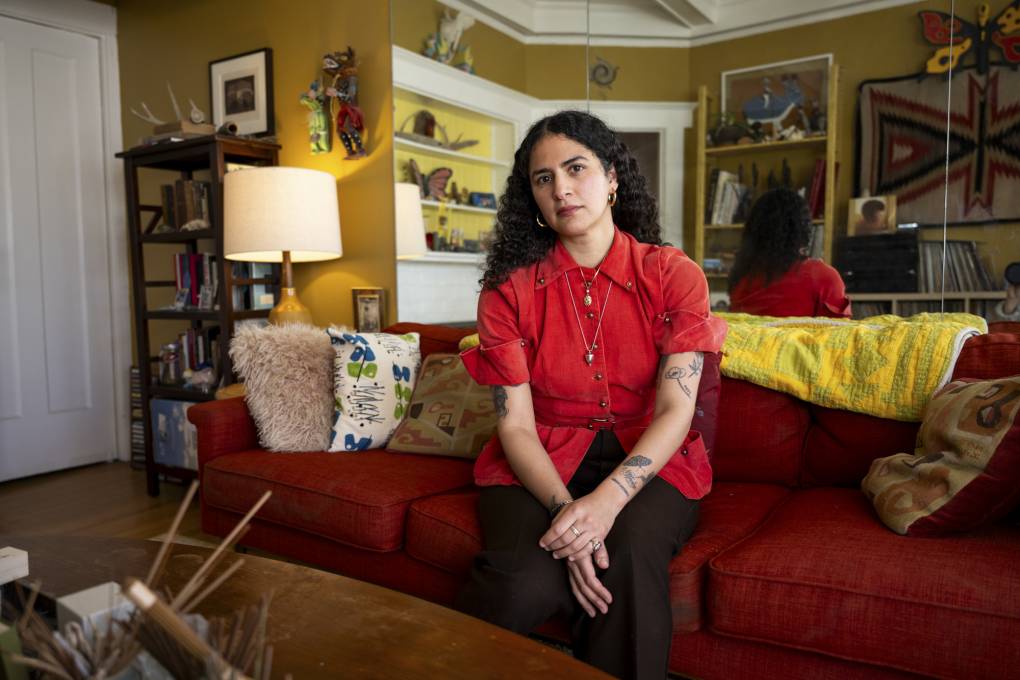
"caption": "Dani Golomb, psychiatry resident at CPMC Sutter Davies Campus, poses for a portrait at her home in San Francisco on Feb. 9, 2024.",
"description": null,
"title": "240209-HOSPITALVIOLENCE-20-BL-KQED",
"credit": "Beth LaBerge/KQED",
"status": "inherit",
"altTag": "A woman wearing a red shirt sits on a couch in a home.",
"isLoading": false,
"fetchFailed": false
}
},
"audioPlayerReducer": {
"postId": "stream_live",
"isPaused": true,
"isPlaying": false,
"pfsActive": false,
"pledgeModalIsOpen": true,
"playerDrawerIsOpen": false,
"liveAudioPlayStartedAt": 0,
"liveAudioPlayContext": ""
},
"authorsReducer": {
"byline_science_1993623": {
"type": "authors",
"id": "byline_science_1993623",
"meta": {
"override": true
},
"slug": "byline_science_1993623",
"name": "\u003ca href=\"https://www.npr.org/people/776048102/rachel-treisman\">Rachel Treisman\u003c/a>, NPR",
"isLoading": false
},
"byline_science_1992976": {
"type": "authors",
"id": "byline_science_1992976",
"meta": {
"override": true
},
"slug": "byline_science_1992976",
"name": "Kristel Tjandra",
"isLoading": false
},
"byline_science_1992816": {
"type": "authors",
"id": "byline_science_1992816",
"meta": {
"override": true
},
"slug": "byline_science_1992816",
"name": "Kristel Tjandra",
"isLoading": false
},
"lklivans": {
"type": "authors",
"id": "8648",
"meta": {
"index": "authors_1716337520",
"id": "8648",
"found": true
},
"name": "Laura Klivans",
"firstName": "Laura",
"lastName": "Klivans",
"slug": "lklivans",
"email": "lklivans@kqed.org",
"display_author_email": true,
"staff_mastheads": [
"news",
"science"
],
"title": "Reporter",
"bio": "Laura Klivans is an award-winning science reporter for KQED News, where she covers climate change with an eye on both groundbreaking progress and gaps in action. She is the former host of KQED's blockbuster video series about tiny, amazing animals, \u003cem>Deep Look\u003c/em>. Her work reaches national audiences through NPR, \u003cem>Here & Now, \u003c/em>PRI, and other major outlets. \r\n\r\nLaura’s won five Northern California Area Emmy Awards for Deep Look and First Place in the Greater Bay Area Journalism Awards for a podcast exploring how one Oakland neighborhood teamed up to reduce planet-heating pollution.\r\n\r\nBeyond her reporting, she hosts and moderates events. In the past, she taught audio storytelling at the UC Berkeley Graduate School of Journalism, led international education programs, worked with immigrants and refugees along the Thai-Burmese border, taught high schoolers sex ed, and was an actress. \r\n\r\nShe's a former UC Berkeley Human Rights Fellow, USC Center for Health Journalism's California Fellow and Coro Fellow in Public Affairs. Laura has a master’s in journalism from UC Berkeley, a master’s in education from Harvard, and an undergraduate degree from Northwestern University.\r\n\r\nShe loves trying to riddle the meaning out of vanity license plates.",
"avatar": "https://secure.gravatar.com/avatar/2d2ecd1550a494cc10ad4a503406965585902124739e775a9b3817eebf1d88be?s=600&d=blank&r=g",
"twitter": "lauraklivans",
"bluesky": null,
"facebook": null,
"instagram": null,
"linkedin": null,
"sites": [
{
"site": "news",
"roles": [
"editor"
]
},
{
"site": "stateofhealth",
"roles": [
"contributor",
"editor"
]
},
{
"site": "science",
"roles": [
"editor"
]
},
{
"site": "forum",
"roles": [
"editor"
]
}
],
"headData": {
"title": "Laura Klivans | KQED",
"description": "Reporter",
"ogImgSrc": "https://secure.gravatar.com/avatar/2d2ecd1550a494cc10ad4a503406965585902124739e775a9b3817eebf1d88be?s=600&d=blank&r=g",
"twImgSrc": "https://secure.gravatar.com/avatar/2d2ecd1550a494cc10ad4a503406965585902124739e775a9b3817eebf1d88be?s=600&d=blank&r=g"
},
"isLoading": false,
"link": "/author/lklivans"
},
"lesleymcclurg": {
"type": "authors",
"id": "11229",
"meta": {
"index": "authors_1716337520",
"id": "11229",
"found": true
},
"name": "Lesley McClurg",
"firstName": "Lesley",
"lastName": "McClurg",
"slug": "lesleymcclurg",
"email": "lmcclurg@KQED.org",
"display_author_email": false,
"staff_mastheads": [
"news",
"science"
],
"title": "KQED Health Correspondent",
"bio": "Lesley McClurg is a health correspondent and fill-in host whose work is regularly rebroadcast on NPR and PBS programs. She’s earned multiple regional Emmy awards, a national and a regional Edward R. Murrow award, and was named Best Beat Reporter by the Association of Health Care Journalists. The Society of Professional Journalists has recognized her work several times, and the Society of Environmental Journalists spotlighted her coverage of California’s historic drought.\r\n\r\nBefore joining KQED in 2016, Lesley covered food and sustainability for Capital Public Radio, environmental issues for Colorado Public Radio, and reported for KUOW and KCTS 9 in Seattle. Away from the newsroom, she loves skiing with her daughter, mountain biking with her partner, and playing with Ollie, the family’s goldendoodle. On deadline, she runs almost entirely on chocolate chips.\r\n\r\n ",
"avatar": "https://secure.gravatar.com/avatar/bab49e972ea10c774fe0f5e29dba1722b158f7c0d58a360923d1389d380b2978?s=600&d=blank&r=g",
"twitter": "lesleywmcclurg",
"bluesky": null,
"facebook": null,
"instagram": null,
"linkedin": null,
"sites": [
{
"site": "arts",
"roles": [
"author"
]
},
{
"site": "news",
"roles": [
"editor"
]
},
{
"site": "futureofyou",
"roles": [
"editor"
]
},
{
"site": "stateofhealth",
"roles": [
"author"
]
},
{
"site": "science",
"roles": [
"editor"
]
},
{
"site": "quest",
"roles": [
"subscriber"
]
},
{
"site": "forum",
"roles": [
"administrator"
]
},
{
"site": "liveblog",
"roles": [
"author"
]
}
],
"headData": {
"title": "Lesley McClurg | KQED",
"description": "KQED Health Correspondent",
"ogImgSrc": "https://secure.gravatar.com/avatar/bab49e972ea10c774fe0f5e29dba1722b158f7c0d58a360923d1389d380b2978?s=600&d=blank&r=g",
"twImgSrc": "https://secure.gravatar.com/avatar/bab49e972ea10c774fe0f5e29dba1722b158f7c0d58a360923d1389d380b2978?s=600&d=blank&r=g"
},
"isLoading": false,
"link": "/author/lesleymcclurg"
},
"kevinstark": {
"type": "authors",
"id": "11608",
"meta": {
"index": "authors_1716337520",
"id": "11608",
"found": true
},
"name": "Kevin Stark",
"firstName": "Kevin",
"lastName": "Stark",
"slug": "kevinstark",
"email": "kstark@kqed.org",
"display_author_email": true,
"staff_mastheads": [
"science"
],
"title": "Senior Editor",
"bio": "Kevin is a senior editor for KQED Science, managing the station's health and climate desks. His journalism career began in the Pacific Northwest, and he later became a lead reporter for the San Francisco Public Press. His work has appeared in Pacific Standard magazine, the Energy News Network, the Center for Investigative Reporting's Reveal and WBEZ in Chicago. Kevin joined KQED in 2019, and has covered issues related to energy, wildfire, climate change and the environment.",
"avatar": "https://secure.gravatar.com/avatar/365aaa4b597d3a8374f67504ff0facd323d7906e8eb4be0a7efd2427408e802c?s=600&d=blank&r=g",
"twitter": "starkkev",
"bluesky": null,
"facebook": null,
"instagram": null,
"linkedin": null,
"sites": [
{
"site": "",
"roles": [
"editor"
]
},
{
"site": "news",
"roles": [
"editor"
]
},
{
"site": "science",
"roles": [
"administrator"
]
}
],
"headData": {
"title": "Kevin Stark | KQED",
"description": "Senior Editor",
"ogImgSrc": "https://secure.gravatar.com/avatar/365aaa4b597d3a8374f67504ff0facd323d7906e8eb4be0a7efd2427408e802c?s=600&d=blank&r=g",
"twImgSrc": "https://secure.gravatar.com/avatar/365aaa4b597d3a8374f67504ff0facd323d7906e8eb4be0a7efd2427408e802c?s=600&d=blank&r=g"
},
"isLoading": false,
"link": "/author/kevinstark"
},
"eromero": {
"type": "authors",
"id": "11746",
"meta": {
"index": "authors_1716337520",
"id": "11746",
"found": true
},
"name": "Ezra David Romero",
"firstName": "Ezra David",
"lastName": "Romero",
"slug": "eromero",
"email": "eromero@kqed.org",
"display_author_email": true,
"staff_mastheads": [
"news",
"science"
],
"title": "Climate Reporter",
"bio": "Ezra David Romero is a climate reporter for KQED News. He covers the absence and excess of water in the Bay Area — think sea level rise, flooding and drought. For nearly a decade he’s covered how warming temperatures are altering the lives of Californians. He’s reported on farmers worried their pistachio trees aren’t getting enough sleep, families desperate for water, scientists studying dying giant sequoias, and alongside firefighters containing wildfires. His work has appeared on local stations across California and nationally on public radio shows like Morning Edition, Here and Now, All Things Considered and Science Friday. ",
"avatar": "https://secure.gravatar.com/avatar/c76404d287c10ed40224227551ac36e24352c7306f106632caf6fead76f8801f?s=600&d=blank&r=g",
"twitter": "ezraromero",
"bluesky": null,
"facebook": null,
"instagram": null,
"linkedin": null,
"sites": [
{
"site": "arts",
"roles": [
"editor"
]
},
{
"site": "news",
"roles": [
"editor"
]
},
{
"site": "science",
"roles": [
"editor"
]
},
{
"site": "liveblog",
"roles": [
"author"
]
}
],
"headData": {
"title": "Ezra David Romero | KQED",
"description": "Climate Reporter",
"ogImgSrc": "https://secure.gravatar.com/avatar/c76404d287c10ed40224227551ac36e24352c7306f106632caf6fead76f8801f?s=600&d=blank&r=g",
"twImgSrc": "https://secure.gravatar.com/avatar/c76404d287c10ed40224227551ac36e24352c7306f106632caf6fead76f8801f?s=600&d=blank&r=g"
},
"isLoading": false,
"link": "/author/eromero"
},
"sjohnson": {
"type": "authors",
"id": "11840",
"meta": {
"index": "authors_1716337520",
"id": "11840",
"found": true
},
"name": "Sydney Johnson",
"firstName": "Sydney",
"lastName": "Johnson",
"slug": "sjohnson",
"email": "sjohnson@kqed.org",
"display_author_email": false,
"staff_mastheads": [
"news"
],
"title": "KQED Reporter",
"bio": "Sydney Johnson is a general assignment reporter at KQED. She previously reported on public health and city government at the San Francisco Examiner, and before that, she covered statewide education policy for EdSource. Her reporting has won multiple local, state and national awards. Sydney is a graduate of the University of California, Berkeley and lives in San Francisco.",
"avatar": "https://secure.gravatar.com/avatar/97855f2719b72ad6190b7c535fe642c8?s=600&d=blank&r=g",
"twitter": "sydneyfjohnson",
"facebook": null,
"instagram": null,
"linkedin": null,
"sites": [
{
"site": "news",
"roles": [
"editor"
]
}
],
"headData": {
"title": "Sydney Johnson | KQED",
"description": "KQED Reporter",
"ogImgSrc": "https://secure.gravatar.com/avatar/97855f2719b72ad6190b7c535fe642c8?s=600&d=blank&r=g",
"twImgSrc": "https://secure.gravatar.com/avatar/97855f2719b72ad6190b7c535fe642c8?s=600&d=blank&r=g"
},
"isLoading": false,
"link": "/author/sjohnson"
}
},
"pagesReducer": {
"science_category_health": {
"type": "terms",
"id": "science_39",
"meta": {
"index": "terms_1716263798",
"site": "science",
"id": "39",
"score": 10.889433
},
"featImg": null,
"name": "Health",
"description": null,
"taxonomy": "category",
"headData": {
"twImgId": null,
"twTitle": null,
"ogTitle": null,
"ogImgId": null,
"twDescription": null,
"description": null,
"title": "Health Archives | KQED Science",
"ogDescription": null
},
"ttid": 41,
"slug": "health",
"isLoading": false,
"title": "Health",
"pageMeta": {
"site": "science",
"WpPageTemplate": "page-topic-editorial",
"currentPage": 6
},
"blocks": [
{
"blockName": "kqed/post-list",
"attrs": {
"layout": "cardArticle2",
"query": "posts/science?category=health",
"seeMore": false,
"paginated": true,
"page": 6
}
},
{
"blockName": "kqed/ad"
}
]
}
},
"pfsSessionReducer": {},
"postsReducer": {
"stream_live": {
"type": "live",
"id": "stream_live",
"audioUrl": "https://streams.kqed.org/kqedradio",
"title": "Live Stream",
"excerpt": "Live Stream information currently unavailable.",
"link": "/radio",
"featImg": "",
"label": {
"name": "KQED Live",
"link": "/"
}
},
"stream_kqedNewscast": {
"type": "posts",
"id": "stream_kqedNewscast",
"audioUrl": "https://www.kqed.org/.stream/anon/radio/RDnews/newscast.mp3?_=1",
"title": "KQED Newscast",
"featImg": "",
"label": {
"name": "88.5 FM",
"link": "/"
}
},
"science_1993623": {
"type": "posts",
"id": "science_1993623",
"meta": {
"index": "posts_1716263798",
"site": "science",
"id": "1993623",
"score": null,
"sort": [
1720900818000
]
},
"guestAuthors": [],
"slug": "uc-berkeley-study-finds-toxic-metals-in-popular-tampon-brands-heres-what-experts-advise",
"title": "UC Berkeley Study Finds Toxic Metals in Popular Tampon Brands. Here's What Experts Advise",
"publishDate": 1720900818,
"format": "standard",
"headTitle": "UC Berkeley Study Finds Toxic Metals in Popular Tampon Brands. Here’s What Experts Advise | KQED",
"labelTerm": {
"term": 5158,
"site": "science"
},
"content": "\u003cp>Researchers have found toxic metals — including arsenic and lead — in over a dozen popular brands of tampons, raising questions about a menstrual hygiene product used by millions of Americans.\u003c/p>\n\u003cp>Their \u003ca href=\"https://publichealth.berkeley.edu/news-media/research-highlights/first-study-to-measure-toxic-metals-in-tampons-shows-arsenic-and-lead\">study\u003c/a>, \u003ca href=\"https://www.sciencedirect.com/science/article/pii/S0160412024004355#s0050\">published last week\u003c/a> in the scientific journal \u003cem>Environment International\u003c/em>, adds to a growing body of research about chemicals found in tampons but is believed to be the first to specifically measure metals.\u003c/p>\n\u003cp>The \u003ca href=\"https://my.clevelandclinic.org/health/diseases/23424-heavy-metal-poisoning-toxicity\">negative health effects\u003c/a> of heavy metals are well-documented and wide-ranging, including damaging the cardiovascular, nervous and endocrine systems; damaging the liver, kidneys and brain; increasing the risk of dementia and cancer and harming maternal health and fetal development.\u003c/p>\n\u003cp>“Despite this large potential for public health concern, very little research has been done to measure chemicals in tampons,” lead author Jenni Shearston, a postdoctoral scholar at the UC Berkeley School of Public Health, \u003ca href=\"https://publichealth.berkeley.edu/news-media/research-highlights/first-study-to-measure-toxic-metals-in-tampons-shows-arsenic-and-lead\">said in a statement\u003c/a>.\u003c/p>\n\u003cp>[ad fullwidth]\u003c/p>\n\u003cp>Shearston led a team of scientists from Columbia University and Michigan State University in examining 30 tampons from across 14 brands and 18 product lines, which they did not name in the study.\u003c/p>\n\u003cp>The sampling includes products of various absorbencies, listed as “top sellers” by a major online retailer and purchased both online and at stores in New York City, London and Athens between September 2022 and March 2023.\u003c/p>\n\u003cp>Researchers detected “measurable concentrations” of all 16 metals they were looking for in the tampons, as well as “elevated mean concentrations” of toxic metals including lead, arsenic and cadmium.\u003c/p>\n\u003cp>The study says there are several ways metals could get into tampons. Raw materials like cotton and rayon could be contaminated by water, air or soil during production, while metals may in some cases be added intentionally in the manufacturing process either for odor control, pigment or as an antibacterial agent.\u003c/p>\n\u003cp>The exact amount of metals varied among the tampons, based on which region they were purchased from, whether they were made of organic or non-organic material and on store- versus name-brands, according to the study.\u003c/p>\n\u003cp>“Lead concentrations were higher in non-organic tampons while arsenic was higher in organic tampons,” it added. “No category had consistently lower concentrations of all or most metals.”\u003c/p>\n\u003cp>Researchers say the study marks an important first step in confirming the presence of toxic metals in tampons, which are used by an estimated 52% to 86% of menstruating people in the U.S.\u003c/p>\n\u003cp>But it doesn’t give them enough information to definitively link the metals to negative health effects.\u003c/p>\n\u003cp>They say more studies are needed to determine to what extent such metals might “leach out of tampons” and into peoples’ bodies. They’re calling not only for more research, but also for stronger regulations.\u003c/p>\n\u003cp>“I really hope that manufacturers are required to test their products for metals, especially for toxic metals,” Shearston said. “It would be exciting to see the public call for this, or to ask for better labeling on tampons and other menstrual products.”\u003c/p>\n\u003cp>In the U.S., the Food and Drug Administration (FDA) classifies tampons as medical devices and regulates their safety. However, there is no requirement to test tampons for chemical contaminants, and the FDA only recommends that tampons not contain pesticide residue or dioxin.\u003c/p>\n\u003cp>FDA spokesperson Amanda Hils told NPR that “all studies have limitations,” pointing to the outstanding questions about whether metals are released from tampons and into the bloodstream. Nevertheless, she said the agency is reviewing the research.\u003c/p>\n\u003cp>“We plan to evaluate the study closely, and take any action warranted to safeguard the health of consumers who use these products,” Hils added.\u003c/p>\n\u003cp>NPR has reached out to the industry Center for Baby and Adult Hygiene Products (BAHP) and its U.K. counterpart, the Absorbent Hygiene Product Manufacturers Association, for comment.\u003c/p>\n\u003cp>The BAHP defended the safety of its member companies’ menstrual products in a \u003ca href=\"https://www.bahp.com/bahp-statement-on-the-safety-of-menstrual-products/\">2022 statement\u003c/a>, acknowledging news coverage on the presence of chemicals and saying “if present, these are not intentionally added by the manufacturers.”\u003c/p>\n\u003cp>“Some of these impurities are present in the environment or naturally present at much higher levels in common fruits and vegetables or even made by the human body,” it said, adding that its members use “rigorous criteria for quality and hygiene.”\u003c/p>\n\u003ch2>The bigger question: How harmful are these metals?\u003c/h2>\n\u003cp>Several experts told NPR that they were not surprised by the researchers’ findings, since other studies over the years have detected potentially harmful \u003ca href=\"https://www.sciencedirect.com/science/article/pii/S0160412020303494\">chemicals in tampons\u003c/a> and other menstrual products, \u003ca href=\"https://www.npr.org/2023/01/19/1150023002/thinx-period-underwear-lawsuit-settlement\">including period underwear\u003c/a>.\u003c/p>\n\u003cp>Catherine Roberts, a health and science journalist at \u003cem>Consumer Reports\u003c/em> who has written about tampons, says it’s more surprising that the question wasn’t investigated sooner.\u003c/p>\n\u003cp>“It’s in the most sensitive part of people’s bodies. It’s so close to us,” she says. “We use so many [tampons] over a lifetime. It’s just wild to me that this is so both so little researched and so little regulated.”\u003c/p>\n\u003cp>People who menstruate may use more than 7,400 tampons over the course of their reproductive years, the study authors calculated, with each tampon staying in the vagina for several hours at a time.\u003c/p>\n\u003cp>Dr. Nathaniel DeNicola, an OB-GYN who served as the environmental health expert for the American College of Obstetricians and Gynecologists, says the more pressing question is not whether there are chemicals in tampons, but “when does it convert to a dangerous amount?”\u003c/p>\n\u003cp>Some of the metals found in the tampons — including copper, calcium, iron and zinc — are not only considered safe, but recommended for patients by many doctors, he notes. They would not be damaging in low amounts, but a cumulative amount could have a lasting effect on a person’s endocrine functions.\u003c/p>\n\u003cp>Trace amounts of arsenic, for example, are sometimes found in food and not considered to be toxic, but high amounts could be fatal. In contrast, as the study notes, “there is no safe exposure level” to lead.\u003c/p>\n\u003cp>It’s not clear from the study whether people are getting harmful amounts of each metal from tampons, DeNicola says.\u003c/p>\n\u003cp>“When you start to look at the kind of chemicals that are found in our human system, the reality is that in modern life, we’re kind of swimming in them,” he adds. “And it’s not to say that it’s nothing we should worry about. I mean, I don’t think most people hear that and think, ‘Oh, good, I’ve got more plastic in me.’ But we do have to recognize that small amounts of these chemicals are ubiquitous.”\u003c/p>\n\u003ch2>What to do if you’re worried\u003c/h2>\n\u003cp>To Roberts, one of the main takeaways from the study is that the “organic label was clearly not a guarantee that these products would not have heavy metals.” So what are concerned shoppers supposed to do?\u003c/p>\n\u003cp>Ideally, she says, regulators would mandate heavy-metal testing for tampons to take some of the pressure off consumers.\u003c/p>\n\u003cp>Until then, she says, there are some measures that tampon users can take to try to reduce their exposure to chemicals in general.\u003c/p>\n\u003cp>Those include choosing products that don’t contain plastic (including polyester and polypropylene) and avoiding those with fragrances and colorants.\u003c/p>\n\u003cp>“Something that people who look at this tend to say is that you want to look for period product labels that have fewer and simpler ingredients,” Roberts adds.\u003c/p>\n\u003cp>DeNicola recommends relying on a combination of “third-party testing and some personal due diligence.” He says there are apps shoppers can use to scan product barcodes and see what chemicals they contain, which could be useful for personal care and feminine hygiene products.\u003c/p>\n\u003cp>In some cases, people might want to consider alternatives to tampons, such as pads or menstrual cups. The reusable cups have \u003ca href=\"https://www.mayoclinichealthsystem.org/hometown-health/speaking-of-health/menstrual-cups-vs-tampons-things-you-might-not-know-about-the-cup\">become increasingly popular\u003c/a> in recent years, especially given their lower environmental impact compared to tampons.\u003c/p>\n\u003cp>Some of the downsides of tampons were evident well before this study.\u003c/p>\n\u003cp>DeNicola notes that plastic from tampons is one of the \u003ca href=\"https://www.nationalgeographic.com/environment/article/how-tampons-pads-became-unsustainable-story-of-plastic\">biggest sources of waste\u003c/a> worldwide (and that some brands are more eco-friendly than others). Roberts points out that even if they didn’t contain chemicals, tampons would still pose a risk of toxic shock syndrome, a rare but potentially life-threatening illness (wearers can \u003ca href=\"https://my.clevelandclinic.org/health/diseases/15437-toxic-shock-syndrome\">reduce their risk\u003c/a> by changing their tampons frequently).\u003c/p>\n\u003cp>But DeNicola stresses that this study doesn’t have him running to tell his patients not to use tampons at all.\u003c/p>\n\u003cp>“I don’t think we’ve established that risk yet,” he says. “I think it’s more of a reality check for the consumers and the public at large, that most products that you’re using do not go through rigorous testing for safety, and most products do have chemicals in there somewhere.”\u003c/p>\n\u003cp>[ad floatright]\u003c/p>\n",
"blocks": [],
"excerpt": "A study found heavy metals — including arsenic and lead — in over a dozen leading tampon brands, raising concerns about a menstrual hygiene product used by millions of Americans.",
"status": "publish",
"parent": 0,
"modified": 1720899851,
"stats": {
"hasAudio": false,
"hasVideo": false,
"hasChartOrMap": false,
"iframeSrcs": [],
"hasGoogleForm": false,
"hasGallery": false,
"hasHearkenModule": false,
"hasPolis": false,
"paragraphCount": 42,
"wordCount": 1537
},
"headData": {
"title": "UC Berkeley Study Finds Toxic Metals in Popular Tampon Brands. Here's What Experts Advise | KQED",
"description": "A study found heavy metals — including arsenic and lead — in over a dozen leading tampon brands, raising concerns about a menstrual hygiene product used by millions of Americans.",
"ogTitle": "",
"ogDescription": "",
"ogImgId": "",
"twTitle": "",
"twDescription": "",
"twImgId": "",
"schema": {
"@context": "https://schema.org",
"@type": "Article",
"headline": "UC Berkeley Study Finds Toxic Metals in Popular Tampon Brands. Here's What Experts Advise",
"datePublished": "2024-07-13T13:00:18-07:00",
"dateModified": "2024-07-13T12:44:11-07:00",
"image": "https://cdn.kqed.org/wp-content/uploads/2020/02/KQED-OG-Image@1x.png"
}
},
"sticky": false,
"nprByline": "\u003ca href=\"https://www.npr.org/people/776048102/rachel-treisman\">Rachel Treisman\u003c/a>, NPR",
"excludeFromSiteSearch": "Include",
"showOnAuthorArchivePages": "No",
"articleAge": "0",
"path": "/science/1993623/uc-berkeley-study-finds-toxic-metals-in-popular-tampon-brands-heres-what-experts-advise",
"audioTrackLength": null,
"parsedContent": [
{
"type": "contentString",
"content": "\u003cdiv class=\"post-body\">\u003cp>\u003cp>Researchers have found toxic metals — including arsenic and lead — in over a dozen popular brands of tampons, raising questions about a menstrual hygiene product used by millions of Americans.\u003c/p>\n\u003cp>Their \u003ca href=\"https://publichealth.berkeley.edu/news-media/research-highlights/first-study-to-measure-toxic-metals-in-tampons-shows-arsenic-and-lead\">study\u003c/a>, \u003ca href=\"https://www.sciencedirect.com/science/article/pii/S0160412024004355#s0050\">published last week\u003c/a> in the scientific journal \u003cem>Environment International\u003c/em>, adds to a growing body of research about chemicals found in tampons but is believed to be the first to specifically measure metals.\u003c/p>\n\u003cp>The \u003ca href=\"https://my.clevelandclinic.org/health/diseases/23424-heavy-metal-poisoning-toxicity\">negative health effects\u003c/a> of heavy metals are well-documented and wide-ranging, including damaging the cardiovascular, nervous and endocrine systems; damaging the liver, kidneys and brain; increasing the risk of dementia and cancer and harming maternal health and fetal development.\u003c/p>\n\u003cp>“Despite this large potential for public health concern, very little research has been done to measure chemicals in tampons,” lead author Jenni Shearston, a postdoctoral scholar at the UC Berkeley School of Public Health, \u003ca href=\"https://publichealth.berkeley.edu/news-media/research-highlights/first-study-to-measure-toxic-metals-in-tampons-shows-arsenic-and-lead\">said in a statement\u003c/a>.\u003c/p>\n\u003cp>\u003c/p>\u003c/div>",
"attributes": {
"named": {},
"numeric": []
}
},
{
"type": "component",
"content": "",
"name": "ad",
"attributes": {
"named": {
"label": "fullwidth"
},
"numeric": [
"fullwidth"
]
}
},
{
"type": "contentString",
"content": "\u003cdiv class=\"post-body\">\u003cp>\u003c/p>\n\u003cp>Shearston led a team of scientists from Columbia University and Michigan State University in examining 30 tampons from across 14 brands and 18 product lines, which they did not name in the study.\u003c/p>\n\u003cp>The sampling includes products of various absorbencies, listed as “top sellers” by a major online retailer and purchased both online and at stores in New York City, London and Athens between September 2022 and March 2023.\u003c/p>\n\u003cp>Researchers detected “measurable concentrations” of all 16 metals they were looking for in the tampons, as well as “elevated mean concentrations” of toxic metals including lead, arsenic and cadmium.\u003c/p>\n\u003cp>The study says there are several ways metals could get into tampons. Raw materials like cotton and rayon could be contaminated by water, air or soil during production, while metals may in some cases be added intentionally in the manufacturing process either for odor control, pigment or as an antibacterial agent.\u003c/p>\n\u003cp>The exact amount of metals varied among the tampons, based on which region they were purchased from, whether they were made of organic or non-organic material and on store- versus name-brands, according to the study.\u003c/p>\n\u003cp>“Lead concentrations were higher in non-organic tampons while arsenic was higher in organic tampons,” it added. “No category had consistently lower concentrations of all or most metals.”\u003c/p>\n\u003cp>Researchers say the study marks an important first step in confirming the presence of toxic metals in tampons, which are used by an estimated 52% to 86% of menstruating people in the U.S.\u003c/p>\n\u003cp>But it doesn’t give them enough information to definitively link the metals to negative health effects.\u003c/p>\n\u003cp>They say more studies are needed to determine to what extent such metals might “leach out of tampons” and into peoples’ bodies. They’re calling not only for more research, but also for stronger regulations.\u003c/p>\n\u003cp>“I really hope that manufacturers are required to test their products for metals, especially for toxic metals,” Shearston said. “It would be exciting to see the public call for this, or to ask for better labeling on tampons and other menstrual products.”\u003c/p>\n\u003cp>In the U.S., the Food and Drug Administration (FDA) classifies tampons as medical devices and regulates their safety. However, there is no requirement to test tampons for chemical contaminants, and the FDA only recommends that tampons not contain pesticide residue or dioxin.\u003c/p>\n\u003cp>FDA spokesperson Amanda Hils told NPR that “all studies have limitations,” pointing to the outstanding questions about whether metals are released from tampons and into the bloodstream. Nevertheless, she said the agency is reviewing the research.\u003c/p>\n\u003cp>“We plan to evaluate the study closely, and take any action warranted to safeguard the health of consumers who use these products,” Hils added.\u003c/p>\n\u003cp>NPR has reached out to the industry Center for Baby and Adult Hygiene Products (BAHP) and its U.K. counterpart, the Absorbent Hygiene Product Manufacturers Association, for comment.\u003c/p>\n\u003cp>The BAHP defended the safety of its member companies’ menstrual products in a \u003ca href=\"https://www.bahp.com/bahp-statement-on-the-safety-of-menstrual-products/\">2022 statement\u003c/a>, acknowledging news coverage on the presence of chemicals and saying “if present, these are not intentionally added by the manufacturers.”\u003c/p>\n\u003cp>“Some of these impurities are present in the environment or naturally present at much higher levels in common fruits and vegetables or even made by the human body,” it said, adding that its members use “rigorous criteria for quality and hygiene.”\u003c/p>\n\u003ch2>The bigger question: How harmful are these metals?\u003c/h2>\n\u003cp>Several experts told NPR that they were not surprised by the researchers’ findings, since other studies over the years have detected potentially harmful \u003ca href=\"https://www.sciencedirect.com/science/article/pii/S0160412020303494\">chemicals in tampons\u003c/a> and other menstrual products, \u003ca href=\"https://www.npr.org/2023/01/19/1150023002/thinx-period-underwear-lawsuit-settlement\">including period underwear\u003c/a>.\u003c/p>\n\u003cp>Catherine Roberts, a health and science journalist at \u003cem>Consumer Reports\u003c/em> who has written about tampons, says it’s more surprising that the question wasn’t investigated sooner.\u003c/p>\n\u003cp>“It’s in the most sensitive part of people’s bodies. It’s so close to us,” she says. “We use so many [tampons] over a lifetime. It’s just wild to me that this is so both so little researched and so little regulated.”\u003c/p>\n\u003cp>People who menstruate may use more than 7,400 tampons over the course of their reproductive years, the study authors calculated, with each tampon staying in the vagina for several hours at a time.\u003c/p>\n\u003cp>Dr. Nathaniel DeNicola, an OB-GYN who served as the environmental health expert for the American College of Obstetricians and Gynecologists, says the more pressing question is not whether there are chemicals in tampons, but “when does it convert to a dangerous amount?”\u003c/p>\n\u003cp>Some of the metals found in the tampons — including copper, calcium, iron and zinc — are not only considered safe, but recommended for patients by many doctors, he notes. They would not be damaging in low amounts, but a cumulative amount could have a lasting effect on a person’s endocrine functions.\u003c/p>\n\u003cp>Trace amounts of arsenic, for example, are sometimes found in food and not considered to be toxic, but high amounts could be fatal. In contrast, as the study notes, “there is no safe exposure level” to lead.\u003c/p>\n\u003cp>It’s not clear from the study whether people are getting harmful amounts of each metal from tampons, DeNicola says.\u003c/p>\n\u003cp>“When you start to look at the kind of chemicals that are found in our human system, the reality is that in modern life, we’re kind of swimming in them,” he adds. “And it’s not to say that it’s nothing we should worry about. I mean, I don’t think most people hear that and think, ‘Oh, good, I’ve got more plastic in me.’ But we do have to recognize that small amounts of these chemicals are ubiquitous.”\u003c/p>\n\u003ch2>What to do if you’re worried\u003c/h2>\n\u003cp>To Roberts, one of the main takeaways from the study is that the “organic label was clearly not a guarantee that these products would not have heavy metals.” So what are concerned shoppers supposed to do?\u003c/p>\n\u003cp>Ideally, she says, regulators would mandate heavy-metal testing for tampons to take some of the pressure off consumers.\u003c/p>\n\u003cp>Until then, she says, there are some measures that tampon users can take to try to reduce their exposure to chemicals in general.\u003c/p>\n\u003cp>Those include choosing products that don’t contain plastic (including polyester and polypropylene) and avoiding those with fragrances and colorants.\u003c/p>\n\u003cp>“Something that people who look at this tend to say is that you want to look for period product labels that have fewer and simpler ingredients,” Roberts adds.\u003c/p>\n\u003cp>DeNicola recommends relying on a combination of “third-party testing and some personal due diligence.” He says there are apps shoppers can use to scan product barcodes and see what chemicals they contain, which could be useful for personal care and feminine hygiene products.\u003c/p>\n\u003cp>In some cases, people might want to consider alternatives to tampons, such as pads or menstrual cups. The reusable cups have \u003ca href=\"https://www.mayoclinichealthsystem.org/hometown-health/speaking-of-health/menstrual-cups-vs-tampons-things-you-might-not-know-about-the-cup\">become increasingly popular\u003c/a> in recent years, especially given their lower environmental impact compared to tampons.\u003c/p>\n\u003cp>Some of the downsides of tampons were evident well before this study.\u003c/p>\n\u003cp>DeNicola notes that plastic from tampons is one of the \u003ca href=\"https://www.nationalgeographic.com/environment/article/how-tampons-pads-became-unsustainable-story-of-plastic\">biggest sources of waste\u003c/a> worldwide (and that some brands are more eco-friendly than others). Roberts points out that even if they didn’t contain chemicals, tampons would still pose a risk of toxic shock syndrome, a rare but potentially life-threatening illness (wearers can \u003ca href=\"https://my.clevelandclinic.org/health/diseases/15437-toxic-shock-syndrome\">reduce their risk\u003c/a> by changing their tampons frequently).\u003c/p>\n\u003cp>But DeNicola stresses that this study doesn’t have him running to tell his patients not to use tampons at all.\u003c/p>\n\u003cp>“I don’t think we’ve established that risk yet,” he says. “I think it’s more of a reality check for the consumers and the public at large, that most products that you’re using do not go through rigorous testing for safety, and most products do have chemicals in there somewhere.”\u003c/p>\n\u003cp>\u003c/p>\u003c/div>",
"attributes": {
"named": {},
"numeric": []
}
},
{
"type": "component",
"content": "",
"name": "ad",
"attributes": {
"named": {
"label": "floatright"
},
"numeric": [
"floatright"
]
}
},
{
"type": "contentString",
"content": "\u003cdiv class=\"post-body\">\u003cp>\u003c/p>\n\u003c/div>\u003c/p>",
"attributes": {
"named": {},
"numeric": []
}
}
],
"link": "/science/1993623/uc-berkeley-study-finds-toxic-metals-in-popular-tampon-brands-heres-what-experts-advise",
"authors": [
"byline_science_1993623"
],
"categories": [
"science_39",
"science_40",
"science_4450"
],
"tags": [
"science_1191",
"science_5181",
"science_813",
"science_309",
"science_381",
"science_578"
],
"affiliates": [
"science_5158"
],
"featImg": "science_1993625",
"label": "science_5158"
},
"science_1993515": {
"type": "posts",
"id": "science_1993515",
"meta": {
"index": "posts_1716263798",
"site": "science",
"id": "1993515",
"score": null,
"sort": [
1719831657000
]
},
"guestAuthors": [],
"slug": "kratom-under-scrutiny-new-california-bill-proposes-stricter-controls-amid-growing-concerns",
"title": "Kratom Under Scrutiny: New California Bill Proposes Stricter Controls Amid Growing Concerns",
"publishDate": 1719831657,
"format": "standard",
"headTitle": "Kratom Under Scrutiny: New California Bill Proposes Stricter Controls Amid Growing Concerns | KQED",
"labelTerm": {
"site": "science"
},
"content": "\u003cp>In the midst of California’s \u003ca href=\"https://www.kqed.org/science/1993048/california-considers-slew-of-bills-to-tackle-skyrocketing-fentanyl-overdoses\">fentanyl crisis\u003c/a>, it’s hard to believe an herbal substance that mimics an opioid is readily available at convenience stores and smoke shops. It’s even sold to kids at \u003ca href=\"https://www.courthousenews.com/7-eleven-must-face-liability-claims-for-selling-drink-containing-kratom/\">7-Eleven\u003c/a>.\u003c/p>\n\u003cp>“I can’t believe this is legal,” thought Nick Telman after he felt the effects of kratom set in on a walk in Los Angeles in 2018. “It hit me like dope. Just bliss. I was hooked.”\u003c/p>\n\u003cp>Telman started tossing back about 10 grams of the green bitter brew three times a day, a habit that set him back $750–$900 a month. He assumed it was relatively safe because it’s marketed as a botanical, but kratom interacts with brain receptors that respond to opioids and stimulants. Critics argue it exposes about \u003ca href=\"https://www.ajpmonline.org/article/S0749-3797(21)00162-8/abstract\">2 million\u003c/a> annual users to the risks of \u003ca href=\"https://pubmed.ncbi.nlm.nih.gov/38788532/\">addiction, abuse and dependence\u003c/a>.\u003c/p>\n\u003cp>[ad fullwidth]\u003c/p>\n\u003cp>“Right now, there are no rules on kratom at all,” said Assemblymember Matt Haney (D-San Francisco), the sponsor of a new \u003ca href=\"https://leginfo.legislature.ca.gov/faces/billTextClient.xhtml?bill_id=202320240AB2365\">bill\u003c/a> that would set the strongest restrictions on kratom in the country. “You can sell it at any store. You don’t have to label it. It is the Wild West. And that is dangerous for Californians.”\u003cspan style=\"text-decoration: line-through\"> \u003c/span>\u003c/p>\n\u003cp>Kratom is derived from the leaf of a tree common in tropical regions of Southeast Asia. It can be chewed, brewed, and crushed into dusty green powder. In the U.S., it is sold as a pill, capsule, or extract. Companies claim it can relieve pain, depression, and anxiety. \u003ca href=\"https://www.tandfonline.com/doi/full/10.1080/10826084.2019.1645178\">Research\u003c/a> shows a small dose can give you a boost of energy, while a large one can put you to sleep.\u003c/p>\n\u003cp>After two years of consistent use, Telman started to feel tired all the time, and his heart “felt weird, like it wasn’t beating right,” which is a concern backed by \u003ca href=\"https://www.ncbi.nlm.nih.gov/pmc/articles/PMC4275233/\">evidence\u003c/a> that includes incidents of cardiac arrest. Heart disease is rampant in Telman’s family, and he said a voice in his head nagged, “Tick tock, Nick.”\u003c/p>\n\u003cp>He enrolled in a recovery program, but “quitting was a nightmare.” Withdrawal symptoms can include cold sweats, insomnia, pain, fever, diarrhea, tension and anger. “I wanted to die for like five days,” Telman said.\u003c/p>\n\u003ch2>\u003cstrong>Proposed regulation\u003c/strong>\u003c/h2>\n\u003cp>A proposed measure would require manufacturers to register kratom products with the state, provide labels with recommended doses, warn consumers that addiction is possible, and restrict sales to anyone under 21. Plus, it would limit the amount of 7-Hydroxymitragynine, which is one the more potent alkaloids in kratom that \u003ca href=\"https://static1.squarespace.com/static/6508b3f79033221c2aa1ea17/t/660ee85ffbb877565188acc8/1712253024164/Statement+on+the+science+of+kratom+products_FINAL.pdf\">researchers suggest\u003c/a> can potentially lead to worse outcomes.\u003c/p>\n\u003cp>“We urgently need to limit the type of products that can be sold and make sure that people know what they’re getting,” Haney said.\u003c/p>\n\u003cp>The Assembly passed the measure, and it is currently before the state Senate.\u003c/p>\n\u003cp>The Food and Drug Administration and Drug Enforcement Administration warn that kratom can lead to physical and psychological dependency. The FDA \u003ca href=\"https://www.fda.gov/news-events/press-announcements/fda-issues-warnings-companies-selling-illegal-unapproved-kratom-drug-products-marketed-opioid\">advises against its use\u003c/a>, and the DEA nearly banned it in 2016 before advocates and politicians pushed back and the agency halted those plans. Nowadays, kratom sits on the DEA’s \u003ca href=\"https://www.dea.gov/factsheets/kratom\">“drugs of concern” list\u003c/a>.\u003c/p>\n\u003cp>Some industry groups are calling on officials to rein in unscrupulous players.\u003c/p>\n\u003cp>“The proposed California bill allows consumers to walk into the kratom journey with their eyes wide open, and they know exactly what it is that they’re doing,” said Matthew Lowe, executive director of the Global Kratom Coalition. “The measure walks a thin line between allowing access and appropriately regulating a substance that the FDA is not currently regulating.”\u003c/p>\n\u003cp>The American Kratom Association also supports more oversight but calls the California measure an overreach. “The bill is well-intentioned,” said Mac Haddow, the advocacy organization’s senior fellow on public policy. “But it goes too far.”\u003c/p>\n\u003cp>He said the proposal would be expensive to implement and would “bar many creative manufacturers” from entering the market. He would rather see California implement the “Kratom Consumer Protection Act,” a model adopted in 13 other states that asks manufacturers to ensure safety without state oversight.\u003c/p>\n\u003ch2>\u003cstrong>‘It gave me my soul back’\u003c/strong>\u003c/h2>\n\u003cp>Twelve years ago, Jordan Richard was living in roach-infested hotels. In a single week, the 19-year-old overdosed on heroin twice.\u003c/p>\n\u003cp>“I remember hearing my mom cry in the hospital. I was like, ‘Oh my, I have to make a change,’” he said.\u003cem> \u003c/em>\u003c/p>\n\u003cp>When he returned home, he started researching natural ways to wean off opioids. He followed a Craigslist advertisement from a guy selling loose kratom powder in the San Bernardino mountains.\u003c/p>\n\u003cp>“When I took it, I felt like I was myself again,” he said. “It’s like the kratom put a pause on my brain to help me look at what I was doing with my life. I have never touched a hard drug since.”\u003c/p>\n\u003cp>Now, he drinks kratom with water morning, noon and night. He calls it his antidepressant and credits the herbal brew for giving him his “soul back.” Today, Richard is married, has five children, and runs New Hope Botanicals — a kratom shop in Crestline, a community located in San Bernardino County.\u003c/p>\n\u003cp>Dr. Scott Steiger, deputy medical director of the opiate treatment outpatient program at Zuckerberg San Francisco General Hospital, said he cautions patients with opioid use disorder who ask about kratom.\u003c/p>\n\u003cp>“I have seen that people who use kratom end up having a very hard time stopping the use of it,” Steiger said.\u003c/p>\n\u003cp>Doctors have evidence-based treatments like buprenorphine and methadone to help people with an opioid addiction. He doesn’t recommend self-medicating with kratom until more research is available.\u003c/p>\n\u003cp>The FDA has recalled \u003ca href=\"https://www.fda.gov/news-events/press-announcements/statement-fda-commissioner-scott-gottlieb-md-and-fda-deputy-commissioner-foods-and-veterinary\">dozens of salmonella-tainted\u003c/a> kratom products and found \u003ca href=\"https://www.fda.gov/news-events/public-health-focus/laboratory-analysis-kratom-products-heavy-metals\">toxic heavy metals\u003c/a> like nickel and lead in some supplements. The Centers for Disease Control and Prevention \u003ca href=\"https://www.cdc.gov/mmwr/volumes/68/wr/mm6814a2.htm\">reported\u003c/a> 90 kratom overdoses over 18 months, often involving other ingredients that companies may mix into their products, like antidepressants.\u003c/p>\n\u003ch2>\u003cstrong>‘He was the love of my life’\u003c/strong>\u003c/h2>\n\u003cp>J.D. Butler was one of them. The 27-year-old kindergarten teacher had a grand mal seizure while dining at the Mermaid Inn Restaurant in New York City on April 13, 2019. He and his girlfriend at the time, Alley Parsons, were celebrating their first anniversary.\u003c/p>\n\u003cp>“In the ambulance, I noticed his hand just flopped, and the EMT started freaking out,” Parsons said.\u003c/p>\n\u003cp>[aside label=\"Related Stories\" postID=\"science_1950877,science_1920131,news_11975973\"]Thirty minutes later Butler’s heart stopped. The toxicology report named kratom as the cause of death.\u003c/p>\n\u003cp>“It felt like half of my body got ripped apart, and half of me died with him,” Parsons said. “He was the love of my life.”\u003c/p>\n\u003cp>She said she was vaguely aware of Butler’s kratom habit. He called it his “tea pills” to help with back pain, anxiety and depression. She was not aware of any other drug use except for Prozac, which Butler had taken for years but had stopped a few weeks prior to his death.\u003c/p>\n\u003cp>When his parents \u003ca href=\"https://www.usnews.com/news/health-news/articles/2023-08-03/taking-kratom-claimed-her-sons-life-now-she-and-others-are-warning-of-the-dangers\">shared their son’s story online\u003c/a>, kratom advocates lashed out in response. Parsons said she wishes advocates had more empathy for Butler’s loss.\u003c/p>\n\u003cp>“The market is really caught in this strange place, kind of like where cannabis products were 15 years ago,” said \u003ca href=\"https://pharmacy.uconn.edu/person/c-michael-white/\">C. Michael White\u003c/a>, head of the Department of Pharmacy Practice at the University of Connecticut. “We knew that there were some potential benefits. We also knew that there are some real potential harms with cannabis. So how do you create something that allows people to be able to explore the benefits and minimize harm?”\u003c/p>\n\u003cp>White supports the proposed California legislation because he said it will ensure accessibility, increase accountability and ensure good manufacturing practices. As the state Senate deliberates, the fate of kratom regulation hangs in the balance.\u003c/p>\n\u003cp>[ad floatright]\u003c/p>\n",
"blocks": [],
"excerpt": "California's unregulated kratom market endangers public health, warns Assemblymember Matt Haney. A new bill aims to impose strict regulations, including labeling and age restrictions.",
"status": "publish",
"parent": 0,
"modified": 1719622599,
"stats": {
"hasAudio": false,
"hasVideo": false,
"hasChartOrMap": false,
"iframeSrcs": [],
"hasGoogleForm": false,
"hasGallery": false,
"hasHearkenModule": false,
"hasPolis": false,
"paragraphCount": 34,
"wordCount": 1373
},
"headData": {
"title": "Kratom Under Scrutiny: New California Bill Proposes Stricter Controls Amid Growing Concerns | KQED",
"description": "California's unregulated kratom market endangers public health, warns Assemblymember Matt Haney. A new bill aims to impose strict regulations, including labeling and age restrictions.",
"ogTitle": "",
"ogDescription": "",
"ogImgId": "",
"twTitle": "",
"twDescription": "",
"twImgId": "",
"schema": {
"@context": "https://schema.org",
"@type": "Article",
"headline": "Kratom Under Scrutiny: New California Bill Proposes Stricter Controls Amid Growing Concerns",
"datePublished": "2024-07-01T04:00:57-07:00",
"dateModified": "2024-06-28T17:56:39-07:00",
"image": "https://cdn.kqed.org/wp-content/uploads/2020/02/KQED-OG-Image@1x.png"
}
},
"sticky": false,
"excludeFromSiteSearch": "Include",
"articleAge": "0",
"path": "/science/1993515/kratom-under-scrutiny-new-california-bill-proposes-stricter-controls-amid-growing-concerns",
"audioTrackLength": null,
"parsedContent": [
{
"type": "contentString",
"content": "\u003cdiv class=\"post-body\">\u003cp>\u003cp>In the midst of California’s \u003ca href=\"https://www.kqed.org/science/1993048/california-considers-slew-of-bills-to-tackle-skyrocketing-fentanyl-overdoses\">fentanyl crisis\u003c/a>, it’s hard to believe an herbal substance that mimics an opioid is readily available at convenience stores and smoke shops. It’s even sold to kids at \u003ca href=\"https://www.courthousenews.com/7-eleven-must-face-liability-claims-for-selling-drink-containing-kratom/\">7-Eleven\u003c/a>.\u003c/p>\n\u003cp>“I can’t believe this is legal,” thought Nick Telman after he felt the effects of kratom set in on a walk in Los Angeles in 2018. “It hit me like dope. Just bliss. I was hooked.”\u003c/p>\n\u003cp>Telman started tossing back about 10 grams of the green bitter brew three times a day, a habit that set him back $750–$900 a month. He assumed it was relatively safe because it’s marketed as a botanical, but kratom interacts with brain receptors that respond to opioids and stimulants. Critics argue it exposes about \u003ca href=\"https://www.ajpmonline.org/article/S0749-3797(21)00162-8/abstract\">2 million\u003c/a> annual users to the risks of \u003ca href=\"https://pubmed.ncbi.nlm.nih.gov/38788532/\">addiction, abuse and dependence\u003c/a>.\u003c/p>\n\u003cp>\u003c/p>\u003c/div>",
"attributes": {
"named": {},
"numeric": []
}
},
{
"type": "component",
"content": "",
"name": "ad",
"attributes": {
"named": {
"label": "fullwidth"
},
"numeric": [
"fullwidth"
]
}
},
{
"type": "contentString",
"content": "\u003cdiv class=\"post-body\">\u003cp>\u003c/p>\n\u003cp>“Right now, there are no rules on kratom at all,” said Assemblymember Matt Haney (D-San Francisco), the sponsor of a new \u003ca href=\"https://leginfo.legislature.ca.gov/faces/billTextClient.xhtml?bill_id=202320240AB2365\">bill\u003c/a> that would set the strongest restrictions on kratom in the country. “You can sell it at any store. You don’t have to label it. It is the Wild West. And that is dangerous for Californians.”\u003cspan style=\"text-decoration: line-through\"> \u003c/span>\u003c/p>\n\u003cp>Kratom is derived from the leaf of a tree common in tropical regions of Southeast Asia. It can be chewed, brewed, and crushed into dusty green powder. In the U.S., it is sold as a pill, capsule, or extract. Companies claim it can relieve pain, depression, and anxiety. \u003ca href=\"https://www.tandfonline.com/doi/full/10.1080/10826084.2019.1645178\">Research\u003c/a> shows a small dose can give you a boost of energy, while a large one can put you to sleep.\u003c/p>\n\u003cp>After two years of consistent use, Telman started to feel tired all the time, and his heart “felt weird, like it wasn’t beating right,” which is a concern backed by \u003ca href=\"https://www.ncbi.nlm.nih.gov/pmc/articles/PMC4275233/\">evidence\u003c/a> that includes incidents of cardiac arrest. Heart disease is rampant in Telman’s family, and he said a voice in his head nagged, “Tick tock, Nick.”\u003c/p>\n\u003cp>He enrolled in a recovery program, but “quitting was a nightmare.” Withdrawal symptoms can include cold sweats, insomnia, pain, fever, diarrhea, tension and anger. “I wanted to die for like five days,” Telman said.\u003c/p>\n\u003ch2>\u003cstrong>Proposed regulation\u003c/strong>\u003c/h2>\n\u003cp>A proposed measure would require manufacturers to register kratom products with the state, provide labels with recommended doses, warn consumers that addiction is possible, and restrict sales to anyone under 21. Plus, it would limit the amount of 7-Hydroxymitragynine, which is one the more potent alkaloids in kratom that \u003ca href=\"https://static1.squarespace.com/static/6508b3f79033221c2aa1ea17/t/660ee85ffbb877565188acc8/1712253024164/Statement+on+the+science+of+kratom+products_FINAL.pdf\">researchers suggest\u003c/a> can potentially lead to worse outcomes.\u003c/p>\n\u003cp>“We urgently need to limit the type of products that can be sold and make sure that people know what they’re getting,” Haney said.\u003c/p>\n\u003cp>The Assembly passed the measure, and it is currently before the state Senate.\u003c/p>\n\u003cp>The Food and Drug Administration and Drug Enforcement Administration warn that kratom can lead to physical and psychological dependency. The FDA \u003ca href=\"https://www.fda.gov/news-events/press-announcements/fda-issues-warnings-companies-selling-illegal-unapproved-kratom-drug-products-marketed-opioid\">advises against its use\u003c/a>, and the DEA nearly banned it in 2016 before advocates and politicians pushed back and the agency halted those plans. Nowadays, kratom sits on the DEA’s \u003ca href=\"https://www.dea.gov/factsheets/kratom\">“drugs of concern” list\u003c/a>.\u003c/p>\n\u003cp>Some industry groups are calling on officials to rein in unscrupulous players.\u003c/p>\n\u003cp>“The proposed California bill allows consumers to walk into the kratom journey with their eyes wide open, and they know exactly what it is that they’re doing,” said Matthew Lowe, executive director of the Global Kratom Coalition. “The measure walks a thin line between allowing access and appropriately regulating a substance that the FDA is not currently regulating.”\u003c/p>\n\u003cp>The American Kratom Association also supports more oversight but calls the California measure an overreach. “The bill is well-intentioned,” said Mac Haddow, the advocacy organization’s senior fellow on public policy. “But it goes too far.”\u003c/p>\n\u003cp>He said the proposal would be expensive to implement and would “bar many creative manufacturers” from entering the market. He would rather see California implement the “Kratom Consumer Protection Act,” a model adopted in 13 other states that asks manufacturers to ensure safety without state oversight.\u003c/p>\n\u003ch2>\u003cstrong>‘It gave me my soul back’\u003c/strong>\u003c/h2>\n\u003cp>Twelve years ago, Jordan Richard was living in roach-infested hotels. In a single week, the 19-year-old overdosed on heroin twice.\u003c/p>\n\u003cp>“I remember hearing my mom cry in the hospital. I was like, ‘Oh my, I have to make a change,’” he said.\u003cem> \u003c/em>\u003c/p>\n\u003cp>When he returned home, he started researching natural ways to wean off opioids. He followed a Craigslist advertisement from a guy selling loose kratom powder in the San Bernardino mountains.\u003c/p>\n\u003cp>“When I took it, I felt like I was myself again,” he said. “It’s like the kratom put a pause on my brain to help me look at what I was doing with my life. I have never touched a hard drug since.”\u003c/p>\n\u003cp>Now, he drinks kratom with water morning, noon and night. He calls it his antidepressant and credits the herbal brew for giving him his “soul back.” Today, Richard is married, has five children, and runs New Hope Botanicals — a kratom shop in Crestline, a community located in San Bernardino County.\u003c/p>\n\u003cp>Dr. Scott Steiger, deputy medical director of the opiate treatment outpatient program at Zuckerberg San Francisco General Hospital, said he cautions patients with opioid use disorder who ask about kratom.\u003c/p>\n\u003cp>“I have seen that people who use kratom end up having a very hard time stopping the use of it,” Steiger said.\u003c/p>\n\u003cp>Doctors have evidence-based treatments like buprenorphine and methadone to help people with an opioid addiction. He doesn’t recommend self-medicating with kratom until more research is available.\u003c/p>\n\u003cp>The FDA has recalled \u003ca href=\"https://www.fda.gov/news-events/press-announcements/statement-fda-commissioner-scott-gottlieb-md-and-fda-deputy-commissioner-foods-and-veterinary\">dozens of salmonella-tainted\u003c/a> kratom products and found \u003ca href=\"https://www.fda.gov/news-events/public-health-focus/laboratory-analysis-kratom-products-heavy-metals\">toxic heavy metals\u003c/a> like nickel and lead in some supplements. The Centers for Disease Control and Prevention \u003ca href=\"https://www.cdc.gov/mmwr/volumes/68/wr/mm6814a2.htm\">reported\u003c/a> 90 kratom overdoses over 18 months, often involving other ingredients that companies may mix into their products, like antidepressants.\u003c/p>\n\u003ch2>\u003cstrong>‘He was the love of my life’\u003c/strong>\u003c/h2>\n\u003cp>J.D. Butler was one of them. The 27-year-old kindergarten teacher had a grand mal seizure while dining at the Mermaid Inn Restaurant in New York City on April 13, 2019. He and his girlfriend at the time, Alley Parsons, were celebrating their first anniversary.\u003c/p>\n\u003cp>“In the ambulance, I noticed his hand just flopped, and the EMT started freaking out,” Parsons said.\u003c/p>\n\u003cp>\u003c/p>\u003c/div>",
"attributes": {
"named": {},
"numeric": []
}
},
{
"type": "component",
"content": "",
"name": "aside",
"attributes": {
"named": {
"label": "Related Stories ",
"postid": "science_1950877,science_1920131,news_11975973"
},
"numeric": []
}
},
{
"type": "contentString",
"content": "\u003cdiv class=\"post-body\">\u003cp>Thirty minutes later Butler’s heart stopped. The toxicology report named kratom as the cause of death.\u003c/p>\n\u003cp>“It felt like half of my body got ripped apart, and half of me died with him,” Parsons said. “He was the love of my life.”\u003c/p>\n\u003cp>She said she was vaguely aware of Butler’s kratom habit. He called it his “tea pills” to help with back pain, anxiety and depression. She was not aware of any other drug use except for Prozac, which Butler had taken for years but had stopped a few weeks prior to his death.\u003c/p>\n\u003cp>When his parents \u003ca href=\"https://www.usnews.com/news/health-news/articles/2023-08-03/taking-kratom-claimed-her-sons-life-now-she-and-others-are-warning-of-the-dangers\">shared their son’s story online\u003c/a>, kratom advocates lashed out in response. Parsons said she wishes advocates had more empathy for Butler’s loss.\u003c/p>\n\u003cp>“The market is really caught in this strange place, kind of like where cannabis products were 15 years ago,” said \u003ca href=\"https://pharmacy.uconn.edu/person/c-michael-white/\">C. Michael White\u003c/a>, head of the Department of Pharmacy Practice at the University of Connecticut. “We knew that there were some potential benefits. We also knew that there are some real potential harms with cannabis. So how do you create something that allows people to be able to explore the benefits and minimize harm?”\u003c/p>\n\u003cp>White supports the proposed California legislation because he said it will ensure accessibility, increase accountability and ensure good manufacturing practices. As the state Senate deliberates, the fate of kratom regulation hangs in the balance.\u003c/p>\n\u003cp>\u003c/p>\u003c/div>",
"attributes": {
"named": {},
"numeric": []
}
},
{
"type": "component",
"content": "",
"name": "ad",
"attributes": {
"named": {
"label": "floatright"
},
"numeric": [
"floatright"
]
}
},
{
"type": "contentString",
"content": "\u003cdiv class=\"post-body\">\u003cp>\u003c/p>\n\u003c/div>\u003c/p>",
"attributes": {
"named": {},
"numeric": []
}
}
],
"link": "/science/1993515/kratom-under-scrutiny-new-california-bill-proposes-stricter-controls-amid-growing-concerns",
"authors": [
"11229"
],
"categories": [
"science_39",
"science_40",
"science_4450"
],
"tags": [
"science_3541",
"science_5343",
"science_3072"
],
"featImg": "science_1993522",
"label": "science"
},
"science_1993505": {
"type": "posts",
"id": "science_1993505",
"meta": {
"index": "posts_1716263798",
"site": "science",
"id": "1993505",
"score": null,
"sort": [
1719572408000
]
},
"guestAuthors": [],
"slug": "cleanup-of-san-francisco-superfund-site-has-been-badly-mishandled-lawsuit-alleges",
"title": "Cleanup of San Francisco Superfund Site Has Been Badly Mishandled, Lawsuit Alleges",
"publishDate": 1719572408,
"format": "standard",
"headTitle": "Cleanup of San Francisco Superfund Site Has Been Badly Mishandled, Lawsuit Alleges | KQED",
"labelTerm": {
"site": "science"
},
"content": "\u003cp>\u003cem>Updated 10:25 a.m. Friday\u003c/em>\u003c/p>\n\u003cp>An environmental justice nonprofit filed a lawsuit on Friday alleging “egregious” mishandling of the cleanup of radioactive contamination at the former \u003ca href=\"https://www.kqed.org/science/1985646/radioactive-object-found-at-san-franciscos-hunters-point-naval-shipyard-raises-new-concerns\">Hunters Point Naval Shipyard\u003c/a> in San Francisco, one of the nation’s largest and most polluted Superfund sites.\u003c/p>\n\u003cp>In the suit, \u003ca href=\"https://greenaction.org/2023/12/07/greenaction-files-legal-action-against-the-navy-and-usepa-to-demand-proper-retesting-and-full-cleanup-of-hunters-point-naval-shipyard-superfund-site/\">Greenaction for Health and Environmental Justice\u003c/a> calls for the U.S. Navy to retest the entire site and for the U.S. Environmental Protection Agency to strengthen its oversight role of the cleanup. It also seeks a federal court order for the agencies to comply with cleanup law.\u003c/p>\n\u003cp>According to the suit, authorities still lack “a complete and accurate understanding” of how contaminated the site is, raising concerns because the city plans to allow developers to build thousands of homes there. When finished, the 693-acre \u003ca href=\"https://sfocii.org/projects/hunters-point-shipyard-candlestick-point-2/overview\">Candlestick Point-Hunters Point Shipyard project\u003c/a> — which the Superfund site is part of — could have more than 10,000 housing units. The development would include two new waterfront neighborhoods with housing, retail and over 340 acres of parks and open space.\u003c/p>\n\u003cp>Environmental advocates also worry that rising seas will stir up contamination, spreading it across the community and into the bay.\u003c/p>\n\u003cp>[ad fullwidth]\u003c/p>\n\u003cp>According to the lawsuit, the federal agencies overseeing the cleanup have routinely missed project deadlines “without legal or factual justification and failed to assure that the remedies are protective” as mandated by federal law.\u003c/p>\n\u003cp>Steve Castleman, a supervising attorney in the Environmental Law Clinic at UC Berkeley Law, which is representing Greenaction, said the Navy and EPA have a legal responsibility to retest the entire site because they found contamination in three parcels.\u003c/p>\n\u003cp>“The Navy should acknowledge that and get on with it,” he said. “The agencies are in no hurry to move to 100% of the testing, and we don’t believe they will ever do 100% testing without a court order.”\u003c/p>\n\u003cp>The Navy and the EPA have 60 days to respond to the lawsuit, Castleman said.\u003c/p>\n\u003cp>A representative for the EPA declined to comment, citing the agency’s policy on pending litigation. The Navy did not respond to a request for comment. \u003c/p>\n\u003cp>Located next to a historically Black neighborhood where more than 35,000 people live, the Tetris-shaped 866-acre shipyard comprises concrete docking bays and abandoned buildings that jut out of San Francisco’s southeast shoreline.\u003c/p>\n\u003cp>Arieann Harrison, founder and CEO of the Marie Harrison Community Foundation, an environmental justice group serving the Bayview community that is not part of the lawsuit, hopes the case will force the agencies in charge to clean up the site further.\u003c/p>\n\u003cp>“We are tired of advocating for them to do the right thing, and we’re hoping they do the right thing,” she said. “They need to have oversight and be more transparent in documenting and presenting that information to the community.”\u003c/p>\n\u003cp>In the middle of the last century, the Navy used the site to decontaminate ships after atomic bomb tests, a process that contaminated the soil with radionuclides, heavy metals and petroleum fuels, among other toxic compounds.\u003c/p>\n\u003cp>Officials have found radioactive material several times in recent years.\u003c/p>\n\u003cp>In December, the Navy said it detected a radioactive chip of glass smaller than a dime during routine testing at the site. That came a few months after the Navy reported finding a radioactive deck marker, the size of a silver dollar, that once guided ships at night.\u003c/p>\n\u003cp>In 2021, the Navy found nearly two dozen samples at the site contaminated by Strontium-90, a radioactive isotope that can cause cancer. And in September 2018, the agency recovered another radioactive deck marker, more than a decade after the federal government declared the area safe and free of radioactive waste.\u003c/p>\n\u003cp>The EPA has alleged that Tetra Tech EC, a contractor hired by the Navy to conduct remediation activities at the site, falsified reports during the cleanup project. In 2018, two former Tetra Tech supervisors pleaded guilty to federal fraud charges for falsifying records and were sentenced to prison. The company has denied wrongdoing and said the two employees were solely responsible for the fraudulent actions.\u003c/p>\n\u003cp>Without a thorough cleanup, environmental advocates worry that rising seas — a result of human-caused climate change — will push up groundwater levels and come in contact with the radioactive materials. They fear the contaminated groundwater could bubble up, come in contact with people and enter San Francisco Bay.\u003c/p>\n\u003cp>“The stakes are very high,” Castleman said.\u003c/p>\n\u003cp>In January, the U.S. Navy acknowledged for the first time in its latest five-year review of the cleanup that \u003ca href=\"https://www.kqed.org/science/1991758/u-s-navy-acknowledges-rising-toxic-groundwater-threat-at-sf-superfund-site\">potentially toxic groundwater could surface at the site in just over a decade\u003c/a>.\u003c/p>\n\u003cp>\u003c/p>\n",
"blocks": [],
"excerpt": "The environmental justice group’s lawsuit demands retesting and stronger oversight at the former Hunters Point Naval Shipyard, where thousands of homes could be built.",
"status": "publish",
"parent": 0,
"modified": 1725575911,
"stats": {
"hasAudio": false,
"hasVideo": false,
"hasChartOrMap": false,
"iframeSrcs": [],
"hasGoogleForm": false,
"hasGallery": false,
"hasHearkenModule": false,
"hasPolis": false,
"paragraphCount": 23,
"wordCount": 793
},
"headData": {
"title": "Cleanup of San Francisco Superfund Site Has Been Badly Mishandled, Lawsuit Alleges | KQED",
"description": "The environmental justice group’s lawsuit demands retesting and stronger oversight at the former Hunters Point Naval Shipyard, where thousands of homes could be built.",
"ogTitle": "",
"ogDescription": "",
"ogImgId": "",
"twTitle": "",
"twDescription": "",
"twImgId": "",
"schema": {
"@context": "https://schema.org",
"@type": "Article",
"headline": "Cleanup of San Francisco Superfund Site Has Been Badly Mishandled, Lawsuit Alleges",
"datePublished": "2024-06-28T04:00:08-07:00",
"dateModified": "2024-09-05T15:38:31-07:00",
"image": "https://cdn.kqed.org/wp-content/uploads/2020/02/KQED-OG-Image@1x.png"
}
},
"sticky": false,
"nprStoryId": "kqed-1993505",
"excludeFromSiteSearch": "Include",
"articleAge": "0",
"path": "/science/1993505/cleanup-of-san-francisco-superfund-site-has-been-badly-mishandled-lawsuit-alleges",
"audioTrackLength": null,
"parsedContent": [
{
"type": "contentString",
"content": "\u003cdiv class=\"post-body\">\u003cp>\u003cp>\u003cem>Updated 10:25 a.m. Friday\u003c/em>\u003c/p>\n\u003cp>An environmental justice nonprofit filed a lawsuit on Friday alleging “egregious” mishandling of the cleanup of radioactive contamination at the former \u003ca href=\"https://www.kqed.org/science/1985646/radioactive-object-found-at-san-franciscos-hunters-point-naval-shipyard-raises-new-concerns\">Hunters Point Naval Shipyard\u003c/a> in San Francisco, one of the nation’s largest and most polluted Superfund sites.\u003c/p>\n\u003cp>In the suit, \u003ca href=\"https://greenaction.org/2023/12/07/greenaction-files-legal-action-against-the-navy-and-usepa-to-demand-proper-retesting-and-full-cleanup-of-hunters-point-naval-shipyard-superfund-site/\">Greenaction for Health and Environmental Justice\u003c/a> calls for the U.S. Navy to retest the entire site and for the U.S. Environmental Protection Agency to strengthen its oversight role of the cleanup. It also seeks a federal court order for the agencies to comply with cleanup law.\u003c/p>\n\u003cp>According to the suit, authorities still lack “a complete and accurate understanding” of how contaminated the site is, raising concerns because the city plans to allow developers to build thousands of homes there. When finished, the 693-acre \u003ca href=\"https://sfocii.org/projects/hunters-point-shipyard-candlestick-point-2/overview\">Candlestick Point-Hunters Point Shipyard project\u003c/a> — which the Superfund site is part of — could have more than 10,000 housing units. The development would include two new waterfront neighborhoods with housing, retail and over 340 acres of parks and open space.\u003c/p>\n\u003cp>Environmental advocates also worry that rising seas will stir up contamination, spreading it across the community and into the bay.\u003c/p>\n\u003cp>\u003c/p>\u003c/div>",
"attributes": {
"named": {},
"numeric": []
}
},
{
"type": "component",
"content": "",
"name": "ad",
"attributes": {
"named": {
"label": "fullwidth"
},
"numeric": [
"fullwidth"
]
}
},
{
"type": "contentString",
"content": "\u003cdiv class=\"post-body\">\u003cp>\u003c/p>\n\u003cp>According to the lawsuit, the federal agencies overseeing the cleanup have routinely missed project deadlines “without legal or factual justification and failed to assure that the remedies are protective” as mandated by federal law.\u003c/p>\n\u003cp>Steve Castleman, a supervising attorney in the Environmental Law Clinic at UC Berkeley Law, which is representing Greenaction, said the Navy and EPA have a legal responsibility to retest the entire site because they found contamination in three parcels.\u003c/p>\n\u003cp>“The Navy should acknowledge that and get on with it,” he said. “The agencies are in no hurry to move to 100% of the testing, and we don’t believe they will ever do 100% testing without a court order.”\u003c/p>\n\u003cp>The Navy and the EPA have 60 days to respond to the lawsuit, Castleman said.\u003c/p>\n\u003cp>A representative for the EPA declined to comment, citing the agency’s policy on pending litigation. The Navy did not respond to a request for comment. \u003c/p>\n\u003cp>Located next to a historically Black neighborhood where more than 35,000 people live, the Tetris-shaped 866-acre shipyard comprises concrete docking bays and abandoned buildings that jut out of San Francisco’s southeast shoreline.\u003c/p>\n\u003cp>Arieann Harrison, founder and CEO of the Marie Harrison Community Foundation, an environmental justice group serving the Bayview community that is not part of the lawsuit, hopes the case will force the agencies in charge to clean up the site further.\u003c/p>\n\u003cp>“We are tired of advocating for them to do the right thing, and we’re hoping they do the right thing,” she said. “They need to have oversight and be more transparent in documenting and presenting that information to the community.”\u003c/p>\n\u003cp>In the middle of the last century, the Navy used the site to decontaminate ships after atomic bomb tests, a process that contaminated the soil with radionuclides, heavy metals and petroleum fuels, among other toxic compounds.\u003c/p>\n\u003cp>Officials have found radioactive material several times in recent years.\u003c/p>\n\u003cp>In December, the Navy said it detected a radioactive chip of glass smaller than a dime during routine testing at the site. That came a few months after the Navy reported finding a radioactive deck marker, the size of a silver dollar, that once guided ships at night.\u003c/p>\n\u003cp>In 2021, the Navy found nearly two dozen samples at the site contaminated by Strontium-90, a radioactive isotope that can cause cancer. And in September 2018, the agency recovered another radioactive deck marker, more than a decade after the federal government declared the area safe and free of radioactive waste.\u003c/p>\n\u003cp>The EPA has alleged that Tetra Tech EC, a contractor hired by the Navy to conduct remediation activities at the site, falsified reports during the cleanup project. In 2018, two former Tetra Tech supervisors pleaded guilty to federal fraud charges for falsifying records and were sentenced to prison. The company has denied wrongdoing and said the two employees were solely responsible for the fraudulent actions.\u003c/p>\n\u003cp>Without a thorough cleanup, environmental advocates worry that rising seas — a result of human-caused climate change — will push up groundwater levels and come in contact with the radioactive materials. They fear the contaminated groundwater could bubble up, come in contact with people and enter San Francisco Bay.\u003c/p>\n\u003cp>“The stakes are very high,” Castleman said.\u003c/p>\n\u003cp>In January, the U.S. Navy acknowledged for the first time in its latest five-year review of the cleanup that \u003ca href=\"https://www.kqed.org/science/1991758/u-s-navy-acknowledges-rising-toxic-groundwater-threat-at-sf-superfund-site\">potentially toxic groundwater could surface at the site in just over a decade\u003c/a>.\u003c/p>\n\u003cp>\u003c/p>\n\u003c/div>\u003c/p>",
"attributes": {
"named": {},
"numeric": []
}
}
],
"link": "/science/1993505/cleanup-of-san-francisco-superfund-site-has-been-badly-mishandled-lawsuit-alleges",
"authors": [
"11746"
],
"categories": [
"science_35",
"science_39",
"science_40"
],
"tags": [
"science_192",
"science_2209",
"science_4414",
"science_5181",
"science_3779",
"science_813",
"science_4277",
"science_5183"
],
"featImg": "science_1993509",
"label": "science"
},
"science_1993348": {
"type": "posts",
"id": "science_1993348",
"meta": {
"index": "posts_1716263798",
"site": "science",
"id": "1993348",
"score": null,
"sort": [
1718622042000
]
},
"guestAuthors": [],
"slug": "how-a-repurposed-oakland-hotel-is-saving-lives-and-easing-hospital-er-overcrowding",
"title": "How a Repurposed Oakland Hotel Is Saving Lives and Easing Hospital ER Overcrowding",
"publishDate": 1718622042,
"format": "audio",
"headTitle": "How a Repurposed Oakland Hotel Is Saving Lives and Easing Hospital ER Overcrowding | KQED",
"labelTerm": {
"site": "science"
},
"content": "\u003cp>Vera Salido nearly died on the streets in the Tenderloin at 46 years old.\u003c/p>\n\u003cp>To hear her tell it, she developed bed sores from the pressure of sitting in a wheelchair day and night. The injury progressed to \u003ca href=\"https://www.mayoclinic.org/diseases-conditions/sepsis/symptoms-causes/syc-20351214\">sepsis\u003c/a>, a life-threatening complication that led to poor organ function. She spent nearly a month recovering at Highland Hospital in Oakland.\u003c/p>\n\u003cp>When she was ready for discharge, staff at Highland connected her to OakDays, a former motel near the Oakland Coliseum that offers permanent housing to homeless individuals with disabilities or health conditions like terminal cancer.\u003c/p>\n\u003cp>The facility provides much more than a roof over one’s head, medical care is interwoven into daily life. That was a lifeline for Salido because she had stopped caring for herself.\u003c/p>\n\u003cp>“I often thought, ‘Maybe I’d be better off not being here.’ Without this place, I wouldn’t have made it,” Salido said as she stroked her straw yellow-colored pet bunny, Provolone.\u003c/p>\n\u003cp>[ad fullwidth]\u003c/p>\n\u003cp>Soon after residents arrive at OakDays, they receive a medical workup to determine what kind of care they need. Tenants can get help with everything from going to the toilet to daily insulin injections. Nurses make rounds to check vitals and socialize with the 60 residents.\u003c/p>\n\u003cp>“We’ve successfully housed many of those folks who had cycled previously, like out of the hospital, to the street, to a nursing home, to jail, back to a hospital, back to the street, back to a nursing home,” said Catherine Hayes, a nurse practitioner and cofounder of Cardea Health, one of the nonprofits that run OakDays.\u003c/p>\n\u003cp>Across the country, emergency departments have seen their homeless patient population \u003ca href=\"https://www.cdc.gov/mmwr/volumes/72/wr/mm7242a6.htm\">double over the last decade\u003c/a>. In California, about half of those patients go to the ER multiple times each year, or they’re like Salido, by the time she landed at Highland, her injuries were chronic and required a long-term hospital stay.\u003c/p>\n\u003cfigure id=\"attachment_1992974\" class=\"wp-caption aligncenter\" style=\"max-width: 1920px\">\u003cimg loading=\"lazy\" decoding=\"async\" class=\"size-full wp-image-1992974\" src=\"https://cdn.kqed.org/wp-content/uploads/sites/35/2024/05/240522-ERPressure-35-BL_qut.jpg\" alt=\"A woman seated in what appears to be a wheelchair in an apartment room with a bed in the background speaks to a woman facing away from the camera\" width=\"1920\" height=\"1280\" srcset=\"https://cdn.kqed.org/wp-content/uploads/sites/35/2024/05/240522-ERPressure-35-BL_qut.jpg 1920w, https://cdn.kqed.org/wp-content/uploads/sites/35/2024/05/240522-ERPressure-35-BL_qut-800x533.jpg 800w, https://cdn.kqed.org/wp-content/uploads/sites/35/2024/05/240522-ERPressure-35-BL_qut-1020x680.jpg 1020w, https://cdn.kqed.org/wp-content/uploads/sites/35/2024/05/240522-ERPressure-35-BL_qut-160x107.jpg 160w, https://cdn.kqed.org/wp-content/uploads/sites/35/2024/05/240522-ERPressure-35-BL_qut-768x512.jpg 768w, https://cdn.kqed.org/wp-content/uploads/sites/35/2024/05/240522-ERPressure-35-BL_qut-1536x1024.jpg 1536w\" sizes=\"(max-width: 1920px) 100vw, 1920px\">\u003cfigcaption class=\"wp-caption-text\">Resident Vera Salido speaks with Catherine Hayes, president and cofounder of OakDays, a permanent supportive housing program in a former hotel in Oakland, on May 22, 2024. \u003ccite>(Beth LaBerge/KQED)\u003c/cite>\u003c/figcaption>\u003c/figure>\n\u003cp>The ER has long acted as primary care for people experiencing homelessness for a variety of reasons. Sometimes, they can’t find a physician accepting new patients, they’ve allowed their insurance to expire, or they don’t have transportation to a clinic.\u003c/p>\n\u003cp>“If the only place that you can go is to an emergency department, then that’s where they will seek care,” said Dr. Renee Hsia, MD, a UCSF professor of emergency medicine. “Whether that’s for a medication refill or whether that’s for your heart attack.”\u003c/p>\n\u003cp>However, physicians said the problem was further exacerbated by a 2019 California law, \u003ca href=\"https://calhospital.org/wp-content/uploads/2019/01/afl-19-01.pdf\">SB 1152 (PDF)\u003c/a>. The policy requires hospitals to provide a meal, clothing and medical referrals to people who are unhoused.\u003c/p>\n\u003cp>“In a given shift, I’m dealing with multiple patients that are asking me for help with drug or alcohol detox or asking me for help with shelter or asking me for help with mental illness,” said Valerie Norton, emergency medicine physician at Scripps Mercy Hospital San Diego. “And we just have very limited resources to access for them.”\u003c/p>\n\u003cfigure id=\"attachment_1992969\" class=\"wp-caption aligncenter\" style=\"max-width: 1920px\">\u003cimg loading=\"lazy\" decoding=\"async\" class=\"size-full wp-image-1992969\" src=\"https://cdn.kqed.org/wp-content/uploads/sites/35/2024/05/240522-ERPressure-41-BL_qut.jpg\" alt=\"\" width=\"1920\" height=\"1280\" srcset=\"https://cdn.kqed.org/wp-content/uploads/sites/35/2024/05/240522-ERPressure-41-BL_qut.jpg 1920w, https://cdn.kqed.org/wp-content/uploads/sites/35/2024/05/240522-ERPressure-41-BL_qut-800x533.jpg 800w, https://cdn.kqed.org/wp-content/uploads/sites/35/2024/05/240522-ERPressure-41-BL_qut-1020x680.jpg 1020w, https://cdn.kqed.org/wp-content/uploads/sites/35/2024/05/240522-ERPressure-41-BL_qut-160x107.jpg 160w, https://cdn.kqed.org/wp-content/uploads/sites/35/2024/05/240522-ERPressure-41-BL_qut-768x512.jpg 768w, https://cdn.kqed.org/wp-content/uploads/sites/35/2024/05/240522-ERPressure-41-BL_qut-1536x1024.jpg 1536w\" sizes=\"(max-width: 1920px) 100vw, 1920px\">\u003cfigcaption class=\"wp-caption-text\">An exterior sign welcomes residents to OakDays, a permanent supportive housing program in a former hotel in Oakland, on May 22, 2024. \u003ccite>(Beth LaBerge/KQED)\u003c/cite>\u003c/figcaption>\u003c/figure>\n\u003cp>This issue is acute in urban centers in California, with San Francisco at the top. Every year, about a quarter of the patients inside the ER at Zuckerberg San Francisco General Hospital are patients who are unhoused, according to state data analyzed by the Public Policy Institute of California. That’s far higher than at the state level, where homeless patients are 3% of the total.\u003c/p>\n\u003cp>“There are limited resources in terms of the number of CT scanners or the number of X-ray machines. We are finite human beings,” Hsia said. “And so the more crowded we are, the less able we are to spread ourselves across that number of patients.”\u003c/p>\n\u003ch2>A distinctive funding model\u003c/h2>\n\u003cp>Combining housing and health care is not a new idea to address homelessness. But what’s unique is that OakDays takes advantage of a benefit already covered by Medi-Cal, the state’s public health insurance for people on disability or limited income.\u003c/p>\n\u003cp>If someone has complex medical issues, like daily dialysis or a chronic wound, they qualify to have a nurse come to their house. The state \u003ca href=\"https://www.dhcs.ca.gov/services/ltc/Pages/Home-and-Community-Based-(HCB)-Alternatives-Waiver.aspx\">program\u003c/a> intends to help medically fragile people stay at home rather than transfer to a hospital, nursing home or psychiatric institution. But, if you don’t have a permanent home, it’s impossible to access the benefit. Plus, it’s hard to enroll.\u003c/p>\n\u003cp>“You have to almost speak a different language to be able to navigate all of the paperwork and bureaucracy that it involves,” Hayes said.\u003c/p>\n\u003cp>OakDays provides housing and helps residents apply.\u003c/p>\n\u003cp>Hayes stressed that the program is not only good for the health care system, it’s also good for patients.\u003c/p>\n\u003cfigure id=\"attachment_1992975\" class=\"wp-caption aligncenter\" style=\"max-width: 1920px\">\u003cimg loading=\"lazy\" decoding=\"async\" class=\"size-full wp-image-1992975\" src=\"https://cdn.kqed.org/wp-content/uploads/sites/35/2024/05/240522-ERPressure-19-BL_qut.jpg\" alt=\"A man in a wheelchair enters a building from outside, seen in the distance backlit by daylight down a long, darkened hallway\" width=\"1920\" height=\"1280\" srcset=\"https://cdn.kqed.org/wp-content/uploads/sites/35/2024/05/240522-ERPressure-19-BL_qut.jpg 1920w, https://cdn.kqed.org/wp-content/uploads/sites/35/2024/05/240522-ERPressure-19-BL_qut-800x533.jpg 800w, https://cdn.kqed.org/wp-content/uploads/sites/35/2024/05/240522-ERPressure-19-BL_qut-1020x680.jpg 1020w, https://cdn.kqed.org/wp-content/uploads/sites/35/2024/05/240522-ERPressure-19-BL_qut-160x107.jpg 160w, https://cdn.kqed.org/wp-content/uploads/sites/35/2024/05/240522-ERPressure-19-BL_qut-768x512.jpg 768w, https://cdn.kqed.org/wp-content/uploads/sites/35/2024/05/240522-ERPressure-19-BL_qut-1536x1024.jpg 1536w\" sizes=\"(max-width: 1920px) 100vw, 1920px\">\u003cfigcaption class=\"wp-caption-text\">Charlie Griffin, 71, meets nurse Julianne Vidal at OakDays, a permanent supportive housing program in a former hotel in Oakland, on May 22, 2024. \u003ccite>(Beth LaBerge/KQED)\u003c/cite>\u003c/figcaption>\u003c/figure>\n\u003ch2>A streak of bad breaks\u003c/h2>\n\u003cp>In 2015, Salido slipped and fell backward on a slick floor, hitting the ground and damaging her spinal cord. The injury left her paralyzed from the waist down. At the time, she was working as a licensed vocational nurse. However, after the injury, the physical demands were too much for her to continue caring for people in their homes. Her mental health declined, stress rose at home, and before long, her marriage blew up. A nasty divorce followed. Suddenly, Salido found herself homeless.\u003c/p>\n\u003cp>“I never envisioned myself in a situation like this,” she said. “I always worked. I had my life together. But just one or two catastrophic events can lead to life on the streets that you never thought could happen.”\u003c/p>\n\u003cfigure id=\"attachment_1992970\" class=\"wp-caption aligncenter\" style=\"max-width: 1920px\">\u003cimg loading=\"lazy\" decoding=\"async\" class=\"size-full wp-image-1992970\" src=\"https://cdn.kqed.org/wp-content/uploads/sites/35/2024/05/240522-ERPressure-31-BL_qut.jpg\" alt=\"\" width=\"1920\" height=\"1280\" srcset=\"https://cdn.kqed.org/wp-content/uploads/sites/35/2024/05/240522-ERPressure-31-BL_qut.jpg 1920w, https://cdn.kqed.org/wp-content/uploads/sites/35/2024/05/240522-ERPressure-31-BL_qut-800x533.jpg 800w, https://cdn.kqed.org/wp-content/uploads/sites/35/2024/05/240522-ERPressure-31-BL_qut-1020x680.jpg 1020w, https://cdn.kqed.org/wp-content/uploads/sites/35/2024/05/240522-ERPressure-31-BL_qut-160x107.jpg 160w, https://cdn.kqed.org/wp-content/uploads/sites/35/2024/05/240522-ERPressure-31-BL_qut-768x512.jpg 768w, https://cdn.kqed.org/wp-content/uploads/sites/35/2024/05/240522-ERPressure-31-BL_qut-1536x1024.jpg 1536w\" sizes=\"(max-width: 1920px) 100vw, 1920px\">\u003cfigcaption class=\"wp-caption-text\">Catherine Hayes, president and cofounder, speaks with resident Vera Salido at Oak Days, a permanent supportive housing program in a former hotel in Oakland, on May 22, 2024. \u003ccite>(Beth LaBerge/KQED)\u003c/cite>\u003c/figcaption>\u003c/figure>\n\u003cp>She spent her days wheeling herself around the Tenderloin neighborhood of San Francisco. She slept upright in her chair inside churches during the day and tried to stay awake at night. “There’s no point in getting a tent because if I get on the ground, that’s a crisis. I can’t get back up in a chair,” she said.\u003c/p>\n\u003cp>Salido tried to stay in shelters, but she said they often turned her away as a “fall risk.”\u003c/p>\n\u003cp>“They’d tell me: ‘they’re not a hospital’ as they would wheel me out the door. And I’m like, but the hospital tells me: ‘They’re not a shelter.’ So, what the heck am I supposed to do?”\u003c/p>\n\u003cp>Soon after arriving at OakDays, the nurses on-site taught her how to move from her wheelchair to a bed. And the facility helps coordinate ongoing medical care and pain management for the wound that still plagues her today.\u003c/p>\n\u003ch2>Good news for overcrowded hospitals\u003c/h2>\n\u003cp>Cardea Health and Five Keys, the two nonprofits behind OakDays, estimated that the facility saved state health plans more than $3.5 million in its first six months of operation. It is a lot cheaper to provide regular home care than acute hospital care. \u003ca href=\"http://www.acgov.org/board/bos_calendar/documents/DocsAgendaReg_11_28_22/HEALTH%20CARE%20SERVICES/Regular%20Calendar/Item_1_3_Integrated_health_housing.pdf\">Inpatient stays, ER visits, ER psychiatric visits and nursing facility admissions declined by 78% (PDF)\u003c/a> in the first six months of operation among OakDays residents, they told the Alameda Board of Supervisors at a November meeting in 2022.\u003c/p>\n\u003cp>The founders of OakDays are trying to expand. They just started serving residents at the Kelly Cullen Community in the Tenderloin, which has 174 units. However, the model faces a critical obstacle to significant growth. More than 5,000 people are on the waiting list for the state program that provides its funding.\u003c/p>\n\u003cp>Salido knows she is one of the lucky ones.\u003c/p>\n\u003cp>[ad floatright]\u003c/p>\n\u003cp>“My physical and mental health are so much better,” she said as she picked up crochet needles to work on a multi-colored hat for her neighbor across the hall. “This place is like Disneyland. It’s just a huge difference. Feeling safe when you close your eyes is a big, big deal. I never felt safe on the streets.”\u003c/p>\n\n",
"blocks": [],
"excerpt": "With emergency departments across the nation facing a surge in homeless patients, OakDays in Oakland stands out. Its integration of medical services within permanent housing is a caring model that alleviates strain on overcrowded hospitals.",
"status": "publish",
"parent": 0,
"modified": 1731701452,
"stats": {
"hasAudio": false,
"hasVideo": false,
"hasChartOrMap": false,
"iframeSrcs": [],
"hasGoogleForm": false,
"hasGallery": false,
"hasHearkenModule": false,
"hasPolis": false,
"paragraphCount": 31,
"wordCount": 1453
},
"headData": {
"title": "How a Repurposed Oakland Hotel Is Saving Lives and Easing Hospital ER Overcrowding | KQED",
"description": "With emergency departments across the nation facing a surge in homeless patients, OakDays in Oakland stands out. Its integration of medical services within permanent housing is a caring model that alleviates strain on overcrowded hospitals.",
"ogTitle": "",
"ogDescription": "",
"ogImgId": "",
"twTitle": "",
"twDescription": "",
"twImgId": "",
"schema": {
"@context": "https://schema.org",
"@type": "Article",
"headline": "How a Repurposed Oakland Hotel Is Saving Lives and Easing Hospital ER Overcrowding",
"datePublished": "2024-06-17T04:00:42-07:00",
"dateModified": "2024-11-15T12:10:52-08:00",
"image": "https://cdn.kqed.org/wp-content/uploads/2020/02/KQED-OG-Image@1x.png"
}
},
"audioUrl": "https://traffic.omny.fm/d/clips/0af137ef-751e-4b19-a055-aaef00d2d578/ffca7e9f-6831-4[…]f-aaef00f5a073/c7b08930-0f81-472d-b35f-b18e0109ef5e/audio.mp3",
"sticky": false,
"nprStoryId": "kqed-1993348",
"excludeFromSiteSearch": "Include",
"articleAge": "0",
"path": "/science/1993348/how-a-repurposed-oakland-hotel-is-saving-lives-and-easing-hospital-er-overcrowding",
"audioTrackLength": null,
"parsedContent": [
{
"type": "contentString",
"content": "\u003cdiv class=\"post-body\">\u003cp>\u003cp>Vera Salido nearly died on the streets in the Tenderloin at 46 years old.\u003c/p>\n\u003cp>To hear her tell it, she developed bed sores from the pressure of sitting in a wheelchair day and night. The injury progressed to \u003ca href=\"https://www.mayoclinic.org/diseases-conditions/sepsis/symptoms-causes/syc-20351214\">sepsis\u003c/a>, a life-threatening complication that led to poor organ function. She spent nearly a month recovering at Highland Hospital in Oakland.\u003c/p>\n\u003cp>When she was ready for discharge, staff at Highland connected her to OakDays, a former motel near the Oakland Coliseum that offers permanent housing to homeless individuals with disabilities or health conditions like terminal cancer.\u003c/p>\n\u003cp>The facility provides much more than a roof over one’s head, medical care is interwoven into daily life. That was a lifeline for Salido because she had stopped caring for herself.\u003c/p>\n\u003cp>“I often thought, ‘Maybe I’d be better off not being here.’ Without this place, I wouldn’t have made it,” Salido said as she stroked her straw yellow-colored pet bunny, Provolone.\u003c/p>\n\u003cp>\u003c/p>\u003c/div>",
"attributes": {
"named": {},
"numeric": []
}
},
{
"type": "component",
"content": "",
"name": "ad",
"attributes": {
"named": {
"label": "fullwidth"
},
"numeric": [
"fullwidth"
]
}
},
{
"type": "contentString",
"content": "\u003cdiv class=\"post-body\">\u003cp>\u003c/p>\n\u003cp>Soon after residents arrive at OakDays, they receive a medical workup to determine what kind of care they need. Tenants can get help with everything from going to the toilet to daily insulin injections. Nurses make rounds to check vitals and socialize with the 60 residents.\u003c/p>\n\u003cp>“We’ve successfully housed many of those folks who had cycled previously, like out of the hospital, to the street, to a nursing home, to jail, back to a hospital, back to the street, back to a nursing home,” said Catherine Hayes, a nurse practitioner and cofounder of Cardea Health, one of the nonprofits that run OakDays.\u003c/p>\n\u003cp>Across the country, emergency departments have seen their homeless patient population \u003ca href=\"https://www.cdc.gov/mmwr/volumes/72/wr/mm7242a6.htm\">double over the last decade\u003c/a>. In California, about half of those patients go to the ER multiple times each year, or they’re like Salido, by the time she landed at Highland, her injuries were chronic and required a long-term hospital stay.\u003c/p>\n\u003cfigure id=\"attachment_1992974\" class=\"wp-caption aligncenter\" style=\"max-width: 1920px\">\u003cimg loading=\"lazy\" decoding=\"async\" class=\"size-full wp-image-1992974\" src=\"https://cdn.kqed.org/wp-content/uploads/sites/35/2024/05/240522-ERPressure-35-BL_qut.jpg\" alt=\"A woman seated in what appears to be a wheelchair in an apartment room with a bed in the background speaks to a woman facing away from the camera\" width=\"1920\" height=\"1280\" srcset=\"https://cdn.kqed.org/wp-content/uploads/sites/35/2024/05/240522-ERPressure-35-BL_qut.jpg 1920w, https://cdn.kqed.org/wp-content/uploads/sites/35/2024/05/240522-ERPressure-35-BL_qut-800x533.jpg 800w, https://cdn.kqed.org/wp-content/uploads/sites/35/2024/05/240522-ERPressure-35-BL_qut-1020x680.jpg 1020w, https://cdn.kqed.org/wp-content/uploads/sites/35/2024/05/240522-ERPressure-35-BL_qut-160x107.jpg 160w, https://cdn.kqed.org/wp-content/uploads/sites/35/2024/05/240522-ERPressure-35-BL_qut-768x512.jpg 768w, https://cdn.kqed.org/wp-content/uploads/sites/35/2024/05/240522-ERPressure-35-BL_qut-1536x1024.jpg 1536w\" sizes=\"(max-width: 1920px) 100vw, 1920px\">\u003cfigcaption class=\"wp-caption-text\">Resident Vera Salido speaks with Catherine Hayes, president and cofounder of OakDays, a permanent supportive housing program in a former hotel in Oakland, on May 22, 2024. \u003ccite>(Beth LaBerge/KQED)\u003c/cite>\u003c/figcaption>\u003c/figure>\n\u003cp>The ER has long acted as primary care for people experiencing homelessness for a variety of reasons. Sometimes, they can’t find a physician accepting new patients, they’ve allowed their insurance to expire, or they don’t have transportation to a clinic.\u003c/p>\n\u003cp>“If the only place that you can go is to an emergency department, then that’s where they will seek care,” said Dr. Renee Hsia, MD, a UCSF professor of emergency medicine. “Whether that’s for a medication refill or whether that’s for your heart attack.”\u003c/p>\n\u003cp>However, physicians said the problem was further exacerbated by a 2019 California law, \u003ca href=\"https://calhospital.org/wp-content/uploads/2019/01/afl-19-01.pdf\">SB 1152 (PDF)\u003c/a>. The policy requires hospitals to provide a meal, clothing and medical referrals to people who are unhoused.\u003c/p>\n\u003cp>“In a given shift, I’m dealing with multiple patients that are asking me for help with drug or alcohol detox or asking me for help with shelter or asking me for help with mental illness,” said Valerie Norton, emergency medicine physician at Scripps Mercy Hospital San Diego. “And we just have very limited resources to access for them.”\u003c/p>\n\u003cfigure id=\"attachment_1992969\" class=\"wp-caption aligncenter\" style=\"max-width: 1920px\">\u003cimg loading=\"lazy\" decoding=\"async\" class=\"size-full wp-image-1992969\" src=\"https://cdn.kqed.org/wp-content/uploads/sites/35/2024/05/240522-ERPressure-41-BL_qut.jpg\" alt=\"\" width=\"1920\" height=\"1280\" srcset=\"https://cdn.kqed.org/wp-content/uploads/sites/35/2024/05/240522-ERPressure-41-BL_qut.jpg 1920w, https://cdn.kqed.org/wp-content/uploads/sites/35/2024/05/240522-ERPressure-41-BL_qut-800x533.jpg 800w, https://cdn.kqed.org/wp-content/uploads/sites/35/2024/05/240522-ERPressure-41-BL_qut-1020x680.jpg 1020w, https://cdn.kqed.org/wp-content/uploads/sites/35/2024/05/240522-ERPressure-41-BL_qut-160x107.jpg 160w, https://cdn.kqed.org/wp-content/uploads/sites/35/2024/05/240522-ERPressure-41-BL_qut-768x512.jpg 768w, https://cdn.kqed.org/wp-content/uploads/sites/35/2024/05/240522-ERPressure-41-BL_qut-1536x1024.jpg 1536w\" sizes=\"(max-width: 1920px) 100vw, 1920px\">\u003cfigcaption class=\"wp-caption-text\">An exterior sign welcomes residents to OakDays, a permanent supportive housing program in a former hotel in Oakland, on May 22, 2024. \u003ccite>(Beth LaBerge/KQED)\u003c/cite>\u003c/figcaption>\u003c/figure>\n\u003cp>This issue is acute in urban centers in California, with San Francisco at the top. Every year, about a quarter of the patients inside the ER at Zuckerberg San Francisco General Hospital are patients who are unhoused, according to state data analyzed by the Public Policy Institute of California. That’s far higher than at the state level, where homeless patients are 3% of the total.\u003c/p>\n\u003cp>“There are limited resources in terms of the number of CT scanners or the number of X-ray machines. We are finite human beings,” Hsia said. “And so the more crowded we are, the less able we are to spread ourselves across that number of patients.”\u003c/p>\n\u003ch2>A distinctive funding model\u003c/h2>\n\u003cp>Combining housing and health care is not a new idea to address homelessness. But what’s unique is that OakDays takes advantage of a benefit already covered by Medi-Cal, the state’s public health insurance for people on disability or limited income.\u003c/p>\n\u003cp>If someone has complex medical issues, like daily dialysis or a chronic wound, they qualify to have a nurse come to their house. The state \u003ca href=\"https://www.dhcs.ca.gov/services/ltc/Pages/Home-and-Community-Based-(HCB)-Alternatives-Waiver.aspx\">program\u003c/a> intends to help medically fragile people stay at home rather than transfer to a hospital, nursing home or psychiatric institution. But, if you don’t have a permanent home, it’s impossible to access the benefit. Plus, it’s hard to enroll.\u003c/p>\n\u003cp>“You have to almost speak a different language to be able to navigate all of the paperwork and bureaucracy that it involves,” Hayes said.\u003c/p>\n\u003cp>OakDays provides housing and helps residents apply.\u003c/p>\n\u003cp>Hayes stressed that the program is not only good for the health care system, it’s also good for patients.\u003c/p>\n\u003cfigure id=\"attachment_1992975\" class=\"wp-caption aligncenter\" style=\"max-width: 1920px\">\u003cimg loading=\"lazy\" decoding=\"async\" class=\"size-full wp-image-1992975\" src=\"https://cdn.kqed.org/wp-content/uploads/sites/35/2024/05/240522-ERPressure-19-BL_qut.jpg\" alt=\"A man in a wheelchair enters a building from outside, seen in the distance backlit by daylight down a long, darkened hallway\" width=\"1920\" height=\"1280\" srcset=\"https://cdn.kqed.org/wp-content/uploads/sites/35/2024/05/240522-ERPressure-19-BL_qut.jpg 1920w, https://cdn.kqed.org/wp-content/uploads/sites/35/2024/05/240522-ERPressure-19-BL_qut-800x533.jpg 800w, https://cdn.kqed.org/wp-content/uploads/sites/35/2024/05/240522-ERPressure-19-BL_qut-1020x680.jpg 1020w, https://cdn.kqed.org/wp-content/uploads/sites/35/2024/05/240522-ERPressure-19-BL_qut-160x107.jpg 160w, https://cdn.kqed.org/wp-content/uploads/sites/35/2024/05/240522-ERPressure-19-BL_qut-768x512.jpg 768w, https://cdn.kqed.org/wp-content/uploads/sites/35/2024/05/240522-ERPressure-19-BL_qut-1536x1024.jpg 1536w\" sizes=\"(max-width: 1920px) 100vw, 1920px\">\u003cfigcaption class=\"wp-caption-text\">Charlie Griffin, 71, meets nurse Julianne Vidal at OakDays, a permanent supportive housing program in a former hotel in Oakland, on May 22, 2024. \u003ccite>(Beth LaBerge/KQED)\u003c/cite>\u003c/figcaption>\u003c/figure>\n\u003ch2>A streak of bad breaks\u003c/h2>\n\u003cp>In 2015, Salido slipped and fell backward on a slick floor, hitting the ground and damaging her spinal cord. The injury left her paralyzed from the waist down. At the time, she was working as a licensed vocational nurse. However, after the injury, the physical demands were too much for her to continue caring for people in their homes. Her mental health declined, stress rose at home, and before long, her marriage blew up. A nasty divorce followed. Suddenly, Salido found herself homeless.\u003c/p>\n\u003cp>“I never envisioned myself in a situation like this,” she said. “I always worked. I had my life together. But just one or two catastrophic events can lead to life on the streets that you never thought could happen.”\u003c/p>\n\u003cfigure id=\"attachment_1992970\" class=\"wp-caption aligncenter\" style=\"max-width: 1920px\">\u003cimg loading=\"lazy\" decoding=\"async\" class=\"size-full wp-image-1992970\" src=\"https://cdn.kqed.org/wp-content/uploads/sites/35/2024/05/240522-ERPressure-31-BL_qut.jpg\" alt=\"\" width=\"1920\" height=\"1280\" srcset=\"https://cdn.kqed.org/wp-content/uploads/sites/35/2024/05/240522-ERPressure-31-BL_qut.jpg 1920w, https://cdn.kqed.org/wp-content/uploads/sites/35/2024/05/240522-ERPressure-31-BL_qut-800x533.jpg 800w, https://cdn.kqed.org/wp-content/uploads/sites/35/2024/05/240522-ERPressure-31-BL_qut-1020x680.jpg 1020w, https://cdn.kqed.org/wp-content/uploads/sites/35/2024/05/240522-ERPressure-31-BL_qut-160x107.jpg 160w, https://cdn.kqed.org/wp-content/uploads/sites/35/2024/05/240522-ERPressure-31-BL_qut-768x512.jpg 768w, https://cdn.kqed.org/wp-content/uploads/sites/35/2024/05/240522-ERPressure-31-BL_qut-1536x1024.jpg 1536w\" sizes=\"(max-width: 1920px) 100vw, 1920px\">\u003cfigcaption class=\"wp-caption-text\">Catherine Hayes, president and cofounder, speaks with resident Vera Salido at Oak Days, a permanent supportive housing program in a former hotel in Oakland, on May 22, 2024. \u003ccite>(Beth LaBerge/KQED)\u003c/cite>\u003c/figcaption>\u003c/figure>\n\u003cp>She spent her days wheeling herself around the Tenderloin neighborhood of San Francisco. She slept upright in her chair inside churches during the day and tried to stay awake at night. “There’s no point in getting a tent because if I get on the ground, that’s a crisis. I can’t get back up in a chair,” she said.\u003c/p>\n\u003cp>Salido tried to stay in shelters, but she said they often turned her away as a “fall risk.”\u003c/p>\n\u003cp>“They’d tell me: ‘they’re not a hospital’ as they would wheel me out the door. And I’m like, but the hospital tells me: ‘They’re not a shelter.’ So, what the heck am I supposed to do?”\u003c/p>\n\u003cp>Soon after arriving at OakDays, the nurses on-site taught her how to move from her wheelchair to a bed. And the facility helps coordinate ongoing medical care and pain management for the wound that still plagues her today.\u003c/p>\n\u003ch2>Good news for overcrowded hospitals\u003c/h2>\n\u003cp>Cardea Health and Five Keys, the two nonprofits behind OakDays, estimated that the facility saved state health plans more than $3.5 million in its first six months of operation. It is a lot cheaper to provide regular home care than acute hospital care. \u003ca href=\"http://www.acgov.org/board/bos_calendar/documents/DocsAgendaReg_11_28_22/HEALTH%20CARE%20SERVICES/Regular%20Calendar/Item_1_3_Integrated_health_housing.pdf\">Inpatient stays, ER visits, ER psychiatric visits and nursing facility admissions declined by 78% (PDF)\u003c/a> in the first six months of operation among OakDays residents, they told the Alameda Board of Supervisors at a November meeting in 2022.\u003c/p>\n\u003cp>The founders of OakDays are trying to expand. They just started serving residents at the Kelly Cullen Community in the Tenderloin, which has 174 units. However, the model faces a critical obstacle to significant growth. More than 5,000 people are on the waiting list for the state program that provides its funding.\u003c/p>\n\u003cp>Salido knows she is one of the lucky ones.\u003c/p>\n\u003cp>\u003c/p>\u003c/div>",
"attributes": {
"named": {},
"numeric": []
}
},
{
"type": "component",
"content": "",
"name": "ad",
"attributes": {
"named": {
"label": "floatright"
},
"numeric": [
"floatright"
]
}
},
{
"type": "contentString",
"content": "\u003cdiv class=\"post-body\">\u003cp>\u003c/p>\n\u003cp>“My physical and mental health are so much better,” she said as she picked up crochet needles to work on a multi-colored hat for her neighbor across the hall. “This place is like Disneyland. It’s just a huge difference. Feeling safe when you close your eyes is a big, big deal. I never felt safe on the streets.”\u003c/p>\n\n\u003c/div>\u003c/p>",
"attributes": {
"named": {},
"numeric": []
}
}
],
"link": "/science/1993348/how-a-repurposed-oakland-hotel-is-saving-lives-and-easing-hospital-er-overcrowding",
"authors": [
"11229"
],
"categories": [
"science_39",
"science_40",
"science_4450"
],
"tags": [
"science_5337",
"science_4417",
"science_4414",
"science_5181",
"science_4277"
],
"featImg": "science_1992973",
"label": "science"
},
"science_1993048": {
"type": "posts",
"id": "science_1993048",
"meta": {
"index": "posts_1716263798",
"site": "science",
"id": "1993048",
"score": null,
"sort": [
1717009238000
]
},
"guestAuthors": [],
"slug": "california-considers-slew-of-bills-to-tackle-skyrocketing-fentanyl-overdoses",
"title": "California Considers Slew of Bills to Tackle Skyrocketing Fentanyl Overdoses",
"publishDate": 1717009238,
"format": "standard",
"headTitle": "California Considers Slew of Bills to Tackle Skyrocketing Fentanyl Overdoses | KQED",
"labelTerm": {
"site": "science"
},
"content": "\u003cp>As the number of people killed by drug overdose continues to skyrocket in California, state legislators are debating numerous fentanyl bills intended to save lives. This includes measures that increase access to treatment, medications that reverse overdoses, and more.\u003c/p>\n\u003cp>Last year, 6,773 Californians overdosed on fentanyl, according to \u003ca href=\"https://skylab.cdph.ca.gov/ODdash/?tab=CA\">provisional data\u003c/a> released by the Centers for Disease Control and Prevention. That’s up from \u003ca href=\"https://skylab.cdph.ca.gov/ODdash/?tab=CA\">2,377 just five years ago\u003c/a>.\u003c/p>\n\u003cp>Fentanyl is a very inexpensive synthetic opioid that is 20 to 40 times stronger than heroin. It can be mixed into any number of street narcotics and prescription drugs without a user knowing what they are consuming. Ingestion of only two milligrams can be fatal.\u003c/p>\n\u003cp>[ad fullwidth]\u003c/p>\n\u003cp>Although the new federal data revealed some good news for some states on the East Coast, like Massachusetts and Maine, where overdose deaths fell last year, the fentanyl overdose tally in California is nearly 12% higher than it was back in 2022.\u003c/p>\n\u003cp>“It warms me to see so much action in the state to address the rising overdose crisis,” said Dan Ciccarone, professor in addiction medicine at UCSF.\u003c/p>\n\u003cp>But he added that “west of the Mississippi River, the fentanyl epidemic is not over. I feel like we’re not even to the halfway point yet. I’m very concerned about California.”\u003c/p>\n\u003cp>He’s closely following several proposed bills that “are supported by public health evidence and are likely to succeed.”\u003c/p>\n\u003cp>The first is \u003ca href=\"https://leginfo.legislature.ca.gov/faces/billNavClient.xhtml?bill_id=202320240AB1842\">AB 1842\u003c/a>, which prohibits insurers from requiring patients with opioid use disorder to receive prior authorization for medical treatment. It passed the Assembly unanimously and is now before the Senate.[aside postID=news_11987665 hero='https://cdn.kqed.org/wp-content/uploads/sites/10/2024/05/240524-REGIONALMEDICAL-JG-4_qut-1020x680.jpg']“This is so important as it involves removing barriers to the most effective and cost-effective medications,” Ciccarone said. “Prior authorization is a barrier at the clinical level as it provides just enough frustration to the clinician and the patient to dampen care.”\u003c/p>\n\u003cp>Two other bills would increase access to medications that can reverse an opioid overdose instantaneously. \u003ca href=\"https://leginfo.legislature.ca.gov/faces/billTextClient.xhtml?bill_id=202320240AB1976\">AB 1976\u003c/a> would require businesses to carry \u003ca href=\"https://www.dea.gov/onepill/save-lives#:~:text=Naloxone%20is%20a%20medicine%20that,because%20of%20an%20opioid%20overdose.\">naloxone nasal spray\u003c/a> in first aid kits by July 2027. \u003ca href=\"https://leginfo.legislature.ca.gov/faces/billTextClient.xhtml?bill_id=202320240AB1841\">AB 1841\u003c/a> would provide two doses of naloxone to residential advisors at California’s public colleges. Both passed the Assembly unanimously and are now before the Senate.\u003c/p>\n\u003cp>California lawmakers are considering aligning the state with new federal regulations on methadone under \u003ca href=\"https://www.kqed.org/science/1992298/a-bay-area-lawmaker-pushes-to-expand-access-to-methadone\">AB 2115\u003c/a>. The bill would allow patients to take more doses of methadone home at a time and allow more practitioners to prescribe the medication.\u003c/p>\n\u003cp>“We have a holdover model, which is a lot tighter than what the federal government requires now,” said Keith Humphreys, a professor of psychiatry and behavioral sciences at Stanford University. “That’s a good idea because that’s a treatment that’s in short supply, and it does help a lot of people.”\u003c/p>\n\u003cp>Other bills targeting fentanyl use are listed below. Many are part of the \u003ca href=\"https://sd02.senate.ca.gov/safer-california-plan#others\">Safer California Plan\u003c/a>, a package of state senate bills designed to address fentanyl use.\u003c/p>\n\u003cp>These bills would:\u003c/p>\n\u003cul>\n\u003cli>\u003ca href=\"https://legiscan.com/CA/text/AB2429/id/2993618\">AB 2429\u003c/a>: Expand mandatory health education in high school to include information about the dangers associated with fentanyl use.\u003c/li>\n\u003cli>\u003ca href=\"https://legiscan.com/CA/text/AB2136/id/2981332\">AB 2136\u003c/a>: Prevent the police from arresting someone who has willingly allowed harm reduction service providers to check their drugs.\u003c/li>\n\u003cli>\u003ca href=\"https://legiscan.com/CA/text/SB997/id/2976673\">SB 997\u003c/a>: Allow middle and high school students to carry naloxone, and it would require middle and high schools to stock and distribute fentanyl test strips.\u003c/li>\n\u003cli>\u003ca href=\"https://legiscan.com/CA/text/SB908/id/2999841\">SB 908\u003c/a>: Require the state’s health department to identify fentanyl-related deaths of children 0-to-5 years of age.\u003c/li>\n\u003cli>\u003ca href=\"https://legiscan.com/CA/text/SB1319/id/2999908\">SB 1319\u003c/a>: Expedite the approval process for nursing homes to add behavioral health programs.\u003c/li>\n\u003cli>\u003ca href=\"https://legiscan.com/CA/text/SB1442/id/2999941\">SB 1442\u003c/a>: Establish avenues for the state to fund and distribute fentanyl tests to health care providers.\u003c/li>\n\u003cli>\u003ca href=\"https://legiscan.com/CA/text/SB1468/id/2999963\">SB 1468\u003c/a>: Educate and encourage providers to dispense a three-day supply of narcotic medication to start detoxification treatment or maintenance treatment for people who use opioids.\u003c/li>\n\u003cli>\u003ca href=\"https://leginfo.legislature.ca.gov/faces/billNavClient.xhtml?bill_id=202320240SB909\">SB 909\u003c/a>: Eliminate some loan repayments for physicians who agree to provide direct patient care in an underserved area for three years.\u003c/li>\n\u003cli>\u003ca href=\"https://leginfo.legislature.ca.gov/faces/billNavClient.xhtml?bill_id=202320240SB910\">SB 910\u003c/a>: Improve programming, drug testing and medication-assisted treatment for individuals moving through the criminal justice system with new statewide standards.\u003c/li>\n\u003c/ul>\n\u003cp>Ciccarone said that while the suite of legislation is a good step forward, the state is still playing catch up. “We should have been addressing things like prior authorization ten years ago,” he said.[aside postID=news_11987204 hero='https://cdn.kqed.org/wp-content/uploads/sites/10/2024/05/240521-SFGeneral-01-BL-1020x680.jpg']The big ticket item that is absent from the slew of bills, he said, is supervised drug consumption sites, which are fixed or mobile spaces where people can take illicit drugs under the eye of trained staff. \u003ca href=\"https://www.kqed.org/science/1992826/how-solar-storms-that-bring-northern-lights-can-also-cause-tech-chaos\">Research\u003c/a> shows these sites can lower public costs, reduce hospitalizations, and save lives.\u003c/p>\n\u003cp>\u003ca href=\"https://www.kqed.org/science/1980034/california-allows-supervised-illicit-drug-use-to-prevent-overdoses\">Gov. Gavin Newsom vetoed a bill\u003c/a> that would have allowed a handful of California cities to pilot supervised consumption projects in 2022.\u003c/p>\n\u003cp>“The hard stuff that we need is the stuff people are most afraid of,” he said. “We need to develop the courage and political will for big things.”\u003cem> \u003c/em>\u003c/p>\n\u003cp>The other key policy to reduce overdoses, according to Humphreys, that is missing from the list is a \u003ca href=\"https://legiscan.com/CA/text/AB3073/id/2966699\">bill\u003c/a> that died in committee earlier this year. It would have required communities to test wastewater for illicit drugs.\u003c/p>\n\u003cp>“Testing sewer water tells us where people are using drugs and what they’re using,” Humphreys said. “And when a new dangerous drug comes into a town, you know it right away. Plus, it lets us know if money spent on treatment, prevention, harm reduction, and law enforcement is working.”\u003c/p>\n\u003cp>\u003c/p>\n",
"blocks": [],
"excerpt": "California lawmakers are considering increasing access to treatment, medications that reverse overdoses and more. ",
"status": "publish",
"parent": 0,
"modified": 1717013124,
"stats": {
"hasAudio": false,
"hasVideo": false,
"hasChartOrMap": false,
"iframeSrcs": [],
"hasGoogleForm": false,
"hasGallery": false,
"hasHearkenModule": false,
"hasPolis": false,
"paragraphCount": 20,
"wordCount": 979
},
"headData": {
"title": "California Considers Slew of Bills to Tackle Skyrocketing Fentanyl Overdoses | KQED",
"description": "California lawmakers are considering increasing access to treatment, medications that reverse overdoses and more. ",
"ogTitle": "",
"ogDescription": "",
"ogImgId": "",
"twTitle": "",
"twDescription": "",
"twImgId": "",
"schema": {
"@context": "https://schema.org",
"@type": "Article",
"headline": "California Considers Slew of Bills to Tackle Skyrocketing Fentanyl Overdoses",
"datePublished": "2024-05-29T12:00:38-07:00",
"dateModified": "2024-05-29T13:05:24-07:00",
"image": "https://cdn.kqed.org/wp-content/uploads/2020/02/KQED-OG-Image@1x.png"
}
},
"sticky": false,
"nprStoryId": "kqed-1993048",
"excludeFromSiteSearch": "Include",
"articleAge": "0",
"path": "/science/1993048/california-considers-slew-of-bills-to-tackle-skyrocketing-fentanyl-overdoses",
"audioTrackLength": null,
"parsedContent": [
{
"type": "contentString",
"content": "\u003cdiv class=\"post-body\">\u003cp>\u003cp>As the number of people killed by drug overdose continues to skyrocket in California, state legislators are debating numerous fentanyl bills intended to save lives. This includes measures that increase access to treatment, medications that reverse overdoses, and more.\u003c/p>\n\u003cp>Last year, 6,773 Californians overdosed on fentanyl, according to \u003ca href=\"https://skylab.cdph.ca.gov/ODdash/?tab=CA\">provisional data\u003c/a> released by the Centers for Disease Control and Prevention. That’s up from \u003ca href=\"https://skylab.cdph.ca.gov/ODdash/?tab=CA\">2,377 just five years ago\u003c/a>.\u003c/p>\n\u003cp>Fentanyl is a very inexpensive synthetic opioid that is 20 to 40 times stronger than heroin. It can be mixed into any number of street narcotics and prescription drugs without a user knowing what they are consuming. Ingestion of only two milligrams can be fatal.\u003c/p>\n\u003cp>\u003c/p>\u003c/div>",
"attributes": {
"named": {},
"numeric": []
}
},
{
"type": "component",
"content": "",
"name": "ad",
"attributes": {
"named": {
"label": "fullwidth"
},
"numeric": [
"fullwidth"
]
}
},
{
"type": "contentString",
"content": "\u003cdiv class=\"post-body\">\u003cp>\u003c/p>\n\u003cp>Although the new federal data revealed some good news for some states on the East Coast, like Massachusetts and Maine, where overdose deaths fell last year, the fentanyl overdose tally in California is nearly 12% higher than it was back in 2022.\u003c/p>\n\u003cp>“It warms me to see so much action in the state to address the rising overdose crisis,” said Dan Ciccarone, professor in addiction medicine at UCSF.\u003c/p>\n\u003cp>But he added that “west of the Mississippi River, the fentanyl epidemic is not over. I feel like we’re not even to the halfway point yet. I’m very concerned about California.”\u003c/p>\n\u003cp>He’s closely following several proposed bills that “are supported by public health evidence and are likely to succeed.”\u003c/p>\n\u003cp>The first is \u003ca href=\"https://leginfo.legislature.ca.gov/faces/billNavClient.xhtml?bill_id=202320240AB1842\">AB 1842\u003c/a>, which prohibits insurers from requiring patients with opioid use disorder to receive prior authorization for medical treatment. It passed the Assembly unanimously and is now before the Senate.\u003c/p>\u003c/div>",
"attributes": {
"named": {},
"numeric": []
}
},
{
"type": "component",
"content": "",
"name": "aside",
"attributes": {
"named": {
"postid": "news_11987665",
"hero": "https://cdn.kqed.org/wp-content/uploads/sites/10/2024/05/240524-REGIONALMEDICAL-JG-4_qut-1020x680.jpg",
"label": ""
},
"numeric": []
}
},
{
"type": "contentString",
"content": "\u003cdiv class=\"post-body\">\u003cp>“This is so important as it involves removing barriers to the most effective and cost-effective medications,” Ciccarone said. “Prior authorization is a barrier at the clinical level as it provides just enough frustration to the clinician and the patient to dampen care.”\u003c/p>\n\u003cp>Two other bills would increase access to medications that can reverse an opioid overdose instantaneously. \u003ca href=\"https://leginfo.legislature.ca.gov/faces/billTextClient.xhtml?bill_id=202320240AB1976\">AB 1976\u003c/a> would require businesses to carry \u003ca href=\"https://www.dea.gov/onepill/save-lives#:~:text=Naloxone%20is%20a%20medicine%20that,because%20of%20an%20opioid%20overdose.\">naloxone nasal spray\u003c/a> in first aid kits by July 2027. \u003ca href=\"https://leginfo.legislature.ca.gov/faces/billTextClient.xhtml?bill_id=202320240AB1841\">AB 1841\u003c/a> would provide two doses of naloxone to residential advisors at California’s public colleges. Both passed the Assembly unanimously and are now before the Senate.\u003c/p>\n\u003cp>California lawmakers are considering aligning the state with new federal regulations on methadone under \u003ca href=\"https://www.kqed.org/science/1992298/a-bay-area-lawmaker-pushes-to-expand-access-to-methadone\">AB 2115\u003c/a>. The bill would allow patients to take more doses of methadone home at a time and allow more practitioners to prescribe the medication.\u003c/p>\n\u003cp>“We have a holdover model, which is a lot tighter than what the federal government requires now,” said Keith Humphreys, a professor of psychiatry and behavioral sciences at Stanford University. “That’s a good idea because that’s a treatment that’s in short supply, and it does help a lot of people.”\u003c/p>\n\u003cp>Other bills targeting fentanyl use are listed below. Many are part of the \u003ca href=\"https://sd02.senate.ca.gov/safer-california-plan#others\">Safer California Plan\u003c/a>, a package of state senate bills designed to address fentanyl use.\u003c/p>\n\u003cp>These bills would:\u003c/p>\n\u003cul>\n\u003cli>\u003ca href=\"https://legiscan.com/CA/text/AB2429/id/2993618\">AB 2429\u003c/a>: Expand mandatory health education in high school to include information about the dangers associated with fentanyl use.\u003c/li>\n\u003cli>\u003ca href=\"https://legiscan.com/CA/text/AB2136/id/2981332\">AB 2136\u003c/a>: Prevent the police from arresting someone who has willingly allowed harm reduction service providers to check their drugs.\u003c/li>\n\u003cli>\u003ca href=\"https://legiscan.com/CA/text/SB997/id/2976673\">SB 997\u003c/a>: Allow middle and high school students to carry naloxone, and it would require middle and high schools to stock and distribute fentanyl test strips.\u003c/li>\n\u003cli>\u003ca href=\"https://legiscan.com/CA/text/SB908/id/2999841\">SB 908\u003c/a>: Require the state’s health department to identify fentanyl-related deaths of children 0-to-5 years of age.\u003c/li>\n\u003cli>\u003ca href=\"https://legiscan.com/CA/text/SB1319/id/2999908\">SB 1319\u003c/a>: Expedite the approval process for nursing homes to add behavioral health programs.\u003c/li>\n\u003cli>\u003ca href=\"https://legiscan.com/CA/text/SB1442/id/2999941\">SB 1442\u003c/a>: Establish avenues for the state to fund and distribute fentanyl tests to health care providers.\u003c/li>\n\u003cli>\u003ca href=\"https://legiscan.com/CA/text/SB1468/id/2999963\">SB 1468\u003c/a>: Educate and encourage providers to dispense a three-day supply of narcotic medication to start detoxification treatment or maintenance treatment for people who use opioids.\u003c/li>\n\u003cli>\u003ca href=\"https://leginfo.legislature.ca.gov/faces/billNavClient.xhtml?bill_id=202320240SB909\">SB 909\u003c/a>: Eliminate some loan repayments for physicians who agree to provide direct patient care in an underserved area for three years.\u003c/li>\n\u003cli>\u003ca href=\"https://leginfo.legislature.ca.gov/faces/billNavClient.xhtml?bill_id=202320240SB910\">SB 910\u003c/a>: Improve programming, drug testing and medication-assisted treatment for individuals moving through the criminal justice system with new statewide standards.\u003c/li>\n\u003c/ul>\n\u003cp>Ciccarone said that while the suite of legislation is a good step forward, the state is still playing catch up. “We should have been addressing things like prior authorization ten years ago,” he said.\u003c/p>\u003c/div>",
"attributes": {
"named": {},
"numeric": []
}
},
{
"type": "component",
"content": "",
"name": "aside",
"attributes": {
"named": {
"postid": "news_11987204",
"hero": "https://cdn.kqed.org/wp-content/uploads/sites/10/2024/05/240521-SFGeneral-01-BL-1020x680.jpg",
"label": ""
},
"numeric": []
}
},
{
"type": "contentString",
"content": "\u003cdiv class=\"post-body\">\u003cp>The big ticket item that is absent from the slew of bills, he said, is supervised drug consumption sites, which are fixed or mobile spaces where people can take illicit drugs under the eye of trained staff. \u003ca href=\"https://www.kqed.org/science/1992826/how-solar-storms-that-bring-northern-lights-can-also-cause-tech-chaos\">Research\u003c/a> shows these sites can lower public costs, reduce hospitalizations, and save lives.\u003c/p>\n\u003cp>\u003ca href=\"https://www.kqed.org/science/1980034/california-allows-supervised-illicit-drug-use-to-prevent-overdoses\">Gov. Gavin Newsom vetoed a bill\u003c/a> that would have allowed a handful of California cities to pilot supervised consumption projects in 2022.\u003c/p>\n\u003cp>“The hard stuff that we need is the stuff people are most afraid of,” he said. “We need to develop the courage and political will for big things.”\u003cem> \u003c/em>\u003c/p>\n\u003cp>The other key policy to reduce overdoses, according to Humphreys, that is missing from the list is a \u003ca href=\"https://legiscan.com/CA/text/AB3073/id/2966699\">bill\u003c/a> that died in committee earlier this year. It would have required communities to test wastewater for illicit drugs.\u003c/p>\n\u003cp>“Testing sewer water tells us where people are using drugs and what they’re using,” Humphreys said. “And when a new dangerous drug comes into a town, you know it right away. Plus, it lets us know if money spent on treatment, prevention, harm reduction, and law enforcement is working.”\u003c/p>\n\u003cp>\u003c/p>\n\u003c/div>\u003c/p>",
"attributes": {
"named": {},
"numeric": []
}
}
],
"link": "/science/1993048/california-considers-slew-of-bills-to-tackle-skyrocketing-fentanyl-overdoses",
"authors": [
"11229"
],
"categories": [
"science_39",
"science_40",
"science_4450"
],
"tags": [
"science_5178",
"science_3541",
"science_4008",
"science_5181"
],
"featImg": "science_1993053",
"label": "science"
},
"science_1992976": {
"type": "posts",
"id": "science_1992976",
"meta": {
"index": "posts_1716263798",
"site": "science",
"id": "1992976",
"score": null,
"sort": [
1716548419000
]
},
"guestAuthors": [],
"slug": "ucsf-center-offers-hope-for-children-with-gould-syndrome",
"title": "New UCSF Center Offers Hope for Children With Rare Genetic Disease",
"publishDate": 1716548419,
"format": "standard",
"headTitle": "New UCSF Center Offers Hope for Children With Rare Genetic Disease | KQED",
"labelTerm": {
"site": "science"
},
"content": "\u003cp>When Hannah Detlefsen was born in 2017, her parents celebrated a healthy 8-pound baby. But in the ensuing months, they began to grapple with a very different truth.\u003c/p>\n\u003cp>Hannah’s father, Jeffrey Detlefsen, saw something unusual while cradling his newborn. “It was just a few days before her two-month checkup, and I noticed there was no pupil in her right eye,” he said. “It was just this blue, cloudy iris.”\u003c/p>\n\u003cp>That was the beginning of the family’s medical odyssey. First, an eye specialist suggested Hannah had retinoblastoma, a rare type of eye cancer that can be life-threatening.\u003c/p>\n\u003cp>“It was pretty traumatic,” Detlefsen said. It was the first time he and his wife had to bring a child to an emergency room. “We left that night thinking she had cancer of the eye.”\u003c/p>\n\u003cp>[ad fullwidth]\u003c/p>\n\u003cp>But three weeks later, a different specialist offered a potentially worse prognosis: Gould syndrome, a rare genetic disease that causes brain abnormalities and affects other organs, including the eyes, the brain and the kidneys.\u003c/p>\n\u003cp>“It took two-and-a-half to three weeks to get in for an MRI — the longest two weeks of our lives,” Detlefsen said. The MRI showed that Hannah missed a big portion of her brain matter important for mental function. They also suspected that Hannah had had a stroke in utero that left lasting brain damage.\u003c/p>\n\u003cp>Desperate for answers, Detlefsen frantically searched the internet. He found a mother in South Africa whose son had a similar condition to Hannah. Through their back-and-forth exchanges, Detlefsen learned about Gould syndrome.\u003c/p>\n\u003cfigure id=\"attachment_1992965\" class=\"wp-caption alignnone\" style=\"max-width: 1920px\">\u003cimg loading=\"lazy\" decoding=\"async\" class=\"size-full wp-image-1992965\" src=\"https://cdn.kqed.org/wp-content/uploads/sites/35/2024/05/240522-GouldSyndrome-14-BL_qut.jpg\" alt=\"A smiling woman and man lean over a broadly smiling child who lays in a hospital bed\" width=\"1920\" height=\"1280\" srcset=\"https://cdn.kqed.org/wp-content/uploads/sites/35/2024/05/240522-GouldSyndrome-14-BL_qut.jpg 1920w, https://cdn.kqed.org/wp-content/uploads/sites/35/2024/05/240522-GouldSyndrome-14-BL_qut-800x533.jpg 800w, https://cdn.kqed.org/wp-content/uploads/sites/35/2024/05/240522-GouldSyndrome-14-BL_qut-1020x680.jpg 1020w, https://cdn.kqed.org/wp-content/uploads/sites/35/2024/05/240522-GouldSyndrome-14-BL_qut-160x107.jpg 160w, https://cdn.kqed.org/wp-content/uploads/sites/35/2024/05/240522-GouldSyndrome-14-BL_qut-768x512.jpg 768w, https://cdn.kqed.org/wp-content/uploads/sites/35/2024/05/240522-GouldSyndrome-14-BL_qut-1536x1024.jpg 1536w\" sizes=\"(max-width: 1920px) 100vw, 1920px\">\u003cfigcaption class=\"wp-caption-text\">Mary and Jeff Detlefsen pose for a photo with their daughter Hannah on May 22, 2024, during a visit to UCSF Benioff Children’s Hospital in San Francisco. \u003ccite>(Beth LaBerge/KQED)\u003c/cite>\u003c/figcaption>\u003c/figure>\n\u003cp>Hannah was 6 months old when she was finally diagnosed by Douglas Gould, a UCSF geneticist who discovered the disease 20 years ago.\u003c/p>\n\u003cp>“One of the reasons why this syndrome hadn’t been identified earlier is because it’s highly variable,” Gould said in an interview with KQED. The disease presentation includes seizures, cataracts, and kidney issues. Today, Gould estimates approximately 500 Americans suffer from the disease.\u003c/p>\n\u003cp>He especially feels for young parents who had to figure out the disease on their own. “Usually, they are just starting to grow their families,” he said. “And in addition to having these new challenges, they’re going to the literature to learn about the disease and educating their doctors — who may or may not be that receptive to learning.”\u003c/p>\n\u003cp>Earlier this year, Gould and other experts at UCSF created the first center in the world focused on studying and treating patients with Gould syndrome.\u003c/p>\n\u003cp>“Now you’ve got teams of doctors who see 100 patients instead of just one, and they become experts,” Gould said. “It improves patient care and helps us on the research side to better understand the disease.”\u003c/p>\n\u003cp>Having a center like this will also raise public awareness of the disease, said Scott Earley, the director of the Center for Molecular and Cellular Signaling in the Cardiovascular System at the University of Nevada, Reno, who studies Gould syndrome. “It may turn out that there are many more people affected by this disease than we currently know,” he said.\u003c/p>\n\u003cfigure id=\"attachment_1992960\" class=\"wp-caption alignnone\" style=\"max-width: 1920px\">\u003cimg loading=\"lazy\" decoding=\"async\" class=\"size-full wp-image-1992960\" src=\"https://cdn.kqed.org/wp-content/uploads/sites/35/2024/05/240521-GouldSyndrome-20-BL_qut.jpg\" alt=\"A standing woman smiles down at a smiling child who sits in what appears to be a stroller outdoors in a park\" width=\"1920\" height=\"1280\" srcset=\"https://cdn.kqed.org/wp-content/uploads/sites/35/2024/05/240521-GouldSyndrome-20-BL_qut.jpg 1920w, https://cdn.kqed.org/wp-content/uploads/sites/35/2024/05/240521-GouldSyndrome-20-BL_qut-800x533.jpg 800w, https://cdn.kqed.org/wp-content/uploads/sites/35/2024/05/240521-GouldSyndrome-20-BL_qut-1020x680.jpg 1020w, https://cdn.kqed.org/wp-content/uploads/sites/35/2024/05/240521-GouldSyndrome-20-BL_qut-160x107.jpg 160w, https://cdn.kqed.org/wp-content/uploads/sites/35/2024/05/240521-GouldSyndrome-20-BL_qut-768x512.jpg 768w, https://cdn.kqed.org/wp-content/uploads/sites/35/2024/05/240521-GouldSyndrome-20-BL_qut-1536x1024.jpg 1536w\" sizes=\"(max-width: 1920px) 100vw, 1920px\">\u003cfigcaption class=\"wp-caption-text\">Mary Detlefsen spends time with her daughter Hannah, 7, at Magical Bridge Playground, an accessible playground, in Redwood City on May 21, 2024, during a Bay Area visit to care providers for Hannah at Stanford and UCSF hospitals. \u003ccite>(Beth LaBerge/KQED)\u003c/cite>\u003c/figcaption>\u003c/figure>\n\u003cp>As a pediatric neurologist at UCSF, Rachel Vassar, who co-founded the new center, has treated 10 patients with the rare disease.\u003c/p>\n\u003cp>“One of the many questions that parents always ask me is ‘What will the future look like?’ and we can’t yet say with certainty,” she said.\u003c/p>\n\u003cp>By having a centralized facility, experts can now work together to collect and pool clinical data, Vassar said. “That’s really the only way that we can move the field forward.”\u003c/p>\n\u003cp>Today, genetic sequencing can help doctors confirm a diagnosis when they suspect Gould syndrome. But there is still no cure.\u003c/p>\n\u003cp>“With all rare diseases, we don’t have a large randomized control trial to tell us exactly which medications will help them get better,” Vassar said. For now, doctors rely on patient feedback. But Vassar is hopeful that future gene therapies developed by scientists at the new center may allow physicians to treat the condition even as early as gestation.[aside label='Related Articles' tag='health']Hannah is now seven years old. She cannot talk or walk. Every day, she takes more than 30 medications on top of her routine therapies, such as breathing and stretching exercises. She wakes every two hours at night and is at risk for strokes at all times.\u003c/p>\n\u003cp>“There’s not a thing in her life that’s not affected by this syndrome. It affects every part and every minute of every day of her life and our life, and there’s really no getting around it,” Detlefsen said.\u003c/p>\n\u003cp>Because of her condition, Hannah needs care around the clock. Her mother has given up a full-time job to look after her.\u003c/p>\n\u003cp>“I would be lying to say that it gets easier,” Detlefsen said. “As a parent, to know you’re probably going to outlive your child is not something that you ever want to even come to terms with. And I realize how precious our time is with her.”\u003c/p>\n\u003cp>Detlefsen is excited about what the center can do for future kids and for Hannah.\u003c/p>\n\u003cp>“She’s not going to magically heal, and I’m realistic about that. But the hope is that we can find ways to keep her more comfortable and to enjoy her life as best as she can, given the struggles,” he said.\u003c/p>\n\u003cp>\u003c/p>\n",
"blocks": [],
"excerpt": "Geneticists and other health experts at USCF this year created the first center in the world focused on studying and treating patients with Gould syndrome.",
"status": "publish",
"parent": 0,
"modified": 1716567155,
"stats": {
"hasAudio": false,
"hasVideo": false,
"hasChartOrMap": false,
"iframeSrcs": [],
"hasGoogleForm": false,
"hasGallery": false,
"hasHearkenModule": false,
"hasPolis": false,
"paragraphCount": 25,
"wordCount": 1023
},
"headData": {
"title": "New UCSF Center Offers Hope for Children With Rare Genetic Disease | KQED",
"description": "Geneticists and other health experts at USCF this year created the first center in the world focused on studying and treating patients with Gould syndrome.",
"ogTitle": "",
"ogDescription": "",
"ogImgId": "",
"twTitle": "",
"twDescription": "",
"twImgId": "",
"schema": {
"@context": "https://schema.org",
"@type": "Article",
"headline": "New UCSF Center Offers Hope for Children With Rare Genetic Disease",
"datePublished": "2024-05-24T04:00:19-07:00",
"dateModified": "2024-05-24T09:12:35-07:00",
"image": "https://cdn.kqed.org/wp-content/uploads/2020/02/KQED-OG-Image@1x.png"
}
},
"sticky": false,
"nprByline": "Kristel Tjandra",
"nprStoryId": "kqed-1992976",
"excludeFromSiteSearch": "Include",
"showOnAuthorArchivePages": "No",
"articleAge": "0",
"path": "/science/1992976/ucsf-center-offers-hope-for-children-with-gould-syndrome",
"audioTrackLength": null,
"parsedContent": [
{
"type": "contentString",
"content": "\u003cdiv class=\"post-body\">\u003cp>\u003cp>When Hannah Detlefsen was born in 2017, her parents celebrated a healthy 8-pound baby. But in the ensuing months, they began to grapple with a very different truth.\u003c/p>\n\u003cp>Hannah’s father, Jeffrey Detlefsen, saw something unusual while cradling his newborn. “It was just a few days before her two-month checkup, and I noticed there was no pupil in her right eye,” he said. “It was just this blue, cloudy iris.”\u003c/p>\n\u003cp>That was the beginning of the family’s medical odyssey. First, an eye specialist suggested Hannah had retinoblastoma, a rare type of eye cancer that can be life-threatening.\u003c/p>\n\u003cp>“It was pretty traumatic,” Detlefsen said. It was the first time he and his wife had to bring a child to an emergency room. “We left that night thinking she had cancer of the eye.”\u003c/p>\n\u003cp>\u003c/p>\u003c/div>",
"attributes": {
"named": {},
"numeric": []
}
},
{
"type": "component",
"content": "",
"name": "ad",
"attributes": {
"named": {
"label": "fullwidth"
},
"numeric": [
"fullwidth"
]
}
},
{
"type": "contentString",
"content": "\u003cdiv class=\"post-body\">\u003cp>\u003c/p>\n\u003cp>But three weeks later, a different specialist offered a potentially worse prognosis: Gould syndrome, a rare genetic disease that causes brain abnormalities and affects other organs, including the eyes, the brain and the kidneys.\u003c/p>\n\u003cp>“It took two-and-a-half to three weeks to get in for an MRI — the longest two weeks of our lives,” Detlefsen said. The MRI showed that Hannah missed a big portion of her brain matter important for mental function. They also suspected that Hannah had had a stroke in utero that left lasting brain damage.\u003c/p>\n\u003cp>Desperate for answers, Detlefsen frantically searched the internet. He found a mother in South Africa whose son had a similar condition to Hannah. Through their back-and-forth exchanges, Detlefsen learned about Gould syndrome.\u003c/p>\n\u003cfigure id=\"attachment_1992965\" class=\"wp-caption alignnone\" style=\"max-width: 1920px\">\u003cimg loading=\"lazy\" decoding=\"async\" class=\"size-full wp-image-1992965\" src=\"https://cdn.kqed.org/wp-content/uploads/sites/35/2024/05/240522-GouldSyndrome-14-BL_qut.jpg\" alt=\"A smiling woman and man lean over a broadly smiling child who lays in a hospital bed\" width=\"1920\" height=\"1280\" srcset=\"https://cdn.kqed.org/wp-content/uploads/sites/35/2024/05/240522-GouldSyndrome-14-BL_qut.jpg 1920w, https://cdn.kqed.org/wp-content/uploads/sites/35/2024/05/240522-GouldSyndrome-14-BL_qut-800x533.jpg 800w, https://cdn.kqed.org/wp-content/uploads/sites/35/2024/05/240522-GouldSyndrome-14-BL_qut-1020x680.jpg 1020w, https://cdn.kqed.org/wp-content/uploads/sites/35/2024/05/240522-GouldSyndrome-14-BL_qut-160x107.jpg 160w, https://cdn.kqed.org/wp-content/uploads/sites/35/2024/05/240522-GouldSyndrome-14-BL_qut-768x512.jpg 768w, https://cdn.kqed.org/wp-content/uploads/sites/35/2024/05/240522-GouldSyndrome-14-BL_qut-1536x1024.jpg 1536w\" sizes=\"(max-width: 1920px) 100vw, 1920px\">\u003cfigcaption class=\"wp-caption-text\">Mary and Jeff Detlefsen pose for a photo with their daughter Hannah on May 22, 2024, during a visit to UCSF Benioff Children’s Hospital in San Francisco. \u003ccite>(Beth LaBerge/KQED)\u003c/cite>\u003c/figcaption>\u003c/figure>\n\u003cp>Hannah was 6 months old when she was finally diagnosed by Douglas Gould, a UCSF geneticist who discovered the disease 20 years ago.\u003c/p>\n\u003cp>“One of the reasons why this syndrome hadn’t been identified earlier is because it’s highly variable,” Gould said in an interview with KQED. The disease presentation includes seizures, cataracts, and kidney issues. Today, Gould estimates approximately 500 Americans suffer from the disease.\u003c/p>\n\u003cp>He especially feels for young parents who had to figure out the disease on their own. “Usually, they are just starting to grow their families,” he said. “And in addition to having these new challenges, they’re going to the literature to learn about the disease and educating their doctors — who may or may not be that receptive to learning.”\u003c/p>\n\u003cp>Earlier this year, Gould and other experts at UCSF created the first center in the world focused on studying and treating patients with Gould syndrome.\u003c/p>\n\u003cp>“Now you’ve got teams of doctors who see 100 patients instead of just one, and they become experts,” Gould said. “It improves patient care and helps us on the research side to better understand the disease.”\u003c/p>\n\u003cp>Having a center like this will also raise public awareness of the disease, said Scott Earley, the director of the Center for Molecular and Cellular Signaling in the Cardiovascular System at the University of Nevada, Reno, who studies Gould syndrome. “It may turn out that there are many more people affected by this disease than we currently know,” he said.\u003c/p>\n\u003cfigure id=\"attachment_1992960\" class=\"wp-caption alignnone\" style=\"max-width: 1920px\">\u003cimg loading=\"lazy\" decoding=\"async\" class=\"size-full wp-image-1992960\" src=\"https://cdn.kqed.org/wp-content/uploads/sites/35/2024/05/240521-GouldSyndrome-20-BL_qut.jpg\" alt=\"A standing woman smiles down at a smiling child who sits in what appears to be a stroller outdoors in a park\" width=\"1920\" height=\"1280\" srcset=\"https://cdn.kqed.org/wp-content/uploads/sites/35/2024/05/240521-GouldSyndrome-20-BL_qut.jpg 1920w, https://cdn.kqed.org/wp-content/uploads/sites/35/2024/05/240521-GouldSyndrome-20-BL_qut-800x533.jpg 800w, https://cdn.kqed.org/wp-content/uploads/sites/35/2024/05/240521-GouldSyndrome-20-BL_qut-1020x680.jpg 1020w, https://cdn.kqed.org/wp-content/uploads/sites/35/2024/05/240521-GouldSyndrome-20-BL_qut-160x107.jpg 160w, https://cdn.kqed.org/wp-content/uploads/sites/35/2024/05/240521-GouldSyndrome-20-BL_qut-768x512.jpg 768w, https://cdn.kqed.org/wp-content/uploads/sites/35/2024/05/240521-GouldSyndrome-20-BL_qut-1536x1024.jpg 1536w\" sizes=\"(max-width: 1920px) 100vw, 1920px\">\u003cfigcaption class=\"wp-caption-text\">Mary Detlefsen spends time with her daughter Hannah, 7, at Magical Bridge Playground, an accessible playground, in Redwood City on May 21, 2024, during a Bay Area visit to care providers for Hannah at Stanford and UCSF hospitals. \u003ccite>(Beth LaBerge/KQED)\u003c/cite>\u003c/figcaption>\u003c/figure>\n\u003cp>As a pediatric neurologist at UCSF, Rachel Vassar, who co-founded the new center, has treated 10 patients with the rare disease.\u003c/p>\n\u003cp>“One of the many questions that parents always ask me is ‘What will the future look like?’ and we can’t yet say with certainty,” she said.\u003c/p>\n\u003cp>By having a centralized facility, experts can now work together to collect and pool clinical data, Vassar said. “That’s really the only way that we can move the field forward.”\u003c/p>\n\u003cp>Today, genetic sequencing can help doctors confirm a diagnosis when they suspect Gould syndrome. But there is still no cure.\u003c/p>\n\u003cp>“With all rare diseases, we don’t have a large randomized control trial to tell us exactly which medications will help them get better,” Vassar said. For now, doctors rely on patient feedback. But Vassar is hopeful that future gene therapies developed by scientists at the new center may allow physicians to treat the condition even as early as gestation.\u003c/p>\u003c/div>",
"attributes": {
"named": {},
"numeric": []
}
},
{
"type": "component",
"content": "",
"name": "aside",
"attributes": {
"named": {
"label": "Related Articles ",
"tag": "health"
},
"numeric": []
}
},
{
"type": "contentString",
"content": "\u003cdiv class=\"post-body\">\u003cp>Hannah is now seven years old. She cannot talk or walk. Every day, she takes more than 30 medications on top of her routine therapies, such as breathing and stretching exercises. She wakes every two hours at night and is at risk for strokes at all times.\u003c/p>\n\u003cp>“There’s not a thing in her life that’s not affected by this syndrome. It affects every part and every minute of every day of her life and our life, and there’s really no getting around it,” Detlefsen said.\u003c/p>\n\u003cp>Because of her condition, Hannah needs care around the clock. Her mother has given up a full-time job to look after her.\u003c/p>\n\u003cp>“I would be lying to say that it gets easier,” Detlefsen said. “As a parent, to know you’re probably going to outlive your child is not something that you ever want to even come to terms with. And I realize how precious our time is with her.”\u003c/p>\n\u003cp>Detlefsen is excited about what the center can do for future kids and for Hannah.\u003c/p>\n\u003cp>“She’s not going to magically heal, and I’m realistic about that. But the hope is that we can find ways to keep her more comfortable and to enjoy her life as best as she can, given the struggles,” he said.\u003c/p>\n\u003cp>\u003c/p>\n\u003c/div>\u003c/p>",
"attributes": {
"named": {},
"numeric": []
}
}
],
"link": "/science/1992976/ucsf-center-offers-hope-for-children-with-gould-syndrome",
"authors": [
"byline_science_1992976"
],
"categories": [
"science_39",
"science_3890",
"science_40",
"science_4450"
],
"tags": [
"science_664",
"science_4417",
"science_4414",
"science_5322",
"science_5181",
"science_309"
],
"featImg": "science_1992964",
"label": "science"
},
"science_1992910": {
"type": "posts",
"id": "science_1992910",
"meta": {
"index": "posts_1716263798",
"site": "science",
"id": "1992910",
"score": null,
"sort": [
1716401365000
]
},
"guestAuthors": [],
"slug": "richmond-oil-refining-tax-on-chevron-a-major-polluter-moves-closer-to-ballot",
"title": "Richmond Oil Refining Tax on Chevron, a Major Polluter, Moves Closer to Ballot",
"publishDate": 1716401365,
"format": "standard",
"headTitle": "Richmond Oil Refining Tax on Chevron, a Major Polluter, Moves Closer to Ballot | KQED",
"labelTerm": {
"site": "science"
},
"content": "\u003cp>The Richmond City Council voted unanimously Tuesday night to direct the city attorney to prepare a ballot measure that would tax oil refining, putting the city one step closer to a tax on the Chevron Refinery sought by environmental justice groups.\u003c/p>\n\u003cp>The tax would help address an anticipated $34 million budget shortfall for the 2024–25 fiscal year, according to Mayor Eduardo Martinez and Vice Mayor Claudia Jimenez, who cited the harm done by oil refining to the environment and public health in introducing the measure.\u003c/p>\n\u003cp>Chevron, Richmond’s largest employer and taxpayer, \u003ca href=\"https://www.chevron.com/-/media/chevron/PDF-Reports/Investors/2023-4Q-earnings-pressrelease-.pdf\">netted $21.3 billion in profits\u003c/a> last year and paid $45.9 million in taxes to Richmond in the 2022–23 fiscal year, representing more than 15% of the city’s revenues. Annual revenue from a refining tax could approach $100 million, according to Kerry Guerin, an attorney for Communities for a Better Environment Action, which initially proposed the idea along with the Asian Pacific Environmental Network Action.\u003c/p>\n\u003cp>“We support policies that encourage business investment and seek to create a better quality of life for Richmond residents,” Chevron wrote in a statement sent by company spokesperson Caitlin Powell. “That said, we believe the proposed refining tax is the wrong approach to do that.”\u003c/p>\n\u003cp>Chevron called the tax “a hasty proposal, brought forward by one-sided interests” and said it would hinder the company’s ability to improve its facility to better provide clean energy, among other things.\u003c/p>\n\u003cp>[ad fullwidth]\u003c/p>\n\u003cp>Kevin Slagle, a spokesperson for California’s main oil industry group, the Western States Petroleum Association, said oil refining is already more expensive in California than anywhere else in the U.S.\u003c/p>\n\u003cp>“Any additional local taxes or regulatory programs could make operations more challenging and expensive, which could lead to higher costs at the pump for all,” Slagle said in an email.\u003c/p>\n\u003cp>During Tuesday night’s meeting, Jimenez pushed back on the oil industry assertions and said the new tax revenue would not only fund city operations but also help build green businesses to replace fossil fuel production.\u003c/p>\n\u003cp>“What we are proposing is not going to break things or just to make them leave,” she said. “What we are proposing is to make sure that we continue to advocate for such a big business with billions of dollars to pay their fair share to Richmond.”\u003c/p>\n\u003cp>Oil refining is \u003ca href=\"https://www.kqed.org/news/11981095/chevron-owns-this-citys-news-site-many-stories-arent-told\">the largest single source of pollution in Richmond\u003c/a>, with harmful health effects. Emissions of particulate matter from the Chevron Refinery are responsible for \u003ca href=\"https://www.baaqmd.gov/~/media/dotgov/files/rules/reg-6-rule-5-particulate-emissions-from-refinery-fluidized-catalytic-cracking-units/2020-amendment/documents/20210525_10_fsr_0605_app_a2-pdf.pdf?la=en\">5 to 11 premature deaths in Richmond\u003c/a> each year, according to estimations by the Bay Area Air Quality Management District. The air district also cites those emissions as contributing to cardiovascular disease, respiratory illnesses and asthma.\u003c/p>\n\u003cp>Asthma rates for Richmond residents are higher than 90% of other Californians, \u003ca href=\"https://experience.arcgis.com/experience/6b863505f9454cea802f4be0b4b49d62/\">according to state data\u003c/a>.\u003c/p>\n\u003cp>“I myself suffer from asthma. My son, who’s 9 years old, is a two-time cancer survivor,” said Sandy Saeteurn, a political director with the Asian Pacific Environmental Network Action and a longtime Richmond resident.\u003c/p>\n\u003cp>She said the Chevron Refinery is “continuing to pollute our air, our environment, our health. And yet, we are not seeing them as good neighbors. We want to make sure that they’re investing in our city, investing in our residents and the future of our community.”\u003c/p>\n\u003cp>[aside postID=news_11981762,news_11981095,news_11975650 label='Related Coverage']Dr. Amanda Millstein, a primary care pediatrician who saw patients for years in Richmond after working in other Bay Area cities, said many parents in the city expect that their children will develop asthma – and added that “they are not wrong.”\u003c/p>\n\u003cp>“I have lost track of the number of families who have asked me at the initial visit with their 2- or 3-day-old baby, ‘Doctor, does my baby have asthma?’ Or ‘How will I know when my baby has asthma?’” Millstein said.\u003c/p>\n\u003cp>Most of the dozens of people who spoke during public comment in Tuesday’s city council meeting favored the tax.\u003c/p>\n\u003cp>Longtime Richmond resident Raphael Castro recalled witnessing the 2012 Chevron Refinery fire and sealing his windows with wet towels to protect his younger sister from breathing the air “because, in North Richmond, we have a higher risk of our children getting asthma,” he said.\u003c/p>\n\u003cp>Timothy Jefferies, a representative of the International Brotherhood of Boilermakers, many of whom work in refineries, was more wary.\u003c/p>\n\u003cp>“We are not against clean air,” Jefferies said. But he cautioned the council to take stock of the good-paying jobs provided by the refinery and “all the indirect jobs, all the indirect economics that this city enjoys because of those jobs.”\u003c/p>\n\u003cp>Richmond voters passed a tax on refineries in 2008, but the measure was challenged in court and struck down in 2009.\u003c/p>\n\u003cp>\u003c/p>\n\u003cp>Community groups backing this renewed effort said the city can resolve those legal issues this time around. The ballot measure sought by the City Council would go before voters in November.\u003c/p>\n\n",
"blocks": [],
"excerpt": "The Richmond City Council voted to direct the city attorney to prepare a ballot measure that would tax oil refining by Chevron, citing the harm done to the environment and public health.",
"status": "publish",
"parent": 0,
"modified": 1716413488,
"stats": {
"hasAudio": false,
"hasVideo": false,
"hasChartOrMap": false,
"iframeSrcs": [],
"hasGoogleForm": false,
"hasGallery": false,
"hasHearkenModule": false,
"hasPolis": false,
"paragraphCount": 23,
"wordCount": 858
},
"headData": {
"title": "Richmond Oil Refining Tax on Chevron, a Major Polluter, Moves Closer to Ballot | KQED",
"description": "The Richmond City Council voted to direct the city attorney to prepare a ballot measure that would tax oil refining by Chevron, citing the harm done to the environment and public health.",
"ogTitle": "",
"ogDescription": "",
"ogImgId": "",
"twTitle": "",
"twDescription": "",
"twImgId": "",
"schema": {
"@context": "https://schema.org",
"@type": "Article",
"headline": "Richmond Oil Refining Tax on Chevron, a Major Polluter, Moves Closer to Ballot",
"datePublished": "2024-05-22T11:09:25-07:00",
"dateModified": "2024-05-22T14:31:28-07:00",
"image": "https://cdn.kqed.org/wp-content/uploads/2020/02/KQED-OG-Image@1x.png"
}
},
"sticky": false,
"nprStoryId": "kqed-1992910",
"excludeFromSiteSearch": "Include",
"articleAge": "0",
"path": "/science/1992910/richmond-oil-refining-tax-on-chevron-a-major-polluter-moves-closer-to-ballot",
"audioTrackLength": null,
"parsedContent": [
{
"type": "contentString",
"content": "\u003cdiv class=\"post-body\">\u003cp>\u003cp>The Richmond City Council voted unanimously Tuesday night to direct the city attorney to prepare a ballot measure that would tax oil refining, putting the city one step closer to a tax on the Chevron Refinery sought by environmental justice groups.\u003c/p>\n\u003cp>The tax would help address an anticipated $34 million budget shortfall for the 2024–25 fiscal year, according to Mayor Eduardo Martinez and Vice Mayor Claudia Jimenez, who cited the harm done by oil refining to the environment and public health in introducing the measure.\u003c/p>\n\u003cp>Chevron, Richmond’s largest employer and taxpayer, \u003ca href=\"https://www.chevron.com/-/media/chevron/PDF-Reports/Investors/2023-4Q-earnings-pressrelease-.pdf\">netted $21.3 billion in profits\u003c/a> last year and paid $45.9 million in taxes to Richmond in the 2022–23 fiscal year, representing more than 15% of the city’s revenues. Annual revenue from a refining tax could approach $100 million, according to Kerry Guerin, an attorney for Communities for a Better Environment Action, which initially proposed the idea along with the Asian Pacific Environmental Network Action.\u003c/p>\n\u003cp>“We support policies that encourage business investment and seek to create a better quality of life for Richmond residents,” Chevron wrote in a statement sent by company spokesperson Caitlin Powell. “That said, we believe the proposed refining tax is the wrong approach to do that.”\u003c/p>\n\u003cp>Chevron called the tax “a hasty proposal, brought forward by one-sided interests” and said it would hinder the company’s ability to improve its facility to better provide clean energy, among other things.\u003c/p>\n\u003cp>\u003c/p>\u003c/div>",
"attributes": {
"named": {},
"numeric": []
}
},
{
"type": "component",
"content": "",
"name": "ad",
"attributes": {
"named": {
"label": "fullwidth"
},
"numeric": [
"fullwidth"
]
}
},
{
"type": "contentString",
"content": "\u003cdiv class=\"post-body\">\u003cp>\u003c/p>\n\u003cp>Kevin Slagle, a spokesperson for California’s main oil industry group, the Western States Petroleum Association, said oil refining is already more expensive in California than anywhere else in the U.S.\u003c/p>\n\u003cp>“Any additional local taxes or regulatory programs could make operations more challenging and expensive, which could lead to higher costs at the pump for all,” Slagle said in an email.\u003c/p>\n\u003cp>During Tuesday night’s meeting, Jimenez pushed back on the oil industry assertions and said the new tax revenue would not only fund city operations but also help build green businesses to replace fossil fuel production.\u003c/p>\n\u003cp>“What we are proposing is not going to break things or just to make them leave,” she said. “What we are proposing is to make sure that we continue to advocate for such a big business with billions of dollars to pay their fair share to Richmond.”\u003c/p>\n\u003cp>Oil refining is \u003ca href=\"https://www.kqed.org/news/11981095/chevron-owns-this-citys-news-site-many-stories-arent-told\">the largest single source of pollution in Richmond\u003c/a>, with harmful health effects. Emissions of particulate matter from the Chevron Refinery are responsible for \u003ca href=\"https://www.baaqmd.gov/~/media/dotgov/files/rules/reg-6-rule-5-particulate-emissions-from-refinery-fluidized-catalytic-cracking-units/2020-amendment/documents/20210525_10_fsr_0605_app_a2-pdf.pdf?la=en\">5 to 11 premature deaths in Richmond\u003c/a> each year, according to estimations by the Bay Area Air Quality Management District. The air district also cites those emissions as contributing to cardiovascular disease, respiratory illnesses and asthma.\u003c/p>\n\u003cp>Asthma rates for Richmond residents are higher than 90% of other Californians, \u003ca href=\"https://experience.arcgis.com/experience/6b863505f9454cea802f4be0b4b49d62/\">according to state data\u003c/a>.\u003c/p>\n\u003cp>“I myself suffer from asthma. My son, who’s 9 years old, is a two-time cancer survivor,” said Sandy Saeteurn, a political director with the Asian Pacific Environmental Network Action and a longtime Richmond resident.\u003c/p>\n\u003cp>She said the Chevron Refinery is “continuing to pollute our air, our environment, our health. And yet, we are not seeing them as good neighbors. We want to make sure that they’re investing in our city, investing in our residents and the future of our community.”\u003c/p>\n\u003cp>\u003c/p>\u003c/div>",
"attributes": {
"named": {},
"numeric": []
}
},
{
"type": "component",
"content": "",
"name": "aside",
"attributes": {
"named": {
"postid": "news_11981762,news_11981095,news_11975650",
"label": "Related Coverage "
},
"numeric": []
}
},
{
"type": "contentString",
"content": "\u003cdiv class=\"post-body\">\u003cp>Dr. Amanda Millstein, a primary care pediatrician who saw patients for years in Richmond after working in other Bay Area cities, said many parents in the city expect that their children will develop asthma – and added that “they are not wrong.”\u003c/p>\n\u003cp>“I have lost track of the number of families who have asked me at the initial visit with their 2- or 3-day-old baby, ‘Doctor, does my baby have asthma?’ Or ‘How will I know when my baby has asthma?’” Millstein said.\u003c/p>\n\u003cp>Most of the dozens of people who spoke during public comment in Tuesday’s city council meeting favored the tax.\u003c/p>\n\u003cp>Longtime Richmond resident Raphael Castro recalled witnessing the 2012 Chevron Refinery fire and sealing his windows with wet towels to protect his younger sister from breathing the air “because, in North Richmond, we have a higher risk of our children getting asthma,” he said.\u003c/p>\n\u003cp>Timothy Jefferies, a representative of the International Brotherhood of Boilermakers, many of whom work in refineries, was more wary.\u003c/p>\n\u003cp>“We are not against clean air,” Jefferies said. But he cautioned the council to take stock of the good-paying jobs provided by the refinery and “all the indirect jobs, all the indirect economics that this city enjoys because of those jobs.”\u003c/p>\n\u003cp>Richmond voters passed a tax on refineries in 2008, but the measure was challenged in court and struck down in 2009.\u003c/p>\n\u003cp>\u003c/p>\n\u003cp>Community groups backing this renewed effort said the city can resolve those legal issues this time around. The ballot measure sought by the City Council would go before voters in November.\u003c/p>\n\n\u003c/div>\u003c/p>",
"attributes": {
"named": {},
"numeric": []
}
}
],
"link": "/science/1992910/richmond-oil-refining-tax-on-chevron-a-major-polluter-moves-closer-to-ballot",
"authors": [
"8648"
],
"categories": [
"science_35",
"science_39",
"science_40",
"science_4450"
],
"tags": [
"science_5193",
"science_552",
"science_4417",
"science_4414",
"science_3301",
"science_553",
"science_1455"
],
"featImg": "science_1992911",
"label": "science"
},
"science_1992816": {
"type": "posts",
"id": "science_1992816",
"meta": {
"index": "posts_1716263798",
"site": "science",
"id": "1992816",
"score": null,
"sort": [
1715889657000
]
},
"parent": 0,
"labelTerm": {
"site": "science"
},
"blocks": [],
"publishDate": 1715889657,
"format": "standard",
"title": "Californians Urged to Avoid Raw Milk Amid Bird Flu Outbreak on Dairy Farms",
"headTitle": "Californians Urged to Avoid Raw Milk Amid Bird Flu Outbreak on Dairy Farms | KQED",
"content": "\u003cp>Raw milk can carry dangerous bacteria at any time. But as bird flu continues to circulate in cow herds across the U.S., federal regulators and health experts are cautioning California’s raw milk producers and consumers that the risks from drinking unpasteurized milk are heading in one direction: up.\u003c/p>\n\u003cp>Despite the warnings, raw milk continues to be produced and sold in the state’s grocers, and the California Department of Food and Agriculture told KQED its sale remains legal, which officials allow so long as \u003ca href=\"https://www.cdfa.ca.gov/ahfss/Milk_and_Dairy_Food_Safety/rawmilk.html\">producers can show a\u003c/a> “continual and highly diligent attention to cleanliness and hygiene at both the farm and the bottling plant.”\u003c/p>\n\u003cp>Unlike pasteurized milk, raw milk does not undergo a heating process that is meant to kill or inactivate harmful bacteria and viruses. Researchers do not yet know how the virus may be transmitted to humans, and scientists like UC Davis’ Essam Abdelfattah are concerned that people who drink raw milk could get sick. “Any human being drinking raw milk is putting themselves at higher risk for diseases,” Abdelfattah said.\u003c/p>\n\u003cp>With California allowing the sale of raw milk, regulators are putting consumers at a higher risk of exposure to multiple diseases, not only bacterial diseases but also avian influenza, he said. Abdelfattah is a veterinary scientist.\u003c/p>\n\u003cp>The U.S. Department of Agriculture detected the\u003ca href=\"https://www.who.int/emergencies/disease-outbreak-news/item/2024-DON512#:~:text=On%2025%20March%2C%20the%20USDA,recently%20received%20cows%20from%20Texas.\"> first cases of bird flu\u003c/a>, or H5N1, in dairy cattle on March 25 in Texas and Kansas. Since then, the USDA has \u003ca href=\"https://www.aphis.usda.gov/livestock-poultry-disease/avian/avian-influenza/hpai-detections/livestock\">detected dozens of herds positive for the virus\u003c/a> in 9 states.\u003c/p>\n\u003cp>[ad fullwidth]\u003c/p>\n\u003cp>While none of these cases were in California, scientists recommend erring on the side of caution.\u003c/p>\n\u003cp>“Like many infectious agents, there is no magic wall between states,” said Peter Chin-Hong, infectious disease physician at UCSF.\u003c/p>\n\u003cp>That means that the possibility of the virus reaching California shouldn’t be ruled out. “Personally, for me and my family members, people I care about, and my patients, I’ll tell them to lay off raw milk right now,” Chin-Hong said.\u003c/p>\n\u003cp>Although scientists agree that the likelihood of human transmissions from cows is \u003ca href=\"https://www.cdc.gov/flu/avianflu/inhumans.htm#:~:text=The%20detections%20of,against%20bird%20flu.\">currently low\u003c/a>, that could change in the next few months. “The ground zero of avian flu is not the cow; it’s the bird. And birds fly from state to state with wild abandon,” Chin-Hong said.\u003c/p>\n\u003cp>So far, there have been \u003ca href=\"https://www.cdc.gov/flu/avianflu/avian-flu-summary.htm\">two reported human cases of bird flu\u003c/a> in the U.S., one following an exposure to poultry in 2022 and one, more \u003ca href=\"https://www.cdc.gov/media/releases/2024/p0401-avian-flu.html\">recently\u003c/a>, in a person who interacted with infected dairy cows in Texas.\u003c/p>\n\u003ch2>Debate over drinking raw milk\u003c/h2>\n\u003cp>The Food and Drug Administration bans the \u003ca href=\"https://www.fda.gov/food/buy-store-serve-safe-food/food-safety-and-raw-milk\">interstate sale of raw milk\u003c/a> and has long cautioned people against drinking it because of the risk of foodborne diseases; guidance that the agency is \u003ca href=\"https://www.fda.gov/food/alerts-advisories-safety-information/updates-highly-pathogenic-avian-influenza-hpai?utm_medium=email&utm_source=govdelivery\">now reiterating\u003c/a> because of the spread of bird flu. The agency asked that the industry \u003ca href=\"https://www.fda.gov/food/milk-guidance-documents-regulatory-information/questions-and-answers-regarding-milk-safety-during-highly-pathogenic-avian-influenza-hpai-outbreaks#:~:text=Because%20of%20the%20limited%20information,those%20infected%20with%20avian%20influenza\">stop manufacturing or selling raw milk products\u003c/a> from cows showing symptoms or that were exposed to the virus. The Centers for Disease Control and Prevention also warns people that \u003ca href=\"https://www.cdc.gov/foodsafety/rawmilk/fast-facts.html\">drinking raw milk can lead to serious illness\u003c/a>.\u003c/p>\n\u003cp>[aside postID=\"news_11986062,news_11970666\" label=\"Related Stories\"]Last month, the FDA reported that \u003ca href=\"https://www.fda.gov/food/alerts-advisories-safety-information/updates-highly-pathogenic-avian-influenza-hpai\">1 in 5 pasteurized milk products\u003c/a> nationwide tested positive for the H5N1 virus. Pasteurized milk appears to still be safe to consume because the process makes the virus inactive. Nevertheless, experts believe that the significant viral load might suggest that the \u003ca href=\"https://www.hsph.harvard.edu/news/features/bird-flu-doesnt-pose-imminent-pandemic-risk-but-lack-of-transparency-planning-a-cause-for-concern/\">virus is spreading at a higher rate \u003c/a>than previously known.\u003c/p>\n\u003cp>Industry groups and producers of raw milk have pushed back, \u003ca href=\"https://www.rawmilkinstitute.org/updates/avian-flu-and-raw-milk-a-common-sense-approach#:~:text=The%20FDA%20acknowledges%20that%20%E2%80%9Cthere,raw%20milk%20can%20be%20carefully\">calling the warnings against raw milk related to avian flu “fear-mongering.”\u003c/a> Mark McAfee, the CEO and founder of Raw Farm, a dairy farm in Fresno and one of the largest raw milk producers in the country, said the sale of his company’s product “has never been higher.”\u003c/p>\n\u003cp>“Farmers have figured out how to produce raw milk at a very low risk,” he said. He argues there are ways to produce raw milk that are clean and safe to drink. This includes sourcing milk from a single farm and ensuring that the milking equipment is clean.\u003c/p>\n\u003cp>Bonni Gilley, a Fresno resident, has been drinking raw milk for more than 20 years and said it hasn’t made her sick. The recent warning left her undeterred. “Raw means raw, like out of the lady, out of the cow,” she said. “To me, it’s more wholesome. I always look for products that are as close to being directly off the vine as possible.”\u003c/p>\n\u003cp>But Chin-Hong thinks continuing raw milk consumption, given the rapidly evolving nature of the virus, is “like playing Russian roulette.”\u003c/p>\n\u003cp>“The risk of infection isn’t the same for everyone,” Chin-Hong said.\u003c/p>\n\u003cp>When it comes to potential infection, he is most concerned about elderly people, young children, immunocompromised and pregnant individuals. “It’s often more challenging to treat these individuals just because their immune system isn’t quite as developed or robust. And the ability of drugs to work depends on some help from the immune system,” he said.\u003c/p>\n\u003cp>Health officials have been \u003ca href=\"https://www.fda.gov/vaccines-blood-biologics/safety-availability-biologics/influenza-virus-vaccine-h5n1-national-stockpile\">stockpiling\u003c/a> vaccines and adjuvants and are ready to manufacture more if needed. Doctors can currently choose from \u003ca href=\"https://www.cdc.gov/flu/avianflu/novel-av-treatment-guidance.htm\">four antiviral options\u003c/a> and administer them to those suspected of H5N1 infections.\u003c/p>\n\u003cp>There is currently no requirement to test raw milk for H5N1. The FDA and USDA said they are working on \u003ca href=\"https://www.usda.gov/media/press-releases/2024/05/10/usda-hhs-announce-new-actions-reduce-impact-and-spread-h5n1#:~:text=To%20help%20states%20comply%20with,and%20Response%2C%20known%20as%20CEIRRs.\">testing retail milk and dairy samples\u003c/a> for H5N1.\u003c/p>\n\u003cp>Those who choose to continue to drink raw milk should be extra cautious, Chin-Hong said. He recommends that people look out for any symptoms, such as headache, muscle aches, difficulty breathing, diarrhea, or vomiting, and contact their healthcare provider. “Because the earlier someone can get ahead of it, the better,” he said.\u003c/p>\n\u003ch2>Slowing the spread of bird flu\u003c/h2>\n\u003cp>Jaydee Hanson, policy director at the Center for Food Safety, a nonprofit that advocates for food and agricultural issues, said too much attention has been given to drinking or not drinking milk. The bigger issue is containing the potential spread of the virus.\u003c/p>\n\u003cp>For weeks, the USDA has \u003ca href=\"https://www.usda.gov/media/press-releases/2024/04/24/usda-actions-protect-livestock-health-highly-pathogenic-h5n1-avian\">required H5N1 PCR or genetic testing\u003c/a> for all dairy cattle before they are moved between states. But Hanson thinks that rule is not strict enough.\u003c/p>\n\u003cp>“The USDA and the FDA need to be banning any shipment of animals from farms that are known to have the bird flu to other operations, whether in the state or out of state,” he said. “We don’t want this virus to mutate and act in mammals the way it does in poultry. The FDA and the USDA need to get their act together.”\u003c/p>\n\u003cp>Avian flu can be \u003ca href=\"https://www.cdc.gov/flu/avianflu/virus-transmission.htm\">transmitted \u003c/a>from birds to other animals through direct contact, such as with saliva, mucus, and feces of infected animals, or through another animal, like pigs.\u003c/p>\n\u003cp>Pigs are known to be susceptible to both avian and human influenza viruses. They theoretically could act as an \u003ca href=\"https://www.cdc.gov/flu/avianflu/virus-transmission.htm\">intermediate host\u003c/a>, or a go-between, of the new kind of infection, passing on a hybrid mutation of the virus to a person.\u003c/p>\n\u003cp>If this hybrid virus survives in humans, it can be easily transmitted to other humans. Something similar happened in 2009 with another avian influenza virus, H1N1, which \u003ca href=\"https://www.ncbi.nlm.nih.gov/pmc/articles/PMC3841239/\">killed over 200,000 people worldwide\u003c/a>.\u003c/p>\n\u003cp>While the risk to the general public remains low, UC Davis’s Abdelfattah said people who work on farms and have regular contact with infected animals should be extra cautious because they are at higher risk of infection. “We need to care about the safety of these workers because these people are on the front line,” he said.\u003c/p>\n\u003cp>[ad floatright]\u003c/p>\n\u003cp>Some of the precautions include wearing personal protective equipment such as gloves and masks while handling sick animals. California health officials told KQED that they will support a one-time distribution of respirators, gloves, safety goggles and other protective equipment to workers at dairy and poultry farms, as well as slaughterhouses, as these businesses scramble to protect against bird flu.\u003c/p>\n\n",
"stats": {
"hasVideo": false,
"hasChartOrMap": false,
"hasAudio": false,
"hasPolis": false,
"wordCount": 1369,
"hasGoogleForm": false,
"hasGallery": false,
"hasHearkenModule": false,
"iframeSrcs": [],
"paragraphCount": 31
},
"modified": 1715899065,
"excerpt": "With bird flu spreading on dairy farms across the U.S., federal scientists and health experts warn people about increased risks from drinking raw milk. ",
"headData": {
"twImgId": "",
"twTitle": "",
"ogTitle": "",
"ogImgId": "",
"twDescription": "",
"description": "With bird flu spreading on dairy farms across the U.S., federal scientists and health experts warn people about increased risks from drinking raw milk. ",
"title": "Californians Urged to Avoid Raw Milk Amid Bird Flu Outbreak on Dairy Farms | KQED",
"ogDescription": "",
"schema": {
"@context": "https://schema.org",
"@type": "Article",
"headline": "Californians Urged to Avoid Raw Milk Amid Bird Flu Outbreak on Dairy Farms",
"datePublished": "2024-05-16T13:00:57-07:00",
"dateModified": "2024-05-16T15:37:45-07:00",
"image": "https://cdn.kqed.org/wp-content/uploads/2020/02/KQED-OG-Image@1x.png"
}
},
"guestAuthors": [],
"slug": "californians-urged-to-avoid-raw-milk-amid-bird-flu-outbreak-on-dairy-farms",
"status": "publish",
"nprByline": "Kristel Tjandra",
"excludeFromSiteSearch": "Include",
"sticky": false,
"showOnAuthorArchivePages": "No",
"articleAge": "0",
"nprStoryId": "kqed-1992816",
"path": "/science/1992816/californians-urged-to-avoid-raw-milk-amid-bird-flu-outbreak-on-dairy-farms",
"audioTrackLength": null,
"parsedContent": [
{
"type": "contentString",
"content": "\u003cdiv class=\"post-body\">\u003cp>\u003cp>Raw milk can carry dangerous bacteria at any time. But as bird flu continues to circulate in cow herds across the U.S., federal regulators and health experts are cautioning California’s raw milk producers and consumers that the risks from drinking unpasteurized milk are heading in one direction: up.\u003c/p>\n\u003cp>Despite the warnings, raw milk continues to be produced and sold in the state’s grocers, and the California Department of Food and Agriculture told KQED its sale remains legal, which officials allow so long as \u003ca href=\"https://www.cdfa.ca.gov/ahfss/Milk_and_Dairy_Food_Safety/rawmilk.html\">producers can show a\u003c/a> “continual and highly diligent attention to cleanliness and hygiene at both the farm and the bottling plant.”\u003c/p>\n\u003cp>Unlike pasteurized milk, raw milk does not undergo a heating process that is meant to kill or inactivate harmful bacteria and viruses. Researchers do not yet know how the virus may be transmitted to humans, and scientists like UC Davis’ Essam Abdelfattah are concerned that people who drink raw milk could get sick. “Any human being drinking raw milk is putting themselves at higher risk for diseases,” Abdelfattah said.\u003c/p>\n\u003cp>With California allowing the sale of raw milk, regulators are putting consumers at a higher risk of exposure to multiple diseases, not only bacterial diseases but also avian influenza, he said. Abdelfattah is a veterinary scientist.\u003c/p>\n\u003cp>The U.S. Department of Agriculture detected the\u003ca href=\"https://www.who.int/emergencies/disease-outbreak-news/item/2024-DON512#:~:text=On%2025%20March%2C%20the%20USDA,recently%20received%20cows%20from%20Texas.\"> first cases of bird flu\u003c/a>, or H5N1, in dairy cattle on March 25 in Texas and Kansas. Since then, the USDA has \u003ca href=\"https://www.aphis.usda.gov/livestock-poultry-disease/avian/avian-influenza/hpai-detections/livestock\">detected dozens of herds positive for the virus\u003c/a> in 9 states.\u003c/p>\n\u003cp>\u003c/p>\u003c/div>",
"attributes": {
"named": {},
"numeric": []
}
},
{
"type": "component",
"content": "",
"name": "ad",
"attributes": {
"named": {
"label": "fullwidth"
},
"numeric": [
"fullwidth"
]
}
},
{
"type": "contentString",
"content": "\u003cdiv class=\"post-body\">\u003cp>\u003c/p>\n\u003cp>While none of these cases were in California, scientists recommend erring on the side of caution.\u003c/p>\n\u003cp>“Like many infectious agents, there is no magic wall between states,” said Peter Chin-Hong, infectious disease physician at UCSF.\u003c/p>\n\u003cp>That means that the possibility of the virus reaching California shouldn’t be ruled out. “Personally, for me and my family members, people I care about, and my patients, I’ll tell them to lay off raw milk right now,” Chin-Hong said.\u003c/p>\n\u003cp>Although scientists agree that the likelihood of human transmissions from cows is \u003ca href=\"https://www.cdc.gov/flu/avianflu/inhumans.htm#:~:text=The%20detections%20of,against%20bird%20flu.\">currently low\u003c/a>, that could change in the next few months. “The ground zero of avian flu is not the cow; it’s the bird. And birds fly from state to state with wild abandon,” Chin-Hong said.\u003c/p>\n\u003cp>So far, there have been \u003ca href=\"https://www.cdc.gov/flu/avianflu/avian-flu-summary.htm\">two reported human cases of bird flu\u003c/a> in the U.S., one following an exposure to poultry in 2022 and one, more \u003ca href=\"https://www.cdc.gov/media/releases/2024/p0401-avian-flu.html\">recently\u003c/a>, in a person who interacted with infected dairy cows in Texas.\u003c/p>\n\u003ch2>Debate over drinking raw milk\u003c/h2>\n\u003cp>The Food and Drug Administration bans the \u003ca href=\"https://www.fda.gov/food/buy-store-serve-safe-food/food-safety-and-raw-milk\">interstate sale of raw milk\u003c/a> and has long cautioned people against drinking it because of the risk of foodborne diseases; guidance that the agency is \u003ca href=\"https://www.fda.gov/food/alerts-advisories-safety-information/updates-highly-pathogenic-avian-influenza-hpai?utm_medium=email&utm_source=govdelivery\">now reiterating\u003c/a> because of the spread of bird flu. The agency asked that the industry \u003ca href=\"https://www.fda.gov/food/milk-guidance-documents-regulatory-information/questions-and-answers-regarding-milk-safety-during-highly-pathogenic-avian-influenza-hpai-outbreaks#:~:text=Because%20of%20the%20limited%20information,those%20infected%20with%20avian%20influenza\">stop manufacturing or selling raw milk products\u003c/a> from cows showing symptoms or that were exposed to the virus. The Centers for Disease Control and Prevention also warns people that \u003ca href=\"https://www.cdc.gov/foodsafety/rawmilk/fast-facts.html\">drinking raw milk can lead to serious illness\u003c/a>.\u003c/p>\n\u003cp>\u003c/p>\u003c/div>",
"attributes": {
"named": {},
"numeric": []
}
},
{
"type": "component",
"content": "",
"name": "aside",
"attributes": {
"named": {
"postid": "news_11986062,news_11970666",
"label": "Related Stories "
},
"numeric": []
}
},
{
"type": "contentString",
"content": "\u003cdiv class=\"post-body\">\u003cp>Last month, the FDA reported that \u003ca href=\"https://www.fda.gov/food/alerts-advisories-safety-information/updates-highly-pathogenic-avian-influenza-hpai\">1 in 5 pasteurized milk products\u003c/a> nationwide tested positive for the H5N1 virus. Pasteurized milk appears to still be safe to consume because the process makes the virus inactive. Nevertheless, experts believe that the significant viral load might suggest that the \u003ca href=\"https://www.hsph.harvard.edu/news/features/bird-flu-doesnt-pose-imminent-pandemic-risk-but-lack-of-transparency-planning-a-cause-for-concern/\">virus is spreading at a higher rate \u003c/a>than previously known.\u003c/p>\n\u003cp>Industry groups and producers of raw milk have pushed back, \u003ca href=\"https://www.rawmilkinstitute.org/updates/avian-flu-and-raw-milk-a-common-sense-approach#:~:text=The%20FDA%20acknowledges%20that%20%E2%80%9Cthere,raw%20milk%20can%20be%20carefully\">calling the warnings against raw milk related to avian flu “fear-mongering.”\u003c/a> Mark McAfee, the CEO and founder of Raw Farm, a dairy farm in Fresno and one of the largest raw milk producers in the country, said the sale of his company’s product “has never been higher.”\u003c/p>\n\u003cp>“Farmers have figured out how to produce raw milk at a very low risk,” he said. He argues there are ways to produce raw milk that are clean and safe to drink. This includes sourcing milk from a single farm and ensuring that the milking equipment is clean.\u003c/p>\n\u003cp>Bonni Gilley, a Fresno resident, has been drinking raw milk for more than 20 years and said it hasn’t made her sick. The recent warning left her undeterred. “Raw means raw, like out of the lady, out of the cow,” she said. “To me, it’s more wholesome. I always look for products that are as close to being directly off the vine as possible.”\u003c/p>\n\u003cp>But Chin-Hong thinks continuing raw milk consumption, given the rapidly evolving nature of the virus, is “like playing Russian roulette.”\u003c/p>\n\u003cp>“The risk of infection isn’t the same for everyone,” Chin-Hong said.\u003c/p>\n\u003cp>When it comes to potential infection, he is most concerned about elderly people, young children, immunocompromised and pregnant individuals. “It’s often more challenging to treat these individuals just because their immune system isn’t quite as developed or robust. And the ability of drugs to work depends on some help from the immune system,” he said.\u003c/p>\n\u003cp>Health officials have been \u003ca href=\"https://www.fda.gov/vaccines-blood-biologics/safety-availability-biologics/influenza-virus-vaccine-h5n1-national-stockpile\">stockpiling\u003c/a> vaccines and adjuvants and are ready to manufacture more if needed. Doctors can currently choose from \u003ca href=\"https://www.cdc.gov/flu/avianflu/novel-av-treatment-guidance.htm\">four antiviral options\u003c/a> and administer them to those suspected of H5N1 infections.\u003c/p>\n\u003cp>There is currently no requirement to test raw milk for H5N1. The FDA and USDA said they are working on \u003ca href=\"https://www.usda.gov/media/press-releases/2024/05/10/usda-hhs-announce-new-actions-reduce-impact-and-spread-h5n1#:~:text=To%20help%20states%20comply%20with,and%20Response%2C%20known%20as%20CEIRRs.\">testing retail milk and dairy samples\u003c/a> for H5N1.\u003c/p>\n\u003cp>Those who choose to continue to drink raw milk should be extra cautious, Chin-Hong said. He recommends that people look out for any symptoms, such as headache, muscle aches, difficulty breathing, diarrhea, or vomiting, and contact their healthcare provider. “Because the earlier someone can get ahead of it, the better,” he said.\u003c/p>\n\u003ch2>Slowing the spread of bird flu\u003c/h2>\n\u003cp>Jaydee Hanson, policy director at the Center for Food Safety, a nonprofit that advocates for food and agricultural issues, said too much attention has been given to drinking or not drinking milk. The bigger issue is containing the potential spread of the virus.\u003c/p>\n\u003cp>For weeks, the USDA has \u003ca href=\"https://www.usda.gov/media/press-releases/2024/04/24/usda-actions-protect-livestock-health-highly-pathogenic-h5n1-avian\">required H5N1 PCR or genetic testing\u003c/a> for all dairy cattle before they are moved between states. But Hanson thinks that rule is not strict enough.\u003c/p>\n\u003cp>“The USDA and the FDA need to be banning any shipment of animals from farms that are known to have the bird flu to other operations, whether in the state or out of state,” he said. “We don’t want this virus to mutate and act in mammals the way it does in poultry. The FDA and the USDA need to get their act together.”\u003c/p>\n\u003cp>Avian flu can be \u003ca href=\"https://www.cdc.gov/flu/avianflu/virus-transmission.htm\">transmitted \u003c/a>from birds to other animals through direct contact, such as with saliva, mucus, and feces of infected animals, or through another animal, like pigs.\u003c/p>\n\u003cp>Pigs are known to be susceptible to both avian and human influenza viruses. They theoretically could act as an \u003ca href=\"https://www.cdc.gov/flu/avianflu/virus-transmission.htm\">intermediate host\u003c/a>, or a go-between, of the new kind of infection, passing on a hybrid mutation of the virus to a person.\u003c/p>\n\u003cp>If this hybrid virus survives in humans, it can be easily transmitted to other humans. Something similar happened in 2009 with another avian influenza virus, H1N1, which \u003ca href=\"https://www.ncbi.nlm.nih.gov/pmc/articles/PMC3841239/\">killed over 200,000 people worldwide\u003c/a>.\u003c/p>\n\u003cp>While the risk to the general public remains low, UC Davis’s Abdelfattah said people who work on farms and have regular contact with infected animals should be extra cautious because they are at higher risk of infection. “We need to care about the safety of these workers because these people are on the front line,” he said.\u003c/p>\n\u003cp>\u003c/p>\u003c/div>",
"attributes": {
"named": {},
"numeric": []
}
},
{
"type": "component",
"content": "",
"name": "ad",
"attributes": {
"named": {
"label": "floatright"
},
"numeric": [
"floatright"
]
}
},
{
"type": "contentString",
"content": "\u003cdiv class=\"post-body\">\u003cp>\u003c/p>\n\u003cp>Some of the precautions include wearing personal protective equipment such as gloves and masks while handling sick animals. California health officials told KQED that they will support a one-time distribution of respirators, gloves, safety goggles and other protective equipment to workers at dairy and poultry farms, as well as slaughterhouses, as these businesses scramble to protect against bird flu.\u003c/p>\n\n\u003c/div>\u003c/p>",
"attributes": {
"named": {},
"numeric": []
}
}
],
"link": "/science/1992816/californians-urged-to-avoid-raw-milk-amid-bird-flu-outbreak-on-dairy-farms",
"authors": [
"byline_science_1992816"
],
"categories": [
"science_39",
"science_40",
"science_4450"
],
"tags": [
"science_1120",
"science_664",
"science_4417",
"science_4414",
"science_5306"
],
"featImg": "science_1992812",
"label": "science"
},
"science_1992460": {
"type": "posts",
"id": "science_1992460",
"meta": {
"index": "posts_1716263798",
"site": "science",
"id": "1992460",
"score": null,
"sort": [
1714075214000
]
},
"parent": 0,
"labelTerm": {},
"blocks": [],
"publishDate": 1714075214,
"format": "audio",
"title": "Bay Area Cities Push to Legally Validate Polyamorous Families",
"headTitle": "Bay Area Cities Push to Legally Validate Polyamorous Families | KQED",
"content": "\u003cp>John Owens pulled his brown shoulder-length hair back into a bun and tossed brightly colored T-shirts and books into crates and boxes. The 37-year-old artist and writer is moving for the fifth time in less than a decade. He said he feels uncomfortable in his current home, which Owens, who identifies as polyamorous, shares with one of his three romantic partners and two roommates.\u003c/p>\n\u003cp>Six months after moving into the duplex tucked off the 580 freeway in Oakland, the dishwasher, garbage disposal and driveway gate all needed repairs. Owens told his landlords that one of his romantic partners would be visiting the house and could meet the repair person. This was the first time he’d shared details about his love life. After that, Owens said, the interactions between the landlords “felt much stranger,” and it grew more awkward as time passed.\u003c/p>\n\u003cp>“The landlords are pretty judgy about polyamory,” Owens said. “At one point, they tried to ask us to leave, threatening an owner-occupied eviction thing. Then, they backtracked and said we could stay, but with a 10% rent increase.”\u003c/p>\n\u003cp>He said his polyamorous lifestyle alarmed the landlord or master tenant in his last four living situations. When he shared that he was polyamorous with a prospective landlord who lived onsite in an apartment building in Oakland a few years ago, the older woman became angry and disrespectful, telling him: “I don’t rent to sluts.” The landlord did not provide a rental application.\u003c/p>\n\u003cp>[ad fullwidth]\u003c/p>\n\u003cp>“That type of discrimination is pretty common,” Owens said. “It’s hard to even think about all the different times, different people that I’ve encountered in professional, medical, housing or institutional settings that have made it pretty clear that they’re not OK with the way I live my life.”\u003c/p>\n\u003cp>Research shows that \u003ca href=\"https://url.us.m.mimecastprotect.com/s/6E8_Cqx2JmsXW3ozsZT-YX?domain=journals.sagepub.com\">two-thirds of people engaged in consensual nonmonogamy report feeling stigmatized\u003c/a>, which inspires many people to hide that they are polyamorous because they fear \u003ca href=\"https://deepblue.lib.umich.edu/bitstream/handle/2027.42/102091/asap1286.pdf;jsessionid=85415879310B01D865F7EF9FB330883F?sequence=1\">negative perceptions\u003c/a>.\u003c/p>\n\u003cp>“Stigma and discrimination can show up in a range of domains: housing, employment, \u003ca href=\"https://pubmed.ncbi.nlm.nih.gov/30621924/\">health care\u003c/a> and immigration,” said Brett Chamberlin, founder and executive director of the Organization for Polyamory and Ethical Non-monogamy, a nonprofit advocacy group. “Courts have \u003ca href=\"https://casetext.com/case/vb-v-jeb\">revoked custody from parents\u003c/a> who have multiple partners.”\u003c/p>\n\u003cp>This month, the Oakland City Council passed new \u003ca href=\"https://oakland.legistar.com/LegislationDetail.aspx?ID=6515422&GUID=506A2AB9-4300-4716-92D1-CB6C0C5E5765&Options=&Search=\">legislation\u003c/a> formally recognizing polyamorous families, the first of its kind on the West Coast. It protects “diverse family structures” from discrimination in housing and at businesses and introduces a civil financial penalty for any rights violations by city services or facilities.\u003c/p>\n\u003cp>Janani Ramachandran, Oakland’s first LGBTQ councilwoman of color, sponsored the bill. Protections cover multi-partner families, step-families, single parents, multi-generational households and \u003ca href=\"https://lgbt.ucsf.edu/glossary-terms#:~:text=Asexuality%3A%20Generally%20characterized%20by%20not,deliberate%20abstention%20from%20sexual%20activity.\">asexual\u003c/a> relationships.\u003c/p>\n\u003cp>“There’s not a lot of really wonderful good news in the world,” Owens said. “And this is a really wonderful and unambiguously good thing that Oakland is doing.”\u003c/p>\n\u003cp>Berkeley lawmakers plan to vote on the same legislation on May 7.\u003c/p>\n\u003ch2>A growing movement\u003c/h2>\n\u003cp>Somerville and Cambridge in Massachusetts passed the\u003ca href=\"https://www.nytimes.com/2023/05/16/style/polyamory-somerville.html\"> first laws granting rights to nontraditional families\u003c/a>.\u003c/p>\n\u003cp>“This is a really exciting moment for the nonmonogamy movement because it helps validate and protect families and relationships that for a long time have existed in the shadows or at the margins of societies,” Chamberlin said.\u003c/p>\n\u003cfigure id=\"attachment_1992399\" class=\"wp-caption aligncenter\" style=\"max-width: 2000px\">\u003cimg loading=\"lazy\" decoding=\"async\" class=\"wp-image-1992399 size-full\" src=\"https://cdn.kqed.org/wp-content/uploads/sites/35/2024/04/240416-NONTRADITIONALFAMILIES-31-BL-KQED.jpg\" alt=\"\" width=\"2000\" height=\"1333\" srcset=\"https://cdn.kqed.org/wp-content/uploads/sites/35/2024/04/240416-NONTRADITIONALFAMILIES-31-BL-KQED.jpg 2000w, https://cdn.kqed.org/wp-content/uploads/sites/35/2024/04/240416-NONTRADITIONALFAMILIES-31-BL-KQED-800x533.jpg 800w, https://cdn.kqed.org/wp-content/uploads/sites/35/2024/04/240416-NONTRADITIONALFAMILIES-31-BL-KQED-1020x680.jpg 1020w, https://cdn.kqed.org/wp-content/uploads/sites/35/2024/04/240416-NONTRADITIONALFAMILIES-31-BL-KQED-160x107.jpg 160w, https://cdn.kqed.org/wp-content/uploads/sites/35/2024/04/240416-NONTRADITIONALFAMILIES-31-BL-KQED-768x512.jpg 768w, https://cdn.kqed.org/wp-content/uploads/sites/35/2024/04/240416-NONTRADITIONALFAMILIES-31-BL-KQED-1536x1024.jpg 1536w, https://cdn.kqed.org/wp-content/uploads/sites/35/2024/04/240416-NONTRADITIONALFAMILIES-31-BL-KQED-1920x1280.jpg 1920w\" sizes=\"(max-width: 2000px) 100vw, 2000px\">\u003cfigcaption class=\"wp-caption-text\">John Owens (center left) poses for a photo with two of his partners, Emily Savage and Alejandra Bravo (center), and their polycule at a celebration party at the East Bay Community Space in Oakland on April 16, 2024. \u003ccite>(Beth LaBerge/KQED)\u003c/cite>\u003c/figcaption>\u003c/figure>\n\u003cp>His group plans to push for protections at the state and eventually federal level. Chamberlin said people have a human right to pursue the relationship and family structure they desire.\u003c/p>\n\u003cp>“The nonmonogamous community has something really important to offer this world,” he said. “The way that we pursue relationships is an expression of our values. We put connection above consumption, and we put community and cooperation above competition.”\u003c/p>\n\u003ch2>The changing shape of families in America\u003c/h2>\n\u003cp>Owens has three long-term romantic partnerships. He and a married woman in her late 30s are in love. He lives with a woman in her early 30s with whom he collaborates professionally through artistic projects and sex-positive events. And then, about a year-and-a-half ago, he fell for a “delightfully fun” person in their 20s who identifies as nonbinary. They stay in touch throughout the day by texting funny political memes back and forth.\u003c/p>\n\u003cp>“When you’re able to have more than one long-term partner, you don’t need each person to be everything or fill every bucket for you,” Owens said.\u003c/p>\n\u003cfigure id=\"attachment_1992398\" class=\"wp-caption aligncenter\" style=\"max-width: 2000px\">\u003cimg loading=\"lazy\" decoding=\"async\" class=\"wp-image-1992398 size-full\" src=\"https://cdn.kqed.org/wp-content/uploads/sites/35/2024/04/240416-NONTRADITIONALFAMILIES-23-BL-KQED.jpg\" alt=\"\" width=\"2000\" height=\"1333\" srcset=\"https://cdn.kqed.org/wp-content/uploads/sites/35/2024/04/240416-NONTRADITIONALFAMILIES-23-BL-KQED.jpg 2000w, https://cdn.kqed.org/wp-content/uploads/sites/35/2024/04/240416-NONTRADITIONALFAMILIES-23-BL-KQED-800x533.jpg 800w, https://cdn.kqed.org/wp-content/uploads/sites/35/2024/04/240416-NONTRADITIONALFAMILIES-23-BL-KQED-1020x680.jpg 1020w, https://cdn.kqed.org/wp-content/uploads/sites/35/2024/04/240416-NONTRADITIONALFAMILIES-23-BL-KQED-160x107.jpg 160w, https://cdn.kqed.org/wp-content/uploads/sites/35/2024/04/240416-NONTRADITIONALFAMILIES-23-BL-KQED-768x512.jpg 768w, https://cdn.kqed.org/wp-content/uploads/sites/35/2024/04/240416-NONTRADITIONALFAMILIES-23-BL-KQED-1536x1024.jpg 1536w, https://cdn.kqed.org/wp-content/uploads/sites/35/2024/04/240416-NONTRADITIONALFAMILIES-23-BL-KQED-1920x1280.jpg 1920w\" sizes=\"(max-width: 2000px) 100vw, 2000px\">\u003cfigcaption class=\"wp-caption-text\">Lily Lamboy, co-founder of the Modern Family Institute, speaks during a celebration party at the East Bay Community Space in Oakland on April 16, 2024. \u003ccite>(Beth LaBerge/KQED)\u003c/cite>\u003c/figcaption>\u003c/figure>\n\u003cp>All of his partners also have other romantic and sexual partners. Owens described this larger network as his \u003ca href=\"https://www.polyamproud.com/post/learn-about-polyamory-what-is-a-polycule\">polycule\u003c/a>; he said everyone is practicing consensual nonmonogamy.\u003c/p>\n\u003cp>Owens grew up in Omaha, Nebraska. Even before high school, he began questioning the relationship models around him. His parents, both pastors in the protestant church, Disciples of Christ, instilled the idea that marriage is a lifelong commitment between one man and one woman. But, the idea of settling down with one person exclusively “never felt realistic.” In 2016, he moved to the West Coast in search of like-minded people in progressive circles.\u003c/p>\n\u003cp>Several years ago, he decided “to be fully open and out about being polyamorous with everyone and in every context.” This included a tricky conversation with his parents.\u003c/p>\n\u003cp>“I don’t know if they fully understood it,” Owens said. “But they are happy I’m living my life in an authentic way.”\u003c/p>\n\u003ch2>Religious pushback\u003c/h2>\n\u003cp>Some religious groups are openly critical. The California Family Council, a Christian faith-based organization, is vehemently opposed to any measure that affirms polyamorous relationships.\u003c/p>\n\u003cp>“The push by Oakland and Berkeley to formalize polyamorous families is cultural suicide,” said Greg Burt, vice president of CFC, in a \u003ca href=\"https://www.californiafamily.org/2024/02/two-ca-cities-push-to-formally-recognize-polyamory/\">statement\u003c/a>. “History and experience have shown children thrive best in nuclear father, mother and child families. A civilization that rejects this biblical model for family life is hell-bent on its own destruction.” Yet, the country may be trending away from the nuclear family.\u003c/p>\n\u003cp>\u003ca href=\"https://www.tandfonline.com/doi/abs/10.1080/0092623X.2016.1178675?journalCode=usmt20\">Research\u003c/a> shows that one in five single people in the U.S. have participated in some type of nonmonogamy. A \u003ca href=\"https://d3nkl3psvxxpe9.cloudfront.net/documents/Monogamy_NonMonogamy_Relationships_Toplines_crosstabs.pdf\">2023 poll conducted by YouGov\u003c/a>, an international analytics group, found that approximately a third of U.S. adults said that their ideal relationship is nonmonogamous to some degree.\u003c/p>\n\u003cp>Owens said the traditional model didn’t work for him. He had a daughter in his early 20s when he was living in Durham, North Carolina.\u003c/p>\n\u003cp>“It was hard,” he said. “I can’t imagine trying to parent in a one or two-parent household ever again. There’s no way. For the long arc of human history, children have been raised by the village in large groups of people. My dream scenario is some big polyamorous collective.”\u003c/p>\n\u003cp>[ad floatright]\u003c/p>\n",
"stats": {
"hasVideo": false,
"hasChartOrMap": false,
"hasAudio": false,
"hasPolis": false,
"wordCount": 1236,
"hasGoogleForm": false,
"hasGallery": false,
"hasHearkenModule": false,
"iframeSrcs": [],
"paragraphCount": 28
},
"modified": 1714152012,
"excerpt": "Oakland voted to legitimize diverse family structures, and Berkeley is on tap to do the same. Advocates see the legal protections as a significant step to reduce stigma.",
"headData": {
"twImgId": "",
"twTitle": "",
"ogTitle": "",
"ogImgId": "",
"twDescription": "",
"description": "Oakland voted to legitimize diverse family structures, and Berkeley is on tap to do the same. Advocates see the legal protections as a significant step to reduce stigma.",
"title": "Bay Area Cities Push to Legally Validate Polyamorous Families | KQED",
"ogDescription": "",
"schema": {
"@context": "https://schema.org",
"@type": "Article",
"headline": "Bay Area Cities Push to Legally Validate Polyamorous Families",
"datePublished": "2024-04-25T13:00:14-07:00",
"dateModified": "2024-04-26T10:20:12-07:00",
"image": "https://cdn.kqed.org/wp-content/uploads/2020/02/KQED-OG-Image@1x.png"
}
},
"guestAuthors": [],
"slug": "bay-area-cities-push-to-legally-validate-polyamorous-families",
"status": "publish",
"audioUrl": "https://traffic.omny.fm/d/clips/0af137ef-751e-4b19-a055-aaef00d2d578/ffca7e9f-6831-41c5-bcaf-aaef00f5a073/6e886ee1-d572-43d6-8eee-b15e011625f0/audio.mp3",
"excludeFromSiteSearch": "Include",
"sticky": false,
"source": "News",
"articleAge": "0",
"path": "/science/1992460/bay-area-cities-push-to-legally-validate-polyamorous-families",
"audioTrackLength": null,
"parsedContent": [
{
"type": "contentString",
"content": "\u003cdiv class=\"post-body\">\u003cp>\u003cp>John Owens pulled his brown shoulder-length hair back into a bun and tossed brightly colored T-shirts and books into crates and boxes. The 37-year-old artist and writer is moving for the fifth time in less than a decade. He said he feels uncomfortable in his current home, which Owens, who identifies as polyamorous, shares with one of his three romantic partners and two roommates.\u003c/p>\n\u003cp>Six months after moving into the duplex tucked off the 580 freeway in Oakland, the dishwasher, garbage disposal and driveway gate all needed repairs. Owens told his landlords that one of his romantic partners would be visiting the house and could meet the repair person. This was the first time he’d shared details about his love life. After that, Owens said, the interactions between the landlords “felt much stranger,” and it grew more awkward as time passed.\u003c/p>\n\u003cp>“The landlords are pretty judgy about polyamory,” Owens said. “At one point, they tried to ask us to leave, threatening an owner-occupied eviction thing. Then, they backtracked and said we could stay, but with a 10% rent increase.”\u003c/p>\n\u003cp>He said his polyamorous lifestyle alarmed the landlord or master tenant in his last four living situations. When he shared that he was polyamorous with a prospective landlord who lived onsite in an apartment building in Oakland a few years ago, the older woman became angry and disrespectful, telling him: “I don’t rent to sluts.” The landlord did not provide a rental application.\u003c/p>\n\u003cp>\u003c/p>\u003c/div>",
"attributes": {
"named": {},
"numeric": []
}
},
{
"type": "component",
"content": "",
"name": "ad",
"attributes": {
"named": {
"label": "fullwidth"
},
"numeric": [
"fullwidth"
]
}
},
{
"type": "contentString",
"content": "\u003cdiv class=\"post-body\">\u003cp>\u003c/p>\n\u003cp>“That type of discrimination is pretty common,” Owens said. “It’s hard to even think about all the different times, different people that I’ve encountered in professional, medical, housing or institutional settings that have made it pretty clear that they’re not OK with the way I live my life.”\u003c/p>\n\u003cp>Research shows that \u003ca href=\"https://url.us.m.mimecastprotect.com/s/6E8_Cqx2JmsXW3ozsZT-YX?domain=journals.sagepub.com\">two-thirds of people engaged in consensual nonmonogamy report feeling stigmatized\u003c/a>, which inspires many people to hide that they are polyamorous because they fear \u003ca href=\"https://deepblue.lib.umich.edu/bitstream/handle/2027.42/102091/asap1286.pdf;jsessionid=85415879310B01D865F7EF9FB330883F?sequence=1\">negative perceptions\u003c/a>.\u003c/p>\n\u003cp>“Stigma and discrimination can show up in a range of domains: housing, employment, \u003ca href=\"https://pubmed.ncbi.nlm.nih.gov/30621924/\">health care\u003c/a> and immigration,” said Brett Chamberlin, founder and executive director of the Organization for Polyamory and Ethical Non-monogamy, a nonprofit advocacy group. “Courts have \u003ca href=\"https://casetext.com/case/vb-v-jeb\">revoked custody from parents\u003c/a> who have multiple partners.”\u003c/p>\n\u003cp>This month, the Oakland City Council passed new \u003ca href=\"https://oakland.legistar.com/LegislationDetail.aspx?ID=6515422&GUID=506A2AB9-4300-4716-92D1-CB6C0C5E5765&Options=&Search=\">legislation\u003c/a> formally recognizing polyamorous families, the first of its kind on the West Coast. It protects “diverse family structures” from discrimination in housing and at businesses and introduces a civil financial penalty for any rights violations by city services or facilities.\u003c/p>\n\u003cp>Janani Ramachandran, Oakland’s first LGBTQ councilwoman of color, sponsored the bill. Protections cover multi-partner families, step-families, single parents, multi-generational households and \u003ca href=\"https://lgbt.ucsf.edu/glossary-terms#:~:text=Asexuality%3A%20Generally%20characterized%20by%20not,deliberate%20abstention%20from%20sexual%20activity.\">asexual\u003c/a> relationships.\u003c/p>\n\u003cp>“There’s not a lot of really wonderful good news in the world,” Owens said. “And this is a really wonderful and unambiguously good thing that Oakland is doing.”\u003c/p>\n\u003cp>Berkeley lawmakers plan to vote on the same legislation on May 7.\u003c/p>\n\u003ch2>A growing movement\u003c/h2>\n\u003cp>Somerville and Cambridge in Massachusetts passed the\u003ca href=\"https://www.nytimes.com/2023/05/16/style/polyamory-somerville.html\"> first laws granting rights to nontraditional families\u003c/a>.\u003c/p>\n\u003cp>“This is a really exciting moment for the nonmonogamy movement because it helps validate and protect families and relationships that for a long time have existed in the shadows or at the margins of societies,” Chamberlin said.\u003c/p>\n\u003cfigure id=\"attachment_1992399\" class=\"wp-caption aligncenter\" style=\"max-width: 2000px\">\u003cimg loading=\"lazy\" decoding=\"async\" class=\"wp-image-1992399 size-full\" src=\"https://cdn.kqed.org/wp-content/uploads/sites/35/2024/04/240416-NONTRADITIONALFAMILIES-31-BL-KQED.jpg\" alt=\"\" width=\"2000\" height=\"1333\" srcset=\"https://cdn.kqed.org/wp-content/uploads/sites/35/2024/04/240416-NONTRADITIONALFAMILIES-31-BL-KQED.jpg 2000w, https://cdn.kqed.org/wp-content/uploads/sites/35/2024/04/240416-NONTRADITIONALFAMILIES-31-BL-KQED-800x533.jpg 800w, https://cdn.kqed.org/wp-content/uploads/sites/35/2024/04/240416-NONTRADITIONALFAMILIES-31-BL-KQED-1020x680.jpg 1020w, https://cdn.kqed.org/wp-content/uploads/sites/35/2024/04/240416-NONTRADITIONALFAMILIES-31-BL-KQED-160x107.jpg 160w, https://cdn.kqed.org/wp-content/uploads/sites/35/2024/04/240416-NONTRADITIONALFAMILIES-31-BL-KQED-768x512.jpg 768w, https://cdn.kqed.org/wp-content/uploads/sites/35/2024/04/240416-NONTRADITIONALFAMILIES-31-BL-KQED-1536x1024.jpg 1536w, https://cdn.kqed.org/wp-content/uploads/sites/35/2024/04/240416-NONTRADITIONALFAMILIES-31-BL-KQED-1920x1280.jpg 1920w\" sizes=\"(max-width: 2000px) 100vw, 2000px\">\u003cfigcaption class=\"wp-caption-text\">John Owens (center left) poses for a photo with two of his partners, Emily Savage and Alejandra Bravo (center), and their polycule at a celebration party at the East Bay Community Space in Oakland on April 16, 2024. \u003ccite>(Beth LaBerge/KQED)\u003c/cite>\u003c/figcaption>\u003c/figure>\n\u003cp>His group plans to push for protections at the state and eventually federal level. Chamberlin said people have a human right to pursue the relationship and family structure they desire.\u003c/p>\n\u003cp>“The nonmonogamous community has something really important to offer this world,” he said. “The way that we pursue relationships is an expression of our values. We put connection above consumption, and we put community and cooperation above competition.”\u003c/p>\n\u003ch2>The changing shape of families in America\u003c/h2>\n\u003cp>Owens has three long-term romantic partnerships. He and a married woman in her late 30s are in love. He lives with a woman in her early 30s with whom he collaborates professionally through artistic projects and sex-positive events. And then, about a year-and-a-half ago, he fell for a “delightfully fun” person in their 20s who identifies as nonbinary. They stay in touch throughout the day by texting funny political memes back and forth.\u003c/p>\n\u003cp>“When you’re able to have more than one long-term partner, you don’t need each person to be everything or fill every bucket for you,” Owens said.\u003c/p>\n\u003cfigure id=\"attachment_1992398\" class=\"wp-caption aligncenter\" style=\"max-width: 2000px\">\u003cimg loading=\"lazy\" decoding=\"async\" class=\"wp-image-1992398 size-full\" src=\"https://cdn.kqed.org/wp-content/uploads/sites/35/2024/04/240416-NONTRADITIONALFAMILIES-23-BL-KQED.jpg\" alt=\"\" width=\"2000\" height=\"1333\" srcset=\"https://cdn.kqed.org/wp-content/uploads/sites/35/2024/04/240416-NONTRADITIONALFAMILIES-23-BL-KQED.jpg 2000w, https://cdn.kqed.org/wp-content/uploads/sites/35/2024/04/240416-NONTRADITIONALFAMILIES-23-BL-KQED-800x533.jpg 800w, https://cdn.kqed.org/wp-content/uploads/sites/35/2024/04/240416-NONTRADITIONALFAMILIES-23-BL-KQED-1020x680.jpg 1020w, https://cdn.kqed.org/wp-content/uploads/sites/35/2024/04/240416-NONTRADITIONALFAMILIES-23-BL-KQED-160x107.jpg 160w, https://cdn.kqed.org/wp-content/uploads/sites/35/2024/04/240416-NONTRADITIONALFAMILIES-23-BL-KQED-768x512.jpg 768w, https://cdn.kqed.org/wp-content/uploads/sites/35/2024/04/240416-NONTRADITIONALFAMILIES-23-BL-KQED-1536x1024.jpg 1536w, https://cdn.kqed.org/wp-content/uploads/sites/35/2024/04/240416-NONTRADITIONALFAMILIES-23-BL-KQED-1920x1280.jpg 1920w\" sizes=\"(max-width: 2000px) 100vw, 2000px\">\u003cfigcaption class=\"wp-caption-text\">Lily Lamboy, co-founder of the Modern Family Institute, speaks during a celebration party at the East Bay Community Space in Oakland on April 16, 2024. \u003ccite>(Beth LaBerge/KQED)\u003c/cite>\u003c/figcaption>\u003c/figure>\n\u003cp>All of his partners also have other romantic and sexual partners. Owens described this larger network as his \u003ca href=\"https://www.polyamproud.com/post/learn-about-polyamory-what-is-a-polycule\">polycule\u003c/a>; he said everyone is practicing consensual nonmonogamy.\u003c/p>\n\u003cp>Owens grew up in Omaha, Nebraska. Even before high school, he began questioning the relationship models around him. His parents, both pastors in the protestant church, Disciples of Christ, instilled the idea that marriage is a lifelong commitment between one man and one woman. But, the idea of settling down with one person exclusively “never felt realistic.” In 2016, he moved to the West Coast in search of like-minded people in progressive circles.\u003c/p>\n\u003cp>Several years ago, he decided “to be fully open and out about being polyamorous with everyone and in every context.” This included a tricky conversation with his parents.\u003c/p>\n\u003cp>“I don’t know if they fully understood it,” Owens said. “But they are happy I’m living my life in an authentic way.”\u003c/p>\n\u003ch2>Religious pushback\u003c/h2>\n\u003cp>Some religious groups are openly critical. The California Family Council, a Christian faith-based organization, is vehemently opposed to any measure that affirms polyamorous relationships.\u003c/p>\n\u003cp>“The push by Oakland and Berkeley to formalize polyamorous families is cultural suicide,” said Greg Burt, vice president of CFC, in a \u003ca href=\"https://www.californiafamily.org/2024/02/two-ca-cities-push-to-formally-recognize-polyamory/\">statement\u003c/a>. “History and experience have shown children thrive best in nuclear father, mother and child families. A civilization that rejects this biblical model for family life is hell-bent on its own destruction.” Yet, the country may be trending away from the nuclear family.\u003c/p>\n\u003cp>\u003ca href=\"https://www.tandfonline.com/doi/abs/10.1080/0092623X.2016.1178675?journalCode=usmt20\">Research\u003c/a> shows that one in five single people in the U.S. have participated in some type of nonmonogamy. A \u003ca href=\"https://d3nkl3psvxxpe9.cloudfront.net/documents/Monogamy_NonMonogamy_Relationships_Toplines_crosstabs.pdf\">2023 poll conducted by YouGov\u003c/a>, an international analytics group, found that approximately a third of U.S. adults said that their ideal relationship is nonmonogamous to some degree.\u003c/p>\n\u003cp>Owens said the traditional model didn’t work for him. He had a daughter in his early 20s when he was living in Durham, North Carolina.\u003c/p>\n\u003cp>“It was hard,” he said. “I can’t imagine trying to parent in a one or two-parent household ever again. There’s no way. For the long arc of human history, children have been raised by the village in large groups of people. My dream scenario is some big polyamorous collective.”\u003c/p>\n\u003cp>\u003c/p>\u003c/div>",
"attributes": {
"named": {},
"numeric": []
}
},
{
"type": "component",
"content": "",
"name": "ad",
"attributes": {
"named": {
"label": "floatright"
},
"numeric": [
"floatright"
]
}
},
{
"type": "contentString",
"content": "\u003cdiv class=\"post-body\">\u003cp>\u003c/p>\n\u003c/div>\u003c/p>",
"attributes": {
"named": {},
"numeric": []
}
}
],
"link": "/science/1992460/bay-area-cities-push-to-legally-validate-polyamorous-families",
"authors": [
"11229"
],
"categories": [
"science_39",
"science_40"
],
"tags": [
"science_1665",
"science_4417",
"science_5181",
"science_3779"
],
"featImg": "science_1992397",
"label": "source_science_1992460"
},
"science_1992363": {
"type": "posts",
"id": "science_1992363",
"meta": {
"index": "posts_1716263798",
"site": "science",
"id": "1992363",
"score": null,
"sort": [
1712955643000
]
},
"parent": 0,
"labelTerm": {
"site": "science"
},
"blocks": [],
"publishDate": 1712955643,
"format": "standard",
"title": "As California Seeks to Legalize Psychedelics for Therapy, Oregon Provides Key Lessons",
"headTitle": "As California Seeks to Legalize Psychedelics for Therapy, Oregon Provides Key Lessons | KQED",
"content": "\u003cp>California has an opportunity to massively expand places where people can use psychedelic drugs under supervision, according to a \u003ca href=\"https://leginfo.legislature.ca.gov/faces/billTextClient.xhtml?bill_id=202320240SB1012\">new bill proposing to legalize substances\u003c/a> in approved service centers, including psilocybin, MDMA and mescaline for therapeutic use.\u003c/p>\n\u003cp>It’s a model similar to Oregon’s Psilocybin Services Act — the first law in the United States to establish a regulatory framework for receiving psilocybin, or psychedelic mushrooms — which went into effect in 2023.\u003c/p>\n\u003cp>Now, as California lawmakers look to legalize the therapeutic use of psychedelics, uneven outcomes of that legal experiment in Oregon are surfacing.\u003c/p>\n\u003cp>“It was billed by a lot of people as a solution to Oregon’s mental health problems, as a new option for mental health treatment,” said Mason Marks, a visiting professor of law at Harvard Law School who served on the advisory board for Oregon’s new psychedelics law. “Now, some years later, you have evidence to suggest the system is largely serving a psychedelic tourism of people flying in from out of state to pay very high prices.”\u003c/p>\n\u003cp>[ad fullwidth]\u003c/p>\n\u003cp>If passed in California, \u003ca href=\"https://leginfo.legislature.ca.gov/faces/billTextClient.xhtml?bill_id=202320240SB1012\">SB 1012\u003c/a> would create a professional licensing board to train facilitators, develop guidelines and regulate the therapeutic use of psychedelics. People could then use regulated psychedelic substances like magic mushrooms under the supervision of a facilitator.\u003c/p>\n\u003cp>The bill passed a critical and tense state committee hearing Monday afternoon. But only after lawmakers added an amendment that said facilitators must also hold at least one medical license, such as psychologists, psychiatrists, therapists, social workers and nurse practitioners.\u003c/p>\n\u003cp>In California, the program would be overseen by a new department called the Division of Regulated Psychedelic Substances Control that would adopt rules over the coming years for the approved substances.\u003c/p>\n\u003cp>“We know psychedelic therapy saves lives, and safe and controlled access to these innovative treatments will be transformative for so many Californians seeking relief from mental health and addiction challenges,” San Francisco state Sen. Scott Wiener said upon announcing the bill. “When paired with therapeutic support, psychedelics show amazing promise for treating conditions that resist other forms of treatment.”\u003c/p>\n\u003cp>Last year, Wiener pursued a different bill that would have broadly decriminalized personal use and possession of psychedelic substances. But Gov. Gavin Newsom vetoed it and asked for a bill that focused on psychedelic therapy instead.\u003c/p>\n\u003cp>[aside label=\"Related Stories\" postID=\"news_11974814,science_1982857,arts_13898354\"]“Both peer-reviewed science and powerful personal anecdotes lead me to support new opportunities to address mental health through psychedelic medicines like those addressed in this bill,” Newsom said in his veto message last year. “I urge the legislature to send me legislation next year that includes therapeutic guidelines.”\u003c/p>\n\u003cp>\u003ca href=\"https://www.nature.com/articles/s41591-021-01336-3\">Studies\u003c/a> have shown that MDMA-assisted therapy can help mitigate symptoms of post-traumatic stress disorder and depression. Other \u003ca href=\"https://www.ncbi.nlm.nih.gov/pmc/articles/PMC8901083/\">studies\u003c/a> have also linked psilocybin as a tool for treating depression and LSD as an option for generalized anxiety disorder. However, a small portion of people have negative experiences using psychedelics, including anxiety, aggression and suicidal thoughts, particularly with recreational use outside of controlled studies where dosage is tightly controlled.\u003c/p>\n\u003cp>The research literature points out the importance of a person’s mindset heading into a psychedelic experience, as well as their immediate environment, to preventing these negative outcomes, what Timothy Leary and his colleagues in the 1960s coined the “set and setting.”\u003c/p>\n\u003cp>Today, clinical trials are underway at the Food and Drug Administration to approve several treatment courses with psychedelics, and an MDMA treatment course could be approved as early as August.\u003c/p>\n\u003ch2>\u003cstrong>A trip to the mushroom doctor\u003c/strong>\u003c/h2>\n\u003cp>For ages, psychedelic substances have been used across cultures and societies for healing and medicinal purposes, as well as for recreational use. And unlike daily medications or weekly counseling, treatment with psychedelics usually takes a day or two, typically followed by counseling, according to Jennifer Mitchell, the chief of staff for research at the San Francisco Veterans Affairs and professor of psychiatry at UCSF.\u003c/p>\n\u003cp>That different approach to treatment attracted Tobias Shea, a veteran who participated in one of Oregon’s programs in 2023 who was struggling with post-traumatic stress symptoms after two tours in Afghanistan.\u003c/p>\n\u003cp>[pullquote align=\"right\" size=\"medium\" citation=\"State Sen. Scott Wiener (D-San Francisco)\"]‘We know psychedelic therapy saves lives, and safe and controlled access to these innovative treatments will be transformative for so many Californians seeking relief from mental health and addiction challenges.’[/pullquote]“I went through a big bout of depression in 2012 that I just couldn’t navigate,” he said. “I just suffered through it.”\u003c/p>\n\u003cp>Before he went through with the therapy session in Oregon last fall, he had phone calls with a facilitator who asked him about his background and mental health to see if he would be a good candidate for the program.\u003c/p>\n\u003cp>On the day of his appointment, he arrived at the service center, which he described as a relaxed environment, similar to a massage parlor or spa. In a small, enclosed room, someone was assigned to give him the appropriate dosage. A different facilitator then entered the room, and the two went over his intentions for the session, which lasted seven hours.\u003c/p>\n\u003cp>For his first session, Shea said he sought to reflect on some of his experiences in the military and the grief he had struggled with following his father’s death.\u003c/p>\n\u003cp>“I don’t want to sound cliche here when I say this, but it opened my mind again to the bigger picture of, like, not just being a soldier anymore and not being involved with the military,” he said. “It brought me back into what it means to be a human.”\u003c/p>\n\u003ch2>Setbacks in Oregon, teachings for California\u003c/h2>\n\u003cp>Shea’s success story comes alongside mixed perceptions about issues with Oregon’s program. It’s still in its infancy, so advocates say there’s still time for things to sort out. But already, the state had to bail out the program using tax dollars because it hadn’t made enough money from service fees and revenues.\u003c/p>\n\u003cp>Educating and training new facilitators — who work directly with individuals with mental challenges and who could need emergency help — has also been a hurdle. Organizations like the Synthesis Institute, which trained people to deliver psilocybin therapy, promised to revolutionize psychedelic-assisted therapy in Oregon. However, the school abruptly closed down in 2023 after going bankrupt.\u003c/p>\n\u003cp>“An issue there with Oregon that I think has come up is how well-trained the guides are and what they’re being used for,” said Mitchell of UCSF.\u003c/p>\n\u003cp>Marks, who served on the Oregon Psilocybin Advisory Board for a year, is also critical of how centers brand their services as “therapy” when, in fact, they are not yet FDA-approved. Instead of psychedelic-assisted therapy as it’s often branded, he said Oregon legalized “supported adult use of psilocybin” and points out that providers can’t diagnose medication conditions or make medical claims.\u003c/p>\n\u003cp>It’s also proven to be unaffordable for many people who can’t pay out of pocket, reserving the new treatment approach for people who can pay for and travel to it. Several service centers have reported that the majority of their clients are \u003ca href=\"https://www.opb.org/article/2023/11/29/psilocybin-mushrooms-oregon-service-centers-price/\">visitors from out of state\u003c/a>.\u003c/p>\n\u003cp>“My estimation of the average cost of a psilocybin treatment course in Oregon is from about $1,500 to $3,500, and that’s for a single dose,” Marks said. “That obviously could get pretty expensive pretty quickly and is not affordable for a lot of people.”\u003c/p>\n\u003cp>Sen. Wiener’s bill incorporates some of the critiques from Oregon’s model. It also creates a new public-private fund that will promote education and safety around psychedelic substances, as well as guardrails against conflicts of interest among officials crafting psychedelic laws.\u003c/p>\n\u003cp>According to the legislation, board members cannot have any immediate family with ownership or economic interest in any institution that’s engaged in psychedelic-assisted therapy education.\u003c/p>\n\u003cp>As states roll out psilocybin decriminalization policies unevenly around the country, there’s increasingly room for inequitable opportunities and treatment outcomes, as well as drug enforcement challenges. But, believers say the inevitable kinks of the new policy will be worked out.\u003c/p>\n\u003cp>“Hindsight’s 2020, so we can use Oregon as the beta tester and say, ‘Oh, that didn’t work. Oh, that works really well,’” Mitchell said. “I want to laud them for trying it first.”\u003c/p>\n\u003cp>[ad floatright]\u003c/p>\n",
"stats": {
"hasVideo": false,
"hasChartOrMap": false,
"hasAudio": false,
"hasPolis": false,
"wordCount": 1457,
"hasGoogleForm": false,
"hasGallery": false,
"hasHearkenModule": false,
"iframeSrcs": [],
"paragraphCount": 32
},
"modified": 1713225945,
"excerpt": "Following Gov. Gavin Newsom’s veto last year, lawmakers hope SB 1012 can finally regulate supervised use of psychedelics in California. ",
"headData": {
"twImgId": "",
"twTitle": "",
"ogTitle": "",
"ogImgId": "",
"twDescription": "",
"description": "Following Gov. Gavin Newsom’s veto last year, lawmakers hope SB 1012 can finally regulate supervised use of psychedelics in California. ",
"title": "As California Seeks to Legalize Psychedelics for Therapy, Oregon Provides Key Lessons | KQED",
"ogDescription": "",
"schema": {
"@context": "https://schema.org",
"@type": "Article",
"headline": "As California Seeks to Legalize Psychedelics for Therapy, Oregon Provides Key Lessons",
"datePublished": "2024-04-12T14:00:43-07:00",
"dateModified": "2024-04-15T17:05:45-07:00",
"image": "https://cdn.kqed.org/wp-content/uploads/2020/02/KQED-OG-Image@1x.png"
}
},
"guestAuthors": [],
"slug": "as-california-seeks-to-legalize-psychedelics-for-therapeutic-use-oregon-provides-key-lessons",
"status": "publish",
"excludeFromSiteSearch": "Include",
"sticky": false,
"articleAge": "0",
"path": "/science/1992363/as-california-seeks-to-legalize-psychedelics-for-therapeutic-use-oregon-provides-key-lessons",
"audioTrackLength": null,
"parsedContent": [
{
"type": "contentString",
"content": "\u003cdiv class=\"post-body\">\u003cp>\u003cp>California has an opportunity to massively expand places where people can use psychedelic drugs under supervision, according to a \u003ca href=\"https://leginfo.legislature.ca.gov/faces/billTextClient.xhtml?bill_id=202320240SB1012\">new bill proposing to legalize substances\u003c/a> in approved service centers, including psilocybin, MDMA and mescaline for therapeutic use.\u003c/p>\n\u003cp>It’s a model similar to Oregon’s Psilocybin Services Act — the first law in the United States to establish a regulatory framework for receiving psilocybin, or psychedelic mushrooms — which went into effect in 2023.\u003c/p>\n\u003cp>Now, as California lawmakers look to legalize the therapeutic use of psychedelics, uneven outcomes of that legal experiment in Oregon are surfacing.\u003c/p>\n\u003cp>“It was billed by a lot of people as a solution to Oregon’s mental health problems, as a new option for mental health treatment,” said Mason Marks, a visiting professor of law at Harvard Law School who served on the advisory board for Oregon’s new psychedelics law. “Now, some years later, you have evidence to suggest the system is largely serving a psychedelic tourism of people flying in from out of state to pay very high prices.”\u003c/p>\n\u003cp>\u003c/p>\u003c/div>",
"attributes": {
"named": {},
"numeric": []
}
},
{
"type": "component",
"content": "",
"name": "ad",
"attributes": {
"named": {
"label": "fullwidth"
},
"numeric": [
"fullwidth"
]
}
},
{
"type": "contentString",
"content": "\u003cdiv class=\"post-body\">\u003cp>\u003c/p>\n\u003cp>If passed in California, \u003ca href=\"https://leginfo.legislature.ca.gov/faces/billTextClient.xhtml?bill_id=202320240SB1012\">SB 1012\u003c/a> would create a professional licensing board to train facilitators, develop guidelines and regulate the therapeutic use of psychedelics. People could then use regulated psychedelic substances like magic mushrooms under the supervision of a facilitator.\u003c/p>\n\u003cp>The bill passed a critical and tense state committee hearing Monday afternoon. But only after lawmakers added an amendment that said facilitators must also hold at least one medical license, such as psychologists, psychiatrists, therapists, social workers and nurse practitioners.\u003c/p>\n\u003cp>In California, the program would be overseen by a new department called the Division of Regulated Psychedelic Substances Control that would adopt rules over the coming years for the approved substances.\u003c/p>\n\u003cp>“We know psychedelic therapy saves lives, and safe and controlled access to these innovative treatments will be transformative for so many Californians seeking relief from mental health and addiction challenges,” San Francisco state Sen. Scott Wiener said upon announcing the bill. “When paired with therapeutic support, psychedelics show amazing promise for treating conditions that resist other forms of treatment.”\u003c/p>\n\u003cp>Last year, Wiener pursued a different bill that would have broadly decriminalized personal use and possession of psychedelic substances. But Gov. Gavin Newsom vetoed it and asked for a bill that focused on psychedelic therapy instead.\u003c/p>\n\u003cp>\u003c/p>\u003c/div>",
"attributes": {
"named": {},
"numeric": []
}
},
{
"type": "component",
"content": "",
"name": "aside",
"attributes": {
"named": {
"label": "Related Stories ",
"postid": "news_11974814,science_1982857,arts_13898354"
},
"numeric": []
}
},
{
"type": "contentString",
"content": "\u003cdiv class=\"post-body\">\u003cp>“Both peer-reviewed science and powerful personal anecdotes lead me to support new opportunities to address mental health through psychedelic medicines like those addressed in this bill,” Newsom said in his veto message last year. “I urge the legislature to send me legislation next year that includes therapeutic guidelines.”\u003c/p>\n\u003cp>\u003ca href=\"https://www.nature.com/articles/s41591-021-01336-3\">Studies\u003c/a> have shown that MDMA-assisted therapy can help mitigate symptoms of post-traumatic stress disorder and depression. Other \u003ca href=\"https://www.ncbi.nlm.nih.gov/pmc/articles/PMC8901083/\">studies\u003c/a> have also linked psilocybin as a tool for treating depression and LSD as an option for generalized anxiety disorder. However, a small portion of people have negative experiences using psychedelics, including anxiety, aggression and suicidal thoughts, particularly with recreational use outside of controlled studies where dosage is tightly controlled.\u003c/p>\n\u003cp>The research literature points out the importance of a person’s mindset heading into a psychedelic experience, as well as their immediate environment, to preventing these negative outcomes, what Timothy Leary and his colleagues in the 1960s coined the “set and setting.”\u003c/p>\n\u003cp>Today, clinical trials are underway at the Food and Drug Administration to approve several treatment courses with psychedelics, and an MDMA treatment course could be approved as early as August.\u003c/p>\n\u003ch2>\u003cstrong>A trip to the mushroom doctor\u003c/strong>\u003c/h2>\n\u003cp>For ages, psychedelic substances have been used across cultures and societies for healing and medicinal purposes, as well as for recreational use. And unlike daily medications or weekly counseling, treatment with psychedelics usually takes a day or two, typically followed by counseling, according to Jennifer Mitchell, the chief of staff for research at the San Francisco Veterans Affairs and professor of psychiatry at UCSF.\u003c/p>\n\u003cp>That different approach to treatment attracted Tobias Shea, a veteran who participated in one of Oregon’s programs in 2023 who was struggling with post-traumatic stress symptoms after two tours in Afghanistan.\u003c/p>\n\u003cp>\u003c/p>\u003c/div>",
"attributes": {
"named": {},
"numeric": []
}
},
{
"type": "component",
"content": "‘We know psychedelic therapy saves lives, and safe and controlled access to these innovative treatments will be transformative for so many Californians seeking relief from mental health and addiction challenges.’",
"name": "pullquote",
"attributes": {
"named": {
"align": "right",
"size": "medium",
"citation": "State Sen. Scott Wiener (D-San Francisco)",
"label": ""
},
"numeric": []
}
},
{
"type": "contentString",
"content": "\u003cdiv class=\"post-body\">\u003cp>“I went through a big bout of depression in 2012 that I just couldn’t navigate,” he said. “I just suffered through it.”\u003c/p>\n\u003cp>Before he went through with the therapy session in Oregon last fall, he had phone calls with a facilitator who asked him about his background and mental health to see if he would be a good candidate for the program.\u003c/p>\n\u003cp>On the day of his appointment, he arrived at the service center, which he described as a relaxed environment, similar to a massage parlor or spa. In a small, enclosed room, someone was assigned to give him the appropriate dosage. A different facilitator then entered the room, and the two went over his intentions for the session, which lasted seven hours.\u003c/p>\n\u003cp>For his first session, Shea said he sought to reflect on some of his experiences in the military and the grief he had struggled with following his father’s death.\u003c/p>\n\u003cp>“I don’t want to sound cliche here when I say this, but it opened my mind again to the bigger picture of, like, not just being a soldier anymore and not being involved with the military,” he said. “It brought me back into what it means to be a human.”\u003c/p>\n\u003ch2>Setbacks in Oregon, teachings for California\u003c/h2>\n\u003cp>Shea’s success story comes alongside mixed perceptions about issues with Oregon’s program. It’s still in its infancy, so advocates say there’s still time for things to sort out. But already, the state had to bail out the program using tax dollars because it hadn’t made enough money from service fees and revenues.\u003c/p>\n\u003cp>Educating and training new facilitators — who work directly with individuals with mental challenges and who could need emergency help — has also been a hurdle. Organizations like the Synthesis Institute, which trained people to deliver psilocybin therapy, promised to revolutionize psychedelic-assisted therapy in Oregon. However, the school abruptly closed down in 2023 after going bankrupt.\u003c/p>\n\u003cp>“An issue there with Oregon that I think has come up is how well-trained the guides are and what they’re being used for,” said Mitchell of UCSF.\u003c/p>\n\u003cp>Marks, who served on the Oregon Psilocybin Advisory Board for a year, is also critical of how centers brand their services as “therapy” when, in fact, they are not yet FDA-approved. Instead of psychedelic-assisted therapy as it’s often branded, he said Oregon legalized “supported adult use of psilocybin” and points out that providers can’t diagnose medication conditions or make medical claims.\u003c/p>\n\u003cp>It’s also proven to be unaffordable for many people who can’t pay out of pocket, reserving the new treatment approach for people who can pay for and travel to it. Several service centers have reported that the majority of their clients are \u003ca href=\"https://www.opb.org/article/2023/11/29/psilocybin-mushrooms-oregon-service-centers-price/\">visitors from out of state\u003c/a>.\u003c/p>\n\u003cp>“My estimation of the average cost of a psilocybin treatment course in Oregon is from about $1,500 to $3,500, and that’s for a single dose,” Marks said. “That obviously could get pretty expensive pretty quickly and is not affordable for a lot of people.”\u003c/p>\n\u003cp>Sen. Wiener’s bill incorporates some of the critiques from Oregon’s model. It also creates a new public-private fund that will promote education and safety around psychedelic substances, as well as guardrails against conflicts of interest among officials crafting psychedelic laws.\u003c/p>\n\u003cp>According to the legislation, board members cannot have any immediate family with ownership or economic interest in any institution that’s engaged in psychedelic-assisted therapy education.\u003c/p>\n\u003cp>As states roll out psilocybin decriminalization policies unevenly around the country, there’s increasingly room for inequitable opportunities and treatment outcomes, as well as drug enforcement challenges. But, believers say the inevitable kinks of the new policy will be worked out.\u003c/p>\n\u003cp>“Hindsight’s 2020, so we can use Oregon as the beta tester and say, ‘Oh, that didn’t work. Oh, that works really well,’” Mitchell said. “I want to laud them for trying it first.”\u003c/p>\n\u003cp>\u003c/p>\u003c/div>",
"attributes": {
"named": {},
"numeric": []
}
},
{
"type": "component",
"content": "",
"name": "ad",
"attributes": {
"named": {
"label": "floatright"
},
"numeric": [
"floatright"
]
}
},
{
"type": "contentString",
"content": "\u003cdiv class=\"post-body\">\u003cp>\u003c/p>\n\u003c/div>\u003c/p>",
"attributes": {
"named": {},
"numeric": []
}
}
],
"link": "/science/1992363/as-california-seeks-to-legalize-psychedelics-for-therapeutic-use-oregon-provides-key-lessons",
"authors": [
"11840"
],
"categories": [
"science_39",
"science_3890",
"science_40",
"science_4450"
],
"tags": [
"science_4417",
"science_4414",
"science_4008",
"science_5269"
],
"featImg": "science_1992374",
"label": "science"
},
"science_1992298": {
"type": "posts",
"id": "science_1992298",
"meta": {
"index": "posts_1716263798",
"site": "science",
"id": "1992298",
"score": null,
"sort": [
1712782817000
]
},
"parent": 0,
"labelTerm": {
"site": "science"
},
"blocks": [],
"publishDate": 1712782817,
"format": "audio",
"title": "A Bay Area Lawmaker Pushes to Expand Access to Methadone",
"headTitle": "A Bay Area Lawmaker Pushes to Expand Access to Methadone | KQED",
"content": "\u003cp>Jen Jeffries was arrested on drug charges back in 2007. She was 21 years old, living on the streets in San Francisco at that time, and injecting heroin several times a day. She no longer wanted to get high but needed the drug to avoid going into withdrawal.\u003c/p>\n\u003cp>“You have a runny nose, watery eyes, yawning, sneezing, diarrhea, and horrible stomach cramps,” Jeffries said.\u003c/p>\n\u003cp>[pullquote size=\"medium\" align=\"right\" citation=\"Assemblymember Matt Haney\"]‘It is infuriating and mind-boggling that during the worst drug crisis in history, as thousands of Californians die every year, that we would keep one of the most effective treatments for addiction locked away where people can’t access it.’[/pullquote]Jeffries landed in jail, where a doctor offered her \u003ca href=\"https://www.samhsa.gov/medications-substance-use-disorders/medications-counseling-related-conditions/methadone\">methadone\u003c/a>. The medication reduces opioid craving and withdrawal and blunts the effects of opioids. But, after she was released, Jeffries had a hard time staying on the daily medication. California state law mandates that new patients can only get a single dose at a time and only from a licensed clinic. That remains true today.\u003c/p>\n\u003cp>State law has allowed these clinics, formally known as opioid treatment programs, to maintain exclusive rights to distribute methadone since the drug’s approval in the early 1970s during the Vietnam War. Today, primary care physicians are still prohibited from prescribing the medication.\u003c/p>\n\u003cp>Patients often find themselves having to conform to the clinics’ dosing schedules, and they are required to engage in regular counseling and drug screenings.\u003c/p>\n\u003cp>[ad fullwidth]\u003c/p>\n\u003cp>[aside postID=\"news_11979144,news_11975973,news_11972898\" label=\"Related Stories\"]On good days, Jeffries slept on the sidewalk near the clinic’s front door so she could take methadone in the morning, but she said most of the time her life was too chaotic to plan ahead.\u003c/p>\n\u003cp>“When you’re on the streets, and you don’t know when you’re going to sleep,” Jeffries said. “You don’t know when you’re waking up. It’s not feasible to be at a specific place at a specific time.”\u003c/p>\n\u003cp>Jeffries yo-yoed between heroin and methadone for years while she struggled to stabilize her life.\u003c/p>\n\u003ch2>Addressing methadone access in California\u003c/h2>\n\u003cp>With more and more Americans dying from opioid overdoses, the federal government updated its methadone regulations this year for the first time in two decades and is now allowing people to \u003ca href=\"https://www.npr.org/sections/health-shots/2024/02/02/1228349518/opioid-overdose-addiction-methadone#:~:text=Under%20the%20revised%20rules%2C%20methadone,treatment%20programs%20(OTPs)%20nationwide.\">receive more take-home doses of the medication\u003c/a>.\u003c/p>\n\u003cp>However, California has not followed the federal example. A new bill introduced by Assemblymember Matt Haney would align the state with the new federal guidance.\u003c/p>\n\u003cp>“It is infuriating and mind-boggling that during the worst drug crisis in history, as thousands of Californians die every year, that we would keep one of the most effective treatments for addiction locked away where people can’t access it,” Haney said.\u003c/p>\n\u003cp>The state has one of the most restrictive methadone policies in the world, according to Dr. Leslie Suen, an addiction medicine physician at UCSF. She is not allowed to prescribe take-home doses of methadone to patients discharged from the emergency department. The same rules restrict family doctors in California.\u003c/p>\n\u003cp>“In other countries like Canada, the United Kingdom, Australia, methadone is widely available in primary care settings,” she said. “So anybody walking into their primary care doctor’s office is able to enroll into methadone treatment.”\u003c/p>\n\u003cp>Suen said more flexible policies would save lives. “When someone is on methadone, they are able to stabilize their lives, they are able to get jobs, they are able to reconnect their families, and that chaotic addiction cycle goes away.”\u003c/p>\n\u003cfigure id=\"attachment_1992181\" class=\"wp-caption aligncenter\" style=\"max-width: 2000px\">\u003cimg loading=\"lazy\" decoding=\"async\" class=\"wp-image-1992181 size-full\" src=\"https://cdn.kqed.org/wp-content/uploads/sites/35/2024/04/240328-METHADONE-BILL-MD-02-KQED.jpg\" alt=\"A woman in a black shirt and stands in front of a green wall. \" width=\"2000\" height=\"1333\" srcset=\"https://cdn.kqed.org/wp-content/uploads/sites/35/2024/04/240328-METHADONE-BILL-MD-02-KQED.jpg 2000w, https://cdn.kqed.org/wp-content/uploads/sites/35/2024/04/240328-METHADONE-BILL-MD-02-KQED-800x533.jpg 800w, https://cdn.kqed.org/wp-content/uploads/sites/35/2024/04/240328-METHADONE-BILL-MD-02-KQED-1020x680.jpg 1020w, https://cdn.kqed.org/wp-content/uploads/sites/35/2024/04/240328-METHADONE-BILL-MD-02-KQED-160x107.jpg 160w, https://cdn.kqed.org/wp-content/uploads/sites/35/2024/04/240328-METHADONE-BILL-MD-02-KQED-768x512.jpg 768w, https://cdn.kqed.org/wp-content/uploads/sites/35/2024/04/240328-METHADONE-BILL-MD-02-KQED-1536x1024.jpg 1536w, https://cdn.kqed.org/wp-content/uploads/sites/35/2024/04/240328-METHADONE-BILL-MD-02-KQED-1920x1280.jpg 1920w\" sizes=\"(max-width: 2000px) 100vw, 2000px\">\u003cfigcaption class=\"wp-caption-text\">Jen Jeffries in San Francisco on March 27, 2024. \u003ccite>(Martin do Nascimento/KQED)\u003c/cite>\u003c/figcaption>\u003c/figure>\n\u003ch2>A healthy baby\u003c/h2>\n\u003cp>In 2015, Jeffries was still living on the streets and panhandling to support her drug habit when she discovered she was pregnant at 29 years old.\u003c/p>\n\u003cp>“Thankfully, when I found out I was pregnant, I was able to stop injecting heroin and just stayed on the methadone,” she said. “Because if you’re in withdrawal when you’re pregnant, the baby’s in withdrawal before you are, and it’s a very good way to lose your child.”\u003c/p>\n\u003cp>California’s restrictions are lighter for patients carrying a baby. For the time, Jeffries could take several doses of methadone home from the clinic, and she said it was much easier to kick her habit.\u003c/p>\n\u003cp>“It was the hardest thing I’ve ever done,” Jeffries said. “I was on the streets until I was six months pregnant.”\u003c/p>\n\u003cp>But she managed, and eventually, she gave birth to a healthy newborn.\u003c/p>\n\u003cp>“Today he is nine years old,” Jeffries said. “He is amazing. He is just the best little boy in the world.”\u003c/p>\n\u003cp>Jeffries still takes methadone each day, and she said it keeps her family’s life stable. She attends regular drug counseling and passes her drug tests — both enable her to pick up her medication every 27 days rather than attend the clinic daily.\u003c/p>\n\u003cp>“It helps me get to work,” she said. “It helps me take care of my son. It helps me get through the day. I don’t have to worry about being sick.”\u003c/p>\n\u003cp>But she said there needs to be fewer barriers to recovery. “A lot of our folks on the streets change their minds really quickly. You have to catch them and then keep them, not make it hard for them. Most can’t go every day.”\u003c/p>\n\u003ch2>Challenges and opposition: safeguards vs. accessibility\u003c/h2>\n\u003cp>Assemblymember Haney’s new proposal would expand methadone access in California in the following ways:\u003c/p>\n\u003cul>\n\u003cli style=\"font-weight: 400\">It allows doctors in a hospital to prescribe patients up to 72 hours’ worth of take-home doses of methadone.\u003c/li>\n\u003cli style=\"font-weight: 400\">It increases the amount of methadone a patient can take home from a specialized clinic.\u003c/li>\n\u003cli style=\"font-weight: 400\">Expedites entry into a treatment program.\u003c/li>\n\u003cli style=\"font-weight: 400\">Patients no longer need to show at least one year of recorded opioid usage before receiving treatment or participating in frequent counseling services.\u003c/li>\n\u003cli style=\"font-weight: 400\">Allows physicians greater discretion to determine the appropriate dosage of methadone to administer for a patient.\u003c/li>\n\u003c/ul>\n\u003cp>However, opponents to the proposal have suggested numerous amendments to these new recommendations, pointing out that a person can overdose on methadone if improperly used.\u003c/p>\n\u003cp>“We’re concerned that this bill doesn’t have reasonable safeguards that will prevent people from misusing the medication or prevent them from selling the medication to people and resulting in more overdose and death,” said Jason Kletter, president of California Opioid Maintenance Providers — a group of 120 treatment centers in the state.\u003c/p>\n\u003cp>He said specialized clinics prioritize comprehensive care to patients, including counseling, drug testing, and monitoring for potential drug interactions. He said that expanded access could compromise quality care by reducing the frequency of patient interactions and oversight.\u003c/p>\n\u003cfigure id=\"attachment_1992182\" class=\"wp-caption aligncenter\" style=\"max-width: 2000px\">\u003cimg loading=\"lazy\" decoding=\"async\" class=\"wp-image-1992182 size-full\" src=\"https://cdn.kqed.org/wp-content/uploads/sites/35/2024/04/240328-METHADONE-BILL-MD-03-KQED.jpg\" alt=\"A woman with tattoos holds a box of narcan. \" width=\"2000\" height=\"1333\" srcset=\"https://cdn.kqed.org/wp-content/uploads/sites/35/2024/04/240328-METHADONE-BILL-MD-03-KQED.jpg 2000w, https://cdn.kqed.org/wp-content/uploads/sites/35/2024/04/240328-METHADONE-BILL-MD-03-KQED-800x533.jpg 800w, https://cdn.kqed.org/wp-content/uploads/sites/35/2024/04/240328-METHADONE-BILL-MD-03-KQED-1020x680.jpg 1020w, https://cdn.kqed.org/wp-content/uploads/sites/35/2024/04/240328-METHADONE-BILL-MD-03-KQED-160x107.jpg 160w, https://cdn.kqed.org/wp-content/uploads/sites/35/2024/04/240328-METHADONE-BILL-MD-03-KQED-768x512.jpg 768w, https://cdn.kqed.org/wp-content/uploads/sites/35/2024/04/240328-METHADONE-BILL-MD-03-KQED-1536x1024.jpg 1536w, https://cdn.kqed.org/wp-content/uploads/sites/35/2024/04/240328-METHADONE-BILL-MD-03-KQED-1920x1280.jpg 1920w\" sizes=\"(max-width: 2000px) 100vw, 2000px\">\u003cfigcaption class=\"wp-caption-text\">Jen Jeffries holds a box of Narcan in San Francisco on March 27, 2024. \u003ccite>(Martin do Nascimento/KQED)\u003c/cite>\u003c/figcaption>\u003c/figure>\n\u003ch2>A rare success story\u003c/h2>\n\u003cp>Today, Jeffries works full-time for the San Francisco Department of Public Health as a peer counselor for the city’s post-overdose engagement team.\u003c/p>\n\u003cp>On a blustery Wednesday morning this year, she wandered through the Tenderloin neighborhood in San Francisco, approaching folks on the street holding fentanyl pipes. She kneeled down to stroke a man’s large black and white shepherd dog. She offered the group fentanyl test strips, clean needles and other harm-reduction supplies.\u003c/p>\n\u003cp>A man with stringy blond hair, a thin blue flannel shirt, and bloodshot eyes took a box of \u003ca href=\"https://www.cdc.gov/stopoverdose/naloxone/index.html#:~:text=What%20is%20naloxone%3F,use%20and%20small%20to%20carry.\">naloxone\u003c/a> or Narcan out of her hand, thanking her. She explained how to use the medication to reverse an overdose.\u003c/p>\n\u003cp>[ad floatright]\u003c/p>\n\u003cp>“My name’s Jen. I work over there,” she said. “If you ever need anything, you can come ask for me. Have a nice day. Love your doggy.”\u003c/p>\n\n",
"stats": {
"hasVideo": false,
"hasChartOrMap": false,
"hasAudio": false,
"hasPolis": false,
"wordCount": 1346,
"hasGoogleForm": false,
"hasGallery": false,
"hasHearkenModule": false,
"iframeSrcs": [],
"paragraphCount": 33
},
"modified": 1712882985,
"excerpt": "A new proposal would increase flexibility and accessibility to methadone. Assemblymember Matt Haney thinks this will address the state's opioid crisis.",
"headData": {
"twImgId": "",
"twTitle": "",
"ogTitle": "",
"ogImgId": "",
"twDescription": "",
"description": "A new proposal would increase flexibility and accessibility to methadone. Assemblymember Matt Haney thinks this will address the state's opioid crisis.",
"title": "A Bay Area Lawmaker Pushes to Expand Access to Methadone | KQED",
"ogDescription": "",
"schema": {
"@context": "https://schema.org",
"@type": "Article",
"headline": "A Bay Area Lawmaker Pushes to Expand Access to Methadone",
"datePublished": "2024-04-10T14:00:17-07:00",
"dateModified": "2024-04-11T17:49:45-07:00",
"image": "https://cdn.kqed.org/wp-content/uploads/2020/02/KQED-OG-Image@1x.png"
}
},
"guestAuthors": [],
"slug": "a-bay-area-lawmaker-pushes-to-expand-access-to-methadone",
"status": "publish",
"audioUrl": "https://traffic.omny.fm/d/clips/0af137ef-751e-4b19-a055-aaef00d2d578/ffca7e9f-6831-4[…]f-aaef00f5a073/079febb6-f8f3-4d41-b522-b14800ffeecd/audio.mp3",
"excludeFromSiteSearch": "Include",
"sticky": false,
"articleAge": "0",
"path": "/science/1992298/a-bay-area-lawmaker-pushes-to-expand-access-to-methadone",
"audioTrackLength": null,
"parsedContent": [
{
"type": "contentString",
"content": "\u003cdiv class=\"post-body\">\u003cp>\u003cp>Jen Jeffries was arrested on drug charges back in 2007. She was 21 years old, living on the streets in San Francisco at that time, and injecting heroin several times a day. She no longer wanted to get high but needed the drug to avoid going into withdrawal.\u003c/p>\n\u003cp>“You have a runny nose, watery eyes, yawning, sneezing, diarrhea, and horrible stomach cramps,” Jeffries said.\u003c/p>\n\u003cp>\u003c/p>\u003c/div>",
"attributes": {
"named": {},
"numeric": []
}
},
{
"type": "component",
"content": "‘It is infuriating and mind-boggling that during the worst drug crisis in history, as thousands of Californians die every year, that we would keep one of the most effective treatments for addiction locked away where people can’t access it.’",
"name": "pullquote",
"attributes": {
"named": {
"size": "medium",
"align": "right",
"citation": "Assemblymember Matt Haney",
"label": ""
},
"numeric": []
}
},
{
"type": "contentString",
"content": "\u003cdiv class=\"post-body\">\u003cp>Jeffries landed in jail, where a doctor offered her \u003ca href=\"https://www.samhsa.gov/medications-substance-use-disorders/medications-counseling-related-conditions/methadone\">methadone\u003c/a>. The medication reduces opioid craving and withdrawal and blunts the effects of opioids. But, after she was released, Jeffries had a hard time staying on the daily medication. California state law mandates that new patients can only get a single dose at a time and only from a licensed clinic. That remains true today.\u003c/p>\n\u003cp>State law has allowed these clinics, formally known as opioid treatment programs, to maintain exclusive rights to distribute methadone since the drug’s approval in the early 1970s during the Vietnam War. Today, primary care physicians are still prohibited from prescribing the medication.\u003c/p>\n\u003cp>Patients often find themselves having to conform to the clinics’ dosing schedules, and they are required to engage in regular counseling and drug screenings.\u003c/p>\n\u003cp>\u003c/p>\u003c/div>",
"attributes": {
"named": {},
"numeric": []
}
},
{
"type": "component",
"content": "",
"name": "ad",
"attributes": {
"named": {
"label": "fullwidth"
},
"numeric": [
"fullwidth"
]
}
},
{
"type": "contentString",
"content": "\u003cdiv class=\"post-body\">\u003cp>\u003c/p>\n\u003cp>\u003c/p>\u003c/div>",
"attributes": {
"named": {},
"numeric": []
}
},
{
"type": "component",
"content": "",
"name": "aside",
"attributes": {
"named": {
"postid": "news_11979144,news_11975973,news_11972898",
"label": "Related Stories "
},
"numeric": []
}
},
{
"type": "contentString",
"content": "\u003cdiv class=\"post-body\">\u003cp>On good days, Jeffries slept on the sidewalk near the clinic’s front door so she could take methadone in the morning, but she said most of the time her life was too chaotic to plan ahead.\u003c/p>\n\u003cp>“When you’re on the streets, and you don’t know when you’re going to sleep,” Jeffries said. “You don’t know when you’re waking up. It’s not feasible to be at a specific place at a specific time.”\u003c/p>\n\u003cp>Jeffries yo-yoed between heroin and methadone for years while she struggled to stabilize her life.\u003c/p>\n\u003ch2>Addressing methadone access in California\u003c/h2>\n\u003cp>With more and more Americans dying from opioid overdoses, the federal government updated its methadone regulations this year for the first time in two decades and is now allowing people to \u003ca href=\"https://www.npr.org/sections/health-shots/2024/02/02/1228349518/opioid-overdose-addiction-methadone#:~:text=Under%20the%20revised%20rules%2C%20methadone,treatment%20programs%20(OTPs)%20nationwide.\">receive more take-home doses of the medication\u003c/a>.\u003c/p>\n\u003cp>However, California has not followed the federal example. A new bill introduced by Assemblymember Matt Haney would align the state with the new federal guidance.\u003c/p>\n\u003cp>“It is infuriating and mind-boggling that during the worst drug crisis in history, as thousands of Californians die every year, that we would keep one of the most effective treatments for addiction locked away where people can’t access it,” Haney said.\u003c/p>\n\u003cp>The state has one of the most restrictive methadone policies in the world, according to Dr. Leslie Suen, an addiction medicine physician at UCSF. She is not allowed to prescribe take-home doses of methadone to patients discharged from the emergency department. The same rules restrict family doctors in California.\u003c/p>\n\u003cp>“In other countries like Canada, the United Kingdom, Australia, methadone is widely available in primary care settings,” she said. “So anybody walking into their primary care doctor’s office is able to enroll into methadone treatment.”\u003c/p>\n\u003cp>Suen said more flexible policies would save lives. “When someone is on methadone, they are able to stabilize their lives, they are able to get jobs, they are able to reconnect their families, and that chaotic addiction cycle goes away.”\u003c/p>\n\u003cfigure id=\"attachment_1992181\" class=\"wp-caption aligncenter\" style=\"max-width: 2000px\">\u003cimg loading=\"lazy\" decoding=\"async\" class=\"wp-image-1992181 size-full\" src=\"https://cdn.kqed.org/wp-content/uploads/sites/35/2024/04/240328-METHADONE-BILL-MD-02-KQED.jpg\" alt=\"A woman in a black shirt and stands in front of a green wall. \" width=\"2000\" height=\"1333\" srcset=\"https://cdn.kqed.org/wp-content/uploads/sites/35/2024/04/240328-METHADONE-BILL-MD-02-KQED.jpg 2000w, https://cdn.kqed.org/wp-content/uploads/sites/35/2024/04/240328-METHADONE-BILL-MD-02-KQED-800x533.jpg 800w, https://cdn.kqed.org/wp-content/uploads/sites/35/2024/04/240328-METHADONE-BILL-MD-02-KQED-1020x680.jpg 1020w, https://cdn.kqed.org/wp-content/uploads/sites/35/2024/04/240328-METHADONE-BILL-MD-02-KQED-160x107.jpg 160w, https://cdn.kqed.org/wp-content/uploads/sites/35/2024/04/240328-METHADONE-BILL-MD-02-KQED-768x512.jpg 768w, https://cdn.kqed.org/wp-content/uploads/sites/35/2024/04/240328-METHADONE-BILL-MD-02-KQED-1536x1024.jpg 1536w, https://cdn.kqed.org/wp-content/uploads/sites/35/2024/04/240328-METHADONE-BILL-MD-02-KQED-1920x1280.jpg 1920w\" sizes=\"(max-width: 2000px) 100vw, 2000px\">\u003cfigcaption class=\"wp-caption-text\">Jen Jeffries in San Francisco on March 27, 2024. \u003ccite>(Martin do Nascimento/KQED)\u003c/cite>\u003c/figcaption>\u003c/figure>\n\u003ch2>A healthy baby\u003c/h2>\n\u003cp>In 2015, Jeffries was still living on the streets and panhandling to support her drug habit when she discovered she was pregnant at 29 years old.\u003c/p>\n\u003cp>“Thankfully, when I found out I was pregnant, I was able to stop injecting heroin and just stayed on the methadone,” she said. “Because if you’re in withdrawal when you’re pregnant, the baby’s in withdrawal before you are, and it’s a very good way to lose your child.”\u003c/p>\n\u003cp>California’s restrictions are lighter for patients carrying a baby. For the time, Jeffries could take several doses of methadone home from the clinic, and she said it was much easier to kick her habit.\u003c/p>\n\u003cp>“It was the hardest thing I’ve ever done,” Jeffries said. “I was on the streets until I was six months pregnant.”\u003c/p>\n\u003cp>But she managed, and eventually, she gave birth to a healthy newborn.\u003c/p>\n\u003cp>“Today he is nine years old,” Jeffries said. “He is amazing. He is just the best little boy in the world.”\u003c/p>\n\u003cp>Jeffries still takes methadone each day, and she said it keeps her family’s life stable. She attends regular drug counseling and passes her drug tests — both enable her to pick up her medication every 27 days rather than attend the clinic daily.\u003c/p>\n\u003cp>“It helps me get to work,” she said. “It helps me take care of my son. It helps me get through the day. I don’t have to worry about being sick.”\u003c/p>\n\u003cp>But she said there needs to be fewer barriers to recovery. “A lot of our folks on the streets change their minds really quickly. You have to catch them and then keep them, not make it hard for them. Most can’t go every day.”\u003c/p>\n\u003ch2>Challenges and opposition: safeguards vs. accessibility\u003c/h2>\n\u003cp>Assemblymember Haney’s new proposal would expand methadone access in California in the following ways:\u003c/p>\n\u003cul>\n\u003cli style=\"font-weight: 400\">It allows doctors in a hospital to prescribe patients up to 72 hours’ worth of take-home doses of methadone.\u003c/li>\n\u003cli style=\"font-weight: 400\">It increases the amount of methadone a patient can take home from a specialized clinic.\u003c/li>\n\u003cli style=\"font-weight: 400\">Expedites entry into a treatment program.\u003c/li>\n\u003cli style=\"font-weight: 400\">Patients no longer need to show at least one year of recorded opioid usage before receiving treatment or participating in frequent counseling services.\u003c/li>\n\u003cli style=\"font-weight: 400\">Allows physicians greater discretion to determine the appropriate dosage of methadone to administer for a patient.\u003c/li>\n\u003c/ul>\n\u003cp>However, opponents to the proposal have suggested numerous amendments to these new recommendations, pointing out that a person can overdose on methadone if improperly used.\u003c/p>\n\u003cp>“We’re concerned that this bill doesn’t have reasonable safeguards that will prevent people from misusing the medication or prevent them from selling the medication to people and resulting in more overdose and death,” said Jason Kletter, president of California Opioid Maintenance Providers — a group of 120 treatment centers in the state.\u003c/p>\n\u003cp>He said specialized clinics prioritize comprehensive care to patients, including counseling, drug testing, and monitoring for potential drug interactions. He said that expanded access could compromise quality care by reducing the frequency of patient interactions and oversight.\u003c/p>\n\u003cfigure id=\"attachment_1992182\" class=\"wp-caption aligncenter\" style=\"max-width: 2000px\">\u003cimg loading=\"lazy\" decoding=\"async\" class=\"wp-image-1992182 size-full\" src=\"https://cdn.kqed.org/wp-content/uploads/sites/35/2024/04/240328-METHADONE-BILL-MD-03-KQED.jpg\" alt=\"A woman with tattoos holds a box of narcan. \" width=\"2000\" height=\"1333\" srcset=\"https://cdn.kqed.org/wp-content/uploads/sites/35/2024/04/240328-METHADONE-BILL-MD-03-KQED.jpg 2000w, https://cdn.kqed.org/wp-content/uploads/sites/35/2024/04/240328-METHADONE-BILL-MD-03-KQED-800x533.jpg 800w, https://cdn.kqed.org/wp-content/uploads/sites/35/2024/04/240328-METHADONE-BILL-MD-03-KQED-1020x680.jpg 1020w, https://cdn.kqed.org/wp-content/uploads/sites/35/2024/04/240328-METHADONE-BILL-MD-03-KQED-160x107.jpg 160w, https://cdn.kqed.org/wp-content/uploads/sites/35/2024/04/240328-METHADONE-BILL-MD-03-KQED-768x512.jpg 768w, https://cdn.kqed.org/wp-content/uploads/sites/35/2024/04/240328-METHADONE-BILL-MD-03-KQED-1536x1024.jpg 1536w, https://cdn.kqed.org/wp-content/uploads/sites/35/2024/04/240328-METHADONE-BILL-MD-03-KQED-1920x1280.jpg 1920w\" sizes=\"(max-width: 2000px) 100vw, 2000px\">\u003cfigcaption class=\"wp-caption-text\">Jen Jeffries holds a box of Narcan in San Francisco on March 27, 2024. \u003ccite>(Martin do Nascimento/KQED)\u003c/cite>\u003c/figcaption>\u003c/figure>\n\u003ch2>A rare success story\u003c/h2>\n\u003cp>Today, Jeffries works full-time for the San Francisco Department of Public Health as a peer counselor for the city’s post-overdose engagement team.\u003c/p>\n\u003cp>On a blustery Wednesday morning this year, she wandered through the Tenderloin neighborhood in San Francisco, approaching folks on the street holding fentanyl pipes. She kneeled down to stroke a man’s large black and white shepherd dog. She offered the group fentanyl test strips, clean needles and other harm-reduction supplies.\u003c/p>\n\u003cp>A man with stringy blond hair, a thin blue flannel shirt, and bloodshot eyes took a box of \u003ca href=\"https://www.cdc.gov/stopoverdose/naloxone/index.html#:~:text=What%20is%20naloxone%3F,use%20and%20small%20to%20carry.\">naloxone\u003c/a> or Narcan out of her hand, thanking her. She explained how to use the medication to reverse an overdose.\u003c/p>\n\u003cp>\u003c/p>\u003c/div>",
"attributes": {
"named": {},
"numeric": []
}
},
{
"type": "component",
"content": "",
"name": "ad",
"attributes": {
"named": {
"label": "floatright"
},
"numeric": [
"floatright"
]
}
},
{
"type": "contentString",
"content": "\u003cdiv class=\"post-body\">\u003cp>\u003c/p>\n\u003cp>“My name’s Jen. I work over there,” she said. “If you ever need anything, you can come ask for me. Have a nice day. Love your doggy.”\u003c/p>\n\n\u003c/div>\u003c/p>",
"attributes": {
"named": {},
"numeric": []
}
}
],
"link": "/science/1992298/a-bay-area-lawmaker-pushes-to-expand-access-to-methadone",
"authors": [
"11229"
],
"categories": [
"science_39",
"science_4450"
],
"tags": [
"science_3541",
"science_4414",
"science_5264",
"science_3072"
],
"featImg": "science_1992299",
"label": "science"
},
"science_1991739": {
"type": "posts",
"id": "science_1991739",
"meta": {
"index": "posts_1716263798",
"site": "science",
"id": "1991739",
"score": null,
"sort": [
1709812832000
]
},
"parent": 0,
"labelTerm": {
"site": "science"
},
"blocks": [],
"publishDate": 1709812832,
"format": "standard",
"title": "Bay Area Psychiatry Resident Pushes for Hospital Safety After Violent Attack",
"headTitle": "Bay Area Psychiatry Resident Pushes for Hospital Safety After Violent Attack | KQED",
"content": "\u003cp>When Dani Golomb started her shift on Sept. 5, 2020, she had no idea that she’d be beaten, dragged and knocked unconscious.\u003c/p>\n\u003cp>Like usual, the psychiatry resident reported to an inpatient unit at California Pacific Medical Center at 8 a.m. The hospital was extending one patient’s legal hold, and it fell on Golomb to deliver the news.\u003c/p>\n\u003cp>“Most of the patients we’re seeing are San Francisco’s sickest,” Golomb said, referring to what health care workers call “5150s,” a California legal code that allows people experiencing a mental health crisis to be involuntarily committed for 72 hours if they are a danger to others or themselves.\u003c/p>\n\u003cp>The patient had been violent before and had a temper.\u003c/p>\n\u003cp>“‘I know this isn’t what you wanted to hear, and I know you want to go home. I want to inform you that we are keeping you longer,’” Golomb, who was 33 at the time, recalled saying to the patient. “‘You will have the opportunity to meet with a judge on Monday.’”\u003c/p>\n\u003cp>[ad fullwidth]\u003c/p>\n\u003cp>The patient called her a thief and a liar, Golomb told KQED in a recent interview.\u003c/p>\n\u003cp>[pullquote size=\"medium\" align=\"right\" citation=\"Chris Van Gorder, CEO, Scripps Health\"]‘Violence in emergency rooms is not exactly new. But it is worse than it’s ever been, by far.’[/pullquote]Golomb said she placed paperwork and the phone number for a patient advocacy line on the foot of the bed before slowly walking out of the room, closing the door behind her. She was seeing other patients when she heard someone yell “thief” and “liar.”\u003c/p>\n\u003cp>Suddenly, from behind, came a forceful shove and Golomb was on the ground being “punched in the head, neck and shoulders,” she said. The patient grabbed her metal clipboard, “smashing it repeatedly on my head, dragging me by my hair.”\u003c/p>\n\u003cp>Golomb suffered a concussion and a traumatic brain injury, but she wouldn’t find out about that until later.\u003c/p>\n\u003cp>“I came to, and there was one of our wonderful nurses kneeling before me,” she said. “I don’t know if he broke up what was happening or if another patient pulled [them off]. But I immediately ran off to go upstairs to collect myself and just cry.”\u003c/p>\n\u003cp>Health care workers suffer the highest rates of injury caused by violence on the job. They are five times as likely than workers overall to experience a violent injury, according to \u003ca href=\"https://www.bls.gov/iif/factsheets/workplace-violence-healthcare-2018.htm\">federal statistics\u003c/a>. California hospitals tallied roughly \u003ca href=\"https://www.dir.ca.gov/dosh/WPVIH_Annual_Reports.html\">10,000 incidents annually in recent years\u003c/a>.\u003c/p>\n\u003cp>In February, San Mateo County prosecutors charged an unhoused man with attempted murder after he \u003ca href=\"https://www.beckershospitalreview.com/legal-regulatory-issues/sutter-hospital-employee-stabbed-man-charged.html\">allegedly stabbed a health worker nine times with a pocket knife\u003c/a> at Sutter Health’s Mills-Peninsula Medical Center in Burlingame.\u003c/p>\n\u003cp>[aside postID=\"news_11955211,news_11944448\" label=\"Related Stories\"]Nurses in the Santa Clara County health system have authorized a strike over what they describe as violent work conditions. James Mount, who works in the intensive care unit at the St. Louise Regional Hospital in Gilroy, said the vast majority of his colleagues don’t feel safe.\u003c/p>\n\u003cp>“They have witnessed the escalation of violence within hospitals since COVID,” he said. “It’s disheartening. Our challenge is to try and feel secure in our job and take care of our patients. That’s why we are there. What we are asking for is for someone to protect those frontline workers who are treating the patients.”\u003c/p>\n\u003cfigure id=\"attachment_1991425\" class=\"wp-caption aligncenter\" style=\"max-width: 2000px\">\u003ca href=\"https://cdn.kqed.org/wp-content/uploads/sites/35/2024/02/240208-HOSPITALVIOLENCE-05-BL-KQED.jpg\">\u003cimg loading=\"lazy\" decoding=\"async\" class=\"size-full wp-image-1991425\" src=\"https://cdn.kqed.org/wp-content/uploads/sites/35/2024/02/240208-HOSPITALVIOLENCE-05-BL-KQED.jpg\" alt='The outside of a building and sign that reads \"Sutter Health.\"' width=\"2000\" height=\"1333\" srcset=\"https://cdn.kqed.org/wp-content/uploads/sites/35/2024/02/240208-HOSPITALVIOLENCE-05-BL-KQED.jpg 2000w, https://cdn.kqed.org/wp-content/uploads/sites/35/2024/02/240208-HOSPITALVIOLENCE-05-BL-KQED-800x533.jpg 800w, https://cdn.kqed.org/wp-content/uploads/sites/35/2024/02/240208-HOSPITALVIOLENCE-05-BL-KQED-1020x680.jpg 1020w, https://cdn.kqed.org/wp-content/uploads/sites/35/2024/02/240208-HOSPITALVIOLENCE-05-BL-KQED-160x107.jpg 160w, https://cdn.kqed.org/wp-content/uploads/sites/35/2024/02/240208-HOSPITALVIOLENCE-05-BL-KQED-768x512.jpg 768w, https://cdn.kqed.org/wp-content/uploads/sites/35/2024/02/240208-HOSPITALVIOLENCE-05-BL-KQED-1536x1024.jpg 1536w, https://cdn.kqed.org/wp-content/uploads/sites/35/2024/02/240208-HOSPITALVIOLENCE-05-BL-KQED-1920x1280.jpg 1920w\" sizes=\"(max-width: 2000px) 100vw, 2000px\">\u003c/a>\u003cfigcaption class=\"wp-caption-text\">The Sutter Health CPMC Davies Campus in San Francisco on Feb. 8, 2024. \u003ccite>(Beth LaBerge/KQED)\u003c/cite>\u003c/figcaption>\u003c/figure>\n\u003cp>Staff inside the Sutter Health inpatient psych unit in San Francisco where Golomb was attacked said they are regularly threatened and assaulted, including being pushed, punched and pulled to the ground, according to interviews with Golomb and more than a half dozen of her resident colleagues and nurses and a KQED review of internal documents.\u003c/p>\n\u003cp>In a survey conducted by the psych residents, three-quarters of those who responded and work on that unit said they are in “an unsafe situation on a daily or weekly basis.” They all report they have experienced violence or harassment from a patient.\u003c/p>\n\u003cp>“Violence in emergency rooms is not exactly new. But it is worse than it’s ever been, by far,” said Chris Van Gorder, the CEO of Scripps Health in San Diego. He attributes the uptick in violence to a surge in homelessness, a drug crisis and a lack of available care for behavioral health patients.\u003c/p>\n\u003cp>“The hospital is the end of the food chain,” he said. “Nobody else knows what to do with you. They bring you to the hospital emergency room and assume that we’re going to somehow be able to take care of you.”\u003c/p>\n\u003cp>Golomb and her colleagues said the hospital is not doing enough to ensure their safety, as 91% of the residents responded to the survey saying the security presence was “not at all adequate.”\u003c/p>\n\u003cfigure id=\"attachment_1991428\" class=\"wp-caption aligncenter\" style=\"max-width: 2000px\">\u003ca href=\"https://cdn.kqed.org/wp-content/uploads/sites/35/2024/02/240209-HOSPITALVIOLENCE-28-BL-KQED.jpg\">\u003cimg loading=\"lazy\" decoding=\"async\" class=\"size-full wp-image-1991428\" src=\"https://cdn.kqed.org/wp-content/uploads/sites/35/2024/02/240209-HOSPITALVIOLENCE-28-BL-KQED.jpg\" alt=\"A person's hand holds up a cellphone with an image of people holding signs.\" width=\"2000\" height=\"1333\" srcset=\"https://cdn.kqed.org/wp-content/uploads/sites/35/2024/02/240209-HOSPITALVIOLENCE-28-BL-KQED.jpg 2000w, https://cdn.kqed.org/wp-content/uploads/sites/35/2024/02/240209-HOSPITALVIOLENCE-28-BL-KQED-800x533.jpg 800w, https://cdn.kqed.org/wp-content/uploads/sites/35/2024/02/240209-HOSPITALVIOLENCE-28-BL-KQED-1020x680.jpg 1020w, https://cdn.kqed.org/wp-content/uploads/sites/35/2024/02/240209-HOSPITALVIOLENCE-28-BL-KQED-160x107.jpg 160w, https://cdn.kqed.org/wp-content/uploads/sites/35/2024/02/240209-HOSPITALVIOLENCE-28-BL-KQED-768x512.jpg 768w, https://cdn.kqed.org/wp-content/uploads/sites/35/2024/02/240209-HOSPITALVIOLENCE-28-BL-KQED-1536x1024.jpg 1536w, https://cdn.kqed.org/wp-content/uploads/sites/35/2024/02/240209-HOSPITALVIOLENCE-28-BL-KQED-1920x1280.jpg 1920w\" sizes=\"(max-width: 2000px) 100vw, 2000px\">\u003c/a>\u003cfigcaption class=\"wp-caption-text\">Dani Golomb, psychiatry resident at CPMC Sutter Davies Campus, holds a photo of herself and fellow psych unit staff holding signs asking for more safety measures at their hospital at her home in San Francisco on Feb. 9, 2024. \u003ccite>(Beth LaBerge/KQED)\u003c/cite>\u003c/figcaption>\u003c/figure>\n\u003cp>It’s one of the reasons that Golomb and about 15 of her resident colleagues \u003ca href=\"https://sfstandard.com/2023/01/17/san-francisco-hospital-cpmc-residents-unionize/\">announced in January their plans to unionize\u003c/a> and join the Committee of Interns and Residents, which represents 30,000 resident and fellow physicians and is a local of the powerful Service Employees International Union.\u003c/p>\n\u003cp>As part of their bargaining with Sutter Health, residents demand round-the-clock security presence in the inpatient psych unit. At the time of Golomb’s attack, the unit was located in the Pacific Heights neighborhood across the street from the larger medical campus. Staff would call security, and they “would come running from a full city block away,” Golomb said.\u003c/p>\n\u003cp>[pullquote size=\"medium\" align=\"right\" citation=\"Dani Golomb, psychiatry resident, California Pacific Medical Center\"]‘They see their doctor get pummeled, dragged and beat up. What must that feel like as a patient?’[/pullquote]In 2022, Sutter moved the inpatient psych unit to its California Pacific Medical Center Davies campus near the Duboce Triangle in San Francisco and, in a statement to KQED, Sutter said it had spent nearly $40 million to “enhance safety at the facility,” on things like cameras, panic buttons, duress alarms and secured doors. Staff can reach security by phone and a voice-operated device.\u003c/p>\n\u003cp>“Inpatient psychiatric units, in particular, are among the more challenging work environments to fully secure while providing therapeutic and compassionate care to the patients being served by them,” Sutter’s statement said.\u003c/p>\n\u003cp>But Golomb and other hospital staff said security officers at the new facility are often stationed on the lower floors of the hospital, on the other side of the building, which means they would have to run across the building and then ride an elevator up to the third-floor psych unit before badging through two sets of doors.\u003c/p>\n\u003cfigure id=\"attachment_1991429\" class=\"wp-caption aligncenter\" style=\"max-width: 2000px\">\u003ca href=\"https://cdn.kqed.org/wp-content/uploads/sites/35/2024/02/240213-HOSPITALVIOLENCE-05-BL-KQED.jpg\">\u003cimg loading=\"lazy\" decoding=\"async\" class=\"size-full wp-image-1991429\" src=\"https://cdn.kqed.org/wp-content/uploads/sites/35/2024/02/240213-HOSPITALVIOLENCE-05-BL-KQED.jpg\" alt=\"A man wearing glasses and a jacket over scrubs sits outside on a bench.\" width=\"2000\" height=\"1333\" srcset=\"https://cdn.kqed.org/wp-content/uploads/sites/35/2024/02/240213-HOSPITALVIOLENCE-05-BL-KQED.jpg 2000w, https://cdn.kqed.org/wp-content/uploads/sites/35/2024/02/240213-HOSPITALVIOLENCE-05-BL-KQED-800x533.jpg 800w, https://cdn.kqed.org/wp-content/uploads/sites/35/2024/02/240213-HOSPITALVIOLENCE-05-BL-KQED-1020x680.jpg 1020w, https://cdn.kqed.org/wp-content/uploads/sites/35/2024/02/240213-HOSPITALVIOLENCE-05-BL-KQED-160x107.jpg 160w, https://cdn.kqed.org/wp-content/uploads/sites/35/2024/02/240213-HOSPITALVIOLENCE-05-BL-KQED-768x512.jpg 768w, https://cdn.kqed.org/wp-content/uploads/sites/35/2024/02/240213-HOSPITALVIOLENCE-05-BL-KQED-1536x1024.jpg 1536w, https://cdn.kqed.org/wp-content/uploads/sites/35/2024/02/240213-HOSPITALVIOLENCE-05-BL-KQED-1920x1280.jpg 1920w\" sizes=\"(max-width: 2000px) 100vw, 2000px\">\u003c/a>\u003cfigcaption class=\"wp-caption-text\">Eric Kalis, a residency doctor at CPMC Sutter Davies Campus, poses for a portrait at the hospital in San Francisco on Feb. 13, 2024. \u003ccite>(Beth LaBerge/KQED)\u003c/cite>\u003c/figcaption>\u003c/figure>\n\u003cp>“The security issue is particularly salient for us residents because we’re actively asking for [Sutter] to help us, and we’ve not been receiving that help,” said Eric Kalis, a second-year psychiatry resident with California Pacific Medical Center.\u003c/p>\n\u003cp>Sutter’s statement said the hospital had planned to staff the inpatient psych unit with a “dedicated in-unit security officer” from 11 a.m. to 7 p.m. when it moved into the Davies facility in 2022. However, that “proved challenging” and didn’t initially happen.\u003c/p>\n\u003cp>“Since late last year, this position has been consistently staffed,” the statement said.\u003c/p>\n\u003cp>The hospital said it recently extended the hours, beginning at 9 a.m.\u003c/p>\n\u003ch2>Fallout from the assault\u003c/h2>\n\u003cp>For days following her assault, Golomb “felt very surreal and odd and strange.” She had trouble with her vision, hearing, balance and sense of spatial relations. She had trouble multitasking and making decisions, and her mood was volatile.\u003c/p>\n\u003cp>A series of brain scans revealed that an abnormal cluster of blood vessels in her brain had bled either during or after the attack.\u003c/p>\n\u003cp>“And while all that was going on, I was desperately trying to find out what to do,” Golomb said. “What does a resident do when they are assaulted? And I couldn’t get any answers.”\u003c/p>\n\u003cp>After a week, Golomb returned to work and “white-knuckled it” for a while, powering through what she described as “excruciating headaches.” She felt embarrassed, having been “torn apart in front of my colleagues,” and worried about the attack’s impact on her patients.\u003c/p>\n\u003cp>“They see their doctor get pummeled, dragged and beat up,” she said. “What must that feel like as a patient?”\u003c/p>\n\u003ch2>California passes controversial plans to expand involuntary holds\u003c/h2>\n\u003cp>State lawmakers have passed a flurry of laws in recent years targeted at workplace violence in health care, including requiring \u003ca href=\"https://www.nationalnursesunited.org/press/california-senate-approves-rn-sponsored-bill-reduce-workplace-violence-hospitals\">hospitals to have a violence prevention plan\u003c/a> and \u003ca href=\"http://www.leginfo.ca.gov/pub/13-14/bill/sen/sb_1251-1300/sb_1299_cfa_20140609_152624_asm_comm.html\">report violent incidents to the state\u003c/a>. This year, an association of hospitals — including Sutter and Scripps — are pushing \u003ca href=\"https://leginfo.legislature.ca.gov/faces/billTextClient.xhtml?bill_id=202320240AB977\">AB 977\u003c/a>, which would increase penalties on people who are violent toward patients or hospital staff.\u003c/p>\n\u003cp>Lawmakers have also thrown billions of dollars at trying to address the mental health issues at the root cause of some of that violence.\u003c/p>\n\u003cfigure id=\"attachment_1991430\" class=\"wp-caption aligncenter\" style=\"max-width: 2000px\">\u003ca href=\"https://cdn.kqed.org/wp-content/uploads/sites/35/2024/02/240213-HOSPITALVIOLENCE-06-BL-KQED.jpg\">\u003cimg loading=\"lazy\" decoding=\"async\" class=\"size-full wp-image-1991430\" src=\"https://cdn.kqed.org/wp-content/uploads/sites/35/2024/02/240213-HOSPITALVIOLENCE-06-BL-KQED.jpg\" alt='A purple button that says \"Doctors Uniting for Patient Care.\"' width=\"2000\" height=\"1333\" srcset=\"https://cdn.kqed.org/wp-content/uploads/sites/35/2024/02/240213-HOSPITALVIOLENCE-06-BL-KQED.jpg 2000w, https://cdn.kqed.org/wp-content/uploads/sites/35/2024/02/240213-HOSPITALVIOLENCE-06-BL-KQED-800x533.jpg 800w, https://cdn.kqed.org/wp-content/uploads/sites/35/2024/02/240213-HOSPITALVIOLENCE-06-BL-KQED-1020x680.jpg 1020w, https://cdn.kqed.org/wp-content/uploads/sites/35/2024/02/240213-HOSPITALVIOLENCE-06-BL-KQED-160x107.jpg 160w, https://cdn.kqed.org/wp-content/uploads/sites/35/2024/02/240213-HOSPITALVIOLENCE-06-BL-KQED-768x512.jpg 768w, https://cdn.kqed.org/wp-content/uploads/sites/35/2024/02/240213-HOSPITALVIOLENCE-06-BL-KQED-1536x1024.jpg 1536w, https://cdn.kqed.org/wp-content/uploads/sites/35/2024/02/240213-HOSPITALVIOLENCE-06-BL-KQED-1920x1280.jpg 1920w\" sizes=\"(max-width: 2000px) 100vw, 2000px\">\u003c/a>\u003cfigcaption class=\"wp-caption-text\">Eric Kalis, a residency doctor at CPMC Sutter Davies Campus, wears a pin that says, ‘Doctors Uniting for Patient Care’ at the hospital in San Francisco on Feb. 13, 2024. \u003ccite>(Beth LaBerge/KQED)\u003c/cite>\u003c/figcaption>\u003c/figure>\n\u003cp>This includes a new California civil CARE Court, which launched last fall in \u003ca href=\"https://www.kqed.org/news/11955211/californias-new-care-courts-prompt-orange-county-to-weigh-best-practices\">eight counties, including San Francisco\u003c/a>. It allows family members and first responders to ask judges to order people with psychotic illness into treatment.\u003c/p>\n\u003cp>Last year, California passed \u003ca href=\"https://www.kqed.org/news/11944448/a-war-of-compassion-debate-over-forced-treatment-of-mental-illness-splits-california-liberals\">SB 43\u003c/a>, a controversial update to its conservatorship law, which for decades has allowed involuntary holds and treatment for people who are a danger to themselves or others or if they are unable to seek food, clothing or shelter as a result of mental illness. With Gov. Gavin Newsom’s approval, it now covers people who cannot care for themselves because of a substance use disorder.\u003c/p>\n\u003cp>“We know, and as we see every single day, we have gaping holes in our safety net and it allows people to fall onto our sidewalks with a horrible splat,” said state Sen. Susan Talamantes Eggman, who authored the update.\u003c/p>\n\u003cp>\u003ca href=\"https://www.disabilityrightsca.org/\">Disability rights groups\u003c/a> pushed back, saying it deprived people of their liberty, privacy and civil rights.\u003c/p>\n\u003cp>Meanwhile, hospital officials said the efforts could create more problems for the facilities and health care workers who treat these individuals.\u003c/p>\n\u003cp>“Where are you going to take those patients? We’re not equipped to be a jail,” Van Gorder said. “They’re all going to go to the hospital, and I think we’ve got this looming crisis on our hands.”\u003c/p>\n\u003cp>Van Gorder pushed the San Diego County Board of Supervisors to delay the implementation of SB 43, which it did for a year. He also helped create a \u003ca href=\"https://www.scripps.org/news_items/7725-hospital-violence-task-force-makes-progress-on-protecting-health-care-workers\">hospital violence task force\u003c/a>, in partnership with San Diego County’s District Attorney, which allows police to make rounds through hospitals and improves training and tracking of violent cases.\u003c/p>\n\u003cp>San Francisco County, the first county in California to implement SB 43, began to submit people for conservatorship at the beginning of the year.\u003c/p>\n\u003ch2>‘I was not myself and spiraling’\u003c/h2>\n\u003cp>To hear Golomb tell it, the attack strained her relationship with her supervisors. She felt blamed for not de-escalating the situation before the attack and described her conversations with hospital officials about it as “volatile.”\u003c/p>\n\u003cfigure id=\"attachment_1991426\" class=\"wp-caption aligncenter\" style=\"max-width: 2000px\">\u003ca href=\"https://cdn.kqed.org/wp-content/uploads/sites/35/2024/02/240209-HOSPITALVIOLENCE-15-BL-KQED.jpg\">\u003cimg loading=\"lazy\" decoding=\"async\" class=\"size-full wp-image-1991426\" src=\"https://cdn.kqed.org/wp-content/uploads/sites/35/2024/02/240209-HOSPITALVIOLENCE-15-BL-KQED.jpg\" alt=\"A woman wearing a red shirt plays with an animal in a home.\" width=\"2000\" height=\"1333\" srcset=\"https://cdn.kqed.org/wp-content/uploads/sites/35/2024/02/240209-HOSPITALVIOLENCE-15-BL-KQED.jpg 2000w, https://cdn.kqed.org/wp-content/uploads/sites/35/2024/02/240209-HOSPITALVIOLENCE-15-BL-KQED-800x533.jpg 800w, https://cdn.kqed.org/wp-content/uploads/sites/35/2024/02/240209-HOSPITALVIOLENCE-15-BL-KQED-1020x680.jpg 1020w, https://cdn.kqed.org/wp-content/uploads/sites/35/2024/02/240209-HOSPITALVIOLENCE-15-BL-KQED-160x107.jpg 160w, https://cdn.kqed.org/wp-content/uploads/sites/35/2024/02/240209-HOSPITALVIOLENCE-15-BL-KQED-768x512.jpg 768w, https://cdn.kqed.org/wp-content/uploads/sites/35/2024/02/240209-HOSPITALVIOLENCE-15-BL-KQED-1536x1024.jpg 1536w, https://cdn.kqed.org/wp-content/uploads/sites/35/2024/02/240209-HOSPITALVIOLENCE-15-BL-KQED-1920x1280.jpg 1920w\" sizes=\"(max-width: 2000px) 100vw, 2000px\">\u003c/a>\u003cfigcaption class=\"wp-caption-text\">Dani Golomb, psychiatry resident at CPMC Sutter Davies Campus, repairs a quilt she made at her home, with her bunny Hanky nearby, in San Francisco on Feb. 9, 2024. Golomb makes art as a coping mechanism after experiencing workplace violence incidents where patients have attacked staff. \u003ccite>(Beth LaBerge/KQED)\u003c/cite>\u003c/figcaption>\u003c/figure>\n\u003cp>Golomb took a few more weeks off and then returned to work part time, leaving more work for her resident colleagues. “I felt very stressed, guilty, overwhelmed by that,” she said. “I was not myself and spiraling.”\u003c/p>\n\u003cp>Exhausted and suffering from head, neck and back pain, Golomb talked with her doctor and decided to take a second leave, this time for a full year. While she was out, Golomb said the hospital told her it couldn’t guarantee her position when she returned. She thought: “‘Oh my God, is my career jeopardized because of this?’”\u003c/p>\n\u003cp>Golomb tried all kinds of therapy: physical, occupational, speech, vestibular and neuromuscular. She unsuccessfully attempted to match with another residency program. Returning to work at Sutter “became my only option.”\u003c/p>\n\u003cp>“You have to fight tooth and nail to get here,” said Golomb, who is on course to graduate from her residency in June 2025 and plans to pursue a private psychiatry practice. “And that’s what I did, and that’s what I chose to do.”\u003c/p>\n\u003cp>When she returned to work at Sutter, two things helped her turn things around: art and labor organizing. She joined a support group for artists with head injuries and stitched quilts and hand-built ceramics.\u003c/p>\n\u003cp>“I’ve always been an artist way before I was interested in medicine,” she said. “It was just very tethering, making a blanket that’s going to keep you warm or a bowl that can hold your soup.”\u003c/p>\n\u003cp>Back at work, Golomb felt like she had something to prove and had to shake a reputation that she had dramatized the assault to get out of work. She dove into the effort to unionize residents at California Pacific Medical Center.\u003c/p>\n\u003cp>[ad floatright]\u003c/p>\n\u003cp>“It was a way to demonstrate my care for others,” she said. “Having shared goals and putting the work in was really what allowed me to survive. Because going back was absolutely terrifying.”\u003c/p>\n\n",
"stats": {
"hasVideo": false,
"hasChartOrMap": false,
"hasAudio": false,
"hasPolis": false,
"wordCount": 2441,
"hasGoogleForm": false,
"hasGallery": false,
"hasHearkenModule": false,
"iframeSrcs": [],
"paragraphCount": 54
},
"modified": 1710790309,
"excerpt": "Residents of the California Pacific Medical Center are pushing the Sutter Health network for increased security in an inpatient psych unit after a horrific assault.",
"headData": {
"twImgId": "",
"twTitle": "",
"ogTitle": "",
"ogImgId": "",
"twDescription": "",
"description": "Residents of the California Pacific Medical Center are pushing the Sutter Health network for increased security in an inpatient psych unit after a horrific assault.",
"title": "Bay Area Psychiatry Resident Pushes for Hospital Safety After Violent Attack | KQED",
"ogDescription": "",
"schema": {
"@context": "https://schema.org",
"@type": "Article",
"headline": "Bay Area Psychiatry Resident Pushes for Hospital Safety After Violent Attack",
"datePublished": "2024-03-07T04:00:32-08:00",
"dateModified": "2024-03-18T12:31:49-07:00",
"image": "https://cdn.kqed.org/wp-content/uploads/2020/02/KQED-OG-Image@1x.png"
}
},
"guestAuthors": [],
"slug": "bay-area-medical-psychiatry-pushes-for-hospital-safety-after-violent-attack",
"status": "publish",
"audioUrl": "https://traffic.omny.fm/d/clips/0af137ef-751e-4b19-a055-aaef00d2d578/ffca7e9f-6831-4[…]f-aaef00f5a073/64caf7a4-0ff3-44e0-b72f-b1370105a410/audio.mp3",
"excludeFromSiteSearch": "Include",
"sticky": false,
"articleAge": "0",
"path": "/science/1991739/bay-area-medical-psychiatry-pushes-for-hospital-safety-after-violent-attack",
"audioTrackLength": null,
"parsedContent": [
{
"type": "contentString",
"content": "\u003cdiv class=\"post-body\">\u003cp>\u003cp>When Dani Golomb started her shift on Sept. 5, 2020, she had no idea that she’d be beaten, dragged and knocked unconscious.\u003c/p>\n\u003cp>Like usual, the psychiatry resident reported to an inpatient unit at California Pacific Medical Center at 8 a.m. The hospital was extending one patient’s legal hold, and it fell on Golomb to deliver the news.\u003c/p>\n\u003cp>“Most of the patients we’re seeing are San Francisco’s sickest,” Golomb said, referring to what health care workers call “5150s,” a California legal code that allows people experiencing a mental health crisis to be involuntarily committed for 72 hours if they are a danger to others or themselves.\u003c/p>\n\u003cp>The patient had been violent before and had a temper.\u003c/p>\n\u003cp>“‘I know this isn’t what you wanted to hear, and I know you want to go home. I want to inform you that we are keeping you longer,’” Golomb, who was 33 at the time, recalled saying to the patient. “‘You will have the opportunity to meet with a judge on Monday.’”\u003c/p>\n\u003cp>\u003c/p>\u003c/div>",
"attributes": {
"named": {},
"numeric": []
}
},
{
"type": "component",
"content": "",
"name": "ad",
"attributes": {
"named": {
"label": "fullwidth"
},
"numeric": [
"fullwidth"
]
}
},
{
"type": "contentString",
"content": "\u003cdiv class=\"post-body\">\u003cp>\u003c/p>\n\u003cp>The patient called her a thief and a liar, Golomb told KQED in a recent interview.\u003c/p>\n\u003cp>\u003c/p>\u003c/div>",
"attributes": {
"named": {},
"numeric": []
}
},
{
"type": "component",
"content": "‘Violence in emergency rooms is not exactly new. But it is worse than it’s ever been, by far.’",
"name": "pullquote",
"attributes": {
"named": {
"size": "medium",
"align": "right",
"citation": "Chris Van Gorder, CEO, Scripps Health",
"label": ""
},
"numeric": []
}
},
{
"type": "contentString",
"content": "\u003cdiv class=\"post-body\">\u003cp>Golomb said she placed paperwork and the phone number for a patient advocacy line on the foot of the bed before slowly walking out of the room, closing the door behind her. She was seeing other patients when she heard someone yell “thief” and “liar.”\u003c/p>\n\u003cp>Suddenly, from behind, came a forceful shove and Golomb was on the ground being “punched in the head, neck and shoulders,” she said. The patient grabbed her metal clipboard, “smashing it repeatedly on my head, dragging me by my hair.”\u003c/p>\n\u003cp>Golomb suffered a concussion and a traumatic brain injury, but she wouldn’t find out about that until later.\u003c/p>\n\u003cp>“I came to, and there was one of our wonderful nurses kneeling before me,” she said. “I don’t know if he broke up what was happening or if another patient pulled [them off]. But I immediately ran off to go upstairs to collect myself and just cry.”\u003c/p>\n\u003cp>Health care workers suffer the highest rates of injury caused by violence on the job. They are five times as likely than workers overall to experience a violent injury, according to \u003ca href=\"https://www.bls.gov/iif/factsheets/workplace-violence-healthcare-2018.htm\">federal statistics\u003c/a>. California hospitals tallied roughly \u003ca href=\"https://www.dir.ca.gov/dosh/WPVIH_Annual_Reports.html\">10,000 incidents annually in recent years\u003c/a>.\u003c/p>\n\u003cp>In February, San Mateo County prosecutors charged an unhoused man with attempted murder after he \u003ca href=\"https://www.beckershospitalreview.com/legal-regulatory-issues/sutter-hospital-employee-stabbed-man-charged.html\">allegedly stabbed a health worker nine times with a pocket knife\u003c/a> at Sutter Health’s Mills-Peninsula Medical Center in Burlingame.\u003c/p>\n\u003cp>\u003c/p>\u003c/div>",
"attributes": {
"named": {},
"numeric": []
}
},
{
"type": "component",
"content": "",
"name": "aside",
"attributes": {
"named": {
"postid": "news_11955211,news_11944448",
"label": "Related Stories "
},
"numeric": []
}
},
{
"type": "contentString",
"content": "\u003cdiv class=\"post-body\">\u003cp>Nurses in the Santa Clara County health system have authorized a strike over what they describe as violent work conditions. James Mount, who works in the intensive care unit at the St. Louise Regional Hospital in Gilroy, said the vast majority of his colleagues don’t feel safe.\u003c/p>\n\u003cp>“They have witnessed the escalation of violence within hospitals since COVID,” he said. “It’s disheartening. Our challenge is to try and feel secure in our job and take care of our patients. That’s why we are there. What we are asking for is for someone to protect those frontline workers who are treating the patients.”\u003c/p>\n\u003cfigure id=\"attachment_1991425\" class=\"wp-caption aligncenter\" style=\"max-width: 2000px\">\u003ca href=\"https://cdn.kqed.org/wp-content/uploads/sites/35/2024/02/240208-HOSPITALVIOLENCE-05-BL-KQED.jpg\">\u003cimg loading=\"lazy\" decoding=\"async\" class=\"size-full wp-image-1991425\" src=\"https://cdn.kqed.org/wp-content/uploads/sites/35/2024/02/240208-HOSPITALVIOLENCE-05-BL-KQED.jpg\" alt='The outside of a building and sign that reads \"Sutter Health.\"' width=\"2000\" height=\"1333\" srcset=\"https://cdn.kqed.org/wp-content/uploads/sites/35/2024/02/240208-HOSPITALVIOLENCE-05-BL-KQED.jpg 2000w, https://cdn.kqed.org/wp-content/uploads/sites/35/2024/02/240208-HOSPITALVIOLENCE-05-BL-KQED-800x533.jpg 800w, https://cdn.kqed.org/wp-content/uploads/sites/35/2024/02/240208-HOSPITALVIOLENCE-05-BL-KQED-1020x680.jpg 1020w, https://cdn.kqed.org/wp-content/uploads/sites/35/2024/02/240208-HOSPITALVIOLENCE-05-BL-KQED-160x107.jpg 160w, https://cdn.kqed.org/wp-content/uploads/sites/35/2024/02/240208-HOSPITALVIOLENCE-05-BL-KQED-768x512.jpg 768w, https://cdn.kqed.org/wp-content/uploads/sites/35/2024/02/240208-HOSPITALVIOLENCE-05-BL-KQED-1536x1024.jpg 1536w, https://cdn.kqed.org/wp-content/uploads/sites/35/2024/02/240208-HOSPITALVIOLENCE-05-BL-KQED-1920x1280.jpg 1920w\" sizes=\"(max-width: 2000px) 100vw, 2000px\">\u003c/a>\u003cfigcaption class=\"wp-caption-text\">The Sutter Health CPMC Davies Campus in San Francisco on Feb. 8, 2024. \u003ccite>(Beth LaBerge/KQED)\u003c/cite>\u003c/figcaption>\u003c/figure>\n\u003cp>Staff inside the Sutter Health inpatient psych unit in San Francisco where Golomb was attacked said they are regularly threatened and assaulted, including being pushed, punched and pulled to the ground, according to interviews with Golomb and more than a half dozen of her resident colleagues and nurses and a KQED review of internal documents.\u003c/p>\n\u003cp>In a survey conducted by the psych residents, three-quarters of those who responded and work on that unit said they are in “an unsafe situation on a daily or weekly basis.” They all report they have experienced violence or harassment from a patient.\u003c/p>\n\u003cp>“Violence in emergency rooms is not exactly new. But it is worse than it’s ever been, by far,” said Chris Van Gorder, the CEO of Scripps Health in San Diego. He attributes the uptick in violence to a surge in homelessness, a drug crisis and a lack of available care for behavioral health patients.\u003c/p>\n\u003cp>“The hospital is the end of the food chain,” he said. “Nobody else knows what to do with you. They bring you to the hospital emergency room and assume that we’re going to somehow be able to take care of you.”\u003c/p>\n\u003cp>Golomb and her colleagues said the hospital is not doing enough to ensure their safety, as 91% of the residents responded to the survey saying the security presence was “not at all adequate.”\u003c/p>\n\u003cfigure id=\"attachment_1991428\" class=\"wp-caption aligncenter\" style=\"max-width: 2000px\">\u003ca href=\"https://cdn.kqed.org/wp-content/uploads/sites/35/2024/02/240209-HOSPITALVIOLENCE-28-BL-KQED.jpg\">\u003cimg loading=\"lazy\" decoding=\"async\" class=\"size-full wp-image-1991428\" src=\"https://cdn.kqed.org/wp-content/uploads/sites/35/2024/02/240209-HOSPITALVIOLENCE-28-BL-KQED.jpg\" alt=\"A person's hand holds up a cellphone with an image of people holding signs.\" width=\"2000\" height=\"1333\" srcset=\"https://cdn.kqed.org/wp-content/uploads/sites/35/2024/02/240209-HOSPITALVIOLENCE-28-BL-KQED.jpg 2000w, https://cdn.kqed.org/wp-content/uploads/sites/35/2024/02/240209-HOSPITALVIOLENCE-28-BL-KQED-800x533.jpg 800w, https://cdn.kqed.org/wp-content/uploads/sites/35/2024/02/240209-HOSPITALVIOLENCE-28-BL-KQED-1020x680.jpg 1020w, https://cdn.kqed.org/wp-content/uploads/sites/35/2024/02/240209-HOSPITALVIOLENCE-28-BL-KQED-160x107.jpg 160w, https://cdn.kqed.org/wp-content/uploads/sites/35/2024/02/240209-HOSPITALVIOLENCE-28-BL-KQED-768x512.jpg 768w, https://cdn.kqed.org/wp-content/uploads/sites/35/2024/02/240209-HOSPITALVIOLENCE-28-BL-KQED-1536x1024.jpg 1536w, https://cdn.kqed.org/wp-content/uploads/sites/35/2024/02/240209-HOSPITALVIOLENCE-28-BL-KQED-1920x1280.jpg 1920w\" sizes=\"(max-width: 2000px) 100vw, 2000px\">\u003c/a>\u003cfigcaption class=\"wp-caption-text\">Dani Golomb, psychiatry resident at CPMC Sutter Davies Campus, holds a photo of herself and fellow psych unit staff holding signs asking for more safety measures at their hospital at her home in San Francisco on Feb. 9, 2024. \u003ccite>(Beth LaBerge/KQED)\u003c/cite>\u003c/figcaption>\u003c/figure>\n\u003cp>It’s one of the reasons that Golomb and about 15 of her resident colleagues \u003ca href=\"https://sfstandard.com/2023/01/17/san-francisco-hospital-cpmc-residents-unionize/\">announced in January their plans to unionize\u003c/a> and join the Committee of Interns and Residents, which represents 30,000 resident and fellow physicians and is a local of the powerful Service Employees International Union.\u003c/p>\n\u003cp>As part of their bargaining with Sutter Health, residents demand round-the-clock security presence in the inpatient psych unit. At the time of Golomb’s attack, the unit was located in the Pacific Heights neighborhood across the street from the larger medical campus. Staff would call security, and they “would come running from a full city block away,” Golomb said.\u003c/p>\n\u003cp>\u003c/p>\u003c/div>",
"attributes": {
"named": {},
"numeric": []
}
},
{
"type": "component",
"content": "‘They see their doctor get pummeled, dragged and beat up. What must that feel like as a patient?’",
"name": "pullquote",
"attributes": {
"named": {
"size": "medium",
"align": "right",
"citation": "Dani Golomb, psychiatry resident, California Pacific Medical Center",
"label": ""
},
"numeric": []
}
},
{
"type": "contentString",
"content": "\u003cdiv class=\"post-body\">\u003cp>In 2022, Sutter moved the inpatient psych unit to its California Pacific Medical Center Davies campus near the Duboce Triangle in San Francisco and, in a statement to KQED, Sutter said it had spent nearly $40 million to “enhance safety at the facility,” on things like cameras, panic buttons, duress alarms and secured doors. Staff can reach security by phone and a voice-operated device.\u003c/p>\n\u003cp>“Inpatient psychiatric units, in particular, are among the more challenging work environments to fully secure while providing therapeutic and compassionate care to the patients being served by them,” Sutter’s statement said.\u003c/p>\n\u003cp>But Golomb and other hospital staff said security officers at the new facility are often stationed on the lower floors of the hospital, on the other side of the building, which means they would have to run across the building and then ride an elevator up to the third-floor psych unit before badging through two sets of doors.\u003c/p>\n\u003cfigure id=\"attachment_1991429\" class=\"wp-caption aligncenter\" style=\"max-width: 2000px\">\u003ca href=\"https://cdn.kqed.org/wp-content/uploads/sites/35/2024/02/240213-HOSPITALVIOLENCE-05-BL-KQED.jpg\">\u003cimg loading=\"lazy\" decoding=\"async\" class=\"size-full wp-image-1991429\" src=\"https://cdn.kqed.org/wp-content/uploads/sites/35/2024/02/240213-HOSPITALVIOLENCE-05-BL-KQED.jpg\" alt=\"A man wearing glasses and a jacket over scrubs sits outside on a bench.\" width=\"2000\" height=\"1333\" srcset=\"https://cdn.kqed.org/wp-content/uploads/sites/35/2024/02/240213-HOSPITALVIOLENCE-05-BL-KQED.jpg 2000w, https://cdn.kqed.org/wp-content/uploads/sites/35/2024/02/240213-HOSPITALVIOLENCE-05-BL-KQED-800x533.jpg 800w, https://cdn.kqed.org/wp-content/uploads/sites/35/2024/02/240213-HOSPITALVIOLENCE-05-BL-KQED-1020x680.jpg 1020w, https://cdn.kqed.org/wp-content/uploads/sites/35/2024/02/240213-HOSPITALVIOLENCE-05-BL-KQED-160x107.jpg 160w, https://cdn.kqed.org/wp-content/uploads/sites/35/2024/02/240213-HOSPITALVIOLENCE-05-BL-KQED-768x512.jpg 768w, https://cdn.kqed.org/wp-content/uploads/sites/35/2024/02/240213-HOSPITALVIOLENCE-05-BL-KQED-1536x1024.jpg 1536w, https://cdn.kqed.org/wp-content/uploads/sites/35/2024/02/240213-HOSPITALVIOLENCE-05-BL-KQED-1920x1280.jpg 1920w\" sizes=\"(max-width: 2000px) 100vw, 2000px\">\u003c/a>\u003cfigcaption class=\"wp-caption-text\">Eric Kalis, a residency doctor at CPMC Sutter Davies Campus, poses for a portrait at the hospital in San Francisco on Feb. 13, 2024. \u003ccite>(Beth LaBerge/KQED)\u003c/cite>\u003c/figcaption>\u003c/figure>\n\u003cp>“The security issue is particularly salient for us residents because we’re actively asking for [Sutter] to help us, and we’ve not been receiving that help,” said Eric Kalis, a second-year psychiatry resident with California Pacific Medical Center.\u003c/p>\n\u003cp>Sutter’s statement said the hospital had planned to staff the inpatient psych unit with a “dedicated in-unit security officer” from 11 a.m. to 7 p.m. when it moved into the Davies facility in 2022. However, that “proved challenging” and didn’t initially happen.\u003c/p>\n\u003cp>“Since late last year, this position has been consistently staffed,” the statement said.\u003c/p>\n\u003cp>The hospital said it recently extended the hours, beginning at 9 a.m.\u003c/p>\n\u003ch2>Fallout from the assault\u003c/h2>\n\u003cp>For days following her assault, Golomb “felt very surreal and odd and strange.” She had trouble with her vision, hearing, balance and sense of spatial relations. She had trouble multitasking and making decisions, and her mood was volatile.\u003c/p>\n\u003cp>A series of brain scans revealed that an abnormal cluster of blood vessels in her brain had bled either during or after the attack.\u003c/p>\n\u003cp>“And while all that was going on, I was desperately trying to find out what to do,” Golomb said. “What does a resident do when they are assaulted? And I couldn’t get any answers.”\u003c/p>\n\u003cp>After a week, Golomb returned to work and “white-knuckled it” for a while, powering through what she described as “excruciating headaches.” She felt embarrassed, having been “torn apart in front of my colleagues,” and worried about the attack’s impact on her patients.\u003c/p>\n\u003cp>“They see their doctor get pummeled, dragged and beat up,” she said. “What must that feel like as a patient?”\u003c/p>\n\u003ch2>California passes controversial plans to expand involuntary holds\u003c/h2>\n\u003cp>State lawmakers have passed a flurry of laws in recent years targeted at workplace violence in health care, including requiring \u003ca href=\"https://www.nationalnursesunited.org/press/california-senate-approves-rn-sponsored-bill-reduce-workplace-violence-hospitals\">hospitals to have a violence prevention plan\u003c/a> and \u003ca href=\"http://www.leginfo.ca.gov/pub/13-14/bill/sen/sb_1251-1300/sb_1299_cfa_20140609_152624_asm_comm.html\">report violent incidents to the state\u003c/a>. This year, an association of hospitals — including Sutter and Scripps — are pushing \u003ca href=\"https://leginfo.legislature.ca.gov/faces/billTextClient.xhtml?bill_id=202320240AB977\">AB 977\u003c/a>, which would increase penalties on people who are violent toward patients or hospital staff.\u003c/p>\n\u003cp>Lawmakers have also thrown billions of dollars at trying to address the mental health issues at the root cause of some of that violence.\u003c/p>\n\u003cfigure id=\"attachment_1991430\" class=\"wp-caption aligncenter\" style=\"max-width: 2000px\">\u003ca href=\"https://cdn.kqed.org/wp-content/uploads/sites/35/2024/02/240213-HOSPITALVIOLENCE-06-BL-KQED.jpg\">\u003cimg loading=\"lazy\" decoding=\"async\" class=\"size-full wp-image-1991430\" src=\"https://cdn.kqed.org/wp-content/uploads/sites/35/2024/02/240213-HOSPITALVIOLENCE-06-BL-KQED.jpg\" alt='A purple button that says \"Doctors Uniting for Patient Care.\"' width=\"2000\" height=\"1333\" srcset=\"https://cdn.kqed.org/wp-content/uploads/sites/35/2024/02/240213-HOSPITALVIOLENCE-06-BL-KQED.jpg 2000w, https://cdn.kqed.org/wp-content/uploads/sites/35/2024/02/240213-HOSPITALVIOLENCE-06-BL-KQED-800x533.jpg 800w, https://cdn.kqed.org/wp-content/uploads/sites/35/2024/02/240213-HOSPITALVIOLENCE-06-BL-KQED-1020x680.jpg 1020w, https://cdn.kqed.org/wp-content/uploads/sites/35/2024/02/240213-HOSPITALVIOLENCE-06-BL-KQED-160x107.jpg 160w, https://cdn.kqed.org/wp-content/uploads/sites/35/2024/02/240213-HOSPITALVIOLENCE-06-BL-KQED-768x512.jpg 768w, https://cdn.kqed.org/wp-content/uploads/sites/35/2024/02/240213-HOSPITALVIOLENCE-06-BL-KQED-1536x1024.jpg 1536w, https://cdn.kqed.org/wp-content/uploads/sites/35/2024/02/240213-HOSPITALVIOLENCE-06-BL-KQED-1920x1280.jpg 1920w\" sizes=\"(max-width: 2000px) 100vw, 2000px\">\u003c/a>\u003cfigcaption class=\"wp-caption-text\">Eric Kalis, a residency doctor at CPMC Sutter Davies Campus, wears a pin that says, ‘Doctors Uniting for Patient Care’ at the hospital in San Francisco on Feb. 13, 2024. \u003ccite>(Beth LaBerge/KQED)\u003c/cite>\u003c/figcaption>\u003c/figure>\n\u003cp>This includes a new California civil CARE Court, which launched last fall in \u003ca href=\"https://www.kqed.org/news/11955211/californias-new-care-courts-prompt-orange-county-to-weigh-best-practices\">eight counties, including San Francisco\u003c/a>. It allows family members and first responders to ask judges to order people with psychotic illness into treatment.\u003c/p>\n\u003cp>Last year, California passed \u003ca href=\"https://www.kqed.org/news/11944448/a-war-of-compassion-debate-over-forced-treatment-of-mental-illness-splits-california-liberals\">SB 43\u003c/a>, a controversial update to its conservatorship law, which for decades has allowed involuntary holds and treatment for people who are a danger to themselves or others or if they are unable to seek food, clothing or shelter as a result of mental illness. With Gov. Gavin Newsom’s approval, it now covers people who cannot care for themselves because of a substance use disorder.\u003c/p>\n\u003cp>“We know, and as we see every single day, we have gaping holes in our safety net and it allows people to fall onto our sidewalks with a horrible splat,” said state Sen. Susan Talamantes Eggman, who authored the update.\u003c/p>\n\u003cp>\u003ca href=\"https://www.disabilityrightsca.org/\">Disability rights groups\u003c/a> pushed back, saying it deprived people of their liberty, privacy and civil rights.\u003c/p>\n\u003cp>Meanwhile, hospital officials said the efforts could create more problems for the facilities and health care workers who treat these individuals.\u003c/p>\n\u003cp>“Where are you going to take those patients? We’re not equipped to be a jail,” Van Gorder said. “They’re all going to go to the hospital, and I think we’ve got this looming crisis on our hands.”\u003c/p>\n\u003cp>Van Gorder pushed the San Diego County Board of Supervisors to delay the implementation of SB 43, which it did for a year. He also helped create a \u003ca href=\"https://www.scripps.org/news_items/7725-hospital-violence-task-force-makes-progress-on-protecting-health-care-workers\">hospital violence task force\u003c/a>, in partnership with San Diego County’s District Attorney, which allows police to make rounds through hospitals and improves training and tracking of violent cases.\u003c/p>\n\u003cp>San Francisco County, the first county in California to implement SB 43, began to submit people for conservatorship at the beginning of the year.\u003c/p>\n\u003ch2>‘I was not myself and spiraling’\u003c/h2>\n\u003cp>To hear Golomb tell it, the attack strained her relationship with her supervisors. She felt blamed for not de-escalating the situation before the attack and described her conversations with hospital officials about it as “volatile.”\u003c/p>\n\u003cfigure id=\"attachment_1991426\" class=\"wp-caption aligncenter\" style=\"max-width: 2000px\">\u003ca href=\"https://cdn.kqed.org/wp-content/uploads/sites/35/2024/02/240209-HOSPITALVIOLENCE-15-BL-KQED.jpg\">\u003cimg loading=\"lazy\" decoding=\"async\" class=\"size-full wp-image-1991426\" src=\"https://cdn.kqed.org/wp-content/uploads/sites/35/2024/02/240209-HOSPITALVIOLENCE-15-BL-KQED.jpg\" alt=\"A woman wearing a red shirt plays with an animal in a home.\" width=\"2000\" height=\"1333\" srcset=\"https://cdn.kqed.org/wp-content/uploads/sites/35/2024/02/240209-HOSPITALVIOLENCE-15-BL-KQED.jpg 2000w, https://cdn.kqed.org/wp-content/uploads/sites/35/2024/02/240209-HOSPITALVIOLENCE-15-BL-KQED-800x533.jpg 800w, https://cdn.kqed.org/wp-content/uploads/sites/35/2024/02/240209-HOSPITALVIOLENCE-15-BL-KQED-1020x680.jpg 1020w, https://cdn.kqed.org/wp-content/uploads/sites/35/2024/02/240209-HOSPITALVIOLENCE-15-BL-KQED-160x107.jpg 160w, https://cdn.kqed.org/wp-content/uploads/sites/35/2024/02/240209-HOSPITALVIOLENCE-15-BL-KQED-768x512.jpg 768w, https://cdn.kqed.org/wp-content/uploads/sites/35/2024/02/240209-HOSPITALVIOLENCE-15-BL-KQED-1536x1024.jpg 1536w, https://cdn.kqed.org/wp-content/uploads/sites/35/2024/02/240209-HOSPITALVIOLENCE-15-BL-KQED-1920x1280.jpg 1920w\" sizes=\"(max-width: 2000px) 100vw, 2000px\">\u003c/a>\u003cfigcaption class=\"wp-caption-text\">Dani Golomb, psychiatry resident at CPMC Sutter Davies Campus, repairs a quilt she made at her home, with her bunny Hanky nearby, in San Francisco on Feb. 9, 2024. Golomb makes art as a coping mechanism after experiencing workplace violence incidents where patients have attacked staff. \u003ccite>(Beth LaBerge/KQED)\u003c/cite>\u003c/figcaption>\u003c/figure>\n\u003cp>Golomb took a few more weeks off and then returned to work part time, leaving more work for her resident colleagues. “I felt very stressed, guilty, overwhelmed by that,” she said. “I was not myself and spiraling.”\u003c/p>\n\u003cp>Exhausted and suffering from head, neck and back pain, Golomb talked with her doctor and decided to take a second leave, this time for a full year. While she was out, Golomb said the hospital told her it couldn’t guarantee her position when she returned. She thought: “‘Oh my God, is my career jeopardized because of this?’”\u003c/p>\n\u003cp>Golomb tried all kinds of therapy: physical, occupational, speech, vestibular and neuromuscular. She unsuccessfully attempted to match with another residency program. Returning to work at Sutter “became my only option.”\u003c/p>\n\u003cp>“You have to fight tooth and nail to get here,” said Golomb, who is on course to graduate from her residency in June 2025 and plans to pursue a private psychiatry practice. “And that’s what I did, and that’s what I chose to do.”\u003c/p>\n\u003cp>When she returned to work at Sutter, two things helped her turn things around: art and labor organizing. She joined a support group for artists with head injuries and stitched quilts and hand-built ceramics.\u003c/p>\n\u003cp>“I’ve always been an artist way before I was interested in medicine,” she said. “It was just very tethering, making a blanket that’s going to keep you warm or a bowl that can hold your soup.”\u003c/p>\n\u003cp>Back at work, Golomb felt like she had something to prove and had to shake a reputation that she had dramatized the assault to get out of work. She dove into the effort to unionize residents at California Pacific Medical Center.\u003c/p>\n\u003cp>\u003c/p>\u003c/div>",
"attributes": {
"named": {},
"numeric": []
}
},
{
"type": "component",
"content": "",
"name": "ad",
"attributes": {
"named": {
"label": "floatright"
},
"numeric": [
"floatright"
]
}
},
{
"type": "contentString",
"content": "\u003cdiv class=\"post-body\">\u003cp>\u003c/p>\n\u003cp>“It was a way to demonstrate my care for others,” she said. “Having shared goals and putting the work in was really what allowed me to survive. Because going back was absolutely terrifying.”\u003c/p>\n\n\u003c/div>\u003c/p>",
"attributes": {
"named": {},
"numeric": []
}
}
],
"link": "/science/1991739/bay-area-medical-psychiatry-pushes-for-hospital-safety-after-violent-attack",
"authors": [
"11608"
],
"categories": [
"science_39",
"science_40",
"science_4450"
],
"tags": [
"science_4417",
"science_4414",
"science_1648",
"science_249",
"science_5254"
],
"featImg": "science_1991427",
"label": "science"
}
},
"podcastsReducer": {
"isFetching": false,
"fetchFailed": false,
"hasFetched": false,
"podcasts": {}
},
"radioProgramsReducer": {
"isFetching": false,
"fetchFailed": false,
"hasFetched": false,
"radioPrograms": {}
},
"radioSearchSegmentsReducer": {},
"programsReducer": {
"all-things-considered": {
"id": "all-things-considered",
"title": "All Things Considered",
"info": "Every weekday, \u003cem>All Things Considered\u003c/em> hosts Robert Siegel, Audie Cornish, Ari Shapiro, and Kelly McEvers present the program's trademark mix of news, interviews, commentaries, reviews, and offbeat features. Michel Martin hosts on the weekends.",
"airtime": "MON-FRI 1pm-2pm, 4:30pm-6:30pm\u003cbr />SAT-SUN 5pm-6pm",
"imageSrc": "https://cdn.kqed.org/wp-content/uploads/2024/04/All-Things-Considered-Podcast-Tile-360x360-1.jpg",
"officialWebsiteLink": "https://www.npr.org/programs/all-things-considered/",
"meta": {
"site": "news",
"source": "npr"
},
"link": "/radio/program/all-things-considered"
},
"american-suburb-podcast": {
"id": "american-suburb-podcast",
"title": "American Suburb: The Podcast",
"tagline": "The flip side of gentrification, told through one town",
"info": "Gentrification is changing cities across America, forcing people from neighborhoods they have long called home. Call them the displaced. Now those priced out of the Bay Area are looking for a better life in an unlikely place. American Suburb follows this migration to one California town along the Delta, 45 miles from San Francisco. But is this once sleepy suburb ready for them?",
"imageSrc": "https://cdn.kqed.org/wp-content/uploads/2024/04/American-Suburb-Podcast-Tile-703x703-1.jpg",
"officialWebsiteLink": "/news/series/american-suburb-podcast",
"meta": {
"site": "news",
"source": "kqed",
"order": 19
},
"link": "/news/series/american-suburb-podcast/",
"subscribe": {
"npr": "https://rpb3r.app.goo.gl/RBrW",
"apple": "https://itunes.apple.com/WebObjects/MZStore.woa/wa/viewPodcast?mt=2&id=1287748328",
"tuneIn": "https://tunein.com/radio/American-Suburb-p1086805/",
"rss": "https://ww2.kqed.org/news/series/american-suburb-podcast/feed/podcast",
"google": "https://podcasts.google.com/feed/aHR0cHM6Ly9mZWVkcy5tZWdhcGhvbmUuZm0vS1FJTkMzMDExODgxNjA5"
}
},
"baycurious": {
"id": "baycurious",
"title": "Bay Curious",
"tagline": "Exploring the Bay Area, one question at a time",
"info": "KQED’s new podcast, Bay Curious, gets to the bottom of the mysteries — both profound and peculiar — that give the Bay Area its unique identity. And we’ll do it with your help! You ask the questions. You decide what Bay Curious investigates. And you join us on the journey to find the answers.",
"imageSrc": "https://cdn.kqed.org/wp-content/uploads/2024/04/Bay-Curious-Podcast-Tile-703x703-1.jpg",
"imageAlt": "KQED Bay Curious",
"officialWebsiteLink": "/news/series/baycurious",
"meta": {
"site": "news",
"source": "kqed",
"order": 3
},
"link": "/podcasts/baycurious",
"subscribe": {
"apple": "https://podcasts.apple.com/us/podcast/bay-curious/id1172473406",
"npr": "https://www.npr.org/podcasts/500557090/bay-curious",
"rss": "https://ww2.kqed.org/news/category/bay-curious-podcast/feed/podcast",
"amazon": "https://music.amazon.com/podcasts/9a90d476-aa04-455d-9a4c-0871ed6216d4/bay-curious",
"stitcher": "https://www.stitcher.com/podcast/kqed/bay-curious",
"spotify": "https://open.spotify.com/show/6O76IdmhixfijmhTZLIJ8k"
}
},
"bbc-world-service": {
"id": "bbc-world-service",
"title": "BBC World Service",
"info": "The day's top stories from BBC News compiled twice daily in the week, once at weekends.",
"airtime": "MON-FRI 9pm-10pm, TUE-FRI 1am-2am",
"imageSrc": "https://cdn.kqed.org/wp-content/uploads/2024/04/BBC-World-Service-Podcast-Tile-360x360-1.jpg",
"officialWebsiteLink": "https://www.bbc.co.uk/sounds/play/live:bbc_world_service",
"meta": {
"site": "news",
"source": "BBC World Service"
},
"link": "/radio/program/bbc-world-service",
"subscribe": {
"apple": "https://itunes.apple.com/us/podcast/global-news-podcast/id135067274?mt=2",
"tuneIn": "https://tunein.com/radio/BBC-World-Service-p455581/",
"rss": "https://podcasts.files.bbci.co.uk/p02nq0gn.rss"
}
},
"californiareport": {
"id": "californiareport",
"title": "The California Report",
"tagline": "California, day by day",
"info": "KQED’s statewide radio news program providing daily coverage of issues, trends and public policy decisions.",
"imageSrc": "https://cdn.kqed.org/wp-content/uploads/2024/04/The-California-Report-Podcast-Tile-703x703-1.jpg",
"imageAlt": "KQED The California Report",
"officialWebsiteLink": "/californiareport",
"meta": {
"site": "news",
"source": "kqed",
"order": 8
},
"link": "/californiareport",
"subscribe": {
"apple": "https://podcasts.apple.com/us/podcast/kqeds-the-california-report/id79681292",
"amazon": "https://music.amazon.com/podcasts/26099305-72af-4542-9dde-ac1807fe36d5/kqed-s-the-california-report",
"npr": "https://www.npr.org/podcasts/432285393/the-california-report",
"stitcher": "https://www.stitcher.com/podcast/kqedfm-kqeds-the-california-report-podcast-8838",
"rss": "https://ww2.kqed.org/news/tag/tcram/feed/podcast"
}
},
"californiareportmagazine": {
"id": "californiareportmagazine",
"title": "The California Report Magazine",
"tagline": "Your state, your stories",
"info": "Every week, The California Report Magazine takes you on a road trip for the ears: to visit the places and meet the people who make California unique. The in-depth storytelling podcast from the California Report.",
"airtime": "FRI 4:30pm-5pm, 6:30pm-7pm, 11pm-11:30pm",
"imageSrc": "https://cdn.kqed.org/wp-content/uploads/2024/04/The-California-Report-Magazine-Podcast-Tile-703x703-1.jpg",
"imageAlt": "KQED The California Report Magazine",
"officialWebsiteLink": "/californiareportmagazine",
"meta": {
"site": "news",
"source": "kqed",
"order": 10
},
"link": "/californiareportmagazine",
"subscribe": {
"apple": "https://podcasts.apple.com/us/podcast/the-california-report-magazine/id1314750545",
"google": "https://podcasts.google.com/feed/aHR0cHM6Ly9mZWVkcy5tZWdhcGhvbmUuZm0vS1FJTkM3NjkwNjk1OTAz",
"npr": "https://www.npr.org/podcasts/564733126/the-california-report-magazine",
"stitcher": "https://www.stitcher.com/podcast/kqed/the-california-report-magazine",
"rss": "https://ww2.kqed.org/news/tag/tcrmag/feed/podcast"
}
},
"city-arts": {
"id": "city-arts",
"title": "City Arts & Lectures",
"info": "A one-hour radio program to hear celebrated writers, artists and thinkers address contemporary ideas and values, often discussing the creative process. Please note: tapes or transcripts are not available",
"imageSrc": "https://ww2.kqed.org/radio/wp-content/uploads/sites/50/2018/05/cityartsandlecture-300x300.jpg",
"officialWebsiteLink": "https://www.cityarts.net/",
"airtime": "SUN 1pm-2pm, TUE 10pm, WED 1am",
"meta": {
"site": "news",
"source": "City Arts & Lectures"
},
"link": "https://www.cityarts.net",
"subscribe": {
"tuneIn": "https://tunein.com/radio/City-Arts-and-Lectures-p692/",
"rss": "https://www.cityarts.net/feed/"
}
},
"closealltabs": {
"id": "closealltabs",
"title": "Close All Tabs",
"tagline": "Your irreverent guide to the trends redefining our world",
"info": "Close All Tabs breaks down how digital culture shapes our world through thoughtful insights and irreverent humor.",
"imageSrc": "https://cdn.kqed.org/wp-content/uploads/2025/02/CAT_2_Tile-scaled.jpg",
"imageAlt": "KQED Close All Tabs",
"officialWebsiteLink": "/podcasts/closealltabs",
"meta": {
"site": "news",
"source": "kqed",
"order": 1
},
"link": "/podcasts/closealltabs",
"subscribe": {
"apple": "https://podcasts.apple.com/us/podcast/close-all-tabs/id214663465",
"rss": "https://feeds.megaphone.fm/KQINC6993880386",
"amazon": "https://music.amazon.com/podcasts/92d9d4ac-67a3-4eed-b10a-fb45d45b1ef2/close-all-tabs",
"spotify": "https://open.spotify.com/show/6LAJFHnGK1pYXYzv6SIol6?si=deb0cae19813417c"
}
},
"code-switch-life-kit": {
"id": "code-switch-life-kit",
"title": "Code Switch / Life Kit",
"info": "\u003cem>Code Switch\u003c/em>, which listeners will hear in the first part of the hour, has fearless and much-needed conversations about race. Hosted by journalists of color, the show tackles the subject of race head-on, exploring how it impacts every part of society — from politics and pop culture to history, sports and more.\u003cbr />\u003cbr />\u003cem>Life Kit\u003c/em>, which will be in the second part of the hour, guides you through spaces and feelings no one prepares you for — from finances to mental health, from workplace microaggressions to imposter syndrome, from relationships to parenting. The show features experts with real world experience and shares their knowledge. Because everyone needs a little help being human.\u003cbr />\u003cbr />\u003ca href=\"https://www.npr.org/podcasts/510312/codeswitch\">\u003cem>Code Switch\u003c/em> offical site and podcast\u003c/a>\u003cbr />\u003ca href=\"https://www.npr.org/lifekit\">\u003cem>Life Kit\u003c/em> offical site and podcast\u003c/a>\u003cbr />",
"airtime": "SUN 9pm-10pm",
"imageSrc": "https://cdn.kqed.org/wp-content/uploads/2024/04/Code-Switch-Life-Kit-Podcast-Tile-360x360-1.jpg",
"meta": {
"site": "radio",
"source": "npr"
},
"link": "/radio/program/code-switch-life-kit",
"subscribe": {
"apple": "https://podcasts.apple.com/podcast/1112190608?mt=2&at=11l79Y&ct=nprdirectory",
"google": "https://podcasts.google.com/feed/aHR0cHM6Ly93d3cubnByLm9yZy9yc3MvcG9kY2FzdC5waHA_aWQ9NTEwMzEy",
"spotify": "https://open.spotify.com/show/3bExJ9JQpkwNhoHvaIIuyV",
"rss": "https://feeds.npr.org/510312/podcast.xml"
}
},
"commonwealth-club": {
"id": "commonwealth-club",
"title": "Commonwealth Club of California Podcast",
"info": "The Commonwealth Club of California is the nation's oldest and largest public affairs forum. As a non-partisan forum, The Club brings to the public airwaves diverse viewpoints on important topics. The Club's weekly radio broadcast - the oldest in the U.S., dating back to 1924 - is carried across the nation on public radio stations and is now podcasting. Our website archive features audio of our recent programs, as well as selected speeches from our long and distinguished history. This podcast feed is usually updated twice a week and is always un-edited.",
"airtime": "THU 10pm, FRI 1am",
"imageSrc": "https://cdn.kqed.org/wp-content/uploads/2024/04/Commonwealth-Club-Podcast-Tile-360x360-1.jpg",
"officialWebsiteLink": "https://www.commonwealthclub.org/podcasts",
"meta": {
"site": "news",
"source": "Commonwealth Club of California"
},
"link": "/radio/program/commonwealth-club",
"subscribe": {
"apple": "https://itunes.apple.com/us/podcast/commonwealth-club-of-california-podcast/id976334034?mt=2",
"google": "https://podcasts.google.com/feed/aHR0cDovL3d3dy5jb21tb253ZWFsdGhjbHViLm9yZy9hdWRpby9wb2RjYXN0L3dlZWtseS54bWw",
"tuneIn": "https://tunein.com/radio/Commonwealth-Club-of-California-p1060/"
}
},
"forum": {
"id": "forum",
"title": "Forum",
"tagline": "The conversation starts here",
"info": "KQED’s live call-in program discussing local, state, national and international issues, as well as in-depth interviews.",
"airtime": "MON-FRI 9am-11am, 10pm-11pm",
"imageSrc": "https://cdn.kqed.org/wp-content/uploads/2024/04/Forum-Podcast-Tile-703x703-1.jpg",
"imageAlt": "KQED Forum with Mina Kim and Alexis Madrigal",
"officialWebsiteLink": "/forum",
"meta": {
"site": "news",
"source": "kqed",
"order": 9
},
"link": "/forum",
"subscribe": {
"apple": "https://podcasts.apple.com/us/podcast/kqeds-forum/id73329719",
"google": "https://podcasts.google.com/feed/aHR0cHM6Ly9mZWVkcy5tZWdhcGhvbmUuZm0vS1FJTkM5NTU3MzgxNjMz",
"npr": "https://www.npr.org/podcasts/432307980/forum",
"stitcher": "https://www.stitcher.com/podcast/kqedfm-kqeds-forum-podcast",
"rss": "https://feeds.megaphone.fm/KQINC9557381633"
}
},
"freakonomics-radio": {
"id": "freakonomics-radio",
"title": "Freakonomics Radio",
"info": "Freakonomics Radio is a one-hour award-winning podcast and public-radio project hosted by Stephen Dubner, with co-author Steve Levitt as a regular guest. It is produced in partnership with WNYC.",
"imageSrc": "https://ww2.kqed.org/news/wp-content/uploads/sites/10/2018/05/freakonomicsRadio.png",
"officialWebsiteLink": "http://freakonomics.com/",
"airtime": "SUN 1am-2am, SAT 3pm-4pm",
"meta": {
"site": "radio",
"source": "WNYC"
},
"link": "/radio/program/freakonomics-radio",
"subscribe": {
"npr": "https://rpb3r.app.goo.gl/4s8b",
"apple": "https://itunes.apple.com/us/podcast/freakonomics-radio/id354668519",
"tuneIn": "https://tunein.com/podcasts/WNYC-Podcasts/Freakonomics-Radio-p272293/",
"rss": "https://feeds.feedburner.com/freakonomicsradio"
}
},
"fresh-air": {
"id": "fresh-air",
"title": "Fresh Air",
"info": "Hosted by Terry Gross, \u003cem>Fresh Air from WHYY\u003c/em> is the Peabody Award-winning weekday magazine of contemporary arts and issues. One of public radio's most popular programs, Fresh Air features intimate conversations with today's biggest luminaries.",
"airtime": "MON-FRI 7pm-8pm",
"imageSrc": "https://cdn.kqed.org/wp-content/uploads/2024/04/Fresh-Air-Podcast-Tile-360x360-1.jpg",
"officialWebsiteLink": "https://www.npr.org/programs/fresh-air/",
"meta": {
"site": "radio",
"source": "npr"
},
"link": "/radio/program/fresh-air",
"subscribe": {
"npr": "https://rpb3r.app.goo.gl/4s8b",
"apple": "https://itunes.apple.com/WebObjects/MZStore.woa/wa/viewPodcast?s=143441&mt=2&id=214089682&at=11l79Y&ct=nprdirectory",
"tuneIn": "https://tunein.com/radio/Fresh-Air-p17/",
"rss": "https://feeds.npr.org/381444908/podcast.xml"
}
},
"here-and-now": {
"id": "here-and-now",
"title": "Here & Now",
"info": "A live production of NPR and WBUR Boston, in collaboration with stations across the country, Here & Now reflects the fluid world of news as it's happening in the middle of the day, with timely, in-depth news, interviews and conversation. Hosted by Robin Young, Jeremy Hobson and Tonya Mosley.",
"airtime": "MON-THU 11am-12pm",
"imageSrc": "https://cdn.kqed.org/wp-content/uploads/2024/04/Here-And-Now-Podcast-Tile-360x360-1.jpg",
"officialWebsiteLink": "http://www.wbur.org/hereandnow",
"meta": {
"site": "news",
"source": "npr"
},
"link": "/radio/program/here-and-now",
"subsdcribe": {
"apple": "https://itunes.apple.com/WebObjects/MZStore.woa/wa/viewPodcast?mt=2&id=426698661",
"tuneIn": "https://tunein.com/radio/Here--Now-p211/",
"rss": "https://feeds.npr.org/510051/podcast.xml"
}
},
"hidden-brain": {
"id": "hidden-brain",
"title": "Hidden Brain",
"info": "Shankar Vedantam uses science and storytelling to reveal the unconscious patterns that drive human behavior, shape our choices and direct our relationships.",
"imageSrc": "https://ww2.kqed.org/radio/wp-content/uploads/sites/50/2018/05/hiddenbrain.jpg",
"officialWebsiteLink": "https://www.npr.org/series/423302056/hidden-brain",
"airtime": "SUN 7pm-8pm",
"meta": {
"site": "news",
"source": "NPR"
},
"link": "/radio/program/hidden-brain",
"subscribe": {
"apple": "https://itunes.apple.com/us/podcast/hidden-brain/id1028908750?mt=2",
"tuneIn": "https://tunein.com/podcasts/Science-Podcasts/Hidden-Brain-p787503/",
"rss": "https://feeds.npr.org/510308/podcast.xml"
}
},
"how-i-built-this": {
"id": "how-i-built-this",
"title": "How I Built This with Guy Raz",
"info": "Guy Raz dives into the stories behind some of the world's best known companies. How I Built This weaves a narrative journey about innovators, entrepreneurs and idealists—and the movements they built.",
"imageSrc": "https://ww2.kqed.org/news/wp-content/uploads/sites/10/2018/05/howIBuiltThis.png",
"officialWebsiteLink": "https://www.npr.org/podcasts/510313/how-i-built-this",
"airtime": "SUN 7:30pm-8pm",
"meta": {
"site": "news",
"source": "npr"
},
"link": "/radio/program/how-i-built-this",
"subscribe": {
"npr": "https://rpb3r.app.goo.gl/3zxy",
"apple": "https://itunes.apple.com/us/podcast/how-i-built-this-with-guy-raz/id1150510297?mt=2",
"tuneIn": "https://tunein.com/podcasts/Arts--Culture-Podcasts/How-I-Built-This-p910896/",
"rss": "https://feeds.npr.org/510313/podcast.xml"
}
},
"hyphenacion": {
"id": "hyphenacion",
"title": "Hyphenación",
"tagline": "Where conversation and cultura meet",
"info": "What kind of no sabo word is Hyphenación? For us, it’s about living within a hyphenation. Like being a third-gen Mexican-American from the Texas border now living that Bay Area Chicano life. Like Xorje! Each week we bring together a couple of hyphenated Latinos to talk all about personal life choices: family, careers, relationships, belonging … everything is on the table. ",
"imageSrc": "https://cdn.kqed.org/wp-content/uploads/2025/03/Hyphenacion_FinalAssets_PodcastTile.png",
"imageAlt": "KQED Hyphenación",
"officialWebsiteLink": "/podcasts/hyphenacion",
"meta": {
"site": "news",
"source": "kqed",
"order": 15
},
"link": "/podcasts/hyphenacion",
"subscribe": {
"apple": "https://podcasts.apple.com/us/podcast/hyphenaci%C3%B3n/id1191591838",
"spotify": "https://open.spotify.com/show/2p3Fifq96nw9BPcmFdIq0o?si=39209f7b25774f38",
"youtube": "https://www.youtube.com/c/kqedarts",
"amazon": "https://music.amazon.com/podcasts/6c3dd23c-93fb-4aab-97ba-1725fa6315f1/hyphenaci%C3%B3n",
"rss": "https://feeds.megaphone.fm/KQINC2275451163"
}
},
"jerrybrown": {
"id": "jerrybrown",
"title": "The Political Mind of Jerry Brown",
"tagline": "Lessons from a lifetime in politics",
"info": "The Political Mind of Jerry Brown brings listeners the wisdom of the former Governor, Mayor, and presidential candidate. Scott Shafer interviewed Brown for more than 40 hours, covering the former governor's life and half-century in the political game – and Brown has some lessons he'd like to share. ",
"imageSrc": "https://cdn.kqed.org/wp-content/uploads/2024/04/The-Political-Mind-of-Jerry-Brown-Podcast-Tile-703x703-1.jpg",
"imageAlt": "KQED The Political Mind of Jerry Brown",
"officialWebsiteLink": "/podcasts/jerrybrown",
"meta": {
"site": "news",
"source": "kqed",
"order": 18
},
"link": "/podcasts/jerrybrown",
"subscribe": {
"npr": "https://www.npr.org/podcasts/790253322/the-political-mind-of-jerry-brown",
"apple": "https://itunes.apple.com/us/podcast/id1492194549",
"rss": "https://ww2.kqed.org/news/series/jerrybrown/feed/podcast/",
"tuneIn": "http://tun.in/pjGcK",
"stitcher": "https://www.stitcher.com/podcast/kqed/the-political-mind-of-jerry-brown",
"spotify": "https://open.spotify.com/show/54C1dmuyFyKMFttY6X2j6r?si=K8SgRCoISNK6ZbjpXrX5-w",
"amazon": "https://music.amazon.com/podcasts/44420f75-3b0e-4301-ab3b-16da6b09e543/the-political-mind-of-jerry-brown"
}
},
"latino-usa": {
"id": "latino-usa",
"title": "Latino USA",
"airtime": "MON 1am-2am, SUN 6pm-7pm",
"info": "Latino USA, the radio journal of news and culture, is the only national, English-language radio program produced from a Latino perspective.",
"imageSrc": "https://ww2.kqed.org/radio/wp-content/uploads/sites/50/2018/04/latinoUsa.jpg",
"officialWebsiteLink": "http://latinousa.org/",
"meta": {
"site": "news",
"source": "npr"
},
"link": "/radio/program/latino-usa",
"subscribe": {
"npr": "https://rpb3r.app.goo.gl/xtTd",
"apple": "https://itunes.apple.com/WebObjects/MZStore.woa/wa/viewPodcast?s=143441&mt=2&id=79681317&at=11l79Y&ct=nprdirectory",
"tuneIn": "https://tunein.com/radio/Latino-USA-p621/",
"rss": "https://feeds.npr.org/510016/podcast.xml"
}
},
"marketplace": {
"id": "marketplace",
"title": "Marketplace",
"info": "Our flagship program, helmed by Kai Ryssdal, examines what the day in money delivered, through stories, conversations, newsworthy numbers and more. Updated Monday through Friday at about 3:30 p.m. PT.",
"airtime": "MON-FRI 4pm-4:30pm, MON-WED 6:30pm-7pm",
"imageSrc": "https://cdn.kqed.org/wp-content/uploads/2024/04/Marketplace-Podcast-Tile-360x360-1.jpg",
"officialWebsiteLink": "https://www.marketplace.org/",
"meta": {
"site": "news",
"source": "American Public Media"
},
"link": "/radio/program/marketplace",
"subscribe": {
"apple": "https://itunes.apple.com/WebObjects/MZStore.woa/wa/viewPodcast?s=143441&mt=2&id=201853034&at=11l79Y&ct=nprdirectory",
"tuneIn": "https://tunein.com/radio/APM-Marketplace-p88/",
"rss": "https://feeds.publicradio.org/public_feeds/marketplace-pm/rss/rss"
}
},
"masters-of-scale": {
"id": "masters-of-scale",
"title": "Masters of Scale",
"info": "Masters of Scale is an original podcast in which LinkedIn co-founder and Greylock Partner Reid Hoffman sets out to describe and prove theories that explain how great entrepreneurs take their companies from zero to a gazillion in ingenious fashion.",
"airtime": "Every other Wednesday June 12 through October 16 at 8pm (repeats Thursdays at 2am)",
"imageSrc": "https://cdn.kqed.org/wp-content/uploads/2024/04/Masters-of-Scale-Podcast-Tile-360x360-1.jpg",
"officialWebsiteLink": "https://mastersofscale.com/",
"meta": {
"site": "radio",
"source": "WaitWhat"
},
"link": "/radio/program/masters-of-scale",
"subscribe": {
"apple": "http://mastersofscale.app.link/",
"rss": "https://rss.art19.com/masters-of-scale"
}
},
"mindshift": {
"id": "mindshift",
"title": "MindShift",
"tagline": "A podcast about the future of learning and how we raise our kids",
"info": "The MindShift podcast explores the innovations in education that are shaping how kids learn. Hosts Ki Sung and Katrina Schwartz introduce listeners to educators, researchers, parents and students who are developing effective ways to improve how kids learn. We cover topics like how fed-up administrators are developing surprising tactics to deal with classroom disruptions; how listening to podcasts are helping kids develop reading skills; the consequences of overparenting; and why interdisciplinary learning can engage students on all ends of the traditional achievement spectrum. This podcast is part of the MindShift education site, a division of KQED News. KQED is an NPR/PBS member station based in San Francisco. You can also visit the MindShift website for episodes and supplemental blog posts or tweet us \u003ca href=\"https://twitter.com/MindShiftKQED\">@MindShiftKQED\u003c/a> or visit us at \u003ca href=\"/mindshift\">MindShift.KQED.org\u003c/a>",
"imageSrc": "https://cdn.kqed.org/wp-content/uploads/2024/04/Mindshift-Podcast-Tile-703x703-1.jpg",
"imageAlt": "KQED MindShift: How We Will Learn",
"officialWebsiteLink": "/mindshift/",
"meta": {
"site": "news",
"source": "kqed",
"order": 12
},
"link": "/podcasts/mindshift",
"subscribe": {
"apple": "https://podcasts.apple.com/us/podcast/mindshift-podcast/id1078765985",
"google": "https://podcasts.google.com/feed/aHR0cHM6Ly9mZWVkcy5tZWdhcGhvbmUuZm0vS1FJTkM1NzY0NjAwNDI5",
"npr": "https://www.npr.org/podcasts/464615685/mind-shift-podcast",
"stitcher": "https://www.stitcher.com/podcast/kqed/stories-teachers-share",
"spotify": "https://open.spotify.com/show/0MxSpNYZKNprFLCl7eEtyx"
}
},
"morning-edition": {
"id": "morning-edition",
"title": "Morning Edition",
"info": "\u003cem>Morning Edition\u003c/em> takes listeners around the country and the world with multi-faceted stories and commentaries every weekday. Hosts Steve Inskeep, David Greene and Rachel Martin bring you the latest breaking news and features to prepare you for the day.",
"airtime": "MON-FRI 3am-9am",
"imageSrc": "https://cdn.kqed.org/wp-content/uploads/2024/04/Morning-Edition-Podcast-Tile-360x360-1.jpg",
"officialWebsiteLink": "https://www.npr.org/programs/morning-edition/",
"meta": {
"site": "news",
"source": "npr"
},
"link": "/radio/program/morning-edition"
},
"onourwatch": {
"id": "onourwatch",
"title": "On Our Watch",
"tagline": "Deeply-reported investigative journalism",
"info": "For decades, the process for how police police themselves has been inconsistent – if not opaque. In some states, like California, these proceedings were completely hidden. After a new police transparency law unsealed scores of internal affairs files, our reporters set out to examine these cases and the shadow world of police discipline. On Our Watch brings listeners into the rooms where officers are questioned and witnesses are interrogated to find out who this system is really protecting. Is it the officers, or the public they've sworn to serve?",
"imageSrc": "https://cdn.kqed.org/wp-content/uploads/2024/04/On-Our-Watch-Podcast-Tile-703x703-1.jpg",
"imageAlt": "On Our Watch from NPR and KQED",
"officialWebsiteLink": "/podcasts/onourwatch",
"meta": {
"site": "news",
"source": "kqed",
"order": 11
},
"link": "/podcasts/onourwatch",
"subscribe": {
"apple": "https://podcasts.apple.com/podcast/id1567098962",
"google": "https://podcasts.google.com/feed/aHR0cHM6Ly9mZWVkcy5ucHIub3JnLzUxMDM2MC9wb2RjYXN0LnhtbD9zYz1nb29nbGVwb2RjYXN0cw",
"npr": "https://rpb3r.app.goo.gl/onourwatch",
"spotify": "https://open.spotify.com/show/0OLWoyizopu6tY1XiuX70x",
"tuneIn": "https://tunein.com/radio/On-Our-Watch-p1436229/",
"stitcher": "https://www.stitcher.com/show/on-our-watch",
"rss": "https://feeds.npr.org/510360/podcast.xml"
}
},
"on-the-media": {
"id": "on-the-media",
"title": "On The Media",
"info": "Our weekly podcast explores how the media 'sausage' is made, casts an incisive eye on fluctuations in the marketplace of ideas, and examines threats to the freedom of information and expression in America and abroad. For one hour a week, the show tries to lift the veil from the process of \"making media,\" especially news media, because it's through that lens that we see the world and the world sees us",
"airtime": "SUN 2pm-3pm, MON 12am-1am",
"imageSrc": "https://ww2.kqed.org/radio/wp-content/uploads/sites/50/2018/04/onTheMedia.png",
"officialWebsiteLink": "https://www.wnycstudios.org/shows/otm",
"meta": {
"site": "news",
"source": "wnyc"
},
"link": "/radio/program/on-the-media",
"subscribe": {
"apple": "https://itunes.apple.com/us/podcast/on-the-media/id73330715?mt=2",
"tuneIn": "https://tunein.com/radio/On-the-Media-p69/",
"rss": "http://feeds.wnyc.org/onthemedia"
}
},
"pbs-newshour": {
"id": "pbs-newshour",
"title": "PBS NewsHour",
"info": "Analysis, background reports and updates from the PBS NewsHour putting today's news in context.",
"airtime": "MON-FRI 3pm-4pm",
"imageSrc": "https://cdn.kqed.org/wp-content/uploads/2024/04/PBS-News-Hour-Podcast-Tile-360x360-1.jpg",
"officialWebsiteLink": "https://www.pbs.org/newshour/",
"meta": {
"site": "news",
"source": "pbs"
},
"link": "/radio/program/pbs-newshour",
"subscribe": {
"apple": "https://itunes.apple.com/us/podcast/pbs-newshour-full-show/id394432287?mt=2",
"tuneIn": "https://tunein.com/radio/PBS-NewsHour---Full-Show-p425698/",
"rss": "https://www.pbs.org/newshour/feeds/rss/podcasts/show"
}
},
"perspectives": {
"id": "perspectives",
"title": "Perspectives",
"tagline": "KQED's series of daily listener commentaries since 1991",
"info": "KQED's series of daily listener commentaries since 1991.",
"imageSrc": "https://cdn.kqed.org/wp-content/uploads/2025/01/Perspectives_Tile_Final.jpg",
"imageAlt": "KQED Perspectives",
"officialWebsiteLink": "/perspectives/",
"meta": {
"site": "radio",
"source": "kqed",
"order": 14
},
"link": "/perspectives",
"subscribe": {
"apple": "https://podcasts.apple.com/us/podcast/id73801135",
"npr": "https://www.npr.org/podcasts/432309616/perspectives",
"rss": "https://ww2.kqed.org/perspectives/category/perspectives/feed/",
"google": "https://podcasts.google.com/feed/aHR0cHM6Ly93dzIua3FlZC5vcmcvcGVyc3BlY3RpdmVzL2NhdGVnb3J5L3BlcnNwZWN0aXZlcy9mZWVkLw"
}
},
"planet-money": {
"id": "planet-money",
"title": "Planet Money",
"info": "The economy explained. Imagine you could call up a friend and say, Meet me at the bar and tell me what's going on with the economy. Now imagine that's actually a fun evening.",
"airtime": "SUN 3pm-4pm",
"imageSrc": "https://ww2.kqed.org/radio/wp-content/uploads/sites/50/2018/04/planetmoney.jpg",
"officialWebsiteLink": "https://www.npr.org/sections/money/",
"meta": {
"site": "news",
"source": "npr"
},
"link": "/radio/program/planet-money",
"subscribe": {
"npr": "https://rpb3r.app.goo.gl/M4f5",
"apple": "https://itunes.apple.com/us/podcast/planet-money/id290783428?mt=2",
"tuneIn": "https://tunein.com/podcasts/Business--Economics-Podcasts/Planet-Money-p164680/",
"rss": "https://feeds.npr.org/510289/podcast.xml"
}
},
"politicalbreakdown": {
"id": "politicalbreakdown",
"title": "Political Breakdown",
"tagline": "Politics from a personal perspective",
"info": "Political Breakdown is a new series that explores the political intersection of California and the nation. Each week hosts Scott Shafer and Marisa Lagos are joined with a new special guest to unpack politics -- with personality — and offer an insider’s glimpse at how politics happens.",
"airtime": "THU 6:30pm-7pm",
"imageSrc": "https://cdn.kqed.org/wp-content/uploads/2024/04/Political-Breakdown-2024-Podcast-Tile-703x703-1.jpg",
"imageAlt": "KQED Political Breakdown",
"officialWebsiteLink": "/podcasts/politicalbreakdown",
"meta": {
"site": "radio",
"source": "kqed",
"order": 5
},
"link": "/podcasts/politicalbreakdown",
"subscribe": {
"apple": "https://podcasts.apple.com/us/podcast/political-breakdown/id1327641087",
"amazon": "https://music.amazon.com/podcasts/e0c2d153-ad36-4c8d-901d-f1da6a724824/political-breakdown",
"npr": "https://www.npr.org/podcasts/572155894/political-breakdown",
"stitcher": "https://www.stitcher.com/podcast/kqed/political-breakdown",
"spotify": "https://open.spotify.com/show/07RVyIjIdk2WDuVehvBMoN",
"rss": "https://ww2.kqed.org/news/tag/political-breakdown/feed/podcast"
}
},
"possible": {
"id": "possible",
"title": "Possible",
"info": "Possible is hosted by entrepreneur Reid Hoffman and writer Aria Finger. Together in Possible, Hoffman and Finger lead enlightening discussions about building a brighter collective future. The show features interviews with visionary guests like Trevor Noah, Sam Altman and Janette Sadik-Khan. Possible paints an optimistic portrait of the world we can create through science, policy, business, art and our shared humanity. It asks: What if everything goes right for once? How can we get there? Each episode also includes a short fiction story generated by advanced AI GPT-4, serving as a thought-provoking springboard to speculate how humanity could leverage technology for good.",
"airtime": "SUN 2pm",
"imageSrc": "https://cdn.kqed.org/wp-content/uploads/2024/04/Possible-Podcast-Tile-360x360-1.jpg",
"officialWebsiteLink": "https://www.possible.fm/",
"meta": {
"site": "news",
"source": "Possible"
},
"link": "/radio/program/possible",
"subscribe": {
"apple": "https://podcasts.apple.com/us/podcast/possible/id1677184070",
"spotify": "https://open.spotify.com/show/730YpdUSNlMyPQwNnyjp4k"
}
},
"pri-the-world": {
"id": "pri-the-world",
"title": "PRI's The World: Latest Edition",
"info": "Each weekday, host Marco Werman and his team of producers bring you the world's most interesting stories in an hour of radio that reminds us just how small our planet really is.",
"airtime": "MON-FRI 2pm-3pm",
"imageSrc": "https://cdn.kqed.org/wp-content/uploads/2024/04/The-World-Podcast-Tile-360x360-1.jpg",
"officialWebsiteLink": "https://www.pri.org/programs/the-world",
"meta": {
"site": "news",
"source": "PRI"
},
"link": "/radio/program/pri-the-world",
"subscribe": {
"apple": "https://itunes.apple.com/us/podcast/pris-the-world-latest-edition/id278196007?mt=2",
"tuneIn": "https://tunein.com/podcasts/News--Politics-Podcasts/PRIs-The-World-p24/",
"rss": "http://feeds.feedburner.com/pri/theworld"
}
},
"radiolab": {
"id": "radiolab",
"title": "Radiolab",
"info": "A two-time Peabody Award-winner, Radiolab is an investigation told through sounds and stories, and centered around one big idea. In the Radiolab world, information sounds like music and science and culture collide. Hosted by Jad Abumrad and Robert Krulwich, the show is designed for listeners who demand skepticism, but appreciate wonder. WNYC Studios is the producer of other leading podcasts including Freakonomics Radio, Death, Sex & Money, On the Media and many more.",
"airtime": "SUN 12am-1am, SAT 2pm-3pm",
"imageSrc": "https://ww2.kqed.org/radio/wp-content/uploads/sites/50/2018/04/radiolab1400.png",
"officialWebsiteLink": "https://www.wnycstudios.org/shows/radiolab/",
"meta": {
"site": "science",
"source": "WNYC"
},
"link": "/radio/program/radiolab",
"subscribe": {
"apple": "https://itunes.apple.com/us/podcast/radiolab/id152249110?mt=2",
"tuneIn": "https://tunein.com/radio/RadioLab-p68032/",
"rss": "https://feeds.wnyc.org/radiolab"
}
},
"reveal": {
"id": "reveal",
"title": "Reveal",
"info": "Created by The Center for Investigative Reporting and PRX, Reveal is public radios first one-hour weekly radio show and podcast dedicated to investigative reporting. Credible, fact based and without a partisan agenda, Reveal combines the power and artistry of driveway moment storytelling with data-rich reporting on critically important issues. The result is stories that inform and inspire, arming our listeners with information to right injustices, hold the powerful accountable and improve lives.Reveal is hosted by Al Letson and showcases the award-winning work of CIR and newsrooms large and small across the nation. In a radio and podcast market crowded with choices, Reveal focuses on important and often surprising stories that illuminate the world for our listeners.",
"airtime": "SAT 4pm-5pm",
"imageSrc": "https://ww2.kqed.org/radio/wp-content/uploads/sites/50/2018/04/reveal300px.png",
"officialWebsiteLink": "https://www.revealnews.org/episodes/",
"meta": {
"site": "news",
"source": "npr"
},
"link": "/radio/program/reveal",
"subscribe": {
"apple": "https://itunes.apple.com/us/podcast/reveal/id886009669",
"tuneIn": "https://tunein.com/radio/Reveal-p679597/",
"rss": "http://feeds.revealradio.org/revealpodcast"
}
},
"rightnowish": {
"id": "rightnowish",
"title": "Rightnowish",
"tagline": "Art is where you find it",
"info": "Rightnowish digs into life in the Bay Area right now… ish. Journalist Pendarvis Harshaw takes us to galleries painted on the sides of liquor stores in West Oakland. We'll dance in warehouses in the Bayview, make smoothies with kids in South Berkeley, and listen to classical music in a 1984 Cutlass Supreme in Richmond. Every week, Pen talks to movers and shakers about how the Bay Area shapes what they create, and how they shape the place we call home.",
"imageSrc": "https://cdn.kqed.org/wp-content/uploads/2024/04/Rightnowish-Podcast-Tile-500x500-1.jpg",
"imageAlt": "KQED Rightnowish with Pendarvis Harshaw",
"officialWebsiteLink": "/podcasts/rightnowish",
"meta": {
"site": "arts",
"source": "kqed",
"order": 16
},
"link": "/podcasts/rightnowish",
"subscribe": {
"npr": "https://www.npr.org/podcasts/721590300/rightnowish",
"rss": "https://ww2.kqed.org/arts/programs/rightnowish/feed/podcast",
"apple": "https://podcasts.apple.com/us/podcast/rightnowish/id1482187648",
"stitcher": "https://www.stitcher.com/podcast/kqed/rightnowish",
"google": "https://podcasts.google.com/feed/aHR0cHM6Ly9mZWVkcy5tZWdhcGhvbmUuZm0vS1FJTkMxMjU5MTY3NDc4",
"spotify": "https://open.spotify.com/show/7kEJuafTzTVan7B78ttz1I"
}
},
"science-friday": {
"id": "science-friday",
"title": "Science Friday",
"info": "Science Friday is a weekly science talk show, broadcast live over public radio stations nationwide. Each week, the show focuses on science topics that are in the news and tries to bring an educated, balanced discussion to bear on the scientific issues at hand. Panels of expert guests join host Ira Flatow, a veteran science journalist, to discuss science and to take questions from listeners during the call-in portion of the program.",
"airtime": "FRI 11am-1pm",
"imageSrc": "https://cdn.kqed.org/wp-content/uploads/2024/04/Science-Friday-Podcast-Tile-360x360-1.jpg",
"officialWebsiteLink": "https://www.wnycstudios.org/shows/science-friday",
"meta": {
"site": "news",
"source": "npr"
},
"link": "/radio/program/science-friday",
"subscribe": {
"apple": "https://itunes.apple.com/WebObjects/MZStore.woa/wa/viewPodcast?s=143441&mt=2&id=73329284&at=11l79Y&ct=nprdirectory",
"tuneIn": "https://tunein.com/radio/Science-Friday-p394/",
"rss": "http://feeds.wnyc.org/science-friday"
}
},
"snap-judgment": {
"id": "snap-judgment",
"title": "Snap Judgment",
"tagline": "Real stories with killer beats",
"info": "The Snap Judgment radio show and podcast mixes real stories with killer beats to produce cinematic, dramatic radio. Snap's musical brand of storytelling dares listeners to see the world through the eyes of another. This is storytelling... with a BEAT!! Snap first aired on public radio stations nationwide in July 2010. Today, Snap Judgment airs on over 450 public radio stations and is brought to the airwaves by KQED & PRX.",
"airtime": "SAT 1pm-2pm, 9pm-10pm",
"imageSrc": "https://cdn.kqed.org/wp-content/uploads/2024/05/Snap-Judgment-Podcast-Tile-703x703-1.jpg",
"imageAlt": "KQED Snap Judgment",
"officialWebsiteLink": "https://snapjudgment.org",
"meta": {
"site": "arts",
"source": "kqed",
"order": 4
},
"link": "https://snapjudgment.org",
"subscribe": {
"apple": "https://podcasts.apple.com/us/podcast/snap-judgment/id283657561",
"npr": "https://www.npr.org/podcasts/449018144/snap-judgment",
"stitcher": "https://www.pandora.com/podcast/snap-judgment/PC:241?source=stitcher-sunset",
"spotify": "https://open.spotify.com/show/3Cct7ZWmxHNAtLgBTqjC5v",
"rss": "https://snap.feed.snapjudgment.org/"
}
},
"soldout": {
"id": "soldout",
"title": "SOLD OUT: Rethinking Housing in America",
"tagline": "A new future for housing",
"info": "Sold Out: Rethinking Housing in America",
"imageSrc": "https://cdn.kqed.org/wp-content/uploads/2024/04/Sold-Out-Podcast-Tile-703x703-1.jpg",
"imageAlt": "KQED Sold Out: Rethinking Housing in America",
"officialWebsiteLink": "/podcasts/soldout",
"meta": {
"site": "news",
"source": "kqed",
"order": 13
},
"link": "/podcasts/soldout",
"subscribe": {
"npr": "https://www.npr.org/podcasts/911586047/s-o-l-d-o-u-t-a-new-future-for-housing",
"apple": "https://podcasts.apple.com/us/podcast/introducing-sold-out-rethinking-housing-in-america/id1531354937",
"rss": "https://feeds.megaphone.fm/soldout",
"spotify": "https://open.spotify.com/show/38dTBSk2ISFoPiyYNoKn1X",
"stitcher": "https://www.stitcher.com/podcast/kqed/sold-out-rethinking-housing-in-america",
"tunein": "https://tunein.com/radio/SOLD-OUT-Rethinking-Housing-in-America-p1365871/"
}
},
"spooked": {
"id": "spooked",
"title": "Spooked",
"tagline": "True-life supernatural stories",
"info": "",
"imageSrc": "https://cdn.kqed.org/wp-content/uploads/2024/10/Spooked-Podcast-Tile-703x703-1.jpg",
"imageAlt": "KQED Spooked",
"officialWebsiteLink": "https://spookedpodcast.org/",
"meta": {
"site": "news",
"source": "kqed",
"order": 7
},
"link": "https://spookedpodcast.org/",
"subscribe": {
"apple": "https://podcasts.apple.com/us/podcast/spooked/id1279361017",
"npr": "https://www.npr.org/podcasts/549547848/snap-judgment-presents-spooked",
"spotify": "https://open.spotify.com/show/76571Rfl3m7PLJQZKQIGCT",
"rss": "https://feeds.simplecast.com/TBotaapn"
}
},
"tech-nation": {
"id": "tech-nation",
"title": "Tech Nation Radio Podcast",
"info": "Tech Nation is a weekly public radio program, hosted by Dr. Moira Gunn. Founded in 1993, it has grown from a simple interview show to a multi-faceted production, featuring conversations with noted technology and science leaders, and a weekly science and technology-related commentary.",
"airtime": "FRI 10pm",
"imageSrc": "https://cdn.kqed.org/wp-content/uploads/2024/04/Tech-Nation-Radio-Podcast-Tile-360x360-1.jpg",
"officialWebsiteLink": "http://technation.podomatic.com/",
"meta": {
"site": "science",
"source": "Tech Nation Media"
},
"link": "/radio/program/tech-nation",
"subscribe": {
"rss": "https://technation.podomatic.com/rss2.xml"
}
},
"ted-radio-hour": {
"id": "ted-radio-hour",
"title": "TED Radio Hour",
"info": "The TED Radio Hour is a journey through fascinating ideas, astonishing inventions, fresh approaches to old problems, and new ways to think and create.",
"airtime": "SUN 3pm-4pm, SAT 10pm-11pm",
"imageSrc": "https://ww2.kqed.org/radio/wp-content/uploads/sites/50/2018/04/tedRadioHour.jpg",
"officialWebsiteLink": "https://www.npr.org/programs/ted-radio-hour/?showDate=2018-06-22",
"meta": {
"site": "news",
"source": "npr"
},
"link": "/radio/program/ted-radio-hour",
"subscribe": {
"npr": "https://rpb3r.app.goo.gl/8vsS",
"apple": "https://itunes.apple.com/WebObjects/MZStore.woa/wa/viewPodcast?s=143441&mt=2&id=523121474&at=11l79Y&ct=nprdirectory",
"tuneIn": "https://tunein.com/radio/TED-Radio-Hour-p418021/",
"rss": "https://feeds.npr.org/510298/podcast.xml"
}
},
"thebay": {
"id": "thebay",
"title": "The Bay",
"tagline": "Local news to keep you rooted",
"info": "Host Devin Katayama walks you through the biggest story of the day with reporters and newsmakers.",
"imageSrc": "https://cdn.kqed.org/wp-content/uploads/2024/04/The-Bay-Podcast-Tile-703x703-1.jpg",
"imageAlt": "KQED The Bay",
"officialWebsiteLink": "/podcasts/thebay",
"meta": {
"site": "radio",
"source": "kqed",
"order": 2
},
"link": "/podcasts/thebay",
"subscribe": {
"apple": "https://podcasts.apple.com/us/podcast/the-bay/id1350043452",
"amazon": "https://music.amazon.com/podcasts/d800ea4c-7a2c-42f2-b861-edaf78a5db0b/the-bay",
"npr": "https://www.npr.org/podcasts/586725995/the-bay",
"stitcher": "https://www.stitcher.com/podcast/kqed/the-bay",
"spotify": "https://open.spotify.com/show/4BIKBKIujizLHlIlBNaAqQ",
"rss": "https://feeds.megaphone.fm/KQINC8259786327"
}
},
"thelatest": {
"id": "thelatest",
"title": "The Latest",
"tagline": "Trusted local news in real time",
"info": "",
"imageSrc": "https://cdn.kqed.org/wp-content/uploads/2025/05/The-Latest-2025-Podcast-Tile-703x703-1.jpg",
"imageAlt": "KQED The Latest",
"officialWebsiteLink": "/thelatest",
"meta": {
"site": "news",
"source": "kqed",
"order": 6
},
"link": "/thelatest",
"subscribe": {
"apple": "https://podcasts.apple.com/us/podcast/the-latest-from-kqed/id1197721799",
"npr": "https://www.npr.org/podcasts/1257949365/the-latest-from-k-q-e-d",
"spotify": "https://open.spotify.com/show/5KIIXMgM9GTi5AepwOYvIZ?si=bd3053fec7244dba",
"rss": "https://feeds.megaphone.fm/KQINC9137121918"
}
},
"theleap": {
"id": "theleap",
"title": "The Leap",
"tagline": "What if you closed your eyes, and jumped?",
"info": "Stories about people making dramatic, risky changes, told by award-winning public radio reporter Judy Campbell.",
"imageSrc": "https://cdn.kqed.org/wp-content/uploads/2024/04/The-Leap-Podcast-Tile-703x703-1.jpg",
"imageAlt": "KQED The Leap",
"officialWebsiteLink": "/podcasts/theleap",
"meta": {
"site": "news",
"source": "kqed",
"order": 17
},
"link": "/podcasts/theleap",
"subscribe": {
"apple": "https://podcasts.apple.com/us/podcast/the-leap/id1046668171",
"npr": "https://www.npr.org/podcasts/447248267/the-leap",
"stitcher": "https://www.stitcher.com/podcast/kqed/the-leap",
"spotify": "https://open.spotify.com/show/3sSlVHHzU0ytLwuGs1SD1U",
"rss": "https://ww2.kqed.org/news/programs/the-leap/feed/podcast"
}
},
"the-moth-radio-hour": {
"id": "the-moth-radio-hour",
"title": "The Moth Radio Hour",
"info": "Since its launch in 1997, The Moth has presented thousands of true stories, told live and without notes, to standing-room-only crowds worldwide. Moth storytellers stand alone, under a spotlight, with only a microphone and a roomful of strangers. The storyteller and the audience embark on a high-wire act of shared experience which is both terrifying and exhilarating. Since 2008, The Moth podcast has featured many of our favorite stories told live on Moth stages around the country. For information on all of our programs and live events, visit themoth.org.",
"airtime": "SAT 8pm-9pm and SUN 11am-12pm",
"imageSrc": "https://ww2.kqed.org/radio/wp-content/uploads/sites/50/2018/04/theMoth.jpg",
"officialWebsiteLink": "https://themoth.org/",
"meta": {
"site": "arts",
"source": "prx"
},
"link": "/radio/program/the-moth-radio-hour",
"subscribe": {
"apple": "https://itunes.apple.com/us/podcast/the-moth-podcast/id275699983?mt=2",
"tuneIn": "https://tunein.com/radio/The-Moth-p273888/",
"rss": "http://feeds.themoth.org/themothpodcast"
}
},
"the-new-yorker-radio-hour": {
"id": "the-new-yorker-radio-hour",
"title": "The New Yorker Radio Hour",
"info": "The New Yorker Radio Hour is a weekly program presented by the magazine's editor, David Remnick, and produced by WNYC Studios and The New Yorker. Each episode features a diverse mix of interviews, profiles, storytelling, and an occasional burst of humor inspired by the magazine, and shaped by its writers, artists, and editors. This isn't a radio version of a magazine, but something all its own, reflecting the rich possibilities of audio storytelling and conversation. Theme music for the show was composed and performed by Merrill Garbus of tUnE-YArDs.",
"airtime": "SAT 10am-11am",
"imageSrc": "https://cdn.kqed.org/wp-content/uploads/2024/04/The-New-Yorker-Podcast-Tile-360x360-1.jpg",
"officialWebsiteLink": "https://www.wnycstudios.org/shows/tnyradiohour",
"meta": {
"site": "arts",
"source": "WNYC"
},
"link": "/radio/program/the-new-yorker-radio-hour",
"subscribe": {
"apple": "https://itunes.apple.com/us/podcast/id1050430296",
"tuneIn": "https://tunein.com/podcasts/WNYC-Podcasts/New-Yorker-Radio-Hour-p803804/",
"rss": "https://feeds.feedburner.com/newyorkerradiohour"
}
},
"the-sam-sanders-show": {
"id": "the-sam-sanders-show",
"title": "The Sam Sanders Show",
"info": "One of public radio's most dynamic voices, Sam Sanders helped launch The NPR Politics Podcast and hosted NPR's hit show It's Been A Minute. Now, the award-winning host returns with something brand new, The Sam Sanders Show. Every week, Sam Sanders and friends dig into the culture that shapes our lives: what's driving the biggest trends, how artists really think, and even the memes you can't stop scrolling past. Sam is beloved for his way of unpacking the world and bringing you up close to fresh currents and engaging conversations. The Sam Sanders Show is smart, funny and always a good time.",
"airtime": "FRI 12-1pm AND SAT 11am-12pm",
"imageSrc": "https://cdn.kqed.org/wp-content/uploads/2025/11/The-Sam-Sanders-Show-Podcast-Tile-400x400-1.jpg",
"officialWebsiteLink": "https://www.kcrw.com/shows/the-sam-sanders-show/latest",
"meta": {
"site": "arts",
"source": "KCRW"
},
"link": "https://www.kcrw.com/shows/the-sam-sanders-show/latest",
"subscribe": {
"rss": "https://feed.cdnstream1.com/zjb/feed/download/ac/28/59/ac28594c-e1d0-4231-8728-61865cdc80e8.xml"
}
},
"the-splendid-table": {
"id": "the-splendid-table",
"title": "The Splendid Table",
"info": "\u003cem>The Splendid Table\u003c/em> hosts our nation's conversations about cooking, sustainability and food culture.",
"imageSrc": "https://cdn.kqed.org/wp-content/uploads/2024/04/The-Splendid-Table-Podcast-Tile-360x360-1.jpg",
"officialWebsiteLink": "https://www.splendidtable.org/",
"airtime": "SUN 10-11 pm",
"meta": {
"site": "radio",
"source": "npr"
},
"link": "/radio/program/the-splendid-table"
},
"this-american-life": {
"id": "this-american-life",
"title": "This American Life",
"info": "This American Life is a weekly public radio show, heard by 2.2 million people on more than 500 stations. Another 2.5 million people download the weekly podcast. It is hosted by Ira Glass, produced in collaboration with Chicago Public Media, delivered to stations by PRX The Public Radio Exchange, and has won all of the major broadcasting awards.",
"airtime": "SAT 12pm-1pm, 7pm-8pm",
"imageSrc": "https://ww2.kqed.org/radio/wp-content/uploads/sites/50/2018/04/thisAmericanLife.png",
"officialWebsiteLink": "https://www.thisamericanlife.org/",
"meta": {
"site": "news",
"source": "wbez"
},
"link": "/radio/program/this-american-life",
"subscribe": {
"apple": "https://itunes.apple.com/WebObjects/MZStore.woa/wa/viewPodcast?s=143441&mt=2&id=201671138&at=11l79Y&ct=nprdirectory",
"rss": "https://www.thisamericanlife.org/podcast/rss.xml"
}
},
"tinydeskradio": {
"id": "tinydeskradio",
"title": "Tiny Desk Radio",
"info": "We're bringing the best of Tiny Desk to the airwaves, only on public radio.",
"airtime": "SUN 8pm and SAT 9pm",
"imageSrc": "https://cdn.kqed.org/wp-content/uploads/2025/04/300x300-For-Member-Station-Logo-Tiny-Desk-Radio-@2x.png",
"officialWebsiteLink": "https://www.npr.org/series/g-s1-52030/tiny-desk-radio",
"meta": {
"site": "news",
"source": "npr"
},
"link": "/radio/program/tinydeskradio",
"subscribe": {
"rss": "https://feeds.npr.org/g-s1-52030/rss.xml"
}
},
"wait-wait-dont-tell-me": {
"id": "wait-wait-dont-tell-me",
"title": "Wait Wait... Don't Tell Me!",
"info": "Peter Sagal and Bill Kurtis host the weekly NPR News quiz show alongside some of the best and brightest news and entertainment personalities.",
"airtime": "SUN 10am-11am, SAT 11am-12pm, SAT 6pm-7pm",
"imageSrc": "https://cdn.kqed.org/wp-content/uploads/2024/04/Wait-Wait-Podcast-Tile-300x300-1.jpg",
"officialWebsiteLink": "https://www.npr.org/programs/wait-wait-dont-tell-me/",
"meta": {
"site": "news",
"source": "npr"
},
"link": "/radio/program/wait-wait-dont-tell-me",
"subscribe": {
"npr": "https://rpb3r.app.goo.gl/Xogv",
"apple": "https://itunes.apple.com/WebObjects/MZStore.woa/wa/viewPodcast?s=143441&mt=2&id=121493804&at=11l79Y&ct=nprdirectory",
"tuneIn": "https://tunein.com/radio/Wait-Wait-Dont-Tell-Me-p46/",
"rss": "https://feeds.npr.org/344098539/podcast.xml"
}
},
"weekend-edition-saturday": {
"id": "weekend-edition-saturday",
"title": "Weekend Edition Saturday",
"info": "Weekend Edition Saturday wraps up the week's news and offers a mix of analysis and features on a wide range of topics, including arts, sports, entertainment, and human interest stories. The two-hour program is hosted by NPR's Peabody Award-winning Scott Simon.",
"airtime": "SAT 5am-10am",
"imageSrc": "https://cdn.kqed.org/wp-content/uploads/2024/04/Weekend-Edition-Podcast-Tile-360x360-1.jpg",
"officialWebsiteLink": "https://www.npr.org/programs/weekend-edition-saturday/",
"meta": {
"site": "news",
"source": "npr"
},
"link": "/radio/program/weekend-edition-saturday"
},
"weekend-edition-sunday": {
"id": "weekend-edition-sunday",
"title": "Weekend Edition Sunday",
"info": "Weekend Edition Sunday features interviews with newsmakers, artists, scientists, politicians, musicians, writers, theologians and historians. The program has covered news events from Nelson Mandela's 1990 release from a South African prison to the capture of Saddam Hussein.",
"airtime": "SUN 5am-10am",
"imageSrc": "https://cdn.kqed.org/wp-content/uploads/2024/04/Weekend-Edition-Podcast-Tile-360x360-1.jpg",
"officialWebsiteLink": "https://www.npr.org/programs/weekend-edition-sunday/",
"meta": {
"site": "news",
"source": "npr"
},
"link": "/radio/program/weekend-edition-sunday"
}
},
"racesReducer": {},
"racesGenElectionReducer": {},
"racesGenElection2026Reducer": {},
"radioSchedulesReducer": {},
"listsReducer": {
"posts/science?category=health": {
"isFetching": false,
"latestQuery": {
"from": 60,
"size": 12
},
"vitalsOnly": false,
"totalRequested": 12,
"isLoading": false,
"isLoadingMore": true,
"total": {
"value": 1299,
"relation": "eq"
},
"items": [
"science_1993623",
"science_1993515",
"science_1993505",
"science_1993348",
"science_1993048",
"science_1992976",
"science_1992910",
"science_1992816",
"science_1992460",
"science_1992363",
"science_1992298",
"science_1991739"
],
"complete": true
}
},
"recallGuideReducer": {
"intros": {},
"policy": {},
"candidates": {}
},
"savedArticleReducer": {
"articles": [],
"status": {}
},
"newslettersReducer": {
"isFetching": false,
"fetchFailed": false,
"hasFetched": false,
"newsletters": {},
"isSubscribing": false,
"isUnsubscribing": false,
"subscribedNewsletters": {}
},
"termsReducer": {
"about": {
"name": "About",
"type": "terms",
"id": "about",
"slug": "about",
"link": "/about",
"taxonomy": "site"
},
"arts": {
"name": "Arts & Culture",
"grouping": [
"arts",
"pop",
"trulyca"
],
"description": "KQED Arts provides daily in-depth coverage of the Bay Area's music, art, film, performing arts, literature and arts news, as well as cultural commentary and criticism.",
"type": "terms",
"id": "arts",
"slug": "arts",
"link": "/arts",
"taxonomy": "site"
},
"artschool": {
"name": "Art School",
"parent": "arts",
"type": "terms",
"id": "artschool",
"slug": "artschool",
"link": "/artschool",
"taxonomy": "site"
},
"bayareabites": {
"name": "KQED food",
"grouping": [
"food",
"bayareabites",
"checkplease"
],
"parent": "food",
"type": "terms",
"id": "bayareabites",
"slug": "bayareabites",
"link": "/food",
"taxonomy": "site"
},
"bayareahiphop": {
"name": "Bay Area Hiphop",
"type": "terms",
"id": "bayareahiphop",
"slug": "bayareahiphop",
"link": "/bayareahiphop",
"taxonomy": "site"
},
"campaign21": {
"name": "Campaign 21",
"type": "terms",
"id": "campaign21",
"slug": "campaign21",
"link": "/campaign21",
"taxonomy": "site"
},
"careers": {
"name": "Careers",
"type": "terms",
"id": "careers",
"slug": "careers",
"link": "/careers",
"taxonomy": "site"
},
"checkplease": {
"name": "KQED food",
"grouping": [
"food",
"bayareabites",
"checkplease"
],
"parent": "food",
"type": "terms",
"id": "checkplease",
"slug": "checkplease",
"link": "/food",
"taxonomy": "site"
},
"education": {
"name": "Education",
"grouping": [
"education"
],
"type": "terms",
"id": "education",
"slug": "education",
"link": "/education",
"taxonomy": "site"
},
"elections": {
"name": "Elections",
"type": "terms",
"id": "elections",
"slug": "elections",
"link": "/elections",
"taxonomy": "site"
},
"events": {
"name": "Events",
"type": "terms",
"id": "events",
"slug": "events",
"link": "/events",
"taxonomy": "site"
},
"event": {
"name": "Event",
"alias": "events",
"type": "terms",
"id": "event",
"slug": "event",
"link": "/event",
"taxonomy": "site"
},
"filmschoolshorts": {
"name": "Film School Shorts",
"type": "terms",
"id": "filmschoolshorts",
"slug": "filmschoolshorts",
"link": "/filmschoolshorts",
"taxonomy": "site"
},
"food": {
"name": "KQED food",
"grouping": [
"food",
"bayareabites",
"checkplease"
],
"type": "terms",
"id": "food",
"slug": "food",
"link": "/food",
"taxonomy": "site"
},
"forum": {
"name": "Forum",
"relatedContentQuery": "posts/forum?",
"parent": "news",
"type": "terms",
"id": "forum",
"slug": "forum",
"link": "/forum",
"taxonomy": "site"
},
"futureofyou": {
"name": "Future of You",
"grouping": [
"science",
"futureofyou"
],
"parent": "science",
"type": "terms",
"id": "futureofyou",
"slug": "futureofyou",
"link": "/futureofyou",
"taxonomy": "site"
},
"jpepinheart": {
"name": "KQED food",
"relatedContentQuery": "posts/food,bayareabites,checkplease",
"parent": "food",
"type": "terms",
"id": "jpepinheart",
"slug": "jpepinheart",
"link": "/food",
"taxonomy": "site"
},
"liveblog": {
"name": "Live Blog",
"type": "terms",
"id": "liveblog",
"slug": "liveblog",
"link": "/liveblog",
"taxonomy": "site"
},
"livetv": {
"name": "Live TV",
"parent": "tv",
"type": "terms",
"id": "livetv",
"slug": "livetv",
"link": "/livetv",
"taxonomy": "site"
},
"lowdown": {
"name": "The Lowdown",
"relatedContentQuery": "posts/lowdown?",
"parent": "news",
"type": "terms",
"id": "lowdown",
"slug": "lowdown",
"link": "/lowdown",
"taxonomy": "site"
},
"mindshift": {
"name": "Mindshift",
"parent": "news",
"description": "MindShift explores the future of education by highlighting the innovative – and sometimes counterintuitive – ways educators and parents are helping all children succeed.",
"type": "terms",
"id": "mindshift",
"slug": "mindshift",
"link": "/mindshift",
"taxonomy": "site"
},
"news": {
"name": "News",
"grouping": [
"news",
"forum"
],
"type": "terms",
"id": "news",
"slug": "news",
"link": "/news",
"taxonomy": "site"
},
"newsletters": {
"name": "newsletters",
"type": "terms",
"id": "newsletters",
"slug": "newsletters",
"link": "/newsletters",
"taxonomy": "site"
},
"perspectives": {
"name": "Perspectives",
"parent": "radio",
"type": "terms",
"id": "perspectives",
"slug": "perspectives",
"link": "/perspectives",
"taxonomy": "site"
},
"podcasts": {
"name": "Podcasts",
"type": "terms",
"id": "podcasts",
"slug": "podcasts",
"link": "/podcasts",
"taxonomy": "site"
},
"pop": {
"name": "Pop",
"parent": "arts",
"type": "terms",
"id": "pop",
"slug": "pop",
"link": "/pop",
"taxonomy": "site"
},
"pressroom": {
"name": "Pressroom",
"type": "terms",
"id": "pressroom",
"slug": "pressroom",
"link": "/pressroom",
"taxonomy": "site"
},
"quest": {
"name": "Quest",
"parent": "science",
"type": "terms",
"id": "quest",
"slug": "quest",
"link": "/quest",
"taxonomy": "site"
},
"radio": {
"name": "Radio",
"grouping": [
"forum",
"perspectives"
],
"description": "Listen to KQED Public Radio – home of Forum and The California Report – on 88.5 FM in San Francisco, 89.3 FM in Sacramento, 88.3 FM in Santa Rosa and 88.1 FM in Martinez.",
"type": "terms",
"id": "radio",
"slug": "radio",
"link": "/radio",
"taxonomy": "site"
},
"root": {
"name": "KQED",
"image": "https://ww2.kqed.org/app/uploads/2020/02/KQED-OG-Image@1x.png",
"imageWidth": 1200,
"imageHeight": 630,
"headData": {
"title": "KQED | News, Radio, Podcasts, TV | Public Media for Northern California",
"description": "KQED provides public radio, television, and independent reporting on issues that matter to the Bay Area. We’re the NPR and PBS member station for Northern California."
},
"type": "terms",
"id": "root",
"slug": "root",
"link": "/root",
"taxonomy": "site"
},
"science": {
"name": "Science",
"grouping": [
"science",
"futureofyou"
],
"description": "KQED Science brings you award-winning science and environment coverage from the Bay Area and beyond.",
"type": "terms",
"id": "science",
"slug": "science",
"link": "/science",
"taxonomy": "site"
},
"stateofhealth": {
"name": "State of Health",
"parent": "science",
"type": "terms",
"id": "stateofhealth",
"slug": "stateofhealth",
"link": "/stateofhealth",
"taxonomy": "site"
},
"support": {
"name": "Support",
"type": "terms",
"id": "support",
"slug": "support",
"link": "/support",
"taxonomy": "site"
},
"thedolist": {
"name": "The Do List",
"parent": "arts",
"type": "terms",
"id": "thedolist",
"slug": "thedolist",
"link": "/thedolist",
"taxonomy": "site"
},
"trulyca": {
"name": "Truly CA",
"grouping": [
"arts",
"pop",
"trulyca"
],
"parent": "arts",
"type": "terms",
"id": "trulyca",
"slug": "trulyca",
"link": "/trulyca",
"taxonomy": "site"
},
"tv": {
"name": "TV",
"type": "terms",
"id": "tv",
"slug": "tv",
"link": "/tv",
"taxonomy": "site"
},
"voterguide": {
"name": "Voter Guide",
"parent": "elections",
"alias": "elections",
"type": "terms",
"id": "voterguide",
"slug": "voterguide",
"link": "/voterguide",
"taxonomy": "site"
},
"guiaelectoral": {
"name": "Guia Electoral",
"parent": "elections",
"alias": "elections",
"type": "terms",
"id": "guiaelectoral",
"slug": "guiaelectoral",
"link": "/guiaelectoral",
"taxonomy": "site"
},
"science_category_health": {
"isLoading": true
},
"science_39": {
"type": "terms",
"id": "science_39",
"meta": {
"index": "terms_1716263798",
"site": "science",
"id": "39",
"found": true
},
"relationships": {},
"featImg": null,
"name": "Health",
"description": null,
"taxonomy": "category",
"headData": {
"twImgId": null,
"twTitle": null,
"ogTitle": null,
"ogImgId": null,
"twDescription": null,
"description": null,
"title": "Health Archives | KQED Science",
"ogDescription": null
},
"ttid": 41,
"slug": "health",
"isLoading": false,
"link": "/science/category/health"
},
"source_science_1992460": {
"type": "terms",
"id": "source_science_1992460",
"meta": {
"override": true
},
"name": "News",
"isLoading": false
},
"science_40": {
"type": "terms",
"id": "science_40",
"meta": {
"index": "terms_1716263798",
"site": "science",
"id": "40",
"found": true
},
"relationships": {},
"featImg": null,
"name": "News",
"description": null,
"taxonomy": "category",
"headData": {
"twImgId": null,
"twTitle": null,
"ogTitle": null,
"ogImgId": null,
"twDescription": null,
"description": null,
"title": "News Archives | KQED Science",
"ogDescription": null
},
"ttid": 42,
"slug": "news",
"isLoading": false,
"link": "/science/category/news"
},
"science_4450": {
"type": "terms",
"id": "science_4450",
"meta": {
"index": "terms_1716263798",
"site": "science",
"id": "4450",
"found": true
},
"relationships": {},
"featImg": null,
"name": "Science",
"description": null,
"taxonomy": "category",
"headData": {
"twImgId": null,
"twTitle": null,
"ogTitle": null,
"ogImgId": null,
"twDescription": null,
"description": null,
"title": "Science Archives | KQED Science",
"ogDescription": null
},
"ttid": 4450,
"slug": "science",
"isLoading": false,
"link": "/science/category/science"
},
"science_1191": {
"type": "terms",
"id": "science_1191",
"meta": {
"index": "terms_1716263798",
"site": "science",
"id": "1191",
"found": true
},
"relationships": {},
"featImg": null,
"name": "chemicals",
"description": null,
"taxonomy": "tag",
"headData": {
"twImgId": null,
"twTitle": null,
"ogTitle": null,
"ogImgId": null,
"twDescription": null,
"description": null,
"title": "chemicals Archives | KQED Science",
"ogDescription": null
},
"ttid": 1200,
"slug": "chemicals",
"isLoading": false,
"link": "/science/tag/chemicals"
},
"science_5181": {
"type": "terms",
"id": "science_5181",
"meta": {
"index": "terms_1716263798",
"site": "science",
"id": "5181",
"found": true
},
"relationships": {},
"featImg": null,
"name": "health",
"description": null,
"taxonomy": "tag",
"headData": {
"twImgId": null,
"twTitle": null,
"ogTitle": null,
"ogImgId": null,
"twDescription": null,
"description": null,
"title": "health Archives | KQED Science",
"ogDescription": null
},
"ttid": 5181,
"slug": "health",
"isLoading": false,
"link": "/science/tag/health"
},
"science_813": {
"type": "terms",
"id": "science_813",
"meta": {
"index": "terms_1716263798",
"site": "science",
"id": "813",
"found": true
},
"relationships": {},
"featImg": null,
"name": "news",
"description": null,
"taxonomy": "tag",
"headData": {
"twImgId": null,
"twTitle": null,
"ogTitle": null,
"ogImgId": null,
"twDescription": null,
"description": null,
"title": "news Archives | KQED Science",
"ogDescription": null
},
"ttid": 820,
"slug": "news-2",
"isLoading": false,
"link": "/science/tag/news-2"
},
"science_309": {
"type": "terms",
"id": "science_309",
"meta": {
"index": "terms_1716263798",
"site": "science",
"id": "309",
"found": true
},
"relationships": {},
"featImg": null,
"name": "science",
"description": null,
"taxonomy": "tag",
"headData": {
"twImgId": null,
"twTitle": null,
"ogTitle": null,
"ogImgId": null,
"twDescription": null,
"description": null,
"title": "science Archives | KQED Science",
"ogDescription": null
},
"ttid": 314,
"slug": "science",
"isLoading": false,
"link": "/science/tag/science"
},
"science_381": {
"type": "terms",
"id": "science_381",
"meta": {
"index": "terms_1716263798",
"site": "science",
"id": "381",
"found": true
},
"relationships": {},
"featImg": null,
"name": "toxics",
"description": null,
"taxonomy": "tag",
"headData": {
"twImgId": null,
"twTitle": null,
"ogTitle": null,
"ogImgId": null,
"twDescription": null,
"description": null,
"title": "toxics Archives | KQED Science",
"ogDescription": null
},
"ttid": 387,
"slug": "toxics",
"isLoading": false,
"link": "/science/tag/toxics"
},
"science_578": {
"type": "terms",
"id": "science_578",
"meta": {
"index": "terms_1716263798",
"site": "science",
"id": "578",
"found": true
},
"relationships": {},
"featImg": null,
"name": "women",
"description": null,
"taxonomy": "tag",
"headData": {
"twImgId": null,
"twTitle": null,
"ogTitle": null,
"ogImgId": null,
"twDescription": null,
"description": null,
"title": "women Archives | KQED Science",
"ogDescription": null
},
"ttid": 584,
"slug": "women",
"isLoading": false,
"link": "/science/tag/women"
},
"science_5158": {
"type": "terms",
"id": "science_5158",
"meta": {
"index": "terms_1716263798",
"site": "science",
"id": "5158",
"found": true
},
"relationships": {},
"featImg": null,
"name": "NPR",
"description": null,
"taxonomy": "affiliate",
"headData": {
"twImgId": null,
"twTitle": null,
"ogTitle": null,
"ogImgId": null,
"twDescription": null,
"description": null,
"title": "NPR Archives | KQED Science",
"ogDescription": null
},
"ttid": 5158,
"slug": "npr",
"isLoading": false,
"link": "/science/affiliate/npr"
},
"science_5226": {
"type": "terms",
"id": "science_5226",
"meta": {
"index": "terms_1716263798",
"site": "science",
"id": "5226",
"found": true
},
"relationships": {},
"featImg": null,
"name": "Health",
"description": null,
"taxonomy": "interest",
"headData": {
"twImgId": null,
"twTitle": null,
"ogTitle": null,
"ogImgId": null,
"twDescription": null,
"description": null,
"title": "Health Archives | KQED Science",
"ogDescription": null
},
"ttid": 5226,
"slug": "health",
"isLoading": false,
"link": "/science/interest/health"
},
"science_5212": {
"type": "terms",
"id": "science_5212",
"meta": {
"index": "terms_1716263798",
"site": "science",
"id": "5212",
"found": true
},
"relationships": {},
"featImg": null,
"name": "News",
"description": null,
"taxonomy": "interest",
"headData": {
"twImgId": null,
"twTitle": null,
"ogTitle": null,
"ogImgId": null,
"twDescription": null,
"description": null,
"title": "News Archives | KQED Science",
"ogDescription": null
},
"ttid": 5212,
"slug": "news",
"isLoading": false,
"link": "/science/interest/news"
},
"science_5216": {
"type": "terms",
"id": "science_5216",
"meta": {
"index": "terms_1716263798",
"site": "science",
"id": "5216",
"found": true
},
"relationships": {},
"featImg": null,
"name": "Science",
"description": null,
"taxonomy": "interest",
"headData": {
"twImgId": null,
"twTitle": null,
"ogTitle": null,
"ogImgId": null,
"twDescription": null,
"description": null,
"title": "Science Archives | KQED Science",
"ogDescription": null
},
"ttid": 5216,
"slug": "science",
"isLoading": false,
"link": "/science/interest/science"
},
"science_3541": {
"type": "terms",
"id": "science_3541",
"meta": {
"index": "terms_1716263798",
"site": "science",
"id": "3541",
"found": true
},
"relationships": {},
"featImg": null,
"name": "drugs",
"description": null,
"taxonomy": "tag",
"headData": {
"twImgId": null,
"twTitle": null,
"ogTitle": null,
"ogImgId": null,
"twDescription": null,
"description": null,
"title": "drugs Archives | KQED Science",
"ogDescription": null
},
"ttid": 3541,
"slug": "drugs",
"isLoading": false,
"link": "/science/tag/drugs"
},
"science_5343": {
"type": "terms",
"id": "science_5343",
"meta": {
"index": "terms_1716263798",
"site": "science",
"id": "5343",
"found": true
},
"relationships": {},
"name": "kratom",
"slug": "kratom",
"taxonomy": "tag",
"description": null,
"featImg": null,
"headData": {
"title": "kratom Archives | KQED Science",
"description": null,
"ogTitle": null,
"ogDescription": null,
"ogImgId": null,
"twTitle": null,
"twDescription": null,
"twImgId": null
},
"ttid": 5343,
"isLoading": false,
"link": "/science/tag/kratom"
},
"science_3072": {
"type": "terms",
"id": "science_3072",
"meta": {
"index": "terms_1716263798",
"site": "science",
"id": "3072",
"found": true
},
"relationships": {},
"featImg": null,
"name": "opioid addiction",
"description": null,
"taxonomy": "tag",
"headData": {
"twImgId": null,
"twTitle": null,
"ogTitle": null,
"ogImgId": null,
"twDescription": null,
"description": null,
"title": "opioid addiction Archives | KQED Science",
"ogDescription": null
},
"ttid": 3072,
"slug": "opioid-addiction",
"isLoading": false,
"link": "/science/tag/opioid-addiction"
},
"science_5214": {
"type": "terms",
"id": "science_5214",
"meta": {
"index": "terms_1716263798",
"site": "science",
"id": "5214",
"found": true
},
"relationships": {},
"featImg": null,
"name": "Food and Drink",
"description": null,
"taxonomy": "interest",
"headData": {
"twImgId": null,
"twTitle": null,
"ogTitle": null,
"ogImgId": null,
"twDescription": null,
"description": null,
"title": "Food and Drink Archives | KQED Science",
"ogDescription": null
},
"ttid": 5214,
"slug": "food-and-drink",
"isLoading": false,
"link": "/science/interest/food-and-drink"
},
"science_35": {
"type": "terms",
"id": "science_35",
"meta": {
"index": "terms_1716263798",
"site": "science",
"id": "35",
"found": true
},
"relationships": {},
"featImg": null,
"name": "Environment",
"description": null,
"taxonomy": "category",
"headData": {
"twImgId": null,
"twTitle": null,
"ogTitle": null,
"ogImgId": null,
"twDescription": null,
"description": null,
"title": "Environment Archives | KQED Science",
"ogDescription": null
},
"ttid": 37,
"slug": "environment",
"isLoading": false,
"link": "/science/category/environment"
},
"science_192": {
"type": "terms",
"id": "science_192",
"meta": {
"index": "terms_1716263798",
"site": "science",
"id": "192",
"found": true
},
"relationships": {},
"featImg": null,
"name": "environment",
"description": null,
"taxonomy": "tag",
"headData": {
"twImgId": null,
"twTitle": null,
"ogTitle": null,
"ogImgId": null,
"twDescription": null,
"description": null,
"title": "environment Archives | KQED Science",
"ogDescription": null
},
"ttid": 196,
"slug": "environment-2",
"isLoading": false,
"link": "/science/tag/environment-2"
},
"science_2209": {
"type": "terms",
"id": "science_2209",
"meta": {
"index": "terms_1716263798",
"site": "science",
"id": "2209",
"found": true
},
"relationships": {},
"featImg": null,
"name": "Environmental Protection Agency",
"description": null,
"taxonomy": "tag",
"headData": {
"twImgId": null,
"twTitle": null,
"ogTitle": null,
"ogImgId": null,
"twDescription": null,
"description": null,
"title": "Environmental Protection Agency Archives | KQED Science",
"ogDescription": null
},
"ttid": 2221,
"slug": "environmental-protection-agency",
"isLoading": false,
"link": "/science/tag/environmental-protection-agency"
},
"science_4414": {
"type": "terms",
"id": "science_4414",
"meta": {
"index": "terms_1716263798",
"site": "science",
"id": "4414",
"found": true
},
"relationships": {},
"featImg": null,
"name": "featured-science",
"description": null,
"taxonomy": "tag",
"headData": {
"twImgId": null,
"twTitle": null,
"ogTitle": null,
"ogImgId": null,
"twDescription": null,
"description": null,
"title": "featured-science Archives | KQED Science",
"ogDescription": null
},
"ttid": 4414,
"slug": "featured-science",
"isLoading": false,
"link": "/science/tag/featured-science"
},
"science_3779": {
"type": "terms",
"id": "science_3779",
"meta": {
"index": "terms_1716263798",
"site": "science",
"id": "3779",
"found": true
},
"relationships": {},
"featImg": null,
"name": "housing",
"description": null,
"taxonomy": "tag",
"headData": {
"twImgId": null,
"twTitle": null,
"ogTitle": null,
"ogImgId": null,
"twDescription": null,
"description": null,
"title": "housing Archives | KQED Science",
"ogDescription": null
},
"ttid": 3779,
"slug": "housing",
"isLoading": false,
"link": "/science/tag/housing"
},
"science_4277": {
"type": "terms",
"id": "science_4277",
"meta": {
"index": "terms_1716263798",
"site": "science",
"id": "4277",
"found": true
},
"relationships": {},
"featImg": null,
"name": "Public health",
"description": null,
"taxonomy": "tag",
"headData": {
"twImgId": null,
"twTitle": null,
"ogTitle": null,
"ogImgId": null,
"twDescription": null,
"description": null,
"title": "Public health Archives | KQED Science",
"ogDescription": null
},
"ttid": 4277,
"slug": "public-health",
"isLoading": false,
"link": "/science/tag/public-health"
},
"science_5183": {
"type": "terms",
"id": "science_5183",
"meta": {
"index": "terms_1716263798",
"site": "science",
"id": "5183",
"found": true
},
"relationships": {},
"featImg": null,
"name": "San Francisco",
"description": null,
"taxonomy": "tag",
"headData": {
"twImgId": null,
"twTitle": null,
"ogTitle": null,
"ogImgId": null,
"twDescription": null,
"description": null,
"title": "San Francisco Archives | KQED Science",
"ogDescription": null
},
"ttid": 5183,
"slug": "san-francisco",
"isLoading": false,
"link": "/science/tag/san-francisco"
},
"science_5218": {
"type": "terms",
"id": "science_5218",
"meta": {
"index": "terms_1716263798",
"site": "science",
"id": "5218",
"found": true
},
"relationships": {},
"featImg": null,
"name": "Housing",
"description": null,
"taxonomy": "interest",
"headData": {
"twImgId": null,
"twTitle": null,
"ogTitle": null,
"ogImgId": null,
"twDescription": null,
"description": null,
"title": "Housing Archives | KQED Science",
"ogDescription": null
},
"ttid": 5218,
"slug": "housing",
"isLoading": false,
"link": "/science/interest/housing"
},
"science_5208": {
"type": "terms",
"id": "science_5208",
"meta": {
"index": "terms_1716263798",
"site": "science",
"id": "5208",
"found": true
},
"relationships": {},
"featImg": null,
"name": "San Francisco",
"description": null,
"taxonomy": "interest",
"headData": {
"twImgId": null,
"twTitle": null,
"ogTitle": null,
"ogImgId": null,
"twDescription": null,
"description": null,
"title": "San Francisco Archives | KQED Science",
"ogDescription": null
},
"ttid": 5208,
"slug": "san-francisco",
"isLoading": false,
"link": "/science/interest/san-francisco"
},
"science_5337": {
"type": "terms",
"id": "science_5337",
"meta": {
"index": "terms_1716263798",
"site": "science",
"id": "5337",
"found": true
},
"relationships": {},
"name": "emergency room",
"slug": "emergency-room",
"taxonomy": "tag",
"description": null,
"featImg": null,
"headData": {
"title": "emergency room Archives | KQED Science",
"description": null,
"ogTitle": null,
"ogDescription": null,
"ogImgId": null,
"twTitle": null,
"twDescription": null,
"twImgId": null
},
"ttid": 5337,
"isLoading": false,
"link": "/science/tag/emergency-room"
},
"science_4417": {
"type": "terms",
"id": "science_4417",
"meta": {
"index": "terms_1716263798",
"site": "science",
"id": "4417",
"found": true
},
"relationships": {},
"featImg": null,
"name": "featured-news",
"description": null,
"taxonomy": "tag",
"headData": {
"twImgId": null,
"twTitle": null,
"ogTitle": null,
"ogImgId": null,
"twDescription": null,
"description": null,
"title": "featured-news Archives | KQED Science",
"ogDescription": null
},
"ttid": 4417,
"slug": "featured-news",
"isLoading": false,
"link": "/science/tag/featured-news"
},
"science_5178": {
"type": "terms",
"id": "science_5178",
"meta": {
"index": "terms_1716263798",
"site": "science",
"id": "5178",
"found": true
},
"relationships": {},
"featImg": null,
"name": "California",
"description": null,
"taxonomy": "tag",
"headData": {
"twImgId": null,
"twTitle": null,
"ogTitle": null,
"ogImgId": null,
"twDescription": null,
"description": null,
"title": "California Archives | KQED Science",
"ogDescription": null
},
"ttid": 5178,
"slug": "california",
"isLoading": false,
"link": "/science/tag/california"
},
"science_4008": {
"type": "terms",
"id": "science_4008",
"meta": {
"index": "terms_1716263798",
"site": "science",
"id": "4008",
"found": true
},
"relationships": {},
"featImg": null,
"name": "Gov. Gavin Newsom",
"description": null,
"taxonomy": "tag",
"headData": {
"twImgId": null,
"twTitle": null,
"ogTitle": null,
"ogImgId": null,
"twDescription": null,
"description": null,
"title": "Gov. Gavin Newsom Archives | KQED Science",
"ogDescription": null
},
"ttid": 4008,
"slug": "gov-gavin-newsom",
"isLoading": false,
"link": "/science/tag/gov-gavin-newsom"
},
"science_5217": {
"type": "terms",
"id": "science_5217",
"meta": {
"index": "terms_1716263798",
"site": "science",
"id": "5217",
"found": true
},
"relationships": {},
"featImg": null,
"name": "California",
"description": null,
"taxonomy": "interest",
"headData": {
"twImgId": null,
"twTitle": null,
"ogTitle": null,
"ogImgId": null,
"twDescription": null,
"description": null,
"title": "California Archives | KQED Science",
"ogDescription": null
},
"ttid": 5217,
"slug": "california",
"isLoading": false,
"link": "/science/interest/california"
},
"science_3890": {
"type": "terms",
"id": "science_3890",
"meta": {
"index": "terms_1716263798",
"site": "science",
"id": "3890",
"found": true
},
"relationships": {},
"featImg": null,
"name": "Medical Science",
"description": null,
"taxonomy": "category",
"headData": {
"twImgId": null,
"twTitle": null,
"ogTitle": null,
"ogImgId": null,
"twDescription": null,
"description": null,
"title": "Medical Science Archives | KQED Science",
"ogDescription": null
},
"ttid": 3890,
"slug": "medical-science",
"isLoading": false,
"link": "/science/category/medical-science"
},
"science_664": {
"type": "terms",
"id": "science_664",
"meta": {
"index": "terms_1716263798",
"site": "science",
"id": "664",
"found": true
},
"relationships": {},
"featImg": null,
"name": "disease",
"description": null,
"taxonomy": "tag",
"headData": {
"twImgId": null,
"twTitle": null,
"ogTitle": null,
"ogImgId": null,
"twDescription": null,
"description": null,
"title": "disease Archives | KQED Science",
"ogDescription": null
},
"ttid": 670,
"slug": "disease",
"isLoading": false,
"link": "/science/tag/disease"
},
"science_5322": {
"type": "terms",
"id": "science_5322",
"meta": {
"index": "terms_1716263798",
"site": "science",
"id": "5322",
"found": true
},
"relationships": {},
"name": "Gould Syndrome",
"slug": "gould-syndrome",
"taxonomy": "tag",
"description": null,
"featImg": null,
"headData": {
"title": "Gould Syndrome Archives | KQED Science",
"description": null,
"ogTitle": null,
"ogDescription": null,
"ogImgId": null,
"twTitle": null,
"twDescription": null,
"twImgId": null
},
"ttid": 5322,
"isLoading": false,
"link": "/science/tag/gould-syndrome"
},
"science_5193": {
"type": "terms",
"id": "science_5193",
"meta": {
"index": "terms_1716263798",
"site": "science",
"id": "5193",
"found": true
},
"relationships": {},
"featImg": null,
"name": "Chevron",
"description": null,
"taxonomy": "tag",
"headData": {
"twImgId": null,
"twTitle": null,
"ogTitle": null,
"ogImgId": null,
"twDescription": null,
"description": null,
"title": "Chevron Archives | KQED Science",
"ogDescription": null
},
"ttid": 5193,
"slug": "chevron",
"isLoading": false,
"link": "/science/tag/chevron"
},
"science_552": {
"type": "terms",
"id": "science_552",
"meta": {
"index": "terms_1716263798",
"site": "science",
"id": "552",
"found": true
},
"relationships": {},
"featImg": null,
"name": "crude oil",
"description": null,
"taxonomy": "tag",
"headData": {
"twImgId": null,
"twTitle": null,
"ogTitle": null,
"ogImgId": null,
"twDescription": null,
"description": null,
"title": "crude oil Archives | KQED Science",
"ogDescription": null
},
"ttid": 558,
"slug": "crude-oil",
"isLoading": false,
"link": "/science/tag/crude-oil"
},
"science_3301": {
"type": "terms",
"id": "science_3301",
"meta": {
"index": "terms_1716263798",
"site": "science",
"id": "3301",
"found": true
},
"relationships": {},
"featImg": null,
"name": "fossil fuels",
"description": null,
"taxonomy": "tag",
"headData": {
"twImgId": null,
"twTitle": null,
"ogTitle": null,
"ogImgId": null,
"twDescription": null,
"description": null,
"title": "fossil fuels Archives | KQED Science",
"ogDescription": null
},
"ttid": 3301,
"slug": "fossil-fuels",
"isLoading": false,
"link": "/science/tag/fossil-fuels"
},
"science_553": {
"type": "terms",
"id": "science_553",
"meta": {
"index": "terms_1716263798",
"site": "science",
"id": "553",
"found": true
},
"relationships": {},
"featImg": null,
"name": "refinery",
"description": null,
"taxonomy": "tag",
"headData": {
"twImgId": null,
"twTitle": null,
"ogTitle": null,
"ogImgId": null,
"twDescription": null,
"description": null,
"title": "refinery Archives | KQED Science",
"ogDescription": null
},
"ttid": 559,
"slug": "refinery",
"isLoading": false,
"link": "/science/tag/refinery"
},
"science_1455": {
"type": "terms",
"id": "science_1455",
"meta": {
"index": "terms_1716263798",
"site": "science",
"id": "1455",
"found": true
},
"relationships": {},
"featImg": null,
"name": "richmond",
"description": null,
"taxonomy": "tag",
"headData": {
"twImgId": null,
"twTitle": null,
"ogTitle": null,
"ogImgId": null,
"twDescription": null,
"description": null,
"title": "richmond Archives | KQED Science",
"ogDescription": null
},
"ttid": 1464,
"slug": "richmond",
"isLoading": false,
"link": "/science/tag/richmond"
},
"science_5220": {
"type": "terms",
"id": "science_5220",
"meta": {
"index": "terms_1716263798",
"site": "science",
"id": "5220",
"found": true
},
"relationships": {},
"featImg": null,
"name": "East Bay",
"description": null,
"taxonomy": "interest",
"headData": {
"twImgId": null,
"twTitle": null,
"ogTitle": null,
"ogImgId": null,
"twDescription": null,
"description": null,
"title": "East Bay Archives | KQED Science",
"ogDescription": null
},
"ttid": 5220,
"slug": "east-bay",
"isLoading": false,
"link": "/science/interest/east-bay"
},
"science_1120": {
"type": "terms",
"id": "science_1120",
"meta": {
"index": "terms_1716263798",
"site": "science",
"id": "1120",
"found": true
},
"relationships": {},
"featImg": null,
"name": "animals",
"description": null,
"taxonomy": "tag",
"headData": {
"twImgId": null,
"twTitle": null,
"ogTitle": null,
"ogImgId": null,
"twDescription": null,
"description": null,
"title": "animals Archives | KQED Science",
"ogDescription": null
},
"ttid": 1128,
"slug": "animals",
"isLoading": false,
"link": "/science/tag/animals"
},
"science_5306": {
"type": "terms",
"id": "science_5306",
"meta": {
"index": "terms_1716263798",
"site": "science",
"id": "5306",
"found": true
},
"relationships": {},
"featImg": null,
"name": "milk",
"description": null,
"taxonomy": "tag",
"headData": {
"twImgId": null,
"twTitle": null,
"ogTitle": null,
"ogImgId": null,
"twDescription": null,
"description": null,
"title": "milk Archives | KQED Science",
"ogDescription": null
},
"ttid": 5306,
"slug": "milk",
"isLoading": false,
"link": "/science/tag/milk"
},
"science_1665": {
"type": "terms",
"id": "science_1665",
"meta": {
"index": "terms_1716263798",
"site": "science",
"id": "1665",
"found": true
},
"relationships": {},
"featImg": null,
"name": "Berkeley",
"description": null,
"taxonomy": "tag",
"headData": {
"twImgId": null,
"twTitle": null,
"ogTitle": null,
"ogImgId": null,
"twDescription": null,
"description": null,
"title": "Berkeley Archives | KQED Science",
"ogDescription": null
},
"ttid": 1674,
"slug": "berkeley",
"isLoading": false,
"link": "/science/tag/berkeley"
},
"science_5221": {
"type": "terms",
"id": "science_5221",
"meta": {
"index": "terms_1716263798",
"site": "science",
"id": "5221",
"found": true
},
"relationships": {},
"featImg": null,
"name": "Berkeley",
"description": null,
"taxonomy": "interest",
"headData": {
"twImgId": null,
"twTitle": null,
"ogTitle": null,
"ogImgId": null,
"twDescription": null,
"description": null,
"title": "Berkeley Archives | KQED Science",
"ogDescription": null
},
"ttid": 5221,
"slug": "berkeley",
"isLoading": false,
"link": "/science/interest/berkeley"
},
"science_5209": {
"type": "terms",
"id": "science_5209",
"meta": {
"index": "terms_1716263798",
"site": "science",
"id": "5209",
"found": true
},
"relationships": {},
"featImg": null,
"name": "Oakland",
"description": null,
"taxonomy": "interest",
"headData": {
"twImgId": null,
"twTitle": null,
"ogTitle": null,
"ogImgId": null,
"twDescription": null,
"description": null,
"title": "Oakland Archives | KQED Science",
"ogDescription": null
},
"ttid": 5209,
"slug": "oakland",
"isLoading": false,
"link": "/science/interest/oakland"
},
"science_5269": {
"type": "terms",
"id": "science_5269",
"meta": {
"index": "terms_1716263798",
"site": "science",
"id": "5269",
"found": true
},
"relationships": {},
"featImg": null,
"name": "psychedelics",
"description": null,
"taxonomy": "tag",
"headData": {
"twImgId": null,
"twTitle": null,
"ogTitle": null,
"ogImgId": null,
"twDescription": null,
"description": null,
"title": "psychedelics Archives | KQED Science",
"ogDescription": null
},
"ttid": 5269,
"slug": "psychedelics",
"isLoading": false,
"link": "/science/tag/psychedelics"
},
"science_5264": {
"type": "terms",
"id": "science_5264",
"meta": {
"index": "terms_1716263798",
"site": "science",
"id": "5264",
"found": true
},
"relationships": {},
"featImg": null,
"name": "methadone",
"description": null,
"taxonomy": "tag",
"headData": {
"twImgId": null,
"twTitle": null,
"ogTitle": null,
"ogImgId": null,
"twDescription": null,
"description": null,
"title": "methadone Archives | KQED Science",
"ogDescription": null
},
"ttid": 5264,
"slug": "methadone",
"isLoading": false,
"link": "/science/tag/methadone"
},
"science_1648": {
"type": "terms",
"id": "science_1648",
"meta": {
"index": "terms_1716263798",
"site": "science",
"id": "1648",
"found": true
},
"relationships": {},
"featImg": null,
"name": "hospital",
"description": null,
"taxonomy": "tag",
"headData": {
"twImgId": null,
"twTitle": null,
"ogTitle": null,
"ogImgId": null,
"twDescription": null,
"description": null,
"title": "hospital Archives | KQED Science",
"ogDescription": null
},
"ttid": 1657,
"slug": "hospital",
"isLoading": false,
"link": "/science/tag/hospital"
},
"science_249": {
"type": "terms",
"id": "science_249",
"meta": {
"index": "terms_1716263798",
"site": "science",
"id": "249",
"found": true
},
"relationships": {},
"featImg": null,
"name": "mental health",
"description": null,
"taxonomy": "tag",
"headData": {
"twImgId": null,
"twTitle": null,
"ogTitle": null,
"ogImgId": null,
"twDescription": null,
"description": null,
"title": "mental health Archives | KQED Science",
"ogDescription": null
},
"ttid": 253,
"slug": "mental-health",
"isLoading": false,
"link": "/science/tag/mental-health"
},
"science_5254": {
"type": "terms",
"id": "science_5254",
"meta": {
"index": "terms_1716263798",
"site": "science",
"id": "5254",
"found": true
},
"relationships": {},
"featImg": null,
"name": "unions",
"description": null,
"taxonomy": "tag",
"headData": {
"twImgId": null,
"twTitle": null,
"ogTitle": null,
"ogImgId": null,
"twDescription": null,
"description": null,
"title": "unions Archives | KQED Science",
"ogDescription": null
},
"ttid": 5254,
"slug": "unions",
"isLoading": false,
"link": "/science/tag/unions"
}
},
"userPermissionsReducer": {
"wpLoggedIn": false
},
"eventsReducer": {},
"fssReducer": {},
"tvDailyScheduleReducer": {},
"tvWeeklyScheduleReducer": {},
"tvPrimetimeScheduleReducer": {},
"tvMonthlyScheduleReducer": {},
"userAccountReducer": {
"user": {
"email": null,
"emailStatus": "EMAIL_UNVALIDATED",
"loggedStatus": "LOGGED_OUT",
"loggingChecked": false,
"articles": [],
"firstName": null,
"lastName": null,
"phoneNumber": null,
"fetchingMembership": false,
"membershipError": false,
"memberships": [
{
"id": null,
"startDate": null,
"firstName": null,
"lastName": null,
"familyNumber": null,
"memberNumber": null,
"memberSince": null,
"expirationDate": null,
"pfsEligible": false,
"isSustaining": false,
"membershipLevel": "Prospect",
"membershipStatus": "Non Member",
"lastGiftDate": null,
"renewalDate": null,
"lastDonationAmount": null
}
]
},
"authModal": {
"isOpen": false,
"view": "LANDING_VIEW"
},
"error": null
},
"youthMediaReducer": {},
"checkPleaseReducer": {
"filterData": {
"region": {
"key": "Restaurant Region",
"filters": [
"Any Region"
]
},
"cuisine": {
"key": "Restaurant Cuisine",
"filters": [
"Any Cuisine"
]
}
},
"restaurantDataById": {},
"restaurantIdsSorted": [],
"error": null
},
"userAgentReducer": {
"userAgent": "Mozilla/5.0 AppleWebKit/537.36 (KHTML, like Gecko; compatible; ClaudeBot/1.0; +claudebot@anthropic.com)",
"isBot": true
},
"requestOutcomesReducer": {
"notFound": []
}
}