window.__IS_SSR__=true
window.__INITIAL_STATE__={
"attachmentsReducer": {
"audio_0": {
"type": "attachments",
"id": "audio_0",
"imgSizes": {
"kqedFullSize": {
"file": "https://ww2.kqed.org/news/wp-content/themes/KQED-unified/img/audio_bgs/background0.jpg"
}
}
},
"audio_1": {
"type": "attachments",
"id": "audio_1",
"imgSizes": {
"kqedFullSize": {
"file": "https://ww2.kqed.org/news/wp-content/themes/KQED-unified/img/audio_bgs/background1.jpg"
}
}
},
"audio_2": {
"type": "attachments",
"id": "audio_2",
"imgSizes": {
"kqedFullSize": {
"file": "https://ww2.kqed.org/news/wp-content/themes/KQED-unified/img/audio_bgs/background2.jpg"
}
}
},
"audio_3": {
"type": "attachments",
"id": "audio_3",
"imgSizes": {
"kqedFullSize": {
"file": "https://ww2.kqed.org/news/wp-content/themes/KQED-unified/img/audio_bgs/background3.jpg"
}
}
},
"audio_4": {
"type": "attachments",
"id": "audio_4",
"imgSizes": {
"kqedFullSize": {
"file": "https://ww2.kqed.org/news/wp-content/themes/KQED-unified/img/audio_bgs/background4.jpg"
}
}
},
"placeholder": {
"type": "attachments",
"id": "placeholder",
"imgSizes": {
"thumbnail": {
"file": "https://cdn.kqed.org/wp-content/uploads/2024/12/KQED-Default-Image-816638274-2000x1333-1-160x107.jpg",
"width": 160,
"height": 107,
"mimeType": "image/jpeg"
},
"medium": {
"file": "https://cdn.kqed.org/wp-content/uploads/2024/12/KQED-Default-Image-816638274-2000x1333-1-800x533.jpg",
"width": 800,
"height": 533,
"mimeType": "image/jpeg"
},
"medium_large": {
"file": "https://cdn.kqed.org/wp-content/uploads/2024/12/KQED-Default-Image-816638274-2000x1333-1-768x512.jpg",
"width": 768,
"height": 512,
"mimeType": "image/jpeg"
},
"large": {
"file": "https://cdn.kqed.org/wp-content/uploads/2024/12/KQED-Default-Image-816638274-2000x1333-1-1020x680.jpg",
"width": 1020,
"height": 680,
"mimeType": "image/jpeg"
},
"1536x1536": {
"file": "https://cdn.kqed.org/wp-content/uploads/2024/12/KQED-Default-Image-816638274-2000x1333-1-1536x1024.jpg",
"width": 1536,
"height": 1024,
"mimeType": "image/jpeg"
},
"fd-lrg": {
"file": "https://cdn.kqed.org/wp-content/uploads/2024/12/KQED-Default-Image-816638274-2000x1333-1-1536x1024.jpg",
"width": 1536,
"height": 1024,
"mimeType": "image/jpeg"
},
"fd-med": {
"file": "https://cdn.kqed.org/wp-content/uploads/2024/12/KQED-Default-Image-816638274-2000x1333-1-1020x680.jpg",
"width": 1020,
"height": 680,
"mimeType": "image/jpeg"
},
"fd-sm": {
"file": "https://cdn.kqed.org/wp-content/uploads/2024/12/KQED-Default-Image-816638274-2000x1333-1-800x533.jpg",
"width": 800,
"height": 533,
"mimeType": "image/jpeg"
},
"post-thumbnail": {
"file": "https://cdn.kqed.org/wp-content/uploads/2024/12/KQED-Default-Image-816638274-2000x1333-1-672x372.jpg",
"width": 672,
"height": 372,
"mimeType": "image/jpeg"
},
"twentyfourteen-full-width": {
"file": "https://cdn.kqed.org/wp-content/uploads/2024/12/KQED-Default-Image-816638274-2000x1333-1-1038x576.jpg",
"width": 1038,
"height": 576,
"mimeType": "image/jpeg"
},
"xxsmall": {
"file": "https://cdn.kqed.org/wp-content/uploads/2024/12/KQED-Default-Image-816638274-2000x1333-1-160x107.jpg",
"width": 160,
"height": 107,
"mimeType": "image/jpeg"
},
"xsmall": {
"file": "https://cdn.kqed.org/wp-content/uploads/2024/12/KQED-Default-Image-816638274-2000x1333-1-672x372.jpg",
"width": 672,
"height": 372,
"mimeType": "image/jpeg"
},
"small": {
"file": "https://cdn.kqed.org/wp-content/uploads/2024/12/KQED-Default-Image-816638274-2000x1333-1-672x372.jpg",
"width": 672,
"height": 372,
"mimeType": "image/jpeg"
},
"xlarge": {
"file": "https://cdn.kqed.org/wp-content/uploads/2024/12/KQED-Default-Image-816638274-2000x1333-1-1020x680.jpg",
"width": 1020,
"height": 680,
"mimeType": "image/jpeg"
},
"full-width": {
"file": "https://cdn.kqed.org/wp-content/uploads/2024/12/KQED-Default-Image-816638274-2000x1333-1-1920x1280.jpg",
"width": 1920,
"height": 1280,
"mimeType": "image/jpeg"
},
"guest-author-32": {
"file": "https://cdn.kqed.org/wp-content/uploads/2025/01/KQED-Default-Image-816638274-1333x1333-1-160x160.jpg",
"width": 32,
"height": 32,
"mimeType": "image/jpeg"
},
"guest-author-50": {
"file": "https://cdn.kqed.org/wp-content/uploads/2025/01/KQED-Default-Image-816638274-1333x1333-1-160x160.jpg",
"width": 50,
"height": 50,
"mimeType": "image/jpeg"
},
"guest-author-64": {
"file": "https://cdn.kqed.org/wp-content/uploads/2025/01/KQED-Default-Image-816638274-1333x1333-1-160x160.jpg",
"width": 64,
"height": 64,
"mimeType": "image/jpeg"
},
"guest-author-96": {
"file": "https://cdn.kqed.org/wp-content/uploads/2025/01/KQED-Default-Image-816638274-1333x1333-1-160x160.jpg",
"width": 96,
"height": 96,
"mimeType": "image/jpeg"
},
"guest-author-128": {
"file": "https://cdn.kqed.org/wp-content/uploads/2025/01/KQED-Default-Image-816638274-1333x1333-1-160x160.jpg",
"width": 128,
"height": 128,
"mimeType": "image/jpeg"
},
"detail": {
"file": "https://cdn.kqed.org/wp-content/uploads/2025/01/KQED-Default-Image-816638274-1333x1333-1-160x160.jpg",
"width": 160,
"height": 160,
"mimeType": "image/jpeg"
},
"kqedFullSize": {
"file": "https://cdn.kqed.org/wp-content/uploads/2024/12/KQED-Default-Image-816638274-2000x1333-1.jpg",
"width": 2000,
"height": 1333
}
}
},
"news_12028811": {
"type": "attachments",
"id": "news_12028811",
"meta": {
"index": "attachments_1716263798",
"site": "news",
"id": "12028811",
"found": true
},
"title": "250226-UC STRIKE-MD-08",
"publishDate": 1740605238,
"status": "inherit",
"parent": 12028446,
"modified": 1740614905,
"caption": "Sarah Roberts, a medical interpreter at UCSF, and other members of the University Professional and Technical Employees Local 9119 and the American Federation of State County and Municipal Employees Local 3299 strike at the UCSF Medical Center at Mission Bay in San Francisco on Feb. 26, 2025. \r\nThe latest strike Tuesday by University of California workers in health care, service research and other roles — limited to a single day — underscores the frustration over contract negotiations.",
"credit": "Martin do Nascimento/KQED",
"altTag": null,
"description": null,
"imgSizes": {
"medium": {
"file": "https://cdn.kqed.org/wp-content/uploads/sites/10/2025/02/250226-UC-STRIKE-MD-08-800x533.jpg",
"width": 800,
"height": 533,
"mimeType": "image/jpeg"
},
"large": {
"file": "https://cdn.kqed.org/wp-content/uploads/sites/10/2025/02/250226-UC-STRIKE-MD-08-1020x680.jpg",
"width": 1020,
"height": 680,
"mimeType": "image/jpeg"
},
"thumbnail": {
"file": "https://cdn.kqed.org/wp-content/uploads/sites/10/2025/02/250226-UC-STRIKE-MD-08-160x107.jpg",
"width": 160,
"height": 107,
"mimeType": "image/jpeg"
},
"1536x1536": {
"file": "https://cdn.kqed.org/wp-content/uploads/sites/10/2025/02/250226-UC-STRIKE-MD-08-1536x1024.jpg",
"width": 1536,
"height": 1024,
"mimeType": "image/jpeg"
},
"post-thumbnail": {
"file": "https://cdn.kqed.org/wp-content/uploads/sites/10/2025/02/250226-UC-STRIKE-MD-08-672x372.jpg",
"width": 672,
"height": 372,
"mimeType": "image/jpeg"
},
"twentyfourteen-full-width": {
"file": "https://cdn.kqed.org/wp-content/uploads/sites/10/2025/02/250226-UC-STRIKE-MD-08-1038x576.jpg",
"width": 1038,
"height": 576,
"mimeType": "image/jpeg"
},
"full-width": {
"file": "https://cdn.kqed.org/wp-content/uploads/sites/10/2025/02/250226-UC-STRIKE-MD-08-1920x1280.jpg",
"width": 1920,
"height": 1280,
"mimeType": "image/jpeg"
},
"kqedFullSize": {
"file": "https://cdn.kqed.org/wp-content/uploads/sites/10/2025/02/250226-UC-STRIKE-MD-08.jpg",
"width": 2000,
"height": 1333
}
},
"isLoading": false,
"fetchFailed": false
},
"news_12033194": {
"type": "attachments",
"id": "news_12033194",
"meta": {
"index": "attachments_1716263798",
"site": "news",
"id": "12033194",
"found": true
},
"title": "042224_Inland-Empire-JAH_CM_15 copy",
"publishDate": 1743025021,
"status": "inherit",
"parent": 12033192,
"modified": 1743025040,
"caption": "The CSU San Bernardino campus on April 22, 2024. \n",
"credit": "Jules Hotz for CalMatters",
"altTag": null,
"description": null,
"imgSizes": {
"medium": {
"file": "https://cdn.kqed.org/wp-content/uploads/sites/10/2025/03/042224_Inland-Empire-JAH_CM_15-copy-800x533.jpg",
"width": 800,
"height": 533,
"mimeType": "image/jpeg"
},
"large": {
"file": "https://cdn.kqed.org/wp-content/uploads/sites/10/2025/03/042224_Inland-Empire-JAH_CM_15-copy-1020x680.jpg",
"width": 1020,
"height": 680,
"mimeType": "image/jpeg"
},
"thumbnail": {
"file": "https://cdn.kqed.org/wp-content/uploads/sites/10/2025/03/042224_Inland-Empire-JAH_CM_15-copy-160x107.jpg",
"width": 160,
"height": 107,
"mimeType": "image/jpeg"
},
"1536x1536": {
"file": "https://cdn.kqed.org/wp-content/uploads/sites/10/2025/03/042224_Inland-Empire-JAH_CM_15-copy-1536x1024.jpg",
"width": 1536,
"height": 1024,
"mimeType": "image/jpeg"
},
"post-thumbnail": {
"file": "https://cdn.kqed.org/wp-content/uploads/sites/10/2025/03/042224_Inland-Empire-JAH_CM_15-copy-672x372.jpg",
"width": 672,
"height": 372,
"mimeType": "image/jpeg"
},
"twentyfourteen-full-width": {
"file": "https://cdn.kqed.org/wp-content/uploads/sites/10/2025/03/042224_Inland-Empire-JAH_CM_15-copy-1038x576.jpg",
"width": 1038,
"height": 576,
"mimeType": "image/jpeg"
},
"full-width": {
"file": "https://cdn.kqed.org/wp-content/uploads/sites/10/2025/03/042224_Inland-Empire-JAH_CM_15-copy-1920x1280.jpg",
"width": 1920,
"height": 1280,
"mimeType": "image/jpeg"
},
"kqedFullSize": {
"file": "https://cdn.kqed.org/wp-content/uploads/sites/10/2025/03/042224_Inland-Empire-JAH_CM_15-copy.jpg",
"width": 2000,
"height": 1333
}
},
"isLoading": false,
"fetchFailed": false
},
"news_12032118": {
"type": "attachments",
"id": "news_12032118",
"meta": {
"index": "attachments_1716263798",
"site": "news",
"id": "12032118",
"found": true
},
"title": "250319-UCBerkeleyProtest-13-BL",
"publishDate": 1742420513,
"status": "inherit",
"parent": 12056908,
"modified": 1758321320,
"caption": "Ula Taylor, professor of African American studies, speaks during a rally in Sproul Plaza at UC Berkeley on March 19, 2025, to protest the Trump administration's scrutiny of campus protests and curriculum nationwide. The demonstration comes amid broader concerns over federal funding cuts and actions perceived as threats to academic freedom.",
"credit": "Beth LaBerge/KQED",
"altTag": null,
"description": null,
"imgSizes": {
"medium": {
"file": "https://cdn.kqed.org/wp-content/uploads/sites/10/2025/03/250319-UCBerkeleyProtest-13-BL-800x533.jpg",
"width": 800,
"height": 533,
"mimeType": "image/jpeg"
},
"large": {
"file": "https://cdn.kqed.org/wp-content/uploads/sites/10/2025/03/250319-UCBerkeleyProtest-13-BL-1020x680.jpg",
"width": 1020,
"height": 680,
"mimeType": "image/jpeg"
},
"thumbnail": {
"file": "https://cdn.kqed.org/wp-content/uploads/sites/10/2025/03/250319-UCBerkeleyProtest-13-BL-160x107.jpg",
"width": 160,
"height": 107,
"mimeType": "image/jpeg"
},
"1536x1536": {
"file": "https://cdn.kqed.org/wp-content/uploads/sites/10/2025/03/250319-UCBerkeleyProtest-13-BL-1536x1024.jpg",
"width": 1536,
"height": 1024,
"mimeType": "image/jpeg"
},
"post-thumbnail": {
"file": "https://cdn.kqed.org/wp-content/uploads/sites/10/2025/03/250319-UCBerkeleyProtest-13-BL-672x372.jpg",
"width": 672,
"height": 372,
"mimeType": "image/jpeg"
},
"twentyfourteen-full-width": {
"file": "https://cdn.kqed.org/wp-content/uploads/sites/10/2025/03/250319-UCBerkeleyProtest-13-BL-1038x576.jpg",
"width": 1038,
"height": 576,
"mimeType": "image/jpeg"
},
"full-width": {
"file": "https://cdn.kqed.org/wp-content/uploads/sites/10/2025/03/250319-UCBerkeleyProtest-13-BL-1920x1280.jpg",
"width": 1920,
"height": 1280,
"mimeType": "image/jpeg"
},
"kqedFullSize": {
"file": "https://cdn.kqed.org/wp-content/uploads/sites/10/2025/03/250319-UCBerkeleyProtest-13-BL.jpg",
"width": 2000,
"height": 1333
}
},
"isLoading": false,
"fetchFailed": false
},
"news_12030970": {
"type": "attachments",
"id": "news_12030970",
"meta": {
"index": "attachments_1716263798",
"site": "news",
"id": "12030970",
"found": true
},
"title": "UC Berkeley Students Hold Rally In Support Of Gaza",
"publishDate": 1741802904,
"status": "inherit",
"parent": 12066489,
"modified": 1765410696,
"caption": "Pro-Palestinian protesters set up a tent encampment in front of Sproul Hall on the UC Berkeley campus on April 22, 2024, in Berkeley, California. ",
"credit": "Justin Sullivan/Getty Images",
"altTag": null,
"description": null,
"imgSizes": {
"medium": {
"file": "https://cdn.kqed.org/wp-content/uploads/sites/10/2025/03/GettyImages-2149730456-800x543.jpg",
"width": 800,
"height": 543,
"mimeType": "image/jpeg"
},
"large": {
"file": "https://cdn.kqed.org/wp-content/uploads/sites/10/2025/03/GettyImages-2149730456-1020x693.jpg",
"width": 1020,
"height": 693,
"mimeType": "image/jpeg"
},
"thumbnail": {
"file": "https://cdn.kqed.org/wp-content/uploads/sites/10/2025/03/GettyImages-2149730456-160x109.jpg",
"width": 160,
"height": 109,
"mimeType": "image/jpeg"
},
"1536x1536": {
"file": "https://cdn.kqed.org/wp-content/uploads/sites/10/2025/03/GettyImages-2149730456-1536x1043.jpg",
"width": 1536,
"height": 1043,
"mimeType": "image/jpeg"
},
"post-thumbnail": {
"file": "https://cdn.kqed.org/wp-content/uploads/sites/10/2025/03/GettyImages-2149730456-672x372.jpg",
"width": 672,
"height": 372,
"mimeType": "image/jpeg"
},
"twentyfourteen-full-width": {
"file": "https://cdn.kqed.org/wp-content/uploads/sites/10/2025/03/GettyImages-2149730456-1038x576.jpg",
"width": 1038,
"height": 576,
"mimeType": "image/jpeg"
},
"full-width": {
"file": "https://cdn.kqed.org/wp-content/uploads/sites/10/2025/03/GettyImages-2149730456-1920x1304.jpg",
"width": 1920,
"height": 1304,
"mimeType": "image/jpeg"
},
"kqedFullSize": {
"file": "https://cdn.kqed.org/wp-content/uploads/sites/10/2025/03/GettyImages-2149730456.jpg",
"width": 2000,
"height": 1358
}
},
"isLoading": false,
"fetchFailed": false
},
"news_12030127": {
"type": "attachments",
"id": "news_12030127",
"meta": {
"index": "attachments_1716263798",
"site": "news",
"id": "12030127",
"found": true
},
"title": "020525_Annikah-Shah_JLB_CM_14 copy",
"publishDate": 1741292151,
"status": "inherit",
"parent": 12030126,
"modified": 1741292222,
"caption": "Not all NIL deals are high-rolling: Cal Poly San Luis Obispo senior Annika Shah got her first sponsorship through a local Indian restaurant, from which she gets free food. ",
"credit": "Julie Leopo-Bermudez for CalMatters",
"altTag": "A female basketballer looks at the hoop, ready for a jump shot, she's wearing a green outfit with empty bleachers behind her and other players in the background.",
"description": null,
"imgSizes": {
"medium": {
"file": "https://cdn.kqed.org/wp-content/uploads/sites/10/2025/03/020525_Annikah-Shah_JLB_CM_14-copy-800x533.jpg",
"width": 800,
"height": 533,
"mimeType": "image/jpeg"
},
"large": {
"file": "https://cdn.kqed.org/wp-content/uploads/sites/10/2025/03/020525_Annikah-Shah_JLB_CM_14-copy-1020x680.jpg",
"width": 1020,
"height": 680,
"mimeType": "image/jpeg"
},
"thumbnail": {
"file": "https://cdn.kqed.org/wp-content/uploads/sites/10/2025/03/020525_Annikah-Shah_JLB_CM_14-copy-160x107.jpg",
"width": 160,
"height": 107,
"mimeType": "image/jpeg"
},
"1536x1536": {
"file": "https://cdn.kqed.org/wp-content/uploads/sites/10/2025/03/020525_Annikah-Shah_JLB_CM_14-copy-1536x1024.jpg",
"width": 1536,
"height": 1024,
"mimeType": "image/jpeg"
},
"post-thumbnail": {
"file": "https://cdn.kqed.org/wp-content/uploads/sites/10/2025/03/020525_Annikah-Shah_JLB_CM_14-copy-672x372.jpg",
"width": 672,
"height": 372,
"mimeType": "image/jpeg"
},
"twentyfourteen-full-width": {
"file": "https://cdn.kqed.org/wp-content/uploads/sites/10/2025/03/020525_Annikah-Shah_JLB_CM_14-copy-1038x576.jpg",
"width": 1038,
"height": 576,
"mimeType": "image/jpeg"
},
"full-width": {
"file": "https://cdn.kqed.org/wp-content/uploads/sites/10/2025/03/020525_Annikah-Shah_JLB_CM_14-copy-1920x1280.jpg",
"width": 1920,
"height": 1280,
"mimeType": "image/jpeg"
},
"kqedFullSize": {
"file": "https://cdn.kqed.org/wp-content/uploads/sites/10/2025/03/020525_Annikah-Shah_JLB_CM_14-copy.jpg",
"width": 2000,
"height": 1333
}
},
"isLoading": false,
"fetchFailed": false
},
"news_12030408": {
"type": "attachments",
"id": "news_12030408",
"meta": {
"index": "attachments_1716263798",
"site": "news",
"id": "12030408",
"found": true
},
"title": "250307-BERKELEY SCIENCE PROTEST-MD-08-KQED",
"publishDate": 1741387533,
"status": "inherit",
"parent": 12030313,
"modified": 1741395956,
"caption": "A march through the UC Berkeley campus in association with the national Stand Up for Science day of action in Berkeley on March 7, 2025.",
"credit": "Martin do Nascimento/KQED",
"altTag": null,
"description": null,
"imgSizes": {
"medium": {
"file": "https://cdn.kqed.org/wp-content/uploads/sites/10/2025/03/250307-BERKELEY-SCIENCE-PROTEST-MD-08-KQED-800x533.jpg",
"width": 800,
"height": 533,
"mimeType": "image/jpeg"
},
"large": {
"file": "https://cdn.kqed.org/wp-content/uploads/sites/10/2025/03/250307-BERKELEY-SCIENCE-PROTEST-MD-08-KQED-1020x680.jpg",
"width": 1020,
"height": 680,
"mimeType": "image/jpeg"
},
"thumbnail": {
"file": "https://cdn.kqed.org/wp-content/uploads/sites/10/2025/03/250307-BERKELEY-SCIENCE-PROTEST-MD-08-KQED-160x107.jpg",
"width": 160,
"height": 107,
"mimeType": "image/jpeg"
},
"1536x1536": {
"file": "https://cdn.kqed.org/wp-content/uploads/sites/10/2025/03/250307-BERKELEY-SCIENCE-PROTEST-MD-08-KQED-1536x1024.jpg",
"width": 1536,
"height": 1024,
"mimeType": "image/jpeg"
},
"post-thumbnail": {
"file": "https://cdn.kqed.org/wp-content/uploads/sites/10/2025/03/250307-BERKELEY-SCIENCE-PROTEST-MD-08-KQED-672x372.jpg",
"width": 672,
"height": 372,
"mimeType": "image/jpeg"
},
"twentyfourteen-full-width": {
"file": "https://cdn.kqed.org/wp-content/uploads/sites/10/2025/03/250307-BERKELEY-SCIENCE-PROTEST-MD-08-KQED-1038x576.jpg",
"width": 1038,
"height": 576,
"mimeType": "image/jpeg"
},
"full-width": {
"file": "https://cdn.kqed.org/wp-content/uploads/sites/10/2025/03/250307-BERKELEY-SCIENCE-PROTEST-MD-08-KQED-1920x1280.jpg",
"width": 1920,
"height": 1280,
"mimeType": "image/jpeg"
},
"kqedFullSize": {
"file": "https://cdn.kqed.org/wp-content/uploads/sites/10/2025/03/250307-BERKELEY-SCIENCE-PROTEST-MD-08-KQED.jpg",
"width": 2000,
"height": 1333
}
},
"isLoading": false,
"fetchFailed": false
},
"news_12008663": {
"type": "attachments",
"id": "news_12008663",
"meta": {
"index": "attachments_1716263798",
"site": "news",
"id": "12008663",
"found": true
},
"title": "241008-UCB CAMPUS WALKOUT-MD-09-KQED",
"publishDate": 1728431201,
"status": "inherit",
"parent": 12032046,
"modified": 1742415507,
"caption": "A walkout and rally for Gaza and Lebanon at the University of California, Berkeley, on Oct. 8, 2024.",
"credit": "Martin do Nascimento/KQED",
"altTag": null,
"description": null,
"imgSizes": {
"medium": {
"file": "https://cdn.kqed.org/wp-content/uploads/sites/10/2024/10/241008-UCB-CAMPUS-WALKOUT-MD-09-KQED-800x533.jpg",
"width": 800,
"height": 533,
"mimeType": "image/jpeg"
},
"large": {
"file": "https://cdn.kqed.org/wp-content/uploads/sites/10/2024/10/241008-UCB-CAMPUS-WALKOUT-MD-09-KQED-1020x680.jpg",
"width": 1020,
"height": 680,
"mimeType": "image/jpeg"
},
"thumbnail": {
"file": "https://cdn.kqed.org/wp-content/uploads/sites/10/2024/10/241008-UCB-CAMPUS-WALKOUT-MD-09-KQED-160x107.jpg",
"width": 160,
"height": 107,
"mimeType": "image/jpeg"
},
"1536x1536": {
"file": "https://cdn.kqed.org/wp-content/uploads/sites/10/2024/10/241008-UCB-CAMPUS-WALKOUT-MD-09-KQED-1536x1024.jpg",
"width": 1536,
"height": 1024,
"mimeType": "image/jpeg"
},
"post-thumbnail": {
"file": "https://cdn.kqed.org/wp-content/uploads/sites/10/2024/10/241008-UCB-CAMPUS-WALKOUT-MD-09-KQED-672x372.jpg",
"width": 672,
"height": 372,
"mimeType": "image/jpeg"
},
"twentyfourteen-full-width": {
"file": "https://cdn.kqed.org/wp-content/uploads/sites/10/2024/10/241008-UCB-CAMPUS-WALKOUT-MD-09-KQED-1038x576.jpg",
"width": 1038,
"height": 576,
"mimeType": "image/jpeg"
},
"full-width": {
"file": "https://cdn.kqed.org/wp-content/uploads/sites/10/2024/10/241008-UCB-CAMPUS-WALKOUT-MD-09-KQED-1920x1280.jpg",
"width": 1920,
"height": 1280,
"mimeType": "image/jpeg"
},
"kqedFullSize": {
"file": "https://cdn.kqed.org/wp-content/uploads/sites/10/2024/10/241008-UCB-CAMPUS-WALKOUT-MD-09-KQED.jpg",
"width": 2000,
"height": 1333
}
},
"isLoading": false,
"fetchFailed": false
},
"news_12002386": {
"type": "attachments",
"id": "news_12002386",
"meta": {
"index": "attachments_1716263798",
"site": "news",
"id": "12002386",
"found": true
},
"title": "LOGO_THEBAY",
"publishDate": 1724964767,
"status": "inherit",
"parent": 12002385,
"modified": 1724964767,
"caption": null,
"credit": null,
"altTag": null,
"description": null,
"imgSizes": {
"thumbnail": {
"file": "https://cdn.kqed.org/wp-content/uploads/sites/10/2024/08/LOGO_THEBAY-160x160.png",
"width": 160,
"height": 160,
"mimeType": "image/png"
},
"kqedFullSize": {
"file": "https://cdn.kqed.org/wp-content/uploads/sites/10/2024/08/LOGO_THEBAY.png",
"width": 300,
"height": 300
}
},
"isLoading": false,
"fetchFailed": false
},
"news_12028827": {
"type": "attachments",
"id": "news_12028827",
"meta": {
"index": "attachments_1716263798",
"site": "news",
"id": "12028827",
"found": true
},
"title": "First Color Pictures Of Mars Rover Released",
"publishDate": 1740611479,
"status": "inherit",
"parent": 12028826,
"modified": 1740617118,
"caption": "In this handout, released by NASA, streaks in the Martian soil caused by prevailing winds are seen in an image taken by the panoramic camera on the Mars Exploration Rover Spirit on Jan. 6, 2003. The rover landed on Mars on Jan. 3 and sent its first high-resolution color image on Jan. 6.",
"credit": "NASA Jet Propulsion Laboratory/Cornell University via Getty Images",
"altTag": null,
"description": null,
"imgSizes": {
"medium": {
"file": "https://cdn.kqed.org/wp-content/uploads/sites/10/2025/02/MarsGetty-800x600.jpg",
"width": 800,
"height": 600,
"mimeType": "image/jpeg"
},
"large": {
"file": "https://cdn.kqed.org/wp-content/uploads/sites/10/2025/02/MarsGetty-1020x765.jpg",
"width": 1020,
"height": 765,
"mimeType": "image/jpeg"
},
"thumbnail": {
"file": "https://cdn.kqed.org/wp-content/uploads/sites/10/2025/02/MarsGetty-160x120.jpg",
"width": 160,
"height": 120,
"mimeType": "image/jpeg"
},
"1536x1536": {
"file": "https://cdn.kqed.org/wp-content/uploads/sites/10/2025/02/MarsGetty-1536x1152.jpg",
"width": 1536,
"height": 1152,
"mimeType": "image/jpeg"
},
"post-thumbnail": {
"file": "https://cdn.kqed.org/wp-content/uploads/sites/10/2025/02/MarsGetty-672x372.jpg",
"width": 672,
"height": 372,
"mimeType": "image/jpeg"
},
"twentyfourteen-full-width": {
"file": "https://cdn.kqed.org/wp-content/uploads/sites/10/2025/02/MarsGetty-1038x576.jpg",
"width": 1038,
"height": 576,
"mimeType": "image/jpeg"
},
"full-width": {
"file": "https://cdn.kqed.org/wp-content/uploads/sites/10/2025/02/MarsGetty-1920x1440.jpg",
"width": 1920,
"height": 1440,
"mimeType": "image/jpeg"
},
"kqedFullSize": {
"file": "https://cdn.kqed.org/wp-content/uploads/sites/10/2025/02/MarsGetty.jpg",
"width": 2000,
"height": 1500
}
},
"isLoading": false,
"fetchFailed": false
},
"news_12028813": {
"type": "attachments",
"id": "news_12028813",
"meta": {
"index": "attachments_1716263798",
"site": "news",
"id": "12028813",
"found": true
},
"title": "250226-UC STRIKE-MD-02",
"publishDate": 1740605248,
"status": "inherit",
"parent": 0,
"modified": 1740614920,
"caption": "Members of the University Professional and Technical Employees Local 9119 and the American Federation of State County and Municipal Employees Local 3299 strike at the UCSF Medical Center at Mission Bay in San Francisco on Feb. 26, 2025. The strike represents the latest escalation in a conflict over top union concerns such as staffing levels and compensation that sparked a two-day work stoppage at UC San Francisco in November.",
"credit": "Martin do Nascimento/KQED",
"altTag": null,
"description": null,
"imgSizes": {
"medium": {
"file": "https://cdn.kqed.org/wp-content/uploads/sites/10/2025/02/250226-UC-STRIKE-MD-02-800x533.jpg",
"width": 800,
"height": 533,
"mimeType": "image/jpeg"
},
"large": {
"file": "https://cdn.kqed.org/wp-content/uploads/sites/10/2025/02/250226-UC-STRIKE-MD-02-1020x680.jpg",
"width": 1020,
"height": 680,
"mimeType": "image/jpeg"
},
"thumbnail": {
"file": "https://cdn.kqed.org/wp-content/uploads/sites/10/2025/02/250226-UC-STRIKE-MD-02-160x107.jpg",
"width": 160,
"height": 107,
"mimeType": "image/jpeg"
},
"1536x1536": {
"file": "https://cdn.kqed.org/wp-content/uploads/sites/10/2025/02/250226-UC-STRIKE-MD-02-1536x1024.jpg",
"width": 1536,
"height": 1024,
"mimeType": "image/jpeg"
},
"post-thumbnail": {
"file": "https://cdn.kqed.org/wp-content/uploads/sites/10/2025/02/250226-UC-STRIKE-MD-02-672x372.jpg",
"width": 672,
"height": 372,
"mimeType": "image/jpeg"
},
"twentyfourteen-full-width": {
"file": "https://cdn.kqed.org/wp-content/uploads/sites/10/2025/02/250226-UC-STRIKE-MD-02-1038x576.jpg",
"width": 1038,
"height": 576,
"mimeType": "image/jpeg"
},
"full-width": {
"file": "https://cdn.kqed.org/wp-content/uploads/sites/10/2025/02/250226-UC-STRIKE-MD-02-1920x1280.jpg",
"width": 1920,
"height": 1280,
"mimeType": "image/jpeg"
},
"kqedFullSize": {
"file": "https://cdn.kqed.org/wp-content/uploads/sites/10/2025/02/250226-UC-STRIKE-MD-02.jpg",
"width": 2000,
"height": 1333
}
},
"isLoading": false,
"fetchFailed": false
},
"news_12024728": {
"type": "attachments",
"id": "news_12024728",
"meta": {
"index": "attachments_1716263798",
"site": "news",
"id": "12024728",
"found": true
},
"title": "20250129_UcBerkeleyRally_GC-1",
"publishDate": 1738196347,
"status": "inherit",
"parent": 0,
"modified": 1738198234,
"caption": "Hundreds of students and supporters rally, in solidarity with their undocumented classmates in response to the mass deportations ordered by the Trump administration at Sproul Plaza on the UC Berkeley campus on Wednesday, Jan. 29, 2025.",
"credit": "Gina Castro/KQED",
"altTag": null,
"description": null,
"imgSizes": {
"medium": {
"file": "https://cdn.kqed.org/wp-content/uploads/sites/10/2025/01/20250129_UcBerkeleyRally_GC-1-800x533.jpg",
"width": 800,
"height": 533,
"mimeType": "image/jpeg"
},
"large": {
"file": "https://cdn.kqed.org/wp-content/uploads/sites/10/2025/01/20250129_UcBerkeleyRally_GC-1-1020x680.jpg",
"width": 1020,
"height": 680,
"mimeType": "image/jpeg"
},
"thumbnail": {
"file": "https://cdn.kqed.org/wp-content/uploads/sites/10/2025/01/20250129_UcBerkeleyRally_GC-1-160x107.jpg",
"width": 160,
"height": 107,
"mimeType": "image/jpeg"
},
"1536x1536": {
"file": "https://cdn.kqed.org/wp-content/uploads/sites/10/2025/01/20250129_UcBerkeleyRally_GC-1-1536x1024.jpg",
"width": 1536,
"height": 1024,
"mimeType": "image/jpeg"
},
"post-thumbnail": {
"file": "https://cdn.kqed.org/wp-content/uploads/sites/10/2025/01/20250129_UcBerkeleyRally_GC-1-672x372.jpg",
"width": 672,
"height": 372,
"mimeType": "image/jpeg"
},
"twentyfourteen-full-width": {
"file": "https://cdn.kqed.org/wp-content/uploads/sites/10/2025/01/20250129_UcBerkeleyRally_GC-1-1038x576.jpg",
"width": 1038,
"height": 576,
"mimeType": "image/jpeg"
},
"full-width": {
"file": "https://cdn.kqed.org/wp-content/uploads/sites/10/2025/01/20250129_UcBerkeleyRally_GC-1-1920x1280.jpg",
"width": 1920,
"height": 1280,
"mimeType": "image/jpeg"
},
"kqedFullSize": {
"file": "https://cdn.kqed.org/wp-content/uploads/sites/10/2025/01/20250129_UcBerkeleyRally_GC-1.jpg",
"width": 2000,
"height": 1333
}
},
"isLoading": false,
"fetchFailed": false
},
"news_12016604": {
"type": "attachments",
"id": "news_12016604",
"meta": {
"index": "attachments_1716263798",
"site": "news",
"id": "12016604",
"found": true
},
"title": "The UC Berkeley Campus in Berkeley on Aug. 17, 2023.",
"publishDate": 1733334753,
"status": "inherit",
"parent": 12016602,
"modified": 1733334766,
"caption": "The UC Berkeley Campus in Berkeley on Aug. 17, 2023.",
"credit": "Martin do Nascimento/KQED",
"altTag": null,
"description": null,
"imgSizes": {
"medium": {
"file": "https://cdn.kqed.org/wp-content/uploads/sites/10/2024/12/230817-UC-BERKELEY-CAMPUS-MD-02_qed-800x533.jpg",
"width": 800,
"height": 533,
"mimeType": "image/jpeg"
},
"large": {
"file": "https://cdn.kqed.org/wp-content/uploads/sites/10/2024/12/230817-UC-BERKELEY-CAMPUS-MD-02_qed-1020x680.jpg",
"width": 1020,
"height": 680,
"mimeType": "image/jpeg"
},
"thumbnail": {
"file": "https://cdn.kqed.org/wp-content/uploads/sites/10/2024/12/230817-UC-BERKELEY-CAMPUS-MD-02_qed-160x107.jpg",
"width": 160,
"height": 107,
"mimeType": "image/jpeg"
},
"1536x1536": {
"file": "https://cdn.kqed.org/wp-content/uploads/sites/10/2024/12/230817-UC-BERKELEY-CAMPUS-MD-02_qed-1536x1024.jpg",
"width": 1536,
"height": 1024,
"mimeType": "image/jpeg"
},
"post-thumbnail": {
"file": "https://cdn.kqed.org/wp-content/uploads/sites/10/2024/12/230817-UC-BERKELEY-CAMPUS-MD-02_qed-672x372.jpg",
"width": 672,
"height": 372,
"mimeType": "image/jpeg"
},
"twentyfourteen-full-width": {
"file": "https://cdn.kqed.org/wp-content/uploads/sites/10/2024/12/230817-UC-BERKELEY-CAMPUS-MD-02_qed-1038x576.jpg",
"width": 1038,
"height": 576,
"mimeType": "image/jpeg"
},
"full-width": {
"file": "https://cdn.kqed.org/wp-content/uploads/sites/10/2024/12/230817-UC-BERKELEY-CAMPUS-MD-02_qed-1920x1280.jpg",
"width": 1920,
"height": 1280,
"mimeType": "image/jpeg"
},
"kqedFullSize": {
"file": "https://cdn.kqed.org/wp-content/uploads/sites/10/2024/12/230817-UC-BERKELEY-CAMPUS-MD-02_qed.jpg",
"width": 2000,
"height": 1333
}
},
"isLoading": false,
"fetchFailed": false
}
},
"audioPlayerReducer": {
"postId": "stream_live",
"isPaused": true,
"isPlaying": false,
"pfsActive": false,
"pledgeModalIsOpen": true,
"playerDrawerIsOpen": false,
"liveAudioPlayStartedAt": 0,
"liveAudioPlayContext": ""
},
"authorsReducer": {
"byline_news_12033192": {
"type": "authors",
"id": "byline_news_12033192",
"meta": {
"override": true
},
"slug": "byline_news_12033192",
"name": "\u003ca href=\"https://calmatters.org/author/deborah-brennan/\">Deborah Brennan\u003c/a>, CalMatters",
"isLoading": false
},
"byline_news_12030126": {
"type": "authors",
"id": "byline_news_12030126",
"meta": {
"override": true
},
"slug": "byline_news_12030126",
"name": "\u003ca href=\"https://calmatters.org/author/adam-echelman/\">Adam Echelman\u003c/a> and \u003ca href=\"https://calmatters.org/author/ericayee/\">Erica Yee\u003c/a>, CalMatters",
"isLoading": false
},
"byline_news_12028826": {
"type": "authors",
"id": "byline_news_12028826",
"meta": {
"override": true
},
"slug": "byline_news_12028826",
"name": "Anna FitzGerald Guth",
"isLoading": false
},
"rachael-myrow": {
"type": "authors",
"id": "251",
"meta": {
"index": "authors_1716337520",
"id": "251",
"found": true
},
"name": "Rachael Myrow",
"firstName": "Rachael",
"lastName": "Myrow",
"slug": "rachael-myrow",
"email": "rmyrow@kqed.org",
"display_author_email": true,
"staff_mastheads": [
"news"
],
"title": "Senior Editor of KQED's Silicon Valley News Desk",
"bio": "• I write and edit stories about how Silicon Valley power and policies shape everyday life in California. I’m also passionate about making Bay Area history and culture more accessible to a broad public. • I’ve been a journalist for most of my life, starting in high school with The Franklin Press in Los Angeles, where I grew up. While earning my first degree in English at UC Berkeley, I got my start in public radio at KALX-FM. After completing a second degree in journalism at Cal, I landed my first professional job at Marketplace, then moved on to KPCC (now LAist), and then KQED, where I hosted The California Report for more than seven years. • My reporting has appeared on NPR, The World, WBUR’s \u003ci>Here & Now\u003c/i>, and the BBC. I also guest host for KQED’s \u003ci>Forum\u003c/i>, as well as the Commonwealth Club in San Francisco. • I speak periodically on media, democracy and technology issues, and do voiceover work for documentaries and educational video projects. • Outside of the studio, you'll find me hiking Bay Area trails and whipping up Insta-ready meals in my kitchen. • I do not accept gifts, money, or favors from anyone connected to my reporting, I don't pay people for information, and I do not support or donate to political causes. • I strive to treat the people I report on with fairness, honesty, and respect. I also recognize there are often multiple sides to a story and work to verify information through multiple sources and documentation. If I get something wrong, I correct it.",
"avatar": "https://secure.gravatar.com/avatar/3ed8a3c5f26025e4a805ba634cda8cd764906b97438a6d9ce216b044e340da4e?s=600&d=blank&r=g",
"twitter": "rachaelmyrow",
"bluesky": null,
"facebook": null,
"instagram": null,
"linkedin": "https://www.linkedin.com/in/rachaelmyrow/",
"sites": [
{
"site": "arts",
"roles": [
"administrator"
]
},
{
"site": "news",
"roles": [
"edit_others_posts",
"editor"
]
},
{
"site": "futureofyou",
"roles": [
"editor"
]
},
{
"site": "bayareabites",
"roles": [
"editor"
]
},
{
"site": "stateofhealth",
"roles": [
"editor"
]
},
{
"site": "science",
"roles": [
"editor"
]
},
{
"site": "food",
"roles": [
"editor"
]
},
{
"site": "forum",
"roles": [
"editor"
]
},
{
"site": "liveblog",
"roles": [
"author"
]
}
],
"headData": {
"title": "Rachael Myrow | KQED",
"description": "Senior Editor of KQED's Silicon Valley News Desk",
"ogImgSrc": "https://secure.gravatar.com/avatar/3ed8a3c5f26025e4a805ba634cda8cd764906b97438a6d9ce216b044e340da4e?s=600&d=blank&r=g",
"twImgSrc": "https://secure.gravatar.com/avatar/3ed8a3c5f26025e4a805ba634cda8cd764906b97438a6d9ce216b044e340da4e?s=600&d=blank&r=g"
},
"isLoading": false,
"link": "/author/rachael-myrow"
},
"matthewgreen": {
"type": "authors",
"id": "1263",
"meta": {
"index": "authors_1716337520",
"id": "1263",
"found": true
},
"name": "Matthew Green",
"firstName": "Matthew",
"lastName": "Green",
"slug": "matthewgreen",
"email": "mgreen@kqed.org",
"display_author_email": false,
"staff_mastheads": [],
"title": "KQED Editor/Reporter",
"bio": "Matthew Green is a digital media producer for KQED News. He previously produced \u003ca href=\"http://www.kqed.org/lowdown\">The Lowdown\u003c/a>, KQED’s multimedia news education blog. Matthew's written for numerous Bay Area publications, including the Oakland Tribune and San Francisco Chronicle. He also taught journalism classes at Fremont High School in East Oakland.\r\n\r\nEmail: mgreen@kqed.org; Twitter: @MGreenKQED",
"avatar": "https://secure.gravatar.com/avatar/3bf498d1267ca02c8494f33d8cfc575e?s=600&d=blank&r=g",
"twitter": "MGreenKQED",
"facebook": null,
"instagram": null,
"linkedin": null,
"sites": [
{
"site": "news",
"roles": []
},
{
"site": "lowdown",
"roles": []
},
{
"site": "science",
"roles": []
},
{
"site": "education",
"roles": []
},
{
"site": "quest",
"roles": []
},
{
"site": "liveblog",
"roles": []
}
],
"headData": {
"title": "Matthew Green | KQED",
"description": "KQED Editor/Reporter",
"ogImgSrc": "https://secure.gravatar.com/avatar/3bf498d1267ca02c8494f33d8cfc575e?s=600&d=blank&r=g",
"twImgSrc": "https://secure.gravatar.com/avatar/3bf498d1267ca02c8494f33d8cfc575e?s=600&d=blank&r=g"
},
"isLoading": false,
"link": "/author/matthewgreen"
},
"fjhabvala": {
"type": "authors",
"id": "8659",
"meta": {
"index": "authors_1716337520",
"id": "8659",
"found": true
},
"name": "Farida Jhabvala Romero",
"firstName": "Farida",
"lastName": "Jhabvala Romero",
"slug": "fjhabvala",
"email": "fjhabvala@kqed.org",
"display_author_email": true,
"staff_mastheads": [
"news"
],
"title": "KQED Contributor",
"bio": "Farida Jhabvala Romero is a Labor Correspondent for KQED. She previously covered immigration. Farida was \u003ca href=\"https://www.ccnma.org/2022-most-influential-latina-journalists\">named\u003c/a> one of the 10 Most Influential Latina Journalists in California in 2022 by the California Chicano News Media Association. Her work has won awards from the Society of Professional Journalists (Northern California), as well as a national and regional Edward M. Murrow Award for the collaborative reporting projects “Dangerous Air” and “Graying California.” Before joining KQED, Farida worked as a producer at Radio Bilingüe, a national public radio network. Farida earned her master’s degree in journalism from Stanford University.",
"avatar": "https://secure.gravatar.com/avatar/f9f022d4e2609741874222a1e9d41f48fea74011aa7c615eef91d9a50c944ebe?s=600&d=blank&r=g",
"twitter": "FaridaJhabvala",
"bluesky": null,
"facebook": null,
"instagram": null,
"linkedin": "https://www.linkedin.com/in/faridajhabvala/",
"sites": [
{
"site": "news",
"roles": [
"editor"
]
},
{
"site": "stateofhealth",
"roles": [
"author"
]
},
{
"site": "liveblog",
"roles": [
"author"
]
}
],
"headData": {
"title": "Farida Jhabvala Romero | KQED",
"description": "KQED Contributor",
"ogImgSrc": "https://secure.gravatar.com/avatar/f9f022d4e2609741874222a1e9d41f48fea74011aa7c615eef91d9a50c944ebe?s=600&d=blank&r=g",
"twImgSrc": "https://secure.gravatar.com/avatar/f9f022d4e2609741874222a1e9d41f48fea74011aa7c615eef91d9a50c944ebe?s=600&d=blank&r=g"
},
"isLoading": false,
"link": "/author/fjhabvala"
},
"amontecillo": {
"type": "authors",
"id": "11649",
"meta": {
"index": "authors_1716337520",
"id": "11649",
"found": true
},
"name": "Alan Montecillo",
"firstName": "Alan",
"lastName": "Montecillo",
"slug": "amontecillo",
"email": "amontecillo@kqed.org",
"display_author_email": false,
"staff_mastheads": [
"news"
],
"title": "KQED Contributor",
"bio": "Alan Montecillo is the senior editor of \u003cem>\u003ca href=\"http://kqed.org/thebay\">The Bay\u003c/a>, \u003c/em> KQED's local news podcast. Before moving to the Bay Area, he worked as a senior talk show producer for WILL in Champaign-Urbana, Illinois and at Oregon Public Broadcasting in Portland, Oregon. He has won journalism awards from the Society of Professional Journalists Northern California, the Public Media Journalists Association, The Signal Awards, and has also received a regional Edward R. Murrow award. Alan is a Filipino American from Hong Kong and a graduate of Reed College.",
"avatar": "https://secure.gravatar.com/avatar/268f53a2066899ea9efdd8a5900218b17c822d9862cbc9326cccec53ef41d349?s=600&d=blank&r=g",
"twitter": "alanmontecillo",
"bluesky": null,
"facebook": null,
"instagram": null,
"linkedin": null,
"sites": [
{
"site": "",
"roles": [
"editor"
]
},
{
"site": "news",
"roles": [
"editor",
"manage_categories"
]
}
],
"headData": {
"title": "Alan Montecillo | KQED",
"description": "KQED Contributor",
"ogImgSrc": "https://secure.gravatar.com/avatar/268f53a2066899ea9efdd8a5900218b17c822d9862cbc9326cccec53ef41d349?s=600&d=blank&r=g",
"twImgSrc": "https://secure.gravatar.com/avatar/268f53a2066899ea9efdd8a5900218b17c822d9862cbc9326cccec53ef41d349?s=600&d=blank&r=g"
},
"isLoading": false,
"link": "/author/amontecillo"
},
"jlara": {
"type": "authors",
"id": "11761",
"meta": {
"index": "authors_1716337520",
"id": "11761",
"found": true
},
"name": "Juan Carlos Lara",
"firstName": "Juan Carlos",
"lastName": "Lara",
"slug": "jlara",
"email": "jlara@kqed.org",
"display_author_email": false,
"staff_mastheads": [],
"title": "KQED Contributor",
"bio": null,
"avatar": "https://secure.gravatar.com/avatar/19e2052b9b05657c5ff2af2121846e9c?s=600&d=blank&r=g",
"twitter": null,
"facebook": null,
"instagram": null,
"linkedin": null,
"sites": [
{
"site": "arts",
"roles": [
"editor"
]
},
{
"site": "news",
"roles": [
"editor"
]
},
{
"site": "forum",
"roles": [
"editor"
]
},
{
"site": "liveblog",
"roles": [
"contributor"
]
}
],
"headData": {
"title": "Juan Carlos Lara | KQED",
"description": "KQED Contributor",
"ogImgSrc": "https://secure.gravatar.com/avatar/19e2052b9b05657c5ff2af2121846e9c?s=600&d=blank&r=g",
"twImgSrc": "https://secure.gravatar.com/avatar/19e2052b9b05657c5ff2af2121846e9c?s=600&d=blank&r=g"
},
"isLoading": false,
"link": "/author/jlara"
},
"jessicakariisa": {
"type": "authors",
"id": "11831",
"meta": {
"index": "authors_1716337520",
"id": "11831",
"found": true
},
"name": "Jessica Kariisa",
"firstName": "Jessica",
"lastName": "Kariisa",
"slug": "jessicakariisa",
"email": "jkariisa@kqed.org",
"display_author_email": false,
"staff_mastheads": [],
"title": "Producer, The Bay",
"bio": "Jessica Kariisa is the producer of The Bay. She first joined KQED as an intern for The California Report Magazine, after which she became an on-call producer. She reported a Bay Curious episode on the use of rap lyrics in criminal trials which won a Society of Professional Journalists award in 2023 for Excellence in Features Journalism and the 2023 Signal Award for Best Conversation Starter. She’s worked on podcasts for Snap Judgment and American Public Media. Before embarking on her audio career, she was a music journalist.\r\n\r\nJessica Kariisa is represented by SAG-AFTRA.",
"avatar": "https://secure.gravatar.com/avatar/522e97b28ac0b3d411621c0fde8f3419c7b71ea2c5c262c57c4bb600963f328c?s=600&d=blank&r=g",
"twitter": null,
"bluesky": null,
"facebook": null,
"instagram": null,
"linkedin": null,
"sites": [
{
"site": "arts",
"roles": [
"author"
]
},
{
"site": "news",
"roles": [
"editor",
"manage_categories"
]
}
],
"headData": {
"title": "Jessica Kariisa | KQED",
"description": "Producer, The Bay",
"ogImgSrc": "https://secure.gravatar.com/avatar/522e97b28ac0b3d411621c0fde8f3419c7b71ea2c5c262c57c4bb600963f328c?s=600&d=blank&r=g",
"twImgSrc": "https://secure.gravatar.com/avatar/522e97b28ac0b3d411621c0fde8f3419c7b71ea2c5c262c57c4bb600963f328c?s=600&d=blank&r=g"
},
"isLoading": false,
"link": "/author/jessicakariisa"
},
"slim": {
"type": "authors",
"id": "11920",
"meta": {
"index": "authors_1716337520",
"id": "11920",
"found": true
},
"name": "Samantha Lim",
"firstName": "Samantha",
"lastName": "Lim",
"slug": "slim",
"email": "slim@KQED.org",
"display_author_email": false,
"staff_mastheads": [],
"title": "KQED Contributor",
"bio": null,
"avatar": "https://secure.gravatar.com/avatar/82e592e6c15fe1a04d385e8ad0fb0b4e?s=600&d=blank&r=g",
"twitter": null,
"facebook": null,
"instagram": null,
"linkedin": null,
"sites": [
{
"site": "news",
"roles": []
}
],
"headData": {
"title": "Samantha Lim | KQED",
"description": "KQED Contributor",
"ogImgSrc": "https://secure.gravatar.com/avatar/82e592e6c15fe1a04d385e8ad0fb0b4e?s=600&d=blank&r=g",
"twImgSrc": "https://secure.gravatar.com/avatar/82e592e6c15fe1a04d385e8ad0fb0b4e?s=600&d=blank&r=g"
},
"isLoading": false,
"link": "/author/slim"
},
"rcooke": {
"type": "authors",
"id": "11921",
"meta": {
"index": "authors_1716337520",
"id": "11921",
"found": true
},
"name": "Riley Cooke",
"firstName": "Riley",
"lastName": "Cooke",
"slug": "rcooke",
"email": "rcooke@kqed.org",
"display_author_email": true,
"staff_mastheads": [
"news"
],
"title": "KQED Contributor",
"bio": "Riley is a senior at UC Berkeley, where she studies political science and journalism. Her work has appeared in SFGate, NBC Bay Area, Local News Matters and more. She enjoys reporting on politics, housing and homelessness — and using as many em dashes as her editors will allow.",
"avatar": "https://secure.gravatar.com/avatar/792f98c126cc5e270a8a96f77f7224ea?s=600&d=blank&r=g",
"twitter": "rrileycooke",
"facebook": null,
"instagram": null,
"linkedin": null,
"sites": [
{
"site": "arts",
"roles": [
"author"
]
},
{
"site": "news",
"roles": [
"author"
]
}
],
"headData": {
"title": "Riley Cooke | KQED",
"description": "KQED Contributor",
"ogImgSrc": "https://secure.gravatar.com/avatar/792f98c126cc5e270a8a96f77f7224ea?s=600&d=blank&r=g",
"twImgSrc": "https://secure.gravatar.com/avatar/792f98c126cc5e270a8a96f77f7224ea?s=600&d=blank&r=g"
},
"isLoading": false,
"link": "/author/rcooke"
},
"bkrans": {
"type": "authors",
"id": "11923",
"meta": {
"index": "authors_1716337520",
"id": "11923",
"found": true
},
"name": "Brian Krans",
"firstName": "Brian",
"lastName": "Krans",
"slug": "bkrans",
"email": "bkrans@kqed.org",
"display_author_email": false,
"staff_mastheads": [
"news"
],
"title": "KQED Contributing Reporter",
"bio": "Brian Krans is an award-winning local news and investigative reporter who has been proudly working as a general assignment reporter for KQED since August 2023. He lives in Richmond, where he also reports on air pollution for Richmondside. He is also a founding member of the Vallejo Sun.",
"avatar": "https://secure.gravatar.com/avatar/71fa91f931774612559f7640390b53d9c2840ff72b20f195a25239aab2d9fbb9?s=600&d=blank&r=g",
"twitter": "citizenkrans",
"bluesky": null,
"facebook": null,
"instagram": null,
"linkedin": null,
"sites": [
{
"site": "news",
"roles": [
"editor"
]
}
],
"headData": {
"title": "Brian Krans | KQED",
"description": "KQED Contributing Reporter",
"ogImgSrc": "https://secure.gravatar.com/avatar/71fa91f931774612559f7640390b53d9c2840ff72b20f195a25239aab2d9fbb9?s=600&d=blank&r=g",
"twImgSrc": "https://secure.gravatar.com/avatar/71fa91f931774612559f7640390b53d9c2840ff72b20f195a25239aab2d9fbb9?s=600&d=blank&r=g"
},
"isLoading": false,
"link": "/author/bkrans"
},
"mvelasquez": {
"type": "authors",
"id": "11939",
"meta": {
"index": "authors_1716337520",
"id": "11939",
"found": true
},
"name": "Mel Velasquez",
"firstName": "Mel",
"lastName": "Velasquez",
"slug": "mvelasquez",
"email": "mvelasquez@kqed.org",
"display_author_email": false,
"staff_mastheads": [],
"title": "KQED Contributor",
"bio": null,
"avatar": "https://secure.gravatar.com/avatar/409094312d56fab09fef4251e949ffa6?s=600&d=blank&r=g",
"twitter": null,
"facebook": null,
"instagram": null,
"linkedin": "www.linkedin.com/in/melanievelasquezz",
"sites": [
{
"site": "news",
"roles": [
"editor"
]
}
],
"headData": {
"title": "Mel Velasquez | KQED",
"description": "KQED Contributor",
"ogImgSrc": "https://secure.gravatar.com/avatar/409094312d56fab09fef4251e949ffa6?s=600&d=blank&r=g",
"twImgSrc": "https://secure.gravatar.com/avatar/409094312d56fab09fef4251e949ffa6?s=600&d=blank&r=g"
},
"isLoading": false,
"link": "/author/mvelasquez"
},
"tpaoli": {
"type": "authors",
"id": "11945",
"meta": {
"index": "authors_1716337520",
"id": "11945",
"found": true
},
"name": "Tessa Paoli",
"firstName": "Tessa",
"lastName": "Paoli",
"slug": "tpaoli",
"email": "tpaoli@kqed.org",
"display_author_email": false,
"staff_mastheads": [],
"title": "KQED Contributor",
"bio": null,
"avatar": "https://secure.gravatar.com/avatar/cf3572a84291e4bdfdf32ea2d72a79f6?s=600&d=blank&r=g",
"twitter": null,
"facebook": null,
"instagram": null,
"linkedin": null,
"sites": [
{
"site": "news",
"roles": [
"author"
]
}
],
"headData": {
"title": "Tessa Paoli | KQED",
"description": "KQED Contributor",
"ogImgSrc": "https://secure.gravatar.com/avatar/cf3572a84291e4bdfdf32ea2d72a79f6?s=600&d=blank&r=g",
"twImgSrc": "https://secure.gravatar.com/avatar/cf3572a84291e4bdfdf32ea2d72a79f6?s=600&d=blank&r=g"
},
"isLoading": false,
"link": "/author/tpaoli"
}
},
"pagesReducer": {
"news_tag_uc-berkeley": {
"type": "terms",
"id": "news_17597",
"meta": {
"index": "terms_1716263798",
"site": "news",
"id": "17597",
"score": 8.45811
},
"featImg": null,
"name": "UC Berkeley",
"description": null,
"taxonomy": "tag",
"headData": {
"twImgId": null,
"twTitle": null,
"ogTitle": null,
"ogImgId": null,
"twDescription": null,
"description": null,
"title": "UC Berkeley Archives | KQED News",
"ogDescription": null
},
"ttid": 17631,
"slug": "uc-berkeley",
"isLoading": false,
"title": "UC Berkeley",
"pageMeta": {
"site": "news",
"WpPageTemplate": "page-topic-editorial",
"currentPage": 4
},
"blocks": [
{
"blockName": "kqed/post-list",
"attrs": {
"layout": "cardArticle2",
"query": "posts/news?tag=uc-berkeley",
"seeMore": false,
"paginated": true,
"page": 4
}
},
{
"blockName": "kqed/ad"
}
]
}
},
"pfsSessionReducer": {},
"postsReducer": {
"stream_live": {
"type": "live",
"id": "stream_live",
"audioUrl": "https://streams.kqed.org/kqedradio",
"title": "Live Stream",
"excerpt": "Live Stream information currently unavailable.",
"link": "/radio",
"featImg": "",
"label": {
"name": "KQED Live",
"link": "/"
}
},
"stream_kqedNewscast": {
"type": "posts",
"id": "stream_kqedNewscast",
"audioUrl": "https://www.kqed.org/.stream/anon/radio/RDnews/newscast.mp3?_=1",
"title": "KQED Newscast",
"featImg": "",
"label": {
"name": "88.5 FM",
"link": "/"
}
},
"news_12034098": {
"type": "posts",
"id": "news_12034098",
"meta": {
"index": "posts_1716263798",
"site": "news",
"id": "12034098",
"score": null,
"sort": [
1743543727000
]
},
"guestAuthors": [],
"slug": "nearly-60000-uc-workers-hit-picket-lines-in-3rd-statewide-strike-in-recent-months",
"title": "UC Workers Hit Picket Lines in Third Statewide Strike in Recent Months",
"publishDate": 1743543727,
"format": "standard",
"headTitle": "UC Workers Hit Picket Lines in Third Statewide Strike in Recent Months | KQED",
"labelTerm": {
"site": "news"
},
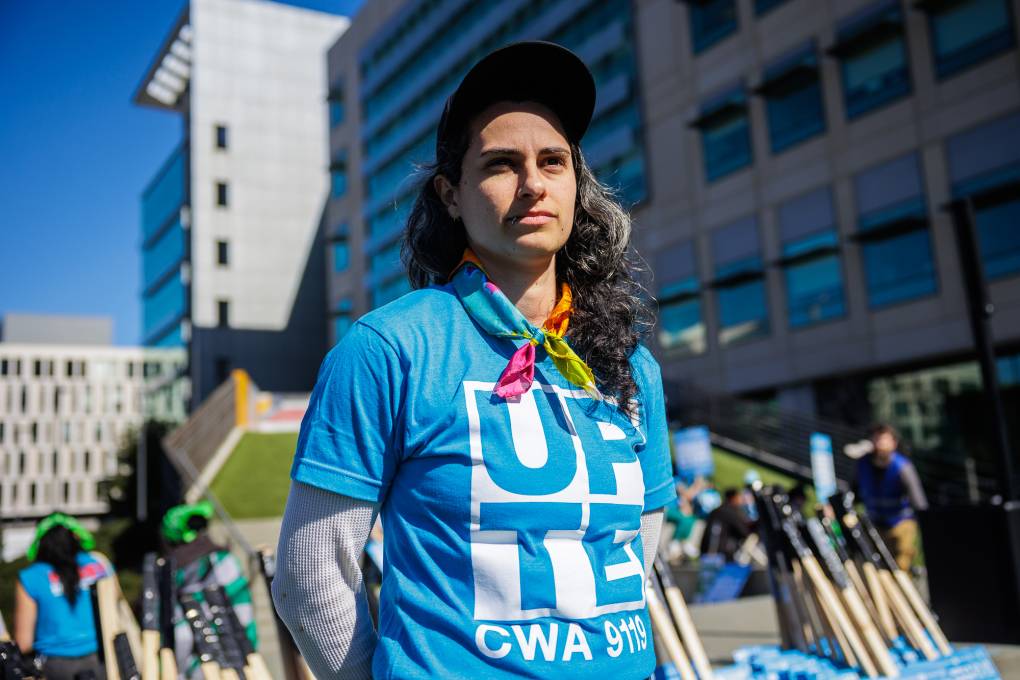
"content": "\u003cp>Tens of thousands of workers in health care, service, research and other roles at the \u003ca href=\"https://www.kqed.org/news/12027153/uc-workers-vote-to-strike-amid-federal-funding-threats\">University of California\u003c/a> walked off the job on Tuesday for the third time in five months as contentious contract negotiations drag on.\u003c/p>\n\u003cp>Labor experts said \u003ca href=\"https://www.kqed.org/news/12028446/tens-of-thousands-uc-workers-strike-disrupting-campuses-hospitals-labs\">yet another strike\u003c/a> across all UC campuses, hospitals and laboratories — this one limited to a single day — points to a high level of frustration with the state’s second-largest employer as workers push for improved wages and staffing.\u003c/p>\n\u003cp>“These workers — who are community members but also patients in the health care system — are determined to make sure that these jobs are sustainable and that they can remain in these jobs,” said Rebecca Givan, a professor of labor studies and employment relations at Rutgers University who has followed the health care industry for decades.\u003c/p>\n\u003cp>[ad fullwidth]\u003c/p>\n\u003cp>Tuesday’s walkout over UC’s alleged unfair labor practices was initiated by the University Professional and Technical Employees (UPTE), which represents about 20,000 physician assistants, pharmacists, IT analysts and others. An additional 37,000 patient care, technical and service workers represented by the American Federation of State, County and Municipal Employees (AFSCME) joined the strike in solidarity.\u003c/p>\n\u003cp>Both unions have repeatedly gone to state regulators to accuse the UC system of unlawful bad-faith bargaining, which the university strongly denies. The California Public Employment Relations Board is investigating the allegations.\u003c/p>\n\u003cp>At UC Berkeley on Tuesday, a long line of workers marched around campus, holding signs that read “For our patients, for our research, for our students,” and “On Strike,” before a midday rally.\u003c/p>\n\u003cp>[aside postID=news_12032232 hero='https://cdn.kqed.org/wp-content/uploads/sites/10/2025/03/GettyImages-2201544551-1020x729.jpg']\u003c/p>\n\u003cp>“All we want is to be able to have adequate staffing, to have enough co-workers to accomplish whatever our mission is at our worksite,” said Catherine Callaway, a UC Berkeley museum scientist and UPTE worksite representative. “What it feels like day to day is looking at all the things that you can’t possibly get done, watching your co-workers slowly burn out, watching people leave before they should really have to.”\u003c/p>\n\u003cp>UPTE members \u003ca href=\"https://upte.org/ucstrike\">argue that the university’s plans\u003c/a> to increase their health care costs without bargaining over the changes will exacerbate a recruitment and retention crisis that is hurting patient care and research. The university denies that a staffing crisis is taking place, \u003ca href=\"https://labor.universityofcalifornia.edu/_files/upte-2025-fact-sheet.pdf\">pointing (PDF)\u003c/a> to lower turnover rates and increasing headcounts.\u003c/p>\n\u003cp>Last month, UC President Michael Drake announced \u003ca href=\"https://www.kqed.org/news/12032232/head-of-ucs-largest-union-blasts-top-brass-for-hiring-freeze-amid-massive-vacancy-crisis\">a systemwide hiring freeze\u003c/a> and other cost-saving measures as the university faces threats to its federal and state funding. Since contract negotiations with AFSCME and UPTE began in January and June 2024, respectively, UC has offered “generous wage increases,” expanded sick leave and other benefits to try to avoid strike disruptions, according to a \u003ca href=\"https://www.universityofcalifornia.edu/press-room/statement-april-1-upte-and-afscme-strike\">statement\u003c/a> by the university.\u003c/p>\n\u003cp>“These strikes cost the University system millions of dollars, at a time when federal and state funding is uncertain,” the UC statement read. “UPTE and AFSCME are not being forthright in their characterizations, which is upsetting since we’ve made sincere efforts to find mutually beneficial solutions. Regardless, we are hopeful AFSCME and UPTE will make meaningful efforts to settle these contracts soon.”\u003c/p>\n\u003cfigure id=\"attachment_12034103\" class=\"wp-caption aligncenter\" style=\"max-width: 2000px\">\u003cimg loading=\"lazy\" decoding=\"async\" class=\"size-full wp-image-12034103\" src=\"https://cdn.kqed.org/wp-content/uploads/sites/10/2025/04/250226-UC-STRIKE-MD-12_qed.jpg\" alt=\"\" width=\"2000\" height=\"1333\" srcset=\"https://cdn.kqed.org/wp-content/uploads/sites/10/2025/04/250226-UC-STRIKE-MD-12_qed.jpg 2000w, https://cdn.kqed.org/wp-content/uploads/sites/10/2025/04/250226-UC-STRIKE-MD-12_qed-800x533.jpg 800w, https://cdn.kqed.org/wp-content/uploads/sites/10/2025/04/250226-UC-STRIKE-MD-12_qed-1020x680.jpg 1020w, https://cdn.kqed.org/wp-content/uploads/sites/10/2025/04/250226-UC-STRIKE-MD-12_qed-160x107.jpg 160w, https://cdn.kqed.org/wp-content/uploads/sites/10/2025/04/250226-UC-STRIKE-MD-12_qed-1536x1024.jpg 1536w, https://cdn.kqed.org/wp-content/uploads/sites/10/2025/04/250226-UC-STRIKE-MD-12_qed-1920x1280.jpg 1920w\" sizes=\"auto, (max-width: 2000px) 100vw, 2000px\">\u003cfigcaption class=\"wp-caption-text\">Members of the University Professional and Technical Employees Local 9119 and the American Federation of State County and Municipal Employees Local 3299 strike at the UC Mission Bay Campus in San Francisco on Feb. 26, 2025. \u003ccite>(Martin do Nascimento/KQED)\u003c/cite>\u003c/figcaption>\u003c/figure>\n\u003cp>The unions argue that even if budget reductions are necessary, the cuts should not be disproportionately shouldered by their members’ paychecks and working conditions. They have noted that the university approved big raises for campus chancellors last year and continued to invest in new hospital buildings and other large capital projects.\u003c/p>\n\u003cp>AFSCME and UC representatives are scheduled to meet in the coming weeks, according to a university spokesperson. State regulators have intervened in the UPTE negotiations after that union declared in January that talks with UC broke down.\u003c/p>\n\u003cp>The strikes by UPTE and AFSCME, including for a few days in November and February, have been the largest in the country in 2024 and so far this year, according to Johnnie Kallas, who directs the \u003ca href=\"https://striketracker.ilr.cornell.edu/\">Labor Action Tracker\u003c/a>, a project by Cornell University and the University of Illinois.\u003c/p>\n\u003cp>In health care, education and other settings, limited-duration strikes are much more common than indefinite walkouts, which tend to be more disruptive for employers as well as workers who forgo their paychecks, Kallas added.\u003c/p>\n\u003cp>“Workers and their representatives in the unions are very frustrated that UC hasn’t — at least in their mind — meaningfully come to the table to resolve their outstanding issues,” he said. “But it hasn’t reached the point where, for a variety of reasons, the union and the workers have decided they want to go on an even longer strike, which would be even more disruptive.”\u003c/p>\n\u003cp>\u003cem>KQED’s \u003c/em>\u003ca href=\"https://www.kqed.org/author/bkrans\">\u003cem>Brian Krans\u003c/em>\u003c/a>\u003cem> contributed to this report.\u003c/em>\u003c/p>\n\u003cp>\u003c/p>\n",
"blocks": [],
"excerpt": "Another strike by University of California workers in health care, service research and other roles — limited to a single day — underscores the frustration over contract negotiations.",
"status": "publish",
"parent": 0,
"modified": 1744125573,
"stats": {
"hasAudio": false,
"hasVideo": false,
"hasChartOrMap": false,
"iframeSrcs": [],
"hasGoogleForm": false,
"hasGallery": false,
"hasHearkenModule": false,
"hasPolis": false,
"paragraphCount": 19,
"wordCount": 856
},
"headData": {
"title": "UC Workers Hit Picket Lines in Third Statewide Strike in Recent Months | KQED",
"description": "Another strike by University of California workers in health care, service research and other roles — limited to a single day — underscores the frustration over contract negotiations.",
"ogTitle": "",
"ogDescription": "",
"ogImgId": "",
"twTitle": "",
"twDescription": "",
"twImgId": "",
"schema": {
"@context": "https://schema.org",
"@type": "NewsArticle",
"headline": "UC Workers Hit Picket Lines in Third Statewide Strike in Recent Months",
"datePublished": "2025-04-01T14:42:07-07:00",
"dateModified": "2025-04-08T08:19:33-07:00",
"image": "https://cdn.kqed.org/wp-content/uploads/2020/02/KQED-OG-Image@1x.png",
"isAccessibleForFree": "True",
"publisher": {
"@type": "NewsMediaOrganization",
"@id": "https://www.kqed.org/#organization",
"name": "KQED",
"logo": "https://cdn.kqed.org/wp-content/uploads/2020/02/KQED-OG-Image@1x.png",
"url": "https://www.kqed.org",
"sameAs": [
"https://www.facebook.com/KQED",
"https://twitter.com/KQED",
"https://www.instagram.com/kqed/",
"https://www.tiktok.com/@kqedofficial",
"https://www.linkedin.com/company/kqed",
"https://www.youtube.com/channel/UCeC0IOo7i1P_61zVUWbJ4nw"
]
}
}
},
"audioUrl": "https://cdn.kqed.org/wp-content/uploads/sites/10/2025/04/Nearly-60000-UC-Workers-Walk-Off-Job-Again-Today.mp3",
"sticky": false,
"nprStoryId": "kqed-12034098",
"templateType": "standard",
"featuredImageType": "standard",
"excludeFromSiteSearch": "Include",
"articleAge": "0",
"path": "/news/12034098/nearly-60000-uc-workers-hit-picket-lines-in-3rd-statewide-strike-in-recent-months",
"audioTrackLength": null,
"parsedContent": [
{
"type": "contentString",
"content": "\u003cdiv class=\"post-body\">\u003cp>\u003cp>Tens of thousands of workers in health care, service, research and other roles at the \u003ca href=\"https://www.kqed.org/news/12027153/uc-workers-vote-to-strike-amid-federal-funding-threats\">University of California\u003c/a> walked off the job on Tuesday for the third time in five months as contentious contract negotiations drag on.\u003c/p>\n\u003cp>Labor experts said \u003ca href=\"https://www.kqed.org/news/12028446/tens-of-thousands-uc-workers-strike-disrupting-campuses-hospitals-labs\">yet another strike\u003c/a> across all UC campuses, hospitals and laboratories — this one limited to a single day — points to a high level of frustration with the state’s second-largest employer as workers push for improved wages and staffing.\u003c/p>\n\u003cp>“These workers — who are community members but also patients in the health care system — are determined to make sure that these jobs are sustainable and that they can remain in these jobs,” said Rebecca Givan, a professor of labor studies and employment relations at Rutgers University who has followed the health care industry for decades.\u003c/p>\n\u003cp>\u003c/p>\u003c/div>",
"attributes": {
"named": {},
"numeric": []
}
},
{
"type": "component",
"content": "",
"name": "ad",
"attributes": {
"named": {
"label": "fullwidth"
},
"numeric": [
"fullwidth"
]
}
},
{
"type": "contentString",
"content": "\u003cdiv class=\"post-body\">\u003cp>\u003c/p>\n\u003cp>Tuesday’s walkout over UC’s alleged unfair labor practices was initiated by the University Professional and Technical Employees (UPTE), which represents about 20,000 physician assistants, pharmacists, IT analysts and others. An additional 37,000 patient care, technical and service workers represented by the American Federation of State, County and Municipal Employees (AFSCME) joined the strike in solidarity.\u003c/p>\n\u003cp>Both unions have repeatedly gone to state regulators to accuse the UC system of unlawful bad-faith bargaining, which the university strongly denies. The California Public Employment Relations Board is investigating the allegations.\u003c/p>\n\u003cp>At UC Berkeley on Tuesday, a long line of workers marched around campus, holding signs that read “For our patients, for our research, for our students,” and “On Strike,” before a midday rally.\u003c/p>\n\u003cp>\u003c/p>\u003c/div>",
"attributes": {
"named": {},
"numeric": []
}
},
{
"type": "component",
"content": "",
"name": "aside",
"attributes": {
"named": {
"postid": "news_12032232",
"hero": "https://cdn.kqed.org/wp-content/uploads/sites/10/2025/03/GettyImages-2201544551-1020x729.jpg",
"label": ""
},
"numeric": []
}
},
{
"type": "contentString",
"content": "\u003cdiv class=\"post-body\">\u003cp>\u003c/p>\n\u003cp>“All we want is to be able to have adequate staffing, to have enough co-workers to accomplish whatever our mission is at our worksite,” said Catherine Callaway, a UC Berkeley museum scientist and UPTE worksite representative. “What it feels like day to day is looking at all the things that you can’t possibly get done, watching your co-workers slowly burn out, watching people leave before they should really have to.”\u003c/p>\n\u003cp>UPTE members \u003ca href=\"https://upte.org/ucstrike\">argue that the university’s plans\u003c/a> to increase their health care costs without bargaining over the changes will exacerbate a recruitment and retention crisis that is hurting patient care and research. The university denies that a staffing crisis is taking place, \u003ca href=\"https://labor.universityofcalifornia.edu/_files/upte-2025-fact-sheet.pdf\">pointing (PDF)\u003c/a> to lower turnover rates and increasing headcounts.\u003c/p>\n\u003cp>Last month, UC President Michael Drake announced \u003ca href=\"https://www.kqed.org/news/12032232/head-of-ucs-largest-union-blasts-top-brass-for-hiring-freeze-amid-massive-vacancy-crisis\">a systemwide hiring freeze\u003c/a> and other cost-saving measures as the university faces threats to its federal and state funding. Since contract negotiations with AFSCME and UPTE began in January and June 2024, respectively, UC has offered “generous wage increases,” expanded sick leave and other benefits to try to avoid strike disruptions, according to a \u003ca href=\"https://www.universityofcalifornia.edu/press-room/statement-april-1-upte-and-afscme-strike\">statement\u003c/a> by the university.\u003c/p>\n\u003cp>“These strikes cost the University system millions of dollars, at a time when federal and state funding is uncertain,” the UC statement read. “UPTE and AFSCME are not being forthright in their characterizations, which is upsetting since we’ve made sincere efforts to find mutually beneficial solutions. Regardless, we are hopeful AFSCME and UPTE will make meaningful efforts to settle these contracts soon.”\u003c/p>\n\u003cfigure id=\"attachment_12034103\" class=\"wp-caption aligncenter\" style=\"max-width: 2000px\">\u003cimg loading=\"lazy\" decoding=\"async\" class=\"size-full wp-image-12034103\" src=\"https://cdn.kqed.org/wp-content/uploads/sites/10/2025/04/250226-UC-STRIKE-MD-12_qed.jpg\" alt=\"\" width=\"2000\" height=\"1333\" srcset=\"https://cdn.kqed.org/wp-content/uploads/sites/10/2025/04/250226-UC-STRIKE-MD-12_qed.jpg 2000w, https://cdn.kqed.org/wp-content/uploads/sites/10/2025/04/250226-UC-STRIKE-MD-12_qed-800x533.jpg 800w, https://cdn.kqed.org/wp-content/uploads/sites/10/2025/04/250226-UC-STRIKE-MD-12_qed-1020x680.jpg 1020w, https://cdn.kqed.org/wp-content/uploads/sites/10/2025/04/250226-UC-STRIKE-MD-12_qed-160x107.jpg 160w, https://cdn.kqed.org/wp-content/uploads/sites/10/2025/04/250226-UC-STRIKE-MD-12_qed-1536x1024.jpg 1536w, https://cdn.kqed.org/wp-content/uploads/sites/10/2025/04/250226-UC-STRIKE-MD-12_qed-1920x1280.jpg 1920w\" sizes=\"auto, (max-width: 2000px) 100vw, 2000px\">\u003cfigcaption class=\"wp-caption-text\">Members of the University Professional and Technical Employees Local 9119 and the American Federation of State County and Municipal Employees Local 3299 strike at the UC Mission Bay Campus in San Francisco on Feb. 26, 2025. \u003ccite>(Martin do Nascimento/KQED)\u003c/cite>\u003c/figcaption>\u003c/figure>\n\u003cp>The unions argue that even if budget reductions are necessary, the cuts should not be disproportionately shouldered by their members’ paychecks and working conditions. They have noted that the university approved big raises for campus chancellors last year and continued to invest in new hospital buildings and other large capital projects.\u003c/p>\n\u003cp>AFSCME and UC representatives are scheduled to meet in the coming weeks, according to a university spokesperson. State regulators have intervened in the UPTE negotiations after that union declared in January that talks with UC broke down.\u003c/p>\n\u003cp>The strikes by UPTE and AFSCME, including for a few days in November and February, have been the largest in the country in 2024 and so far this year, according to Johnnie Kallas, who directs the \u003ca href=\"https://striketracker.ilr.cornell.edu/\">Labor Action Tracker\u003c/a>, a project by Cornell University and the University of Illinois.\u003c/p>\n\u003cp>In health care, education and other settings, limited-duration strikes are much more common than indefinite walkouts, which tend to be more disruptive for employers as well as workers who forgo their paychecks, Kallas added.\u003c/p>\n\u003cp>“Workers and their representatives in the unions are very frustrated that UC hasn’t — at least in their mind — meaningfully come to the table to resolve their outstanding issues,” he said. “But it hasn’t reached the point where, for a variety of reasons, the union and the workers have decided they want to go on an even longer strike, which would be even more disruptive.”\u003c/p>\n\u003cp>\u003cem>KQED’s \u003c/em>\u003ca href=\"https://www.kqed.org/author/bkrans\">\u003cem>Brian Krans\u003c/em>\u003c/a>\u003cem> contributed to this report.\u003c/em>\u003c/p>\n\u003cp>\u003c/p>\n\u003c/div>\u003c/p>",
"attributes": {
"named": {},
"numeric": []
}
}
],
"link": "/news/12034098/nearly-60000-uc-workers-hit-picket-lines-in-3rd-statewide-strike-in-recent-months",
"authors": [
"8659"
],
"categories": [
"news_31795",
"news_34551",
"news_8"
],
"tags": [
"news_129",
"news_18538",
"news_35118",
"news_24939",
"news_19904",
"news_24590",
"news_20482",
"news_17597",
"news_922",
"news_794",
"news_206"
],
"featImg": "news_12028811",
"label": "news"
},
"news_12033192": {
"type": "posts",
"id": "news_12033192",
"meta": {
"index": "posts_1716263798",
"site": "news",
"id": "12033192",
"score": null,
"sort": [
1743030050000
]
},
"guestAuthors": [],
"slug": "the-us-education-department-investigates-cal-state-san-bernardino-as-trump-dismantles-the-agency",
"title": "The US Education Department Investigates Cal State San Bernardino as Trump Dismantles the Agency",
"publishDate": 1743030050,
"format": "standard",
"headTitle": "The US Education Department Investigates Cal State San Bernardino as Trump Dismantles the Agency | KQED",
"labelTerm": {
"term": 18481,
"site": "news"
},
"content": "\u003cp>\u003c!-- Creative Commons Attribution-NonCommercial-NoDerivatives https://creativecommons.org/licenses/by-nc-nd/4.0/ -->\u003cbr>\n\u003cem>This story was originally published by \u003ca href=\"https://calmatters.org/\">CalMatters\u003c/a>. \u003ca href=\"https://calmatters.org/subscribe-to-calmatters/\">Sign up\u003c/a> for their newsletters. \u003c/em>\u003cem>Lea esta historia en \u003ca href=\"https://calmatters.org/calmatters-en-espanol/2025/03/departamento-educacion-investigacion-cal-state-san-bernardino-programa/\">Español.\u003c/a>\u003c/em>\u003c/p>\n\u003cp>Cal State San Bernardino is one of more than 50 universities under investigation by the U.S. Department of Education, even as President Donald Trump \u003ca href=\"https://calmatters.org/education/2025/03/education-department/\">attempts to unravel\u003c/a> the department.\u003c/p>\n\u003cp>A statement from the department’s Office for Civil Rights listed three California campuses — Cal State San Bernardino, Cal Poly Humboldt and UC Berkeley — among universities it says violated Title VI of the education code. That’s the section of the 1964 Civil Rights Act that prohibits organizations that get federal funds from discriminating based on race, color or national origin.\u003c/p>\n\u003cp>The investigations aim to “ensure universities are not discriminating against their students based on race and race stereotypes,” U.S. Secretary of Education Linda McMahon said in the statement.\u003c/p>\n\u003cp>The Cal State University system is reviewing the claim and will cooperate in the investigation, said Amy Bentley-Smith, a Cal State spokesperson said in a statement.\u003c/p>\n\u003cp>[ad fullwidth]\u003c/p>\n\u003cp>“The CSU continues to comply with longstanding applicable federal and state laws and CSU policies and does not discriminate or provide preferences on the basis of race, sex, color, ethnicity or national origin,” she said.\u003c/p>\n\u003cp>A UC Berkeley official said the campus also is responding to the federal investigation.\u003c/p>\n\u003cp>“UC Berkeley has an unwavering commitment to having a campus free of discrimination,” Assistant Vice Chancellor Dan Mogulof said in a statement.\u003c/p>\n\u003cp>The \u003ca href=\"https://www.ed.gov/about/news/press-release/office-civil-rights-initiates-title-vi-investigations-institutions-of-higher-education-0\">\u003cu>Department of Education\u003c/u>\u003c/a> claims the three California universities violated civil rights laws by partnering with The PhD Project, which it describes as “an organization that purports to provide doctoral students with insights into obtaining a Ph.D and networking opportunities, but limits eligibility based on the race of participants.”\u003c/p>\n\u003cp>[aside postID=news_12030322 hero='https://cdn.kqed.org/wp-content/uploads/sites/10/2025/03/20230822-SFSU-45-JY_qed-1020x680.jpg']\u003c/p>\n\u003cp>The PhD Project describes its mission as developing business school faculty and said this year it’s open to all applicants.\u003c/p>\n\u003cp>“Our vision is to create a broader talent pipeline of current and future business leaders who are committed to excellence and to each other, through networking, mentorship, and unique events,” it said in a statement . “This year, we have opened our membership application to anyone who shares that vision.”\u003c/p>\n\u003cp>Ahlam Muhtaseb, a professor of media studies at Cal State San Bernardino, said the federal complaint doesn’t make sense, because the university doesn’t offer a doctorate in business. It does offer a doctorate in educational leadership, and Muhtaseb believes that’s what the Department of Education is targeting.\u003c/p>\n\u003cp>“It’s frivolous because they are saying that we are infringing on the rights of white students because we have admitted 90% students of color,” into the educational leadership program, she said. “That is a ridiculous allegation because we are a \u003ca href=\"https://calmatters.org/education/higher-education/2024/05/hispanic-serving-institutions-programs-funding/\">Hispanic-serving institution\u003c/a>.”\u003c/p>\n\u003cp>About 70% of students at Cal State San Bernardino are Latino, 10% are White, 6% are Asian and 5% are Black.\u003c/p>\n\u003cp>“So this is natural that this is the community that we serve,” Muhtaseb said.\u003c/p>\n\u003cp>The investigation, she said, “has a chilling impact. I see it as an \u003ca href=\"https://calmatters.org/commentary/2025/03/uc-diversity-statement/\">attack on our marginalized communities.\u003c/a>”\u003c/p>\n\u003cp>It’s not clear how the Department of Education will conduct the investigation, however, because the Trump Administration is trying to eliminate the department.[aside postID=news_12031468 hero='https://cdn.kqed.org/wp-content/uploads/sites/10/2025/03/npr.brightspotcdn-copy-2-1020x681.jpg']On March 11, the department announced it was cutting its own staff by half. On March 14 it announced it would investigate the universities for alleged civil rights violations. Last Friday Trump issued an executive order to dismantle the department.\u003c/p>\n\u003cp>The Department of Education did not respond to an email from CalMatters, and the phone line for its press information office had an automated message stating that it was temporarily closed.\u003c/p>\n\u003cp>On Monday, a coalition of advocacy groups and state leaders, including California Attorney General Rob Bonta, sued to block the elimination of the department and the mass firing of its employees, arguing it would impair the administration of student loans, disability services and other functions.\u003c/p>\n\u003cp>They pointed out that Congress created the department and has sole authority to close it.\u003c/p>\n\u003cp>Faculty at campuses targeted by the investigation said it has already lost its original purpose.\u003c/p>\n\u003cp>“The Department of Education has been more or less dismantled in terms of its civil rights and student aid, but has now been turned against the institutions it was designed to support,” said Ryder Dschida, a history professor at Cal Poly Humboldt.\u003c/p>\n\u003cp>\u003cem>This article was \u003ca href=\"https://calmatters.org/education/2025/03/cal-state-san-bernardino-investigation/\">originally published on CalMatters\u003c/a> and was republished under the \u003ca href=\"https://creativecommons.org/licenses/by-nc-nd/4.0/\">Creative Commons Attribution-NonCommercial-NoDerivatives\u003c/a> license.\u003c/em>\u003c/p>\n\u003cp>\u003c/p>\n",
"blocks": [],
"excerpt": "Cal State San Bernardino is among several dozen universities under federal scrutiny for programs that have targeted disadvantaged groups of students.",
"status": "publish",
"parent": 0,
"modified": 1743025723,
"stats": {
"hasAudio": false,
"hasVideo": false,
"hasChartOrMap": false,
"iframeSrcs": [],
"hasGoogleForm": false,
"hasGallery": false,
"hasHearkenModule": false,
"hasPolis": false,
"paragraphCount": 26,
"wordCount": 812
},
"headData": {
"title": "The US Education Department Investigates Cal State San Bernardino as Trump Dismantles the Agency | KQED",
"description": "Cal State San Bernardino is among several dozen universities under federal scrutiny for programs that have targeted disadvantaged groups of students.",
"ogTitle": "",
"ogDescription": "",
"ogImgId": "",
"twTitle": "",
"twDescription": "",
"twImgId": "",
"schema": {
"@context": "https://schema.org",
"@type": "NewsArticle",
"headline": "The US Education Department Investigates Cal State San Bernardino as Trump Dismantles the Agency",
"datePublished": "2025-03-26T16:00:50-07:00",
"dateModified": "2025-03-26T14:48:43-07:00",
"image": "https://cdn.kqed.org/wp-content/uploads/2020/02/KQED-OG-Image@1x.png",
"isAccessibleForFree": "True",
"publisher": {
"@type": "NewsMediaOrganization",
"@id": "https://www.kqed.org/#organization",
"name": "KQED",
"logo": "https://cdn.kqed.org/wp-content/uploads/2020/02/KQED-OG-Image@1x.png",
"url": "https://www.kqed.org",
"sameAs": [
"https://www.facebook.com/KQED",
"https://twitter.com/KQED",
"https://www.instagram.com/kqed/",
"https://www.tiktok.com/@kqedofficial",
"https://www.linkedin.com/company/kqed",
"https://www.youtube.com/channel/UCeC0IOo7i1P_61zVUWbJ4nw"
]
}
}
},
"sticky": false,
"nprByline": "\u003ca href=\"https://calmatters.org/author/deborah-brennan/\">Deborah Brennan\u003c/a>, CalMatters",
"templateType": "standard",
"featuredImageType": "standard",
"excludeFromSiteSearch": "Include",
"showOnAuthorArchivePages": "No",
"articleAge": "0",
"path": "/news/12033192/the-us-education-department-investigates-cal-state-san-bernardino-as-trump-dismantles-the-agency",
"audioTrackLength": null,
"parsedContent": [
{
"type": "contentString",
"content": "\u003cdiv class=\"post-body\">\u003cp>\u003cp>\u003c!-- Creative Commons Attribution-NonCommercial-NoDerivatives https://creativecommons.org/licenses/by-nc-nd/4.0/ -->\u003cbr>\n\u003cem>This story was originally published by \u003ca href=\"https://calmatters.org/\">CalMatters\u003c/a>. \u003ca href=\"https://calmatters.org/subscribe-to-calmatters/\">Sign up\u003c/a> for their newsletters. \u003c/em>\u003cem>Lea esta historia en \u003ca href=\"https://calmatters.org/calmatters-en-espanol/2025/03/departamento-educacion-investigacion-cal-state-san-bernardino-programa/\">Español.\u003c/a>\u003c/em>\u003c/p>\n\u003cp>Cal State San Bernardino is one of more than 50 universities under investigation by the U.S. Department of Education, even as President Donald Trump \u003ca href=\"https://calmatters.org/education/2025/03/education-department/\">attempts to unravel\u003c/a> the department.\u003c/p>\n\u003cp>A statement from the department’s Office for Civil Rights listed three California campuses — Cal State San Bernardino, Cal Poly Humboldt and UC Berkeley — among universities it says violated Title VI of the education code. That’s the section of the 1964 Civil Rights Act that prohibits organizations that get federal funds from discriminating based on race, color or national origin.\u003c/p>\n\u003cp>The investigations aim to “ensure universities are not discriminating against their students based on race and race stereotypes,” U.S. Secretary of Education Linda McMahon said in the statement.\u003c/p>\n\u003cp>The Cal State University system is reviewing the claim and will cooperate in the investigation, said Amy Bentley-Smith, a Cal State spokesperson said in a statement.\u003c/p>\n\u003cp>\u003c/p>\u003c/div>",
"attributes": {
"named": {},
"numeric": []
}
},
{
"type": "component",
"content": "",
"name": "ad",
"attributes": {
"named": {
"label": "fullwidth"
},
"numeric": [
"fullwidth"
]
}
},
{
"type": "contentString",
"content": "\u003cdiv class=\"post-body\">\u003cp>\u003c/p>\n\u003cp>“The CSU continues to comply with longstanding applicable federal and state laws and CSU policies and does not discriminate or provide preferences on the basis of race, sex, color, ethnicity or national origin,” she said.\u003c/p>\n\u003cp>A UC Berkeley official said the campus also is responding to the federal investigation.\u003c/p>\n\u003cp>“UC Berkeley has an unwavering commitment to having a campus free of discrimination,” Assistant Vice Chancellor Dan Mogulof said in a statement.\u003c/p>\n\u003cp>The \u003ca href=\"https://www.ed.gov/about/news/press-release/office-civil-rights-initiates-title-vi-investigations-institutions-of-higher-education-0\">\u003cu>Department of Education\u003c/u>\u003c/a> claims the three California universities violated civil rights laws by partnering with The PhD Project, which it describes as “an organization that purports to provide doctoral students with insights into obtaining a Ph.D and networking opportunities, but limits eligibility based on the race of participants.”\u003c/p>\n\u003cp>\u003c/p>\u003c/div>",
"attributes": {
"named": {},
"numeric": []
}
},
{
"type": "component",
"content": "",
"name": "aside",
"attributes": {
"named": {
"postid": "news_12030322",
"hero": "https://cdn.kqed.org/wp-content/uploads/sites/10/2025/03/20230822-SFSU-45-JY_qed-1020x680.jpg",
"label": ""
},
"numeric": []
}
},
{
"type": "contentString",
"content": "\u003cdiv class=\"post-body\">\u003cp>\u003c/p>\n\u003cp>The PhD Project describes its mission as developing business school faculty and said this year it’s open to all applicants.\u003c/p>\n\u003cp>“Our vision is to create a broader talent pipeline of current and future business leaders who are committed to excellence and to each other, through networking, mentorship, and unique events,” it said in a statement . “This year, we have opened our membership application to anyone who shares that vision.”\u003c/p>\n\u003cp>Ahlam Muhtaseb, a professor of media studies at Cal State San Bernardino, said the federal complaint doesn’t make sense, because the university doesn’t offer a doctorate in business. It does offer a doctorate in educational leadership, and Muhtaseb believes that’s what the Department of Education is targeting.\u003c/p>\n\u003cp>“It’s frivolous because they are saying that we are infringing on the rights of white students because we have admitted 90% students of color,” into the educational leadership program, she said. “That is a ridiculous allegation because we are a \u003ca href=\"https://calmatters.org/education/higher-education/2024/05/hispanic-serving-institutions-programs-funding/\">Hispanic-serving institution\u003c/a>.”\u003c/p>\n\u003cp>About 70% of students at Cal State San Bernardino are Latino, 10% are White, 6% are Asian and 5% are Black.\u003c/p>\n\u003cp>“So this is natural that this is the community that we serve,” Muhtaseb said.\u003c/p>\n\u003cp>The investigation, she said, “has a chilling impact. I see it as an \u003ca href=\"https://calmatters.org/commentary/2025/03/uc-diversity-statement/\">attack on our marginalized communities.\u003c/a>”\u003c/p>\n\u003cp>It’s not clear how the Department of Education will conduct the investigation, however, because the Trump Administration is trying to eliminate the department.\u003c/p>\u003c/div>",
"attributes": {
"named": {},
"numeric": []
}
},
{
"type": "component",
"content": "",
"name": "aside",
"attributes": {
"named": {
"postid": "news_12031468",
"hero": "https://cdn.kqed.org/wp-content/uploads/sites/10/2025/03/npr.brightspotcdn-copy-2-1020x681.jpg",
"label": ""
},
"numeric": []
}
},
{
"type": "contentString",
"content": "\u003cdiv class=\"post-body\">\u003cp>On March 11, the department announced it was cutting its own staff by half. On March 14 it announced it would investigate the universities for alleged civil rights violations. Last Friday Trump issued an executive order to dismantle the department.\u003c/p>\n\u003cp>The Department of Education did not respond to an email from CalMatters, and the phone line for its press information office had an automated message stating that it was temporarily closed.\u003c/p>\n\u003cp>On Monday, a coalition of advocacy groups and state leaders, including California Attorney General Rob Bonta, sued to block the elimination of the department and the mass firing of its employees, arguing it would impair the administration of student loans, disability services and other functions.\u003c/p>\n\u003cp>They pointed out that Congress created the department and has sole authority to close it.\u003c/p>\n\u003cp>Faculty at campuses targeted by the investigation said it has already lost its original purpose.\u003c/p>\n\u003cp>“The Department of Education has been more or less dismantled in terms of its civil rights and student aid, but has now been turned against the institutions it was designed to support,” said Ryder Dschida, a history professor at Cal Poly Humboldt.\u003c/p>\n\u003cp>\u003cem>This article was \u003ca href=\"https://calmatters.org/education/2025/03/cal-state-san-bernardino-investigation/\">originally published on CalMatters\u003c/a> and was republished under the \u003ca href=\"https://creativecommons.org/licenses/by-nc-nd/4.0/\">Creative Commons Attribution-NonCommercial-NoDerivatives\u003c/a> license.\u003c/em>\u003c/p>\n\u003cp>\u003c/p>\n\u003c/div>\u003c/p>",
"attributes": {
"named": {},
"numeric": []
}
}
],
"link": "/news/12033192/the-us-education-department-investigates-cal-state-san-bernardino-as-trump-dismantles-the-agency",
"authors": [
"byline_news_12033192"
],
"categories": [
"news_18540",
"news_8",
"news_13"
],
"tags": [
"news_34271",
"news_31933",
"news_18738",
"news_2717",
"news_21567",
"news_17597"
],
"affiliates": [
"news_18481"
],
"featImg": "news_12033194",
"label": "news_18481"
},
"news_12032030": {
"type": "posts",
"id": "news_12032030",
"meta": {
"index": "posts_1716263798",
"site": "news",
"id": "12032030",
"score": null,
"sort": [
1742475605000
]
},
"guestAuthors": [],
"slug": "uc-berkeley-faculty-rally-to-defend-free-speech-and-protest-cuts",
"title": "UC Berkeley Faculty Rally to Defend Free Speech and Protest Cuts",
"publishDate": 1742475605,
"format": "standard",
"headTitle": "UC Berkeley Faculty Rally to Defend Free Speech and Protest Cuts | KQED",
"labelTerm": {
"site": "news"
},
"content": "\u003cp>Hundreds of faculty and students flooded UC Berkeley’s Sproul Plaza on Wednesday to defend academic freedom and free speech amid \u003ca href=\"https://www.kqed.org/news/tag/donald-trump\">the Trump administration’s\u003c/a> escalating threats to withhold funding from the campus.\u003c/p>\n\u003cp>Both UC Berkeley and UCLA are among the 10 universities under investigation by the Federal Task Force to Combat Anti-Semitism after the Justice Department alleged that the schools failed to protect Jewish students during the widespread pro-Palestinian protests on college campuses last spring. UC Berkeley is also the subject of another investigation from the Department of Education over alleged “race-exclusionary practices” in its graduate programs.\u003c/p>\n\u003cfigure id=\"attachment_12032122\" class=\"wp-caption aligncenter\" style=\"max-width: 2000px\">\u003cimg loading=\"lazy\" decoding=\"async\" class=\"size-full wp-image-12032122\" src=\"https://cdn.kqed.org/wp-content/uploads/sites/10/2025/03/250319-UCBerkeleyProtest-03-BL.jpg\" alt=\"\" width=\"2000\" height=\"1333\" srcset=\"https://cdn.kqed.org/wp-content/uploads/sites/10/2025/03/250319-UCBerkeleyProtest-03-BL.jpg 2000w, https://cdn.kqed.org/wp-content/uploads/sites/10/2025/03/250319-UCBerkeleyProtest-03-BL-800x533.jpg 800w, https://cdn.kqed.org/wp-content/uploads/sites/10/2025/03/250319-UCBerkeleyProtest-03-BL-1020x680.jpg 1020w, https://cdn.kqed.org/wp-content/uploads/sites/10/2025/03/250319-UCBerkeleyProtest-03-BL-160x107.jpg 160w, https://cdn.kqed.org/wp-content/uploads/sites/10/2025/03/250319-UCBerkeleyProtest-03-BL-1536x1024.jpg 1536w, https://cdn.kqed.org/wp-content/uploads/sites/10/2025/03/250319-UCBerkeleyProtest-03-BL-1920x1280.jpg 1920w\" sizes=\"auto, (max-width: 2000px) 100vw, 2000px\">\u003cfigcaption class=\"wp-caption-text\">Faculty, students, and supporters gather in Sproul Plaza at UC Berkeley on March 19, 2025. \u003ccite>(Beth LaBerge/KQED)\u003c/cite>\u003c/figcaption>\u003c/figure>\n\u003cp>The Trump administration said both of these may be grounds to withhold federal funding from the university.\u003c/p>\n\u003cp>“Academic freedom is under assault,” African American studies professor Ula Taylor told the crowd at Sproul. “When we accepted the honor to teach and conduct research at this public university, we did so because of a long commitment to academic freedom.”\u003c/p>\n\u003cfigure id=\"attachment_12032123\" class=\"wp-caption aligncenter\" style=\"max-width: 2000px\">\u003cimg loading=\"lazy\" decoding=\"async\" class=\"size-full wp-image-12032123\" src=\"https://cdn.kqed.org/wp-content/uploads/sites/10/2025/03/250319-UCBerkeleyProtest-17-BL.jpg\" alt=\"\" width=\"2000\" height=\"1333\" srcset=\"https://cdn.kqed.org/wp-content/uploads/sites/10/2025/03/250319-UCBerkeleyProtest-17-BL.jpg 2000w, https://cdn.kqed.org/wp-content/uploads/sites/10/2025/03/250319-UCBerkeleyProtest-17-BL-800x533.jpg 800w, https://cdn.kqed.org/wp-content/uploads/sites/10/2025/03/250319-UCBerkeleyProtest-17-BL-1020x680.jpg 1020w, https://cdn.kqed.org/wp-content/uploads/sites/10/2025/03/250319-UCBerkeleyProtest-17-BL-160x107.jpg 160w, https://cdn.kqed.org/wp-content/uploads/sites/10/2025/03/250319-UCBerkeleyProtest-17-BL-1536x1024.jpg 1536w, https://cdn.kqed.org/wp-content/uploads/sites/10/2025/03/250319-UCBerkeleyProtest-17-BL-1920x1280.jpg 1920w\" sizes=\"auto, (max-width: 2000px) 100vw, 2000px\">\u003cfigcaption class=\"wp-caption-text\">Faculty, students, and supporters gather in Sproul Plaza at UC Berkeley on March 19, 2025. \u003ccite>(Beth LaBerge/KQED)\u003c/cite>\u003c/figcaption>\u003c/figure>\n\u003cp>Some speakers were scheduled to teach at the same time as the rally. Lecturer Matthew Parker’s solution was to bring his class to Sproul Plaza, where he spoke about the importance of maintaining an open dialogue — especially those with whom he “fruitfully disagrees.”\u003c/p>\n\u003cp>[ad fullwidth]\u003c/p>\n\u003cp>Professors also pointed to the university’s history of championing free speech and diversity efforts as a strength the federal administration is attacking. Demonstrators held signs that read “Education not censorship,” “We are the university” and “Free speech movement was born in Berkeley.”[aside postID=news_12032046 hero='https://cdn.kqed.org/wp-content/uploads/sites/10/2025/01/DonaldTrumpEOGetty-1020x664.jpg']“I love that here is where I first danced with a wheelchair-bound student who also taught me disability law,” Berkeley Law professor Claudia Polsky said. “I love that UC Berkeley science helped lead to the COVID vaccine, saving over 14 million lives. And best of all, I love that here, status cannot be bought: The only route to a personal parking space is to win a Nobel prize.”\u003c/p>\n\u003cp>UC Berkeley professors also spoke about their rising concern of political deportations after the detention of Columbia University graduate \u003ca href=\"https://www.kqed.org/news/12031867/israels-renewed-assault-gaza-draws-hundreds-streets-san-francisco\">Mahmoud Khalil\u003c/a> last week. Amid chants to free Khalil, Polsky urged faculty to protect those who are vulnerable to similar arrests for the purpose of deportation.\u003c/p>\n\u003cp>“Today, let us learn the lesson of good instincts that were deployed too late. Our time is right now,” she said. “Trump’s attacks on Columbia University are just the beginning.”\u003c/p>\n\u003cfigure id=\"attachment_12032120\" class=\"wp-caption aligncenter\" style=\"max-width: 2000px\">\u003cimg loading=\"lazy\" decoding=\"async\" class=\"size-full wp-image-12032120\" src=\"https://cdn.kqed.org/wp-content/uploads/sites/10/2025/03/250319-UCBerkeleyProtest-19-BL.jpg\" alt=\"\" width=\"2000\" height=\"1333\" srcset=\"https://cdn.kqed.org/wp-content/uploads/sites/10/2025/03/250319-UCBerkeleyProtest-19-BL.jpg 2000w, https://cdn.kqed.org/wp-content/uploads/sites/10/2025/03/250319-UCBerkeleyProtest-19-BL-800x533.jpg 800w, https://cdn.kqed.org/wp-content/uploads/sites/10/2025/03/250319-UCBerkeleyProtest-19-BL-1020x680.jpg 1020w, https://cdn.kqed.org/wp-content/uploads/sites/10/2025/03/250319-UCBerkeleyProtest-19-BL-160x107.jpg 160w, https://cdn.kqed.org/wp-content/uploads/sites/10/2025/03/250319-UCBerkeleyProtest-19-BL-1536x1024.jpg 1536w, https://cdn.kqed.org/wp-content/uploads/sites/10/2025/03/250319-UCBerkeleyProtest-19-BL-1920x1280.jpg 1920w\" sizes=\"auto, (max-width: 2000px) 100vw, 2000px\">\u003cfigcaption class=\"wp-caption-text\">Juana Maria Rodriguez, professor of ethnic studies, speaks at the rally in Sproul Plaza at the UC Berkeley on March 19, 2025. \u003ccite>(Beth LaBerge/KQED)\u003c/cite>\u003c/figcaption>\u003c/figure>\n\u003cp>Other professors also compared Khalil’s detention to the internment of Japanese Americans and the persecution of European Jews at the start of the Holocaust.\u003c/p>\n\u003cp>As faculty spoke at the rally, UC President Michael Drake was leading the UC Regents meeting in Los Angeles, where he announced a systemwide hiring freeze in anticipation of both state and federal funding cuts.\u003c/p>\n\u003cfigure id=\"attachment_12032117\" class=\"wp-caption aligncenter\" style=\"max-width: 2000px\">\u003cimg loading=\"lazy\" decoding=\"async\" class=\"size-full wp-image-12032117\" src=\"https://cdn.kqed.org/wp-content/uploads/sites/10/2025/03/250319-UCBerkeleyProtest-09-BL.jpg\" alt=\"\" width=\"2000\" height=\"1333\" srcset=\"https://cdn.kqed.org/wp-content/uploads/sites/10/2025/03/250319-UCBerkeleyProtest-09-BL.jpg 2000w, https://cdn.kqed.org/wp-content/uploads/sites/10/2025/03/250319-UCBerkeleyProtest-09-BL-800x533.jpg 800w, https://cdn.kqed.org/wp-content/uploads/sites/10/2025/03/250319-UCBerkeleyProtest-09-BL-1020x680.jpg 1020w, https://cdn.kqed.org/wp-content/uploads/sites/10/2025/03/250319-UCBerkeleyProtest-09-BL-160x107.jpg 160w, https://cdn.kqed.org/wp-content/uploads/sites/10/2025/03/250319-UCBerkeleyProtest-09-BL-1536x1024.jpg 1536w, https://cdn.kqed.org/wp-content/uploads/sites/10/2025/03/250319-UCBerkeleyProtest-09-BL-1920x1280.jpg 1920w\" sizes=\"auto, (max-width: 2000px) 100vw, 2000px\">\u003cfigcaption class=\"wp-caption-text\">Faculty, students, and supporters gather in Sproul Plaza at UC Berkeley on March 19, 2025. \u003ccite>(Beth LaBerge/KQED)\u003c/cite>\u003c/figcaption>\u003c/figure>\n\u003cp>Drake called the funding uncertainties and resulting hiring freeze a “lose-lose proposition” for the country.\u003c/p>\n\u003cp>Other universities, such as Harvard University, the University of Pennsylvania and the University of Washington, announced freezes this week, citing similar uncertainties about federal funding.\u003c/p>\n\u003cp>Faculty vowed to return to Sproul on April 8 as part of a national labor action to protest cuts to education and research.\u003c/p>\n\u003cp>\u003c/p>\n",
"blocks": [],
"excerpt": "Hundreds of UC Berkeley professors and students rallied in defense of academic freedom as President Donald Trump threatened to pull funding and “punish” higher education.",
"status": "publish",
"parent": 0,
"modified": 1742431652,
"stats": {
"hasAudio": false,
"hasVideo": false,
"hasChartOrMap": false,
"iframeSrcs": [],
"hasGoogleForm": false,
"hasGallery": false,
"hasHearkenModule": false,
"hasPolis": false,
"paragraphCount": 15,
"wordCount": 645
},
"headData": {
"title": "UC Berkeley Faculty Rally to Defend Free Speech and Protest Cuts | KQED",
"description": "Hundreds of UC Berkeley professors and students rallied in defense of academic freedom as President Donald Trump threatened to pull funding and “punish” higher education.",
"ogTitle": "",
"ogDescription": "",
"ogImgId": "",
"twTitle": "",
"twDescription": "",
"twImgId": "",
"schema": {
"@context": "https://schema.org",
"@type": "NewsArticle",
"headline": "UC Berkeley Faculty Rally to Defend Free Speech and Protest Cuts",
"datePublished": "2025-03-20T06:00:05-07:00",
"dateModified": "2025-03-19T17:47:32-07:00",
"image": "https://cdn.kqed.org/wp-content/uploads/2020/02/KQED-OG-Image@1x.png",
"isAccessibleForFree": "True",
"publisher": {
"@type": "NewsMediaOrganization",
"@id": "https://www.kqed.org/#organization",
"name": "KQED",
"logo": "https://cdn.kqed.org/wp-content/uploads/2020/02/KQED-OG-Image@1x.png",
"url": "https://www.kqed.org",
"sameAs": [
"https://www.facebook.com/KQED",
"https://twitter.com/KQED",
"https://www.instagram.com/kqed/",
"https://www.tiktok.com/@kqedofficial",
"https://www.linkedin.com/company/kqed",
"https://www.youtube.com/channel/UCeC0IOo7i1P_61zVUWbJ4nw"
]
}
}
},
"sticky": false,
"templateType": "standard",
"featuredImageType": "standard",
"excludeFromSiteSearch": "Include",
"articleAge": "0",
"path": "/news/12032030/uc-berkeley-faculty-rally-to-defend-free-speech-and-protest-cuts",
"audioTrackLength": null,
"parsedContent": [
{
"type": "contentString",
"content": "\u003cdiv class=\"post-body\">\u003cp>\u003cp>Hundreds of faculty and students flooded UC Berkeley’s Sproul Plaza on Wednesday to defend academic freedom and free speech amid \u003ca href=\"https://www.kqed.org/news/tag/donald-trump\">the Trump administration’s\u003c/a> escalating threats to withhold funding from the campus.\u003c/p>\n\u003cp>Both UC Berkeley and UCLA are among the 10 universities under investigation by the Federal Task Force to Combat Anti-Semitism after the Justice Department alleged that the schools failed to protect Jewish students during the widespread pro-Palestinian protests on college campuses last spring. UC Berkeley is also the subject of another investigation from the Department of Education over alleged “race-exclusionary practices” in its graduate programs.\u003c/p>\n\u003cfigure id=\"attachment_12032122\" class=\"wp-caption aligncenter\" style=\"max-width: 2000px\">\u003cimg loading=\"lazy\" decoding=\"async\" class=\"size-full wp-image-12032122\" src=\"https://cdn.kqed.org/wp-content/uploads/sites/10/2025/03/250319-UCBerkeleyProtest-03-BL.jpg\" alt=\"\" width=\"2000\" height=\"1333\" srcset=\"https://cdn.kqed.org/wp-content/uploads/sites/10/2025/03/250319-UCBerkeleyProtest-03-BL.jpg 2000w, https://cdn.kqed.org/wp-content/uploads/sites/10/2025/03/250319-UCBerkeleyProtest-03-BL-800x533.jpg 800w, https://cdn.kqed.org/wp-content/uploads/sites/10/2025/03/250319-UCBerkeleyProtest-03-BL-1020x680.jpg 1020w, https://cdn.kqed.org/wp-content/uploads/sites/10/2025/03/250319-UCBerkeleyProtest-03-BL-160x107.jpg 160w, https://cdn.kqed.org/wp-content/uploads/sites/10/2025/03/250319-UCBerkeleyProtest-03-BL-1536x1024.jpg 1536w, https://cdn.kqed.org/wp-content/uploads/sites/10/2025/03/250319-UCBerkeleyProtest-03-BL-1920x1280.jpg 1920w\" sizes=\"auto, (max-width: 2000px) 100vw, 2000px\">\u003cfigcaption class=\"wp-caption-text\">Faculty, students, and supporters gather in Sproul Plaza at UC Berkeley on March 19, 2025. \u003ccite>(Beth LaBerge/KQED)\u003c/cite>\u003c/figcaption>\u003c/figure>\n\u003cp>The Trump administration said both of these may be grounds to withhold federal funding from the university.\u003c/p>\n\u003cp>“Academic freedom is under assault,” African American studies professor Ula Taylor told the crowd at Sproul. “When we accepted the honor to teach and conduct research at this public university, we did so because of a long commitment to academic freedom.”\u003c/p>\n\u003cfigure id=\"attachment_12032123\" class=\"wp-caption aligncenter\" style=\"max-width: 2000px\">\u003cimg loading=\"lazy\" decoding=\"async\" class=\"size-full wp-image-12032123\" src=\"https://cdn.kqed.org/wp-content/uploads/sites/10/2025/03/250319-UCBerkeleyProtest-17-BL.jpg\" alt=\"\" width=\"2000\" height=\"1333\" srcset=\"https://cdn.kqed.org/wp-content/uploads/sites/10/2025/03/250319-UCBerkeleyProtest-17-BL.jpg 2000w, https://cdn.kqed.org/wp-content/uploads/sites/10/2025/03/250319-UCBerkeleyProtest-17-BL-800x533.jpg 800w, https://cdn.kqed.org/wp-content/uploads/sites/10/2025/03/250319-UCBerkeleyProtest-17-BL-1020x680.jpg 1020w, https://cdn.kqed.org/wp-content/uploads/sites/10/2025/03/250319-UCBerkeleyProtest-17-BL-160x107.jpg 160w, https://cdn.kqed.org/wp-content/uploads/sites/10/2025/03/250319-UCBerkeleyProtest-17-BL-1536x1024.jpg 1536w, https://cdn.kqed.org/wp-content/uploads/sites/10/2025/03/250319-UCBerkeleyProtest-17-BL-1920x1280.jpg 1920w\" sizes=\"auto, (max-width: 2000px) 100vw, 2000px\">\u003cfigcaption class=\"wp-caption-text\">Faculty, students, and supporters gather in Sproul Plaza at UC Berkeley on March 19, 2025. \u003ccite>(Beth LaBerge/KQED)\u003c/cite>\u003c/figcaption>\u003c/figure>\n\u003cp>Some speakers were scheduled to teach at the same time as the rally. Lecturer Matthew Parker’s solution was to bring his class to Sproul Plaza, where he spoke about the importance of maintaining an open dialogue — especially those with whom he “fruitfully disagrees.”\u003c/p>\n\u003cp>\u003c/p>\u003c/div>",
"attributes": {
"named": {},
"numeric": []
}
},
{
"type": "component",
"content": "",
"name": "ad",
"attributes": {
"named": {
"label": "fullwidth"
},
"numeric": [
"fullwidth"
]
}
},
{
"type": "contentString",
"content": "\u003cdiv class=\"post-body\">\u003cp>\u003c/p>\n\u003cp>Professors also pointed to the university’s history of championing free speech and diversity efforts as a strength the federal administration is attacking. Demonstrators held signs that read “Education not censorship,” “We are the university” and “Free speech movement was born in Berkeley.”\u003c/p>\u003c/div>",
"attributes": {
"named": {},
"numeric": []
}
},
{
"type": "component",
"content": "",
"name": "aside",
"attributes": {
"named": {
"postid": "news_12032046",
"hero": "https://cdn.kqed.org/wp-content/uploads/sites/10/2025/01/DonaldTrumpEOGetty-1020x664.jpg",
"label": ""
},
"numeric": []
}
},
{
"type": "contentString",
"content": "\u003cdiv class=\"post-body\">\u003cp>“I love that here is where I first danced with a wheelchair-bound student who also taught me disability law,” Berkeley Law professor Claudia Polsky said. “I love that UC Berkeley science helped lead to the COVID vaccine, saving over 14 million lives. And best of all, I love that here, status cannot be bought: The only route to a personal parking space is to win a Nobel prize.”\u003c/p>\n\u003cp>UC Berkeley professors also spoke about their rising concern of political deportations after the detention of Columbia University graduate \u003ca href=\"https://www.kqed.org/news/12031867/israels-renewed-assault-gaza-draws-hundreds-streets-san-francisco\">Mahmoud Khalil\u003c/a> last week. Amid chants to free Khalil, Polsky urged faculty to protect those who are vulnerable to similar arrests for the purpose of deportation.\u003c/p>\n\u003cp>“Today, let us learn the lesson of good instincts that were deployed too late. Our time is right now,” she said. “Trump’s attacks on Columbia University are just the beginning.”\u003c/p>\n\u003cfigure id=\"attachment_12032120\" class=\"wp-caption aligncenter\" style=\"max-width: 2000px\">\u003cimg loading=\"lazy\" decoding=\"async\" class=\"size-full wp-image-12032120\" src=\"https://cdn.kqed.org/wp-content/uploads/sites/10/2025/03/250319-UCBerkeleyProtest-19-BL.jpg\" alt=\"\" width=\"2000\" height=\"1333\" srcset=\"https://cdn.kqed.org/wp-content/uploads/sites/10/2025/03/250319-UCBerkeleyProtest-19-BL.jpg 2000w, https://cdn.kqed.org/wp-content/uploads/sites/10/2025/03/250319-UCBerkeleyProtest-19-BL-800x533.jpg 800w, https://cdn.kqed.org/wp-content/uploads/sites/10/2025/03/250319-UCBerkeleyProtest-19-BL-1020x680.jpg 1020w, https://cdn.kqed.org/wp-content/uploads/sites/10/2025/03/250319-UCBerkeleyProtest-19-BL-160x107.jpg 160w, https://cdn.kqed.org/wp-content/uploads/sites/10/2025/03/250319-UCBerkeleyProtest-19-BL-1536x1024.jpg 1536w, https://cdn.kqed.org/wp-content/uploads/sites/10/2025/03/250319-UCBerkeleyProtest-19-BL-1920x1280.jpg 1920w\" sizes=\"auto, (max-width: 2000px) 100vw, 2000px\">\u003cfigcaption class=\"wp-caption-text\">Juana Maria Rodriguez, professor of ethnic studies, speaks at the rally in Sproul Plaza at the UC Berkeley on March 19, 2025. \u003ccite>(Beth LaBerge/KQED)\u003c/cite>\u003c/figcaption>\u003c/figure>\n\u003cp>Other professors also compared Khalil’s detention to the internment of Japanese Americans and the persecution of European Jews at the start of the Holocaust.\u003c/p>\n\u003cp>As faculty spoke at the rally, UC President Michael Drake was leading the UC Regents meeting in Los Angeles, where he announced a systemwide hiring freeze in anticipation of both state and federal funding cuts.\u003c/p>\n\u003cfigure id=\"attachment_12032117\" class=\"wp-caption aligncenter\" style=\"max-width: 2000px\">\u003cimg loading=\"lazy\" decoding=\"async\" class=\"size-full wp-image-12032117\" src=\"https://cdn.kqed.org/wp-content/uploads/sites/10/2025/03/250319-UCBerkeleyProtest-09-BL.jpg\" alt=\"\" width=\"2000\" height=\"1333\" srcset=\"https://cdn.kqed.org/wp-content/uploads/sites/10/2025/03/250319-UCBerkeleyProtest-09-BL.jpg 2000w, https://cdn.kqed.org/wp-content/uploads/sites/10/2025/03/250319-UCBerkeleyProtest-09-BL-800x533.jpg 800w, https://cdn.kqed.org/wp-content/uploads/sites/10/2025/03/250319-UCBerkeleyProtest-09-BL-1020x680.jpg 1020w, https://cdn.kqed.org/wp-content/uploads/sites/10/2025/03/250319-UCBerkeleyProtest-09-BL-160x107.jpg 160w, https://cdn.kqed.org/wp-content/uploads/sites/10/2025/03/250319-UCBerkeleyProtest-09-BL-1536x1024.jpg 1536w, https://cdn.kqed.org/wp-content/uploads/sites/10/2025/03/250319-UCBerkeleyProtest-09-BL-1920x1280.jpg 1920w\" sizes=\"auto, (max-width: 2000px) 100vw, 2000px\">\u003cfigcaption class=\"wp-caption-text\">Faculty, students, and supporters gather in Sproul Plaza at UC Berkeley on March 19, 2025. \u003ccite>(Beth LaBerge/KQED)\u003c/cite>\u003c/figcaption>\u003c/figure>\n\u003cp>Drake called the funding uncertainties and resulting hiring freeze a “lose-lose proposition” for the country.\u003c/p>\n\u003cp>Other universities, such as Harvard University, the University of Pennsylvania and the University of Washington, announced freezes this week, citing similar uncertainties about federal funding.\u003c/p>\n\u003cp>Faculty vowed to return to Sproul on April 8 as part of a national labor action to protest cuts to education and research.\u003c/p>\n\u003cp>\u003c/p>\n\u003c/div>\u003c/p>",
"attributes": {
"named": {},
"numeric": []
}
}
],
"link": "/news/12032030/uc-berkeley-faculty-rally-to-defend-free-speech-and-protest-cuts",
"authors": [
"11921"
],
"categories": [
"news_18540",
"news_8",
"news_13"
],
"tags": [
"news_129",
"news_1323",
"news_20013",
"news_34377",
"news_17968",
"news_1100",
"news_17597"
],
"featImg": "news_12032118",
"label": "news"
},
"news_12030938": {
"type": "posts",
"id": "news_12030938",
"meta": {
"index": "posts_1716263798",
"site": "news",
"id": "12030938",
"score": null,
"sort": [
1742072416000
]
},
"guestAuthors": [],
"slug": "uc-berkeley-students-faculty-rally-against-trumps-push-to-deport-protesters",
"title": "UC Berkeley Students, Faculty Rally Against Trump’s Push to Deport Protesters",
"publishDate": 1742072416,
"format": "standard",
"headTitle": "UC Berkeley Students, Faculty Rally Against Trump’s Push to Deport Protesters | KQED",
"labelTerm": {
"site": "news"
},
"content": "\u003cp>As the \u003ca href=\"https://www.kqed.org/news/tag/donald-trump\">Trump administration\u003c/a> pledges to continue arresting pro-Palestinian protesters with the aim of deporting them, faculty and students at UC Berkeley rallied to challenge Trump’s assertion that the arrests are tied to combating antisemitism.\u003c/p>\n\u003cp>Students held two major campus protests this week in response to the arrest and detention of Mahmoud Khalil, a former Columbia University student and permanent legal resident of the United States who organized pro-Palestinian demonstrations on the school’s campus last year.\u003c/p>\n\u003cp>Khalil is being held in a Louisiana detention facility as federal officials attempt to deport him. He has not been charged.\u003c/p>\n\u003cp>“Solidarity alone is not enough. We must take action and move with the oppressed communities. Just as those before us who fought for our rights, just as they resisted injustice to pave the way for our presence here today, it is now our turn to rise,” second-year student Charlie Cea told protesters at UC Berkeley’s Sproul Plaza on Thursday. “We carry a privilege just being on this campus, and we need to acknowledge and utilize it.”\u003c/p>\n\u003cp>[ad fullwidth]\u003c/p>\n\u003cp>On Monday, UC Berkeley professors released a statement signed by over 100 Jewish faculty and staff members, urging their colleagues to refuse pressure from the Trump administration to compile lists of \u003ca href=\"https://www.kqed.org/news/12008430/uc-berkeley-walkout-grows-tense-bay-area-college-students-mark-1-year-war-gaza\">pro-Palestinian activists\u003c/a>.\u003c/p>\n\u003cp>The protests come after White House Press Secretary Karoline Leavitt told reporters on Tuesday that the Department of Homeland Security has been “using intelligence to identify individuals on our nation’s colleges and universities” who took part in pro-Palestinian protests. The Trump administration has repeatedly referred to the actions as “pro-Hamas” activities that align with terrorism and threaten Jewish students.\u003c/p>\n\u003cfigure id=\"attachment_12031514\" class=\"wp-caption aligncenter\" style=\"max-width: 2000px\">\u003ca href=\"https://cdn.kqed.org/wp-content/uploads/sites/10/2025/03/AP25068571884044-scaled-e1741996644763.jpg\">\u003cimg loading=\"lazy\" decoding=\"async\" class=\"size-full wp-image-12031514\" src=\"https://cdn.kqed.org/wp-content/uploads/sites/10/2025/03/AP25068571884044-scaled-e1741996644763.jpg\" alt=\"\" width=\"2000\" height=\"1334\">\u003c/a>\u003cfigcaption class=\"wp-caption-text\">Student negotiator Mahmoud Khalil is on the Columbia University campus in New York at a pro-Palestinian protest encampment on April 29, 2024. Khalil is currently being held in Louisiana and is not charged with a crime. \u003ccite>(AP Photo/Ted Shaffrey)\u003c/cite>\u003c/figcaption>\u003c/figure>\n\u003cp>“We expect all of America’s colleges and universities to comply with this administration’s policy,” Leavitt said.\u003c/p>\n\u003cp>UC Berkeley is also \u003ca href=\"https://www.kqed.org/news/12029887/trump-doj-investigate-university-california-over-antisemitism-allegations\">one of five universities under investigation\u003c/a> by the Department of Education for reports of “widespread antisemitic harassment.” The investigation is part of the Trump administration’s promise to crack down on antisemitism in the wake of widespread student protests last spring. Critics say that the tactics stretch the meaning of antisemitism.\u003c/p>\n\u003cp>Associate professor Ethan Katz, who helped circulate the statement signed by Jewish faculty and staff members, said the coalition of signatories includes people with both Zionist and anti-Zionist beliefs.\u003c/p>\n\u003cp>[aside postID=news_11821950 hero='https://ww2.kqed.org/app/uploads/sites/10/2023/04/RS64575_022_KQED_AntiochPoliceRacistTextProtest_04182023-qut-1020x680.jpg']\u003c/p>\n\u003cp>“The Trump administration, when it does these things in the name of combating antisemitism, it can confuse people and give them the impression that Jews are aligned with those measures,” Katz said. “And I believe the vast majority of Jews in our community, and in most communities in this country, are not aligned with those measures.”\u003c/p>\n\u003cp>Although the statement does not name Khalil, it describes detentions like his as a dangerous precedent.\u003c/p>\n\u003cp>“As Jews, we know from our history that the compiling of lists of those who are legally vulnerable with the intent to deport is an authoritarian practice that is never benign,” the statement reads.\u003c/p>\n\u003cp>Bay Area officials have expressed concern that Khalil’s arrest has dire implications not just for lawful permanent residents but potentially U.S. citizens as well.\u003c/p>\n\u003cp>“The first amendment explicitly guarantees freedom of expression for people in the United States and everyone — including green card holders — is entitled to due process,” Democratic Sen. Alex Padilla said in a statement. “President Trump is clearly willing to weaponize the government against his political enemies or people he disagrees with.”\u003c/p>\n\u003cp>Rep. Mark DeSaulnier (D-Concord) said Khalil is “entitled to First Amendment protections, one of our most sacred rights in this country.”\u003c/p>\n\u003cp>[aside postID=news_11978998 hero='https://cdn.kqed.org/wp-content/uploads/sites/10/2024/03/240311-JEWISHPROTEST-JY-31-KQED-1020x680.jpg']\u003c/p>\n\u003cp>“We should all be concerned that the President is trying to revoke green cards from people whose speech he doesn’t like,” he said in a statement. “This is a slippery slope on the path to full-blown authoritarianism.”\u003c/p>\n\u003cp>Just 13 representatives in the House signed a letter demanding the immediate release of Khalil immediately, including East Bay Rep. Lateefah Simon. The letter, signed on Tuesday, describes his arrest as “a direct assault on the freedom of speech of everyone in this country” and motivated by anti-Palestinian racism.\u003c/p>\n\u003cp>Representatives also called on universities across the country to protect their students from similar attempts by Homeland Security and ICE to make arrests.\u003c/p>\n\u003cp>UC Berkeley Chancellor Rich Lyons reiterated Thursday that campus police will not detain or arrest students based on immigration status.\u003c/p>\n\u003cp>“The UC has shown already levels of support, but we are really hoping that this support continues very strong, that we don’t buckle under the pressures of the national administration,” said second-year Renaissance Zhang, who helped organize Thursday’s campus protest.\u003c/p>\n\u003cp>\u003c/p>\n",
"blocks": [],
"excerpt": "Students held two major campus protests this week in response to the arrest and detention of a former Columbia University student who organized pro-Palestinian demonstrations on campus last year.",
"status": "publish",
"parent": 0,
"modified": 1742075045,
"stats": {
"hasAudio": false,
"hasVideo": false,
"hasChartOrMap": false,
"iframeSrcs": [],
"hasGoogleForm": false,
"hasGallery": false,
"hasHearkenModule": false,
"hasPolis": false,
"paragraphCount": 24,
"wordCount": 886
},
"headData": {
"title": "UC Berkeley Students, Faculty Rally Against Trump’s Push to Deport Protesters | KQED",
"description": "Students held two major campus protests this week in response to the arrest and detention of a former Columbia University student who organized pro-Palestinian demonstrations on campus last year.",
"ogTitle": "",
"ogDescription": "",
"ogImgId": "",
"twTitle": "",
"twDescription": "",
"twImgId": "",
"schema": {
"@context": "https://schema.org",
"@type": "NewsArticle",
"headline": "UC Berkeley Students, Faculty Rally Against Trump’s Push to Deport Protesters",
"datePublished": "2025-03-15T14:00:16-07:00",
"dateModified": "2025-03-15T14:44:05-07:00",
"image": "https://cdn.kqed.org/wp-content/uploads/2020/02/KQED-OG-Image@1x.png",
"isAccessibleForFree": "True",
"publisher": {
"@type": "NewsMediaOrganization",
"@id": "https://www.kqed.org/#organization",
"name": "KQED",
"logo": "https://cdn.kqed.org/wp-content/uploads/2020/02/KQED-OG-Image@1x.png",
"url": "https://www.kqed.org",
"sameAs": [
"https://www.facebook.com/KQED",
"https://twitter.com/KQED",
"https://www.instagram.com/kqed/",
"https://www.tiktok.com/@kqedofficial",
"https://www.linkedin.com/company/kqed",
"https://www.youtube.com/channel/UCeC0IOo7i1P_61zVUWbJ4nw"
]
}
}
},
"sticky": false,
"nprStoryId": "kqed-12030938",
"templateType": "standard",
"featuredImageType": "standard",
"excludeFromSiteSearch": "Include",
"articleAge": "0",
"path": "/news/12030938/uc-berkeley-students-faculty-rally-against-trumps-push-to-deport-protesters",
"audioTrackLength": null,
"parsedContent": [
{
"type": "contentString",
"content": "\u003cdiv class=\"post-body\">\u003cp>\u003cp>As the \u003ca href=\"https://www.kqed.org/news/tag/donald-trump\">Trump administration\u003c/a> pledges to continue arresting pro-Palestinian protesters with the aim of deporting them, faculty and students at UC Berkeley rallied to challenge Trump’s assertion that the arrests are tied to combating antisemitism.\u003c/p>\n\u003cp>Students held two major campus protests this week in response to the arrest and detention of Mahmoud Khalil, a former Columbia University student and permanent legal resident of the United States who organized pro-Palestinian demonstrations on the school’s campus last year.\u003c/p>\n\u003cp>Khalil is being held in a Louisiana detention facility as federal officials attempt to deport him. He has not been charged.\u003c/p>\n\u003cp>“Solidarity alone is not enough. We must take action and move with the oppressed communities. Just as those before us who fought for our rights, just as they resisted injustice to pave the way for our presence here today, it is now our turn to rise,” second-year student Charlie Cea told protesters at UC Berkeley’s Sproul Plaza on Thursday. “We carry a privilege just being on this campus, and we need to acknowledge and utilize it.”\u003c/p>\n\u003cp>\u003c/p>\u003c/div>",
"attributes": {
"named": {},
"numeric": []
}
},
{
"type": "component",
"content": "",
"name": "ad",
"attributes": {
"named": {
"label": "fullwidth"
},
"numeric": [
"fullwidth"
]
}
},
{
"type": "contentString",
"content": "\u003cdiv class=\"post-body\">\u003cp>\u003c/p>\n\u003cp>On Monday, UC Berkeley professors released a statement signed by over 100 Jewish faculty and staff members, urging their colleagues to refuse pressure from the Trump administration to compile lists of \u003ca href=\"https://www.kqed.org/news/12008430/uc-berkeley-walkout-grows-tense-bay-area-college-students-mark-1-year-war-gaza\">pro-Palestinian activists\u003c/a>.\u003c/p>\n\u003cp>The protests come after White House Press Secretary Karoline Leavitt told reporters on Tuesday that the Department of Homeland Security has been “using intelligence to identify individuals on our nation’s colleges and universities” who took part in pro-Palestinian protests. The Trump administration has repeatedly referred to the actions as “pro-Hamas” activities that align with terrorism and threaten Jewish students.\u003c/p>\n\u003cfigure id=\"attachment_12031514\" class=\"wp-caption aligncenter\" style=\"max-width: 2000px\">\u003ca href=\"https://cdn.kqed.org/wp-content/uploads/sites/10/2025/03/AP25068571884044-scaled-e1741996644763.jpg\">\u003cimg loading=\"lazy\" decoding=\"async\" class=\"size-full wp-image-12031514\" src=\"https://cdn.kqed.org/wp-content/uploads/sites/10/2025/03/AP25068571884044-scaled-e1741996644763.jpg\" alt=\"\" width=\"2000\" height=\"1334\">\u003c/a>\u003cfigcaption class=\"wp-caption-text\">Student negotiator Mahmoud Khalil is on the Columbia University campus in New York at a pro-Palestinian protest encampment on April 29, 2024. Khalil is currently being held in Louisiana and is not charged with a crime. \u003ccite>(AP Photo/Ted Shaffrey)\u003c/cite>\u003c/figcaption>\u003c/figure>\n\u003cp>“We expect all of America’s colleges and universities to comply with this administration’s policy,” Leavitt said.\u003c/p>\n\u003cp>UC Berkeley is also \u003ca href=\"https://www.kqed.org/news/12029887/trump-doj-investigate-university-california-over-antisemitism-allegations\">one of five universities under investigation\u003c/a> by the Department of Education for reports of “widespread antisemitic harassment.” The investigation is part of the Trump administration’s promise to crack down on antisemitism in the wake of widespread student protests last spring. Critics say that the tactics stretch the meaning of antisemitism.\u003c/p>\n\u003cp>Associate professor Ethan Katz, who helped circulate the statement signed by Jewish faculty and staff members, said the coalition of signatories includes people with both Zionist and anti-Zionist beliefs.\u003c/p>\n\u003cp>\u003c/p>\u003c/div>",
"attributes": {
"named": {},
"numeric": []
}
},
{
"type": "component",
"content": "",
"name": "aside",
"attributes": {
"named": {
"postid": "news_11821950",
"hero": "https://ww2.kqed.org/app/uploads/sites/10/2023/04/RS64575_022_KQED_AntiochPoliceRacistTextProtest_04182023-qut-1020x680.jpg",
"label": ""
},
"numeric": []
}
},
{
"type": "contentString",
"content": "\u003cdiv class=\"post-body\">\u003cp>\u003c/p>\n\u003cp>“The Trump administration, when it does these things in the name of combating antisemitism, it can confuse people and give them the impression that Jews are aligned with those measures,” Katz said. “And I believe the vast majority of Jews in our community, and in most communities in this country, are not aligned with those measures.”\u003c/p>\n\u003cp>Although the statement does not name Khalil, it describes detentions like his as a dangerous precedent.\u003c/p>\n\u003cp>“As Jews, we know from our history that the compiling of lists of those who are legally vulnerable with the intent to deport is an authoritarian practice that is never benign,” the statement reads.\u003c/p>\n\u003cp>Bay Area officials have expressed concern that Khalil’s arrest has dire implications not just for lawful permanent residents but potentially U.S. citizens as well.\u003c/p>\n\u003cp>“The first amendment explicitly guarantees freedom of expression for people in the United States and everyone — including green card holders — is entitled to due process,” Democratic Sen. Alex Padilla said in a statement. “President Trump is clearly willing to weaponize the government against his political enemies or people he disagrees with.”\u003c/p>\n\u003cp>Rep. Mark DeSaulnier (D-Concord) said Khalil is “entitled to First Amendment protections, one of our most sacred rights in this country.”\u003c/p>\n\u003cp>\u003c/p>\u003c/div>",
"attributes": {
"named": {},
"numeric": []
}
},
{
"type": "component",
"content": "",
"name": "aside",
"attributes": {
"named": {
"postid": "news_11978998",
"hero": "https://cdn.kqed.org/wp-content/uploads/sites/10/2024/03/240311-JEWISHPROTEST-JY-31-KQED-1020x680.jpg",
"label": ""
},
"numeric": []
}
},
{
"type": "contentString",
"content": "\u003cdiv class=\"post-body\">\u003cp>\u003c/p>\n\u003cp>“We should all be concerned that the President is trying to revoke green cards from people whose speech he doesn’t like,” he said in a statement. “This is a slippery slope on the path to full-blown authoritarianism.”\u003c/p>\n\u003cp>Just 13 representatives in the House signed a letter demanding the immediate release of Khalil immediately, including East Bay Rep. Lateefah Simon. The letter, signed on Tuesday, describes his arrest as “a direct assault on the freedom of speech of everyone in this country” and motivated by anti-Palestinian racism.\u003c/p>\n\u003cp>Representatives also called on universities across the country to protect their students from similar attempts by Homeland Security and ICE to make arrests.\u003c/p>\n\u003cp>UC Berkeley Chancellor Rich Lyons reiterated Thursday that campus police will not detain or arrest students based on immigration status.\u003c/p>\n\u003cp>“The UC has shown already levels of support, but we are really hoping that this support continues very strong, that we don’t buckle under the pressures of the national administration,” said second-year Renaissance Zhang, who helped organize Thursday’s campus protest.\u003c/p>\n\u003cp>\u003c/p>\n\u003c/div>\u003c/p>",
"attributes": {
"named": {},
"numeric": []
}
}
],
"link": "/news/12030938/uc-berkeley-students-faculty-rally-against-trumps-push-to-deport-protesters",
"authors": [
"11921"
],
"categories": [
"news_31795",
"news_8",
"news_13"
],
"tags": [
"news_18538",
"news_18123",
"news_1323",
"news_20013",
"news_20466",
"news_27626",
"news_34377",
"news_6631",
"news_20202",
"news_33333",
"news_20310",
"news_19904",
"news_17968",
"news_33647",
"news_17597"
],
"featImg": "news_12030970",
"label": "news"
},
"news_12030126": {
"type": "posts",
"id": "news_12030126",
"meta": {
"index": "posts_1716263798",
"site": "news",
"id": "12030126",
"score": null,
"sort": [
1741539643000
]
},
"guestAuthors": [],
"slug": "college-athletes-can-now-make-millions-off-sponsorship-deals-heres-californias-numbers",
"title": "College Athletes Can Now Make Millions Off Sponsorship Deals. Here Are California’s Numbers",
"publishDate": 1741539643,
"format": "standard",
"headTitle": "College Athletes Can Now Make Millions Off Sponsorship Deals. Here Are California’s Numbers | KQED",
"labelTerm": {
"term": 18481,
"site": "news"
},
"content": "\u003cp>Jaylon Tyson, a former basketball guard at UC Berkeley, gets $390,000 from a group of private donors.\u003c/p>\n\u003cp>Jordan Chiles, a UCLA gymnast and Olympic gold-medal winner, is paid $3,000 by Grammarly, an AI writing company.\u003c/p>\n\u003cp>Mekhi Mays, a former Cal State Long Beach sprinter, makes $390 from a local barbecue joint.\u003c/p>\n\u003cp>These payments — derived from data that public universities provided to CalMatters — were part of “name, image and likeness deals” requiring students to create \u003ca href=\"https://www.facebook.com/story.php/?story_fbid=271783325357651&id=100075779560692&_rdr\">favorable posts\u003c/a> on social media.\u003c/p>\n\u003cp>Such sponsorship deals were unheard of just four years ago. In 2021, California enacted a law allowing athletes to make these kinds of brand deals. It was the first state to pass such a law, prompting \u003ca href=\"https://calmatters.org/education/higher-education/2024/10/name-image-likeness/\">similar changes\u003c/a> across the country.\u003c/p>\n\u003cp>[ad fullwidth]\u003c/p>\n\u003cp>This is the first-ever look at what many California athletes have actually made. University records show that money is flowing, but how much college athletes earn depends largely on the popularity of the sport, the gender and star power of its players and the fanbase of the university. While UCLA gymnasts earned over $2 million in the last three school years, university records show that players on the UCLA women’s water polo team earned just $152 during the same time frame, despite winning the national championship last year.\u003c/p>\n\u003cp>For companies, these name, image and likeness deals are akin to paying any other celebrity or professional athlete to promote a product. University alumni and sports fans can’t give money directly to a student athlete — at least not yet — but they are allowed to make name, image and likeness deals. Many universities have private donor groups, known as collectives or booster clubs, that offer athletes money, sometimes more than $400,000 in a single transaction, in exchange for an autograph or participation in a brief charity event. Often, those deals are a pretext to send money to top-tier players and discourage them from seeking better deals at other colleges.[aside postID=news_12029450 hero='https://cdn.kqed.org/wp-content/uploads/sites/10/2025/03/BoxingGetty-1020x701.jpg']CalMatters reached out to every public and private university in the state with Division 1 teams, where the potential for profit is typically highest, and requested data that shows how much money each of its student athletes have made since 2021. State law requires all student athletes to report to their school any compensation they receive from their name, image and likeness, and public universities are required to disclose certain kinds of data upon request. Private universities, such as Stanford University and the University of Southern California, are not required to disclose any data about their students’ earnings.\u003c/p>\n\u003cp>All of the public Division 1 universities responded to CalMatters’ inquiry, though they did not all provide the same degree of transparency. San Jose State and Cal State Northridge said they had no records of any deals.\u003c/p>\n\u003cp>There’s no consequence for students who fail to report what are known as NIL deals, so the data from public institutions may be incomplete. Still, certain trends emerge:\u003c/p>\n\u003cul class=\"wp-block-list\">\n\u003cli>College athletes at the state’s public universities received millions of dollars from collectives or booster clubs. At four University of California schools, around 70% or more of all compensation came from these collectives, according to university records. That’s just below national trends, according to \u003ca href=\"https://calmatters.org/wp-content/uploads/2025/02/The_Annual_Opendorse_Report_-Version-2.pdf#page=3\">a report (PDF)\u003c/a> by Opendorse, a tech company that tracks students’ deals.\u003c/li>\n\u003cli>Male basketball players earned the most. While football is more popular and lucrative, nationally, many public Division 1 schools in California lack a football team. The football data may also be incomplete. For instance, all football players at UC Berkeley reported making a total of just over $113,000 since 2021 — less than what all San Diego State players made — even though Berkeley is in a more prominent conference.\u003c/li>\n\u003cli>For high-profile football or basketball players in particular, it’s becoming more common for students to transfer multiple times, often in search of better name, image and likeness deals. Some California institutions, such as UC Davis and Cal Poly San Luis Obispo, have seen top athletes transfer colleges or threaten to transfer in order to attain better compensation elsewhere.\u003c/li>\n\u003cli>Except for a few star players, such as Chiles, most female college athletes made very little, according to the data provided to CalMatters.\u003c/li>\n\u003cli>Collectively, athletes at UCLA and UC Berkeley earned more than double what those attending other UC and California State University campuses made. Some donors, such as those supporting Sacramento State and UC San Diego, have rapidly raised money to compete, while at other schools, athletic directors say they’ll never be able to guarantee such high-dollar deals.\u003c/li>\n\u003c/ul>\n\u003cp>Schools often removed any information that could identify an individual student. While UCLA generally did not provide the individual names of its athletes, the school was more transparent than most and shared the date of each transaction, the name of the brand or company, the amount of money it gave, and the sport. In February, a UCLA gymnast reported receiving $250,000 from the beverage company Bubbl’r. Since then, Chiles has \u003ca href=\"https://www.instagram.com/jordanchiles/reel/C9TAj5XRfwa/\">promoted\u003c/a> that brand, \u003ca href=\"https://www.tiktok.com/@jordanchiles/video/7420501352352058654\">repeatedly\u003c/a>. In May, a UCLA gymnast reported receiving $210,000 from the cosmetic brand Milani for “social media” — just a few months before Chiles posted a video on Instagram, \u003ca href=\"https://www.instagram.com/jordanchiles/reel/C9gUkFYxOZ7/?hl=en\">promoting its makeup\u003c/a>. One or more members of the UCLA gymnastics team have also reported deals with the food company Danone for $300,000 and with the health care company Sanofi for $285,000.\u003c/p>\n\u003cp>Fresno State shared less information. In the 2021–22 academic year, the Fresno State women’s basketball team raked in over $1.1 million from multiple name, image and likeness deals, but the university did not disclose which players were involved or how many were paid. After influencers and former basketball players \u003ca href=\"https://www.instagram.com/haleycavinder/?hl=en\">Haley\u003c/a> and \u003ca href=\"https://www.instagram.com/hanna.cavinder/?hl=en\">Hanna Cavinder\u003c/a> transferred to the University of Miami in April 2022, the number and dollar amount of deals for the Fresno team diminished. In the 2023–24 academic year, the team made just over $1,000 from 10 different deals.\u003c/p>\n\u003cfigure id=\"attachment_12030132\" class=\"wp-caption aligncenter\" style=\"max-width: 1568px\">\u003cimg loading=\"lazy\" decoding=\"async\" class=\"size-full wp-image-12030132\" src=\"https://cdn.kqed.org/wp-content/uploads/sites/10/2025/03/122023-Fresno-State-Basketball-AP-CM-01-copy.jpg\" alt=\"Two women college basketball players from different teams vie for the ball during a game with other players and full bleachers around and behind them.\" width=\"1568\" height=\"1045\" srcset=\"https://cdn.kqed.org/wp-content/uploads/sites/10/2025/03/122023-Fresno-State-Basketball-AP-CM-01-copy.jpg 1568w, https://cdn.kqed.org/wp-content/uploads/sites/10/2025/03/122023-Fresno-State-Basketball-AP-CM-01-copy-800x533.jpg 800w, https://cdn.kqed.org/wp-content/uploads/sites/10/2025/03/122023-Fresno-State-Basketball-AP-CM-01-copy-1020x680.jpg 1020w, https://cdn.kqed.org/wp-content/uploads/sites/10/2025/03/122023-Fresno-State-Basketball-AP-CM-01-copy-160x107.jpg 160w, https://cdn.kqed.org/wp-content/uploads/sites/10/2025/03/122023-Fresno-State-Basketball-AP-CM-01-copy-1536x1024.jpg 1536w\" sizes=\"auto, (max-width: 1568px) 100vw, 1568px\">\u003cfigcaption class=\"wp-caption-text\">Fresno State Bulldogs forward Mia Jacobs #23 attempts to block the shot of an Arizona State Sun Devils forward during a game in Phoenix on Dec. 20, 2023. During their most lucrative year to date, Fresno women on the team collected over $1.1 million in NIL deals. \u003ccite>(Christopher Hook/Icon Sportswire via AP Images)\u003c/cite>\u003c/figcaption>\u003c/figure>\n\u003cp>Money from boosters or collectives is the hardest to trace. In May, for example, a group of UCLA donors gave an undisclosed football player $450,000 for “social media.”\u003c/p>\n\u003cp>While private universities are not required to disclose students’ earnings, market estimates from \u003ca href=\"https://www.on3.com/nil/rankings/player/nil-valuations/\">On3\u003c/a>, a media and technology company focused on college sports, say the highest-earning Stanford University athlete, basketball player \u003ca href=\"https://www.on3.com/db/maxime-raynaud-152092/\">Maxime Raynaud\u003c/a>, could collect $1.5 million in the next 12 months. The top USC athlete, football player \u003ca href=\"https://www.on3.com/db/jayden-maiava-58668/\">Jayden Maiava\u003c/a>, could make $603,000 in the next year, according to the same estimates. These numbers are based on an algorithm that uses aggregate deals from college athletes across the country. Nationwide, the Opendorse report estimates that college athletes will earn $1.65 billion in the 2024–25 academic year.\u003c/p>\n\u003cp>Soon, college athletes may make even more. A high-profile \u003ca href=\"https://calmatters.org/wp-content/uploads/2024/10/House-v.-NCAA-Original-Complaint.pdf\">class-action lawsuit (PDF)\u003c/a> will likely allow schools to pay athletes directly, while still classifying them as students, not employees. If the proposed settlement agreement goes into effect, students could see payouts as early as this fall.\u003c/p>\n\u003cp>If a school pays a student directly, the money should be divided roughly proportional to the number of male and female athletes, the Biden administration said in a U.S. Department of Education \u003ca href=\"https://calmatters.org/wp-content/uploads/2025/02/ocr-factsheet-benefits-student-athletes.pdf\">fact sheet (PDF)\u003c/a> issued in January. The page \u003ca href=\"https://www.ed.gov/media/document/ocr-factsheet-benefits-student-athletes\">no longer exists\u003c/a>.\u003c/p>\n\u003cp>In the last few months, attorneys have rescinded federal labor petitions asking that USC and Dartmouth College student athletes be reclassified as employees, but new cases are likely on the horizon, said Mit Winter, an attorney who specializes in name, image and likeness law: “I do think at some point — two years, five years, whatever it is — at least some college athletes will be employees.”\u003c/p>\n\u003ch2>A Times Square billboard reads: NIL has begun\u003c/h2>\n\u003cp>For decades, college sports have been a big business, though most of the money flowed to universities, not students. Nationally, Division 1 universities reported \u003ca href=\"https://www.ncaa.org/sports/2022/10/14/finances-of-intercollegiate-athletics-division-i-dashboard.aspx\">$17.5 billion in athletic revenue\u003c/a> in 2022, according to the National Collegiate Athletic Association (NCAA). That’s more than the gross domestic product of \u003ca href=\"https://data.worldbank.org/indicator/NY.GDP.MKTP.CD\">83 countries\u003c/a>. For schools with top-performing football programs, such as UCLA and Berkeley, \u003ca href=\"https://ncaaorg.s3.amazonaws.com/research/Finances/2023RES_DI-RevExpReport_FINAL.pdf\">broadcast deals (PDF)\u003c/a> and other kinds of marketing represent over a third of total revenue.\u003c/p>\n\u003cp>Before California’s law went into effect, college athletes weren’t allowed to profit off their sport, though they frequently received scholarships equal to the cost of college tuition. On July 1, 2021 the new law took effect, and Haley and Hanna Cavinder were the first to benefit, \u003ca href=\"https://abc30.com/ncaa-name-image-likeness-nil-student-athletes/10849337/\">signing deals \u003c/a>with Boost Mobile, a cell phone company, and Sixstar, a nutrition company, just after the stroke of midnight. A\u003ca href=\"https://x.com/CavinderHanna/status/1410636794908057604\"> Times Square billboard\u003c/a> proclaimed they were the first such deals in the country.\u003c/p>\n\u003cp>\u003c!-- iframe plugin v.4.3 wordpress.org/plugins/iframe/ -->\u003cbr>\n\u003ciframe loading=\"lazy\" title=\"Student athletes have reported at least $11.9 million in name, image and likeness compensation\" aria-label=\"Bar Chart\" id=\"datawrapper-chart-1xezO\" src=\"https://datawrapper.dwcdn.net/1xezO/8/\" scrolling=\"no\" frameborder=\"0\" style=\"width: 0; min-width: 100% !important; border: none;\" height=\"517\" data-external=\"1\" width=\"100%\" class=\"iframe-class\">\u003c/iframe>\u003c/p>\n\u003cp>Over the past four years, other California college athletes have signed advertising deals with clothing brands such as Crocs, Heelys and Aeropostale and food brands such as Liquid I.V. and Jack in the Box. FTX, the now-bankrupt cryptocurrency exchange, signed contracts with \u003ca href=\"https://x.com/DominiqueOnu/status/1468324467533234176?ref_src=twsrc%5Etfw%7Ctwcamp%5Etweetembed%7Ctwterm%5E1468324467533234176%7Ctwgr%5Ea9a79c13c1bc7d717d0e88e987e66747e6b4989d%7Ctwcon%5Es1_&ref_url=https%3A%2F%2Fwww.si.com%2Fcollege%2Fucla%2Fnews%2Ftracking-every-ucla-student-athlete-name-image-likeness-nil-deal\">at least six players\u003c/a> on the UCLA women’s basketball team in 2021. In 2022, the Biden campaign gave a UCLA gymnast $7,000, but public records did not disclose the purpose of the transaction. No other politicians appeared in any university’s data.\u003c/p>\n\u003cp>Last year, Visit Fresno County, a nonprofit that promotes tourism, paid former Fresno State football players \u003ca href=\"https://gobulldogs.com/sports/football/roster/dean-clark/14671\">Dean Clark\u003c/a> and \u003ca href=\"https://gobulldogs.com/sports/football/roster/kosi-agina/14651\">Kosi Agina\u003c/a> just under $10,000 to post Instagram videos about \u003ca href=\"https://www.instagram.com/kosiaagina/reel/C5hEuyxv3uh/\">a local farmer’s market\u003c/a> and \u003ca href=\"https://www.instagram.com/p/C6Hjh9oSDVG/\">a minor league baseball team\u003c/a>, according to President and CEO Lisa Oliveira. She said the posts were so successful that she asked Agina to make another video, promoting a \u003ca href=\"https://www.instagram.com/kosiaagina/reel/C51uJhfPs67/\">hiking trail in the Sierra National Forest\u003c/a>.\u003c/p>\n\u003cp>But much of the money for students’ name, image and likeness doesn’t come from brands at all — it’s from private donors. Philanthropist and entertainment lawyer Mark Kalmansohn has given nearly $150,000 in 12 different transactions to athletes on UCLA’s volleyball, softball and women’s basketball teams since 2022, according to the data, which runs through May of last year. In an interview with CalMatters, Kalmansohn said he’s given more than $175,000 since May. “Women’s sports were almost always treated in a second-hand nature and given inferior resources,” he said, adding that his philanthropy is about “women’s rights.”\u003c/p>\n\u003cp>In exchange for money, he asks each recipient to issue a free license of their name, image and likeness to a nonprofit organization that’s relevant to the athlete’s sport. But he said that’s not the norm. “In men’s football and men’s basketball, it’s pretty obvious that money is not for an ‘appearance.’” Instead, he explained that it’s a way to support the player and keep the team competitive.\u003c/p>\n\u003cp>Most donors give money to specific athletes through a collective, where the donors’ identities are largely hidden. At UCLA, public data through the 2023–24 academic year shows that a collective known as the Men of Westwood channeled nearly $2 million in private donations to the football, basketball and baseball teams. At Berkeley, collectives gave over $1.3 million to athletes since the 2022–23 academic year — the vast majority of which went to the men’s basketball team.\u003c/p>\n\u003ch2>Supporting ‘elite talent’ at UC and Cal State\u003c/h2>\n\u003cp>For years, NCAA rules made it difficult for college athletes to transfer schools, but in 2021, right around the time that California started to allow name, image and likeness deals, the NCAA eased \u003ca href=\"https://www.ncaa.org/news/2021/4/15/di-council-adopts-new-transfer-legislation.aspx\">those rules\u003c/a>. The number of students who transfer suddenly \u003ca href=\"https://web.archive.org/web/20220425163915/https://www.ncaa.org/sports/2022/4/25/transfer-portal-data-division-i-student-athlete-transfer-trends.aspx\">jumped in 2021\u003c/a> and \u003ca href=\"https://www.ncaa.org/sports/2022/4/25/transfer-portal-data-division-i-student-athlete-transfer-trends.aspx\">has ticked up each year since\u003c/a>, according to NCAA data. In practice, the new rules means that a well-endowed collective can lure athletes who want to make more money.\u003c/p>\n\u003cp>This year, over 11% of all Division 1 football players have tried to transfer colleges, an increase from the previous year, said Matt Kraemer, whose organization, \u003ca href=\"https://theportalreport.com/about/#\">The Portal Report\u003c/a>, uses social media posts and tips from insiders to gauge college athletes’ transfer activity. Quarterbacks are even more likely to try to transfer, Kraemer said.\u003c/p>\n\u003cp>For institutions like UC Davis, the threat of losing a top athlete can be costly. Late in the 2023–24 academic year, donors from other universities promised top athletes lucrative deals if they agreed to transfer, so UC Davis formed a collective, \u003ca href=\"https://www.aggieedge.com/\">Aggie Edge\u003c/a>, to make counter-offers, said Athletic Director Rocko DeLuca. “It’s a means to retain elite talent here at Davis.”\u003c/p>\n\u003cp>DeLuca said the collective gave men’s basketball guard \u003ca href=\"https://ucdavisaggies.com/sports/mens-basketball/roster/ty-johnson/18342\">TY Johnson\u003c/a> $50,000 and UC Davis running back \u003ca href=\"https://ucdavisaggies.com/sports/football/roster/lan-larison/18128\">Lan Larison\u003c/a> $25,000. Those transactions were for “social media, appearances, autographs,” according to the university’s data.\u003c/p>\n\u003cfigure id=\"attachment_12030134\" class=\"wp-caption aligncenter\" style=\"max-width: 1568px\">\u003cimg loading=\"lazy\" decoding=\"async\" class=\"size-full wp-image-12030134\" src=\"https://cdn.kqed.org/wp-content/uploads/sites/10/2025/03/012623-UC-Davis-Ty-Johnson-AP-CM-01-copy.jpg\" alt=\"A male basketball player dribbles toward a player from the opposing team during a game.\" width=\"1568\" height=\"1098\" srcset=\"https://cdn.kqed.org/wp-content/uploads/sites/10/2025/03/012623-UC-Davis-Ty-Johnson-AP-CM-01-copy.jpg 1568w, https://cdn.kqed.org/wp-content/uploads/sites/10/2025/03/012623-UC-Davis-Ty-Johnson-AP-CM-01-copy-800x560.jpg 800w, https://cdn.kqed.org/wp-content/uploads/sites/10/2025/03/012623-UC-Davis-Ty-Johnson-AP-CM-01-copy-1020x714.jpg 1020w, https://cdn.kqed.org/wp-content/uploads/sites/10/2025/03/012623-UC-Davis-Ty-Johnson-AP-CM-01-copy-160x112.jpg 160w, https://cdn.kqed.org/wp-content/uploads/sites/10/2025/03/012623-UC-Davis-Ty-Johnson-AP-CM-01-copy-1536x1076.jpg 1536w\" sizes=\"auto, (max-width: 1568px) 100vw, 1568px\">\u003cfigcaption class=\"wp-caption-text\">UC Davis Aggies guard TY Johnson dribbles up the court during a game against Cal State Bakersfield in Bakersfield on Jan. 26, 2023. The UC Davis athletic director said a collective gave Johnson $50,000 for what university records describe as ‘social media, appearances, autographs.’ \u003ccite>(David Dennis/Icon Sportswire via AP Images)\u003c/cite>\u003c/figcaption>\u003c/figure>\n\u003cp>So far, all other UC Davis athletes — more than 700 students over 25 sports — have reported just under $19,000 in deals since 2021. A few other athletes received products, such as a free cryotherapy session or a commission based on sales.\u003c/p>\n\u003cp>In December, former UC Berkeley quarterback Fernando Mendoza transferred to Indiana University, where he later signed \u003ca href=\"https://www.instagram.com/hoosiersconnect/p/DFNwwqQuWAP/\">a name, image and likeness deal\u003c/a> with a collective for an undisclosed amount. UC Berkeley then recruited former Ohio State quarterback Devin Brown \u003ca href=\"https://www.si.com/college-football/ohio-state-quarterback-transfers-acc-program-after-national-title\">the day after he won a national championship.\u003c/a> It’s not clear if the Berkeley collective offered Brown a deal, since the university’s data doesn’t name Brown.\u003c/p>\n\u003cp>Justin DiTolla, Berkeley’s associate athletic director, said the university is “not affiliated with the collective” and that the university provides “equal support to all student athletes.” “We recognize that there is a difference in NIL support,” he said, “But it isn’t under our scope or umbrella.” The Berkeley collective, California Legends, declined to comment.\u003c/p>\n\u003cp>At Cal Poly San Luis Obispo, some football players sought more money through a name, image and likeness deal by transferring to another school, but they didn’t all succeed, said Don Oberhelman, the university’s athletic director. “That’s the dirty little secret of all of this: the number of kids who blow an opportunity.”\u003c/p>\n\u003cp>This fall, nine football players at Cal Poly San Luis Obispo announced their intention to transfer, he said. Six of them found a new university, he said, including University of Texas El Paso, San Diego State, Stanford, and Washington State — but three of them never received an offer from another school.\u003c/p>\n\u003cp>Oberhelman said that his football coach begins recruiting a replacement the moment a player announces his intention to transfer. If that student doesn’t end up transferring, he may lose his spot on the football team and the entirety of his athletic scholarship, which can be up to $30,000 a year.\u003c/p>\n\u003cp>“There’s raw emotion involved in these kinds of decisions,” he said. “I don’t think that’s how we would operate, but I can see a lot of people say, ‘You broke up with us.’”\u003c/p>\n\u003cp>Oberhelman said he doesn’t know what happened to the three players from the football team who failed to transfer. “For me, it would boil down to: Did we promise that money to someone else? Did we find another transfer or a high school person to replace you? If we did, that would put your future financial aid with us in jeopardy.”\u003c/p>\n\u003ch2>Small-town name, image and likeness deals\u003c/h2>\n\u003cp>Outside of top football and men’s basketball programs, many of California’s college athletes vie for smaller name, image and likeness deals, often with local businesses, lesser-known clothing or athletic brands, or anything else they can find.\u003c/p>\n\u003cp>Former Berkeley softball player \u003ca href=\"https://georgiadogs.com/sports/softball/roster/randi-roelling/8621\">Randi Roelling\u003c/a> got $50 from one woman to give a pitching lesson to her daughter. In July 2023, chiropractor Lance Casazza started giving out free sessions to at least one Sacramento State football player in exchange for social media posts.\u003c/p>\n\u003cp>\u003ca href=\"https://gopoly.com/sports/womens-basketball/roster/annika-shah/9572\">Annika Shah\u003c/a>, a basketball player at Cal Poly San Luis Obispo, got her first deal through a local restaurant, Jewel of India, which occasionally has a pop-up tent outside the college gym. “I just said, ‘Hey I can market you. Let’s think of a cool slogan to put out.’” Customers who ask to “swish with Shah” at the checkout counter get a discount on their meal, she said. Shah doesn’t get any money, she said, but she does get free food whenever she visits.\u003c/p>\n\u003cp>“It was just a cool relationship and connection that I made with this family and the owners of Jewel of India, where they just want to help me out and I want to help them.”\u003c/p>\n\u003cfigure id=\"attachment_12030136\" class=\"wp-caption aligncenter\" style=\"max-width: 1568px\">\u003cimg loading=\"lazy\" decoding=\"async\" class=\"size-full wp-image-12030136\" src=\"https://cdn.kqed.org/wp-content/uploads/sites/10/2025/03/020525_Annikah-Shah_JLB_CM_07-copy.jpg\" alt=\"A woman of South Asian ethnicity wearing a green basketball outfit looks at the camera.\" width=\"1568\" height=\"1045\" srcset=\"https://cdn.kqed.org/wp-content/uploads/sites/10/2025/03/020525_Annikah-Shah_JLB_CM_07-copy.jpg 1568w, https://cdn.kqed.org/wp-content/uploads/sites/10/2025/03/020525_Annikah-Shah_JLB_CM_07-copy-800x533.jpg 800w, https://cdn.kqed.org/wp-content/uploads/sites/10/2025/03/020525_Annikah-Shah_JLB_CM_07-copy-1020x680.jpg 1020w, https://cdn.kqed.org/wp-content/uploads/sites/10/2025/03/020525_Annikah-Shah_JLB_CM_07-copy-160x107.jpg 160w, https://cdn.kqed.org/wp-content/uploads/sites/10/2025/03/020525_Annikah-Shah_JLB_CM_07-copy-1536x1024.jpg 1536w\" sizes=\"auto, (max-width: 1568px) 100vw, 1568px\">\u003cfigcaption class=\"wp-caption-text\">Annika Shah, a senior business administration student and basketball player, at Cal Poly in San Luis Obispo on Feb. 3, 2025. \u003ccite>(Julie Leopo-Bermudez for CalMatters)\u003c/cite>\u003c/figcaption>\u003c/figure>\n\u003cp>Walking around campus, friends jokingly refer to Shah as their own “Jewel of India” and she likes it. “It’s such a marketable slogan now, and it kind of identifies who I am.”\u003c/p>\n\u003cp>Many Division 1 schools have their own websites where customers can buy gear with an athlete’s name on it, but last fall, no such platform existed at Cal Poly San Luis Obispo, said Shah, so she created her own. She partnered with a company, Cloud 9 Sports, and launched her own apparel brand. It’s brought in about $2,000 in sales so far, but after the university and Cloud 9 Sports take a cut, Shah said she’s left with about $800.\u003c/p>\n\u003cp>Shah said she was never told to report any of her monetary or in-kind contributions. After CalMatters asked, Oberhelman, the athletic director, said the school is now requiring it. “We haven’t done a great job following up because we’re just not going to have student athletes that are getting even five-figure deals,” he said.\u003c/p>\n\u003cp>Oberhelman said he only knew of eight deals, each for $2,000, all to the men’s football team from a group of private donors.\u003c/p>\n\u003cp>Fresno State provided more data than Cal Poly San Luis Obispo, but it did not designate which deals came from its collective, known as Bulldog Bread. On \u003ca href=\"https://bulldogbread.com/\">its website\u003c/a> the collective says it has raised more than $690,000 in corporate donations for Fresno State. At the top tier, that includes money from former Fresno State quarterbacks David and Derek Carr, property developer Lance Kashian, and construction company Tarlton and Son, Inc. The collective recently launched a vodka brand in partnership with a distillery, where a portion of all proceeds support students’ name, image and likeness deals.\u003c/p>\n\u003cp>Athletes at UC Santa Barbara have reported $1,800 from their collective, Gold & Blue, but many other transactions reported by the school provide few details. According to the school’s data, an unnamed person or group made 15 deals with one or more members of the UC Santa Barbara men’s basketball team, totaling over $50,000 in “appearance fees” for an event last August associated with Heal the Ocean, a local environmental nonprofit.\u003c/p>\n\u003cp>The organization’s executive director, Hillary Hauser, said the nonprofit made no such contribution and had no events in August. University spokesperson Kiki Reyes said it’s “possible” that a collective made those payments, but she refused to respond to CalMatters’ questions regarding Hauser’s statement the event never occurred.\u003c/p>\n\u003cp>From August 2023 to August 2024, male basketball and baseball athletes at UC Santa Barbara reported roughly $500,000 in compensation for appearance fees related to various charities. Over the same time frame, all other athletes reported receiving free products, sales referrals, and cash payments totaling about $1,000.\u003c/p>\n\u003cp>At UCLA, the CEO of the Men of Westwood collective, Ken Graiwer, is listed in university records as the “point of contact” for a $450,000 contribution, distributed over six transactions in the 2023–24 academic year, to the men’s basketball team for “public appearances.” For each of those transactions, the university’s data lists the Team First Foundation, a sports nonprofit, as the vendor. Neither UCLA nor the Team First Foundation responded to questions about who made the payment.\u003c/p>\n\u003cp>A few months before those transactions, the Men of Westwood posted a few photos on its Instagram account, showing UCLA men’s basketball players on the court with smiling children from the Team First Foundation programs. In the post, the Men of Westwood said it was \u003ca href=\"https://www.instagram.com/menofwestwood/p/CvY5lpZO-Ab/?img_index=2\">“NIL outreach.”\u003c/a>\u003c/p>\n\u003ch2>California universities try to ‘stay competitive’\u003c/h2>\n\u003cp>Since becoming legal in 2021, the market for name, image and likeness compensation has exploded. Sports commentators, attorneys, and athletic directors say the landscape is a kind of “wild West” or “gold rush”: The money is pouring in, but the regulations are sparse or evolving.\u003c/p>\n\u003cp>CalMatters has partial data from the 2024–25 academic year, but early indicators suggest that even more cash will soon flow to players. In September, a group of Sacramento State alumni, including some state lawmakers, said they \u003ca href=\"https://sactownsports.com/ncaa-sacramento-state-football-nil-funds-pac-12-mountain-west/\">raised over $35 million in one day\u003c/a> for name, image and likeness deals. Cal State Bakersfield and UC San Diego recently formed their own collectives too.\u003c/p>\n\u003cp>Last year, former Democratic Sen. Nancy Skinner of Berkeley — one of the co-authors of the \u003ca href=\"https://leginfo.legislature.ca.gov/faces/billTextClient.xhtml?bill_id=201920200SB206\">watershed name, image and likeness law\u003c/a> — proposed \u003ca href=\"https://calmatters.digitaldemocracy.org/bills/ca_202320240sb906?slug=CA_202320240SB906\">a new bill\u003c/a> to gather more data about spending by collectives and its impact on women’s sports. Newsom vetoed the bill, saying “Further changes to this dynamic should be done nationally.”\u003c/p>\n\u003cp>\u003c!-- iframe plugin v.4.3 wordpress.org/plugins/iframe/ -->\u003cbr>\n\u003ciframe loading=\"lazy\" title=\"Basketball, women’s gymnastics and football lead name, image and likeness compensation\" aria-label=\"Table\" id=\"datawrapper-chart-6HWwF\" src=\"https://datawrapper.dwcdn.net/6HWwF/8/\" scrolling=\"no\" frameborder=\"0\" style=\"width: 0; min-width: 100% !important; border: none;\" height=\"622\" data-external=\"1\" width=\"100%\" class=\"iframe-class\">\u003c/iframe>\u003c/p>\n\u003cp>Initially, the NCAA tried to prevent colleges from directly assisting athletes with deals, but the association has \u003ca href=\"https://www.ncaa.org/news/2024/4/22/media-center-division-i-board-of-directors-ratifies-transfer-nil-rule-changes.aspx\">eased those regulations recently\u003c/a>, blurring the lines between universities and the private collectives that support them. Many states have passed laws explicitly allowing universities to make deals directly with students. In October, Skinner and former Democratic Sen. Steven Bradford wrote \u003ca href=\"https://sd09.senate.ca.gov/sites/sd09.senate.ca.gov/files/pdf/10-9-24%20Open%20Letter%20to%20Stakeholders%20about%20California%20NIL%20Law.pdf\">a letter (PDF)\u003c/a> to California universities, encouraging them to do the same.\u003c/p>\n\u003cp>“I strongly urge California schools to make full use of (the watershed law) to stay competitive in college sports, especially now that other states are copying California and allowing their schools to make direct NIL deals with their student athletes,” said Skinner in a press release about the letter.\u003c/p>\n\u003cp>This spring, California District Judge Claudia Wilken is expected to approve a settlement between athletes and the NCAA that would further expand the ways universities can pay their players. In \u003ca href=\"https://www.ncaa.org/news/2024/7/26/media-center-settlement-documents-filed-in-college-athletics-class-action-lawsuits.aspx\">the proposed settlement\u003c/a>, a college could directly spend up to a combined $20.5 million per year on payments to all of its athletes. The spending limit would grow over time.\u003c/p>\n\u003cp>Regardless of the settlement, athletic directors at many of California’s public institutions, such as Cal Poly San Luis Obispo and Cal State Bakersfield, said they don’t plan on giving any more money directly to students because their athletic programs lack the cash. “They’re already on full scholarship, so there aren’t any more existing dollars we can really offer that person,” said Oberhelman, with Cal Poly San Luis Obispo. Even if the university did have the money, he said he’s concerned about the legal implications of paying students directly. “Are they going to get a W-2 now? Are we paying workers comp? Nobody seems to have answered a lot of these questions.”\u003c/p>\n\u003cfigure id=\"attachment_12030138\" class=\"wp-caption aligncenter\" style=\"max-width: 1568px\">\u003cimg loading=\"lazy\" decoding=\"async\" class=\"size-full wp-image-12030138\" src=\"https://cdn.kqed.org/wp-content/uploads/sites/10/2025/03/020525_Annikah-Shah_JLB_CM_13-copy.jpg\" alt='An empty basketball court with a banner behind the hoop that reads \"Cal Poly\"' width=\"1568\" height=\"1045\" srcset=\"https://cdn.kqed.org/wp-content/uploads/sites/10/2025/03/020525_Annikah-Shah_JLB_CM_13-copy.jpg 1568w, https://cdn.kqed.org/wp-content/uploads/sites/10/2025/03/020525_Annikah-Shah_JLB_CM_13-copy-800x533.jpg 800w, https://cdn.kqed.org/wp-content/uploads/sites/10/2025/03/020525_Annikah-Shah_JLB_CM_13-copy-1020x680.jpg 1020w, https://cdn.kqed.org/wp-content/uploads/sites/10/2025/03/020525_Annikah-Shah_JLB_CM_13-copy-160x107.jpg 160w, https://cdn.kqed.org/wp-content/uploads/sites/10/2025/03/020525_Annikah-Shah_JLB_CM_13-copy-1536x1024.jpg 1536w\" sizes=\"auto, (max-width: 1568px) 100vw, 1568px\">\u003cfigcaption class=\"wp-caption-text\">Mott Athletics Center at Cal Poly in San Luis Obispo on Feb. 3, 2025. \u003ccite>(Julie Leopo-Bermudez for CalMatters)\u003c/cite>\u003c/figcaption>\u003c/figure>\n\u003cp>DiTolla, at Berkeley, said the university will start paying its athletes once the settlement is finalized. UC San Diego joined Division 1 sports last year, and Athletic Director Earl Edwards said it is “seriously considering” paying its athletes too “if that’s what we need to do to be competitive.” UCLA refused to comment on the proposed settlement.\u003c/p>\n\u003cp>USC Senior Associate Athletic Director Cody Worsham said the university will “invest the full permissible $20.5 million in 2025–26.” Stanford refused to answer any questions.\u003c/p>\n\u003cp>While no Division 1 school in California has shared details about how it plans to pay its athletes, experts, such as attorney Mit Winter, say the proposed settlement is unlikely to change the current disparities in college sports, especially within the four most lucrative and dominant athletic conferences, known as the Power Four. Stanford, USC, UC Berkeley and UCLA are all in the Power Four.\u003c/p>\n\u003cp>For female rowers like \u003ca href=\"https://uclabruins.com/sports/womens-rowing/roster/anaiya-singer/15078\">Anaiya Singer\u003c/a>, a freshman at UCLA, the disparities among men’s and women’s sports — and between football, basketball and everyone else — are no surprise. “Those big sports do bring in the most revenue, and they’re the most watched,” she said, while acknowledging that other athletes, such as fellow rowers, “deserve much more than we’re getting.”\u003c/p>\n\u003cp>Singer said she’s been working on building her social media brand and has nearly 3,000 followers on \u003ca href=\"https://www.tiktok.com/@anaiya_singer\">TikTok\u003c/a> and just over 1,300 on \u003ca href=\"https://www.instagram.com/anaiya_singer/\">Instagram\u003c/a>. A few “very small companies” reached out to her through TikTok about promoting beauty products, but none of the brands felt like a good fit, she said. She has yet to agree to any deals or receive any funding from a collective.\u003c/p>\n\u003cp>Neither have most of her peers. The UCLA women’s rowing team has reported less than $500 in name, image and likeness compensation since 2021.\u003c/p>\n\u003cp>In the proposed settlement, each school will each be able to independently determine how to distribute their funds, but Winter said universities will likely follow their peers. “If you’re in UCLA, Berkeley … you’re in the Power Four and you’re going to have to stay competitive in recruiting,” he said.\u003c/p>\n\u003cp>“Most of the Power Four schools have all sort of landed on a similar way they’re going to pay that money out,” he added: 75% to the football team, 15% to the basketball team, around 5% to women’s basketball, and 5% to all other sports.\u003c/p>\n\u003cp>[ad floatright]\u003c/p>\n",
"blocks": [],
"excerpt": "In 2021, California allowed college athletes to earn money, profiting off their name, image and likeness. University records show which student athletes are benefitting and how, including Bay Area universities.",
"status": "publish",
"parent": 0,
"modified": 1741546506,
"stats": {
"hasAudio": false,
"hasVideo": false,
"hasChartOrMap": true,
"iframeSrcs": [
"https://datawrapper.dwcdn.net/1xezO/8/",
"https://datawrapper.dwcdn.net/6HWwF/8/"
],
"hasGoogleForm": false,
"hasGallery": false,
"hasHearkenModule": false,
"hasPolis": false,
"paragraphCount": 68,
"wordCount": 4668
},
"headData": {
"title": "College Athletes Can Now Make Millions Off Sponsorship Deals. Here Are California’s Numbers | KQED",
"description": "In 2021, California allowed college athletes to earn money, profiting off their name, image and likeness. University records show which student athletes are benefitting and how, including Bay Area universities.",
"ogTitle": "",
"ogDescription": "",
"ogImgId": "",
"twTitle": "",
"twDescription": "",
"twImgId": "",
"schema": {
"@context": "https://schema.org",
"@type": "NewsArticle",
"headline": "College Athletes Can Now Make Millions Off Sponsorship Deals. Here Are California’s Numbers",
"datePublished": "2025-03-09T10:00:43-07:00",
"dateModified": "2025-03-09T11:55:06-07:00",
"image": "https://cdn.kqed.org/wp-content/uploads/2020/02/KQED-OG-Image@1x.png",
"isAccessibleForFree": "True",
"publisher": {
"@type": "NewsMediaOrganization",
"@id": "https://www.kqed.org/#organization",
"name": "KQED",
"logo": "https://cdn.kqed.org/wp-content/uploads/2020/02/KQED-OG-Image@1x.png",
"url": "https://www.kqed.org",
"sameAs": [
"https://www.facebook.com/KQED",
"https://twitter.com/KQED",
"https://www.instagram.com/kqed/",
"https://www.tiktok.com/@kqedofficial",
"https://www.linkedin.com/company/kqed",
"https://www.youtube.com/channel/UCeC0IOo7i1P_61zVUWbJ4nw"
]
}
}
},
"sticky": false,
"nprByline": "\u003ca href=\"https://calmatters.org/author/adam-echelman/\">Adam Echelman\u003c/a> and \u003ca href=\"https://calmatters.org/author/ericayee/\">Erica Yee\u003c/a>, CalMatters",
"nprStoryId": "kqed-12030126",
"templateType": "standard",
"featuredImageType": "standard",
"excludeFromSiteSearch": "Include",
"showOnAuthorArchivePages": "No",
"articleAge": "0",
"path": "/news/12030126/college-athletes-can-now-make-millions-off-sponsorship-deals-heres-californias-numbers",
"audioTrackLength": null,
"parsedContent": [
{
"type": "contentString",
"content": "\u003cdiv class=\"post-body\">\u003cp>\u003cp>Jaylon Tyson, a former basketball guard at UC Berkeley, gets $390,000 from a group of private donors.\u003c/p>\n\u003cp>Jordan Chiles, a UCLA gymnast and Olympic gold-medal winner, is paid $3,000 by Grammarly, an AI writing company.\u003c/p>\n\u003cp>Mekhi Mays, a former Cal State Long Beach sprinter, makes $390 from a local barbecue joint.\u003c/p>\n\u003cp>These payments — derived from data that public universities provided to CalMatters — were part of “name, image and likeness deals” requiring students to create \u003ca href=\"https://www.facebook.com/story.php/?story_fbid=271783325357651&id=100075779560692&_rdr\">favorable posts\u003c/a> on social media.\u003c/p>\n\u003cp>Such sponsorship deals were unheard of just four years ago. In 2021, California enacted a law allowing athletes to make these kinds of brand deals. It was the first state to pass such a law, prompting \u003ca href=\"https://calmatters.org/education/higher-education/2024/10/name-image-likeness/\">similar changes\u003c/a> across the country.\u003c/p>\n\u003cp>\u003c/p>\u003c/div>",
"attributes": {
"named": {},
"numeric": []
}
},
{
"type": "component",
"content": "",
"name": "ad",
"attributes": {
"named": {
"label": "fullwidth"
},
"numeric": [
"fullwidth"
]
}
},
{
"type": "contentString",
"content": "\u003cdiv class=\"post-body\">\u003cp>\u003c/p>\n\u003cp>This is the first-ever look at what many California athletes have actually made. University records show that money is flowing, but how much college athletes earn depends largely on the popularity of the sport, the gender and star power of its players and the fanbase of the university. While UCLA gymnasts earned over $2 million in the last three school years, university records show that players on the UCLA women’s water polo team earned just $152 during the same time frame, despite winning the national championship last year.\u003c/p>\n\u003cp>For companies, these name, image and likeness deals are akin to paying any other celebrity or professional athlete to promote a product. University alumni and sports fans can’t give money directly to a student athlete — at least not yet — but they are allowed to make name, image and likeness deals. Many universities have private donor groups, known as collectives or booster clubs, that offer athletes money, sometimes more than $400,000 in a single transaction, in exchange for an autograph or participation in a brief charity event. Often, those deals are a pretext to send money to top-tier players and discourage them from seeking better deals at other colleges.\u003c/p>\u003c/div>",
"attributes": {
"named": {},
"numeric": []
}
},
{
"type": "component",
"content": "",
"name": "aside",
"attributes": {
"named": {
"postid": "news_12029450",
"hero": "https://cdn.kqed.org/wp-content/uploads/sites/10/2025/03/BoxingGetty-1020x701.jpg",
"label": ""
},
"numeric": []
}
},
{
"type": "contentString",
"content": "\u003cdiv class=\"post-body\">\u003cp>CalMatters reached out to every public and private university in the state with Division 1 teams, where the potential for profit is typically highest, and requested data that shows how much money each of its student athletes have made since 2021. State law requires all student athletes to report to their school any compensation they receive from their name, image and likeness, and public universities are required to disclose certain kinds of data upon request. Private universities, such as Stanford University and the University of Southern California, are not required to disclose any data about their students’ earnings.\u003c/p>\n\u003cp>All of the public Division 1 universities responded to CalMatters’ inquiry, though they did not all provide the same degree of transparency. San Jose State and Cal State Northridge said they had no records of any deals.\u003c/p>\n\u003cp>There’s no consequence for students who fail to report what are known as NIL deals, so the data from public institutions may be incomplete. Still, certain trends emerge:\u003c/p>\n\u003cul class=\"wp-block-list\">\n\u003cli>College athletes at the state’s public universities received millions of dollars from collectives or booster clubs. At four University of California schools, around 70% or more of all compensation came from these collectives, according to university records. That’s just below national trends, according to \u003ca href=\"https://calmatters.org/wp-content/uploads/2025/02/The_Annual_Opendorse_Report_-Version-2.pdf#page=3\">a report (PDF)\u003c/a> by Opendorse, a tech company that tracks students’ deals.\u003c/li>\n\u003cli>Male basketball players earned the most. While football is more popular and lucrative, nationally, many public Division 1 schools in California lack a football team. The football data may also be incomplete. For instance, all football players at UC Berkeley reported making a total of just over $113,000 since 2021 — less than what all San Diego State players made — even though Berkeley is in a more prominent conference.\u003c/li>\n\u003cli>For high-profile football or basketball players in particular, it’s becoming more common for students to transfer multiple times, often in search of better name, image and likeness deals. Some California institutions, such as UC Davis and Cal Poly San Luis Obispo, have seen top athletes transfer colleges or threaten to transfer in order to attain better compensation elsewhere.\u003c/li>\n\u003cli>Except for a few star players, such as Chiles, most female college athletes made very little, according to the data provided to CalMatters.\u003c/li>\n\u003cli>Collectively, athletes at UCLA and UC Berkeley earned more than double what those attending other UC and California State University campuses made. Some donors, such as those supporting Sacramento State and UC San Diego, have rapidly raised money to compete, while at other schools, athletic directors say they’ll never be able to guarantee such high-dollar deals.\u003c/li>\n\u003c/ul>\n\u003cp>Schools often removed any information that could identify an individual student. While UCLA generally did not provide the individual names of its athletes, the school was more transparent than most and shared the date of each transaction, the name of the brand or company, the amount of money it gave, and the sport. In February, a UCLA gymnast reported receiving $250,000 from the beverage company Bubbl’r. Since then, Chiles has \u003ca href=\"https://www.instagram.com/jordanchiles/reel/C9TAj5XRfwa/\">promoted\u003c/a> that brand, \u003ca href=\"https://www.tiktok.com/@jordanchiles/video/7420501352352058654\">repeatedly\u003c/a>. In May, a UCLA gymnast reported receiving $210,000 from the cosmetic brand Milani for “social media” — just a few months before Chiles posted a video on Instagram, \u003ca href=\"https://www.instagram.com/jordanchiles/reel/C9gUkFYxOZ7/?hl=en\">promoting its makeup\u003c/a>. One or more members of the UCLA gymnastics team have also reported deals with the food company Danone for $300,000 and with the health care company Sanofi for $285,000.\u003c/p>\n\u003cp>Fresno State shared less information. In the 2021–22 academic year, the Fresno State women’s basketball team raked in over $1.1 million from multiple name, image and likeness deals, but the university did not disclose which players were involved or how many were paid. After influencers and former basketball players \u003ca href=\"https://www.instagram.com/haleycavinder/?hl=en\">Haley\u003c/a> and \u003ca href=\"https://www.instagram.com/hanna.cavinder/?hl=en\">Hanna Cavinder\u003c/a> transferred to the University of Miami in April 2022, the number and dollar amount of deals for the Fresno team diminished. In the 2023–24 academic year, the team made just over $1,000 from 10 different deals.\u003c/p>\n\u003cfigure id=\"attachment_12030132\" class=\"wp-caption aligncenter\" style=\"max-width: 1568px\">\u003cimg loading=\"lazy\" decoding=\"async\" class=\"size-full wp-image-12030132\" src=\"https://cdn.kqed.org/wp-content/uploads/sites/10/2025/03/122023-Fresno-State-Basketball-AP-CM-01-copy.jpg\" alt=\"Two women college basketball players from different teams vie for the ball during a game with other players and full bleachers around and behind them.\" width=\"1568\" height=\"1045\" srcset=\"https://cdn.kqed.org/wp-content/uploads/sites/10/2025/03/122023-Fresno-State-Basketball-AP-CM-01-copy.jpg 1568w, https://cdn.kqed.org/wp-content/uploads/sites/10/2025/03/122023-Fresno-State-Basketball-AP-CM-01-copy-800x533.jpg 800w, https://cdn.kqed.org/wp-content/uploads/sites/10/2025/03/122023-Fresno-State-Basketball-AP-CM-01-copy-1020x680.jpg 1020w, https://cdn.kqed.org/wp-content/uploads/sites/10/2025/03/122023-Fresno-State-Basketball-AP-CM-01-copy-160x107.jpg 160w, https://cdn.kqed.org/wp-content/uploads/sites/10/2025/03/122023-Fresno-State-Basketball-AP-CM-01-copy-1536x1024.jpg 1536w\" sizes=\"auto, (max-width: 1568px) 100vw, 1568px\">\u003cfigcaption class=\"wp-caption-text\">Fresno State Bulldogs forward Mia Jacobs #23 attempts to block the shot of an Arizona State Sun Devils forward during a game in Phoenix on Dec. 20, 2023. During their most lucrative year to date, Fresno women on the team collected over $1.1 million in NIL deals. \u003ccite>(Christopher Hook/Icon Sportswire via AP Images)\u003c/cite>\u003c/figcaption>\u003c/figure>\n\u003cp>Money from boosters or collectives is the hardest to trace. In May, for example, a group of UCLA donors gave an undisclosed football player $450,000 for “social media.”\u003c/p>\n\u003cp>While private universities are not required to disclose students’ earnings, market estimates from \u003ca href=\"https://www.on3.com/nil/rankings/player/nil-valuations/\">On3\u003c/a>, a media and technology company focused on college sports, say the highest-earning Stanford University athlete, basketball player \u003ca href=\"https://www.on3.com/db/maxime-raynaud-152092/\">Maxime Raynaud\u003c/a>, could collect $1.5 million in the next 12 months. The top USC athlete, football player \u003ca href=\"https://www.on3.com/db/jayden-maiava-58668/\">Jayden Maiava\u003c/a>, could make $603,000 in the next year, according to the same estimates. These numbers are based on an algorithm that uses aggregate deals from college athletes across the country. Nationwide, the Opendorse report estimates that college athletes will earn $1.65 billion in the 2024–25 academic year.\u003c/p>\n\u003cp>Soon, college athletes may make even more. A high-profile \u003ca href=\"https://calmatters.org/wp-content/uploads/2024/10/House-v.-NCAA-Original-Complaint.pdf\">class-action lawsuit (PDF)\u003c/a> will likely allow schools to pay athletes directly, while still classifying them as students, not employees. If the proposed settlement agreement goes into effect, students could see payouts as early as this fall.\u003c/p>\n\u003cp>If a school pays a student directly, the money should be divided roughly proportional to the number of male and female athletes, the Biden administration said in a U.S. Department of Education \u003ca href=\"https://calmatters.org/wp-content/uploads/2025/02/ocr-factsheet-benefits-student-athletes.pdf\">fact sheet (PDF)\u003c/a> issued in January. The page \u003ca href=\"https://www.ed.gov/media/document/ocr-factsheet-benefits-student-athletes\">no longer exists\u003c/a>.\u003c/p>\n\u003cp>In the last few months, attorneys have rescinded federal labor petitions asking that USC and Dartmouth College student athletes be reclassified as employees, but new cases are likely on the horizon, said Mit Winter, an attorney who specializes in name, image and likeness law: “I do think at some point — two years, five years, whatever it is — at least some college athletes will be employees.”\u003c/p>\n\u003ch2>A Times Square billboard reads: NIL has begun\u003c/h2>\n\u003cp>For decades, college sports have been a big business, though most of the money flowed to universities, not students. Nationally, Division 1 universities reported \u003ca href=\"https://www.ncaa.org/sports/2022/10/14/finances-of-intercollegiate-athletics-division-i-dashboard.aspx\">$17.5 billion in athletic revenue\u003c/a> in 2022, according to the National Collegiate Athletic Association (NCAA). That’s more than the gross domestic product of \u003ca href=\"https://data.worldbank.org/indicator/NY.GDP.MKTP.CD\">83 countries\u003c/a>. For schools with top-performing football programs, such as UCLA and Berkeley, \u003ca href=\"https://ncaaorg.s3.amazonaws.com/research/Finances/2023RES_DI-RevExpReport_FINAL.pdf\">broadcast deals (PDF)\u003c/a> and other kinds of marketing represent over a third of total revenue.\u003c/p>\n\u003cp>Before California’s law went into effect, college athletes weren’t allowed to profit off their sport, though they frequently received scholarships equal to the cost of college tuition. On July 1, 2021 the new law took effect, and Haley and Hanna Cavinder were the first to benefit, \u003ca href=\"https://abc30.com/ncaa-name-image-likeness-nil-student-athletes/10849337/\">signing deals \u003c/a>with Boost Mobile, a cell phone company, and Sixstar, a nutrition company, just after the stroke of midnight. A\u003ca href=\"https://x.com/CavinderHanna/status/1410636794908057604\"> Times Square billboard\u003c/a> proclaimed they were the first such deals in the country.\u003c/p>\n\u003cp>\u003c!-- iframe plugin v.4.3 wordpress.org/plugins/iframe/ -->\u003cbr>\n\u003ciframe loading=\"lazy\" title=\"Student athletes have reported at least $11.9 million in name, image and likeness compensation\" aria-label=\"Bar Chart\" id=\"datawrapper-chart-1xezO\" src=\"https://datawrapper.dwcdn.net/1xezO/8/\" scrolling=\"no\" frameborder=\"0\" style=\"width: 0; min-width: 100% !important; border: none;\" height=\"517\" data-external=\"1\" width=\"100%\" class=\"iframe-class\">\u003c/iframe>\u003c/p>\n\u003cp>Over the past four years, other California college athletes have signed advertising deals with clothing brands such as Crocs, Heelys and Aeropostale and food brands such as Liquid I.V. and Jack in the Box. FTX, the now-bankrupt cryptocurrency exchange, signed contracts with \u003ca href=\"https://x.com/DominiqueOnu/status/1468324467533234176?ref_src=twsrc%5Etfw%7Ctwcamp%5Etweetembed%7Ctwterm%5E1468324467533234176%7Ctwgr%5Ea9a79c13c1bc7d717d0e88e987e66747e6b4989d%7Ctwcon%5Es1_&ref_url=https%3A%2F%2Fwww.si.com%2Fcollege%2Fucla%2Fnews%2Ftracking-every-ucla-student-athlete-name-image-likeness-nil-deal\">at least six players\u003c/a> on the UCLA women’s basketball team in 2021. In 2022, the Biden campaign gave a UCLA gymnast $7,000, but public records did not disclose the purpose of the transaction. No other politicians appeared in any university’s data.\u003c/p>\n\u003cp>Last year, Visit Fresno County, a nonprofit that promotes tourism, paid former Fresno State football players \u003ca href=\"https://gobulldogs.com/sports/football/roster/dean-clark/14671\">Dean Clark\u003c/a> and \u003ca href=\"https://gobulldogs.com/sports/football/roster/kosi-agina/14651\">Kosi Agina\u003c/a> just under $10,000 to post Instagram videos about \u003ca href=\"https://www.instagram.com/kosiaagina/reel/C5hEuyxv3uh/\">a local farmer’s market\u003c/a> and \u003ca href=\"https://www.instagram.com/p/C6Hjh9oSDVG/\">a minor league baseball team\u003c/a>, according to President and CEO Lisa Oliveira. She said the posts were so successful that she asked Agina to make another video, promoting a \u003ca href=\"https://www.instagram.com/kosiaagina/reel/C51uJhfPs67/\">hiking trail in the Sierra National Forest\u003c/a>.\u003c/p>\n\u003cp>But much of the money for students’ name, image and likeness doesn’t come from brands at all — it’s from private donors. Philanthropist and entertainment lawyer Mark Kalmansohn has given nearly $150,000 in 12 different transactions to athletes on UCLA’s volleyball, softball and women’s basketball teams since 2022, according to the data, which runs through May of last year. In an interview with CalMatters, Kalmansohn said he’s given more than $175,000 since May. “Women’s sports were almost always treated in a second-hand nature and given inferior resources,” he said, adding that his philanthropy is about “women’s rights.”\u003c/p>\n\u003cp>In exchange for money, he asks each recipient to issue a free license of their name, image and likeness to a nonprofit organization that’s relevant to the athlete’s sport. But he said that’s not the norm. “In men’s football and men’s basketball, it’s pretty obvious that money is not for an ‘appearance.’” Instead, he explained that it’s a way to support the player and keep the team competitive.\u003c/p>\n\u003cp>Most donors give money to specific athletes through a collective, where the donors’ identities are largely hidden. At UCLA, public data through the 2023–24 academic year shows that a collective known as the Men of Westwood channeled nearly $2 million in private donations to the football, basketball and baseball teams. At Berkeley, collectives gave over $1.3 million to athletes since the 2022–23 academic year — the vast majority of which went to the men’s basketball team.\u003c/p>\n\u003ch2>Supporting ‘elite talent’ at UC and Cal State\u003c/h2>\n\u003cp>For years, NCAA rules made it difficult for college athletes to transfer schools, but in 2021, right around the time that California started to allow name, image and likeness deals, the NCAA eased \u003ca href=\"https://www.ncaa.org/news/2021/4/15/di-council-adopts-new-transfer-legislation.aspx\">those rules\u003c/a>. The number of students who transfer suddenly \u003ca href=\"https://web.archive.org/web/20220425163915/https://www.ncaa.org/sports/2022/4/25/transfer-portal-data-division-i-student-athlete-transfer-trends.aspx\">jumped in 2021\u003c/a> and \u003ca href=\"https://www.ncaa.org/sports/2022/4/25/transfer-portal-data-division-i-student-athlete-transfer-trends.aspx\">has ticked up each year since\u003c/a>, according to NCAA data. In practice, the new rules means that a well-endowed collective can lure athletes who want to make more money.\u003c/p>\n\u003cp>This year, over 11% of all Division 1 football players have tried to transfer colleges, an increase from the previous year, said Matt Kraemer, whose organization, \u003ca href=\"https://theportalreport.com/about/#\">The Portal Report\u003c/a>, uses social media posts and tips from insiders to gauge college athletes’ transfer activity. Quarterbacks are even more likely to try to transfer, Kraemer said.\u003c/p>\n\u003cp>For institutions like UC Davis, the threat of losing a top athlete can be costly. Late in the 2023–24 academic year, donors from other universities promised top athletes lucrative deals if they agreed to transfer, so UC Davis formed a collective, \u003ca href=\"https://www.aggieedge.com/\">Aggie Edge\u003c/a>, to make counter-offers, said Athletic Director Rocko DeLuca. “It’s a means to retain elite talent here at Davis.”\u003c/p>\n\u003cp>DeLuca said the collective gave men’s basketball guard \u003ca href=\"https://ucdavisaggies.com/sports/mens-basketball/roster/ty-johnson/18342\">TY Johnson\u003c/a> $50,000 and UC Davis running back \u003ca href=\"https://ucdavisaggies.com/sports/football/roster/lan-larison/18128\">Lan Larison\u003c/a> $25,000. Those transactions were for “social media, appearances, autographs,” according to the university’s data.\u003c/p>\n\u003cfigure id=\"attachment_12030134\" class=\"wp-caption aligncenter\" style=\"max-width: 1568px\">\u003cimg loading=\"lazy\" decoding=\"async\" class=\"size-full wp-image-12030134\" src=\"https://cdn.kqed.org/wp-content/uploads/sites/10/2025/03/012623-UC-Davis-Ty-Johnson-AP-CM-01-copy.jpg\" alt=\"A male basketball player dribbles toward a player from the opposing team during a game.\" width=\"1568\" height=\"1098\" srcset=\"https://cdn.kqed.org/wp-content/uploads/sites/10/2025/03/012623-UC-Davis-Ty-Johnson-AP-CM-01-copy.jpg 1568w, https://cdn.kqed.org/wp-content/uploads/sites/10/2025/03/012623-UC-Davis-Ty-Johnson-AP-CM-01-copy-800x560.jpg 800w, https://cdn.kqed.org/wp-content/uploads/sites/10/2025/03/012623-UC-Davis-Ty-Johnson-AP-CM-01-copy-1020x714.jpg 1020w, https://cdn.kqed.org/wp-content/uploads/sites/10/2025/03/012623-UC-Davis-Ty-Johnson-AP-CM-01-copy-160x112.jpg 160w, https://cdn.kqed.org/wp-content/uploads/sites/10/2025/03/012623-UC-Davis-Ty-Johnson-AP-CM-01-copy-1536x1076.jpg 1536w\" sizes=\"auto, (max-width: 1568px) 100vw, 1568px\">\u003cfigcaption class=\"wp-caption-text\">UC Davis Aggies guard TY Johnson dribbles up the court during a game against Cal State Bakersfield in Bakersfield on Jan. 26, 2023. The UC Davis athletic director said a collective gave Johnson $50,000 for what university records describe as ‘social media, appearances, autographs.’ \u003ccite>(David Dennis/Icon Sportswire via AP Images)\u003c/cite>\u003c/figcaption>\u003c/figure>\n\u003cp>So far, all other UC Davis athletes — more than 700 students over 25 sports — have reported just under $19,000 in deals since 2021. A few other athletes received products, such as a free cryotherapy session or a commission based on sales.\u003c/p>\n\u003cp>In December, former UC Berkeley quarterback Fernando Mendoza transferred to Indiana University, where he later signed \u003ca href=\"https://www.instagram.com/hoosiersconnect/p/DFNwwqQuWAP/\">a name, image and likeness deal\u003c/a> with a collective for an undisclosed amount. UC Berkeley then recruited former Ohio State quarterback Devin Brown \u003ca href=\"https://www.si.com/college-football/ohio-state-quarterback-transfers-acc-program-after-national-title\">the day after he won a national championship.\u003c/a> It’s not clear if the Berkeley collective offered Brown a deal, since the university’s data doesn’t name Brown.\u003c/p>\n\u003cp>Justin DiTolla, Berkeley’s associate athletic director, said the university is “not affiliated with the collective” and that the university provides “equal support to all student athletes.” “We recognize that there is a difference in NIL support,” he said, “But it isn’t under our scope or umbrella.” The Berkeley collective, California Legends, declined to comment.\u003c/p>\n\u003cp>At Cal Poly San Luis Obispo, some football players sought more money through a name, image and likeness deal by transferring to another school, but they didn’t all succeed, said Don Oberhelman, the university’s athletic director. “That’s the dirty little secret of all of this: the number of kids who blow an opportunity.”\u003c/p>\n\u003cp>This fall, nine football players at Cal Poly San Luis Obispo announced their intention to transfer, he said. Six of them found a new university, he said, including University of Texas El Paso, San Diego State, Stanford, and Washington State — but three of them never received an offer from another school.\u003c/p>\n\u003cp>Oberhelman said that his football coach begins recruiting a replacement the moment a player announces his intention to transfer. If that student doesn’t end up transferring, he may lose his spot on the football team and the entirety of his athletic scholarship, which can be up to $30,000 a year.\u003c/p>\n\u003cp>“There’s raw emotion involved in these kinds of decisions,” he said. “I don’t think that’s how we would operate, but I can see a lot of people say, ‘You broke up with us.’”\u003c/p>\n\u003cp>Oberhelman said he doesn’t know what happened to the three players from the football team who failed to transfer. “For me, it would boil down to: Did we promise that money to someone else? Did we find another transfer or a high school person to replace you? If we did, that would put your future financial aid with us in jeopardy.”\u003c/p>\n\u003ch2>Small-town name, image and likeness deals\u003c/h2>\n\u003cp>Outside of top football and men’s basketball programs, many of California’s college athletes vie for smaller name, image and likeness deals, often with local businesses, lesser-known clothing or athletic brands, or anything else they can find.\u003c/p>\n\u003cp>Former Berkeley softball player \u003ca href=\"https://georgiadogs.com/sports/softball/roster/randi-roelling/8621\">Randi Roelling\u003c/a> got $50 from one woman to give a pitching lesson to her daughter. In July 2023, chiropractor Lance Casazza started giving out free sessions to at least one Sacramento State football player in exchange for social media posts.\u003c/p>\n\u003cp>\u003ca href=\"https://gopoly.com/sports/womens-basketball/roster/annika-shah/9572\">Annika Shah\u003c/a>, a basketball player at Cal Poly San Luis Obispo, got her first deal through a local restaurant, Jewel of India, which occasionally has a pop-up tent outside the college gym. “I just said, ‘Hey I can market you. Let’s think of a cool slogan to put out.’” Customers who ask to “swish with Shah” at the checkout counter get a discount on their meal, she said. Shah doesn’t get any money, she said, but she does get free food whenever she visits.\u003c/p>\n\u003cp>“It was just a cool relationship and connection that I made with this family and the owners of Jewel of India, where they just want to help me out and I want to help them.”\u003c/p>\n\u003cfigure id=\"attachment_12030136\" class=\"wp-caption aligncenter\" style=\"max-width: 1568px\">\u003cimg loading=\"lazy\" decoding=\"async\" class=\"size-full wp-image-12030136\" src=\"https://cdn.kqed.org/wp-content/uploads/sites/10/2025/03/020525_Annikah-Shah_JLB_CM_07-copy.jpg\" alt=\"A woman of South Asian ethnicity wearing a green basketball outfit looks at the camera.\" width=\"1568\" height=\"1045\" srcset=\"https://cdn.kqed.org/wp-content/uploads/sites/10/2025/03/020525_Annikah-Shah_JLB_CM_07-copy.jpg 1568w, https://cdn.kqed.org/wp-content/uploads/sites/10/2025/03/020525_Annikah-Shah_JLB_CM_07-copy-800x533.jpg 800w, https://cdn.kqed.org/wp-content/uploads/sites/10/2025/03/020525_Annikah-Shah_JLB_CM_07-copy-1020x680.jpg 1020w, https://cdn.kqed.org/wp-content/uploads/sites/10/2025/03/020525_Annikah-Shah_JLB_CM_07-copy-160x107.jpg 160w, https://cdn.kqed.org/wp-content/uploads/sites/10/2025/03/020525_Annikah-Shah_JLB_CM_07-copy-1536x1024.jpg 1536w\" sizes=\"auto, (max-width: 1568px) 100vw, 1568px\">\u003cfigcaption class=\"wp-caption-text\">Annika Shah, a senior business administration student and basketball player, at Cal Poly in San Luis Obispo on Feb. 3, 2025. \u003ccite>(Julie Leopo-Bermudez for CalMatters)\u003c/cite>\u003c/figcaption>\u003c/figure>\n\u003cp>Walking around campus, friends jokingly refer to Shah as their own “Jewel of India” and she likes it. “It’s such a marketable slogan now, and it kind of identifies who I am.”\u003c/p>\n\u003cp>Many Division 1 schools have their own websites where customers can buy gear with an athlete’s name on it, but last fall, no such platform existed at Cal Poly San Luis Obispo, said Shah, so she created her own. She partnered with a company, Cloud 9 Sports, and launched her own apparel brand. It’s brought in about $2,000 in sales so far, but after the university and Cloud 9 Sports take a cut, Shah said she’s left with about $800.\u003c/p>\n\u003cp>Shah said she was never told to report any of her monetary or in-kind contributions. After CalMatters asked, Oberhelman, the athletic director, said the school is now requiring it. “We haven’t done a great job following up because we’re just not going to have student athletes that are getting even five-figure deals,” he said.\u003c/p>\n\u003cp>Oberhelman said he only knew of eight deals, each for $2,000, all to the men’s football team from a group of private donors.\u003c/p>\n\u003cp>Fresno State provided more data than Cal Poly San Luis Obispo, but it did not designate which deals came from its collective, known as Bulldog Bread. On \u003ca href=\"https://bulldogbread.com/\">its website\u003c/a> the collective says it has raised more than $690,000 in corporate donations for Fresno State. At the top tier, that includes money from former Fresno State quarterbacks David and Derek Carr, property developer Lance Kashian, and construction company Tarlton and Son, Inc. The collective recently launched a vodka brand in partnership with a distillery, where a portion of all proceeds support students’ name, image and likeness deals.\u003c/p>\n\u003cp>Athletes at UC Santa Barbara have reported $1,800 from their collective, Gold & Blue, but many other transactions reported by the school provide few details. According to the school’s data, an unnamed person or group made 15 deals with one or more members of the UC Santa Barbara men’s basketball team, totaling over $50,000 in “appearance fees” for an event last August associated with Heal the Ocean, a local environmental nonprofit.\u003c/p>\n\u003cp>The organization’s executive director, Hillary Hauser, said the nonprofit made no such contribution and had no events in August. University spokesperson Kiki Reyes said it’s “possible” that a collective made those payments, but she refused to respond to CalMatters’ questions regarding Hauser’s statement the event never occurred.\u003c/p>\n\u003cp>From August 2023 to August 2024, male basketball and baseball athletes at UC Santa Barbara reported roughly $500,000 in compensation for appearance fees related to various charities. Over the same time frame, all other athletes reported receiving free products, sales referrals, and cash payments totaling about $1,000.\u003c/p>\n\u003cp>At UCLA, the CEO of the Men of Westwood collective, Ken Graiwer, is listed in university records as the “point of contact” for a $450,000 contribution, distributed over six transactions in the 2023–24 academic year, to the men’s basketball team for “public appearances.” For each of those transactions, the university’s data lists the Team First Foundation, a sports nonprofit, as the vendor. Neither UCLA nor the Team First Foundation responded to questions about who made the payment.\u003c/p>\n\u003cp>A few months before those transactions, the Men of Westwood posted a few photos on its Instagram account, showing UCLA men’s basketball players on the court with smiling children from the Team First Foundation programs. In the post, the Men of Westwood said it was \u003ca href=\"https://www.instagram.com/menofwestwood/p/CvY5lpZO-Ab/?img_index=2\">“NIL outreach.”\u003c/a>\u003c/p>\n\u003ch2>California universities try to ‘stay competitive’\u003c/h2>\n\u003cp>Since becoming legal in 2021, the market for name, image and likeness compensation has exploded. Sports commentators, attorneys, and athletic directors say the landscape is a kind of “wild West” or “gold rush”: The money is pouring in, but the regulations are sparse or evolving.\u003c/p>\n\u003cp>CalMatters has partial data from the 2024–25 academic year, but early indicators suggest that even more cash will soon flow to players. In September, a group of Sacramento State alumni, including some state lawmakers, said they \u003ca href=\"https://sactownsports.com/ncaa-sacramento-state-football-nil-funds-pac-12-mountain-west/\">raised over $35 million in one day\u003c/a> for name, image and likeness deals. Cal State Bakersfield and UC San Diego recently formed their own collectives too.\u003c/p>\n\u003cp>Last year, former Democratic Sen. Nancy Skinner of Berkeley — one of the co-authors of the \u003ca href=\"https://leginfo.legislature.ca.gov/faces/billTextClient.xhtml?bill_id=201920200SB206\">watershed name, image and likeness law\u003c/a> — proposed \u003ca href=\"https://calmatters.digitaldemocracy.org/bills/ca_202320240sb906?slug=CA_202320240SB906\">a new bill\u003c/a> to gather more data about spending by collectives and its impact on women’s sports. Newsom vetoed the bill, saying “Further changes to this dynamic should be done nationally.”\u003c/p>\n\u003cp>\u003c!-- iframe plugin v.4.3 wordpress.org/plugins/iframe/ -->\u003cbr>\n\u003ciframe loading=\"lazy\" title=\"Basketball, women’s gymnastics and football lead name, image and likeness compensation\" aria-label=\"Table\" id=\"datawrapper-chart-6HWwF\" src=\"https://datawrapper.dwcdn.net/6HWwF/8/\" scrolling=\"no\" frameborder=\"0\" style=\"width: 0; min-width: 100% !important; border: none;\" height=\"622\" data-external=\"1\" width=\"100%\" class=\"iframe-class\">\u003c/iframe>\u003c/p>\n\u003cp>Initially, the NCAA tried to prevent colleges from directly assisting athletes with deals, but the association has \u003ca href=\"https://www.ncaa.org/news/2024/4/22/media-center-division-i-board-of-directors-ratifies-transfer-nil-rule-changes.aspx\">eased those regulations recently\u003c/a>, blurring the lines between universities and the private collectives that support them. Many states have passed laws explicitly allowing universities to make deals directly with students. In October, Skinner and former Democratic Sen. Steven Bradford wrote \u003ca href=\"https://sd09.senate.ca.gov/sites/sd09.senate.ca.gov/files/pdf/10-9-24%20Open%20Letter%20to%20Stakeholders%20about%20California%20NIL%20Law.pdf\">a letter (PDF)\u003c/a> to California universities, encouraging them to do the same.\u003c/p>\n\u003cp>“I strongly urge California schools to make full use of (the watershed law) to stay competitive in college sports, especially now that other states are copying California and allowing their schools to make direct NIL deals with their student athletes,” said Skinner in a press release about the letter.\u003c/p>\n\u003cp>This spring, California District Judge Claudia Wilken is expected to approve a settlement between athletes and the NCAA that would further expand the ways universities can pay their players. In \u003ca href=\"https://www.ncaa.org/news/2024/7/26/media-center-settlement-documents-filed-in-college-athletics-class-action-lawsuits.aspx\">the proposed settlement\u003c/a>, a college could directly spend up to a combined $20.5 million per year on payments to all of its athletes. The spending limit would grow over time.\u003c/p>\n\u003cp>Regardless of the settlement, athletic directors at many of California’s public institutions, such as Cal Poly San Luis Obispo and Cal State Bakersfield, said they don’t plan on giving any more money directly to students because their athletic programs lack the cash. “They’re already on full scholarship, so there aren’t any more existing dollars we can really offer that person,” said Oberhelman, with Cal Poly San Luis Obispo. Even if the university did have the money, he said he’s concerned about the legal implications of paying students directly. “Are they going to get a W-2 now? Are we paying workers comp? Nobody seems to have answered a lot of these questions.”\u003c/p>\n\u003cfigure id=\"attachment_12030138\" class=\"wp-caption aligncenter\" style=\"max-width: 1568px\">\u003cimg loading=\"lazy\" decoding=\"async\" class=\"size-full wp-image-12030138\" src=\"https://cdn.kqed.org/wp-content/uploads/sites/10/2025/03/020525_Annikah-Shah_JLB_CM_13-copy.jpg\" alt='An empty basketball court with a banner behind the hoop that reads \"Cal Poly\"' width=\"1568\" height=\"1045\" srcset=\"https://cdn.kqed.org/wp-content/uploads/sites/10/2025/03/020525_Annikah-Shah_JLB_CM_13-copy.jpg 1568w, https://cdn.kqed.org/wp-content/uploads/sites/10/2025/03/020525_Annikah-Shah_JLB_CM_13-copy-800x533.jpg 800w, https://cdn.kqed.org/wp-content/uploads/sites/10/2025/03/020525_Annikah-Shah_JLB_CM_13-copy-1020x680.jpg 1020w, https://cdn.kqed.org/wp-content/uploads/sites/10/2025/03/020525_Annikah-Shah_JLB_CM_13-copy-160x107.jpg 160w, https://cdn.kqed.org/wp-content/uploads/sites/10/2025/03/020525_Annikah-Shah_JLB_CM_13-copy-1536x1024.jpg 1536w\" sizes=\"auto, (max-width: 1568px) 100vw, 1568px\">\u003cfigcaption class=\"wp-caption-text\">Mott Athletics Center at Cal Poly in San Luis Obispo on Feb. 3, 2025. \u003ccite>(Julie Leopo-Bermudez for CalMatters)\u003c/cite>\u003c/figcaption>\u003c/figure>\n\u003cp>DiTolla, at Berkeley, said the university will start paying its athletes once the settlement is finalized. UC San Diego joined Division 1 sports last year, and Athletic Director Earl Edwards said it is “seriously considering” paying its athletes too “if that’s what we need to do to be competitive.” UCLA refused to comment on the proposed settlement.\u003c/p>\n\u003cp>USC Senior Associate Athletic Director Cody Worsham said the university will “invest the full permissible $20.5 million in 2025–26.” Stanford refused to answer any questions.\u003c/p>\n\u003cp>While no Division 1 school in California has shared details about how it plans to pay its athletes, experts, such as attorney Mit Winter, say the proposed settlement is unlikely to change the current disparities in college sports, especially within the four most lucrative and dominant athletic conferences, known as the Power Four. Stanford, USC, UC Berkeley and UCLA are all in the Power Four.\u003c/p>\n\u003cp>For female rowers like \u003ca href=\"https://uclabruins.com/sports/womens-rowing/roster/anaiya-singer/15078\">Anaiya Singer\u003c/a>, a freshman at UCLA, the disparities among men’s and women’s sports — and between football, basketball and everyone else — are no surprise. “Those big sports do bring in the most revenue, and they’re the most watched,” she said, while acknowledging that other athletes, such as fellow rowers, “deserve much more than we’re getting.”\u003c/p>\n\u003cp>Singer said she’s been working on building her social media brand and has nearly 3,000 followers on \u003ca href=\"https://www.tiktok.com/@anaiya_singer\">TikTok\u003c/a> and just over 1,300 on \u003ca href=\"https://www.instagram.com/anaiya_singer/\">Instagram\u003c/a>. A few “very small companies” reached out to her through TikTok about promoting beauty products, but none of the brands felt like a good fit, she said. She has yet to agree to any deals or receive any funding from a collective.\u003c/p>\n\u003cp>Neither have most of her peers. The UCLA women’s rowing team has reported less than $500 in name, image and likeness compensation since 2021.\u003c/p>\n\u003cp>In the proposed settlement, each school will each be able to independently determine how to distribute their funds, but Winter said universities will likely follow their peers. “If you’re in UCLA, Berkeley … you’re in the Power Four and you’re going to have to stay competitive in recruiting,” he said.\u003c/p>\n\u003cp>“Most of the Power Four schools have all sort of landed on a similar way they’re going to pay that money out,” he added: 75% to the football team, 15% to the basketball team, around 5% to women’s basketball, and 5% to all other sports.\u003c/p>\n\u003cp>\u003c/p>\u003c/div>",
"attributes": {
"named": {},
"numeric": []
}
},
{
"type": "component",
"content": "",
"name": "ad",
"attributes": {
"named": {
"label": "floatright"
},
"numeric": [
"floatright"
]
}
},
{
"type": "contentString",
"content": "\u003cdiv class=\"post-body\">\u003cp>\u003c/p>\n\u003c/div>\u003c/p>",
"attributes": {
"named": {},
"numeric": []
}
}
],
"link": "/news/12030126/college-athletes-can-now-make-millions-off-sponsorship-deals-heres-californias-numbers",
"authors": [
"byline_news_12030126"
],
"categories": [
"news_31795",
"news_18540",
"news_8",
"news_10"
],
"tags": [
"news_34547",
"news_2399",
"news_34078",
"news_17597",
"news_697",
"news_2792",
"news_206",
"news_23345"
],
"affiliates": [
"news_18481"
],
"featImg": "news_12030127",
"label": "news_18481"
},
"news_12030313": {
"type": "posts",
"id": "news_12030313",
"meta": {
"index": "posts_1716263798",
"site": "news",
"id": "12030313",
"score": null,
"sort": [
1741442424000
]
},
"guestAuthors": [],
"slug": "uc-berkeley-scientists-protest-trump-administrations-cuts-to-research-funding",
"title": "UC Berkeley Scientists Protest Trump Administration’s Cuts to Research Funding",
"publishDate": 1741442424,
"format": "standard",
"headTitle": "UC Berkeley Scientists Protest Trump Administration’s Cuts to Research Funding | KQED",
"labelTerm": {
"site": "news"
},
"content": "\u003cp>Chanting “defend science, defend democracy,” hundreds of UC Berkeley scientists and their students emerged from their labs on Friday afternoon to protest \u003ca href=\"https://www.kqed.org/news/tag/donald-trump\">the Trump administration’s \u003c/a>sweeping cuts to scientific research institutions.\u003c/p>\n\u003cp>The rally on Sproul Plaza was part of a string of one-day demonstrations dubbed \u003ca href=\"https://standupforscience2025.org/\">Stand Up For Science\u003c/a> and held on university campuses across the country. The protest called for the restoration of federal research funding from the National Institutes of Health and condemned what many scientists are calling an all-out assault on scientific progress.\u003c/p>\n\u003cp>“I would not be here without support from the National Institutes of Health,” Jennifer Doudna, a UC Berkeley professor of biochemistry, told demonstrators on Friday.\u003c/p>\n\u003cfigure id=\"attachment_12030404\" class=\"wp-caption alignnone\" style=\"max-width: 2000px\">\u003ca href=\"https://cdn.kqed.org/wp-content/uploads/sites/10/2025/03/250307-BERKELEY-SCIENCE-PROTEST-MD-03-KQED.jpg\">\u003cimg loading=\"lazy\" decoding=\"async\" class=\"size-full wp-image-12030404\" src=\"https://cdn.kqed.org/wp-content/uploads/sites/10/2025/03/250307-BERKELEY-SCIENCE-PROTEST-MD-03-KQED.jpg\" alt=\"\" width=\"2000\" height=\"1333\" srcset=\"https://cdn.kqed.org/wp-content/uploads/sites/10/2025/03/250307-BERKELEY-SCIENCE-PROTEST-MD-03-KQED.jpg 2000w, https://cdn.kqed.org/wp-content/uploads/sites/10/2025/03/250307-BERKELEY-SCIENCE-PROTEST-MD-03-KQED-800x533.jpg 800w, https://cdn.kqed.org/wp-content/uploads/sites/10/2025/03/250307-BERKELEY-SCIENCE-PROTEST-MD-03-KQED-1020x680.jpg 1020w, https://cdn.kqed.org/wp-content/uploads/sites/10/2025/03/250307-BERKELEY-SCIENCE-PROTEST-MD-03-KQED-160x107.jpg 160w, https://cdn.kqed.org/wp-content/uploads/sites/10/2025/03/250307-BERKELEY-SCIENCE-PROTEST-MD-03-KQED-1536x1024.jpg 1536w, https://cdn.kqed.org/wp-content/uploads/sites/10/2025/03/250307-BERKELEY-SCIENCE-PROTEST-MD-03-KQED-1920x1280.jpg 1920w\" sizes=\"auto, (max-width: 2000px) 100vw, 2000px\">\u003c/a>\u003cfigcaption class=\"wp-caption-text\">Jennifer Doudna speaks at a rally at UC Berkeley in association with the national Stand Up for Science day of action in Berkeley on March 7, 2025. \u003ccite>(Martin do Nascimento/KQED)\u003c/cite>\u003c/figcaption>\u003c/figure>\n\u003cp>NIH, the largest biomedical funder in the world, spent $35 billion on grants for research last year. Doudna, who \u003ca href=\"https://www.nobelprize.org/prizes/chemistry/2020/doudna/facts/\">won a Nobel Prize in Chemistry\u003c/a> for her pioneering work on CRISPR gene editing, said an NIH training grant allowed her to attend graduate school and ongoing support from the NIH is a key source of funding for her lab.\u003c/p>\n\u003cp>“We can’t take that support for granted. We have to be standing up for it,” she said. “We have to be informing our congressional representatives how important it is and encouraging them to reach out and stand up for what’s right in science — that science can only be done with the appropriate federal funding.”\u003c/p>\n\u003cp>[ad fullwidth]\u003c/p>\n\u003cp>Friday’s rally comes just days after a federal judge \u003ca href=\"https://www.kqed.org/news/12026447/judge-blocks-trump-plan-cut-research-funding-after-california-other-states-sue\">extended an order\u003c/a> mandating the NIH to continue holding off on massive funding cuts for an array of scientific and medical research. The order, originally issued last month, stems from \u003ca href=\"https://fingfx.thomsonreuters.com/gfx/legaldocs/zgpojbqxnvd/03052025nih_ruling.pdf\">a lawsuit\u003c/a> filed by attorneys general from California and more than 20 other states to block the Trump administration from slashing the funds.\u003c/p>\n\u003cp>Despite the judge’s order, the Trump administration has used an arcane law to \u003ca href=\"https://www.nytimes.com/2025/02/21/science/nih-research-funding-delays.html\">freeze huge amounts of funding\u003c/a> for biomedical research, which researchers say has already put hundreds of critical studies at a standstill, including work on pancreatic cancer, brain injuries and child health.\u003c/p>\n\u003cp>[aside postID=news_12029795 hero='https://cdn.kqed.org/wp-content/uploads/sites/10/2025/03/NOAA1-1020x765.jpg']\u003c/p>\n\u003cp>In the last academic year alone, the University of California system said it received roughly $2.6 billion in NIH research funding, a significant portion of which would be slashed moving forward as part of the administration’s agenda.\u003c/p>\n\u003cp>“A cut this size is nothing short of catastrophic for countless Americans who depend on UC’s scientific advances to save lives and improve healthcare,” UC President Michael Drake said in a statement last month.\u003c/p>\n\u003cp>Juliet Christian Smith of El Cerrito said she showed up for the rally because federal funding for cutting-edge immunotherapy treatment saved her husband’s life after he was diagnosed with skin cancer eight years ago.\u003c/p>\n\u003cp>“It’s the dream of parents to leave the world a better place for your children,” said Christian Smith, as demonstrators behind her chanted, “Science saves lives.”\u003c/p>\n\u003cp>“And I know the scientists here around me, that’s what they work to do every single day — to cure diseases and to make people’s lives better,” she said. “It’s still so wild to know it’s a bipartisan issue, having a good life and having a long life.”\u003c/p>\n\u003cfigure id=\"attachment_12030406\" class=\"wp-caption alignnone\" style=\"max-width: 2000px\">\u003ca href=\"https://cdn.kqed.org/wp-content/uploads/sites/10/2025/03/250307-BERKELEY-SCIENCE-PROTEST-MD-06-KQED.jpg\">\u003cimg loading=\"lazy\" decoding=\"async\" class=\"size-full wp-image-12030406\" src=\"https://cdn.kqed.org/wp-content/uploads/sites/10/2025/03/250307-BERKELEY-SCIENCE-PROTEST-MD-06-KQED.jpg\" alt=\"\" width=\"2000\" height=\"1333\" srcset=\"https://cdn.kqed.org/wp-content/uploads/sites/10/2025/03/250307-BERKELEY-SCIENCE-PROTEST-MD-06-KQED.jpg 2000w, https://cdn.kqed.org/wp-content/uploads/sites/10/2025/03/250307-BERKELEY-SCIENCE-PROTEST-MD-06-KQED-800x533.jpg 800w, https://cdn.kqed.org/wp-content/uploads/sites/10/2025/03/250307-BERKELEY-SCIENCE-PROTEST-MD-06-KQED-1020x680.jpg 1020w, https://cdn.kqed.org/wp-content/uploads/sites/10/2025/03/250307-BERKELEY-SCIENCE-PROTEST-MD-06-KQED-160x107.jpg 160w, https://cdn.kqed.org/wp-content/uploads/sites/10/2025/03/250307-BERKELEY-SCIENCE-PROTEST-MD-06-KQED-1536x1024.jpg 1536w, https://cdn.kqed.org/wp-content/uploads/sites/10/2025/03/250307-BERKELEY-SCIENCE-PROTEST-MD-06-KQED-1920x1280.jpg 1920w\" sizes=\"auto, (max-width: 2000px) 100vw, 2000px\">\u003c/a>\u003cfigcaption class=\"wp-caption-text\">Fred Dillon cheers at a rally at UC Berkeley in association with the national Stand Up for Science day of action in Berkeley on March 7, 2025. \u003ccite>(Martin do Nascimento/KQED)\u003c/cite>\u003c/figcaption>\u003c/figure>\n\u003cp>In addition to the funding freezes, the Trump administration has dealt relentless blows to the nation’s scientific and medical establishments, often using executive orders to kill funding for global health programs, gut climate research, remove thousands of scientific datasets from government websites and fire more than a thousand workers across federal science agencies, \u003ca href=\"https://www.kqed.org/news/12029178/trumps-mass-layoffs-noaa-cut-into-bay-area-weather-service\">including the National Weather Service\u003c/a> and the Centers for Disease Control and Prevention.\u003c/p>\n\u003cp>Russell Wilcox, an engineer at the Lawrence Berkeley National Laboratory, attended the protest in a white lab coat and goggles. Scientific progress, he said, shouldn’t be stifled.\u003c/p>\n\u003cp>\u003c/p>\n\u003cp>“Everybody is contributing in various ways,” Wilcox said. “It’s a very interconnected process, and if you wreck one part of it, then the other parts suffer, and you don’t know what the impacts will be.”\u003c/p>\n\n",
"blocks": [],
"excerpt": "Hundreds of UC Berkeley scientists and students rallied in support of research funding as President Donald Trump delayed and slashed research budgets.",
"status": "publish",
"parent": 0,
"modified": 1741408392,
"stats": {
"hasAudio": false,
"hasVideo": false,
"hasChartOrMap": false,
"iframeSrcs": [],
"hasGoogleForm": false,
"hasGallery": false,
"hasHearkenModule": false,
"hasPolis": false,
"paragraphCount": 18,
"wordCount": 780
},
"headData": {
"title": "UC Berkeley Scientists Protest Trump Administration’s Cuts to Research Funding | KQED",
"description": "Hundreds of UC Berkeley scientists and students rallied in support of research funding as President Donald Trump delayed and slashed research budgets.",
"ogTitle": "",
"ogDescription": "",
"ogImgId": "",
"twTitle": "",
"twDescription": "",
"twImgId": "",
"schema": {
"@context": "https://schema.org",
"@type": "NewsArticle",
"headline": "UC Berkeley Scientists Protest Trump Administration’s Cuts to Research Funding",
"datePublished": "2025-03-08T06:00:24-08:00",
"dateModified": "2025-03-07T20:33:12-08:00",
"image": "https://cdn.kqed.org/wp-content/uploads/2020/02/KQED-OG-Image@1x.png",
"isAccessibleForFree": "True",
"publisher": {
"@type": "NewsMediaOrganization",
"@id": "https://www.kqed.org/#organization",
"name": "KQED",
"logo": "https://cdn.kqed.org/wp-content/uploads/2020/02/KQED-OG-Image@1x.png",
"url": "https://www.kqed.org",
"sameAs": [
"https://www.facebook.com/KQED",
"https://twitter.com/KQED",
"https://www.instagram.com/kqed/",
"https://www.tiktok.com/@kqedofficial",
"https://www.linkedin.com/company/kqed",
"https://www.youtube.com/channel/UCeC0IOo7i1P_61zVUWbJ4nw"
]
}
}
},
"sticky": false,
"templateType": "standard",
"featuredImageType": "standard",
"excludeFromSiteSearch": "Include",
"articleAge": "0",
"path": "/news/12030313/uc-berkeley-scientists-protest-trump-administrations-cuts-to-research-funding",
"audioTrackLength": null,
"parsedContent": [
{
"type": "contentString",
"content": "\u003cdiv class=\"post-body\">\u003cp>\u003cp>Chanting “defend science, defend democracy,” hundreds of UC Berkeley scientists and their students emerged from their labs on Friday afternoon to protest \u003ca href=\"https://www.kqed.org/news/tag/donald-trump\">the Trump administration’s \u003c/a>sweeping cuts to scientific research institutions.\u003c/p>\n\u003cp>The rally on Sproul Plaza was part of a string of one-day demonstrations dubbed \u003ca href=\"https://standupforscience2025.org/\">Stand Up For Science\u003c/a> and held on university campuses across the country. The protest called for the restoration of federal research funding from the National Institutes of Health and condemned what many scientists are calling an all-out assault on scientific progress.\u003c/p>\n\u003cp>“I would not be here without support from the National Institutes of Health,” Jennifer Doudna, a UC Berkeley professor of biochemistry, told demonstrators on Friday.\u003c/p>\n\u003cfigure id=\"attachment_12030404\" class=\"wp-caption alignnone\" style=\"max-width: 2000px\">\u003ca href=\"https://cdn.kqed.org/wp-content/uploads/sites/10/2025/03/250307-BERKELEY-SCIENCE-PROTEST-MD-03-KQED.jpg\">\u003cimg loading=\"lazy\" decoding=\"async\" class=\"size-full wp-image-12030404\" src=\"https://cdn.kqed.org/wp-content/uploads/sites/10/2025/03/250307-BERKELEY-SCIENCE-PROTEST-MD-03-KQED.jpg\" alt=\"\" width=\"2000\" height=\"1333\" srcset=\"https://cdn.kqed.org/wp-content/uploads/sites/10/2025/03/250307-BERKELEY-SCIENCE-PROTEST-MD-03-KQED.jpg 2000w, https://cdn.kqed.org/wp-content/uploads/sites/10/2025/03/250307-BERKELEY-SCIENCE-PROTEST-MD-03-KQED-800x533.jpg 800w, https://cdn.kqed.org/wp-content/uploads/sites/10/2025/03/250307-BERKELEY-SCIENCE-PROTEST-MD-03-KQED-1020x680.jpg 1020w, https://cdn.kqed.org/wp-content/uploads/sites/10/2025/03/250307-BERKELEY-SCIENCE-PROTEST-MD-03-KQED-160x107.jpg 160w, https://cdn.kqed.org/wp-content/uploads/sites/10/2025/03/250307-BERKELEY-SCIENCE-PROTEST-MD-03-KQED-1536x1024.jpg 1536w, https://cdn.kqed.org/wp-content/uploads/sites/10/2025/03/250307-BERKELEY-SCIENCE-PROTEST-MD-03-KQED-1920x1280.jpg 1920w\" sizes=\"auto, (max-width: 2000px) 100vw, 2000px\">\u003c/a>\u003cfigcaption class=\"wp-caption-text\">Jennifer Doudna speaks at a rally at UC Berkeley in association with the national Stand Up for Science day of action in Berkeley on March 7, 2025. \u003ccite>(Martin do Nascimento/KQED)\u003c/cite>\u003c/figcaption>\u003c/figure>\n\u003cp>NIH, the largest biomedical funder in the world, spent $35 billion on grants for research last year. Doudna, who \u003ca href=\"https://www.nobelprize.org/prizes/chemistry/2020/doudna/facts/\">won a Nobel Prize in Chemistry\u003c/a> for her pioneering work on CRISPR gene editing, said an NIH training grant allowed her to attend graduate school and ongoing support from the NIH is a key source of funding for her lab.\u003c/p>\n\u003cp>“We can’t take that support for granted. We have to be standing up for it,” she said. “We have to be informing our congressional representatives how important it is and encouraging them to reach out and stand up for what’s right in science — that science can only be done with the appropriate federal funding.”\u003c/p>\n\u003cp>\u003c/p>\u003c/div>",
"attributes": {
"named": {},
"numeric": []
}
},
{
"type": "component",
"content": "",
"name": "ad",
"attributes": {
"named": {
"label": "fullwidth"
},
"numeric": [
"fullwidth"
]
}
},
{
"type": "contentString",
"content": "\u003cdiv class=\"post-body\">\u003cp>\u003c/p>\n\u003cp>Friday’s rally comes just days after a federal judge \u003ca href=\"https://www.kqed.org/news/12026447/judge-blocks-trump-plan-cut-research-funding-after-california-other-states-sue\">extended an order\u003c/a> mandating the NIH to continue holding off on massive funding cuts for an array of scientific and medical research. The order, originally issued last month, stems from \u003ca href=\"https://fingfx.thomsonreuters.com/gfx/legaldocs/zgpojbqxnvd/03052025nih_ruling.pdf\">a lawsuit\u003c/a> filed by attorneys general from California and more than 20 other states to block the Trump administration from slashing the funds.\u003c/p>\n\u003cp>Despite the judge’s order, the Trump administration has used an arcane law to \u003ca href=\"https://www.nytimes.com/2025/02/21/science/nih-research-funding-delays.html\">freeze huge amounts of funding\u003c/a> for biomedical research, which researchers say has already put hundreds of critical studies at a standstill, including work on pancreatic cancer, brain injuries and child health.\u003c/p>\n\u003cp>\u003c/p>\u003c/div>",
"attributes": {
"named": {},
"numeric": []
}
},
{
"type": "component",
"content": "",
"name": "aside",
"attributes": {
"named": {
"postid": "news_12029795",
"hero": "https://cdn.kqed.org/wp-content/uploads/sites/10/2025/03/NOAA1-1020x765.jpg",
"label": ""
},
"numeric": []
}
},
{
"type": "contentString",
"content": "\u003cdiv class=\"post-body\">\u003cp>\u003c/p>\n\u003cp>In the last academic year alone, the University of California system said it received roughly $2.6 billion in NIH research funding, a significant portion of which would be slashed moving forward as part of the administration’s agenda.\u003c/p>\n\u003cp>“A cut this size is nothing short of catastrophic for countless Americans who depend on UC’s scientific advances to save lives and improve healthcare,” UC President Michael Drake said in a statement last month.\u003c/p>\n\u003cp>Juliet Christian Smith of El Cerrito said she showed up for the rally because federal funding for cutting-edge immunotherapy treatment saved her husband’s life after he was diagnosed with skin cancer eight years ago.\u003c/p>\n\u003cp>“It’s the dream of parents to leave the world a better place for your children,” said Christian Smith, as demonstrators behind her chanted, “Science saves lives.”\u003c/p>\n\u003cp>“And I know the scientists here around me, that’s what they work to do every single day — to cure diseases and to make people’s lives better,” she said. “It’s still so wild to know it’s a bipartisan issue, having a good life and having a long life.”\u003c/p>\n\u003cfigure id=\"attachment_12030406\" class=\"wp-caption alignnone\" style=\"max-width: 2000px\">\u003ca href=\"https://cdn.kqed.org/wp-content/uploads/sites/10/2025/03/250307-BERKELEY-SCIENCE-PROTEST-MD-06-KQED.jpg\">\u003cimg loading=\"lazy\" decoding=\"async\" class=\"size-full wp-image-12030406\" src=\"https://cdn.kqed.org/wp-content/uploads/sites/10/2025/03/250307-BERKELEY-SCIENCE-PROTEST-MD-06-KQED.jpg\" alt=\"\" width=\"2000\" height=\"1333\" srcset=\"https://cdn.kqed.org/wp-content/uploads/sites/10/2025/03/250307-BERKELEY-SCIENCE-PROTEST-MD-06-KQED.jpg 2000w, https://cdn.kqed.org/wp-content/uploads/sites/10/2025/03/250307-BERKELEY-SCIENCE-PROTEST-MD-06-KQED-800x533.jpg 800w, https://cdn.kqed.org/wp-content/uploads/sites/10/2025/03/250307-BERKELEY-SCIENCE-PROTEST-MD-06-KQED-1020x680.jpg 1020w, https://cdn.kqed.org/wp-content/uploads/sites/10/2025/03/250307-BERKELEY-SCIENCE-PROTEST-MD-06-KQED-160x107.jpg 160w, https://cdn.kqed.org/wp-content/uploads/sites/10/2025/03/250307-BERKELEY-SCIENCE-PROTEST-MD-06-KQED-1536x1024.jpg 1536w, https://cdn.kqed.org/wp-content/uploads/sites/10/2025/03/250307-BERKELEY-SCIENCE-PROTEST-MD-06-KQED-1920x1280.jpg 1920w\" sizes=\"auto, (max-width: 2000px) 100vw, 2000px\">\u003c/a>\u003cfigcaption class=\"wp-caption-text\">Fred Dillon cheers at a rally at UC Berkeley in association with the national Stand Up for Science day of action in Berkeley on March 7, 2025. \u003ccite>(Martin do Nascimento/KQED)\u003c/cite>\u003c/figcaption>\u003c/figure>\n\u003cp>In addition to the funding freezes, the Trump administration has dealt relentless blows to the nation’s scientific and medical establishments, often using executive orders to kill funding for global health programs, gut climate research, remove thousands of scientific datasets from government websites and fire more than a thousand workers across federal science agencies, \u003ca href=\"https://www.kqed.org/news/12029178/trumps-mass-layoffs-noaa-cut-into-bay-area-weather-service\">including the National Weather Service\u003c/a> and the Centers for Disease Control and Prevention.\u003c/p>\n\u003cp>Russell Wilcox, an engineer at the Lawrence Berkeley National Laboratory, attended the protest in a white lab coat and goggles. Scientific progress, he said, shouldn’t be stifled.\u003c/p>\n\u003cp>\u003c/p>\n\u003cp>“Everybody is contributing in various ways,” Wilcox said. “It’s a very interconnected process, and if you wreck one part of it, then the other parts suffer, and you don’t know what the impacts will be.”\u003c/p>\n\n\u003c/div>\u003c/p>",
"attributes": {
"named": {},
"numeric": []
}
}
],
"link": "/news/12030313/uc-berkeley-scientists-protest-trump-administrations-cuts-to-research-funding",
"authors": [
"1263",
"11923"
],
"categories": [
"news_31795",
"news_18540",
"news_8"
],
"tags": [
"news_35019",
"news_18538",
"news_255",
"news_1323",
"news_20013",
"news_27626",
"news_3187",
"news_17597"
],
"featImg": "news_12030408",
"label": "news"
},
"news_12029887": {
"type": "posts",
"id": "news_12029887",
"meta": {
"index": "posts_1716263798",
"site": "news",
"id": "12029887",
"score": null,
"sort": [
1741219540000
]
},
"guestAuthors": [],
"slug": "trump-doj-investigate-university-california-over-antisemitism-allegations",
"title": "Trump DOJ to Investigate University of California Over Antisemitism Allegations",
"publishDate": 1741219540,
"format": "standard",
"headTitle": "Trump DOJ to Investigate University of California Over Antisemitism Allegations | KQED",
"labelTerm": {
"site": "news"
},
"content": "\u003cp>\u003cspan style=\"font-weight: 400\">The U.S. Department of Justice announced Wednesday that it is investigating whether the \u003c/span>\u003ca href=\"https://www.kqed.org/news/tag/university-of-california\">\u003cspan style=\"font-weight: 400\">University of California\u003c/span>\u003c/a>\u003cspan style=\"font-weight: 400\"> allowed antisemitism to create a hostile work environment for Jewish employees. \u003c/span>\u003c/p>\n\u003cp>\u003cspan style=\"font-weight: 400\">The civil investigation is being launched under Title VII of the Civil Rights Act of 1964, which prohibits employment discrimination on the basis of race, color, religion, sex or national origin, and it will assess whether the UC had a “pattern or practice” of such discrimination. \u003c/span>\u003c/p>\n\u003cp>\u003cspan style=\"font-weight: 400\">It comes after the university system, like many schools around the country, saw \u003c/span>\u003ca href=\"https://www.kqed.org/news/12019455/uc-campuses-resolve-discrimination-complaints-stemming-from-gaza-protests\">\u003cspan style=\"font-weight: 400\">widespread pro-Palestinian student protests\u003c/span>\u003c/a>\u003cspan style=\"font-weight: 400\"> last year that tested free speech policies and spurred some allegations of harassment.\u003c/span>\u003c/p>\n\u003cp>\u003cspan style=\"font-weight: 400\">[ad fullwidth] \u003c/span>\u003c/p>\n\u003cp>\u003cspan style=\"font-weight: 400\">“Following the October 7, 2023, Hamas terror attacks in Israel, there has been an outbreak of antisemitic incidents at leading institutions of higher education in America, including at my own alma mater at the UCLA campus of UC,” Leo Terrell, senior counsel to the assistant attorney general for civil rights, said in a statement from the DOJ. “These campuses are also workplaces, and the Jewish faculty and staff employed there deserve a working environment free of antisemitic hostility and hate.”\u003c/span>\u003c/p>\n\u003cp>\u003cspan style=\"font-weight: 400\">The UC said in a statement that it “is unwavering in its commitment to combating antisemitism and protecting everyone’s civil rights.”\u003c/span>\u003c/p>\n\u003cp>\u003cspan style=\"font-weight: 400\">“We continue to take specific steps to foster an environment free of harassment and discrimination for everyone in the university community,” it said.\u003c/span>\u003c/p>\n\u003cfigure id=\"attachment_12016604\" class=\"wp-caption aligncenter\" style=\"max-width: 2000px\">\u003cimg loading=\"lazy\" decoding=\"async\" class=\"size-full wp-image-12016604\" src=\"https://cdn.kqed.org/wp-content/uploads/sites/10/2024/12/230817-UC-BERKELEY-CAMPUS-MD-02_qed.jpg\" alt=\"\" width=\"2000\" height=\"1333\" srcset=\"https://cdn.kqed.org/wp-content/uploads/sites/10/2024/12/230817-UC-BERKELEY-CAMPUS-MD-02_qed.jpg 2000w, https://cdn.kqed.org/wp-content/uploads/sites/10/2024/12/230817-UC-BERKELEY-CAMPUS-MD-02_qed-800x533.jpg 800w, https://cdn.kqed.org/wp-content/uploads/sites/10/2024/12/230817-UC-BERKELEY-CAMPUS-MD-02_qed-1020x680.jpg 1020w, https://cdn.kqed.org/wp-content/uploads/sites/10/2024/12/230817-UC-BERKELEY-CAMPUS-MD-02_qed-160x107.jpg 160w, https://cdn.kqed.org/wp-content/uploads/sites/10/2024/12/230817-UC-BERKELEY-CAMPUS-MD-02_qed-1536x1024.jpg 1536w, https://cdn.kqed.org/wp-content/uploads/sites/10/2024/12/230817-UC-BERKELEY-CAMPUS-MD-02_qed-1920x1280.jpg 1920w\" sizes=\"auto, (max-width: 2000px) 100vw, 2000px\">\u003cfigcaption class=\"wp-caption-text\">The UC Berkeley Campus in Berkeley on Aug. 17, 2023. \u003ccite>(Martin do Nascimento/KQED)\u003c/cite>\u003c/figcaption>\u003c/figure>\n\u003cp>\u003cspan style=\"font-weight: 400\">Last year, a lawsuit filed by Jewish advocacy groups levied similar complaints against UC Berkeley leaders, accusing them of a “grossly inadequate response” to longstanding antisemitic harassment of Jewish students.\u003c/span>\u003c/p>\n\u003cp>\u003cspan style=\"font-weight: 400\">The lawsuit specifically pointed to an incident in which protesters disrupted a dinner at the home of a university dean, \u003c/span>\u003ca href=\"https://www.kqed.org/news/11985245/uc-berkeley-opens-civil-rights-investigation-into-confrontation-at-deans-home\">\u003cspan style=\"font-weight: 400\">leading to a confrontation between the dean and his wife\u003c/span>\u003c/a>\u003cspan style=\"font-weight: 400\"> that was caught on video. \u003c/span>\u003c/p>\n\u003cp>\u003cspan style=\"font-weight: 400\">Meanwhile, student and faculty demonstrators have expressed concern that universities, under pressure from state and federal leaders, will crack down on free speech rights \u003c/span>\u003ca href=\"https://www.kqed.org/news/12001778/students-suspended-over-pro-palestinian-protests-tread-a-fine-line-as-fall-semester-begins-at-bay-area-universities\">\u003cspan style=\"font-weight: 400\">under the guise of fighting antisemitism.\u003c/span>\u003c/a>\u003cspan style=\"font-weight: 400\"> Faculty members \u003c/span>\u003ca href=\"https://www.kqed.org/news/12005478/university-of-california-is-accused-of-trying-to-silence-faculty-speech-about-war-in-gaza\">\u003cspan style=\"font-weight: 400\">filed a labor complaint last year\u003c/span>\u003c/a>\u003cspan style=\"font-weight: 400\"> over allegations that they were being intimidated into silence.\u003c/span>\u003c/p>\n\u003cp>[aside postID=news_12028230 hero='https://cdn.kqed.org/wp-content/uploads/sites/10/2025/02/Panetta1-1020x765.jpeg']\u003c/p>\n\u003cp>\u003cspan style=\"font-weight: 400\">“In these actions, the language of inclusion and safety and civility is being used to justify repression,” Zoe Hamstead, co-chair of the Berkeley Faculty Association, told KQED last year. “It’s being used to militarize our campuses. It’s being used to discipline and criminalize forms of protest and free speech that have been on UC Berkeley campus since at least the free speech movement.”\u003c/span>\u003c/p>\n\u003cp>\u003cspan style=\"font-weight: 400\">State Sen. Scott Wiener (D–San Francisco), who co-chairs the state’s Legislative Jewish Caucus, has previously criticized protests against Israeli military actions in Gaza for, at times, engaging in antisemitism, including \u003c/span>\u003ca href=\"https://www.kqed.org/news/12006193/ucsf-campus-faces-uproar-after-doctor-allegedly-targets-israeli-student-on-social-media\">\u003cspan style=\"font-weight: 400\">calling out a UCSF professor for social media posts\u003c/span>\u003c/a>\u003cspan style=\"font-weight: 400\"> about an Israeli student. That incident led to the professor being placed on leave, and another university employee who spoke up for the professor was fired. \u003c/span>\u003c/p>\n\u003cp>\u003cspan style=\"font-weight: 400\">“There have absolutely been real pervasive issues of antisemitism directed at Jewish students and Jewish faculty at various UC campuses, and we are working very, very hard to try to reduce and eliminate that antisemitism,” Wiener said.\u003c/span>\u003c/p>\n\u003cp>\u003cspan style=\"font-weight: 400\">The state senator has also accused university administrators of not doing enough to address antisemitism concerns and has supported \u003c/span>\u003ca href=\"https://ahed.assembly.ca.gov/system/files/2024-06/sb-1287-analysis-2024-final.pdf\">\u003cspan style=\"font-weight: 400\">legislation meant to make campus leaders more strictly enforce restrictions on campus protests. \u003c/span>\u003c/a>\u003c/p>\n\u003cp>\u003cspan style=\"font-weight: 400\">But Wiener said the DOJ’s announcement rings hollow.\u003c/span>\u003c/p>\n\u003cp>\u003cspan style=\"font-weight: 400\">“The Trump administration has absolutely empowered and fostered antisemites, including some straight-up Nazis,” he said. “And so I don’t trust the Trump administration to protect Jews. This strikes me as grandstanding.”\u003c/span>\u003c/p>\n\u003cp>\u003c/p>\n",
"blocks": [],
"excerpt": "The Department of Justice said it would assess whether the UC had a “pattern or practice” of discrimination by allowing antisemitism to create a hostile work environment.",
"status": "publish",
"parent": 0,
"modified": 1741221903,
"stats": {
"hasAudio": false,
"hasVideo": false,
"hasChartOrMap": false,
"iframeSrcs": [],
"hasGoogleForm": false,
"hasGallery": false,
"hasHearkenModule": false,
"hasPolis": false,
"paragraphCount": 18,
"wordCount": 656
},
"headData": {
"title": "Trump DOJ to Investigate University of California Over Antisemitism Allegations | KQED",
"description": "The Department of Justice said it would assess whether the UC had a “pattern or practice” of discrimination by allowing antisemitism to create a hostile work environment.",
"ogTitle": "",
"ogDescription": "",
"ogImgId": "",
"twTitle": "",
"twDescription": "",
"twImgId": "",
"schema": {
"@context": "https://schema.org",
"@type": "NewsArticle",
"headline": "Trump DOJ to Investigate University of California Over Antisemitism Allegations",
"datePublished": "2025-03-05T16:05:40-08:00",
"dateModified": "2025-03-05T16:45:03-08:00",
"image": "https://cdn.kqed.org/wp-content/uploads/2020/02/KQED-OG-Image@1x.png",
"isAccessibleForFree": "True",
"publisher": {
"@type": "NewsMediaOrganization",
"@id": "https://www.kqed.org/#organization",
"name": "KQED",
"logo": "https://cdn.kqed.org/wp-content/uploads/2020/02/KQED-OG-Image@1x.png",
"url": "https://www.kqed.org",
"sameAs": [
"https://www.facebook.com/KQED",
"https://twitter.com/KQED",
"https://www.instagram.com/kqed/",
"https://www.tiktok.com/@kqedofficial",
"https://www.linkedin.com/company/kqed",
"https://www.youtube.com/channel/UCeC0IOo7i1P_61zVUWbJ4nw"
]
}
}
},
"sticky": false,
"nprStoryId": "kqed-12029887",
"templateType": "standard",
"featuredImageType": "standard",
"excludeFromSiteSearch": "Include",
"articleAge": "0",
"path": "/news/12029887/trump-doj-investigate-university-california-over-antisemitism-allegations",
"audioTrackLength": null,
"parsedContent": [
{
"type": "contentString",
"content": "\u003cdiv class=\"post-body\">\u003cp>\u003cp>\u003cspan style=\"font-weight: 400\">The U.S. Department of Justice announced Wednesday that it is investigating whether the \u003c/span>\u003ca href=\"https://www.kqed.org/news/tag/university-of-california\">\u003cspan style=\"font-weight: 400\">University of California\u003c/span>\u003c/a>\u003cspan style=\"font-weight: 400\"> allowed antisemitism to create a hostile work environment for Jewish employees. \u003c/span>\u003c/p>\n\u003cp>\u003cspan style=\"font-weight: 400\">The civil investigation is being launched under Title VII of the Civil Rights Act of 1964, which prohibits employment discrimination on the basis of race, color, religion, sex or national origin, and it will assess whether the UC had a “pattern or practice” of such discrimination. \u003c/span>\u003c/p>\n\u003cp>\u003cspan style=\"font-weight: 400\">It comes after the university system, like many schools around the country, saw \u003c/span>\u003ca href=\"https://www.kqed.org/news/12019455/uc-campuses-resolve-discrimination-complaints-stemming-from-gaza-protests\">\u003cspan style=\"font-weight: 400\">widespread pro-Palestinian student protests\u003c/span>\u003c/a>\u003cspan style=\"font-weight: 400\"> last year that tested free speech policies and spurred some allegations of harassment.\u003c/span>\u003c/p>\n\u003cp>\u003cspan style=\"font-weight: 400\">\u003c/p>\u003c/div>",
"attributes": {
"named": {},
"numeric": []
}
},
{
"type": "component",
"content": "",
"name": "ad",
"attributes": {
"named": {
"label": "fullwidth"
},
"numeric": [
"fullwidth"
]
}
},
{
"type": "contentString",
"content": "\u003cdiv class=\"post-body\">\u003cp> \u003c/span>\u003c/p>\n\u003cp>\u003cspan style=\"font-weight: 400\">“Following the October 7, 2023, Hamas terror attacks in Israel, there has been an outbreak of antisemitic incidents at leading institutions of higher education in America, including at my own alma mater at the UCLA campus of UC,” Leo Terrell, senior counsel to the assistant attorney general for civil rights, said in a statement from the DOJ. “These campuses are also workplaces, and the Jewish faculty and staff employed there deserve a working environment free of antisemitic hostility and hate.”\u003c/span>\u003c/p>\n\u003cp>\u003cspan style=\"font-weight: 400\">The UC said in a statement that it “is unwavering in its commitment to combating antisemitism and protecting everyone’s civil rights.”\u003c/span>\u003c/p>\n\u003cp>\u003cspan style=\"font-weight: 400\">“We continue to take specific steps to foster an environment free of harassment and discrimination for everyone in the university community,” it said.\u003c/span>\u003c/p>\n\u003cfigure id=\"attachment_12016604\" class=\"wp-caption aligncenter\" style=\"max-width: 2000px\">\u003cimg loading=\"lazy\" decoding=\"async\" class=\"size-full wp-image-12016604\" src=\"https://cdn.kqed.org/wp-content/uploads/sites/10/2024/12/230817-UC-BERKELEY-CAMPUS-MD-02_qed.jpg\" alt=\"\" width=\"2000\" height=\"1333\" srcset=\"https://cdn.kqed.org/wp-content/uploads/sites/10/2024/12/230817-UC-BERKELEY-CAMPUS-MD-02_qed.jpg 2000w, https://cdn.kqed.org/wp-content/uploads/sites/10/2024/12/230817-UC-BERKELEY-CAMPUS-MD-02_qed-800x533.jpg 800w, https://cdn.kqed.org/wp-content/uploads/sites/10/2024/12/230817-UC-BERKELEY-CAMPUS-MD-02_qed-1020x680.jpg 1020w, https://cdn.kqed.org/wp-content/uploads/sites/10/2024/12/230817-UC-BERKELEY-CAMPUS-MD-02_qed-160x107.jpg 160w, https://cdn.kqed.org/wp-content/uploads/sites/10/2024/12/230817-UC-BERKELEY-CAMPUS-MD-02_qed-1536x1024.jpg 1536w, https://cdn.kqed.org/wp-content/uploads/sites/10/2024/12/230817-UC-BERKELEY-CAMPUS-MD-02_qed-1920x1280.jpg 1920w\" sizes=\"auto, (max-width: 2000px) 100vw, 2000px\">\u003cfigcaption class=\"wp-caption-text\">The UC Berkeley Campus in Berkeley on Aug. 17, 2023. \u003ccite>(Martin do Nascimento/KQED)\u003c/cite>\u003c/figcaption>\u003c/figure>\n\u003cp>\u003cspan style=\"font-weight: 400\">Last year, a lawsuit filed by Jewish advocacy groups levied similar complaints against UC Berkeley leaders, accusing them of a “grossly inadequate response” to longstanding antisemitic harassment of Jewish students.\u003c/span>\u003c/p>\n\u003cp>\u003cspan style=\"font-weight: 400\">The lawsuit specifically pointed to an incident in which protesters disrupted a dinner at the home of a university dean, \u003c/span>\u003ca href=\"https://www.kqed.org/news/11985245/uc-berkeley-opens-civil-rights-investigation-into-confrontation-at-deans-home\">\u003cspan style=\"font-weight: 400\">leading to a confrontation between the dean and his wife\u003c/span>\u003c/a>\u003cspan style=\"font-weight: 400\"> that was caught on video. \u003c/span>\u003c/p>\n\u003cp>\u003cspan style=\"font-weight: 400\">Meanwhile, student and faculty demonstrators have expressed concern that universities, under pressure from state and federal leaders, will crack down on free speech rights \u003c/span>\u003ca href=\"https://www.kqed.org/news/12001778/students-suspended-over-pro-palestinian-protests-tread-a-fine-line-as-fall-semester-begins-at-bay-area-universities\">\u003cspan style=\"font-weight: 400\">under the guise of fighting antisemitism.\u003c/span>\u003c/a>\u003cspan style=\"font-weight: 400\"> Faculty members \u003c/span>\u003ca href=\"https://www.kqed.org/news/12005478/university-of-california-is-accused-of-trying-to-silence-faculty-speech-about-war-in-gaza\">\u003cspan style=\"font-weight: 400\">filed a labor complaint last year\u003c/span>\u003c/a>\u003cspan style=\"font-weight: 400\"> over allegations that they were being intimidated into silence.\u003c/span>\u003c/p>\n\u003cp>\u003c/p>\u003c/div>",
"attributes": {
"named": {},
"numeric": []
}
},
{
"type": "component",
"content": "",
"name": "aside",
"attributes": {
"named": {
"postid": "news_12028230",
"hero": "https://cdn.kqed.org/wp-content/uploads/sites/10/2025/02/Panetta1-1020x765.jpeg",
"label": ""
},
"numeric": []
}
},
{
"type": "contentString",
"content": "\u003cdiv class=\"post-body\">\u003cp>\u003c/p>\n\u003cp>\u003cspan style=\"font-weight: 400\">“In these actions, the language of inclusion and safety and civility is being used to justify repression,” Zoe Hamstead, co-chair of the Berkeley Faculty Association, told KQED last year. “It’s being used to militarize our campuses. It’s being used to discipline and criminalize forms of protest and free speech that have been on UC Berkeley campus since at least the free speech movement.”\u003c/span>\u003c/p>\n\u003cp>\u003cspan style=\"font-weight: 400\">State Sen. Scott Wiener (D–San Francisco), who co-chairs the state’s Legislative Jewish Caucus, has previously criticized protests against Israeli military actions in Gaza for, at times, engaging in antisemitism, including \u003c/span>\u003ca href=\"https://www.kqed.org/news/12006193/ucsf-campus-faces-uproar-after-doctor-allegedly-targets-israeli-student-on-social-media\">\u003cspan style=\"font-weight: 400\">calling out a UCSF professor for social media posts\u003c/span>\u003c/a>\u003cspan style=\"font-weight: 400\"> about an Israeli student. That incident led to the professor being placed on leave, and another university employee who spoke up for the professor was fired. \u003c/span>\u003c/p>\n\u003cp>\u003cspan style=\"font-weight: 400\">“There have absolutely been real pervasive issues of antisemitism directed at Jewish students and Jewish faculty at various UC campuses, and we are working very, very hard to try to reduce and eliminate that antisemitism,” Wiener said.\u003c/span>\u003c/p>\n\u003cp>\u003cspan style=\"font-weight: 400\">The state senator has also accused university administrators of not doing enough to address antisemitism concerns and has supported \u003c/span>\u003ca href=\"https://ahed.assembly.ca.gov/system/files/2024-06/sb-1287-analysis-2024-final.pdf\">\u003cspan style=\"font-weight: 400\">legislation meant to make campus leaders more strictly enforce restrictions on campus protests. \u003c/span>\u003c/a>\u003c/p>\n\u003cp>\u003cspan style=\"font-weight: 400\">But Wiener said the DOJ’s announcement rings hollow.\u003c/span>\u003c/p>\n\u003cp>\u003cspan style=\"font-weight: 400\">“The Trump administration has absolutely empowered and fostered antisemites, including some straight-up Nazis,” he said. “And so I don’t trust the Trump administration to protect Jews. This strikes me as grandstanding.”\u003c/span>\u003c/p>\n\u003cp>\u003c/p>\n\u003c/div>\u003c/p>",
"attributes": {
"named": {},
"numeric": []
}
}
],
"link": "/news/12029887/trump-doj-investigate-university-california-over-antisemitism-allegations",
"authors": [
"11761"
],
"categories": [
"news_31795",
"news_8",
"news_13"
],
"tags": [
"news_24276",
"news_18538",
"news_1323",
"news_20013",
"news_34377",
"news_6631",
"news_33333",
"news_17968",
"news_33647",
"news_20058",
"news_17597"
],
"featImg": "news_12008663",
"label": "news"
},
"news_12028988": {
"type": "posts",
"id": "news_12028988",
"meta": {
"index": "posts_1716263798",
"site": "news",
"id": "12028988",
"score": null,
"sort": [
1740740401000
]
},
"guestAuthors": [],
"slug": "trump-targets-sfs-presidio-fastrak-scam-texts-and-missing-peregrine-falcons",
"title": "Trump Targets SF’s Presidio, FasTrak Scam Texts, and Missing Peregrine Falcons",
"publishDate": 1740740401,
"format": "audio",
"headTitle": "Trump Targets SF’s Presidio, FasTrak Scam Texts, and Missing Peregrine Falcons | KQED",
"labelTerm": {},
"content": "\u003cp>\u003cspan style=\"font-weight: 400\">In this edition of the Bay’s monthly news roundup, Alan, Jessica, and intern Mel talk about renewed fears of real estate development at San Francisco’s Presidio, an increase in FasTrak scam texts, and concerns around two famous peregrine falcons at UC Berkeley.\u003c/span>\u003c/p>\n\u003cp>\u003cb>Links:\u003c/b>\u003c/p>\n\u003cul>\n\u003cli>\u003ca href=\"https://www.kqed.org/news/12028300/trump-order-revives-fears-real-estate-push-san-franciscos-presidio\">Trump Order Revives Fears of Real Estate Push for San Francisco’s Presidio\u003c/a>\u003c/li>\n\u003cli>\u003ca href=\"https://www.sfchronicle.com/bayarea/article/fastrak-scam-texts-20184874.php\">Bay Area FasTrak scams are surging — again: ‘It’s been nonstop’\u003c/a>\u003c/li>\n\u003cli>\u003ca href=\"https://www.berkeleyside.org/2025/02/24/uc-berkeley-falcons-missing-avian-flu-annie-archie\">UC Berkeley falcons Annie and Archie are missing. Is bird flu the cause?\u003c/a>\u003c/li>\n\u003c/ul>\n\u003cp>\u003c!-- iframe plugin v.4.3 wordpress.org/plugins/iframe/ -->\u003cbr>\n\u003ciframe loading=\"lazy\" frameborder=\"0\" height=\"200\" scrolling=\"no\" src=\"https://playlist.megaphone.fm?e=KQINC2783029169&light=true\" width=\"100%\" class=\"iframe-class\">\u003c/iframe>\u003c/p>\n\u003cp>\u003cem>This is a computer-generated transcript. While our team has reviewed it, there may be errors.\u003c/em>\u003c/p>\n\u003cp style=\"font-weight: 400\">\u003cstrong>Alan Montecillo \u003c/strong>[00:00:31] I wanna thank all the people who filled in on the show throughout the month. That’s Cecilia Lei, Katrina Schwartz, Dana Cronin, Alex Gonzalez, and Tessa Paoli. If that feels like a long list of people filling in, it’s because both myself and Erica have been out for a good amount of the month. So thanks to all those folks for filling in and thank you both Mel and Jessica for holding it down. Okay, well, let’s jump into the news roundup. Let’s talk about some. stories that we’ve all been following. Actually, Mel, let’s start with you. What do you got for us?\u003c/p>\n\u003cp>[ad fullwidth]\u003c/p>\n\u003cp style=\"font-weight: 400\">\u003cstrong>Mel Velasquez \u003c/strong>[00:01:03] I have this story that was originally reported by KQED reporter Katie DeBenedetti. And last week, the Trump administration signed an executive order to dramatically cut federal agencies, including the Presidio Trust. That would mean that that land, the park, would no longer be public land and could be up for grabs to be developed by private companies. and they’re even asking for the $200 million given to the park through the Inflation Reduction Act back. It’s really devastating. It’s the first park I ever visited in San Francisco as a kid, and that was like stunning. And I was like, one day I’m gonna live in San Francisco. So that was kind of like my first kind of my source of love for the city. All around, this is just pretty shocking news to most San Franciscans.\u003c/p>\n\u003cp style=\"font-weight: 400\">\u003cstrong>Alan Montecillo \u003c/strong>[00:02:04] Obviously the Presidio is beloved. I mean, I used to live nearby. What are people worried could happen to the Presidio now?\u003c/p>\n\u003cp style=\"font-weight: 400\">\u003cstrong>Mel Velasquez \u003c/strong>[00:02:13] Yeah, so not only do people like really love this park, but they’re also worried that it could turn into a land grab for real estate developers to build city developments on. And this isn’t the first time that the Bayside has been like considered for more urban development. There is this idea for a city called Marincello in the Marin Headlands, and it was proposed in the 1960s. It was supposed to be a bustling city with 30 ,000 residents and tons of new developments. And the Marin County Board of Supervisors actually approved it, but the Golden Gate National Recreation Area was then established as a result of all the legal battles of environmental activists and environmental groups coming in and trying to push back against this proposed Maroncello. So then it just didn’t happen.\u003c/p>\n\u003cp style=\"font-weight: 400\">\u003cstrong>Alan Montecillo \u003c/strong>[00:03:15] So there’s this history of attempts to develop on this public land. Are there current plans to build stuff in this area? Are there people saying, Hey, if you get rid of the Presidio Trust, I would love to build something here.\u003c/p>\n\u003cp style=\"font-weight: 400\">\u003cstrong>Mel Velasquez \u003c/strong>[00:03:32] Well, actually, Trump proposed an idea for this concept called freedom cities. It would be like 10 different cities built on federal land. I think this was just mentioned during his campaign, but there’s this guy, the founder of Charter Cities Institute, which pretty much advocates for new independent cities with like different… methods of governing. It’s a little vague, but that’s what I’ve found on it. His name is Mark Lutter, and he actually was urging Trump on X to start developing a freedom city in the Presidio, but it’s not anything that’s actually happening right now. It’s just being talked about.\u003c/p>\n\u003cp style=\"font-weight: 400\">\u003cstrong>Jessica Kariisa \u003c/strong>[00:04:24] Yeah, I mean, it’s interesting, you know, we’ve obviously seen a slew of executive orders. We’ve also seen pushback in the courts. We’ve seen things walked back. With the Presidio, do you think that, you know, this could actually happen? Like, do you think that, you know, it could dramatically change from being this like public park to something private or are there other, you know, mechanisms or laws in place that are protecting it.\u003c/p>\n\u003cp style=\"font-weight: 400\">\u003cstrong>Mel Velasquez \u003c/strong>[00:04:52] So because it’s such a beloved piece of land, like, this would take a really long time to happen and is unlikely that this will happen because of something passed in 1996 called the Presidio Trust Act, which incorporates the Presidio land into the Golden Gate National Recreation Area, which protects it from being developed, which includes that a previous proposed Marincello area, which is the Marin Headlands, or what we know to be the Marin Headlands. So the Presidio is a part of that, and it would be very hard to work around that.\u003c/p>\n\u003cp style=\"font-weight: 400\">\u003cstrong>Alan Montecillo \u003c/strong>[00:05:37] Well, Mel, I appreciate you bringing this story to us and kind of like a history behind, you know, the sort of big headline grabby story about the Trump administration.\u003c/p>\n\u003cp style=\"font-weight: 400\">\u003cstrong>Mel Velasquez \u003c/strong>[00:05:48] Of course, thank you.\u003c/p>\n\u003cp style=\"font-weight: 400\">\u003cstrong>Alan Montecillo \u003c/strong>[00:05:52] We’re going to take a break. When we come back, we’ll talk about a fast track, scam texts, and where did the Falcons go in Berkeley? Stay with us.\u003c/p>\n\u003cp style=\"font-weight: 400\">\u003cstrong>Alan Montecillo \u003c/strong>[00:06:10] And you’re listening to The Bay. I’m Alan Montesilio in for Erika Cruz Guevara. And this is our news roundup for the month of February. I’m here with intern Mel Velasquez and producer Jessica Carissa. And next up, we have a story that I’ve been following. FasTrak scam texts appear to be on the rise. I don’t know, have either of you gotten a text from a number saying, Hey, you didn’t pay your FasTrak bill.\u003c/p>\n\u003cp style=\"font-weight: 400\">\u003cstrong>Jessica Kariisa \u003c/strong>[00:06:38] Oh, yeah.\u003c/p>\n\u003cp style=\"font-weight: 400\">\u003cstrong>Mel Velasquez \u003c/strong>[00:06:39] Literally, literally all the time.\u003c/p>\n\u003cp style=\"font-weight: 400\">\u003cstrong>Alan Montecillo \u003c/strong>[00:06:42] Yeah, I mean, apparently they are increasing. They’re getting more aggressive and more sophisticated even. I mean, I got one about three weeks ago. It was from a number in the Philippines. So I could, you know, kind of tell that it was not. to tell that it was not. Not legit, but it does say, you know, pay your fast track lane tolls by February 1st to avoid a fine and your license you can pay at, and then there’s a URL. So more and more of these, I think, attempted scams in general, but fast track in particular seems to be on the rise lately.\u003c/p>\n\u003cp style=\"font-weight: 400\">\u003cstrong>Jessica Kariisa \u003c/strong>[00:07:12] You know, I’ve noticed that I’ve gotten a lot of these texts. So how can you tell that this is a scam text?\u003c/p>\n\u003cp style=\"font-weight: 400\">\u003cstrong>Alan Montecillo \u003c/strong>[00:07:20] Well, currently there’s a few telltale signs. Um, one is, is oftentimes the phone number is, you know, from another country. A lot of times these messages will provide a URL to a website. Oftentimes those, that website URL will have like a series of numbers and letters. It’ll look kind of weird. Sometimes they’ll even try to imitate the URL of, you know, fast track or whatever the transit authorities try, you know, is in the region. The most recent ones I’ve gotten too, and not even just for fast track for, for texts I’ve gotten pretending to be the post office, they’ll say, please reply why then copy this link into your browser and activate it. So some of those signs are definitely there. One thing that folks have noticed recently is that the spelling in these texts has gotten much better. There are fewer mistakes. You know, usually you can tell if, if like the spelling is way off or the grammar is way off. This is probably not coming from, you know, Fast Track, but that’s gotten better. And the messaging has gotten more aggressive saying like, hey, if you don’t pay, you’re gonna lose your license. Hey, if you don’t pay, you know, you’re gonna pay a fine. But those are some of the signs, right? FasTrak has said, they will never ask you to pay over text. In fact, the only text I’ve ever gotten related to Fast Track come from 86557 and they’re only about when I’m trying to reset my online account. If it does happen to you, FasTrak says call your bank, call your credit card company. We know that law enforcement is obviously aware of this. And in fact, a spokesperson with Rob Bonta’s office, the attorney general said, don’t click on these, but they also couldn’t confirm or deny the existence of an investigation. So maybe they’re checking it out.\u003c/p>\n\u003cp style=\"font-weight: 400\">\u003cstrong>Jessica Kariisa \u003c/strong>[00:09:07] Yeah, I’ve definitely gotten those scams before And it always freaks me out because I’m always dipping into the fast track lane I guess how do we even know that they’re increasing? I guess it’s only been anecdotal for me, but is there a way to actually report this stuff or track it?\u003c/p>\n\u003cp style=\"font-weight: 400\">\u003cstrong>Alan Montecillo \u003c/strong>[00:09:24] I mean, data is a little hard, right? I mean, I just told you about a message I got. I did not report that to some agency. John Goodwin with Metropolitan Planning Commission, that’s the agency that handles transit, planning for regional projects. They also run the Bay Area seven bridges. He told the San Francisco Chronicle a few days ago that it’s been about nonstop for almost a year. There were also about 2000 reports to the FBI’s Internet Crime Complaint Center in about a two month span last year. So, you know, it is hard to, this is also a national thing. It’s not just a Bay area thing, right? In many states across the country, this is happening. So it is a little tough, but even just like having this conversation and even just in my own life, I’m noticing that I’m getting more of it. So, hard to be, you know, hard to put an exact number on it. But this is kind of, you know, I think just one of the features of our, you know, technological existence that we can get pinged by all these texts that say, you didn’t pay your bill. Have you ever like fallen for one of these or have you had to like help a relative sort of navigate this?\u003c/p>\n\u003cp style=\"font-weight: 400\">\u003cstrong>Mel Velasquez \u003c/strong>[00:10:29] I haven’t, but I know that my grandpa has unfortunately fallen for one of those internet security scams. For people who didn’t grow up with the technology, it can be really scary to receive a message like that, especially threatening ones being like, you owe this much money.\u003c/p>\n\u003cp style=\"font-weight: 400\">\u003cstrong>Alan Montecillo \u003c/strong>[00:10:52] Yeah. Stay vigilant.\u003c/p>\n\u003cp style=\"font-weight: 400\">\u003cstrong>Mel Velasquez \u003c/strong>[00:10:54] Stay vigilant. Yeah.\u003c/p>\n\u003cp style=\"font-weight: 400\">\u003cstrong>Alan Montecillo \u003c/strong>[00:11:00] Okay, and for our last story for the roundup, we have producer Jessica Kariisa. Jessica, what do you got?\u003c/p>\n\u003cp style=\"font-weight: 400\">\u003cstrong>Jessica Kariisa \u003c/strong>[00:11:06] Yeah, so there’s two Peregrine Falcons who live on top of the Bell Tower at UC Berkeley. Their names are Annie and Archie. And [2.1s] they haven’t been seen since January. I first saw this reported in Berkleyside, but quite a few other news outlets have picked it up at this point because it’s a big deal. They’re a big part of the campus community and they’re missing now.\u003c/p>\n\u003cp style=\"font-weight: 400\">\u003cstrong>Alan Montecillo \u003c/strong>[00:11:35] Maybe remind folks maybe who don’t live in Berkeley, who don’t walk through UC Berkeley, who are these Peregrine Falcons and why do they mean so much to people who live nearby?\u003c/p>\n\u003cp style=\"font-weight: 400\">\u003cstrong>Jessica Kariisa \u003c/strong>[00:11:44] Annie has been there since 2016. [00:11:48]She’s had different partners over the years. Archie is her latest partner. [3.7s] And they’re just a really beloved part of the community. First of all, they’re peregrine falcons, which I learned are some of the fastest animals in the world. They can go over 200 miles per hour when they die. Um, you know, they’re just like amazing birds and you know, they’ve built a huge following over the years. [00:12:11]There’s a 24 hour webcam. [0.8s] There’s a dedicated website for them. They have an Instagram page with over 18,000 followers. Um, they’ve been part of the community for so long and, uh, people really care about them.\u003c/p>\n\u003cp style=\"font-weight: 400\">\u003cstrong>Alan Montecillo \u003c/strong>[00:12:26] Do we know anything about why they’re missing?\u003c/p>\n\u003cp style=\"font-weight: 400\">\u003cstrong>Jessica Kariisa \u003c/strong>[00:12:29] We don’t have a clear definitive answer. [00:12:34]You know, there’s a 24 -hour webcam [1.2s] on their nesting site and a few other perches that they like to hang out at on the bell tower. But unfortunately, the big elephant in the room is definitely bird flu. You know, bird flu has devastated, you know, avian communities all around the country, all around the Bay Area especially, you know, Newsom instituted a state of emergency towards the end of last year around bird flu. So the longer that they go missing, it seems like that might be the culprit, but they also haven’t found them and it is possible that they could come back, but the longer the time goes, the less likely it is.\u003c/p>\n\u003cp style=\"font-weight: 400\">\u003cstrong>Jessica Kariisa \u003c/strong>[00:13:17] So they’re obviously beloved figures in Berkeley, but have they gone missing before?\u003c/p>\n\u003cp style=\"font-weight: 400\">\u003cstrong>Jessica Kariisa \u003c/strong>[00:13:26] They have gone missing before. In fact, they’ve even, Berkeley’s even written an obituary before for Annie when she was gone for about a week. It’s not uncommon for them to go on hunting trips, sometimes really extended hunting trips, and there’s still the possibility that that’s what this could be. But you know, it is quite long, and I don’t think that they’ve been gone this long before. So, you know, people are getting a little bit worried. They haven’t. made any definitive statements yet about what happened to them. But yeah, we’ll just have to wait and see. Thoughts and prayers for the birds.\u003c/p>\n\u003cp style=\"font-weight: 400\">\u003cstrong>Alan Montecillo \u003c/strong>[00:14:03] Yeah, come home Archie and Annie or just be safe.\u003c/p>\n\u003cp>[ad floatright]\u003c/p>\n\u003cp style=\"font-weight: 400\">\u003cstrong>Jessica Kariisa \u003c/strong>[00:14:08] Yeah, we miss you Archie and Annie, come home.\u003c/p>\n\n",
"blocks": [],
"excerpt": "The Bay team talks Trump targeting SF’s Presidio, Fastrak scam texts, and missing falcons in Berkeley.",
"status": "publish",
"parent": 0,
"modified": 1740764733,
"stats": {
"hasAudio": true,
"hasVideo": false,
"hasChartOrMap": false,
"iframeSrcs": [],
"hasGoogleForm": false,
"hasGallery": false,
"hasHearkenModule": false,
"hasPolis": false,
"paragraphCount": 6,
"wordCount": 2626
},
"headData": {
"title": "Trump Targets SF’s Presidio, FasTrak Scam Texts, and Missing Peregrine Falcons | KQED",
"description": "The Bay team talks Trump targeting SF’s Presidio, Fastrak scam texts, and missing falcons in Berkeley.",
"ogTitle": "",
"ogDescription": "",
"ogImgId": "",
"twTitle": "",
"twDescription": "",
"twImgId": "",
"schema": {
"@context": "https://schema.org",
"@type": "NewsArticle",
"headline": "Trump Targets SF’s Presidio, FasTrak Scam Texts, and Missing Peregrine Falcons",
"datePublished": "2025-02-28T03:00:01-08:00",
"dateModified": "2025-02-28T09:45:33-08:00",
"image": "https://cdn.kqed.org/wp-content/uploads/2020/02/KQED-OG-Image@1x.png",
"isAccessibleForFree": "True",
"publisher": {
"@type": "NewsMediaOrganization",
"@id": "https://www.kqed.org/#organization",
"name": "KQED",
"logo": "https://cdn.kqed.org/wp-content/uploads/2020/02/KQED-OG-Image@1x.png",
"url": "https://www.kqed.org",
"sameAs": [
"https://www.facebook.com/KQED",
"https://twitter.com/KQED",
"https://www.instagram.com/kqed/",
"https://www.tiktok.com/@kqedofficial",
"https://www.linkedin.com/company/kqed",
"https://www.youtube.com/channel/UCeC0IOo7i1P_61zVUWbJ4nw"
]
}
}
},
"source": "The Bay",
"sourceUrl": "https://www.kqed.org/podcasts/thebay",
"audioUrl": "https://www.podtrac.com/pts/redirect.mp3/chrt.fm/track/G6C7C3/traffic.megaphone.fm/KQINC2783029169.mp3?updated=1740699582",
"sticky": false,
"nprStoryId": "kqed-12028988",
"templateType": "standard",
"featuredImageType": "standard",
"excludeFromSiteSearch": "Include",
"articleAge": "0",
"path": "/news/12028988/trump-targets-sfs-presidio-fastrak-scam-texts-and-missing-peregrine-falcons",
"audioTrackLength": null,
"parsedContent": [
{
"type": "contentString",
"content": "\u003cdiv class=\"post-body\">\u003cp>\u003cp>\u003cspan style=\"font-weight: 400\">In this edition of the Bay’s monthly news roundup, Alan, Jessica, and intern Mel talk about renewed fears of real estate development at San Francisco’s Presidio, an increase in FasTrak scam texts, and concerns around two famous peregrine falcons at UC Berkeley.\u003c/span>\u003c/p>\n\u003cp>\u003cb>Links:\u003c/b>\u003c/p>\n\u003cul>\n\u003cli>\u003ca href=\"https://www.kqed.org/news/12028300/trump-order-revives-fears-real-estate-push-san-franciscos-presidio\">Trump Order Revives Fears of Real Estate Push for San Francisco’s Presidio\u003c/a>\u003c/li>\n\u003cli>\u003ca href=\"https://www.sfchronicle.com/bayarea/article/fastrak-scam-texts-20184874.php\">Bay Area FasTrak scams are surging — again: ‘It’s been nonstop’\u003c/a>\u003c/li>\n\u003cli>\u003ca href=\"https://www.berkeleyside.org/2025/02/24/uc-berkeley-falcons-missing-avian-flu-annie-archie\">UC Berkeley falcons Annie and Archie are missing. Is bird flu the cause?\u003c/a>\u003c/li>\n\u003c/ul>\n\u003cp>\u003c!-- iframe plugin v.4.3 wordpress.org/plugins/iframe/ -->\u003cbr>\n\u003ciframe loading=\"lazy\" frameborder=\"0\" height=\"200\" scrolling=\"no\" src=\"https://playlist.megaphone.fm?e=KQINC2783029169&light=true\" width=\"100%\" class=\"iframe-class\">\u003c/iframe>\u003c/p>\n\u003cp>\u003cem>This is a computer-generated transcript. While our team has reviewed it, there may be errors.\u003c/em>\u003c/p>\n\u003cp style=\"font-weight: 400\">\u003cstrong>Alan Montecillo \u003c/strong>[00:00:31] I wanna thank all the people who filled in on the show throughout the month. That’s Cecilia Lei, Katrina Schwartz, Dana Cronin, Alex Gonzalez, and Tessa Paoli. If that feels like a long list of people filling in, it’s because both myself and Erica have been out for a good amount of the month. So thanks to all those folks for filling in and thank you both Mel and Jessica for holding it down. Okay, well, let’s jump into the news roundup. Let’s talk about some. stories that we’ve all been following. Actually, Mel, let’s start with you. What do you got for us?\u003c/p>\n\u003cp>\u003c/p>\u003c/div>",
"attributes": {
"named": {},
"numeric": []
}
},
{
"type": "component",
"content": "",
"name": "ad",
"attributes": {
"named": {
"label": "fullwidth"
},
"numeric": [
"fullwidth"
]
}
},
{
"type": "contentString",
"content": "\u003cdiv class=\"post-body\">\u003cp>\u003c/p>\n\u003cp style=\"font-weight: 400\">\u003cstrong>Mel Velasquez \u003c/strong>[00:01:03] I have this story that was originally reported by KQED reporter Katie DeBenedetti. And last week, the Trump administration signed an executive order to dramatically cut federal agencies, including the Presidio Trust. That would mean that that land, the park, would no longer be public land and could be up for grabs to be developed by private companies. and they’re even asking for the $200 million given to the park through the Inflation Reduction Act back. It’s really devastating. It’s the first park I ever visited in San Francisco as a kid, and that was like stunning. And I was like, one day I’m gonna live in San Francisco. So that was kind of like my first kind of my source of love for the city. All around, this is just pretty shocking news to most San Franciscans.\u003c/p>\n\u003cp style=\"font-weight: 400\">\u003cstrong>Alan Montecillo \u003c/strong>[00:02:04] Obviously the Presidio is beloved. I mean, I used to live nearby. What are people worried could happen to the Presidio now?\u003c/p>\n\u003cp style=\"font-weight: 400\">\u003cstrong>Mel Velasquez \u003c/strong>[00:02:13] Yeah, so not only do people like really love this park, but they’re also worried that it could turn into a land grab for real estate developers to build city developments on. And this isn’t the first time that the Bayside has been like considered for more urban development. There is this idea for a city called Marincello in the Marin Headlands, and it was proposed in the 1960s. It was supposed to be a bustling city with 30 ,000 residents and tons of new developments. And the Marin County Board of Supervisors actually approved it, but the Golden Gate National Recreation Area was then established as a result of all the legal battles of environmental activists and environmental groups coming in and trying to push back against this proposed Maroncello. So then it just didn’t happen.\u003c/p>\n\u003cp style=\"font-weight: 400\">\u003cstrong>Alan Montecillo \u003c/strong>[00:03:15] So there’s this history of attempts to develop on this public land. Are there current plans to build stuff in this area? Are there people saying, Hey, if you get rid of the Presidio Trust, I would love to build something here.\u003c/p>\n\u003cp style=\"font-weight: 400\">\u003cstrong>Mel Velasquez \u003c/strong>[00:03:32] Well, actually, Trump proposed an idea for this concept called freedom cities. It would be like 10 different cities built on federal land. I think this was just mentioned during his campaign, but there’s this guy, the founder of Charter Cities Institute, which pretty much advocates for new independent cities with like different… methods of governing. It’s a little vague, but that’s what I’ve found on it. His name is Mark Lutter, and he actually was urging Trump on X to start developing a freedom city in the Presidio, but it’s not anything that’s actually happening right now. It’s just being talked about.\u003c/p>\n\u003cp style=\"font-weight: 400\">\u003cstrong>Jessica Kariisa \u003c/strong>[00:04:24] Yeah, I mean, it’s interesting, you know, we’ve obviously seen a slew of executive orders. We’ve also seen pushback in the courts. We’ve seen things walked back. With the Presidio, do you think that, you know, this could actually happen? Like, do you think that, you know, it could dramatically change from being this like public park to something private or are there other, you know, mechanisms or laws in place that are protecting it.\u003c/p>\n\u003cp style=\"font-weight: 400\">\u003cstrong>Mel Velasquez \u003c/strong>[00:04:52] So because it’s such a beloved piece of land, like, this would take a really long time to happen and is unlikely that this will happen because of something passed in 1996 called the Presidio Trust Act, which incorporates the Presidio land into the Golden Gate National Recreation Area, which protects it from being developed, which includes that a previous proposed Marincello area, which is the Marin Headlands, or what we know to be the Marin Headlands. So the Presidio is a part of that, and it would be very hard to work around that.\u003c/p>\n\u003cp style=\"font-weight: 400\">\u003cstrong>Alan Montecillo \u003c/strong>[00:05:37] Well, Mel, I appreciate you bringing this story to us and kind of like a history behind, you know, the sort of big headline grabby story about the Trump administration.\u003c/p>\n\u003cp style=\"font-weight: 400\">\u003cstrong>Mel Velasquez \u003c/strong>[00:05:48] Of course, thank you.\u003c/p>\n\u003cp style=\"font-weight: 400\">\u003cstrong>Alan Montecillo \u003c/strong>[00:05:52] We’re going to take a break. When we come back, we’ll talk about a fast track, scam texts, and where did the Falcons go in Berkeley? Stay with us.\u003c/p>\n\u003cp style=\"font-weight: 400\">\u003cstrong>Alan Montecillo \u003c/strong>[00:06:10] And you’re listening to The Bay. I’m Alan Montesilio in for Erika Cruz Guevara. And this is our news roundup for the month of February. I’m here with intern Mel Velasquez and producer Jessica Carissa. And next up, we have a story that I’ve been following. FasTrak scam texts appear to be on the rise. I don’t know, have either of you gotten a text from a number saying, Hey, you didn’t pay your FasTrak bill.\u003c/p>\n\u003cp style=\"font-weight: 400\">\u003cstrong>Jessica Kariisa \u003c/strong>[00:06:38] Oh, yeah.\u003c/p>\n\u003cp style=\"font-weight: 400\">\u003cstrong>Mel Velasquez \u003c/strong>[00:06:39] Literally, literally all the time.\u003c/p>\n\u003cp style=\"font-weight: 400\">\u003cstrong>Alan Montecillo \u003c/strong>[00:06:42] Yeah, I mean, apparently they are increasing. They’re getting more aggressive and more sophisticated even. I mean, I got one about three weeks ago. It was from a number in the Philippines. So I could, you know, kind of tell that it was not. to tell that it was not. Not legit, but it does say, you know, pay your fast track lane tolls by February 1st to avoid a fine and your license you can pay at, and then there’s a URL. So more and more of these, I think, attempted scams in general, but fast track in particular seems to be on the rise lately.\u003c/p>\n\u003cp style=\"font-weight: 400\">\u003cstrong>Jessica Kariisa \u003c/strong>[00:07:12] You know, I’ve noticed that I’ve gotten a lot of these texts. So how can you tell that this is a scam text?\u003c/p>\n\u003cp style=\"font-weight: 400\">\u003cstrong>Alan Montecillo \u003c/strong>[00:07:20] Well, currently there’s a few telltale signs. Um, one is, is oftentimes the phone number is, you know, from another country. A lot of times these messages will provide a URL to a website. Oftentimes those, that website URL will have like a series of numbers and letters. It’ll look kind of weird. Sometimes they’ll even try to imitate the URL of, you know, fast track or whatever the transit authorities try, you know, is in the region. The most recent ones I’ve gotten too, and not even just for fast track for, for texts I’ve gotten pretending to be the post office, they’ll say, please reply why then copy this link into your browser and activate it. So some of those signs are definitely there. One thing that folks have noticed recently is that the spelling in these texts has gotten much better. There are fewer mistakes. You know, usually you can tell if, if like the spelling is way off or the grammar is way off. This is probably not coming from, you know, Fast Track, but that’s gotten better. And the messaging has gotten more aggressive saying like, hey, if you don’t pay, you’re gonna lose your license. Hey, if you don’t pay, you know, you’re gonna pay a fine. But those are some of the signs, right? FasTrak has said, they will never ask you to pay over text. In fact, the only text I’ve ever gotten related to Fast Track come from 86557 and they’re only about when I’m trying to reset my online account. If it does happen to you, FasTrak says call your bank, call your credit card company. We know that law enforcement is obviously aware of this. And in fact, a spokesperson with Rob Bonta’s office, the attorney general said, don’t click on these, but they also couldn’t confirm or deny the existence of an investigation. So maybe they’re checking it out.\u003c/p>\n\u003cp style=\"font-weight: 400\">\u003cstrong>Jessica Kariisa \u003c/strong>[00:09:07] Yeah, I’ve definitely gotten those scams before And it always freaks me out because I’m always dipping into the fast track lane I guess how do we even know that they’re increasing? I guess it’s only been anecdotal for me, but is there a way to actually report this stuff or track it?\u003c/p>\n\u003cp style=\"font-weight: 400\">\u003cstrong>Alan Montecillo \u003c/strong>[00:09:24] I mean, data is a little hard, right? I mean, I just told you about a message I got. I did not report that to some agency. John Goodwin with Metropolitan Planning Commission, that’s the agency that handles transit, planning for regional projects. They also run the Bay Area seven bridges. He told the San Francisco Chronicle a few days ago that it’s been about nonstop for almost a year. There were also about 2000 reports to the FBI’s Internet Crime Complaint Center in about a two month span last year. So, you know, it is hard to, this is also a national thing. It’s not just a Bay area thing, right? In many states across the country, this is happening. So it is a little tough, but even just like having this conversation and even just in my own life, I’m noticing that I’m getting more of it. So, hard to be, you know, hard to put an exact number on it. But this is kind of, you know, I think just one of the features of our, you know, technological existence that we can get pinged by all these texts that say, you didn’t pay your bill. Have you ever like fallen for one of these or have you had to like help a relative sort of navigate this?\u003c/p>\n\u003cp style=\"font-weight: 400\">\u003cstrong>Mel Velasquez \u003c/strong>[00:10:29] I haven’t, but I know that my grandpa has unfortunately fallen for one of those internet security scams. For people who didn’t grow up with the technology, it can be really scary to receive a message like that, especially threatening ones being like, you owe this much money.\u003c/p>\n\u003cp style=\"font-weight: 400\">\u003cstrong>Alan Montecillo \u003c/strong>[00:10:52] Yeah. Stay vigilant.\u003c/p>\n\u003cp style=\"font-weight: 400\">\u003cstrong>Mel Velasquez \u003c/strong>[00:10:54] Stay vigilant. Yeah.\u003c/p>\n\u003cp style=\"font-weight: 400\">\u003cstrong>Alan Montecillo \u003c/strong>[00:11:00] Okay, and for our last story for the roundup, we have producer Jessica Kariisa. Jessica, what do you got?\u003c/p>\n\u003cp style=\"font-weight: 400\">\u003cstrong>Jessica Kariisa \u003c/strong>[00:11:06] Yeah, so there’s two Peregrine Falcons who live on top of the Bell Tower at UC Berkeley. Their names are Annie and Archie. And [2.1s] they haven’t been seen since January. I first saw this reported in Berkleyside, but quite a few other news outlets have picked it up at this point because it’s a big deal. They’re a big part of the campus community and they’re missing now.\u003c/p>\n\u003cp style=\"font-weight: 400\">\u003cstrong>Alan Montecillo \u003c/strong>[00:11:35] Maybe remind folks maybe who don’t live in Berkeley, who don’t walk through UC Berkeley, who are these Peregrine Falcons and why do they mean so much to people who live nearby?\u003c/p>\n\u003cp style=\"font-weight: 400\">\u003cstrong>Jessica Kariisa \u003c/strong>[00:11:44] Annie has been there since 2016. [00:11:48]She’s had different partners over the years. Archie is her latest partner. [3.7s] And they’re just a really beloved part of the community. First of all, they’re peregrine falcons, which I learned are some of the fastest animals in the world. They can go over 200 miles per hour when they die. Um, you know, they’re just like amazing birds and you know, they’ve built a huge following over the years. [00:12:11]There’s a 24 hour webcam. [0.8s] There’s a dedicated website for them. They have an Instagram page with over 18,000 followers. Um, they’ve been part of the community for so long and, uh, people really care about them.\u003c/p>\n\u003cp style=\"font-weight: 400\">\u003cstrong>Alan Montecillo \u003c/strong>[00:12:26] Do we know anything about why they’re missing?\u003c/p>\n\u003cp style=\"font-weight: 400\">\u003cstrong>Jessica Kariisa \u003c/strong>[00:12:29] We don’t have a clear definitive answer. [00:12:34]You know, there’s a 24 -hour webcam [1.2s] on their nesting site and a few other perches that they like to hang out at on the bell tower. But unfortunately, the big elephant in the room is definitely bird flu. You know, bird flu has devastated, you know, avian communities all around the country, all around the Bay Area especially, you know, Newsom instituted a state of emergency towards the end of last year around bird flu. So the longer that they go missing, it seems like that might be the culprit, but they also haven’t found them and it is possible that they could come back, but the longer the time goes, the less likely it is.\u003c/p>\n\u003cp style=\"font-weight: 400\">\u003cstrong>Jessica Kariisa \u003c/strong>[00:13:17] So they’re obviously beloved figures in Berkeley, but have they gone missing before?\u003c/p>\n\u003cp style=\"font-weight: 400\">\u003cstrong>Jessica Kariisa \u003c/strong>[00:13:26] They have gone missing before. In fact, they’ve even, Berkeley’s even written an obituary before for Annie when she was gone for about a week. It’s not uncommon for them to go on hunting trips, sometimes really extended hunting trips, and there’s still the possibility that that’s what this could be. But you know, it is quite long, and I don’t think that they’ve been gone this long before. So, you know, people are getting a little bit worried. They haven’t. made any definitive statements yet about what happened to them. But yeah, we’ll just have to wait and see. Thoughts and prayers for the birds.\u003c/p>\n\u003cp style=\"font-weight: 400\">\u003cstrong>Alan Montecillo \u003c/strong>[00:14:03] Yeah, come home Archie and Annie or just be safe.\u003c/p>\n\u003cp>\u003c/p>\u003c/div>",
"attributes": {
"named": {},
"numeric": []
}
},
{
"type": "component",
"content": "",
"name": "ad",
"attributes": {
"named": {
"label": "floatright"
},
"numeric": [
"floatright"
]
}
},
{
"type": "contentString",
"content": "\u003cdiv class=\"post-body\">\u003cp>\u003c/p>\n\u003cp style=\"font-weight: 400\">\u003cstrong>Jessica Kariisa \u003c/strong>[00:14:08] Yeah, we miss you Archie and Annie, come home.\u003c/p>\n\n\u003c/div>\u003c/p>",
"attributes": {
"named": {},
"numeric": []
}
}
],
"link": "/news/12028988/trump-targets-sfs-presidio-fastrak-scam-texts-and-missing-peregrine-falcons",
"authors": [
"11649",
"11939",
"11831",
"11945"
],
"programs": [
"news_28779"
],
"categories": [
"news_8",
"news_33520"
],
"tags": [
"news_129",
"news_33648",
"news_2426",
"news_23368",
"news_41",
"news_33812",
"news_6505",
"news_3729",
"news_5663",
"news_22598",
"news_17597"
],
"featImg": "news_12002386",
"label": "source_news_12028988"
},
"news_12028826": {
"type": "posts",
"id": "news_12028826",
"meta": {
"index": "posts_1716263798",
"site": "news",
"id": "12028826",
"score": null,
"sort": [
1740664823000
]
},
"guestAuthors": [],
"slug": "scientists-uncover-clues-ancient-ocean-mars",
"title": "Scientists Uncover Clues to an Ancient Ocean on Mars",
"publishDate": 1740664823,
"format": "standard",
"headTitle": "Scientists Uncover Clues to an Ancient Ocean on Mars | KQED",
"labelTerm": {
"site": "news"
},
"content": "\u003cp>After years of hunting for a lost ocean on Mars, a planetary scientist at \u003ca href=\"https://www.kqed.org/news/tag/uc-berkeley\">UC Berkeley\u003c/a> and others have finally dug up compelling evidence.\u003c/p>\n\u003cp>The surface of Mars today is a mostly dry, frigid wasteland. But billions of years ago, the red planet had a thicker atmosphere, warmer climate, and even \u003ca href=\"https://www.kqed.org/science/1930419/lunar-ice-and-martian-mud-whetting-our-appetite-for-extraterrestrial-water\">lakes and rivers\u003c/a>. In radar data \u003ca href=\"https://www.pnas.org/doi/10.1073/pnas.2422213122\">published\u003c/a> from a Chinese rover this week, UC Berkeley’s Michael Manga and his international colleagues suggest Mars also had a giant ocean with sandy beaches.\u003c/p>\n\u003cp>“This is the first time we’ve really looked underground with this resolution at a place [on Mars] where there would have been oceans,” Manga said. “We identified old beaches beneath the surface of Mars that record the past existence of a huge ocean.”\u003c/p>\n\u003cp>[ad fullwidth]\u003c/p>\n\u003cp>Zhurong, a Chinese rover, landed in the Martian basin known as Utopia Planitia in 2021 and spent a year exploring. The rover used ground-penetrating radar to probe hundreds of feet below the surface, and a large team from several institutions in China worked with Manga and scientists from Pennsylvania State University to interpret the images the rover brought home.\u003c/p>\n\u003cp>The imagery reveals abundant layers of buried materials, the scientists said, all angled upward at about 15 degrees to a hypothesized ocean shoreline. That’s nearly the same angle of beach deposits on Earth. The thick deposits also indicate wave action over a long period of time, while the particle size mimics that of sand.\u003c/p>\n\u003cp>Shorelines have significance for some of Earth’s earliest life. The researchers argued their new study, \u003ca href=\"https://www.pnas.org/doi/10.1073/pnas.2422213122\">published on Monday in the journal \u003cem>Proceedings of the National Academy of Sciences\u003c/em>\u003c/a>, strengthens the case for past \u003ca href=\"https://www.kqed.org/science/1972859/was-there-life-on-mars-the-mission-to-find-out-begins-as-perseverance-photos-video-comes-in\">life on Mars\u003c/a>.\u003c/p>\n\u003cp>[aside postID=news_12028548 hero='https://cdn.kqed.org/wp-content/uploads/sites/10/2025/02/ButteCountyFireGetty-1020x663.jpg']\u003c/p>\n\u003cp>The Mars ocean theory hatched in the 1970s after spacecraft imagery showed an apparent large shoreline and seabed-like indentation. Some scientists discounted the idea since the shore seemed irregular. However, Manga and other scientists came up with several possible explanations, first in 2007 and then in 2017, that supported the ocean hypothesis.\u003c/p>\n\u003cp>In the new study, the scientists consider other explanations for their data, such as wind-swept dunes or volcanoes. However, they concluded that their findings appeared to be strong signs of an ocean, dubbed Deuteronilus.\u003c/p>\n\u003cp>Taylor Perron, an MIT professor of Earth, atmospheric and planetary sciences who was not involved with the study, expressed enthusiasm about the fresh results, though he doesn’t consider the question closed.\u003c/p>\n\u003cp>“This is an exciting additional piece of evidence there might have been an ocean in the northern plains of Mars, which is also consistent with the evidence we see of abundant water in the past there,” Perron said. “But it isn’t quite definitive proof.”\u003c/p>\n\u003cp>Radar imagery is not as iron-clad as examining the buried rocks directly, as geologists do on Earth, Perron said. To strengthen the conclusion of an ocean, he suggested further radar sampling of other areas on Mars.\u003c/p>\n\u003cp>“Or, perhaps one day, a geologist on the ground on Mars could take a closer look to see if they are, in fact, sedimentary rocks consistent with an origin in water,” Perron said.\u003c/p>\n\u003cp>\u003c/p>\n",
"blocks": [],
"excerpt": "After years of hunting for a lost ocean on Mars, a planetary scientist at UC Berkeley and others have finally dug up compelling evidence.",
"status": "publish",
"parent": 0,
"modified": 1740617728,
"stats": {
"hasAudio": false,
"hasVideo": false,
"hasChartOrMap": false,
"iframeSrcs": [],
"hasGoogleForm": false,
"hasGallery": false,
"hasHearkenModule": false,
"hasPolis": false,
"paragraphCount": 15,
"wordCount": 550
},
"headData": {
"title": "Scientists Uncover Clues to an Ancient Ocean on Mars | KQED",
"description": "After years of hunting for a lost ocean on Mars, a planetary scientist at UC Berkeley and others have finally dug up compelling evidence.",
"ogTitle": "",
"ogDescription": "",
"ogImgId": "",
"twTitle": "",
"twDescription": "",
"twImgId": "",
"schema": {
"@context": "https://schema.org",
"@type": "NewsArticle",
"headline": "Scientists Uncover Clues to an Ancient Ocean on Mars",
"datePublished": "2025-02-27T06:00:23-08:00",
"dateModified": "2025-02-26T16:55:28-08:00",
"image": "https://cdn.kqed.org/wp-content/uploads/2020/02/KQED-OG-Image@1x.png",
"isAccessibleForFree": "True",
"publisher": {
"@type": "NewsMediaOrganization",
"@id": "https://www.kqed.org/#organization",
"name": "KQED",
"logo": "https://cdn.kqed.org/wp-content/uploads/2020/02/KQED-OG-Image@1x.png",
"url": "https://www.kqed.org",
"sameAs": [
"https://www.facebook.com/KQED",
"https://twitter.com/KQED",
"https://www.instagram.com/kqed/",
"https://www.tiktok.com/@kqedofficial",
"https://www.linkedin.com/company/kqed",
"https://www.youtube.com/channel/UCeC0IOo7i1P_61zVUWbJ4nw"
]
}
}
},
"sticky": false,
"nprByline": "Anna FitzGerald Guth",
"excludeFromSiteSearch": "Include",
"showOnAuthorArchivePages": "No",
"articleAge": "0",
"path": "/news/12028826/scientists-uncover-clues-ancient-ocean-mars",
"audioTrackLength": null,
"parsedContent": [
{
"type": "contentString",
"content": "\u003cdiv class=\"post-body\">\u003cp>\u003cp>After years of hunting for a lost ocean on Mars, a planetary scientist at \u003ca href=\"https://www.kqed.org/news/tag/uc-berkeley\">UC Berkeley\u003c/a> and others have finally dug up compelling evidence.\u003c/p>\n\u003cp>The surface of Mars today is a mostly dry, frigid wasteland. But billions of years ago, the red planet had a thicker atmosphere, warmer climate, and even \u003ca href=\"https://www.kqed.org/science/1930419/lunar-ice-and-martian-mud-whetting-our-appetite-for-extraterrestrial-water\">lakes and rivers\u003c/a>. In radar data \u003ca href=\"https://www.pnas.org/doi/10.1073/pnas.2422213122\">published\u003c/a> from a Chinese rover this week, UC Berkeley’s Michael Manga and his international colleagues suggest Mars also had a giant ocean with sandy beaches.\u003c/p>\n\u003cp>“This is the first time we’ve really looked underground with this resolution at a place [on Mars] where there would have been oceans,” Manga said. “We identified old beaches beneath the surface of Mars that record the past existence of a huge ocean.”\u003c/p>\n\u003cp>\u003c/p>\u003c/div>",
"attributes": {
"named": {},
"numeric": []
}
},
{
"type": "component",
"content": "",
"name": "ad",
"attributes": {
"named": {
"label": "fullwidth"
},
"numeric": [
"fullwidth"
]
}
},
{
"type": "contentString",
"content": "\u003cdiv class=\"post-body\">\u003cp>\u003c/p>\n\u003cp>Zhurong, a Chinese rover, landed in the Martian basin known as Utopia Planitia in 2021 and spent a year exploring. The rover used ground-penetrating radar to probe hundreds of feet below the surface, and a large team from several institutions in China worked with Manga and scientists from Pennsylvania State University to interpret the images the rover brought home.\u003c/p>\n\u003cp>The imagery reveals abundant layers of buried materials, the scientists said, all angled upward at about 15 degrees to a hypothesized ocean shoreline. That’s nearly the same angle of beach deposits on Earth. The thick deposits also indicate wave action over a long period of time, while the particle size mimics that of sand.\u003c/p>\n\u003cp>Shorelines have significance for some of Earth’s earliest life. The researchers argued their new study, \u003ca href=\"https://www.pnas.org/doi/10.1073/pnas.2422213122\">published on Monday in the journal \u003cem>Proceedings of the National Academy of Sciences\u003c/em>\u003c/a>, strengthens the case for past \u003ca href=\"https://www.kqed.org/science/1972859/was-there-life-on-mars-the-mission-to-find-out-begins-as-perseverance-photos-video-comes-in\">life on Mars\u003c/a>.\u003c/p>\n\u003cp>\u003c/p>\u003c/div>",
"attributes": {
"named": {},
"numeric": []
}
},
{
"type": "component",
"content": "",
"name": "aside",
"attributes": {
"named": {
"postid": "news_12028548",
"hero": "https://cdn.kqed.org/wp-content/uploads/sites/10/2025/02/ButteCountyFireGetty-1020x663.jpg",
"label": ""
},
"numeric": []
}
},
{
"type": "contentString",
"content": "\u003cdiv class=\"post-body\">\u003cp>\u003c/p>\n\u003cp>The Mars ocean theory hatched in the 1970s after spacecraft imagery showed an apparent large shoreline and seabed-like indentation. Some scientists discounted the idea since the shore seemed irregular. However, Manga and other scientists came up with several possible explanations, first in 2007 and then in 2017, that supported the ocean hypothesis.\u003c/p>\n\u003cp>In the new study, the scientists consider other explanations for their data, such as wind-swept dunes or volcanoes. However, they concluded that their findings appeared to be strong signs of an ocean, dubbed Deuteronilus.\u003c/p>\n\u003cp>Taylor Perron, an MIT professor of Earth, atmospheric and planetary sciences who was not involved with the study, expressed enthusiasm about the fresh results, though he doesn’t consider the question closed.\u003c/p>\n\u003cp>“This is an exciting additional piece of evidence there might have been an ocean in the northern plains of Mars, which is also consistent with the evidence we see of abundant water in the past there,” Perron said. “But it isn’t quite definitive proof.”\u003c/p>\n\u003cp>Radar imagery is not as iron-clad as examining the buried rocks directly, as geologists do on Earth, Perron said. To strengthen the conclusion of an ocean, he suggested further radar sampling of other areas on Mars.\u003c/p>\n\u003cp>“Or, perhaps one day, a geologist on the ground on Mars could take a closer look to see if they are, in fact, sedimentary rocks consistent with an origin in water,” Perron said.\u003c/p>\n\u003cp>\u003c/p>\n\u003c/div>\u003c/p>",
"attributes": {
"named": {},
"numeric": []
}
}
],
"link": "/news/12028826/scientists-uncover-clues-ancient-ocean-mars",
"authors": [
"byline_news_12028826"
],
"categories": [
"news_8",
"news_356",
"news_248"
],
"tags": [
"news_28199",
"news_3546",
"news_2762",
"news_2881",
"news_17597"
],
"featImg": "news_12028827",
"label": "news"
},
"news_12028446": {
"type": "posts",
"id": "news_12028446",
"meta": {
"index": "posts_1716263798",
"site": "news",
"id": "12028446",
"score": null,
"sort": [
1740616301000
]
},
"guestAuthors": [],
"slug": "tens-of-thousands-uc-workers-strike-disrupting-campuses-hospitals-labs",
"title": "Tens of Thousands of UC Workers Strike, Disrupting Campuses, Hospitals and Labs",
"publishDate": 1740616301,
"format": "standard",
"headTitle": "Tens of Thousands of UC Workers Strike, Disrupting Campuses, Hospitals and Labs | KQED",
"labelTerm": {
"site": "news"
},
"content": "\u003cp>\u003cem>Updated 4 p.m. Wednesday\u003c/em>\u003c/p>\n\u003cp>Tens of thousands of \u003ca href=\"https://www.kqed.org/news/12027153/uc-workers-vote-to-strike-amid-federal-funding-threats\">University of California\u003c/a> health care, research and technical employees began a multiday strike Wednesday, disrupting daily operations at UC campuses, hospitals and laboratories after contract negotiations with the university reached an impasse early last month.\u003c/p>\n\u003cp>More than 50,000 UC workers represented by the University Professional and Technical Employees Local 9119 and the American Federation of State, County and Municipal Employees Local 3299 could walk out this week over top union concerns such as low wages and severe understaffing, which the university disputes.\u003c/p>\n\u003cp>In San Francisco, about 6,000 people represented by AFSCME joined the picket line, according to union representatives. At UC Berkeley, hundreds of workers from both labor groups were joined by students and community members as they marched through campus.\u003c/p>\n\u003cp>[ad fullwidth]\u003c/p>\n\u003cp>Carmen Lee, a shuttle driver at UC San Francisco and AFSCME executive board member, said she decided to strike because of the ongoing affordability crisis. Lee said workers need better compensation so they can keep up with increases in housing and health care costs. She believes the university has the funds available.\u003c/p>\n\u003cp>Lee pointed out that the university increased compensation for top executives last year while refusing to pay its service and patient care workers enough money to afford housing near UC campuses.\u003c/p>\n\u003cp>“Patient care and service workers in the UC system left because the university is not invested in taking care of them or really prioritizing their well-being,” said Liz Perlman, executive director of AFSCME Local 3299, which represents more than 30,000 UC employees statewide.\u003c/p>\n\u003cp>UPTE Local 9119, which represents approximately 20,000 workers, authorized the strike earlier this month with 98% approval.\u003c/p>\n\u003cp>Contract negotiations between the two unions and UC — one of the state’s largest employers with over 200,000 workers — began months ago, but no agreements have been reached.\u003c/p>\n\u003cp>The university offered UPTE a \u003ca href=\"https://labor.universityofcalifornia.edu/upte/\">5% wage increase\u003c/a> starting July 1, 2025, followed by a 3% raise both in 2026 and 2027. Its offer for AFSCME included \u003ca href=\"https://labor.universityofcalifornia.edu/afscme/\">raises of 5% in 2025\u003c/a>, 4% in 2026, and 3% in 2027, 2028 and 2029. The unions have said the proposals are insufficient and suggested wage increases do not accurately reflect the increased cost of living.\u003c/p>\n\u003cfigure id=\"attachment_12028885\" class=\"wp-caption aligncenter\" style=\"max-width: 2000px\">\u003cimg loading=\"lazy\" decoding=\"async\" class=\"wp-image-12028885 size-full\" src=\"https://cdn.kqed.org/wp-content/uploads/sites/10/2025/02/250226-UC-STRIKE-MD-10_qed.jpg\" alt=\"\" width=\"2000\" height=\"1333\" srcset=\"https://cdn.kqed.org/wp-content/uploads/sites/10/2025/02/250226-UC-STRIKE-MD-10_qed.jpg 2000w, https://cdn.kqed.org/wp-content/uploads/sites/10/2025/02/250226-UC-STRIKE-MD-10_qed-800x533.jpg 800w, https://cdn.kqed.org/wp-content/uploads/sites/10/2025/02/250226-UC-STRIKE-MD-10_qed-1020x680.jpg 1020w, https://cdn.kqed.org/wp-content/uploads/sites/10/2025/02/250226-UC-STRIKE-MD-10_qed-160x107.jpg 160w, https://cdn.kqed.org/wp-content/uploads/sites/10/2025/02/250226-UC-STRIKE-MD-10_qed-1536x1024.jpg 1536w, https://cdn.kqed.org/wp-content/uploads/sites/10/2025/02/250226-UC-STRIKE-MD-10_qed-1920x1280.jpg 1920w\" sizes=\"auto, (max-width: 2000px) 100vw, 2000px\">\u003cfigcaption class=\"wp-caption-text\">Members of the University Professional and Technical Employees Local 9119 and the American Federation of State County and Municipal Employees Local 3299 strike at the UC Mission Bay Campus in San Francisco on Feb. 26, 2025. \u003ccite>(Martin do Nascimento/KQED)\u003c/cite>\u003c/figcaption>\u003c/figure>\n\u003cp>Over the last four years, more than 13,000 UC patient care and service workers have resigned from their posts, according to a Tuesday press release from AFSCME. Despite the invaluable services UC workers provide to the university, they’re dealing with a 10% inflationary cut to their real wages, Perlman said.\u003c/p>\n\u003cp>Many employees are struggling to keep up with rising housing and health care costs, forcing some to sleep in their cars or endure hours-long commutes just to continue working at the university, she added.\u003c/p>\n\u003cp>Union representatives and UC employees have also expressed frustration with what they say are pervasive staffing shortages at many of the university’s medical facilities.\u003c/p>\n\u003cp>“There’s so much demand in the hospital and not enough staff to address patient needs… so patients are staying longer,” Shawn Singh, a nurse case manager at UCSF, said. “It just really creates the recipe for burnout, moral distress and poor quality in patient care within the hospital system.”\u003c/p>\n\u003cp>Singh said health care workers and technicians, expected to handle an exorbitant number of responsibilities, are being stretched thin. It’s starting to harm their patients, which is why the employees decided to go on strike, he added.\u003c/p>\n\u003cfigure id=\"attachment_12028926\" class=\"wp-caption aligncenter\" style=\"max-width: 2000px\">\u003cimg loading=\"lazy\" decoding=\"async\" class=\"wp-image-12028926 size-full\" src=\"https://cdn.kqed.org/wp-content/uploads/sites/10/2025/02/250226-UC-STRIKE-MD-09_qed.jpg\" alt=\"\" width=\"2000\" height=\"1333\" srcset=\"https://cdn.kqed.org/wp-content/uploads/sites/10/2025/02/250226-UC-STRIKE-MD-09_qed.jpg 2000w, https://cdn.kqed.org/wp-content/uploads/sites/10/2025/02/250226-UC-STRIKE-MD-09_qed-800x533.jpg 800w, https://cdn.kqed.org/wp-content/uploads/sites/10/2025/02/250226-UC-STRIKE-MD-09_qed-1020x680.jpg 1020w, https://cdn.kqed.org/wp-content/uploads/sites/10/2025/02/250226-UC-STRIKE-MD-09_qed-160x107.jpg 160w, https://cdn.kqed.org/wp-content/uploads/sites/10/2025/02/250226-UC-STRIKE-MD-09_qed-1536x1024.jpg 1536w, https://cdn.kqed.org/wp-content/uploads/sites/10/2025/02/250226-UC-STRIKE-MD-09_qed-1920x1280.jpg 1920w\" sizes=\"auto, (max-width: 2000px) 100vw, 2000px\">\u003cfigcaption class=\"wp-caption-text\">Sarah Roberts, a medical interpreter at UCSF and other members of the University Professional and Technical Employees Local 9119 and the American Federation of State County and Municipal Employees Local 3299 strike at the UC Mission Bay Campus in San Francisco on Feb. 26, 2025. \u003c/figcaption>\u003c/figure>\n\u003cp>Sarah Roberts, a Spanish medical interpreter at UCSF Medical Center, is one of the thousands of striking medical workers. She said her department has been cut in half despite the demand for language interpretation services at UC facilities staying consistent. Roberts said discharging patients after serious procedures without a language interpreter leads to more medical complications and higher readmittance rates.\u003c/p>\n\u003cp>“I see patients that should be getting the services of a qualified in-person medical interpreter not getting that, and their care is suffering because of it,” she said. “I am completely burnt out. I don’t know how much longer I can even stay here if this continues to be the way the university wants to do things.”\u003c/p>\n\u003cp>In January 2023, UC Chief Financial Officer Nathan Brostrom told the Board of Regents that vacancy staff rates have tripled since the pandemic, but the university is arguing the opposite. Heather Hansen, a spokesperson with the UC Office of the President, said university data indicates that the headcount of UPTE members has increased and turnover rates are flattening.\u003c/p>\n\u003cp>“There is no truth to the claim that we have a vacancy issue,” Hansen said. “They want to demand we freeze positions and have them set aside for union members in perpetuity, but that would severely limit our ability to adapt to changing operational needs and unforeseen consequences such as a pandemic.”[aside postID=news_12028309 hero='https://cdn.kqed.org/wp-content/uploads/sites/10/2025/02/241023-SFUSDSuperintendent-12-BL_qed-1020x680.jpg']\u003c/p>\n\u003cp>Hansen said the university is disappointed in the two unions for deciding to strike, but she said the UC is ready to resolve a contract with both unions. The university has plans to bring in contract workers to minimize disruptions to patients, students and school operations.\u003c/p>\n\u003cp>On Sunday, the parties agreed that dozens of employees essential to health and safety operations will not participate in the strike. The UC withdrew its request to the California Public Employment Relation Board for a court injunction against the unions, according to Felix De La Torre, general counsel for the PERB.\u003c/p>\n\u003cp>Both UPTE Local 9119 and AFSCME Local 3299 have accused the university of engaging in unfair labor practices before state regulators, including for an alleged crackdown on free speech, which the university denies. The PERB is investigating the charges, and Hansen said the process could take months.\u003c/p>\n\u003cp>“Because of our responsibility to our patients, it’s important that we are able to speak out when we see things that are detrimental to the quality of that care,” said Michael McGlenn, a clinical psychologist at UC San Diego. “The UC has moved to restrict our ability to speak out and advocate for our patient… Our providers care too much about the folks that we serve to be silenced and we’re not going to keep our heads down any longer.”\u003c/p>\n\u003cp>The labor action comes as the federal government and the National Institutes of Health threaten to cut funding for biomedical and public research at universities and research facilities across the country. Earlier this month, a federal judge in Massachusetts placed a temporary block on the cuts, which the university said would amount to hundreds of millions of dollars per year, after \u003ca href=\"https://www.kqed.org/news/12026447/judge-blocks-trump-plan-cut-research-funding-after-california-other-states-sue\">California and several other states filed suit\u003c/a>. The pause was extended last week.\u003c/p>\n\u003cp>Workers with UPTE Local 9119 will be on strike through Friday, and those represented by AFSCME Local 3229 will be on strike through Thursday.\u003c/p>\n\u003cp>[ad floatright]\u003c/p>\n",
"blocks": [],
"excerpt": "Contract negotiations between the UC system and the two unions representing more than 50,000 workers began months ago.",
"status": "publish",
"parent": 0,
"modified": 1740664527,
"stats": {
"hasAudio": false,
"hasVideo": false,
"hasChartOrMap": false,
"iframeSrcs": [],
"hasGoogleForm": false,
"hasGallery": false,
"hasHearkenModule": false,
"hasPolis": false,
"paragraphCount": 27,
"wordCount": 1265
},
"headData": {
"title": "Tens of Thousands of UC Workers Strike, Disrupting Campuses, Hospitals and Labs | KQED",
"description": "Contract negotiations between the UC system and the two unions representing more than 50,000 workers began months ago.",
"ogTitle": "",
"ogDescription": "",
"ogImgId": "",
"twTitle": "",
"twDescription": "",
"twImgId": "",
"schema": {
"@context": "https://schema.org",
"@type": "NewsArticle",
"headline": "Tens of Thousands of UC Workers Strike, Disrupting Campuses, Hospitals and Labs",
"datePublished": "2025-02-26T16:31:41-08:00",
"dateModified": "2025-02-27T05:55:27-08:00",
"image": "https://cdn.kqed.org/wp-content/uploads/2020/02/KQED-OG-Image@1x.png",
"isAccessibleForFree": "True",
"publisher": {
"@type": "NewsMediaOrganization",
"@id": "https://www.kqed.org/#organization",
"name": "KQED",
"logo": "https://cdn.kqed.org/wp-content/uploads/2020/02/KQED-OG-Image@1x.png",
"url": "https://www.kqed.org",
"sameAs": [
"https://www.facebook.com/KQED",
"https://twitter.com/KQED",
"https://www.instagram.com/kqed/",
"https://www.tiktok.com/@kqedofficial",
"https://www.linkedin.com/company/kqed",
"https://www.youtube.com/channel/UCeC0IOo7i1P_61zVUWbJ4nw"
]
}
}
},
"sticky": false,
"nprStoryId": "kqed-12028446",
"excludeFromSiteSearch": "Include",
"articleAge": "0",
"path": "/news/12028446/tens-of-thousands-uc-workers-strike-disrupting-campuses-hospitals-labs",
"audioTrackLength": null,
"parsedContent": [
{
"type": "contentString",
"content": "\u003cdiv class=\"post-body\">\u003cp>\u003cp>\u003cem>Updated 4 p.m. Wednesday\u003c/em>\u003c/p>\n\u003cp>Tens of thousands of \u003ca href=\"https://www.kqed.org/news/12027153/uc-workers-vote-to-strike-amid-federal-funding-threats\">University of California\u003c/a> health care, research and technical employees began a multiday strike Wednesday, disrupting daily operations at UC campuses, hospitals and laboratories after contract negotiations with the university reached an impasse early last month.\u003c/p>\n\u003cp>More than 50,000 UC workers represented by the University Professional and Technical Employees Local 9119 and the American Federation of State, County and Municipal Employees Local 3299 could walk out this week over top union concerns such as low wages and severe understaffing, which the university disputes.\u003c/p>\n\u003cp>In San Francisco, about 6,000 people represented by AFSCME joined the picket line, according to union representatives. At UC Berkeley, hundreds of workers from both labor groups were joined by students and community members as they marched through campus.\u003c/p>\n\u003cp>\u003c/p>\u003c/div>",
"attributes": {
"named": {},
"numeric": []
}
},
{
"type": "component",
"content": "",
"name": "ad",
"attributes": {
"named": {
"label": "fullwidth"
},
"numeric": [
"fullwidth"
]
}
},
{
"type": "contentString",
"content": "\u003cdiv class=\"post-body\">\u003cp>\u003c/p>\n\u003cp>Carmen Lee, a shuttle driver at UC San Francisco and AFSCME executive board member, said she decided to strike because of the ongoing affordability crisis. Lee said workers need better compensation so they can keep up with increases in housing and health care costs. She believes the university has the funds available.\u003c/p>\n\u003cp>Lee pointed out that the university increased compensation for top executives last year while refusing to pay its service and patient care workers enough money to afford housing near UC campuses.\u003c/p>\n\u003cp>“Patient care and service workers in the UC system left because the university is not invested in taking care of them or really prioritizing their well-being,” said Liz Perlman, executive director of AFSCME Local 3299, which represents more than 30,000 UC employees statewide.\u003c/p>\n\u003cp>UPTE Local 9119, which represents approximately 20,000 workers, authorized the strike earlier this month with 98% approval.\u003c/p>\n\u003cp>Contract negotiations between the two unions and UC — one of the state’s largest employers with over 200,000 workers — began months ago, but no agreements have been reached.\u003c/p>\n\u003cp>The university offered UPTE a \u003ca href=\"https://labor.universityofcalifornia.edu/upte/\">5% wage increase\u003c/a> starting July 1, 2025, followed by a 3% raise both in 2026 and 2027. Its offer for AFSCME included \u003ca href=\"https://labor.universityofcalifornia.edu/afscme/\">raises of 5% in 2025\u003c/a>, 4% in 2026, and 3% in 2027, 2028 and 2029. The unions have said the proposals are insufficient and suggested wage increases do not accurately reflect the increased cost of living.\u003c/p>\n\u003cfigure id=\"attachment_12028885\" class=\"wp-caption aligncenter\" style=\"max-width: 2000px\">\u003cimg loading=\"lazy\" decoding=\"async\" class=\"wp-image-12028885 size-full\" src=\"https://cdn.kqed.org/wp-content/uploads/sites/10/2025/02/250226-UC-STRIKE-MD-10_qed.jpg\" alt=\"\" width=\"2000\" height=\"1333\" srcset=\"https://cdn.kqed.org/wp-content/uploads/sites/10/2025/02/250226-UC-STRIKE-MD-10_qed.jpg 2000w, https://cdn.kqed.org/wp-content/uploads/sites/10/2025/02/250226-UC-STRIKE-MD-10_qed-800x533.jpg 800w, https://cdn.kqed.org/wp-content/uploads/sites/10/2025/02/250226-UC-STRIKE-MD-10_qed-1020x680.jpg 1020w, https://cdn.kqed.org/wp-content/uploads/sites/10/2025/02/250226-UC-STRIKE-MD-10_qed-160x107.jpg 160w, https://cdn.kqed.org/wp-content/uploads/sites/10/2025/02/250226-UC-STRIKE-MD-10_qed-1536x1024.jpg 1536w, https://cdn.kqed.org/wp-content/uploads/sites/10/2025/02/250226-UC-STRIKE-MD-10_qed-1920x1280.jpg 1920w\" sizes=\"auto, (max-width: 2000px) 100vw, 2000px\">\u003cfigcaption class=\"wp-caption-text\">Members of the University Professional and Technical Employees Local 9119 and the American Federation of State County and Municipal Employees Local 3299 strike at the UC Mission Bay Campus in San Francisco on Feb. 26, 2025. \u003ccite>(Martin do Nascimento/KQED)\u003c/cite>\u003c/figcaption>\u003c/figure>\n\u003cp>Over the last four years, more than 13,000 UC patient care and service workers have resigned from their posts, according to a Tuesday press release from AFSCME. Despite the invaluable services UC workers provide to the university, they’re dealing with a 10% inflationary cut to their real wages, Perlman said.\u003c/p>\n\u003cp>Many employees are struggling to keep up with rising housing and health care costs, forcing some to sleep in their cars or endure hours-long commutes just to continue working at the university, she added.\u003c/p>\n\u003cp>Union representatives and UC employees have also expressed frustration with what they say are pervasive staffing shortages at many of the university’s medical facilities.\u003c/p>\n\u003cp>“There’s so much demand in the hospital and not enough staff to address patient needs… so patients are staying longer,” Shawn Singh, a nurse case manager at UCSF, said. “It just really creates the recipe for burnout, moral distress and poor quality in patient care within the hospital system.”\u003c/p>\n\u003cp>Singh said health care workers and technicians, expected to handle an exorbitant number of responsibilities, are being stretched thin. It’s starting to harm their patients, which is why the employees decided to go on strike, he added.\u003c/p>\n\u003cfigure id=\"attachment_12028926\" class=\"wp-caption aligncenter\" style=\"max-width: 2000px\">\u003cimg loading=\"lazy\" decoding=\"async\" class=\"wp-image-12028926 size-full\" src=\"https://cdn.kqed.org/wp-content/uploads/sites/10/2025/02/250226-UC-STRIKE-MD-09_qed.jpg\" alt=\"\" width=\"2000\" height=\"1333\" srcset=\"https://cdn.kqed.org/wp-content/uploads/sites/10/2025/02/250226-UC-STRIKE-MD-09_qed.jpg 2000w, https://cdn.kqed.org/wp-content/uploads/sites/10/2025/02/250226-UC-STRIKE-MD-09_qed-800x533.jpg 800w, https://cdn.kqed.org/wp-content/uploads/sites/10/2025/02/250226-UC-STRIKE-MD-09_qed-1020x680.jpg 1020w, https://cdn.kqed.org/wp-content/uploads/sites/10/2025/02/250226-UC-STRIKE-MD-09_qed-160x107.jpg 160w, https://cdn.kqed.org/wp-content/uploads/sites/10/2025/02/250226-UC-STRIKE-MD-09_qed-1536x1024.jpg 1536w, https://cdn.kqed.org/wp-content/uploads/sites/10/2025/02/250226-UC-STRIKE-MD-09_qed-1920x1280.jpg 1920w\" sizes=\"auto, (max-width: 2000px) 100vw, 2000px\">\u003cfigcaption class=\"wp-caption-text\">Sarah Roberts, a medical interpreter at UCSF and other members of the University Professional and Technical Employees Local 9119 and the American Federation of State County and Municipal Employees Local 3299 strike at the UC Mission Bay Campus in San Francisco on Feb. 26, 2025. \u003c/figcaption>\u003c/figure>\n\u003cp>Sarah Roberts, a Spanish medical interpreter at UCSF Medical Center, is one of the thousands of striking medical workers. She said her department has been cut in half despite the demand for language interpretation services at UC facilities staying consistent. Roberts said discharging patients after serious procedures without a language interpreter leads to more medical complications and higher readmittance rates.\u003c/p>\n\u003cp>“I see patients that should be getting the services of a qualified in-person medical interpreter not getting that, and their care is suffering because of it,” she said. “I am completely burnt out. I don’t know how much longer I can even stay here if this continues to be the way the university wants to do things.”\u003c/p>\n\u003cp>In January 2023, UC Chief Financial Officer Nathan Brostrom told the Board of Regents that vacancy staff rates have tripled since the pandemic, but the university is arguing the opposite. Heather Hansen, a spokesperson with the UC Office of the President, said university data indicates that the headcount of UPTE members has increased and turnover rates are flattening.\u003c/p>\n\u003cp>“There is no truth to the claim that we have a vacancy issue,” Hansen said. “They want to demand we freeze positions and have them set aside for union members in perpetuity, but that would severely limit our ability to adapt to changing operational needs and unforeseen consequences such as a pandemic.”\u003c/p>\u003c/div>",
"attributes": {
"named": {},
"numeric": []
}
},
{
"type": "component",
"content": "",
"name": "aside",
"attributes": {
"named": {
"postid": "news_12028309",
"hero": "https://cdn.kqed.org/wp-content/uploads/sites/10/2025/02/241023-SFUSDSuperintendent-12-BL_qed-1020x680.jpg",
"label": ""
},
"numeric": []
}
},
{
"type": "contentString",
"content": "\u003cdiv class=\"post-body\">\u003cp>\u003c/p>\n\u003cp>Hansen said the university is disappointed in the two unions for deciding to strike, but she said the UC is ready to resolve a contract with both unions. The university has plans to bring in contract workers to minimize disruptions to patients, students and school operations.\u003c/p>\n\u003cp>On Sunday, the parties agreed that dozens of employees essential to health and safety operations will not participate in the strike. The UC withdrew its request to the California Public Employment Relation Board for a court injunction against the unions, according to Felix De La Torre, general counsel for the PERB.\u003c/p>\n\u003cp>Both UPTE Local 9119 and AFSCME Local 3299 have accused the university of engaging in unfair labor practices before state regulators, including for an alleged crackdown on free speech, which the university denies. The PERB is investigating the charges, and Hansen said the process could take months.\u003c/p>\n\u003cp>“Because of our responsibility to our patients, it’s important that we are able to speak out when we see things that are detrimental to the quality of that care,” said Michael McGlenn, a clinical psychologist at UC San Diego. “The UC has moved to restrict our ability to speak out and advocate for our patient… Our providers care too much about the folks that we serve to be silenced and we’re not going to keep our heads down any longer.”\u003c/p>\n\u003cp>The labor action comes as the federal government and the National Institutes of Health threaten to cut funding for biomedical and public research at universities and research facilities across the country. Earlier this month, a federal judge in Massachusetts placed a temporary block on the cuts, which the university said would amount to hundreds of millions of dollars per year, after \u003ca href=\"https://www.kqed.org/news/12026447/judge-blocks-trump-plan-cut-research-funding-after-california-other-states-sue\">California and several other states filed suit\u003c/a>. The pause was extended last week.\u003c/p>\n\u003cp>Workers with UPTE Local 9119 will be on strike through Friday, and those represented by AFSCME Local 3229 will be on strike through Thursday.\u003c/p>\n\u003cp>\u003c/p>\u003c/div>",
"attributes": {
"named": {},
"numeric": []
}
},
{
"type": "component",
"content": "",
"name": "ad",
"attributes": {
"named": {
"label": "floatright"
},
"numeric": [
"floatright"
]
}
},
{
"type": "contentString",
"content": "\u003cdiv class=\"post-body\">\u003cp>\u003c/p>\n\u003c/div>\u003c/p>",
"attributes": {
"named": {},
"numeric": []
}
}
],
"link": "/news/12028446/tens-of-thousands-uc-workers-strike-disrupting-campuses-hospitals-labs",
"authors": [
"11920",
"8659"
],
"categories": [
"news_31795",
"news_34551",
"news_8"
],
"tags": [
"news_18538",
"news_27626",
"news_18543",
"news_19904",
"news_24590",
"news_17597",
"news_922",
"news_3733"
],
"featImg": "news_12028813",
"label": "news"
},
"news_12024593": {
"type": "posts",
"id": "news_12024593",
"meta": {
"index": "posts_1716263798",
"site": "news",
"id": "12024593",
"score": null,
"sort": [
1738193681000
]
},
"guestAuthors": [],
"slug": "uc-berkeley-students-march-for-undocumented-classmates-say-school-isnt-doing-enough",
"title": "UC Berkeley Students March for Undocumented Classmates, Say School Isn’t Doing Enough",
"publishDate": 1738193681,
"format": "standard",
"headTitle": "UC Berkeley Students March for Undocumented Classmates, Say School Isn’t Doing Enough | KQED",
"labelTerm": {
"site": "news"
},
"content": "\u003cp>Hundreds of \u003ca href=\"https://www.kqed.org/news/tag/uc-berkeley\">UC Berkeley\u003c/a> students are marching through campus on Wednesday afternoon in a show of solidarity with their undocumented classmates as the Trump administration promises to carry out mass deportations.\u003c/p>\n\u003cp>Protest organizer Hulissa Aguilar said the rally is an example of students showing support for each other — especially in the absence of support from University of California administrators.\u003c/p>\n\u003cp>“We are fearful right now,” Aguilar said. “As the students of the university that make this university what it is, they should really be addressing those concerns and giving us the support that we need right now.”\u003c/p>\n\u003cp>[ad fullwidth]\u003c/p>\n\u003cp>She said many students were directly affected by the ICE raids in Bakersfield earlier this month, and there have been \u003ca href=\"https://www.kqed.org/news/12024442/ice-agents-tried-to-enter-downtown-sf-office-buildings-janitors-union-says\">reports of operations in the Bay Area\u003c/a>. The uncertainty is striking fear in many students and their families, Aguilar said.\u003c/p>\n\u003cp>“My main goal in this is just to show the community of immigrants here at Berkeley that they do have a voice and there’s people out here that obviously care for them and want them to succeed,” said sophomore Karen Magana, who helped plan the rally.\u003c/p>\n\u003cp>Organizers have a list of demands, but Aguilar said the primary goal of the march is to urge the university administration to publicly stand with its undocumented students.\u003c/p>\n\u003cp>[aside postID=news_12024572 hero='https://cdn.kqed.org/wp-content/uploads/sites/10/2025/01/20250123_SonomaStateFile_GC-11-1020x680.jpg']\u003c/p>\n\u003cp>“First is for the university to show some kind of sign of solidarity with the undocumented students at the school, because we have not received anything in our emails or really anything about them addressing it,” Aguilar said.\u003c/p>\n\u003cp>In 2016, the UC system released a \u003ca href=\"https://undoc.universityofcalifornia.edu/files/uc-principles-in-support-of-undocumented-members-of-the-uc-community.pdf\">statement of principles in support of undocumented students and community members\u003c/a> ahead of Trump’s first term as president.\u003c/p>\n\u003cp>For example, UC police will not comply with local, state or federal immigration enforcement efforts and will consider undocumented applicants to the university the same as applicants who are citizens. Each campus also provides free legal support for undocumented students, such as access to an attorney.\u003c/p>\n\u003cp>The university has not updated these principles in the wake of more aggressive immigration policies from the second Trump administration. However, officials \u003ca href=\"https://www.universityofcalifornia.edu/frequently-asked-questions-university-employees-about-possible-federal-immigration-enforcement\">updated a FAQ page\u003c/a> on Dec. 18 with information about immigration enforcement on its campuses, using information from its 2016 statement of principles.\u003c/p>\n\u003cp>The UC Office of the President did not immediately respond to a request for comment on Wednesday.\u003c/p>\n\u003cp>Some students see the lack of updated statements as the university choosing to stay silent while the Trump administration \u003ca href=\"https://www.kqed.org/news/12024246/trump-signals-schools-hospitals-and-churches-could-see-ice-raids\">ramps up immigration enforcement\u003c/a>, Aguilar said. Magana added that being undocumented can be a particularly alienating experience at a prestigious university like UC Berkeley.\u003c/p>\n\u003cp>To address these concerns on campus, clubs and student government officials are stepping in to offer support and resources, such as career fairs, town halls and statements of solidarity.\u003c/p>\n\u003cp>“We planned this very, very last minute … it was just kind of out of necessity,” Aguilar said. “I think that we could really show other schools as well that it’s time that we take action.”\u003c/p>\n\u003cp>\u003c/p>\n",
"blocks": [],
"excerpt": "Organizers of Wednesday’s protest at UC Berkeley said they want the university to publicly stand with its students who are undocumented immigrants.",
"status": "publish",
"parent": 0,
"modified": 1738198618,
"stats": {
"hasAudio": false,
"hasVideo": false,
"hasChartOrMap": false,
"iframeSrcs": [],
"hasGoogleForm": false,
"hasGallery": false,
"hasHearkenModule": false,
"hasPolis": false,
"paragraphCount": 17,
"wordCount": 529
},
"headData": {
"title": "UC Berkeley Students March for Undocumented Classmates, Say School Isn’t Doing Enough | KQED",
"description": "Organizers of Wednesday’s protest at UC Berkeley said they want the university to publicly stand with its students who are undocumented immigrants.",
"ogTitle": "",
"ogDescription": "",
"ogImgId": "",
"twTitle": "",
"twDescription": "",
"twImgId": "",
"schema": {
"@context": "https://schema.org",
"@type": "NewsArticle",
"headline": "UC Berkeley Students March for Undocumented Classmates, Say School Isn’t Doing Enough",
"datePublished": "2025-01-29T15:34:41-08:00",
"dateModified": "2025-01-29T16:56:58-08:00",
"image": "https://cdn.kqed.org/wp-content/uploads/2020/02/KQED-OG-Image@1x.png",
"isAccessibleForFree": "True",
"publisher": {
"@type": "NewsMediaOrganization",
"@id": "https://www.kqed.org/#organization",
"name": "KQED",
"logo": "https://cdn.kqed.org/wp-content/uploads/2020/02/KQED-OG-Image@1x.png",
"url": "https://www.kqed.org",
"sameAs": [
"https://www.facebook.com/KQED",
"https://twitter.com/KQED",
"https://www.instagram.com/kqed/",
"https://www.tiktok.com/@kqedofficial",
"https://www.linkedin.com/company/kqed",
"https://www.youtube.com/channel/UCeC0IOo7i1P_61zVUWbJ4nw"
]
}
}
},
"sticky": false,
"WpOldSlug": "uc-berkeley-students-march-for-undocumented-classmates-say-school-isnt-doing-enough__trashed",
"nprStoryId": "kqed-12024593",
"excludeFromSiteSearch": "Include",
"articleAge": "0",
"path": "/news/12024593/uc-berkeley-students-march-for-undocumented-classmates-say-school-isnt-doing-enough",
"audioTrackLength": null,
"parsedContent": [
{
"type": "contentString",
"content": "\u003cdiv class=\"post-body\">\u003cp>\u003cp>Hundreds of \u003ca href=\"https://www.kqed.org/news/tag/uc-berkeley\">UC Berkeley\u003c/a> students are marching through campus on Wednesday afternoon in a show of solidarity with their undocumented classmates as the Trump administration promises to carry out mass deportations.\u003c/p>\n\u003cp>Protest organizer Hulissa Aguilar said the rally is an example of students showing support for each other — especially in the absence of support from University of California administrators.\u003c/p>\n\u003cp>“We are fearful right now,” Aguilar said. “As the students of the university that make this university what it is, they should really be addressing those concerns and giving us the support that we need right now.”\u003c/p>\n\u003cp>\u003c/p>\u003c/div>",
"attributes": {
"named": {},
"numeric": []
}
},
{
"type": "component",
"content": "",
"name": "ad",
"attributes": {
"named": {
"label": "fullwidth"
},
"numeric": [
"fullwidth"
]
}
},
{
"type": "contentString",
"content": "\u003cdiv class=\"post-body\">\u003cp>\u003c/p>\n\u003cp>She said many students were directly affected by the ICE raids in Bakersfield earlier this month, and there have been \u003ca href=\"https://www.kqed.org/news/12024442/ice-agents-tried-to-enter-downtown-sf-office-buildings-janitors-union-says\">reports of operations in the Bay Area\u003c/a>. The uncertainty is striking fear in many students and their families, Aguilar said.\u003c/p>\n\u003cp>“My main goal in this is just to show the community of immigrants here at Berkeley that they do have a voice and there’s people out here that obviously care for them and want them to succeed,” said sophomore Karen Magana, who helped plan the rally.\u003c/p>\n\u003cp>Organizers have a list of demands, but Aguilar said the primary goal of the march is to urge the university administration to publicly stand with its undocumented students.\u003c/p>\n\u003cp>\u003c/p>\u003c/div>",
"attributes": {
"named": {},
"numeric": []
}
},
{
"type": "component",
"content": "",
"name": "aside",
"attributes": {
"named": {
"postid": "news_12024572",
"hero": "https://cdn.kqed.org/wp-content/uploads/sites/10/2025/01/20250123_SonomaStateFile_GC-11-1020x680.jpg",
"label": ""
},
"numeric": []
}
},
{
"type": "contentString",
"content": "\u003cdiv class=\"post-body\">\u003cp>\u003c/p>\n\u003cp>“First is for the university to show some kind of sign of solidarity with the undocumented students at the school, because we have not received anything in our emails or really anything about them addressing it,” Aguilar said.\u003c/p>\n\u003cp>In 2016, the UC system released a \u003ca href=\"https://undoc.universityofcalifornia.edu/files/uc-principles-in-support-of-undocumented-members-of-the-uc-community.pdf\">statement of principles in support of undocumented students and community members\u003c/a> ahead of Trump’s first term as president.\u003c/p>\n\u003cp>For example, UC police will not comply with local, state or federal immigration enforcement efforts and will consider undocumented applicants to the university the same as applicants who are citizens. Each campus also provides free legal support for undocumented students, such as access to an attorney.\u003c/p>\n\u003cp>The university has not updated these principles in the wake of more aggressive immigration policies from the second Trump administration. However, officials \u003ca href=\"https://www.universityofcalifornia.edu/frequently-asked-questions-university-employees-about-possible-federal-immigration-enforcement\">updated a FAQ page\u003c/a> on Dec. 18 with information about immigration enforcement on its campuses, using information from its 2016 statement of principles.\u003c/p>\n\u003cp>The UC Office of the President did not immediately respond to a request for comment on Wednesday.\u003c/p>\n\u003cp>Some students see the lack of updated statements as the university choosing to stay silent while the Trump administration \u003ca href=\"https://www.kqed.org/news/12024246/trump-signals-schools-hospitals-and-churches-could-see-ice-raids\">ramps up immigration enforcement\u003c/a>, Aguilar said. Magana added that being undocumented can be a particularly alienating experience at a prestigious university like UC Berkeley.\u003c/p>\n\u003cp>To address these concerns on campus, clubs and student government officials are stepping in to offer support and resources, such as career fairs, town halls and statements of solidarity.\u003c/p>\n\u003cp>“We planned this very, very last minute … it was just kind of out of necessity,” Aguilar said. “I think that we could really show other schools as well that it’s time that we take action.”\u003c/p>\n\u003cp>\u003c/p>\n\u003c/div>\u003c/p>",
"attributes": {
"named": {},
"numeric": []
}
}
],
"link": "/news/12024593/uc-berkeley-students-march-for-undocumented-classmates-say-school-isnt-doing-enough",
"authors": [
"11921"
],
"categories": [
"news_31795",
"news_18540",
"news_1169",
"news_8",
"news_13"
],
"tags": [
"news_129",
"news_18538",
"news_1323",
"news_20013",
"news_34377",
"news_27924",
"news_20202",
"news_17968",
"news_17597",
"news_244"
],
"featImg": "news_12024728",
"label": "news"
},
"news_12022776": {
"type": "posts",
"id": "news_12022776",
"meta": {
"index": "posts_1716263798",
"site": "news",
"id": "12022776",
"score": null,
"sort": [
1737151109000
]
},
"guestAuthors": [],
"slug": "googles-journalism-deal-california-up-in-air-after-uc-berkeley-backs-out",
"title": "Google’s Journalism Deal With California Up in the Air After UC Berkeley Backs Out",
"publishDate": 1737151109,
"format": "standard",
"headTitle": "Google’s Journalism Deal With California Up in the Air After UC Berkeley Backs Out | KQED",
"labelTerm": {
"site": "news"
},
"content": "\u003cp>California officials are looking for another school to help execute its \u003ca href=\"https://www.kqed.org/news/12020406/journalists-union-california-should-renegotiate-states-newsroom-funding-deal-google\">controversial\u003c/a> deal with Google to fund journalism in the state after the University of California, Berkeley, announced it would not host the partnership.\u003c/p>\n\u003cp>The deal, reached last summer, came after Google and Meta lobbied against legislation, modeled after agreements in\u003ca href=\"https://www.latimes.com/world-nation/story/2024-07-24/california-is-trying-to-pressure-big-tech-to-pay-for-news-what-can-we-learn-from-australia-and-canada\"> Australia and Canada\u003c/a>, that would have mandated that digital platforms pay publishers for using their content.\u003c/p>\n\u003cp>The legislation, authored by Assemblymember Buffy Wicks and approved by Gov. Gavin Newsom, promises to send $180 million to California journalism programs over five years, beginning in 2025. Of that money, $125 million was earmarked for a proposed News Transformation Fund to be housed at the UC Berkeley Graduate School of Journalism.\u003c/p>\n\u003cp>[ad fullwidth]\u003c/p>\n\u003cp>However, a spokesperson for Wicks confirmed, “The journalism school did write a letter indicating that UC Berkeley cannot serve as a passthrough for funds from Google and the state. However, the letter does express an interest in other potential ways for us to work together, and there have been continuing conversations with members of the journalism school in recent months,” Erin Ivie wrote.\u003c/p>\n\u003cp>In the letter sent to Wicks’ office in mid-October, school officials wrote they had concerns about the fact the school would not have the power to determine how money would be allocated to newsrooms. The agreement would leave decisions up to a seven-member board that has yet to be named.\u003c/p>\n\u003cp>[aside postID=news_12020406 hero='https://cdn.kqed.org/wp-content/uploads/sites/10/2022/07/RS26525_GettyImages-486234008-1020x681.jpg']\u003c/p>\n\u003cp>“We remain actively in conversation with Assemblymember Wicks about how our school can be helpful and about any and all efforts that can support California newsrooms,” Acting Dean Elena Conis told KQED.\u003c/p>\n\u003cp>A spokesperson for Gov. Gavin Newsom’s office wrote to KQED, “The Governor agreed to allocate $30 million as part of the proposed budget for this program, and we have done that,” in his 2025 budget proposal, released last week. The final budget is expected to be approved this summer.\u003c/p>\n\u003cp>A spokesperson for the University of Southern California — which previously indicated it was approached by state negotiators about housing the fund — told KQED that no final decision had been made.\u003c/p>\n\u003cp>“We were contacted about the proposal last fall. We are learning more, and no commitment has been made,” the USC spokesperson wrote in an email on Thursday.\u003c/p>\n\u003cp>Earlier this month, the Media Guild of the West \u003ca href=\"https://www.kqed.org/news/12020406/journalists-union-california-should-renegotiate-states-newsroom-funding-deal-google\">called for an overhaul\u003c/a> of the agreement. Union President Matt Pearce wrote that the “meager” contributions of the deal will not be enough to “correct” the market and stimulate job growth across California’s collapsing news sector.\u003c/p>\n\u003cp>Google did not respond to repeated requests for comment.\u003c/p>\n\u003cp>\u003c/p>\n",
"blocks": [],
"excerpt": "The university’s journalism school informed Assemblymember Buffy Wicks that it could not act as an intermediary for funds from Google and the state.",
"status": "publish",
"parent": 0,
"modified": 1737153369,
"stats": {
"hasAudio": false,
"hasVideo": false,
"hasChartOrMap": false,
"iframeSrcs": [],
"hasGoogleForm": false,
"hasGallery": false,
"hasHearkenModule": false,
"hasPolis": false,
"paragraphCount": 14,
"wordCount": 466
},
"headData": {
"title": "Google’s Journalism Deal With California Up in the Air After UC Berkeley Backs Out | KQED",
"description": "The university’s journalism school informed Assemblymember Buffy Wicks that it could not act as an intermediary for funds from Google and the state.",
"ogTitle": "",
"ogDescription": "",
"ogImgId": "",
"twTitle": "",
"twDescription": "",
"twImgId": "",
"schema": {
"@context": "https://schema.org",
"@type": "NewsArticle",
"headline": "Google’s Journalism Deal With California Up in the Air After UC Berkeley Backs Out",
"datePublished": "2025-01-17T13:58:29-08:00",
"dateModified": "2025-01-17T14:36:09-08:00",
"image": "https://cdn.kqed.org/wp-content/uploads/2020/02/KQED-OG-Image@1x.png",
"isAccessibleForFree": "True",
"publisher": {
"@type": "NewsMediaOrganization",
"@id": "https://www.kqed.org/#organization",
"name": "KQED",
"logo": "https://cdn.kqed.org/wp-content/uploads/2020/02/KQED-OG-Image@1x.png",
"url": "https://www.kqed.org",
"sameAs": [
"https://www.facebook.com/KQED",
"https://twitter.com/KQED",
"https://www.instagram.com/kqed/",
"https://www.tiktok.com/@kqedofficial",
"https://www.linkedin.com/company/kqed",
"https://www.youtube.com/channel/UCeC0IOo7i1P_61zVUWbJ4nw"
]
}
}
},
"sticky": false,
"nprStoryId": "kqed-12022776",
"excludeFromSiteSearch": "Include",
"articleAge": "0",
"path": "/news/12022776/googles-journalism-deal-california-up-in-air-after-uc-berkeley-backs-out",
"audioTrackLength": null,
"parsedContent": [
{
"type": "contentString",
"content": "\u003cdiv class=\"post-body\">\u003cp>\u003cp>California officials are looking for another school to help execute its \u003ca href=\"https://www.kqed.org/news/12020406/journalists-union-california-should-renegotiate-states-newsroom-funding-deal-google\">controversial\u003c/a> deal with Google to fund journalism in the state after the University of California, Berkeley, announced it would not host the partnership.\u003c/p>\n\u003cp>The deal, reached last summer, came after Google and Meta lobbied against legislation, modeled after agreements in\u003ca href=\"https://www.latimes.com/world-nation/story/2024-07-24/california-is-trying-to-pressure-big-tech-to-pay-for-news-what-can-we-learn-from-australia-and-canada\"> Australia and Canada\u003c/a>, that would have mandated that digital platforms pay publishers for using their content.\u003c/p>\n\u003cp>The legislation, authored by Assemblymember Buffy Wicks and approved by Gov. Gavin Newsom, promises to send $180 million to California journalism programs over five years, beginning in 2025. Of that money, $125 million was earmarked for a proposed News Transformation Fund to be housed at the UC Berkeley Graduate School of Journalism.\u003c/p>\n\u003cp>\u003c/p>\u003c/div>",
"attributes": {
"named": {},
"numeric": []
}
},
{
"type": "component",
"content": "",
"name": "ad",
"attributes": {
"named": {
"label": "fullwidth"
},
"numeric": [
"fullwidth"
]
}
},
{
"type": "contentString",
"content": "\u003cdiv class=\"post-body\">\u003cp>\u003c/p>\n\u003cp>However, a spokesperson for Wicks confirmed, “The journalism school did write a letter indicating that UC Berkeley cannot serve as a passthrough for funds from Google and the state. However, the letter does express an interest in other potential ways for us to work together, and there have been continuing conversations with members of the journalism school in recent months,” Erin Ivie wrote.\u003c/p>\n\u003cp>In the letter sent to Wicks’ office in mid-October, school officials wrote they had concerns about the fact the school would not have the power to determine how money would be allocated to newsrooms. The agreement would leave decisions up to a seven-member board that has yet to be named.\u003c/p>\n\u003cp>\u003c/p>\u003c/div>",
"attributes": {
"named": {},
"numeric": []
}
},
{
"type": "component",
"content": "",
"name": "aside",
"attributes": {
"named": {
"postid": "news_12020406",
"hero": "https://cdn.kqed.org/wp-content/uploads/sites/10/2022/07/RS26525_GettyImages-486234008-1020x681.jpg",
"label": ""
},
"numeric": []
}
},
{
"type": "contentString",
"content": "\u003cdiv class=\"post-body\">\u003cp>\u003c/p>\n\u003cp>“We remain actively in conversation with Assemblymember Wicks about how our school can be helpful and about any and all efforts that can support California newsrooms,” Acting Dean Elena Conis told KQED.\u003c/p>\n\u003cp>A spokesperson for Gov. Gavin Newsom’s office wrote to KQED, “The Governor agreed to allocate $30 million as part of the proposed budget for this program, and we have done that,” in his 2025 budget proposal, released last week. The final budget is expected to be approved this summer.\u003c/p>\n\u003cp>A spokesperson for the University of Southern California — which previously indicated it was approached by state negotiators about housing the fund — told KQED that no final decision had been made.\u003c/p>\n\u003cp>“We were contacted about the proposal last fall. We are learning more, and no commitment has been made,” the USC spokesperson wrote in an email on Thursday.\u003c/p>\n\u003cp>Earlier this month, the Media Guild of the West \u003ca href=\"https://www.kqed.org/news/12020406/journalists-union-california-should-renegotiate-states-newsroom-funding-deal-google\">called for an overhaul\u003c/a> of the agreement. Union President Matt Pearce wrote that the “meager” contributions of the deal will not be enough to “correct” the market and stimulate job growth across California’s collapsing news sector.\u003c/p>\n\u003cp>Google did not respond to repeated requests for comment.\u003c/p>\n\u003cp>\u003c/p>\n\u003c/div>\u003c/p>",
"attributes": {
"named": {},
"numeric": []
}
}
],
"link": "/news/12022776/googles-journalism-deal-california-up-in-air-after-uc-berkeley-backs-out",
"authors": [
"251"
],
"categories": [
"news_31795",
"news_8",
"news_248"
],
"tags": [
"news_25184",
"news_34755",
"news_18538",
"news_20013",
"news_34377",
"news_16",
"news_93",
"news_2670",
"news_17968",
"news_34586",
"news_1631",
"news_17597"
],
"featImg": "news_12016604",
"label": "news"
}
},
"podcastsReducer": {
"isFetching": false,
"fetchFailed": false,
"hasFetched": false,
"podcasts": {}
},
"radioProgramsReducer": {
"isFetching": false,
"fetchFailed": false,
"hasFetched": false,
"radioPrograms": {}
},
"radioSearchSegmentsReducer": {},
"programsReducer": {
"all-things-considered": {
"id": "all-things-considered",
"title": "All Things Considered",
"info": "Every weekday, \u003cem>All Things Considered\u003c/em> hosts Robert Siegel, Audie Cornish, Ari Shapiro, and Kelly McEvers present the program's trademark mix of news, interviews, commentaries, reviews, and offbeat features. Michel Martin hosts on the weekends.",
"airtime": "MON-FRI 1pm-2pm, 4:30pm-6:30pm\u003cbr />SAT-SUN 5pm-6pm",
"imageSrc": "https://cdn.kqed.org/wp-content/uploads/2024/04/All-Things-Considered-Podcast-Tile-360x360-1.jpg",
"officialWebsiteLink": "https://www.npr.org/programs/all-things-considered/",
"meta": {
"site": "news",
"source": "npr"
},
"link": "/radio/program/all-things-considered"
},
"american-suburb-podcast": {
"id": "american-suburb-podcast",
"title": "American Suburb: The Podcast",
"tagline": "The flip side of gentrification, told through one town",
"info": "Gentrification is changing cities across America, forcing people from neighborhoods they have long called home. Call them the displaced. Now those priced out of the Bay Area are looking for a better life in an unlikely place. American Suburb follows this migration to one California town along the Delta, 45 miles from San Francisco. But is this once sleepy suburb ready for them?",
"imageSrc": "https://cdn.kqed.org/wp-content/uploads/2024/04/American-Suburb-Podcast-Tile-703x703-1.jpg",
"officialWebsiteLink": "/news/series/american-suburb-podcast",
"meta": {
"site": "news",
"source": "kqed",
"order": 19
},
"link": "/news/series/american-suburb-podcast/",
"subscribe": {
"npr": "https://rpb3r.app.goo.gl/RBrW",
"apple": "https://itunes.apple.com/WebObjects/MZStore.woa/wa/viewPodcast?mt=2&id=1287748328",
"tuneIn": "https://tunein.com/radio/American-Suburb-p1086805/",
"rss": "https://ww2.kqed.org/news/series/american-suburb-podcast/feed/podcast",
"google": "https://podcasts.google.com/feed/aHR0cHM6Ly9mZWVkcy5tZWdhcGhvbmUuZm0vS1FJTkMzMDExODgxNjA5"
}
},
"baycurious": {
"id": "baycurious",
"title": "Bay Curious",
"tagline": "Exploring the Bay Area, one question at a time",
"info": "KQED’s new podcast, Bay Curious, gets to the bottom of the mysteries — both profound and peculiar — that give the Bay Area its unique identity. And we’ll do it with your help! You ask the questions. You decide what Bay Curious investigates. And you join us on the journey to find the answers.",
"imageSrc": "https://cdn.kqed.org/wp-content/uploads/2024/04/Bay-Curious-Podcast-Tile-703x703-1.jpg",
"imageAlt": "KQED Bay Curious",
"officialWebsiteLink": "/news/series/baycurious",
"meta": {
"site": "news",
"source": "kqed",
"order": 3
},
"link": "/podcasts/baycurious",
"subscribe": {
"apple": "https://podcasts.apple.com/us/podcast/bay-curious/id1172473406",
"npr": "https://www.npr.org/podcasts/500557090/bay-curious",
"rss": "https://ww2.kqed.org/news/category/bay-curious-podcast/feed/podcast",
"amazon": "https://music.amazon.com/podcasts/9a90d476-aa04-455d-9a4c-0871ed6216d4/bay-curious",
"stitcher": "https://www.stitcher.com/podcast/kqed/bay-curious",
"spotify": "https://open.spotify.com/show/6O76IdmhixfijmhTZLIJ8k"
}
},
"bbc-world-service": {
"id": "bbc-world-service",
"title": "BBC World Service",
"info": "The day's top stories from BBC News compiled twice daily in the week, once at weekends.",
"airtime": "MON-FRI 9pm-10pm, TUE-FRI 1am-2am",
"imageSrc": "https://cdn.kqed.org/wp-content/uploads/2024/04/BBC-World-Service-Podcast-Tile-360x360-1.jpg",
"officialWebsiteLink": "https://www.bbc.co.uk/sounds/play/live:bbc_world_service",
"meta": {
"site": "news",
"source": "BBC World Service"
},
"link": "/radio/program/bbc-world-service",
"subscribe": {
"apple": "https://itunes.apple.com/us/podcast/global-news-podcast/id135067274?mt=2",
"tuneIn": "https://tunein.com/radio/BBC-World-Service-p455581/",
"rss": "https://podcasts.files.bbci.co.uk/p02nq0gn.rss"
}
},
"californiareport": {
"id": "californiareport",
"title": "The California Report",
"tagline": "California, day by day",
"info": "KQED’s statewide radio news program providing daily coverage of issues, trends and public policy decisions.",
"imageSrc": "https://cdn.kqed.org/wp-content/uploads/2024/04/The-California-Report-Podcast-Tile-703x703-1.jpg",
"imageAlt": "KQED The California Report",
"officialWebsiteLink": "/californiareport",
"meta": {
"site": "news",
"source": "kqed",
"order": 8
},
"link": "/californiareport",
"subscribe": {
"apple": "https://podcasts.apple.com/us/podcast/kqeds-the-california-report/id79681292",
"amazon": "https://music.amazon.com/podcasts/26099305-72af-4542-9dde-ac1807fe36d5/kqed-s-the-california-report",
"npr": "https://www.npr.org/podcasts/432285393/the-california-report",
"stitcher": "https://www.stitcher.com/podcast/kqedfm-kqeds-the-california-report-podcast-8838",
"rss": "https://ww2.kqed.org/news/tag/tcram/feed/podcast"
}
},
"californiareportmagazine": {
"id": "californiareportmagazine",
"title": "The California Report Magazine",
"tagline": "Your state, your stories",
"info": "Every week, The California Report Magazine takes you on a road trip for the ears: to visit the places and meet the people who make California unique. The in-depth storytelling podcast from the California Report.",
"airtime": "FRI 4:30pm-5pm, 6:30pm-7pm, 11pm-11:30pm",
"imageSrc": "https://cdn.kqed.org/wp-content/uploads/2024/04/The-California-Report-Magazine-Podcast-Tile-703x703-1.jpg",
"imageAlt": "KQED The California Report Magazine",
"officialWebsiteLink": "/californiareportmagazine",
"meta": {
"site": "news",
"source": "kqed",
"order": 10
},
"link": "/californiareportmagazine",
"subscribe": {
"apple": "https://podcasts.apple.com/us/podcast/the-california-report-magazine/id1314750545",
"google": "https://podcasts.google.com/feed/aHR0cHM6Ly9mZWVkcy5tZWdhcGhvbmUuZm0vS1FJTkM3NjkwNjk1OTAz",
"npr": "https://www.npr.org/podcasts/564733126/the-california-report-magazine",
"stitcher": "https://www.stitcher.com/podcast/kqed/the-california-report-magazine",
"rss": "https://ww2.kqed.org/news/tag/tcrmag/feed/podcast"
}
},
"city-arts": {
"id": "city-arts",
"title": "City Arts & Lectures",
"info": "A one-hour radio program to hear celebrated writers, artists and thinkers address contemporary ideas and values, often discussing the creative process. Please note: tapes or transcripts are not available",
"imageSrc": "https://ww2.kqed.org/radio/wp-content/uploads/sites/50/2018/05/cityartsandlecture-300x300.jpg",
"officialWebsiteLink": "https://www.cityarts.net/",
"airtime": "SUN 1pm-2pm, TUE 10pm, WED 1am",
"meta": {
"site": "news",
"source": "City Arts & Lectures"
},
"link": "https://www.cityarts.net",
"subscribe": {
"tuneIn": "https://tunein.com/radio/City-Arts-and-Lectures-p692/",
"rss": "https://www.cityarts.net/feed/"
}
},
"closealltabs": {
"id": "closealltabs",
"title": "Close All Tabs",
"tagline": "Your irreverent guide to the trends redefining our world",
"info": "Close All Tabs breaks down how digital culture shapes our world through thoughtful insights and irreverent humor.",
"imageSrc": "https://cdn.kqed.org/wp-content/uploads/2025/02/CAT_2_Tile-scaled.jpg",
"imageAlt": "KQED Close All Tabs",
"officialWebsiteLink": "/podcasts/closealltabs",
"meta": {
"site": "news",
"source": "kqed",
"order": 1
},
"link": "/podcasts/closealltabs",
"subscribe": {
"apple": "https://podcasts.apple.com/us/podcast/close-all-tabs/id214663465",
"rss": "https://feeds.megaphone.fm/KQINC6993880386",
"amazon": "https://music.amazon.com/podcasts/92d9d4ac-67a3-4eed-b10a-fb45d45b1ef2/close-all-tabs",
"spotify": "https://open.spotify.com/show/6LAJFHnGK1pYXYzv6SIol6?si=deb0cae19813417c"
}
},
"code-switch-life-kit": {
"id": "code-switch-life-kit",
"title": "Code Switch / Life Kit",
"info": "\u003cem>Code Switch\u003c/em>, which listeners will hear in the first part of the hour, has fearless and much-needed conversations about race. Hosted by journalists of color, the show tackles the subject of race head-on, exploring how it impacts every part of society — from politics and pop culture to history, sports and more.\u003cbr />\u003cbr />\u003cem>Life Kit\u003c/em>, which will be in the second part of the hour, guides you through spaces and feelings no one prepares you for — from finances to mental health, from workplace microaggressions to imposter syndrome, from relationships to parenting. The show features experts with real world experience and shares their knowledge. Because everyone needs a little help being human.\u003cbr />\u003cbr />\u003ca href=\"https://www.npr.org/podcasts/510312/codeswitch\">\u003cem>Code Switch\u003c/em> offical site and podcast\u003c/a>\u003cbr />\u003ca href=\"https://www.npr.org/lifekit\">\u003cem>Life Kit\u003c/em> offical site and podcast\u003c/a>\u003cbr />",
"airtime": "SUN 9pm-10pm",
"imageSrc": "https://cdn.kqed.org/wp-content/uploads/2024/04/Code-Switch-Life-Kit-Podcast-Tile-360x360-1.jpg",
"meta": {
"site": "radio",
"source": "npr"
},
"link": "/radio/program/code-switch-life-kit",
"subscribe": {
"apple": "https://podcasts.apple.com/podcast/1112190608?mt=2&at=11l79Y&ct=nprdirectory",
"google": "https://podcasts.google.com/feed/aHR0cHM6Ly93d3cubnByLm9yZy9yc3MvcG9kY2FzdC5waHA_aWQ9NTEwMzEy",
"spotify": "https://open.spotify.com/show/3bExJ9JQpkwNhoHvaIIuyV",
"rss": "https://feeds.npr.org/510312/podcast.xml"
}
},
"commonwealth-club": {
"id": "commonwealth-club",
"title": "Commonwealth Club of California Podcast",
"info": "The Commonwealth Club of California is the nation's oldest and largest public affairs forum. As a non-partisan forum, The Club brings to the public airwaves diverse viewpoints on important topics. The Club's weekly radio broadcast - the oldest in the U.S., dating back to 1924 - is carried across the nation on public radio stations and is now podcasting. Our website archive features audio of our recent programs, as well as selected speeches from our long and distinguished history. This podcast feed is usually updated twice a week and is always un-edited.",
"airtime": "THU 10pm, FRI 1am",
"imageSrc": "https://cdn.kqed.org/wp-content/uploads/2024/04/Commonwealth-Club-Podcast-Tile-360x360-1.jpg",
"officialWebsiteLink": "https://www.commonwealthclub.org/podcasts",
"meta": {
"site": "news",
"source": "Commonwealth Club of California"
},
"link": "/radio/program/commonwealth-club",
"subscribe": {
"apple": "https://itunes.apple.com/us/podcast/commonwealth-club-of-california-podcast/id976334034?mt=2",
"google": "https://podcasts.google.com/feed/aHR0cDovL3d3dy5jb21tb253ZWFsdGhjbHViLm9yZy9hdWRpby9wb2RjYXN0L3dlZWtseS54bWw",
"tuneIn": "https://tunein.com/radio/Commonwealth-Club-of-California-p1060/"
}
},
"forum": {
"id": "forum",
"title": "Forum",
"tagline": "The conversation starts here",
"info": "KQED’s live call-in program discussing local, state, national and international issues, as well as in-depth interviews.",
"airtime": "MON-FRI 9am-11am, 10pm-11pm",
"imageSrc": "https://cdn.kqed.org/wp-content/uploads/2024/04/Forum-Podcast-Tile-703x703-1.jpg",
"imageAlt": "KQED Forum with Mina Kim and Alexis Madrigal",
"officialWebsiteLink": "/forum",
"meta": {
"site": "news",
"source": "kqed",
"order": 9
},
"link": "/forum",
"subscribe": {
"apple": "https://podcasts.apple.com/us/podcast/kqeds-forum/id73329719",
"google": "https://podcasts.google.com/feed/aHR0cHM6Ly9mZWVkcy5tZWdhcGhvbmUuZm0vS1FJTkM5NTU3MzgxNjMz",
"npr": "https://www.npr.org/podcasts/432307980/forum",
"stitcher": "https://www.stitcher.com/podcast/kqedfm-kqeds-forum-podcast",
"rss": "https://feeds.megaphone.fm/KQINC9557381633"
}
},
"freakonomics-radio": {
"id": "freakonomics-radio",
"title": "Freakonomics Radio",
"info": "Freakonomics Radio is a one-hour award-winning podcast and public-radio project hosted by Stephen Dubner, with co-author Steve Levitt as a regular guest. It is produced in partnership with WNYC.",
"imageSrc": "https://ww2.kqed.org/news/wp-content/uploads/sites/10/2018/05/freakonomicsRadio.png",
"officialWebsiteLink": "http://freakonomics.com/",
"airtime": "SUN 1am-2am, SAT 3pm-4pm",
"meta": {
"site": "radio",
"source": "WNYC"
},
"link": "/radio/program/freakonomics-radio",
"subscribe": {
"npr": "https://rpb3r.app.goo.gl/4s8b",
"apple": "https://itunes.apple.com/us/podcast/freakonomics-radio/id354668519",
"tuneIn": "https://tunein.com/podcasts/WNYC-Podcasts/Freakonomics-Radio-p272293/",
"rss": "https://feeds.feedburner.com/freakonomicsradio"
}
},
"fresh-air": {
"id": "fresh-air",
"title": "Fresh Air",
"info": "Hosted by Terry Gross, \u003cem>Fresh Air from WHYY\u003c/em> is the Peabody Award-winning weekday magazine of contemporary arts and issues. One of public radio's most popular programs, Fresh Air features intimate conversations with today's biggest luminaries.",
"airtime": "MON-FRI 7pm-8pm",
"imageSrc": "https://cdn.kqed.org/wp-content/uploads/2024/04/Fresh-Air-Podcast-Tile-360x360-1.jpg",
"officialWebsiteLink": "https://www.npr.org/programs/fresh-air/",
"meta": {
"site": "radio",
"source": "npr"
},
"link": "/radio/program/fresh-air",
"subscribe": {
"npr": "https://rpb3r.app.goo.gl/4s8b",
"apple": "https://itunes.apple.com/WebObjects/MZStore.woa/wa/viewPodcast?s=143441&mt=2&id=214089682&at=11l79Y&ct=nprdirectory",
"tuneIn": "https://tunein.com/radio/Fresh-Air-p17/",
"rss": "https://feeds.npr.org/381444908/podcast.xml"
}
},
"here-and-now": {
"id": "here-and-now",
"title": "Here & Now",
"info": "A live production of NPR and WBUR Boston, in collaboration with stations across the country, Here & Now reflects the fluid world of news as it's happening in the middle of the day, with timely, in-depth news, interviews and conversation. Hosted by Robin Young, Jeremy Hobson and Tonya Mosley.",
"airtime": "MON-THU 11am-12pm",
"imageSrc": "https://cdn.kqed.org/wp-content/uploads/2024/04/Here-And-Now-Podcast-Tile-360x360-1.jpg",
"officialWebsiteLink": "http://www.wbur.org/hereandnow",
"meta": {
"site": "news",
"source": "npr"
},
"link": "/radio/program/here-and-now",
"subsdcribe": {
"apple": "https://itunes.apple.com/WebObjects/MZStore.woa/wa/viewPodcast?mt=2&id=426698661",
"tuneIn": "https://tunein.com/radio/Here--Now-p211/",
"rss": "https://feeds.npr.org/510051/podcast.xml"
}
},
"hidden-brain": {
"id": "hidden-brain",
"title": "Hidden Brain",
"info": "Shankar Vedantam uses science and storytelling to reveal the unconscious patterns that drive human behavior, shape our choices and direct our relationships.",
"imageSrc": "https://ww2.kqed.org/radio/wp-content/uploads/sites/50/2018/05/hiddenbrain.jpg",
"officialWebsiteLink": "https://www.npr.org/series/423302056/hidden-brain",
"airtime": "SUN 7pm-8pm",
"meta": {
"site": "news",
"source": "NPR"
},
"link": "/radio/program/hidden-brain",
"subscribe": {
"apple": "https://itunes.apple.com/us/podcast/hidden-brain/id1028908750?mt=2",
"tuneIn": "https://tunein.com/podcasts/Science-Podcasts/Hidden-Brain-p787503/",
"rss": "https://feeds.npr.org/510308/podcast.xml"
}
},
"how-i-built-this": {
"id": "how-i-built-this",
"title": "How I Built This with Guy Raz",
"info": "Guy Raz dives into the stories behind some of the world's best known companies. How I Built This weaves a narrative journey about innovators, entrepreneurs and idealists—and the movements they built.",
"imageSrc": "https://ww2.kqed.org/news/wp-content/uploads/sites/10/2018/05/howIBuiltThis.png",
"officialWebsiteLink": "https://www.npr.org/podcasts/510313/how-i-built-this",
"airtime": "SUN 7:30pm-8pm",
"meta": {
"site": "news",
"source": "npr"
},
"link": "/radio/program/how-i-built-this",
"subscribe": {
"npr": "https://rpb3r.app.goo.gl/3zxy",
"apple": "https://itunes.apple.com/us/podcast/how-i-built-this-with-guy-raz/id1150510297?mt=2",
"tuneIn": "https://tunein.com/podcasts/Arts--Culture-Podcasts/How-I-Built-This-p910896/",
"rss": "https://feeds.npr.org/510313/podcast.xml"
}
},
"hyphenacion": {
"id": "hyphenacion",
"title": "Hyphenación",
"tagline": "Where conversation and cultura meet",
"info": "What kind of no sabo word is Hyphenación? For us, it’s about living within a hyphenation. Like being a third-gen Mexican-American from the Texas border now living that Bay Area Chicano life. Like Xorje! Each week we bring together a couple of hyphenated Latinos to talk all about personal life choices: family, careers, relationships, belonging … everything is on the table. ",
"imageSrc": "https://cdn.kqed.org/wp-content/uploads/2025/03/Hyphenacion_FinalAssets_PodcastTile.png",
"imageAlt": "KQED Hyphenación",
"officialWebsiteLink": "/podcasts/hyphenacion",
"meta": {
"site": "news",
"source": "kqed",
"order": 15
},
"link": "/podcasts/hyphenacion",
"subscribe": {
"apple": "https://podcasts.apple.com/us/podcast/hyphenaci%C3%B3n/id1191591838",
"spotify": "https://open.spotify.com/show/2p3Fifq96nw9BPcmFdIq0o?si=39209f7b25774f38",
"youtube": "https://www.youtube.com/c/kqedarts",
"amazon": "https://music.amazon.com/podcasts/6c3dd23c-93fb-4aab-97ba-1725fa6315f1/hyphenaci%C3%B3n",
"rss": "https://feeds.megaphone.fm/KQINC2275451163"
}
},
"jerrybrown": {
"id": "jerrybrown",
"title": "The Political Mind of Jerry Brown",
"tagline": "Lessons from a lifetime in politics",
"info": "The Political Mind of Jerry Brown brings listeners the wisdom of the former Governor, Mayor, and presidential candidate. Scott Shafer interviewed Brown for more than 40 hours, covering the former governor's life and half-century in the political game – and Brown has some lessons he'd like to share. ",
"imageSrc": "https://cdn.kqed.org/wp-content/uploads/2024/04/The-Political-Mind-of-Jerry-Brown-Podcast-Tile-703x703-1.jpg",
"imageAlt": "KQED The Political Mind of Jerry Brown",
"officialWebsiteLink": "/podcasts/jerrybrown",
"meta": {
"site": "news",
"source": "kqed",
"order": 18
},
"link": "/podcasts/jerrybrown",
"subscribe": {
"npr": "https://www.npr.org/podcasts/790253322/the-political-mind-of-jerry-brown",
"apple": "https://itunes.apple.com/us/podcast/id1492194549",
"rss": "https://ww2.kqed.org/news/series/jerrybrown/feed/podcast/",
"tuneIn": "http://tun.in/pjGcK",
"stitcher": "https://www.stitcher.com/podcast/kqed/the-political-mind-of-jerry-brown",
"spotify": "https://open.spotify.com/show/54C1dmuyFyKMFttY6X2j6r?si=K8SgRCoISNK6ZbjpXrX5-w",
"amazon": "https://music.amazon.com/podcasts/44420f75-3b0e-4301-ab3b-16da6b09e543/the-political-mind-of-jerry-brown"
}
},
"latino-usa": {
"id": "latino-usa",
"title": "Latino USA",
"airtime": "MON 1am-2am, SUN 6pm-7pm",
"info": "Latino USA, the radio journal of news and culture, is the only national, English-language radio program produced from a Latino perspective.",
"imageSrc": "https://ww2.kqed.org/radio/wp-content/uploads/sites/50/2018/04/latinoUsa.jpg",
"officialWebsiteLink": "http://latinousa.org/",
"meta": {
"site": "news",
"source": "npr"
},
"link": "/radio/program/latino-usa",
"subscribe": {
"npr": "https://rpb3r.app.goo.gl/xtTd",
"apple": "https://itunes.apple.com/WebObjects/MZStore.woa/wa/viewPodcast?s=143441&mt=2&id=79681317&at=11l79Y&ct=nprdirectory",
"tuneIn": "https://tunein.com/radio/Latino-USA-p621/",
"rss": "https://feeds.npr.org/510016/podcast.xml"
}
},
"marketplace": {
"id": "marketplace",
"title": "Marketplace",
"info": "Our flagship program, helmed by Kai Ryssdal, examines what the day in money delivered, through stories, conversations, newsworthy numbers and more. Updated Monday through Friday at about 3:30 p.m. PT.",
"airtime": "MON-FRI 4pm-4:30pm, MON-WED 6:30pm-7pm",
"imageSrc": "https://cdn.kqed.org/wp-content/uploads/2024/04/Marketplace-Podcast-Tile-360x360-1.jpg",
"officialWebsiteLink": "https://www.marketplace.org/",
"meta": {
"site": "news",
"source": "American Public Media"
},
"link": "/radio/program/marketplace",
"subscribe": {
"apple": "https://itunes.apple.com/WebObjects/MZStore.woa/wa/viewPodcast?s=143441&mt=2&id=201853034&at=11l79Y&ct=nprdirectory",
"tuneIn": "https://tunein.com/radio/APM-Marketplace-p88/",
"rss": "https://feeds.publicradio.org/public_feeds/marketplace-pm/rss/rss"
}
},
"masters-of-scale": {
"id": "masters-of-scale",
"title": "Masters of Scale",
"info": "Masters of Scale is an original podcast in which LinkedIn co-founder and Greylock Partner Reid Hoffman sets out to describe and prove theories that explain how great entrepreneurs take their companies from zero to a gazillion in ingenious fashion.",
"airtime": "Every other Wednesday June 12 through October 16 at 8pm (repeats Thursdays at 2am)",
"imageSrc": "https://cdn.kqed.org/wp-content/uploads/2024/04/Masters-of-Scale-Podcast-Tile-360x360-1.jpg",
"officialWebsiteLink": "https://mastersofscale.com/",
"meta": {
"site": "radio",
"source": "WaitWhat"
},
"link": "/radio/program/masters-of-scale",
"subscribe": {
"apple": "http://mastersofscale.app.link/",
"rss": "https://rss.art19.com/masters-of-scale"
}
},
"mindshift": {
"id": "mindshift",
"title": "MindShift",
"tagline": "A podcast about the future of learning and how we raise our kids",
"info": "The MindShift podcast explores the innovations in education that are shaping how kids learn. Hosts Ki Sung and Katrina Schwartz introduce listeners to educators, researchers, parents and students who are developing effective ways to improve how kids learn. We cover topics like how fed-up administrators are developing surprising tactics to deal with classroom disruptions; how listening to podcasts are helping kids develop reading skills; the consequences of overparenting; and why interdisciplinary learning can engage students on all ends of the traditional achievement spectrum. This podcast is part of the MindShift education site, a division of KQED News. KQED is an NPR/PBS member station based in San Francisco. You can also visit the MindShift website for episodes and supplemental blog posts or tweet us \u003ca href=\"https://twitter.com/MindShiftKQED\">@MindShiftKQED\u003c/a> or visit us at \u003ca href=\"/mindshift\">MindShift.KQED.org\u003c/a>",
"imageSrc": "https://cdn.kqed.org/wp-content/uploads/2024/04/Mindshift-Podcast-Tile-703x703-1.jpg",
"imageAlt": "KQED MindShift: How We Will Learn",
"officialWebsiteLink": "/mindshift/",
"meta": {
"site": "news",
"source": "kqed",
"order": 12
},
"link": "/podcasts/mindshift",
"subscribe": {
"apple": "https://podcasts.apple.com/us/podcast/mindshift-podcast/id1078765985",
"google": "https://podcasts.google.com/feed/aHR0cHM6Ly9mZWVkcy5tZWdhcGhvbmUuZm0vS1FJTkM1NzY0NjAwNDI5",
"npr": "https://www.npr.org/podcasts/464615685/mind-shift-podcast",
"stitcher": "https://www.stitcher.com/podcast/kqed/stories-teachers-share",
"spotify": "https://open.spotify.com/show/0MxSpNYZKNprFLCl7eEtyx"
}
},
"morning-edition": {
"id": "morning-edition",
"title": "Morning Edition",
"info": "\u003cem>Morning Edition\u003c/em> takes listeners around the country and the world with multi-faceted stories and commentaries every weekday. Hosts Steve Inskeep, David Greene and Rachel Martin bring you the latest breaking news and features to prepare you for the day.",
"airtime": "MON-FRI 3am-9am",
"imageSrc": "https://cdn.kqed.org/wp-content/uploads/2024/04/Morning-Edition-Podcast-Tile-360x360-1.jpg",
"officialWebsiteLink": "https://www.npr.org/programs/morning-edition/",
"meta": {
"site": "news",
"source": "npr"
},
"link": "/radio/program/morning-edition"
},
"onourwatch": {
"id": "onourwatch",
"title": "On Our Watch",
"tagline": "Deeply-reported investigative journalism",
"info": "For decades, the process for how police police themselves has been inconsistent – if not opaque. In some states, like California, these proceedings were completely hidden. After a new police transparency law unsealed scores of internal affairs files, our reporters set out to examine these cases and the shadow world of police discipline. On Our Watch brings listeners into the rooms where officers are questioned and witnesses are interrogated to find out who this system is really protecting. Is it the officers, or the public they've sworn to serve?",
"imageSrc": "https://cdn.kqed.org/wp-content/uploads/2024/04/On-Our-Watch-Podcast-Tile-703x703-1.jpg",
"imageAlt": "On Our Watch from NPR and KQED",
"officialWebsiteLink": "/podcasts/onourwatch",
"meta": {
"site": "news",
"source": "kqed",
"order": 11
},
"link": "/podcasts/onourwatch",
"subscribe": {
"apple": "https://podcasts.apple.com/podcast/id1567098962",
"google": "https://podcasts.google.com/feed/aHR0cHM6Ly9mZWVkcy5ucHIub3JnLzUxMDM2MC9wb2RjYXN0LnhtbD9zYz1nb29nbGVwb2RjYXN0cw",
"npr": "https://rpb3r.app.goo.gl/onourwatch",
"spotify": "https://open.spotify.com/show/0OLWoyizopu6tY1XiuX70x",
"tuneIn": "https://tunein.com/radio/On-Our-Watch-p1436229/",
"stitcher": "https://www.stitcher.com/show/on-our-watch",
"rss": "https://feeds.npr.org/510360/podcast.xml"
}
},
"on-the-media": {
"id": "on-the-media",
"title": "On The Media",
"info": "Our weekly podcast explores how the media 'sausage' is made, casts an incisive eye on fluctuations in the marketplace of ideas, and examines threats to the freedom of information and expression in America and abroad. For one hour a week, the show tries to lift the veil from the process of \"making media,\" especially news media, because it's through that lens that we see the world and the world sees us",
"airtime": "SUN 2pm-3pm, MON 12am-1am",
"imageSrc": "https://ww2.kqed.org/radio/wp-content/uploads/sites/50/2018/04/onTheMedia.png",
"officialWebsiteLink": "https://www.wnycstudios.org/shows/otm",
"meta": {
"site": "news",
"source": "wnyc"
},
"link": "/radio/program/on-the-media",
"subscribe": {
"apple": "https://itunes.apple.com/us/podcast/on-the-media/id73330715?mt=2",
"tuneIn": "https://tunein.com/radio/On-the-Media-p69/",
"rss": "http://feeds.wnyc.org/onthemedia"
}
},
"pbs-newshour": {
"id": "pbs-newshour",
"title": "PBS NewsHour",
"info": "Analysis, background reports and updates from the PBS NewsHour putting today's news in context.",
"airtime": "MON-FRI 3pm-4pm",
"imageSrc": "https://cdn.kqed.org/wp-content/uploads/2024/04/PBS-News-Hour-Podcast-Tile-360x360-1.jpg",
"officialWebsiteLink": "https://www.pbs.org/newshour/",
"meta": {
"site": "news",
"source": "pbs"
},
"link": "/radio/program/pbs-newshour",
"subscribe": {
"apple": "https://itunes.apple.com/us/podcast/pbs-newshour-full-show/id394432287?mt=2",
"tuneIn": "https://tunein.com/radio/PBS-NewsHour---Full-Show-p425698/",
"rss": "https://www.pbs.org/newshour/feeds/rss/podcasts/show"
}
},
"perspectives": {
"id": "perspectives",
"title": "Perspectives",
"tagline": "KQED's series of daily listener commentaries since 1991",
"info": "KQED's series of daily listener commentaries since 1991.",
"imageSrc": "https://cdn.kqed.org/wp-content/uploads/2025/01/Perspectives_Tile_Final.jpg",
"imageAlt": "KQED Perspectives",
"officialWebsiteLink": "/perspectives/",
"meta": {
"site": "radio",
"source": "kqed",
"order": 14
},
"link": "/perspectives",
"subscribe": {
"apple": "https://podcasts.apple.com/us/podcast/id73801135",
"npr": "https://www.npr.org/podcasts/432309616/perspectives",
"rss": "https://ww2.kqed.org/perspectives/category/perspectives/feed/",
"google": "https://podcasts.google.com/feed/aHR0cHM6Ly93dzIua3FlZC5vcmcvcGVyc3BlY3RpdmVzL2NhdGVnb3J5L3BlcnNwZWN0aXZlcy9mZWVkLw"
}
},
"planet-money": {
"id": "planet-money",
"title": "Planet Money",
"info": "The economy explained. Imagine you could call up a friend and say, Meet me at the bar and tell me what's going on with the economy. Now imagine that's actually a fun evening.",
"airtime": "SUN 3pm-4pm",
"imageSrc": "https://ww2.kqed.org/radio/wp-content/uploads/sites/50/2018/04/planetmoney.jpg",
"officialWebsiteLink": "https://www.npr.org/sections/money/",
"meta": {
"site": "news",
"source": "npr"
},
"link": "/radio/program/planet-money",
"subscribe": {
"npr": "https://rpb3r.app.goo.gl/M4f5",
"apple": "https://itunes.apple.com/us/podcast/planet-money/id290783428?mt=2",
"tuneIn": "https://tunein.com/podcasts/Business--Economics-Podcasts/Planet-Money-p164680/",
"rss": "https://feeds.npr.org/510289/podcast.xml"
}
},
"politicalbreakdown": {
"id": "politicalbreakdown",
"title": "Political Breakdown",
"tagline": "Politics from a personal perspective",
"info": "Political Breakdown is a new series that explores the political intersection of California and the nation. Each week hosts Scott Shafer and Marisa Lagos are joined with a new special guest to unpack politics -- with personality — and offer an insider’s glimpse at how politics happens.",
"airtime": "THU 6:30pm-7pm",
"imageSrc": "https://cdn.kqed.org/wp-content/uploads/2024/04/Political-Breakdown-2024-Podcast-Tile-703x703-1.jpg",
"imageAlt": "KQED Political Breakdown",
"officialWebsiteLink": "/podcasts/politicalbreakdown",
"meta": {
"site": "radio",
"source": "kqed",
"order": 5
},
"link": "/podcasts/politicalbreakdown",
"subscribe": {
"apple": "https://podcasts.apple.com/us/podcast/political-breakdown/id1327641087",
"amazon": "https://music.amazon.com/podcasts/e0c2d153-ad36-4c8d-901d-f1da6a724824/political-breakdown",
"npr": "https://www.npr.org/podcasts/572155894/political-breakdown",
"stitcher": "https://www.stitcher.com/podcast/kqed/political-breakdown",
"spotify": "https://open.spotify.com/show/07RVyIjIdk2WDuVehvBMoN",
"rss": "https://ww2.kqed.org/news/tag/political-breakdown/feed/podcast"
}
},
"possible": {
"id": "possible",
"title": "Possible",
"info": "Possible is hosted by entrepreneur Reid Hoffman and writer Aria Finger. Together in Possible, Hoffman and Finger lead enlightening discussions about building a brighter collective future. The show features interviews with visionary guests like Trevor Noah, Sam Altman and Janette Sadik-Khan. Possible paints an optimistic portrait of the world we can create through science, policy, business, art and our shared humanity. It asks: What if everything goes right for once? How can we get there? Each episode also includes a short fiction story generated by advanced AI GPT-4, serving as a thought-provoking springboard to speculate how humanity could leverage technology for good.",
"airtime": "SUN 2pm",
"imageSrc": "https://cdn.kqed.org/wp-content/uploads/2024/04/Possible-Podcast-Tile-360x360-1.jpg",
"officialWebsiteLink": "https://www.possible.fm/",
"meta": {
"site": "news",
"source": "Possible"
},
"link": "/radio/program/possible",
"subscribe": {
"apple": "https://podcasts.apple.com/us/podcast/possible/id1677184070",
"spotify": "https://open.spotify.com/show/730YpdUSNlMyPQwNnyjp4k"
}
},
"pri-the-world": {
"id": "pri-the-world",
"title": "PRI's The World: Latest Edition",
"info": "Each weekday, host Marco Werman and his team of producers bring you the world's most interesting stories in an hour of radio that reminds us just how small our planet really is.",
"airtime": "MON-FRI 2pm-3pm",
"imageSrc": "https://cdn.kqed.org/wp-content/uploads/2024/04/The-World-Podcast-Tile-360x360-1.jpg",
"officialWebsiteLink": "https://www.pri.org/programs/the-world",
"meta": {
"site": "news",
"source": "PRI"
},
"link": "/radio/program/pri-the-world",
"subscribe": {
"apple": "https://itunes.apple.com/us/podcast/pris-the-world-latest-edition/id278196007?mt=2",
"tuneIn": "https://tunein.com/podcasts/News--Politics-Podcasts/PRIs-The-World-p24/",
"rss": "http://feeds.feedburner.com/pri/theworld"
}
},
"radiolab": {
"id": "radiolab",
"title": "Radiolab",
"info": "A two-time Peabody Award-winner, Radiolab is an investigation told through sounds and stories, and centered around one big idea. In the Radiolab world, information sounds like music and science and culture collide. Hosted by Jad Abumrad and Robert Krulwich, the show is designed for listeners who demand skepticism, but appreciate wonder. WNYC Studios is the producer of other leading podcasts including Freakonomics Radio, Death, Sex & Money, On the Media and many more.",
"airtime": "SUN 12am-1am, SAT 2pm-3pm",
"imageSrc": "https://ww2.kqed.org/radio/wp-content/uploads/sites/50/2018/04/radiolab1400.png",
"officialWebsiteLink": "https://www.wnycstudios.org/shows/radiolab/",
"meta": {
"site": "science",
"source": "WNYC"
},
"link": "/radio/program/radiolab",
"subscribe": {
"apple": "https://itunes.apple.com/us/podcast/radiolab/id152249110?mt=2",
"tuneIn": "https://tunein.com/radio/RadioLab-p68032/",
"rss": "https://feeds.wnyc.org/radiolab"
}
},
"reveal": {
"id": "reveal",
"title": "Reveal",
"info": "Created by The Center for Investigative Reporting and PRX, Reveal is public radios first one-hour weekly radio show and podcast dedicated to investigative reporting. Credible, fact based and without a partisan agenda, Reveal combines the power and artistry of driveway moment storytelling with data-rich reporting on critically important issues. The result is stories that inform and inspire, arming our listeners with information to right injustices, hold the powerful accountable and improve lives.Reveal is hosted by Al Letson and showcases the award-winning work of CIR and newsrooms large and small across the nation. In a radio and podcast market crowded with choices, Reveal focuses on important and often surprising stories that illuminate the world for our listeners.",
"airtime": "SAT 4pm-5pm",
"imageSrc": "https://ww2.kqed.org/radio/wp-content/uploads/sites/50/2018/04/reveal300px.png",
"officialWebsiteLink": "https://www.revealnews.org/episodes/",
"meta": {
"site": "news",
"source": "npr"
},
"link": "/radio/program/reveal",
"subscribe": {
"apple": "https://itunes.apple.com/us/podcast/reveal/id886009669",
"tuneIn": "https://tunein.com/radio/Reveal-p679597/",
"rss": "http://feeds.revealradio.org/revealpodcast"
}
},
"rightnowish": {
"id": "rightnowish",
"title": "Rightnowish",
"tagline": "Art is where you find it",
"info": "Rightnowish digs into life in the Bay Area right now… ish. Journalist Pendarvis Harshaw takes us to galleries painted on the sides of liquor stores in West Oakland. We'll dance in warehouses in the Bayview, make smoothies with kids in South Berkeley, and listen to classical music in a 1984 Cutlass Supreme in Richmond. Every week, Pen talks to movers and shakers about how the Bay Area shapes what they create, and how they shape the place we call home.",
"imageSrc": "https://cdn.kqed.org/wp-content/uploads/2024/04/Rightnowish-Podcast-Tile-500x500-1.jpg",
"imageAlt": "KQED Rightnowish with Pendarvis Harshaw",
"officialWebsiteLink": "/podcasts/rightnowish",
"meta": {
"site": "arts",
"source": "kqed",
"order": 16
},
"link": "/podcasts/rightnowish",
"subscribe": {
"npr": "https://www.npr.org/podcasts/721590300/rightnowish",
"rss": "https://ww2.kqed.org/arts/programs/rightnowish/feed/podcast",
"apple": "https://podcasts.apple.com/us/podcast/rightnowish/id1482187648",
"stitcher": "https://www.stitcher.com/podcast/kqed/rightnowish",
"google": "https://podcasts.google.com/feed/aHR0cHM6Ly9mZWVkcy5tZWdhcGhvbmUuZm0vS1FJTkMxMjU5MTY3NDc4",
"spotify": "https://open.spotify.com/show/7kEJuafTzTVan7B78ttz1I"
}
},
"science-friday": {
"id": "science-friday",
"title": "Science Friday",
"info": "Science Friday is a weekly science talk show, broadcast live over public radio stations nationwide. Each week, the show focuses on science topics that are in the news and tries to bring an educated, balanced discussion to bear on the scientific issues at hand. Panels of expert guests join host Ira Flatow, a veteran science journalist, to discuss science and to take questions from listeners during the call-in portion of the program.",
"airtime": "FRI 11am-1pm",
"imageSrc": "https://cdn.kqed.org/wp-content/uploads/2024/04/Science-Friday-Podcast-Tile-360x360-1.jpg",
"officialWebsiteLink": "https://www.wnycstudios.org/shows/science-friday",
"meta": {
"site": "news",
"source": "npr"
},
"link": "/radio/program/science-friday",
"subscribe": {
"apple": "https://itunes.apple.com/WebObjects/MZStore.woa/wa/viewPodcast?s=143441&mt=2&id=73329284&at=11l79Y&ct=nprdirectory",
"tuneIn": "https://tunein.com/radio/Science-Friday-p394/",
"rss": "http://feeds.wnyc.org/science-friday"
}
},
"snap-judgment": {
"id": "snap-judgment",
"title": "Snap Judgment",
"tagline": "Real stories with killer beats",
"info": "The Snap Judgment radio show and podcast mixes real stories with killer beats to produce cinematic, dramatic radio. Snap's musical brand of storytelling dares listeners to see the world through the eyes of another. This is storytelling... with a BEAT!! Snap first aired on public radio stations nationwide in July 2010. Today, Snap Judgment airs on over 450 public radio stations and is brought to the airwaves by KQED & PRX.",
"airtime": "SAT 1pm-2pm, 9pm-10pm",
"imageSrc": "https://cdn.kqed.org/wp-content/uploads/2024/05/Snap-Judgment-Podcast-Tile-703x703-1.jpg",
"imageAlt": "KQED Snap Judgment",
"officialWebsiteLink": "https://snapjudgment.org",
"meta": {
"site": "arts",
"source": "kqed",
"order": 4
},
"link": "https://snapjudgment.org",
"subscribe": {
"apple": "https://podcasts.apple.com/us/podcast/snap-judgment/id283657561",
"npr": "https://www.npr.org/podcasts/449018144/snap-judgment",
"stitcher": "https://www.pandora.com/podcast/snap-judgment/PC:241?source=stitcher-sunset",
"spotify": "https://open.spotify.com/show/3Cct7ZWmxHNAtLgBTqjC5v",
"rss": "https://snap.feed.snapjudgment.org/"
}
},
"soldout": {
"id": "soldout",
"title": "SOLD OUT: Rethinking Housing in America",
"tagline": "A new future for housing",
"info": "Sold Out: Rethinking Housing in America",
"imageSrc": "https://cdn.kqed.org/wp-content/uploads/2024/04/Sold-Out-Podcast-Tile-703x703-1.jpg",
"imageAlt": "KQED Sold Out: Rethinking Housing in America",
"officialWebsiteLink": "/podcasts/soldout",
"meta": {
"site": "news",
"source": "kqed",
"order": 13
},
"link": "/podcasts/soldout",
"subscribe": {
"npr": "https://www.npr.org/podcasts/911586047/s-o-l-d-o-u-t-a-new-future-for-housing",
"apple": "https://podcasts.apple.com/us/podcast/introducing-sold-out-rethinking-housing-in-america/id1531354937",
"rss": "https://feeds.megaphone.fm/soldout",
"spotify": "https://open.spotify.com/show/38dTBSk2ISFoPiyYNoKn1X",
"stitcher": "https://www.stitcher.com/podcast/kqed/sold-out-rethinking-housing-in-america",
"tunein": "https://tunein.com/radio/SOLD-OUT-Rethinking-Housing-in-America-p1365871/"
}
},
"spooked": {
"id": "spooked",
"title": "Spooked",
"tagline": "True-life supernatural stories",
"info": "",
"imageSrc": "https://cdn.kqed.org/wp-content/uploads/2024/10/Spooked-Podcast-Tile-703x703-1.jpg",
"imageAlt": "KQED Spooked",
"officialWebsiteLink": "https://spookedpodcast.org/",
"meta": {
"site": "news",
"source": "kqed",
"order": 7
},
"link": "https://spookedpodcast.org/",
"subscribe": {
"apple": "https://podcasts.apple.com/us/podcast/spooked/id1279361017",
"npr": "https://www.npr.org/podcasts/549547848/snap-judgment-presents-spooked",
"spotify": "https://open.spotify.com/show/76571Rfl3m7PLJQZKQIGCT",
"rss": "https://feeds.simplecast.com/TBotaapn"
}
},
"tech-nation": {
"id": "tech-nation",
"title": "Tech Nation Radio Podcast",
"info": "Tech Nation is a weekly public radio program, hosted by Dr. Moira Gunn. Founded in 1993, it has grown from a simple interview show to a multi-faceted production, featuring conversations with noted technology and science leaders, and a weekly science and technology-related commentary.",
"airtime": "FRI 10pm",
"imageSrc": "https://cdn.kqed.org/wp-content/uploads/2024/04/Tech-Nation-Radio-Podcast-Tile-360x360-1.jpg",
"officialWebsiteLink": "http://technation.podomatic.com/",
"meta": {
"site": "science",
"source": "Tech Nation Media"
},
"link": "/radio/program/tech-nation",
"subscribe": {
"rss": "https://technation.podomatic.com/rss2.xml"
}
},
"ted-radio-hour": {
"id": "ted-radio-hour",
"title": "TED Radio Hour",
"info": "The TED Radio Hour is a journey through fascinating ideas, astonishing inventions, fresh approaches to old problems, and new ways to think and create.",
"airtime": "SUN 3pm-4pm, SAT 10pm-11pm",
"imageSrc": "https://ww2.kqed.org/radio/wp-content/uploads/sites/50/2018/04/tedRadioHour.jpg",
"officialWebsiteLink": "https://www.npr.org/programs/ted-radio-hour/?showDate=2018-06-22",
"meta": {
"site": "news",
"source": "npr"
},
"link": "/radio/program/ted-radio-hour",
"subscribe": {
"npr": "https://rpb3r.app.goo.gl/8vsS",
"apple": "https://itunes.apple.com/WebObjects/MZStore.woa/wa/viewPodcast?s=143441&mt=2&id=523121474&at=11l79Y&ct=nprdirectory",
"tuneIn": "https://tunein.com/radio/TED-Radio-Hour-p418021/",
"rss": "https://feeds.npr.org/510298/podcast.xml"
}
},
"thebay": {
"id": "thebay",
"title": "The Bay",
"tagline": "Local news to keep you rooted",
"info": "Host Devin Katayama walks you through the biggest story of the day with reporters and newsmakers.",
"imageSrc": "https://cdn.kqed.org/wp-content/uploads/2024/04/The-Bay-Podcast-Tile-703x703-1.jpg",
"imageAlt": "KQED The Bay",
"officialWebsiteLink": "/podcasts/thebay",
"meta": {
"site": "radio",
"source": "kqed",
"order": 2
},
"link": "/podcasts/thebay",
"subscribe": {
"apple": "https://podcasts.apple.com/us/podcast/the-bay/id1350043452",
"amazon": "https://music.amazon.com/podcasts/d800ea4c-7a2c-42f2-b861-edaf78a5db0b/the-bay",
"npr": "https://www.npr.org/podcasts/586725995/the-bay",
"stitcher": "https://www.stitcher.com/podcast/kqed/the-bay",
"spotify": "https://open.spotify.com/show/4BIKBKIujizLHlIlBNaAqQ",
"rss": "https://feeds.megaphone.fm/KQINC8259786327"
}
},
"thelatest": {
"id": "thelatest",
"title": "The Latest",
"tagline": "Trusted local news in real time",
"info": "",
"imageSrc": "https://cdn.kqed.org/wp-content/uploads/2025/05/The-Latest-2025-Podcast-Tile-703x703-1.jpg",
"imageAlt": "KQED The Latest",
"officialWebsiteLink": "/thelatest",
"meta": {
"site": "news",
"source": "kqed",
"order": 6
},
"link": "/thelatest",
"subscribe": {
"apple": "https://podcasts.apple.com/us/podcast/the-latest-from-kqed/id1197721799",
"npr": "https://www.npr.org/podcasts/1257949365/the-latest-from-k-q-e-d",
"spotify": "https://open.spotify.com/show/5KIIXMgM9GTi5AepwOYvIZ?si=bd3053fec7244dba",
"rss": "https://feeds.megaphone.fm/KQINC9137121918"
}
},
"theleap": {
"id": "theleap",
"title": "The Leap",
"tagline": "What if you closed your eyes, and jumped?",
"info": "Stories about people making dramatic, risky changes, told by award-winning public radio reporter Judy Campbell.",
"imageSrc": "https://cdn.kqed.org/wp-content/uploads/2024/04/The-Leap-Podcast-Tile-703x703-1.jpg",
"imageAlt": "KQED The Leap",
"officialWebsiteLink": "/podcasts/theleap",
"meta": {
"site": "news",
"source": "kqed",
"order": 17
},
"link": "/podcasts/theleap",
"subscribe": {
"apple": "https://podcasts.apple.com/us/podcast/the-leap/id1046668171",
"npr": "https://www.npr.org/podcasts/447248267/the-leap",
"stitcher": "https://www.stitcher.com/podcast/kqed/the-leap",
"spotify": "https://open.spotify.com/show/3sSlVHHzU0ytLwuGs1SD1U",
"rss": "https://ww2.kqed.org/news/programs/the-leap/feed/podcast"
}
},
"the-moth-radio-hour": {
"id": "the-moth-radio-hour",
"title": "The Moth Radio Hour",
"info": "Since its launch in 1997, The Moth has presented thousands of true stories, told live and without notes, to standing-room-only crowds worldwide. Moth storytellers stand alone, under a spotlight, with only a microphone and a roomful of strangers. The storyteller and the audience embark on a high-wire act of shared experience which is both terrifying and exhilarating. Since 2008, The Moth podcast has featured many of our favorite stories told live on Moth stages around the country. For information on all of our programs and live events, visit themoth.org.",
"airtime": "SAT 8pm-9pm and SUN 11am-12pm",
"imageSrc": "https://ww2.kqed.org/radio/wp-content/uploads/sites/50/2018/04/theMoth.jpg",
"officialWebsiteLink": "https://themoth.org/",
"meta": {
"site": "arts",
"source": "prx"
},
"link": "/radio/program/the-moth-radio-hour",
"subscribe": {
"apple": "https://itunes.apple.com/us/podcast/the-moth-podcast/id275699983?mt=2",
"tuneIn": "https://tunein.com/radio/The-Moth-p273888/",
"rss": "http://feeds.themoth.org/themothpodcast"
}
},
"the-new-yorker-radio-hour": {
"id": "the-new-yorker-radio-hour",
"title": "The New Yorker Radio Hour",
"info": "The New Yorker Radio Hour is a weekly program presented by the magazine's editor, David Remnick, and produced by WNYC Studios and The New Yorker. Each episode features a diverse mix of interviews, profiles, storytelling, and an occasional burst of humor inspired by the magazine, and shaped by its writers, artists, and editors. This isn't a radio version of a magazine, but something all its own, reflecting the rich possibilities of audio storytelling and conversation. Theme music for the show was composed and performed by Merrill Garbus of tUnE-YArDs.",
"airtime": "SAT 10am-11am",
"imageSrc": "https://cdn.kqed.org/wp-content/uploads/2024/04/The-New-Yorker-Podcast-Tile-360x360-1.jpg",
"officialWebsiteLink": "https://www.wnycstudios.org/shows/tnyradiohour",
"meta": {
"site": "arts",
"source": "WNYC"
},
"link": "/radio/program/the-new-yorker-radio-hour",
"subscribe": {
"apple": "https://itunes.apple.com/us/podcast/id1050430296",
"tuneIn": "https://tunein.com/podcasts/WNYC-Podcasts/New-Yorker-Radio-Hour-p803804/",
"rss": "https://feeds.feedburner.com/newyorkerradiohour"
}
},
"the-sam-sanders-show": {
"id": "the-sam-sanders-show",
"title": "The Sam Sanders Show",
"info": "One of public radio's most dynamic voices, Sam Sanders helped launch The NPR Politics Podcast and hosted NPR's hit show It's Been A Minute. Now, the award-winning host returns with something brand new, The Sam Sanders Show. Every week, Sam Sanders and friends dig into the culture that shapes our lives: what's driving the biggest trends, how artists really think, and even the memes you can't stop scrolling past. Sam is beloved for his way of unpacking the world and bringing you up close to fresh currents and engaging conversations. The Sam Sanders Show is smart, funny and always a good time.",
"airtime": "FRI 12-1pm AND SAT 11am-12pm",
"imageSrc": "https://cdn.kqed.org/wp-content/uploads/2025/11/The-Sam-Sanders-Show-Podcast-Tile-400x400-1.jpg",
"officialWebsiteLink": "https://www.kcrw.com/shows/the-sam-sanders-show/latest",
"meta": {
"site": "arts",
"source": "KCRW"
},
"link": "https://www.kcrw.com/shows/the-sam-sanders-show/latest",
"subscribe": {
"rss": "https://feed.cdnstream1.com/zjb/feed/download/ac/28/59/ac28594c-e1d0-4231-8728-61865cdc80e8.xml"
}
},
"the-splendid-table": {
"id": "the-splendid-table",
"title": "The Splendid Table",
"info": "\u003cem>The Splendid Table\u003c/em> hosts our nation's conversations about cooking, sustainability and food culture.",
"imageSrc": "https://cdn.kqed.org/wp-content/uploads/2024/04/The-Splendid-Table-Podcast-Tile-360x360-1.jpg",
"officialWebsiteLink": "https://www.splendidtable.org/",
"airtime": "SUN 10-11 pm",
"meta": {
"site": "radio",
"source": "npr"
},
"link": "/radio/program/the-splendid-table"
},
"this-american-life": {
"id": "this-american-life",
"title": "This American Life",
"info": "This American Life is a weekly public radio show, heard by 2.2 million people on more than 500 stations. Another 2.5 million people download the weekly podcast. It is hosted by Ira Glass, produced in collaboration with Chicago Public Media, delivered to stations by PRX The Public Radio Exchange, and has won all of the major broadcasting awards.",
"airtime": "SAT 12pm-1pm, 7pm-8pm",
"imageSrc": "https://ww2.kqed.org/radio/wp-content/uploads/sites/50/2018/04/thisAmericanLife.png",
"officialWebsiteLink": "https://www.thisamericanlife.org/",
"meta": {
"site": "news",
"source": "wbez"
},
"link": "/radio/program/this-american-life",
"subscribe": {
"apple": "https://itunes.apple.com/WebObjects/MZStore.woa/wa/viewPodcast?s=143441&mt=2&id=201671138&at=11l79Y&ct=nprdirectory",
"rss": "https://www.thisamericanlife.org/podcast/rss.xml"
}
},
"tinydeskradio": {
"id": "tinydeskradio",
"title": "Tiny Desk Radio",
"info": "We're bringing the best of Tiny Desk to the airwaves, only on public radio.",
"airtime": "SUN 8pm and SAT 9pm",
"imageSrc": "https://cdn.kqed.org/wp-content/uploads/2025/04/300x300-For-Member-Station-Logo-Tiny-Desk-Radio-@2x.png",
"officialWebsiteLink": "https://www.npr.org/series/g-s1-52030/tiny-desk-radio",
"meta": {
"site": "news",
"source": "npr"
},
"link": "/radio/program/tinydeskradio",
"subscribe": {
"rss": "https://feeds.npr.org/g-s1-52030/rss.xml"
}
},
"wait-wait-dont-tell-me": {
"id": "wait-wait-dont-tell-me",
"title": "Wait Wait... Don't Tell Me!",
"info": "Peter Sagal and Bill Kurtis host the weekly NPR News quiz show alongside some of the best and brightest news and entertainment personalities.",
"airtime": "SUN 10am-11am, SAT 11am-12pm, SAT 6pm-7pm",
"imageSrc": "https://cdn.kqed.org/wp-content/uploads/2024/04/Wait-Wait-Podcast-Tile-300x300-1.jpg",
"officialWebsiteLink": "https://www.npr.org/programs/wait-wait-dont-tell-me/",
"meta": {
"site": "news",
"source": "npr"
},
"link": "/radio/program/wait-wait-dont-tell-me",
"subscribe": {
"npr": "https://rpb3r.app.goo.gl/Xogv",
"apple": "https://itunes.apple.com/WebObjects/MZStore.woa/wa/viewPodcast?s=143441&mt=2&id=121493804&at=11l79Y&ct=nprdirectory",
"tuneIn": "https://tunein.com/radio/Wait-Wait-Dont-Tell-Me-p46/",
"rss": "https://feeds.npr.org/344098539/podcast.xml"
}
},
"weekend-edition-saturday": {
"id": "weekend-edition-saturday",
"title": "Weekend Edition Saturday",
"info": "Weekend Edition Saturday wraps up the week's news and offers a mix of analysis and features on a wide range of topics, including arts, sports, entertainment, and human interest stories. The two-hour program is hosted by NPR's Peabody Award-winning Scott Simon.",
"airtime": "SAT 5am-10am",
"imageSrc": "https://cdn.kqed.org/wp-content/uploads/2024/04/Weekend-Edition-Podcast-Tile-360x360-1.jpg",
"officialWebsiteLink": "https://www.npr.org/programs/weekend-edition-saturday/",
"meta": {
"site": "news",
"source": "npr"
},
"link": "/radio/program/weekend-edition-saturday"
},
"weekend-edition-sunday": {
"id": "weekend-edition-sunday",
"title": "Weekend Edition Sunday",
"info": "Weekend Edition Sunday features interviews with newsmakers, artists, scientists, politicians, musicians, writers, theologians and historians. The program has covered news events from Nelson Mandela's 1990 release from a South African prison to the capture of Saddam Hussein.",
"airtime": "SUN 5am-10am",
"imageSrc": "https://cdn.kqed.org/wp-content/uploads/2024/04/Weekend-Edition-Podcast-Tile-360x360-1.jpg",
"officialWebsiteLink": "https://www.npr.org/programs/weekend-edition-sunday/",
"meta": {
"site": "news",
"source": "npr"
},
"link": "/radio/program/weekend-edition-sunday"
}
},
"racesReducer": {},
"racesGenElectionReducer": {},
"racesGenElection2026Reducer": {},
"radioSchedulesReducer": {},
"listsReducer": {
"posts/news?tag=uc-berkeley": {
"isFetching": false,
"latestQuery": {
"from": 36,
"size": 12
},
"vitalsOnly": false,
"totalRequested": 12,
"isLoading": false,
"isLoadingMore": true,
"total": {
"value": 289,
"relation": "eq"
},
"items": [
"news_12034098",
"news_12033192",
"news_12032030",
"news_12030938",
"news_12030126",
"news_12030313",
"news_12029887",
"news_12028988",
"news_12028826",
"news_12028446",
"news_12024593",
"news_12022776"
],
"complete": true
}
},
"recallGuideReducer": {
"intros": {},
"policy": {},
"candidates": {}
},
"savedArticleReducer": {
"articles": [],
"status": {}
},
"newslettersReducer": {
"isFetching": false,
"fetchFailed": false,
"hasFetched": false,
"newsletters": {},
"isSubscribing": false,
"isUnsubscribing": false,
"subscribedNewsletters": {}
},
"termsReducer": {
"about": {
"name": "About",
"type": "terms",
"id": "about",
"slug": "about",
"link": "/about",
"taxonomy": "site"
},
"arts": {
"name": "Arts & Culture",
"grouping": [
"arts",
"pop",
"trulyca"
],
"description": "KQED Arts provides daily in-depth coverage of the Bay Area's music, art, film, performing arts, literature and arts news, as well as cultural commentary and criticism.",
"type": "terms",
"id": "arts",
"slug": "arts",
"link": "/arts",
"taxonomy": "site"
},
"artschool": {
"name": "Art School",
"parent": "arts",
"type": "terms",
"id": "artschool",
"slug": "artschool",
"link": "/artschool",
"taxonomy": "site"
},
"bayareabites": {
"name": "KQED food",
"grouping": [
"food",
"bayareabites",
"checkplease"
],
"parent": "food",
"type": "terms",
"id": "bayareabites",
"slug": "bayareabites",
"link": "/food",
"taxonomy": "site"
},
"bayareahiphop": {
"name": "Bay Area Hiphop",
"type": "terms",
"id": "bayareahiphop",
"slug": "bayareahiphop",
"link": "/bayareahiphop",
"taxonomy": "site"
},
"campaign21": {
"name": "Campaign 21",
"type": "terms",
"id": "campaign21",
"slug": "campaign21",
"link": "/campaign21",
"taxonomy": "site"
},
"careers": {
"name": "Careers",
"type": "terms",
"id": "careers",
"slug": "careers",
"link": "/careers",
"taxonomy": "site"
},
"checkplease": {
"name": "KQED food",
"grouping": [
"food",
"bayareabites",
"checkplease"
],
"parent": "food",
"type": "terms",
"id": "checkplease",
"slug": "checkplease",
"link": "/food",
"taxonomy": "site"
},
"education": {
"name": "Education",
"grouping": [
"education"
],
"type": "terms",
"id": "education",
"slug": "education",
"link": "/education",
"taxonomy": "site"
},
"elections": {
"name": "Elections",
"type": "terms",
"id": "elections",
"slug": "elections",
"link": "/elections",
"taxonomy": "site"
},
"events": {
"name": "Events",
"type": "terms",
"id": "events",
"slug": "events",
"link": "/events",
"taxonomy": "site"
},
"event": {
"name": "Event",
"alias": "events",
"type": "terms",
"id": "event",
"slug": "event",
"link": "/event",
"taxonomy": "site"
},
"filmschoolshorts": {
"name": "Film School Shorts",
"type": "terms",
"id": "filmschoolshorts",
"slug": "filmschoolshorts",
"link": "/filmschoolshorts",
"taxonomy": "site"
},
"food": {
"name": "KQED food",
"grouping": [
"food",
"bayareabites",
"checkplease"
],
"type": "terms",
"id": "food",
"slug": "food",
"link": "/food",
"taxonomy": "site"
},
"forum": {
"name": "Forum",
"relatedContentQuery": "posts/forum?",
"parent": "news",
"type": "terms",
"id": "forum",
"slug": "forum",
"link": "/forum",
"taxonomy": "site"
},
"futureofyou": {
"name": "Future of You",
"grouping": [
"science",
"futureofyou"
],
"parent": "science",
"type": "terms",
"id": "futureofyou",
"slug": "futureofyou",
"link": "/futureofyou",
"taxonomy": "site"
},
"jpepinheart": {
"name": "KQED food",
"relatedContentQuery": "posts/food,bayareabites,checkplease",
"parent": "food",
"type": "terms",
"id": "jpepinheart",
"slug": "jpepinheart",
"link": "/food",
"taxonomy": "site"
},
"liveblog": {
"name": "Live Blog",
"type": "terms",
"id": "liveblog",
"slug": "liveblog",
"link": "/liveblog",
"taxonomy": "site"
},
"livetv": {
"name": "Live TV",
"parent": "tv",
"type": "terms",
"id": "livetv",
"slug": "livetv",
"link": "/livetv",
"taxonomy": "site"
},
"lowdown": {
"name": "The Lowdown",
"relatedContentQuery": "posts/lowdown?",
"parent": "news",
"type": "terms",
"id": "lowdown",
"slug": "lowdown",
"link": "/lowdown",
"taxonomy": "site"
},
"mindshift": {
"name": "Mindshift",
"parent": "news",
"description": "MindShift explores the future of education by highlighting the innovative – and sometimes counterintuitive – ways educators and parents are helping all children succeed.",
"type": "terms",
"id": "mindshift",
"slug": "mindshift",
"link": "/mindshift",
"taxonomy": "site"
},
"news": {
"name": "News",
"grouping": [
"news",
"forum"
],
"type": "terms",
"id": "news",
"slug": "news",
"link": "/news",
"taxonomy": "site"
},
"newsletters": {
"name": "newsletters",
"type": "terms",
"id": "newsletters",
"slug": "newsletters",
"link": "/newsletters",
"taxonomy": "site"
},
"perspectives": {
"name": "Perspectives",
"parent": "radio",
"type": "terms",
"id": "perspectives",
"slug": "perspectives",
"link": "/perspectives",
"taxonomy": "site"
},
"podcasts": {
"name": "Podcasts",
"type": "terms",
"id": "podcasts",
"slug": "podcasts",
"link": "/podcasts",
"taxonomy": "site"
},
"pop": {
"name": "Pop",
"parent": "arts",
"type": "terms",
"id": "pop",
"slug": "pop",
"link": "/pop",
"taxonomy": "site"
},
"pressroom": {
"name": "Pressroom",
"type": "terms",
"id": "pressroom",
"slug": "pressroom",
"link": "/pressroom",
"taxonomy": "site"
},
"quest": {
"name": "Quest",
"parent": "science",
"type": "terms",
"id": "quest",
"slug": "quest",
"link": "/quest",
"taxonomy": "site"
},
"radio": {
"name": "Radio",
"grouping": [
"forum",
"perspectives"
],
"description": "Listen to KQED Public Radio – home of Forum and The California Report – on 88.5 FM in San Francisco, 89.3 FM in Sacramento, 88.3 FM in Santa Rosa and 88.1 FM in Martinez.",
"type": "terms",
"id": "radio",
"slug": "radio",
"link": "/radio",
"taxonomy": "site"
},
"root": {
"name": "KQED",
"image": "https://ww2.kqed.org/app/uploads/2020/02/KQED-OG-Image@1x.png",
"imageWidth": 1200,
"imageHeight": 630,
"headData": {
"title": "KQED | News, Radio, Podcasts, TV | Public Media for Northern California",
"description": "KQED provides public radio, television, and independent reporting on issues that matter to the Bay Area. We’re the NPR and PBS member station for Northern California."
},
"type": "terms",
"id": "root",
"slug": "root",
"link": "/root",
"taxonomy": "site"
},
"science": {
"name": "Science",
"grouping": [
"science",
"futureofyou"
],
"description": "KQED Science brings you award-winning science and environment coverage from the Bay Area and beyond.",
"type": "terms",
"id": "science",
"slug": "science",
"link": "/science",
"taxonomy": "site"
},
"stateofhealth": {
"name": "State of Health",
"parent": "science",
"type": "terms",
"id": "stateofhealth",
"slug": "stateofhealth",
"link": "/stateofhealth",
"taxonomy": "site"
},
"support": {
"name": "Support",
"type": "terms",
"id": "support",
"slug": "support",
"link": "/support",
"taxonomy": "site"
},
"thedolist": {
"name": "The Do List",
"parent": "arts",
"type": "terms",
"id": "thedolist",
"slug": "thedolist",
"link": "/thedolist",
"taxonomy": "site"
},
"trulyca": {
"name": "Truly CA",
"grouping": [
"arts",
"pop",
"trulyca"
],
"parent": "arts",
"type": "terms",
"id": "trulyca",
"slug": "trulyca",
"link": "/trulyca",
"taxonomy": "site"
},
"tv": {
"name": "TV",
"type": "terms",
"id": "tv",
"slug": "tv",
"link": "/tv",
"taxonomy": "site"
},
"voterguide": {
"name": "Voter Guide",
"parent": "elections",
"alias": "elections",
"type": "terms",
"id": "voterguide",
"slug": "voterguide",
"link": "/voterguide",
"taxonomy": "site"
},
"guiaelectoral": {
"name": "Guia Electoral",
"parent": "elections",
"alias": "elections",
"type": "terms",
"id": "guiaelectoral",
"slug": "guiaelectoral",
"link": "/guiaelectoral",
"taxonomy": "site"
},
"news_tag_uc-berkeley": {
"isLoading": true
},
"news_17597": {
"type": "terms",
"id": "news_17597",
"meta": {
"index": "terms_1716263798",
"site": "news",
"id": "17597",
"found": true
},
"relationships": {},
"featImg": null,
"name": "UC Berkeley",
"description": null,
"taxonomy": "tag",
"headData": {
"twImgId": null,
"twTitle": null,
"ogTitle": null,
"ogImgId": null,
"twDescription": null,
"description": null,
"title": "UC Berkeley Archives | KQED News",
"ogDescription": null
},
"ttid": 17631,
"slug": "uc-berkeley",
"isLoading": false,
"link": "/news/tag/uc-berkeley"
},
"source_news_12028988": {
"type": "terms",
"id": "source_news_12028988",
"meta": {
"override": true
},
"name": "The Bay",
"link": "https://www.kqed.org/podcasts/thebay",
"isLoading": false
},
"news_31795": {
"type": "terms",
"id": "news_31795",
"meta": {
"index": "terms_1716263798",
"site": "news",
"id": "31795",
"found": true
},
"relationships": {},
"featImg": null,
"name": "California",
"description": null,
"taxonomy": "category",
"headData": {
"twImgId": null,
"twTitle": null,
"ogTitle": null,
"ogImgId": null,
"twDescription": null,
"description": null,
"title": "California Archives | KQED News",
"ogDescription": null
},
"ttid": 31812,
"slug": "california",
"isLoading": false,
"link": "/news/category/california"
},
"news_34551": {
"type": "terms",
"id": "news_34551",
"meta": {
"index": "terms_1716263798",
"site": "news",
"id": "34551",
"found": true
},
"relationships": {},
"name": "Labor",
"slug": "labor",
"taxonomy": "category",
"description": "We examine worker safety, workplace regulation, employment trends and union organizing.",
"featImg": null,
"headData": {
"title": "Labor | KQED News",
"description": "We examine worker safety, workplace regulation, employment trends and union organizing.",
"ogTitle": null,
"ogDescription": null,
"ogImgId": null,
"twTitle": null,
"twDescription": null,
"twImgId": null
},
"ttid": 34568,
"isLoading": false,
"link": "/news/category/labor"
},
"news_8": {
"type": "terms",
"id": "news_8",
"meta": {
"index": "terms_1716263798",
"site": "news",
"id": "8",
"found": true
},
"relationships": {},
"featImg": null,
"name": "News",
"description": null,
"taxonomy": "category",
"headData": {
"twImgId": null,
"twTitle": null,
"ogTitle": null,
"ogImgId": null,
"twDescription": null,
"description": null,
"title": "News Archives | KQED News",
"ogDescription": null
},
"ttid": 8,
"slug": "news",
"isLoading": false,
"link": "/news/category/news"
},
"news_129": {
"type": "terms",
"id": "news_129",
"meta": {
"index": "terms_1716263798",
"site": "news",
"id": "129",
"found": true
},
"relationships": {},
"featImg": null,
"name": "Berkeley",
"description": null,
"taxonomy": "tag",
"headData": {
"twImgId": null,
"twTitle": null,
"ogTitle": null,
"ogImgId": null,
"twDescription": null,
"description": null,
"title": "Berkeley Archives | KQED News",
"ogDescription": null
},
"ttid": 133,
"slug": "berkeley",
"isLoading": false,
"link": "/news/tag/berkeley"
},
"news_18538": {
"type": "terms",
"id": "news_18538",
"meta": {
"index": "terms_1716263798",
"site": "news",
"id": "18538",
"found": true
},
"relationships": {},
"featImg": null,
"name": "California",
"description": null,
"taxonomy": "tag",
"headData": {
"twImgId": null,
"twTitle": null,
"ogTitle": null,
"ogImgId": null,
"twDescription": null,
"description": null,
"title": "California Archives | KQED News",
"ogDescription": null
},
"ttid": 31,
"slug": "california",
"isLoading": false,
"link": "/news/tag/california"
},
"news_35118": {
"type": "terms",
"id": "news_35118",
"meta": {
"index": "terms_1716263798",
"site": "news",
"id": "35118",
"found": true
},
"relationships": {},
"name": "health care",
"slug": "health-care",
"taxonomy": "tag",
"description": null,
"featImg": null,
"headData": {
"title": "health care | KQED News",
"description": null,
"ogTitle": null,
"ogDescription": null,
"ogImgId": null,
"twTitle": null,
"twDescription": null,
"twImgId": null
},
"ttid": 35135,
"isLoading": false,
"link": "/news/tag/health-care"
},
"news_24939": {
"type": "terms",
"id": "news_24939",
"meta": {
"index": "terms_1716263798",
"site": "news",
"id": "24939",
"found": true
},
"relationships": {},
"featImg": null,
"name": "health care workers",
"description": null,
"taxonomy": "tag",
"headData": {
"twImgId": null,
"twTitle": null,
"ogTitle": null,
"ogImgId": null,
"twDescription": null,
"description": null,
"title": "health care workers Archives | KQED News",
"ogDescription": null
},
"ttid": 24956,
"slug": "health-care-workers",
"isLoading": false,
"link": "/news/tag/health-care-workers"
},
"news_19904": {
"type": "terms",
"id": "news_19904",
"meta": {
"index": "terms_1716263798",
"site": "news",
"id": "19904",
"found": true
},
"relationships": {},
"name": "Labor",
"slug": "labor",
"taxonomy": "tag",
"description": null,
"featImg": null,
"headData": {
"title": "Labor | KQED News",
"description": null,
"ogTitle": null,
"ogDescription": null,
"ogImgId": null,
"twTitle": null,
"twDescription": null,
"twImgId": null
},
"ttid": 19921,
"isLoading": false,
"link": "/news/tag/labor"
},
"news_24590": {
"type": "terms",
"id": "news_24590",
"meta": {
"index": "terms_1716263798",
"site": "news",
"id": "24590",
"found": true
},
"relationships": {},
"featImg": null,
"name": "labor strikes",
"description": null,
"taxonomy": "tag",
"headData": {
"twImgId": null,
"twTitle": null,
"ogTitle": null,
"ogImgId": null,
"twDescription": null,
"description": null,
"title": "labor strikes Archives | KQED News",
"ogDescription": null
},
"ttid": 24607,
"slug": "labor-strikes",
"isLoading": false,
"link": "/news/tag/labor-strikes"
},
"news_20482": {
"type": "terms",
"id": "news_20482",
"meta": {
"index": "terms_1716263798",
"site": "news",
"id": "20482",
"found": true
},
"relationships": {},
"featImg": null,
"name": "labor unions",
"description": null,
"taxonomy": "tag",
"headData": {
"twImgId": null,
"twTitle": null,
"ogTitle": null,
"ogImgId": null,
"twDescription": null,
"description": null,
"title": "labor unions Archives | KQED News",
"ogDescription": null
},
"ttid": 20499,
"slug": "labor-unions",
"isLoading": false,
"link": "/news/tag/labor-unions"
},
"news_922": {
"type": "terms",
"id": "news_922",
"meta": {
"index": "terms_1716263798",
"site": "news",
"id": "922",
"found": true
},
"relationships": {},
"featImg": null,
"name": "ucsf",
"description": null,
"taxonomy": "tag",
"headData": {
"twImgId": null,
"twTitle": null,
"ogTitle": null,
"ogImgId": null,
"twDescription": null,
"description": null,
"title": "ucsf Archives | KQED News",
"ogDescription": null
},
"ttid": 932,
"slug": "ucsf",
"isLoading": false,
"link": "/news/tag/ucsf"
},
"news_794": {
"type": "terms",
"id": "news_794",
"meta": {
"index": "terms_1716263798",
"site": "news",
"id": "794",
"found": true
},
"relationships": {},
"name": "Unions",
"slug": "unions",
"taxonomy": "tag",
"description": null,
"featImg": null,
"headData": {
"title": "Unions | KQED News",
"description": null,
"ogTitle": null,
"ogDescription": null,
"ogImgId": null,
"twTitle": null,
"twDescription": null,
"twImgId": null
},
"ttid": 804,
"isLoading": false,
"link": "/news/tag/unions"
},
"news_206": {
"type": "terms",
"id": "news_206",
"meta": {
"index": "terms_1716263798",
"site": "news",
"id": "206",
"found": true
},
"relationships": {},
"featImg": null,
"name": "University of California",
"description": null,
"taxonomy": "tag",
"headData": {
"twImgId": null,
"twTitle": null,
"ogTitle": null,
"ogImgId": null,
"twDescription": null,
"description": null,
"title": "University of California Archives | KQED News",
"ogDescription": null
},
"ttid": 214,
"slug": "university-of-california",
"isLoading": false,
"link": "/news/tag/university-of-california"
},
"news_33742": {
"type": "terms",
"id": "news_33742",
"meta": {
"index": "terms_1716263798",
"site": "news",
"id": "33742",
"found": true
},
"relationships": {},
"featImg": null,
"name": "Berkeley",
"description": null,
"taxonomy": "interest",
"headData": {
"twImgId": null,
"twTitle": null,
"ogTitle": null,
"ogImgId": null,
"twDescription": null,
"description": null,
"title": "Berkeley Archives | KQED News",
"ogDescription": null
},
"ttid": 33759,
"slug": "berkeley",
"isLoading": false,
"link": "/news/interest/berkeley"
},
"news_33746": {
"type": "terms",
"id": "news_33746",
"meta": {
"index": "terms_1716263798",
"site": "news",
"id": "33746",
"found": true
},
"relationships": {},
"featImg": null,
"name": "Education",
"description": null,
"taxonomy": "interest",
"headData": {
"twImgId": null,
"twTitle": null,
"ogTitle": null,
"ogImgId": null,
"twDescription": null,
"description": null,
"title": "Education Archives | KQED News",
"ogDescription": null
},
"ttid": 33763,
"slug": "education",
"isLoading": false,
"link": "/news/interest/education"
},
"news_33733": {
"type": "terms",
"id": "news_33733",
"meta": {
"index": "terms_1716263798",
"site": "news",
"id": "33733",
"found": true
},
"relationships": {},
"featImg": null,
"name": "News",
"description": null,
"taxonomy": "interest",
"headData": {
"twImgId": null,
"twTitle": null,
"ogTitle": null,
"ogImgId": null,
"twDescription": null,
"description": null,
"title": "News Archives | KQED News",
"ogDescription": null
},
"ttid": 33750,
"slug": "news",
"isLoading": false,
"link": "/news/interest/news"
},
"news_18540": {
"type": "terms",
"id": "news_18540",
"meta": {
"index": "terms_1716263798",
"site": "news",
"id": "18540",
"found": true
},
"relationships": {},
"featImg": null,
"name": "Education",
"description": null,
"taxonomy": "category",
"headData": {
"twImgId": null,
"twTitle": null,
"ogTitle": null,
"ogImgId": null,
"twDescription": null,
"description": null,
"title": "Education Archives | KQED News",
"ogDescription": null
},
"ttid": 2595,
"slug": "education",
"isLoading": false,
"link": "/news/category/education"
},
"news_13": {
"type": "terms",
"id": "news_13",
"meta": {
"index": "terms_1716263798",
"site": "news",
"id": "13",
"found": true
},
"relationships": {},
"name": "Politics",
"slug": "politics",
"taxonomy": "category",
"description": null,
"featImg": null,
"headData": {
"title": "Politics | KQED News",
"description": null,
"ogTitle": null,
"ogDescription": null,
"ogImgId": null,
"twTitle": null,
"twDescription": null,
"twImgId": null
},
"ttid": 13,
"isLoading": false,
"link": "/news/category/politics"
},
"news_34271": {
"type": "terms",
"id": "news_34271",
"meta": {
"index": "terms_1716263798",
"site": "news",
"id": "34271",
"found": true
},
"relationships": {},
"name": "Cal Poly Humboldt",
"slug": "cal-poly-humboldt",
"taxonomy": "tag",
"description": null,
"featImg": null,
"headData": {
"title": "Cal Poly Humboldt Archives | KQED News",
"description": null,
"ogTitle": null,
"ogDescription": null,
"ogImgId": null,
"twTitle": null,
"twDescription": null,
"twImgId": null
},
"ttid": 34288,
"isLoading": false,
"link": "/news/tag/cal-poly-humboldt"
},
"news_31933": {
"type": "terms",
"id": "news_31933",
"meta": {
"index": "terms_1716263798",
"site": "news",
"id": "31933",
"found": true
},
"relationships": {},
"featImg": null,
"name": "California education",
"description": null,
"taxonomy": "tag",
"headData": {
"twImgId": null,
"twTitle": null,
"ogTitle": null,
"ogImgId": null,
"twDescription": null,
"description": null,
"title": "California education Archives | KQED News",
"ogDescription": null
},
"ttid": 31950,
"slug": "california-education",
"isLoading": false,
"link": "/news/tag/california-education"
},
"news_18738": {
"type": "terms",
"id": "news_18738",
"meta": {
"index": "terms_1716263798",
"site": "news",
"id": "18738",
"found": true
},
"relationships": {},
"featImg": null,
"name": "CSU",
"description": null,
"taxonomy": "tag",
"headData": {
"twImgId": null,
"twTitle": null,
"ogTitle": null,
"ogImgId": null,
"twDescription": null,
"description": null,
"title": "CSU Archives | KQED News",
"ogDescription": null
},
"ttid": 18755,
"slug": "csu",
"isLoading": false,
"link": "/news/tag/csu"
},
"news_2717": {
"type": "terms",
"id": "news_2717",
"meta": {
"index": "terms_1716263798",
"site": "news",
"id": "2717",
"found": true
},
"relationships": {},
"featImg": null,
"name": "San Bernardino",
"description": null,
"taxonomy": "tag",
"headData": {
"twImgId": null,
"twTitle": null,
"ogTitle": null,
"ogImgId": null,
"twDescription": null,
"description": null,
"title": "San Bernardino Archives | KQED News",
"ogDescription": null
},
"ttid": 2735,
"slug": "san-bernardino",
"isLoading": false,
"link": "/news/tag/san-bernardino"
},
"news_21567": {
"type": "terms",
"id": "news_21567",
"meta": {
"index": "terms_1716263798",
"site": "news",
"id": "21567",
"found": true
},
"relationships": {},
"featImg": null,
"name": "U.S. Department of Education",
"description": null,
"taxonomy": "tag",
"headData": {
"twImgId": null,
"twTitle": null,
"ogTitle": null,
"ogImgId": null,
"twDescription": null,
"description": null,
"title": "U.S. Department of Education Archives | KQED News",
"ogDescription": null
},
"ttid": 21584,
"slug": "u-s-department-of-education",
"isLoading": false,
"link": "/news/tag/u-s-department-of-education"
},
"news_18481": {
"type": "terms",
"id": "news_18481",
"meta": {
"index": "terms_1716263798",
"site": "news",
"id": "18481",
"found": true
},
"relationships": {},
"featImg": null,
"name": "CALmatters",
"description": null,
"taxonomy": "affiliate",
"headData": {
"twImgId": null,
"twTitle": null,
"ogTitle": null,
"ogImgId": null,
"twDescription": null,
"description": null,
"title": "CALmatters Archives | KQED Arts",
"ogDescription": null
},
"ttid": 18515,
"slug": "calmatters",
"isLoading": false,
"link": "/news/affiliate/calmatters"
},
"news_1323": {
"type": "terms",
"id": "news_1323",
"meta": {
"index": "terms_1716263798",
"site": "news",
"id": "1323",
"found": true
},
"relationships": {},
"featImg": null,
"name": "Donald Trump",
"description": null,
"taxonomy": "tag",
"headData": {
"twImgId": null,
"twTitle": null,
"ogTitle": null,
"ogImgId": null,
"twDescription": null,
"description": null,
"title": "Donald Trump Archives | KQED News",
"ogDescription": null
},
"ttid": 1335,
"slug": "donald-trump",
"isLoading": false,
"link": "/news/tag/donald-trump"
},
"news_20013": {
"type": "terms",
"id": "news_20013",
"meta": {
"index": "terms_1716263798",
"site": "news",
"id": "20013",
"found": true
},
"relationships": {},
"featImg": null,
"name": "education",
"description": null,
"taxonomy": "tag",
"headData": {
"twImgId": null,
"twTitle": null,
"ogTitle": null,
"ogImgId": null,
"twDescription": null,
"description": null,
"title": "education Archives | KQED News",
"ogDescription": null
},
"ttid": 20030,
"slug": "education",
"isLoading": false,
"link": "/news/tag/education"
},
"news_34377": {
"type": "terms",
"id": "news_34377",
"meta": {
"index": "terms_1716263798",
"site": "news",
"id": "34377",
"found": true
},
"relationships": {},
"name": "featured-politics",
"slug": "featured-politics",
"taxonomy": "tag",
"description": null,
"featImg": null,
"headData": {
"title": "featured-politics Archives | KQED News",
"description": null,
"ogTitle": null,
"ogDescription": null,
"ogImgId": null,
"twTitle": null,
"twDescription": null,
"twImgId": null
},
"ttid": 34394,
"isLoading": false,
"link": "/news/tag/featured-politics"
},
"news_17968": {
"type": "terms",
"id": "news_17968",
"meta": {
"index": "terms_1716263798",
"site": "news",
"id": "17968",
"found": true
},
"relationships": {},
"name": "Politics",
"slug": "politics",
"taxonomy": "tag",
"description": null,
"featImg": null,
"headData": {
"title": "Politics | KQED News",
"description": null,
"ogTitle": null,
"ogDescription": null,
"ogImgId": null,
"twTitle": null,
"twDescription": null,
"twImgId": null
},
"ttid": 18002,
"isLoading": false,
"link": "/news/tag/politics"
},
"news_1100": {
"type": "terms",
"id": "news_1100",
"meta": {
"index": "terms_1716263798",
"site": "news",
"id": "1100",
"found": true
},
"relationships": {},
"featImg": null,
"name": "protest",
"description": null,
"taxonomy": "tag",
"headData": {
"twImgId": null,
"twTitle": null,
"ogTitle": null,
"ogImgId": null,
"twDescription": null,
"description": null,
"title": "protest Archives | KQED News",
"ogDescription": null
},
"ttid": 1111,
"slug": "protest",
"isLoading": false,
"link": "/news/tag/protest"
},
"news_33734": {
"type": "terms",
"id": "news_33734",
"meta": {
"index": "terms_1716263798",
"site": "news",
"id": "33734",
"found": true
},
"relationships": {},
"featImg": null,
"name": "Local Politics",
"description": null,
"taxonomy": "interest",
"headData": {
"twImgId": null,
"twTitle": null,
"ogTitle": null,
"ogImgId": null,
"twDescription": null,
"description": null,
"title": "Local Politics Archives | KQED News",
"ogDescription": null
},
"ttid": 33751,
"slug": "local-politics",
"isLoading": false,
"link": "/news/interest/local-politics"
},
"news_18123": {
"type": "terms",
"id": "news_18123",
"meta": {
"index": "terms_1716263798",
"site": "news",
"id": "18123",
"found": true
},
"relationships": {},
"featImg": null,
"name": "deportation",
"description": null,
"taxonomy": "tag",
"headData": {
"twImgId": null,
"twTitle": null,
"ogTitle": null,
"ogImgId": null,
"twDescription": null,
"description": null,
"title": "deportation Archives | KQED News",
"ogDescription": null
},
"ttid": 18157,
"slug": "deportation",
"isLoading": false,
"link": "/news/tag/deportation"
},
"news_20466": {
"type": "terms",
"id": "news_20466",
"meta": {
"index": "terms_1716263798",
"site": "news",
"id": "20466",
"found": true
},
"relationships": {},
"featImg": null,
"name": "Executive Order",
"description": null,
"taxonomy": "tag",
"headData": {
"twImgId": null,
"twTitle": null,
"ogTitle": null,
"ogImgId": null,
"twDescription": null,
"description": null,
"title": "Executive Order Archives | KQED News",
"ogDescription": null
},
"ttid": 20483,
"slug": "executive-order",
"isLoading": false,
"link": "/news/tag/executive-order"
},
"news_27626": {
"type": "terms",
"id": "news_27626",
"meta": {
"index": "terms_1716263798",
"site": "news",
"id": "27626",
"found": true
},
"relationships": {},
"featImg": null,
"name": "featured-news",
"description": null,
"taxonomy": "tag",
"headData": {
"twImgId": null,
"twTitle": null,
"ogTitle": null,
"ogImgId": null,
"twDescription": null,
"description": null,
"title": "featured-news Archives | KQED News",
"ogDescription": null
},
"ttid": 27643,
"slug": "featured-news",
"isLoading": false,
"link": "/news/tag/featured-news"
},
"news_6631": {
"type": "terms",
"id": "news_6631",
"meta": {
"index": "terms_1716263798",
"site": "news",
"id": "6631",
"found": true
},
"relationships": {},
"featImg": null,
"name": "Gaza",
"description": null,
"taxonomy": "tag",
"headData": {
"twImgId": null,
"twTitle": null,
"ogTitle": null,
"ogImgId": null,
"twDescription": null,
"description": null,
"title": "Gaza Archives | KQED News",
"ogDescription": null
},
"ttid": 6655,
"slug": "gaza",
"isLoading": false,
"link": "/news/tag/gaza"
},
"news_20202": {
"type": "terms",
"id": "news_20202",
"meta": {
"index": "terms_1716263798",
"site": "news",
"id": "20202",
"found": true
},
"relationships": {},
"featImg": null,
"name": "immigration",
"description": null,
"taxonomy": "tag",
"headData": {
"twImgId": null,
"twTitle": null,
"ogTitle": null,
"ogImgId": null,
"twDescription": null,
"description": null,
"title": "immigration Archives | KQED News",
"ogDescription": null
},
"ttid": 20219,
"slug": "immigration",
"isLoading": false,
"link": "/news/tag/immigration"
},
"news_33333": {
"type": "terms",
"id": "news_33333",
"meta": {
"index": "terms_1716263798",
"site": "news",
"id": "33333",
"found": true
},
"relationships": {},
"featImg": null,
"name": "Israel-Hamas War",
"description": null,
"taxonomy": "tag",
"headData": {
"twImgId": null,
"twTitle": null,
"ogTitle": null,
"ogImgId": null,
"twDescription": null,
"description": null,
"title": "Israel-Hamas War Archives | KQED News",
"ogDescription": null
},
"ttid": 33350,
"slug": "israel-hamas-war",
"isLoading": false,
"link": "/news/tag/israel-hamas-war"
},
"news_20310": {
"type": "terms",
"id": "news_20310",
"meta": {
"index": "terms_1716263798",
"site": "news",
"id": "20310",
"found": true
},
"relationships": {},
"featImg": null,
"name": "Jewish",
"description": null,
"taxonomy": "tag",
"headData": {
"twImgId": null,
"twTitle": null,
"ogTitle": null,
"ogImgId": null,
"twDescription": null,
"description": null,
"title": "Jewish Archives | KQED News",
"ogDescription": null
},
"ttid": 20327,
"slug": "jewish",
"isLoading": false,
"link": "/news/tag/jewish"
},
"news_33647": {
"type": "terms",
"id": "news_33647",
"meta": {
"index": "terms_1716263798",
"site": "news",
"id": "33647",
"found": true
},
"relationships": {},
"featImg": null,
"name": "pro-palestinian protest",
"description": null,
"taxonomy": "tag",
"headData": {
"twImgId": null,
"twTitle": null,
"ogTitle": null,
"ogImgId": null,
"twDescription": null,
"description": null,
"title": "pro-palestinian protest Archives | KQED News",
"ogDescription": null
},
"ttid": 33664,
"slug": "pro-palestinian-protest",
"isLoading": false,
"link": "/news/tag/pro-palestinian-protest"
},
"news_10": {
"type": "terms",
"id": "news_10",
"meta": {
"index": "terms_1716263798",
"site": "news",
"id": "10",
"found": true
},
"relationships": {},
"featImg": null,
"name": "Sports",
"description": null,
"taxonomy": "category",
"headData": {
"twImgId": null,
"twTitle": null,
"ogTitle": null,
"ogImgId": null,
"twDescription": null,
"description": null,
"title": "Sports Archives | KQED News",
"ogDescription": null
},
"ttid": 10,
"slug": "sports",
"isLoading": false,
"link": "/news/category/sports"
},
"news_34547": {
"type": "terms",
"id": "news_34547",
"meta": {
"index": "terms_1716263798",
"site": "news",
"id": "34547",
"found": true
},
"relationships": {},
"name": "college athletics",
"slug": "college-athletics",
"taxonomy": "tag",
"description": null,
"featImg": null,
"headData": {
"title": "college athletics | KQED News",
"description": null,
"ogTitle": null,
"ogDescription": null,
"ogImgId": null,
"twTitle": null,
"twDescription": null,
"twImgId": null
},
"ttid": 34564,
"isLoading": false,
"link": "/news/tag/college-athletics"
},
"news_2399": {
"type": "terms",
"id": "news_2399",
"meta": {
"index": "terms_1716263798",
"site": "news",
"id": "2399",
"found": true
},
"relationships": {},
"featImg": null,
"name": "NCAA",
"description": null,
"taxonomy": "tag",
"headData": {
"twImgId": null,
"twTitle": null,
"ogTitle": null,
"ogImgId": null,
"twDescription": null,
"description": null,
"title": "NCAA Archives | KQED News",
"ogDescription": null
},
"ttid": 2414,
"slug": "ncaa",
"isLoading": false,
"link": "/news/tag/ncaa"
},
"news_34078": {
"type": "terms",
"id": "news_34078",
"meta": {
"index": "terms_1716263798",
"site": "news",
"id": "34078",
"found": true
},
"relationships": {},
"featImg": null,
"name": "sports",
"description": null,
"taxonomy": "tag",
"headData": {
"twImgId": null,
"twTitle": null,
"ogTitle": null,
"ogImgId": null,
"twDescription": null,
"description": null,
"title": "sports Archives | KQED News",
"ogDescription": null
},
"ttid": 34095,
"slug": "sports",
"isLoading": false,
"link": "/news/tag/sports"
},
"news_697": {
"type": "terms",
"id": "news_697",
"meta": {
"index": "terms_1716263798",
"site": "news",
"id": "697",
"found": true
},
"relationships": {},
"featImg": null,
"name": "UC Davis",
"description": null,
"taxonomy": "tag",
"headData": {
"twImgId": null,
"twTitle": null,
"ogTitle": null,
"ogImgId": null,
"twDescription": null,
"description": null,
"title": "UC Davis Archives | KQED News",
"ogDescription": null
},
"ttid": 706,
"slug": "uc-davis",
"isLoading": false,
"link": "/news/tag/uc-davis"
},
"news_2792": {
"type": "terms",
"id": "news_2792",
"meta": {
"index": "terms_1716263798",
"site": "news",
"id": "2792",
"found": true
},
"relationships": {},
"featImg": null,
"name": "UCLA",
"description": null,
"taxonomy": "tag",
"headData": {
"twImgId": null,
"twTitle": null,
"ogTitle": null,
"ogImgId": null,
"twDescription": null,
"description": null,
"title": "UCLA Archives | KQED News",
"ogDescription": null
},
"ttid": 2810,
"slug": "ucla",
"isLoading": false,
"link": "/news/tag/ucla"
},
"news_23345": {
"type": "terms",
"id": "news_23345",
"meta": {
"index": "terms_1716263798",
"site": "news",
"id": "23345",
"found": true
},
"relationships": {},
"featImg": null,
"name": "USC",
"description": null,
"taxonomy": "tag",
"headData": {
"twImgId": null,
"twTitle": null,
"ogTitle": null,
"ogImgId": null,
"twDescription": null,
"description": null,
"title": "USC Archives | KQED News",
"ogDescription": null
},
"ttid": 23362,
"slug": "usc",
"isLoading": false,
"link": "/news/tag/usc"
},
"news_33738": {
"type": "terms",
"id": "news_33738",
"meta": {
"index": "terms_1716263798",
"site": "news",
"id": "33738",
"found": true
},
"relationships": {},
"featImg": null,
"name": "California",
"description": null,
"taxonomy": "interest",
"headData": {
"twImgId": null,
"twTitle": null,
"ogTitle": null,
"ogImgId": null,
"twDescription": null,
"description": null,
"title": "California Archives | KQED News",
"ogDescription": null
},
"ttid": 33755,
"slug": "california",
"isLoading": false,
"link": "/news/interest/california"
},
"news_35019": {
"type": "terms",
"id": "news_35019",
"meta": {
"index": "terms_1716263798",
"site": "news",
"id": "35019",
"found": true
},
"relationships": {},
"name": "Bay Area news",
"slug": "bay-area-news",
"taxonomy": "tag",
"description": null,
"featImg": null,
"headData": {
"title": "Bay Area news | KQED News",
"description": null,
"ogTitle": null,
"ogDescription": null,
"ogImgId": null,
"twTitle": null,
"twDescription": null,
"twImgId": null
},
"ttid": 35036,
"isLoading": false,
"link": "/news/tag/bay-area-news"
},
"news_255": {
"type": "terms",
"id": "news_255",
"meta": {
"index": "terms_1716263798",
"site": "news",
"id": "255",
"found": true
},
"relationships": {},
"featImg": null,
"name": "climate change",
"description": null,
"taxonomy": "tag",
"headData": {
"twImgId": null,
"twTitle": null,
"ogTitle": null,
"ogImgId": null,
"twDescription": null,
"description": null,
"title": "climate change Archives | KQED News",
"ogDescription": null
},
"ttid": 263,
"slug": "climate-change",
"isLoading": false,
"link": "/news/tag/climate-change"
},
"news_3187": {
"type": "terms",
"id": "news_3187",
"meta": {
"index": "terms_1716263798",
"site": "news",
"id": "3187",
"found": true
},
"relationships": {},
"featImg": null,
"name": "science",
"description": null,
"taxonomy": "tag",
"headData": {
"twImgId": null,
"twTitle": null,
"ogTitle": null,
"ogImgId": null,
"twDescription": null,
"description": null,
"title": "science Archives | KQED News",
"ogDescription": null
},
"ttid": 3205,
"slug": "science-2",
"isLoading": false,
"link": "/news/tag/science-2"
},
"news_33741": {
"type": "terms",
"id": "news_33741",
"meta": {
"index": "terms_1716263798",
"site": "news",
"id": "33741",
"found": true
},
"relationships": {},
"featImg": null,
"name": "East Bay",
"description": null,
"taxonomy": "interest",
"headData": {
"twImgId": null,
"twTitle": null,
"ogTitle": null,
"ogImgId": null,
"twDescription": null,
"description": null,
"title": "East Bay Archives | KQED News",
"ogDescription": null
},
"ttid": 33758,
"slug": "east-bay",
"isLoading": false,
"link": "/news/interest/east-bay"
},
"news_24276": {
"type": "terms",
"id": "news_24276",
"meta": {
"index": "terms_1716263798",
"site": "news",
"id": "24276",
"found": true
},
"relationships": {},
"featImg": null,
"name": "Anti-Semitism",
"description": null,
"taxonomy": "tag",
"headData": {
"twImgId": null,
"twTitle": null,
"ogTitle": null,
"ogImgId": null,
"twDescription": null,
"description": null,
"title": "Anti-Semitism Archives | KQED News",
"ogDescription": null
},
"ttid": 24293,
"slug": "anti-semitism",
"isLoading": false,
"link": "/news/tag/anti-semitism"
},
"news_20058": {
"type": "terms",
"id": "news_20058",
"meta": {
"index": "terms_1716263798",
"site": "news",
"id": "20058",
"found": true
},
"relationships": {},
"featImg": null,
"name": "U.S. Department of Justice",
"description": null,
"taxonomy": "tag",
"headData": {
"twImgId": null,
"twTitle": null,
"ogTitle": null,
"ogImgId": null,
"twDescription": null,
"description": null,
"title": "U.S. Department of Justice Archives | KQED News",
"ogDescription": null
},
"ttid": 20075,
"slug": "u-s-department-of-justice",
"isLoading": false,
"link": "/news/tag/u-s-department-of-justice"
},
"news_28779": {
"type": "terms",
"id": "news_28779",
"meta": {
"index": "terms_1716263798",
"site": "news",
"id": "28779",
"found": true
},
"relationships": {},
"featImg": null,
"name": "The Bay",
"description": null,
"taxonomy": "program",
"headData": {
"twImgId": null,
"twTitle": null,
"ogTitle": null,
"ogImgId": null,
"twDescription": null,
"description": "The Bay is a daily news and culture program from KQED that covers the latest headlines, trends, and stories that matter to the Bay Area.",
"title": "The Bay Area Archives | KQED",
"ogDescription": null
},
"ttid": 28796,
"slug": "the-bay",
"isLoading": false,
"link": "/news/program/the-bay"
},
"news_33520": {
"type": "terms",
"id": "news_33520",
"meta": {
"index": "terms_1716263798",
"site": "news",
"id": "33520",
"found": true
},
"relationships": {},
"featImg": null,
"name": "Podcast",
"description": null,
"taxonomy": "category",
"headData": {
"twImgId": null,
"twTitle": null,
"ogTitle": null,
"ogImgId": null,
"twDescription": null,
"description": null,
"title": "Podcast Archives | KQED News",
"ogDescription": null
},
"ttid": 33537,
"slug": "podcast",
"isLoading": false,
"link": "/news/category/podcast"
},
"news_33648": {
"type": "terms",
"id": "news_33648",
"meta": {
"index": "terms_1716263798",
"site": "news",
"id": "33648",
"found": true
},
"relationships": {},
"featImg": null,
"name": "bird flu",
"description": null,
"taxonomy": "tag",
"headData": {
"twImgId": null,
"twTitle": null,
"ogTitle": null,
"ogImgId": null,
"twDescription": null,
"description": null,
"title": "bird flu Archives | KQED News",
"ogDescription": null
},
"ttid": 33665,
"slug": "bird-flu",
"isLoading": false,
"link": "/news/tag/bird-flu"
},
"news_2426": {
"type": "terms",
"id": "news_2426",
"meta": {
"index": "terms_1716263798",
"site": "news",
"id": "2426",
"found": true
},
"relationships": {},
"featImg": null,
"name": "birds",
"description": null,
"taxonomy": "tag",
"headData": {
"twImgId": null,
"twTitle": null,
"ogTitle": null,
"ogImgId": null,
"twDescription": null,
"description": null,
"title": "birds Archives | KQED News",
"ogDescription": null
},
"ttid": 2441,
"slug": "birds",
"isLoading": false,
"link": "/news/tag/birds"
},
"news_23368": {
"type": "terms",
"id": "news_23368",
"meta": {
"index": "terms_1716263798",
"site": "news",
"id": "23368",
"found": true
},
"relationships": {},
"featImg": null,
"name": "bridge tolls",
"description": null,
"taxonomy": "tag",
"headData": {
"twImgId": null,
"twTitle": null,
"ogTitle": null,
"ogImgId": null,
"twDescription": null,
"description": null,
"title": "bridge tolls Archives | KQED News",
"ogDescription": null
},
"ttid": 23385,
"slug": "bridge-tolls",
"isLoading": false,
"link": "/news/tag/bridge-tolls"
},
"news_41": {
"type": "terms",
"id": "news_41",
"meta": {
"index": "terms_1716263798",
"site": "news",
"id": "41",
"found": true
},
"relationships": {},
"featImg": null,
"name": "Golden Gate National Recreation Area",
"description": null,
"taxonomy": "tag",
"headData": {
"twImgId": null,
"twTitle": null,
"ogTitle": null,
"ogImgId": null,
"twDescription": null,
"description": null,
"title": "Golden Gate National Recreation Area Archives | KQED News",
"ogDescription": null
},
"ttid": 41,
"slug": "golden-gate-national-recreation-area",
"isLoading": false,
"link": "/news/tag/golden-gate-national-recreation-area"
},
"news_33812": {
"type": "terms",
"id": "news_33812",
"meta": {
"index": "terms_1716263798",
"site": "news",
"id": "33812",
"found": true
},
"relationships": {},
"featImg": null,
"name": "Interests",
"description": null,
"taxonomy": "tag",
"headData": {
"twImgId": null,
"twTitle": null,
"ogTitle": null,
"ogImgId": null,
"twDescription": null,
"description": null,
"title": "Interests Archives | KQED News",
"ogDescription": null
},
"ttid": 33829,
"slug": "interests",
"isLoading": false,
"link": "/news/tag/interests"
},
"news_6505": {
"type": "terms",
"id": "news_6505",
"meta": {
"index": "terms_1716263798",
"site": "news",
"id": "6505",
"found": true
},
"relationships": {},
"featImg": null,
"name": "Marin",
"description": null,
"taxonomy": "tag",
"headData": {
"twImgId": null,
"twTitle": null,
"ogTitle": null,
"ogImgId": null,
"twDescription": null,
"description": null,
"title": "Marin Archives | KQED News",
"ogDescription": null
},
"ttid": 6529,
"slug": "marin",
"isLoading": false,
"link": "/news/tag/marin"
},
"news_3729": {
"type": "terms",
"id": "news_3729",
"meta": {
"index": "terms_1716263798",
"site": "news",
"id": "3729",
"found": true
},
"relationships": {},
"featImg": null,
"name": "Marin County",
"description": null,
"taxonomy": "tag",
"headData": {
"twImgId": null,
"twTitle": null,
"ogTitle": null,
"ogImgId": null,
"twDescription": null,
"description": null,
"title": "Marin County Archives | KQED News",
"ogDescription": null
},
"ttid": 3747,
"slug": "marin-county",
"isLoading": false,
"link": "/news/tag/marin-county"
},
"news_5663": {
"type": "terms",
"id": "news_5663",
"meta": {
"index": "terms_1716263798",
"site": "news",
"id": "5663",
"found": true
},
"relationships": {},
"featImg": null,
"name": "Presidio",
"description": null,
"taxonomy": "tag",
"headData": {
"twImgId": null,
"twTitle": null,
"ogTitle": null,
"ogImgId": null,
"twDescription": null,
"description": null,
"title": "Presidio Archives | KQED News",
"ogDescription": null
},
"ttid": 5687,
"slug": "presidio",
"isLoading": false,
"link": "/news/tag/presidio"
},
"news_22598": {
"type": "terms",
"id": "news_22598",
"meta": {
"index": "terms_1716263798",
"site": "news",
"id": "22598",
"found": true
},
"relationships": {},
"featImg": null,
"name": "The Bay",
"description": "\u003cimg class=\"alignnone size-medium wp-image-11638190\" src=\"https://ww2.kqed.org/news/wp-content/uploads/sites/10/2018/02/TheBay_1200x6301.png\" alt=\"\" />\r\n\u003cbr/>\r\n\r\nEvery good story starts local. So that’s where we start. \u003ci>The Bay\u003c/i> is storytelling for daily news. KQED host Devin Katayama talks with reporters to help us make sense of what’s happening in the Bay Area. One story. One conversation. One idea.\r\n\r\n\u003cstrong>Subscribe to The Bay:\u003c/strong>\r\n\r\n\u003ca href=\"https://itunes.apple.com/us/podcast/the-bay/id1350043452?mt=2\">\u003cimg src=\"https://ww2.kqed.org/news/wp-content/uploads/sites/10/2018/01/Listen_on_Apple_Podcasts_sRGB_US-e1515635079510.png\" />\u003c/a>",
"taxonomy": "tag",
"headData": {
"twImgId": null,
"twTitle": null,
"ogTitle": null,
"ogImgId": null,
"twDescription": null,
"description": "Every good story starts local. So that’s where we start. The Bay is storytelling for daily news. KQED host Devin Katayama talks with reporters to help us make sense of what’s happening in the Bay Area. One story. One conversation. One idea. Subscribe to The Bay:",
"title": "The Bay Archives | KQED News",
"ogDescription": null
},
"ttid": 22615,
"slug": "the-bay",
"isLoading": false,
"link": "/news/tag/the-bay"
},
"news_356": {
"type": "terms",
"id": "news_356",
"meta": {
"index": "terms_1716263798",
"site": "news",
"id": "356",
"found": true
},
"relationships": {},
"featImg": null,
"name": "Science",
"description": null,
"taxonomy": "category",
"headData": {
"twImgId": null,
"twTitle": null,
"ogTitle": null,
"ogImgId": null,
"twDescription": null,
"description": null,
"title": "Science Archives | KQED News",
"ogDescription": null
},
"ttid": 364,
"slug": "science",
"isLoading": false,
"link": "/news/category/science"
},
"news_248": {
"type": "terms",
"id": "news_248",
"meta": {
"index": "terms_1716263798",
"site": "news",
"id": "248",
"found": true
},
"relationships": {},
"featImg": null,
"name": "Technology",
"description": null,
"taxonomy": "category",
"headData": {
"twImgId": null,
"twTitle": null,
"ogTitle": null,
"ogImgId": null,
"twDescription": null,
"description": null,
"title": "Technology Archives | KQED News",
"ogDescription": null
},
"ttid": 256,
"slug": "technology",
"isLoading": false,
"link": "/news/category/technology"
},
"news_28199": {
"type": "terms",
"id": "news_28199",
"meta": {
"index": "terms_1716263798",
"site": "news",
"id": "28199",
"found": true
},
"relationships": {},
"featImg": null,
"name": "featured-science",
"description": null,
"taxonomy": "tag",
"headData": {
"twImgId": null,
"twTitle": null,
"ogTitle": null,
"ogImgId": null,
"twDescription": null,
"description": null,
"title": "featured-science Archives | KQED News",
"ogDescription": null
},
"ttid": 28216,
"slug": "featured-science",
"isLoading": false,
"link": "/news/tag/featured-science"
},
"news_3546": {
"type": "terms",
"id": "news_3546",
"meta": {
"index": "terms_1716263798",
"site": "news",
"id": "3546",
"found": true
},
"relationships": {},
"featImg": null,
"name": "life on Mars",
"description": null,
"taxonomy": "tag",
"headData": {
"twImgId": null,
"twTitle": null,
"ogTitle": null,
"ogImgId": null,
"twDescription": null,
"description": null,
"title": "life on Mars Archives | KQED News",
"ogDescription": null
},
"ttid": 3564,
"slug": "life-on-mars",
"isLoading": false,
"link": "/news/tag/life-on-mars"
},
"news_2762": {
"type": "terms",
"id": "news_2762",
"meta": {
"index": "terms_1716263798",
"site": "news",
"id": "2762",
"found": true
},
"relationships": {},
"featImg": null,
"name": "Mars",
"description": null,
"taxonomy": "tag",
"headData": {
"twImgId": null,
"twTitle": null,
"ogTitle": null,
"ogImgId": null,
"twDescription": null,
"description": null,
"title": "Mars Archives | KQED News",
"ogDescription": null
},
"ttid": 2780,
"slug": "mars",
"isLoading": false,
"link": "/news/tag/mars"
},
"news_2881": {
"type": "terms",
"id": "news_2881",
"meta": {
"index": "terms_1716263798",
"site": "news",
"id": "2881",
"found": true
},
"relationships": {},
"featImg": null,
"name": "Mars rover",
"description": null,
"taxonomy": "tag",
"headData": {
"twImgId": null,
"twTitle": null,
"ogTitle": null,
"ogImgId": null,
"twDescription": null,
"description": null,
"title": "Mars rover Archives | KQED News",
"ogDescription": null
},
"ttid": 2899,
"slug": "mars-rover",
"isLoading": false,
"link": "/news/tag/mars-rover"
},
"news_33737": {
"type": "terms",
"id": "news_33737",
"meta": {
"index": "terms_1716263798",
"site": "news",
"id": "33737",
"found": true
},
"relationships": {},
"featImg": null,
"name": "Science",
"description": null,
"taxonomy": "interest",
"headData": {
"twImgId": null,
"twTitle": null,
"ogTitle": null,
"ogImgId": null,
"twDescription": null,
"description": null,
"title": "Science Archives | KQED News",
"ogDescription": null
},
"ttid": 33754,
"slug": "science",
"isLoading": false,
"link": "/news/interest/science"
},
"news_18543": {
"type": "terms",
"id": "news_18543",
"meta": {
"index": "terms_1716263798",
"site": "news",
"id": "18543",
"found": true
},
"relationships": {},
"featImg": null,
"name": "Health",
"description": null,
"taxonomy": "tag",
"headData": {
"twImgId": null,
"twTitle": null,
"ogTitle": null,
"ogImgId": null,
"twDescription": null,
"description": null,
"title": "Health Archives | KQED News",
"ogDescription": null
},
"ttid": 466,
"slug": "health",
"isLoading": false,
"link": "/news/tag/health"
},
"news_3733": {
"type": "terms",
"id": "news_3733",
"meta": {
"index": "terms_1716263798",
"site": "news",
"id": "3733",
"found": true
},
"relationships": {},
"featImg": null,
"name": "wages",
"description": null,
"taxonomy": "tag",
"headData": {
"twImgId": null,
"twTitle": null,
"ogTitle": null,
"ogImgId": null,
"twDescription": null,
"description": null,
"title": "wages Archives | KQED News",
"ogDescription": null
},
"ttid": 3751,
"slug": "wages",
"isLoading": false,
"link": "/news/tag/wages"
},
"news_33729": {
"type": "terms",
"id": "news_33729",
"meta": {
"index": "terms_1716263798",
"site": "news",
"id": "33729",
"found": true
},
"relationships": {},
"featImg": null,
"name": "San Francisco",
"description": null,
"taxonomy": "interest",
"headData": {
"twImgId": null,
"twTitle": null,
"ogTitle": null,
"ogImgId": null,
"twDescription": null,
"description": null,
"title": "San Francisco Archives | KQED News",
"ogDescription": null
},
"ttid": 33746,
"slug": "san-francisco",
"isLoading": false,
"link": "/news/interest/san-francisco"
},
"news_1169": {
"type": "terms",
"id": "news_1169",
"meta": {
"index": "terms_1716263798",
"site": "news",
"id": "1169",
"found": true
},
"relationships": {},
"featImg": null,
"name": "Immigration",
"description": null,
"taxonomy": "category",
"headData": {
"twImgId": null,
"twTitle": null,
"ogTitle": null,
"ogImgId": null,
"twDescription": null,
"description": null,
"title": "Immigration Archives | KQED News",
"ogDescription": null
},
"ttid": 1180,
"slug": "immigration",
"isLoading": false,
"link": "/news/category/immigration"
},
"news_27924": {
"type": "terms",
"id": "news_27924",
"meta": {
"index": "terms_1716263798",
"site": "news",
"id": "27924",
"found": true
},
"relationships": {},
"featImg": null,
"name": "immigrant students",
"description": null,
"taxonomy": "tag",
"headData": {
"twImgId": null,
"twTitle": null,
"ogTitle": null,
"ogImgId": null,
"twDescription": null,
"description": null,
"title": "immigrant students Archives | KQED News",
"ogDescription": null
},
"ttid": 27941,
"slug": "immigrant-students",
"isLoading": false,
"link": "/news/tag/immigrant-students"
},
"news_244": {
"type": "terms",
"id": "news_244",
"meta": {
"index": "terms_1716263798",
"site": "news",
"id": "244",
"found": true
},
"relationships": {},
"featImg": null,
"name": "undocumented immigrants",
"description": null,
"taxonomy": "tag",
"headData": {
"twImgId": null,
"twTitle": null,
"ogTitle": null,
"ogImgId": null,
"twDescription": null,
"description": null,
"title": "undocumented immigrants Archives | KQED News",
"ogDescription": null
},
"ttid": 252,
"slug": "undocumented-immigrants",
"isLoading": false,
"link": "/news/tag/undocumented-immigrants"
},
"news_33748": {
"type": "terms",
"id": "news_33748",
"meta": {
"index": "terms_1716263798",
"site": "news",
"id": "33748",
"found": true
},
"relationships": {},
"featImg": null,
"name": "Immigration",
"description": null,
"taxonomy": "interest",
"headData": {
"twImgId": null,
"twTitle": null,
"ogTitle": null,
"ogImgId": null,
"twDescription": null,
"description": null,
"title": "Immigration Archives | KQED News",
"ogDescription": null
},
"ttid": 33765,
"slug": "immigration",
"isLoading": false,
"link": "/news/interest/immigration"
},
"news_25184": {
"type": "terms",
"id": "news_25184",
"meta": {
"index": "terms_1716263798",
"site": "news",
"id": "25184",
"found": true
},
"relationships": {},
"featImg": null,
"name": "AI",
"description": null,
"taxonomy": "tag",
"headData": {
"twImgId": null,
"twTitle": null,
"ogTitle": null,
"ogImgId": null,
"twDescription": null,
"description": null,
"title": "AI Archives | KQED News",
"ogDescription": null
},
"ttid": 25201,
"slug": "ai",
"isLoading": false,
"link": "/news/tag/ai"
},
"news_34755": {
"type": "terms",
"id": "news_34755",
"meta": {
"index": "terms_1716263798",
"site": "news",
"id": "34755",
"found": true
},
"relationships": {},
"name": "artificial intelligence",
"slug": "artificial-intelligence",
"taxonomy": "tag",
"description": null,
"featImg": null,
"headData": {
"title": "artificial intelligence | KQED News",
"description": null,
"ogTitle": null,
"ogDescription": null,
"ogImgId": null,
"twTitle": null,
"twDescription": null,
"twImgId": null
},
"ttid": 34772,
"isLoading": false,
"link": "/news/tag/artificial-intelligence"
},
"news_16": {
"type": "terms",
"id": "news_16",
"meta": {
"index": "terms_1716263798",
"site": "news",
"id": "16",
"found": true
},
"relationships": {},
"featImg": null,
"name": "Gavin Newsom",
"description": null,
"taxonomy": "tag",
"headData": {
"twImgId": null,
"twTitle": null,
"ogTitle": null,
"ogImgId": null,
"twDescription": null,
"description": null,
"title": "Gavin Newsom Archives | KQED News",
"ogDescription": null
},
"ttid": 16,
"slug": "gavin-newsom",
"isLoading": false,
"link": "/news/tag/gavin-newsom"
},
"news_93": {
"type": "terms",
"id": "news_93",
"meta": {
"index": "terms_1716263798",
"site": "news",
"id": "93",
"found": true
},
"relationships": {},
"featImg": null,
"name": "Google",
"description": null,
"taxonomy": "tag",
"headData": {
"twImgId": null,
"twTitle": null,
"ogTitle": null,
"ogImgId": null,
"twDescription": null,
"description": null,
"title": "Google Archives | KQED News",
"ogDescription": null
},
"ttid": 96,
"slug": "google",
"isLoading": false,
"link": "/news/tag/google"
},
"news_2670": {
"type": "terms",
"id": "news_2670",
"meta": {
"index": "terms_1716263798",
"site": "news",
"id": "2670",
"found": true
},
"relationships": {},
"featImg": null,
"name": "journalism",
"description": null,
"taxonomy": "tag",
"headData": {
"twImgId": null,
"twTitle": null,
"ogTitle": null,
"ogImgId": null,
"twDescription": null,
"description": null,
"title": "journalism Archives | KQED News",
"ogDescription": null
},
"ttid": 2687,
"slug": "journalism",
"isLoading": false,
"link": "/news/tag/journalism"
},
"news_34586": {
"type": "terms",
"id": "news_34586",
"meta": {
"index": "terms_1716263798",
"site": "news",
"id": "34586",
"found": true
},
"relationships": {},
"name": "Silicon Valley",
"slug": "silicon-valley",
"taxonomy": "tag",
"description": null,
"featImg": null,
"headData": {
"title": "Silicon Valley | KQED News",
"description": null,
"ogTitle": null,
"ogDescription": null,
"ogImgId": null,
"twTitle": null,
"twDescription": null,
"twImgId": null
},
"ttid": 34603,
"isLoading": false,
"link": "/news/tag/silicon-valley"
},
"news_1631": {
"type": "terms",
"id": "news_1631",
"meta": {
"index": "terms_1716263798",
"site": "news",
"id": "1631",
"found": true
},
"relationships": {},
"name": "Technology",
"slug": "technology",
"taxonomy": "tag",
"description": null,
"featImg": null,
"headData": {
"title": "Technology | KQED News",
"description": null,
"ogTitle": null,
"ogDescription": null,
"ogImgId": null,
"twTitle": null,
"twDescription": null,
"twImgId": null
},
"ttid": 1643,
"isLoading": false,
"link": "/news/tag/technology"
},
"news_33732": {
"type": "terms",
"id": "news_33732",
"meta": {
"index": "terms_1716263798",
"site": "news",
"id": "33732",
"found": true
},
"relationships": {},
"featImg": null,
"name": "Technology",
"description": null,
"taxonomy": "interest",
"headData": {
"twImgId": null,
"twTitle": null,
"ogTitle": null,
"ogImgId": null,
"twDescription": null,
"description": null,
"title": "Technology Archives | KQED News",
"ogDescription": null
},
"ttid": 33749,
"slug": "technology",
"isLoading": false,
"link": "/news/interest/technology"
}
},
"userPermissionsReducer": {
"wpLoggedIn": false
},
"eventsReducer": {},
"fssReducer": {},
"tvDailyScheduleReducer": {},
"tvWeeklyScheduleReducer": {},
"tvPrimetimeScheduleReducer": {},
"tvMonthlyScheduleReducer": {},
"userAccountReducer": {
"user": {
"email": null,
"emailStatus": "EMAIL_UNVALIDATED",
"loggedStatus": "LOGGED_OUT",
"loggingChecked": false,
"articles": [],
"firstName": null,
"lastName": null,
"phoneNumber": null,
"fetchingMembership": false,
"membershipError": false,
"memberships": [
{
"id": null,
"startDate": null,
"firstName": null,
"lastName": null,
"familyNumber": null,
"memberNumber": null,
"memberSince": null,
"expirationDate": null,
"pfsEligible": false,
"isSustaining": false,
"membershipLevel": "Prospect",
"membershipStatus": "Non Member",
"lastGiftDate": null,
"renewalDate": null,
"lastDonationAmount": null
}
]
},
"authModal": {
"isOpen": false,
"view": "LANDING_VIEW"
},
"error": null
},
"youthMediaReducer": {},
"checkPleaseReducer": {
"filterData": {
"region": {
"key": "Restaurant Region",
"filters": [
"Any Region"
]
},
"cuisine": {
"key": "Restaurant Cuisine",
"filters": [
"Any Cuisine"
]
}
},
"restaurantDataById": {},
"restaurantIdsSorted": [],
"error": null
},
"userAgentReducer": {
"userAgent": "Mozilla/5.0 AppleWebKit/537.36 (KHTML, like Gecko; compatible; ClaudeBot/1.0; +claudebot@anthropic.com)",
"isBot": true
},
"requestOutcomesReducer": {
"notFound": []
}
}