window.__IS_SSR__=true
window.__INITIAL_STATE__={
"attachmentsReducer": {
"audio_0": {
"type": "attachments",
"id": "audio_0",
"imgSizes": {
"kqedFullSize": {
"file": "https://ww2.kqed.org/news/wp-content/themes/KQED-unified/img/audio_bgs/background0.jpg"
}
}
},
"audio_1": {
"type": "attachments",
"id": "audio_1",
"imgSizes": {
"kqedFullSize": {
"file": "https://ww2.kqed.org/news/wp-content/themes/KQED-unified/img/audio_bgs/background1.jpg"
}
}
},
"audio_2": {
"type": "attachments",
"id": "audio_2",
"imgSizes": {
"kqedFullSize": {
"file": "https://ww2.kqed.org/news/wp-content/themes/KQED-unified/img/audio_bgs/background2.jpg"
}
}
},
"audio_3": {
"type": "attachments",
"id": "audio_3",
"imgSizes": {
"kqedFullSize": {
"file": "https://ww2.kqed.org/news/wp-content/themes/KQED-unified/img/audio_bgs/background3.jpg"
}
}
},
"audio_4": {
"type": "attachments",
"id": "audio_4",
"imgSizes": {
"kqedFullSize": {
"file": "https://ww2.kqed.org/news/wp-content/themes/KQED-unified/img/audio_bgs/background4.jpg"
}
}
},
"placeholder": {
"type": "attachments",
"id": "placeholder",
"imgSizes": {
"thumbnail": {
"file": "https://cdn.kqed.org/wp-content/uploads/2024/12/KQED-Default-Image-816638274-2000x1333-1-160x107.jpg",
"width": 160,
"height": 107,
"mimeType": "image/jpeg"
},
"medium": {
"file": "https://cdn.kqed.org/wp-content/uploads/2024/12/KQED-Default-Image-816638274-2000x1333-1-800x533.jpg",
"width": 800,
"height": 533,
"mimeType": "image/jpeg"
},
"medium_large": {
"file": "https://cdn.kqed.org/wp-content/uploads/2024/12/KQED-Default-Image-816638274-2000x1333-1-768x512.jpg",
"width": 768,
"height": 512,
"mimeType": "image/jpeg"
},
"large": {
"file": "https://cdn.kqed.org/wp-content/uploads/2024/12/KQED-Default-Image-816638274-2000x1333-1-1020x680.jpg",
"width": 1020,
"height": 680,
"mimeType": "image/jpeg"
},
"1536x1536": {
"file": "https://cdn.kqed.org/wp-content/uploads/2024/12/KQED-Default-Image-816638274-2000x1333-1-1536x1024.jpg",
"width": 1536,
"height": 1024,
"mimeType": "image/jpeg"
},
"fd-lrg": {
"file": "https://cdn.kqed.org/wp-content/uploads/2024/12/KQED-Default-Image-816638274-2000x1333-1-1536x1024.jpg",
"width": 1536,
"height": 1024,
"mimeType": "image/jpeg"
},
"fd-med": {
"file": "https://cdn.kqed.org/wp-content/uploads/2024/12/KQED-Default-Image-816638274-2000x1333-1-1020x680.jpg",
"width": 1020,
"height": 680,
"mimeType": "image/jpeg"
},
"fd-sm": {
"file": "https://cdn.kqed.org/wp-content/uploads/2024/12/KQED-Default-Image-816638274-2000x1333-1-800x533.jpg",
"width": 800,
"height": 533,
"mimeType": "image/jpeg"
},
"post-thumbnail": {
"file": "https://cdn.kqed.org/wp-content/uploads/2024/12/KQED-Default-Image-816638274-2000x1333-1-672x372.jpg",
"width": 672,
"height": 372,
"mimeType": "image/jpeg"
},
"twentyfourteen-full-width": {
"file": "https://cdn.kqed.org/wp-content/uploads/2024/12/KQED-Default-Image-816638274-2000x1333-1-1038x576.jpg",
"width": 1038,
"height": 576,
"mimeType": "image/jpeg"
},
"xxsmall": {
"file": "https://cdn.kqed.org/wp-content/uploads/2024/12/KQED-Default-Image-816638274-2000x1333-1-160x107.jpg",
"width": 160,
"height": 107,
"mimeType": "image/jpeg"
},
"xsmall": {
"file": "https://cdn.kqed.org/wp-content/uploads/2024/12/KQED-Default-Image-816638274-2000x1333-1-672x372.jpg",
"width": 672,
"height": 372,
"mimeType": "image/jpeg"
},
"small": {
"file": "https://cdn.kqed.org/wp-content/uploads/2024/12/KQED-Default-Image-816638274-2000x1333-1-672x372.jpg",
"width": 672,
"height": 372,
"mimeType": "image/jpeg"
},
"xlarge": {
"file": "https://cdn.kqed.org/wp-content/uploads/2024/12/KQED-Default-Image-816638274-2000x1333-1-1020x680.jpg",
"width": 1020,
"height": 680,
"mimeType": "image/jpeg"
},
"full-width": {
"file": "https://cdn.kqed.org/wp-content/uploads/2024/12/KQED-Default-Image-816638274-2000x1333-1-1920x1280.jpg",
"width": 1920,
"height": 1280,
"mimeType": "image/jpeg"
},
"guest-author-32": {
"file": "https://cdn.kqed.org/wp-content/uploads/2025/01/KQED-Default-Image-816638274-1333x1333-1-160x160.jpg",
"width": 32,
"height": 32,
"mimeType": "image/jpeg"
},
"guest-author-50": {
"file": "https://cdn.kqed.org/wp-content/uploads/2025/01/KQED-Default-Image-816638274-1333x1333-1-160x160.jpg",
"width": 50,
"height": 50,
"mimeType": "image/jpeg"
},
"guest-author-64": {
"file": "https://cdn.kqed.org/wp-content/uploads/2025/01/KQED-Default-Image-816638274-1333x1333-1-160x160.jpg",
"width": 64,
"height": 64,
"mimeType": "image/jpeg"
},
"guest-author-96": {
"file": "https://cdn.kqed.org/wp-content/uploads/2025/01/KQED-Default-Image-816638274-1333x1333-1-160x160.jpg",
"width": 96,
"height": 96,
"mimeType": "image/jpeg"
},
"guest-author-128": {
"file": "https://cdn.kqed.org/wp-content/uploads/2025/01/KQED-Default-Image-816638274-1333x1333-1-160x160.jpg",
"width": 128,
"height": 128,
"mimeType": "image/jpeg"
},
"detail": {
"file": "https://cdn.kqed.org/wp-content/uploads/2025/01/KQED-Default-Image-816638274-1333x1333-1-160x160.jpg",
"width": 160,
"height": 160,
"mimeType": "image/jpeg"
},
"kqedFullSize": {
"file": "https://cdn.kqed.org/wp-content/uploads/2024/12/KQED-Default-Image-816638274-2000x1333-1.jpg",
"width": 2000,
"height": 1333
}
}
},
"news_10457373": {
"type": "attachments",
"id": "news_10457373",
"meta": {
"index": "attachments_1716263798",
"site": "news",
"id": "10457373",
"found": true
},
"parent": 10457372,
"imgSizes": {
"twentyfourteen-full-width": {
"file": "https://ww2.kqed.org/app/uploads/sites/10/2015/03/caldecottfire2-941x576.jpg",
"width": 941,
"mimeType": "image/jpeg",
"height": 576
},
"thumbnail": {
"file": "https://ww2.kqed.org/app/uploads/sites/10/2015/03/caldecottfire2-400x300.jpg",
"width": 400,
"mimeType": "image/jpeg",
"height": 300
},
"fd-sm": {
"file": "https://ww2.kqed.org/app/uploads/sites/10/2015/03/caldecottfire2-320x240.jpg",
"width": 320,
"mimeType": "image/jpeg",
"height": 240
},
"post-thumbnail": {
"file": "https://ww2.kqed.org/app/uploads/sites/10/2015/03/caldecottfire2-672x372.jpg",
"width": 672,
"mimeType": "image/jpeg",
"height": 372
},
"kqedFullSize": {
"file": "https://ww2.kqed.org/app/uploads/sites/10/2015/03/caldecottfire2.jpg",
"width": 941,
"height": 706
},
"fd-med": {
"file": "https://ww2.kqed.org/app/uploads/sites/10/2015/03/caldecottfire2-768x576.jpg",
"width": 768,
"mimeType": "image/jpeg",
"height": 576
},
"guest-author-96": {
"file": "https://ww2.kqed.org/app/uploads/sites/10/2015/03/caldecottfire2-96x96.jpg",
"width": 96,
"mimeType": "image/jpeg",
"height": 96
},
"medium": {
"file": "https://ww2.kqed.org/app/uploads/sites/10/2015/03/caldecottfire2-800x600.jpg",
"width": 800,
"mimeType": "image/jpeg",
"height": 600
},
"guest-author-64": {
"file": "https://ww2.kqed.org/app/uploads/sites/10/2015/03/caldecottfire2-64x64.jpg",
"width": 64,
"mimeType": "image/jpeg",
"height": 64
},
"detail": {
"file": "https://ww2.kqed.org/app/uploads/sites/10/2015/03/caldecottfire2-75x75.jpg",
"width": 75,
"mimeType": "image/jpeg",
"height": 75
},
"guest-author-32": {
"file": "https://ww2.kqed.org/app/uploads/sites/10/2015/03/caldecottfire2-32x32.jpg",
"width": 32,
"mimeType": "image/jpeg",
"height": 32
},
"guest-author-128": {
"file": "https://ww2.kqed.org/app/uploads/sites/10/2015/03/caldecottfire2-128x128.jpg",
"width": 128,
"mimeType": "image/jpeg",
"height": 128
}
},
"publishDate": 1426521187,
"modified": 1426521804,
"caption": "Fire lights up the mouth of an eastbound bore of the Caldecott Tunnel early Monday morning. ",
"description": "Fire lights up the mouth of an eastbound bore of the Caldecott Tunnel early Monday morning, March 16, 2015.",
"title": "Caldecott Tunnel-Fire",
"credit": "California Highway Patrol via Twitter",
"status": "inherit",
"isLoading": false,
"fetchFailed": false
},
"news_10435605": {
"type": "attachments",
"id": "news_10435605",
"meta": {
"index": "attachments_1716263798",
"site": "news",
"id": "10435605",
"found": true
},
"parent": 10435604,
"imgSizes": {
"twentyfourteen-full-width": {
"file": "https://ww2.kqed.org/app/uploads/sites/10/2015/02/pedestrian-map-1038x576.jpg",
"width": 1038,
"mimeType": "image/jpeg",
"height": 576
},
"thumbnail": {
"file": "https://ww2.kqed.org/app/uploads/sites/10/2015/02/pedestrian-map-400x253.jpg",
"width": 400,
"mimeType": "image/jpeg",
"height": 253
},
"post-thumbnail": {
"file": "https://ww2.kqed.org/app/uploads/sites/10/2015/02/pedestrian-map-672x372.jpg",
"width": 672,
"mimeType": "image/jpeg",
"height": 372
},
"kqedFullSize": {
"file": "https://ww2.kqed.org/app/uploads/sites/10/2015/02/pedestrian-map.jpg",
"width": 1440,
"height": 910
},
"large": {
"file": "https://ww2.kqed.org/app/uploads/sites/10/2015/02/pedestrian-map-1440x910.jpg",
"width": 1440,
"mimeType": "image/jpeg",
"height": 910
},
"guest-author-96": {
"file": "https://ww2.kqed.org/app/uploads/sites/10/2015/02/pedestrian-map-96x96.jpg",
"width": 96,
"mimeType": "image/jpeg",
"height": 96
},
"medium": {
"file": "https://ww2.kqed.org/app/uploads/sites/10/2015/02/pedestrian-map-800x506.jpg",
"width": 800,
"mimeType": "image/jpeg",
"height": 506
},
"guest-author-64": {
"file": "https://ww2.kqed.org/app/uploads/sites/10/2015/02/pedestrian-map-64x64.jpg",
"width": 64,
"mimeType": "image/jpeg",
"height": 64
},
"detail": {
"file": "https://ww2.kqed.org/app/uploads/sites/10/2015/02/pedestrian-map-75x75.jpg",
"width": 75,
"mimeType": "image/jpeg",
"height": 75
},
"guest-author-32": {
"file": "https://ww2.kqed.org/app/uploads/sites/10/2015/02/pedestrian-map-32x32.jpg",
"width": 32,
"mimeType": "image/jpeg",
"height": 32
},
"guest-author-128": {
"file": "https://ww2.kqed.org/app/uploads/sites/10/2015/02/pedestrian-map-128x128.jpg",
"width": 128,
"mimeType": "image/jpeg",
"height": 128
}
},
"publishDate": 1424210726,
"modified": 1424218378,
"caption": "These mapped points account for 5,325 pedestrian injuries and 127 deaths. \u003ca href=\"http://sfgov.maps.arcgis.com/apps/OnePane/basicviewer/index.html?appid=7382117f2b5f440e8e183f30cf2c6d57\" target=\"_blank\">Click here for interactive version of map\u003c/a>.",
"description": "These mapped points account for 5,325 \u003ca href=\"http://sfgov.maps.arcgis.com/apps/OnePane/basicviewer/index.html?appid=7382117f2b5f440e8e183f30cf2c6d57\">pedestrian injuries and 127 deaths\u003c/a>. Collisions clustered downtown in the Tenderloin, Union Square, Jackson Square and Chinatown neighborhoods. The Mission District was also quite dangerous, as were major thoroughfares like 19th Avenue and Geary Boulevard. (Data from 2005—2011)",
"title": "San Francisco-Pedestrian Accidents Map",
"credit": "Vision Zero San Francisco",
"status": "inherit",
"isLoading": false,
"fetchFailed": false
},
"news_143658": {
"type": "attachments",
"id": "news_143658",
"meta": {
"index": "attachments_1716263798",
"site": "news",
"id": "143658",
"found": true
},
"parent": 143653,
"imgSizes": {
"kqedFullSize": {
"file": "https://ww2.kqed.org/app/uploads/sites/10/2014/08/RS11371_photo.JPG-alt_136.jpg",
"width": 3264,
"height": 2448
}
},
"publishDate": 1406936101,
"modified": 1406936101,
"caption": "A commuter shuttle headed to Google's Mountain View campus pulls into a pre-approved Muni stop at 24th St and Valencia. ",
"description": null,
"title": "RS11371_photo.JPG-alt_136",
"credit": null,
"status": "inherit",
"isLoading": false,
"fetchFailed": false
},
"news_137366": {
"type": "attachments",
"id": "news_137366",
"meta": {
"index": "attachments_1716263798",
"site": "news",
"id": "137366",
"found": true
},
"parent": 137357,
"imgSizes": {
"kqedFullSize": {
"file": "https://ww2.kqed.org/app/uploads/sites/10/2014/05/RS8537_IMG_9782-scr-e1405355033607.jpg",
"width": 640,
"height": 427
}
},
"publishDate": 1401314841,
"modified": 1487805998,
"caption": "Tech workers board a shuttle bus in San Francisco. ",
"description": "Tech workers board a shuttle bus in San Francisco. (Mark Andrew Boyer/KQED)",
"title": "Tech Workers-Google Buses",
"credit": "Mark Andrew Boyer/KQED",
"status": "inherit",
"isLoading": false,
"fetchFailed": false
},
"news_139505": {
"type": "attachments",
"id": "news_139505",
"meta": {
"index": "attachments_1716263798",
"site": "news",
"id": "139505",
"found": true
},
"parent": 139460,
"imgSizes": {
"kqedFullSize": {
"file": "https://ww2.kqed.org/app/uploads/sites/10/2014/06/RS8747_SF-Protest-48-lpr.jpg",
"width": 2000,
"height": 1333
}
},
"publishDate": 1403109315,
"modified": 1403109315,
"caption": null,
"description": "Protesters at a Bay Area surveillance protest. (Jeremy Raff/KQED)",
"title": "No Spying-Surveillance Protest",
"credit": null,
"status": "inherit",
"isLoading": false,
"fetchFailed": false
},
"news_135064": {
"type": "attachments",
"id": "news_135064",
"meta": {
"index": "attachments_1716263798",
"site": "news",
"id": "135064",
"found": true
},
"parent": 135063,
"imgSizes": {
"kqedFullSize": {
"file": "https://ww2.kqed.org/app/uploads/sites/10/2014/05/1774004.jpg",
"width": 1553,
"height": 1013
}
},
"publishDate": 1399307996,
"modified": 1399307996,
"caption": "Reports say a U-2 spy plane's flight across Southern California last week may have played a part in a partial airport shutdown last week. (U.S. Air Force via Getty Images)",
"description": "Reports say a U-2 spy plane's flight across Southern California last week may have played a part in a partial airport shutdown last week. (U.S. Air Force via Getty Images)",
"title": "U-2 Spy Plane ",
"credit": null,
"status": "inherit",
"isLoading": false,
"fetchFailed": false
},
"news_127502": {
"type": "attachments",
"id": "news_127502",
"meta": {
"index": "attachments_1716263798",
"site": "news",
"id": "127502",
"found": true
},
"parent": 127442,
"imgSizes": {
"kqedFullSize": {
"file": "https://ww2.kqed.org/app/uploads/sites/10/2014/02/RS8537_IMG_9782-scr.jpg",
"width": 850,
"height": 567
}
},
"publishDate": 1393286859,
"modified": 1393286859,
"caption": "Workers board a private bus at 24th and Valencia streets. (Mark Andrew Boyer/KQED)",
"description": "Workers board a private bus at 24th and Valencia streets. (Mark Andrew Boyer/KQED)",
"title": "Tech bus",
"credit": null,
"status": "inherit",
"isLoading": false,
"fetchFailed": false
},
"news_134751": {
"type": "attachments",
"id": "news_134751",
"meta": {
"index": "attachments_1716263798",
"site": "news",
"id": "134751",
"found": true
},
"parent": 134744,
"imgSizes": {
"kqedFullSize": {
"file": "https://ww2.kqed.org/app/uploads/sites/10/2014/04/LAXdelays.png",
"width": 703,
"height": 466
}
},
"publishDate": 1398895144,
"modified": 1398895144,
"caption": "Screen capture of FAA airport delay page reporting equipment problem at Los Angeles International Airport. ",
"description": "Screen capture of FAA airport delay page reporting equipment problem at Los Angeles International Airport. ",
"title": "LAXdelays",
"credit": null,
"status": "inherit",
"isLoading": false,
"fetchFailed": false
},
"news_131877": {
"type": "attachments",
"id": "news_131877",
"meta": {
"index": "attachments_1716263798",
"site": "news",
"id": "131877",
"found": true
},
"parent": 131875,
"imgSizes": {
"kqedFullSize": {
"file": "https://ww2.kqed.org/app/uploads/sites/10/2014/04/RS8577_IMG_0356.jpg",
"width": 1280,
"height": 853
}
},
"publishDate": 1396911605,
"modified": 1396911605,
"caption": "Pedestrian and traffic in San Francisco's Financial District. (Mark Andrew Boyer/KQED).",
"description": "Pedestrian and traffic in San Francisco's Financial District. (Mark Andrew Boyer/KQED).",
"title": "Pedestrian Fatalities",
"credit": null,
"status": "inherit",
"isLoading": false,
"fetchFailed": false
},
"news_126917": {
"type": "attachments",
"id": "news_126917",
"meta": {
"index": "attachments_1716263798",
"site": "news",
"id": "126917",
"found": true
},
"parent": 124860,
"imgSizes": {
"kqedFullSize": {
"file": "https://ww2.kqed.org/app/uploads/sites/10/2015/01/RS8866_UberX_3-lpr-e1394812282724.jpg",
"width": 640,
"height": 427
}
},
"publishDate": 1392852049,
"modified": 1438987745,
"caption": "A new independent study says Uber has helped reduce drunk driving deaths in California. ",
"description": "A new independent study says Uber has helped reduce drunk driving deaths in California. ",
"title": "RS8866_UberX_3-lpr",
"credit": "Jeremy Raff/KQED",
"status": "inherit",
"isLoading": false,
"fetchFailed": false
},
"news_130435": {
"type": "attachments",
"id": "news_130435",
"meta": {
"index": "attachments_1716263798",
"site": "news",
"id": "130435",
"found": true
},
"parent": 130408,
"imgSizes": {
"kqedFullSize": {
"file": "https://ww2.kqed.org/app/uploads/sites/10/2014/03/RS5753_TechBuses20130722-lpr.jpg",
"width": 1388,
"height": 1133
}
},
"publishDate": 1395796163,
"modified": 1395796163,
"caption": "A private shuttle bus passes through San Francisco's Mission District. (David Gartner/Flickr)",
"description": null,
"title": "RS5753_TechBuses20130722-lpr",
"credit": null,
"status": "inherit",
"isLoading": false,
"fetchFailed": false
},
"news_129195": {
"type": "attachments",
"id": "news_129195",
"meta": {
"index": "attachments_1716263798",
"site": "news",
"id": "129195",
"found": true
},
"parent": 129145,
"imgSizes": {
"kqedFullSize": {
"file": "https://ww2.kqed.org/app/uploads/sites/10/2014/03/IMG_0942-copy-2.jpg",
"width": 1000,
"height": 667
}
},
"publishDate": 1394680613,
"modified": 1394680613,
"caption": "Because of the albinism, the tree has a mix of green and yellowish-white needles (Mark Andrew Boyer/KQED)",
"description": null,
"title": "Albino redwood in Cotati",
"credit": null,
"status": "inherit",
"isLoading": false,
"fetchFailed": false
}
},
"audioPlayerReducer": {
"postId": "stream_live",
"isPaused": true,
"isPlaying": false,
"pfsActive": false,
"pledgeModalIsOpen": true,
"playerDrawerIsOpen": false,
"liveAudioPlayStartedAt": 0,
"liveAudioPlayContext": ""
},
"authorsReducer": {
"byline_news_10435604": {
"type": "authors",
"id": "byline_news_10435604",
"meta": {
"override": true
},
"slug": "byline_news_10435604",
"name": "\u003ca href=\"http://sfpublicpress.org/members/noah-arroyo\">Noah Arroyo\u003c/a>\u003cbr>San Francisco Public Press",
"isLoading": false
},
"jbrooks": {
"type": "authors",
"id": "80",
"meta": {
"index": "authors_1716337520",
"id": "80",
"found": true
},
"name": "Jon Brooks",
"firstName": "Jon",
"lastName": "Brooks",
"slug": "jbrooks",
"email": "jbrooks@kqed.org",
"display_author_email": true,
"staff_mastheads": [
"science"
],
"title": "Digital Editor",
"bio": "Jon Brooks is a former Digital Editor for KQED Science. He is the former editor of KQED’s daily news blog, News Fix. In 2014, he won a California Journalism Award for his coverage of ride services like Uber and Lyft and the taxi industry. A veteran blogger, he previously worked for Yahoo! in various news writing and editing roles. Jon is also a playwright whose work has been produced in San Francisco, New York, Italy, and around the U.S. He has written about film for his own blog and studied film at Boston University.",
"avatar": "https://secure.gravatar.com/avatar/98887f7ed1c876ed414d4c915e969584?s=600&d=blank&r=g",
"twitter": "jbrooksfoy",
"facebook": null,
"instagram": null,
"linkedin": null,
"sites": [
{
"site": "arts",
"roles": [
"Contributor",
"editor"
]
},
{
"site": "news",
"roles": [
"author"
]
},
{
"site": "futureofyou",
"roles": [
"administrator"
]
},
{
"site": "mindshift",
"roles": [
"editor"
]
},
{
"site": "stateofhealth",
"roles": [
"editor"
]
},
{
"site": "science",
"roles": [
"administrator"
]
},
{
"site": "quest",
"roles": [
"editor"
]
}
],
"headData": {
"title": "Jon Brooks | KQED",
"description": "Digital Editor",
"ogImgSrc": "https://secure.gravatar.com/avatar/98887f7ed1c876ed414d4c915e969584?s=600&d=blank&r=g",
"twImgSrc": "https://secure.gravatar.com/avatar/98887f7ed1c876ed414d4c915e969584?s=600&d=blank&r=g"
},
"isLoading": false,
"link": "/author/jbrooks"
},
"bgoebel": {
"type": "authors",
"id": "214",
"meta": {
"index": "authors_1716337520",
"id": "214",
"found": true
},
"name": "Bryan Goebel",
"firstName": "Bryan",
"lastName": "Goebel",
"slug": "bgoebel",
"email": "bgoebel@kqed.org",
"display_author_email": false,
"staff_mastheads": [],
"title": null,
"bio": "Bryan Goebel is a reporter focused on transportation and housing issues. He was previously the editor of Streetsblog San Francisco, and an anchor/editor at KCBS Radio. He's a lifelong Californian and has also worked at radio stations in Barstow, Redding and Sacramento.",
"avatar": "https://secure.gravatar.com/avatar/7fdd6b065bfe9a23a71bcfa80848df88?s=600&d=blank&r=g",
"twitter": "velobry",
"facebook": null,
"instagram": null,
"linkedin": null,
"sites": [
{
"site": "news",
"roles": [
"subscriber"
]
},
{
"site": "stateofhealth",
"roles": [
"subscriber"
]
}
],
"headData": {
"title": "Bryan Goebel | KQED",
"description": null,
"ogImgSrc": "https://secure.gravatar.com/avatar/7fdd6b065bfe9a23a71bcfa80848df88?s=600&d=blank&r=g",
"twImgSrc": "https://secure.gravatar.com/avatar/7fdd6b065bfe9a23a71bcfa80848df88?s=600&d=blank&r=g"
},
"isLoading": false,
"link": "/author/bgoebel"
},
"danbrekke": {
"type": "authors",
"id": "222",
"meta": {
"index": "authors_1716337520",
"id": "222",
"found": true
},
"name": "Dan Brekke",
"firstName": "Dan",
"lastName": "Brekke",
"slug": "danbrekke",
"email": "dbrekke@kqed.org",
"display_author_email": true,
"staff_mastheads": [
"news",
"science"
],
"title": "KQED Editor and Reporter",
"bio": "Dan Brekke is a reporter and editor for KQED News, responsible for coverage of topics ranging from California water issues to the Bay Area's transportation challenges. In a newsroom career that began in Chicago in 1972, Dan has worked for \u003cem>The San Francisco Examiner,\u003c/em> Wired and TechTV and has been published in The New York Times, The New York Times Magazine, Business 2.0, Salon and elsewhere.\r\n\r\nSince joining KQED in 2007, Dan has reported, edited and produced both radio and online features and breaking news pieces. He has shared as both editor and reporter in four Society of Professional Journalists Norcal Excellence in Journalism awards and one Edward R. Murrow regional award. He was chosen for a spring 2017 residency at the Mesa Refuge to advance his research on California salmon.\r\n\r\nEmail Dan at: \u003ca href=\"mailto:dbrekke@kqed.org\">dbrekke@kqed.org\u003c/a>\r\n\r\n\u003cstrong>Twitter:\u003c/strong> \u003ca href=\"https://twitter.com/danbrekke\" rel=\"noopener noreferrer\">twitter.com/danbrekke\u003c/a>\r\n\u003cstrong>Facebook:\u003c/strong> \u003ca href=\"https://www.facebook.com/danbrekke\" rel=\"noopener noreferrer\">www.facebook.com/danbrekke\u003c/a>\r\n\u003cstrong>LinkedIn:\u003c/strong> \u003ca href=\"https://www.linkedin.com/in/danbrekke\" rel=\"noopener noreferrer\">www.linkedin.com/in/danbrekke\u003c/a>",
"avatar": "https://secure.gravatar.com/avatar/c8126230345efca3f7aa89b1a402be45?s=600&d=mm&r=g",
"twitter": "danbrekke",
"facebook": null,
"instagram": "https://www.instagram.com/dan.brekke/",
"linkedin": "https://www.linkedin.com/in/danbrekke/",
"sites": [
{
"site": "news",
"roles": [
"administrator",
"create_posts"
]
},
{
"site": "stateofhealth",
"roles": [
"editor"
]
},
{
"site": "science",
"roles": [
"editor"
]
},
{
"site": "quest",
"roles": [
"contributor"
]
},
{
"site": "food",
"roles": [
"contributor"
]
},
{
"site": "forum",
"roles": [
"contributor"
]
},
{
"site": "liveblog",
"roles": [
"editor"
]
}
],
"headData": {
"title": "Dan Brekke | KQED",
"description": "KQED Editor and Reporter",
"ogImgSrc": "https://secure.gravatar.com/avatar/c8126230345efca3f7aa89b1a402be45?s=600&d=mm&r=g",
"twImgSrc": "https://secure.gravatar.com/avatar/c8126230345efca3f7aa89b1a402be45?s=600&d=mm&r=g"
},
"isLoading": false,
"link": "/author/danbrekke"
},
"iangell": {
"type": "authors",
"id": "229",
"meta": {
"index": "authors_1716337520",
"id": "229",
"found": true
},
"name": "Isabel Angell",
"firstName": "Isabel",
"lastName": "Angell",
"slug": "iangell",
"email": "iangell@KQED.org",
"display_author_email": false,
"staff_mastheads": [],
"title": null,
"bio": "Isabel Angell is an on-call reporter for KQED. She joined the station as a newsroom intern in 2013. \u003ca href=\"https://twitter.com/IsabeltheAngell\" target=\"_blank\" rel=\"noopener\">@IsabeltheAngell \u003c/a>",
"avatar": "https://secure.gravatar.com/avatar/e5d0b523fbffce6592a52f1dccafabe5?s=600&d=blank&r=g",
"twitter": null,
"facebook": null,
"instagram": null,
"linkedin": null,
"sites": [
{
"site": "news",
"roles": [
"subscriber"
]
}
],
"headData": {
"title": "Isabel Angell | KQED",
"description": null,
"ogImgSrc": "https://secure.gravatar.com/avatar/e5d0b523fbffce6592a52f1dccafabe5?s=600&d=blank&r=g",
"twImgSrc": "https://secure.gravatar.com/avatar/e5d0b523fbffce6592a52f1dccafabe5?s=600&d=blank&r=g"
},
"isLoading": false,
"link": "/author/iangell"
},
"kqednewsstaffandwires": {
"type": "authors",
"id": "237",
"meta": {
"index": "authors_1716337520",
"id": "237",
"found": true
},
"name": "KQED News Staff and Wires",
"firstName": "KQED News Staff and Wires",
"lastName": null,
"slug": "kqednewsstaffandwires",
"email": "onlinenewsstaff@kqed.org",
"display_author_email": false,
"staff_mastheads": [],
"title": null,
"bio": null,
"avatar": "https://secure.gravatar.com/avatar/72295af8ebbfbd19a4948f5271285664?s=600&d=blank&r=g",
"twitter": null,
"facebook": null,
"instagram": null,
"linkedin": null,
"sites": [
{
"site": "arts",
"roles": [
"contributor"
]
},
{
"site": "news",
"roles": [
"contributor"
]
},
{
"site": "lowdown",
"roles": [
"author"
]
},
{
"site": "stateofhealth",
"roles": [
"contributor"
]
},
{
"site": "food",
"roles": [
"author"
]
}
],
"headData": {
"title": "KQED News Staff and Wires | KQED",
"description": null,
"ogImgSrc": "https://secure.gravatar.com/avatar/72295af8ebbfbd19a4948f5271285664?s=600&d=blank&r=g",
"twImgSrc": "https://secure.gravatar.com/avatar/72295af8ebbfbd19a4948f5271285664?s=600&d=blank&r=g"
},
"isLoading": false,
"link": "/author/kqednewsstaffandwires"
},
"mboyer": {
"type": "authors",
"id": "242",
"meta": {
"index": "authors_1716337520",
"id": "242",
"found": true
},
"name": "Mark Andrew Boyer",
"firstName": "Mark Andrew",
"lastName": "Boyer",
"slug": "mboyer",
"email": "mboyer@kqed.org",
"display_author_email": false,
"staff_mastheads": [],
"title": null,
"bio": null,
"avatar": "https://secure.gravatar.com/avatar/97f25e563059e57d6a08f9c09b43851a?s=600&d=blank&r=g",
"twitter": null,
"facebook": null,
"instagram": null,
"linkedin": null,
"sites": [
{
"site": "news",
"roles": [
"contributor"
]
}
],
"headData": {
"title": "Mark Andrew Boyer | KQED",
"description": null,
"ogImgSrc": "https://secure.gravatar.com/avatar/97f25e563059e57d6a08f9c09b43851a?s=600&d=blank&r=g",
"twImgSrc": "https://secure.gravatar.com/avatar/97f25e563059e57d6a08f9c09b43851a?s=600&d=blank&r=g"
},
"isLoading": false,
"link": "/author/mboyer"
},
"kdomara": {
"type": "authors",
"id": "1459",
"meta": {
"index": "authors_1716337520",
"id": "1459",
"found": true
},
"name": "Kelly O'Mara",
"firstName": "Kelly",
"lastName": "O'Mara",
"slug": "kdomara",
"email": "komara@kqed.org",
"display_author_email": false,
"staff_mastheads": [
"news"
],
"title": "KQED Contributor",
"bio": "Kelly O'Mara is a writer and reporter in the San Francisco Bay Area. She writes about food, health, sports, travel, business and California news. Her work has appeared on KQED, online for Outside Magazine, epsnW, VICE and in Competitor Magazine, among others. Follow Kelly on Twitter \u003ca href=\"https://twitter.com/kellydomara\">@kellydomara\u003c/a>.",
"avatar": "https://secure.gravatar.com/avatar/768fec7412028b72f13bdd0f5f9d8186?s=600&d=blank&r=g",
"twitter": null,
"facebook": null,
"instagram": null,
"linkedin": null,
"sites": [
{
"site": "arts",
"roles": []
},
{
"site": "news",
"roles": []
},
{
"site": "bayareabites",
"roles": []
},
{
"site": "stateofhealth",
"roles": []
},
{
"site": "science",
"roles": []
},
{
"site": "checkplease",
"roles": [
"editor"
]
},
{
"site": "food",
"roles": []
},
{
"site": "forum",
"roles": [
"editor"
]
},
{
"site": "liveblog",
"roles": [
"editor"
]
}
],
"headData": {
"title": "Kelly O'Mara | KQED",
"description": "KQED Contributor",
"ogImgSrc": "https://secure.gravatar.com/avatar/768fec7412028b72f13bdd0f5f9d8186?s=600&d=blank&r=g",
"twImgSrc": "https://secure.gravatar.com/avatar/768fec7412028b72f13bdd0f5f9d8186?s=600&d=blank&r=g"
},
"isLoading": false,
"link": "/author/kdomara"
}
},
"pagesReducer": {
"news_tag_transportation": {
"type": "terms",
"id": "news_20517",
"meta": {
"index": "terms_1716263798",
"site": "news",
"id": "20517",
"score": 8.934093
},
"featImg": null,
"name": "transportation",
"description": null,
"taxonomy": "tag",
"headData": {
"twImgId": null,
"twTitle": null,
"ogTitle": null,
"ogImgId": null,
"twDescription": null,
"description": null,
"title": "transportation Archives | KQED News",
"ogDescription": null
},
"ttid": 20534,
"slug": "transportation",
"isLoading": false,
"title": "transportation",
"pageMeta": {
"site": "news",
"WpPageTemplate": "page-topic-editorial",
"currentPage": 39
},
"blocks": [
{
"blockName": "kqed/post-list",
"attrs": {
"layout": "cardArticle2",
"query": "posts/news?tag=transportation",
"seeMore": false,
"paginated": true,
"page": 39
}
},
{
"blockName": "kqed/ad"
}
]
}
},
"pfsSessionReducer": {},
"postsReducer": {
"stream_live": {
"type": "live",
"id": "stream_live",
"audioUrl": "https://streams.kqed.org/kqedradio",
"title": "Live Stream",
"excerpt": "Live Stream information currently unavailable.",
"link": "/radio",
"featImg": "",
"label": {
"name": "KQED Live",
"link": "/"
}
},
"stream_kqedNewscast": {
"type": "posts",
"id": "stream_kqedNewscast",
"audioUrl": "https://www.kqed.org/.stream/anon/radio/RDnews/newscast.mp3?_=1",
"title": "KQED Newscast",
"featImg": "",
"label": {
"name": "88.5 FM",
"link": "/"
}
},
"news_10457372": {
"type": "posts",
"id": "news_10457372",
"meta": {
"index": "posts_1716263798",
"site": "news",
"id": "10457372",
"score": null,
"sort": [
1426533032000
]
},
"guestAuthors": [],
"slug": "caldecott-tunnel-car-fire-forces-partial-closure",
"title": "Caldecott Car Fire Forces Partial Tunnel Closure",
"publishDate": 1426533032,
"format": "standard",
"headTitle": "Caldecott Car Fire Forces Partial Tunnel Closure | KQED",
"labelTerm": {
"term": 6944,
"site": "news"
},
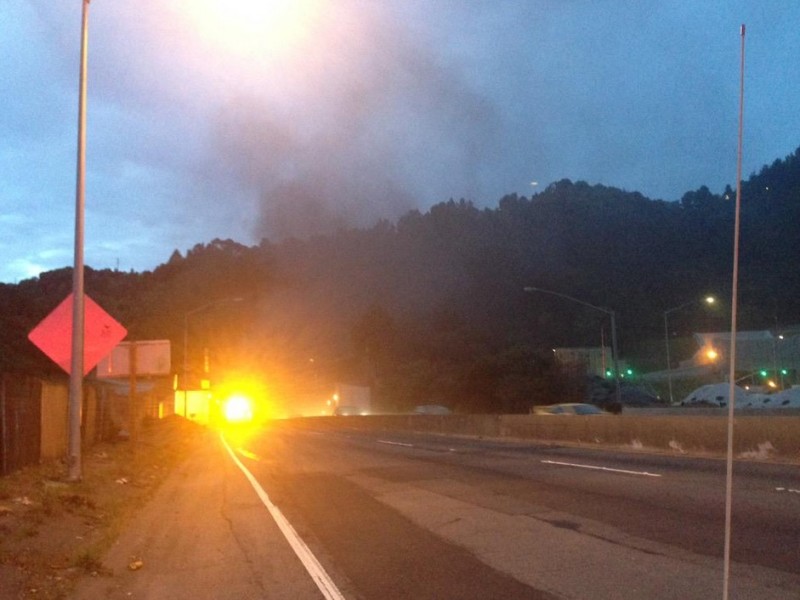
"content": "\u003cp>\u003cstrong>Update, 12:10 p.m.:\u003c/strong> The California Highway Patrol says the Caldecott Tunnel bore closed by a car accident and fire this morning reopened at 11:15 a.m.\u003c/p>\n\u003cp>\u003cstrong>Original post:\u003c/strong> In an incident that brings back memories of a deadly episode more than three decades ago, dozens of motorists were forced to flee their cars after a crash and fire in the Caldecott Tunnel early Monday morning.\u003c/p>\n\u003cp>The California Highway Patrol said no one was hurt in the 6:45 a.m. accident, which involved two cars and closed the southernmost of the tunnel’s two eastbound bores. The fire was put out by 8 a.m.\u003c/p>\n\u003cp>The bore’s closure backed up traffic headed from Oakland into Contra Costa County for miles along Highway 24. But the CHP said the bore would be reopened around 11 a.m.\u003c/p>\n\u003cp>“Caltrans is going to come in and help remove the vehicle, make sure there’s no more damage to the bore of Caldecott, and we can get traffic back moving,” said CHP Officer Sean Wilkenfeld.\u003c/p>\n\u003cp>[ad fullwidth]\u003c/p>\n\u003cp>If you’ve been in the Bay Area for awhile, Monday’s incident is an echo of \u003ca href=\"http://www.mercurynews.com/news/ci_24412323/anatomy-disaster-1982-caldecott-tunnel-fire-that-killed\" target=\"_blank\" rel=\"noopener\">the April 7, 1982, disaster\u003c/a> in which a gasoline tanker caught fire after a crash. Seven people were killed.\u003c/p>\n\u003cp>\u003c/p>\n\u003cp>The memory of that incident, which caused $3 million in damage and closed the tunnel for about six days, has prompted public safety agencies to prepare for fires inside the Caldecott. The CHP said Monday that it conducted its most recent fire drill inside the tunnel a few weeks ago.\u003c/p>\n\u003cfigure id=\"attachment_10457425\" class=\"wp-caption aligncenter\" style=\"max-width: 800px\">\u003ca href=\"http://ww2.kqed.org/news/wp-content/uploads/sites/10/2015/03/caldecottfire1.jpg\">\u003cimg loading=\"lazy\" decoding=\"async\" class=\"size-medium wp-image-10457425\" src=\"http://ww2.kqed.org/news/wp-content/uploads/sites/10/2015/03/caldecottfire1-800x557.jpg\" alt=\"Cars involved in Monday morning crash and fire that shut down one of the Caldecott Tunnel's eastbound bores Monday morning, with abandoned vehicles in background. \" width=\"800\" height=\"557\" srcset=\"https://cdn.kqed.org/wp-content/uploads/sites/10/2015/03/caldecottfire1-800x557.jpg 800w, https://cdn.kqed.org/wp-content/uploads/sites/10/2015/03/caldecottfire1-400x279.jpg 400w, https://cdn.kqed.org/wp-content/uploads/sites/10/2015/03/caldecottfire1-768x535.jpg 768w, https://cdn.kqed.org/wp-content/uploads/sites/10/2015/03/caldecottfire1-320x223.jpg 320w, https://cdn.kqed.org/wp-content/uploads/sites/10/2015/03/caldecottfire1.jpg 945w\" sizes=\"(max-width: 800px) 100vw, 800px\">\u003c/a>\u003cfigcaption class=\"wp-caption-text\">Cars involved in Monday morning crash and fire that shut down one of the Caldecott Tunnel’s eastbound bores Monday morning, with abandoned vehicles in background. \u003ccite>(California Highway Patrol via Twitter )\u003c/cite>\u003c/figcaption>\u003c/figure>\n\n",
"blocks": [],
"excerpt": "Two-car crash in eastbound bore triggers blaze and forces dozens of motorists to flee their vehicles. ",
"status": "publish",
"parent": 0,
"modified": 1721102439,
"stats": {
"hasAudio": false,
"hasVideo": false,
"hasChartOrMap": false,
"iframeSrcs": [],
"hasGoogleForm": false,
"hasGallery": false,
"hasHearkenModule": false,
"hasPolis": false,
"paragraphCount": 9,
"wordCount": 302
},
"headData": {
"title": "Caldecott Car Fire Forces Partial Tunnel Closure | KQED",
"description": "Two-car crash in eastbound bore triggers blaze and forces dozens of motorists to flee their vehicles. ",
"ogTitle": "",
"ogDescription": "",
"ogImgId": "",
"twTitle": "",
"twDescription": "",
"twImgId": "",
"schema": {
"@context": "https://schema.org",
"@type": "NewsArticle",
"headline": "Caldecott Car Fire Forces Partial Tunnel Closure",
"datePublished": "2015-03-16T12:10:32-07:00",
"dateModified": "2024-07-15T21:00:39-07:00",
"image": "https://cdn.kqed.org/wp-content/uploads/2020/02/KQED-OG-Image@1x.png",
"isAccessibleForFree": "True",
"publisher": {
"@type": "NewsMediaOrganization",
"@id": "https://www.kqed.org/#organization",
"name": "KQED",
"logo": "https://cdn.kqed.org/wp-content/uploads/2020/02/KQED-OG-Image@1x.png",
"url": "https://www.kqed.org",
"sameAs": [
"https://www.facebook.com/KQED",
"https://twitter.com/KQED",
"https://www.instagram.com/kqed/",
"https://www.tiktok.com/@kqedofficial",
"https://www.linkedin.com/company/kqed",
"https://www.youtube.com/channel/UCeC0IOo7i1P_61zVUWbJ4nw"
]
}
}
},
"sticky": false,
"path": "/news/10457372/caldecott-tunnel-car-fire-forces-partial-closure",
"audioTrackLength": null,
"parsedContent": [
{
"type": "contentString",
"content": "\u003cdiv class=\"post-body\">\u003cp>\u003cp>\u003cstrong>Update, 12:10 p.m.:\u003c/strong> The California Highway Patrol says the Caldecott Tunnel bore closed by a car accident and fire this morning reopened at 11:15 a.m.\u003c/p>\n\u003cp>\u003cstrong>Original post:\u003c/strong> In an incident that brings back memories of a deadly episode more than three decades ago, dozens of motorists were forced to flee their cars after a crash and fire in the Caldecott Tunnel early Monday morning.\u003c/p>\n\u003cp>The California Highway Patrol said no one was hurt in the 6:45 a.m. accident, which involved two cars and closed the southernmost of the tunnel’s two eastbound bores. The fire was put out by 8 a.m.\u003c/p>\n\u003cp>The bore’s closure backed up traffic headed from Oakland into Contra Costa County for miles along Highway 24. But the CHP said the bore would be reopened around 11 a.m.\u003c/p>\n\u003cp>“Caltrans is going to come in and help remove the vehicle, make sure there’s no more damage to the bore of Caldecott, and we can get traffic back moving,” said CHP Officer Sean Wilkenfeld.\u003c/p>\n\u003cp>\u003c/p>\u003c/div>",
"attributes": {
"named": {},
"numeric": []
}
},
{
"type": "component",
"content": "",
"name": "ad",
"attributes": {
"named": {
"label": "fullwidth"
},
"numeric": [
"fullwidth"
]
}
},
{
"type": "contentString",
"content": "\u003cdiv class=\"post-body\">\u003cp>\u003c/p>\n\u003cp>If you’ve been in the Bay Area for awhile, Monday’s incident is an echo of \u003ca href=\"http://www.mercurynews.com/news/ci_24412323/anatomy-disaster-1982-caldecott-tunnel-fire-that-killed\" target=\"_blank\" rel=\"noopener\">the April 7, 1982, disaster\u003c/a> in which a gasoline tanker caught fire after a crash. Seven people were killed.\u003c/p>\n\u003cp>\u003c/p>\n\u003cp>The memory of that incident, which caused $3 million in damage and closed the tunnel for about six days, has prompted public safety agencies to prepare for fires inside the Caldecott. The CHP said Monday that it conducted its most recent fire drill inside the tunnel a few weeks ago.\u003c/p>\n\u003cfigure id=\"attachment_10457425\" class=\"wp-caption aligncenter\" style=\"max-width: 800px\">\u003ca href=\"http://ww2.kqed.org/news/wp-content/uploads/sites/10/2015/03/caldecottfire1.jpg\">\u003cimg loading=\"lazy\" decoding=\"async\" class=\"size-medium wp-image-10457425\" src=\"http://ww2.kqed.org/news/wp-content/uploads/sites/10/2015/03/caldecottfire1-800x557.jpg\" alt=\"Cars involved in Monday morning crash and fire that shut down one of the Caldecott Tunnel's eastbound bores Monday morning, with abandoned vehicles in background. \" width=\"800\" height=\"557\" srcset=\"https://cdn.kqed.org/wp-content/uploads/sites/10/2015/03/caldecottfire1-800x557.jpg 800w, https://cdn.kqed.org/wp-content/uploads/sites/10/2015/03/caldecottfire1-400x279.jpg 400w, https://cdn.kqed.org/wp-content/uploads/sites/10/2015/03/caldecottfire1-768x535.jpg 768w, https://cdn.kqed.org/wp-content/uploads/sites/10/2015/03/caldecottfire1-320x223.jpg 320w, https://cdn.kqed.org/wp-content/uploads/sites/10/2015/03/caldecottfire1.jpg 945w\" sizes=\"(max-width: 800px) 100vw, 800px\">\u003c/a>\u003cfigcaption class=\"wp-caption-text\">Cars involved in Monday morning crash and fire that shut down one of the Caldecott Tunnel’s eastbound bores Monday morning, with abandoned vehicles in background. \u003ccite>(California Highway Patrol via Twitter )\u003c/cite>\u003c/figcaption>\u003c/figure>\n\n\u003c/div>\u003c/p>",
"attributes": {
"named": {},
"numeric": []
}
}
],
"link": "/news/10457372/caldecott-tunnel-car-fire-forces-partial-closure",
"authors": [
"222"
],
"programs": [
"news_6944"
],
"categories": [
"news_8",
"news_1397"
],
"tags": [
"news_20517"
],
"featImg": "news_10457373",
"label": "news_6944"
},
"news_10435604": {
"type": "posts",
"id": "news_10435604",
"meta": {
"index": "posts_1716263798",
"site": "news",
"id": "10435604",
"score": null,
"sort": [
1424218944000
]
},
"guestAuthors": [],
"slug": "maps-show-where-thousands-of-s-f-cyclists-pedestrians-hurt-or-killed",
"title": "Maps Show Where Thousands of S.F. Cyclists, Pedestrians Hurt or Killed",
"publishDate": 1424218944,
"format": "standard",
"headTitle": "Maps Show Where Thousands of S.F. Cyclists, Pedestrians Hurt or Killed | KQED",
"labelTerm": {
"term": 6944,
"site": "news"
},
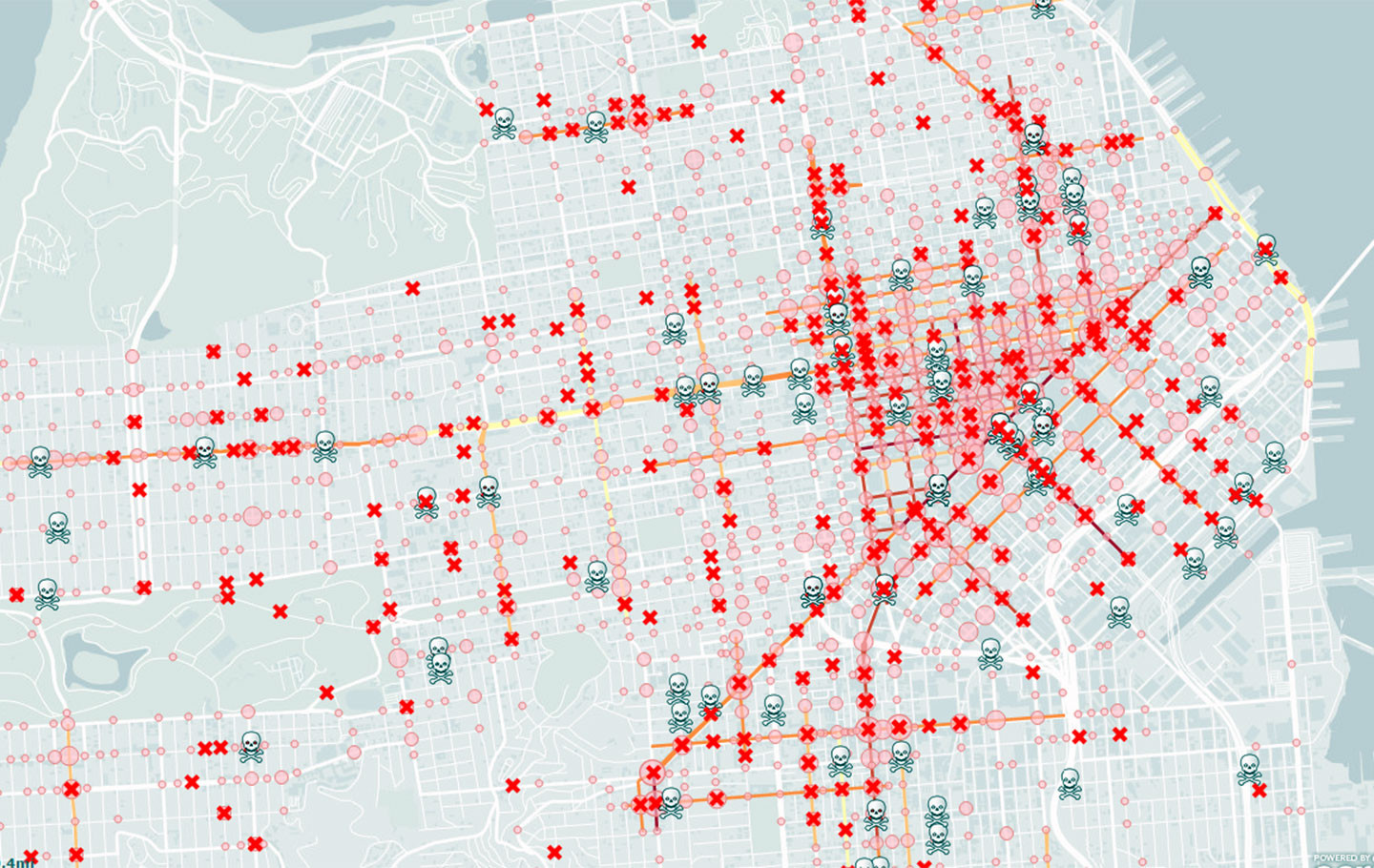
"content": "\u003cp>Bicyclists and pedestrians beware: San Francisco’s major commercial corridors can be lethal.\u003c/p>\n\u003cp>Surprised? Probably not. But now you can see that reality in startling detail on the \u003ca href=\"http://sfgov.maps.arcgis.com/apps/OnePane/basicviewer/index.html?appid=7382117f2b5f440e8e183f30cf2c6d57\" target=\"_blank\" rel=\"noopener\">city’s interactive maps\u003c/a>, which show exactly where thousands of people were hurt or killed when they were hit by cars.\u003c/p>\n\u003cp>The maps are products of the new \u003ca href=\"http://www.sfmta.com/sites/default/files/projects/Task%20Force%20Presentation%20April%202014.pdf\" target=\"_blank\" rel=\"noopener\">“Vision Zero”\u003c/a> policy agenda, which the city adopted in early 2014 in an effort to make the streets safer following a spate of pedestrian deaths. The maps draw from data that the California Highway Patrol collected between 2005 and 2011 that city agencies compiled and analyzed.\u003c/p>\n\u003cp>The interactive maps show exactly how many people were hurt at a given intersection. (Skull-and-crossbones represents a death, “X” represents a severe injury, and larger circles mark intersections where accidents frequently occurred.)\u003c/p>\n\u003cfigure id=\"attachment_10435606\" class=\"wp-caption aligncenter\" style=\"max-width: 1440px\">\u003ca href=\"http://sfgov.maps.arcgis.com/apps/OnePane/basicviewer/index.html?appid=ce429dbe354240fdbf45ea70d4e4984a\">\u003cimg loading=\"lazy\" decoding=\"async\" class=\"size-full wp-image-10435606\" src=\"http://ww2.kqed.org/news/wp-content/uploads/sites/10/2015/02/cyclist-map.jpg\" alt=\"Map of cycling injuries and deaths in San Francisco from 2007-11. Click on map for interactive version. \" width=\"1440\" height=\"910\" srcset=\"https://cdn.kqed.org/wp-content/uploads/sites/10/2015/02/cyclist-map.jpg 1440w, https://cdn.kqed.org/wp-content/uploads/sites/10/2015/02/cyclist-map-400x253.jpg 400w, https://cdn.kqed.org/wp-content/uploads/sites/10/2015/02/cyclist-map-800x506.jpg 800w\" sizes=\"(max-width: 1440px) 100vw, 1440px\">\u003c/a>\u003cfigcaption class=\"wp-caption-text\">Map of cycling injuries and deaths in San Francisco from 2007-11. Click on map for interactive version. \u003ccite>(Vision Zero San Francisco)\u003c/cite>\u003c/figcaption>\u003c/figure>\n\u003cp>\u003ca href=\"http://sfgov.maps.arcgis.com/apps/OnePane/basicviewer/index.html?appid=ce429dbe354240fdbf45ea70d4e4984a\" target=\"_blank\" rel=\"noopener\">Cyclists:\u003c/a> Major injuries were clustered along Polk Street in the Tenderloin, as well as Valencia Street in the Mission District. The intersection of Market Street and Octavia Boulevard was especially dangerous, and serious collisions occurred in the Panhandle neighborhood, too. (Data from 2007—2011)\u003c/p>\n\u003cp>[ad fullwidth]\u003c/p>\u003cp>\u003c/p>\n",
"blocks": [],
"excerpt": "Explore interactive maps to check out data for specific San Francisco intersections.",
"status": "publish",
"parent": 0,
"modified": 1721106617,
"stats": {
"hasAudio": false,
"hasVideo": false,
"hasChartOrMap": false,
"iframeSrcs": [],
"hasGoogleForm": false,
"hasGallery": false,
"hasHearkenModule": false,
"hasPolis": false,
"paragraphCount": 7,
"wordCount": 211
},
"headData": {
"title": "Maps Show Where Thousands of S.F. Cyclists, Pedestrians Hurt or Killed | KQED",
"description": "Explore interactive maps to check out data for specific San Francisco intersections.",
"ogTitle": "",
"ogDescription": "",
"ogImgId": "",
"twTitle": "",
"twDescription": "",
"twImgId": "",
"schema": {
"@context": "https://schema.org",
"@type": "NewsArticle",
"headline": "Maps Show Where Thousands of S.F. Cyclists, Pedestrians Hurt or Killed",
"datePublished": "2015-02-17T16:22:24-08:00",
"dateModified": "2024-07-15T22:10:17-07:00",
"image": "https://cdn.kqed.org/wp-content/uploads/2020/02/KQED-OG-Image@1x.png",
"isAccessibleForFree": "True",
"publisher": {
"@type": "NewsMediaOrganization",
"@id": "https://www.kqed.org/#organization",
"name": "KQED",
"logo": "https://cdn.kqed.org/wp-content/uploads/2020/02/KQED-OG-Image@1x.png",
"url": "https://www.kqed.org",
"sameAs": [
"https://www.facebook.com/KQED",
"https://twitter.com/KQED",
"https://www.instagram.com/kqed/",
"https://www.tiktok.com/@kqedofficial",
"https://www.linkedin.com/company/kqed",
"https://www.youtube.com/channel/UCeC0IOo7i1P_61zVUWbJ4nw"
]
}
}
},
"sticky": false,
"customPermalink": "2015/02/15/san-francisco-cyclist-pedestrian-accident-maps/",
"WpOldSlug": "maps-show-where-thousands-of-san-francisco-cyclists-pedestrians-hurt-or-killed",
"nprByline": "\u003ca href=\"http://sfpublicpress.org/members/noah-arroyo\">Noah Arroyo\u003c/a>\u003cbr>San Francisco Public Press",
"path": "/news/10435604/maps-show-where-thousands-of-s-f-cyclists-pedestrians-hurt-or-killed",
"audioTrackLength": null,
"parsedContent": [
{
"type": "contentString",
"content": "\u003cdiv class=\"post-body\">\u003cp>\u003cp>Bicyclists and pedestrians beware: San Francisco’s major commercial corridors can be lethal.\u003c/p>\n\u003cp>Surprised? Probably not. But now you can see that reality in startling detail on the \u003ca href=\"http://sfgov.maps.arcgis.com/apps/OnePane/basicviewer/index.html?appid=7382117f2b5f440e8e183f30cf2c6d57\" target=\"_blank\" rel=\"noopener\">city’s interactive maps\u003c/a>, which show exactly where thousands of people were hurt or killed when they were hit by cars.\u003c/p>\n\u003cp>The maps are products of the new \u003ca href=\"http://www.sfmta.com/sites/default/files/projects/Task%20Force%20Presentation%20April%202014.pdf\" target=\"_blank\" rel=\"noopener\">“Vision Zero”\u003c/a> policy agenda, which the city adopted in early 2014 in an effort to make the streets safer following a spate of pedestrian deaths. The maps draw from data that the California Highway Patrol collected between 2005 and 2011 that city agencies compiled and analyzed.\u003c/p>\n\u003cp>The interactive maps show exactly how many people were hurt at a given intersection. (Skull-and-crossbones represents a death, “X” represents a severe injury, and larger circles mark intersections where accidents frequently occurred.)\u003c/p>\n\u003cfigure id=\"attachment_10435606\" class=\"wp-caption aligncenter\" style=\"max-width: 1440px\">\u003ca href=\"http://sfgov.maps.arcgis.com/apps/OnePane/basicviewer/index.html?appid=ce429dbe354240fdbf45ea70d4e4984a\">\u003cimg loading=\"lazy\" decoding=\"async\" class=\"size-full wp-image-10435606\" src=\"http://ww2.kqed.org/news/wp-content/uploads/sites/10/2015/02/cyclist-map.jpg\" alt=\"Map of cycling injuries and deaths in San Francisco from 2007-11. Click on map for interactive version. \" width=\"1440\" height=\"910\" srcset=\"https://cdn.kqed.org/wp-content/uploads/sites/10/2015/02/cyclist-map.jpg 1440w, https://cdn.kqed.org/wp-content/uploads/sites/10/2015/02/cyclist-map-400x253.jpg 400w, https://cdn.kqed.org/wp-content/uploads/sites/10/2015/02/cyclist-map-800x506.jpg 800w\" sizes=\"(max-width: 1440px) 100vw, 1440px\">\u003c/a>\u003cfigcaption class=\"wp-caption-text\">Map of cycling injuries and deaths in San Francisco from 2007-11. Click on map for interactive version. \u003ccite>(Vision Zero San Francisco)\u003c/cite>\u003c/figcaption>\u003c/figure>\n\u003cp>\u003ca href=\"http://sfgov.maps.arcgis.com/apps/OnePane/basicviewer/index.html?appid=ce429dbe354240fdbf45ea70d4e4984a\" target=\"_blank\" rel=\"noopener\">Cyclists:\u003c/a> Major injuries were clustered along Polk Street in the Tenderloin, as well as Valencia Street in the Mission District. The intersection of Market Street and Octavia Boulevard was especially dangerous, and serious collisions occurred in the Panhandle neighborhood, too. (Data from 2007—2011)\u003c/p>\n\u003cp>\u003c/p>\u003c/div>",
"attributes": {
"named": {},
"numeric": []
}
},
{
"type": "component",
"content": "",
"name": "ad",
"attributes": {
"named": {
"label": "fullwidth"
},
"numeric": [
"fullwidth"
]
}
},
{
"type": "contentString",
"content": "\u003cdiv class=\"post-body\">\u003cp>\u003c/p>\u003cp>\u003c/p>\n\u003c/div>\u003c/p>",
"attributes": {
"named": {},
"numeric": []
}
}
],
"link": "/news/10435604/maps-show-where-thousands-of-s-f-cyclists-pedestrians-hurt-or-killed",
"authors": [
"byline_news_10435604"
],
"programs": [
"news_6944"
],
"categories": [
"news_8",
"news_1397"
],
"tags": [
"news_578",
"news_20517"
],
"affiliates": [
"news_1832"
],
"featImg": "news_10435605",
"label": "news_6944"
},
"news_143653": {
"type": "posts",
"id": "news_143653",
"meta": {
"index": "posts_1716263798",
"site": "news",
"id": "143653",
"score": null,
"sort": [
1406937200000
]
},
"guestAuthors": [],
"slug": "sfmta-starts-commuter-shuttle-pilot-program",
"title": "SFMTA Starts Commuter Shuttle Pilot Program",
"publishDate": 1406937200,
"format": "aside",
"headTitle": "SFMTA Starts Commuter Shuttle Pilot Program | KQED",
"labelTerm": {
"term": 6944,
"site": "news"
},
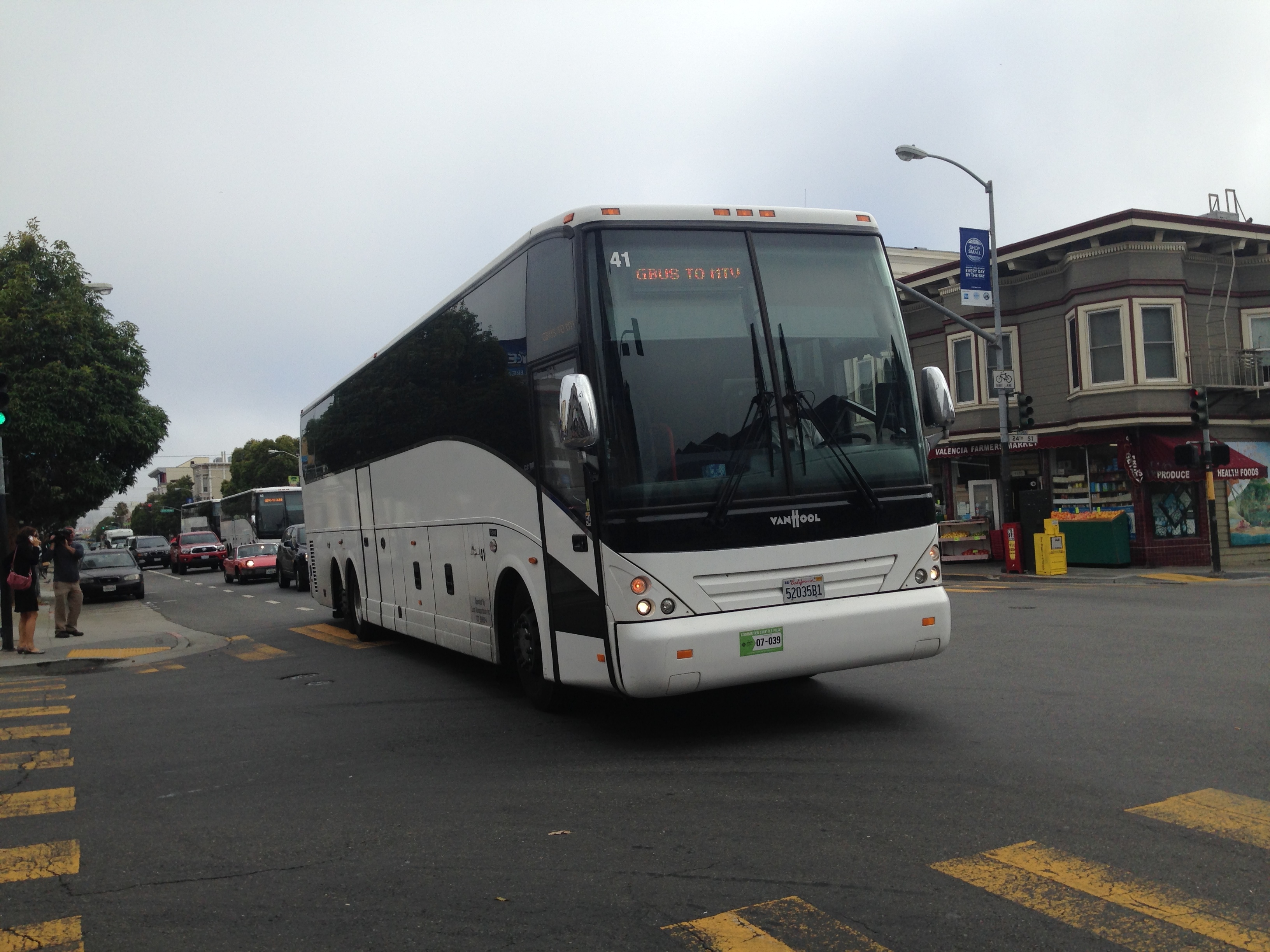
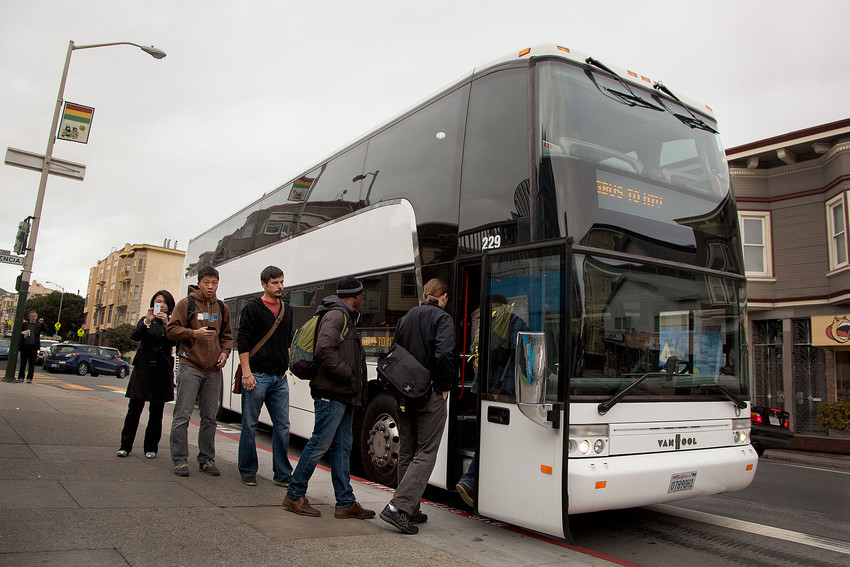
"content": "\u003cfigure id=\"attachment_143658\" class=\"wp-caption aligncenter\" style=\"max-width: 640px\">\u003ca href=\"http://ww2.kqed.org/news/wp-content/uploads/sites/10/2014/08/RS11371_photo.JPG-alt_136.jpg\">\u003cimg loading=\"lazy\" decoding=\"async\" class=\"wp-image-143658 size-medium\" src=\"http://ww2.kqed.org/news/wp-content/uploads/sites/10/2014/08/RS11371_photo.JPG-alt_136-640x480.jpg\" alt=\"A commuter shuttle headed to Google's Mountain View campus pulls into a pre-approved Muni stop at 24th St and Valencia. \" width=\"640\" height=\"480\">\u003c/a>\u003cfigcaption class=\"wp-caption-text\">A commuter shuttle headed to Google’s Mountain View campus pulls into a pre-approved Muni stop at 24th and Valencia streets. (Isabel Angell/KQED)\u003c/figcaption>\u003c/figure>\n\u003cp>San Francisco’s \u003ca href=\"http://ww2.kqed.org/news/2014/07/15/sfmta-to-vote-on-higher-fees-for-google-tech-buses/\">pilot program\u003c/a> for commuter shuttles launched today. The San Francisco Municipal Transportation Agency (SFMTA) created the program mainly to regulate buses that carry tech workers south to their company’s campuses in places such as Mountain View and Menlo Park. Many tech companies provide buses for their employees, and the shuttles are commonly called “Google Buses.”\u003c/p>\n\u003cp>Commuter shuttles have been using existing Municipal Railway stops to pick up or drop off passengers for years, which has contributed to some of Muni’s delays.\u003c/p>\n\u003cp>The start of the pilot program caused some confusion among tech shuttle passengers today as buses started using new or different Muni stops. The shuttles are now limited to about 100 Muni stops, and the shuttle operators have to pay$3.55 per bus per stop to cover the cost of the program.\u003c/p>\n\u003cp>Kristen Holland, a spokeswoman for the SFMTA, said: “We wanted to make sure that these shuttles could still operate since they are still taking individual car trips off the road, which is a goal of ours, helps Muni, helps all of our transportation system work better. But it needed to work better with Muni.”\u003c/p>\n\u003cp>The shuttles also have to display green placards with an identification number on the front and back bumpers, so SFMTA officials can issue citations and track complaints.\u003c/p>\n\u003cp>[ad fullwidth]\u003c/p>\n\u003cp>Critics say the shuttles are contributing to a higher cost of living in the city — one UC Berkeley student argued in her master’s thesis in city planning that \u003ca href=\"http://svenworld.com/wp-content/uploads/2014/01/Goldman_PRFinal.pdf\">rents are higher around tech shuttle stops.\u003c/a>\u003c/p>\n\u003cp>This morning, a small protest led by advocates for seniors and people with disabilities briefly disrupted several bus departures.\u003c/p>\n\u003cp>\u003c/p>\n\u003cp>The shuttle pilot program is scheduled to last 18 months.\u003c/p>\n\n",
"blocks": [],
"excerpt": "Advocates for seniors and people with disabilities protested, briefly disrupting several bus departures.",
"status": "publish",
"parent": 0,
"modified": 1740180728,
"stats": {
"hasAudio": false,
"hasVideo": false,
"hasChartOrMap": false,
"iframeSrcs": [],
"hasGoogleForm": false,
"hasGallery": false,
"hasHearkenModule": false,
"hasPolis": false,
"paragraphCount": 10,
"wordCount": 330
},
"headData": {
"title": "SFMTA Starts Commuter Shuttle Pilot Program | KQED",
"description": "Advocates for seniors and people with disabilities protested, briefly disrupting several bus departures.",
"ogTitle": "",
"ogDescription": "",
"ogImgId": "",
"twTitle": "",
"twDescription": "",
"twImgId": "",
"schema": {
"@context": "https://schema.org",
"@type": "NewsArticle",
"headline": "SFMTA Starts Commuter Shuttle Pilot Program",
"datePublished": "2014-08-01T16:53:20-07:00",
"dateModified": "2025-02-21T15:32:08-08:00",
"image": "https://cdn.kqed.org/wp-content/uploads/2020/02/KQED-OG-Image@1x.png",
"isAccessibleForFree": "True",
"publisher": {
"@type": "NewsMediaOrganization",
"@id": "https://www.kqed.org/#organization",
"name": "KQED",
"logo": "https://cdn.kqed.org/wp-content/uploads/2020/02/KQED-OG-Image@1x.png",
"url": "https://www.kqed.org",
"sameAs": [
"https://www.facebook.com/KQED",
"https://twitter.com/KQED",
"https://www.instagram.com/kqed/",
"https://www.tiktok.com/@kqedofficial",
"https://www.linkedin.com/company/kqed",
"https://www.youtube.com/channel/UCeC0IOo7i1P_61zVUWbJ4nw"
]
}
}
},
"sticky": false,
"customPermalink": "2014/08/01/san-francisco-tech-bus-payment-program-begins/",
"path": "/news/143653/sfmta-starts-commuter-shuttle-pilot-program",
"audioTrackLength": null,
"parsedContent": [
{
"type": "contentString",
"content": "\u003cdiv class=\"post-body\">\u003cp>\u003cfigure id=\"attachment_143658\" class=\"wp-caption aligncenter\" style=\"max-width: 640px\">\u003ca href=\"http://ww2.kqed.org/news/wp-content/uploads/sites/10/2014/08/RS11371_photo.JPG-alt_136.jpg\">\u003cimg loading=\"lazy\" decoding=\"async\" class=\"wp-image-143658 size-medium\" src=\"http://ww2.kqed.org/news/wp-content/uploads/sites/10/2014/08/RS11371_photo.JPG-alt_136-640x480.jpg\" alt=\"A commuter shuttle headed to Google's Mountain View campus pulls into a pre-approved Muni stop at 24th St and Valencia. \" width=\"640\" height=\"480\">\u003c/a>\u003cfigcaption class=\"wp-caption-text\">A commuter shuttle headed to Google’s Mountain View campus pulls into a pre-approved Muni stop at 24th and Valencia streets. (Isabel Angell/KQED)\u003c/figcaption>\u003c/figure>\n\u003cp>San Francisco’s \u003ca href=\"http://ww2.kqed.org/news/2014/07/15/sfmta-to-vote-on-higher-fees-for-google-tech-buses/\">pilot program\u003c/a> for commuter shuttles launched today. The San Francisco Municipal Transportation Agency (SFMTA) created the program mainly to regulate buses that carry tech workers south to their company’s campuses in places such as Mountain View and Menlo Park. Many tech companies provide buses for their employees, and the shuttles are commonly called “Google Buses.”\u003c/p>\n\u003cp>Commuter shuttles have been using existing Municipal Railway stops to pick up or drop off passengers for years, which has contributed to some of Muni’s delays.\u003c/p>\n\u003cp>The start of the pilot program caused some confusion among tech shuttle passengers today as buses started using new or different Muni stops. The shuttles are now limited to about 100 Muni stops, and the shuttle operators have to pay$3.55 per bus per stop to cover the cost of the program.\u003c/p>\n\u003cp>Kristen Holland, a spokeswoman for the SFMTA, said: “We wanted to make sure that these shuttles could still operate since they are still taking individual car trips off the road, which is a goal of ours, helps Muni, helps all of our transportation system work better. But it needed to work better with Muni.”\u003c/p>\n\u003cp>The shuttles also have to display green placards with an identification number on the front and back bumpers, so SFMTA officials can issue citations and track complaints.\u003c/p>\n\u003cp>\u003c/p>\u003c/div>",
"attributes": {
"named": {},
"numeric": []
}
},
{
"type": "component",
"content": "",
"name": "ad",
"attributes": {
"named": {
"label": "fullwidth"
},
"numeric": [
"fullwidth"
]
}
},
{
"type": "contentString",
"content": "\u003cdiv class=\"post-body\">\u003cp>\u003c/p>\n\u003cp>Critics say the shuttles are contributing to a higher cost of living in the city — one UC Berkeley student argued in her master’s thesis in city planning that \u003ca href=\"http://svenworld.com/wp-content/uploads/2014/01/Goldman_PRFinal.pdf\">rents are higher around tech shuttle stops.\u003c/a>\u003c/p>\n\u003cp>This morning, a small protest led by advocates for seniors and people with disabilities briefly disrupted several bus departures.\u003c/p>\n\u003cp>\u003c/p>\n\u003cp>The shuttle pilot program is scheduled to last 18 months.\u003c/p>\n\n\u003c/div>\u003c/p>",
"attributes": {
"named": {},
"numeric": []
}
}
],
"link": "/news/143653/sfmta-starts-commuter-shuttle-pilot-program",
"authors": [
"229"
],
"programs": [
"news_6944"
],
"categories": [
"news_8",
"news_1397"
],
"tags": [
"news_5384",
"news_1334",
"news_20517"
],
"featImg": "news_143658",
"label": "news_6944"
},
"news_139906": {
"type": "posts",
"id": "news_139906",
"meta": {
"index": "posts_1716263798",
"site": "news",
"id": "139906",
"score": null,
"sort": [
1403311154000
]
},
"guestAuthors": [],
"slug": "hearing-on-san-franciscos-tech-shuttle-program-draws-complaints",
"title": "Hearing on San Francisco's Tech Shuttle Program Draws Complaints",
"publishDate": 1403311154,
"format": "aside",
"headTitle": "Hearing on San Francisco’s Tech Shuttle Program Draws Complaints | KQED",
"labelTerm": {
"term": 6944,
"site": "news"
},
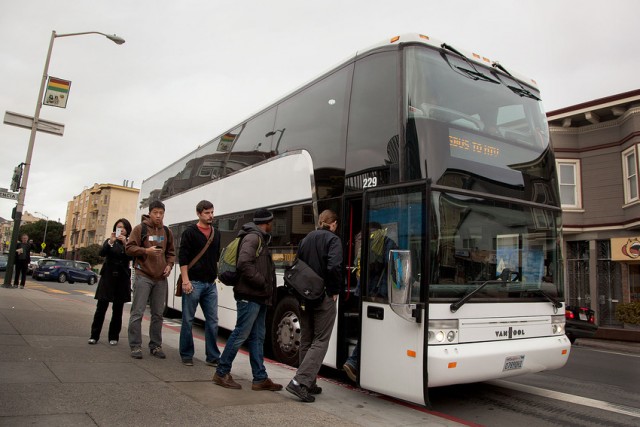
"content": "\u003cfigure id=\"attachment_137366\" class=\"wp-caption alignnone\" style=\"max-width: 640px\">\u003ca href=\"http://ww2.kqed.org/news/2014/05/28/the-good-news-about-working-in-the-bay-area-for-some-wages-are-very-high/rs8537_img_9782-scr-2/\" rel=\"attachment wp-att-137366\">\u003cimg loading=\"lazy\" decoding=\"async\" class=\"size-medium wp-image-137366\" src=\"http://ww2.kqed.org/news/wp-content/uploads/sites/10/2014/05/RS8537_IMG_9782-scr-640x426.jpg\" alt=\"(Mark Andrew Boyer/KQED)\" width=\"640\" height=\"426\">\u003c/a>\u003cfigcaption class=\"wp-caption-text\">(Mark Andrew Boyer/KQED) \u003ccite>(Mark Andrew Boyer/KQED)\u003c/cite>\u003c/figcaption>\u003c/figure>\n\u003cp>The San Francisco Municipal Transportation Agency has tentatively approved a list of stops for its tech shuttle bus pilot program following a packed public hearing at City Hall Friday that drew complaints from residents concerned about the loss of parking and the impacts on their neighborhoods.\u003c/p>\n\u003cp>“They’re just ramrodding this through and it’s wrong-minded and short-sighted,” said Lisa Awbrey, who lives near two Muni stops in the Panhandle where public buses would share curb space with private shuttles.\u003c/p>\n\u003cp>The SFMTA approved an 18-month pilot \u003ca href=\"http://sfmta.com/fr/projects-planning/projects/commuter-shuttles-policy-and-pilot-program\">commuter shuttle program\u003c/a> in January, and earlier this month said it identified 115 stops where the shuttles would share space with Muni buses. It originally called for 200 stops.\u003c/p>\n\u003cp>“We really wanted to select locations where, based on our best information, we could accommodate the shuttle activity and minimize impact on Muni and other users,” said Carli Paine of the SFMTA.\u003c/p>\n\u003cp>At nine locations, where Muni stops are too busy, some parking would be removed to \u003ca href=\"http://sf.streetsblog.org/2014/06/12/are-sfmtas-proposed-shuttle-stops-enough-to-end-muni-conflicts/\">provide white zones\u003c/a> exclusively for shuttles. Three parking spaces would be permanently eliminated and 30 spaces used during peak hours, or about .01 percent of all on-street spaces in the city, according to the SFMTA.\u003c/p>\n\u003cp>[ad fullwidth]\u003c/p>\n\u003cp>Gus Hernandez of the Alamo Square Neighborhood Association is worried about one of the white zone stops proposed on Hayes Street at Steiner.\u003c/p>\n\u003cp>“Our concern is that it’s going to cause more congestion and traffic in the neighborhood, as well as removal of parking on the north side,” he said.\u003c/p>\n\u003cp>Adrian Covert of the Bay Area Council was among the few speakers at the public hearing who testified in favor of the shuttle program, saying it’s a vital link in the transportation system, and that the loss of parking would be minimal.\u003c/p>\n\u003cp>“Three permanent parking spaces overall are going to be eliminated to provide for shuttle space for 17,000 San Francisco residents. I think that’s a pretty good deal,” he said.\u003c/p>\n\u003cp>Activists who contend the tech shuttles, often called “Google buses,” have helped fuel gentrification\u003ca href=\"http://ww2.kqed.org/news/san-francisco-activists-and-seiu-sue-city-over-google-bus-plan\"> have filed a lawsuit\u003c/a> against the city, demanding an environmental review. A settlement conference is scheduled for next week, said Sara Shortt, director of the Housing Rights Committee.\u003c/p>\n\u003cp>While she supports the white zones, Shortt said the city needs to get more creative about how it manages the shuttles.\u003c/p>\n\u003cp>“I think there are better solutions, like having a tech hub in one specific space. I think they can stretch themselves further. I do think not using the Muni stops is an absolute improvement,” she said.\u003c/p>\n\u003cp>Eighty eight stops were approved at the hearing by a traffic engineering panel. SFMTA officials said they were still reviewing a small number of additional stops that would be considered at a July 11th public hearing. The list of stops is then expected to go before the SFMTA Board for final approval.\u003c/p>\n\u003cp>\u003c/p>\n\u003cp>The shuttle pilot is scheduled to start August 1st, a month later than anticipated.\u003c/p>\n\n",
"blocks": [],
"excerpt": "'They're just ramrodding this through and it's wrong-minded and short-sighted,' said one city resident.",
"status": "publish",
"parent": 0,
"modified": 1740180735,
"stats": {
"hasAudio": false,
"hasVideo": false,
"hasChartOrMap": false,
"iframeSrcs": [],
"hasGoogleForm": false,
"hasGallery": false,
"hasHearkenModule": false,
"hasPolis": false,
"paragraphCount": 16,
"wordCount": 519
},
"headData": {
"title": "Hearing on San Francisco's Tech Shuttle Program Draws Complaints | KQED",
"description": "'They're just ramrodding this through and it's wrong-minded and short-sighted,' said one city resident.",
"ogTitle": "",
"ogDescription": "",
"ogImgId": "",
"twTitle": "",
"twDescription": "",
"twImgId": "",
"schema": {
"@context": "https://schema.org",
"@type": "NewsArticle",
"headline": "Hearing on San Francisco's Tech Shuttle Program Draws Complaints",
"datePublished": "2014-06-20T17:39:14-07:00",
"dateModified": "2025-02-21T15:32:15-08:00",
"image": "https://cdn.kqed.org/wp-content/uploads/2020/02/KQED-OG-Image@1x.png",
"isAccessibleForFree": "True",
"publisher": {
"@type": "NewsMediaOrganization",
"@id": "https://www.kqed.org/#organization",
"name": "KQED",
"logo": "https://cdn.kqed.org/wp-content/uploads/2020/02/KQED-OG-Image@1x.png",
"url": "https://www.kqed.org",
"sameAs": [
"https://www.facebook.com/KQED",
"https://twitter.com/KQED",
"https://www.instagram.com/kqed/",
"https://www.tiktok.com/@kqedofficial",
"https://www.linkedin.com/company/kqed",
"https://www.youtube.com/channel/UCeC0IOo7i1P_61zVUWbJ4nw"
]
}
}
},
"sticky": false,
"customPermalink": "2014/06/21-tech-bus-complaints-city-hearing/",
"path": "/news/139906/hearing-on-san-franciscos-tech-shuttle-program-draws-complaints",
"audioTrackLength": null,
"parsedContent": [
{
"type": "contentString",
"content": "\u003cdiv class=\"post-body\">\u003cp>\u003cfigure id=\"attachment_137366\" class=\"wp-caption alignnone\" style=\"max-width: 640px\">\u003ca href=\"http://ww2.kqed.org/news/2014/05/28/the-good-news-about-working-in-the-bay-area-for-some-wages-are-very-high/rs8537_img_9782-scr-2/\" rel=\"attachment wp-att-137366\">\u003cimg loading=\"lazy\" decoding=\"async\" class=\"size-medium wp-image-137366\" src=\"http://ww2.kqed.org/news/wp-content/uploads/sites/10/2014/05/RS8537_IMG_9782-scr-640x426.jpg\" alt=\"(Mark Andrew Boyer/KQED)\" width=\"640\" height=\"426\">\u003c/a>\u003cfigcaption class=\"wp-caption-text\">(Mark Andrew Boyer/KQED) \u003ccite>(Mark Andrew Boyer/KQED)\u003c/cite>\u003c/figcaption>\u003c/figure>\n\u003cp>The San Francisco Municipal Transportation Agency has tentatively approved a list of stops for its tech shuttle bus pilot program following a packed public hearing at City Hall Friday that drew complaints from residents concerned about the loss of parking and the impacts on their neighborhoods.\u003c/p>\n\u003cp>“They’re just ramrodding this through and it’s wrong-minded and short-sighted,” said Lisa Awbrey, who lives near two Muni stops in the Panhandle where public buses would share curb space with private shuttles.\u003c/p>\n\u003cp>The SFMTA approved an 18-month pilot \u003ca href=\"http://sfmta.com/fr/projects-planning/projects/commuter-shuttles-policy-and-pilot-program\">commuter shuttle program\u003c/a> in January, and earlier this month said it identified 115 stops where the shuttles would share space with Muni buses. It originally called for 200 stops.\u003c/p>\n\u003cp>“We really wanted to select locations where, based on our best information, we could accommodate the shuttle activity and minimize impact on Muni and other users,” said Carli Paine of the SFMTA.\u003c/p>\n\u003cp>At nine locations, where Muni stops are too busy, some parking would be removed to \u003ca href=\"http://sf.streetsblog.org/2014/06/12/are-sfmtas-proposed-shuttle-stops-enough-to-end-muni-conflicts/\">provide white zones\u003c/a> exclusively for shuttles. Three parking spaces would be permanently eliminated and 30 spaces used during peak hours, or about .01 percent of all on-street spaces in the city, according to the SFMTA.\u003c/p>\n\u003cp>\u003c/p>\u003c/div>",
"attributes": {
"named": {},
"numeric": []
}
},
{
"type": "component",
"content": "",
"name": "ad",
"attributes": {
"named": {
"label": "fullwidth"
},
"numeric": [
"fullwidth"
]
}
},
{
"type": "contentString",
"content": "\u003cdiv class=\"post-body\">\u003cp>\u003c/p>\n\u003cp>Gus Hernandez of the Alamo Square Neighborhood Association is worried about one of the white zone stops proposed on Hayes Street at Steiner.\u003c/p>\n\u003cp>“Our concern is that it’s going to cause more congestion and traffic in the neighborhood, as well as removal of parking on the north side,” he said.\u003c/p>\n\u003cp>Adrian Covert of the Bay Area Council was among the few speakers at the public hearing who testified in favor of the shuttle program, saying it’s a vital link in the transportation system, and that the loss of parking would be minimal.\u003c/p>\n\u003cp>“Three permanent parking spaces overall are going to be eliminated to provide for shuttle space for 17,000 San Francisco residents. I think that’s a pretty good deal,” he said.\u003c/p>\n\u003cp>Activists who contend the tech shuttles, often called “Google buses,” have helped fuel gentrification\u003ca href=\"http://ww2.kqed.org/news/san-francisco-activists-and-seiu-sue-city-over-google-bus-plan\"> have filed a lawsuit\u003c/a> against the city, demanding an environmental review. A settlement conference is scheduled for next week, said Sara Shortt, director of the Housing Rights Committee.\u003c/p>\n\u003cp>While she supports the white zones, Shortt said the city needs to get more creative about how it manages the shuttles.\u003c/p>\n\u003cp>“I think there are better solutions, like having a tech hub in one specific space. I think they can stretch themselves further. I do think not using the Muni stops is an absolute improvement,” she said.\u003c/p>\n\u003cp>Eighty eight stops were approved at the hearing by a traffic engineering panel. SFMTA officials said they were still reviewing a small number of additional stops that would be considered at a July 11th public hearing. The list of stops is then expected to go before the SFMTA Board for final approval.\u003c/p>\n\u003cp>\u003c/p>\n\u003cp>The shuttle pilot is scheduled to start August 1st, a month later than anticipated.\u003c/p>\n\n\u003c/div>\u003c/p>",
"attributes": {
"named": {},
"numeric": []
}
}
],
"link": "/news/139906/hearing-on-san-franciscos-tech-shuttle-program-draws-complaints",
"authors": [
"214"
],
"programs": [
"news_6944"
],
"categories": [
"news_8",
"news_248",
"news_1397"
],
"tags": [
"news_1631",
"news_20517"
],
"featImg": "news_137366",
"label": "news_6944"
},
"news_139460": {
"type": "posts",
"id": "news_139460",
"meta": {
"index": "posts_1716263798",
"site": "news",
"id": "139460",
"score": null,
"sort": [
1403110832000
]
},
"guestAuthors": [],
"slug": "plans-to-expand-scope-of-license-plate-readers-alarm-privacy-advocates",
"title": "Plans to Expand Scope of License-Plate Readers Alarm Privacy Advocates",
"publishDate": 1403110832,
"format": "aside",
"headTitle": "Plans to Expand Scope of License-Plate Readers Alarm Privacy Advocates | KQED",
"labelTerm": {
"term": 6944,
"site": "news"
},
"content": "\u003cfigure id=\"attachment_139505\" class=\"wp-caption aligncenter\" style=\"max-width: 640px\">\u003ca href=\"http://ww2.kqed.org/news/wp-content/uploads/sites/10/2014/06/RS8747_SF-Protest-48-lpr.jpg\">\u003cimg loading=\"lazy\" decoding=\"async\" class=\"size-medium wp-image-139505\" src=\"http://ww2.kqed.org/news/wp-content/uploads/sites/10/2014/06/RS8747_SF-Protest-48-lpr-640x426.jpg\" alt=\"Protesters at a Bay Area surveillance protest. (Jeremy Raff/KQED)\" width=\"640\" height=\"426\">\u003c/a>\u003cfigcaption class=\"wp-caption-text\">Protesters at a Bay Area surveillance protest. (Jeremy Raff/KQED)\u003c/figcaption>\u003c/figure>\n\u003cp>\u003cstrong>By Ali Winston\u003c/strong>\u003cbr>\n\u003ca href=\"http://cironline.org/\">\u003cstrong> The Center for Investigative Reporting\u003c/strong>\u003c/a>\u003c/p>\n\u003cp>Police departments in the Bay Area and across the United States have adopted automated license-plate readers as a crime-fighting tool — technology capable of spotting vehicles that have been reported as stolen. But with few controls on how the license-plate data are used or handled, the devices have emerged as a major concern for privacy advocates, who say the technology can be used to track people whether or not they’re suspected of any wrongdoing. Now, the types of data collected and analyzed with the help of license-plate readers are expanding into other realms of personal information.\u003c/p>\n\u003cp>Documents obtained by The Center for Investigative Reporting show that a leading maker of license-plate readers wants to merge the vehicle identification technology with other sources of identifying information, alarming privacy advocates. Vigilant Solutions is pushing a system that eventually could help fuse public records, license plates and facial recognition databases for police in the field.\u003c/p>\n\u003cp>The Livermore company released its own facial recognition software last year for use in stationary and mobile devices. The technology uses algorithms to determine whether a person’s face matches that of somebody already in a law enforcement database. Like license-plate readers, facial recognition technology has been criticized for incorrectly identifying people.\u003c/p>\n\u003caside class=\"pullquote alignleft\">‘When you’re combining data from multiple sources, it becomes incredibly revealing.’\u003ccite>— Jennifer Lynch,\u003cbr>\nElectronic Frontier Foundation\u003c/cite>\u003c/aside>\n\u003cp>Vigilant also is the market leader in license-plate data collection. The company runs the Law Enforcement Archive and Reporting Network database, which stores more than 2.5 billion records and adds roughly 70 million new license-plate scans monthly. The company offers law enforcement free access to its license-plate data through another database, the National Vehicle Location Service.\u003c/p>\n\u003cp>[ad fullwidth]\u003c/p>\n\u003cp>Vigilant sells license-plate readers to over a dozen California agencies, including the California Highway Patrol, Orange County Sheriff’s Department, and the Sacramento Police and County Sheriff’s departments. For its business with law enforcement in the city of Alameda, Anaheim, Marin County, San Rafael and Sacramento, Vigilant won the contracts without going through a competitive bidding process.\u003c/p>\n\u003cp>A Vigilant PowerPoint presentation about its products, obtained by CIR, contains a section on the “near future” for the company. That includes a fusion of public records, license-plate data and facial recognition, according to the slide. Another technology, dubbed MOAB, would help law enforcement find vehicles using a “probabilistic assessment” of a vehicle’s location based on historical data and public records.\u003c/p>\n\u003cp>Another slide prepared for Texas law enforcement shows how a combined data program could work. It would pull mug shots from the local Department of Motor Vehicles database and notify law enforcement with an alert if “a vehicle is associated with someone with a known criminal history.” The slide also describes “facial images embedded into” the license-plate record. Another describes how Vigilant’s FaceSearch application works on mobile devices.\u003c/p>\n\u003cp>Amy Widdowson, a Vigilant spokeswoman, said the slides reviewed by CIR were of a prototype program that did not actually include facial recognition technology.\u003c/p>\n\u003cp>As for specific references to merging license-plate data with facial recognition and public records, Widdowson said the slide “is merely showing that law enforcement can combine data from public records with LPR (license-plate reader) data to reduce their search area for a suspect.”\u003c/p>\n\u003cp>Privacy advocates said combining historical plate-reader data with public records and facial recognition technology runs contrary to law enforcement’s argument that license plates are not considered personally-identifying information.\u003c/p>\n\u003cp>Jennifer Lynch, a senior staff attorney at the Electronic Frontier Foundation, which is suing the Los Angeles County Sheriff’s Department and Los Angeles Police Department for information about their collection and use of license-plate data, said Vigilant’s plans could represent a sea change in the technology.\u003c/p>\n\u003cp>Noting that Vigilant already offers analytical software that traces the movements of a vehicle through the public and private plate-reader data it retains, Lynch said the company’s plans could pose a threat to individual privacy.\u003c/p>\n\u003cp>License-plate readers could move into uncharted territory by combining into one search tool the location data from license-plate readers with public records such as court files and property records — as well as photographs of individuals from criminal or DMV databases. That tool, in turn, could be used with facial recognition software.\u003c/p>\n\u003cp>A plate reader could tag a passing car and the names of people associated with the vehicle and keep a log of where that person traveled. That data potentially could be stored for months or years.\u003c/p>\n\u003cp>“When you’re combining data from multiple sources, it becomes incredibly revealing,” Lynch said.\u003c/p>\n\u003cp>\u003c/p>\n\u003cp>\u003cem>This story was produced by The Center for Investigative Reporting, an award-winning nonprofit news organization based in the San Francisco Bay Area. For more, visit cironline.org. Winston can be reached at awinston@cironline.org.\u003c/em>\u003c/p>\n\n",
"blocks": [],
"excerpt": "Livermore firm discusses combining license-plate data with facial recognition and other technology.",
"status": "publish",
"parent": 0,
"modified": 1721149609,
"stats": {
"hasAudio": false,
"hasVideo": false,
"hasChartOrMap": false,
"iframeSrcs": [],
"hasGoogleForm": false,
"hasGallery": false,
"hasHearkenModule": false,
"hasPolis": false,
"paragraphCount": 19,
"wordCount": 853
},
"headData": {
"title": "Plans to Expand Scope of License-Plate Readers Alarm Privacy Advocates | KQED",
"description": "Livermore firm discusses combining license-plate data with facial recognition and other technology.",
"ogTitle": "",
"ogDescription": "",
"ogImgId": "",
"twTitle": "",
"twDescription": "",
"twImgId": "",
"schema": {
"@context": "https://schema.org",
"@type": "NewsArticle",
"headline": "Plans to Expand Scope of License-Plate Readers Alarm Privacy Advocates",
"datePublished": "2014-06-18T10:00:32-07:00",
"dateModified": "2024-07-16T10:06:49-07:00",
"image": "https://cdn.kqed.org/wp-content/uploads/2020/02/KQED-OG-Image@1x.png",
"isAccessibleForFree": "True",
"publisher": {
"@type": "NewsMediaOrganization",
"@id": "https://www.kqed.org/#organization",
"name": "KQED",
"logo": "https://cdn.kqed.org/wp-content/uploads/2020/02/KQED-OG-Image@1x.png",
"url": "https://www.kqed.org",
"sameAs": [
"https://www.facebook.com/KQED",
"https://twitter.com/KQED",
"https://www.instagram.com/kqed/",
"https://www.tiktok.com/@kqedofficial",
"https://www.linkedin.com/company/kqed",
"https://www.youtube.com/channel/UCeC0IOo7i1P_61zVUWbJ4nw"
]
}
}
},
"sticky": false,
"customPermalink": "2014/06/18/plan-to-expand-scope-of-license-plate-readers-raises-privacy-concerns/",
"path": "/news/139460/plans-to-expand-scope-of-license-plate-readers-alarm-privacy-advocates",
"audioTrackLength": null,
"parsedContent": [
{
"type": "contentString",
"content": "\u003cdiv class=\"post-body\">\u003cp>\u003cfigure id=\"attachment_139505\" class=\"wp-caption aligncenter\" style=\"max-width: 640px\">\u003ca href=\"http://ww2.kqed.org/news/wp-content/uploads/sites/10/2014/06/RS8747_SF-Protest-48-lpr.jpg\">\u003cimg loading=\"lazy\" decoding=\"async\" class=\"size-medium wp-image-139505\" src=\"http://ww2.kqed.org/news/wp-content/uploads/sites/10/2014/06/RS8747_SF-Protest-48-lpr-640x426.jpg\" alt=\"Protesters at a Bay Area surveillance protest. (Jeremy Raff/KQED)\" width=\"640\" height=\"426\">\u003c/a>\u003cfigcaption class=\"wp-caption-text\">Protesters at a Bay Area surveillance protest. (Jeremy Raff/KQED)\u003c/figcaption>\u003c/figure>\n\u003cp>\u003cstrong>By Ali Winston\u003c/strong>\u003cbr>\n\u003ca href=\"http://cironline.org/\">\u003cstrong> The Center for Investigative Reporting\u003c/strong>\u003c/a>\u003c/p>\n\u003cp>Police departments in the Bay Area and across the United States have adopted automated license-plate readers as a crime-fighting tool — technology capable of spotting vehicles that have been reported as stolen. But with few controls on how the license-plate data are used or handled, the devices have emerged as a major concern for privacy advocates, who say the technology can be used to track people whether or not they’re suspected of any wrongdoing. Now, the types of data collected and analyzed with the help of license-plate readers are expanding into other realms of personal information.\u003c/p>\n\u003cp>Documents obtained by The Center for Investigative Reporting show that a leading maker of license-plate readers wants to merge the vehicle identification technology with other sources of identifying information, alarming privacy advocates. Vigilant Solutions is pushing a system that eventually could help fuse public records, license plates and facial recognition databases for police in the field.\u003c/p>\n\u003cp>The Livermore company released its own facial recognition software last year for use in stationary and mobile devices. The technology uses algorithms to determine whether a person’s face matches that of somebody already in a law enforcement database. Like license-plate readers, facial recognition technology has been criticized for incorrectly identifying people.\u003c/p>\n\u003caside class=\"pullquote alignleft\">‘When you’re combining data from multiple sources, it becomes incredibly revealing.’\u003ccite>— Jennifer Lynch,\u003cbr>\nElectronic Frontier Foundation\u003c/cite>\u003c/aside>\n\u003cp>Vigilant also is the market leader in license-plate data collection. The company runs the Law Enforcement Archive and Reporting Network database, which stores more than 2.5 billion records and adds roughly 70 million new license-plate scans monthly. The company offers law enforcement free access to its license-plate data through another database, the National Vehicle Location Service.\u003c/p>\n\u003cp>\u003c/p>\u003c/div>",
"attributes": {
"named": {},
"numeric": []
}
},
{
"type": "component",
"content": "",
"name": "ad",
"attributes": {
"named": {
"label": "fullwidth"
},
"numeric": [
"fullwidth"
]
}
},
{
"type": "contentString",
"content": "\u003cdiv class=\"post-body\">\u003cp>\u003c/p>\n\u003cp>Vigilant sells license-plate readers to over a dozen California agencies, including the California Highway Patrol, Orange County Sheriff’s Department, and the Sacramento Police and County Sheriff’s departments. For its business with law enforcement in the city of Alameda, Anaheim, Marin County, San Rafael and Sacramento, Vigilant won the contracts without going through a competitive bidding process.\u003c/p>\n\u003cp>A Vigilant PowerPoint presentation about its products, obtained by CIR, contains a section on the “near future” for the company. That includes a fusion of public records, license-plate data and facial recognition, according to the slide. Another technology, dubbed MOAB, would help law enforcement find vehicles using a “probabilistic assessment” of a vehicle’s location based on historical data and public records.\u003c/p>\n\u003cp>Another slide prepared for Texas law enforcement shows how a combined data program could work. It would pull mug shots from the local Department of Motor Vehicles database and notify law enforcement with an alert if “a vehicle is associated with someone with a known criminal history.” The slide also describes “facial images embedded into” the license-plate record. Another describes how Vigilant’s FaceSearch application works on mobile devices.\u003c/p>\n\u003cp>Amy Widdowson, a Vigilant spokeswoman, said the slides reviewed by CIR were of a prototype program that did not actually include facial recognition technology.\u003c/p>\n\u003cp>As for specific references to merging license-plate data with facial recognition and public records, Widdowson said the slide “is merely showing that law enforcement can combine data from public records with LPR (license-plate reader) data to reduce their search area for a suspect.”\u003c/p>\n\u003cp>Privacy advocates said combining historical plate-reader data with public records and facial recognition technology runs contrary to law enforcement’s argument that license plates are not considered personally-identifying information.\u003c/p>\n\u003cp>Jennifer Lynch, a senior staff attorney at the Electronic Frontier Foundation, which is suing the Los Angeles County Sheriff’s Department and Los Angeles Police Department for information about their collection and use of license-plate data, said Vigilant’s plans could represent a sea change in the technology.\u003c/p>\n\u003cp>Noting that Vigilant already offers analytical software that traces the movements of a vehicle through the public and private plate-reader data it retains, Lynch said the company’s plans could pose a threat to individual privacy.\u003c/p>\n\u003cp>License-plate readers could move into uncharted territory by combining into one search tool the location data from license-plate readers with public records such as court files and property records — as well as photographs of individuals from criminal or DMV databases. That tool, in turn, could be used with facial recognition software.\u003c/p>\n\u003cp>A plate reader could tag a passing car and the names of people associated with the vehicle and keep a log of where that person traveled. That data potentially could be stored for months or years.\u003c/p>\n\u003cp>“When you’re combining data from multiple sources, it becomes incredibly revealing,” Lynch said.\u003c/p>\n\u003cp>\u003c/p>\n\u003cp>\u003cem>This story was produced by The Center for Investigative Reporting, an award-winning nonprofit news organization based in the San Francisco Bay Area. For more, visit cironline.org. Winston can be reached at awinston@cironline.org.\u003c/em>\u003c/p>\n\n\u003c/div>\u003c/p>",
"attributes": {
"named": {},
"numeric": []
}
}
],
"link": "/news/139460/plans-to-expand-scope-of-license-plate-readers-alarm-privacy-advocates",
"authors": [
"237"
],
"programs": [
"news_6944"
],
"categories": [
"news_6188",
"news_248"
],
"tags": [
"news_19903",
"news_1859",
"news_4289",
"news_20517"
],
"featImg": "news_139505",
"label": "news_6944"
},
"news_135063": {
"type": "posts",
"id": "news_135063",
"meta": {
"index": "posts_1716263798",
"site": "news",
"id": "135063",
"score": null,
"sort": [
1399311493000
]
},
"guestAuthors": [],
"slug": "report-spy-plane-played-role-in-lax-shutdown",
"title": "Report: U.S. Spy Plane Played Role in LAX Shutdown",
"publishDate": 1399311493,
"format": "aside",
"headTitle": "Report: U.S. Spy Plane Played Role in LAX Shutdown | KQED",
"labelTerm": {
"term": 6944,
"site": "news"
},
"content": "\u003cfigure id=\"attachment_135064\" class=\"wp-caption aligncenter\" style=\"max-width: 640px\">\u003ca href=\"http://ww2.kqed.org/news/wp-content/uploads/sites/10/2014/05/1774004.jpg\">\u003cimg loading=\"lazy\" decoding=\"async\" class=\"size-medium wp-image-135064\" src=\"http://ww2.kqed.org/news/wp-content/uploads/sites/10/2014/05/1774004-640x417.jpg\" alt=\"Reports say a U-2 spy plane's flight across Southern California last week may have played a part in a partial airport shutdown last week. (U.S. Air Force via Getty Images)\" width=\"640\" height=\"417\">\u003c/a>\u003cfigcaption class=\"wp-caption-text\">Reports say a U-2 spy plane’s flight across Southern California last week may have played a part in a partial airport shutdown last week. (U.S. Air Force via Getty Images)\u003c/figcaption>\u003c/figure>\n\u003cp>A media report over the weekend suggested that a U.S. spy plane flying across Southern California last week may have played a part in last Wednesday’s departure shutdown at Los Angeles International Airport and other terminals across the region.\u003c/p>\n\u003cp>Andrew Blankstein of NBC News reported (“\u003ca href=\"http://www.nbcnews.com/news/investigations/spy-plane-fries-air-traffic-control-computers-shuts-down-lax-n95886\" target=\"_blank\" rel=\"noopener\">Spy Plane Fries Air Traffic Control Computers, Shuts Down LAX\u003c/a>“):\u003c/p>\n\u003cblockquote>\u003cp>On Wednesday at about 2 p.m., according to sources, a U-2 spy plane, the same type of aircraft that flew high-altitude spy missions over Russia 50 years ago, passed through the airspace monitored by the L.A. Air Route Traffic Control Center in Palmdale, Calif. The L.A. Center handles landings and departures at the region’s major airports, including Los Angeles International (LAX), San Diego and Las Vegas.\u003c/p>\n\u003cp>The computers at the L.A. Center are programmed to keep commercial airliners and other aircraft from colliding with each other. The U-2 was flying at 60,000 feet, but the computers were attempting to keep it from colliding with planes that were actually miles beneath it.\u003c/p>\n\u003cp>Though the exact technical causes are not known, the spy plane’s altitude and route apparently overloaded a computer system called ERAM, which generates display data for air-traffic controllers. Back-up computer systems also failed.\u003c/p>\n\u003cp>As a result, the Federal Aviation Administration (FAA) had to stop accepting flights into airspace managed by the L.A. Center, issuing a nationwide ground stop that lasted for about an hour and affected thousands of passengers.\u003c/p>\u003c/blockquote>\n\u003cp>At this point, the FAA has said virtually nothing specific about the event beyond a reassurance that it’s analyzing it and that engineers are working on a software fix to prevent a recurrence.\u003c/p>\n\u003cp>What we have a better handle on is the impact of the partial air traffic shutdown. \u003ca href=\"http://www.latimes.com/travel/la-trb-lax-parking-computer-delays-20140430,0,1658068.story\" target=\"_blank\" rel=\"noopener\">According to the Los Angeles Times\u003c/a>:\u003c/p>\n\u003cblockquote>\u003cp>Throughout the day, 27 arriving flights were canceled, 212 were delayed and 27 were diverted to other airports, LAX says. And 23 departing flights were canceled, largely because of unavailable aircraft from canceled arrivals, and 216 were delayed.\u003c/p>\n\u003cp>LAX, John Wayne Airport in Orange County and Bob Hope Airport in Burbank were among the airports affected.\u003c/p>\u003c/blockquote>\n\u003cp>[ad fullwidth]\u003c/p>\u003cp>\u003c/p>\n",
"blocks": [],
"excerpt": "NBC News says an FAA traffic control system failed when a U-2 flew across Southern California last week.",
"status": "publish",
"parent": 0,
"modified": 1721105631,
"stats": {
"hasAudio": false,
"hasVideo": false,
"hasChartOrMap": false,
"iframeSrcs": [],
"hasGoogleForm": false,
"hasGallery": false,
"hasHearkenModule": false,
"hasPolis": false,
"paragraphCount": 12,
"wordCount": 404
},
"headData": {
"title": "Report: U.S. Spy Plane Played Role in LAX Shutdown | KQED",
"description": "NBC News says an FAA traffic control system failed when a U-2 flew across Southern California last week.",
"ogTitle": "",
"ogDescription": "",
"ogImgId": "",
"twTitle": "",
"twDescription": "",
"twImgId": "",
"schema": {
"@context": "https://schema.org",
"@type": "NewsArticle",
"headline": "Report: U.S. Spy Plane Played Role in LAX Shutdown",
"datePublished": "2014-05-05T10:38:13-07:00",
"dateModified": "2024-07-15T21:53:51-07:00",
"image": "https://cdn.kqed.org/wp-content/uploads/2020/02/KQED-OG-Image@1x.png",
"isAccessibleForFree": "True",
"publisher": {
"@type": "NewsMediaOrganization",
"@id": "https://www.kqed.org/#organization",
"name": "KQED",
"logo": "https://cdn.kqed.org/wp-content/uploads/2020/02/KQED-OG-Image@1x.png",
"url": "https://www.kqed.org",
"sameAs": [
"https://www.facebook.com/KQED",
"https://twitter.com/KQED",
"https://www.instagram.com/kqed/",
"https://www.tiktok.com/@kqedofficial",
"https://www.linkedin.com/company/kqed",
"https://www.youtube.com/channel/UCeC0IOo7i1P_61zVUWbJ4nw"
]
}
}
},
"sticky": false,
"customPermalink": "nbc-reports-u2-spy-plane-played-role-in-lax-shutdown/",
"path": "/news/135063/report-spy-plane-played-role-in-lax-shutdown",
"audioTrackLength": null,
"parsedContent": [
{
"type": "contentString",
"content": "\u003cdiv class=\"post-body\">\u003cp>\u003cfigure id=\"attachment_135064\" class=\"wp-caption aligncenter\" style=\"max-width: 640px\">\u003ca href=\"http://ww2.kqed.org/news/wp-content/uploads/sites/10/2014/05/1774004.jpg\">\u003cimg loading=\"lazy\" decoding=\"async\" class=\"size-medium wp-image-135064\" src=\"http://ww2.kqed.org/news/wp-content/uploads/sites/10/2014/05/1774004-640x417.jpg\" alt=\"Reports say a U-2 spy plane's flight across Southern California last week may have played a part in a partial airport shutdown last week. (U.S. Air Force via Getty Images)\" width=\"640\" height=\"417\">\u003c/a>\u003cfigcaption class=\"wp-caption-text\">Reports say a U-2 spy plane’s flight across Southern California last week may have played a part in a partial airport shutdown last week. (U.S. Air Force via Getty Images)\u003c/figcaption>\u003c/figure>\n\u003cp>A media report over the weekend suggested that a U.S. spy plane flying across Southern California last week may have played a part in last Wednesday’s departure shutdown at Los Angeles International Airport and other terminals across the region.\u003c/p>\n\u003cp>Andrew Blankstein of NBC News reported (“\u003ca href=\"http://www.nbcnews.com/news/investigations/spy-plane-fries-air-traffic-control-computers-shuts-down-lax-n95886\" target=\"_blank\" rel=\"noopener\">Spy Plane Fries Air Traffic Control Computers, Shuts Down LAX\u003c/a>“):\u003c/p>\n\u003cblockquote>\u003cp>On Wednesday at about 2 p.m., according to sources, a U-2 spy plane, the same type of aircraft that flew high-altitude spy missions over Russia 50 years ago, passed through the airspace monitored by the L.A. Air Route Traffic Control Center in Palmdale, Calif. The L.A. Center handles landings and departures at the region’s major airports, including Los Angeles International (LAX), San Diego and Las Vegas.\u003c/p>\n\u003cp>The computers at the L.A. Center are programmed to keep commercial airliners and other aircraft from colliding with each other. The U-2 was flying at 60,000 feet, but the computers were attempting to keep it from colliding with planes that were actually miles beneath it.\u003c/p>\n\u003cp>Though the exact technical causes are not known, the spy plane’s altitude and route apparently overloaded a computer system called ERAM, which generates display data for air-traffic controllers. Back-up computer systems also failed.\u003c/p>\n\u003cp>As a result, the Federal Aviation Administration (FAA) had to stop accepting flights into airspace managed by the L.A. Center, issuing a nationwide ground stop that lasted for about an hour and affected thousands of passengers.\u003c/p>\u003c/blockquote>\n\u003cp>At this point, the FAA has said virtually nothing specific about the event beyond a reassurance that it’s analyzing it and that engineers are working on a software fix to prevent a recurrence.\u003c/p>\n\u003cp>What we have a better handle on is the impact of the partial air traffic shutdown. \u003ca href=\"http://www.latimes.com/travel/la-trb-lax-parking-computer-delays-20140430,0,1658068.story\" target=\"_blank\" rel=\"noopener\">According to the Los Angeles Times\u003c/a>:\u003c/p>\n\u003cblockquote>\u003cp>Throughout the day, 27 arriving flights were canceled, 212 were delayed and 27 were diverted to other airports, LAX says. And 23 departing flights were canceled, largely because of unavailable aircraft from canceled arrivals, and 216 were delayed.\u003c/p>\n\u003cp>LAX, John Wayne Airport in Orange County and Bob Hope Airport in Burbank were among the airports affected.\u003c/p>\u003c/blockquote>\n\u003cp>\u003c/p>\u003c/div>",
"attributes": {
"named": {},
"numeric": []
}
},
{
"type": "component",
"content": "",
"name": "ad",
"attributes": {
"named": {
"label": "fullwidth"
},
"numeric": [
"fullwidth"
]
}
},
{
"type": "contentString",
"content": "\u003cdiv class=\"post-body\">\u003cp>\u003c/p>\u003cp>\u003c/p>\n\u003c/div>\u003c/p>",
"attributes": {
"named": {},
"numeric": []
}
}
],
"link": "/news/135063/report-spy-plane-played-role-in-lax-shutdown",
"authors": [
"222"
],
"programs": [
"news_6944"
],
"categories": [
"news_8",
"news_1397"
],
"tags": [
"news_5647",
"news_20517",
"news_6234"
],
"featImg": "news_135064",
"label": "news_6944"
},
"news_134814": {
"type": "posts",
"id": "news_134814",
"meta": {
"index": "posts_1716263798",
"site": "news",
"id": "134814",
"score": null,
"sort": [
1398984823000
]
},
"guestAuthors": [],
"slug": "san-francisco-activists-sue-city-over-tech-bus-plan",
"title": "San Francisco Activists Sue City Over Tech Bus Plan",
"publishDate": 1398984823,
"format": "aside",
"headTitle": "San Francisco Activists Sue City Over Tech Bus Plan | KQED",
"labelTerm": {
"term": 6944,
"site": "news"
},
"content": "\u003cfigure id=\"attachment_127502\" class=\"wp-caption aligncenter\" style=\"max-width: 640px\">\u003ca href=\"http://ww2.kqed.org/news/wp-content/uploads/sites/10/2014/02/RS8537_IMG_9782-scr.jpg\">\u003cimg loading=\"lazy\" decoding=\"async\" class=\"size-medium wp-image-127502\" src=\"http://ww2.kqed.org/news/wp-content/uploads/sites/10/2014/02/RS8537_IMG_9782-scr-640x426.jpg\" alt=\"Workers board a private bus at 24th and Valencia streets. (Mark Andrew Boyer/KQED)\" width=\"640\" height=\"426\">\u003c/a>\u003cfigcaption class=\"wp-caption-text\">Workers board a private bus at 24th and Valencia streets. (Mark Andrew Boyer/KQED)\u003c/figcaption>\u003c/figure>\n\u003cp>The latest salvo in San Francisco’s continuing Google Bus War: A coalition of community and housing activists and a union representing public employees filed suit Thursday to stop San Francisco officials from going ahead with a pilot project to regulate private commuter buses.\u003c/p>\n\u003cp>The complaint, filed in San Francisco Superior Court, says the pilot project violates both the California Vehicle Code and state environmental law and seeks court orders to halt the program until it’s brought into compliance.\u003c/p>\n\u003cp>The buses carry thousands of workers to high-tech campuses from San Francisco to Silicon Valley as well as to sites around the city. Over the past year, the shuttles have become the object of repeated protests as the booming tech economy draws workers to the Bay Area, a trend that in turn has played a part in rising rents and an increasing number of evictions.\u003c/p>\n\u003cp>The hundreds of buses plying San Francisco streets have also been unpopular because they freely use Municipal Railway bus stops. Under state law, that curb space is reserved for public transportation, and private vehicles of any sort are subject to fines of at least $100 for stopping there.\u003c/p>\n\u003cp>The pilot bus project, \u003ca href=\"http://ww2.kqed.org/news/2014/01/21/yet-another-protest-against-tech-buses/\" target=\"_blank\" rel=\"noopener\">approved by the San Francisco Municipal Transportation Agency in January\u003c/a>, would allow the private shuttles to use about 200 Muni bus stops for a fee of $1 for every stop each bus makes on its daily rounds. City officials say that fee would raise about $1.5 million over the 18 months of the pilot, enough to defray the cost of the program.\u003c/p>\n\u003cp>[ad fullwidth]\u003c/p>\n\u003cp>Community and housing activists were quick to criticize the tech bus pilot project. They \u003ca href=\"http://ww2.kqed.org/news/2014/02/20/activists-appeal-san-francisco-tech-bus-plan\" target=\"_blank\" rel=\"noopener\">appealed to the Board of Supervisors\u003c/a> to block the program, a request\u003ca href=\"http://ww2.kqed.org/news/2014/04/01/google-bus-San-Francisco-Supervisors/\" target=\"_blank\" rel=\"noopener\"> the board rejected\u003c/a> last month.\u003c/p>\n\u003cp>Today’s suit argues that the scope of private commuter bus service in San Francisco, estimated at 35,000 boardings a day on 350 or so buses, requires that the city’s pilot shuttle program undergo a formal review under the California Environmental Quality Act. The complaint also says the pilot program should be blocked because it improperly allows the use of public bus stops for private purposes.\u003c/p>\n\u003cp>The suit warns that the pilot project could have a wide range of negative effects, including air pollution, increased cancer risks, displacement of low- and moderate-income workers and impacts on pedestrian and cyclist safety. Tech companies and other proponents of the shuttles say that by giving workers an alternative to driving, the buses reduce traffic congestion and pollution.\u003c/p>\n\u003cp>Plaintiffs include a group calling itself the Coalition for Fair, Legal and Environmental Transit, SEIU Local 1021, and two individuals: Elizabeth “Alysabeth” Alexander, a vice president of Local 1021, and Sara Shortt of the Housing Rights Committee of San Francisco. Defendents include city agencies and officials, including the transportation agency, the Board of Supervisors and Mayor Ed Lee, and a host of technology employers that hire the shuttles to carry their workers, including Google, Apple, Genentech, UC San Francisco and Williams-Sonoma. The suit also names more than a dozen of the private firms that own and operate the employee shuttles.\u003c/p>\n\u003cp>Supervisor Scott Wiener, a critic of the anti-Google bus protests of recent months, told KQED’s Charla Bear he feels today’s legal action is “counterproductive.”\u003c/p>\n\u003cp>“Filing lawsuits against the shuttles and trying to suggest that the shuttles are causing our problems when they’re not, all that does is distract attention from actually solving our housing and transportation problems in the city,” Wiener said.\u003c/p>\n\u003cp>And here (finally) is a copy of the lawsuit:\u003c/p>\n\u003cp>\u003c/p>\n\u003cp>\u003ciframe loading=\"lazy\" id=\"doc_7489\" class=\"scribd_iframe_embed\" src=\"//www.scribd.com/embeds/221451948/content?start_page=1&view_mode=scroll&show_recommendations=true\" width=\"100%\" height=\"600\" frameborder=\"0\" scrolling=\"no\">\u003c/iframe>\u003c/p>\n\n",
"blocks": [],
"excerpt": "Lawsuit says city violated state law by approving project that lets tech shuttles use Muni bus stops.",
"status": "publish",
"parent": 0,
"modified": 1740180740,
"stats": {
"hasAudio": false,
"hasVideo": false,
"hasChartOrMap": true,
"iframeSrcs": [
"//www.scribd.com/embeds/221451948/content"
],
"hasGoogleForm": false,
"hasGallery": false,
"hasHearkenModule": false,
"hasPolis": false,
"paragraphCount": 15,
"wordCount": 624
},
"headData": {
"title": "San Francisco Activists Sue City Over Tech Bus Plan | KQED",
"description": "Lawsuit says city violated state law by approving project that lets tech shuttles use Muni bus stops.",
"ogTitle": "",
"ogDescription": "",
"ogImgId": "",
"twTitle": "",
"twDescription": "",
"twImgId": "",
"schema": {
"@context": "https://schema.org",
"@type": "NewsArticle",
"headline": "San Francisco Activists Sue City Over Tech Bus Plan",
"datePublished": "2014-05-01T15:53:43-07:00",
"dateModified": "2025-02-21T15:32:20-08:00",
"image": "https://cdn.kqed.org/wp-content/uploads/2020/02/KQED-OG-Image@1x.png",
"isAccessibleForFree": "True",
"publisher": {
"@type": "NewsMediaOrganization",
"@id": "https://www.kqed.org/#organization",
"name": "KQED",
"logo": "https://cdn.kqed.org/wp-content/uploads/2020/02/KQED-OG-Image@1x.png",
"url": "https://www.kqed.org",
"sameAs": [
"https://www.facebook.com/KQED",
"https://twitter.com/KQED",
"https://www.instagram.com/kqed/",
"https://www.tiktok.com/@kqedofficial",
"https://www.linkedin.com/company/kqed",
"https://www.youtube.com/channel/UCeC0IOo7i1P_61zVUWbJ4nw"
]
}
}
},
"sticky": false,
"customPermalink": "san-francisco-activists-and-seiu-sue-city-over-google-bus-plan/",
"path": "/news/134814/san-francisco-activists-sue-city-over-tech-bus-plan",
"audioTrackLength": null,
"parsedContent": [
{
"type": "contentString",
"content": "\u003cdiv class=\"post-body\">\u003cp>\u003cfigure id=\"attachment_127502\" class=\"wp-caption aligncenter\" style=\"max-width: 640px\">\u003ca href=\"http://ww2.kqed.org/news/wp-content/uploads/sites/10/2014/02/RS8537_IMG_9782-scr.jpg\">\u003cimg loading=\"lazy\" decoding=\"async\" class=\"size-medium wp-image-127502\" src=\"http://ww2.kqed.org/news/wp-content/uploads/sites/10/2014/02/RS8537_IMG_9782-scr-640x426.jpg\" alt=\"Workers board a private bus at 24th and Valencia streets. (Mark Andrew Boyer/KQED)\" width=\"640\" height=\"426\">\u003c/a>\u003cfigcaption class=\"wp-caption-text\">Workers board a private bus at 24th and Valencia streets. (Mark Andrew Boyer/KQED)\u003c/figcaption>\u003c/figure>\n\u003cp>The latest salvo in San Francisco’s continuing Google Bus War: A coalition of community and housing activists and a union representing public employees filed suit Thursday to stop San Francisco officials from going ahead with a pilot project to regulate private commuter buses.\u003c/p>\n\u003cp>The complaint, filed in San Francisco Superior Court, says the pilot project violates both the California Vehicle Code and state environmental law and seeks court orders to halt the program until it’s brought into compliance.\u003c/p>\n\u003cp>The buses carry thousands of workers to high-tech campuses from San Francisco to Silicon Valley as well as to sites around the city. Over the past year, the shuttles have become the object of repeated protests as the booming tech economy draws workers to the Bay Area, a trend that in turn has played a part in rising rents and an increasing number of evictions.\u003c/p>\n\u003cp>The hundreds of buses plying San Francisco streets have also been unpopular because they freely use Municipal Railway bus stops. Under state law, that curb space is reserved for public transportation, and private vehicles of any sort are subject to fines of at least $100 for stopping there.\u003c/p>\n\u003cp>The pilot bus project, \u003ca href=\"http://ww2.kqed.org/news/2014/01/21/yet-another-protest-against-tech-buses/\" target=\"_blank\" rel=\"noopener\">approved by the San Francisco Municipal Transportation Agency in January\u003c/a>, would allow the private shuttles to use about 200 Muni bus stops for a fee of $1 for every stop each bus makes on its daily rounds. City officials say that fee would raise about $1.5 million over the 18 months of the pilot, enough to defray the cost of the program.\u003c/p>\n\u003cp>\u003c/p>\u003c/div>",
"attributes": {
"named": {},
"numeric": []
}
},
{
"type": "component",
"content": "",
"name": "ad",
"attributes": {
"named": {
"label": "fullwidth"
},
"numeric": [
"fullwidth"
]
}
},
{
"type": "contentString",
"content": "\u003cdiv class=\"post-body\">\u003cp>\u003c/p>\n\u003cp>Community and housing activists were quick to criticize the tech bus pilot project. They \u003ca href=\"http://ww2.kqed.org/news/2014/02/20/activists-appeal-san-francisco-tech-bus-plan\" target=\"_blank\" rel=\"noopener\">appealed to the Board of Supervisors\u003c/a> to block the program, a request\u003ca href=\"http://ww2.kqed.org/news/2014/04/01/google-bus-San-Francisco-Supervisors/\" target=\"_blank\" rel=\"noopener\"> the board rejected\u003c/a> last month.\u003c/p>\n\u003cp>Today’s suit argues that the scope of private commuter bus service in San Francisco, estimated at 35,000 boardings a day on 350 or so buses, requires that the city’s pilot shuttle program undergo a formal review under the California Environmental Quality Act. The complaint also says the pilot program should be blocked because it improperly allows the use of public bus stops for private purposes.\u003c/p>\n\u003cp>The suit warns that the pilot project could have a wide range of negative effects, including air pollution, increased cancer risks, displacement of low- and moderate-income workers and impacts on pedestrian and cyclist safety. Tech companies and other proponents of the shuttles say that by giving workers an alternative to driving, the buses reduce traffic congestion and pollution.\u003c/p>\n\u003cp>Plaintiffs include a group calling itself the Coalition for Fair, Legal and Environmental Transit, SEIU Local 1021, and two individuals: Elizabeth “Alysabeth” Alexander, a vice president of Local 1021, and Sara Shortt of the Housing Rights Committee of San Francisco. Defendents include city agencies and officials, including the transportation agency, the Board of Supervisors and Mayor Ed Lee, and a host of technology employers that hire the shuttles to carry their workers, including Google, Apple, Genentech, UC San Francisco and Williams-Sonoma. The suit also names more than a dozen of the private firms that own and operate the employee shuttles.\u003c/p>\n\u003cp>Supervisor Scott Wiener, a critic of the anti-Google bus protests of recent months, told KQED’s Charla Bear he feels today’s legal action is “counterproductive.”\u003c/p>\n\u003cp>“Filing lawsuits against the shuttles and trying to suggest that the shuttles are causing our problems when they’re not, all that does is distract attention from actually solving our housing and transportation problems in the city,” Wiener said.\u003c/p>\n\u003cp>And here (finally) is a copy of the lawsuit:\u003c/p>\n\u003cp>\u003c/p>\n\u003cp>\u003ciframe loading=\"lazy\" id=\"doc_7489\" class=\"scribd_iframe_embed\" src=\"//www.scribd.com/embeds/221451948/content?start_page=1&view_mode=scroll&show_recommendations=true\" width=\"100%\" height=\"600\" frameborder=\"0\" scrolling=\"no\">\u003c/iframe>\u003c/p>\n\n\u003c/div>\u003c/p>",
"attributes": {
"named": {},
"numeric": []
}
}
],
"link": "/news/134814/san-francisco-activists-sue-city-over-tech-bus-plan",
"authors": [
"222"
],
"programs": [
"news_6944"
],
"series": [
"news_18549"
],
"categories": [
"news_6266",
"news_248",
"news_1397"
],
"tags": [
"news_3921",
"news_5269",
"news_320",
"news_38",
"news_20517"
],
"featImg": "news_127502",
"label": "news_6944"
},
"news_134744": {
"type": "posts",
"id": "news_134744",
"meta": {
"index": "posts_1716263798",
"site": "news",
"id": "134744",
"score": null,
"sort": [
1398959103000
]
},
"guestAuthors": [],
"slug": "faa-halts-departures-from-los-angeles-international-airport",
"title": "Flights Resume from LAX and Other SoCal Airports After Shutdown",
"publishDate": 1398959103,
"format": "aside",
"headTitle": "Flights Resume from LAX and Other SoCal Airports After Shutdown | KQED",
"labelTerm": {
"term": 6944,
"site": "news"
},
"content": "\u003cfigure id=\"attachment_134751\" class=\"wp-caption aligncenter\" style=\"max-width: 640px\">\u003ca href=\"http://ww2.kqed.org/news/wp-content/uploads/sites/10/2014/04/LAXdelays.png\">\u003cimg loading=\"lazy\" decoding=\"async\" class=\"size-medium wp-image-134751\" src=\"http://ww2.kqed.org/news/wp-content/uploads/sites/10/2014/04/LAXdelays-640x424.png\" alt=\"Screen capture of FAA airport delay page reporting equipment problem at Los Angeles International Airport. \" width=\"640\" height=\"424\">\u003c/a>\u003cfigcaption class=\"wp-caption-text\">Screen capture of FAA airport delay page reporting equipment problem at Los Angeles International Airport.\u003c/figcaption>\u003c/figure>\n\u003cp>\u003cstrong>Update, 8:45 a.m. Thursday: \u003c/strong>The Federal Aviation Administration is offering few details of the “technical issues” the agency says prompted a halt to departures from Southern California airports for about 90 minutes Wednesday afternoon.\u003c/p>\n\u003cp>In a statement on its — ahem — Facebook page posted after departures resumed at Los Angeles International Airport and other terminals, the FAA offered this:\u003c/p>\n\u003cblockquote>\u003cp>The FAA’s Los Angeles Center air traffic control facility experienced technical issues and stopped accepting additional flights into the airspace managed by the facility for about an hour earlier today. Some flights were diverted and the agency issued a nationwide groundstop for flights heading into the airspace managed by the center. The agency is gradually restoring the system.\u003c/p>\u003c/blockquote>\n\u003cp>News outlets said the technical issues involved a computer failure at the FAA’s Los Angeles air traffic control center.\u003c/p>\n\u003cp>\u003cstrong>Update, 3:25 p.m. Wednesday:\u003c/strong> Aviation officials have reportedly lifted the ban on departures from Southern California airports, including Los Angeles International. But passengers can expect to deal with continuing delays after an FAA-ordered departure shutdown that lasted more than an hour.\u003c/p>\n\u003cp>\u003ca href=\"http://www.nbclosangeles.com/news/local/LAX-ground-stop-flights-257410331.html?_osource=SocialFlowTwt_LABrand\" target=\"_blank\" rel=\"noopener\">News helicopter images showed\u003c/a> a long line of jets queuing to take off from LAX after the “ground halt” was lifted shortly after 3:15 p.m. The FAA imposed the departure ban shortly after 2 p.m.\u003c/p>\n\u003cp>[ad fullwidth]\u003c/p>\n\u003cp>\u003cstrong>Earlier post: \u003c/strong>Federal aviation officials have halted flights out of Los Angeles International Airport and other Southern California air terminals because of an unspecified problem with air traffic computers.\u003c/p>\n\u003cp>The FAA is reporting rapidly growing delays at several airports in the Southwest, apparently connected to the problems in Los Angeles. Airports in Phoenix, Las Vegas and Salt Lake City are among those affected.\u003c/p>\n\u003cp>\u003ca href=\"http://www.latimes.com/local/lanow/la-me-ln-faa-grounds-flights-at-lax-following-computer-glitch-20140430,0,6687402.story\" target=\"_blank\" rel=\"noopener\">The Los Angeles Times reports\u003c/a>:\u003c/p>\n\u003cblockquote>\u003cp>Los Angeles International Airport, John Wayne Airport in Orange County and Bob Hope Airport in Burbank said their facilities were affected by the order, which means flights can land but not depart.\u003c/p>\n\u003cp>Airport officials did not have an immediate estimate for when the ground stop would be lifted. The order did not prevent arriving flights from landing, said LAX spokeswoman Amanda Parson.\u003c/p>\n\u003cp>She did not know how many flights were affected by the FAA’s request, which was made around 2 p.m.\u003cbr>\nIncoming flights were reportedly being diverted to other airports not affected by the glitch, disrupting travel plans.\u003c/p>\n\u003cp>An FAA representative could not immediately be reached for comment.\u003c/p>\n\u003cp>Airport officials urged passengers to check with their individual airlines for flight information.\u003c/p>\u003c/blockquote>\n\u003cp>\u003c/p>\n\u003cp>The Associated Press reports:\u003c/p>\n\u003cblockquote>\u003cp>Airport spokeswoman Nancy Castles said Wednesday afternoon that the Federal Aviation Administration had put a “ground stop” on departures. Arrivals were still being accepted.\u003c/p>\n\u003cp>Castles wasn’t sure what caused the problem. An FAA spokesman did not immediately respond to a request for comment. Los Angeles International is the nation’s third-busiest airport.\u003c/p>\u003c/blockquote>\n\n",
"blocks": [],
"excerpt": "Airports back to normal after an unspecified computer problem halted departures from L.A.-area terminals.",
"status": "publish",
"parent": 0,
"modified": 1721106989,
"stats": {
"hasAudio": false,
"hasVideo": false,
"hasChartOrMap": false,
"iframeSrcs": [],
"hasGoogleForm": false,
"hasGallery": false,
"hasHearkenModule": false,
"hasPolis": false,
"paragraphCount": 19,
"wordCount": 500
},
"headData": {
"title": "Flights Resume from LAX and Other SoCal Airports After Shutdown | KQED",
"description": "Airports back to normal after an unspecified computer problem halted departures from L.A.-area terminals.",
"ogTitle": "",
"ogDescription": "",
"ogImgId": "",
"twTitle": "",
"twDescription": "",
"twImgId": "",
"schema": {
"@context": "https://schema.org",
"@type": "NewsArticle",
"headline": "Flights Resume from LAX and Other SoCal Airports After Shutdown",
"datePublished": "2014-05-01T08:45:03-07:00",
"dateModified": "2024-07-15T22:16:29-07:00",
"image": "https://cdn.kqed.org/wp-content/uploads/2020/02/KQED-OG-Image@1x.png",
"isAccessibleForFree": "True",
"publisher": {
"@type": "NewsMediaOrganization",
"@id": "https://www.kqed.org/#organization",
"name": "KQED",
"logo": "https://cdn.kqed.org/wp-content/uploads/2020/02/KQED-OG-Image@1x.png",
"url": "https://www.kqed.org",
"sameAs": [
"https://www.facebook.com/KQED",
"https://twitter.com/KQED",
"https://www.instagram.com/kqed/",
"https://www.tiktok.com/@kqedofficial",
"https://www.linkedin.com/company/kqed",
"https://www.youtube.com/channel/UCeC0IOo7i1P_61zVUWbJ4nw"
]
}
}
},
"sticky": false,
"path": "/news/134744/faa-halts-departures-from-los-angeles-international-airport",
"audioTrackLength": null,
"parsedContent": [
{
"type": "contentString",
"content": "\u003cdiv class=\"post-body\">\u003cp>\u003cfigure id=\"attachment_134751\" class=\"wp-caption aligncenter\" style=\"max-width: 640px\">\u003ca href=\"http://ww2.kqed.org/news/wp-content/uploads/sites/10/2014/04/LAXdelays.png\">\u003cimg loading=\"lazy\" decoding=\"async\" class=\"size-medium wp-image-134751\" src=\"http://ww2.kqed.org/news/wp-content/uploads/sites/10/2014/04/LAXdelays-640x424.png\" alt=\"Screen capture of FAA airport delay page reporting equipment problem at Los Angeles International Airport. \" width=\"640\" height=\"424\">\u003c/a>\u003cfigcaption class=\"wp-caption-text\">Screen capture of FAA airport delay page reporting equipment problem at Los Angeles International Airport.\u003c/figcaption>\u003c/figure>\n\u003cp>\u003cstrong>Update, 8:45 a.m. Thursday: \u003c/strong>The Federal Aviation Administration is offering few details of the “technical issues” the agency says prompted a halt to departures from Southern California airports for about 90 minutes Wednesday afternoon.\u003c/p>\n\u003cp>In a statement on its — ahem — Facebook page posted after departures resumed at Los Angeles International Airport and other terminals, the FAA offered this:\u003c/p>\n\u003cblockquote>\u003cp>The FAA’s Los Angeles Center air traffic control facility experienced technical issues and stopped accepting additional flights into the airspace managed by the facility for about an hour earlier today. Some flights were diverted and the agency issued a nationwide groundstop for flights heading into the airspace managed by the center. The agency is gradually restoring the system.\u003c/p>\u003c/blockquote>\n\u003cp>News outlets said the technical issues involved a computer failure at the FAA’s Los Angeles air traffic control center.\u003c/p>\n\u003cp>\u003cstrong>Update, 3:25 p.m. Wednesday:\u003c/strong> Aviation officials have reportedly lifted the ban on departures from Southern California airports, including Los Angeles International. But passengers can expect to deal with continuing delays after an FAA-ordered departure shutdown that lasted more than an hour.\u003c/p>\n\u003cp>\u003ca href=\"http://www.nbclosangeles.com/news/local/LAX-ground-stop-flights-257410331.html?_osource=SocialFlowTwt_LABrand\" target=\"_blank\" rel=\"noopener\">News helicopter images showed\u003c/a> a long line of jets queuing to take off from LAX after the “ground halt” was lifted shortly after 3:15 p.m. The FAA imposed the departure ban shortly after 2 p.m.\u003c/p>\n\u003cp>\u003c/p>\u003c/div>",
"attributes": {
"named": {},
"numeric": []
}
},
{
"type": "component",
"content": "",
"name": "ad",
"attributes": {
"named": {
"label": "fullwidth"
},
"numeric": [
"fullwidth"
]
}
},
{
"type": "contentString",
"content": "\u003cdiv class=\"post-body\">\u003cp>\u003c/p>\n\u003cp>\u003cstrong>Earlier post: \u003c/strong>Federal aviation officials have halted flights out of Los Angeles International Airport and other Southern California air terminals because of an unspecified problem with air traffic computers.\u003c/p>\n\u003cp>The FAA is reporting rapidly growing delays at several airports in the Southwest, apparently connected to the problems in Los Angeles. Airports in Phoenix, Las Vegas and Salt Lake City are among those affected.\u003c/p>\n\u003cp>\u003ca href=\"http://www.latimes.com/local/lanow/la-me-ln-faa-grounds-flights-at-lax-following-computer-glitch-20140430,0,6687402.story\" target=\"_blank\" rel=\"noopener\">The Los Angeles Times reports\u003c/a>:\u003c/p>\n\u003cblockquote>\u003cp>Los Angeles International Airport, John Wayne Airport in Orange County and Bob Hope Airport in Burbank said their facilities were affected by the order, which means flights can land but not depart.\u003c/p>\n\u003cp>Airport officials did not have an immediate estimate for when the ground stop would be lifted. The order did not prevent arriving flights from landing, said LAX spokeswoman Amanda Parson.\u003c/p>\n\u003cp>She did not know how many flights were affected by the FAA’s request, which was made around 2 p.m.\u003cbr>\nIncoming flights were reportedly being diverted to other airports not affected by the glitch, disrupting travel plans.\u003c/p>\n\u003cp>An FAA representative could not immediately be reached for comment.\u003c/p>\n\u003cp>Airport officials urged passengers to check with their individual airlines for flight information.\u003c/p>\u003c/blockquote>\n\u003cp>\u003c/p>\n\u003cp>The Associated Press reports:\u003c/p>\n\u003cblockquote>\u003cp>Airport spokeswoman Nancy Castles said Wednesday afternoon that the Federal Aviation Administration had put a “ground stop” on departures. Arrivals were still being accepted.\u003c/p>\n\u003cp>Castles wasn’t sure what caused the problem. An FAA spokesman did not immediately respond to a request for comment. Los Angeles International is the nation’s third-busiest airport.\u003c/p>\u003c/blockquote>\n\n\u003c/div>\u003c/p>",
"attributes": {
"named": {},
"numeric": []
}
}
],
"link": "/news/134744/faa-halts-departures-from-los-angeles-international-airport",
"authors": [
"222"
],
"programs": [
"news_6944"
],
"categories": [
"news_8",
"news_1397"
],
"tags": [
"news_5647",
"news_20517"
],
"featImg": "news_134751",
"label": "news_6944"
},
"news_131875": {
"type": "posts",
"id": "news_131875",
"meta": {
"index": "posts_1716263798",
"site": "news",
"id": "131875",
"score": null,
"sort": [
1396914465000
]
},
"guestAuthors": [],
"slug": "san-franciscos-latest-pedestrian-death-72-year-old-man-killed-on-van-ness",
"title": "San Francisco's Latest Pedestrian Death: 72-Year-Old Man Killed on Van Ness",
"publishDate": 1396914465,
"format": "aside",
"headTitle": "San Francisco’s Latest Pedestrian Death: 72-Year-Old Man Killed on Van Ness | KQED",
"labelTerm": {
"term": 6944,
"site": "news"
},
"content": "\u003cfigure id=\"attachment_131877\" class=\"wp-caption aligncenter\" style=\"max-width: 640px\">\u003ca href=\"http://ww2.kqed.org/news/wp-content/uploads/sites/10/2014/04/RS8577_IMG_0356.jpg\">\u003cimg loading=\"lazy\" decoding=\"async\" class=\"size-medium wp-image-131877\" src=\"http://ww2.kqed.org/news/wp-content/uploads/sites/10/2014/04/RS8577_IMG_0356-640x426.jpg\" alt=\"Pedestrian and traffic in San Francisco's Financial District. (Mark Andrew Boyer/KQED).\" width=\"640\" height=\"426\">\u003c/a>\u003cfigcaption class=\"wp-caption-text\">Pedestrian and traffic in San Francisco’s Financial District. (Mark Andrew Boyer/KQED).\u003c/figcaption>\u003c/figure>\n\u003cp>San Francisco has recorded its seventh pedestrian fatality of 2014.\u003c/p>\n\u003cp>Police say a car struck and killed a man near the corner of Van Ness and Golden Gate avenues about 11 p.m. Sunday night. The city’s medical examiner’s office identified the man killed as Il Sun Im, 72.\u003c/p>\n\u003cp>Im reportedly was crossing Van Ness outside a crosswalk when a northbound driver hit him. Police say the driver remained at the scene, has cooperated with investigators and has not been cited or arrested because there was no evidence of criminal negligence.\u003c/p>\n\u003cp>The advocacy group Walk San Francisco says Im was the fourth pedestrian to die along Van Ness this year. The group’s executive director, Nicole Schneider, says the mile-and-a-half stretch of Van Ness between Broadway and Mission is very wide, characterized by high-speed traffic, and is a known high-injury corridor for pedestrians.\u003c/p>\n\u003cp>In an interview Monday with KQED’s Ted Goldberg, Schneider said the ongoing pedestrian toll, which includes an estimated three pedestrian-vehicle accidents every day, shows the need to make the city’s transportation infrastructure safer.\u003c/p>\n\u003cp>[ad fullwidth]\u003c/p>\n\u003cp>“We have a really old transportation system that unfortunately is failing us in terms of pedestrian injuries and all traffic injuries,” Schneider said.\u003c/p>\n\u003cp>She went out of her way to praise San Francisco law enforcement agencies for increasing enforcement of traffic laws since the first of the year.\u003c/p>\n\u003cp>Police “are out on the streets more, they’re targeting the most dangerous streets, they’re targeting the most dangerous behaviors that will lead to fatalities,” Schneider said. “And the D.A.’s office has proposed a vehicular manslaughter unit to address all the at-fault collisions and drivers that have led to fatalities and take them more seriously.”\u003c/p>\n\u003cp>Mayor Ed Lee, the city’s Municipal Transportation Agency and the Board of Supervisors have signed on to a campaign called Vision Zero, which aims to eliminate all traffic deaths in San Francisco over the next decade. It includes plans for safety improvements along dozens of streets, including Van Ness.\u003c/p>\n\u003cp>But the impact of that commitment to make the streets safer has yet to be felt. Schneider noted that this year’s pedestrian death toll, seven, matches the number recorded by this date last year.\u003c/p>\n\u003cp>\u003c/p>\n\u003cp>\u003cem>This post includes reporting from Bay City News. \u003c/em>\u003c/p>\n\n",
"blocks": [],
"excerpt": "No charges filed in fatal Sunday night crash that caused the city's seventh pedestrian fatality of 2014. ",
"status": "publish",
"parent": 0,
"modified": 1727719315,
"stats": {
"hasAudio": false,
"hasVideo": false,
"hasChartOrMap": false,
"iframeSrcs": [],
"hasGoogleForm": false,
"hasGallery": false,
"hasHearkenModule": false,
"hasPolis": false,
"paragraphCount": 13,
"wordCount": 418
},
"headData": {
"title": "San Francisco's Latest Pedestrian Death: 72-Year-Old Man Killed on Van Ness | KQED",
"description": "No charges filed in fatal Sunday night crash that caused the city's seventh pedestrian fatality of 2014. ",
"ogTitle": "",
"ogDescription": "",
"ogImgId": "",
"twTitle": "",
"twDescription": "",
"twImgId": "",
"schema": {
"@context": "https://schema.org",
"@type": "NewsArticle",
"headline": "San Francisco's Latest Pedestrian Death: 72-Year-Old Man Killed on Van Ness",
"datePublished": "2014-04-07T16:47:45-07:00",
"dateModified": "2024-09-30T11:01:55-07:00",
"image": "https://cdn.kqed.org/wp-content/uploads/2020/02/KQED-OG-Image@1x.png",
"isAccessibleForFree": "True",
"publisher": {
"@type": "NewsMediaOrganization",
"@id": "https://www.kqed.org/#organization",
"name": "KQED",
"logo": "https://cdn.kqed.org/wp-content/uploads/2020/02/KQED-OG-Image@1x.png",
"url": "https://www.kqed.org",
"sameAs": [
"https://www.facebook.com/KQED",
"https://twitter.com/KQED",
"https://www.instagram.com/kqed/",
"https://www.tiktok.com/@kqedofficial",
"https://www.linkedin.com/company/kqed",
"https://www.youtube.com/channel/UCeC0IOo7i1P_61zVUWbJ4nw"
]
}
}
},
"sticky": false,
"customPermalink": "2014/04/07/san-francisco-records-seventh-pedestrian-fatality-of-2014/",
"path": "/news/131875/san-franciscos-latest-pedestrian-death-72-year-old-man-killed-on-van-ness",
"audioTrackLength": null,
"parsedContent": [
{
"type": "contentString",
"content": "\u003cdiv class=\"post-body\">\u003cp>\u003cfigure id=\"attachment_131877\" class=\"wp-caption aligncenter\" style=\"max-width: 640px\">\u003ca href=\"http://ww2.kqed.org/news/wp-content/uploads/sites/10/2014/04/RS8577_IMG_0356.jpg\">\u003cimg loading=\"lazy\" decoding=\"async\" class=\"size-medium wp-image-131877\" src=\"http://ww2.kqed.org/news/wp-content/uploads/sites/10/2014/04/RS8577_IMG_0356-640x426.jpg\" alt=\"Pedestrian and traffic in San Francisco's Financial District. (Mark Andrew Boyer/KQED).\" width=\"640\" height=\"426\">\u003c/a>\u003cfigcaption class=\"wp-caption-text\">Pedestrian and traffic in San Francisco’s Financial District. (Mark Andrew Boyer/KQED).\u003c/figcaption>\u003c/figure>\n\u003cp>San Francisco has recorded its seventh pedestrian fatality of 2014.\u003c/p>\n\u003cp>Police say a car struck and killed a man near the corner of Van Ness and Golden Gate avenues about 11 p.m. Sunday night. The city’s medical examiner’s office identified the man killed as Il Sun Im, 72.\u003c/p>\n\u003cp>Im reportedly was crossing Van Ness outside a crosswalk when a northbound driver hit him. Police say the driver remained at the scene, has cooperated with investigators and has not been cited or arrested because there was no evidence of criminal negligence.\u003c/p>\n\u003cp>The advocacy group Walk San Francisco says Im was the fourth pedestrian to die along Van Ness this year. The group’s executive director, Nicole Schneider, says the mile-and-a-half stretch of Van Ness between Broadway and Mission is very wide, characterized by high-speed traffic, and is a known high-injury corridor for pedestrians.\u003c/p>\n\u003cp>In an interview Monday with KQED’s Ted Goldberg, Schneider said the ongoing pedestrian toll, which includes an estimated three pedestrian-vehicle accidents every day, shows the need to make the city’s transportation infrastructure safer.\u003c/p>\n\u003cp>\u003c/p>\u003c/div>",
"attributes": {
"named": {},
"numeric": []
}
},
{
"type": "component",
"content": "",
"name": "ad",
"attributes": {
"named": {
"label": "fullwidth"
},
"numeric": [
"fullwidth"
]
}
},
{
"type": "contentString",
"content": "\u003cdiv class=\"post-body\">\u003cp>\u003c/p>\n\u003cp>“We have a really old transportation system that unfortunately is failing us in terms of pedestrian injuries and all traffic injuries,” Schneider said.\u003c/p>\n\u003cp>She went out of her way to praise San Francisco law enforcement agencies for increasing enforcement of traffic laws since the first of the year.\u003c/p>\n\u003cp>Police “are out on the streets more, they’re targeting the most dangerous streets, they’re targeting the most dangerous behaviors that will lead to fatalities,” Schneider said. “And the D.A.’s office has proposed a vehicular manslaughter unit to address all the at-fault collisions and drivers that have led to fatalities and take them more seriously.”\u003c/p>\n\u003cp>Mayor Ed Lee, the city’s Municipal Transportation Agency and the Board of Supervisors have signed on to a campaign called Vision Zero, which aims to eliminate all traffic deaths in San Francisco over the next decade. It includes plans for safety improvements along dozens of streets, including Van Ness.\u003c/p>\n\u003cp>But the impact of that commitment to make the streets safer has yet to be felt. Schneider noted that this year’s pedestrian death toll, seven, matches the number recorded by this date last year.\u003c/p>\n\u003cp>\u003c/p>\n\u003cp>\u003cem>This post includes reporting from Bay City News. \u003c/em>\u003c/p>\n\n\u003c/div>\u003c/p>",
"attributes": {
"named": {},
"numeric": []
}
}
],
"link": "/news/131875/san-franciscos-latest-pedestrian-death-72-year-old-man-killed-on-van-ness",
"authors": [
"222"
],
"programs": [
"news_6944"
],
"categories": [
"news_8",
"news_1397"
],
"tags": [
"news_5535",
"news_38",
"news_92",
"news_20517"
],
"featImg": "news_131877",
"label": "news_6944"
},
"news_130402": {
"type": "posts",
"id": "news_130402",
"meta": {
"index": "posts_1716263798",
"site": "news",
"id": "130402",
"score": null,
"sort": [
1395869961000
]
},
"guestAuthors": [],
"slug": "after-leak-uber-publishes-its-insurance-policy-read-the-full-text",
"title": "Uber's Controversial Insurance Policy is Secret No More",
"publishDate": 1395869961,
"format": "aside",
"headTitle": "Uber’s Controversial Insurance Policy is Secret No More | KQED",
"labelTerm": {
"term": 6944,
"site": "news"
},
"content": "\u003cfigure id=\"attachment_126917\" class=\"wp-caption alignleft\" style=\"max-width: 320px\">\u003cimg loading=\"lazy\" decoding=\"async\" class=\"size-medium wp-image-126917\" src=\"http://ww2.kqed.org/news/wp-content/uploads/sites/10/2015/01/RS8866_UberX_3-lpr-640x426.jpg\" alt=\"The California Public Utilities Commission requires Transportation Network Companies like UberX to display signage. (Jeremy Raff/KQED)\" width=\"320\" height=\"213\">\u003cfigcaption class=\"wp-caption-text\">(Photo: Jeremy Raff/KQED) \u003ccite>(Jeremy Raff/KQED)\u003c/cite>\u003c/figcaption>\u003c/figure>\n\u003cp>A couple of days ago, the \u003ca href=\"http://www.sfbg.com/politics/2014/03/24/uber%E2%80%99s-secret-%E2%80%9Cproprietary%E2%80%9D-insurance-policy-leaked\">San Francisco Bay Guardian\u003c/a> got hold of the holy grail of Lyft/UberX detractors, a document long sought by taxi companies and others calling for greater oversight of these ride services.\u003c/p>\n\u003cp>On Monday night, the Guardian posted \u003ca href=\"http://www.scribd.com/doc/214351992/Leaked-Uber-Insurance-Policy\" target=\"_blank\" rel=\"noopener\">Uber’s secret insurance policy\u003c/a>. The weekly said that someone sent it the document anonymously, and that it was sent to a number of taxi-industry advocates as well.\u003c/p>\n\u003cp>Apparently in response, Uber soon \u003ca href=\"http://blog.uber.com/ridesharinginsurancepolicy\" target=\"_blank\" rel=\"noopener\">posted the policy\u003c/a> on its own website. Uber wrote in a \u003ca href=\"http://blog.uber.com/ridesharinginsurancepolicy\" target=\"_blank\" rel=\"noopener\">blog post\u003c/a>: “We are confident it is a best-in-class policy and hope that this additional transparency addresses any remaining questions about the insurance provided to ridesharing partners on our platform.”\u003c/p>\n\u003cp>The policy was written by James River Insurance Co., based in Richmond, Virginia. How much Uber is paying in premiums is redacted in both the leaked and company versions.\u003c/p>\n\u003cp>\u003cstrong>Secrecy an issue\u003c/strong>\u003c/p>\n\u003cp>[ad fullwidth]\u003c/p>\n\u003cp>The taxi industry across the country has made a big issue of the non-public nature of the ride-services’ policies. In covering the issue over the past year, we have frequently heard from taxi companies, drivers and regulators that because these documents have been seen only by the California Public Utilities Commission, no one knows what exclusions and other conditions might get the companies off the hook — and its drivers on the hook — for liability costs in an accident.\u003c/p>\n\u003cp>[contextly_sidebar id=”249dc16385ce75265eee36c75804d273″]\u003c/p>\n\u003cp>But early indications are that those looking for a smoking gun to implicate Uber as engaging in insurance hocus-pocus may be disappointed. The Taxicab, Limousine & Paratransit Association — which appreciates the technological marvel of loosely regulated, app-based dispatch startups about as much as the music industry liked Napster — focused on the name of the company listed as insured on the policy. Under “name of insured,” it says “Rasier LLC,” which is a subsidiary of Uber.\u003c/p>\n\u003cp>“This is some sort of corporate shell game,” said William Rouse, past president of the TLPA and currently general manager of Los Angeles Yellow Cab. “The policy states that insurance kicks in only when Rasier LLC is liable. But Uber — not Rasier LLC — is the company providing for-hire transportation across the U.S. This could be the mechanism Uber uses to avoid paying out any insurance whatsoever. Why would any city allow Uber to operate on its streets with the company’s deceitful practices now on full display?”\u003c/p>\n\u003cp>However, “Uber Technologies Inc.” is indeed named as an “additional insured” in an addendum to the policy. (\u003cstrong>Update Thursday\u003c/strong>: Robert Passmore, senior director of personal lines policy at the Property Casualty Insurers Association of America, told the \u003ca href=\"http://blog.sfgate.com/techchron/2014/03/27/what-does-ubers-1-million-commercial-policy-cover/\" target=\"_blank\" rel=\"noopener\">San Francisco Chronicle\u003c/a> this is not an unusual way to do things.)\u003c/p>\n\u003cp>The insurance issue came to the fore after a fatal New Year’s Eve accident involving an UberX driver in San Francisco. Syed Muzaffar, driving an SUV, drove into a family in a Tenderloin crosswalk, killing 6-year-old Sofia Liu. Uber said the driver was not covered under the $1 million liability policy mandated by the CPUC because he was between calls.\u003c/p>\n\u003cp>Uber \u003ca href=\"http://ww2.kqed.org/news/2014/03/14/uber-lyft-insurance/\" target=\"_blank\" rel=\"noopener\">closed that gap to a certain degree\u003c/a> two weeks ago, when it announced it had added coverage for the period when a driver is logged into its app but not yet on a call. (Lyft said it would similarly augment its coverage.) However, UberX’s added coverage is capped at $100,000 total per incident for bodily injury and $25,000 per incident for property damage, the company said. That’s far less than the New Year’s Eve accident, for example, is likely to incur in terms of liability.\u003c/p>\n\u003cp>Controversy over insurance coverage has become a sort of Achilles’ heel for the fast-growing ride-service industry as it fights numerous \u003ca href=\"http://ww2.kqed.org/news/2014/03/18/lyft-uber/\" target=\"_blank\" rel=\"noopener\">regulatory battles\u003c/a> in multiple cities and states. In January, the California Department of Insurance issued a \u003ca href=\"http://www.insurance.ca.gov/0250-insurers/0300-insurers/0200-bulletins/bulletin-notices-commiss-opinion/TransNetwkDrvrs.cfm\" target=\"_blank\" rel=\"noopener\">warning to ride-service drivers\u003c/a> about potential gaps in coverage that could leave them liable in an accident.\u003c/p>\n\u003cp>In Chicago recently, the City Council actually \u003ca href=\"http://articles.chicagotribune.com/2014-03-14/news/chi-city-council-subpoenas-insurance-records-from-rideshare-firms-20140313_1_ride-share-lyft-and-sidecar-taxi-drivers\" target=\"_blank\" rel=\"noopener\">subpoenaed the policies\u003c/a> of UberX, Lyft and Sidecar in search of holes that could leave drivers and passengers unprotected. Meanwhile, there have been at least two reports of insurers canceling the personal auto coverage of ride-service drivers, leading many of them to \u003ca href=\"http://ww2.kqed.org/news/2014/01/20/ride-sharing-insurance-lyft-uberx-sidecar/\" target=\"_blank\" rel=\"noopener\">hide their status as commercial drivers\u003c/a>.\u003c/p>\n\u003cp>\u003cstrong>The policy: Excess vs. primary insurance\u003cbr>\n\u003c/strong>\u003c/p>\n\u003cp>You can take a look at the insurance policy, which makes for fascinating reading if you’re an actuary, \u003ca href=\"http://www.scribd.com/doc/214351992/Leaked-Uber-Insurance-Policy\" target=\"_blank\" rel=\"noopener\">here\u003c/a> or embedded at the end of this article. If you follow this stuff, I imagine you’re going to hear a fair bit of analysis over the next few days. We asked Pete Moraga of the \u003ca href=\"http://www.iinc.org/\" target=\"_blank\" rel=\"noopener\">Insurance Information Network of California\u003c/a>, someone who has expressed skepticism to us in the past about ride-service insurance, to take a look. He told us the contract contains a lot of standard boilerplate language and exclusions found in other insurance contracts. The \u003ca href=\"http://blog.sfgate.com/techchron/2014/03/27/what-does-ubers-1-million-commercial-policy-cover/\" target=\"_blank\" rel=\"noopener\">San Francisco Chronicle\u003c/a> showed the policy to a couple of other insurance industry professionals, and they agreed there is nothing unusual about the policy.\u003c/p>\n\u003cp>It’s still early, but all in all one would have to say the release of the policy has been a positive development for Uber and maybe the entire TNC industry. Why? Because, as previously mentioned, the taxi industry has been attempting to use the refusal of the TNCs to make their insurance policies public to sow distrust in them and create a sense that the coverage likely includes a host of conditions unfavorable to drivers and the public. So far, that does not look to be true.\u003c/p>\n\u003cp>That doesn’t mean there aren’t still issues with TNC insurance. Uber’s policy functions as excess insurance for drivers who contract with the company. Excess insurance is meant to supplement a primary policy, paying claims where the primary insurance leaves off. The TNCs have always said that should a driver’s personal insurance fail to cover an accident, their excess coverage will “drop down” to become primary insurance, picking up the entire tab if necessary. But the insurance industry has said repeatedly that drivers’ personal policies will \u003cem>never\u003c/em> cover an accident involving a ride-service vehicle, because personal policies routinely exclude coverage for commercial use. TNCs, however, have insisted that claims are getting through on personal policies. To which some in the insurance and taxi industries have replied that’s only because those insurers don’t actually \u003cem>know \u003c/em>that the accidents occurred during a TNC call.\u003c/p>\n\u003cp>OK, to the seven insurance industry people still reading, let’s put it this way: During a hearing last week on TNC insurance issues held by California Insurance Commissioner Dave Jones, \u003ca href=\"http://www.bizjournals.com/sanfrancisco/blog/2014/03/insurance-groups-uber-lyft-sidecar.html?utm_source=feedburner&utm_medium=feed&utm_campaign=Feed%3A+bizj_sanfrancisco+%28San+Francisco+Business+Times%29\" target=\"_blank\" rel=\"noopener\">insurance groups said the ride-services were basically getting a free ride\u003c/a>, no pun intended, by relying on drivers’ personal insurance to cover some claims.\u003c/p>\n\u003cp>It’s one reason the taxi industry is so angry: They pay for primary insurance, which is more expensive because it covers more claims than excess insurance. When the CPUC hammered out its TNC rules last year, the California Department of Insurance issued an opinion that its preferred option would have been to require that ride services carry \u003ca href=\"http://www.irmi.com/online/insurance-glossary/terms/p/primary-cover.aspx\" target=\"_blank\" rel=\"noopener\">primary insurance\u003c/a>, because a dual system of commercial excess insurance sitting on top of personal primary insurance could result in confusion to consumers and drivers who need to file claims.\u003c/p>\n\u003cp>But the department also said an excess, drop-down policy would suffice as the next-best thing, and the CPUC declined to require that TNCs get primary insurance.\u003c/p>\n\u003cp>Pete Moraga, from the Insurance Information Network of California, said Uber’s policy still “begs the question: Did (Uber) purchase the excess policy knowing that drivers’ own policies would not cover commercial use of the auto, or did they try to imply to drivers signing up that their own personal policy would cover them?”\u003c/p>\n\u003cp>Lane Kasselman of Uber’s communications department responded with this:\u003c/p>\n\u003cp>“Our teams work with partner drivers to answer any questions they have about a range of issues, including insurance. As a matter of law, all California drivers are required to have auto insurance, so we require that drivers have it to partner with us.\u003c/p>\n\u003cp>“Personal auto insurance is a contract between the driver and their insurer. Most personal auto insurance policies contain an exclusion for transporting passengers for hire, that’s why we have the commercial policy in place. We tell drivers to report all accidents to their personal insurance provider, and we report it to our insurance at the same time. We expect drivers to be truthful with all parties involved.”\u003c/p>\n\u003cp>\u003cstrong>CPUC takes another look\u003c/strong>\u003c/p>\n\u003cp>On Tuesday the CPUC issued a \u003ca href=\"http://docs.cpuc.ca.gov/PublishedDocs/Efile/G000/M089/K247/89247822.PDF\" target=\"_blank\" rel=\"noopener\">call for comments\u003c/a> on proposed modifications to the regulations it issued last year. Among the changes floated is the requirement that TNC insurance go into effect “when the TNC app is open and available to accept rides” — in other words, between calls. This is a change that UberX and Lyft have said they have already made, and one that would have extended coverage to Syed Muzaffar, the UberX driver in the New Year’s Eve accident, who was waiting to be assigned a passenger when the accident occurred.\u003c/p>\n\u003cp>The CPUC is also proposing that TNCs be required to offer $1,000,000 in uninsured/underinsured motorist coverage; $50,000 in comprehensive coverage (theft, fire, vandalism); $50,000 in collision coverage (when the accident is the driver’s fault); and $5,000 in medical payments due to bodily injury sustained by the driver or passengers.\u003c/p>\n\u003cp>The document from CPUC Commissioner Michael Peevey said, “While efforts to craft market-based solutions are certainly appreciated, not all of the TNCs who have filed applications with the Commission have voluntarily proposed solutions to close the acknowledged insurance gap. Thus, the assigned Commissioner believes it is incumbent on the Commission to consider fashioning a remedy that will apply on an industry-wide basis.”\u003c/p>\n\u003cp>Uber said it “strongly supports requests for public comment,” because “for far too long transportation regulation has been made in the dark, and it’s long past time the riding public had a say.”\u003c/p>\n\u003cp>\u003cem>Note: In t\u003c/em>\u003cem>he original \u003c/em>\u003cem>version of this \u003c/em>\u003cem>article, one insurance expert called into question whether the text of Uber’s policy specified that drivers would be covered if their personal insurance policy declined to do so. However, when \u003c/em>\u003cem>U\u003c/em>\u003cem>ber pointed out \u003c/em>\u003cem>to us \u003c/em>\u003cem>where that issue was \u003c/em>\u003cem>in fact \u003c/em>\u003cem>addressed, the expert agreed with them\u003c/em>\u003cem>, and therefore \u003c/em>\u003cem>we \u003c/em>\u003cem>have deleted that section of the \u003c/em>\u003cem>original\u003c/em>\u003cem> \u003c/em>\u003cem>article\u003c/em>\u003cem>.\u003c/em>\u003c/p>\n\u003cdiv>\u003c/div>\n\u003cp style=\"margin: 12px auto 6px auto;font-family: Helvetica,Arial,Sans-serif;font-style: normal;font-variant: normal;font-weight: normal;font-size: 14px;line-height: normal\">\u003ca style=\"text-decoration: underline\" title=\"View Leaked Uber Insurance Policy on Scribd\" href=\"http://www.scribd.com/doc/214351992/Leaked-Uber-Insurance-Policy\">Uber Insurance Policy\u003c/a>\u003c/p>\n\u003cp>[ad floatright]\u003c/p>\n\u003cp>\u003ciframe loading=\"lazy\" id=\"doc_30317\" src=\"//www.scribd.com/embeds/214351992/content?start_page=1&view_mode=scroll&access_key=key-2dmro6l4w8g0wd3j8v5g&show_recommendations=true\" frameborder=\"0\" scrolling=\"no\" width=\"100%\" height=\"600\">\u003c/iframe>\u003c/p>\n\n",
"blocks": [],
"excerpt": "The ride service company's insurance policy had long been secret until someone leaked it Monday.",
"status": "publish",
"parent": 0,
"modified": 1721106797,
"stats": {
"hasAudio": false,
"hasVideo": false,
"hasChartOrMap": true,
"iframeSrcs": [
"//www.scribd.com/embeds/214351992/content"
],
"hasGoogleForm": false,
"hasGallery": false,
"hasHearkenModule": false,
"hasPolis": false,
"paragraphCount": 34,
"wordCount": 1837
},
"headData": {
"title": "Uber's Controversial Insurance Policy is Secret No More | KQED",
"description": "The ride service company's insurance policy had long been secret until someone leaked it Monday.",
"ogTitle": "",
"ogDescription": "",
"ogImgId": "",
"twTitle": "",
"twDescription": "",
"twImgId": "",
"schema": {
"@context": "https://schema.org",
"@type": "NewsArticle",
"headline": "Uber's Controversial Insurance Policy is Secret No More",
"datePublished": "2014-03-26T14:39:21-07:00",
"dateModified": "2024-07-15T22:13:17-07:00",
"image": "https://cdn.kqed.org/wp-content/uploads/2020/02/KQED-OG-Image@1x.png",
"isAccessibleForFree": "True",
"publisher": {
"@type": "NewsMediaOrganization",
"@id": "https://www.kqed.org/#organization",
"name": "KQED",
"logo": "https://cdn.kqed.org/wp-content/uploads/2020/02/KQED-OG-Image@1x.png",
"url": "https://www.kqed.org",
"sameAs": [
"https://www.facebook.com/KQED",
"https://twitter.com/KQED",
"https://www.instagram.com/kqed/",
"https://www.tiktok.com/@kqedofficial",
"https://www.linkedin.com/company/kqed",
"https://www.youtube.com/channel/UCeC0IOo7i1P_61zVUWbJ4nw"
]
}
}
},
"sticky": false,
"customPermalink": "2014/03/25/draft-uber-insurance-policy/",
"path": "/news/130402/after-leak-uber-publishes-its-insurance-policy-read-the-full-text",
"audioTrackLength": null,
"parsedContent": [
{
"type": "contentString",
"content": "\u003cdiv class=\"post-body\">\u003cp>\u003cfigure id=\"attachment_126917\" class=\"wp-caption alignleft\" style=\"max-width: 320px\">\u003cimg loading=\"lazy\" decoding=\"async\" class=\"size-medium wp-image-126917\" src=\"http://ww2.kqed.org/news/wp-content/uploads/sites/10/2015/01/RS8866_UberX_3-lpr-640x426.jpg\" alt=\"The California Public Utilities Commission requires Transportation Network Companies like UberX to display signage. (Jeremy Raff/KQED)\" width=\"320\" height=\"213\">\u003cfigcaption class=\"wp-caption-text\">(Photo: Jeremy Raff/KQED) \u003ccite>(Jeremy Raff/KQED)\u003c/cite>\u003c/figcaption>\u003c/figure>\n\u003cp>A couple of days ago, the \u003ca href=\"http://www.sfbg.com/politics/2014/03/24/uber%E2%80%99s-secret-%E2%80%9Cproprietary%E2%80%9D-insurance-policy-leaked\">San Francisco Bay Guardian\u003c/a> got hold of the holy grail of Lyft/UberX detractors, a document long sought by taxi companies and others calling for greater oversight of these ride services.\u003c/p>\n\u003cp>On Monday night, the Guardian posted \u003ca href=\"http://www.scribd.com/doc/214351992/Leaked-Uber-Insurance-Policy\" target=\"_blank\" rel=\"noopener\">Uber’s secret insurance policy\u003c/a>. The weekly said that someone sent it the document anonymously, and that it was sent to a number of taxi-industry advocates as well.\u003c/p>\n\u003cp>Apparently in response, Uber soon \u003ca href=\"http://blog.uber.com/ridesharinginsurancepolicy\" target=\"_blank\" rel=\"noopener\">posted the policy\u003c/a> on its own website. Uber wrote in a \u003ca href=\"http://blog.uber.com/ridesharinginsurancepolicy\" target=\"_blank\" rel=\"noopener\">blog post\u003c/a>: “We are confident it is a best-in-class policy and hope that this additional transparency addresses any remaining questions about the insurance provided to ridesharing partners on our platform.”\u003c/p>\n\u003cp>The policy was written by James River Insurance Co., based in Richmond, Virginia. How much Uber is paying in premiums is redacted in both the leaked and company versions.\u003c/p>\n\u003cp>\u003cstrong>Secrecy an issue\u003c/strong>\u003c/p>\n\u003cp>\u003c/p>\u003c/div>",
"attributes": {
"named": {},
"numeric": []
}
},
{
"type": "component",
"content": "",
"name": "ad",
"attributes": {
"named": {
"label": "fullwidth"
},
"numeric": [
"fullwidth"
]
}
},
{
"type": "contentString",
"content": "\u003cdiv class=\"post-body\">\u003cp>\u003c/p>\n\u003cp>The taxi industry across the country has made a big issue of the non-public nature of the ride-services’ policies. In covering the issue over the past year, we have frequently heard from taxi companies, drivers and regulators that because these documents have been seen only by the California Public Utilities Commission, no one knows what exclusions and other conditions might get the companies off the hook — and its drivers on the hook — for liability costs in an accident.\u003c/p>\n\u003cp>\u003c/p>\u003cp>\u003c/p>\u003cp>\u003c/p>\n\u003cp>But early indications are that those looking for a smoking gun to implicate Uber as engaging in insurance hocus-pocus may be disappointed. The Taxicab, Limousine & Paratransit Association — which appreciates the technological marvel of loosely regulated, app-based dispatch startups about as much as the music industry liked Napster — focused on the name of the company listed as insured on the policy. Under “name of insured,” it says “Rasier LLC,” which is a subsidiary of Uber.\u003c/p>\n\u003cp>“This is some sort of corporate shell game,” said William Rouse, past president of the TLPA and currently general manager of Los Angeles Yellow Cab. “The policy states that insurance kicks in only when Rasier LLC is liable. But Uber — not Rasier LLC — is the company providing for-hire transportation across the U.S. This could be the mechanism Uber uses to avoid paying out any insurance whatsoever. Why would any city allow Uber to operate on its streets with the company’s deceitful practices now on full display?”\u003c/p>\n\u003cp>However, “Uber Technologies Inc.” is indeed named as an “additional insured” in an addendum to the policy. (\u003cstrong>Update Thursday\u003c/strong>: Robert Passmore, senior director of personal lines policy at the Property Casualty Insurers Association of America, told the \u003ca href=\"http://blog.sfgate.com/techchron/2014/03/27/what-does-ubers-1-million-commercial-policy-cover/\" target=\"_blank\" rel=\"noopener\">San Francisco Chronicle\u003c/a> this is not an unusual way to do things.)\u003c/p>\n\u003cp>The insurance issue came to the fore after a fatal New Year’s Eve accident involving an UberX driver in San Francisco. Syed Muzaffar, driving an SUV, drove into a family in a Tenderloin crosswalk, killing 6-year-old Sofia Liu. Uber said the driver was not covered under the $1 million liability policy mandated by the CPUC because he was between calls.\u003c/p>\n\u003cp>Uber \u003ca href=\"http://ww2.kqed.org/news/2014/03/14/uber-lyft-insurance/\" target=\"_blank\" rel=\"noopener\">closed that gap to a certain degree\u003c/a> two weeks ago, when it announced it had added coverage for the period when a driver is logged into its app but not yet on a call. (Lyft said it would similarly augment its coverage.) However, UberX’s added coverage is capped at $100,000 total per incident for bodily injury and $25,000 per incident for property damage, the company said. That’s far less than the New Year’s Eve accident, for example, is likely to incur in terms of liability.\u003c/p>\n\u003cp>Controversy over insurance coverage has become a sort of Achilles’ heel for the fast-growing ride-service industry as it fights numerous \u003ca href=\"http://ww2.kqed.org/news/2014/03/18/lyft-uber/\" target=\"_blank\" rel=\"noopener\">regulatory battles\u003c/a> in multiple cities and states. In January, the California Department of Insurance issued a \u003ca href=\"http://www.insurance.ca.gov/0250-insurers/0300-insurers/0200-bulletins/bulletin-notices-commiss-opinion/TransNetwkDrvrs.cfm\" target=\"_blank\" rel=\"noopener\">warning to ride-service drivers\u003c/a> about potential gaps in coverage that could leave them liable in an accident.\u003c/p>\n\u003cp>In Chicago recently, the City Council actually \u003ca href=\"http://articles.chicagotribune.com/2014-03-14/news/chi-city-council-subpoenas-insurance-records-from-rideshare-firms-20140313_1_ride-share-lyft-and-sidecar-taxi-drivers\" target=\"_blank\" rel=\"noopener\">subpoenaed the policies\u003c/a> of UberX, Lyft and Sidecar in search of holes that could leave drivers and passengers unprotected. Meanwhile, there have been at least two reports of insurers canceling the personal auto coverage of ride-service drivers, leading many of them to \u003ca href=\"http://ww2.kqed.org/news/2014/01/20/ride-sharing-insurance-lyft-uberx-sidecar/\" target=\"_blank\" rel=\"noopener\">hide their status as commercial drivers\u003c/a>.\u003c/p>\n\u003cp>\u003cstrong>The policy: Excess vs. primary insurance\u003cbr>\n\u003c/strong>\u003c/p>\n\u003cp>You can take a look at the insurance policy, which makes for fascinating reading if you’re an actuary, \u003ca href=\"http://www.scribd.com/doc/214351992/Leaked-Uber-Insurance-Policy\" target=\"_blank\" rel=\"noopener\">here\u003c/a> or embedded at the end of this article. If you follow this stuff, I imagine you’re going to hear a fair bit of analysis over the next few days. We asked Pete Moraga of the \u003ca href=\"http://www.iinc.org/\" target=\"_blank\" rel=\"noopener\">Insurance Information Network of California\u003c/a>, someone who has expressed skepticism to us in the past about ride-service insurance, to take a look. He told us the contract contains a lot of standard boilerplate language and exclusions found in other insurance contracts. The \u003ca href=\"http://blog.sfgate.com/techchron/2014/03/27/what-does-ubers-1-million-commercial-policy-cover/\" target=\"_blank\" rel=\"noopener\">San Francisco Chronicle\u003c/a> showed the policy to a couple of other insurance industry professionals, and they agreed there is nothing unusual about the policy.\u003c/p>\n\u003cp>It’s still early, but all in all one would have to say the release of the policy has been a positive development for Uber and maybe the entire TNC industry. Why? Because, as previously mentioned, the taxi industry has been attempting to use the refusal of the TNCs to make their insurance policies public to sow distrust in them and create a sense that the coverage likely includes a host of conditions unfavorable to drivers and the public. So far, that does not look to be true.\u003c/p>\n\u003cp>That doesn’t mean there aren’t still issues with TNC insurance. Uber’s policy functions as excess insurance for drivers who contract with the company. Excess insurance is meant to supplement a primary policy, paying claims where the primary insurance leaves off. The TNCs have always said that should a driver’s personal insurance fail to cover an accident, their excess coverage will “drop down” to become primary insurance, picking up the entire tab if necessary. But the insurance industry has said repeatedly that drivers’ personal policies will \u003cem>never\u003c/em> cover an accident involving a ride-service vehicle, because personal policies routinely exclude coverage for commercial use. TNCs, however, have insisted that claims are getting through on personal policies. To which some in the insurance and taxi industries have replied that’s only because those insurers don’t actually \u003cem>know \u003c/em>that the accidents occurred during a TNC call.\u003c/p>\n\u003cp>OK, to the seven insurance industry people still reading, let’s put it this way: During a hearing last week on TNC insurance issues held by California Insurance Commissioner Dave Jones, \u003ca href=\"http://www.bizjournals.com/sanfrancisco/blog/2014/03/insurance-groups-uber-lyft-sidecar.html?utm_source=feedburner&utm_medium=feed&utm_campaign=Feed%3A+bizj_sanfrancisco+%28San+Francisco+Business+Times%29\" target=\"_blank\" rel=\"noopener\">insurance groups said the ride-services were basically getting a free ride\u003c/a>, no pun intended, by relying on drivers’ personal insurance to cover some claims.\u003c/p>\n\u003cp>It’s one reason the taxi industry is so angry: They pay for primary insurance, which is more expensive because it covers more claims than excess insurance. When the CPUC hammered out its TNC rules last year, the California Department of Insurance issued an opinion that its preferred option would have been to require that ride services carry \u003ca href=\"http://www.irmi.com/online/insurance-glossary/terms/p/primary-cover.aspx\" target=\"_blank\" rel=\"noopener\">primary insurance\u003c/a>, because a dual system of commercial excess insurance sitting on top of personal primary insurance could result in confusion to consumers and drivers who need to file claims.\u003c/p>\n\u003cp>But the department also said an excess, drop-down policy would suffice as the next-best thing, and the CPUC declined to require that TNCs get primary insurance.\u003c/p>\n\u003cp>Pete Moraga, from the Insurance Information Network of California, said Uber’s policy still “begs the question: Did (Uber) purchase the excess policy knowing that drivers’ own policies would not cover commercial use of the auto, or did they try to imply to drivers signing up that their own personal policy would cover them?”\u003c/p>\n\u003cp>Lane Kasselman of Uber’s communications department responded with this:\u003c/p>\n\u003cp>“Our teams work with partner drivers to answer any questions they have about a range of issues, including insurance. As a matter of law, all California drivers are required to have auto insurance, so we require that drivers have it to partner with us.\u003c/p>\n\u003cp>“Personal auto insurance is a contract between the driver and their insurer. Most personal auto insurance policies contain an exclusion for transporting passengers for hire, that’s why we have the commercial policy in place. We tell drivers to report all accidents to their personal insurance provider, and we report it to our insurance at the same time. We expect drivers to be truthful with all parties involved.”\u003c/p>\n\u003cp>\u003cstrong>CPUC takes another look\u003c/strong>\u003c/p>\n\u003cp>On Tuesday the CPUC issued a \u003ca href=\"http://docs.cpuc.ca.gov/PublishedDocs/Efile/G000/M089/K247/89247822.PDF\" target=\"_blank\" rel=\"noopener\">call for comments\u003c/a> on proposed modifications to the regulations it issued last year. Among the changes floated is the requirement that TNC insurance go into effect “when the TNC app is open and available to accept rides” — in other words, between calls. This is a change that UberX and Lyft have said they have already made, and one that would have extended coverage to Syed Muzaffar, the UberX driver in the New Year’s Eve accident, who was waiting to be assigned a passenger when the accident occurred.\u003c/p>\n\u003cp>The CPUC is also proposing that TNCs be required to offer $1,000,000 in uninsured/underinsured motorist coverage; $50,000 in comprehensive coverage (theft, fire, vandalism); $50,000 in collision coverage (when the accident is the driver’s fault); and $5,000 in medical payments due to bodily injury sustained by the driver or passengers.\u003c/p>\n\u003cp>The document from CPUC Commissioner Michael Peevey said, “While efforts to craft market-based solutions are certainly appreciated, not all of the TNCs who have filed applications with the Commission have voluntarily proposed solutions to close the acknowledged insurance gap. Thus, the assigned Commissioner believes it is incumbent on the Commission to consider fashioning a remedy that will apply on an industry-wide basis.”\u003c/p>\n\u003cp>Uber said it “strongly supports requests for public comment,” because “for far too long transportation regulation has been made in the dark, and it’s long past time the riding public had a say.”\u003c/p>\n\u003cp>\u003cem>Note: In t\u003c/em>\u003cem>he original \u003c/em>\u003cem>version of this \u003c/em>\u003cem>article, one insurance expert called into question whether the text of Uber’s policy specified that drivers would be covered if their personal insurance policy declined to do so. However, when \u003c/em>\u003cem>U\u003c/em>\u003cem>ber pointed out \u003c/em>\u003cem>to us \u003c/em>\u003cem>where that issue was \u003c/em>\u003cem>in fact \u003c/em>\u003cem>addressed, the expert agreed with them\u003c/em>\u003cem>, and therefore \u003c/em>\u003cem>we \u003c/em>\u003cem>have deleted that section of the \u003c/em>\u003cem>original\u003c/em>\u003cem> \u003c/em>\u003cem>article\u003c/em>\u003cem>.\u003c/em>\u003c/p>\n\u003cdiv>\u003c/div>\n\u003cp style=\"margin: 12px auto 6px auto;font-family: Helvetica,Arial,Sans-serif;font-style: normal;font-variant: normal;font-weight: normal;font-size: 14px;line-height: normal\">\u003ca style=\"text-decoration: underline\" title=\"View Leaked Uber Insurance Policy on Scribd\" href=\"http://www.scribd.com/doc/214351992/Leaked-Uber-Insurance-Policy\">Uber Insurance Policy\u003c/a>\u003c/p>\n\u003cp>\u003c/p>\u003c/div>",
"attributes": {
"named": {},
"numeric": []
}
},
{
"type": "component",
"content": "",
"name": "ad",
"attributes": {
"named": {
"label": "floatright"
},
"numeric": [
"floatright"
]
}
},
{
"type": "contentString",
"content": "\u003cdiv class=\"post-body\">\u003cp>\u003c/p>\n\u003cp>\u003ciframe loading=\"lazy\" id=\"doc_30317\" src=\"//www.scribd.com/embeds/214351992/content?start_page=1&view_mode=scroll&access_key=key-2dmro6l4w8g0wd3j8v5g&show_recommendations=true\" frameborder=\"0\" scrolling=\"no\" width=\"100%\" height=\"600\">\u003c/iframe>\u003c/p>\n\n\u003c/div>\u003c/p>",
"attributes": {
"named": {},
"numeric": []
}
}
],
"link": "/news/130402/after-leak-uber-publishes-its-insurance-policy-read-the-full-text",
"authors": [
"80"
],
"programs": [
"news_6944"
],
"categories": [
"news_1758",
"news_1397"
],
"tags": [
"news_4524",
"news_4756",
"news_20517",
"news_4953"
],
"featImg": "news_126917",
"label": "news_6944"
},
"news_130408": {
"type": "posts",
"id": "news_130408",
"meta": {
"index": "posts_1716263798",
"site": "news",
"id": "130408",
"score": null,
"sort": [
1395793749000
]
},
"guestAuthors": [],
"slug": "new-poll-suggests-san-franciscans-support-tech-shuttles-this-month",
"title": "New Poll Suggests San Franciscans Support Tech Shuttles -- This Month",
"publishDate": 1395793749,
"format": "aside",
"headTitle": "New Poll Suggests San Franciscans Support Tech Shuttles — This Month | KQED",
"labelTerm": {
"term": 6944,
"site": "news"
},
"content": "\u003cfigure id=\"attachment_130435\" class=\"wp-caption aligncenter\" style=\"max-width: 640px\">\u003ca href=\"http://ww2.kqed.org/news/wp-content/uploads/sites/10/2014/03/RS5753_TechBuses20130722-lpr.jpg\">\u003cimg loading=\"lazy\" decoding=\"async\" class=\"size-medium wp-image-130435\" src=\"http://ww2.kqed.org/news/wp-content/uploads/sites/10/2014/03/RS5753_TechBuses20130722-lpr-640x522.jpg\" alt=\"A private shuttle bus passes through San Francisco's Mission District. (David Gartner/Flickr)\" width=\"640\" height=\"522\">\u003c/a>\u003cfigcaption class=\"wp-caption-text\">A private shuttle bus passes through San Francisco’s Mission District. (David Gartner/Flickr)\u003c/figcaption>\u003c/figure>\n\u003cp>\u003ca href=\"http://documents.bayareacouncil.org/sfshuttlepreso.pdf\" target=\"_blank\">A \u003c/a>poll released today by \u003ca href=\"http://www.emcresearch.com/\" target=\"_blank\">EMC Research\u003c/a> and commissioned by \u003ca href=\"http://www.bayareacouncil.org/\" target=\"_blank\">the Bay Area Council\u003c/a>, a pro-business group, suggests that people are not as upset about “Google buses” or tech shuttles as anecdotal evidence would lead you to believe. Protests, \u003ca href=\"http://ww2.kqed.org/news/2013/12/09/activists/\" target=\"_blank\">previously covered by KQED\u003c/a>, have attracted attention from around the country as buses shuttling employees to tech jobs in the South Bay were surrounding by activists.\u003c/p>\n\u003cp>But not everyone is angry. The new poll found that a majority — 57 percent of the 500 likely voters polled — had a favorable or somewhat favorable impression of tech employee shuttle buses, while 15 percent said they had never heard of such a thing. The telephone survey also found that those surveyed had an even more favorable impression of tech workers and the impact of recent tech sector growth on the city. \u003ca href=\"http://ww2.kqed.org/news/2014/02/20/activists-appeal-san-francisco-tech-bus-plan\" target=\"_blank\">A plan to allow the shuttles to use some city Muni stops also garnered support\u003c/a>, because people believe the tech shuttle buses decrease traffic and pollution. However, 70 percent also said they supported some form of regulation of the shuttle buses. The poll focused almost solely on tech shuttles and perceptions of tech workers.\u003c/p>\n\u003cp>Read the full poll results:\u003c/p>\n\u003cdiv>\n\u003cdiv class=\"embedly\">\u003ciframe loading=\"lazy\" src=\"//cdn.embedly.com/widgets/media.html?src=http%3A%2F%2Fwww.scribd.com%2Fembeds%2F214537200%2Fcontent&url=http%3A%2F%2Fwww.scribd.com%2Fdoc%2F214537200%2FSan-Francisco-Shuttle-Survey&image=http%3A%2F%2Fimgv2-4.scribdassets.com%2Fimg%2Fword_document%2F214537200%2F111x142%2F6486b2d5fd%2F1395790521&key=981697b3caaa4776a9e96c1890128d7f&type=text%2Fhtml&schema=scribd\" frameborder=\"0\" scrolling=\"no\" width=\"600\" height=\"800\">\u003c/iframe>\n\u003cdiv class=\"embedly-clear\">\u003c/div>\n\u003cp>\u003cspan class=\"embedly-powered\" style=\"float: right\">\u003ca title=\"Powered by Embedly\" href=\"http://embed.ly/code?url=http%3A%2F%2Fwww.scribd.com%2Fdoc%2F214542313%2FSurvey-on-Tech-Shuttles-San-Francsico\" target=\"_blank\">\u003cimg decoding=\"async\" src=\"http://static.embed.ly/images/logos/embedly-powered-small-light.png\" alt=\"Embedly Powered\">\u003c/a>\u003c/span>\u003c/p>\n\u003cdiv class=\"media-attribution\">via \u003ca class=\"media-attribution-link\" href=\"http://www.scribd.com/\" target=\"_blank\">Scribd\u003c/a>\u003c/div>\n\u003cdiv class=\"embedly-clear\">\u003c/div>\n\u003c/div>\n\u003c/div>\n\u003cp>Interestingly, EMC Research conducted a different study back in November, which more broadly examined the attitudes of San Francisco residents. That study, called \u003ca href=\"http://thesanfranciscosurvey.com/2013november/\" target=\"_blank\">The San Francisco Survey\u003c/a>, asked residents broader questions on their feelings about housing, the problems they face and the economic changes in the Bay Area.\u003c/p>\n\u003cp>Just five months ago, 84 percent of the people polled said they felt that the tech growth has greatly impacted the cost of living in the city. Did their opinions change since then or did the questions change? Ted Gullickson, of the San Francisco Tenants Union, told KQED reporter Sara Hossaini that he wasn’t surprised by today’s survey finding support for tech shuttles — because it didn’t bring up living costs or housing prices.\u003c/p>\n\u003cp>[ad fullwidth]\u003c/p>\n\u003cp>Read the November survey:\u003c/p>\n\u003cdiv>\n\u003cdiv class=\"embedly\">\u003ciframe loading=\"lazy\" src=\"//cdn.embedly.com/widgets/media.html?src=http%3A%2F%2Fwww.scribd.com%2Fembeds%2F214545312%2Fcontent&url=http%3A%2F%2Fwww.scribd.com%2Fdoc%2F214545312%2FThe-San-Francisco-Survey&image=http%3A%2F%2Fimgv2-3.scribdassets.com%2Fimg%2Fword_document%2F214545312%2F111x142%2F3e25a652ec%2F1395793515&key=981697b3caaa4776a9e96c1890128d7f&type=text%2Fhtml&schema=scribd\" frameborder=\"0\" scrolling=\"no\" width=\"600\" height=\"800\">\u003c/iframe>\n\u003cdiv class=\"embedly-clear\">\u003c/div>\n\u003cp>\u003cspan class=\"embedly-powered\" style=\"float: right\">\u003ca title=\"Powered by Embedly\" href=\"http://embed.ly/code?url=http%3A%2F%2Fwww.scribd.com%2Fdoc%2F214545312%2FThe-San-Francisco-Survey\" target=\"_blank\">\u003cimg decoding=\"async\" src=\"http://static.embed.ly/images/logos/embedly-powered-small-light.png\" alt=\"Embedly Powered\">\u003c/a>\u003c/span>\u003c/p>\n\u003cdiv class=\"media-attribution\">via \u003ca class=\"media-attribution-link\" href=\"http://www.scribd.com/\" target=\"_blank\">Scribd\u003c/a>\u003c/div>\n\u003cdiv class=\"embedly-clear\">\u003c/div>\n\u003c/div>\n\u003c/div>\n\u003cp>\u003c/p>\n\u003cp> \u003c/p>\n\n",
"blocks": [],
"excerpt": "Survey also found favorable opinions of tech workers and impact on city of tech sector growth.",
"status": "publish",
"parent": 0,
"modified": 1740180745,
"stats": {
"hasAudio": false,
"hasVideo": false,
"hasChartOrMap": true,
"iframeSrcs": [
"//cdn.embedly.com/widgets/media.html"
],
"hasGoogleForm": false,
"hasGallery": false,
"hasHearkenModule": false,
"hasPolis": false,
"paragraphCount": 10,
"wordCount": 358
},
"headData": {
"title": "New Poll Suggests San Franciscans Support Tech Shuttles -- This Month | KQED",
"description": "Survey also found favorable opinions of tech workers and impact on city of tech sector growth.",
"ogTitle": "",
"ogDescription": "",
"ogImgId": "",
"twTitle": "",
"twDescription": "",
"twImgId": "",
"schema": {
"@context": "https://schema.org",
"@type": "NewsArticle",
"headline": "New Poll Suggests San Franciscans Support Tech Shuttles -- This Month",
"datePublished": "2014-03-25T17:29:09-07:00",
"dateModified": "2025-02-21T15:32:25-08:00",
"image": "https://cdn.kqed.org/wp-content/uploads/2020/02/KQED-OG-Image@1x.png",
"isAccessibleForFree": "True",
"publisher": {
"@type": "NewsMediaOrganization",
"@id": "https://www.kqed.org/#organization",
"name": "KQED",
"logo": "https://cdn.kqed.org/wp-content/uploads/2020/02/KQED-OG-Image@1x.png",
"url": "https://www.kqed.org",
"sameAs": [
"https://www.facebook.com/KQED",
"https://twitter.com/KQED",
"https://www.instagram.com/kqed/",
"https://www.tiktok.com/@kqedofficial",
"https://www.linkedin.com/company/kqed",
"https://www.youtube.com/channel/UCeC0IOo7i1P_61zVUWbJ4nw"
]
}
}
},
"sticky": false,
"customPermalink": "2014/03/25/new-poll-san-francisco-tech-shuttles/",
"path": "/news/130408/new-poll-suggests-san-franciscans-support-tech-shuttles-this-month",
"audioTrackLength": null,
"parsedContent": [
{
"type": "contentString",
"content": "\u003cdiv class=\"post-body\">\u003cp>\u003cfigure id=\"attachment_130435\" class=\"wp-caption aligncenter\" style=\"max-width: 640px\">\u003ca href=\"http://ww2.kqed.org/news/wp-content/uploads/sites/10/2014/03/RS5753_TechBuses20130722-lpr.jpg\">\u003cimg loading=\"lazy\" decoding=\"async\" class=\"size-medium wp-image-130435\" src=\"http://ww2.kqed.org/news/wp-content/uploads/sites/10/2014/03/RS5753_TechBuses20130722-lpr-640x522.jpg\" alt=\"A private shuttle bus passes through San Francisco's Mission District. (David Gartner/Flickr)\" width=\"640\" height=\"522\">\u003c/a>\u003cfigcaption class=\"wp-caption-text\">A private shuttle bus passes through San Francisco’s Mission District. (David Gartner/Flickr)\u003c/figcaption>\u003c/figure>\n\u003cp>\u003ca href=\"http://documents.bayareacouncil.org/sfshuttlepreso.pdf\" target=\"_blank\">A \u003c/a>poll released today by \u003ca href=\"http://www.emcresearch.com/\" target=\"_blank\">EMC Research\u003c/a> and commissioned by \u003ca href=\"http://www.bayareacouncil.org/\" target=\"_blank\">the Bay Area Council\u003c/a>, a pro-business group, suggests that people are not as upset about “Google buses” or tech shuttles as anecdotal evidence would lead you to believe. Protests, \u003ca href=\"http://ww2.kqed.org/news/2013/12/09/activists/\" target=\"_blank\">previously covered by KQED\u003c/a>, have attracted attention from around the country as buses shuttling employees to tech jobs in the South Bay were surrounding by activists.\u003c/p>\n\u003cp>But not everyone is angry. The new poll found that a majority — 57 percent of the 500 likely voters polled — had a favorable or somewhat favorable impression of tech employee shuttle buses, while 15 percent said they had never heard of such a thing. The telephone survey also found that those surveyed had an even more favorable impression of tech workers and the impact of recent tech sector growth on the city. \u003ca href=\"http://ww2.kqed.org/news/2014/02/20/activists-appeal-san-francisco-tech-bus-plan\" target=\"_blank\">A plan to allow the shuttles to use some city Muni stops also garnered support\u003c/a>, because people believe the tech shuttle buses decrease traffic and pollution. However, 70 percent also said they supported some form of regulation of the shuttle buses. The poll focused almost solely on tech shuttles and perceptions of tech workers.\u003c/p>\n\u003cp>Read the full poll results:\u003c/p>\n\u003cdiv>\n\u003cdiv class=\"embedly\">\u003ciframe loading=\"lazy\" src=\"//cdn.embedly.com/widgets/media.html?src=http%3A%2F%2Fwww.scribd.com%2Fembeds%2F214537200%2Fcontent&url=http%3A%2F%2Fwww.scribd.com%2Fdoc%2F214537200%2FSan-Francisco-Shuttle-Survey&image=http%3A%2F%2Fimgv2-4.scribdassets.com%2Fimg%2Fword_document%2F214537200%2F111x142%2F6486b2d5fd%2F1395790521&key=981697b3caaa4776a9e96c1890128d7f&type=text%2Fhtml&schema=scribd\" frameborder=\"0\" scrolling=\"no\" width=\"600\" height=\"800\">\u003c/iframe>\n\u003cdiv class=\"embedly-clear\">\u003c/div>\n\u003cp>\u003cspan class=\"embedly-powered\" style=\"float: right\">\u003ca title=\"Powered by Embedly\" href=\"http://embed.ly/code?url=http%3A%2F%2Fwww.scribd.com%2Fdoc%2F214542313%2FSurvey-on-Tech-Shuttles-San-Francsico\" target=\"_blank\">\u003cimg decoding=\"async\" src=\"http://static.embed.ly/images/logos/embedly-powered-small-light.png\" alt=\"Embedly Powered\">\u003c/a>\u003c/span>\u003c/p>\n\u003cdiv class=\"media-attribution\">via \u003ca class=\"media-attribution-link\" href=\"http://www.scribd.com/\" target=\"_blank\">Scribd\u003c/a>\u003c/div>\n\u003cdiv class=\"embedly-clear\">\u003c/div>\n\u003c/div>\n\u003c/div>\n\u003cp>Interestingly, EMC Research conducted a different study back in November, which more broadly examined the attitudes of San Francisco residents. That study, called \u003ca href=\"http://thesanfranciscosurvey.com/2013november/\" target=\"_blank\">The San Francisco Survey\u003c/a>, asked residents broader questions on their feelings about housing, the problems they face and the economic changes in the Bay Area.\u003c/p>\n\u003cp>Just five months ago, 84 percent of the people polled said they felt that the tech growth has greatly impacted the cost of living in the city. Did their opinions change since then or did the questions change? Ted Gullickson, of the San Francisco Tenants Union, told KQED reporter Sara Hossaini that he wasn’t surprised by today’s survey finding support for tech shuttles — because it didn’t bring up living costs or housing prices.\u003c/p>\n\u003cp>\u003c/p>\u003c/div>",
"attributes": {
"named": {},
"numeric": []
}
},
{
"type": "component",
"content": "",
"name": "ad",
"attributes": {
"named": {
"label": "fullwidth"
},
"numeric": [
"fullwidth"
]
}
},
{
"type": "contentString",
"content": "\u003cdiv class=\"post-body\">\u003cp>\u003c/p>\n\u003cp>Read the November survey:\u003c/p>\n\u003cdiv>\n\u003cdiv class=\"embedly\">\u003ciframe loading=\"lazy\" src=\"//cdn.embedly.com/widgets/media.html?src=http%3A%2F%2Fwww.scribd.com%2Fembeds%2F214545312%2Fcontent&url=http%3A%2F%2Fwww.scribd.com%2Fdoc%2F214545312%2FThe-San-Francisco-Survey&image=http%3A%2F%2Fimgv2-3.scribdassets.com%2Fimg%2Fword_document%2F214545312%2F111x142%2F3e25a652ec%2F1395793515&key=981697b3caaa4776a9e96c1890128d7f&type=text%2Fhtml&schema=scribd\" frameborder=\"0\" scrolling=\"no\" width=\"600\" height=\"800\">\u003c/iframe>\n\u003cdiv class=\"embedly-clear\">\u003c/div>\n\u003cp>\u003cspan class=\"embedly-powered\" style=\"float: right\">\u003ca title=\"Powered by Embedly\" href=\"http://embed.ly/code?url=http%3A%2F%2Fwww.scribd.com%2Fdoc%2F214545312%2FThe-San-Francisco-Survey\" target=\"_blank\">\u003cimg decoding=\"async\" src=\"http://static.embed.ly/images/logos/embedly-powered-small-light.png\" alt=\"Embedly Powered\">\u003c/a>\u003c/span>\u003c/p>\n\u003cdiv class=\"media-attribution\">via \u003ca class=\"media-attribution-link\" href=\"http://www.scribd.com/\" target=\"_blank\">Scribd\u003c/a>\u003c/div>\n\u003cdiv class=\"embedly-clear\">\u003c/div>\n\u003c/div>\n\u003c/div>\n\u003cp>\u003c/p>\n\u003cp> \u003c/p>\n\n\u003c/div>\u003c/p>",
"attributes": {
"named": {},
"numeric": []
}
}
],
"link": "/news/130408/new-poll-suggests-san-franciscans-support-tech-shuttles-this-month",
"authors": [
"1459"
],
"programs": [
"news_6944"
],
"categories": [
"news_248",
"news_1397"
],
"tags": [
"news_5269",
"news_320",
"news_4974",
"news_38",
"news_1631",
"news_20517"
],
"featImg": "news_130435",
"label": "news_6944"
},
"news_129145": {
"type": "posts",
"id": "news_129145",
"meta": {
"index": "posts_1716263798",
"site": "news",
"id": "129145",
"score": null,
"sort": [
1394803857000
]
},
"guestAuthors": [],
"slug": "rare-redwood-threatened-with-removal-in-cotati",
"title": "Super-Rare Sonoma Redwood Spared by Rail Agency, for Now",
"publishDate": 1394803857,
"format": "aside",
"headTitle": "Super-Rare Sonoma Redwood Spared by Rail Agency, for Now | KQED",
"labelTerm": {
"term": 6944,
"site": "news"
},
"content": "\u003cfigure id=\"attachment_129150\" class=\"wp-caption alignnone\" style=\"max-width: 640px\">\u003ca href=\"http://ww2.kqed.org/news/wp-content/uploads/sites/10/2014/03/IMG_0864-copy2.jpg\">\u003cimg loading=\"lazy\" decoding=\"async\" class=\"size-medium wp-image-129150\" src=\"http://ww2.kqed.org/news/wp-content/uploads/sites/10/2014/03/IMG_0864-copy2-640x426.jpg\" alt=\"Louise Santero stands under a rare albino chimera redwood tree near her home in Cotati. The tree is threatened with removal. (Mark Andrew Boyer/KQED)\" width=\"640\" height=\"426\">\u003c/a>\u003cfigcaption class=\"wp-caption-text\">Louise Santero stands under a rare albino chimera redwood tree near her home in Cotati. The tree has been threatened with removal. (Mark Andrew Boyer/KQED)\u003c/figcaption>\u003c/figure>\n\u003cp>Sonoma Marin Area Rail Transit announced Thursday that it’s delaying its planned removal of a super-rare chimera albino coast redwood in Cotati, pending additional expert analysis of the tree and study of alternatives to destroying it.[contextly_sidebar id=”cd48e01206e26a0a44a832a3420f86dd”]\u003c/p>\n\u003cp>The tree is located within the railroad right-of-way at East Cotati Avenue. The redwood in question is extraordinarily unusual on two accounts: it’s both albino and a chimera. The albino part of that description means, among other things, that its needles lack chlorophyll to give them their typical green appearance.\u003c/p>\n\u003cp>In a story the other day, the Santa Rosa Press Democrat \u003ca href=\"http://www.pressdemocrat.com/article/20140311/articles/140319901#page=0\">did a nice job explaining what the “chimera” part of the tree’s physical makeup means:\u003c/a>\u003c/p>\n\u003cblockquote>\u003cp>The tree is a scientific treasure, said Zane Moore, a botany student at Colorado State University and a widely known researcher in chlorophyll-deficient, or albino, redwoods. … Cotati’s tree isn’t just an albino, but a chimera — a phenomenon seen in only a handful of naturally occurring redwoods in the world.\u003c/p>\n\u003cp>“A chimera means the plant has two genotypes, two sets of DNA growing in one plant,” Moore explained. “This tree is one of very few known chimeric redwoods in the world, and there is only one chimeric redwood known to exhibit the same style of albinism.”\u003c/p>\n\u003cp>The other is a 5-foot-tall immature bush with fewer than five albino shoots, which is of limited scientific use at this point, he said.\u003c/p>\n\u003cp>In Cotati’s mature tree, green and white needles appear on the same limb, similar to a candy cane’s alternating red and white stripes, Stapleton said.\u003c/p>\n\u003cp>To the untrained eye, the needles near its top appear oddly yellow, as if it may be unhealthy. Upon closer inspection, the limbs show one of the rarest genetic abnormalities in science: the dual-DNA variegation of green and white needles on the same stem.\u003c/p>\n\u003cp>It is the world’s largest and tallest chimera, at 52 feet.\u003c/p>\u003c/blockquote>\n\u003cfigure id=\"attachment_129199\" class=\"wp-caption alignnone\" style=\"max-width: 640px\">\u003ca href=\"http://ww2.kqed.org/news/wp-content/uploads/sites/10/2014/03/IMG_0731-copy-3.jpg\">\u003cimg loading=\"lazy\" decoding=\"async\" class=\"size-medium wp-image-129199\" src=\"http://ww2.kqed.org/news/wp-content/uploads/sites/10/2014/03/IMG_0731-copy-3-640x426.jpg\" alt=\"Carol Silver, who works nearby, said she saw workers marking the tree around lunchtime on Wednesday. (Mark Andrew Boyer/KQED)\" width=\"640\" height=\"426\">\u003c/a>\u003cfigcaption class=\"wp-caption-text\">Carol Silver, who works nearby, said she saw workers marking the tree for removal around lunchtime on Wednesday. (Mark Andrew Boyer/KQED)\u003c/figcaption>\u003c/figure>\n\u003cp>Louise Santero has lived in Cotati for 70 years, and the redwood tree sits just down the street from her home. She says needles change color throughout the year: “They’re deeper green during the spring, and then when winter time comes, that’s when it changes.”\u003c/p>\n\u003cp>Santero estimates that the tree is 67 or 68 years old. Her former neighbor, Pete Tapian, planted the tree, but its exact provenance is unknown. “Where he got it, we have no idea,” she said. “His family doesn’t know either. The girls would say that at nighttime, their dad would go out and cover the tree so it would be protected.”\u003c/p>\n\u003cfigure id=\"attachment_129197\" class=\"wp-caption alignnone\" style=\"max-width: 640px\">\u003ca href=\"http://ww2.kqed.org/news/wp-content/uploads/sites/10/2014/03/IMG_0793-copy-3.jpg\">\u003cimg loading=\"lazy\" decoding=\"async\" class=\"size-medium wp-image-129197\" src=\"http://ww2.kqed.org/news/wp-content/uploads/sites/10/2014/03/IMG_0793-copy-3-640x426.jpg\" alt=\"Carol Silver, Louise Santero and Mike Bacciocco stand under an albino chimera redwood tree in Cotati (Mark Andrew Boyer/KQED)\" width=\"640\" height=\"426\">\u003c/a>\u003cfigcaption class=\"wp-caption-text\">Carol Silver, Louise Santero and Mike Bacciocco stand under the albino chimera redwood tree in Cotati (Mark Andrew Boyer/KQED)\u003c/figcaption>\u003c/figure>\n\u003cp>Santero and other residents say removing the tree is unnecessary, but up until Thursday SMART officials said they had to comply with federal safety requirements.\u003c/p>\n\u003cp>[ad fullwidth]\u003c/p>\n\u003cp>One set of rail tracks currently runs past the tree, but a second track will soon be added, putting the tree in a dangerous place. Earlier this week, a SMART spokesperson said the transit agency had tried to shift the alignment of its new tracks as far east as possible, but that still wouldn’t leave enough clearance for the tree to stay.\u003c/p>\n\u003cp>SMART also looked at pruning the tree back, but that would have meant removing all of the branches on one side of the tree, and it still would have been within falling distance of the tracks, making it a safety hazard.\u003c/p>\n\u003cfigure id=\"attachment_129195\" class=\"wp-caption alignnone\" style=\"max-width: 640px\">\u003ca href=\"http://ww2.kqed.org/news/wp-content/uploads/sites/10/2014/03/IMG_0942-copy-2.jpg\">\u003cimg loading=\"lazy\" decoding=\"async\" class=\"size-medium wp-image-129195\" src=\"http://ww2.kqed.org/news/wp-content/uploads/sites/10/2014/03/IMG_0942-copy-2-640x426.jpg\" alt=\"Because of the albinism, the tree has a mix of green and yellowish-white needles (Mark Andrew Boyer/KQED)\" width=\"640\" height=\"426\">\u003c/a>\u003cfigcaption class=\"wp-caption-text\">Because of the albinism, the tree has a mix of green and yellowish-white needles (Mark Andrew Boyer/KQED)\u003c/figcaption>\u003c/figure>\n\u003cp>SMART officials have suggested taking more than 1,000 cuttings from the tree and giving them to a private nursery to be propagated. Arborist Tom Stapleton, who strongly opposes cutting down the tree or moving it, says SMART’s propagation plan is flawed.\u003c/p>\n\u003cp>“Because you have both genotypes living on the same plant material, if you don’t find the right particular branch that has the particular kind of chimerism, it will not be stable,” Stapleton said. Over time, he predicts that the normal green genotype would overpower the albinism, and the resulting tree would look like a normal redwood.\u003c/p>\n\u003cfigure id=\"attachment_129191\" class=\"wp-caption alignnone\" style=\"max-width: 640px\">\u003ca href=\"http://ww2.kqed.org/news/wp-content/uploads/sites/10/2014/03/IMG_0917-copy-2.jpg\">\u003cimg loading=\"lazy\" decoding=\"async\" class=\"size-medium wp-image-129191\" src=\"http://ww2.kqed.org/news/wp-content/uploads/sites/10/2014/03/IMG_0917-copy-2-640x426.jpg\" alt=\"The Sonoma-Marin Area Rail Transit is planning to remove a rare albino redwood to make way for new commuter rail line (Mark Andrew Boyer/KQED)\" width=\"640\" height=\"426\">\u003c/a>\u003cfigcaption class=\"wp-caption-text\">(Mark Andrew Boyer/KQED)\u003c/figcaption>\u003c/figure>\n\u003cp>\u003c/p>\n\u003cp>Thursday’s announcement from SMART’s General Manager Farhad Mansourian sounds like a delay more than a reprieve:\u003c/p>\n\u003cblockquote>\u003cp>“SMART is a local project. We are building something that will be part of the community. There is no question that we have to comply with safety requirements, and within that we have and will continue to take extreme care with the environmental elements of the project. Therefore, although we have been very proactive in doing due diligence, I have halted the process to take the time to bring in additional independent experts to examine and verify the analysis that was performed in September 2012 , as part of our environmental permitting, for this specific tree.”\u003c/p>\u003c/blockquote>\n\n",
"blocks": [],
"excerpt": "The tree, an albino chimera redwood, stands close to new Sonoma Marin Area Rail Transit line in Cotati.",
"status": "publish",
"parent": 0,
"modified": 1721106726,
"stats": {
"hasAudio": false,
"hasVideo": false,
"hasChartOrMap": false,
"iframeSrcs": [],
"hasGoogleForm": false,
"hasGallery": false,
"hasHearkenModule": false,
"hasPolis": false,
"paragraphCount": 20,
"wordCount": 912
},
"headData": {
"title": "Super-Rare Sonoma Redwood Spared by Rail Agency, for Now | KQED",
"description": "The tree, an albino chimera redwood, stands close to new Sonoma Marin Area Rail Transit line in Cotati.",
"ogTitle": "",
"ogDescription": "",
"ogImgId": "",
"twTitle": "",
"twDescription": "",
"twImgId": "",
"schema": {
"@context": "https://schema.org",
"@type": "NewsArticle",
"headline": "Super-Rare Sonoma Redwood Spared by Rail Agency, for Now",
"datePublished": "2014-03-14T06:30:57-07:00",
"dateModified": "2024-07-15T22:12:06-07:00",
"image": "https://cdn.kqed.org/wp-content/uploads/2020/02/KQED-OG-Image@1x.png",
"isAccessibleForFree": "True",
"publisher": {
"@type": "NewsMediaOrganization",
"@id": "https://www.kqed.org/#organization",
"name": "KQED",
"logo": "https://cdn.kqed.org/wp-content/uploads/2020/02/KQED-OG-Image@1x.png",
"url": "https://www.kqed.org",
"sameAs": [
"https://www.facebook.com/KQED",
"https://twitter.com/KQED",
"https://www.instagram.com/kqed/",
"https://www.tiktok.com/@kqedofficial",
"https://www.linkedin.com/company/kqed",
"https://www.youtube.com/channel/UCeC0IOo7i1P_61zVUWbJ4nw"
]
}
}
},
"sticky": false,
"path": "/news/129145/rare-redwood-threatened-with-removal-in-cotati",
"audioTrackLength": null,
"parsedContent": [
{
"type": "contentString",
"content": "\u003cdiv class=\"post-body\">\u003cp>\u003cfigure id=\"attachment_129150\" class=\"wp-caption alignnone\" style=\"max-width: 640px\">\u003ca href=\"http://ww2.kqed.org/news/wp-content/uploads/sites/10/2014/03/IMG_0864-copy2.jpg\">\u003cimg loading=\"lazy\" decoding=\"async\" class=\"size-medium wp-image-129150\" src=\"http://ww2.kqed.org/news/wp-content/uploads/sites/10/2014/03/IMG_0864-copy2-640x426.jpg\" alt=\"Louise Santero stands under a rare albino chimera redwood tree near her home in Cotati. The tree is threatened with removal. (Mark Andrew Boyer/KQED)\" width=\"640\" height=\"426\">\u003c/a>\u003cfigcaption class=\"wp-caption-text\">Louise Santero stands under a rare albino chimera redwood tree near her home in Cotati. The tree has been threatened with removal. (Mark Andrew Boyer/KQED)\u003c/figcaption>\u003c/figure>\n\u003cp>Sonoma Marin Area Rail Transit announced Thursday that it’s delaying its planned removal of a super-rare chimera albino coast redwood in Cotati, pending additional expert analysis of the tree and study of alternatives to destroying it.\u003c/p>\u003cp>\u003c/p>\u003cp>\u003c/p>\n\u003cp>The tree is located within the railroad right-of-way at East Cotati Avenue. The redwood in question is extraordinarily unusual on two accounts: it’s both albino and a chimera. The albino part of that description means, among other things, that its needles lack chlorophyll to give them their typical green appearance.\u003c/p>\n\u003cp>In a story the other day, the Santa Rosa Press Democrat \u003ca href=\"http://www.pressdemocrat.com/article/20140311/articles/140319901#page=0\">did a nice job explaining what the “chimera” part of the tree’s physical makeup means:\u003c/a>\u003c/p>\n\u003cblockquote>\u003cp>The tree is a scientific treasure, said Zane Moore, a botany student at Colorado State University and a widely known researcher in chlorophyll-deficient, or albino, redwoods. … Cotati’s tree isn’t just an albino, but a chimera — a phenomenon seen in only a handful of naturally occurring redwoods in the world.\u003c/p>\n\u003cp>“A chimera means the plant has two genotypes, two sets of DNA growing in one plant,” Moore explained. “This tree is one of very few known chimeric redwoods in the world, and there is only one chimeric redwood known to exhibit the same style of albinism.”\u003c/p>\n\u003cp>The other is a 5-foot-tall immature bush with fewer than five albino shoots, which is of limited scientific use at this point, he said.\u003c/p>\n\u003cp>In Cotati’s mature tree, green and white needles appear on the same limb, similar to a candy cane’s alternating red and white stripes, Stapleton said.\u003c/p>\n\u003cp>To the untrained eye, the needles near its top appear oddly yellow, as if it may be unhealthy. Upon closer inspection, the limbs show one of the rarest genetic abnormalities in science: the dual-DNA variegation of green and white needles on the same stem.\u003c/p>\n\u003cp>It is the world’s largest and tallest chimera, at 52 feet.\u003c/p>\u003c/blockquote>\n\u003cfigure id=\"attachment_129199\" class=\"wp-caption alignnone\" style=\"max-width: 640px\">\u003ca href=\"http://ww2.kqed.org/news/wp-content/uploads/sites/10/2014/03/IMG_0731-copy-3.jpg\">\u003cimg loading=\"lazy\" decoding=\"async\" class=\"size-medium wp-image-129199\" src=\"http://ww2.kqed.org/news/wp-content/uploads/sites/10/2014/03/IMG_0731-copy-3-640x426.jpg\" alt=\"Carol Silver, who works nearby, said she saw workers marking the tree around lunchtime on Wednesday. (Mark Andrew Boyer/KQED)\" width=\"640\" height=\"426\">\u003c/a>\u003cfigcaption class=\"wp-caption-text\">Carol Silver, who works nearby, said she saw workers marking the tree for removal around lunchtime on Wednesday. (Mark Andrew Boyer/KQED)\u003c/figcaption>\u003c/figure>\n\u003cp>Louise Santero has lived in Cotati for 70 years, and the redwood tree sits just down the street from her home. She says needles change color throughout the year: “They’re deeper green during the spring, and then when winter time comes, that’s when it changes.”\u003c/p>\n\u003cp>Santero estimates that the tree is 67 or 68 years old. Her former neighbor, Pete Tapian, planted the tree, but its exact provenance is unknown. “Where he got it, we have no idea,” she said. “His family doesn’t know either. The girls would say that at nighttime, their dad would go out and cover the tree so it would be protected.”\u003c/p>\n\u003cfigure id=\"attachment_129197\" class=\"wp-caption alignnone\" style=\"max-width: 640px\">\u003ca href=\"http://ww2.kqed.org/news/wp-content/uploads/sites/10/2014/03/IMG_0793-copy-3.jpg\">\u003cimg loading=\"lazy\" decoding=\"async\" class=\"size-medium wp-image-129197\" src=\"http://ww2.kqed.org/news/wp-content/uploads/sites/10/2014/03/IMG_0793-copy-3-640x426.jpg\" alt=\"Carol Silver, Louise Santero and Mike Bacciocco stand under an albino chimera redwood tree in Cotati (Mark Andrew Boyer/KQED)\" width=\"640\" height=\"426\">\u003c/a>\u003cfigcaption class=\"wp-caption-text\">Carol Silver, Louise Santero and Mike Bacciocco stand under the albino chimera redwood tree in Cotati (Mark Andrew Boyer/KQED)\u003c/figcaption>\u003c/figure>\n\u003cp>Santero and other residents say removing the tree is unnecessary, but up until Thursday SMART officials said they had to comply with federal safety requirements.\u003c/p>\n\u003cp>\u003c/p>\u003c/div>",
"attributes": {
"named": {},
"numeric": []
}
},
{
"type": "component",
"content": "",
"name": "ad",
"attributes": {
"named": {
"label": "fullwidth"
},
"numeric": [
"fullwidth"
]
}
},
{
"type": "contentString",
"content": "\u003cdiv class=\"post-body\">\u003cp>\u003c/p>\n\u003cp>One set of rail tracks currently runs past the tree, but a second track will soon be added, putting the tree in a dangerous place. Earlier this week, a SMART spokesperson said the transit agency had tried to shift the alignment of its new tracks as far east as possible, but that still wouldn’t leave enough clearance for the tree to stay.\u003c/p>\n\u003cp>SMART also looked at pruning the tree back, but that would have meant removing all of the branches on one side of the tree, and it still would have been within falling distance of the tracks, making it a safety hazard.\u003c/p>\n\u003cfigure id=\"attachment_129195\" class=\"wp-caption alignnone\" style=\"max-width: 640px\">\u003ca href=\"http://ww2.kqed.org/news/wp-content/uploads/sites/10/2014/03/IMG_0942-copy-2.jpg\">\u003cimg loading=\"lazy\" decoding=\"async\" class=\"size-medium wp-image-129195\" src=\"http://ww2.kqed.org/news/wp-content/uploads/sites/10/2014/03/IMG_0942-copy-2-640x426.jpg\" alt=\"Because of the albinism, the tree has a mix of green and yellowish-white needles (Mark Andrew Boyer/KQED)\" width=\"640\" height=\"426\">\u003c/a>\u003cfigcaption class=\"wp-caption-text\">Because of the albinism, the tree has a mix of green and yellowish-white needles (Mark Andrew Boyer/KQED)\u003c/figcaption>\u003c/figure>\n\u003cp>SMART officials have suggested taking more than 1,000 cuttings from the tree and giving them to a private nursery to be propagated. Arborist Tom Stapleton, who strongly opposes cutting down the tree or moving it, says SMART’s propagation plan is flawed.\u003c/p>\n\u003cp>“Because you have both genotypes living on the same plant material, if you don’t find the right particular branch that has the particular kind of chimerism, it will not be stable,” Stapleton said. Over time, he predicts that the normal green genotype would overpower the albinism, and the resulting tree would look like a normal redwood.\u003c/p>\n\u003cfigure id=\"attachment_129191\" class=\"wp-caption alignnone\" style=\"max-width: 640px\">\u003ca href=\"http://ww2.kqed.org/news/wp-content/uploads/sites/10/2014/03/IMG_0917-copy-2.jpg\">\u003cimg loading=\"lazy\" decoding=\"async\" class=\"size-medium wp-image-129191\" src=\"http://ww2.kqed.org/news/wp-content/uploads/sites/10/2014/03/IMG_0917-copy-2-640x426.jpg\" alt=\"The Sonoma-Marin Area Rail Transit is planning to remove a rare albino redwood to make way for new commuter rail line (Mark Andrew Boyer/KQED)\" width=\"640\" height=\"426\">\u003c/a>\u003cfigcaption class=\"wp-caption-text\">(Mark Andrew Boyer/KQED)\u003c/figcaption>\u003c/figure>\n\u003cp>\u003c/p>\n\u003cp>Thursday’s announcement from SMART’s General Manager Farhad Mansourian sounds like a delay more than a reprieve:\u003c/p>\n\u003cblockquote>\u003cp>“SMART is a local project. We are building something that will be part of the community. There is no question that we have to comply with safety requirements, and within that we have and will continue to take extreme care with the environmental elements of the project. Therefore, although we have been very proactive in doing due diligence, I have halted the process to take the time to bring in additional independent experts to examine and verify the analysis that was performed in September 2012 , as part of our environmental permitting, for this specific tree.”\u003c/p>\u003c/blockquote>\n\n\u003c/div>\u003c/p>",
"attributes": {
"named": {},
"numeric": []
}
}
],
"link": "/news/129145/rare-redwood-threatened-with-removal-in-cotati",
"authors": [
"242"
],
"programs": [
"news_6944"
],
"categories": [
"news_19906",
"news_356"
],
"tags": [
"news_5953",
"news_5952",
"news_4981",
"news_20517"
],
"featImg": "news_129195",
"label": "news_6944"
}
},
"podcastsReducer": {
"isFetching": false,
"fetchFailed": false,
"hasFetched": false,
"podcasts": {}
},
"radioProgramsReducer": {
"isFetching": false,
"fetchFailed": false,
"hasFetched": false,
"radioPrograms": {}
},
"programsReducer": {
"all-things-considered": {
"id": "all-things-considered",
"title": "All Things Considered",
"info": "Every weekday, \u003cem>All Things Considered\u003c/em> hosts Robert Siegel, Audie Cornish, Ari Shapiro, and Kelly McEvers present the program's trademark mix of news, interviews, commentaries, reviews, and offbeat features. Michel Martin hosts on the weekends.",
"airtime": "MON-FRI 1pm-2pm, 4:30pm-6:30pm\u003cbr />SAT-SUN 5pm-6pm",
"imageSrc": "https://cdn.kqed.org/wp-content/uploads/2024/04/All-Things-Considered-Podcast-Tile-360x360-1.jpg",
"officialWebsiteLink": "https://www.npr.org/programs/all-things-considered/",
"meta": {
"site": "news",
"source": "npr"
},
"link": "/radio/program/all-things-considered"
},
"american-suburb-podcast": {
"id": "american-suburb-podcast",
"title": "American Suburb: The Podcast",
"tagline": "The flip side of gentrification, told through one town",
"info": "Gentrification is changing cities across America, forcing people from neighborhoods they have long called home. Call them the displaced. Now those priced out of the Bay Area are looking for a better life in an unlikely place. American Suburb follows this migration to one California town along the Delta, 45 miles from San Francisco. But is this once sleepy suburb ready for them?",
"imageSrc": "https://cdn.kqed.org/wp-content/uploads/2024/04/American-Suburb-Podcast-Tile-703x703-1.jpg",
"officialWebsiteLink": "/news/series/american-suburb-podcast",
"meta": {
"site": "news",
"source": "kqed",
"order": 19
},
"link": "/news/series/american-suburb-podcast/",
"subscribe": {
"npr": "https://rpb3r.app.goo.gl/RBrW",
"apple": "https://itunes.apple.com/WebObjects/MZStore.woa/wa/viewPodcast?mt=2&id=1287748328",
"tuneIn": "https://tunein.com/radio/American-Suburb-p1086805/",
"rss": "https://ww2.kqed.org/news/series/american-suburb-podcast/feed/podcast",
"google": "https://podcasts.google.com/feed/aHR0cHM6Ly9mZWVkcy5tZWdhcGhvbmUuZm0vS1FJTkMzMDExODgxNjA5"
}
},
"baycurious": {
"id": "baycurious",
"title": "Bay Curious",
"tagline": "Exploring the Bay Area, one question at a time",
"info": "KQED’s new podcast, Bay Curious, gets to the bottom of the mysteries — both profound and peculiar — that give the Bay Area its unique identity. And we’ll do it with your help! You ask the questions. You decide what Bay Curious investigates. And you join us on the journey to find the answers.",
"imageSrc": "https://cdn.kqed.org/wp-content/uploads/2024/04/Bay-Curious-Podcast-Tile-703x703-1.jpg",
"imageAlt": "KQED Bay Curious",
"officialWebsiteLink": "/news/series/baycurious",
"meta": {
"site": "news",
"source": "kqed",
"order": 3
},
"link": "/podcasts/baycurious",
"subscribe": {
"apple": "https://podcasts.apple.com/us/podcast/bay-curious/id1172473406",
"npr": "https://www.npr.org/podcasts/500557090/bay-curious",
"rss": "https://ww2.kqed.org/news/category/bay-curious-podcast/feed/podcast",
"amazon": "https://music.amazon.com/podcasts/9a90d476-aa04-455d-9a4c-0871ed6216d4/bay-curious",
"stitcher": "https://www.stitcher.com/podcast/kqed/bay-curious",
"spotify": "https://open.spotify.com/show/6O76IdmhixfijmhTZLIJ8k"
}
},
"bbc-world-service": {
"id": "bbc-world-service",
"title": "BBC World Service",
"info": "The day's top stories from BBC News compiled twice daily in the week, once at weekends.",
"airtime": "MON-FRI 9pm-10pm, TUE-FRI 1am-2am",
"imageSrc": "https://cdn.kqed.org/wp-content/uploads/2024/04/BBC-World-Service-Podcast-Tile-360x360-1.jpg",
"officialWebsiteLink": "https://www.bbc.co.uk/sounds/play/live:bbc_world_service",
"meta": {
"site": "news",
"source": "BBC World Service"
},
"link": "/radio/program/bbc-world-service",
"subscribe": {
"apple": "https://itunes.apple.com/us/podcast/global-news-podcast/id135067274?mt=2",
"tuneIn": "https://tunein.com/radio/BBC-World-Service-p455581/",
"rss": "https://podcasts.files.bbci.co.uk/p02nq0gn.rss"
}
},
"californiareport": {
"id": "californiareport",
"title": "The California Report",
"tagline": "California, day by day",
"info": "KQED’s statewide radio news program providing daily coverage of issues, trends and public policy decisions.",
"imageSrc": "https://cdn.kqed.org/wp-content/uploads/2024/04/The-California-Report-Podcast-Tile-703x703-1.jpg",
"imageAlt": "KQED The California Report",
"officialWebsiteLink": "/californiareport",
"meta": {
"site": "news",
"source": "kqed",
"order": 8
},
"link": "/californiareport",
"subscribe": {
"apple": "https://podcasts.apple.com/us/podcast/kqeds-the-california-report/id79681292",
"amazon": "https://music.amazon.com/podcasts/26099305-72af-4542-9dde-ac1807fe36d5/kqed-s-the-california-report",
"npr": "https://www.npr.org/podcasts/432285393/the-california-report",
"stitcher": "https://www.stitcher.com/podcast/kqedfm-kqeds-the-california-report-podcast-8838",
"rss": "https://ww2.kqed.org/news/tag/tcram/feed/podcast"
}
},
"californiareportmagazine": {
"id": "californiareportmagazine",
"title": "The California Report Magazine",
"tagline": "Your state, your stories",
"info": "Every week, The California Report Magazine takes you on a road trip for the ears: to visit the places and meet the people who make California unique. The in-depth storytelling podcast from the California Report.",
"airtime": "FRI 4:30pm-5pm, 6:30pm-7pm, 11pm-11:30pm",
"imageSrc": "https://cdn.kqed.org/wp-content/uploads/2024/04/The-California-Report-Magazine-Podcast-Tile-703x703-1.jpg",
"imageAlt": "KQED The California Report Magazine",
"officialWebsiteLink": "/californiareportmagazine",
"meta": {
"site": "news",
"source": "kqed",
"order": 10
},
"link": "/californiareportmagazine",
"subscribe": {
"apple": "https://podcasts.apple.com/us/podcast/the-california-report-magazine/id1314750545",
"google": "https://podcasts.google.com/feed/aHR0cHM6Ly9mZWVkcy5tZWdhcGhvbmUuZm0vS1FJTkM3NjkwNjk1OTAz",
"npr": "https://www.npr.org/podcasts/564733126/the-california-report-magazine",
"stitcher": "https://www.stitcher.com/podcast/kqed/the-california-report-magazine",
"rss": "https://ww2.kqed.org/news/tag/tcrmag/feed/podcast"
}
},
"city-arts": {
"id": "city-arts",
"title": "City Arts & Lectures",
"info": "A one-hour radio program to hear celebrated writers, artists and thinkers address contemporary ideas and values, often discussing the creative process. Please note: tapes or transcripts are not available",
"imageSrc": "https://ww2.kqed.org/radio/wp-content/uploads/sites/50/2018/05/cityartsandlecture-300x300.jpg",
"officialWebsiteLink": "https://www.cityarts.net/",
"airtime": "SUN 1pm-2pm, TUE 10pm, WED 1am",
"meta": {
"site": "news",
"source": "City Arts & Lectures"
},
"link": "https://www.cityarts.net",
"subscribe": {
"tuneIn": "https://tunein.com/radio/City-Arts-and-Lectures-p692/",
"rss": "https://www.cityarts.net/feed/"
}
},
"closealltabs": {
"id": "closealltabs",
"title": "Close All Tabs",
"tagline": "Your irreverent guide to the trends redefining our world",
"info": "Close All Tabs breaks down how digital culture shapes our world through thoughtful insights and irreverent humor.",
"imageSrc": "https://cdn.kqed.org/wp-content/uploads/2025/02/CAT_2_Tile-scaled.jpg",
"imageAlt": "KQED Close All Tabs",
"officialWebsiteLink": "/podcasts/closealltabs",
"meta": {
"site": "news",
"source": "kqed",
"order": 1
},
"link": "/podcasts/closealltabs",
"subscribe": {
"apple": "https://podcasts.apple.com/us/podcast/close-all-tabs/id214663465",
"rss": "https://feeds.megaphone.fm/KQINC6993880386",
"amazon": "https://music.amazon.com/podcasts/92d9d4ac-67a3-4eed-b10a-fb45d45b1ef2/close-all-tabs",
"spotify": "https://open.spotify.com/show/6LAJFHnGK1pYXYzv6SIol6?si=deb0cae19813417c"
}
},
"code-switch-life-kit": {
"id": "code-switch-life-kit",
"title": "Code Switch / Life Kit",
"info": "\u003cem>Code Switch\u003c/em>, which listeners will hear in the first part of the hour, has fearless and much-needed conversations about race. Hosted by journalists of color, the show tackles the subject of race head-on, exploring how it impacts every part of society — from politics and pop culture to history, sports and more.\u003cbr />\u003cbr />\u003cem>Life Kit\u003c/em>, which will be in the second part of the hour, guides you through spaces and feelings no one prepares you for — from finances to mental health, from workplace microaggressions to imposter syndrome, from relationships to parenting. The show features experts with real world experience and shares their knowledge. Because everyone needs a little help being human.\u003cbr />\u003cbr />\u003ca href=\"https://www.npr.org/podcasts/510312/codeswitch\">\u003cem>Code Switch\u003c/em> offical site and podcast\u003c/a>\u003cbr />\u003ca href=\"https://www.npr.org/lifekit\">\u003cem>Life Kit\u003c/em> offical site and podcast\u003c/a>\u003cbr />",
"airtime": "SUN 9pm-10pm",
"imageSrc": "https://cdn.kqed.org/wp-content/uploads/2024/04/Code-Switch-Life-Kit-Podcast-Tile-360x360-1.jpg",
"meta": {
"site": "radio",
"source": "npr"
},
"link": "/radio/program/code-switch-life-kit",
"subscribe": {
"apple": "https://podcasts.apple.com/podcast/1112190608?mt=2&at=11l79Y&ct=nprdirectory",
"google": "https://podcasts.google.com/feed/aHR0cHM6Ly93d3cubnByLm9yZy9yc3MvcG9kY2FzdC5waHA_aWQ9NTEwMzEy",
"spotify": "https://open.spotify.com/show/3bExJ9JQpkwNhoHvaIIuyV",
"rss": "https://feeds.npr.org/510312/podcast.xml"
}
},
"commonwealth-club": {
"id": "commonwealth-club",
"title": "Commonwealth Club of California Podcast",
"info": "The Commonwealth Club of California is the nation's oldest and largest public affairs forum. As a non-partisan forum, The Club brings to the public airwaves diverse viewpoints on important topics. The Club's weekly radio broadcast - the oldest in the U.S., dating back to 1924 - is carried across the nation on public radio stations and is now podcasting. Our website archive features audio of our recent programs, as well as selected speeches from our long and distinguished history. This podcast feed is usually updated twice a week and is always un-edited.",
"airtime": "THU 10pm, FRI 1am",
"imageSrc": "https://cdn.kqed.org/wp-content/uploads/2024/04/Commonwealth-Club-Podcast-Tile-360x360-1.jpg",
"officialWebsiteLink": "https://www.commonwealthclub.org/podcasts",
"meta": {
"site": "news",
"source": "Commonwealth Club of California"
},
"link": "/radio/program/commonwealth-club",
"subscribe": {
"apple": "https://itunes.apple.com/us/podcast/commonwealth-club-of-california-podcast/id976334034?mt=2",
"google": "https://podcasts.google.com/feed/aHR0cDovL3d3dy5jb21tb253ZWFsdGhjbHViLm9yZy9hdWRpby9wb2RjYXN0L3dlZWtseS54bWw",
"tuneIn": "https://tunein.com/radio/Commonwealth-Club-of-California-p1060/"
}
},
"forum": {
"id": "forum",
"title": "Forum",
"tagline": "The conversation starts here",
"info": "KQED’s live call-in program discussing local, state, national and international issues, as well as in-depth interviews.",
"airtime": "MON-FRI 9am-11am, 10pm-11pm",
"imageSrc": "https://cdn.kqed.org/wp-content/uploads/2024/04/Forum-Podcast-Tile-703x703-1.jpg",
"imageAlt": "KQED Forum with Mina Kim and Alexis Madrigal",
"officialWebsiteLink": "/forum",
"meta": {
"site": "news",
"source": "kqed",
"order": 9
},
"link": "/forum",
"subscribe": {
"apple": "https://podcasts.apple.com/us/podcast/kqeds-forum/id73329719",
"google": "https://podcasts.google.com/feed/aHR0cHM6Ly9mZWVkcy5tZWdhcGhvbmUuZm0vS1FJTkM5NTU3MzgxNjMz",
"npr": "https://www.npr.org/podcasts/432307980/forum",
"stitcher": "https://www.stitcher.com/podcast/kqedfm-kqeds-forum-podcast",
"rss": "https://feeds.megaphone.fm/KQINC9557381633"
}
},
"freakonomics-radio": {
"id": "freakonomics-radio",
"title": "Freakonomics Radio",
"info": "Freakonomics Radio is a one-hour award-winning podcast and public-radio project hosted by Stephen Dubner, with co-author Steve Levitt as a regular guest. It is produced in partnership with WNYC.",
"imageSrc": "https://ww2.kqed.org/news/wp-content/uploads/sites/10/2018/05/freakonomicsRadio.png",
"officialWebsiteLink": "http://freakonomics.com/",
"airtime": "SUN 1am-2am, SAT 3pm-4pm",
"meta": {
"site": "radio",
"source": "WNYC"
},
"link": "/radio/program/freakonomics-radio",
"subscribe": {
"npr": "https://rpb3r.app.goo.gl/4s8b",
"apple": "https://itunes.apple.com/us/podcast/freakonomics-radio/id354668519",
"tuneIn": "https://tunein.com/podcasts/WNYC-Podcasts/Freakonomics-Radio-p272293/",
"rss": "https://feeds.feedburner.com/freakonomicsradio"
}
},
"fresh-air": {
"id": "fresh-air",
"title": "Fresh Air",
"info": "Hosted by Terry Gross, \u003cem>Fresh Air from WHYY\u003c/em> is the Peabody Award-winning weekday magazine of contemporary arts and issues. One of public radio's most popular programs, Fresh Air features intimate conversations with today's biggest luminaries.",
"airtime": "MON-FRI 7pm-8pm",
"imageSrc": "https://cdn.kqed.org/wp-content/uploads/2024/04/Fresh-Air-Podcast-Tile-360x360-1.jpg",
"officialWebsiteLink": "https://www.npr.org/programs/fresh-air/",
"meta": {
"site": "radio",
"source": "npr"
},
"link": "/radio/program/fresh-air",
"subscribe": {
"npr": "https://rpb3r.app.goo.gl/4s8b",
"apple": "https://itunes.apple.com/WebObjects/MZStore.woa/wa/viewPodcast?s=143441&mt=2&id=214089682&at=11l79Y&ct=nprdirectory",
"tuneIn": "https://tunein.com/radio/Fresh-Air-p17/",
"rss": "https://feeds.npr.org/381444908/podcast.xml"
}
},
"here-and-now": {
"id": "here-and-now",
"title": "Here & Now",
"info": "A live production of NPR and WBUR Boston, in collaboration with stations across the country, Here & Now reflects the fluid world of news as it's happening in the middle of the day, with timely, in-depth news, interviews and conversation. Hosted by Robin Young, Jeremy Hobson and Tonya Mosley.",
"airtime": "MON-THU 11am-12pm",
"imageSrc": "https://cdn.kqed.org/wp-content/uploads/2024/04/Here-And-Now-Podcast-Tile-360x360-1.jpg",
"officialWebsiteLink": "http://www.wbur.org/hereandnow",
"meta": {
"site": "news",
"source": "npr"
},
"link": "/radio/program/here-and-now",
"subsdcribe": {
"apple": "https://itunes.apple.com/WebObjects/MZStore.woa/wa/viewPodcast?mt=2&id=426698661",
"tuneIn": "https://tunein.com/radio/Here--Now-p211/",
"rss": "https://feeds.npr.org/510051/podcast.xml"
}
},
"hidden-brain": {
"id": "hidden-brain",
"title": "Hidden Brain",
"info": "Shankar Vedantam uses science and storytelling to reveal the unconscious patterns that drive human behavior, shape our choices and direct our relationships.",
"imageSrc": "https://ww2.kqed.org/radio/wp-content/uploads/sites/50/2018/05/hiddenbrain.jpg",
"officialWebsiteLink": "https://www.npr.org/series/423302056/hidden-brain",
"airtime": "SUN 7pm-8pm",
"meta": {
"site": "news",
"source": "NPR"
},
"link": "/radio/program/hidden-brain",
"subscribe": {
"apple": "https://itunes.apple.com/us/podcast/hidden-brain/id1028908750?mt=2",
"tuneIn": "https://tunein.com/podcasts/Science-Podcasts/Hidden-Brain-p787503/",
"rss": "https://feeds.npr.org/510308/podcast.xml"
}
},
"how-i-built-this": {
"id": "how-i-built-this",
"title": "How I Built This with Guy Raz",
"info": "Guy Raz dives into the stories behind some of the world's best known companies. How I Built This weaves a narrative journey about innovators, entrepreneurs and idealists—and the movements they built.",
"imageSrc": "https://ww2.kqed.org/news/wp-content/uploads/sites/10/2018/05/howIBuiltThis.png",
"officialWebsiteLink": "https://www.npr.org/podcasts/510313/how-i-built-this",
"airtime": "SUN 7:30pm-8pm",
"meta": {
"site": "news",
"source": "npr"
},
"link": "/radio/program/how-i-built-this",
"subscribe": {
"npr": "https://rpb3r.app.goo.gl/3zxy",
"apple": "https://itunes.apple.com/us/podcast/how-i-built-this-with-guy-raz/id1150510297?mt=2",
"tuneIn": "https://tunein.com/podcasts/Arts--Culture-Podcasts/How-I-Built-This-p910896/",
"rss": "https://feeds.npr.org/510313/podcast.xml"
}
},
"hyphenacion": {
"id": "hyphenacion",
"title": "Hyphenación",
"tagline": "Where conversation and cultura meet",
"info": "What kind of no sabo word is Hyphenación? For us, it’s about living within a hyphenation. Like being a third-gen Mexican-American from the Texas border now living that Bay Area Chicano life. Like Xorje! Each week we bring together a couple of hyphenated Latinos to talk all about personal life choices: family, careers, relationships, belonging … everything is on the table. ",
"imageSrc": "https://cdn.kqed.org/wp-content/uploads/2025/03/Hyphenacion_FinalAssets_PodcastTile.png",
"imageAlt": "KQED Hyphenación",
"officialWebsiteLink": "/podcasts/hyphenacion",
"meta": {
"site": "news",
"source": "kqed",
"order": 15
},
"link": "/podcasts/hyphenacion",
"subscribe": {
"apple": "https://podcasts.apple.com/us/podcast/hyphenaci%C3%B3n/id1191591838",
"spotify": "https://open.spotify.com/show/2p3Fifq96nw9BPcmFdIq0o?si=39209f7b25774f38",
"youtube": "https://www.youtube.com/c/kqedarts",
"amazon": "https://music.amazon.com/podcasts/6c3dd23c-93fb-4aab-97ba-1725fa6315f1/hyphenaci%C3%B3n",
"rss": "https://feeds.megaphone.fm/KQINC2275451163"
}
},
"jerrybrown": {
"id": "jerrybrown",
"title": "The Political Mind of Jerry Brown",
"tagline": "Lessons from a lifetime in politics",
"info": "The Political Mind of Jerry Brown brings listeners the wisdom of the former Governor, Mayor, and presidential candidate. Scott Shafer interviewed Brown for more than 40 hours, covering the former governor's life and half-century in the political game – and Brown has some lessons he'd like to share. ",
"imageSrc": "https://cdn.kqed.org/wp-content/uploads/2024/04/The-Political-Mind-of-Jerry-Brown-Podcast-Tile-703x703-1.jpg",
"imageAlt": "KQED The Political Mind of Jerry Brown",
"officialWebsiteLink": "/podcasts/jerrybrown",
"meta": {
"site": "news",
"source": "kqed",
"order": 18
},
"link": "/podcasts/jerrybrown",
"subscribe": {
"npr": "https://www.npr.org/podcasts/790253322/the-political-mind-of-jerry-brown",
"apple": "https://itunes.apple.com/us/podcast/id1492194549",
"rss": "https://ww2.kqed.org/news/series/jerrybrown/feed/podcast/",
"tuneIn": "http://tun.in/pjGcK",
"stitcher": "https://www.stitcher.com/podcast/kqed/the-political-mind-of-jerry-brown",
"spotify": "https://open.spotify.com/show/54C1dmuyFyKMFttY6X2j6r?si=K8SgRCoISNK6ZbjpXrX5-w",
"amazon": "https://music.amazon.com/podcasts/44420f75-3b0e-4301-ab3b-16da6b09e543/the-political-mind-of-jerry-brown"
}
},
"latino-usa": {
"id": "latino-usa",
"title": "Latino USA",
"airtime": "MON 1am-2am, SUN 6pm-7pm",
"info": "Latino USA, the radio journal of news and culture, is the only national, English-language radio program produced from a Latino perspective.",
"imageSrc": "https://ww2.kqed.org/radio/wp-content/uploads/sites/50/2018/04/latinoUsa.jpg",
"officialWebsiteLink": "http://latinousa.org/",
"meta": {
"site": "news",
"source": "npr"
},
"link": "/radio/program/latino-usa",
"subscribe": {
"npr": "https://rpb3r.app.goo.gl/xtTd",
"apple": "https://itunes.apple.com/WebObjects/MZStore.woa/wa/viewPodcast?s=143441&mt=2&id=79681317&at=11l79Y&ct=nprdirectory",
"tuneIn": "https://tunein.com/radio/Latino-USA-p621/",
"rss": "https://feeds.npr.org/510016/podcast.xml"
}
},
"marketplace": {
"id": "marketplace",
"title": "Marketplace",
"info": "Our flagship program, helmed by Kai Ryssdal, examines what the day in money delivered, through stories, conversations, newsworthy numbers and more. Updated Monday through Friday at about 3:30 p.m. PT.",
"airtime": "MON-FRI 4pm-4:30pm, MON-WED 6:30pm-7pm",
"imageSrc": "https://cdn.kqed.org/wp-content/uploads/2024/04/Marketplace-Podcast-Tile-360x360-1.jpg",
"officialWebsiteLink": "https://www.marketplace.org/",
"meta": {
"site": "news",
"source": "American Public Media"
},
"link": "/radio/program/marketplace",
"subscribe": {
"apple": "https://itunes.apple.com/WebObjects/MZStore.woa/wa/viewPodcast?s=143441&mt=2&id=201853034&at=11l79Y&ct=nprdirectory",
"tuneIn": "https://tunein.com/radio/APM-Marketplace-p88/",
"rss": "https://feeds.publicradio.org/public_feeds/marketplace-pm/rss/rss"
}
},
"masters-of-scale": {
"id": "masters-of-scale",
"title": "Masters of Scale",
"info": "Masters of Scale is an original podcast in which LinkedIn co-founder and Greylock Partner Reid Hoffman sets out to describe and prove theories that explain how great entrepreneurs take their companies from zero to a gazillion in ingenious fashion.",
"airtime": "Every other Wednesday June 12 through October 16 at 8pm (repeats Thursdays at 2am)",
"imageSrc": "https://cdn.kqed.org/wp-content/uploads/2024/04/Masters-of-Scale-Podcast-Tile-360x360-1.jpg",
"officialWebsiteLink": "https://mastersofscale.com/",
"meta": {
"site": "radio",
"source": "WaitWhat"
},
"link": "/radio/program/masters-of-scale",
"subscribe": {
"apple": "http://mastersofscale.app.link/",
"rss": "https://rss.art19.com/masters-of-scale"
}
},
"mindshift": {
"id": "mindshift",
"title": "MindShift",
"tagline": "A podcast about the future of learning and how we raise our kids",
"info": "The MindShift podcast explores the innovations in education that are shaping how kids learn. Hosts Ki Sung and Katrina Schwartz introduce listeners to educators, researchers, parents and students who are developing effective ways to improve how kids learn. We cover topics like how fed-up administrators are developing surprising tactics to deal with classroom disruptions; how listening to podcasts are helping kids develop reading skills; the consequences of overparenting; and why interdisciplinary learning can engage students on all ends of the traditional achievement spectrum. This podcast is part of the MindShift education site, a division of KQED News. KQED is an NPR/PBS member station based in San Francisco. You can also visit the MindShift website for episodes and supplemental blog posts or tweet us \u003ca href=\"https://twitter.com/MindShiftKQED\">@MindShiftKQED\u003c/a> or visit us at \u003ca href=\"/mindshift\">MindShift.KQED.org\u003c/a>",
"imageSrc": "https://cdn.kqed.org/wp-content/uploads/2024/04/Mindshift-Podcast-Tile-703x703-1.jpg",
"imageAlt": "KQED MindShift: How We Will Learn",
"officialWebsiteLink": "/mindshift/",
"meta": {
"site": "news",
"source": "kqed",
"order": 12
},
"link": "/podcasts/mindshift",
"subscribe": {
"apple": "https://podcasts.apple.com/us/podcast/mindshift-podcast/id1078765985",
"google": "https://podcasts.google.com/feed/aHR0cHM6Ly9mZWVkcy5tZWdhcGhvbmUuZm0vS1FJTkM1NzY0NjAwNDI5",
"npr": "https://www.npr.org/podcasts/464615685/mind-shift-podcast",
"stitcher": "https://www.stitcher.com/podcast/kqed/stories-teachers-share",
"spotify": "https://open.spotify.com/show/0MxSpNYZKNprFLCl7eEtyx"
}
},
"morning-edition": {
"id": "morning-edition",
"title": "Morning Edition",
"info": "\u003cem>Morning Edition\u003c/em> takes listeners around the country and the world with multi-faceted stories and commentaries every weekday. Hosts Steve Inskeep, David Greene and Rachel Martin bring you the latest breaking news and features to prepare you for the day.",
"airtime": "MON-FRI 3am-9am",
"imageSrc": "https://cdn.kqed.org/wp-content/uploads/2024/04/Morning-Edition-Podcast-Tile-360x360-1.jpg",
"officialWebsiteLink": "https://www.npr.org/programs/morning-edition/",
"meta": {
"site": "news",
"source": "npr"
},
"link": "/radio/program/morning-edition"
},
"onourwatch": {
"id": "onourwatch",
"title": "On Our Watch",
"tagline": "Deeply-reported investigative journalism",
"info": "For decades, the process for how police police themselves has been inconsistent – if not opaque. In some states, like California, these proceedings were completely hidden. After a new police transparency law unsealed scores of internal affairs files, our reporters set out to examine these cases and the shadow world of police discipline. On Our Watch brings listeners into the rooms where officers are questioned and witnesses are interrogated to find out who this system is really protecting. Is it the officers, or the public they've sworn to serve?",
"imageSrc": "https://cdn.kqed.org/wp-content/uploads/2024/04/On-Our-Watch-Podcast-Tile-703x703-1.jpg",
"imageAlt": "On Our Watch from NPR and KQED",
"officialWebsiteLink": "/podcasts/onourwatch",
"meta": {
"site": "news",
"source": "kqed",
"order": 11
},
"link": "/podcasts/onourwatch",
"subscribe": {
"apple": "https://podcasts.apple.com/podcast/id1567098962",
"google": "https://podcasts.google.com/feed/aHR0cHM6Ly9mZWVkcy5ucHIub3JnLzUxMDM2MC9wb2RjYXN0LnhtbD9zYz1nb29nbGVwb2RjYXN0cw",
"npr": "https://rpb3r.app.goo.gl/onourwatch",
"spotify": "https://open.spotify.com/show/0OLWoyizopu6tY1XiuX70x",
"tuneIn": "https://tunein.com/radio/On-Our-Watch-p1436229/",
"stitcher": "https://www.stitcher.com/show/on-our-watch",
"rss": "https://feeds.npr.org/510360/podcast.xml"
}
},
"on-the-media": {
"id": "on-the-media",
"title": "On The Media",
"info": "Our weekly podcast explores how the media 'sausage' is made, casts an incisive eye on fluctuations in the marketplace of ideas, and examines threats to the freedom of information and expression in America and abroad. For one hour a week, the show tries to lift the veil from the process of \"making media,\" especially news media, because it's through that lens that we see the world and the world sees us",
"airtime": "SUN 2pm-3pm, MON 12am-1am",
"imageSrc": "https://ww2.kqed.org/radio/wp-content/uploads/sites/50/2018/04/onTheMedia.png",
"officialWebsiteLink": "https://www.wnycstudios.org/shows/otm",
"meta": {
"site": "news",
"source": "wnyc"
},
"link": "/radio/program/on-the-media",
"subscribe": {
"apple": "https://itunes.apple.com/us/podcast/on-the-media/id73330715?mt=2",
"tuneIn": "https://tunein.com/radio/On-the-Media-p69/",
"rss": "http://feeds.wnyc.org/onthemedia"
}
},
"pbs-newshour": {
"id": "pbs-newshour",
"title": "PBS NewsHour",
"info": "Analysis, background reports and updates from the PBS NewsHour putting today's news in context.",
"airtime": "MON-FRI 3pm-4pm",
"imageSrc": "https://cdn.kqed.org/wp-content/uploads/2024/04/PBS-News-Hour-Podcast-Tile-360x360-1.jpg",
"officialWebsiteLink": "https://www.pbs.org/newshour/",
"meta": {
"site": "news",
"source": "pbs"
},
"link": "/radio/program/pbs-newshour",
"subscribe": {
"apple": "https://itunes.apple.com/us/podcast/pbs-newshour-full-show/id394432287?mt=2",
"tuneIn": "https://tunein.com/radio/PBS-NewsHour---Full-Show-p425698/",
"rss": "https://www.pbs.org/newshour/feeds/rss/podcasts/show"
}
},
"perspectives": {
"id": "perspectives",
"title": "Perspectives",
"tagline": "KQED's series of daily listener commentaries since 1991",
"info": "KQED's series of daily listener commentaries since 1991.",
"imageSrc": "https://cdn.kqed.org/wp-content/uploads/2025/01/Perspectives_Tile_Final.jpg",
"imageAlt": "KQED Perspectives",
"officialWebsiteLink": "/perspectives/",
"meta": {
"site": "radio",
"source": "kqed",
"order": 14
},
"link": "/perspectives",
"subscribe": {
"apple": "https://podcasts.apple.com/us/podcast/id73801135",
"npr": "https://www.npr.org/podcasts/432309616/perspectives",
"rss": "https://ww2.kqed.org/perspectives/category/perspectives/feed/",
"google": "https://podcasts.google.com/feed/aHR0cHM6Ly93dzIua3FlZC5vcmcvcGVyc3BlY3RpdmVzL2NhdGVnb3J5L3BlcnNwZWN0aXZlcy9mZWVkLw"
}
},
"planet-money": {
"id": "planet-money",
"title": "Planet Money",
"info": "The economy explained. Imagine you could call up a friend and say, Meet me at the bar and tell me what's going on with the economy. Now imagine that's actually a fun evening.",
"airtime": "SUN 3pm-4pm",
"imageSrc": "https://ww2.kqed.org/radio/wp-content/uploads/sites/50/2018/04/planetmoney.jpg",
"officialWebsiteLink": "https://www.npr.org/sections/money/",
"meta": {
"site": "news",
"source": "npr"
},
"link": "/radio/program/planet-money",
"subscribe": {
"npr": "https://rpb3r.app.goo.gl/M4f5",
"apple": "https://itunes.apple.com/us/podcast/planet-money/id290783428?mt=2",
"tuneIn": "https://tunein.com/podcasts/Business--Economics-Podcasts/Planet-Money-p164680/",
"rss": "https://feeds.npr.org/510289/podcast.xml"
}
},
"politicalbreakdown": {
"id": "politicalbreakdown",
"title": "Political Breakdown",
"tagline": "Politics from a personal perspective",
"info": "Political Breakdown is a new series that explores the political intersection of California and the nation. Each week hosts Scott Shafer and Marisa Lagos are joined with a new special guest to unpack politics -- with personality — and offer an insider’s glimpse at how politics happens.",
"airtime": "THU 6:30pm-7pm",
"imageSrc": "https://cdn.kqed.org/wp-content/uploads/2024/04/Political-Breakdown-2024-Podcast-Tile-703x703-1.jpg",
"imageAlt": "KQED Political Breakdown",
"officialWebsiteLink": "/podcasts/politicalbreakdown",
"meta": {
"site": "radio",
"source": "kqed",
"order": 5
},
"link": "/podcasts/politicalbreakdown",
"subscribe": {
"apple": "https://podcasts.apple.com/us/podcast/political-breakdown/id1327641087",
"amazon": "https://music.amazon.com/podcasts/e0c2d153-ad36-4c8d-901d-f1da6a724824/political-breakdown",
"npr": "https://www.npr.org/podcasts/572155894/political-breakdown",
"stitcher": "https://www.stitcher.com/podcast/kqed/political-breakdown",
"spotify": "https://open.spotify.com/show/07RVyIjIdk2WDuVehvBMoN",
"rss": "https://ww2.kqed.org/news/tag/political-breakdown/feed/podcast"
}
},
"possible": {
"id": "possible",
"title": "Possible",
"info": "Possible is hosted by entrepreneur Reid Hoffman and writer Aria Finger. Together in Possible, Hoffman and Finger lead enlightening discussions about building a brighter collective future. The show features interviews with visionary guests like Trevor Noah, Sam Altman and Janette Sadik-Khan. Possible paints an optimistic portrait of the world we can create through science, policy, business, art and our shared humanity. It asks: What if everything goes right for once? How can we get there? Each episode also includes a short fiction story generated by advanced AI GPT-4, serving as a thought-provoking springboard to speculate how humanity could leverage technology for good.",
"airtime": "SUN 2pm",
"imageSrc": "https://cdn.kqed.org/wp-content/uploads/2024/04/Possible-Podcast-Tile-360x360-1.jpg",
"officialWebsiteLink": "https://www.possible.fm/",
"meta": {
"site": "news",
"source": "Possible"
},
"link": "/radio/program/possible",
"subscribe": {
"apple": "https://podcasts.apple.com/us/podcast/possible/id1677184070",
"spotify": "https://open.spotify.com/show/730YpdUSNlMyPQwNnyjp4k"
}
},
"pri-the-world": {
"id": "pri-the-world",
"title": "PRI's The World: Latest Edition",
"info": "Each weekday, host Marco Werman and his team of producers bring you the world's most interesting stories in an hour of radio that reminds us just how small our planet really is.",
"airtime": "MON-FRI 2pm-3pm",
"imageSrc": "https://cdn.kqed.org/wp-content/uploads/2024/04/The-World-Podcast-Tile-360x360-1.jpg",
"officialWebsiteLink": "https://www.pri.org/programs/the-world",
"meta": {
"site": "news",
"source": "PRI"
},
"link": "/radio/program/pri-the-world",
"subscribe": {
"apple": "https://itunes.apple.com/us/podcast/pris-the-world-latest-edition/id278196007?mt=2",
"tuneIn": "https://tunein.com/podcasts/News--Politics-Podcasts/PRIs-The-World-p24/",
"rss": "http://feeds.feedburner.com/pri/theworld"
}
},
"radiolab": {
"id": "radiolab",
"title": "Radiolab",
"info": "A two-time Peabody Award-winner, Radiolab is an investigation told through sounds and stories, and centered around one big idea. In the Radiolab world, information sounds like music and science and culture collide. Hosted by Jad Abumrad and Robert Krulwich, the show is designed for listeners who demand skepticism, but appreciate wonder. WNYC Studios is the producer of other leading podcasts including Freakonomics Radio, Death, Sex & Money, On the Media and many more.",
"airtime": "SUN 12am-1am, SAT 2pm-3pm",
"imageSrc": "https://ww2.kqed.org/radio/wp-content/uploads/sites/50/2018/04/radiolab1400.png",
"officialWebsiteLink": "https://www.wnycstudios.org/shows/radiolab/",
"meta": {
"site": "science",
"source": "WNYC"
},
"link": "/radio/program/radiolab",
"subscribe": {
"apple": "https://itunes.apple.com/us/podcast/radiolab/id152249110?mt=2",
"tuneIn": "https://tunein.com/radio/RadioLab-p68032/",
"rss": "https://feeds.wnyc.org/radiolab"
}
},
"reveal": {
"id": "reveal",
"title": "Reveal",
"info": "Created by The Center for Investigative Reporting and PRX, Reveal is public radios first one-hour weekly radio show and podcast dedicated to investigative reporting. Credible, fact based and without a partisan agenda, Reveal combines the power and artistry of driveway moment storytelling with data-rich reporting on critically important issues. The result is stories that inform and inspire, arming our listeners with information to right injustices, hold the powerful accountable and improve lives.Reveal is hosted by Al Letson and showcases the award-winning work of CIR and newsrooms large and small across the nation. In a radio and podcast market crowded with choices, Reveal focuses on important and often surprising stories that illuminate the world for our listeners.",
"airtime": "SAT 4pm-5pm",
"imageSrc": "https://ww2.kqed.org/radio/wp-content/uploads/sites/50/2018/04/reveal300px.png",
"officialWebsiteLink": "https://www.revealnews.org/episodes/",
"meta": {
"site": "news",
"source": "npr"
},
"link": "/radio/program/reveal",
"subscribe": {
"apple": "https://itunes.apple.com/us/podcast/reveal/id886009669",
"tuneIn": "https://tunein.com/radio/Reveal-p679597/",
"rss": "http://feeds.revealradio.org/revealpodcast"
}
},
"rightnowish": {
"id": "rightnowish",
"title": "Rightnowish",
"tagline": "Art is where you find it",
"info": "Rightnowish digs into life in the Bay Area right now… ish. Journalist Pendarvis Harshaw takes us to galleries painted on the sides of liquor stores in West Oakland. We'll dance in warehouses in the Bayview, make smoothies with kids in South Berkeley, and listen to classical music in a 1984 Cutlass Supreme in Richmond. Every week, Pen talks to movers and shakers about how the Bay Area shapes what they create, and how they shape the place we call home.",
"imageSrc": "https://cdn.kqed.org/wp-content/uploads/2024/04/Rightnowish-Podcast-Tile-500x500-1.jpg",
"imageAlt": "KQED Rightnowish with Pendarvis Harshaw",
"officialWebsiteLink": "/podcasts/rightnowish",
"meta": {
"site": "arts",
"source": "kqed",
"order": 16
},
"link": "/podcasts/rightnowish",
"subscribe": {
"npr": "https://www.npr.org/podcasts/721590300/rightnowish",
"rss": "https://ww2.kqed.org/arts/programs/rightnowish/feed/podcast",
"apple": "https://podcasts.apple.com/us/podcast/rightnowish/id1482187648",
"stitcher": "https://www.stitcher.com/podcast/kqed/rightnowish",
"google": "https://podcasts.google.com/feed/aHR0cHM6Ly9mZWVkcy5tZWdhcGhvbmUuZm0vS1FJTkMxMjU5MTY3NDc4",
"spotify": "https://open.spotify.com/show/7kEJuafTzTVan7B78ttz1I"
}
},
"science-friday": {
"id": "science-friday",
"title": "Science Friday",
"info": "Science Friday is a weekly science talk show, broadcast live over public radio stations nationwide. Each week, the show focuses on science topics that are in the news and tries to bring an educated, balanced discussion to bear on the scientific issues at hand. Panels of expert guests join host Ira Flatow, a veteran science journalist, to discuss science and to take questions from listeners during the call-in portion of the program.",
"airtime": "FRI 11am-1pm",
"imageSrc": "https://cdn.kqed.org/wp-content/uploads/2024/04/Science-Friday-Podcast-Tile-360x360-1.jpg",
"officialWebsiteLink": "https://www.wnycstudios.org/shows/science-friday",
"meta": {
"site": "news",
"source": "npr"
},
"link": "/radio/program/science-friday",
"subscribe": {
"apple": "https://itunes.apple.com/WebObjects/MZStore.woa/wa/viewPodcast?s=143441&mt=2&id=73329284&at=11l79Y&ct=nprdirectory",
"tuneIn": "https://tunein.com/radio/Science-Friday-p394/",
"rss": "http://feeds.wnyc.org/science-friday"
}
},
"snap-judgment": {
"id": "snap-judgment",
"title": "Snap Judgment",
"tagline": "Real stories with killer beats",
"info": "The Snap Judgment radio show and podcast mixes real stories with killer beats to produce cinematic, dramatic radio. Snap's musical brand of storytelling dares listeners to see the world through the eyes of another. This is storytelling... with a BEAT!! Snap first aired on public radio stations nationwide in July 2010. Today, Snap Judgment airs on over 450 public radio stations and is brought to the airwaves by KQED & PRX.",
"airtime": "SAT 1pm-2pm, 9pm-10pm",
"imageSrc": "https://cdn.kqed.org/wp-content/uploads/2024/05/Snap-Judgment-Podcast-Tile-703x703-1.jpg",
"imageAlt": "KQED Snap Judgment",
"officialWebsiteLink": "https://snapjudgment.org",
"meta": {
"site": "arts",
"source": "kqed",
"order": 4
},
"link": "https://snapjudgment.org",
"subscribe": {
"apple": "https://podcasts.apple.com/us/podcast/snap-judgment/id283657561",
"npr": "https://www.npr.org/podcasts/449018144/snap-judgment",
"stitcher": "https://www.pandora.com/podcast/snap-judgment/PC:241?source=stitcher-sunset",
"spotify": "https://open.spotify.com/show/3Cct7ZWmxHNAtLgBTqjC5v",
"rss": "https://snap.feed.snapjudgment.org/"
}
},
"soldout": {
"id": "soldout",
"title": "SOLD OUT: Rethinking Housing in America",
"tagline": "A new future for housing",
"info": "Sold Out: Rethinking Housing in America",
"imageSrc": "https://cdn.kqed.org/wp-content/uploads/2024/04/Sold-Out-Podcast-Tile-703x703-1.jpg",
"imageAlt": "KQED Sold Out: Rethinking Housing in America",
"officialWebsiteLink": "/podcasts/soldout",
"meta": {
"site": "news",
"source": "kqed",
"order": 13
},
"link": "/podcasts/soldout",
"subscribe": {
"npr": "https://www.npr.org/podcasts/911586047/s-o-l-d-o-u-t-a-new-future-for-housing",
"apple": "https://podcasts.apple.com/us/podcast/introducing-sold-out-rethinking-housing-in-america/id1531354937",
"rss": "https://feeds.megaphone.fm/soldout",
"spotify": "https://open.spotify.com/show/38dTBSk2ISFoPiyYNoKn1X",
"stitcher": "https://www.stitcher.com/podcast/kqed/sold-out-rethinking-housing-in-america",
"tunein": "https://tunein.com/radio/SOLD-OUT-Rethinking-Housing-in-America-p1365871/"
}
},
"spooked": {
"id": "spooked",
"title": "Spooked",
"tagline": "True-life supernatural stories",
"info": "",
"imageSrc": "https://cdn.kqed.org/wp-content/uploads/2024/10/Spooked-Podcast-Tile-703x703-1.jpg",
"imageAlt": "KQED Spooked",
"officialWebsiteLink": "https://spookedpodcast.org/",
"meta": {
"site": "news",
"source": "kqed",
"order": 7
},
"link": "https://spookedpodcast.org/",
"subscribe": {
"apple": "https://podcasts.apple.com/us/podcast/spooked/id1279361017",
"npr": "https://www.npr.org/podcasts/549547848/snap-judgment-presents-spooked",
"spotify": "https://open.spotify.com/show/76571Rfl3m7PLJQZKQIGCT",
"rss": "https://feeds.simplecast.com/TBotaapn"
}
},
"tech-nation": {
"id": "tech-nation",
"title": "Tech Nation Radio Podcast",
"info": "Tech Nation is a weekly public radio program, hosted by Dr. Moira Gunn. Founded in 1993, it has grown from a simple interview show to a multi-faceted production, featuring conversations with noted technology and science leaders, and a weekly science and technology-related commentary.",
"airtime": "FRI 10pm",
"imageSrc": "https://cdn.kqed.org/wp-content/uploads/2024/04/Tech-Nation-Radio-Podcast-Tile-360x360-1.jpg",
"officialWebsiteLink": "http://technation.podomatic.com/",
"meta": {
"site": "science",
"source": "Tech Nation Media"
},
"link": "/radio/program/tech-nation",
"subscribe": {
"rss": "https://technation.podomatic.com/rss2.xml"
}
},
"ted-radio-hour": {
"id": "ted-radio-hour",
"title": "TED Radio Hour",
"info": "The TED Radio Hour is a journey through fascinating ideas, astonishing inventions, fresh approaches to old problems, and new ways to think and create.",
"airtime": "SUN 3pm-4pm, SAT 10pm-11pm",
"imageSrc": "https://ww2.kqed.org/radio/wp-content/uploads/sites/50/2018/04/tedRadioHour.jpg",
"officialWebsiteLink": "https://www.npr.org/programs/ted-radio-hour/?showDate=2018-06-22",
"meta": {
"site": "news",
"source": "npr"
},
"link": "/radio/program/ted-radio-hour",
"subscribe": {
"npr": "https://rpb3r.app.goo.gl/8vsS",
"apple": "https://itunes.apple.com/WebObjects/MZStore.woa/wa/viewPodcast?s=143441&mt=2&id=523121474&at=11l79Y&ct=nprdirectory",
"tuneIn": "https://tunein.com/radio/TED-Radio-Hour-p418021/",
"rss": "https://feeds.npr.org/510298/podcast.xml"
}
},
"thebay": {
"id": "thebay",
"title": "The Bay",
"tagline": "Local news to keep you rooted",
"info": "Host Devin Katayama walks you through the biggest story of the day with reporters and newsmakers.",
"imageSrc": "https://cdn.kqed.org/wp-content/uploads/2024/04/The-Bay-Podcast-Tile-703x703-1.jpg",
"imageAlt": "KQED The Bay",
"officialWebsiteLink": "/podcasts/thebay",
"meta": {
"site": "radio",
"source": "kqed",
"order": 2
},
"link": "/podcasts/thebay",
"subscribe": {
"apple": "https://podcasts.apple.com/us/podcast/the-bay/id1350043452",
"amazon": "https://music.amazon.com/podcasts/d800ea4c-7a2c-42f2-b861-edaf78a5db0b/the-bay",
"npr": "https://www.npr.org/podcasts/586725995/the-bay",
"stitcher": "https://www.stitcher.com/podcast/kqed/the-bay",
"spotify": "https://open.spotify.com/show/4BIKBKIujizLHlIlBNaAqQ",
"rss": "https://feeds.megaphone.fm/KQINC8259786327"
}
},
"thelatest": {
"id": "thelatest",
"title": "The Latest",
"tagline": "Trusted local news in real time",
"info": "",
"imageSrc": "https://cdn.kqed.org/wp-content/uploads/2025/05/The-Latest-2025-Podcast-Tile-703x703-1.jpg",
"imageAlt": "KQED The Latest",
"officialWebsiteLink": "/thelatest",
"meta": {
"site": "news",
"source": "kqed",
"order": 6
},
"link": "/thelatest",
"subscribe": {
"apple": "https://podcasts.apple.com/us/podcast/the-latest-from-kqed/id1197721799",
"npr": "https://www.npr.org/podcasts/1257949365/the-latest-from-k-q-e-d",
"spotify": "https://open.spotify.com/show/5KIIXMgM9GTi5AepwOYvIZ?si=bd3053fec7244dba",
"rss": "https://feeds.megaphone.fm/KQINC9137121918"
}
},
"theleap": {
"id": "theleap",
"title": "The Leap",
"tagline": "What if you closed your eyes, and jumped?",
"info": "Stories about people making dramatic, risky changes, told by award-winning public radio reporter Judy Campbell.",
"imageSrc": "https://cdn.kqed.org/wp-content/uploads/2024/04/The-Leap-Podcast-Tile-703x703-1.jpg",
"imageAlt": "KQED The Leap",
"officialWebsiteLink": "/podcasts/theleap",
"meta": {
"site": "news",
"source": "kqed",
"order": 17
},
"link": "/podcasts/theleap",
"subscribe": {
"apple": "https://podcasts.apple.com/us/podcast/the-leap/id1046668171",
"npr": "https://www.npr.org/podcasts/447248267/the-leap",
"stitcher": "https://www.stitcher.com/podcast/kqed/the-leap",
"spotify": "https://open.spotify.com/show/3sSlVHHzU0ytLwuGs1SD1U",
"rss": "https://ww2.kqed.org/news/programs/the-leap/feed/podcast"
}
},
"the-moth-radio-hour": {
"id": "the-moth-radio-hour",
"title": "The Moth Radio Hour",
"info": "Since its launch in 1997, The Moth has presented thousands of true stories, told live and without notes, to standing-room-only crowds worldwide. Moth storytellers stand alone, under a spotlight, with only a microphone and a roomful of strangers. The storyteller and the audience embark on a high-wire act of shared experience which is both terrifying and exhilarating. Since 2008, The Moth podcast has featured many of our favorite stories told live on Moth stages around the country. For information on all of our programs and live events, visit themoth.org.",
"airtime": "SAT 8pm-9pm and SUN 11am-12pm",
"imageSrc": "https://ww2.kqed.org/radio/wp-content/uploads/sites/50/2018/04/theMoth.jpg",
"officialWebsiteLink": "https://themoth.org/",
"meta": {
"site": "arts",
"source": "prx"
},
"link": "/radio/program/the-moth-radio-hour",
"subscribe": {
"apple": "https://itunes.apple.com/us/podcast/the-moth-podcast/id275699983?mt=2",
"tuneIn": "https://tunein.com/radio/The-Moth-p273888/",
"rss": "http://feeds.themoth.org/themothpodcast"
}
},
"the-new-yorker-radio-hour": {
"id": "the-new-yorker-radio-hour",
"title": "The New Yorker Radio Hour",
"info": "The New Yorker Radio Hour is a weekly program presented by the magazine's editor, David Remnick, and produced by WNYC Studios and The New Yorker. Each episode features a diverse mix of interviews, profiles, storytelling, and an occasional burst of humor inspired by the magazine, and shaped by its writers, artists, and editors. This isn't a radio version of a magazine, but something all its own, reflecting the rich possibilities of audio storytelling and conversation. Theme music for the show was composed and performed by Merrill Garbus of tUnE-YArDs.",
"airtime": "SAT 10am-11am",
"imageSrc": "https://cdn.kqed.org/wp-content/uploads/2024/04/The-New-Yorker-Podcast-Tile-360x360-1.jpg",
"officialWebsiteLink": "https://www.wnycstudios.org/shows/tnyradiohour",
"meta": {
"site": "arts",
"source": "WNYC"
},
"link": "/radio/program/the-new-yorker-radio-hour",
"subscribe": {
"apple": "https://itunes.apple.com/us/podcast/id1050430296",
"tuneIn": "https://tunein.com/podcasts/WNYC-Podcasts/New-Yorker-Radio-Hour-p803804/",
"rss": "https://feeds.feedburner.com/newyorkerradiohour"
}
},
"the-sam-sanders-show": {
"id": "the-sam-sanders-show",
"title": "The Sam Sanders Show",
"info": "One of public radio's most dynamic voices, Sam Sanders helped launch The NPR Politics Podcast and hosted NPR's hit show It's Been A Minute. Now, the award-winning host returns with something brand new, The Sam Sanders Show. Every week, Sam Sanders and friends dig into the culture that shapes our lives: what's driving the biggest trends, how artists really think, and even the memes you can't stop scrolling past. Sam is beloved for his way of unpacking the world and bringing you up close to fresh currents and engaging conversations. The Sam Sanders Show is smart, funny and always a good time.",
"airtime": "FRI 12-1pm AND SAT 11am-12pm",
"imageSrc": "https://cdn.kqed.org/wp-content/uploads/2025/11/The-Sam-Sanders-Show-Podcast-Tile-400x400-1.jpg",
"officialWebsiteLink": "https://www.kcrw.com/shows/the-sam-sanders-show/latest",
"meta": {
"site": "arts",
"source": "KCRW"
},
"link": "https://www.kcrw.com/shows/the-sam-sanders-show/latest",
"subscribe": {
"rss": "https://feed.cdnstream1.com/zjb/feed/download/ac/28/59/ac28594c-e1d0-4231-8728-61865cdc80e8.xml"
}
},
"the-splendid-table": {
"id": "the-splendid-table",
"title": "The Splendid Table",
"info": "\u003cem>The Splendid Table\u003c/em> hosts our nation's conversations about cooking, sustainability and food culture.",
"imageSrc": "https://cdn.kqed.org/wp-content/uploads/2024/04/The-Splendid-Table-Podcast-Tile-360x360-1.jpg",
"officialWebsiteLink": "https://www.splendidtable.org/",
"airtime": "SUN 10-11 pm",
"meta": {
"site": "radio",
"source": "npr"
},
"link": "/radio/program/the-splendid-table"
},
"this-american-life": {
"id": "this-american-life",
"title": "This American Life",
"info": "This American Life is a weekly public radio show, heard by 2.2 million people on more than 500 stations. Another 2.5 million people download the weekly podcast. It is hosted by Ira Glass, produced in collaboration with Chicago Public Media, delivered to stations by PRX The Public Radio Exchange, and has won all of the major broadcasting awards.",
"airtime": "SAT 12pm-1pm, 7pm-8pm",
"imageSrc": "https://ww2.kqed.org/radio/wp-content/uploads/sites/50/2018/04/thisAmericanLife.png",
"officialWebsiteLink": "https://www.thisamericanlife.org/",
"meta": {
"site": "news",
"source": "wbez"
},
"link": "/radio/program/this-american-life",
"subscribe": {
"apple": "https://itunes.apple.com/WebObjects/MZStore.woa/wa/viewPodcast?s=143441&mt=2&id=201671138&at=11l79Y&ct=nprdirectory",
"rss": "https://www.thisamericanlife.org/podcast/rss.xml"
}
},
"tinydeskradio": {
"id": "tinydeskradio",
"title": "Tiny Desk Radio",
"info": "We're bringing the best of Tiny Desk to the airwaves, only on public radio.",
"airtime": "SUN 8pm and SAT 9pm",
"imageSrc": "https://cdn.kqed.org/wp-content/uploads/2025/04/300x300-For-Member-Station-Logo-Tiny-Desk-Radio-@2x.png",
"officialWebsiteLink": "https://www.npr.org/series/g-s1-52030/tiny-desk-radio",
"meta": {
"site": "news",
"source": "npr"
},
"link": "/radio/program/tinydeskradio",
"subscribe": {
"rss": "https://feeds.npr.org/g-s1-52030/rss.xml"
}
},
"wait-wait-dont-tell-me": {
"id": "wait-wait-dont-tell-me",
"title": "Wait Wait... Don't Tell Me!",
"info": "Peter Sagal and Bill Kurtis host the weekly NPR News quiz show alongside some of the best and brightest news and entertainment personalities.",
"airtime": "SUN 10am-11am, SAT 11am-12pm, SAT 6pm-7pm",
"imageSrc": "https://cdn.kqed.org/wp-content/uploads/2024/04/Wait-Wait-Podcast-Tile-300x300-1.jpg",
"officialWebsiteLink": "https://www.npr.org/programs/wait-wait-dont-tell-me/",
"meta": {
"site": "news",
"source": "npr"
},
"link": "/radio/program/wait-wait-dont-tell-me",
"subscribe": {
"npr": "https://rpb3r.app.goo.gl/Xogv",
"apple": "https://itunes.apple.com/WebObjects/MZStore.woa/wa/viewPodcast?s=143441&mt=2&id=121493804&at=11l79Y&ct=nprdirectory",
"tuneIn": "https://tunein.com/radio/Wait-Wait-Dont-Tell-Me-p46/",
"rss": "https://feeds.npr.org/344098539/podcast.xml"
}
},
"weekend-edition-saturday": {
"id": "weekend-edition-saturday",
"title": "Weekend Edition Saturday",
"info": "Weekend Edition Saturday wraps up the week's news and offers a mix of analysis and features on a wide range of topics, including arts, sports, entertainment, and human interest stories. The two-hour program is hosted by NPR's Peabody Award-winning Scott Simon.",
"airtime": "SAT 5am-10am",
"imageSrc": "https://cdn.kqed.org/wp-content/uploads/2024/04/Weekend-Edition-Podcast-Tile-360x360-1.jpg",
"officialWebsiteLink": "https://www.npr.org/programs/weekend-edition-saturday/",
"meta": {
"site": "news",
"source": "npr"
},
"link": "/radio/program/weekend-edition-saturday"
},
"weekend-edition-sunday": {
"id": "weekend-edition-sunday",
"title": "Weekend Edition Sunday",
"info": "Weekend Edition Sunday features interviews with newsmakers, artists, scientists, politicians, musicians, writers, theologians and historians. The program has covered news events from Nelson Mandela's 1990 release from a South African prison to the capture of Saddam Hussein.",
"airtime": "SUN 5am-10am",
"imageSrc": "https://cdn.kqed.org/wp-content/uploads/2024/04/Weekend-Edition-Podcast-Tile-360x360-1.jpg",
"officialWebsiteLink": "https://www.npr.org/programs/weekend-edition-sunday/",
"meta": {
"site": "news",
"source": "npr"
},
"link": "/radio/program/weekend-edition-sunday"
}
},
"racesReducer": {},
"racesGenElectionReducer": {},
"racesGenElection2026Reducer": {},
"radioSchedulesReducer": {},
"listsReducer": {
"posts/news?tag=transportation": {
"isFetching": false,
"latestQuery": {
"from": 456,
"size": 12
},
"vitalsOnly": false,
"totalRequested": 12,
"isLoading": false,
"isLoadingMore": true,
"total": {
"value": 496,
"relation": "eq"
},
"items": [
"news_10457372",
"news_10435604",
"news_143653",
"news_139906",
"news_139460",
"news_135063",
"news_134814",
"news_134744",
"news_131875",
"news_130402",
"news_130408",
"news_129145"
],
"complete": true
}
},
"recallGuideReducer": {
"intros": {},
"policy": {},
"candidates": {}
},
"savedArticleReducer": {
"articles": [],
"status": {}
},
"newslettersReducer": {
"isFetching": false,
"fetchFailed": false,
"hasFetched": false,
"newsletters": {},
"isSubscribing": false,
"isUnsubscribing": false,
"subscribedNewsletters": {}
},
"termsReducer": {
"about": {
"name": "About",
"type": "terms",
"id": "about",
"slug": "about",
"link": "/about",
"taxonomy": "site"
},
"arts": {
"name": "Arts & Culture",
"grouping": [
"arts",
"pop",
"trulyca"
],
"description": "KQED Arts provides daily in-depth coverage of the Bay Area's music, art, film, performing arts, literature and arts news, as well as cultural commentary and criticism.",
"type": "terms",
"id": "arts",
"slug": "arts",
"link": "/arts",
"taxonomy": "site"
},
"artschool": {
"name": "Art School",
"parent": "arts",
"type": "terms",
"id": "artschool",
"slug": "artschool",
"link": "/artschool",
"taxonomy": "site"
},
"bayareabites": {
"name": "KQED food",
"grouping": [
"food",
"bayareabites",
"checkplease"
],
"parent": "food",
"type": "terms",
"id": "bayareabites",
"slug": "bayareabites",
"link": "/food",
"taxonomy": "site"
},
"bayareahiphop": {
"name": "Bay Area Hiphop",
"type": "terms",
"id": "bayareahiphop",
"slug": "bayareahiphop",
"link": "/bayareahiphop",
"taxonomy": "site"
},
"campaign21": {
"name": "Campaign 21",
"type": "terms",
"id": "campaign21",
"slug": "campaign21",
"link": "/campaign21",
"taxonomy": "site"
},
"careers": {
"name": "Careers",
"type": "terms",
"id": "careers",
"slug": "careers",
"link": "/careers",
"taxonomy": "site"
},
"checkplease": {
"name": "KQED food",
"grouping": [
"food",
"bayareabites",
"checkplease"
],
"parent": "food",
"type": "terms",
"id": "checkplease",
"slug": "checkplease",
"link": "/food",
"taxonomy": "site"
},
"education": {
"name": "Education",
"grouping": [
"education"
],
"type": "terms",
"id": "education",
"slug": "education",
"link": "/education",
"taxonomy": "site"
},
"elections": {
"name": "Elections",
"type": "terms",
"id": "elections",
"slug": "elections",
"link": "/elections",
"taxonomy": "site"
},
"events": {
"name": "Events",
"type": "terms",
"id": "events",
"slug": "events",
"link": "/events",
"taxonomy": "site"
},
"event": {
"name": "Event",
"alias": "events",
"type": "terms",
"id": "event",
"slug": "event",
"link": "/event",
"taxonomy": "site"
},
"filmschoolshorts": {
"name": "Film School Shorts",
"type": "terms",
"id": "filmschoolshorts",
"slug": "filmschoolshorts",
"link": "/filmschoolshorts",
"taxonomy": "site"
},
"food": {
"name": "KQED food",
"grouping": [
"food",
"bayareabites",
"checkplease"
],
"type": "terms",
"id": "food",
"slug": "food",
"link": "/food",
"taxonomy": "site"
},
"forum": {
"name": "Forum",
"relatedContentQuery": "posts/forum?",
"parent": "news",
"type": "terms",
"id": "forum",
"slug": "forum",
"link": "/forum",
"taxonomy": "site"
},
"futureofyou": {
"name": "Future of You",
"grouping": [
"science",
"futureofyou"
],
"parent": "science",
"type": "terms",
"id": "futureofyou",
"slug": "futureofyou",
"link": "/futureofyou",
"taxonomy": "site"
},
"jpepinheart": {
"name": "KQED food",
"relatedContentQuery": "posts/food,bayareabites,checkplease",
"parent": "food",
"type": "terms",
"id": "jpepinheart",
"slug": "jpepinheart",
"link": "/food",
"taxonomy": "site"
},
"liveblog": {
"name": "Live Blog",
"type": "terms",
"id": "liveblog",
"slug": "liveblog",
"link": "/liveblog",
"taxonomy": "site"
},
"livetv": {
"name": "Live TV",
"parent": "tv",
"type": "terms",
"id": "livetv",
"slug": "livetv",
"link": "/livetv",
"taxonomy": "site"
},
"lowdown": {
"name": "The Lowdown",
"relatedContentQuery": "posts/lowdown?",
"parent": "news",
"type": "terms",
"id": "lowdown",
"slug": "lowdown",
"link": "/lowdown",
"taxonomy": "site"
},
"mindshift": {
"name": "Mindshift",
"parent": "news",
"description": "MindShift explores the future of education by highlighting the innovative – and sometimes counterintuitive – ways educators and parents are helping all children succeed.",
"type": "terms",
"id": "mindshift",
"slug": "mindshift",
"link": "/mindshift",
"taxonomy": "site"
},
"news": {
"name": "News",
"grouping": [
"news",
"forum"
],
"type": "terms",
"id": "news",
"slug": "news",
"link": "/news",
"taxonomy": "site"
},
"newsletters": {
"name": "newsletters",
"type": "terms",
"id": "newsletters",
"slug": "newsletters",
"link": "/newsletters",
"taxonomy": "site"
},
"perspectives": {
"name": "Perspectives",
"parent": "radio",
"type": "terms",
"id": "perspectives",
"slug": "perspectives",
"link": "/perspectives",
"taxonomy": "site"
},
"podcasts": {
"name": "Podcasts",
"type": "terms",
"id": "podcasts",
"slug": "podcasts",
"link": "/podcasts",
"taxonomy": "site"
},
"pop": {
"name": "Pop",
"parent": "arts",
"type": "terms",
"id": "pop",
"slug": "pop",
"link": "/pop",
"taxonomy": "site"
},
"pressroom": {
"name": "Pressroom",
"type": "terms",
"id": "pressroom",
"slug": "pressroom",
"link": "/pressroom",
"taxonomy": "site"
},
"quest": {
"name": "Quest",
"parent": "science",
"type": "terms",
"id": "quest",
"slug": "quest",
"link": "/quest",
"taxonomy": "site"
},
"radio": {
"name": "Radio",
"grouping": [
"forum",
"perspectives"
],
"description": "Listen to KQED Public Radio – home of Forum and The California Report – on 88.5 FM in San Francisco, 89.3 FM in Sacramento, 88.3 FM in Santa Rosa and 88.1 FM in Martinez.",
"type": "terms",
"id": "radio",
"slug": "radio",
"link": "/radio",
"taxonomy": "site"
},
"root": {
"name": "KQED",
"image": "https://ww2.kqed.org/app/uploads/2020/02/KQED-OG-Image@1x.png",
"imageWidth": 1200,
"imageHeight": 630,
"headData": {
"title": "KQED | News, Radio, Podcasts, TV | Public Media for Northern California",
"description": "KQED provides public radio, television, and independent reporting on issues that matter to the Bay Area. We’re the NPR and PBS member station for Northern California."
},
"type": "terms",
"id": "root",
"slug": "root",
"link": "/root",
"taxonomy": "site"
},
"science": {
"name": "Science",
"grouping": [
"science",
"futureofyou"
],
"description": "KQED Science brings you award-winning science and environment coverage from the Bay Area and beyond.",
"type": "terms",
"id": "science",
"slug": "science",
"link": "/science",
"taxonomy": "site"
},
"stateofhealth": {
"name": "State of Health",
"parent": "science",
"type": "terms",
"id": "stateofhealth",
"slug": "stateofhealth",
"link": "/stateofhealth",
"taxonomy": "site"
},
"support": {
"name": "Support",
"type": "terms",
"id": "support",
"slug": "support",
"link": "/support",
"taxonomy": "site"
},
"thedolist": {
"name": "The Do List",
"parent": "arts",
"type": "terms",
"id": "thedolist",
"slug": "thedolist",
"link": "/thedolist",
"taxonomy": "site"
},
"trulyca": {
"name": "Truly CA",
"grouping": [
"arts",
"pop",
"trulyca"
],
"parent": "arts",
"type": "terms",
"id": "trulyca",
"slug": "trulyca",
"link": "/trulyca",
"taxonomy": "site"
},
"tv": {
"name": "TV",
"type": "terms",
"id": "tv",
"slug": "tv",
"link": "/tv",
"taxonomy": "site"
},
"voterguide": {
"name": "Voter Guide",
"parent": "elections",
"alias": "elections",
"type": "terms",
"id": "voterguide",
"slug": "voterguide",
"link": "/voterguide",
"taxonomy": "site"
},
"guiaelectoral": {
"name": "Guia Electoral",
"parent": "elections",
"alias": "elections",
"type": "terms",
"id": "guiaelectoral",
"slug": "guiaelectoral",
"link": "/guiaelectoral",
"taxonomy": "site"
},
"news_tag_transportation": {
"isLoading": true
},
"news_20517": {
"type": "terms",
"id": "news_20517",
"meta": {
"index": "terms_1716263798",
"site": "news",
"id": "20517",
"found": true
},
"relationships": {},
"featImg": null,
"name": "transportation",
"description": null,
"taxonomy": "tag",
"headData": {
"twImgId": null,
"twTitle": null,
"ogTitle": null,
"ogImgId": null,
"twDescription": null,
"description": null,
"title": "transportation Archives | KQED News",
"ogDescription": null
},
"ttid": 20534,
"slug": "transportation",
"isLoading": false,
"link": "/news/tag/transportation"
},
"news_6944": {
"type": "terms",
"id": "news_6944",
"meta": {
"index": "terms_1716263798",
"site": "news",
"id": "6944",
"found": true
},
"relationships": {},
"featImg": "https://ww2.kqed.org/app/uploads/sites/10/2014/10/News-Fix-Logo-Web-Banners-04.png",
"name": "News Fix",
"description": null,
"taxonomy": "program",
"headData": {
"twImgId": null,
"twTitle": null,
"ogTitle": null,
"ogImgId": null,
"twDescription": null,
"description": "The News Fix is a daily news podcast from KQED that breaks down the latest headlines and provides in-depth analysis of the stories that matter to the Bay Area.",
"title": "News Fix - Daily Dose of Bay Area News | KQED",
"ogDescription": null
},
"ttid": 6968,
"slug": "news-fix",
"isLoading": false,
"link": "/news/program/news-fix"
},
"news_8": {
"type": "terms",
"id": "news_8",
"meta": {
"index": "terms_1716263798",
"site": "news",
"id": "8",
"found": true
},
"relationships": {},
"featImg": null,
"name": "News",
"description": null,
"taxonomy": "category",
"headData": {
"twImgId": null,
"twTitle": null,
"ogTitle": null,
"ogImgId": null,
"twDescription": null,
"description": null,
"title": "News Archives | KQED News",
"ogDescription": null
},
"ttid": 8,
"slug": "news",
"isLoading": false,
"link": "/news/category/news"
},
"news_1397": {
"type": "terms",
"id": "news_1397",
"meta": {
"index": "terms_1716263798",
"site": "news",
"id": "1397",
"found": true
},
"relationships": {},
"featImg": null,
"name": "Transportation",
"description": null,
"taxonomy": "category",
"headData": {
"twImgId": null,
"twTitle": null,
"ogTitle": null,
"ogImgId": null,
"twDescription": null,
"description": null,
"title": "Transportation Archives | KQED News",
"ogDescription": null
},
"ttid": 1409,
"slug": "transportation",
"isLoading": false,
"link": "/news/category/transportation"
},
"news_578": {
"type": "terms",
"id": "news_578",
"meta": {
"index": "terms_1716263798",
"site": "news",
"id": "578",
"found": true
},
"relationships": {},
"featImg": null,
"name": "bicycles",
"description": null,
"taxonomy": "tag",
"headData": {
"twImgId": null,
"twTitle": null,
"ogTitle": null,
"ogImgId": null,
"twDescription": null,
"description": null,
"title": "bicycles Archives | KQED News",
"ogDescription": null
},
"ttid": 587,
"slug": "bicycles",
"isLoading": false,
"link": "/news/tag/bicycles"
},
"news_1832": {
"type": "terms",
"id": "news_1832",
"meta": {
"index": "terms_1716263798",
"site": "news",
"id": "1832",
"found": true
},
"relationships": {},
"featImg": "https://ww2.kqed.org/app/uploads/sites/10/2014/09/SF-Public-Press-Big-Logo.jpg",
"name": "SF Public Press",
"description": null,
"taxonomy": "affiliate",
"headData": {
"twImgId": null,
"twTitle": null,
"ogTitle": null,
"ogImgId": null,
"twDescription": null,
"description": null,
"title": "SF Public Press Archives | KQED Arts",
"ogDescription": null
},
"ttid": 7085,
"slug": "sf-public-press",
"isLoading": false,
"link": "/news/affiliate/sf-public-press"
},
"news_5384": {
"type": "terms",
"id": "news_5384",
"meta": {
"index": "terms_1716263798",
"site": "news",
"id": "5384",
"found": true
},
"relationships": {},
"featImg": null,
"name": "Google bus",
"description": null,
"taxonomy": "tag",
"headData": {
"twImgId": null,
"twTitle": null,
"ogTitle": null,
"ogImgId": null,
"twDescription": null,
"description": null,
"title": "Google bus Archives | KQED News",
"ogDescription": null
},
"ttid": 5407,
"slug": "google-bus",
"isLoading": false,
"link": "/news/tag/google-bus"
},
"news_1334": {
"type": "terms",
"id": "news_1334",
"meta": {
"index": "terms_1716263798",
"site": "news",
"id": "1334",
"found": true
},
"relationships": {},
"featImg": null,
"name": "SFMTA",
"description": null,
"taxonomy": "tag",
"headData": {
"twImgId": null,
"twTitle": null,
"ogTitle": null,
"ogImgId": null,
"twDescription": null,
"description": null,
"title": "SFMTA Archives | KQED News",
"ogDescription": null
},
"ttid": 1346,
"slug": "sfmta",
"isLoading": false,
"link": "/news/tag/sfmta"
},
"news_248": {
"type": "terms",
"id": "news_248",
"meta": {
"index": "terms_1716263798",
"site": "news",
"id": "248",
"found": true
},
"relationships": {},
"featImg": null,
"name": "Technology",
"description": null,
"taxonomy": "category",
"headData": {
"twImgId": null,
"twTitle": null,
"ogTitle": null,
"ogImgId": null,
"twDescription": null,
"description": null,
"title": "Technology Archives | KQED News",
"ogDescription": null
},
"ttid": 256,
"slug": "technology",
"isLoading": false,
"link": "/news/category/technology"
},
"news_1631": {
"type": "terms",
"id": "news_1631",
"meta": {
"index": "terms_1716263798",
"site": "news",
"id": "1631",
"found": true
},
"relationships": {},
"name": "Technology",
"slug": "technology",
"taxonomy": "tag",
"description": null,
"featImg": null,
"headData": {
"title": "Technology | KQED News",
"description": null,
"ogTitle": null,
"ogDescription": null,
"ogImgId": null,
"twTitle": null,
"twDescription": null,
"twImgId": null
},
"ttid": 1643,
"isLoading": false,
"link": "/news/tag/technology"
},
"news_6188": {
"type": "terms",
"id": "news_6188",
"meta": {
"index": "terms_1716263798",
"site": "news",
"id": "6188",
"found": true
},
"relationships": {},
"featImg": null,
"name": "Law and Justice",
"description": null,
"taxonomy": "category",
"headData": {
"twImgId": null,
"twTitle": null,
"ogTitle": null,
"ogImgId": null,
"twDescription": null,
"description": null,
"title": "Law and Justice Archives | KQED News",
"ogDescription": null
},
"ttid": 6212,
"slug": "law-and-justice",
"isLoading": false,
"link": "/news/category/law-and-justice"
},
"news_19903": {
"type": "terms",
"id": "news_19903",
"meta": {
"index": "terms_1716263798",
"site": "news",
"id": "19903",
"found": true
},
"relationships": {},
"featImg": null,
"name": "law enforcement",
"description": null,
"taxonomy": "tag",
"headData": {
"twImgId": null,
"twTitle": null,
"ogTitle": null,
"ogImgId": null,
"twDescription": null,
"description": null,
"title": "law enforcement Archives | KQED News",
"ogDescription": null
},
"ttid": 19920,
"slug": "law-enforcement",
"isLoading": false,
"link": "/news/tag/law-enforcement"
},
"news_1859": {
"type": "terms",
"id": "news_1859",
"meta": {
"index": "terms_1716263798",
"site": "news",
"id": "1859",
"found": true
},
"relationships": {},
"featImg": null,
"name": "privacy",
"description": null,
"taxonomy": "tag",
"headData": {
"twImgId": null,
"twTitle": null,
"ogTitle": null,
"ogImgId": null,
"twDescription": null,
"description": null,
"title": "privacy Archives | KQED News",
"ogDescription": null
},
"ttid": 1874,
"slug": "privacy",
"isLoading": false,
"link": "/news/tag/privacy"
},
"news_4289": {
"type": "terms",
"id": "news_4289",
"meta": {
"index": "terms_1716263798",
"site": "news",
"id": "4289",
"found": true
},
"relationships": {},
"featImg": null,
"name": "surveillance",
"description": null,
"taxonomy": "tag",
"headData": {
"twImgId": null,
"twTitle": null,
"ogTitle": null,
"ogImgId": null,
"twDescription": null,
"description": null,
"title": "surveillance Archives | KQED News",
"ogDescription": null
},
"ttid": 4308,
"slug": "surveillance",
"isLoading": false,
"link": "/news/tag/surveillance"
},
"news_5647": {
"type": "terms",
"id": "news_5647",
"meta": {
"index": "terms_1716263798",
"site": "news",
"id": "5647",
"found": true
},
"relationships": {},
"featImg": null,
"name": "FAA",
"description": null,
"taxonomy": "tag",
"headData": {
"twImgId": null,
"twTitle": null,
"ogTitle": null,
"ogImgId": null,
"twDescription": null,
"description": null,
"title": "FAA Archives | KQED News",
"ogDescription": null
},
"ttid": 5671,
"slug": "faa",
"isLoading": false,
"link": "/news/tag/faa"
},
"news_6234": {
"type": "terms",
"id": "news_6234",
"meta": {
"index": "terms_1716263798",
"site": "news",
"id": "6234",
"found": true
},
"relationships": {},
"name": "U-2",
"slug": "u-2",
"taxonomy": "tag",
"description": null,
"featImg": null,
"headData": {
"title": "U-2 | KQED News",
"description": null,
"ogTitle": null,
"ogDescription": null,
"ogImgId": null,
"twTitle": null,
"twDescription": null,
"twImgId": null,
"metaRobotsNoIndex": "noindex"
},
"ttid": 6258,
"isLoading": false,
"link": "/news/tag/u-2"
},
"news_18549": {
"type": "terms",
"id": "news_18549",
"meta": {
"index": "terms_1716263798",
"site": "news",
"id": "18549",
"found": true
},
"relationships": {},
"featImg": null,
"name": "Priced Out",
"description": "It seems that almost everyone in the Bay Area has a housing horror story to tell. Anecdotes abound of renters spending months looking for a new place, and the pound of flesh extracted when they do find one. Equally scary are the stories from aspiring, seemingly qualified homeowners who are turned away by banks. \r\n \r\nThroughout 2014, KQED brought out the facts and stories behind the Bay Area housing crisis as part of our series called ‘Priced Out.’ We told the stories of people struggling and surviving amidst the increasing cost of living. We examined the changing neighborhoods and cities in the Bay Area, looked at who is getting evicted and why, as well as the potential solutions that have emerged.",
"taxonomy": "series",
"headData": {
"twImgId": null,
"twTitle": null,
"ogTitle": null,
"ogImgId": null,
"twDescription": null,
"description": "It seems that almost everyone in the Bay Area has a housing horror story to tell. Anecdotes abound of renters spending months looking for a new place, and the pound of flesh extracted when they do find one. Equally scary are the stories from aspiring, seemingly qualified homeowners who are turned away by banks. Throughout 2014, KQED brought out the facts and stories behind the Bay Area housing crisis as part of our series called ‘Priced Out.’ We told the stories of people struggling and surviving amidst the increasing cost of living. We examined the changing neighborhoods and cities in the Bay Area, looked at who is getting evicted and why, as well as the potential solutions that have emerged.",
"title": "Priced Out Archives | KQED News",
"ogDescription": null
},
"ttid": 5066,
"slug": "priced-out",
"isLoading": false,
"link": "/news/series/priced-out"
},
"news_6266": {
"type": "terms",
"id": "news_6266",
"meta": {
"index": "terms_1716263798",
"site": "news",
"id": "6266",
"found": true
},
"relationships": {},
"featImg": null,
"name": "Housing",
"description": null,
"taxonomy": "category",
"headData": {
"twImgId": null,
"twTitle": null,
"ogTitle": null,
"ogImgId": null,
"twDescription": null,
"description": null,
"title": "Housing Archives | KQED News",
"ogDescription": null
},
"ttid": 6290,
"slug": "housing",
"isLoading": false,
"link": "/news/category/housing"
},
"news_3921": {
"type": "terms",
"id": "news_3921",
"meta": {
"index": "terms_1716263798",
"site": "news",
"id": "3921",
"found": true
},
"relationships": {},
"featImg": null,
"name": "affordable housing",
"description": null,
"taxonomy": "tag",
"headData": {
"twImgId": null,
"twTitle": null,
"ogTitle": null,
"ogImgId": null,
"twDescription": null,
"description": null,
"title": "affordable housing Archives | KQED News",
"ogDescription": null
},
"ttid": 3940,
"slug": "affordable-housing",
"isLoading": false,
"link": "/news/tag/affordable-housing"
},
"news_5269": {
"type": "terms",
"id": "news_5269",
"meta": {
"index": "terms_1716263798",
"site": "news",
"id": "5269",
"found": true
},
"relationships": {},
"featImg": null,
"name": "Google buses",
"description": null,
"taxonomy": "tag",
"headData": {
"twImgId": null,
"twTitle": null,
"ogTitle": null,
"ogImgId": null,
"twDescription": null,
"description": null,
"title": "Google buses Archives | KQED News",
"ogDescription": null
},
"ttid": 5291,
"slug": "google-buses",
"isLoading": false,
"link": "/news/tag/google-buses"
},
"news_320": {
"type": "terms",
"id": "news_320",
"meta": {
"index": "terms_1716263798",
"site": "news",
"id": "320",
"found": true
},
"relationships": {},
"featImg": null,
"name": "Muni",
"description": null,
"taxonomy": "tag",
"headData": {
"twImgId": null,
"twTitle": null,
"ogTitle": null,
"ogImgId": null,
"twDescription": null,
"description": null,
"title": "Muni Archives | KQED News",
"ogDescription": null
},
"ttid": 328,
"slug": "muni",
"isLoading": false,
"link": "/news/tag/muni"
},
"news_38": {
"type": "terms",
"id": "news_38",
"meta": {
"index": "terms_1716263798",
"site": "news",
"id": "38",
"found": true
},
"relationships": {},
"featImg": null,
"name": "San Francisco",
"description": null,
"taxonomy": "tag",
"headData": {
"twImgId": null,
"twTitle": null,
"ogTitle": null,
"ogImgId": null,
"twDescription": null,
"description": null,
"title": "San Francisco Archives | KQED News",
"ogDescription": null
},
"ttid": 58,
"slug": "san-francisco",
"isLoading": false,
"link": "/news/tag/san-francisco"
},
"news_5535": {
"type": "terms",
"id": "news_5535",
"meta": {
"index": "terms_1716263798",
"site": "news",
"id": "5535",
"found": true
},
"relationships": {},
"featImg": null,
"name": "pedestrian safety",
"description": null,
"taxonomy": "tag",
"headData": {
"twImgId": null,
"twTitle": null,
"ogTitle": null,
"ogImgId": null,
"twDescription": null,
"description": null,
"title": "pedestrian safety Archives | KQED News",
"ogDescription": null
},
"ttid": 5558,
"slug": "pedestrian-safety",
"isLoading": false,
"link": "/news/tag/pedestrian-safety"
},
"news_92": {
"type": "terms",
"id": "news_92",
"meta": {
"index": "terms_1716263798",
"site": "news",
"id": "92",
"found": true
},
"relationships": {},
"featImg": null,
"name": "traffic",
"description": null,
"taxonomy": "tag",
"headData": {
"twImgId": null,
"twTitle": null,
"ogTitle": null,
"ogImgId": null,
"twDescription": null,
"description": null,
"title": "traffic Archives | KQED News",
"ogDescription": null
},
"ttid": 95,
"slug": "traffic",
"isLoading": false,
"link": "/news/tag/traffic"
},
"news_1758": {
"type": "terms",
"id": "news_1758",
"meta": {
"index": "terms_1716263798",
"site": "news",
"id": "1758",
"found": true
},
"relationships": {},
"featImg": null,
"name": "Economy",
"description": null,
"taxonomy": "category",
"headData": {
"twImgId": null,
"twTitle": null,
"ogTitle": null,
"ogImgId": null,
"twDescription": null,
"description": "Full coverage of the economy",
"title": "Economy Archives | KQED News",
"ogDescription": null
},
"ttid": 2648,
"slug": "economy",
"isLoading": false,
"link": "/news/category/economy"
},
"news_4524": {
"type": "terms",
"id": "news_4524",
"meta": {
"index": "terms_1716263798",
"site": "news",
"id": "4524",
"found": true
},
"relationships": {},
"featImg": null,
"name": "Lyft",
"description": null,
"taxonomy": "tag",
"headData": {
"twImgId": null,
"twTitle": null,
"ogTitle": null,
"ogImgId": null,
"twDescription": null,
"description": null,
"title": "Lyft Archives | KQED News",
"ogDescription": null
},
"ttid": 4543,
"slug": "lyft",
"isLoading": false,
"link": "/news/tag/lyft"
},
"news_4756": {
"type": "terms",
"id": "news_4756",
"meta": {
"index": "terms_1716263798",
"site": "news",
"id": "4756",
"found": true
},
"relationships": {},
"featImg": null,
"name": "ride-sharing",
"description": null,
"taxonomy": "tag",
"headData": {
"twImgId": null,
"twTitle": null,
"ogTitle": null,
"ogImgId": null,
"twDescription": null,
"description": null,
"title": "ride-sharing Archives | KQED News",
"ogDescription": null
},
"ttid": 4775,
"slug": "ride-sharing",
"isLoading": false,
"link": "/news/tag/ride-sharing"
},
"news_4953": {
"type": "terms",
"id": "news_4953",
"meta": {
"index": "terms_1716263798",
"site": "news",
"id": "4953",
"found": true
},
"relationships": {},
"featImg": null,
"name": "UberX",
"description": null,
"taxonomy": "tag",
"headData": {
"twImgId": null,
"twTitle": null,
"ogTitle": null,
"ogImgId": null,
"twDescription": null,
"description": null,
"title": "UberX Archives | KQED News",
"ogDescription": null
},
"ttid": 4972,
"slug": "uberx",
"isLoading": false,
"link": "/news/tag/uberx"
},
"news_4974": {
"type": "terms",
"id": "news_4974",
"meta": {
"index": "terms_1716263798",
"site": "news",
"id": "4974",
"found": true
},
"relationships": {},
"name": "public opinion",
"slug": "public-opinion",
"taxonomy": "tag",
"description": null,
"featImg": null,
"headData": {
"title": "public opinion | KQED News",
"description": null,
"ogTitle": null,
"ogDescription": null,
"ogImgId": null,
"twTitle": null,
"twDescription": null,
"twImgId": null,
"metaRobotsNoIndex": "noindex"
},
"ttid": 4993,
"isLoading": false,
"link": "/news/tag/public-opinion"
},
"news_19906": {
"type": "terms",
"id": "news_19906",
"meta": {
"index": "terms_1716263798",
"site": "news",
"id": "19906",
"found": true
},
"relationships": {},
"featImg": null,
"name": "Environment",
"description": null,
"taxonomy": "category",
"headData": {
"twImgId": null,
"twTitle": null,
"ogTitle": null,
"ogImgId": null,
"twDescription": null,
"description": null,
"title": "Environment Archives | KQED News",
"ogDescription": null
},
"ttid": 19923,
"slug": "environment",
"isLoading": false,
"link": "/news/category/environment"
},
"news_356": {
"type": "terms",
"id": "news_356",
"meta": {
"index": "terms_1716263798",
"site": "news",
"id": "356",
"found": true
},
"relationships": {},
"featImg": null,
"name": "Science",
"description": null,
"taxonomy": "category",
"headData": {
"twImgId": null,
"twTitle": null,
"ogTitle": null,
"ogImgId": null,
"twDescription": null,
"description": null,
"title": "Science Archives | KQED News",
"ogDescription": null
},
"ttid": 364,
"slug": "science",
"isLoading": false,
"link": "/news/category/science"
},
"news_5953": {
"type": "terms",
"id": "news_5953",
"meta": {
"index": "terms_1716263798",
"site": "news",
"id": "5953",
"found": true
},
"relationships": {},
"name": "albino redwood",
"slug": "albino-redwood",
"taxonomy": "tag",
"description": null,
"featImg": null,
"headData": {
"title": "albino redwood | KQED News",
"description": null,
"ogTitle": null,
"ogDescription": null,
"ogImgId": null,
"twTitle": null,
"twDescription": null,
"twImgId": null,
"metaRobotsNoIndex": "noindex"
},
"ttid": 5977,
"isLoading": false,
"link": "/news/tag/albino-redwood"
},
"news_5952": {
"type": "terms",
"id": "news_5952",
"meta": {
"index": "terms_1716263798",
"site": "news",
"id": "5952",
"found": true
},
"relationships": {},
"name": "redwood",
"slug": "redwood",
"taxonomy": "tag",
"description": null,
"featImg": null,
"headData": {
"title": "redwood | KQED News",
"description": null,
"ogTitle": null,
"ogDescription": null,
"ogImgId": null,
"twTitle": null,
"twDescription": null,
"twImgId": null,
"metaRobotsNoIndex": "noindex"
},
"ttid": 5976,
"isLoading": false,
"link": "/news/tag/redwood"
},
"news_4981": {
"type": "terms",
"id": "news_4981",
"meta": {
"index": "terms_1716263798",
"site": "news",
"id": "4981",
"found": true
},
"relationships": {},
"featImg": null,
"name": "Sonoma County",
"description": null,
"taxonomy": "tag",
"headData": {
"twImgId": null,
"twTitle": null,
"ogTitle": null,
"ogImgId": null,
"twDescription": null,
"description": null,
"title": "Sonoma County Archives | KQED News",
"ogDescription": null
},
"ttid": 5000,
"slug": "sonoma-county",
"isLoading": false,
"link": "/news/tag/sonoma-county"
}
},
"userPermissionsReducer": {
"wpLoggedIn": false
},
"eventsReducer": {},
"fssReducer": {},
"tvDailyScheduleReducer": {},
"tvWeeklyScheduleReducer": {},
"tvPrimetimeScheduleReducer": {},
"tvMonthlyScheduleReducer": {},
"userAccountReducer": {
"user": {
"email": null,
"emailStatus": "EMAIL_UNVALIDATED",
"loggedStatus": "LOGGED_OUT",
"loggingChecked": false,
"articles": [],
"firstName": null,
"lastName": null,
"phoneNumber": null,
"fetchingMembership": false,
"membershipError": false,
"memberships": [
{
"id": null,
"startDate": null,
"firstName": null,
"lastName": null,
"familyNumber": null,
"memberNumber": null,
"memberSince": null,
"expirationDate": null,
"pfsEligible": false,
"isSustaining": false,
"membershipLevel": "Prospect",
"membershipStatus": "Non Member",
"lastGiftDate": null,
"renewalDate": null,
"lastDonationAmount": null
}
]
},
"authModal": {
"isOpen": false,
"view": "LANDING_VIEW"
},
"error": null
},
"youthMediaReducer": {},
"checkPleaseReducer": {
"filterData": {
"region": {
"key": "Restaurant Region",
"filters": [
"Any Region"
]
},
"cuisine": {
"key": "Restaurant Cuisine",
"filters": [
"Any Cuisine"
]
}
},
"restaurantDataById": {},
"restaurantIdsSorted": [],
"error": null
},
"userAgentReducer": {
"userAgent": "Mozilla/5.0 AppleWebKit/537.36 (KHTML, like Gecko; compatible; ClaudeBot/1.0; +claudebot@anthropic.com)",
"isBot": true
}
}